10-K
falseFY0000926282three yearsThree yearshttp://fasb.org/us-gaap/2025#OtherAssetsNoncurrenthttp://fasb.org/us-gaap/2025#OtherAssetsNoncurrenthttp://fasb.org/us-gaap/2025#AccruedLiabilitiesAndOtherLiabilitieshttp://fasb.org/us-gaap/2025#AccruedLiabilitiesAndOtherLiabilitieshttp://www.adtran.com/20251231#NonCurrentLeaseObligationshttp://www.adtran.com/20251231#NonCurrentLeaseObligationshttp://fasb.org/us-gaap/2025#OtherNonoperatingIncomeExpensehttp://fasb.org/us-gaap/2025#OtherNonoperatingIncomeExpensehttp://fasb.org/us-gaap/2025#OtherNonoperatingIncomeExpensehttp://fasb.org/us-gaap/2025#OtherNonoperatingIncomeExpensehttp://fasb.org/us-gaap/2025#OtherNonoperatingIncomeExpensehttp://fasb.org/us-gaap/2025#OtherNonoperatingIncomeExpensehttp://fasb.org/us-gaap/2025#OtherNonoperatingIncomeExpensehttp://fasb.org/us-gaap/2025#OtherNonoperatingIncomeExpensehttp://fasb.org/us-gaap/2025#OtherNonoperatingIncomeExpensehttp://fasb.org/srt/2025#ChiefExecutiveOfficerMemberhttp://fasb.org/us-gaap/2025#CostOfGoodsAndServicesSold http://fasb.org/us-gaap/2025#ResearchAndDevelopmentExpense http://fasb.org/us-gaap/2025#SellingGeneralAndAdministrativeExpense0000926282adtn:WellsFargoCreditAgreementAmendmentMemberadtn:CompanyAndSubsidiariesMember2025-12-310000926282us-gaap:RetainedEarningsMember2025-12-310000926282us-gaap:NonUsMember2023-01-012023-12-310000926282us-gaap:DevelopedTechnologyRightsMember2025-12-310000926282adtn:CustomerOneMember2025-01-012025-12-310000926282us-gaap:AccumulatedOtherComprehensiveIncomeMember2024-01-012024-12-310000926282us-gaap:DomesticCountryMember2025-01-012025-12-310000926282srt:MinimumMember2025-12-310000926282us-gaap:TreasuryStockCommonMember2025-01-012025-12-310000926282us-gaap:OtherNoncurrentAssetsMembersrt:MaximumMember2025-12-310000926282us-gaap:FairValueInputsLevel2Memberus-gaap:PensionPlansDefinedBenefitMemberadtn:OtherFundsMember2024-12-310000926282us-gaap:SellingGeneralAndAdministrativeExpensesMember2023-01-012023-12-310000926282us-gaap:AllowanceForCreditLossMember2022-12-310000926282adtn:InventoryWriteDownMemberadtn:NetworkSolutionsMember2023-01-012023-12-310000926282srt:MinimumMemberus-gaap:LandAndBuildingMember2025-12-310000926282us-gaap:EmployeeStockOptionMember2025-01-012025-12-310000926282adtn:WellsFargoCreditAgreementMember2025-01-012025-12-310000926282us-gaap:ForeignTaxJurisdictionOtherMember2025-01-012025-12-310000926282adtn:ConvertibleSeniorNotesDueTwoThousandAndThirtyMember2025-01-012025-12-310000926282adtn:ServicesAndSupportMemberadtn:AccessAndAggregationsMember2025-01-012025-12-310000926282us-gaap:FairValueInputsLevel3Memberus-gaap:PensionPlansDefinedBenefitMemberadtn:DefinedBenefitPlanAvailableForSaleSecuritiesMember2025-12-310000926282currency:EUR2024-12-310000926282adtn:ServicesAndSupportMember2024-01-012024-12-310000926282us-gaap:FairValueInputsLevel2Memberus-gaap:PensionPlansDefinedBenefitMemberadtn:BondFundsMember2024-12-310000926282us-gaap:PrepaidExpensesAndOtherCurrentAssetsMember2025-12-310000926282us-gaap:AccumulatedOtherComprehensiveIncomeMember2022-12-310000926282adtn:TimeBasedRsusMember2025-12-310000926282us-gaap:ResearchAndDevelopmentExpenseMember2024-01-012024-12-310000926282adtn:AccessAggregationSolutionsMemberadtn:NetworkSolutionsMember2024-01-012024-12-310000926282us-gaap:AccumulatedDefinedBenefitPlansAdjustmentMember2024-01-012024-12-310000926282srt:MinimumMemberadtn:WellsFargoCreditAgreementMember2025-01-012025-12-310000926282us-gaap:AdditionalPaidInCapitalMember2023-01-012023-12-310000926282us-gaap:AllowanceForCreditLossMember2023-01-012023-12-310000926282us-gaap:AccumulatedDefinedBenefitPlansAdjustmentMember2024-12-310000926282us-gaap:AccumulatedOtherComprehensiveIncomeMember2023-01-012023-12-310000926282us-gaap:ForeignCountryMember2025-12-310000926282us-gaap:MoneyMarketFundsMemberus-gaap:FairValueMeasurementsRecurringMember2025-12-310000926282adtn:PerformanceShareUnitsPSUsRestrictedStockUnitsRSUsAndRestrictedStockMember2023-01-012023-12-310000926282adtn:SubscriberSolutionsMember2025-01-012025-12-310000926282us-gaap:PensionPlansDefinedBenefitMemberadtn:BondFundsMemberus-gaap:FairValueInputsLevel1Member2024-12-310000926282adtn:WellsFargoCreditAgreementMember2024-12-310000926282adtn:AcornHoldcoIncorporationMemberadtn:WellsFargoCreditAgreementMember2025-12-310000926282adtn:WellsFargoCreditAgreementMember2025-09-160000926282us-gaap:ReclassificationOutOfAccumulatedOtherComprehensiveIncomeMember2023-01-012023-12-310000926282adtn:NetworkSolutionsMember2024-01-012024-12-310000926282adtn:ServicesAndSupportMember2025-12-310000926282country:PL2025-01-012025-12-310000926282us-gaap:AccumulatedNetUnrealizedInvestmentGainLossMember2023-12-310000926282us-gaap:PensionPlansDefinedBenefitMemberus-gaap:FairValueInputsLevel1Member2025-12-310000926282adtn:AccessAndAggregationsMemberadtn:NetworkSolutionsMember2025-01-012025-12-310000926282us-gaap:TreasuryStockCommonMember2023-01-012023-12-310000926282adtn:PurchaseAgreementMemberadtn:FactorMember2023-01-012023-12-310000926282adtn:NetworkSolutionsMember2023-12-310000926282us-gaap:RetainedEarningsMember2025-01-012025-12-3100009262822025-10-012025-12-310000926282adtn:TwoThousandTwentyFourEmployeeStockIncentivePlanMember2025-12-310000926282adtn:ConvertibleSeniorNotesDueTwoThousandAndThirtyMember2025-12-310000926282us-gaap:SalesRevenueNetMemberadtn:CustomerOneMemberus-gaap:CustomerConcentrationRiskMember2025-01-012025-12-310000926282adtn:DominationAndProfitAndLossTransferAgreementMember2025-01-012025-12-310000926282us-gaap:TreasuryStockCommonMember2024-12-310000926282us-gaap:PensionPlansDefinedBenefitMemberadtn:OtherFundsMember2025-12-310000926282us-gaap:PensionPlansDefinedBenefitMemberadtn:BondFundsMember2024-12-310000926282us-gaap:OperatingExpenseMember2025-01-012025-12-310000926282adtn:FourZeroOneKSavingsPlansMember2025-12-310000926282adtn:AccessAndAggregationsMember2023-01-012023-12-310000926282us-gaap:ResearchAndDevelopmentExpenseMember2025-01-012025-12-310000926282adtn:NetworkSolutionsMemberadtn:OpticalNetworkingSolutionsMember2025-01-012025-12-310000926282adtn:MarketableEquitySecuritiesVariousIndustriesMemberus-gaap:FairValueMeasurementsRecurringMember2024-12-310000926282us-gaap:AccumulatedNetUnrealizedInvestmentGainLossMember2022-12-310000926282adtn:AmountsPayableToPlanParticipantsMember2025-12-310000926282us-gaap:ValuationAllowanceOfDeferredTaxAssetsMember2023-01-012023-12-3100009262822025-01-012025-12-310000926282adtn:RangeThreeMember2025-01-012025-12-310000926282us-gaap:ReclassificationOutOfAccumulatedOtherComprehensiveIncomeMember2024-01-012024-12-310000926282adtn:MarketBasedPerformanceStockUnitsRestrictedStockUnitsAndRestrictedStockMember2025-12-310000926282adtn:WellsFargoCreditAgreementAmendmentMemberus-gaap:DelayedDrawTermLoanMember2023-08-092023-08-090000926282adtn:PerformanceStockUnitsMember2025-01-012025-12-310000926282us-gaap:PensionPlansDefinedBenefitMemberus-gaap:FairValueInputsLevel1Memberadtn:DefinedBenefitPlanAvailableForSaleSecuritiesMember2025-12-310000926282adtn:RangeThreeMember2025-12-310000926282adtn:AdtranNetworksSeMemberus-gaap:NoncontrollingInterestMember2023-01-012023-12-310000926282adtn:Non-CancellableContractualMaintenanceAgreementsContractualSaasAndSubscriptionServicesAndHardwareOrdersMember2025-12-310000926282adtn:LongTermInvestmentsMember2024-12-310000926282us-gaap:CostOfSalesMemberadtn:NetworkSolutionsMember2023-01-012023-12-310000926282adtn:ThreePointSevenFivePercentConvertibleSeniorNotesDueTwoThousandAndThirtyMember2025-09-190000926282us-gaap:PensionPlansDefinedBenefitMemberus-gaap:RealEstateFundsMember2024-12-310000926282adtn:TimeBasedRsusMember2025-01-012025-12-310000926282adtn:ServicesAndSupportMemberadtn:SubscriberSolutionsMember2024-01-012024-12-310000926282adtn:OpticalNetworkingSolutionsMember2024-01-012024-12-310000926282us-gaap:SalesRevenueNetMemberadtn:FiveLargestCustomersOtherThanThoseWithMoreThan10PercentOfRevenuesAndExcludingDistributorsMemberus-gaap:CustomerConcentrationRiskMember2024-01-012024-12-310000926282us-gaap:RetainedEarningsMember2022-12-310000926282us-gaap:AccumulatedNetUnrealizedInvestmentGainLossMember2024-01-012024-12-310000926282adtn:AccountingStandardUpdate201802Member2024-12-310000926282us-gaap:AllowanceForCreditLossMember2025-12-310000926282us-gaap:PensionPlansDefinedBenefitMemberus-gaap:EquityFundsMember2025-12-310000926282us-gaap:PensionPlansDefinedBenefitMemberadtn:BondFundsMember2025-12-310000926282us-gaap:AdditionalPaidInCapitalMember2024-01-012024-12-310000926282adtn:AdtranNetworksSeMember2025-12-310000926282us-gaap:CostOfSalesMember2025-01-012025-12-310000926282us-gaap:PrepaidExpensesAndOtherCurrentAssetsMember2024-12-310000926282us-gaap:SalesRevenueNetMemberadtn:FiveLargestCustomersOtherThanThoseWithMoreThan10PercentOfRevenuesAndExcludingDistributorsMemberus-gaap:CustomerConcentrationRiskMember2023-01-012023-12-310000926282adtn:DeferredCompensationPlanAssetsMember2025-12-310000926282us-gaap:AccumulatedDefinedBenefitPlansAdjustmentMember2023-12-310000926282us-gaap:AccumulatedTranslationAdjustmentMember2022-12-310000926282adtn:RangeTwoMember2025-12-310000926282srt:MaximumMember2023-01-012023-12-3100009262822024-12-310000926282adtn:BusinessEfficiencyProgramMember2023-01-012023-12-310000926282adtn:EmployeeRelatedLiabilitiesCurrentMember2025-12-310000926282adtn:NetworkSolutionsChargesAndInventoryWriteDownMember2023-01-012023-12-3100009262822026-02-190000926282us-gaap:PensionPlansDefinedBenefitMemberus-gaap:FairValueInputsLevel1Memberus-gaap:DefinedBenefitPlanCashAndCashEquivalentsMember2025-12-310000926282srt:MinimumMemberadtn:ThirdAndFourthQuartersEndingSpringingCovenantEventMemberadtn:WellsFargoCreditAgreementMember2025-01-012025-12-310000926282adtn:CustomerOneMember2023-01-012023-12-310000926282adtn:RangeOneMember2025-01-012025-12-310000926282adtn:OtherInternationalMember2024-01-012024-12-310000926282us-gaap:AccumulatedDefinedBenefitPlansAdjustmentMember2025-12-310000926282country:GB2024-01-012024-12-310000926282adtn:ServicesAndSupportMemberadtn:AccessAggregationSolutionsMember2025-01-012025-12-310000926282us-gaap:AccumulatedDefinedBenefitPlansAdjustmentMember2025-01-012025-12-310000926282adtn:PostDominationAndProfitAndLossTransferAgreementMember2023-01-012023-12-310000926282us-gaap:ValuationAllowanceOfDeferredTaxAssetsMember2023-12-310000926282adtn:AcornHoldcoIncorporationMemberadtn:WellsFargoCreditAgreementMember2025-01-012025-12-310000926282adtn:DeferredCompensationPlanAssetsMemberus-gaap:FairValueMeasurementsRecurringMember2024-12-310000926282srt:MaximumMember2025-12-310000926282us-gaap:CommonStockMember2023-01-012023-12-310000926282us-gaap:NonUsMember2025-12-310000926282adtn:DominationAndProfitAndLossTransferAgreementMember2024-01-012024-12-310000926282adtn:AdtranNetworksSeMember2024-01-012024-12-310000926282us-gaap:PensionPlansDefinedBenefitMemberadtn:DefinedBenefitPlanAvailableForSaleSecuritiesMember2025-12-310000926282adtn:ServicesAndSupportMemberadtn:SubscriberSolutionsMember2023-01-012023-12-310000926282currency:USD2024-12-310000926282us-gaap:AccumulatedNetUnrealizedInvestmentGainLossMember2024-12-310000926282us-gaap:FairValueInputsLevel2Memberus-gaap:PensionPlansDefinedBenefitMemberus-gaap:RealEstateFundsMember2025-12-310000926282adtn:NetworkSolutionsChargesAndInventoryWriteDownMember2025-01-012025-12-310000926282adtn:OtherInternationalMember2023-01-012023-12-310000926282adtn:AccessAggregationSolutionsMember2023-01-012023-12-310000926282us-gaap:NonUsMember2025-01-012025-12-310000926282us-gaap:CostOfSalesMember2022-01-012022-12-310000926282us-gaap:FairValueInputsLevel1Memberus-gaap:FairValueMeasurementsRecurringMember2025-12-310000926282country:US2025-12-310000926282us-gaap:PensionPlansDefinedBenefitMemberus-gaap:FairValueInputsLevel1Memberadtn:OtherFundsMember2024-12-310000926282adtn:NetworkSolutionsMember2025-12-310000926282us-gaap:OperatingExpenseMember2023-01-012023-12-310000926282us-gaap:FairValueInputsLevel2Memberus-gaap:PensionPlansDefinedBenefitMemberadtn:DefinedBenefitPlanAvailableForSaleSecuritiesMember2024-12-310000926282us-gaap:OperatingExpenseMember2024-01-012024-12-310000926282us-gaap:AdditionalPaidInCapitalMember2023-12-310000926282srt:MaximumMemberadtn:AdtranNetworksSeMember2025-01-012025-12-310000926282adtn:ServicesAndSupportMemberadtn:OpticalNetworkingSolutionsMember2023-01-012023-12-310000926282adtn:AccessAndAggregationsMember2025-01-012025-12-310000926282adtn:MarketableEquitySecuritiesVariousIndustriesMemberus-gaap:FairValueInputsLevel1Memberus-gaap:FairValueMeasurementsRecurringMember2025-12-310000926282adtn:AdtranNetworksSeMember2024-12-310000926282adtn:SubscriberSolutionsMemberadtn:NetworkSolutionsMember2023-01-012023-12-310000926282srt:MaximumMemberadtn:EngineeringMachineryAndEquipmentMember2025-12-310000926282us-gaap:FairValueInputsLevel1Memberus-gaap:FairValueMeasurementsRecurringMember2024-12-310000926282us-gaap:RestrictedStockUnitsRSUMemberadtn:TwoThousandTwentyFourEmployeeStockIncentivePlanMember2025-01-012025-12-310000926282us-gaap:CommonStockMember2022-12-310000926282adtn:OfficeMachineryAndEquipmentMembersrt:MaximumMember2025-12-310000926282us-gaap:PensionPlansDefinedBenefitMemberus-gaap:DefinedBenefitPlanCashAndCashEquivalentsMemberus-gaap:FairValueInputsLevel1Member2024-12-310000926282us-gaap:AllowanceForCreditLossMember2023-12-310000926282us-gaap:PensionPlansDefinedBenefitMember2024-12-310000926282srt:MinimumMemberadtn:OfficeMachineryAndEquipmentMember2025-12-310000926282us-gaap:CommonStockMember2024-12-310000926282us-gaap:RetainedEarningsMember2023-01-012023-12-310000926282adtn:TwoThousandTwentyEmployeeStockPlanMember2025-01-012025-12-310000926282adtn:AdtranNetworksSeMemberus-gaap:AdditionalPaidInCapitalMember2023-01-012023-12-310000926282adtn:PurchaseAgreementMemberus-gaap:OtherAssetsMemberadtn:FactorMember2024-12-310000926282adtn:PurchaseAgreementMemberadtn:PriorFactoringAgreementMember2024-01-012024-12-310000926282us-gaap:RetainedEarningsMember2024-01-012024-12-310000926282us-gaap:LicensingAgreementsMember2025-12-310000926282adtn:SubscriberSolutionsMember2024-01-012024-12-310000926282us-gaap:PensionPlansDefinedBenefitMemberus-gaap:DefinedBenefitPlanCashAndCashEquivalentsMember2025-12-310000926282us-gaap:AccumulatedDefinedBenefitPlansAdjustmentMember2022-12-310000926282adtn:ThreePointSevenFivePercentConvertibleSeniorNotesDueTwoThousandAndThirtyMember2025-09-192025-09-190000926282adtn:PerformanceShareUnitsPSUsRestrictedStockUnitsRSUsAndRestrictedStockMember2025-01-012025-12-310000926282us-gaap:CommonStockMember2025-01-012025-12-310000926282adtn:NetworkSolutionsMember2024-01-012024-03-310000926282us-gaap:ReclassificationOutOfAccumulatedOtherComprehensiveIncomeMember2025-01-012025-12-310000926282adtn:NetworkSolutionsChargesAndInventoryWriteDownMember2024-01-012024-12-310000926282country:DE2024-01-012024-12-310000926282adtn:EmployeeRelatedLiabilitiesCurrentMember2024-12-310000926282adtn:PurchaseAgreementMemberadtn:FactorMember2025-01-012025-12-310000926282adtn:WellsFargoCreditAgreementGermanBorrowerMember2025-12-310000926282us-gaap:AdditionalPaidInCapitalMember2025-12-310000926282adtn:AdtranNetworksSeMember2025-01-012025-12-310000926282us-gaap:OtherNoncurrentAssetsMember2025-12-310000926282adtn:BusinessEfficiencyProgramMember2024-01-012024-12-310000926282us-gaap:AccumulatedNetUnrealizedInvestmentGainLossMemberus-gaap:ReclassificationOutOfAccumulatedOtherComprehensiveIncomeMember2025-01-012025-12-310000926282us-gaap:FairValueInputsLevel2Memberus-gaap:PensionPlansDefinedBenefitMemberadtn:BondFundsMember2025-12-310000926282adtn:AccountingStandardUpdate201802Member2022-12-310000926282us-gaap:CommonStockMember2024-01-012024-12-310000926282us-gaap:CustomerRelationshipsMember2024-12-3100009262822025-06-300000926282us-gaap:PensionPlansDefinedBenefitMemberus-gaap:FairValueInputsLevel1Memberus-gaap:EquityFundsMember2025-12-310000926282us-gaap:AccumulatedNetUnrealizedInvestmentGainLossMember2025-12-310000926282adtn:RangeFourMember2025-01-012025-12-310000926282adtn:AccessAggregationSolutionsMember2024-01-012024-12-310000926282us-gaap:AccumulatedTranslationAdjustmentMember2025-12-310000926282country:GB2025-01-012025-12-310000926282us-gaap:SalesRevenueNetMemberadtn:CustomerOneMemberus-gaap:CustomerConcentrationRiskMember2023-01-012023-12-310000926282adtn:SubscriberSolutionsMemberadtn:NetworkSolutionsMember2024-01-012024-12-310000926282us-gaap:OrderOrProductionBacklogMember2025-12-310000926282us-gaap:AccumulatedNetUnrealizedInvestmentGainLossMemberus-gaap:ReclassificationOutOfAccumulatedOtherComprehensiveIncomeMember2024-01-012024-12-310000926282country:DE2023-01-012023-12-310000926282adtn:FirstQuarterEndingSpringingCovenantPeriodMembersrt:MaximumMemberadtn:WellsFargoCreditAgreementMember2024-01-012024-12-310000926282adtn:ServicesAndSupportMemberadtn:SubscriberSolutionsMember2025-01-012025-12-310000926282us-gaap:SellingGeneralAndAdministrativeExpensesMember2024-01-012024-12-310000926282adtn:AdtranNetworksSeMemberus-gaap:AdditionalPaidInCapitalMember2024-01-012024-12-310000926282adtn:PurchaseAgreementMemberadtn:PriorFactoringAgreementMember2025-12-310000926282us-gaap:EmployeeStockOptionMember2023-01-012023-12-310000926282us-gaap:DevelopedTechnologyRightsMember2024-12-310000926282srt:MinimumMember2025-01-012025-12-310000926282adtn:MarketableEquitySecuritiesVariousIndustriesMemberus-gaap:FairValueMeasurementsRecurringMember2025-12-310000926282us-gaap:CommonStockMember2023-12-310000926282us-gaap:PensionPlansDefinedBenefitMember2025-12-310000926282adtn:AcornHoldcoIncorporationMemberadtn:WellsFargoCreditAgreementMember2024-06-042024-06-040000926282adtn:AccountingStandardUpdate201802Member2023-12-310000926282us-gaap:TradeNamesMember2024-12-310000926282adtn:MarketBasedPerformanceStockUnitsMember2024-01-012024-12-310000926282us-gaap:AccumulatedOtherComprehensiveIncomeMember2025-01-012025-12-310000926282adtn:ConvertibleSeniorNotesMember2025-12-310000926282us-gaap:NonUsMember2024-01-012024-12-310000926282us-gaap:NoncontrollingInterestMember2022-12-310000926282us-gaap:TreasuryStockCommonMember2025-12-310000926282adtn:MarketBasedPerformanceStockUnitsRestrictedStockUnitsAndRestrictedStockMember2025-01-012025-12-310000926282adtn:AccessAndAggregationsMemberadtn:NetworkSolutionsMember2024-01-012024-12-310000926282us-gaap:RestrictedStockMember2025-01-012025-12-310000926282us-gaap:FairValueInputsLevel2Memberus-gaap:PensionPlansDefinedBenefitMember2025-12-310000926282us-gaap:PensionPlansDefinedBenefitMemberadtn:OtherFundsMember2024-12-310000926282adtn:RangeFourMember2025-12-310000926282us-gaap:SalesRevenueNetMemberadtn:FiveLargestCustomersOtherThanThoseWithMoreThan10PercentOfRevenuesAndExcludingDistributorsMemberus-gaap:CustomerConcentrationRiskMember2025-01-012025-12-310000926282country:GB2025-01-012025-12-310000926282us-gaap:PensionPlansDefinedBenefitMemberus-gaap:FairValueInputsLevel1Memberus-gaap:RealEstateFundsMember2025-12-310000926282adtn:WellsFargoCreditAgreementAmendmentMemberadtn:CreditPartiesMember2025-12-310000926282us-gaap:AccumulatedTranslationAdjustmentMember2023-01-012023-12-310000926282adtn:PurchaseAgreementMemberadtn:FactorMember2024-07-010000926282srt:MinimumMemberadtn:ComputerSoftwareMember2025-12-310000926282currency:USD2025-12-310000926282us-gaap:RetainedEarningsMember2023-12-310000926282adtn:OperatingLossesExpirationBetweenTwoThousandAndTwentySixAndTwoThousandAndFortyOneMember2025-12-310000926282adtn:PostDominationAndProfitAndLossTransferAgreementMember2024-01-012024-12-310000926282us-gaap:AdditionalPaidInCapitalMember2025-01-012025-12-310000926282adtn:TwoThousandTwentyFourDirectorsStockPlanMember2025-01-012025-12-310000926282us-gaap:FairValueInputsLevel2Memberus-gaap:PensionPlansDefinedBenefitMemberus-gaap:RealEstateFundsMember2024-12-310000926282adtn:NetworkSolutionsMember2025-01-012025-12-310000926282adtn:AccessAggregationSolutionsMemberadtn:NetworkSolutionsMember2025-01-012025-12-310000926282adtn:PostDominationAndProfitAndLossTransferAgreementMember2025-01-012025-12-310000926282us-gaap:EmployeeStockOptionMember2024-01-012024-12-310000926282adtn:OpticalNetworkingSolutionsMember2025-01-012025-12-310000926282adtn:PurchaseAgreementMemberadtn:FactorMember2024-01-012024-12-310000926282us-gaap:RetainedEarningsMemberadtn:AdtranNetworksSeMember2023-01-012023-12-310000926282country:DE2025-01-012025-12-310000926282country:US2023-01-012023-12-310000926282adtn:NetworkSolutionsMember2023-01-012023-12-310000926282adtn:MultiYearIntegrationProgramAndSynergyRealizationMember2023-01-012023-12-310000926282adtn:CustomerOneMember2024-01-012024-12-310000926282us-gaap:ValuationAllowanceOfDeferredTaxAssetsMember2025-12-310000926282adtn:AccessAndAggregationsMemberadtn:NetworkSolutionsMember2023-01-012023-12-310000926282adtn:OpticalNetworkingSolutionsMember2023-01-012023-12-310000926282srt:MaximumMemberadtn:AdtranNetworksSeMember2022-10-180000926282adtn:InventoryWriteDownMemberadtn:NetworkSolutionsMember2024-01-012024-12-310000926282adtn:MarketBasedPerformanceStockUnitsMember2025-01-012025-12-3100009262822022-12-310000926282us-gaap:PensionPlansDefinedBenefitMemberus-gaap:FairValueInputsLevel1Memberadtn:OtherFundsMember2025-12-310000926282us-gaap:DomesticCountryMember2024-12-310000926282adtn:ServicesAndSupportMemberus-gaap:CostOfSalesMember2024-01-012024-12-310000926282adtn:AccessAggregationSolutionsMemberadtn:NetworkSolutionsMember2023-01-012023-12-310000926282us-gaap:SellingGeneralAndAdministrativeExpensesMember2025-01-012025-12-310000926282adtn:ThreePointSevenFivePercentConvertibleSeniorNotesDueTwoThousandAndThirtyMember2025-01-012025-12-310000926282us-gaap:AllowanceForCreditLossMember2024-12-310000926282us-gaap:FairValueInputsLevel1Memberadtn:DeferredCompensationPlanAssetsMemberus-gaap:FairValueMeasurementsRecurringMember2024-12-310000926282us-gaap:RetainedEarningsMember2024-12-310000926282adtn:WellsFargoCreditAgreementMember2025-12-310000926282us-gaap:CostOfSalesMember2024-01-012024-12-310000926282us-gaap:TreasuryStockCommonMember2024-01-012024-12-310000926282adtn:ServicesAndSupportMemberadtn:AccessAggregationSolutionsMember2024-01-012024-12-310000926282country:US2024-01-012024-12-310000926282us-gaap:PensionPlansDefinedBenefitMemberus-gaap:FairValueInputsLevel1Memberadtn:DefinedBenefitPlanAvailableForSaleSecuritiesMember2024-12-310000926282us-gaap:OtherNoncurrentAssetsMembersrt:MaximumMember2024-12-310000926282us-gaap:AdditionalPaidInCapitalMember2024-12-310000926282us-gaap:MoneyMarketFundsMemberus-gaap:FairValueInputsLevel1Memberus-gaap:FairValueMeasurementsRecurringMember2025-12-310000926282us-gaap:LandAndBuildingMembersrt:MaximumMember2025-12-310000926282us-gaap:AccountingStandardsUpdate202309Member2025-12-310000926282adtn:ServicesAndSupportMemberadtn:OpticalNetworkingSolutionsMember2024-01-012024-12-310000926282us-gaap:PensionPlansDefinedBenefitMemberadtn:DefinedBenefitPlanAvailableForSaleSecuritiesMember2024-12-310000926282adtn:ServicesAndSupportMember2023-01-012023-12-310000926282us-gaap:PensionPlansDefinedBenefitMemberus-gaap:FairValueInputsLevel1Memberus-gaap:RealEstateFundsMember2024-12-310000926282adtn:ConvertibleSeniorNotesMember2025-01-012025-12-310000926282adtn:LicensedTechnologyMember2025-12-310000926282country:US2025-01-012025-12-310000926282us-gaap:CustomerRelationshipsMember2025-12-310000926282srt:MaximumMember2025-01-012025-12-310000926282us-gaap:AccumulatedTranslationAdjustmentMember2024-01-012024-12-310000926282us-gaap:LicensingAgreementsMember2024-12-310000926282us-gaap:AccumulatedNetUnrealizedInvestmentGainLossMember2025-01-012025-12-310000926282us-gaap:AccumulatedNetUnrealizedInvestmentGainLossMemberus-gaap:ReclassificationOutOfAccumulatedOtherComprehensiveIncomeMember2023-01-012023-12-310000926282adtn:ForeignSubsidiariesMember2025-12-310000926282country:IN2025-01-012025-12-310000926282adtn:MarketBasedPerformanceStockUnitsMember2024-12-310000926282adtn:RangeTwoMember2025-01-012025-12-310000926282us-gaap:ValuationAllowanceOfDeferredTaxAssetsMember2024-12-310000926282srt:MaximumMemberadtn:WellsFargoCreditAgreementMember2025-01-012025-12-310000926282adtn:PerformanceShareUnitsPSUsRestrictedStockUnitsRSUsAndRestrictedStockMember2024-01-012024-12-310000926282adtn:ServicesAndSupportMember2024-12-310000926282us-gaap:NonUsMember2024-12-310000926282adtn:AccessAndAggregationsMember2024-01-012024-12-310000926282us-gaap:ForeignCountryMember2024-12-310000926282adtn:ChristophGlingenerMemberadtn:Rule10B5-1TradingPlanMember2025-10-012025-12-310000926282us-gaap:RestrictedStockUnitsRSUMember2025-01-012025-12-310000926282country:DE2025-01-012025-12-310000926282us-gaap:FairValueMeasurementsRecurringMember2025-12-310000926282srt:MaximumMemberadtn:ComputerSoftwareMember2025-12-310000926282adtn:ServicesAndSupportMemberadtn:AccessAndAggregationsMember2023-01-012023-12-310000926282us-gaap:PensionPlansDefinedBenefitMemberus-gaap:DefinedBenefitPlanCashAndCashEquivalentsMember2024-12-310000926282us-gaap:PensionPlansDefinedBenefitMemberadtn:BondFundsMemberus-gaap:FairValueInputsLevel1Member2025-12-310000926282us-gaap:SalesRevenueNetMemberadtn:CustomerOneMemberus-gaap:CustomerConcentrationRiskMember2024-01-012024-12-310000926282adtn:ServicesAndSupportMemberadtn:OpticalNetworkingSolutionsMember2025-01-012025-12-310000926282us-gaap:DomesticCountryMember2025-12-310000926282us-gaap:AccumulatedTranslationAdjustmentMember2025-01-012025-12-310000926282us-gaap:AdditionalPaidInCapitalMember2022-12-310000926282us-gaap:FairValueInputsLevel3Memberus-gaap:PensionPlansDefinedBenefitMemberus-gaap:RealEstateFundsMember2025-12-3100009262822025-12-310000926282adtn:TwoThousandTwentyFourEmployeeStockIncentivePlanMemberus-gaap:EmployeeStockOptionMember2025-01-012025-12-310000926282adtn:ServicesAndSupportMemberadtn:AccessAggregationSolutionsMember2023-01-012023-12-310000926282us-gaap:FairValueInputsLevel2Memberus-gaap:PensionPlansDefinedBenefitMemberus-gaap:EquityFundsMember2025-12-310000926282us-gaap:CostOfSalesMemberadtn:NetworkSolutionsMember2024-01-012024-12-310000926282adtn:AdtranNetworksSeMember2024-01-012024-12-310000926282adtn:ServicesAndSupportMember2025-01-012025-12-310000926282us-gaap:AllowanceForCreditLossMember2025-01-012025-12-310000926282us-gaap:FairValueInputsLevel3Memberus-gaap:PensionPlansDefinedBenefitMemberadtn:DefinedBenefitPlanAvailableForSaleSecuritiesMember2024-12-310000926282us-gaap:FairValueInputsLevel2Memberus-gaap:PensionPlansDefinedBenefitMemberus-gaap:EquityFundsMember2024-12-310000926282adtn:SubscriberSolutionsMemberadtn:NetworkSolutionsMember2025-01-012025-12-310000926282us-gaap:FairValueInputsLevel2Memberus-gaap:PensionPlansDefinedBenefitMemberadtn:DefinedBenefitPlanAvailableForSaleSecuritiesMember2025-12-310000926282adtn:AccountingStandardUpdate201802Member2025-12-310000926282us-gaap:ValuationAllowanceOfDeferredTaxAssetsMember2022-12-310000926282us-gaap:ResearchAndDevelopmentExpenseMember2023-01-012023-12-310000926282adtn:AcornHoldcoIncorporationMemberadtn:WellsFargoCreditAgreementMember2024-06-040000926282adtn:OtherInternationalMember2025-01-012025-12-310000926282us-gaap:TreasuryStockCommonMember2022-12-310000926282us-gaap:AccumulatedDefinedBenefitPlansAdjustmentMember2023-01-012023-12-310000926282adtn:ServicesAndSupportMember2024-01-012024-03-310000926282adtn:PerformanceStockUnitsMembersrt:MaximumMember2025-01-012025-12-310000926282adtn:RangeOneMember2025-12-310000926282us-gaap:AccumulatedTranslationAdjustmentMember2024-12-310000926282adtn:PurchaseAgreementMemberadtn:FactorMember2024-12-310000926282us-gaap:FairValueInputsLevel1Memberus-gaap:MoneyMarketFundsMemberus-gaap:FairValueMeasurementsRecurringMember2024-12-310000926282us-gaap:CostOfSalesMember2023-01-012023-12-310000926282adtn:TwoThousandTwentyFourDirectorsStockPlanMember2025-12-310000926282adtn:AdtranNetworksSeMember2023-01-012023-12-310000926282adtn:NetworkSolutionsMember2024-12-310000926282currency:EUR2025-12-310000926282srt:MinimumMemberadtn:EngineeringMachineryAndEquipmentMember2025-12-310000926282adtn:LicensedTechnologyMember2024-12-310000926282adtn:ServicesAndSupportMember2023-12-310000926282us-gaap:TreasuryStockCommonMember2025-12-3100009262822023-12-310000926282adtn:SubscriberSolutionsMember2023-01-012023-12-310000926282us-gaap:FairValueInputsLevel2Memberus-gaap:PensionPlansDefinedBenefitMember2024-12-310000926282us-gaap:TreasuryStockCommonMember2023-12-310000926282us-gaap:OtherNoncurrentAssetsMember2024-12-310000926282adtn:OpticalNetworkingSolutionsMemberadtn:NetworkSolutionsMember2023-01-012023-12-310000926282adtn:DeferredCompensationPlanAssetsMemberus-gaap:FairValueMeasurementsRecurringMember2025-12-310000926282us-gaap:FairValueInputsLevel2Memberus-gaap:PensionPlansDefinedBenefitMemberadtn:OtherFundsMember2025-12-310000926282adtn:PurchaseAgreementMemberadtn:PriorFactoringAgreementMember2023-12-190000926282us-gaap:AccumulatedOtherComprehensiveIncomeMember2023-12-310000926282adtn:AmountsPayableToPlanParticipantsMember2024-12-310000926282adtn:PreDominationAndProfitAndLossTransferAgreementMember2023-01-012023-12-310000926282us-gaap:TreasuryStockCommonMember2024-12-3100009262822023-01-012023-12-310000926282us-gaap:ValuationAllowanceOfDeferredTaxAssetsMember2024-01-012024-12-310000926282us-gaap:AccumulatedNetUnrealizedInvestmentGainLossMember2023-01-012023-12-310000926282us-gaap:AllowanceForCreditLossMember2024-01-012024-12-310000926282us-gaap:AccumulatedTranslationAdjustmentMember2023-12-310000926282us-gaap:FairValueInputsLevel3Memberus-gaap:PensionPlansDefinedBenefitMemberus-gaap:RealEstateFundsMember2024-12-310000926282us-gaap:FairValueInputsLevel1Memberadtn:DeferredCompensationPlanAssetsMemberus-gaap:FairValueMeasurementsRecurringMember2025-12-310000926282us-gaap:PensionPlansDefinedBenefitMemberus-gaap:RealEstateFundsMember2025-12-310000926282us-gaap:FairValueInputsLevel3Memberus-gaap:PensionPlansDefinedBenefitMember2024-12-310000926282us-gaap:ValuationAllowanceOfDeferredTaxAssetsMember2025-01-012025-12-310000926282adtn:FirstQuarterEndingSpringingCovenantPeriodMembersrt:MaximumMemberadtn:WellsFargoCreditAgreementMember2025-01-012025-12-310000926282country:GB2023-01-012023-12-310000926282adtn:WellsFargoCreditAgreementGermanBorrowerMemberadtn:AcornHoldcoIncorporationMember2025-01-012025-12-310000926282adtn:PurchaseAgreementMemberus-gaap:OtherAssetsMemberadtn:FactorMember2025-12-310000926282us-gaap:PensionPlansDefinedBenefitMemberus-gaap:FairValueInputsLevel1Member2024-12-310000926282us-gaap:NoncontrollingInterestMember2023-01-012023-12-310000926282adtn:ServicesAndSupportMemberadtn:AccessAndAggregationsMember2024-01-012024-12-310000926282adtn:MarketBasedPerformanceStockUnitsMember2023-12-310000926282adtn:MarketBasedPerformanceStockUnitsMember2025-12-310000926282us-gaap:FairValueMeasurementsRecurringMember2024-12-310000926282adtn:MarketableEquitySecuritiesVariousIndustriesMemberus-gaap:FairValueInputsLevel1Memberus-gaap:FairValueMeasurementsRecurringMember2024-12-310000926282adtn:NetworkSolutionsMemberadtn:OpticalNetworkingSolutionsMember2024-01-012024-12-310000926282us-gaap:PensionPlansDefinedBenefitMemberus-gaap:FairValueInputsLevel1Memberus-gaap:EquityFundsMember2024-12-310000926282srt:MaximumMember2024-01-012024-12-310000926282us-gaap:AccumulatedOtherComprehensiveIncomeMember2024-12-310000926282adtn:TwoThousandTwentyFourEmployeeStockIncentivePlanMember2025-01-012025-12-310000926282country:US2024-12-310000926282us-gaap:CommonStockMember2025-12-310000926282adtn:MarketBasedPerformanceStockUnitsMember2023-01-012023-12-310000926282us-gaap:AccumulatedOtherComprehensiveIncomeMember2025-12-310000926282us-gaap:MoneyMarketFundsMemberus-gaap:FairValueMeasurementsRecurringMember2024-12-310000926282adtn:ChristophGlingenerMemberadtn:Rule10B5-1TradingPlanMember2025-12-310000926282adtn:AccessAggregationSolutionsMember2025-01-012025-12-310000926282adtn:PerformanceStockUnitsMembersrt:MinimumMember2025-01-012025-12-3100009262822024-01-012024-12-310000926282us-gaap:FairValueInputsLevel3Memberus-gaap:PensionPlansDefinedBenefitMember2025-12-310000926282adtn:ForeignSubsidiariesMember2024-12-310000926282us-gaap:OrderOrProductionBacklogMember2024-12-310000926282us-gaap:TradeNamesMember2025-12-310000926282us-gaap:PensionPlansDefinedBenefitMemberus-gaap:EquityFundsMember2024-12-310000926282adtn:PurchaseAgreementMemberadtn:FactorMember2025-12-31iso4217:EURxbrli:pureadtn:Categoryiso4217:USDxbrli:sharesadtn:IncentivePlanxbrli:sharesadtn:Compensation_Programadtn:Daysiso4217:USDiso4217:EURxbrli:sharesadtn:Segmentadtn:Customer

12liability of warranty

UNITED STATES

SECURITIES AND EXCHANGE COMMISSION

Washington, D.C. 20549.


FORM 10-K


☒ ANNUAL REPORT PURSUANT TO SECTION 13 OR 15(d) OF THE SECURITIES EXCHANGE ACT OF 1934

For the Fiscal Year Ended December 31, 2025

☐ TRANSITION REPORT PURSUANT TO SECTION 13 OR 15(d) OF THE SECURITIES EXCHANGE ACT OF 1934

For the Transition Period from to

Commission file number 000-41446


ADTRAN Holdings, Inc.

(Exact name of registrant as specified in its charter)


Delaware


87-2164282

(State or Other Jurisdiction of Incorporation or Organization)


(I.R.S. Employer Identification Number)


901 Explorer Boulevard


Huntsville, Alabama


35806-2807

(Address of Principal Executive Offices)


(Zip code)

256-963-8000

(Registrant's telephone number, including area code)

Securities registered pursuant to Section 12(b) of the Act:

Title of each class


Trading Symbol(s)


Name of each exchange on which registered

Common Stock, Par Value $0.01


ADTN


The Nasdaq Global Select Market


Securities registered pursuant to Section 12(g) of the Act: None


Indicate by check mark if the registrant is a well-known seasoned issuer, as defined in Rule 405 of the Securities Act. Yes ☐ No ☒

Indicate by check mark if the registrant is not required to file reports pursuant to Section 13 or Section 15(d) of the Act. Yes ☐ No ☒

Indicate by check mark whether the registrant (1) has filed all reports required to be filed by Section 13 or 15(d) of the Securities Exchange Act of 1934 during the preceding 12 months (or for such shorter period that the registrant was required to file such reports), and (2) has been subject to such filing requirements for the past 90 days. Yes ☒ No ☐

Indicate by check mark whether the registrant has submitted electronically every Interactive Data File required to be submitted pursuant to Rule 405 of Regulations S-T (§ 232.405 of this chapter) during the preceding 12 months (or for such shorter period that the registrant was required to submit such files). Yes ☒ No ☐

Indicate by check mark whether the registrant is a large accelerated filer, an accelerated filer, a non-accelerated filer, a smaller reporting company, or an emerging growth company. See the definitions of “large accelerated filer,” “accelerated filer,” “smaller reporting company,” and “emerging growth company” in Rule 12b-2 of the Exchange Act.

Large Accelerated Filer


☒


Accelerated Filer


☐


Non-accelerated Filer


☐


Smaller Reporting Company


☐


Emerging growth company


☐


If an emerging growth company, indicate by check mark if the registrant has elected not to use the extended transition period for complying with any new or revised financial accounting standards provided pursuant to Section 13(a) of the Exchange Act. ☐

Indicate by check mark whether the registrant has filed a report on and attestation to its management’s assessment of the effectiveness of its internal control over financial reporting under Section 404(b) of the Sarbanes-Oxley Act (15 U.S.C. 7262(b)) by the registered public accounting firm that prepared or issued its audit report. ☒

If securities are registered pursuant to Section 12(b) of the Act, indicate by check mark whether the financial statements of the registrant included in the filing reflect the correction of an error to previously issued financial statements. ☒

Indicate by check mark whether any of those error corrections are restatements that required a recovery analysis of incentive-based compensation received by any of the registrant’s executive officers during the relevant recovery period pursuant to § 240.10D-1(b). ☒

Indicate by check mark whether the registrant is a shell company (as defined in Rule 12b-2 of the Act). Yes ☐ No ☒

The aggregate market value of the registrant's outstanding common stock held by non-affiliates of the registrant on June 30, 2025 was $706,155,805 based on a closing market price of $8.97 as reported on the NASDAQ Global Select.

There were 80,659,651 shares of common stock outstanding as of February 19, 2026.

DOCUMENTS INCORPORATED BY REFERENCE

Portions of the definitive Proxy Statement for the registrant's 2026 Annual Meeting of Stockholders to be filed within 120 days of the registrant's fiscal year-end are incorporated herein by reference into Part III of this report to the extent described in Part III.


ADTRAN Holdings, Inc.

Annual Report on Form 10-K

For the Fiscal Year Ended December 31, 2025

Table of Contents


Page

Number


Cautionary Note Regarding Forward-Looking Statements and Risk Factor Summary


3


Glossary of Selected Terms


6


PART I


Item 1.


Business


9


Item 1A.


Risk Factors


22


Item 1B.


Unresolved Staff Comments


46


Item 1C.


Cybersecurity


46


Item 2.


Properties


47


Item 3.


Legal Proceedings


47


Item 4.


Mine Safety Disclosures


47


PART II


Item 5.


Market for Registrant’s Common Equity, Related Stockholder Matters and Issuer Purchases of Equity Securities


48


Item 6.


[Reserved]


50


Item 7.


Management’s Discussion and Analysis of Financial Condition and Results of Operations


50


Item 7A.


Quantitative and Qualitative Disclosures About Market Risk


68


Item 8.


Financial Statements and Supplementary Data


69


Item 9.


Changes in and Disagreements With Accountants on Accounting and Financial Disclosure


115


Item 9A.


Controls and Procedures


115


Item 9B


Other Information


117


Item 9C


Disclosure Regarding Foreign Jurisdictions that Prevent Inspections


117


PART III


Item 10.


Directors, Executive Officers and Corporate Governance


118


Item 11.


Executive Compensation


118


Item 12.


Security Ownership of Certain Beneficial Owners and Management and Related Stockholder Matters


119


Item 13.


Certain Relationships and Related Transactions, and Director Independence


119


Item 14.


Principal Accountant Fees and Services


119


PART IV


Item 15.


Exhibits and Financial Statement Schedules


120


Item 16.


Form 10-K Summary


125


SIGNATURES


1


GENERAL

We own or have rights to trademarks, service marks or trade names that we use in connection with the operation of our business. In addition, our names, logos and website names and addresses are owned by us or licensed by us. We also own or have the rights to copyrights that protect the content of our solutions. Solely for convenience, the trademarks, service marks, trade names and copyrights referred to in this report are listed without the ©, ® and ™ symbols, but we will assert, to the fullest extent under applicable law, our rights or the rights of the applicable licensors to these trademarks, service marks, trade names and copyrights.

This report may include trademarks, service marks or trade names of other companies. Our use or display of other parties’ trademarks, service marks, trade names or products is not intended to, and does not imply a relationship with, or endorsement or sponsorship of us by, the trademark, service mark or trade name owners.

***

Unless otherwise indicated, information contained in this report concerning our industry and the markets in which we operate is based on information from independent industry and research organizations, other third-party sources (including industry publications, surveys and forecasts), and management estimates. Management estimates are derived from publicly available information released by independent industry analysts and third-party sources, as well as data from our internal research, and are based on assumptions made by us upon reviewing such data and our knowledge of such industry and markets that we believe to be reasonable. Although we believe the data from these third-party sources is reliable, we have not independently verified any third-party information.


2


CAUTIONARY NOTE REGARDING FORWARD-LOOKING STATEMENTS AND RISK FACTOR SUMMARY

The Private Securities Litigation Reform Act of 1995 provides a safe harbor for forward-looking statements made by or on behalf of Adtran. Adtran and its representatives may from time to time make written or oral forward-looking statements, including statements contained in this report, our other filings with the SEC and other communications with our stockholders. Any statement that does not directly relate to a historical or current fact is a forward-looking statement. Generally, the words “believe”, “expect”, “intend”, “estimate”, “anticipate”, “would”, “will”, “may”, “might”, “could”, “should”, “can”, “future”, “assume”, “plan”, “seek”, “predict”, “potential”, “objective”, “expect”, “target”, “project”, “outlook”, “forecast” and similar expressions identify forward-looking statements. We caution you that any forward-looking statements made by us or on our behalf are subject to uncertainties and other factors that could affect the accuracy of such statements. Forward-looking statements are based on management’s current expectations, as well as certain assumptions and estimates made by, and information available to, management at the time the statements are made. Those statements are based on general assumptions and are subject to various risks, and because they also relate to the future, they are likewise subject to inherent uncertainties and other factors that may cause actual results to differ materially from the views, beliefs and projections expressed in such statements. These risks, uncertainties and other factors include, but are not limited to, the risks identified in Item 1A. “Risk Factors” of this report and those described below:

Risks related to our financial results and Company success

•
We are obligated to comply with covenants related to our Wells Fargo Credit Agreement that restrict our operating activities, and the failure to comply with such covenants could result in defaults that accelerate our debt obligations.
•
We have experienced significant fluctuations in revenue and such fluctuations may continue. Fluctuations in revenue can cause our operating results in a given reporting period to be higher or lower than expected.
•
Accurately matching necessary inventory levels to customer demand is challenging, and we may incur additional costs or be required to write off significant inventory that could adversely impact our results of operations.
•
The lengthy sales and approval process required by Service Providers for new products has resulted in fluctuations in our revenue and may result in future revenue fluctuations.
•
We require a significant amount of cash to service our indebtedness, our payment obligations to Adtran Networks shareholders under the DPLTA, and other obligations.
•
The terms of the DPLTA may have a material adverse effect on our financial results and condition.
•
Our significant indebtedness exposes us to various risks.
•
We depend heavily on sales to certain customers; the loss of any of these customers or a significant project would significantly reduce our revenue and net income.
•
Our exposure to the credit risks of our customers and distributors may make it difficult to collect accounts receivable and could adversely affect our operating results, financial condition and cash flows.
•
We expect gross margins to continue to vary over time, and our levels of product and services gross margins may not be sustainable.
•
Our dependence on a limited number of suppliers for certain raw materials, key components and ODM products, combined with supply shortages, has prevented and may continue to prevent us from delivering our products on a timely basis, which has had and may continue to have a material adverse effect on operating results and could have a material adverse effect on customer relations.
•
We compete in markets that have become increasingly competitive, which may result in reduced gross profit margins and market share.
•
Our estimates regarding future warranty obligations may change due to product failure rates, installation and shipment volumes, field service repair obligations and other rework costs incurred in correcting product failures. If our estimates materially change, our liability for warranty obligations may increase or decrease, impacting future cost of revenue.
•
Managing our inventory is complex and has included and may continue to include write downs of excess or obsolete inventory.
•
Our international operations have and may continue to expose us to additional risks, increase our costs and adversely affect our operating results, financial condition and cash flows.
•
Our success depends on attracting and retaining key personnel.


3


•
We are exposed to currency exchange rate fluctuations in jurisdictions where we transact in local currency, which could harm our financial results and cash flows.
•
We have recognized impairment charges related to goodwill and other intangible assets in the past and may be required to do so in the future.
•
We may be unable to successfully and effectively manage and integrate acquisitions, divestitures and other significant transactions, which could harm our operating results, business and prospects.
•
Ongoing inflationary pressures have negatively impacted our revenue and profitability.


Risks related to our control environment

•
We have had to restate our previously issued consolidated financial statements and, as part of that process, have identified material weaknesses in our internal control over financial reporting. If we are unable to develop and maintain effective internal control over financial reporting, we may not be able to accurately report our financial results in a timely manner, which may adversely affect investor confidence in us and may adversely affect our business, financial condition and results of operations.
•
We may face litigation and other risks as a result of our material weaknesses in our internal control over financial reporting and any resulting restatement of our previously issued financial statements.
•
Breaches of our information systems and cyberattacks could compromise our intellectual property and cause significant damage to our business and reputation.
•
Emerging issues related to the development and use of AI could give rise to legal or regulatory action, damage our reputation, or otherwise materially harm our business.

Risks related to the telecommunications industry

•
We must continue to update and improve our products and develop new products to compete and to keep pace with improvements in communications technology.
•
Our failure or the failure of our contract manufacturers to comply with applicable environmental regulations could adversely impact our results of operations.
•
If our products do not interoperate with our customers’ networks, installations may be delayed or canceled, which could harm our business.
•
We engage in research and development activities to develop new, innovative solutions and to improve the application of developed technologies, and as a consequence may miss certain market opportunities enjoyed by larger companies with substantially greater research and development efforts and which may focus on more leading-edge development.
•
Our strategy of outsourcing a portion of our manufacturing requirements to subcontractors located in various international regions may result in us not meeting our cost, quality or performance standards.
•
Our failure to maintain rights to intellectual property used in our business could adversely affect the development, functionality and commercial value of our products.
•
Third party hardware or software that is used with our portfolios may not continue to be available or at commercially reasonable terms.
•
Our use of open source software could impose limitations on our ability to commercialize our products.
•
We may incur liabilities or become subject to litigation that would have a material effect on our business.
•
If we are unable to successfully develop and maintain relationships with Systems Integrators, Service Providers and enterprise value-added resellers, our revenue may be negatively affected.
•
We depend on a third-party cloud platform provider to host our Mosaic One SaaS network and other operating platforms, and if we were to experience a material disruption or interference in service, our business and reputation could suffer.


4


Risks related to the Company's stock price

•
Our financial performance and operating results historically have fluctuated and could fluctuate in future periods, which has affected and may in the future affect our stock price.
•
Future issuances of additional equity securities could result in dilution of existing stockholders’ equity ownership.
•
The price of our common stock has been volatile and may continue to fluctuate significantly.


Risks Related to our Convertible Senior Notes (the “2030 Notes” or the “Notes”) and Capped Call Transactions (the “Capped Calls”)

•
Our indebtedness and liabilities could limit the cash flow available for our operations and expose us to risks that could adversely affect our business, financial condition and results of operations. In addition, if we are unable to raise additional capital and/or restructure some of our existing indebtedness, we may be unable to meet our obligations as they come due, including with respect to the 2030 Notes.
•
We may be unable to raise the funds necessary to repurchase the 2030 Notes for cash following a fundamental change or to pay any cash amounts due upon maturity or conversion of the 2030 Notes, and our other indebtedness may limit our ability to repurchase the 2030 Notes or to pay any cash amounts due upon their maturity or conversion.
•
Provisions in the Indenture (as defined below) could delay or prevent an otherwise beneficial takeover of us.
•
The accounting method for the 2030 Notes has affected and may continue to adversely affect our reported financial condition and results.
•
Transactions relating to our 2030 Notes may affect the value of our common stock.
•
We are subject to counterparty risk with respect to the Capped Calls, and the Capped Calls may not operate as planned.


Risks related to the regulatory environments in which we do business

•
We are subject to complex and evolving U.S. and foreign laws, regulations and standards governing the conduct of our business. Violations of these laws and regulations may harm our business, subject us to penalties and to other adverse consequences.
•
Changes in trade policy in the U.S. and other countries, including the imposition of additional tariffs and the resulting consequences, may adversely impact our gross profits, gross margins, results of operations and financial condition.
•
New or revised tax regulations, changes in our effective tax rate, recognition of a valuation allowance or assessments arising from tax audits may have an adverse impact on our results.
•
Interest rate fluctuations could increase our costs of borrowing money and negatively impact our financial condition and future operations.
•
Expectations relating to sustainability and governance matters expose the Company to potential liabilities, increased costs, reputational harm, and other adverse effects on the Company’s business.
•
Further downgrades of the U.S. credit rating, automatic spending cuts, the current government shutdown or future government shutdowns could negatively impact our liquidity, financial condition and earnings.

We caution investors that other factors may prove to be important in the future in affecting our operating results. New factors emerge from time to time, and it is not possible for us to predict all of these factors, nor can we assess the impact each factor, or a combination of factors, may have on our business.

You are further cautioned not to place undue reliance on these forward-looking statements because they speak only of our views as of the date that the statements were made. We undertake no obligation to publicly update or revise any forward-looking statements, whether as a result of new information, future events or otherwise, except as required by law.


5


GLOSSARY OF SELECTED TERMS


Below are certain acronyms, concepts and defined terms commonly used in our industry and in this report along with their meanings:


Acronym/Concept/

Defined Term


Meaning

ACI-E

Access Integrator Ethernet

Adtran Networks

Adtran Networks SE, a European stock corporation incorporated under the laws of the EU and Germany, and a majority-owned subsidiary of the Company

Adtran GmbH

Adtran Gesellschaft mit beschränkter Haftung; Limited liability subsidiary of Adtran, Inc. in Germany

ALM

Active line monitoring

AI

Artificial Intelligence

AOE

Adtran Operational Environment (Adtran EMS)

APAC

Asia Pacific

ASU

Accounting Standards Update

ATIS

Alliance for Telecommunications Industry Solutions; Standards organization that develops technical and operational standards and solutions for the information and technology industry

BBF

Broadband Forum

Carrier

Entity that provides voice, data or video services to consumers and businesses

CBAM

Carbon Border Adjustment Mechanism

COSO

Committee of Sponsoring Organizations of the Treadway Commission

CPE

Customer-Premises Equipment

CSRD

Corporate Sustainability Reporting Directive

C-TPAT

U.S. Customs Trade Partnership Against Terrorism

DPLTA

Domination and Profit and Loss Transfer Agreement

DPU

Distribution Point Unit

DSL

Digital Subscriber Line

DSO

Days Sales Outstanding

EMEA

Europe, Middle East and Africa

EPON

Ethernet PON

ESPR

Environmentally Sustainable Products Regulation

Ethernet

Means of connecting computers over a LAN (as defined below)

ETSI

European Telecommunications Standards Institute

EU

European Union

FCPA

Foreign Corrupt Practices Act

FOB

Free on Board

FTTN

Fiber to the Node

GDPR

General Data Protection Regulation

Gfast

DSL protocol standard for local loops (telephone lines) shorter than 500 meters with performance targets between 100 Mbps (as defined below) and 1 gigabit per second, depending on loop length

GILTI

Global Intangible Low-Taxed Income is a U.S. tax provision (IRC §951A) under the 2017 Tax Cuts and Jobs Act

GPON

Gigabit PON

hiX

Adtran Multiservice Access Platform sold in the EU

Hyper-scalers

Major cloud service providers operating massive, scalable data centers

ICT

Information and Communications Technology


6


IoT

Internet of Things

IP

Internet Protocol

ISDA

International Swaps and Derivatives Association

ISO

International Organization for Standardization

ITU-T

International Telecommunication Union – Telecommunication Standardization Sector

LAN

Local Area Network

Mbps

Megabits Per Second

MDU Connectivity

Managed, high-speed fiber or Wi-Fi systems for multi-dwelling units

MEF

Metro Ethernet Forum

MSO

Multiple System Operator

MSP


Managed Service Provider

NASDAQ

National Association of Securities Dealers Automated Quotations, an American stock exchange based in New York City

Neocloud

Cloud providers specialized in providing GPU-as-a-Service for AI, machine learning, and high-performance computing

Net CFC Tested Income

Net controlled foreign corporations tested income, under IRC §951A, is the aggregate of a U.S. shareholder's pro rata share of tested income from controlled foreign corporations, reduced by their share of tested losses

ODM

Original Design Manufacturer

OLT

Optical Line Terminal

ONE

Optical Networking Edge

ONT

Optical Network Terminal

Operator

Entity that provides voice, data or video services to consumers and businesses

OS

Operating System

OTT

Over the Top

PCAOB

Public Company Accounting Oversight Board

PON

Passive Optical Network

PSU

Performance Stock Unit

RNCI

Redeemable Non-Controlling Interest

RSU

Restricted Stock Unit

SaaS

Software-as-a-Service

SDG

Service Delivery Gateway

SDN

Software Defined Networking

SDX

Software Defined Everything

SDO

Standards Developing Organizations

SEC

Securities and Exchange Commission

Service Provider or SP

An entity that provides voice, data or video services to consumers and businesses

SLA

Service Level Agreement

SMB

Small- to Medium-sized Business

SOFR

Secured Overnight Financing Rate

System Integrator or SI

Person or company that specializes in bringing together component subsystems into a whole and ensuring that those subsystems function together

TIA

Telecommunications Industry Association

TIP

Telecom Infra-Project


7


TL 9000

Standard developed by and for the ICT industry to drive consistency in the quality of products and services down the supply chain through the implementation of a common body of QMS requirements and defined performance-based measurements

U.K.

United Kingdom

U.S.

United States

VAR

Value-Added Reseller

VoIP

Voice over IP

WEEE

Waste from Electrical and Electronic Equipment directive

Wi-Fi

Family of wireless network protocols, based on the IEEE 802.11 family of standards, which are commonly used for LAN of devices and Internet access

XGS-PON

Updated standard for PONs that can support 10 Gbps symmetrical data transfer


8


PART I

ITEM 1. BUSINESS

Company Overview

ADTRAN Holdings, Inc. (“Adtran” or the “Company”) is a leading global provider of networking and communications platforms, software, systems and services focused on the metro optical transport, data center interconnect, and broadband access market, serving a diverse domestic and international customer base in multiple countries that includes large, medium and small Service Providers, alternative Service Providers, such as utilities, municipalities and fiber overbuilders, cable/MSOs, SMBs and distributed enterprises, including Fortune 500 companies with sophisticated business continuity applications; hyper-scalers, neocloud and content providers and data center companies; and federal, state and local government agencies.

We are focused on being a top global supplier of fiber-based communications infrastructure and AI-driven operations including SaaS applications spanning from the network core to the cloud edge (data centers) to the subscriber edge (customer premises) serving both the residential and enterprise connectivity markets, including fiber-based infrastructure for mobile networks. We offer a broad portfolio of flexible network infrastructure solutions, customer premises equipment, software applications, and global services and support that enable Service Providers to meet their service demands now and in the future. These products and services enable Service Providers to transition to a common network supporting the simplified delivery of high-capacity services, regardless of subscriber density, network topology and infrastructure diversity. We support our customers through our direct global sales organization and our distribution networks. Our success depends upon our ability to have customers adopt our technology, and increase unit volume and market share through the introduction of new products and succeeding generations of products having optimal selling prices and increased functionality as compared to both the prior generation of a product and to the products of competitors in order to gain market share. To service our customers and grow revenue, we are continually conducting research and developing new products addressing customer needs and testing those products for the specific requirements of the particular customers.

We solely own ADTRAN, Inc. and are the majority shareholder of Adtran Networks. ADTRAN, Inc. is a leading global provider of open, disaggregated networking and communications solutions. Adtran Networks is a global provider of network solutions for data, storage, voice and video services. We believe that the combined technology portfolio can best address current and future customer needs for high-speed connectivity from the network core to the end consumer, especially upon the convergence of solutions at the network edge.

We operate in two business segments: (1) Network Solutions, which includes hardware and software products, and (2) Services & Support, which includes a portfolio of network design and implementation services, support services and AI-driven operations including cloud-hosted SaaS applications that complement our product portfolio and can also be utilized to support other platforms. These two segments span across our three revenue categories: (1) Subscriber Solutions, (2) Access & Aggregation Solutions and (3) Optical Networking Solutions. See "Reportable Segments" below for a detailed discussion of these reportable segments and revenue categories.

We began operations in January 1986. Our global headquarters are located at Cummings Research Park in Huntsville, Alabama, the second largest research park in the U.S. and fourth largest in the world. Our European headquarters are located in Munich, Germany, and we have sales and research and development facilities in strategic global locations. Our mailing address is 901 Explorer Boulevard, Huntsville, Alabama, 35806. Our telephone number at that location is (800) 923-8726. Our website is www.adtran.com. The information found on our website is not incorporated by reference in this report or any other report that we file or furnish to the SEC.

Domination and Profit and Loss Transfer Agreement

The DPLTA between the Company, as the controlling company, and Adtran Networks, as the controlled company, was executed on December 1, 2022 in connection with the Company’s business combination with Adtran Networks, and became effective on January 16, 2023. Pursuant to the DPLTA, the Company has effective control over Adtran Networks subject to the terms of DPLTA. For more information on the DPLTA, see “Management’s Discussion and Analysis of Financial Condition and Results of Operations – Adtran Networks Domination and Profit and Loss Transfer Agreement” in Part II, Item 7 of this report.


9


Reportable Segments

Our business operates two reportable segments: (1) Network Solutions and (2) Services & Support. We review our financial performance, specifically revenue and gross profit, based on these two segments.

Network Solutions Segment

The Network Solutions segment includes hardware and software products that enable a digital future which support the Company's Subscriber, Access and Aggregation, and Optical Networking Solutions. The Company's cloud-managed Wi-Fi gateways, virtualization software, and switches provide a mix of wired and wireless connectivity at the customer premises. In addition, its Carrier Ethernet products support a variety of applications at the network edge ranging from mobile backhaul to connecting enterprise customers (“Subscriber Solutions"). The Company's portfolio includes products for multi-gigabit service delivery over fiber or alternative media to homes and businesses.

Services & Support Segment

The Services & Support segment offers a comprehensive portfolio of network design, implementation, maintenance and cloud-hosted services supporting its Subscriber, Access & Aggregation, and Optical Networking Solutions. These services assist operators in the deployment of multi-vendor networks while reducing their cost to maintain these networks. The cloud-hosted services include a suite of SaaS applications under the Company's Mosaic One platform that manages end-to-end network and service optimization for both fiber access infrastructure and mesh Wi-Fi connectivity, featuring AI-driven operations. The Company backs these services with a global support organization that offers on-site and off-site support services with varying SLAs.

Revenue Categories

In addition to our two reportable segments, we also report revenue across three categories – Subscriber Solutions, Access & Aggregation Solutions and Optical Networking Solutions.

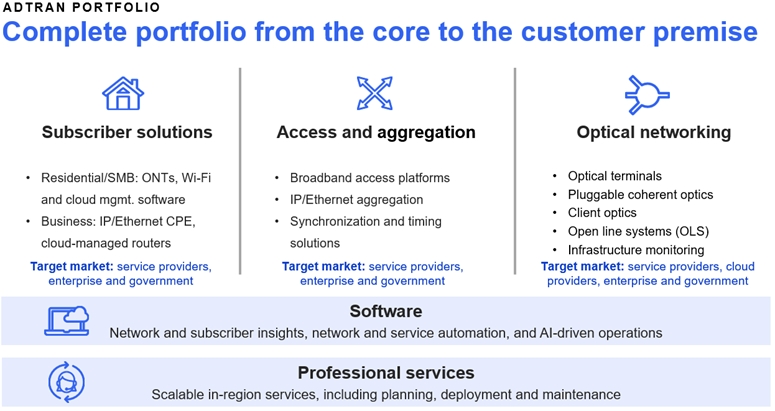
img68216995_0.jpg

Our Subscriber Solutions portfolio is used by Service Providers to terminate their access services infrastructure at the customer's premises while providing an immersive and interactive experience for residential, business and wholesale subscribers. This revenue category includes hardware- and software-based products and services. These solutions include fiber termination solutions for residential, business and wholesale subscribers, Wi-Fi access solutions for residential and business subscribers, Ethernet switching and network edge virtualization solutions for business subscribers, and cloud software solutions covering a mix of subscriber types.


10


The Subscriber Solutions category includes the following products, software and services:

Residential Gateways ("RGs"):

•
Residential Gateways


Optical Networking Terminals ("ONTs"):

•
GPON/XGS-PON ONTs

Enterprise Connectivity:

•
Routers
•
Switches

Edge Compute:

•
Edge Cloud (VEC)

Carrier Ethernet Network Interface Devices ("CE NIDs"):

•
FSP 150-GE110
•
FSP 150-XG100
•
FSP 150-XG210
•
FSP 150-XG300
•
FSP 150-XG400-NIDs

Software:

•
Mosaic One SaaS applications
•
n-Command
•
Procloud


Service:

•
Build
•
Care
•
Training
•
Professional Services
•
Software Services
•
Managed Services


11


Our Access & Aggregation Solutions category represents solutions that are used by communications Service Providers to connect residential subscribers, business subscribers and mobile radio networks to the Service Providers’ metro network, primarily through fiber-based connectivity. This revenue category includes hardware- and software-based products and services. Our solutions within this category are a mix of fiber access and aggregation platforms, precision network synchronization and timing solutions, and access orchestration solutions that ensure highly reliable and efficient network performance.

The Access & Aggregation category includes the following products, software and services:


Optical Line Terminals:

•
TA5000 OLT
•
SDX OLT
•
EPON OLT
•
Pluggable Optics

Copper Access:

•
Gfast DPUs
•
hiX
•
Total Access FTTN
•
Traditional Broadband


Packet Aggregation:

•
FSF 150-XG400 Aggregators
•
SDX Aggregation
•
Activator

Software:

•
MCP
•
AOE and ACI-E
•
Ensemble Activator
•
Mosaic One SaaS Applications
•
Mosaic Network Controller

Oscilloquartz:

•
Cesium clocks
•
GNSS and LEO clocks
•
Embedded timing solutions
•
PIP grandmasters and NTP server clocks
•
Time scale systems
•
Synchronization monitoring
•
PTP clients and boundary clocks
•
NTP network time servers
•
Network management systems

Service:

•
Build
•
Care
•
Training
•
Professional Services
•
Software Services
•
Managed Services


12


Our Optical Networking Solutions are used by communications Service Providers, internet content providers and large-scale enterprises to securely interconnect metro and regional networks over fiber. This revenue category includes hardware- and software-based products and services. Our solutions within this category include open optical terminals, open line systems, optical subsystems and modules, network infrastructure assurance systems, and automation platforms that are used to build high-scale, secure and assured optical networks.

The Optical Networking Solutions category includes the following products, software and services:


Optical Transport:

•
FSP 3000


Optical Engines:

•
AOE Coherent Pluggables
•
AOE MicroMux
•
AOE AccessWave

Infrastructure Monitoring:

•
ALM Fiber Monitoring


Software:

•
Mosaic Network Controller


Services:

•
Build
•
Care
•
Training
•
Professional Services
•
Software Services
•
Managed Services


13


Industry Overview

The global growth of the cloud and mobility (5G), industrial applications, AI, home office and mobile working are accelerating the demand for more bandwidth, requiring more flexible provisioning of telecommunications services and more precise network synchronization. Communications Service Providers' investment in their networks is being driven by the pursuit of growth in subscriber acquisition, retention, and average revenue per user, as well as by the aims of streamlining operations, lowering energy consumption and improving their overall sustainability. Drivers facilitating this network investment cycle include the evolution of government funding programs, private equity infrastructure investment appetite, regulatory broadband policies, competition and ever-increasing subscriber demand for higher-speed broadband.

Subscriber demand for greater bandwidth continues to increase as connectivity is being woven ever more tightly into the fabric of everyone’s day-to-day lives. Specifically, subscriber demand for greater bandwidth is being driven by increasing numbers of connected devices, shifting working arrangements, the transition of entertainment over to OTT video, and the evolution of gaming platforms towards subscription models where new hybrids of download and streaming are emerging globally. This is further compounded by the rapid adoption of AI, the prevalence of IoT and the increasing transition of applications over to cloud-based services and internet applications where recurring revenues replace one-time sales. Performance and user satisfaction are directly related to bandwidth availability and service robustness. As the demand for high-definition video and game streaming services, symmetric bandwidth for online collaboration, lower latency for interactive AI and cloud applications and smart home video surveillance applications continue to increase, so too does the need increase for fiber-based broadband to be in every home and business.

In order to satisfy these complex requirements and deliver on the efficiency improvements demanded by operators, communications Service Providers are transitioning to full fiber access networks.

We aim to serve as a trusted partner to our customers. Working side-by-side with our customers, we assist them with maximizing the performance of their networks by providing a flexible path for their networks to evolve cost-effectively over to full fiber while availing themselves of the benefits that web-scale architectures deliver and helping to further monetize their investments.

Our Strategy

Our strategy is to provide innovative and cost-effective solutions for our customers that enable them to address their increasing broadband demand. Our solutions focus on technology transformations that are happening in broadband network infrastructure, home and business CPE and software platforms, and services needed to help our customers address increasing complexity while scaling to meet increasing consumer demands.

We aspire to be one of the top communication technology players in the world and an innovation leader around the converged edge, enabling the intelligent, self-optimizing, fiber-everywhere future. We plan to achieve this goal through innovation in network, home and business technology paired with a customer-focused organizational structure that tailors solutions to meet the needs of our target customers. We have one of the most comprehensive solutions portfolios that empowers operators to build a converged infrastructure from the metro core to the customer premise, serving all networking applications for residential, business, wholesale and mobile users. We take an approach to our portfolio in which we are focused in specific markets where we can offer competitive differentiation and scale while also having enough diversity and breadth in the portfolio to provide end-to-end connectivity solutions that offer value to our customers. More specifically, our corporate strategy consists of the following elements:

•
Leadership in fiber networking: Breadth of portfolio, open and advanced architecture, assured and secure connectivity.
•
Growth in focus markets: Increased turnkey solutions and in-region resources, especially North America and EMEA.
•
Investment in converged edge: Innovation in optics, security, AI-driven networking, virtualization, SaaS, etc.
•
Transformation through software: Open and cloud-centric systems, end-to-end programmability, simplification through software, and innovative SaaS offerings.
•
Diversification of customers: Cross-selling current portfolio, acquisition of new customers and partners based on larger portfolio and trusted supplier status.
•
Focus on sustainability: Science-based emissions targets, process-based product eco-design, optimization of operations, logistics and all packaging, circular-economy processes.


14


Customers

We have a diverse global customer base that includes large, medium and small Service Providers, alternative Service Providers, such as utilities, municipalities and fiber overbuilders; cable/MSOs; SMBs and distributed enterprises.

During 2025, we had one customer who comprised greater than 10.0% of our revenue, which was an international Service Provider, and our next five largest customers comprised 20.4% of our revenue. Additionally, our revenue in the U.S., U.K. and Germany each comprised more than 10% of our revenue in 2025. The revenue from this Service Provider and these countries is reported in both our Network Solutions and Services & Support segments.

Distribution, Sales and Marketing

We sell our products through our direct sales organization and our distribution network. Our direct sales organization supports major accounts and has offices in global locations. Sales to most smaller and independent telecom companies are fulfilled through a combination of direct sales and distributors. Our service offerings can be purchased directly from us or through one of our Service Providers, channel partners or distribution partners.

Before placing an order, Service Providers typically require lengthy product qualification and standardization processes that can extend for several months or even years. Once approved, product orders are typically placed under single or multi-year supply agreements that are generally not subject to minimum volume commitments. Service Providers generally prefer having two or more suppliers for most products. Therefore, individual orders are usually subject to competitive combinations of total value, service, price, delivery and other terms.

Orders for end-user products are fulfilled through a combination of direct sales and distributors. This is supported by a direct sales organization for major accounts and a channel-based sales organization to facilitate sales to our partners. MSPs, VARs and SIs may be affiliated with us as channel partners, or they may purchase from a distributor in an unaffiliated fashion. Affiliated partners participate with us at various program levels, based on sales volume and other factors, to receive benefits such as product discounts, market development funds, technical support and training.

Outside of the U.S., most Service Provider products are sold through our direct sales organization and end-user products are sold direct or through distribution arrangements customized for each region. Some regions are supported from a field office that offers sales and support functions, and in some cases, warehousing and manufacturing support. Our field sales organizations, distributors and Service Provider customers receive support from regional-based marketing, sales and customer support groups.

Our marketing organization promotes all brands associated with us to key stakeholders, including customers, partners and prospects worldwide. Our product marketing and management teams work with our engineering teams to develop and promote new products and services, as well as product enhancements.

Research and Development

Rapidly changing technologies, evolving industry standards, changing customer requirements, supply constraints and continuing developments in communications service offerings characterize the markets for our products. Our on-going ability to adapt to these changes and to develop new and enhanced products that meet or anticipate market demand is the main factor influencing our competitive position and our ability to grow.

Our product development activities are a central part of our strategy. We plan to maintain our emphasis on product development to enable us to respond to rapidly changing technology and evolving industry standards. Our research and development and engineering functions are global. We maintain research and development functions at multiple sites in the U.S., Europe, Israel and Asia. During the years ended December 31, 2025, 2024 and 2023, research and development expenditures totaled $204.3 million, $221.5 million and $258.3 million, respectively.

While we develop the majority of our products internally, we also leverage partners for some solutions. Additionally, we license intellectual property or acquire technologies. Internal development on advanced technology products gives us more control over design and manufacturing issues, while for traditional designs, ODM and/or licensed intellectual property provides us with the ability to leverage the economies of scale of our technology partners.

As we continue to create more software-based intellectual property, such as our SDN/Edge Cloud portfolio, our use of lean agile practices in research and development ensures we remain responsive and customer-focused. We believe that this enables us to deliver products faster, at higher quality and more economically to our customers and the market on a continuous basis.

Our ability to continually reduce product costs, while focusing on delivery and quality, are important parts of our overall business strategy. Our product development efforts are often centered on entering a market with improved technology, which we believe enables us to offer products at competitive prices and compete for market share.


15


Development activities focus on solutions that support both existing and emerging communications industry technologies in segments that we consider viable revenue opportunities. We are actively engaged in developing and refining technologies to support data, voice and video transport primarily over IP/Ethernet and optical network architectures. This includes optical transport, packet demarcation and aggregation, synchronization and fiber-optic access, DSL, access routing, ethernet switching, wireless LANs, integrated access, converged services, VoIP, network management and professional services. In addition, we focus on vertical optical technologies like Silicon Photonics, as well as microelectronics in order to differentiate and fully control the vertical value stack of our solutions. During 2025, we launched many new products, including an auto-tunable 50G C-band pluggable transceiver, expanded our Wi-Fi 7 portfolio with SDG 9000 Series for residential, small business and MDU connectivity, and launched the new FSP 3000 OLS solution. We also continued to advance our software and AI strategy through the Mosaic One platform.

Our research function and advanced technology team is driving many specific research projects in the fields of sustainable optical transmission, security, quantum communications, SDN and access technologies. This research fosters differentiated product concepts and guides our various product design and engineering teams in IPR creation, industry and network standards and technological forecasting.

We are an active participant in several SDOs and have assisted with the development of worldwide standards in many technologies. Our SDO activities are primarily in the areas of broadband access, optical networking and synchronization. This includes involvement with standard-setting bodies such as the ITU-T, ATIS, ETSI and the BBF. We are involved in the evolution of optical access technologies on next-generation PON. We also continue to be involved in driving optical networking, synchronization and SDN standardization and participate in industry-wide interoperability, performance-testing and system-level projects related to those standards in BBF. We are also members of MEF, TIA, CableLabs and TIP.

Manufacturing and Operations

The principal steps in our manufacturing process include the purchase and management of materials, assembly, testing, final inspection, packing and shipping. We purchase parts and components for the assembly of some products from a large number of suppliers through a worldwide sourcing program. Additionally, we manage a process that identifies the components that are best purchased directly by contract manufacturers for use in the assembly of our products to achieve manufacturing efficiency, quality and cost objectives. Certain key components used in our products are currently available from a single source, and other key components are available from only a limited number of sources. In the past, we have experienced delays in the receipt of certain key components, which has resulted in delays in related product deliveries. We attempt to manage these risks through developing alternative sources, by staging inventories at strategic locations, through engineering efforts designed to prevent the necessity of certain components and by maintaining close contact and building long-term relationships with our suppliers.

We rely on subcontractors for the assembly and testing of certain printed circuit board assemblies, sub-assemblies, chassis, enclosures and equipment shelves, and to purchase some of the raw materials used in such assemblies. We typically manufacture our lower-volume, higher-mix products and build and test product prototypes and many of our initial production units at our manufacturing site in Huntsville, Alabama. We later transfer the production of higher-volume, lower-mix assemblies to our subcontractors. Subcontract assembly operations can lengthen fulfillment cycle times, but we believe we can respond more rapidly to uncertainties in incoming order rates by selecting assembly subcontractors that have significant reserve capacity and flexibility. Our subcontractors have generally proven to be flexible and able to meet our quality requirements.

We ship the majority of products to our U.S. customers from our facilities in Huntsville, Alabama. The majority of international customers are being served from our logistics hubs in Meiningen, Germany and York, United Kingdom. We also ship directly from subcontractors to a number of customers in the U.S. and international locations. Most of our facilities are certified pursuant to the most current releases of ISO 9001, TL 9000, ISO 14001 and ISO 27001. Our Huntsville, Alabama facilities and many of our key suppliers are C-TPAT certified. Our products are also certified to certain other customers' industry and privacy standards, including those relating to the emission of electromagnetic energy and safety specifications.

Our dependence on a limited number of suppliers for certain raw materials, key components and ODM products, has prevented and may in the future prevent us from delivering our products on a timely basis, which has had and may continue to have a material adverse effect on operating results and could have a material adverse effect on customer relations. Recently, the Company has experienced increased costs on imports of certain critical raw minerals and derivative products relevant to our business and products due to tariffs imposed by the U.S. government and other nations. The availability, timing and amount of any potential refunds of such tariffs remain unclear. Moreover, although the Company has been able to substantially mitigate the impact of tariffs that have been enacted to date, if additional tariffs and reciprocal tariffs are implemented (whether as currently proposed or otherwise), such actions could have a negative effect on our financial results, including our revenue and profitability.

Competition

We compete in markets for networking and communications services and solutions for Service Providers, businesses, government agencies and other organizations worldwide. Our products and services provide solutions supporting voice, data and video communications across fiber-, copper-, and wireless-based infrastructure, as well as across wide area networks, LANs and the internet.


16


We compete with a number of companies in the markets we serve. In the Subscriber Solutions category, our primary competitors include Calix, Ciena, Nokia, eero, RAD, and a growing number of Asian based ODM's selling direct to carriers. In our Access & Aggregation solutions category, key competitors include Nokia, Calix, Vecima, Harmonic and Microchip. Main competitors of our Optical Networking solutions portfolio are Ciena, Cisco, Ekinops, Nokia, Smartoptics and Ribbon Communications. Within our key target markets, we also compete less often with designated "high-risk vendors" such as Huawei and ZTE Corporation.

Across our markets and segments, the principal competitive factors can include, among others:

•
differentiated feature functionality of our products and solutions;
•
price performance of our solutions and lowest total cost of ownership for customers;
•
quality and reliability of our products;
•
financial stability and health of our company;
•
ability to manage supply chains to produce and deliver products in accordance with customer wish date;
•
ability to innovate and provide customers with differentiated solutions, advantageous to their business model;
•
compelling technology roadmap and research and development power;
•
industry thought leadership and time to market with innovative solutions;
•
country of origin for products and solutions and trusted supplier status;
•
security of enterprise value chain, from design to product development, support processes, to products and solutions;
•
energy consumption of our products and commitment to sustainability, supporting customers in achieving their climate goals;
•
customer relationship and incumbency;
•
ability to deliver comprehensive solutions with a high degree of automation and ease-of-use, including hardware, software and services; and
•
broad range of services and support capabilities.

Seasonality

We experience quarterly fluctuations in our revenue that occur due to many factors, including the varying budget cycles and seasonal buying patterns of our customers. More specifically, our customers tend to spend less in the first fiscal quarter as they are finalizing their annual capital spending budgets. These seasonal effects may continue to vary and do not always correlate to our operating results. Accordingly, they should not be considered a reliable indicator of our future revenue or operating results.

Foreign Currency

Transactions with customers that are denominated in foreign currencies are recorded using the appropriate exchange rates from throughout the year. Assets and liabilities denominated in foreign currencies are remeasured at the balance sheet dates using the closing rates of exchange between those foreign currencies and the functional currency with any transaction gains or losses reported in other income, net. Our primary exposures to foreign currency exchange rate movements are with the euro and the British pound sterling. Adjustments resulting from translating financial statements of international subsidiaries are recorded as a component of accumulated other comprehensive income.

Inventory

A substantial portion of our shipments in any fiscal period relate to orders received and shipped within that fiscal period for customers under agreements containing non-binding purchase commitments. Further, a significant percentage of orders require delivery within a few days.

We maintain substantial inventories of raw materials for long lead time components to support this demand and avoid expedite fees. We support our customer demand for our products by working with our suppliers, contract manufacturers, distributors, and customers to address and to limit the disruption to our operations and order fulfillment. Additionally, maintaining sufficient inventory levels to assure prompt delivery of our products increases the amount of inventory that may become obsolete and increases the risk that the obsolescence of this inventory may have an adverse effect on our business and operating results. Also, not maintaining sufficient inventory levels to ensure prompt delivery of our products may cause us to incur expediting costs to meet customer delivery requirements, which may negatively impact our operating results.


17


Government Regulation

Telecommunications Matters

Our products that are incorporated into wireless communications systems must comply with various government regulations, including those of the FCC. We strive to deliver innovative network access solutions that lower the total cost and reduce the time of deploying services, increase the level of performance achievable with established infrastructures, reduce operating and capital expenses for our customers, increase network bandwidth and functionality, and extend network reach. Our development process is conducted in accordance with ISO 9001, TL 9000, ISO 14001, and ISO 27001, all of which are international standards for quality and environmental management systems.

Environmental Matters

Our products must comply with various regulations, directives and standards established by communications authorities in various countries, as well as those of certain international bodies. Environmental legislation in particular within the EU may increase our cost of doing business as we amend our products to comply with these requirements. This includes the CSRD directive, the CBAM regulation, the WEEE directive and the ESPR adopted by the EU. We are also subject to disclosure and related requirements that apply to the presence of conflict minerals in our products or supply chain. We continue to implement measures to comply with these and other similar directives and regulations from additional countries.

Global Trade

As a global company, the import and export of our products and services are subject to various laws and regulations, including international treaties, U.S. trade policy, tariffs, export controls and sanctions laws, customs regulations, and local trade rules around the world. Such laws, rules, and regulations may delay the introduction of some of our products or impact our competitiveness through restricting our ability to do business in certain places or with certain entities and individuals, or the need to comply with domestic preference programs, laws concerning transfer and disclosure of sensitive or controlled technology or source code, unique technical standards, localization mandates, and duplicative in-country testing and inspection requirements. Furthermore, material changes in such laws, rules or regulations or the failure by us to comply with such laws, rules and regulations could limit our ability to conduct business globally. Global trade policy continues to evolve and the ultimate impact of recent developments with respect to U.S. tariffs is unclear. On February 20, 2026, the United States Supreme Court issued a ruling striking down certain tariffs previously imposed under the International Emergency Economic Powers Act ("IEEPA"). The ultimate availability, timing, and amount of any potential refunds of such tariffs remain highly uncertain and are subject to further legal, regulatory, and administrative developments. Following the Supreme Court’s decision, the U.S. presidential administration announced its intention to invoke other laws to collect tariffs and announced new tariffs on imports from all countries, in addition to any existing non-IEEPA tariffs (including tariffs on semiconductors, which are expected to increase in June 2027). Furthermore, recent U.S. trade actions have triggered retaliatory actions by certain affected countries, and other foreign governments may impose further trade measures, including reciprocal tariffs, on certain U.S. goods in the future. There remains substantial uncertainty regarding the duration of existing and newly announced tariffs, potential changes or pauses to such tariffs, tariff levels, and whether further additional tariffs or other retaliatory actions may be imposed, modified, or suspended, and the impacts of such actions on our business.

AI Regulations

In the U.S., proposed federal AI regulations, such as those under consideration by Congress or agencies like the Federal Trade Commission, may impose requirements for transparency, ethical use, and data sourcing, particularly if AI systems are trained on copyrighted materials. Non-compliance could lead to restrictions on AI use, fines, or intellectual property disputes. In Europe, the EU Artificial Intelligence Act, expected to be fully implemented by 2026, categorizes AI applications by risk level and could classify our content generation as high-risk, requiring stringent compliance with safety, transparency, and accountability standards. Violations could result in fines of up to 7% of global annual revenue.

Other Regulations

As a company with global operations, we are subject to complex foreign and U.S. laws and regulations, including anti-bribery and corruption laws; antitrust or competition laws; data privacy laws and regulations, such as the GDPR and the California Consumer Privacy Act; and cybersecurity laws and regulations, among others. We have policies and procedures in place to promote compliance with these laws and regulations. To date, our compliance actions and costs relating to these laws, rules and regulations have not resulted in a material cost or effect on our capital expenditures, earnings or competitive position. Government regulations are subject to change and, accordingly, we are unable to assess the possible effect of compliance with future requirements or whether our compliance with such regulations will materially impact our business in the future.


18


Sustainability

We believe that as we follow our corporate vision to enable a fully connected world, we must continue to be responsible corporate citizens. As more people are connected, work and life can be accomplished using fewer resources. We have established sustainability programs and policies that encompass the elements of Environmental, Health & Safety, Ethics, Labor, and the related management systems in alignment with the ISO 26000 Guidelines. We are committed to operating in full compliance with the laws, rules and regulations of all the countries in which we operate. The major aims of our program are reducing waste and emissions, maximizing energy efficiency and productivity and minimizing practices that can adversely affect utilization of natural resources by coming generations. Our sustainability programs are important to us, consequently, sustainability is a dedicated focus throughout the company. We have Board oversight including a Sustainability Committee, strong management support and engagement from our employees.

Areas of focus in our environmental sustainability program include:

•
maintaining a dedicated Sustainability Committee of the Board of Directors;
•
maintaining our mature environmental management system certified to ISO 14001:2015;
•
advancing our Energy Management program with ISO 50001 readiness for the Huntsville site for 2025;
•
continuing the purchase of Renewable Energy Credits, equaling ~20% of total Adtran energy consumption;
•
continued use of IntegrityNext, a platform to engage suppliers to obtain an ESG assessment aligned with international standards, allowing us to monitor sustainability risks in our supply chain;
•
establishing Eco-Design guidelines in the Technology organization;
•
conducting Life Cycle Assessments across the portfolio;
•
optimizing packaging to reduce related materials and waste;
•
increasing visibility of our program internally and externally through customer engagement, joining peer sustainability groups, offering training to team members and web site enhancements; and
•
participating in external CDP and EcoVadis assessments.

We expect to issue a sustainability report for 2025 in early 2026, which will use the EU ESRS guidelines, in order to fulfill the reporting obligations set forth in the EU CSRD. Within the report is information on our sustainability and governance programs, including quantitative and qualitative data for the entire Company. This information can also be found on our website at: www.adtran.com/en/about-us/esg/environmental. The information found on our website is not incorporated by reference in this report or any other report that we file or furnish to the SEC.

Human Capital

We believe that our most valuable asset is our people. To ensure we continue to succeed, our objective is to be able to recruit, hire and retain top talent. Our ability to attract and retain a high-quality workforce is dependent on our ability to maintain a diverse, equitable and inclusive workplace that provides opportunities for our employees to learn and grow in their careers. This is supported by competitive compensation and benefits, along with strong community service and other programs that enable employees to build connections within the community.

As of December 31, 2025 we had 3,338 total employees, of which 3,201 are full-time employees and 137 are part-time employees. We had 1,162 employees in the U.S. and 2,176 employees in our international subsidiaries located in North America, Latin America, EMEA and APAC regions. We also utilized 249 contractors and numerous temporary employees domestically and internationally in various manufacturing, engineering, sales and general and administrative capacities. We believe that our relationship with our employees is good. We have a diverse employee base located in 34 countries. We pride ourselves on a highly educated workforce, and the majority of our employees serve in engineering, information technology and technical roles within the organization.

As of December 31, 2025 approximately 88 employees (75%) of Adtran GmbH and Adtran Technology GmbH were subject to collective bargaining agreements of either the Association of Metal and Electrical Industry in Berlin and Brandenburg e.V. or NORDMETALL Association of Metal and Electrical Industry e.V. As of December 31, 2025, Adtran Networks had 98 employees in Switzerland, France, Italy, Finland and Spain that were subject to collective bargaining agreements of different associations. None of our other employees are subject to collective bargaining agreements.

Additionally, we continually work to recruit technical talent in diverse communities through our cooperative education program. This program seeks to identify college students that major in relevant technological areas and expose them to our work environment on an alternating semester basis. Our goal is to retain as many of these students as possible for full-time employment after graduation to build our organization's future.


19


Health, Safety and Wellness

The well-being of our employees is paramount to the continued success of our business. To this end, we are committed to each of our employees' health, safety and wellness. We provide our employees with access to various health and wellness benefits designed to enable them and their family members to have affordable access to health, dental and vision insurance. Additionally, we offer access to many programs that provide additional monetary support in the event of a qualifying incident, including accident insurance, life insurance and hospital indemnity insurance, among others. We understand that mental health is an essential aspect of our employees’ well-being and we offer an employee assistance program at no charge to employees and their family members. This program provides access to qualified personnel to address various issues such as grief, financial stress, family and emotional issues.

Compensation and Benefits

We continually work to provide a competitive compensation and benefits program as this plays a key role in our ability to attract and retain a highly skilled workforce. In addition to salaries, these programs, which vary by country/region, include long-term equity incentive awards with certain vesting requirements, a 401(k) plan, healthcare and insurance benefits, health savings and flexible spending accounts, paid time off, paid volunteer time off, employee assistance program and tuition assistance. Additionally, at our global headquarters in Alabama, we offer our employees certain on-site services, including nurse practitioner care and a fitness center, among others.

Talent Development

We invest significant resources to develop the talent needed to remain a market-leading global supplier of broadband infrastructure. We offer numerous training opportunities on both technical and professional development topics. We utilize tools and processes to provide performance feedback which helps develop high potential employees into becoming our future leaders.

Our Career Development Program provides an opportunity for employees to shape their career journey. The program provides opportunities for employees to develop competencies in areas including technology, business acumen, emotional intelligence, design and systems thinking. As employees increase their competencies in these areas and master skills within their individual roles, this program offers a variety of career advancement paths.

Intellectual Property

We develop and own a significant amount of intellectual property. We have approximately 1,000 patents worldwide related to our products and over 50 additional pending patent applications. Our patents expire at various dates between 2026 and 2044. We continue to seek additional patents related to our research and development activities. We do not derive any material amount of revenue from the licensing of our patents.

The name "ADTRAN" is a registered trademark of ours and a number of our product identifiers and names. We also claim rights to a number of unregistered trademarks.

We protect our intellectual property and proprietary rights in accordance with good legal and business practices. We believe, however, that our competitive success will not fully depend on the ownership of intellectual property, but instead will depend primarily on the innovative skills, technical competence and marketing abilities of our personnel.

The communications industry is characterized by the existence of an ever-increasing volume of patent litigation and licensing activities. We have received, and may continue to receive, notices of claims alleging that we are infringing upon patents or other intellectual property. We cannot predict whether we will prevail in any claims or litigation over alleged infringements, or whether we will be able to license any valid and infringed patents, or other intellectual property, on commercially reasonable terms. It is possible that such litigation may result in significant legal costs and judgments and that intellectual property infringement claims, or related litigation against or by us could have a material adverse effect on our business and operating results.


20


Information about our Executive Officers

Our executive officers as of February 26, 2026, are listed below, along with their ages on that date, positions and offices held with the Company, and principal occupations and employment, focused primarily on the past five years (and all positions within the Company).


Thomas R. Stanton


Age 61

2007 to present


Chief Executive Officer and Chairman of the Board

2023 to present


Chief Executive Officer and Management Board member of Adtran Networks


Timothy Santo


Age 49

2025 to present


Senior Vice President of Finance and Chief Financial Officer


Chief Financial Officer and Management Board member of Adtran Networks

February 2024 to March 2025


Executive Vice President and Chief Financial Officer, Conn's, Inc.*

November 2023 to February 2024


Interim Chief Financial Officer, Conn's, Inc.

April 2023 to November 2023


Senior Vice President and Chief Accounting Officer, Conn's, Inc.

2018 to 2023


Senior Vice President and Global Controller of PRA Group


Christoph Glingener


Age 57

2023 to present


Chief Technology Officer


Chief Technology Officer and Management Board member of Adtran Networks

2022 to 2023


Chief Executive Officer of Adtran Networks

2007 to 2022


Chief Technology Officer of Adtran Networks


James D. Wilson, Jr.


Age 55

2019 to present


Chief Revenue Officer

2015 – 2019


Senior Vice President of Technology and Strategy

2006 – 2015


Senior Vice President and General Manager (Carrier Networks)


*On July 23, 2024, Conn’s, Inc. and certain of its subsidiaries filed voluntary petitions for relief under Chapter 11 of the Bankruptcy Code.

There are no family relationships among our directors or executive officers. Adtran Networks is a majority-owned subsidiary of the Company.

Availability of Information

We file annual reports on Form 10-K, quarterly reports on Form 10-Q, current reports on Form 8-K, proxy statements and other information as required with the SEC. The SEC maintains an internet website, http://www.sec.gov, that contains reports, proxy and information statements, and other information regarding issuers, including Adtran, that file electronically with them. Additionally, our annual reports on Form 10-K, quarterly reports on Form 10-Q, current reports on Form 8-K and amendments to those reports, if applicable, filed or furnished pursuant to Section 13(a) or 15(d) of the Securities and Exchange Act of 1934, as amended (the "Exchange Act"), are available free of charge under the Investor Relations section of our website, www.adtran.com, as soon as reasonably practicable after we electronically file them with, or furnish them to, the SEC. The reference to our website address does not constitute incorporation by reference of the information contained on the website, which information should not be considered part of this report.


21


ITEM 1A. RISK FACTORS

Our business involves substantial risks. Any of the risk factors described below or elsewhere in this report could significantly and adversely affect our business prospects, financial condition and results of operations. Additional risks and uncertainties not presently known to us or that we currently deem to be immaterial may also adversely affect us.

Risks related to our financial results and Company success

We are obligated to comply with covenants related to our Wells Fargo Credit Agreement that restrict our operating activities, and the failure to comply with such covenants could result in defaults that accelerate our debt obligations.

The Wells Fargo Credit Agreement governing our indebtedness contains restrictive covenants that limit our ability to engage in activities that may be in our long-term best interest. Our failure to comply with those covenants has resulted in events of default and may in the future result in an event of default that, if not cured or waived, results in the acceleration of all its debt. Our Wells Fargo Credit Agreement along with the amendments thereto, contain various restrictive covenants which include, among others, provisions limiting our ability to:

•
pay dividends or make other distributions or repurchase capital stock;
•
incur or guarantee additional debt;
•
make certain distributions, investments and other restricted payments;
•
engage in transactions with affiliates;
•
engage in mergers or consolidations;
•
grant or incur liens on assets;
•
dispose of assets;
•
make loans and investments;
•
modify our organization documents; and
•
enter into certain restrictive agreements.

In addition, the Wells Fargo Credit Agreement contains customary events of default, such as misrepresentation and a default in the performance or observance of any covenant (subject to customary cure periods and materiality thresholds).

In addition, certain covenants in the Wells Fargo Credit Agreement, including covenants set forth in the amendments thereto, require us, among other things, to:

•
maintain certain leverage ratios; and
•
maintain certain fixed charge coverage ratios;

As a result of these restrictions, we have been and may be:

•
limited in how we conduct our business;
•
limited in how much additional funding we can draw on our line of credit;
•
unable to raise additional debt or equity financing to operate during general economic or business downturns; and
•
unable to compete effectively or to take advantage of new business opportunities.

Our failure to comply with the covenants set forth in the Credit Agreement has resulted in events of default and could in the future result in defaults that accelerate the payment under such debt which would likely have a material adverse impact on our financial condition and results of operations. In addition, an event of default under the Credit Agreement would, if not cured or waived, permit the lenders to terminate all commitments to extend further credit under the applicable facility. Furthermore, if we were unable to repay the amounts due and payable under the Credit Agreement, the lenders could proceed against the collateral granted to them to secure that indebtedness. In the event our lenders accelerate the repayment of our borrowings, we and our subsidiaries may not have sufficient assets to repay that indebtedness. In addition, these defaults could impair our ability to access debt and equity capital markets. For additional information on our debt covenants, see "Liquidity & Capital Resources" in Part II, Item 7 of this report.


22


We have experienced significant fluctuations in revenue and such fluctuations may continue. Fluctuations in revenue can cause our operating results in a given reporting period to be higher or lower than expected.

As a result of the many factors discussed in this report, our revenue for a particular quarter is difficult to predict and will fluctuate from quarter to quarter. Visibility into customer spending levels is often uncertain, spending patterns are subject to change, and reductions in our expense levels can take significant time to implement. Typically, our customers request product delivery within a short period following our receipt of an order. Consequently, we do not typically carry a significant order backlog and are dependent upon obtaining orders and completing delivery in accordance with shipping terms that are predominantly within each quarter to achieve our targeted revenue. Our deployment/installation cycle can also vary depending on the customer’s schedule, site readiness, network size and complexity and other factors, which can cause our revenue to fluctuate from period to period. Our ability to meet financial expectations could also be affected if the variable revenue patterns seen in prior quarters recur in future quarters. We have experienced periods of time during which manufacturing issues have delayed shipments, leading to variable shipping patterns. In addition, to the extent that manufacturing issues and any related component shortages continue to result in delayed shipments in the future, and particularly in quarters in which we and our subcontractors are operating at higher levels of capacity, it is possible that revenue for a quarter could be adversely affected, and we may not be able to remediate the conditions within the same quarter.

Under certain market conditions, long manufacturing lead times have caused our customers to place the same order multiple times. When multiple ordering occurs, along with other factors, it may cause difficulty in predicting our revenue and, as a result, could impair our ability to manage inventory effectively.

We plan our operating expense levels based primarily on forecasted revenue levels. Furthermore, our expenses and the impact of long-term commitments are relatively fixed in the short term. A shortfall in revenue has led and could again in the future lead to operating results being below expectations, partially due to an inability to quickly reduce these fixed expenses in response to short-term business changes.

Accurately matching necessary inventory levels to customer demand is challenging, and we may incur additional costs or be required to write off significant inventory that could adversely impact our results of operations.

Customer demand for our products can change rapidly in response to market, supply environment and technological developments. We periodically evaluate our supplier purchase commitments to take steps to mitigate these challenges. We have had and could in the future have to extend purchase commitments or place non-cancellable, advanced orders with or through suppliers, particularly for long lead-time components. This has in the past and could in the future lead to increased inventory and adversely impact our results of operations and financial condition.

In addition, these inventory practices, particularly when considered in the context of our backlog, further introduce obsolescence risk that can impact our results of operations and financial condition. Accordingly, our inventory needs for a particular period can fluctuate and be difficult to predict. If our customers were to cancel or delay orders for extended periods, inventory could become obsolete, and we could be required to write off or write down the inventory associated with those orders. In addition, if customers were to cancel or delay existing or forecasted orders for which we have significant outstanding commitments to our contract manufacturers or suppliers, we may be required to purchase inventory under these commitments that we are unable to sell. If we are required to write off or write down a significant amount of inventory, our results of operations for the applicable period would be materially adversely affected. Our inability to effectively manage the matching of inventory with customer demand, particularly within any supply constrained environment, has had and could in the future have an adverse impact our results of operations and financial condition.

The lengthy sales and approval process required by Service Providers for new products has resulted in fluctuations in our revenue and may result in future revenue fluctuations.

In the industry in which we compete, sales and approval cycles are often lengthy. Selling efforts often involve a significant commitment of time and resources by us and our customers that may include extensive product testing, laboratory or network certification, or region-specific product certification and homologation requirements for deployment in networks. Additionally, a supplier must first obtain product approval from a major or other Service Provider to sell its products to these Service Providers. This process can last from six to eighteen months, or longer, depending on the technology, the Service Provider and the demand for the product from the Service Provider’s subscribers. Consequently, we are involved in a constant process of submitting for approval succeeding generations of products, as well as products that deploy new technology or respond to new technology demands from a major or other Service Provider. We cannot be certain that we will obtain these approvals in the future or that sales of these products will continue to occur. Any attempt by a major or other Service Provider to seek out additional or alternative suppliers, or to undertake, as permitted under applicable regulations, the production of these products internally, could have a material adverse effect on our operating results. Furthermore, the delay in sales until the completion of the approval process, the length of which is difficult to predict, has and may continue to result in fluctuations of revenue and uneven operating results from quarter to quarter or year to year. For example, we have seen a decrease in volume of sales activity due to customers’ focus on reducing inventory levels in our domestic ADTRAN, Inc. operations, which has impacted and may continue to materially impact demand in that category. Further, once customer approval or certifications are met, our supply chain customers typically do not guarantee us a minimum, or any, volume of sales.


23


We require a significant amount of cash to service our indebtedness, our payment obligations to Adtran Networks shareholders under the DPLTA, and other obligations.

Our ability to generate cash depends on many factors beyond our control and any failure to service our outstanding indebtedness could harm our business, financial condition and results of operations. Furthermore, we have entered into a DPLTA with Adtran Networks. Additionally, pursuant to the terms of the DPLTA, each Adtran Networks shareholder (other than the Company) has received an offer to elect either (1) to remain an Adtran Networks shareholder and receive from us a recurring cash payment of €0.52 per share for each full fiscal year of Adtran Networks (the “Annual Recurring Compensation”) payment, or (2) to put their Adtran Networks shares to the Company in exchange for compensation in cash of €17.21 per share, plus guaranteed interest (the “Exit Compensation”). For the year ended December 31, 2025, approximately 2.0 million shares of Adtran Networks stock were tendered to the Company. This resulted in total Exit Compensation payments of approximately €40.2 million, or approximately $46.6 million, based on exchange rates at the time of the transactions, being paid to Adtran Networks shareholders. Any failure to satisfy our payment obligations under the DPLTA could harm our business, financial condition and results of operations.

Moreover, on September 19, 2025, the Company issued $201.3 million aggregate principal amount of convertible senior notes (the “2030 Notes” or the “Notes”). The Notes accrue interest at a rate of 3.75% per annum, payable semi-annually in arrears on March 15 and September 15 of each year, beginning March 15, 2026. Unless repurchased earlier, redeemed, or converted, the Notes will mature on September 15, 2030.

Our ability to make payments on and to refinance our indebtedness, to cover our payment obligations under the DPLTA and the 2030 Notes, and to fund working capital needs and planned capital expenditures depends on our ability to generate cash in the future. This, to a certain extent, is subject to general economic, financial, competitive, business, legislative, regulatory and other factors that are beyond our control. If our business does not generate sufficient cash flow from operations, we do not sufficiently reduce costs in a timely manner, or if our future borrowings are not available to us in an amount sufficient to enable us and our subsidiaries to pay our indebtedness or to fund our other liquidity needs, we may need to raise additional debt or equity capital, refinance all or a portion of our indebtedness, sell assets, reduce or delay capital investments, any of which could have a material adverse effect.

The Company experienced revenue declines in 2024. However, customers began replenishing their inventories to meet increasing demand, and revenue increased throughout fiscal 2025. There can be no assurance that revenue will continue to increase or that the Company will be successful in effecting its plans to preserve cash liquidity and maintain compliance with the Company's covenants on commercially reasonable terms or at all. We may need to further reduce capital expenditure and/or take other steps to preserve working capital in order to ensure that we can meet our needs and obligations and maintain compliance with our debt covenants. Our ability to raise additional debt capital or to restructure or refinance our indebtedness will depend on the condition of the capital markets and our financial condition at such time. Any refinancing of our debt could be at higher interest rates and may require us to comply with more onerous covenants, which could further restrict our business operations. The terms of existing or future debt instruments or preferred stock may limit or prevent us from taking any of these actions.

In addition, any failure to make scheduled payments of interest and principal on our outstanding indebtedness or dividend payments on any future outstanding shares of preferred stock would likely result in a reduction of our credit rating, which could harm our ability to incur additional indebtedness or otherwise raise capital on commercially reasonable terms or at all. Our inability to generate sufficient cash flow to satisfy our debt service, payment obligations to Adtran Networks shareholders under the DPLTA, and other obligations, or to refinance or restructure our obligations on commercially reasonable terms or at all, would have an adverse effect, which could be material, on our business, financial condition and results of operations. Furthermore, if we raise additional funds through the issuance of equity or securities convertible into equity, or undertake certain transactions intended to address our existing indebtedness, our existing stockholders could suffer dilution in their percentage ownership of the Company, or our leverage and outstanding indebtedness could increase. Current capital market conditions, including the impact of inflation, have increased borrowing rates and can be expected to significantly increase our cost of capital as compared to prior periods should we seek additional funding.


24


The terms of the DPLTA may have a material adverse effect on our financial results and condition.

The DPLTA between the Company, as the controlling company, and Adtran Networks, as the controlled company, became effective on January 16, 2023, as a result of its registration with the commercial register (Handelsregister) of the local court (Amtsgericht) at the registered seat of Adtran Networks (Jena).

Under the DPLTA, subject to certain limitations pursuant to applicable law and the specific terms of the DPLTA, (i) the Company is
entitled to issue binding instructions to the management board of Adtran Networks, (ii) Adtran Networks will transfer its annual profit to the Company, subject to, among other things, the creation or dissolution of certain reserves, and (iii) the Company will generally absorb the annual net loss incurred by Adtran Networks. The Company’s payment obligation in satisfaction of the requirement that it absorb Adtran Networks’ annual net loss applies to the net loss generated by Adtran Networks in 2025, and it will apply to any net loss generated by Adtran Networks in 2026.

Additionally, and subject to certain limitations pursuant to applicable law and the specific terms of the DPLTA, the DPLTA provides that Adtran Networks shareholders (other than the Company) be offered, at their election, (i) to put their Adtran Networks shares to the Company in exchange for compensation in cash of €17.21 per share, plus guaranteed interest (the “Exit Compensation”), or (ii) to remain Adtran Networks shareholders and receive a recurring compensation in cash of €0.52 per share for each full fiscal year of Adtran Networks (the “Annual Recurring Compensation”). The guaranteed interest under the Exit Compensation is calculated from the effective date of the DPLTA to the date the shares are tendered, less any Annual Recurring Compensation paid. The guaranteed interest rate is 5.0% plus a variable component that was 1.27% as of December 31, 2025. The Annual Recurring Compensation is due on the third banking day following the ordinary general shareholders’ meeting of Adtran Networks for the respective preceding fiscal year (but in any event within eight months following expiration of the fiscal year). With respect to the 2024 fiscal year, Adtran Networks’ ordinary general shareholder meeting occurred on June 27, 2025, and therefore, the Annual Recurring Compensation was paid on July 1, 2025. With respect to the 2025 fiscal year, Adtran Networks’ ordinary general shareholder meeting is scheduled for the second quarter of 2026, and the Annual Recurring Compensation will be due on the third banking day following the meeting. The adequacy of both forms of compensation has been challenged by minority shareholders of Adtran Networks via court-led appraisal proceedings under German law and it is possible that the courts in such appraisal proceedings may adjudicate a higher Exit Compensation (including interest thereon) or Annual Recurring Compensation than agreed upon in the DPLTA. Our obligation to pay Annual Recurring Compensation under the DPLTA is a continuing payment obligation, which will amount to approximately €7.9 million or $9.3 million (based on the exchange rate as of December 31, 2025) per year assuming none of the minority Adtran Networks shareholders were to elect Exit Compensation. The foregoing amounts do not reflect any potential increase in payment obligations that we may have depending on the outcome of ongoing appraisal proceedings in Germany. For the year ended December 31, 2025, a total of 2.0 million shares of Adtran Networks stock was tendered to the Company and Exit Compensation payments of approximately €40.2 million or approximately $46.6 million, based on exchange rates at the time of the transactions, were paid to Adtran Networks shareholders. Assuming all the minority holders of currently outstanding Adtran Networks shares were to elect the first option, we would be obligated to make aggregate Exit Compensation payments, including guaranteed interest, of approximately €303.9 million or approximately $357.0 million, based on an exchange rate as of December 31, 2025. In addition to our cash and cash equivalents and the credit facility, we may fund a portion or all of the Annual Recurring Compensation and Exit Compensation through the sale of securities or additional alternative funding sources, if available. There can be no assurances that we would be successful in effecting these actions at commercially reasonable terms or at all. If we cannot raise additional funds to the extent needed, it could adversely impact our financial results and financial condition. Additionally, the payment of the Annual Recurring Compensation and Exit Compensation could have a material adverse impact on our financial results and financial condition. See “Liquidity and Capital Resources” in Part II, Item 7 of this report for additional information.

The opportunity for minority Adtran Networks shareholders to tender Adtran Networks shares in exchange for Exit Compensation had been scheduled to expire on March 16, 2023. However, due to the appraisal proceedings that were initiated in 2023 in accordance with applicable German law, this time period for tendering shares has been extended pursuant to the German Stock Corporation Act (Aktiengesetz) and will end two months after the date on which a final decision in such appraisal proceedings has been published in the Federal Gazette (Bundesanzeiger). Following the court's decision on a procedural matter in the DPLTA appraisal proceedings on July 14, 2025, the trial on the merits of the DPLTA has recommenced. It is expected to take a minimum of 12 months for a ruling of the court on the merits and such ruling will most likely be appealed, which would be expected to take an additional 12-24 months to be resolved. Accordingly, the Company does not expect a final decision on the DPLTA appraisal proceedings to be rendered and published prior to 2027, and most likely not until 2028 or beyond.

The amount of this Annual Recurring Compensation payment obligation pursuant to the DPLTA could exceed the amount of dividends that otherwise might be distributed by Adtran Networks to minority shareholders and would even have to be paid if Adtran Networks incurs losses, which could have a material adverse impact on our financial results and financial condition.

Our significant indebtedness exposes us to various risks.

As of December 31, 2025, the Company’s borrowings under the Wells Fargo revolving line of credit (the "Amended Credit Agreement") were $25.0 million. As of December 31, 2025, the U.S. Borrower had a total of $5.8 million in letters of credit under the Amended


25


Credit Agreement, leaving a net amount (after giving effect to the $25.0 million of outstanding borrowings described above) of $319.2 million available for future borrowings based on debt covenant compliance metrics. The credit facilities provided under the Amended Credit Agreement mature in July 2027, but we may request extensions subject to customary conditions or we may seek to refinance the credit facilities prior to their maturity. In addition, on September 19, 2025, the Company issued $201.3 million principal amount of its 3.75% convertible senior notes due September 15, 2030 (the “2030 Notes” or the “Notes”). See "Cash Requirements" in Part I, Item 2 of this report for additional information.

Our indebtedness has and may continue to adversely affect our operations and liquidity. Our level of indebtedness:

•
could make it more difficult for us to pay or refinance our debts as they become due during adverse economic and industry conditions because we may not have sufficient cash flows to make its scheduled debt payments;
•
has caused us and may continue to cause us to use a larger portion of our cash flow to fund interest and principal payments, reducing the availability of cash to fund working capital, capital expenditures, research and development and other business activities;
•
limits our ability to assume debt in a future acquisition. Specifically, our Amended Credit Agreement limits the amount of debt we can assume in an acquisition. This could limit our ability to take advantage of significant business opportunities, such as acquisition opportunities, and to react to changes in market or industry conditions;
•
could cause us to be more vulnerable to general adverse economic and industry conditions;
•
could cause us to be disadvantaged compared to competitors with less leverage; and
•
limits our ability to borrow additional money. Specifically, our Amended Credit Agreement limits our ability to borrow additional money, which could limit our ability to fund working capital, capital expenditures, research and development and other general corporate needs in the future.

Our ability to satisfy our debt obligations and renew the credit facility is dependent upon our future performance and other risk factors discussed in this section. We cannot assure you that we will maintain a level of cash flows from operating activities sufficient to permit us to pay the principal, premium, if any, and interest on our indebtedness. If we fail to pay interest on, or repay, our borrowings under the Amended Credit Agreement when required, we will be in default under the applicable loans, and may also suffer an event of default under the terms of other borrowing arrangements that we may enter into from time to time. In addition, our failure to repurchase the 2030 Notes or to pay the cash amounts due upon conversion when required will constitute a default under the indenture. We may be forced to further reduce or delay capital expenditures, sell assets or operations, seek additional capital or restructure or refinance our indebtedness. We cannot assure you that we would be able to take any of these actions, that these actions would be successful and permit us to meet our scheduled obligations or that these actions would be permitted under the terms of our current or future debt agreements. If we are unable to achieve sufficient operating results and resources, we could face substantial liquidity challenges and might be required to dispose of material assets or operations to meet our debt service and other obligations. We may not be able to consummate those dispositions or obtain sufficient proceeds from those dispositions to meet our debt service and other obligations when due. Any of these events could have a material adverse effect on our business, results of operations and financial condition.

We may also incur additional long-term debt and working capital lines of credit to meet future financing needs, which would increase our total indebtedness. Although the terms of its existing and future credit agreements and of the indentures governing its debt contain restrictions on the incurrence of additional debt, including secured debt, these restrictions are subject to a number of important exceptions and debt incurred in compliance with these restrictions could be substantial. If we or our restricted subsidiaries incur significant additional debt, the relative risks may intensify.

We depend heavily on sales to certain customers; the loss of any of these customers or a significant project would significantly reduce our revenue and net income.

Historically, a large percentage of our revenue has been made to major Service Providers and larger independent communications companies. As long as the major and larger independent communications companies represent such a substantial percentage of our total revenue, our future success will significantly depend upon certain factors which are not within our control, including:

•
the timing and size of future purchase orders, if any, from these customers;
•
changes in strategic plans and capital budgets of these customers;
•
the product requirements of these customers;
•
the subscriber take rate, including subscriber loss or churn, of our customers;
•
the financial and operational success of these customers;
•
the impact of legislative and regulatory changes on these customers;


26


•
consolidation, acquisition of, or corporate reorganization among these customers;
•
the success of these customers' services deployed using our products; and
•
the impact of work stoppages at these customers.

In the past, revenue generated by our large customers has fluctuated significantly from quarter to quarter and year to year, and it may continue to fluctuate in the future. The loss of, or a significant reduction or delay in, revenue to any such customer or the occurrence of revenue fluctuations could have a material adverse effect on our business and results of operations. Further, any attempt by a major or other Service Provider to seek out additional or alternative suppliers or to undertake, as permitted under applicable regulations, the production of these products internally, could have a material adverse effect on our operating results.

There has been a trend toward industry consolidation in our markets for several years. We expect this trend to continue as companies attempt to strengthen or hold their market positions or are unable to continue operations. This could lead to variability in our operating results and could have a material adverse effect on our business, operating results, financial condition and cash flow. In addition, particularly in the Service Provider market, rapid consolidation will lead to fewer customers, with the effect that a loss of a major customer could have a material impact on our results that we would not have anticipated in a marketplace composed of more numerous participants.

Our exposure to the credit risks of our customers and distributors may make it difficult to collect accounts receivable and could adversely affect our operating results, financial condition and cash flows.

Most of our revenue is made on an open credit basis, generally with payment terms of 30 to 45 days in the U.S. and typically 45 to 60 days in many geographic markets outside the U.S. As our international revenue grows, our total accounts receivable balance has increased and will likely continue to increase. Our DSO could also increase as a result of a greater mix of international revenue. Additionally, international laws may not provide the same degree of protection against defaults on accounts receivable as provided under U.S. laws governing domestic transactions; therefore, as our international business grows, we may be subject to higher bad debt expense compared to historical trends. Overall, we monitor individual customer and distributor payment capability in granting such open credit arrangements, seek to limit such open credit to amounts that we believe customers and distributors can pay and maintain reserves we believe are adequate to cover exposure for credit losses and other macroeconomic indicators. In the course of our sales to customers and distributors, we may encounter difficulty collecting accounts receivable and could be exposed to risks associated with uncollectible accounts receivable due to various reasons, including potential declining operating cash flows or bankruptcy filings. While we attempt to monitor these situations carefully and attempt to take appropriate measures to collect accounts receivable balances, there are no assurances we can avoid write-downs and/or write-offs of accounts receivable as a result of declining financial conditions for our customers, including bankruptcy. Such write-downs or write-offs could negatively affect our operating results for the period in which they occur and could potentially have a material adverse effect on our results of operations, financial condition and cash flows.

We expect gross margins to continue to vary over time, and our levels of product and services gross margins may not be sustainable.

Our level of gross margins may not be sustainable and has been and may continue to be adversely affected by numerous factors, including:

•
changes in customer, geographic or product or services mix, including software and the mix of configurations and professional services revenue within each product segment;
•
mix of domestic versus international revenue;
•
introduction of new products by competitors, including products with price-performance advantages;
•
our ability to reduce product cost;
•
increases in labor or material cost, including increases in material costs resulting from inflation or tariffs;
•
foreign currency exchange rate movements;
•
expediting costs incurred to meet customer delivery requirements;
•
excess inventory and inventory holding charges;
•
excess and obsolescence charges;
•
changes in shipment volume;
•
our ability to absorb fixed manufacturing costs during short-term fluctuations in customer demand;
•
loss of cost savings due to changes in component pricing or charges incurred due to inventory holding periods if parts ordering does not correctly anticipate product demand;


27


•
lower than expected benefits from value engineering;
•
increased price competition, including competitors from Asia, specifically China;
•
changes in distribution channels;
•
increased warranty cost or quality issues;
•
liquidated damages costs relating to customer contractual terms;
•
our ability to manage the impact of foreign currency exchange rate fluctuations relating to our revenue or cost of revenue;
•
slowdowns, recessions, economic instability, political unrest, armed conflicts (such as the ongoing military conflict in Ukraine and the Middle East, or outbreaks of disease around the world; and
•
an extended government shutdown resulting from budgetary decisions or other potential delays or changes in the government appropriations or other funding authorization processes.

Our dependence on a limited number of suppliers for certain raw materials, key components and ODM products, combined with supply shortages, has prevented and may continue to prevent us from delivering our products on a timely basis, which has had and may continue to have a material adverse effect on operating results and could have a material adverse effect on customer relations.

The fact that we are reliant on our extended supply chain could have an adverse impact on the supply of our products and on our business and operating results. The financial problems of our suppliers and industry consolidation occurring within one or more component supplier markets, such as the semiconductor market, in each case, could either limit supply or increase costs.

A reduction or interruption in supply, including disruptions on our global supply chain, caused in part by public health emergencies, geopolitical tensions (including as a result of the ongoing conflict in Ukraine, the Middle East, as well as China-Taiwan relations; a significant natural disaster (including as a result of climate change); tariffs or other trade restrictions; a significant increase in the price of one or more components (including as a result of inflation); a failure to adequately authorize procurement of inventory by our contract manufacturers; a failure to appropriately cancel, reschedule, or adjust our requirements based on our business needs; or a decrease in demand for our products could materially adversely affect our business, operating results, and financial condition and could materially damage customer relationships. Furthermore, as a result of binding price or purchase commitments with suppliers, we may be obligated to purchase raw materials or components at prices that are higher than those available in the current market. In the event that we become committed to purchasing raw materials or components at prices in excess of the current market price when the raw materials or components are actually used, our gross margins could decrease.

In addition, certain raw materials and key components used in our products are currently available from only one source, and others are available from only a limited number of sources. The availability of these raw materials and supplies may be subject to market forces beyond our control, such as inflation, merger and acquisition activity of our suppliers and consolidation in some segments of our supplier base. We have experienced and expect to continue to experience increased inflationary pressures on input costs, such as, raw materials, supplies, labor and distribution costs. Our attempts to offset these cost pressures, through increases in the selling prices of some of our products, may not be successful and could negatively affect our operating results. In addition, from time to time, there may not be sufficient quantities of raw materials and supplies in the marketplace to meet customer demand. Many companies utilize the same raw materials and supplies that we do in the production of their products. Suppliers may be under pressure to allocate product to certain customers for business, regulatory or political reasons, and/or demand changes in agreed pricing as a condition of supply. As a result, companies with more resources than our own may have a competitive advantage in obtaining raw materials and supplies. These factors have resulted in reduced supply, higher prices of raw materials and delays in the receipt of certain of our key components, which in turn has generated increased costs, lower margins and delays in product delivery, with a corresponding adverse effect on revenue. Delays in product deliveries and corresponding product price increases may likewise have an adverse effect on customer relationships. We attempt to manage these risks through developing alternative sources, by staging inventories at strategic locations, through engineering efforts designed to obviate the necessity of certain components and by building long-term relationships and close contact with each of our key suppliers; however, we cannot assure that delays in or failures of deliveries of key components, either to us or to our contract manufacturers, and consequent delays in product deliveries, will not continue to occur in the future.

We believe that we may be faced with the following challenges in the future: new markets in which we participate may grow quickly, which may make it difficult to quickly obtain sufficient raw materials and/or components; as we acquire companies and new technologies, we may be dependent on unfamiliar supply chains or relatively small supply partners; and we face competition for certain raw materials or components that are supply-constrained from existing competitors and companies in other markets.

We compete in markets that have become increasingly competitive, which may result in reduced gross profit margins and market share.


28


The markets for our products are intensely competitive. New manufacturers have entered the markets in recent years to offer products in competition with us. Additionally, certain companies have, in recent years, developed the ability to deliver competing products using coaxial cable and cellular transmission, especially in high-density metropolitan areas. Competition will further increase if new companies enter the market or existing competitors expand their product lines. Some of these potential competitors may have greater financial, technological, manufacturing, sales and marketing, and personnel resources. As a result, these competitors may be able to respond more rapidly or effectively to new or emerging technologies and changes in customer requirements, withstand significant price decreases, or devote greater resources to the development, promotion and sale of their products.

Furthermore, we face aggressive price competition and may continue to do so. As a consequence of higher supply chain and manufacturing costs, we have in the past increased the prices of many of our products and services to maintain or improve our revenue and gross margin, and we may do so again in the future. In addition, competitors who have a greater presence in some of the lower-cost markets in which we compete, or who can obtain better pricing, more favorable contractual terms and conditions, or more favorable allocations of products and components during periods of limited supply may be able to offer lower prices than we are able to offer. Our cash flows, results of operations, and financial condition may be adversely affected by these and other industry-wide pricing pressures.

In addition, our present and future competitors may be able to enter our existing or future markets with products or technologies comparable or superior to those that we offer. An increase in competition could cause us to reduce prices, decrease our market share, require increased spending by us on product development and sales and marketing, or cause delays or cancellations in customer orders, any one of which could reduce our gross profit margins and adversely affect our business and results of operations.

Our estimates regarding future warranty obligations may change due to product failure rates, installation and shipment volumes, field service repair obligations and other rework costs incurred in correcting product failures. If our estimates materially change, our liability for warranty obligations may increase or decrease, impacting future cost of revenue.

Our products are highly complex, and we cannot ensure that our extensive product development, manufacturing and integration testing will be adequate to detect all defects, errors, failures and quality issues. Material quality or performance problems for products covered under warranty could adversely impact our reputation and negatively affect our operating results, financial position and cash flows. The development and production of new products with high complexity often involves problems with software, components and manufacturing methods. If significant warranty obligations arise due to reliability or quality issues arising from defects in software, faulty components or manufacturing methods, our operating results, financial position and cash flows could be negatively impacted by:

•
costs associated with fixing software or hardware defects;
•
costs associated with internal or third-party installation errors;
•
high service and warranty expenses;
•
costs associated with recalling and replacing products with software or hardware defects, including costs from writing-off defective products recalled or recovering expenses from our suppliers;
•
high inventory obsolescence expense;
•
delays in collecting accounts receivable;
•
payment of liquidated damages for performance failures;
•
extended performance bond expenses; and
•
a decline in revenue from existing customers.

Managing our inventory is complex and has included and may continue to include write downs of excess or obsolete inventory.

Managing our inventory of components and finished products is complicated by a number of factors, including the need to maintain a significant inventory of certain components that are in short supply, that have been discontinued by the component manufacturer, that must be purchased in bulk to obtain favorable pricing or that require long lead times. Economic growth, and the unprecedented nature of AI related demand, can make it more difficult for us and our suppliers to accurately forecast demand and to set optimized levels of manufacturing capacity and inventory. These issues have and may continue to result in our purchasing and maintaining significant amounts of inventory, which if not used or expected to be used based on anticipated production requirements, may become excess or obsolete. Any excess or obsolete inventory could also result in sales price reductions and/or inventory write- downs, which could adversely affect our business and results of operations. During the year ended December 31, 2023, we recognized write-downs of inventory of $24.3 million due to a discontinuation of certain product lines within our Network Solutions segment in connection with our Business Efficiency Program. Additionally, during the year ended December 31, 2024, we recognized write-downs of inventory and other charges of $8.6 million as a result of a strategy shift which included discontinuance of certain items in connection with the Business Efficiency Program, of which, $4.1 million relates to inventory write-downs and $4.5 million relates to other charges. Significant and unanticipated changes in our business could require additional charges for inventory write downs in a future period. While there were


29


no write-downs for 2025, any future charges relating to inventory write-downs could materially adversely affect our business, financial condition and results of operations in the periods recognized. For additional details regarding the Business Efficiency Program, see “Management’s Discussion and Analysis of Financial Condition and Results of Operations – Business Efficiency Program” in Part II, Item 7 of this report.

Our international operations have and may continue to expose us to additional risks, increase our costs and adversely affect our operating results, financial condition and cash flows.

International sales represented 55.6% and 56.8% of our net revenue for the years ended December 31, 2025 and 2024. We have a significant international presence, and our international presence may continue to grow. If we continue to expand our presence in international markets, we expect to continue to experience increased revenue and operating costs in these markets. Furthermore, international expansion may continue to increase our operational risks and impact our results of operations, including:

•
foreign currency exchange rate volatility has had and may continue to have an unfavorable impact on our cash flows, financial condition and results of operations;
•
exposure to unfavorable commercial terms in certain countries;
•
the time and cost to staff and manage foreign operations, including the time and cost to maintain good relationships with employee associations and work councils;
•
the time and cost to ensure adequate business interruption controls, processes and facilities;
•
the time and cost to manage and evolve financial reporting systems, maintain effective financial disclosure controls and procedures, and comply with corporate governance requirements in multiple jurisdictions;
•
the cost to collect accounts receivable and extension of collection periods;
•
the cost and potential disruption of facilities transitions required in some business acquisitions;
•
risks as a result of less regulation of patents or other safeguards of intellectual property in certain countries;
•
the potential impact of adverse tax, customs regulations and transfer-pricing issues;
•
exposure to increased price competition from additional competitors in some countries;
•
exposure to global social, political and economic instability, changes in economic conditions and foreign currency exchange rate movements;
•
potential exposure to liability or damage of reputation resulting from a higher incidence of corruption or unethical business practices in some countries;
•
potential regulations on data protection, regarding the collection, use, disclosure and security of data;
•
potential trade protection measures, export compliance issues, domestic preference procurement requirements, qualification to transact business and additional regulatory requirements;
•
potential exposure to natural disasters, epidemics and pandemics (and government regulations in response thereto) and acts of war or terrorism; and
•
potential exposure to ongoing military conflicts, including the conflict in Ukraine and the Middle East, as well as recent developments in Venezuela and Latin America. The U.S. and certain other countries-imposed sanctions on Russia in connection with the conflict in Ukraine and could impose further sanctions against it, which could damage or disrupt international commerce and the global economy. Other potential consequences of such military conflicts include, but are not limited to, a heightened risk of cyber-warfare, biological warfare or nuclear warfare, growth in the number of popular uprisings in the affected regions, increased political discontent, especially in the regions most affected by the conflicts or economic sanctions, continued displacement of persons to regions close to the areas of conflict and an increase in the number of refugees, among other unforeseen social and humanitarian effects which could impact our business, customers, and suppliers.


30


Our success depends on attracting and retaining key personnel.

Our business has grown significantly since its inception. Our success is dependent in large part on the continued employment of our executive officers, including Thomas R. Stanton, our Chief Executive Officer, and other key management personnel. There have been, and may continue to be, changes in our management team resulting from the hiring or departure of key personnel, and we have recently made, and may continue to make, changes in compensation that may be viewed as disruptive by our key personnel. These changes may result in increased attrition or reduced productivity of our key personnel as new reporting relationships are established, and as other companies may increasingly target our executives and other key personnel, particularly during the current highly competitive market for qualified personnel. Such changes have and may continue to result in a loss of institutional knowledge, and they may cause disruptions to our business, impede our ability to achieve our objectives, or distract or result in diminished morale in, or the loss of, key personnel. In addition, for Adtran to continue as a successful entity we must also be able to attract and retain key engineers and software developers and architects whose expertise helps us maintain competitive advantages. We believe that our future success will depend, in large part, upon our ability to continue to attract, retain, train and motivate highly-skilled employees who are in great demand. Stock awards are designed to reward employees for their long-term contributions and to provide incentives for them to remain with us. Changes to our overall compensation program, including changes in salaries and our stock incentive program, may adversely affect our ability to retain key employees. Properly managing our continued growth, avoiding the problems often resulting from such growth and expansion and continuing to operate in the manner which has proven successful to us to date remains critical to the future success of our business.

We are exposed to currency exchange rate fluctuations in jurisdictions where we transact in local currency, which could harm our financial results and cash flows.

Because a significant portion of our business is conducted outside the U.S., we face exposure to adverse movements in foreign currency exchange rates, including emerging market currencies which can have extreme currency volatility. An increase in the value of the dollar increases the real cost to our customers of our products in those markets outside the U.S. where we sell in dollars and a weakened dollar increases the cost of local operating expenses and procurement of raw materials to the extent that we must purchase components in foreign currencies. These exposures change over time as business practices evolve, and they could materially harm our financial results and cash flows. Our primary exposures to foreign currency exchange rate movements are the euro and the British pound sterling. As a result of our global operations, our revenue, gross margins, operating expense and operating income in some international markets have been and may continue to be affected by foreign currency fluctuations.

We have recognized impairment charges related to goodwill and other intangible assets in the past and may be required to do so in the future.

In accordance with U.S. GAAP, management periodically assesses these assets to determine if they are impaired. Significant negative industry or economic trends, disruptions to our business, the inability to effectively integrate acquired businesses, the under performance of our business as compared to management’s initial expectations, unexpected significant changes or planned changes in use of the assets, divestitures, and market capitalization declines may impair goodwill and other intangible assets. During the year ended December 31, 2024, qualitative factors such as a decrease in the Company’s market capitalization, lower service provider spending and delayed holding patterns of inventory with respect to customers caused us to reduce our forecasts, triggering a quantitative impairment assessment for our reporting units. The Company determined the fair value of the Network Solutions reporting unit using a combination of an income approach and a market-based peer group analysis. The Company determined upon its quantitative impairment assessment to recognize a $297.4 million non-cash goodwill impairment charge for the Network Solutions reporting unit. While no impairment of goodwill was recognized in 2025, the Company will continue to monitor its stock price, operating results and other macroeconomic factors to determine if there is further indication of a sustained decline in fair value requiring an event driven assessment of the recoverability of its remaining goodwill. If our assumptions and related estimates change in the future, or if we change our reporting unit structure or other events and circumstances change (e.g., a sustained decrease in the price of our common stock (considered on both absolute terms and relative to peers)), we may be required to record impairment charges when we perform these tests, or in future periods. A non-cash goodwill impairment charge would have the effect of decreasing earnings or increasing losses in such period. If we are required to take a substantial impairment charge, such impairment charge could have a material adverse effect on our business, financial condition and results of operations in the periods recognized.


31


We may be unable to successfully and effectively manage and integrate acquisitions, divestitures and other significant transactions, which could harm our operating results, business and prospects.

As part of our business strategy, we frequently engage in discussions with third parties regarding possible investments, acquisitions, strategic alliances, joint ventures, divestitures and outsourcing arrangements, and we enter into agreements relating to such transactions in order to further our business objectives. In order to pursue this strategy successfully, we must identify suitable candidates, successfully complete transactions, some of which may be large and complex, and manage post-closing issues such as the integration of acquired companies or employees and the divestiture of combined businesses, operations and employees. Integration, divestiture and other risks of these transactions can be more pronounced in larger and more complicated transactions, or if multiple transactions are pursued simultaneously. If we fail to identify and successfully complete transactions that further our strategic objectives, we may be required to expend resources to develop products and technology internally. This may put us at a competitive disadvantage and we may be adversely affected by negative market perceptions, any of which may have a material adverse effect on our revenue, gross margin and profitability.

Integration and divestiture issues are complex, time-consuming and expensive and, without proper planning and implementation, could significantly disrupt our business. The challenges involved in integrating and divesting include:

•
combining service and product offerings and entering into new markets in which we are not experienced;
•
convincing customers and distributors that any such transaction will not diminish client service standards or business focus, preventing customers and distributors from deferring purchasing decisions or switching to other suppliers or Service Providers (which could result in additional obligations to address customer uncertainty), and coordinating service, sales, marketing and distribution efforts;
•
consolidating and rationalizing corporate information technology infrastructure, which may include multiple legacy systems from various acquisitions and integrating software code;
•
minimizing the diversion of the Board of Directors and management's attention from ongoing business concerns;
•
persuading employees that business cultures are compatible, maintaining employee morale and retaining key employees, integrating employees into our company, correctly estimating employee benefit costs and implementing restructuring programs;
•
coordinating and combining administrative, service, manufacturing, research and development and other operations, subsidiaries, facilities and relationships with third parties in accordance with local laws and other obligations while maintaining adequate standards, controls and procedures;
•
increasing our responsibility for the liabilities of the businesses we acquire, some of which we may not anticipate, including costs of third-party advisors to resolve disputes;
•
achieving savings from supply chain and administration integration; and
•
efficiently divesting combined business operations which may cause increased costs as divested businesses are de-integrated from embedded systems and operations.

We evaluate and enter into these types of transactions on an ongoing basis. We may not fully realize all of the anticipated benefits of any transaction and the time frame for achieving benefits of a transaction may depend partially upon the actions of employees, suppliers or other third parties. In addition, the pricing and other terms of our contracts for these transactions require us to make estimates and assumptions at the time we enter into these contracts, and, during the course of our due diligence, we may not identify all of the factors necessary to estimate costs accurately. Any increased or unexpected costs, unanticipated delays or failure to achieve contractual obligations could make these agreements less profitable or unprofitable.

Managing these types of transactions require varying levels of management resources, which has in the past and may in the future divert our attention from other business operations. These transactions have resulted and could result in the future in significant costs and expenses and charges to earnings, including those related to severance pay, early retirement costs, employee benefit costs, asset impairment charges, charges from the elimination of duplicative facilities and contracts, in-process research and development charges, inventory adjustments, assumed litigation, regulatory compliance and other liabilities, legal, accounting and financial advisory fees and required payments to executive officers and key employees under retention plans. In order to complete a future acquisition, we may issue additional common shares, potentially creating dilution for existing stockholders, or borrow funds, which could affect our financial condition, results of operations and potentially our credit ratings. Any prior or future downgrades in our credit rating associated with a transaction could adversely affect our ability to borrow and our borrowing costs, and result in more restrictive borrowing terms. In addition, our effective tax rate on an ongoing basis is uncertain, and such transactions could impact our effective tax rate. We also may experience risks relating to the challenges and costs of closing a transaction and the risk that an announced transaction may not close. As a result, any completed, pending or future transactions may contribute to financial results that differ materially from the investment community’s expectations.


32


Ongoing inflationary pressures have negatively impacted our revenue and profitability.

Ongoing inflationary pressures have resulted and may continue to result in decreased demand for our products and services, increased manufacturing and operating costs (including our labor costs), reduced liquidity, and limitations on our ability to access credit or otherwise raise debt and equity capital. In the current inflationary environment, because certain of our customer contracts provide for fixed pricing and/or due to our competitor’s pricing strategies, we are not always been able to raise the sales prices of our products and services at or above the rate at which our costs increase, which has reduced our profit and operating margins and has and could continue to have a material adverse effect on our financial results. We also may experience lower than expected sales and potential adverse impacts on our competitive position if there is a decrease in customer spending or a negative reaction to any price increases we are able to implement. A reduction in our revenue would be detrimental to our profitability and financial condition and could also have an adverse impact on our future growth.

Risks related to our control environment

We have had to restate our previously issued consolidated financial statements and, as part of that process, identified material weaknesses in our internal control over financial reporting. If we are unable to develop and maintain effective internal control over financial reporting, we may not be able to accurately report our financial results in a timely manner, which may adversely affect investor confidence in us and may adversely affect our business, financial condition and results of operations.

A material weakness is a deficiency, or a combination of deficiencies, in internal control over financial reporting, such that there is a reasonable possibility that a material misstatement of our annual or interim financial statements will not be prevented or detected on a timely basis. Effective internal control over financial reporting is necessary for us to provide reliable financial reporting and prevent fraud. We have had to restate our previously issued consolidated financial statements in the past, including in August 2023, March 2024 and May 2025, and, as part of that process, have identified material weaknesses in our internal control over financial reporting, including two material weaknesses that continued to exist at December 31, 2025 and as of the date of this filing. We have remediated certain material weaknesses, implemented several controls with respect to our remaining material weaknesses, and continue to test new and additional controls in order to successfully remediate the remaining material weaknesses. These remediation measures have been time consuming and costly and there is no assurance that these initiatives will ultimately have the intended effects. The failure to maintain effective internal control over financial reporting could adversely impact our ability to report our financial position and results from operations on a timely and accurate basis. When our financial statements are not accurate, investors do not have a complete understanding of our operations. Likewise, when our financial statements are not filed on a timely basis we could be subject to sanctions or investigations by the stock exchange on which our common stock is listed, the SEC, the Federal Financial Supervisory Authority, or other regulatory authorities. In either case, there could be an adverse effect on our business, financial condition and results of operations. Ineffective internal control over financial reporting could also cause investors to lose confidence in our reported financial information, which could have a negative effect on the trading price of our stock.

We can provide no assurance that the measures that we have taken and are taking will remediate the material weaknesses identified or that any additional material weaknesses or restatements of financial results will not arise in the future due to a failure to implement or maintain adequate internal control over financial reporting or circumvention of these controls. In addition, our controls and procedures have not been and may not be adequate in the future to prevent or identify irregularities or errors or to facilitate the fair presentation of our consolidated financial statements.

We may face litigation and other risks as a result of the material weaknesses in our internal control over financial reporting, prior restatements of our financial statements, and any future restatement of our previously issued financial statements.

We had to restate our previously issued consolidated financial statements in August 2023, March 2024 and May 2025 and, in connection with those restatements, we identified material weaknesses in our internal control over financial reporting, certain of which have continued as of the date hereof. Until such time as we have remediated our material weaknesses or in the event that we experience an additional material weakness, there is a higher risk of there being an error in our financial statements, which error could be material, thereby resulting in a restatement of our financial statements. In connection with our material weaknesses in our internal control over financial reporting, the prior restatements of our financial statements, and any future restatement, we face potential for litigation or other disputes which may include, among others, claims invoking the federal and state securities laws, contractual claims or other claims. As of the date of this report, we have no knowledge of any such litigation or dispute. However, we can provide no assurance that such litigation or dispute will not arise in the future. Any such litigation or dispute, whether successful or not, could adversely affect our business, financial condition and results of operations.


33


Breaches of our information systems and cyberattacks could compromise our intellectual property and cause significant damage to our business and reputation.

We maintain sensitive data on our information systems and the networks of third-party providers, including intellectual property, financial data and proprietary or confidential business information relating to our business, customers, suppliers, and business partners. We also produce networking equipment solutions and software used by network operators to ensure security and reliability in their management and transmission of data. Our customers, particularly those in regulated industries, are increasingly focused on the security features of our technology solutions. Maintaining the security of information sensitive to us and our business partners is critical to our business and reputation. We rely upon several internal business processes and information systems to support key operations and financial functions, and the efficient operation of these processes and systems is critical. Companies are increasingly subjected to cyberattacks and other attempts to gain unauthorized access. Specifically, our network and storage applications and those systems and applications maintained by our third-party providers may be targeted by cyberattacks or potentially breached due to operator error, fraudulent activity, or other system disruptions. Furthermore, we, our employees and some of our third-party Service Providers have been, and anticipate continuing to be, the targets of various cybersecurity threats. These include hacking attacks, social engineering schemes such as "phishing," and business email compromise attacks, wherein attackers impersonate company executives or colleagues in emails to trick employees into transferring funds or revealing sensitive information. Our information systems are designed to reflect industry standards and are engineered to reduce downtime in the event of power outages, weather or climate events and cybersecurity issues. To date, these threats have not had a significant effect on our financial condition or operational results; however, we cannot ensure that future cybersecurity threats might not have a material impact on our business. Unauthorized access to or disclosure of our information could compromise our intellectual property and expose sensitive business information. Additionally, a significant failure or other compromise of our systems due to these issues could result in significant remediation costs, disrupt business operations, and divert management attention, which could result in harm to our business reputation, operating results, financial condition, and cash flows. These risks, as well as the number and frequency of cybersecurity events globally, may also be heightened during times of geopolitical tension or instability between countries. For example, a number of recent cybersecurity events have been alleged to have originated from the ongoing conflicts in Ukraine and the Middle East. Further, we have incurred, and will continue to incur, expenses to comply with cybersecurity, privacy, and data protection standards and protocols imposed by law, regulation, industry standards and contractual obligations. Continued increases in legislation and regulation from a variety of international, federal and state authorities regarding cybersecurity incidents, including risk assessment, notification obligations, regulatory reporting and other requirements, could increase our cost of compliance and could subject us to additional liability and reputational harm. And while we may be entitled to damages if our third-party providers fail to satisfy their security-related obligations to us, any award may be insufficient to cover our damages, or we may be unable to recover such award. Additionally, while we have purchased cybersecurity insurance, there are no assurances that the coverage would be adequate in relation to any incurred losses or not subject to any exclusions. Moreover, as cyberattacks increase in frequency and magnitude, we may be unable to obtain cybersecurity insurance in amounts and on terms we view as adequate for our operations. For information on our cybersecurity risk management, strategy and governance, see Part I, Item 1C of this report.

Emerging issues related to the development and use of AI could give rise to legal or regulatory action, damage our reputation, or otherwise materially harm our business.

AI represents a new technology frontier. While we are leveraging exciting possibilities in our products and organization, the novelty and incredible speed of change brings an associated set of risks. Our development and use of AI technology in our products and operations remains in the early phases. While we aim to develop and use AI responsibly and attempt to mitigate ethical and legal issues presented by its use, we may ultimately be unsuccessful in identifying or resolving issues before they arise. AI technologies are complex and rapidly evolving, and the technologies that we develop or use may ultimately be flawed. Moreover, AI technology is subject to rapidly evolving domestic and international laws and regulations, including executive orders by the U.S. government and the EU’s Artificial Intelligence Act, which could impose significant costs and obligations on the Company. Emerging regulations may also pertain to data privacy, data protection, and the ethical use of AI, as well as clarifying intellectual property considerations. Our use of AI could give rise to legal or regulatory action or increased scrutiny or liability, and may damage our reputation or otherwise materially harm our business.

Our competitors may incorporate AI technologies into their products and services more quickly or more successfully than us and could impair our ability to compete effectively and adversely affect our results of operations. Further, the rapid evolution of AI may require the dedication of significant resources to develop, test and maintain AI technologies. If our incorporation of AI technologies does not increase our operational efficiency in accordance with our expectations, or if competition increases for the technology and services provided by third parties, our business, results of operations and financial condition may be harmed.

Additionally, any sensitive information (including confidential, competitive, proprietary, or personal data) that we input into a third-party generative AI platform could be leaked or disclosed to others or otherwise result in an information- or cyber-security incident, including if sensitive information is used to train the third parties’ AI model. Additionally, where an AI model ingests personal data and makes connections using such data, those technologies may reveal other personal or sensitive information generated by the model. Moreover, AI models may create flawed, incomplete, or inaccurate outputs, some of which may appear correct. This may happen if the


34


inputs that the model relied on were inaccurate, incomplete or flawed (including if a bad actor “poisons” the AI with bad inputs or logic), or if the logic of the AI is flawed (a so-called “hallucination”). We may use AI outputs to make certain decisions. Due to these potential inaccuracies or flaws, the model could be biased and could lead us to make decisions that could bias certain individuals (or classes of individuals), and adversely impact their rights, employment, and ability to obtain certain pricing, products, services, or benefits.

Further, we have and may continue to rely on AI models developed by third parties, and would be dependent in part on the manner in which those third parties develop, train and deploy their models, including risks arising from the inclusion of any unauthorized material in the training data for their models, the effectiveness of the steps these third parties have taken to limit the risks associated with the output of their models and other matters over which we may have limited visibility. Any of these risks could expose us to liability or adverse legal or regulatory consequences and harm our reputation and the public perception of our business or the effectiveness of our security measures.

We are also exposed to risks arising from the use of AI technologies by bad actors to commit fraud and misappropriate funds and to facilitate cyberattacks. AI, if used to perpetrate fraud or launch cyberattacks, could harm our business, results of operations and financial condition.

Risks related to the telecommunications industry

We must continue to update and improve our products and develop new products to compete and to keep pace with improvements in communications technology.

The markets for our products are characterized by rapidly changing technology, evolving industry standards and continuing improvements in the communications service offerings of Service Providers. If technologies or standards applicable to our products, or Service Provider offerings based on our products, become obsolete or fail to gain widespread commercial acceptance, our existing products or products under development may become obsolete or unmarketable, which can result in the discontinuation of products and write off of related inventory. For example, during the quarters ended March 31, 2024 and September 30, 2023, management determined that there would be a strategy shift which resulted in a discontinuation of certain product lines in the Network Solutions segment. For more information, see Note 5 of Notes to Consolidated Financial Statements included in Part II, Item 8 of this report. While we did not discontinue any material product lines in 2025, future strategy shifts may result in the discontinuation of products and the write off of related inventory. Moreover, the introduction of products embodying new technologies, the emergence of new industry standards, or changes in Service Provider offerings could adversely affect our ability to sell our products.

Our revenue and profitability in the past have, to a significant extent, resulted from our ability to anticipate changes in technology, industry standards and Service Provider offerings, and to develop and introduce new and enhanced products. Our continued ability to adapt will be a significant factor in maintaining or improving our competitive position and our prospects for growth. We cannot assure that we will be able to respond effectively to changes in technology, industry standards, Service Provider offerings or new product announcements by our competitors. We also cannot assure that we will be able to successfully develop and market new products or product enhancements, or that these products or enhancements will achieve market acceptance. We also may not have sufficient resources to make the technological advances necessary to be competitive and successful in the markets we serve. Any failure by us to continue to anticipate or respond in a cost-effective and timely manner to changes in technology, industry standards, Service Provider offerings or new product announcements by our competitors, or any significant delays in product development or introduction, could have a material adverse effect on our ability to competitively market our products and on our revenue, results of operations, financial condition and cash flows.

Our failure or the failure of our contract manufacturers to comply with applicable environmental regulations could adversely impact our results of operations.

The manufacture, assembly and testing of our products at times requires the use of hazardous materials that are subject to environmental, health and safety regulations. In particular, our manufacturing operations use substances that are regulated by various federal, state, local, foreign and international laws and regulations governing health, safety and the environment, including U.S. Environmental Protection Agency regulations and the Waste Electrical and Electronic Equipment Directive, Directive on the Restriction of the Use of Certain Hazardous Substances in Electrical and Electronic Equipment and Registration, Evaluation, Authorization, and Restriction of Chemicals regulations adopted by the EU. Our failure or the failure of our contract manufacturers to comply with any of these applicable requirements could result in regulatory penalties, legal claims or disruption of production. In addition, our failure or the failure of our contract manufacturers to properly manage the use, transportation, emission, discharge, storage, recycling or disposal of hazardous materials could subject us to increased costs or liabilities. Existing and future environmental regulations may restrict our use of certain materials to manufacture, assemble and test products. Any of these consequences could adversely impact our results of operations by increasing our expenses and/or requiring us to alter our manufacturing processes.


35


If our products do not interoperate with our customers’ networks, installations may be delayed or canceled, which could harm our business.

Our products must interface with existing networks, each of which may have different specifications, utilize multiple protocol standards and incorporate products from other vendors. Many of our customers’ networks contain multiple generations of products that have been added over time as these networks have grown and evolved. Our products may be required to interoperate with many or all of the products within these networks, as well as future products to meet our customers’ requirements. If we find errors in the existing software or defects in the hardware used in our customers’ networks, we may have to modify our software or hardware to fix or overcome these errors so that our products will interoperate with the existing software and hardware. Implementation of product corrections involving interoperability issues could increase our costs and adversely affect our results of operations. Such issues may affect our ability to obtain product acceptance from other customers.

We engage in research and development activities to develop new, innovative solutions and to improve the application of developed technologies, and as a consequence may miss certain market opportunities enjoyed by larger companies with substantially greater research and development efforts and which may focus on more leading-edge development.

A portion of our research and development activities are focused on the continued innovation of currently accepted access and edge transmission technologies in order to deliver faster internet speeds, more capacity, better quality of service and operational efficiency. These research and development efforts result in improved applications of technologies for which demand already exists or is latent. We also focus our research and development efforts on developing software, solutions and platforms that enable Service Providers to increase revenue-generating service velocity, reducing operational costs, increasing scale and providing service agility. We rarely engage in research projects that represent a vast departure from the current business practices of our key customers. While we believe our strategy provides a higher likelihood of producing nearer term or more sustainable revenue streams, this strategy could result in lost revenue opportunities and higher operating expenses should a new technology achieve rapid and widespread market acceptance. When we do engage in research and development activities for new, leading-edge technologies and market approaches, there is no guarantee that those technologies or market approaches will be successful or that they will be adopted and purchased by our customers.

Our strategy of outsourcing a portion of our manufacturing requirements to subcontractors located in various international regions may result in us not meeting our cost, quality or performance standards.

We are heavily dependent on subcontractors for the assembly and testing of certain printed circuit board assemblies, subassemblies, chassis, enclosures and equipment shelves, and the purchase of some raw materials used in such assemblies. This reliance involves several risks, including the unavailability of, or interruptions in, access to certain process technologies and reduced control over product quality, delivery schedules, transportation, manufacturing yields and costs. We may not be able to provide product order volumes to our subcontractors that are high enough to achieve sufficient cost savings. If shipments fall below forecasted levels, we may incur increased costs or be required to take ownership of excess inventory. In addition, these same suppliers may decide to no longer manufacture or support specific components necessary for some of our legacy products, which could lead to our inability to fulfill demand without increased engineering and material costs necessary to replace such components or cause us to transition such products to end-of-life status sooner than planned. Further, our suppliers could enter into exclusive arrangements with our competitors, refuse to sell their products or components to us at commercially reasonable prices or at all, go out of business or discontinue their relationships with us. We also have experienced and expect to continue to experience ongoing inflationary pressures on input costs, such as, raw materials, labor and distribution costs. Our attempts to offset these cost pressures, such as through increases in the selling prices of some of our products and services, may not be successful and could negatively affect our operating results. In addition, a significant component of maintaining cost competitiveness is the ability of our subcontractors to adjust their costs to compensate for possible adverse exchange rate movements. To the extent that the subcontractors are unable to do so, and we are unable to procure alternative product supplies, then our competitiveness and results of operations could be adversely impaired. These risks may be exacerbated by economic, regulatory or political changes or uncertainties, terrorist actions, acts of war, the effects of climate change, natural disasters or pandemics in the foreign countries in which our subcontractors are located. These risks could also be heightened by geopolitical factors. For example, the renegotiation or termination of existing bilateral and multilateral trade agreements, as well as, changes in international tariff structures, could adversely impact our product costs. In addition, a number of the components we use in our products are sourced directly or indirectly through Taiwan. Deterioration of relations between Taiwan and China and the U.S., the resulting actions taken by any of these parties, and other factors affecting the political or economic conditions of Taiwan in the future, could adversely impact our supply chain, international sales, and operations.

We cannot be assured that delays in product deliveries will not occur in the future because of shortages resulting from this limited number of subcontractors or from the financial or other difficulties of these parties. Our inability to identify and engage alternative subcontractors if and as required in the future, or the need to undertake required retraining and other activities related to establishing and developing a new subcontractor relationship, could result in delays or reductions in product shipments which, in turn, could have a negative effect on our customer relationships and operating results.


36


Our failure to maintain rights to intellectual property used in our business could adversely affect the development, functionality and commercial value of our products.

Our future success depends in part upon our proprietary technology. Although we attempt to protect our proprietary technology by contract, trademark, copyright and patent registration and internal security, including trade secret protection, these protections may not be adequate. Furthermore, our competitors can develop similar technology independently without violating our proprietary rights. From time to time, we receive and may continue to receive notices of claims alleging that we are infringing upon patents or other intellectual property. Any of these claims, whether with or without merit, could result in significant legal fees, divert our management’s time, attention and resources, delay our product shipments or require us to enter into royalty or licensing agreements. We cannot predict whether we will prevail in any claims or litigation over alleged infringements, or whether we will be able to license any valid and infringed patents, or other intellectual property, on commercially reasonable terms. If claims of intellectual property infringement against us are successful and we fail to obtain a license or develop or license non-infringing technology, our business, operating results, financial condition and cash flows could be materially adversely affected.

Third party hardware or software that is used with our portfolios may not continue to be available or at commercially reasonable terms.

We integrate third-party software into certain of our products. Licenses for this technology may not be available or may not continue to be available to us on commercially reasonable terms. Difficulties with third-party technology licensors could result in the termination of such licenses, which may result in increased costs or require us to purchase or develop a substitute technology. Difficulty obtaining and maintaining third-party technology licenses may disrupt the development of our products and increase our costs, which could harm our business.

Our use of open source software could impose limitations on our ability to commercialize our products.

Several of our solutions utilize elements of open source or publicly available software. Although we closely monitor our use of open source software, the terms of many open source software licenses have not been interpreted by the courts, and there is a risk that such licenses could be construed in a manner that could impose unanticipated conditions or restrictions on our ability to sell our products. In such event, we could be required to make our proprietary software generally available to third parties, including competitors, at no cost, to seek licenses from third parties in order to continue offering our products, to re-engineer our products or to discontinue the sale of our products in the event re-engineering cannot be accomplished on a timely basis or at all, any of which could adversely affect our revenue and operating profitability.

We may incur liabilities or become subject to litigation that would have a material effect on our business.

In the ordinary course of business, we accept purchase orders, and enter into sales and other related contracts, for the marketing, sale, manufacture, distribution or use of our products and services. We may incur liabilities relating to our performance under such agreements, or which result from damage claims arising from certain events as outlined within the particular contract. While we attempt to include reasonable limitations of liability and other protective measures to all agreements, such agreements may not always contain, or be subject to, maximum loss clauses and liabilities arising from them may result in significant adverse changes to our results of operations, financial condition and cash flows.

In the ordinary course of business, we are subject to various legal proceedings and claims, including employment disputes, patent claims, disputes over contract agreements and other commercial disputes. In some cases, claimants seek monetary recovery, or other relief, including damages such as royalty payments related to patents, lost profits or injunctive relief, which, if granted, could require significant expenditures. Any such disputes may be resolved before trial, or if tried, may be resolved in our favor; however, the cost of claims sustained in litigation, and costs associated with the litigation process, may not be covered by our insurance. Such costs, and the demands on management time during such an event, could harm our business, reputation and have a material adverse effect on our liquidity, results of operations, financial condition and cash flows.

In addition, as a result of the business combination with Adtran Networks, we continue to be exposed to litigation risk and uncertainty associated with the remaining minority shareholders of Adtran Networks. The terms of the DPLTA, including the adequacy of compensation payments to minority Adtran Networks shareholders under the terms of the DPLTA, have been challenged by minority shareholders of Adtran Networks by initiating court-led appraisal proceedings under German law. It is possible that the court in these appraisal proceedings may hold that we must pay higher Exit Compensation or Annual Recurring Compensation to such Adtran Networks shareholders than agreed upon in the DPLTA, the financial impact and timing of which is uncertain.

If we are unable to successfully develop and maintain relationships with Systems Integrators, Service Providers and enterprise value-added resellers, our revenue may be negatively affected.

As part of our sales strategy, we are targeting Systems Integrators, Service Providers and enterprise VARs. In addition to specialized technical expertise, Systems Integrators, Service Providers and VARs typically offer sophisticated service capabilities that are frequently desired by enterprise customers. To expand our distribution channel to include resellers with such capabilities, we must be able to provide effective support to these resellers. If our sales, marketing or service capabilities are not sufficient to provide effective support


37


to such Systems Integrators, Service Providers and VARs, our revenue may be negatively affected, and current Systems Integrators, Service Provider and VAR partners may terminate their relationships with us, which would adversely impact our revenue and overall results of operations. Moreover, if our Systems Integrators, Service Providers or VARs cease doing business with us for any other reason or fail to successfully sell our products, our ability to sustain and grow our revenue could be materially adversely affected.

We depend on a third-party cloud platform provider to host our Mosaic One SaaS network and other operating platforms, and if we were to experience a material disruption or interference in service, our business and reputation could suffer.

Our quality of customer service and our continued growth depends in part on the ability of our existing and potential customers to use and access our Mosaic One SaaS network operating platform. We use third-party service providers that we do not control for key components of our infrastructure, particularly with respect to delivery of our SaaS products. The use of these service providers gives us greater flexibility in efficiently delivering a more tailored, scalable customer experience, but also exposes us to additional risks and vulnerabilities. Third-party service providers operate their own platforms that we access, and we are, therefore, vulnerable to their service interruptions. In the future, we may experience interruptions, delays and outages in service and availability from time to time as a result of our third-party service providers’ infrastructure. Lack of availability of this infrastructure could be due to a number of potential causes including technical failures, natural disasters, fraud or security attacks that we cannot predict or prevent. Such outages could adversely impact our business, reputation, financial condition and results of operations.

Risks related to the Company’s stock price

Our financial performance and operating results historically have fluctuated and could fluctuate in future periods, which has affected and may in the future affect our stock price.

Our operating results have been, and will continue to be, subject to quarterly and annual fluctuations as a result of numerous factors. These factors include, but are not limited to:

•
fluctuations in demand for our products and services, especially with respect to significant network expansion projects undertaken by Service Providers;
•
continued growth of communications network traffic and the adoption of communication services and applications by enterprise and consumer end users;
•
changes in sales and implementation cycles for our products and reduced visibility into our customers’ spending plans and associated revenue, especially should a slowdown in communications industry spending occur due to economic downturns, tight capital markets, or declining liquidity trends;
•
reductions in demand for our traditional products as new technologies gain acceptance;
•
our ability, and that of our distributors, to maintain appropriate inventory levels and related purchase commitments;
•
price and product competition in the communications and networking industries, which can change rapidly due to technological innovation;
•
the overall movement toward industry consolidation among both our competitors and our customers;
•
our dependence on sales of our products by channel partners and the timing of their replenishment orders. For example, while we experienced an increased volume of sales activity in 2025 due to a return of normalized customer spending, our sales volume in 2024 was negatively impacted due to our channel partners focus on reducing inventory levels;
•
the potential for conflicts and competition involving our channel partners and large end-user customers and the potential for consolidation among our channel partners;
•
variations in sales channels, product cost or mix of products and services sold;
•
delays in receiving acceptance, as defined under contract, from certain customers for shipments or services performed near the end of a reporting period;
•
our ability to maintain high levels of product support and professional services;
•
manufacturing and customer order lead times, and potential restrictions in the supply of key components;
•
fluctuations in our gross margin and the factors that contribute to this (as described above);
•
our ability to achieve cost reductions;
•
the ability of our customers, channel partners and suppliers to obtain financing or to fund capital expenditures;
•
our ability to execute on our strategy and operating plans;


38


•
benefits anticipated from our investments in engineering, sales and marketing activities;
•
the effects of climate change and other natural events;
•
the effect of political or economic conditions, including the effect of tariffs or so-called “trade wars” on us and our supply chain, acts of war, terrorist attacks or other unrest in certain international markets; and
•
changes in tax laws and regulations or accounting pronouncements.
•
short sales, hedging and other derivative transactions involving our capital stock, including by holders of our 2030 Notes that employ a convertible arbitrage strategy with respect to such notes.

Moreover, shortfalls in our sales or earnings in any given period relative to our guidance or the levels expected by securities analysts have in the past and may in the future adversely affect the trading price of our common stock.

Future issuances of additional equity securities could result in dilution of existing stockholders’ equity ownership.

We may determine from time to time to issue additional equity securities to raise additional capital, to support growth, or to make acquisitions. Furthermore, we may issue stock options, grant restricted stock awards or other equity awards to retain, compensate and/or motivate our employees and directors. The issuance of additional shares of common stock could result in the dilution of the voting and economic interests of existing stockholders. Furthermore, as part of our business strategy, we may acquire additional shares of Adtran Networks’ common stock and issue equity securities to pay for any such acquisitions. In addition, we may seek additional capital due to favorable market conditions or strategic considerations even if we believe we have sufficient funds for our current or future operating plans. Any such issuances of additional share capital may cause stockholders to experience significant dilution of their ownership interests and the per share value of our common stock to decline.

The price of our common stock has been volatile and may continue to fluctuate significantly.

Our common stock is traded on the NASDAQ Global Select Market under the symbol ADTN and on the Frankfurt Stock Exchange under the symbol QH9. Since our initial public offering in August 1994, there has been, and may continue to be, significant volatility in the market for our common stock, based on a variety of factors, including factors listed in this section, some of which are beyond our control.

Risks Related to our 2030 Notes and Capped Calls

Our indebtedness and liabilities could limit the cash flow available for our operations and expose us to risks that could adversely affect our business, financial condition and results of operations. In addition, if we are unable to raise additional capital and/or restructure some of our existing indebtedness, we may be unable to meet our obligations as they come due, including with respect to the 2030 Notes.

Our indebtedness could have significant negative consequences for our security holders and our business, results of operations and financial condition by, among other things:

•
increasing our vulnerability to adverse economic and industry conditions;
•
limiting our ability to obtain additional financing;
•
making us unable to meet our obligations as they come due;
•
requiring the dedication of a substantial portion of our cash flows from operations to service our indebtedness, which will reduce the amount of cash available for other purposes;
•
limiting our flexibility to plan for, or react to, changes in our business;
•
diluting the interests of our existing stockholders as a result of issuing shares of our common stock upon conversion of the 2030 Notes; and
•
placing us at a possible competitive disadvantage with competitors that are less leveraged than us or have better access to capital.

Our business may not generate sufficient funds, and we may otherwise be unable to maintain sufficient cash reserves, to pay amounts due under our indebtedness, including the 2030 Notes and the Amended Credit Agreement, and our cash needs may increase in the future. In addition, the Wells Fargo credit agreement contains, and any future indebtedness that we may incur may contain, financial and other restrictive covenants that limit our ability to operate our business, raise capital or make payments under our other indebtedness. If we fail to comply with these covenants or to make payments under our indebtedness when due, then we would be in default under that indebtedness, which could, in turn, result in that and our other indebtedness becoming immediately payable in full.


39


We may be unable to raise the funds necessary to repurchase the 2030 Notes for cash following a fundamental change or to pay any cash amounts due upon maturity or conversion of the 2030 Notes, and our other indebtedness may limit our ability to repurchase the 2030 Notes or to pay any cash amounts due upon their maturity or conversion.

Noteholders may, subject to a limited exception, require us to repurchase their 2030 Notes following a “fundamental change” (as defined in the Indenture) at a cash repurchase price generally equal to the principal amount of the 2030 Notes to be repurchased, plus accrued and unpaid interest, if any. In addition, all conversions of the 2030 Notes will be settled partially or entirely in cash. We may not have enough available cash or be able to obtain financing at the time we are required to repurchase the 2030 Notes or pay the cash amounts due upon conversion. In addition, applicable law, regulatory authorities and the agreements governing our other indebtedness may restrict our ability to repurchase the 2030 Notes or pay the cash amounts due upon conversion. Our failure to repurchase the 2030 Notes or to pay the cash amounts due upon conversion when required will constitute a default under the indenture. A default under the indenture or the fundamental change itself could also lead to a default under agreements governing our other indebtedness, which may result in that other indebtedness becoming immediately payable in full. We may not have sufficient funds to satisfy all amounts due under the other indebtedness and the 2030 Notes.

Provisions in the Indenture could delay or prevent an otherwise beneficial takeover of us.

Certain provisions in the 2030 Notes and the Indenture could make a third party attempt to acquire us more difficult or expensive. For example, if a takeover constitutes a fundamental change, then, subject to a limited exception, noteholders will have the right to require us to repurchase their 2030 Notes for cash. In addition, if a takeover constitutes a make-whole fundamental change, then we may be required to temporarily increase the conversion rate. In either case, and in other cases, our obligations under the 2030 Notes and the Indenture could increase the cost of acquiring us or otherwise discourage a third party from acquiring us or removing incumbent management, including in a transaction that noteholders or holders of our common stock may view as favorable.

The accounting method for the 2030 Notes has affected and may continue to adversely affect our reported financial condition and results.

The accounting method for reflecting the 2030 Notes on our balance sheet, accruing interest expense for the 2030 Notes and reflecting the underlying shares of our common stock in our reported diluted earnings per share may adversely affect our reported earnings and financial condition.

In accordance with applicable accounting standards, the 2030 Notes have been and may continue to be reflected as a liability on our balance sheets, with the initial carrying amount equal to the principal amount of the 2030 Notes, net of discount and issuance costs. The issuance costs have been and may continue to be treated as a debt discount for accounting purposes, which are amortized into interest expense over the term of the 2030 Notes. As a result of this amortization, the interest expense that we have recognized and expect to continue to recognize for the 2030 Notes for accounting purposes has been and may continue to be greater than the cash interest payments we will pay on the 2030 Notes, which has resulted and may continue to result in higher reported loss and which may result in lower reported income in the future.

In addition, the shares underlying the 2030 Notes have been reflected and may continue to be reflected in our diluted earnings per share using the “if converted” method, in accordance with ASU 2020-06. Under that method, if the conversion value of the 2030 Notes exceeds their principal amount for a reporting period, then we calculate our diluted earnings per share assuming that all of the Notes were converted at the beginning of the reporting period and that we issued shares of our common stock to settle the excess. However, if reflecting the Notes in diluted earnings per share in this manner is anti-dilutive, or if the conversion value of the Notes does not exceed their principal amount for a reporting period, then the shares underlying the Notes will not be reflected in our diluted earnings per share. The application of the "if converted" method may reduce our reported diluted earnings per share, and accounting standards may change in the future in a manner that may adversely affect our diluted earnings per share.

Furthermore, if any of the conditions to the convertibility of the 2030 Notes is satisfied, then we may be required under applicable accounting standards to reclassify the liability carrying value of the 2030 Notes as a current, rather than a long-term, liability. This reclassification could be required even if no noteholders convert their 2030 Notes and could materially reduce our reported working capital.

Transactions relating to our 2030 Notes may affect the value of our common stock.

Conversions of the 2030 Notes offered hereby may significantly dilute the ownership interests of our common stockholders and depress the market price of our common stock. Furthermore, in connection with the 2030 Notes, we have entered into privately negotiated Capped Calls with one of the initial purchasers of the Notes or its affiliate and certain other financial institutions. The Capped Calls are expected generally to reduce the potential dilution to our common stock upon any conversion of the 2030 Notes and/or offset any potential cash payments we are required to make in excess of the principal amount of converted Notes, as the case may be, with such reduction and/or offset subject to a cap.


40


In addition, the option counterparties and/or their respective affiliates may modify their hedge positions by entering into or unwinding various derivative transactions with respect to our common stock and/or purchasing or selling our common stock or other securities of ours in secondary market transactions prior to the maturity of the Notes (and (x) are likely to do so following any repurchase of the Notes by us in connection with any fundamental change and (y) are likely to do so during any observation period related to a conversion of the Notes or following any repurchase or redemption of Notes by us, other than in connection with any fundamental change, if we elect to unwind a corresponding portion of the Capped Calls in connection with such conversion, repurchase or redemption). This activity could also cause or avoid an increase or decrease in the market price of our common stock.

We are subject to counterparty risk with respect to the Capped Calls, and the Capped Calls may not operate as planned.

The option counterparties are, or are affiliates of, financial institutions, and we will be subject to the risk that one or more of such option counterparties might default under the Capped Calls. Our exposure to the credit risk of the option counterparties is not secured by any collateral. If an option counterparty becomes subject to insolvency proceedings, we will become an unsecured creditor in those proceedings with a claim equal to our exposure at that time under our Capped Calls with that option counterparty. Our exposure will depend on many factors, but, generally, the increase in our exposure will be correlated with increases in the market price or the volatility of our common stock. In addition, upon a default by an option counterparty, we may suffer more dilution than we currently anticipate with respect to our common stock. We can provide no assurances as to the financial stability or viability of any option counterparty.

In addition, the Capped Calls are complex, and they may not operate as planned. For example, the terms of the Capped Calls may be subject to adjustment, modification or, in some cases, renegotiation if certain corporate or other transactions occur. Accordingly, these transactions may not operate as we intend if we are required to adjust their terms as a result of transactions in the future or upon unanticipated developments that may adversely affect the functioning of the Capped Calls.

Risks related to the regulatory environments in which we do business

We are subject to complex and evolving U.S. and foreign laws, regulations and standards governing the conduct of our business. Violations of these laws and regulations may harm our business, subject us to penalties and to other adverse consequences.

We are subject to laws and regulations that govern conduct by our Company, our employees and agents and the manufacture, sale and use of our products. Our inability to comply with current and evolving laws and regulations governing our business domestically and internationally may adversely affect our revenue, results of operations, financial conditions and cash flows. New and changing laws, regulations and industry practices could require us to modify our business, products or services offered, potentially in a material manner, and may limit our ability to develop new products, services and features. If we violate these laws and regulations, governmental authorities in the U.S. and in foreign jurisdictions could seek to impose civil and/or criminal fines and penalties which could have an adverse effect on our reputation, as well as our results of operations, financial condition and cash flows.

These laws and regulations include, but are not limited to:

•
various regulations and regional standards established by communications authorities and import/export control authorities that govern the manufacture, sale and use of our products. Changes in domestic or international communications regulations, tariffs, changes in trade policies by the U.S. and other nations, application requirements, import/export controls or expansion of regulation to new areas, including access, communications or commerce over the internet, may affect customer demand for our products or slow the adoption of new technologies which may affect our revenue. Further, the cost of complying with the evolving standards and regulations, including the cost of product re-design if necessary, or the failure to obtain timely domestic or foreign regulatory approvals or certification such that we may not be able to sell our products where these standards or regulations apply, may adversely affect our revenue, results of operations, financial condition and cash flows.
•
compliance with a wide variety of provincial, state, national and international laws and regulations applicable to the collection, use, retention, protection, disclosure, transfer and other processing of data, including personal data. Foreign data protection, privacy and other laws and regulations, including GDPR, are often more restrictive than those in the U.S. These data protection and privacy-related laws and regulations are varied, evolving, can be subject to significant change, may be augmented or replaced by new or additional laws and regulations and may result in ever-increasing regulatory and public scrutiny and escalating levels of enforcement and sanctions. For example, within the past three years, numerous states have adopted or are in the process of adopting various privacy-related laws and regulations. There is also a risk that we, directly or as the result of a third-party Service Provider we use, could be found to have failed to comply with the laws and regulations applicable in a jurisdiction regarding the collection, consent, handling, transfer or disposal of personal data. In addition to the U.S. and Europe, we do business in numerous other countries around the globe. Those countries and jurisdictions may have, currently or in the future, data protection or privacy laws or regulations with similar or additional requirements, resulting in increased compliance costs and regulatory risk.
•
the FCPA, which prohibits U.S. companies and their intermediaries from making corrupt payments to foreign officials for the purpose of directing, obtaining or keeping business, and requires companies to maintain reasonable books and records


41


and a system of internal accounting controls. The FCPA applies to companies, individual directors, officers, employees and agents. Under the FCPA, U.S. companies may be held liable for the corrupt actions taken by employees, strategic or local partners or other representatives. On February 10, 2025, the U.S. government temporarily paused the enforcement of the FCPA. On June 9, 2025, the U.S. Department of Justice issued new guidelines for the enforcement of the FCPA, focusing on a narrower range of misconduct than prosecutors have previously targeted while prioritizing prosecution of individuals engaging in criminal misconduct.
•
environmental, health and safety regulations governing the manufacture, assembly and testing of our products, including without limitation regulations governing the use of hazardous materials. Our failure or the failure of our contract manufacturers to properly manage the use, transportation, emission, discharge, storage, recycling or disposal of hazardous materials could subject us to increased costs or liabilities. Existing and future environmental regulations may restrict our use of certain materials to manufacture, assemble and test products.
•
requirements by the SEC governing the disclosure regarding the use of conflict minerals mined from the Democratic Republic of the Congo and adjoining countries (the “DRC”) and disclosure with respect to procedures regarding a manufacturer’s efforts to prevent the sourcing of such minerals from the DRC. Certain of these minerals are present in our products. SEC rules implementing these requirements may have the effect of reducing the pool of suppliers that can supply “conflict free” components and parts, and we may not be able to obtain conflict free products or supplies in sufficient quantities for our operations. Because our supply chain is complex, we may face reputational challenges with our customers, stockholders and other stakeholders if we are unable to verify sufficiently the origins for the conflict minerals used in our products and cannot assert that our products are “conflict free.” Environmental or similar social initiatives may also make it difficult to obtain supply of compliant components or may require us to write off non-compliant inventory, which could have an adverse effect on our business and operating results.
•
the insider trading prohibitions and the respective directors' dealing rules, as well as disclosure and reporting obligations under the German Securities Trading Act (Wertpapierhandelsgesetz) and Regulation (EU) No. 596/2014 of the European Parliament and of the Council of April 16, 2014, and other applicable regulations.
•
article 17 of the Market Abuse Regulation (EU) No. 596/2014 of the European Parliament and of the Council of 16 April 2014, which mandates that issuers such as us that are listed on the primary standard of the Frankfurt Stock Exchange provide real time disclosure in certain circumstances, including where management’s expected results materially deviate from previously announced guidance or analyst consensus. Such requirements have in the past caused and may in the future cause us to release earnings results before they are final, which has affected and could in the future affect our stock price.

Moreover, changes in the U.S. political landscape can significantly impact our business. The recent changes in the U.S. government administration have resulted in substantial modifications to laws and regulations, including, but not limited to, those related to trade policies, tariffs, export controls and technology transfers. New executive orders and legislative actions have altered and may in the future further alter the business environment in which we operate.

Changes in trade policy in the U.S. and other countries, including the imposition of additional tariffs and the resulting consequences, may adversely impact our gross profits, gross margins, results of operations and financial condition.

In recent years, international market conditions and the international regulatory environment have been increasingly affected by competition among countries and geopolitical frictions. During the year ended December 31, 2025, the U.S. introduced trade policy actions that increased import tariffs across a wide range of countries at various rates, with certain exemptions. On February 20, 2026, the United States Supreme Court issued a ruling striking down certain tariffs previously imposed under the IEEPA. The ultimate availability, timing, and amount of any potential refunds of such tariffs remain highly uncertain and are subject to further legal, regulatory, and administrative developments. Following the Supreme Court’s decision, the U.S. presidential administration announced its intention to invoke other laws to collect tariffs and announced new tariffs on imports from all countries, in addition to any existing non-IEEPA tariffs (including tariffs on semiconductors, which are expected to increase in June 2027). Furthermore, recent U.S. trade actions have triggered retaliatory actions by certain affected countries, and other foreign governments may impose further trade measures, including reciprocal tariffs, on certain U.S. goods in the future. Because not all products can be sourced in all countries, we expect to experience increased costs in our supply chain as a result of such tariffs, which may lead to reduced margins or increased prices. At this time, it remains unclear what additional actions, if any, will be taken by the U.S. or other governments with respect to international trade agreements, the imposition of or changes to tariffs on goods imported into the U.S. or exported to other countries, tax policy related to international commerce, increased export control, sanctions and investment restrictions, import or use of foreign communications equipment, or other trade matters. Related costs and the uncertainty during transition periods could lead to changes in buying behavior, such as decreased demand. These impacts could have a negative effect on our financial results, including our revenue and profitability.

In addition, the extent and duration of increased tariffs and the resulting impact on general economic conditions and on our business are uncertain and depend on various factors, such as negotiations between the U.S. and affected countries, the responses of other countries


42


or regions, exemptions or exclusions that may be granted, availability and cost of alternative sources of supply, and reduced demand for our and our customers’ products and services. Such conditions could have a material adverse impact on our business, results of operations and cash flows. Also, disruptions and volatility in the financial markets may lead to adverse changes in the availability, terms and cost of capital. Such adverse changes could increase our costs of capital and limit our access to external financing sources to fund acquisitions, capital projects, or refinancing of debt maturities on similar terms, which could in turn reduce our cash flows and limit our ability to pursue growth opportunities. Changes in tariffs and trade restrictions can be announced with little or no advance notice. The adoption and expansion of tariffs or other trade restrictions, increasing trade tensions, or other changes in governmental policies related to taxes, tariffs, trade agreements or policies, are difficult to predict, which makes attendant risks difficult to anticipate and mitigate. If we are unable to navigate further changes in U.S. or international trade policy, it could have a material adverse impact on our business and results of operations.

The complexity of announced or future tariffs may also increase the risk that we or our customers or suppliers may be subject to enforcement actions in the U.S. or foreign jurisdictions related to compliance with trade regulations. In May 2025, the U.S. Department of Justice announced that trade and customs fraud, including tariff evasion, is a high-impact area and designated it as an enforcement priority area. Additionally, the imposition of tariffs is dependent upon the classification of items under the Harmonized Tariff System (“HTS”) and the country of origin of the item. Determination of the HTS and the origin of the item is a technical matter that can be subjective in nature. Accordingly, although we believe our classifications of both HTS and origin are appropriate, there is no certainty that the U.S. government will agree with us. If the U.S. government does not agree with our determinations, we could be required to pay additional amounts, including potential penalties, and our profitability would be adversely impacted.

Finally, tariffs on our customers’ products may adversely affect our gross profit margins in the future due to the potential for increased pressure on our selling prices by customers seeking to offset the impact of tariffs on their own products. In addition, tariffs could make our products less attractive relative to products offered by competitors, which may not be subject to similar tariffs. In reaction to the increased tariffs, customers may elect to reduce spending, renegotiate contracts, defer orders or delivery of existing orders, or shift purchases to other vendors, each of which would adversely impact our financial results and competitive position with customers. Increases in tariffs on imported goods or the failure to resolve current international trade disputes could further decrease demand and have a material adverse effect on our business and operating results.

Recently, the Company has experienced increased costs on imports of certain critical raw minerals and derivative products relevant to our business and products due to tariffs imposed by the U.S. government and other nations, and the availability, timing, and amount of any potential refunds of related U.S. tariffs remains uncertain. We have taken steps, and may take additional steps, to attempt to mitigate the impact of tariffs on our business, including by availing ourselves of certain exemptions to tariffs; by making changes to our supply chain practices, sources of supply, or manufacturing locations; and by passing the cost of tariffs to customers. These changes could take considerable time to implement, result in significant costs, and cause supply chain delays or disruption.

New or revised tax regulations, changes in our effective tax rate, recognition of a valuation allowance or assessments arising from tax audits may have an adverse impact on our results.

We are subject to taxation in various jurisdictions, both domestically and internationally, in which we conduct business. Significant judgment is required in the determination of our provision for income taxes, and this determination requires the interpretation and application of complex and sometimes uncertain tax laws and regulations. Our effective tax rate may be adversely impacted by changes in the mix of earnings between jurisdictions with different statutory tax rates, in the valuation of our deferred tax assets, and by changes in tax rules and regulations. We continually monitor our deferred tax assets and when it becomes more likely than not that a tax benefit will not be recognized, a valuation allowance is recorded against those assets.

In addition, we are subject to examination of our income tax returns by the Internal Revenue Service and various other tax authorities in the jurisdictions in which we conduct business. We regularly assess the likelihood of adverse outcomes resulting from these examinations to determine the adequacy of our provision for income taxes. There can be no assurance that the outcomes from these continuous examinations will not have an adverse effect on our results of operations, financial condition and cash flow. Additionally, we continually review the adequacy of the valuation allowance and recognize the benefits of deferred tax assets only as the reassessment indicates that it is more likely than not that the deferred tax assets will be recognized. As such, we may release a portion of the valuation allowance or establish a new valuation allowance based on operations in the jurisdictions in which these assets arose. Management continues to evaluate all evidence including historical operating results, the existence of losses in the most recent year, forecasted earnings, future taxable income and tax planning strategies. Should management determine that a valuation allowance is needed in the future due to not being able to absorb deferred tax assets, it would have a material impact on our consolidated financial statements.

In August 2022, the Inflation Reduction Act was signed into law, making several changes to the Internal Revenue Code, including a 1% excise tax on stock buybacks by publicly traded corporations and a 15% corporate minimum tax on adjusted financial statement income of certain large companies. The impact of these provisions on our effective tax rate will depend on additional guidance to be issued by the Secretary of the U.S. Department of the Treasury. We are currently evaluating the effect of these provisions in light of more recent legislation described below.


43


Additionally, in January 2026, the OECD Inclusive Framework released administrative guidance (the “Side-by-Side Package”) introducing a new Side-by-Side (“SbS”) Safe Harbor, an Ultimate Parent Entity (“UPE”) Safe Harbor, among other measures, effective for fiscal years beginning on or after January 1, 2026. This elective SbS safe harbor deems top-up tax as zero for purposes of the Income Inclusion Rule (“IIR”) and Undertaxed Profits Rule (“UTPR”) for multinational enterprise groups with an ultimate parent entity in a qualifying jurisdiction, such as the United States (currently the only jurisdiction listed in the OECD Central Record as having a Qualified SbS Regime). As a result, qualifying U.S.-headquartered groups that make a valid election will have top-up tax deemed zero for IIR and UTPR purposes across domestic and foreign operations, subject to specified eligibility criteria. However, this relief does not eliminate Pillar Two obligations entirely, as qualified domestic minimum top-up taxes (“QDMTTs”) in implementing jurisdictions and GloBE (Global Anti-Base Erosion) Information Return (“GIR”) reporting requirements continue to apply. The Side-by-Side Package also extends the transitional country-by-country reporting safe harbor (“CbCR”) through fiscal year 2027, introduces a permanent simplified effective tax rate safe harbor applicable to fiscal years beginning on or after January 1, 2027, and establishes a substance-based tax incentive safe harbor applicable to fiscal years beginning on or after January 1, 2026 to better accommodate certain tax incentives. These developments have reconfigured key aspects of Pillar Two compliance, particularly for U.S.-based multinational groups, but require ongoing monitoring of jurisdictional implementations, potential future assessments of additional qualifying regimes, and a planned formal stocktake by 2029 that could identify and address risks to the global minimum tax framework. As a result, the tax laws in the U.S. and other countries in which we do business could change on a prospective or retroactive basis, including through refinements to these rules, new adoptions, or responses to evolving international developments, and any such changes could adversely affect our business, financial condition, and results of operations.

In July 2025, the U.S. enacted significant tax legislation commonly referred to as the One Big Beautiful Bill Act (“OBBBA”). The OBBBA makes permanent certain provisions of the Tax Cuts and Jobs Act of 2017 and introduces additional changes affecting individuals and businesses. Key business-related provisions include the continuation of the 21% federal corporate income tax rate; enhancements to bonus depreciation and expensing rules, including 100% bonus depreciation for qualified property acquired after January 19, 2025, and full expensing of domestic research and experimental expenditures under Section 174A; and modifications to certain international provisions, including Net CFC Tested Income (NCTI, formerly GILTI) and Foreign-Derived Deduction Eligible Income (FDDEI, formerly FDII), with permanent Section 250 deductions generally effective for taxable years beginning after December 31, 2025. The OBBBA also includes other targeted measures, such as an excise tax on certain foreign remittances.

We have reviewed the OBBBA and continue to monitor and model its potential impact on our operations and effective tax rate. Based on our current analysis of the Company’s operating profile, we do not expect material effects on our 2025 fiscal year results or on our results in the near term, considering our existing tax profile. Many provisions that represent substantive changes to existing law, including adjustments to international tax regimes and certain deduction limitations, phase in in future years. While the impact of the OBBBA is uncertain, any increase in our tax exposure could materially and adversely affect our business, financial condition, and results of operations.

Interest rate fluctuations could increase our costs of borrowing money and negatively impact our financial condition and future operations.

Interest rates are highly sensitive to many factors, including governmental monetary and tax policies, domestic and international economic and political considerations and other factors beyond our control. Changes in interest rates have impacted and may in the future further impact our costs of borrowing money under certain of our debt facilities with variable interest rates, which could negatively impact our financial condition and future operations.

We seek to only enter into transactions with creditworthy banks and financial institutions. To assess the creditworthiness of banks, we utilize current credit ratings from rating agencies, such as S&P, Moodyʼs and Fitch, as well as current default rates (credit default swaps). We are also in frequent dialogue with customers and suppliers to assess counterparty risks. Nevertheless, many of these transactions expose us to credit risk in the event of our counterparty’s default. Any such losses could be material and could materially and adversely affect our business, financial condition and results of operations.


44


Expectations relating to sustainability and governance matters expose the Company to potential liabilities, increased costs, reputational harm, and other adverse effects on the Company’s business.

Many governments, regulators, investors, employees, customers and other stakeholders are increasingly focused on sustainability and governance considerations relating to businesses, including climate change and greenhouse gas emissions, human and civil rights, and diversity, equity and inclusion. In addition, we may make statements about our sustainability and governance goals and initiatives through our website, press statements and other communications. Responding to these sustainability and governance considerations and implementation of these goals and initiatives involves risks and uncertainties, requires investments, and depends in part on third-party performance or data that is outside of our control. Any failure, or perceived failure, by us to achieve our targets, further our initiatives, adhere to our public statements, comply with federal, state or international sustainability and governance laws and regulations, or meet evolving and varied stakeholder expectations and standards could result in legal and regulatory proceedings against us and materially adversely affect our business, reputation, results of operations, financial condition and stock price.

In addition, simultaneous, disparate and divergent sentiments on sustainability and governance-related matters from multiple stakeholder groups must be considered. For example, there is an increasing number of anti-sustainability and governance initiatives in the U.S., including with respect to diversity, equity and inclusion, that may conflict with other regulatory requirements or our various stakeholders' expectations. Such divergent, sometimes conflicting views on sustainability and governance-related matters increase the risk that any action or lack thereof by us on such matters will be perceived negatively by some stakeholders.

Further downgrades of the U.S. credit rating, automatic spending cuts, the current government shutdown or future government shutdowns could negatively impact our liquidity, financial condition and earnings.

U.S. debt ceiling and budget deficit concerns have increased the possibility of additional credit-rating downgrades and economic slowdowns, or a recession in the U.S. Although U.S. lawmakers passed legislation to raise the federal debt ceiling on multiple occasions, ratings agencies have lowered or threatened to lower the long-term sovereign credit rating on the U.S. Most recently, on May 16, 2025, Moody’s downgraded the U.S. long-term issuer and senior unsecured ratings to Aa1 from Aaa and changed its outlook from negative to stable. This is in response to the increase in government debt and interest payment ratios to levels that are significantly higher than similarly rated sovereigns.

On July 4, 2025, President Trump signed the OBBBA into law. The bill increased the federal government’s debt limit by $5 trillion, making it unlikely that the limit will be reached in the immediate future. The effects of the bill and the continued budget deficits enabled thereunder remain uncertain.

The impact of this or any further downgrades to the U.S. government’s sovereign credit rating or its perceived creditworthiness could adversely affect the U.S. and global financial markets and economic conditions. Absent further quantitative easing by the Federal Reserve, these developments could cause interest rates and borrowing costs to rise, which may negatively impact our ability to access the debt markets on favorable terms. Moreover, the current government shutdown or any future government shutdowns, as well as adverse political and economic conditions relating to such shutdowns, could have a material adverse effect on our business, financial condition and results of operations.


45


ITEM 1B. UNRESOLVED STAFF COMMENTS

None.

ITEM 1C. CYBERSECURITY

Risk Management and Strategy

We recognize the importance of establishing governance and oversight over cybersecurity risks, and we have implemented mechanisms, controls, technologies, and processes designed to help us assess, identify, and manage these risks.

The landscape of cyber threats is constantly evolving, making it increasingly challenging to effectively defend against them or implement sufficient preventative measures. We have observed a rise in the volume, frequency, and sophistication of cyber-attacks. There can be no assurance that our controls and procedures in place to monitor and mitigate the risks of cyber threats, including the remediation of critical information security and software vulnerabilities, will be sufficient and/or timely and that we will not suffer material losses or consequences in the future. Additionally, while we have in place insurance coverage designed to address certain aspects of cyber risks, such insurance coverage may be insufficient to cover all insured losses or all types of claims that may arise. For more information regarding the cybersecurity risks that we face, see “Risks Related to Our Control Environment – Breaches of our information systems and cyberattacks could compromise our intellectual property and cause significant damage to our business and reputation” included as part of our risk factor disclosures in Part I, Item 1A of this report.

We have adopted and continue to maintain a cybersecurity risk management program that implements various controls, technology, and procedures for the evaluation, identification, and handling of significant cybersecurity risks that could impact the confidentiality, integrity, or availability of our information systems.

Our practices include providing ongoing security awareness training for our global workforce, conducting ransomware and phishing simulations, deploying advanced tools for detecting and analyzing anomalous network activities, and implementing robust containment and incident response procedures. We leverage threat intelligence from our security vendors, as well as from trusted sources such as CISA and the FBI, to enhance our defenses and stay ahead of emerging threats. Additionally, we are committed to staying aligned with the latest industry standards and actively participating in industry forums to exchange insights and proactively address evolving cybersecurity challenges.

A critical component of our cybersecurity strategy is the integration of a third-party Security Operations Center support, which monitors our global network environment on a 24/7/365 basis, and is designed to rapidly identify and respond to threats. This program monitors both internally detected and externally reported vulnerabilities that could impact our products, which are then evaluated for their cybersecurity implications according to Company protocols. We also utilize third-party service providers as part of our cybersecurity risk management program and maintain a framework for managing cybersecurity risks presented by our third-party Service Providers. This framework governs the third party’s security management system and mandates that the program (i) adhere to certain information handling and asset management protocols and (ii) promptly notify us of any cybersecurity incidents that impact its systems.

Our enterprise risk management ("ERM") framework is designed to systematically integrate the assessment, identification, and handling of cybersecurity-related risks into our broader risk management strategy. This process involves an annual evaluation of the spectrum of risks facing the enterprise, including those related to cybersecurity. When elevated cybersecurity risks are detected, designated risk owners are tasked with formulating and overseeing the execution of targeted mitigation strategies.

We did not experience any material losses relating to cybersecurity threats or incidents for the year ended December 31, 2025. We are not aware of any risks from cybersecurity threats, including as a result of any previous cybersecurity incidents, that have materially affected us or are reasonably likely to materially affect us, including our business strategy, results of operations, or financial condition.

Governance

Adtran maintains a cybersecurity governance structure led by its Information Security Management "ISM" team, which oversees the Company's cybersecurity risk management efforts. The ISM team ensures that appropriate controls are in place to protect Adtran’s corporate assets, ensuring their availability, confidentiality, and integrity. This risk management approach informs strategic decision-making, resource allocation, and oversight mechanisms. The governance of Adtran’s cybersecurity program is ultimately the responsibility of the Board of Directors, with the Audit Committee providing critical oversight through regular reviews and periodic updates at least quarterly, or more frequently as needed.

The Company’s cybersecurity leadership includes the Chief Information Officer "CIO", who is responsible for governing and protecting Adtran’s information assets, leading the cybersecurity strategy, and reporting directly to the Chief Executive Officer. The CIO is an accomplished engineering and security professional with extensive leadership experience in research and development and product security and holds a Ph.D. in electrical engineering. Additionally, the Chief Technology Officer ("CTO"), who joined the company in January 2023 following the Business Combination, plays a key role in product security oversight, drawing on prior experience as Adtran Networks' CTO leading their product management and advanced technology teams. Our CTO helps oversee our product security programs.


46


Adtran employs a comprehensive cybersecurity program that integrates proactive risk management strategies to identify, assess, and mitigate cybersecurity threats. Key elements of this program include an Incident Response Plan to manage and resolve security incidents, regular vulnerability scanning to identify and address potential risks, and a structured patch management process to ensure timely remediation of security vulnerabilities. Additionally, the Company has established a dedicated Product Security Incident Response Team (PSIRT) to assess and respond to product security vulnerabilities. To strengthen its security culture, Adtran implements a Cybersecurity Testing and Awareness Program, requiring all employees to participate in quarterly cybersecurity assessments and complete mandatory annual training. This initiative ensures that employees remain well-informed about emerging cybersecurity threats and best practices, reinforcing a proactive security mindset across the organization.

Cybersecurity risk management is integrated into Adtran’s Enterprise Risk Management "ERM" program, in order to provide for continuous oversight and executive engagement. The ERM program undergoes quarterly executive reviews and annual assessments by the Board of Directors, and the Board receives regular briefings on cybersecurity risks, regulatory compliance, and security program updates from management. Key policies include the Information Security Program, which establishes governance principles across facilities, employees, business partners, and customers; the Cybersecurity Framework, which ensures compliance with ISO 27001 and industry standards; employee handbooks outlining security best practices; and the Incident Response Plan, which includes a material impact assessment workflow to support timely regulatory disclosures.

For additional discussion of risks associated with cybersecurity, see “Risk Factors – Breaches of our information systems and cyberattacks could compromise our intellectual property and cause significant damage to our business and reputation.

ITEM 2. PROPERTIES

Our global headquarters and certain administrative, engineering and manufacturing facilities are located on an 82-acre campus in Cummings Research Park in Huntsville, Alabama. The office buildings in Huntsville, Alabama serve both our Network Solutions and our Services & Support segments. We are currently in the process of selling a portion of our headquarters facility and expect to sell it within the next twelve months, so it is classified as assets held for sale on our balance sheet. We own a production and development facility in Meiningen, Germany. We lease a facility for our European headquarters in Munich, Germany. We lease engineering facilities in the U.S., EMEA and APAC that are used to develop products sold by our Network Solutions segment. In addition, we lease office space in North America, Latin America, EMEA and APAC, which provide sales and service support for both of our segments. These cancelable and non-cancelable leases expire at various times through 2038. For more information, see Note 7 of the Notes to Consolidated Financial Statements included in Part II, Item 8 of this report.

We also have numerous sales and support staff operating from home-based offices serving both our Network Solutions and our Services & Support segments, which are located within the U.S. and abroad.

The information presented under the captions "Legal Matters" and “DPLTA Appraisal Proceedings” in Note 17 “Commitments and Contingencies” of the Notes to Consolidated Financial Statements included in Part II, Item 8 of this report is incorporated herein by reference.

ITEM 4. MINE SAFETY DISCLOSURES

Not applicable.


47


PART II

ITEM 5. MARKET FOR REGISTRANT'S COMMON EQUITY, RELATED STOCKHOLDER MATTERS AND ISSUER PURCHASES OF EQUITY SECURITIES


Our common stock is traded on the NASDAQ Global Select Market under the symbol "ADTN" and the Frankfurt Stock Exchange under the symbol "QH9". As of February 9, 2026, we had 43 stockholders of record and approximately 19,352 beneficial owners of shares held in street name.

Dividends

The payment of any dividends will be at the discretion of the Board of Directors and will depend on the Company’s financial condition, results of operations, capital requirements, and any other factors. In addition, the Wells Fargo Credit Agreement currently does not allow for the payment of dividends to stockholders.

Performance Graph

The graph below matches our cumulative 5-Year total stockholder return on common stock (specifically, the total stockholder return on ADTRAN, Inc.’s common stock for all periods prior to the merger of Acorn MergeCo, Inc., a subsidiary of ADTRAN Holdings, Inc., with and into ADTRAN, Inc., on July 8, 2022, after which ADTRAN, Inc. became a wholly-owned direct subsidiary of ADTRAN Holdings, Inc. (the "Merger") and that of ADTRAN Holdings, Inc. following the Merger) with the cumulative total returns of the NASDAQ Telecommunications index and the NASDAQ Composite index. The graph tracks the performance of a $100 investment in our common stock and in each index (with the reinvestment of all dividends) from December 31, 2020 to December 31, 2025. In accordance with the rules of the SEC, this section, captioned “Performance Graph,” is not incorporated by reference into any of our future filings made under the Exchange Act or the Securities Act of 1933, as amended (the “Securities Act”). The Performance Graph, including its accompanying table and footnotes, is not deemed to be soliciting material or to be filed under the Exchange Act or the Securities Act.

img68216995_1.jpg


* Assumes that $100 was invested on December 31, 2020 in stock or index, including reinvestment of dividends through fiscal year ending December 31, 2025.


12/31/20


12/31/21


12/31/22


12/31/23


12/31/24


12/31/25


ADTRAN Holdings, Inc.


$

100.00


$

157.43


$

131.83


$

52.87


$

60.00


$

62.59


NASDAQ Composite


$

100.00


$

122.17


$

82.42


$

119.22


$

154.79


$

187.42


NASDAQ Telecommunications


$

100.00


$

106.15


$

80.59


$

92.14


$

104.62


$

117.28


The stock price performance included in this graph is not necessarily indicative of future stock price performance. The Company's cumulative total returns for the period December 31, 2020 through December 31, 2021 relate to Adtran, Inc. prior to its business combination with Adtran Networks and the Company's cumulative total returns for the period December 31, 2022 through December 31, 2025 relate to Adtran Holdings, Inc. subsequent to the business combination with Adtran Networks.


48


Recent Sales of Unregistered Securities

None.

Purchases of Equity Securities

During the year ended December 31, 2025, the Company did not repurchase any shares of Company common stock as part of a publicly announced plan or program and there is no current authorization to repurchase Company common stock.


49


ITEM 6. RESERVED


ITEM 7. MANAGEMENT'S DISCUSSION AND ANALYSIS OF FINANCIAL CONDITION AND RESULTS OF OPERATIONS


The following discussion should be read in conjunction with our audited consolidated financial statements and the related notes included in Part II, Item 8 of this report. We have omitted discussion of the earliest of the three years of financial condition and results of operations and this information can be found in Part I, Item 7, “Management's Discussion and Analysis of Financial Condition and Results of Operations”, Part I, Item 1A, “Risk Factors”, and Part I, Item 1, “Business”, included in Amendment No. 1 to our Annual Report on Form 10-K for the fiscal year ended December 31, 2024, filed with the SEC on May 20, 2025 (the "2024 Form 10-K/A"), which is available free of charge on the SEC's website at http://www.sec.gov and on our website at www.adtran.com.

This discussion is designed to provide the reader with information that will assist in understanding our consolidated financial statements, the changes in certain key items in those financial statements from period to period, and the primary factors that accounted for those changes, as well as how certain accounting principles affect our consolidated financial statements. See “Cautionary Note Regarding Forward-Looking Statements” on page 2 of this report for a description of important factors that could cause actual results to differ from expected results. See also Part I, Item 1A, Risk Factors, of this Form 10-K.

Overview

The Company is a leading global provider of networking and communications platforms, software, systems and services focused on carrier networks, data center interconnect for private enterprise networks and mission critical infrastructure. It is serving a diverse domestic and international customer base in multiple countries that includes Large, Medium and Small Service Providers, alternative Service Providers, such as utilities, municipalities and fiber overbuilders; cable/MSOs; SMBs; distributed enterprises, including Fortune 500 companies with sophisticated business continuity applications; hyper-scalers, neocloud and content providers and data center companies; and federal, state and local government agencies.

Our innovative solutions and services enable voice, data, video and internet-communications across a variety of network infrastructures and are currently in use by millions worldwide. We support our customers through our direct global sales organization and our distribution networks. Our success depends upon our ability to have customers adopt our technology, increase unit volume and market share through the introduction of new products and succeeding generations of products having optimal selling prices and increased functionality as compared to both the prior generation of a product and the products of competitors in order to gain market share. To service our customers and grow revenue, we are continually conducting research and developing new products addressing customer needs and testing those products for the specific requirements of the particular customers. We offer a broad portfolio of flexible software and hardware network solutions and services that enable Service Providers to meet today’s service demands while enabling them to transition to the fully converged, scalable, highly-automated, cloud-controlled voice, data, internet and video network of the future. In addition to our global headquarters in Huntsville, Alabama, and our European headquarters in Munich, Germany, we have sales and research and development facilities in strategic global locations.

The Company solely owns ADTRAN, Inc. and is the majority shareholder of Adtran Networks. Adtran is a leading global provider of open, disaggregated networking and communications solutions. Adtran Networks is a global provider of network solutions for data, storage, voice and video services. We believe that the combined technology portfolio can best address current and future customer needs for high-speed connectivity from the network core to the end consumer, especially upon the convergence of solutions at the network edge.

The chief operating decision maker regularly reviews the Company’s financial performance based on two reportable segments: (1) Network Solutions and (2) Services & Support. In addition to operating under two reportable segments, the Company also reports revenue across three categories – Subscriber Solutions, Access & Aggregation Solutions and Optical Networking Solutions.

Our Subscriber Solutions portfolio is used by Service Providers to terminate their access services infrastructure at customers' premises while providing an immersive and interactive experience for residential, business and wholesale subscribers. This revenue category includes hardware and software based products and services. These solutions include our Mosaic One SaaS applications featuring AI driven operations, fiber termination solutions for residential, business and wholesale subscribers, Wi-Fi access solutions for residential and business subscribers, Ethernet switching and network edge virtualization solutions for business subscribers and cloud software solutions covering a mix of subscriber types.

Our Access & Aggregation Solutions are solutions that are used by communications Service Providers to connect residential subscribers, business subscribers and mobile radio networks to the Service Providers’ metro network, primarily through fiber-based connectivity. This revenue category includes hardware- and software-based products and services. Our solutions within this category are a mix of fiber access and aggregation platforms, precision network synchronization and timing solutions and access orchestration solutions that ensure highly reliable and efficient network performance.


50


Our Optical Networking Solutions are used by communications Service Providers, internet content providers and large-scale enterprises to securely interconnect metro and regional networks over fiber. This revenue category includes hardware and software based products and services. Our solutions within this category include open optical terminals, open line systems, optical subsystems and modules, network infrastructure assurance systems and automation platforms that are used to build high-scale, secure and assured optical networks.

Adtran Networks Domination and Profit and Loss Transfer Agreement

The DPLTA between the Company, as the controlling company, and Adtran Networks, as the controlled company, which was executed on December 1, 2022, became effective on January 16, 2023, as a result of its registration with the commercial register (Handelsregister) of the local court (Amtsgericht) at the registered seat of Adtran Networks (Jena).

Under the DPLTA, subject to certain limitations pursuant to applicable law and the specific terms of the DPLTA, (i) the Company is
entitled to issue binding instructions to the management board of Adtran Networks, (ii) Adtran Networks will transfer its annual profit to the Company, subject to, among other things, the creation or dissolution of certain reserves, and (iii) the Company will generally absorb the annual net loss incurred by Adtran Networks. The Company’s payment obligation in satisfaction of the requirement that it absorb Adtran Networks’ annual net loss applies to the net loss generated by Adtran Networks in 2025 and it will apply to any net loss generated by Adtran Networks in 2026.

Additionally, and subject to certain limitations pursuant to applicable law and the specific terms of the DPLTA, the DPLTA provides that Adtran Networks shareholders (other than us) be offered, at their election, (i) to put their Adtran Networks shares to the Company in exchange for compensation in cash of €17.21 per share plus guaranteed interest (the "Exit Compensation"), or (ii) to remain Adtran Networks shareholders and receive a recurring compensation in cash of €0.52 per share for each full fiscal year of Adtran Networks (the “Annual Recurring Compensation”). The guaranteed interest component under the Exit Compensation is calculated from the effective date of the DPLTA to the date the shares are tendered, less any Annual Recurring Compensation paid. The guaranteed interest rate is 5.0% plus a variable component that was 1.27% as of December 31, 2025. The Annual Recurring Compensation is due on the third banking day following the ordinary general shareholders’ meeting of Adtran Networks for the respective preceding fiscal year (but in any event within eight months following expiration of the fiscal year). With respect to the 2024 fiscal year, Adtran Networks’ ordinary general shareholder meeting occurred on June 28, 2025, and therefore, the Annual Recurring Compensation was paid on July 1, 2025. With respect to the 2025 fiscal year, Adtran Networks’ ordinary general shareholder meeting is scheduled for the second quarter of 2026, and the Annual Recurring Compensation will be due on the third banking day following the meeting. The adequacy of both forms of compensation has been challenged by minority shareholders of Adtran Networks via court-led appraisal proceedings under German law, and it is possible that the courts in such appraisal proceedings may adjudicate a higher Exit Compensation (including interest thereon) or Annual Recurring Compensation than agreed upon in the DPLTA.

The opportunity for outside Adtran Networks shareholders to tender Adtran Networks shares in exchange for Exit Compensation had been scheduled to expire on March 16, 2023. However, due to the appraisal proceedings that were initiated in 2023 in accordance with applicable German law, this time period for tendering shares has been extended pursuant to the German Stock Corporation Act (Aktiengesetz) and will end two months after the date on which a final decision in such appraisal proceedings has been published in the Federal Gazette (Bundesanzeiger). Following the court's decision on a procedural matter in the DPLTA appraisal proceedings on July 14, 2025, the trial on the merits of the DPLTA has recommenced. It is expected to take a minimum of 12 months for a ruling of the court on the merits and such ruling will most likely be appealed, which would be expected to take an additional 12-24 months to be resolved. Accordingly, the Company does not expect a final decision on the DPLTA appraisal proceedings to be rendered and published prior to 2027, and most likely not until 2028 or beyond.

For the year ended December 31, 2025, 2.0 million shares of Adtran Networks stock were tendered to the Company. This resulted in total Exit Compensation payments of approximately €40.2 million, or approximately $46.6 million, based on exchange rates at the time of the transactions, being paid to Adtran Networks shareholders. For the year ended December 31, 2024, approximately 0.8 million shares of Adtran Networks stock were tendered to the Company. This resulted in total Exit Compensation payments of €15.7 million, or approximately $17.4 million, based on exchange rates at the time of the transactions, being paid to Adtran Networks shareholders.

In summary, the Company believes that its cash and cash equivalents, working capital management initiatives and availability to access cash under the Wells Fargo credit facility or other future sources of capital will be adequate to meet our business operating requirements, our capital expenditures and our expected obligations under both the Notes and the DPLTA, including anticipated levels of Exit Compensation, as well as to support our ability to continue to comply with our debt covenants under the Credit Facility for at least the next twelve months, from the issuance of these financial statements. See Note 10, Credit Agreement, for additional information regarding the terms of the Amendments of the Credit Agreement.

We currently hold 36,871,784 no-par value bearer shares of Adtran Networks, representing 70.8% of Adtran Networks outstanding shares as of December 31, 2025.


51


The foregoing description of the DPLTA does not purport to be complete and is qualified in its entirety by reference to the DPLTA, a non-binding English translation of which is incorporated by reference to Exhibit 10.14 of this Annual Report on Form 10-K.

Financial Performance and Trends

We ended 2025 with a year-over-year revenue increase of 17.5%, driven by increased volume of sales activity due to a return of normalized customer spending, increased growth due to fiber expansion brought about by higher service provider spending, vendor consolidation, a continuing shift away from high-risk vendors, increased demand for modernizing and upgrading critical infrastructure within governments, utilities, large enterprises, and bandwidth hungry applications including, AI. During 2025, we had one customer with revenues greater than 10.0% which was an international Service Provider, and our next five largest customers comprised 20.4% of our revenue. Our year-over-year U.S. revenue increased by 20.7% due to a return to normalized customer spending and fiber expansion. Internationally, our year-over-year revenue increased by 15.0%, primarily driven by fiber expansion. For 2025 our Access & Aggregation, Subscriber Solutions and Optical Networking revenue categories all experienced increased volume of sales activity year-over-year due to growth across geographies, most product lines, and the continued expansion of our customer base.

Our revenues have fluctuated in recent years and they may continue to fluctuate going forward. However, during the year ended December 31, 2025, our operating results improved due to recovery in end markets, including a decrease in inventories held by customers, improving margins and tight operational cost controls. Additionally, public funding through the Broadband Equity, Access and Deployment Program ("BEAD") is expected to commence in 2026, which provides a positive outlook for the future. We have also taken steps to transform our business into a leaner, more efficient and more profitable company, including the completion of our business efficiency program (the "Business Efficiency Program"). Nevertheless, our operating expenses are relatively fixed in the short term.

Our operating results improved due to slowly stabilizing revenues, improving margins and tight operational cost controls. In addition, we continue to support our customer demand for our products by working with our suppliers, contract manufacturers, distributors, and customers to address and to limit potential disruptions to our operations and order fulfillment. Moreover, maintaining sufficient inventory levels to assure prompt delivery of our products increases the amount of inventory that may become obsolete and increases the risk that the obsolescence of this inventory may have an additional adverse effect on our business and operating results beyond the effects of the most recent inventory write-downs. On the other hand, not maintaining sufficient inventory levels to ensure prompt delivery of our products may cause us to incur expediting costs to meet customer delivery requirements, which may negatively impact our operating results.

Trade Policy/Tariffs

During the year ended December 31, 2025 and continuing to the date of this filing, the U.S. introduced trade policy actions that have increased import tariffs across a wide range of countries at various rates, with certain exemptions. On February 20, 2026, the United States Supreme Court issued a ruling striking down certain tariffs previously imposed under the IEEPA. The ultimate availability, timing, and amount of any potential refunds of such tariffs remain highly uncertain and are subject to further legal, regulatory, and administrative developments. Following the Supreme Court’s decision, the U.S. presidential administration announced its intention to invoke other laws to collect tariffs and announced new tariffs on imports from all countries, in addition to any existing non-IEEPA tariffs (including tariffs on semiconductors, which are expected to increase in June 2027). Furthermore, recent U.S. trade actions have triggered retaliatory actions by certain affected countries, and other foreign governments may impose further trade measures, including reciprocal tariffs, on certain U.S. goods in the future. There remains substantial uncertainty regarding the duration of existing and newly announced tariffs, potential changes or pauses to such tariffs, tariff levels, and whether further additional tariffs or other retaliatory actions may be imposed, modified, or suspended, and the impacts of such actions on our business. These changes in U.S. trade policy and subsequent retaliatory actions have the potential to materially alter various input costs for the Company. Moreover, related costs and the uncertainty arising from such changes in trade policy may result in shifts in customer behavior, such as decreased demand. These impacts could have a negative effect on our financial results, including our revenue and profitability. To help mitigate this, we have taken steps to diversify our supply chain, manufacturing locations and relationships with suppliers to give us added flexibility. For example, beginning in the first quarter of 2026 our suppliers will be able to ship products directly to a free trade zone which is set to open at our Huntsville, Alabama facility, which we expect to further mitigate the impact of tariffs. See “Changes in trade policy in the U.S. and other countries, including the imposition of additional tariffs and the resulting consequences, may adversely impact our gross profits, gross margins, results of operations and financial condition,” in Part I, Item 1A “Risk Factors” of this report for further discussion of the risks associated with the changes to U.S. and foreign trade policies.

Enactment of the “One Big Beautiful Bill Act”

On July 4, 2025, the “One Big Beautiful Bill Act” (OBBBA) was signed into law in the U.S. Key corporate tax provisions include the restoration of 100% bonus depreciation under Section 168(k) for qualified property acquired after January 19, 2025; immediate expensing of domestic research and experimental (R&E) expenditures under new Section 174A (with foreign R&E continuing to be capitalized and amortized over 15 years), effective for tax years beginning after December 31, 2024; restoration of the EBITDA-based limitation on business interest expense under Section 163(j) for taxable years beginning after December 31, 2024; updates to certain international provisions, including Net CFC Tested Income (NCTI, formerly GILTI) and Foreign-Derived Deduction Eligible Income


52


(FDDEI, formerly FDII), with permanent Section 250 deductions effective for tax years beginning after December 31, 2025; amendments to energy credits, including accelerated phase outs or modifications for certain clean energy incentives; and expanded Section 162(m) aggregation requirements that apply the $1 million deduction limitation on an aggregate basis across controlled group members.

In accordance with ASC 740, the effects of the new tax law are recognized in the period of enactment. The Company is currently evaluating the impact of the OBBBA; however, it does not currently expect the law to have a material impact on its effective tax rate or cash flows in the current fiscal year.

Issuance of Convertible Senior Notes

On September 19, 2025, the Company issued $201.3 million principal amount of its 3.75% convertible senior notes due 2030 (the “2030 Notes” or “Notes”). The 2030 Notes were issued pursuant to, and are governed by, an indenture (the “Indenture”), dated as of September 19, 2025, between the Company and U.S. Bank Trust Company, National Association, as trustee (the “Trustee”). Pursuant to the purchase agreement between the Company and Evercore Group, L.L.C., as representative of the several initial purchasers of the Notes, the Company granted the initial purchasers an option to purchase, for settlement within a period of 13 days from, and including, the date the Notes are first issued, up to an additional approximately $26.3 million principal amount of Notes. The Notes issued on September 19, 2025 include approximately $26.3 million principal amount of Notes issued pursuant to the full exercise by the initial purchasers of such option. See Note 11 of the Notes to Consolidated Financial Statements included in Part II, Item 8 of this report for more details.

Capped Call Transactions

In connection with the 2030 Notes, the Company has entered into privately negotiated capped call transactions with one of the initial purchasers of the Notes or its affiliate and certain other financial institutions pursuant to capped call confirmations (collectively, the “Capped Calls”). The Capped Calls are generally expected to reduce potential dilution to the Company’s common stock and/or offset any cash payments that the Company is required to make in excess of the principal amount of any converted 2030 Notes, with such reduction and/or offset subject to a cap. See Note 11 of the Notes to Consolidated Financial Statements included in Part II, Item 8 of this report for more details.

Foreign Currency

We are exposed to changes in foreign currencies relative to the U.S. dollar, which are references to the differences between the foreign-exchanges rates we use to convert the financial results of our international operations from local currencies into U.S. dollars for financial reporting purposes. This impact of foreign-exchange rate changes is calculated based on the difference between the current period’s currency exchange rates and that of the comparable prior period. Our primary exposures to foreign currency exchange rate movements are with the euro and the British pound. As a result of our global operations, our revenue, gross margin, operating expense and operating loss in some international markets has been and may continue to be affected by foreign currency fluctuations.

Goodwill Impairment

The Company’s policy is to assess the realizability of assets (long-lived assets, intangibles and goodwill) held within our reporting units and to evaluate such assets for impairment whenever events or changes in circumstances indicate that the carrying amount of such assets may not be recoverable.

No impairment of goodwill was recognized during the year ended December 31, 2025. During the first quarter of 2024, qualitative factors such as a decrease in the Company’s market capitalization, lower service provider spending and delayed holding patterns of inventory with respect to customers caused us to reduce our forecasts, triggering a quantitative impairment assessment for our reporting units. The Company determined the fair value of the Network Solutions reporting unit using a combination of an income approach and a market-based peer group analysis. The Company determined upon its quantitative impairment assessment to recognize a $297.4 million non-cash goodwill impairment charge for the Network Solutions reporting unit during the year ended December 31, 2024. The quantitative impairment analysis indicated there was no impairment of the Services & Support goodwill during the year ended December 31, 2024.

Business Efficiency Program

During the fourth quarter of 2023, the Company initiated a Business Efficiency Program designed to optimize the assets, business processes, and information technology systems of the Company in relation to the business combination with Adtran Networks. The Business Efficiency Program included expenses specifically associated with achieving run-rate synergies as well as Business Efficiency Program expenses described below. See Note 19 of the Notes to Consolidated Financial Statements, included in Part II, Item 8 of this report for additional information.


53


We did not incur any Business Efficiency Program costs during the year ended December 31, 2025. The Company reduced previously accrued costs related to the Business Efficiency Program by $0.3 million during the year ended December 31, 2025. During the years ended December 31, 2024 and 2023, respectively, we recognized $44.7 million and $25.1 million, respectively, of costs relating to the Business Efficiency Program, respectively. As of December 31, 2025, all expenses related to the Business Efficiency Program have been paid.

Our historical financial performance is not necessarily a meaningful indicator of future results, and in general, management expects that our financial results may vary from period to period. For a discussion of risks associated with our operating results, see Part I, Item 1A, Risk Factors of this report.

Results of Operations

The following table presents selected financial information derived from our Consolidated Statements of Loss expressed as a percentage of revenue for the years indicated. Amounts may not foot due to rounding.


Year Ended December 31,


2025


2024


2023


Revenue


Network Solutions


82.8

%


80.1

%


84.8

%

Services & Support


17.2


19.9


15.2


Total Revenue


100.0


100.0


100.0


Cost of Revenue


Network Solutions


54.6


56.1


63.1


      Network Solutions - other (credits), charges and inventory write-down


—


0.9


2.1


Services & Support


7.1


7.9


6.0


Total Cost of Revenue


61.7


64.9


71.2


Gross Profit


38.3


35.1


28.8


Selling, general and administrative expenses


20.9


25.2


22.5


Research and development expenses


18.8


24.0


22.5


Goodwill impairments


—


32.2


3.3


Operating Loss


(1.4

)


(46.3

)


(19.5

)

Interest and dividend income


0.2


0.3


0.2


Interest expense


(1.8

)


(2.4

)


(1.4

)

Net investment gain


0.3


0.4


0.2


Other (expense) income, net


(0.2

)


—


0.1


Loss Before Income Taxes


(2.9

)


(48.0

)


(20.3

)

Income tax expense


(0.5

)


(0.8

)


(2.5

)

Net Loss


(3.3

)%


(48.8

)%


(22.8

)%

Net Income attributable to non-controlling interest


0.9


1.1


0.6


Net Loss attributable to ADTRAN Holdings, Inc.


(4.2

)%


(49.8

)%


(23.4

)%


The following discussion and financial information are presented to aid in an understanding of our current consolidated financial position, changes in financial position, results of operations and cash flows and should be read in conjunction with the audited consolidated financial statements and notes thereto included herein. The emphasis of the discussion is a comparison of the years ended December 31, 2025 and December 31, 2024. For a discussion of a comparison of the years ended December 31, 2024 and December 31, 2023, please refer to Management’s Discussion and Analysis of Financial Condition and Results of Operations included in our Annual Report on Form 10-K/A for the year ended December 31, 2024, filed with the SEC on May 20, 2025.

Comparison of Years Ended December 31, 2025 and December 31, 2024


Revenue

Our revenue increased 17.5% from $922.7 million for the year ended December 31, 2024 to $1,083.8 million for the year ended December 31, 2025. The increase in revenue for the year ended December 31, 2025 was driven by increased volume of sales activity due to a return of normalized customer spending, increased growth due to fiber expansion brought about by higher service provider spending, vendor consolidation, a continuing shift away from high-risk vendors, increased demand for modernizing and upgrading critical infrastructure within governments, utilities, large enterprises, and bandwidth-hungry applications, including AI, partially offset by a decrease in revenue related to installation/system integration services. The increase in revenue by category for the year ended


54


December 31, 2025, was primarily attributable to a $79.4 million increase in Optical Networking Solutions products and services, a $38.3 million increase in Subscriber Solutions products and services and a $43.4 million increase in Access & Aggregation products and services. All revenue categories for the year ended December 31, 2025 experienced increased volume of sales activity due to growth across geographies, most product lines, and the continued expansion of our customer base.

Network Solutions segment revenue increased 21.4% from $739.0 million in 2024 to $896.9 million in 2025, primarily attributable to $71.3 million increase in Optical Networking Solutions products, a $45.9 million increase in Access & Aggregation Solutions and a $40.8 million increase in Subscriber Solutions category.

Services & Support revenue increased 1.7% from $183.8 million in 2024 to $186.9 million in 2025. The increase in revenue for 2025 was primarily attributable to $8.1 million increase in revenue for Optical Networking Solutions products partially offset by a $2.5 million decrease in revenue for Access & Aggregation Solutions revenue and a $2.5 million decrease in revenue for Subscriber Solutions services.

Domestic revenue increased 20.7% from $398.2 million in 2024 to $480.8 million in 2025, was primarily due to an increase in volume of sales activity due to a return of normalized customer spending and increased growth due to fiber expansion.

International revenue, which is defined as revenue generated from the Network Solutions and Services & Support segments provided to a customer outside of the U.S., increased 15.0% from $524.6 million for the year ended December 31, 2024 to $603.1 million for the year ended December 31, 2025. The increase in international revenue in 2025 was primarily due to increased volume of sales activity due to a return of normalized customer spending and, increased growth due to fiber expansion. International revenue, as a percentage of total revenue, decreased from 56.8% for the year ended December 31, 2024 to 55.6% for the year ended December 31, 2025. For the year ended December 31, 2025 as compared to the year ended December 31, 2024, changes in foreign currencies relative to the U.S dollar increased our net revenue by approximately $17.8 million.

Our ADTRAN, Inc. international revenue is largely focused on broadband infrastructure and is consequently affected by the decisions of our customers as to timing for installation of new technologies, expansion of their networks and/or network upgrades. Our international customers must make these decisions in the regulatory and political environment in which they operate – both nationally and in some instances, regionally – whether of a multi-country region or a more local region within a country. Consequently, while we expect the global trend towards deployment of more robust broadband speeds and access to continue creating additional market opportunities for us, the factors described above may result in pressure on revenue and operating income. Our Adtran Networks international revenue is largely focused on the manufacture and selling of networking solutions that are based on three core areas of expertise: fiber-optic transmission technology (cloud interconnect), cloud access technology for rapid creation of innovative services around the network edge and solutions for precise timing and synchronization of networks. In addition, Adtran Networks' international operations offers a comprehensive portfolio of network design, implementation and maintenance services to assist operators in the deployment of market-leading networks while reducing their cost to maintain these networks.

Cost of Revenue

As a percentage of revenue, cost of revenue decreased from 64.9% for the year ended December 31, 2024 to 61.7% for the year ended December 31, 2025. The decrease in cost of revenue as a percentage of revenue for the twelve months ended December 31, 2025, was attributable to a 2.6% decrease in restructuring expense and labor cost expense as a percentage of revenue as a result of our previous Business Efficiency Program, which was completed as of December 31, 2024 and a 1.3% decrease in expense as a percentage of revenue attributable to changes in customer and product mix, partially offset by a 0.7% increase in expense as a percentage of revenue attributable to changes in foreign currencies relative to the U.S. dollar. For the year ended December 31, 2025, changes in foreign currencies relative to the U.S. dollar increased our cost of revenue by approximately $8.9 million.

Network Solutions cost of revenue, as a percentage of that segment’s revenue, decreased from 71.2% of revenue in 2024 to 66.0% of revenue in 2025. The decrease in Network Solutions cost of revenue as a percentage of revenue for the twelve months ended December 31, 2025, was attributable to a 3.2% decrease in expense as a percentage of revenue attributable to changes in customer and product mix, and a 2.7% decrease in restructuring expense and labor cost expense as a percentage of revenue as a result of our previous Business Efficiency Program, partially offset by a 0.8% increase in expense as a percentage of revenue attributable to changes in foreign currencies relative to the U.S. dollar.

Services & Support cost of revenue, as a percentage of that segment’s revenue, increased from 39.6% of revenue in 2024 to 41.0% of revenue in 2025.

Services & Support revenue is comprised of network planning and implementation, maintenance, support and cloud-based management services, with network planning and implementation being the largest and fastest growing component in the long-term. Compared to our other services, such as maintenance, support and cloud-based management services, our network planning and implementation services typically utilize a higher percentage of internal and subcontracted engineers, professionals and contractors to perform the work for customers. The additional costs incurred to perform these infrastructure and labor-intensive services inherently result in lower


55


average gross margins as compared to maintenance and support services. Within the Services & Support segment, we do expect variability in gross margins from quarter-to-quarter based on the mix of the services recognized.

Gross Profit

As a percentage of revenue, gross profit increased from 35.1% for the year ended December 31, 2024 to 38.3% for the year ended December 31, 2025. The increase in gross profit for the twelve months ended December 31, 2025, was attributable to 2.6% increase in gross profit as a percentage of revenue due to a decrease in restructuring expense and labor cost as a result of our previous Business Efficiency Program, and a 0.5% increase in gross profit as a percentage of revenue due to changes in customer and product mix.

As a percentage of that segment's revenue, Network Solutions gross profit increased from 28.8% for the year ended December 31, 2024 to 34.0% for the year ended December 31, 2025. The increase in gross profit for the twelve months ended December 31, 2025, was attributable to a 2.3% increase in gross profit as a percentage of revenue due to changes in customer and product mix and a 2.7% increase in gross profit as a percentage of revenue due to a decrease in restructuring expense and labor cost as a result of our previous Business Efficiency Program.

As a percentage of that segment's revenue, Services & Support gross profit decreased from 60.4% for the year ended December 31, 2024 to 59.0% for the year ended December 31, 2025.

Selling, General and Administrative Expenses

As a percentage of revenue, selling, general and administrative expenses decreased from 25.2% for the year ended December 31, 2024, to 20.9% for the year ended December 31, 2025. Selling, general and administrative expenses as a percentage of revenue will generally fluctuate whenever there is a significant fluctuation in revenue for the periods being compared. We have completed implementation of our Business Efficiency Program as of December 31, 2024. We expect to continue to see lower selling, general and administrative expenses as a percentage of revenue over time.

Selling, general and administrative expenses decreased 2.9% from $232.9 million for the year ended December 31, 2024, to $226.3 million for the year ended December 31, 2025. Selling, general and administrative expenses include personnel costs for management, accounting, information technology, human resources, sales and marketing, as well as independent auditor, tax and other professional fees, contract services and legal and litigation related costs. The decrease in selling, general and administrative expenses for the twelve months ended December 31, 2025, compared to the twelve months ended December 31, 2024, was primarily attributable to decreases of $14.7 million for acquisition/integration related expenses, $1.9 million for restructuring expense, and $1.4 million for employee-related costs partially offset by increases of $8.4 million for professional fees and other costs, $2.2 million for travel related costs and $1.4 million for depreciation expense. For the year ended December 31, 2025, as compared to the year ended December 31, 2024, changes in foreign currencies relative to the U.S dollar increased our selling, general and administrative expenses by approximately $3.8 million.

Research and Development Expenses

As a percentage of revenue, research and development expense decreased from 24.0% for the year ended December 31, 2024, to 18.8% for the year ended December 31, 2025. Research and development expenses as a percentage of revenue will generally fluctuate whenever there are incremental product development activities or significant fluctuations in revenue for the periods being compared. We have completed implementation of our Business Efficiency Program as of December 31, 2024. We expect to continue to see lower research and development expense as a percentage of revenue over time.

Research and development expenses decreased 7.8% from $221.5 million for the year ended December 31, 2024, to $204.3 million for the year ended December 31, 2025. The decrease in research and development expenses for the twelve months ended December 31, 2025, was primarily attributable to decreases of $6.2 million for employee-related costs, $6.1 million for restructuring expense, $0.8 million for professional services, $0.6 million for contract services and $2.1 million of additional research and development subsidies. For the year ended December 31, 2025 as compared to the year ended December 31, 2024, changes in foreign currencies relative to the U.S. dollar increased our research and development expenses by approximately $4.2 million.

Adtran Networks has arrangements with governmental entities for the purposes of obtaining funding for research and development activities. The Company classifies government grants received under these arrangements as a reduction to research and development expense incurred. For the years ended December 31, 2025 and 2024, the Company recognized $11.8 million and $9.7 million, respectively, as a reduction of research and development expense.

We expect to continue to incur research and development expenses in connection with our new and existing products. We continually evaluate new product opportunities and engage in significant research and product development efforts, which provides for new product development, enhancement of existing products and product cost reductions. We may incur significant research and development expenses prior to the receipt of revenue from a major new product group.


56


Goodwill Impairment

There was no goodwill impairment recognized during the year ended December 31, 2025.

During the first quarter of 2024, qualitative factors such as a decrease in the Company’s market capitalization, cautious service provider spending due to economic uncertainty and continued customer focus on inventory adjustments, triggered a quantitative impairment assessment for our reporting units for goodwill and long-lived assets. The Company determined upon its quantitative impairment assessment to recognize a $297.4 million non-cash goodwill impairment charge for the Network Solutions reporting unit.

Interest and Dividend Income

Interest and dividend income decreased from $3.1 million for the year ended December 31, 2024 to $2.3 million for the year ended December 31, 2025. The decrease in interest and dividend income is primarily attributable to fluctuations in investment balances and a decrease in the rate of return on those investments due to interest rate movements.

Interest Expense

Interest expense decreased from $22.1 million for the year ended December 31, 2024 to $19.3 million for the year ended December 31, 2025. The decrease in interest expense was primarily driven by the issuance of the 2030 Notes which accrues interest at 4.7% and the repayment of the majority of the Credit Agreement which accrued interest at 9.0% in 2025 versus the twelve months ending December 31, 2024. See Notes 10 and 11 of the Notes to Consolidated Financial Statements, included in Part II, Item 8 of this report and “Financing Activities” in “Liquidity and Capital Resources” below.

Net Investment Gain

We recognized a net investment gain of $3.6 million and $3.0 million for the years ended December 31, 2024 and 2025, respectively. The fluctuations in our net investments were primarily attributable to market driven changes in the fair value of our securities recognized during the period. We expect that any future market volatility could result in continued fluctuations in our investment portfolio. See “Investing Activities” in “Liquidity and Capital Resources” of this report and Note 1 and Note 4 of Notes to Consolidated Financial Statements included in Part II, Item 8 of this report for additional information.

Other (Expense) Income, net

Other (expense) income, net, which primarily consisted of gains and losses on foreign currency transactions and income from excess material sales, decreased from income of $0.2 million for the year ended December 31, 2024 to expense of $1.6 million for the year ended December 31, 2025.

Income Tax Expense

Our effective tax rate changed from an expense of 1.7%, for the year ended December 31, 2024 to an expense of 16.0% for the year ended December 31, 2025. The change in the effective tax rate for the year ended December 31, 2025, was driven primarily by changes in the mix of earnings between jurisdictions with different statutory tax rates and changes in our valuation allowance. See Note 12 of the Notes to Consolidated Financial Statements included in Part II, Item 8 of this report for additional information.

Net Loss Attributable to ADTRAN Holdings, Inc.

As a result of the above factors, our net loss attributable to ADTRAN Holdings, Inc. decreased from a net loss of $459.9 million for the year ended December 31, 2024 to a net loss of $45.7 million for the year ended December 31, 2025. As a percentage of revenue, net loss was 49.8% for the year ended December 31, 2024 and net loss was 4.2% for the year ended December 31, 2025.

Liquidity and Capital Resources

Liquidity

We generally finance our ongoing business with existing cash, investments, credit arrangements and cash flow from operations to manage our working capital needs. We had a positive cash flow from operating activities of $129.8 million in the twelve months ended December 31, 2025. We have used, and expect to continue to use, existing cash, credit arrangements and cash generated from operations for working capital and other general corporate purposes, including product development activities to enhance our existing products and develop new products, expand our sales and marketing activities and fund capital expenditures.

As of December 31, 2025, our cash on hand was $95.7 million of which $87.5 million was held by our foreign subsidiaries. The Company had access to $319.2 million on its Credit Facility for future borrowings, based on debt covenant compliance metrics. Generally, we intend to permanently reinvest funds held outside the U.S., except to the extent that any of these funds can be repatriated without withholding tax. As of December 31, 2024, our cash on hand was $76.0 million, of which $52.6 million was held by our foreign subsidiaries.


57


Under the DPLTA, subject to certain limitations pursuant to applicable law and the specific terms of the DPLTA, (i) the Company is entitled to issue binding instructions to the management board of Adtran Networks, (ii) Adtran Networks will transfer its annual profit to the Company, subject to, among other things, the creation or dissolution of certain reserves, and (iii) the Company will absorb the annual net loss incurred by Adtran Networks. The Company’s payment obligation in satisfaction of the requirement that it absorb Adtran Networks’ annual net loss applies to the net loss generated by Adtran Networks in 2025, and it will apply to any net loss generated by Adtran Networks in 2026.

Pursuant to the terms of the DPLTA, each Adtran Networks shareholder (other than the Company) has received an offer to elect either (1) to remain an Adtran Networks shareholder and receive from us an Annual Recurring Compensation payment, or (2) to receive Exit Compensation plus guaranteed interest. The guaranteed interest under the Exit Compensation is calculated from the effective date of the DPLTA to the date the shares are tendered, less any Annual Recurring Compensation paid. The guaranteed interest rate is 5.0% plus a variable component (according to the German Civil Code) that was 1.27% as of December 31, 2025. Assuming all the minority holders of currently outstanding Adtran Networks shares were to elect the second option, we would be obligated to make aggregate Exit Compensation payments, including guaranteed interest, of approximately €303.9 million or approximately $357.0 million, based on an exchange rate as of December 31, 2025 and reflecting interest accrued through December 31, 2025 during the pendency of the appraisal proceedings discussed below. Shareholders electing the first option of Annual Recurring Compensation may later elect the second option. The opportunity for outside Adtran Networks shareholders to tender Adtran Networks shares in exchange for Exit Compensation had been scheduled to expire on March 16, 2023. However, due to the appraisal proceedings that were initiated in 2023 in accordance with applicable German law, this time period for tendering shares has been extended pursuant to the German Stock Corporation Act (Aktiengesetz) and will end two months after the date on which a final decision in such appraisal proceedings has been published in the Federal Gazette (Bundesanzeiger). Following the court's decision on a procedural matter in the DPLTA appraisal proceedings on July 14, 2025, the proceeding for the trial on the merits of the DPLTA has recommenced. It is expected to take a minimum of 12 months for a ruling of the court on the merits and such ruling will most likely be appealed, which would be expected to take an additional 12-24 months to be resolved. Accordingly, the Company does not expect a final decision on the DPLTA appraisal proceedings to be rendered and published prior to 2027, and most likely not until 2028 or beyond.

Additionally, our obligation to pay Annual Recurring Compensation under the DPLTA is a continuing payment obligation, which will amount to approximately €7.9 million or $9.3 million (based on the current exchange rate) per year assuming none of the minority Adtran Networks shareholders were to elect Exit Compensation. The foregoing amounts do not reflect any potential increase in payment obligations that we may have depending on the outcome of ongoing appraisal proceedings in Germany. The Annual Recurring Compensation is due on the third banking day following the ordinary general shareholders’ meeting of Adtran Networks for the respective preceding fiscal year (but in any event within eight months following expiration of the fiscal year). With respect to the 2023 fiscal year, Adtran Networks’ ordinary general shareholders’ meeting occurred on June 28, 2024; therefore, the Annual Recurring Compensation was paid on July 3, 2024. With respect to the 2024 fiscal year, Adtran Networks’ ordinary general shareholder meeting occurred on June 28, 2025, and therefore, the Annual Recurring Compensation was paid on July 1, 2025. With respect to the 2025 fiscal year, Adtran Networks’ ordinary general shareholder meeting is scheduled for the second quarter of 2026, and the Annual Recurring Compensation will be due on the third banking day following the meeting. During the years ended December 31, 2025 and 2024, we accrued $9.3 million and $9.8 million, respectively, in Annual Recurring Compensation which is reflected as an increase to retained deficit.

As of December 31, 2025, and as of the date of issuance of these financial statements, the Company has sufficient liquidity through its operating cash flow and the borrowings available under the Credit Facility to meet a majority of its payment obligations under the DPLTA pertaining to Exit Compensation. For the year ended December 31, 2025, approximately 2.0 million shares of Adtran Networks stock were tendered to the Company. This resulted in total Exit Compensation payments of approximately €40.2 million, or approximately $46.6 million, based on exchange rates at the time of the transactions, being paid to Adtran Networks shareholders. For the year ended December 31, 2024, a total of 0.8 million shares of Adtran Networks stock was tendered to the Company and Exit Compensation payments of approximately €15.7 million or approximately $17.4 million based on an exchange rate as of December 31, 2024, were paid to Adtran Networks shareholders. We believe the probability that more than a small minority of Adtran Networks shareholders elect to receive Exit Compensation in the next twelve months is remote based on the following factors: (i) the shareholders can exercise their right to receive the Exit Compensation until two months after publication of the final decision in the appraisal proceedings and we do not expect the final decision to be published within the next 12 months; (ii) the diverse base of shareholders that must make this election on an individual shareholder basis; (iii) the fact that the date of a decision by the court on the merits of the case is uncertain, it will likely take a minimum of 12 months for a ruling on the merits and thereafter, an expected appeal process will take a further 12-24 months to resolve; (iv) the current guaranteed Annual Recurring Compensation payment; and (v) the current trading value of Adtran Networks shares.


58


In summary, the Company believes that its cash and cash equivalents, working capital management initiatives and availability to access cash under the Wells Fargo Credit Facility or other future sources of capital, will be adequate to meet our business operating requirements, our capital expenditures and our expected obligations under both the Notes and the DPLTA, including anticipated levels of Exit Compensation, as well as to support our ability to continue to comply with our debt covenants under the Credit Facility for at least the next twelve months, from the issuance of these Consolidated Financial Statements included in Part II, Item 8 of this Form 10-K See Note 10 of Notes to Consolidated Financial Statements included in Part I, Item 8 of this report for additional information regarding the terms of the Wells Fargo Credit Agreement as amended.

Debt Obligations

Wells Fargo Credit Facility

On July 18, 2022, ADTRAN, Inc., as the borrower ("U.S. Borrower"), and the Company entered into a credit agreement with a syndicate of banks, including Wells Fargo Bank, National Association, as administrative agent (“Administrative Agent”), and the other lenders named therein (the “Original Credit Agreement”), as amended by the First Amendment to Credit Agreement, dated August 9, 2023 (“Amendment No. 1”), the Second Amendment to Credit Agreement, dated January 16, 2024 (“Amendment No. 2”), the Third Amendment to Credit Agreement, dated March 12, 2024 (“Amendment No. 3”), the Fourth Amendment to Credit Amendment, dated June 4, 2024, among Adtran Networks (the "German Borrower") and the parties set forth above ("Amendment No. 4") and the Fifth Amendment to Credit Agreement and Waiver, dated May 6, 2025, among the German Borrower and the parties set forth above (“Amendment No. 5”; the Original Credit Agreement as amended by Amendment No. 1, Amendment No. 2. Amendment No. 3, Amendment No. 4 and Amendment No. 5, the “Existing Credit Agreement”).

On September 16, 2025, the U.S. Borrower, the Company, the German Borrower, and the lenders party thereto, including the Administrative Agent, entered into the Sixth Amendment and Consent to Credit Agreement, dated September 16, 2025 (“Amendment No. 6”; the Existing Credit Agreement as amended by Amendment No. 6, the “Amended Credit Agreement”). Amendment No. 6, among other things, (i) provides for a consent from the lenders to the issuance by the Company of new unsecured convertible indebtedness in an amount not to exceed $230.0 million, notwithstanding the cap on the amount of Permitted Convertible Indebtedness (as defined in the Amended Credit Agreement) the Company is permitted to incur, (ii) requires that the net cash proceeds of the new unsecured convertible indebtedness be used to (a) repay outstanding revolving credit loans under the Amended Credit Agreement, (b) pay fees, costs, and expenses related to Amendment No. 6 and the issuance of the new unsecured convertible indebtedness and (c) cash collateralize the obligations of the Company and its subsidiaries under the Amended Credit Agreement (with such cash only being permitted to be withdrawn for the purpose of financing the purchase of additional outstanding shares of Equity Interests (as defined in the Amended Credit Agreement) of the German Borrower that were not owned by the Company and its subsidiaries as of August 9, 2023 pursuant to Section 5, paragraph 1 of the DPLTA), and (iii) after the prepayment contemplated in the foregoing clause (ii)(a) and the provision of cash collateral contemplated in the foregoing clause (ii)(c), amends provisions governing the Subline (as defined below) to provide that future prepayments in respect of borrowings under the Subline will no longer permanently reduce the commitments in respect of the Subline.

As of December 31, 2025, the Amended Credit Agreement provided for a secured revolving credit facility of up to $350.0 million of borrowings, $50.0 million of which is solely available to the German Borrower.

As of December 31, 2025, the Company’s borrowings under the revolving line of credit were $25.0 million. The credit facilities provided under the Amended Credit Agreement mature in July 2027, but the U.S. Borrower may request extensions subject to customary conditions. In addition, the U.S. Borrower may utilize up to $50.0 million of the $350.0 million total revolving facility for the issuance of letters of credit. As of December 31, 2025, the U.S. Borrower had a total of $5.8 million in letters of credit under the Amended Credit Agreement, leaving a net amount (after giving effect to the $25.0 million of outstanding borrowings described above) of $319.2 million available for future borrowings based on debt covenant compliance metrics. Any future credit extensions under the Amended Credit Agreement are subject to customary conditions precedent. The proceeds of any loans may be used as described above, as well as for working capital and other general corporate purposes.

Moreover, the Amended Credit Agreement provides for a sublimit under the existing $350.0 million revolving commitments in an aggregate amount of $50.0 million (“Subline”), which Subline is available for borrowings by the German Borrower. The Company had no borrowings under the Subline as of December 31, 2025. The existing swing line sublimit and letter of credit sublimit under the Amended Credit Agreement remain available to the U.S. Borrower (and not to the German Borrower). Otherwise, the loans under the Subline are subject to substantially the same terms and conditions under the Amended Credit Agreement (including with respect to the interest rate and maturity date) as the other existing revolving commitments.

All U.S. borrowings under the Amended Credit Agreement bear interest at a rate tied to the Base Rate (as defined in the Amended Credit Agreement) or SOFR, at the Company’s option, and all E.U. borrowings bear interest at a rate tied to the Euro Interbank Offered Rate as administered by the European Money Markets Institute (or a comparable or successor administrator approved by the Administrative Agent), in each case plus applicable margins which vary based on the consolidated net leverage ratio of the Company and its subsidiaries


59


as determined pursuant to the terms of the Amended Credit Agreement. Default interest is 2.00% per annum in excess of the rate otherwise applicable. As of December 31, 2025, the weighted average interest rate on our revolving credit agreement was 8.98%.

The Company made certain representations and warranties to the lenders in the Amended Credit Agreement that are customary for credit arrangements of this type. The Company also agreed to maintain a Consolidated Total Net Leverage Ratio of 5.00x, a Consolidated Senior Secured Net Leverage Ratio of 3.25x (4.0x to 3.5x during a “Springing Covenant Period,” as defined below) and a Consolidated Fixed Charge Coverage Ratio of 1.25x (as such ratios are defined in the Amended Credit Agreement). A “Springing Covenant Event” occurs when at least sixty percent (60.0%) of the outstanding shares of Adtran Networks that were not owned by the Company and its subsidiaries as of August 9, 2023 have been tendered and purchased by the Company. Upon the occurrence of a Springing Covenant Event, the Company will enter a “Springing Covenant Period”, defined as the fiscal quarter in which a Springing Covenant Event occurs and the three (3) consecutive fiscal quarters thereafter. During a Springing Covenant Period, the Company’s leverage ratios are increased. In addition, the cash and cash equivalents of the credit parties must be at least $50.0 million and the cash and cash equivalents of the Company and its subsidiaries must be at least $70.0 million. As of December 31, 2025, the Company was in compliance with all covenants.

The Amended Credit Agreement also contains customary events of default, such as misrepresentation and a default in the performance or observance of any covenant (subject to customary cure periods and materiality thresholds). Upon the occurrence and during the continuance of an event of default, the Administrative Agent is entitled to take various actions, including the acceleration of all amounts due under the Amended Credit Agreement.

All obligations under the Amended Credit Agreement (including under the Subline) are guaranteed by the U.S. Borrower and certain subsidiaries of the U.S. Borrower (“Full Facility Guarantors”). To secure such guarantees, the U.S. Borrower and the Full Facility Guarantors have granted security interests in favor of the Administrative Agent over substantially all of their tangible and intangible assets, and the U.S. Borrower has granted mortgages in favor of the Administrative Agent over certain owned real estate assets. Certain of the German Borrower' subsidiaries (the “Subline Guarantors”) have also provided a guarantee solely of the obligations in respect of the Subline. Furthermore, to secure such guarantees, the German Borrower and the Subline Guarantors have granted security interests in favor of the Administrative Agent over substantially all of their tangible and intangible assets. Upon repayment in full and termination of the Subline, the guarantees by the Subline Guarantors and the liens granted by the German Borrower and the Subline Guarantors to secure obligations under the Subline will be released.

Convertible Senior Notes

On September 19, 2025, the Company issued $201.3 million principal amount of 2030 Notes. The 2030 Notes were issued pursuant to, and are governed by, an indenture, dated as of September 19, 2025, between the Company and U.S. Bank Trust Company, National Association, as trustee. The proceeds were primarily used to, among other items, pay down certain outstanding indebtedness under the Credit Facility. In connection with the 2030 Notes, the Company has entered into privately negotiated Capped Calls.

Interest expense related to the 2030 Notes was $2.6 million for the year ended December 31, 2025. In conjunction with the issuance of the 2030 Notes, the Company recognized $201.3 million of principal and debt issuance costs of $8.7 million, which were capitalized as components of the carrying amount and included in convertible senior notes, net within the Consolidated Balance Sheets. See Note 11 of the Notes to Consolidated Financial Statements included in Part II, Item 8 of this report for more information.

Unamortized Discounts and Debt Issuance Costs

Unamortized discounts and debt issuance costs totaled $8.2 million as of December 31, 2025. Amortization expense related to unamortized discounts and debt issuance costs (included in interest expense within the consolidated statements of operations) totaled $0.4 million for the year ended December 31, 2025.

Operating Activities

Net cash provided by operating activities of $129.8 million during the year ended December 31, 2025 increased by $26.2 million compared to $103.6 million of net cash provided by the year ended December 31, 2024. The increase was primarily due to the declining net loss for the years ended December 31, 2025 and 2024, excluding the goodwill impairment charge of $297.4 million, as adjusted primarily for decreased depreciation and amortization, decreased deferred taxes and increased net cash inflows from working capital. Additional details related to our working capital and its drivers are discussed below.

Net accounts receivable increased 18.3% from $178.0 million as of December 31, 2024 to $210.7 million as of December 31, 2025. There was an allowance for credit losses of $1.3 million as of December 31, 2025 and December 31, 2024. The increase in net accounts receivable was primarily due to increased revenues. Quarterly accounts receivable DSO decreased from 67 days as of December 31, 2024 to 66 days as of December 31, 2025.

Other receivables decreased from $9.8 million as of December 31, 2024 to $7.0 million as of December 31, 2025. The decrease in other receivables was primarily attributable to a decrease in sales of raw materials.


60


Annual inventory turnover increased from 1.92 turns as of December 31, 2024 to 2.80 turns as of December 31, 2025. Inventory decreased 17.5% from $261.6 million as of December 31, 2024 to $215.7 million as of December 31, 2025. The decrease in inventory was primarily due to steps taken in connection with our Business Efficiency Program to improve working capital, a reduction in component purchases due to improved lead time and utilization of buffer stock. We expect inventory levels to fluctuate as we attempt to maintain sufficient inventory for customer demand and improve working capital.

Accounts payable increased from $171.8 million as of December 31, 2024 to $167.3 million as of December 31, 2025. The increase in accounts payable was primarily due to the timing of the receipt of inventory, supplies and services. Accounts payable will fluctuate due to variations in the timing of the receipt of inventory, supplies and services and our subsequent payments for these purchases.

Investing Activities

Capital expenditures, including intangibles totaled approximately $69.3 million and $65.2 million for the years ended December 31, 2025 and 2024, respectively. These expenditures were primarily used to purchase software, computer hardware, manufacturing and test equipment, building improvements and developed technologies. The increase in capital expenditures is primarily attributable to an increase in expenditures related to developed technology.

Our deferred compensation plan assets increased 13.5% from $31.0 million as of December 31, 2024 to $35.2 million as of December 31, 2025. See Notes 4 and 13 of Notes to Consolidated Financial Statements included in Part II, Item 8 of this report for additional information. Our investments include various marketable equity securities with a fair market value of $1.0 million and $1.1 million, as of December 31, 2025 and 2024, respectively. See Note 4 of Notes to Consolidated Financial Statements included in Part II, Item 8 of this report for additional information.


61


Financing Activities

Stock Option Exercises

To accommodate employee stock option exercises, the Company issued 0.3 million and 0.1 million shares of common stock which resulted in proceeds of $1.8 million and $0.8 million during the years ended December 31, 2025 and 2024, respectively.

Employee Pension Plan

We maintain defined benefit pension plans covering employees in certain foreign countries. Pension benefit plan obligations are based on various assumptions used by our actuaries in calculating these amounts. These assumptions include discount rates, compensation rate increases, expected return on plan assets, retirement rates and mortality rates. Actual results that differ from the assumptions and changes in assumptions could affect future expenses and obligations. Details regarding the pension plans are set forth below.

•
In Germany, there are two defined benefit pension plans and two defined contribution plans. These plans provide benefits in the event of retirement, death or disability. The plan's benefits are based on age, years of service and salary. The defined benefit plans are financed by contributions paid by the Company and the defined contribution plans are financed by contributions paid by the participants.
•
In Switzerland, there are two defined benefit pension plans. Both plans provide benefits in the event of retirement, death or disability. The plan's benefits are based on age, years of service, salary and on a participant's old age account. The plans are financed by contributions paid by the participants and by the Company.
•
In Italy, the post-employment benefit plan is required due to statutory provisions. The plan is financed directly by the Company on a pay-as-you-go basis. Employees receive their pension payments as a function of salary, inflation and a notional account.
•
In Israel, there is a defined benefit plan that provides benefits in the event of a participant being dismissed involuntarily, retirement or death. The plan's benefits are based on the higher of the severance benefit required by law or the cash surrender value of the severance benefit component of any qualifying insurance policy or long-term employee benefit fund that is registered in the participant's name. The plan is financed by contributions paid by the Company.
•
In India, the post-employment benefit plan is required due to statutory provisions. The plan is financed directly by the Company on a pay-as-you-go basis.
•
In Poland, the post-employment benefit plan is required due to statutory provisions. The plan is financed directly by the Company on a pay as you go basis.

Our defined benefit plan assets consist of a balanced portfolio of equity funds, bond funds, emerging market funds, real estate funds and balanced funds. Our investment policy includes various guidelines and procedures designed to ensure assets are invested in a manner necessary to meet expected future benefits earned by participants and consider a broad range of economic conditions. The objectives of our investment policy are to maintain investment portfolios that diversify risk through prudent asset allocation parameters, achieve asset returns that meet or exceed the plans’ actuarial assumptions and achieve asset returns that are competitive with like institutions employing similar investment strategies. The investment policy is periodically reviewed by us and a designated third-party fiduciary for investment matters. At December 31, 2025, the estimated fair market value of our defined benefit pension plans' assets increased to $64.3 million from $54.5 million at December 31, 2024.

The defined benefit pension plan is accounted for on an actuarial basis, which requires the use of various assumptions, including an expected rate of return on plan assets and a discount rate. The expected return on our German plan assets that is utilized in determining the benefit obligation and net periodic benefit cost is derived from periodic studies, which include a review of asset allocation strategies, anticipated future long-term performance of individual asset classes, risks using standard deviations and correlations of returns among the asset classes that comprise the plans' asset mix. While the studies give appropriate consideration to recent plan performance and historical returns, the assumptions are primarily long-term, prospective rates of return. The discount rate has been derived from the returns of high-quality, corporate bonds denominated in euro currency with durations close to the duration of our pension obligations. The projected benefit obligation for our defined benefit pension plans was $68.7 million and $63.3 million as of December 31, 2025 and 2024, respectively.

The components of net periodic pension cost, other than the service cost component, are included in other income, net in the Consolidated Statements of Loss. The components of net periodic pension cost and amounts recognized in other comprehensive income (loss) for the years ended December 31, 2025 and 2024 were $3.3 million and $0.3 million, respectively.

Actuarial gains and losses are recorded in accumulated other comprehensive loss. To the extent unamortized gains and losses exceed 10% of the higher of the market-related value of assets or the projected benefit obligation, the excess is amortized as a component of net periodic pension cost over the remaining service period of active participants. We estimate that approximately $0.1 million of net


62


actuarial gains and approximately $0.1 million of net actuarial losses will be amortized from accumulated other comprehensive income into net periodic pension cost in 2026. The net actuarial gain and (loss) recognized in accumulated other comprehensive income as of December 31, 2025 and 2024 was $3.1 million and ($1.0) million, respectively. See Notes 13 and 14 of Notes to Consolidated Financial Statements included in Part II, Item 8 of this report for additional information.

Off-Balance Sheet Arrangements

We have exposure to credit losses from off-balance sheet exposures used to provide various guarantees of performance such as bid bonds, performance bonds and customs bonds, where we believe the risk of loss is immaterial to our financial statements as of December 31, 2025. Otherwise, we do not have off-balance sheet financing arrangements and have not engaged in any related party transactions or arrangements with unconsolidated entities or other persons that are reasonably likely to materially affect liquidity or the availability of or requirements for capital resources. See Note 17 of the Notes to Consolidated Financial Statements, included in Part II, Item 8 of this report for additional information.

Cash Requirements

The following table summarizes the Company’s short- and long-term cash requirements from known obligations pursuant to certain contracts and commitments as of December 31, 2025, as well as an estimate of the timing in which such obligations and payments are expected to be satisfied (but excluding payments that may be made pursuant to the DPLTA and currency hedging arrangements, which are discussed below). Other than operating lease obligations, the cash requirements table excludes interest payments.


(In thousands)


Total


2026


2027


2028


2029


2030


Thereafter


Wells Fargo credit agreement(1)


$

25,000


$

—


$

25,000


$

—


$

—


$

—


$

—


Convertible Senior Notes(1)


201,250


—


—


—


—


201,250


—


Purchase obligations(2)


205,851


200,733


4,583


535


—


—


—


Operating lease obligations(3)


43,424


9,395


8,376


7,885


3,884


3,236


10,648


Totals


$

475,525


$

210,128


$

37,959


$

8,420


$

3,884


$

204,486


$

10,648


(1) See description below.

(2) We have purchase obligations related to open purchase orders to our contract manufacturers, ODMs, component suppliers, service partners and other vendors. The settlement of our purchase obligations will occur at various dates beginning in 2026 and going through 2028. See Note 17 of the Notes to Consolidated Financial Statements, included in Part II, Item 8 of this report for more information.

(3) We have operating leases for office space, automobiles and various other equipment in the U.S. and in certain international locations. Our operating leases had remaining lease terms ranging from 1 month to 155 months as of December 31, 2025.

Wells Fargo Credit Agreement

On July 18, 2022, ADTRAN Holdings, Inc. and ADTRAN, Inc., as the borrower, entered into the Credit Agreement with the Administrative Agent and the other lenders named therein. The Credit Agreement was subsequently amended six times. As of December 31, 2025, the Company's borrowings under the revolving line of credit were $25.0 million. As of December 31 2025, the Company had access to $319.2 million on its Credit Facility for future borrowings based on debt covenant compliance metrics. The Credit Facility matures in July 2027; however, the Company may request extensions subject to customary conditions. See Note 10 of the Notes to Consolidated Financial Statements, included in Part II, Item 8 of this report and “Liquidity and Capital Resources” in Part II, Item 7 of this report for additional information.

Convertible Senior Notes

On September 19, 2025, the Company issued $201.3 million aggregate principal amount of the Notes. The Notes accrue interest at a rate of 3.75% per annum, payable semi-annually in arrears on March 15 and September 15 of each year, beginning March 15, 2026. Unless earlier repurchased, redeemed, or converted, the Notes will mature on September 15, 2030. See Note 11 of the Notes to Consolidated Financial Statements, included in Part II, Item 8 of this report and “Liquidity and Capital Resources - Convertible Senior Notes” in Part II, Item 7 of this report for additional information.


63


Currency Hedging Arrangements

On November 3, 2022, the Company entered into a euro/U.S. dollar forward contract arrangement (the "Initial Forward") with Wells Fargo Bank, N.A. (the “Hedge Counterparty”). The Initial Forward, which was governed by the provisions of an ISDA Master Agreement (including schedules thereto and transaction confirmations that supplement such agreement) entered into between the Company and the Hedge Counterparty, enabling the Company to convert a portion of its euro denominated payment obligations under the proposed DPLTA into U.S. Dollars. Under the Initial Forward, the Company agreed to exchange an aggregate notional amount of €160.0 million for U.S. dollars at a daily fixed forward rate ranging from EUR/USD 0.98286 to 1.03290. The aggregate amount of €160.0 million was divided into eight quarterly tranches of €20.0 million, which commenced in the fourth quarter of 2022. During the year ended December 31, 2024, the Company settled four €20.0 million forward contract tranches.

On March 21, 2023, the Company entered into a euro/U.S. dollar forward contract arrangement (the “Forward”) with the Hedge Counterparty. Under the Forward, which was governed by the provisions of an ISDA Master Agreement (including schedules thereto and transaction confirmations that supplement such agreement) entered into between the Company and the Hedge Counterparty, the Company exchanged an aggregate notional amount of €160.0 million for U.S. dollars at an average rate of EUR/USD 1.085. During the year ended December 31, 2024, the Company settled four $20.0 million forward contract tranches. As of December 31, 2024, both the Initial Forward and Forward have fully matured and are no longer outstanding.

The Company has no outstanding hedges as of December 31, 2025.

Receivables Purchase Arrangements

On July 1, 2024, the Company entered into a receivables purchase agreement (the “Factoring Agreement”) with a third-party financial institution, which accelerates receivable collection and helps to better manage cash flow. Total accounts receivables factored as of the end of December 31, 2025, totaled $25.3 million net of $3.8 million retained pursuant to the Factoring Agreement in the reserve account. Total accounts receivables factored as of the end of December 31, 2024, totaled $18.3 million net of $3.7 million retained pursuant to the Factoring Agreement in the reserve account. The Factoring Agreement provides for up to $40.0 million in factoring capacity, subject to eligible receivables and reserve requirements, secured by the receivables. The balance in the reserve account is included in other assets. The Company at its own expense does have collection and administrative responsibilities for the sold receivables and that is its only continuing involvement with the Factor. The Company is not compensated for the servicing of the factoring program and deems the costs of servicing the receivables sold to be immaterial.

During the years ended, December 31, 2025 and 2024, the Company received $169.1 million and $78.4 million, in cash proceeds from the Factoring Agreement, respectively, which are recorded as a component of accounts receivable in operating cash flows on the Consolidated Statement of Cash Flows. The cost of the Factoring Agreement is included in interest expense in the Consolidated Statements of Loss and totaled $1.4 million and $0.6 million for the years ended December 31, 2025 and 2024, respectively.

On December 19, 2023, the Company entered into a receivables purchase agreement (the "Prior Factoring Agreement") with a third-party financial institution which qualified for treatment as a secured borrowing with a pledge of collateral under Accounting Standards Codification Topic 810, Consolidation. The Prior Factoring Agreement was terminated on July 1, 2024. See Note 2 of the Notes to Consolidated Financial Statements, included in Part II, Item 8 of this report for additional information.

Domination and Profit and Loss Transfer Agreement

The DPLTA between the Company, as the controlling company, and Adtran Networks, as the controlled company, as executed on December 1, 2022, became effective on January 16, 2023, as a result of its registration with the commercial register (Handelsregister) of the local court (Amtsgericht) at the registered seat of Adtran Networks (Jena).

Under the DPLTA, subject to certain limitations pursuant to applicable law and the specific terms of the DPLTA, (i) the Company is entitled to issue binding instructions to the management board of Adtran Networks, (ii) Adtran Networks will transfer its annual profit to the Company, subject to, among other things, the creation or dissolution of certain reserves, and (iii) the Company will absorb the annual net loss incurred by Adtran Networks. The Company’s payment obligation in satisfaction of the requirement that it absorb Adtran Networks’ annual net loss applies to the net loss generated by Adtran Networks in 2025, and it will apply to any net loss generated by Adtran Networks in 2026.

Pursuant to the terms of the DPLTA, each Adtran Networks shareholder (other than the Company) has received an offer to elect either (1) to remain an Adtran Networks shareholder and receive from us an Annual Recurring Compensation payment, or (2) to receive Exit Compensation plus guaranteed interest. The guaranteed interest under the Exit Compensation is calculated from the effective date of the DPLTA to the date the shares are tendered, less any Annual Recurring Compensation paid. The guaranteed interest rate is 5.0% plus a variable component (according to the German Civil Code) that was 1.27% as of December 31, 2025. Assuming all the minority holders of currently outstanding Adtran Networks shares were to elect the second option, we would be obligated to make aggregate Exit Compensation payments, including guaranteed interest, of €303.9 million or approximately $357.0 million, based on an exchange rate as of December 31, 2025 and reflecting interest accrued through December 31, 2025 during the pendency of the appraisal proceedings


64


discussed below. Shareholders electing the first option of Annual Recurring Compensation may later elect the second option. The opportunity for outside Adtran Networks shareholders to tender Adtran Networks shares in exchange for Exit Compensation had been scheduled to expire on March 16, 2023. However, due to the appraisal proceedings that were initiated in 2023 in accordance with applicable German law, this time period for tendering shares has been extended pursuant to the German Stock Corporation Act (Aktiengesetz) and will end two months after the date on which a final decision in such appraisal proceedings has been published in the Federal Gazette (Bundesanzeiger). Following the court's decision on a procedural matter in the DPLTA appraisal proceedings on July 14, 2025, the proceeding for the trial on the merits of the DPLTA has recommenced. It is expected to take a minimum of 12 months for a ruling of the court on the merits and such ruling will most likely be appealed, which would be expected to take an additional 12-24 months to be resolved. Accordingly, the Company does not expect a final decision on the DPLTA appraisal proceedings to be rendered and published prior to 2027, and most likely not until 2028 or beyond.

Additionally, our obligation to pay Annual Recurring Compensation under the DPLTA is a continuing payment obligation, which will amount to approximately €7.9 million (or $9.3 million based on the exchange rate as of December 31, 2025) per year assuming none of the minority Adtran Networks shareholders as of December 31, 2025 were to elect Exit Compensation. The foregoing amounts do not reflect any potential increase in payment obligations that we may have depending on the outcome of ongoing appraisal proceedings in the German court. The Annual Recurring Compensation is due on the third banking day following the ordinary general shareholders’ meeting of Adtran Networks for the respective preceding fiscal year (but in any event within eight months following expiration of the fiscal year). With respect to the 2025 fiscal year, Adtran Networks’ ordinary general shareholder meeting is scheduled for the second quarter of 2026, and the Annual Recurring Compensation will be due on the third banking day following the meeting. With respect to the 2024 fiscal year, Adtran Networks’ ordinary general shareholder meeting occurred on June 27, 2025 and, therefore, the Annual Recurring Compensation was paid on July 1, 2025. During the years ended December 31, 2025 and 2024, we accrued $9.3 million and $9.8 million, respectively, in Annual Recurring Compensation. The Annual Recurring Compensation is reflected as an increase to retained deficit in the Consolidated Balance Sheets.

On October 18, 2022, the Company's Board of Directors authorized the Company to purchase additional shares of Adtran Networks through open market purchases not to exceed 15,346,544 shares. For the year ended December 31, 2025, 2.0 million shares of Adtran Networks stock were tendered to the Company. This resulted in total Exit Compensation payments of €40.2 million, or approximately $46.6 million, based on exchange rates at the time of the transactions, being paid to Adtran Networks shareholders. For the year ended December 31, 2024, approximately 0.8 million shares of Adtran Networks stock was tendered to the Company and Exit Compensation payments of €15.7 million or approximately $17.4 million based on an exchange rate as of December 31, 2024, were paid to Adtran Networks shareholders.

We currently hold 36,871,784 no-par value bearer shares of Adtran Networks, representing 70.8% of Adtran Networks outstanding shares as of December 31, 2025.

The foregoing description of the DPLTA does not purport to be complete and is qualified in its entirety by reference to the DPLTA, a non-binding English translation of which is incorporated by reference to Exhibit 10.14 of this Annual Report on Form 10-K.

Business Efficiency Program

During the fourth quarter of 2023, the Company initiated a Business Efficiency Program designed to optimize the assets, business processes, and information technology systems of the Company in relation to the business combination with Adtran Networks. The Business Efficiency Program included expenses specifically associated with achieving run-rate synergies as well as Business Efficiency Program expenses described below. See Note 19 of the Notes to Consolidated Financial Statements, included in Part II, Item 8 of this report for additional information.

We did not incur any Business Efficiency Program costs during the year ended December 31, 2025. The Company reduced previously accrued costs by $0.3 million during the year ended December 31, 2025. During the years ended December 31, 2024 and 2023, we recognized $44.7 million and $25.1 million, respectively, of costs relating to the Business Efficiency Program, respectively. As of December 31, 2025, all expenses related to the Business Efficiency Program have been paid.

Other Cash Requirements

During the year ended December 31, 2025, other than the Exit Compensation payments, Annual Recurring Compensation under the DPLTA, and receivables purchase arrangements there have been no other material changes in cash requirements from those discussed in the 2024 Form 10-K/A and our cash requirements table shown in Liquidity and Capital Resources above.

Performance Bonds

Certain contracts, customers and jurisdictions in which we do business require us to provide various guarantees of performance such as bid bonds, performance bonds and customs bonds. As of December 31, 2025 and 2024, we had commitments related to these bonds totaling $22.4 million and $15.7 million, respectively, which expire at various dates through April 2029. In general, we would only be liable for the amount of these guarantees in the event of default under each contract; the probability of which we believe is remote.


65


Critical Accounting Policies and Estimates

Accounting Policies

An accounting policy is deemed to be critical if it requires significant judgment, relies on key assumptions, and materially affects our reported financial condition and results of operations. These areas involve complex and subjective assessments, and changes in the underlying estimates or assumptions may have a material impact on our financial statements. Management reviews these policies regularly in light of evolving business conditions, market trends, and regulatory developments.


The policies described below represent the accounting areas that we believe require the most significant use of judgment and estimation.

Revenue

Revenue is recognized upon transfer of control to the customer. For transactions where there are multiple performance obligations, individual products and services are accounted for separately if they are distinct (if a product or service is separately identifiable from other items and if a customer can benefit from it on its own or with other resources that are readily available to the customer). The consideration, including any discounts, is allocated between separate products and services based on their stand-alone selling prices. Stand-alone selling prices are determined based on the prices at which the separate products and services are sold and are allocated based on each item’s relative value to the total value of the products and services in the arrangement. For items not sold separately, we apply an “expected cost plus margin” approach.

Judgments include:

•
identifying distinct performance obligations;
•
estimating stand‑alone selling prices;
•
assessing material rights and contract modifications; and
•
determining the pattern and timing of revenue recognition for service‑based deliverables.

We closely monitor customer buying behavior, discounting patterns, and regional economic conditions that may change pricing or delivery cycles. As our product mix changes and begins to shift toward next‑generation virtualized platforms and cloud‑based services, we expect the complexity of revenue arrangements to increase, which may require refinements to our estimation methodologies.

Inventory Valuation

We carry our inventory at the lower of cost and net realizable value, with cost being determined using the first-in, first-out method. Standard costs for material, labor, and manufacturing overhead are used to value inventory and are updated at least quarterly. Most variances are expensed in the current period; therefore, our inventory costs approximate actual costs at the end of each reporting period. We establish reserves for estimated excess and obsolete inventory equal to the difference between the cost of the inventory and the estimated net realizable value of the inventory based on estimated reserve percentages, which consider historical usage, known trends, inventory age and market conditions. If actual trends and market conditions are less favorable than those projected by management, we may be required to make additional inventory write-downs.

Goodwill

Goodwill represents the excess purchase price over the fair value of net assets acquired. The Company’s annual impairment assessment is done at the reporting unit level, which we determined are generally the same as our operating segments. We review goodwill for impairment annually during the fourth quarter and also test for impairment between annual tests if an event occurs or circumstances change that would more likely than not reduce the fair value of our reporting units below their carrying amount. Such events and circumstances may include among others: a significant adverse change in legal factors or in the general business climate; significant decline in our stock price and market capitalization; unanticipated competition; the testing for recoverability of a significant asset within the reporting unit; and an adverse action or assessment by a regulator. Any adverse change in these factors could have a significant impact on the recoverability of goodwill and could have a material impact on our consolidated financial statements. Management updates these estimates based on the most recent market data, customer demand expectations, and strategic initiatives.

Impairment of Long-Lived Assets and Intangibles

Long-lived assets, such as property, plant and equipment, right of use lease assets and purchased intangibles subject to amortization, are reviewed for impairment whenever events or changes in circumstances indicate that the carrying amount of an asset may not be recoverable. Recoverability of assets to be held and used is measured by a comparison of the carrying amount of an asset to estimated undiscounted future cash flows expected to be generated by the asset or asset group. Forecasting future cash flows for asset groups involves uncertainties related to technology adoption rates, product roadmaps, and cost‑efficiency initiatives. If the carrying amount of an asset exceeds its estimated future cash flows, an impairment charge is recognized by the amount by which the carrying amount of the asset exceeds the fair value of the asset or asset group.


66


An asset is considered to be held for sale when all the following criteria are met: (i) management commits to a plan to sell the asset; (ii) the asset is available for immediate sale in its present condition; (iii) actions required to complete the sale of the asset have been initiated; (iv) sale of the asset is probable and the completed sale is expected to occur within one year; (v) it is unlikely that the disposal plan will be significantly modified; and (vi) the asset is actively being marketed for sale at a price that is reasonable given its current market value. Making this determination is subject to management judgment regarding the facts and circumstances of the assets. Management reviews these factors on at least an annual basis to determine if an asset remains or now should be classified as held for sale.

Income Taxes

We estimate our income tax provision or benefit in each of the jurisdictions in which we operate, including estimating exposures related to examinations by taxing authorities. We also make judgments regarding the realization of deferred tax assets and establish valuation allowances where we believe it is more likely than not that future taxable income in certain jurisdictions will be insufficient to realize these deferred tax assets. Our estimates regarding future taxable income and income tax provision or benefit may vary due to changes in market conditions, changes in tax laws, or other factors. If our assumptions, and consequently our estimates, change in the future, the valuation allowances we have established may be increased or decreased, impacting future income tax expense. We continually review the adequacy of our valuation allowance and recognize the benefits of deferred tax assets only as the reassessment indicates that it is more likely than not that the deferred tax assets will be realized in accordance with ASC 740, Income Taxes.

In determining whether an uncertain tax position exists, the Company determines, based solely on its technical merits, whether the tax position is more likely than not to be sustained upon examination, and if so, a tax benefit is measured on a cumulative probability basis that is more likely than not to be realized upon the ultimate settlement. The Company recognizes interest and penalties related to unrecognized tax benefits through interest expense and income tax expense, respectively.

Recently Issued Accounting Pronouncements

For a discussion of recently issued accounting pronouncements, see Note 1 of Notes to Consolidated Financial Statements included in Part II, Item 8 of this report for additional information.


67


ITEM 7A. QUANTITATIVE AND QUALITATIVE DISCLOSURES ABOUT MARKET RISK

We maintain depository investments with certain financial institutions. As of December 31, 2025, $92.0 million of our cash and cash equivalents, primarily foreign depository accounts, were in excess of government provided insured depository limits. Although these depository investments exceed government insured depository limits, we have evaluated the credit worthiness of these financial institutions and determined the risk of material financial loss due to exposure of such credit risk to be minimal.

Interest Rate Risk

As of December 31, 2025, approximately $0.6 million of our cash and investments may be directly affected by changes in interest rates. As of December 31, 2025, we held $0.6 million of cash and variable-rate investments where a change in interest rates would impact our interest income. A hypothetical 50 basis point decline in interest rates as of December 31, 2025, assuming all other variables remain constant, would reduce annualized interest income on our cash and investments by less than $0.1 million. As of December 31, 2025, the carrying amounts of our revolving credit agreement totaled $25.0 million where a change in interest rates would impact our interest expense. A hypothetical 50 basis point increase in interest rates as of December 31, 2025, assuming all other variables remain constant, would increase our interest expense by $0.1 million. The analyses cover our debt and investments. The analyses use actual or approximate maturities for the debt and investments. The discount rates used were based on the market interest rates in effect at December 31, 2025. As of December 31, 2025 we have not entered into any derivative instruments to hedge the impact of the changes in variable interest rates under our revolving credit agreement.

Foreign Currency Exchange Rate Risk

We are exposed to changes in foreign currency exchange rates to the extent that such changes affect our revenue and gross margin on revenue derived from some international customers, operating expenses, and assets and liabilities held in non-functional currencies related to our foreign subsidiaries. Our primary exposures to foreign currency exchange rate movements are with the euro and the British pound. Our revenue is primarily denominated in the respective functional currency of the subsidiary and paid in that subsidiary's functional currency or certain other local currency. The majority of our global supply chain predominately makes payments in U.S. dollars and some of our operating expenses are paid in certain non-USD local currencies (approximately 44.0% of total operating expense for the year ended December 31, 2025, respectively). Therefore, our revenue, gross margins, operating expenses and operating loss are all subject to foreign currency fluctuations. As a result, changes in currency exchange rates could cause variations in our operating loss. A hypothetical 10% movement in foreign exchange rates would result in a before-tax positive or negative impact of approximately $6.3 million for the year ended December 31, 2025. Actual future gains and losses associated with our foreign currency exposures and positions may differ materially from the sensitivity analyses performed as of December 31, 2025 due to the inherent limitations associated with predicting the foreign currency exchange rates, and our actual exposures and positions.

We have certain customers and suppliers who are invoiced or pay in a non-functional currency. Changes in the monetary exchange rates used to invoice such customers versus the functional currency of the entity billing such customers may adversely affect our results of operations and financial condition. To manage the volatility relating to these typical business exposures, we may enter into various derivative transactions, when appropriate. We do not hold or issue derivative instruments for trading or other speculative purposes. All non-functional currencies billed would result in a combined hypothetical gain or loss of $8.1 million if the U.S. dollar weakened or strengthened 10% against the billing currencies. All non-functional currencies invoiced by suppliers would result in a combined hypothetical gain or loss of $9.2 million if the U.S. dollar weakened or strengthened 10% against the billing currencies. This change represents an increase in the amount of hypothetical gain or loss compared to prior periods and is mainly due to an increase in U.S. dollar denominated billings in a non-U.S. dollar denominated subsidiary.

As of December 31, 2025, we had certain material contracts subject to currency revaluation, including accounts receivable, accounts payable and lease liabilities denominated in foreign currencies.

For further information about the fair value of our investments as of December 31, 2025, see Note 4 of the Notes to Consolidated Financial Statements included in Part II, Item 8 of this report.


68


ITEM 8. FINANCIAL STATEMENTS AND SUPPLEMENTARY DATA

The following consolidated financial statements are contained in this report.


Page


Report of Independent Registered Public Accounting Firm


Financial Statements


72


Consolidated Balance Sheets,

As of December 31, 2025 and 2024


72


Consolidated Statements of Loss,

Years Ended December 31, 2025, 2024 and 2023


73


Consolidated Statements of Comprehensive Income (Loss),

Years Ended December 31, 2025, 2024 and 2023


74


Consolidated Statements of Changes in Equity,

Years Ended December 31, 2025, 2024 and 2023


75


Consolidated Statements of Cash Flows,

Years Ended December 31, 2025, 2024 and 2023


76


Notes To Consolidated Financial Statements


77


Schedule II - Valuation and Qualifying Accounts,

Years Ended December 31, 2025, 2024 and 2023


126


PricewaterhouseCoopers LLP; PCAOB Firm ID: 238; Birmingham, Alabama


69


Report of Independent Registered Public Accounting Firm

To the Board of Directors and Stockholders of ADTRAN Holdings, Inc.

Opinions on the Financial Statements and Internal Control over Financial Reporting

We have audited the accompanying consolidated balance sheets of ADTRAN Holdings, Inc. and its subsidiaries (the "Company") as of December 31, 2025 and 2024, and the related consolidated statements of loss, of comprehensive income (loss), of changes in equity and of cash flows for each of the three years in the period ended December 31, 2025, including the related notes and financial statement schedule listed in the accompanying index (collectively referred to as the "consolidated financial statements"). We also have audited the Company's internal control over financial reporting as of December 31, 2025, based on criteria established in Internal Control - Integrated Framework (2013) issued by the Committee of Sponsoring Organizations of the Treadway Commission (COSO).

In our opinion, the consolidated financial statements referred to above present fairly, in all material respects, the financial position of the Company as of December 31, 2025 and 2024, and the results of its operations and its cash flows for each of the three years in the period ended December 31, 2025 in conformity with accounting principles generally accepted in the United States of America. Also in our opinion, the Company did not maintain, in all material respects, effective internal control over financial reporting as of December 31, 2025, based on criteria established in Internal Control - Integrated Framework (2013) issued by the COSO because material weaknesses in internal control over financial reporting existed as of that date as the Company did not design and maintain effective controls (i) in response to the risks of material misstatement and (ii) over financial statement preparation, presentation and disclosure commensurate with its financial reporting requirements.

A material weakness is a deficiency, or a combination of deficiencies, in internal control over financial reporting, such that there is a reasonable possibility that a material misstatement of the annual or interim financial statements will not be prevented or detected on a timely basis. The material weaknesses referred to above are described in Management’s Report on Internal Control over Financial Reporting appearing under Item 9A. We considered these material weaknesses in determining the nature, timing, and extent of audit tests applied in our audit of the 2025 consolidated financial statements, and our opinion regarding the effectiveness of the Company’s internal control over financial reporting does not affect our opinion on those consolidated financial statements.

Basis for Opinions

The Company's management is responsible for these consolidated financial statements, for maintaining effective internal control over financial reporting, and for its assessment of the effectiveness of internal control over financial reporting, included in management's report referred to above. Our responsibility is to express opinions on the Company’s consolidated financial statements and on the Company's internal control over financial reporting based on our audits. We are a public accounting firm registered with the Public Company Accounting Oversight Board (United States) (PCAOB) and are required to be independent with respect to the Company in accordance with the U.S. federal securities laws and the applicable rules and regulations of the Securities and Exchange Commission and the PCAOB.

We conducted our audits in accordance with the standards of the PCAOB. Those standards require that we plan and perform the audits to obtain reasonable assurance about whether the consolidated financial statements are free of material misstatement, whether due to error or fraud, and whether effective internal control over financial reporting was maintained in all material respects.

Our audits of the consolidated financial statements included performing procedures to assess the risks of material misstatement of the consolidated financial statements, whether due to error or fraud, and performing procedures that respond to those risks. Such procedures included examining, on a test basis, evidence regarding the amounts and disclosures in the consolidated financial statements. Our audits also included evaluating the accounting principles used and significant estimates made by management, as well as evaluating the overall presentation of the consolidated financial statements. Our audit of internal control over financial reporting included obtaining an understanding of internal control over financial reporting, assessing the risk that a material weakness exists, and testing and evaluating the design and operating effectiveness of internal control based on the assessed risk. Our audits also included performing such other procedures as we considered necessary in the circumstances. We believe that our audits provide a reasonable basis for our opinions.

Definition and Limitations of Internal Control over Financial Reporting

A company’s internal control over financial reporting is a process designed to provide reasonable assurance regarding the reliability of financial reporting and the preparation of financial statements for external purposes in accordance with generally accepted accounting principles. A company’s internal control over financial reporting includes those policies and procedures that (i) pertain to the maintenance of records that, in reasonable detail, accurately and fairly reflect the transactions and dispositions of the assets of the company; (ii) provide reasonable assurance that transactions are recorded as necessary to permit preparation of financial statements in accordance with generally accepted accounting principles, and that receipts and expenditures of the company are being made only in accordance with authorizations of management and directors of the company; and (iii) provide reasonable assurance regarding


70


prevention or timely detection of unauthorized acquisition, use, or disposition of the company’s assets that could have a material effect on the financial statements.

Because of its inherent limitations, internal control over financial reporting may not prevent or detect misstatements. Also, projections of any evaluation of effectiveness to future periods are subject to the risk that controls may become inadequate because of changes in conditions, or that the degree of compliance with the policies or procedures may deteriorate.

Critical Audit Matters

The critical audit matter communicated below is a matter arising from the current period audit of the consolidated financial statements that was communicated or required to be communicated to the audit committee and that (i) relates to accounts or disclosures that are material to the consolidated financial statements and (ii) involved our especially challenging, subjective, or complex judgments. The communication of critical audit matters does not alter in any way our opinion on the consolidated financial statements, taken as a whole, and we are not, by communicating the critical audit matter below, providing a separate opinion on the critical audit matter or on the accounts or disclosures to which it relates.

Valuation of Inventory – Estimate of Certain Excess and Obsolete Reserves

As described in Notes 1 and 5 to the consolidated financial statements, the Company’s consolidated net inventory as of December 31, 2025 was $215.7 million, of which certain inventory is subject to certain excess and obsolete reserves. Management establishes reserves for estimated excess and obsolete inventory equal to the difference between the cost of the inventory and the estimated net realizable value of the inventory based on estimated reserve percentages, which consider historical usage, known trends, inventory age, and market conditions.

The principal considerations for our determination that performing procedures relating to the valuation of inventory – estimate of certain excess and obsolete reserves is a critical audit matter are (i) the significant judgment by management when developing the estimate of certain excess and obsolete inventory reserves and (ii) a high degree of auditor judgment, subjectivity, and effort in performing procedures and evaluating management’s significant assumption related to the estimated reserve percentages.

Addressing the matter involved performing procedures and evaluating audit evidence in connection with forming our overall opinion on the consolidated financial statements. These procedures included testing the effectiveness of controls relating to certain excess and obsolete inventory reserves, including controls over the significant assumption related to estimated reserve percentages. These procedures also included, among others (i) testing management’s process for developing the estimate of certain excess and obsolete inventory reserves; (ii) evaluating the appropriateness of management’s estimation methodology; (iii) testing the completeness and accuracy of the underlying data used in developing the estimate of certain excess and obsolete inventory reserves, including historical usage, known trends, and inventory age; and (iv) evaluating the reasonableness of the significant assumption used by management related to the estimated reserve percentages. Evaluating management’s assumption related to the estimated reserve percentages involved considering (i) the current and past results of the Company; (ii) a comparison of the prior year estimate to actual activity in the current year; and (iii) whether the assumption was consistent with evidence obtained in other areas of the audit.

/s/PricewaterhouseCoopers LLP


Birmingham, Alabama

February 26, 2026

We have served as the Company’s auditor since 1986.


71


Financial Statements

ADTRAN Holdings, Inc.

Consolidated Balance Sheets

(In thousands, except per share amount)

December 31, 2025 and 2024


ASSETS


2025


2024


Current Assets


Cash and cash equivalents


$

95,696


$

76,021


Accounts receivable, less allowance for credit losses of $1,318 and $1,300 as of December 31, 2025 and 2024, respectively


210,687


178,030


Other receivables


7,046


9,775


Inventory, net


215,736


261,557


Income tax receivable


3,667


5,461


Prepaid expenses and other current assets


55,317


56,395


Short-term investments - deferred compensation


35,174


—


Assets held for sale


11,901


11,901


Total Current Assets


635,224


599,140


Property, plant and equipment, net


124,384


106,454


Goodwill


59,983


52,918


Intangibles, net


294,047


284,893


Deferred tax assets


16,481


17,826


Other non-current assets


73,352


78,128


Long-term investments


1,022


32,060


Total Assets


$

1,204,493


$

1,171,419


LIABILITIES AND EQUITY


Current Liabilities


Accounts payable


$

167,337


$

171,825


Unearned revenue


87,541


52,701


Accrued expenses and other liabilities


33,690


34,158


Accrued wages and benefits


32,203


32,853


Deferred compensation liability


37,447


—


Income tax payable


3,642


1,936


Total Current Liabilities


361,860


293,473


Non-current revolving credit agreement outstanding


25,000


189,576


Non-current convertible senior notes, net of debt issuance costs


193,038


—


Deferred tax liabilities


27,453


30,372


Non-current unearned revenue


27,143


22,065


Non-current pension liability


6,277


8,983


Non-current deferred compensation liability


—


33,203


Non-current lease obligations


27,000


25,925


Other non-current liabilities


17,564


17,928


Total Liabilities


685,335


621,525


Commitments and contingencies (see Note 17)


Redeemable Non-Controlling Interest


373,328


422,943


Equity


Common stock, par value $0.01 per share; 200,000 shares authorized;
  
80,188 shares issued and 79,926 outstanding as of December 31, 2025 and
  
79,483 shares issued and 79,218 outstanding as of December 31, 2024


802


795


Additional paid-in capital


801,269


808,913


Accumulated other comprehensive income


78,877


11,254


Retained deficit


(730,010

)


(688,813

)

Less treasury stock at cost: 262 and 266 shares as of December 31, 2025 and 2024, respectively


(5,108

)


(5,198

)

Total Equity


145,830


126,951


Total Liabilities and Equity


$

1,204,493


$

1,171,419


See accompanying notes to consolidated financial statements.


72


ADTRAN Holdings, Inc.

Consolidated Statements of Loss

(In thousands, except per share amounts)

Years ended December 31, 2025, 2024 and 2023


2025


2024


2023


Revenue


Network Solutions


$

896,911


$

738,964


$

974,389


Services & Support


186,896


183,756


174,711


Total Revenue


1,083,807


922,720


1,149,100


Cost of Revenue


Network Solutions


592,141


517,220


724,518


Network Solutions - charges and inventory write-down


—


8,597


24,313


Services & Support


76,711


72,739


69,142


Total Cost of Revenue


668,852


598,556


817,973


Gross Profit


414,955


324,164


331,127


Selling, general and administrative expenses


226,275


232,918


258,610


Research and development expenses


204,276


221,458


258,311


Goodwill impairment


—


297,353


37,874


Operating Loss


(15,596

)


(427,565

)


(223,668

)

Interest and dividend income


2,321


3,058


2,340


Interest expense


(19,344

)


(22,053

)


(16,299

)

Net investment gain


3,001


3,587


2,754


Other (expense) income, net


(1,632

)


246


1,266


Loss Before Income Taxes


(31,250

)


(442,727

)


(233,607

)

Income tax expense


(4,993

)


(7,340

)


(28,299

)

Net Loss


$

(36,243

)


$

(450,067

)


$

(261,906

)

Net Income attributable to non-controlling interest (1)


9,413


9,824


6,946


Net Loss attributable to ADTRAN Holdings, Inc.


$

(45,656

)


$

(459,891

)


$

(268,852

)


Weighted average shares outstanding – basic


79,742


78,928


78,416


Weighted average shares outstanding – diluted


79,742


78,928


78,416


Loss per common share attributable to ADTRAN Holdings, Inc. – basic(2)


$

(0.52

)


$

(5.79

)


$

(3.43

)

Loss per common share attributable to ADTRAN Holdings, Inc. – diluted(2)


$

(0.52

)


$

(5.79

)


$

(3.43

)

(1) For the years ended December 31, 2025 and 2024 we accrued $9.3 million and $9.8 million, respectively, of net income attributable to non-controlling interest, representing the recurring cash compensation earned by non-controlling interest shareholders post-DPLTA. For the year ended December 31, 2023, we accrued $10.1 million, representing the recurring cash compensation earned by non-controlling interest shareholders post-DPLTA, partially offset by a $3.2 million net loss attributable to non-controlling interests pre-DPLTA.12-24

(2) Loss per common share attributable to ADTRAN Holdings, Inc. - basic and diluted - reflects a $4.1 million, $3.0 million and $0 effect of redemption of RNCI for the years ended December 31, 2025, 2024 and 2023, respectively. See Note 18 for additional information.

See accompanying notes to consolidated financial statements.


73


ADTRAN Holdings, Inc.

Consolidated Statements of Comprehensive Income (Loss)

(In thousands)

Years ended December 31, 2025, 2024 and 2023


2025


2024


2023


Net Loss


$

(36,243

)


$

(450,067

)


$

(261,906

)

Other Comprehensive Income (Loss), net of tax


Net unrealized gain on available-for-sale securities


—


—


454


Defined benefit plan adjustments


4,110


1,479


(1,490

)

Foreign currency translation gain (loss)


63,513


(37,755

)


22,822


Other Comprehensive Income (Loss), net of tax


67,623


(36,276

)


21,786


Comprehensive Income (Loss), net of tax


31,380


(486,343

)


(240,120

)

Less: Comprehensive Income attributable to non-controlling interest


9,413


9,824


7,328


Comprehensive Income (Loss) attributable to ADTRAN Holdings, Inc., net of tax


$

21,967


$

(496,167

)


$

(247,448

)


See accompanying notes to consolidated financial statements.


74


ADTRAN Holdings, Inc.

Consolidated Statements of Changes in Equity

(In thousands, except per share amounts)

Years ended December 31, 2025, 2024 and 2023


Common
Shares


Common
Stock


Additional
Paid-In
Capital


Retained
Earnings (Deficit)


Treasury
Stock


Accumulated Other Comprehensive Income


Non-controlling interest


Total
Equity


Balance as of December 31, 2022


78,088


$

781


$

895,834


$

55,338


$

(4,125

)


$

26,126


$

329,659


$

1,303,613


Net loss


—


—


—


(258,727

)


—


—


(3,179

)


(261,906

)

Annual recurring compensation earned


—


—


—


(10,125

)


—


—


—


(10,125

)

Acquisition of Adtran Networks


—


—


—


3,762


—


—


—


3,762


Reclassification and remeasurement from equity to mezzanine equity for non-controlling interests in Adtran Networks


—


—


(116,895

)


—


—


—


(326,862

)


(443,757

)

Mezzanine equity for non-controlling interest in Adtran Networks for Adtran Networks stock options exercised


(1,175

)


—


(1,175

)

Other comprehensive income, net of tax


—


—


—


—


—


21,404


382


21,786


Dividend payments ($0.09 per share)


—


—


—


(21,237

)


—


—


—


(21,237

)

Dividends accrued on unvested restricted stock units


—


—


—


8


—


—


—


8


Deferred compensation adjustments, net of tax


—


—


—


(145

)


(1,700

)


—


—


(1,845

)

Adtran RSUs and restricted stock vested


859


9


—


(1,115

)


—


—


—


(1,106

)

Adtran stock options exercised


23


—


—


164


—


—


—


164


Redemption of redeemable non-controlling interest


—


—


—


371


—


—


—


371


Adtran Networks stock options exercised


—


—


323


—


—


—


—


323


Modification of stock options


—


—


339


339


Adtran stock-based compensation expense


—


—


16,016


—


—


—


—


16,016


Adtran Networks stock-based compensation expense


—


—


26


—


—


—


—


26


Balance as of December 31, 2023


78,970


790


794,468


(231,706

)


(5,825

)


47,530


—


605,257


Net loss


—


—


—


(450,067

)


—


—


—


(450,067

)

Annual recurring compensation earned


—


—


—


(9,824

)


—


—


—


(9,824

)

Reclassification and remeasurement from equity to mezzanine equity for non-controlling interests in Adtran Networks


—


—


(1,175

)


—


—


—


—


(1,175

)

Other comprehensive loss, net of tax


—


—


—


—


—


(36,276

)


—


(36,276

)

Deferred compensation adjustments, net of tax


—


—


(368

)


—


627


—


—


259


Adtran RSUs and restricted stock vested


374


4


—


(1,026

)


—


—


—


(1,022

)

Adtran stock options exercised


139


1


—


824


—


—


—


825


Redemption of redeemable non-controlling interest


—


—


—


2,986


—


—


—


2,986


Modification of stock options


—


—


(190

)


—


—


—


—


(190

)

Adtran stock-based compensation expense


—


—


14,825


—


—


—


—


14,825


Adtran Networks stock-based compensation expense


—


—


1,353


—


—


—


—


1,353


Balance as of December 31, 2024


79,483


795


808,913


(688,813

)


(5,198

)


11,254


—


126,951


Net loss


—


—


—


(36,243

)


—


—


—


(36,243

)

Annual recurring compensation earned


—


—


—


(9,413

)


—


—


—


(9,413

)

Other comprehensive income, net of tax


—


—


—


—


—


67,623


—


67,623


Dividends accrued on unvested restricted stock units


—


—


—


(4

)


—


—


—


(4

)

Deferred compensation adjustments, net of tax


—


—


(56

)


—


90


—


—


34


Adtran RSUs and restricted stock vested


432


4


—


(1,448

)


—


—


—


(1,444

)

Adtran stock options exercised


273


3


—


1,826


—


—


—


1,829


Purchase of capped calls related to the convertible senior notes


—


—


(17,650

)


—


—


—


—


(17,650

)

Redemption of redeemable non-controlling interest


—


—


—


4,085


—


—


—


4,085


Adtran stock-based compensation expense


—


—


10,062


—


—


—


—


10,062


Balance as of December 31, 2025


80,188


$

802


$

801,269


$

(730,010

)


$

(5,108

)


$

78,877


$

—


$

145,830


See accompanying notes to consolidated financial statements.


75


ADTRAN Holdings, Inc.

Consolidated Statements of Cash Flows

(In thousands)

Years ended December 31, 2025, 2024 and 2023


2025


2024


2023


Cash flows from operating activities:


Net Loss


$

(36,243

)


$

(450,067

)


$

(261,906

)

Adjustments to reconcile net loss to net cash provided by (used in) operating activities:


Depreciation and amortization


92,546


90,529


112,949


Goodwill impairment


—


297,353


37,874


Amortization of revolving credit facility issuance costs


1,351


3,950


862


Amortization of convertible notes issuance costs


441


—


—


Accretion on available-for-sale investments, net


—


—


(22

)

Gain on investments


(4,740

)


(5,030

)


(2,900

)

Net loss on disposal of property, plant and equipment


228


1,371


458


Stock-based compensation expense


10,062


15,988


16,381


Deferred income taxes


(3,847

)


5,576


15,724


Inventory write down - business efficiency program


—


4,135


24,313


Inventory reserves


(2,541

)


5,316


25,546


Other, net


—


—


(2,942

)

Change in operating assets and liabilities:


Accounts receivable, net


(18,301

)


46,108


72,320


Other receivables


5,767


10,713


10,315


Income taxes receivable


2,034


648


2,098


Inventory


64,494


79,985


22,408


Prepaid expenses, other current assets and other assets


19,223


(13,445

)


(31,964

)

Accounts payable


17,982


10,238


(91,907

)

Accrued expenses and other liabilities


(17,967

)


4,873


11,317


Income taxes payable


(722

)


(4,670

)


(3,939

)

Net cash provided by (used in) operating activities


129,767


103,571


(43,015

)

Cash flows from investing activities:


Purchases of property, plant and equipment


(31,737

)


(34,501

)


(36,337

)

Purchases of intangibles - developed technology


(37,528

)


(30,671

)


(9,438

)

Proceeds from sales and maturities of available-for-sale investments


1,019


1,240


10,567


Purchases of available-for-sale investments


(383

)


(268

)


(868

)

(Payments for) proceeds from beneficial interests in securitized accounts receivable


(539

)


(55

)


1,218


Net cash used in investing activities


(69,168

)


(64,255

)


(34,858

)

Cash flows from financing activities:


Tax withholdings related to stock-based compensation settlements


(1,478

)


(1,143

)


(6,458

)

Proceeds from stock option exercises


1,829


824


540


Dividend payments


—


—


(21,237

)

Proceeds from receivables purchase agreement


—


68,556


14,099


Repayments on receivables purchase agreement


—


(83,772

)


—


Proceeds from draw on revolving credit agreement


49,000


26,000


163,733


Repayment of revolving credit agreement


(214,000

)


(31,000

)


(64,987

)

Redemption of redeemable non-controlling interest


(46,575

)


(17,398

)


(1,224

)

Payment of annual recurring compensation to non-controlling interest


(10,053

)


(10,084

)


—


Payment of debt issuance cost


(9,003

)


(1,994

)


(708

)

Proceeds from issuance of senior convertible notes


201,250


—


—


Payments for capped call transactions related to convertible senior notes


(17,650

)


—


—


Repayment of notes payable


—


—


(24,891

)

Net cash (used in) provided by financing activities


(46,680

)


(50,011

)


58,867


Net increase (decrease) in cash and cash equivalents


13,919


(10,695

)


(19,006

)

Effect of exchange rate changes


5,756


(451

)


(2,471

)

Cash and cash equivalents, beginning of year


76,021


87,167


108,644


Cash and cash equivalents, end of year


$

95,696


$

76,021


$

87,167


Supplemental disclosure of cash financing activities:


Cash paid for interest


$

13,273


$

20,884


$

12,596


Cash used in operating activities related to operating leases


$

10,216


$

9,274


$

9,682


Supplemental disclosure of non-cash investing and financing activities:


Right-of-use assets obtained in exchange for lease obligations


$

6,432


$

5,317


$

17,865


Purchases of property, plant and equipment included in accounts payable


$

3,716


$

2,635


$

1,298


Purchases of property, plant and equipment included in other non-current liabilities


$

5,119


$

—


$

—


Redemption of redeemable non-controlling interest


$

4,085


$

2,986


$

371


See accompanying notes to consolidated financial statements.


76


oADTRAN Holdings, Inc.

NOTES TO CONSOLIDATED FINANCIAL STATEMENTS


GENERAL

ADTRAN Holdings, Inc. (“Adtran” or the “Company”) is a leading global provider of networking and communications platforms, software, systems and services focused on the broadband access market, serving a diverse domestic and international customer base in multiple countries that includes large, medium and small Service Providers, alternative Service Providers, such as utilities, municipalities and fiber overbuilders, cable/MSOs, SMBs and distributed enterprises, including Fortune 500 companies with sophisticated business continuity applications; and federal, state and local government agencies. Our innovative solutions and services enable voice, data, video and internet-communications across a variety of network infrastructures and are currently in use by millions worldwide. We support our customers through our direct global sales organization and our distribution networks. Our success depends upon our ability to increase unit volume and market share through the introduction of new products and succeeding generations of products having optimal selling prices and increased functionality as compared to both the prior generation of a product and to the products of competitors in order to gain market share. To service our customers and grow revenue, we are continually conducting research and developing new products addressing customer needs and testing those products for the specific requirements of the particular customers. We offer a broad portfolio of flexible software and hardware network solutions and services that enable Service Providers to meet today’s service demands, while enabling them to transition to the fully converged, scalable, highly-automated, cloud-controlled voice, data, internet and video network of the future. In addition to our global headquarters in Huntsville, Alabama, and our European headquarters in Munich, Germany, we have sales and research and development facilities in strategic global locations.

The Company solely owns ADTRAN, Inc. and is the majority shareholder of Adtran Networks SE (“Adtran Networks”). ADTRAN, Inc. is a leading global provider of open, disaggregated networking and communications solutions. Adtran Networks is a global provider of network solutions for data, storage, voice and video services. We believe that the combined technology portfolio can best address current and future customer needs for high-speed connectivity from the network core to the end consumer, especially upon the convergence of solutions at the network edge.

Domination and Profit and Loss Transfer Agreement, Liquidity, Credit Facility and Notes Offering

The DPLTA between the Company, as the controlling company, and Adtran Networks, as the controlled company, which was executed on December 1, 2022, became effective on January 16, 2023, as a result of its registration with the commercial register (Handelsregister) of the local court (Amtsgericht) at the registered seat of Adtran Networks (Jena).

Under the DPLTA, subject to certain limitations pursuant to applicable law and the specific terms of the DPLTA, (i) the Company is entitled to issue binding instructions to the management board of Adtran Networks, (ii) Adtran Networks will transfer its annual profit to the Company, subject to, among other things, the creation or dissolution of certain reserves, and (iii) the Company will absorb the annual net loss incurred by Adtran Networks. The Company’s payment obligation in satisfaction of the requirement that it absorb Adtran Networks’ annual net loss applies to the net loss generated by Adtran Networks in 2025, and it will apply to any net loss generated by Adtran Networks in 2026.

Pursuant to the terms of the DPLTA, each Adtran Networks shareholder (other than the Company) has received an offer to elect either (1) to remain an Adtran Networks shareholder and receive from us recurring compensation in cash of €0.52 per share for each full fiscal year of Adtran Networks (the "Annual Recurring Compensation"), or (2) to put their Adtran Networks shares to the Company in exchange for compensation in cash of €17.21 per share, plus guaranteed interest (the "Exit Compensation"). The guaranteed interest under the Exit Compensation is calculated from the effective date of the DPLTA to the date the shares are tendered, less any Annual Recurring Compensation paid. The guaranteed interest rate is 5.0% plus a variable component (according to the German Civil Code) that was 1.27% as of December 31, 2025. Assuming all the minority holders of currently outstanding Adtran Networks shares were to elect the second option, we would be obligated to make aggregate Exit Compensation payments, including guaranteed interest, of approximately €303.9 million or $357.0 million, based on an exchange rate as of December 31, 2025 and reflecting interest accrued through December 31, 2025 during the pendency of the appraisal proceedings discussed below. Shareholders electing the first option of Annual Recurring Compensation may later elect the second option. The opportunity for outside Adtran Networks shareholders to tender Adtran Networks shares in exchange for Exit Compensation had been scheduled to expire on March 16, 2023. However, due to the appraisal proceedings that were initiated in 2023 in accordance with applicable German law, this time period for tendering shares has been extended pursuant to the German Stock Corporation Act (Aktiengesetz) and will end two months after the date on which a final decision in such appraisal proceedings has been published in the Federal Gazette (Bundesanzeiger). Following the court's decision on a procedural matter in the DPLTA appraisal proceedings on July 14, 2025, the trial on the merits of the DPLTA has recommenced. It is expected to take a minimum of 12 months for a ruling of the court on the merits and such ruling will most likely be appealed, which would be expected to take an additional 12-24 months to be resolved. Accordingly, the Company does not expect a final decision on the DPLTA appraisal proceedings to be rendered and published prior to 2027, and most likely not until 2028 or beyond.


77


Additionally, our obligation to pay Annual Recurring Compensation under the DPLTA is a continuing payment obligation, which will amount to approximately €7.9 million (or $9.3 million based on the exchange rate as of December 31, 2025) per year assuming none of the minority Adtran Networks shareholders as of December 31, 2025 were to elect Exit Compensation. The foregoing amounts do not reflect any potential increase in payment obligations that we may have depending on the outcome of ongoing appraisal proceedings in the German court. The Annual Recurring Compensation is due on the third banking day following the ordinary general shareholders’ meeting of Adtran Networks for the respective preceding fiscal year (but in any event within eight months following expiration of the fiscal year). With respect to the 2023 fiscal year, Adtran Networks’ ordinary general shareholders’ meeting occurred on June 28, 2024 and, therefore, the Annual Recurring Compensation was paid on July 3, 2024. With respect to the 2024 fiscal year, Adtran Networks’ ordinary general shareholder meeting occurred on June 27, 2025 and, therefore, the Annual Recurring Compensation was paid on July 1, 2025. With respect to the 2025 fiscal year, Adtran Networks’ ordinary general shareholder meeting is scheduled for the second quarter of 2026, and the Annual Recurring Compensation will be due on the third banking day following the meeting. During the years ended December 31, 2025 and 2024, we accrued $9.3 million and $9.8 million, respectively, in Annual Recurring Compensation. The Annual Recurring Compensation is reflected as an increase to retained deficit in the Consolidated Balance Sheets.

On July 18, 2022, ADTRAN, Inc., as the borrower, and ADTRAN Holdings, Inc. entered into a credit agreement with a syndicate of banks, including Wells Fargo Bank, National Association, as administrative agent (“Administrative Agent”), and the other lenders named therein (“Credit Agreement”), which has since been amended six times. The Company had access to $319.2 million on its Credit Facility for future borrowings based on debt covenant compliance metrics. The financial covenants under the Credit Agreement, as amended, require the Company to maintain a Consolidated Total Net Leverage Ratio of 5.00x, a Consolidated Senior Secured Net Leverage Ratio of 3.25x (4.0x to 3.5x during a Springing Covenant Period) and a Consolidated Fixed Charge Coverage Ratio of 1.25x (as such terms are defined in the Credit Agreement). In addition, during a Springing Covenant Period the cash and cash equivalents of the credit parties must be at least $50.0 million and the cash and cash equivalents of the Company and its subsidiaries must be at least $70.0 million.

On October 18, 2022, the Company's Board of Directors authorized the Company to purchase additional shares of Adtran Networks through open market purchases not to exceed 15,346,544 shares.

As of December 31, 2025, and as of the date of issuance of these financial statements, the Company has sufficient liquidity to meet the majority of its payment obligations under the DPLTA pertaining to Exit Compensation. For the year ended December 31, 2025, 2.0 million shares of Adtran Networks stock were tendered to the Company. This resulted in total Exit Compensation payments of approximately €40.2 million, or approximately $46.6 million, based on exchange rates at the time of the transactions, being paid to Adtran Networks shareholders. For the year ended December 31, 2024, approximately 0.8 million shares of Adtran Networks stock were tendered to the Company and Exit Compensation payments of approximately €15.7 million or approximately $17.4 million based on an exchange rate as of December 31, 2024, were paid to Adtran Networks shareholders. We believe the probability that more than a small minority of Adtran Networks shareholders elect to receive Exit Compensation in the next twelve months is remote based on the following factors: (i) the shareholders can exercise their right to receive the Exit Compensation until two months after publication of the final decision in the appraisal proceedings and we do not expect the final decision to be published within the next 12 months; (ii) the diverse base of shareholders that must make this election on an individual shareholder basis; (iii) the fact the date of a decision by the court on the merits of the case is uncertain, it will most likely take a minimum of 12 months for a ruling and, thereafter, an expected appeal process will take a further 12-24 months to resolve; (iv) the current guaranteed Annual Recurring Compensation payment; and (v) the current trading value of Adtran Networks shares.

Moreover, on September 19, 2025, the Company issued $201.3 million aggregate principal amount of convertible senior notes due 2030 (the “Notes”). The Notes accrue interest at a rate of 3.75% per annum, payable semi-annually in arrears on March 15 and September 15 of each year, beginning March 15, 2026. Unless repurchased earlier, redeemed, or converted, the Notes will mature on September 15, 2030. After deducting the initial purchasers’ discounts, commissions, and estimated offering expenses, the Company received net proceeds of $192.6 million.

The Company experienced revenue declines in the year ended December 31, 2024. However, customers began replenishing their inventories to meet increasing demand, and revenue increased throughout the year ended December 31, 2025. In 2023, the Company suspended dividend payments and effectuated a business efficiency program (the "Business Efficiency Program"), which targeted the reduction of ongoing operating expenses and focused on enhancing capital efficiency. The Business Efficiency Program was completed as of December 31, 2024. In addition, the Company continues to assess the probability that the sale of its headquarters in Huntsville will occur and has determined it is probable of occurring in the next twelve months.

In summary, the Company believes that its cash and cash equivalents, working capital management initiatives and availability to access cash under the Wells Fargo credit facility or other future sources of capital will be adequate to meet our business operating requirements, our capital expenditures and our expected obligations under both the Notes and the DPLTA, including anticipated levels of Exit Compensation, as well as to support our ability to continue to comply with our debt covenants under the Credit Facility for at least the


78


next twelve months, from the issuance of these financial statements. See Note 10, Credit Agreement, for additional information regarding the terms of the Amendments of the Wells Fargo Credit Agreement.

Note 1 - Summary Of Significant Accounting Policies

Basis of Presentation

The accompanying Consolidated Financial Statements have been prepared in accordance with accounting principles generally accepted in the U.S. (“U.S. GAAP”) and include the financial position, results of operations, comprehensive (loss) income, changes in equity and cash flows of Adtran and its wholly-owned subsidiaries. All intercompany accounts and transactions have been eliminated in consolidation.

Use of Estimates

The preparation of financial statements in conformity with U.S. GAAP requires management to make estimates and assumptions that affect the reported amounts of assets and liabilities, the disclosure of contingent assets and liabilities at the date of the financial statements, and the reported amounts of revenue and expense during the reporting period. Significant estimates include allowance for credit losses on accounts receivable and contract assets, excess and obsolete inventory reserves, determination and accrual of the deferred revenue related to performance obligations under contracts with customers, estimated costs to complete obligations associated with deferred and accrued revenue and network installations, estimated income tax provision and income tax contingencies, fair value of stock-based compensation, assessment of goodwill and other intangibles for impairment, estimated lives of intangible assets, estimates of intangible assets upon measurement, estimated pension liability and fair value of investments and estimated contingent liabilities. Actual amounts could differ significantly from these estimates.

We assessed certain accounting matters that generally require consideration of forecasted financial information in context with the information reasonably available to us and the unknown future impacts of ongoing inflationary pressures, continued elevated interest rates, instability in the financial services industry, currency fluctuations and political tensions as of December 31, 2025, and through the date of this report. These conditions could result in further impacts to the Company's consolidated financial statements in future reporting periods. The accounting matters assessed included, but were not limited to, the allowance for credit losses, stock-based compensation, carrying value of goodwill, intangibles and other long-lived assets, financial assets, valuation allowances for tax assets, revenue recognition and costs of revenue.

Summary of Significant Accounting Policies

Cash and Cash Equivalents

Cash and cash equivalents represent demand deposits, money market funds and short-term investments classified as available-for-sale with original maturities of three months or less. We maintain depository investments with certain financial institutions. As of December 31, 2025, $92.0 million of our cash and cash equivalents, primarily certain domestic money market funds and foreign depository accounts, were in excess of government provided insured depository limits. Although these depository investments may exceed government insured depository limits, we have evaluated the credit worthiness of these applicable financial institutions and determined the risk of material financial loss due to the exposure of such credit risk to be minimal.

Fair Value of Financial Instruments

Fair value is defined as the price that would be received to sell an asset or paid to transfer a liability in an orderly transaction between market participants at the measurement date. Where available, fair value is based on observable market prices or parameters or derived from such prices or parameters. Where observable prices or inputs are not available, valuation models may be applied. Assets and liabilities recorded at fair value in our consolidated balance sheets are categorized based upon the level of judgment associated with the inputs used to measure their fair values.

The carrying amounts reported in the Consolidated Balance Sheets for cash and cash equivalents, accounts receivable and accounts payable approximate fair value due to the immediate or short-term maturity of these financial instruments.

The fair value measurements of our derivative instruments are determined using models that maximize the use of the observable market inputs including interest rate curves and both forward and spot prices for currencies, and are classified as Level II under the fair value hierarchy.

Investments with contractual maturities beyond one year may be classified as short-term based on their highly liquid nature and because such marketable securities represent the investment of cash that is available for current operations. Despite the long-term nature of their stated contractual maturities, we routinely buy and sell these securities and we believe we have the ability to quickly sell them to the remarketing agent, tender agent or issuer at par value plus accrued interest in the event we decide to liquidate our investment in a particular variable rate demand note. All income generated from these investments is recorded as interest income. We have not recorded any losses relating to variable rate demand notes.


79


Short-term investments is comprised of our deferred compensation plan assets. Long-term investments is comprised of our marketable equity securities and other equity investments. Marketable equity securities are reported at fair value as determined by the most recently traded price of the securities at the balance sheet date, although the securities may not be readily marketable due to the size of the available market. Any changes in fair value are recognized in net investment gain. Realized gains and losses on sales of debt securities are computed under the specific identification method and are included in other (expense) income, net. See Note 4 for additional information.

Accounts Receivable

The Company records accounts receivable at amortized cost. Prior to establishing payment terms for a new customer, we evaluate the credit risk of the customer. Credit limits and payment terms established for new customers are re-evaluated periodically based on customer collection experience and other financial factors. As of December 31, 2025, no customer comprised more than 10% of our total accounts receivable balance. As of December 31, 2024, no customer comprised more than 10% of our total accounts receivable balance.

Accounts receivable balances are considered past due when payment has not been received by the date indicated on the relevant invoice or based on agreed upon terms between the customer and the Company. The Company regularly reviews the need for an allowance for credit losses related to our outstanding accounts receivable balances using the historical loss-rate method, as well as assessing asset-specific risks. The assessment of asset-specific risks included the evaluation of relevant available information, from internal and external sources, relating to current conditions that may affect a customer’s ability to pay, such as the customer’s current financial condition or credit rating by geographic location, as provided by a third party and/or by customer, if needed, and overall macro-economic conditions in which the customer operates. The Company pools assets by geographic location to determine if an allowance should be applied to its accounts receivable balance, assessing the specific country risk rating and overall economics of that particular country. If elevated risk existed, or customer specific risk indicated the accounts receivable balance was at risk, the Company would further analyze the need for an allowance related to specific accounts receivable balances. Additionally, the Company would determine if significant changes to customer country risk rating from period-to-period and from the end of the prior year to the end of the current quarter would require further review and analysis by the Company. Based on these assessments, an allowance for credit losses would be recorded if the Company determined that, based on our historical write-offs, which have been immaterial, and such asset specific risks, there was risk in collectability of the full amount of any accounts receivable.

Accounts Receivable Factoring

Receivables Purchase Agreement

On July 1, 2024, the Company entered into a receivables purchase agreement (the “Factoring Agreement”) with a third-party financial institution (the “Factor”), which accelerates receivable collection and helps to better manage cash flow. These transactions are accounted for in accordance with ASC Topic 860 and result in a reduction in accounts receivable because the Factoring Agreement transfers effective control over, and risk related to the receivables to the buyers. Trade accounts receivables balances sold are removed from the Consolidated Balance Sheets and cash received is reflected as cash flows provided by (used in) operating activities in the Consolidated Statements of Cash Flow. Factoring related interest expense is recorded to interest expense on the Consolidated Statements of Loss. On each sale date, the Factor retains from the sale price a default reserve, up to a required balance, which is held by the Factor in a reserve account and pledged to the Company. The Factor is entitled to withdraw from the reserve account the sale price of a defaulted receivable. The balance in the reserve account is included in other assets on the Consolidated Balance Sheets. The Company at its own expense does have collection and administrative responsibilities for the sold receivables and that is its only continuing involvement with the Factor. The Company is not compensated for the servicing of the factoring program and deems the costs of servicing the receivables sold to be immaterial.

On December 19, 2023, the Company entered into a factoring agreement with a third-party financial institution to sell, on a revolving basis, undivided interests in the Company’s accounts receivable. The factoring agreement qualified for treatment as a secured borrowing with a pledge of collateral under Accounting Standards Codification ("ASC") Topic 810, Consolidations, as the Company was considered the primary beneficiary in a variable interest entity created to hold the factored receivables and the Company retained a residual claim on reserves related to the factored receivables. The receivables factored were carried in accounts receivable, less allowance for credit losses on the Consolidated Balance Sheets, the secured borrowings were carried on the Company’s Consolidated Balance Sheets as a current liability, in accounts payable, proceeds and repayments of the secured borrowings are reflected as cash flows (used in) provided by financing activities in the Consolidated Statements of Cash Flows and program fees are recorded in interest expense in the Company’s Consolidated Statements of Loss. The short-term liability classification of the secured borrowings was based on the estimated timing of the collection of the accounts receivable which were expected to be received within 12 months. The receivables purchase agreement was terminated on July 1, 2024 and there were no secured borrowings under this agreement as of December 31, 2024. See Note 2 for additional information.

Inventory


80


Inventory is carried at the lower of cost and estimated net realizable value, with cost being determined using the first-in, first-out method. Standard costs for material, labor and manufacturing overhead are used to value inventory and are updated at least quarterly. We establish reserves for estimated excess and obsolete inventory equal to the difference between the cost of the inventory and the estimated net realizable value of the inventory based on estimated reserve percentages, which consider historical usage, known trends, inventory age and market conditions. When we dispose of excess and obsolete inventories, the related disposals are charged against the inventory reserve. See Note 5 for additional information.

Property, Plant and Equipment

Property, plant and equipment, which is stated at cost, is depreciated using the straight-line method over the estimated useful lives of the assets. Generally, we depreciate building and land improvements from 5 to 39 years, office machinery and equipment from three to seven years, engineering machinery and equipment from three to seven years, and computer software from 3 to 5 years. Expenditures for repairs and maintenance are charged to expense as incurred. Major improvements that materially prolong the lives of the assets are capitalized. Gains and losses on the disposal of property, plant and equipment are recorded in operating loss. See Note 6 for additional information.

Assets Held for Sale

An asset is considered to be held for sale when all the following criteria are met: (i) management commits to a plan to sell the asset; (ii) the asset is available for immediate sale in its present condition; (iii) actions required to complete the sale of the asset have been initiated; (iv) sale of the asset is probable and the completed sale is expected to occur within one year; (v) it is unlikely that the disposal plan will be significantly modified; and (vi) the asset is actively being marketed for sale at a price that is reasonable given its current market value. The Company records assets held for sale at the lower of their carrying value or fair value.

Intangible Assets

Purchased intangible assets with finite lives are carried at cost less accumulated amortization. Amortization is recorded over the estimated useful lives of the respective assets. See Note 9 for additional information.

Impairment of Long-Lived Assets and Intangibles

Long-lived assets, such as property, plant and equipment, right of use lease assets and purchased intangibles subject to amortization, are reviewed for impairment whenever events or changes in circumstances indicate that the carrying amount of an asset may not be recoverable. Recoverability of assets to be held and used is measured by a comparison of the carrying amount of an asset to estimated undiscounted future cash flows expected to be generated by the asset or asset group. If the carrying amount of an asset exceeds its estimated future cash flows, an impairment charge is recognized by the amount by which the carrying amount of the asset exceeds the fair value of the asset or asset group.

There were no impairment losses for long-lived assets and intangible assets during the years ended December 31, 2025, 2024 and 2023. See Note 9 for additional information.

Goodwill

Goodwill represents the excess purchase price over the fair value of net assets acquired. The Company’s annual impairment assessment is done at the reporting unit level, which we determined are generally the same as our operating segments, which are identified in Note 16 to the Consolidated Financial Statements. We review goodwill for impairment annually during the fourth quarter and also test for impairment between annual tests if an event occurs or circumstances change that would more likely than not reduce the fair value of our reporting units below their carrying amount. Such events and circumstances may include among others: a significant adverse change in legal factors or in the general business climate; significant decline in our stock price and market capitalization; unanticipated competition; the testing for recoverability of a significant asset within the reporting unit; and an adverse action or assessment by a regulator. Any adverse change in these factors could have a significant impact on the recoverability of goodwill and could have a material impact on our consolidated financial statements. See Note 8 for additional information.


81


Convertible Senior Notes

We account for our convertible senior notes with embedded conversion features in accordance with ASC 470-20, under which convertible debt instruments would only be separated into multiple components if they were issued at a substantial premium or if embedded derivatives requiring bifurcation were identified. The convertible senior notes (the "2030 Notes" or the “Notes”) were not issued at a substantial premium, and we analyzed the provisions of the 2030 Notes and did not identify any material embedded features which would require bifurcation from the host debt. As such, the 2030 Notes are accounted for entirely as a liability, net of unamortized issuance costs. The carrying amount of the liability is classified as long-term as the instrument does not mature within one year of the balance sheet date and the holder is not permitted to demand repayment of the principal within one year of the balance sheet date. However, if conditions to convertibility are met and holders are expected to convert within one year as described further in Note 11, we may be required to reclassify the carrying amount of the liability to current. Issuance costs are amortized to interest expense using the effective interest rate method.

Pension Benefit Plan Obligations

The Company maintains a defined benefit pension plans covering employees in certain foreign countries. Pension benefit plan obligations are based on various assumptions used by our actuaries in calculating these amounts. These assumptions include discount rates, compensation rate increases, expected return on plan assets, retirement rates and mortality rates. The pension benefit plan obligation is calculated based on the actuarial present value of expected future payments as of the balance sheet date required to settle the obligation resulting from employee service rendered prior to that date. This amount is known as the projected benefit obligation. Actual results that differ from the assumptions and changes in assumptions could affect future expenses and obligations. See Note 13 for additional information.

Lease Obligations

The Company has operating leases for office space, automobiles and various other equipment in the U.S. and in certain international locations. Other contracts, such as manufacturing agreements and service agreements, are reviewed to determine if they contain potential embedded leases. These other contracts are specifically reviewed to determine whether we have the right to substantially all of the economic benefit from the use of any specified assets or the right to direct the use of any specified assets, either of which would indicate the existence of a lease. Some of our leases include options to renew. For those leases that are reasonably assured to be renewed, we have included the option to extend as part of our right of use asset and lease liability. The exercise of lease renewal options is at our sole discretion. The depreciable life of leased assets and leasehold improvements are limited by the expected lease term. Leases with an initial term of 12 months or less are not recorded on the balance sheet and lease expense for these leases is recognized on a straight-line basis over the lease term. For lease agreements entered into or reassessed after the adoption of Topic 842, we elected to not separate lease and non-lease components. Our lease agreements do not contain any material residual value guarantees or material restrictive covenants.

Stock-Based Compensation

The Company has two stock incentive plans from which stock options, performance stock units (“PSUs”), restricted stock units (“RSUs”) and restricted stock are available for grant to employees and directors. Costs related to these awards are recognized over their vesting periods. See Note 3 for additional information.

Research and Development Costs

Research and development costs include compensation for engineers and support personnel, contracted services, depreciation and material costs associated with new product development, enhancement of current products and product cost reductions. We continually evaluate new product opportunities and engage in intensive research for product and software development efforts. Research and development costs totaled $204.3 million, $221.5 million and $258.3 million for the years ended December 31, 2025, 2024 and 2023, respectively.

Adtran Networks has arrangements with governmental entities for the purposes of obtaining funding for research and development activities. The Company classifies government grants received under these arrangements as a reduction to research and development expense incurred. For the years ended December 31, 2025, 2024 and 2023, the Company recognized $11.8 million, $9.2 million and $5.2 million, respectively, as a reduction of research and development expense.

Advertising Costs

The Company expenses all advertising costs as incurred. Advertising expenses for the years ended December 31, 2025, 2024 and 2023, totaled $0.2 million, $0.1 million and $0.2 million, respectively.

Income Taxes

The provision for income taxes has been determined using the asset and liability approach of accounting for income taxes. Under this approach, deferred taxes represent the future tax consequences expected to occur when the reported amounts of assets and liabilities are


82


recovered or paid. The provision for income taxes represents income taxes paid or payable for the current year plus the change in deferred taxes during the year. Deferred taxes result from the difference between financial and tax basis of our assets and liabilities and are adjusted for changes in tax rates and tax laws when such changes are enacted. Valuation allowances are recorded to reduce deferred tax assets when it is more likely than not that a tax benefit will not be realized.

In determining whether an uncertain tax position exists, the Company determines, based solely on its technical merits, whether the tax position is more likely than not to be sustained upon examination, and if so, a tax benefit is measured on a cumulative probability basis that is more likely than not to be realized upon the ultimate settlement. The Company recognizes interest and penalties related to unrecognized tax benefits through interest expense and income tax expense, respectively.

Foreign Currency

Transactions with customers that are denominated in foreign currencies are recorded using the appropriate exchange rates from throughout the year. Assets and liabilities denominated in foreign currencies are remeasured at the balance sheet dates using the closing rates of exchange between those foreign currencies and the functional currency with any transaction gains or losses reported in other income, net. Our primary exposures to foreign currency exchange rate movements are with our German and U.K. subsidiaries, whose functional currencies are the euro and the British pound sterling. Adjustments resulting from translating financial statements of international subsidiaries are recorded as a component of accumulated other comprehensive income.

Revenue

Revenue is measured based on the consideration expected to be received in exchange for transferring goods or providing services to a customer and as performance obligations under the terms of the contract are satisfied. Generally, this occurs with the transfer of control of a product to the customer. For transactions where there are multiple performance obligations, individual products and services are accounted for separately if they are distinct (if a product or service is separately identifiable from other items and if a customer can benefit from it on its own or with other resources that are readily available to the customer). The consideration, including any discounts, is allocated between separate products and services based on their stand-alone selling prices. Stand-alone selling prices are determined based on the prices at which the separate products and services are sold and are allocated based on each item’s relative value to the total value of the products and services in the arrangement. For items that are not sold separately, we estimate stand-alone selling prices primarily using the “expected cost plus a margin” approach. Payment terms are generally 30 days in the U.S. and typically longer in many geographic markets outside the U.S. Shipping fees collected are recorded as revenue and the related cost is included in cost of revenue. Revenue, value-added and other taxes collected concurrently with revenue-producing activities are excluded from revenue. Incremental costs of obtaining a contract, that are recoverable, are capitalized and amortized over the period that the related revenue is recognized if greater than one year. We have elected to account for shipping fees paid as a cost of fulfilling the related contract. We have also elected to apply the practical expedient related to the incremental costs of obtaining contracts and recognize those costs as an expense when incurred if the amortization period of the assets is one year or less. These costs are included in selling, general and administrative expenses. Capitalized costs with an amortization period greater than one year were immaterial.

Revenue is generated by two reportable segments: Network Solutions and Services & Support.

Network Solutions Segment - Includes hardware products and software defined next-generation virtualized solutions used in Service Provider or business networks, as well as prior generation products. The majority of the revenue from this segment is from hardware revenue.

Hardware and Software Revenue

Revenue from hardware sales is recognized when control is transferred to the customer, which is generally when the products are shipped. Shipping terms are generally FOB shipping point. Revenue from software license sales is recognized at delivery and transfer of control to the customer. Revenue is recognized net of estimated discounts and rebates using historical trends. Customers are typically invoiced when control is transferred and revenue is recognized. Our products generally include assurance-based warranties of 90 days to five years for product defects, which are accrued at the time products are delivered.

Services & Support Segment - Includes a complete portfolio of maintenance, network implementation and solutions integration and managed services, which include hosted cloud services and subscription services to complement our Network Solutions segment.

Maintenance Revenue

Our maintenance service periods range from one month to five years. Customers are typically invoiced and pay for maintenance services at the beginning of the maintenance period. We recognize revenue for maintenance services on a straight-line basis over the maintenance period as our customers benefit evenly throughout the contract term and deferred revenue, when applicable, are recorded in current and non-current unearned revenue.


83


Network Implementation Revenue

The Company recognizes revenue for network implementation, which primarily consists of engineering, execution and enablement services at a point in time when each performance obligation is complete. If we have recognized revenue but have not billed the customer, the right to consideration is recognized as a contract asset that is included in other receivables on the Consolidated Balance Sheet. The contract asset is transferred to accounts receivable when the completed performance obligation is invoiced to the customer.

See Notes 2 and 16 for additional information on reportable segments.

Unearned Revenue

Unearned revenue primarily represents customer billings on maintenance service programs and unearned revenue related to multiple element contracts where we still have contractual obligations to our customers. We currently offer maintenance contracts ranging from one month to five years. Revenue attributable to maintenance contracts is recognized on a straight-line basis over the related contract term. We currently provide software maintenance and a variety of hardware maintenance services to customers ranging from one month to five years. When we defer revenue related to multiple performance obligations where we still have contractual obligations, we also defer the related costs. Current deferred costs are included in prepaid expenses and other current assets on the accompanying Consolidated Balance Sheets and totaled $2.0 million and $2.2 million as of December 31, 2025 and 2024, respectively. Non-current deferred costs included in other non-current assets on the accompanying Consolidated Balance Sheets were less than $0.1 million as of December 31, 2025 and 2024.

Redeemable Non-Controlling Interest

As of December 31, 2025 and 2024, the non-controlling Adtran Networks stockholders’ equity ownership percentage in Adtran Networks was approximately 29.2% and 33.0%, respectively.

As a result of the effectiveness of the DPLTA on January 16, 2023, the Adtran Networks shares, representing the equity interest in Adtran Networks held by holders other than the Company, can be tendered at any time and are, therefore, redeemable and must be classified outside stockholders’ equity. Therefore, the permanent equity noncontrolling interest balance was reclassified to redeemable non-controlling interest (RNCI) on January 16, 2023 and was remeasured to fair value based on the trading market price of the Adtran Networks shares.

Subsequently, the carrying value of the RNCI is adjusted to its maximum redemption value at each reporting date when the maximum redemption value is greater than the initial carrying amount of the RNCI. For the period of time that the DPLTA is in effect, the RNCI will continue to be presented as RNCI outside of stockholders’ equity in the Consolidated Balance Sheets. See Note 15 for additional information on RNCI.

Loss per Share

Loss per common share and loss per common share assuming dilution are based on the weighted average number of common shares and, when dilutive, common equivalent shares outstanding during the year. See Note 18 for additional information.

Loss per common share attributable to ADTRAN Holdings, Inc. - basic and diluted - reflects a $4.1 million and $3.0 million effect of redemption of RNCI for the years ended December 31, 2025 and 2024, respectively. There was no effect of redemption during the year ended December 31, 2023. See Note 18 for additional information.

Recent Accounting Pronouncements Not Yet Adopted

In September 2025, the Financial Accounting Standards Board (“FASB”) issued ASU 2025-06, "Intangibles-Goodwill and Other-Internal-Use Software (Subtopic 350-40): Targeted Improvements to the Accounting for Internal-Use Software," which is intended to modernize the accounting for the costs of internal-use software given the evolution of software development to the incremental and iterative development method. The amendments remove all references to prescriptive and sequential development stages and, instead, require an entity to start capitalizing software costs when management has authorized and committed to funding the software project, and it is probable that the project will be completed and the software will be used to perform the function intended. The amendments are effective for annual reporting periods beginning after December 15, 2027, and interim reporting periods within those annual reporting periods. Early adoption is permitted as of the beginning of an annual reporting period with the amendments to be applied using a prospective, modified or retrospective transition approach. The Company is currently evaluating the impact of adopting this guidance on the consolidated financial statements.


84


In November 2024, the Financial Accounting Standards Board (“FASB”) issued Accounting Standards Update ("ASU") 2024-03, Income Statement—Reporting Comprehensive Income—Expense Disaggregation Disclosures (Subtopic 220-40): Disaggregation of Income Statement Expenses, as amended by ASU 2025-01, Income Statement—Reporting Comprehensive Income—Expense Disaggregation Disclosures (Subtopic 220-40): Clarifying the Effective Date, which applies to all public business entities and is intended to enhance disclosures about specific types of expenses included in the expense captions presented on the face of the income statement as well as disclosures about selling expenses. The amendments are effective prospectively in the first annual period beginning after December 15, 2026 and interim reporting periods within annual reporting periods beginning after December 15, 2027. Early adoption and retrospective application are permitted. The Company is currently evaluating the effect that adoption of ASU 2024-03 will have on our disclosures.

Recently Adopted Accounting Pronouncements

In December 2023, the Financial Accounting Standards Board (“FASB”) issued Accounting Standards Update ("ASU") 2023-09, "Income Taxes (Topic 740): Improvements to Income Tax Disclosures", which is intended to enhance the transparency, decision usefulness and effectiveness of income tax disclosures. The amendments in this ASU require a public entity to disclose a tabular tax rate reconciliation, using both percentages and currency, with specific categories. A public entity is also required to provide a qualitative description of the states and local jurisdictions that make up the majority of the effect of the state and local income tax category and the net amount of income taxes paid, disaggregated by federal, state and foreign taxes and also disaggregated by individual jurisdictions. The amendments also remove certain disclosures that are no longer considered cost beneficial. The amendments are effective prospectively for annual periods beginning after December 15, 2024, and early adoption and retrospective application are permitted. The Company adopted the new standard with prospective application on January 1, 2025. The adoption of this standard resulted in additional footnote disclosures. The adoption of this standard did not have a material impact on our Consolidated Balance Sheet, Consolidated Statement of Income or Consolidated Statement of Cash Flows. See Note 12 for additional information.

There have been no other recently adopted accounting pronouncements that are expected to have a material effect on the Consolidated Financial Statements.

Note 2 - Revenue and Receivables

The following is a description of the principal activities from which revenue is generated by reportable segment:

Network Solutions Segment - Includes hardware and software products that enable a digital future which support the Company's Subscriber, Access and Aggregation, and Optical Networking Solutions.

Services & Support Segment - Includes network design, implementation, maintenance and cloud-hosted services supporting the Company's Subscriber, Access and Aggregation, and Optical Networking Solutions.

Revenue by Category

In addition to operating under two reportable segments, the Company also reports revenue across three categories – Subscriber Solutions, Access & Aggregation Solutions and Optical Networking Solutions.

Our Subscriber Solutions portfolio is used by Service Providers to terminate their access services infrastructure at the customer premises while providing an immersive and interactive experience for residential, business and wholesale subscribers. This revenue category includes hardware- and software-based products and services. These solutions include fiber termination solutions for residential, business and wholesale subscribers, Wi-Fi access solutions for residential and business subscribers, Ethernet switching and network edge virtualization solutions for business subscribers, and cloud software solutions covering a mix of subscriber types.

Our Access & Aggregation Solutions are solutions that are used by communications Service Providers to connect residential subscribers, business subscribers and mobile radio networks to the Service Providers’ metro network, primarily through fiber-based connectivity. This revenue category includes hardware- and software-based products and services. Our solutions within this category are a mix of fiber access and aggregation platforms, precision network synchronization and timing solutions, and access orchestration solutions that ensure highly reliable and efficient network performance.

Our Optical Networking Solutions are used by communications Service Providers, internet content providers and large-scale enterprises to securely interconnect metro and regional networks over fiber. This revenue category includes hardware- and software-based products and services. Our solutions within this category include open optical terminals, open line systems, optical subsystems and modules, network infrastructure assurance systems, and automation platforms that are used to build high-scale, secure and assured optical networks.


85


The following table disaggregates revenue by reportable segment and revenue category for the year ended December 31, 2025:

(In thousands)


Network Solutions


Services & Support


Total


Optical Networking Solutions


$

281,771


$

98,541


$

380,312


Subscriber Solutions


336,297


32,779


369,076


Access & Aggregation Solutions


278,843


55,576


334,419


Total


$

896,911


$

186,896


$

1,083,807


The following table disaggregates revenue by reportable segment and revenue category for the year ended December 31, 2024:

(In thousands)


Network Solutions


Services & Support


Total


Optical Networking Solutions


$

210,489


$

90,447


$

300,936


Subscriber Solutions


295,541


35,237


330,778


Access & Aggregation Solutions


232,934


58,072


291,006


Total


$

738,964


$

183,756


$

922,720


The following table disaggregates revenue by reportable segment and revenue category for the year ended December 31, 2023:

(In thousands)


Network Solutions


Services & Support


Total


Optical Networking Solutions


$

407,123


$

85,851


$

492,974


Subscriber Solutions


263,192


34,516


297,708


Access & Aggregation Solutions


304,074


54,344


358,418


Total


$

974,389


$

174,711


$

1,149,100


The aggregate amount of transaction price allocated to remaining performance obligations ("RPO") that have not been satisfied as of December 31, 2025 related to non-cancellable contractual maintenance agreements, non-cancellable contractual SaaS and subscription services, and non-cancellable hardware contracts amounted to $209.7 million. The Company will generally satisfy the remaining performance obligations as we transfer control of the products ordered or services to our customers, excluding maintenance services, which are satisfied over time.

The following table provides information about accounts receivable, contract assets and unearned revenue from contracts with customers:

(In thousands)


December 31, 2025


December 31, 2024


Accounts receivable


$

210,687


$

178,030


Contract assets(1)


$

432


$

631


Unearned revenue


$

87,541


$

52,701


Non-current unearned revenue


$

27,143


$

22,065


(1) Included in other receivables on the Consolidated Balance Sheets.

Accounts Receivable

The allowance for credit losses was $1.3 million as of December 31, 2025, and December 31, 2024, related to accounts receivable.

Receivables Purchase Agreement

On July 1, 2024, the Company entered into a receivables purchase agreement (the “Factoring Agreement”) with a third-party financial institution, which accelerates receivable collection and helps to better manage cash flow. Total accounts receivables factored as of the end of December 31, 2025, totaled $25.3 million net of $3.8 million retained pursuant to the Factoring Agreement in the reserve account. Total accounts receivables factored as of the end of December 31, 2024, totaled $18.3 million net of $3.7 million retained pursuant to the Factoring Agreement in the reserve account. The Factoring Agreement provides for up to $40.0 million in factoring capacity, subject to eligible receivables and reserve requirements, secured by the receivables.

During the years ended, December 31, 2025 and 2024, the Company received $169.1 million and $78.4 million, in cash proceeds from the Factoring Agreement, respectively. The cost of the Factoring Agreement totaled $1.4 million and $0.6 million for the years ended December 31, 2025 and 2024, respectively. The Company received $103.6 million in cash proceeds and incurred costs of $0.9 million from a previous receivables purchase agreement for the year ended December 31, 2023.


86


On December 19, 2023, the Company entered into a receivables purchase agreement (the “Prior Factoring Agreement”) with a third-party financial institution to replace a prior accounts receivable purchase agreement and to sell, on a revolving basis, undivided interests in the Company’s accounts receivable. The Prior Factoring Agreement provided for up to $40.0 million in borrowing capacity, subject to eligible receivables and reserve requirements, secured by the receivables. The Prior Factoring Agreement qualified for treatment as a secured borrowing with a pledge of collateral under Accounting Standards Codification ("ASC") Topic 810, Consolidations. The receivables purchase agreement was terminated on July 1, 2024 and there were no secured borrowings under this agreement as of December 31, 2024. For the year ended December 31, 2024, the Company incurred program fee expenses of $0.6 million.

Contract Assets

No allowance for credit losses was recorded for the years ended December 31, 2025 and 2024, respectively, related to contract assets.

Unearned Revenue

Of the outstanding unearned revenue balances as of December 31, 2024, $50.5 million were recognized as revenue during the year ended December 31, 2025. Of the outstanding unearned revenue balances as of December 31, 2023, $50.5 million were recognized as revenue during the year ended December 31, 2024.

Note 3 – Stock-Based Compensation

2024 Stock Incentive Plans

At the annual meeting of stockholders held on May 8, 2024, the Company’s stockholders approved, upon recommendation of the Board of Directors, the adoption of the ADTRAN Holdings, Inc. 2024 Employee Stock Incentive Plan (“2024 Employee Plan”) and the ADTRAN Holdings, Inc. 2024 Directors Stock Plan (“2024 Directors Plan”). No additional awards may be granted under the Company’s previous stock incentive plans, including the 2020 Employee Stock Incentive Plan, the 2020 Directors Stock Plan, or the 2015 Employee Stock Incentive Plan. Outstanding awards granted under the Company's prior equity incentive plans will remain subject to the terms of such applicable plans, and shares under such plans that are cancelled or forfeited will be available for issuance under the 2024 Employee Plan or the 2024 Directors Plan, as applicable.

Under the 2024 Employee Plan, the Company is authorized to issue 4.0 million shares of common stock to certain employees, key service providers and advisors through incentive stock options, non-qualified stock options, stock appreciation rights, RSUs and restricted stock, any of which may be subject to performance-based conditions. RSUs and restricted stock granted under the 2024 Employee Plan will typically vest pursuant to a four-year vesting schedule beginning on the first anniversary of the grant date. Stock options granted under the 2024 Employee Plan will typically become exercisable beginning after one year of continued employment, normally pursuant to a four-year vesting schedule beginning on the first anniversary of the grant date and have a ten-year contractual term. Stock options, RSUs and restricted stock granted under the 2024 Employee Plan reduce the shares authorized for issuance under the 2024 Employee Plan by one share of common stock for each share underlying the award. Forfeitures, cancellations and expirations of awards granted under the prior employee stock incentive plans increase the shares authorized for issuance under the 2024 Employee Plan by one share of common stock for each share underlying the award.

Under the 2024 Directors Plan, the Company is authorized to issue 0.7 million shares of common stock through stock options, restricted stock and RSUs to non-employee directors. Stock awards issued under the 2024 Directors Plan typically will become vested in full on the first anniversary of the grant date. Stock options issued under the 2024 Directors Plan will have a ten-year contractual term. Stock options, restricted stock and RSUs granted under the 2024 Directors Plan reduce the shares authorized for issuance under the 2024 Directors Plan by one share of common stock for each share underlying the award. Forfeitures, cancellations and expirations of awards granted under the prior directors stock plan increase the shares authorized for issuance under the 2024 Directors Plan by one share of common stock for each share underlying the award.

As of December 31, 2025, 4.7 million shares were available for issuance pursuant to awards that may be made in the future under stockholder-approved equity plans.

For the years ended December 31, 2025, 2024 and 2023, stock-based compensation expense was $10.1 million, $16.0 million and $16.4 million respectively.


87


The following table summarizes stock-based compensation expense related to stock options, PSUs, RSUs and restricted stock for the years ended December 31, 2025, 2024 and 2023:

(In thousands)


2025


2024


2023


Stock-based compensation expense included in cost of revenue


$

986


$

1,142


$

1,293


Selling, general and administrative expenses


5,971


11,058


11,066


Research and development expenses


3,105


3,788


4,022


Stock-based compensation expense included in operating expenses


9,076


14,846


15,088


Total stock-based compensation expense


10,062


15,988


16,381


Tax benefit for expense associated with stock based compensation


(1,267

)


(1,976

)


(3,837

)

Total stock-based compensation expense, net of tax


$

8,795


$

14,012


$

12,544


PSUs, RSUs and Restricted stock

The following table summarizes the activity related to our PSUs, RSUs and restricted stock for the year ended December 31, 2025:


Number of
shares (In thousands)


Weighted
Average Grant
Date Fair Value
(Per Share)


Unvested PSUs, RSUs and restricted stock outstanding, December 31, 2024


2,335


$

13.22


PSUs, RSUs and restricted stock granted


1,308


$

10.33


PSUs, RSUs and restricted stock vested


(572

)


$

12.70


PSUs, RSUs and restricted stock forfeited


(1,104

)


$

13.87


Unvested PSUs, RSUs and restricted stock outstanding, December 31, 2025


1,967


$

10.70


The fair value of PSUs with performance conditions, RSUs and restricted stock is equal to the closing price of the Company's stock on the date of grant. The fair value of PSUs with market conditions is calculated using a Monte Carlo simulation valuation method.

The following table details the significant assumptions that impact the fair value estimate of the market-based PSUs:


2025


2024


2023


Estimated fair value per share


$

12.32


$

8.29


$

19.26


Expected volatility


55.09

%


51.34

%


51.52

%

Risk-free interest rate


4.22

%


4.12

%


3.93

%

Expected dividend yield


—


—


2.55

%

For market-based PSUs, the number of shares of common stock earned by a recipient is subject to a market condition based on Adtran’s relative total stockholder return against all companies in the NASDAQ Telecommunications Index at the end of a three-year performance period. Depending on the relative total stockholder return over the performance period, the recipient may earn from 0% to 150% of the shares underlying the PSUs, with the shares earned distributed upon the vesting. The fair value of the award is based on the market price of our common stock on the date of grant, adjusted for the expected outcome of the impact of market conditions using a Monte Carlo Simulation valuation method. A portion of the granted PSUs vests and the underlying shares become deliverable upon the death or disability of the recipient or upon a change of control of Adtran, as defined by the 2020 Employee Plan. The recipients of the PSUs receive dividend credits based on the shares of common stock underlying the PSUs. The dividend credits vest and are earned in the same manner as the PSUs and are paid in cash upon the issuance of common stock for the PSUs.

The fair value of RSUs and restricted stock is equal to the closing price of our stock on the grant date. RSUs and restricted stock vest ratably over four-year and one-year periods, respectively.

We will continue to assess the assumptions and methodologies used to calculate the estimated fair value of stock-based compensation. If circumstances change, and additional data becomes available over time, we may change our assumptions and methodologies, which may materially impact our fair value determination.

As of December 31, 2025, total unrecognized compensation expense related to the non-vested portion of market-based PSUs, RSUs and restricted stock was approximately $13.1 million, which is expected to be recognized over an average remaining recognition period of 2.4 years. Unrecognized compensation expense will be adjusted for actual forfeitures as they occur.


88


Stock Options

The following table summarizes the activity related to our stock options for the year ended December 31, 2025:


Number of
Options
(In thousands)


Weighted
Average
Exercise Price
(Per share)


Weighted Average
Remaining
Contractual Life
in Years


Aggregate
Intrinsic
Value
(In thousands)


Stock options outstanding, December 31, 2024


2,944


$

9.86


4.98


$

3,762


Stock options exercised


(273

)


$

6.70


Stock options forfeited


(233

)


$

14.65


Stock options expired


(426

)


$

14.01


Stock options outstanding, December 31, 2025


2,012


$

8.86


4.81


$

3,559


Stock options exercisable, December 31, 2025


1,828


$

7.83


4.95


$

3,559


As of December 31, 2025, there was $0.1 million of unrecognized compensation expense related to stock options which will be recognized over the remaining weighted-average period of 0.4 years. No stock options were granted during 2025.

The determination of the fair value of stock options was estimated using the Monte Carlo method and is affected by the historical volatility of its stock price, as well as assumptions regarding a number of complex and subjective variables that may have a significant impact on the fair value estimate. The stock option pricing model requires the use of several assumptions that impact the fair value estimate. These variables include, but are not limited to, the volatility of the Company's stock price and employee exercise behaviors.

All of the options were previously issued at exercise prices that approximated fair market value at the date of grant.

The aggregate intrinsic value of stock options represents the total pre-tax intrinsic value (the difference between the Company's closing stock price on the last trading day of the quarter and the exercise price, multiplied by the number of in-the-money options) that would have been received by the option holders had all option holders exercised their options on December 31, 2025. The amount of aggregate intrinsic value was $3.6 million as of December 31, 2025, which will change based on the fair market value of the Company's stock. The total pre-tax intrinsic value of options exercised during the years ended December 31, 2025 and 2024 was $0.8 million and $0.3 million, respectively.

The following table further describes our stock options outstanding as of December 31, 2025:


Options Outstanding


Options Exercisable


Range of
Exercise Prices (Per Share)


Options
Outstanding at
December 31, 2025
(In thousands)


Weighted Average
Remaining
Contractual Life
in Years


Weighted
Average
Exercise Price
(Per Share)


Options
Exercisable at
December 31, 2025
(In thousands)


Weighted
Average
Exercise
Price


$5.23 – $5.23


959


7.83


$

5.23


959


$

5.23


$5.24 – $8.58


329


1.07


$

7.95


329


$

7.95


$8.59 – $12.17


496


2.02


$

12.10


496


$

12.10


$12.18 – $19.08


228


3.27


$

18.34


44


$

15.31


2,012


1,828


The Black-Scholes option pricing model (the “Black-Scholes Model”) is used to determine the estimated fair value of stock option awards on the date of grant. The Black-Scholes Model requires the input of certain assumptions that involve judgment. Because our stock options have characteristics significantly different from those of traded options, and because changes in the input assumptions can materially affect the fair value estimate, existing models may not provide reliable measures of fair value of our stock options. The stock option pricing model requires the use of several assumptions that impact the fair value estimate. These variables include, but are not limited to, the volatility of our stock price and employee exercise behaviors.

The stock option pricing model requires the use of several assumptions that impact the fair value estimate. These variables include, but are not limited to, the volatility of our stock price and employee exercise behaviors.


89


Note 4 – Investments


The Company’s cash equivalents and investments held at fair value are categorized into this hierarchy as follows:


Fair Value Measurements as of December 31, 2025 Using


(In thousands)

Classification


Fair Value


Quoted Prices
in Active
Market for
Identical
Assets
(Level 1)


Significant
Other
Observable
Inputs
(Level 2)


Significant Unobservable Inputs
(Level 3)


Cash equivalents


Money market funds

Cash and cash equivalents


$

245


$

245


$

—


$

—


Marketable equity securities


Marketable equity securities - various industries

Long-term investments


1,022


1,022


—


—


Deferred compensation plan assets

Short-term investments - deferred compensation


35,174


35,174


—


—


Total


$

36,441


$

36,441


$

—


$

—


Fair Value Measurements as of December 31, 2024 Using


(In thousands)

Classification


Fair Value


Quoted Prices
in Active
Market for
Identical
Assets
(Level 1)


Significant
Other
Observable
Inputs
(Level 2)


Significant Unobservable Inputs
(Level 3)


Cash equivalents


Money market funds

Cash and cash equivalents


$

5,538


$

5,538


$

—


$

—


Marketable equity securities


Marketable equity securities - various industries

Long-term investments


1,068


1,068


—


—


Deferred compensation plan assets

Long-term investments


30,991


30,991


—


—


Total


$

37,597


$

37,597


$

—


$

—


Market prices are obtained from a variety of industry standard data providers, large financial institutions and other third-party sources. These multiple market prices are used as inputs into a distribution-curve-based algorithm to determine the daily market value of each security.

U.S. GAAP establishes a three-level valuation hierarchy based upon observable and unobservable inputs for fair value measurement of financial instruments:

•
Level 1 – Observable outputs; values based on unadjusted quoted prices for identical assets or liabilities in an active market;
•
Level 2 – Significant inputs that are observable; values based on quoted prices in markets that are not active or model inputs that are observable either directly or indirectly;
•
Level 3 – Significant unobservable inputs; values based on prices or valuation techniques that require inputs that are both unobservable and significant to the overall fair value measurement; inputs could include information supplied by investees.

Note 5 – Inventory

As of December 31, 2025 and 2024, inventory, net was comprised of the following:

(In thousands)


2025


2024


Raw materials


$

78,230


$

106,384


Work in process


12,801


9,724


Finished goods


124,705


145,449


Total Inventory, net


$

215,736


$

261,557


Inventory reserves are established for estimated excess and obsolete inventory equal to the difference between the cost of the inventory and the estimated net realizable value of the inventory based on estimated reserve percentages, which consider historical usage, known trends, inventory age and market conditions.


90


During the year ended December 31, 2024, the company recorded an inventory write-down of $8.6 million, as a result of a strategy shift which included discontinuance of certain product lines in connection with the Business Efficiency Program of which $4.1 million relates to inventory write-downs and $4.5 million relates to other charges all of which are included in cost of revenue in the Consolidated Statements of Loss. In connection with the Company’s restructuring efforts, during the year ended December 31, 2023, management determined that there would be a discontinuation of product lines in the Network solutions segment and, as a result, wrote-down related inventories of $24.3 million, which is included in cost of revenue in the Consolidated Statements of Loss.

Note 6 – Property, Plant and Equipment, net

As of December 31, 2025 and 2024, property, plant and equipment, net was comprised of the following:

(In thousands)


2025


2024


Engineering and other equipment


$

131,665


$

184,694


Building


52,586


50,871


Computer hardware and software


109,703


113,241


Building and land improvements


43,271


39,979


Furniture and fixtures


19,287


20,994


Land


3,073


2,989


Total Property, Plant and Equipment


359,585


412,768


Less: accumulated depreciation


(235,201

)


(306,314

)

Total Property, Plant and Equipment, net


$

124,384


$

106,454


Long-lived assets used in operations are reviewed for impairment whenever events or changes in circumstances indicate that the carrying amount of an asset may not be recoverable and the undiscounted cash flows estimated to be generated by the asset are less than the asset’s carrying value. During the years ended December 31, 2025 and 2024, no impairment charges were recognized.

Depreciation expense was $30.3 million, $27.7 million and $30.2 million for the years ended December 31, 2025, 2024 and 2023, respectively, which is recorded in cost of revenue, selling, general and administrative expenses and research and development expenses in the Consolidated Statements of Loss.

Assets Held For Sale

On December 31, 2025, the Company determined that it continues to meet the held for sale criteria pursuant to ASC 360, "Impairment and Disposal of Long-Live Assets" on a portion of the Company's property located at its Huntsville, Alabama campus and ceased recording depreciation on the assets. The Company continues to assess the probability that the sale of its headquarters in Huntsville will occur and has determined it is probable of occurring in the next twelve months.

The total carrying value of assets held for sale was $11.9 million as of December 31, 2025 and 2024 and is separately recorded on the balance sheet.

Note 7 – Leases

We have operating leases for office space, automobiles and various other equipment in the U.S. and in certain international locations. As of December 31, 2025, our operating leases had remaining lease terms of 1 month to 155 months, some of which included options to extend the leases for up to one year, and some of which included options to terminate the leases within three months. Supplemental balance sheet information related to operating leases is as follows:


December 31,


December 31,


(In thousands)


Classification


2025


2024


Assets


Operating lease assets


Other non-current assets


$

32,072


$

30,342


Total lease asset


$

32,072


$

30,342


Liabilities


Current operating lease liability


Accrued expenses and other liabilities


$

7,092


$

7,154


Non-current lease obligations


Non-current lease obligations


27,000


25,925


Total lease liability


$

34,092


$

33,079


Lease expense related to short-term leases was approximately $0.1 million, $0.2 million and $0.1 million for the years ended December 31, 2025, 2024 and 2023, respectively, and is included in cost of revenue, selling, general and administrative expenses and research and development expenses in the Consolidated Statements of Loss. Lease expense related to variable lease payments that do not depend on an index or rate, such as real estate taxes and insurance reimbursements, was $0.1 million, $0.3 million and $0.7 million for the year ended December 31, 2025, 2024 and 2023, respectively.


91


The components of lease expense included in the Consolidated Statements of Loss were as follows:


For the Year Ended December 31,


(In thousands)


2025


2024


2023


Cost of revenue


$

40


$

150


$

163


Research and development expenses


51


412


990


Selling, general and administrative expenses


9,674


9,213


9,708


Total operating lease expense


$

9,765


$

9,775


$

10,861


As of December 31, 2025, operating lease liabilities by future maturity, included on the Consolidated Balance Sheet were as follows:

(In thousands)


Amount


2026


$

9,395


2027


8,376


2028


7,885


2029


3,884


2030


3,236


Thereafter


10,648


Total lease payments


$

43,424


Less: Interest


(9,332

)

Present value of lease liabilities


$

34,092


Future operating lease payments include $6.4 million related to options to extend lease terms that are reasonably certain of being exercised. There are no legally binding leases that have not yet commenced.

An incremental borrowing rate is used based on information available at the commencement date in determining the present value of lease payments. The incremental borrowing rate is determined on a portfolio basis by grouping leases with similar terms, as well as grouping leases based on a U.S. dollar or euro functional currency. The following table provides information about our weighted average lease terms and weighted average discount rates:


As of December 31,


Weighted average remaining lease term (years)


2025


2024


     Operating leases with USD functional currency


6.8


7.3


     Operating leases with EUR functional currency


6.5


5.9


Weighted average discount rate


     Operating leases with USD functional currency


3.90

%


3.64

%

     Operating leases with EUR functional currency


7.11

%


4.50

%


Note 8 – Goodwill

The changes in the carrying amount of goodwill for the year ended December 31, 2025 and December 31, 2024 are as follows:

(In thousands)


Network Solutions


Services & Support


Total


As of December 31, 2023


$

301,766


$

56,384


$

358,150


Goodwill impairment


(295,298

)


—


(295,298

)

Foreign currency translation adjustments


(6,468

)


(3,466

)


(9,934

)

As of December 31, 2024


$

—


$

52,918


$

52,918


Foreign currency translation adjustments


—


7,065


7,065


As of December 31, 2025


$

—


$

59,983


$

59,983


The Company’s annual impairment test date was October 1, 2025. Based on our analysis, management concluded that there was no impairment of goodwill as of that date. Between the annual impairment date of October 1, 2025 and year-end December 31, 2025, there were no triggering events.


92


During the first quarter of 2024, qualitative factors such as a decrease in the Company’s market capitalization, lower service provider spending and delayed holding patterns of inventory with respect to customers caused us to reduce our forecasts, triggering a quantitative impairment assessment for our reporting units. The Company determined the fair value of each reporting unit using a combination of an income approach and a market approach. The significant inputs and assumptions used in the determination of the fair value of our reporting units, based on future cash flows for the reporting units, requires significant judgment and the use of estimates and assumptions related to revenue growth rates, earnings before interest, taxes, depreciation and amortization ("EBITDA") margins, discount rate, peer group determination, revenue and EBITDA market multiple. The Company determined upon its quantitative impairment assessment to recognize a $297.4 million non-cash goodwill impairment charge for the Network Solutions reporting unit. The quantitative impairment analysis indicated there was no impairment of the Services & Support goodwill during the first quarter of 2024.

The gross amount of accumulated goodwill impairment losses as of December 31, 2025 and 2024 total $297.4 million for our Network Solutions reporting unit and $37.9 million for our Services & Support reporting unit.

Note 9 – Intangible Assets, net

Intangible assets as of December 31, 2025 and 2024, consisted of the following:


2025


2024


(In thousands)

Weighted Average Useful Life
(in years)


Gross Value


Accumulated
Amortization


Net Value


Gross Value


Accumulated
Amortization


Net Value


Customer relationships


11.0


$

56,244


$

(25,306

)


$

30,938


$

51,165


$

(18,778

)


$

32,387


Backlog


1.7


61,081


(61,081

)


—


53,839


(52,258

)


1,581


Developed technology


7.5


429,329


(168,073

)


261,256


346,923


(99,588

)


247,335


Licensed technology


9.0


5,900


(5,108

)


792


5,900


(4,452

)


1,448


Licensing agreements


8.5


560


(446

)


114


560


(407

)


153


Trade names


2.8


31,598


(30,651

)


947


27,851


(25,862

)


1,989


Total


$

584,712


$

(290,665

)


$

294,047


$

486,238


$

(201,345

)


$

284,893


Intangible assets are reviewed for impairment whenever events and circumstances indicate impairment may have occurred. During the first quarter of 2024, qualitative factors such as a decrease in the Company’s market capitalization, cautious service provider spending due to economic uncertainty and continued customer inventory adjustments triggered a quantitative reassessment of our estimated future undiscounted cash flows for the Network Solutions asset group. The significant inputs and assumptions used in the determination of the cash flows expected to be generated by the asset group, requires significant judgment and the use of estimates and assumptions related to revenue growth rates, EBITDA margins, peer group determination, and disposition exit multiple. The Company determined that our estimated future undiscounted cash flows exceeded the carrying value of our asset groups. No impairment losses of intangible assets were recorded during the years ended December 31, 2025, 2024 and 2023.

During the year ended December 31, 2025, the Company acquired $38.8 million of developed technology assets with a weighted average amortization period of three years and with no expected residual value.

Amortization expense was $62.9 million, $63.0 million and $82.8 million for the years ended December 31, 2025, 2024 and 2023, respectively, and was included in cost of revenue, selling, general and administrative expenses and research and development expenses in the Consolidated Statements of Loss.

As of December 31, 2025, estimated future amortization expense of intangible assets was as follows:


As of


(In thousands)


December 31, 2025


2026


$

68,285


2027


63,081


2028


54,148


2029


47,084


2030


45,249


Thereafter


16,200


     Total


$

294,047


Note 10 – Credit Agreement

The carrying amounts of the Company's revolving credit agreement in its Consolidated Balance Sheets were as follows:


93


As of December 31,


(In thousands)


2025


2024


Wells Fargo credit agreement


$

25,000


$

189,576


Total non-current revolving credit facility


$

25,000


$

189,576


As of December 31, 2025 and 2024, the estimated fair value of our revolving credit agreement, approximates the carrying value. As of December 31, 2025 and 2024, the weighted average interest rate on our revolving credit agreement was 8.98% and 8.64%, respectively.

Revolving Credit Agreement

On July 18, 2022, ADTRAN, Inc., as the borrower ("U.S. Borrower"), and the Company entered into a credit agreement with a syndicate of banks, including Wells Fargo Bank, National Association, as administrative agent (“Administrative Agent”), and the other lenders named therein (the “Original Credit Agreement”), as amended by the First Amendment to Credit Agreement, dated August 9, 2023 (“Amendment No. 1”), the Second Amendment to Credit Agreement, dated January 16, 2024 (“Amendment No. 2”), the Third Amendment to Credit Agreement, dated March 12, 2024 (“Amendment No. 3”), the Fourth Amendment to Credit Amendment, dated June 4, 2024 among Adtran Networks (the "German Borrower") and the parties set forth above ("Amendment No. 4") and the Fifth Amendment to Credit Agreement and Waiver, dated May 6, 2025, among the German Borrower and the parties set forth above (“Amendment No. 5”; the Original Credit Agreement as amended by Amendment No. 1, Amendment No. 2. Amendment No. 3, Amendment No. 4 and Amendment No. 5, the “Existing Credit Agreement”).

On September 16, 2025, the U.S. Borrower, the German Borrower, and the lenders party thereto, including the Administrative Agent, entered into the Sixth Amendment and Consent to Credit Agreement, dated September 16, 2025 (“Amendment No. 6”; the Existing Credit Agreement as amended by Amendment No. 6, the “Amended Credit Agreement”). Amendment No. 6, among other things, (i) provides for a consent from the lenders to the issuance by the Company of new unsecured convertible indebtedness in an amount not to exceed $230.0 million, notwithstanding the cap on the amount of Permitted Convertible Indebtedness (as defined in the Amended Credit Agreement) the Company is permitted to incur, (ii) requires that the net cash proceeds of the new unsecured convertible indebtedness be used to (a) repay outstanding revolving credit loans under the Amended Credit Agreement, (b) pay fees, costs, and expenses related to Amendment No. 6 and the issuance of the new unsecured convertible indebtedness and (c) cash collateralize the obligations of the Company and its subsidiaries under the Amended Credit Agreement (with such cash only being permitted to be withdrawn for the purpose of financing the purchase of additional outstanding shares of Equity Interests (as defined in the Amended Credit Agreement) of the German Borrower that were not owned by the Company and its subsidiaries as of August 9, 2023 pursuant to Section 5, paragraph 1 of the DPLTA), and (iii) after the prepayment contemplated in the foregoing clause (ii)(a) and the provision of cash collateral contemplated in the foregoing clause (ii)(c), amends provisions governing the Subline (as defined below) to provide that future prepayments in respect of borrowings under the Subline will no longer permanently reduce the commitments in respect of the Subline.

As of December 31, 2025, the Amended Credit Agreement provided for a secured revolving credit facility of up to $350.0 million of borrowings, $50.0 million of which is solely available to the German Borrower.

As of December 31, 2025, the Company’s borrowings under the revolving line of credit were $25.0 million. The credit facilities provided under the Amended Credit Agreement mature in July 2027, but the U.S. Borrower may request extensions subject to customary conditions. In addition, the U.S. Borrower may utilize up to $50.0 million of the $350.0 million total revolving facility for the issuance of letters of credit. As of December 31, 2025, the U.S. Borrower had a total of $5.8 million in letters of credit under the Amended Credit Agreement, leaving a net amount (after giving effect to the $25.0 million of outstanding borrowings described above) of $319.2 million available for future borrowings, based on debt covenant compliance metrics. Any future credit extensions under the Amended Credit Agreement are subject to customary conditions precedent. The proceeds of any loans may be used as described above, as well as for working capital and other general corporate purposes.

Moreover, the Amended Credit Agreement provides for a sublimit under the existing $350.0 million revolving commitments in an aggregate amount of $50.0 million (“Subline”), which Subline is available for borrowings by the German Borrower. The Company had no borrowings under the Subline as of December 31, 2025. The existing swing line sublimit and letter of credit sublimit under the Amended Credit Agreement remain available to the U.S. Borrower (and not to the German Borrower). Otherwise, the loans under the Subline are subject to substantially the same terms and conditions under the Amended Credit Agreement (including with respect to the interest rate and maturity date) as the other existing revolving commitments.

All U.S. borrowings under the Amended Credit Agreement bear interest at a rate tied to the Base Rate (as defined in the Amended Credit Agreement) or SOFR, at the Company’s option, and all E.U. borrowings bear interest at a rate tied to the Euro Interbank Offered Rate as administered by the European Money Markets Institute (or a comparable or successor administrator approved by the Administrative Agent), in each case plus applicable margins which vary based on the consolidated net leverage ratio of the Company and its subsidiaries as determined pursuant to the terms of the Amended Credit Agreement. Default interest is 2.00% per annum in excess of the rate otherwise applicable.


94


The Company made certain representations and warranties to the lenders in the Amended Credit Agreement that are customary for credit arrangements of this type. The Company also agreed to maintain a Consolidated Total Net Leverage Ratio of 5.00x, a Consolidated Senior Secured Net Leverage Ratio of 3.25x (4.0x to 3.5x during a “Springing Covenant Period,” as defined below) and a Consolidated Fixed Charge Coverage Ratio of 1.25x (as such ratios are defined in the Amended Credit Agreement). A “Springing Covenant Event” occurs when at least sixty percent (60.0%) of the outstanding shares of Adtran Networks that were not owned by the Company and its subsidiaries as of August 9, 2023 have been tendered and purchased by the Company. Upon the occurrence of a Springing Covenant Event, the Company will enter a “Springing Covenant Period”, defined as the fiscal quarter in which a Springing Covenant Event occurs and the three (3) consecutive fiscal quarters thereafter. During a Springing Covenant Period, the Company’s leverage ratios are increased. In addition, the cash and cash equivalents of the credit parties must be at least $50.0 million and the cash and cash equivalents of the Company and its subsidiaries must be at least $70.0 million. As of December 31, 2025, the Company was in compliance with all covenants under the Credit Agreement.

The Amended Credit Agreement also contains customary events of default, such as misrepresentation and a default in the performance or observance of any covenant (subject to customary cure periods and materiality thresholds). Upon the occurrence and during the continuance of an event of default, the Administrative Agent is entitled to take various actions, including the acceleration of all amounts due under the Amended Credit Agreement.

All obligations under the Amended Credit Agreement (including under the Subline) are guaranteed by the U.S. Borrower and certain subsidiaries of the U.S. Borrower (“Full Facility Guarantors”). To secure such guarantees, the U.S. Borrower and the Full Facility Guarantors have granted security interests in favor of the Administrative Agent over substantially all of their tangible and intangible assets, and the U.S. Borrower has granted mortgages in favor of the Administrative Agent over certain owned real estate assets. Certain of the German Borrower's subsidiaries (the “Subline Guarantors”) have also provided a guarantee solely of the obligations in respect of the Subline. Furthermore, to secure such guarantees, the German Borrower and the Subline Guarantors have granted security interests in favor of the Administrative Agent over substantially all of their tangible and intangible assets. Upon repayment in full and termination of the Subline, the guarantees by the Subline Guarantors and the liens granted by the German Borrower and the Subline Guarantors to secure obligations under the Subline will be released.

Note 11 – Convertible Senior Notes and Capped Calls

The outstanding principal and carrying value of the convertible senior notes were as follows:


As of


(In thousands)


December 31, 2025


Convertible senior notes


$

201,250


Less: unamortized debt issuance costs


(8,212

)

Non-current convertible senior notes, net of debt issuance costs


$

193,038


The estimated fair value of the 2030 Notes was $217.5 million as of December 31, 2025. The estimated fair value of the 2030 Notes, based on Level 2 inputs of the valuation hierarchy, were determined based on the quoted bid prices of the 2030 Notes in an over-the-counter market on the last trading day of the reporting period.

The effective interest rate of the 2030 Notes over their expected life is 4.7%. The following is a summary of interest expense for the 2030 Notes:


For the Year Ended


(In thousands)


December 31, 2025


Contractual interest


$

2,150


Amortization of issuance costs


441


Total interest expense


$

2,591


On September 19, 2025, the Company issued $201.3 million principal amount of its 3.75% convertible senior notes due September 15, 2030. The 2030 Notes were issued pursuant to, and are governed by, an indenture (the “Indenture”), dated as of September 19, 2025, between the Company and U.S. Bank Trust Company, National Association, as trustee (the “Trustee”). The 2030 Notes are the Company’s senior, unsecured obligations and bear interest at a rate of 3.75% per year payable semi-annually in arrears on March 15 and September 15 of each year, beginning on March 15, 2026. Each $1,000 principal amount of the 2030 Notes will be convertible into 86.8206 shares of the Company’s common stock, which is equivalent to a conversion price of approximately $11.52 per share, subject to adjustment upon the occurrence of specified events. In addition, if certain corporate events that constitute a “make-whole fundamental


95


change” (as defined in the Indenture) occur, then the conversion rate will, in certain circumstances, be increased for a specified period of time.

The 2030 Notes are convertible at the option of the holders of the 2030 Notes before June 15, 2030, only under the following circumstances: (1) during any calendar quarter (and only during such calendar quarter) commencing after the calendar quarter ending on December 31, 2025, if the last reported sale price per share of the Company’s common stock exceeds 130% of the conversion price for each of at least 20 trading days, whether or not consecutive, during the 30 consecutive trading days ending on, and including, the last trading day of the immediately preceding calendar quarter; (2) during the five consecutive business days immediately after any 10 consecutive trading day period (such 10 consecutive trading day period, the “measurement period”) if the trading price per $1,000 principal amount of the 2030 Notes for each trading day of the measurement period was less than 98% of the product of the last reported sale price per share of our common stock on such trading day and the conversion rate on such trading day; (3) upon the occurrence of certain corporate events or distributions on the Company’s common stock; or (4) if the Company calls (or is deemed to have called) the 2030 Notes for redemption. From and after June 15, 2030, noteholders may convert their 2030 Notes at any time at their election until the close of business on the second scheduled trading day immediately before the maturity date. The Company will settle conversions by paying cash up to the aggregate principal amount of the 2030 Notes to be converted and paying or delivering, as applicable, cash, shares of its common stock or a combination of cash and shares of its common stock, at the Company’s election, in respect of the remainder, if any, of its conversion obligation in excess of the aggregate principal amount of the Notes being converted, based on the applicable conversion rate.

The 2030 Notes will be redeemable, in whole or in part (subject to certain limitations described below), at the Company’s option at any time, and from time to time, on or after September 20, 2028 and on or before the 46th scheduled trading day immediately before the maturity date, but only if (i) the Notes are “Freely Tradable” (as defined in the Indenture) as of the date the Company sends the related redemption notice, and all accrued and unpaid additional interest, if any, has been paid in full as of the most recent interest payment date occurring on or before the date the Company sends the related redemption notice; and (ii) the last reported sale price per share of the Company’s common stock exceeds 130% of the conversion price on (1) each of at least 20 trading days, whether or not consecutive, during the 30 consecutive trading days ending on, and including, the trading day immediately before the date the Company sends the related redemption notice; and (2) the trading day immediately before the date the Company sends such redemption notice. However, the Company may not redeem less than all of the outstanding Notes unless at least $70.0 million aggregate principal amount of Notes are outstanding and not called for redemption as of the time the Company sends, and after giving effect to, the related redemption notice. The redemption price will be a cash amount equal to the principal amount of the Notes to be redeemed, plus accrued and unpaid interest, if any, to, but excluding, the redemption date. In addition, calling (or the deemed calling of) any Note for redemption will constitute a “make-whole fundamental change” with respect to that Note, in which case the conversion rate applicable to the conversion of that Note will be increased in certain circumstances if it is converted during the related redemption conversion period. No sinking fund is provided for the 2030 Notes, which means the Company is not required to redeem or retire the 2030 Notes periodically.

If certain corporate events that constitute a “fundamental change” (as defined in the Indenture) occur, then, subject to a limited exception for certain cash mergers, noteholders may require the Company to repurchase their Notes at a cash repurchase price equal to the principal amount of the Notes to be repurchased, plus accrued and unpaid interest, if any, to, but excluding, the fundamental change repurchase date. The definition of “fundamental change” includes certain business combination transactions involving the Company and certain de-listing events with respect to the Company’s common stock.

Capped Calls

In connection with the pricing of the 2030 Notes and the exercise of the initial purchasers’ option to purchase additional 2030 Notes, the Company entered into privately negotiated capped call transactions with one of the initial purchasers of the 2030 Notes or its affiliate and certain other financial institutions pursuant to capped call confirmations (collectively, the “Capped Calls”). The premiums paid for the purchases of the Capped Calls were approximately $17.6 million. The Capped Calls have an initial strike price of approximately $11.52 per share, subject to certain adjustments substantially similar to those applicable to the corresponding 2030 Notes. The Capped Calls have an initial cap price of approximately $15.51 per share, subject to certain adjustments. The Capped Calls cover, subject to anti-dilution adjustments, approximately 17.5 million shares of the Company’s common stock.

The Capped Calls are generally expected to reduce potential dilution to the Company’s common stock and/or offset any cash payments that the Company is required to make in excess of the principal amount of any converted 2030 Notes, with such reduction and/or offset subject to a cap, based on the cap price of the Capped Calls.

The Capped Calls are separate transactions and are not part of the terms of the 2030 Notes. The Capped Calls do not meet the criteria for separate accounting as a derivative as they are indexed to the Company's stock and meet the requirements to be classified in equity and, as such, are not remeasured each reporting period. The premiums paid for the Capped Calls were included as a net reduction to additional paid-in capital within stockholders’ equity during the year ended December 31, 2025.

Note 12 – Income Taxes

The components of income tax expense for the years ended December 31, 2025, 2024 and 2023 are as follows:


96


(In thousands)


2025


2024


2023


Current


Federal


$

1,042


$

(1,456

)


$

2,545


State


458


575


26


International


7,340


2,645


10,004


Total Current


8,840


1,764


12,575


Deferred


Federal


142


357


46,672


State


17


(405

)


6,607


International


(4,006

)


5,624


(37,555

)

Total Deferred


(3,847

)


5,576


15,724


Total Income Tax Expense


$

4,993


$

7,340


$

28,299


As further described in Note 1, Summary of Significant Accounting Policies, the Company has elected to prospectively adopt the guidance in ASU No. 2023-09, Income Taxes (Topic 740): Improvements to Income Taxes Disclosures, or ASU 2023-09. The following table presents the income taxes paid disaggregated by domestic, state and international taxes, with further disaggregation by jurisdiction in accordance with the guidance under ASU 2023-09.

(In thousands)


2025


Federal


$

(436

)

State


515


International


United Kingdom


1,607


India


977


Poland


618


Germany


497


Other


1,666


Total cash paid for income taxes, (net of refunds)


$

5,444


During the years ended, December 31, 2024 and 2023, the Company paid cash for income taxes, net of refunds, of $6.7 million and $18.6 million, respectively.


97


The following table is a reconciliation of the U.S. federal statutory rate of 21% to the Company's effective rate for the year ended December 31, 2025 in accordance with the guidance in ASU 2023-09.


2025


Amount


Percentage


United States statutory tax rate

$

(6,562

)


21.0

%

State and local income taxes, net of federal income tax effect (1)


378


(1.2

)

Foreign tax effects:


Germany


Change in valuation allowance


8,899


(28.5

)

Foreign rate differential


2,586


(8.3

)

Trade tax


(6,073

)


19.5


Adjustment of NOL deferred tax assets


1,548


(5.0

)

Adjustment of deferred tax liabilities


441


(1.4

)

Tax rate change


385


(1.2

)

Other


527


(1.7

)

India


Withholding tax


559


(1.8

)

Other


61


(0.2

)

United Kingdom


Audit assessment


814


(2.6

)

Other


575


(1.8

)

Other foreign jurisdictions


193


(0.6

)

Effect of cross-border tax laws:


Gross GILTI inclusion


6,016


(19.3

)

Subpart F income


1,506


(4.8

)

Tax credits:


R&D credit


(4,338

)


13.9


Changes in valuation allowances


(3,532

)


11.3


Nontaxable or nondeductible items:


Section 162(m) limitation


488


(1.6

)

Other


(167

)


0.5


Other adjustments:


Transfer pricing


590


(1.9

)

Other


99


(0.3

)

Effective Tax Rate

$

4,993


-16.0

%

(1) State taxes in Texas and Colorado made up the majority (greater than 50%) of the tax effect in this category.


98


The following table is a reconciliation of the U.S. federal statutory tax rate of 21% to the Company's effective rate for the years ended December 31, 2024 and 2023 in accordance with the guidance prior to the adoption of ASU 2023-09.


2024


2023


Tax provision computed at the federal statutory rate


21.0

%


21.0

%

State income tax provision, net of federal benefit


0.1


1.3


Federal research credits


0.7


3.2


Foreign taxes


(0.0

)


3.2


Tax-exempt income


0.0


0.1


Change in valuation allowance


(6.5

)


(34.8

)

Foreign tax credits


0.8


2.4


Stock-based compensation


(0.4

)


(0.6

)

Withholding taxes


(0.1

)


0.0


Adtran Networks tax exempt income


0.0


1.4


Return to accrual


0.6


0.6


Global intangible low-taxed income ("GILTI")


(3.1

)


(5.8

)

Adtran Networks Goodwill Impairment


(13.8

)


(4.6

)

Other, net


(1.0

)


0.4


Effective Tax Rate


(1.7

)%


(12.1

)%

Loss before income taxes for the years ended December 31, 2025, 2024 and 2023 is as follows:

(In thousands)


2025


2024


2023


U.S. entities


$

2,943


$

(71,684

)


$

(113,951

)

International entities


(34,193

)


(371,043

)


(119,656

)

Total


$

(31,250

)


$

(442,727

)


$

(233,607

)

Loss before income taxes for international entities reflects loss based on statutory transfer pricing agreements. This amount does not correlate to consolidated international revenue, which occurs in our U.S. entity.


99


Deferred income taxes on the Consolidated Balance Sheets result from temporary differences between the amount of assets and liabilities recognized for financial reporting and tax purposes. The significant components of current and non-current deferred taxes as of December 31, 2025 and 2024 consist of the following:

(In thousands)


2025


2024


Deferred tax assets:


Inventory


$

14,025


$

14,121


Accrued expenses


5,127


845


Deferred compensation


7,964


7,093


Stock-based compensation


1,942


1,770


Uncertain tax positions related to state taxes and related interest


—


105


Goodwill


2,971


3,001


Pensions


5,534


5,121


Foreign losses


85,427


73,162


State losses and credit carry-forwards


4,919


4,901


Federal loss and research carry-forwards


23,409


20,874


Lease liabilities


5,706


6,153


Capitalized research and development expenditures


27,441


43,574


Interest expense limitation


10,821


6,815


Valuation allowance


(124,451

)


(115,694

)

Total Deferred Tax Assets


70,835


71,841


Deferred tax liabilities:


Property, plant and equipment


(12,971

)


(8,368

)

Intellectual property


(59,750

)


(67,923

)

Right of use lease assets


(6,424

)


(6,175

)

Investments


(2,662

)


(1,921

)

Total Deferred Tax Liabilities


(81,807

)


(84,387

)

Net Deferred Tax Liabilities


$

(10,972

)


$

(12,546

)

As of December 31, 2025 and 2024, non-current deferred taxes reflected deferred taxes on net unrealized gains and losses on available-for-sale investments and deferred taxes on unrealized losses in our pension plan. The net change in non-current deferred taxes associated with these items, which resulted in a deferred tax benefit of $0.3 million and $0.2 million in 2025 and 2024, respectively, was recorded as an adjustment to other comprehensive income (loss), presented in the Consolidated Statements of Comprehensive Income (Loss).

The Company continually reviews the adequacy of our valuation allowance and recognizes the benefits of deferred tax assets only as the reassessment indicates that it is more likely than not that the deferred tax assets will be realized in accordance with ASC 740, Income Taxes. Due to the decrease in revenue and profitability in 2023 and 2024 and all other positive and negative objective evidence considered as part of our analysis, our ability to consider other subjective evidence such as projections for future growth continues to be limited when evaluating whether our deferred tax assets will be realized. As such, the Company maintains its conclusion from 2024 that it is not more likely than not that our domestic deferred tax assets will be realized and a valuation allowance against certain domestic deferred tax assets remains through 2025. Additional valuation allowance was recorded against certain deferred tax assets on our foreign entities as not more likely than not realizable in the fourth quarter of 2024 and remains through 2025. The amount of the deferred tax assets considered realizable, however, could be adjusted in future periods in the event sufficient evidence is present to support a conclusion that it is more likely than not that all or a portion of our deferred tax assets will be realized.

As of December 31, 2025 and 2024, the Company had gross deferred tax assets totaling $113.5 million offset by a valuation allowance totaling $124.5 million and gross deferred tax assets totaling $103.1 million offset by a valuation allowance of $115.7 million, respectively. Of the current valuation allowance, $82.5 million was established against our domestic deferred tax assets and the remaining $42.0 million is related to foreign tax assets where we lacked sufficient future source of taxable income to realize those deferred tax assets. The change in our valuation allowance for the year ending December 31, 2025 was an increase of $8.8 million. The change in the valuation allowance was primarily related to the decrease in deferred tax liabilities remaining from the step up in book basis from purchase accounting and the increase in deferred tax assets associated with net operating losses and interest expense limitation during the year.


100


Supplemental balance sheet information related to deferred tax assets (liabilities) as of December 31, 2025 and 2024 were as follows:


December 31, 2025


(In thousands)


Deferred Tax Assets (Liabilities)


Valuation Allowance


Deferred Tax Assets (Liabilities), net


Domestic


$

95,680


$

(82,428

)


$

13,252


International


17,799


(42,023

)


(24,224

)

Total


$

113,479


$

(124,451

)


$

(10,972

)


December 31, 2024


(In thousands)


Deferred Tax Assets (Liabilities)


Valuation Allowance


Deferred Tax Assets (Liabilities), net


Domestic


$

102,002


$

(87,030

)


$

14,972


International


1,146


(28,664

)


(27,518

)

Total


$

103,148


$

(115,694

)


$

(12,546

)

As of December 31, 2025 and 2024, the deferred tax assets for foreign and domestic loss carry-forwards, research and development tax credits, unamortized research and development costs and state credit carry-forwards totaled $141.2 million and $142.5 million, respectively. As of December 31, 2025, $30.1 million of these deferred tax assets will expire at various times between 2026 and 2041. The remaining deferred tax assets will either amortize through 2040 or carryforward indefinitely.

As of December 31, 2025 and 2024, respectively, our cash and cash equivalents were $95.7 million and $76.0 million. Of these amounts, our foreign subsidiaries held cash of $87.5 million and $52.6 million, respectively, representing approximately 91% and 78% of available short-term liquidity, which is used to fund ongoing liquidity needs of these subsidiaries. As part of our restructuring plan, the Company’s assertion on being indefinitely reinvested changed in a particular jurisdiction in a previous year. The Company has a hypothetical withholding tax liability of $0.4 million as of December 31, 2025 and 2024. The Company maintains its assertion in all other jurisdictions that it is indefinitely reinvesting its funds held in foreign jurisdictions outside of the U.S., except to the extent any of these funds can be repatriated without withholding tax. However, if all of these funds were repatriated to the U.S., or used for U.S. operations, certain amounts could be subject to tax. Due to the timing and circumstances of repatriation of such earnings, if any, it is not practicable to determine the amount of funds subject to unrecognized deferred tax liability.

During 2025, 2024 and 2023, no income tax benefit or expense was recorded for stock options exercised as an adjustment to equity.

The change in the unrecognized income tax benefits for the years ended December 31, 2025, 2024 and 2023 were as follows:

(In thousands)


2025


2024


2023


Balance at beginning of period


$

252


$

989


$

17,885


Increases for tax position related to:


Prior years


—


—


—


Current year


—


—


129


Decreases for tax positions related to:


Prior years


—


(121

)


(17,025

)

Expiration of applicable statute of limitations


—


(616

)


—


Balance at end of period


$

252


$

252


$

989


101


As of December 31, 2025, 2024 and 2023, our total liability for unrecognized tax benefits was $0.3 million, $0.3 million and $1.0 million, respectively, of which $0.3 million, $0.3 million and $1.0 million, respectively, would reduce our effective tax rate if we were successful in upholding all of the uncertain positions and recognized the amounts recorded. We classify interest and penalties recognized on the liability for unrecognized tax benefits as income tax expense. There were no accrued interest and penalties as of December 31, 2025 and 2024, and $0.1 million in accrued interest and penalties as of December 31, 2023.

We do not anticipate a single tax position generating a significant increase or decrease in our liability for unrecognized tax benefits within 12 months of this reporting date. We file income tax returns in the U.S. for federal and various state jurisdictions and several foreign jurisdictions. The Company's 2023 tax return is currently under audit by the Internal Revenue Service. Generally, we are not subject to changes in income taxes by any taxing jurisdiction for the years prior to 2019.

Note 13 – Employee Benefit Plans

Pension Benefit Plan

We maintain defined benefit pension plans covering employees in certain foreign countries. Pension benefit plan obligations are based on various assumptions used by our actuaries in calculating these amounts. These assumptions include discount rates, compensation rate increases, expected return on plan assets, retirement rates and mortality rates. Actual results that differ from the assumptions and changes in assumptions could affect future expenses and obligations. Details regarding the pension plans are set forth below.

•
In Germany, there are two defined benefit pension plans and two defined contribution plans. These plans provide benefits in the event of retirement, death or disability. The plan's benefits are based on age, years of service and salary. The defined benefit plans are financed by contributions paid by the Company and the defined contribution plans are financed by contributions paid by the participants.
•
In Switzerland, there are two defined benefit pension plans. Both plans provide benefits in the event of retirement, death or disability. The plan's benefits are based on age, years of service, salary and on a participant's old age account. The plans are financed by contributions paid by the participants and by the Company.
•
In Italy, the post-employment benefit plan is required due to statutory provisions. The plan is financed directly by the Company on a pay as you go basis. Employees receive their pension payments as a function of salary, inflation and a notional account.
•
In Israel, there is a defined benefit pension plan that provides benefits in the event of a participant being dismissed involuntarily, retirement or death. The plan's benefits are based on the higher of the severance benefit required by law or the cash surrender value of the severance benefit component of any qualifying insurance policy or long-term employee benefit fund that is registered in the participants name. The plan is financed by contributions paid by the Company.
•
In India, the post-employment benefit plan is required due to statutory provisions. The plan is financed directly by the Company on a pay as you go basis.
•
In Poland, the post-employment benefit plan is required due to statutory provisions. The plan is financed directly by the Company on a pay as you go basis.


102


The pension benefit plan obligations and funded status as of December 31, 2025 and 2024, were as follows:

(In thousands)


2025


2024


Change in projected benefit obligation:


Projected benefit obligation at beginning of period


$

63,259


$

67,897


Service cost


1,669


1,664


Interest cost


570


1,902


Actuarial gain - experience


(384

)


(238

)


Actuarial (gain) loss - assumptions


(3,334

)


860


Benefit payments


(3,607

)


(4,108

)


Plan amendments


—


(874

)


Participant contributions


439


429


Effects of foreign currency exchange rate changes


10,089


(4,273

)


Projected benefit obligation at end of period


68,701


63,259


Change in plan assets:


Fair value of plan assets at beginning of period


54,490


55,218


Actual gain on plan assets


2,871


3,966


Contributions


1,314


1,288


Benefit payments


(2,185

)


(2,244

)


Effects of foreign currency exchange rate changes


7,853


(3,738

)


Fair value of plan assets at end of period


64,343


54,490


Unfunded status at end of period


$

(4,358

)


$

(8,769

)


The accumulated benefit obligation was $67.9 million and $62.8 million as of December 31, 2025 and 2024, respectively. The increase in the accumulated benefit obligation, projected benefit obligation and the actuarial (gain)/loss was primarily attributable to the effect of exchange rates during the year partially offset by benefit payments to retirees.

The net amounts recognized in the Consolidated Balance Sheets for the unfunded pension liability as of December 31, 2025 and 2024 were as follows:

(In thousands)


Balance Sheet Location


2025


2024


Non-current pension asset


Other non-current assets


$

2,291


$

517


Current pension liability


Accrued wages and benefits


(372

)


(303

)

Non-current pension liability


Non-current pension liability


(6,277

)


(8,983

)

Total


$

(4,358

)


$

(8,769

)


The components of net periodic pension cost, other than the service cost component, are included in other income, net in the Consolidated Statements of Loss. The components of net periodic pension cost and amounts recognized in other comprehensive (loss) income for the years ended December 31, 2025, 2024 and 2023 were as follows:

(In thousands)


2025


2024


2023


Net periodic benefit cost:


Service cost


$

1,669


$

1,664


$

1,579


Interest cost


570


1,902


1,851


Expected return on plan assets


(1,486

)


(2,529

)


(1,750

)

Amortization of actuarial losses


11


28


26


Net periodic benefit cost


764


1,065


1,706


Other changes in plan assets and benefit obligations
   recognized in other comprehensive income (loss):


Net actuarial (gain) loss


(3,631

)


(1,640

)


2,304


Amortization of actuarial gains (losses)


(419

)


233


(145

)

Amount recognized in other comprehensive (income) loss


(4,050

)


(1,407

)


2,159


Total recognized in net periodic benefit cost and other
   comprehensive (income) loss


$

(3,286

)


$

(342

)


$

3,865


103


The amounts recognized in accumulated other comprehensive income as of December 31, 2025 and 2024 were as follows:

(In thousands)


2025


2024


Net actuarial gain (loss)


$

2,226


$

(1,824

)


The defined benefit pension plans are accounted for on an actuarial basis, which requires the use of various assumptions, including an expected rate of return on plan assets and a discount rate. The expected return on our plan's assets is utilized in determining the benefit obligation and net periodic benefit cost is derived from periodic studies, which include a review of asset allocation strategies, anticipated future long-term performance of individual asset classes, risks using standard deviations and correlations of returns among the asset classes that comprise the plans' asset mix. While the studies give appropriate consideration to recent plan performance and historical returns, the assumptions are primarily long-term, prospective rates of return. The discount rate has been derived from the returns of high-quality, corporate bonds denominated in euro currency with durations close to the duration of our pension obligations.

The weighted-average assumptions that were used to determine the net periodic benefit cost for the years ended December 31, 2025, 2024 and 2023 were as follows:


2025


2024


2023


Discount rate


2.7

%


2.8

%


3.2

%

Rate of compensation increase


1.7

%


1.5

%


2.2

%

Expected long-term rates of return


4.8

%


4.9

%


4.8

%


The weighted-average assumptions that were used to determine the benefit obligation as of December 31, 2025 and 2024:


2025


2024


Discount rate


3.1

%


2.7

%


Rate of compensation increase


1.7

%


1.5

%


Actuarial gains and losses are recorded in accumulated other comprehensive income. To the extent unamortized gains and losses exceed 10% of the higher of the market-related value of assets or the projected benefit obligation, the excess is amortized as a component of net periodic pension cost over the remaining service period of active participants.

The Company anticipates making approximately $2.7 million in contributions to the pension plans in 2026.

The following pension benefit payments, which reflect expected future service, as appropriate, are expected to be paid to participants:


(In thousands)


2026


$

3,839


2027


4,192


2028


3,697


2029


4,037


2030


3,481


2031 - 2035


19,368


Total


$

38,614


U.S. GAAP establishes a three-level valuation hierarchy based upon observable and unobservable inputs for fair value measurement of financial instruments:

•
Level 1 – Observable outputs; values based on unadjusted quoted prices for identical assets or liabilities in an active market;
•
Level 2 – Significant inputs that are observable; values based on quoted prices in markets that are not active or model inputs that are observable either directly or indirectly;
•
Level 3 – Significant unobservable inputs; values based on prices or valuation techniques that require inputs that are both unobservable and significant to the overall fair value measurement. These inputs could include information supplied by investees.


104


We have categorized our cash equivalents and our investments held at fair value into this hierarchy as follows:


Fair Value Measurements at December 31, 2025 Using


(In thousands)


Fair Value


Quoted Prices
in Active
Markets for
Identical Assets
(Level 1)


Significant
Other
Observable
Inputs
(Level 2)


Significant
Unobservable
Inputs
(Level 3)


Cash and cash equivalents


$

1,757


$

1,757


$

—


$

—


Available-for-sale securities


Bond funds


20,826


19,431


1,394


—


Equity funds


25,333


25,016


317


—


Other funds


8,538


7,313


1,225


—


Real estate funds


7,889


1,382


2,636


3,872


Available-for-sale securities


62,586


53,142


5,572


3,872


Total


$

64,343


$

54,899


$

5,572


$

3,872


Fair Value Measurements at December 31, 2024 Using


(In thousands)


Fair Value


Quoted Prices
in Active
Markets for
Identical Assets
(Level 1)


Significant
Other
Observable
Inputs
(Level 2)


Significant
Unobservable
Inputs
(Level 3)


Cash and cash equivalents


$

753


$

753


$

—


$

—


Available-for-sale securities


Bond funds


18,058


16,867


1,191


—


Equity funds


21,376


21,183


193


—


Other funds


7,406


6,089


1,317


—


Real estate funds


6,897


1,737


2,106


3,054


Available-for-sale securities


53,737


45,876


4,807


3,054


Total


$

54,490


$

46,629


$

4,807


$

3,054


Our investment policy includes various guidelines and procedures designed to ensure assets are invested in a manner necessary to meet expected future benefits earned by participants and consider a broad range of economic conditions. The objectives of the target allocations are to maintain investment portfolios that diversify risk through prudent asset allocation parameters, achieve asset returns that meet or exceed the plans’ actuarial assumptions and achieve asset returns that are competitive with like institutions employing similar investment strategies.

The investment policy is periodically reviewed by the Company and a designated third-party fiduciary for investment matters. The policy is established and administered in a manner that is compliant at all times with applicable government regulations.

401(k) Savings Plans

We maintain the Adtran, Inc. 401(k) Retirement plan and the Adtran Networks 401(k) Retirement Plan (the “Savings Plans”) for the benefit of eligible employees. The Savings Plans are intended to qualify under Sections 401(a) and 401(k) of the Internal Revenue Code of 1986, as amended (the “Code”), and is intended to be a “safe harbor” 401(k) plan under Code Section 401(k)(12). The Savings Plans allows employees to save for retirement by contributing part of their compensation to the plan on a tax-deferred basis. The Savings Plans also requires us to contribute a “safe harbor” amount each year. In our legacy ADTRAN, Inc. plan, we match up to 4% of employee contributions (100% of an employee’s first 3% of contributions and 50% of their next 2% of contributions), beginning on the employee’s one-year anniversary date. All matching contributions under the legacy ADTRAN, Inc. Savings Plan vest immediately. In our legacy Adtran Networks plan, we match up to 1.5% of employee contributions (25% of an employee's first 6% of contributions). All matching contributions under the legacy Adtran Networks Savings Plan vest ratably over five years beginning on the employee's one-year anniversary date. In addition, under the legacy Adtran Networks plan, an annual matching employer contribution is made which is based on the Company's achievement against a yearly relative Pro-forma EBIT target which can range from no additional match up to an additional 50% match. In calculating our matching contributions, compensation up to the statutory maximum under the Code is used ($350,000 for 2025). Employer contribution expense and plan administration costs for both Savings Plans amounted to approximately $3.6 million, $3.5 million and $4.2 million in 2025, 2024 and 2023, respectively.


105


In June 2024, the Company identified that within our Adtran, Inc. 401(k) plan for the year ended December 31, 2023, that deferrals and matching contributions should have been applied to vested equity award amounts in accordance with the plan documents. As such, we filed a voluntary correction program (“VCP”) application with the IRS and the Company is still in negotiations with the IRS regarding the appropriate corrective actions for this failure. Nonetheless, based on the current facts and circumstances surrounding the VCP negotiations, it appears likely that any corrective action to be approved by the IRS are reasonably estimated to total $1.4 million and have been accrued during the period ended December 31, 2025.

Deferred Compensation Plans

We have maintained two deferred compensation programs for certain executive management employees. On November 3, 2025 (the “Termination Date”), in an effort to streamline the benefits offered to members of management and other key employees, the Company terminated its Deferred Compensation Program for Employees (the “Deferred Compensation Plan”) and its Equity Deferral Program for Employees (the "Equity Deferral Program") together with the Deferred Compensation Plan, (the “Plans”). The Company has also terminated its deferred compensation plans for its non-employee directors. The payment of all benefits to each Plan’s participants and beneficiaries will be in the form of lump sum or installment distributions which are expected to occur prior to December 31, 2026, but can occur no earlier than twelve (12) months and no later than twenty-four (24) months following the Termination Date (the “Liquidation Date”). Distributions of amounts that are set to occur prior to the Liquidation Date will be made as scheduled under the terms of each Plan. Until the Liquidation Date, each of the Plans will continue to operate in the ordinary course, except that no new deferrals will be credited to the participants for compensation earned after the Termination Date.

The Deferred Compensation Plan was offered as a supplement to our tax-qualified 401(k) plan and was available to certain executive management employees who have been designated by our Board of Directors. The Equity Deferral Program allowed participants to elect to defer all or a portion of their vested PSUs and RSUs to the plan. Such deferrals continue to be held and deemed to be invested in shares of Adtran stock unless and until the amounts are distributed or such deferrals are moved to another deemed investment pursuant to an election made by the participant.

The Company has set aside the plan assets for all plans in a rabbi trust (the “Trust”) and all contributions are credited to bookkeeping accounts for the participants. The Trust assets are subject to the claims of our creditors in the event of bankruptcy or insolvency. The assets of the Trust are deemed to be invested in pre-approved mutual funds as directed by each participant and the participant’s bookkeeping account is credited with the earnings and losses attributable to those investments. The fair value of the assets held by the Trust and the amounts payable to the plan participants as of December 31, 2025 and 2024 were as follows:

(In thousands)


2025


2024


Fair Value of Plan Assets


Short term investments - deferred compensation plans


$

35,174


$

—


Long-term investments


—


30,991


Total Fair Value of Plan Assets


$

35,174


$

30,991


Amounts Payable to Plan Participants


Deferred compensation liability


$

37,447


$

—


Non-current deferred compensation liability


—


33,203


Total Amounts Payable to Plan Participants


$

37,447


$

33,203


106


Because the plans have been terminated and all assets will be liquidated or distributed to the plan participants within one year, the plan assets and liabilities have been reclassified to short-term as of December 31, 2025.

The Trust held $2.3 million of common stock in the Company as of December 31, 2025 and 2024. Shares of the Company held by the Trust are recorded at cost and classified as treasury stock on the Consolidated Balance Sheet.

Interest and dividend income of the Trust are included in interest and dividend income in the accompanying 2025, 2024 and 2023 Consolidated Statements of Loss. Changes in the fair value of the plan assets held by the Trust have been included in other income, net in the accompanying 2025, 2024 and 2022 Consolidated Statements of Loss. Changes in the fair value of the deferred compensation liability are included as selling, general and administrative expense in the accompanying 2025, 2024 and 2023 Consolidated Statements of Loss. Based on the changes in the total fair value of the Trust’s assets, the Company recorded deferred compensation income in 2025, 2024 and 2023 of $3.0 million, $3.4 million and $3.0 million, respectively.

Note 14 – Equity

The following table presents changes in accumulated other comprehensive income (loss), net of tax, by components of accumulated other comprehensive income (loss) for the years ended December 31, 2025, 2024 and 2023:


(In thousands)


Unrealized
Gains (Losses)
on Available-
for-Sale
Securities


Defined
Benefit Plan
Adjustments


Foreign
Currency
Adjustments


ASU 2018-02 Adoption (1)


Total


Balance as of December 31, 2022


$

(836

)


$

(1,016

)


$

27,593


$

385


$

26,126


Other comprehensive (loss) income before reclassifications


734


(1,590

)


22,822


—


21,966


Amounts reclassified from accumulated other comprehensive (loss) income


(280

)


100


—


—


(180

)

Net current period other comprehensive income (loss)


454


(1,490

)


22,822


—


21,786


Less: Other comprehensive income attributable to non-controlling interest, net of tax


—


—


382


—


382


Balance as of December 31, 2023


(382

)


(2,506

)


50,033


385


47,530


Other comprehensive (loss) income before reclassifications


(160

)


1,640


(37,755

)


—


(36,275

)

Amounts reclassified from accumulated other comprehensive income (loss)


160


(161

)


—


—


(1

)

Net current period other comprehensive income (loss)


—


1,479


(37,755

)


—


(36,276

)

Balance as of December 31, 2024


(382

)


(1,027

)


12,278


385


11,254


Other comprehensive income (loss) before reclassifications


1


3,691


63,513


—


67,205


Amounts reclassified from accumulated other comprehensive (loss) income


(1

)


419


—


—


418


Net current period other comprehensive income


—


4,110


63,513


—


67,623


Balance as of December 31, 2025


$

(382

)


$

3,083


$

75,791


$

385


$

78,877


(1) With the adoption of ASU 2018-02 on January 1, 2019, stranded tax effects related to the Tax Cuts and Jobs Act of 2017- were reclassified to retained earnings.


107


The following tables present the details of reclassifications out of accumulated other comprehensive income (loss) for the years ended December 31, 2025, 2024 and 2023:


(In thousands)


For the year ended December 31,


Details about Accumulated Other Comprehensive (Loss)
Income Components


2025


2024


2023


Affected Line Item in the
Statement Where Net Loss Is Presented

Unrealized gains (loss) on available-for-sale securities:


Net realized (loss) gain on sales of securities


$

(1

)


$

216


$

(378

)


Net investment gain

Defined benefit plan adjustments – actuarial gain (loss)


419


(233

)


145


Other (expense) income

Total reclassifications for the period, before tax


418


(17

)


(233

)


Tax expense


—


16


53


Total reclassifications for the period, net of tax


$

418


$

(1

)


$

(180

)


The following tables present the tax effects related to the change in each component of other comprehensive income (loss) for the years ended December 31, 2025, 2024 and 2023:


2025


(In thousands)


Before-Tax
Amount


Tax
(Expense)
Benefit


Net-of-Tax
Amount


Unrealized gains on available-for-sale securities


$

1


$

—


$

1


Reclassification adjustment for amounts related to available-for-sale investments included in net loss


(1

)


—


(1

)

Defined benefit plan adjustments


3,631


60


3,691


Reclassification adjustment for amounts related to defined benefit plan adjustments included in net income


419


—


419


Foreign currency translation adjustment


63,513


—


63,513


Total Other Comprehensive Income


$

67,563


$

60


$

67,623


2024


(In thousands)


Before-Tax
Amount


Tax
(Expense)
Benefit


Net-of-Tax
Amount


Unrealized (loss) gains on available-for-sale securities


$

(216

)


$

56


$

(160

)

Reclassification adjustment for amounts related to available-for-sale investments included in net income (loss)


216


(56

)


160


Defined benefit plan adjustments


1,640


—


1,640


Reclassification adjustment for amounts related to defined benefit plan adjustments included in net (loss) income


(233

)


72


(161

)

Foreign currency translation adjustment


(37,755

)


—


(37,755

)

Total Other Comprehensive Loss


$

(36,348

)


$

72


$

(36,276

)


2023


(In thousands)


Before-Tax
Amount


Tax
(Expense)
Benefit


Net-of-Tax
Amount


Unrealized gains (loss) on available-for-sale securities


$

992


$

(258

)


$

734


Reclassification adjustment for amounts related to available-for-sale investments included in net (loss) income


(378

)


98


(280

)

Defined benefit plan adjustments


(2,304

)


714


(1,590

)

Reclassification adjustment for amounts related to defined benefit plan adjustments included in net income (loss)


145


(45

)


100


Foreign currency translation adjustment


22,822


—


22,822


Total Other Comprehensive Income


$

21,277


$

509


$

21,786


108


Note 15 – Redeemable Non-Controlling Interest

As of December 31, 2025 and 2024, the non-controlling Adtran Networks stockholders’ equity ownership percentage in Adtran Networks was approximately 29.2% and 33.0%, respectively.

The following table summarizes the redeemable non-controlling interest activity for the year ended December 31, 2025 and 2024:


For the year ended December 31,


(In thousands)


2025


2024


Balance at beginning of period


$

422,943


$

443,327


Redemption of redeemable non-controlling interests


(49,615

)


(20,384

)


Net income attributable to redeemable non-controlling interests


9,413


9,824


Annual recurring compensation earned


(9,413

)


(9,824

)


Balance at end of period


$

373,328


$

422,943


Annual Recurring Compensation payable on untendered outstanding shares under the DPLTA must be recognized as it is accrued. For the years ended December 31, 2025 and 2024, we accrued $9.3 million and $9.8 million, respectively, representing the portion of the annual recurring cash compensation cash to the non-controlling shareholders during such periods. On July 1, 2025, the Company paid the Annual Recurring Compensation with respect to the 2024 fiscal year, which is paid annually after the ordinary general shareholders' meeting of Adtran Networks which was held on June 27, 2025. The 2025 Annual Recurring Compensation accrual will be paid after the ordinary general shareholders' meeting of Adtran Networks in 2026. See Note 1 for additional information on RNCI and the Annual Recurring Compensation.

Note 16 – Segment Information and Major Customers

The chief operating decision maker is the Company's Chief Executive Officer who regularly reviews the Company’s financial performance based on two reportable segments: (1) Network Solutions and (2) Services & Support.

The Network Solutions segment includes hardware and software products that enable a digital future which support the Company's Subscriber, Access and Aggregation, and Optical Networking Solutions. The Company's cloud-managed Wi-Fi gateways, virtualization software, and switches provide a mix of wired and wireless connectivity at the customer premises. In addition, its Carrier Ethernet products support a variety of applications at the network edge ranging from mobile backhaul to connecting enterprise customers (“Subscriber Solutions"). The Company's portfolio includes products for multi-gigabit service delivery over fiber or alternative media to homes and businesses.

The Services & Support segment offers a comprehensive portfolio of network design, implementation, maintenance and cloud-hosted services supporting its Subscriber, Access and Aggregation, and Optical Networking Solutions. These services assist operators in the deployment of multi-vendor networks while reducing their cost to maintain these networks. The cloud-hosted services include a suite of SaaS applications under the Company's Mosaic One platform that manages end-to-end network and service optimization for both fiber access infrastructure and mesh Wi-Fi connectivity. The Company backs these services with a global support organization that offers on-site and off-site support services with varying SLAs.

The performance of these segments is evaluated based on revenue, gross profit and gross margin; therefore, selling, general and administrative expenses, research and development expenses, interest and dividend income, interest expense, net investment gain, other (expense) income, net and income tax expense are reported on a Company-wide basis only. There is no inter-segment revenue. Asset information by reportable segment is not produced and, therefore, is not reported.

Revenue and Gross Profit

The following table presents information about revenue and gross profit of our reportable segments for each of the years ended December 31, 2025, 2024 and 2023:


2025


2024


2023


(In thousands)


Revenue


Cost of Revenue


Gross Profit


Revenue


Cost of Revenue


Gross Profit


Revenue


Cost of Revenue


Gross Profit


Network Solutions


$

896,911


$

592,141


$

304,770


$

738,964


$

525,817


$

213,147


$

974,389


$

748,831


$

225,558


Services & Support


186,896


76,711


110,185


183,756


72,739


111,017


174,711


69,142


105,569


Total


$

1,083,807


$

668,852


$

414,955


$

922,720


$

598,556


$

324,164


$

1,149,100


$

817,973


$

331,127


109


For the years ended December 31, 2025, 2024 and 2023, $5.7 million, $6.1 million and $6.5 million, respectively, of depreciation expense was included in gross profit for our Network Solutions segment. For the years ended December 31, 2025, 2024 and 2023, $0.1 million, $0.1 million and $20 thousand, respectively, of depreciation expense was included in gross profit for our Services & Support segment.

Revenue by Category

In addition to operating under two reportable segments, the Company also reports revenue across three categories – Subscriber Solutions, Access & Aggregation Solutions and Optical Networking Solutions.

Our Subscriber Solutions portfolio is used by Service Providers to terminate their access services infrastructure at customers' premises while providing an immersive and interactive experience for residential, business and wholesale subscribers. This revenue category includes hardware and software based products and services. These solutions include fiber termination solutions for residential, business and wholesale subscribers, Wi-Fi access solutions for residential and business subscribers, Ethernet switching and network edge virtualization solutions for business subscribers, and cloud software solutions covering a mix of subscriber types.

Our Access & Aggregation Solutions are solutions that are used by communications Service Providers to connect residential subscribers, business subscribers and mobile radio networks to the Service Providers’ metro network, primarily through fiber-based connectivity. This revenue category includes hardware and software based products and services. Our solutions within this category are a mix of fiber access and aggregation platforms, precision network synchronization and timing solutions, and access orchestration solutions that ensure highly reliable and efficient network performance.

Our Optical Networking Solutions are used by communications Service Providers, internet content providers and large-scale enterprises to securely interconnect metro and regional networks over fiber. This revenue category includes hardware and software based products and services. Our solutions within this category include open optical terminals, open line systems, optical subsystems and modules, network infrastructure assurance systems, and automation platforms that are used to build high-scale, secure and assured optical networks.

The following tables disaggregate our revenue by category for the years ended December 31, 2025, 2024 and 2023:


2025


(In thousands)


Network Solutions


Services & Support


Total


Optical Networking Solutions


$

281,771


$

98,541


$

380,312


Subscriber Solutions


336,297


32,779


369,076


Access & Aggregation Solutions


278,843


55,576


334,419


Total


$

896,911


$

186,896


$

1,083,807


2024


(In thousands)


Network Solutions


Services & Support


Total


Optical Networking Solutions


$

210,489


$

90,447


$

300,936


Subscriber Solutions


295,541


35,237


330,778


Access & Aggregation Solutions


232,934


58,072


291,006


Total


$

738,964


$

183,756


$

922,720


2023


(In thousands)


Network Solutions


Services & Support


Total


Optical Networking Solutions


$

407,123


$

85,851


$

492,974


Subscriber Solutions


263,192


34,516


297,708


Access & Aggregation Solutions


304,074


54,344


358,418


Total


$

974,389


$

174,711


$

1,149,100


110


Additional Information

The following table presents revenue information by geographic area for the years ended December 31, 2025, 2024 and 2023:

(In thousands)


2025


2024


2023


United States


$

480,750


$

398,170


$

460,985


United Kingdom


213,113


196,064


214,655


Germany


129,734


119,976


230,922


Other international


260,210


208,510


242,538


Total


$

1,083,807


$

922,720


$

1,149,100


Customers comprising more than 10% of revenue can change from year to year. The Company had one customer comprising more than 10% of revenue in 2025, 2024 and 2023, respectively, at 14.2%, 12.1% and 10.4% and was included in both our Network Solutions and Services & Support segments. This customer accounted for $153.7 million, $111.8 million and $126.0 million in revenues for the years ended December 31, 2025, 2024 and 2023, respectively. Other than those with more than 10% of revenue disclosed above, our next five largest customers can change, and have historically changed, from year-to-year. The next five largest customers combined represented 20%, 22% and 28% of total revenue in 2025, 2024 and 2023, respectively.

As of December 31, 2025, property, plant and equipment, net totaled $124.4 million, which included $49.3 million held in the U.S. and $75.1 million held outside the U.S. As of December 31, 2024, property, plant and equipment, net totaled $106.5 million, which included $46.3 million held in the U.S. and $60.2 million held outside the U.S. Property, plant and equipment, net is reported on a Company-wide, functional basis only.

Note 17 – Commitments and Contingencies

Legal Matters

From time to time, the Company is subject to or otherwise involved in various lawsuits, claims, investigations and legal proceedings that arise out of or are incidental to the conduct of our business (collectively, “Legal Matters”), including those relating to employment matters, patent rights, regulatory compliance matters, stockholder claims, and contractual and other commercial disputes. Such Legal Matters, even if not meritorious, could result in the expenditure of significant financial and managerial resources. Additionally, an unfavorable outcome in a legal matter, including in a patent dispute, could require the Company to pay damages, entitle claimants to other relief, such as royalties, or could prevent the Company from selling some of its products in certain jurisdictions. The Company records an accrual for any Legal Matters that arise whenever it considers that it is probable that it is exposed to a loss contingency and the amount of the loss contingency can be reasonably estimated. Although the ultimate disposition of asserted claims cannot be predicted with certainty, it is our belief that the outcome of any such claims, either individually or on a combined basis, will not have a material adverse effect on our consolidated financial position.

As disclosed in Amendment No. 1 to our Annual Report on Form 10-K for the fiscal year ended December 31, 2024, filed with the SEC on May 20, 2025, we identified errors in our previously issued financial statements related to the historical accounting for certain inventory and cost of goods sold transactions (“Adjustment”). The affected periods included the annual periods ended December 31, 2023 and 2024 and the interim periods ended March 31, 2024, June 30, 2024 and September 30, 2024. In connection with the identification of the Adjustment, the Audit Committee oversaw an internal investigation into the circumstances surrounding the Adjustment and its impact on the Company’s historical financial statements. Based on the findings of the internal investigation, it was determined that the underlying errors giving rise to the Adjustment were not properly addressed in the Company’s previously filed financial statements as of and for the years ended December 31, 2024 and 2023 and were not communicated to the Audit Committee or the independent auditors prior to the filing of the initial Annual Report on Form 10-K for the year ended December 31, 2024. The Company has taken certain remedial actions to address the material weaknesses in its internal controls associated with these findings. On August 4, 2025, the Company received a letter from the Atlanta regional office of the SEC in connection with a non-public, fact-finding inquiry, requesting that we voluntarily provide information regarding the internal investigation. The Company is cooperating in response to the SEC’s inquiry and cannot predict the timing or outcome of the inquiry.


111


DPLTA Appraisal Proceedings

In addition to such Legal Matters, the Company is a party to appraisal proceedings relating to the DPLTA which were originally filed with the Landgericht Meiningen (Meiningen Regional Court) on February 3, 2023. The DPLTA provides that Adtran Networks shareholders (other than the Company) be offered, at their election, (i) to put their Adtran Networks shares to the Company in exchange for compensation in cash of €17.21 per share, plus guaranteed interest or (ii) to remain Adtran Networks shareholders and receive recurring cash compensation of €0.52 per share for each full fiscal year of Adtran Networks. The appraisal proceedings, which were initiated by certain minority shareholders of Adtran Networks, challenge the adequacy of both forms of compensation. While the Company believes that the compensation offered in connection with the DPLTA is fair, it notes that German courts often adjudicate increases of the cash compensation to plaintiffs in varying amounts in connection with German appraisal proceedings. Therefore, the Company cannot rule out that the court or an appellate court may increase the cash compensation owed to the minority Adtran Networks shareholders. Given the stage of the appraisal proceedings, the Company is currently unable to predict the likely outcome or estimate the potential financial impact, if any, of the appraisal proceedings. If a ruling were to occur and be upheld upon appeal that required the Company to pay significant additional cash compensation to the Adtran Networks minority shareholders, there exists the possibility of a material adverse effect on our financial position and results of operations for the period in which the ruling occurs or future periods.

DPLTA Exit and Recurring Compensation Costs and the Absorption of Adtran Network's Annual Net Loss

Pursuant to the terms of the DPLTA, each Adtran Networks shareholder (other than the Company) has received an offer to elect either (1) to remain an Adtran Networks shareholder and receive from us an Annual Recurring Compensation payment, or (2) to receive Exit Compensation plus guaranteed interest. The guaranteed interest under the Exit Compensation is calculated from the effective date of the DPLTA to the date the shares are tendered, less any Annual Recurring Compensation paid. The guaranteed interest rate is 5.0% plus a variable component (according to the German Civil Code) that was 1.27% as of December 31, 2025. Assuming all the minority holders of currently outstanding Adtran Networks shares were to elect the second option, we would be obligated to make aggregate Exit Compensation payments, including guaranteed interest, of approximately €303.9 million or approximately $357.0 million, based on an exchange rate as of December 31, 2025 and reflecting interest accrued through December 31, 2025 during the pendency of the appraisal proceedings discussed below. Shareholders electing the first option of Annual Recurring Compensation may later elect the second option. The opportunity for outside Adtran Networks shareholders to tender Adtran Networks shares in exchange for Exit Compensation had been scheduled to expire on March 16, 2023. However, due to the appraisal proceedings that were initiated in 2023 in accordance with applicable German law, this time period for tendering shares has been extended pursuant to the German Stock Corporation Act (Aktiengesetz) and will end two months after the date on which a final decision in such appraisal proceedings has been published in the Federal Gazette (Bundesanzeiger). Following the court's decision on a procedural matter in the DPLTA appraisal proceedings on July 14, 2025, the proceeding for the trial on the merits of the DPLTA has recommenced. It is expected to take a minimum of 12 months for a ruling of the court on the merits and such ruling will most likely be appealed, which would be expected to take an additional 12-24 months to be resolved. Accordingly, the Company does not expect a final decision on the DPLTA appraisal proceedings to be rendered and published prior to 2027, and most likely not until 2028 or beyond.

Our obligation to pay Annual Recurring Compensation under the DPLTA is a continuing payment obligation, which will amount to approximately €7.9 million (or $9.3 million based on the exchange rate as of December 31, 2025) per year assuming none of the minority Adtran Networks shareholders were to elect Exit Compensation. The foregoing amounts do not reflect any potential increase in payment obligations that we may have depending on the outcome of ongoing appraisal proceedings in Germany. The Annual Recurring Compensation is due on the third banking day following the ordinary general shareholders’ meeting of Adtran Networks for the respective preceding fiscal year (but in any event within eight months following expiration of the fiscal year). With respect to the 2024 fiscal year, Adtran Networks’ ordinary general shareholders' meeting occurred on June 27, 2025 and, therefore, the Annual Recurring Compensation was paid on July 1, 2025. With respect to the 2025 fiscal year, Adtran Networks’ ordinary general shareholder meeting is scheduled for the second quarter of 2026, and the Annual Recurring Compensation will be due on the third banking day following the meeting. During the years ended December 31, 2025 and 2024, we accrued $9.3 million and $9.8 million, respectively, in Annual Recurring Compensation, which was reflected as an increase to retained deficit.

For the year ended December 31, 2025, 2.0 million shares, of Adtran Networks stock were tendered to the Company. This resulted in total Exit Compensation payments of €40.2 million, or $46.6 million, based on exchange rates at the time of the transactions, being paid to Adtran Networks shareholders. For the year ended December 31, 2024, 0.8 million shares of Adtran Networks shares were tendered to the Company. This resulted in Exit Compensation payments of €15.7 million or $17.4 million, based on an exchange rate as of December 31, 2024, being paid to Adtran Networks shareholders.

In addition, under the DPLTA, subject to certain limitations pursuant to applicable law and the specific terms of the DPLTA, (i) the Company is entitled to issue binding instructions to the management board of Adtran Networks, (ii) Adtran Networks will transfer its annual profit to the Company, subject to, among other things, the creation or dissolution of certain reserves, and (iii) the Company will absorb the annual net loss incurred by Adtran Networks. The Company’s payment obligation in satisfaction of the requirement that it


112


absorb Adtran Networks’ annual net loss applies to the net loss generated by Adtran Networks in 2025, and it will apply to any net loss generated by Adtran Networks in 2026.

Performance Bonds

Certain contracts, customers and jurisdictions in which the Company operates require us to provide various guarantees of performance such as bid bonds, performance bonds and customs bonds. As of December 31, 2025 and December 31, 2024, the Company had commitments related to these bonds totaling $22.4 million and $15.7 million, respectively, which expire at various dates through April 2029. In general the Company would only be liable for the amount of these guarantees in the event of default under each contract, the probability of which the Company believes is remote.

Purchase Obligations

The Company purchases components from a variety of suppliers and use contract manufacturers to provide manufacturing services for our products. Our inventory purchase obligations are for short-term product manufacturing requirements, as well as for obligations to suppliers to secure manufacturing capacity. Certain of our inventory purchase obligations with contract manufacturers and suppliers relate to arrangements to secure supply and pricing for certain product components for multi-year periods. As of December 31, 2025, purchase obligations totaled $205.9 million.

Note 18 – Loss per Share

The calculations of basic and diluted loss per share for the years ended December 31, 2025, 2024 and 2023 are as follows:

(In thousands, except for per share amounts)


2025


2024


2023


Numerator


Net loss attributable to ADTRAN Holdings, Inc.


$

(45,656

)


$

(459,891

)


$

(268,852

)

Effect of redemption of RNCI


4,085


2,981


—


Net loss attributable to ADTRAN Holdings, Inc. common stockholders


$

(41,571

)


$

(456,910

)


$

(268,852

)

Denominator


Weighted average number of shares – basic


79,742


78,928


78,416


Effect of dilutive securities:


Stock options


—


—


—


PSUs, RSUs and restricted stock


—


—


—


Weighted average number of shares – diluted


79,742


78,928


78,416


Loss per share attributable to ADTRAN Holdings, Inc. – basic


$

(0.52

)


$

(5.79

)


$

(3.43

)

Loss per share attributable to ADTRAN Holdings, Inc. – diluted


$

(0.52

)


$

(5.79

)


$

(3.43

)


The following potentially dilutive shares were excluded from the calculation of the diluted weighted average number of shares outstanding as the effect would have been anti-dilutive:

(In thousands)


2025


2024


2023


Convertible senior notes


4,931


—


—


Stock options


882


3,410


1,761


PSUs, RSUs and restricted stock


911


834


514


Note 19 – Restructuring

On November 6, 2023, due to the uncertainty around the then-current macroeconomic environment and its impact on customer spending levels, the Company’s management decided to implement a Business Efficiency Program targeting the reduction of ongoing operating expenses and focusing on capital efficiency. This included certain salary reductions, an early retirement program, a site consolidation plan to include lease impairments, inventory write downs from product discontinuances, and the suspension of the quarterly dividend. The Business Efficiency Program was completed as of December 31, 2024.

During the years ended December 31, 2024 and 2023, we recognized $44.7 million and $25.1 million, respectively, of costs related to the Business Efficiency Program. The costs recognized during the year ended December 31, 2024, included total other renegotiated charges and inventory write-down of $8.6 million as a result of a strategy shift which included discontinuance of certain items in connection with the Business Efficiency Program, of which, $4.1 million relates to inventory write-downs and $4.5 million relates to other charges, and are included in cost of revenue in the Consolidated Statements of Loss.


113


For the year ended December 31, 2023, we recognized $21.5 million of restructuring costs relating to the Business Combination under the multi-year integration program and synergy realization, respectively, that are included in cost of revenue, selling, general and administrative expenses and research and development expenses in the Consolidated Statement of Loss.

A reconciliation of the beginning and ending restructuring liability, which is included in accrued wages and benefits and accrued expenses and other liabilities in the Consolidated Balance Sheets as of December 31, 2025 and 2024, is as follows:


(In thousands)


2025


2024


Balance at beginning of period


$

10,336


$

8,309


Plus: Amounts charged to cost and expense


(284

)


40,545


Less: Amounts paid


(10,052

)


(38,518

)

Balance at end of period


$

—


$

10,336


Restructuring expenses included in the Consolidated Statements of Loss are for the years ended December 31, 2025, 2024 and 2023:


(In thousands)


2025


2024


2023


     Network solutions - cost of revenue


$

—


$

3,693


$

2,910


     Network solutions - inventory write-down


—


8,597


24,313


     Services & support - cost of revenue


—


2,289


—


Cost of revenue


$

—


$

14,579


$

27,223


Selling, general and administrative expenses


—


9,128


11,603


Research and development expenses


(284

)


20,973


7,728


Total restructuring expenses


$

(284

)


$

44,680


$

46,554


The following table represents the components of restructuring expense by geographic area for the years ended December 31, 2025, 2024 and 2023:


(In thousands)


2025


2024


2023


United States


$

—


$

18,422


$

34,629


International


(284

)


26,258


11,925


Total restructuring expenses


$

(284

)


$

44,680


$

46,554


Note 20 – Subsequent Events

U.S. Tariff Update

On February 20, 2026, the United States Supreme Court issued a ruling striking down certain tariffs previously imposed under the International Emergency Economic Powers Act ("IEEPA"). The ultimate availability, timing, and amount of any potential refunds of such tariffs remain highly uncertain and are subject to further legal, regulatory, and administrative developments. Following the Supreme Court’s decision, the U.S. presidential administration announced its intention to invoke other laws to collect tariffs and announced new tariffs on imports from all countries, in addition to any existing non-IEEPA tariffs. There remains substantial uncertainty regarding the duration of existing and newly announced tariffs, potential changes or pauses to such tariffs, tariff levels, and whether additional tariffs or other retaliatory actions may be imposed, modified, or suspended, and the impacts of such actions on the Company's business. The Company continues to monitor and evaluate these developments and assess their potential impact on the Company’s business, financial condition, and results of operations.


114


ITEM 9. CHANGES IN AND DISAGREEMENTS WITH ACCOUNTANTS ON ACCOUNTING AND FINANCIAL DISCLOSURE


None.

ITEM 9A. CONTROLS AND PROCEDURES

Evaluation of Disclosure Controls and Procedures

We maintain disclosure controls and procedures that are designed to ensure that the information required to be disclosed by us in reports that we file or submit under the Securities Exchange Act of 1934, as amended (the “Exchange Act”), is recorded, processed, summarized and reported within the time periods specified in the rules and forms promulgated by the SEC, and that such information is accumulated and communicated to our management, including our Chief Executive Officer and our Chief Financial Officer, as appropriate, to allow timely decisions regarding required disclosure.

As of the end of the period covered by this report, an evaluation was carried out by management, including our Chief Executive Officer and Chief Financial Officer, of the effectiveness of our disclosure controls and procedures (as defined in Rules 13a-15(e) and 15d-15(e)) under the Exchange Act. Based on that evaluation, our Chief Executive Officer and Chief Financial Officer concluded that due to the material weaknesses in our internal control over financial reporting described below, our disclosure controls and procedures were not effective as of December 31, 2025.

Management’s Report on Internal Control over Financial Reporting

Management of ADTRAN Holdings, Inc. (“Adtran”) is responsible for establishing and maintaining adequate internal control over financial reporting as defined in Rules 13a-15(f) and 15d-15(f) under the Exchange Act. Adtran’s internal control over financial reporting is a process designed to provide reasonable assurance regarding the reliability of financial reporting and the preparation of financial statements for external purposes in accordance with generally accepted accounting principles. Adtran’s internal control over financial reporting includes those policies and procedures that:

•
pertain to the maintenance of records that, in reasonable detail, accurately and fairly reflect the transactions and dispositions of the assets of Adtran;
•
provide reasonable assurance that transactions are recorded as necessary to permit preparation of financial statements in accordance with generally accepted accounting principles, and that receipts and expenditures of Adtran are being made only in accordance with authorizations of management and directors of Adtran; and
•
provide reasonable assurance regarding prevention or timely detection of unauthorized acquisition, use or disposition of Adtran’s assets that could have a material effect on the financial statements.

Because of its inherent limitations, internal control over financial reporting may not prevent or detect misstatements. Also, projections of any evaluation of effectiveness to future periods are subject to the risk that controls may become inadequate because of changes in conditions, or that the degree of compliance with the policies or procedures may deteriorate.

Management assessed the effectiveness of Adtran’s internal control over financial reporting as of December 31, 2025. In making this assessment, management used the criteria set forth by the Committee of Sponsoring Organizations of the Treadway Commission ("COSO") in “Internal Control-Integrated Framework” (2013).

A material weakness is a deficiency, or a combination of deficiencies, in internal control over financial reporting, such that there is a reasonable possibility that a material misstatement of our annual or interim financial statements will not be prevented or detected on a timely basis.

Management determined the following material weaknesses existed as of December 31, 2025:

•
Adtran did not design and maintain effective controls in response to the risks of material misstatement. Specifically, changes to existing controls or the implementation of new controls have not been sufficient to respond to changes to the risks of material misstatement to financial reporting. This material weakness contributed to the following additional material weakness.
•
Adtran did not design and maintain effective controls over financial statement preparation, presentation and disclosure commensurate with its financial reporting requirements. Specifically, Adtran did not design and maintain effective controls over the presentation and disclosure of transactions, including non-controlling interest.

The material weaknesses resulted in the restatements and revisions to our consolidated financial statements for the years ended December 31, 2022, 2023, and 2024, as well as the condensed consolidated financial statements for the quarterly and year-to-date periods ended September 30, 2022, March 31, 2023, June 30, 2023, September 30, 2023, March 31, 2024, June 30, 2024, and September 30, 2024. The material weaknesses also resulted in material adjustments that were corrected prior to the issuance of the condensed consolidated


115


financial statements for the quarterly period ended March 31, 2025. Additionally, these material weaknesses could result in misstatements of Adtran’s accounts or disclosures that would result in a material misstatement to the annual or interim consolidated financial statements that would not be prevented or detected.

Because of these material weaknesses, management has concluded that Adtran did not maintain effective internal control over financial reporting as of December 31, 2025.

The effectiveness of Adtran's internal control over financial reporting as of December 31, 2025 has been audited by PricewaterhouseCoopers LLP, an independent registered public accounting firm, as stated in their report which appears in Part II, Item 8 of this report.

Remediation of Previously Identified Material Weaknesses

As previously reported in our 2024 Form 10-K/A, management identified the following material weaknesses in our internal control over financial reporting, which have been remediated as of December 31, 2025:

•
Adtran did not design and maintain effective controls relating to communicating accurate information internally and with those charged with governance. This includes providing information pursuant to objectives, responsibilities and functions of internal control.
•
Adtran did not design and maintain effective controls to address the initial application of complex accounting standards and accounting of non-routine, unusual or complex events and transactions. Specifically, Adtran did not design and maintain effective controls to timely analyze and account for (i) non-controlling interest and (ii) a receivable purchase and servicing agreement.
•
Adtran did not design and maintain effective controls over an inventory suspense account. Specifically, certain inventory activity was not reviewed at a sufficient level of precision to identify the nature and aging of the individual inventory suspense account activity.

Following the identification of the material weaknesses and continuing throughout the year ended December 31, 2025, management executed its remediation plan through the following actions:

•
Adtran implemented and enhanced key internal controls and communication policies, training sessions for personnel on internal control expectations, a quarterly sub-certification process, and redesigned controls over the identification and review of contracts, transactions or arrangements that may result in a financial obligation to remediate the material weakness relating to the communication of accurate information internally and with those charged with governance.
•
Adtran implemented redesigned controls over the identification and review of contracts, transactions or arrangements that may result in a financial obligation including the use of an accounting or reporting third-party advisor as needed to ensure proper presentation of these items within its consolidated financial statements to remediate the material weaknesses relating to accounting for non-routine, unusual or complex events and transactions for non-controlling interest and the receivable purchase and servicing agreement.
•
Adtran redesigned the reconciliation control specific to the inventory suspense account and enhanced its review procedures (including review of aged items and training sessions for personnel on reconciliation procedures) to remediate the material weakness relating to maintaining effective controls over that account.

As a result of the actions taken above, management has determined that the controls were effectively designed and demonstrated effective operation for a sufficient period of time to enable the Company to conclude that these material weaknesses in internal control over financial reporting have been remediated as of December 31, 2025.

Management’s On-Going Remediation Efforts

As previously reported in our 2024 Form 10-K/A, management identified material weaknesses in our internal control over financial reporting, two of which continue to exist as of December 31, 2025, as disclosed above. Management has made and continues to make progress towards remediating these material weaknesses. Remediation of the material weaknesses and strengthening our internal control environment is a top priority.

To remediate the material weaknesses in Adtran’s internal control over financial reporting related to the risks of material misstatement and financial statement preparation, presentation and disclosure of transactions, including non-controlling interest, Adtran completed the following activities during the second half of 2025:

•
The global identification and reassessment of all key risks, processes and controls.
•
Increased training and awareness of control activities, and increased scrutiny of control performance and documentation standards.


116


•
Hired additional resources, enhancing global leadership in the Accounting function, and strengthening the overall technical skill set and capacity.
•
Adtran enhanced existing controls over the review of Adtran’s consolidated financial statements, and in the fourth quarter of 2025 completed the implementation of additional financial statement review controls.

Adtran’s management believes that the continued operation of the activities outlined above in subsequent reporting periods will be effective in remediating such material weaknesses. The material weaknesses cannot be considered remediated until the applicable controls have operated for a sufficient period of time and management has concluded that, through testing, these controls are operating effectively.

Changes in Internal Control over Financial Reporting

The fourth quarter remediation activities described above are the only changes in the Company’s internal control over financial reporting during the quarter ended December 31, 2025 that have materially affected, or are reasonably likely to materially affect, the Company’s internal control over financial reporting.

ITEM 9B. OTHER INFORMATION

(a) None.

(b) Dr. Christoph Glingener, our Chief Technology Officer, adopted a Rule 10b5-1 trading arrangement (as defined in Item 408 of Regulation S-K) on December 12, 2025. Dr. Glingener’s trading arrangement covers the exercise of 148,392 stock options and the sale of the underlying shares of the Company’s common stock, and it is scheduled to terminate on the earlier of (i) December 31, 2026 and (ii) the date that all such options are exercised and the underlying shares are sold.

Other than as disclosed above, during the fiscal quarter ended December 31, 2025, none of the Company’s directors or executive officers adopted or terminated any contract, instruction or written plan for the purchase or sale of Company securities that was intended to satisfy the affirmative defense conditions of Rule 10b5-1(c) or any “non-Rule 10b5-1 trading arrangement” as defined in Item 408 of Regulation S-K.

ITEM 9C. DISCLOSURE REGARDING FOREIGN JURISDICTIONS THAT PREVENT INSPECTIONS


None.


117


PART III

ITEM 10. DIRECTORS, EXECUTIVE OFFICERS AND CORPORATE GOVERNANCE

Code of Ethics

We have adopted a Code of Business Conduct and Ethics, which applies to all employees, officers and directors of Adtran. The Code of Business Conduct and Ethics meets the requirements of a "code of ethics" as defined by Item 406 of Regulation S-K, and applies to our Chief Executive Officer, Chief Financial Officer (who is both our principal financial and principal accounting officer), as well as all other employees, as indicated above. The Code of Business Conduct and Ethics also meets the requirements of a code of conduct under NASDAQ listing standards. The Code of Business Conduct and Ethics is posted on our website at www.adtran.com under the links "About – Investor Relations – Corporate Governance – Charters and Documents." We intend to disclose any amendments to the Code of Business Conduct and Ethics, as well as any waivers for executive officers or directors, on our website at www.adtran.com. The information found on our website is not incorporated by reference in this report or any other report that we file or furnish to the SEC.

Certain information required by this Item regarding Adtran’s executive officers is included in Part I of this report under the caption “Information about our Executive Officers” in accordance with the Instructions to Item 401 of Regulation S-K.

Other information required by this Item is incorporated by reference pursuant to General Instruction G(3) of Form 10-K from Adtran’s definitive Proxy Statement for the 2026 Annual Meeting of Stockholders (the “2026 Proxy Statement”) to be filed with the SEC pursuant to Regulation 14A.

Insider Trading Policy

We have adopted the ADTRAN Holdings, Inc. Insider Trading Policy (the “Insider Trading Policy”), which governs the purchase, sale and other disposition of our securities by our directors, officers, managers, employees, independent contractors, and consultants, and by the Company. The Insider Trading Policy is designed to promote compliance with U.S. federal and state securities laws, rules and regulations, as well as European Regulation No. 596/2014 and the applicable rules and regulations of The Nasdaq Stock Market, LLC, with respect to the purchase, sale and/or disposition of the Company’s securities (and the securities of other companies in certain circumstances). The Insider Trading Policy addresses the implementation of certain trading blackout periods in the Company’s securities for Company insiders. A copy of the Insider Trading Policy is filed as Exhibit 19 to this 2025 Form 10-K.

ITEM 11. EXECUTIVE COMPENSATION

The information required by this Item is incorporated by reference pursuant to General Instruction G(3) of Form 10-K from the 2026 Proxy Statement to be filed with the SEC pursuant to Regulation 14A.


118


ITEM 12. SECURITY OWNERSHIP OF CERTAIN BENEFICIAL OWNERS AND MANAGEMENT AND RELATED STOCKHOLDER MATTERS


The following table provides information about our common stock that may be issued under all of our existing equity compensation plans as of December 31, 2025, including the 2015 Employee Plan and the 2020 Employee Plan (collectively, the “Prior Plans”), the 2024 Employee Stock Incentive Plan (“2024 Employee Plan”) and the 2024 Directors Stock Plan (“2024 Directors Plan”) (collectively, the “Plans”). Each of the Plans has been approved by our stockholders.

(In thousands)


Number of
securities to be issued
upon exercise of
outstanding options,
warrants and rights
(a)(1)


Weighted average
exercise price of
outstanding options,
warrants and rights
(b)(1)


Number of securities
remaining available
for future issuance under
equity compensation plans
(excluding securities
reflected in column (a))
(c)(2)


Plan Category


Equity compensation plans approved by stockholders


2,012


$

8.86


4,733


Equity compensation plans not approved by stockholders


—


—


—


Total


2,012


$

8.86


4,733


(1) Excludes 0.4 million of target PSUs and 1.5 million of time-based RSUs outstanding under our 2024 Employee Plan. The outstanding stock options have a weighted average remaining term of 4.8 years.

(2) Represents 4.2 million shares of common stock available for future issuance pursuant to the 2024 Employee Plan and 0.5 million shares of common stock available for future issuance pursuant to the 2024 Directors Plan. Following the stockholders’ approval of the 2024 Employee Plan and the 2024 Directors Plan were approved by the stockholders, we are no longer making any future grants under the Prior Plans, but certain shares underlying awards that are forfeited, cancelled or terminated under the Prior Plans will again be available for issuance under the 2024 Employee Plan and the 2024 Directors Plan, as applicable.

The other information required by this Item is incorporated by reference pursuant to General Instruction G(3) of Form 10-K from the 2026 Proxy Statement to be filed with the Securities and Exchange Commission pursuant to Regulation 14A.

The information required by this Item is incorporated by reference pursuant to General Instruction G(3) of Form 10-K from the 2026 Proxy Statement to be filed with the Securities and Exchange Commission pursuant to Regulation 14A.

ITEM 14. PRINCIPAL ACCOUNTANT FEES AND SERVICES

The information required by this Item is incorporated by reference pursuant to General Instruction G(3) of Form 10-K from the 2026 Proxy Statement to be filed with the Securities and Exchange Commission pursuant to Regulation 14A.


119


PART IV

ITEM 15. EXHIBITS AND FINANCIAL STATEMENT SCHEDULES

Documents Filed as Part of This Report.

1. Consolidated Financial Statements

The consolidated financial statements of Adtran and the report of independent registered public accounting firm thereon are set forth under Part II, Item 8 of this report.

Consolidated Balance Sheets as of December 31, 2025 and 2024

Consolidated Statements of Loss for the years ended December 31, 2025, 2024 and 2023

Consolidated Statements of Comprehensive Income (Loss) for the years ended December 31, 2025, 2024 and 2023

Consolidated Statements of Changes in Equity for the years ended December 31, 2025, 2024 and 2023

Consolidated Statements of Cash Flows for the years ended December 31, 2025, 2024 and 2023

Notes to Consolidated Financial Statements

2. Consolidated Financial Statement Schedule

Schedule II - Valuation and Qualifying Accounts

3. Exhibits

The following exhibits are filed with or incorporated by reference in this report. Where such filing is made by incorporation by reference to a previously filed registration statement or report, such registration statement or report is identified in parentheses. We will furnish any exhibit upon request to: ADTRAN Holdings, Inc., Attn: Investor Relations, 901 Explorer Boulevard, Huntsville, Alabama 35806. There is a charge of $0.50 per page to cover expenses for copying and mailing.

Effective as of July 8 2022, ADTRAN Holdings, Inc. became the successor to ADTRAN, Inc. Any reference to "ADTRAN, Inc." in these exhibits should be read as "ADTRAN Holdings, Inc." as set forth in the Exhibit List below.

Furthermore, effective June 8, 2023, ADVA Optical Networking SE (“ADVA”), a subsidiary of ADTRAN Holdings, Inc., changed its name to Adtran Networks SE. By operation of law, any reference to ADVA Optical Networking SE in these exhibits should be read as Adtran Networks SE as set forth in the Exhibit List below.


Exhibit

Number


Description


2.1


Business Combination Agreement, dated August 30, 2021, by and among ADTRAN Holdings, Inc., Acorn HoldCo, Inc., Acorn MergeCo, Inc. and Adtran Networks SE (incorporated by reference to Exhibit 2.1 to the Company's Form 8-K filed August 30, 2021)


3.1


Amended and Restated Certificate of Incorporation of ADTRAN Holdings, Inc. (incorporated by reference to Exhibit 3.1 to the Company's Form 8-K filed July 8, 2022)


3.2


Second Amended and Restated Bylaws of ADTRAN Holdings, Inc. (incorporated by reference to Exhibit 3.1 to the Company's Form 8-K filed October 24, 2023)


4.1


Description of Securities (incorporated by reference to Exhibit 4.1 to the Company’s Form 10-K filed March 3, 2025)


4.2


Indenture, dated as of September 19, 2025, between ADTRAN Holdings, Inc. and U.S. Bank Trust Company, National Association, as trustee (incorporated by reference to Exhibit 4.1 to the Company's Form 8-K filed September 22, 2025)


4.3


Form of certificate representing the 3.75% convertible senior notes due 2030 (included as Exhibit A to Exhibit 4.2, which is incorporated by reference to Exhibit 4.1 to the Company's Form 8-K filed September 22, 2025)


120


10.1


Management Contracts and Compensatory Plans:


(a)


ADTRAN Holdings, Inc. 2015 Employee Stock Incentive Plan (incorporated by reference to Exhibit 10.1 to the Company's Form 8-K filed May 15, 2015)


(b)


Summary of Terms of Assumed Options (incorporated by reference to Exhibit 4.1 to the Company’s Form S-8 filed July 11, 2022)


(c)*


ADTRAN Holdings, Inc. Deferred Compensation Program for Employees, as amended and restated, effective as of July 15, 2022


(d)*


ADTRAN Holdings, Inc. Deferred Compensation Program for Directors, as amended and restated, effective as of July 15, 2022


(e)*


ADTRAN Holdings, Inc. Equity Deferral Program for Employees, as amended and restated, effective as of July 15, 2022


(f)*


ADTRAN Holdings, Inc. Equity Deferral Program for Directors, as amended and restated, effective as of July 15, 2022


(g)


Amended and Restated ADTRAN Holdings, Inc. 2020 Employee Stock Incentive Plan (incorporated by reference to Exhibit 10.1(t) to the Company's Form 10-K filed March 1, 2023)


(h)


Form of Notice Letter with respect to RSU and PSU awards under the ADTRAN Holdings, Inc. 2020 Employee Stock Incentive Plan (incorporated by reference to Exhibit 10.3 (ae) to the Company's Form 10-K filed February 26, 2021)


(i)


Form of Stock Option Award Agreement under the ADTRAN, Inc. 2020 Employee Stock Incentive Plan (incorporated by reference to Exhibit 10.3 to the Company’s Form 8-K filed December 5, 2023)


(j)


Form of Market-Based Performance Stock Unit Agreement under the ADTRAN Holdings, Inc. 2020 Employee Stock Incentive Plan (incorporated by reference to Exhibit 10.1 to the Company's Form 10-Q filed May 6, 2021)


(k)


Form of Restricted Stock Unit Agreement under the ADTRAN Holdings, Inc. 2020 Employee Stock Incentive Plan (incorporated by reference to Exhibit 10.2 to the Company's Form 10-Q filed May 6, 2021)


(l)


ADTRAN Holdings, Inc. 2024 Employee Stock Incentive Plan (incorporated by reference to Exhibit 10.1 to the Company’s Form 8-K filed May 9, 2024)


(m)


ADTRAN Holdings, Inc. 2024 Directors Stock Plan (incorporated by reference to Exhibit 10.2 to the Company’s Form 8-K filed May 9, 2024)


(n)


Form of Market-Based Performance Stock Unit Agreement under the ADTRAN Holdings, Inc. 2024 Employee Stock Incentive Plan incorporated by reference to Exhibit 10.1(y) to the Company's Form 10-K filed March 3, 2025)


(o)


Form of Restricted Stock Unit Agreement under the ADTRAN Holdings, Inc. 2024 Employee Stock Incentive Plan (incorporated by reference to Exhibit 10.1(z) to the Company's Form 10-K/A filed May 20, 2025)


(p)


Form of Restricted Stock Unit Agreement for CEO under the ADTRAN Holdings, Inc. 2024 Employee Stock Incentive Plan (incorporated by reference to Exhibit 10.2 to the Company's Form 10-Q filed on August 5, 2025)


(q)


Form of Market-Based Performance Stock Unit Agreement for CEO under the ADTRAN Holdings, Inc. 2024 Employee Stock Incentive Plan (incorporated by reference to Exhibit 10.3 to the Company’s Form 10-Q filed August 5, 2025)


(r)


Form of Performance Share Agreement for CEO under the ADTRAN Holdings, Inc. 2024 Employee Stock Incentive Plan (incorporated by reference to Exhibit 10.4 to the Company's Form 10-Q filed August 5, 2025)


(s)


Form of Adtran Sales Incentive Compensation Program – General Terms (participants include James D. Wilson) (incorporated by reference to Exhibit 10.3(ad) to the Company’s Form 10-K filed February 26, 2021)


121


(t)


Amended and Restated Variable Incentive Compensation Plan (incorporated by reference to Exhibit 10.1 to the Company's Form 8-K filed January 26, 2023)


(u)†


Form of 2025 Variable Incentive Compensation Plan Award Letter (incorporated by reference to Exhibit 10.1(u) to the Company's Form 10-K filed March 3, 2025)


(v)†*


Form of 2026 Variable Incentive Compensation Plan Award Letter


(w)(i)


Employment Agreement, dated July 13, 2022, by and between Thomas R. Stanton and ADTRAN Holdings, Inc.

(incorporated by reference to Exhibit 10.1 to the Company's Form 8-K filed July 15, 2022) (“CEO Employment Agreement”)


(w)(ii)


First Amendment to the CEO Employment Agreement dated March 29, 2023 (incorporated by reference to Exhibit 10.1 to the Company’s Form 8-K filed April 3, 2023).


(x)(i)


Employment Agreement, dated January 28, 2015, and Amendment Nos. 1-9, by and between Adtran Networks SE and Ulrich Dopfer (incorporated by reference to Exhibit 10.1 to the Company’s Form 8-K filed March 30, 2023)


(x)(ii) †


Eighth Amendment, dated May 26, 2023 including Exhibit 1 thereto, to the Employment Agreement by and between Adtran Networks SE and Ulrich Dopfer (incorporated by reference to Exhibit 10.1 to the Company's Form 8-K filed June 1, 2023)


(x)(iii)


Ninth Amendment, dated December 4, 2023, to the Employment Agreement by and between Adtran Networks SE and Ulrich Dopfer (incorporated by reference to Exhibit 10.2 to the Company’s Form 8-K filed December 5, 2023)


(x)(iv) †


Tenth Amendment Employment Agreement, dated August 27, 2024, by and between Adtran Networks SE and Ulrich Dopfer (incorporated by reference to Exhibit 10.2 to the Company's Form 8-K filed August 30, 2024)


(x)(v)


Settlement Agreement, dated May 12, 2025, by and between Adtran Networks SE and Ulrich Dopfer (incorporated by reference to Exhibit 10.1 to the Company's Form 10-Q filed August 5, 2025)


(y)(i)


Service Agreement, dated September 29, 2006 and Amendment Nos. 1-16, by and between Adtran Networks and Christoph Glingener (incorporated by reference to Exhibit 10.3 to the Company’s Form 8-K filed April 3, 2023)


(y)(ii)


Seventeenth Amendment, dated March 28, 2023, to Service Agreement by and between Adtran Networks SE and Christoph Glingener (incorporated by reference to Exhibit 10.2 to the Company’s Form 8-K filed April 3, 2023)


(y)(iii) †


Exhibit 1 to the Seventeenth Amendment, dated March 28, 2023 and executed May 31, 2023, to the Service Agreement by and between Adtran Networks SE and Christoph Glingener (incorporated by reference to Exhibit 10.3 to the Company's Form 8-K filed June 1, 2023)


(y)(iv)


Eighteenth Amendment, dated December 4, 2023, to the Service Agreement by and between Adtran Networks SE and Christoph Glingener (incorporated by reference to Exhibit 10.1 to the Company’s Form 8-K filed December 5, 2023


(y)(v) †


Nineteenth Amendment to Service Agreement, dated August 27, 2024, by and between Adtran Networks SE and Christoph Glingener (incorporated by reference to Exhibit 10.1 to the Company's Form 8-K filed August 30, 2024)


(y)(vi) †*


Twentieth Amendment to Employment Agreement, dated December 9, 2025, by and between Adtran Networks SE and Christoph Glingener


(z)


Offer Letter, dated February 28, 2025, by and between ADTRAN Holdings, Inc. and Timothy Santo (incorporated by reference to Exhibit 10.1 to the Company’s Form 8-K filed March 7, 2025)


(aa)


ADTRAN Holdings, Inc. Amended and Restated Clawback Policy (incorporated by reference to Exhibit 10.2 to the Company's Form 8-K filed October 24, 2023)


122


10.2


Form of Confirmation for Capped Call Transactions (incorporated by reference to Exhibit 10.1 to the Company's Form 8-K filed September 22, 2025)


10.3+


Credit Agreement dated July 18, 2022, by and among ADTRAN Holdings, Inc. and ADTRAN, Inc. as borrowers, in favor of Wells Fargo Bank, National Association as lender (incorporated by reference to Exhibit 10.1 to the Company's Form 8-K filed July 22, 2022)


10.4+


First Amendment to Credit Agreement, dated August 9, 2023, by and between ADTRAN Holdings, Inc. and Wells Fargo Bank, National Association (incorporated by reference to Exhibit 10.7 to the Company's Form 10-Q filed August 14, 2023)


10.5+


Second Amendment to Credit Agreement and First Amendment to Collateral Agreement, dated as of January 16, 2024, by and among ADTRAN Holdings, Inc., ADTRAN, Inc., Wells Fargo Bank, National Association, and the lenders party thereto (incorporated by reference to Exhibit 10.1 to the Company’s Form 8-K filed January 22, 2024)


10.6


Third Amendment to Credit Agreement, dated as of March 12, 2024, by and among ADTRAN Holdings, Inc., ADTRAN, Inc., Wells Fargo Bank, National Association, and the lenders party thereto (incorporated by reference to Exhibit 10.5 to the Company’s Form 10-K filed March 15, 2024)


10.7+


Fourth Amendment to Credit Agreement, dated as of June 4, 2024, by and among ADTRAN Holdings, Inc., ADTRAN, Inc., Adtran Networks SE, Wells Fargo Bank, National Association, and the lenders party thereto (incorporated by reference to Exhibit 10.1 to the Company's Form 8-K filed June 10, 2024)


10.8


Fifth Amendment to Credit Agreement and Waiver, by and between ADTRAN, Inc., Adtran Networks, SE and Wells Fargo Bank, National Association, dated May 6, 2025 (incorporated by reference to Exhibit 10.1 to the Company’s Form 8-K filed May 12, 2025)


10.9


Sixth Amendment and Consent to Credit Agreement, dated as of September 16, 2025 (incorporated by reference to Exhibit 10.1 to the Company's Form 8-K filed September 17, 2025)


10.10+


Collateral Agreement dated July 18, 2022, by and among ADTRAN Holdings, Inc., ADTRAN, Inc., and Wells Fargo Bank, National Association (incorporated by reference to Exhibit 10.2 to the Company’s Form 8-K filed July 22, 2022)


10.11


ADVA Domestic Collateral Agreement, dated as of June 4, 2024, by and among ADVA NA Holdings, Inc., Adtran Networks North America, Inc., and Adtran Networks SE, in favor of Wells Fargo Bank, National Association (incorporated by reference to Exhibit 10.6 to the Company's Form 8-K filed June 10, 2024)


10.12


Guaranty Agreement dated July 18, 2022, by and between ADTRAN Holdings, Inc. and ADTRAN, Inc. in favor of Wells Fargo Bank, National Association (incorporated by reference to Exhibit 10.3 to the Company’s Form 8-K filed July 22, 2022)


10.13


ADVA Guaranty Agreement, dated as of June 4, 2024 by and between ADVA NA Holdings, Inc., Adtran Networks North America, Inc., Adtran Networks (UK) Limited, in favor of Wells Fargo Bank, National Association (incorporated by reference to Exhibit 10.5 to the Company's Form 8-K filed June 10, 2024)


10.14


Domination and Profit and Loss Transfer Agreement between ADTRAN Holdings, Inc. and Adtran Networks SE, dated November 30, 2022 (incorporated by reference to Exhibit 10.1 to the Company's Form 8-K filed December 5, 2022)


 19*


ADTRAN Holdings, Inc. Insider Trading Policy


 21*


Subsidiaries of Adtran Holdings, Inc.


 23*


Consent of PricewaterhouseCoopers LLP.


31.1*


Certification of the Chief Executive Officer pursuant to Rule 13a-14(a)/15d-14(a), as adopted pursuant to Section 302 of the Sarbanes-Oxley Act of 2002


 31.2*


Certification of the Chief Financial Officer pursuant to Rule 13a-14(a)/15d-14(a), as adopted pursuant to Section 302 of the Sarbanes-Oxley Act of 2002


123


 32*


Section 1350 Certifications.


 97


ADTRAN Holdings, Inc. Policy for the Recovery of Erroneously Awarded Incentive Based Compensation (incorporated by reference to Exhibit 10.1 to the Company's Form 8-K filed October 24, 2023)


101


The following financial statements from the Company's Annual Report on Form 10-K for the year ended December 31, 2025, formatted in inline eXtensible Business Reporting Language (iXBRL): (i) Consolidated Balance Sheets, (ii) Consolidated Statements of Loss, (iii) Consolidated Statements of Comprehensive Income (Loss), (iv) Consolidated Statements of Changes in Equity, (v) Consolidated Statements of Cash Flows, (vi) Notes to Consolidated Financial Statements, and (vii) Schedule II – Valuation and Qualifying Accounts


104


Cover Page Interactive Data File (formatted in iXBRL and contained in Exhibit 101)


* Furnished or filed herewith, as applicable

+ Schedules and exhibits omitted pursuant to Item 601(a)(5) of Regulation S-K. The Company agrees to furnish a copy of any omitted schedule or exhibit to the SEC upon request.

† Certain identified information has been excluded from these exhibits because it is not material and is the type of information that the Company customarily and actually treats as private and confidential. Redacted information is indicated by [ ] or [***].


124


ITEM 16. FORM 10-K SUMMARY

ADTRAN has elected not to provide a summary of the information contained in this report at this time.


SIGNATURES

Pursuant to the requirements of Section 13 or 15(d) of the Securities Exchange Act of 1934, the Registrant has duly caused this report to be signed on its behalf by the undersigned, thereunto duly authorized on this 26th day of February 2026.


ADTRAN Holdings, Inc.

(Registrant)


By:


/s/ Timothy Santo


Timothy Santo


Senior Vice President of Finance and Chief Financial Officer


(Principal Financial Officer and Duly Authorized Officer)


Pursuant to the requirements of the Securities Exchange Act of 1934, this report has been signed below by the following persons on behalf of the Registrant and in the capacities indicated on February 26, 2026.


Signature


Title


/s/ Thomas R. Stanton


Chief Executive Officer and Chairman of the Board (Principal Executive Officer)

Thomas R. Stanton


/s/ Timothy Santo


 Chief Financial Officer (Principal Financial Officer and Principal Accounting Officer)

Timothy Santo


/s/ H. Fenwick Huss


Director

H. Fenwick Huss


/s/ Gregory McCray


Director

Gregory McCray


/s/ Balan Nair


Director

Balan Nair


/s/ Jacqueline H. Rice


Director

Jacqueline H. Rice


/s/ Nikos Theodosopoulos


Director

Nikos Theodosopoulos


/s/ Kathryn A. Walker


Director

Kathryn A. Walker


125


ADTRAN Holdings, Inc.

SCHEDULE II

VALUATION AND QUALIFYING ACCOUNTS

(In thousands)


Balance at
Beginning
of Period


Charged to
Costs &
Expenses


Deductions


Balance at
End of
Period


Year ended December 31, 2025


Allowance for Credit Losses


$

1,300


18


—


$

1,318


Deferred Tax Asset Valuation Allowance


$

115,694


13,463


4,706


$

124,451


Year ended December 31, 2024


Allowance for Credit Losses


$

400


900


—


$

1,300


Deferred Tax Asset Valuation Allowance


$

86,567


29,217


90


$

115,694


Year ended December 31, 2023


Allowance for Credit Losses


$

49


351


—


$

400


Deferred Tax Asset Valuation Allowance


$

5,201


81,590


224


$

86,567


126


Page of 9

06499066.2

Exhibit 10.1(c)

ADOPTION AGREEMENT


ARTICLE 1


1.01
PLAN INFORMATION


(a)
Name of Plan:

This is the ADTRAN Holdings, Inc. Deferred Compensation Program for Employees (the “Plan”).


(b)
Plan Status (Check one.):


(1)
Adoption Agreement effective date: 7/15/2022 .


(2)
The Adoption Agreement effective date is (Check (A) or check and complete (B)):


(A)
☐ A new Plan effective date .


(B)
☒ An amendment and restatement of the Plan. The original effective date of the Plan was: 9/1/2001 .


(c)
Name of Administrator, if not the Employer:


1.02
EMPLOYER


(a)
Employer Name: ADTRAN Holdings, Inc.


(b)
The term “Employer” includes the following Related Employer(s) (as defined in Section 2.01(a)(25)) participating in the Plan:


ADTRAN, Inc.


1.03
COVERAGE


(Check (a) and/or (b).)


(a)
☒ The following Employees are eligible to participate in the Plan (Check (1) or (2)):


(1)
☒ Only those Employees designated in writing by the Employer, which writing is hereby incorporated herein.


(2)
☐ Only those Employees in the eligible class described below:


(b)
☐ The following Directors are eligible to participate in the Plan (Check (1) or (2)):
(1)
☐ Only those Directors designated in writing by the Employer, which writing is hereby incorporated herein.

1


Page of 9

06499066.2


(2)
☐ All Directors, effective as of the later of the date in 1.01(b) or the date the Director becomes a Director.

(Note: A designation in Section 1.03(a)(1) or Section 1.03(b)(1) or a description in Section 1.03(a)(2) must include the effective date of such participation.).


1.04
COMPENSATION

(If Section 1.03(a) is selected, select (a) or (b). If Section 1.03(b) is selected, complete (c))


For purposes of determining all contributions under the Plan:


(a)
☐ Compensation shall be as defined, with respect to Employees, in the Plan maintained by the Employer:


(1)
☐ to the extent it is in excess of the limit imposed under Code section 401(a)(17).
(2)
☐ notwithstanding the limit imposed under Code section 401(a)(17).


(b)
☒ Compensation shall be as defined in Section 2.01(a)(9) with respect to Employees (Check (1), and/or (2) below, if, and as, appropriate):


(1)
☐ but excluding the following:


(2)
☐ but excluding bonuses, except those bonuses listed in the table in Section 1.05(a)(2).


(c)
☐ Compensation shall be as defined in Section 2.01(a)(9)(c) with respect to Directors, but excluding the following:


1.05
CONTRIBUTIONS ON BEHALF OF EMPLOYEES


(a)
Deferral Contributions (Complete all that apply):


(1)
☒ Deferral Contributions. Subject to any minimum or maximum deferral amount provided below, the Employer shall make a Deferral Contribution in accordance with, and subject to, Section 4.01 on behalf of each Participant who has an executed salary reduction agreement in effect with the Employer for the applicable calendar year (or portion of the applicable calendar year).


Deferral Contributions Type of Compensation

Dollar Amount

% Amount

Min

Max

Min

Max

Non-Bonus Compensation


0%

25%


2


gfx126945826_1.jpg


gfx126945826_0.jpg


Page of 9

06499066.2


(Note: With respect to each type of Compensation, list the minimum and maximum dollar amounts or percentages as whole dollar amounts or whole number percentages.)


(2)
☒ Deferral Contributions with respect to Bonus Compensation only. The Employer requires Participants to enter into a special salary reduction agreement to make Deferral Contributions with respect to one or more Bonuses, subject to minimum and maximum deferral limitations, as provided in the table below.


Deferral Contributions Type of Bonus

Treated As

Dollar Amount

% Amount

Performance

Based

Non-Performance

Based

Min

Max

Min

Max

Bonus Compensation

Yes


0%

100%

(Note: With respect to each type of Bonus, list the minimum and maximum dollar amounts or percentages as whole dollar amounts or whole number percentages. In the event a bonus identified as a Performance-based Bonus above does not constitute a Performance-based Bonus with respect to any Participant, such Bonus will be treated as a Non-Performance-based Bonus with respect to such Participant.)

(b)
Matching Contributions (Choose (1) or (2) below, and (3) below, as applicable):


(1)
☒ The Employer shall make a Matching Contribution on behalf of each Employee Participant in an amount described below:


(A)
☐ % of the Employee Participant’s Deferral Contributions for the calendar year.


(B)
☒ The amount, if any, declared by the Employer in writing, which writing is hereby incorporated herein.


(C)
☐ Other:
(2)
☐ Matching Contribution Offset. For each Employee Participant who has made elective contributions (as defined in 26 CFR section 1.401(k)-6 (“QP Deferrals”)) of the maximum permitted under Code section 402(g), or the maximum permitted under the terms of the Plan (the “QP”), to the QP, the Employer shall make a Matching Contribution in an amount equal to (A) minus (B) below:
(A)
The matching contributions (as defined in 26 CFR section 1.401(m)-1(a)(2) (“QP Match”)) that the Employee Participant would have received under the QP on the sum of the Deferral Contributions and the Participant’s QP Deferrals, determined as though—


•
no limits otherwise imposed by the tax law applied to such QP match; and
•
the Employee Participant’s Deferral Contributions had been made to the QP.
(B)
The QP Match actually made to such Employee Participant under the QP for the applicable calendar year.


Provided, however, that the Matching Contributions made on behalf of any Employee Participant pursuant to this Section 1.05(b)(2) shall be limited as provided in Section 4.02 hereof.

3


Page of 9

06499066.2


(3)
☐ Matching Contribution Limits (Check the appropriate box (es)):


(A)
☐ Deferral Contributions in excess of % of the Employee Participant’s Compensation for the calendar year shall not be considered for Matching Contributions.


(B)
☐ Matching Contributions for each Employee Participant for each calendar year shall be limited to $ .
(c)
Employer Contributions


(1)
☐ Fixed Employer Contributions. The Employer shall make an Employer Contribution on behalf of each Employee Participant in an amount determined as described below:


(2)
☐ Discretionary Employer Contributions. The Employer may make Employer Contributions to the accounts of Employee Participants in any amount (which amount may be zero), as determined by the Employer in its sole discretion from time to time in a writing, which is hereby incorporated herein.
1.06
CONTRIBUTIONS ON BEHALF OF DIRECTORS


(a)
☐ Director Deferral Contributions

The Employer shall make a Deferral Contribution in accordance with, and subject to, Section 4.01 on behalf of each Director Participant who has an executed deferral agreement in effect with the Employer for the applicable calendar year (or portion of the applicable calendar year), which deferral agreement shall be subject to any minimum and/or maximum deferral amounts provided in the table below.


Deferral Contributions Type of Compensation

Dollar Amount

% Amount

Min

Max

Min

Max


(Note: With respect to each type of Compensation, list the minimum and maximum dollar amounts or percentages as whole dollar amounts or whole number percentages.)

(b)
Matching and Employer Contributions:


(1)
☐ Matching Contributions. The Employer shall make a Matching Contribution on behalf of each Director Participant in an amount determined as described below:


4


Page of 9

06499066.2


(2)
☐ Fixed Employer Contributions. The Employer shall make an Employer Contribution on behalf of each Director Participant in an amount determined as described below:


(3)
☐ Discretionary Employer Contributions. The Employer may make Employer Contributions to the accounts of Director Participants in any amount (which amount may be zero), as determined by the Employer in its sole discretion from time to time, in a writing, which is hereby incorporated herein.
1.07
DISTRIBUTIONS


The form and timing of distributions from the Participant’s vested Account shall be made consistent with the elections in this Section 1.07.


(a)
(1) Distribution options to be provided to Participants


(A) Specified Date

(B) Specified Age

(C) Separation From Service

(D) Earlier of Separation or Age

(E) Earlier of Separation or Specified Date

(F) Disability

(G)

Change in Control

(H) Death

Deferral Contribution

☐
Lump Sum
☐
Installments
☐
Lump Sum
☐
Installments

☒ Lump Sum

☒ Installments

☐
Lump Sum
☐
Installments
☐
Lump Sum
☐
Installments
☐
Lump Sum
☐
Installments


☐
Lump Sum
☐
Lump Sum
☐
Installments

Matching Contributions


☐
Lump Sum
☐
Installments


☐
Lump Sum
☐
Installments


☒ Lump Sum

☒ Installments


☐
Lump Sum
☐
Installments


☐
Lump Sum
☐
Installments


☐
Lump Sum
☐
Installments


☐
Lump Sum


☐
Lump Sum
☐
Installments

Employer Contributions


☐
Lump Sum
☐
Installments


☐
Lump Sum
☐
Installments


☐
Lump Sum
☐
Installments


☐
Lump Sum
☐
Installments


☐
Lump Sum
☐
Installments


☐
Lump Sum
☐
Installments


☐
Lump Sum


☐
Lump Sum
☐
Installments


(Note: If the Employer elects (F), (G), or (H) above, the Employer must also elect (A), (B), (C), (D), or

(E) above, and the Participant must also elect (A), (B), (C), (D), or (E) above. In the event the Employer elects only a single payment trigger and/or payment method above, then such single payment trigger and/or payment method shall automatically apply to the Participant. If the employer elects to provide for payment upon a specified date or age, and the employer applies a vesting schedule to amounts that may be subject to such payment trigger(s), the employer must apply a minimum deferral period, the number of years of which must be greater than the number of years required for 100% vesting in any such amounts. If the employer elects to provide for payment upon disability and/or death, and the employer applies a vesting schedule to amounts that may be subject to such payment trigger, the employer must also elect to apply 100% vesting in any such amounts upon disability and/or death.)


(2)
☐ A Participant incurs a Disability when the Participant (Check at least one if Section 1.07(a)(1)(F) or if Section 1.08(e)(3) is elected):


(A)
☐ is unable to engage in any substantial gainful activity by reason of any medically determinable physical or mental impairment that can be

expected to result in death or can be expected to last for a continuous

5


Page of 9

06499066.2


period of not less than 12 months.

6


Page of 9

06499066.2


(B)
☐ is, by reason of any medically determinable physical or mental impairment that can be expected to result in death or can be expected to

last for a continuous period of not less than 12 months, receiving income replacement benefits for a period of not less than 3 months under an accident and health plan covering employees of the Employer.


(C)
☐ is determined to be totally disabled by the Social Security Administration or the Railroad Retirement Board.


(D)
☐ is determined to be disabled pursuant to the following disability insurance program: the definition of disability under which

complies with the requirements in regulations under Code section 409A.


(Note: If more than one box above is checked, then the Participant will have a Disability if he satisfies at least one of the descriptions corresponding to one of such checked boxes.)


(3)
☐ Regardless of any payment trigger and, as applicable, payment method, to which the Participant would otherwise be subject pursuant to (1) above, the first to occur of the following Plan-level payment triggers will cause payment to the Participant commencing pursuant to Section 1.07(c)(1) below in a lump sum, provided such Plan-level payment trigger occurs prior to the payment trigger to which the Participant would otherwise be subject.

Payment Trigger

(A)
☐ Separation from Service prior to:


(B)
☐ Separation from Service
(C)
☐ Death
(D)
☐ Change in Control


(b)
Distribution Election Change A Participant
(1)
☐ shall
(2)
☒ shall not

be permitted to modify a scheduled distribution election in accordance with Section 8.01(b) hereof.


(c)
Commencement of Distributions
(1)
Each lump sum distribution and the first distribution in a series of installment payments (if applicable) shall commence as elected in (A), (B) or (C) below:


(A) ☐

Monthly on the  day of the month which day next follows the applicable triggering event described in 1.07(a).


7


Page of 9

06499066.2


(B) ☐

Quarterly on the day of the following months , , , or  (list one month in each calendar quarter) which day next follows the applicable triggering event described in 1.07(a).

(C) ☒

Annually on the 1st day of a calendar month which day next follows the applicable triggering event described in 1.07(a).


(Note: Notwithstanding the above: a six-month delay shall be imposed with respect to certain distributions to Specified Employees; a Participant who chooses payment on a Specified Date will choose a month, year or quarter (as applicable) only, and payment will be made on the applicable date elected in (A), (B) or (C) above that falls within such month, year or quarter elected by the Participant.)

(2)
The commencement of distributions pursuant to the events elected in Section 1.07(a)(1) and Section 1.07(a)(3) shall be modified by application of the following:


(A)
☒ Separation from Service Event Delay – Separation from Service will be treated as not having occurred for 6 months after the date of such event.


(B)
☐ Plan Level Delay – all distribution events (other than those based on Specified Date or Specified Age) will be treated as not having occurred for days (insert number of days but not more than 30).


(d)
Installment Frequency and Duration


If installments are available under the Plan pursuant to Section 1.07(a), a Participant shall be permitted to elect that the installments will be paid (Complete 1 and 2 below):


(1)
at the following intervals:


(A)
☐ Monthly commencing on the day elected in Section 1.07(c)(1).


(B)
☐ Quarterly commencing on the day elected in Section1.07 (c)(1) (with payments made at three-month intervals thereafter).


(C)
☒ Annually commencing on the day elected in Section 1.07(c)(1).
(2)
over the following term(s) (Complete either (A) or (B)):


(A)
☐ Any term of whole years between (minimum of 1) and (maximum of 30).


(B)
☒ Any of the whole year terms selected below.


☐
1
☐
2

☒ 3

☐
4
☐
5
☐
6
☐
7
☐
8
☐
9

☒ 10

☐
11
☐
12
☐
13
☐
14
☐
15
☐
16
☐
17
☐
18
☐
19
☐
20
☐
21
☐
22
☐
23
☐
24
☐
25
☐
26
☐
27
☐
28
☐
29
☐
30


8


gfx126945826_2.jpg


Page of 9

06499066.2


(Note: Only elect a term of one year if Section 1.07(d)(1)(A) and/or Section 1.07(d)(1)(B) is elected above.)

(e)
Conversion to Lump Sum


☐
Notwithstanding anything herein to the contrary, if the Participant’s vested Account at the time such Account becomes payable to him hereunder does not exceed $

distribution of the Participant’s vested Account shall automatically be made in the form of a single lump sum at the time prescribed in Section 1.07(c)(1).


(f)
Distribution Rules Applicable to Pre-effective Date Accruals


☐
Benefits accrued under the Plan (subject to Code section 409A) prior to the date in Section 1.01(b)(1) above are subject to distribution rules not described in Section

1.07(a) through (e), and such rules are described in Attachment A Re: PRE EFFECTIVE DATE ACCRUAL DISTRIBUTION RULES.


1.08
VESTING SCHEDULE


(a)
(1) The Participant’s vested percentage in Matching Contributions elected in Section 1.05(b) shall be based upon the following schedule and unless Section 1.08(a)(2) is checked below will be based on the elapsed time method as described in Section 7.03(b).


Years of Service

Vesting %

0

0

1

0

2

0

3

0

4

0

5

0

6

0

7

100


(2) ☐ Vesting shall be based on the class year method as described in Section 7.03(c).

(b)
(1) The Participant’s vested percentage in Employer Contributions elected in Section 1.05(c) shall be based upon the following schedule and unless Section 1.08(b)(2) is checked below will be based on the elapsed time method as described in Section 7.03(b).


(2) ☐ Vesting shall be based on the class year method as described in Section 7.03(c).


(c)
☒ Years of Service shall exclude (Check one):


(1)
☐ for new plans, service prior to the Effective Date as defined in Section 1.01(b)(2)(A).


(2)
☒ for existing plans converting from another plan document, service prior to the original Effective Date as defined in Section 1.01(b)(2)(B).

(Note: Do not elect to apply this Section 1.08(c) if vesting is based only on the class year method.)

9


gfx126945826_3.jpg


Page of 9

06499066.2


(d)
☒ Notwithstanding anything to the contrary herein, a Participant will forfeit his Matching Contributions and Employer Contributions (regardless of whether vested) upon the occurrence of the following event(s):


Criminal activity, theft, violation of non-compete agreement


(Note: Contributions with respect to Directors, which are 100% vested at all times, are subject to the rule in this subsection (d).)

(e)
A Participant will be 100% vested in his Matching Contributions and Employer Contributions upon (Check the appropriate box(es)):


(1)
☐ Retirement eligibility is the date the Participant attains age and completes

Years of Service, as defined in Section 7.03(b).


(2)
☐ Death.


(3)
☐ The date on which the Participant becomes disabled, as determined under Section 1.07(a)(2).


(Note: Participants will automatically vest upon Change in Control if Section 1.07(a)(1)(G) is elected.)


(f)
☐ Years of Service in Section 1.08 (a)(1) and Section 1.08 (b)(1) shall include service with the following employers:


1.09
INVESTMENT DECISIONS


A Participant’s Account shall be treated as invested in the Permissible Investments as directed by the Participant unless otherwise provided below:


1.10 ADDITIONAL PROVISIONS


The Employer may elect Option below and complete the Superseding Provisions Addendum to describe overriding provisions that are not otherwise reflected in this Adoption Agreement.


☐
The Employer has completed the Superseding Provisions Addendum to reflect the provisions of the Plan that supersede provisions of this Adoption Agreement and/or the Basic Plan Document.


(Signature page follows)

10


gfx126945826_4.jpg


img126945826_0.gif

06499066.2


EXECUTION PAGE


Employer: ADTRAN Holdings, Inc. By: Title: CFO


06499066.2


AMENDMENT EXECUTION PAGE


Plan Name: ADTRAN Holdings, Inc. Deferred Compensation Program for Employees (the “Plan”)


Employer: ADTRAN Holdings, Inc.


(Note: These execution pages are to be completed in the event the Employer modifies any prior election(s) or makes a new election(s) in this Adoption Agreement. Attach the amended page(s) of the Adoption Agreement to these execution pages.)

The following section(s) of the Plan are hereby amended effective as of the date(s) set forth below:


Section Amended

Effective Date


IN WITNESS WHEREOF, the Employer has caused this Amendment to be executed on the date below. Employer:

By:


Title:


Date:


06499066.2


ATTACHMENT A


Re: PRE EFFECTIVE DATE ACCRUAL DISTRIBUTION RULES


Plan Name: ADTRAN Holdings, Inc. Deferred Compensation Program for Employees


06499066.2


ATTACHMENT B


Re: SUPERSEDING PROVISIONS


for

Plan Name: ADTRAN Holdings, Inc. Deferred Compensation Program for Employees


(a) Superseding Provision(s) – The following provisions supersede other provisions of this Adoption Agreement and/or the Basic Plan Document as described below:


gfx126945826_5.jpg


gfx126945826_6.jpg


06497554.3


The CORPORATE plan for RetirementSM

EXECUTIVE PLAN

BASIC PLAN DOCUMENT


IMPORTANT NOTE

This document has not been approved by the Department of Labor, the Internal Revenue Service or any other governmental entity. The Employer must determine whether the plan is subject to the Federal securities laws and the securities laws of the various states. The Employer may not rely on this document to ensure any particular tax consequences or to ensure that the Plan is “unfunded and maintained primarily for the purpose of providing deferred compensation to a select group of management or highly compensated employees” under the Employee Retirement Income Security Act with respect to the Employer’s particular situation. Fidelity Management Trust Company, its affiliates and employees cannot and do not provide legal or tax advice or opinions in connection with this document. This document does not constitute legal or tax advice or opinions and is not intended or written to be used, and it cannot be used by any taxpayer, for the purposes of avoiding penalties that may be imposed on the taxpayer. This document must be reviewed by the Employer’s attorney prior to adoption.


06497554.3


TABLE OF CONTENTS


Article 1. Adoption Agreement 1

Article 2. Definitions. 1

2.01.
Definitions. 1

Article 3. Participation. 6

3.01.
Date of Participation. 6
3.02.
Participation following a Change in Status. 6

Article 4. Contributions. 6

4.01.
Deferral Contributions. 6
4.02.
Matching Contributions. 8
4.03.
Employer Contributions. 8
4.04.
Election Forms. 8

Article 5. Participants’ Accounts. 8

Article 6. Investment of Accounts. 8

6.01.
Manner of Investment 8
6.02.
Investment Decisions, Earnings and Expenses. 9

Article 7. Right to Benefits. 9

7.01.
Retirement 9
7.02.
Death. 9
7.03.
Separation from Service 9
7.04.
Vesting after Partial Distribution. 10
7.05.
Forfeitures. 10
7.06.
Change in Control 10
7.07.
Disability. 11
7.08.
Directors. 11

Article 8. Distribution of Benefits. 11

8.01.
Events Triggering, and Form of, Distributions 11
8.02.
Notice to Trustee 13
8.03.
Unforeseeable Emergency Withdrawals. 13

Article 9. Amendment and Termination. 13

9.01.
Amendment by Employer 13
9.02.
Termination. 13

1


06497554.3


Article 10. Miscellaneous. 13

10.01.
Communication to Participants. 13
10.02.
Limitation of Rights 13
10.03.
Nonalienability of Benefits. 13
10.04.
Facility of Payment 14
10.05.
Plan Records. 14
10.06.
USERRA 14
10.07.
Governing Law 14

Article 11. Plan Administration. 14

11.01.
Powers and Responsibilities of the Administrator. 14
11.02.
Claims and Review Procedures. 15

2


Page of 16

06497554.3


PREAMBLE


It is the intention of the Employer to establish herein an unfunded plan maintained solely for the purpose of providing deferred compensation for a select group of management or highly compensated employees as provided in ERISA. The Employer further intends that this Plan comply with Code section 409A, and the Plan is to be construed accordingly.


If the Employer has previously maintained the Plan described herein pursuant to a previously existing plan document or description, the Employer’s adoption of this Plan document is an amendment and complete restatement of, and supersedes, such previously existing document or description with respect to benefits accrued or to be paid on or after the effective date of this document (except to the extent expressly provided otherwise herein).

Article 1. Adoption Agreement.


Article 2. Definitions.


2.01.
Definitions.
(a)
Wherever used herein, the following terms have the meanings set forth below, unless a different meaning is clearly required by the context:
(1)
“Account” means an account established on the books of the Employer for the purpose of recording amounts credited to a Participant and any income, expenses, gains, or losses attributable thereto.


(2)
“Active Participant” means a Participant who is eligible to accrue benefits under a plan (other than earnings on amounts previously deferred) within the 24-month period ending on the date the Participant becomes a Participant under Section 3.01. Notwithstanding the above, however, a Participant is not an Active Participant if he has been paid all amounts deferred under the plan, provided that he was, on and before the date of the last payment, ineligible to continue or to elect to continue to participate in the plan for periods after such last payment (other than through an election of a different time and form of payment with respect to the amounts paid).
(A)
For purposes of Section 4.01(d), as used in the first paragraph of the definition of “Active Participant” above, “plan” means an account balance plan (or portion thereof) of the Employer or a Related Employer subject to Code section 409A pursuant to which the Participant is eligible to accrue benefits only if the Participant elects to defer compensation thereunder, and the “date the Participant becomes a Participant under Section 3.01” refers only to the date the Participant becomes a Participant with respect to Deferral Contributions.


(B)
For purposes of Section 8.01(a)(2), as used in the first paragraph of the definition of “Active Participant” above, “plan” means an account balance plan (or portion thereof) of the Employer or a Related Employer subject to Code section 409A pursuant to which the Participant is eligible to accrue benefits without any election by the Participant to defer compensation thereunder, and the “date the Participant becomes a Participant under Section 3.01” refers only to the date the Participant

1


Page of 16

06497554.3


becomes a Participant with respect to Matching or Employer Contributions.

(3)
“Administrator” means the Employer adopting this Plan (but excluding Related Employers) or other person designated by the Employer in Section 1.01(c).


(4)
“Adoption Agreement” means Article 1, under which the Employer establishes and adopts or amends the Plan and selects certain provisions of the Plan. The provisions of the Adoption Agreement are an integral part of the Plan.


(5)
“Beneficiary” means the person or persons entitled under Section 7.02 to receive benefits under the Plan upon the death of a Participant.
(6)
“Bonus” means any Performance-based Bonus or any Non-performance-based Bonus as listed and identified in the table in Section 1.05(a)(2) hereof.
(7)
“Change in Control” means a change in control with respect to the applicable corporation, as defined in 26 CFR section 1.409A-3(i)(5). For purposes of this definition “applicable corporation” means:
(A)
The corporation for which the Participant is performing services at the time of the change in control event;
(B)
The corporation(s) liable for payment hereunder (but only if either the accrued benefit hereunder is attributable to the performance of service by the Participant for such corporation(s) or there is a bona fide business purpose for such corporation(s) to be liable for such payment and, in either case, no significant purpose of making such corporation(s) liable for such benefit is the avoidance of Federal income tax); or


(C)
A corporate majority shareholder of one of the corporations described in

(A) or (B) above or any corporation in a chain of corporations in which each corporation is a majority shareholder of another corporation in the chain, ending in a corporation identified in (A) or (B) above.

(8)
“Code” means the Internal Revenue Code of 1986, as amended from time to time.


(9)
“Compensation” means for purposes of Article 4:


(A)
If the Employer elects Section 1.04(a), such term as defined in such Section 1.04(a).


(B)
If the Employer elects Section 1.04(b), wages as defined in Code section 3401(a) and all other payments of compensation to an Employee by the Employer (in the course of the Employer’s trade or business) for which the Employer is required to furnish the Employee a written statement under Code sections 6041(d) and 6051(a)(3), excluding any items elected by the Employer in Section 1.04(b), reimbursements or other expense allowances, fringe benefits (cash and non-cash), moving expenses, deferred compensation and welfare benefits, but including amounts that are not includable in the gross income of the Employee under a salary

2


Page of 16

06497554.3


reduction agreement by reason of the application of Code section 125, 132(f)(4), 402(e)(3), 402(h) or 403(b). Compensation shall be determined without regard to any rules under Code section 3401(a) that limit the remuneration included in wages based on the nature or location of the employment or the services performed (such as the exception for agricultural labor in Code section 3401(a)(2)).


(C)
If the Employer elects Section 1.04(c), any and all monetary remuneration paid to the Director by the Employer, including, but not limited to, meeting fees and annual retainers, and excluding items listed in Section 1.04(c).

For purposes of this Section 2.01(a)(9), Compensation shall also include amounts deferred pursuant to an election under Section 4.01.


(10)
“Deferral Contribution” means a hypothetical contribution credited to a Participant’s Account as the result of the Participant’s election to reduce his Compensation in exchange for such credit, as described in Section 4.01.
(11)
“Director” means a person, other than an Employee, who is elected or appointed as a member of the board of directors of the Employer, with respect to a corporation, or to an analogous position with respect to an entity that is not a corporation.
(12)
“Disability” is described in Section 1.07(a)(2).


(13)
“Employee” means any employee of the Employer.


(14)
“Employer” means the employer named in Section 1.02(a) and any Related Employers listed in Section 1.02(b).
(15)
“Employer Contribution” means a hypothetical contribution credited to a Participant’s Account under the Plan as a result of the Employer’s crediting of such amount, as described in Section 4.03.


(16)
“Employment Commencement Date” means the date on which the Employee commences employment with the Employer.
(17)
“ERISA” means the Employee Retirement Income Security Act of 1974, as from time to time amended.
(18)
“Inactive Participant” means a Participant who is not an Employee or Director.


(19)
“Matching Contribution” means a hypothetical contribution credited to a Participant’s Account under the Plan as a result of the Employer’s crediting of such amount, as described in Section 4.02.


(20)
“Non -performance-based Bonus” means any Bonus listed under the column entitled “non-performance based” in Section 1.05(a)(2).
(21)
“Participant” means any Employee or Director who participates in the Plan in accordance with Article 3 (or formerly participated in the Plan and has an amount credited to his Account).

3


Page of 16

06497554.3


(22)
“Performance-based Bonus” means any Bonus listed under the column entitled “performance based” in Section 1.05(a)(2), which constitutes compensation, the amount of, or entitlement to, which is contingent on the satisfaction of pre-established organizational or individual performance criteria relating to a performance period of at least 12 consecutive months and which is further defined in 26 CFR section 1.409A-1(e).
(23)
“Permissible Investment” means the investments specified by the Employer as available for hypothetical investment of Accounts. The Permissible Investments under the Plan are listed in the Service Agreement, and the provisions of the Service Agreement listing the Permissible Investments are hereby incorporated herein.


(24)
“Plan” means the plan established by the Employer as set forth herein as a new plan or as an amendment to an existing plan, such establishment to be evidenced by the Employer’s execution of the Adoption Agreement, together with any and all amendments hereto.
(25)
“Related Employer” means any employer other than the Employer named in Section 1.02(a), if the Employer and such other employer are members of a controlled group of corporations (as defined in Code section 414(b)) or trades or businesses (whether or not incorporated) under common control (as defined in Code section 414(c)).
(26)
“Separation from Service” means the date the Participant retires or otherwise has a termination of employment (or a termination of the contract pursuant to which the Participant has provided services as a Director, for a Director Participant) with the Employer and all Related Employers, as further defined in 26 CFR section 1.409A-1(h); provided, however, that


(A)
For purposes of this paragraph (26), the definition of “Related Employer” shall be modified as follows:
(i)
In applying Code section 1563(a)(1), (2) and (3) for purposes of determining a controlled group of corporations under Code section 414(b), the phrase “at least 50%” shall be used instead of “at least 80 percent” each place “at least 80 percent” appears in Code section 1563(a)(1), (2) and (3); and


(ii)
In applying 26 CFR section 1.414(c)-2 for purposes of determining trades or business (whether or not incorporated) under common control for purposes of Code section 414(c), the phrase “at least 50%” shall be used instead of “at least 80 percent” each place “at least 80 percent” appears in 26 CFR section 1.414(c)-2.

4


Page of 16

06497554.3


(B)
In the event a Participant provides services to the Employer or a Related Employer as an Employee and a Director,
(i)
The Employee Participant’s services as a Director are not taken into account in determining whether the Participant has a Separation from Service as an Employee; and


(ii)
The Director Participant’s services as an Employee are not taken into account in determining whether the Participant has a Separation from Service as a Director

provided that this Plan is not aggregated with a plan subject to Code section 409A in which the Director Participant participates as an employee of the Employer or a Related Employer or in which the Employee Participant participates as a director (or a similar position with respect to a non-corporate entity) of the Employer or a Related Employer, as applicable, pursuant to 26 CFR section 1.409A-1(c)(2)(ii).


(27)
“Service Agreement” means the agreement between the Employer and Trustee regarding the arrangement between the parties for recordkeeping services with respect to the Plan.


(28)
“Specified Employee” (unless defined by the Employer in a separate writing, in which case such writing is hereby incorporated herein) means a Participant who meets the requirements in 26 CFR section 1.409A-1(i) applying the default definition components provided in such regulation (those that would apply absent elections, as described in 26 CFR section 1.409A-1(i)(8)), including an identification date of December 31. In the event that such default definition components are applicable, the Employer has elected Section 1.01(b)(2) and, immediately prior to the date in Section 1.01(b)(2), the Plan applied an identification date (the “prior date”) other than the December 31, the prior date shall continue to apply, and December 31 shall not apply, until the date that is 12 months after the date in Section 1.01(b)(2).


(29)
“Trust” means the trust created by the Employer, pursuant to the Trust agreement between the Employer and the Trustee, under which assets are held, administered, and managed, subject to the claims of the Employer's creditors in the event of the Employer's insolvency, until paid to Participants and their Beneficiaries as specified in the Plan.


(30)
“Trust Fund” means the property held in the Trust by the Trustee.


(31)
“Trustee” means the individual(s) or entity appointed by the Employer under the Trust agreement.
(32)
“Unforeseeable Emergency” is as defined in 26 CFR section 1.409A-3(i)(3)(i).


(33)
“Year of Service” is as defined in Section 7.03(b) for purposes of the elapsed time method and in Section 7.03(c) for purposes of the class year method.

5


Page of 16

06497554.3


(b)
Pronouns used in the Plan are in the masculine gender but include the feminine gender unless the context clearly indicates otherwise.


Article 3. Participation.

3.01.
Date of Participation. An Employee or Director becomes a Participant on the date such Employee’s or Director’s participation becomes effective (as described in Section 1.03).


3.02.
Participation following a Change in Status.
(a)
If a Participant ceases to be an Employee or Director and thereafter resumes the same status he had as a Participant during his immediately previous participation in the Plan (as an Employee if previously a Participant as an Employee and as a Director if previously a Participant as a Director), he will again become a Participant immediately upon resumption of such status, provided, however, that if such Participant is a Director, he is an eligible Director upon resumption of such status (as defined in Section 1.03(b)), and provided, further, that if such Participant is an Employee, he is an eligible Employee upon resumption of such status (as defined in Section 1.03(a)). Deferral Contributions to such Participant’s Account thereafter, if any, shall be subject to (1) or (2) below.


(1)
If the Participant resumes such status during a period for which such Participant had previously made a valid deferral election pursuant to Section 4.01, he shall immediately resume such Deferral Contributions. Deferral Contributions applicable to periods thereafter shall be made pursuant to the election and other rules described in Section 4.01.


(2)
If the Participant resumes such status after the period described in the first sentence of paragraph (1) of this Section 3.02, any Deferral Contributions with respect to such Participant shall be made pursuant to the election and other rules described in Section 4.01.


(b)
When an individual who is a Participant due to his status as an eligible Employee (as defined in Section 1.03(a)) continues in the employ of the Employer or Related Employer but ceases to be an eligible Employee, the individual shall not receive an allocation of Matching or Employer Contributions for the period during which he is not an eligible Employee. Such Participant shall continue to make Deferral Contributions throughout the remainder of the applicable period (as described in Section 4.01) in which such change in status occurs, if, and as, applicable.
(c)
When an individual who is a Participant due to his status as an eligible Director (as defined in Section 1.03(b)) continues his directorship with the Employer or a Related Employer but ceases to be an eligible Director, the individual shall not receive an allocation of Matching or Employer Contributions for the period during which he is not an eligible Director. Such Participant shall continue to make Deferral Contributions throughout the remainder of the applicable period (as described in Section 4.01) in which such change in status occurs, if, and as, applicable.


Article 4. Contributions.

4.01.
Deferral Contributions. If elected by the Employer pursuant to Section 1.05(a) and/or 1.06(a), a Participant described in such applicable Section may elect to reduce his Compensation by a specified

6


Page of 16

06497554.3


percentage or dollar amount. The Employer shall credit an amount to the Participant’s Account equal to the amount of such reduction. Except as otherwise provided in this Section 4.01, such election shall be effective to defer Compensation relating to all services performed in the calendar year beginning after the calendar year in which the Participant executes the election. Under no circumstances may a salary reduction agreement be adopted retroactively. If the Employer has elected to apply Section 1.05(a)(2), no amount will be deducted from Bonuses unless the Participant has made a separate deferral election applicable to such Bonuses. A Participant’s election to defer Compensation may be changed at any time before the last permissible date for making such election, at which time such election becomes irrevocable. Notwithstanding anything herein to the contrary, the conditions under which a Participant may make a deferral election as provided in the applicable salary reduction agreement are hereby incorporated herein and supersede any otherwise inconsistent Plan provision.


(a)
Performance Based Bonus. With respect to a Performance-based Bonus, a separate election made pursuant to Section 1.05(a)(2) will be effective to defer such Bonus if made no later than 6 months before the end of the period during which the services on which such Performance-based Bonus is based are performed.


(b)
Fiscal Year Bonus. With respect to a Bonus relating to a period of service coextensive with one or more consecutive fiscal years of the Employer, of which no amount is paid or payable during the service period, a separate election pursuant to Section 1.05(a)(2) will be effective to defer such Bonus if made no later than the close of the Employer’s fiscal year next preceding the first fiscal year in which the Participant performs any services for which such Bonus is payable.


(c)
Cancellation of Salary Reduction Agreement.
(1)
The Administrator may cancel a Participant’s salary reduction agreement pursuant to the provisions of 26 CFR section 1.409A-3(j)(4)(viii) in connection with the Participant’s Unforeseeable Emergency. To the extent required pursuant to the application of 26 CFR section 1.401(k)-1(d)(3) (or any successor thereto), a Participant’s salary reduction agreement shall be automatically cancelled.


(2)
The Administrator may cancel a Participant’s salary reduction agreement pursuant to the provisions of 26 CFR section 1.409A-3(j)(4)(xii) in connection with the Participant’s disability. Such cancellation must occur by the later of the end of the Participant’s taxable year or the 15th day of the third month following the date the Participant incurs a disability. For purposes of this paragraph (2), a disability is any medically determinable physical or mental impairment resulting in the Participant’s inability to perform the duties of his or her position or any substantially similar position, where such impairment can be expected to result in death or can be expected to last for a continuous period of not less than six months.


In no event may the Participant, directly or indirectly, elect such a cancellation. A cancellation pursuant to this subsection (c) shall apply only to Compensation not yet earned.

(d)
Initial Deferral Election. Notwithstanding the above, if the Participant is not an Active Participant, the Participant may make an election to defer Compensation within 30 days after the Participant becomes a Participant, which election shall be effective with respect to Compensation payable for services performed during the calendar year (or other deferral period described in (a) or (b) above, as applicable) and after the date of such election. For Compensation that is earned based upon a specified performance period (e.g., an annual

7


Page of 16

06497554.3


bonus) an election pursuant to this subsection (d) will be effective to defer an amount equal to the total amount of the Compensation for the performance period multiplied by the ratio of the number of days remaining in the performance period after the election over the total number of days in the performance period.


4.02.
Matching Contributions. If so provided by the Employer in Section 1.05(b) and/or 1.06(b)(1), the Employer shall credit a Matching Contribution to the Account of each Participant entitled to such Matching Contribution. The amount of the Matching Contribution shall be determined in accordance with Section 1.05(b) and/or 1.06(b)(1), as applicable, provided, however, that the Matching Contributions credited to the Account of a Participant pursuant to Section 1.05(b)(2) shall be limited pursuant to (a) and

(b) below:


(a)
The sum of Matching Contributions made on behalf of a Participant pursuant to Section 1.05(b)(2) for any calendar year and any other benefits the Participant accrues pursuant to another plan subject to Code section 409A as a result of such Participant’s action or inaction under a qualified plan with respect to elective deferrals and other employee pre-tax contributions subject to the contribution restrictions under Code section 401(a)(30) or 402(g) shall not result in an increase in the amounts deferred under all plans subject to Code section 409A in which the Participant participates in excess of the limit with respect to elective deferrals under Code section 402(g)(1)(A), (B) and (C) in effect for the calendar year in which such action or inaction occurs; and


(b)
The Matching Contributions made on behalf of a Participant pursuant to Section 1.05(b)(2) shall never exceed 100% of the matching amounts that would be provided under the qualified employer plan identified in Section 1.05(b)(2) absent any plan-based restrictions that reflect limits on qualified plan contributions under the Code.


4.03.
Employer Contributions. If so provided by the Employer in Section 1.05(c)(1) and/or 1.06(b)(2), the Employer shall make an Employer Contribution to be credited to the Account of each Participant entitled thereto in the amount provided in such Section(s). If so provided by the Employer in Section 1.05(c)(2) and/or 1.06(b)(3), the Employer may make an Employer Contribution to be credited to the Account maintained on behalf of any Participant in such an amount as the Employer, in its sole discretion, shall determine, subject to the provisions of the applicable Section.


4.04.
Election Forms. Notwithstanding anything herein to the contrary, the terms of an election form with respect to the conditions under which a Participant may make any election hereunder, as provided in such form (whether electronic or otherwise) are hereby incorporated herein and supersede any otherwise inconsistent Plan provision.


Article 5. Participants’ Accounts. The Administrator will maintain an Account for each Participant, reflecting hypothetical contributions credited to the Participant, along with hypothetical earnings, expenses, gains and losses, pursuant to the terms hereof. A hypothetical contribution shall be credited to the Account of a Participant on the date determined by the Employer and accepted by the Plan recordkeeper. The Administrator will maintain such other accounts and records as it deems appropriate to the discharge of its duties under the Plan.


Article 6. Investment of Accounts.

6.01.
Manner of Investment. All amounts credited to the Accounts of Participants shall be treated as though invested and reinvested only in Permissible Investments.
6.02.
Investment Decisions, Earnings and Expenses. Investments in which the Accounts of Participants shall be treated as invested and reinvested shall be directed by the Employer or by each Participant, or both, in accordance with Section 1.09. All dividends, interest, gains, and distributions of any

8


Page of 16

06497554.3


nature that would be earned on a Permissible Investment will be credited to the Account as though reinvested in additional shares of that Permissible Investment. Expenses that would be attributable to such investments shall be charged to the Account of the Participant.

9


Page of 16

06497554.3


Article 7. Right to Benefits.

7.01.
Retirement. If provided by the Employer in Section 1.08(e)(1), the Account of a Participant or an Inactive Participant who attains retirement eligibility prior to a Separation from Service will be 100% vested.
7.02.
Death. If provided by the Employer in Section 1.08(e)(2), the Account of a Participant or former Participant who dies before the distribution of his entire Account will be 100% vested, provided that at the time of his death he is earning Years of Service.


A Participant may designate a Beneficiary or Beneficiaries, or change any prior designation of Beneficiary or Beneficiaries, by giving notice to the Administrator on a form designated by the Administrator. If more than one person is designated as the Beneficiary, their respective interests shall be as indicated on the designation form.

A copy of the death certificate or other sufficient documentation must be filed with and approved by the Administrator. If upon the death of the Participant there is, in the opinion of the Administrator, no designated Beneficiary for part or all of the Participant's Account, such amount will be paid to his surviving spouse or, if none, to his estate (such spouse or estate shall be deemed to be the Beneficiary for purposes of the Plan). If a Beneficiary dies after benefits to such Beneficiary have commenced, but before they have been completed, and, in the opinion of the Administrator, no person has been designated to receive such remaining benefits, then such benefits shall be paid to the deceased Beneficiary's estate.

A distribution to a Beneficiary of a Specified Employee is not considered to be a payment to a Specified Employee for purposes of Sections 1.07 and 8.01(e).


7.03.
Separation from Service.
(a)
General. If provided by the Employer in Section 1.08, and subject to Section 1.08(e)(2), if a Participant has a Separation from Service, he will be entitled to a benefit equal to (i) the vested percentage(s) of the value of the Matching and Employer Contributions credited to his Account, as adjusted for income, expense, gain, or loss, such percentage(s) determined in accordance with the vesting schedule(s) and methodology selected by the Employer in Section 1.08, and (ii) the value of the Deferral Contributions to his Account as adjusted for income, expense, gain, or loss. The amount payable under this Section 7.03 will be distributed in accordance with Article 8.


(b)
Elapsed Time Vesting. Unless otherwise provided by the Employer in Section 1.08, vesting shall be determined based on the elapsed time method. For purposes of the elapsed time method, “Years of Service” means, with respect to any Participant or Inactive Participant, the number of whole years of his periods of service with the Employer and any Related Employers (as defined in Section 2.01(a)(26)(A)), subject to any exclusion elected by the Employer in Section 1.08(c). A Participant or Inactive Participant will receive credit for the aggregate of all time period(s) commencing with his Employment Commencement

10


Page of 16

06497554.3


Date and ending on the date a break in service begins, unless any such years are excluded by Section 1.08(c). A Participant or Inactive Participant will also receive credit for any period of severance of less than 12 consecutive months. Fractional periods of a year will be expressed in terms of days.


A break in service is a period of severance of at least 12 consecutive months. A “period of severance” is a continuous period of time beginning on the date the Participant or Inactive Participant incurs a Separation from Service, or if earlier, the 12-month anniversary of the date on which the Participant or Inactive Participant was otherwise first absent from service.

Notwithstanding the above, the Employer shall comply with any service crediting rules to the extent required by applicable law.


(c)
Class Year Vesting. If provided by the Employer in Section 1.08, a Participant’s or Inactive Participant’s vested percentage in the Matching Contributions and/or Employer Contributions portion(s) of his Account shall be determined pursuant to the class year method. Pursuant to such method, amounts attributable to the applicable contribution types are assigned to “class years” established in the records of the Plan. Such class years are years (calendar or non-calendar) to which the contribution is assigned by the Administrator, as described in the Service Agreement between the Trustee and the Employer. The Participant’s or Inactive Participant’s vested percentage in amounts attributable to a particular contribution is determined from the beginning of the applicable class year to the date the Participant or Inactive Participant incurs a Separation from Service. For purposes of the class year method, a Participant or Inactive Participant is credited with a Year of Service on the first day of each such class year.


7.04.
Vesting after Partial Distribution. If a distribution from a Participant's Account has been made to him at a time when his Account is less than 100% vested, the vesting schedule in Section 1.08 will thereafter apply only to amounts in his Account attributable to Matching Contributions and Employer Contributions credited after such distribution. The balance of his Account attributable to Matching Contributions and Employer Contributions immediately after such distribution will be subject to the following for the purpose of determining his interest therein.


At any relevant time prior to a forfeiture of any portion thereof under Section 7.05, a Participant's nonforfeitable interest in the portion of his Account described in the sentence immediately above will be equal to P(AB + (RxD))-(RxD), where P is the nonforfeitable percentage at the relevant time determined under Section 1.08; AB is the account balance of such portion at the relevant time; D is the amount of the distribution; and R is the ratio of the account balance of such portion at the relevant time to the account balance of such portion after distribution. Following a forfeiture of any portion of such portion under Section 7.05 below, any balance with respect to such portion will remain fully vested and nonforfeitable.


7.05.
Forfeitures. Once payments are to commence to a Participant or Inactive Participant hereunder, the portion of such Account subject to the same payment commencement date but not yet vested, if any, (determined by his vested percentage at such payment commencement date) will be forfeited by him


7.06.
Change in Control. If the Employer has elected to apply Section 1.07(a)(3)(D), then, upon a Change in Control, notwithstanding any other provision of the Plan to the contrary, all Participant Accounts shall be 100% vested.
7.07.
Disability. If the Employer has elected to apply Section 1.08(e)(3), then, upon the date a Participant incurs a Disability, as defined in Section 1.07(a)(2), notwithstanding any other provision of the Plan to the contrary, all Accounts of such Participant shall be 100% vested.

11


Page of 16

06497554.3


7.08.
Directors. Notwithstanding any other provision of the Plan to the contrary, all Accounts of a Participant who is a Director shall be 100% vested at all times, including Accounts attributable to the Participant’s service as an Employee, if any.


Article 8. Distribution of Benefits.


8.01.
Events Triggering, and Form of, Distributions.
(a)
Events triggering the distribution of benefits and the form of such distributions are described in Section 1.07(a), pursuant to the Employer’s election and/or the Participant’s election, as applicable.


(1)
With respect to the form and time of distribution of amounts attributable to a Deferral Contribution, a Participant election must be made no later than the time by which the Participant must elect to make a Deferral Contribution, as described in Section 4.01.
(2)
With respect to the form and time of distribution of amounts attributable to Matching or Employer Contributions, a Participant election must be made no later than the time by which a Participant would be required to make a Deferral Contribution as described in Section 4.01 with respect to the calendar year for which the Matching and/or Employer Contributions are credited. For purposes of applying Section 4.01(d) “Active Participant” shall have the meaning assigned in Section 2.01(a)(2)(B).
(3)
Notwithstanding anything herein to the contrary, an election choosing a distribution trigger and payment method pursuant to Section 1.07(a)(1) will only be effective with respect to amounts attributable to contributions credited to the Participant’s Account for the calendar year (or other deferral period described in 4.01(a) or (b)) to which such election relates. Amounts attributable to contributions credited to a Participant's account prior to the effective date of any new election will not be affected and will be paid in accordance with the otherwise applicable election.
(b)
If the Employer elects to permit a distribution election change pursuant to Section 1.07(b), then any such distribution election change must satisfy (1) through (3) below:


(1)
Such election may not take effect until at least 12 months after the date on which such election is made.
(2)
In the case of an election related to a payment not on account of Disability, death or the occurrence of an Unforeseeable Emergency, the payment with respect to which such election is made must be deferred for a period of not less than five years from the date such payment would otherwise have been paid (or in the case of installment payments, five years from the date the first amount was scheduled to be paid).
(3)
Any election related to a payment at a specified time or pursuant to a fixed schedule may not be made less than 12 months prior to the date the payment is scheduled to be paid (or in the case of installment payments, 12 months prior to the date the first amount was scheduled to be paid).

12


Page of 16

06497554.3


With respect to any initial distribution election, a Participant shall in no event be permitted to make more than one distribution election change.

(c)
A Participant’s entitlement to installments will not be treated as an entitlement to a series of separate payments.


(d)
If the Plan does not provide for Plan-level payment triggers pursuant to Section 1.07(a)(3), and the Participant does not designate in the manner prescribed by the Administrator the method of distribution, and/or the distribution trigger (if and as required), such method of distribution shall be a lump sum at Separation from Service.


(e)
Notwithstanding anything herein to the contrary, with respect to any Specified Employee, if the applicable payment trigger is Separation from Service, then payment shall not commence before the date that is six months after the date of Separation from Service (or, if earlier, the date of death of the Specified Employee, pursuant to Section 7.02). Payments to which a Specified Employee would otherwise be entitled during the first six months following the date of Separation from Service are delayed by six months.
(f)
Notwithstanding anything herein to the contrary, the Administrator may, in its discretion, automatically pay out a Participant’s vested Account in a lump sum, provided that such payment satisfies the requirements in (1) through (3) below:


(1)
Such payment results in the termination and liquidation of the entirety of the Participant’s interest under the plan (as defined in 26 CFR section 1.409A-1(c)(2)), including all agreements, methods, programs, or other arrangements with respect to which deferrals of compensation are treated as having been deferred under a single nonqualified deferred compensation plan under 26 CFR section 1.409A-1(c)(2);


(2)
Such payment is not greater than the applicable dollar amount under Code section 402(g)(1)(B); and
(3)
Such exercise of Administrator discretion is evidenced in writing no later than the date of such payment.


(g)
Notwithstanding anything herein to the contrary, the Administrator may, in its discretion, delay a payment otherwise required hereunder to a date after the designated payment date due to any of the circumstances described in (1) through (4) below, provided that the Administrator treats all payments to similarly situated Participants on a reasonably consistent basis.


(1)
In the event the Administrator reasonably anticipates that, if the payment were made as scheduled, the Employer’s deduction with respect to such payment would not be permitted due to the application of Code section 162(m), provided the delay complies with the conditions in 26 CFR section 1.409A-2(b)(7)(i).
(2)
In the event the Administrator reasonably anticipates that the making of such payment will violate Federal securities laws or other applicable law, provided the delay complies with the conditions in 26 CFR section 1.409A-2(b)(7)(ii).

13


Page of 16

06497554.3


(3)
Upon such other events and conditions as the Commissioner of the Internal Revenue Service may prescribe in generally applicable guidance published in the Internal Revenue Bulletin.
(4)
Upon a change in control event, provided the delay complies with conditions in 26 CFR section 1.409A-3(i)(5)(iv).


(h)
Notwithstanding anything herein to the contrary, the Administrator may provide an election to change the time or form of a payment hereunder to satisfy the requirements of the Uniformed Services Employment and Reemployment Rights Act of 1994, as amended, 38 USC sections 4301 through 4344.


8.02.
Notice to Trustee. The Administrator will provide direction to the Trustee, as provided in the Trust agreement, whenever any Participant or Beneficiary is entitled to receive benefits under the Plan. The Administrator's notice shall indicate the form, amount and frequency of benefits that such Participant or Beneficiary shall receive.
8.03.
Unforeseeable Emergency Withdrawals. Notwithstanding anything herein to the contrary, a Participant may apply to the Administrator to withdraw some or all of his Account if such withdrawal is made on account of an Unforeseeable Emergency as determined by the Administrator in accordance with the requirements of and subject to the limitations provided in 26 CFR section 1.409A-3(i)(3).


Article 9. Amendment and Termination.

9.01.
Amendment by Employer. The Employer reserves the authority to amend the Plan in its discretion. Any such amendment notwithstanding, no Participant's Account shall be reduced by such amendment below the amount to which the Participant would have been entitled if he had voluntarily left the employ of the Employer immediately prior to the date of the change.


9.02.
Termination. The Employer has no obligation or liability whatsoever to maintain the Plan for any length of time and may terminate the Plan at any time by written notice delivered to the Trustee without any liability hereunder for any such discontinuance or termination. Such termination shall comply with 26 CFR section 1.409A-3(j)(4)(ix) and other applicable guidance.


Article 10. Miscellaneous.

10.01.
Communication to Participants. The Plan will be communicated to all Participants by the Employer promptly after the Plan is adopted.


10.02.
Limitation of Rights. Neither the establishment of the Plan and the Trust, nor any amendment thereof, nor the creation of any fund or account, nor the payment of any benefits, will be construed as giving to any Participant or other person any legal or equitable right against the Employer, Administrator or Trustee, except as provided herein; in no event will the terms of employment or service of any individual be modified or in any way affected hereby.
10.03.
Nonalienability of Benefits. The benefits provided hereunder will not be subject to alienation, assignment, garnishment, attachment, execution or levy of any kind, either voluntarily or involuntarily, and

14


Page of 16

06497554.3


any attempt to cause such benefits to be so subjected will not be recognized, except to such extent as may be required by law and as provided pursuant to a domestic relations order (defined in Code section 414(p)(1)(B)), as determined by the Administrator. Pursuant to a domestic relations order, payments may be accelerated to a time sooner, and pursuant to a schedule more rapid, than the time and schedule applicable in the absence of the domestic relations order, provided that such payment pursuant to such order is not made to the Participant and provided further that this provision shall not be construed to provide the Participant discretion regarding whether such payment time or schedule will be accelerated.

10.04.
Facility of Payment. In the event the Administrator determines, on the basis of medical reports or other evidence satisfactory to the Administrator, that the recipient of any benefit payments under the Plan is incapable of handling his affairs by reason of minority, illness, infirmity or other incapacity, the Administrator may disburse such payments, or direct the Trustee to disburse such payments, as applicable, to a person or institution designated by a court which has jurisdiction over such recipient or a person or institution otherwise having the legal authority under State law for the care and control of such recipient. The receipt by such person or institution of any such payments shall be complete acquittance therefore, and any such payment to the extent thereof, shall discharge the liability of the Trust for the payment of benefits hereunder to such recipient.


10.05.
Plan Records. The Administrator shall maintain the records of the Plan on a calendar-year basis.


10.06.
USERRA. Notwithstanding anything herein to the contrary, the Administrator shall permit any Participant election and make any payments hereunder required by the Uniformed Services Employment and Reemployment Rights Act of 1994, as amended, 38 USC 4301-4334.


10.07.
Governing Law. The Plan and the accompanying Adoption Agreement will be construed, administered and enforced according to ERISA, and to the extent not preempted thereby, the laws of the State in which the Employer has its principal place of business, without regard to the conflict of laws principles of such State.


Article 11. Plan Administration.

11.01.
Powers and Responsibilities of the Administrator. The Administrator has the full power and the full responsibility to administer the Plan in all of its details, subject, however, to the applicable requirements of ERISA. The Administrator's powers and responsibilities include, but are not limited to, the following:
(a)
To make and enforce such rules and regulations as it deems necessary or proper for the efficient administration of the Plan;
(b)
To interpret the Plan, its interpretation thereof in good faith to be final and conclusive on all persons claiming benefits under the Plan;


(c)
To decide all questions concerning the Plan and the eligibility of any person to participate in the Plan;
(d)
To administer the claims and review procedures specified in Section 11.02;


(e)
To compute the amount of benefits which will be payable to any Participant, former Participant or Beneficiary in accordance with the provisions of the Plan;
(f)
To determine the person or persons to whom such benefits will be paid;
(g)
To authorize the payment of benefits;

15


Page of 16

06497554.3


(h)
To appoint such agents, counsel, accountants, and consultants as may be required to assist in administering the Plan; and


(i)
By written instrument, to allocate and delegate its responsibilities, including the formation of an administrative committee to administer the Plan.


11.02.
Claims and Review Procedures.
(a)
Claims Procedure. If any person believes he is being denied any rights or benefits under the Plan, such person may file a claim in writing with the Administrator. If any such claim is wholly or partially denied, the Administrator will notify such person of its decision in writing. Such notification will contain (i) specific reasons for the denial, (ii) specific reference to pertinent Plan provisions, (iii) a description of any additional material or information necessary for such person to perfect such claim and an explanation of why such material or information is necessary, and (iv) information as to the steps to be taken if the person wishes to submit a request for review, including a statement of the such person’s right to bring a civil action under ERISA section 502(a) following as adverse determination upon review. Such notification will be given within 90 days after the claim is received by the Administrator (or within 180 days, if special circumstances require an extension of time for processing the claim, and if written notice of such extension and circumstances is given to such person within the initial 90-day period).


If the claim concerns disability benefits under the Plan, the Plan Administrator must notify the claimant in writing within 45 days after the claim has been filed in order to deny it. If special circumstances require an extension of time to process the claim, the Plan Administrator must notify the claimant before the end of the 45-day period that the claim may take up to 30 days longer to process. If special circumstances still prevent the resolution of the claim, the Plan Administrator may then only take up to another 30 days after giving the claimant notice before the end of the original 30-day extension. If the Plan Administrator gives the claimant notice that the claimant needs to provide additional information regarding the claim, the claimant must do so within 45 days of that notice.


(b)
Review Procedure. Within 60 days after the date on which a person receives a written notice of a denied claim (or, if applicable, within 60 days after the date on which such denial is considered to have occurred), such person (or his duly authorized representative) may (i) file a written request with the Administrator for a review of his denied claim and of pertinent documents and (ii) submit written issues and comments to the Administrator. This written request may include comments, documents, records, and other information relating to the claim for benefits. The claimant shall be provided, upon the claimant’s request and free of charge, reasonable access to, and copies of, all documents, records, and other information relevant to the claim for benefits. The review will take into account all comments, documents, records, and other information submitted by the claimant relating to the claim, without regard to whether such information was submitted or considered in the initial benefit determination. The Administrator will notify such person of its decision in writing. Such notification will be written in a manner calculated to be understood by such person and will contain specific reasons for the decision as well as specific references to pertinent Plan provisions. The decision on review will be made within 60 days after the request for review is received by the Administrator (or within 120 days, if special circumstances require an extension of time for processing the request, such as an election

16


Page of 16

06497554.3


by the Administrator to hold a hearing, and if written notice of such extension and circumstances is given to such person within the initial 60-day period). The extension notice shall indicate the special circumstances requiring an extension of time and the date by which the Plan expects to render the determination on review.


If the initial claim was for disability benefits under the Plan and has been denied by the Plan Administrator, the claimant will have 180 days from the date the claimant received notice of the claim’s denial in which to appeal that decision. The review will be handled completely independently of the findings and decision made regarding the initial claim and will be processed by an individual who is not a subordinate of the individual who denied the initial claim. If the claim requires medical judgment, the individual handling the appeal will consult with a medical professional whom was not consulted regarding the initial claim and who is not a subordinate of anyone consulted regarding the initial claim and identify that medical professional to the claimant.


The Plan Administrator shall provide the claimant with written notification of a plan’s benefit determination on review. In the case of an adverse benefit determination, the notification shall set forth, in a manner calculated to be understood by the claimant – the specific reason or reasons for the adverse determinations, reference to the specific plan provisions on which the benefit determination is based, a statement that the claimant is entitled to receive, upon the claimant’s request and free of charge, reasonable access to, and copies of, all documents, records, and other information relevant to the claim for benefits.


Effective as of July 15, 2022.


ADTRAN HOLDINGS, INC.


By:


Name:


Title:

17


Page of 9

06508005.1

Exhibit 10.1(d)

ADOPTION AGREEMENT


ARTICLE 1


1.01
PLAN INFORMATION


(a)
Name of Plan:

This is the ADTRAN Holdings, Inc. Deferred Compensation Program for Directors (the “Plan”).


(b)
Plan Status (Check one.):


(1)
Adoption Agreement effective date: 7/15/2022 .


(2)
The Adoption Agreement effective date is (Check (A) or check and complete (B)):


(A)
☐ A new Plan effective date .


(B)
☒ An amendment and restatement of the Plan. The original effective date of the Plan was: 6/1/2010 .


(c)
Name of Administrator, if not the Employer:


1.02
EMPLOYER


(a)
Employer Name: ADTRAN Holdings, Inc.


(b)
The term “Employer” includes the following Related Employer(s) (as defined in Section 2.01(a)(25)) participating in the Plan:


1.03
COVERAGE


(Check (a) and/or (b).)


(a)
☐ The following Employees are eligible to participate in the Plan (Check (1) or (2)):


(1)
☐ Only those Employees designated in writing by the Employer, which writing is hereby incorporated herein.


(2)
☐ Only those Employees in the eligible class described below:


(b)
☒ The following Directors are eligible to participate in the Plan (Check (1) or (2)):
(1)
☐ Only those Directors designated in writing by the Employer, which writing is hereby incorporated herein.

1


Page of 9

06508005.1


(2)
☒ All Directors, effective as of the later of the date in 1.01(b) or the date the Director becomes a Director.

(Note: A designation in Section 1.03(a)(1) or Section 1.03(b)(1) or a description in Section 1.03(a)(2) must include the effective date of such participation.).


1.04
COMPENSATION

(If Section 1.03(a) is selected, select (a) or (b). If Section 1.03(b) is selected, complete (c))


For purposes of determining all contributions under the Plan:


(a)
☐ Compensation shall be as defined, with respect to Employees, in the Plan maintained by the Employer:


(1)
☐ to the extent it is in excess of the limit imposed under Code section 401(a)(17).
(2)
☐ notwithstanding the limit imposed under Code section 401(a)(17).


(b)
☐ Compensation shall be as defined in Section 2.01(a)(9) with respect to Employees (Check (1), and/or (2) below, if, and as, appropriate):


(1)
☐ but excluding the following:


(2)
☐ but excluding bonuses, except those bonuses listed in the table in Section 1.05(a)(2).


(c)
☒ Compensation shall be as defined in Section 2.01(a)(9)(c) with respect to Directors, but excluding the following:


1.05
CONTRIBUTIONS ON BEHALF OF EMPLOYEES


(a)
Deferral Contributions (Complete all that apply):


(1)
☐ Deferral Contributions. Subject to any minimum or maximum deferral amount provided below, the Employer shall make a Deferral Contribution in accordance with, and subject to, Section 4.01 on behalf of each Participant who has an executed salary reduction agreement in effect with the Employer for the applicable calendar year (or portion of the applicable calendar year).


Deferral Contributions Type of Compensation

Dollar Amount

% Amount

Min

Max

Min

Max

Non-Bonus Compensation


2


gfx127869347_1.jpg


gfx127869347_0.jpg


Page of 9

06508005.1


(Note: With respect to each type of Compensation, list the minimum and maximum dollar amounts or percentages as whole dollar amounts or whole number percentages.)


(2)
☐ Deferral Contributions with respect to Bonus Compensation only. The Employer requires Participants to enter into a special salary reduction agreement to make Deferral Contributions with respect to one or more Bonuses, subject to minimum and maximum deferral limitations, as provided in the table below.


Deferral Contributions Type of Bonus

Treated As

Dollar Amount

% Amount

Performance

Based

Non-Performance

Based

Min

Max

Min

Max


(Note: With respect to each type of Bonus, list the minimum and maximum dollar amounts or percentages as whole dollar amounts or whole number percentages. In the event a bonus identified as a Performance-based Bonus above does not constitute a Performance-based Bonus with respect to any Participant, such Bonus will be treated as a Non-Performance-based Bonus with respect to such Participant.)

(b)
Matching Contributions (Choose (1) or (2) below, and (3) below, as applicable):


(1)
☐ The Employer shall make a Matching Contribution on behalf of each Employee Participant in an amount described below:


(A)
☐ % of the Employee Participant’s Deferral Contributions for the calendar year.


(B)
☐ The amount, if any, declared by the Employer in writing, which writing is hereby incorporated herein.


(C)
☐ Other:
(2)
☐ Matching Contribution Offset. For each Employee Participant who has made elective contributions (as defined in 26 CFR section 1.401(k)-6 (“QP Deferrals”)) of the maximum permitted under Code section 402(g), or the maximum permitted under the terms of the Plan (the “QP”), to the QP, the Employer shall make a Matching Contribution in an amount equal to (A) minus (B) below:
(A)
The matching contributions (as defined in 26 CFR section 1.401(m)-1(a)(2) (“QP Match”)) that the Employee Participant would have received under the QP on the sum of the Deferral Contributions and the Participant’s QP Deferrals, determined as though—


•
no limits otherwise imposed by the tax law applied to such QP match; and
•
the Employee Participant’s Deferral Contributions had been made to the QP.
(B)
The QP Match actually made to such Employee Participant under the QP for the applicable calendar year.


Provided, however, that the Matching Contributions made on behalf of any Employee Participant pursuant to this Section 1.05(b)(2) shall be limited as provided in Section 4.02 hereof.

3


Page of 9

06508005.1


(3)
☐ Matching Contribution Limits (Check the appropriate box (es)):


(A)
☐ Deferral Contributions in excess of % of the Employee Participant’s Compensation for the calendar year shall not be considered for Matching Contributions.


(B)
☐ Matching Contributions for each Employee Participant for each calendar year shall be limited to $ .
(c)
Employer Contributions


(1)
☐ Fixed Employer Contributions. The Employer shall make an Employer Contribution on behalf of each Employee Participant in an amount determined as described below:


(2)
☐ Discretionary Employer Contributions. The Employer may make Employer Contributions to the accounts of Employee Participants in any amount (which amount may be zero), as determined by the Employer in its sole discretion from time to time in a writing, which is hereby incorporated herein.
1.06
CONTRIBUTIONS ON BEHALF OF DIRECTORS


(a)
☒ Director Deferral Contributions

The Employer shall make a Deferral Contribution in accordance with, and subject to, Section 4.01 on behalf of each Director Participant who has an executed deferral agreement in effect with the Employer for the applicable calendar year (or portion of the applicable calendar year), which deferral agreement shall be subject to any minimum and/or maximum deferral amounts provided in the table below.


Deferral Contributions Type of Compensation

Dollar Amount

% Amount

Min

Max

Min

Max

All Compensation


0%

100%


(Note: With respect to each type of Compensation, list the minimum and maximum dollar amounts or percentages as whole dollar amounts or whole number percentages.)

(b)
Matching and Employer Contributions:


(1)
☐ Matching Contributions. The Employer shall make a Matching Contribution on behalf of each Director Participant in an amount determined as described below:


4


Page of 9

06508005.1


(2)
☐ Fixed Employer Contributions. The Employer shall make an Employer Contribution on behalf of each Director Participant in an amount determined as described below:


(3)
☐ Discretionary Employer Contributions. The Employer may make Employer Contributions to the accounts of Director Participants in any amount (which amount may be zero), as determined by the Employer in its sole discretion from time to time, in a writing, which is hereby incorporated herein.


1.07
DISTRIBUTIONS


The form and timing of distributions from the Participant’s vested Account shall be made consistent with the elections in this Section 1.07.

(a)
(1) Distribution options to be provided to Participants


(A) Specified Date

(B) Specified Age

(C) Separation From Service

(D) Earlier of Separation or Age

(E) Earlier of Separation or Specified Date

(F) Disability

(G)

Change in Control

(H) Death

Deferral Contribution

☐
Lump Sum
☐
Installments
☐
Lump Sum
☐
Installments

☒ Lump Sum

☒ Installments

☐
Lump Sum
☐
Installments
☐
Lump Sum
☐
Installments
☐
Lump Sum
☐
Installments


☐
Lump Sum
☐
Lump Sum
☐
Installments

Matching Contributions


☐
Lump Sum
☐
Installments


☐
Lump Sum
☐
Installments


☐
Lump Sum
☐
Installments


☐
Lump Sum
☐
Installments


☐
Lump Sum
☐
Installments


☐
Lump Sum
☐
Installments


☐
Lump Sum


☐
Lump Sum
☐
Installments

Employer Contributions


☐
Lump Sum
☐
Installments


☐
Lump Sum
☐
Installments


☐
Lump Sum
☐
Installments


☐
Lump Sum
☐
Installments


☐
Lump Sum
☐
Installments


☐
Lump Sum
☐
Installments


☐
Lump Sum


☐
Lump Sum
☐
Installments


(Note: If the Employer elects (F), (G), or (H) above, the Employer must also elect (A), (B), (C), (D), or

(E) above, and the Participant must also elect (A), (B), (C), (D), or (E) above. In the event the Employer elects only a single payment trigger and/or payment method above, then such single payment trigger and/or payment method shall automatically apply to the Participant. If the employer elects to provide for payment upon a specified date or age, and the employer applies a vesting schedule to amounts that may be subject to such payment trigger(s), the employer must apply a minimum deferral period, the number of years of which must be greater than the number of years required for 100% vesting in any such amounts. If the employer elects to provide for payment upon disability and/or death, and the employer applies a vesting schedule to amounts that may be subject to such payment trigger, the employer must also elect to apply 100% vesting in any such amounts upon disability and/or death.)


(2)
☐ A Participant incurs a Disability when the Participant (Check at least one if Section 1.07(a)(1)(F) or if Section 1.08(e)(3) is elected):


(A)
☐ is unable to engage in any substantial gainful activity by reason of any medically determinable physical or mental impairment that can be

expected to result in death or can be expected to last for a continuous

5


Page of 9

06508005.1


period of not less than 12 months.

6


Page of 9

06508005.1


(B)
☐ is, by reason of any medically determinable physical or mental impairment that can be expected to result in death or can be expected to

last for a continuous period of not less than 12 months, receiving income replacement benefits for a period of not less than 3 months under an accident and health plan covering employees of the Employer.


(C)
☐ is determined to be totally disabled by the Social Security Administration or the Railroad Retirement Board.


(D)
☐ is determined to be disabled pursuant to the following disability insurance program: the definition of disability under which

complies with the requirements in regulations under Code section 409A.


(Note: If more than one box above is checked, then the Participant will have a Disability if he satisfies at least one of the descriptions corresponding to one of such checked boxes.)


(3)
☐ Regardless of any payment trigger and, as applicable, payment method, to which the Participant would otherwise be subject pursuant to (1) above, the first to occur of the following Plan-level payment triggers will cause payment to the Participant commencing pursuant to Section 1.07(c)(1) below in a lump sum, provided such Plan-level payment trigger occurs prior to the payment trigger to which the Participant would otherwise be subject.

Payment Trigger

(A)
☐ Separation from Service prior to:
(B)
☐ Separation from Service
(C)
☐ Death
(D)
☐ Change in Control
(b)
Distribution Election Change A Participant
(1)
☐ shall
(2)
☒ shall not

be permitted to modify a scheduled distribution election in accordance with Section 8.01(b) hereof.


(c)
Commencement of Distributions


(1)
Each lump sum distribution and the first distribution in a series of installment payments (if applicable) shall commence as elected in (A), (B) or (C) below:


(A) ☐

Monthly on the  day of the month which day next follows the applicable triggering event described in 1.07(a).


7


Page of 9

06508005.1


(B) ☐

Quarterly on the day of the following months , , , or  (list one month in each calendar quarter) which day next follows the applicable triggering event described in 1.07(a).

(C) ☒

Annually on the 1st day of a calendar month which day next follows the applicable triggering event described in 1.07(a).


(Note: Notwithstanding the above: a six-month delay shall be imposed with respect to certain distributions to Specified Employees; a Participant who chooses payment on a Specified Date will choose a month, year or quarter (as applicable) only, and payment will be made on the applicable date elected in (A), (B) or (C) above that falls within such month, year or quarter elected by the Participant.)

(2)
The commencement of distributions pursuant to the events elected in Section 1.07(a)(1) and Section 1.07(a)(3) shall be modified by application of the following:


(A)
☒ Separation from Service Event Delay – Separation from Service will be treated as not having occurred for 6 months after the date of such event.


(B)
☐ Plan Level Delay – all distribution events (other than those based on Specified Date or Specified Age) will be treated as not having occurred for days (insert number of days but not more than 30).


(d)
Installment Frequency and Duration


If installments are available under the Plan pursuant to Section 1.07(a), a Participant shall be permitted to elect that the installments will be paid (Complete 1 and 2 below):


(1)
at the following intervals:


(A)
☐ Monthly commencing on the day elected in Section 1.07(c)(1).


(B)
☐ Quarterly commencing on the day elected in Section1.07 (c)(1) (with payments made at three-month intervals thereafter).


(C)
☒ Annually commencing on the day elected in Section 1.07(c)(1).
(2)
over the following term(s) (Complete either (A) or (B)):


(A)
☐ Any term of whole years between (minimum of 1) and (maximum of 30).


(B)
☒ Any of the whole year terms selected below.


☐
1
☐
2

☒ 3

☐
4
☐
5
☐
6
☐
7
☐
8
☐
9

☒ 10

☐
11
☐
12
☐
13
☐
14
☐
15
☐
16
☐
17
☐
18
☐
19
☐
20
☐
21
☐
22
☐
23
☐
24
☐
25
☐
26
☐
27
☐
28
☐
29
☐
30


8


gfx127869347_2.jpg


Page of 9

06508005.1


(Note: Only elect a term of one year if Section 1.07(d)(1)(A) and/or Section 1.07(d)(1)(B) is elected above.)

(e)
Conversion to Lump Sum


☐
Notwithstanding anything herein to the contrary , if the Participant’s vested Account at the time such Account becomes payable to him hereunder does not exceed $

distribution of the Participant’s vested Account shall automatically be made in the form of a single lump sum at the time prescribed in Section 1.07(c)(1).


(f)
Distribution Rules Applicable to Pre-effective Date Accruals


☐
Benefits accrued under the Plan (subject to Code section 409A) prior to the date in Section 1.01(b)(1) above are subject to distribution rules not described in Section

1.07(a) through (e), and such rules are described in Attachment A Re: PRE EFFECTIVE DATE ACCRUAL DISTRIBUTION RULES.


1.08
VESTING SCHEDULE


(a)
(1) The Participant’s vested percentage in Matching Contributions elected in Section 1.05(b) shall be based upon the following schedule and unless Section 1.08(a)(2) is checked below will be based on the elapsed time method as described in Section 7.03(b).


Years of Service

Vesting %

0

0

1

0

2

0

3

0

4

0

5

0

6

0

7

100


(2) ☐ Vesting shall be based on the class year method as described in Section 7.03(c).

(b)
(1) The Participant’s vested percentage in Employer Contributions elected in Section 1.05(c) shall be based upon the following schedule and unless Section 1.08(b)(2) is checked below will be based on the elapsed time method as described in Section 7.03(b).

Years of Service Vesting %

N/A N/A


(2) ☐ Vesting shall be based on the class year method as described in Section 7.03(c).

(c)
☐ Years of Service shall exclude (Check one.):


(1)
☐ for new plans, service prior to the Effective Date as defined in Section 1.01(b)(2)(A).


(2)
☐ for existing plans converting from another plan document, service prior to the original Effective Date as defined in Section 1.01(b)(2)(B).

9


Page of 9

06508005.1


(Note: Do not elect to apply this Section 1.08(c) if vesting is based only on the class year method.)


(d)
☐ Notwithstanding anything to the contrary herein, a Participant will forfeit his Matching Contributions and Employer Contributions (regardless of whether vested) upon the occurrence of the following event(s):


(Note: Contributions with respect to Directors, which are 100% vested at all times, are subject to the rule in this subsection (d).)

(e)
A Participant will be 100% vested in his Matching Contributions and Employer Contributions upon (Check the appropriate box(es)):
(1)
☐ Retirement eligibility is the date the Participant attains age and completes

Years of Service, as defined in Section 7.03(b).


(2)
☐ Death.


(3)
☐ The date on which the Participant becomes disabled, as determined under Section 1.07(a)(2).


(Note: Participants will automatically vest upon Change in Control if Section 1.07(a)(1)(G) is elected.)


(f)
☐ Years of Service in Section 1.08 (a)(1) and Section 1.08 (b)(1) shall include service with the following employers:


1.09
INVESTMENT DECISIONS

A Participant’s Account shall be treated as invested in the Permissible Investments as directed by the Participant unless otherwise provided below:


1.10 ADDITIONAL PROVISIONS


The Employer may elect Option below and complete the Superseding Provisions Addendum to describe overriding provisions that are not otherwise reflected in this Adoption Agreement.


☐
The Employer has completed the Superseding Provisions Addendum to reflect the provisions of the Plan that supersede provisions of this Adoption Agreement and/or the Basic Plan Document.


(Signature page follows)

10


gfx127869347_3.jpg


img127869347_0.gif

06508005.1


EXECUTION PAGE


Employer: ADTRAN Holdings, Inc. By: Title: CFO


06508005.1


AMENDMENT EXECUTION PAGE


Plan Name: (the “Plan”)

Employer:


(Note: These execution pages are to be completed in the event the Employer modifies any prior election(s) or makes a new election(s) in this Adoption Agreement. Attach the amended page(s) of the Adoption Agreement to these execution pages.)


The following section(s) of the Plan are hereby amended effective as of the date(s) set forth below:


Section Amended

Effective Date


IN WITNESS WHEREOF, the Employer has caused this Amendment to be executed on the date below. Employer:

By:


Title:


Date:


06508005.1


ATTACHMENT A


Re: PRE EFFECTIVE DATE ACCRUAL DISTRIBUTION RULES


Plan Name: ADTRAN Holdings, Inc. Deferred Compensation Program for Directors


06508005.1


ATTACHMENT B


Re: SUPERSEDING PROVISIONS


for

Plan Name: ADTRAN Holdings, Inc. Deferred Compensation Program for Directors


(a) Superseding Provision(s) – The following provisions supersede other provisions of this Adoption Agreement and/or the Basic Plan Document as described below:


gfx127869347_4.jpg


gfx127869347_5.jpg


06497554.3


The CORPORATE plan for RetirementSM

EXECUTIVE PLAN

BASIC PLAN DOCUMENT


IMPORTANT NOTE

This document has not been approved by the Department of Labor, the Internal Revenue Service or any other governmental entity. The Employer must determine whether the plan is subject to the Federal securities laws and the securities laws of the various states. The Employer may not rely on this document to ensure any particular tax consequences or to ensure that the Plan is “unfunded and maintained primarily for the purpose of providing deferred compensation to a select group of management or highly compensated employees” under the Employee Retirement Income Security Act with respect to the Employer’s particular situation. Fidelity Management Trust Company, its affiliates and employees cannot and do not provide legal or tax advice or opinions in connection with this document. This document does not constitute legal or tax advice or opinions and is not intended or written to be used, and it cannot be used by any taxpayer, for the purposes of avoiding penalties that may be imposed on the taxpayer. This document must be reviewed by the Employer’s attorney prior to adoption.


06497554.3


TABLE OF CONTENTS


Article 1. Adoption Agreement 1

Article 2. Definitions. 1

2.01.
Definitions. 1

Article 3. Participation. 6

3.01.
Date of Participation. 6
3.02.
Participation following a Change in Status. 6

Article 4. Contributions. 6

4.01.
Deferral Contributions. 6
4.02.
Matching Contributions. 8
4.03.
Employer Contributions. 8
4.04.
Election Forms. 8

Article 5. Participants’ Accounts. 8

Article 6. Investment of Accounts. 8

6.01.
Manner of Investment 8
6.02.
Investment Decisions, Earnings and Expenses. 9

Article 7. Right to Benefits. 9

7.01.
Retirement 9
7.02.
Death. 9
7.03.
Separation from Service 9
7.04.
Vesting after Partial Distribution. 10
7.05.
Forfeitures. 10
7.06.
Change in Control 10
7.07.
Disability. 11
7.08.
Directors. 11

Article 8. Distribution of Benefits. 11

8.01.
Events Triggering, and Form of, Distributions 11
8.02.
Notice to Trustee 13
8.03.
Unforeseeable Emergency Withdrawals. 13

Article 9. Amendment and Termination. 13

9.01.
Amendment by Employer 13
9.02.
Termination. 13

1


06497554.3


Article 10. Miscellaneous. 13

10.01.
Communication to Participants. 13
10.02.
Limitation of Rights 13
10.03.
Nonalienability of Benefits. 13
10.04.
Facility of Payment 14
10.05.
Plan Records. 14
10.06.
USERRA 14
10.07.
Governing Law 14

Article 11. Plan Administration. 14

11.01.
Powers and Responsibilities of the Administrator. 14
11.02.
Claims and Review Procedures. 15

2


Page of 16

06497554.3


PREAMBLE


It is the intention of the Employer to establish herein an unfunded plan maintained solely for the purpose of providing deferred compensation for a select group of management or highly compensated employees as provided in ERISA. The Employer further intends that this Plan comply with Code section 409A, and the Plan is to be construed accordingly.


If the Employer has previously maintained the Plan described herein pursuant to a previously existing plan document or description, the Employer’s adoption of this Plan document is an amendment and complete restatement of, and supersedes, such previously existing document or description with respect to benefits accrued or to be paid on or after the effective date of this document (except to the extent expressly provided otherwise herein).

Article 1. Adoption Agreement.


Article 2. Definitions.


2.01.
Definitions.
(a)
Wherever used herein, the following terms have the meanings set forth below, unless a different meaning is clearly required by the context:
(1)
“Account” means an account established on the books of the Employer for the purpose of recording amounts credited to a Participant and any income, expenses, gains, or losses attributable thereto.


(2)
“Active Participant” means a Participant who is eligible to accrue benefits under a plan (other than earnings on amounts previously deferred) within the 24-month period ending on the date the Participant becomes a Participant under Section 3.01. Notwithstanding the above, however, a Participant is not an Active Participant if he has been paid all amounts deferred under the plan, provided that he was, on and before the date of the last payment, ineligible to continue or to elect to continue to participate in the plan for periods after such last payment (other than through an election of a different time and form of payment with respect to the amounts paid).
(A)
For purposes of Section 4.01(d), as used in the first paragraph of the definition of “Active Participant” above, “plan” means an account balance plan (or portion thereof) of the Employer or a Related Employer subject to Code section 409A pursuant to which the Participant is eligible to accrue benefits only if the Participant elects to defer compensation thereunder, and the “date the Participant becomes a Participant under Section 3.01” refers only to the date the Participant becomes a Participant with respect to Deferral Contributions.


(B)
For purposes of Section 8.01(a)(2), as used in the first paragraph of the definition of “Active Participant” above, “plan” means an account balance plan (or portion thereof) of the Employer or a Related Employer subject to Code section 409A pursuant to which the Participant is eligible to accrue benefits without any election by the Participant to defer compensation thereunder, and the “date the Participant becomes a Participant under Section 3.01” refers only to the date the Participant

1


Page of 16

06497554.3


becomes a Participant with respect to Matching or Employer Contributions.

(3)
“Administrator” means the Employer adopting this Plan (but excluding Related Employers) or other person designated by the Employer in Section 1.01(c).


(4)
“Adoption Agreement” means Article 1, under which the Employer establishes and adopts or amends the Plan and selects certain provisions of the Plan. The provisions of the Adoption Agreement are an integral part of the Plan.


(5)
“Beneficiary” means the person or persons entitled under Section 7.02 to receive benefits under the Plan upon the death of a Participant.
(6)
“Bonus” means any Performance-based Bonus or any Non-performance-based Bonus as listed and identified in the table in Section 1.05(a)(2) hereof.
(7)
“Change in Control” means a change in control with respect to the applicable corporation, as defined in 26 CFR section 1.409A-3(i)(5). For purposes of this definition “applicable corporation” means:
(A)
The corporation for which the Participant is performing services at the time of the change in control event;
(B)
The corporation(s) liable for payment hereunder (but only if either the accrued benefit hereunder is attributable to the performance of service by the Participant for such corporation(s) or there is a bona fide business purpose for such corporation(s) to be liable for such payment and, in either case, no significant purpose of making such corporation(s) liable for such benefit is the avoidance of Federal income tax); or


(C)
A corporate majority shareholder of one of the corporations described in

(A) or (B) above or any corporation in a chain of corporations in which each corporation is a majority shareholder of another corporation in the chain, ending in a corporation identified in (A) or (B) above.

(8)
“Code” means the Internal Revenue Code of 1986, as amended from time to time.


(9)
“Compensation” means for purposes of Article 4:


(A)
If the Employer elects Section 1.04(a), such term as defined in such Section 1.04(a).


(B)
If the Employer elects Section 1.04(b), wages as defined in Code section 3401(a) and all other payments of compensation to an Employee by the Employer (in the course of the Employer’s trade or business) for which the Employer is required to furnish the Employee a written statement under Code sections 6041(d) and 6051(a)(3), excluding any items elected by the Employer in Section 1.04(b), reimbursements or other expense allowances, fringe benefits (cash and non-cash), moving expenses, deferred compensation and welfare benefits, but including amounts that are not includable in the gross income of the Employee under a salary

2


Page of 16

06497554.3


reduction agreement by reason of the application of Code section 125, 132(f)(4), 402(e)(3), 402(h) or 403(b). Compensation shall be determined without regard to any rules under Code section 3401(a) that limit the remuneration included in wages based on the nature or location of the employment or the services performed (such as the exception for agricultural labor in Code section 3401(a)(2)).


(C)
If the Employer elects Section 1.04(c), any and all monetary remuneration paid to the Director by the Employer, including, but not limited to, meeting fees and annual retainers, and excluding items listed in Section 1.04(c).

For purposes of this Section 2.01(a)(9), Compensation shall also include amounts deferred pursuant to an election under Section 4.01.


(10)
“Deferral Contribution” means a hypothetical contribution credited to a Participant’s Account as the result of the Participant’s election to reduce his Compensation in exchange for such credit, as described in Section 4.01.
(11)
“Director” means a person, other than an Employee, who is elected or appointed as a member of the board of directors of the Employer, with respect to a corporation, or to an analogous position with respect to an entity that is not a corporation.
(12)
“Disability” is described in Section 1.07(a)(2).


(13)
“Employee” means any employee of the Employer.


(14)
“Employer” means the employer named in Section 1.02(a) and any Related Employers listed in Section 1.02(b).
(15)
“Employer Contribution” means a hypothetical contribution credited to a Participant’s Account under the Plan as a result of the Employer’s crediting of such amount, as described in Section 4.03.


(16)
“Employment Commencement Date” means the date on which the Employee commences employment with the Employer.
(17)
“ERISA” means the Employee Retirement Income Security Act of 1974, as from time to time amended.
(18)
“Inactive Participant” means a Participant who is not an Employee or Director.


(19)
“Matching Contribution” means a hypothetical contribution credited to a Participant’s Account under the Plan as a result of the Employer’s crediting of such amount, as described in Section 4.02.


(20)
“Non -performance-based Bonus” means any Bonus listed under the column entitled “non-performance based” in Section 1.05(a)(2).
(21)
“Participant” means any Employee or Director who participates in the Plan in accordance with Article 3 (or formerly participated in the Plan and has an amount credited to his Account).

3


Page of 16

06497554.3


(22)
“Performance-based Bonus” means any Bonus listed under the column entitled “performance based” in Section 1.05(a)(2), which constitutes compensation, the amount of, or entitlement to, which is contingent on the satisfaction of pre-established organizational or individual performance criteria relating to a performance period of at least 12 consecutive months and which is further defined in 26 CFR section 1.409A-1(e).
(23)
“Permissible Investment” means the investments specified by the Employer as available for hypothetical investment of Accounts. The Permissible Investments under the Plan are listed in the Service Agreement, and the provisions of the Service Agreement listing the Permissible Investments are hereby incorporated herein.


(24)
“Plan” means the plan established by the Employer as set forth herein as a new plan or as an amendment to an existing plan, such establishment to be evidenced by the Employer’s execution of the Adoption Agreement, together with any and all amendments hereto.
(25)
“Related Employer” means any employer other than the Employer named in Section 1.02(a), if the Employer and such other employer are members of a controlled group of corporations (as defined in Code section 414(b)) or trades or businesses (whether or not incorporated) under common control (as defined in Code section 414(c)).
(26)
“Separation from Service” means the date the Participant retires or otherwise has a termination of employment (or a termination of the contract pursuant to which the Participant has provided services as a Director, for a Director Participant) with the Employer and all Related Employers, as further defined in 26 CFR section 1.409A-1(h); provided, however, that


(A)
For purposes of this paragraph (26), the definition of “Related Employer” shall be modified as follows:
(i)
In applying Code section 1563(a)(1), (2) and (3) for purposes of determining a controlled group of corporations under Code section 414(b), the phrase “at least 50%” shall be used instead of “at least 80 percent” each place “at least 80 percent” appears in Code section 1563(a)(1), (2) and (3); and


(ii)
In applying 26 CFR section 1.414(c)-2 for purposes of determining trades or business (whether or not incorporated) under common control for purposes of Code section 414(c), the phrase “at least 50%” shall be used instead of “at least 80 percent” each place “at least 80 percent” appears in 26 CFR section 1.414(c)-2.

4


Page of 16

06497554.3


(B)
In the event a Participant provides services to the Employer or a Related Employer as an Employee and a Director,
(i)
The Employee Participant’s services as a Director are not taken into account in determining whether the Participant has a Separation from Service as an Employee; and


(ii)
The Director Participant’s services as an Employee are not taken into account in determining whether the Participant has a Separation from Service as a Director

provided that this Plan is not aggregated with a plan subject to Code section 409A in which the Director Participant participates as an employee of the Employer or a Related Employer or in which the Employee Participant participates as a director (or a similar position with respect to a non-corporate entity) of the Employer or a Related Employer, as applicable, pursuant to 26 CFR section 1.409A-1(c)(2)(ii).


(27)
“Service Agreement” means the agreement between the Employer and Trustee regarding the arrangement between the parties for recordkeeping services with respect to the Plan.


(28)
“Specified Employee” (unless defined by the Employer in a separate writing, in which case such writing is hereby incorporated herein) means a Participant who meets the requirements in 26 CFR section 1.409A-1(i) applying the default definition components provided in such regulation (those that would apply absent elections, as described in 26 CFR section 1.409A-1(i)(8)), including an identification date of December 31. In the event that such default definition components are applicable, the Employer has elected Section 1.01(b)(2) and, immediately prior to the date in Section 1.01(b)(2), the Plan applied an identification date (the “prior date”) other than the December 31, the prior date shall continue to apply, and December 31 shall not apply, until the date that is 12 months after the date in Section 1.01(b)(2).


(29)
“Trust” means the trust created by the Employer, pursuant to the Trust agreement between the Employer and the Trustee, under which assets are held, administered, and managed, subject to the claims of the Employer's creditors in the event of the Employer's insolvency, until paid to Participants and their Beneficiaries as specified in the Plan.


(30)
“Trust Fund” means the property held in the Trust by the Trustee.


(31)
“Trustee” means the individual(s) or entity appointed by the Employer under the Trust agreement.
(32)
“Unforeseeable Emergency” is as defined in 26 CFR section 1.409A-3(i)(3)(i).


(33)
“Year of Service” is as defined in Section 7.03(b) for purposes of the elapsed time method and in Section 7.03(c) for purposes of the class year method.

5


Page of 16

06497554.3


(b)
Pronouns used in the Plan are in the masculine gender but include the feminine gender unless the context clearly indicates otherwise.


Article 3. Participation.

3.01.
Date of Participation. An Employee or Director becomes a Participant on the date such Employee’s or Director’s participation becomes effective (as described in Section 1.03).


3.02.
Participation following a Change in Status.
(a)
If a Participant ceases to be an Employee or Director and thereafter resumes the same status he had as a Participant during his immediately previous participation in the Plan (as an Employee if previously a Participant as an Employee and as a Director if previously a Participant as a Director), he will again become a Participant immediately upon resumption of such status, provided, however, that if such Participant is a Director, he is an eligible Director upon resumption of such status (as defined in Section 1.03(b)), and provided, further, that if such Participant is an Employee, he is an eligible Employee upon resumption of such status (as defined in Section 1.03(a)). Deferral Contributions to such Participant’s Account thereafter, if any, shall be subject to (1) or (2) below.


(1)
If the Participant resumes such status during a period for which such Participant had previously made a valid deferral election pursuant to Section 4.01, he shall immediately resume such Deferral Contributions. Deferral Contributions applicable to periods thereafter shall be made pursuant to the election and other rules described in Section 4.01.


(2)
If the Participant resumes such status after the period described in the first sentence of paragraph (1) of this Section 3.02, any Deferral Contributions with respect to such Participant shall be made pursuant to the election and other rules described in Section 4.01.


(b)
When an individual who is a Participant due to his status as an eligible Employee (as defined in Section 1.03(a)) continues in the employ of the Employer or Related Employer but ceases to be an eligible Employee, the individual shall not receive an allocation of Matching or Employer Contributions for the period during which he is not an eligible Employee. Such Participant shall continue to make Deferral Contributions throughout the remainder of the applicable period (as described in Section 4.01) in which such change in status occurs, if, and as, applicable.
(c)
When an individual who is a Participant due to his status as an eligible Director (as defined in Section 1.03(b)) continues his directorship with the Employer or a Related Employer but ceases to be an eligible Director, the individual shall not receive an allocation of Matching or Employer Contributions for the period during which he is not an eligible Director. Such Participant shall continue to make Deferral Contributions throughout the remainder of the applicable period (as described in Section 4.01) in which such change in status occurs, if, and as, applicable.


Article 4. Contributions.

4.01.
Deferral Contributions. If elected by the Employer pursuant to Section 1.05(a) and/or 1.06(a), a Participant described in such applicable Section may elect to reduce his Compensation by a specified

6


Page of 16

06497554.3


percentage or dollar amount. The Employer shall credit an amount to the Participant’s Account equal to the amount of such reduction. Except as otherwise provided in this Section 4.01, such election shall be effective to defer Compensation relating to all services performed in the calendar year beginning after the calendar year in which the Participant executes the election. Under no circumstances may a salary reduction agreement be adopted retroactively. If the Employer has elected to apply Section 1.05(a)(2), no amount will be deducted from Bonuses unless the Participant has made a separate deferral election applicable to such Bonuses. A Participant’s election to defer Compensation may be changed at any time before the last permissible date for making such election, at which time such election becomes irrevocable. Notwithstanding anything herein to the contrary, the conditions under which a Participant may make a deferral election as provided in the applicable salary reduction agreement are hereby incorporated herein and supersede any otherwise inconsistent Plan provision.


(a)
Performance Based Bonus. With respect to a Performance-based Bonus, a separate election made pursuant to Section 1.05(a)(2) will be effective to defer such Bonus if made no later than 6 months before the end of the period during which the services on which such Performance-based Bonus is based are performed.


(b)
Fiscal Year Bonus. With respect to a Bonus relating to a period of service coextensive with one or more consecutive fiscal years of the Employer, of which no amount is paid or payable during the service period, a separate election pursuant to Section 1.05(a)(2) will be effective to defer such Bonus if made no later than the close of the Employer’s fiscal year next preceding the first fiscal year in which the Participant performs any services for which such Bonus is payable.


(c)
Cancellation of Salary Reduction Agreement.
(1)
The Administrator may cancel a Participant’s salary reduction agreement pursuant to the provisions of 26 CFR section 1.409A-3(j)(4)(viii) in connection with the Participant’s Unforeseeable Emergency. To the extent required pursuant to the application of 26 CFR section 1.401(k)-1(d)(3) (or any successor thereto), a Participant’s salary reduction agreement shall be automatically cancelled.


(2)
The Administrator may cancel a Participant’s salary reduction agreement pursuant to the provisions of 26 CFR section 1.409A-3(j)(4)(xii) in connection with the Participant’s disability. Such cancellation must occur by the later of the end of the Participant’s taxable year or the 15th day of the third month following the date the Participant incurs a disability. For purposes of this paragraph (2), a disability is any medically determinable physical or mental impairment resulting in the Participant’s inability to perform the duties of his or her position or any substantially similar position, where such impairment can be expected to result in death or can be expected to last for a continuous period of not less than six months.


In no event may the Participant, directly or indirectly, elect such a cancellation. A cancellation pursuant to this subsection (c) shall apply only to Compensation not yet earned.

(d)
Initial Deferral Election. Notwithstanding the above, if the Participant is not an Active Participant, the Participant may make an election to defer Compensation within 30 days after the Participant becomes a Participant, which election shall be effective with respect to Compensation payable for services performed during the calendar year (or other deferral period described in (a) or (b) above, as applicable) and after the date of such election. For Compensation that is earned based upon a specified performance period (e.g., an annual

7


Page of 16

06497554.3


bonus) an election pursuant to this subsection (d) will be effective to defer an amount equal to the total amount of the Compensation for the performance period multiplied by the ratio of the number of days remaining in the performance period after the election over the total number of days in the performance period.


4.02.
Matching Contributions. If so provided by the Employer in Section 1.05(b) and/or 1.06(b)(1), the Employer shall credit a Matching Contribution to the Account of each Participant entitled to such Matching Contribution. The amount of the Matching Contribution shall be determined in accordance with Section 1.05(b) and/or 1.06(b)(1), as applicable, provided, however, that the Matching Contributions credited to the Account of a Participant pursuant to Section 1.05(b)(2) shall be limited pursuant to (a) and

(b) below:


(a)
The sum of Matching Contributions made on behalf of a Participant pursuant to Section 1.05(b)(2) for any calendar year and any other benefits the Participant accrues pursuant to another plan subject to Code section 409A as a result of such Participant’s action or inaction under a qualified plan with respect to elective deferrals and other employee pre-tax contributions subject to the contribution restrictions under Code section 401(a)(30) or 402(g) shall not result in an increase in the amounts deferred under all plans subject to Code section 409A in which the Participant participates in excess of the limit with respect to elective deferrals under Code section 402(g)(1)(A), (B) and (C) in effect for the calendar year in which such action or inaction occurs; and


(b)
The Matching Contributions made on behalf of a Participant pursuant to Section 1.05(b)(2) shall never exceed 100% of the matching amounts that would be provided under the qualified employer plan identified in Section 1.05(b)(2) absent any plan-based restrictions that reflect limits on qualified plan contributions under the Code.


4.03.
Employer Contributions. If so provided by the Employer in Section 1.05(c)(1) and/or 1.06(b)(2), the Employer shall make an Employer Contribution to be credited to the Account of each Participant entitled thereto in the amount provided in such Section(s). If so provided by the Employer in Section 1.05(c)(2) and/or 1.06(b)(3), the Employer may make an Employer Contribution to be credited to the Account maintained on behalf of any Participant in such an amount as the Employer, in its sole discretion, shall determine, subject to the provisions of the applicable Section.


4.04.
Election Forms. Notwithstanding anything herein to the contrary, the terms of an election form with respect to the conditions under which a Participant may make any election hereunder, as provided in such form (whether electronic or otherwise) are hereby incorporated herein and supersede any otherwise inconsistent Plan provision.


Article 5. Participants’ Accounts. The Administrator will maintain an Account for each Participant, reflecting hypothetical contributions credited to the Participant, along with hypothetical earnings, expenses, gains and losses, pursuant to the terms hereof. A hypothetical contribution shall be credited to the Account of a Participant on the date determined by the Employer and accepted by the Plan recordkeeper. The Administrator will maintain such other accounts and records as it deems appropriate to the discharge of its duties under the Plan.


Article 6. Investment of Accounts.

6.01.
Manner of Investment. All amounts credited to the Accounts of Participants shall be treated as though invested and reinvested only in Permissible Investments.
6.02.
Investment Decisions, Earnings and Expenses. Investments in which the Accounts of Participants shall be treated as invested and reinvested shall be directed by the Employer or by each Participant, or both, in accordance with Section 1.09. All dividends, interest, gains, and distributions of any

8


Page of 16

06497554.3


nature that would be earned on a Permissible Investment will be credited to the Account as though reinvested in additional shares of that Permissible Investment. Expenses that would be attributable to such investments shall be charged to the Account of the Participant.

9


Page of 16

06497554.3


Article 7. Right to Benefits.

7.01.
Retirement. If provided by the Employer in Section 1.08(e)(1), the Account of a Participant or an Inactive Participant who attains retirement eligibility prior to a Separation from Service will be 100% vested.
7.02.
Death. If provided by the Employer in Section 1.08(e)(2), the Account of a Participant or former Participant who dies before the distribution of his entire Account will be 100% vested, provided that at the time of his death he is earning Years of Service.


A Participant may designate a Beneficiary or Beneficiaries, or change any prior designation of Beneficiary or Beneficiaries, by giving notice to the Administrator on a form designated by the Administrator. If more than one person is designated as the Beneficiary, their respective interests shall be as indicated on the designation form.

A copy of the death certificate or other sufficient documentation must be filed with and approved by the Administrator. If upon the death of the Participant there is, in the opinion of the Administrator, no designated Beneficiary for part or all of the Participant's Account, such amount will be paid to his surviving spouse or, if none, to his estate (such spouse or estate shall be deemed to be the Beneficiary for purposes of the Plan). If a Beneficiary dies after benefits to such Beneficiary have commenced, but before they have been completed, and, in the opinion of the Administrator, no person has been designated to receive such remaining benefits, then such benefits shall be paid to the deceased Beneficiary's estate.

A distribution to a Beneficiary of a Specified Employee is not considered to be a payment to a Specified Employee for purposes of Sections 1.07 and 8.01(e).


7.03.
Separation from Service.
(a)
General. If provided by the Employer in Section 1.08, and subject to Section 1.08(e)(2), if a Participant has a Separation from Service, he will be entitled to a benefit equal to (i) the vested percentage(s) of the value of the Matching and Employer Contributions credited to his Account, as adjusted for income, expense, gain, or loss, such percentage(s) determined in accordance with the vesting schedule(s) and methodology selected by the Employer in Section 1.08, and (ii) the value of the Deferral Contributions to his Account as adjusted for income, expense, gain, or loss. The amount payable under this Section 7.03 will be distributed in accordance with Article 8.


(b)
Elapsed Time Vesting. Unless otherwise provided by the Employer in Section 1.08, vesting shall be determined based on the elapsed time method. For purposes of the elapsed time method, “Years of Service” means, with respect to any Participant or Inactive Participant, the number of whole years of his periods of service with the Employer and any Related Employers (as defined in Section 2.01(a)(26)(A)), subject to any exclusion elected by the Employer in Section 1.08(c). A Participant or Inactive Participant will receive credit for the aggregate of all time period(s) commencing with his Employment Commencement

10


Page of 16

06497554.3


Date and ending on the date a break in service begins, unless any such years are excluded by Section 1.08(c). A Participant or Inactive Participant will also receive credit for any period of severance of less than 12 consecutive months. Fractional periods of a year will be expressed in terms of days.


A break in service is a period of severance of at least 12 consecutive months. A “period of severance” is a continuous period of time beginning on the date the Participant or Inactive Participant incurs a Separation from Service, or if earlier, the 12-month anniversary of the date on which the Participant or Inactive Participant was otherwise first absent from service.

Notwithstanding the above, the Employer shall comply with any service crediting rules to the extent required by applicable law.


(c)
Class Year Vesting. If provided by the Employer in Section 1.08, a Participant’s or Inactive Participant’s vested percentage in the Matching Contributions and/or Employer Contributions portion(s) of his Account shall be determined pursuant to the class year method. Pursuant to such method, amounts attributable to the applicable contribution types are assigned to “class years” established in the records of the Plan. Such class years are years (calendar or non-calendar) to which the contribution is assigned by the Administrator, as described in the Service Agreement between the Trustee and the Employer. The Participant’s or Inactive Participant’s vested percentage in amounts attributable to a particular contribution is determined from the beginning of the applicable class year to the date the Participant or Inactive Participant incurs a Separation from Service. For purposes of the class year method, a Participant or Inactive Participant is credited with a Year of Service on the first day of each such class year.


7.04.
Vesting after Partial Distribution. If a distribution from a Participant's Account has been made to him at a time when his Account is less than 100% vested, the vesting schedule in Section 1.08 will thereafter apply only to amounts in his Account attributable to Matching Contributions and Employer Contributions credited after such distribution. The balance of his Account attributable to Matching Contributions and Employer Contributions immediately after such distribution will be subject to the following for the purpose of determining his interest therein.


At any relevant time prior to a forfeiture of any portion thereof under Section 7.05, a Participant's nonforfeitable interest in the portion of his Account described in the sentence immediately above will be equal to P(AB + (RxD))-(RxD), where P is the nonforfeitable percentage at the relevant time determined under Section 1.08; AB is the account balance of such portion at the relevant time; D is the amount of the distribution; and R is the ratio of the account balance of such portion at the relevant time to the account balance of such portion after distribution. Following a forfeiture of any portion of such portion under Section 7.05 below, any balance with respect to such portion will remain fully vested and nonforfeitable.


7.05.
Forfeitures. Once payments are to commence to a Participant or Inactive Participant hereunder, the portion of such Account subject to the same payment commencement date but not yet vested, if any, (determined by his vested percentage at such payment commencement date) will be forfeited by him


7.06.
Change in Control. If the Employer has elected to apply Section 1.07(a)(3)(D), then, upon a Change in Control, notwithstanding any other provision of the Plan to the contrary, all Participant Accounts shall be 100% vested.
7.07.
Disability. If the Employer has elected to apply Section 1.08(e)(3), then, upon the date a Participant incurs a Disability, as defined in Section 1.07(a)(2), notwithstanding any other provision of the Plan to the contrary, all Accounts of such Participant shall be 100% vested.

11


Page of 16

06497554.3


7.08.
Directors. Notwithstanding any other provision of the Plan to the contrary, all Accounts of a Participant who is a Director shall be 100% vested at all times, including Accounts attributable to the Participant’s service as an Employee, if any.


Article 8. Distribution of Benefits.


8.01.
Events Triggering, and Form of, Distributions.
(a)
Events triggering the distribution of benefits and the form of such distributions are described in Section 1.07(a), pursuant to the Employer’s election and/or the Participant’s election, as applicable.


(1)
With respect to the form and time of distribution of amounts attributable to a Deferral Contribution, a Participant election must be made no later than the time by which the Participant must elect to make a Deferral Contribution, as described in Section 4.01.
(2)
With respect to the form and time of distribution of amounts attributable to Matching or Employer Contributions, a Participant election must be made no later than the time by which a Participant would be required to make a Deferral Contribution as described in Section 4.01 with respect to the calendar year for which the Matching and/or Employer Contributions are credited. For purposes of applying Section 4.01(d) “Active Participant” shall have the meaning assigned in Section 2.01(a)(2)(B).
(3)
Notwithstanding anything herein to the contrary, an election choosing a distribution trigger and payment method pursuant to Section 1.07(a)(1) will only be effective with respect to amounts attributable to contributions credited to the Participant’s Account for the calendar year (or other deferral period described in 4.01(a) or (b)) to which such election relates. Amounts attributable to contributions credited to a Participant's account prior to the effective date of any new election will not be affected and will be paid in accordance with the otherwise applicable election.
(b)
If the Employer elects to permit a distribution election change pursuant to Section 1.07(b), then any such distribution election change must satisfy (1) through (3) below:


(1)
Such election may not take effect until at least 12 months after the date on which such election is made.
(2)
In the case of an election related to a payment not on account of Disability, death or the occurrence of an Unforeseeable Emergency, the payment with respect to which such election is made must be deferred for a period of not less than five years from the date such payment would otherwise have been paid (or in the case of installment payments, five years from the date the first amount was scheduled to be paid).
(3)
Any election related to a payment at a specified time or pursuant to a fixed schedule may not be made less than 12 months prior to the date the payment is scheduled to be paid (or in the case of installment payments, 12 months prior to the date the first amount was scheduled to be paid).

12


Page of 16

06497554.3


With respect to any initial distribution election, a Participant shall in no event be permitted to make more than one distribution election change.

(c)
A Participant’s entitlement to installments will not be treated as an entitlement to a series of separate payments.


(d)
If the Plan does not provide for Plan-level payment triggers pursuant to Section 1.07(a)(3), and the Participant does not designate in the manner prescribed by the Administrator the method of distribution, and/or the distribution trigger (if and as required), such method of distribution shall be a lump sum at Separation from Service.


(e)
Notwithstanding anything herein to the contrary, with respect to any Specified Employee, if the applicable payment trigger is Separation from Service, then payment shall not commence before the date that is six months after the date of Separation from Service (or, if earlier, the date of death of the Specified Employee, pursuant to Section 7.02). Payments to which a Specified Employee would otherwise be entitled during the first six months following the date of Separation from Service are delayed by six months.
(f)
Notwithstanding anything herein to the contrary, the Administrator may, in its discretion, automatically pay out a Participant’s vested Account in a lump sum, provided that such payment satisfies the requirements in (1) through (3) below:


(1)
Such payment results in the termination and liquidation of the entirety of the Participant’s interest under the plan (as defined in 26 CFR section 1.409A-1(c)(2)), including all agreements, methods, programs, or other arrangements with respect to which deferrals of compensation are treated as having been deferred under a single nonqualified deferred compensation plan under 26 CFR section 1.409A-1(c)(2);


(2)
Such payment is not greater than the applicable dollar amount under Code section 402(g)(1)(B); and
(3)
Such exercise of Administrator discretion is evidenced in writing no later than the date of such payment.


(g)
Notwithstanding anything herein to the contrary, the Administrator may, in its discretion, delay a payment otherwise required hereunder to a date after the designated payment date due to any of the circumstances described in (1) through (4) below, provided that the Administrator treats all payments to similarly situated Participants on a reasonably consistent basis.


(1)
In the event the Administrator reasonably anticipates that, if the payment were made as scheduled, the Employer’s deduction with respect to such payment would not be permitted due to the application of Code section 162(m), provided the delay complies with the conditions in 26 CFR section 1.409A-2(b)(7)(i).
(2)
In the event the Administrator reasonably anticipates that the making of such payment will violate Federal securities laws or other applicable law, provided the delay complies with the conditions in 26 CFR section 1.409A-2(b)(7)(ii).

13


Page of 16

06497554.3


(3)
Upon such other events and conditions as the Commissioner of the Internal Revenue Service may prescribe in generally applicable guidance published in the Internal Revenue Bulletin.
(4)
Upon a change in control event, provided the delay complies with conditions in 26 CFR section 1.409A-3(i)(5)(iv).


(h)
Notwithstanding anything herein to the contrary, the Administrator may provide an election to change the time or form of a payment hereunder to satisfy the requirements of the Uniformed Services Employment and Reemployment Rights Act of 1994, as amended, 38 USC sections 4301 through 4344.


8.02.
Notice to Trustee. The Administrator will provide direction to the Trustee, as provided in the Trust agreement, whenever any Participant or Beneficiary is entitled to receive benefits under the Plan. The Administrator's notice shall indicate the form, amount and frequency of benefits that such Participant or Beneficiary shall receive.
8.03.
Unforeseeable Emergency Withdrawals. Notwithstanding anything herein to the contrary, a Participant may apply to the Administrator to withdraw some or all of his Account if such withdrawal is made on account of an Unforeseeable Emergency as determined by the Administrator in accordance with the requirements of and subject to the limitations provided in 26 CFR section 1.409A-3(i)(3).


Article 9. Amendment and Termination.

9.01.
Amendment by Employer. The Employer reserves the authority to amend the Plan in its discretion. Any such amendment notwithstanding, no Participant's Account shall be reduced by such amendment below the amount to which the Participant would have been entitled if he had voluntarily left the employ of the Employer immediately prior to the date of the change.


9.02.
Termination. The Employer has no obligation or liability whatsoever to maintain the Plan for any length of time and may terminate the Plan at any time by written notice delivered to the Trustee without any liability hereunder for any such discontinuance or termination. Such termination shall comply with 26 CFR section 1.409A-3(j)(4)(ix) and other applicable guidance.


Article 10. Miscellaneous.

10.01.
Communication to Participants. The Plan will be communicated to all Participants by the Employer promptly after the Plan is adopted.


10.02.
Limitation of Rights. Neither the establishment of the Plan and the Trust, nor any amendment thereof, nor the creation of any fund or account, nor the payment of any benefits, will be construed as giving to any Participant or other person any legal or equitable right against the Employer, Administrator or Trustee, except as provided herein; in no event will the terms of employment or service of any individual be modified or in any way affected hereby.
10.03.
Nonalienability of Benefits. The benefits provided hereunder will not be subject to alienation, assignment, garnishment, attachment, execution or levy of any kind, either voluntarily or involuntarily, and

14


Page of 16

06497554.3


any attempt to cause such benefits to be so subjected will not be recognized, except to such extent as may be required by law and as provided pursuant to a domestic relations order (defined in Code section 414(p)(1)(B)), as determined by the Administrator. Pursuant to a domestic relations order, payments may be accelerated to a time sooner, and pursuant to a schedule more rapid, than the time and schedule applicable in the absence of the domestic relations order, provided that such payment pursuant to such order is not made to the Participant and provided further that this provision shall not be construed to provide the Participant discretion regarding whether such payment time or schedule will be accelerated.

10.04.
Facility of Payment. In the event the Administrator determines, on the basis of medical reports or other evidence satisfactory to the Administrator, that the recipient of any benefit payments under the Plan is incapable of handling his affairs by reason of minority, illness, infirmity or other incapacity, the Administrator may disburse such payments, or direct the Trustee to disburse such payments, as applicable, to a person or institution designated by a court which has jurisdiction over such recipient or a person or institution otherwise having the legal authority under State law for the care and control of such recipient. The receipt by such person or institution of any such payments shall be complete acquittance therefore, and any such payment to the extent thereof, shall discharge the liability of the Trust for the payment of benefits hereunder to such recipient.


10.05.
Plan Records. The Administrator shall maintain the records of the Plan on a calendar-year basis.


10.06.
USERRA. Notwithstanding anything herein to the contrary, the Administrator shall permit any Participant election and make any payments hereunder required by the Uniformed Services Employment and Reemployment Rights Act of 1994, as amended, 38 USC 4301-4334.


10.07.
Governing Law. The Plan and the accompanying Adoption Agreement will be construed, administered and enforced according to ERISA, and to the extent not preempted thereby, the laws of the State in which the Employer has its principal place of business, without regard to the conflict of laws principles of such State.


Article 11. Plan Administration.

11.01.
Powers and Responsibilities of the Administrator. The Administrator has the full power and the full responsibility to administer the Plan in all of its details, subject, however, to the applicable requirements of ERISA. The Administrator's powers and responsibilities include, but are not limited to, the following:
(a)
To make and enforce such rules and regulations as it deems necessary or proper for the efficient administration of the Plan;
(b)
To interpret the Plan, its interpretation thereof in good faith to be final and conclusive on all persons claiming benefits under the Plan;


(c)
To decide all questions concerning the Plan and the eligibility of any person to participate in the Plan;
(d)
To administer the claims and review procedures specified in Section 11.02;


(e)
To compute the amount of benefits which will be payable to any Participant, former Participant or Beneficiary in accordance with the provisions of the Plan;
(f)
To determine the person or persons to whom such benefits will be paid;
(g)
To authorize the payment of benefits;

15


Page of 16

06497554.3


(h)
To appoint such agents, counsel, accountants, and consultants as may be required to assist in administering the Plan; and


(i)
By written instrument, to allocate and delegate its responsibilities, including the formation of an administrative committee to administer the Plan.


11.02.
Claims and Review Procedures.
(a)
Claims Procedure. If any person believes he is being denied any rights or benefits under the Plan, such person may file a claim in writing with the Administrator. If any such claim is wholly or partially denied, the Administrator will notify such person of its decision in writing. Such notification will contain (i) specific reasons for the denial, (ii) specific reference to pertinent Plan provisions, (iii) a description of any additional material or information necessary for such person to perfect such claim and an explanation of why such material or information is necessary, and (iv) information as to the steps to be taken if the person wishes to submit a request for review, including a statement of the such person’s right to bring a civil action under ERISA section 502(a) following as adverse determination upon review. Such notification will be given within 90 days after the claim is received by the Administrator (or within 180 days, if special circumstances require an extension of time for processing the claim, and if written notice of such extension and circumstances is given to such person within the initial 90-day period).


If the claim concerns disability benefits under the Plan, the Plan Administrator must notify the claimant in writing within 45 days after the claim has been filed in order to deny it. If special circumstances require an extension of time to process the claim, the Plan Administrator must notify the claimant before the end of the 45-day period that the claim may take up to 30 days longer to process. If special circumstances still prevent the resolution of the claim, the Plan Administrator may then only take up to another 30 days after giving the claimant notice before the end of the original 30-day extension. If the Plan Administrator gives the claimant notice that the claimant needs to provide additional information regarding the claim, the claimant must do so within 45 days of that notice.


(b)
Review Procedure. Within 60 days after the date on which a person receives a written notice of a denied claim (or, if applicable, within 60 days after the date on which such denial is considered to have occurred), such person (or his duly authorized representative) may (i) file a written request with the Administrator for a review of his denied claim and of pertinent documents and (ii) submit written issues and comments to the Administrator. This written request may include comments, documents, records, and other information relating to the claim for benefits. The claimant shall be provided, upon the claimant’s request and free of charge, reasonable access to, and copies of, all documents, records, and other information relevant to the claim for benefits. The review will take into account all comments, documents, records, and other information submitted by the claimant relating to the claim, without regard to whether such information was submitted or considered in the initial benefit determination. The Administrator will notify such person of its decision in writing. Such notification will be written in a manner calculated to be understood by such person and will contain specific reasons for the decision as well as specific references to pertinent Plan provisions. The decision on review will be made within 60 days after the request for review is received by the Administrator (or within 120 days, if special circumstances require an extension of time for processing the request, such as an election

16


Page of 16

06497554.3


by the Administrator to hold a hearing, and if written notice of such extension and circumstances is given to such person within the initial 60-day period). The extension notice shall indicate the special circumstances requiring an extension of time and the date by which the Plan expects to render the determination on review.


If the initial claim was for disability benefits under the Plan and has been denied by the Plan Administrator, the claimant will have 180 days from the date the claimant received notice of the claim’s denial in which to appeal that decision. The review will be handled completely independently of the findings and decision made regarding the initial claim and will be processed by an individual who is not a subordinate of the individual who denied the initial claim. If the claim requires medical judgment, the individual handling the appeal will consult with a medical professional whom was not consulted regarding the initial claim and who is not a subordinate of anyone consulted regarding the initial claim and identify that medical professional to the claimant.


The Plan Administrator shall provide the claimant with written notification of a plan’s benefit determination on review. In the case of an adverse benefit determination, the notification shall set forth, in a manner calculated to be understood by the claimant – the specific reason or reasons for the adverse determinations, reference to the specific plan provisions on which the benefit determination is based, a statement that the claimant is entitled to receive, upon the claimant’s request and free of charge, reasonable access to, and copies of, all documents, records, and other information relevant to the claim for benefits.


Effective as of July 15, 2022.


ADTRAN HOLDINGS, INC.


By:


Name:


Title:

17


Page of 13

06502433.3

Exhibit 10.1(e)

ADTRAN HOLDINGS, INC.

EQUITY DEFERRAL PROGRAM FOR EMPLOYEES


ARTICLE I PREAMBLE

ADTRAN Holdings, Inc. hereby restates the ADTRAN, Inc. Equity Deferral Program for Employees, which shall hereafter be named the ADTRAN Holdings, Inc. Equity Deferral Program for Employees (the “Plan”). This restatement shall be effective July 15, 2022. The Plan was originally adopted, effective June 1, 2010, as the ADTRAN, Inc. Equity Deferral Program for Employees and Directors, and it was one of several programs offered under the ADTRAN, Inc. Deferred Compensation Plan (the “DCP”). Effective October 1, 2011, the ADTRAN, Inc. Equity Deferral Program for Employees and Directors was spun off from the DCP and split into two separate plans: the ADTRAN, Inc. Equity Deferral Program for Employees and the ADTRAN, Inc. Equity Deferral Program for Directors.


This Plan is intended to be unfunded, maintained primarily for the purpose of providing deferred compensation for a select group of management or highly compensated employees of the Employer (as defined below) in compliance with all applicable laws (including Code section 409A), and operated and interpreted in accordance with these intentions.


ARTICLE II DEFINITIONS

Definitions. Whenever the following capitalized terms are used in this Plan, they shall have the meaning specified below unless the context clearly indicates to the contrary.


2.1
“Account” means an account established on the books of the Employer for the purpose of recording amounts credited to a Participant and any income, expenses, gains, or losses attributable thereto.
2.2
“Active Participant” means a Participant who is eligible to accrue benefits under a plan (other than earnings on amounts previously deferred) within the 24-month period ending on the date the Participant becomes a Participant under Section 3.1. Notwithstanding the above, however, a Participant is not an Active Participant if he has been paid all amounts deferred under the plan, provided that he was, on and before the date of the last payment, ineligible to continue or to elect to continue to participate in the plan for periods after such last payment (other than through an election of a different time and form of payment with respect to the amounts paid). For purposes of Section 4.1(c), as used in the first paragraph of the definition of “Active Participant” above, “plan” means an account balance plan (or portion thereof) of the Employer or a Related Employer subject to Code section 409A, pursuant to which the Participant is eligible to accrue benefits only if the Participant elects to defer compensation thereunder, and the “date the Participant becomes a Participant under Section 3.1” refers only to the date the Participant becomes a Participant with respect to Deferral Contributions.
2.3
“Administrator” means ADTRAN Holdings, Inc. or a committee or person designated in writing by ADTRAN Holdings, Inc.
2.4
“Beneficiary” means the person or persons entitled under Section 7.2 to receive benefits under the Plan upon the death of a Participant.
2.5
“Code” means the Internal Revenue Code of 1986, as amended from time to time.
2.6
“Deferral Contribution” means a hypothetical contribution credited to a Participant’s Account as

1


Page of 13

06502433.3

the result of the Participant’s Deferral Elections described in Section 4.1.
2.7
“Deferral Elections” means elections made by a Participant as described in Section 4.1(a).
2.8
“Director” means a person, other than an Employee, who is elected or appointed as a member of the Board of Directors of ADTRAN Holdings, Inc.
2.9
“Director Plan” means the ADTRAN Holdings, Inc. Equity Deferral Program for Directors, as it shall be amended from time to time.
2.10
“Distribution Elections” means elections made by a Participant as described in Sections 4.3 and 8.1(b).
2.11
“Employee” means any employee of the Employer.
2.12
“Employer” means ADTRAN Holdings, Inc., ADTRAN, Inc., and any Related Employers designated on Appendix A hereto.
2.13
“Employer Stock” means ADTRAN Holdings, Inc. common stock that becomes payable to the Participant pursuant to an award of restricted stock or restricted stock units under ADTRAN Holdings, Inc. or ADTRAN, Inc. equity incentive programs.
2.14
“Investment Funds” shall have the meaning set forth in Section 6.2(b).
2.15
“Participant” means any Employee who participates in the Plan in accordance with Article III (or formerly participated in the Plan and has an amount credited to his Account).
2.16
“Performance Shares” means ADTRAN Holdings, Inc. common stock earned by a Participant under performance share awards granted under ADTRAN Holdings, Inc. or ADTRAN, Inc. equity incentive programs, the amount of or entitlement to which is contingent on the satisfaction of pre-established organization or individual performance criteria related to a performance period of at least 12 consecutive months and which meets the definition of “performance-based compensation” in Treasury Regulations Section 1.409A-1(e).
2.17
“Plan” means this ADTRAN Holdings, Inc. Equity Deferral Program for Employees, as it shall be amended from time to time.
2.18
“Plan Year” means the calendar year.
2.19
“Related Employer” means any employer other than ADTRAN Holdings, Inc. and ADTRAN, Inc., if ADTRAN Holdings, Inc. and/or ADTRAN, Inc. and such other employer are members of a controlled group of corporations (as defined in Code section 414(b)) or trades or businesses (whether or not incorporated) under common control (as defined in Code section 414(c)).
2.20
“Separation from Service” generally means the date the Participant retires or otherwise has a termination of employment and service with the Employer and all Related Employers, and is specifically defined in Treasury Regulations Section 1.409A-1(h); provided, however, that:
(A)
For purposes of this definition, the definition of “Related Employer” shall be modified as follows:
(i)
In applying Code section 1563(a)(1), (2) and (3) for purposes of determining a controlled group of corporations under Code section 414(b), the phrase “at least 50%” shall be used instead of “at least 80 percent” each place “at least 80 percent”

2


Page of 13

06502433.3

appears in Code section 1563(a)(1), (2) and (3); and

3


Page of 13

06502433.3


(ii)
In applying Treasury Regulations section 1.414(c)-2 for purposes of determining trades or business (whether or not incorporated) under common control for purposes of Code section 414(c), the phrase “at least 50%” shall be used instead of “at least 80 percent” each place “at least 80 percent” appears in Treasury Regulations section 1.414(c)-2.


(B)
In the event a Participant provides services to the Employer or a Related Employer as an Employee and a Director:


(i)
The Employee Participant’s services as a Director are not taken into account in determining whether the Participant has a Separation from Service as an Employee; and


(ii)
The Director Participant’s services as an Employee are not taken into account in determining whether the Participant has a Separation from Service as a Director;

provided that this Plan is not aggregated with a plan subject to Code section 409A in which the Director Participant participates as an employee of the Employer or a Related Employer or in which the Employee Participant participates as a director (or a similar position with respect to a non-corporate entity) of the Employer or a Related Employer, as applicable, pursuant to Treasury Regulations section 1.409A-1(c)(2)(ii).

2.21
“Trust” means any trust maintained by ADTRAN Holdings, Inc. pursuant to a trust agreement between ADTRAN Holdings, Inc. and the Trustee, under which assets deferred under this Plan are held, administered, and managed, subject to the claims of ADTRAN Holdings, Inc.’s creditors in the event of ADTRAN Holdings, Inc.’s insolvency, and paid to Participants and their beneficiaries as specified in this Plan.
2.22
“Trustee” means the trustee(s) of the applicable Trust, and shall refer to the successor of any trustee who resigns or is removed in accordance with the terms of the Trust.
2.23
“Trust Fund” means the property held in the Trust by the Trustee.
2.24
“Unforeseeable Emergency” is as defined in Treasury Regulations section 1.409A-3(i)(3)(i).

ARTICLE III ELIGIBILITY

3.1
Date of Participation. An Employee will become a Participant on the date the Employer designates in writing (which writing is hereby incorporated herein) that such Participant is eligible to participate in the Plan. Such designation will include the effective date of such participation.


All Participants who timely submit properly completed election forms may defer Employer Stock and/or Performance Shares as described in this Plan. The Administrator shall establish the enrollment procedure, which may include electronic documents and online submission.

4


Page of 13

06502433.3


3.2
Participation Following a Change in Status.
(a)
If a Participant ceases to be an Employee and thereafter resumes his status as an Employee, he will again become a Participant immediately upon resumption of such status, provided that he is an eligible Employee upon resumption of such status (as defined in Section 3.1 above). Deferral Contributions to such Participant’s Account thereafter, if any, shall be subject to (1) or (2) below.
(1)
If the Participant resumes such status during a period for which such Participant had previously made a valid Deferral Election pursuant to Section 4.1, he shall immediately resume such Deferral Contributions. Deferral Contributions applicable to periods thereafter shall be made pursuant to the election and other rules described in Section 4.1.
(2)
If the Participant resumes such status after the period described in the first sentence of paragraph (1) of this Section 3.2(a), any Deferral Contributions with respect to such Participant shall be made pursuant to the election and other rules described in Section 4.1.
(b)
When a Participant continues in the employ of the Employer or Related Employer but ceases to be an eligible Employee, such Participant shall continue to make Deferral Contributions throughout the remainder of the applicable period (as described in Section 4.1) in which such change in status occurs, if, and as, applicable.
(c)
When a Participant ceases to be an Employee and thereafter becomes a Director, such Participant shall continue to make Deferral Contributions throughout the remainder of the applicable period (as described in Section 4.1) in which such change in status occurs, if, and as, applicable. Following such period, the Participant will cease to be eligible to participate in the Plan and may participate in the Director Plan, provided that he is eligible to participate in the Director Plan.

ARTICLE IV PARTICIPANT DEFERRALS

4.1
Deferrals. To the extent allowed by the Administrator and subject to rules established by the Administrator with respect thereto, each Participant may elect pursuant to this Plan to defer into his or her Account up to 100% of the Employer Stock and/or Performance Shares that would otherwise be payable to him or her under one or more equity incentive programs sponsored by ADTRAN Holdings, Inc. or ADTRAN, Inc., after any tax or other required deductions.
(a)
Deferral Election. A Participant shall make any election pursuant to this Section 4.1 by completing and submitting his or her deferral election form to the Administrator in accordance with the deferral election timing rules set forth below. An election under this Section to defer Employer Stock and/or Performance Shares shall be effective only for the Plan Year with respect to which the election is made.
(1)
Employer Stock – An election to defer Employer Stock for a Plan Year will be made no later than the December 31st (or such earlier date as the Administrator in its discretion may establish for administrative ease) preceding the Plan Year in which the Participant first performs the services that create that right to the Employer Stock.
(2)
Performance Shares – With respect to Performance Shares, a separate election will be effective to defer such Performance Shares if made no later than 6 months

5


Page of 13

06502433.3


before the end of the period during with the services on which such Performance Shares are based are performed.
(b)
Cancellation of Deferral Election.
(1)
The Administrator may cancel a Participant’s Deferral Elections pursuant to the provisions of Treasury Regulations section 1.409A-3(j)(4)(viii) in connection with the Participant’s Unforeseeable Emergency. To the extent required pursuant to the application of Treasury Regulations section 1.401(k)-1(d)(3) (or any successor thereto), a Participant’s Deferral Elections shall be automatically cancelled.
(2)
The Administrator may cancel a Participant’s Deferral Elections pursuant to the provisions of Treasury Regulations section 1.409A-3(j)(4)(xii) in connection with the Participant’s disability. Such cancellation must occur by the later of the end of the Participant’s taxable year or the 15th day of the third month following the date the Participant incurs a disability. For purposes of this paragraph, a disability is any medically determinable physical or mental impairment resulting in the Participant’s inability to perform the duties of his or her position or any substantially similar position, where such impairment can be expected to result in death or can be expected to last for a continuous period of not less than six months.

6


Page of 13

06502433.3


In no event may the Participant, directly or indirectly, elect such a cancellation. A cancellation pursuant to this subsection (b) shall apply only to Employer Stock and Performance Shares not yet earned.

(c)
Initial Eligibility Deferral Election. Notwithstanding the above, if the Participant is not an Active Participant, the Participant may make a Deferral Election within 30 days after the Participant becomes a Participant, which election shall be effective with respect to Employer Stock and Performance Shares payable for services performed during the calendar year and after the date of such election. If such mid-year Deferral Election relates to Employer Stock and/or Performance Shares earned based upon a specified performance period, the amount eligible for deferral shall be equal to (i) the total amount of Employer Stock and/or Performance Shares for the performance period, multiplied by (ii) a fraction, the numerator of which is the number of days remaining in the service period on and after the first day of the first calendar month following the calendar month in which the Participant's Deferral Election is made, and the denominator of which is the total number of days in the performance period.
4.2
Irrevocability of Deferral Elections. Except as provided in Section 4.1(b), a Participant’s election to defer Employer Stock and/or Performance Shares is irrevocable for the Plan Year to which it relates.
4.3
Distribution Elections. Deferral Contributions made with respect to a Plan Year, if any, and associated investment earnings or losses, shall be distributed at the time and in the form set forth in Article VIII of this Plan.

7


Page of 13

06502433.3


ARTICLE V PARTICIPANT ACCOUNTS

5.1
Accounts. The Administrator may establish and maintain for each Participant an Account and one or more separate subaccounts, as determined by the Administrator (collectively, “Account”), which shall be credited with the Participant’s Deferral Contributions.

ARTICLE VI INVESTMENT OF ACCOUNTS

6.1
Crediting of Deferred Compensation. Each Participant’s Account shall be credited with shares of ADTRAN Holdings, Inc. common stock equal to the number of shares of Employer Stock and Performance Shares that such Participant has elected to defer under Article IV and which would otherwise have been paid to the Participant.
6.2
Earnings.
(a)
Employer Common Stock. Deferral Contributions shall continue to be held and deemed to be invested in shares of ADTRAN Holdings, Inc. common stock unless and until the earlier of the date such amounts are distributed in accordance with Article VIII or, for Deferral Contributions pursuant to awards vesting on or after November 1, 2011, the date that all or a portion of such Deferral Contributions are moved to another deemed investment pursuant to an election made by the Participant as described in (b) below. ADTRAN Holdings, Inc. common stock held in a Participant’s Account shall be credited with dividends payable on such shares. If any dividends become payable in cash with respect to shares of ADTRAN Holdings, Inc. common stock held in a Participant’s Account, such cash dividends shall be credited to such Participant’s Account and shall be deemed reinvested in whole and fractional shares of ADTRAN Holdings, Inc. common stock. If any non-cash dividends or other distributions become payable with respect to any shares of ADTRAN Holdings, Inc. common stock held in a Participant’s Account or such shares of ADTRAN Holdings, Inc. common stock shall be converted or exchanged into stock or other securities of another entity pursuant to a merger, consolidation, exchange, offer or other transaction, the Participant’s Account shall be credited with such non-cash amounts, which shall continue to be held in such form until the earlier of the date such amounts are distributed to the Participant pursuant to Article VIII or, for Deferral Contributions pursuant to awards vesting on or after November 1, 2011, the date that all or a portion of such amounts are moved to another deemed investment pursuant to an election made by the Participant as described in (b) below. Except as provided in this paragraph, no voting rights or other shareholder rights (whether in connection with ADTRAN Holdings, Inc. common stock or equity of another entity) shall inure to the benefit of any Participant until shares are issued in the Participant’s name upon distribution of his or her Account pursuant to Article VIII.
(b)
Investments Funds. A Participant may elect, at such intervals, within such percentage limits, and in accordance with such procedures as established by the Administrator (or its delegate) from time to time, to change the deemed investment of any portion of his or her Account (including any cash, ADTRAN Holdings, Inc. common stock or other non-ADTRAN Holdings, Inc. common stock amounts) consisting of Deferral Contributions pursuant to awards vesting on or after November 1, 2011 to one or more of the deemed investments that are approved from time to time by ADTRAN Holdings, Inc. (or its designee). Any election by a Participant under this paragraph shall become effective as soon as administratively possible, but may be subject to reasonable delays for processing

8


Page of 13

06502433.3


by the Administrator (or its delegate) and Plan recordkeeper. All dividends, interest, gains, and distributions of any nature that would be earned on an Investment Fund will be credited to the Participant’s Account as through reinvested in additional shares of that Investment Fund. Expenses that would be attributable to an Investment Fund shall be charged to the Account of the Participant.

6.3
No Actual Investment. Notwithstanding any other provision to the contrary, the investments described in this Plan are to be used for measurement purposes only, and the crediting or debiting of amounts to a Participant’s Account shall not be considered or construed in any manner as an actual investment of his or her Account in any investment fund or ADTRAN Holdings, Inc. common stock. In the event that the Employer, in its own discretion, decides to invest funds in any one or more investments or in ADTRAN Holdings, Inc. common stock, no Participant shall have any rights in or to such investments themselves. Without limiting the foregoing, a Participant’s Account shall at all times be a bookkeeping entry only and shall not represent any investment made on the Participant’s behalf by the Employer (even though the funds credited to a Participant’s Account are held in the Trust as described in Section 10.6); the Participant shall at all times remain an unsecured creditor of the Employer.

ARTICLE VII RIGHT TO BENEFITS

7.1
Vesting. Each Participant’s interest in his or her Account attributable to his or her Deferral Contributions shall be 100% vested and nonforfeitable at all times.
7.2
Death. A Participant may designate a Beneficiary or Beneficiaries to receive his or her Account upon the Participant’s death, or change any prior designation of Beneficiary or Beneficiaries, by giving notice to the Administrator on a form designated by the Administrator. If more than one person is designated as the Beneficiary, their respective interests shall be as indicated on the designation form.

Immediately following the death of the Participant, a copy of the death certificate or other sufficient documentation must be filed with and approved by the Administrator. If upon the death of the Participant there is, in the opinion of the Administrator, no designated Beneficiary for part or all of the Participant’s Account, such amount will be paid to his surviving spouse or, if none, to his estate (such spouse or estate shall be deemed to be the Beneficiary for purposes of the Plan). If a Beneficiary dies after benefits to such Beneficiary have commenced, but before they have been completed, and, in the opinion of the Administrator, no person has been designated to receive such remaining benefits, then such benefits shall be paid to the deceased Beneficiary’s estate.


ARTICLE VIII DISTRIBUTION OF ACCOUNTS

8.1
Benefits Amount, Distribution Form, and Timing Rules.
(a)
Distribution of the balance credited to a Participant’s Account for a Plan Year shall commence on the 1st day of a calendar month next following the earlier of the Participant’s death or the date that is six (6) months following the Participant’s Separation from Service, in accordance with the Participant’s Distribution Election as described below.
(b)
A Participant may elect to receive his or her distributions in a single lump sum or annual installments paid over a three (3) or ten (10) year term. Any such distribution shall be made

9


Page of 13

06502433.3


on a pro rata basis from each of the hypothetical investments of the Participant’s Account. Any whole shares of ADTRAN Holdings, Inc. common stock that are distributed shall be distributed in-kind in ADTRAN Holdings, Inc. common stock. Any fractional shares of ADTRAN Holdings, Inc. common stock, and any amounts deemed invested in Investment Funds, shall be liquidated and paid to the Participant in cash.

(c)
A Participant’s Distribution Elections must be made using the election form(s) (whether electronic or otherwise) provided by the Administrator for such purpose, which are hereby incorporated herein and supersede any otherwise inconsistent Plan provision. A Participant must make his or her Distribution Election with respect to Deferral Contributions made with respect to a Plan Year, if any, no later than the time by which the Participant must make his or her Deferral Elections for such Plan Year, as described in Article IV above. Notwithstanding anything herein to the contrary, a Distribution Election will only be effective with respect to Deferral Contributions, and associated investment earnings or losses, for the Plan Year to which such election relates. Amounts attributable to Deferral Contributions credited to a Participant’s Account prior to the effective date of any new Distribution Election will not be affected and will be paid in accordance with the otherwise applicable election. If the Participant does not designate in the manner prescribed by the Administrator the method of distribution, such method of distribution shall be a lump sum.
(d)
A Participant’s entitlement to installments will not be treated as an entitlement to a series of separate payments.
(e)
Notwithstanding anything herein to the contrary, the Administrator may, in its discretion, automatically pay out a Participant’s Account in a lump sum, provided that such payment satisfies the requirements in (1) through (3) below:
(1)
Such payment results in the termination and liquidation of the entirety of the Participant’s interest under the Plan, including all agreements, methods, programs, or other arrangements with respect to which deferrals of compensation are treated as having been deferred under a single nonqualified deferred compensation plan under Treasury Regulations section 1.409A-1(c)(2);
(2)
Such payment is not greater than the applicable dollar amount under Code section 402(g)(1)(B); and
(3)
Such exercise of Administrator discretion is evidenced in writing no later than the date of such payment.
(f)
Notwithstanding anything herein to the contrary, the Administrator may, in its discretion, delay a payment otherwise required hereunder to a date after the designated payment date due to any of the circumstances described in (1) through (4) below, provided that the Administrator treats all payments to similarly-situated Participants on a reasonably consistent basis.
(1)
In the event the Administrator reasonably anticipates that, if the payment were made as scheduled, the Employer’s deduction with respect to such payment would not be permitted due to the application of Code section 162(m), provided the delay complies with the conditions in Treasury Regulations section 1.409A-2(b)(7)(i);
(2)
In the event the Administrator reasonably anticipates that the making of such payment will violate Federal securities laws or other applicable law, provided the delay complies with the conditions in Treasury Regulations section 1.409A-2(b)(7)(ii);

10


Page of 13

06502433.3


(3)
Upon such other events and conditions as the Commissioner of the Internal Revenue Service may prescribe in generally applicable guidance published in the Internal Revenue Bulletin; or
(4)
Upon a change in control event, provided the delay complies with conditions in Treasury Regulations section 1.409A-3(i)(5)(iv).
(g)
Notwithstanding anything herein to the contrary, the Administrator may provide an election to change the time or form of a payment hereunder to satisfy the requirements of the Uniformed Services Employment and Reemployment Rights Act of 1994, as amended, 38 USC sections 4301 through 4344.

11


Page of 13

06502433.3


8.2
Notice to Trustee. The Administrator will provide direction to the Trustee, as provided in the Trust agreement, whenever any Participant or Beneficiary is entitled to receive benefits under the Plan. The Administrator’s notice shall indicate the form, amount and frequency of benefits that such Participant or Beneficiary shall receive.
8.3
Unforeseeable Emergency Withdrawals. Notwithstanding anything herein to the contrary, a Participant may apply to the Administrator to withdraw some or all of his Account if such withdrawal is made on account of an Unforeseeable Emergency as determined by the Administrator in accordance with the requirements of and subject to the limitations provided in Treasury Regulations section 1.409A-3(i)(3).
8.4
Applicable Taxes. The Employer may withhold applicable taxes from the Participant’s cash or in-kind compensation, in a manner and at times determined by the Employer. If necessary, the Administrator may reduce the Participant’s Account as applicable, in order to comply with this Section. While this Plan is intended to provide tax deferral for Participants, this Plan is not a guarantee that the intended tax deferral will be achieved. Participants are solely responsible and liable for the satisfaction of all taxes and penalties that may arise in connection with this Plan (including any taxes arising under Code section 409A). Neither the Employer nor its affiliates nor any of their directors, officers or employees shall have any obligation to indemnify or otherwise hold any Participant harmless from any such taxes.

ARTICLE IX AMENDMENT AND TERMINATION

9.1
Amendment by Employer. ADTRAN Holdings, Inc. reserves the authority to amend the Plan in its discretion. Any such amendment notwithstanding, no Participant’s Account shall be reduced by such amendment below the amount to which the Participant would have been entitled if he had voluntarily left the service of the Employer immediately prior to the date of the change.
9.2
Termination. ADTRAN Holdings, Inc. has no obligation or liability whatsoever to maintain the Plan for any length of time and may terminate the Plan at any time without any liability hereunder for any such discontinuance or termination. Such termination shall comply with Treasury Regulations section 1.409A-3(j)(ix) and other applicable guidance.

12


Page of 13

06502433.3


ARTICLE X MISCELLANEOUS PROVISIONS

10.1
Limitation of Rights. Neither the establishment of the Plan and the Trust, nor any amendment thereof, nor the creation of any fund or account, nor the payment of any benefits, will be construed as giving to any Participant or other person any legal or equitable right against the Employer, Administrator or Trustee, except as provided herein; in no event will the terms of employment or service of any individual be modified or in any way affected hereby. The doctrine of substantial performance shall have no application to Participants or any other persons entitled to payments under the Plan.
10.2
Nonalienability of Benefits. The benefits provided hereunder will not be subject to alienation, assignment, garnishment, attachment, execution or levy of any kind, either voluntarily or involuntarily, and any attempt to cause such benefits to be so subjected will not be recognized, except to such extent as may be required by law and as provided pursuant to a domestic relations order (defined in Code section 414(p)(1)(B)), as determined by the Administrator. Pursuant to a domestic relations order, payments may be accelerated to a time sooner, and pursuant to a schedule more rapid, than the time and schedule applicable in the absence of the domestic relations order, provided that such payment pursuant to such order is not made to the Participant and provided further that this provision shall not be construed to provide the Participant discretion regarding whether such payment time or schedule will be accelerated.
10.3
Facility of Payment. In the event the Administrator determines, on the basis of medical reports or other evidence satisfactory to the Administrator, that the recipient of any benefit payments under the Plan is incapable of handling his affairs by reason of minority, illness, infirmity or other incapacity, the Administrator may disburse such payments, or direct the Trustee to disburse such payments, as applicable, to a person or institution designated by a court which has jurisdiction over such recipient or a person or institution otherwise having the legal authority under state law for the care and control of such recipient. The receipt by such person or institution of any such payments shall be complete acquittance therefor, and any such payment to the extent thereof, shall discharge the liability of the Trust for the payment of benefits hereunder to such recipient.
10.4
Plan Records. The Administrator shall maintain the records of the Plan on a calendar-year basis.
10.5
USERRA. Notwithstanding anything herein to the contrary, the Administrator shall permit any Participant election and make any payments hereunder required by the Uniformed Services Employment and Reemployment Rights Act of 1994, as amended, 38 USC 4301-4334.
10.6
Funding. The Employer may create one of more Trust(s) with one or more Trustee(s). Although the principal of each Trust and any earnings thereon shall be held separate and apart from other funds of Employer and shall be used exclusively for the uses and purposes of Participants and there Beneficiaries as set forth therein, neither the Participants nor their Beneficiaries shall have any preferred claim on, or any beneficial ownership in, any assets of the Trust prior to the time such assets are paid to the Participants or their Beneficiaries as benefits and all rights created under this Plan shall be unsecured contractual rights of Participants and their Beneficiaries against the Employer. Any assets held in a Trust will be subject to the claims of the Employer’s general creditors under federal and state law in the event of insolvency or bankruptcy as defined in the Trust.
10.7
Governing Law. All disputes relating to or arising from this Plan shall be governed by ERISA and to the extent applicable the internal substantive laws (and not the laws of conflicts of laws) of the State of Alabama, to the extent not preempted by the United States federal law. If any provision of

13


Page of 13

06502433.3


this Plan is held by a court of competent jurisdiction to be invalid and unenforceable, the remaining provisions shall continue to be fully effective.

14


Page of 13

06502433.3


ARTICLE XI PLAN ADMINISTRATION

11.1
Powers and Responsibilities of the Administrator. The Administrator has the full power and the full responsibility to administer the Plan in all of its details, subject, however, to the applicable requirements of ERISA. The Administrator’s powers and responsibilities include, but are not limited to, the following:
(a)
To make and enforce such rules and regulations as it deems necessary or proper for the efficient administration of the Plan;
(b)
To interpret the Plan, its interpretation thereof in good faith to be final and conclusive on all persons claiming benefits under the Plan;
(c)
To decide all questions concerning the Plan and the eligibility of any person to participate in the Plan;
(d)
To administer the claims and review procedures specified in Section 11.2;
(e)
To compute the amount of benefits which will be payable to any Participant, former Participant or Beneficiary in accordance with the provisions of the Plan;
(f)
To determine the person or persons to whom such benefits will be paid;
(g)
To authorize the payment of benefits;
(h)
To appoint such agents, counsel, accountants, and consultants as may be required to assist in administering the Plan; and
(i)
By written instrument, to allocate and delegate its responsibilities, including the formation of an administrative committee to administer the Plan.

All decisions of the Administrator with respect to the operation, interpretation, or administration of this Plan or a Participant’s Account, all actions taken by the Administrator, and all determinations made by the Administrator shall be final and binding upon all participants, the Employer, and any interested persons.


11.2
Claims and Review Procedures.
(a)
Claims Procedure. If any person believes he is being denied any rights or benefits under the Plan, such person may file a claim in writing with the Administrator. If any such claim is wholly or partially denied, the Administrator will notify such person of its decision in writing. Such notification will contain (i) specific reasons for the denial, (ii) specific reference to pertinent Plan provisions, (iii) a description of any additional material or information necessary for such person to perfect such claim and an explanation of why

15


Page of 13

06502433.3


such material or information is necessary, and (iv) information as to the steps to be taken if the person wishes to submit a request for review, including a statement of the such person’s right to bring a civil action under section 502(a) of the Employee Retirement Income Security Act of 1974 (“ERISA”) following as adverse determination upon review. Such notification will be given within 90 days after the claim is received by the Administrator (or within 180 days, if special circumstances require an extension of time for processing the claim, and if written notice of such extension and circumstances is given to such person within the initial 90-day period).

(b)
Review Procedure. Within 60 days after the date on which a person receives a written notice of a denied claim (or, if applicable, within 60 days after the date on which such denial is considered to have occurred), such person (or his duly authorized representative) may (i) file a written request with the Administrator for a review of his denied claim and of pertinent documents and (ii) submit written issues and comments to the Administrator. This written request may include comments, documents, records, and other information relating to the claim for benefits. The claimant shall be provided, upon the claimant’s request and free of charge, reasonable access to, and copies of, all documents, records, and other information relevant to the claim for benefits. The review will take into account all comments, documents, records, and other information submitted by the claimant relating to the claim, without regard to whether such information was submitted or considered in the initial benefit determination. The Administrator will notify such person of its decision in writing. Such notification will be written in a manner calculated to be understood by such person and will contain specific reasons for the decision as well as specific references to pertinent Plan provisions. The decision on review will be made within 60 days after the request for review is received by the Administrator (or within 120 days, if special circumstances require an extension of time for processing the request, such as an election by the Administrator to hold a hearing, and if written notice of such extension and circumstances is given to such person within the initial 60-day period). The extension notice shall indicate the special circumstances requiring an extension of time and the date by which the Plan expects to render the determination on review.

The Plan Administrator shall provide the claimant with written notification of the Plan’s benefit determination on review. In the case of an adverse benefit determination, the notification shall set forth, in a manner calculated to be understood by the claimant — the specific reason or reasons for the adverse determinations, reference to the specific Plan provisions on which the benefit determination is based, a statement that the claimant is entitled to receive, upon the claimant’s request and free of charge, reasonable access to, and copies of, all documents, records, and other information relevant to the claim for benefits.

11.3
Indemnification by the Employer: Liability Insurance. The Employer shall pay or reimburse any of the Employer’s officers, directors, administrators, subcommittee members, delegates, or employees who are fiduciaries with respect to the Plan for all expenses incurred by such persons with respect to, and shall indemnify and hold them harmless from, all claims, liability and costs (including reasonable attorneys’ fees) arising out of the good faith performance of their duties under this Plan. The Employer may obtain and provide for any such person, at the Employer’s expense, liability insurance against liabilities imposed on such person by law.

[Signature Page Follows]

16


img128792868_0.gif

Page of 13

06502433.3


IN WITNESS WHEREOF, ADTRAN Holdings, Inc. has caused this restatement of the Plan to be executed by its duly authorized officer on this day of , 2022.


ADTRAN HOLDINGS, INC.


By:

Michael Foliano

Name:


Title:


CFO

17


A-1

06502433.3


APPENDIX A


•
•


Page of 13

06507618.2

Exhibit 10.1(f)

ADTRAN HOLDINGS, INC.

EQUITY DEFERRAL PROGRAM FOR DIRECTORS


ARTICLE I PREAMBLE

ADTRAN Holdings, Inc. hereby restates the ADTRAN, Inc. Equity Deferral Program for Directors, which shall hereafter be named the ADTRAN Holdings, Inc. Equity Deferral Program for Directors (the “Plan”). This restatement shall be effective July 15, 2022. The Plan was originally adopted, effective June 1, 2010, as the ADTRAN, Inc. Equity Deferral Program for Employees and Directors, and it was one of several programs offered under the ADTRAN, Inc. Deferred Compensation Plan (the “DCP”). Effective October 1, 2011, the ADTRAN, Inc. Equity Deferral Program for Employees and Directors was spun off from the DCP and split into two separate plans: the ADTRAN, Inc. Equity Deferral Program for Employees and the ADTRAN, Inc. Equity Deferral Program for Directors.


This Plan is intended to be unfunded, maintained primarily for the purpose of providing deferred compensation for a select group of management or highly compensated employees of the Employer (as defined below) in compliance with all applicable laws (including Code section 409A), and operated and interpreted in accordance with these intentions.


ARTICLE II DEFINITIONS

Definitions. Whenever the following capitalized terms are used in this Plan, they shall have the meaning specified below unless the context clearly indicates to the contrary.


2.1
“Account” means an account established on the books of the Employer for the purpose of recording amounts credited to a Participant and any income, expenses, gains, or losses attributable thereto.
2.2
“Active Participant” means a Participant who is eligible to accrue benefits under a plan (other than earnings on amounts previously deferred) within the 24-month period ending on the date the Participant becomes a Participant under Section 3.1. Notwithstanding the above, however, a Participant is not an Active Participant if he has been paid all amounts deferred under the plan, provided that he was, on and before the date of the last payment, ineligible to continue or to elect to continue to participate in the plan for periods after such last payment (other than through an election of a different time and form of payment with respect to the amounts paid). For purposes of Section 4.1(c), as used in the first paragraph of the definition of “Active Participant” above, “plan” means an account balance plan (or portion thereof) of the Employer or a Related Employer subject to Code section 409A, pursuant to which the Participant is eligible to accrue benefits only if the Participant elects to defer compensation thereunder, and the “date the Participant becomes a Participant under Section 3.1” refers only to the date the Participant becomes a Participant with respect to Deferral Contributions.
2.3
“Administrator” means ADTRAN Holdings, Inc. or a committee or person designated in writing by ADTRAN Holdings, Inc.
2.4
“Beneficiary” means the person or persons entitled under Section 7.2 to receive benefits under the Plan upon the death of a Participant.
2.5
“Code” means the Internal Revenue Code of 1986, as amended from time to time.
2.6
“Deferral Contribution” means a hypothetical contribution credited to a Participant’s Account as

1


Page of 13

06507618.2

the result of the Participant’s Deferral Elections described in Section 4.1.
2.7
“Deferral Elections” means elections made by a Participant as described in Section 4.1(a).
2.8
“Director” means a person, other than an Employee, who is elected or appointed as a member of the Board of Directors of ADTRAN Holdings, Inc.
2.9
“Distribution Elections” means elections made by a Participant as described in Sections 4.3 and 8.1(b).
2.10
“Employee” means any employee of the Employer.
2.11
“Employee Plan” means the ADTRAN Holdings, Inc. Equity Deferral Program for Employees, as it shall be amended from time to time.
2.12
“Employer” means ADTRAN Holdings, Inc. and any Related Employers designated on Appendix A hereto.
2.13
“Employer Stock” means ADTRAN Holdings, Inc. common stock that becomes payable to the Participant pursuant to an award of restricted stock or restricted stock units under ADTRAN Holdings, Inc. equity incentive programs.
2.14
“Investment Funds” shall have the meaning set forth in Section 6.2(b).
2.15
“Participant” means any Director who participates in the Plan in accordance with Article III (or formerly participated in the Plan and has an amount credited to his Account).
2.16
“Performance Shares” means ADTRAN Holdings, Inc. common stock earned by a Participant under performance share awards granted under ADTRAN Holdings, Inc. equity incentive programs, the amount of or entitlement to which is contingent on the satisfaction of pre-established organization or individual performance criteria related to a performance period of at least 12 consecutive months and which meets the definition of “performance-based compensation” in Treasury Regulations Section 1.409A-1(e).
2.17
“Plan” means this ADTRAN Holdings, Inc. Equity Deferral Program for Directors, as it shall be amended from time to time.
2.18
“Plan Year” means the calendar year.
2.19
“Related Employer” means any employer other than ADTRAN Holdings, Inc., if ADTRAN Holdings, Inc. and such other employer are members of a controlled group of corporations (as defined in Code section 414(b)) or trades or businesses (whether or not incorporated) under common control (as defined in Code section 414(c)).
2.20
“Separation from Service” generally means the date the Participant has a termination of the contract pursuant to which the Participant has provided services as a Director with the Employer and all Related Employers, and is specifically defined in Treasury Regulations Section 1.409A-1(h); provided, however, that
(A)
For purposes of this definition, the definition of “Related Employer” shall be modified as follows:
(i)
In applying Code section 1563(a)(1), (2) and (3) for purposes of determining a controlled group of corporations under Code section 414(b), the phrase “at least

2


Page of 13

06507618.2

50%” shall be used instead of “at least 80 percent” each place “at least 80 percent” appears in Code section 1563(a)(1), (2) and (3); and

3


Page of 13

06507618.2


(ii)
In applying Treasury Regulations section 1.414(c)-2 for purposes of determining trades or business (whether or not incorporated) under common control for purposes of Code section 414(c), the phrase “at least 50%” shall be used instead of “at least 80 percent” each place “at least 80 percent” appears in Treasury Regulations section 1.414(c)-2.


2.21
“Trust” means any trust maintained by ADTRAN Holdings, Inc. pursuant to a trust agreement between ADTRAN Holdings, Inc. and the Trustee, under which assets deferred under this Plan are held, administered, and managed, subject to the claims of ADTRAN Holdings, Inc.’s creditors in the event of ADTRAN Holdings, Inc.’s insolvency, and paid to Participants and their beneficiaries as specified in this Plan.
2.22
“Trustee” means the trustee(s) of the applicable Trust, and shall refer to the successor of any trustee who resigns or is removed in accordance with the terms of the Trust.
2.23
“Trust Fund” means the property held in the Trust by the Trustee.
2.24
“Unforeseeable Emergency” is as defined in Treasury Regulations section 1.409A-3(i)(3)(i).

ARTICLE III ELIGIBILITY

3.1
Date of Participation. All Directors are eligible to participate in the Plan effective as of the later of June 1, 2010 or the date the Director becomes a Director. All Participants who timely submit properly-completed election forms may defer Employer Stock and/or Performance Shares as described in this Plan. The Administrator shall establish the enrollment procedure, which may include electronic documents and online submission.
3.2
Participation Following a Change in Status.
(a)
If a Participant ceases to be a Director and thereafter resumes his status as a Director, he will again become a Participant immediately upon resumption of such status, provided that he is an eligible Director upon resumption of such status (as defined in Section 3.1 above). Deferral Contributions to such Participant's Account thereafter, if any, shall be subject to

(1) or (2) below.

(1)
If the Participant resumes such status during a period for which such Participant had previously made a valid Deferral Election pursuant to Section 4.1, he shall immediately resume such Deferral Contributions. Deferral Contributions applicable to periods thereafter shall be made pursuant to the election and other rules described in Section 4.1.
(2)
If the Participant resumes such status after the period described in the first sentence of paragraph (1) of this Section 3.2(a), any Deferral Contributions with respect to such Participant shall be made pursuant to the election and other rules described in Section 4.1.

4


Page of 13

06507618.2


(b)
When a Participant continues his directorship with the Employer or a Related Employer but ceases to be an eligible Director, such Participant shall continue to make Deferral Contributions throughout the remainder of the applicable period (as described in Section 4.1) in which such change in status occurs, if, and as, applicable.
(c)
When a Participant ceases to be a Director and thereafter becomes an Employee, such Participant shall continue to make Deferral Contributions throughout the remainder of the applicable period (as described in Section 4.1) in which such change in status occurs, if, and as, applicable. Following such period, the Participant will cease to be eligible to participate in the Plan and may participate in the Employee Plan, provided that he is eligible to participate in the Employee Plan.

ARTICLE IV PARTICIPANT DEFERRALS

4.1
Deferrals. To the extent allowed by the Administrator and subject to rules established by the Administrator with respect thereto, each Participant may elect pursuant to this Plan to defer into his or her Account up to 100% of the Employer Stock and/or Performance Shares that would otherwise be payable to him or her under one or more equity incentive programs sponsored by ADTRAN Holdings, Inc., after any tax or other required deductions.
(a)
Deferral Election. A Participant shall make any election pursuant to this Section 4.1 by completing and submitting his or her deferral election form to the Administrator in accordance with the deferral election timing rules set forth below. An election under this Section to defer Employer Stock and/or Performance Shares shall be effective only for the Plan Year with respect to which the election is made.
(1)
Employer Stock – An election to defer Employer Stock for a Plan Year will be made no later than the December 31st (or such earlier date as the Administrator in its discretion may establish for administrative ease) preceding the Plan Year in which the Participant first performs the services that create that right to the Employer Stock.
(2)
Performance Shares – With respect to Performance Shares, a separate election will be effective to defer such Performance Shares if made no later than 6 months before the end of the period during with the services on which such Performance Shares are based are performed.
(b)
Cancellation of Deferral Election.
(1)
The Administrator may cancel a Participant’s Deferral Elections pursuant to the provisions of Treasury Regulations section 1.409A-3(j)(4)(viii) in connection with the Participant’s Unforeseeable Emergency. To the extent required pursuant to the application of Treasury Regulations section 1.401(k)-1(d)(3) (or any successor thereto), a Participant’s Deferral Elections shall be automatically cancelled.
(2)
The Administrator may cancel a Participant’s Deferral Elections pursuant to the provisions of Treasury Regulations section 1.409A-3(j)(4)(xii) in connection with the Participant’s disability. Such cancellation must occur by the later of the end of the Participant’s taxable year or the 15th day of the third month following the date the Participant incurs a disability. For purposes of this paragraph, a disability is any medically determinable physical or mental impairment resulting in the Participant’s inability to perform the duties of his or her position or any

5


Page of 13

06507618.2


substantially similar position, where such impairment can be expected to result in death or can be expected to last for a continuous period of not less than six months.

6


Page of 13

06507618.2


In no event may the Participant, directly or indirectly, elect such a cancellation. A cancellation pursuant to this subsection (b) shall apply only to Employer Stock and Performance Shares not yet earned.

(c)
Initial Eligibility Deferral Election. Notwithstanding the above, if the Participant is not an Active Participant, the Participant may make a Deferral Election within 30 days after the Participant becomes a Participant, which election shall be effective with respect to Employer Stock and Performance Shares payable for services performed during the calendar year and after the date of such election. If such mid-year Deferral Election relates to Employer Stock and/or Performance Shares earned based upon a specified performance period, the amount eligible for deferral shall be equal to (i) the total amount of Employer Stock and/or Performance Shares for the performance period, multiplied by (ii) a fraction, the numerator of which is the number of days remaining in the service period on and after the first day of the first calendar month following the calendar month in which the Participant's Deferral Election is made, and the denominator of which is the total number of days in the performance period.
4.2
Irrevocability of Deferral Elections. Except as provided in Section 4.1(b), a Participant’s election to defer Employer Stock and/or Performance Shares is irrevocable for the Plan Year to which it relates.
4.3
Distribution Elections. Deferral Contributions made with respect to a Plan Year, if any, and associated investment earnings or losses, shall be distributed at the time and in the form set forth in Article VIII of this Plan.

ARTICLE V PARTICIPANT ACCOUNTS

5.1
Accounts. The Administrator may establish and maintain for each Participant an Account and one or more separate subaccounts, as determined by the Administrator (collectively, “Account”), which shall be credited with the Participant’s Deferral Contributions.

ARTICLE VI INVESTMENT OF ACCOUNTS

6.1
Crediting of Deferred Compensation. Each Participant’s Account shall be credited with shares of ADTRAN Holdings, Inc. common stock equal to the number of shares of Employer Stock and Performance Shares that such Participant has elected to defer under Article IV and which would otherwise have been paid to the Participant.
6.2
Earnings.
(a)
Employer Common Stock. Deferral Contributions shall continue to be held and deemed to be invested in shares of ADTRAN Holdings, Inc. common stock unless and until the earlier of the date such amounts are distributed in accordance with Article VIII or, for Deferral Contributions pursuant to awards vesting on or after November 1, 2011, the date that all or a portion of such Deferral Contributions are moved to another deemed investment pursuant to an election made by the Participant as described in (b) below. ADTRAN Holdings, Inc. common stock held in a Participant’s Account shall be credited with dividends payable on such shares. If any dividends become payable in cash with respect to shares of ADTRAN Holdings, Inc. common stock held in a Participant’s Account, such cash dividends shall be credited to such Participant’s Account and shall be deemed reinvested in whole and fractional shares of ADTRAN Holdings, Inc. common stock. If any non-cash dividends or

7


Page of 13

06507618.2


other distributions become payable with respect to any shares of ADTRAN Holdings, Inc. common stock held in a Participant’s Account or such shares of ADTRAN Holdings, Inc. common stock shall be converted or exchanged into stock or other securities of another entity pursuant to a merger, consolidation, exchange, offer or other transaction, the Participant’s Account shall be credited with such non-cash amounts, which shall continue to be held in such form until the earlier of the date such amounts are distributed to the Participant pursuant to Article VIII or, for Deferral Contributions pursuant to awards vesting on or after November 1, 2011, the date that all or a portion of such amounts are moved to another deemed investment pursuant to an election made by the Participant as described in (b) below. Except as provided in this paragraph, no voting rights or other shareholder rights (whether in connection with ADTRAN Holdings, Inc. common stock or equity of another entity) shall inure to the benefit of any Participant until shares are issued in the Participant’s name upon distribution of his or her Account pursuant to Article VIII.
(b)
Investments Funds. A Participant may elect, at such intervals, within such percentage limits, and in accordance with such procedures as established by the Administrator (or its delegate) from time to time, to change the deemed investment of any portion of his or her Account (including any cash, ADTRAN Holdings, Inc. common stock or other non-ADTRAN Holdings, Inc. common stock amounts) consisting of Deferral Contributions pursuant to awards vesting on or after November 1, 2011 to one or more of the deemed investments that are approved from time to time by ADTRAN Holdings, Inc. (or its designee). Any election by a Participant under this paragraph shall become effective as soon as administratively possible, but may be subject to reasonable delays for processing by the Administrator (or its delegate) and Plan recordkeeper. All dividends, interest, gains, and distributions of any nature that would be earned on an Investment Fund will be credited to the Participant’s Account as through reinvested in additional shares of that Investment Fund. Expenses that would be attributable to an Investment Fund shall be charged to the Account of the Participant.
6.3
No Actual Investment. Notwithstanding any other provision to the contrary, the investments described in this Plan are to be used for measurement purposes only, and the crediting or debiting of amounts to a Participant’s Account shall not be considered or construed in any manner as an actual investment of his or her Account in any investment fund or ADTRAN Holdings, Inc. common stock. In the event that the Employer, in its own discretion, decides to invest funds in any one or more investments or in ADTRAN Holdings, Inc. common stock, no Participant shall have any rights in or to such investments themselves. Without limiting the foregoing, a Participant’s Account shall at all times be a bookkeeping entry only and shall not represent any investment made on the Participant’s behalf by the Employer (even though the funds credited to a Participant’s Account are held in the Trust as described in Section 10.6); the Participant shall at all times remain an unsecured creditor of the Employer.

8


Page of 13

06507618.2


ARTICLE VII RIGHT TO BENEFITS

7.1
Vesting. Each Participant’s interest in his or her Account attributable to his or her Deferral Contributions shall be 100% vested and nonforfeitable at all times.
7.2
Death. A Participant may designate a Beneficiary or Beneficiaries to receive his or her Account upon the Participant’s death, or change any prior designation of Beneficiary or Beneficiaries, by giving notice to the Administrator on a form designated by the Administrator. If more than one person is designated as the Beneficiary, their respective interests shall be as indicated on the designation form.

Immediately following the death of the Participant, a copy of the death certificate or other sufficient documentation must be filed with and approved by the Administrator. If upon the death of the Participant there is, in the opinion of the Administrator, no designated Beneficiary for part or all of the Participant’s Account, such amount will be paid to his surviving spouse or, if none, to his estate (such spouse or estate shall be deemed to be the Beneficiary for purposes of the Plan). If a Beneficiary dies after benefits to such Beneficiary have commenced, but before they have been completed, and, in the opinion of the Administrator, no person has been designated to receive such remaining benefits, then such benefits shall be paid to the deceased Beneficiary’s estate.


ARTICLE VIII DISTRIBUTION OF ACCOUNTS

8.1
Benefits Amount, Distribution Form, and Timing Rules.
(a)
Distribution of the balance credited to a Participant’s Account for a Plan Year shall commence on the 1st day of a calendar month next following the earlier of the Participant’s death or the date that is six (6) months following the Participant’s Separation from Service, in accordance with the Participant’s Distribution Election as described below.
(b)
A Participant may elect to receive his or her distributions in a single lump sum or annual installments paid over a three (3) or ten (10) year term. Any such distribution shall be made on a pro rata basis from each of the hypothetical investments of the Participant’s Account. Any whole shares of ADTRAN Holdings, Inc. common stock that are distributed shall be distributed in-kind in ADTRAN Holdings, Inc. common stock. Any fractional shares of ADTRAN Holdings, Inc. common stock, and any amounts deemed invested in Investment Funds, shall be liquidated and paid to the Participant in cash.
(c)
A Participant’s Distribution Elections must be made using the election form(s) (whether electronic or otherwise) provided by the Administrator for such purpose, which are hereby incorporated herein and supersede any otherwise inconsistent Plan provision. A Participant must make his or her Distribution Election with respect to Deferral Contributions made with respect to a Plan Year, if any, no later than the time by which the Participant must make his or her Deferral Elections for such Plan Year, as described in Article IV above. Notwithstanding anything herein to the contrary, a Distribution Election will only be effective with respect to Deferral Contributions, and associated investment earnings or losses, for the Plan Year to which such election relates. Amounts attributable to Deferral Contributions credited to a Participant’s Account prior to the effective date of any new Distribution Election will not be affected and will be paid in accordance with the otherwise

9


Page of 13

06507618.2


applicable election. If the Participant does not designate in the manner prescribed by the Administrator the method of distribution, such method of distribution shall be a lump sum.

(d)
A Participant’s entitlement to installments will not be treated as an entitlement to a series of separate payments.
(e)
Notwithstanding anything herein to the contrary, the Administrator may, in its discretion, automatically pay out a Participant’s Account in a lump sum, provided that such payment satisfies the requirements in (1) through (3) below:
(1)
Such payment results in the termination and liquidation of the entirety of the Participant’s interest under the Plan, including all agreements, methods, programs, or other arrangements with respect to which deferrals of compensation are treated as having been deferred under a single nonqualified deferred compensation plan under Treasury Regulations section 1.409A-1(c)(2);
(2)
Such payment is not greater than the applicable dollar amount under Code section 402(g)(1)(B); and
(3)
Such exercise of Administrator discretion is evidenced in writing no later than the date of such payment.
(f)
Notwithstanding anything herein to the contrary, the Administrator may, in its discretion, delay a payment otherwise required hereunder to a date after the designated payment date due to any of the circumstances described in (1) through (4) below, provided that the Administrator treats all payments to similarly-situated Participants on a reasonably consistent basis.
(1)
In the event the Administrator reasonably anticipates that, if the payment were made as scheduled, the Employer’s deduction with respect to such payment would not be permitted due to the application of Code section 162(m), provided the delay complies with the conditions in Treasury Regulations section 1.409A-2(b)(7)(i);
(2)
In the event the Administrator reasonably anticipates that the making of such payment will violate Federal securities laws or other applicable law, provided the delay complies with the conditions in Treasury Regulations section 1.409A-2(b)(7)(ii);
(3)
Upon such other events and conditions as the Commissioner of the Internal Revenue Service may prescribe in generally applicable guidance published in the Internal Revenue Bulletin; or
(4)
Upon a change in control event, provided the delay complies with conditions in Treasury Regulations section 1.409A-3(i)(5)(iv).
(g)
Notwithstanding anything herein to the contrary, the Administrator may provide an election to change the time or form of a payment hereunder to satisfy the requirements of the Uniformed Services Employment and Reemployment Rights Act of 1994, as amended, 38 USC sections 4301 through 4344.

10


Page of 13

06507618.2


8.2
Notice to Trustee. The Administrator will provide direction to the Trustee, as provided in the Trust agreement, whenever any Participant or Beneficiary is entitled to receive benefits under the Plan. The Administrator’s notice shall indicate the form, amount and frequency of benefits that such Participant or Beneficiary shall receive.
8.3
Unforeseeable Emergency Withdrawals. Notwithstanding anything herein to the contrary, a Participant may apply to the Administrator to withdraw some or all of his Account if such withdrawal is made on account of an Unforeseeable Emergency as determined by the Administrator in accordance with the requirements of and subject to the limitations provided in Treasury Regulations section 1.409A-3(i)(3).
8.4
Applicable Taxes. The Employer may withhold applicable taxes from the Participant’s cash or in-kind compensation, in a manner and at times determined by the Employer. If necessary, the Administrator may reduce the Participant’s Account as applicable, in order to comply with this Section. While this Plan is intended to provide tax deferral for Participants, this Plan is not a guarantee that the intended tax deferral will be achieved. Participants are solely responsible and liable for the satisfaction of all taxes and penalties that may arise in connection with this Plan (including any taxes arising under Code section 409A). Neither the Employer nor its affiliates nor any of their directors, officers or employees shall have any obligation to indemnify or otherwise hold any Participant harmless from any such taxes.

ARTICLE IX AMENDMENT AND TERMINATION

9.1
Amendment by Employer. ADTRAN Holdings, Inc. reserves the authority to amend the Plan in its discretion. Any such amendment notwithstanding, no Participant’s Account shall be reduced by such amendment below the amount to which the Participant would have been entitled if he had voluntarily left the service of the Employer immediately prior to the date of the change.
9.2
Termination. ADTRAN Holdings, Inc. has no obligation or liability whatsoever to maintain the Plan for any length of time and may terminate the Plan at any time without any liability hereunder for any such discontinuance or termination. Such termination shall comply with Treasury Regulations section 1.409A-3(j)(ix) and other applicable guidance.


ARTICLE X MISCELLANEOUS PROVISIONS

10.1
Limitation of Rights. Neither the establishment of the Plan and the Trust, nor any amendment thereof, nor the creation of any fund or account, nor the payment of any benefits, will be construed as giving to any Participant or other person any legal or equitable right against the Employer, Administrator or Trustee, except as provided herein; in no event will the terms of employment or service of any individual be modified or in any way affected hereby. The doctrine of substantial performance shall have no application to Participants or any other persons entitled to payments under the Plan.
10.2
Nonalienability of Benefits. The benefits provided hereunder will not be subject to alienation, assignment, garnishment, attachment, execution or levy of any kind, either voluntarily or involuntarily, and any attempt to cause such benefits to be so subjected will not be recognized, except to such extent as may be required by law and as provided pursuant to a domestic relations order (defined in Code section 414(p)(1)(B)), as determined by the Administrator. Pursuant to a

11


Page of 13

06507618.2


domestic relations order, payments may be accelerated to a time sooner, and pursuant to a schedule more rapid, than the time and schedule applicable in the absence of the domestic relations order, provided that such payment pursuant to such order is not made to the Participant and provided further that this provision shall not be construed to provide the Participant discretion regarding whether such payment time or schedule will be accelerated.

10.3
Facility of Payment. In the event the Administrator determines, on the basis of medical reports or other evidence satisfactory to the Administrator, that the recipient of any benefit payments under the Plan is incapable of handling his affairs by reason of minority, illness, infirmity or other incapacity, the Administrator may disburse such payments, or direct the Trustee to disburse such payments, as applicable, to a person or institution designated by a court which has jurisdiction over such recipient or a person or institution otherwise having the legal authority under state law for the care and control of such recipient. The receipt by such person or institution of any such payments shall be complete acquittance therefor, and any such payment to the extent thereof, shall discharge the liability of the Trust for the payment of benefits hereunder to such recipient.
10.4
Plan Records. The Administrator shall maintain the records of the Plan on a calendar-year basis.
10.5
USERRA. Notwithstanding anything herein to the contrary, the Administrator shall permit any Participant election and make any payments hereunder required by the Uniformed Services Employment and Reemployment Rights Act of 1994, as amended, 38 USC 4301-4334.
10.6
Funding. The Employer may create one of more Trust(s) with one or more Trustee(s). Although the principal of each Trust and any earnings thereon shall be held separate and apart from other funds of Employer and shall be used exclusively for the uses and purposes of Participants and there Beneficiaries as set forth therein, neither the Participants nor their Beneficiaries shall have any preferred claim on, or any beneficial ownership in, any assets of the Trust prior to the time such assets are paid to the Participants or their Beneficiaries as benefits and all rights created under this Plan shall be unsecured contractual rights of Participants and their Beneficiaries against the Employer. Any assets held in a Trust will be subject to the claims of the Employer’s general creditors under federal and state law in the event of insolvency or bankruptcy as defined in the Trust.
10.7
Governing Law. All disputes relating to or arising from this Plan shall be governed by ERISA and to the extent applicable the internal substantive laws (and not the laws of conflicts of laws) of the State of Alabama, to the extent not preempted by the United States federal law. If any provision of this Plan is held by a court of competent jurisdiction to be invalid and unenforceable, the remaining provisions shall continue to be fully effective.

ARTICLE XI PLAN ADMINISTRATION

11.1
Powers and Responsibilities of the Administrator. The Administrator has the full power and the full responsibility to administer the Plan in all of its details, subject, however, to the applicable requirements of ERISA. The Administrator’s powers and responsibilities include, but are not limited to, the following:
(a)
To make and enforce such rules and regulations as it deems necessary or proper for the efficient administration of the Plan;
(b)
To interpret the Plan, its interpretation thereof in good faith to be final and conclusive on all persons claiming benefits under the Plan;
(c)
To decide all questions concerning the Plan and the eligibility of any person to participate

12


Page of 13

06507618.2


in the Plan;
(d)
To administer the claims and review procedures specified in Section 11.2;
(e)
To compute the amount of benefits which will be payable to any Participant, former Participant or Beneficiary in accordance with the provisions of the Plan;
(f)
To determine the person or persons to whom such benefits will be paid;
(g)
To authorize the payment of benefits;
(h)
To appoint such agents, counsel, accountants, and consultants as may be required to assist in administering the Plan; and
(i)
By written instrument, to allocate and delegate its responsibilities, including the formation of an administrative committee to administer the Plan.

13


Page of 13

06507618.2


All decisions of the Administrator with respect to the operation, interpretation, or administration of this Plan or a Participant’s Account, all actions taken by the Administrator, and all determinations made by the Administrator shall be final and binding upon all participants, the Employer, and any interested persons.

11.2
Claims and Review Procedures.
(a)
Claims Procedure. If any person believes he is being denied any rights or benefits under the Plan, such person may file a claim in writing with the Administrator. If any such claim is wholly or partially denied, the Administrator will notify such person of its decision in writing. Such notification will contain (i) specific reasons for the denial, (ii) specific reference to pertinent Plan provisions, (iii) a description of any additional material or information necessary for such person to perfect such claim and an explanation of why such material or information is necessary, and (iv) information as to the steps to be taken if the person wishes to submit a request for review, including a statement of the such person’s right to bring a civil action under section 502(a) of the Employee Retirement Income Security Act of 1974 (“ERISA”) following as adverse determination upon review. Such notification will be given within 90 days after the claim is received by the Administrator (or within 180 days, if special circumstances require an extension of time for processing the claim, and if written notice of such extension and circumstances is given to such person within the initial 90-day period).
(b)
Review Procedure. Within 60 days after the date on which a person receives a written notice of a denied claim (or, if applicable, within 60 days after the date on which such denial is considered to have occurred), such person (or his duly authorized representative) may (i) file a written request with the Administrator for a review of his denied claim and of pertinent documents and (ii) submit written issues and comments to the Administrator. This written request may include comments, documents, records, and other information relating to the claim for benefits. The claimant shall be provided, upon the claimant’s request and free of charge, reasonable access to, and copies of, all documents, records, and

14


Page of 13

06507618.2


other information relevant to the claim for benefits. The review will take into account all comments, documents, records, and other information submitted by the claimant relating to the claim, without regard to whether such information was submitted or considered in the initial benefit determination. The Administrator will notify such person of its decision in writing. Such notification will be written in a manner calculated to be understood by such person and will contain specific reasons for the decision as well as specific references to pertinent Plan provisions. The decision on review will be made within 60 days after the request for review is received by the Administrator (or within 120 days, if special circumstances require an extension of time for processing the request, such as an election by the Administrator to hold a hearing, and if written notice of such extension and circumstances is given to such person within the initial 60-day period). The extension notice shall indicate the special circumstances requiring an extension of time and the date by which the Plan expects to render the determination on review.

The Plan Administrator shall provide the claimant with written notification of the Plan’s benefit determination on review. In the case of an adverse benefit determination, the notification shall set forth, in a manner calculated to be understood by the claimant — the specific reason or reasons for the adverse determinations, reference to the specific Plan provisions on which the benefit determination is based, a statement that the claimant is entitled to receive, upon the claimant’s request and free of charge, reasonable access to, and copies of, all documents, records, and other information relevant to the claim for benefits.


11.3
Indemnification by the Employer: Liability Insurance. The Employer shall pay or reimburse any of the Employer’s officers, directors, administrators, subcommittee members, delegates, or employees who are fiduciaries with respect to the Plan for all expenses incurred by such persons with respect to, and shall indemnify and hold them harmless from, all claims, liability and costs (including reasonable attorneys’ fees) arising out of the good faith performance of their duties under this Plan. The Employer may obtain and provide for any such person, at the Employer’s expense, liability insurance against liabilities imposed on such person by law.

[Signature Page Follows]

15


gfx129716389_0.jpg


img129716389_0.gif

Page of 13

06507618.2


IN WITNESS WHEREOF, ADTRAN Holdings, Inc. has caused this restatement of the Plan to be executed by its duly authorized officer on this day of , 2022.


ADTRAN HOLDINGS, INC.


By:


Name:


Michael Foliano


Title: CFO

16


A-1

06507618.2


APPENDIX A


•
•


Adtran Confidential

Exhibit 10.1 (v)


* CERTAIN IDENTIFIED INFORMATION HAS BEEN EXCLUDED FROM THIS EXHIBIT BECAUSE IT IS NOT MATERIAL AND IS THE TYPE OF INFORMATION THE REGISTRANT CUSTOMARILY AND ACTUALLY TREATS AS PRIVATE AND CONFIDENTIAL. REDACTED INFORMATION IS INDICATED BY [***].


2026 ADTRAN VARIABLE INCENTIVE CASH COMPENSATION (VICC) PROGRAM

PERFORMANCE MEASURES AND AWARDS

For the year ending December 31, 2026

The Variable Incentive Cash Compensation (VICC) awards will be paid out based on attainment of target goals for the two Company Performance Measurements (CPMs): Total Company Revenue (Adtran Holdings, Inc.) and Total Company Adjusted Earnings before Interest and Taxes ("Adjusted EBIT").


•
Each CPM will include a minimum threshold for payout, a "target", and a maximum.
•
No payout will occur for a CPM unless the minimum threshold is met for that CPM.
•
Attainment of each CPM is independent of the other. Failure to meet the minimum threshold for one CPM does not preclude payout under the other CPM if that measure's minimum threshold is met.
•
The sum of the payout percentages achieved for the two CPMs, multiplied by your Target Incentive Compensation equals your VICC payment.
•
The payout percentage will be interpolated from the chart below, up to the Maximum, based on the actual achievement of each CPM.
•
The total of the payout percentage at target for the combined CPMs will not exceed 100%, and the total of the full VICC award will not exceed 200% of the Target.
•
The CPM percentage of the target bonus will be determined and calculated based on each CPM achieved using audited financial results unless otherwise indicated.
•
As Adjusted EBIT is a non-GAAP measurement, GAAP audited financial figures will be used to calculate non-GAAP EBIT. Non-GAAP Adjusted EBIT excludes restructuring expenses, acquisitions related expenses and amortization of intangibles, stock compensation expense, the impact of equity market changes on deferred compensation expenses, and any other non-GAAP exclusions adopted by the Company. Adjusted EBIT is equal to Non-GAAP Operating Income.
•
The impact of extraordinary events such as: a) a significant acquisition of the assets or stock of another business enterprise not contemplated below; b) a divestiture of a business or asset group; or c) an extraordinary gain or loss in investments in securities may be excluded from the audited results for purposes of determining the achievement of the Company Performance Measures and the related performance award.


Adtran Confidential

Example Calculations of Performance Measures

(****)

Notes:

•
For 2026 CPMs, the Maximum Company Revenue is $(*****) and the Maximum Company Adjusted EBIT is $(****).

•
2026 CPM thresholds for any payout are above $(****) for Revenue and above $(****) for Total Company Adjusted EBIT.

•
The 2026 Target Incentive Compensation for each CPM is capped at 100%. The maximum payout is 200% of the Target Incentive Compensation amount.


For additional information, refer to the Adtran Holdings, Inc. Amended and Restated Variable Incentive Compensation Plan.


Amendment to Officer’s Employment Agreement – Dienstvertragsänderung für Vorstandsmitglied

Exhibit 10.1(y)(vi)

* CERTAIN IDENTIFIED INFORMATION HAS BEEN EXCLUDED FROM THIS EXHIBIT BECAUSE IT IS NOT MATERIAL AND IS THE TYPE OF INFORMATION THE REGISTRANT CUSTOMARILY AND ACTUALLY TREATS AS PRIVATE AND CONFIDENTIAL. REDACTED INFORMATION IS INDICATED BY [***].


AMENDMENT TO OFFICER`S EMPLOYMENT AGREEMENT

DIENSTVERTRAGSÄNDERUNG VORSTANDSMITGLIED

Adtran Networks SE, Martinsried/Meiningen

- hereinafter the "Company" –

- im Folgenden die "Gesellschaft" -

represented by the Supervisory Board

vertreten durch den Aufsichtsrat

And

und

Mr./Herrn

- hereinafter: the "Officer" -

- im Folgenden: das "Vorstandsmitglied" –

1.Preamble

1.Präambel

The Officer has been a Chief Officer of the Company since January 1, 2007. The existing Officer’s Employment Agreement is limited in time and will end on December 31, 2025.

Das Vorstandsmitglied ist seit 1. Januar 2007 Mitglied des Vorstands der Gesellschaft. Der bestehende Dienstvertrag mit dem Vorstandsmitglied ist befristet und endet mit Ablauf des 31. Dezember 2025.

On December 8, 2025, the Supervisory Board resolved to extend the appointment as Chief Officer of the Company until December 31, 2026 and to amend his remuneration.

Am 08. Dezember 2025 hat der Aufsichtsrat beschlossen, die Bestellung als Mitglied des Vorstands bis zum 31. Dezember 2026 zu verlängern und seine Vergütung anzupassen.

2.Extension of Term

2.Verlängerung der Laufzeit

2.1In accordance with the above-mentioned resolution of the Supervisory Board, the Officer’s Employment Agreement shall be extended until December 31, 2026.

2.1Dem oben erwähnten Beschluss des Aufsichtsrats entsprechend wird der Dienstvertrag mit dem Vorstandsmitglied hiermit bis zum 31. Dezember 2026 verlängert.

2.2The Employment Agreement will end with the expiry of December 31, 2026, without any formal notice being necessary.

2.2Der Dienstvertrag endet, ohne dass es einer Erklärung einer der Vertragsparteien bedarf, mit Ablauf des 31. Dezember 2026.

3.Remuneration System

3.Vergütungssystem

Section 3.1 and Section 3.2 of the Employment Agreement shall hereby be deleted in their entirety and Section 3.1 of the Employment Agreement is restated as follows:

Ziffer 3.1 und Ziffer 3.2 des Dienstvertrages werden hiermit vollständig gestrichen und Ziffer 3.1 des Dienstvertrags wird wie folgt neu formuliert:

“Commencing on October 1, 2025, the Officer shall receive the fixed base salary, variable bonuses, as well as certain equity or equity-based awards as set out in the attached

„Ab dem 1. Oktober 2025 erhält das Vorstandsmitglied die feste Grundvergütung, variable Boni sowie bestimmte Aktien oder aktienkursbasierte Prämien wie in der

Amendment to Officer’s Employment Agreement – Dienstvertragsänderung für Vorstandsmitglied


Exhibit 1 or as set out by separate resolutions of the Supervisory Board.

beigefügten Anlage 1 oder wie in separaten Beschlüssen des Aufsichtsrats dargelegt.“


For the avoidance of doubt, Section 3.2 is left intentionally blank and the numbering of the subsequent paragraphs of Section 3 of the Employment Agreement remains unchanged.

Klarstellend wird darauf hingewiesen, dass Ziffer 3.2 absichtlich frei bleibt und sich die Nummerierung der nachfolgenden Ziffern des Abschnitts 3 des Dienstvertrags nicht ändert.

4.Miscellaneous

4.Sonstiges

4.1Nothing in the Employment Agreement, as amended, shall be construed to prohibit the Officer from having reported or reporting possible violations of federal law or regulation or having filed or filing a charge or complaint with any governmental agency or entity, including, but not limited to the Department of Justice, Equal Employment Opportunity Commission, National Labor Relations Board, the Occupational Safety and Health Administration, the Securities and Exchange Commission, Congress, the Inspector General or any federal, state or local governmental agency or commission (each, a “Government Agency”). This Employment Agreement does not limit the Officer’s ability to communicate with any Government Agency or otherwise participate in any investigation or proceeding that may be conducted by any Government Agency, including providing documents or other information, without notice to the Company.

4.1Keine Bestimmung des Dienstvertrages in seiner geänderten Fassung ist so auszulegen, dass sie es dem Vorstandsmitglied verbietet, mögliche Verstöße gegen Bundesgesetze oder -vorschriften zu melden oder eine Anzeige oder Beschwerde bei einer Regierungsbehörde oder -stelle einzureichen, einschließlich, aber nicht beschränkt auf das Justizministerium, die Equal Employment Opportunity Commission, das National Labor Relations Board, die Occupational Safety and Health Administration, die Securities and Exchange Commission, den Kongress, den Generalinspektor oder eine Regierungsbehörde oder -kommission auf Bundes-, Landes- oder Kommunalebene (jeweils eine "Regierungsbehörde"). Dieser Dienstvertrag schränkt die Fähigkeit des Vorstandsmitglieds nicht ein, mit einer Regierungsbehörde zu kommunizieren oder anderweitig an einer Untersuchung oder einem Verfahren teilzunehmen, das von einer Regierungsbehörde durchgeführt wird, einschließlich der Bereitstellung von Dokumenten oder anderen Informationen, ohne dass die Gesellschaft davon in Kenntnis gesetzt wird.

4.2In addition to the Adtran Holdings, Inc. (“Adtran”) Policy for the Recovery of Erroneously Awarded Compensation agreed on November 27, 2023 / December 4, 2023, the malus and clawback clauses provided in Section 5 of the Management Board remuneration system approved by the Annual General Meeting on June 28, 2024 ("Remuneration System") also apply.

4.2 Neben der am 27. November 2023 / 4. Dezember 2023 vereinbarten Adtran Holdings, Inc. (“Adtran”) Policy for the Recovery of Erroneously Awarded Compensation gelten auch die in Ziff. 5 des Vorstandsvergütungssystems, das von der Hauptversammlung am 28. Juni 2024 gebilligt worden ist ("Vergütungssystem"), vorgesehenen Einbehaltungs- und Rückforderungsklauseln.

4.3In the event of termination of the Officer’s Employment Agreement , the principles set out in Section 8 of the Remuneration System must be observed with regard to severance payments.

4.3Bei Beendigung von Vorstandsverträgendes Dienstvertrages sind in Hinblick auf Abfindungen die in Ziff. 8 des Vergütungssystems festgelegten Grundsätze zu beachten.

Amendment to Officer’s Employment Agreement – Dienstvertragsänderung für Vorstandsmitglied


4.4All other provisions of the existing Employment Agreement, including all subsequent amendments, shall apply without change.

4.4Im Übrigen findet der bestehende Dienstvertrag einschließlich aller nachfolgenden Änderungen und Ergänzungen unverändert Anwendung.

4.5Modifications of this Agreement require written form. This shall also apply to the amendment of this clause requiring written form.

4.5Änderungen dieses Vertrages bedürfen der Schriftform. Dies gilt auch für die Abänderungen dieser Schriftformklausel.

4.6The German version will be authoritative for the interpretation of this Amendment.

4.6Für die Auslegung dieses Vertrages ist die deutsche Fassung maßgeblich.


[Signature Page follows]

Amendment to Officer’s Employment Agreement – Dienstvertragsänderung für Vorstandsmitglied


München, 09. Dezember 2025

München, 08. Dezember 2025

/s/ Dr. Eduard Scheiterer

/s/ Dr. Christoph Glingener

Dr. Eduard Scheiterer

Dr. Christoph Glingener

Chairman of the Supervisory Board

Amendment to Officer’s Employment Agreement – Dienstvertragsänderung für Vorstandsmitglied

Exhibit 1 / Anlage 1

Officer’s Remuneration

1.Base Salary

The Officer’s annual Base Salary will be increased to EUR 400.000 p.a., and this increased Base Salary shall be paid pro rata starting on October 1, 2025 until December 31, 2026 (“Base Salary”) i.e. EUR 100,000 for the period from October 1, 2025 to December 31, 2025 and EUR 400,000 for the calendar year 2026.

2.Annual Target Incentive Cash Bonus:

The Annual Target Incentive Cash Bonus (“VICC”) in the amount of 60% of the Base Salary will be pro-ratably calculated for the calendar year 2025 based on an annual Base Salary of EUR 337.000 for the period January 1, 2025 until September 30, 2025 and based on an annual Base Salary of EUR 400.000 for the period October 1, 2025 until December 31, 2025.

For 2025, the VICC is calculated based on the achievement of two Company Performance Measurements (“CPM”): 1) Total Company Revenue of Adtran and 2) Total Company Adjusted Earnings before Interest and Taxes ("Adjusted EBIT") of Adtran, each CPM comes with a minimum threshold for payout, a "target", and a maximum, with linear increase for the payout percentage that will be interpolated up to the Maximum based on actual achievement of each CPM and subject to Adtran’s specific terms of the VICC. The actual payout may be between 0% to 200% of target based on achievement.

For 2026, should ADTRAN Holdings, Inc. Compensation Committee approve and recommend a VICC (“VICC 2026”) which is covered by the Company’s Remuneration System, this VICC 2026 will be in the amount of 60% of the Base Salary of EUR 400.000 for the period January 1, 2026 until December 31, 2026 and will be calculated based on the achievements of the CPMs approved at that time. Each approved CPM will have a minimum threshold for payout, a "target", and a maximum, with linear increase for the payout percentage that will be interpolated up to the Maximum based on actual achievement of each CPM and subject to Adtran’s specific terms of the VICC 2026. The actual payout may be between 0% to 200% of target based on achievement.

The actual payout of the VICC will not be prevented or reduced by any language in the Additional Documents or in


Section 9 Miscellaneous below, but only by the Company’s achievement of the CPMs and the minimum thresholds and, in case of only a partial provision of services during the term of the Employment Agreement’s service period, a respective pro-rata portion. In particular, the actual payout of the VICC will not be prevented or impacted by the fact that the Officer is no longer an officer or employee of the Company at the time of the calculation, payout, or has not renewed

Amendment to Officer’s Employment Agreement – Dienstvertragsänderung für Vorstandsmitglied

the Employment Agreement, unless the Officer’s Employment Agreement is terminated by the Company for cause or in case of a withholding or recovery of remuneration (malus/clawback) according to Section 5 of the Remuneration System.

3.Annual Grant time-based RSUs:

Given the annual grant of time-based restricted stock units (“RSUs”) for 2025 was already awarded, the 2026 annual grant of RSUs is a target amount of 40% of Base Salary of EUR 400.000 that amounts to EUR 160.000 (“Annual RSU Grant”) with 25% vesting on each of the first four anniversaries of the grant date settled through delivery of one Adtran share of common stock for each vested RSU conditioned upon an existing employment relationship on the applicable vesting date. The grants are subject to Adtran’s specific terms of the Annual RSU Grant, and an exercise profit limitation (Cap) in case of a value increase to 300% between disbursement and conversion, taking into consideration all RSUs allocated within the grant for Officer of EUR 480.000.

4.Annual Grant market-based PSUs:

Given the annual grant of market-based performance stock units (“PSU”) for 2025 was already awarded, the 2026 annual grant of PSUs is a target amount of 40% of Base Salary of EUR 400.000 that amounts to EUR 160.000 with payout based on Adtran’s relative Total Shareholder Return (“TSR”) performance compared to the Nasdaq Telecommunications Index over a 3-year performance period ("Annual PSU Grant”). Depending on Adtran’s relative TSR over the performance period, Officer may earn from 0% of the target number of market-based PSUs if the relative TSR performance is not at least equal to the 30th percentile of the peer group, and 150% of the target number of market-based PSUs if the relative TSR performance of Adtran equals or exceeds the 80th percentile of the peer group, based on the sliding scale where approximately 4.0% of the target award is earned for each 1 percentile increase up to 100% of the target award and then approximately 2.0% of the target award is earned for each 1 percentile increase up to 150% of the grant. However, there is a 100% payout cap when Adtran’s TSR out-performs the NASDAQ Telecommunications Index, but Adtran’s TSR is negative. The recipients of the market-based PSUs receive dividend credits, provided dividends are declared and paid to shareholders, in cash based on the shares of common stock underlying the market-based PSUs. The grants are subject to an exercise limitation in case of achievement of the 150% maximum target and a share value increase to 200% between disbursement and conversion, taking into consideration all market-based PSUs allocated within the grant (Cap) for Officer of EUR 480.000.

Officer agrees and acknowledges that market based PSUs under a 3-year performance-based PSU plan are eligible to be earned only after Officer is with the Company at the end of a 3-year

Amendment to Officer’s Employment Agreement – Dienstvertragsänderung für Vorstandsmitglied

performance period and if the relative TSR is achieved, and no pro-rata achievement or pro-rata earnings will apply in the event Officer’s Employment Agreement has ended or has not been renewed before the end of the 3-year performance period.

5.Ongoing 3-Year Performance-Based PSUs (for the period ending 31 December 2025):


On May 24, 2023, performance-based performance stock units (“performance-based PSUs”) in a target amount of EUR 934.579 (USD 1,000,000) or 60,205 shares were granted to Officer by Adtran (Employee Grant Number 5220). Pursuant to the terms of the award, shares are eligible to be earned at the end of the 3-year performance period ending on December 31, 2025 based on a target achievement of Adtran’s Adjusted EBIT of USD (***) million during such performance period. The recipients of the performance-based PSUs also receive dividend credits, provided dividends are declared and paid to shareholders, in cash based on the shares of common stock underlying the performance-based PSUs. The grants are subject to an exercise limitation in case of a share value increase to 200% of the originally allocated performance-based PSUs between disbursement and conversion, taking into consideration all performance-based PSUs originally allocated (Cap) for Officer’s grant of USD 2,000,000.

Should Adtran Holdings, Inc. Compensation Committee recommend to grant new 3-Year Performance-Based PSUs for a performance period starting January 1, 2026 or thereafter in an amount and according to terms covered by Company’s remuneration system then the Officer also participates in such new 3-year performance-based PSU plan substituting the current one.

Officer agrees and acknowledges that performance-based PSUs under a 3-year performance-based PSU plan are eligible to be earned only after Officer is with the Company at the end of a 3-year performance period and if the goals under the 3-Year Performance-Based PSU plan are actually achieved at the time of achievement, and no pro-rata achievement or pro-rata earnings will apply in the event Officer’s Employment Agreement has ended or has not been renewed before the end of the 3-year performance period.

6.Annual Maximum Remuneration Cap:

The Jährliche Maximalvergütung/Annual maximum remuneration cap for the Officer is EUR 2.800.000 and will be calculated according to Section 2 of the Company’s Remuneration System. Accordingly, the maximum remuneration is comprised of the basic remuneration and the fringe benefits, the variable (i.e. performance-related) remuneration components in case of maximum target achievement, and taking into consideration any applicable caps. For the company-related PSUs, the achievable maximum amounts are distributed evenly over the individual years of the term. As a precautionary measure, any remuneration that Adtran pays the Officer with regard to his service on the Management Board at the Company (in particular RSUs as well as market- and

Amendment to Officer’s Employment Agreement – Dienstvertragsänderung für Vorstandsmitglied

company-related PSUs) will also be considered. If members of the Board of Directors or other senior managers of the Adtran Group also hold a seat on the Management Board at the Company at the same time, any amounts that are not paid by the Company or its dependent companies and that are not paid specifically for the service on the Management Board at the Company will not be taken into consideration.

7."Adjusted EBIT"

The term "Adjusted EBIT" is Adtran’s earnings before interest and taxes shown in the audited financial statements of Adtran, adjusted by restructuring costs, acquisition-related costs, amortizations of intangible assets, costs for share-based compensation, non-cash changes in the value of investments within the framework of the Deferred Compensation Plan, and other exceptions established in the individual case. However, according to the VICC, other key figures can also be used as performance criteria.

8.Regular Annual Salary Increases of Adtran Holdings, Inc.

The remuneration agreed in this Amendment includes any remuneration increase for the calendar years 2025 that the Compensation Committee of Adtran Holdings, Inc. has recommended, including, but not limited to an increase of the Base Salary starting in April 1, 2025 for the executive officers and/or the management team of Adtran Holdings, Inc.


Should the Compensation Committee of Adtran Holdings, Inc. recommend or resolve an increase of the Base Salary for the executive officers and/or the management team of Adtran Holdings, Inc. for the calendar year 2026 (“2026 Increase”), then the Officer is not eligible to claim such a 2026 Increase.

9.Miscellaneous

The variable remuneration described in this document is subject to Adtran’s calculations, descriptions, terms of the applicable plans and programs of Adtran, including, without limitation, the ADTRAN HOLDINGS, INC. AMENDED AND RESTATED VARIABLE INCENTIVE COMPENSATION PLAN (“VICC”), the ADTRAN HOLDINGS, INC. AMENDED AND RESTATED CLAWBACK POLICY, the ADTRAN HOLDINGS, INC. POLICY FOR THE RECOVERY OF ERRONEOUSLY AWARDED INCENTIVE BASED COMPENSATION (“Clawback Policy”), the ADTRAN HOLDINGS, INC. 2024 EMPLOYEE STOCK INCENTIVE PLAN, and subject to Officers’ express approval that will not be unreasonably withheld any other current or future plan and its respective amendments where applicable (collectively “Additional Documents”), provided that the terms and conditions expressly agreed in this Amendment shall prevail in the event of any conflict or inconsistency with the Additional Documents, unless the Officer’s Employment Agreement is terminated by the Company for cause or in case of a withholding or recovery of remuneration (malus/clawback) according to Section 5 of the Remuneration System.

Amendment to Officer’s Employment Agreement – Dienstvertragsänderung für Vorstandsmitglied


Exhibit 19

Adtran Holdings, Inc. Insider Trading Policy

The purpose of this Adtran Holdings, Inc. Insider Trading Policy (this “Policy”) is to ensure compliance with the United States (“U.S.”) federal and state securities laws and the EU Market Abuse Regulation (the “MAR”) and all other appliable laws, which govern the rules regarding transacting in a company’s securities while in possession of material nonpublic information (“MNPI”) as defined under the U.S. securities laws and/or inside information as defined under the MAR.

The U.S. Securities and Exchange Commission (“SEC”), the Financial Industry Regulatory Authority, the Department of Justice, NASDAQ, the German Federal Financial Supervisory Authority (“BaFin”) and state and other regulators are very effective at detecting and pursuing insider trading cases. Therefore, it is important that you understand the breadth of activities that constitute illegal insider trading.

Who is Subject to this Policy?

This Policy applies to all directors, officers, managers, employees, independent contractors, and consultants of Adtran Holdings, Inc. and its subsidiaries and affiliates globally (“Adtran” or the “Company”). This Policy also applies to such persons’ family members who either reside in their households or are subject to their influence or control, to any other persons residing in their households, and to any entities (including corporations, partnerships, or trusts) that they control or influence.

What is Material Nonpublic Information (“MNPI”)?

For purposes of this Policy, the term “MNPI” encompasses both MNPI under U.S. securities laws and inside information under the MAR.

In general, information is “material” under the U.S. securities laws if a reasonable investor would consider that information important when deciding whether to purchase, hold or sell a security, or if the information could be reasonably expected to affect the market price of the security. Material information may be positive or negative and may include information about a competitor, vendor, supplier, customer or other company with which Adtran does business. Thus, information that may not be material to Adtran may be material to another company, and vice versa, and may require consideration of all relevant facts and circumstances. Common examples of information that may be material include:

•
earnings results, guidance and information, financial measures and estimates, and significant changes to it;
•
proposals, plans or agreements, even if preliminary in nature, involving mergers, acquisitions, divestitures, recapitalization, or purchases or sales of substantial assets;
•
initiation of, or developments in, significant litigation, investigations, regulatory actions or proceedings;
•
cybersecurity risks and incidents, including vulnerabilities and breaches; and
•
the imposition or existence of a special blackout period on trading in Company securities.

These examples are only illustrative, and many other types of information or events may be considered material.

“Nonpublic” information is information that is not generally known or available to the public. Information will be


DOCPROPERTY "CUS_DocIDChunk0" 20


gfx249223294_0.jpg


considered “public” once it has been widely distributed by the Company through appropriate channels (e.g., an SEC filing or a widely disseminated press release) and enough time has elapsed to permit the market to absorb and evaluate the information, generally at least two (2) full trading days after the distribution.

If unsure, you should always err on the side of deciding that information is MNPI. Investigators will scrutinize a questionable trade or exchange of information after the fact with the benefit of hindsight.

Insider Trading and Tipping Prohibitions

No trading while aware of MNPI. You may not purchase, sell, donate, or otherwise transact in Adtran securities (for purposes of this Policy, “trade” or “trading”) if you are in possession of MNPI about the Company. In addition, you may not trade in the securities of the Company’s majority-owned subsidiary, Adtran Networks SE, while in possession of MNPI about either the Company or Adtran Networks SE. Please refer to the Adtran Networks Group Insider Dealing Policy with respect to trading in Adtran Networks SE’s securities.

These restrictions also apply to trades scheduled before becoming aware of MNPI (e.g., setting up a stop loss instruction with your broker prior to becoming aware of MNPI that triggers a sale after you become aware of MNPI), excluding transactions entered into pursuant to a Rule 10b5-1(c) trading plan. Therefore, the cancellation of a trade authorized prior to becoming aware of MNPI is not permitted after becoming aware of MNPI. If you become aware of MNPI while a scheduled trade is pending, immediately contact the Company’s Legal Department preferably by phone at +1 (256) 963-8529 or by email at [email protected].

No unauthorized disclosure or tipping. You may not disclose MNPI unless for legitimate business reasons (i) to colleagues or others internally who have a need-to-know or (ii) to somebody outside the Company, who does have a need-to-know, provided you are specifically authorized to disclose such information and the recipient has agreed, in writing, if appropriate, to keep the information confidential. As the disclosure of MNPI is only permitted on a strict need-to-know basis, please reach out to Company’s Legal Department if you have any questions about this and for maintaining a list of all persons who are in possession of MNPI.

Moreover, you may not suggest or make any recommendation about whether to trade Adtran securities while aware of MNPI (“tip” or “tipping”).

Legal rules govern the timing and nature of our disclosure of MNPI to outsiders or the public. Violation of these rules could result in substantial liability for you, the Company, and management. For this reason, we permit only specifically designated representatives of the Company to discuss the Company with the news media, securities analysts, and investors and only in accordance with the Company’s Regulation FD Policy. If you receive inquiries of this nature, refer them to the Company’s Authorized Spokespersons as defined in the Company’s Regulation FD Policy.

No third-party trading. You may not trade in or tip others about the securities of any other company (e.g., Adtran’s customers, distributors, suppliers, competitors, or companies that Adtran may be negotiating a major deal with) if you are aware of MNPI about that company that was learned in the course of your employment with Adtran, or otherwise.

Do not change your voluntary elections relating to the Adtran stock fund under the Company’s 401(k) plan or make voluntary changes to your deferred compensation investments involving Adtran securities. If you are aware of MNPI, you may not make any voluntary elections with respect to the Adtran stock fund under the Company’s Retirement Savings Plan (401(k) plan), including (i) an election to increase or decrease the percentage of your periodic contributions that will be allocated to the Adtran stock fund; (ii) an election to make an intra-plan transfer of an


existing account balance into or out of the Adtran stock fund; (iii) an election to borrow money against your 401(k) plan account if the loan will result in a liquidation of some or all of your Adtran stock fund’s balance; and (iv) an election to pre-pay a plan loan if the pre-payment will result in allocation of loan proceeds to the Adtran stock fund. You may also not make non-automatic changes to your deferred compensation investments involving Company securities.

No sale of securities in connection with the exercise of stock options or the vesting of equity. When in possession of MNPI, you may not sell Company securities obtained in connection with the exercise of stock options or the vesting of equity, including restricted stock units and performance stock units (e.g., through a broker-assisted cashless exercise or other exercise where shares are sold other than to the Company to cover the exercise price and/or tax withholding obligations).

Blackout Periods

In addition to refraining from trading while in possession of MNPI, there are time periods during which certain Adtran personnel may not purchase, sell or otherwise trade Adtran securities (such periods, “Blackout Periods”).

•
Quarterly Blackout Periods: Quarterly blackout periods begin after the close of trading on the fourteenth (14th) day of the last month of each fiscal quarter (i.e., immediately after the close of trading on March 14th, June 14th, September 14th and December 14th) and end at the close of trading on the second (2nd) trading day following the date on which the Company discloses its financial results (each such period, a “Quarterly Blackout Period”). During a Quarterly Blackout Period, all directors, executive officers, and other notified employees of the Company are presumed to possess MNPI and may not trade in or otherwise transact in the Company’s securities.
•
Special Blackout Periods: Furthermore, besides these regular Quarterly Blackout Periods, the Company may from time to time impose an event-specific special Blackout Period (a “Special Blackout Period”). The existence of a Special Blackout Period will not be announced other than to those who the Company understands are aware of the event giving rise to the blackout. Such individuals may not trade in or otherwise transact in the Company’s securities until the information has been made public and fully absorbed by the market (i.e., after the second (2nd) full trading day following the release of such information) or is no longer material. Any person made aware of the existence of a Special Blackout Period should not disclose the existence of the blackout, regardless of whether the subject matter of the Special Blackout Period is disclosed, to any other person.

All individuals that will be prohibited from purchasing, selling or otherwise trading Adtran securities due to a Quarterly Blackout Period or a Special Blackout Period will be notified by the Company’s General Counsel or a member of the Company’s Legal Department of the details of any Blackout Period. The failure of the Company to disseminate the notice of a Blackout Period will not relieve any person of the obligation to refrain from trading while aware of MNPI.

Permitted Transactions

The restrictions set forth in this Policy do not apply to the following transactions. These transactions consequently may occur during a Blackout Period or when you have knowledge of MNPI, except as specifically noted:

•
The vesting of Adtran stock options, restricted stock units, performance stock units or other Adtran securities, and the withholding of shares by the Company to satisfy a tax withholding obligation upon vesting, provided that no shares are sold to satisfy such tax withholding obligation;


•
The exercise of Adtran stock options if no shares are to be sold or if there is a “net exercise” (i.e., the use of shares underlying a stock option to pay the exercise price of the stock option and/or withhold tax obligations);
•
Automatic deferred compensation investments that were selected while you were not in possession of any MNPI;
•
Transactions under a pre-existing written plan, contract, or instruction to trade in Adtran’s stock entered in accordance with Rule 10b5-1(c) under the Securities Exchange Act of 1934, as amended (the “Exchange Act”);
•
Transactions in mutual funds or ETFs that are invested in Adtran securities, provided that Adtran securities do not make up a significant portion of the fund and that the mutual fund is neither managed nor otherwise controlled by you; and
•
Automatic purchases of Adtran stock in the Company’s 401(k) plan resulting from your periodic contribution of money to the plan pursuant to your prior payroll deduction.

Rule 10b5-1(c) Trading Plans

Rule 10b5-1(c) under the Exchange Act provides for an affirmative defense against insider trading liability under U.S. federal securities laws if trades or transactions occur pursuant to a prearranged “trading plan” that meets specified conditions. You may enter into a Rule 10b5-1(c) trading plan with respect to Company securities provided that the plan complies with the requirements below.

Under Rule 10b5-1(c), if you enter into a binding contract, an instruction or a written plan that specifies the amount, price and date on which securities are to be purchased or sold when you are not aware of MNPI, you may claim a defense to insider trading liability if the transactions under the trading plan occur at a time when you have subsequently learned MNPI. A plan effected in accordance with the rule may specify amount, price and date through a formula or may specify trading parameters which another person has discretion to administer, but you must not exercise any subsequent discretion affecting the transactions, and if your broker or any other person exercises discretion in implementing the trades, you must not influence his or her actions and he or she must not be aware of any MNPI at the time of the trades. Trading plans can be established for a single trade or a series of trades.

It is important that you properly document the details of a trading plan. Note that, in addition to the requirements described above, there are a number of additional procedural conditions to Rule 10b5-1(c) that must be satisfied before you can rely on a trading plan as an affirmative defense against an insider trading charge. These requirements include that you act in good faith, that you do not modify your trading instructions while you are aware of MNPI and that you not enter into or alter a corresponding or hedging transaction or position. Because this rule is complex, the Company recommends that you work with a broker and be sure you fully understand the limitations and conditions of the rule before you establish a trading plan. Further, all Rule 10b5-1(c) trading plans, contracts and instructions, as well as all amendments, modifications, and terminations thereto, are required to be reviewed and approved by the Company’s General Counsel for compliance with Rule 10b5-1(c) and the Company’s policies concerning such programs, prior to implementing any such plan, contract, instruction, amendment, modification, or termination. Please be aware that the Company may prohibit you from making certain amendments or modifications, or from prematurely terminating the Rule 10b5-1(c) Plan, for the purposes of complying with U.S. federal and state securities laws or the MAR.

Additional Restrictions and Obligations for Section 16 Insiders and Closely Associated Persons

All members of Adtran’s Board of Directors, Adtran’s executive officers, the individuals designated as “officers” of


Adtran for the purpose of Section 16 of the Exchange Act, and persons discharging managerial responsibilities for the purpose of the MAR (“PDMR”) are subject to this Policy, as well as the Insider Trading Policy Supplement for Section 16 Insiders, Managerial Persons, and Other Designated Insiders (Appendix A), which summarizes certain additional restrictions and requirements applicable to them under relevant securities laws. The Insider Trading Policy Supplement for Section 16 Insiders, Managerial Persons, and Other Designated Insiders shall also apply to such persons’ spouses, partners, and family members who reside with them or are financially dependent on them and any other person or entity who such individuals direct, influence, or control, as well as persons closely associated with a PDMR.

Company Transactions

It is the policy of the Company to comply fully with insider trading laws in connection with transactions in Company securities.

Policy Violations

Violations of insider laws are criminal offenses which can subject the insider to criminal and civil penalties, including prison time per offense, disgorgement of profits, labor and civil sanctions and substantial financial penalties, both in the U.S. and Germany. Specifically, a violation of U.S. federal insider trading laws can result in (i) civil liabilities of up to three times the profit gained or loss avoided by such trading, as well as criminal fines of up to $5 million and (ii) a jail sentence of up to 20 years. In addition, Adtran personnel who violate this Policy may be subject to disciplinary action, including termination of employment.

In case of doubts or any questions, ask!

If you have any question or doubt, in particular whether information is or may be considered MNPI, if a trade of Adtran securities may be prohibited, or how this Policy applies, please contact the Company’s Legal Department preferably by phone at +1 (256) 963-8529 or by email at [email protected].

Speak up!

Adtran strongly encourages you to report actual or potential violations. If you are aware of conduct that you think may violate this Policy, we recommend that you speak up and report it to your supervisor, line manager or Head of Department, to the Company’s Human Resources or Legal Department, or anonymously to Adtran’s reporting hotline WhistleB, which can reached by phone at +1 (800) 218-8954 (Client code 453581) or online at https://report.whistleb.com/adtran.

Post-Termination Transactions

This Policy will continue to apply to your transactions in Company securities after your employment or service with the Company or its subsidiaries has terminated until such time as you are no longer aware of any MNPI or until that information has been publicly disclosed or is no longer material.

Additional Information

This Policy does not limit your right to report matters to or otherwise communicate with a government entity, including the SEC. Throughout any internal investigations, Adtran will maintain confidentiality, to the extent possible, based on its legal and ethical responsibilities. Adtran strictly prohibits any form of retaliation against any individual


who reports concerns, violations, or suspected violations of this policy.


APPENDIX A


ADTRAN HOLDINGS, INC.


INSIDER TRADING POLICY SUPPLEMENT

FOR SECTION 16 INSIDERS, MANAGERIAL PERSONS, AND OTHER DESIGNATED INSIDERS


I. INTRODUCTION

The purpose of this Adtran Holdings, Inc. Insider Trading Policy Supplement for Section 16 Officers, Managerial Persons, and Other Designated Insiders (this “Supplement”) is to supplement the Adtran Holdings, Inc. Insider Trading Policy (the “Policy”) to outline additional limitations that apply to the Section 16 Insiders (as defined below), Managerial Persons (as defined below), and other Designated Insiders (as defined below), as well as their Closely Associated Persons (as defined below), so as to ensure compliance with U.S. federal and state securities laws and the MAR. Capitalized terms used herein but not otherwise defined shall have the meanings set forth in the Policy.

Designated Insiders are subject to all of the requirements of the Policy, in addition to this Supplement. Furthermore, Designated Insiders are responsible for not violating U.S. federal and state securities laws, the MAR, the Policy, and this Supplement.

If you have any questions, please contact the Company’s General Counsel or the Legal Department ([email protected]).


II. PERSONS SUBJECT TO THIS POLICY

Unless specifically noted otherwise, the policies and procedures set forth in this Supplement apply to all Designated Insiders of the Company, as well as their Closely Associated Persons.

“Section 16 Insiders” means (i) the members of ADTRAN Holdings, Inc.’s Board of Directors and (ii) those individuals who are designated from time to time by the Board of Directors as “officers” of ADTRAN Holdings, Inc. (as defined in Rule 16a-1(f) of the Exchange Act) for purposes of Section 16 of the Exchange Act (“Section 16”).

“Designated Insiders” means all Section 16 Insiders, as well as any employee of the Company employed at the level of senior vice president (or the equivalent) or higher, or any other employee, independent contractor or consultant of the Company who is (i) involved in the preparation of or is reasonably expected to be exposed to the quarterly or annual financial statements of the Company prior to their public released or (ii) aware of or has access to information and/or documents relating to a specific event or circumstance that constitutes or may constitute MNPI upon notification by the Company via email of their inclusion in a restricted person list.

“Managerial Person” means any person discharging managerial responsibilities for purposes of the MAR1, which is generally expected to be ADTRAN Holdings, Inc.’s Section 16 Insiders in addition to members of the Supervisory Board of Adtran Networks SE, and shall also be considered a Designated Insider for purposes of this Supplement.

Unless the context requires otherwise, references in this Supplement to a Section 16 Insider, Managerial Person, or a Designated Insider shall be deemed to include his or her Closely Associated Persons. For purposes of this Supplement, a “Closely Associated Person” of a person includes (i) any family and household member of such person, (ii) any family members who do not live in your household but whose transactions in Company securities are directed by you or are subject to your influence or control, such as parents or children who consult with you before they trade or transact in Company securities (iii) any corporation or other business entity controlled or managed by such person or a family or household member of such person or by you, (iv) any trust for


1 Under the MAR, a Managerial Person includes (a) a member of the administrative, management or supervisory body of the Company or (b) a senior executive of the Company who (i) is not a member of the bodies referred to in clause (a), (ii) has regular access to inside information (as defined under the MAR) relating directly or indirectly to the Company and (iii) has the power to take managerial decisions affecting the future developments and business prospects of the Company.


which such person, or a family or household member of such person, or you, is the trustee or has a beneficial pecuniary interest, and (v) any “person closely associated” with such person for purposes of the MAR.2

BaFin, the SEC and federal prosecutors may presume that trading by a Closely Associated Person is based on information you supplied and may treat any such transactions as if you had traded yourself. There is no exception for small transactions or transactions that may seem necessary or justifiable for independent reasons, such as the need to raise money for an emergency expenditure.

Upon election or appointment, each Managerial Person shall provide the Company’s Chief Financial Officer with the information about her/him and his/her Closely Associated Persons that is needed for inclusion in the list of Section 16 Insiders and their Closely Associated Persons that the Company maintains for the purpose of compliance with the MAR. The Managerial Person shall notify the Company’s Chief Financial Officer of any amendments or updates to such list as and when relevant. In accordance with the MAR, the Company shall inform each Managerial Person and each Managerial Person shall inform their Closely Associated Persons in writing about their mandatory obligations and keep a copy of such notification. Managerial Persons and their Closely Associated Persons have to acknowledge receipt of such notification. The Company may provide separate materials to be used for the information of Closely Associated Persons.

III. POLICIES AND PROCEDURES FOR ALL DESIGNATED INSIDERS

Designated Insiders are required for purposes of this Supplement to comply with the restrictions covered below. These restrictions also apply to such individuals’ Closely Associated Persons to the extent set forth in the subsections below.

A. Retirement Plan Trading Suspensions

If the Company or the Company’s retirement plan fiduciary imposes a temporary suspension of trading during which at least 50% of the retirement plan participants are unable to purchase, sell or otherwise acquire or transfer an interest in the equity securities of the Company, then Designated Insiders and their Closely Associated Persons generally may not trade in Company securities.

B. Rule 144

Designated Insiders who are directors or executive officers of the Company may be deemed to be “affiliates” of the Company for purposes of U.S. federal securities laws. Consequently, shares of Company common stock held by such Designated Insiders may be considered to be “restricted securities” or “control securities”, the sale of which are subject to compliance with Rule 144 under the Securities Act of 1933, as amended (or any other applicable exemption under the federal securities laws). If this is the case, note that Rule 144 places limits on the number of shares that affiliates may be able to sell and provides that certain procedures must be followed before they can sell shares of Company common stock. Contact the Company’s Chief Financial Officer for more information on Rule 144. It is the responsibility of each applicable director and executive officer to comply with Rule 144 with respect to sales of any Company securities and to notify his or her stock brokerage company of his or her status as a Rule 144 affiliate of the Company.

C. No derivative transactions, short sales, pledges, or hedges. Designated Insiders are prohibited from (i) engaging in “puts,” “calls,” (i.e., publicly traded options to sell or buy stock) or other derivative instruments that relate to or involve Company securities; (ii) engaging in short sales involving Company securities; (iii) purchasing Company securities on margin; (iv) borrowing against any account in which Company securities are held; and (v) engaging in hedging, pledging or monetization transactions (such as zero-cost collars) involving Company securities.


IV. POLICIES AND PROCEDURES FOR SECTION 16 INSIDERS AND THEIR CLOSELY ASSOCIATED PERSONS


2 Under the MAR, and for purposes of this Policy, a “person closely associated” means (i) a spouse or a partner considered to be equivalent to a spouse, (ii) a dependent child, (iii) a relative who has shared the same household for at least one year on the date of the transaction concerned and (iv) a legal person, trust or partnership, the managerial responsibilities of which are discharged by a Managerial Person or by a person referred to in (i), (ii) or (iii), which is directly or indirectly controlled by such a person, which is set up for the benefit of such person, or the economic interests of which are substantially equivalent to those of such person.


Section 16 Insiders are for purposes of this Supplement required to comply with the restrictions covered below. These restrictions also apply to such individuals’ Closely Associated Persons to the extent set forth in the subsections below.

A. Preclearance

The Company requires each Section 16 Insider and Managerial Persons to contact the Company’s General Counsel before such Section 16 Insider, Managerial Person, or his or her Closely Associated Persons effects any trade in Company securities (including a stock plan transaction such as an option exercise, a gift, a contribution to a trust or any other transfer) and obtain prior approval of such trade from the Company. A Pre-Clearance of Stock Transaction Form (“Pre-Clearance Form”) is available for this purpose and may be located on the internal intranet Legal Compliance Bridge website (https://adtran.sharepoint.com/sites/Legal-Compliance/SitePages/Insider-Trading-Compliance.aspx. You may also email [email protected] to request the Pre-Clearance Form or for any other assistance.

All requests must be submitted to the Company’s Chief Financial Officer at least two (2) business days in advance of the proposed transaction. The Company’s Chief Financial Officer will then determine whether the transaction may proceed. This preclearance policy applies even if you are initiating a trade at a time where no Quarterly Blackout Period or Special Blackout Period is in effect. Notwithstanding the above, if the Chief Executive Officer and/or the Chief Financial Officer wishes to effect a trade in the Company’s securities, he or she shall require the prior written consent of the Board of Directors.

If a trade is approved under the preclearance policy, it must be executed within five (5) business days after the approval is obtained, but regardless may not be executed if you acquire MNPI or inside information concerning the Company, if a Quarterly Blackout Period or Special Blackout Period begins and you have not obtained the Company’s express written approval to trade during the applicable blackout period, or if the Company revokes its approval. If a trade is not completed within the period described above, it must be approved again before it may be executed.

If a proposed trade is not approved under the preclearance policy, you should refrain from initiating any trade in Company securities, and you should not inform anyone within or outside of the Company of the restriction.

B. Section 16 of the Exchange Act


Section 16 Insiders are also required to comply with the reporting obligations and limitations on short-swing transactions set forth in Section 16. The practical effect of these provisions is that (i) Section 16 Insiders will be required to publicly report their transactions in Company securities or, to the extent required by law, the transactions of Closely Associated Persons in Company securities (usually within two (2) business days of the date of the transaction) and (ii) Section 16 Insiders (including Closely Associated Persons to the extent required by law) who purchase and sell Company securities, as determined by Section 16, within a six-month period will be required to disgorge all profits to the Company regardless of whether they had knowledge of any MNPI. In order to facilitate compliance with the reporting obligations under Section 16, Section 16 Insiders are required to pre-clear their transactions in Company securities, including the transactions of their Closely Associated Persons, as set forth in Section IV.A above. It is the responsibility of each Section 16 Insider to notify his or her stock brokerage company of his or her status as a Section 16 Insider.

C. Directors Dealings’ Notifications and Closed Periods under Article 19(1) of the MAR


In addition, Managerial Persons will also be required to comply with the reporting obligations set forth under Article 19(1) of MAR. The practical effect of these provisions is that Managerial Persons and Closely Associated Persons will be required to immediately report their transactions in Company securities within three (3) business days of the date of the transaction to the Company and BaFin via the filing of directors dealings’ notifications. In order to facilitate compliance with the reporting obligations under Article 19(1) of MAR, Managerial Persons are required to pre-clear their transactions in Company securities, including the transactions of their Closely Associated Persons, as set forth in Section IV.A above. The Company may provide separate materials to officers and directors regarding compliance with Article 19(1) of MAR.

In addition, Article 19(11) of MAR provides for separate closed periods of 30 calendar days prior to the announcement of the quarterly results during which transactions in Company securities by Managerial Person are not permitted.


V. MISCELLANEOUS

A. Noncompliance

Each Designated Insider who fails to comply with this Supplement or who refuses to certify that he or she has complied with it, if applicable, will be subject to disciplinary action, which could include termination of employment, in accordance with applicable law, as well as civil or criminal fines or penalties outlined in the Policy or under applicable law.

B. Whistleblower Protections

Notwithstanding the foregoing, nothing in this Supplement shall be construed to prohibit you from having reported or reporting possible violations of U.S. federal law or regulation and/or EU/German law or regulation or having filed or filing a charge or complaint with any U.S. and/or EU/German governmental agency or entity as provided for, protected under or warranted by whistleblower or other similar provisions of applicable law or regulation. Furthermore, this Policy does not limit your ability to communicate with the SEC and/or the BaFin or otherwise participate in any investigation or proceeding that may be conducted by the SEC and/or BaFin, including by providing documents or other information to the SEC and/or BaFin without notice to the Company. Adtran strictly prohibits any form of retaliation against any individual who reports concerns, violations, or suspected violations of this policy.


RECEIPT AND ACKNOWLEDGEMENT


I hereby acknowledge that I have received and read a copy of the Company’s Insider Trading Policy (the “Policy”) and the Company’s Insider Trading Policy Supplement for Section 16 Insiders, Managerial Persons, and Other Designated Insiders (the “Supplement”) and agree to comply with their terms, including the policies referenced therein, which have been provided to me. I understand that a violation of insider trading or tipping laws or regulations may subject me to severe civil and/or criminal penalties, and that a violation of the terms of the Policy or the Supplement may subject me to discipline by the Company up to and including termination for cause.


Print name:


Signature:


Date:


DOCPROPERTY "CUS_DocIDChunk0" 202544669.v6


Exhibit 21

SUBSIDIARIES OF ADTRAN HOLDINGS, INC.

December 31, 2025

Name of Subsidiary


Country or State of Incorporation


ADTRAN Networks Pty. Ltd


Australia

ADTRAN Networks Comunicações Ltda.


Brazil

ADTRAN Canada, Inc.


Canada

ADTRAN d.o.o.


Croatia

ADTRAN, Inc.


State of Delaware

ADTRAN International, Inc.


State of Delaware

ADTRAN Networks Worldwide, Inc.


State of Delaware

ADTRAN Networks, LLC


State of Delaware

Bluesocket, Inc.


State of Delaware

BSI Sub, Inc.


State of Delaware

ADTRAN Oy


Finland

ADTRAN GmbH


Germany

ADTRAN Networks M.E.P.E.


Greece

ADTRAN Networks India Private Limited


India

ADTRAN Holdings Ltd.


Israel

ADTRAN S.R.L.


Italy

ADTRAN Networks Sdn Bhd


Malaysia

ADTRAN Networks S.A. de C.V.


Mexico

ADTRAN Peru S.R.L.


Peru

ADTRAN Sp. z.o.o.


Poland

ADTRAN s.r.o.


Slovakia

ADTRAN Proprietary Ltd.


South Africa

ADTRAN Switzerland GmbH


Switzerland

ADTRAN SARL


Tunisia

ADTRAN Europe Limited


United Kingdom

ADTRAN Networks and Services Egypt, LLC


Egypt

ADTRAN Networks New Zealand Ltd.


New Zealand

Adtran Technology GmbH


Germany

Adtran Networks SE


Germany

Adtran Networks North America, Inc.


State of Delaware

Adtran Networks (UK) Limited


United Kingdom

Oscilloquartz SA


Switzerland

Adtran Networks Spólka z.o.o.


Poland

Adtran Networks Israel Ltd.


Israel

Adtran Networks (Shenzhen) Ltd.


China

Oscilloquartz Finland Oy


Finland

Adtran Networks Service (Shenzhen) Ltd.


China

Adtran Networks Singapore Pte. Ltd.


Singapore

Adtran Networks Hong Kong Limited


China

Adtran Networks IT Solutions India Private Limited


India

Adtran Networks Servicos Brasil Ltda.


Brazil

Adtran Networks Japan Co., Ltd.


Japan

Adtran Networks AB


Sweden

Adtran Networks NA Holdings Inc.


State of Georgia

Adtran Networks Australia Pty Ltd.


Australia

Adtran Networks B.V.


Netherlands

Adtran Networks Canada, Inc.


Canada

ADVA Network Security GmbH


Germany


Exhibit 23

CONSENT OF INDEPENDENT REGISTERED PUBLIC ACCOUNTING FIRM


We hereby consent to the incorporation by reference in the Registration Statements on Form S-8 (Nos. 333-266089, 333-266091, 333-279310 and 333-279311) of ADTRAN Holdings, Inc. of our report dated February 26, 2026 relating to the financial statements, financial statement schedule and the effectiveness of internal control over financial reporting, which appears in this Form 10-K.


/s/ PricewaterhouseCoopers LLP
Birmingham, Alabama
February 26, 2026


Exhibit 31.1

CERTIFICATIONS

I, Thomas R. Stanton, certify that:

1.
I have reviewed this Annual Report on Form 10-K of ADTRAN Holdings, Inc.;
2.
Based on my knowledge, this report does not contain any untrue statement of a material fact or omit to state a material fact necessary to make the statements made, in light of the circumstances under which such statements were made, not misleading with respect to the period covered by this report;
3.
Based on my knowledge, the financial statements, and other financial information included in this report, fairly present in all material respects the financial condition, results of operations and cash flows of the registrant as of, and for, the periods presented in this report;
4.
The registrant’s other certifying officer and I are responsible for establishing and maintaining disclosure controls and procedures (as defined in Exchange Act Rules 13a-15(e) and 15d-15(e)) and internal control over financial reporting (as defined in Exchange Act Rules 13a-15(f) and 15d-15(f)) for the registrant and have:
(a)
Designed such disclosure controls and procedures, or caused such disclosure controls and procedures to be designed under our supervision, to ensure that material information relating to the registrant, including its consolidated subsidiaries, is made known to us by others within those entities, particularly during the period in which this report is being prepared;
(b)
Designed such internal control over financial reporting, or caused such internal control over financial reporting to be designed under our supervision, to provide reasonable assurance regarding the reliability of financial reporting and the preparation of financial statements for external purposes in accordance with generally accepted accounting principles;
(c)
Evaluated the effectiveness of the registrant’s disclosure controls and procedures and presented in this report our conclusions about the effectiveness of the disclosure controls and procedures, as of the end of the period covered by this report based on such evaluation; and
(d)
Disclosed in this report any change in the registrant’s internal control over financial reporting that occurred during the registrant’s most recent fiscal quarter (the registrant’s fourth fiscal quarter in the case of an annual report) that has materially affected, or is reasonably likely to materially affect, the registrant’s internal control over financial reporting; and
5.
The registrant’s other certifying officer and I have disclosed, based on our most recent evaluation of internal control over financial reporting, to the registrant’s auditors and the audit committee of the registrant’s Board of Directors (or persons performing the equivalent functions):
(a)
All significant deficiencies and material weaknesses in the design or operation of internal control over financial reporting which are reasonably likely to adversely affect the registrant’s ability to record, process, summarize and report financial information; and
(b)
Any fraud, whether or not material, that involves management or other employees who have a significant role in the registrant’s internal control over financial reporting.

Date: February 26, 2026

/s/ Thomas R. Stanton

Thomas R. Stanton

Chief Executive Officer and Chairman of the Board

(Principal Executive Officer)


Exhibit 31.2


I, Timothy Santo, certify that:

1.
I have reviewed this Annual Report on Form 10-K of ADTRAN Holdings, Inc.;
2.
Based on my knowledge, this report does not contain any untrue statement of a material fact or omit to state a material fact necessary to make the statements made, in light of the circumstances under which such statements were made, not misleading with respect to the period covered by this report;
3.
Based on my knowledge, the financial statements, and other financial information included in this report, fairly present in all material respects the financial condition, results of operations and cash flows of the registrant as of, and for, the periods presented in this report;
4.
The registrant’s other certifying officer and I are responsible for establishing and maintaining disclosure controls and procedures (as defined in Exchange Act Rules 13a-15(e) and 15d-15(e)) and internal control over financial reporting (as defined in Exchange Act Rules 13a-15(f) and 15d-15(f)) for the registrant and have:
(a)
Designed such disclosure controls and procedures, or caused such disclosure controls and procedures to be designed under our supervision, to ensure that material information relating to the registrant, including its consolidated subsidiaries, is made known to us by others within those entities, particularly during the period in which this report is being prepared;
(b)
Designed such internal control over financial reporting, or caused such internal control over financial reporting to be designed under our supervision, to provide reasonable assurance regarding the reliability of financial reporting and the preparation of financial statements for external purposes in accordance with generally accepted accounting principles;
(c)
Evaluated the effectiveness of the registrant’s disclosure controls and procedures and presented in this report our conclusions about the effectiveness of the disclosure controls and procedures, as of the end of the period covered by this report based on such evaluation; and
(d)
Disclosed in this report any change in the registrant’s internal control over financial reporting that occurred during the registrant’s most recent fiscal quarter (the registrant’s fourth fiscal quarter in the case of an annual report) that has materially affected, or is reasonably likely to materially affect, the registrant’s internal control over financial reporting; and
5.
The registrant’s other certifying officer and I have disclosed, based on our most recent evaluation of internal control over financial reporting, to the registrant’s auditors and the audit committee of the registrant’s Board of Directors (or persons performing the equivalent functions):
(a)
All significant deficiencies and material weaknesses in the design or operation of internal control over financial reporting which are reasonably likely to adversely affect the registrant’s ability to record, process, summarize and report financial information; and
(b)
Any fraud, whether or not material, that involves management or other employees who have a significant role in the registrant’s internal control over financial reporting.

Date: February 26, 2026

/s/ Timothy Santo

Timothy Santo

Chief Financial Officer

(Principal Financial Officer)


Exhibit 32

CERTIFICATION PURSUANT TO

18 U.S.C. SECTION 1350

AS ADOPTED PURSUANT TO

SECTION 906 OF THE SARBANES-OXLEY ACT OF 2002

In connection with the Annual Report of ADTRAN Holdings, Inc. (the “Company”) on Form 10-K for the period ended December 31, 2025 as filed with the Securities and Exchange Commission on the date hereof (the “Report”), I, Thomas R. Stanton, Chief Executive Officer and Chairman of the Board of the Company, certify, pursuant to 18 U.S.C. § 1350, as adopted pursuant to § 906 of the Sarbanes-Oxley Act of 2002, that, to the best of my knowledge:

(1)
The Report fully complies with the requirements of Section 13(a) or 15(d) of the Securities Exchange Act of 1934; and
(2)
The information contained in the Report fairly presents, in all material respects, the financial condition and results of operations of the Company for the periods described herein.

/s/ Thomas R. Stanton

Thomas R. Stanton

Chief Executive Officer and Chairman of the Board

(Principal Executive Officer)

Date: February 26, 2026


CERTIFICATION PURSUANT TO

18 U.S.C. SECTION 1350

AS ADOPTED PURSUANT TO

SECTION 906 OF THE SARBANES-OXLEY ACT OF 2002

In connection with the Annual Report of ADTRAN Holdings, Inc. (the “Company”) on Form 10-K for the period ended December 31, 2025 as filed with the Securities and Exchange Commission on the date hereof (the “Report”), I, Timothy Santo, Chief Financial Officer, certify, pursuant to 18 U.S.C. § 1350, as adopted pursuant to § 906 of the Sarbanes-Oxley Act of 2002, that, to the best of my knowledge:

(1)
The Report fully complies with the requirements of Section 13(a) or 15(d) of the Securities Exchange Act of 1934; and
(2)
The information contained in the Report fairly presents, in all material respects, the financial condition and results of operations of the Company for the periods described herein.

/s/ Timothy Santo

Timothy Santo

Chief Financial Officer

(Principal Financial Officer)

Date: February 26, 2026