UNITED STATES
SECURITIES AND EXCHANGE COMMISSION
Washington, D.C. 20549


FORM 8-K


CURRENT REPORT
Pursuant to Section 13 or 15(d)
of the Securities Exchange Act of 1934

Date of report (Date of earliest event reported): February 26, 2026


ATAIBECKLEY INC.
(Exact name of registrant as specified in its charter)

Delaware
001-43037
41-3357923
(State or other jurisdiction of incorporation or organization)
(Commission File Number)
(I.R.S. Employer Identification No.)


c/o atai Life Sciences US, Inc.
c/o Industrious NYC
250 West 34th Street
New York, NY 10119(Address of principal executive offices) (Zip Code)

(332) 282-0507
(Registrant’s telephone number, including area code)

N/A
(Former Name or Former Address, if Changed Since Last Report)


Check the appropriate box below if the Form 8-K filing is intended to simultaneously satisfy the filing obligation of the registrant under any of the following provisions:


Written communications pursuant to Rule 425 under the Securities Act (17 CFR 230.425)


Soliciting material pursuant to Rule 14a-12 under the Exchange Act (17 CFR 240.14a-12)


Pre-commencement communications pursuant to Rule 14d-2(b) under the Exchange Act (17 CFR 240.14d-2(b))


Pre-commencement communications pursuant to Rule 13e-4(c) under the Exchange Act (17 CFR 240.13e-4(c))

Securities registered pursuant to Section 12(b) of the Act

Title of each class
 
Trading
Symbol(s)
 
Name of each exchange
on which registered
Common stock, par value $0.01 per share
 
ATAI
 
The Nasdaq Stock Market LLC
(Nasdaq Global Market)

Indicate by check mark whether the registrant is an emerging growth company as defined in Rule 405 of the Securities Act of 1933 (§230.405 of this chapter) or Rule 12b-2 of the Securities Exchange Act of 1934 (§240.12b-2 of this chapter).

Emerging growth company

If an emerging growth company, indicate by check mark if the registrant has elected not to use the extended transition period for complying with any new or revised financial accounting standards provided pursuant to Section 13(a) of the Exchange Act.


Item 7.01.
Regulation FD Disclosure.
 
On February 26, 2026, AtaiBeckley (the “Company”) issued a press release announcing positive topline results from its exploratory Phase 2a Trial of EMP-01 (oral R-MDMA) in Social Anxiety Disorder. A copy of the press release is furnished as Exhibit 99.1 to this Current Report on Form 8-K.
 
As described in the press release, the Company will also host a conference call and webcast to discuss the results of the EMP-01 trial at 8:00 a.m. ET on February 26, 2026. A copy of the presentation to be used by the Company during the conference call is attched as Exhibit 99.2 to this Current Report on Form 8-K and is incorporated herein by reference.
 
The information furnished under this Item 7.01, including Exhibits 99.1 and 99.2, shall not be deemed “filed” for purposes of Section 18 of the Securities Exchange Act of 1934, or the Exchange Act, nor shall it be deemed incorporated by reference in any filing under the Securities Act of 1933, as amended, or the Exchange Act, except as expressly set forth by specific reference in such a filing..
 
Item 9.01.
Financial Statements and Exhibits.
 
(d) Exhibits
 
Exhibit
No.

Description
     
  
Press Release of AtaiBeckley Inc., dated February 26, 2026.
 
Presentation of AtaiBeckley Inc., dated February 26, 2026
104  
Cover Page Interactive Data File (embedded within the inline XBRL document).


*
 
Furnished herewith


SIGNATURES

Pursuant to the requirements of the Securities Exchange Act of 1934, the registrant has duly caused this report to be signed on its behalf by the undersigned hereunto duly authorized.

 
ATAIBECKLEY INC.
   
Date:   February 26, 2026
By:
/s/ Srinivas Rao
 
Name:
Srinivas Rao
 
Title:
Chief Executive Officer


Exhibit 99.1


AtaiBeckley Announces Positive Topline Results from an Exploratory Phase 2a Trial of EMP-01 (oral R-MDMA) in Social Anxiety Disorder


EMP-01 met its primary objective on safety and tolerability, demonstrating a generally favorable and manageable safety and tolerability profile

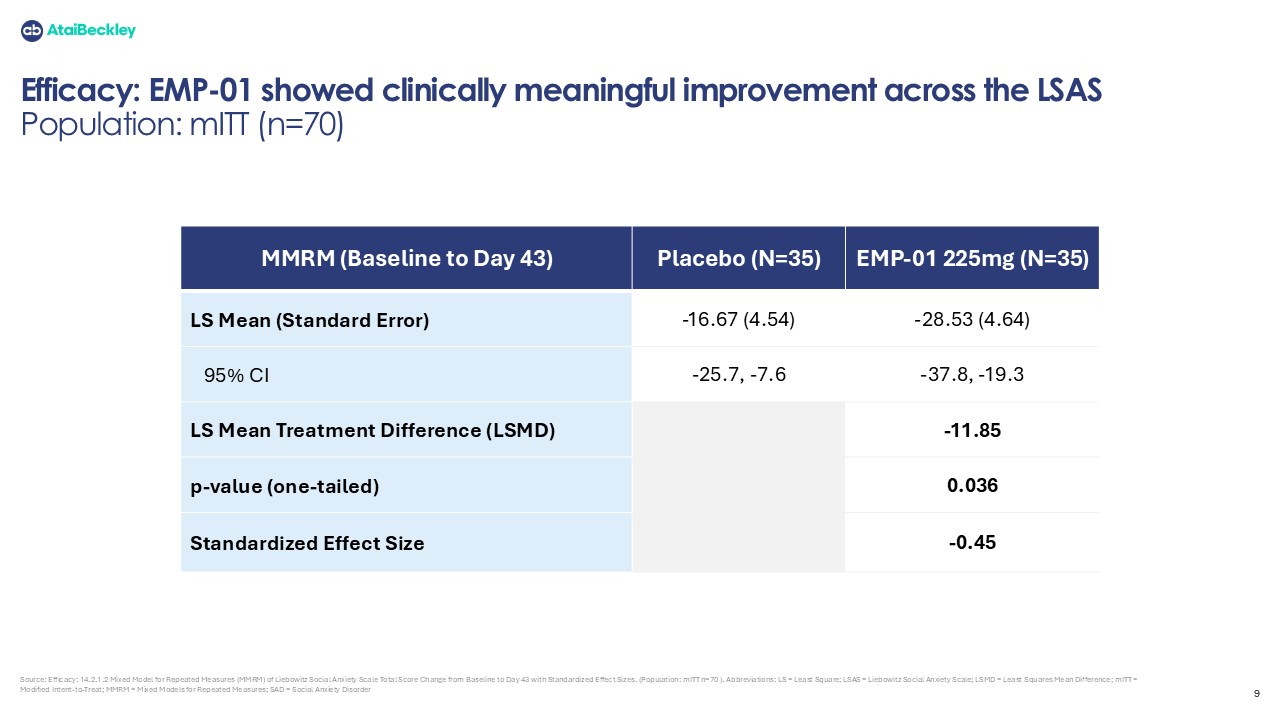
EMP-01 demonstrated a clinically meaningful placebo-adjusted least squares mean reduction of 11.85 points on the Liebowitz Social Anxiety Scale (LSAS) at Day 43 (Hedges’ g = 0.45; p-value = 0.036, one-tailed)

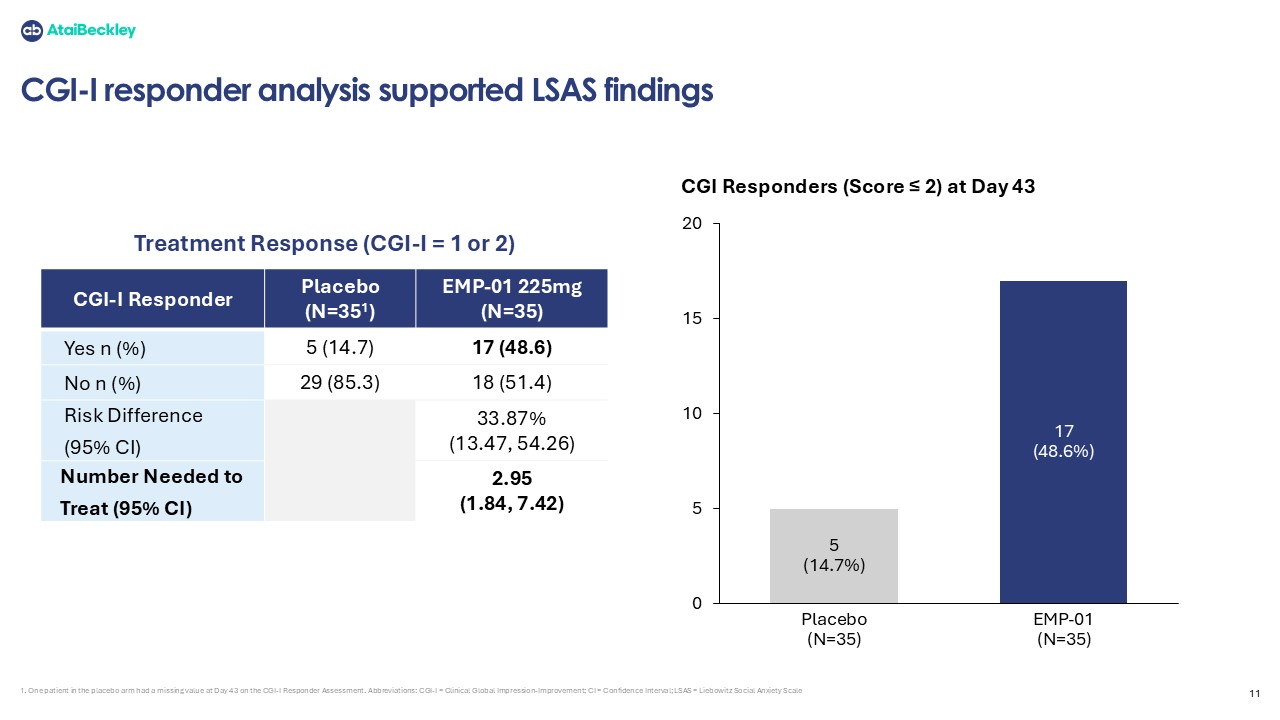
EMP-01 demonstrated a robust separation from placebo on the Clinician Global Impression–Improvement (CGI-I) assessment: 49% responders vs. 15% for placebo, corresponding to a Number Needed to Treat (NNT) of 2.95

EMP-01 demonstrated improvements across both Fear and Avoidance sub-domains of the LSAS, including improvement in social avoidance behaviors after two administrations over six weeks, and without adjunctive psychotherapy

More detailed analyses of the data will be described in upcoming scientific venues and will guide subsequent development

Conference call scheduled for 8:00 a.m. ET today, February 26, 2026

NEW YORK, UNITED STATES – FEBRUARY 26, 2026 - AtaiBeckley Inc. (NASDAQ: ATAI) (“AtaiBeckley” or the “Company”), a clinical‑stage biotechnology company on a mission to transform patient outcomes by developing rapid‑acting, durable and convenient treatments for mental health conditions, today announced topline results from its exploratory, double‑blind, placebo‑controlled, first-in-patient Phase 2a study (NCT06693609) evaluating EMP‑01 (oral R‑MDMA) in adults with Social Anxiety Disorder (SAD). The study met its primary safety objective and generated encouraging secondary and exploratory efficacy signals in a highly severe, difficulttotreat population.
 
Commenting on the results, Professor Murray Stein, Distinguished Professor of Psychiatry and Public Health at the University of California San Diego (UCSD), and consultant to AtaiBeckley, said: “The initial findings from this trial of R-MDMA (EMP-01) are remarkable. Social Anxiety Disorder is a serious, often chronic and disabling condition affecting millions of Americans, and there have been no therapeutic advances in its pharmacological treatment in over 20 years. While preliminary, this study suggests that EMP-01 has the potential to make a tremendous impact on the lives of patients and their families. I hope future trials will be conducted to confirm these very exciting findings.”

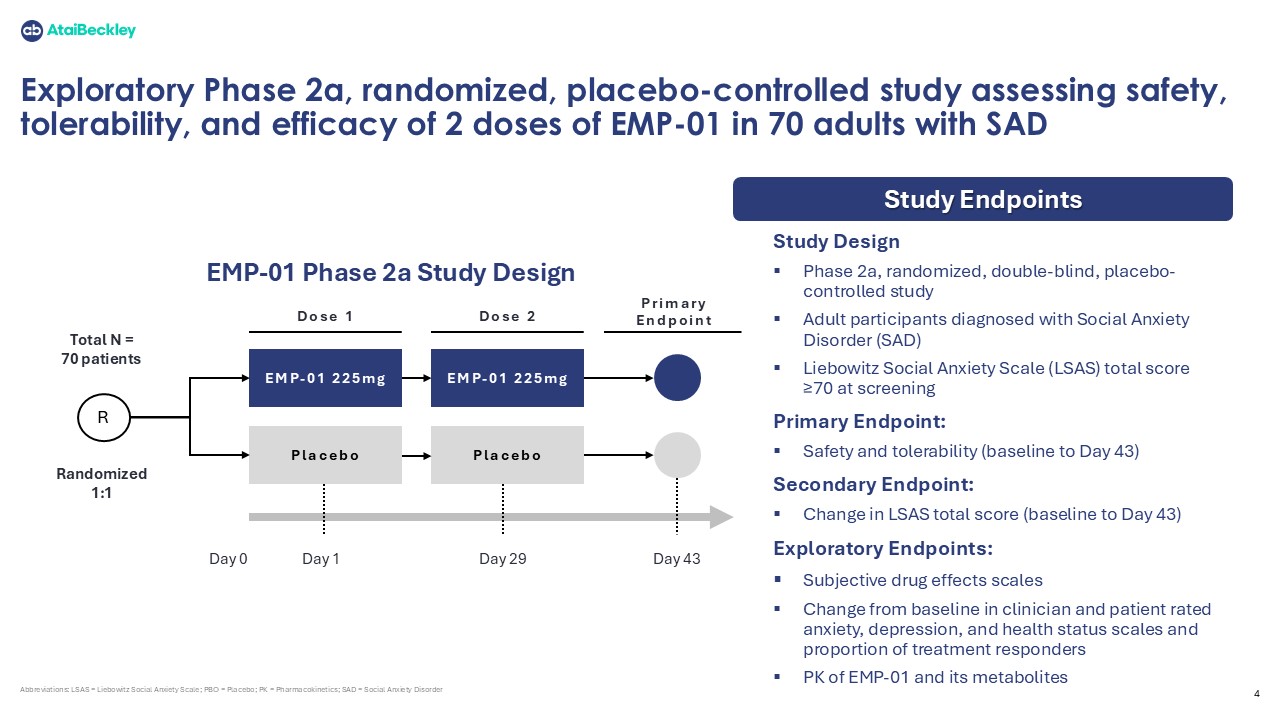
The multi-center study enrolled 71 adults with moderate-to-severe SAD across 7 clinical sites in the UK. Participants were randomized to receive two in-clinic administrations of EMP-01 (225 mg) or placebo, given 28 days apart, with no adjunctive psychotherapy. 70 participants received at least one dose of study drug, and 69 completed the Day 43 efficacy assessments, indicating high patient acceptability and retention. All clinician-rated assessments were conducted by blinded central raters.
 

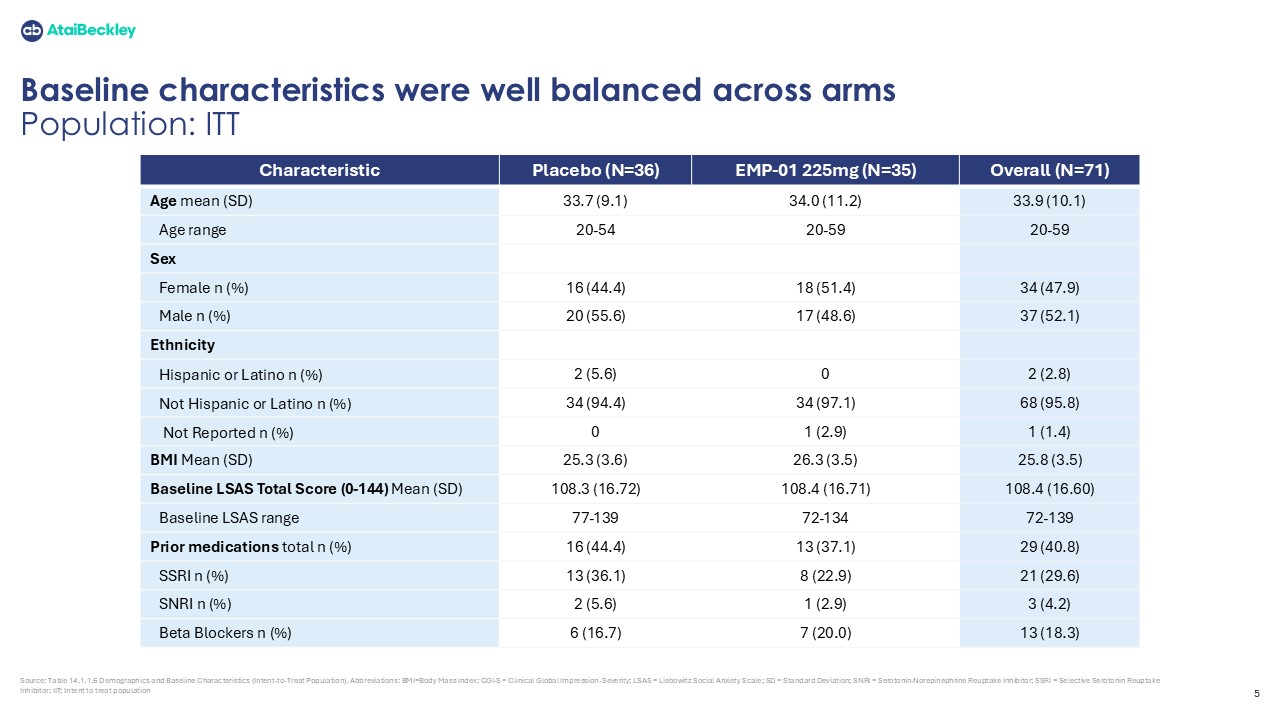
Both treatment arms reflected a severely affected patient population (~108 baseline LSAS score out of a maximum of 144), with all other baseline characteristics well-balanced across groups including demographics, comorbidities, prior SSRI/SNRI exposure, and CGI-Severity. The primary endpoint was safety and tolerability through Day 43 and the secondary endpoint was change in social anxiety symptoms from baseline to Day 43, using the Liebowitz Social Anxiety Scale (LSAS). The LSAS is a 24-item clinician-rated scale that evaluates both fear responses and real-world avoidance behaviors across social and performance situations. An additional exploratory endpoint included changes on the Clinician-Rated Global Impression-Improvement (CGI-I) scale, a 7-point scale used to measure changes in a patient’s overall condition compared to baseline.
 
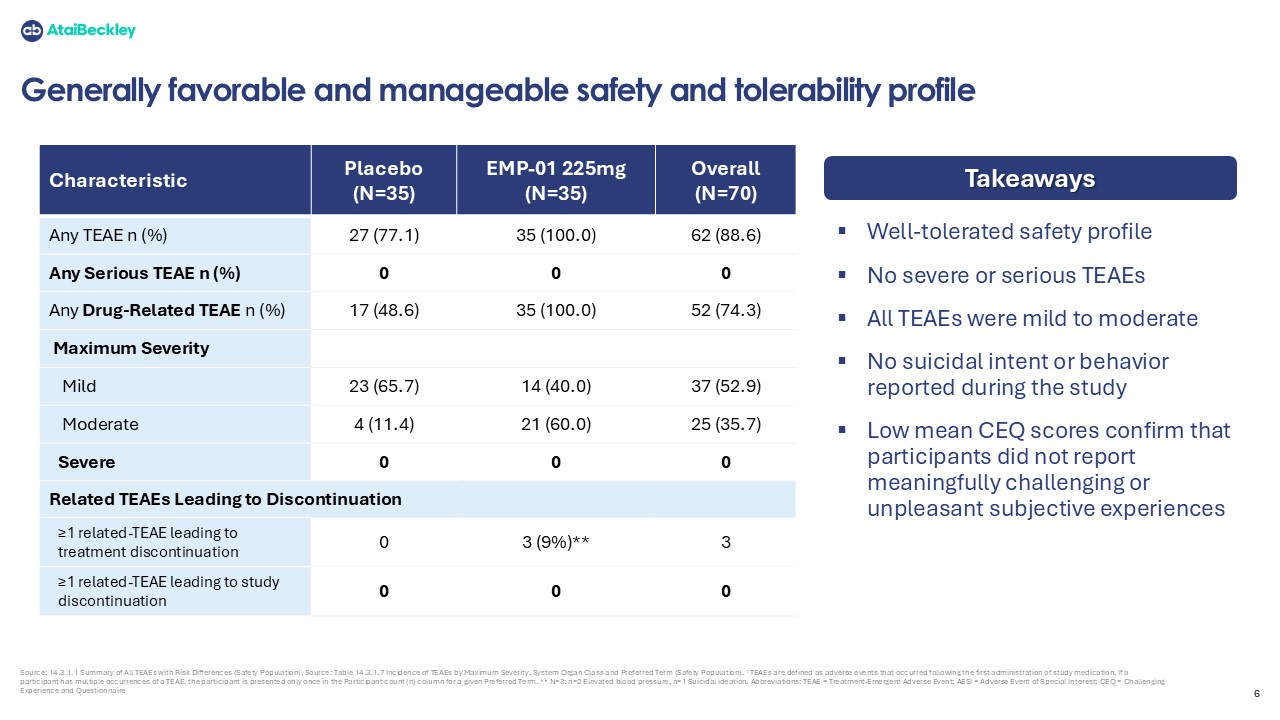
With respect to the trial’s primary objective, EMP-01 demonstrated a favorable and manageable safety and tolerability profile. No serious adverse events and no treatment-emergent suicidal behaviour or intent were observed. Most adverse events were mild or moderate and resolved without intervention.
 
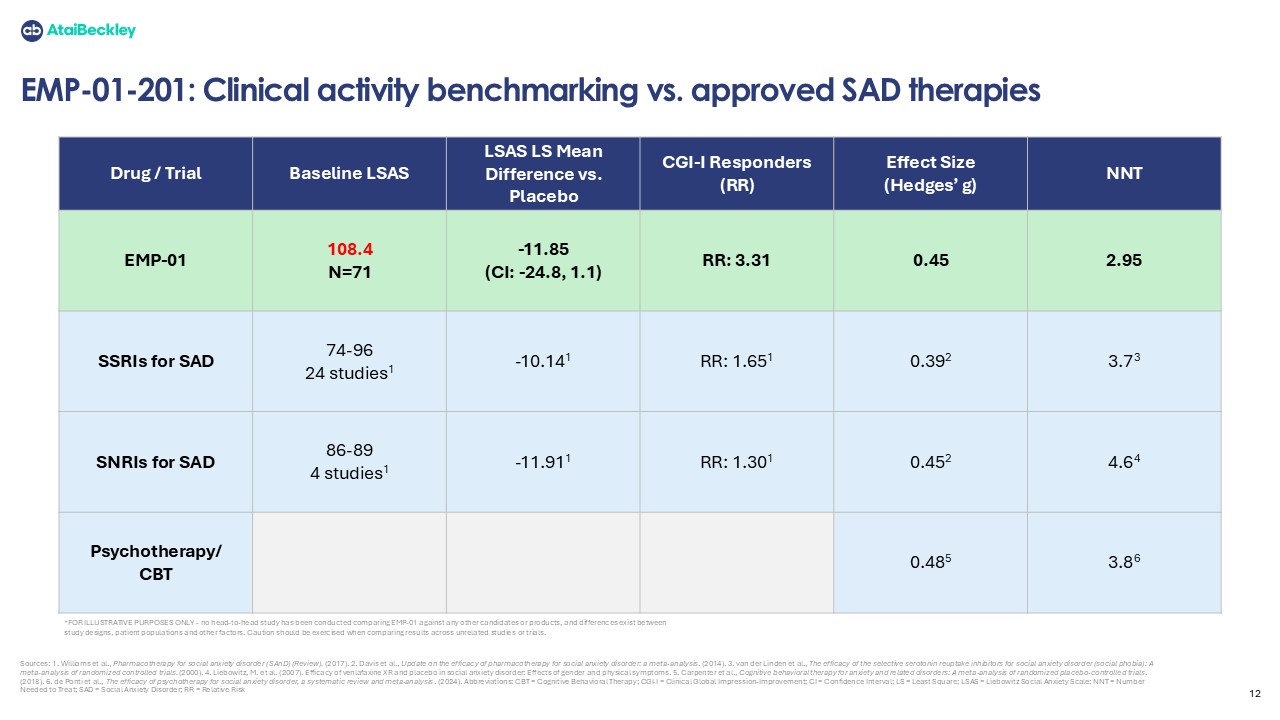
Secondary and exploratory efficacy endpoints showed encouraging signals. EMP-01 produced a numerically greater symptom reduction than placebo, as measured by LSAS, at Day 43 relative to baseline (least squares mean: -28.53 points vs. -16.67 points, respectively). Although the study was not powered for statistical significance, the placebo-adjusted least squares mean reduction for EMP-01 of 11.85 points on the LSAS at Day 43 (Hedges’ g = 0.45; p-value = 0.036, one-tailed) is consistent with a clinically meaningful improvement and a moderate treatment effect size. The relatively early reduction in symptoms, as measured by LSAS, at the 6-week study endpoint, after two doses of EMP-01, was comparable in magnitude in a cross-trial comparison to that typically reported after 8 - 12 weeks of daily SSRI/SNRI therapy in registration trials.
 
On the CGI-I scale, which reflects a global impression of overall patient improvement, 49% of patients receiving EMP-01 were rated as “very much improved” or “much improved” compared to 15% in the placebo group. This 34-percentage-point difference corresponds to a Number Needed to Treat (NNT) of 2.95 (95% CI: 1.84, 7.42), indicating a clinically meaningful level of global improvement in the EMP-01 group.
 
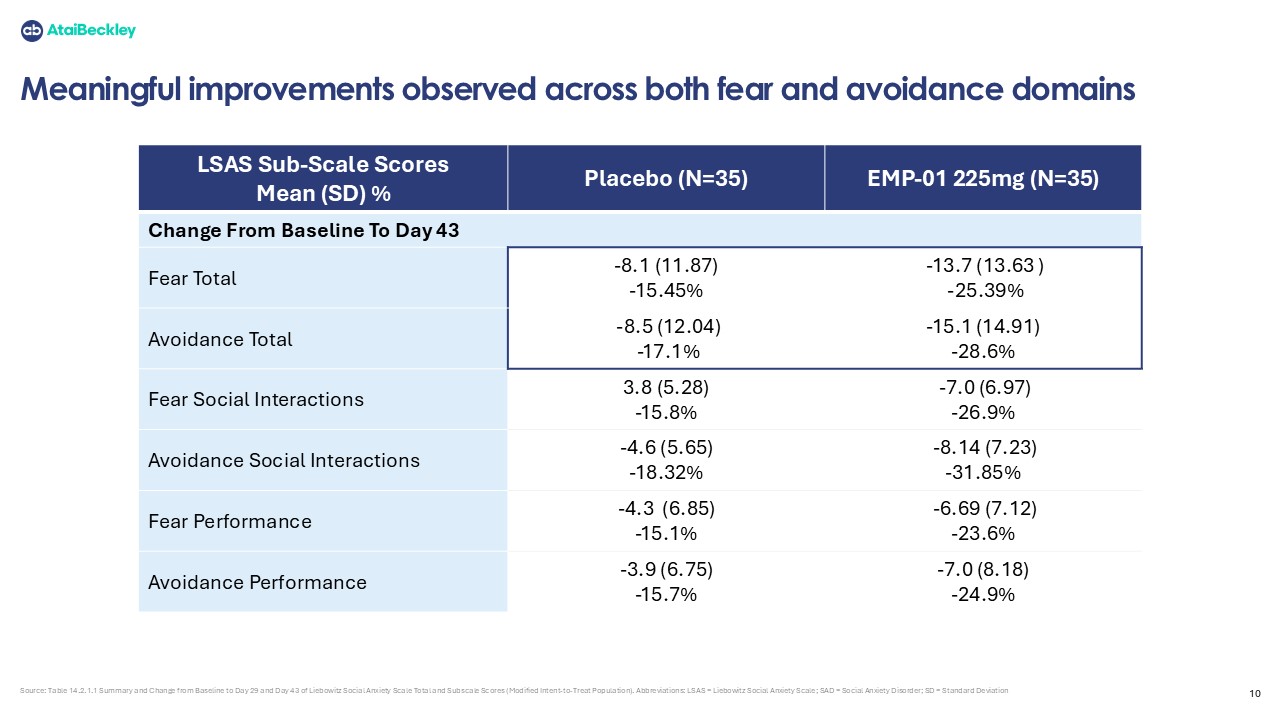
The LSAS comprises two subscales - Fear and Avoidance - which often show different timelines of improvement in SAD pharmacotherapy trials, with Fear typically improving first. In this study, EMP‑01 produced simultaneous gains across both domains. By Day 43, LSAS Fear improved by −13.7 points (−25.4%) vs. −8.1 (−15.5%) on placebo, and LSAS Avoidance improved by −15.1 points (−28.6%) vs. −8.5 (−17.1%) on placebo. Because avoidance behaviors typically change gradually and often require prolonged real‑world exposure, the early, parallel improvements in both Fear and Avoidance - after two dosing sessions and without psychotherapy - suggest that EMP‑01 could influence both the emotional and behavioral dimensions of social anxiety disorder.
 
Dr. David Feifel, Professor Emeritus of Psychiatry at the University of California, San Diego, Founder and President of the Kadima Neuropsychiatry Institute, and consultant to AtaiBeckley, said, "Several findings from this preliminary study are highly encouraging, particularly that LSAS improvements became apparent after dosing was completed and the drug was no longer present, suggesting a sustained biological therapeutic effect. If confirmed in larger trials, this would represent a meaningful departure from current first-line pharmacotherapies like SSRIs, which require continuous daily dosing and frequently produce tolerability concerns. An intervention delivering durable symptom improvement with intermittent drug exposure would be a potentially transformative development for patients with this disorder.”


“We are encouraged by both the strength of the signal and our ability to deliver the topline results from this exploratory Phase 2a study on time and with a robust dataset,” said Srinivas Rao, Chief Executive Officer and Co-Founder of AtaiBeckley. “As the first patient trial of R-MDMA in Social Anxiety Disorder, this study demonstrated our ability to rapidly enroll a highly severe population, deliver two in-clinic administrations with strong adherence, and maintain exceptional retention of patients through the primary endpoint assessment. The consistent pattern of improvement observed across secondary and exploratory efficacy endpoints, together with a generally favorable safety and tolerability profile, provides meaningful validation of both the compound and our clinical development model as we assess the next phase of advancement. We are very grateful to the patients who participated in this trial and to the investigators and site teams whose high-quality trial execution made these insights possible.”

Conference Call
AtaiBeckley will host a conference call and live webcast today February 26, 2026, at 8:00 a.m. ET. The conference call can be accessed by dialing (800) 715-9871 for participants in the US and +1-646-307-1963 for international callers, with the Conference ID: 1459387. The webcast and presentation can be accessed on the Investors section of AtaiBeckley’s corporate website under Events. The presentation and an archived replay of the webcast will be available in the same section of the website for a minimum of 30 days following the event.

About Social Anxiety Disorder (SAD)
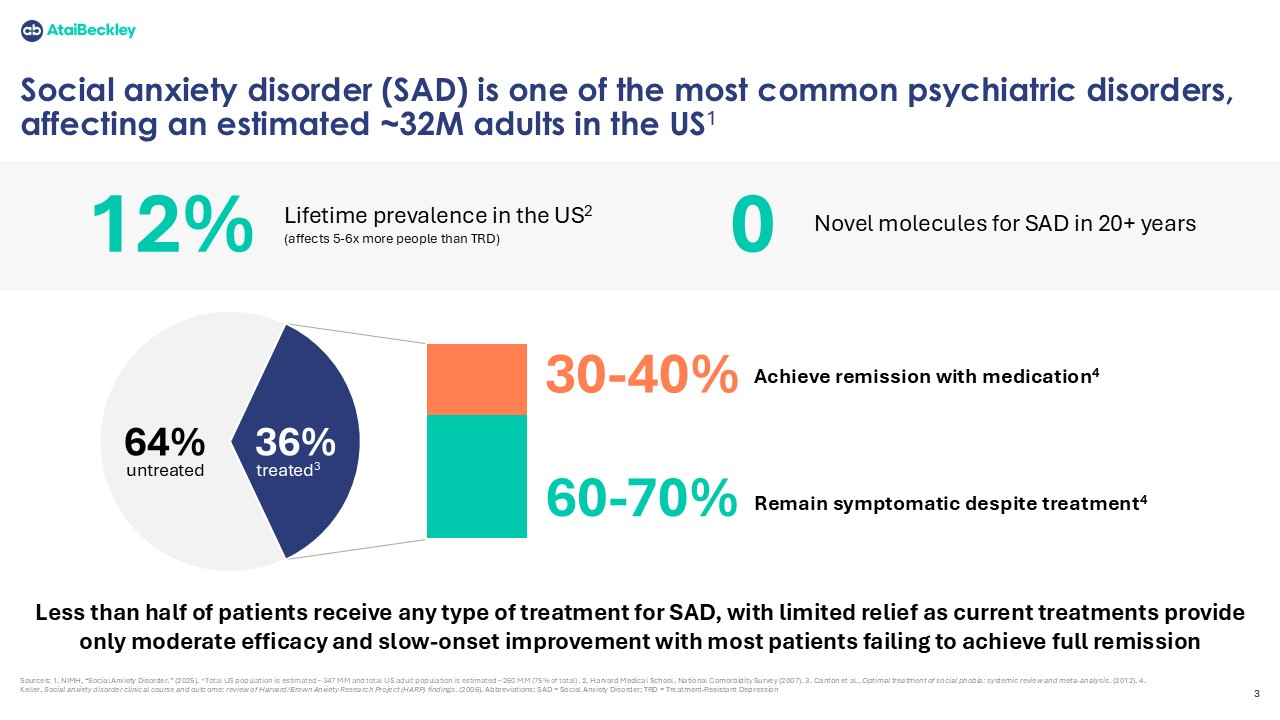
Social Anxiety Disorder (SAD) is one of the most prevalent psychiatric conditions worldwide, affecting an estimated 400–800 million individuals with a lifetime prevalence of approximately 12%. The disorder is characterized by persistent and debilitating fear, self-consciousness, and heightened anxiety during social interactions. SAD is frequently co-morbid with major depressive disorder, generalized anxiety disorder, obsessive–compulsive disorder, attention deficit/hyperactivity disorder, bipolar disorder, and substance use disorders, contributing to substantial functional impairment and reduced quality of life. In the United States alone, roughly 30 million adults are affected by SAD; however, only about 50% of affected individuals receive treatment. Even among patients who access care, treatment adequacy remains suboptimal, and around 50% of SAD patients do not achieve adequate response to first line therapies and often deal with chronic medication side effects.

About EMP-01 (Oral R-MDMA)
EMP-01 is an oral, single-enantiomer R‑MDMA candidate being developed as a potential treatment for people living with Social Anxiety Disorder (SAD). It has been designed to elicit entactogenic and psychedelic subjective effects, with reduced dopaminergic and noradrenergic activity compared with racemic MDMA in order to support safe, scalable outpatient administration for individuals with SAD, who currently have a high unmet medical treatment need. EMP-01 is an investigational product and has not been approved by the FDA.


About AtaiBeckley Inc.
AtaiBeckley is a clinical-stage biotechnology company on a mission to transform patient outcomes by developing rapid-acting, durable and convenient mental health treatments. AtaiBeckley’s pipeline of novel investigational therapies includes BPL-003 (mebufotenin benzoate nasal spray) for treatment-resistant depression (TRD), VLS-01 (DMT buccal film) for TRD and EMP-01 ((R)-MDMA HCI) for social anxiety disorder. BPL-003 is in Phase 3 planning, VLS-01 and EMP-01 are in Phase 2 clinical development. The Company is also advancing a drug discovery program to identify novel, non-hallucinogenic 5-HT2AR agonists for opioid use disorder and TRD. These programs aim to create breakthroughs in mental health through transformative interventional psychiatry therapies that can integrate seamlessly into healthcare systems.
For the latest updates and to learn more about the AtaiBeckley mission, visit www.ataibeckley.com or follow the Company on LinkedIn and on X.

Forward-Looking Statements
This press release contains forward-looking statements within the meaning of the Private Securities Litigation Reform Act of 1995, as amended. We intend such forward-looking statements to be covered by the safe harbor provisions for forward-looking statements contained in Section 27A of the Securities Act of 1933, as amended, and Section 21E of the Securities Exchange Act of 1934, as amended. The words “believe,” “may,” “will,” “estimate,” “continue,” “anticipate,” “intend,” “expect,” “anticipate,” “initiate,” “could,” “would,” “project,” “plan,” “potentially,” “preliminary,” “likely,” and similar expressions are intended to identify forward-looking statements, although not all forward-looking statements contain these words. Forward-looking statements include express or implied statements relating to, among other things: our business strategy and plans; progress and results of our EMP-01 trials; the timing of further data on EMP-01; the therapeutic potential of EMP-01; and the potential benefits of EMP-01 for patients with SAD. Additionally, topline results AtaiBeckley reports is based on preliminary analysis of key efficacy and safety data, and such data may change following a more comprehensive review of the data related to the clinical trial and such topline data may not accurately reflect the complete results of a clinical trial.

Forward-looking statements are neither promises nor guarantees, but involve known and unknown risks and uncertainties that could cause actual results to differ materially from those projected, including, without limitation, the important factors described in the section titled “Risk Factors” in Atai Beckley N.V.’s our most recent Annual Report on Form 10-K or Quarterly Reports on Form 10-Q filed with the Securities and Exchange Commission (“SEC”), as such factors may be updated from time to time in AtaiBeckley’s other filings with the SEC. AtaiBeckley disclaims any obligation to update or revise any forward-looking statements contained in this press release, other than to the extent required by applicable law.

Contact Information:
Investors:
Jason Awe, PhD
VP, Investor Relations
[email protected]
 
Media:
 
Charlotte Chorley
 
Associate Director, Communications
[email protected]


Exhibit 99.2

 February 26, 2026  EMP-01 (R-MDMA)Phase 2a Top Line Results in Social Anxiety Disorder (SAD) 
 

 The following disclaimer applies to this Presentation. For the purposes of this disclaimer, “Presentation” means this document, its contents or any part of it, any oral presentation, any question or answer session and any written or oral material discussed or distributed during the Presentation meeting. The purpose of this Presentation is to provide an overview of AtaiBeckley (the “Company”).   Forward-Looking Statements  This Presentation contains forward-looking statements within the meaning of the Private Securities Litigation Reform Act of 1995, as amended. We intend such forward-looking statements to be covered by the safe harbor provisions for forward-looking statements contained in Section 27A of the Securities Act of 1933, as amended, and Section 21E of the Securities Exchange Act of 1934, as amended. The words “believe,” “may,” “will,” “estimate,” “continue,” “anticipate,” “intend,” “expect,” “anticipate,” “initiate,” “could,” “would,” “project,” “plan,” “potentially,” “preliminary,” “likely,” and similar expressions are intended to identify forward-looking statements, although not all forward-looking statements contain these words. Forward-looking statements include express or implied statements relating to, among other things: our business strategy and plans; our runway; the potential, success and timing of development and progress of trials and related milestones of our product candidates set forth in the Presentation; expectations regarding our intellectual property portfolio, including our newly granted patent and plans for expansion of our patent portfolio; and the plans and objectives of management for future operations, research and development and capital expenditures; progress and results of our EMP-01 trials; the timing of further data on EMP-01, the therapeutic potential of EMP-01; and the potential benefits of EMP-01 for patients with SAD. Additionally, topline results AtaiBeckley reports is based on preliminary analysis of key efficacy and safety data, and such data may change following a more comprehensive review of the data related to the clinical trial and such topline data may not accurately reflect the complete results of a clinical trial.  Forward-looking statements are neither promises nor guarantees, but involve known and unknown risks and uncertainties that could cause actual results to differ materially from those projected, including, without limitation, the important factors described in the section titled “Risk Factors” in Atai Beckley N.V.'s most recent Annual Report on Form 10-K or Quarterly Reports on Form 10-Q filed with the Securities and Exchange Commission (“SEC”), as such factors may be updated from time to time in AtaiBeckley’s other filings with the SEC. AtaiBeckley disclaims any obligation to update or revise any forward-looking statements contained in this Presentation, other than to the extent required by applicable law.  The information in this Presentation is not intended to form the basis of any contract. This Presentation does not constitute an offer or invitation for the sale, issuance or purchase of securities or any businesses or assets described in it, nor does it give or purport to give legal, tax or financial advice. Nothing herein shall be taken as constituting the giving of investment advice or an inducement to enter into investment activity in any jurisdiction and this Presentation is not intended to provide, and must not be taken as, the basis of any decision and should not be considered as an invitation, inducement, solicitation or recommendation to purchase, underwrite, subscribe for or otherwise acquire any securities of the Company. The recipient must make its own independent assessment and such investigations as it deems necessary. Save as set out below, the Presentation has been prepared on the basis of information held by the Company and also from publicly available information. This information, which does not purport to be comprehensive, has not been independently verified by or on behalf of the Company. The Presentation does not constitute an audit or due diligence review and should not be construed as such   The Company nor any of such its respective directors, officers, employees, affiliates, advisers or agents (the  “Associates”) accepts any responsibility, obligation or liability whatsoever for, or makes any representation or  warranty, express or implied, as to, and no reliance should be placed on, the fairness, truth, fullness, accuracy,  completeness or correctness of, the information in this Presentation or whether any information has been omitted  from the Presentation or as to any other information relating to the Company, whether written, oral or in a visual or electronic form, and howsoever transmitted or made available or for any loss howsoever arising from  any use of this Presentation, its contents or otherwise arising in connection therewith. Except where otherwise  indicated in the Presentation, the information provided therein is based on matters as they exist at the date of  preparation of the Presentation and not as of any future date and will be subject to updating, revision, verification  and amendment without notice and such information may change materially. Neither the Company nor any of its Associates is under an obligation to update, revise or keep current the information contained in this Presentation to  which it relates or to provide the recipient of this Presentation with access to any additional information that may  arise in connection with it and any opinions expressed in this Presentation are subject to change without notice.   Nothing contained in this Presentation is or should be relied upon as a promise or representation as to the future.  Disclaimer  2 
 

 3  12%  Lifetime prevalence in the US2 (affects 5-6x more people than TRD)  0  Novel molecules for SAD in 20+ years  Sources: 1. NIMH, “Social Anxiety Disorder.” (2025). *Total US population is estimated ~347 MM and total US adult population is estimated ~260 MM (75% of total). 2. Harvard Medical School, National Comorbidity Survey (2007). 3. Canton et al., Optimal treatment of social phobia: systemic review and meta-analysis. (2012). 4. Keller, Social anxiety disorder clinical course and outcome: review of Harvard/Brown Anxiety Research Project (HARP) findings. (2006). Abbreviations: SAD = Social Anxiety Disorder; TRD = Treatment-Resistant Depression  60-70%  Remain symptomatic despite treatment4  30-40%  Achieve remission with medication4  Less than half of patients receive any type of treatment for SAD, with limited relief as current treatments provide only moderate efficacy and slow-onset improvement with most patients failing to achieve full remission  untreated  treated3  Social anxiety disorder (SAD) is one of the most common psychiatric disorders, affecting an estimated ~32M adults in the US1 
 

 4  Abbreviations: LSAS = Liebowitz Social Anxiety Scale; PBO = Placebo; PK = Pharmacokinetics; SAD = Social Anxiety Disorder  Exploratory Phase 2a, randomized, placebo-controlled study assessing safety, tolerability, and efficacy of 2 doses of EMP-01 in 70 adults with SAD  EMP-01 Phase 2a Study Design  Study Endpoints  Study Design  Phase 2a, randomized, double-blind, placebo-controlled study  Adult participants diagnosed with Social Anxiety Disorder (SAD)  Liebowitz Social Anxiety Scale (LSAS) total score ≥70 at screening  Primary Endpoint:   Safety and tolerability (baseline to Day 43)  Secondary Endpoint:  Change in LSAS total score (baseline to Day 43)   Exploratory Endpoints:  Subjective drug effects scales   Change from baseline in clinician and patient rated anxiety, depression, and health status scales and proportion of treatment responders  PK of EMP-01 and its metabolites  EMP-01 225mg  R  Randomized  1:1  Day 43  Day 1  Total N = 70 patients  Placebo  EMP-01 225mg  Placebo  Dose 1  Dose 2  Day 0  Day 29  Primary Endpoint 
 

 Baseline characteristics were well balanced across armsPopulation: ITT  5  Source: Table 14.1.1.6 Demographics and Baseline Characteristics (Intent-to-Treat Population). Abbreviations: BMI=Body Mass Index; CGI-S = Clinical Global Impression-Severity; LSAS = Liebowitz Social Anxiety Scale; SD = Standard Deviation; SNRI = Serotonin-Norepinephrine Reuptake Inhibitor; SSRI = Selective Serotonin Reuptake Inhibitor; IIT: Intent to treat population  Characteristic  Placebo (N=36)  EMP-01 225mg (N=35)  Overall (N=71)  Age mean (SD)  33.7 (9.1)  34.0 (11.2)  33.9 (10.1)  Age range  20-54  20-59  20-59  Sex   Female n (%)  16 (44.4)  18 (51.4)  34 (47.9)  Male n (%)  20 (55.6)  17 (48.6)  37 (52.1)  Ethnicity  Hispanic or Latino n (%)  2 (5.6)  0  2 (2.8)  Not Hispanic or Latino n (%)  34 (94.4)  34 (97.1)  68 (95.8)   Not Reported n (%)  0  1 (2.9)  1 (1.4)  BMI Mean (SD)  25.3 (3.6)  26.3 (3.5)  25.8 (3.5)  Baseline LSAS Total Score (0-144) Mean (SD)  108.3 (16.72)  108.4 (16.71)  108.4 (16.60)  Baseline LSAS range  77-139  72-134  72-139  Prior medications total n (%)  16 (44.4)  13 (37.1)  29 (40.8)  SSRI n (%)  13 (36.1)  8 (22.9)  21 (29.6)  SNRI n (%)  2 (5.6)  1 (2.9)  3 (4.2)  Beta Blockers n (%)  6 (16.7)  7 (20.0)  13 (18.3) 
 

 Generally favorable and manageable safety and tolerability profile   6  Source: 14.3.1.1 Summary of All TEAEs with Risk Differences (Safety Population), Source: Table 14.3.1.7 Incidence of TEAEs by Maximum Severity, System Organ Class and Preferred Term (Safety Population). 1 TEAEs are defined as adverse events that occurred following the first administration of study medication. If a participant has multiple occurrences of a TEAE, the participant is presented only once in the Participant count (n) column for a given Preferred Term. ** N=3: n=2 Elevated blood pressure, n=1 Suicidal ideation. Abbreviations: TEAE = Treatment-Emergent Adverse Event; AESI = Adverse Event of Special Interest; CEQ = Challenging Experience and Questionnaire  Characteristic  Placebo (N=35)  EMP-01 225mg (N=35)  Overall (N=70)  Any TEAE n (%)   27 (77.1)  35 (100.0)   62 (88.6)  Any Serious TEAE n (%)  0  0  0  Any Drug-Related TEAE n (%)  17 (48.6)  35 (100.0)  52 (74.3)   Maximum Severity   Mild  23 (65.7)  14 (40.0)  37 (52.9)   Moderate  4 (11.4)  21 (60.0)  25 (35.7)  Severe  0  0  0  Related TEAEs Leading to Discontinuation  ≥1 related-TEAE leading to treatment discontinuation  0  3 (9%)**  3  ≥1 related-TEAE leading to study discontinuation  0  0  0  Well-tolerated safety profile   No severe or serious TEAEs  All TEAEs were mild to moderate  No suicidal intent or behavior reported during the study  Low mean CEQ scores confirm that participants did not report meaningfully challenging or unpleasant subjective experiences  Takeaways 
 

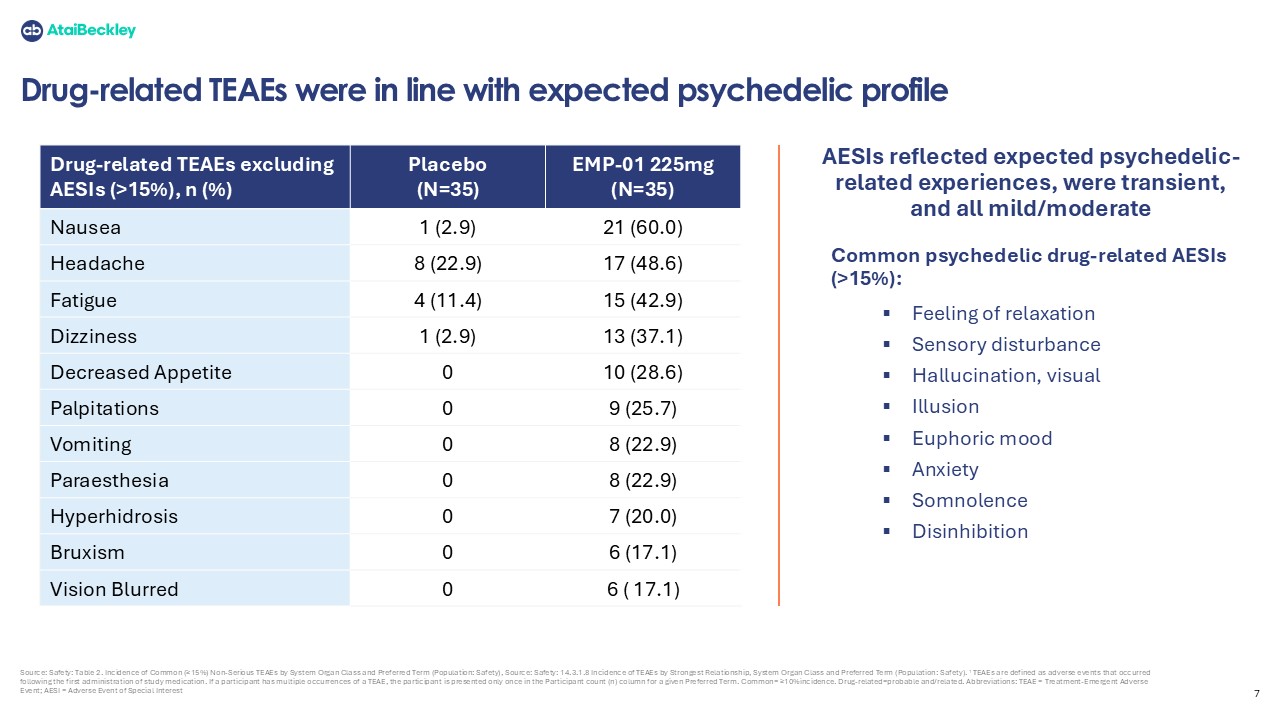
 Drug-related TEAEs were in line with expected psychedelic profile  7  Source: Safety: Table 2. Incidence of Common (≥15%) Non-Serious TEAEs by System Organ Class and Preferred Term (Population: Safety), Source: Safety: 14.3.1.8 Incidence of TEAEs by Strongest Relationship, System Organ Class and Preferred Term (Population: Safety). 1 TEAEs are defined as adverse events that occurred following the first administration of study medication. If a participant has multiple occurrences of a TEAE, the participant is presented only once in the Participant count (n) column for a given Preferred Term. Common= ≥10%incidence. Drug-related=probable and/related. Abbreviations: TEAE = Treatment-Emergent Adverse Event; AESI = Adverse Event of Special Interest  Common psychedelic drug-related AESIs (>15%):  Feeling of relaxation  Sensory disturbance  Hallucination, visual  Illusion  Euphoric mood  Anxiety  Somnolence  Disinhibition  Drug-related TEAEs excluding AESIs (>15%), n (%)  Placebo  (N=35)  EMP-01 225mg   (N=35)  Nausea   1 (2.9)   21 (60.0)   Headache   8 (22.9)   17 (48.6)   Fatigue   4 (11.4)   15 (42.9)   Dizziness   1 (2.9)   13 (37.1)   Decreased Appetite   0  10 (28.6)   Palpitations  0  9 (25.7)   Vomiting   0  8 (22.9)  Paraesthesia   0  8 (22.9)   Hyperhidrosis  0  7 (20.0)   Bruxism   0  6 (17.1)   Vision Blurred  0  6 ( 17.1)   AESIs reflected expected psychedelic-related experiences, were transient, and all mild/moderate 
 

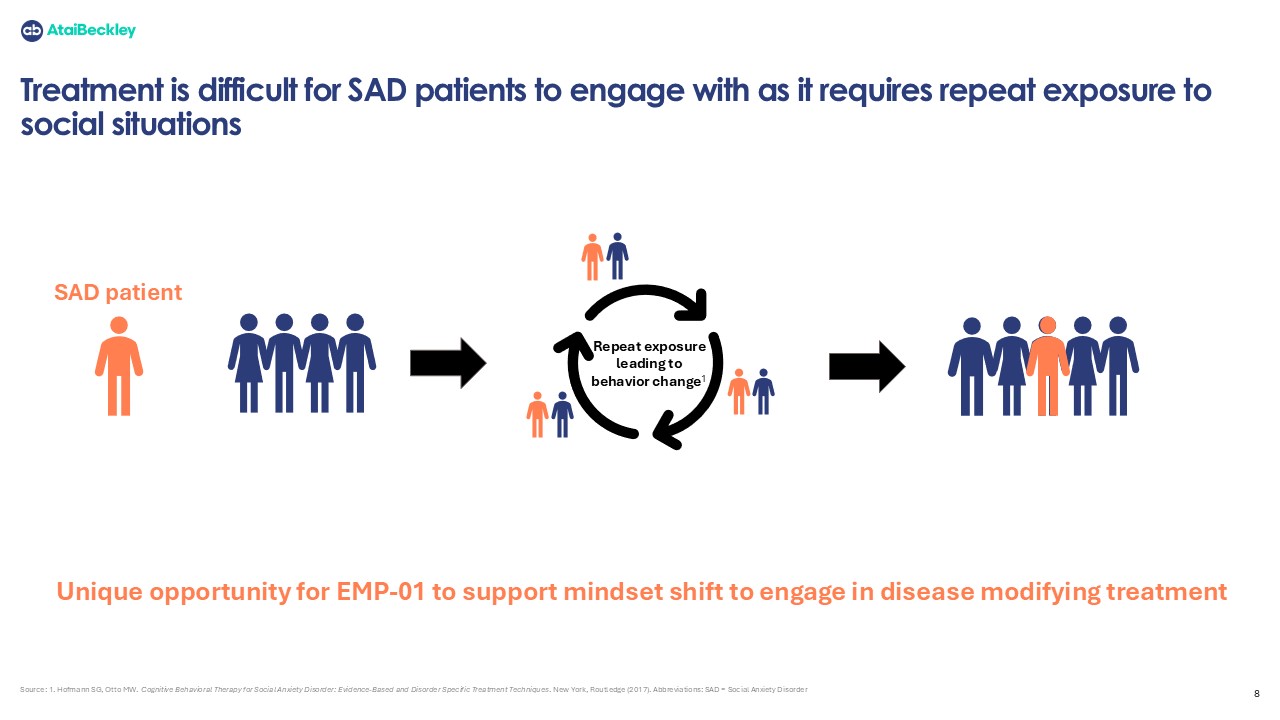
 8  Unique opportunity for EMP-01 to support mindset shift to engage in disease modifying treatment  Repeat exposure leading to behavior change1  Treatment is difficult for SAD patients to engage with as it requires repeat exposure to social situations  SAD patient  Source: 1. Hofmann SG, Otto MW. Cognitive Behavioral Therapy for Social Anxiety Disorder: Evidence-Based and Disorder Specific Treatment Techniques. New York, Routledge (2017). Abbreviations: SAD = Social Anxiety Disorder 
 

 9  Source: Efficacy: 14.2.1.2 Mixed Model for Repeated Measures (MMRM) of Liebowitz Social Anxiety Scale Total Score Change from Baseline to Day 43 with Standardized Effect Sizes. (Population: mITT n=70 ). Abbreviations: LS = Least Square; LSAS = Liebowitz Social Anxiety Scale; LSMD = Least Squares Mean Difference; mITT = Modified Intent-to-Treat; MMRM = Mixed Models for Repeated Measures; SAD = Social Anxiety Disorder  MMRM (Baseline to Day 43)  Placebo (N=35)  EMP-01 225mg (N=35)  LS Mean (Standard Error)  -16.67 (4.54)  -28.53 (4.64)   95% CI  -25.7, -7.6  -37.8, -19.3  LS Mean Treatment Difference (LSMD)  -11.85  p-value (one-tailed)  0.036  Standardized Effect Size  -0.45  Efficacy: EMP‑01 showed clinically meaningful improvement across the LSASPopulation: mITT (n=70) 
 

 10  Source: Table 14.2.1.1 Summary and Change from Baseline to Day 29 and Day 43 of Liebowitz Social Anxiety Scale Total and Subscale Scores (Modified Intent-to-Treat Population). Abbreviations: LSAS = Liebowitz Social Anxiety Scale; SAD = Social Anxiety Disorder; SD = Standard Deviation  LSAS Sub-Scale Scores Mean (SD) %  Placebo (N=35)  EMP-01 225mg (N=35)  Change From Baseline To Day 43  Fear Total  -8.1 (11.87)  -15.45%   -13.7 (13.63 )   -25.39%  Avoidance Total   -8.5 (12.04)   -17.1%  -15.1 (14.91)   -28.6%  Fear Social Interactions  3.8 (5.28)  -15.8%   -7.0 (6.97)  -26.9%  Avoidance Social Interactions  -4.6 (5.65)  -18.32%   -8.14 (7.23)  -31.85%  Fear Performance  -4.3 (6.85)  -15.1%   -6.69 (7.12)  -23.6%  Avoidance Performance  -3.9 (6.75)  -15.7%  -7.0 (8.18)  -24.9%  Meaningful improvements observed across both fear and avoidance domains 
 

 11  1. One patient in the placebo arm had a missing value at Day 43 on the CGI-I Responder Assessment. Abbreviations: CGI-I = Clinical Global Impression-Improvement; CI = Confidence Interval; LSAS = Liebowitz Social Anxiety Scale  CGI-I Responder  Placebo (N=351)  EMP-01 225mg (N=35)   Yes n (%)  5 (14.7)  17 (48.6)   No n (%)  29 (85.3)  18 (51.4)   Risk Difference    (95% CI)  33.87%   (13.47, 54.26)  Number Needed to   Treat (95% CI)  2.95  (1.84, 7.42)  Treatment Response (CGI-I = 1 or 2)   CGI‑I responder analysis supported LSAS findings  CGI Responders (Score ≤ 2) at Day 43  5(14.7%)  Placebo(N=35)  17(48.6%)  EMP-01(N=35) 
 

 EMP-01-201: Clinical activity benchmarking vs. approved SAD therapies  12  Sources: 1. Williams et al., Pharmacotherapy for social anxiety disorder (SAnD) (Review). (2017). 2. Davis et al., Update on the efficacy of pharmacotherapy for social anxiety disorder: a meta-analysis. (2014). 3. van der Linden et al., The efficacy of the selective serotonin reuptake inhibitors for social anxiety disorder (social phobia): A meta-analysis of randomized controlled trials. (2000). 4. Liebowitz, M. et al. (2007). Efficacy of venlafaxine XR and placebo in social anxiety disorder: Effects of gender and physical symptoms. 5. Carpenter et al., Cognitive behavioral therapy for anxiety and related disorders: A meta-analysis of randomized placebo-controlled trials. (2018). 6. de Ponti et al., The efficacy of psychotherapy for social anxiety disorder, a systematic review and meta-analysis. (2024). Abbreviations: CBT = Cognitive Behavioral Therapy; CGI-I = Clinical Global Impression-Improvement; CI = Confidence Interval; LS = Least Square; LSAS = Liebowitz Social Anxiety Scale; NNT = Number Needed to Treat; SAD = Social Anxiety Disorder; RR = Relative Risk  Drug / Trial  Baseline LSAS  LSAS LS Mean Difference vs. Placebo  CGI-I Responders (RR)  Effect Size  (Hedges’ g)  NNT  EMP-01  108.4  N=71  -11.85  (CI: -24.8, 1.1)  RR: 3.31  0.45  2.95  SSRIs for SAD  74-96  24 studies1  -10.141  RR: 1.651  0.392  3.73  SNRIs for SAD  86-89  4 studies1  -11.911  RR: 1.301  0.452  4.64  Psychotherapy/  CBT  0.485  3.86  *FOR ILLUSTRATIVE PURPOSES ONLY - no head-to-head study has been conducted comparing EMP-01 against any other candidates or products, and differences exist between study designs, patient populations and other factors. Caution should be exercised when comparing results across unrelated studies or trials.  
 

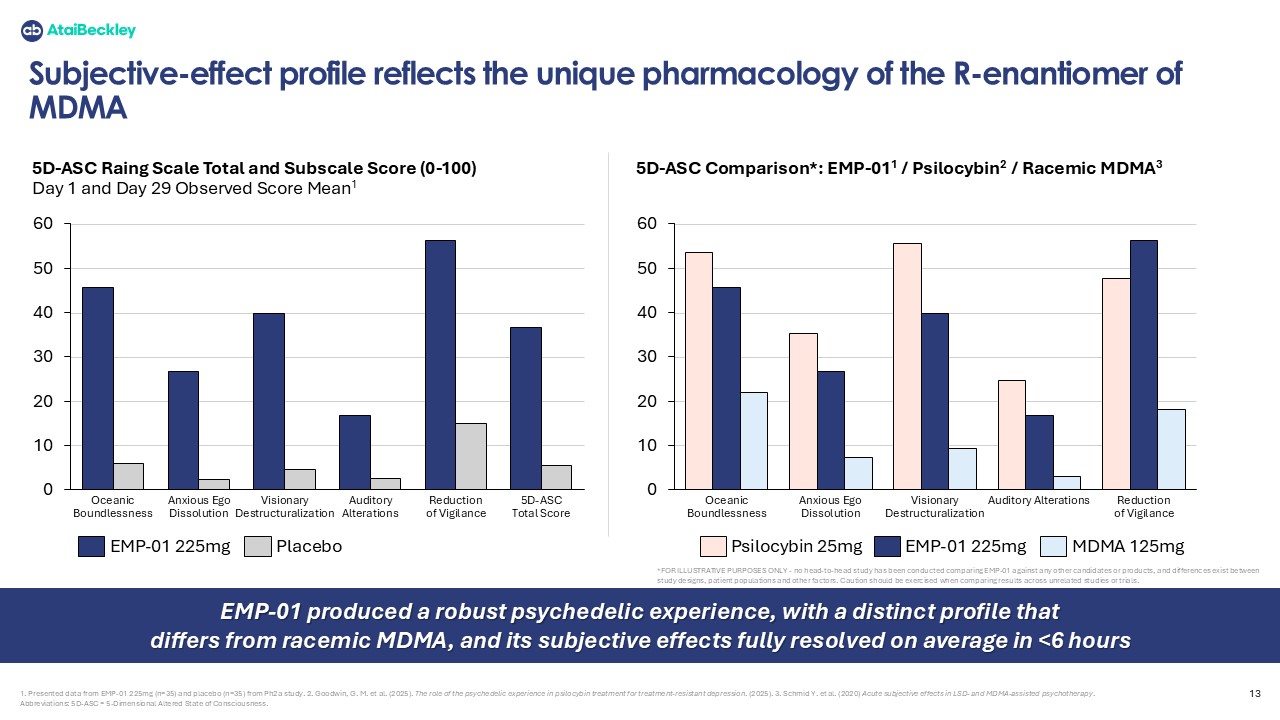
 13  1. Presented data from EMP-01 225mg (n=35) and placebo (n=35) from Ph2a study. 2. Goodwin, G. M. et al. (2025). The role of the psychedelic experience in psilocybin treatment for treatment-resistant depression. (2025). 3. Schmid Y. et al. (2020) Acute subjective effects in LSD- and MDMA-assisted psychotherapy.  Abbreviations: 5D-ASC = 5-Dimensional Altered State of Consciousness.   EMP-01 produced a robust psychedelic experience, with a distinct profile that differs from racemic MDMA, and its subjective effects fully resolved on average in <6 hours  Subjective‑effect profile reflects the unique pharmacology of the R‑enantiomer of MDMA  5D-ASC Raing Scale Total and Subscale Score (0-100) Day 1 and Day 29 Observed Score Mean1  Oceanic Boundlessness  Anxious Ego Dissolution  Visionary Destructuralization  Auditory Alterations  Reduction of Vigilance  5D-ASC Total Score  EMP-01 225mg   Placebo  5D-ASC Comparison*: EMP-011 / Psilocybin2 / Racemic MDMA3  Oceanic Boundlessness  Anxious Ego Dissolution  Visionary Destructuralization  Auditory Alterations  Reduction of Vigilance  Psilocybin 25mg  EMP-01 225mg   MDMA 125mg  *FOR ILLUSTRATIVE PURPOSES ONLY - no head-to-head study has been conducted comparing EMP-01 against any other candidates or products, and differences exist between study designs, patient populations and other factors. Caution should be exercised when comparing results across unrelated studies or trials.  
 

 14  An exploratory Phase 2a study demonstrated feasibility, generally well tolerated safety profile, and patient acceptability  Successfully evaluated EMP-01 in 70 adults with marked–severe SAD across 7 UK sites in 7 months   Strong adherence and retention through the primary endpoint  Placebo-adjusted improvement in LSAS at Day 43 (LSMD −11.85; g = 0.45, p-value = 0.036, one-tailed)  Observed marked improvement in clinician-rated global response (CGI-I Responder: EMP-01: 49% vs PBO: 15%); lower NNT vs SoC   Improved Fear and Avoidance on LSAS subdomains after two doses over six weeks, including social‑avoidance behaviors, without psychotherapy  Generally well-tolerated with favorable and manageable safety profile; comparable to racemic MDMA  No SAEs, no severe TEAEs, no suicidal intent or behaviors  225mg of EMP-01 was robustly psychedelic  Subjective effects fully resolved on average <6 hours  EFFICACY  Abbreviations: CGI-I = Clinical Global Impression – Improvement; LSAS = Liebowitz Social Anxiety Scale; LSMD = Least Squares Mean Difference; PBO = Placebo; SAD = Social Anxiety Disorder; SAE = Serious Adverse Event; TEAE = Treatment-Emergent Adverse Event  EMP‑01: Strong feasibility, favorable safety profile, and encouraging early signals of efficacy  FEASIBILITY & EXECUTION  SAFETY & TOLERABILITY  *No head-to-head study has been conducted comparing EMP-01 against any other candidates or products, and differences exist between study designs, patient populations and other factors. Caution should be exercised when comparing results across unrelated studies or trials.  
 

 Thank You