Exhibit
96.1
SK-1300
TECHNICAL REPORT SUMMARY
ON
THE
NEVES
LITHIUM PROJECT,
MINAS
GERAIS STATE, BRAZIL
Prepared
for:
Atlas
Lithium Corporation (NASDAQ: ATLX)
1200
N Federal Hwy, Suite 200
Boca
Raton, FL 33432
Report
Date: July 30, 2025
Effective
Date: May 15, 2025
Updated
on: June 16, 2026
Prepared
by:
SGS
Canada Inc.
Mining
Proficiency Group – Engenharia e Serviços
Vinq
– Geotecnia
SGS
Project #19546-02
| SGS
Canada Inc |
|
Geological
Services
|
| |
|
10
boul. de la Seigneurie Est, Suite 203, Blainville, Québec Canada J7C 3V5 t (450) 433-1050 f (450) 433-1048 www.geostat.com |
| |
|
Member
of SGS Group (SGS SA)
|
 |
| SGS Geological Services |
| S-K 1300 Technical Report – FS Neves Lithium Project – Minas Gerais, Brazil | Page i |
| | |
TABLE
OF CONTENTS
| TABLE
OF CONTENTS |
i |
| LIST
OF FIGURES |
vii |
| LIST
OF TABLES |
xi |
| 1
SUMMARY |
1 |
| 1.1
Introduction |
1 |
| 1.2
Property Description, Location, Access, and Physiography |
2 |
| 1.2.1
Neves Project |
2 |
| 1.2.2
Gaia Project |
2 |
| 1.3
History |
4 |
| 1.4
Geology and Mineralization |
4 |
| 1.5
Exploration and Drilling |
5 |
| 1.5.1
Neves Project |
5 |
| 1.5.2
Gaia Project |
5 |
| 1.6
Mineral Processing and Metallurgical Testing |
5 |
| 1.6.1
Neves Project |
5 |
| 1.7
Mineral Resource Estimates |
7 |
| 1.7.1
Neves Project |
7 |
| 1.7.2
Gaia Project |
10 |
| 1.8
Mineral Reserves Estimates |
10 |
| 1.9
Mining Methods |
12 |
| 1.10
Project Infrastructure |
13 |
| 1.10.1
On-Site Infrastructure |
13 |
| 1.10.2
Off-Site Infrastructure |
15 |
| 1.11
Market Studies |
15 |
| 1.12
Environmental Studies, Permitting, and Social or Community Impact |
15 |
| 1.12.1
Environmental Licensing |
15 |
| 1.12.2
Reclamation and Mine Closure |
18 |
| 1.12.3
Community Engagement and Government Relations |
18 |
| 1.13
Capital and Operating Costs Estimates |
19 |
| 1.13.1
Capital Costs |
19 |
| 1.13.2
Operating Costs |
20 |
| 1.14
Project Economics |
21 |
| 1.15
Conclusions and Recommendations |
23 |
| 1.15.1
Geology |
23 |
| 1.15.2
Mineral Processing |
24 |
| 1.15.3
Mining Methods and Mineral Reserves |
24 |
| 1.15.4
Infrastructure |
24 |
| 1.15.5
Mine Waste Storage Facilities |
25 |
| 1.15.6
Waste Dumps (PDER-1 and PDE-2 Waste Project) |
25 |
| 1.15.7
Water Management |
25 |
| 1.15.8
Hydrogeology |
25 |
| 1.15.9
Environmental Studies and Permitting |
25 |
| 1.15.10
Power Supply |
25 |
| 1.15.11
Commissioning |
25 |
| 1.15.12
Economic Analysis |
25 |
| 1.15.13
Overall |
25 |
| 2
INTRODUCTION |
26 |
| 2.1
Registrant Information |
27 |
| 2.2
Terms of Reference and Purpose |
27 |
| 2.3
Sources of Information |
28 |
| 2.4
Personal Inspection Summary |
30 |
| 2.5
Previously Filed Technical Report Summary Report |
32 |
| 2.6
Units and Abbreviations |
33 |
| 3
PROPERTY DESCRIPTION |
34 |
| 3.1
Property Description and Location |
34 |
|
| SGS Geological Services |
| S-K 1300 Technical Report – FS Neves Lithium Project – Minas Gerais, Brazil | Page ii |
| | |
| 3.2
Mineral Tenure |
36 |
| 3.3
Surface Rights |
37 |
| 3.4
Property Rights |
37 |
| 3.5
Royalties and Encumbrances |
39 |
| 3.6
Reliance on Other Experts |
39 |
| 4
ACCESSIBILITY, CLIMATE, LOCAL RESOURCES, INFRASTRUCTURE, AND PHYSIOGRAPHY |
40 |
| 4.1
Accessibility |
40 |
| 4.2
Climate |
40 |
| 4.3
Local Resources |
40 |
| 4.4
Infrastructure |
40 |
| 4.5
Physiography |
40 |
| 5
HISTORY |
42 |
| 5.1
Historical Resource Estimates |
42 |
| 5.2
Past Production |
42 |
| 6
GEOLOGICAL SETTING, MINERALIZATION, AND DEPOSIT |
43 |
| 6.1
Regional Geology |
43 |
| 6.2
Local and Property Geology |
45 |
| 6.2.1
Neves |
46 |
| 6.2.2
Gaia |
49 |
| 6.3
Deposit Type |
50 |
| 7
EXPLORATION |
51 |
| 7.1
Neves Project |
51 |
| 7.1.1
Aerophotogrammetric Survey |
51 |
| 7.1.2
Planimetric Survey |
51 |
| 7.1.3
Geoclouds Sentinel II Satellite Imagery |
51 |
| 7.1.4
LiDAR Surveys |
51 |
| 7.1.5
Geophysics |
53 |
| 7.1.6
Geological Mapping and Sampling |
54 |
| 7.1.7
Trenching |
56 |
| 7.1.8
Soil Sampling |
57 |
| 7.1.9
Magnetic Susceptibility |
59 |
| 7.2
Gaia Project |
59 |
| 7.2.1
Geological Mapping and Sampling |
59 |
| 7.2.2
Soil Sampling |
60 |
| 7.3
Drilling |
61 |
| 7.3.1
Neves Project |
61 |
| 7.3.2
Gaia Project |
65 |
| 7.4
Geotechnical Drilling |
66 |
| 7.4.1
Description of the Probing and Sampling Holes |
67 |
| 8
SAMPLE PREPARATION, ANALYSES, AND SECURITY |
69 |
| 8.1
Core Sampling |
69 |
| 8.2
Analytical and Test Laboratories |
69 |
| 8.3
Sample Preparation and Analysis |
69 |
| 8.4
Density Determinations |
69 |
| 8.5
Quality Assurance and Quality Control |
70 |
| 8.5.1
Analytical Standards |
70 |
| 8.5.2
Analytical Blanks |
72 |
| 8.5.3
Coarse Duplicates |
73 |
| 8.5.4
Pulp Duplicates |
74 |
| 8.6
Sample Security and Storage |
75 |
| 8.7
QP Comments |
75 |
| 9
DATA VERIFICATION |
76 |
| 9.1
Drilling Database |
76 |
| 9.2
Site Visits |
76 |
| 9.2.1
SGS |
76 |
|
| SGS Geological Services |
| S-K 1300 Technical Report – FS Neves Lithium Project – Minas Gerais, Brazil | Page iii |
| | |
| 9.2.2
VinQ Geotecnia |
77 |
| 10
MINERAL PROCESSING AND METALLURGICAL TESTING |
78 |
| 10.1
Test Work completed at SGS Lakefield |
78 |
| 10.1.1
Sample Selection, Preparation and Head Assay |
78 |
| 10.1.2
Mineralogy |
81 |
| 10.1.3
Comminution |
82 |
| 10.1.4
Heavy Liquid Separation |
82 |
| 10.1.5
Dense Media Separation Test |
86 |
| 10.1.6
Magnetic Separation on Dense Media Separation Concentrate |
87 |
| 10.1.7
Additional Heavy Liquid Separation Tests on DMS Middling and Tailing |
87 |
| 10.1.8
Flotation Tests |
89 |
| 10.2
Additional Tests Conducted at SGS Geosol Brazil between 2023 and 2025 |
89 |
| 10.3
Metals Recovery Predictions and Technical Discussions |
102 |
| 10.4
Conclusions and Recommendations |
107 |
| 11
MINERAL RESOURCE ESTIMATES |
108 |
| 11.1
Exploratory Data Analysis |
108 |
| 11.2
Analytical Data |
109 |
| 11.3
Composite Data |
110 |
| 11.4
Density |
110 |
| 11.5
Geological Interpretation |
111 |
| 11.6
Resource Block Modelling |
111 |
| 11.7
Block Model Interpretation |
113 |
| 11.8
Mineral Resource Classification |
118 |
| 11.9
Reasonable Prospects for Eventual Economic Extraction |
124 |
| 11.10
Mineral Resource Estimation |
125 |
| 12
MINERAL RESERVE ESTIMATES |
128 |
| 12.1
Introduction |
128 |
| 12.2
Key Assumptions, Parameters and Methods |
128 |
| 12.2.1
Geological Block Model |
128 |
| 12.2.2
Economic Parameters |
128 |
| 12.2.3
Cut-Off Grade and Ore Definition |
129 |
| 12.2.4
Concentrate Calculation |
129 |
| 12.2.5
Dilution and Mining Recovery |
129 |
| 12.2.6
Density |
129 |
| 12.2.7
Topographic Surface |
129 |
| 12.2.8
Physical Restrictions |
130 |
| 12.2.9
Weathering Surface |
131 |
| 12.2.10
Geotechnical Parameters |
131 |
| 12.3
Pit Optimization Study |
132 |
| 12.3.1
Pit Optimization Results |
132 |
| 12.3.2
Mine Design |
149 |
| 12.3.3
Mineral Reserves |
152 |
| 13
MINING METHODS |
160 |
| 13.1
Parameters for the Pit Design |
161 |
| 13.1.1
Geotechnical Considerations for the Pit Design |
161 |
| 13.1.2
Geotechnical Study |
161 |
| 13.1.3
Geotechnical Parameter for Anitta 2.5 |
174 |
| 13.1.4
Hydrogeological Considerations for the Pit Design |
177 |
| 13.2
Mine Plan |
177 |
| 13.2.1
Pushbacks |
177 |
| 13.2.2
Mine Sequencing |
193 |
| 13.2.3
Mining Operation |
200 |
| 13.2.4
Dewatering Plan |
216 |
| 14
PROCESSING AND RECOVERY METHODS |
222 |
| 14.1
General Description |
222 |
| 14.2
Comminution Circuit |
226 |
|
| SGS Geological Services |
| S-K 1300 Technical Report – FS Neves Lithium Project – Minas Gerais, Brazil | Page iv |
| | |
| 14.3
Wet Plant Feed Preparation |
227 |
| 14.4
Dense Media Separation Circuits |
227 |
| 14.5
Concentrate and Tailings Handling Areas |
230 |
| 14.6
Reagents |
230 |
| 14.7
Water and Power |
230 |
| 15
INFRASTRUCTURE |
231 |
| 15.1
General Site Plan |
231 |
| 15.2
Site Access |
235 |
| 15.2.1
Regional Site Access |
235 |
| 15.2.2
Processing Plant Site Access |
235 |
| 15.2.3
Transhipment Area Access |
236 |
| 15.3
Power Supply |
238 |
| 15.3.1
Electrical Power Source – Areas 171 and 172 |
238 |
| 15.3.2
Electrical Distribution |
240 |
| 15.3.3
Main Substation (future) |
240 |
| 15.3.4
Secondary Substations |
240 |
| 15.4
Water Systems |
241 |
| 15.4.1
Raw Water Supply System |
241 |
| 15.4.2
Overall Site Water Balance |
243 |
| 15.4.3
Potable Water Supply |
245 |
| 15.4.4
Fire Suppression System |
244 |
| 15.4.5
Sewage Collection and Treatment |
245 |
| 15.4.6
Hydrogeological Model |
246 |
| 15.5
Mine Waste, Low-Grade Ore and Tailings Storage Facilities |
251 |
| 15.5.1
Internal Drainage |
251 |
| 15.5.2
Geotechnical Studies |
254 |
| 15.5.3
Geotechnical Stability Analysis |
257 |
| 15.5.4
Hydrological and Hydraulic Studies |
260 |
| 15.5.5
Pile Geometric Design |
263 |
| 15.5.6
Volumes of Waste and Tailings Produced |
273 |
| 15.5.7
Disposal of Waste Rock and Tailings |
273 |
| 15.6
IT and Communication Infrastructure |
274 |
| 15.6.1
WAN (Wide Area Network) |
275 |
| 15.6.2
LAN (Local Area Network) and WLAN (Wireless Local Area Network) |
275 |
| 15.6.3
Data and Voice Communication Systems |
277 |
| 15.6.4
Security Systems |
277 |
| 15.6.5
Information Security |
277 |
| 15.6.6
Regulatory Compliance and Auditing |
277 |
| 15.7
Processing Area |
278 |
| 15.7.1
ROM PAD/ Crushing Area/ Crushed Ore Storage Reclaim – Area 310 |
278 |
| 15.7.2
Feed Preparation – Area 410 |
282 |
| 15.7.3
Primary DMS – Area 420 |
284 |
| 15.7.4
Primary Floats Stockpile – Area 510 |
286 |
| 15.7.5
Interstage Screening – Are 430 |
287 |
| 15.7.6
Secondary DMS – Area 440 |
289 |
| 15.7.7
Secondary Floats Stockpile – Are 520 |
291 |
| 15.7.8
Final Product Stockpile – Area 530 |
291 |
| 15.7.9
Tails Handling – Area 450 |
291 |
| 15.7.10
Grit Stockpile – Area 540 |
294 |
| 15.7.11
Water Tanks – Areas 620 and 630 |
294 |
| 15.7.12
Compressed air – Area 610 |
295 |
| 15.7.13
Emergency Ponds – Area 630 |
295 |
| 15.7.14
Mine Support Area / Truck Shop / Truck Wash |
296 |
| 15.8
Support Buildings – Processing Plant |
296 |
| 15.8.1
Plant Administration – Building |
296 |
| 15.8.2
Canteen – Area 712 |
300 |
|
| SGS Geological Services |
| S-K 1300 Technical Report – FS Neves Lithium Project – Minas Gerais, Brazil | Page v |
| | |
| 15.8.3
Outpatient Clinic – Area 713 |
303 |
| 15.8.4
Main Gatehouse – Area 714 |
306 |
| 15.8.5
ROM PAD Gatehouse – Area 714 |
308 |
| 15.8.6
Dispatch Gatehouse – Area 714 |
309 |
| 15.8.7
Locker Room – Area 715 |
310 |
| 15.8.8
Waste Deposit – Area 717 |
313 |
| 15.8.9
Control Room Support Building – Area 722 |
314 |
| 15.8.10
Workshop – Area 723 |
316 |
| 15.8.11
Warehouse – Area 724 |
317 |
| 15.9
Support Buildings – Mining Facilities |
318 |
| 15.9.1
Mine Operation Support Area |
318 |
| 15.9.2
Essential infrastructure to be implemented |
318 |
| 15.9.3
Fueling Station and Storage |
321 |
| 15.9.4
Explosives Magazine |
322 |
| 15.10
Support Buildings – Transshipment Area |
329 |
| 15.10.1
Transshipment Area Gatehouse – Area 821 |
329 |
| 15.10.2
Laboratory – Area 822 |
331 |
| 15.10.3
Truck Scale Support Room – Area 817 |
333 |
| 15.10.4
Driver’s Waiting Room – Area 817 |
335 |
| 15.11
Site Geotechnical |
336 |
| 15.12
Concentrate Shipping |
336 |
| 15.13
Gravel/Sand Sources |
339 |
| 15.13.1
Gravel Support |
339 |
| 15.13.2
Sand Support |
339 |
| 16
MARKET STUDIES |
340 |
| 16.1
Recent Historical Pricing |
340 |
| 16.2
Lithium Demand 2025 and Beyond |
340 |
| 16.3
Lithium-Ion Battery Cathode Active Material |
341 |
| 16.4
Lithium Chemical Demand |
342 |
| 16.5
Lithium Raw Material Supply |
343 |
| 16.6
Lithium Price Forecast |
344 |
| 16.7
Contracts |
346 |
| 17
ENVIRONMENTAL STUDIES, PERMITTING, AND PLANS, NEGOTIATIONS, OR AGREEMENTS WITH LOCAL INDIVIDUALS OR GROUPS |
347 |
| 17.1
Environmental Studies |
347 |
| 17.1.1
Anitta Project – Delimitation and Permissions |
350 |
| 17.1.2
Environmental Intervention Authorization – AIA |
350 |
| 17.1.3
Water Use Authorization |
351 |
| 17.1.4
Final Considerations about the Permit |
351 |
| 17.1.5
Expansion of the Anitta Project – Delimitation and Progress |
353 |
| 17.1.6
Water Use Authorization |
355 |
| 17.1.7
Final Considerations about the Permit |
355 |
| 17.2
Requirements, Plans for Waste, Tailings Disposal, Site Monitoring, Water Management |
357 |
| 17.2.1
Physical Environment Programs |
357 |
| 17.2.2
Biotic Environment Programs |
357 |
| 17.2.3
Socioeconomic Environment Programs |
358 |
| 17.2.4
Specific Plans/Programs |
358 |
| 17.3
Contextualization of the Anitta Project and Expansion |
358 |
| 17.4
Community Engagement |
361 |
| 17.5
Mine Closure |
363 |
| 17.6
Commitments to Local Procurement or Hiring |
366 |
| 17.7
Planning and Design |
369 |
| 18
CAPITAL AND OPERATING COSTS |
370 |
| 18.1
Basis of Estimates |
370 |
| 18.1.1
General |
371 |
| 18.1.2
Mining |
372 |
|
| SGS Geological Services |
| S-K 1300 Technical Report – FS Neves Lithium Project – Minas Gerais, Brazil | Page vi |
| | |
| 18.1.3
Processing Plant and Infrastructure |
372 |
| 18.2
Capital Cost Estimates |
372 |
| 18.2.1
Buildings |
374 |
| 18.2.2
MV Substation & Automation |
375 |
| 18.2.3
Spares |
375 |
| 18.2.4
Water Supply |
375 |
| 18.2.5
Weighbridge |
376 |
| 18.2.6
Civil Works |
376 |
| 18.2.7
Commissioning |
377 |
| 18.2.8
Crushing Area |
377 |
| 18.2.9
Contract Mining (Pre-Operational Phase) |
377 |
| 18.2.10
Earthworks |
378 |
| 18.2.11
Engineering |
379 |
| 18.2.12
Generators |
379 |
| 18.2.13
Installation |
379 |
| 18.2.14
Shipping |
380 |
| 18.2.15
Contingency |
381 |
| 18.3
Corporate Cost Breakdown |
381 |
| 18.3.1
Taxes |
381 |
| 18.3.2
Owners Team & Management Services |
381 |
| 18.3.3
Land Acquisition |
382 |
| 18.3.4
Environment & Social - Permits and Programs |
382 |
| 18.3.5
Temporary Facilities |
382 |
| 18.3.6
Insurance |
382 |
| 18.3.7
Contingency |
383 |
| 18.4
CAPEX and Corporate Cost |
383 |
| 18.5
Sunk Cost |
385 |
| 18.6
Sustaining Capital |
389 |
| 18.7
Operating Cost Estimate |
390 |
| 18.7.1
Mining Operating Costs Summary |
391 |
| 18.7.2
Crushing Processing Cost Summary |
392 |
| 18.7.3
DMS Plant Operating Cost Summary |
392 |
| 18.7.4
G&A Cost Summary |
394 |
| 18.7.5
Freight and Port Operating Cost Summary |
394 |
| 19
ECONOMIC ANALYSIS |
395 |
| 19.1
Project Economic Headline Results |
395 |
| 19.2
General Criteria |
395 |
| 19.3
Economic Model Inputs |
397 |
| 19.4
Economic Model Results |
397 |
| 19.5
Production and Cashflow Summary |
398 |
| 19.6
Cash Flow Statement |
398 |
| 19.7
Sensitivity Analysis |
402 |
| 19.8
Breakeven Analysis |
403 |
| 19.9
Conclusion |
403 |
| 20
ADJACENT PROPERTIES |
404 |
| 21
OTHER RELEVANT DATA AND INFORMATION |
405 |
| 22
INTERPRETATION AND CONCLUSIONS |
406 |
| 23
RECOMMENDATIONS |
407 |
| 23.1
Geology |
407 |
| 23.1.1
Neves Project |
407 |
| 23.1.2
Gaia Project |
407 |
| 23.1.3
Geological Model Maintenance and Quality Control |
407 |
| 23.2
Mineral Processing |
407 |
| 23.3
Mining Methods and Mineral Reserves |
408 |
| 23.3.1
Mine Planning Scenario Validation |
408 |
| 23.3.2
Operational Monitoring of Mining Activities |
408 |
|
| SGS Geological Services |
| S-K 1300 Technical Report – FS Neves Lithium Project – Minas Gerais, Brazil | Page vii |
| | |
| 23.3.3
Rock Blasting Activity, Fragmentation, Explosives and Storage |
409 |
| 23.3.4
Topography and Slope Shaping |
409 |
| 23.3.5
Access Infrastructure and Operational Cycles |
409 |
| 23.3.6
Geotechnical Investigation and Instrumentation Monitoring |
409 |
| 23.3.7
Visual Monitoring and Regulatory Compliance |
410 |
| 23.4
Infrastructure |
410 |
| 23.5
Mine Waste Storage Facilities |
410 |
| 23.6
Waste Dumps (PDER-1 and PDE-2 Waste Project) |
410 |
| 23.7
Water Management |
410 |
| 23.8
Hydrogeology |
411 |
| 23.9
Environmental Studies and Permitting |
411 |
| 23.10
Power Supply |
411 |
| 23.11
Commissioning |
411 |
| 23.12
Economic Analysis |
411 |
| 23.13
Overall |
411 |
| 24
REFERENCES |
412 |
| 25
RELIANCE ON INFORMATION PROVIDED BY THE REGISTRANT |
414 |
| APPENDIX
A |
415 |
LIST
OF FIGURES
| Figure 1-1 Location Map |
3 |
| Figure 1-2 Financial Sensitivity Analysis |
23 |
| Figure 3-1 Atlas Property Map |
35 |
| Figure 3-2 Neves Project Property Acquisitions |
39 |
| Figure 6-1 Regional Geology Map and Stratigraphic Column |
44 |
| Figure 6-2 Simplified Map of Araçuaí Orogen and Eastern Brazilian Pegmatite Province |
45 |
| Figure 6-3 Neves Geological Map |
47 |
| Figure 6-4 Pegmatite and Schist of the Salinas Formation (A) and Teixerinha Granite Outcrop (B) |
48 |
| Figure 6-5 Crystalline and Altered Argillic Petalite |
48 |
| Figure 6-6 Gaia Geological Map |
49 |
| Figure 6-7 Deposit Model for Neves Pegmatites |
50 |
| Figure 7-1 Final DTM with Respect to Tenement Boundaries |
52 |
| Figure 7-2 Anomalous Magnetic Lows and their Correlation with Known Pegmatites |
53 |
| Figure 7-3 Neves Aeromagnetic Survey with Structural Interpretation |
54 |
| Figure 7-4 Geological Map of the Neves Property with Known Pegmatites |
55 |
| Figure 7-5 Trench Excavated at the Anitta 3 Pegmatite |
56 |
| Figure 7-6 Atlas 2021 - 2024 Trench Program and Locations |
57 |
| Figure 7-7 Soil Sampling over the Neves Project |
58 |
| Figure 7-8 Map of the Gaia Property with Known Pegmatites |
59 |
| Figure 7-9 Soil Sampling over the Gaia Project |
60 |
| Figure 7-10 Plan View of Neves Drilling |
63 |
| Figure 7-11 Longitudinal View of Neves Drilling |
64 |
| Figure 7-12 Plan View of Gaia Drilling |
66 |
| Figure 7-13 Location of Drill Holes & Samples Collected |
67 |
| Figure 8-1 Original versus Re-Assay Values |
71 |
| Figure 8-2 Shewhart Performance Chart of OREAS Standard Results |
72 |
| Figure 8-3 Atlas Blank Sample Analyses |
73 |
| Figure 8-4 Correlation Between Original Samples and Coarse Duplicates |
74 |
| Figure 8-5 Correlation Between Original Samples and Pulp Duplicates |
74 |
| Figure 10-1 -9.5 mm Heavy Liquid Separation Curves |
85 |
| Figure 10-2 Settling Rate and Terminal Density of Sample 010428 |
100 |
| Figure 10-3 Settling Rate and Terminal Density of Sample 010427-01-05-03-02 |
101 |
| Figure 11-1 Neves Project Drill Hole Collar Locations |
109 |
| Figure 11-2 Neves Pegmatite Solids |
111 |
| Figure 11-3 Isometric View of Anitta 1 Search Ellipses |
114 |
|
| SGS Geological Services |
| S-K 1300 Technical Report – FS Neves Lithium Project – Minas Gerais, Brazil | Page viii |
| | |
| Figure 11-4 Isometric View of Anitta 1 Interpolated Block Model |
115 |
| Figure 11-5 Isometric View of Anitta 2 Interpolated Block Model |
115 |
| Figure 11-6 Isometric View of Anitta 2.5 Interpolated Block Model |
116 |
| Figure 11-7 Isometric View of Anitta 3 Interpolated Block Model |
116 |
| Figure 11-8 Isometric View of Anitta 3N Interpolated Block Model |
117 |
| Figure 11-9 Isometric View of Anitta 4 Interpolated Block Model |
117 |
| Figure 11-10 Isometric View of Neves Project Interpolated Block Models |
118 |
| Figure 11-11 Anitta 1 Block Model Classification |
121 |
| Figure 11-12 Anitta 2 Block Model Classification |
121 |
| Figure 11-13 Anitta 2.5 Block Model Classification |
122 |
| Figure 11-14 Anitta 3 Block Model Classification |
122 |
| Figure 11-15 Anitta 3N Block Model Classification |
123 |
| Figure 11-16 Anitta 4 Block Model Classification |
123 |
| Figure 11-17 Neves Deposit Mineral Resource Block Models and Optimised Pits |
125 |
| Figure 12-1 Topographic Surface |
130 |
| Figure 12-2 License Limits of the Project |
131 |
| Figure 12-3 Anitta 2 – Pit Sensitivity Analysis: Stripping Ratio |
134 |
| Figure 12-4 Anitta 2 – Pit Sensitivity Analysis: Li2O |
135 |
| Figure 12-5 Anitta 2 – Pit Sensitivity Analysis: Value |
135 |
| Figure 12-6 Anitta 2 – Pit Sensitivity Analysis |
136 |
| Figure 12-7 Anitta 2 – Pit Sensitivity Analysis – Section EW01 |
137 |
| Figure 12-8 Anitta 2 – Pit Sensitivity Analysis – Section EW02 |
137 |
| Figure 12-9 Anitta 2 – Pit Sensitivity Analysis – Section EW03 |
138 |
| Figure 12-10 Anitta 2.5 - Pit Sensitivity Analysis: Stripping Ratio |
140 |
| Figure 12-11 Anitta 2.5 - Pit Sensitivity Analysis: Li2O |
140 |
| Figure 12-12 Anitta 2.5 – Pit Sensitivity Analysis: Value |
141 |
| Figure 12-13 Anitta 2.5 – Pit Sensitivity Analysis |
141 |
| Figure 12-14 Anitta 2.5 – Pit Sensitivity Analysis – Section A |
142 |
| Figure 12-15 Anitta 2.5 – Pit Sensitivity Analysis – Section B |
142 |
| Figure 12-16 Anitta 3 – Pit Sensitivity Analysis: Stripping Ratio |
145 |
| Figure 12-17 Anitta 3 – Pit Sensitivity Analysis: Li2O |
145 |
| Figure 12-18 Anitta 3 – Pit Sensitivity Analysis: Value |
146 |
| Figure 12-19 Anitta 3 – Pit Sensitivity Analysis |
146 |
| Figure 12-20 Anitta 3 – Pit Sensitivity Analysis – Section EW01 |
147 |
| Figure 12-21 Anitta 3 – Pit Sensitivity Analysis – Section EW02 |
148 |
| Figure 12-22 Anitta 3 – Pit Sensitivity Analysis – Section EW03 |
149 |
| Figure 12-23 Anitta 2 – Final Pit |
150 |
| Figure 12-24 Anitta 2.5 – Final Pit |
151 |
| Figure 12-25 Anitta 3 – Final Pit |
152 |
| Figure 13-1 Anitta Open Pits |
160 |
| Figure 13-2 Geotechnical Sectors Proposed for Final Anitta 2 Pit |
163 |
| Figure 13-3 Geotechnical Sectors Proposed for Anitta 3 Pit |
164 |
| Figure 13-4 General Stereogram of the project, 325/43 |
167 |
| Figure 13-5 Anitta 2 Stereogram, 323/52, 317/81 and 326/14 |
168 |
| Figure 13-6 Anitta 3 Stereogram, 330/41 |
168 |
| Figure 13-7 Lithostructural Domains Projected in the Final Pit Anitta 2 |
169 |
| Figure 13-8 Lithostructural Domains Projected in the Final Pit Anitta 3 |
170 |
| Figure 13-9 Geotechnical Sectors of the Anitta 2 Final Pit and Sections |
172 |
| Figure 13-10 Geotechnical Sectors of the Anitta 3 Final Pit |
173 |
| Figure 13-11 Location of Geotechnical Boreholes for Anitta 3, 2, 2.5, 3 and 4 Ore Bodies |
174 |
| Figure 13-12 Final pit geotechnical sectors and cross-sections – Anitta 2.5 |
176 |
| Figure 13-13 Pushbacks Anitta 2 – Pits Selected from Sensitivity Analysis |
178 |
| Figure 13-14 Anitta 2 – Design of Pushbacks |
179 |
| Figure 13-15 Anitta 2 – Design of Pushbacks: Phase 1 |
179 |
| Figure 13-16 Anitta 2 – Design of Pushbacks: Phase 2 |
180 |
| Figure 13-17 Anitta 2 – Design of Pushbacks: Phase 3 |
180 |
|
| SGS Geological Services |
| S-K 1300 Technical Report – FS Neves Lithium Project – Minas Gerais, Brazil | Page ix |
| | |
| Figure 13-18 Anitta 2 – Design of Pushbacks: Final Pit |
181 |
| Figure 13-19 Pushbacks Anitta 3 – Pits Selected from Sensitivity Analysis |
183 |
| Figure 13-20 Anitta 3 – Design of Pushbacks |
183 |
| Figure 13-21 Anitta 3 – Design of Pushbacks: Phase 01 |
184 |
| Figure 13-22 Anitta 3 – Design of Pushbacks: Phase 02 |
184 |
| Figure 13-23 Anitta 3 – Design of Pushbacks: Phase 03 |
185 |
| Figure 13-24 Anitta 3 – Design of Pushbacks: Phase 04 – Pit Final |
185 |
| Figure 13-25 Pushbacks Anitta 2.5 – Pits Selected from Sensitivity Analysis |
187 |
| Figure 13-26 Anitta 2.5 – Design of Pushbacks |
187 |
| Figure 13-27 Anitta 2.5 – Design of Pushbacks: Phase 01 |
188 |
| Figure 13-28 Anitta 2.5 – Design of Pushbacks: Phase 02 |
188 |
| Figure 13-29 Anitta 2.5 – Design of Pushbacks: Phase 03 |
189 |
| Figure 13-30 Anitta 2.5 – Design of Pushbacks: Phase 04 – Pit Final |
189 |
| Figure 13-31 Final Pits: Anitta 2, Anitta 3 and Anitta 2.5 |
191 |
| Figure 13-32 Year 0 - Pre-stripping |
196 |
| Figure 13-33 Year 1 |
196 |
| Figure 13-34 Year 2 |
197 |
| Figure 13-35 Year 3 |
197 |
| Figure 13-36 Year 4 |
198 |
| Figure 13-37 Year 5 |
198 |
| Figure 13-38 Year 6 |
199 |
| Figure 13-39 Year 7 |
100 |
| Figure 13-40 Percentage of Plant Feed Contribution by Pit |
200 |
| Figure 13-41 Speed Bin Data |
203 |
| Figure 13-42 Haul Road Cross Section |
209 |
| Figure 13-43 Powder Factor by Scenario for Ore Blasting |
212 |
| Figure 13-44 Graph of Powder Factor |
214 |
| Figure 13-45 Evolution of Average Pit Pumping Over Time (Anitta 2 and 3) |
217 |
| Figure 13-46 Location of the Dewatering Wells |
221 |
| Figure 14-1 Atlas Lithium Neves Project Process Flow Diagram – Comminution |
223 |
| Figure 14-2 Atlas Lithium Neves Project Process Flow Diagram – Primary Dense Media Separation |
224 |
| Figure 14-3 Atlas Lithium Neves Project Process Flow Diagram – Secondary Dense Media Separation |
225 |
| Figure 15-1 Overall Site Plan |
232 |
| Figure 15-2 General Arrangement – Processing Plant Area |
233 |
| Figure 15-3 General Arrangement – Transshipment Area |
234 |
| Figure 15-4 Site Access |
236 |
| Figure 15-5 Typical B-Train Truck |
237 |
| Figure 15-6 TSP Access |
237 |
| Figure 15-7 Areas for HV substation and Diesel Generators Installation |
238 |
| Figure 15-8 Diesel Generator Substation |
239 |
| Figure 15-9 Borehole Water Intake – Typical Plan View |
242 |
| Figure 15-10 Borehole Water Intake – Typical Side View |
242 |
| Figure 15-11 Processing Plant Area Ponds |
243 |
| Figure 15-12 Site Wide Water Balance |
245 |
| Figure 15-13 Advancement of the Drawdown Cone in the Pit, in Cross-Section |
247 |
| Figure 15-14 Location of the Dewatering Wells |
248 |
| Figure 15-15 General Layout of the Internal Drainage System for PDER-1 and PDE-2 |
252 |
| Figure 15-16 Typical Section – Internal Drain of PDER-1 and PDE-2 |
253 |
| Figure 15-17 Internal Drain Outlet Sections |
254 |
| Figure 15-18 Location of Instruments Provided for PDER-1 |
255 |
| Figure 15-19 Location of Instruments Provided for PDE-2 |
256 |
| Figure 15-20 Surface Drainage Diagram of PDER-1 |
261 |
| Figure 15-21 Surface Drainage Diagram of PDE-2 |
262 |
| Figure 15-22 General Layout of Phase I of PDER-1 |
264 |
| Figure 15-23 General Layout of Phase II of PDER-1 |
265 |
|
| SGS Geological Services |
| S-K 1300 Technical Report – FS Neves Lithium Project – Minas Gerais, Brazil | Page x |
| | |
| Figure 15-24 Schematic Section of Phase II of PDER-1, Indicating the Geometry of Phase I to be Stacked |
266 |
| Figure 15-25 General Layout of Phase III of PDER-1 |
267 |
| Figure 15-26 Schematic Section of Phase III of PDER-1 |
268 |
| Figure 15-27 General Layout of Phase I of PDE-2 |
269 |
| Figure 15-28 Schematic Section of Phase I of PDE-2 |
270 |
| Figure 15-29 General Layout of Phase II of PDE-2 |
271 |
| Figure 15-30 Schematic Section of Phase II of PDE-2 |
272 |
| Figure 15-31 Illustrative Diagram of IT Infrastructure |
274 |
| Figure 15-32 Illustrative Design of IT and TA Backbone |
276 |
| Figure 15-33 ROM PAD/ Crushing Area/ Crushed Ore Storage Reclaim – Area 310 |
279 |
| Figure 15-34 Crushing Flowchart |
280 |
| Figure 15-35 Conceptual Water Management Plan |
281 |
| Figure 15-36 Feed Preparation – Area 410 |
282 |
| Figure 15-37 Feed Preparation Flowchart |
283 |
| Figure 15-38 Primary DMS – Area 420 - View 1 |
285 |
| Figure 15-39 Primary DMS – Area 420 - View 2 |
286 |
| Figure 15-40 Primary Floats Stockpile – Area 510 |
287 |
| Figure 15-41 Interstage Screening – Area 430 |
287 |
| Figure 15-42 Interstage Screening Flowchart |
288 |
| Figure 15-43 Secondary DMS – Area 430 - View 1 |
289 |
| Figure 15-44 Secondary DMS – Area 430 – View 2 |
290 |
| Figure 15-45 Secondary Floats Stockpile – Area 520 |
291 |
| Figure 15-46 Final Product Stockpile – Area 530 |
291 |
| Figure 15-47 Tails Handling – Area 450 |
292 |
| Figure 15-48 Tails Handling Flowchart |
293 |
| Figure 15-49 Grit Stockpile - Area 540 |
294 |
| Figure 15-50 Water Tanks – Areas 620 and 630 |
295 |
| Figure 15-51 Emergency Ponds |
296 |
| Figure 15-52 Administrative Building – Perspective View |
297 |
| Figure 15-53 Administrative Building – Inside View |
298 |
| Figure 15-54 Administrative Building – Plan View |
299 |
| Figure 15-55 Canteen – Perspective View |
300 |
| Figure 15-56 Canteen – Inside View |
301 |
| Figure 15-57 Canteen – Plan View |
302 |
| Figure 15-58 Outpatient Clinic – Perspective View |
303 |
| Figure 15-59 Outpatient Clinic – Inside View |
304 |
| Figure 15-60 Outpatient Clinic – Plan View |
305 |
| Figure 15-61 Main Gatehouse – Perspective View |
306 |
| Figure 15-62 Main Gatehouse – Inside View |
307 |
| Figure 15-63 Main Gatehouse – Plan View |
307 |
| Figure 15-64 ROM PAD Gatehouse – Perspective View |
308 |
| Figure 15-65 ROM PAD Gatehouse – Inside View |
308 |
| Figure 15-66 ROM PAD Gatehouse – Plan View |
309 |
| Figure 15-67 Dispatch Gatehouse – Perspective View |
309 |
| Figure 15-68 Dispatch Gatehouse – Inside View |
310 |
| Figure 15-69 Dispatch Gatehouse – Plan View |
310 |
| Figure 15-70 Locker Room – Perspective View |
311 |
| Figure 15-71 Locker Room – Inside View |
311 |
| Figure 15-72 Locker Room – Plan View |
312 |
| Figure 15-73 Waste Deposit – Perspective View |
313 |
| Figure 15-74 Control Room Support Building – Perspective View |
314 |
| Figure 15-75 Control Room Support Building – Inside View |
315 |
| Figure 15-76 Control Room Support Building – Plan View |
315 |
| Figure 15-77 Workshop – Perspective View |
316 |
| Figure 15-78 Warehouse – Perspective View |
317 |
|
| SGS Geological Services |
| S-K 1300 Technical Report – FS Neves Lithium Project – Minas Gerais, Brazil | Page xi |
| | |
| Figure 15-79 General Layout of the Suggested Mine Operation Support Area |
319 |
| Figure 15-80 Typical Mining Facilities to be Implemented – View 1 |
319 |
| Figure 15-81 Typical Mining Facilities to be Implemented – View 2 |
320 |
| Figure 15-82 Typical Mining Facilities to be Implemented – View 3 |
320 |
| Figure 15-83 Typical Mining Facilities to be Implemented – View 4 |
321 |
| Figure 15-84 Typical Fueling System and Storage Tank Arrangement |
322 |
| Figure 15-85 Site Explosives Magazine Facility |
323 |
| Figure 15-86 Emulsion Receiving Area |
325 |
| Figure 15-87 Typical Storage Explosive Magazine |
326 |
| Figure 15-88 Layout of the Explosives Magazine Structures with Regulated Distances |
327 |
| Figure 15-89 Transshipment Area Gatehouse – Perspective View |
330 |
| Figure 15-90 Transshipment Area Gatehouse – Inside View |
330 |
| Figure 15-91 Transshipment Area Gatehouse – Plan View |
330 |
| Figure 15-92 Laboratory – Perspective View |
331 |
| Figure 15-93 Laboratory – Inside View |
332 |
| Figure 15-94 Laboratory – Plan View |
333 |
| Figure 15-95 Truck Scale Support Room – Perspective View |
334 |
| Figure 15-96 Truck Scale Support Room – Inside View |
334 |
| Figure 15-97 Truck Scale Support Room – Plan View |
334 |
| Figure 15-98 Driver’s Waiting Room – Perspective View |
335 |
| Figure 15-99 Driver’s Waiting Room – Plan View |
335 |
| Figure 15-100 Port of Ilhéus |
337 |
| Figure 15-101 Vitória – Brazil, Harbor, Business, City, Cargo Container, Bulk Shipment |
338 |
| Figure 15-102 Port of Vitória |
338 |
| Figure 16-1 Forecast Power Battery Capacity Growth |
341 |
| Figure 16-2 Global Demand for Refined Lithium to 2040 |
342 |
| Figure 16-3 Lithium Concentrate SC6 Pricing |
345 |
| Figure 17-1 Collage of Avifauna, Herpetofauna, Terrestrial and Flying Mammalian Fauna |
354 |
| Figure 17-2 Map of Anitta Project Licensing Status |
359 |
| Figure 17-3 Anitta Project Master Plan |
360 |
| Figure 18-1 Capital Expenditure Breakdown |
384 |
| Figure 18-2 Corporate Costs Breakdown |
385 |
| Figure 19-1 Post-Taxes Annualized Cash Flow Generation (in US$’000) |
400 |
| Figure 19-2 Cash Flow Generation Transitioning from Construction into Operations (in US$’000) |
401 |
| Figure 19-3 Sensitivity to NPV (in US$’000) for Changes in Various Key Inputs |
403 |
LIST
OF TABLES
| Combined Neves Deposit In-Pit Mineral Resource Estimate 0.3% Li2O Cut-Off 15th May 2025 |
8 |
| Table 1-2 Anitta 1 In-Pit Mineral Resource Estimate 14th May 2025 |
8 |
| Table 1-3 Anitta 2 In-Pit Mineral Resource Estimate 15th May 2025 |
8 |
| Table 1-4 Anitta 2.5 In-Pit Mineral Resource Estimate 15th May 2025 |
9 |
| Table 1-5 Anitta 3 In-Pit Mineral Resource Estimate 15th May 2025 |
9 |
| Table 1-6 Anitta 3N In-Pit Mineral Resource Estimate 15th May 2025 |
9 |
| Table 1-7 Anitta 4 In-Pit Mineral Resource Estimate 15th May 2025 |
10 |
| Table 1-8 Economic Parameters |
10 |
| Table 1-9 Total Atlas Open Pit Mineral Reserve |
11 |
| Table 1-10 Environmental, Authorizations, and Operations Process List |
17 |
| Table 1-11 Capital Cost Summary (1) |
20 |
| Table 1-12 Operating Cost Summary |
21 |
| Table 1-13 Financial Analysis Assumptions |
21 |
| Table 1-14 Financial Analysis Results |
22 |
| Table 2-1 List of Qualified Persons, Professional Designations and Site Visit Dates |
28 |
| Table 2-2 Qualified Persons Areas of Responsibility |
29 |
|
| SGS Geological Services |
| S-K 1300 Technical Report – FS Neves Lithium Project – Minas Gerais, Brazil | Page xii |
| | |
| Table 2-3 Previously Filed TRS |
32 |
| Table 2-4 List of Abbreviations |
33 |
| Table 3-1 Neves Mineral Rights Description |
36 |
| Table 3-2 Neves Mining Permit per Annex |
36 |
| Table 3-3 Neves Project Property Acquisitions and Access Authorizations |
38 |
| Table 7-1 Neves Diamond Drilling |
61 |
| Table 7-2 Neves Representative Drill Hole Intercepts |
62 |
| Table 7-3 Gaia Representative Drill Hole Intercepts |
65 |
| Table 7-4 Anitta 2 Pit Probe Coordinates |
68 |
| Table 7-5 Anitta 3 Pit Probe Coordinates |
68 |
| Table 8-1 Neves Average Densities |
70 |
| Table 8-2 Standard Average Li Values with Analytical Error for Peroxide Fusion |
71 |
| Table 10-1 Sample Identification and Weight |
79 |
| Table 10-2 Main Composite Whole Ore Analysis Results |
81 |
| Table 10-3 Main Composite Assays for F, Be, As, Ta, Rb and Cs |
81 |
| Table 10-4 Semi Quantitative XRD Mineralogical Composition on Master Composite Sample |
81 |
| Table 10-5 -9.5 mm Heavy Liquid Separation Cumulative Sink Product Chemical Assays |
83 |
| Table 10-6 -9.5 mm Heavy Liquid Separation Cumulative Sink Product Major Component Distribution |
83 |
| Table 10-7 -12.5 mm Heavy Liquid Separation Cumulative Sink Product Chemical Assays |
84 |
| Table 10-8 -12.5 mm Heavy Liquid Separation Cumulative Sink Product Major Component Distribution |
84 |
| Table 10-9 -9.5 mm Heavy Liquid Separation Incremental Product Lithium Assays and Distribution |
85 |
| Table 10-10 Dense Media Separation Final Products Results |
86 |
| Table 10-11 DMS Concentrate Magnetic Separation Results |
87 |
| Table 10-12 Tantalum and Iron Recovery and Assays in Magnetic Separation Products |
87 |
| Table 10-13 HLS Test Results on Re-crushed DMS Middlings |
88 |
| Table 10-14 Cumulative Sink Products from HLS Test on Re-crushed DMS Middlings |
88 |
| Table 10-15 HLS Test Results on the DMS Tailings |
88 |
| Table 10-16 Test Sample Description – Anitta 1 |
89 |
| Table 10-17 Test Sample Description – Anitta 2 |
90 |
| Table 10-18 Test Sample Description – Anitta 3 |
90 |
| Table 10-19 Test Sample Description – Anitta 2.5 |
90 |
| Table 10-20 Test Sample Description – Anitta 4 |
90 |
| Table 10-21 HLS Test Cumulative Sink Product Lithium Grade and Recovery – Anitta 1 |
91 |
| Table 10-22 HLS Test Cumulative Sink Product Lithium Grade and Recovery – Anitta 2 |
92 |
| Table 10-23 HLS Test Cumulative Sink Product Lithium Grade and Recovery – Anitta 3 |
93 |
| Table 10-24 HLS Test Cumulative Sink Product Lithium Grade and Recovery – Anitta 3 (Continued) |
94 |
| Table 10-25 HLS Test Cumulative Sink Product Lithium Grade and Recovery – Anitta 2.5 |
95 |
| Table 10-26 HLS Test Cumulative Sink Product Lithium Grade and Recovery – Anitta 4 |
96 |
| Table 10-27 -0.85 mm Material Summary of HLS Test Samples from Anitta 1 |
97 |
| Table 10-28 -0.85 mm Material Summary of HLS Test Samples from Anitta 2 |
97 |
| Table 10-29 -0.85 mm Material Summary of HLS Test Samples from Anitta 3 |
97 |
| Table 10-30 -0.85 mm Material Summary of HLS Test Samples from Anitta 2.5 |
98 |
| Table 10-31 -0.85 mm Material Summary of HLS Test Samples from Anitta 4 |
98 |
| Table 10-32 Particle Size Distributions of Sedimentation Test Feed |
98 |
| Table 10-33 Flocculant Screening Test on Sample 010428 |
99 |
| Table 10-34 Flocculant Screening Test on Sample 010427-01-05-03-02 |
99 |
| Table 10-35 Flocculant Dosage Optimization for Sample 010428 |
99 |
| Table 10-36 Flocculant Dosage Optimization for Sample 010427-01-05-03-02 |
99 |
| Table 10-37 Filtration Test Data of Sample 010428 with 50% Solids Concentration |
101 |
| Table 10-38 Filtration Test Data of Sample 010428 with 10% Solids Concentration |
101 |
| Table 10-39 Filtration Test Data of Sample 010427-01-05-03-02 with 50% Solids Concentration |
102 |
| Table 10-40 Filtration Test Data of Sample 010427-01-05-03-02 with 10% Solids Concentration |
102 |
| Table 10-41 Averaged HLS Data for Anitta 2 Samples (VSA-13 to VSA-19) |
103 |
| Table 10-42 Averaged HLS DATA For Anitta 3 Samples (MET-AN-001 to MET-AN-015) |
103 |
|
| SGS Geological Services |
| S-K 1300 Technical Report – FS Neves Lithium Project – Minas Gerais, Brazil | Page xiii |
| | |
| Table
10-43 Averaged HLS DATA For Anitta 2.5 Samples (HLS-001 to HLS-005) |
104 |
| Table
10-44 Averaged HLS DATA For Anitta 4 Samples (HLS-001 to HLS-005) |
104 |
| Table
10-45 Predicted DMS Lithium Recovery and Concentrate Mass Pull based on SGS DMS Model |
104 |
| Table
10-46 Weight Percentage and Lithium Content of -0.85 mm Material in the Samples from Each Pit |
105 |
| Table
10-47 Predicted Mass Balance and Lithium Recovery for Each Pit |
106 |
| Table
11-1 Neves Assay Statistics Inside Mineralized Solid |
110 |
| Table
11-2 Neves 1 m Composite Statistics |
110 |
| Table
11-3 Anitta 1 Resource Block Model Parameters |
112 |
| Table
11-4 Anitta 2 Resource Block Model Parameters |
112 |
| Table
11-5 Anitta 2.5 Resource Block Model Parameters |
112 |
| Table
11-6 Anitta 3 Resource Block Model Parameters |
112 |
| Table
11-7 Anitta 3N Resource Block Model Parameters |
113 |
| Table
11-8 Anitta 4 Resource Block Model Parameters |
113 |
| Table
11-9 Neves Volume, Tonnage and Number of Blocks per Mineralized Zone |
113 |
| Table
11-10 Neves Parameters for Reasonable Prospect for Eventual Economic Extraction |
124 |
| Table
11-11 Combined Neves Deposit In-Pit Mineral Resource Estimate 0.3% Li2O Cut-Off 15th May 2025 |
125 |
| Table
11-12 Anitta 1 In-Pit Mineral Resource Estimate 15th May 2025 |
126 |
| Table
11-13 Anitta 2 In-Pit Mineral Resource Estimate 15th May 2025 |
126 |
| Table
11-14 Anitta 2.5 In-Pit Mineral Resource Estimate 15th May 2025 |
126 |
| Table
11-15 Anitta 3 In-Pit Mineral Resource Estimate 15th May 2025 |
127 |
| Table
11-16 Anitta 3N In-Pit Mineral Resource Estimate 15th May 2025 |
127 |
| Table
11-17 Anitta 4 In-Pit Mineral Resource Estimate 15th May 2025 |
127 |
| Table
12-1 Economic Parameters |
128 |
| Table
12-2 Geotechnical Parameters |
131 |
| Table
12-3 Anitta 2 – Pit Sensitivity Analysis Results |
133 |
| Table
12-4 Anitta 2.5 – Pit Sensitivity Analysis Results |
139 |
| Table
12-5 Anitta 3 – Pit Sensitivity Analysis Results |
143 |
| Table
12-6 Anitta 2 – Mineral Reserves |
153 |
| Table
12-7 Anitta 2 – Mineral Reserves (detailed) |
154 |
| Table
12-8 Anitta 2.5 – Mineral Reserves |
155 |
| Table
12-9 Anitta 2.5 – Mineral Reserves (detailed) |
156 |
| Table
12-10 Anitta 3 – Mineral Reserves |
157 |
| Table
12-11 Anitta 3 – Mineral Reserves (detailed) |
158 |
| Table
12-12 Total Atlas Open Pit Mineral Reserve |
159 |
| Table
13-1 Geotechnical Parameters |
161 |
| Table
13-2 Anitta 2 & 3 Pits Geotechnical Sectors |
162 |
| Table
13-3 Anitta 2 Lithotypes Compact and Quantitative Tests |
165 |
| Table
13-4 Compact Lithotypes Tested and Numbers for the Body Anitta 3 |
165 |
| Table
13-5 Resistance and Deformation Parameters Obtained by Destructive Tests for All Typologies |
166 |
| Table
13-6 Probable Rupture Mechanisms by Sector for the Two Pits |
171 |
| Table
13-7 Geometric Parameters of the Geotechnical Sectors of the Anitta 2 and 3 Pits |
174 |
| Table
13-8 Anitta 2.5 Pit – Geotechnical Sector Geometry Parameters |
176 |
| Table
13-9 Anitta 2 – Reserves |
184 |
| Table
13-10 Anitta 3 – Reserves |
186 |
| Table
13-11 Anitta 2.5 – Reserves |
190 |
| Table
13-12 Total Reserves: Anitta 2, Anitta 3 and Anitta 2.5 |
192 |
| Table
13-13 Mining Scheduling - Summary Result |
194 |
| Table
13-14 Mining Scheduling - Detailed Result |
195 |
| Table
13-15 List of Main Equipment to be Used in the Operation |
204 |
| Table
13-16 Staffing Requirement Summary – Operation |
206 |
| Table
13-17 Staffing Requirement Summary - Management |
207 |
| Table
13-18 Simulated Scenarios – Ore Blasting Parameters |
211 |
|
| SGS Geological Services |
| S-K 1300 Technical Report – FS Neves Lithium Project – Minas Gerais, Brazil | Page xiv |
| | |
| Table
13-19 Simulated Scenarios – Waste Rock Parameters |
213 |
| Table
13-20 Drilling & Blasting Parameters |
215 |
| Table
13-21 Evolution of the Contribution of the Total Average Inflow Over Time |
217 |
| Table
13-22 Total Water Inflow and Drainage Flow Associated with the Pits |
218 |
| Table
13-23 Total Water Inflow and Drain Flow Associated with Each Period |
219 |
| Table
13-24 Total Water Inflow and Drainage Flow Associated with the Pits |
220 |
| Table
14-1 Atlas Lithium Comminution Circuit Process Design Criteria |
226 |
| Table
14-2 Atlas Lithium Primary and Secondary DMS Circuits Process Design Criteria |
228 |
| Table
15-1 Electrical Load List |
239 |
| Table
15-2 E-rooms |
240 |
| Table
15-3 Calculated Flow Rates from Pits and Wells for Year 5 |
246 |
| Table
15-4 Location, Pump Elevation, and Flow Rate Data of the Wells |
247 |
| Table
15-5 Total Water Inflow and Dewatering Flow Rate Associated with the 14-Day Period |
250 |
| Table
15-6 Minimum Safety Factors for Tailings Piles (NBR 13.029:2024) |
257 |
| Table
15-7 Adopted Admissible Safety Factors |
257 |
| Table
15-8 SF Results - Stability Analysis |
259 |
| Table
15-9 Expected Generation of Tailings and Waste Rock in the Anitta Project |
273 |
| Table
15-10 Waste Rock and Tailings Disposal Capacity in PDER-1 |
273 |
| Table
15-11 Waste Rock Disposal Capacity in PDE-2 |
273 |
| Table
15-12 Deposition of Waste and Waste in Piles |
274 |
| Table
15-13 Administrative Office Building |
297 |
| Table
15-14 Canteen |
300 |
| Table
15-15 Outpatient Clinic |
303 |
| Table
15-16 Main Gatehouse |
306 |
| Table
15-17 ROM PAD Gatehouse |
308 |
| Table
15-18 Dispatch Gatehouse |
309 |
| Table
15-19 Locker Room |
311 |
| Table
15-20 Waste Deposit |
313 |
| Table
15-21 Control Room Support Building |
314 |
| Table
15-22 Workshop |
316 |
| Table
15-23 Warehouse |
317 |
| Table
15-24 Transshipment Gatehouse |
329 |
| Table
15-25 Laboratory |
331 |
| Table
15-26 Truck Scale Support Room |
333 |
| Table
15-27 Driver’s Waiting Room |
335 |
| Table
16-1 Recorded Resources and Supply Potential |
343 |
| Table
16-2 Historical and Long-Term Forecast Pricing |
345 |
| Table
17-1 September 2023 Submitted Environmental License for Approval |
349 |
| Table
17-2 September 2024 Submitted Environmental License for Approval |
349 |
| Table
17-3 Completed Baseline Studies |
349 |
| Table
17-4 AIA List |
350 |
| Table
17-5 Environmental, Authorizations and Operations Licenses |
352 |
| Table
17-6 List of Environmental Impact Studies Completed |
353 |
| Table
17-7 Environmental, Authorizations and Operations Process List |
356 |
| Table
17-8 Community Support Program for Implementation |
362 |
| Table
17-9 Planned Measures to Minimize Environmental Impact |
364 |
| Table
18-1 CAPEX CBS – Cost Breakdown Structure |
370 |
| Table
18-2 Capital Breakdown Structure CapEx (USD Million) |
373 |
| Table
18-3 Corporate Cost Breakdown Structure (USD Million) |
373 |
| Table
18-4 Building CapEx Expenditures (USD Million) |
375 |
| Table
18-5 Electrical and Communications Capital Expenditures (USD Million) |
375 |
| Table
18-6 Spares (USD Million) |
375 |
| Table
18-7 Water Supply (USD Million) |
375 |
| Table
18-8 Weighbridge (USD Million) |
376 |
| Table
18-9 Civil Works Capital Expenditures (USD Million) |
376 |
| Table
18-10 Commissioning Capital Expenditures (USD Million) |
377 |
|
| SGS Geological Services |
| S-K 1300 Technical Report – FS Neves Lithium Project – Minas Gerais, Brazil | Page xv |
| | |
| Table
18-11 Crushing Area (USD Million) |
377 |
| Table
18-12 Contract Mining- Pre-Operational Phase (USD Million) |
378 |
| Table
18-13 Earthworks (USD Million) |
378 |
| Table
18-14 Engineering Capital Expenditures (USD Million) |
379 |
| Table
18-15 Generators Capital Expenditures (USD Million) |
379 |
| Table
18-16 Installation Capital Expenditures (USD Million) |
380 |
| Table
18-17 Shipping Capital Expenditures (USD Million) |
381 |
| Table
18-18 Contingency Capital Expenditures (USD Million) |
381 |
| Table
18-19 Taxes Capital Expenditures (USD Million) |
381 |
| Table
18-20 Owners Team & Management Services Capital Expenditures (USD Million) |
382 |
| Table
18-21 Land Acquisition (USD Million) |
382 |
| Table
18-22 Capital Expenditures Breakdown |
383 |
| Table
18-23 Corporate Costs Breakdown |
384 |
| Table
18-24 Cost Breakdown Structure |
385 |
| Table
18-25 Sustaining Capital Year 1 |
390 |
| Table
18-26 Operating Costs Summary |
390 |
| Table
18-27 Annual Production |
390 |
| Table
18-28 Total Operating Costs Summary (USD million) |
391 |
| Table
18-29 Total Mining Operating Cost (USD Million) |
392 |
| Table
18-30 Total DMS Plant Operating Cost (USD Million) |
394 |
| Table
18-31 Unitary Cost to Freight and Port Expenses (USD) |
394 |
| Table
19-1 Project Economic Model Headline Results Before Taxation |
395 |
| Table
19-2 Project Economic Model Headline Results After Taxation |
395 |
| Table
19-3 Model Inputs |
397 |
| Table
19-4 Project Economic Performance (Post Taxation) |
397 |
| Table
19-5 Production Physicals per Year |
398 |
| Table
19-6 Project Financials Per Year – After Taxation |
398 |
| Table
19-7 Annualized Cash Flow Statement (in US$’000) |
499 |
| Table
19-8 Sensitivity Table for NPV (in US$’000), After Taxation |
402 |
| Table
19-9 Breakeven Analysis After Taxation |
403 |
|
| SGS Geological Services |
| S-K 1300 Technical Report – FS Neves Lithium Project – Minas Gerais, Brazil | Page 1 |
| | |
SGS
was engaged by Atlas Lithium Corporation (NASDAQ:ATLX, “Atlas”) for the preparation of the independent Technical Report Summary
(“TRS”) on the Neves Lithium deposit, located near the rural community of Nossa Senhora das Neves, municipality of Araçuaí,
Minas Gerais and to prepare an initial exploration summary of the Gaia project, located near the town of Salinas, both within Minas Gerais
state, Brazil. The purpose of this Technical Report is to support the disclosure of the Neves Mineral Resource and Mineral Reserve estimates
as of May 15th, 2025.
The
scope of the TRS includes the study of the mineral resources, and the economic and technical viability of mineral extraction for the
deposits.
Atlas
Lítio Brasil Ltda. (ALBL) is the Brazilian subsidiary of Atlas and is the owner of the mining rights. On May 27th ,2025,
the granting by Brazil’s Ministry of Mines and Energy of mining concession status. The grant provides ownership of the mineral
right in perpetuity and the right to mine the substance for which it was issued (in this case, lithium) without volume limitations.
The
Neves Lithium Project is located 36 km south of the municipality of Araçuaí, Brazil. Araçuaí is a Brazilian
municipality located in the northeast of the state of Minas Gerais in the Jequitinhonha River valley. The Gaia project is located 100
km north of the Neves Project, within the municipality of Salinas, also within the Jequitinhonha River valley.
The
Neves Lithium project is located approximately 4.14 km northwest of Nossa Senhora das Neves. Nossa Senhora das Neves is located 46 km
from Araçuaí and is connected to Araçuaí by road. The Gaia project is located 26 km east of the city of Salinas.
This
TRS conforms to the United States Securities and Exchange Commission’s (SEC) Modernized Property Disclosure Requirements for Mining
Registrants as described in Subpart 229.1300 of Regulation S-K, Disclosure by Registrants Engaged in Mining Operations (S-K 1300) and
Item 601 (b)(96) Technical Report Summary. The definitions for Mineral Resources and Mineral Reserves in this FS follow S-K 1300 and
are consistent with the definitions in the Australasian Code for Reporting of Exploration Results, Mineral Resources and Ore Reserves
(the JORC Code) and Canadian Institute of Mining, Metallurgy and Petroleum (CIM) Definition Standards for Mineral Resources and Mineral
Reserves dated May 10, 2014 (CIM (2014) definitions).
The
Project is located in the state of Minas Gerais, Brazil, and Atlas is proposing to develop a conventional open-pit lithium mine and concentrator
operation. The concentrated ore (spodumene) will be trucked to a transfer site near the City of Araçuaí. The spodumene
will then be loaded onto B-Train trucks and transported to a port facility.
The
following updates have been completed, as detailed in this TRS:
| ● | Mineral
Resources increased due to new drilling, a new geological interpretation, and a larger constraining
pit shell. |
| ● | Mineral
Reserves and the mining schedule were re-run on the updated block model. |
| ● | A
new market study has been completed. |
| ● | Capital
and operating cost estimates have been updated to reflect intervening work on basic engineering
and new cost inputs. |
| ● | The
Project cash flow has been updated to reflect the changes above. |
|
| SGS Geological Services |
| S-K 1300 Technical Report – FS Neves Lithium Project – Minas Gerais, Brazil | Page 2 |
| | |
| 1.2 | Property
Description, Location, Access, and Physiography |
ALBL
holds 50 mineral rights in the northeast region of the Minas Gerais state, Brazil, near the cities of Salinas, Rubelita, Coronel Murta,
Virgem da Lapa, Araçuaí, and Itinga.
The
Neves Project is located approximately 36 km southeast of Araçuaí and 653 km northeast of Belo Horizonte. The Project is
located at approximately 16°58’ S Latitude and 41°54’ W Longitude (Universal Transverse Mercator (UTM) coordinates
of 191,555 m E, 8,113,675 m N).
The
Gaia Project is located approximately 26 km east of the city of Salinas and 650 km northeast of Belo Horizonte. The Gaia project is located
at approximately 16°7’ S Latitude and 42°2’ W Longitude (Universal Transverse Mercator (UTM) coordinates of 816,617
m E, 8,215,499 m N).
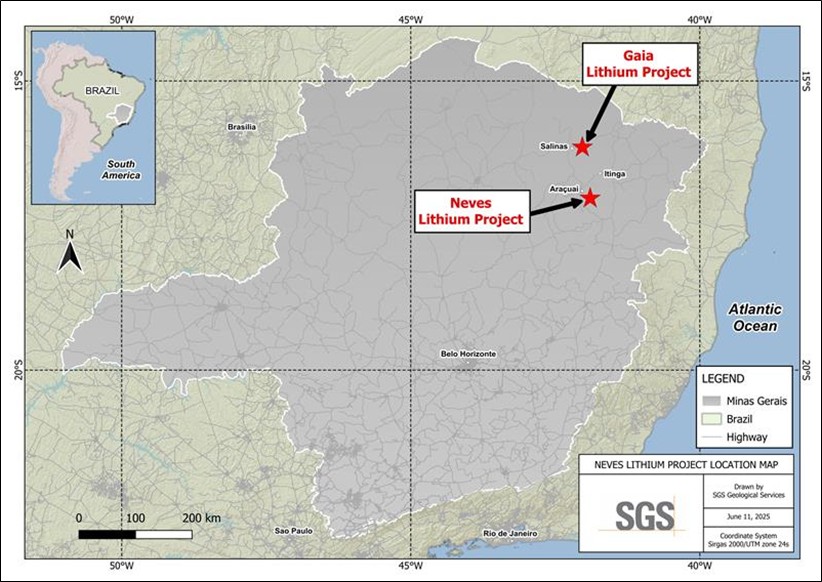
Both
Projects are located in the prospective Jequitinhonha Valley region, also called the “Lithium Valley” due to the presence
of large lithium deposits associated with pegmatites that are currently being developed by other companies. The location of the Projects
is shown in Figure 1-1.
|
| SGS Geological Services |
| S-K 1300 Technical Report – FS Neves Lithium Project – Minas Gerais, Brazil | Page 3 |
| | |
Figure
1-1 Location Map
|
| SGS Geological Services |
| S-K 1300 Technical Report – FS Neves Lithium Project – Minas Gerais, Brazil | Page 4 |
| | |
The
Projects are located in the “Lithium Valley” which is known to have several other lithium exploration projects and mines.
The Projects are predominantly located within the Eastern Brazilian Pegmatite Province, which was surveyed by the Geological Survey of
Brazil (SGB) in 2010. There is no record of any further historical exploration within the Project areas, however, the Neves area has
historical artisanal mine workings. The Neves exploration area was developed for the extraction of tourmaline and other gems, including
spodumene, petalite, beryl, and columbite-tantalite. The historical artisanal mines at Neves are currently inactive.
| 1.4 | Geology
and Mineralization |
The
Projects’ regional geology is dominated by the Araçuaí orogen, comprised of a suite of late Neoproterozoic to Cambrian
deformed metasedimentary rocks and granitic batholiths overlain by Mesozoic volcanics of the Serra Do Tombo Formation and Cenozoic detrital
sediments.
Approximately
one third of the exposed terrain of the Araçuaí orogen is composed of granitic rocks that reflect a succession of tectonic
events spanning 50 million years (630 Ma to 480 Ma) (Pedrosa-Soares et al., 2011) and forms the immense and prolific Eastern Brazilian
Pegmatite Province (EBPP), which is almost entirely situated in eastern Minas Gerais. Thousands of granitic pegmatites have been discovered
in the EBPP which host a variety of gem, tin (Sn), lithium (Li), tantalum (Ta), niobium (Nb), and uranium (U) deposits (Pedrosa-Soares
et al., 2011). The pegmatites were differentiated from G4 magmas of the Araçuaí orogen and are highly evolved products
of granitic plutonism (Morteani et al., 2000, Pedrosa-Soares et al., 2011, Paes et al., 2016).
In
eastern Minas Gerais, lithium rich pegmatite mineralization is hosted in metamorphosed Salinas Formation shales (quartz-biotite schist)
and is either concordant or discordant with schist foliation. The pegmatites occur as tabular bodies with thicknesses from several meters
to more than 50 meters. Laterally, mineralized bodies vary from tens of meters up to one kilometer in length and are primarily made of
quartz, alkali (K-) feldspar (perthitic microcline), albite, muscovite, spodumene, and petalite. Spodumene makes up approximately 20%
of the mineralization, with K-feldspar and albite constituting approximately 35%, quartz approximately 35%, and muscovite less than 10%.
The
exploration areas are covered by a thick (up to five meter) horizon of sandy to silty soil, brownish ochre in color, with blocks (<30
cm) of pegmatites from adjacent mines or displaced by heavy rainfall and steep relief.
The
Neves area is heavily vegetated which makes it difficult to identify outcrop, however, historical artisanal mining activity has exposed
the deposits. For decades, the Neves exploration area has been developed for tourmaline resources and gems (spodumene, triphane, petalite,
columbite-tantalite) at some farms within the mineral right. The artisanal mines are inactive today. Tailings from these mines were disposed
of in piles or “dumps” scattered throughout the area, and in some places complicating access to outcrop.
Cordierite-quartz-mica-feldspar
schists of the Salinas Formation outcropping in the Neves exploration area are light gray to black in color, banded, foliated and occasionally
with quartzitic composition. Occasionally, the schists also contain small quantities of graphite. The banding reflects variations in
the proportions of biotite to muscovite (dark bands) and the sum of quartz and feldspar (light bands). These metamorphic rocks are in
the green schist facies with foliations perpendicular to the strike which varies between N30°E and N50°E. High angle dips (45°-80°)
have been observed in contact with intrusive igneous rocks. Syn-tectonic quartz veins are concordant with the schist foliation, exhibit
local boudinage structure, and are one centimeter to 30 cm thick. The Salinas Formation schists host significant pegmatite bodies, ranging
from one to two meters thick to 10 m to 30 m thick and up to 40 m to 350 m long.
Mineralized
pegmatite outcrops have been mapped in the northwest portion of the Neves exploration property that are 2 to 29 meters thick and up to
350 m long where exposed at surface. The strike of the pegmatites is predominantly sub-parallel to oblique to schist foliation, locally
homogeneous, and composed of quartz, feldspar, muscovite, black tourmaline, and locally spodumene and petalite. The spodumene and petalite
occurs as altered white clay at surface and as phenocrysts disseminated throughout the host rock.
|
| SGS Geological Services |
| S-K 1300 Technical Report – FS Neves Lithium Project – Minas Gerais, Brazil | Page 5 |
| | |
In
the eastern portion of the property, several pegmatite bodies outcrop along the main drainages in schists of the Salinas Formation. At
least 10 pegmatite bodies were delineated with dimensions varying from 2 m to 36 m thick and from 40 m to 450 m long. The pegmatites
follow a strike trend of N5°E to N30°E and are concordant with schist foliation.
The
lithium bearing pegmatites of Araçuaí-Itinga were formed from residual melts associated with post-collisional granitic
plutonism and G4 magmas.
| 1.5 | Exploration
and Drilling |
Exploration
on the Neves property consists of a photogrammetric survey, planimetric survey, Geocloud Sentinel II satellite imagery, two drone LiDAR
surveys with orthophoto and Geocloud interpretation, a drone magnetic survey, a drone radiometric survey, detailed geological mapping
based on the aforementioned surveys, rock sampling, including handheld XRF and K/Rb studies on micas and feldspars and drill core, soil
sampling across the property, magnetic susceptibility readings on drill core and outcrops and trenching programs.
Atlas
has conducted several drilling campaigns on the project since 2021. This drilling has concentrated primarily on the known pegmatites
located within the Neves tenements, specifically mining rights 832925/2008, 833331/2006, and 833356/2007. To the 10th June
2025, a total of 536 exploration holes (RC and DD holes) for 100,403 m of drilling were completed.
Exploration
on the Gaia property consists of surface mapping, soil geochemistry and initial diamond drilling. To the 10th June 2025, Atlas
had drilled six surface holes on the Gaia property for 501 meters of core.
| 1.6 | Mineral
Processing and Metallurgical Testing |
In
2023, Atlas Lithium sent to SGS Lakefield laboratory a composite sample collected from Anitta 1 pit to explore the feasibility of recovering
lithium into a concentrate through dense media separation (DMS) and flotation. The testwork included a mineralogy study with semi-quantitative
XRD analysis, a comminution test, heavy liquid separation (HLS) tests with two crush sizes, a DMS pilot test employing two stage DMS
cyclone separation, magnetic separation on DMS concentrate, and flotation tests performed on the DMS middling and the minus 0.85 mm material.
Based on the mineralogical analysis on the test sample, the lithium mainly occurs in the form of spodumene and petalite, with the majority
of lithium present in spodumene.
Both
the HLS and DMS tests indicated that this material is amenable to dense media separation to recover the spodumene, and a spodumene concentrate
with a 5.5% or higher lithium oxide grade typically being obtained. The DMS tests were conducted at crush sizes of 12.5 mm and 9.5 mm.
Due to better liberation, the lithium recovery of the 9.5 mm crush size material was higher than that of the 12.5 mm crush size material
in the tests. Since the majority of material tested will report to DMS float (reject) product, to enhance the DMS efficiency, two stages
of DMS were employed. The concentrate of the first stage DMS will be further treated in the secondary DMS stage. Based on the DMS tests
and a METSIM simulation, approximately 61.7% of the lithium can be recovered to DMS concentrates assaying 5.5% lithium oxide after two
stages of DMS treatment. In addition, the tests also indicated that magnetic separation can further improve the concentrate lithium grade
by eliminating iron bearing and mica material.
|
| SGS Geological Services |
| S-K 1300 Technical Report – FS Neves Lithium Project – Minas Gerais, Brazil | Page 6 |
| | |
The
flotation tests conducted on the minus 0.85 mm material and ground DMS middling indicated that at least 50% of lithium in these two streams
can be recovered to the flotation concentrate. Alternatively, the DMS middling can also be further re-crushed and then subjected to the
DMS process again. Based on HLS tests conducted on the re-crushed DMS middlings (crush size of 3.3 mm, SG between 2.7 and 2.8), approximately
60% of lithium in the middling can be recovered to the final concentrate.
Based
on the 2023 SGS Lakefield testwork and industry standard practices, the following key process parameters and design information were
utilized in the process design of Atlas Lithium Neves Project, as summarized below.
| ● | Crush
size of DMS feed will be controlled at 9.5 mm and minus 0.85 mm material will be discarded
before the DMS circuit. |
| ● | Two
stages of DMS in a rougher and cleaner configuration will be utilized in the process design,
with the concentrate from the first stage DMS being treated at the secondary DMS circuit. |
| ● | The
dense media used will be 100% ferrosilicon, having a SG around 6.8 and a P80 of minus 45
microns. |
Between
July 2023 and early 2025, to investigate the ore variability in the deposit, a series of additional samples from the project site were
collected and sent to SGS Geosol laboratory in Brazil for chemical composition analysis and HLS tests. The samples as collected cover
the region of Anitta 1, Anitta 2, Anitta 3, Anitta 2.5 and Anitta 4 pits. All samples were crushed to 9.5 mm with minus 0.85 mm material
removed before being subjected to HLS tests. A relatively large variation between individual samples was observed from the HLS tests;
however, on average all samples are considered amenable to the heavy media separation process.
To
estimate the lithium recovery from different pits, a proprietary SGS DMS model was run on the averaged HLS data from each of the pits.
The samples from Anitta 1, Anitta 2 and Anitta 3 pits have very similar lithium recovery, in the range of 60.5% to 62%, while the samples
from Anitta 2.5 and Anitta 4 have significantly higher lithium recoveries close to 70%. This can be explained by the large spodumene
crystals as observed from the SGS’s QP site visit to the project site.
The
minus 0.85 mm material collected from SGS Geosol tests was sent to PESCO laboratory for sedimentation and filtration tests, Due to the
coarse particle size, the material is very easy to settle and filter; however, these characteristics also create a very high yield stress
in the thickened slurry, which may pose operational challenges in the thickener in the future. Alternatively, the minus 0.85 mm material
can be dewatered directly by a vacuum belt filter.
From
the test work and site visit, some opportunities to further improve the lithium recovery have been identified below.
| ● | At
both the mine site and Atlas Lithium core shack facility, quite large spodumene crystals
were observed. According to Atlas Lithium geologists, most of spodumene in this project occurs
in this level of large crystals. In this case, a larger crush size and DMS middlings re-crush
are expected to further improve the lithium recovery, due to the minimization of lithium
loss to the minus 0.85 mm material. |
| ● | The
flotation tests conducted on the DMS middlings and the minus 0.85 mm material indicated at
least 50% of the lithium can be recovered to a concentrate meeting the 5.5% lithium oxide
grade specification. |
| ● | Some
micaceous materials were observed during the site visit, which can impact the final concentrate
grade as DMS is not efficient in removing this type of material. If problems arise in a future
operation, a reflux classifier or magnetic separator is recommended to further remove the
impurities contained in the heavy media concentrate. |
| ● | Opportunity
for a recrushing route. |
|
| SGS Geological Services |
| S-K 1300 Technical Report – FS Neves Lithium Project – Minas Gerais, Brazil | Page 7 |
| | |
| 1.7 | Mineral
Resource Estimates |
Mineral
resources have been estimated for six discrete pegmatite occurrences of the Neves Project in the northwestern portion of the tenements,
namely the Anitta 1, Anitta 2, Anitta 2.5, Anitta 3, Anitta 3 North and Anitta 4 deposits.
Mineral
Resources for the Neves Project were estimated using a computerized resource block model. Three-dimensional wireframe solids of the mineralization
were defined using drill hole Li2O analytical data.
Data
were composited to 1 m composite lengths, based on the width of the block size defined for the resource block model. Compositing starts
at the identified mineralized contact. No capping was applied on the analytical composite data.
The
Mineral Resource Estimates (MREs) were calculated using an inverse distance weighting to the second power (ID2) methodology.
The interpolation process was conducted using three successive passes with more inclusive search conditions from the first pass to the
next until most blocks were interpolated.
The
estimates and models were validated by statistically comparing block model grades to the assay and composite grades, and by comparing
block values to the composite values located inside the interpolated blocks. The estimates were considered reasonable.
Mineral
Resources are classified into Measured, Indicated and Inferred categories. The Mineral Resource classification is based on the density
of analytical information, the grade variability and spatial continuity of mineralization.
Conceptual
economic parameters were used to assess the reasonable prospects of eventual economic extraction. A series of economic parameters were
estimated to represent the production cost and economic prospectivity of an open pit mining operation in Brazil and came either from
SGS Canada or Atlas. These parameters are believed to be sufficient to include all block models in future open pit mine planning, due
mostly to the relatively low mining costs in Brazil.
The
combined Mineral Resource Estimate for the Neves Project is reported in Table 1-1, while the individual MREs for the different pegmatites
are reported in Table 1-2 to Table 1-7 using a 0.3% Li2O cut-off. The Mineral Resource Estimates are constrained by the topography
and are based on the conceptual economic parameters.
Mineral
Resources are reported exclusive of Mineral Reserves
The
estimate has an effective date of the 15th May 2025.
|
| SGS Geological Services |
| S-K 1300 Technical Report – FS Neves Lithium Project – Minas Gerais, Brazil | Page 8 |
| | |
Table
1-1 Combined Neves Deposit In-Pit Mineral Resource Estimate
0.3%
Li2O Cut-Off 15th May 2025
Cut-off
Grade
Li2O
(%) |
Category |
Tonnage
(t) |
Average
Grade Li2O
(%) |
LCE
(Kt) |
| 0.3 |
Measured |
1,249,000
|
1.00 |
30.9 |
| 0.3 |
Indicated |
- |
- |
- |
| 0.3 |
Measured
+ Indicated |
1,249,000 |
1.00 |
30.9 |
| 0.3 |
Inferred |
149,000 |
0.81 |
3.0 |
Table
1-2 Anitta 1 In-Pit Mineral Resource Estimate 14th May 2025
Cut-off
Grade
Li2O
(%) |
Category |
Tonnage
(t) |
Average
Grade Li2O
(%) |
LCE
(Kt) |
| 0.3 |
Measured |
740,000 |
0.90 |
16.5 |
| 0.3 |
Indicated |
- |
- |
- |
| 0.3 |
Measured
+ Indicated |
740,000 |
0.90 |
16.5 |
| 0.3 |
Inferred |
- |
- |
- |
Table
1-3 Anitta 2 In-Pit Mineral Resource Estimate 15th May 2025
Cut-off
Grade
Li2O
(%) |
Category |
Tonnage
(t) |
Average
Grade Li2O
(%) |
LCE
(Kt) |
| 0.3 |
Measured |
22,000 |
1.06 |
0.6 |
| 0.3 |
Indicated |
- |
- |
- |
| 0.3 |
Measured
+ Indicated |
22,000 |
1.06 |
0.6 |
| 0.3 |
Inferred |
- |
- |
- |
|
| SGS Geological Services |
| S-K 1300 Technical Report – FS Neves Lithium Project – Minas Gerais, Brazil | Page 9 |
| | |
Table
1-4 Anitta 2.5 In-Pit Mineral Resource Estimate 15th May 2025
Cut-off
Grade
Li2O
(%) |
Category |
Tonnage
(t) |
Average
Grade Li2O
(%) |
LCE
(Kt) |
| 0.3 |
Measured |
23,000 |
1.99 |
1.1 |
| 0.3 |
Indicated |
- |
- |
- |
| 0.3 |
Measured
+ Indicated |
23,000 |
1.99 |
1.1 |
| 0.3 |
Inferred |
- |
- |
- |
Table
1-5 Anitta 3 In-Pit Mineral Resource Estimate 15th May 2025
Cut-off
Grade
Li2O
(%) |
Category |
Tonnage
(t) |
Average
Grade Li2O
(%) |
LCE
(Kt) |
| 0.3 |
Measured |
166,000 |
0.90 |
3.7 |
| 0.3 |
Indicated |
- |
- |
- |
| 0.3 |
Measured
+ Indicated |
166,000 |
0.90 |
3.7 |
| 0.3 |
Inferred |
-- |
- |
- |
Table
1-6 Anitta 3N In-Pit Mineral Resource Estimate 15th May 2025
Cut-off
Grade
Li2O
(%) |
Category |
Tonnage
(t) |
Average
Grade Li2O
(%) |
LCE
(Kt) |
| 0.3 |
Measured |
- |
- |
- |
| 0.3 |
Indicated |
- |
- |
- |
| 0.3 |
Measured
+ Indicated |
- |
- |
- |
| 0.3 |
Inferred |
104,000 |
0.73 |
1.9 |
|
| SGS Geological Services |
| S-K 1300 Technical Report – FS Neves Lithium Project – Minas Gerais, Brazil | Page 10 |
| | |
Table
1-7 Anitta 4 In-Pit Mineral Resource Estimate 15th May 2025
Cut-off
Grade
Li2O
(%) |
Category |
Tonnage
(t) |
Average
Grade Li2O
(%) |
LCE
(Kt) |
| 0.3 |
Measured |
298,000 |
1.23 |
9.1 |
| 0.3 |
Indicated |
- |
- |
- |
| 0.3 |
Measured
+ Indicated |
298,000 |
1.23 |
9.1 |
| 0.3 |
Inferred |
45,000 |
1.01 |
1.1 |
Notes
to accompany Mineral Resource tables:
| 1. | Mineral
Resources have an effective date of the 15th May, 2025 and have been classified
using the S-K 1300 Definitions |
| 2. | All
Resources are presented undiluted and in situ, constrained by continuous 3D wireframe
models, and are considered to have reasonable prospects for eventual economic extraction. |
| 3. | Mineral
Resources are reported assuming open pit mining methods, and the following assumptions: lithium
concentrate (5.5% Li2O) price of US$1,700/t, mining costs of US$2.60/t for mineralization
and waste, crushing and processing costs of US$27.71/t, general and administrative (G&A)
costs of US$1.93/t, concentrate recovery of 61.7%, pit slope angles of 60º, and an overall
cut-off grade of 0.3% Li2O. |
| 4. | Tonnages
and grades have been rounded in accordance with reporting guidelines. Totals may not sum
due to rounding. |
| 5. | Mineral
Resources are reported exclusive of Mineral Reserves. |
| 6. | Mineral
resources which are not mineral reserves do not have demonstrated economic viability. An
Inferred Mineral Resource has a lower level of confidence than that applying to a Measured
and Indicated Mineral Resource and must not be converted to a Mineral Reserve. It is reasonably
expected that the majority of Inferred Mineral Resources could be upgraded to Indicated Mineral
Resources with continued exploration. |
| 7. | The
results from the pit optimization are used solely for the purpose of testing the “reasonable
prospects for economic extraction” by an open pit and do not represent an attempt to
estimate mineral reserves. The results are used as a guide to assist in the preparation of
a Mineral Resource statement and to select an appropriate resource reporting cut-off grade. |
| 8. | The
estimate of Mineral Resources may be materially affected by environmental, permitting, legal,
title, taxation, socio-political, marketing, or other relevant issues. |
There
are no current resources on the Gaia project.
| 1.8 | Mineral
Reserves Estimates |
The
Mineral Reserve estimate in this report adheres to S-K 1300 definitions, which are consistent with CIM (2014) definitions, and includes
only Measured and Indicated Mineral Resources, excluding Inferred Mineral Resources. These Reserves are representative of the economically
extractable tonnage and grade of ore, factoring in considerations such as ore dilution and potential losses during mining or extraction.
Table
1-8 Economic Parameters
| Sales |
| Price
[email protected]% ($/t) |
1,700 |
| Operating
Costs |
| Process
$/t ROM |
27.71 |
| G&A
$/t ROM |
1.93 |
| Mine
$/t |
2.60 |
| Rates |
| Discount
rate |
10% |
|
| SGS Geological Services |
| S-K 1300 Technical Report – FS Neves Lithium Project – Minas Gerais, Brazil | Page 11 |
| | |
Table
1-9 Total Atlas Open Pit Mineral Reserve
| Pit |
Classification |
Tonnes
(t) |
Volume
(m3) |
Li2O
(%) |
Li2O_Dil
(%) |
Concentrate
(t) |
| Anitta
2.0 |
Proven |
2,052,786 |
844,768 |
1.202 |
1.142 |
263,048.36 |
| Anitta
2.5 |
Proven |
800,935 |
329,603 |
1.465 |
1.392 |
125,079.57 |
| Anitta
3.0 |
Proven |
4,399,081 |
1,629,289 |
1.201 |
1.141 |
562,863.39 |
| All
Pits |
Proven |
7,252,802 |
2,803,660 |
1.230 |
1.169 |
950,991.32 |
Notes:
| 1. | S-K
1300 definitions were followed, which are consistent with CIM (2014) definitions. |
| 2. | The
effective date of the estimate is May 15th, 2025. |
| 3. | Mineral
Reserves are estimated using the following long-term metal prices (Li2O Conc =
USD 1,700/t Li2O at 5.5% Li2O) and an exchange rate of 6.00 Reais (BRL)
to US$. |
| 4. | A
minimum mining width of 5 m was used. |
| 5. | A
cut-off grade of 0.3% Li2O as defined by SGS was used. |
| 6. | The
bulk density of ore is variable, outlined in the geological block model, and averages 2.77
t/m³. |
| 7. | The
average strip ratio is 16.72. |
| 8. | The
average mining dilution factor is 5% |
| 9. | Overall
Metallurgical recovery is 61.7% |
| 10. | Mineral
Reserves are 100% attributable to Atlas |
| 11. | Numbers
may not add due to rounding. |
The
SGS QP is not aware of any known mining, metallurgical, infrastructure, permitting, and / or other relevant factors that could materially
affect the stated Mineral Reserve estimates.
The
Mineral Reserve considers modifying factors - a variety of considerations, including but not limited to, mining, processing, metallurgical,
infrastructure, economic, marketing, legal, environmental, social, and governmental factors - used to convert Mineral Resources to Mineral
Reserves. This demonstrates that extraction could reasonably be justified, as of the reporting time.
SGS
developed a regularized block model in Genesis. The block dimensions of 5 m x 5 m x 5 m were chosen to accurately represent the selective
mining unit size, considering the loading units. The weighted mass average method was used for density and Li2O grade computations,
and domain and class assessments were based on the largest volume value.
The
open pit’s optimal economic shape was determined by applying the PseudoFlow algorithm on the MinePlan Economic Planner (MPEP) tool.
The design of the open pit, including the pit slopes, was guided by the ITAACU Final Geotechnical Assessment Report for the Final Pit
Neves Project (Anitta 2, 2.5, and 3 Pits) (ITAACU, March 2025).
Using
MPEP, Prominas Mining generated both constrained and unconstrained pit shells for Measured and Indicated Mineral Resource categories
at various lithium prices. Constraints were based on the open pit footprint defined by the optimized pit shell. There were no project
permitting constraints; the optimized constrained pit shell was selected for the Reserve estimate.
For
the dilution and mining recovery, a 5% ore dilution and a 95% mining recovery were assumed. The dilution accounts for waste material
unintentionally incorporated into the ore during mining, while the recovery reflects ore losses during extraction and transport. These
values were considered constant throughout the mine’s life to support simplified financial modeling and were based on historical
data from comparable operations and industry best practices. The 5% dilution is considered technically feasible, given the geometry of
the ore bodies and the operational routines to be implemented.
|
| SGS Geological Services |
| S-K 1300 Technical Report – FS Neves Lithium Project – Minas Gerais, Brazil | Page 12 |
| | |
The
project consists of 3 proposed pits that will be mined with a conventional truck and shovel open pit operation. Mineralized rock and
waste would be drilled, blasted, loaded by hydraulic shovels and hydraulic excavators into off-highway dump trucks, and hauled to the
processing plant and waste dump.
The
basis for the pit design work was the Mineral Resource block model that was developed by SGS pursuant to §§ 229.1300 through
229.1305 (subpart 229.1300 of Regulation S-K), for the MRE (refer to Section 11).
There
is one primary deposit currently under consideration. Due to the nature of the deposit, the resultant pits are shallow with Anitta 2
and 2.5 being the deepest at 228 m below surface. Currently in pit waste dumping/ backfilling is not contemplated due to the pit scheduling
with the pits being mined simultaneously and the nature of the deposit where grade and dilution control was considered.
The
proposed mining method is the development of a slot in front of the mineralized zone at each level. The centralized slot will enable
waste mining on one side while mining mineralized material on the other side. This methodology will also facilitate separating mineralized
material from the waste material.
The
target ROM feed to the processing plant is 1,200,000 MTPY. The annual plant production is assumed at 150,000 tonnes of spodumene concentrate.
Mineralized low-grade material can be sent to a stockpile so it could be processed at a later stage if economics allow.
The
combined Life of Mine of the three pits is approximately 8 years, including pre-production.
Three-dimensional
(3D) geologically controlled wireframe models representing the selected mineralized zones were constructed using SGS proprietary modelling
software Genesis™. Mineralized intercepts were created from the drill hole data using minimum cut-off grades but mostly focussing
on pegmatite occurrences (from lithology records), with each zone of mineralization having its own unique identifier or tag. The Genesis™
software was then used to create a planar envelope (wireframe) for each zone by interpolating the mineralized intercepts. The overall
dimensions of the planar envelopes were constrained based on the properties set, including smoothing, resolution, margins, and overall
thickness front and back.
In
order to determine the quantities of material offering “reasonable prospects for eventual economic extraction” by an open
pit, optimization from MinePlan (Hexagon) software and reasonable mining and processing assumptions to evaluate the proportions of the
block model that could be “reasonably expected” to be mined from an open pit are used. The pit optimization for the Neves
Project was completed by Prominas for the current MRE and the pit optimization parameters used are summarized in Table 12-1. Pit shells
at a revenue factor of 1.0 (i.e. 100 % of base case metal prices) were selected as the ultimate pit shells for the purposes of reporting
the Neves Project MRE. A selected base case cut-off grade of 0.3 % Li2O is used to determine the in-pit MRE for the Neves
Project deposit.
The
pit shells selected as the templates for the pit designs are described in Section 12.3 for the scheduling with the resultant tonnages.
As per standard practice in mine design, the pit shells are used as templates to guide the pit design process.
The
initial step was to design a pit shell without ramps to determine how closely the design could be matched to the optimized pit shell
while applying batter angles and berm widths. MinePlan adds blocks to the pit until the maximum value is reached without consideration
for the practicality of mining the resultant pit. This results in drop-cuts of single blocks or small groups of blocks into the pit floor.
Consequently, in a narrow deposit such as Neves, it is practical to design a pit as deep as the pit shell as the pit bottom becomes narrower
to deploy equipment using the minimum mining width where both excavator and the truck can maneuver safely. Removing these drop-cuts results
in a more practical layout.
These
initial designs were then reviewed to determine the number and location of ramps to ensure access for all operating benches. With the
inclusion of the ramp system, the overall highwall slopes is approximately 57° at the Anitta 3 southwest wall, 53.8° at the Anitta
2.5 northeast wall, and 47.4° in the upper weathered portion of the west wall of Anitta 2.5.
|
| SGS Geological Services |
| S-K 1300 Technical Report – FS Neves Lithium Project – Minas Gerais, Brazil | Page 13 |
| | |
Dominated
by equatorial and tropical climates, northern and central Brazil receives frequent rainfall and experiences higher temperatures. Meanwhile,
southern Brazil is characterized by a humid subtropical climate. Notably, northeast Brazil exhibits a semi-arid climate, receiving less
than 700 mm per year of rain. Therefore, no serious dewatering issues are expected. However, minimal pumping capacity has been allowed
for water ingress due to rainfall, and will be managed with berms and cut-off drains.
Separate
sets of mining equipment are envisaged for waste mining and ROM production. The production schedule was developed using MinePlan Schedule
Optimizer (MPSO), Hexagon scheduling tool.
A
5m x 5m grid was created for each area such that the block orientation is approximately aligned with the general strike of the deposit.
This grid was then used to reserve the mining model within the design pit to create input files for the pit scheduler.
Haulage
reference points were defined at the entrance to the ramp on each level, and where the ramp reaches surface. In-pit haul distances, both
on bench and on ramp were manually calculated with string creation for the haulage profiles and registered to the haul surfaces and measurement
for the lines done in Hexagon. The on-bench distances were calculated for each block as the sum of the Northing and Easting distance
to the applicable reference point. The on-ramp distance is the vertical height from the reference point to the ramp exit multiplied by
the ramp gradient of 1:10.
Resultant
schedules were then exported as .CSV files and used as input to the economic model.
| 1.10 | Project
Infrastructure |
| 1.10.1 | On-Site
Infrastructure |
The
Project operations will include the following facilities:
| ● | Open
pit mine |
| ● | Crushed
ore stockpile |
| ● | Process
plant (crushing & reclaim, dense medium separation (DMS) building) |
| ● | Dry
stack system (thickener and filtration) |
| ● | Spodumene
concentrate storage facility |
| ● | Fine
and coarse tailing stockpiles |
| ● | Waste
rock and tailings storage facilities (WRTSF) |
| ● | Overburden
and peat storage facility (OPSF) |
| ● | Water
management ponds (WMP) and a plant water management pond |
| ● | Run-of-Mine
(ROM) pad |
| ● | Contact
water ditches and non-contact diversion water ditches |
The
tailings stockpile and spodumene concentrate will be located adjacent to the process plant.
All
storage areas were selected to minimize their environmental impacts. A surface drainage network will be built to divert non-contact water
from the ROM pad and stockpile, WRTSF, OPSF, stockpiles, and process plant. A similar drainage network will be used to manage the surface
water run-off (contact water) for all disturbed land.
|
| SGS Geological Services |
| S-K 1300 Technical Report – FS Neves Lithium Project – Minas Gerais, Brazil | Page 14 |
| | |
The
basic design for the waste dump piles PDER-1 and PDE-2 was completed by DF+ Engenharia (“DF+”) as part of the Neves Project
adhering to the current national standards and engineering best practices with all the data provided by Atlas. A document NEV-B-MD-215-DFM-F-0002-A
was completed and was reviewed by SGS Mining Engineers. The document with a summary report provided the organization and the data, which
will serve as the foundation for pile design development. The report addresses the project results of geological, geotechnical, and hydrological/hydraulic
studies, with the objective of presenting the piles to be implemented in the Neves Project. For the design of the future PDER-1 and PDE-2,
a “wedding cake” type geometry is planned, with PDER-1 being implemented in three phases and PDE-2 in two. The designs of
both structures were designed by DF+ in 2025 as part of the Basic Project for these stacks.
For
the phase I of PDER-1 will be developed to ensure a satisfactory Factor of Safety (FS) considering the new test results, benches with
a height of 20 meters, berm widths of 10 meters, and slope face angles of 37.6° (1V:1.3H) were designed for this stage, resulting
in an expected waste disposal volume of 13.9 million cubic meters.
For
Phase II, DF+ maintained the same configurations for bench heights, berm widths, and slope face angles as in Phase I, expanding towards
the southern boundaries of the area. In this scenario, the stacking of Phase II over Phase I will result in an additional volume of 9.8
million cubic meters, leading to a total waste disposal volume (Phase I + Phase II) of 23.7 million cubic meters.
For
PDE-2, the geometric design of Phases I and II was developed by DF+ throughout 2025. For Phase I, benches were designed with a height
of 20 meters, berm widths of 10 meters, and slope face angles of 34° (1V:1.5H), not exceeding four benches at the highest section
(approximately 80 meters total). For this phase, the pile will have a capacity to accommodate 4.4 million cubic meters of waste.
In
addition, the following infrastructure facilities are planned for the Project:
| ● | Generator
Set substation |
| ● | Laboratory
building |
| ● | Workshop
and reagent buildings within DMS Building |
| ● | Diesel
storage and distribution facility |
| ● | Mine
Service Center including a Truck-shop and wash-bay |
| ● | Dome
warehouse for the storage of critical parts |
| ● | Mine
Dry |
| ● | Explosives
Storage |
| ● | Water
treatment plant (effluent) |
| ● | Potable
water treatment plant |
| ● | Sewage
treatment plant |
| ● | Communications |
Operational
personnel will be housed off-site.
The
process plant and supporting infrastructure will be powered by generating sets and a 13.8 kV overhead distribution system. The 13.8 kV
transmission line is relayed to a Diesel Generator Substation to be located at the process plant area.
All
essential power loads will be supported with power supply available from the diesel generators at the mine support services area. Suitable
diesel storage, unloading, and distribution facilities will be installed to provide an uninterrupted diesel fuel supply to the operations
and maintenance fleet and equipment.
The
main source of raw water for the Neves Project will be supplied from eight (8) boreholes currently licensed by Atlas. The water system
is explained in detail in Section 15.4. The 8 wells can deliver a total of 50 m3/hour, which is enough to continuously supply
the processing requirement of 23 m3/hour and the site water requirements.
Additionally,
communication facilities will need to be developed as the site is not currently serviced by cellular data or fiber optics.
|
| SGS Geological Services |
| S-K 1300 Technical Report – FS Neves Lithium Project – Minas Gerais, Brazil | Page 15 |
| | |
| 1.10.2 | Off-Site
Infrastructure |
The
spodumene concentrate will be transported to Ilhéus Port, BA via a Transshipment (transfer facility) planned to be located 34
km from the process plant. The concentrate will be transported by mining trucks to a stockpile at the transfer facility and will be loaded
into B-trains.
| 1.10.2.2 | Concentrate
Shipment to Port |
Access
to the port is available through well-paved (federal or state highways) from the Transhipment facility to Ilhéus Port, BA. A second
alternative is available via Vitória Port, ES.
The
following are the proposed Access Routes to Ilhéus Port, BA:
| ● | The
first preferred route is on BR-367 to the junction with BR-116 (74 km), BR-116 to the junction
with BA-634/BR-415 (181 km), and 296 km BA-634 and BR-415 to the Port of Ilhéus. Total
distance of 551 km. |
| ● | Truck
route first traverse LMG-678 to BR-242/BR-367 (8.8 km) in Aeroporto, Araçuaí
followed by BR-367 to Av.Olindo de Miranda in Almenara (186 km) then LMG-634 and R. Hipolito
Sousa to BA-638 (67.3 km). The haul route continues via BA-638, BA-130, and BR-415 to R.
Rotary in Ilhéus (254 km). Route continues to R. Rotary-R. Tobias Barreto in Cidade
Nova (650 m). Total route distance is 516 km. |
| ● | For
the next option, the total haul route distance from the Transshipment area to the port is
556 km. The first leg is LMG-678 to BR-342/BR-367 in Aeroporto, Araçuaí (8.8
km). Next leg follows BR-367 and BR-116 to Veredinha (253 km). Finally, the final leg BA-639,
BA-634 and BR-415 to R. Tobias Baretto in Cidade Nova, Ilhéus (294 km). |
Lithium
market information used in this report is gathered from a variety of sources, including industry studies, public commodity forecasts
and trailing average prices of spodumene SC5.5 concentrate. The information presented here is current as of the 1st quarter
of 2025. All pricing in this section is in US dollars.
Pricing
forecasts show long term spodumene prices climbing slightly for the next several years, then stabilizing. The conservative pricing used
for this study is set at USD$1,700 per tonne of SC5.5% concentrate.
| 1.12 | Environmental
Studies, Permitting, and Social or Community Impact |
| 1.12.1 | Environmental
Licensing |
The
environmental licensing process in Minas Gerais is carried out in accordance with the normative deliberation of the State Council for
Environmental Policy (COPAM) No. 217, signed on December 6, 2017, and published on December 8, 2017. This resolution establishes the
criteria for classification, according to size and polluting potential, as well as the locational criteria to be used to define the modalities
of environmental licensing of enterprises and activities that use environmental resources in Minas Gerais, and other measures.
|
| SGS Geological Services |
| S-K 1300 Technical Report – FS Neves Lithium Project – Minas Gerais, Brazil | Page 16 |
| | |
Environmental
licensing in the form of Concurrent Environmental Licensing - LAC1, comprising the simultaneous obtaining of the Preliminary License
(LP), Installation License (LI) and Operating License (LO) from the Regional Management Directorate (DRG) of the State Environmental
Foundation of the State of Minas Gerais (FEAM-MG) through Administrative Process SLA No. 2102/2023 / SEI Process No. 1370.01.0037951/2023-04
/ Opinion No. 56/FEAM/GST/2024, being concluded with the granting of the Environmental License upon unanimous approval of the Chamber
of Mining Activities (CMI) of the State Council for Environmental Policy (Copam) of Minas Gerais at the 117th Ordinary Meeting held on
October 25, 2024, published in the Official Gazette of the State of Minas Gerais on October 26, 2024, valid for 10 (ten) years.
Atlas
Líthium Brazil continued to develop mineral research and diamond rotary drilling work with the aim of discovering new mineralized
pegmatite bodies, as well as to obtain a better understanding of the dimensions and volume of the Anitta Project deposit, so that it
gathered the technical conditions to consolidate the understanding of the area of Pit 1 and a new deposit in the area ANM Process 833.356/2007
sufficient for a Pit 2 area, implying the need to license an expansion of the Anitta Project 1.12.2 Authorizations.
The
water supply for the project comes from water collection permits from wells in accordance with the authorizations already obtained.
The
environmental authorizations and operating licenses presented in Table 17-5 refer to the project area in which Atlas Lítio Brasil
already has all the licenses and permissions to carry out the necessary interventions and installations of the pit, the pile and the
mineral treatment unit, as well as to start the mining and processing of pegmatites.
Expansion
of Anitta Project are subject to environmental licensing under the Concomitant Environmental Licensing modality - LAC1, comprising the
simultaneous obtaining of the Preliminary License (LP), Installation License (LI) and Operating License (LO) from the Regional Management
Directorate (DRG) of the State Environmental Foundation of the State of Minas Gerais (FEAM-MG) through Administrative Process SLA PA
No. 4709/2024 / formalized on 12/21/2024 through publication in the Official Gazette of the State of Minas Gerais and SEI process no.
2090.01.0001026/2025-05.
Table
1-10 provides the environmental, authorizations, and operations process related to the area of the expansion project.
|
| SGS Geological Services |
| S-K 1300 Technical Report – FS Neves Lithium Project – Minas Gerais, Brazil | Page 17 |
| | |
Table
1-10 Environmental, Authorizations, and Operations Process List
| |
|
Expansion
Anitta Project |
| Annex |
Environmental
License |
No. |
Description |
Status |
| Annex
8 |
Concomitant
Environmental License (LAC1) |
4709/2024 |
Preliminary
License (LP) + Installation License (LI) + Operating License (LO)
1)
Waste Pile - 17,61 ha
2)Road
for transporting ore/waste outside the limits of mining projects – 3,64 km
3)
Open Pit Mining - 1,500,000 t/year |
Process
in Analysis in the Environmental Agency |
| Annex
9 |
Authorization
for Environmental Intervention (AIA) |
2090.01.0031471/2024-68 |
Authorization
for Environmental Intervention - 64,48 ha
1)
Removal of Native Vegetation
2)
Intervention in Permanent Preservation Area (APP) |
Process
in Analysis in the Environmental Agency |
| Annex
10 |
Grant
1 - Exempt Use Crossing (Córrego São José) |
12.05.0000865.2024 |
Authorization
to cross a stream |
Granted |
| Annex
11 |
Grant
2 - Exempt Use Crossing (Córrego São José) |
12.05.0000866.2024 |
Authorization
to cross a stream |
Granted |
| Annex
12 |
Grant
3 - Exempt Use Crossing (Córrego São José) |
12.05.0000919.2024 |
Authorization
to cross a stream |
Granted |
|
| SGS Geological Services |
| S-K 1300 Technical Report – FS Neves Lithium Project – Minas Gerais, Brazil | Page 18 |
| | |
| 1.12.2 |
Reclamation and Mine Closure |
The
Conceptual Mine Closure Plan outlines activities aimed at minimizing impacts during the Project’s closure phase. Its primary goal
is to establish guidelines and corporate criteria for closure activities approved by the ANM and the Minas Gerais Department of Environment
and Sustainable Development (SEMAD). These activities ensure technical and financial conditions for mine closure, transitioning to post-closure
status, and determining future land use.
The
Atlas Mine Closure Plan for the Neves Project will incorporate final pile configurations with properly sloped sides to ensure the effective
execution of the closure strategy. The plan includes a meticulously designed drainage network to control surface water and promote vegetation
growth on slope faces. These measures mitigate the visual impact of mining activities and significantly reduce erosive effects.
The
rehabilitation and closure plan consists of three main stages:
| 1. | Decommissioning
planning |
| 2. | Execution
of decommissioning |
| 3. | Implementation
of the socio-environmental and geotechnical follow-up and monitoring actions of the post-closing.
Waste piles will be graded as needed, capped with a vegetation suppression layer and revegetated
with herbaceous-shrub species. A final protective cover can be placed over the pile to facilitate
revegetation and minimize erosion, at which point the sedimentation pond may be decommissioned.
A cap layer of soil will be placed and seeded on the open pit berm areas. A fence will be
built around the open pits, and all mine haul roads will be blocked off. |
The
Planned Measure Minimize Environmental Impact (Table 17-9) can be reviewed in Section 17.4.
| 1.12.3 | Community
Engagement and Government Relations |
The
Atlas’s Lithium Project was designated as a state priority by the Economic Development Group (GDE) of Minas Gerais State on June
6, 2023. The Neves Project priority status in internal state agency assessments aimed at expediting the licensing process for its implementation.
During
the development of the EIA studies for the Expansion of the Neves Project, prepared by WSP, the Area of Direct Influence (AID) for the
Socioeconomic Environment is composed of the locations surrounding the Area Directly Affected by the project, namely:
| ● | Nossa
Senhora das Neves; |
| ● | São
José das Neves; and |
| ● | Ribeirão
Calhauzinho das Neves |
The
locations most directly subject to the impacts of vehicle traffic along the access route to the project, given the concentration of residences
close to the road, are:
| ● | Aguada
Nova; and |
| ● | Ribeirão
Calhauzinho das Neves (already considered in the previous criterion). |
It
is worth noting that the Baixa Quente community, although not classified as an AID, will be the target of labor prioritization actions
and monitoring of socioeconomic indicators – the latter with the aim of verifying the potential impact of the arrival of the project
on changes in living conditions in the area, considering the network of socioeconomic relations with neighboring communities.
|
| SGS Geological Services |
| S-K 1300 Technical Report – FS Neves Lithium Project – Minas Gerais, Brazil | Page 19 |
| | |
It
is important to clarify that access for maintaining economic and social ties between Aguada Nova and Baixa Quente is completely different
from the route that will be used by the project, that is, the route and traffic between the communities are not affected in any way by
the Expansion of the Neves Project.
The
areas surrounding the project are sparsely populated, with little vehicular traffic. The villages are mainly concentrated along BR 367
and in the municipal district of Araçuaí, which has approximately 40,000 inhabitants. The main economic activities of the
region are subsistence agriculture and small livestock farming.
Atlas
maintains an open dialogue channel and close relationship with the communities surrounding the project and in the Municipality of Araçuaí
as a whole, having held regular consultation meetings with the communities directly affected by the project.
The
development of mining activities by Atlas in the Jequitinhonha Valley is viewed positively by the communities of Nossa Senhora das Neves,
São José das Neves, Calhauzinho and Aguada Nova as well as by the Municipal Government, being recognized as an important
economic driver in the region and an opportunity for employment and professional development.
In
support of relationships with the local community, Atlas signed a Memorandum of Understanding with the Municipality of Araçuaí
with the objective of establishing a partnership for improvements in infrastructure, health, education, access to water, among others.
In
this sense, actions are being developed in partnership with the Municipality of Araçuaí and other companies, with emphasis
on improving existing access roads, especially when compared to the conditions of the roads before the company’s activities, as
well as various actions to support the communities, based on knowledge of local needs.
In
general terms, the following actions are planned for the communities of Calhauzinho, São José das Neves, Neves and Aguada
Nova, among others, within the scope of the Neves Project as a whole. These actions are related to the implementation of small water
storage dams, improvements and graveling of roads, donation of machinery and equipment, construction of infrastructure, in addition to
support, donations and sponsorships. The community support program for implementation is presented in Table 17-8 in Section 17.
| 1.13 | Capital
and Operating Costs Estimates |
The
total capital costs to completion of the Project are estimated to be $71.7M (Net of credits 67.2M). Sustaining capital beyond project
commissioning is estimated at $26.6M (Net of tax credits $24.1M). Sunk costs of $30.0M were funded out of existing equity and are included
in the cash flow analysis. Total capital costs for the project are estimated at $98.3M ($91.3M Net of tax credits). No salvage value
is applied to the capital estimate.
The
overall capital cost estimate developed in this FS generally meets the American Association of Cost Engineers (“AACE”) Class
3 requirements. The capital cost estimate was compiled using a mix of quotations and budgetary quotations, database costs, and database
factors.
|
| SGS Geological Services |
| S-K 1300 Technical Report – FS Neves Lithium Project – Minas Gerais, Brazil | Page 20 |
| | |
Table
1-11 Capital Cost Summary (1)
| CBS
- Cost Breakdown Structure |
Sunk
Cost
($M) |
Estimate
to Complete
($M) |
Actual
Budget
($M) |
| Bins
& Conveyors |
2.99 |
|
2.99 |
| Buildings |
0.45 |
3.52 |
3.97 |
| DMS |
5.86 |
|
5.86 |
| Effluent |
2.93 |
|
2.93 |
| MV
Subs & Automation |
2.20 |
2.78 |
4.98 |
| Piping |
0.76 |
|
0.76 |
| Screens
- Prep & sizing |
1.64 |
|
1.64 |
| Spares |
1.35 |
0.05 |
1.40 |
| Steelwork
& Platework |
1.56 |
|
1.56 |
| Tanks |
0.64 |
|
0.64 |
| Taxes |
|
0.90 |
0.90 |
| Water
Supply |
0.03 |
0.85 |
0.88 |
| Weighbridge |
|
0.06 |
0.06 |
| Civils |
0.001 |
6.25 |
6.26 |
| Commissioning |
0.01 |
1.09 |
1.09 |
| Crushing
Area |
|
6.89 |
6.89 |
| Contract
Mining |
|
6.90 |
6.90 |
| Earth
works |
0.21 |
9.45 |
9.66 |
| Engineering |
2.86 |
0.80 |
3.66 |
| Generators |
|
1.34 |
1.34 |
| Installation |
|
12.15 |
12.15 |
| Owners
team OPS |
|
11.86 |
11.86 |
| Project
Developed |
3.66 |
|
3.66 |
| Shipping |
2.91 |
1.65 |
4.57 |
| Contingency |
|
4.84 |
4.84 |
| Insurance |
|
0.34 |
0.34 |
| Total |
30.04 |
71.73 |
101.78 |
(1)
Numbers may not add up due to rounding.
All
capital costs for the Project have been distributed against the development schedule to support the economic cash flow model.
The
operating cost estimate was based on budget quotations, first principle calculations with vendor support, and Atlas Lithium’s current
cost structure. The operating cost estimate is appropriate for a feasibility study. The target accuracy of the operating costs is ±15%.
No cost escalation or contingency has been included within the operating cost estimate.
|
| SGS Geological Services |
| S-K 1300 Technical Report – FS Neves Lithium Project – Minas Gerais, Brazil | Page 21 |
| | |
The
average operating cost over the LOM is estimated to be $64.06 per tonne mined. Total LOM and unit operating cost estimates are summarized
Table 1-12.
Table
1-12 Operating Cost Summary
| Item |
Total
Cost (USDM) |
Unit
Cost USD/t of SC5.5 |
Unit
Cost USD/t Ore |
| Mining |
274 |
288.0 |
37.8 |
| Crushing |
14 |
14.6 |
1.9 |
| DMS
Plant Cost |
88 |
92.4 |
12.1 |
| G&A |
49 |
51.6 |
6.8 |
| Freight
& Port Cost |
40 |
41.9 |
5.5 |
| Total |
464.6 |
488.5 |
64.1 |
The
economic assessment of the Project was carried out using a discounted cash flow approach on a pre-tax and after-tax basis, based on a
combination of trailing average prices and long term projections for spodumene concentrate in United States dollars and cost estimates
in the currency in which they are incurred. An exchange rate of BRL 6.00 per USD 1.00 was used for the economic projections. No provision
was made for the effects of inflation. Current Brazilian tax regulations were applied to assess the corporate tax liabilities, as well
as future legislated tax regulations that will take effect during the life of the project.
The
input parameters used, and results of the financial analysis are presented in Table 1-13, and the financial analysis summary is presented
in Table 1-14.
The
pre-tax base case financial model resulted in an IRR of 162% and a NPV of $629.0M using a 7% discount rate.
On
an after-tax basis, the base case financial model resulted in an IRR of 145% and a NPV of $539.2M using a 7% discount rate. The payback
period after start of operations is 0.92 years.
The
AISC including royalties over the LOM are USD595/tonne.
Table
1-13 Financial Analysis Assumptions
| Item |
Unit |
Value |
| Pre-production
period |
months |
18 |
| Life
of Project production |
years |
6.8 |
| LOM
ore mined and processed |
kt |
7,253 |
| LOM
waste mined |
kt |
121,238 |
| LOM
average strip ratio |
t |
16.8 |
| LOM
average Li2O grade |
% |
1.17% |
| LOM
metallurgical recovery |
% |
61.70% |
| LOM
average product – Li2O grade |
% |
5.50% |
| Plant
throughput (average) |
Mt/a |
1.1 |
| LOM
SC5.5 price |
US$/t |
1,700 |
|
| SGS Geological Services |
| S-K 1300 Technical Report – FS Neves Lithium Project – Minas Gerais, Brazil | Page 22 |
| | |
Table
1-14 Financial Analysis Results
| Item |
Unit |
Value |
| Net
cash flow |
US$M |
779,639 |
| NPV |
US$M |
539,225 |
| IRR |
% |
145% |
| Breakeven
(NPV) SC5.5 price |
US$/t |
735 |
| Mining
costs |
US$/t
ore |
38 |
| Mining
costs |
US$/t
SC5.5 |
288 |
| C1
Cost |
US$/t
SC5.5 |
489 |
| All
in Sustaining cost |
US$/t
SC5.5 |
594 |
| Production
year payback |
Years |
0.92 |
| LOM
Li recovered |
Kt |
52 |
| Average
SC5.5 production at 1.2 Mt/a ore |
kt/a |
146 |
| Total
revenue |
US$M |
1,541 |
| Total
production costs (C1) |
US$M |
465 |
| Operating
cash flow |
US$M |
871 |
| Capital
intensity – Initial capex/t lithium |
$US/t
SC5.5 |
96 |
A
financial sensitivity analysis was conducted on the Project’s after tax NPV using the following variables: capital cost (pre-production
and sustaining), mining costs, BRL:USD exchange rate, SC5.5 Spodumene concentrate pricing, metallurgical recovery and discount rates.
The
graphical representation of the financial sensitivity analysis on NPV is shown in Figure 1-2. The project is most sensitive to spodumene
pricing and metallurgical recovery, somewhat sensitive to BRL:USD exchange rates and relatively insensitive to capital costs, discount
rates and mining costs. Overall, the NPV of the Project is positive over the range of values used for the sensitivity analysis.
|
| SGS Geological Services |
| S-K 1300 Technical Report – FS Neves Lithium Project – Minas Gerais, Brazil | Page 23 |
| | |
Figure
1-2 Financial Sensitivity Analysis
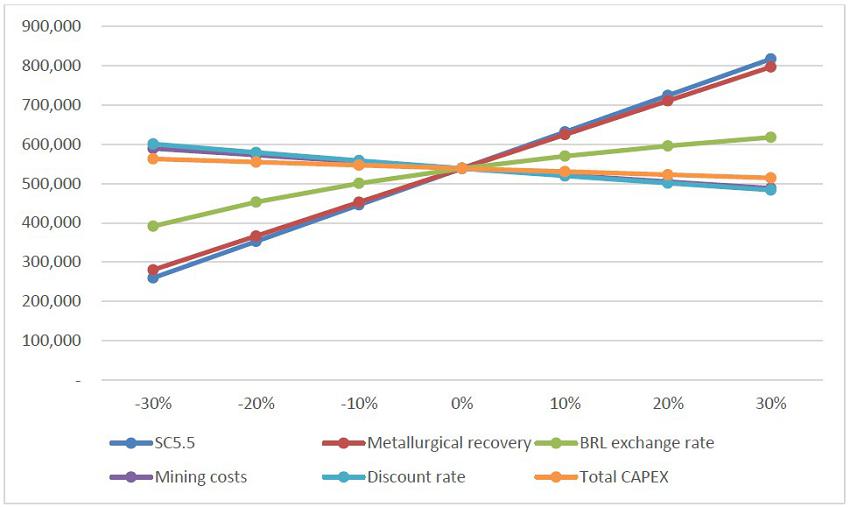
| 1.15 | Conclusions
and Recommendations |
The
Neves Lithium Project contains Measured and Inferred Mineral Resources that are associated with well-defined mineralized trends and models.
The deposit is open along strike and at depth.
Given
the prospective nature of the Neves Deposit, it is the QP’s opinion that the Project merits further exploration and that a proposed
plan for further work by Atlas is justified. The QP is recommending Atlas continue further drilling, subject to funding and any other
matters which may cause the proposed exploration program to be altered in the normal course of its business activities or alterations
which may affect the program as a result of exploration activities themselves.
It
is recommended that Atlas continue with their surface mapping, sampling and soil sampling over the Gaia project and develop a diamond
drill program to bring the project to a mineral resource status.
| 1.15.1.3 | Geological
Model Maintenance and Quality Control |
As
outlined in Section 13 and the planned organizational structure of the project, it is recommended to maintain a qualified team composed
of geologists and mining technicians, responsible for:
| ● | Systematic
updating of the block model. |
| ● | Quality
control of mining operations (QA/QC). |
| ● | Improving
mineral predictability to support short-term mine planning. |
|
| SGS Geological Services |
| S-K 1300 Technical Report – FS Neves Lithium Project – Minas Gerais, Brazil | Page 24 |
| | |
Based
on the metallurgical tests conducted and the site visit, some risks and opportunities are identified and corresponding recommendations
are summarized below.
| ● | During
the site visit, relatively large spodumene crystals in numerous ore samples were pointed
out by Atlas lithium personnel to the SGS QPs. Based on the information provided by Atlas
Lithium geologists, most of the spodumene in this deposit consists of relatively large crystals.
This situation usually corresponds to an elevated DMS recovery of spodumene. A larger crush
size for DMS feed with DMS middling re-crushing can be further explored in a future test
program or future operation to optimize the lithium recovery. |
| ● | SGS
Lakefield conducted flotation tests on the combined material of minus 0.85 mm material and
DMS middlings and indicated that at least 50% of the lithium in the material can be recovered
to the final concentrate having a potential product grade of 5.5% lithium oxide. Though flotation
is not included in the current process design, it is a future opportunity for consideration. |
| ● | Micaceous
material was observed at the mine site during SGS QPs visit, this type of material will be
difficult to remove by the DMS process. If this material contaminates the final spodumene
concentrate, a reflux classifier or magnetic separator can be considered to remove these
impurities and further improve the concentrate grade. |
| ● | There
was a significant portion of lithium present in the minus 0.85 mm material as revealed by
the metallurgical tests. To further optimize the lithium recovery, the dense media separation
size range could possibly be further lowered to 0.5 mm or so to optimize the overall lithium
recovery. |
| ● | If
there is a market for a lower grade petalite concentrate, recovering the petalite mineral
through DMS can be further explored. |
| ● | As
concentrate dispatch costs are an important contributor to the operating costs, it is recommended
to investigate concentrate dispatch cost reduction by drying of the final concentrate prior
to transportation. |
| 1.15.3 | Mining
Methods and Mineral Reserves |
SGS
offers the following recommendations regards mining:
| ● | Conduct
a dilution study to determine the optimal block size and confirm the value of diluted content
in the model. Analyze operational strategies to support minimizing dilution to the ROM. |
| ● | Refine
the open pit designs and mining schedule to maximize profitability. |
Promon
– Infrastructure
The
infrastructure engineering designs have been developed to a detailed level, incorporating the technical specifications and data provided
by equipment manufacturers during their respective design phases. It is recommended to carry out a comprehensive review focused on the
coordination and integration of the suppliers’ final designs with the final designs for civil works and electromechanical installations,
in order to ensure full compatibility, avoid interferences, and mitigate potential construction and assembly risks.
|
| SGS Geological Services |
| S-K 1300 Technical Report – FS Neves Lithium Project – Minas Gerais, Brazil | Page 25 |
| | |
| 1.15.5 | Mine
Waste Storage Facilities |
The
SGS QP recommends the following additional validation to refine the detailed design of the WRTSF, OPSF, and WMPs, in addition to the
geotechnical investigations:
| ● | Consider
staged consolidation and slope stability analysis, given the presence of undrained foundation
conditions. |
| ● | Develop
an instrumentation and monitoring program for construction and operation of the WRTSF with
established threshold alert levels and an appropriate response framework. |
| 1.15.6 | Waste
Dumps (PDER-1 and PDE-2 Waste Project) |
It
is recommended that the following additional work be included in the detailed engineering phase:
| ● | Detailing
of the access roads and water drainage areas during all the construction phases of the project. |
| ● | Design
of dumping phases aimed at reducing initial installation costs and maintenance costs over
the useful life of the mine. |
The
SGS QP recommends the following studies related to water management to support future detailed design:
| ● | It
is recommended to maintain the continuous update of hydrogeological numerical models according
to the progress of mining activities. |
| ● | Carry
out routine monitoring of groundwater levels, following the hydrogeological report guidelines,
as the systematic collection and analysis of piezometric data to monitor/understand water
table dynamics related to dewatering, slope stability, and environmental controls throughout
the mine’s operational life. |
| 1.15.9 | Environmental
Studies and Permitting |
Atlas
- Environmental Studies, Permitting, Etc (Important)
It
is recommended to ensure full compliance with all environmental conditions and compensation measures established in the project’s
environmental license, in accordance with applicable legal and regulatory requirements. Additionally, the implementation of all actions
defined in the Environmental Control Plan (PCA) is essential to guarantee the proper execution of mitigation, monitoring, and corrective
measures. Maintaining transparent, continuous, and constructive communication with stakeholders—including regulatory agencies,
local communities, and other interested parties
Atlas
will facilitate with the Environmental Agency the granting of the Concomitant Environment License (LAC 1) and Authorization for Environmental
Intervention (AIA) of Anitta 3 and PDE-2, still in the process of analysis by the Agency.
Power
is the second largest process operating cost, and further use of renewables is recommended, as well as trying to obtain power from sources
cheaper than diesel fuel (natural gas pipeline, high voltage overland power lines, etc.) if availability becomes suitable for the project
timeline.
In
accordance with the operational schedule and as illustrated in the operational histogram, Atlas is responsible for ensuring the timely
mobilization of the Operational Readiness and Mine Development Management teams. Furthermore, as detailed in the current Owner’s
Team budget, Atlas shall proactively conduct all required training programs for its personnel to ensure readiness and alignment with
project milestones.
| ● | Based
on the current economics, this project should progress to the detailed engineering and development
/ Life of Mine budgeting phase. |
| ● | Detailed
monthly bench plans should be developed with the selected mining contractor to ensure compliance
to plan |
Develop
Detail Engineering for Bulk Earthworks and Construction Support facilities (i.e. roads and facilities platforms, and service hub, raw
water supply, etc.) to allow for an immediate construction start after investment decision, while detail engineering for the rest of
the plant and facilities can be performed during the first year of construction.
|
| SGS Geological Services |
| S-K 1300 Technical Report – FS Neves Lithium Project – Minas Gerais, Brazil | Page 26 |
| | |
This
TRS was prepared at the request of Atlas Lithium Corporation, a company existing under the laws of USA, trading under the symbol “ATLX”
on the National Association of Securities dealers (NASDAQ) Exchange with its U.S. corporate office at 1200 N Federal Hwy, Suite 200,
Boca Raton, FL 33432.
This
document presents the results of the feasibility study evaluation of the Neves Project (“Neves”) and focuses primarily on
the Neves deposit, together with an initial exploration summary of the Gaia project (“Gaia”).
This
TRS is an updated Feasibility Study completed for Atlas’s Neves Project and is the second TRS for the Project filed with the United
States Securities and Exchange Commission (SEC). The first TRS was effective August 10, 2022 and is titled “S-K 1300 Technical
Report Summary on the Neves Lithium Project”.
SGS
was engaged by Atlas Lithium Corporation (NASDAQ:ATLX, “Atlas”) for the preparation of the independent Technical Report Summary
(TRS) on the Neves Lithium deposit, located near the rural community of Nossa Senhora das Neves, municipality of Araçuaí,
Minas Gerais and to prepare an initial exploration summary of the Gaia project, located near the town of Salinas, both within Minas Gerais
state, Brazil. The purpose of this Technical Report is to support the disclosure of the Neves Mineral Resource and Mineral Reserve estimates
as of May 15th, 2025.
The
scope of the TRS includes the study of the mineral resources, and the economic and technical viability of mineral extraction for the
deposits.
Atlas
Lítio Brasil Ltda. (ALBL) is the Brazilian subsidiary of Atlas and is the owner of the mining rights. On May 27th ,2025,
the granting by Brazil’s Ministry of Mines and Energy of mining concession status. The grant provides ownership of the mineral
right in perpetuity and the right to mine the substance for which it was issued (in this case, lithium) without volume limitations.
The
Neves Lithium Project is located 36 km south of the municipality of Araçuaí, Brazil. Araçuaí is a Brazilian
municipality located in the northeast of the state of Minas Gerais in the Jequitinhonha River valley. The Gaia project is located 100
km north of the Neves Project, within the municipality of Salinas, also within the Jequitinhonha River valley.
The
Neves Lithium project is located approximately 4.14 km northwest of Nossa Senhora das Neves. Nossa Senhora das Neves is located 46 km
from Araçuaí, and is connected to Araçuaí by road. The Gaia project is located 26 km east of the city of
Salinas.
The
Project is located in the state of Minas Gerais, Brazil, and Atlas is proposing to develop a conventional open-pit lithium mine and concentrator
operation. The concentrated ore (spodumene) will be trucked to a transfer site near the City of Araçuaí. The spodumene
will then be loaded onto B-Train trucks and transported to a port facility.
The
following updates have been completed, as detailed in this TRS:
| ● | Mineral
Resources increased due to new drilling, a new geological interpretation, and a larger constraining
pit shell. |
| ● | Mineral
Reserves and the mining schedule were re-run on the updated block model. |
| ● | A
new market study has been completed. |
| ● | Capital
and operating cost estimates have been updated to reflect intervening work on basic engineering
and new cost inputs. |
| ● | The
Project cash flow has been updated to reflect the changes above. |
|
| SGS Geological Services |
| S-K 1300 Technical Report – FS Neves Lithium Project – Minas Gerais, Brazil | Page 27 |
| | |
| 2.1 | Registrant
Information |
Atlas
Lithium Corporation (NASDAQ: ATLX) is a U.S.-based mineral exploration company with the largest size and breadth of exploration projects
for strategic minerals in Brazil, a premier mineral jurisdiction. Atlas Lithium Corporation is a mineral exploration and development
company with lithium projects and multiple lithium exploration properties. In addition, the company owns exploration properties in other
battery minerals, including nickel, copper, rare earths, graphite, and titanium. Its current focus is the development from exploration
to active mining of a hard-rock lithium project located in the state of Minas Gerais, Brazil, within a well-known pegmatitic district
that has been designated by the government of Minas Gerais as the “Lithium Valley.
Atlas
Lítio Brasil Ltda. (ALBL) is the Brazilian subsidiary of Atlas holding the mining rights and the mining concession ordinances
which are referenced in this TRS.
Neves
is Atlas Lithium’s flagship project located in the prospective Jequitinhonha Valley region, also called the “Lithium Valley”
due to the presence of large lithium deposits associated with pegmatites. The pegmatites contain high concentrations of lithium bearing
minerals such as spodumene and petalite. In general, lithium derived from pegmatites is less expensive to process and purify for uses
in high technology applications than lithium obtained from brine.
The
Gaia project is a new exploration project also within the Jequitinhonha Valley region.
Atlas
Lithium owns a total of 50 mineral rights for lithium exploration spread over an area of 56,834 acres (230 km2) and predominantly
located within the Brazilian Eastern Pegmatitic Province which has been surveyed by the Brazilian Geological Survey and is known for
the presence of hard rock formations known as pegmatites which contain lithium-bearing minerals such as spodumene and petalite in northeast
Minas Gerais. The Neves Project consists of four mineral rights for lithium exploration covering an area of 2,683.9 Ha.
Atlas
Lithium initiated geological reconnaissance and literature reviews of the Neves area in 2021 including detailed geological mapping on
pegmatites with historical mine workings located within the exploration areas. As a result, 91 new pegmatite bodies were identified at
Neves and a drilling campaign was commenced in 2021 and is currently ongoing. To date, a total of 536 exploration holes (RC and DD holes)
for 100,403 m of drilling were completed.
The
Gaia project was initiated in 2025 with exploration mapping, sampling and soli geochemistry, with over 70 pegmatite bodies being identified.
A short drilling campaign on the most prospective pegmatites was completed, with six holes being drilled for 501 meters of core.
| 2.2 | Terms
of Reference and Purpose |
SGS
Geological Services Inc. (“SGS”) was contracted by Atlas Lithium Corporation, (“Atlas” or the “Company”)
to update its current Mineral Resource Estimate (“MRE”) and to complete a Feasibility Study (“FS”) for the Neves
Lithium Project (“NLP”) near the Municipality of Araçuaí, Brazil, and to prepare an initial exploration summary
on the Gaia project, within the municipality of Salina, Brazil and to prepare a Public Report in accordance with the §§ 229.601(b)(96)
Technical report (subpart 229.1300 of Regulation S-K) written in support of the MRE and FS.
SGS
Geological Services (Canada) (SGS), Mining Proficiency Group – Engenharia e Serviços, Vinq – Geotecnia, Promon Engenharia,
Prominas Mining, ITAACU- Geology & Engineering, WSP Consultoria e Projetos do Brasil Ltda and DF+ Engenharia were retained by Atlas
Lítio Brasil Ltda. (ALBL) (Atlas or the Company) to prepare this TRS for Atlas Lithium (the Project). The purpose of this TRS
is to disclose Mineral Resource and Mineral Reserve estimates for the Project.
|
| SGS Geological Services |
| S-K 1300 Technical Report – FS Neves Lithium Project – Minas Gerais, Brazil | Page 28 |
| | |
This
TRS conforms to the United States Securities and Exchange Commission’s (SEC) Modernized Property Disclosure Requirements for Mining
Registrants as described in Subpart 229.1300 of Regulation S-K, Disclosure by Registrants Engaged in Mining Operations (S-K 1300) and
Item 601 (b)(96) Technical Report Summary. The definitions for Mineral Resources and Mineral Reserves in this FS follow S-K 1300 and
are consistent with the definitions in the Australasian Code for Reporting of Exploration Results, Mineral Resources and Ore Reserves
(the JORC Code) and Canadian Institute of Mining, Metallurgy and Petroleum (CIM) Definition Standards for Mineral Resources and Mineral
Reserves dated May 10, 2014 (CIM (2014) definitions).
| 2.3 | Sources
of Information |
SGS
Canada Inc. (“SGS”) was commissioned by Atlas to prepare this TRS. In preparing this report, SGS relied upon input from Atlas
and information prepared by several qualified independent consulting groups particularly regarding regional geology, geological mapping,
exploration, the lithium market and resource estimation. Atlas has contracted Prominas to carry out mine engineering including pit design,
pit optimization, scheduling and calculations of the mineral reserve estimation for this Report. SGS reviewed methods used by Prominas
for Mine Engineering, Planning and Scheduling and signed off on the work completed by Prominas consultants. Furthermore, SGS has conducted
a thorough review of the Process Engineering including Process Flow Diagrams, Mass Balances, Commination circuits, and power requirements
and will be signing off as Qualified Engineers on the processing plant segments of the Report. WSP Consultoria e Projetos do Brasil Ltda
contributed to work on environmental and DF+ Engenharia for tailings and waste storage facilities.
Section
24 includes the reference documents that are part of the sources of information used in the preparation of this TRS.
SGS,
Mining Proficiency Group – Engenharia e Serviços, and Vinq - Geotecnia are independent companies and not associates or affiliates
of Atlas or any associated company of Atlas. Table 2-1 lists the Qualified Persons (QP) involved with authoring this report. Table 2-2
lists the sections each QP is responsible for.
Table
2-1 List of Qualified Persons, Professional Designations and Site Visit Dates
| Company
of Qualified Person |
Professional
Designation |
Company
Abbreviation |
Date
of Site Visit |
| SGS
Canada Inc. |
P.Geo. |
SGS |
March
11 to 14, 2025 |
| SGS
Canada Inc. |
P.E. |
SGS |
June
2 to 7, 2025 |
| SGS
Canada Inc. |
P.E. |
SGS |
June
2 to 7, 2025 |
| SGS
Canada Inc. |
P.Eng. |
SGS |
- |
| Mining
Proficiency Group – Engenharia e Serviços |
FAusIMM |
Mining
Proficiency Group |
- |
| Vinq
– Geotecnia |
MAusIMM
CP |
Vinq |
May
26. 2025 |
|
| SGS Geological Services |
| S-K 1300 Technical Report – FS Neves Lithium Project – Minas Gerais, Brazil | Page 29 |
| | |
Table
2-2 Qualified Persons Areas of Responsibility
| Section |
Section
Name |
Responsible
Party |
Description
of Responsibly |
Subsections |
| 1 |
Summary |
All |
- |
- |
| 2 |
Introduction |
All |
- |
- |
| 3 |
Property
Description |
SGS |
- |
- |
| 4 |
Accessibility,
Climate, Local Resources, Infrastructure and Physiography |
SGS |
- |
- |
| 5 |
History |
SGS |
- |
- |
| 6 |
Geological
Setting. Mineralization and Deposit |
SGS |
- |
- |
| 7 |
Exploration |
SGS
|
- |
|
| |
|
Vinq
– Geotecnia
|
Geotechnical
Drilling |
All
of 7.4 |
| 8 |
Sample
Preparation, Analyses and Security |
SGS |
- |
- |
| 9 |
Data
Verification |
SGS |
Site
visit
Processing
site visit |
All
Section 9 except 9.2.2 |
| |
|
Vinq
– Geotecnia
|
Geotechnical
site visit |
9.2.2 |
| 10 |
Mineral
Processing and Metallurgical Testing |
SGS |
- |
- |
| 11 |
Mineral
Resource Estimates |
SGS |
- |
- |
| 12 |
Mineral
Reserve Estimates |
SGS |
- |
- |
| 13 |
Mining
Methods |
SGS |
- |
All
Section 13 except 13.1.1, 13.1.2, and 13.1.3 |
|
|
Vinq
– Geotecnia
|
Geotechnical
Drilling |
All
of 13.1.1, 13.1.2, and 13.1.3 |
| 14 |
Processing
and Recovery Methods |
SGS |
- |
- |
| 15 |
Infrastructure |
SGS |
- |
All
Section 15 except 15.5.2 and 15.5.3 |
| |
|
Mining
Proficiency Group – Engenharia e Serviços |
Tailings |
All
of 15.5.2 and 15.5.3 |
| 16 |
Market
Studies |
SGS |
- |
- |
| 17 |
Environmental
Studies, Permitting and Social or Community Impact |
SGS |
- |
- |
| 18 |
Capital
and Operating Costs |
SGS |
- |
- |
| 19 |
Economic
Analysis |
SGS |
- |
- |
| 20 |
Adjacent
Properties |
SGS |
- |
- |
| 21 |
Other
Relevant Data and Information Other Relevant Data and Information |
SGS |
- |
- |
| 22 |
Interpretation
and Conclusions |
All |
- |
- |
| 23 |
Recommendations |
All |
- |
- |
| 24 |
References |
All |
- |
- |
| 25 |
Reliance
on Information Provided by the Registrant |
All |
- |
- |
|
| SGS Geological Services |
| S-K 1300 Technical Report – FS Neves Lithium Project – Minas Gerais, Brazil | Page 30 |
| | |
This
TRS was prepared by SGS, and communication with Atlas Lithium sources was conducted through the following list of personnel:
| ● | Igor
Tkachenko, Vice President, Corporate Strategy |
| ● | Eduardo
Queiroz, Vice-President of Engineering & PMO |
| ● | Raimundo
Almeida Jr., Vice President Lithium Processing |
| ● | Lucas
Roux, GIS and Modelling Geologist |
| ● | Fabrício
Pinheiro, Mining Manager |
| ● | Joel
Monteiro, Vice-President Legal & ESG |
| ● | Tiago
Miranda, Chief Financial Officer, Principal Accounting Officer, and Treasurer |
| ● | Mariella
Catarino, DataBase Manager |
| ● | Mariana
Espechit, Geology Coordinator |
| 2.4 | Personal
Inspection Summary |
The
following Qualified Persons visited the Project site:
Mr.
Marc-Antoine Laporte, P.Geo., M.Sc., from SGS visited the Project site on March 11th to 14th, 2025 and previously
on May 4 to 6, 2023. During the 2025 site visit, Mr. Laporte conducted a general review of the logging and QA/QC procedures in place
since the original drill program back in 2023. Drill hole collars were visited, and selected collar positions checked with a hand-held
global positioning system (GPS) instrument on the Neves property. An inspection of the drilling equipment/contractors and deviation survey
methodology and tools was completed. An extensive review of the mineralized core from the four main pegmatites zone was conducted during
the first days of the visit including discussion of the sampling methodology with technical staff. One day was spent on reviewing geological
3D model including technical discussion with Atlas geologist. All information and personal were available during the QP visit to facilitate
review process.
Mr.
Joseph Keane and Mr. Sam Yu from SGS visited the Project site on June 2nd to 7th, 2025. The site visit purpose
was to view an equipment storage area and inspect specific container contents of a heavy media separation equipment plant that Atlas
Lithium had purchased for the project. A visit was also made to the project mine and plant site.
At
the Belo Horizonte office the SGS representatives met with Eduardo Queiroz, PMO & VP Engineering. Mr. Queiroz had arranged a visit
to an equipment storage facility located close to the nearby town of Betim.
|
| SGS Geological Services |
| S-K 1300 Technical Report – FS Neves Lithium Project – Minas Gerais, Brazil | Page 31 |
| | |
The
equipment storage facility consists of secure areas where photography is not allowed and other areas where process consumables such as
grinding media and dense media separation materials (ferrosilicon) are stored in bulk. Much of the facility consists of covered areas
which shield the contents from the tropical environment. The storage facility is well managed and the security of the goods in the facility
is continuously monitored based on the information provided during the warehouse visit.
The
equipment package purchased by Atlas Lithium arrived in Belo Horizonte in numerous shipping containers and certain large or bulky items
were shipped on pallets or skids. It was not possible to inspect every container, but the seals were broken and the doors were opened
on 12 individual containers for our inspection. The SGS QP’s were also shown items that were on pallets that had been equipped
with weatherproof coverings. It was noted that each container had an individual identification placard and the container weight was noted
externally. The inspection of the containerized equipment items in storage in Belo Horizonte has corroborated the statements of Atlas
Lithium that an equipment assemblage suitable for the heavy media beneficiation of spodumene ore has been purchased in South Africa,
shipped to Belo Horizonte, and is now in secure storage.
Summarizing,
the container inspection was conducted by SGS representatives, and the conclusion is drawn that the pronouncements by Atlas Lithium regarding
the number, types, and contents of the containers in storage is corroborated.
On
June 5th, 2025, the SGS QP’S visited the project sites including the proposed open pit mining operations, the mill site,
and various waste disposal areas. The road from Araçuaí to the project site is mostly unpaved and the terrain is undulating
making the road sinuous along certain sections. The tour was supervised by Raimundo Almeida Jr., Vice President, Lithium Processing for
Atlas Lithium who was accompanied by members of the geology staff. Two of the proposed mine sites were visited along with the proposed
mill site and waste/tailings disposal areas. The project site is hilly and undulating as depicted on the present mining and site plans
that have been so far developed.
In
addition to a general site overview and individual facility locations, a physical cut in mineralized soil close to Anitta 3 was inspected
and the weathered material revealed rather large liberated spodumene crystals that were identified by the Atlas Lithium geological team.
According to geologists accompanying the visit, these crystals were larger than the spodumene crystals from Anitta 1 pit.
It
was observed that the open pit sites, the plant site, and the waste and tailings area all have heavy vegetation. Due to the undulating
terrain, considerable earthwork may be required for the site preparation.
According
to Atlas Lithium geologists, the open pits have relatively high strip ratios around 16.72 and the mineralized zones are usually thin.
Topics relating to ore control, blasting, ore blending, and geo-metallurgical programs were also discussed. The core storage area was
visited. Numerous sections of split and sawed core were examined. A substantial quantity of the split core had the spodumene crystals
outlined such that an examiner could compare those spodumene crystals with other contained minerals in the split core. Based on the observation
of core samples, most of the spodumene crystals were quite large and associated with quartz and other minerals. Some spodumene crystal
sizes were even larger than what was observed in the trench cut described earlier. This explains why some HLS (Heavy Liquid Separation)
tests conducted had significantly higher lithium recovery than the results from HLS test conducted on Anitta 1 sample. Depending on the
content of impurity metals in the spodumene crystals, the crystal color can be either green, or pink or colorless. Several additional
geological exhibits were also reviewed including select mineral specimens from the deposits and a demonstration of fluorescence of certain
property minerals.
As
part of the technical due diligence process and in compliance with the requirements, Vinq – Geotecnia conducted a field visit to
the Neves Project on May 26, 2025.
The
project’s geotechnical assessment was based on field investigations, including core drilling with sampling, geological-structural
mapping, laboratory testing, and stability analyses using various methodologies such as kinematic analysis, limit equilibrium, and stress-strain
modeling. The results indicated appropriate Factors of Safety (FoS) in accordance with the criteria of Read & Stacey (2009), with
recommendations for geometric adjustments in specific sectors to optimize slope stability and maximize resource recovery.
|
| SGS Geological Services |
| S-K 1300 Technical Report – FS Neves Lithium Project – Minas Gerais, Brazil | Page 32 |
| | |
During
the visit, a detailed inspection was carried out at the core storage facility, allowing for visual verification of the quality of the
drill core samples. The inspection included assessment of sample preservation, core recovery, box organization, and the correct labeling
and identification of sampled sections. This on-site verification was essential to confirm the representativeness and integrity of the
materials described in the geotechnical databases used in the studies.
In
addition, the technical team visited the future pit areas of Anitta 2, 2.5 and Anitta 3, inspecting access conditions to the mining fronts
and physically verifying the locations of the completed drill holes, which were properly marked with stakes and identification plates.
This step allowed for the validation of the geographical coordinates of the boreholes and verification of the consistency between physical
markers in the field and the positional data recorded in the project’s topographic and geotechnical databases.
The
observations made during the field visit, both at the core storage facility and in the field areas, were incorporated into the final
analysis and validation of the data, providing the technical foundation to support the issuance of the Technical Report for the Neves
Project.
| 2.5 | Previously
Filed Technical Report Summary Report |
This
is the second TRS for the Project filed with the United States Securities and Exchange Commission (SEC). Prior version of the Mineral
Resource was reported in previously filed TRS as shown in Table 2-3.
Table
2-3 Previously Filed TRS
| Preparer |
Issuer |
Title |
Effective
Date |
| SLR
International Corporation |
Atlas
Lithium Corporation
(formerly
Brazil Minerals Inc.) |
S-K
1300 Technical Report Summary on the Das Neves Lithium Project |
August
10, 2022 |
The
current Mineral Resource has an effective date of May 15th, 2025.
|
| SGS Geological Services |
| S-K 1300 Technical Report – FS Neves Lithium Project – Minas Gerais, Brazil | Page 33 |
| | |
| 2.6 | Units
and Abbreviations |
All
units of measurement used in this technical report are International System of Units (SI) or metric, except for Imperial units that are
commonly used in industry (e.g., ounces (oz.) and pounds (lb.) for the mass of precious and base metals). All currency is in US dollars,
unless otherwise noted. Frequently used abbreviations and acronyms can be found in Table 2-4.
Table
2-4 List of Abbreviations
| $ |
Dollar
sign |
LCE |
Lithium
Carbonate Equivalent |
| % |
Percent
sign |
Li2O |
Lithium
Oxide |
| ° |
Degree |
m |
Metres |
| °C |
Degree
Celsius |
m2 |
Square
meters |
| °F |
Degree
Fahrenheit |
m3 |
Cubic
meters |
| µm |
micron |
masl |
Metres
above sea level |
| AA |
Atomic
absorption |
mm |
millimeter |
| Au |
Gold |
mm2 |
square
millimeter |
| Az |
Azimuth |
mm3 |
cubic
millimeter |
| $CAD |
Canadian
dollar |
Moz |
Million
troy ounces |
| cm |
centimeter |
MRE |
Mineral
Resource Estimate |
| cm2 |
square
centimeter |
Mt |
Million
tonnes |
| cm3 |
cubic
centimeter |
mtph |
Metric
Tonnes per Hour |
| Co |
Cobalt |
N |
North |
| DDH |
Diamond
drill hole |
NAD
83 |
North
American Datum of 1983 |
| E |
East |
Ni |
Nickel |
| ft |
Feet |
NQ |
Drill
core size (4.8 cm in diameter) |
| ft2 |
Square
feet |
OES |
Optical
emission spectroscopy |
| ft3 |
Cubic
feet |
ppm |
Parts
per million |
| g |
Grams |
QA |
Quality
Assurance |
| GPS |
Global
Positioning System |
QC |
Quality
Control |
| Ha |
Hectares |
QP |
Qualified
Person |
| HQ |
Drill
core size (6.3 cm in diameter) |
RC |
Reverse
circulation drilling |
| ICP |
Induced
coupled plasma |
RQD |
Rock
quality description |
| kg |
Kilograms |
SG |
Specific
Gravity |
| km |
Kilometers |
Ton |
Short
Ton |
| km2 |
Square
kilometer |
Tonnes
or T |
Metric
tonnes |
| Li |
Lithium
(elemental) |
$US |
US
Dollar |
| Li2CO3 |
Lithium
Carbonate |
UTM |
Universal
Transverse Mercator |
|
| SGS Geological Services |
| S-K 1300 Technical Report – FS Neves Lithium Project – Minas Gerais, Brazil | Page 34 |
| | |
| 3.1 | Property
Description and Location |
Atlas
Lithium Corporation holds 50 mineral rights in the northeast region of the Minas Gerais state, Brazil, near the cities of Salinas, Rubelita,
Coronel Murta, Virgem da Lapa, Araçuaí, and Itinga.
The
projects which are the subject of this report consist of four mineral claims known as Neves located approximately 36 km southeast of
Araçuaí and 653 km northeast of Belo Horizonte and a single claim known as Gaia, located approximately 26 km east of the
city of Salinas and 650 km northeast of Belo Horizonte.
The
Neves Project is located at approximately 16°58’ S Latitude and 41°54’ W Longitude, Universal Transverse Mercator
(UTM) coordinates of 191,555 m E, 8,113,675 m N.
The
Gaia project is located at approximately 16°7’ S Latitude and 42°2’ W Longitude (Universal Transverse Mercator (UTM)
coordinates of 816,617 m E, 8,215,499 m N).
Figure
3-1 shows the location of the project claims in relation to nearby towns.
|
| SGS Geological Services |
| S-K 1300 Technical Report – FS Neves Lithium Project – Minas Gerais, Brazil | Page 35 |
| | |
Figure
3-1 Atlas Property Map
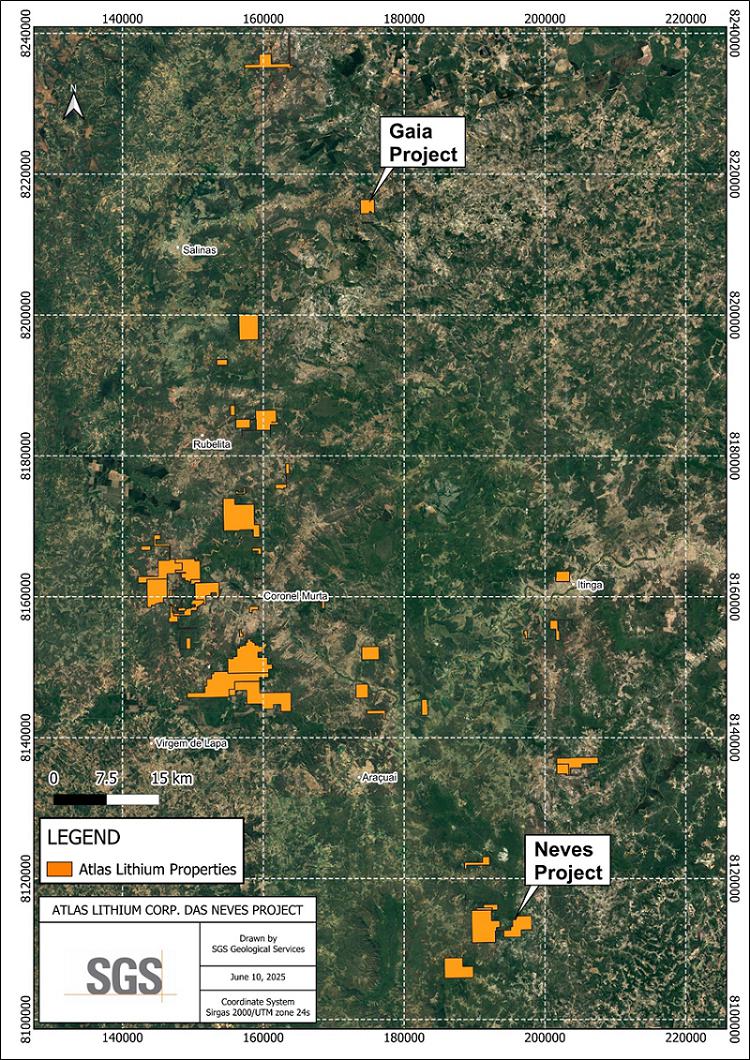
|
| SGS Geological Services |
| S-K 1300 Technical Report – FS Neves Lithium Project – Minas Gerais, Brazil | Page 36 |
| | |
The
legal framework for the development and use of mineral resources in Brazil was established by the Brazilian Federal Constitution, which
was enacted on October 5, 1988 (the Brazilian Constitution) and the Brazilian mining code, which was enacted on January 29, 1940 (Decree-law
1985/40, later modified by Decree-law 227, of February 29, 1967, the Brazilian Mining Code).
According
to the Brazilian Constitution, all mineral resources in Brazil are the property of the Federal Government. The Brazilian Constitution
also guarantees mining companies the full property of the mineral products that are mined under their respective concessions. Mineral
rights come under the jurisdiction of the Federal Government and mining legislation is enacted at the Federal level only. To apply for
and acquire mineral rights, a company must be incorporated under Brazilian law, have its management domiciled within Brazil, and its
head office and administration in Brazil.
In
general, there are no restrictions on foreign investment in the Brazilian mining industry, except for mining companies that operate,
or hold mineral rights within a 150 km wide strip of land parallel to the Brazilian terrestrial borders. In this instance the equity
interests of such companies have to be majority Brazilian-owned. Exploration and mining activities in the border zone are regulated by
the Brazilian Mining Code and supporting legislation.
The
Neves Project consists of one mining concession, one mining application and two exploration permits covering an area of 2,683.9 Ha. The
tenure holdings are summarized in Table 3-1 and the Mining Permit are summarized in Table 3-2.
Table
3-1 Neves Mineral Rights Description
| Tenement |
Year
Granted |
Area
(Ha) |
Phase |
| 832.639/2003 |
2003 |
780 |
Exploration
Permit |
| 833.331/2006 |
2006 |
67.5 |
Mining
Application |
| 832.925/2008 |
2008 |
122.13 |
Exploration
Permit |
| 833.356/2007 |
2007 |
1,536.45 |
Mining
Concession |
Table
3-2 Neves Mining Permit per Annex
| Annex |
Mining
Permit |
No. |
Description |
Validity |
| Annex
1 |
Research
Permit - 831.336/2006 |
12506 |
Permission
to make mineral research |
10.14.2011 |
| Annex
2 |
Research
Permit - 833.356/2007 |
2028 |
Permission
to make mineral research |
03.18.2025 |
| Annex
3 |
User
Guide (UG) - National Mining Agency |
368/2023 |
Permission
to produce 300,000 tonnes of spodumene concentrate per year |
09.21.2026 |
| Extendable
for equal periods |
| Annex
4 |
Mining
servitude - National Mining Agency |
n/a |
Declares
the public utility of the UTM installation area and waste pile |
Permanent
|
| Annex
5 |
Grant
Mining Concession - Ministry of Mines and Energy |
674 |
Mining
concession (“Portaria de Lavra”) for lithium exploration in the entire area of 1,536.45 hectares covered by mining right
no. 833,356/2007 |
Permanent
|
|
| SGS Geological Services |
| S-K 1300 Technical Report – FS Neves Lithium Project – Minas Gerais, Brazil | Page 37 |
| | |
Under
Brazilian law, foreign companies may acquire surface rights as long as the share capital is controlled by Brazilians. However, the holder
of an exploration license is guaranteed by law access to conduct exploration field work, provided that adequate compensation is paid
to third-party landowners and that the holder of the exploration license assumes all environmental responsibilities arising from the
exploration work.
After
the exploration license is granted by the Brazilian government, Atlas negotiates and obtains the necessary authorizations for access
to the properties for research and exploration activities, with the exercise of mining activity guaranteed by the Brazilian Federal Constitution.
Atlas
is responsible for the reclamation of areas used for drilling, safety of personnel in the work area, monetary compensation to the landowner
for surface damage caused by mineral exploration activities, and all environmental liabilities resultant from exploration activities.
For
the purposes of mine development, ALBL has acquired a number of properties within the tenement area. These properties cover the areas
identified for the installation of the DMS circuit and associated infrastructure, the tails containment area and the waste pile.
|
| SGS Geological Services |
| S-K 1300 Technical Report – FS Neves Lithium Project – Minas Gerais, Brazil | Page 38 |
| | |
Table
3-3 details the property acquisitions and access authorizations, while Figure 3-2 shows the areas in question in regard to the property
boundaries.
Table
3-3 Neves Project Property Acquisitions and Access Authorizations
| Nº |
Owner |
Registration |
CAR Nº |
Structure |
Status |
| 1 |
Djalma Ribeiro Alves Maria /
Walter Zwicker Esbaille Junior |
31.374 |
MG-3103405-69D5.1D04.E168.4AFA.BCBA.2491.5E96.4CA3 |
Access to Pit for Mineral Treatment Unit (MTU) |
Authorization Term Obtained |
| 2 |
Rene Caminhas Gomes Matos /
Edson Caminhas Gomes /
Heleno Caminhas Gomes /
Maria Zene Gomes Ribeiro /
Virlene Caminhas Gomes /
Jair Caminhas Gomes /
Vaci Vanderlei Caminhas Gomes |
36.787
36.788 |
MG-3103405-FDA0.96E6.96E9.423F.BEBD.F97F.31EF.D53F |
Part of pit 2 |
Authorization Term Obtained |
| 3 |
Antônio Luiz |
37.202
37.204 |
MG-3103405-7131.6C9C.3891.4087.8538.5265.1820.5C89 |
Pit 1 / internal access / part of pit 2 / Sedimentation basin / Explosives store |
Property acquired by Atlas |
| 4 |
Antônio Luiz / Flávia Ferreira Luiz /
Jansen Ferreira Luiz |
37.082
36.497 |
MG-3103405-7838.DBC6.3BF3.49A1.9B09.A677.911D.A795 |
Part of pit 2/ Waste pile PDE-2 |
Property acquired by Atlas |
| 5 |
Atlas Lítio Brasil Ltda. |
37.083 |
MG-3103405-C1C2.428D.97D3.4212.8E5E.F49F.DE03.7081 |
Part of waste pile PDE-2 |
Property acquired by Atlas |
| 6 |
Atlas Lítio Brasil Ltda. |
42.693 |
MG-3103405-BD9D.36C9.DA3A.43A1.9BC4.CA55.E47B.A60B |
Sump/ Support area fo MTU |
Property acquired by Atlas |
| 7 |
Atlas Lítio Brasil Ltda. |
36.258 |
MG-3103405-BD9D.36C9.DA3A.43A1.9BC4.CA55.E47B.A60B |
MTU Area |
Property acquired by Atlas |
| 8 |
Atlas Lítio Brasil Ltda. |
36.260 |
MG-3103405-BD9D.36C9.DA3A.43A1.9BC4.CA55.E47B.A60B |
PDER Area |
Property acquired by Atlas |
| 9 |
Atlas Lítio Brasil Ltda. |
35.731 |
MG-3103405-BD9D.36C9.DA3A.43A1.9BC4.CA55.E47B.A60B |
Legal Reserve Area |
Property acquired by Atlas |
|
| SGS Geological Services |
| S-K 1300 Technical Report – FS Neves Lithium Project – Minas Gerais, Brazil | Page 39 |
| | |
Figure
3-2 Neves Project Property Acquisitions
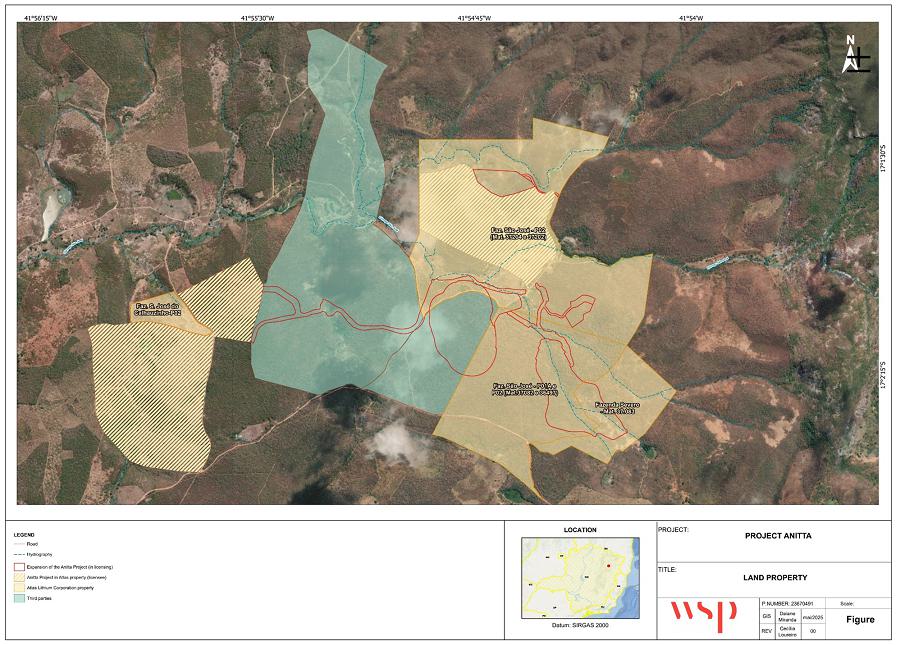
| 3.5 | Royalties
and Encumbrances |
Atlas
reports that there are no liens and encumbrances associated with the properties.
The
Brazilian Government is entitled to a Compensação Financeira pela Exploração de Recursos Minerais (CFEM)
royalty. The holder of a mining concession for lithium mineral must pay the Brazilian government 2.0% on mining operations. The only
deductions allowed are taxes levied on commercial sales.
A
3.0% royalty with allowable deductions from gross spodumene revenues is held by Lithium Royalty Corporation (LRC).
| 3.6 | Reliance
on Other Experts |
The
QP has not reviewed the mineral tenure, nor independently verified the legal status, ownership of the Project area, underlying property
agreements or permits. The QP has fully relied upon, and disclaims responsibility for, information supplied to them by Atlas Lithium.
|
| SGS Geological Services |
| S-K 1300 Technical Report – FS Neves Lithium Project – Minas Gerais, Brazil | Page 40 |
| | |
| 4 | ACCESSIBILITY,
CLIMATE, LOCAL RESOURCES, INFRASTRUCTURE, AND PHYSIOGRAPHY |
The
Project is accessed from Belo Horizonte via highway BR-040 for approximately 160 km to Curvelo, then travelling on BR-259 for approximately
100 km to Gouveia and then on BR-367 for approximately 340 km to Araçuaí. From Araçuaí, access is via unpaved
(dirt) roads for approximately 36 km.
Broadly
speaking, the area of Brazil where the Neves Project is located is within the tropical savannah climate (Aw – drier winter) under
the Köppen Climatic Classification system. Locally, however, the climate in Intinga and Araçuaí is characterized as
hot semi-arid (BSh) under the same classification system.
The
region has an average annual rainfall of 755.8 mm, distributed irregularly throughout the year. The rains are concentrated in the period
from October to March, with the November-January quarter accounting for more than 50% of the average annual total rainfall. In the Araçuaí
weather station, the annual average temperature is 25.0°C, with an average annual spread of around 12.2°C. The lowest temperatures
occur in June and July (lows 15.9°C) and the highest in January and February (highs of 34.4°C).
The
Araçuaí region has a long mining history, mainly related with lithium, tin, tantalite, and gem resources found in pegmatites.
Other commodities include ornamental rock, which has a more recent history of mining starting in the 1990s (Pedrosa-Soares 1997). The
city is an important supplier of goods and services related to the mining industry.
The
basic services available at Araçuaí include hotel accommodation, clinics and hospitals, general supermarkets and retail
shops, recreational facilities, industrial suppliers, and general engineering companies. Analytical and drilling services are mainly
contracted in the metropolitan region of Belo Horizonte. Skilled and semi-skilled labor is available in the region to support exploration
activities.
Because
of the extensive historical mining activities that occurred in the region, substantial infrastructure exists surrounding the Property,
including the proximity to the Irapé Hydroelectric Power Plant, which supplies power to the nearby villages, and along rivers
or streams that have water to support mining operations. There is a network of unpaved (dirt) roads that connect the area to highway
BR-367.
The
Project area is situated in the hydrographic sub-basin of the middle Jequitinhonha River, located in a basin with the same name with
elevations below 700 MASL (Pedrosa-Soares 1997). The hydrographic network is connected to the Jequitinhonha River which drains important
tributaries including the Araçuaí, Calhauzinho, and Piauí rivers. The Chapada do Piauí is the watershed between
the Calhauzinho, and Piauí River valleys (Sá 1977). Due to the deforestation of riparian forest, the Piauí River,
previously a perennial stream, has turned into an intermittent stream, ceasing to flow during the driest periods of the year from July
to October (according to residents that live on the banks of the Piauí River). Other intermittent streams include the Água
Branca, a tributary of the Piauí River, the Quatis, Barriguda, Taquaral, and Teixeira, the right bank tributaries of the Jequitinhonha
River, and the Jenipapo, Santana, and Angicos streams, the left bank tributaries of the Jequitinhonha River. The dendritic drainage pattern
of the rivers generally defines the regional hydrographic network, although in some areas regional structures are also an important control
(Sá 1977).
|
| SGS Geological Services |
| S-K 1300 Technical Report – FS Neves Lithium Project – Minas Gerais, Brazil | Page 41 |
| | |
The
current topography is shaped by the Jequitinhonha River and its tributaries, which resulted in rock exposures facilitating mineral prospecting.
Several pegmatite bodies are exposed in the river and stream beds. The Cachoeira group (Companhia Brasileira de Lítio, or CBL)
and Xuxa (Sigma Mineração S.A., or Sigma) pegmatites were discovered in outcrops on the banks of the Piauí River.
Four
geomorphological features are distinguished along the middle Jequitinhonha River, including the Project area (Pedrosa-Soares 1997):
| 1. | Polyconvex
hills dissected by erosion, with elevations generally lower than 650 MASL, and generally
composed of rocks of the Salinas Formation. |
| 2. | Plateaus,
with elevations above 650 MASL, composed of rocks of the Salinas Formation which are overlain
by detrital-lateritic sedimentary rocks (Sá 1977, Pedrosa-Soares 1997, Paes 2010). |
| 3. | Granite
outcrops (sugar loaf type) with rounded geometries, which explains the diapiric placement
of these bodies (Paes 2010). |
| 4. | Terraces
and alluvial fans of the Jequitinhonha River and its tributaries, with elevations of approximately
300 MASL (Sá 1977). |
The
bushy caatinga and the cerrado are the predominant vegetation cover of the region. The bushy caatinga, dominated mainly by entangled
thorny bushes and cactaceae, covers the slopes of the plateaus, hills, and granite peaks in low relief areas. The tops of the plateaus
are covered by typical cerrado bushes and grasses. Near the rivers and streams, medium to large trees predominate, typical of gallery
forest vegetation.
Soil
derived from the schists is generally sandy to silty and is reddish to light brown in color. Soil derived from the granites is predominantly
light to yellowish gray in color. The average thickness of the weathered material is up to 10 m. In some areas, there is evidence of
pegmatites in soils such as fragments of muscovite, feldspar, and spodumene (Sá 1977).
|
| SGS Geological Services |
| S-K 1300 Technical Report – FS Neves Lithium Project – Minas Gerais, Brazil | Page 42 |
| | |
The
Project is predominantly located within the Eastern Brazilian Pegmatite Province, which has been surveyed by the Geological Survey of
Brazil (SGB) in 2010. There is no record of any further historical exploration within the Project, however, the area has historical artisanal
mine workings. The Neves exploration area has been developed for tourmaline and gems (spodumene, triphane, columbite and tantalite).
Tesouras has been mined for petalite and Santa Clara, for tourmaline and cassiterite. The historical mines at Neves and Tesouras are
inactive today, while artisanal production continues at Santa Clara.
The
following information presents a summary of exploration and development history in the “Lithium Valley”.
Cassiterite
was discovered in the Araçuaí/Itinga region in the 1950s. In 1957, Companhia Estanífera do Brasil (CEBRASA) started
exploration, followed by the mining of three pegmatite bodies, Fumal, Urubu, and Generosa (Sá, 1977). The primary product was
cassiterite/tantalite concentrate, with lithium and feldspar minerals as a byproduct.
Arqueana
Minérios Metais (Arqueana) bought the mine from CEBRASA and mined tantalum and tin from 1980 to 2000. Reported production totals
29,700 t of tantalum-tin concentrate, 31,467 t of petalite, 2,353 t of amblygonite, and 1,317 t of spodumene. The company produced a
spodumene concentrate with 6% Li2O to 6.5% Li2O and a petalite concentrate with 3.5% Li2O to 4% Li2O
(Sigma, 2017).
During
the 2000s, Tanex Resources Ltd. (Tanex) and then Sigma carried out exploration over the mining concessions previously owned by Arqueana.
Initially, exploration was focused on tantalum ore, however, in 2014, the focus shifted to lithium exploration and drilling was carried
out in several areas including Xuxa, Barreiro, Meio, Maxixe, and Murial (the current Grota do Cirilo project).
In
1991, CBL started operations at the Cachoeira Mine (CBL, 2020), also in the Araçuaí/Itinga region. This mine had been known
for the occurrence of lithium minerals since the 1960s, producing spodumene to meet the demands of the domestic market (Sá, 1977).
The mine is currently in operation.
| 5.1 | Historical
Resource Estimates |
There
are no historical Resource Estimates for the Project.
There
is evidence of historical artisanal mining on the property, although there are no official records of production.
|
| SGS Geological Services |
| S-K 1300 Technical Report – FS Neves Lithium Project – Minas Gerais, Brazil | Page 43 |
| | |
| 6 | GEOLOGICAL
SETTING, MINERALIZATION, AND DEPOSIT |
The
Project’s regional geology is dominated by the Araçuaí orogen, comprised of a suite of late Neoproterozoic to Cambrian
deformed metasedimentary rocks and granitic batholiths overlain by Mesozoic volcanics of the Serra Do Tombo Formation and Cenozoic detrital
sediments (Figure 6-1).
The
Araçuaí orogen is one of several orogenic events which records the formation and development of the Pan-African orogeny
(Almeida, 1977, Pedrosa-Soares and Wiedemann-Leonardos, 2000). Basement rocks of the Araçuaí orogen are made of Archean
to Paleoproterozoic tonalite-trondhjemite-granodiorite (TTG), granitoids, and greenstone belt sequences (Noce et al., 2007). Below the
Araçuaí orogen, syn-rift, nearshore, and deepwater sedimentary depositional systems exist in the Ribeirão da Folha
Formation of the Macaúbas Group (Pedrosa-Soares et al. 2007) (Figure 6-2).
With
respect to the evolution of the Araçuaí orogen (pre-, syn-, late, and post-collisional stages) in eastern Minas Gerais,
five magmatic suites (G1, G2, G3, G4, and G5) have been recognised based on distinct structural relationships, geochemical and isotopic
trends, and uranium-lead (U-Pb) geochronology (Pedrosa-Soares et al. 2007, Pedrosa-Soares et al. 2011). Suite G1 rocks of the pre-collisional
stage and are I-type granitoids. Suite G2 is comprised of S-type granites and are syn-collisional. Coeval sedimentation occurred during
the syn-collisional phase of the Araçuaí orogen, which is evidenced by flysch-type deposits of the Salinas Formation (Santos
et al. 2009; Peixoto et al., 2013). The Salinas Formation also exhibits regional and contact metamorphism (amphibolite to greenschist
facies) which records a series of deformational events related to the evolution of the Araçuaí orogen (Santos et al., 2009).
Magmatic suite G3 records late to post-collisional stages of the orogenic event and is an amalgamation of S-type granites and metasedimentary
rocks (Pedrosa-Soares & Wiedemann-Leonardos, 2000, Pedrosa-Soares et al., 2011).
Orogenetic
collapse characterises magmatic suites G4 and G5 and represents the post-collisional stage (530 Ma to 500 Ma). In the northern Araçuaí
orogen, near the cities of Araçuaí, Itinga and Salinas, suite G4 is characterised by S-type magmatism with sub-alkaline
composition. The emplacement of magmatic suite G4 also formed large normal shear zones (Alkmim et al., 2007). Suite G4 is hosted mainly
in deposits of the Salinas Formation (Pedrosa-Soares & Wiedemann-Leonardos, 2000, Pedrosa-Soares et al., 2011).
Approximately
one third of the exposed terrain of the Araçuaí orogen is composed of granitic rocks that reflect a succession of tectonic
events spanning 50 million years (630 Ma to 480 Ma) (Pedrosa-Soares et al., 2011) and forms the immense and prolific Eastern Brazilian
Pegmatite Province (EBPP), which is almost entirely situated in eastern Minas Gerais. Thousands of granitic pegmatites have been discovered
in the EBPP which host a variety of tin (Sn), lithium (Li), tantalum (Ta), niobium (Nb), uranium (U) and gemstone deposits (Pedrosa-Soares
et al., 2011). The pegmatites were differentiated from G4 magmas of the Araçuaí orogen and are highly evolved products
of granitic plutonism (Morteani et al., 2000, Pedrosa-Soares et al., 2011, Paes et al., 2016).
|
| SGS Geological Services |
| S-K 1300 Technical Report – FS Neves Lithium Project – Minas Gerais, Brazil | Page 44 |
| | |
Figure
6-1 Regional Geology Map and Stratigraphic Column
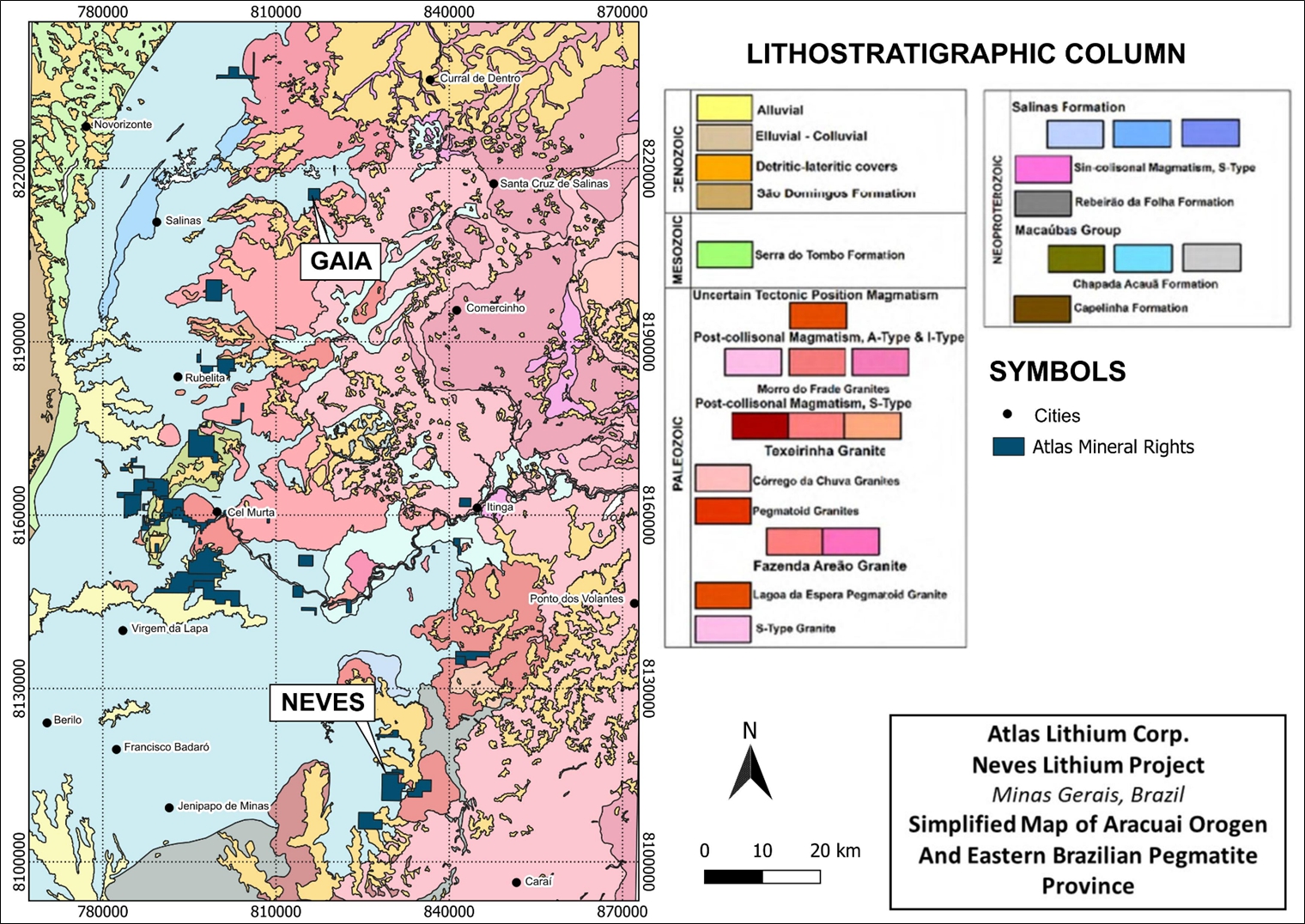
|
| SGS Geological Services |
| S-K 1300 Technical Report – FS Neves Lithium Project – Minas Gerais, Brazil | Page 45 |
| | |
Figure
6-2 Simplified Map of Araçuaí Orogen and Eastern Brazilian Pegmatite Province
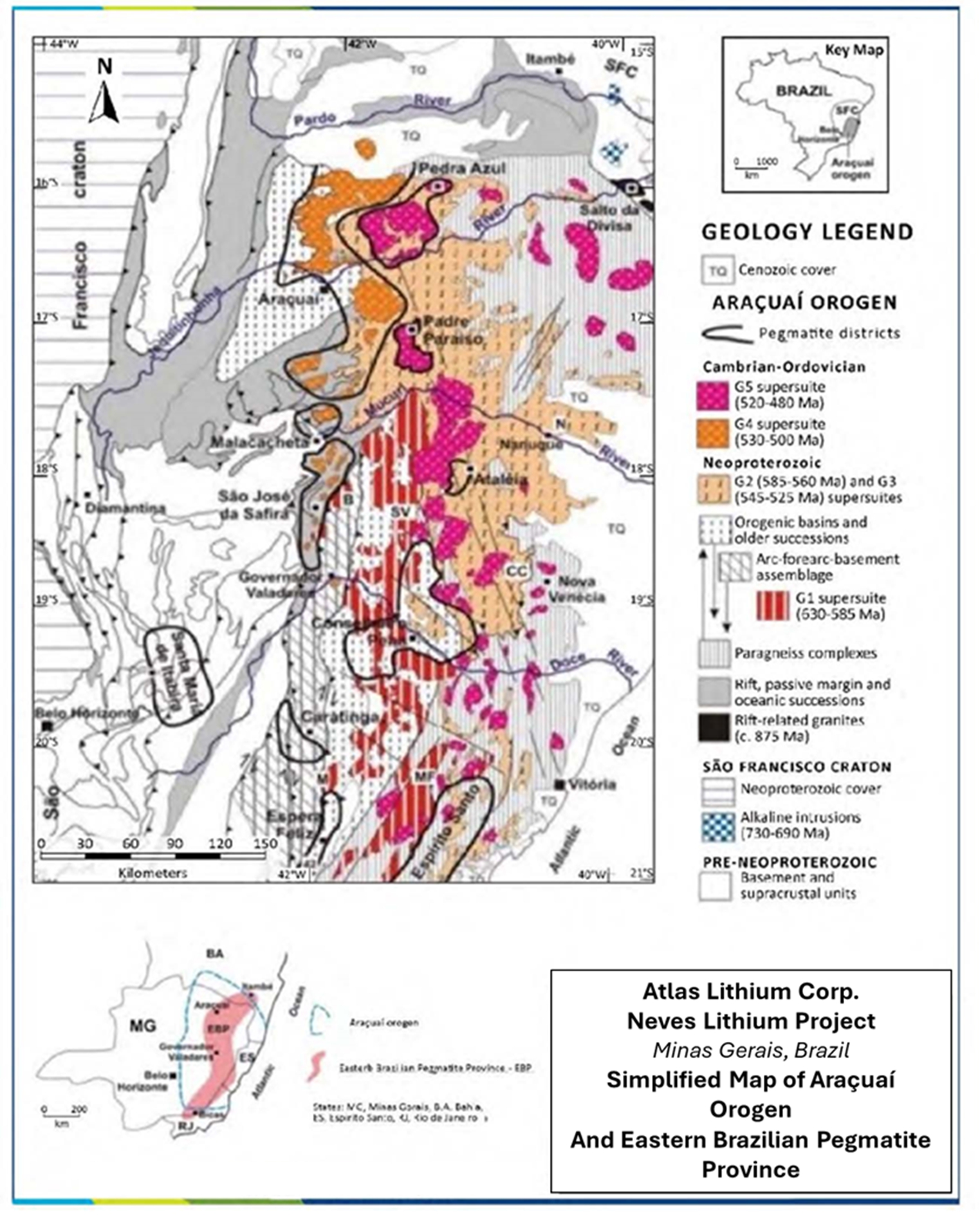
| 6.2 | Local
and Property Geology |
In
eastern Minas Gerais, lithium-rich pegmatite mineralization is hosted in metamorphosed Salinas Formation shales (cordierite-quartz-mica
schist) and is either concordant or discordant with schist foliation. The pegmatites occur as tabular bodies with thicknesses from 2
m to 36 m. Laterally, mineralized bodies vary from 40 m to 350 m in length and are primarily made of quartz, alkali (K-) feldspar (perthitic
microcline), albite, muscovite, spodumene, and petalite. Spodumene makes up approximately 20% of the mineralization, with K-feldspar
and albite constituting approximately 35%, quartz approximately 35%, and muscovite less than 10%.
|
| SGS Geological Services |
| S-K 1300 Technical Report – FS Neves Lithium Project – Minas Gerais, Brazil | Page 46 |
| | |
Schists
of the Salinas Formation outcrop in the Neves exploration areas (ANM No. 833.331/2006, 832.925/2008, 833.356/2008, and 833.639/2003)
which were intruded by magmatic suite G4 monzogranites of the Teixerinha batholith and pegmatites hosting lithium rich spodumene, columbite
tantalite, and gem quality tourmalines (Figure 6-3).
The
exploration area is covered by a thick (five meter) horizon of sandy to silty soil brownish ochre in color, with blocks (<30 cm) of
pegmatites from adjacent artisanal mines or displaced by heavy rainfall and steep relief. The area is heavily vegetated which makes it
difficult to identify outcrop, however, historical artisanal mining activity has exposed the deposits. For decades, the Neves exploration
area has been developed for tourmaline resources and gems (spodumene, triphane, petalite, columbite-tantalite) at some farms within the
mineral right. The artisanal mines are inactive today. Tailings from these mines were disposed of in piles or “dumps” scattered
throughout the area, and in some places complicating access to outcrop.
Cordierite-quartz-mica
schists of the Salinas Formation outcropping in the Neves exploration area (Figure 6-4A) are light gray to black in color, banded, and
occasionally with quartzitic composition. The banding reflects variations in the proportions of biotite to muscovite (dark bands) and
the sum of quartz and feldspar (light bands). These metamorphic rocks are in the green schist facies with foliations perpendicular to
the strike which varies between N30°E and N50°E. High angle dips (45°-80°) have been observed in contact with intrusive
igneous rocks. Syn-tectonic quartz veins are concordant with the schist foliation, exhibit local boudinage structure, and are one centimeter
to 30 cm thick. The Salinas Formation schists host significant pegmatite bodies, ranging from 1 m to 2 m thick to 10 m to 30 m thick
and up to 40 m to 450 m long.
Six
mineralized pegmatite outcrops have been mapped in the western portion of the Neves exploration property, that are 2 m to 29 m thick
and up to 200 m long, where exposed at surface. The strike of the pegmatites is sub-parallel to oblique to schist foliation, locally
homogeneous, and composed of quartz, feldspar, muscovite, black tourmaline, and locally spodumene and petalite. The spodumene and petalite
occurs as altered white clay at surface and as phenocrysts disseminated throughout the host rock.
In
the eastern portion of the property, several pegmatite bodies outcrop along the main drainages in schists of the Salinas Formation. The
pegmatites follow a strike trend of N5°E to N30°E and are concordant with schist foliation.
|
| SGS Geological Services |
| S-K 1300 Technical Report – FS Neves Lithium Project – Minas Gerais, Brazil | Page 47 |
| | |
Figure
6-3 Neves Geological Map
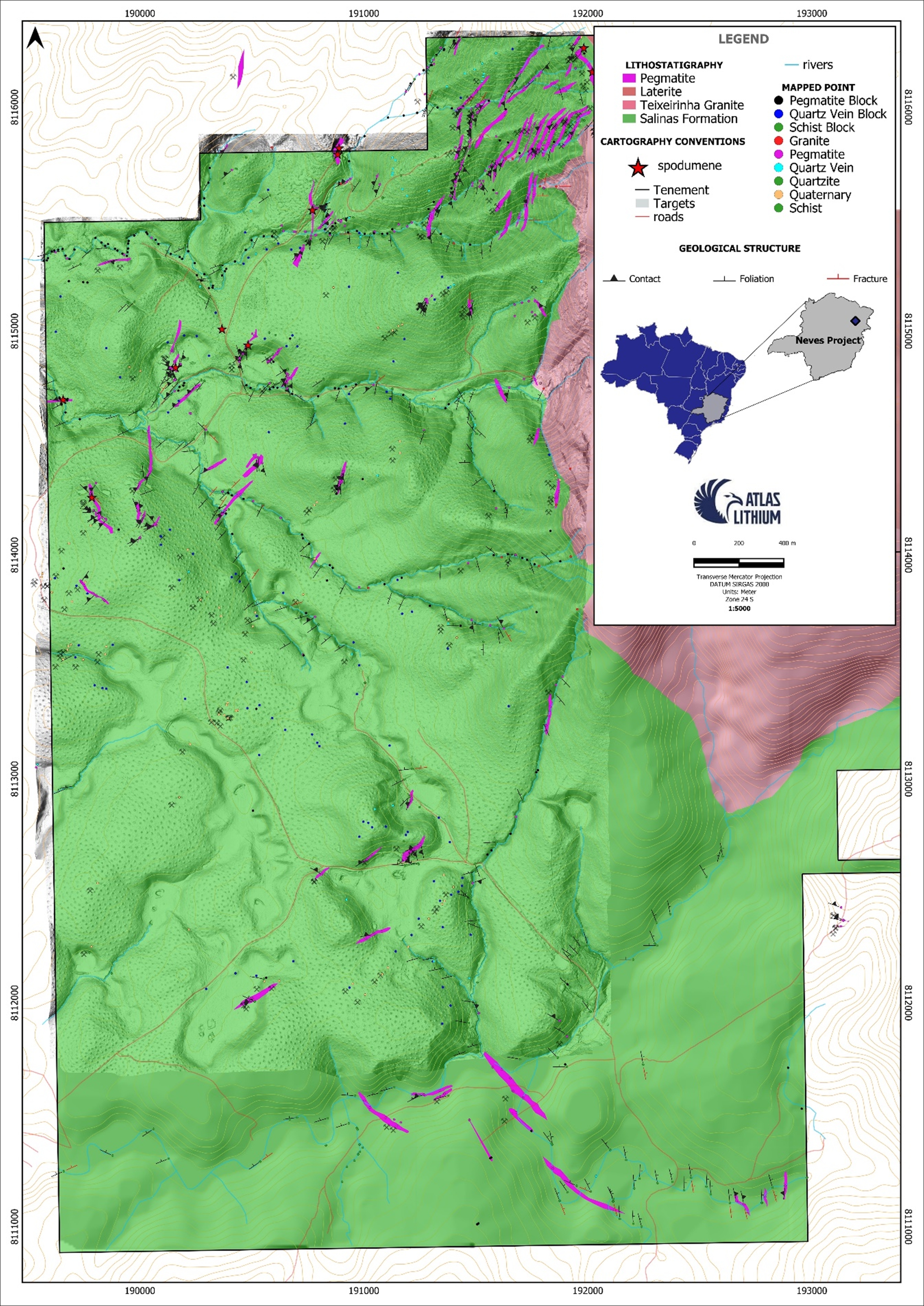
|
| SGS Geological Services |
| S-K 1300 Technical Report – FS Neves Lithium Project – Minas Gerais, Brazil | Page 48 |
| | |
Figure
6-4 Pegmatite and Schist of the Salinas Formation (A) and Teixerinha Granite Outcrop (B)
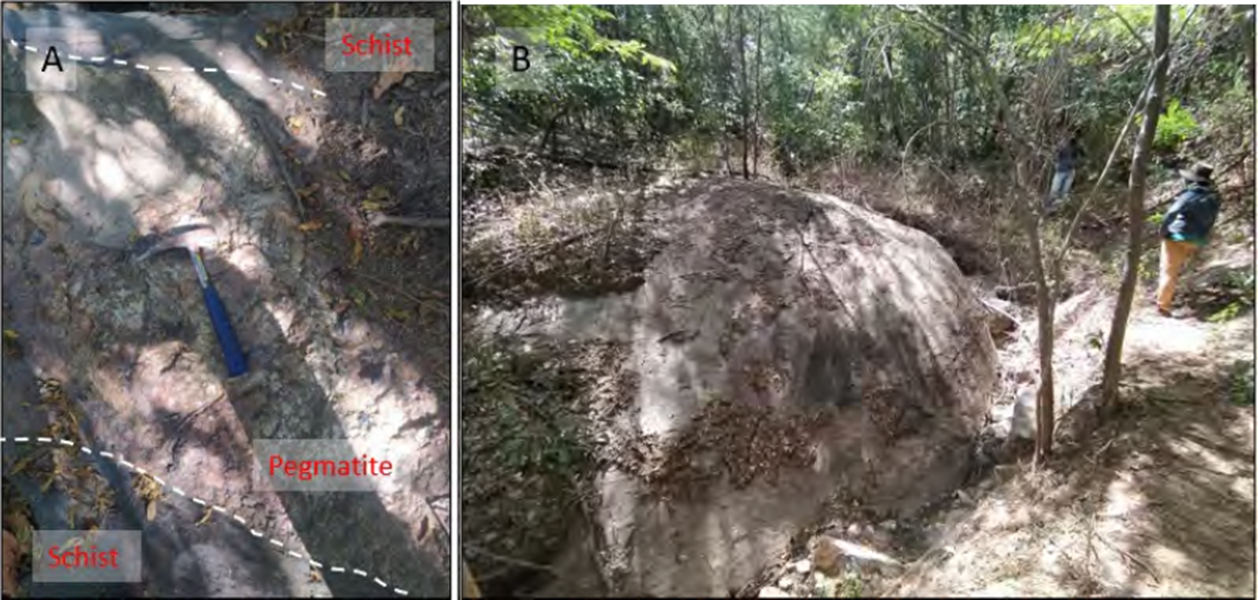
Multiple
outcrops have been mapped in the northern portion of the Neves exploration property, north of the Anitta 1 deposit. The strike of the
pegmatites is sub-parallel to oblique to schist foliation, locally homogeneous, and composed of quartz, feldspar, muscovite, black tourmaline,
and locally petalite. Petalite occurs as altered white clay and as phenocrysts disseminated throughout the host rock (Figure 6-5).
Figure
6-5 Crystalline and Altered Argillic Petalite
| |
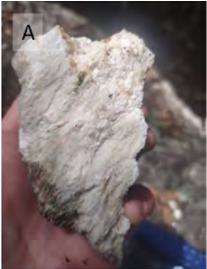 |
| 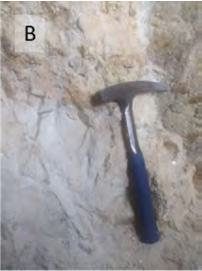 |
|
| |
|
| |
|
| |
A - Crystalline Petalite |
| B
– Altered Argillic Petalite |
|
In
the central northern portion of the property, multiple pegmatite bodies outcrop along the main drainages in schists of the Salinas Formation.
The pegmatites follow a strike trend of N5°E to N30°E and are concordant with schist foliation, which may indicate potential
for the presence of densely spaced, stacked, and sizeable lithium-bearing pegmatite bodies.
|
| SGS Geological Services |
| S-K 1300 Technical Report – FS Neves Lithium Project – Minas Gerais, Brazil | Page 49 |
| | |
The
Gaia geology is similar to that of the Neves Project. It comprises Neoproterozoic age sedimentary rocks of Araçuaí Orogen
intruded by fertile Li-bearing pegmatites originated by fractionation of magmatic fluids from the peraluminous S-type post-tectonic granitoids
of Araçuaí Orogen. Lithium mineralization is related to discordant warms of spodumene-bearing tabular pegmatites hosted
by biotite-quartz schists.
Figure
6-6 shows the geology of the Gaia project area.
Figure
6-6 Gaia Geological Map
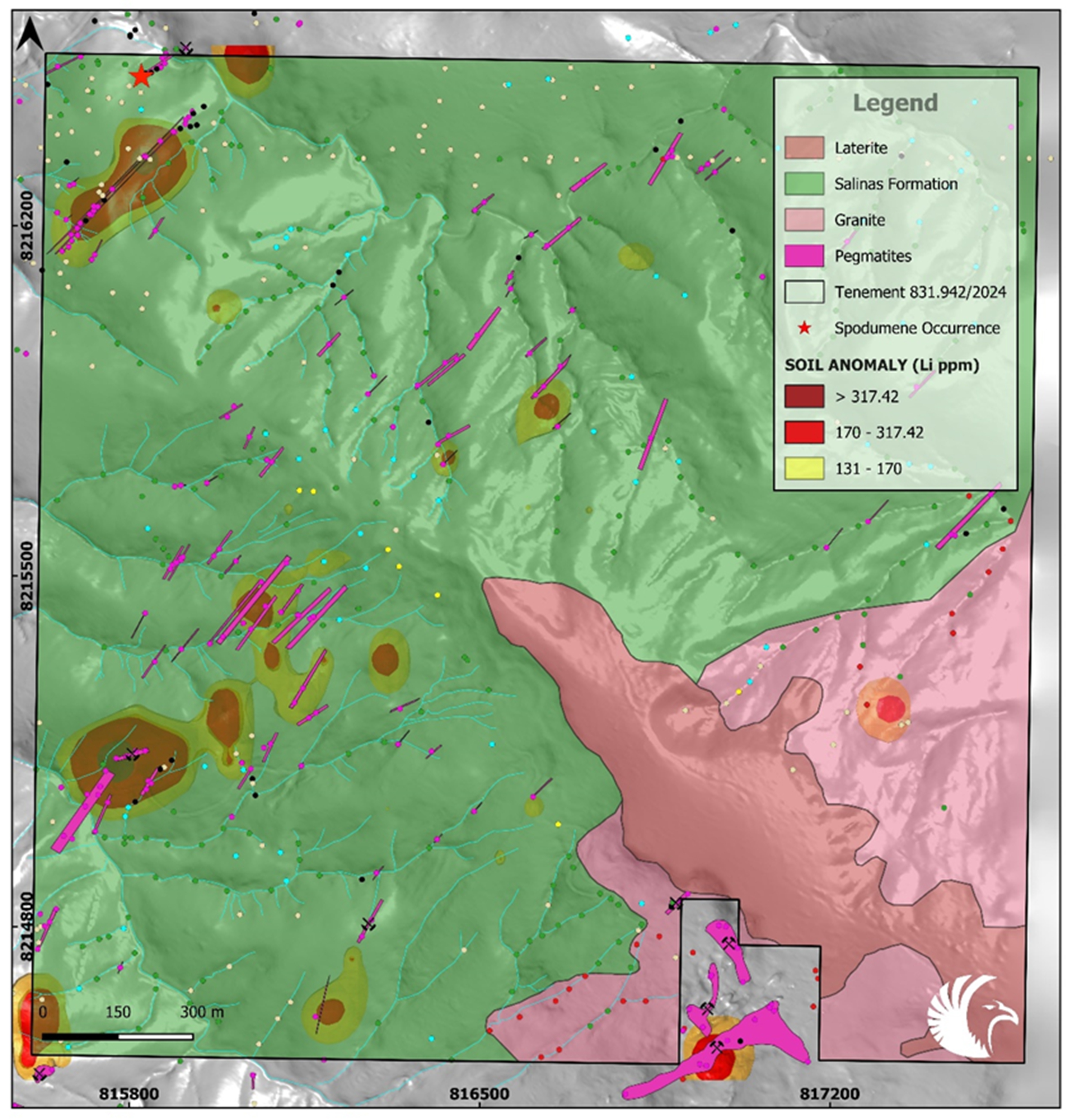
|
| SGS Geological Services |
| S-K 1300 Technical Report – FS Neves Lithium Project – Minas Gerais, Brazil | Page 50 |
| | |
The
mineral systems in highly evolved magmatic sources of REEs and lithium are controlled by the degree of fractionation. In granitic rocks
with a high degree of fractionation, lithium and tantalum is more abundant. This characteristic defines the spatial zoning and distribution
of pegmatite mineralogy with respect to the parent magma (pluton). The relationship between fractionation and REE concentration has not
been determined in eastern Minas Gerais. Based on geochemical studies, Morteani et al. (2000) show that the pegmatites of the Araçuaí-Itinga/orogen
cover the complete fractionation interval exposed in the EBPP.
A
schematic figure showing the tendency of spodumene crystals to grow towards the top of the body and the phenomenon of “flooding”
of aqueous fluid in the lower plunging portion is provided in Figure 6-7.
The
Araçuaí-Itinga lithium pegmatites are controlled by structure which can be concordant or discordant with respect to schist
foliation. The work of Sá (1977) shows that pegmatites discordant with schist foliation predominate, with strikes varying from
40° to 80° and high angle dips in the northeastern quadrant of the exploration area. The pegmatite bodies tend to be tabular
with little variable thickness and are hosted in the schists of the Salinas Formation.
Figure
6-7 Deposit Model for Neves Pegmatites
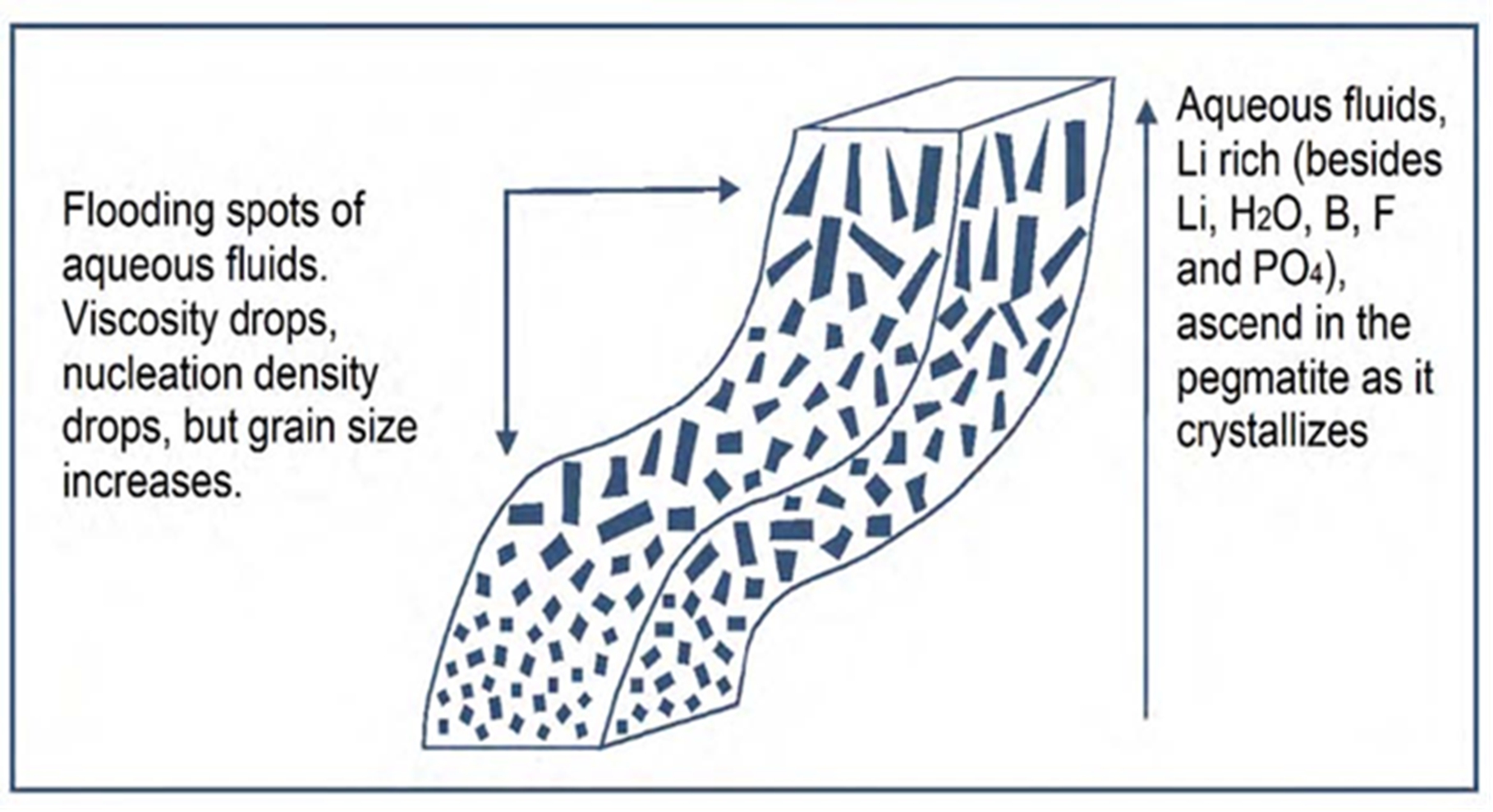
|
| SGS Geological Services |
| S-K 1300 Technical Report – FS Neves Lithium Project – Minas Gerais, Brazil | Page 51 |
| | |
The
following sections are a description of surface exploration work completed by Atlas on the Neves property from 2021 to present.
| 7.1.1 | Aerophotogrammetric
Survey |
A
photogrammetric survey using a drone was carried out over the 833.331/2006 mineral right of Neves, in December 2021 to define mineralized
zones and lithological contacts.
In
December 2021, a planimetric survey of the Neves 833.331/2006 mineral right was performed.
| 7.1.3 | Geoclouds
Sentinel II Satellite Imagery |
Multi-spectral
images from the Geoclouds Sentinel II Copernicus Earth Exploration Program over the project area were downloaded and studied to enhance
site exploration targets.
Two
LiDAR surveys were conducted over the property in 2023. The first survey, conducted in March 2023, covered the northwest corner of the
Neves property, while the second survey, conducted in December 2023 extended the coverage of the first survey to encompass approximately
the western half of the property.
|
| SGS Geological Services |
| S-K 1300 Technical Report – FS Neves Lithium Project – Minas Gerais, Brazil | Page 52 |
| | |
Figure
7-1 shows the final DTM coverage (light green) with respect to the property boundaries and exploration drilling.
Figure
7-1 Final DTM with Respect to Tenement Boundaries
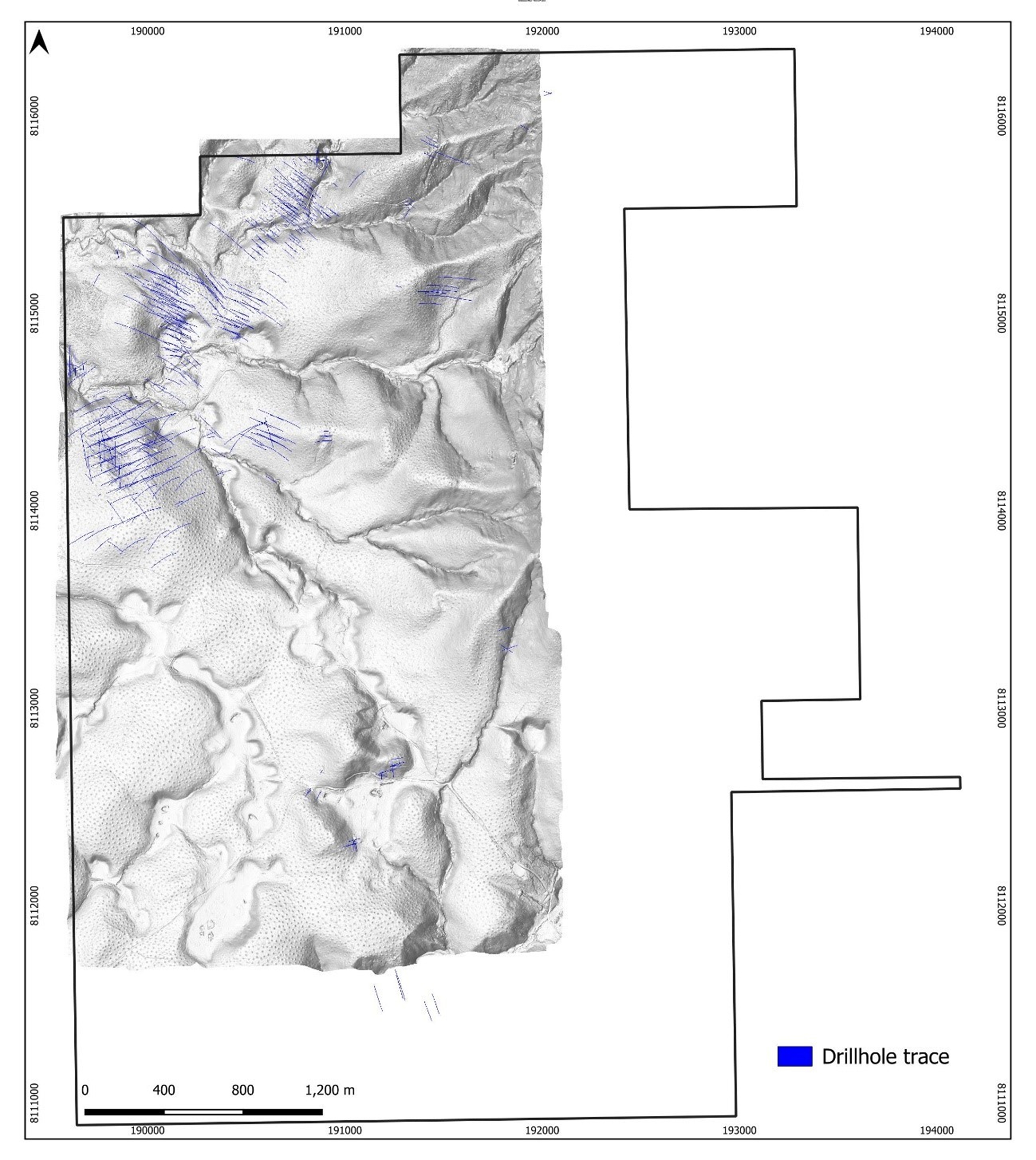
|
| SGS Geological Services |
| S-K 1300 Technical Report – FS Neves Lithium Project – Minas Gerais, Brazil | Page 53 |
| | |
A
drone magnetic and radiometric survey were conducted over the property in December 2023, with a total of 508-line kilometers of survey
being flown.
Post
processing of the data allowed for the association of magnetically anomalous zones and mapped pegmatites (Figure 7-2), and by association,
similar unknown magnetic anomalies in areas that didn’t have mapped pegmatites.
The
magnetic data also allowed for an in-depth structural interpretation of the project area, with a series of distinct NE-SW, NW-SE and
NNE-SSW structures being identified (Figure 7-3).
Figure
7-2 Anomalous Magnetic Lows and their Correlation with Known Pegmatites
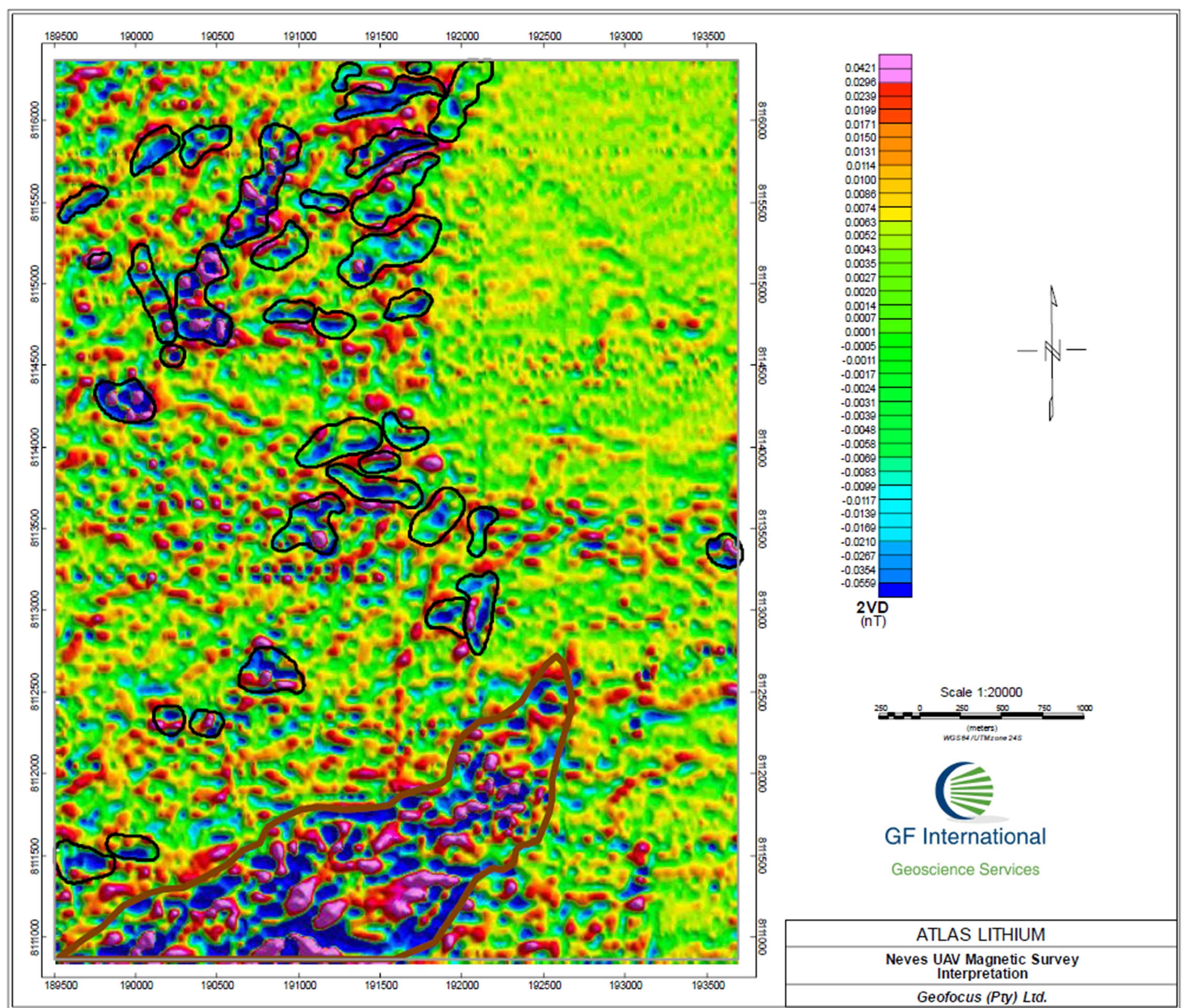
|
| SGS Geological Services |
| S-K 1300 Technical Report – FS Neves Lithium Project – Minas Gerais, Brazil | Page 54 |
| | |
Figure
7-3 Neves Aeromagnetic Survey with Structural Interpretation
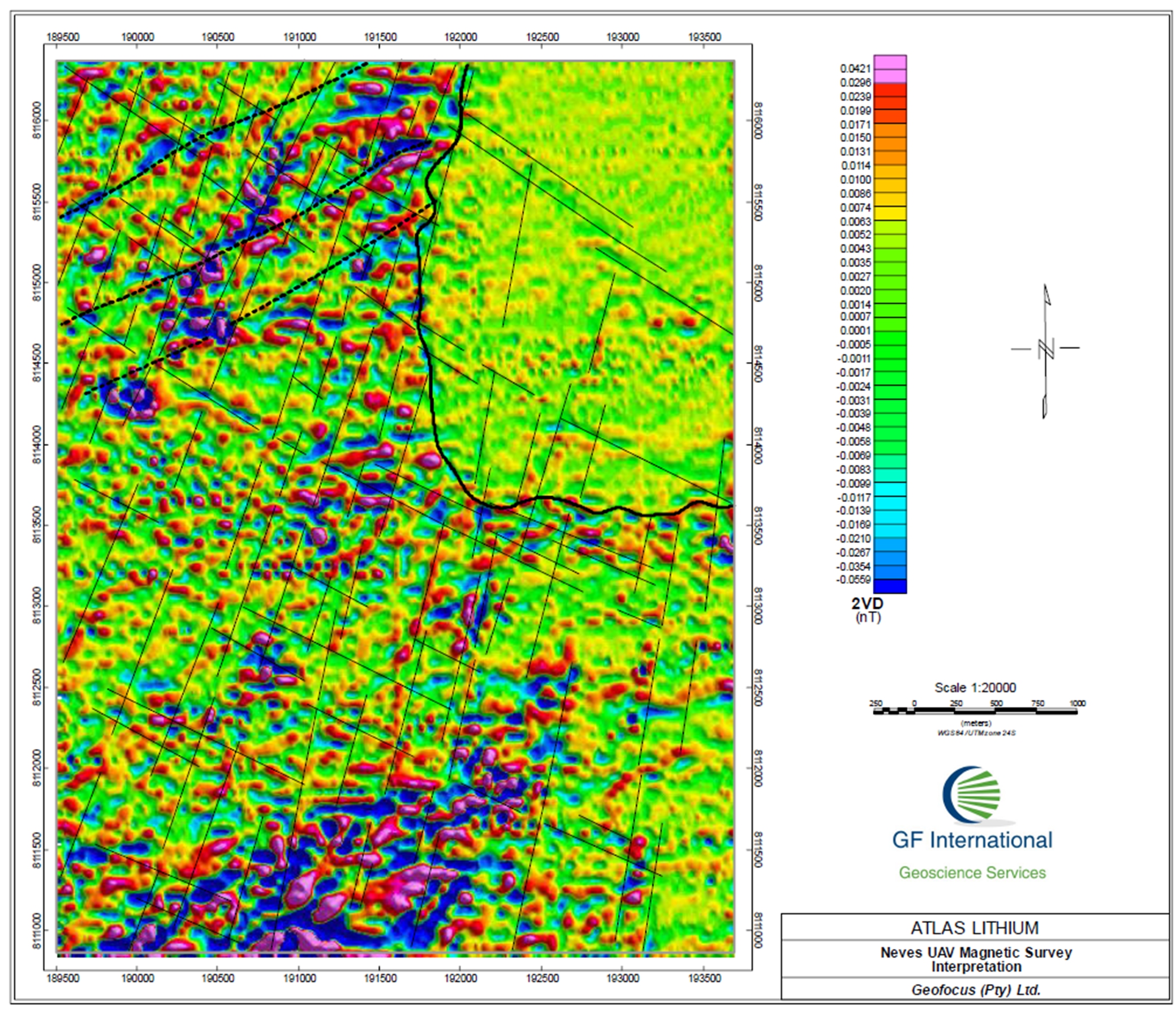
| 7.1.6 | Geological
Mapping and Sampling |
Beginning
in 2021, Atlas have conducted ongoing mapping and sampling across the Neves property.
Initial
mapping and sampling were conducted around historical artisanal mines within the tenement areas, then starting in April 2022, mapping
was extended property-wide, focussing on the main east-northeast to west-southwest drainage systems in the exploration area, as they
were considered more likely to contain outcrops of more well-preserved rocks.
The
results of the 2023 aeromagnetic survey further focused the surface mapping program, with a concentration on the areas identified by
the survey.
A
total of 1,163 field points were surveyed during the exploration campaigns, allowing for the identification and characterization of 92
pegmatite bodies. Among them, six mineralized pegmatites were delineated and grouped under the name “Anitta”.
|
| SGS Geological Services |
| S-K 1300 Technical Report – FS Neves Lithium Project – Minas Gerais, Brazil | Page 55 |
| | |
Figure
7-4 is the surface mapping of the Neves property to the end of April 2024.
Figure
7-4 Geological Map of the Neves Property with Known Pegmatites
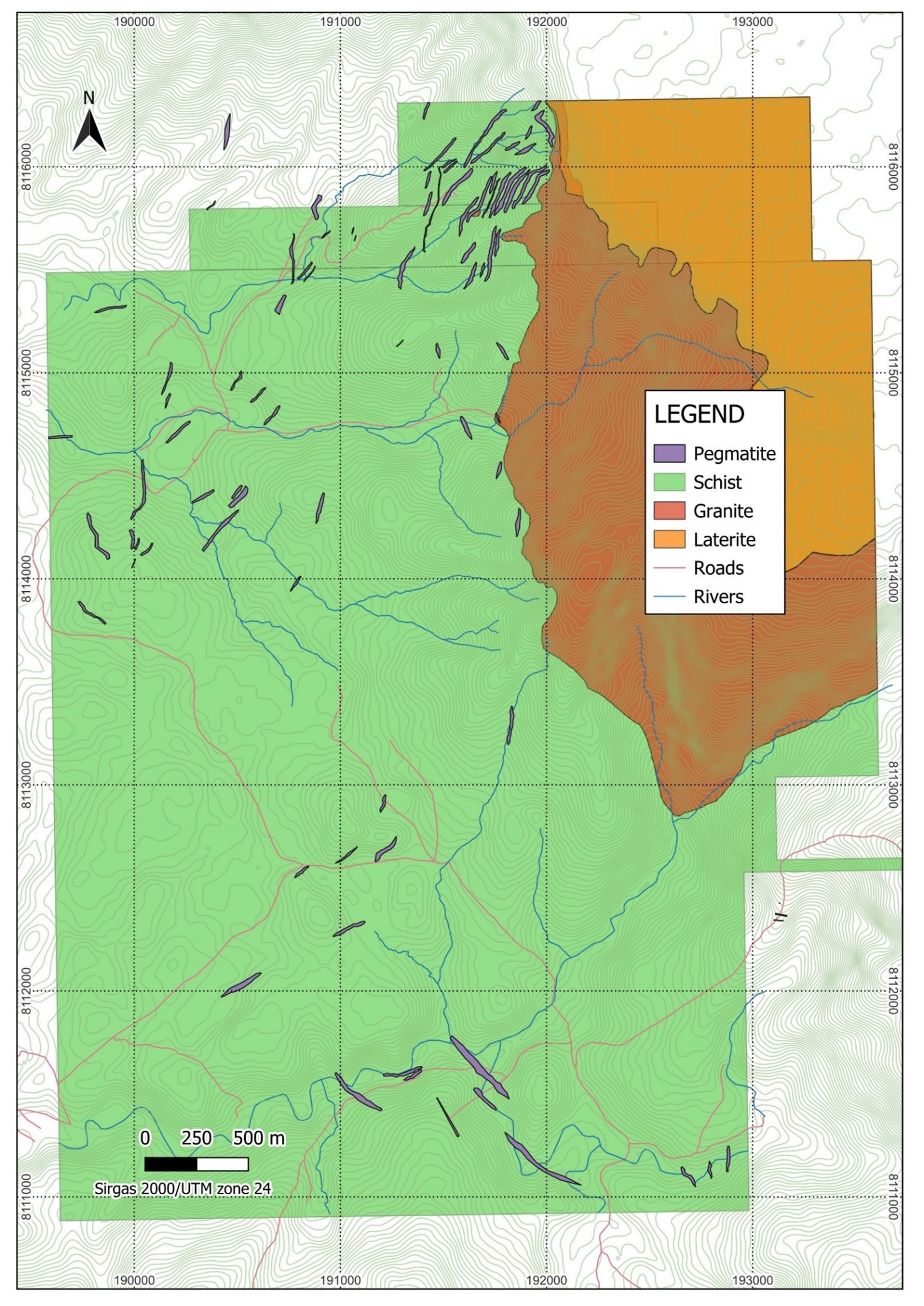
|
| SGS Geological Services |
| S-K 1300 Technical Report – FS Neves Lithium Project – Minas Gerais, Brazil | Page 56 |
| | |
Atlas
initiated trenching programs at the Neves Project in 2021, with ongoing activities as part of the exploration strategy to identify and
delineate mineralized pegmatite bodies. To date, 65 trenches, for a total of approximately 6,000 m have been excavated, positioned to
test the structural continuity of outcropping pegmatites and investigate previously identified geochemical anomalies in soil samples.
In
the Anitta targets, the trenches revealed fresh spodumene crystals exposed at the surface, corroborating the geochemical interpretation
and reinforcing the prospective potential of the region. Additionally, the structural analysis of the sections exposed by the trenches
provided essential information for understanding the geometry and orientation of the pegmatite bodies, allowing for more efficient planning
of subsequent drilling stages.
Figure
7-5 shows a trench excavated at the site of the Anitta 3 pegmatite and Figure 7-6 shows the location of completed trenches with respect
to known pegmatites.
Figure
7-5 Trench Excavated at the Anitta 3 Pegmatite
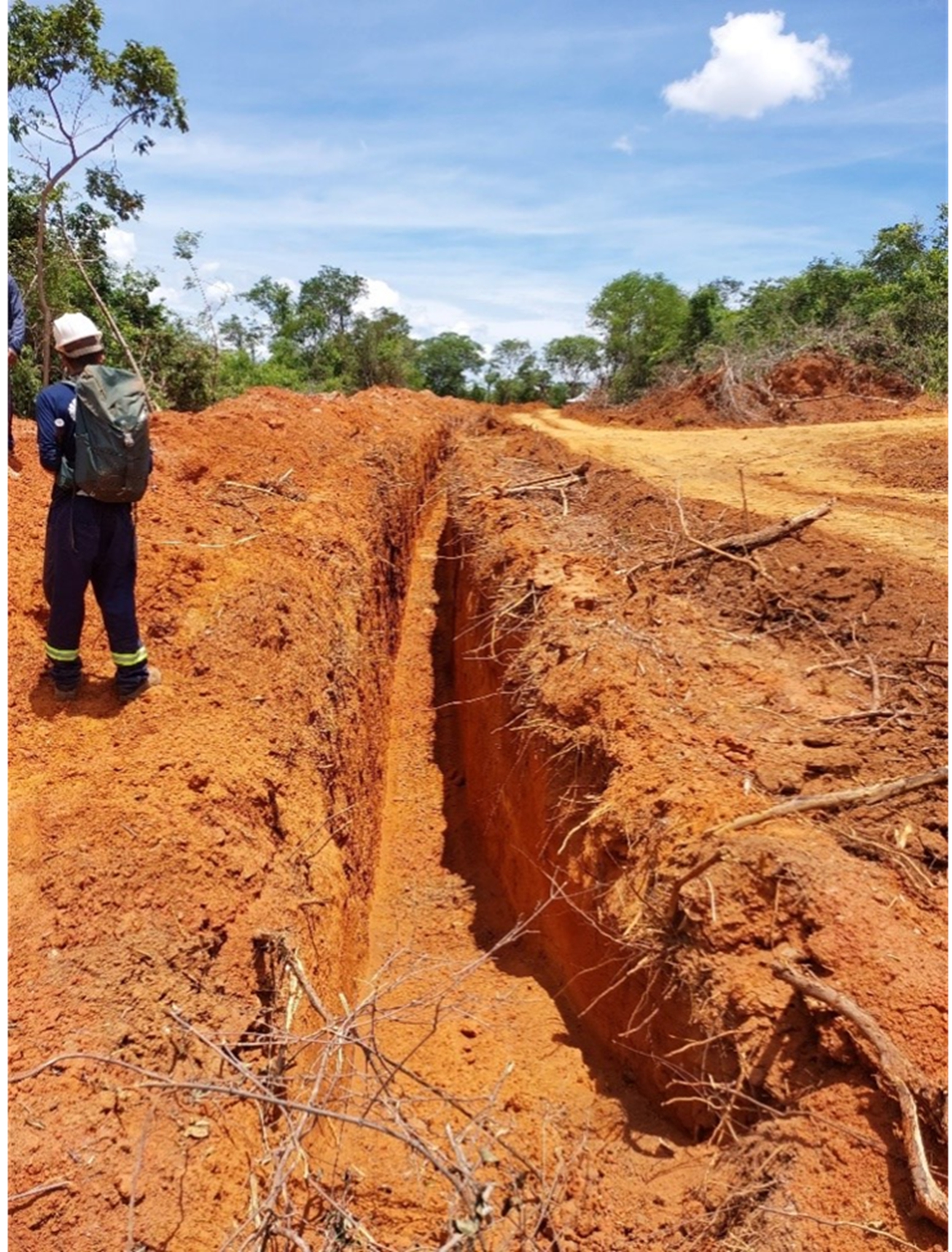
|
| SGS Geological Services |
| S-K 1300 Technical Report – FS Neves Lithium Project – Minas Gerais, Brazil | Page 57 |
| | |
Figure
7-6 Atlas 2021 - 2024 Trench Program and Locations
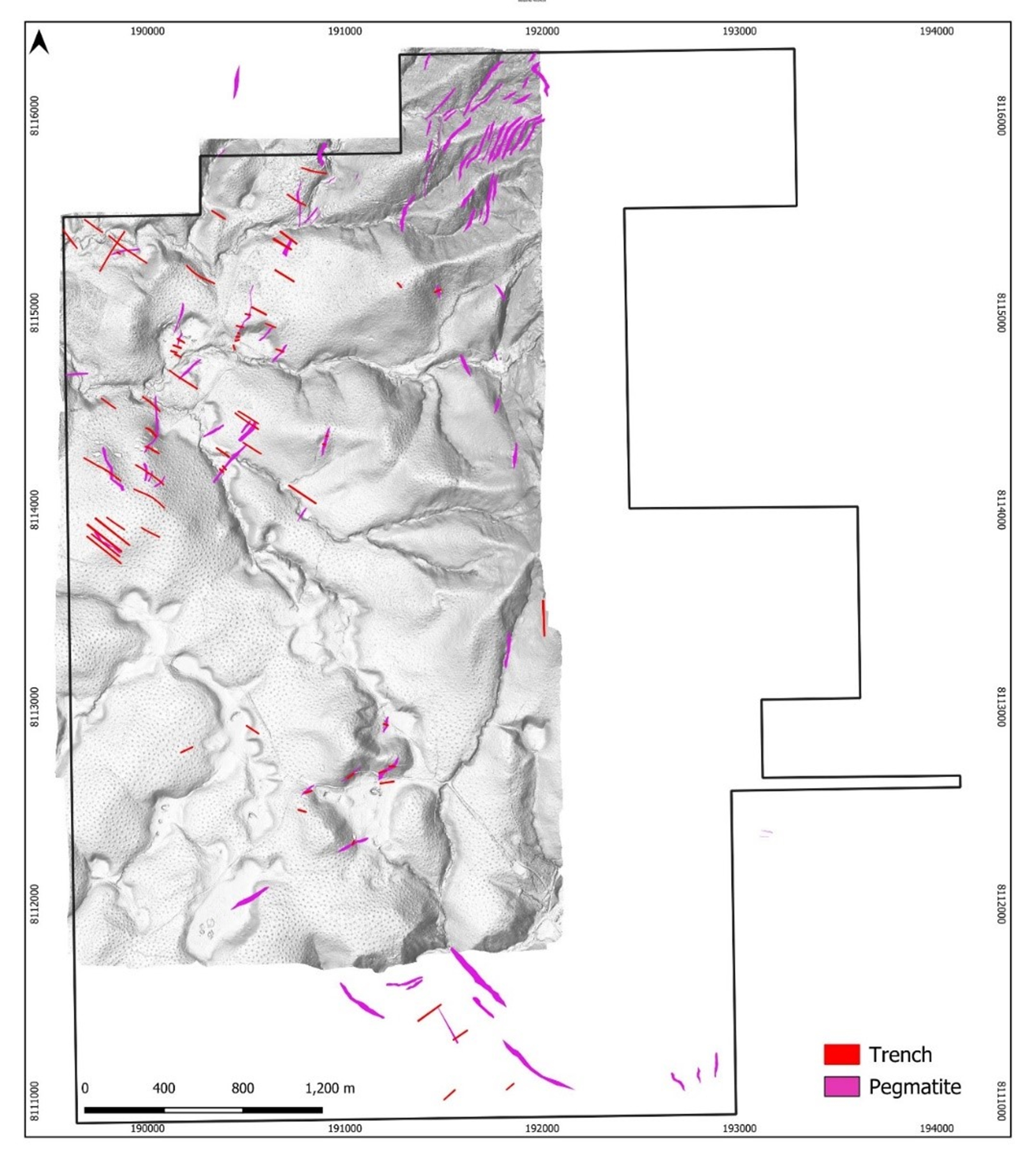
Between
October 2022 and January 2024, Atlas conducted a detailed soil sampling campaign across the Neves tenements, with the objective of identifying
and delineating geochemical anomalies associated with lithium mineralization. Initially focussing on the vicinity of the Anitta 1, Anitta
2, Anitta 2.5, Anitta 3, Anitta 3N and Anitta 4 areas, then expanding to the eastern granite and the area south of the drilled pegmatites,
a total of 4,599 soil samples were collected.
Atlas
planned the sampling over a grid pattern of 25 m intervals on lines spaced at 100 m in areas of low outcrop/poor detail and on lines
spaced at 100 m in areas of known outcrop and higher detail.
Atlas
collected samples from the B-horizon of the soil, as this is generally accepted as the depositional or accumulation horizon, where minerals
that have leached out of the A and E horizons accumulate.
Geochemical
analyses were performed at the SGS Vespasiano laboratories using ICP90A and ICM90A methods. Additionally, selected samples from the Anitta
targets were analyzed internally by the Atlas laboratory using handheld X-ray fluorescence (XRF).
|
| SGS Geological Services |
| S-K 1300 Technical Report – FS Neves Lithium Project – Minas Gerais, Brazil | Page 58 |
| | |
Figure
7-7 shows the grid pattern and results over Neves Project area.
Figure
7-7 Soil Sampling over the Neves Project
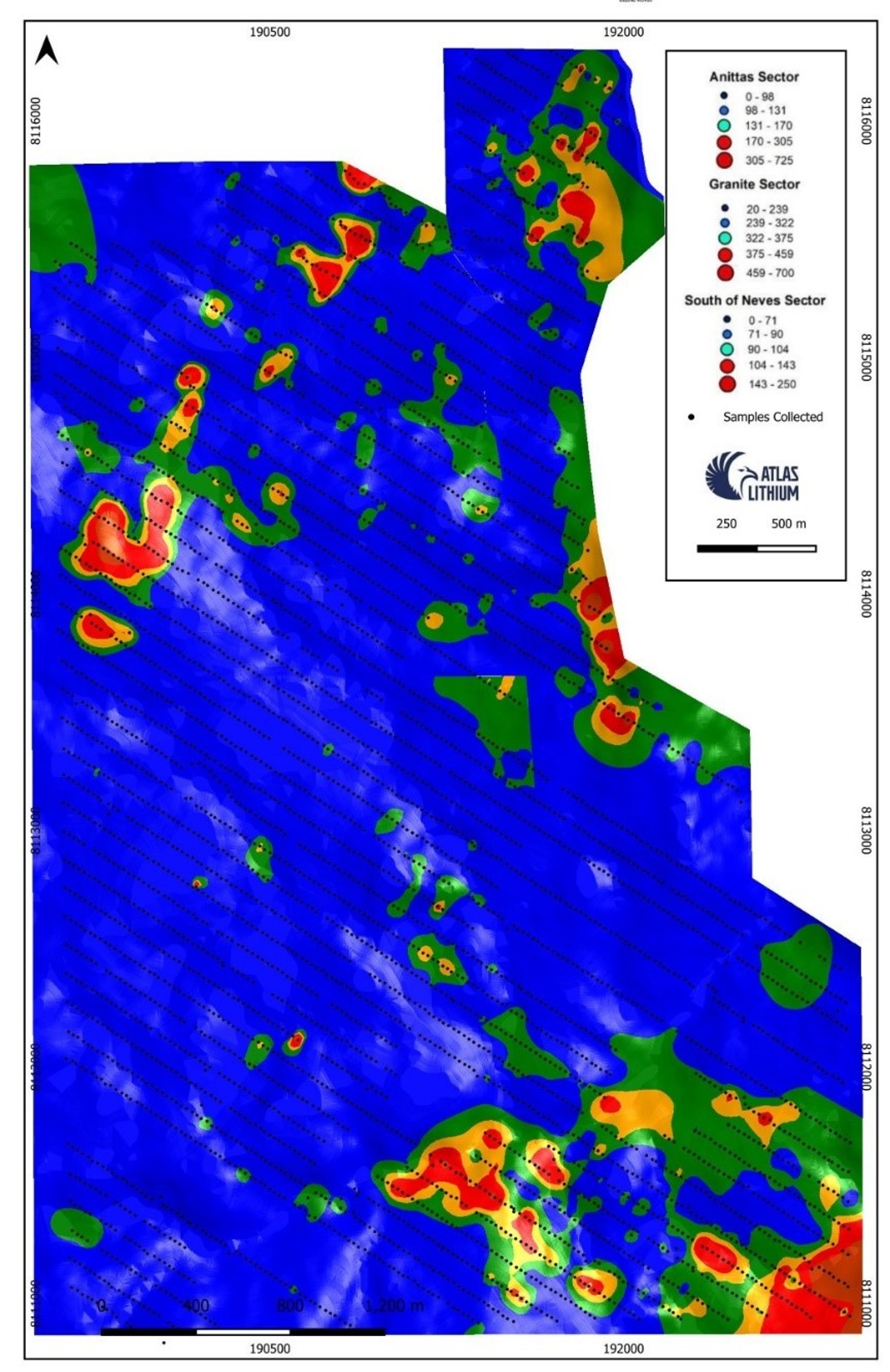
|
| SGS Geological Services |
| S-K 1300 Technical Report – FS Neves Lithium Project – Minas Gerais, Brazil | Page 59 |
| | |
| 7.1.9 | Magnetic
Susceptibility |
The
majority of drill core and mapped surface outcrops have been analyzed with a magnetic susceptibility meter and the data recorded in a
database maintained by Atlas geologists. The data is regularly reviewed and updated.
The
following sections are a description of surface exploration work completed by Atlas on the Gaia property.
| 7.2.1 | Geological
Mapping and Sampling |
Beginning
in 2025, Atlas have conducted ongoing mapping and sampling across the Gaia property.
Figure
7-8 shows the mapped pegmatites on the Gaia property to the end of April 2025.
Figure
7-8 Map of the Gaia Property with Known Pegmatites
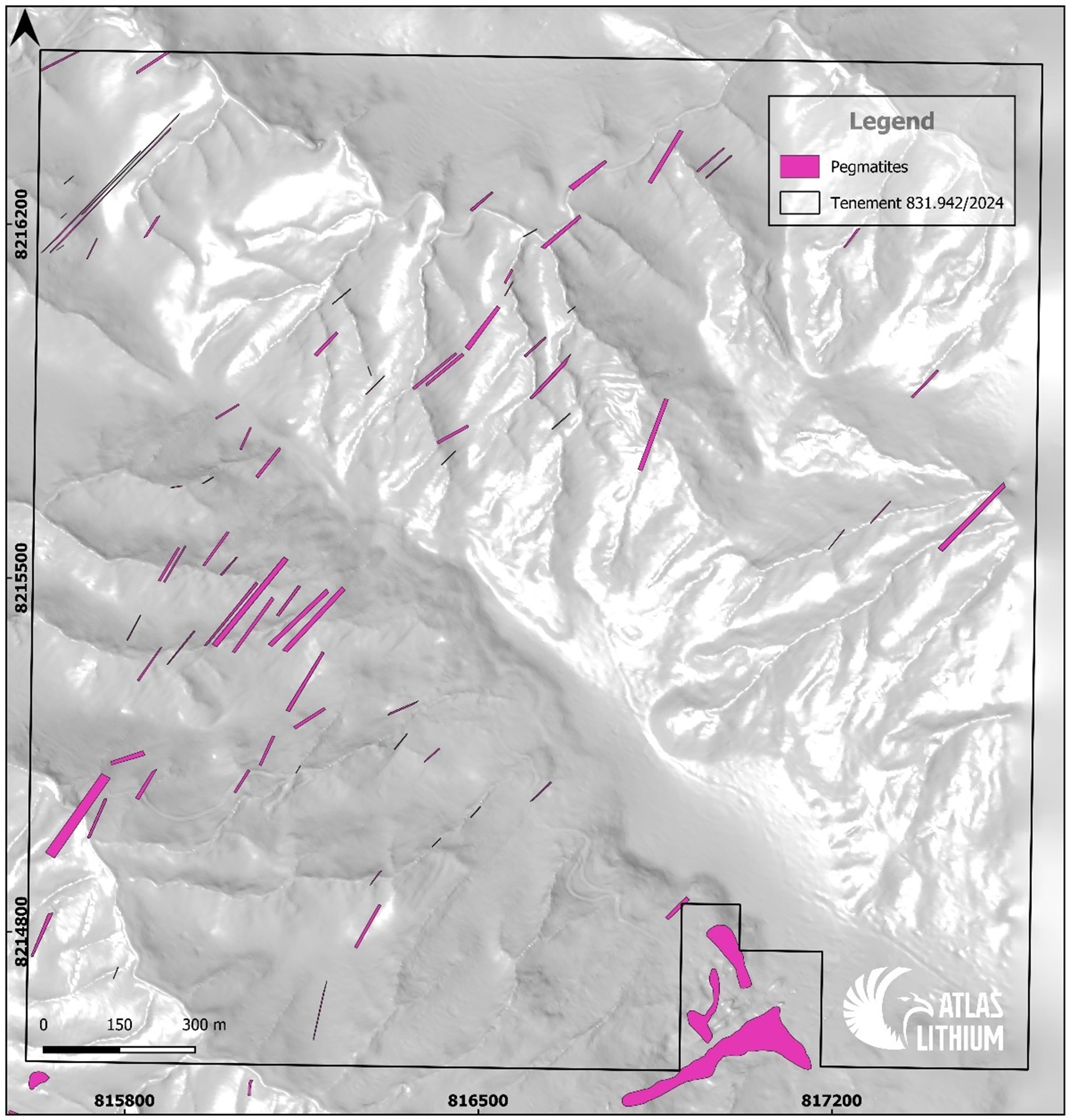
|
| SGS Geological Services |
| S-K 1300 Technical Report – FS Neves Lithium Project – Minas Gerais, Brazil | Page 60 |
| | |
During
the 2025 exploration campaign, Atlas conducted a detailed soil sampling campaign across the Gaia tenement, with the objective of identifying
and delineating geochemical anomalies associated with lithium mineralization.
Atlas
planned the sampling over a grid pattern of 25 m intervals on lines spaced at 100 m.
Atlas
collected samples from the B-horizon of the soil, as this is generally accepted as the depositional or accumulation horizon, where minerals
that have leached out of the A and E horizons accumulate.
Geochemical
analyses were performed at the SGS Vespasiano laboratories using ICP90A and ICM90A methods.
Figure
7-9 shows the results over the Gaia project area.
Figure
7-9 Soil Sampling over the Gaia Project
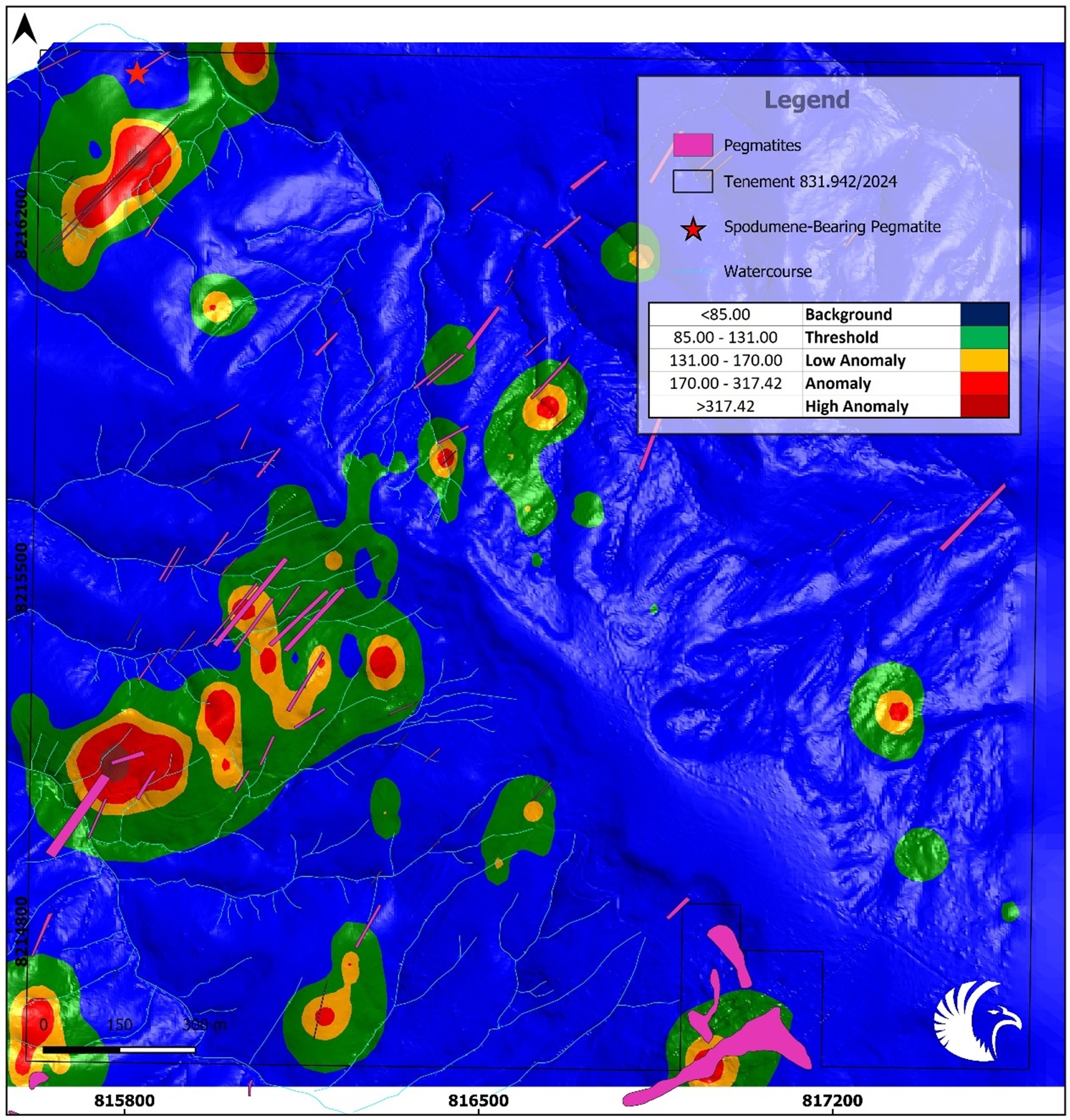
|
| SGS Geological Services |
| S-K 1300 Technical Report – FS Neves Lithium Project – Minas Gerais, Brazil | Page 61 |
| | |
The
first three holes in the Neves program were drilled with AX core bits, with an internal diameter of 30.2 mm. All subsequent diamond holes
have been drilled with HQ core bits, with an internal diameter of 63.5 mm.
The
HQ core size is considered appropriate to provide quality logging material, and to recover sufficient material for future metallurgical
testing.
In
2024, 13 exploration holes were drilled with reverse circulation (RC) drill rigs.
Atlas
has conducted several drilling campaigns on the Neves Project since 2021. Table 7-1 is a drill summary table showing the drilling completed
by Atlas on the Neves property until the 9th of April 2025. A total of 98,733 meters was completed in 523 diamond drill holes.
In addition, Atlas drilled 13 exploration holes in 2024 with RC rigs, for a total of 1,669 meters. Table 7-1 above is total meters drilled
using diamond drill. A total of 536 exploration holes (including RC holes) for 100,403 m of drilling were completed.
Table
7-1 Neves Diamond Drilling
| Year |
Number
Of
Drill Holes |
Metres
Drilled |
| 2021 |
6 |
212 |
| 2022 |
43 |
3,747 |
| 2023 |
338 |
68,885 |
| 2024 |
91 |
16,704 |
| 2025 |
45 |
9,185 |
| Total |
523 |
98,733 |
The
drilling on the Anitta 1 and Anitta 2 pegmatites was conducted on a 20 m x 20 m grid, with the majority of the holes being drilled at
an angle of 60 ° to 70° at an azimuth of 130° for Anitta 1 and 110° for Anitta 2.
The
Anitta 3 drilling was conducted on an approximate 50 m x 50 m grid, with most of the holes dipping between -55° and -60°. The
bulk of the holes were drilled at an azimuth of 250°, although some holes were drilled at an azimuth of 170° to 180°.
Anitta
4 was drilled on an approximate 25 m x 25 m grid, with the holes dipping at -60°, at an azimuth of 110°, while Anitta 2.5 was
drilled on an approximate 30 m by 30 m grid, with the holes dipping at -60°, at an azimuth of 140°.
Illustrative
intercepts through the deposit, showing examples of drill holes with low-grade intercepts, with high-grade intercepts, and with higher-grade
intercepts within lower-grade widths, are provided in Table 7-2. A drill hole location plan for the drilling is provided in Figure 7-1,
and a longitudinal view of the drill traces in Figure 7-11-11.
|
| SGS Geological Services |
| S-K 1300 Technical Report – FS Neves Lithium Project – Minas Gerais, Brazil | Page 62 |
| | |
Table
7-2 Neves Representative Drill Hole Intercepts
| Drill
Hole |
From
(m) |
To
(m) |
Drill
Intercept
(m) |
Li2O
(%) |
| Anitta
1 |
|
|
|
|
| DHAB-0011B |
74.04 |
94.36 |
20.32 |
1.35 |
| DHAB-0015 |
59.49 |
87.31 |
27.82 |
0.94 |
| DHAB-0021 |
49.07 |
58.02 |
9.75 |
1.21 |
| DHAB-0039B |
107.49 |
128.29 |
20.80 |
1.14 |
| DHAB-0041 |
81.00 |
105.19 |
24.19 |
1.02 |
| DHAB-0057 |
92.21 |
110.50 |
18.29 |
1.26 |
| Anitta
2 |
|
|
|
|
| DHAB-0047 |
55.00 |
63.19 |
8.19 |
3.34 |
| DHAB-0068 |
54.15 |
91.00 |
36.85 |
1.04 |
| DHAB-0085 |
13.00 |
54.00 |
41.00 |
1.31 |
| DHAB-0102 |
40.84 |
53.75 |
12.91 |
1.75 |
| DHAB-0104 |
113.82 |
196.80 |
82.98 |
1.51 |
| DHAB-0145EX |
209.95 |
278.60 |
68.65 |
1.14 |
| Anitta
2.5 |
|
|
|
|
| DHGT-0007 |
128.00 |
165.10 |
37.1 |
1.66 |
| DHAB-0456 |
227.00 |
245.00 |
18.0 |
1.79 |
| DHAB-0458 |
68.00 |
100.45 |
32.45 |
1.02 |
| DHAB-0460 |
247.05 |
274.20 |
27.15 |
2.29 |
| DHAB-0473 |
259.76 |
297.00 |
37.24 |
1.50 |
| Anitta
3 |
|
|
|
|
| DHAB-0185 |
8.10 |
60.20 |
52.10 |
1.30 |
| DHAB-0208 |
67.56 |
85.56 |
18.00 |
1.64 |
| DHAB-0347 |
133.12 |
176.00 |
42.88 |
1.32 |
| DHAB-0369 |
113.55 |
130.00 |
16.45 |
1.43 |
| DHAB-0374 |
166.00 |
208.50 |
42.50 |
1.49 |
| DHAB-0382 |
234.35 |
264.00 |
29.65 |
1.33 |
| Anitta
3N |
|
|
|
|
| RCAB-0004 |
57.00 |
72.00 |
15.00 |
1.12 |
| DHAB-0437 |
67.00 |
74.00 |
7.00 |
1.30 |
| DHAB-0437 |
118.00 |
134.00 |
16.00 |
1.06 |
| DHAB-0439 |
118.00 |
172.00 |
54.00 |
1.26 |
| Anitta
4 |
|
|
|
|
| DHAB-0377 |
152.00 |
169.00 |
17.0 |
1.20 |
| DHAB-0462 |
174.00 |
192.48 |
18.48 |
1.78 |
| DHAB-0464 |
205.37 |
208.09 |
2.72 |
1.19 |
| DHAB-0477 |
120.00 |
128.80 |
8.80 |
1.86 |
|
| SGS Geological Services |
| S-K 1300 Technical Report – FS Neves Lithium Project – Minas Gerais, Brazil | Page 63 |
| | |
Figure
7-10 Plan View of Neves Drilling
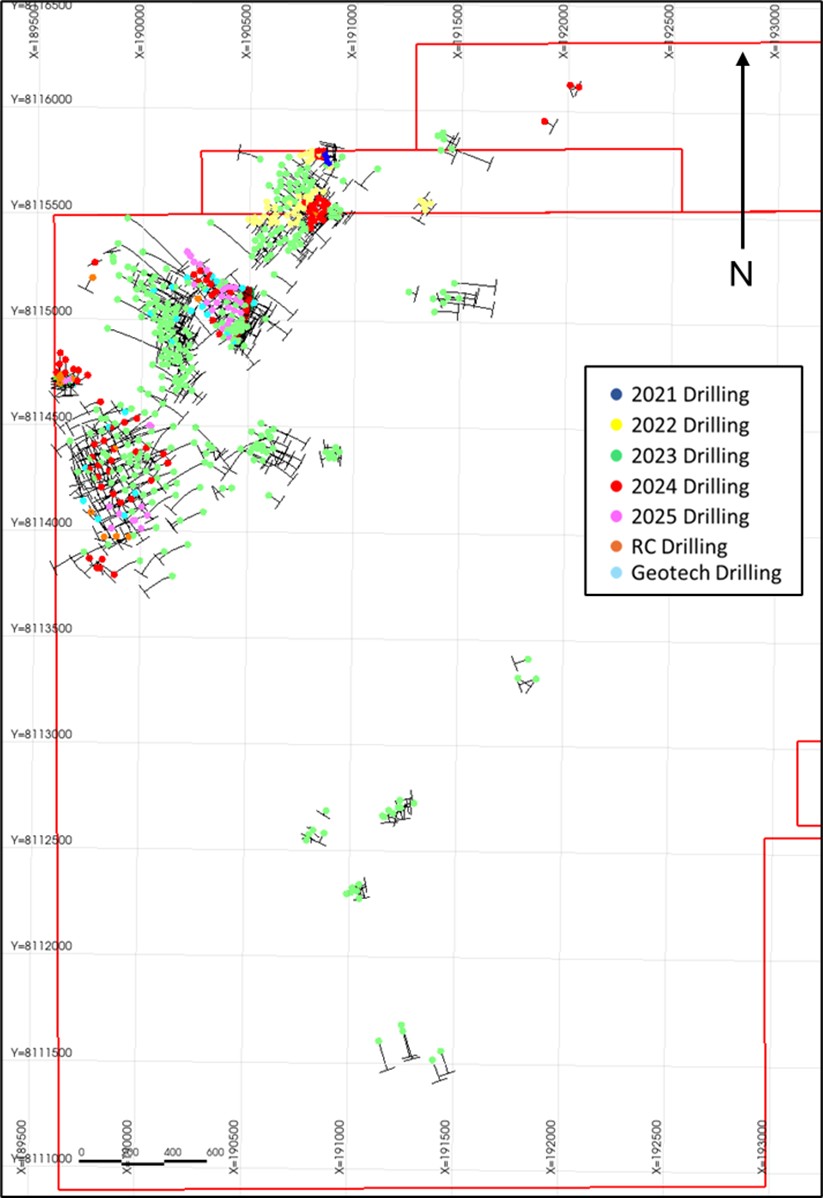
|
| SGS Geological Services |
| S-K 1300 Technical Report – FS Neves Lithium Project – Minas Gerais, Brazil | Page 64 |
| | |
Figure
7-11 Longitudinal View of Neves Drilling
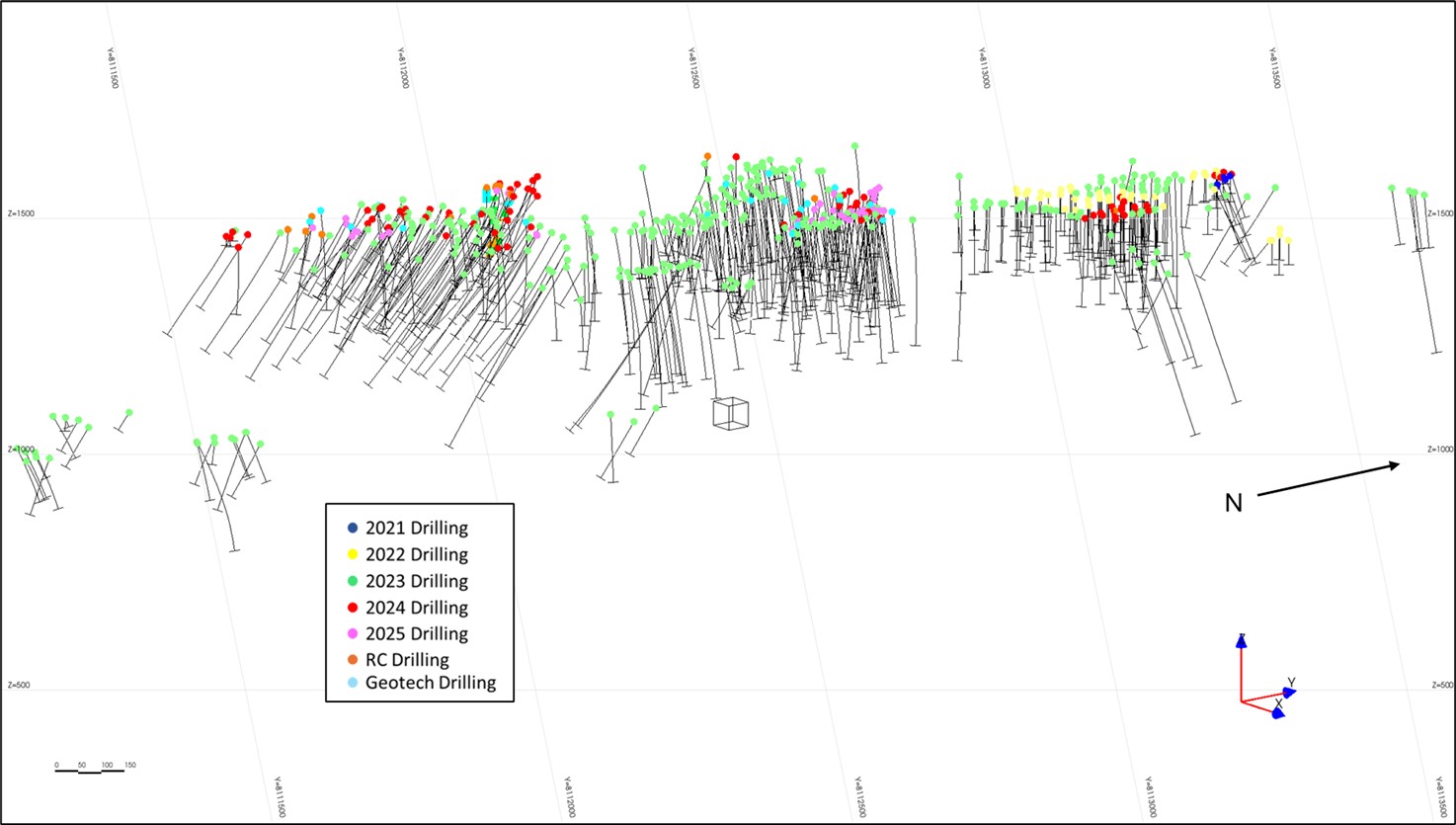
|
| SGS Geological Services |
| S-K 1300 Technical Report – FS Neves Lithium Project – Minas Gerais, Brazil | Page 65 |
| | |
All
diamond holes on the Gaia project have been drilled with HQ core bits, with an internal diameter of 63.5 mm.
The
HQ core size is considered appropriate to provide quality logging material, and to recover sufficient material for future metallurgical
testing.
Atlas
conducted an initial drilling campaign on the Gaia project in 2025, completing six diamond holes for a total of 501 meters of core.
Table
7-4 shows representative assays to date from the Gaia project, while Figure 7-12 shows the Gaia drilling in plan view.
Table
7-3 Gaia Representative Drill Hole Intercepts
| Drill
Hole |
From
(m) |
To
(m) |
Drill
Intercept
(m) |
Li2O
(%) |
| Gaia |
|
|
|
|
| DHGA-0001 |
73.45 |
79.67 |
6.22 |
1.78 |
| DHGA-0002 |
23.13 |
32.00 |
8.87 |
0.99 |
| DHGA-0003 |
91.83 |
96.00 |
4.17 |
1.40 |
|
| SGS Geological Services |
| S-K 1300 Technical Report – FS Neves Lithium Project – Minas Gerais, Brazil | Page 66 |
| | |
Figure
7-12 Plan View of Gaia Drilling
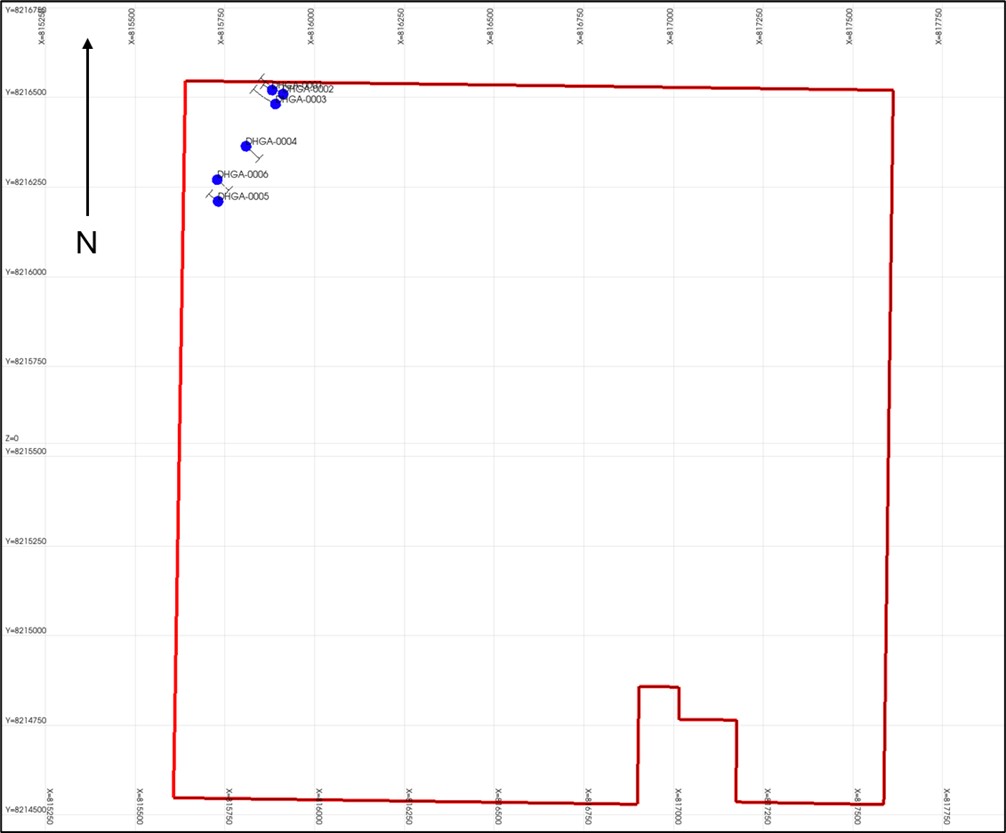
A
total of 14 guided geotechnical probes were performed, eight of which are located in the Anitta 2 pit and six in the Anitta 3 pit. The
results were described using the RMR classification system (Rock Mass Rating, 1989). The probe campaign was performed as proposed
by WALM.
The
location of the probes can be viewed in Figure 7-13. The green points represent the locations where the samples were collected for geotechnical
testing. The black, red and green points indicate the location of the geotechnical probes.
|
| SGS Geological Services |
| S-K 1300 Technical Report – FS Neves Lithium Project – Minas Gerais, Brazil | Page 67 |
| | |
Figure
7-13 Location of Drill Holes & Samples Collected
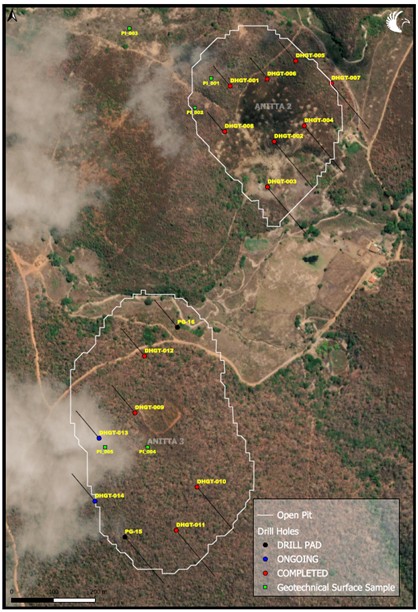
| 7.4.1 | Description
of the Probing and Sampling Holes |
The
main purpose of drilling the rotary boreholes was to gather geotechnical data for the geomechanical classification of the rock mass.
For
each of the borehole, samples were selected boreholes to carry out geotechnical rock tests, such as Uniaxial Compression, Triaxial Compression
and Indirect Tension. The main lithotypes present in the Anitta 2 and Anitta 3 pit models, are shales (XIS) and pegmatite (PEG). The
detailed description is found in reports WA16223003-1-GL-RTE-0001 and WA16223003-1-GL-RTE-0002 (WALM,2024). The coordinates of the probes
for Anitta 2 are in presented in Table 7-4 and of Anitta 3 in Table 7-5.
|
| SGS Geological Services |
| S-K 1300 Technical Report – FS Neves Lithium Project – Minas Gerais, Brazil | Page 68 |
| | |
Table
7-4 Anitta 2 Pit Probe Coordinates
| Probe |
Coordinates
(SIRGAS 2000, 24S) |
Elevation
(m) |
Azimuth
(°) |
Dip
(°) |
Depth
(m) |
| E
(m) |
N
(m) |
| DHGT-0001 |
190,049 |
8,115,134 |
498 |
328.18 |
-74.21 |
250.50 |
| DHGT-0002 |
190,154 |
8,115,001 |
481 |
140.36 |
-54.81 |
271.35 |
| DHGT-0003 |
190,137 |
8,114,892 |
462 |
145.06 |
-54.71 |
250.25 |
| DHGT-0004 |
190,225 |
8,115,040 |
489 |
140.97 |
-56.27 |
251.30 |
| DHGT-0005 |
190,207 |
8,115,193 |
489 |
324.22 |
-74.13 |
250.05 |
| DHGT-0006 |
190,137 |
8,115,154 |
499 |
322.77 |
-75.89 |
250.60 |
| DHGT-0007 |
190,289 |
8,115,144 |
495 |
142.56 |
-54.26 |
265.60 |
| DHGT-0008 |
190,034 |
8,115,024 |
490 |
318.49 |
-76.44 |
251.85 |
Table
7-5 Anitta 3 Pit Probe Coordinates
| Probe |
Coordinates
(SIRGAS 2000, 24S) |
Elevation
(m) |
Azimuth
(°) |
Dip
(°) |
Depth
(m) |
| E
(m) |
N
(m) |
| DHGT-0009 |
189,823 |
8,114,412 |
487 |
316.15 |
-72.28 |
251.00 |
| DHGT-0010 |
190,045 |
8,114,176 |
515 |
146.28 |
-54.22 |
250.35 |
| DHGT-0011 |
190,009 |
8,114,070 |
525 |
142.58 |
-53.68 |
250.95 |
| DHGT-0012 |
189,844 |
8,114,541 |
472 |
317.16 |
-76.53 |
250.30 |
| DHGT-0013 |
189,733 |
8,114,357 |
498 |
321.50 |
-73.07 |
250.45 |
| DHGT-0014 |
189,724 |
8,114,204 |
511 |
321.16 |
-75.72 |
250.15 |
| DHGT-0015 |
189,874 |
8,114,052 |
514 |
144.45 |
-54.76 |
251.45 |
| DHGT-0016 |
189,917 |
8,114,619 |
456 |
289.13 |
-77.10 |
252.10 |
For
the Anitta 2.5 pit, a geotechnical drilling campaign was conducted to define the design parameters for the pit, which was characterized
as an extension of the Anitta 2 pit. A total of four oriented geotechnical boreholes were executed, and the core samples were described
using the RMR (Rock Mass Rating, 1989) classification system.
|
| SGS Geological Services |
| S-K 1300 Technical Report – FS Neves Lithium Project – Minas Gerais, Brazil | Page 69 |
| | |
| 8 | SAMPLE
PREPARATION, ANALYSES, AND SECURITY |
Drill
core of NQ and HQ size was placed in wooden core boxes and delivered daily by the drill contractors to the project core logging facilities.
The drill core was first aligned and measured by the technician and geologist for core recovery. The core recovery measurements were
followed by the RQD measurements. After a summary review of the core, it was logged, and sampling intervals were defined by a geologist.
Before sampling, the core was photographed using a digital camera and the core boxes were identified with box number, hole ID, and aluminium
tags were used to mark the sample intervals.
Sampling
intervals were determined by the geologist, marked and tagged based on lithology and mineralization observations. The typical sampling
length was 1 m but varied according to lithological contacts between the mineralized pegmatite and the host rock. In general, 1 m host
rock samples were collected from each side of the pegmatite contacts. The HQ drill core samples were cut into two halves with one half
placed in a new plastic bag along with the sample tag; the other half was replaced in the core box with the second sample tag for reference.
| 8.2 | Analytical
and Test Laboratories |
All
samples collected by Atlas during the 2021-2025 exploration programs relating to the Neves property were sent to SGS Geosol in Vespasiano,
Brazil.
SGS
Lakefield (metallurgical testing) and SGS Geosol are ISO/IEC 17025 accredited. The SGS Geosol laboratory is ISO 14001 and 17025 accredited
by the Standards Council. All laboratories used for the technical report are independent of Atlas and provide services pursuant to service
contracts.
| 8.3 | Sample
Preparation and Analysis |
All
samples received at SGS Geosol were inventoried and weighted prior to being processed. Drying was done to samples having excess humidity.
Sample material was crushed to 75% passing 3 mm using jaw crushers. One kilogram of material was put in a separate bag and reserved for
future analysis. Ground material was then split in two using a Jones split riffle to obtain one 2 kg sample reserved for duplicate analysis
and one 1 kg sample for primary analysis. One-kilogram sub-samples were then pulverised using a ring and puck mill or a single component
ring mill to 95% passing 150 mesh (106 µm) and split into four 250 g samples using a rotative splitter. The balance of the crushed
sample (reject) was placed into the original plastic bag. The pulverised samples were finally analyzed by SGS Geosol.
The
SGS Geosol analytical method used by Atlas is a 31-element analytical package using sodium peroxide fusion followed by both Inductively
Coupled Plasma Atomic Emission Spectrometry (ICP-AES) and ICP-MS finish (SGS code ICP90A). Analytical results were sent electronically
to Atlas and results were compiled in an MS Excel spreadsheet by the project geologists.
| 8.4 | Density
Determinations |
Density
samples from 15 cm to 20 cm were selected by the Atlas geologists, representing the different rock types (schist and pegmatite), alterations
(weathered and fresh rock), and mineralization qualities (pegmatite with little spodumene, pegmatite with medium spodumene, pegmatite
with much spodumene, and pegmatite without spodumene). Atlas have completed a total of 2,821 density determinations on the different
lithologies of the Neves Project.
Densities
were measured by SGS Geosol using pycnometer measurement.
Table
8-1 shows the average densities for the different lithologies.
|
| SGS Geological Services |
| S-K 1300 Technical Report – FS Neves Lithium Project – Minas Gerais, Brazil | Page 70 |
| | |
Table
8-1 Neves Average Densities
| Lithology |
Specific
Gravity
(g/cm3) |
| Spodumene
Zone |
2.70 |
| Petalite
Zone |
2.58 |
| Quartz |
2.66 |
| Pegmatite |
2.62 |
| Feldspar
Zone |
2.62 |
| Schist |
2.77 |
| 8.5 | Quality
Assurance and Quality Control |
In
addition to the laboratory quality assurance quality control (QA/QC) routinely implemented by SGS Geosol using pulp duplicate analysis,
Atlas developed an internal QA/QC protocol for the Neves drilling, which consisted of the insertion of analytical standard reference
materials (standards), blanks and core duplicates on a systematic basis with the samples shipped to the analytical laboratory.
The
Atlas protocol for QAQC is for every 22 samples, three reference samples are randomly inserted, including one standard, one blank and
one duplicate sample.
Blanks
can be inserted anywhere in the sample stream, but standards and duplicates are included in pegmatite intervals, whether they are considered
mineralized or not.
Each
50-sample batch sent to the lab contains at least two standards, two blanks and two duplicates. When the batch size varies the control
samples are inserted proportionally.
| 8.5.1 | Analytical
Standards |
Prior
to mid-2023, Atlas used standards supplied by Centro Tecnológico de Referência Sul-americano (CTRS). The organisation advertises
that they supply Certified Reference Materials (CRM) according to international protocols, but there is no publicly available access
to the certificates of analysis for these standards. Atlas used a total of 10 different CTRS standards between 2021 and 2023.
In
July 2023, Atlas migrated their drilling database to an Access-based database and in the process, a QAQC review identified issues with
three of the CTRS standards, namely EURO0330, EURO0331 and EURO0332. Investigation suggested that the supplied CRMs had been mislabelled
at the source and the claimed lithium value of the standard was not the assayed value.
To
ascertain that the assays around these standards were valid, it was determined to resample the five assays above and the five assays
below each of the failed standards. A total of 359 pulp samples were submitted to Geosol for re-assay.
An
analysis of the re-assayed material versus the original assays determined that there was a very high correlation between the samples,
with an R2 value of 0.9992. Figure 8-1 is a scatterplot of the original versus re-assayed samples.
|
| SGS Geological Services |
| S-K 1300 Technical Report – FS Neves Lithium Project – Minas Gerais, Brazil | Page 71 |
| | |
Figure
8-1 Original versus Re-Assay Values
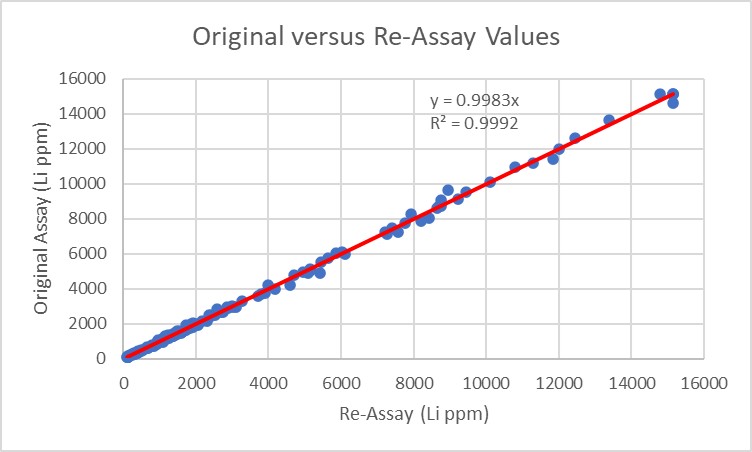
In
July 2023, Atlas adopted OREAS standards as their CRMs, using three certified standards for their QAQC, namely a low-grade, mid-grade
and high-grade sample (Table 8-2).
A
total of 163 OREAS standards were submitted by Atlas between July 2023 and April 2025. Figure 8-2 shows the standards results for the
OREAS standards submitted.
The
results from the standards are considered reasonable and within industry-accepted tolerances.
Table
8-2 Standard Average Li Values with Analytical Error for Peroxide Fusion
| Analytical
Standards |
Li2O
(%) |
Analytical
Error (2σ) |
| OREAS
750 |
0.496 |
0.044 |
| OREAS
751 |
1.01 |
0.074 |
| OREAS
753 |
2.19 |
0.1 |
|
| SGS Geological Services |
| S-K 1300 Technical Report – FS Neves Lithium Project – Minas Gerais, Brazil | Page 72 |
| | |
Figure
8-2 Shewhart Performance Chart of OREAS Standard Results
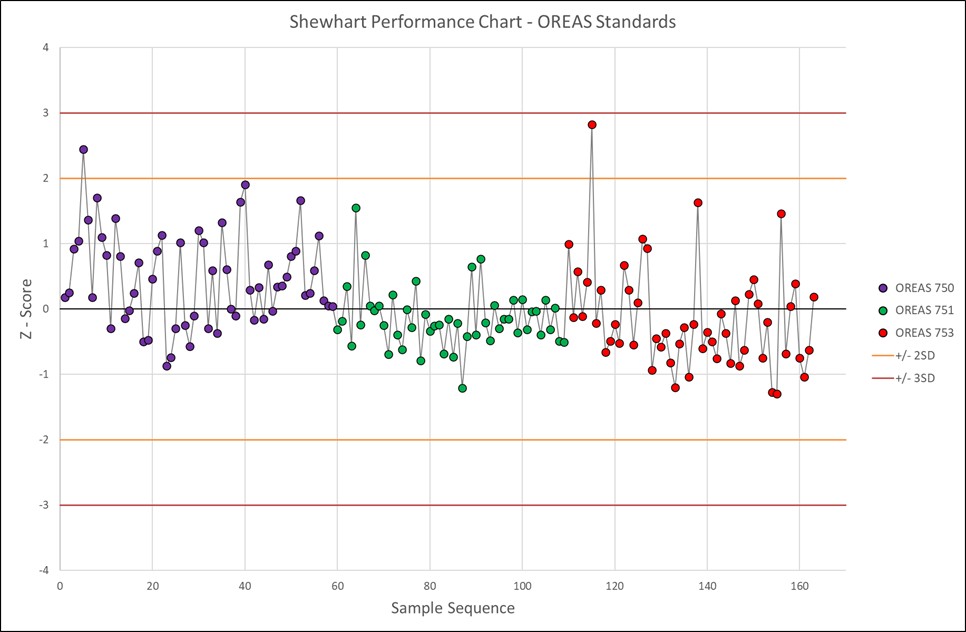
A
total of 471 blanks were analyzed during the 2021 to 2025 drilling campaigns. Of the 471 blanks, four samples were higher than five times
the Lower detection Limit (LDL) of 10 ppm Li. Figure 8-3 shows blank sample results across the exploration program.
|
| SGS Geological Services |
| S-K 1300 Technical Report – FS Neves Lithium Project – Minas Gerais, Brazil | Page 73 |
| | |
Figure
8-3 Atlas Blank Sample Analyses
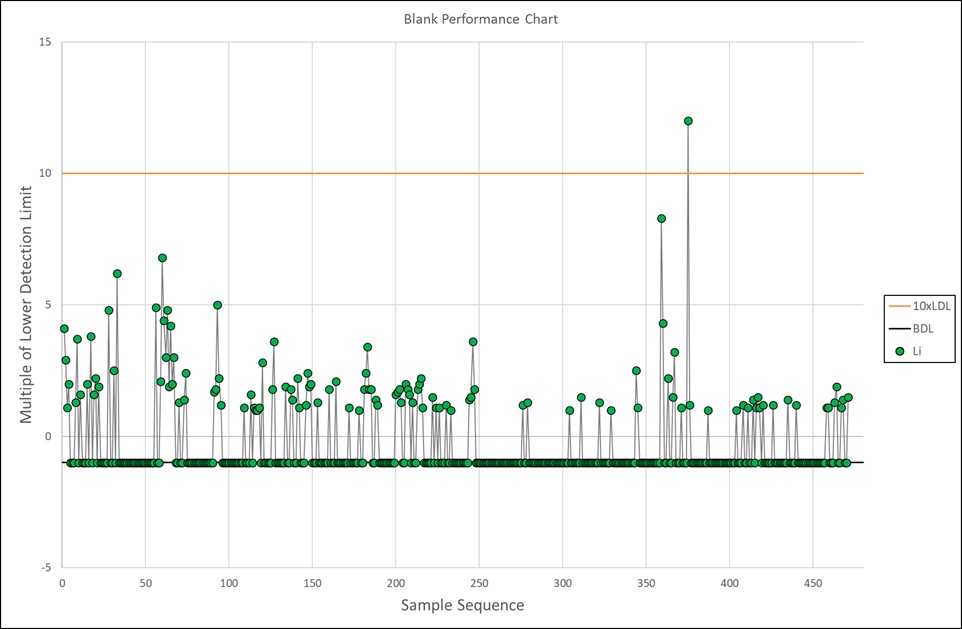
Over
the course of the exploration programs, Atlas has analyzed 455 coarse duplicate pairs. Figure 8-4 is a scatterplot comparing original
and duplicate core pairs. The average value for the original values is 0.201% Li2O and the average value for the duplicate
values is 0.205% Li2O. The difference between original and duplicate averages is 1.99% Li2O. The correlation coefficient
R2 of 0.876 suggests a strong correlation and a high similarity between the two sets of samples.
Atlas
has analyzed 310 pulp duplicate samples over the course of the exploration programs. Figure 8-5 is a scatterplot comparing original and
duplicate pulp pairs. The average value for the original values is 0.387% Li2O and the average value for the duplicate values
is 0.386% Li2O. The difference between original and duplicate averages is 0.26% Li2O. The correlation coefficient
R2 of 0.996 suggests a strong correlation and a high similarity between the two sets of samples.
|
| SGS Geological Services |
| S-K 1300 Technical Report – FS Neves Lithium Project – Minas Gerais, Brazil | Page 74 |
| | |
Figure
8-4 Correlation Between Original Samples and Coarse Duplicates
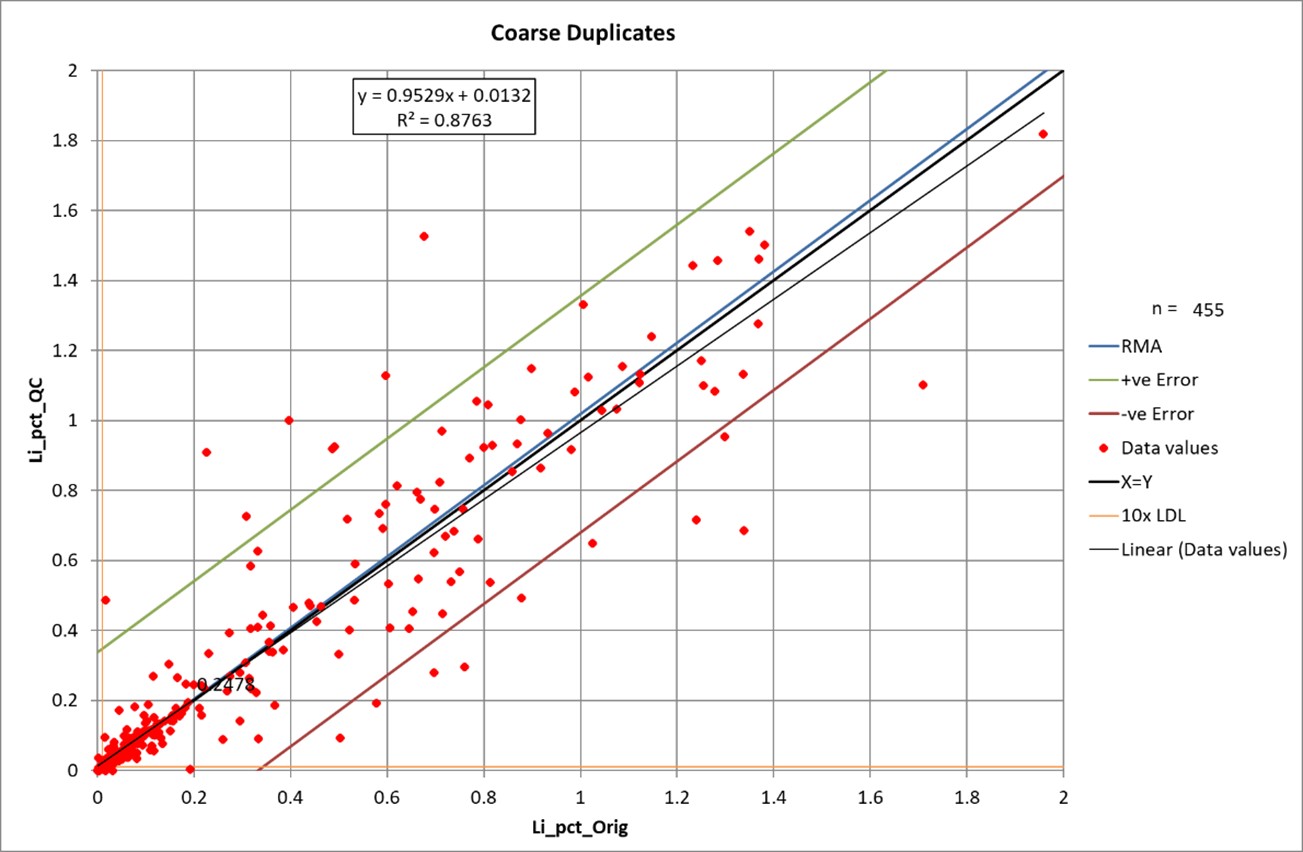
Figure
8-5 Correlation Between Original Samples and Pulp Duplicates
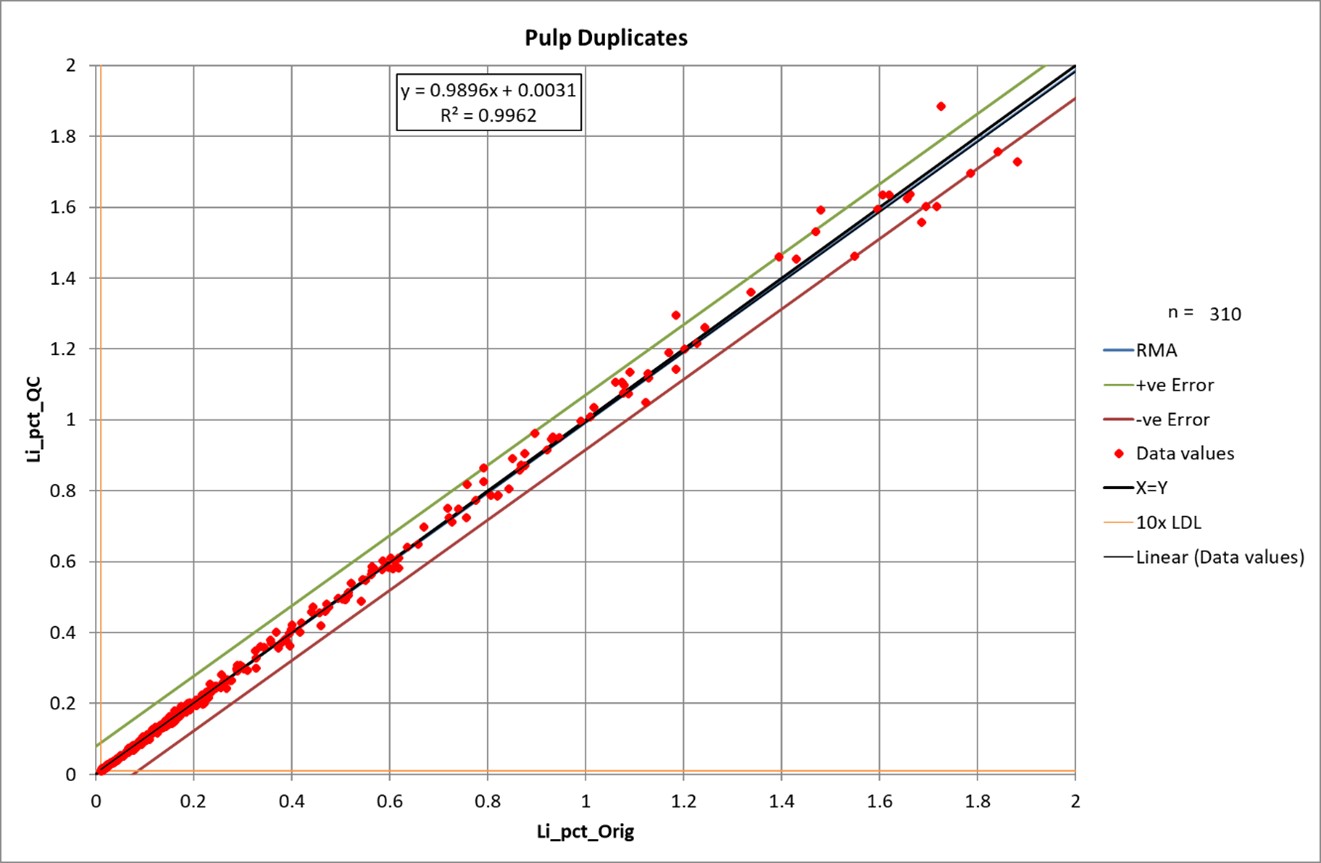
|
| SGS Geological Services |
| S-K 1300 Technical Report – FS Neves Lithium Project – Minas Gerais, Brazil | Page 75 |
| | |
| 8.6 | Sample
Security and Storage |
Samples
are placed into bags tagged and numbered with the sample tag inserted in the bag. Sample collection and transportation have always been
undertaken by company personnel using company vehicles. Tracking of sample shipments used industry-standard procedures. Chain-of-custody
procedures consisted of filling out sample submittal forms that were sent to the laboratory with sample shipments to make certain that
all samples were received by the laboratory.
Core
storage for unlogged and unsampled core is located at the core logging facility.
SGS
validated the exploration processes and core sampling procedures used by Atlas in 2023 and 2025 as part of an independent verification
program.
The
QP concluded that the drill core handling, logging and sampling protocols are at conventional industry standard and conform to generally
acceptable best practices. The chain of custody was followed by Atlas employees, and the sample security procedure showed no flaws.
The
QP considers that the sample quality is good and that the samples are generally representative.
Finally,
the QP is confident that the system is appropriate for the collection of data suitable for a Mineral Resource Estimate.
|
| SGS Geological Services |
| S-K 1300 Technical Report – FS Neves Lithium Project – Minas Gerais, Brazil | Page 76 |
| | |
A
visit to the Project was conducted by Marc-Antoine Laporte, P.Geo., M.Sc. from May 4 to 6, 2023 and from March 11 to 14, 2025. The visits
enabled the QP to become familiar with the exploration methods used by Atlas, the field conditions, the position of the drill hole collars,
the core storage and logging facilities and the different exploration targets.
The
data validation was conducted from three fronts:
| ● | Validation
of the drilling database |
| | | |
| ● | Validation
of the QA/QC data (see section 8.5) |
| | | |
| ● | Control
sampling program. |
The
database for the Project was first transmitted to SGS by Atlas on the 11th May, 2023, and regularly updated by Atlas geologists.
The database contains data for: collar locations; downhole surveys; lithologies and lithium assays.
Upon
importation of the data into the modelling and mineral resources estimation software (Genesis™), SGS conducted a second phase of
data validation. At this point all the major discrepancies were removed from the database.
Lastly,
SGS conducted random checks on approximately 5% of the assay certificates, to validate the assay values entered in the database.
The
following Qualified Persons visited the Project site.
Mr.
Marc-Antoine Laporte, P.Geo., M.Sc., from SGS visited the Project site on March 11th to 14th, 2025 and previously
on May 4 to 6, 2023. During the 2025 site visit, Mr. Laporte conducted a general review of the logging and QA/QC procedures in place
since the original drill program back in 2023. Drill hole collars were visited, and selected collar positions checked with a hand-held
global positioning system (GPS) instrument on the Neves property. An inspection of the drilling equipment/contractors and deviation survey
methodology and tools was completed. An extensive review of the mineralized core from the four main pegmatites zone was conducted during
the first days of the visit including discussion of the sampling methodology with technical staff. One day was spent on reviewing geological
3D model including technical discussion with Atlas geologist. All information and personal were available during the QP visit to facilitate
review process.
Mr.
Joseph Keane and Mr. Sam Yu from SGS visited the Project site on June 2nd to 7th, 2025. The site visit purpose
was to view an equipment storage area and inspect specific container contents of a heavy media separation equipment plant that Atlas
Lithium had purchased for the project. A visit was also made to the project mine and plant site.
At
the Belo Horizonte office the SGS representatives met with Eduardo Queiroz, PMO & VP Engineering. Mr. Queiroz had arranged a visit
to an equipment storage facility located close to the nearby town of Betim.
The
equipment storage facility consists of secure areas where photography is not allowed and other areas where process consumables such as
grinding media and dense media separation materials (ferrosilicon) are stored in bulk. Much of the facility consists of covered areas
which shield the contents from the tropical environment. The storage facility is well managed and the security of the goods in the facility
is continuously monitored based on the information provided during the warehouse visit.
|
| SGS Geological Services |
| S-K 1300 Technical Report – FS Neves Lithium Project – Minas Gerais, Brazil | Page 77 |
| | |
The
equipment package purchased by Atlas Lithium arrived in Belo Horizonte in numerous shipping containers and certain large or bulky items
were shipped on pallets or skids. It was not possible to inspect every container, but the seals were broken and the doors were opened
on 12 individual containers for our inspection. The SGS QP’s were also shown items that were on pallets that had been equipped
with weatherproof coverings. It was noted that each container had an individual identification placard and the container weight was noted
externally. The inspection of the containerized equipment items in storage in Belo Horizonte has corroborated the statements of Atlas
Lithium that an equipment assemblage suitable for the heavy media beneficiation of spodumene ore has been purchased in South Africa,
shipped to Belo Horizonte, and is now in secure storage.
Summarizing,
the container inspection was conducted by SGS representatives, and the conclusion is drawn that the pronouncements by Atlas Lithium regarding
the number, types, and contents of the containers in storage is corroborated.
On
June 5th, 2025, the SGS QP’S visited the project sites including the proposed open pit mining operations, the mill site,
and various waste disposal areas. The road from Araçuaí to the project site is mostly unpaved and the terrain is undulating
making the road sinuous along certain sections. The tour was supervised by Raimundo Almeida Jr., Vice President, Lithium Processing for
Atlas Lithium who was accompanied by members of the geology staff. Two of the proposed mine sites were visited along with the proposed
mill site and waste/tailings disposal areas. The project site is hilly and undulating as depicted on the present mining and site plans
that have been so far developed.
In
addition to a general site overview and individual facility locations, a physical cut in mineralized soil close to Anitta 3 was inspected
and the weathered material revealed rather large liberated spodumene crystals that were identified by the Atlas Lithium geological team.
According to geologists accompanying the visit, these crystals were larger than the spodumene crystals from Anitta 1 pit.
It
was observed that the open pit sites, the plant site, and the waste and tailings area all have heavy vegetation. Due to the undulating
terrain, considerable earthwork may be required for the site preparation.
According
to Atlas Lithium geologists, the open pits have relatively high strip ratios around 16.72 and the mineralized zones are usually thin.
Topics relating to ore control, blasting, ore blending, and geo-metallurgical programs were also discussed. The core storage area was
visited. Numerous sections of split and sawed core were examined. A substantial quantity of the split core had the spodumene crystals
outlined such that an examiner could compare those spodumene crystals with other contained minerals in the split core. Based on the observation
of core samples, most of the spodumene crystals were quite large and associated with quartz and other minerals. Some spodumene crystal
sizes were even larger than what was observed in the trench cut described earlier. This explains why some HLS (Heavy Liquid Separation)
tests conducted had significantly higher lithium recovery than the results from HLS test conducted on Anitta 1 sample. Depending on the
content of impurity metals in the spodumene crystals, the crystal color can be either green, or pink or colorless. Several additional
geological exhibits were also reviewed including select mineral specimens from the deposits and a demonstration of fluorescence of certain
property minerals.
As
part of the technical due diligence process and in compliance with the requirements, a field visit to the Neves Project was conducted
on May 26, 2025.
The
project’s geotechnical assessment was based on field investigations, including core drilling with sampling, geological-structural
mapping, laboratory testing, and stability analyses using various methodologies such as kinematic analysis, limit equilibrium, and stress-strain
modeling. The results indicated appropriate Factors of Safety (FoS) in accordance with the criteria of Read & Stacey (2009), with
recommendations for geometric adjustments in specific sectors to optimize slope stability and maximize resource recovery.
During
the visit, a detailed inspection was carried out at the core storage facility, allowing for visual verification of the quality of the
drill core samples. The inspection included assessment of sample preservation, core recovery, box organization, and the correct labeling
and identification of sampled sections. This on-site verification was essential to confirm the representativeness and integrity of the
materials described in the geotechnical databases used in the studies.
In
addition, the technical team visited the future pit areas of Anitta 2, 2.5 and Anitta 3, inspecting access conditions to the mining fronts
and physically verifying the locations of the completed drill holes, which were properly marked with stakes and identification plates.
This step allowed for the validation of the geographical coordinates of the boreholes and verification of the consistency between physical
markers in the field and the positional data recorded in the project’s topographic and geotechnical databases.
The
observations made during the field visit, both at the core storage facility and in the field areas, were incorporated into the final
analysis and validation of the data, providing the technical foundation to support the issuance of the Technical Report for the Neves
Project.
|
| SGS Geological Services |
| S-K 1300 Technical Report – FS Neves Lithium Project – Minas Gerais, Brazil | Page 78 |
| | |
| 10 | MINERAL
PROCESSING AND METALLURGICAL TESTING |
The
Neves lithium project, owned by Atlas Lithium, is located to the southwest of the municipality of Araçuaí, in the northeast
region of Minas Gerais state, Brazil. The targeted deposits are mostly between the city of Araçuaí and the city of Itinga.
The main lithium bearing material is spodumene, followed by a smaller amount of petalite. Based on the samples tested at SGS Lakefield,
approximately 78.5% of the lithium in the sample is in the form of spodumene, the remainder is predominantly in the form of petalite.
Since spodumene typically has a higher specific gravity than most of the gangue materials, dense media separation (DMS) was recommended
for the beneficiation process.
In
April 2023, SGS completed a series of laboratory tests to investigate the potential to recover the lithium from this deposit using DMS
and flotation processes. The tests indicated that this mineralized material is amenable to DMS technology and flotation can further improve
the lithium recovery. Per discussions with Atlas Lithium, only DMS will be considered in the process design for this project. The test
samples utilized for the SGS Lakefield testing were all from Anitta 1 Pit. To further explore the ore variability for this project, additional
samples were collected from Anitta 1, Anitta 2, Anitta 3, Anitta 2.5 and Anitta 4 pits and sent to SGS Geosol laboratory in Brazil for
chemical composition analysis and Heavy Liquid Separation (HLS) tests which were performed from late 2023 to early 2024. Though the HLS
tests are not always considered a comprehensive metallurgical study, the HLS data does strongly correlate with DMS performance and indicate
the future metallurgical performance of the material from different locations of the deposit. HLS data is considered a perfect separation
and empirical data shows that actual DMS performance is typically downgraded marginally to account for the operational inefficiencies
in the field.
The
fine size fraction waste materials generated from the SGS Geosol tests was subjected to sedimentation and filtration testwork at PESCO,
which was completed in early 2025. This report section summarizes and analyzes all the test work.
| 10.1 | Test
Work completed at SGS Lakefield |
| 10.1.1 | Sample
Selection, Preparation and Head Assay |
In
December 2022, Atlas Lithium sent one drum of test samples to the SGS Lakefield laboratory. The samples consisted of half and quarter
drill core in labelled sample bags. The samples came from several drill holes from Anitta 1 pit. The detailed sample receipt information
is listed in Table 10-1.
Each
sample bag was inventoried and weighted resulting in a total of 117 kg of drill core. The sample was combined, and stage crushed to ¾
inch (19.1 mm), and a 5 kg subsample was procured and submitted for Bond Work Index and Bond Abrasion Index tests. The remainder was
further stage crushed to minus ½ inch (-12.7 mm) from which another 30 kg subsample was taken and stage crushed to minus 3/8 inch
(-9.5 mm).
|
| SGS Geological Services |
| S-K 1300 Technical Report – FS Neves Lithium Project – Minas Gerais, Brazil | Page 79 |
| | |
Table
10-1 Sample Identification and Weight
| DHID |
From |
To |
Length |
Sample |
Li2O
% |
Wthrg |
Spod
% |
Pet
% |
1/4
Core |
1/2
Core |
Weight
Kg |
| DHAB-11 |
67.94 |
68.80 |
0.86 |
MET_AB-001_DHAB-11 |
1.15 |
Fresh |
10% |
0% |
X |
|
1.312 |
| DHAB-11 |
69.90 |
71.10 |
1.20 |
MET_AB-002_DHAB-11 |
2.67 |
Fresh |
22% |
5% |
|
X |
4.430 |
| DHAB-11 |
71.10 |
72.30 |
1.20 |
MET_AB-003_DHAB-11 |
2.37 |
Fresh |
22% |
5% |
|
X |
4.064 |
| DHAB-11B |
76.75 |
77.65 |
0.90 |
MET_AB-004_DHAB-11B |
2.11 |
Fresh |
28% |
10% |
X |
|
1.622 |
| DHAB-11B |
77.65 |
78.49 |
0.84 |
MET_AB-005_DHAB-11B |
3.26 |
Fresh |
28% |
10% |
X |
|
1.382 |
| DHAB-11B |
78.49 |
79.30 |
0.81 |
MET_AB-006_DHAB-11B |
2.37 |
Fresh |
28% |
10% |
X |
|
1.578 |
| DHAB-11B |
79.30 |
80.00 |
0.70 |
MET_AB-007_DHAB-11B |
1.94 |
Fresh |
28% |
10% |
X |
|
1.060 |
| DHAB-11B |
90.46 |
91.30 |
0.84 |
MET_AB-008_DHAB-11B |
1.74 |
Fresh |
30% |
0% |
X |
|
1.496 |
| DHAB-11B |
92.50 |
93.45 |
0.95 |
MET_AB-010_DHAB-11B |
1.59 |
Fresh |
40% |
5% |
X |
|
1.866 |
| DHAB-11B |
93.45 |
94.36 |
0.91 |
MET_AB-011_DHAB-11B |
1.11 |
Fresh |
30% |
5% |
X |
|
1.474 |
| DHAB-12 |
85.05 |
85.80 |
0.75 |
MET_AB-012_DHAB-12 |
1.57 |
Fresh |
35% |
5% |
|
X |
2.890 |
| DHAB-12 |
85.80 |
86.75 |
0.95 |
MET_AB-013_DHAB-12 |
1.67 |
Fresh |
35% |
5% |
|
X |
3.468 |
| DHAB-12 |
86.75 |
87.55 |
0.80 |
MET_AB-014_DHAB-12 |
0.86 |
Fresh |
35% |
5% |
|
X |
3.130 |
| DHAB-12 |
87.55 |
88.43 |
0.88 |
MET_AB-015_DHAB-12 |
0.80 |
Fresh |
25% |
5% |
|
X |
3.290 |
| DHAB-15 |
60.50 |
61.50 |
1.00 |
MET_AB-016_DHAB-15 |
1.75 |
Fresh |
30% |
0% |
|
X |
3.368 |
| DHAB-15 |
61.50 |
62.50 |
1.00 |
MET_AB-017_DHAB-15 |
1.45 |
Fresh |
25% |
0% |
|
X |
3.278 |
| DHAB-15 |
62.50 |
63.55 |
1.05 |
MET_AB-018_DHAB-15 |
1.09 |
Fresh |
25% |
0% |
|
X |
4.636 |
| DHAB-15 |
64.55 |
65.55 |
1.00 |
MET_AB-019_DHAB-15 |
0.81 |
Fresh |
25% |
0% |
|
X |
3.592 |
| DHAB-15 |
66.55 |
67.55 |
1.00 |
MET_AB-020_DHAB-15 |
1.76 |
Fresh |
25% |
0% |
|
X |
3.676 |
| DHAB-15 |
67.55 |
68.55 |
1.00 |
MET_AB-021_DHAB-15 |
1.41 |
Fresh |
25% |
0% |
|
X |
3.546 |
| DHAB-15 |
68.55 |
69.55 |
1.00 |
MET_AB-022_DHAB-15 |
2.30 |
Fresh |
25% |
0% |
|
X |
3.396 |
| DHAB-15 |
69.55 |
70.55 |
1.00 |
MET_AB-023_DHAB-15 |
2.03 |
Fresh |
25% |
0% |
|
X |
4.532 |
| DHAB-15 |
70.55 |
71.55 |
1.00 |
MET_AB-024_DHAB-15 |
1.63 |
Fresh |
25% |
0% |
|
X |
3.416 |
| DHAB-15 |
71.55 |
72.55 |
1.00 |
MET_AB-025_DHAB-15 |
0.80 |
Fresh |
25% |
0% |
|
X |
3.676 |
| DHAB-15 |
72.55 |
73.53 |
0.98 |
MET_AB-026_DHAB-15 |
0.88 |
Fresh |
25% |
0% |
|
X |
3.744 |
| DHAB-15 |
73.53 |
74.51 |
0.98 |
MET_AB-027_DHAB-15 |
1.71 |
Fresh |
25% |
0% |
|
X |
3.830 |
| DHAB-15 |
74.51 |
75.51 |
1.00 |
MET_AB-028_DHAB-15 |
2.16 |
Fresh |
25% |
0% |
|
X |
4.070 |
| DHAB-15 |
82.65 |
83.60 |
0.95 |
MET_AB-029_DHAB-15 |
2.07 |
Fresh |
20% |
0% |
|
X |
3.426 |
|
| SGS Geological Services |
| S-K 1300 Technical Report – FS Neves Lithium Project – Minas Gerais, Brazil | Page 80 |
| | |
| DHID |
From |
To |
Length |
Sample |
Li2O
% |
Wthrg |
Spod
% |
Pet
% |
1/4
Core |
1/2
Core |
Weight
Kg |
| DHAB-16 |
44.25 |
45.25 |
1.00 |
MET_AB-030_DHAB-16 |
1.01 |
Fresh |
20% |
0% |
|
X |
3.274 |
| DHAB-17 |
73.63 |
74.63 |
1.00 |
MET_AB-031_DHAB-17 |
1.03 |
Fresh |
35% |
0% |
X |
|
1.492 |
| DHAB-17 |
74.63 |
75.50 |
0.87 |
MET_AB-032_DHAB-17 |
1.51 |
Fresh |
35% |
0% |
|
X |
4.200 |
| DHAB-17 |
75.50 |
76.23 |
0.73 |
MET_AB-033_DHAB-17 |
1.33 |
Fresh |
35% |
0% |
|
X |
2.128 |
| DHAB-18 |
83.63 |
84.60 |
0.97 |
MET_AB-034_DHAB-18 |
0.95 |
Fresh |
17% |
0% |
X |
|
2.032 |
| DHAB-18 |
86.55 |
87.65 |
1.10 |
MET_AB-035_DHAB-18 |
1.74 |
Fresh |
25% |
10% |
X |
|
1.576 |
| DHAB-18 |
87.65 |
88.60 |
0.95 |
MET_AB-036_DHAB-18 |
2.15 |
Fresh |
25% |
10% |
|
X |
3.268 |
| DHAB-18 |
88.60 |
89.55 |
0.95 |
MET_AB-037_DHAB-18 |
2.69 |
Fresh |
25% |
10% |
X |
|
1.616 |
| DHAB-21 |
51.00 |
52.00 |
1.00 |
MET_AB-038_DHAB-21 |
1.15 |
Fresh |
15% |
0% |
X |
|
1.134 |
| DHAB-21 |
52.00 |
53.00 |
1.00 |
MET_AB-039_DHAB-21 |
1.41 |
Fresh |
15% |
0% |
|
X |
2.542 |
| DHAB-21 |
53.00 |
54.00 |
1.00 |
MET_AB-040_DHAB-21 |
2.87 |
Fresh |
20% |
0% |
|
X |
3.736 |
| DHAB-21 |
54.00 |
55.00 |
1.00 |
MET_AB-041_DHAB-21 |
1.51 |
Fresh |
20% |
0% |
|
X |
3.258 |
| DHAB-21 |
55.00 |
56.00 |
1.00 |
MET_AB-042_DHAB-21 |
1.88 |
Fresh |
20% |
0% |
|
X |
3.382 |
| DHAB-21 |
56.00 |
57.00 |
1.00 |
MET_AB-043_DHAB-21 |
2.00 |
Fresh |
10% |
5% |
|
X |
3.972 |
| DHAB-21 |
73.22 |
74.28 |
1.06 |
MET_AB-044_DHAB-21 |
1.03 |
Fresh |
0% |
0% |
X |
|
1.514 |
| DHAB-21 |
74.28 |
75.28 |
1.00 |
MET_AB-045_DHAB-21 |
0.83 |
Fresh |
20% |
0% |
X |
|
1.910 |
|
| SGS Geological Services |
| S-K 1300 Technical Report – FS Neves Lithium Project – Minas Gerais, Brazil | Page 81 |
| | |
A
10 kg subsample of 3/8 inch sample was submitted for HLS test work, and a 20 kg of 3/8 inch sample was further stage-crushed to pass
6 mesh (3.35 mm) and sampled again for assay and Bond Work Index test work. From the rest of the -½ inch sample, about 10 kg was
stored for HLS testwork and the remainder was stored for DMS test work.
The
composite sample was prepared and analyzed for the Whole Rock Analysis (WRA) determination for key spodumene concentrate compounds including
Li2O, Fe2O3, Na2O, K2O, SiO2 and Al2O3. Additional
assay concentrations were determined for F, Be, As, Ta, Rb and Cs. The results are summarized in Table 10-2 and Table 10-3 respectively.
Based on the WRA result, this material contains an average of 1.53% Li2O and 0.39% Fe2O3.
Table
10-2 Main Composite Whole Ore Analysis Results
| Sample
ID |
Assay
(%) |
| Li |
Li2O |
SiO2 |
Al2O3 |
Fe2O3 |
MgO |
CaO |
Na2O |
K2O |
TiO2 |
P2O5 |
MnO |
Cr2O3 |
V2O5 |
LOI |
Sum |
| Main
Composite |
0.71 |
1.53 |
73.6 |
16.3 |
0.39 |
0.12 |
0.15 |
4.07 |
1.98 |
0.01 |
0.38 |
0.1 |
<0.01 |
<0.01 |
1.18 |
98.3 |
Table
10-3 Main Composite Assays for F, Be, As, Ta, Rb and Cs
| Sample
ID |
Assay |
| F
(%) |
Be
(g/t) |
As
(g/t) |
Ta
(g/t) |
Rb
(g/t) |
Cs
(g/t) |
| Main
Composite |
0.036 |
146 |
<
200 |
96 |
370 |
46 |
Semi-quantitative
XRD analysis was conducted on the main composite sample and the mineralogical composition is summarized in Table 10-4. The major gangue
minerals in the sample are albite and quartz, while the main lithium bearing minerals are spodumene and petalite. Spodumene has a specific
gravity (SG) typically ranging between 2.95 to 3.05. Therefore, it is relatively easy to separate from the rest of the gangue material
which typically has an average SG of 2.7, whilst petalite has an even lighter SG of 2.4, the majority of which could possibly report
to the DMS tailings.
Table
10-4 Semi Quantitative XRD Mineralogical Composition on Master Composite Sample
| Mineral |
Composition |
wt
(%) |
| Albite |
NaAlSi3O8 |
35.7 |
| Quartz |
SiO2 |
27.9 |
| Spodumene |
LiAlSi2O6 |
14.9 |
| Orthoclase |
KAlSi3O8 |
7.2 |
| Petalite |
Li(AlSi4O10) |
6.7 |
| Muscovite |
KAl2(AlSi3O10)(OH)2 |
6.4 |
| Biotite |
K(Mg,Fe)3(AlSi3O10)(OH)2 |
0.7 |
| Flurapatite |
Ca5(PO4)3F |
0.6 |
| TOTAL |
|
100 |
|
| SGS Geological Services |
| S-K 1300 Technical Report – FS Neves Lithium Project – Minas Gerais, Brazil | Page 82 |
| | |
Bond
Ball Mill Work Index testing was conducted at a size of 48 mesh (300 micron) on the composite sample after being crushed to minus 6 mesh
(-3.35 mm). The Bond Ball Mill Work Index of the composite sample was found to be 14.6 kWhr/t, which indicates that the sample is classified
as a medium hard material.
Bond
Abrasion Index testing was conducted on the composite sample after being crushed to minus ¾ inch (-19.1 mm). The Bond Abrasion
Index of the sample is 0.399 gram, which is classified as a relatively abrasive material.
| 10.1.4 | Heavy
Liquid Separation |
HLS
testing was performed to provide a baseline for the DMS test. Two 10 kg subsamples of the composite were crushed to minus 12.7 mm and
minus 9.5 mm respectively and then pre-screened to remove the minus 0.85 mm material. The screened material, with size fractions between
0.85 mm to 9.5 mm or 12.5 mm, were subjected to heavy liquid separation. The heavy liquid used was methylene iodide diluted with acetone
to achieve a certain SG. The SG cut points for the heavy liquid separation were controlled at 3.0, 2.95, 2.90, 2.85, 2.80, 2.70, 2.65,
2.60, 2.50, and 2.45 in sequence. The HLS test started with the heaviest liquid and removed the sink product, and then was progressively
moved to a lighter liquid density. The incremental samples between individual SGs were acquired for chemical assays. The detailed HLS
test results are listed in Table 10-5 to Table 10-8.
In
Table 10-5 to Table 10-8, the major component distribution includes the -0.85 mm (-20 mesh) material, and the lithium recovery represents
the “global recovery” including the -0.85 mm material being screened off before the HLS test. The initial HLS test data revealed
that to produce a minimum lithium oxide concentrate grade of 5.5%, the -12.5 mm material requires a separation density near 2.80 and
corresponds with a theoretical lithium recovery close to 65.8%; whilst the -9.5 mm material requires a separation density between 2.70
and 2.80 and corresponds with a theoretical lithium recovery between 65.1% and 71.8%. The HLS test data indicated that to produce a DMS
concentrate with a minimum grade of 5.5% Li2O, -9.5 mm material will have better lithium recovery compared with -12.5 mm material.
This difference is mainly due to a better spodumene liberation of the -9.5 mm material compared to the -12.5 mm material. Therefore,
a crush size at 9.5 mm was used as the top size for the DMS test feed.
Table
10-9 summarizes the incremental HLS product assays and lithium distribution based on -9.5 mm material, including the float product cutting
at SG of 2.45 and the -0.85 mm material. The lithium assay initially declined when the product SG decreased, however, the lithium assay
began to increase when the product SG approached 2.45. This phenomenon is due to the presence of petalite in the material, which has
a much lower SG around 2.40. Based on the HLS test, the material with SG lower than 2.45 produced a float product containing 3.93% Li2O.
|
| SGS Geological Services |
| S-K 1300 Technical Report – FS Neves Lithium Project – Minas Gerais, Brazil | Page 83 |
| | |
Table
10-5 -9.5 mm Heavy Liquid Separation Cumulative Sink Product Chemical Assays
| Combined
HLS Products |
HL
SG |
Weight |
Assays
(%) |
| (g/cm3) |
(g) |
(%) |
Li |
Li2O |
SiO2 |
Al2O3 |
Fe2O3 |
MgO |
CaO |
Na2O |
K2O |
P2O5 |
| HLS
Sink 3.00 SG |
3.00 |
1061 |
10.7 |
3.36 |
7.22 |
64.5 |
25.9 |
0.96 |
0.05 |
0.04 |
0.30 |
0.13 |
0.16 |
| HLS
Sink 2.95 SG |
2.95 |
1181 |
11.9 |
3.30 |
7.09 |
64.8 |
25.6 |
1.03 |
0.05 |
0.05 |
0.33 |
0.16 |
0.18 |
| HLS
Sink 2.90 SG |
2.90 |
1304 |
13.1 |
3.20 |
6.89 |
65.2 |
25.1 |
1.06 |
0.06 |
0.05 |
0.40 |
0.20 |
0.20 |
| HLS
Sink 2.85 SG |
2.85 |
1443 |
14.5 |
3.09 |
6.63 |
65.6 |
24.6 |
1.10 |
0.07 |
0.06 |
0.50 |
0.26 |
0.23 |
| HLS
Sink 2.80 SG |
2.80 |
1650 |
16.6 |
2.86 |
6.15 |
65.6 |
24.3 |
1.11 |
0.10 |
0.07 |
0.63 |
0.61 |
0.28 |
| HLS
Sink 2.70 SG |
2.70 |
2384 |
24.0 |
2.18 |
4.69 |
66.3 |
23.0 |
1.07 |
0.12 |
0.08 |
1.13 |
1.46 |
0.36 |
| HLS
Sink 2.65 SG |
2.65 |
2910 |
29.3 |
1.85 |
3.98 |
67.8 |
21.6 |
1.05 |
0.12 |
0.09 |
1.44 |
1.60 |
0.37 |
| HLS
Sink 2.60 SG |
2.60 |
6016 |
60.6 |
0.94 |
2.01 |
74.6 |
16.2 |
0.79 |
0.07 |
0.10 |
3.32 |
1.08 |
0.28 |
| HLS
Sink 2.50 SG |
2.50 |
8440 |
85.1 |
0.74 |
1.58 |
73.6 |
16.3 |
0.61 |
0.07 |
0.11 |
3.93 |
2.01 |
0.28 |
| HLS
Sink 2.45 SG |
2.45 |
8529 |
86.0 |
0.74 |
1.59 |
73.5 |
16.3 |
0.61 |
0.07 |
0.11 |
3.91 |
2.01 |
0.28 |
Table
10-6 -9.5 mm Heavy Liquid Separation Cumulative Sink Product Major Component Distribution
| Combined
HLS Products |
HL
SG |
Weight |
Distribution
(%) |
| (g/cm3) |
(g) |
(%) |
Li |
SiO2 |
Al2O3 |
Fe2O3 |
MgO |
CaO |
Na2O |
K2O |
P2O5 |
| HLS
Sink 3.00 SG |
3.00 |
1061 |
10.7 |
49.2 |
9.4 |
17.0 |
16.7 |
6.5 |
3.7 |
0.8 |
0.7 |
5.6 |
| HLS
Sink 2.95 SG |
2.95 |
1181 |
11.9 |
53.8 |
10.5 |
18.6 |
19.9 |
7.9 |
4.9 |
1.0 |
1.0 |
6.9 |
| HLS
Sink 2.90 SG |
2.90 |
1304 |
13.1 |
57.7 |
11.7 |
20.2 |
22.8 |
9.7 |
6.2 |
1.3 |
1.3 |
8.7 |
| HLS
Sink 2.85 SG |
2.85 |
1443 |
14.5 |
61.5 |
13.0 |
21.9 |
26.0 |
12.8 |
7.9 |
1.8 |
1.9 |
10.9 |
| HLS
Sink 2.80 SG |
2.80 |
1650 |
16.6 |
65.1 |
14.8 |
24.8 |
29.9 |
19.6 |
9.9 |
2.6 |
5.2 |
15.2 |
| HLS
Sink 2.70 SG |
2.70 |
2384 |
24.0 |
71.8 |
21.7 |
33.9 |
42.0 |
34.1 |
16.4 |
6.8 |
17.8 |
28.0 |
| HLS
Sink 2.65 SG |
2.65 |
2910 |
29.3 |
74.3 |
27.0 |
38.9 |
50.3 |
41.9 |
22.4 |
10.7 |
23.8 |
35.2 |
| HLS
Sink 2.60 SG |
2.60 |
6016 |
60.6 |
77.8 |
61.5 |
60.1 |
78.3 |
53.4 |
52.4 |
50.8 |
33.3 |
54.6 |
| HLS
Sink 2.50 SG |
2.50 |
8440 |
85.1 |
85.8 |
85.1 |
85.2 |
84.3 |
74.3 |
78.0 |
84.5 |
86.7 |
77.6 |
| HLS
Sink 2.45 SG |
2.45 |
8529 |
86.0 |
87.3 |
86.0 |
86.1 |
84.7 |
75.4 |
78.8 |
85.0 |
87.9 |
78.4 |
|
| SGS Geological Services |
| S-K 1300 Technical Report – FS Neves Lithium Project – Minas Gerais, Brazil | Page 84 |
| | |
Table
10-7 -12.5 mm Heavy Liquid Separation Cumulative Sink Product Chemical Assays
| Combined
HLS Products |
HL
SG |
Weight |
Assays
(%) |
| (g/cm3) |
(g) |
(%) |
Li |
Li2O |
SiO2 |
Al2O3 |
Fe2O3 |
MgO |
CaO |
Na2O |
K2O |
P2O5 |
| HLS
Sink 3.00 SG |
3.00 |
991 |
9.9 |
3.18 |
6.84 |
67.0 |
26.1 |
0.83 |
0.05 |
0.05 |
0.30 |
0.06 |
0.14 |
| HLS
Sink 2.95 SG |
2.95 |
1151 |
11.5 |
3.08 |
6.63 |
67.3 |
25.6 |
0.83 |
0.05 |
0.05 |
0.36 |
0.12 |
0.15 |
| HLS
Sink 2.90 SG |
2.90 |
1321 |
13.2 |
2.97 |
6.38 |
67.7 |
25.0 |
0.84 |
0.06 |
0.05 |
0.46 |
0.20 |
0.19 |
| HLS
Sink 2.85 SG |
2.85 |
1546 |
15.5 |
2.80 |
6.01 |
68.5 |
24.2 |
0.83 |
0.07 |
0.06 |
0.57 |
0.31 |
0.20 |
| HLS
Sink 2.80 SG |
2.80 |
1822 |
18.3 |
2.55 |
5.47 |
68.4 |
23.8 |
0.85 |
0.09 |
0.07 |
0.74 |
0.71 |
0.26 |
| HLS
Sink 2.70 SG |
2.70 |
2678 |
26.9 |
1.95 |
4.20 |
68.7 |
22.5 |
0.85 |
0.11 |
0.08 |
1.12 |
1.51 |
0.31 |
| HLS
Sink 2.65 SG |
2.65 |
3508 |
35.2 |
1.57 |
3.38 |
70.6 |
20.7 |
0.79 |
0.10 |
0.08 |
1.64 |
1.62 |
0.30 |
| HLS
Sink 2.60 SG |
2.60 |
7007 |
70.3 |
0.84 |
1.80 |
75.6 |
16.2 |
0.59 |
0.08 |
0.12 |
3.56 |
1.13 |
0.29 |
| HLS
Sink 2.50 SG |
2.50 |
8908 |
89.3 |
0.70 |
1.51 |
74.1 |
16.5 |
0.51 |
0.07 |
0.12 |
3.74 |
2.43 |
0.30 |
| HLS
Sink 2.45 SG |
2.45 |
9060 |
90.8 |
0.72 |
1.54 |
74.1 |
16.5 |
0.51 |
0.08 |
0.11 |
3.69 |
2.40 |
0.30 |
Table
10-8 -12.5 mm Heavy Liquid Separation Cumulative Sink Product Major Component Distribution
| Combined
HLS Products |
HL
SG |
Weight |
Distribution
(%) |
| (g/cm3) |
(g) |
(%) |
Li |
SiO2 |
Al2O3 |
Fe2O3 |
MgO |
CaO |
Na2O |
K2O |
P2O5 |
| HLS
Sink 3.00 SG |
3.00 |
991 |
9.9 |
44.7 |
9.0 |
15.7 |
15.5 |
6.1 |
4.1 |
0.8 |
0.3 |
4.4 |
| HLS
Sink 2.95 SG |
2.95 |
1151 |
11.5 |
50.4 |
10.5 |
17.9 |
17.9 |
7.5 |
4.8 |
1.1 |
0.6 |
5.4 |
| HLS
Sink 2.90 SG |
2.90 |
1321 |
13.2 |
55.7 |
12.1 |
20.0 |
20.8 |
9.8 |
5.8 |
1.6 |
1.1 |
8.0 |
| HLS
Sink 2.85 SG |
2.85 |
1546 |
15.5 |
61.4 |
14.3 |
22.7 |
24.2 |
12.6 |
7.1 |
2.4 |
2.0 |
9.8 |
| HLS
Sink 2.80 SG |
2.80 |
1822 |
18.3 |
65.8 |
16.9 |
26.3 |
29.1 |
19.4 |
10.8 |
3.6 |
5.5 |
14.8 |
| HLS
Sink 2.70 SG |
2.70 |
2678 |
26.9 |
74.2 |
24.9 |
36.7 |
42.6 |
35.3 |
17.3 |
8.1 |
17.1 |
25.8 |
| HLS
Sink 2.65 SG |
2.65 |
3508 |
35.2 |
78.2 |
33.5 |
44.0 |
51.9 |
44.5 |
23.5 |
15.5 |
24.0 |
32.9 |
| HLS
Sink 2.60 SG |
2.60 |
7007 |
70.3 |
83.2 |
71.7 |
68.9 |
78.2 |
70.5 |
70.4 |
67.2 |
33.3 |
64.9 |
| HLS
Sink 2.50 SG |
2.50 |
8908 |
89.3 |
88.6 |
89.4 |
89.5 |
86.1 |
82.2 |
86.4 |
89.6 |
91.4 |
85.3 |
| HLS
Sink 2.45 SG |
2.45 |
9060 |
90.8 |
92.4 |
90.9 |
91.1 |
87.5 |
84.1 |
87.0 |
90.1 |
91.7 |
85.9 |
|
| SGS Geological Services |
| S-K 1300 Technical Report – FS Neves Lithium Project – Minas Gerais, Brazil | Page 85 |
| | |
Table
10-9 -9.5 mm Heavy Liquid Separation Incremental Product Lithium Assays and Distribution
| HLS
Products |
HL
SG |
Weight |
Assays
(%) |
Distribution
(%) |
| (g/cm3) |
(%) |
Li2O |
Fe2O3 |
Li |
Fe2O3 |
| HLS
-9.5 mm SG 3.00 Sink |
3.00 |
10.69 |
7.22 |
0.96 |
49.2 |
16.7 |
| HLS
-9.5 mm SG 2.95 Sink |
2.95 |
1.21 |
5.91 |
1.61 |
4.6 |
3.2 |
| HLS
-9.5 mm SG 2.90 Sink |
2.90 |
1.24 |
4.97 |
1.43 |
3.9 |
2.9 |
| HLS
-9.5 mm SG 2.85 Sink |
2.85 |
1.40 |
4.21 |
1.42 |
3.7 |
3.2 |
| HLS
-9.5 mm SG 2.80 Sink |
2.80 |
2.09 |
2.75 |
1.16 |
3.7 |
3.9 |
| HLS
-9.5 mm SG 2.70 Sink |
2.70 |
7.40 |
1.42 |
1.00 |
6.7 |
12.0 |
| HLS
-9.5 mm SG 2.65 Sink |
2.65 |
5.30 |
0.75 |
0.97 |
2.5 |
8.4 |
| HLS
-9.5 mm SG 2.60 Sink |
2.60 |
31.30 |
0.17 |
0.55 |
3.4 |
28.0 |
| HLS
-9.5 mm SG 2.50 Sink |
2.50 |
24.44 |
0.52 |
0.15 |
8.0 |
6.0 |
| HLS
-9.5 mm SG 2.45 Sink |
2.45 |
0.89 |
2.54 |
0.31 |
1.4 |
0.5 |
| HLS
-9.5 mm SG 2.45 Float |
2.45 |
1.53 |
3.93 |
0.24 |
3.8 |
0.6 |
| Main
Comp. -3/8” -0.85 mm |
|
12.5 |
1.12 |
0.72 |
8.9 |
14.7 |
Figure
10-1 -9.5 mm Heavy Liquid Separation Curves
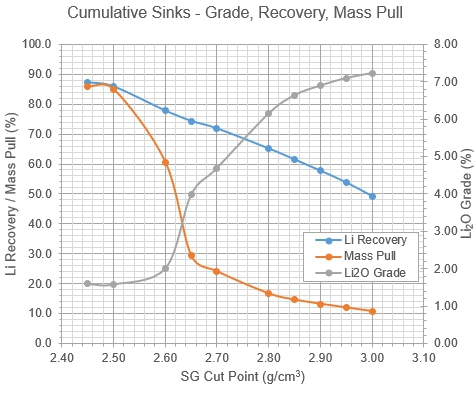
Figure
10-1 is a plot of the theoretical concentrate grade, lithium recovery and mass pull in terms of “global” mass balance based
on the HLS test. At the separation density of 2.80, theoretically the concentrate (sink product) can achieve 68% lithium recovery with
a Li2O grade above 5.5%. The quantity of near density material around SG of 2.80 is also moderate which indicates good potential
for a clean DMS separation.
|
| SGS Geological Services |
| S-K 1300 Technical Report – FS Neves Lithium Project – Minas Gerais, Brazil | Page 86 |
| | |
| 10.1.5 | Dense
Media Separation Test |
Dense
media separation tests were conducted at the SGS Lakefield DMS pilot plant utilizing a 100 mm dense media cyclone. Material with a size
fraction between 0.85 mm to 9.5 mm from the main composite sample was used for the DMS test. A DMS concentrate was generated using two
stages of DMS in a rougher and cleaner configuration to replicate the full-scale plant flowsheet. The first stage DMS separation cut-point
target was at a lower separation density of SG 2.70. The concentrate from this stage DMS was further screened at 0.85 mm to eliminate
any potentially generated fines and then subjected to the second stage of DMS which cut at SG 2.80. The float product from the second
stage DMS was the middling product, while the sink product was the final DMS concentrate. The final DMS concentrate still contained a
nominal amount of mica type material and iron-bearing impurities. Therefore, the final DMS concentrate was further processed using a
dry magnetic separator to remove the majority of the magnetic iron bearing material.
The
dense media used during the first stage DMS test was a mixture of magnetite and ferrosilicon to achieve media slurry density of SG 2.70,
while the media used during the second stage was 100% ferrosilicon to achieve the media slurry density of 2.80. The final DMS test results,
which were based on global metal recoveries, are summarized in Table 10-10.
Table
10-10 Dense Media Separation Final Products Results
| |
Weight |
Assay
(%) |
Distribution
(%) |
| Wt
(kg) |
Wt
(%) |
Li2O |
Fe2O3 |
Li |
Fe2O3 |
| DMS
Concentrate Non-mag |
11.1 |
14.4 |
6.04 |
0.53 |
58.5 |
19.3 |
| DMS
Concentrate Mag |
1.3 |
1.7 |
2.35 |
3.31 |
2.6 |
13.7 |
| DMS
Concentrate (SG +2.8) |
12.4 |
16.1 |
5.66 |
0.82 |
61.1 |
33.0 |
| DMS
Middling (SG 2.7-2.8) |
4.7 |
6.0 |
1.42 |
0.68 |
5.8 |
10.3 |
| DMS
Tailings (SG -2.7) |
43.1 |
55.9 |
0.45 |
0.19 |
16.9 |
26.5 |
| -
20 Mesh Material |
16.9 |
22.0 |
1.10 |
0.55 |
16.2 |
30.2 |
| Feed
(Calc.) |
77.1 |
100 |
1.49 |
0.40 |
100 |
100 |
| Feed
(Dir.) |
|
|
1.53 |
0.39 |
|
|
The
final spodumene concentrate, after two stages of rougher/cleaner configuration DMS, assayed 5.66% Li2O and 0.82% Fe2O3.
This meets the industry standard requirement of a minimum 5.50% Li2O in the spodumene concentrate. Additional processing with
a magnetic separator further increased the concentrate grade above 6% Li2O. DMS middling (which has a SG between 2.70 and
2.80) and minus 20 mesh material were combined to produce the feed for flotation testing which was conducted to further recover the remaining
lithium in the test material.
It
can be shown from the above table that the lithium distribution in the DMS tailings and -0.85 mm materials is still significant, exceeding
30% of the lithium from the plant feed. This is mainly due to the presence of low density mineral petalite, some spodumene lost to the
fine size fractions, and unliberated spodumene in the DMS middlings and tailings.
Two
stages of DMS were employed in the laboratory tests, due to a very high mass yield of the float product being rejected (approximately
80% of DMS feed by weight). This large percentage of DMS tailings can potentially diminish the performance of the DMS cyclone. Therefore,
two stages of DMS are recommended in the process design, with the first stage cutting at SG of 2.70, and second stage cutting at a SG
around 2.80.
|
| SGS Geological Services |
| S-K 1300 Technical Report – FS Neves Lithium Project – Minas Gerais, Brazil | Page 87 |
| | |
| 10.1.6 | Magnetic
Separation on Dense Media Separation Concentrate |
The
final spodumene concentrate shall contain less than 1.0% iron oxide (Fe2O3) per industry standard concentrate specifications
to avoid costly penalties. Although the final DMS concentrate from the laboratory tests met the iron oxide content threshold, the magnetic
separation was still carried out to further increase the lithium oxide grade and establish the amenability of the concentrate to this
unit operation. The final DMS concentrate was subjected to a high intensity dry magnetic separator to remove the iron impurities. To
improve the magnetic separation efficiency, the DMS concentrate was split into +3.35 mm and -3.35 mm size fraction and each fraction
was subjected to magnetic separation respectively.
Magnetic
separation produced a non-magnetic concentrate with grades of 5.89% Li2O in the +3.35 mm fraction and 6.47% Li2O
in the -3.35 fraction. Detailed magnetic separation test results with the major component assays and distributions are summarized in
Table 10-11.
Table
10-11 DMS Concentrate Magnetic Separation Results
| After
Mag-Sep |
Weight |
Assay
(%) |
Distribution
(%) |
| Wt
(kg) |
Wt
(%) |
Li2O |
Fe2O3 |
Li |
Fe2O3 |
| DMS
Conc. +3.3 mm Non-mag |
8.3 |
10.7 |
5.89 |
0.59 |
42.4 |
15.8 |
| DMS
Conc. +3.3 mm Mag |
0.4 |
0.5 |
1.08 |
2.75 |
0.4 |
3.5 |
| DMS
Conc. -3.3 mm Non-mag |
2.9 |
3.7 |
6.47 |
0.37 |
16.1 |
3.4 |
| DMS
Conc. -3.3 mm Mag |
0.9 |
1.1 |
2.93 |
3.56 |
2.2 |
10.2 |
| DMS
Conc. Non-Mag |
11.1 |
14.4 |
6.04 |
0.53 |
58.5 |
19.3 |
| DMS
Conc. Mag |
1.3 |
1.7 |
2.35 |
3.31 |
2.6 |
13.7 |
Visual
observation during the laboratory test revealed that magnetic separation also rejected a large portion of micas to the magnetic product.
Tantalum (Ta) was also preferentially recovered to the non-magnetic concentrate during magnetic separation, which was also part of initial
objective. The tantalum assays and distribution based on the magnetic separation feed are summarized in Table 10-12.
Table
10-12 Tantalum and Iron Recovery and Assays in Magnetic Separation Products
| After
Mag-Sep |
Weight |
Assay |
Distribution
(%) |
| Wt
(kg) |
Wt
(%) |
Fe2O3 |
Ta
g/t |
Fe2O3 |
Ta |
| DMS
Conc. Non-Mag |
11.1 |
89.7 |
0.53 |
22.4 |
58.4 |
38.5 |
| DMS
Conc. Mag |
1.3 |
10.3 |
3.31 |
312 |
41.6 |
61.5 |
| DMS
Conc. (Calc.) |
12.4 |
100 |
0.82 |
52.2 |
100 |
100 |
The
magnetic separation of the concentrate not only rejected the iron minerals, but also helped to improve the final concentrate tantalum
grade by a factor of approximately six times. Tantalum concentrate is a valuable commodity and its potential recovery methods will be
considered outside the scope of this FS flowsheet.
| 10.1.7 | Additional
Heavy Liquid Separation Tests on DMS Middling and Tailing |
After
completing the DMS tests, additional HLS tests were conducted on both the DMS middlings (SG between 2.70 and 2.80) and DMS tailings (SG
lower than 2.70). DMS middlings were further crushed to minus 6 mesh (-3.3 mm) to liberate additional spodumene from the gangue material.
This additional crushing stage did in fact liberate spodumene locked up in the composite particles, as demonstrated in Table 10-13 and
Table 10-14. This result demonstrates that a middlings re-crush could potentially recover 14.0 – 16.7% of the mass from the middlings
stream as the spodumene concentrate.
|
| SGS Geological Services |
| S-K 1300 Technical Report – FS Neves Lithium Project – Minas Gerais, Brazil | Page 88 |
| | |
Table
10-13 HLS Test Results on Re-crushed DMS Middlings
| Products |
SG |
Weight |
Assay
(%) |
Distribution
(%) |
| Wt
(kg) |
Wt
(%) |
Li2O |
Fe2O3 |
Li |
Fe2O3 |
| DMS
Middlings -3.3/+0.85 mm HLS Sink 2.90 SG |
+2.90 |
0.5 |
14.0 |
6.45 |
1.22 |
59.8 |
29.9 |
| DMS
Middlings -3.3/+0.85 mm HLS Sink 2.85 SG |
-2.90
+ 2.85 |
0.1 |
2.7 |
2.95 |
1.53 |
5.2 |
7.1 |
| DMS
Middlings -3.3/+0.85 mm HLS Sink 2.80 SG |
-2.85
+ 2.80 |
0.2 |
6.7 |
1.48 |
1.24 |
6.6 |
14.6 |
| DMS
Middlings -3.3/+0.85 mm HLS Float 2.80 SG |
-2.80 |
2.7 |
76.6 |
0.56 |
0.36 |
28.4 |
48.3 |
| Feed
(Calc.) |
|
3.6 |
100 |
1.51 |
0.57 |
100 |
100 |
Table
10-14 Cumulative Sink Products from HLS Test on Re-crushed DMS Middlings
| Products |
SG |
Weight |
Assay
(%) |
Distribution
(%) |
| Wt
(kg) |
Wt
(%) |
Li2O |
Fe2O3 |
Li |
Fe2O3 |
| DMS
Middlings -3.3/+0.85 mm HLS Sink 2.90 SG |
+2.90 |
0.5 |
14.0 |
6.45 |
1.22 |
59.8 |
29.9 |
| DMS
Middlings -3.3/+0.85 mm HLS Sink 2.85 SG |
+2.85 |
0.6 |
16.6 |
5.89 |
1.27 |
65.0 |
37.0 |
| DMS
Middlings -3.3/+0.85 mm HLS Sink 2.80 SG |
+2.80 |
0.8 |
23.4 |
4.62 |
1.26 |
71.6 |
51.7 |
The
above Tables indicate that further reducing the DMS feed crush size may potentially increase the lithium recovery during the DMS treatment,
if no significant additional fines (-0.85 mm material) are generated. DMS tailings, which are the material with the SG lower than 2.70,
were also subjected to heavy liquid separation testing, with the results being summarized in Table 10-15.
Table
10-15 HLS Test Results on the DMS Tailings
| Products |
SG |
Weight |
Assay
(%) |
Distribution
(%) |
| Wt
(kg) |
Wt
(%) |
Li2O |
Fe2O3 |
Li |
Fe2O3 |
| DMS
Tailings HLS Sink 2.60 SG |
-2.70
+ 2.60 |
24.7 |
57.2 |
0.22 |
0.20 |
30.1 |
67.2 |
| DMS
Tailings HLS Sink 2.50 SG |
-2.60
+ 2.50 |
15.8 |
36.7 |
0.30 |
0.11 |
27.0 |
23.7 |
| DMS
Tailings HLS Sink 2.45 SG |
-2.50
+ 2.45 |
1.1 |
2.5 |
1.63 |
0.29 |
9.9 |
4.2 |
| DMS
Tailings HLS Float 2.45 SG |
-2.45 |
1.6 |
3.6 |
3.72 |
0.23 |
32.9 |
4.9 |
| Feed
(Calc.) |
|
43.1 |
100 |
0.41 |
0.17 |
100 |
100 |
| Feed
(Dir.) |
|
|
|
0.45 |
0.19 |
|
|
The
material with SG less than 2.45, as indicated from the above table, has a Li2O grade of 3.72%. The higher lithium grade in
the minus 2.45 SG fraction suggests that a significant amount of lithium in the test sample is in the form of petalite, which typically
has a SG of 2.40. The DMS tailings HLS data indicates a potential to recover this portion of lithium by DMS, if a lower Li2O
grade concentrate in the form of petalite can find a market. It should be noted that pure petalite has a Li2O grade of 4.90%
whereas pure spodumene has a Li2O grade of just over 8.0%.
|
| SGS Geological Services |
| S-K 1300 Technical Report – FS Neves Lithium Project – Minas Gerais, Brazil | Page 89 |
| | |
To
further maximize the lithium recovery from the plant feed, flotation tests were performed on the DMS middlings (Secondary DMS rejects
material with SG between 2.70 and 2.80) and the -0.85 mm material. These two streams contained approximately 22% of lithium in the sample
feed, with a lithium oxide grade of 1.14%. The material was ground to 300 um and then subjected to flotation. The flotation test employed
high density attrition, desliming, mica pre-flotation, high density conditioning, spodumene rougher, rougher scavenger, and three stages
of cleaner flotation with the objective of generating a marketable spodumene concentrate.
Two
discrete tests were conducted with similar flowsheets but employing differing reagent dosing regimes. After rougher and three stages
of cleaners, the first flotation test produced a final spodumene concentrate with 5.90% lithium oxide at 48.2% lithium recovery. The
second flotation test produced a final concentrate with 5.14% lithium oxide at 64.6% lithium recovery. At the required marketable concentrate
grade of 5.5% Li2O, this flotation test indicated that at least 50% of the lithium in the flotation feed can be recovered
to the final concentrate. Since the flotation feed (DMS middling and -0.85 mm material) contained approximately 22% of the original lithium
in the test sample feed, the global lithium recovery can potentially be increased by 10% through the incorporation of flotation into
the flowsheet.
The
flotation reagent combinations used in the tests were targeted at the recovery and upgrading of spodumene which was lost in the DMS middlings
and the -0.85 mm material. If a lithium concentrate with lower Li2O grade could be marketable, it could be worthwhile to explore
the opportunity to float the petalite mineral in the future.
| 10.2 | Additional
Tests Conducted at SGS Geosol Brazil between 2023 and 2025 |
To
investigate the ore variability in the deposit, Atlas Lithium collected a series of additional samples from the project site and sent
those samples to the SGS Geosol laboratory in Brazil for chemical composition analysis and HLS testing commencing in July 2023. The samples
were collected from pits Anitta 1, Anitta 2, Anitta 3, Anitta 2.5 and Anitta 4. The samples collected from each pit are described in
Table 10-16 to Table 10-20.
Table
10-16 Test Sample Description – Anitta 1
| Drill
Hole ID |
Samples
ID |
Met
Test Sample ID |
Weight
(kg) |
| DHAB-11B |
AB-147
- AB-152 |
VSA-1 |
10.045 |
| DHAB-17 |
AB-307
- AB-312 |
VSA-2 |
8.935 |
| DHAB-18 |
AB-330
- AB-335 |
VSA-3 |
10.240 |
| DHAB-43 |
AB-1565
- AB-1570 |
VSA-4 |
9.020 |
| DHAB-44 |
AB-1609
- AB-1614 |
VSA-5 |
8.045 |
| DHAB-58A |
AB-811
- AB-815 |
VSA-6 |
7.950 |
| DHAB-64 |
AB-941
- AB-945 |
VSA-7 |
6.970 |
| DHAB-97 |
AB-2319
- AB-2322 |
VSA-8 |
5.164 |
| DHAB-117 |
AB-2208
- AB-2213 |
VSA-9 |
9.360 |
| DHAB-117 |
AB-2214
- AB-2216 |
VSA-10 |
7.620 |
|
| SGS Geological Services |
| S-K 1300 Technical Report – FS Neves Lithium Project – Minas Gerais, Brazil | Page 90 |
| | |
Table
10-17 Test Sample Description – Anitta 2
| Drill
Hole ID |
Samples
ID |
Met
Test Sample ID |
Weight
(kg) |
| DHAB-47 |
AB-1681
- AB-1684 |
VSA-11 |
6.290 |
| DHAB-68 |
AB-1232
- AB-1237 |
VSA-12 |
6.570 |
| DHAB-85 |
AB-1739
- AB-1744 |
VSA-13 |
7.450 |
| DHAB-91 |
AB-2624
- AB-2628 |
VSA-14 |
6.235 |
| DHAB-104 |
AB-3010
- AB-3014 |
VSA-15 |
9.785 |
| DHAB-104 |
AB-3028
- AB-3032 |
VSA-16 |
10.120 |
| DHAB-115 |
AB-2536
- AB-2541 |
VSA-17 |
8.430 |
| DHAB-141 |
AB-3195
- AB-3199 |
VSA-18 |
6.845 |
| DHAB-145EX |
AB-3783
- AB-3789 |
VSA-19 |
11.290 |
| DHAB-145EX |
AB-3852
- AB-3857 |
VSA-20 |
8.270 |
Table
10-18 Test Sample Description – Anitta 3
| Drill
Hole ID |
Samples
ID |
Met
Test Sample ID |
Weight
(kg) |
| DHAB-0185 |
AB-004483-004488 |
MET-AN-0001 |
34.848 |
| DHAN-0185 |
AB-004493-004497 |
MET-AN-0002 |
26.05 |
| DHAN-0185 |
AB-004532-004535 |
MET-AN-0003 |
21.4 |
| DHAN-0185 |
AB-004536,
4538, 4543, 4544 |
MET-AN-0004 |
23.92 |
| DHAN-0200 |
AB-004896,
4898 |
MET-AN-0005 |
12.9 |
| DHAN-0200 |
AB-004899 |
MET-AN-0006 |
4.7 |
| DHAN-0200 |
AB-004901,
4902,4906 |
MET-AN-0007 |
15.63 |
| DHAN-0200 |
AB-004914-4917 |
MET-AN-0008 |
20.4 |
| DHAN-0200 |
AB-004974-4976,
4978 |
MET-AN-0009 |
21.24 |
| DHAN-0200 |
AB-004981/4982 |
MET-AN-0010 |
10.92 |
| DHAN-0211 |
AB-005243/5245 |
MET-AN-0011 |
13.7 |
| DHAN-0211 |
AB-005246/5247 |
MET-AN-0012 |
11.3 |
| DHAN-0211 |
AB-005262/5263 |
MET-AN-0013 |
11.82 |
| DHAN-0211 |
AB-005264/265 |
MET-AN-0014 |
12.16 |
| DHAN-0211 |
AB-005282/5283 |
MET-AN-0015 |
12.96 |
Table
10-19 Test Sample Description – Anitta 2.5
| Drill
Hole ID |
Samples
ID |
Met
Test Sample ID |
Weight
(kg) |
| DHAB-0442 |
AB-009279,
009274 |
HLS-0001 |
9.76 |
| DHAB-0445 |
AB-009312,
009315 |
HLS-0002 |
9.28 |
| DHAB-0458 |
AB-009575,
009589 |
HLS-0003 |
9.86 |
| DHAB-0445 |
AB-009313,
009324 |
HLS-0004 |
9.416 |
| DHAB-0460 |
AB-009657,
009677 |
HLS-0005 |
9.748 |
Table
10-20 Test Sample Description – Anitta 4
| Drill
Hole ID |
Samples
ID |
Met
Test Sample ID |
Weight
(kg) |
| DHAB-0377 |
AB-008115/8126 |
HLS-0006 |
7.76 |
| DHAB-0464 |
AB-009696/9707 |
HLS-0007 |
4.9 |
| DHAB-0362 |
AB-007174/7181 |
HLS-0008 |
6.51 |
| DHAB-0377 |
AB-008122/8132 |
HLS-0009 |
8.49 |
| DHAB-0362 |
AB-007177/7178 |
HLS-0010 |
5.3 |
Each
metallurgical sample, after being composited, was stage crushed to minus 9.5 mm and homogenized, and then was analyzed for lithium content
and chemical composition by size fractions, i.e., -9.5 mm to 1.7 mm, -1.7 mm to 0.85 mm, and -0.85 mm. For the metallurgical samples
from Anitta 1 and Anitta 2, only samples with a lithium oxide content above 0.5% were sent to HLS tests. Before HLS testing was conducted,
each sample had its -0.85 mm material screened out, with only the -9.5 mm to 0.85 mm size material being subjected to the HLS tests.
This mimics the full-scale plant flowsheet.
The
HLS test results for each pit are summarized in Table 10-21 to Table 10-26. All HLS test data shown in the tables are based on the feed
to DMS circuit, or -9.5 mm to 0.85 mm size material. There will be nominal lithium losses in the -0.85 mm material, and the weight percentages
and its lithium oxide content of this size fraction are summarized in Table 10-27 to Table 10-31.
|
| SGS Geological Services |
| S-K 1300 Technical Report – FS Neves Lithium Project – Minas Gerais, Brazil | Page 91 |
| | |
Table
10-21 HLS Test Cumulative Sink Product Lithium Grade and Recovery – Anitta 1
| Cumulative
HLS Sink Product |
VSA-1 |
VSA-3 |
VSA-5 |
| Mass
(%) |
Assay,
Li2O (%) |
Li
Distri-bution (%) |
Mass
(%) |
Assay,
Li2O (%) |
Li
Distri-bution (%) |
Mass
(%) |
Assay,
Li2O (%) |
Li
Distri-bution (%) |
| SG
3.1 Sink |
8.30 |
6.94 |
36.22 |
5.85 |
7.55 |
29.59 |
9.98 |
7.21 |
40.10 |
| SG
3.0 Sink |
15.09 |
6.92 |
65.61 |
11.31 |
7.28 |
55.15 |
16.80 |
7.29 |
68.27 |
| SG
2.9 Sink |
16.95 |
6.76 |
71.99 |
14.36 |
6.93 |
66.72 |
19.18 |
7.12 |
76.13 |
| SG
2.8 Sink |
21.42 |
6.05 |
81.51 |
17.25 |
6.33 |
73.18 |
21.99 |
6.63 |
81.27 |
| SG
2.7 Sink |
28.30 |
4.89 |
87.00 |
22.72 |
5.06 |
77.04 |
31.04 |
5.10 |
88.30 |
| SG
2.6 Sink |
66.15 |
2.24 |
93.02 |
55.22 |
2.22 |
82.21 |
60.59 |
2.75 |
92.81 |
| SG
2.5 Sink |
94.07 |
1.62 |
95.60 |
94.04 |
1.39 |
87.87 |
95.04 |
1.84 |
97.60 |
| SG
2.4 Sink |
98.80 |
1.57 |
97.42 |
96.27 |
1.40 |
90.19 |
99.37 |
1.79 |
99.08 |
| SG
2.4 Float |
100.00 |
1.59 |
100.00 |
100.00 |
1.49 |
100.00 |
100.00 |
1.79 |
100.00 |
| Cumulative
HLS Sink Product |
VSA-6 |
VSA-7 |
VSA-10 |
| Mass
(%) |
Assay,
Li2O (%) |
Li
Distri-bution (%) |
Mass
(%) |
Assay,
Li2O (%) |
Li
Distri-bution (%) |
Mass
(%) |
Assay,
Li2O (%) |
Li
Distri-bution (%) |
| SG
3.1 Sink |
2.04 |
6.66 |
16.80 |
3.46 |
6.56 |
19.46 |
1.10 |
6.65 |
14.89 |
| SG
3.0 Sink |
6.95 |
6.60 |
56.68 |
6.34 |
6.48 |
35.16 |
2.19 |
6.75 |
30.15 |
| SG
2.9 Sink |
8.84 |
6.29 |
68.67 |
8.08 |
6.06 |
41.92 |
2.71 |
6.20 |
34.31 |
| SG
2.8 Sink |
11.35 |
5.70 |
79.88 |
11.15 |
5.06 |
48.35 |
3.66 |
5.40 |
40.36 |
| SG
2.7 Sink |
17.38 |
4.16 |
89.28 |
17.86 |
3.60 |
55.07 |
12.63 |
1.94 |
50.11 |
| SG
2.6 Sink |
68.48 |
1.14 |
96.74 |
43.85 |
1.60 |
60.01 |
47.52 |
0.67 |
64.63 |
| SG
2.5 Sink |
99.27 |
0.81 |
99.71 |
91.44 |
0.93 |
72.75 |
96.28 |
0.47 |
93.19 |
| SG
2.4 Sink |
99.91 |
0.81 |
99.87 |
96.92 |
1.07 |
88.69 |
99.35 |
0.48 |
96.85 |
| SG
2.4 Float |
100.00 |
0.81 |
100.00 |
100.00 |
1.17 |
100.00 |
100.00 |
0.49 |
100.00 |
|
| SGS Geological Services |
| S-K 1300 Technical Report – FS Neves Lithium Project – Minas Gerais, Brazil | Page 92 |
| | |
Table
10-22 HLS Test Cumulative Sink Product Lithium Grade and Recovery – Anitta 2
| Cumulative
HLS Sink Product |
VSA-13 |
VSA-14 |
VSA-15 |
VSA-16 |
| Mass
(%) |
Assay,
Li2O (%) |
Li
Distri-bution, (%) |
Mass
(%) |
Assay,
Li2O (%) |
Li
Distri-bution (%) |
Mass
(%) |
Assay,
Li2O (%) |
Li
Distri-bution (%) |
Mass
(%) |
Assay,
Li2O (%) |
Li
Distri-bution (%) |
| SG
3.1 Sink |
2.51 |
7.05 |
34.89 |
8.60 |
7.30 |
35.54 |
4.81 |
6.83 |
28.63 |
15.76 |
7.67 |
48.99 |
| SG
3.0 Sink |
3.06 |
7.03 |
42.31 |
15.38 |
7.40 |
64.40 |
10.79 |
6.78 |
63.82 |
23.72 |
7.52 |
72.30 |
| SG
2.9 Sink |
3.26 |
6.97 |
44.75 |
17.46 |
7.31 |
72.21 |
12.80 |
6.58 |
73.55 |
27.73 |
7.26 |
81.68 |
| SG
2.8 Sink |
3.44 |
6.79 |
45.93 |
18.65 |
7.15 |
75.54 |
15.55 |
6.08 |
82.59 |
31.02 |
6.84 |
86.06 |
| SG
2.7 Sink |
6.68 |
4.13 |
54.29 |
20.46 |
6.68 |
77.36 |
20.73 |
4.83 |
87.36 |
38.76 |
5.74 |
90.14 |
| SG
2.6 Sink |
33.47 |
0.91 |
59.98 |
61.66 |
2.34 |
81.71 |
67.08 |
1.57 |
91.91 |
79.44 |
2.96 |
95.24 |
| SG
2.5 Sink |
94.34 |
0.39 |
71.94 |
88.21 |
1.71 |
85.17 |
97.81 |
1.12 |
96.04 |
93.98 |
2.55 |
97.22 |
| SG
2.4 Sink |
97.50 |
0.42 |
81.31 |
92.76 |
1.69 |
88.91 |
99.14 |
1.13 |
98.09 |
95.96 |
2.52 |
98.23 |
| SG
2.4 Float |
100.00 |
0.51 |
100.00 |
100.00 |
1.77 |
100.00 |
100.00 |
1.15 |
100.00 |
100.00 |
2.47 |
100.00 |
| Cumulative
HLS Sink Product |
VSA-17 |
VSA-18 |
VSA-19 |
| Mass
(%) |
Assay,
Li2O (%) |
Li
Distri-bution (%) |
Mass
(%) |
Assay,
Li2O (%) |
Li
Distri-bution (%) |
Mass
(%) |
Assay,
Li2O (%) |
Li
Distri-bution (%) |
| SG
3.1 Sink |
1.36 |
6.17 |
11.30 |
6.37 |
7.54 |
28.01 |
5.85 |
6.60 |
25.55 |
| SG
3.0 Sink |
3.78 |
6.43 |
32.63 |
9.10 |
7.39 |
39.18 |
11.19 |
6.50 |
48.08 |
| SG
2.9 Sink |
6.39 |
5.79 |
49.70 |
10.71 |
7.16 |
44.70 |
15.80 |
6.03 |
62.94 |
| SG
2.8 Sink |
8.59 |
5.09 |
58.72 |
13.45 |
6.39 |
50.09 |
20.94 |
5.46 |
75.61 |
| SG
2.7 Sink |
23.60 |
2.43 |
76.96 |
19.17 |
4.80 |
53.63 |
30.86 |
4.20 |
85.69 |
| SG
2.6 Sink |
48.09 |
1.30 |
84.30 |
70.41 |
1.46 |
59.82 |
67.61 |
2.07 |
92.56 |
| SG
2.5 Sink |
93.37 |
0.72 |
90.53 |
83.17 |
1.32 |
64.15 |
98.34 |
1.50 |
97.24 |
| SG
2.4 Sink |
95.62 |
0.72 |
92.56 |
88.10 |
1.40 |
71.69 |
99.38 |
1.50 |
98.68 |
| SG
2.4 Float |
100.00 |
0.74 |
100.00 |
100.00 |
1.72 |
100.00 |
100.00 |
1.51 |
100.00 |
|
| SGS Geological Services |
| S-K 1300 Technical Report – FS Neves Lithium Project – Minas Gerais, Brazil | Page 93 |
| | |
Table
10-23 HLS Test Cumulative Sink Product Lithium Grade and Recovery – Anitta 3
| Cumulative
HLS Sink Product |
MET-AN-001 |
MET-AN-002 |
MET-AN-003 |
MET-AN-004 |
| Mass
(%) |
Assay,
Li2O (%) |
Li
Distri-bution (%) |
Mass
(%) |
Assay,
Li2O (%) |
Li
Distri-bution (%) |
Mass
(%) |
Assay,
Li2O (%) |
Li
Distri-bution (%) |
Mass
(%) |
Assay,
Li2O (%) |
Li
Distri-bution (%) |
| SG
2.9 Sink |
8.30 |
6.94 |
36.22 |
16.45 |
6.99 |
83.83 |
17.20 |
5.72 |
65.41 |
14.62 |
5.36 |
76.82 |
| SG
2.8 Sink |
15.09 |
6.92 |
65.61 |
19.38 |
6.26 |
88.46 |
21.94 |
5.16 |
74.99 |
36.28 |
2.35 |
83.75 |
| SG
2.7 Sink |
16.95 |
6.76 |
71.99 |
24.67 |
5.06 |
90.93 |
26.76 |
4.52 |
80.00 |
67.71 |
1.38 |
91.94 |
| SG
2.6 Sink |
21.42 |
6.05 |
81.51 |
60.96 |
2.13 |
94.82 |
65.11 |
1.98 |
85.13 |
85.78 |
1.15 |
96.51 |
| SG
2.4 Sink |
28.30 |
4.89 |
87.00 |
99.99 |
1.37 |
100.00 |
98.70 |
1.49 |
96.51 |
99.97 |
1.02 |
99.99 |
| SG
2.4 Float |
100.00 |
1.59 |
100.00 |
100.00 |
1.37 |
100.00 |
100.00 |
1.52 |
100.00 |
100.00 |
1.02 |
100.00 |
| Cumulative
HLS Sink Product |
MET-AN-005 |
MET-AN-006 |
MET-AN-007 |
MET-AN-008 |
| Mass
(%) |
Assay,
Li2O (%) |
Li
Distri-bution (%) |
Mass
(%) |
Assay,
Li2O (%) |
Li
Distri-bution (%) |
Mass
(%) |
Assay,
Li2O (%) |
Li
Distri-bution (%) |
Mass
(%) |
Assay,
Li2O (%) |
Li
Distri-bution (%) |
| SG
2.9 Sink |
15.42 |
5.51 |
68.75 |
14.37 |
6.23 |
76.24 |
17.33 |
5.81 |
86.81 |
24.06 |
6.32 |
85.27 |
| SG
2.8 Sink |
25.04 |
3.79 |
76.71 |
18.31 |
5.36 |
83.56 |
35.65 |
3.01 |
92.65 |
27.85 |
5.86 |
91.53 |
| SG
2.7 Sink |
63.02 |
1.81 |
92.31 |
25.67 |
4.19 |
91.67 |
56.16 |
2.00 |
96.70 |
33.01 |
5.14 |
95.19 |
| SG
2.6 Sink |
92.12 |
1.31 |
97.42 |
78.25 |
1.47 |
97.73 |
87.77 |
1.31 |
98.84 |
70.70 |
2.47 |
98.14 |
| SG
2.4 Sink |
99.91 |
1.24 |
99.95 |
99.98 |
1.17 |
100.00 |
100.00 |
1.16 |
100.00 |
100.00 |
1.78 |
100.00 |
| SG
2.4 Float |
100.00 |
1.24 |
100.00 |
100.00 |
1.17 |
100.00 |
100.00 |
1.16 |
100.00 |
100.00 |
1.78 |
100.00 |
|
| SGS Geological Services |
| S-K 1300 Technical Report – FS Neves Lithium Project – Minas Gerais, Brazil | Page 94 |
| | |
Table
10-24 HLS Test Cumulative Sink Product Lithium Grade and Recovery – Anitta 3 (Continued)
| Cumulative
HLS Sink Product |
MET-AN-009 |
MET-AN-010 |
MET-AN-011 |
MET-AN-012 |
| Mass
(%) |
Assay,
Li2O (%) |
Li
Distri-bution (%) |
Mass
(%) |
Assay,
Li2O (%) |
Li
Distri-bution (%) |
Mass
(%) |
Assay,
Li2O (%) |
Li
Distri-bution (%) |
Mass
(%) |
Assay,
Li2O (%) |
Li
Distri-bution (%) |
| SG
2.9 Sink |
23.43 |
6.11 |
69.98 |
16.46 |
6.13 |
69.40 |
11.34 |
6.38 |
65.34 |
8.56 |
6.57 |
60.59 |
| SG
2.8 Sink |
28.15 |
5.65 |
77.82 |
33.36 |
3.62 |
83.02 |
39.55 |
2.21 |
78.89 |
15.45 |
4.38 |
72.97 |
| SG
2.7 Sink |
40.73 |
4.30 |
85.61 |
44.38 |
2.91 |
88.80 |
76.19 |
1.31 |
90.00 |
21.09 |
3.37 |
76.61 |
| SG
2.6 Sink |
79.78 |
2.31 |
90.19 |
81.56 |
1.64 |
92.10 |
93.84 |
1.12 |
94.86 |
73.24 |
1.07 |
84.67 |
| SG
2.4 Sink |
99.66 |
2.04 |
99.55 |
99.76 |
1.45 |
99.43 |
99.92 |
1.11 |
99.77 |
99.45 |
0.92 |
98.50 |
| SG
2.4 Float |
100.00 |
2.05 |
100.00 |
100.00 |
1.45 |
100.00 |
100.00 |
1.11 |
100.00 |
100.00 |
0.93 |
100.00 |
| Cumulative
HLS Sink Product |
MET-AN-013 |
MET-AN-014 |
MET-AN-015 |
| Mass
(%) |
Assay,
Li2O (%) |
Li
Distri-bution (%) |
Mass
(%) |
Assay,
Li2O (%) |
Li
Distri-bution (%) |
Mass
(%) |
Assay,
Li2O (%) |
Li
Distri-bution (%) |
| SG
2.9 Sink |
11.46 |
6.15 |
66.34 |
9.66 |
6.16 |
58.95 |
26.56 |
6.44 |
87.30 |
| SG
2.8 Sink |
13.16 |
5.78 |
71.60 |
31.74 |
2.32 |
72.90 |
34.45 |
5.11 |
89.89 |
| SG
2.7 Sink |
18.10 |
4.62 |
78.82 |
59.62 |
1.46 |
86.27 |
42.10 |
4.27 |
91.79 |
| SG
2.6 Sink |
64.72 |
1.45 |
88.16 |
78.23 |
1.16 |
89.97 |
83.22 |
2.26 |
96.02 |
| SG
2.4 Sink |
99.58 |
1.05 |
98.86 |
99.60 |
1.00 |
98.67 |
99.72 |
1.95 |
99.51 |
| SG
2.4 Float |
100.00 |
1.06 |
100.00 |
100.00 |
1.01 |
100.00 |
100.00 |
1.96 |
100.00 |
|
| SGS Geological Services |
| S-K 1300 Technical Report – FS Neves Lithium Project – Minas Gerais, Brazil | Page 95 |
| | |
Table
10-25 HLS Test Cumulative Sink Product Lithium Grade and Recovery – Anitta 2.5
| Cumulative
HLS Sink Product |
HLS
001 |
HLS
002 |
HLS
003 |
| Mass
(%) |
Assay,
Li2O (%) |
Li
Distri-bution (%) |
Mass
(%) |
Assay,
Li2O (%) |
Li
Distri-bution (%) |
Mass
(%) |
Assay,
Li2O (%) |
Li
Distri-bution (%) |
| SG
2.9 Sink |
13.90 |
6.94 |
79.73 |
8.51 |
6.89 |
65.11 |
9.32 |
6.88 |
68.85 |
| SG
2.8 Sink |
16.54 |
6.22 |
85.02 |
11.22 |
5.87 |
73.11 |
11.49 |
6.15 |
75.93 |
| SG
2.7 Sink |
27.09 |
4.09 |
91.52 |
18.32 |
3.90 |
79.35 |
18.17 |
4.22 |
82.32 |
| SG
2.6 Sink |
62.48 |
1.88 |
96.96 |
30.32 |
2.52 |
84.95 |
40.02 |
2.04 |
87.73 |
| SG
2.4 Sink |
99.60 |
1.21 |
99.85 |
98.73 |
0.88 |
96.19 |
97.71 |
0.91 |
95.41 |
| SG
2.4 Float |
100.00 |
1.21 |
100.00 |
100.00 |
0.90 |
100.00 |
100.00 |
0.93 |
100.00 |
| Cumulative
HLS Sink Product |
HLS
004 |
HLS
005 |
| Mass
(%) |
Assay,
Li2O (%) |
Li
Distri-bution (%) |
Mass
(%) |
Assay,
Li2O (%) |
Li
Distri-bution (%) |
| SG
2.9 Sink |
11.59 |
6.74 |
79.67 |
12.47 |
7.66 |
75.79 |
| SG
2.8 Sink |
13.56 |
6.15 |
85.06 |
13.73 |
7.12 |
77.51 |
| SG
2.7 Sink |
19.10 |
4.62 |
89.90 |
28.46 |
3.65 |
82.46 |
| SG
2.6 Sink |
25.26 |
3.59 |
92.54 |
67.29 |
1.62 |
86.52 |
| SG
2.4 Sink |
99.38 |
0.97 |
98.51 |
97.14 |
1.22 |
93.77 |
| SG
2.4 Float |
100.00 |
0.98 |
100.00 |
100.00 |
1.26 |
100.00 |
|
| SGS Geological Services |
| S-K 1300 Technical Report – FS Neves Lithium Project – Minas Gerais, Brazil | Page 96 |
| | |
Table
10-26 HLS Test Cumulative Sink Product Lithium Grade and Recovery – Anitta 4
| Cumulative
HLS Sink Product |
HLS
006 |
HLS
007 |
HLS
008 |
| Mass
(%) |
Assay,
Li2O (%) |
Li
Distri-bution (%) |
Mass
(%) |
Assay,
Li2O (%) |
Li
Distri-bution (%) |
Mass
(%) |
Assay,
Li2O (%) |
Li
Distri-
bution (%) |
| SG
2.9 Sink |
11.82 |
7.15 |
74.83 |
12.09 |
7.25 |
79.65 |
19.64 |
6.52 |
86.96 |
| SG
2.8 Sink |
15.35 |
6.07 |
82.50 |
14.52 |
6.51 |
85.93 |
23.44 |
5.89 |
93.81 |
| SG
2.7 Sink |
24.89 |
4.13 |
91.06 |
22.66 |
4.44 |
91.37 |
28.73 |
4.94 |
96.33 |
| SG
2.6 Sink |
59.48 |
1.84 |
96.90 |
85.46 |
1.25 |
97.28 |
83.52 |
1.76 |
99.58 |
| SG
2.4 Sink |
100.00 |
1.13 |
100.00 |
99.67 |
1.10 |
99.90 |
99.98 |
1.47 |
99.99 |
| SG
2.4 Float |
100.00 |
1.13 |
100.00 |
100.00 |
1.10 |
100.00 |
100.00 |
1.47 |
100.00 |
| Cumulative
HLS Sink Product |
HLS
009 |
HLS
010 |
| Mass
(%) |
Assay,
Li2O (%) |
Li
Distri-bution (%) |
Mass
(%) |
Assay,
Li2O (%) |
Li
Distri-
bution (%) |
| SG
2.9 Sink |
11.30 |
6.61 |
66.06 |
19.71 |
7.05 |
85.76 |
| SG
2.8 Sink |
17.47 |
5.21 |
80.49 |
23.21 |
6.45 |
92.41 |
| SG
2.7 Sink |
29.26 |
3.40 |
87.93 |
31.25 |
4.98 |
96.01 |
| SG
2.6 Sink |
72.19 |
1.50 |
95.76 |
50.93 |
3.12 |
98.10 |
| SG
2.4 Sink |
99.82 |
1.13 |
99.97 |
99.90 |
1.62 |
99.96 |
| SG
2.4 Float |
100.00 |
1.13 |
100.00 |
100.00 |
1.62 |
100.00 |
|
| SGS Geological Services |
| S-K 1300 Technical Report – FS Neves Lithium Project – Minas Gerais, Brazil | Page 97 |
| | |
Table
10-27 -0.85 mm Material Summary of HLS Test Samples from Anitta 1
| -0.85
mm material |
Mass
(%) |
Assay,
Li2O (%) |
Li
Distribution (%) |
| VSA-1 |
23.53 |
1.06 |
14.94 |
| VSA-3 |
21.63 |
1.04 |
15.81 |
| VSA-5 |
20.31 |
1.33 |
15.14 |
| VSA-6 |
25.22 |
0.47 |
15.19 |
| VSA-7 |
27.48 |
0.82 |
19.27 |
| VSA-10 |
23.69 |
0.44 |
21.35 |
Table
10-28 -0.85 mm Material Summary of HLS Test Samples from Anitta 2
| -0.85
mm material |
Mass
(%) |
Assay,
Li2O (%) |
Li
Distribution (%) |
| VSA-13 |
22.09 |
0.41 |
17.33 |
| VSA-14 |
21.01 |
1.31 |
15.06 |
| VSA-15 |
21.01 |
1.31 |
23.56 |
| VSA-16 |
18.35 |
1.9 |
15.16 |
| VSA-17 |
27.32 |
0.52 |
17.85 |
| VSA-18 |
22.32 |
1.23 |
16.58 |
| VSA-19 |
27.7 |
0.96 |
15.61 |
Table
10-29 -0.85 mm Material Summary of HLS Test Samples from Anitta 3
| -0.85
mm material |
Mass
(%) |
Assay,
Li2O (%) |
Li
Distribution (%) |
| MET-AN-001 |
17.72 |
1.02 |
19.74 |
| MET-AN-002 |
14.31 |
1.04 |
9.79 |
| MET-AN-003 |
16.25 |
1.21 |
11.48 |
| MET-AN-004 |
19.08 |
0.75 |
12.28 |
| MET-AN-005 |
30.91 |
0.62 |
13.42 |
| MET-AN-006 |
20.43 |
0.76 |
11.61 |
| MET-AN-007 |
22.03 |
0.71 |
11.86 |
| MET-AN-008 |
18.02 |
1.35 |
11.97 |
| MET-AN-009 |
18.39 |
1.56 |
12.31 |
| MET-AN-010 |
28.36 |
0.69 |
11.86 |
| MET-AN-011 |
27.59 |
0.61 |
13.29 |
| MET-AN-012 |
16.4 |
0.79 |
12.22 |
| MET-AN-013 |
17.38 |
0.86 |
12.37 |
| MET-AN-014 |
32.83 |
0.61 |
16.48 |
| MET-AN-015 |
19.34 |
1.37 |
11.9 |
|
| SGS Geological Services |
| S-K 1300 Technical Report – FS Neves Lithium Project – Minas Gerais, Brazil | Page 98 |
| | |
Table
10-30 -0.85 mm Material Summary of HLS Test Samples from Anitta 2.5
| -0.85
mm material |
Mass
(%) |
Assay,
Li2O (%) |
Li
Distribution (%) |
| HLS-001 |
21.61 |
0.95 |
17.8 |
| HLS-002 |
18.71 |
0.65 |
14.21 |
| HLS-003 |
20.84 |
0.92 |
20.66 |
| HLS-004 |
19.5 |
0.76 |
15.76 |
| HLS-005 |
13.66 |
1.00 |
11.71 |
Table
10-31 -0.85 mm Material Summary of HLS Test Samples from Anitta 4
| -0.85
mm material |
Mass
(%) |
Assay,
Li2O (%) |
Li
Distribution (%) |
| HLS-006 |
22.25 |
1.1 |
21.76 |
| HLS-007 |
30.67 |
0.75 |
23.21 |
| HLS-008 |
19.9 |
1.31 |
18.08 |
| HLS-009 |
23.93 |
1.14 |
24.03 |
| HLS-010 |
20.77 |
1.45 |
18.99 |
The
above HLS tests conducted on the samples collected from various pits indicate a large variation in terms of lithium recoveries based
on the requirement of 5.50% lithium oxide (Li2O) concentrate grade. However, on average, all samples are considered amenable
to the heavy media separation process based on the test data.
| 10.3 |
Sedimentation and Filtration Test |
As
the DMS process does not treat the fine particles effectively, all fine particles (-0.85 mm material) will be removed before DMS processing.
This proportion of fine material will be thickened and filtered to produce a dry stackable waste material on site. Consequently, -0.85
mm material produced from the test samples at SGS Geosol Brazil was tested at PESCO for sedimentation and filtration performance.
Two
samples were tested. The first sample (tracking ID 010428) was the -0.85 mm material from the second batch of SGS Geosol test conducted
on the Anitta 3 material. The second sample (tracking ID 010427-01-05-03-02) was the -0.85 mm material collected after crushing the drill
core sample (collected from drill hole DHAB-0432MT) to -9.5 mm. Particle size distribution, flocculant selection and dosage, a compaction
test on thickener underflow, and vacuum filtration tests were conducted on both samples.
The
particle size distribution (PSD) analyses were conducted on both samples using laser sizing and results are summarized in Table 10-32.
The PSDs for both samples were observed to be relatively coarse for typical thickener operation.
Table
10-32 Particle Size Distributions of Sedimentation Test Feed
| Sample
ID |
|
d20
(µm) |
d50
(µm) |
d80
(µm) |
+1000
(µm) |
| 010428 |
|
87.29 |
229.78 |
482.27 |
0.01% |
| 010427-01-05-03-02 |
|
116.48 |
310.28 |
575.36 |
0.87% |
|
| SGS Geological Services |
| S-K 1300 Technical Report – FS Neves Lithium Project – Minas Gerais, Brazil | Page 99 |
| | |
Flocculant
screening was also performed on both samples, and a total of five flocculant types were evaluated. All sedimentation tests were conducted
with the feed solids concentration at 10% by weight. The flocculant screening test results are summarized in Table 10-33 and Table 10-34.
The flocculant dosage optimization test results are summarized in Table 10-35 and Table 10-36.
Table
10-33 Flocculant Screening Test on Sample 010428
| Flocculant
type |
Flocculant
Dosage (g/t) |
Free
Settling Rate (m/hr) |
Free
Settling Flux (t/m2.hr) |
Supernatant
Turbidity (NTU) |
| Setchem
SC510A |
2 |
29.2 |
3.1 |
101 |
| Setchem
SC525 |
2 |
40.7 |
4.4 |
316 |
| Setchem
SC901 |
2 |
39.2 |
4.2 |
62 |
| Magnafloc
338 |
2 |
31.3 |
3.4 |
79 |
| Magnafloc
101 |
2 |
24.5 |
2.6 |
125 |
Table
10-34 Flocculant Screening Test on Sample 010427-01-05-03-02
| Flocculant
type |
Flocculant
Dosage (g/t) |
Free
Settling Rate (m/hr) |
Free
Settling Flux (t/m2.hr) |
Supernatant
Turbidity (NTU) |
| Setchem
SC510A |
10 |
80.2 |
8.6 |
208 |
| Setchem
SC525 |
10 |
98 |
10.5 |
272 |
| Setchem
SC901 |
10 |
88.2 |
9.5 |
153 |
| Magnafloc
338 |
10 |
88.2 |
9.5 |
193 |
| Magnafloc
101 |
10 |
73.5 |
7.9 |
235 |
Table
10-35 Flocculant Dosage Optimization for Sample 010428
| Flocculant
Dosage (g/t) |
Free
Settling Rate (m/hr) |
Free
Settling Flux (t/m2.hr) |
Supernatant
Turbidity (NTU) |
| 0.5 |
28.1 |
3 |
175 |
| 1 |
31.3 |
3.4 |
102 |
| 2 |
39.2 |
4.2 |
62 |
| 3 |
46.8 |
5 |
43 |
| 4 |
52.9 |
5.7 |
22 |
Table
10-36 Flocculant Dosage Optimization for Sample 010427-01-05-03-02
| Flocculant
Dosage, g/t |
Free
Settling Rate (m/hr) |
Free
Settling Flux (t/m2.hr) |
Supernatant
Turbidity (NTU) |
| 6 |
58.8 |
6.3 |
1998 |
| 8 |
67.8 |
7.3 |
177 |
| 10 |
88.2 |
9.5 |
153 |
| 15 |
98 |
10.5 |
124 |
| 20 |
176.4 |
18.9 |
99 |
|
| SGS Geological Services |
| S-K 1300 Technical Report – FS Neves Lithium Project – Minas Gerais, Brazil | Page 100 |
| | |
Due
to the fast-settling nature of this material, the application of flocculant is mainly to maintain the thickener overflow turbidity rather
than promote the settling rate. Based on a more conservative test sample, above test results indicated that 10 g/t of flocculant dosage
is sufficient for the thickener application.
The
fast settling nature of this material is also illustrated in the terminal density and compaction tests, as shown in Figure 10-2 and Figure
10-3. At the terminal densities, a yield stress of 419 Pa and 438 Pa were attained for the two samples. In addition, by diluting the
slurry solids concentration, the yield stress remained unchanged due to the rapid compaction of the material. This could pose an operational
challenge if a thickener is utilized in the process. Therefore, besides the filtration test conducted on 50% solids concentration slurry
to simulate filtrating the thickener underflow, additional filtration tests were conducted on 10% solids concentration slurry to simulate
filtrating the -0.85 mm effluent without thickening. The key filtration test data are summarized in Table 10-37 to Table 10-40.
Figure
10-2 Settling Rate and Terminal Density of Sample 010428
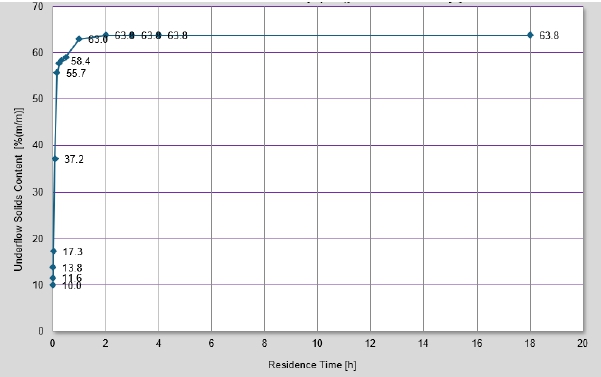
|
| SGS Geological Services |
| S-K 1300 Technical Report – FS Neves Lithium Project – Minas Gerais, Brazil | Page 101 |
| | |
Figure
10-3 Settling Rate and Terminal Density of Sample 010427-01-05-03-02
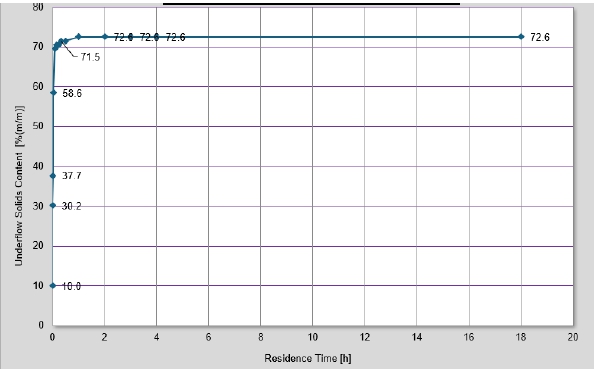
Table
10-37 Filtration Test Data of Sample 010428 with 50% Solids Concentration
| Trial
No. |
TSS
(ppm) |
Form
Time (
s) |
Dry
Time
(s) |
Cake
Moisture
(%,
w/w) |
Updated
Specific Cake Weight (kg/m2) |
| 1 |
296 |
4 |
0 |
12 |
64 |
| 2 |
362 |
5 |
15 |
10 |
67 |
| 3 |
334 |
5 |
30 |
10 |
67 |
| 4 |
366 |
5 |
45 |
10 |
66 |
Table
10-38 Filtration Test Data of Sample 010428 with 10% Solids Concentration
| Trial
No. |
TSS
(ppm) |
Form
Time
(s) |
Dry
Time
(s) |
Cake
Moisture
(%,
w/w) |
Updated
Specific Cake Weight, (kg/m2) |
| 5 |
300 |
19 |
0 |
14 |
25 |
| 6 |
288 |
20 |
15 |
14 |
25 |
| 7 |
328 |
20 |
30 |
12 |
26 |
| 8 |
341 |
19 |
45 |
11 |
25 |
| 9 |
161 |
21 |
0 |
13 |
26 |
|
| SGS Geological Services |
| S-K 1300 Technical Report – FS Neves Lithium Project – Minas Gerais, Brazil | Page 102 |
| | |
Table
10-39 Filtration Test Data of Sample 010427-01-05-03-02 with 50% Solids Concentration
| Trial
No. |
TSS
(ppm) |
Form
Time
(s) |
Dry
Time
(s) |
Cake
Moisture
(%,
w/w) |
Updated
Specific Cake Weight (kg/m2) |
| 1 |
365 |
364 |
|
14 |
26 |
| 2 |
334 |
5 |
0 |
14 |
66 |
| 3 |
328 |
5 |
15 |
11 |
66 |
| 4 |
336 |
5 |
30 |
10 |
67 |
| 5 |
334 |
5 |
45 |
10 |
65 |
Table
10-40 Filtration Test Data of Sample 010427-01-05-03-02 with 10% Solids Concentration
| Trial
No. |
TSS
(ppm) |
Form
Time
(s) |
Dry
Time
(s) |
Cake
Moisture
(%,
w/w) |
Updated
Specific Cake Weight (kg/m2) |
| 6 |
346 |
10 |
0 |
14 |
25 |
| 7 |
340 |
9 |
15 |
12 |
25 |
| 8 |
324 |
9 |
30 |
12 |
25 |
| 9 |
330 |
9 |
45 |
11 |
25 |
| 10 |
182 |
10 |
0 |
14 |
25 |
In
Table 10-39, the outlier of cake forming time in Trial No. 1 was mainly due to the absence of flocculant and does not represent the normal
operating conditions. At 10% solids concentration, the cake thickness was around 20 mm rather than 50 mm as tested with 50% solids concentration.
To assist filtration and control the filtrate turbidity, flocculant was added during filtration testing. At 50% solids concentration
of slurry feed, the flocculant dosages were initially 7 g/t and 12 g/t for the two samples as tested. At 10% solids concentration, the
flocculant dosages were increased slightly to 9 g/t and 13 g/t. In addition, to minimize the filtrate TSS (Total Suspended Solids), the
flocculant dosages for both samples were further increased to 20 g/t for both samples.
The
final cake moistures between the two cases were also quite similar, both were close to 10% moisture. The cake forming time from 10% solids
slurry was significantly longer than that with 50% solids slurry, the estimated required area of vacuum filter for 10% solids concentration
can be three times of the required filter area with 50% solids concentration. However, by eliminating the intermediate thickener and
filtering the dilute slurry directly, both the operating and the capital cost of the project can be reduced and the operational challenges
of operating the thickener with very coarse feed particles can be eliminated.
| 10.3 | Metals
Recovery Predictions and Technical Discussions |
The
metallurgical test work conducted at both SGS Lakefield and SGS Geosol Brazil indicated that the ore material from Atlas Lithium Neves
Project is amenable to DMS processing. To estimate the future lithium recovery based on DMS processing, either DMS pilot testing or SGS’s
proprietary DMS model can be utilized.
For
the sample tested at Lakefield, which was all collected from pit Anitta 1, the two stage DMS pilot test indicated a global lithium recovery
at 61.1% with the concentrate grade of 5.66% lithium oxide at a separation SG of 2.80, as indicated in Table 10-10. By interpolating
to the final spodumene concentrate grade of 5.5% lithium oxide, the estimated lithium recovery is around 61.7% based on pilot test data.
The additional HLS test conducted in SGS Geosol Brazil on Anitta 1 samples gives a very similar lithium recovery.
|
| SGS Geological Services |
| S-K 1300 Technical Report – FS Neves Lithium Project – Minas Gerais, Brazil | Page 103 |
| | |
For
the samples from all other pits, including Anitta 2, Anitta 3, Anitta 2.5 and Anitta 4, only HLS test data are available. Therefore,
the SGS DMS model is applied to the averaged HLS test data for the samples from each pit. The averaged HLS data for each pit are summarized
in Table 10-41 to Table 10-44.
Table
10-41 Averaged HLS Data for Anitta 2 Samples (VSA-13 to VSA-19)
| HLS
Sink Product |
Cumulative |
Incremental |
| Mass
(%) |
Assay,
Li2O (%) |
Li
Distri-bution (%) |
Mass
(%) |
Assay,
Li2O (%) |
Li
Distri-bution (%) |
| HLS
SG 3.1 Sink |
6.47 |
7.27 |
33.39 |
6.47 |
7.27 |
33.39 |
| HLS
SG 3.0 Sink |
11.00 |
7.15 |
55.88 |
4.53 |
6.99 |
22.49 |
| HLS
SG 2.9 Sink |
13.45 |
6.85 |
65.41 |
2.45 |
5.48 |
9.53 |
| HLS
SG 2.8 Sink |
15.95 |
6.34 |
71.78 |
2.50 |
3.59 |
6.37 |
| HLS
SG 2.7 Sink |
22.89 |
4.78 |
77.65 |
6.94 |
1.19 |
5.87 |
| HLS
SG 2.6 Sink |
61.11 |
1.92 |
83.21 |
38.22 |
0.21 |
5.56 |
| HLS
SG 2.5 Sink |
92.75 |
1.33 |
87.37 |
31.64 |
0.18 |
4.15 |
| HLS
SG 2.4 Sink |
95.49 |
1.34 |
90.69 |
2.75 |
1.71 |
3.33 |
| HLS
SG 2.4 Float |
100.00 |
1.41 |
100.00 |
4.51 |
2.91 |
9.31 |
Table
10-42 Averaged HLS DATA For Anitta 3 Samples (MET-AN-001 to MET-AN-015)
| HLS
Sink Product |
Cumulative |
Incremental |
| Mass
(%) |
Assay,
Li2O (%) |
Li
Distri-bution (%) |
Mass
(%) |
Assay,
Li2O (%) |
Li
Distri-bution (%) |
| HLS
SG 2.9 Sink |
15.68 |
6.16 |
71.02 |
15.68 |
6.16 |
71.02 |
| HLS
SG 2.8 Sink |
26.36 |
4.17 |
80.73 |
10.68 |
1.24 |
9.72 |
| HLS
SG 2.7 Sink |
41.08 |
2.89 |
87.33 |
14.72 |
0.61 |
6.59 |
| HLS
SG 2.6 Sink |
74.45 |
1.69 |
92.39 |
33.37 |
0.21 |
5.06 |
| HLS
SG 2.4 Sink |
94.97 |
1.41 |
98.39 |
20.52 |
0.40 |
6.00 |
| HLS
SG 2.4 Float |
100.00 |
1.36 |
100.00 |
5.03 |
0.44 |
1.61 |
|
| SGS Geological Services |
| S-K 1300 Technical Report – FS Neves Lithium Project – Minas Gerais, Brazil | Page 104 |
| | |
Table
10-43 Averaged HLS DATA For Anitta 2.5 Samples (HLS-001 to HLS-005)
| HLS
Sink Product |
Incremental |
Cumulative |
| Mass
(%) |
Assay,
Li2O (%) |
Li
Distri-bution (%) |
Mass
(%) |
Assay,
Li2O (%) |
Li
Distri-bution (%) |
| HLS
SG 2.9 Sink |
11.15 |
7.04 |
74.37 |
11.15 |
7.04 |
74.37 |
| HLS
SG 2.8 Sink |
2.15 |
2.57 |
5.24 |
13.30 |
6.32 |
79.60 |
| HLS
SG 2.7 Sink |
8.92 |
0.68 |
5.76 |
22.22 |
4.06 |
85.36 |
| HLS
SG 2.6 Sink |
22.84 |
0.21 |
4.61 |
45.07 |
2.11 |
89.98 |
| HLS
SG 2.4 Sink |
53.43 |
0.13 |
6.77 |
98.50 |
1.04 |
96.75 |
| HLS
SG 2.4 Float |
1.50 |
2.29 |
3.25 |
100.00 |
1.06 |
100.00 |
Table
10-44 Averaged HLS DATA For Anitta 4 Samples (HLS-001 to HLS-005)
| HLS
Sink Product |
Incremental |
Cumulative |
| Mass
(%) |
Assay,
Li2O (%) |
Li
Distri-bution (%) |
Mass
(%) |
Assay,
Li2O (%) |
Li
Distri-bution (%) |
| HLS
SG 2.9 Sink |
14.91 |
6.89 |
79.63 |
14.91 |
6.89 |
79.63 |
| HLS
SG 2.8 Sink |
3.89 |
2.71 |
8.17 |
18.79 |
6.03 |
87.80 |
| HLS
SG 2.7 Sink |
8.56 |
0.79 |
5.21 |
27.35 |
4.39 |
93.01 |
| HLS
SG 2.6 Sink |
42.95 |
0.14 |
4.67 |
70.30 |
1.79 |
97.68 |
| HLS
SG 2.4 Sink |
29.55 |
0.10 |
2.29 |
99.85 |
1.29 |
99.97 |
| HLS
SG 2.4 Float |
0.15 |
0.29 |
0.03 |
100.00 |
1.29 |
100.00 |
Applying
the averaged HLS data from Table 10-41 to Table 10-44 to the SGS proprietary DMS model, to achieve a spodumene concentrate grade of 5.5%
lithium oxide, the lithium recoveries and mass pull to the spodumene concentrate against DMS feed are summarized in Table 10-45.
Table
10-45 Predicted DMS Lithium Recovery and Concentrate Mass Pull based on SGS DMS Model
| Ore
Zone |
Lithium
Recovery (%) |
Concentrate
Mass Pull (%) |
| Anitta
2 |
73.84 |
18.93 |
| Anitta
3 |
72.9 |
18.03 |
| Anitta
2.5 |
81.0 |
15.48 |
| Anitta
4 |
88.57 |
20.7 |
To
estimate the global lithium recovery, -0.85 mm material has to be considered. The averaged percentages of -0.85 mm material and their
corresponding grades from all pits except Anitta 1 are summarized in Table 10-46, together with their corresponding 0.85-9.5 mm material
information.
|
| SGS Geological Services |
| S-K 1300 Technical Report – FS Neves Lithium Project – Minas Gerais, Brazil | Page 105 |
| | |
Table
10-46 Weight Percentage and Lithium Content of -0.85 mm Material in the Samples from Each Pit
| Ore
Zone |
-0.85
mm material |
0.85-9.5
mm material |
| Weight
(%) |
Li2O
grade (%) |
Weight
(%) |
Li2O
grade (%) |
| Anitta
2 |
22.83 |
1.05 |
77.17 |
1.41 |
| Anitta
3 |
21.27 |
0.88 |
78.73 |
1.36 |
| Anitta
2.5 |
18.86 |
0.85 |
81.14 |
1.06 |
| Anitta
4 |
23.5 |
1.11 |
76.5 |
1.29 |
Combining
the information from above Table 10-45 and Table 10-46, the overall lithium recovery and mass pull are summarized in Table 10-47 for
the samples from all pits. The data sources and calculation methods utilized are also listed.
The
metallurgical test work conducted at SGS Lakefield also indicated the existence of mica type minerals and iron bearing compounds in the
concentrate. Magnetic separation was performed on the final spodumene concentrate to remove these materials. Both the iron bearing compounds
and mica type minerals were effectively removed by a dry magnetic separation stage. If the presence of mica type minerals or iron bearing
minerals can pose an analytical issue in the final concentrate grade in future, either a magnetic separator or a reflux classifier can
be considered as additions to the flowsheet.
The
lithium losses from the process are attributed to the following three streams.
| ● | Primary
DMS tailings, mainly in the form of petalite. |
| ● | Minus
0.85 mm material (or -20 mesh) |
| ● | DMS
middlings (secondary DMS rejects) |
Based
on HLS test data, it appears that petalite mainly exists in the pits Anitta 1, Anitta 2 and Anitta 2.5, while Anitta 3 and Anitta 4 materials
have limited petalite. The potential for optimization of lithium recovery in future may be associated with the -0.85 mm material and
DMS middlings. Based on SGS Lakefield testing conducted on the Anitta 1 composite sample, when the middling product is further crushed
to minus 3.35 mm, at least 60% of lithium in the middling can be recovered to the concentrate with a grade above 5.5% Li2O
due to improved liberation, as indicated in Table 10-47.
SGS
Lakefield also conducted flotation testing on the combined material from -0.85 mm size fraction and DMS middlings. As discussed in Section
10.1.8, more than 50% of Li2O in this material can be recovered to a concentrate with over 5.5% Li2O grade.
|
| SGS Geological Services |
| S-K 1300 Technical Report – FS Neves Lithium Project – Minas Gerais, Brazil | Page 106 |
| | |
Table
10-47 Predicted Mass Balance and Lithium Recovery for Each Pit
| Ore
Zone |
Anitta
1 |
Anitta
2 |
Anitta
3 |
Anitta
2.5 |
Anitta
4 |
| Data
Utilized |
Lakefield
DMS Pilot Test |
SGS
Geosol HLS Test |
SGS
Geosol HLS Test |
SGS
Geosol HLS Test |
SGS
Geosol HLS Test |
| Sample
tested |
Composite
sample from Anitta 1 |
Individual
sample from Anitta 2 |
Individual
sample from Anitta 3 |
Individual
sample from Anitta 2.5 |
Individual
sample from Anitta 4 |
| Estimation
Basis |
Lakefield
DMS Pilot Test Data |
SGS
DMS Model Applied to the Averaged HLS data |
SGS
DMS Model Applied to the Averaged HLS data |
SGS
DMS Model Applied to the Averaged HLS data |
SGS
DMS Model Applied to the Averaged HLS data |
| |
Mass
(%) |
Li2O
grade (%) |
Li
distri-bution (%) |
Mass
(%) |
Li2O
grade (%) |
Li
distri-bution (%) |
Mass
(%) |
Li2O
grade (%) |
Li
distri-bution (%) |
Mass
(%) |
Li2O
grade (%) |
Li
distri-bution (%) |
Mass
(%) |
Li2O
grade (%) |
Li
distri-bution (%) |
| -0.85
mm material |
22 |
1.1 |
16.2 |
22.83 |
1.05 |
18.05 |
21.27 |
0.88 |
14.88 |
18.86 |
0.85 |
15.71 |
23.5 |
1.11 |
20.91 |
| DMS
feed |
78 |
1.6 |
83.8 |
77.17 |
1.41 |
81.95 |
78.73 |
1.36 |
85.12 |
81.14 |
1.06 |
84.29 |
76.5 |
1.29 |
79.09 |
| Final
DMS Con |
16.7 |
5.5 |
61.7 |
14.61 |
5.5 |
60.51 |
14.2 |
5.5 |
62.05 |
12.56 |
5.5 |
68.27 |
15.84 |
5.5 |
70.05 |
| Plant
feed, calculated |
100 |
1.49 |
100 |
100 |
1.33 |
100 |
100 |
1.26 |
100 |
100 |
1.02 |
100 |
100 |
1.25 |
100 |
|
| SGS Geological Services |
| S-K 1300 Technical Report – FS Neves Lithium Project – Minas Gerais, Brazil | Page 107 |
| | |
| 10.4 | Conclusions
and Recommendations |
Current
laboratory testwork conducted at both SGS Lakefield and SGS Geosol Brazil indicated that DMS is a suitable and commonly used technology
to recover the spodumene from the material in the Neves deposit. SGS Lakefield completed comprehensive metallurgical testwork in April
2023, including a DMS pilot test. The DMS pilot test had very similar results as predicted by SGS’s proprietary model based on
HLS data. Except for the sample from Anitta 1, all the samples from other pits were only tested with HLS. Therefore, the lithium recovery
for Anitta 1 material was estimated from the DMS pilot test data, while the recoveries for the material from other pits are estimated
based on HLS test data with a proprietary SGS DMS model, as summarized in Table 10-47. The lithium distribution of the final DMS concentrate
in Table 10-47 represents the overall lithium recovery of the ore from each pit, these values indicated that around 61.7% lithium recovery
is achievable for the deposit in this project.
As
there is significant mass pull to the DMS float stream, to maintain a high DMS efficiency, two stages of DMS should be employed in the
process design. Namely, the DMS will be operated in a rougher and cleaner configuration, with the secondary DMS treating the primary
DMS concentrate or sink product. Both the primary DMS float stream and secondary DMS float stream will report to the final DMS tailings.
It should be noted that the secondary DMS middlings could be easily re-crushed and processed within the existing DMS to obtain additional
lithium recovery. This is not considered within the current flowsheet or recovery calculations but is noted as a potential value added
at a subsequent time.
As
DMS is not a suitable unit operation to treat very fine material, currently -0.85 mm material will report to the tailings. However, there
is potential to further improve the lithium recovery by incorporation of a flotation circuit. With the proper reagent schedule, the flotation
tests conducted at SGS Lakefield indicated that at least 50% of lithium from -0.85 mm material and DMS middling can be recovered to the
final concentrate.
Sedimentation
and filtration tests were conducted on the -0.85 mm sample material by PESCO. The test work indicated this material is fast settling
and will reach slurry terminal density very quickly. The measured slurry yield stress was above 400 Pa for two samples as measured in
the laboratory. This situation could pose an operational challenge if a thickener is included in the processing flowsheet. Initial studies
indicate that filtering this -0.85 mm material slurry directly from the dilute effluent is feasible and could be a more appropriate flowsheet
option.
At
the time of this writing, Atlas Lithium has already progressed the project to a detailed stage. SGS has no current recommendations on
future testwork for the purposes of process design. However, SGS does have two recommendations listed below based on the past testwork
program:
| ● | There
will be a significant amount of lithium loss associated with removing -0.85 mm material.
The project crushing circuit design should be developed to consider minimizing fines generation.
Even based on past HLS data, a slightly larger top size than 9.5 mm and a slightly finer
bottom size than 0.85 mm could improve the lithium recovery. |
| | | |
| ● | In
the SGS Lakefield report, it was described that a large portion of micas and iron bearing
materials were removed by magnetic separation. The presence of mica type minerals may pose
a challenge for typical DMS operation, as it may dilute the final product grade. Some spodumene
mines in the same region have included a reflux classifier in their wet plant flowsheet.
If either an iron or mica dilution of concentrate occurs in the future, a reflux classifier
or magnetic separator can be considered as a mitigation technique to ensure the final spodumene
concentrate meets typical industry standard specifications. |
|
| SGS Geological Services |
| S-K 1300 Technical Report – FS Neves Lithium Project – Minas Gerais, Brazil | Page 108 |
| | |
| 11 | MINERAL
RESOURCE ESTIMATES |
Mineral
resources have only been estimated for the Neves Project.
| 11.1 | Exploratory
Data Analysis |
Atlas
first transmitted the Neves drill hole database to SGS on the 11th May, 2023, with the data available in Microsoft Excel .xlsx
and .CSV format. The database has been regularly updated, typically on a weekly basis by Atlas. The database used for the MRE was updated
on the 14th April, 2025 and comprises 536 drill holes with entries for:
| ● | Down
hole surveys (n = 9,419) |
| | | |
| ● | Assays
(n = 9,139) |
| | | |
| ● | Lithologies
(n = 5,785) |
The
database was validated upon importation in Genesis™ software, which enabled the correction of minor discrepancies between the table
entries, surveys, and lithologies.
Vertical
sections were generated oriented perpendicular to the interpreted strike of the pegmatites, following the drilling pattern and the general
trend of the pegmatite unit. In general, the sections are spaced at 30 m intervals. Figure 11-1 is a drill collar location plan.
|
| SGS Geological Services |
| S-K 1300 Technical Report – FS Neves Lithium Project – Minas Gerais, Brazil | Page 109 |
| | |
Figure
11-1 Neves Project Drill Hole Collar Locations
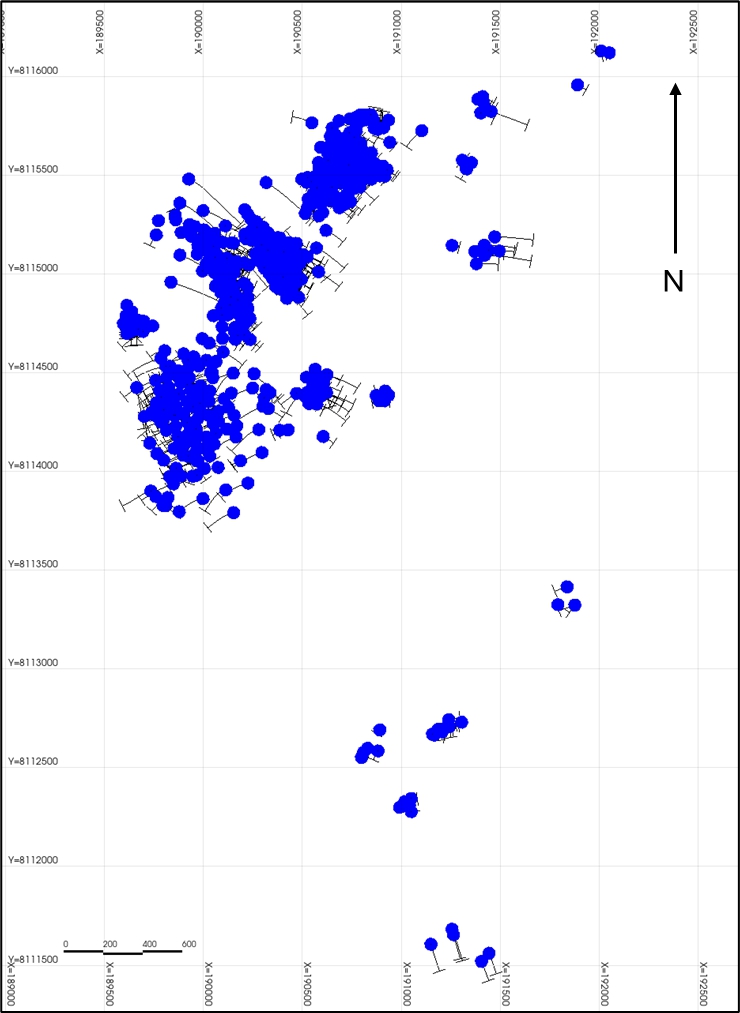
There
is a total of 9,419 assay intervals in the database used for the Mineral Resource Estimates; 2,867 assays are contained inside the interpreted
mineralized solids.
Table
11-1 shows the range of Li2O values from the analytical data.
|
| SGS Geological Services |
| S-K 1300 Technical Report – FS Neves Lithium Project – Minas Gerais, Brazil | Page 110 |
| | |
Table
11-1 Neves Assay Statistics Inside Mineralized Solid
| |
Total
Li20
(%) |
Anitta
1
Li20
(%) |
Anitta
2
Li20
(%) |
Anitta
2.5
Li20
(%) |
Anitta
3
Li20
(%) |
Anitta
3N
Li20
(%) |
Anitta
4
Li20
(%) |
| Count |
2,867 |
475 |
799 |
249 |
916 |
251 |
177 |
| Mean |
1.12 |
0.82 |
1.17 |
1.47 |
1.21 |
0.90 |
1.14 |
| Std.
Dev. |
0.99 |
0.80 |
1.03 |
1.08 |
1.02 |
0.72 |
0.97 |
| Min |
0.01 |
0.02 |
0.02 |
0.03 |
0.02 |
0.02 |
0.03 |
| Median |
0.86 |
0.52 |
0.89 |
1.30 |
0.95 |
0.80 |
0.97 |
| Max |
5.23 |
4.59 |
4.95 |
4.60 |
5.23 |
3.09 |
4.25 |
Block
model grade interpolation was conducted on composited analytical data. A 1 m composite length was selected based on the north–south
width of the block size defined for the resource block models. Compositing began at the top of the mineralized wireframe and continued
to the end of the mineralized wireframe. No capping was applied on the analytical composite data.
Table
11-2 shows the grade statistics of the analytical composites used for the interpolation of the resource block model.
Table
11-2 Neves 1 m Composite Statistics
| |
Total
Li20
(%) |
Anitta
1
Li20
(%) |
Anitta
2
Li20
(%) |
Anitta
2.5
Li20
(%) |
Anitta
3
Li20
(%) |
Anitta
3N
Li20
(%) |
Anitta
4
Li20
(%) |
| Count |
2,825 |
474 |
786 |
253 |
903 |
252 |
172 |
| Mean |
1.12 |
0.81 |
1.19 |
1.44 |
1.18 |
0.90 |
1.16 |
| Std.
Dev. |
0.93 |
0.74 |
0.96 |
1.02 |
0.97 |
0.71 |
0.2 |
| Min |
0.0 |
0.0 |
0.00 |
0.0 |
0.0 |
0.0 |
0.0.0 |
| Median |
0.93 |
0.58 |
0.99 |
1.27 |
0.99 |
0.79 |
1.04 |
| Max |
4.95 |
4.27 |
4.95 |
4.23 |
4.88 |
3.09 |
4.09 |
Atlas
have conducted density measurement on drill core for the duration of the exploration program. The density database contains a total of
2.821 density measurements across the lithological profile.
For
the mineralized horizons, there are 521 spodumene density measurements and 27 petalite measurements. The average of the spodumene measurements
is 2.70 g/cm3, while the average of the petalite measurements is 2.59 g/cm3.
A
weighted average of the spodumene and petalite measurements equals 2.70 g/cm3, as the small amount of petalite measurements
didn’t influence the spodumene measurements.
There
was a total of 1,077 density measurements of the schist host rock, which enabled a calculation to be made for the background waste material.
The average of the schist measurements was 2.77 g/cm3.
|
| SGS Geological Services |
| S-K 1300 Technical Report – FS Neves Lithium Project – Minas Gerais, Brazil | Page 111 |
| | |
| 11.5 | Geological
Interpretation |
SGS
conducted the interpretation of the 3D wireframe solids of the mineralization based on the drill hole data. For the purpose of modelling,
sections looking northeast for Anitta 1, 2, 2.5, 3, and 4 and looking east for Anitta 3N were generated every 30 m, with intermediate
sections where necessary to tie in the solids. The modelling was first completed on sections to define mineralized shapes using the lithology
and lithium analytical data. A minimum grade of 0.3% Li2O over a minimum drill hole interval length of 1.0 m was generally
used as a guideline to define the width of the mineralized shapes, together with the lithological logs. The final 3D wireframe model
(solid) was constructed by linking the defined mineralized shapes based on the geological interpretation (refer to Figure 11-2).
The
mineralized solids were clipped directly on the LiDAR topographic surface. The average depth of soil overburden is 4.2 m and the average
depth of the saprolite horizon is 18.0 m.
Figure
11-2 shows the final 3D wireframe solids in isometric view with the drill hole pierce points.
Figure
11-2 Neves Pegmatite Solids
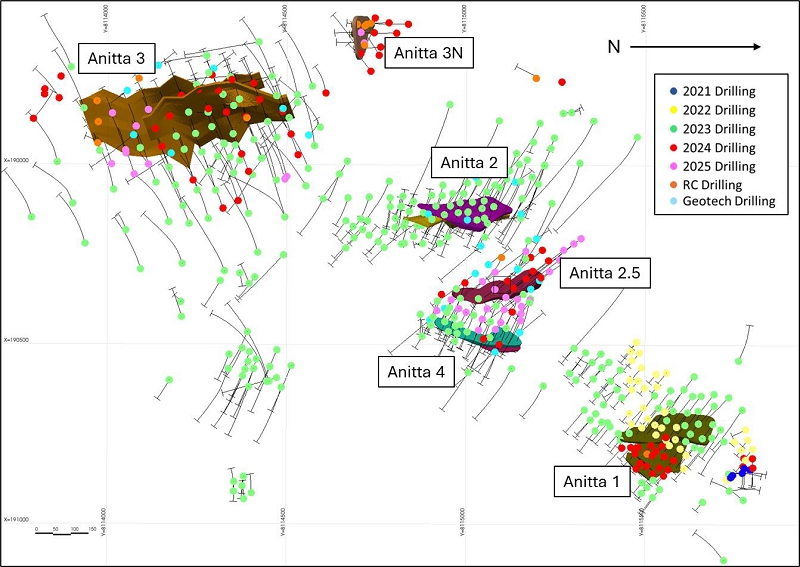
| 11.6 | Resource
Block Modelling |
A
block size of 5 m (north–south) by 5 m (west–east) by 5 m (vertical) was selected for all the block models. This was based
on drill hole spacing, width and general geometry of the modelled mineralization. No rotation was applied to the block models. Separate
block models with separate origins were created for each of the mineralized zones.
Table
11-3 to Table 11-8 summarizes the block model limit parameters.
|
| SGS Geological Services |
| S-K 1300 Technical Report – FS Neves Lithium Project – Minas Gerais, Brazil | Page 112 |
| | |
Table
11-3 Anitta 1 Resource Block Model Parameters
| Direction |
Block
Size
(m) |
Number
of Blocks |
Coordinates
Min
(m) |
Coordinates
Max
(m) |
| North-South
(x) |
5 |
54 |
190,654 |
190,919 |
| West-East
(y) |
5 |
70 |
8,115,388 |
8,115,733 |
| Elevation
(z) |
5 |
50 |
294 |
539 |
Table
11-4 Anitta 2 Resource Block Model Parameters
| Direction |
Block
Size
(m) |
Number
of Blocks |
Coordinates
Min
(m) |
Coordinates
Max
(m) |
| North-South
(x) |
5 |
29 |
190,067 |
190,207 |
| West-East
(y) |
5 |
87 |
8,114,761 |
8,115,191 |
| Elevation
(z) |
5 |
67 |
211 |
541 |
Table
11-5 Anitta 2.5 Resource Block Model Parameters
| Direction |
Block
Size
(m) |
Number
of Blocks |
Coordinates
Min
(m) |
Coordinates
Max
(m) |
| North-South
(x) |
5 |
124 |
189,999 |
190,614 |
| West-East
(y) |
5 |
97 |
8,114,755 |
8,115,235 |
| Elevation
(z) |
5 |
67 |
211 |
541 |
Table
11-6 Anitta 3 Resource Block Model Parameters
| Direction |
Block
Size
(m) |
Number
of Blocks |
Coordinates
Min
(m) |
Coordinates
Max
(m) |
| North-South
(x) |
5 |
78 |
189,687 |
190,072 |
| West-East
(y) |
5 |
170 |
8,111,798 |
8,114,643 |
| Elevation
(z) |
5 |
88 |
157 |
592 |
|
| SGS Geological Services |
| S-K 1300 Technical Report – FS Neves Lithium Project – Minas Gerais, Brazil | Page 113 |
| | |
Table
11-7 Anitta 3N Resource Block Model Parameters
| Direction |
Block
Size
(m) |
Number
of Blocks |
Coordinates
Min
(m) |
Coordinates
Max
(m) |
| North-South
(x) |
5 |
39 |
189,546 |
189736 |
| West-East
(y) |
5 |
20 |
8,114,662 |
8,114,757 |
| Elevation
(z) |
5 |
52 |
247 |
502 |
Table
11-8 Anitta 4 Resource Block Model Parameters
| Direction |
Block
Size
(m) |
Number
of Blocks |
Coordinates
Min
(m) |
Coordinates
Max
(m) |
| North-South
(x) |
3 |
29 |
190,405 |
190,545 |
| West-East
(y) |
3 |
70 |
8,114862 |
8,115,207 |
| Elevation
(z) |
3 |
52 |
242 |
497 |
Table
11-9 shows the volume, tonnage and number of blocks of the different mineralized zones.
Table
11-9 Neves Volume, Tonnage and Number of Blocks per Mineralized Zone
| Orebody |
Volume
(m3) |
Tonnage
(@2.7 g/cm3) |
Number
of Blocks |
| Anitta
1 |
375,078 |
1,012,711 |
6,597 |
| Anitta
2 |
790,660 |
2,134,782 |
9,858 |
| Anitta
2.5 |
310,467 |
838,261 |
4,015 |
| Anitta
3 |
1,886,543 |
5,093,666 |
26,056 |
| Anitta
3N |
147,724 |
398,855 |
2,094 |
| Anitta
4 |
152,285 |
411,170 |
2,882 |
| Total |
3,662,757 |
9,889,445 |
51,502 |
| 11.7 | Block
Model Interpretation |
The
grade interpolation for the Neves pegmatites resource block model was completed using an inverse distance weighting to the second power
(ID2) methodology. The inverse distance squared weighting method assigns a grade to each block in the block model, without
the necessity of a sample being within the block volume. With the ID2 method, the grade, thickness, or any other value for
the sample is adjusted by the inverse of the distance to the sample, squared. All adjusted sample weights are summed, then divided by
the sum of the inverse distances. Closer samples are given greater weight than samples farther away.
Variable
search ellipse orientations were used to interpolate the blocks. The general dip of the mineralized pegmatite was modelled on each section
and then interpolated in each block. During the interpolation process, the search ellipse was orientated based on the interpolation direction
of each block, hence better representing the local dip and orientation of the mineralization.
|
| SGS Geological Services |
| S-K 1300 Technical Report – FS Neves Lithium Project – Minas Gerais, Brazil | Page 114 |
| | |
The
first pass was interpolated using a search ellipsoid distance of 50 m (long axis) by 50 m (intermediate axis) and 25 m (short axis) with
the orientation aligned to the strike and dip of the respective pegmatites. For the second pass, the search distance was twice the search
distance of the first pass and composites selection criteria were kept the same as for the first pass. Finally, the search distance of
the third pass was increased to 150 m (long axis) by 150 m (intermediate axis) by 25 m (short axis). The purpose of the last interpolation
pass was to interpolate the remaining un-estimated blocks mostly located at the edges of the block model.
Once
complete, the block models were cut to the topographic surface and the tenement boundaries.
Figure
11-3 illustrates the three search ellipsoids used for the Anitta 1 grade interpolation. Figure 11-4 to Figure 11-9 shows the results
of the block model interpolations for Anitta 1, Anitta 2, Anitta 2.5, Anitta 3, Anitta 3N, and Anitta 4, while Figure 11-10 shows all
block models on the property.
Figure
11-3 Isometric View of Anitta 1 Search Ellipses
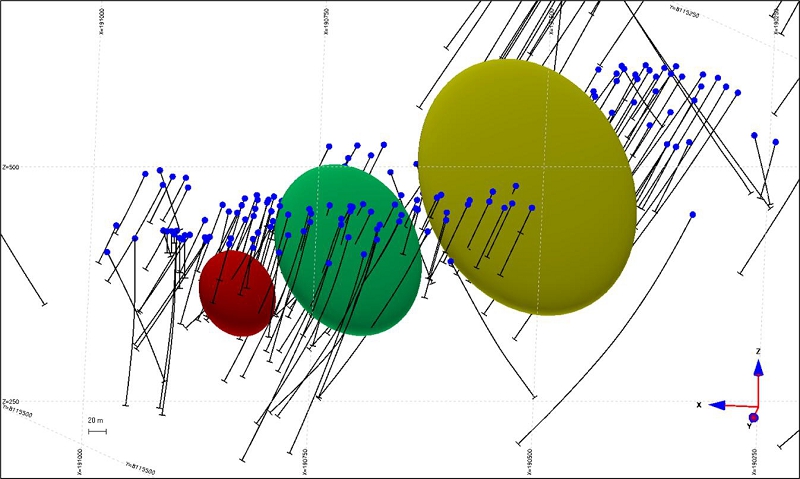
|
| SGS Geological Services |
| S-K 1300 Technical Report – FS Neves Lithium Project – Minas Gerais, Brazil | Page 115 |
| | |
Figure
11-4 Isometric View of Anitta 1 Interpolated Block Model
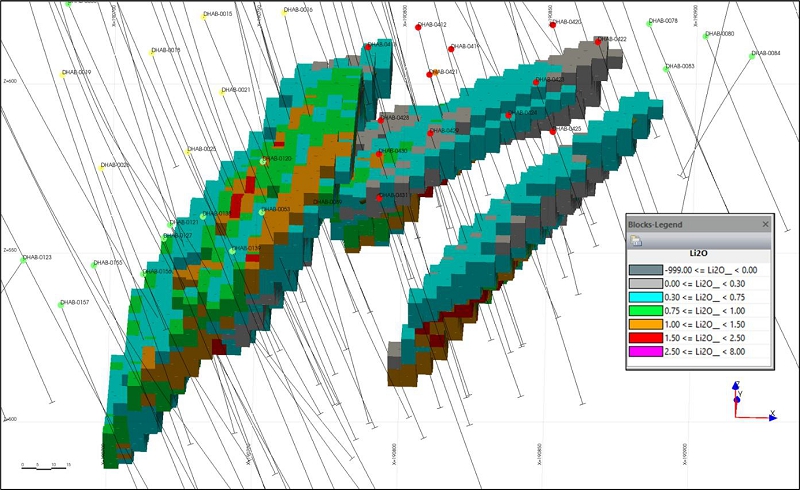
Figure
11-5 Isometric View of Anitta 2 Interpolated Block Model
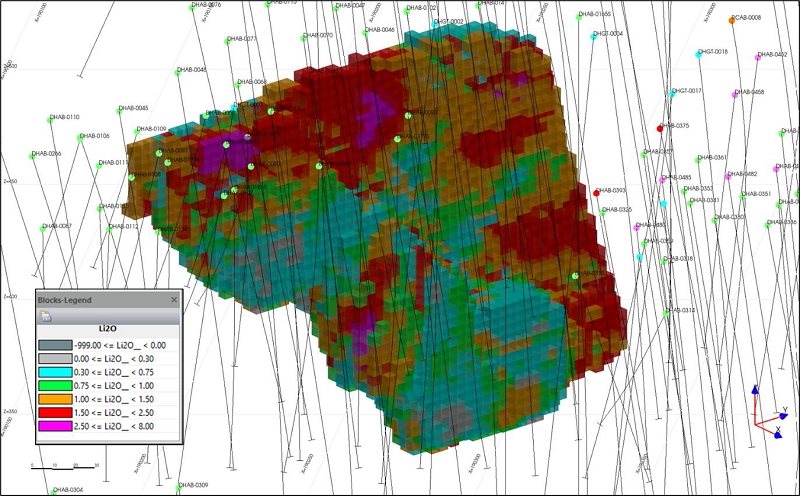
|
| SGS Geological Services |
| S-K 1300 Technical Report – FS Neves Lithium Project – Minas Gerais, Brazil | Page 116 |
| | |
Figure
11-6 Isometric View of Anitta 2.5 Interpolated Block Model
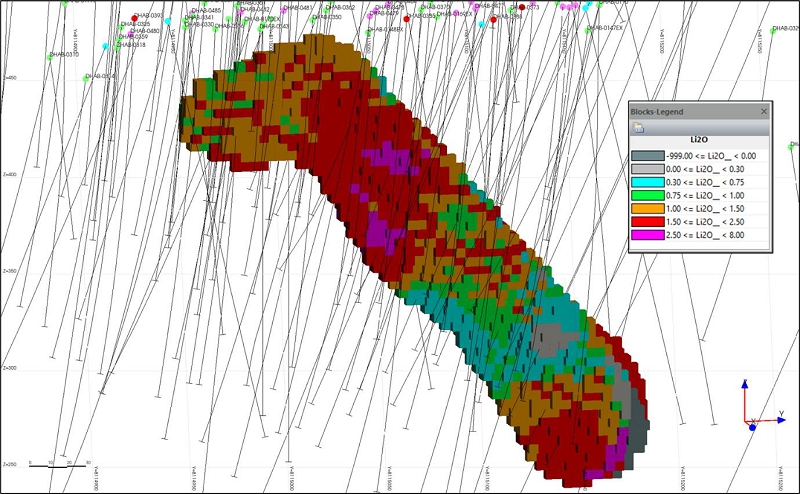
Figure
11-7 Isometric View of Anitta 3 Interpolated Block Model
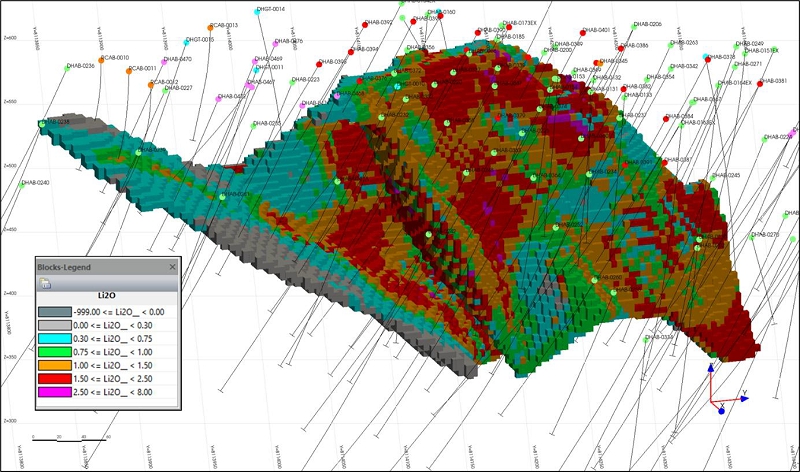
|
| SGS Geological Services |
| S-K 1300 Technical Report – FS Neves Lithium Project – Minas Gerais, Brazil | Page 117 |
| | |
Figure
11-8 Isometric View of Anitta 3N Interpolated Block Model
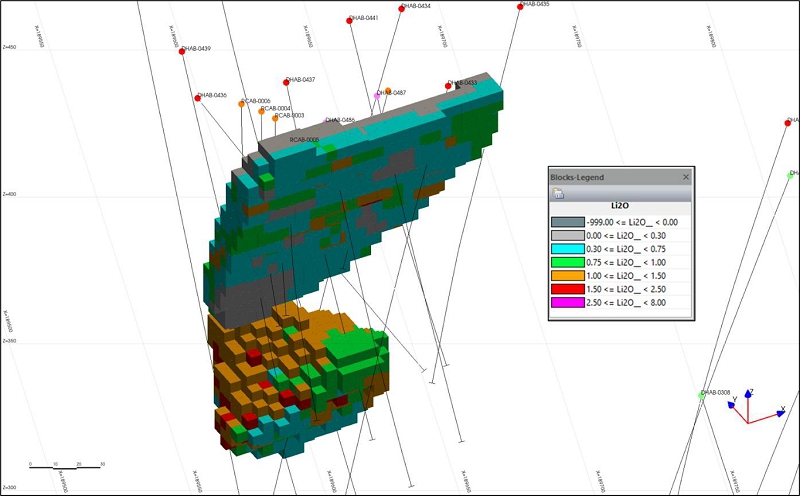
Figure
11-9 Isometric View of Anitta 4 Interpolated Block Model
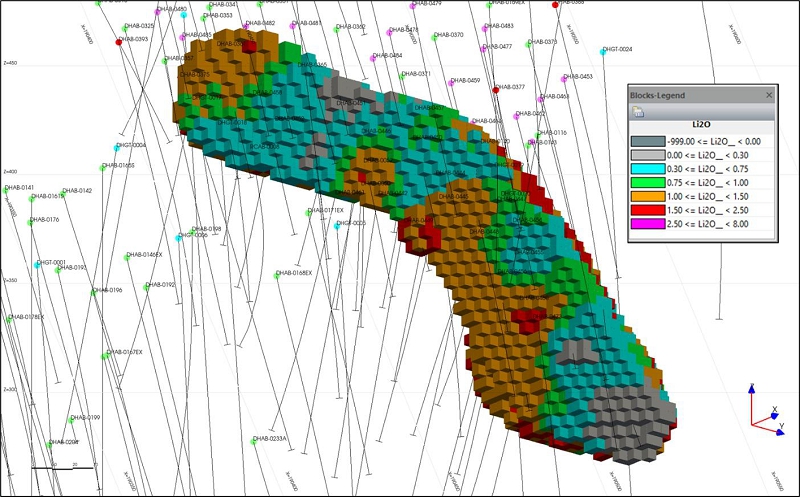
|
| SGS Geological Services |
| S-K 1300 Technical Report – FS Neves Lithium Project – Minas Gerais, Brazil | Page 118 |
| | |
Figure
11-10 Isometric View of Neves Project Interpolated Block Models
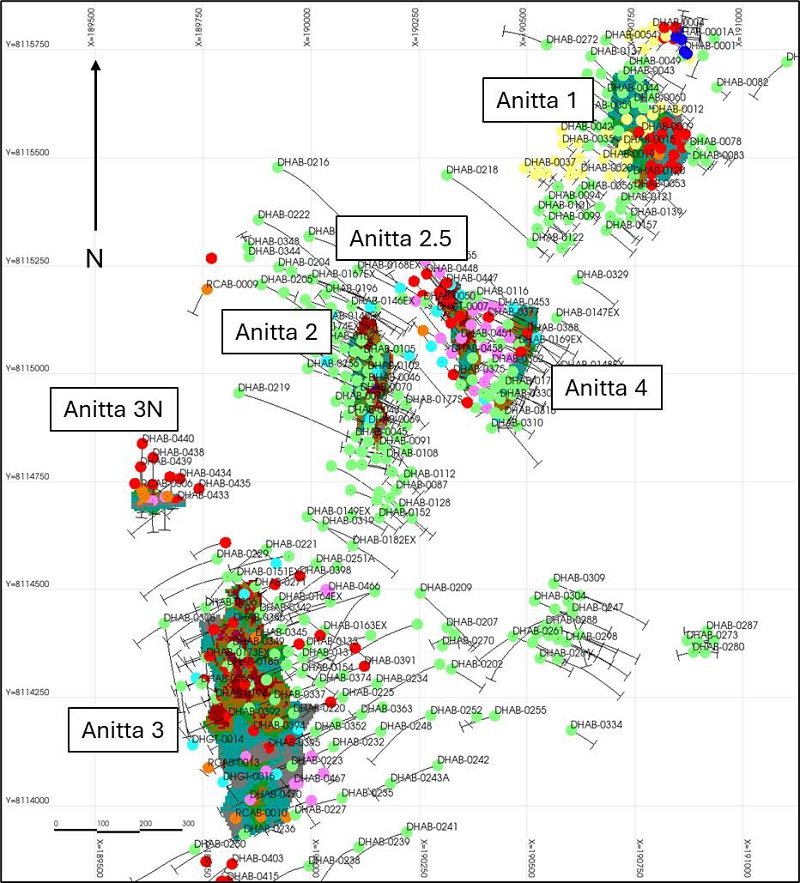
| 11.8 | Mineral
Resource Classification |
The
MRE for the Neves deposit is prepared and disclosed in compliance with all current disclosure requirements for mineral resources set
out in the US Securities and Exchange Commission Regulation S-K, 17 CFR Part 229, Item 1300, otherwise known as S-K 1300. The classification
of the current MRE is consistent with the definitions defined in Regulation S-K, 17 CFR 229.1300 (Item 1300) Definitions.
Mineral
Resources are sub-divided, in order of increasing geological confidence, into Inferred, Indicated and Measured categories. An Inferred
Mineral Resource has a lower level of confidence than that applied to an Indicated Mineral Resource. An Indicated Mineral Resource has
a higher level of confidence than an Inferred Mineral Resource but has a lower level of confidence than a Measured Mineral Resource.
|
| SGS Geological Services |
| S-K 1300 Technical Report – FS Neves Lithium Project – Minas Gerais, Brazil | Page 119 |
| | |
A
Mineral Resource is a concentration or occurrence of solid material of economic interest in or on the Earth’s crust in such form,
grade or quality and quantity that there are reasonable prospects for eventual economic extraction.
Interpretation
of the word ‘eventual’ in this context may vary depending on the commodity or mineral involved. For example, for some coal,
iron, potash deposits, and other bulk minerals or commodities, it may be reasonable to envisage ‘eventual economic extraction’
as covering time periods in excess of 50 years. However, for many lithium deposits, application of the concept would normally be restricted
to perhaps 10 to 15 years, and frequently to much shorter periods of time.
The
location, quantity, grade or quality, continuity and other geological characteristics of a Mineral Resource are known, estimated or interpreted
from specific geological evidence and knowledge, including sampling.
The
first classification stage was conducted by applying an automated classification process which selects around each block a minimum number
of composites from a minimum number of holes located within a search ellipsoid of a given size and orientation:
| ● | Measured
Mineral Resources: the search ellipsoid used was 30 m (strike) by 30 m (dip) by 15 m with
a minimum of four composites in at least two different drill holes |
| | | |
| ● | Indicated
Mineral Resources: the search ellipsoid used was 50 m (strike) by 50 m (dip) by 15 m with
a minimum of four composites in at least two different drill holes |
| | | |
| ● | Inferred
Mineral Resources: the search ellipsoid used was 150 m (strike) by 150 m (dip) by 25 m with
a minimum of two composites. |
The
second classification was conducted by manually adjusting the classifications in accordance with the observed geology and drill hole
spacing and to ensure continuity in the selected classifications.
Inferred
Mineral Resource
An
Inferred Mineral Resource is that part of a Mineral Resource for which quantity and grade or quality are estimated on the basis of limited
geological evidence and sampling. Geological evidence is sufficient to imply but not verify geological and grade or quality continuity.
An
Inferred Mineral Resource has a lower level of confidence than that applying to an Indicated Mineral Resource and must not be converted
to a Mineral Reserve. It is reasonably expected that the majority of Inferred Mineral Resources could be upgraded to Indicated Mineral
Resources with continued exploration.
An
Inferred Mineral Resource is based on limited information and sampling gathered through appropriate sampling techniques from locations
such as outcrops, trenches, pits, workings and drill holes. Inferred Mineral Resources must not be included in the economic analysis,
production schedules, or estimated mine life in publicly disclosed Pre-Feasibility or Feasibility Studies, or in the Life of Mine plans
and cash flow models of developed mines. Inferred Mineral Resources can only be used in economic studies as provided under S-K 1300.
Indicated
Mineral Resource
An
‘Indicated Mineral Resource’ is that part of a Mineral Resource for which quantity, grade or quality, densities, shape and
physical characteristics can be estimated with a level of confidence sufficient to allow the appropriate application of technical and
economic parameters, to support mine planning and evaluation of the economic viability of the deposit.
Geological
evidence is derived from adequately detailed and reliable exploration, sampling and testing and is sufficient to assume geological and
grade or quality continuity between points of observation.
|
| SGS Geological Services |
| S-K 1300 Technical Report – FS Neves Lithium Project – Minas Gerais, Brazil | Page 120 |
| | |
An
Indicated Mineral Resource has a lower level of confidence than that applying to a Measured Mineral Resource and may only be converted
to a Probable Mineral Reserve.
Mineralization
may be classified as an Indicated Mineral Resource by the QP when the nature, quality, quantity and distribution of data are such as
to allow confident interpretation of the geological framework and to reasonably assume the continuity of mineralization. The QP must
recognise the importance of the Indicated Mineral Resource category to the advancement of the feasibility of the project. An Indicated
Mineral Resource Estimate is of sufficient quality to support a Preliminary Feasibility Study which can serve as the basis for major
development decisions.
Measured
Mineral Resource
A
Measured Mineral Resource is that part of a Mineral Resource for which quantity, grade or quality, densities, shape, and physical characteristics
are estimated with confidence sufficient to allow the application of Modifying Factors to support detailed mine planning and final evaluation
of the economic viability of the deposit.
Geological
evidence is derived from detailed and reliable exploration, sampling, and testing and is sufficient to confirm geological and grade or
quality continuity between points of observation.
A
Measured Mineral Resource has a higher level of confidence than that applying to either an Indicated Mineral Resource or an Inferred
Mineral Resource.
It
may be converted to a Proven Mineral Reserve or to a Probable Mineral Reserve. Mineralization or other natural material of economic interest
may be classified as a Measured Mineral Resource by the QP when the nature, quality, quantity, and distribution of data are such that
the tonnage and grade or quality of the mineralization can be estimated to within close limits and that variation from the estimate would
not significantly affect potential economic viability of the deposit. This category requires a high level of confidence in, and understanding
of, the geology and controls of the mineral deposit.
There
may be circumstances, where appropriate sampling, testing, and other measurements are sufficient to demonstrate data integrity, geological
and grade/quality continuity of a Measured or Indicated Mineral Resource, however, quality assurance and quality control, or other information
may not meet all industry norms for the disclosure of an Indicated or Measured Mineral Resource. Under these circumstances, it may be
reasonable for the QP to report an Inferred Mineral Resource if the QP has taken steps to verify the information meets the requirements
of an Inferred Mineral Resource.
In
the case of the Neves deposit, it is the opinion of SGS that the deposit satisfies the requirements to be reported as a combination of
Measured and Inferred resources.
Figure
11-11 to Figure 11-16 show isometric views of the final classification of Anitta 1, Anitta 2, Anitta 2.5, Anitta 3, Anitta 3N, and Anitta
4.
|
| SGS Geological Services |
| S-K 1300 Technical Report – FS Neves Lithium Project – Minas Gerais, Brazil | Page 121 |
| | |
Figure
11-11 Anitta 1 Block Model Classification
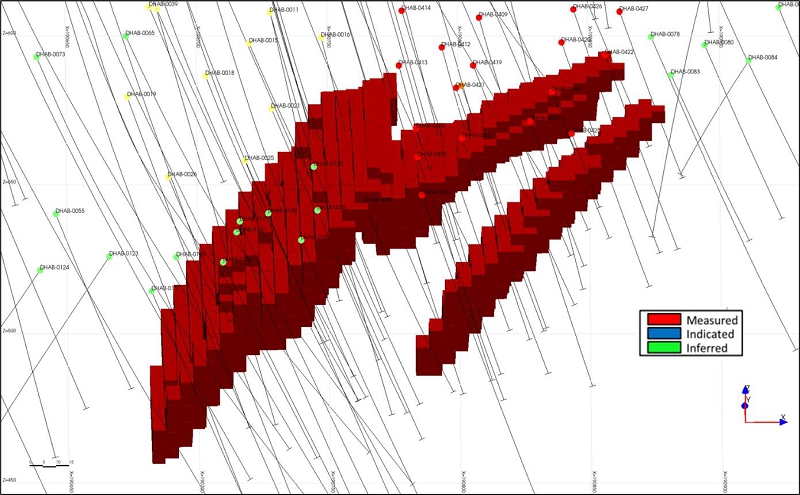
Figure
11-12 Anitta 2 Block Model Classification
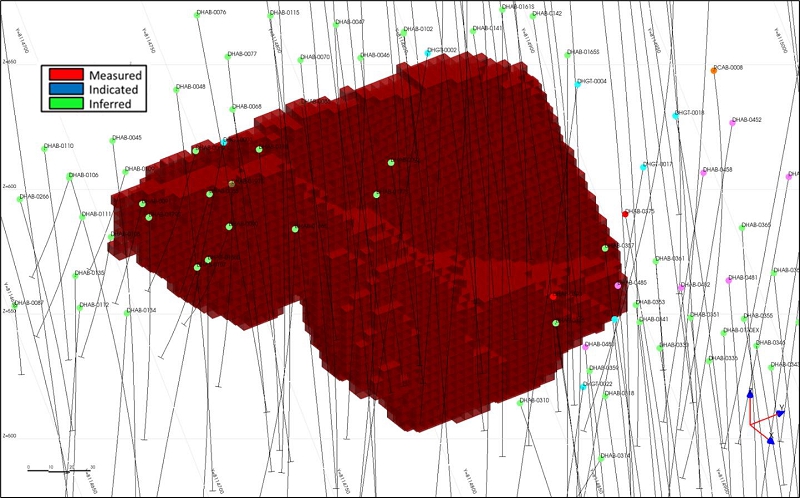
|
| SGS Geological Services |
| S-K 1300 Technical Report – FS Neves Lithium Project – Minas Gerais, Brazil | Page 122 |
| | |
Figure
11-13 Anitta 2.5 Block Model Classification
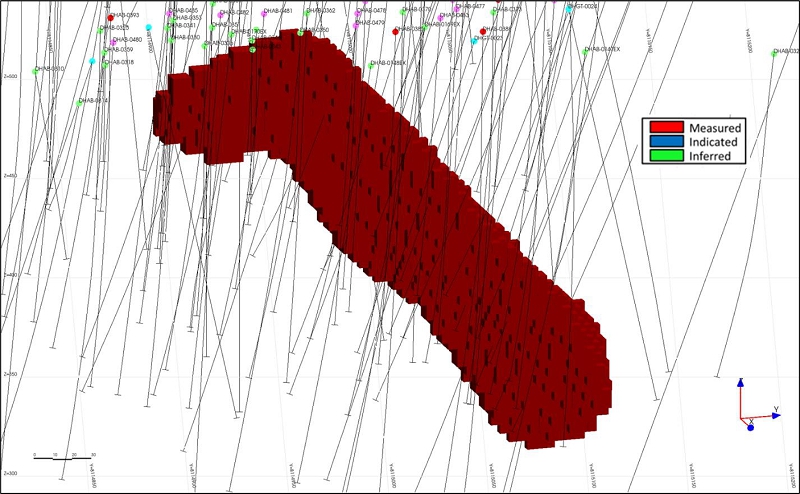
Figure
11-14 Anitta 3 Block Model Classification
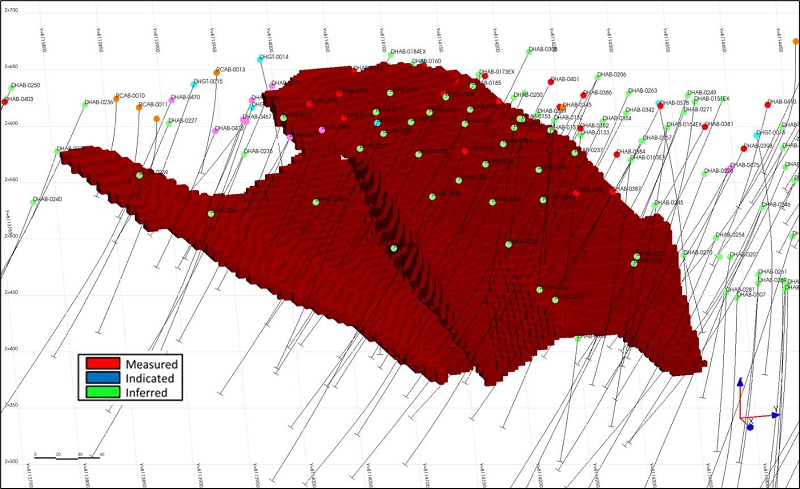
|
| SGS Geological Services |
| S-K 1300 Technical Report – FS Neves Lithium Project – Minas Gerais, Brazil | Page 123 |
| | |
Figure
11-15 Anitta 3N Block Model Classification
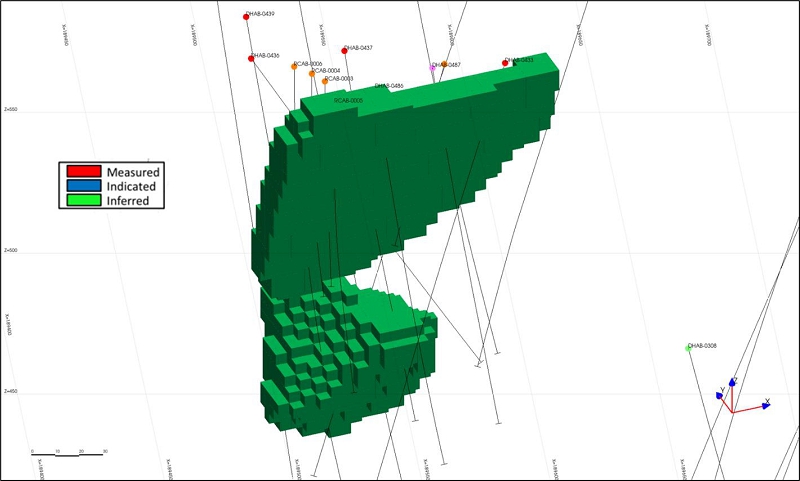
Figure
11-16 Anitta 4 Block Model Classification
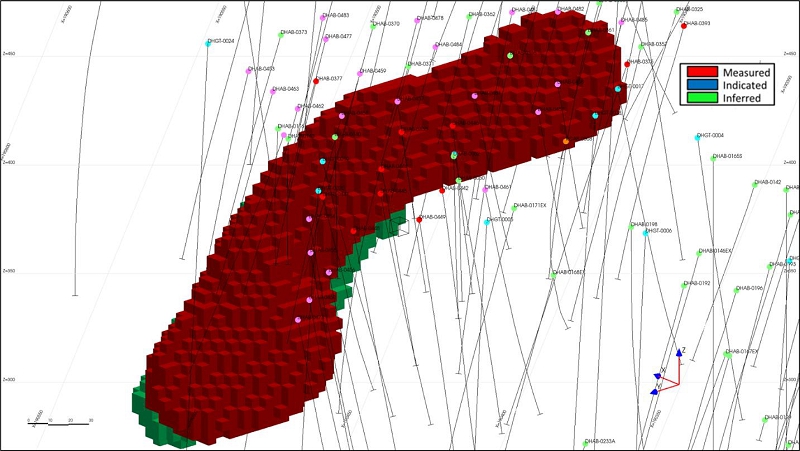
|
| SGS Geological Services |
| S-K 1300 Technical Report – FS Neves Lithium Project – Minas Gerais, Brazil | Page 124 |
| | |
| 11.9 | Reasonable
Prospects for Eventual Economic Extraction |
The
general requirement that all mineral resources have “reasonable prospects for eventual economic extraction” implies that
the quantity and grade estimates meet certain economic thresholds and that the mineral resources are reported at an appropriate cut-off
grade considering extraction scenarios and processing recoveries. To meet this requirement, the lithium mineralization of the Neves deposit
is considered amenable to open pit extraction.
To
determine the quantities of material offering “reasonable prospects for eventual economic extraction” for Neves by open pit
mining, the Genesis™. software pit optimization tool and reasonable mining assumptions to evaluate the proportions of the block
model (Measured, Indicated and Inferred blocks) that could be “reasonably expected” to be mined from an open pit were used.
The pit optimization was completed by SGS. The pit optimization parameters used are summarized in Table 11-10. A dressed cone, re-blocked
pit shell at a revenue factor of 1.0 was selected as the ultimate pit shells for the purposes of the MRE. The optimised pits have been
limited to the topographic surface and to the extent of the property boundary.
The
reader is cautioned that the results from the pit optimization are used solely for the purpose of testing the “reasonable prospects
for eventual economic extraction” by an open pit method and do not represent an attempt to estimate mineral reserves. The results
are used as a guide to assist in the preparation of a Mineral Resource statement and to select an appropriate resource reporting cut-off
grade. A selected base case cut-off grade of 0.3% Li2O (%) is used to determine the in-pit MRE portion for the deposit.
Table
11-10 Neves Parameters for Reasonable Prospect for Eventual Economic Extraction
| Parameter |
Unit |
Value |
| Concentrate
Price (5.5% Li2O) |
US$
per tonne |
$1,700 |
| Pit
Slope |
Degrees |
60 |
| Mining
Cost |
US$
per tonne mined |
$2.60 |
| Processing
Cost & G&A |
US$
per tonne processed |
$29.64 |
| Mining
Recovery |
Percent
(%) |
95 |
| Concentration
Recovery (DMS) |
Percent
(%) |
61.7 |
| Mining
loss / Dilution |
Percent
(%) / Percent (%) |
5
/ 5 |
| Cut-off
Grade |
Percent
(%) Li2O |
0.3 |
Figure
11-17 shows the optimised pit shells with the pit-constrained mineralized surfaces.
|
| SGS Geological Services |
| S-K 1300 Technical Report – FS Neves Lithium Project – Minas Gerais, Brazil | Page 125 |
| | |
Figure
11-17 Neves Deposit Mineral Resource Block Models and Optimised Pits
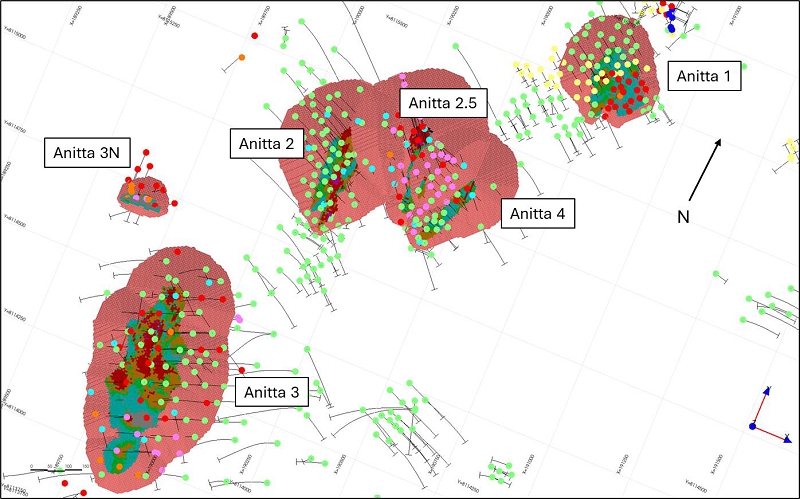
| 11.10 | Mineral
Resource Estimation |
The
combined Mineral Resource Estimate for Neves is reported in Table 11-11 using a 0.3% Li2O cut-off and is reported exclusive
of Mineral Reserves. The Mineral Resources are constrained by the topography and tenement boundaries and based on the conceptual economic
parameters detailed in Table 11-10. The estimate has an effective date of the 15th May 2025.
Table
11-11 Combined Neves Deposit In-Pit Mineral Resource Estimate
0.3%
Li2O Cut-Off 15th May 2025
Cut-off
Grade
Li2O
(%) |
Category |
Tonnage
(t) |
Average
Grade
Li2O
(%) |
LCE
(Kt) |
| 0.3 |
Measured |
1,249,000
|
1.00 |
30.9 |
| 0.3 |
Indicated |
- |
- |
- |
| 0.3 |
Measured
+ Indicated |
1,249,000 |
1.00 |
30.9 |
| 0.3 |
Inferred |
149,000 |
0.81 |
3.0 |
Table
11-12 to Table 11-17 show the individual classified resources by orebody.
|
| SGS Geological Services |
| S-K 1300 Technical Report – FS Neves Lithium Project – Minas Gerais, Brazil | Page 126 |
| | |
Table
11-12 Anitta 1 In-Pit Mineral Resource Estimate 15th May 2025
Cut-off
Grade
Li2O
(%) |
Category |
Tonnage
(t) |
Average
Grade
Li2O
(%) |
LCE
(Kt) |
| 0.3 |
Measured |
740,000 |
0.90 |
16.5 |
| 0.3 |
Indicated |
- |
- |
- |
| 0.3 |
Measured
+ Indicated |
740,000 |
0.90 |
16.5 |
| 0.3 |
Inferred |
- |
- |
- |
Table
11-13 Anitta 2 In-Pit Mineral Resource Estimate 15th May 2025
Cut-off
Grade
Li2O
(%) |
Category |
Tonnage
(t) |
Average
Grade
Li2O
(%) |
LCE
(Kt) |
| 0.3 |
Measured |
22,000 |
1.06 |
0.6 |
| 0.3 |
Indicated |
- |
- |
- |
| 0.3 |
Measured
+ Indicated |
22,000 |
1.06 |
0.6 |
| 0.3 |
Inferred |
- |
- |
- |
Table
11-14 Anitta 2.5 In-Pit Mineral Resource Estimate 15th May 2025
Cut-off
Grade
Li2O
(%) |
Category |
Tonnage
(t) |
Average
Grade
Li2O
(%) |
LCE
(Kt) |
| 0.3 |
Measured |
23,000 |
1.99 |
1.1 |
| 0.3 |
Indicated |
- |
- |
- |
| 0.3 |
Measured
+ Indicated |
23,000 |
1.99 |
1.1 |
| 0.3 |
Inferred |
- |
- |
- |
|
| SGS Geological Services |
| S-K 1300 Technical Report – FS Neves Lithium Project – Minas Gerais, Brazil | Page 127 |
| | |
Table
11-15 Anitta 3 In-Pit Mineral Resource Estimate 15th May 2025
Cut-off
Grade
Li2O
(%) |
Category |
Tonnage
(t) |
Average
Grade
Li2O
(%) |
LCE
(Kt) |
| 0.3 |
Measured |
166,000 |
0.90 |
3.7 |
| 0.3 |
Indicated |
- |
- |
- |
| 0.3 |
Measured
+ Indicated |
166,000 |
0.90 |
3.7 |
| 0.3 |
Inferred |
— |
- |
- |
Table
11-16 Anitta 3N In-Pit Mineral Resource Estimate 15th May 2025
Cut-off
Grade
Li2O
(%) |
Category |
Tonnage
(t) |
Average
Grade
Li2O
(%) |
LCE
(Kt) |
| 0.3 |
Measured |
- |
- |
- |
| 0.3 |
Indicated |
- |
- |
- |
| 0.3 |
Measured
+ Indicated |
- |
- |
- |
| 0.3 |
Inferred |
104,000 |
0.73 |
1.9 |
Table
11-17 Anitta 4 In-Pit Mineral Resource Estimate 15th May 2025
Cut-off
Grade
Li2O
(%) |
Category |
Tonnage
(t) |
Average
Grade
Li2O
(%) |
LCE
(Kt) |
| 0.3 |
Measured |
298,000 |
1.23 |
9.1 |
| 0.3 |
Indicated |
- |
- |
- |
| 0.3 |
Measured
+ Indicated |
298,000 |
1.23 |
9.1 |
| 0.3 |
Inferred |
45,000 |
1.01 |
1.1 |
Notes
to accompany Mineral Resource tables:
| 1. | Mineral
Resources have an effective date of the 15th May, 2025 and have been classified
using the S-K 1300 Definitions |
| 2. | All
Resources are presented undiluted and in situ, constrained by continuous 3D wireframe
models, and are considered to have reasonable prospects for eventual economic extraction. |
| 3. | Mineral
Resources are reported assuming open pit mining methods, and the following assumptions: lithium
concentrate (5.5% Li2O) price of US$1,700/t, mining costs of US$2.60/t for mineralization
and waste, crushing and processing costs of US$27.71/t, general and administrative (G&A)
costs of US$1.93/t, concentrate recovery of 61.7%, pit slope angles of 60º, and an overall
cut-off grade of 0.3% Li2O. |
| 4. | Tonnages
and grades have been rounded in accordance with reporting guidelines. Totals may not sum
due to rounding. |
| 5. | Mineral
Resources are reported exclusive of Mineral Reserves. |
| 6. | Mineral
resources which are not mineral reserves do not have demonstrated economic viability. An
Inferred Mineral Resource has a lower level of confidence than that applying to a Measured
and Indicated Mineral Resource and must not be converted to a Mineral Reserve. It is reasonably
expected that the majority of Inferred Mineral Resources could be upgraded to Indicated Mineral
Resources with continued exploration. |
| 7. | The
results from the pit optimization are used solely for the purpose of testing the “reasonable
prospects for economic extraction” by an open pit and do not represent an attempt to
estimate mineral reserves. The results are used as a guide to assist in the preparation of
a Mineral Resource statement and to select an appropriate resource reporting cut-off grade. |
| 8. | The
estimate of Mineral Resources may be materially affected by environmental, permitting, legal,
title, taxation, socio-political, marketing, or other relevant issues. |
|
| SGS Geological Services |
| S-K 1300 Technical Report – FS Neves Lithium Project – Minas Gerais, Brazil | Page 128 |
| | |
| 12 | MINERAL
RESERVE ESTIMATES |
This
section presents the Mineral Reserve Estimates for the Anitta 2, Anitta 3, and Anitta 2.5 deposits, which form part of the Atlas Lithium
Project. The reserve estimation process was based on the geological block model developed by SGS, which provided the foundation for the
mineral resource volumes associated with each ore body.
Following
the establishment of the block model, the company Prominas conducted a detailed reserve evaluation, including pit optimization, mining
dilution and recovery assumptions, economic and geotechnical constraints, and mineable tonnage calculations. The estimation process was
carried out in close collaboration with the technical teams of Atlas Lithium, SGS, and Prominas, ensuring that all technical, geological,
and operational considerations were aligned with the project’s strategic objectives.
The
mineral reserves presented herein are classified in accordance with internationally accepted standards and reflect the most current understanding
of the project’s mineable potential as of the effective date of this report.
| 12.2 | Key
Assumptions, Parameters and Methods |
| 12.2.1 | Geological
Block Model |
The
Mineral Reserve estimate relies on the resource block model prepared by the Resource QP, detailed in Section 11. The block model is separated
by ore bodies as upper body and lower body.
The
block models have regular blocks (5mx5mx5m) and are of the Ore% type.
| 12.2.2 | Economic
Parameters |
The
economic parameters listed in Table 12-1 were used to generate the optimal pit, which consists of a pit that maximizes the project economic
value, as obtained by applying the PseudoFlow algorithm on the MinePlan Economic Planner (MPEP) tool.
Table
12-1 Economic Parameters
| Sales |
| Price
[email protected]% ($/t) |
1,700 |
| Operating
Costs |
| Process
$/t ROM |
27.71 |
| G&A
$/t ROM |
1.93 |
| Mine
$/t |
2.60 |
| Rates |
| Discount
rate |
10% |
A
long-term sale price of US$1,700/t concentrate for spodumene (5.50% Li2O) was used.
The
costs used were US$2.60/t for the mining cost and the processing cost of US$27.71/t ore. In addition to these costs, a G&A cost of
US$1.93 per tonne of ore was considered.
These
values were based on market studies provided by Atlas Lithium.
|
| SGS Geological Services |
| S-K 1300 Technical Report – FS Neves Lithium Project – Minas Gerais, Brazil | Page 129 |
| | |
| 12.2.3 | Cut-Off
Grade and Ore Definition |
The
classification of blocks into ores used the following criteria:
| ● | Ore
Bodies: Upper and Lower |
| | | |
| ● | Cutoff
Grade: 0.3% Li2O |
| | | |
| ● | Resource
Classification: Measured and Indicated |
| | | |
| ● | Weathering:
All blocks, including those above the Weathering Surface (Weathered Material) and below it
(Rock), are considered to have economic revenue values in the pit optimization and are reported
as ore |
The
cut-off grade of 0.3% Li2O as defined by SGS, according to the physical limits for the concentration plant.
| 12.2.4 | Concentrate
Calculation |
An
overall metallurgical recovery of 61.7% was adopted for the Dense Media Separation (DMS) circuit, based on results obtained from Heavy
Liquid Separation (HLS) laboratory tests. It was used for metallurgical recovery, with a concentrate grade of 5.5% Li2O, resulting
in a calculated mass recovery, block by block of mined ore by the formula:
Concentrate
= Tonnes * Grade * Metallurgical Recovery/
Grade
in the Concentrate
| 12.2.5 | Dilution
and Mining Recovery |
For
this analysis, a 5% ore dilution and a 95% mining recovery were assumed. The dilution accounts for waste material unintentionally incorporated
into the ore during mining, while the recovery reflects ore losses during extraction and transport. These values were considered constant
throughout the mine’s life to support simplified financial modeling and were based on historical data from comparable operations
and industry best practices. The 5% dilution is considered technically feasible, given the geometry of the ore bodies and the operational
routines to be implemented. Planned measures include a targeted blasting plan designed to achieve optimal rock fragmentation and particle
size for effective ore-waste segregation, operator training, and continuous monitoring of loading activities. Moreover, similar mining
operations under equivalent conditions have demonstrated the achievability of this dilution rate.
Based
on the provided block model, an in-situ dry density of 2.70 t/m³ was applied to the mineralized material, while a density of 2.77
t/m³ was adopted for the waste rock.
| 12.2.7 | Topographic
Surface |
The
topography was based on the point cloud file, from the primitive topography of the project, and triangulated in MinePlan through the
Point Cloud Mesher tool, for the creation of topographic surfaces.
|
| SGS Geological Services |
| S-K 1300 Technical Report – FS Neves Lithium Project – Minas Gerais, Brazil | Page 130 |
| | |
Figure
12-1 Topographic Surface
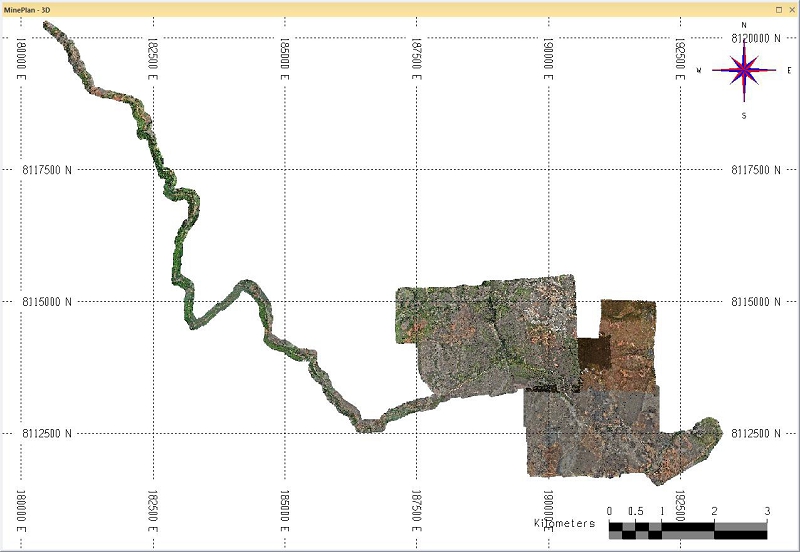
| 12.2.8 | Physical
Restrictions |
The
information related to physical aspects and constraints considered for the pit designs and Mineral Reserve Estimate included the topographic
surface, the geological block model, and the rock type properties for ore, waste, and overburden.
Based
on this data, it is confirmed that the initial years of operation are fully contained within the currently licensed areas of the project,
in accordance with the defined parameters and the approved mine design. Figure 12-2 illustrates the boundaries of the existing licenses,
which fully cover the planned activities for this initial phase.
|
| SGS Geological Services |
| S-K 1300 Technical Report – FS Neves Lithium Project – Minas Gerais, Brazil | Page 131 |
| | |
Figure
12-2 License Limits of the Project
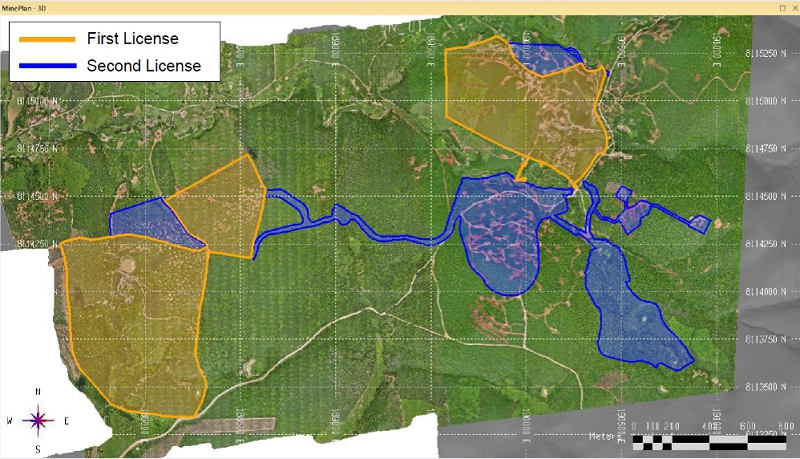
The
constraints applied during the pit optimization process did not impose any geometric limitations on the final design of the Anitta 2
pit, which remains entirely within the licensed area.
The
weathering surface was defined by a geological study of SGS where a weathering surface was generated. Regions below this surface were
classified as Rock and above Weathered.
This
classification will interfere in the geotechnical parameters of the project and in the economic function of the blocks.
| 12.2.10 | Geotechnical
Parameters |
The
geotechnical parameters used in the open-pit analysis are defined in Section 13. This study was developed by ITAACU. The geotechnical
parameters are separated by sectors made from the weathering surface, where Sector 1 is the weathered and Sector 2 is the rock.
The
Table 12-2 shows the geotechnical Parameters for the Anitta 2,2.5 & 3 pit presented in this study.
Table
12-2 Geotechnical Parameters
| |
Sector |
Face
Angle
(°) |
Berm
Width
(m) |
Bench
Height
(m) |
AngleInter-ramp
(°) |
Overall
Angle
(°) |
| Anitta
2 |
1 |
50 |
7 |
10 |
33 |
33 |
| |
2 |
80 |
7 |
20 |
64 |
56 |
|
| SGS Geological Services |
| S-K 1300 Technical Report – FS Neves Lithium Project – Minas Gerais, Brazil | Page 132 |
| | |
The
Overall Angle was defined after the first mathematical optimizations using the proposed inter-ramp angles, the resulting pits presented
a conical geometry with a considerable depth and a narrow upper area.
When
carrying out the pit design, with the insert of berms and ramps, it verified a gain in waste and a loss of ore, due to these factors.
For a better result in the pit optimizations, a General Angle was adopted already considering the Ramps, this adjustment will ensure
that the Pit Design has a greater adherence to the Pit Optimization.
| 12.3 | Pit
Optimization Study |
The
main purpose of pit optimization, from a financial perspective, is to generate the pit that maximizes the benefit. In this step, the
MinePlan Economic Planner (MPEP) software will be used, which uses the PseudoFlow algorithm for the preparation of the mathematical pits
optimization.
The
methodology for the selection of the optimal pit consists of generating a set of nested pits from the application of revenue factors.
The factor is applied to the sale price of the commercial product, resulting in a mathematical pit for each factor applied. The resulting
generated pits are analyzed to define the final optimal pit for the deposit.
The
determination of the pit optimization was based on:
| ● | Definition
of economic and geometric parameters, cut-off grade, and physical restrictions. |
| | | |
| ● | Mineral
Resource Block Model to include the modified factors. |
| | | |
| ● | Definition
of an optimal pit using the MinePlan Economic Planner (MPEP) tool. |
| | | |
| ● | The
selection of the optimum pit, based on a strip ratio limit, and allowance for a mine life
long enough to support a positive cash flow. |
The
optimal pit sequence was obtained by varying the revenue factor in a range from 0 to 2 of the base products selling price. The first
pit opened with a factor of 0.18, resulting in a total of 52 pits.
| 12.3.1 | Pit
Optimization Results |
To
determine the evolution of the pits over time, an annual production rate of 1.1 Mtpa of ore feed was established at an annual discount
rate of 10%. Table 12-3 present the Pit Sensitivity Analysis Results for the Anitta 2 area.
|
| SGS Geological Services |
| S-K 1300 Technical Report – FS Neves Lithium Project – Minas Gerais, Brazil | Page 133 |
| | |
Table
12-3 Anitta 2 – Pit Sensitivity Analysis Results
| Pit |
Factor |
Ore |
Waste |
Grand
Total |
Tonnes
(t) |
Li2O
(%) |
Concentrate
(t) |
Tonnes
(t) |
Tonnes
(t) |
Li2O
(%) |
Li2O_Dil
(%) |
S/R |
Discount
Factor |
NPV |
| PIT09 |
0.18 |
140,654 |
1.712 |
25,662.25 |
1,266,105 |
1,406,759 |
0.268 |
0.255 |
9.00 |
0.9879 |
35,370,031 |
| PIT10 |
0.20 |
172,167 |
1.686 |
30,940.78 |
1,531,465 |
1,703,632 |
0.255 |
0.242 |
8.90 |
0.9852 |
42,434,870 |
| PIT11 |
0.22 |
250,700 |
1.577 |
42,133.88 |
2,114,626 |
2,365,326 |
0.235 |
0.223 |
8.43 |
0.9786 |
56,808,819 |
| PIT12 |
0.24 |
314,280 |
1.539 |
51,535.11 |
2,751,092 |
3,065,372 |
0.212 |
0.201 |
8.75 |
0.9732 |
68,447,963 |
| PIT13 |
0.26 |
509,111 |
1.371 |
74,378.28 |
4,262,721 |
4,771,832 |
0.181 |
0.172 |
8.37 |
0.9570 |
94,700,325 |
| PIT14 |
0.28 |
743,809 |
1.310 |
103,827.24 |
6,488,244 |
7,232,053 |
0.158 |
0.150 |
8.72 |
0.9378 |
127,231,790 |
| PIT15 |
0.30 |
823,395 |
1.292 |
113,375.88 |
7,328,990 |
8,152,385 |
0.151 |
0.144 |
8.90 |
0.9314 |
137,055,124 |
| PIT16 |
0.32 |
912,301 |
1.266 |
123,097.93 |
8,234,102 |
9,146,403 |
0.145 |
0.138 |
9.03 |
0.9242 |
146,460,152 |
| PIT17 |
0.34 |
953,408 |
1.258 |
127,780.01 |
8,734,205 |
9,687,613 |
0.141 |
0.134 |
9.16 |
0.9210 |
150,854,657 |
| PIT18 |
0.36 |
1,514,811 |
1.200 |
193,795.17 |
17,217,170 |
18,731,981 |
0.106 |
0.101 |
11.37 |
0.8774 |
206,966,030 |
| PIT19 |
0.38 |
1,627,407 |
1.198 |
207,779.94 |
19,164,273 |
20,791,680 |
0.102 |
0.097 |
11.78 |
0.8689 |
218,071,490 |
| PIT20 |
0.40 |
1,744,560 |
1.199 |
222,835.28 |
21,588,659 |
23,333,220 |
0.097 |
0.092 |
12.37 |
0.8602 |
229,225,083 |
| PIT21 |
0.42 |
1,752,627 |
1.198 |
223,828.08 |
21,756,800 |
23,509,426 |
0.097 |
0.092 |
12.41 |
0.8596 |
229,917,189 |
| PIT22 |
0.44 |
1,767,730 |
1.195 |
225,141.81 |
21,942,406 |
23,710,137 |
0.097 |
0.092 |
12.41 |
0.8584 |
230,702,791 |
| PIT23 |
0.46 |
1,788,398 |
1.196 |
227,949.04 |
22,506,643 |
24,295,041 |
0.095 |
0.091 |
12.58 |
0.8569 |
232,553,774 |
| PIT24 |
0.48 |
1,810,782 |
1.196 |
230,881.56 |
23,127,019 |
24,937,801 |
0.094 |
0.089 |
12.77 |
0.8552 |
234,372,730 |
| PIT25 |
0.50 |
1,817,199 |
1.196 |
231,593.36 |
23,271,857 |
25,089,056 |
0.094 |
0.089 |
12.81 |
0.8548 |
234,778,772 |
| PIT26 |
0.52 |
1,827,629 |
1.194 |
232,595.00 |
23,476,435 |
25,304,064 |
0.093 |
0.089 |
12.85 |
0.8540 |
235,280,563 |
| PIT27 |
0.54 |
1,831,696 |
1.194 |
233,046.04 |
23,583,798 |
25,415,494 |
0.093 |
0.088 |
12.88 |
0.8537 |
235,502,475 |
| PIT28 |
0.56 |
1,855,353 |
1.195 |
236,205.85 |
24,441,352 |
26,296,706 |
0.091 |
0.086 |
13.17 |
0.8520 |
237,050,462 |
| PIT29 |
0.58 |
1,875,660 |
1.192 |
238,290.24 |
24,972,746 |
26,848,406 |
0.090 |
0.085 |
13.31 |
0.8505 |
237,917,886 |
| PIT30 |
0.60 |
1,875,807 |
1.192 |
238,304.38 |
24,976,364 |
26,852,171 |
0.090 |
0.085 |
13.31 |
0.8505 |
237,923,263 |
| PIT31 |
0.62 |
1,890,440 |
1.192 |
240,141.08 |
25,529,456 |
27,419,897 |
0.089 |
0.084 |
13.50 |
0.8494 |
238,653,732 |
| PIT32 |
0.64 |
1,897,876 |
1.193 |
241,305.15 |
25,915,208 |
27,813,084 |
0.088 |
0.083 |
13.65 |
0.8488 |
239,126,157 |
| PIT33 |
0.66 |
1,899,541 |
1.193 |
241,431.07 |
25,948,272 |
27,847,813 |
0.088 |
0.083 |
13.66 |
0.8487 |
239,154,968 |
| PIT34 |
0.68 |
1,906,140 |
1.192 |
242,081.08 |
26,151,114 |
28,057,254 |
0.087 |
0.083 |
13.72 |
0.8482 |
239,328,612 |
| PIT35 |
0.70 |
1,918,034 |
1.191 |
243,498.90 |
26,649,320 |
28,567,355 |
0.086 |
0.082 |
13.89 |
0.8474 |
239,703,611 |
| PIT36 |
0.72 |
1,921,832 |
1.191 |
243,973.81 |
26,823,382 |
28,745,214 |
0.086 |
0.082 |
13.96 |
0.8471 |
239,822,111 |
| PIT37 |
0.74 |
1,930,420 |
1.191 |
245,040.40 |
27,222,167 |
29,152,587 |
0.085 |
0.081 |
14.10 |
0.8465 |
240,067,811 |
| PIT38 |
0.76 |
1,930,609 |
1.191 |
245,053.73 |
27,226,418 |
29,157,027 |
0.085 |
0.081 |
14.10 |
0.8464 |
240,068,583 |
| PIT39 |
0.78 |
1,930,827 |
1.191 |
245,082.90 |
27,238,343 |
29,169,170 |
0.085 |
0.081 |
14.11 |
0.8464 |
240,073,849 |
| PIT40 |
0.80 |
1,930,964 |
1.191 |
245,097.33 |
27,244,122 |
29,175,086 |
0.085 |
0.081 |
14.11 |
0.8464 |
240,075,305 |
| PIT41 |
0.82 |
1,935,425 |
1.192 |
245,782.93 |
27,552,927 |
29,488,352 |
0.084 |
0.080 |
14.24 |
0.8461 |
240,168,527 |
| PIT42 |
0.84 |
1,935,814 |
1.192 |
245,815.98 |
27,565,980 |
29,501,794 |
0.084 |
0.080 |
14.24 |
0.8461 |
240,168,666 |
| PIT43 |
0.86 |
1,936,467 |
1.191 |
245,858.43 |
27,581,737 |
29,518,204 |
0.084 |
0.080 |
14.24 |
0.8460 |
240,163,761 |
| PIT44 |
0.88 |
1,937,100 |
1.191 |
245,919.60 |
27,608,371 |
29,545,471 |
0.084 |
0.080 |
14.25 |
0.8460 |
240,162,808 |
| PIT45 |
0.90 |
1,937,455 |
1.191 |
245,946.20 |
27,619,506 |
29,556,961 |
0.084 |
0.080 |
14.26 |
0.8459 |
240,159,540 |
| PIT46 |
0.92 |
1,938,069 |
1.191 |
245,985.85 |
27,635,451 |
29,573,520 |
0.084 |
0.080 |
14.26 |
0.8459 |
240,152,044 |
| PIT47 |
0.94 |
1,940,655 |
1.191 |
246,337.01 |
27,815,647 |
29,756,302 |
0.084 |
0.079 |
14.33 |
0.8457 |
240,136,841 |
| PIT48 |
0.96 |
1,940,705 |
1.191 |
246,344.53 |
27,819,735 |
29,760,439 |
0.084 |
0.079 |
14.33 |
0.8457 |
240,136,290 |
| PIT49 |
0.98 |
1,940,737 |
1.191 |
246,347.27 |
27,821,070 |
29,761,807 |
0.084 |
0.079 |
14.34 |
0.8457 |
240,135,739 |
| PIT50 |
1.00 |
1,943,501 |
1.191 |
246,650.35 |
27,983,740 |
29,927,240 |
0.083 |
0.079 |
14.40 |
0.8455 |
240,081,409 |
| PIT51 |
1.10 |
1,944,240 |
1.191 |
246,722.51 |
28,023,430 |
29,967,670 |
0.083 |
0.079 |
14.41 |
0.8455 |
240,062,470 |
| PIT52 |
1.20 |
1,944,935 |
1.191 |
246,785.13 |
28,061,034 |
30,005,969 |
0.083 |
0.079 |
14.43 |
0.8454 |
240,036,514 |
| PIT53 |
1.30 |
1,947,154 |
1.190 |
247,018.48 |
28,222,081 |
30,169,235 |
0.083 |
0.079 |
14.49 |
0.8452 |
239,911,712 |
| PIT54 |
1.40 |
1,950,518 |
1.191 |
247,493.08 |
28,610,839 |
30,561,357 |
0.082 |
0.078 |
14.67 |
0.8450 |
239,578,705 |
| PIT55 |
1.50 |
1,950,784 |
1.191 |
247,511.22 |
28,625,113 |
30,575,897 |
0.082 |
0.078 |
14.67 |
0.8450 |
239,560,649 |
| PIT56 |
1.60 |
1,950,850 |
1.191 |
247,516.66 |
28,629,825 |
30,580,675 |
0.082 |
0.078 |
14.68 |
0.8450 |
239,554,964 |
| PIT57 |
1.70 |
1,951,111 |
1.190 |
247,538.11 |
28,649,426 |
30,600,537 |
0.082 |
0.078 |
14.68 |
0.8449 |
239,530,276 |
| PIT58 |
1.80 |
1,954,150 |
1.190 |
247,848.93 |
28,961,647 |
30,915,797 |
0.081 |
0.077 |
14.82 |
0.8447 |
239,145,747 |
| PIT59 |
1.90 |
1,954,578 |
1.190 |
247,892.11 |
29,008,733 |
30,963,310 |
0.081 |
0.077 |
14.84 |
0.8447 |
239,083,965 |
| PIT60 |
2.00 |
1,954,925 |
1.190 |
247,924.45 |
29,045,856 |
31,000,780 |
0.081 |
0.077 |
14.86 |
0.8447 |
239,032,330 |
|
| SGS Geological Services |
| S-K 1300 Technical Report – FS Neves Lithium Project – Minas Gerais, Brazil | Page 134 |
| | |
The
following graphs and images detail the results.
Figure
12-3 Anitta 2 – Pit Sensitivity Analysis: Stripping Ratio
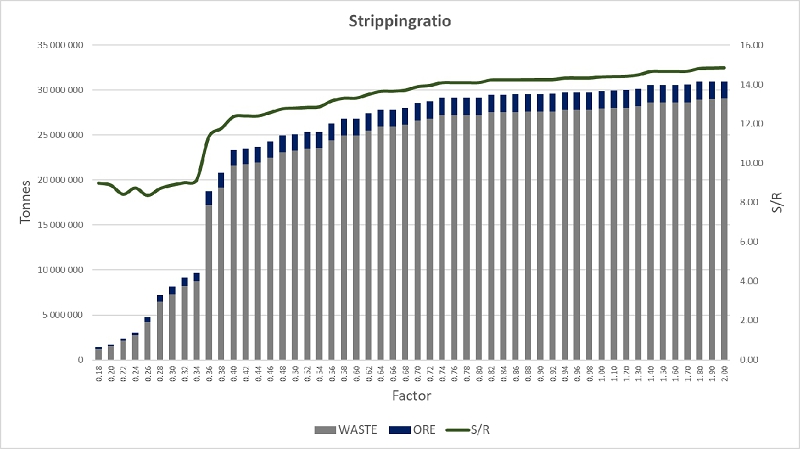
|
| SGS Geological Services |
| S-K 1300 Technical Report – FS Neves Lithium Project – Minas Gerais, Brazil | Page 135 |
| | |
Figure
12-4 Anitta 2 – Pit Sensitivity Analysis: Li2O
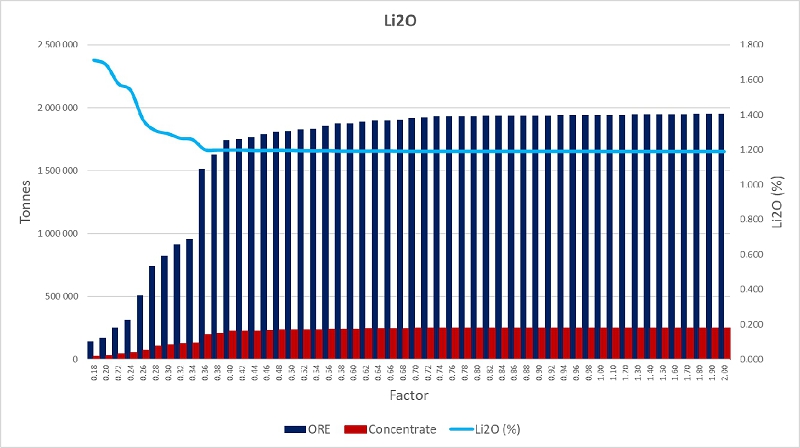
Figure
12-5 Anitta 2 – Pit Sensitivity Analysis: Value
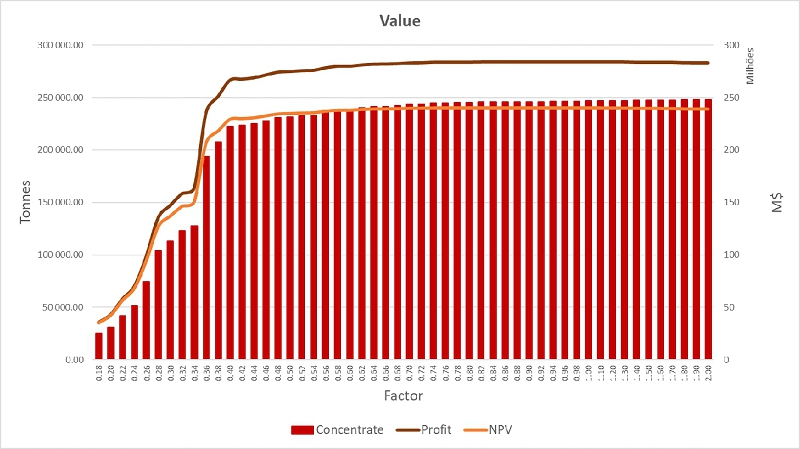
|
| SGS Geological Services |
| S-K 1300 Technical Report – FS Neves Lithium Project – Minas Gerais, Brazil | Page 136 |
| | |
Figure
12-6 Anitta 2 – Pit Sensitivity Analysis
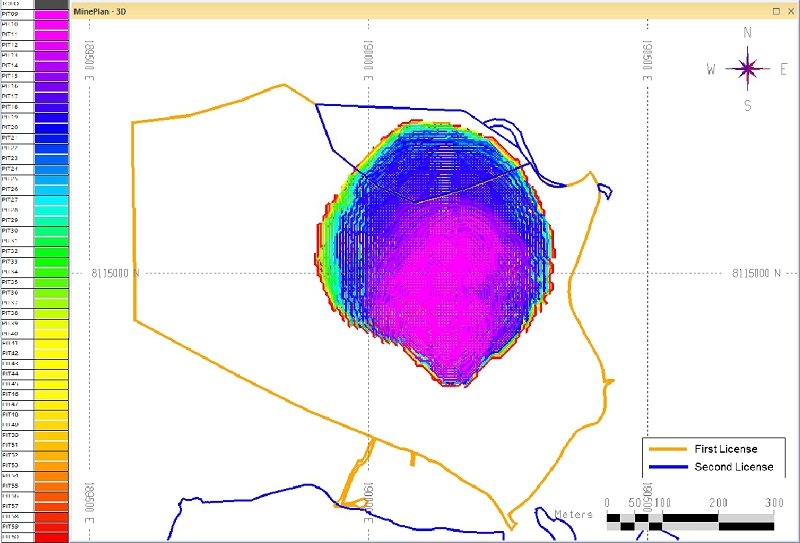
|
| SGS Geological Services |
| S-K 1300 Technical Report – FS Neves Lithium Project – Minas Gerais, Brazil | Page 137 |
| | |
Figure
12-7 Anitta 2 – Pit Sensitivity Analysis – Section EW01
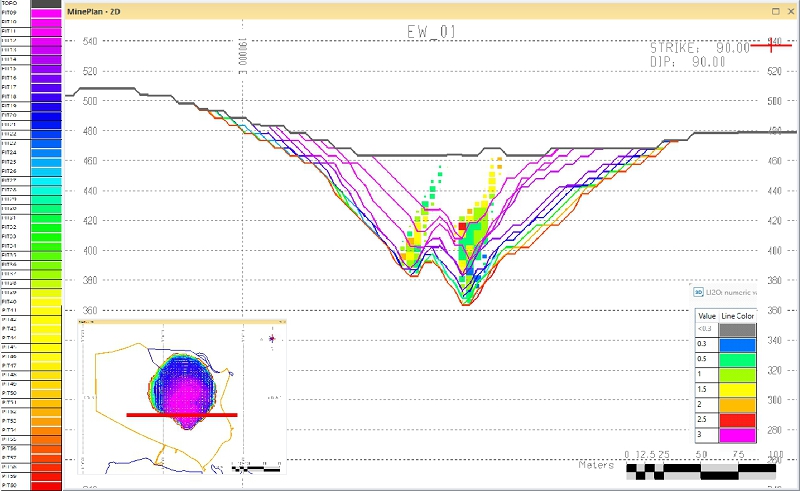
Figure
12-8 Anitta 2 – Pit Sensitivity Analysis – Section EW02
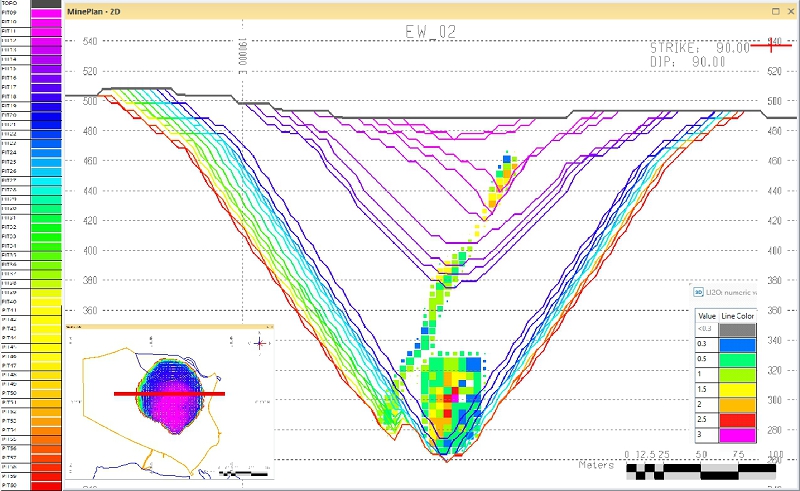
|
| SGS Geological Services |
| S-K 1300 Technical Report – FS Neves Lithium Project – Minas Gerais, Brazil | Page 138 |
| | |
Figure
12-9 Anitta 2 – Pit Sensitivity Analysis – Section EW03
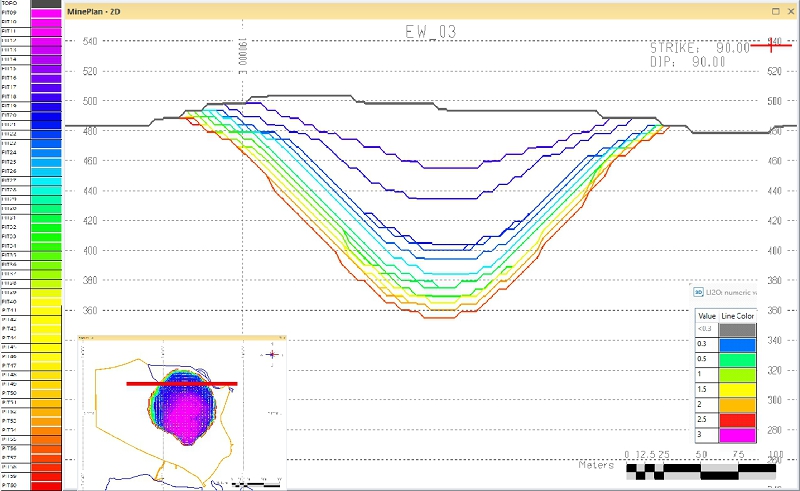
For
Anitta 2, the pit with revenue of 1.0 (PIT50) was selected. This selection was made because, in terms of ore mass or value, the other
nearby pits have little variation, and this PIT considers the base case values.
The
Table 12-4 present the Pit Sensitivity Analysis Results for the Anitta 2.5 area.
|
| SGS Geological Services |
| S-K 1300 Technical Report – FS Neves Lithium Project – Minas Gerais, Brazil | Page 139 |
| | |
Table
12-4 Anitta 2.5 – Pit Sensitivity Analysis Results
| Pit |
Factor |
Ore |
Waste |
Grand
Total |
Tonnes
(t) |
Li2O
(%) |
Li2O_Dil
(%) |
Concentrate
(t) |
Tonnes
(t) |
Tonnes
(t) |
S/R |
NPV |
%NPV |
| PIT13 |
0.26 |
237,451 |
1.589 |
1.509 |
40,200.15 |
3,536,077 |
3,773,528 |
14.89 |
50,453,559 |
43.47% |
| PIT14 |
0.28 |
250,284 |
1.588 |
1.509 |
42,362.98 |
3,760,140 |
4,010,423 |
15.02 |
53,021,351 |
45.68% |
| PIT15 |
0.30 |
279,219 |
1.563 |
1.485 |
46,508.58 |
4,181,666 |
4,460,885 |
14.98 |
57,789,050 |
49.79% |
| PIT16 |
0.32 |
298,850 |
1.543 |
1.465 |
49,128.87 |
4,474,068 |
4,772,917 |
14.97 |
60,675,173 |
52.28% |
| PIT17 |
0.34 |
319,484 |
1.528 |
1.452 |
52,033.68 |
4,846,520 |
5,166,004 |
15.17 |
63,782,567 |
54.95% |
| PIT18 |
0.36 |
365,265 |
1.500 |
1.425 |
58,410.03 |
5,754,869 |
6,120,134 |
15.76 |
70,317,490 |
60.58% |
| PIT19 |
0.38 |
365,684 |
1.500 |
1.425 |
58,444.20 |
5,757,885 |
6,123,570 |
15.75 |
70,350,510 |
60.61% |
| PIT20 |
0.40 |
400,690 |
1.483 |
1.409 |
63,328.16 |
6,567,846 |
6,968,536 |
16.39 |
75,035,708 |
64.65% |
| PIT21 |
0.42 |
421,939 |
1.468 |
1.395 |
66,013.60 |
7,010,528 |
7,432,468 |
16.62 |
77,530,604 |
66.80% |
| PIT22 |
0.44 |
435,795 |
1.462 |
1.389 |
67,881.61 |
7,363,909 |
7,799,704 |
16.90 |
79,181,874 |
68.22% |
| PIT23 |
0.46 |
445,212 |
1.454 |
1.381 |
68,980.04 |
7,568,608 |
8,013,820 |
17.00 |
80,110,542 |
69.02% |
| PIT24 |
0.48 |
446,949 |
1.452 |
1.379 |
69,145.10 |
7,596,851 |
8,043,800 |
17.00 |
80,244,014 |
69.14% |
| PIT25 |
0.50 |
448,033 |
1.450 |
1.377 |
69,230.75 |
7,610,462 |
8,058,496 |
16.99 |
80,308,928 |
69.19% |
| PIT26 |
0.52 |
448,537 |
1.449 |
1.377 |
69,285.28 |
7,622,530 |
8,071,067 |
16.99 |
80,348,841 |
69.23% |
| PIT27 |
0.54 |
462,933 |
1.440 |
1.368 |
71,049.96 |
8,047,421 |
8,510,354 |
17.38 |
81,624,894 |
70.33% |
| PIT28 |
0.56 |
463,719 |
1.439 |
1.367 |
71,118.03 |
8,062,181 |
8,525,900 |
17.39 |
81,669,354 |
70.36% |
| PIT29 |
0.58 |
464,784 |
1.438 |
1.366 |
71,238.47 |
8,093,701 |
8,558,485 |
17.41 |
81,746,864 |
70.43% |
| PIT30 |
0.60 |
809,100 |
1.473 |
1.399 |
127,021.99 |
25,521,681 |
26,330,781 |
31.54 |
115,210,489 |
99.26% |
| PIT31 |
0.62 |
809,913 |
1.473 |
1.399 |
127,129.29 |
25,559,046 |
26,368,958 |
31.56 |
115,257,550 |
99.30% |
| PIT32 |
0.64 |
810,264 |
1.473 |
1.400 |
127,212.79 |
25,589,147 |
26,399,411 |
31.58 |
115,302,922 |
99.34% |
| PIT33 |
0.66 |
815,624 |
1.476 |
1.402 |
128,256.24 |
25,962,408 |
26,778,032 |
31.83 |
115,837,960 |
99.80% |
| PIT34 |
0.68 |
815,912 |
1.476 |
1.402 |
128,305.65 |
25,980,318 |
26,796,231 |
31.84 |
115,861,331 |
99.82% |
| PIT35 |
0.70 |
815,912 |
1.476 |
1.402 |
128,305.65 |
25,980,318 |
26,796,231 |
31.84 |
115,861,331 |
99.82% |
| PIT36 |
0.72 |
815,912 |
1.476 |
1.402 |
128,305.65 |
25,980,318 |
26,796,231 |
31.84 |
115,861,331 |
99.82% |
| PIT37 |
0.74 |
815,912 |
1.476 |
1.402 |
128,305.65 |
25,980,318 |
26,796,231 |
31.84 |
115,861,331 |
99.82% |
| PIT38 |
0.76 |
815,923 |
1.476 |
1.402 |
128,307.29 |
25,980,991 |
26,796,914 |
31.84 |
115,861,856 |
99.82% |
| PIT39 |
0.78 |
815,991 |
1.476 |
1.402 |
128,315.71 |
25,984,359 |
26,800,351 |
31.84 |
115,864,316 |
99.83% |
| PIT40 |
0.80 |
818,248 |
1.478 |
1.404 |
128,887.71 |
26,250,735 |
27,068,983 |
32.08 |
116,035,162 |
99.97% |
| PIT41 |
0.82 |
818,248 |
1.478 |
1.404 |
128,887.71 |
26,250,735 |
27,068,983 |
32.08 |
116,035,162 |
99.97% |
| PIT42 |
0.84 |
818,530 |
1.478 |
1.404 |
128,924.96 |
26,267,689 |
27,086,219 |
32.09 |
116,041,823 |
99.98% |
| PIT43 |
0.86 |
818,967 |
1.478 |
1.404 |
129,024.93 |
26,318,462 |
27,137,429 |
32.14 |
116,059,762 |
99.9951% |
| PIT44 |
0.88 |
818,994 |
1.478 |
1.404 |
129,030.26 |
26,321,187 |
27,140,181 |
32.14 |
116,060,523 |
99.9958% |
| PIT45 |
0.90 |
819,657 |
1.478 |
1.404 |
129,096.61 |
26,351,720 |
27,171,377 |
32.15 |
116,065,133 |
99.9998% |
| PIT46 |
0.92 |
819,657 |
1.478 |
1.404 |
129,096.61 |
26,351,720 |
27,171,377 |
32.15 |
116,065,133 |
99.9998% |
| PIT47 |
0.94 |
819,697 |
1.478 |
1.404 |
129,102.91 |
26,355,070 |
27,174,767 |
32.15 |
116,065,409 |
100.000% |
| PIT48 |
0.96 |
819,697 |
1.478 |
1.404 |
129,102.91 |
26,355,070 |
27,174,767 |
32.15 |
116,065,409 |
100.000% |
| PIT49 |
0.98 |
819,697 |
1.478 |
1.404 |
129,102.91 |
26,355,070 |
27,174,767 |
32.15 |
116,065,409 |
100.000% |
| PIT50 |
1.00 |
819,699 |
1.478 |
1.404 |
129,103.47 |
26,355,405 |
27,175,104 |
32.15 |
116,065,397 |
100.000% |
| PIT51 |
1.10 |
819,726 |
1.478 |
1.404 |
129,105.83 |
26,356,737 |
27,176,463 |
32.15 |
116,064,839 |
99.9995% |
| PIT52 |
1.20 |
821,431 |
1.478 |
1.404 |
129,403.73 |
26,553,218 |
27,374,649 |
32.33 |
115,992,783 |
99.94% |
| PIT53 |
1.30 |
821,936 |
1.478 |
1.405 |
129,506.42 |
26,630,421 |
27,452,357 |
32.40 |
115,948,345 |
99.90% |
| PIT54 |
1.40 |
821,936 |
1.478 |
1.405 |
129,506.42 |
26,630,421 |
27,452,357 |
32.40 |
115,948,345 |
99.90% |
| PIT55 |
1.50 |
822,139 |
1.479 |
1.405 |
129,552.33 |
26,670,795 |
27,492,934 |
32.44 |
115,915,202 |
99.87% |
| PIT56 |
1.60 |
822,139 |
1.479 |
1.405 |
129,552.33 |
26,670,795 |
27,492,934 |
32.44 |
115,915,202 |
99.87% |
| PIT57 |
1.70 |
822,894 |
1.479 |
1.405 |
129,688.33 |
26,805,385 |
27,628,279 |
32.57 |
115,774,618 |
99.75% |
| PIT58 |
1.80 |
823,271 |
1.479 |
1.405 |
129,757.37 |
26,877,908 |
27,701,179 |
32.65 |
115,693,357 |
99.68% |
| PIT59 |
1.90 |
823,271 |
1.479 |
1.405 |
129,757.37 |
26,877,908 |
27,701,179 |
32.65 |
115,693,357 |
99.68% |
| PIT60 |
2.00 |
823,636 |
1.479 |
1.405 |
129,813.82 |
26,945,805 |
27,769,441 |
32.72 |
115,603,834 |
99.60% |
|
| SGS Geological Services |
| S-K 1300 Technical Report – FS Neves Lithium Project – Minas Gerais, Brazil | Page 140 |
| | |
The
following Figure 12-10 tp Figure 12-15 detail the results.
Figure
12-10 Anitta 2.5 - Pit Sensitivity Analysis: Stripping Ratio
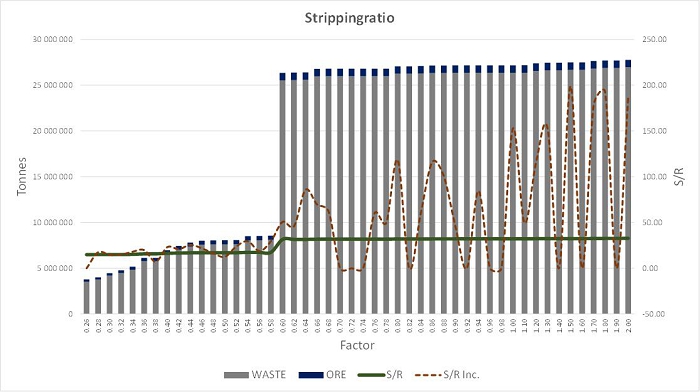
Figure
12-11 Anitta 2.5 - Pit Sensitivity Analysis: Li2O
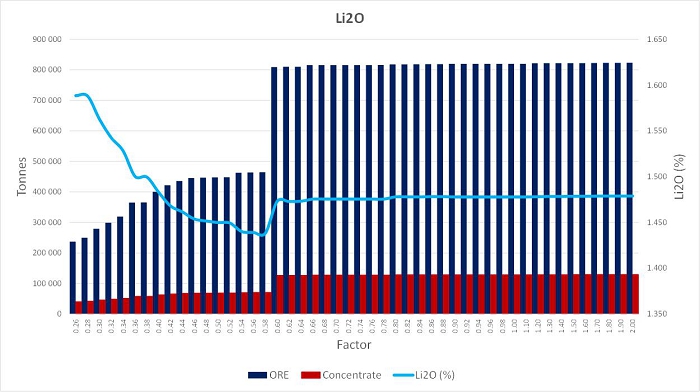
|
| SGS Geological Services |
| S-K 1300 Technical Report – FS Neves Lithium Project – Minas Gerais, Brazil | Page 141 |
| | |
Figure
12-12 Anitta 2.5 – Pit Sensitivity Analysis: Value
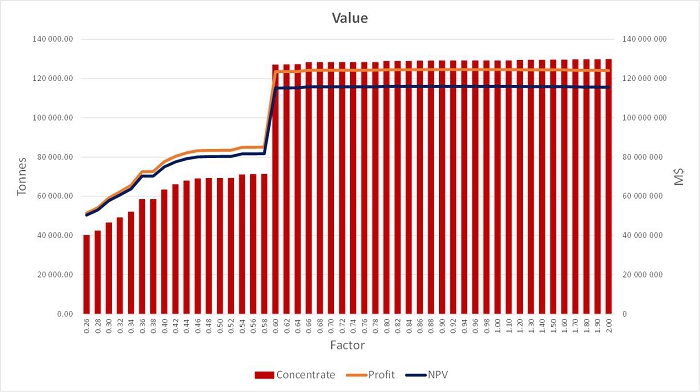
Figure
12-13 Anitta 2.5 – Pit Sensitivity Analysis
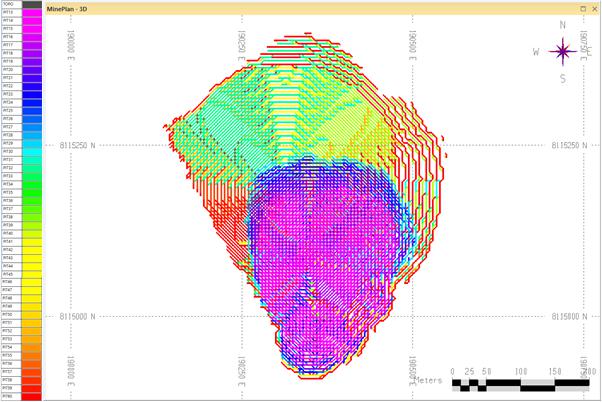
|
| SGS Geological Services |
| S-K 1300 Technical Report – FS Neves Lithium Project – Minas Gerais, Brazil | Page 142 |
| | |
Figure
12-14 Anitta 2.5 – Pit Sensitivity Analysis – Section A
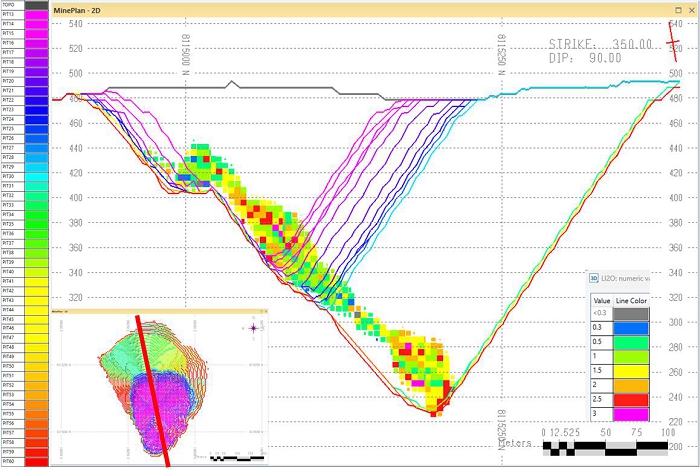
Figure
12-15 Anitta 2.5 – Pit Sensitivity Analysis – Section B
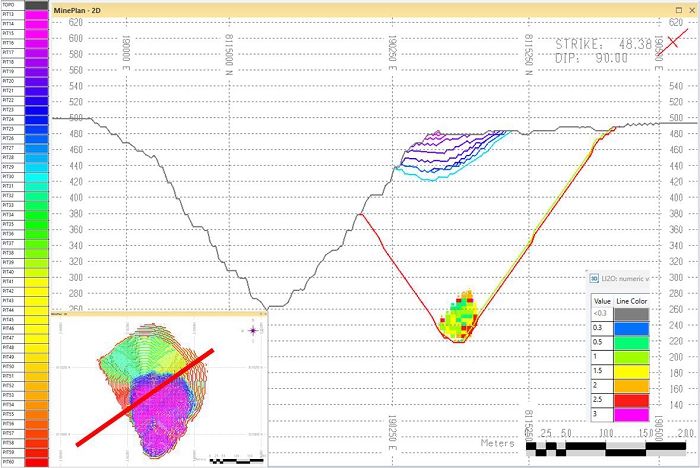
For
Anitta 2.5, the pit with revenue of 1.0 (PIT50) was selected. This selection was made because, in terms of ore mass or value, the other
nearby pits have little variation, and this pit maximizes the reserve. Another point is that this PIT considers the base case values.
|
| SGS Geological Services |
| S-K 1300 Technical Report – FS Neves Lithium Project – Minas Gerais, Brazil | Page 143 |
| | |
The
Table 12-5 present the Pit Sensitivity Analysis Results for the Anitta 3 area.
Table
12-5 Anitta 3 – Pit Sensitivity Analysis Results
| Pit |
Factor |
Ore |
Waste |
Grand
Total |
Tonnes
(t) |
Li2O
(%) |
Li2O_Dil
(%) |
Concentrate
(t) |
Tonnes
(t) |
Tonnes
(t) |
Li2O
(%) |
Li2O_Dil
(%) |
S/R |
S/R
Inc. |
Discount
Factor |
NPV |
%NPV |
| PIT08 |
0.16 |
592,069 |
1.423 |
1.352 |
89,802.74 |
2,299,658 |
2,891,727 |
0.327 |
0.311 |
3.88 |
0.00 |
0.95 |
121,244,122 |
26.85% |
| PIT09 |
0.18 |
749,092 |
1.409 |
1.338 |
112,470.47 |
2,965,135 |
3,714,227 |
0.314 |
0.298 |
3.96 |
4.24 |
0.94 |
149,367,278 |
33.08% |
| PIT10 |
0.20 |
918,031 |
1.388 |
1.319 |
135,818.38 |
3,834,455 |
4,752,487 |
0.294 |
0.279 |
4.18 |
5.15 |
0.92 |
176,753,275 |
39.14% |
| PIT11 |
0.22 |
1,020,048 |
1.360 |
1.292 |
147,846.22 |
4,320,030 |
5,340,078 |
0.284 |
0.270 |
4.24 |
4.76 |
0.92 |
189,759,863 |
42.02% |
| PIT12 |
0.24 |
1,288,168 |
1.310 |
1.245 |
179,861.98 |
5,935,290 |
7,223,458 |
0.254 |
0.242 |
4.61 |
6.02 |
0.89 |
222,626,138 |
49.30% |
| PIT13 |
0.26 |
1,785,173 |
1.302 |
1.237 |
247,656.93 |
10,977,527 |
12,762,699 |
0.194 |
0.184 |
6.15 |
10.15 |
0.86 |
287,099,420 |
63.58% |
| PIT14 |
0.28 |
1,932,237 |
1.295 |
1.230 |
266,612.65 |
12,536,017 |
14,468,255 |
0.184 |
0.174 |
6.49 |
10.60 |
0.85 |
303,310,103 |
67.17% |
| PIT15 |
0.30 |
1,979,889 |
1.290 |
1.226 |
272,297.37 |
13,050,073 |
15,029,963 |
0.180 |
0.171 |
6.59 |
10.79 |
0.84 |
307,789,567 |
68.16% |
| PIT16 |
0.32 |
2,056,325 |
1.286 |
1.222 |
281,910.76 |
14,064,984 |
16,121,309 |
0.174 |
0.165 |
6.84 |
13.28 |
0.84 |
315,177,720 |
69.79% |
| PIT17 |
0.34 |
2,646,466 |
1.246 |
1.184 |
351,505.21 |
21,558,749 |
24,205,216 |
0.143 |
0.136 |
8.15 |
12.70 |
0.80 |
363,030,165 |
80.39% |
| PIT18 |
0.36 |
3,425,630 |
1.254 |
1.192 |
457,985.03 |
35,847,459 |
39,273,089 |
0.114 |
0.108 |
10.46 |
18.34 |
0.74 |
427,769,436 |
94.73% |
| PIT19 |
0.38 |
3,513,904 |
1.253 |
1.190 |
469,287.62 |
37,454,827 |
40,968,731 |
0.112 |
0.106 |
10.66 |
18.21 |
0.74 |
433,522,859 |
96.00% |
| PIT20 |
0.40 |
3,608,464 |
1.250 |
1.187 |
480,695.03 |
39,185,682 |
42,794,146 |
0.110 |
0.104 |
10.86 |
18.30 |
0.73 |
438,673,066 |
97.14% |
| PIT21 |
0.42 |
3,664,319 |
1.250 |
1.187 |
488,019.66 |
40,463,776 |
44,128,095 |
0.108 |
0.102 |
11.04 |
22.88 |
0.73 |
441,904,693 |
97.86% |
| PIT22 |
0.44 |
3,698,067 |
1.248 |
1.185 |
491,750.72 |
41,086,260 |
44,784,327 |
0.107 |
0.102 |
11.11 |
18.44 |
0.73 |
443,262,003 |
98.16% |
| PIT23 |
0.46 |
3,718,065 |
1.247 |
1.185 |
494,124.94 |
41,535,915 |
45,253,981 |
0.106 |
0.101 |
11.17 |
22.49 |
0.73 |
444,109,953 |
98.34% |
| PIT24 |
0.48 |
3,764,320 |
1.246 |
1.184 |
499,864.60 |
42,717,450 |
46,481,770 |
0.105 |
0.099 |
11.35 |
25.54 |
0.72 |
446,094,160 |
98.78% |
| PIT25 |
0.50 |
3,827,749 |
1.244 |
1.182 |
507,499.35 |
44,352,126 |
48,179,875 |
0.103 |
0.097 |
11.59 |
25.77 |
0.72 |
448,462,702 |
99.31% |
| PIT26 |
0.52 |
3,829,288 |
1.244 |
1.182 |
507,610.83 |
44,370,176 |
48,199,464 |
0.102 |
0.097 |
11.59 |
11.73 |
0.72 |
448,469,949 |
99.31% |
| PIT27 |
0.54 |
3,891,062 |
1.241 |
1.179 |
514,712.99 |
46,050,859 |
49,941,922 |
0.100 |
0.095 |
11.84 |
27.21 |
0.71 |
450,168,665 |
99.69% |
| PIT28 |
0.56 |
3,930,273 |
1.239 |
1.177 |
518,858.01 |
47,059,590 |
50,989,863 |
0.099 |
0.094 |
11.97 |
25.73 |
0.71 |
450,898,885 |
99.85% |
| PIT29 |
0.58 |
3,941,015 |
1.238 |
1.176 |
519,990.64 |
47,352,629 |
51,293,643 |
0.099 |
0.094 |
12.02 |
27.28 |
0.71 |
451,062,810 |
99.88% |
| PIT30 |
0.60 |
3,958,801 |
1.237 |
1.176 |
522,050.15 |
47,928,015 |
51,886,816 |
0.098 |
0.093 |
12.11 |
32.35 |
0.71 |
451,388,567 |
99.96% |
| PIT31 |
0.62 |
3,970,213 |
1.236 |
1.174 |
523,095.92 |
48,204,835 |
52,175,047 |
0.098 |
0.093 |
12.14 |
24.26 |
0.71 |
451,434,267 |
99.97% |
| PIT32 |
0.64 |
3,981,132 |
1.236 |
1.174 |
524,322.23 |
48,577,448 |
52,558,580 |
0.097 |
0.092 |
12.20 |
34.13 |
0.71 |
451,551,031 |
99.99% |
| PIT33 |
0.66 |
3,992,815 |
1.235 |
1.173 |
525,496.92 |
48,933,571 |
52,926,386 |
0.097 |
0.092 |
12.26 |
30.48 |
0.71 |
451,588,082 |
100.000% |
|
| SGS Geological Services |
| S-K 1300 Technical Report – FS Neves Lithium Project – Minas Gerais, Brazil | Page 144 |
| | |
| Pit |
Factor |
Ore |
Waste |
Grand
Total |
Tonnes
(t) |
Li2O
(%) |
Li2O_Dil
(%) |
Concentrate
(t) |
Tonnes
(t) |
Tonnes
(t) |
Li2O
(%) |
Li2O_Dil
(%) |
S/R |
S/R
Inc. |
Discount
Factor |
NPV |
%NPV |
| PIT34 |
0.68 |
4,026,647 |
1.232 |
1.170 |
528,733.60 |
49,919,306 |
53,945,953 |
0.095 |
0.091 |
12.40 |
29.14 |
0.71 |
451,577,950 |
99.998% |
| PIT35 |
0.70 |
4,094,763 |
1.228 |
1.166 |
535,719.54 |
52,244,777 |
56,339,540 |
0.092 |
0.088 |
12.76 |
34.14 |
0.70 |
451,484,485 |
99.98% |
| PIT36 |
0.72 |
4,105,804 |
1.226 |
1.165 |
536,654.17 |
52,542,728 |
56,648,532 |
0.092 |
0.087 |
12.80 |
26.98 |
0.70 |
451,376,114 |
99.95% |
| PIT37 |
0.74 |
4,141,634 |
1.224 |
1.163 |
540,216.51 |
53,796,603 |
57,938,236 |
0.091 |
0.086 |
12.99 |
35.00 |
0.70 |
451,130,979 |
99.90% |
| PIT38 |
0.76 |
4,152,965 |
1.223 |
1.161 |
541,121.60 |
54,102,940 |
58,255,905 |
0.090 |
0.086 |
13.03 |
27.03 |
0.70 |
450,953,495 |
99.86% |
| PIT39 |
0.78 |
4,162,965 |
1.222 |
1.161 |
542,047.10 |
54,449,018 |
58,611,983 |
0.090 |
0.085 |
13.08 |
34.61 |
0.70 |
450,809,866 |
99.83% |
| PIT40 |
0.80 |
4,174,854 |
1.222 |
1.161 |
543,732.46 |
55,171,902 |
59,346,756 |
0.089 |
0.085 |
13.22 |
60.80 |
0.70 |
450,768,300 |
99.82% |
| PIT41 |
0.82 |
4,198,560 |
1.220 |
1.159 |
545,960.17 |
56,057,682 |
60,256,243 |
0.088 |
0.084 |
13.35 |
37.37 |
0.70 |
450,348,653 |
99.73% |
| PIT42 |
0.84 |
4,202,418 |
1.220 |
1.159 |
546,301.03 |
56,196,550 |
60,398,967 |
0.088 |
0.083 |
13.37 |
36.00 |
0.70 |
450,264,293 |
99.71% |
| PIT43 |
0.86 |
4,208,808 |
1.219 |
1.158 |
546,892.30 |
56,445,988 |
60,654,796 |
0.088 |
0.083 |
13.41 |
39.03 |
0.70 |
450,120,977 |
99.68% |
| PIT44 |
0.88 |
4,217,698 |
1.219 |
1.158 |
547,720.63 |
56,810,457 |
61,028,155 |
0.087 |
0.083 |
13.47 |
41.00 |
0.69 |
449,896,905 |
99.63% |
| PIT45 |
0.90 |
4,219,971 |
1.219 |
1.158 |
548,046.21 |
56,973,403 |
61,193,375 |
0.087 |
0.083 |
13.50 |
71.68 |
0.69 |
449,848,089 |
99.61% |
| PIT46 |
0.92 |
4,224,931 |
1.218 |
1.157 |
548,435.44 |
57,143,411 |
61,368,343 |
0.087 |
0.082 |
13.53 |
34.27 |
0.69 |
449,697,177 |
99.58% |
| PIT47 |
0.94 |
4,229,483 |
1.218 |
1.157 |
548,857.86 |
57,342,238 |
61,571,721 |
0.087 |
0.082 |
13.56 |
43.68 |
0.69 |
449,558,510 |
99.55% |
| PIT48 |
0.96 |
4,330,054 |
1.208 |
1.148 |
557,587.86 |
61,530,151 |
65,860,205 |
0.082 |
0.078 |
14.21 |
41.64 |
0.69 |
446,165,617 |
98.80% |
| PIT49 |
0.98 |
4,333,259 |
1.208 |
1.147 |
557,780.24 |
61,612,577 |
65,945,837 |
0.082 |
0.078 |
14.22 |
25.71 |
0.69 |
446,048,715 |
98.77% |
| PIT50 |
1.00 |
4,335,142 |
1.208 |
1.147 |
557,941.76 |
61,694,275 |
66,029,417 |
0.082 |
0.078 |
14.23 |
43.39 |
0.69 |
445,977,319 |
98.76% |
| PIT51 |
1.10 |
4,365,315 |
1.205 |
1.145 |
560,778.38 |
63,278,729 |
67,644,044 |
0.080 |
0.076 |
14.50 |
52.51 |
0.69 |
444,633,754 |
98.46% |
| PIT52 |
1.20 |
4,393,049 |
1.202 |
1.142 |
562,882.60 |
64,550,001 |
68,943,050 |
0.079 |
0.075 |
14.69 |
45.84 |
0.68 |
443,146,113 |
98.13% |
| PIT53 |
1.30 |
4,406,319 |
1.201 |
1.141 |
564,008.33 |
65,322,629 |
69,728,948 |
0.079 |
0.075 |
14.82 |
58.22 |
0.68 |
442,282,230 |
97.94% |
| PIT54 |
1.40 |
4,422,750 |
1.200 |
1.140 |
565,532.14 |
66,457,491 |
70,880,241 |
0.077 |
0.074 |
15.03 |
69.07 |
0.68 |
441,049,244 |
97.67% |
| PIT55 |
1.50 |
4,428,872 |
1.199 |
1.139 |
565,906.69 |
66,739,484 |
71,168,356 |
0.077 |
0.073 |
15.07 |
46.07 |
0.68 |
440,616,129 |
97.57% |
| PIT56 |
1.60 |
4,435,995 |
1.198 |
1.138 |
566,404.78 |
67,158,690 |
71,594,685 |
0.077 |
0.073 |
15.14 |
58.85 |
0.68 |
440,023,396 |
97.44% |
| PIT57 |
1.70 |
4,448,871 |
1.197 |
1.137 |
567,377.05 |
68,058,181 |
72,507,052 |
0.076 |
0.072 |
15.30 |
69.86 |
0.68 |
438,785,845 |
97.17% |
| PIT58 |
1.80 |
4,458,625 |
1.196 |
1.136 |
568,217.77 |
68,903,889 |
73,362,514 |
0.075 |
0.071 |
15.45 |
86.71 |
0.68 |
437,679,933 |
96.92% |
| PIT59 |
1.90 |
4,460,126 |
1.196 |
1.136 |
568,280.30 |
68,959,395 |
73,419,521 |
0.075 |
0.071 |
15.46 |
36.96 |
0.68 |
437,564,471 |
96.89% |
| PIT60 |
2.00 |
4,461,245 |
1.195 |
1.136 |
568,338.75 |
69,020,041 |
73,481,287 |
0.075 |
0.071 |
15.47 |
54.19 |
0.68 |
437,458,056 |
96.87% |
|
| SGS Geological Services |
| S-K 1300 Technical Report – FS Neves Lithium Project – Minas Gerais, Brazil | Page 145 |
| | |
The
following graphs and images detail the results.
Figure
12-16 Anitta 3 – Pit Sensitivity Analysis: Stripping Ratio
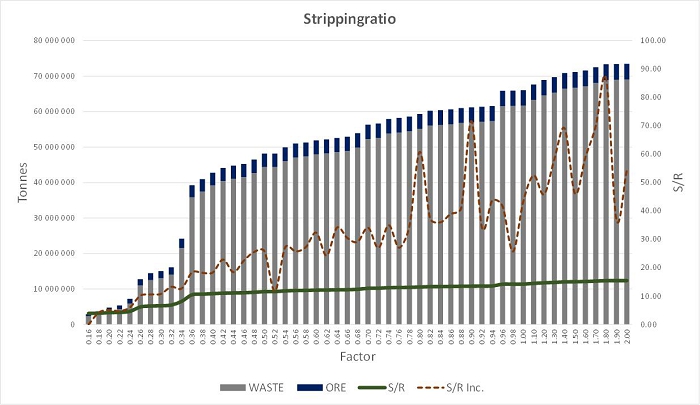
Figure
12-17 Anitta 3 – Pit Sensitivity Analysis: Li2O
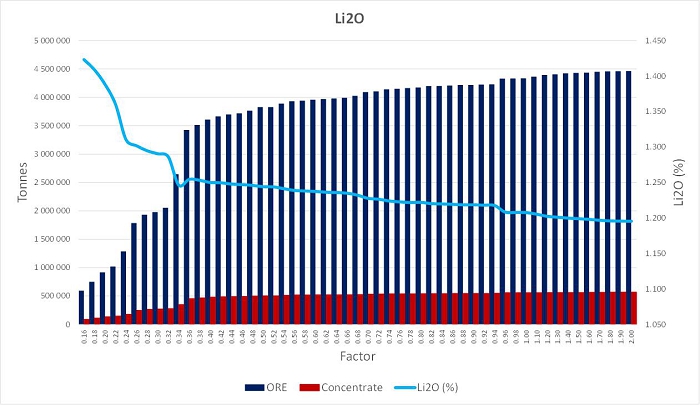
|
| SGS Geological Services |
| S-K 1300 Technical Report – FS Neves Lithium Project – Minas Gerais, Brazil | Page 146 |
| | |
Figure
12-18 Anitta 3 – Pit Sensitivity Analysis: Value
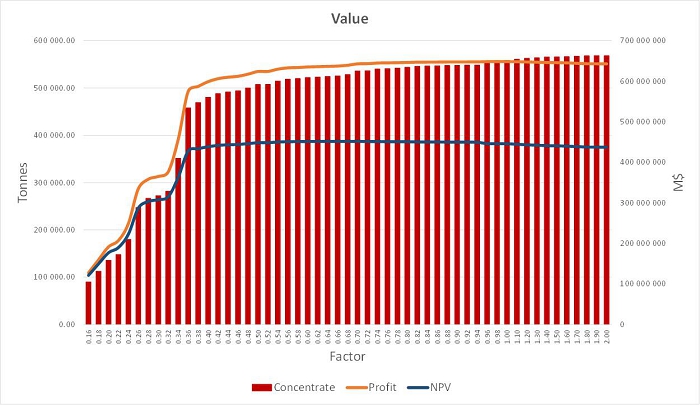
Figure
12-19 Anitta 3 – Pit Sensitivity Analysis
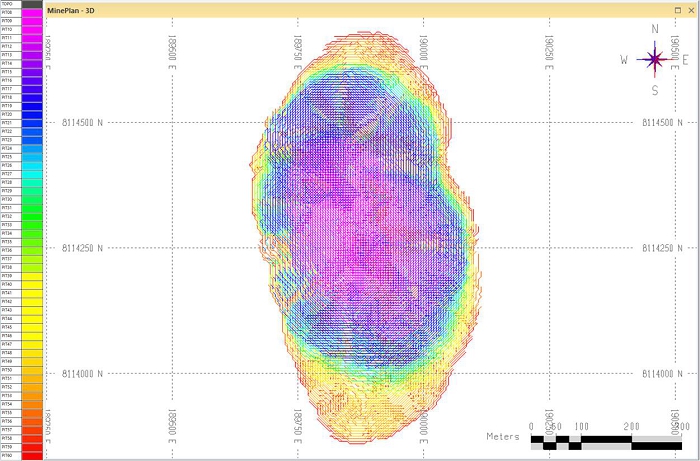
|
| SGS Geological Services |
| S-K 1300 Technical Report – FS Neves Lithium Project – Minas Gerais, Brazil | Page 147 |
| | |
Figure
12-20 Anitta 3 – Pit Sensitivity Analysis – Section EW01
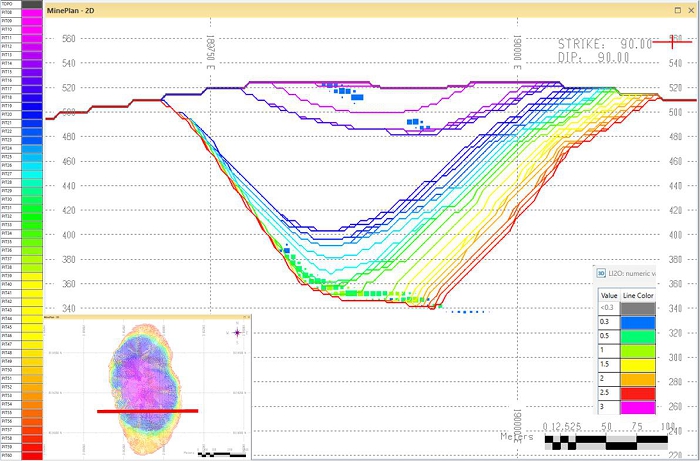
|
| SGS Geological Services |
| S-K 1300 Technical Report – FS Neves Lithium Project – Minas Gerais, Brazil | Page 148 |
| | |
Figure
12-21 Anitta 3 – Pit Sensitivity Analysis – Section EW02
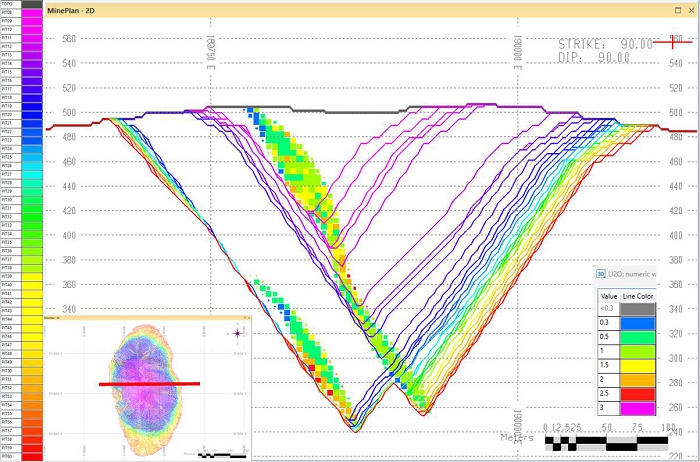
|
| SGS Geological Services |
| S-K 1300 Technical Report – FS Neves Lithium Project – Minas Gerais, Brazil | Page 149 |
| | |
Figure
12-22 Anitta 3 – Pit Sensitivity Analysis – Section EW03
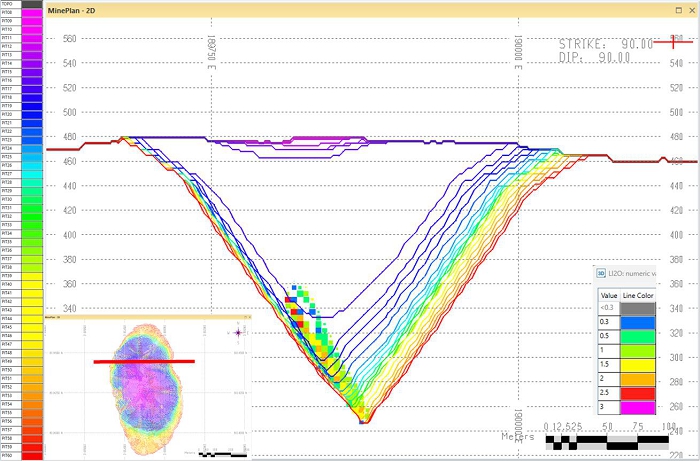
For
Anitta 3, the pit with a factor of 0.94 (PIT47) was selected. This selection was made because, in terms of ore it is very close to the
maximum pit (PIT50) but with a smaller waste. In addition, the simulation showed a better NPV compared to the maximum pit.
The
Pit Design consists of the preparation of the geometry of the final pit, inserting access roads, benches, toe, and crest respecting the
geotechnical parameters of face angles, berm size, and general slope angle for the selected optimal pit.
These
were the operating parameters used:
| ○ | Weathered:
10 m |
| ○ | Rock:
20 m |
| ○ | Weathered:
50º |
| ○ | Rock:
80º |
| ○ | 12
m & 10% grade |
| ○ | Pit
Bottom: 8 m & 10% grade |
|
| SGS Geological Services |
| S-K 1300 Technical Report – FS Neves Lithium Project – Minas Gerais, Brazil | Page 150 |
| | |
A
fleet of conventional road trucks (40t capacity) is planned to transport ore. For the waste the small off-road trucks (75t capacity)
are planned. The width of the access road to the final pit was designed at 12 m and grade of 10%. For mining the lower benches, which
mainly consist of mineralized material, the width of the road was reduced to 8 m.
The
roads are projected in a counterclockwise direction upwards. This allows the trucks to drive loaded upwards against the pit wall. Having
the loaded truck against the wall means having more security and that less weight is placed on the likely less stable ramp edges.
After
the design, the impact on the waste rock/ore ratio will be analyzed, and if necessary, apply the adjustments.
For
the Anitta 2 pit design there was no loss of ore. The waste had increased due to the geometry, where in all lateral sections passes through
three road sections.
Figure
12-23 Anitta 2 – Final Pit
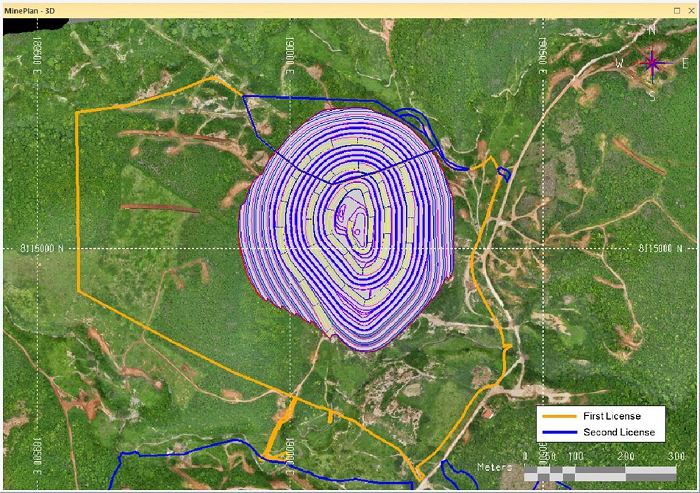
|
| SGS Geological Services |
| S-K 1300 Technical Report – FS Neves Lithium Project – Minas Gerais, Brazil | Page 151 |
| | |
For
the Anitta 2.5 pit, there was no significant loss of ore. However, waste volumes increased due to the combined pit geometry with Anitta
2 and the narrow and deep configuration of the ore body.
Figure
12-24 Anitta 2.5 – Final Pit
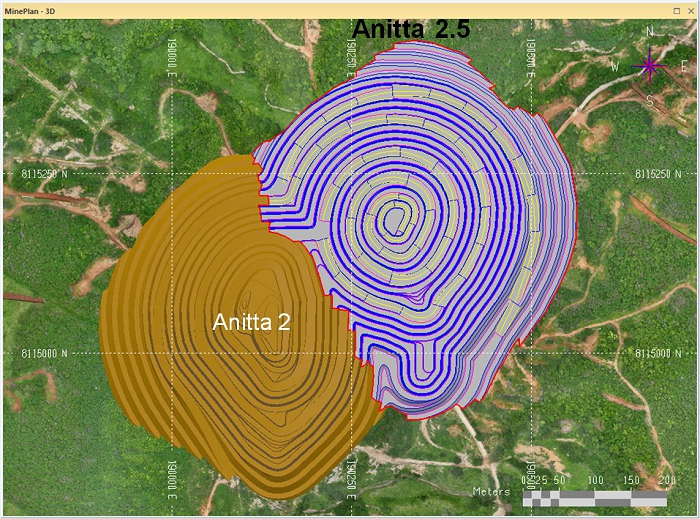
|
| SGS Geological Services |
| S-K 1300 Technical Report – FS Neves Lithium Project – Minas Gerais, Brazil | Page 152 |
| | |
For
the Anitta 3 pit design, there was no loss of ore and there was no increase in waste.
Figure
12-25 Anitta 3 – Final Pit
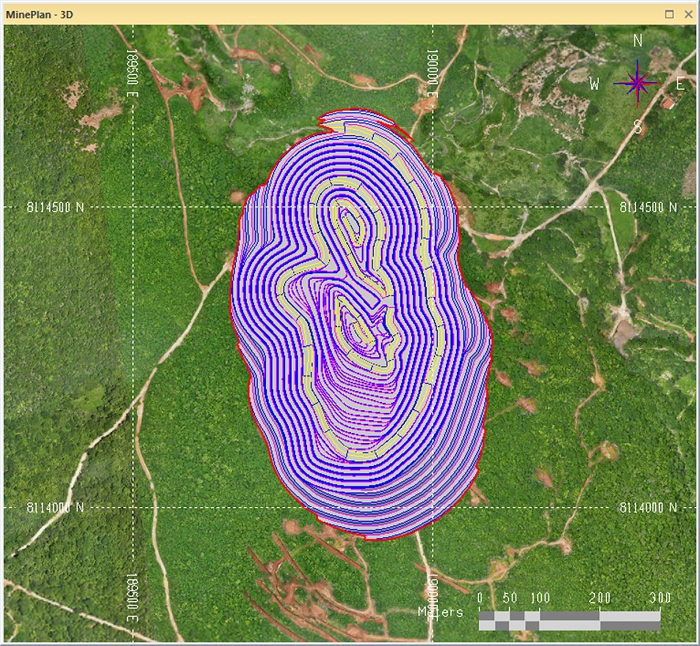
Proven
Mineral Reserves are the portion of the Measured Resources that meet the Cutoff Grade and are scheduled in the LOM plan utilizing the
modifying factors discussed in this section.
For
Anitta 2, all of the ore in the block model is classified as measured. Anitta 2 has a Proven reserve of 2.05 Mt of ore with in situ
Li2O grade of 1.202% and a diluted Li2O grade of 1.142%, as detailed in Table 12-6 and Table 12-7.
|
| SGS Geological Services |
| S-K 1300 Technical Report – FS Neves Lithium Project – Minas Gerais, Brazil | Page 153 |
| | |
Table
12-6 Anitta 2 – Mineral Reserves
| |
|
Ore |
| Pit |
Classification |
Tonnes
(t) |
Volume
(m3) |
Li2O
(%) |
Li2O_Dil
(%) |
Concentrate
(t) |
| Anitta
2 |
Proven |
2,052,786 |
844,768 |
1.202 |
1.142 |
263,048.36 |
|
| SGS Geological Services |
| S-K 1300 Technical Report – FS Neves Lithium Project – Minas Gerais, Brazil | Page 154 |
| | |
Table
12-7 Anitta 2 – Mineral Reserves (detailed)
| |
|
Ore |
Waste |
Grand
Total |
| Pit |
Classification |
Tonnes
(t) |
Volume
(m3) |
Density |
Li2O
(%) |
Li2O_Dil
(%) |
Concentrate
(t) |
Tonnes
(t) |
Volume
(m3) |
Tonnes
(t) |
Volume
(m3) |
Li2O
(%) |
Li2O_Dil
(%) |
S/R |
| Anitta
2 |
Proven |
2,052,786 |
844,768 |
2.700 |
1.202 |
1.142 |
263,048.36 |
30,738,584 |
11,107,270 |
32,791,370 |
11,952,038 |
0.076 |
0.072 |
14.97 |
| |
NC |
|
|
|
|
|
|
|
|
|
|
|
|
|
| Anitta
2 Total |
|
2,052,786 |
844,768 |
2.700 |
1.202 |
1.142 |
263,048.36 |
30,738,584 |
11,107,270 |
32,791,370 |
11,952,038 |
0.076 |
0.072 |
14.97 |
|
| SGS Geological Services |
| S-K 1300 Technical Report – FS Neves Lithium Project – Minas Gerais, Brazil | Page 155 |
| | |
For
Anitta 2.5, all of the ore in the block model is classified as measured. Anitta 2.5 has a Proven reserve of 801 kt of ore with in
situ Li2O grade of 1.465% and a diluted Li2O grade of 1.392%, as detailed in Table 12-8 and Table 12-9.
Table
12-8 Anitta 2.5 – Mineral Reserves
| Pit |
Classification |
Ore |
Tonnes
(t) |
Volume
(m3) |
Li2O
(%) |
Li2O_Dil
(%) |
Concentrate
(t) |
| Anitta
2.5 |
Proven |
800,935 |
329,603 |
1.465 |
1.392 |
125,079.57 |
|
| SGS Geological Services |
| S-K 1300 Technical Report – FS Neves Lithium Project – Minas Gerais, Brazil | Page 156 |
| | |
Table
12-9 Anitta 2.5 – Mineral Reserves (detailed)
| |
|
Ore |
Waste |
Grand
Total |
| Pit |
Classification |
Tonnes
(t) |
Volume
(m3) |
Density |
Li2O
(%) |
Li2O_Dil
(%) |
Concentrate
(t) |
Tonnes
(t) |
Volume
(m3) |
Tonnes
(t) |
Volume
(m3) |
Li2O
(%) |
Li2O_Dil
(%) |
S/R |
| Anitta
2.5 |
Proven |
800,935 |
329,603 |
2.700 |
1.465 |
1.392 |
125,079.57 |
32,582,346 |
11,766,998 |
33,383,281 |
12,096,600 |
0.035 |
0.033 |
40.68 |
| |
NC |
|
|
|
|
|
|
|
|
|
|
|
|
|
| Anitta
2.5 Total |
|
800,935 |
329,603 |
2.700 |
1.465 |
1.392 |
125,079.57 |
32,582,346 |
11,766,998 |
33,383,281 |
12,096,600 |
0.035 |
0.033 |
40.68 |
|
| SGS Geological Services |
| S-K 1300 Technical Report – FS Neves Lithium Project – Minas Gerais, Brazil | Page 157 |
| | |
For
Anitta 3, all of the ore in the block model is classified as measured. Anitta 3 has a Proven reserve of 4.39 Mt of ore with in situ
Li2O grade of 1.201% and a diluted Li2O grade of 1.141%, as detailed in Table 12-10 and Table 12-11.
Table
12-10 Anitta 3 – Mineral Reserves
| |
|
Ore |
| Pit |
Classification |
Tonnes
(t) |
Volume
(m3) |
Li2O
(%) |
Li2O_Dil
(%) |
Concentrate
(t) |
| Anitta
3 |
Proven |
4,399,081 |
1,629,289 |
1.201 |
1.141 |
562,863.39 |
|
| SGS Geological Services |
| S-K 1300 Technical Report – FS Neves Lithium Project – Minas Gerais, Brazil | Page 158 |
| | |
Table
12-11 Anitta 3 – Mineral Reserves (detailed)
| |
|
Ore |
Waste |
Grand
Total |
| Pit |
Classification |
Tonnes
(t) |
Volume
(m3) |
Density |
Li2O
(%) |
Li2O_Dil
(%) |
Concentrate
(t) |
Tonnes
(t) |
Volume
(m3) |
Tonnes
(t) |
Volume
(m3) |
Li2O
(%) |
Li2O_Dil
(%) |
S/R |
| Anitta
3 |
Proven |
4,399,081 |
1,629,289 |
2.700 |
1.201 |
1.141 |
562,863.388 |
57,917,319.61 |
20,933,600 |
62,316,401 |
22,562,890 |
0 |
0.081 |
13.166 |
| |
NC |
|
|
|
|
|
|
|
|
|
|
|
|
|
| Anitta
3 Total |
|
4,399,081 |
1,629,289 |
2.700 |
1.201 |
1.141 |
562,863.388 |
57,917,319.61 |
20,933,600 |
62,316,401 |
22,562,890 |
0 |
0.081 |
13.166 |
|
| SGS Geological Services |
| S-K 1300 Technical Report – FS Neves Lithium Project – Minas Gerais, Brazil | Page 159 |
| | |
Based
on all analyses conducted for the pit designs of the Anitta 2, Anitta 2.5, and Anitta 3 ore bodies, the total proven mineral reserves
for these three pits have been determined. The consolidated results are presented in the following Table 12-12, reflecting the economically
mineable volumes according to the technical and economic criteria defined in this study.
Table
12-12 Total Atlas Open Pit Mineral Reserve
| Pit |
Classification |
Tonnes
(t) |
Volume
(m3) |
Li2O
(%) |
Li2O_Dil
(%) |
Concentrate
(t) |
| Anitta
2.0 |
Proven |
2,052,786 |
844,768 |
1.202 |
1.142 |
263,048.36 |
| Anitta
2.5 |
Proven |
800,935 |
329,603 |
1.465 |
1.392 |
125,079.57 |
| Anitta
3.0 |
Proven |
4,399,081 |
1,629,289 |
1.201 |
1.141 |
562,863.39 |
| All
Pits |
Proven |
7,252,802 |
2,803,660 |
1.230 |
1.169 |
950,991.32 |
Notes:
| 1. | S-K
1300 definitions were followed, which are consistent with CIM (2014) definitions. |
| 2. | The
effective date of the estimate is May 15th, 2025. |
| 3. | Mineral
Reserves are estimated using the following long-term metal prices (Li2O Conc =
USD 1,700/t Li2O at 5.5% Li2O) and an exchange rate of 6.00 Reais (BRL)
to US$. |
| 4. | A
minimum mining width of 5 m was used. |
| 5. | A
cut-off grade of 0.3% Li2O as defined by SGS was used. |
| 6. | The
bulk density of ore is variable, outlined in the geological block model, and averages 2.77
t/m³. |
| 7. | The
average strip ratio is 16.72. |
| 8. | The
average mining dilution factor is 5% |
| 9. | Overall
Metallurgical recovery is 61.7% |
| 10. | Mineral
Reserves are 100% attributable to Atlas |
| 11. | Numbers
may not add due to rounding. |
|
| SGS Geological Services |
| S-K 1300 Technical Report – FS Neves Lithium Project – Minas Gerais, Brazil | Page 160 |
| | |
This
section presents the mining methods selected for the Anitta 2, Anitta 3, and Anitta 2.5 deposits, with forward-looking considerations
related to operational strategy, equipment configuration, and mine sequencing. The mine plan presented here is directly based on the
proven and probable reserves outlined in Section 12 – Mineral Reserve Estimates, which were developed by Prominas using the geological
block model generated by SGS. The reserves defined in that section serve as the foundation for the scheduling and sequencing described
herein.
The
open-pit mining strategy for all three deposits was designed using the Multi-Mine functionality within MinePlan Schedule Optimizer (MPSO),
which allows for the integrated scheduling of multiple pits within a unified production model. This integration enables the optimization
of key economic factors, including plant feed blending, ore grade control, and operational efficiency across the different ore bodies.
Mining
will be carried out using a conventional truck-and-excavator fleet operated by a contractor. Ore will be handled using hydraulic excavators
and road trucks with a 40-tonne capacity, while waste material will be transported using trucks with a 75-tonne capacity. The fleet will
be supported by appropriate auxiliary equipment and manpower, ensuring safe and efficient operations.
Mining
will proceed through multiple offset benches designed to maintain geotechnical stability and expose varying ore grades simultaneously.
This approach provides flexibility for plant feed blending and consistent delivery of material to meet processing specifications.
The
mine production schedule was established based on the plant’s maximum feed capacity and the targeted annual production of lithium
concentrate, ensuring alignment between mining output and downstream processing requirements.
Figure
13-1 Anitta Open Pits
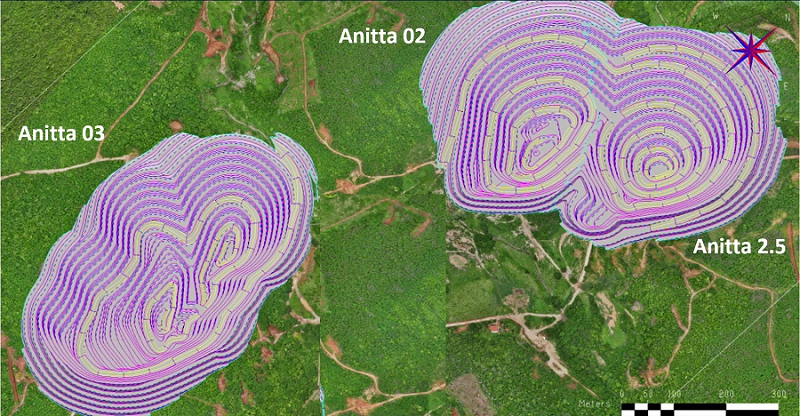
The
designed open pits presented in Figure 13-1 represent the final geometries for ore extraction, which will be detailed throughout this
section. The pit designs correspond to the Anitta 2, Anitta 2.5, and Anitta 3 ore bodies. Each of the pits will be described in terms
of its geotechnical design parameters, including slope angles, bench configurations, and overall stability criteria, which were defined
based on geotechnical investigations and pit optimization studies. Furthermore, the section will outline the planned operational methodologies
for each pit, covering the complete mining cycle: rock fragmentation techniques (including drilling and blasting), material handling
procedures (such as loading, hauling, and transportation), and the fleet of equipment selected to carry out the mining activities efficiently.
The selection of mining methods and equipment is aligned with the physical and geotechnical characteristics of each deposit, ensuring
safe, cost-effective, and sustainable operations.
|
| SGS Geological Services |
| S-K 1300 Technical Report – FS Neves Lithium Project – Minas Gerais, Brazil | Page 161 |
| | |
| 13.1 | Parameters
for the Pit Design |
| 13.1.1 | Geotechnical
Considerations for the Pit Design |
A
geotechnical study was performed to provide key pit design parameters for the Anitta 2, Anitta 2.5, and Anitta 3.
The
studies of the geotechnical parameters were developed by ITAACU and are detailed in section 13.1.2 of this document. The parameters used
are summarized in the Table 13-1.
Table
13-1 Geotechnical Parameters
| |
Sector |
Face
Angle |
Berm
Width |
Bench
Height |
Angle
Inter-ramp |
Overall
Angle |
| (°) |
(m) |
(m) |
(°) |
(°) |
| Anitta
2 |
1 |
50 |
7 |
10 |
33 |
33 |
| 2 |
80 |
7 |
20 |
64 |
56 |
| Anitta
2.5 |
1 |
50 |
7 |
10 |
33 |
33 |
| 2 |
80 |
7 |
20 |
64 |
56 |
| Anitta
3 |
1 |
50 |
7 |
10 |
33 |
33 |
| 2 |
80 |
7 |
20 |
64 |
56 |
The
ITAACU Final Geotechnical Assessment Report (ITAACU, March 2025) presents the geotechnical evaluation of the design geometry of the slopes
of the final pits called Anitta 2, Anitta 2.5, and Anitta 3 belonging to the Neves Project, owned by Atlas Lithium, in Araçuaí,
in the state of Minas Gerais.
Data
analysis is supported by geotechnical investigation and evaluation of borehole samples, a survey of geological structures, geotechnical
laboratory tests and regional surface mapping of the area where the pits will be mined. Kinematic, limit equilibrium and stress-strain
stability analyses were carried out to understand the expected rupture mechanisms for the pit slopes, which considered the strength and
deformation parameters of the different types of materials and structures identified in association with the understanding of the expected
rupture mechanisms for the pit slopes.
The
stability analysis concludes that the geometry proposed for the three pits, presented in Table 13-1, and the geotechnical sectoring,
presented in Figure 13-2 and Figure 13-3, achieved an adequate factor of safety (FoS) according to the criteria of Read & Stacey,
2009. However, some geometric changes should be made so that the FoS are optimized in some sectors, maximizing the reserve with operational
and slope safety. Table 13-2 presents further the main rupture mechanisms associated to each sector.
|
| SGS Geological Services |
| S-K 1300 Technical Report – FS Neves Lithium Project – Minas Gerais, Brazil | Page 162 |
| | |
Table
13-2 Anitta 2 & 3 Pits Geotechnical Sectors
| Sector |
Slope
height (m) |
Berm
Length
(m) |
Angle
of slope face (°) |
Inter-ramp
angle (°) |
Main
rupture mechanisms |
| 1 |
10 |
7 |
50 |
33 |
Circular
plane rupture in the discontinuities of the saprolite and circular in the soil |
| 2 |
20 |
7 |
80 |
64 |
Global
rupture for the penetrative discontinuities and areas of inadequate clearing |
|
| SGS Geological Services |
| S-K 1300 Technical Report – FS Neves Lithium Project – Minas Gerais, Brazil | Page 163 |
| | |
Figure
13-2 Geotechnical Sectors Proposed for Final Anitta 2 Pit
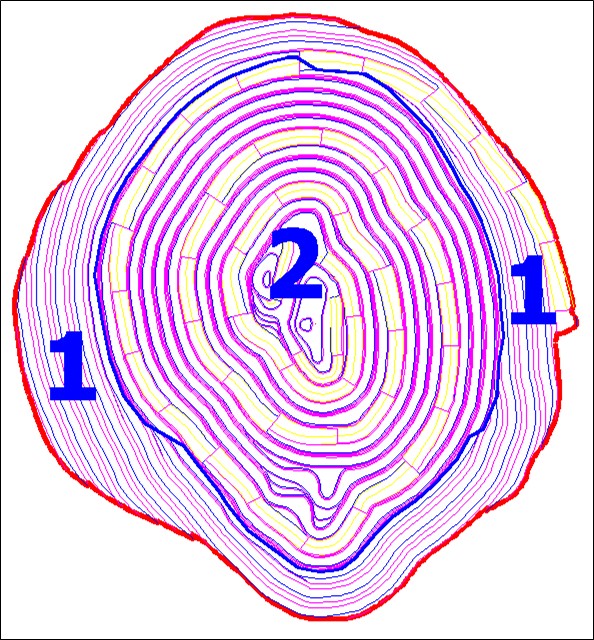
|
| SGS Geological Services |
| S-K 1300 Technical Report – FS Neves Lithium Project – Minas Gerais, Brazil | Page 164 |
| | |
Figure
13-3 Geotechnical Sectors Proposed for Anitta 3 Pit
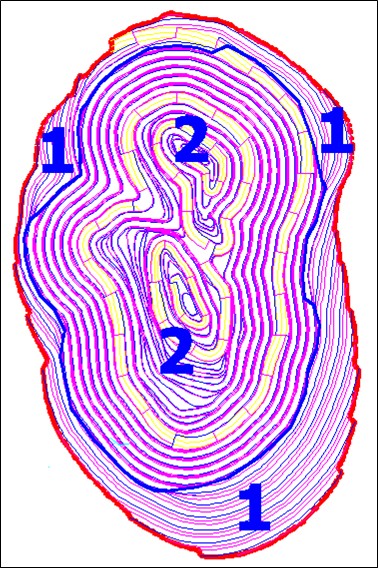
|
| SGS Geological Services |
| S-K 1300 Technical Report – FS Neves Lithium Project – Minas Gerais, Brazil | Page 165 |
| | |
| 13.1.2.1 | Geotechnical
Probing and Sampling |
A
total of 14 guided geotechnical probes were performed, eight of which are located in the Anitta 2 pit and six in the Anitta 3 pit. The
results were described using the RMR classification system (Rock Mass Rating, 1989). The probe campaign was performed as proposed
by WALM.
Section
7.4 describes the Geotechnical Drilling and Sampling.
| 13.1.2.2 | Description
of the Probing and Sampling Holes |
According
to technical specification WA16223003-1-GL-ETC-0001 (WALM,2024), for the Anitta 2 ore body, the selection of samples for geotechnical
tests follows the specifications in Table 13-3.
Table
13-3 Anitta 2 Lithotypes Compact and Quantitative Tests
| Lithotype |
Acronym |
Uniaxial |
Triaxial |
Indirect
traction |
Test
bodies (CPs) |
| Parallel |
Perpendicular |
Perpendicular |
| Schist |
SCHIST |
4
series |
4
series |
5
series |
3
series |
105 |
| Pegmatite |
PEGM |
- |
2
series |
3
series |
2
series |
35 |
| TOTAL |
10
uniaxial series |
8
triaxial series |
5
traction series |
140 |
Source:
WA16223003-1-GL-ETC-0001.
For
the selection of samples of Anitta 3 reference numbers specified in Table 13-3, according to technical specification WA16223003-1-GL-ETC-0001
(WALM,2024-a) were used.
Table
13-4 Compact Lithotypes Tested and Numbers for the Body Anitta 3
| Lithotype |
Acronym |
Uniaxial |
Triaxial |
Indirect
traction |
Test
bodies (CPs) |
| Parallel |
Perpendicular |
Perpendicular |
| Schist |
SCHIST |
4
series |
4
series |
5
series |
3
series |
105 |
| Pegmatite |
PEGM |
- |
2
series |
3
series |
2
series |
35 |
| TOTAL |
10
uniaxial series |
8
triaxial series |
5
traction series |
140 |
| 13.1.2.3 | Geotechnical
Evaluation of Anitta 2 and 3 Pits |
The
geotechnical evaluation of the Anitta 2 and Anitta 3 pits was based on studies conducted by WALM (2024), using the RMR classification
system (Bieniawski, 1989). The rock mass was categorized into three classes: Class V (very poor, soil and saprolite), Class III (fair,
fractured schist), and Class II (good, fresh schist and pegmatite).
Three
main lithologies were identified in the pit areas:
| ● | Colluvial
soils/saprolite (overburden) |
| | | |
| ● | Pegmatites
(ore) |
| | | |
| ● | Mica
schists (host rock) |
|
| SGS Geological Services |
| S-K 1300 Technical Report – FS Neves Lithium Project – Minas Gerais, Brazil | Page 166 |
| | |
Drill
hole data showed soil thicknesses of 5–10 m, saprolite 10–30 m, and fresh rock (schist and pegmatite) from 4–15 m,
with fresh, low-fracture rock at depths >35–55 m.
| ● | Laboratory
Testing and Rock Strength Parameters |
Testing
was performed by Geocontrole Engenharia, including:
| ● | Uniaxial
Compressive Strength (UCS) |
| | | |
| ● | Brazilian
Tensile Strength |
| | | |
| ● | Triaxial
Compression (CIU and conventional) |
Samples
represented varying degrees of anisotropy (parallel and perpendicular to schistosity).
Pegmatites
were treated as isotropic; schists as anisotropic where appropriate. UCS and triaxial test data were used to define resistance and deformation
parameters in RocData software, applying the Hoek-Brown failure criterion and RMR/GSI classifications.
Table
13-4 summarizes the resistance and deformation parameters defined by the validated tests for the various lithotypes and anisotropy conditions.
Table
13-5 Resistance and Deformation Parameters Obtained by Destructive Tests for All Typologies
| Lithology |
UTS
- Mean Tensile Strength (MPa) |
UTS
- Coefficient of Variation (MPa) |
UTS
- Standard Deviation (kN) |
Specific
Gravity Mean (kg/m³) |
Specific
Gravity Coefficient of Variation (kg/m³) |
Specific
Gravity Standard Deviation (kg/m³) |
UCS
- Mean Strength (MPa) |
UCS
- Coefficient of Variation (MPa) |
UCS
- Standard Deviation (MPa) |
| Pegmatite |
8 |
0.2 |
1.3 |
2.64 |
0.03 |
0.07 |
113 |
0.25 |
29 |
| Total
Schist |
4 |
0.3 |
1.3 |
2.74 |
0.01 |
0.03 |
50 |
0.3 |
15 |
| Schist
- Parallel |
3 |
0.1 |
0.3 |
2.78 |
0.01 |
0.02 |
36 |
0.28 |
10 |
| Schist
- Perpendicular |
5 |
0.3 |
1.6 |
2.76 |
0.01 |
0.03 |
57 |
0.27 |
15 |
| Lithology |
E
- Mean
(GPa) |
E
- Coefficient of Variation (GPa) |
E
- Standard Deviation (GPa) |
Poisson’s
Ratio - Mean |
Poisson’s
Ratio - Coefficient of Variation |
Poisson’s
Ratio - Standard Deviation |
| Pegmatite |
53 |
0.07 |
4 |
0.273 |
0.29 |
0.078 |
| Total
Schist |
27 |
0.33 |
9 |
0.193 |
0.38 |
0.074 |
| Schist
- Parallel |
25 |
0.36 |
9 |
0.187 |
0.45 |
0.085 |
| Schist
- Perpendicular |
26 |
0.38 |
10 |
0.185 |
0.39 |
0.072 |
| |
|
|
|
|
|
|
|
|
|
|
|
|
|
|
|
| 13.1.2.4 | Lithostructural
Domains |
On
a regional scale, the anisotropy defined by the schistosity of the schists that were deformed by the “emplacement” of the
pegmatite body, in addition to the soil-rock and soil-fractured rock-sound rock contacts, were considered the main structures that define
the lithostructural domains of the Anitta 2 and 3 pits.
|
| SGS Geological Services |
| S-K 1300 Technical Report – FS Neves Lithium Project – Minas Gerais, Brazil | Page 167 |
| | |
As
no local faults have been identified at the current stage of mine knowledge (despite some faults being recognized at the regional scale),
they were not considered in this study due to their lack of material relevance.
Regarding
rock quality (resistance), only three groups were considered: Shale soil/saprolite in two weathering levels (residual soil and highly
weathered schist, slightly weathered schist (fractured or not), defined by RQD/RMR of weld hole logs and slightly weathered pegmatites.
The
pegmatites were considered isotropic, therefore they do not have schistosity and few fractures (GSI 80).
The
differentiation of schist fracturing was obtained through the drilling holes with RQD less than 40% defined as Class III and/or IV (RMR,
1989) and/or by the GSI values of 50 as being very fractured and above 40% of RQD, Class II to I of RMR, 1989, defined as little fractured
(GSI 80).
The
schistosity present in the schists, although representing a closed discontinuity, is penetrative and persistent, and locally presents
a dip that is unfavorable to the stability of the slopes. Although it does not define a geometric domain of the pit, a structural domain
unfavorable to the stability of the slopes was defined to guide the stability assessments. In these domains, a variation of parameters
(unfavorable anisotropy) was considered in order to guarantee the stability of these slopes in this initial phase of assessment, until
material information on the failures is available. The general direction and dip of the project used for schistosity was 325/43 (Figure
13-4), for the Anitta 2 project, which has schistosity variations of 323/53, 317/81 and 326/14 (Figure 13-5) and for the Anitta 3 project,
330/41 (Figure 13-6).
The
stereograms that present these schistosities were defined from the structures found in the geotechnical holes.
Figure
13-4 General Stereogram of the project, 325/43
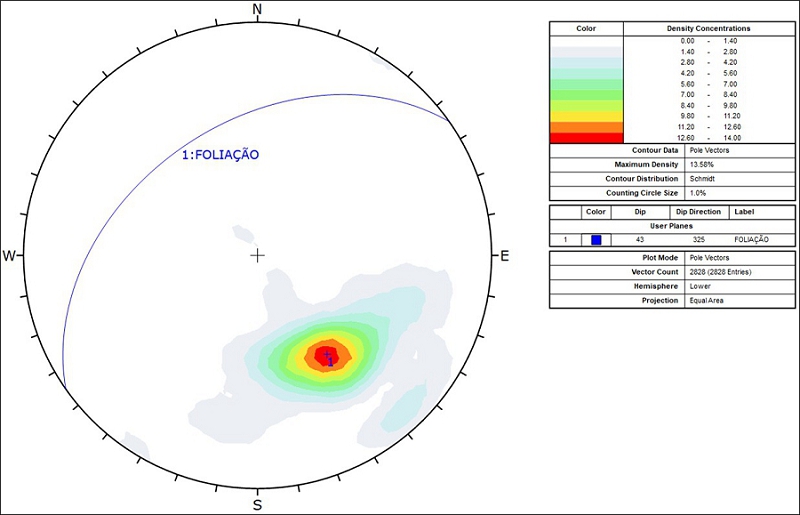
|
| SGS Geological Services |
| S-K 1300 Technical Report – FS Neves Lithium Project – Minas Gerais, Brazil | Page 168 |
| | |
Figure
13-5 Anitta 2 Stereogram, 323/52, 317/81 and 326/14
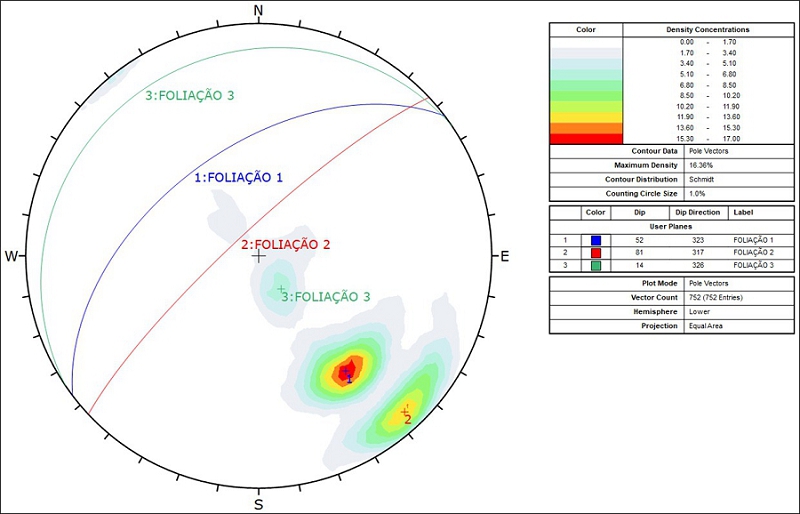
Figure
13-6 Anitta 3 Stereogram, 330/41
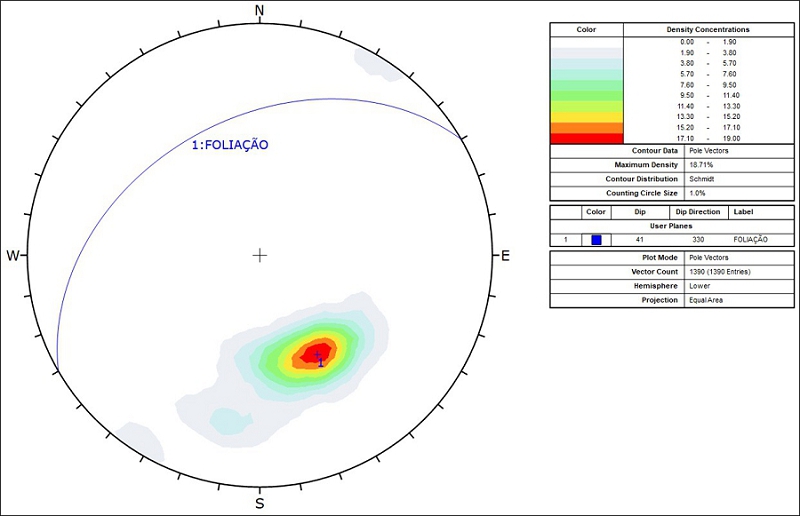
|
| SGS Geological Services |
| S-K 1300 Technical Report – FS Neves Lithium Project – Minas Gerais, Brazil | Page 169 |
| | |
To
evaluate the structural domains of the Anitta 2 and 3 pits, the structural constraints defined by the maximum observed in Figure 13-4
and Figure 13-6 were used. Therefore, the structural domains are basically controlled by a small variation in direction and dip and by
the difference in resistance of the saprolite/soil, as previously stated. It is worth noting that, although larger structures (geological
contacts, structural lineaments or large faults) have not been identified, these must be continually verified as they can alter the structural
domains and impact the geometry of the pit.
The
Anitta 2 and 3 pits (Figure 13-7 and Figure 13-8 respectively) shows the divisions of the lithostructural domains taking into account
the variation of schistosity (323/43, Anitta 2 and 330/41, Anitta 3), dip direction and the preferred direction of the slopes of each
of the domains. Table 13-6 presents the main lithogeomechanical domains and expected rupture mechanisms for each of the four domains.
Figure
13-7 Lithostructural Domains Projected in the Final Pit Anitta 2
(The
dip of the main anisotropy indicating the direction of schistosity can be seen.)
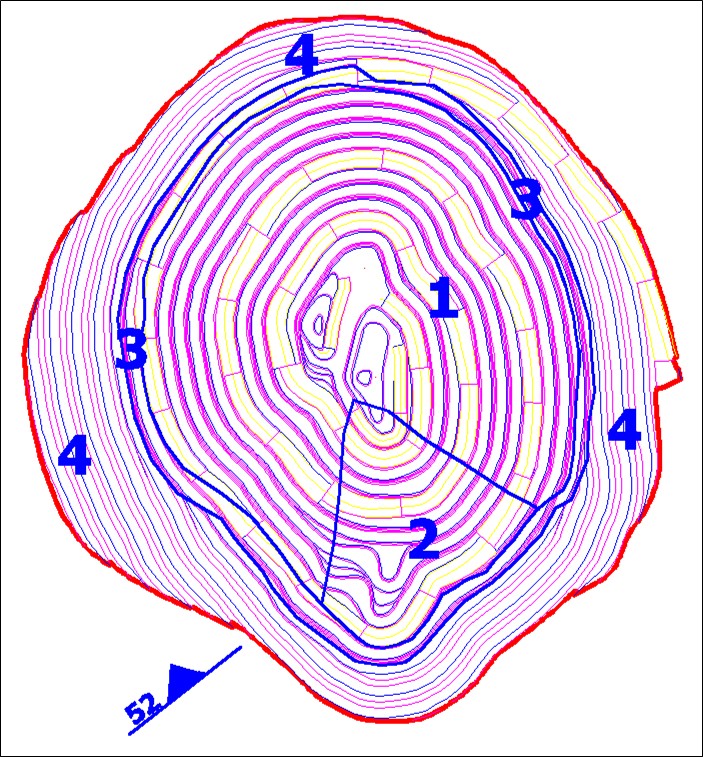
|
| SGS Geological Services |
| S-K 1300 Technical Report – FS Neves Lithium Project – Minas Gerais, Brazil | Page 170 |
| | |
Figure
13-8 Lithostructural Domains Projected in the Final Pit Anitta 3
(The
dip of the main anisotropy indicating the direction of schistosity can be seen.)
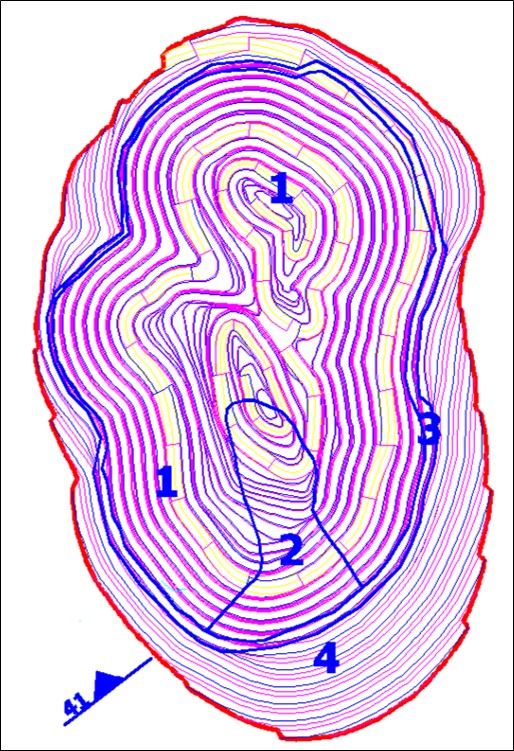
|
| SGS Geological Services |
| S-K 1300 Technical Report – FS Neves Lithium Project – Minas Gerais, Brazil | Page 171 |
| | |
Table
13-6 Probable Rupture Mechanisms by Sector for the Two Pits
| Geomechanical
Domain |
Lithological
Type |
Anisotropy
Direction |
Identified
Mechanisms |
| 1 |
Pegmatites
and Schists (GSI 80) |
Not
considered |
Global
failures due to blasting damage zone |
| 2 |
Anisotropic
Schist |
350/45 |
Global
wedge failures, block toppling, and global failures along discontinuities |
| 3 |
Fractured
Schist |
Not
considered |
Local
wedge failures, block toppling, and global failures along discontinuities |
| 4 |
Soil
and Saprolite |
Not
considered |
Planocircular
failures on local and inter-ramp scales |
In
general, Domain 2 where anisotropy can activate planar rupture mechanisms, FoS were verified using the strength parameters of the discontinuities.
Domains 1, 2 and 3 are most affected by the disassembly effect, since the natural anisotropies have directions favorable to the stability
of the slopes of these domains. Thus, the effects of blasting were included in the stability analyses. As for Domain 4, dominated by
soil and saprolite, the water level and saturation were considered because this effect may be important for these materials.
| 13.1.2.5 | Geotechnical
Sectoring |
The
geometry of the final pit evaluated was based on initial analyses of the behavior of the rock mass and designed for a subsequent analysis
that culminated in the geometry evaluated here. This semicircular pit geometry resulted in a pit with a maximum pit depth of approximately
400 m and accesses concentrated in the northern and western portions of the pits.
In
general, the Anitta 2 and 3 pits have geometric (geotechnical) sectoring divided by the resistance of the materials and the direction
of anisotropy as suggested by the lithostructural domains defined. The most superficial banks composed of soil and schist saprolite have
a more conservative geometry in order to avoid mechanisms “triggered” by the low resistance of the matrix and saturation
caused by rising groundwater levels and heavy rainfall events.
| ● | The
contact between the saprolite and the hard rock has variable layers (decametric) with fractured
schist. In this sector, although it has the same geometry as the slopes, which are slightly
fractured, these may in the future (depending on the quality of the blasting) have the height
of their slope reduced to 10 meters. At that time, due to the level of information available,
it remained at a height of 20 meters. |
| | | |
| ● | Slightly
fractured schists and pegmatites have a more pronounced geometry due to the good quality
of the matrix resistance and the low expectation of anisotropy influence, at least for the
zone not affected by the blasting damage. Even so, the limit equilibrium and stress-strain
assessments took into account the anisotropic (more conservative) condition. |
Figure
13-9 and Figure 13-10 show the geotechnical sectors for pits Anitta 2 and 3 respectively, and Table 13-7 shows the geometry of the sectors
used to define pits Anitta 2 and 3.
Remark:
The geometry presented in Figure 13-10 (Anitta 3) did not correctly follow the sectoring presented in Table 13-7, therefore, the sectoring
of the final pit Anitta 3 requires a greater number of adjustments to achieve the optimized parameters as suggested.
|
| SGS Geological Services |
| S-K 1300 Technical Report – FS Neves Lithium Project – Minas Gerais, Brazil | Page 172 |
| | |
Figure
13-9 Geotechnical Sectors of the Anitta 2 Final Pit and Sections
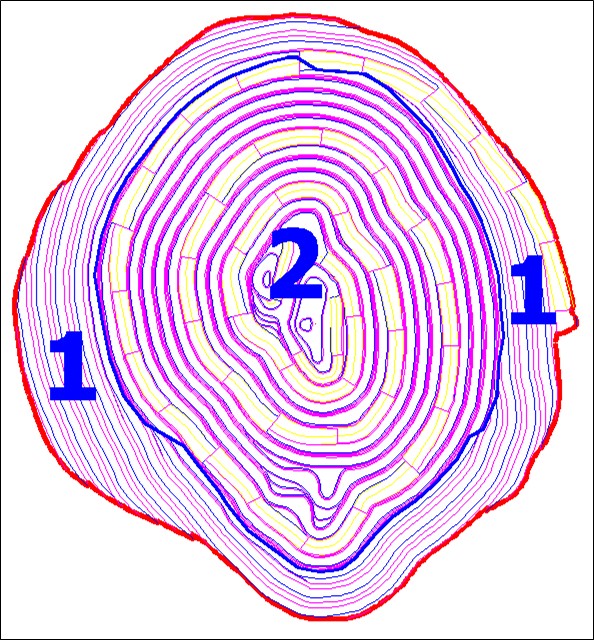
|
| SGS Geological Services |
| S-K 1300 Technical Report – FS Neves Lithium Project – Minas Gerais, Brazil | Page 173 |
| | |
Figure
13-10 Geotechnical Sectors of the Anitta 3 Final Pit
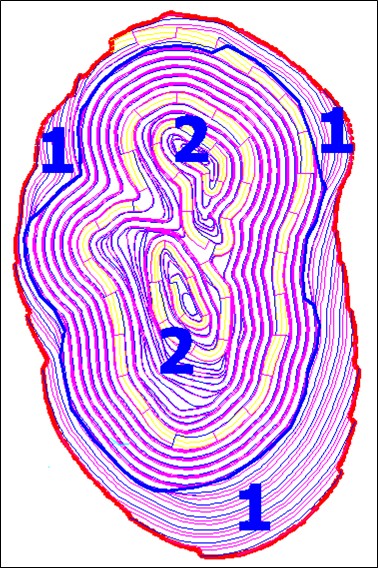
|
| SGS Geological Services |
| S-K 1300 Technical Report – FS Neves Lithium Project – Minas Gerais, Brazil | Page 174 |
| | |
Table
13-7 Geometric Parameters of the Geotechnical Sectors of the Anitta 2 and 3 Pits
| Geometric
Sector |
Slope
height (m) |
Berm
width |
Ângulo
de Face do Slope (º) |
Inter-ramp
angle (°) |
Remark |
| 1 |
10 |
7 |
50 |
33 |
Discontinuity
rupture may occur |
| 2 |
20 |
7 |
80 |
64 |
It
can occur through foliation |
| 13.1.3 | Geotechnical
Parameter for Anitta 2.5 |
For
the Anitta 2.5 pit, a geotechnical drilling campaign was conducted to define the design parameters for the pit, which was characterized
as an extension of the Anitta 2 pit. A total of four oriented geotechnical boreholes were executed, and the core samples were described
using the RMR (Rock Mass Rating, 1989) classification system. This investigation campaign, proposed by ATLAS, is detailed in the report
‘Geomechanical Description of Drill Core – Anitta 2.5 Deposit’ prepared by ITAACU.
The
location of the geotechnical boreholes can be seen in Figure 13-11.
Figure
13-11 Location of Geotechnical Boreholes for Anitta 2, 2.5, 3, and 4 Ore Bodies
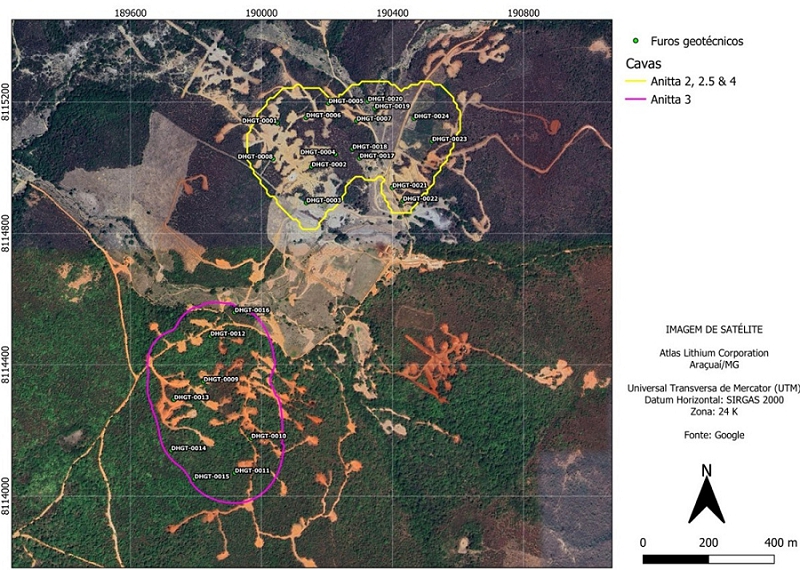
|
| SGS Geological Services |
| S-K 1300 Technical Report – FS Neves Lithium Project – Minas Gerais, Brazil | Page 175 |
| | |
| 13.1.3.1 | Geotechnical
Zoning |
The
geometry of the final pit evaluated was based on preliminary analyses of the rock mass behavior and was designed for subsequent analysis,
which culminated in the assessed geometry. This geometry features a semicircular pit with a maximum depth of approximately 280 meters
and access ramps surrounding the entire pit.
In
general, the pit is geotechnically zoned according to material strength and anisotropy orientation. This zoning follows the pattern below:
| ● | The
upper benches, composed of soil and schist saprolite, adopt a more conservative geometry
to avoid failure mechanisms triggered by the low strength of the matrix and saturation caused
by rising groundwater levels and intense rainfall events (circular and planar failures); |
| | | |
| ● | The
contact zone between the saprolite and the slightly weathered and fractured schists has a
decametric thickness. Although it currently shares the same slope geometry as the less fractured
schists, this zone may in the future (depending on blast quality) require the slope height
to be reduced to 10 meters. At this stage, due to the level of available information, a 20-meter
bench height has been maintained; |
| | | |
| ● | The
slightly fractured schists allow for a steeper geometry due to the high strength of the matrix
and the low expected influence of anisotropy—at least in zones not affected by blast-induced
damage. Nevertheless, both limit equilibrium and stress-deformation analyses considered the
anisotropic condition (as a conservative measure). |
Figure
13-12 presents the geotechnical sectors of the Anitta 2.5 pit, and Table 13-8 shows the geometry of the sectors used to define the pit
geometry.
|
| SGS Geological Services |
| S-K 1300 Technical Report – FS Neves Lithium Project – Minas Gerais, Brazil | Page 176 |
| | |
Figure
13-12 Final pit geotechnical sectors and cross-sections – Anitta 2.5
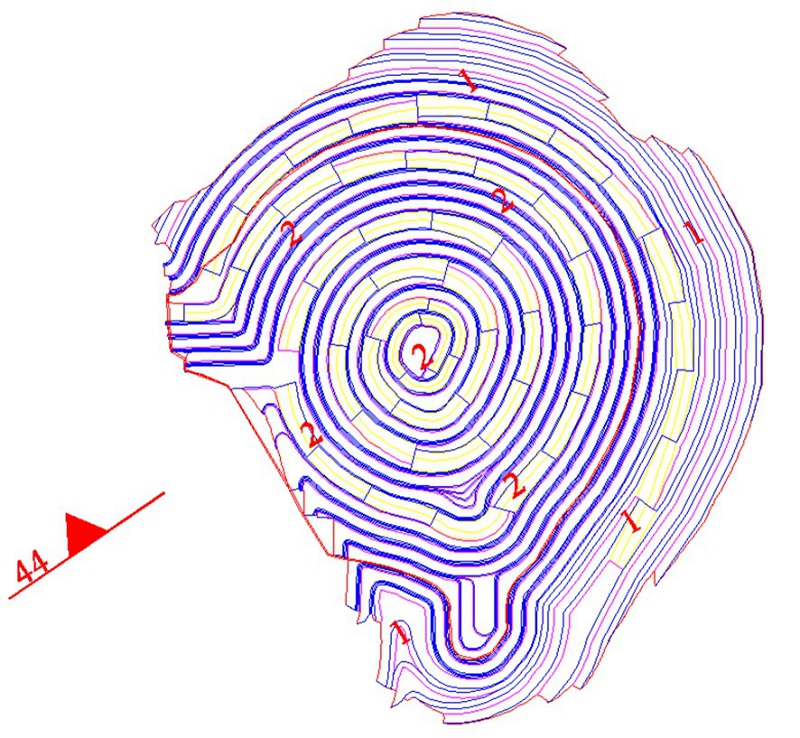
Table
13-8 Anitta 2.5 Pit – Geotechnical Sector Geometry Parameters
| Geometric
Sector |
Bench
Height (m) |
Berm
Width (m) |
Face
Angle (°) |
Overall
Angle (°) |
Observation |
| 1 |
10 |
7 |
50 |
34 |
Failure
occurs along discontinuities |
| 2 |
20 |
7 |
80 |
54 |
Potential
failure along schistosity |
Note:
the overall angle of the upper portion of the west slope was adjusted to 43.9°
|
| SGS Geological Services |
| S-K 1300 Technical Report – FS Neves Lithium Project – Minas Gerais, Brazil | Page 177 |
| | |
| 13.1.4 | Hydrogeological
Considerations for the Pit Design |
A
Hydrogeological study was performed to provide key parameters for the Anitta 2, Anitta 3 and Anitta 2.5. The studies were developed by
WSP and are detailed in section 15 of this document.
WSP
(2025) reviewed and updated the conceptual and numerical hydrogeological model for the project area, aiming to assess groundwater contributions
from both well pumping and pit dewatering systems applied to the Anitta 2, Anitta 3, and Anitta 2.5 pits. Through the characterization
of the resulting drawdown cone and simulation of target dewatering rates, the necessary pumping rates were defined to increase water
availability and meet local demand. Simultaneously, the potential impact of this process on mining operations was evaluated, supporting
the development of a technically sound mine dewatering plan, which is detailed throughout this section.
The
mine sequencing strategy was developed to ensure an efficient, stable, and economically optimized operation throughout the entire life
of mine. It was designed to align the extraction of ore with plant capacity, geotechnical constraints, and overall project profitability.
The sequencing plan follows five key objectives:
Maximize
Ore Recovery Across the Life of Mine:
Ensure
that all economically viable ore within the final pit limits is extracted, fully utilizing the reserves defined in the block model. This
includes a phased approach to pit development that guarantees complete recovery while respecting geotechnical and operational constraints.
Meet
Concentrate Production Targets:
Maintain
a consistent supply of lithium ore to meet the annual production target of lithium concentrate, in accordance with plant design specifications
and market requirements. This includes managing ore feed quality through strategic exposure and blending of different ore zones.
Control
Vertical Advance:
Regulate
the number of benches mined per year to maintain safe, sequential pit development. This control ensures alignment with drill-and-blast
planning, equipment productivity, and geotechnical design parameters.
Stabilize
Material Movement:
Balance
the total volume of material moved annually including ore and waste to optimize fleet utilization and minimize operational fluctuations.
Stable movement improves cost control, equipment scheduling, and long-term planning.
Maximize
Project Profitability:
Apply
economic pit optimization and sequencing logic to prioritize higher-value ore zones earlier in the mine life, improving cash flow and
maximizing Net Present Value (NPV). The sequencing was configured within MinePlan Schedule Optimizer (MPSO) to achieve this objective
while respecting processing and infrastructure constraints.
Pushbacks
form the structural foundation of the mine sequencing strategy and serve as a critical tool for guiding and controlling the mining operation.
They are essential in the design and optimization of open-pit mines, directly influencing the development of the production schedule.
As each phase of mining is tied to a specific pushback, the method used to define, design, and schedule these phases significantly impacts
operational efficiency and, most importantly, overall project profitability.
Through
well-defined pushbacks, it becomes possible to implement effective controls over mining progress, ore and waste extraction, material
blending, equipment deployment, and production tracking. These phases allow the operation to advance in a way that remains closely aligned
with the planned design, minimizing deviations and enhancing predictability.
|
| SGS Geological Services |
| S-K 1300 Technical Report – FS Neves Lithium Project – Minas Gerais, Brazil | Page 178 |
| | |
The
design of the pushbacks followed the same operational parameters established for the final pit limits, ensuring consistency in slope
geometry, bench configuration, and haulage requirements.
To
support the development of an economically optimized mining sequence, selected intermediate pit shells from the Sensitivity Analysis
were used to define the pushback phases adopted in this study.
| ● | Anitta
2: Pits 13, 17, and 18 |
| | | |
| ● | Anitta
2.5: Pits 13, 29, and 30 |
| | | |
| ● | Anitta
3: Pits 9, 12, and 15 |
These
pits were used as a mathematical reference. The final geometries need operational adjustments and may have differences.
Using
the selected mathematical pushbacks as a reference, the design of the phases was carried out by inserting access ramps, benches, toe
and crest, respecting the geotechnical parameters of face angles, berm size and general slope angle.
The
operationalization of the pushbacks will consider the same geotechnical parameters of the final pits and maintain operational area of
at least 30 m. The operational pushbacks will be essential for the mine scheduling results to be as close as possible to the operational.
Figure
13-13 Pushbacks Anitta 2 – Pits Selected from Sensitivity Analysis
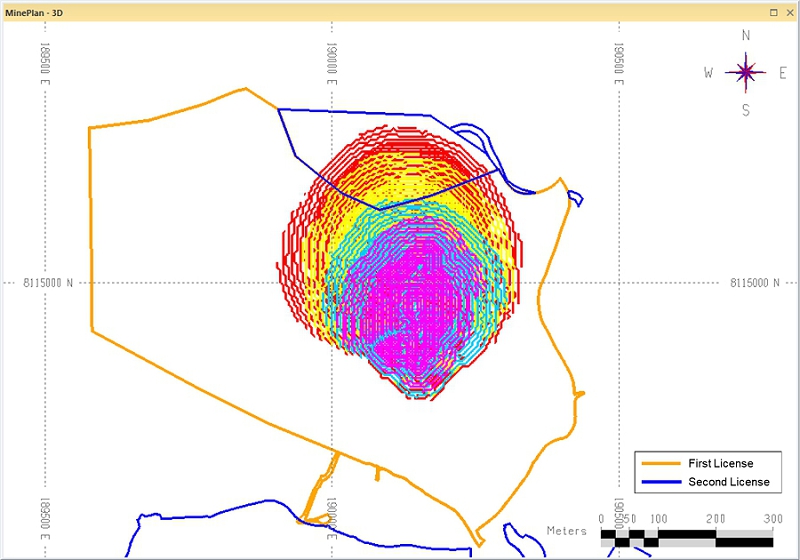
|
| SGS Geological Services |
| S-K 1300 Technical Report – FS Neves Lithium Project – Minas Gerais, Brazil | Page 179 |
| | |
Figure
13-14 Anitta 2 – Design of Pushbacks
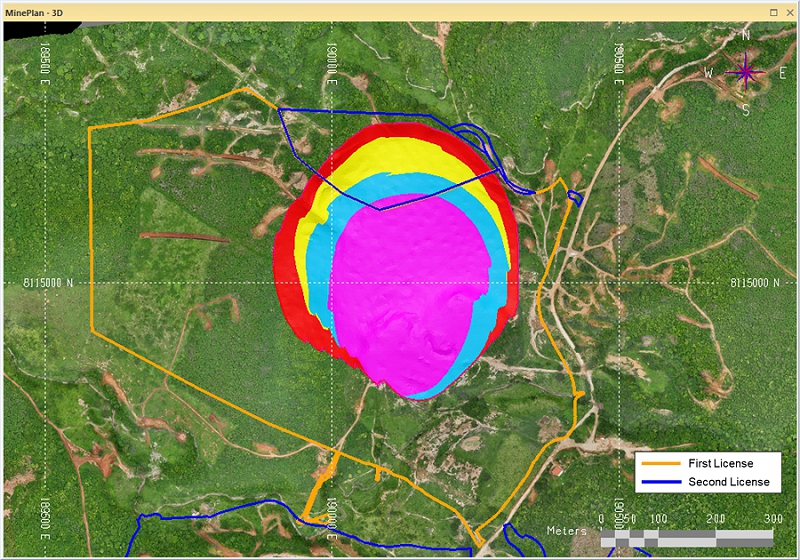
Figure
13-15 Anitta 2 – Design of Pushbacks: Phase 1
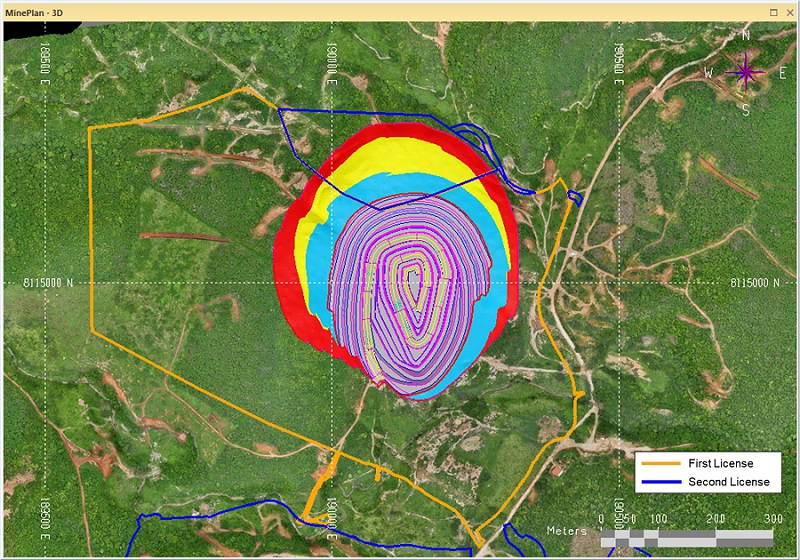
|
| SGS Geological Services |
| S-K 1300 Technical Report – FS Neves Lithium Project – Minas Gerais, Brazil | Page 180 |
| | |
Figure
13-16 Anitta 2 – Design of Pushbacks: Phase 2
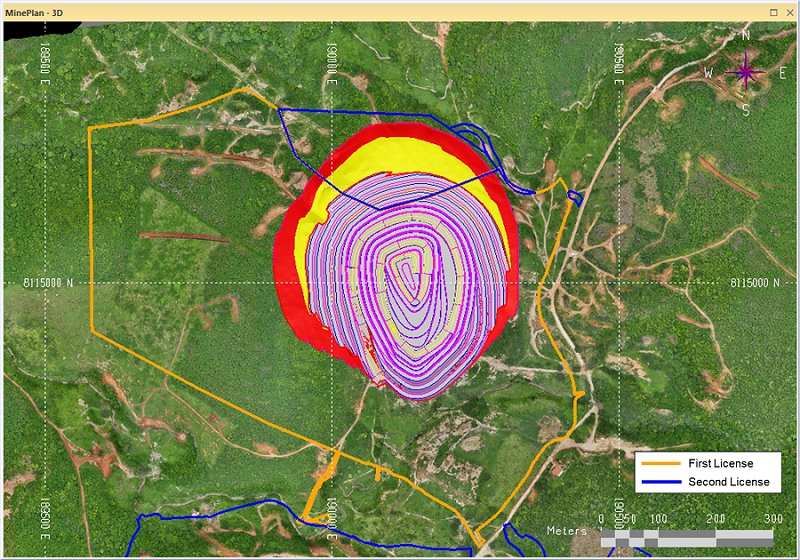
Figure
13-17 Anitta 2 – Design of Pushbacks: Phase 3
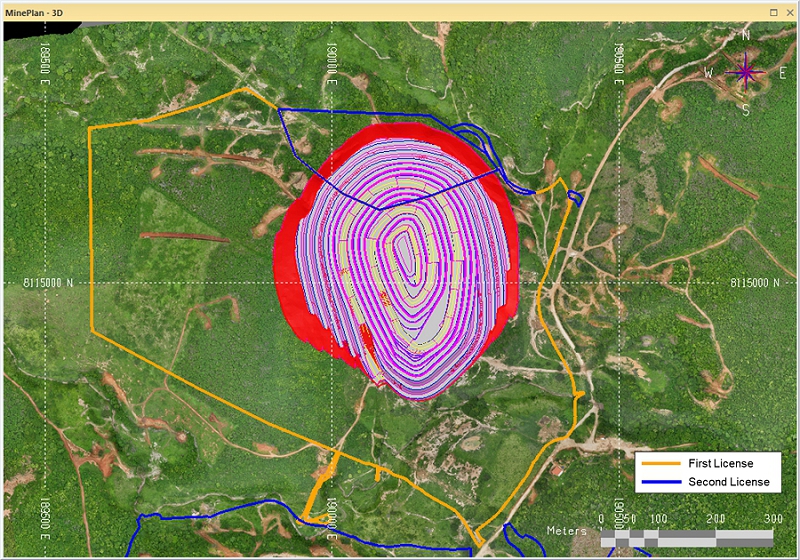
|
| SGS Geological Services |
| S-K 1300 Technical Report – FS Neves Lithium Project – Minas Gerais, Brazil | Page 181 |
| | |
Figure
13-18 Anitta 2 – Design of Pushbacks: Final Pit
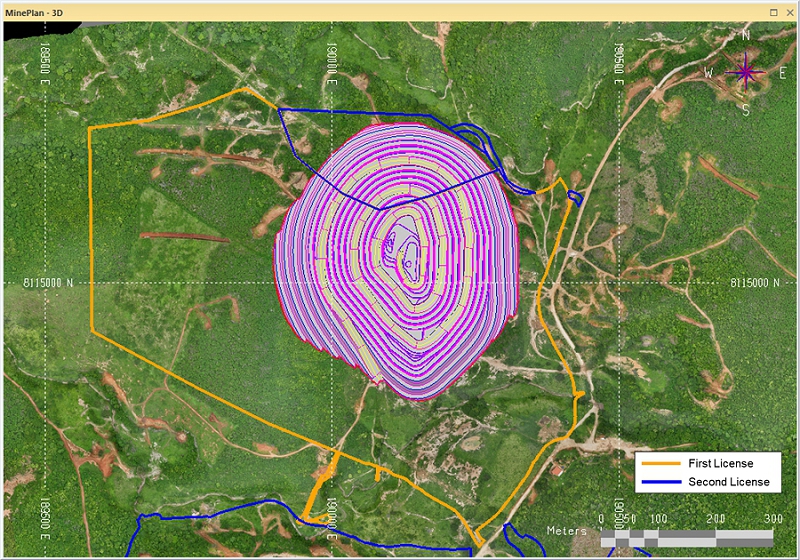
|
| SGS Geological Services |
| S-K 1300 Technical Report – FS Neves Lithium Project – Minas Gerais, Brazil | Page 182 |
| | |
Table
13-9 Anitta 2 – Reserves
| |
|
Ore |
Waste |
Grand
Total |
| Area |
Phase |
Destination
Ton |
Destination
Volume |
Li2O |
Li2O_Dil |
Concentrate |
Destination
Ton |
Destination
Volume |
Destination
Ton |
Destination
Volume |
Li2O |
Li2O_Dil |
S/R |
| Anitta
2 |
F01 |
578,326 |
237,994 |
1.321 |
1.255 |
81,406.51 |
6,715,919 |
2,428,668 |
7,294,245 |
2,666,662 |
0.105 |
0.100 |
11.61 |
| F02 |
322,508 |
132,719 |
1.168 |
1.110 |
40,144.42 |
6,015,139 |
2,173,375 |
6,337,647 |
2,306,094 |
0.060 |
0.057 |
18.65 |
| F03 |
478,464 |
196,899 |
1.168 |
1.110 |
59,553.59 |
6,931,983 |
2,504,242 |
7,410,447 |
2,701,140 |
0.076 |
0.072 |
14.49 |
| FF |
673,489 |
277,156 |
1.142 |
1.085 |
81,943.85 |
11,075,542 |
4,000,985 |
11,749,031 |
4,278,141 |
0.066 |
0.062 |
16.45 |
| Anitta
2 Total |
2,052,786 |
844,768 |
1.202 |
1.142 |
263,048.36 |
30,738,584 |
11,107,270 |
32,791,370 |
11,952,038 |
0.076 |
0.072 |
14.97 |
|
| SGS Geological Services |
| S-K 1300 Technical Report – FS Neves Lithium Project – Minas Gerais, Brazil | Page 183 |
| | |
The
following section presents the planned phases for the progressive development of the Anitta 03 pit. This sequence includes the initial
opening, intermediate advances, and the final pit configuration, taking into account operational, geotechnical, and economic optimization
criteria. Each phase has been defined based on ore distribution, orebody geometry, and best mining practices, aiming to ensure stability,
operational safety, and maximum resource recovery.
Figure
13-19 Pushbacks Anitta 3 – Pits Selected from Sensitivity Analysis
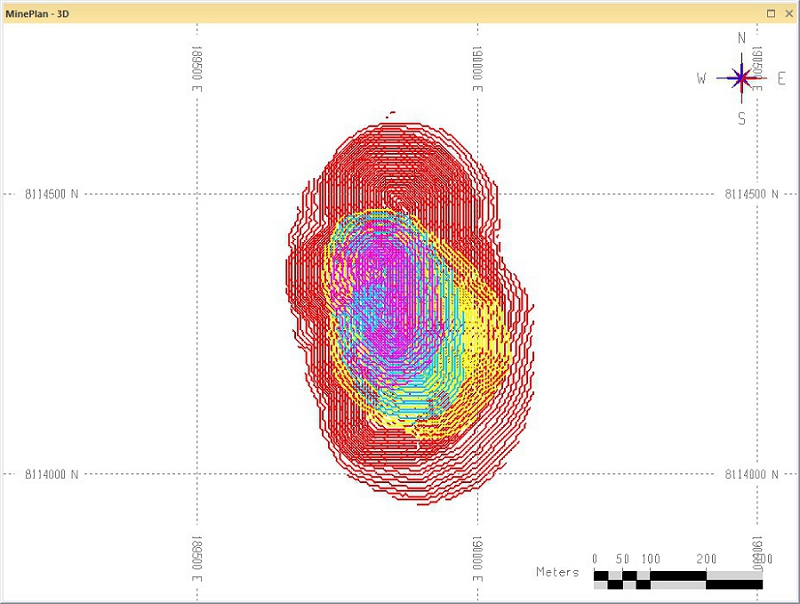
Figure
13-20 Anitta 3 – Design of Pushbacks
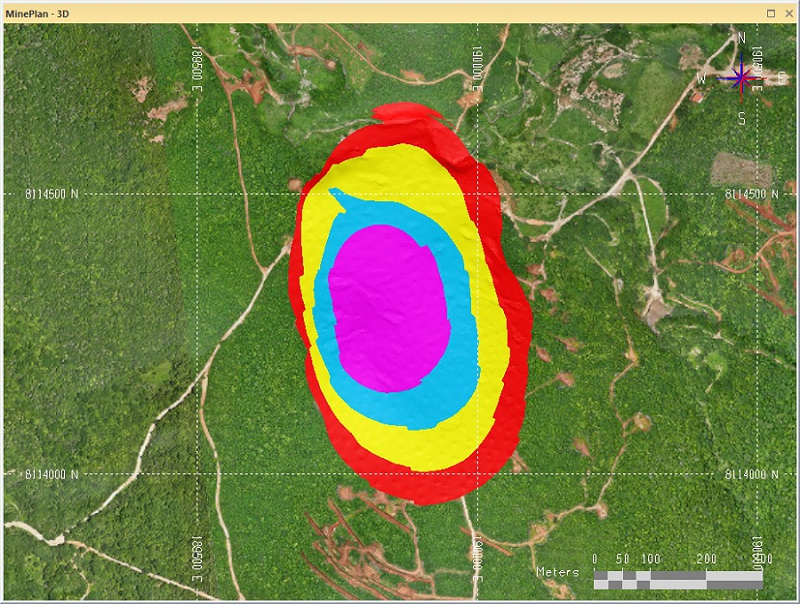
|
| SGS Geological Services |
| S-K 1300 Technical Report – FS Neves Lithium Project – Minas Gerais, Brazil | Page 184 |
| | |
Figure
13-21 Anitta 3 – Design of Pushbacks: Phase 01
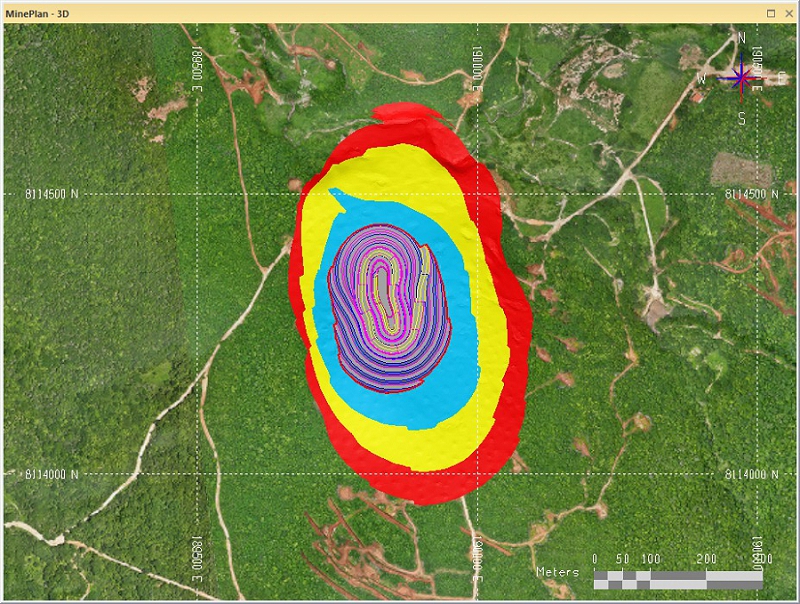
Figure
13-22 Anitta 3 – Design of Pushbacks: Phase 02
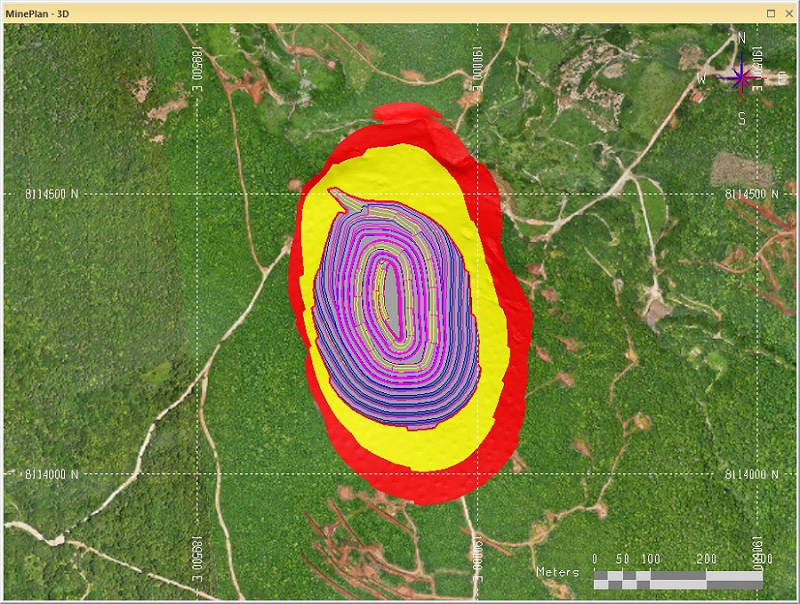
|
| SGS Geological Services |
| S-K 1300 Technical Report – FS Neves Lithium Project – Minas Gerais, Brazil | Page 185 |
| | |
Figure
13-23 Anitta 3 – Design of Pushbacks: Phase 03
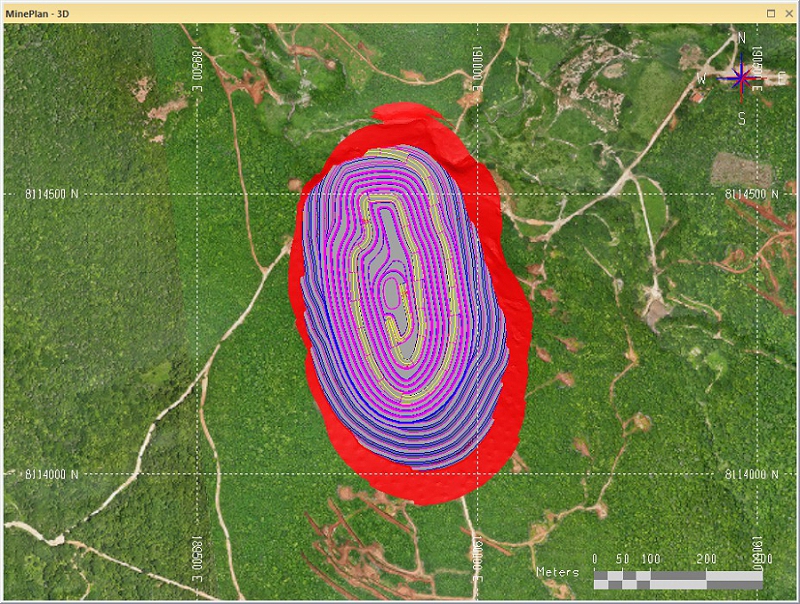
Figure
13-24 Anitta 3 – Design of Pushbacks: Phase 04 – Pit Final
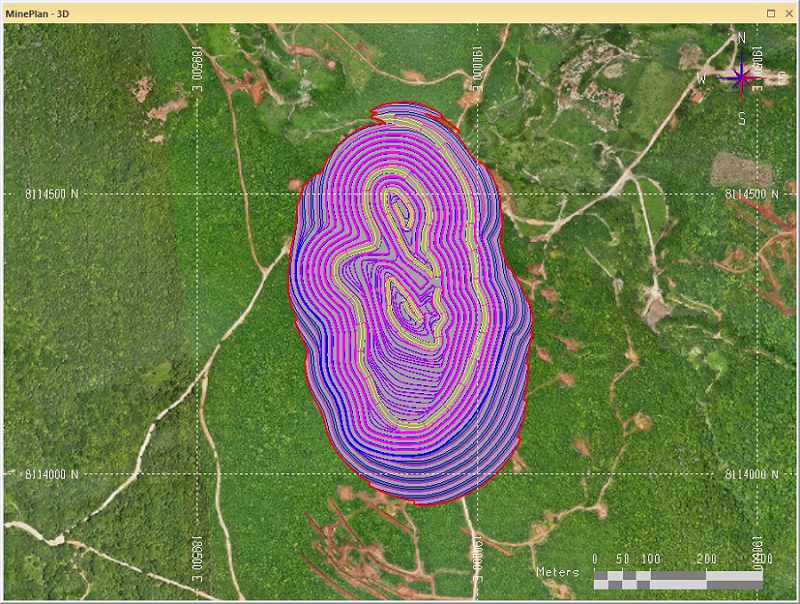
|
| SGS Geological Services |
| S-K 1300 Technical Report – FS Neves Lithium Project – Minas Gerais, Brazil | Page 186 |
| | |
Table
13-10 Anitta 3 – Reserves
| |
|
Ore |
Waste |
Grand
Total |
| Area |
Phase |
Destination
Ton |
Destination
Volume |
Li2O |
Li2O_Dil |
Concentrate |
Destination
Ton |
Destination
Volume |
Destination
Ton |
Destination
Volume |
Li2O |
Li2O_Dil |
S/R |
| Anitta
3 |
F01 |
766,046 |
283,721 |
1.304 |
1.238 |
106,431.94 |
3,122,783 |
1,130,134 |
3,888,829 |
1,413,855 |
0.257 |
0.244 |
4.08 |
| F02 |
1,003,592 |
371,701 |
1.162 |
1.104 |
124,245.25 |
8,444,681 |
3,054,361 |
9,448,273 |
3,426,062 |
0.125 |
0.118 |
8.41 |
| F03 |
1,071,951 |
397,019 |
1.185 |
1.126 |
135,392.17 |
20,073,433 |
7,252,092 |
21,145,384 |
7,649,111 |
0.061 |
0.058 |
18.73 |
| FF |
1,557,492 |
576,849 |
1.186 |
1.126 |
196,794.03 |
26,276,422 |
9,497,013 |
27,833,915 |
10,073,862 |
0.067 |
0.064 |
16.87 |
| Anitta
3 Total |
4,399,081 |
1,629,289 |
1.201 |
1.141 |
562,863.39 |
57,917,320 |
20,933,600 |
62,316,401 |
22,562,890 |
0.085 |
0.081 |
13.17 |
|
| SGS Geological Services |
| S-K 1300 Technical Report – FS Neves Lithium Project – Minas Gerais, Brazil | Page 187 |
| | |
The
following section presents the planned phases for the progressive development of the Anitta 2.5 pit. This sequence includes the initial
opening, intermediate advances, and the final pit configuration, taking into account operational, geotechnical, and economic optimization
criteria. Each phase has been defined based on ore distribution, orebody geometry, and best mining practices, aiming to ensure stability,
operational safety, and maximum resource recovery.
Figure
13-25 Pushbacks Anitta 2.5 – Pits Selected from Sensitivity Analysis
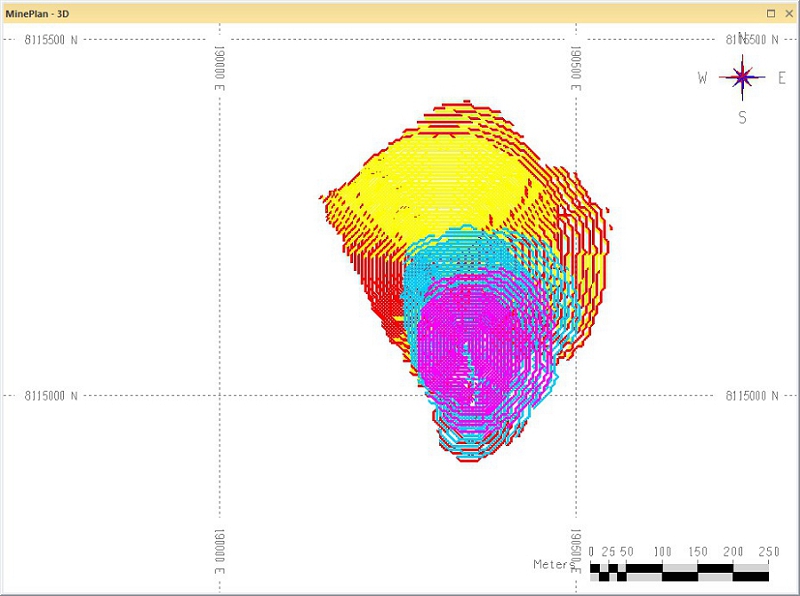
Figure
13-26 Anitta 2.5 – Design of Pushbacks
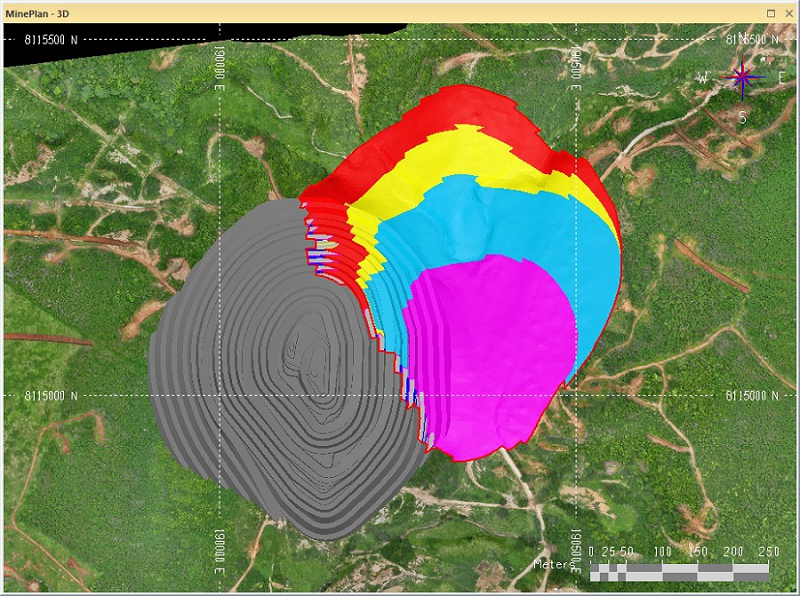
|
| SGS Geological Services |
| S-K 1300 Technical Report – FS Neves Lithium Project – Minas Gerais, Brazil | Page 188 |
| | |
Figure
13-27 Anitta 2.5 – Design of Pushbacks: Phase 01
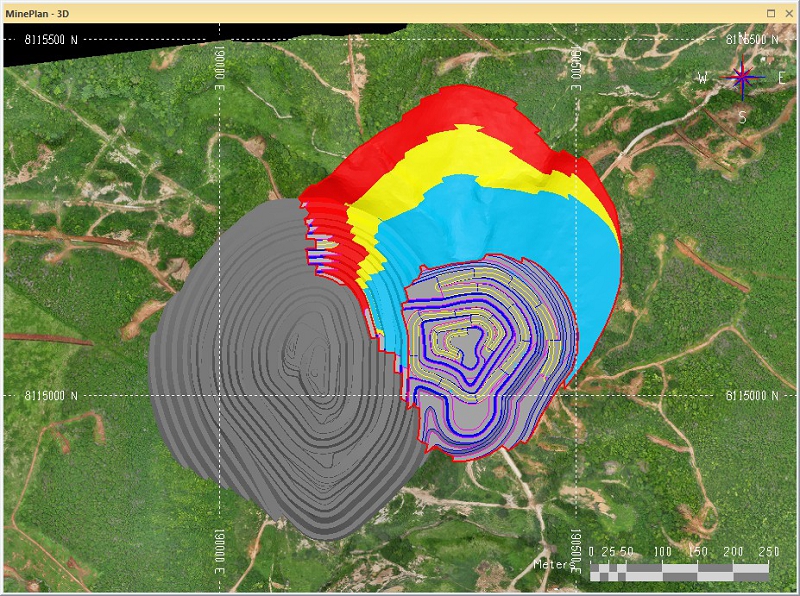
Figure
13-28 Anitta 2.5 – Design of Pushbacks: Phase 02
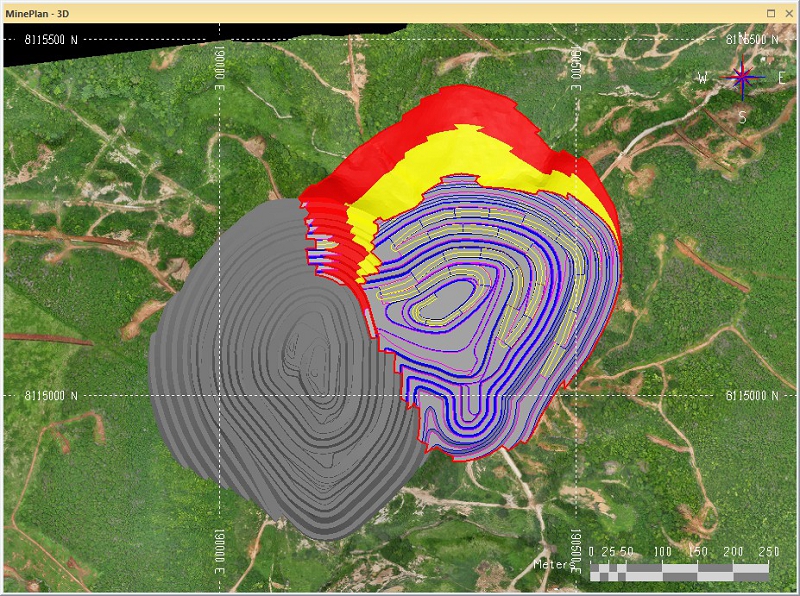
|
| SGS Geological Services |
| S-K 1300 Technical Report – FS Neves Lithium Project – Minas Gerais, Brazil | Page 189 |
| | |
Figure
13-29 Anitta 2.5 – Design of Pushbacks: Phase 03
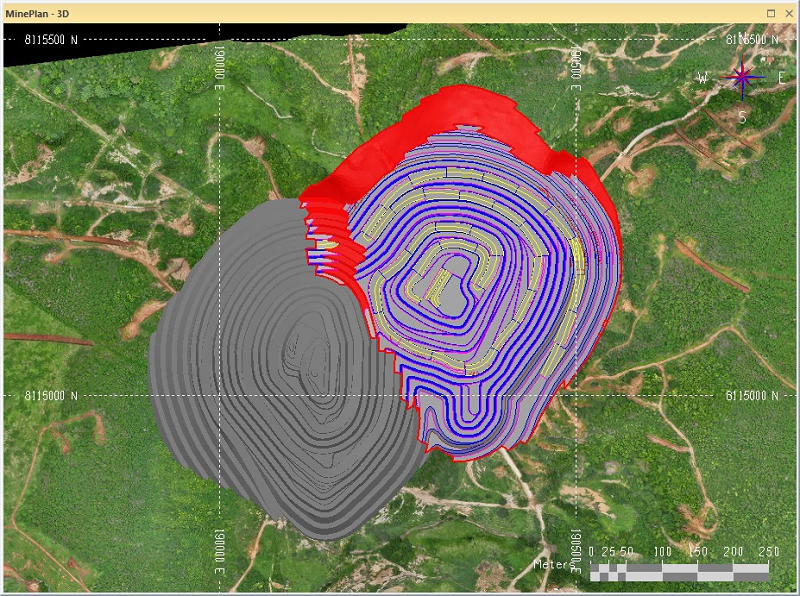
Figure
13-30 Anitta 2.5 – Design of Pushbacks: Phase 04 – Pit Final
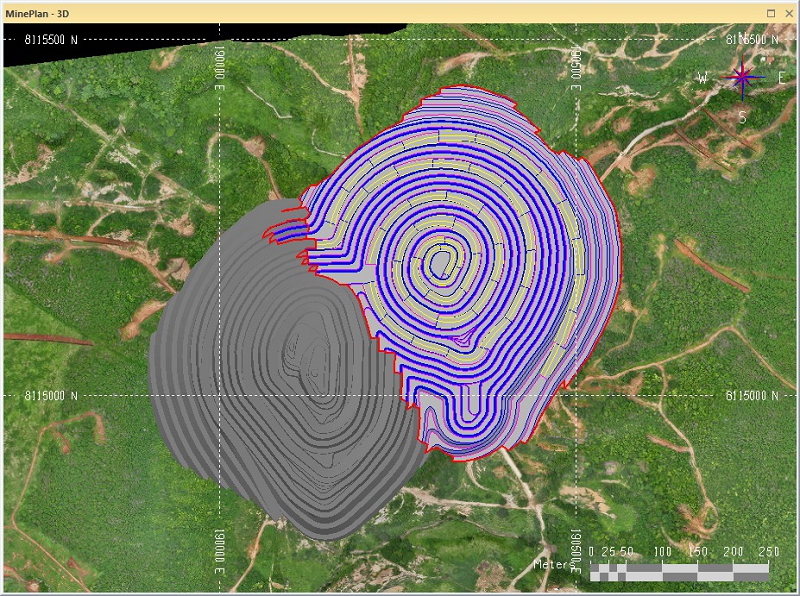
|
| SGS Geological Services |
| S-K 1300 Technical Report – FS Neves Lithium Project – Minas Gerais, Brazil | Page 190 |
| | |
Table
13-11 Anitta 2.5 – Reserves
| |
|
Ore |
Waste |
Grand
Total |
| Area |
Phase |
Destination
Ton |
Destination
Volume |
Li2O |
Li2O_Dil |
Concentrate |
Destination
Ton |
Destination
Volume |
Destination
Ton |
Destination
Volume |
Li2O |
Li2O_Dil |
S/R |
| Anitta
2.5 |
F01 |
177,582 |
73,079 |
1.525 |
1.448 |
28,854.91 |
5,229,427 |
1,889,105 |
5,407,009 |
1,962,184 |
0.050 |
0.048 |
29.45 |
| F02 |
81,700 |
33,621 |
1.331 |
1.265 |
11,589.52 |
8,720,364 |
3,148,846 |
8,802,063 |
3,182,467 |
0.012 |
0.012 |
106.74 |
| F03 |
205,969 |
84,761 |
1.307 |
1.241 |
28,685.97 |
7,188,519 |
2,595,916 |
7,394,489 |
2,680,677 |
0.036 |
0.035 |
34.9 |
| FF |
335,683 |
138,141 |
1.564 |
1.486 |
55,949.17 |
11,444,036 |
4,133,131 |
11,779,720 |
4,271,273 |
0.045 |
0.042 |
34.09 |
| Anitta
2.5 Total |
800,935 |
329,603 |
1.465 |
1.392 |
125,079.57 |
32,582,346 |
11,766,998 |
33,383,281 |
12,096,600 |
0.035 |
0.033 |
40.68 |
|
| SGS Geological Services |
| S-K 1300 Technical Report – FS Neves Lithium Project – Minas Gerais, Brazil | Page 191 |
| | |
Figure
13-31 Final Pits: Anitta 2, Anitta 2.5 and Anitta 3
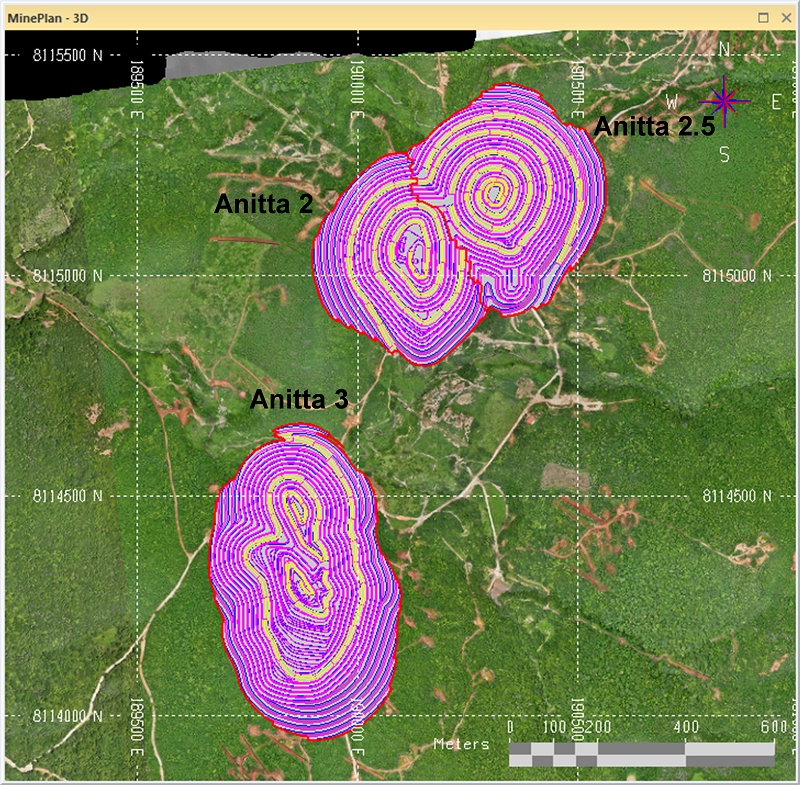
|
| SGS Geological Services |
| S-K 1300 Technical Report – FS Neves Lithium Project – Minas Gerais, Brazil | Page 192 |
| | |
Table
13-12 Total Reserves: Anitta 2, Anitta 2.5 and Anitta 3
| |
|
Ore |
Waste |
Grand
Total |
| Area |
Phase |
Destination
Tonnes |
Destination
Volume |
Li2O |
Li2O_Dil |
Concentrate |
Destination
Tonnes |
Destination
Volume |
Destination
Tonnes |
Destination
Volume |
Li2O |
Li2O_Dil |
S/R |
| Anitta
2 |
F01 |
578,326 |
237,994 |
1.321 |
1.255 |
81,406.51 |
6,715,919 |
2,428,668 |
7,294,245 |
2,666,662 |
0.105 |
0.100 |
11.61 |
| F02 |
322,508 |
132,719 |
1.168 |
1.110 |
40,144.42 |
6,015,139 |
2,173,375 |
6,337,647 |
2,306,094 |
0.060 |
0.057 |
18.65 |
| F03 |
478,464 |
196,899 |
1.168 |
1.110 |
59,553.59 |
6,931,983 |
2,504,242 |
7,410,447 |
2,701,140 |
0.076 |
0.072 |
14.49 |
| FF |
673,489 |
277,156 |
1.142 |
1.085 |
81,943.85 |
11,075,542 |
4,000,985 |
11,749,031 |
4,278,141 |
0.066 |
0.062 |
16.45 |
| Anitta
2 Total |
2,052,786 |
844,768 |
1.202 |
1.142 |
263,048.36 |
30,738,584 |
11,107,270 |
32,791,370 |
11,952,038 |
0.076 |
0.072 |
14.97 |
| Anitta
3 |
F01 |
766,046 |
283,721 |
1.304 |
1.238 |
106,431.94 |
3,122,783 |
1,130,134 |
3,888,829 |
1,413,855 |
0.257 |
0.244 |
4.08 |
| F02 |
1,003,592 |
371,701 |
1.162 |
1.104 |
124,245.25 |
8,444,681 |
3,054,361 |
9,448,273 |
3,426,062 |
0.125 |
0.118 |
8.41 |
| F03 |
1,071,951 |
397,019 |
1.185 |
1.126 |
135,392.17 |
20,073,433 |
7,252,092 |
21,145,384 |
7,649,111 |
0.061 |
0.058 |
18.73 |
| FF |
1,557,492 |
576,849 |
1.186 |
1.126 |
196,794.03 |
26,276,422 |
9,497,013 |
27,833,915 |
10,073,862 |
0.067 |
0.064 |
16.87 |
| Anitta
3 Total |
4,399,081 |
1,629,289 |
1.201 |
1.141 |
562,863.39 |
57,917,320 |
20,933,600 |
62,316,401 |
22,562,890 |
0.085 |
0.081 |
13.17 |
| Anitta
2.5 |
F01 |
177,582 |
73,079 |
1.525 |
1.448 |
28,854.91 |
5,229,427 |
1,889,105 |
5,407,009 |
1,962,184 |
0.050 |
0.048 |
29.45 |
| F02 |
81,700 |
33,621 |
1.331 |
1.265 |
11,589.52 |
8,720,364 |
3,148,846 |
8,802,063 |
3,182,467 |
0.012 |
0.012 |
106.74 |
| F03 |
205,969 |
84,761 |
1.307 |
1.241 |
28,685.97 |
7,188,519 |
2,595,916 |
7,394,489 |
2,680,677 |
0.036 |
0.035 |
34.9 |
| FF |
335,683 |
138,141 |
1.564 |
1.486 |
55,949.17 |
11,444,036 |
4,133,131 |
11,779,720 |
4,271,273 |
0.045 |
0.042 |
34.09 |
| Anitta
2.5 Total |
800,935 |
329,603 |
1.465 |
1.392 |
125,079.57 |
32,582,346 |
11,766,998 |
33,383,281 |
12,096,600 |
0.035 |
0.033 |
40.68 |
| Grand
Total |
7,252,802 |
2,803,660 |
1.230 |
1.169 |
950,991 |
121,238,249 |
43,807,868 |
128,491,051 |
46,611,528 |
0.070 |
0.066 |
16.72 |
|
| SGS Geological Services |
| S-K 1300 Technical Report – FS Neves Lithium Project – Minas Gerais, Brazil | Page 193 |
| | |
The
mine sequencing strategy was designed to establish the annual production plan in alignment with the project’s performance objectives,
operational limitations, and economic optimization goals. This strategy incorporates key planning parameters—including plant feed
capacity, lithium concentrate production targets, vertical advance rates, and metallurgical recovery—structured to support the
maximization of the project’s Net Present Value (NPV).
To
enhance operational control and scheduling accuracy throughout the project lifecycle, the production schedule was divided into tailored
planning intervals: monthly in Year 1 to support ramp-up optimization, quarterly during Years 2 and 3 to maintain a high level of detail
while allowing flexibility, and biannually from Year 4 to Year 5, and annually from Year 6 to LOM, aligning with the continuity and maturity
of operations.
The
following section presents the assumptions, design logic, and sequencing criteria that underpin the mine plan. These elements serve as
the foundation for both the operational execution strategy and the broader financial modeling of the project.
In
order to define the annual production plan, the following criteria were applied:
| ● | Diluted
Crusher Plant Feed: |
| ○ | 1,161,853
tonnes per year |
| ● | Concentrate
Tonnes Li2O: |
| ● | Concentrate
grade - Li2O |
| ● | Year
4 to Year 5: Biannual |
This
study involved the development of a detailed mine sequencing plan, including the definition of ore and waste blocks, the scheduling of
waste rock removal, and the evolution of pit geometries throughout the life of mine. A single pre-stripping phase was defined as part
of initial mine development activities.
The
sequencing was performed using MinePlan Schedule Optimizer (MPSO), taking into account the operational geometry of the defined pushbacks.
This approach resulted in a material movement schedule that aligns with operational capabilities and produces final pit geometries that
ensure full operability and geotechnical compliance.
The
results of the sequencing can be visualized in Figure 13-32 through Figure 13-39. A summary of annual production and waste volumes is
presented in Table 13-13, while Table 13-14 provides a detailed breakdown of yearly results. Year 0 refers exclusively to pre-stripping
activities.
For
the mine sequencing, the weathered material was considered in the crusher feed due to its relevant lithium grade. This material will
be blended proportionally during plant feed, and its volume has been fully accounted for in the production schedule.
The
stripping ratio adopted in this mine scheduling is defined as the total volume of waste material removed during the period divided by
the volume of ore delivered to the processing plant. This definition was used as the basis for calculating and presenting the stripping
ratio throughout the life-of-mine plan.
|
| SGS Geological Services |
| S-K 1300 Technical Report – FS Neves Lithium Project – Minas Gerais, Brazil | Page 194 |
| | |
Table
13-13 Mining Scheduling - Summary Result
| |
|
Plant |
Stk- |
Stk+ |
Dump |
Grand
Total |
| Year |
Periods |
Tonnes |
Li2O |
Li2O_Dil |
Concentrate |
Tonnes |
Li2O |
Li2O_Dil |
Tonnes |
Li2O |
Li2O_Dil |
Tonnes |
Tonnes |
SR |
| Y0 |
0 |
|
|
|
|
|
|
126,123 |
0.988 |
0.938 |
1,227,053 |
1,353,176 |
0.0 |
| Y1 |
879,410 |
1.278 |
1.214 |
119,731 |
642,378 |
1.350 |
1.283 |
870,918 |
1.396 |
1.326 |
12,823,240 |
14,573,568 |
14.6 |
| Y2 |
1,130,657 |
1.250 |
1.188 |
150,622 |
692,201 |
1.284 |
1.220 |
374,627 |
1.187 |
1.127 |
19,496,753 |
21,002,037 |
17.2 |
| Y3 |
1,130,930 |
1.251 |
1.189 |
150,829 |
119,233 |
0.825 |
0.784 |
350,424 |
0.790 |
0.751 |
22,727,946 |
24,209,301 |
20.1 |
| Y4 |
1,176,906 |
1.201 |
1.141 |
150,621 |
210,566 |
0.817 |
0.776 |
161,104 |
0.758 |
0.720 |
24,630,169 |
25,968,179 |
20.9 |
| Y5 |
1,150,795 |
1.228 |
1.167 |
150,621 |
64,172 |
0.728 |
0.692 |
145,353 |
0.786 |
0.746 |
21,704,357 |
23,000,505 |
18.9 |
| Y6 |
1,151,515 |
1.227 |
1.166 |
150,620 |
171,117 |
0.764 |
0.726 |
164,612 |
0.778 |
0.739 |
15,683,873 |
17,000,000 |
13.6 |
| Y7 |
632,589 |
1.156 |
1.098 |
77,948 |
293,495 |
0.757 |
0.719 |
|
|
|
2,944,858 |
3,577,447 |
4.7 |
| Grand
Total |
7,252,802 |
1.230 |
1.169 |
950,991 |
2,193,162 |
1.106 |
1.051 |
2,193,162 |
1.106 |
1.051 |
121,238,249 |
130,684,213 |
16.7 |
|
| SGS Geological Services |
| S-K 1300 Technical Report – FS Neves Lithium Project – Minas Gerais, Brazil | Page 195 |
| | |
Table
13-14 Mining Scheduling - Detailed Result
| |
|
Plant |
Stk- |
Stk+ |
Dump |
Grand
Total |
| Year |
Periods |
Tonnes |
Li2O |
Li2O_Dil |
Concentrate |
Tonnes |
Li2O |
Li2O_Dil |
Tonnes |
Li2O |
Li2O_Dil |
Tonnes |
Tonnes |
S/R |
| Y0 |
01-A0-PreStrip-1Q |
|
|
|
|
|
|
|
126,123 |
0.988 |
0.938 |
1,227,053 |
1,353,176 |
0.0 |
| Y1 |
02-A1-M01 |
3,417 |
1.108 |
1.052 |
403 |
2,900 |
0.996 |
0.946 |
11,814 |
0.922 |
0.876 |
915,904 |
931,135 |
268.1 |
| |
03-A1-M02 |
18,030 |
1.281 |
1.217 |
2,461 |
11,793 |
0.971 |
0.922 |
101,683 |
1.225 |
1.163 |
862,128 |
981,842 |
47.8 |
| 04-A1-M03 |
47,982 |
1.246 |
1.184 |
6,371 |
44,834 |
1.210 |
1.149 |
90,103 |
1.295 |
1.231 |
895,433 |
1,033,518 |
18.7 |
| 05-A1-M04 |
77,444 |
1.271 |
1.207 |
10,490 |
72,321 |
1.221 |
1.160 |
33,748 |
0.956 |
0.908 |
974,002 |
1,085,194 |
12.6 |
| 06-A1-M05 |
91,567 |
1.281 |
1.217 |
12,501 |
80,042 |
1.230 |
1.169 |
22,795 |
1.494 |
1.419 |
1,022,507 |
1,136,870 |
11.2 |
| 07-A1-M06 |
91,567 |
1.281 |
1.217 |
12,501 |
56,057 |
1.285 |
1.220 |
95,769 |
1.353 |
1.285 |
1,001,209 |
1,188,545 |
10.9 |
| 08-A1-M07 |
91,567 |
1.281 |
1.217 |
12,501 |
40,232 |
1.526 |
1.450 |
111,945 |
1.700 |
1.615 |
1,036,709 |
1,240,221 |
11.3 |
| 09-A1-M08 |
91,567 |
1.281 |
1.217 |
12,501 |
75,762 |
1.466 |
1.393 |
82,243 |
1.661 |
1.578 |
1,118,087 |
1,291,897 |
12.2 |
| 10-A1-M09 |
91,567 |
1.281 |
1.217 |
12,501 |
74,859 |
1.458 |
1.385 |
156,390 |
1.422 |
1.351 |
1,095,616 |
1,343,573 |
12.0 |
| 11-A1-M10 |
91,567 |
1.281 |
1.217 |
12,501 |
70,801 |
1.462 |
1.389 |
80,306 |
1.401 |
1.331 |
1,223,374 |
1,395,247 |
13.4 |
| 12-A1-M11 |
91,567 |
1.281 |
1.217 |
12,501 |
24,147 |
1.638 |
1.556 |
39,945 |
1.249 |
1.187 |
1,315,413 |
1,446,925 |
14.4 |
| 13-A1-M12 |
91,567 |
1.281 |
1.217 |
12,501 |
88,629 |
1.300 |
1.235 |
44,176 |
1.274 |
1.210 |
1,362,858 |
1,498,601 |
14.9 |
| Y1
Total |
879.410 |
1.278 |
1.214 |
119,731 |
642,378 |
1.350 |
1.283 |
870,918 |
1.396 |
1.326 |
12,823,240 |
14,573,568 |
14.6 |
| Y2 |
14-A2-Q1 |
278,792 |
1.250 |
1.188 |
37,140 |
235,142 |
1.312 |
1.247 |
196,615 |
1.254 |
1.191 |
4,024,593 |
4,500,000 |
14.4 |
| |
15-A2-Q2 |
281,889 |
1.250 |
1.188 |
37,552 |
257,659 |
1.301 |
1.236 |
118,486 |
1.209 |
1.148 |
4,599,625 |
5,000,000 |
16.3 |
| 16-A2-Q3 |
284,988 |
1.250 |
1.188 |
37,965 |
176,896 |
1.238 |
1.176 |
26,043 |
1.149 |
1.091 |
5,188,970 |
5,500,000 |
18.2 |
| 17-A2-Q4 |
284,988 |
1.250 |
1.188 |
37,965 |
22,504 |
1.149 |
1.092 |
33,484 |
0.743 |
0.706 |
5,683,565 |
6,002,037 |
19.9 |
| Y2
Total |
1.130.657 |
1.250 |
1.188 |
150,622 |
692,201 |
1.284 |
1.220 |
374,627 |
1.187 |
1.127 |
19,496,753 |
21,002,037 |
17.2 |
| Y3 |
18-A3-Q1 |
262,254 |
1.340 |
1.273 |
37,450 |
|
|
|
99,073 |
0.862 |
0.819 |
5,643,605 |
6,004,932 |
21.5 |
| |
19-A3-Q2 |
310,344 |
1.132 |
1.076 |
37,449 |
68,584 |
0.845 |
0.803 |
41,285 |
0.738 |
0.701 |
5,848,371 |
6,200,000 |
18.8 |
| 20-A3-Q3 |
265,773 |
1.340 |
1.273 |
37,965 |
3,761 |
0.824 |
0.783 |
194,898 |
0.768 |
0.730 |
5,539,329 |
6,000,000 |
20.8 |
| 21-A3-Q4 |
292,560 |
1.218 |
1.157 |
37,965 |
46,887 |
0.796 |
0.756 |
15,168 |
0.749 |
0.711 |
5,696,641 |
6,004,369 |
19.5 |
| Y3
Total |
1.130.930 |
1.251 |
1.189 |
150,829 |
119,233 |
0.825 |
0.784 |
350,424 |
0.790 |
0.751 |
22,727,946 |
24,209,301 |
20.1 |
| Y4 |
22-A4-S1 |
547,509 |
1.280 |
1.216 |
74,691 |
|
|
|
31,719 |
1.181 |
1.122 |
11,921,584 |
12,500,813 |
21.8 |
| |
23-A4-S2 |
629,397 |
1.132 |
1.075 |
75,929 |
210,566 |
0.817 |
0.776 |
129,385 |
0.654 |
0.621 |
12,708,585 |
13,467,366 |
20.2 |
| Y4
Total |
1,176,906 |
1.201 |
1.141 |
150,621 |
210,566 |
0.817 |
0.776 |
161,104 |
0.758 |
0.720 |
24,630,169 |
25,968,179 |
20.9 |
| Y5 |
24,A5,S1 |
574,651 |
1.220 |
1.159 |
74,691 |
|
|
|
81,181 |
0.711 |
0.676 |
11,344,673 |
12,000,505 |
19,7 |
| |
25,A5,S2 |
576,144 |
1.237 |
1.175 |
75,930 |
64,172 |
0.728 |
0.692 |
64,172 |
0.880 |
0.836 |
10,359,684 |
11,000,000 |
18,0 |
| Y5
Total |
1,150,795 |
1.228 |
1.167 |
150,621 |
64,172 |
0.728 |
0.692 |
145,353 |
0.786 |
0.746 |
21,704,357 |
23,000,505 |
18.9 |
| Y6 |
26,A6,A1 |
1,151,515 |
1.227 |
1.166 |
150,620 |
171,117 |
0.764 |
0.726 |
164,612 |
0.778 |
0.739 |
15,683,873 |
17,000,000 |
13,6 |
| Y7 |
27,A7,8,3M |
632,589 |
1.156 |
1.098 |
77,948 |
293,495 |
0.757 |
0.719 |
|
|
|
2,944,858 |
3,577,447 |
4,7 |
| Grand
Total |
7,252,802 |
1.230 |
1.169 |
950,991 |
2,193,162 |
1.106 |
1.051 |
2,193,162 |
1.106 |
1.051 |
121,238,249 |
130,684,213 |
16.7 |
|
| SGS Geological Services |
| S-K 1300 Technical Report – FS Neves Lithium Project – Minas Gerais, Brazil | Page 196 |
| | |
The
following figures illustrate the expected mining movements based on the planned sequencing for the project. These visual representations
aim to support a clearer understanding of the pit development strategy over time, highlighting the progression of mining phases, material
handling, and spatial distribution of ore and waste throughout the mine life.
Figure
13-32 Year 0 - Pre-stripping
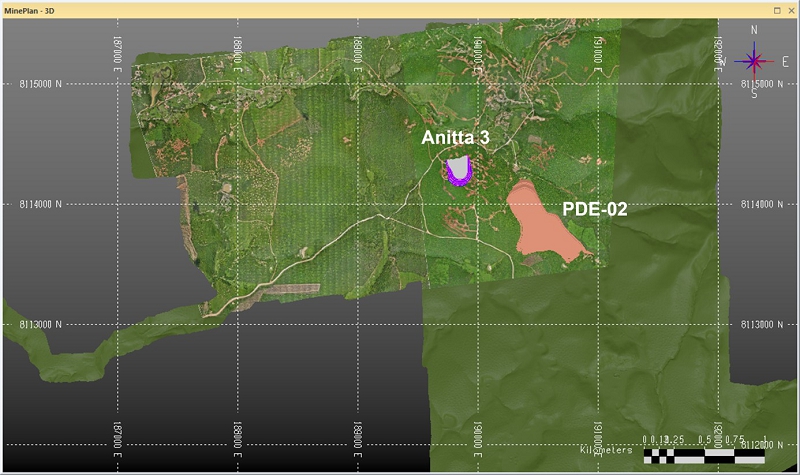
Figure
13-33 Year 1
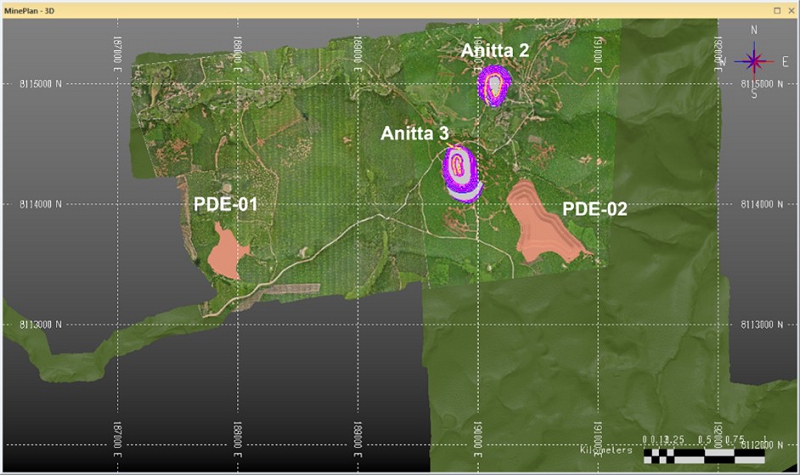
|
| SGS Geological Services |
| S-K 1300 Technical Report – FS Neves Lithium Project – Minas Gerais, Brazil | Page 197 |
| | |
Figure
13-34 Year 2
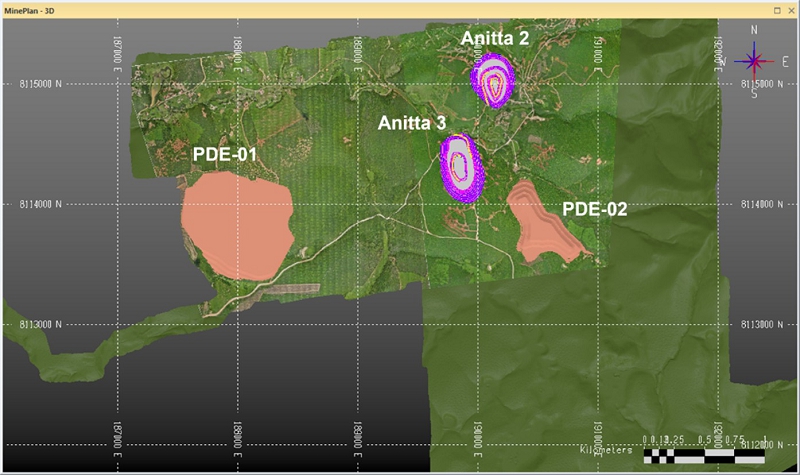
Figure
13-35 Year 3
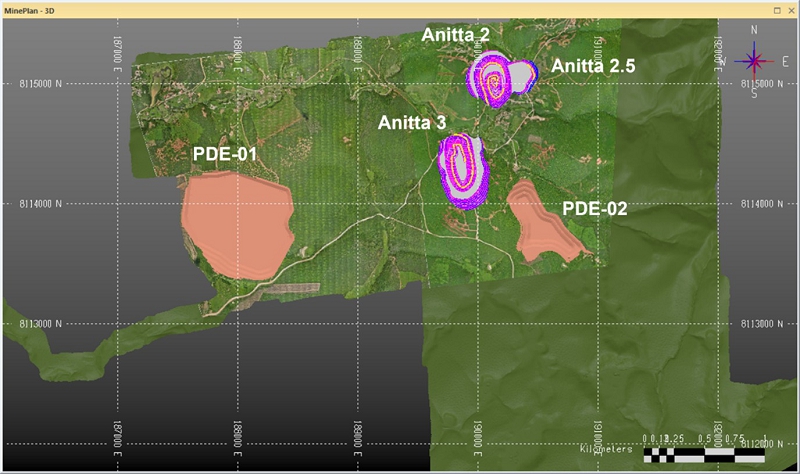
|
| SGS Geological Services |
| S-K 1300 Technical Report – FS Neves Lithium Project – Minas Gerais, Brazil | Page 198 |
| | |
Figure
13-36 Year 4
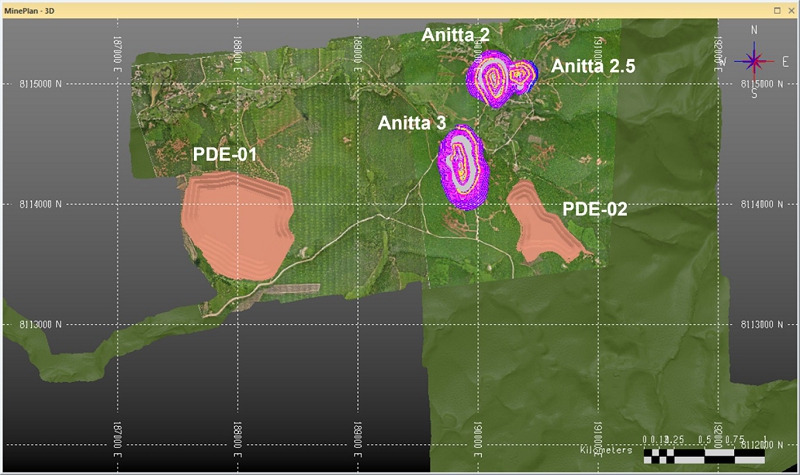
Figure
13-37 Year 5
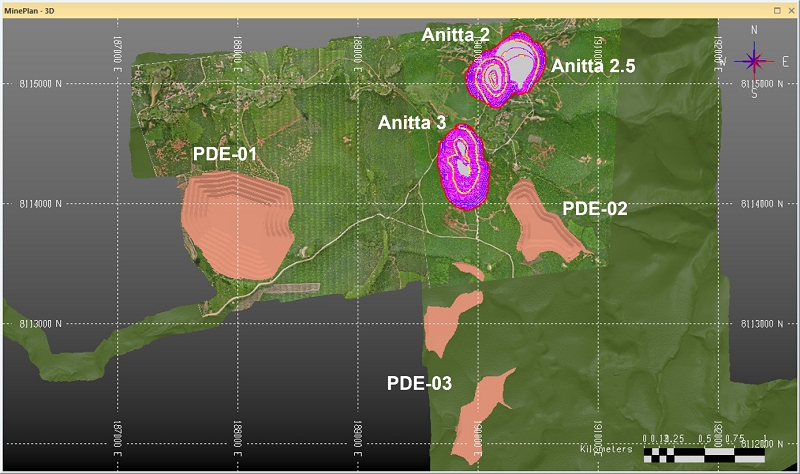
|
| SGS Geological Services |
| S-K 1300 Technical Report – FS Neves Lithium Project – Minas Gerais, Brazil | Page 199 |
| | |
Figure
13-38 Year 6
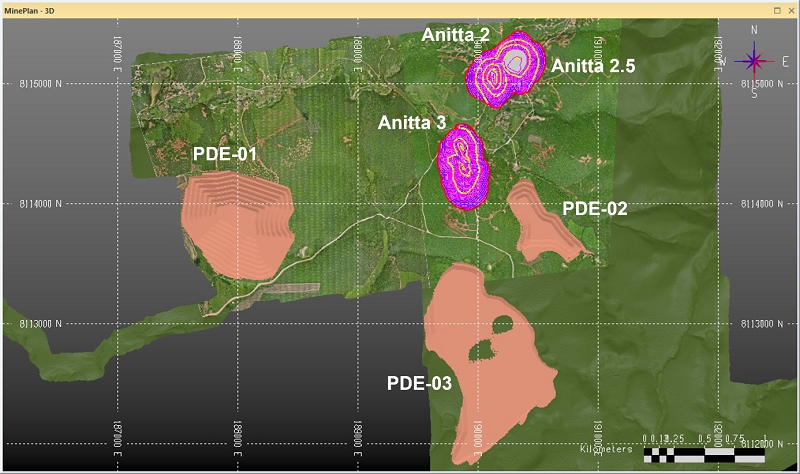
Figure
13-39 Year 7
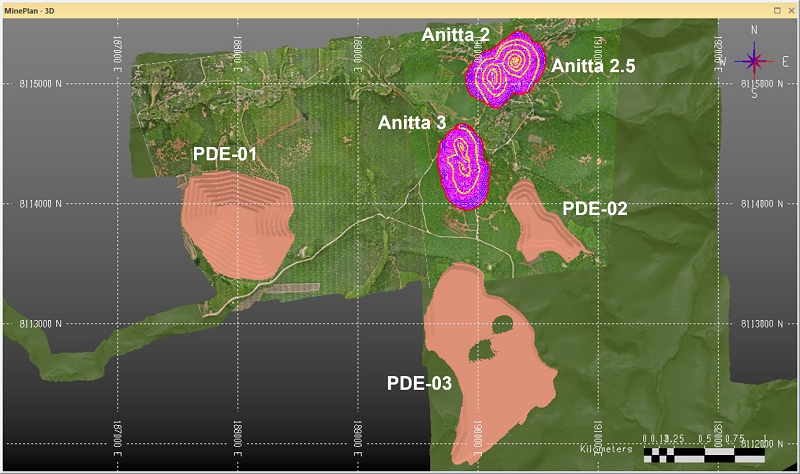
|
| SGS Geological Services |
| S-K 1300 Technical Report – FS Neves Lithium Project – Minas Gerais, Brazil | Page 200 |
| | |
Mining
operations at the Anitta 2, Anitta 2.5, and Anitta 3 deposits will be executed by a third-party mining contractor, selected based on
proven experience in managing operations of similar scale within Brazil. To support the contractor selection process, detailed technical
specifications outlining the scope of mining activities were prepared and distributed to pre-qualified companies, requesting both technical
and commercial proposals. Upon final selection and contract execution, mobilization and site preparation activities—including construction
of the contractor’s facilities—will commence immediately.
The
run-of-mine (ROM) ore will be drilled, blasted, loaded, and hauled by the contractor’s fleet to the ROM pad, located adjacent to
the primary crusher. A wheel loader will feed the material into the primary crusher, while oversize material (>700 mm) will be fragmented
by a rock breakers mounted on excavators will be used to fragment oversize material in the ROM stockpile areas.
To
support consistent plant operation and mitigate the impact of operational variability, the project design includes two key ore stockpiling
strategies. A strategic long-term buffer stockpile of approximately 300,000 tonnes will be established near the mining area, serving
as a safeguard against production interruptions. In addition, a 25,000-tonne active ROM pad stockpile will be maintained adjacent to
the primary crusher, allowing for real-time blending and short-term feed control. These stockpiles are essential to ensure a stable and
continuous feed to the processing plant during periods of reduced mining activity—whether due to operational delays, equipment
maintenance, or unforeseen downtime. This approach enhances operational resilience, improves feed consistency, and provides critical
flexibility in scheduling and plant utilization.
To
ensure optimal resource utilization in line with the plant’s feed requirements, the ore supply will consist of a defined proportion
of materials sourced from each of the planned pits. This configuration has been designed to maximize resource recovery while supporting
an efficient pit development strategy. By balancing feed blending with pit advancement, this approach enhances operational stability,
ensures consistent plant performance, and contributes to long-term value generation over the life of mine. The graph below (Figure 13-40)
illustrates this distribution over the years, showing the relative contribution of each pit to the plant feed blend and highlighting
the integrated planning between mining and processing operations.
Figure
13-40 Percentage of Plant Feed Contribution by Pit
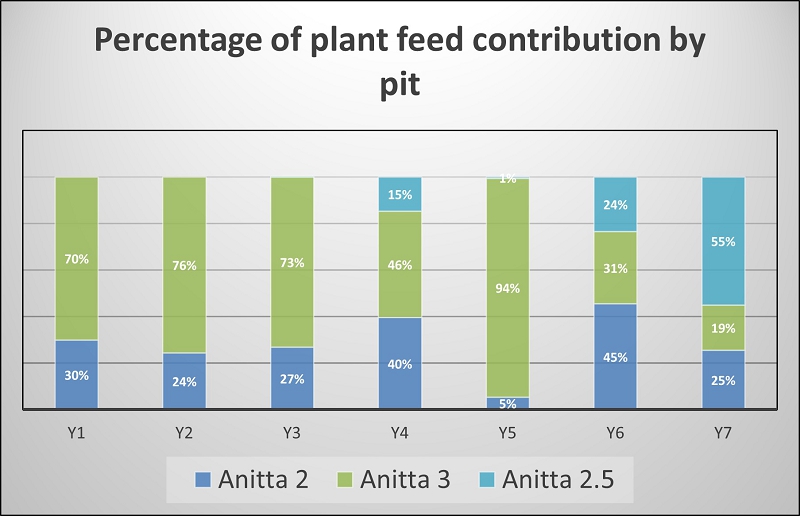
|
| SGS Geological Services |
| S-K 1300 Technical Report – FS Neves Lithium Project – Minas Gerais, Brazil | Page 201 |
| | |
Material
below the economic cut-off grade will be treated as waste and managed accordingly. It will be drilled, blasted, loaded, and hauled to
designated discharge areas within the engineered waste rock dumps.
The
percentage of material drilled and blasted is expected to be:
| ● | Weathering
(Soil + Weathered rock): 3% |
| | | |
| ○ | Weathering
(Soil + Weathered rock): 17% |
| | | |
The
main mining activities will be:
| ● | Digging
or rock blasting of ore and waste |
| | | |
| ● | Excavation,
loading and transport of ore and waste |
| | | |
| ● | Disposal
of ore in the ROM yard and waste in the waste dump |
| | | |
| ● | Construction
and maintenance of all internal access to the pit(s) and the waste dumps |
| | | |
| ● | Maintenance
of the floor, drainage, coating and signaling of all access roads used in the operation |
| | | |
| ● | Implementation
and maintenance of the mine’s surface drainage systems at access points to the mining
operation, waste deposit, ore yard and other areas linked to mining operations |
| | | |
| ● | Execution
of mine infrastructure services, such as: construction and maintenance of accesses to the
mining areas, crusher, waste dump, workshops and offices, mine drainage services, access
signaling, mine dewatering, etc. |
| | | |
| ● | Feeding
the primary crusher at an average rate of 210 t/h, per wheel loader |
| | | |
| ● | Build
and maintain the operation support facilities (offices, workshops, cafeteria, living quarters,
warehouses, changing rooms, bathrooms, septic tanks, environmental, health and safety emergency
(HSE), explosive magazine, electrical and hydraulic installations and others, in strict accordance
with the Brazilian environmental standards and labour laws. |
| 13.2.3.1 | Equipment
Selection |
Equipment
selection was based on the annual quantities of material required to be mined. The size of the mine and the geometries of the pits require
small equipment and easy to contract this equipment. Therefore, it was selected 40t transport trucks (Mercedes-Benz Arocs 8x4 or Similar)
for ore and small off-road trucks with 75t capacity (Sany SKT110 S or Similar) for the waste. For the mining hydraulic excavators compatible
with the size of the trucks: Caterpillar 336D or Similar for the Ore and Komatsu PC700 or Similar for the Waste.
The
excavators will be used to load of ore as well as the waste material. They will be staged to minimize movement between the multiple required
dig faces. The trucks can easily be assigned or re-assigned to either machine to maintain maximum production depending on excavator downtime,
changes in required material to be hauled, and haul cycle times. The excavators and trucks will be equipped with buckets and bodies specifically
designed for the density of the material.
|
| SGS Geological Services |
| S-K 1300 Technical Report – FS Neves Lithium Project – Minas Gerais, Brazil | Page 202 |
| | |
The
auxiliary equipment was dimensioned based on the number of main equipment of mining according to the following assumptions:
| ● | Hydraulic
Excavator (Caterpillar PC200 or similar): 1 equipment for final slope adjustments. |
| ● | Wheel
Loader (Caterpillar 966H or similar): 1 equipment to support mining and plant feeding |
| ● | Bulldozer
(Caterpillar D8 or similar): 1 equipment for three excavators and an additional 1 equipment
for waste piles |
| ● | Grader
(Caterpillar 140K or similar): For the dimensioning of graders was used the premise of adding
01 equipment for every 10 trucks. |
| ● | Water
Truck 20.000 l (Mercedes-Benz Axor 3340 6x4 or similar): 01 equipment for every 15 trucks
and an additional 1 equipment for the ore plant and 1 equipment for external roads. |
| ● | Hydraulic
Hammer (Caterpillar 320 or similar): 1 equipment for the ore plant. |
| ● | Backhoe
Excavator (JCB 3CXor similar): 1 equipment for general support of the operation. |
| ● | Road
Roller (Caterpillar CS74B or similar): 1 equipment for general support of the operation. |
| ● | Crane
(30 t of capacity) (Mercedes-Benz Axor 2426K or similar): 1 equipment for general support
of the operation. |
| ● | Portable
Lighting Tower (Atlas Copco - HiLight V5 or similar): 4 equipment, one for each mining front |
| ● | Light
Vehicle (Toyota Hilux or similar): 6 equipment for general support of the operation. |
| ● | Flatbed
Truck (Mercedes-Benz Actros 2653 6x4 or similar): 1 equipment for general support of the
operation. |
| ● | Fuel
and Lube Truck (Mercedes-Benz Axor 3344 6x4 or similar): 01 maintenance equipment for every
20 equipment. |
| ● | Drilling
Machine Sandvik |
It
is estimated that 83% of the material to be mined will require blasting with explosives. Due to its physical and mechanical properties,
including high strength and rock hardness, blasting is necessary to ensure proper fragmentation and facilitate subsequent loading and
hauling operations, a drilling diameter of 5 ¾” inches was adopted for ore with 5-meter-high benches and 5,75” inches
for waste in 10-meter-high benches.
A
careful analysis of the characteristics of the deposit was performed to determine the most appropriate drilling equipment.
The
drilling operation will be supported by a bulldozer and/or hydraulic excavator to carry out cleaning activities in the drilling areas,
construction of access points to the drilling area, as well as the use of a hydraulic hammer coupled to the hydraulic excavator for rock
handling in the operational area.
The
rock blasting work comprises primary and secondary blasting and a hydraulic hammer will be used as required.
The
list of Main Equipment to be used in the Operation of the Anitta 2, Anitta 2.5 and Anitta 3 are detailed in the Table 13-15.
The
operation is planned for continuous production throughout the entire year, with an annual production period of 365 days. The effective
working hours per day were considered to be 21 net hours, accounting for operational delays, shift changes, and scheduled maintenance.
This ensures that the mine achieves a high level of efficiency while maintaining necessary downtime for equipment servicing and operational
adjustments.
|
| SGS Geological Services |
| S-K 1300 Technical Report – FS Neves Lithium Project – Minas Gerais, Brazil | Page 203 |
| | |
The
truck fleet is designed to handle a payload capacity of 40 tonnes for the Ore and the 75 tonne for the Waste per trip. The trucks have
an availability rate of 85%, meaning they are operational and ready for use the majority of the time, with only 15% allocated for maintenance
or repairs. The utilization rate is also 85%, indicating that, when available, the trucks are actively transporting material for most
of their working time. The fixed times for truck operations include a spot time of 0.3 minutes (time required to position at the loading
area) and a dump time of 1.3 minutes (time needed to unload material at the destination). The cycle times for the trucks are determined
using MinePlan Haulage, based on predefined speed and grade tables, ensuring optimized haulage efficiency.
The
excavator responsible for loading material at a dig rate of 600 tonnes per hour for the Ore and the 800 tonnes per hour for the Waste.
With an availability of 85%, the excavator is expected to be in working condition for the majority of the time, with planned maintenance
factored into the schedule. The utilization rate is 75%.
For
fleet planning, the software MinePlan Haulage, is a fully integrated module with the mine sequencing tools of MinePlan, was used to design
cargo equipment and mine transport. It is possible to planning equipment or perform sequencing according to equipment productivity and
if any change in mine sequencing is required, it is possible to know instantaneously the effect of the change in the need for equipment
to carry out the proposed plan.
In
addition to reproducing the transport routes, it has configurations that simulate the actual performance of the equipment by calculating
cycle times, including stoppages and fixed times. In its configurations, parameters such as Velocity x Grade, Rimpull and Braking Values
can be used and even simulate the fuel consumption.
MinePlan
Haulage calculates the transport route of each cut to the destinations and within the destinations, thus defining the distance and cycle
time for each sequenced cut to the final destination and thus obtaining the average values of distances for each period.
To
calculate the transport cycle time, the Haulage, in addition to calculating the distances, uses a speed curve, according to the values
in Figure 13-41, to calculate the cycle time for each cut. The same speed curve was used for both trucks.
Figure
13-41 Speed Bin Data
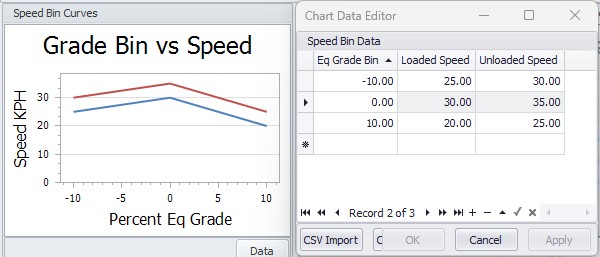
For
mining operations to be carried out safely and efficiently, all equipment must be in optimal working condition and comply with the necessary
technical standards. Equipment must adhere to established Maintenance and Inspection Plans, including scheduled shutdowns for preventive
and predictive maintenance. The selected equipment for mining activities will be highly reliable, ensuring both operational efficiency
and the comfort and safety of operators.
The
main and auxiliary equipment for the operation are detailed in the Table 13-15.
|
| SGS Geological Services |
| S-K 1300 Technical Report – FS Neves Lithium Project – Minas Gerais, Brazil | Page 204 |
| | |
Table
13-15 List of Main Equipment to be Used in the Operation
| |
|
Year
0 |
Year
1 |
Year
2 |
Year
3 |
Year
4 |
Year
5 |
Year
6 |
Year
7 |
| Mining
Fleet |
Model |
PreStrip |
M1 |
M2 |
M3 |
M4 |
M5 |
M6 |
M7 |
M8 |
M9 |
M10 |
M11 |
M12 |
Q1 |
Q2 |
Q3 |
Q4 |
Q1 |
Q2 |
Q3 |
Q4 |
S1 |
S2 |
S1 |
S2 |
1Y |
1Y |
| Haul
Truck ORE |
Mercedes-Benz
Arocs 8x4 |
1 |
1 |
2 |
2 |
2 |
1 |
3 |
3 |
3 |
4 |
3 |
3 |
2 |
2 |
2 |
2 |
2 |
3 |
2 |
3 |
2 |
2 |
3 |
3 |
2 |
3 |
2 |
| Hydraulic
Excavator ORE |
Caterpillar
336D |
1 |
1 |
1 |
1 |
1 |
1 |
1 |
1 |
1 |
2 |
1 |
1 |
1 |
1 |
1 |
1 |
1 |
1 |
1 |
1 |
1 |
1 |
1 |
1 |
1 |
1 |
1 |
| Haul
Truck WASTE |
Sany
SKT110 S |
7 |
7 |
7 |
8 |
8 |
9 |
13 |
13 |
14 |
15 |
15 |
18 |
19 |
19 |
17 |
18 |
20 |
20 |
20 |
19 |
17 |
6 |
5 |
4 |
4 |
3 |
1 |
| Hydraulic
Excavator WASTE |
Komatsu
PC700 |
1 |
2 |
2 |
2 |
3 |
3 |
3 |
3 |
3 |
3 |
3 |
3 |
3 |
3 |
4 |
4 |
4 |
4 |
4 |
4 |
4 |
4 |
4 |
4 |
4 |
3 |
1 |
| Hydraulic
Excavator |
Caterpillar
PC200 |
1 |
1 |
1 |
1 |
1 |
1 |
1 |
1 |
1 |
1 |
1 |
1 |
1 |
1 |
1 |
1 |
1 |
1 |
1 |
1 |
1 |
1 |
1 |
1 |
1 |
1 |
1 |
| Wheel
Loader |
Caterpillar
966H |
1 |
1 |
1 |
1 |
1 |
1 |
1 |
1 |
1 |
1 |
1 |
1 |
1 |
1 |
1 |
1 |
1 |
1 |
1 |
1 |
1 |
1 |
1 |
1 |
1 |
1 |
1 |
| Bulldozer |
Caterpillar
D8 |
2 |
2 |
2 |
2 |
2 |
2 |
2 |
2 |
2 |
3 |
2 |
2 |
2 |
2 |
3 |
3 |
3 |
3 |
3 |
3 |
3 |
3 |
3 |
3 |
3 |
2 |
2 |
| Grader |
Caterpillar
140K |
1 |
1 |
1 |
1 |
1 |
1 |
2 |
2 |
2 |
2 |
2 |
2 |
2 |
2 |
2 |
2 |
2 |
2 |
2 |
2 |
2 |
1 |
1 |
1 |
1 |
1 |
1 |
| Water
Truck |
Mercedes-Benz
Axor 3340 6x4 |
3 |
3 |
3 |
3 |
3 |
3 |
4 |
4 |
4 |
4 |
4 |
4 |
4 |
4 |
4 |
4 |
4 |
4 |
4 |
4 |
4 |
3 |
3 |
3 |
3 |
3 |
3 |
| Hydraulic
Hammer |
Caterpillar
320 |
1 |
1 |
1 |
1 |
1 |
1 |
1 |
1 |
1 |
1 |
1 |
1 |
1 |
1 |
1 |
1 |
1 |
1 |
1 |
1 |
1 |
1 |
1 |
1 |
1 |
1 |
1 |
| Backhoe
Excavator |
JCB
3CX |
2 |
2 |
2 |
2 |
2 |
2 |
2 |
2 |
2 |
2 |
2 |
2 |
2 |
2 |
2 |
2 |
2 |
2 |
2 |
2 |
2 |
2 |
2 |
2 |
2 |
2 |
2 |
| Road
Roller |
Caterpillar
CS74B |
1 |
1 |
1 |
1 |
1 |
1 |
1 |
1 |
1 |
1 |
1 |
1 |
1 |
1 |
1 |
1 |
1 |
1 |
1 |
1 |
1 |
1 |
1 |
1 |
1 |
1 |
1 |
| Crane
(30 t of capacity) |
Mercedes-Benz
Axor 2426K |
1 |
1 |
1 |
1 |
1 |
1 |
1 |
1 |
1 |
1 |
1 |
1 |
1 |
1 |
1 |
1 |
1 |
1 |
1 |
1 |
1 |
1 |
1 |
1 |
1 |
1 |
1 |
| Portable
Lighting Tower |
Atlas
Copco - HiLight V5 |
4 |
4 |
4 |
4 |
4 |
4 |
4 |
4 |
4 |
4 |
4 |
4 |
4 |
4 |
4 |
4 |
4 |
4 |
4 |
4 |
4 |
4 |
4 |
4 |
4 |
4 |
4 |
| Light
Vehicle |
Toyota
Hilux |
6 |
6 |
6 |
6 |
6 |
6 |
6 |
6 |
6 |
6 |
6 |
6 |
6 |
6 |
6 |
6 |
6 |
6 |
6 |
6 |
6 |
6 |
6 |
6 |
6 |
6 |
6 |
| Flatbed
Truck |
Mercedes-Benz
Actros 2653 6x4 |
1 |
1 |
1 |
1 |
1 |
1 |
1 |
1 |
1 |
1 |
1 |
1 |
1 |
1 |
1 |
1 |
1 |
1 |
1 |
1 |
1 |
1 |
1 |
1 |
1 |
1 |
1 |
| Fuel
and Lube Truck |
Mercedes-Benz
Axor 3344 6x4 |
2 |
2 |
2 |
2 |
2 |
2 |
3 |
3 |
3 |
3 |
3 |
3 |
3 |
3 |
3 |
3 |
3 |
3 |
3 |
3 |
3 |
2 |
2 |
2 |
2 |
2 |
2 |
| Drilling
Machine |
Sandvik |
4 |
4 |
4 |
4 |
4 |
4 |
4 |
4 |
4 |
4 |
4 |
4 |
4 |
4 |
4 |
4 |
4 |
4 |
4 |
4 |
4 |
4 |
4 |
4 |
4 |
4 |
4 |
| Pit
Dewater Pumps |
Xylem |
0 |
0 |
0 |
0 |
0 |
0 |
2 |
2 |
2 |
2 |
2 |
2 |
2 |
2 |
3 |
3 |
3 |
4 |
4 |
4 |
4 |
4 |
5 |
6 |
6 |
6 |
6 |
| Blasting
Support Truck |
|
1 |
1 |
1 |
1 |
1 |
1 |
1 |
1 |
1 |
1 |
1 |
1 |
1 |
1 |
1 |
1 |
1 |
1 |
1 |
1 |
1 |
1 |
1 |
1 |
1 |
1 |
1 |
| Total |
41 |
42 |
43 |
44 |
45 |
45 |
56 |
56 |
57 |
61 |
58 |
61 |
61 |
61 |
62 |
63 |
65 |
67 |
66 |
66 |
63 |
49 |
50 |
50 |
49 |
47 |
42 |
|
| SGS Geological Services |
| S-K 1300 Technical Report – FS Neves Lithium Project – Minas Gerais, Brazil | Page 205 |
| | |
| 13.2.3.3 | Explosives
Supply |
The
explosives supply for the project has been defined based on the blasting requirements established for both ore and waste materials, as
determined in the site-specific blasting plan. This plan outlines the type, quantity, and frequency of explosive use across the mine’s
operational phases and ensures optimized fragmentation and safety throughout mining activities. The development of this blasting plan
was carried out through a collaborative effort between Enaex and Atlas, combining operational expertise and technical knowledge to tailor
the blasting strategy to site-specific geological and geomechanical conditions.
To
support these needs, an explosives storage facility (magazine) has been dimensioned and strategically located to comply with applicable
regulatory standards and operational demands. The sizing and specifications of the magazine were determined according to forecasted consumption
rates, and its design ensures safe handling, storage, and access to blasting materials. Further details regarding the explosive’s
magazine infrastructure can be found in Section 15 of this document.
Explosive
products and blasting accessories will be supplied through a dedicated contract with a reputable national supplier. The selected provider
will be a recognized company in the Brazilian market with demonstrated experience, technical capacity, and a robust logistics network
to ensure consistent and timely delivery to the site. This approach is essential to maintaining uninterrupted mining operations and minimizing
the risk of delays related to explosive availability.
The
contracting process will include the provision of on-site support, technical assistance, and compliance with all applicable safety and
environmental regulations governing the transport, handling, and use of explosives in mining operations.
The
teams will work in different shifts. The administrative group will work 9 hours a day from Monday to Friday, with 1 hour off for a meal.
, The operational team, organized into specific shifts, will operate 24 hours a day, 7 days a week, ensuring continuous coverage of mining
activities under a shift rotation to be jointly defined with the contractor engaged for mine operations.
The
work schedule adopted for each sector was considered when determining the labor requirements. For sectors that work in shifts, the number
of labors was calculated considering 4 work groups, and for sectors that work during administrative hours, only 1 work group was considered.
The
calculation of the labor required for mine operations considered the number of equipment and the number of work teams, with the addition
of 8.3% for vacations, 1% for training, and 1% for others that include absences, medical certificates, and other absences.
Table
13-16 lists the expected annual labor requirements for the seven years of mine life operations and Table 13-17 lists the expected annual
labor requirements for Management and administrative works. These expectations will be adjusted as required during the mining operation.
For
the mobilization of technical and operational personnel, priority will be given to local people and those living close to the project.
|
| SGS Geological Services |
| S-K 1300 Technical Report – FS Neves Lithium Project – Minas Gerais, Brazil | Page 206 |
| | |
Table
13-16 Staffing Requirement Summary – Operation
| |
|
|
Year
0 |
Year
1 |
Year
2 |
Year
3 |
Year
4 |
Year
5 |
Year
6 |
Year
7 |
| Operators
Team |
Model |
Shift |
PreStrip |
M1 |
M2 |
M3 |
M4 |
M5 |
M6 |
M7 |
M8 |
M9 |
M10 |
M11 |
M12 |
Q1 |
Q2 |
Q3 |
Q4 |
Q1 |
Q2 |
Q3 |
Q4 |
S1 |
S2 |
S1 |
S2 |
1Y |
1Y |
| Haul
Truck ORE |
Mercedes-Benz
Arocs 8x4 |
4 |
4 |
4 |
9 |
9 |
9 |
4 |
13 |
13 |
13 |
18 |
13 |
13 |
9 |
9 |
9 |
9 |
9 |
13 |
9 |
13 |
9 |
9 |
13 |
13 |
9 |
13 |
9 |
| Hydraulic
Excavator ORE |
Caterpillar
336D |
4 |
9 |
9 |
9 |
9 |
9 |
9 |
9 |
9 |
9 |
13 |
9 |
9 |
9 |
9 |
9 |
9 |
9 |
9 |
9 |
9 |
9 |
9 |
9 |
9 |
9 |
9 |
9 |
| Haul
Truck WASTE |
Sany
SKT110 S |
4 |
31 |
31 |
31 |
35 |
35 |
40 |
57 |
57 |
62 |
66 |
66 |
79 |
84 |
84 |
75 |
79 |
88 |
88 |
88 |
84 |
75 |
26 |
22 |
18 |
18 |
13 |
4 |
| Hydraulic
Excavator WASTE |
Komatsu
PC700 |
4 |
4 |
9 |
9 |
9 |
13 |
13 |
13 |
13 |
13 |
13 |
13 |
13 |
13 |
13 |
18 |
18 |
18 |
18 |
18 |
18 |
18 |
18 |
18 |
18 |
18 |
13 |
4 |
| Wheel
Loader |
Caterpillar
966H |
4 |
4 |
4 |
4 |
4 |
4 |
4 |
4 |
4 |
4 |
4 |
4 |
4 |
4 |
4 |
4 |
4 |
4 |
4 |
4 |
4 |
4 |
4 |
4 |
4 |
4 |
4 |
4 |
| Bulldozer |
Caterpillar
D8 |
4 |
9 |
9 |
9 |
9 |
9 |
9 |
9 |
9 |
9 |
13 |
9 |
9 |
9 |
9 |
13 |
13 |
13 |
13 |
13 |
13 |
13 |
13 |
13 |
13 |
13 |
9 |
9 |
| Grader |
Caterpillar
140K |
4 |
4 |
4 |
4 |
4 |
4 |
4 |
9 |
9 |
9 |
9 |
9 |
9 |
9 |
9 |
9 |
9 |
9 |
9 |
9 |
9 |
9 |
4 |
4 |
4 |
4 |
4 |
4 |
| Water
Truck |
Mercedes-Benz
Axor 3340 6x4 |
4 |
13 |
13 |
13 |
13 |
13 |
13 |
18 |
18 |
18 |
18 |
18 |
18 |
18 |
18 |
18 |
18 |
18 |
18 |
18 |
18 |
18 |
13 |
13 |
13 |
13 |
13 |
13 |
| Hydraulic
Hammer |
Caterpillar
320 |
4 |
4 |
4 |
4 |
4 |
4 |
4 |
4 |
4 |
4 |
4 |
4 |
4 |
4 |
4 |
4 |
4 |
4 |
4 |
4 |
4 |
4 |
4 |
4 |
4 |
4 |
4 |
4 |
| Backhoe
Excavator |
JCB
3CX |
4 |
9 |
9 |
9 |
9 |
9 |
9 |
9 |
9 |
9 |
9 |
9 |
9 |
9 |
9 |
9 |
9 |
9 |
9 |
9 |
9 |
9 |
9 |
9 |
9 |
9 |
9 |
9 |
| Road
Roller |
Caterpillar
CS74B |
4 |
4 |
4 |
4 |
4 |
4 |
4 |
4 |
4 |
4 |
4 |
4 |
4 |
4 |
4 |
4 |
4 |
4 |
4 |
4 |
4 |
4 |
4 |
4 |
4 |
4 |
4 |
4 |
| Crane
(30 t of capacity) |
Mercedes-Benz
Axor 2426K |
4 |
4 |
4 |
4 |
4 |
4 |
4 |
4 |
4 |
4 |
4 |
4 |
4 |
4 |
4 |
4 |
4 |
4 |
4 |
4 |
4 |
4 |
4 |
4 |
4 |
4 |
4 |
4 |
| Portable
Lighting Tower |
Atlas
Copco - HiLight V5 |
4 |
18 |
18 |
18 |
18 |
18 |
18 |
18 |
18 |
18 |
18 |
18 |
18 |
18 |
18 |
18 |
18 |
18 |
18 |
18 |
18 |
18 |
18 |
18 |
18 |
18 |
18 |
18 |
| Light
Vehicle |
Toyota
Hilux |
4 |
26 |
26 |
26 |
26 |
26 |
26 |
26 |
26 |
26 |
26 |
26 |
26 |
26 |
26 |
26 |
26 |
26 |
26 |
26 |
26 |
26 |
26 |
26 |
26 |
26 |
26 |
26 |
| Flatbed
Truck |
Mercedes-Benz
Actros 2653 6x4 |
4 |
4 |
4 |
4 |
4 |
4 |
4 |
4 |
4 |
4 |
4 |
4 |
4 |
4 |
4 |
4 |
4 |
4 |
4 |
4 |
4 |
4 |
4 |
4 |
4 |
4 |
4 |
4 |
| Fuel
and Lube Truck |
Mercedes-Benz
Axor 3344 6x4 |
4 |
9 |
9 |
9 |
9 |
9 |
9 |
13 |
13 |
13 |
13 |
13 |
13 |
13 |
13 |
13 |
13 |
13 |
13 |
13 |
13 |
13 |
9 |
9 |
9 |
9 |
9 |
9 |
| Drilling
Machine |
Sandvik |
4 |
18 |
18 |
18 |
18 |
18 |
18 |
18 |
18 |
18 |
18 |
18 |
18 |
18 |
18 |
18 |
18 |
18 |
18 |
18 |
18 |
18 |
18 |
18 |
18 |
18 |
18 |
18 |
| Blasting
Support Truck |
|
4 |
4 |
4 |
4 |
4 |
4 |
4 |
4 |
4 |
4 |
4 |
4 |
4 |
4 |
4 |
4 |
4 |
4 |
4 |
4 |
4 |
4 |
4 |
4 |
4 |
4 |
4 |
4 |
| Total |
178 |
183 |
188 |
192 |
196 |
196 |
236 |
236 |
241 |
258 |
245 |
258 |
259 |
259 |
259 |
263 |
272 |
276 |
272 |
272 |
259 |
196 |
196 |
192 |
188 |
178 |
156 |
|
| SGS Geological Services |
| S-K 1300 Technical Report – FS Neves Lithium Project – Minas Gerais, Brazil | Page 207 |
| | |
Table
13-17 Staffing Requirement Summary - Management
| |
|
Year
0 |
Year
1 |
Year
2 |
Year
3 |
Year
4 |
Year
5 |
Year
6 |
Year
6 |
| Operation
Team |
Shift |
PreStrip |
M1 |
M2 |
M3 |
M4 |
M5 |
M6 |
M7 |
M8 |
M9 |
M10 |
M11 |
M12 |
Q1 |
Q2 |
Q3 |
Q4 |
Q1 |
Q2 |
Q3 |
Q4 |
S1 |
S2 |
S1 |
S2 |
1Y |
1Y |
| General
Manager |
1 |
1 |
1 |
1 |
1 |
1 |
1 |
1 |
1 |
1 |
1 |
1 |
1 |
1 |
1 |
1 |
1 |
1 |
1 |
1 |
1 |
1 |
1 |
1 |
1 |
1 |
1 |
1 |
| Technical
Services Analyst |
1 |
1 |
1 |
1 |
1 |
1 |
1 |
1 |
1 |
1 |
1 |
1 |
1 |
1 |
1 |
1 |
1 |
1 |
1 |
1 |
1 |
1 |
1 |
1 |
1 |
1 |
1 |
1 |
| Geotechnics
and Infrastructure Coordinator |
1 |
1 |
1 |
1 |
1 |
1 |
1 |
1 |
1 |
1 |
1 |
1 |
1 |
1 |
1 |
1 |
1 |
1 |
1 |
1 |
1 |
1 |
1 |
1 |
1 |
1 |
1 |
1 |
| Mine
Planning Coordinator |
1 |
1 |
1 |
1 |
1 |
1 |
1 |
1 |
1 |
1 |
1 |
1 |
1 |
1 |
1 |
1 |
1 |
1 |
1 |
1 |
1 |
1 |
1 |
1 |
1 |
1 |
1 |
1 |
| Mine
Operations Coordinator |
1 |
1 |
1 |
1 |
1 |
1 |
1 |
1 |
1 |
1 |
1 |
1 |
1 |
1 |
1 |
1 |
1 |
1 |
1 |
1 |
1 |
1 |
1 |
1 |
1 |
1 |
1 |
1 |
| Senior
Hydrogeologist Engineer |
1 |
1 |
1 |
1 |
1 |
1 |
1 |
1 |
1 |
1 |
1 |
1 |
1 |
1 |
1 |
1 |
1 |
1 |
1 |
1 |
1 |
1 |
1 |
1 |
1 |
1 |
1 |
1 |
| Senior
Mine Planning Engineer |
1 |
1 |
1 |
1 |
1 |
1 |
1 |
1 |
1 |
1 |
1 |
1 |
1 |
1 |
1 |
1 |
1 |
1 |
1 |
1 |
1 |
1 |
1 |
1 |
1 |
1 |
1 |
1 |
| Senior
Drilling and Blasting Engineer |
1 |
1 |
1 |
1 |
1 |
1 |
1 |
1 |
1 |
1 |
1 |
1 |
1 |
1 |
1 |
1 |
1 |
1 |
1 |
1 |
1 |
1 |
1 |
1 |
1 |
1 |
1 |
1 |
| Senior
Short-Term Geologist |
1 |
1 |
1 |
1 |
1 |
1 |
1 |
1 |
1 |
1 |
1 |
1 |
1 |
1 |
1 |
1 |
1 |
1 |
1 |
1 |
1 |
1 |
1 |
1 |
1 |
1 |
1 |
1 |
| Mid-Level
Short-Term Geologist |
1 |
1 |
1 |
1 |
1 |
1 |
1 |
1 |
1 |
1 |
1 |
1 |
1 |
1 |
1 |
1 |
1 |
1 |
1 |
1 |
1 |
1 |
1 |
1 |
1 |
1 |
1 |
1 |
| Mining
Supervisor |
1 |
4 |
4 |
4 |
4 |
4 |
4 |
4 |
4 |
4 |
4 |
4 |
4 |
4 |
4 |
4 |
4 |
4 |
4 |
4 |
4 |
4 |
4 |
4 |
4 |
4 |
4 |
4 |
| Mining
Infrastructure Technician |
1 |
2 |
2 |
2 |
2 |
2 |
2 |
2 |
2 |
2 |
2 |
2 |
2 |
2 |
2 |
2 |
2 |
2 |
2 |
2 |
2 |
2 |
2 |
2 |
2 |
2 |
2 |
2 |
| Mining
Quality Control Technician |
1 |
4 |
4 |
4 |
4 |
4 |
4 |
4 |
4 |
4 |
4 |
4 |
4 |
4 |
4 |
4 |
4 |
4 |
4 |
4 |
4 |
4 |
4 |
4 |
4 |
4 |
4 |
4 |
| Mining
Production Technician |
1 |
4 |
4 |
4 |
4 |
4 |
4 |
4 |
4 |
4 |
4 |
4 |
4 |
4 |
4 |
4 |
4 |
4 |
4 |
4 |
4 |
4 |
4 |
4 |
4 |
4 |
4 |
4 |
| Blaster |
1 |
1 |
1 |
1 |
1 |
1 |
1 |
1 |
1 |
1 |
1 |
1 |
1 |
1 |
1 |
1 |
1 |
1 |
1 |
1 |
1 |
1 |
1 |
1 |
1 |
1 |
1 |
1 |
| Total |
25 |
25 |
25 |
25 |
25 |
25 |
25 |
25 |
25 |
25 |
25 |
25 |
25 |
25 |
25 |
25 |
25 |
25 |
25 |
25 |
25 |
25 |
25 |
25 |
25 |
25 |
25 |
|
| SGS Geological Services |
| S-K 1300 Technical Report – FS Neves Lithium Project – Minas Gerais, Brazil | Page 208 |
| | |
| 13.2.3.6 | Road
Construction and Maintenance |
The
construction and ongoing maintenance of site roads will involve the following key activities:
| ● | Initial
road construction, including grading, compaction, and surfacing appropriate for heavy mining
equipment; |
| ● | Installation
of water and stormwater drainage systems to ensure road stability and year-round accessibility; |
| ● | Construction
of safety berms along haul roads and critical areas to comply with operational safety standards; |
| ● | Implementation
of reflective signage for traffic guidance, visibility, and operational control; |
| ● | Dust
suppression measures, to reduce airborne particulates and maintain visibility and environmental
compliance. |
The
mine’s access roads and internal haulage routes were designed based on rigorous technical criteria, taking into account the operational
dimensions and performance requirements of the selected equipment fleet. The fleet selection was grounded in detailed analyses of productivity,
payload capacity, compatibility with the pit’s geomechanical conditions, and overall operational efficiency, prioritizing equipment
models with a proven track record in similar mining operations.
| ● | The
haul roads were dimensioned to meet both safety and productivity requirements, and were planned
to use the following key parameters: |
| ● | The
road width was calculated in accordance with recommended industry standards. The haul road
cross section is presented in Figure 13-42. |
| ● | The
maximum longitudinal gradient was limited to 10%, a value aligned with best practices for
maintaining traction and braking efficiency, while also minimizing fuel consumption and reducing
mechanical stress on equipment. |
| ● | The
minimum turning radius of curves was defined based on the turning capabilities of off-highway
trucks, enabling safe and smooth maneuvers even in confined spaces or on switchbacks. |
| ● | Superelevation
and drainage systems were incorporated into the road design to improve stability during cornering
and to prevent water accumulation, thereby reducing the risk of accidents, erosion, and premature
degradation of the road surface. |
| ● | The
structural integrity of the roadbed was also a critical consideration. Roads were designed
to withstand the cyclic loading imposed by large-capacity haul trucks, using materials with
appropriate mechanical strength and applying strict quality control during compaction of
base and sub-base layers. |
| ● | Haul
distances and cycle times were optimized to ensure continuous and productive material movement.
The design aimed to reduce truck idle times and queuing at loading or dumping points. Operational
simulations and sensitivity analyses were carried out to validate the adequacy of the fleet
and road infrastructure sizing across a range of production scenarios. |
|
| SGS Geological Services |
| S-K 1300 Technical Report – FS Neves Lithium Project – Minas Gerais, Brazil | Page 209 |
| | |
Figure
13-42 Haul Road Cross Section
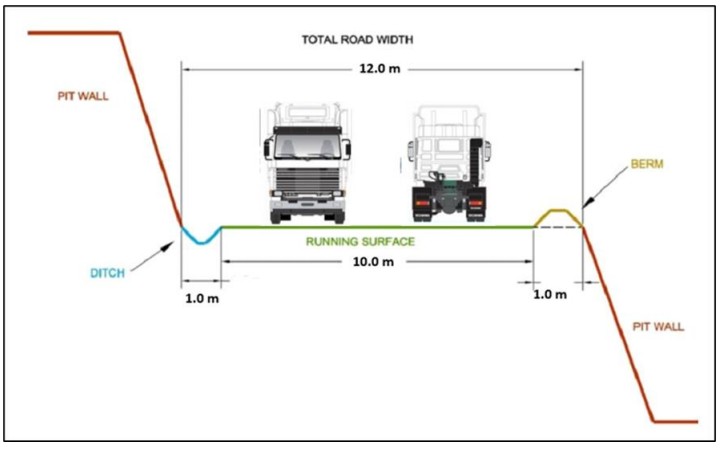
| 13.2.3.7 | Road
Construction and Maintenance |
The
excavation stage will start after the removal and storage of the topsoil.
As
the excavation progresses, drainage systems will be installed to avoid the accumulation of rainfall.
It
is planned to mobilize a Backhoe Excavator for drainage services, trench excavation, material disposal and small handling. Larger excavators
will be used according to the volume requirements for large and medium volumes. For transport, 8x4 trucks, with a capacity of 40 t, will
be used, allowing for productivity and safety.
| 13.2.3.8 | Drilling
and Blasting |
A
strategic partnership was established between Atlas Lithium and ENAEX, a globally recognized leader in explosives manufacturing and rock
blasting services, to support the design and implementation of an optimized blasting plan tailored to the geological and operational
conditions of the Anitta deposits. The primary objective of this collaboration is to ensure effective rock fragmentation—both for
ore and waste—while maintaining a high level of operational safety and cost efficiency.
As
part of the scope, ENAEX is conducting a detailed blast engineering study, which includes:
| ● | Characterization
of rock mass properties to assess fragmentation behavior; |
| ● | Selection
and testing of suitable explosive types for various lithologies encountered on site; |
| ● | Design
of blast hole patterns, burden and spacing, and initiation sequences tailored for different
materials (pegmatite, schist, saprolite); |
|
| SGS Geological Services |
| S-K 1300 Technical Report – FS Neves Lithium Project – Minas Gerais, Brazil | Page 210 |
| | |
| ● | Definition
of powder factors and blast energy distribution to optimize fragmentation while minimizing
vibration, flyrock, and air blast; |
| ● | Operational
safety protocols, including handling, storage, and transportation of explosives in compliance
with Brazilian regulatory standards (e.g., ANM and Army regulations). |
Additionally,
the partnership includes the assessment of logistics and supply chain strategies to ensure timely and consistent delivery of explosive
materials, reducing the risk of production delays. ENAEX’s presence and infrastructure in Brazil provide the logistical capability
to service the operation efficiently.
The
blasting plan developed under this collaboration will be continuously monitored and adjusted during the early stages of operation based
on performance indicators such as fragmentation size distribution, diggability, and downstream processing efficiency.
| 13.2.3.9 | Explosives
Consumption |
To
determine the required quantity of explosives, blasting simulation studies were conducted to evaluate and define the most appropriate
scenario for implementation. These simulations allowed for the optimization of blast design parameters such as burden, spacing, powder
factor, and explosive type, ensuring effective fragmentation and operational efficiency while maintaining safety and cost control.
| 13.2.3.9.1 | Simulated
Scenarios – Ore Blasting Parameters |
Multiple
blasting simulations were carried out for the pegmatite ore in the Anitta 2 and Anitta 3 pits to determine the optimal blasting configurations
for ore extraction. These simulations were conducted considering the specific geomechanical characteristics of the deposit and the operational
requirements of the crushing plant.
A
total of 14 optimized scenarios were selected based on their compatibility with plant specifications and overall operational efficiency.
The simulations focused on evaluating the influence of key blasting parameters, including:
| ● | Bench
height: 10 m, 15 m, and 20 m |
| ● | Drilling
diameter: 89 mm, 102 mm, 114 mm, 127 mm, and 146 mm |
| ● | Explosive
type: ANFO and Ibemux (pumped emulsion) |
These
scenarios serve as the foundation for the recommended blast designs to be implemented in the ore zones, ensuring proper fragmentation,
minimizing fines generation, and optimizing diggability and crusher feed size distribution.
|
| SGS Geological Services |
| S-K 1300 Technical Report – FS Neves Lithium Project – Minas Gerais, Brazil | Page 211 |
| | |
Table
13-18 Simulated Scenarios – Ore Blasting Parameters
| Blasting
Type |
Scenario_1 |
Scenario_2 |
Scenario_3 |
Scenario_4 |
Scenario_5 |
Scenario_6 |
Scenario_7 |
Scenario_8 |
Scenario_9 |
Scenario_10 |
Scenario_11 |
Scenario_12 |
Scenario_13 |
Scenario_14 |
| Bench
Height (m) |
10.0 |
10.0 |
10.0 |
10.0 |
10.0 |
10.0 |
10.0 |
15.0 |
10.0 |
15.0 |
10.0 |
10.0 |
10.0 |
10.0 |
| Burden
(m) |
2.2 |
2.2 |
2.6 |
2.8 |
2.8 |
2.7 |
3.1 |
3.2 |
3.0 |
3.0 |
4.0 |
4.5 |
4.8 |
4.2 |
| Spacing
(m) |
2.6 |
2.6 |
2.9 |
3.2 |
3.2 |
3.1 |
3.5 |
3.7 |
3.5 |
3.5 |
4.6 |
5.2 |
5.5 |
4.8 |
| Hole
Diameter (mm) |
89 |
89 |
102 |
102 |
102 |
102 |
114 |
114 |
114 |
114 |
127 |
146 |
146 |
127 |
| Inclination
(degrees)) |
15 |
15 |
15 |
15 |
15 |
15 |
15 |
15 |
15 |
15 |
15 |
15 |
15 |
15 |
| Hole
Length (m) |
11.15 |
11.15 |
11.15 |
11.15 |
11.15 |
11.15 |
11.15 |
16.03 |
10.85 |
16.03 |
11.55 |
11.71 |
11.79 |
11.61 |
| Sub-drilling
(m) |
0.8 |
0.8 |
0.8 |
0.8 |
0.8 |
0.8 |
0.8 |
0.5 |
0.5 |
0.5 |
1.2 |
1.4 |
1.4 |
1.2 |
| Stemming
(m) |
1.6 |
1.6 |
1.8 |
2.0 |
2.0 |
1.9 |
2.2 |
2.2 |
2.1 |
2.1 |
4.0 |
4.5 |
4.8 |
4.8 |
| |
|
|
|
|
|
|
| Explosive
Type |
Std
ANFO |
Ibemux |
Std
ANFO |
Std
ANFO |
Ibemux |
Ibemux |
Ibemux |
Ibemux |
Std
ANFO |
Std
ANFO |
Std
ANFO |
Std
ANFO |
Ibemux |
Ibemux |
| |
|
|
|
|
|
|
| Charge
per Hole (kg) |
53 |
69 |
61 |
60 |
86 |
87 |
106 |
163 |
79 |
126 |
84 |
106 |
135 |
99 |
| Powder
Factor (kg/m³) |
0.92 |
1.21 |
0.82 |
0.67 |
0.96 |
1.04 |
0.97 |
0.92 |
0.76 |
0.81 |
0.46 |
0.45 |
0.50 |
0.49 |
| Powder
Factor (g/t) |
349 |
457 |
310 |
252 |
363 |
393 |
367 |
349 |
289 |
307 |
173 |
171 |
191 |
186 |
|
| SGS Geological Services |
| S-K 1300 Technical Report – FS Neves Lithium Project – Minas Gerais, Brazil | Page 212 |
| | |
| 13.2.3.9.2 | Simulated
Scenarios – Powder Factor Variation (g/t) for Ore |
For
the 14 ore blasting scenarios presented, the powder factor ranged from 171 g/t to 457 g/t, as shown in Figure 13-43.
Figure
13-43 Powder Factor by Scenario for Ore Blasting
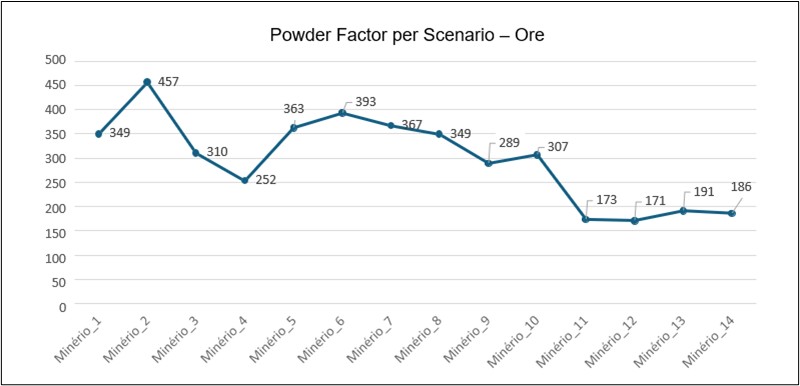
| 13.2.3.9.3 | Results
Analysis– Ore |
In
Scenarios 1 and 2, with a drill hole diameter of 89 mm (3 ½”), the topsize values reached approximately 500 mm, with P80
values around 190 mm—a much finer specification than what is required for the crushing plant. This analysis indicates the potential
to increase the drill diameter and expand the blast pattern, thereby reducing costs and aligning the granulometry with the requirements
of the concentration process, where excessive fines are undesirable. In these scenarios, the average powder factor was approximately
400 g/t.
In
Scenarios 3, 4, 5, and 6, using a 102 mm (4”) drill diameter, topsize values were around 650 mm, with P80 values near 230 mm. These
P80 values are still well below the desired target of 500 mm, for which the crushing plant was originally designed. This demonstrates
that further increases in drill diameter and blast pattern spacing are technically feasible. In these scenarios, the powder factor ranged
from approximately 250 to 390 g/t.
In
Scenarios 7, 8, 9, and 10, which used a 114 mm (4 ½”) drill diameter, the topsize values ranged from 637 mm to 2,550 mm,
with the worst results associated with simulations using 15-meter bench heights. Scenarios 7 and 9, which were based on 10-meter benches,
yielded topsize results consistent with the design ROM topsize of 700 mm. However, in the cases with finer fragmentation, the P80 values
were approximately 250 mm, which is below the design specification. Scenarios 8 and 10 achieved P80 values around 450 mm, which is close
to the target P80 specified for the crushing plant’s ROM design.
In
Scenarios 11 and 14, with a 127 mm (5”) drill diameter, the P80 values were 417 mm and 452 mm, respectively, while the topsize
values reached 1,337 mm and 1,468 mm. These scenarios resulted in particle size distribution curves that were the most consistent with
the plant’s design ROM curve. Scenario 14 utilized Ibemux (pumped emulsion), whereas Scenario 11 used ANFO.
For
Scenarios 12 and 13, based on a 146 mm (5 ¾”) drill diameter, the P80 was approximately 450 mm, with topsize values around
1,400 mm. The difference between the two scenarios lay in the type of explosive and blast pattern, with powder factors averaging around
180 g/t.
| 13.2.3.9.4 | Simulated
Scenarios – Waste Rock Blasting Parameters |
Several
blasting simulations were carried out for waste rock (fresh schist) in the Anitta 2, Anitta 3 and Anitta 2.5 pits to evaluate the most
suitable parameters for efficient and safe rock fragmentation. The simulations explored variations in the following key blasting parameters:
| ● | Bench
height: 10 m, 15 m, and 20 m |
| ● | Drilling
diameter: 89 mm, 102 mm, 114 mm, 127 mm, and 146 mm |
| ● | Explosive
type: ANFO or Ibemux (pumped emulsion) |
These
studies aimed to optimize fragmentation for efficient waste handling while maintaining slope stability, reducing overbreak, and ensuring
cost-effective use of explosives.
|
| SGS Geological Services |
| S-K 1300 Technical Report – FS Neves Lithium Project – Minas Gerais, Brazil | Page 213 |
| | |
Table
13-19 Simulated Scenarios – Waste Rock Parameters
| Blasting
Type |
Scenario
1 |
Scenario
2 |
Scenario
3 |
Scenario
4 |
Scenario
5 |
Scenario
6 |
Scenario
6 |
Scenario
7 |
Scenario
8 |
Scenario
9 |
Scenario
10 |
Scenario
11 |
| Bench
Height (m) |
10.0 |
10.0 |
15.0 |
20.0 |
10.0 |
10.0 |
10.0 |
10.0 |
10.0 |
10.0 |
10.0 |
10.0 |
| Burden
(m) |
4.0 |
2.7 |
2.7 |
2.7 |
3.1 |
3.4 |
3.8 |
4.4 |
5.1 |
5.5 |
5.8 |
5.8 |
| Spacing
(m) |
5.2 |
3.1 |
3.1 |
3.1 |
3.5 |
3.9 |
4.4 |
5.0 |
5.9 |
6.4 |
6.7 |
7.3 |
| Hole
Diameter (mm) |
89 |
89 |
89 |
89 |
102 |
114 |
127 |
146 |
146 |
146 |
146 |
146 |
| Inclination
(degrees)) |
15 |
15 |
15 |
15 |
15 |
15 |
15 |
15 |
15 |
15 |
15 |
15 |
| Hole
Length (m) |
11.55 |
11.15 |
16.33 |
21.50 |
11.27 |
11.38 |
11.49 |
11.66 |
11.88 |
12.01 |
12.10 |
12.10 |
| Sub-drilling
(m) |
1.2 |
0.8 |
0.8 |
0.8 |
0.9 |
1.0 |
1.1 |
1.3 |
1.5 |
1.7 |
1.8 |
1.8 |
| Stemming
(m) |
3.6 |
2.4 |
2.4 |
2.4 |
2.8 |
3.1 |
3.4 |
3.9 |
4.6 |
5.0 |
5.3 |
5.3 |
| |
|
| Explosive
Type |
Ibemux |
Std
ANFO |
Ibemux |
Ibemux |
Ibemux |
Ibemux |
Ibemux |
Ibemux |
Ibemux |
Ibemux |
Ibemux |
Ibemux |
| |
|
|
|
|
|
|
|
|
|
|
|
|
| Charge
per Hole (kg) |
57 |
63 |
100 |
137 |
80 |
98 |
117 |
149 |
140 |
135 |
132 |
132 |
| Powder
Factor (kg/m³) |
0.27 |
0.76 |
0.81 |
0.83 |
0.74 |
0.72 |
0.70 |
0.67 |
0.47 |
0.38 |
0.34 |
0.31 |
| Powder
Factor (g/t) |
103.7 |
290.3 |
308.0 |
316.9 |
282.5 |
275.2 |
267.6 |
256.2 |
177.5 |
145.2 |
127.7 |
117.5 |
|
| SGS Geological Services |
| S-K 1300 Technical Report – FS Neves Lithium Project – Minas Gerais, Brazil | Page 214 |
| | |
| 13.2.3.9.5 | Simulated
Scenarios – Powder Factor Variation (g/t) for Waste Rock |
For
the 11 waste rock blasting scenarios presented, the powder factor ranged from 104 to 317 g/t, as illustrated in Figure 13-44.
Figure
13-44 Graph of Powder Factor
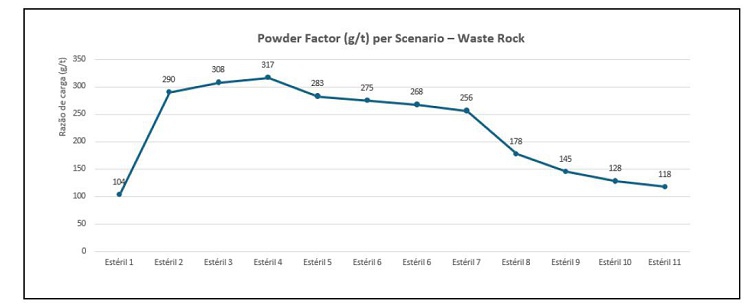
The
optimal blasting scenario for waste rock is defined as the one that achieves the lowest powder factor (i.e., lowest cost) while producing
a maximum fragment size (topsize) within the operational limits of the loading and hauling equipment. Standard 8x4 haul trucks are generally
designed to transport material with moderate fragment sizes, typically up to approximately 1 meter in diameter. While larger fragments
can be handled, they may compromise truck stability and reduce haulage efficiency.
Based
on the analysis of the simulated blasting scenarios for waste, Scenario 8 was identified as the most favorable. It achieved a powder
factor of approximately 178 g/t and a topsize of 1,031 mm, remaining within acceptable limits for efficient truck loading and transport
operations.
| 13.2.3.9.6 | Final
Blasting Specifications Defined for Ore and Waste |
Based
on the technical assessments and simulation studies conducted jointly by ENAEX and Atlas Lithium, the blasting specifications outlined
below have been identified as the most appropriate for routine mining operations in both ore and waste zones. These specifications reflect
a balance between fragmentation efficiency, operational safety, cost optimization, and compatibility with the loading, hauling, and crushing
systems of the project. The recommended drilling & blasting parameters in Table 13-17 were defined considering the geological and
geomechanical characteristics of the Anitta 2, Anitta 2.5 and Anitta 3 pits, as well as the design specifications of the processing plant.
|
| SGS Geological Services |
| S-K 1300 Technical Report – FS Neves Lithium Project – Minas Gerais, Brazil | Page 215 |
| | |
Table
13-20 Drilling & Blasting Parameters
| Parameters |
| Scenario |
Ore |
Waste |
| Lithology |
Pegmatite |
Fresh
Xist |
| Explosive
Type |
Pumped
Emulsion |
Pumped
Emulsion |
| Bench
Height (m) |
10 |
10 |
| Hole
Diameter (in) |
5.0 |
5
3/4” |
| Hole
Diameter (mm) |
127 |
146 |
| Burden
(m) |
4.2 |
5.1 |
| Spacing
(m) |
4.8 |
5.9 |
| Sub-drilling
(m) |
1.2 |
1.5 |
| Hole
Length (m) |
11.6 |
11.5 |
| Stemming
(m) |
4.8 |
4.6 |
| Charge
Length (m) |
6.8 |
6.9 |
| Explosive
Density (t/m³) |
1.15 |
1.15 |
| Linear
Charge Density (kg/m) |
14.6 |
20.5 |
| Charge
per Hole (kg) |
98.6 |
141.5 |
| Rock
Volume per Hole (m³) |
201.6 |
301 |
| Powder
Factor (kg/m³) |
0.49 |
0.47 |
| Rock
Density (t/m³) |
2.64 |
2.76 |
| Powder
Factor (g/t) |
0.185 |
0.170 |
| Blast
Size (# of holes) |
150 |
150 |
| Total
Rock Volume Blasted (m³) |
30,240 |
45,135 |
| Explosive
Consumption per Event (t) |
14.8 |
21.2 |
During
the operation, the daily blast plans will be prepared by the explosive supplier’s technical staff. These plans will be analyzed
and validated by the Atlas Lithium rock blasting team.
After
each blast, the blast plan will be updated according with the equipment quantities actually used. Physical and digital copies of all
generated documentation will be kept, which will be available for audits or inspection by regulatory bodies.
| 13.2.3.11 | Execution
of Blasting |
Rock
blasts will be carried out on scheduled dates, the frequency of which will meet the demand for blasted ore and waste.
For
all rock blasting, the authorities will also be previously communicated through the Rock Blasting Notice, as per Annex of ORDINANCE No.
147 - COLOG, of November 21, 2019.
|
| SGS Geological Services |
| S-K 1300 Technical Report – FS Neves Lithium Project – Minas Gerais, Brazil | Page 216 |
| | |
| 13.2.3.12 | Fragmentation
Control |
Fragmentation
control will be performed using specialized software that analyzes photographic records to generate granulometric distribution curves.
This monitoring enables adjustments to blast patterns, sequencing, and other parameters based on historical data. Rock blasting will
be monitored monthly or as needed, as determined by the contractor’s technical team, to optimize operations.
High-definition
cameras will record each blast, allowing for a detailed visual assessment of key factors such as detonation sequencing, mass displacement,
top stemming efficiency, and ultra-launch.
The
dewatering plan for the Anitta 2, Anitta 2.5 and 3 pits combines site-specific rainfall records and groundwater-flow simulations to size
pumping systems that support efficient mining while minimizing environmental, operational, and geotechnical impacts. The projections
take January 2026 as the initial reference point, defined as Year 0 and Month 0.
Surface
water was estimated based on direct precipitation over the footprint areas of each pit, excluding contributions from the entire pit catchment
area. It is therefore assumed that a peripheral drainage system will be implemented to divert upstream surface runoff, ensuring that
only the rainfall directly incident within the pit is effectively pumped.
As
previously mentioned, the adopted dewatering scenario considers drawdown through sumps, without the use of wells. These, however, may
be employed if necessary for the initial drawdown of the superficial porous aquifer or for industrial reuse of the water by the facility.
It is important to note that the geomechanical model developed for the pits assumes fully saturated pit walls, and therefore, no geotechnical
risks related to wall saturation are expected.
The
footprint areas of Anitta 2, Anitta 2.5 and Anitta 3 pits were defined based on their geometries. As the pit advances, the area exposed
to direct rainfall increases, raising the surface inflow to be pumped. The average pumping flow rates correspond to the sum of the monthly
surface and groundwater inflows, which gradually increase throughout the mine’s lifespan due to pit deepening and expansion of
mining fronts.
It
is important to emphasize that the presented values were obtained considering average climatological and hydrogeological conditions under
steady-state conditions, representing an aquifer equilibrium after the dissipation of water originally stored in the geological formations.
Thus, this scenario does not account for seasonal recharge and discharge variations, which, in principle, are not expected to result
in significant annual fluctuations during pit advancement.
In
general, groundwater inflow shows a gradual increase aligned with the progression of the mining operation, due to the deepening of the
pits and the consequent increase in contact area with the aquifer. As the simulations are under steady-state conditions, groundwater
values do not reflect seasonality.
Surface
inflow, in contrast, varies mainly as a function of the area exposed to rainfall and the monthly variation in precipitation, with minimum
values potentially approaching zero during dry periods and maximum values linked to more intense rainfall events. The total inflow, resulting
from the sum of surface and groundwater components, shows a progressive increase over the mine’s lifespan, reflecting the strong
seasonality of the surface component, with annual variations potentially reaching amplitudes of up to 70 m³/h.
The
average flow rate, represented by a 12-month moving average (Figure 13-45), and annually (Table 13-21) indicates a continuous increase
in the total volume of water to be pumped, especially in the initial years, when greater lateral and depth advancements of the pits are
observed. Since the sequencing of the Anitta 2.5 pit is not yet available, the analysis considered only the final geometry of the pit,
without accounting for any temporal evolution of flow rates. Therefore, the value presented in Table 13-21 reflects the final configuration
of the three combined pits.
|
| SGS Geological Services |
| S-K 1300 Technical Report – FS Neves Lithium Project – Minas Gerais, Brazil | Page 217 |
| | |
Figure
13-45 Evolution of Average Pit Pumping Over Time (Anitta 2 and 3)
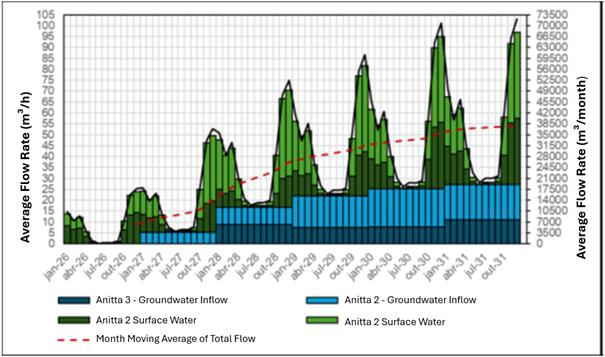
Source:
WSP (2025)
Table
13-21 Evolution of the Contribution of the Total Average Inflow Over Time
| Year |
Average
Pumping Flow Rate in the Pits (m³/h |
| Underground* |
Surface |
Total |
| |
Minimum |
Medium |
Maximum |
Minimum |
Medium |
Maximum |
Minimum |
Medium |
Maximum |
| Year
0 |
0.0 |
0.0 |
0.0 |
0.1 |
8.5 |
23.9 |
0.1 |
8.5 |
23.9 |
| Year
1 |
5.4 |
5.4 |
5.4 |
0.1 |
14.0 |
44.1 |
5.5 |
19.4 |
49.5 |
| Year
2 |
16.9 |
16.9 |
16.9 |
0.2 |
19.0 |
53.6 |
17.1 |
35.9 |
70.5 |
| Year
3 |
22.1 |
22.1 |
22.1 |
0.3 |
21.1 |
59.4 |
22.4 |
43.2 |
81.5 |
| Year
4 |
25.2 |
25.2 |
25.2 |
0.3 |
23.8 |
69.9 |
25.5 |
49.0 |
95.1 |
| Year
5 |
27.1 |
27.1 |
27.1 |
0.3 |
24.8 |
69.9 |
27.4 |
51.9 |
97.0 |
| Year
6 |
27.1 |
27.1 |
27.1 |
0.3 |
24.8 |
69.9 |
27.4 |
51.9 |
97.0 |
| Final
Year** |
33.2 |
33.2 |
33.2 |
0.3 |
28.1 |
79.4 |
33.5 |
61.3 |
112.6 |
*
Obtained through the numerical model in permanent regime and, therefore, does not present seasonal variation.
**
Final year of Anitta 2.5, considering all pits in the final geometry simultaneously.
Source:
WSP (2025).
|
| SGS Geological Services |
| S-K 1300 Technical Report – FS Neves Lithium Project – Minas Gerais, Brazil | Page 218 |
| | |
| 13.2.4.1 | Dewatering
Structures |
For
the sizing of the dewatering system under critical conditions, a 24-hour design rainfall event with a 10-year return period was adopted.
Subsequently, these annual maximum precipitation values were fitted to the Gumbel distribution (EVI), resulting in a daily precipitation
of 100.4 mm for a 10-year TR. Considering the multiplication factor of 1.14 (CETESB, 1986), which relates the daily reading to the effective
24-hour precipitation, a final value of 114.5 mm was obtained. For the system design, only direct rainfall over the footprint of each
pit was considered, assuming the implementation of a peripheral drainage system that diverts surface runoff from external areas (Table
13-22).
It
is worth noting that the footprint areas for each phase account for progressive mining, characterized by lateral surface advancement
before deepening. Therefore, the greatest surface contribution is expected during the initial year of each phase, when the pit reaches
the surface expansion planned for that stage.
Based
on groundwater inflow values and the flow rates determined from the design rainfall event, the required pumping flow rates for complete
dewatering of the pits were calculated for intervals of 7, 14, 21, and 28 days. These estimates assume that no additional significant
rainfall events would occur during the pumping period following the critical storm (Table 13-23).
These
estimates provide an initial guideline for sizing the dewatering system, considering both groundwater and the volume resulting from the
adopted rainfall event.
Table
13-22 Total Water Inflow and Drainage Flow Associated with the Pits
| Pit |
Phase |
Start
Year |
Constant
influx of groundwater (m³/h) |
Total
water volume associated with the rainfall event (m³ |
| Anitta
2 |
Phase
1 |
Year
0 |
0 |
8,545 |
| Phase
2 |
Year
3 |
7.5 |
12,035 |
| Phase
3 |
Year
4 |
7.8 |
14,387 |
| Phase
4 |
Year
4 |
7.8 |
18,332 |
| Phase
4 |
Year
5 |
11.1 |
18,332 |
| Anitta
3 |
Phase
1 |
Year
0 |
0 |
5,839 |
| Phase
2 |
Year
1 |
5.4 |
11,167 |
| Phase
3 |
Year
1 |
5.4 |
18,019 |
| Phase
4 |
Year
2 |
8.1 |
23,739 |
| Phase
4 |
Year
5 |
16 |
23,739 |
| Anitta
2.5 |
- |
- |
6.1 |
10,231 |
Source:
WSP (2025).
|
| SGS Geological Services |
| S-K 1300 Technical Report – FS Neves Lithium Project – Minas Gerais, Brazil | Page 219 |
| | |
Table
13-23 Total Water Inflow and Drain Flow Associated with Each Period
| Period
– Days* |
7 |
14 |
21 |
28 |
| Pit |
Phases |
Total
groundwater influx
(m³) |
Total
water influx
(m³) |
Required
flow rate for dewatering
(m³/h) |
Total
groundwater influx
(m³) |
Total
water influx
(m³) |
Required
flow rate for dewatering
(m³/h) |
Total
groundwater influx
(m³) |
Total
water influx
(m³) |
Required
flow rate for dewatering
(m³/h) |
Total
groundwater influx
(m³) |
Total
water influx
(m³) |
Required
flow rate for dewatering
(m³/h) |
| Anitta
2 |
Phase
1 |
0.0 |
8,545.2 |
50.9 |
0.0 |
8,545.2 |
25.4 |
0.0 |
8,545.2 |
17.0 |
0.0 |
8,545.2 |
12.7 |
| Phase
2 |
1,260.0 |
13,295.2 |
79.1 |
2,520.0 |
14,555.2 |
43.3 |
3,780.0 |
15,815.2 |
31.4 |
5,040.0 |
17,075.2 |
25.4 |
| Phase
3 |
1,310.4 |
15,697.1 |
93.4 |
2,620.8 |
17,007.5 |
50.6 |
3,931.2 |
18,317.9 |
36.3 |
5,241.6 |
19,628.3 |
29.2 |
| Phase
4 |
1,864.8 |
20,197.1 |
120.2 |
3,729.6 |
22,061.9 |
65.7 |
5,594.4 |
23,926.7 |
47.5 |
7,459.2 |
25,791.5 |
38.4 |
| Anitta
3 |
Phase
1 |
0.0 |
5,838.7 |
34.8 |
0.0 |
5,838.7 |
17.4 |
0.0 |
5,838.7 |
11.6 |
0.0 |
5,838.7 |
8.7 |
| Phase
2 |
907.2 |
12,074.3 |
71.9 |
1,814.4 |
12,981.5 |
38.6 |
2,721.6 |
13,888.7 |
27.6 |
3,628.8 |
14,795.9 |
22.0 |
| Phase
3 |
1,360.8 |
19,379.6 |
115.4 |
2,721.6 |
20,740.4 |
61.7 |
4,082.4 |
22,101.2 |
43.9 |
5,443.2 |
23,462.0 |
34.9 |
| Phase
4 |
2,688.0 |
26,426.5 |
157.3 |
5,376.0 |
29,114.5 |
86.7 |
8,064.0 |
31,802.5 |
63.1 |
10,752.0 |
34,490.5 |
51.3 |
| Anitta
2.5 |
- |
1,024.8 |
5,111.5 |
30.4 |
2,049.6 |
6,136.3 |
18.3 |
3,074.4 |
7,161.1 |
14.2 |
4,099.2 |
8,185.9 |
12.2 |
*
Day intervals indicate the dewatering duration (in days) used to calculate the required pumping flow rates to fully dewater each pit
phase.
Source:
WSP (2025).
|
| SGS Geological Services |
| S-K 1300 Technical Report – FS Neves Lithium Project – Minas Gerais, Brazil | Page 220 |
| | |
Using
as reference the scenario with the highest water inflow (considering the maximum footprint and depth), the minimum design flow rates
for the pumping system of each pit were defined, allowing dewatering of the pit bottom within 7, 14, 21, and 28 days after extreme rainfall
events, as detailed below:
| ● | Anitta
2: approximately 120 m³/h, 65 m³/h, 50 m³/h, and 40 m³/h, respectively |
| ● | Anitta
3: approximately 160 m³/h, 90 m³/h, 65 m³/h, and 50 m³/h, respectively |
| ● | Anitta
2.5: approximately 30 m³/h, 18 m³/h, 14 m³/h and 12 m³/h, respectively |
These
rates establish the minimum pump capacities necessary to maintain safe, dry conditions at the pit bottom. Because the required flows
are relatively modest, the dewatering system can be optimized by installing primary pumps and boosters in each pit phase, matching the
schedule of excavation and demand escalation. Pump selection and deployment should follow the mine’s development plan, enabling
phased procurement as the pits advance.
As
previously noted, groundwater control will rely primarily on bottom-pit sumps, which are best suited to the site’s operational
and hydrogeological conditions. Licensed pumping wells could be used in Year 0 to achieve the initial drawdown, reduce saturation in
the weathered zones of the pit walls, and serve as the principal water supply. From Year 1 onward, as dewatering volumes increase, the
licensed wells should only be activated if sump discharge capacity is exceeded or to meet secondary water-use demands, since their additional
drawdown effect beyond the first year is modest.
Table
13-24 lists licensed rates and Figure 13-46 illustrates well locations—note that Atlas Well P10 will likely shut off under full-system
drawdown (due to Well P13), while the other wells deliver a combined 50.1 m³/h. Wells adjacent to the pits form the primary dewatering
network; while P13 Evandro and P14 Evandro, being too distant from the active pit zones, are reserved for secondary use and are not part
of the primary dewatering system.
With
no natural springs or streams on site, all dewatering discharge from the bottom pit sump and licensed wells can be captured and cycled
back into operations, whether for dust control, processing makeup water or other uses, without the need for compensatory releases downstream.
An integrated water-quality monitoring program should inform all treatment, storage and reuse decisions, since both volume and chemistry
vary seasonally: during the dry season, nearly all inflow is groundwater with elevated dissolved-metal levels, while in the rainy months
surface runoff predominates and dilutes those concentrations.
Table
13-24 Total Water Inflow and Drainage Flow Associated with the Pits
| Licensed
Wells |
Licensed
Flow
Rate
(m³/h) |
Operational
Flow Rate (m³/h) |
Dewatering
Wells Operational Flow Rate (m³/h) |
| Atlas
Well 10* |
9.3 |
0 |
0 |
| Evandro’s
well 13** |
10 |
10 |
0 |
| Evandro’s
well 14** |
7.4 |
7.4 |
0 |
| Atlas
well 14 |
6.5 |
6.5 |
6.5 |
| Atlas
well 16 |
7.8 |
7.8 |
7.8 |
| Atlas
well 13 |
6.5 |
6.5 |
6.5 |
| Atlas
well 09 |
7.2 |
7.2 |
7.2 |
| Atlas
4 well |
4.6 |
4.6 |
4.6 |
| Total |
59.3 |
50.1 |
32.7 |
*
Zero discharge well, drawdown from Well P13 shuts it off, since year 0
**
Distant wells, not suitable for pit dewatering, although they could be used to meet other water-use demands
Source:
WSP (2025).
|
| SGS Geological Services |
| S-K 1300 Technical Report – FS Neves Lithium Project – Minas Gerais, Brazil | Page 221 |
| | |
Figure
13-46 Location of the Dewatering Wells
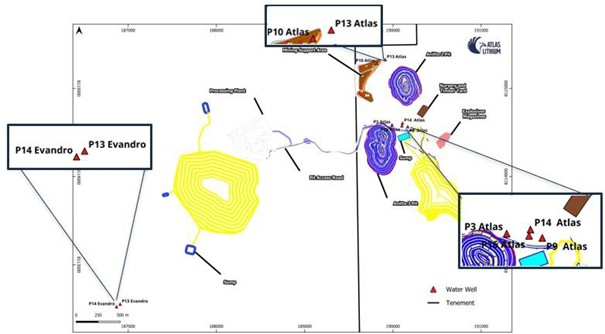
The
progressive development of the open pits will result in increasing water infiltration from precipitation and groundwater inflows. As
the pits deepen and increase in footprint, it will be necessary to control water inflow through the construction of in-pit dewatering
systems such as drainage ditches, in-pit sumps, pipelines, and pumps.
In
the pit, dewatering sumps are to be utilized to contain groundwater and stormwater run-off, which would be pumped directly to a settling
pond.
An
allowance has been included in the open pit capital and operating costs for in-pit dewatering through in-pit sumps. In-pit dewatering
will be accomplished by diesel driven pumps for the calculated water inflow and will be stationed at the pit floor sump. As the pits
get deeper, booster pumps are expected to be required when the elevation passes approximately 160 m. Water will be pumped through high-density
polyethylene pipe of appropriate diameter and discharged into a settling pond to allow for settlement of suspended solids to meet environmental
requirements.
Groundwater
inflows were estimated for Anitta 2, 2.5, and 3 at the PFS Level. For reference, the methodology, all parameters used, as well as the
complete and detailed results can be found in the full Hydrogeological report from WSP dated April 17, 2025,
|
| SGS Geological Services |
| S-K 1300 Technical Report – FS Neves Lithium Project – Minas Gerais, Brazil | Page 222 |
| | |
| 14 | PROCESSING
AND RECOVERY METHODS |
At
the time of writing of this section, the main process engineering design effort has been completed by Atlas Lithium and major process
equipment items for the DMS plant, solid/liquid separation, and tailings areas have already been procured. This section describes the
processing methods and key design criteria to recover spodumene from the Anitta deposit within the Neves Project as developed by Atlas
Lithium.
The
process plant beneficiation design specifies dense media separation (DMS) to recover spodumene and is based on an annual plant throughput
of approximately 1.16 million metric tonnes. The process equipment sizing is based on a utilization and availability factor of 70% (6,132
hours per year) for the comminution circuit and 90% (7,884 hours per year) for the DMS and downstream circuits.
The
comminution circuit flowsheet includes three stages of crushing with the tertiary crushing system operating in closed circuit with a
vibrating screen cutting at 9.5 mm. The comminution circuit process flow diagram is depicted in Figure 14-1. The crushed ore will be
fed to the wet process plant with the -0.85 mm material being removed and material with size fraction between 0.85 to 9.5 mm will be
processed employing two stages of DMS in a rougher and cleaner configuration.
The
sink product from the secondary DMS circuit will be the final spodumene concentrate, while the float products from two stages of DMS
circuits and -0.85 mm material will be the tailings. The key process circuits including the comminution, the primary DMS and the secondary
DMS are depicted in Figure 14-1 to Figure 14-3.
|
| SGS Geological Services |
| S-K 1300 Technical Report – FS Neves Lithium Project – Minas Gerais, Brazil | Page 223 |
| | |
Figure
14-1 Atlas Lithium Neves Project Process Flow Diagram – Comminution
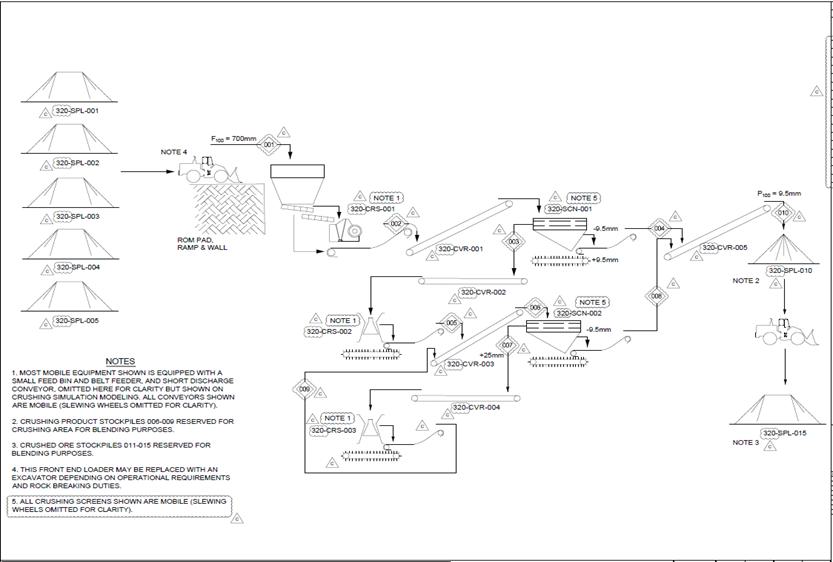
|
| SGS Geological Services |
| S-K 1300 Technical Report – FS Neves Lithium Project – Minas Gerais, Brazil | Page 224 |
| | |
Figure
14-2 Atlas Lithium Neves Project Process Flow Diagram – Primary Dense Media Separation
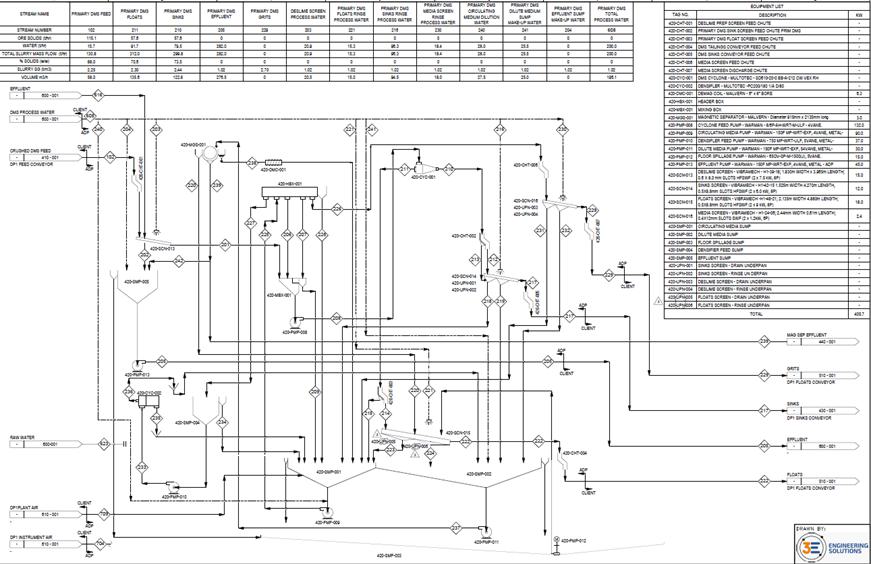
|
| SGS Geological Services |
| S-K 1300 Technical Report – FS Neves Lithium Project – Minas Gerais, Brazil | Page 225 |
| | |
Figure
14-3 Atlas Lithium Neves Project Process Flow Diagram – Secondary Dense Media Separation
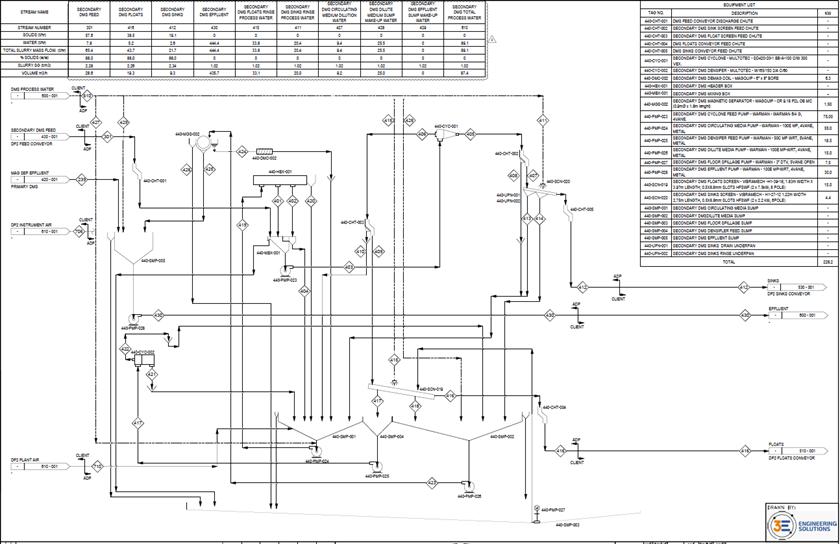
|
| SGS Geological Services |
| S-K 1300 Technical Report – FS Neves Lithium Project – Minas Gerais, Brazil | Page 226 |
| | |
Three
stages of crushing will be employed in the comminution circuit to produce the final crushed product with the maximum particle size of
9.5 mm. The key process design criteria of the comminution circuit are summarized in Table 14-1.
Table
14-1 Atlas Lithium Comminution Circuit Process Design Criteria
| Item |
Unit |
Value/Specifications |
Source |
| Plant
Throughput |
mtpa |
1,162,000
|
Atlas |
| Ore
Bulk Density |
mt/m3 |
1.62
|
Atlas |
| Ore
SG |
mt/m3 |
2.70 |
Atlas |
| Concentrate
Li2O Content, minimum |
% |
5.5 |
Atlas |
| Final
Crush Size |
mm |
9.5 |
Atlas |
| Comminution
Circuit Utilization & Availability |
% |
70 |
Atlas |
| Design
Factor |
|
1.25 |
SGS |
| Static
Grizzly Aperture |
mm |
700 |
Atlas |
| Vibrating
Grizzly Feeder Aperture |
mm |
75 |
Atlas |
| Grizzly
Feeder Feed Rate, Design |
mtph |
237 |
Calculated |
| Primary
Crusher |
|
Metso
C120 or Equivalent |
Atlas |
| Primary
Crusher Close Side Setting |
mm |
120 |
Atlas |
| Primary
Crusher Feed Rate, Design |
mtph |
142 |
Calculated |
| Secondary
Screen Aperture |
mm |
40
top deck, 9.5 bottom deck |
Atlas |
| Secondary
Screen Feed Rate, design |
mtph |
237 |
Calculated |
| Secondary
Cone Crusher |
|
Metso
HP 300 or equivalent |
Atlas |
| Secondary
Crusher Close Side Setting |
mm |
19 |
Atlas |
| Secondary
Crusher Feed Rate, Design |
mtph |
196 |
Calculated |
| Tertiary
Screen Aperture |
mm |
50
top deck, 25 middle deck and 9.5 bottom deck |
Atlas |
| Tertiary
Screen Feed Rate, Design |
mtph |
492 |
Calculated |
| Tertiary
Crusher |
|
Metso
HP 300 or equivalent |
Atlas |
| Tertiary
Crusher Close Side Setting |
mm |
15 |
Atlas |
| Tertiary
Crusher Feed Rate, Design |
mtph |
296 |
Calculated |
| Crushed
Ore Stockpile Capacity |
mt |
9095 |
Assumed |
| Percent
of -0.85 mm material |
% |
21.9 |
Testwork |
The
Run of Mine (ROM) material will be delivered by mining haul trucks to the ROM pad area. The ROM material will be discharged to discrete
ROM stockpiles near the primary jaw crusher. These stockpiles will have individual levels of lithium grade and impurities content. A
Front-End Loader (FEL) will blend the comminution circuit feed appropriately using a ratio of buckets from specific stockpiles as directed
by the Atlas operating team. The FEL will further transfer the ROM ore to the primary crushing station, which consists of a ROM Feed
Bin of 11 m3 capacity, protected by a static grizzly with a 700 mm aperture size, a vibrating grizzly feeder with a 75 mm
aperture size, a primary jaw crusher, a rock breaker, and a dust collection system.
|
| SGS Geological Services |
| S-K 1300 Technical Report – FS Neves Lithium Project – Minas Gerais, Brazil | Page 227 |
| | |
The
vibrating grizzly feeder oversize will report to the jaw crusher, while the grizzly undersize will join with the jaw crusher product
and be transferred to the secondary crushing circuit by a series of conveyors. A hydraulic rock breaker will be installed adjacent to
the ROM feed bin to break any oversize material retained by the static grizzly.
The
design of the comminution circuit capacity is based on the overall utilization and availability factor of 70% which corresponds to an
annual operation of 6,132 hours per year, with a nominal comminution circuit feed rate of 189.5 mtph (metric tonne per hour) or a design
rate of 237 mtph based on a design factor of 1.25. A Metso jaw crusher C120 or equivalent is to be used in the primary crushing process.
The jaw crusher will have a closed side setting (CSS) around 120 mm.
The
primary crusher discharge will be conveyed to a secondary screen, which will be a double deck screen with the screen aperture of 40 mm
on the top deck and 9.5 mm on the bottom deck. The -9.5 mm material will report to the final crushed ore stockpile (COS) while the remaining
+9.5 mm material will report to the secondary cone crusher. The secondary crusher will be a Metso HP 300 or equivalent.
The
secondary crusher discharge, combined with the recycled tertiary crusher discharge, will report to the tertiary screen. The tertiary
screen will be a triple deck screen, with the top deck aperture of 50 mm, the middle deck aperture of 25 mm and bottom deck aperture
of 9.5 mm. The tertiary screen undersize (-9.5 mm material) will report to the final COS, while the screen oversize (+9.5 mm material)
will be fed to the tertiary crusher. The crusher product will be recycled back to the tertiary screen forming a closed loop crushing
system. The tertiary crusher will be a Metso HP 300 or equivalent. The crushed ore stockpile will have a total capacity around 9,100
metric tonnes which corresponds to approximately two days of crushing operation.
| 14.3 | Wet
Plant Feed Preparation |
The
design of the wet processing plant is based on the overall utilization and availability factor of 90% which corresponds to an annual
operation of 7,884 hours per year, with a nominal wet plant feed rate around 147 mtph. As the presence of fine material can deteriorate
the DMS circuit performance, the -0.85 mm material needs to be removed before the DMS process.
The
wet plant feed will be comprised of material reclaimed from the COS by a FEL and will be first loaded into a 45 m3 feed bin.
A belt feeder will withdraw the -9.5 mm material from the feed bin and discharge to a conveyor which ultimately will transfer the plant
feed to a Feed Preparation Screen via a feed box where the crushed material will be repulped with process water before screening.
The
Feed Preparation Screen will be a wet vibrating screen with an aperture size of 0.85 mm. The screen undersize will gravity flow to a
sump and then be pumped to a thickener or directly to a vacuum belt filter. The screen oversize, the -9.5+0.85 mm material, will be transferred
to an intermediate surge bin (primary DMS feed bin) via another conveyor. The bin will be equipped with a belt feeder which discharges
to a transfer conveyor which conveys the DMS plant feed to a wet deslime screen with aperture size of 0.6 mm, which is to remove any
residual fines prior to the DMS process. The deslime screen undersize will be pumped to a thickener or a vacuum belt filter combined
with -0.85 mm material, while the screen oversize will be discharged directly into the primary DMS feed box where it will be combined
with dense media makeup (ferrosilicon slurry).
| 14.4 | Dense
Media Separation Circuits |
Due
to a large proportion of DMS feed that needs to be rejected to the tailings, two stages of DMS processing in a rougher and cleaner configuration
are utilized in the design to optimize the DMS efficiency. Based on the process design, approximately 50% of the primary DMS cyclone
feed will be rejected to the cyclone floats (rejects) discharge by adjusting the media separation density accordingly. This will be achieved
using media pipe densifiers and water re-addition that will be controlled very carefully using control valves and media densitometers.
|
| SGS Geological Services |
| S-K 1300 Technical Report – FS Neves Lithium Project – Minas Gerais, Brazil | Page 228 |
| | |
Based
upon the current test work, as described in Section 10 of this study report, approximately 15% to 21% of DMS feed will report to the
final spodumene concentrate (secondary DMS sinks) as yield. The percentage of primary DMS floats product can be further adjusted to optimize
the overall DMS recovery. The key process design criteria of the DMS circuits are summarized in Figure 14-2.
At
the primary DMS feed box, the ore will be mixed with dense media with a volumetric ratio between the dense media slurry and the ore of
4.7. The mixture of dense media and ore will be pumped to the primary DMS cyclone with the inlet pressure controlled around 160 kPa.
One Multotec DMS cyclone, model SD610-20-0/BB-A/210 will be utilized for the primary DMS process.
Table
14-2 Atlas Lithium Primary and Secondary DMS Circuits Process Design Criteria
| Item |
Unit |
Value/Specifications |
Source |
| DMS
circuit Utilization & Availability |
% |
90 |
Atlas |
| Dense
Medium Reagent |
|
100%
ferrosilicon |
Atlas |
| Ferrosilicon
particle SG |
|
6.8 |
Atlas |
| DMS
feed particle size |
mm |
-9.5+0.85 |
Atlas |
| Final
concentrate Li2O content |
% |
minimum
5.5 |
Atlas |
| Final
concentrate Fe2O3 content |
% |
less
than 1% |
Atlas |
| Primary
DMS Feed Rate, Nominal/Design |
mtph |
115/132 |
Vendor |
| Primary
DMS cyclone Model |
|
SD610-20-0/BB-A/210 |
Vendor |
| Primary
DMS cyclone Operating Pressure |
kPa |
161 |
Vendor |
| Primary
DMS Drain & Rinse screen Aperture |
mm |
0.5
x 8.8 |
Atlas |
| Primary
DMS Media Degrit Screen Aperture |
mm |
0.4
x 12 |
Atlas |
| Primary
Densifier underflow SG |
|
3.1 |
Vendor |
| Primary
mag separator feed density |
% |
7.7 |
Vendor |
| Secondary
Stage DMS Feed Rate, Nominal/Design |
mtph |
58/66 |
Atlas |
| Secondary
DMS cyclone Model |
|
SD420-20-1/BB-A/145 |
Atlas |
| Secondary
DMS cyclone Operating Pressure |
kPa |
200 |
Vendor |
| Secondary
DMS Drain & Rinse screen Aperture |
mm |
0.5x8.8 |
Atlas |
| Second
Densifier underflow SG |
|
3.1 |
Vendor |
Both
sink and float discharges from the primary DMS cyclone will first report to static drain panels and then to individual drain and rinse
screens. The rinse and drain screens have a split underpan whereby the first half the screen recovers a significant portion of ferrosilicon
slurry which ultimately reports back to the primary correct media sump. The second half of the screen will be equipped with spray water
to wash the remaining ferrosilicon from the ore and recover this to the dilute media sump. The dilute ferrosilicon slurry contained within
the dilute media sump will be pumped to a magnetic separator whereby the ferrosilicon will be recovered to the correct media sump via
a demagnetizing coil, while the water and non-magnetic fine material are discharged to effluent and recycled. The drain and rinse screen
oversize from each of the primary DMS float and sink screens will report to its respective conveyor. The primary DMS float screen oversize
will be coarse tailings reject and will be discarded to the tailings stockpile. The sinks screen oversize will be an intermediate grade
concentrate ready for further upgrading via the secondary DMS circuit.
The
primary DMS sink material will be deslimed on the interstage screen having an aperture size of 0.5 mm. The screen undersize will be pumped
to either the thickener or a vacuum filter, while the screen oversize will be transferred to a surge bin (secondary DMS feed bin). The
deslimed primary DMS sink material will be withdrawn from the surge bin by a belt feeder and discharged into the secondary DMS mixing
box where it will be mixed with a higher specific gravity ferrosilicon slurry than that of the primary DMS slurry.
|
| SGS Geological Services |
| S-K 1300 Technical Report – FS Neves Lithium Project – Minas Gerais, Brazil | Page 229 |
| | |
The
mixture of dense media and primary DMS sink material will be pumped to the secondary DMS cyclone with the inlet pressure controlled around
200 kPa. One Multotec DMS cyclone, model SD420-20-1/BB-A/145 will be utilized for the second stage DMS. The volumetric ratio between
the dense media slurry and the ore in the secondary DMS is designed to be 5.5 minimum.
The
dense media SG will be carefully controlled to a specific setpoint to achieve a selected cut point to provide a final spodumene concentrate
grade of 5.5% lithium oxide in the secondary DMS cyclone sinks. Analogous to the primary DMS circuit, both the secondary DMS cyclone
sink discharge and the corresponding float discharge will report first to static drain panels and then to drain and rinse screens.
The
majority of dense medium ferrosilicon will be recovered to the secondary correct media sump from the drain section of the screen. The
ore material will be similarly washed on the rinse section of the screen and this dilute ferrosilicon slurry reports to the secondary
dilute media sump. The ferrosilicon from the dilute media sump will be recovered via a magnetic separator to the secondary correct media
sump, and the non-magnetic effluent will be recycled. After recovering the dense media, the secondary DMS sink product will be conveyed
to the final spodumene concentrate stockpiles via transfer conveyors, while the secondary DMS floats material (middlings) will be conveyed
to the middling stockpile. In the current design, this middling will not be further processed and will be combined with the final tailings.
The
dense media will be a “homogeneous” mixture of ferrosilicon powder and water. The ferrosilicon to be used has a specific
gravity around 6.8. The primary DMS and secondary DMS circuits will each have its own media preparation system due to the different separation
densities and system volumes required.
The
primary DMS circuit will be equipped with a number of key components including a correct media sump, a dilute media sump, a media pipe
densifier, a magnetic separator, a media grit screen, demagnetizing coil and other associated equipment including DMS feed mixing box
and a header box. Maintaining a carefully controlled density setpoint of the ferrosilicon slurry feed to the DMS cyclone will be crucial
to the DMS performance.
Therefore,
the media slurry density in the correct media tank needs to be maintained above the desired feed SG setpoint with water carefully added
back via a control valve to achieve the desired setpoint. The pipe densifier will be used to remove water from the correct media on a
continuous basis. The ferrosilicon media with the correct density will be pumped to a media head box above the DMS mixing box where it
then flows back to the mixing box in two locations at specified volumetric ratios to the ore feed rate. For both correct media sump and
dilute media sump, plant air may be injected into the sumps to suspend the media if required, especially after a sustained shutdown period
if the ferrosilicon has settled in the sumps.
The
media in the head box will gravity flow to the DMS cyclone feed pump box and will mix with the ore, and then be pumped to the DMS cyclone.
Through the natural attrition between the particles during pumping and various process unit operations, grit particles accumulate in
the media system. When excessive grit is present in the dense media, the DMS efficiency can be negatively impacted. Therefore, the media
will be continually cleaned by diverting a small flowrate of the media from the media head box to the media grit screen cutting at 0.4
mm. The media grit screen has two sections, a drain section and a rinse section. The screen oversize grit will report to the tailings,
and the undersize from drain section will report to the correct media sump and undersize from the rinse section will report to the dilute
media sump.
The
design of the dense media system for the secondary DMS circuit will be very similar to the design of the primary DMS circuit. The main
difference is that there is no secondary media screen in the secondary DMS circuit. The secondary DMS floats discharge reports to a media
drain and rinse screen after a static drain panel, the undersize of the drain section will report to the densifier feed media sump, while
the undersize of the rinse section will report to the dilute media tank. The densified media with SG around 3.1 will return to the correct
media sump, and the dilute stream will return to the dilute media sump.
|
| SGS Geological Services |
| S-K 1300 Technical Report – FS Neves Lithium Project – Minas Gerais, Brazil | Page 230 |
| | |
Though
most of the media will be recovered through DMS drain and rinse screens, there will always be a certain amount of dense media lost to
either the DMS tailings or the DMS concentrate. Therefore, fresh dense media will need to be added into the circuit periodically. The
makeup media will be added directly to the dilute media sump, and then gradually recovered to the correct media sump via the magnetic
separator. The ferrosilicon consumption is typically around 500 g per metric tonne of DMS plant feed.
| 14.5 | Concentrate
and Tailings Handling Areas |
The
final DMS concentrates after two stages of DMS cyclone, based on the current test work, usually meet the required concentrate specifications
for lithium and iron content. In the current flowsheet, after the secondary DMS sinks screen, the final DMS concentrate will report to
the concentrate stockpiles via a series of transfer conveyors. However, if mica material or iron bearing material were to contaminate
the final concentrate in the future, a magnetic separator or a reflux classifier could be considered to further process the DMS concentrate
to ensure the concentrate meets the preferred specifications without penalty.
The
primary DMS tailings (the floats/rejects material) combined with the primary DMS media degrit screen oversize, will report to a tailings
stockpile via a series of conveyors. The secondary DMS tailings, or DMS middlings, will report to a separate tailings stockpile.
The
minus 20 mesh material, deslime screen undersize from both primary and secondary DMS feed, and the non-magnetic effluent from each DMS
media preparation circuit will all report to the thickener. The thickener overflow will be recovered to the process water tank, while
the thickener underflow will be pumped to the filtration circuit. The filter cake discharged from the horizontal vacuum belt filter will
be transferred to a separate tailings stockpile, while the filtrate will be recovered to the thickener feed box.
The
only reagents used in the process are ferrosilicon powder and flocculant. The ferrosilicon will be the only solid powder used to prepare
the dense media slurry. The required optimum ferrosilicon specification will be determined during commissioning but will likely be a
270D grade, with the specific gravity around 6.8. The particle size is required to be around 90% minus 45 um (or 325 mesh) to retain
a stable, homogenous media in the cyclones. Based on the industry benchmark and inputs from Atlas Lithium, 0.5 kg of media is expected
to be consumed for every metric tonne of material being processed in the DMS circuit. Based on the annual DMS plant throughput around
907,000 metric tonnes per year, it is expected that annual ferrosilicon powder consumption will be around 453 metric tonnes.
The
non-magnetic effluent will be a very dilute slurry which contains a limited amount of solids. Therefore, the solid flow rate to the thickener
can be assumed the same with the -0.85 mm material from the first DMS feed preparation screen, which is nominally 32.3 mtph. Based on
the sedimentation and filtration tests conducted on the -0.85 mm material, the required flocculant dosage is estimated to be around 22
grams per metric tonne of solids, the annual flocculant consumption is calculated to be around 5.6 metric tonnes.
Based
on the mass balance developed by Atlas Lithium and reviewed by engineering consultants, the total raw water required for the beneficiation
process is estimated to be around 23 m3/hr. This includes water required for reagents preparation and process water makeup.
The raw water will be fed to the process water tank for water makeup, to the flocculant preparation and to the fire water tank when needed.
A
fire water tank with a capacity of 128 m3 will be installed at the mine site. The process water tank with a capacity of 879
m3 has been specified which will provide a residence time of around 2.4 hours. An effluent tank with a live volume of 15 m3
has been specified, which will receive the effluent from the primary and secondary DMS circuit and the effluent will be pumped back to
the plant mainly for use in DMS deslime screen and media degrit screen.
The
electrical power will be provided by diesel engine generators throughout the project life. A total of eleven generators will be installed
onsite and provide the power required at the mine site including all the process facilities.
|
| SGS Geological Services |
| S-K 1300 Technical Report – FS Neves Lithium Project – Minas Gerais, Brazil | Page 231 |
| | |
The
general site plan (Figure 15-1) shows the planned locations of the main Project facilities, including the following:
| ● | Gatehouses
and areas for administrative |
| ● | Power
generators |
| ● | Concentrating
plant |
| ● | Tails
handling |
| ● | Mine
support area |
| ● | Access
roads |
| ● | Open
pits, and |
| ● | Stockpiles. |
Access
to the Project Site is from road LMG-678. The main access will be through the security gate near the processing plant. The site will
be fenced off to prevent access by unauthorized persons. The processing plant is located northeast of the waste pile (PDER-1).
The
Figure 15-2 represents the General Arrangement of the Processing Plant Area (“PPA”), followed by Figure 15-3, which represents
the General Arrangement of the transshipment area. Both areas will be detailed in Sections 15.2.2 and 15.2.3, respectively.
|
| SGS Geological Services |
| S-K 1300 Technical Report – FS Neves Lithium Project – Minas Gerais, Brazil | Page 232 |
| | |
Figure
15-1 Overall Site Plan
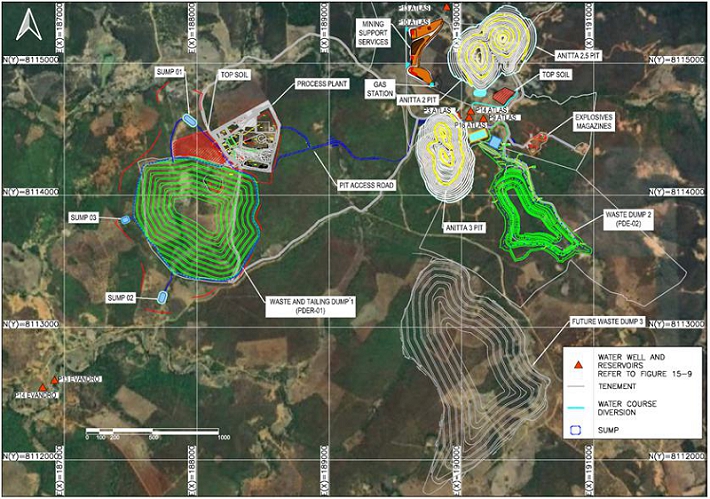
|
| SGS Geological Services |
| S-K 1300 Technical Report – FS Neves Lithium Project – Minas Gerais, Brazil | Page 233 |
| | |
Figure
15-2 General Arrangement – Processing Plant Area
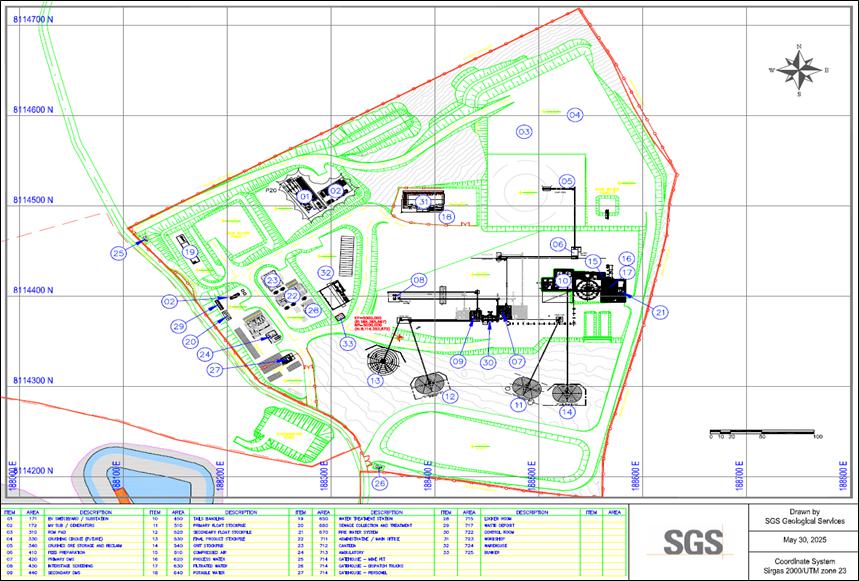
|
| SGS Geological Services |
| S-K 1300 Technical Report – FS Neves Lithium Project – Minas Gerais, Brazil | Page 234 |
| | |
Figure
15-3 General Arrangement – Transshipment Area
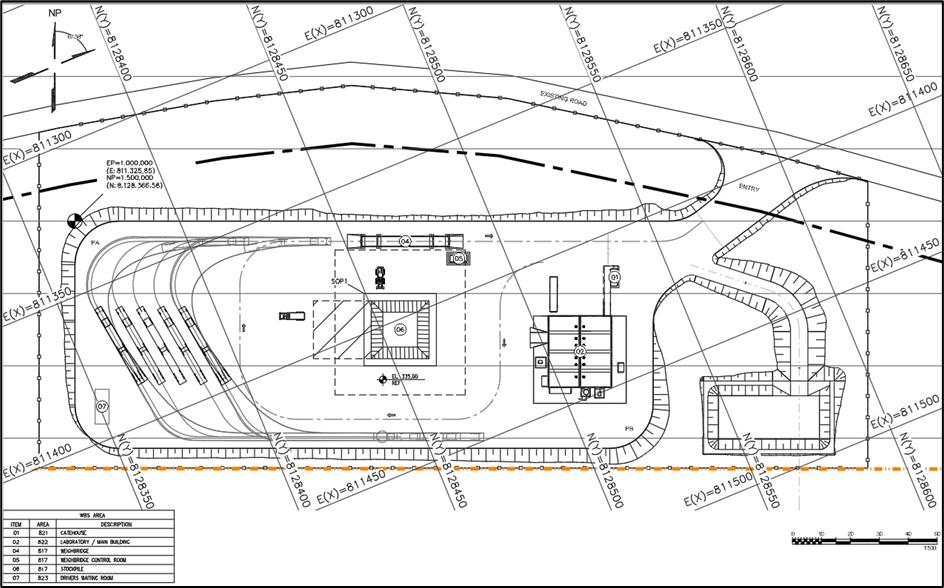
|
| SGS Geological Services |
| S-K 1300 Technical Report – FS Neves Lithium Project – Minas Gerais, Brazil | Page 235 |
| | |
| 15.2.1 | Regional
Site Access |
The
Neves Project is in the municipality of Araçuaí/MG, approximately 598 km from the city of Belo Horizonte (capital of the
state of Minas Gerais). An alternative route can be taken from the municipality of Vitória da Conquista/BA, approximately 300
km away, to reach the city. Salinas/MG (114 km away) and Montes Claros/MG (380 km away) are other cities with regular flights that can
be used to reach Araçuaí. The city has an airport that needs improvement. No commercial flights are currently operating,
although the airport can be used by executive aircraft.
| 15.2.2 | Processing
Plant Site Access |
The
access to the Project site from the municipality of Araçuaí/MG is via 36.7 km of public unpaved roads (LMG-678 and one
unnamed local access), after driving around 7 km from the city to the crossroads of LMG-676 and LMG-678 (Figure 15-4).
|
| SGS Geological Services |
| S-K 1300 Technical Report – FS Neves Lithium Project – Minas Gerais, Brazil | Page 236 |
| | |
Figure
15-4 Site Access
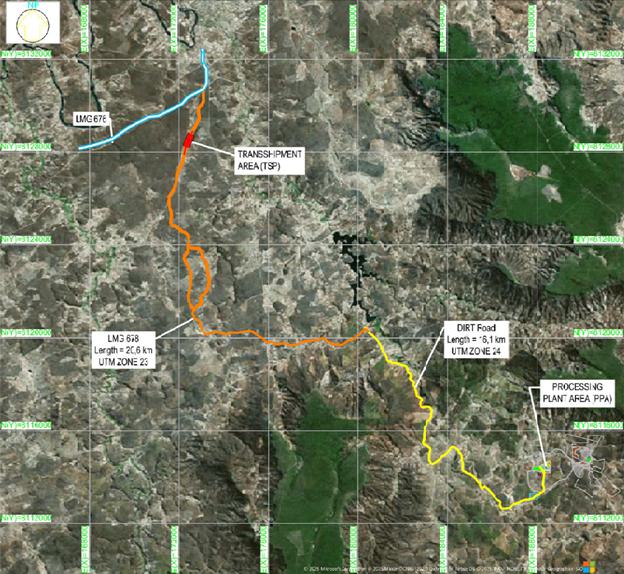
Source:
Google Maps with Promon complement
| 15.2.3 | Transhipment
Area Access |
The
PPA does not have an access road for B-Train Trucks traffic (typical on Figure 15-5). The strategy of the project is to consider a Transshipment
Area (TSP - Figure 15-3) outside the PPA, located 2.4 km from the intersection between the LMG-676 and LMG-678 roads (Figure 15-6). This
TSP area will receive the spodumene concentrates from the plant via single mining trucks and will be loaded onto B-Train trucks. The
B-train trucks will deliver the concentrate to Ilhéus Port, BA, as discussed in Section 15.12.
|
| SGS Geological Services |
| S-K 1300 Technical Report – FS Neves Lithium Project – Minas Gerais, Brazil | Page 237 |
| | |
Figure
15-5 Typical B-Train Truck
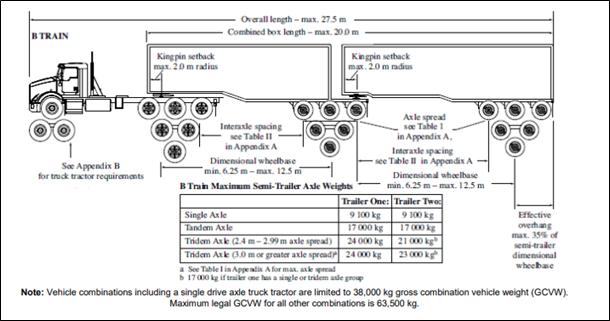
Figure
15-6 TSP Access
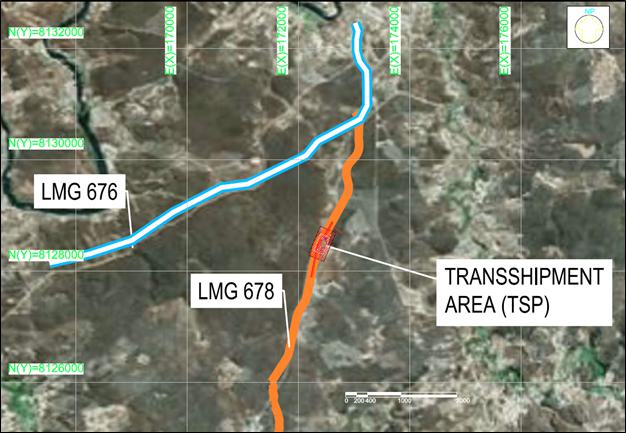
Source:
Google Maps
|
| SGS Geological Services |
| S-K 1300 Technical Report – FS Neves Lithium Project – Minas Gerais, Brazil | Page 238 |
| | |
| 15.3.1 | Electrical
Power Source – Areas 171 and 172 |
Atlas
is currently analyzing the feasibility of building a 25 km, 138 kV transmission line dedicated to the site with CEMIG, the local electricity
transmission company. The current plan for the site power supply is to use diesel generators throughout the life of the project. Sections
01 and 02 illustrated in Figure 15-7 represent the area for installation of the possible/future High Voltage (HV) Substation and the
installation of diesel generators, respectively. The genset line diagram is shown in Figure 15-8.
Figure
15-7 Areas for HV substation and Diesel Generators Installation
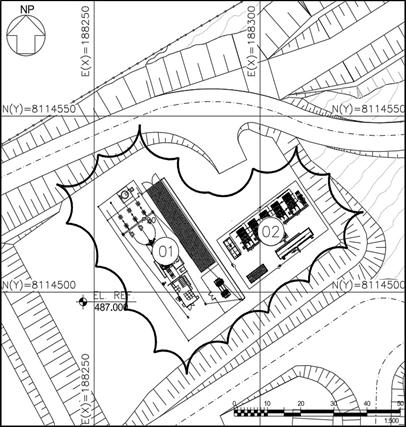
|
| SGS Geological Services |
| S-K 1300 Technical Report – FS Neves Lithium Project – Minas Gerais, Brazil | Page 239 |
| | |
Figure
15-8 Diesel Generator Substation
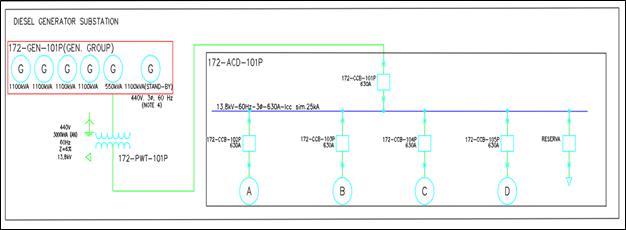
The
total connected load for the plant is calculated at approximately 4.657 MW, with a calculated operating demand of approximately 3.2 MW
(3,189 kW). The total generator power demand load is 2.5 MW (2,551 kW). The anticipated load breakdown is summarized in Table 15-1.
Table
15-1 Electrical Load List
| Sub-Station |
Area
Description |
Transformer
Tag No. |
Transformer
size (kVA) |
Power
Demand (kVA) |
Power
Demand (kW) |
| 172-SUB-001 |
Process |
400-TFR-002 |
1,500 |
1,068.1 |
914.8 |
| 172-SUB-002 |
DMS |
400-TFR-001 |
1,500 |
1,297.3 |
1,112.9 |
| 172-SUB-003 |
Utilities |
172-PWT-003 |
500 |
337.7 |
290.1 |
| Ancillary
facilities |
Administration,
Canteen |
172-PWT-004 |
100 |
84.2 |
71.6 |
| Locker |
172-PWT-005 |
50 |
84.2 |
71.6 |
| Warehouse |
172-PWT-006 |
50 |
42.1 |
35.8 |
| 172-SUB-005 |
Crushing |
172-PWT-008 |
1,500 |
829.2 |
692.5 |
| Total
Power Demand (kVA) = |
3,743 |
| Total
Power Demand (kW) = |
3,189 |
| Simultaneity
Factor = |
0.80 |
| Total
Generator Power Demand Load (kW) = |
2,551 |
For
the PPA, the Diesel Generators facilities will be contracted in a “loan for use” model, where supply, installation, operation
and maintenance will be provided by the chosen company. It is initially considered a set of 4 x 1100 kVA + 1 x 550 kVA generators. A
backup genset will be on standby with a rating of 1100 kVA. The genset can supply 3080 kW on a continuous operation and is expected to
be sufficient to feed power to the entire site. The gensets can be expanded by renting new machines if necessary. The scope of the “loan
for use” for the supply of a 13.8 kV distribution board, will be linked to the diesel generators facility and to the other E-rooms.
The diesel fuel will be supplied by Atlas through local diesel suppliers.
At
the mining operations facilities, power requirements will have to be provided with dedicated generators, supplied and operated by the
contractor for the mining operations.
|
| SGS Geological Services |
| S-K 1300 Technical Report – FS Neves Lithium Project – Minas Gerais, Brazil | Page 240 |
| | |
At
the TSP, the power supply will be fed by an existing 13.8 kV local network that crosses the TSP area close to the perimeter fence.
| 15.3.2 | Electrical
Distribution |
The
primary distribution voltage will be radial, at 13.8 kV, three phases, 60 Hz, from the Diesel Generators facilities. The distribution
will use non-insulated cables and poles in administrative areas. Insulated cables will be installed in trenches in the processing plant
area. The conventional three-phase powerlines and power pole networks will be supplied as turnkey, including pole-mounted transformers.
| 15.3.3 | Main
Substation (future) |
The
future main substation (High Voltage) will include an electrical room and the associated high-voltage equipment. The substation will
have a 7.5/9.375 MVA ONAN/ONAF transformer from 138 to 13.8 kV. The main substation will be provided as a Hybrid solution (GIS + AIS)
mounted on a SKID.
| 15.3.4 | Secondary
Substations |
Site
electrical power supply was selected and designed around the major load centers summarized in Table 15-2.
Table
15-2 E-rooms
| Tag
Number |
Type |
Characteristics |
Power
Distribution
from
Main SE |
172-SUB-001
(Process Area) |
E-room |
Feed:
13.8kV - 25kA
Process loads: 440V - 42kA
Lighting: 220/127V - 10kA |
Conventional
aerial network - 230m
+
Underground
distribution – 80m |
172-SUB-002
(DMSs Area) |
E-room |
Feed:
13.8kV - 25kA
Process loads: 440V - 42kA
Lighting: 220/127V - 10kA |
Conventional
aerial network - 140m
+
Underground
distribution – 100m |
172-SUB-003
(Utilities Area) |
E-room |
Feed:
13.8kV - 25kA
Process loads: 440V - 50kA
Lighting: 220/127V - 10kA |
Conventional
aerial network - 190m |
| 172-SUB-005 |
E-room |
Feed:
13.8kV - 25kA
Process loads: 440V - 42kA
Lighting: 220/127V - 10kA |
Conventional
aerial network - 200m
+
Underground
distribution – 60m |
The
substations will feed the following areas:
| ● | 172-SUB-001:
crushed ore storage and reclaim, feed preparation, tailings, grit stockpile conveyors, compressed
air, pumps of process water, filtrated water and firefighting system. |
|
| SGS Geological Services |
| S-K 1300 Technical Report – FS Neves Lithium Project – Minas Gerais, Brazil | Page 241 |
| | |
| ● | 172-SUB-002:
Primary DMS, Secondary DMS, interstage screening, primary float, secondary float and final
product conveyors of stockpiles. |
| ● | 172-SUB-003:
raw water pumps, potable water pumps, and sewage treatment system. |
| ● | 172-SUB-005:
crushing. |
The
power for the administrative/main office, canteen, locker, outpatient clinic, and warehouse will be connected to the substation.
Looking
at the transshipment area, there is an aerial network passing through one side of the terrain, and a derivation point will be required
from the local electricity company.
The
Neves Project plant will demand water at the following flows: 22.3 m³/h of raw water (makeup) to the processing plant, 352.9 m³/h
of process water (recirculated), and 432.7 m³/h of recycled effluent water (also recirculated). Others 12.8 m³/h will be used
on mining facilities and dust suppression of roads.
| 15.4.1 | Raw
Water Supply System |
The
main source of raw water for the PPA will consist of eight (8) boreholes currently licensed by Atlas, as indicated on Table 15-4 and
Figure 15-14. The 8 wells can deliver a total of 50 m3/hour, which is enough to continuously supply the processing requirement
of 23 m3/hour.
Each
borehole will be connected to 30 m³ reservoirs (water gathering tanks), which can be interconnected and equipped with a pump to
convey water from the water wells. There will be a total of 16 (3.2 m W X 2.34 m H) reservoirs. From the reservoirs, water shall be loaded
into the water trucks and delivered to the PPA. Once at the PPA, two (2) raw water ponds are planned, one with a capacity of 8,000 m³
(630-DAM-001), and the other with a capacity of 1,000 m³ (630-DAM-002) with a total water storage capacity of 9, 000 m3
(approximately 9 M liters). From 630-DAM-001 there is a water diversion for treatment/potabilization and also pumping to 630-DAM-002.
The 630-DAM-002 is located close to the crushed ore storage. The water from the pond will be pumped to the process water tank, having
a capacity of 800 m3 to the PPA.
In
addition to the two (2) ponds mentioned above, additional two (2) ponds are available for rainwater storage and for silt settlement that
are carried by the drainage system (630-DAM-003 and 630-DAM-004). This water can also be pumped to water trucks for dust suppression
on the mine roads.
|
| SGS Geological Services |
| S-K 1300 Technical Report – FS Neves Lithium Project – Minas Gerais, Brazil | Page 242 |
| | |
The
following figures show the design for water intake from boreholes (Figure 15-9 and Figure 15-10), and the position of ponds along the
PPA (Figure 15-11).
Figure
15-9 Borehole Water Intake – Typical Plan View
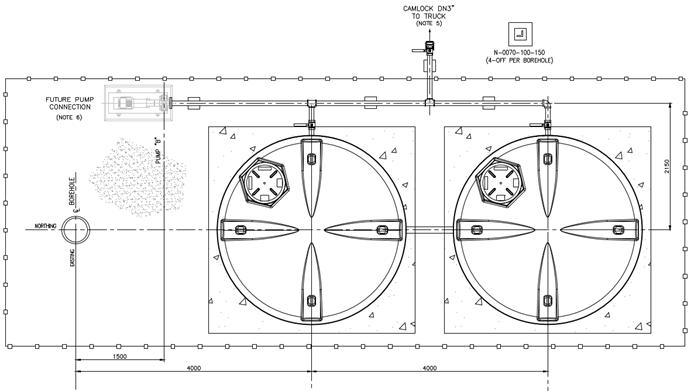
Figure
15-10 Borehole Water Intake – Typical Side View
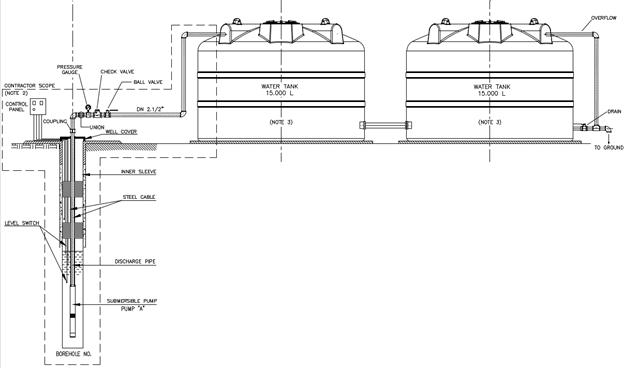
|
| SGS Geological Services |
| S-K 1300 Technical Report – FS Neves Lithium Project – Minas Gerais, Brazil | Page 243 |
| | |
Figure
15-11 Processing Plant Area Ponds
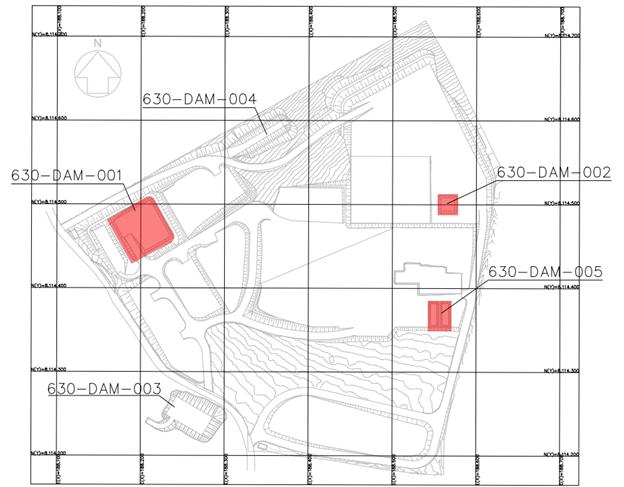
| 15.4.2 | Overall
Site Water Balance |
The
objective of the Site Wide Water Balance (SWWB) as shown in Figure 15-12 is to provide an integrated approach to managing the Project
water resources and determine if the mine has excess water (that must be discharged to the environment) or a water deficit. This is done
by balancing the water sources, water storage, and water losses site-wide to create a comprehensive picture of Project water use and
supply. The model must consider climate, runoff conditions, and any other factors that affect the availability of water. The end result
is a comprehensive picture of water flows around the site and mining operations. The final objective is to resolve the water supply and/or
the water discharge conditions so that the operation can operate adequately and so that environmental regulations can be met.
The
water balance also supplies a plan on how and when the additional return water sumps or ponds are required.
The
water collected at PDER-1 return dam could be used as water storage facility for the plant operations and others utilities, and a pool
is accumulated during the rainy season to ensure dry season operations.
|
| SGS Geological Services |
| S-K 1300 Technical Report – FS Neves Lithium Project – Minas Gerais, Brazil | Page 244 |
| | |
| 15.4.2.1 | Water
Balance Model Parameters |
The
primary information the client gleaned from the SWWB included:
| ● | Scheduling
sump and dam raises; |
| ● | Determining
excess water discharged to environment; |
| ● | Determining
freshwater makeup water requirements; |
| ● | Determining
the site-wide flow of water and pumping requirements; and |
| ● | Determining
the number and location of discharge points back to the natural drainages for |
| ● | environmental
permit compliance. |
| 15.4.2.2 | Analysis
of Makeup Water Resources |
Plant
demand is preferentially met through water from Dam 2 and, as a secondary source, from the PDER-1 Ponds (“Ponds”). Additional
water wells is required in some months to compensate for potential shortages in the Ponds.
Under
typical precipitation conditions, the water balance is designed for the majority of the plant’s makeup water to be sourced from
the Ponds between December and March. During the driest months, plant demand is met through a combination of water from the Ponds and
water wells.
However,
under certain conditions, it may be necessary to adjust the ratio between pond water and well water to the plant. The water balance is
structured to prioritize water draw from the Ponds during the wetter months. During the remaining months, from April to November, plant
demand is met through a combination of pond water and water from the artesian wells.
|
| SGS Geological Services |
| S-K 1300 Technical Report – FS Neves Lithium Project – Minas Gerais, Brazil | Page 245 |
| | |
Figure
15-12 Site Wide Water Balance
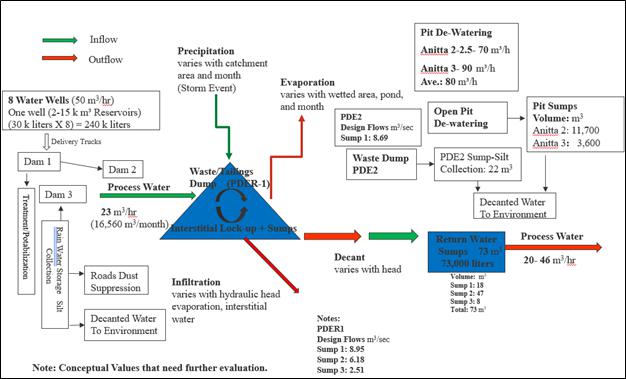
| 15.4.3 | Potable
Water Supply |
The
potable water quality requirements for the potable water treatment plant match the local drinking water guidelines. The potable water
will be obtained treating the raw water collected from boreholes and unloaded in pond 630-DAM-001. Since this water has salt content,
there is an additional stage of potabilization that uses reverse osmosis after flocculation, decantation and filtration of water. The
last stage is the application of chlorine. This treatment is designed to 10m/h and will feed all safety showers and administrative/operational
buildings (water for human use).
| 15.4.4 | Fire
Suppression System |
The
fire suppression system planned for the process plant will be supplied with a fire water tank (7.32 m X 6.1 m X 4.88 m) with at least
a dedicated capacity of 200 m3. It consists of electric water pump that will be supported by the jockey fire water pump to
maintain pressure in the fire water main. In the event of a power outage, a diesel fire water pump will start to ensure continued fire
water availability. The facilities will have fire suppression system in accordance with the structure’s function. Fire water will
be distributed throughout the plant via dedicated buried pipework to supply hydrants and hose reels strategically located throughout
the PPA. All buildings will have hose cabinets and handheld fire extinguishers. Electrical and control rooms will be equipped with dry-chemical
fire extinguishers.
| 15.4.5 | Sewage
Collection and Treatment |
The
office and domestic waste collected at the (PPA) will be treated in the local sewage treatment station, designed to achieve an effluent
in compliance with regulations (CONAMA 357 and 430). It has a treatment capacity of 25 m³ per day and will be a storage for the
treated effluent in two interconnected water tanks of 15 m³ each. The treated water can be collected by a specific water truck and
shall be used to irrigate the vegetation on slopes of terraces, seedling nursery, or even for dust suppression along the roads between
pits and PPA.
The
gatehouse for ROM trucks, dispatch trucks, and the transshipment area that can’t be serviced from the centralized treatment unit,
will be installed with a dedicated sewage system made by septic tanks and sumps.
|
| SGS Geological Services |
| S-K 1300 Technical Report – FS Neves Lithium Project – Minas Gerais, Brazil | Page 246 |
| | |
| 15.4.6 | Hydrogeological
Model |
WSP
developed a conceptual and numerical hydrogeological model aimed at assessing groundwater drawdown in the Anitta 2, 2.5, and 3, open
pits. The study incorporated drilling data, topography, geology, and hydrogeological parameters, and simulations were performed under
various scenarios.
The
consolidated estimate of the required dewatering flow rate for the Anitta 2, 2.5, and 3 pits at the end of the drawdown operation —
considering the continuous operation of dewatering wells and the progression of mining activities—is 75.0 m³/h (Table 15-3).
The total includes a steady contribution of 50.1 m³/h from pumping wells, in addition to direct drainage from the pits: 6.9 m³/h
from Anitta 2, 12.7 m³/h from Anitta 3, and 5.3 m³/h from Anitta 2.5.
Table
15-3 Calculated Flow Rates from Pits and Wells for Year 5
| Borehole |
Flow
Rate [m³/h] |
| Atlas
10 |
0.0 |
| Evandro
13 |
10.0 |
| Evandro
14 |
7.4 |
| Atlas
14 |
6.5 |
| Atlas
16 |
7.8 |
| Atlas
13 |
6.5 |
| Atlas
09 |
7.2 |
| Atlas
04 |
4.6 |
| Total
Boreholes |
50.1 |
| Anitta
2 |
6.9 |
| Anitta
3 |
12.7 |
| Anitta
2.5 |
5.3 |
| Total
Pits |
24.9 |
| Total
Boreholes + Pits |
75.0 |
The
flow rate was obtained through steady-state numerical simulations, using hydrogeological parameters calibrated from field tests, and
reflects the projected final conditions after five years of mine operation (Figure 15-35).
|
| SGS Geological Services |
| S-K 1300 Technical Report – FS Neves Lithium Project – Minas Gerais, Brazil | Page 247 |
| | |
Figure
15-13 Advancement of the Drawdown Cone in the Pit, in Cross-Section
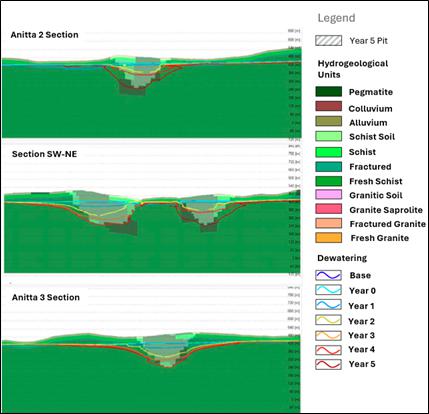
Table
15-4 and Figure 15-14 present the location data, as well as the installed pump elevation and flow rate data.
Table
15-4 Location, Pump Elevation, and Flow Rate Data of the Wells
| Borehole |
X
[m] |
Y
[m] |
Pump
Elevation [m] |
Filter
Elevation [m] |
Bottom
Elevation [m] |
Flow
[m³/h] |
| Atlas
10 |
189,812.0 |
8,115,272.3 |
428.1 |
428.8 |
348.8 |
9.3 |
| Evandro
13 |
186,881.3 |
8,112,580.0 |
354.7 |
312.8 |
254.8 |
10.0 |
| Evandro
14 |
186,771.4 |
8,112,518.2 |
353.4 |
357.3 |
345.3 |
7.4 |
| Atlas
14 |
190,107.1 |
8,114,603.9 |
392.0 |
394.2 |
337.2 |
6.5 |
| Atlas
16 |
190,081.7 |
8,114,580.1 |
371.6 |
389.4 |
349.4 |
7.8 |
| Atlas
13 |
189,899.9 |
8,115,314.3 |
370.9 |
386.5 |
335.5 |
6.5 |
| Atlas
09 |
190,173.3 |
8,114,587.1 |
374.3 |
389.7 |
337.7 |
7.2 |
| Atlas
04 |
189,905.0 |
8,114,626.8 |
323.1 |
339.8 |
323.8 |
4.6 |
|
| SGS Geological Services |
| S-K 1300 Technical Report – FS Neves Lithium Project – Minas Gerais, Brazil | Page 248 |
| | |
Figure
15-14 Location of the Dewatering Wells
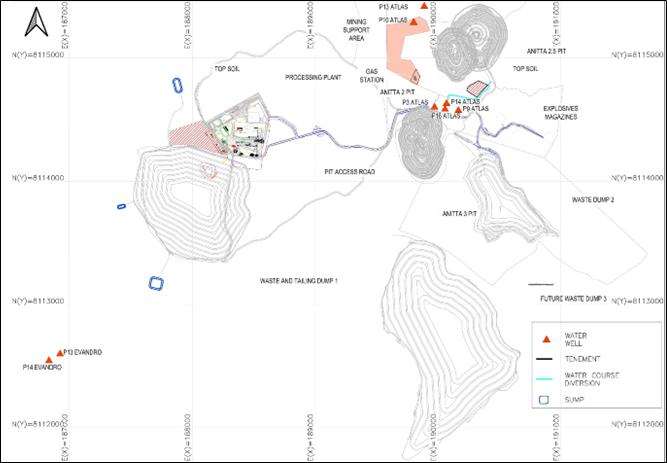
It
is important to highlight that the total flow refers exclusively to the contribution of groundwater, excluding flows associated with
surface water drainage. Surface water management will be implemented through a peripheral drainage system and pumping of precipitation
water falling on the pit footprints, with an estimated unaccounted volume of 75.0 m³/h.
The
surface water component will represent an increase in water availability, particularly during periods of intense rainfall. Therefore,
the mine’s water management will be based on two integrated approaches:
| ● | Continuous
groundwater extraction, stabilized in steady-state with a flow rate of 75.0 m³/h; |
| | | |
| ● | Management
and intermittent collection of surface water, depending on the evolution of the excavated
areas and meteorological events. |
This
integrated infrastructure will ensure a reliable water supply for both the beneficiation plant and mine operations, guaranteeing consistent
delivery, operational efficiency, and environmental control throughout the entire project life cycle.
For
the design of the dewatering system under critical conditions, a 24-hour design rainfall with a return period (RP) of 10 years was adopted.
To define this rainfall, daily precipitation data from the Araçuaí weather station (INMET code 83442) covering the period
from 1961 to 2024 were used and processed to obtain the maximum annual precipitations. This work was carried out by WSP.
|
| SGS Geological Services |
| S-K 1300 Technical Report – FS Neves Lithium Project – Minas Gerais, Brazil | Page 249 |
| | |
The
estimate of the maximum flow rate required for dewatering the pits of the Anitta Project (Table 15-5) was performed considering the combined
contribution of groundwater, obtained through hydro-dynamic simulations, and the surface volume generated by precipitation. It was assumed
that the rainfall falls exclusive on the footprint area of the pits, disregarding external contributions due to the presence of a peripheral
drainage system.
Based
on these assumptions, a period of 14 days (336 hours) was considered for the complete drawdown of the accumulated water level after the
rainfall event, without the occurrence of additional significant rainfall during this interval. The required pumping flow rate was therefore
determined by dividing the total accumulated volume between infiltration water and rainfall over this period.
The
highest flow values were observed in the deeper and more extensive phases of the pits, particularly for the Anitta 3 pit (final phase,
year 5), with a flow rate of 86.7 m³/h, and for the Anitta 2 pit (final phase, year 5), with a flow rate of 65.7 m³/h. For
the Anitta 2.5 pit, the estimated flow rate is 36.5 m³/h. These values represent the design flow rates for the pumping system and
will be periodically adjusted according to the progress of mining operations and actual field data.
|
| SGS Geological Services |
| S-K 1300 Technical Report – FS Neves Lithium Project – Minas Gerais, Brazil | Page 250 |
| | |
Table
15-5 Total Water Inflow and Dewatering Flow Rate Associated with the 14-Day Period
| Pit |
Mining
Phase |
Start
Year |
Constant
Groundwater Inflow
(m³/h) |
Total
14 Days Ground water Inflow
(m³) |
Total
volume of water associated with the rainfall event
(m³) |
Total
Water Inflow
(m³) |
Required
Discharge Flow Rate over 14 Days
(m³/h) |
| Anitta
2 |
Phase
1 |
Year
0 |
0 |
0 |
8,545 |
8,545 |
25.4 |
| Anitta
2 |
Phase
2 |
Year
3 |
7.5 |
2,520 |
12,035 |
14,555 |
43.3 |
| Anitta
2 |
Phase
3 |
Year
4 |
7.8 |
2,620.8 |
14,387 |
17,007.8 |
50.6 |
| Anitta
2 |
Phase
4 |
Year
5 |
11.1 |
3,729.6 |
18,332 |
22,061.6 |
65.7 |
| Anitta
3 |
Phase
1 |
Year
0 |
0 |
0 |
5,839 |
5,839 |
17.4 |
| Anitta
3 |
Phase
2 |
Year
1 |
5.4 |
1,814.4 |
11,467 |
12,981.4 |
38.5 |
| Anitta
3 |
Phase
3 |
Year
3 |
5.4 |
1,814.4 |
18,019 |
19,833.4 |
58.9 |
| Anitta
3 |
Phase
4 |
Year
5 |
16 |
5,376 |
23,739 |
29,115 |
86.7 |
| Anitta
2.5 |
- |
- |
6.1 |
2,049.6 |
10,231 |
12,280.6 |
36.5 |
|
| SGS Geological Services |
| S-K 1300 Technical Report – FS Neves Lithium Project – Minas Gerais, Brazil | Page 251 |
| | |
| 15.5 | Mine
Waste, Low-Grade Ore and Tailings Storage Facilities |
The
PDER-1 and PDE-2 internal drainage system was designed with the purpose of collecting contributions from the water influx resulting from
recharge on the structure, preventing saturation and subsequent mass destabilization.
The
internal drainage system of PDER-1 consists of 06 (six) trapezoidal internal drains, with 2 main drains (PDER-1-DP01, and PDER-1-DP02)
and 4 (four) secondary drains (PDER-1-DS01, PDER-1-DS02, PDER-1-DS03, and PDER-1-DS04). PDE-2 has 3 (three) trapezoidal drains, with
1 (one) main drain (PDE02-DP01), and 2 (two) secondary drains (PDE02-DS01 and PDE02-DS02), in addition to both structures having a protective
toe drain made of rockfill.
The
Figure 15-15 presents the general layout of the internal drainage system for PDER-1 and PDE-2.
|
| SGS Geological Services |
| S-K 1300 Technical Report – FS Neves Lithium Project – Minas Gerais, Brazil | Page 252 |
| | |
Figure
15-15 General Layout of the Internal Drainage System for PDER-1 and PDE-2
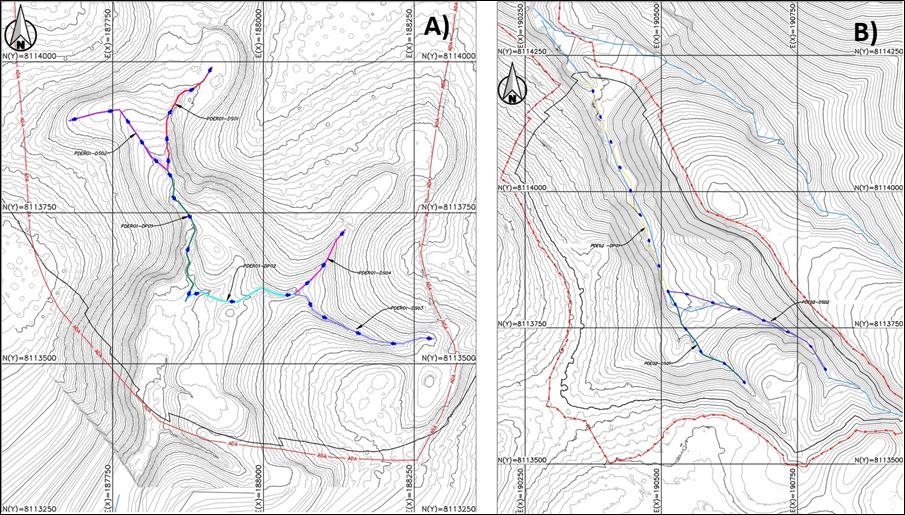
|
| SGS Geological Services |
| S-K 1300 Technical Report – FS Neves Lithium Project – Minas Gerais, Brazil | Page 253 |
| | |
To
determine the average monthly precipitation value for the contributing basin of the internal drainage system of PDER-1 and PDE-2, the
historical rainfall data from the Fazenda Facão station (code 1742020), located in the municipality of Araçuaí/MG,
was used. Due to the climatic patterns of the study area, with average precipitation rates lower than annual evapotranspiration, according
to data from INMET, the maximum monthly precipitation obtained from the analyzed historical series was considered for the calculation
of the design flow rates to be used in the dimensioning of the internal drainage system of PDER-1 and PDE-2.
The
calculation of the recharge value should consider evapotranspiration, which represents the portion of the precipitated value, over the
course of a year, that will return to the atmosphere in the form of vapor before reaching the basin outlet or infiltrating into the soil.
In
the evapotranspiration study, the station with INMET code 83442, located in Araçuaí / MG, was analyzed. From the available
data for this station, the average annual evapotranspiration was determined.
The
construction of the internal drains consists of three layers of transitions and draining core. Typical sections were adopted, as shown
in Figure 15-16.
Figure
15-16 Typical Section – Internal Drain of PDER-1 and PDE-2
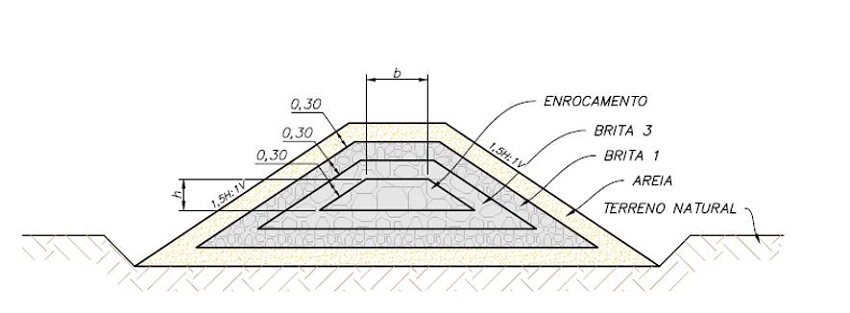
The
cross-section of the main and secondary drains of PDER-1 and PDE-2 should consist of a 0.30 m layer of sand, a 0.30 m transition layer
of Gravel 1, 0.30 m of Gravel 3, and a draining core made of rockfill.
At
the outlets of the internal drainage system, a rockfill protection structure must be implemented, whose function is to protect the drain
from the transport of materials by the water flow. The toe drain, located in the outer zone of the downstream slope of the pile, should
be made of rockfill with D50 = 200 mm. The Figure 15-17 shows the detail of the junction between the internal drain and the
rockfill face of the PDER-1 and PDE-2 piles.
|
| SGS Geological Services |
| S-K 1300 Technical Report – FS Neves Lithium Project – Minas Gerais, Brazil | Page 254 |
| | |
Figure
15-17 Internal Drain Outlet Sections
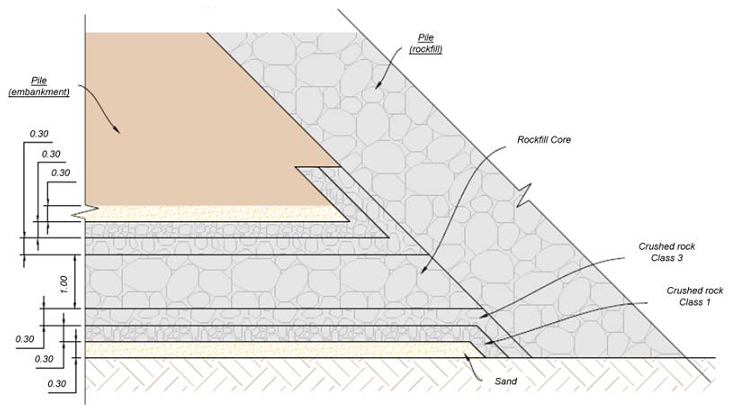
| 15.5.2 | Geotechnical
Studies |
For
the future piles, three types of instrumentation have been defined. Figure 15-18 and Figure 15-19 show the instruments planned for PDER-1
and PDE-2, respectively, totaling 18 (eighteen) double-chamber piezometers, 3 (three) inclinometers, and 9 (nine) surface markers.
|
| SGS Geological Services |
| S-K 1300 Technical Report – FS Neves Lithium Project – Minas Gerais, Brazil | Page 255 |
| | |
Figure
15-18 Location of Instruments Provided for PDER-1
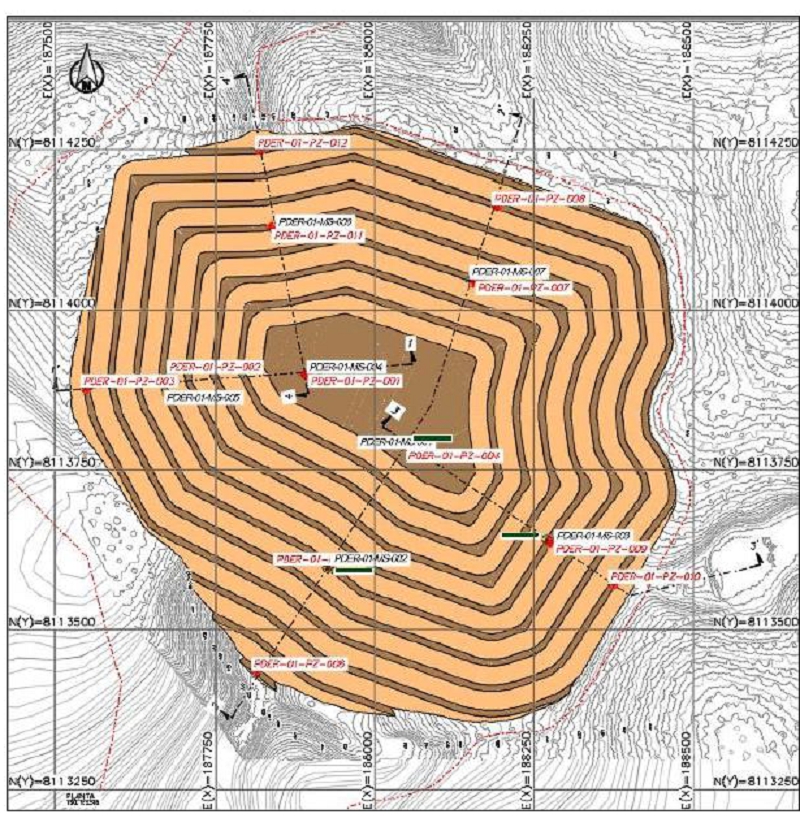
|
| SGS Geological Services |
| S-K 1300 Technical Report – FS Neves Lithium Project – Minas Gerais, Brazil | Page 256 |
| | |
Figure
15-19 Location of Instruments Provided for PDE-2
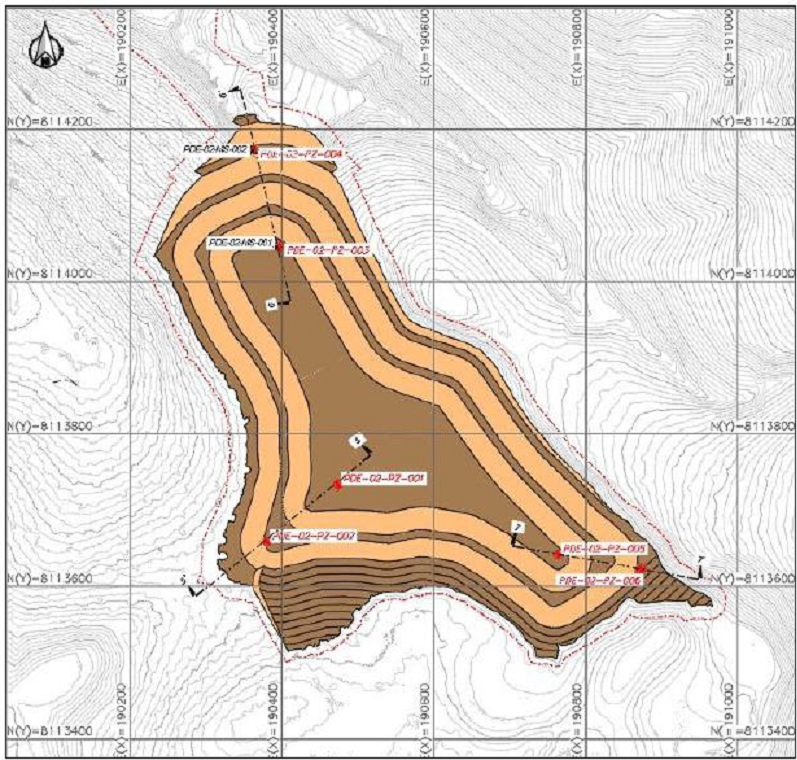
For
both structures, the installation of double-chamber piezometers is planned, with one chamber placed in the first expected material (colluvium)
and the second in the material immediately underlying the first (shale saprolite). To ensure accurate placement of the chambers. The
prior identification of the terrain profile before instrument installation should be determined by conducting geological-geotechnical
surveys at the original location of each piezometer, in a technical specification to be detailed later. The objective is also to reach
the bedrock for both the definition of the geological-geotechnical profile and future anchorage of the inclinometers when needed. Once
the installation depth of the piezometers is defined. They should be installed, isolating each section of interest.
As
the pile develops, the “raising” of the originally installed instrument covering on natural terrain should occur. In regions
where the piling of waste rock is expected, every 1.5 m. The space around the instrument’s metal tube should be filled with gravel,
which will serve as a foundation for the next rise until the final instrument elevation is reached, according to the geometric design
of each pile. In embankment sections made of waste soil or tailings, this material should be locally placed to achieve the desired compaction
of the waste.
|
| SGS Geological Services |
| S-K 1300 Technical Report – FS Neves Lithium Project – Minas Gerais, Brazil | Page 257 |
| | |
For
the installation of inclinometers. The geological-geotechnical recovery drilling performed for the piezometers should extend to the bedrock
section, which will also be detailed in a subsequent technical specification. Advanced up to 5.0 meters into the rock to eliminate the
possibility of encountering a rock block. Once this elevation is known. The lower end of the guide tubes should be anchored into this
rock to ensure a fixed reference point for the instrument. As expected for the piezometer, the inclinometer guide tube series should
be raised along with the development of the pile, following a similar approach.
The
surface markers, in turn, should be fixed at the final berms of each completed stage of the pile operation. As with the other instruments,
the installation details of the instruments and the prior surveys will be detailed in a document to be prepared for the Detailed Phase
of the project.
| 15.5.3 | Geotechnical
Stability Analysis |
Stability
analyses were conducted using the software Slide2, version 2020, from Rocscience. To evaluate the structures in relation to the limit
equilibrium, three distinct methods were adopted: Spencer and GLE/Morgenstern-Price. The analysis was carried out considering non-circular
failure surfaces, as the waste material presents heterogeneous characteristics, which does not justify assuming circular failure surfaces.
Table
15-6 presents the minimum safety factors according to the Brazilian technical standard NBR13.029 for the Preparation and Presentation
of Tailings Disposal Design in Piles, 2024.
Table
15-6 Minimum Safety Factors for Tailings Piles (NBR 13.029:2024)
| Analysis
Type |
Slope |
| Overall
slope failurea |
Operacional |
Final |
| 1.5 |
| Bench
slope b Failure |
1.3 |
1.5 |
Given
the heterogeneity and characteristics of the waste piles, the minimum suggested Safety Factor, based on Limit Equilibrium Methods (LEM),
should be considered as one of the assessments, not the sole determinant of the overall structure’s safety. It should be accompanied
by inspections, risk analysis and categorizations, appropriate engineering judgment, and other complementary evaluations.
b
For a bench slope with predominance of rock, the minimum safety factor for the final geometry can be 1.3. A predominantly rocky slope
is one in which mass resistance is primarily governed by the interaction between the blocks.
Thus,
the analyses were evaluated under the following conditions indicated in Table 15-7.
Table
15-7 Adopted Admissible Safety Factors
| Acceptable
Safety Factor |
|
| Water
Table |
Type
of Request |
Type
of Failure |
Acceptable
SF |
|
| |
| Normal |
Drained* |
Overall |
1.5 |
|
| |
| Benchs |
1.5 |
|
| |
| Drained
+ earthquake (pseudo-static)* |
Overall |
1.1 |
|
| |
Note:
For non-circular ruptures.
|
| SGS Geological Services |
| S-K 1300 Technical Report – FS Neves Lithium Project – Minas Gerais, Brazil | Page 258 |
| | |
To
define the groundwater table level, in the absence of instrumentation in the area, the 24-hour W.L. reading from the 9 boreholes drilled
in the pile areas was used. For the regions of the streambeds, field observations and readings of the boreholes themselves were used,
where the absence of perched water in the drains was verified.
The
stability analyses were conducted considering effective stress resistance, using the Mohr-Coulomb criterion (effective cohesion, c’,
and effective friction angle, φ’) and Hoek-Brown (UCS, GSI, mi, and D).
The
stability analyses considered three distinct scenarios:
| ● | Scenario
1: drained conditions for the materials. |
| | |
| ● | Scenario
2: pseudo-static drained conditions. |
Additionally,
for the PDER-1 structure, identified as the most critical scenario, the materials were analyzed considering two distinct approaches:
| ● | Approach
1: Core made of “sterile/soil” material; and |
| ● | Approach
2: Core made of “coarse waste” material. |
Table
15-8 represents the safety factors presented during the analysis of each section.
|
| SGS Geological Services |
| S-K 1300 Technical Report – FS Neves Lithium Project – Minas Gerais, Brazil | Page 259 |
| | |
Table
15-8 SF Results - Stability Analysis
| Anitta
Project (Atlas Lithium) |
| PDER-1
– Core in waste/soil |
| 1-1’ |
| Type
of Request |
Type
of Failure |
Acceptable
SF |
Failure
Surface |
Obtained
SF |
Stable |
| Spencer |
GLE |
| Drained |
Overall |
1.5 |
Non-Circular |
1.5 |
1.5 |
Yes |
| Benchs |
1.5 |
Non-Circular |
1.5 |
1.5 |
Yes |
| Drained
+ earthquack (pseudo-static) |
Overall |
1.1 |
Non-Circular |
1.4 |
1.4 |
Yes |
| 2-2’
(From right to left) |
| Type
of Request |
Type
of Failure |
Acceptable
SF |
Failure
Surface |
Obtained
SF |
Stable |
| Spencer |
GLE |
| Drained |
Overall |
1.5 |
Non-Circular |
1.5 |
1.5 |
Yes |
| Benchs |
1.5 |
Non-Circular |
1.5 |
1.5 |
Yes |
| Drained
+ earthquack (pseudo-static) |
Overall |
1.1 |
Non-Circular |
1.4 |
1.4 |
Yes |
| 2-2’
(From right to left) |
| Type
of Request |
Type
of Failure |
Acceptable
SF |
Failure
Surface |
Obtained
SF |
Stable |
| Spencer |
GLE |
| Drained |
Overall |
1.5 |
Non-Circular |
1.5 |
1.5 |
Yes |
| Benchs |
1.5 |
Non-Circular |
1.5 |
1.5 |
Yes |
| Drained
+ earthquack (pseudo-static) |
Overall |
1.1 |
Non-Circular |
1.4 |
1.3 |
Yes |
| 3-3’ |
| Type
of Request |
Type
of Failure |
Acceptable
SF |
Failure
Surface |
Obtained
SF |
Stable |
| Spencer |
GLE |
| Drained |
Overall |
1.5 |
Non-Circular |
1.5 |
1.5 |
Yes |
| Benchs |
1.5 |
Non-Circular |
- |
- |
- |
| Drenada
+ sismo (pseudoestatica) |
Overall |
1.1 |
Non-Circular |
1.3 |
1.3 |
Yes |
| PDE-2
- Core in waste/soil |
| 4-4’ |
| Type
of Request |
Type
of Failure |
Acceptable
SF |
Failure
Surface |
Obtained
SF |
Stable |
| Spencer |
GLE |
| Drained |
Overall |
1.5 |
Non-Circular |
1.5 |
1.5 |
Yes |
| Benchs |
1.5 |
Non-Circular |
1.5 |
1.5 |
Yes |
| Drained
+ earthquack (pseudo-static) |
Overall |
1.1 |
Non-Circular |
1.4 |
1.4 |
Yes |
| 5-5’ |
| Type
of Request |
Type
of Failure |
Acceptable
SF |
Failure
Surface |
Obtained
SF |
Stable |
| Spencer |
GLE |
| Drained |
Overall |
1.5 |
Non-Circular |
1.5 |
1.5 |
Yes |
| Benchs |
1.5 |
Non-Circular |
1.5 |
1.5 |
Yes |
| Drained
+ earthquack (pseudo-static) |
Overall |
1.1 |
Non-Circular |
1.7 |
1.7 |
Yes |
|
| SGS Geological Services |
| S-K 1300 Technical Report – FS Neves Lithium Project – Minas Gerais, Brazil | Page 260 |
| | |
|
15.5.4 | Hydrological
and Hydraulic Studies |
The
calculation of the design flow rates for the Surface Drainage of PDER-1 and PDE-2 was carried out considering a return period of 100
years for all structures in general, and 500 years for the peripheral channels. Structures of a temporary nature were designed with a
return period (TR) of 50 years for peripheral channels and 20 years for the other elements.
The
results of the hydrological and hydraulic studies carried out to develop the Basic Design of the Waste Rock Deposition Piles –
PDER-1 and PDE-2 are presented on next sections.
| 15.5.4.1 | Surface
Drainage Layout |
The
design of the surface drainage system for the Waste Rock Deposition Piles (PDER-1 and PDE-2) was carried out based on the layout shown
in Figure 15-20 and Figure 15-21, where the nomenclature used for each of the structures can be consulted.
|
| SGS Geological Services |
| S-K 1300 Technical Report – FS Neves Lithium Project – Minas Gerais, Brazil | Page 261 |
| | |
Figure
15-20 Surface Drainage Diagram of PDER-1
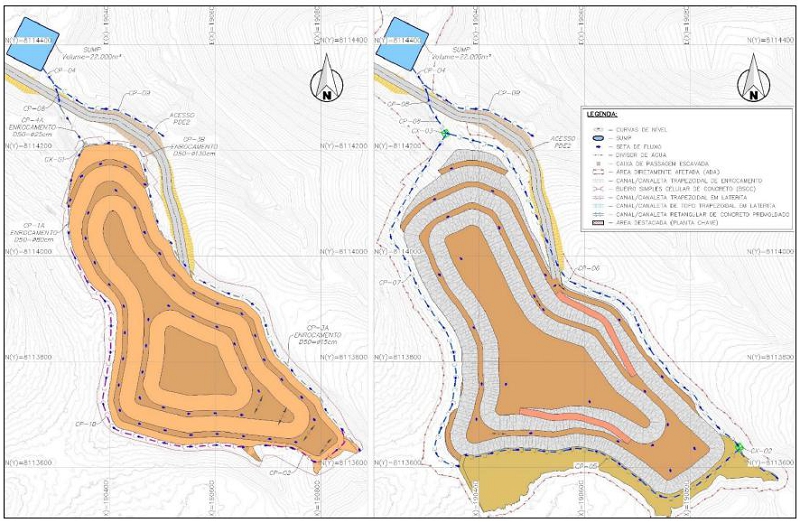
|
| SGS Geological Services |
| S-K 1300 Technical Report – FS Neves Lithium Project – Minas Gerais, Brazil | Page 262 |
| | |
Figure
15-21 Surface Drainage Diagram of PDE-2
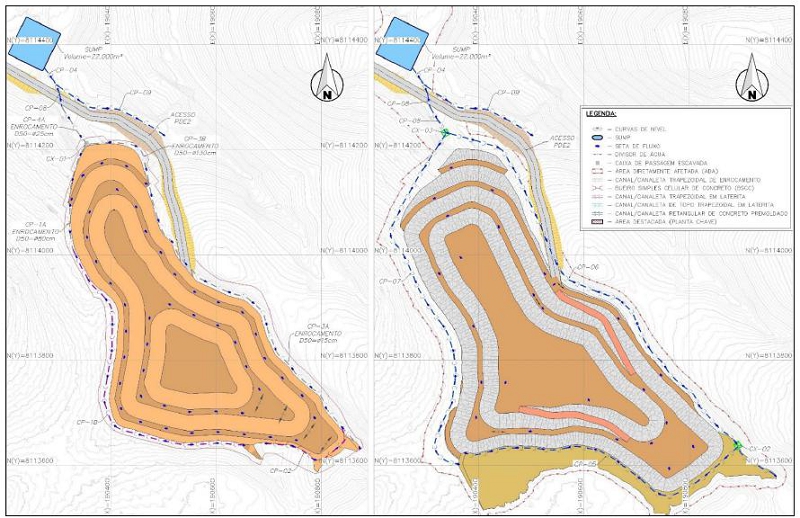
|
| SGS Geological Services |
| S-K 1300 Technical Report – FS Neves Lithium Project – Minas Gerais, Brazil | Page 263 |
| | |
|
15.5.5 | Pile
Geometric Design |
For
the design of the future PDER-1 and PDE-2, a “wedding cake” type geometry is planned, with PDER-1 being implemented in three
phases and PDE-2 in two. For phase I of PDER-1 will be developed in the area shown in Figure 15-22. To ensure a satisfactory Factor of
Safety (FS) considering the new test results, benches with a height of 20.0 meters, berm widths of 10.0 meters, and slope face angles
of 37.6° (1V:1.3H) were designed for this stage, resulting in an expected waste disposal volume of 13.9 million cubic meters.
|
| SGS Geological Services |
| S-K 1300 Technical Report – FS Neves Lithium Project – Minas Gerais, Brazil | Page 264 |
| | |
Figure
15-22 General Layout of Phase I of PDER-1
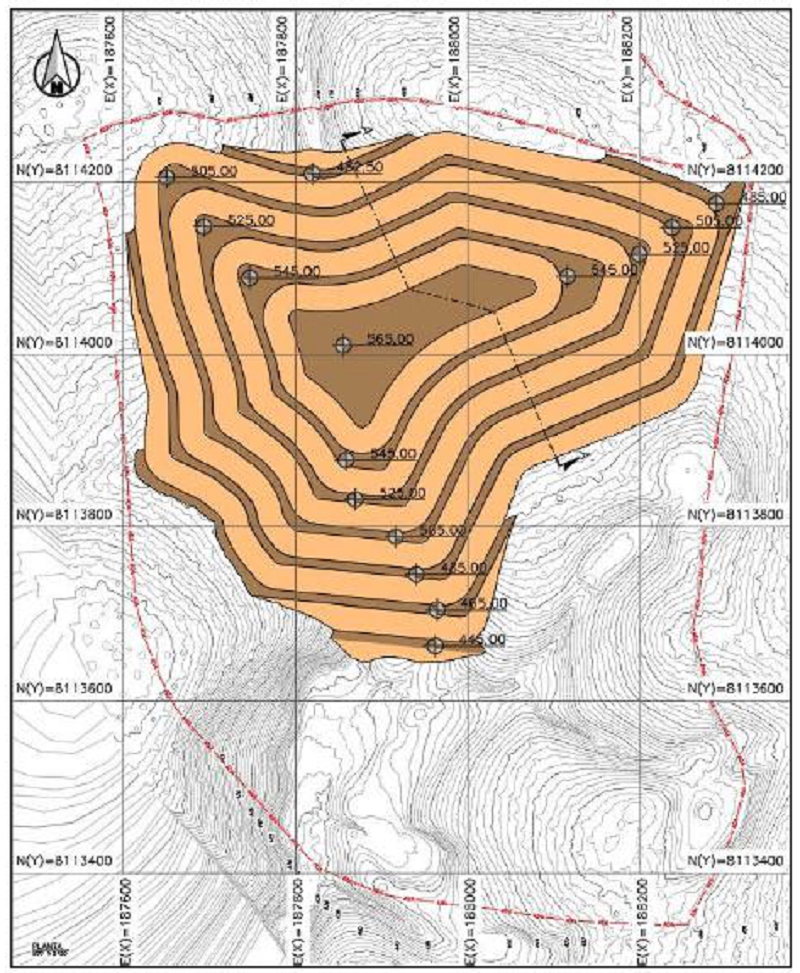
For
Phase II (Figure 15-23), DF+ maintained the same configurations for bench heights, berm widths, and slope face angles as in Phase I,
expanding towards the southern boundaries of the area. In this scenario, the stacking of Phase II over Phase I (Figure 15-24) will result
in an additional volume of 9.8 million cubic meters, leading to a total waste disposal volume (Phase I + Phase II) of 23.7 million cubic
meters.
|
| SGS Geological Services |
| S-K 1300 Technical Report – FS Neves Lithium Project – Minas Gerais, Brazil | Page 265 |
| | |
Figure
15-23 General Layout of Phase II of PDER-1
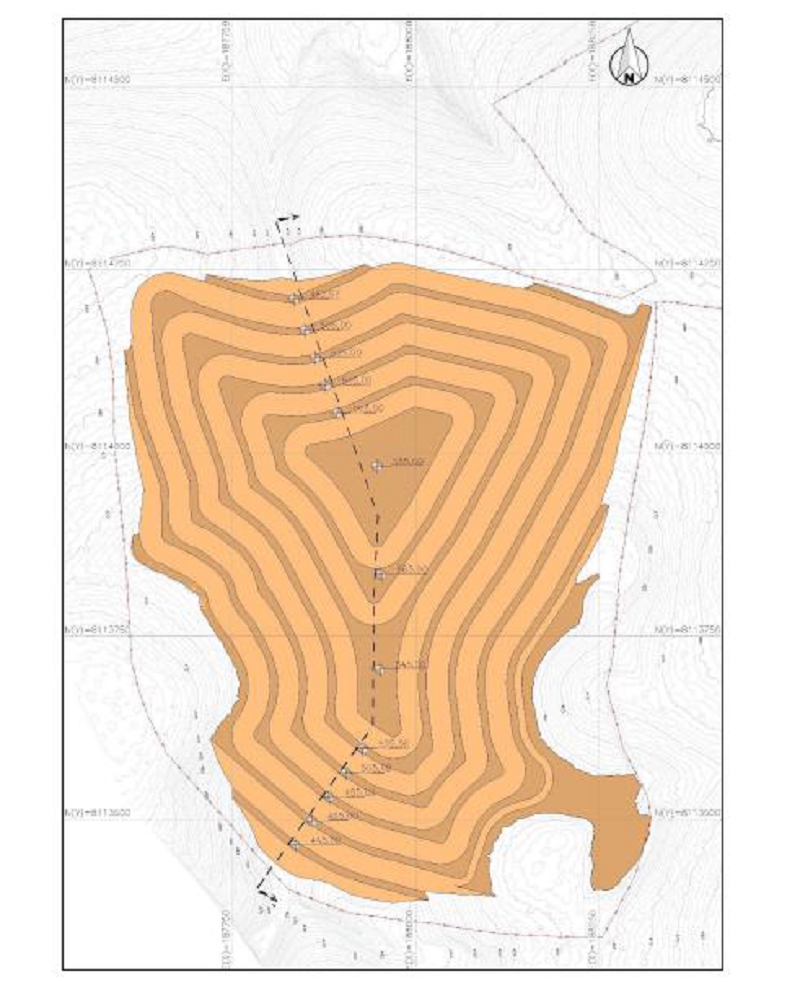
|
| SGS Geological Services |
| S-K 1300 Technical Report – FS Neves Lithium Project – Minas Gerais, Brazil | Page 266 |
| | |
Figure
15-24 Schematic Section of Phase II of PDER-1, Indicating the Geometry of Phase I to be Stacked
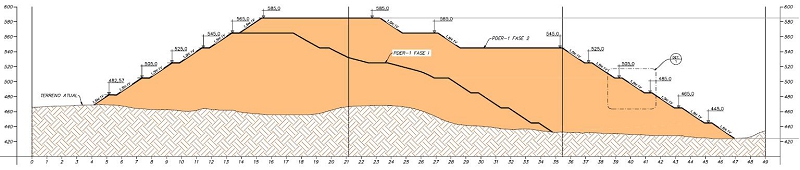
|
| SGS Geological Services |
| S-K 1300 Technical Report – FS Neves Lithium Project – Minas Gerais, Brazil | Page 267 |
| | |
Requiring
capacity for disposal is greater than the total presented in the two previous phases, DF+ developed a complementary arrangement for the
pile, referred to as Phase III, considering optimization of the region according to the topography, as shown in Figure 15-25. In this
configuration, Phase III maintained bench geometry like Phases I and II, achieving an additional stacking volume of 28.9 million cubic
meters. In this final configuration, the total final volume reached 52.6 million cubic meters, with PDER-1 reaching a final height slightly
exceeding 200 meters at its highest section.
Figure
15-25 General Layout of Phase III of PDER-1
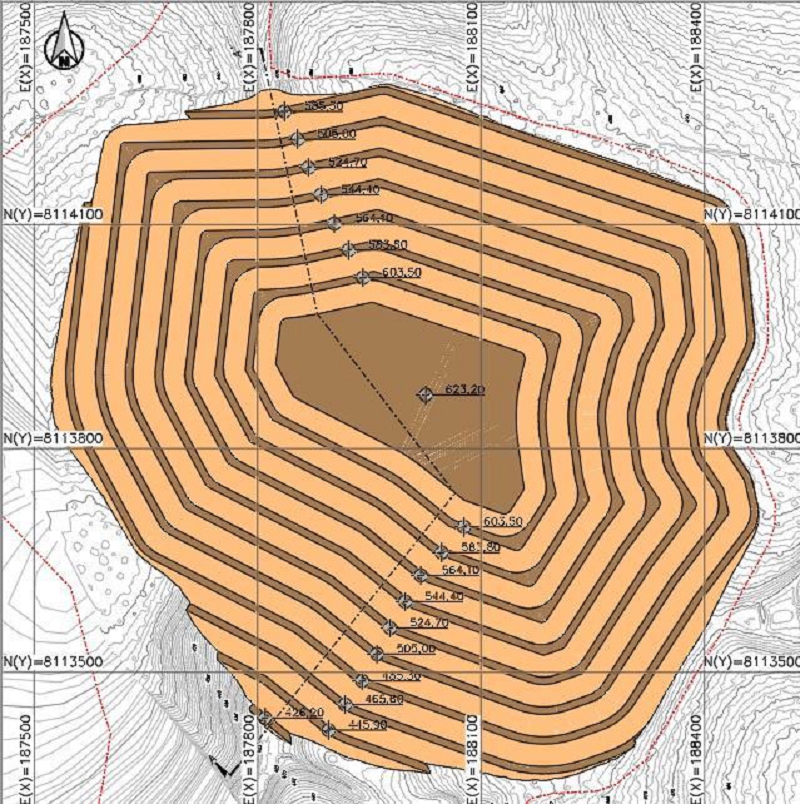
|
| SGS Geological Services |
| S-K 1300 Technical Report – FS Neves Lithium Project – Minas Gerais, Brazil | Page 268 |
| | |
Figure
15-26 Schematic Section of Phase III of PDER-1
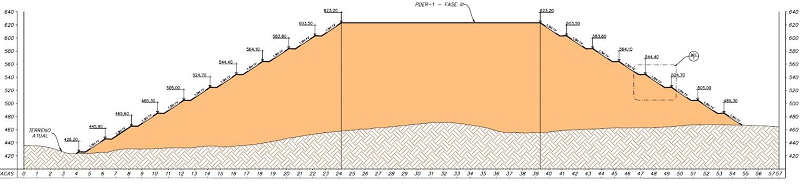
|
| SGS Geological Services |
| S-K 1300 Technical Report – FS Neves Lithium Project – Minas Gerais, Brazil | Page 269 |
| | |
For
PDE-2, the geometric design of Phases I and II was developed by DF+ throughout 2025. For Phase I (Figure 15-27 and Figure 15-28), benches
were designed with a height of 20 meters, berm widths of 10 meters, and slope face angles of 34° (1V:1.5H), not exceeding four benches
at the highest section (approximately 80 meters total). For this phase, the pile will have a capacity to accommodate 4.4 million cubic
meters of waste.
Figure
15-27 General Layout of Phase I of PDE-2
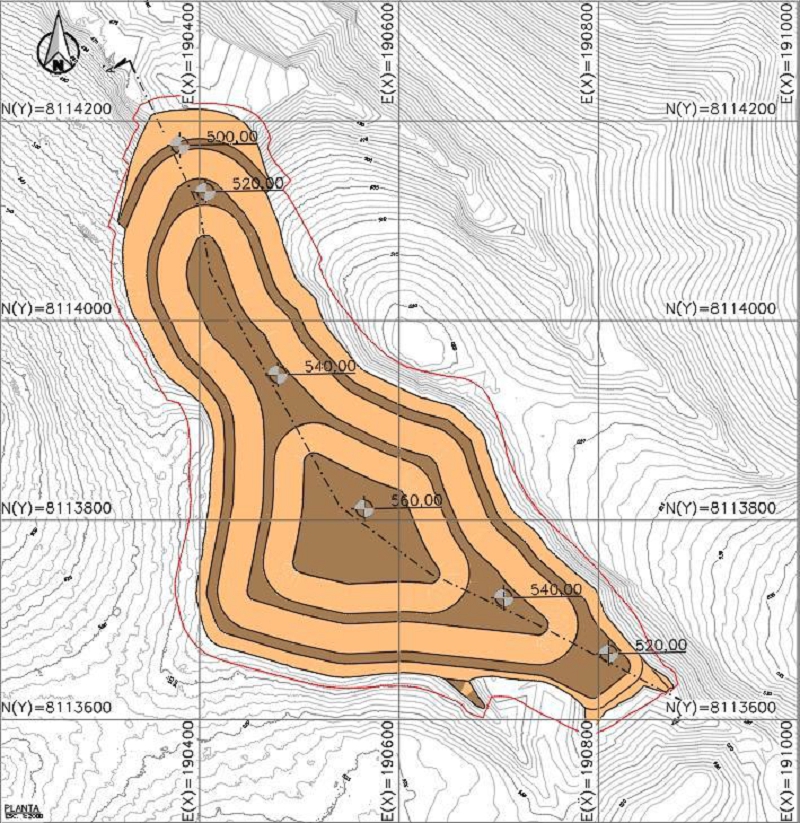
|
| SGS Geological Services |
| S-K 1300 Technical Report – FS Neves Lithium Project – Minas Gerais, Brazil | Page 270 |
| | |
Figure
15-28 Schematic Section of Phase I of PDE-2

|
| SGS Geological Services |
| S-K 1300 Technical Report – FS Neves Lithium Project – Minas Gerais, Brazil | Page 271 |
| | |
For
Phase II of PDE-2, as in the case of PDER-1, an expansion of the pile’s area limit was requested to meet the expected production
volume of waste. In its final configuration (Figure 15-29 and Figure 15-30), the geometry of the benches was maintained, and with the
expanded limits, a volume of 7.2 million cubic meters was achieved. of which 2.8 million cubic meters refer to restacking.
Figure
15-29 General Layout of Phase II of PDE-2
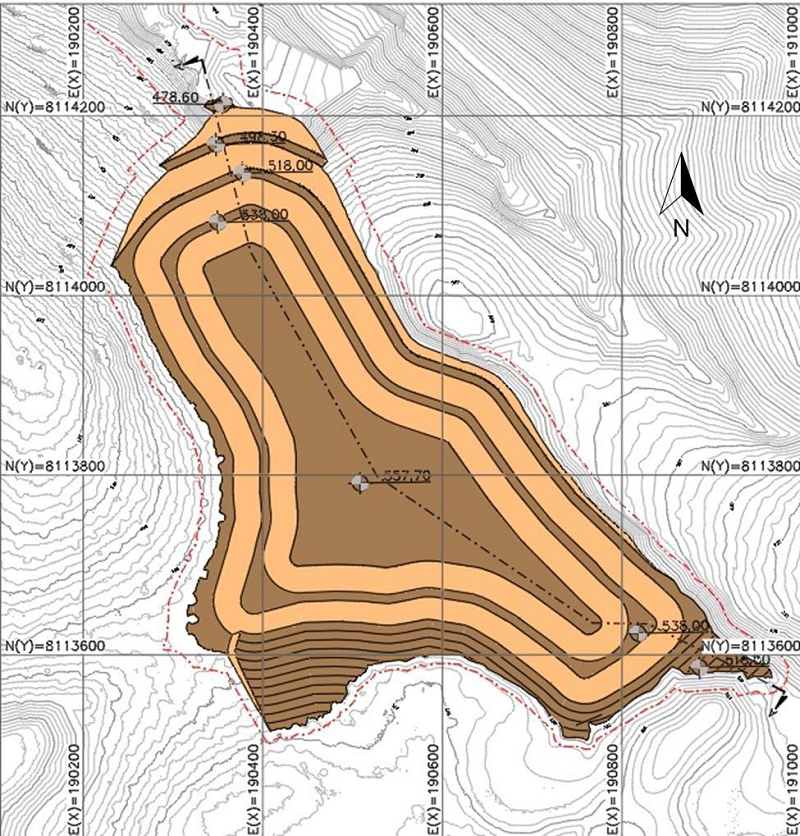
|
| SGS Geological Services |
| S-K 1300 Technical Report – FS Neves Lithium Project – Minas Gerais, Brazil | Page 272 |
| | |
Figure
15-30 Schematic Section of Phase II of PDE-2

|
| SGS Geological Services |
| S-K 1300 Technical Report – FS Neves Lithium Project – Minas Gerais, Brazil | Page 273 |
| | |
Finally,
since the faces of each of the structures will be composed of rockfill, no revegetation will be implemented on the slopes. However, a
lining will be installed on the berms to allow the transit of equipment and vehicles during the operation and monitoring of the structures.
| 15.5.6 | Volumes
of Waste and Tailings Produced |
Based
on the estimated production of waste rock and tailings, for the first five years of operation, the volumes of these materials have been
quantified as shown in Table 15-9. Future sequencing and material handling beyond this period will be detailed as part of the upcoming
PDE-03, ensuring continuity and alignment with project development.
Table
15-9 Expected Generation of Tailings and Waste Rock in the Anitta Project
| Category |
Volume
(m³) |
| Weathered
Waste |
Fresh
Waste |
Tailings |
| Pre-stripping |
899,066 |
108,824 |
0 |
| Year
1 |
3,901,797 |
5,510,596 |
574,566 |
| Year
2 |
3,539,981 |
9,643,563 |
574,566 |
| Year
3 |
2,798,002 |
13,233,031 |
574,566 |
| Year
4 |
0 |
10,500,506 |
574,566 |
| Year
5 |
0 |
1,388,113 |
574,566 |
| TOTAL |
11,138,845 |
40,384,633 |
2,872,832 |
| 15.5.7 | Disposal
of Waste Rock and Tailings |
To
ensure the stability of the structures (PDER-1 and PDE-2), the disposal of materials must be carried out in a zoned manner. Thus, in
PDER-1, the weathered waste rock and the tailings must be placed in the central portion of the structure, while the fresh waste rock
should be placed in the external portion. In PDE-2, the weathered waste rock must be disposed of in the central portion, and the fresh
waste rock in the external portion.
Based
on this premise, the disposal capacity for waste rock and tailings in the piles was determined, as shown in Table 15-10 and Table 15-11.
Table
15-10 Waste Rock and Tailings Disposal Capacity in PDER-1
| Volume
(m³) |
| Weathered
Waste / Tailings |
Fresh
Waste |
Total |
| 12,912,960 |
36,141,512 |
49,054,472 |
Table
15-11 Waste Rock Disposal Capacity in PDE-2
| Volume
(m³) |
| Weathered
Waste / Tailings |
Fresh
Waste |
Total |
| 578,862 |
5,436,711 |
6,015,573 |
The
volume of materials to be deposited in the PDER-1 and PDE-2 piles was quantified, as presented in Table 15-12.
|
| SGS Geological Services |
| S-K 1300 Technical Report – FS Neves Lithium Project – Minas Gerais, Brazil | Page 274 |
| | |
Table
15-12 Deposition of Waste and Waste in Piles
| |
Volume
(m³) |
| |
Weathered
waste |
Tailing |
Fresh
Waste |
| Total
material generated |
11,138,845 |
2,872,832 |
40,384,633 |
| PDER-1
capacity |
12,912,960 |
36,141,512 |
| PDE-2
capacity |
578,862 |
- |
5,436,711 |
| Additional
need |
0 |
519,856 |
(1,193,591) |
Based
on this assessment, it was determined that PDER-1 and PDE-2 will be capable of accommodating the entire volume of fresh waste produced
up to year 5. Furthermore, it was identified that from the fifth year onward, there will be an excess volume of approximately 519.856
m³ of tailings. This relatively small volume can be allocated to the Pile 3, whose design is currently under development.
| 15.6 | IT
and Communication Infrastructure |
The
proposed IT infrastructure ensures efficient support for mining operations, promoting safety, regulatory compliance, and operational
efficiency, and considers the following items, illustrated in Figure 15-31.
Figure
15-31 Illustrative Diagram of IT Infrastructure
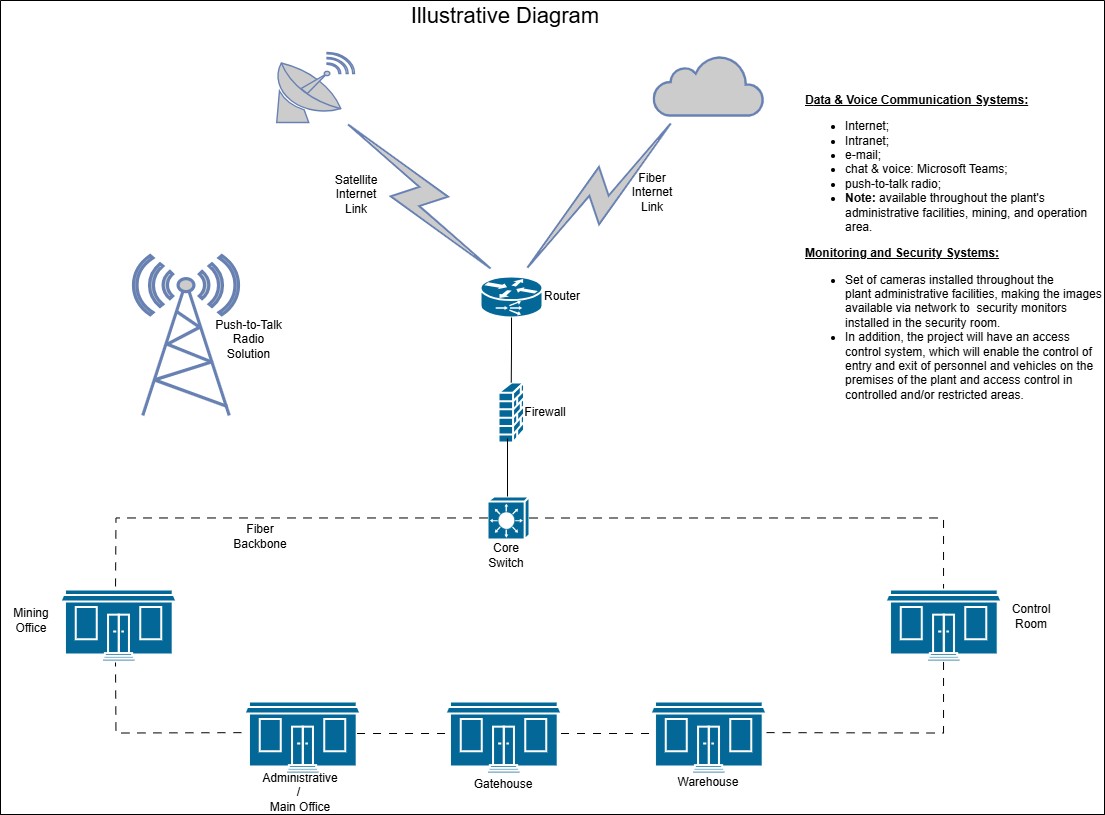
|
| SGS Geological Services |
| S-K 1300 Technical Report – FS Neves Lithium Project – Minas Gerais, Brazil | Page 275 |
| | |
| 15.6.1 | WAN
(Wide Area Network) |
The
project’s WAN architecture includes redundant internet connections via fiber optic (we will extend an existing fiber optic cable
from a local ISP that is present in the Nossa Senhora das Neves Community) and radio communication (we already have a Radio Internet
Circuit in a support area that is closed to Anitta 2. The current circuit is 100 Mbps (can be increased at any time) and is used by the
Atlas Team and visitors).
Fiber
will serve as the main communication link, while a radio link will provide contingency through automatic failover. Load balancing will
be configured to maintain performance and system stability during critical operations.
| 15.6.2 | LAN
(Local Area Network) and WLAN (Wireless Local Area Network) |
The
local network infrastructure is based on a hierarchical star topology, with core and edge switches interconnected at 1 Gbps in administrative
areas and in operational zones. The WLAN system is based on Wi-Fi 6 (802.11ax), offering high-speed wireless coverage in offices
and production units. Key components include:
| ● | Structured
cabling with Cat6 and fiber optics. |
| | | |
| ● | Wireless
controller with centralized management. |
| | | |
| ● | VLAN
segmentation to improve security and performance. |
| | | |
| ● | Organized
racks with temperature control and uninterruptible power supplies (UPS). |
|
| SGS Geological Services |
| S-K 1300 Technical Report – FS Neves Lithium Project – Minas Gerais, Brazil | Page 276 |
| | |
Figure
15-32 Illustrative Design of IT and TA Backbone
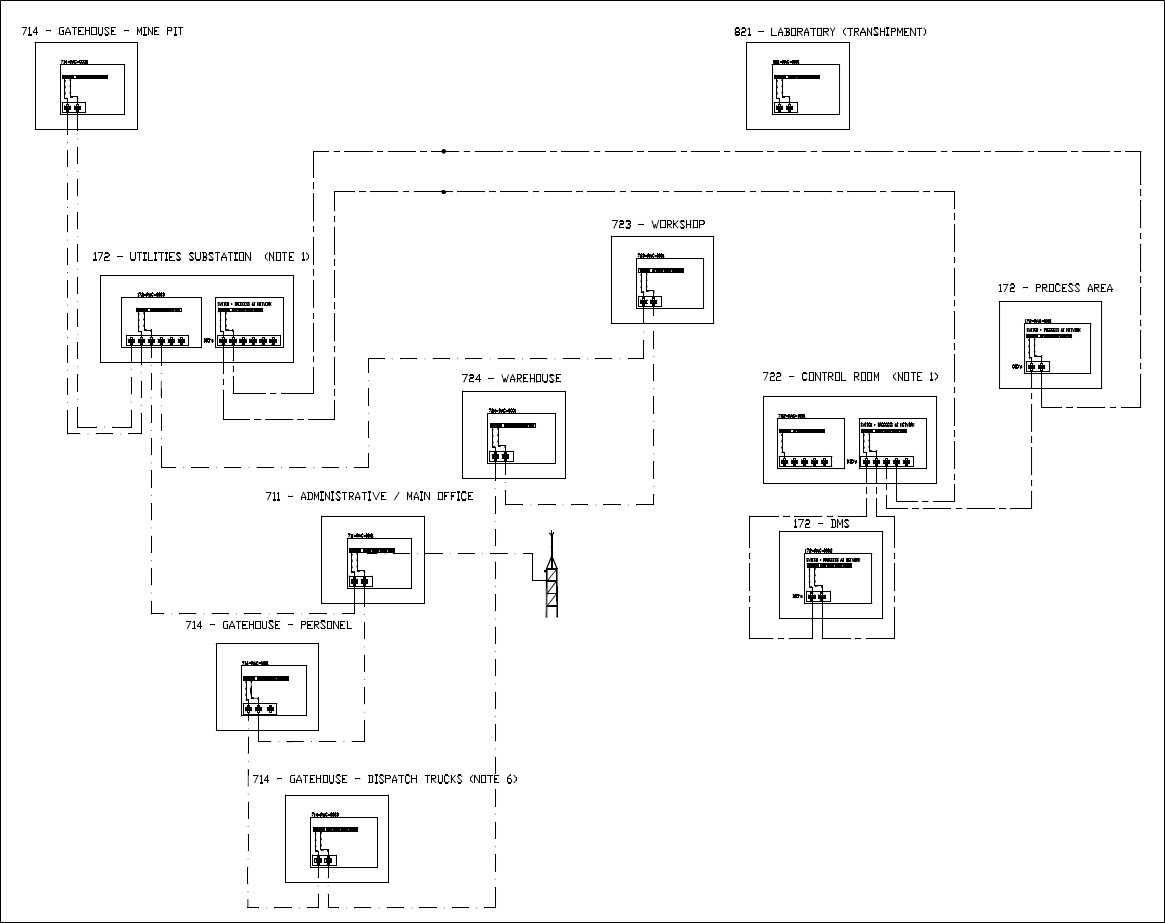
|
| SGS Geological Services |
| S-K 1300 Technical Report – FS Neves Lithium Project – Minas Gerais, Brazil | Page 277 |
| | |
| 15.6.3 | Data
and Voice Communication Systems |
Communication
systems follow a unified model based on Microsoft Teams for VoIP calls, corporate chat, and video conferencing. In operational areas,
a push-to-talk (PTT) radio system will be implemented to ensure agile and secure communication among field teams.
Key
components include:
| ● | Unified
communications via Microsoft Teams on desktop and mobile devices. |
| | | |
| ● | Integration
with corporate directory and calendar for presence awareness and scheduling. |
| | | |
| ● | PTT
radios with dedicated channels for operational and safety teams. |
| | | |
| ● | Communication
redundancy through radio systems in case of network issues. |
These
solutions ensure seamless and reliable communication between administrative and operational areas, covering all work shifts and operational
scenarios.
Site
security is supported by a CCTVs system composed of high-resolution IP cameras, including night-vision and PTZ models, installed at strategic
plant locations (total of cameras that will be installed: 31). Feeds are monitored in real time from a centralized security room and
archived for up to 90 days on redundant NAS devices, with cloud backup for extended retention.
An
access control system will also be implemented, using RFID badges and biometric readers to:
| ● | Control
the entry and exit of personnel and vehicles. |
| | | |
| ● | Restrict
access to sensitive areas. |
| 15.6.5 | Information
Security |
Information
security is based on a multi-layered defense strategy, including:
| ● | Firewall,
endpoint protection, and Microsoft Defender. |
| | | |
| ● | Access
control policies with multi-factor authentication (MFA). |
| | | |
| ● | Frequent
audits of permissions and data protection measures. |
| | | |
| ● | Incident
response plans and protections against ransomware and phishing. |
| | | |
| ● | Data
backup and recovery to mitigate risks of loss of essential information. |
| | | |
| ● | Cybersecurity
monitoring to protect against external attacks and internal threats. |
| 15.6.6 | Regulatory
Compliance and Auditing |
The
IT environment is aligned with international standards and applicable legislation, including:
| ● | ISO
27001, GDPR, LGPD for the protection of sensitive data. |
| | | |
| ● | Business
continuity plans to ensure uninterrupted operations. |
|
| SGS Geological Services |
| S-K 1300 Technical Report – FS Neves Lithium Project – Minas Gerais, Brazil | Page 278 |
| | |
| 15.7.1 | ROM
PAD/ Crushing Area/ Crushed Ore Storage Reclaim – Area 310 |
The
ROM PAD and Crushing Area covers a 12,000m² footprint that receives the run of mine (ROM) material from the pit via haul trucks.
The haul trucks will deliver to one of 5 different stockpiles or ROM Fingers (320-SPL-001@005) based on grade and contamination content,
which is then blended by ratios to achieve the desired plant feed composition. This material is then fed to the Crushing Circuit by a
front-end loader.
The
crushing plant consists of a 1.2 MTPA plant with 3 stages of crushing and 2 screening stages. The Primary Crushing is open circuit using
a jaw crusher, and the Secondary and Tertiary Crushing in closed circuit with cone crushers. The closing screen size in the comminution
circuit is 9.5 mm. The crushing circuit product material is directed to the “Crushed Ore Storage and Reclaim” stockpile (320-SPL-015),
an additional area of approximately 7,500 m², from where a loader starts the process by feeding the Feed Preparation area.
|
| SGS Geological Services |
| S-K 1300 Technical Report – FS Neves Lithium Project – Minas Gerais, Brazil | Page 279 |
| | |
Figure
15-33 illustrates ROM PAD, crushing area, and crushed ore storage reclaim of Area 310. Figure 15-34 displays the crushing flow chart
and
Figure
15 35 illustrates the crushing layout.
Figure
15-33 ROM PAD/ Crushing Area/ Crushed Ore Storage Reclaim – Area 310
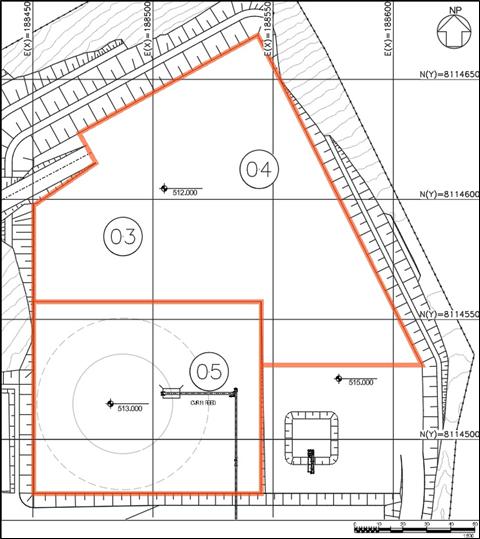
|
| SGS Geological Services |
| S-K 1300 Technical Report – FS Neves Lithium Project – Minas Gerais, Brazil | Page 280 |
| | |
Figure
15-34 Crushing Flowchart
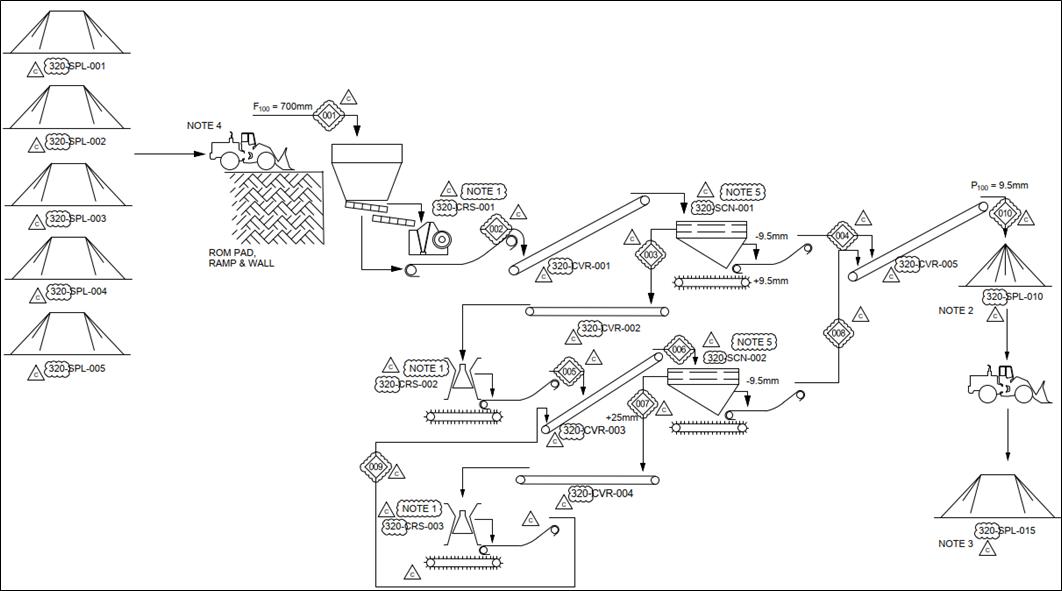
|
| SGS Geological Services |
| S-K 1300 Technical Report – FS Neves Lithium Project – Minas Gerais, Brazil | Page 281 |
| | |
Figure
15-35 Conceptual Crushing Layout Plan
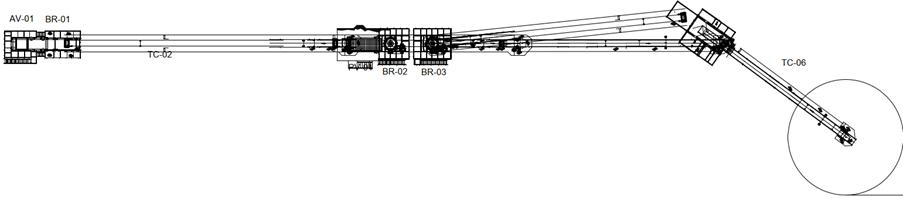

|
| SGS Geological Services |
| S-K 1300 Technical Report – FS Neves Lithium Project – Minas Gerais, Brazil | Page 282 |
| | |
| 15.7.2 | Feed
Preparation – Area 410 |
The
Feed Preparation Area is the preliminary wet processing section of the wet process plant. The crushed ore material is reclaimed by front
end loader and deposited in the FEL Feed Bin. The material is extracted from the feed bin via a belt feeder and conveyor, repulped with
water in a feed box, and transferred to a vibrating screen with 0.85 mm x 18.5 mm aperture screen panels. The purpose of this classification
step is to remove the fine -0.85mm crushed ore which is too fine to be processed in the DMS Plant. This material is directed to the tailings
system. The screen oversize material is comprised of a -9.5+0.85mm particle size distribution which is transferred to a conveyor and
then delivered to the Primary DMS Plant for further processing.
Figure
15-36 represents Area 410 and Figure 15-37 illustrates a crushing flowchart.
Figure
15-36 Feed Preparation – Area 410
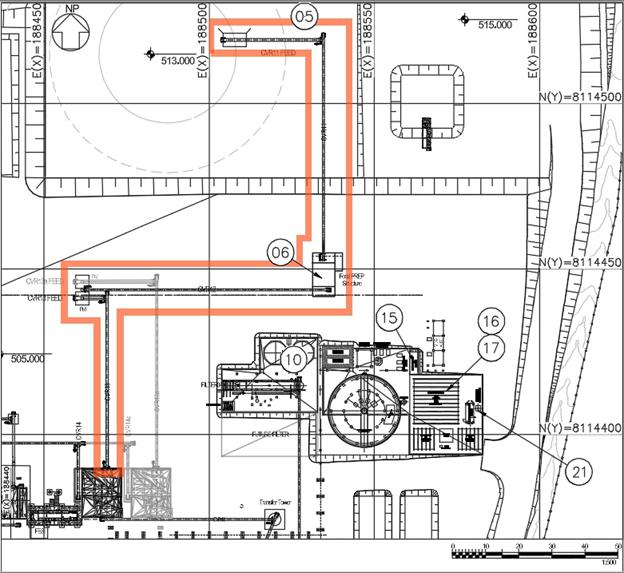
|
| SGS Geological Services |
| S-K 1300 Technical Report – FS Neves Lithium Project – Minas Gerais, Brazil | Page 283 |
| | |
Figure
15-37 Feed Preparation Flowchart
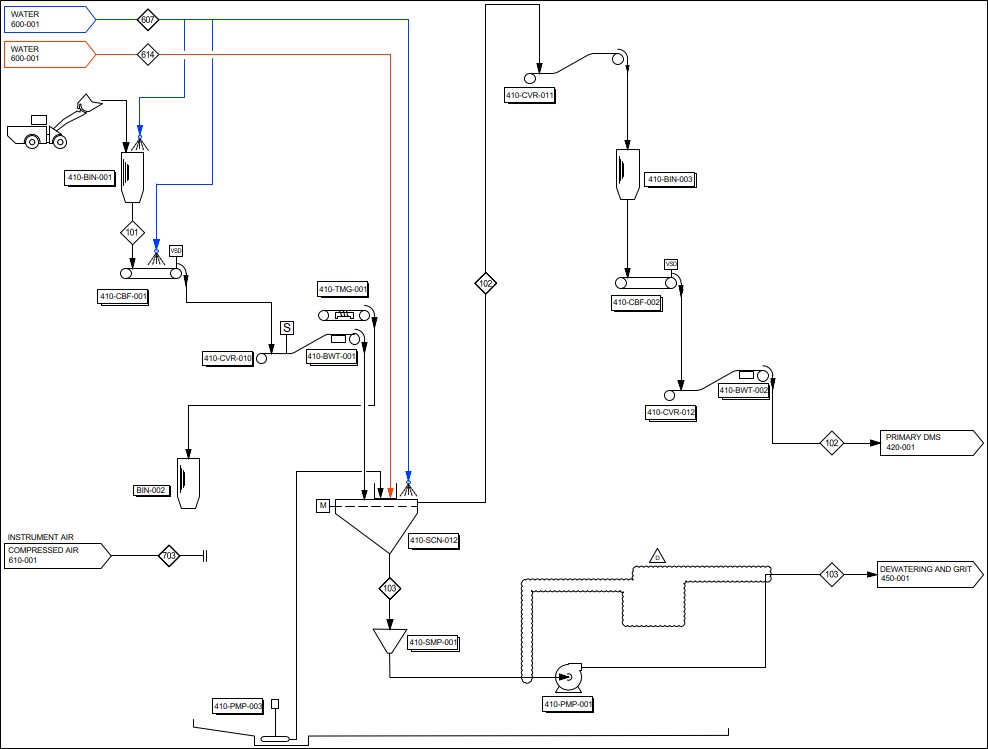
|
| SGS Geological Services |
| S-K 1300 Technical Report – FS Neves Lithium Project – Minas Gerais, Brazil | Page 284 |
| | |
| 15.7.3 | Primary
DMS – Area 420 |
The
first unit operation within Area 420 is a subsequent fine particle removal on the Deslime Screen, which removes any residual fine ore
(-0.6mm material) prior to the Primary DMS.
Dense
media separation (DMS) is a mineral processing method that facilitates the separation of particles based on their density (also known
as specific gravity) differences. This is achieved by creating a fluid or slurry with a specific gravity (SG) that lies between the 2
particles that need to be separated. For example, if a mineral of interest such as spodumene has an SG of 2.95, and the gangue material
has an SG of 2.70, if a fluid with a SG of 2.80 existed, one particle would float, and the other would naturally sink in that liquid.
This is the principle of DMS.
A
fine powdered material called ferrosilicon (FeSi) is mixed with water to create a slurry, and water is added and removed under careful
control to modify the slurry SG and control the SG separation point (also known as the cut point).
The
FeSi slurry at the desired SG is mixed with the ore in a specialized DMS mixing box and is fed to a DMS cyclone which separates the ore
from the gangue material, with the heavy spodumene/pegmatites discharging from the cyclone spigot and the lighter gangue material discharging
from the cyclone overflow. This separation is typically performed in 2 stages, (hence Primary and Secondary DMS) which results in a more
efficient separation with superior recovery. The slurry that is discharged from the hydro cyclones is delivered to drain and rinse screens
which recover the FeSi for re-use by draining and washing the ore with water.
In
general, one stage of DMS consists of a DMS Mixing Box (which facilitates a constant head pressure on the DMS Cyclone Feed Pump suction),
DMS cyclone, vibrating drain and rinse screens, pumps and densifier for regulating density and separating the floats and sinks materials,
in addition to a magnetic separator and demagnetizing coil for recovering the FeSi. The DMS consists of 2 circuits, a Correct Medium
circuit, and a Dilute Medium Circuit, which operate together to recover FeSi and control the density of the FeSi slurry by removing and
adding water as required. This is achieved using densitometers, pipe densifiers and magnetic separators.
|
| SGS Geological Services |
| S-K 1300 Technical Report – FS Neves Lithium Project – Minas Gerais, Brazil | Page 285 |
| | |
Figure
15-38 and Figure 15-39 represents the 3D model of Neves Project for the Primary DMS.
Figure
15-38 Primary DMS – Area 420 - View 1
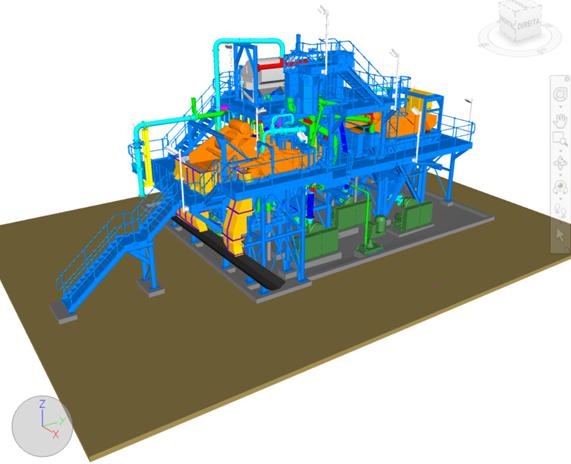
|
| SGS Geological Services |
| S-K 1300 Technical Report – FS Neves Lithium Project – Minas Gerais, Brazil | Page 286 |
| | |
Figure
15-39 Primary DMS – Area 420 - View 2
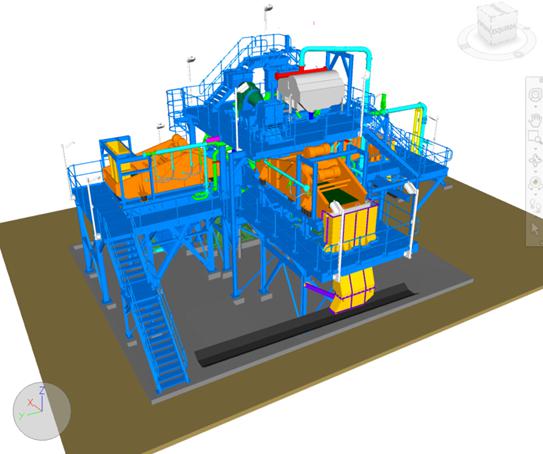
| 15.7.4 | Primary
Floats Stockpile – Area 510 |
As
mentioned in the previous section, the process of concentrating spodumene via dense medium separation is based on the separation between
float and sink materials via density. In this case, the spodumene is the denser material (being the mineral of interest). As a reject
of primary DMS, the less dense material (floats) is directed to a waste stockpile, called the Primary Floats Stockpile, as shown in Figure
15-40.
|
| SGS Geological Services |
| S-K 1300 Technical Report – FS Neves Lithium Project – Minas Gerais, Brazil | Page 287 |
| | |
Figure
15-40 Primary Floats Stockpile – Area 510
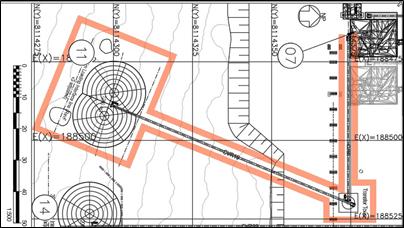
| 15.7.5 | Interstage
Screening – Are 430 |
The
Interstage Screening Area has the function of receiving the sinks material from the Primary DMS and classifying it on a vibrating screen,
equipped with 0.5 mm x 8 x 8.8 mm HFSWF aperture panels, directing the oversize to the secondary DMS and the undersize to the tailings
system.
Figure
15-41 represents the interstage screening of Area 430 and Figure 15-42 illustrates the crushing flowchart.
Figure
15-41 Interstage Screening – Area 430
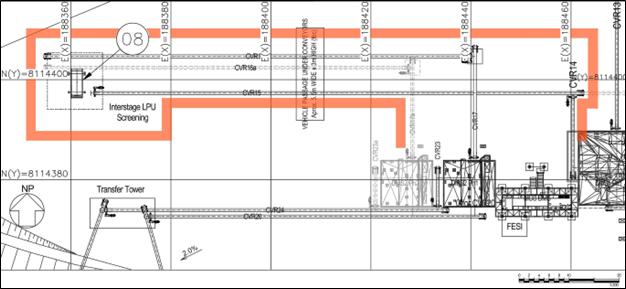
|
| SGS Geological Services |
| S-K 1300 Technical Report – FS Neves Lithium Project – Minas Gerais, Brazil | Page 288 |
| | |
Figure
15-42 Interstage Screening Flowchart
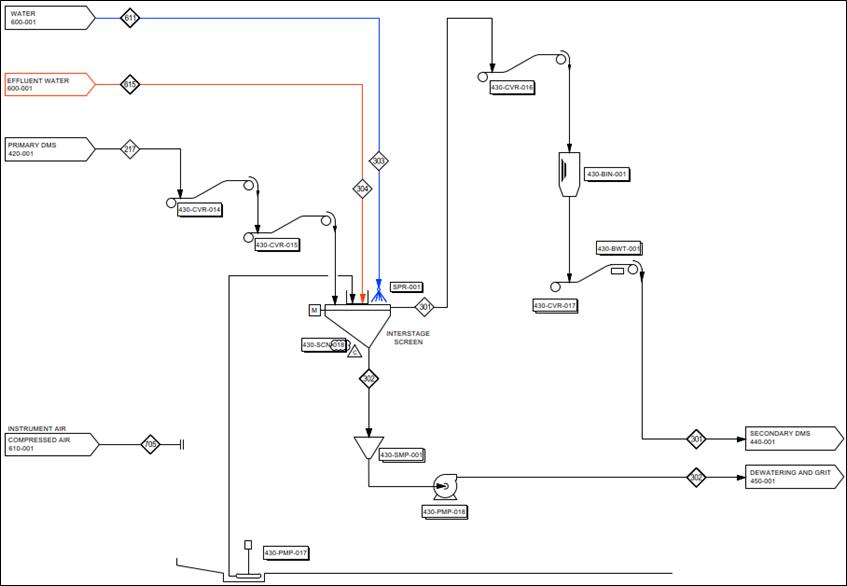
|
| SGS Geological Services |
| S-K 1300 Technical Report – FS Neves Lithium Project – Minas Gerais, Brazil | Page 289 |
| | |
| 15.7.6 | Secondary
DMS – Area 440 |
The
interstage screen assisted with removal of residual fine particles and some dewatering prior to the Secondary DMS which assists with
SG control in the next stage of DMS processing. The sinks material from the Primary DMS provides the feed material for the Secondary
DMS Area. For spodumene processing, the secondary DMS stage will operate at a higher FeSi SG than the primary DMS stage. The floats material
is rejected again, while the sinks material from the Secondary DMS is the final product of the process (concentrated spodumene).
As
with the primary DMS, the secondary DMS consists of a DMS Mixing Box, a DMS cyclone, vibrating drain and rinse screens, pumps and a densifier
to regulate density and to separate floats and sinks materials, in addition to a magnetic separator to recover the FeSi utilized in this
second separation stage.
Figure
15-43 and Figure 15-44 represents the 3D model of Neves Project for the Secondary DMS.
Figure
15-43 Secondary DMS – Area 430 - View 1
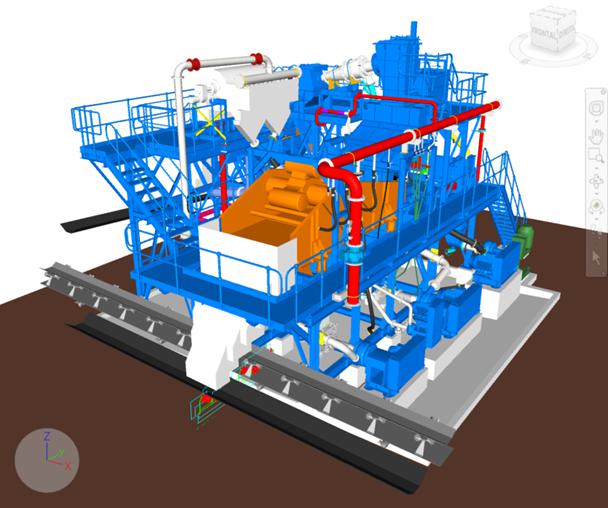
|
| SGS Geological Services |
| S-K 1300 Technical Report – FS Neves Lithium Project – Minas Gerais, Brazil | Page 290 |
| | |
Figure
15-44 Secondary DMS – Area 430 – View 2
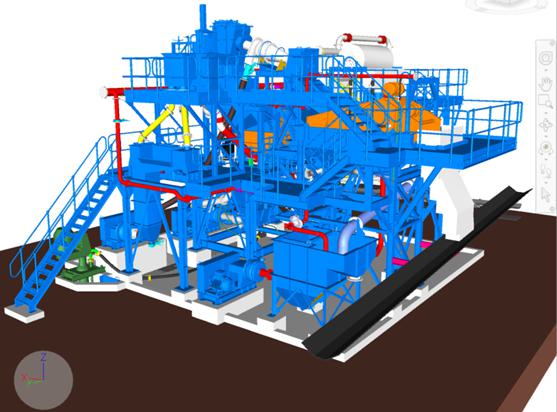
|
| SGS Geological Services |
| S-K 1300 Technical Report – FS Neves Lithium Project – Minas Gerais, Brazil | Page 291 |
| | |
| 15.7.7 | Secondary
Floats Stockpile – Are 520 |
Analogous
to the purpose of the Primary Floats Stockpile, the Secondary Floats Stockpile receives the floats/rejects material from the Secondary
DMS stage.
Figure
15-45 Secondary Floats Stockpile – Area 520
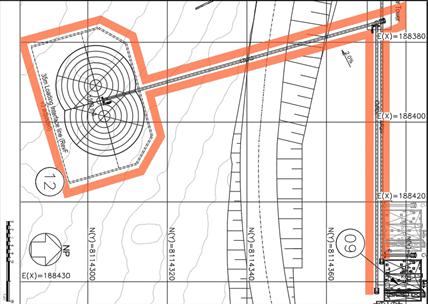
| 15.7.8 | Final
Product Stockpile – Area 530 |
The
sinks material from the Secondary DMS is the final product of the process (concentrated spodumene in the range of 5.0-6.0%w/w), which
is transferred by conveyors to the Final Product Stockpile.
Figure
15-46 Final Product Stockpile – Area 530
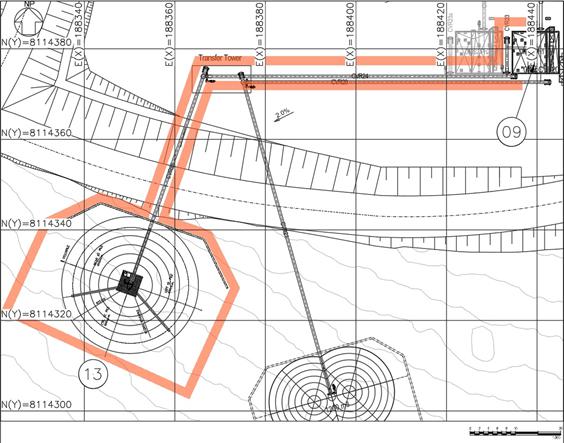
| 15.7.9 | Tails
Handling – Area 450 |
The
tailings area is comprised of a thickener, pumps, flocculant skids, filter feed tanks with agitators, and a vacuum horizontal belt filter.
All effluent separated in the process is directed to the thickener, a unit operation in which filtered water is recovered for reuse in
the process, and the tailings slurry is dewatered to around 50%w/w solids prior to being filtered for dry stack tailings. The thickener
U/F slurry is directed to two buffer tanks prior to feeding the vacuum filter belt.
In
the vacuum belt filter, a final solid-liquid separation occurs whereby the slurry moisture is reduced to around 15%. The recovered water/filtrate
is recirculated to the thickener, and the cake containing minimal moisture is directed to the conveyor that feeds the grit stockpile.
This material represents the plant fine tailings which is recombined with the coarse rejects for a dry stack tailings deposition process.
Figure
15-47 illustrates tails handling of Area 450 and Figure 15-48 illustrates the tails handling flowchart.
|
| SGS Geological Services |
| S-K 1300 Technical Report – FS Neves Lithium Project – Minas Gerais, Brazil | Page 292 |
| | |
Figure
15-47 Tails Handling – Area 450
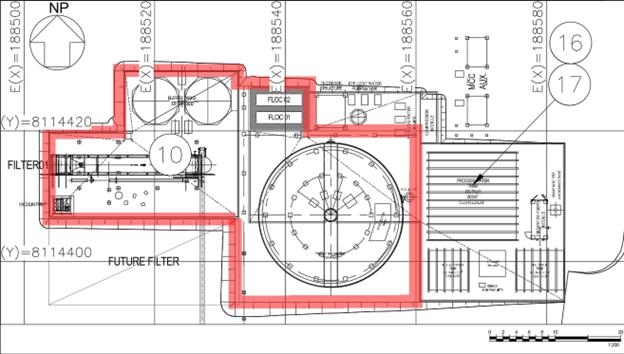
|
| SGS Geological Services |
| S-K 1300 Technical Report – FS Neves Lithium Project – Minas Gerais, Brazil | Page 293 |
| | |
Figure
15-48 Tails Handling Flowchart
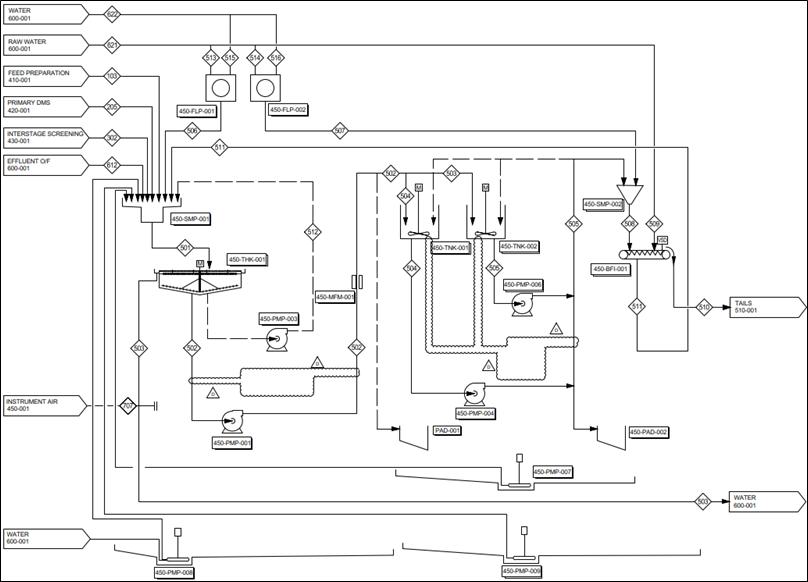
|
| SGS Geological Services |
| S-K 1300 Technical Report – FS Neves Lithium Project – Minas Gerais, Brazil | Page 294 |
| | |
| 15.7.10 | Grit
Stockpile – Area 540 |
As
mentioned in the previous section, the filter cake generated by the horizontal belt filter, discharges onto a conveyor that feeds the
Grit Stockpile. Figure 15-49 illustrates the grit stockpile in Area 540.
Figure
15-49 Grit Stockpile - Area 540
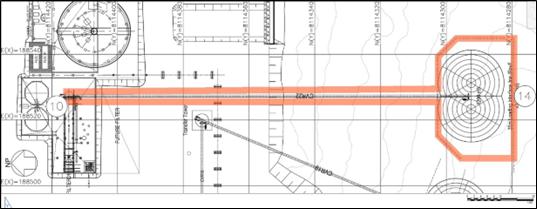
| 15.7.11 | Water
Tanks – Areas 620 and 630 |
The
water tank area is comprised of 3 key water tanks: the process water tank, the firewater tank, and the effluent water tank. Water is
recovered from remote bores and supplies the raw water ponds. Water is pumped from pond 630-DAM-002 to these three tanks to replenish
the mine’s water, passing through a sand filter before feeding the effluent water tank, which consists, in fact, of a buffer for
the closed circulation of the water used in the DMSs (FeSi entrained water). The capacity of the effluent water tank is around 15 m³.
The Process Water Tank receives the filtered water from the thickener and distributes it throughout the plant. Its capacity is 879 m³.
Finally,
the Firewater Tank has a capacity of 218m³ and is connected to a firefighting skid, which consists of electric and diesel pumps
that pressurize the plant’s buried firewater ring main.
The
Figure 15-50 represents the areas 620 and 630 of the project.
|
| SGS Geological Services |
| S-K 1300 Technical Report – FS Neves Lithium Project – Minas Gerais, Brazil | Page 295 |
| | |
Figure
15-50 Water Tanks – Areas 620 and 630
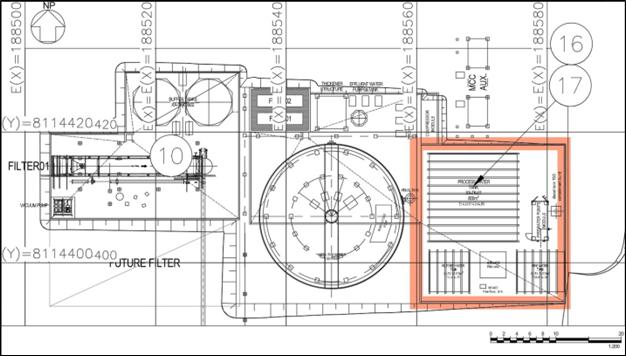
| 15.7.12 | Compressed
air – Area 610 |
The
plant’s compressed air system consists of compressors, filters, dryers and accumulator vessels, separated into two systems: one
dedicated to the DMS instruments (primary and secondary), and the other for air service for all units. These compressors are located
near the tailings and water tanks area.
| 15.7.13 | Emergency
Ponds – Area 630 |
Emergency
ponds (630-DAM-005) are ponds to be used as an emergency in the event of vacuum belt filter shutdowns. Their geometry and construction
methods allow the sedimentation of fines, filtering the water in a porous containment wall with a textile blanket. The water that infiltrates
this wall is collected in a channel and directed to the plant drainage system. Since this filtration process has a flow rate lower than
the potential inflow of the slurry into the ponds, pumps are provided to pump the contents back to the thickener.
The
highlighted part of Figure 15-51 corresponds to the emergency ponds.
|
| SGS Geological Services |
| S-K 1300 Technical Report – FS Neves Lithium Project – Minas Gerais, Brazil | Page 296 |
| | |
Figure
15-51 Emergency Ponds
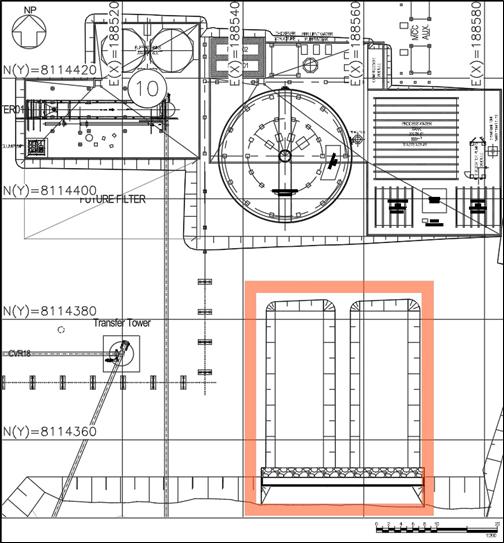
| 15.7.14 | Mine
Support Area / Truck Shop / Truck Wash |
The
operation of the mine will be outsourced, so the Project’s engineering team does not foresee the construction of a support structure
for the mine by Atlas. In the mine operation outsourcing contract, it will be stipulated that the contractor will build its own required
support structure, in addition to using the existing area to be made available by Atlas. This will allow the contracted company to adapt
the installations according to the size of the equipment in its fleet. Atlas will supply water and electricity to the contracted company’s
premises at the mine site.
| 15.8 | Support
Buildings – Processing Plant |
| 15.8.1 | Plant
Administration – Building |
The
following premises were considered when designing the administrative building:
| ● | Male/female
ratio adopted: 50/50% for administrative staff |
| | | |
| ● | Maximum
number of people using the administrative building: 40 people |
|
| SGS Geological Services |
| S-K 1300 Technical Report – FS Neves Lithium Project – Minas Gerais, Brazil | Page 297 |
| | |
The
administrative building will receive modular construction considering thermoacoustic panels and includes the following internal areas:
Table
15-13 Administrative Office Building
| Administrative
Office Environment |
m² |
| Reception
(6 Seats) |
15 |
| Administrative
Staff (10 Stations) |
45 |
| Operational
Staff (20 Stations) |
90 |
| Management
Room 01 |
8 |
| Management
Room 02 |
8 |
| Management
Room 03 |
8 |
| Management
Room 04 |
8 |
| Management
Room 05 |
8 |
| Meeting
Room 8 People |
15 |
| Meeting
Room 16 People |
30 |
| Technical
Archive |
5 |
| Cafeteria |
10 |
| Women’s
Toilet |
12 |
| Men’s
Toilet |
12 |
| Toilet
for People with Disabilities |
4 |
| Cleaning
Material Deposit |
4 |
| Electrical
Room |
15 |
| It
Room |
15 |
| Estimated
Total |
312 |
Figure
15-52 Administrative Building – Perspective View
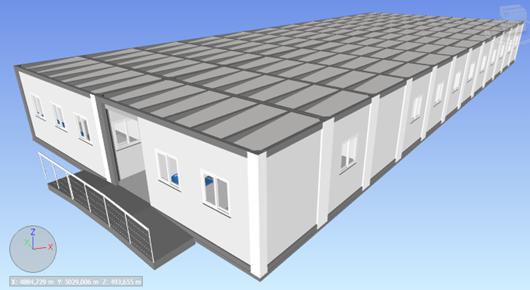
|
| SGS Geological Services |
| S-K 1300 Technical Report – FS Neves Lithium Project – Minas Gerais, Brazil | Page 298 |
| | |
Figure
15-53 Administrative Building – Inside View
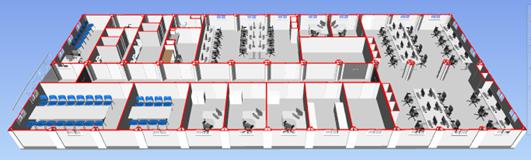
|
| SGS Geological Services |
| S-K 1300 Technical Report – FS Neves Lithium Project – Minas Gerais, Brazil | Page 299 |
| | |
Figure
15-54 Administrative Building – Plan View
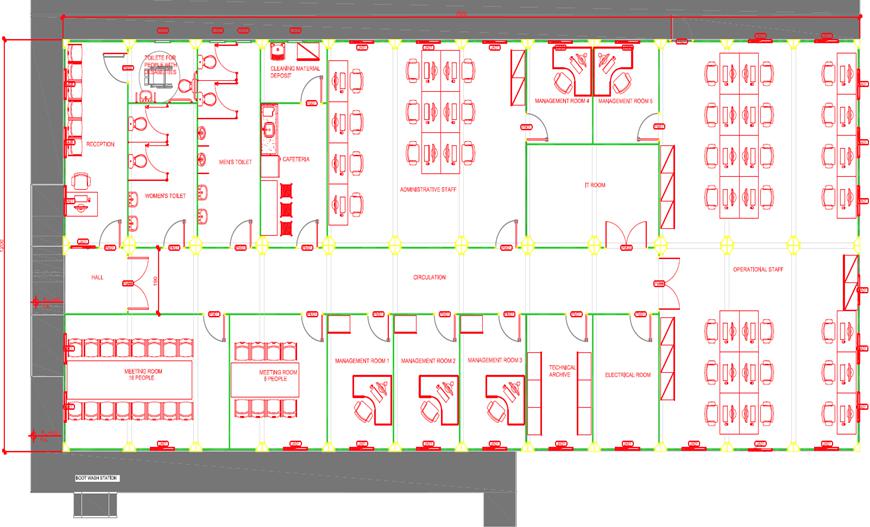
|
| SGS Geological Services |
| S-K 1300 Technical Report – FS Neves Lithium Project – Minas Gerais, Brazil | Page 300 |
| | |
The
program was dimensioned and developed considering that there will be no food production on site, that is, it will come ready, packaged
properly and will only be distributed on site. A maximum staff of 60 people was considered per shift. The program includes the following
internal areas:
Table
15-14 Canteen
| Canteen
Environment |
m² |
| Access/Hygiene
Hall |
15 |
| Women’s
Toilet |
12 |
| Men’s
Toilet |
12 |
| Toilet
for People with Disabilities |
4 |
| Hall
of Entrance |
120 |
| Kitchen |
25 |
| Women’s
Locker Room (for Cafeteria’s Employee) |
10 |
| Men’s
Locker Room (for Cafeteria’s Employee) |
10 |
| Locker
Room for People with Disabilities |
10 |
| Receiving
Dock |
10 |
| Storage |
8 |
| Washing
and Storage |
8 |
| Cleaning
Material Deposit |
4 |
| Garbage |
5 |
| Circulation |
15 |
| Estimated
Total |
268 |
Figure
15-55 Canteen – Perspective View
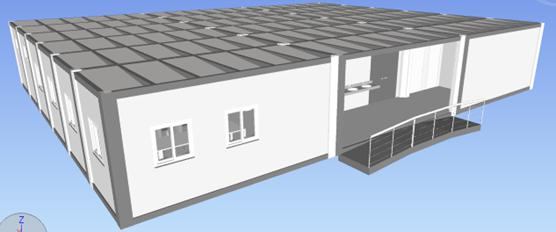
|
| SGS Geological Services |
| S-K 1300 Technical Report – FS Neves Lithium Project – Minas Gerais, Brazil | Page 301 |
| | |
Figure
15-56 Canteen – Inside View
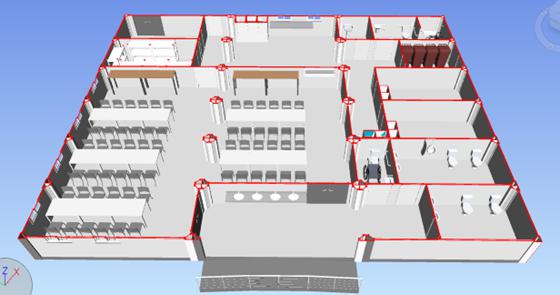
|
| SGS Geological Services |
| S-K 1300 Technical Report – FS Neves Lithium Project – Minas Gerais, Brazil | Page 302 |
| | |
Figure
15-57 Canteen – Plan View
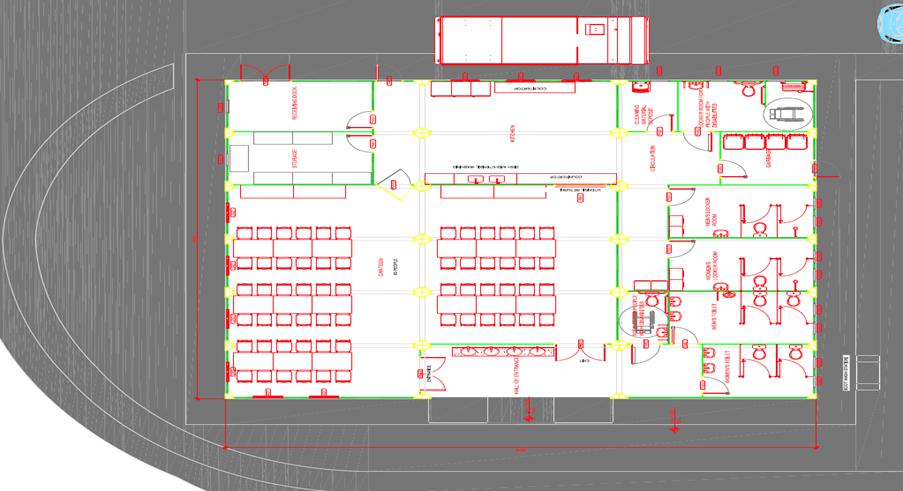
|
| SGS Geological Services |
| S-K 1300 Technical Report – FS Neves Lithium Project – Minas Gerais, Brazil | Page 303 |
| | |
| 15.8.3 | Outpatient
Clinic – Area 713 |
The
Medical Outpatient Clinic program includes the following internal areas:
Table
15-15 Outpatient Clinic
| Outpatient
Clinic Environment |
m² |
| Reception |
10 |
| 2
Bed Ward |
20 |
| Medical
Room |
8 |
| Toilet
For People with Disabilities |
4 |
| Locker
Roomfor Clinic Staff |
12 |
| Purge
Room |
4 |
| Waste
Area |
4 |
| Circulation |
10 |
| Parking
Lot for Ambulance |
45 |
| Estimated
Total |
117 |
Figure
15-58 Outpatient Clinic – Perspective View
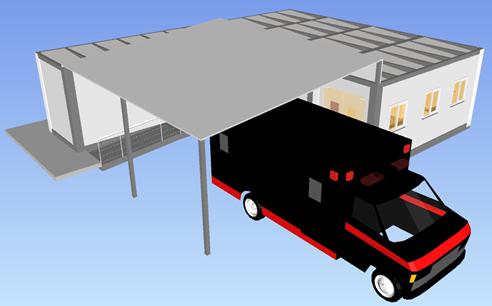
|
| SGS Geological Services |
| S-K 1300 Technical Report – FS Neves Lithium Project – Minas Gerais, Brazil | Page 304 |
| | |
Figure
15-59 Outpatient Clinic – Inside View
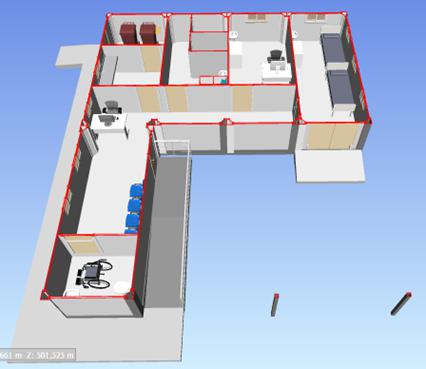
|
| SGS Geological Services |
| S-K 1300 Technical Report – FS Neves Lithium Project – Minas Gerais, Brazil | Page 305 |
| | |
Figure
15-60 Outpatient Clinic – Plan View
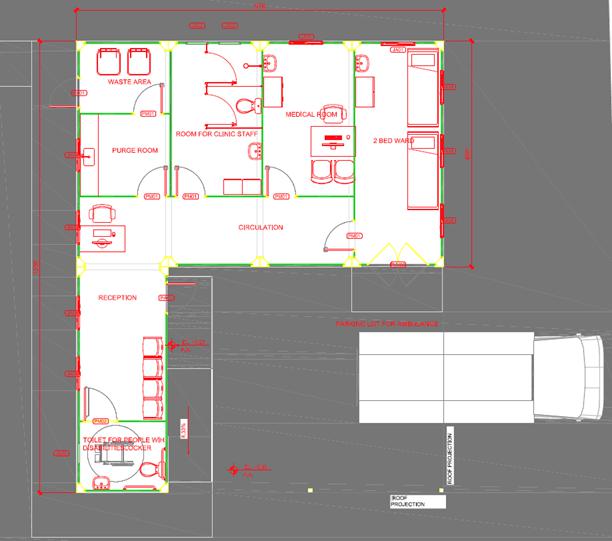
|
| SGS Geological Services |
| S-K 1300 Technical Report – FS Neves Lithium Project – Minas Gerais, Brazil | Page 306 |
| | |
| 15.8.4 | Main
Gatehouse – Area 714 |
The
Main gatehouse is intended for the delimitation and access control of industrial unit. The building provides an external covered access
control area for 2 turnstiles, to personnel entrance. The gatehouse will control the access and exit of vehicles on the site in 2 lanes,
one for entry and one for exit for light vehicles and trucks, all controlled by gates. A training room is also planned in the building.
Table
15-16 lists the main gatehouse program including the following internal areas:
Table
15-16 Main Gatehouse
| Main
Gatehouse Environment |
m² |
| Doorman
- 2 Seater |
10 |
| Cafeteria |
4 |
| Waiting
Room - 5 Seats |
12 |
| Fem
Toilet (Also Serves People with Disabilities) |
4 |
| Male
Toilet (Also Serves People with Disabilities) |
4 |
| Cleaning
Material Deposit |
3 |
| Covered
Access |
20 |
| Training
Room (8 Seats) |
15 |
| Estimated
Total |
70 |
Figure
15-61 Main Gatehouse – Perspective View
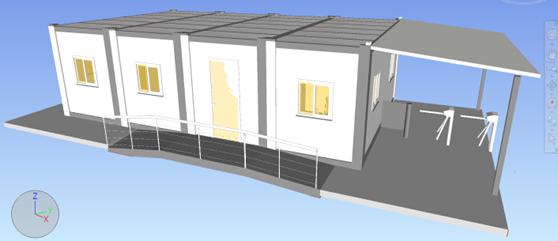
|
| SGS Geological Services |
| S-K 1300 Technical Report – FS Neves Lithium Project – Minas Gerais, Brazil | Page 307 |
| | |
Figure
15-62 Main Gatehouse – Inside View
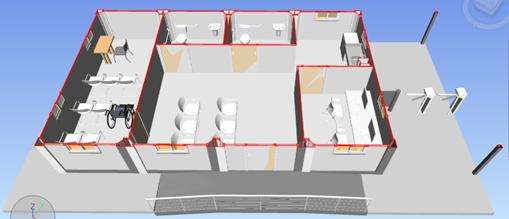
Figure
15-63 Main Gatehouse – Plan View
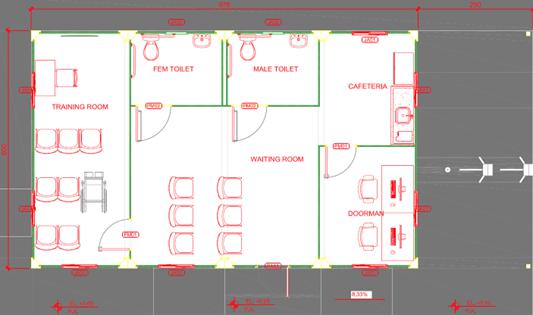
|
| SGS Geological Services |
| S-K 1300 Technical Report – FS Neves Lithium Project – Minas Gerais, Brazil | Page 308 |
| | |
| 15.8.5 | ROM
PAD Gatehouse – Area 714 |
Due
to the arrival of access to the concentration plant, there is a need for a dedicated entrance for trucks loaded with ore from the pits.
Table 15-17 lists the ROM PAD Gatehouse areas:
Table
15-17 ROM PAD Gatehouse
| ROM
PAD Gatehouse Environment |
m² |
| Doorman
Room |
10 |
| Sanitary |
3 |
| Estimated
Total |
13 |
Figure
15-64 ROM PAD Gatehouse – Perspective View
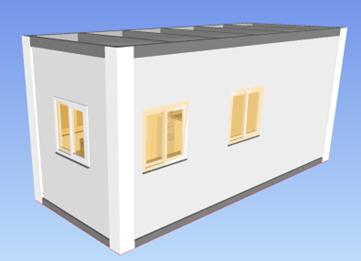
Figure
15-65 ROM PAD Gatehouse – Inside View
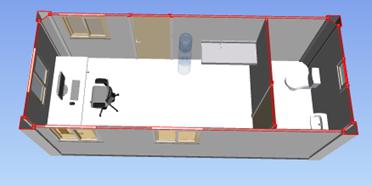
|
| SGS Geological Services |
| S-K 1300 Technical Report – FS Neves Lithium Project – Minas Gerais, Brazil | Page 309 |
| | |
Figure
15-66 ROM PAD Gatehouse – Plan View
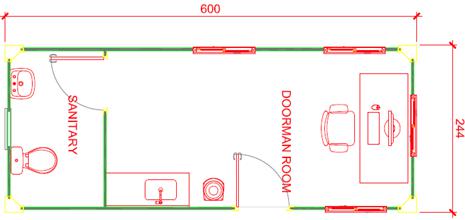
| 15.8.6 | Dispatch
Gatehouse – Area 714 |
Due
to the arrival of access to the concentration plant, there is a need for a dedicated dispatch gatehouse for trucks loaded with concentrated
spodumene or material to be deposited on the Waste and Tailing Dump. Table 15-18 lists the Dispatch Gatehouse areas.Figure 15-67, Figure
15-68, and Figure 15-69 illustrate the Gatehouse:
Table
15-18 Dispatch Gatehouse
| Dispatch
Gatehouse Environment |
m² |
| Doorman
Room |
10 |
| Sanitary |
3 |
| Estimated
Total |
13 |
Figure
15-67 Dispatch Gatehouse – Perspective View
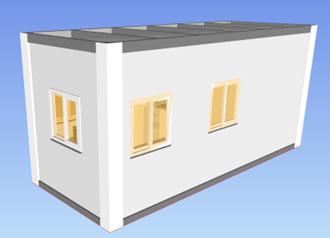
|
| SGS Geological Services |
| S-K 1300 Technical Report – FS Neves Lithium Project – Minas Gerais, Brazil | Page 310 |
| | |
Figure
15-68 Dispatch Gatehouse – Inside View
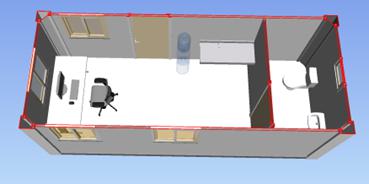
Figure
15-69 Dispatch Gatehouse – Plan View
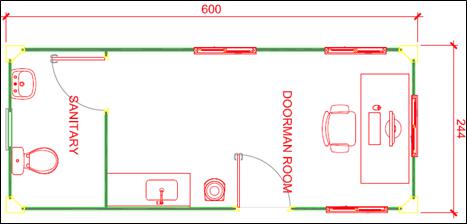
|
15.8.7 | Locker
Room – Area 715 |
The
following premises were considered when designing the locker room:
| ● | Total
workforce of the industrial plant – 150 people |
| | |
| ● | Male/female
ratio adopted: 70/30% for operational staff and 50/50% for administrative staff |
| | |
| ● | Maximum
number of people using the locker room: 60 people per shift |
The
Locker Room will receive modular construction considering thermoacoustic panels and will serve all operational staff, in addition to
the staff of the Workshop and Warehouse. The Locker Room program includes the following internal areas:
|
| SGS Geological Services |
| S-K 1300 Technical Report – FS Neves Lithium Project – Minas Gerais, Brazil | Page 311 |
| | |
Table
15-19 Locker Room
| Locker
Room Environment |
m² |
| Women’s
Locker Room (18 People + 45 Lockers) |
75 |
| Men’s
Locker Room (42 People + 105 Lockers) |
165 |
| People
With Disabilities Locker Room |
12 |
| Garbage
Deposit |
5 |
| Cleaning
Material Deposit |
4 |
| Estimated
Total |
261 |
Figure
15-70 Locker Room – Perspective View
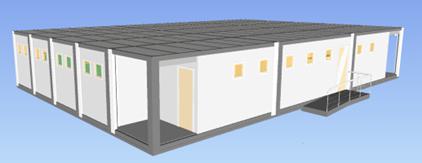
Figure
15-71 Locker Room – Inside View
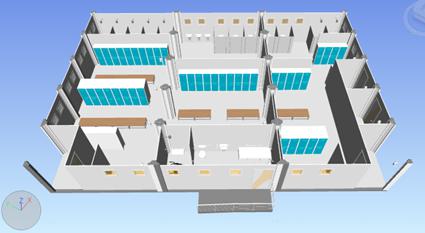
|
| SGS Geological Services |
| S-K 1300 Technical Report – FS Neves Lithium Project – Minas Gerais, Brazil | Page 312 |
| | |
Figure
15-72 Locker Room – Plan View
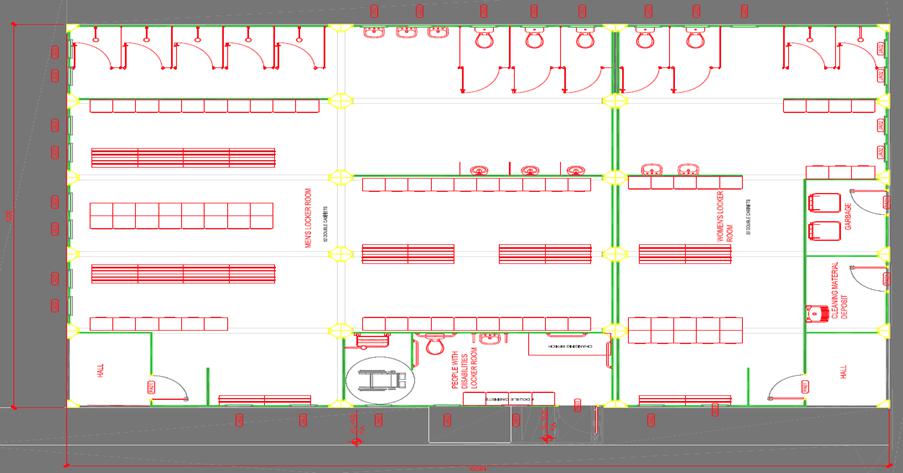
|
| SGS Geological Services |
| S-K 1300 Technical Report – FS Neves Lithium Project – Minas Gerais, Brazil | Page 313 |
| | |
| 15.8.8 | Waste
Deposit – Area 717 |
The
building is dedicated to the disposal and separation of industrial waste. It has five bays for class II waste, separated into glass,
metal, paper/cardboard, plastic and rejects. There is also one compartment for class I hazardous waste, restricted by masonry and ventilated
by a steel grate, and has a 10 cm containment dike at the door threshold. The ceiling height is around 3.00 m. The right and left sides,
as well as the back, are sealed with masonry up to the roof. Front part in half wall and steel door, at a height of 1.30 m, except for
the compartment intended for the storage of hazardous waste which will be completely isolated.
The
building’s use program includes:
Table
15-20 Waste Deposit
| Waste
Deposit Environment |
m² |
| Recyclable
Paper |
3,20 |
| Recyclable
Plastic |
3,20 |
| Recyclable
Glass |
3,20 |
| Recyclable
Metal |
4,26 |
| Waste
– Non-Recyclable |
4,26 |
| Hazardous
Waste |
4,10 |
| Estimated
Total |
22,22 |
Figure
15-73 Waste Deposit – Perspective View
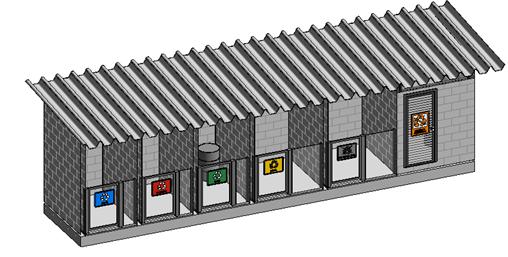
|
| SGS Geological Services |
| S-K 1300 Technical Report – FS Neves Lithium Project – Minas Gerais, Brazil | Page 314 |
| | |
| 15.8.9 | Control
Room Support Building – Area 722 |
Given
that the control room will be provided as an E-House, to be positioned above the substation serving the DMSs, and this electro center
does not have bathrooms or support/meeting spaces, a support building was designed close to the control room, and its use program is
according to the following table:
Table
15-21 Control Room Support Building
| Control
Room Environment |
m² |
| Administrative
Support |
9 |
| Cafeteria |
4 |
| Sanitary
Fem. |
3 |
| Sanitary
Men. |
3 |
| Estimated
Total |
19 |
Figure
15-74 Control Room Support Building – Perspective View
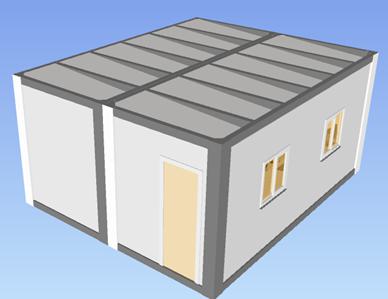
|
| SGS Geological Services |
| S-K 1300 Technical Report – FS Neves Lithium Project – Minas Gerais, Brazil | Page 315 |
| | |
Figure
15-75 Control Room Support Building – Inside View
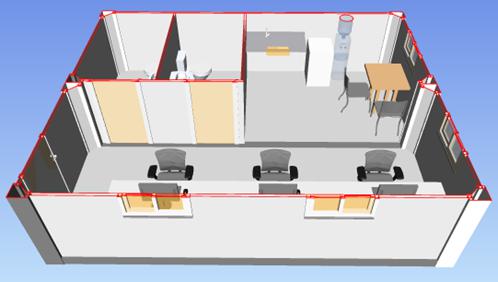
Figure
15-76 Control Room Support Building – Plan View
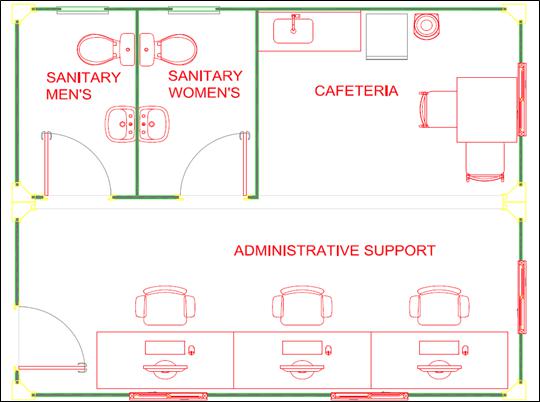
|
| SGS Geological Services |
| S-K 1300 Technical Report – FS Neves Lithium Project – Minas Gerais, Brazil | Page 316 |
| | |
| 15.8.10 | Workshop
– Area 723 |
The
use of containers, for the delimitation of the building and configuration of the support program, and vinyl canvas coverage on a metal
structure, which must be fixed on the containers, will be considered as a construction system. The ceiling height will be approximately
5.20m, guaranteed by the stacking of 2 containers. On the west façade, vinyl canvas closure with mesh windows will be foreseen,
for natural ventilation, as well as exhaust fans on the roof.
The
containers will be 40ft and these will be emptied during the electromechanical assembly process and will already be on site for the process
of adaptation and use of the structure.
Therefore,
the supply and installation of materials and all sealing elements - floor, wall, roof, internal coatings, partitions and ceilings, as
well as sanitary ware and metal, accessories, frames, hydraulic and electrical installations, and exhaust fans - must be included.
The
entire program must be allocated on the ground floor, so that the containers stacked above remain closed and serve only to ensure the
necessary ceiling height. The building’s use program includes:
Table
15-22 Workshop
| Workshop
Environment |
m² |
| Workshop |
446.50 |
| Tool
Shop |
25.15 |
| Deposit |
25.15 |
| Administrative
Office |
25.15 |
| Women’s
Toilet |
9.35 |
| Men’s
Toilet |
15.20 |
| Cafeteria |
25.15 |
| Equipment
Storage Room |
25.15 |
| Flammable
Liquids Storage Room |
25.15 |
| Estimated
Total |
621.95 |
Figure
15-77 Workshop – Perspective View
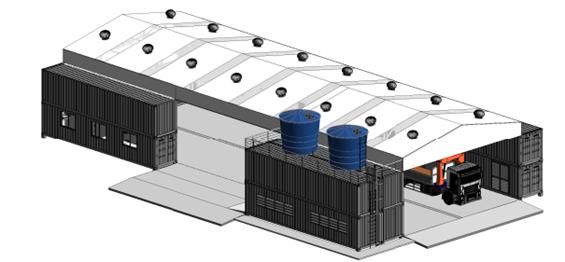
|
| SGS Geological Services |
| S-K 1300 Technical Report – FS Neves Lithium Project – Minas Gerais, Brazil | Page 317 |
| | |
| 15.8.11 | Warehouse
– Area 724 |
The
construction will consist of pillars and metal beams, with lateral closure and vinyl canvas covering. Includes materials and installation
of all internal and external sealing elements such as floor, wall, roofing, coatings, partitions, ceilings, sanitary ware and metals,
accessories and frames.
It
is designed with a leveled concrete floor with smooth finish in the internal areas and surface hardener. An overload of 2.0 t/m3
or a Munck type vehicle with a maximum axle load of 17 tonnes was adopted to the floor designed.
A
large yard is planned for storing external items (the entire area is fenced), as well as the positioning of containers, for an additional
storage area. Two of these containers will have intervention, one of which will be dedicated to the storage of chemical products where
ventilation shutters should be installed, and another should be a refrigerated container. The containers will be 40 ft and these will
be emptied during the electromechanical assembly process and will already be on site for the process of adaptation and use of the structure.
The
building’s use program includes:
Table
15-23 Warehouse
| Warehouse
Environment |
m² |
| Warehouse |
372.1 |
| Office |
54.4 |
| Sanitary |
9.2 |
| Cafeteria |
10.1 |
| Deposit |
4.7 |
| Estimated
Total |
450.5 |
Figure
15-78 Warehouse – Perspective View
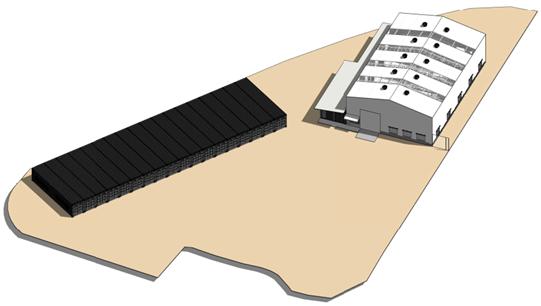
|
| SGS Geological Services |
| S-K 1300 Technical Report – FS Neves Lithium Project – Minas Gerais, Brazil | Page 318 |
| | |
| 15.9 | Support
Buildings – Mining Facilities |
| 15.9.1 | Mine
Operation Support Area |
For
the implementation of the mine’s operation support area, a sector located in the vicinity of the Anitta 02 and Anitta 03 pits was
designated, in a strategically defined position to ensure easy access, logistical efficiency and direct integration with the mining fronts.
This area will house the essential support structures for mining activities, such as workshops, warehouses, truck yards, administrative
areas and other operational support facilities.
The
implementation, operation and maintenance of these structures will be the responsibility of the company contracted to carry out the mining
activities, according to the guidelines established in the project. This definition ensures that facilities are developed in compliance
with current technical, environmental and safety requirements, while seeking to optimize operational displacements and reduce the response
time of field routines, contributing to the overall efficiency of the mine operation.
As
part of the contracting process, a specific technical requisition was prepared, which included the need to build the support area. The
proposals received by the proposing companies contemplated these structures, presenting solutions with a similar construction standard.
The
proposed layout, presented ahead, reflects the consolidated model of the planned structures, with the spatial organization developed
based on criteria of operational functionality, safety and optimization of internal flows. The layout of the facilities was planned in
order to facilitate access to the equipment, ensure the fluidity of operations and ensure efficient integration with the other areas
of the project.
| 15.9.2 | Essential
infrastructure to be implemented |
| ● | Maintenance
workshop |
| | |
| ● | Equipment
and furniture for offices and maintenance workshops |
| | |
| ● | Sanitary
facilities and living areas (cafeteria and rest) |
| | |
| ● | Warehouses
and temporary storage areas |
| | |
| ● | Parking
for light and heavy vehicles |
| | |
| ● | Security
and fencing measures |
| | |
| ● | Lubricant
storage and distribution facilities |
| | |
| ● | Infrastructure
for washing equipment |
| | |
| ● | Tire
shop - Area for handling, assembly and storage of tires |
| | |
| ● | Infrastructure
for water supply, lighting, electricity and distribution |
| | |
| ● | Sewage
and wastewater treatment systems |
| | |
| ● | Power
generation for all mine facilities |
| | |
| ● | IT
and Communication infrastructure |
|
| SGS Geological Services |
| S-K 1300 Technical Report – FS Neves Lithium Project – Minas Gerais, Brazil | Page 319 |
| | |
Figure
15-79 General Layout of the Suggested Mine Operation Support Area
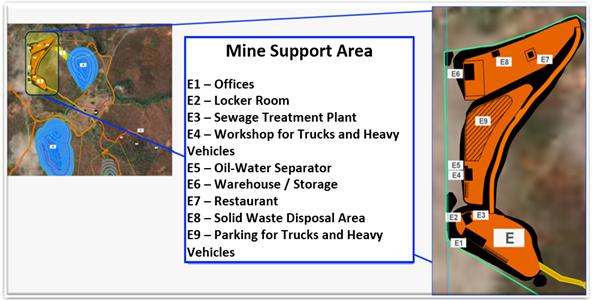
As
mentioned, this support structure for the Mine operation will be the responsibility of the company to be hired to carry out the mine
operation activities, therefore. A specific technical requisition was prepared for the Mine Operation activities and including the need
to build the mine support area, Atlas received the proposals from the proponents where these structures were included and then the model
of the structures planned according to the proposals is presented, all proposals presented the same standard.
Figure
15-80 Typical Mining Facilities to be Implemented – View 1
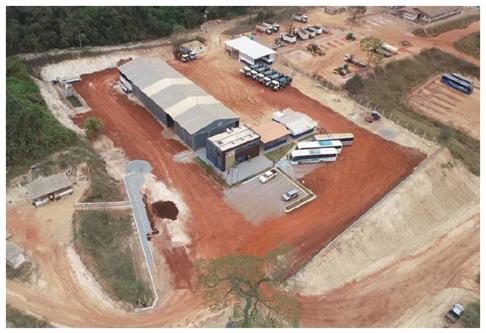
|
| SGS Geological Services |
| S-K 1300 Technical Report – FS Neves Lithium Project – Minas Gerais, Brazil | Page 320 |
| | |
Figure
15-81 Typical Mining Facilities to be Implemented – View 2
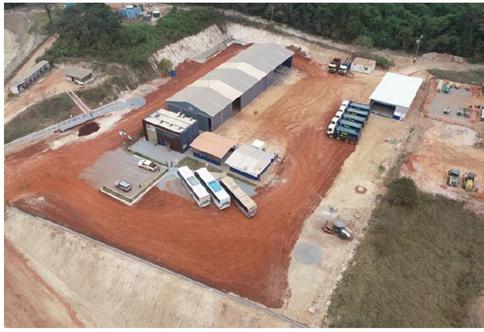
Figure
15-82 Typical Mining Facilities to be Implemented – View 3
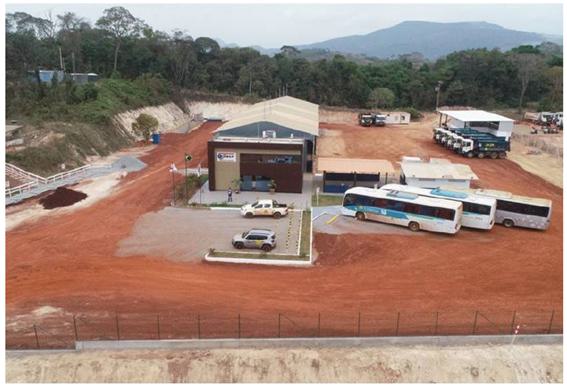
|
| SGS Geological Services |
| S-K 1300 Technical Report – FS Neves Lithium Project – Minas Gerais, Brazil | Page 321 |
| | |
Figure
15-83 Typical Mining Facilities to be Implemented – View 4
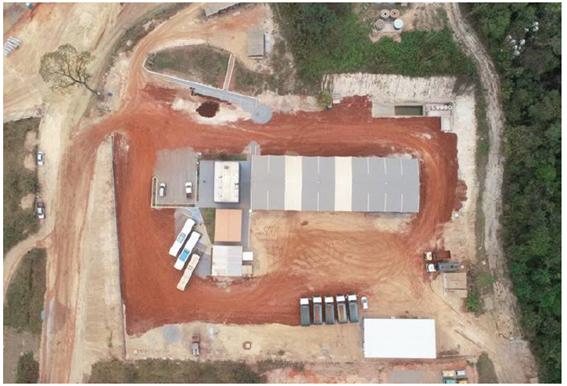
| 15.9.3 | Fueling
Station and Storage |
As
indicated on Figure 15-1, the fuel station will be located in the mining facilities support area. The fueling system and storage is being
planned to be contracted to a specialized company. The Contractor will supply and operate all the required infrastructure including equipment
maintenance. The Contractor responsibility will include the following:
| ● | Incoming
Fuel Receiving |
| | |
| ● | In-pit
equipment fueling service |
| | |
| ● | Fuel
Quality and Storage monitoring and control. The storage meets TSSA approved double-walled |
| | |
| ● | Fueling
station apparatus maintenance |
The
fuel station will be equipped with the following:
| ● | One
60 m³ tank (60,000 liters) |
| | |
| ● | One
30 m³ tank (30,000 liters) |
| | |
| ● | One
high flow feed pump (250L/min) |
| | |
| ● | One
regular feed pump (90L/min) |
| | |
| ● | Automation
to storage and consumption control. |
Figure 15-84 shows a typical fueling system and storage tank arrangement.
|
| SGS Geological Services |
| S-K 1300 Technical Report – FS Neves Lithium Project – Minas Gerais, Brazil | Page 322 |
| | |
Figure
15-84 Typical Fueling System and Storage Tank Arrangement
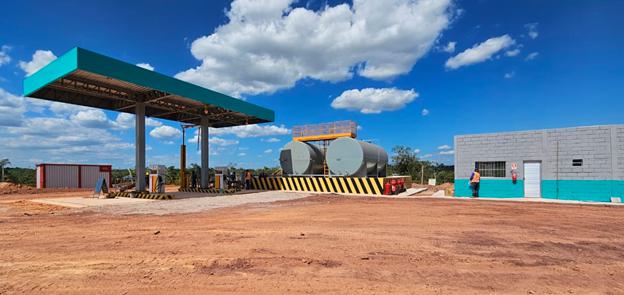
The
total diesel estimated consumption for the open pit equipment amounts to 667,000 liters per month. The tanks shall be loaded by fuel
delivery trucks with a maximum capacity of 11,400 liters and will require 59 load deliveries per month.
Each
of the gensets will be equipped with a total of 25,000 liters (15,000 liters storage tank + 2,000 liters for each group of gensets).
The calculated genset diesel consumption is projected at 540,000 liters per month (6.5 M liters/year).
Atlas
will make sure that the tanks are regularly filled not to disrupt equipment operations.
| 15.9.4 | Explosives
Magazine |
The
predominant rock types of Neves Project are pegmatite and schist, representing, respectively, the ore and the waste to be mined. Due
to their physical and mechanical characteristics, these lithologies require specific fragmentation techniques to enable mining operations
to be carried out efficiently and safely.
Among
the available methods, blasting with explosives stands out as the most technically and economically viable solution, ensuring the degree
of fragmentation required to meet the project’s operational needs.
Therefore,
the implementation of an adequate and regulated structure for the safe storage of explosives to be used in mining operations becomes
essential. This section presents the explosives magazines design, addressing the technical, regulatory, and operational aspects necessary
for its implementation and operation, in accordance with legal requirements and best practices in the mining sector.
For
the development of this project, the following technical standards and legal guidelines were followed:
| ● | Portaria
nº 147/2019 – COLOG establishes the technical and legal requirements for the control,
storage, and handling of products regulated by the Army, including explosives |
| | |
| ● | Portaria
nº 3.233/2012 – DPF (Polícia Federal): regulates the inspection system
for explosives and related products in Brazil |
|
| SGS Geological Services |
| S-K 1300 Technical Report – FS Neves Lithium Project – Minas Gerais, Brazil | Page 323 |
| | |
| ● | Norma
Regulamentadora NR-19 Defines safety and health conditions for the storage and use of explosives
in the workplace |
| | |
| ● | ABNT
NBR 10004 e NBR 10007 |
Compliance
with these instruments aims to ensure operational safety, adherence to current legislation, and to minimize the risks to workers and
the environment.
The
Explosives Magazine will be a dedicated facility for the storage of explosives (such as emulsions, boosters, detonating cords, etc.),
as well as accessories or initiators, ammunition, tools, and other materials for civilian use.
The
facility will consist of buildings and operational areas strategically separated by standard safety distances, in accordance with the
criteria established by current Brazilian Army regulations regarding the Control and Inspection of Regulated Products, as detailed below.
The
Site Explosives Magazine Facility will be located near the Waste Rock Dump 2 (PDE-2) area, as shown in Figure 15-85.
Figure
15- 85 Site Explosives Magazine Facility
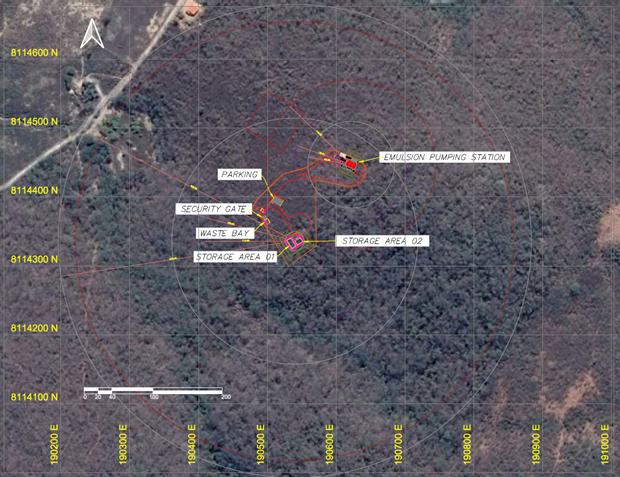
Courtesy
of Enaex Brasil
|
| SGS Geological Services |
| S-K 1300 Technical Report – FS Neves Lithium Project – Minas Gerais, Brazil | Page 324 |
| | |
In
general terms, it will occupy a total area of 11,622.5 m², subdivided into specific buildings and operational units.
| ● | Emulsion
Receiving Area and Storage Tank |
| | |
| ● | Magazine
for Storage of Blasting Accessories |
| | |
| ● | Magazine
for Storage of Explosives |
| | |
| ● | Auxiliary
Buildings and Support Area |
The
functionality of the buildings and operational units are described in the following sections:
| 15.9.4.1 | Emulsion
Receiving Area and Storage Tank |
This
area will be designated for the safe reception of explosive emulsion, equipped with a storage tank specially designed to ensure the integrity
and safety of the material. The tank will include secondary containment systems and temperature monitoring, as well as safety valves
to minimize leakage risks and maintain a controlled environment.
The
area will also feature physical barriers and safety signage to ensure proper isolation during loading and unloading operations.
|
| SGS Geological Services |
| S-K 1300 Technical Report – FS Neves Lithium Project – Minas Gerais, Brazil | Page 325 |
| | |
Figure
15-86 Emulsion Receiving Area
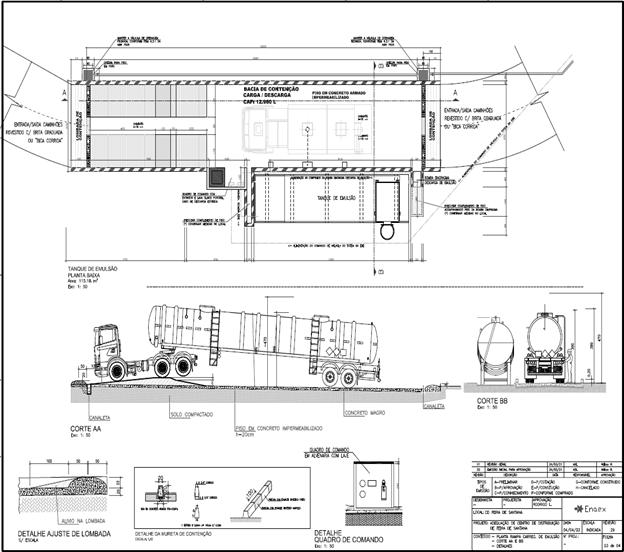
| 15.9.4.2 | Magazine
for Storage of Rock Blasting Accessories |
The
magazine will be designated for the storage of accessories used in rock blasting operations. It is a structure with clearly defined internal
sections for different types of accessories, such as detonators, detonating cords, connecting wires, and other essential items.
This
facility has been designed to prevent the risk of undesirable interactions between materials, featuring separate compartments, forced
ventilation, and a dedicated containment area to enhance safety. The facility will also have a humidity control system, ensuring that
stored materials are kept in ideal storage conditions.
|
| SGS Geological Services |
| S-K 1300 Technical Report – FS Neves Lithium Project – Minas Gerais, Brazil | Page 326 |
| | |
| 15.9.4.3 | Magazine
for Storage of Explosives |
The
magazine dedicated to the storage of explosives, such as emulsions and granular explosives, has been designed with reinforced concrete
walls and a durable roof structure to ensure material containment in the event of any incident.
The
facility will feature natural overhead ventilation to dissipate gases and prevent hazardous accumulations, in addition to high-security
access control systems to restrict entry exclusively to authorized personnel.
This
magazine also strictly complies with the minimum distance regulations from inhabited areas, ensuring safety for both the facility and
its surroundings.
The
Figure 15-87 is an example of a magazine to storage explosives.
Figure
15-87 Typical Storage Explosive Magazine
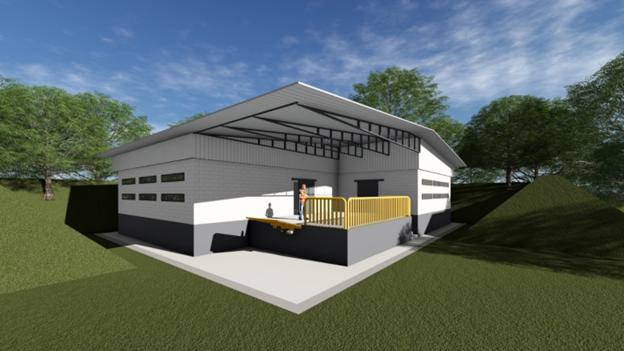
| 15.9.4.4 | Auxiliary
Buildings and Support Area |
In
addition to the main facilities, the complex will include an equipped support area for personnel, comprising a control station and a
security guardhouse. The control station will be responsible for managing access, logging the entry and exit of materials, and monitoring
surveillance cameras. The guardhouse will provide full visibility of the area, allowing the security team to maintain constant visual
control over the entire complex.
The
Figure 15-88 presents the layout of the structures described, clearly showing that all buildings are strategically distributed with standardized
spacing, in compliance with safety regulations and reference guidelines applicable to facilities of this nature.
This
configuration was planned to minimize the risk of accidents and to facilitate the handling of explosives and accessories, maintaining
safe distances between structures as well as from other operational areas. Additionally, the layout supports well-defined and easily
accessible evacuation routes, ensuring both worker safety and operational efficiency in the event of an emergency.
|
| SGS Geological Services |
| S-K 1300 Technical Report – FS Neves Lithium Project – Minas Gerais, Brazil | Page 327 |
| | |
Figure
15-88 Layout of the Explosives Magazine Structures with Regulated Distances
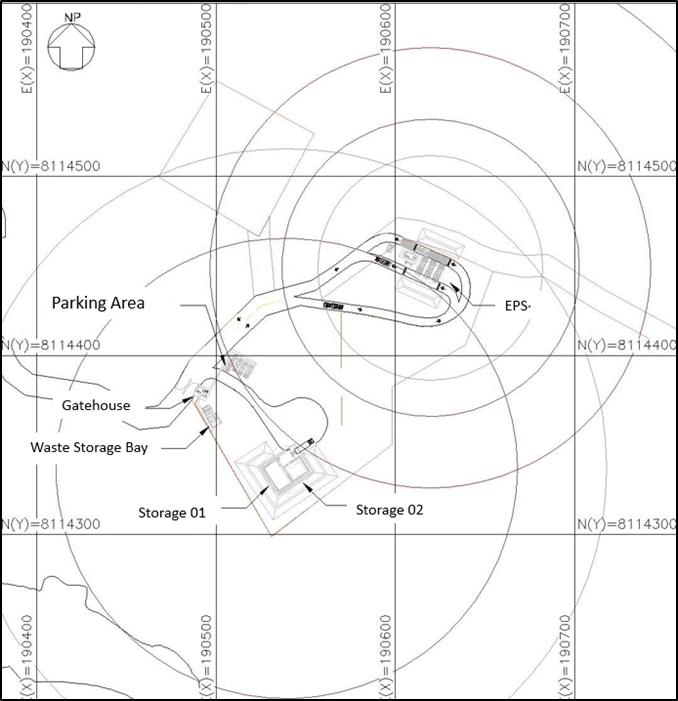
(*)
Emulsion Pumping Station
| 15.9.4.5 | Safety
and Controls |
In
terms of safety, the following systems and devices have been designed in accordance with the applicable standards and regulations, with
emphasis on NR 19 (which outlines requirements for the safe construction and operation of explosives magazines) and the Army Ordinances
that regulate the control and storage of explosives in Brazil.
|
| SGS Geological Services |
| S-K 1300 Technical Report – FS Neves Lithium Project – Minas Gerais, Brazil | Page 328 |
| | |
Below
are some of the personnel access control measures planned for restricted areas and systems.
| 15.9.4.6 | Physical
Barriers |
The
external area surrounding the explosives magazine will be secured with barbed wire fencing, fixed to reinforced concrete posts. Each
storage unit will have its own dedicated internal protective fencing, composed of barbed wire attached to treated eucalyptus posts, with
a height of 1.70 meters and a width of 2.00 meters.
A
guardhouse and observation post will be included in the layout, with the guardhouse positioned at the main entrance gate. Daytime access
control will be managed by a gatekeeper, responsible for monitoring the entry and exit of personnel and vehicles. This process will involve
the identification of visitors and third-party contractors, as well as vehicle inspections upon departure from the facility. The gatekeeper
will be equipped with a computer for logging personnel movement, a mobile phone, and a two-way radio, enabling direct communication with
the section leaders within the explosive magazine area.
| 15.9.4.7 | Electronic
Barriers |
In
compliance with Ordinance No. 56/COLOG of June 5, 2017, infrared camera systems will be installed at entry gates, access points, storage
areas, and workshops. These systems are designed to trigger an audible alarm with a siren when any movement is detected within the monitored
perimeter.
External
surveillance cameras will be maintained throughout the entire facility, including the main gate, internal access routes, and all storage
and manufacturing buildings. Recording will occur 24/7 without interruption. The cameras will be equipped with infrared (IR) technology,
allowing for high-quality night vision recording. Monitoring and playback will be performed via a standalone digital video recorder (DVR),
which will store the recorded footage and allow for real-time access through IP (Internet Protocol), either via a local network or remotely.
The
cameras installed in key areas (storage units, access points, and workshops) will operate on independent systems, ensuring that a failure
in one unit will not compromise the functionality of the others, maintaining standard operational reliability Additionally, each DVR
unit will be monitored by a dedicated camera, providing an additional layer of protection for the entire recording system.
In
addition to video surveillance, a 24-hour alarm system with motion sensors will be implemented to detect unauthorized movement within
critical areas. All monitoring footage will be stored for a period exceeding 30 days.
Access
to the storage areas and/or explosives magazines will be coordinated via radio communication devices (e.g., Talk About-type radios),
which will be available to security guards and authorized personnel, including sector supervisors.
| 15.9.4.8 | Access
Control and Monitoring |
| ● | CCTV:
Camera surveillance system |
| | |
| ● | Gatehouse
and Identification: Access control |
|
| SGS Geological Services |
| S-K 1300 Technical Report – FS Neves Lithium Project – Minas Gerais, Brazil | Page 329 |
| | |
| ● | Access
Control: Gatehouse with identification and entry authorization; |
| | |
| ● | CCTV:
24-hour surveillance camera system; |
| | |
| ● | Alarms:
Intrusion alarms and remote monitoring; |
| | |
| ● | Fire
Protection System: Dedicated fire extinguishers and nearby hydrants. |
| 15.9.4.10 | Contingency
Plan |
| ● | Procedures
in case of fire, explosion, or leakage. |
| 15.9.4.11 | Fire
Prevention and Protection |
| ● | Extinguishers
and Hydrants: Strategically located; |
| | |
| ● | Evacuation
System: Signage and evacuation routes. |
| 15.9.4.12 | Maintenance
Plan |
| ● | Monthly
Inspections: Review of physical structures, electrical systems, and safety features; |
| | |
| ● | Security
Systems Maintenance: Biannual inspection of cameras, alarms, and lighting; |
| | |
| ● | Firefighting
Equipment Testing: Quarterly maintenance of fire extinguishers and hydrants. |
| 15.10 | Support
Buildings – Transshipment Area |
| 15.10.1 | Transshipment
Area Gatehouse – Area 821 |
The
transshipment area gatehouse has the following use program:
Table
15-24 Transshipment Gatehouse
| Transshipment
Gatehouse Environment |
m² |
| Doorman
Room |
10 |
| Sanitary |
3 |
| Estimated
Total |
13 |
|
| SGS Geological Services |
| S-K 1300 Technical Report – FS Neves Lithium Project – Minas Gerais, Brazil | Page 330 |
| | |
Figure
15-89 Transshipment Area Gatehouse – Perspective View
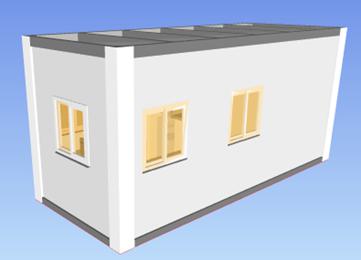
Figure
15-90 Transshipment Area Gatehouse – Inside View
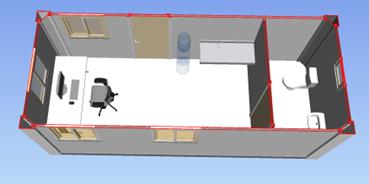
Figure
15-91 Transshipment Area Gatehouse – Plan View
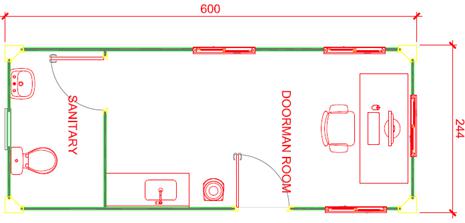
|
| SGS Geological Services |
| S-K 1300 Technical Report – FS Neves Lithium Project – Minas Gerais, Brazil | Page 331 |
| | |
| 15.10.2 | Laboratory
– Area 822 |
The
laboratory is located in the transshipment area, close to the city of Araçuaí will be constructed with a canvas cover,
and will contain the following:
Table
15-25 Laboratory
| Laboratory
Environment |
m² |
| Laboratory |
278.62 |
| Hot
Area |
40.43 |
| Screening |
9.34 |
| Physical
Preparation |
48.39 |
| Hls/Weight |
14.15 |
| Muffle
Furnace |
10.83 |
| Digestion |
14.20 |
| Ftir/Aas |
14.12 |
| Deionized
Water |
9.80 |
| Administrative |
14.12 |
| Cafeteria |
8.83 |
| Women’s
Toilet |
3.09 |
| Men’s
Toilet |
2.97 |
| Deposit |
16.31 |
| Wash
Tank |
11.48 |
| Women’s
Truck Driver Support Toilet |
3.13 |
| Men’s
Truck Driver Support Toilet |
3.13 |
| Compressor
Room |
9.91 |
| Power
Room |
3.98 |
| Acetylene
Storage |
2.50 |
| Nitrous
Oxide Storage |
2.50 |
| Estimated
Total |
521.83 |
Figure
15-92 Laboratory – Perspective View
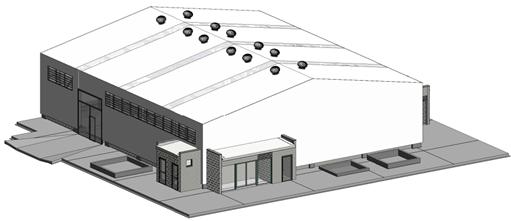
|
| SGS Geological Services |
| S-K 1300 Technical Report – FS Neves Lithium Project – Minas Gerais, Brazil | Page 332 |
| | |
Figure
15-93 Laboratory – Inside View
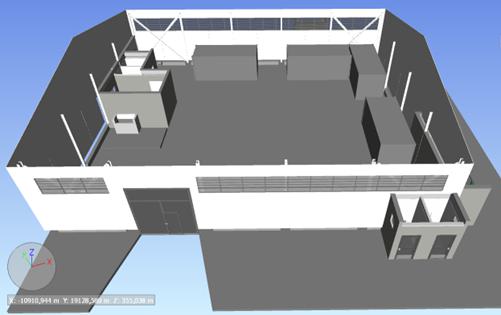
|
| SGS Geological Services |
| S-K 1300 Technical Report – FS Neves Lithium Project – Minas Gerais, Brazil | Page 333 |
| | |
Figure
15-94 Laboratory – Plan View
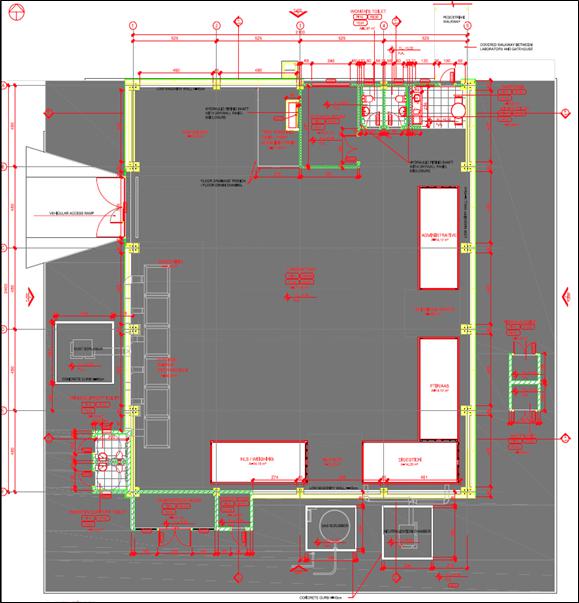
| 15.10.3 | Truck
Scale Support Room – Area 817 |
The
truck scale support room has the following:
Table
15-26 Truck Scale Support Room
| Truck
Scale Support Room Environment |
m² |
| Weighing
Room |
10 |
| Sanitary |
3 |
| Estimated
Total |
13 |
|
| SGS Geological Services |
| S-K 1300 Technical Report – FS Neves Lithium Project – Minas Gerais, Brazil | Page 334 |
| | |
Figure
15-95 Truck Scale Support Room – Perspective View
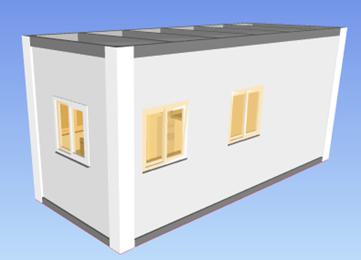
Figure
15-96 Truck Scale Support Room – Inside View
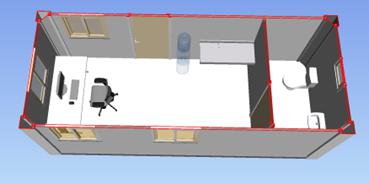
Figure
15-97 Truck Scale Support Room – Plan View
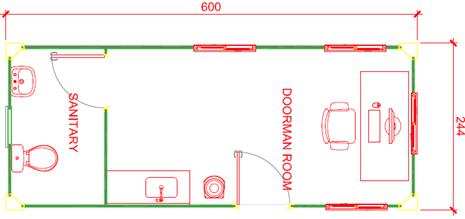
|
| SGS Geological Services |
| S-K 1300 Technical Report – FS Neves Lithium Project – Minas Gerais, Brazil | Page 335 |
| | |
| 15.10.4 | Driver’s
Waiting Room – Area 817 |
The
driver’s waiting room has the following use program:
Table
15-27 Driver’s Waiting Room
| Driver’s
Waiting Room Environment |
m² |
| Waiting
Room |
13 |
| Estimated
Total |
13 |
Figure
15-98 Driver’s Waiting Room – Perspective View
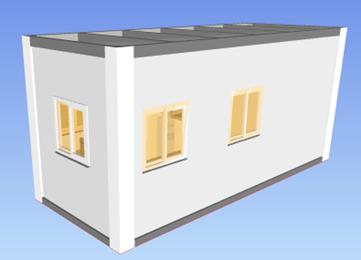
Figure
15-99 Driver’s Waiting Room – Plan View
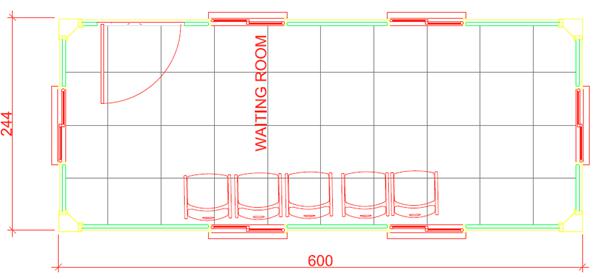
|
| SGS Geological Services |
| S-K 1300 Technical Report – FS Neves Lithium Project – Minas Gerais, Brazil | Page 336 |
| | |
Geotechnical
investigations were carried out to provide information for earthmoving services and for building foundation design, consisting of six
mixed drill holes. The drilling program showed a soil with high support capacity, allowing direct foundations to be built.
| 15.12 | Concentrate
Shipping |
The
spodumene concentrate handling to the port and final processing abroad will involve the following:
| | ● | Loading
and hauling of concentrate from the transhipment facility to the port |
| | | |
| | ● | Bulk
loading of concentrate at the port and shipping to the final port of destination |
The
preferred port used in the financial analysis is the hauling of the concentrate to the Port of IIhéus.
The
proposed Access Route to the Port of IIhéus from the Transhipment at LMG 678 would be:
| | ● | The
first preferred route is on BR-367 to the junction with BR-116 (74 km), BR-116 to the junction
with BA-634/BR-415 (181 km), and 296 km BA-634 and BR-415 to the Port of IIheus. Total distance
of 551 km. |
| | | |
| | ● | Truck
route first traverse LMG-678 to BR-242/BR-367 (8.8 km) in Aeroporto, Aracuai followed by
BR-367 to Av.Olindo de Miranda in Almenara (186 km) then LMG-634 and R. Hipolito Sousa to
BA-638 (67.3 km). The haul route continues via BA-638, BA-130, and BR-415 to R. Rotary in
IIheus (254 km). Route continues to R. Rotary-R. Tobias Barreto in Cidade Nova (650 m). Total
route distance is 516 km. |
| | | |
| | ● | For
the next option, the total haul route distance from the Transshipment area to the port is
556 km. The first leg is LMG-678 to BR-342/BR-367 in Aeroporto, Aracuai (8.8 km). Next leg
follows BR-367 and BR-116 to Veredinha (253 km). Finally, the last leg is BA-639, BA-634,
and BR-415 to R. Tobias Baretto in Cidade Nova, IIheus (294 km). |
For
the (Port of Ilhéus), refurbishment of new operations cycle was implemented end of December 2022. The port can provide flexibility
for growth of diverse set of waterfront businesses-cargo, mining, fuel, commercial etc. Figure 15-100 shows the mining cargo berth for
concentrate shipment abroad for further processing. Major maintenance dredging was completed, increasing operational capacity via restoration
of the operational draft back to 10 meters, increasing the cargo capacity of the ships that visit the port by around 50%. In addition,
the whole network of river drainage systems was replaced. The underwater inspection required to construct a new pier was also completed.
The port’s jetty was also renovated, guaranteeing shelter conditions, and reinforcing the safety of operations.
|
| SGS Geological Services |
| S-K 1300 Technical Report – FS Neves Lithium Project – Minas Gerais, Brazil | Page 337 |
| | |
Figure
15-100 Port of Ilhéus
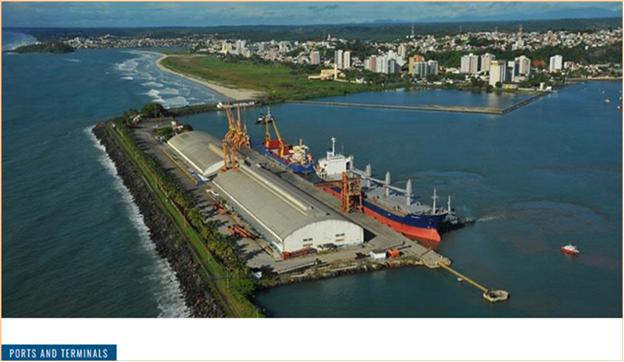
Courtesy
of datamarnew.com
The
proposed Access Route to Port of Vitória (State of Espirito Santo, Brazil):
| | ● | Araçuaí
to Teófilo Otoni (via MG-367 + BR-116), approximately 190 km. Teófilo Otoni
to Governador Valadares (via BR-116 + BR-259), approximately 130 km. Governador Valadares
to Colatina (via BR-259), approximately 210 km. And Colatina to the Port of Vitória
(via BR-259 + BR-101), approximately 185 km. Total distance 715 km. |
The
port of Vitória is presented in Figure 15-101 and Figure 15-102.
|
| SGS Geological Services |
| S-K 1300 Technical Report – FS Neves Lithium Project – Minas Gerais, Brazil | Page 338 |
| | |
Figure
15-101 Vitória – Brazil, Harbor, Business, City, Cargo Container, Bulk Shipment
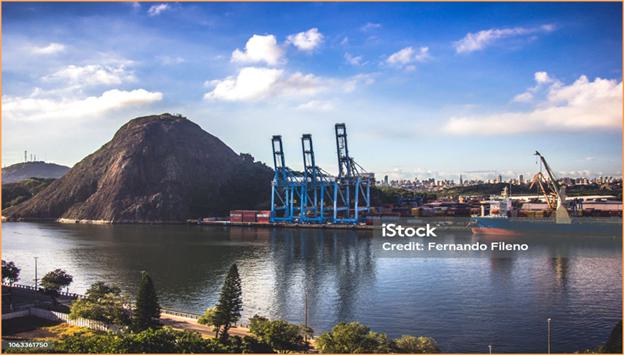
Figure
15-102 Port of Vitória
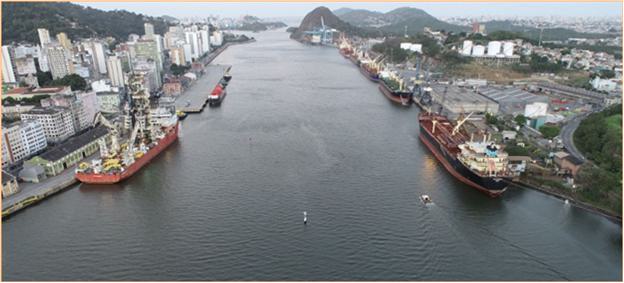
www.datamarnews.com/noticias/under-new-name-vports-port-of-vitoria
|
| SGS Geological Services |
| S-K 1300 Technical Report – FS Neves Lithium Project – Minas Gerais, Brazil | Page 339 |
| | |
Gravel
Support - Pedreira Salinas (Salinas-MG), with environmental certification: 163 km by 342, LMG 676.
Sand
Support - Araújo (Araçuaí-MG), with environmental certification: 52 km by BR LMG 678 (approximate).
|
| SGS Geological Services |
| S-K 1300 Technical Report – FS Neves Lithium Project – Minas Gerais, Brazil | Page 340 |
| | |
Lithium
market information presented in this section is gathered from a variety of sources, including industry studies and public commodity forecasts.
The information presented here is current as of the fourth quarter of 2024. All pricing in this section is in US dollars.
| 16.1 | Recent
Historical Pricing |
Lithium
demand displayed significant growth in 2021 and 2022 due to strong consumer demand for electric vehicles, increased product offerings
and government policies to encourage electrification. This demand drove lithium prices to all time highs in the spot market. Battery
Grade Lithium Carbonate reached prices into the $70,000 to $78,000 per tonne range and Lithium Hydroxide prices exceeded $80,000 per
tonne in the 4th quarter of 2022. Spodumene 6% concentrate (SC6 Li2O) pricing followed the same pricing curve starting
at $932 per tonne and peaking at $4,594 per tonne in 2022.
Chinese
electric vehicle production in 2023 and 2024 resulted in excess inventory of vehicles and batteries suppressing demand while cathode
producers were increasing supply due to the supply growth spurred by previously high prices. The difference between supply and demand
resulted in a drop of Lithium Carbonate prices to around $10,500 per tonne by the 2nd quarter of 2024. Mine supply dropped
as the marginal producers slowed or shutdown production while the market rebalances between supply and demand. Such supply and demand
shocks demonstrate that current pricing within China is not sustainable to maintain either existing production or support production
growth needed to meet forecast market growth.
| 16.2 | Lithium
Demand 2025 and Beyond |
The
lithium market is forecast to grow beyond 2025 due to:
| ● | Growth
of electric vehicles in the consumer and commercial transportation markets; |
| | |
| ● | Growth
of large battery storage systems, especially considering increased power requirements from
AI driven data centres. |
Demand
growth in portable electronics is forecast to be limited due to maturity of this segment but that growth still represents 2% of the total
battery market, following the same growth curve as the other battery systems.
Figure
16-1 presents the battery demand by application projected to 2040.
|
| SGS Geological Services |
| S-K 1300 Technical Report – FS Neves Lithium Project – Minas Gerais, Brazil | Page 341 |
| | |
Figure
16-1 Forecast Power Battery Capacity Growth
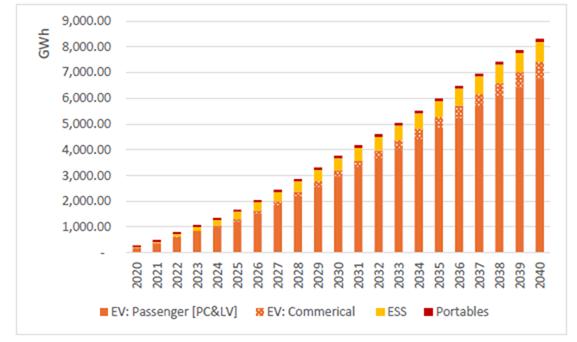
Both
Passenger and Commercial EVs are expected to increase penetration of vehicle markets over the next 15 years to 2040. In the larger volume
market of passenger vehicles, EV penetration is expected to grow from 12.6% in 2024 to 27.0% in 2030 and 65.3% by 2040. Battery demand
from passenger vehicles is further bolstered by Plug-in hybrid (PHEV) sales, with expected market share expansion from 7% in 2024 to
12.7% by 2030. Across both Passenger and Commercial segments, and accounting for both BEVs and PHEVs, sales are expected to continue
to rise at 10+% CAGR to 2040 with a combined market share increasing from 20% in 2024 to 44% by 2030. By 2040, Benchmark forecasts that
75% of all road vehicle sales will be electric vehicles, either battery only or plug in hybrid.
In
recent years, Energy Storage System (ESS) have leapfrogged portables to become the second largest market for lithium-ion batteries, spurred
on by renewable energy infrastructure build out, bolstered by policy support, and low cell prices. ESS demand will continue to experience
growth across the major markets and will come mostly from grid applications (2024-2040 CAGR of 8%) and behind-the-meter (2024-2040 CAGR
of 10%). Combined, by 2040 demand for lithium-ion batteries from the ESS segment will be 4x the demand in 2024.
| 16.3 | Lithium-Ion
Battery Cathode Active Material |
After
EV adoption rates and EV type (which defines the battery pack size), battery chemistry (i.e., the chemistry of the cathode active material
[CAM] used in the cell), is the second key driver for lithium demand. While lithium intensity is not materially different for the two
dominant cathode chemistries - namely nickel-cobalt-manganese (NCM) and lithium-iron-phosphate (LFP) - the input chemical is: high-nickel
NCM variants require the use of lithium hydroxide, while lithium carbonate is favoured for LFP production and mid-nickel NCM (particularly
NCM 523).
Selection
of CAM chemistry is the result of a trade-off between cost, energy density (which defines the driving range) and safety. LFP delivers
the lowest cost but also the lower energy density limiting its application. By contrast, NCM and nickel-cobalt-aluminium (NCA) cathodes
provide a higher energy density (and range), but a higher cost meaning that these CAM variants tend to dominate for premium EV ranges.
|
| SGS Geological Services |
| S-K 1300 Technical Report – FS Neves Lithium Project – Minas Gerais, Brazil | Page 342 |
| | |
The
middle range mass-market EV segment is where the trade-off between cost and range is more complex. In this segment, mid-nickel chemistries
are dominant, for example, LG Energy Solution announced in 2024 that it intends to mass produce high voltage mid-nickel batteries by
2025, that chemistry faces competition from upcoming manganese-rich chemistries. The emerging LMFP (LFP with manganese) promises a larger
range for a modest cost increase; while the nickel-manganese-rich NMx is premised on lowering the cost of nickel-rich batteries for a
modest reduction in range.
The
split between the main cathode types is expected to stay largely consistent for the forecast period - with NCM and LFP at around 40%
and 50%, respectively.
The
key uncertainties for the chemistry split forecast are the emergence of new chemistries, in particular the aforementioned manganese rich
cathodes – NMx (categorized under LMNO in this report) substituting NCM and LMFP substituted for LFP. These new chemistries are
expected to remain comparatively niche segments of demand. Their impact on lithium demand will also be minimal, however as all chemistries
have relatively similar lithium intensities.
| 16.4 | Lithium
Chemical Demand |
The
resulting demand outlook for refined lithium is presented in Figure 16-2 below. Battery applications are the only significant growth
driver over the forecast period at 18% CAGR to 2030 and then at 7% CAGR from 2031-2040. Legacy non-battery applications (mostly glass
& ceramics, lubricants and metallurgy) are forecast to grow at low pace. From an estimated 1.1 million tonnes LCE in 2024, global
demand for refined lithium is expected to reach 2.7 million tonnes LCE by 2030 and 5.1 million tonnes LCE by 2040.
Figure
16-2 Global Demand for Refined Lithium to 2040
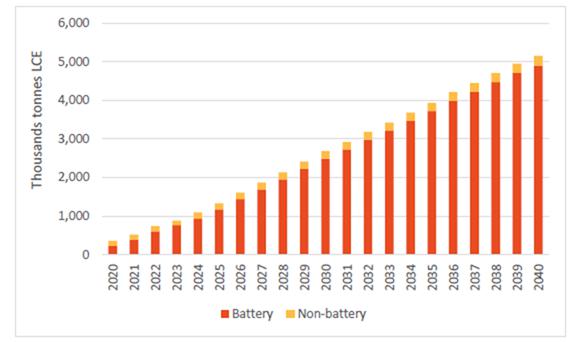
As
discussed, refined lithium for battery applications is consumed in two chemical forms depending on the target chemistry of the cell.
LFP, mid-nickel and emerging manganese based chemistries prefer lithium carbonate (low nickel NCM can also consume carbonate) while high
nickel NCM and NCA require lithium hydroxide. Lithium carbonate demand contribution is estimated at 65% in 2024 primarily driven by China’s
LFP battery fleet (the largest in the world). It is expected to diminish over time, albeit only slightly, to 62% in the early 2030s as
hydroxide demand from higher energy density nickel-rich batteries grows in the ex-China regions.
|
| SGS Geological Services |
| S-K 1300 Technical Report – FS Neves Lithium Project – Minas Gerais, Brazil | Page 343 |
| | |
It
should be noted that while battery grade (BG, >99.5% LC) is usually what is being referred to, there are various grades of LC. Technical
grade (TG, 99.2% LC) is usually referred to, but a number of different specs have been seen in the market (e.g. battery-ready grade).
It should be emphasized that lithium chemicals are not a commodity; the only grade that really matters is the one that the customer demands
and for which the supplier must qualify. Some LFP battery manufacturers, particularly in China, utilize TG lithium carbonate instead
of BG material. Unlike NCM, the chemical structure of LFP can be largely maintained with technical grade carbonate, enabling cost savings
in the production of batteries targeting ESS, E-Mobility, tier-2, and tier 3 EVs. It should also be noted that more often than not, users
in China will reprocess lithium carbonate into a higher-grade LC or into LHM to suit their needs. This flexibility is another factor
contributing to the apparent convergence of TG and BG pricing. This dynamic may present quite differently outside of China however, where
there is little in the way of chemistry-conversion (e.g. Rio Tinto’s plan in France) and upgrading, and strict qualification and
specification requirements.
On
a regional basis, China’s share of global lithium chemical demand is forecast to have peaked in 2024 at 52% and is anticipated
to gradually decline towards 33% by 2040. China is the dominant producer of the lithium ion battery industry and associated supply chains.
Other regions are now playing catch-up and are entering faster phases of growth. This particularly applies to Europe and North America,
both of which forecast 12% CAGR growth in lithium chemical demand through to 2040, compared to 7% in China.
| 16.5 | Lithium
Raw Material Supply |
Lithium
can be present in economically significant quantities in igneous & sedimentary rocks (often generalised as “hard-rock”),
lithium brines and unlithified clay deposits.
Lithium
exists in most regions, and the resource base is not the limiting factor on higher rates of supply. Table 16-1 demonstrates that in all
regions there are tens, if not hundreds, of years’ worth of recorded reserves at the maximum rate of production currently proposed
by existing and prospective lithium producers. However, most of these “reserves” according to TSX or ASX definitions are
merely resources, exacerbating the limiting factor that is the time to fully develop certifiable reserves, and to finance, permit and
build mines, scale up production and meet customer specific battery grade specifications.
Table
16-1 Recorded Resources and Supply Potential
| Region |
Total
Reserves
Mt
LCE |
2024
Production
t
LCE |
2040
Unweighted Supply t LCE |
Years
of Supply Potential at Maximum Company Plans |
| Africa |
25.89 |
100,700 |
486,759 |
53 |
| China |
35.49 |
264,461 |
891,620 |
40 |
| Europe
|
40.96 |
2,000 |
274,000 |
149 |
| North
America |
109.2 |
35,200 |
1,101,625 |
99 |
| Oceania |
47.65 |
465,000 |
801,000 |
59 |
| South
America |
208.43 |
380,900 |
1,519,800 |
137 |
The
global primary supply of lithium more than doubled between 2020 and 2023, from 370 kt LCE to 895 kt LCE. Amidst depressed prices in 2024,
11 new mines and five expansion projects began operation and global lithium supply reached almost 1.2 Mt LCE. Global growth is set to
continue, propelled by new assets (USA, Australia, Africa, Brazil and Argentina) and expansions (Chile), however the low-price environment
has resulted in the marginal producers shutting down or reducing output and modifying production plans, and underinvestment in developing
the additional capacity required to meet the projected consumption.
|
| SGS Geological Services |
| S-K 1300 Technical Report – FS Neves Lithium Project – Minas Gerais, Brazil | Page 344 |
| | |
| 16.6 | Lithium
Price Forecast |
Lithium
prices have pulled back from recent highs in the market, as discussed above.
An
analysis of quarterly market studies from various sources shows a high degree of variability from one forecast to the next. Forecasts
for the 4th quarter 2024 have the long-term SC6 LiO2 price at $1,650 per tonne, while the next quarterly forecast showed the
long-term price dropping to $1,200 per tonne. Earlier forecasts showed prices peaking at $3,450 per tonne, and dropping to a long-term
price of $1,850 per tonne, but those forecasts have been recently downgraded.
The
lithium market is still in it’s infancy as a valued commodity, unlike precious and base metals where long term averages are applied
for value estimates. As the lithium market matures, there will be more data that may be used to assess 1-year, 2-year, and 3-year averages
in financial models. Due to the disparity between forecasts and realized pricing over the last few years, a more prudent approach is
to compare the 5-year trailing average price and project that concurrently with the forecasted long-term prices.
Quarterly
market studies also assess the impact of influencing factors from shorter term geopolitical conditions, which have an effect on the statistical
analyses used for the longer-term prices.
Long
term market demand projections still indicate growth in the market, and supply will be dictated by the realized market prices.
The
$1,700/tonne price assumption for SC5.5% spodumene concentrate is further validated through analysis of the underlying Benchmark Mineral
Intelligence Q3 2024 lithium price forecasts. The Benchmark medium-term pricing scenario for SC6 concentrate over the 2027-2032 period
indicates an average price of $1,733/tonne, with annual forecasts ranging from $1,300/tonne to $2,500/tonne during peak market conditions.
When adjusted for lithium oxide content differential between 6% and 5.5% concentrate grades (adjustment factor of 1.091), the applied
$1,700/tonne SC5.5% price corresponds to an equivalent SC6 price of approximately $1,855/tonne. This pricing assumption demonstrates
conservative positioning relative to projected peak market conditions while maintaining alignment with medium-term supply-demand fundamentals
as outlined in the Benchmark forecast methodology. The pricing approach accounts for both product specification differences and market
cycle positioning, consistent with the supply-demand based forecasting methodology employed by Benchmark Mineral Intelligence as the
recognized industry authority for lithium market analysis.
Table
16-2 presents SC6 historical and weighted average forecast prices collected from various studies and market reports. These weighted averages
are calculated based on base, conservative and high price cases.
Based
on the above, the recommendation is to use a price of $1,700 for the life of mine price for SC6 Li2O, as illustrated in Figure
16-3.
|
| SGS Geological Services |
| S-K 1300 Technical Report – FS Neves Lithium Project – Minas Gerais, Brazil | Page 345 |
| | |
Figure
16-3 Lithium Concentrate SC6 Pricing
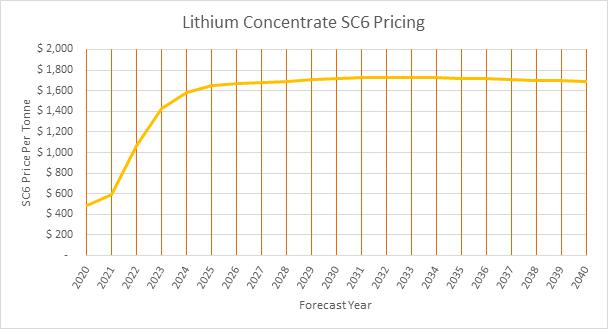
Table
16-2 Historical and Long-Term Forecast Pricing
| Price
Forecast |
SC6
Li2O Concentrate |
Historical
and Forecast Weighted Averages |
| Year |
Base |
Conservative |
High |
| 2021 |
708 |
708 |
708 |
708 |
| 2022 |
2,003 |
2,003 |
2,003 |
2,003 |
| 2023 |
2,524 |
2,524 |
2,524 |
2,524 |
| 2024 |
2,202 |
2,199 |
2,207 |
2,203 |
| 2025 |
1,954 |
1,933 |
1,974 |
1,954 |
| 2026 |
1,804 |
1,765 |
1,840 |
1,803 |
| 2027 |
1,741 |
1,679 |
1,799 |
1,740 |
| 2028 |
1,825 |
1,720 |
1,924 |
1,823 |
| 2029 |
1,842 |
1,708 |
1,967 |
1,839 |
| 2030 |
1,834 |
1,672 |
1,978 |
1,828 |
| 2031 |
1,810 |
1,623 |
1,968 |
1,801 |
| 2032 |
1,771 |
1,569 |
1,938 |
1,759 |
| 2033 |
1,730 |
1,517 |
1,903 |
1,717 |
| 2034 |
1,695 |
1,495 |
1,856 |
1,682 |
| 2035 |
1,664 |
1,477 |
1,815 |
1,652 |
| 2036 |
1,637 |
1,461 |
1,779 |
1,625 |
| 2037 |
1,612 |
1,446 |
1,747 |
1,602 |
| 2038 |
1,591 |
1,433 |
1,718 |
1,581 |
| 2039 |
1,571 |
1,422 |
1,692 |
1,562 |
| 2040 |
1,554 |
1,411 |
1,669 |
1,544 |
|
| SGS Geological Services |
| S-K 1300 Technical Report – FS Neves Lithium Project – Minas Gerais, Brazil | Page 346 |
| | |
Atlas
Lithium has secured long-term offtake agreements with established lithium industry participants, providing significant commercial validation
for the Neves Project and its development plans. These agreements, with Mitsui & Co., Ltd., Sheng Wei Zhi Yuan International Limited,
a subsidiary of Shenzhen Chengxin Lithium Group Co., Ltd. (the “Chengxin”), and Sichuan Yahua Industrial Group Co., Ltd.
(the “Yahua”), included both equity investments and product offtake commitments. The terms, conditions, and commercial structure
of these agreements are consistent with industry norms for lithium offtake arrangements and provide a solid foundation for the Neves
Project’s development and operations.
Mitsui
& Co., Ltd. Offtake Agreement
As
disclosed in a Form 8-K filed on March 28, 2024: “Atlas Lithium Corporation (the ‘Company’) is pleased to announce
that it has signed definitive investment and offtake agreements with Mitsui & Co., Ltd. (‘Mitsui’) which the Company
considers as strong validation of its project and team. Mitsui is purchasing US$ 30,000,000 in common shares of Atlas Lithium at a 10%
premium to the 5-day VWAP (the ‘Strategic Investment’) and at the same time entering into an Offtake Agreement (the ‘Offtake’)
for the future purchase of 15,000 tonnes of lithium concentrate from Phase 1 and 60,000 tonnes per year for five years from Phase 2 of
Atlas Lithium’s soon to be producing Neves Project in Brazil’s Lithium Valley.”
Chengxin
and Yahua Offtake Agreements
As
disclosed in a Form 8-K filed on December 1, 2023: “On November 29, 2023, the Company (hereinafter the ‘Seller’) entered
into Offtake and Sales Agreements (the ‘Offtake Agreements’) with each of Sichuan Yahua Industrial Group Co., Ltd. and Sheng
Wei Zhi Yuan International Limited, a subsidiary of Shenzhen Chengxin Lithium Group Co., Ltd. (each individually, a ‘Buyer’),
pursuant to which the Seller agreed, for a period of five (5) years, to sell to each Buyer 60,000 dry metric tonnes of lithium concentrate
(the ‘Product’) per year, subject to Seller’s authority to increase or decrease such quantity by up to ten percent
(10%) each year. The price for the Product is determined according to a formula as set forth in the Offtake Agreements.”
|
| SGS Geological Services |
| S-K 1300 Technical Report – FS Neves Lithium Project – Minas Gerais, Brazil | Page 347 |
| | |
| 17 | ENVIRONMENTAL
STUDIES, PERMITTING, AND PLANS, NEGOTIATIONS, OR AGREEMENTS WITH LOCAL INDIVIDUALS OR GROUPS |
The
first phase of pit 1 and the plant area information was provided by NeoAgroambiental based on the Environmental Control Report (“ECR”),
dated September 2023. The second phase of pit 2 and the expansion of pit 1 information was based on the Estudo de Impacto Ambiental or
“EIS” (EIA and Environmental Control Report or ECR dated November 2024) provided by WSP Consultoria e Projetos do Brasil
Ltda. The two phases are in relation to the Anitta Project development, located in the municipality of Araçuaí, north of
the state of Minas Gerais.
The
company is exploring for pegmatite mineral deposits, spodumene and petalite are the two main lithium bearing minerals found on the property.
Lithium was discovered through mineral research and diamond drilling on mining right No. 833.356/2007, owned by Atlas Lítio Brasil
with the National Mining Agency.
Mineral
exploration work began in April 2022, the diamond drilling returned positive results regarding the mining right mentioned above, the
first phase of Directly Affected Area (ADA) of the Anitta Project was defined with 116.52 hectares (ha) comprising the following activities
and structures:
| ● | Anitta
Pit (Pit 1) in an area of approximately 6.4 ha; |
| ● | Mineral
Treatment Unit (MTU) with an installed capacity of 1,500,000 t/year in an area of 16,99 ha; |
| ● | ROM
(Run of Mine) Pile; |
| ● | Waste
Dump and Tailing 1 (PDER 1) in an area of 54 ha; |
| ● | Reseller
stations, filling stations or points, retail system installations, floating fuel stations
and aviation fuel reseller stations with a storage capacity of 15 m³; |
| ● | Support
Structures (Temporary Waste Storage Center; Maintenance Workshops; Effluent Treatment Stations;
Water Storage and Filtration System; Explosives Storeroom; Office; Canteen, Bathrooms, Warehouse,
Parking Lots; Machinery and Vehicle Washing Area); |
Once
the technical surveys and environmental studies required for licensing was complete on the Anitta Project, Atlas Lítio Brasil
continued to explore and perform diamond drilling work. The aim was to discover new mineralized pegmatite bodies, to obtain a better
understanding of the size and volume of the Anitta deposit, and to provide a better understanding of the area of Pit 1. The work highlighted
the need to license an expansion on the Anitta Project in the area ANM Process 833.356/2007 sufficient for Pit 2 area.
The
Anitta Project Expansion includes a new area included in the ANM Mining Right No. 833.356/2007, owned by Atlas Lítio Brasil. The
Directly Affected Area (ADA) of the Anitta Project Expansion was defined as 64.48 hectares and will consist of the following structures/facilities:
| ● | Pit
2 in an area of 19.51 ha; |
| ● | Pit
2 Sedimentation Basin in 2.56 ha; |
| ● | Pit
1 Expansion in 4.29 ha; |
| ● | Waste
Pile 2 (PDE-2) in 17.61 ha; |
| ● | Explosives
Storage in 2.40 ha; |
| ● | UTM
Sump and Support Area, in 7.01 ha; |
| ● | Accesses
(Access from Pit 1 and 2 to UTM and PDER 1; Access from Pit 2 to PDE-2; and Access to the
Explosives Store), totaling 11.09 ha. |
| 17.1 | Environmental
Studies |
The
Environmental Regulation process for this project was carried out by the active relevant Brazilian environmental legislation. In Minas
Gerais State, environmental licensing is exercised by the competencies established in State Decree No. 47,042 of September 6, 2016, by
the State Secretariat for the Environment and Sustainable Development (SEMAD, Brazilian acronym), through its administrative units. The
Regional Environmental Superintendencies (Suprams, Brazilian acronym) is distributed across nine regions of the State and the Priority
Projects Superintendency (Suppri). The Environmental Control Report (ECR) and the Environmental Impact Study (EIS) for the Anitta Project
in Araçuaí, was prepared in accordance with the guidelines established in current Brazilian environmental legislation,
particularly CONAMA Resolution 01/1986.
|
| SGS Geological Services |
| S-K 1300 Technical Report – FS Neves Lithium Project – Minas Gerais, Brazil | Page 348 |
| | |
Normative
Deliberation (ND) Copam No. 217 of December 6, 2017, coming into force on March 6, 2018, has upgraded and rationalized the environmental
licensing processes, maintaining the technical quality. According to this Minas Gerais state legislation there are three environmental
licenses modalities, as well as described in the art.
| ● | Three-phase
Environmental Licensing – TEL: Licensing in which the Preliminary License – LP,
the Installation License – LI, and the Operating License – LO of the undertaking
is granted in successive stages; |
| | |
| ● | Concomitant
Environmental Licensing – CEL: Licensing in which the same stages provided for in the
LAT will be analyzed, although with the concomitant issuance of two, or more licenses; |
| | |
| ● | Simplified
Environmental Licensing – SEL: Licensing carried out in a single step, by registering
information related to the activity or undertaking with the competent environmental agency,
or by presenting the Simplified Environmental Report – SER, containing the description
of the activity or undertaking and the respective environmental control measures. |
The
main environmental studies of the Environmental Control Report (ECR) and Environmental Control Plan (ECP), in addition to several other
complementary studies, were completed for the Anitta Project as a requirement under the Concomitant Environmental Licensing - CEL1 process
(PL+IL+OL). The documentation presents the environmental characterization not only of the project area but also its area of influence,
as well as taking care to describe the activities and environmental aspects of the project, carry out an environmental impact survey
and its assessment, proposing some preservation measures.
Conducting
reconnaissance, exploration, and mining operations in Brazil requires several environmental authorizations to ensure compliance with
environmental regulations. The main environmental authorizations and licenses are the following:
| ● | Environmental
Impact Assessment (“EIA”) and Environmental Impact Report (“RIMA”)
– required for major mining projects that may have significant environmental impacts.
The EIA is a detailed study that assesses the potential environmental impacts of the project.
The RIMA is a summary of the findings to be presented to public consultation. |
| | |
| ● | Preliminary
Environmental Report – for smaller projects with lower environmental impacts, such
authorization may be required instead of a full EIA/RIMA. The Preliminary Environmental Report
provides a more concise assessment of potential environmental impacts. |
| | |
| ● | License
for the Exploration Activity – this license is required for the initial reconnaissance
and exploration phase. It grants permission for sampling and basic surveys. |
| | |
| ● | License
for the Mining Activity – This license is necessary for the mining phase and allows
for the extraction of minerals. |
| | |
| ● | Installation
License (“LI”) – the LI is required before any physical installation or
construction related to mining activities. |
| | |
| ● | Operation
License (“LO”) – the LO is necessary to authorize the full operation of
the mining project after it complies with all environmental requirements. |
| | |
| ● | Waste
Management Plan – mining operations are required to have a plan for managing and disposing
of waste generated during the mining process. |
|
| SGS Geological Services |
| S-K 1300 Technical Report – FS Neves Lithium Project – Minas Gerais, Brazil | Page 349 |
| | |
| ● | Water
Use Permit – if water is used in the mining operation, a water use permit must be obtained
from the relevant water resources authority. |
| | |
| ● | Forest
Clearance Authorization – if the mining project involves clearing forests or vegetation,
this authorization is needed, and it should comply with the relevant environmental laws and
regulations. |
The
licensing process in Minas Gerais was developed in accordance with the criteria that must be addressed based on the size of a planned
mine, and its likelihood of generating environmental impact. Atlas has applied for an environmental license for approval of a mineral
treatment unit, open-pit mining activities in respect of metallic minerals (except iron ore), and waste pile at 2 distinct moments, with
the following parameters presented in Table 17-1 and Table 17-2:
Table
17-1 September 2023 Submitted Environmental License for Approval
| Description |
Parameter |
Value |
| Mineral
Treatment Unit - UTM, with wet treatment |
installed
capacity |
1.500.000t/year |
| Open
pit mining - Metallic minerals, except iron ore |
gross
production |
1.500.000t/year |
| Reject/waste
pile of ornamental and casing rocks, pegmatites, gemstones and non-metallic minerals |
useful
area |
40
ha |
| Floating
fuel stations |
storage
capacity |
15
m³ |
Table
17-2 September 2024 Submitted Environmental License for Approval
| Description |
Parameter |
Value |
| Open
pit mining - Metallic minerals, except iron ore |
gross
produciton |
1.500.000t/year |
| Reject/waste
pile of ornamental and casing rocks, pegmatites, gemstones and non-metallic minerals |
useful
area |
17,61
ha |
| Road
for transporting ore/waste outside the limits of mining projects |
extension |
3,64
km |
Both
licensing processes deal with the licensing in LAC1 (LP+LI+LO) modality of the Anitta Project Expansion according to DN No. 217/2017.
| 17.1.1 | Anitta
Project – Delimitation and Permissions |
To
prepare for the ECR (Environmental Control Report) submitted for approval September 2023, studies were carried out in several areas as
outlined inTable 17-3.
Table
17-3 Completed Baseline Studies
| Area |
Description |
| Land
use |
The
land is currently used for subsistence farming including animals (cattle, pigs, and chickens) and crops (corn, beans, and cassava). |
| Flora |
Seasonal
Deciduous Forest (FED) in Initial Stage and Pasture Areas of Consolidated Use - Atlantic Forest Biome |
| Archaeology
and cultural heritage |
No
archaeological sites, indigenous lands or quilombo communities were identified in the project´s area of influence |
| Special
areas |
No
special areas were identified. The project site is not located within a conservation unit. |
|
| SGS Geological Services |
| S-K 1300 Technical Report – FS Neves Lithium Project – Minas Gerais, Brazil | Page 350 |
| | |
| Fauna |
The
studies conducted included avifauna (birds), herpetofauna (reptiles and amphibians), terrestrial macrofauna (large and medium-sized
mammals). A low number of endemic and specialist species were recorded in the field, demonstrating that the remaining natural areas
have little capacity to support species that cannot withstand human-induced changes to their habitats. |
| Climate |
The
climate is continental-dry and hot, and has two clearly defined and distinct seasons, one dry, coinciding with winter in the southern
hemisphere, and the other rainy, coinciding with summer. |
| Water |
The
Project is located in the Jequitinhonha River basin, spatially occupying the sub-basins of the Araçuaí River |
| Soils |
It
is based on podzolic and latosol soils, with a predominance of the first type |
| Caves |
No
caves were identified |
| 17.1.2 | Environmental
Intervention Authorization – AIA |
The
purpose of this authorization is to allow environmental intervention in an area of approximately 116.64 ha to remove native vegetation
(intervention in the permanent preservation area and cutting of isolated native trees). Current legislation (Federal Law 11.428/2006)
allows intervention in the form of clearing vegetation that is in an intermediate stage of regeneration and removal of protected species,
provided that they are duly included in an inventory list and the proposed reforestation plan is legally executed. The environmental
intervention authorization (AIA) is listed in Table 17-4.
Table
17-4 AIA List
| Situation |
Description |
Legislation |
| Environmental |
Ventures
of significant environmental impact. |
SNUC
Law Nº 9.985/2000, dated 18 July 2000; DN COPAM N° 217 dated 06 December 2017. |
Suppression
of
Vegetation |
Mining
ventures that depend on the removal of vegetation in the
advanced
and medium stages of regeneration. |
CONAMA
N° 392, dated 25 July 2007, Law Nº 11.428,
dated
22 December 2006
IEF
Ordinance Nº 30,
dated
03 February 2015. |
| Mining |
Mining
venture that depends on the removal of native
vegetation. |
Law
N° 20.922, dated 16 October 2013 IEF Ordinance Nº 27, dated 07 April 2017;
Law
N° 47.479
dated
11 November 2019. |
|
| SGS Geological Services |
| S-K 1300 Technical Report – FS Neves Lithium Project – Minas Gerais, Brazil | Page 351 |
| | |
| 17.1.3 | Water
Use Authorization |
The
water supply for the project is provided from wells in accordance with the permits and authorizations obtained.
| 17.1.4 | Final
Considerations about the Permit |
These
areas and activities were subject to environmental licensing in the form of Concurrent Environmental Licensing - LAC1, comprising the
simultaneous obtaining of the Preliminary License (LP), Installation License (LI) and Operating License (LO) from the Regional Management
Directorate (DRG) of the State Environmental Foundation of the State of Minas Gerais (FEAM-MG) through Administrative Process SLA No.
2102/2023 / SEI Process No. 1370.01.0037951/2023-04 / Opinion No. 56/FEAM/GST/2024, being concluded with the granting of the Environmental
License upon unanimous approval of the Chamber of Mining Activities (CMI) of the State Council for Environmental Policy (Copam) of Minas
Gerais at the 117th Ordinary Meeting held on October 25, 2024, published in the Official Gazette of the State of Minas Gerais
on October 26, 2024, valid for 10 (ten) years.
The
environmental authorizations and operating licenses presented in Table 17-5 refer to the project area in which Atlas Lítio Brasil
already has all the licenses and permissions to carry out the necessary interventions and installations of the pit, the pile and the
mineral treatment unit, as well as to start the mining and processing of pegmatites.
|
| SGS Geological Services |
| S-K 1300 Technical Report – FS Neves Lithium Project – Minas Gerais, Brazil | Page 352 |
| | |
Table
17-5 Environmental, Authorizations and Operations Licenses
| Anitta
Project |
| Annex |
Environmental
License |
No. |
Description |
Validity |
| Annex
1 |
Concomitant
Environmental License (CEL1) |
2102/2023 |
Preliminary
License (LP) + Installation License (LI) + Operating License (LO)
1) Mineral Treatment Unit (MTU) - 1,500,000 t/year
2)
Open Pit Mining - 1,500,000 t/year
3)
Waste Pile - 54 ha |
10/25/2034 |
| Annex
2 |
Authorization
for Environmental Intervention (AIA) |
100334930 |
Authorization
for Environmental Intervention - 116.64 ha
1) Removal of Native Vegetation
2)
Intervention in Permanent Preservation Area (APP)
3)
Cutting of Isolated Native Trees |
10/25/2034 |
| Annex
3 |
Grant
Certificate - Well ALT 01 |
1105063/2024 |
Groundwater
Collection by Tubular Well – flow rate 7.2 m³/h |
10/25/2034 |
| Annex
4 |
Grant
Certificate - Well ATL 02 |
1105064/2024 |
Groundwater
Collection by Tubular Well - flow rate 10 m³/h |
10/25/2034 |
| Annex
5 |
Grant
Certificate - Well ATL 03 |
1105065/2024 |
Groundwater
collection by tubular well - flow rate 7.4 m³/h |
10/25/2034 |
| Annex
6 |
Certificate
of Grant – Deviation |
1105062/2024 |
Partial
diversion of the São José Stream - 466.5 m |
10/25/2034 |
| Annex
7 |
Certificate
of Grant - Hydrogeological Survey |
1105067/2024 |
Groundwater
Collection for Hydrogeological Research Purposes
1) Authorization for Drilling and Collection of Groundwater - 05 Wells: Atlas P9 - flow rate 7.2 m³/h; Atlas P10 - 9.4 m³/h;
Atlas P13 - 6.5 m³/h; Atlas P14 - 6.5 m³/h; Atlas P16 - 7.8 m³/h;
2) Hydrogeological Research |
10/25/2027 |
|
| SGS Geological Services |
| S-K 1300 Technical Report – FS Neves Lithium Project – Minas Gerais, Brazil | Page 353 |
| | |
| 17.1.5 | Expansion
of the Anitta Project – Delimitation and Progress |
After
the technical surveys and environmental studies required to file the licensing request for the Anitta Project were completed, Atlas Lítio
Brasil continued to develop mineral research and diamond drilling work. The aim was to discover new mineralized pegmatite bodies, as
well as to obtain a better understanding of the dimensions and volume of the Anitta Project deposit. The technical data aids to consolidate
the understanding of Pit 1 and to define if the new deposit in the area ANM Process 833.356/2007 is sufficient for Pit 2 implying the
need to license an expansion of the Anitta Project.
To
prepare for the Environmental Impact Study (EIS), studies were carried out in several areas according to the summary of the baseline.
A list of the environmental impact studies completed is provided in Table 17-6:
Table
17-6 List of Environmental Impact Studies Completed
| Area |
Description |
| Land
use |
The
land is currently used for subsistence farming including animals (cattle, pigs, and chickens) and crops (corn, beans, and cassava). |
| Flora |
Seasonal
Deciduous Forest (FED) in Initial Stage and Pasture Areas of Consolidated Use - Atlantic Forest Biome – studies realize in
two seasons (wet and dry). |
| Archaeology
and cultural heritage |
No
archaeological sites, indigenous lands or quilombo communities were identified in the project´s area of influence. |
| Special
areas |
No
special areas were identified. The project site is not located within a conservation unit. |
| Fauna |
The
studies conducted included avifauna (birds), herpetofauna (reptiles and amphibians), terrestrial macrofauna (large and medium-sized
mammals) and flying mammal fauna. A low number of endemic and specialist species were recorded in the field, demonstrating that the
remaining natural areas have little capacity to support species that cannot withstand human-induced changes to their habitats. studies
realize in two seasons (wet and dry). |
| Climate |
The
climate is continental-dry and hot, and has two clearly defined and distinct seasons, one dry, coinciding with winter in the southern
hemisphere, and the other rainy, coinciding with summer. |
| Water |
The
Project is in the Jequitinhonha River basin, spatially occupying the sub-basins of the Araçuaí River. |
| Soils |
It
is based on podzolic and latosol soils, with a predominance of the first type. |
| Caves |
No
caves were identified. |
The
pictures presented in Figure 17-1 show examples of the avifauna, herpetofauna, terrestrial and flying mammalian fauna respectively, that
were recorded on the Anitta project property.
|
| SGS Geological Services |
| S-K 1300 Technical Report – FS Neves Lithium Project – Minas Gerais, Brazil | Page 354 |
| | |
Figure
17-1 Collage of Avifauna, Herpetofauna, Terrestrial and Flying Mammalian Fauna
| Avifauna |
 |
 |
| Herpetofauna |
 |
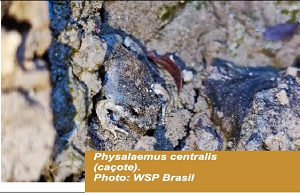 |
| Terrestrial
mammalian |
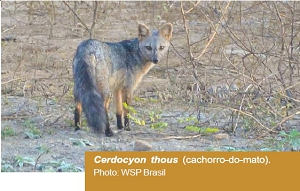 |
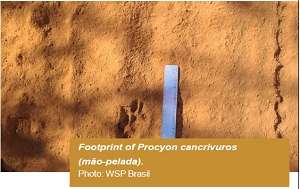 |
|
| SGS Geological Services |
| S-K 1300 Technical Report – FS Neves Lithium Project – Minas Gerais, Brazil | Page 355 |
| | |
| Flying
mammalian |
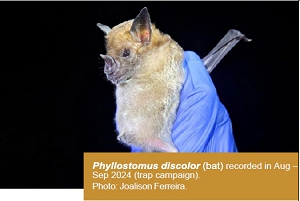 |
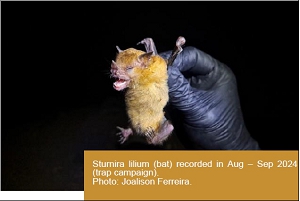 |
The
purpose of this authorization is to allow environmental intervention in an area of approximately 64.48 ha of removal of native vegetation
and intervention in permanent preservation area. Current legislation (Federal Law 11.428/2006) allows intervention in the form of clearing
vegetation that is in an intermediate stage of regeneration and removal of protected species, provided that they are duly included in
an inventory list and the proposed reforestation plan is legally executed. The Environmental Intervention Authorization listed in Table
17-7 will be applicable to the project.
| 17.1.6 | Water
Use Authorization |
The
water supply was previously authorized and is sufficient for the project and expansion.
| 17.1.7 | Final
Considerations about the Permit |
These
areas and activities for the Expansion of Anitta Project are subject to environmental licensing under the Concomitant Environmental Licensing
modality - LAC1, comprising the simultaneous obtaining of the Preliminary License (LP), Installation License (LI) and Operating License
(LO) from the Regional Management Directorate (DRG) of the State Environmental Foundation of the State of Minas Gerais (FEAM-MG) through
Administrative Process SLA PA No. 4709/2024 / formalized on 12/21/2024 through publication in the Official Gazette of the State of Minas
Gerais and SEI process no. 2090.01.0001026/2025-05.
Table
17-7 provides the environmental, authorizations and operations process related to the area of the expansion project.
|
| SGS Geological Services |
| S-K 1300 Technical Report – FS Neves Lithium Project – Minas Gerais, Brazil | Page 356 |
| | |
Table
17-7 Environmental, Authorizations and Operations Process List
| |
Expansion Anitta Project |
| Annex |
Environmental License |
No. |
Description |
Status |
| Annex 8 |
Concomitant Environmental License (LAC1) |
4709/2024 |
Preliminary License (LP) + Installation License (LI) + Operating License
(LO)
1) Waste Pile - 17,61 ha
2) Road for transporting ore/waste outside the limits of mining
projects – 3,64 km
3) Open Pit Mining - 1,500,000 t/year |
Process in Analysis in the Environmental Agency |
| Annex 9 |
Authorization for Environmental Intervention (AIA) |
2090.01.0031471/2024-68 |
Authorization for Environmental Intervention - 64,48 ha
1) Removal of Native Vegetation
2) Intervention in Permanent Preservation Area (APP) |
Process in Analysis in the Environmental Agency |
| Annex 10 |
Grant 1 - Exempt Use Crossing (Córrego São José) |
12.05.0000865.2024 |
Authorization to cross a stream |
Granted |
| Annex 11 |
Grant 2 - Exempt Use Crossing (Córrego São José) |
12.05.0000866.2024 |
Authorization to cross a stream |
Granted |
| Annex 12 |
Grant 3 - Exempt Use Crossing (Córrego São José) |
12.05.0000919.2024 |
Authorization to cross a stream |
Granted |
|
| SGS Geological Services |
| S-K 1300 Technical Report – FS Neves Lithium Project – Minas Gerais, Brazil | Page 357 |
| | |
| 17.2 | Requirements,
Plans for Waste, Tailings Disposal, Site Monitoring, Water Management |
The
provisions for storage of tailings and other waste products and for the closure of mines are set forth in the Brazilian Mining Code,
National Environmental Policy, Federal Constitution, mine closure legislation, specific regulations for tailings storage, ANM regulations
and other applicable norms. Please see below some of the key provisions that need to be made:
| ● | Environmental
Impact Assessments – the environmental impact assessments include plans for waste management,
tailings storage, and mine closure. |
| | |
| ● | Waste
Management Plans – waste management plans detailing types of waste, including tailings,
overburden, and other by-products, how they will by managed, stored and disposed. |
| | |
| ● | Tailings
Storage Facilities – tailings storage facilities to store the waste materials produced
during the ore processing. |
| | |
| ● | Mine
Closure Plan – mine closure plans that provide the steps and activities to be taken
to safely and responsibly close the mine once its operation is no longer economically viable
or sustainable. |
Section
17.2.1 to Section 17.2.4 provides a list of the Environmental Programs required for the environmental licensing of the Anitta Project,
which are detailed in the Anitta Project PCA (target Pit 1) and in the Expansion PCA (target Pit 2) (more information about these programs
are presented at Section 17.5):
| 17.2.1 | Physical
Environment Programs |
| ● | Program
for Environmental Management of Work; |
| | |
| ● | Program
for Monitoring the Quality of Surface Water; |
| | |
| ● | Water
Monitoring Program; |
| | |
| ● | Program
for Controlling Erosive Processes and Implementing and Maintaining Storm Drainage Systems; |
| | |
| ● | Program
for Monitoring Atmospheric Effluents; |
| | |
| ● | Program
for Controlling and Monitoring Noise Levels; |
| | |
| ● | Program
for Controlling and Monitoring Vibrations and Acoustic Pressure Resulting from Detonations; |
| | |
| ● | Solid
Waste Management Program; |
| | |
| ● | Liquid
and Oily Effluent Control and Monitoring Program; |
| | |
| ● | Hydrogeological
Monitoring Program. |
| 17.2.2 | Biotic
Environment Programs |
| ● | Germplasm
Rescue Program; |
| | |
| ● | Vegetation
Suppression Control Program; |
| | |
| ● | Local
Wildlife Rescue and Repelling Program; |
| | |
| ● | Trampled
Animal Monitoring Program; |
| | |
| ● | Fauna
Monitoring Program; |
| | |
| ● | Legal
Reserve Permanent Preservation Areas Maintenance and Conservation Program. |
|
| SGS Geological Services |
| S-K 1300 Technical Report – FS Neves Lithium Project – Minas Gerais, Brazil | Page 358 |
| | |
| 17.2.3 | Socioeconomic
Environment Programs |
| ● | Social
Communication Plan; |
| | |
| ● | Environmental
Education Program; |
| | |
| ● | Monitoring
Program for Socioeconomic Indicators; |
| | |
| ● | Program
for Valuing and Strengthening the Local Economy; |
| | |
| ● | Program
for Prioritizing and Professional Training of Local Labor and Suppliers. |
| 17.2.4 | Specific
Plans/Programs |
| ● | Risk
Management and Emergency Response Program; |
| | |
| ● | Degraded
Areas Recovery Plan (PRAD); |
| | |
| ● | Mine
Closure Plan. |
| 17.3 | Contextualization
of the Anitta Project and Expansion |
Figure
17-2 outlines in tan the area of the Anitta Project that has been licensed and in red the area that is currently being licensed.
|
| SGS Geological Services |
| S-K 1300 Technical Report – FS Neves Lithium Project – Minas Gerais, Brazil | Page 359 |
| | |
Figure
17-2 Map of Anitta Project Licensing Status
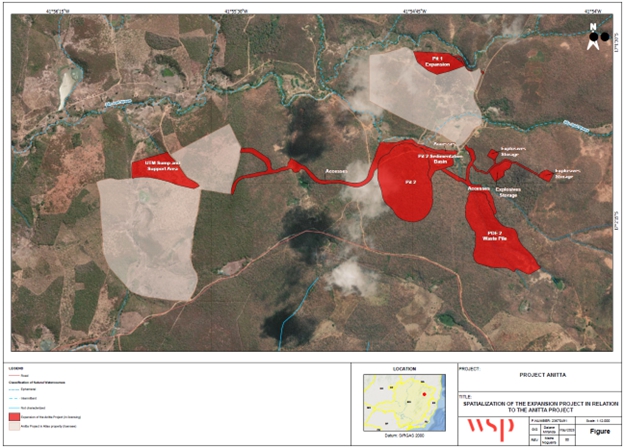
Figure
17-3 outlines the Master Plan of the Anitta Project including all its facilities, structures, mining, and the installation and operation
of the Mineral Treatment Unit.
|
| SGS Geological Services |
| S-K 1300 Technical Report – FS Neves Lithium Project – Minas Gerais, Brazil | Page 360 |
| | |
Figure
17-3 Anitta Project Master Plan
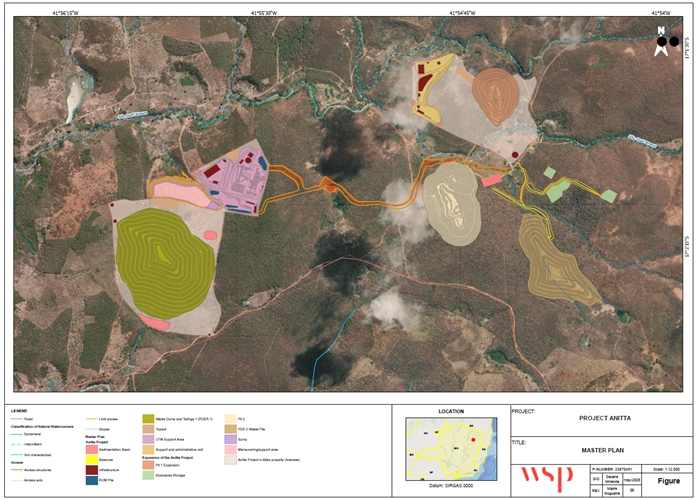
|
| SGS Geological Services |
| S-K 1300 Technical Report – FS Neves Lithium Project – Minas Gerais, Brazil | Page 361 |
| | |
During
the development of the EIA studies for the Expansion of the Anitta Project, prepared by WSP, the Area of Direct Influence for the Socioeconomic
Environment identified the locations surrounding the Area Directly Affected by the project, namely:
| ● | Nossa
Senhora das Neves; |
| | |
| ● | São
José das Neves; and |
| | |
| ● | Ribeirão
Calhauzinho das Neves |
The
locations most directly subject to the impacts of vehicle traffic along the access route to the project, given the concentration of residences
close to the road, are:
| ● | Aguada
Nova; and |
| | |
| ● | Ribeirão
Calhauzinho das Neves (already considered in the previous criterion). |
It
is worth noting that the Baixa Quente community, although not classified as an AID, will be the target of labor prioritization actions
and monitoring of socioeconomic indicators – the latter with the aim of verifying the potential impact of the arrival of the project
on changes in living conditions in the area, considering the network of socioeconomic relations with neighboring communities.
It
is important to clarify that access for maintaining economic and social ties between Aguada Nova and Baixa Quente is completely different
from the route that will be used by the project, that is, the route and traffic between the communities are not affected in any way by
the Expansion of the Anitta Project.
The
areas surrounding the project are sparsely populated, with little vehicular traffic. The villages are mainly concentrated along BR 367
and in the municipal district of Araçuaí, which has approximately 40,000 inhabitants. The main economic activities of the
region are subsistence agriculture and small livestock farming.
Atlas
maintains an open dialogue channel and close relationship with the communities surrounding the project and in the Municipality of Araçuaí
as a whole, having held regular consultation meetings with the communities directly affected by the project.
The
development of mining activities by Atlas in the Jequitinhonha Valley is viewed positively by the communities of Nossa Senhora das Neves,
São José das Neves, Calhauzinho and Aguada Nova as well as by the Municipal Government, being recognized as an important
economic driver in the region and an opportunity for employment and professional development.
In
support of relationships with the local community, Atlas signed a Memorandum of Understanding with the Municipality of Araçuaí
with the objective of establishing a partnership for improvements in infrastructure, health, education, access to water, among others.
In
this sense, actions are being developed in partnership with the Municipality of Araçuaí and other companies, with emphasis
on improving existing access roads, especially when compared to the conditions of the roads prior to the company’s activities,
as well as various actions to support the communities, based on knowledge of local needs.
In
general terms, the following actions are planned for the communities of Calhauzinho, São José das Neves, Nossa Senhora
das Neves and Aguada Nova, among others, within the scope of the Anitta Project as a whole. These actions are related to the implementation
of small water storage dams, improvements and graveling of roads, donation of machinery and equipment, construction of infrastructure,
in addition to support, donations and sponsorships, as listed in Table 17-8 below:
|
| SGS Geological Services |
| S-K 1300 Technical Report – FS Neves Lithium Project – Minas Gerais, Brazil | Page 362 |
| | |
Table
17-8 Community Support Program for Implementation
| Action |
Information |
| Little Water storage dams |
● |
14 units built and renovated for local residents |
| Improvements and graveling of roads |
● |
Calhauzinho Road; |
| ● |
Access to the Municipal School and the Community of São José das Neves; |
| ● |
Hill of the Cardoso Community; |
| ● |
Access to and Hill of the community of Nossa Senhora das Neves. |
| Support with donation of machinery and equipment |
● |
Improvement of the entire access to Chapada do Lagoão together with the City Hall of Araçuaí; |
| ● |
Paving of the community of Nossa Senhora das Neves together with the City Hall of Araçuaí; |
| ● |
Earthworks for a mobile phone tower in the community of Nossa Senhora das Neves; |
| ● |
Water trucks supply the communities and wet the roads. |
| Infrastructure |
● |
Complete construction of the teachers’ accommodation at the State School of the Calhauzinho Community; |
| ● |
Complete construction of the sidewalk, accessibility ramp, playground and improvement of the canteen at the Municipal School of the Community of São José das Neves; |
| ● |
Complete construction of the support house, kitchen and patio of the Church of the São José das Neves Community; |
| ● |
Renovation and painting of the church of the Nossa Senhora das Neves Community in partnership with the outsourced company Eco Sonda gem; |
| ● |
Renovation and painting of the church of the São José das Neves Community. |
| ● |
Support / Donations / Sponsorships • Sponsor and supporter of the Feast of Our Lady of the Snows in the Nossa Senhora das Neves Community in 2023 and 2024, being the main local festival; |
| Support / Donations / Sponsorships |
● |
Sponsor and supporter of the Patron Saint of Our Lady of the Snows in the Nossa Senhora das Neves Community in 2023 and 2024, being the main local festival; |
| ● |
Donation of trash cans and native tree seedlings to the Calhauzinho Community State School; |
| ● |
Support during environmental week with an educational environmental lecture by collaborator Marco Aurélio followed by an ecological visit with students from the Calhauzinho Community State School in the Chapada do Lagoão APA; |
| ● |
Donation, negotiation and regularization of an artesian well together with the City of Araçuaí and COPANOR to fully supply the Nossa Senhora das Neves Community; |
| ● |
Support for costs to conduct a pumping test and technical study of an artesian well to supply the Calhauzinho community State School; |
| ● |
Sponsorship of the São Sebastião Festival in the Nossa Senhora das Neves Community; |
| ● |
Donation and support for the Children’s Day party in the Nossa Senhora das Neves and Aguada Nova communities; |
| ● |
Donation of food for the New Year’s Eve dinner of the Evangelical Church of the Calhauzinho Community; |
| ● |
Donation of food for the graduation of students from the Baixa Quente Community School; |
| ● |
Donation of food for the Christmas party of students from the Calhauzinho and São José Community State Schools. |
|
| SGS Geological Services |
| S-K 1300 Technical Report – FS Neves Lithium Project – Minas Gerais, Brazil | Page 363 |
| | |
During
the licensing process, Atlas held 14 (fourteen) meetings in 2023, 2024 and 2025 with representatives of communities within the Area of
Direct Influence of the project. These meetings provided opportunities for Atlas to understand the community’s expectations for
the Project. A summary of these meetings is:
| | ○ | June
15 – Calhauzinho Community |
| | | |
| | ● | June
15 – Nossa Senhora das Neves Community |
| | | |
| | ○ | June
15 – São José das Neves Community |
| | | |
| | ○ | June
15 – Feedback São José das Neves Community |
| | | |
| | ○ | June
15 – Feedback Calhauzinho Community |
| | | |
| | ● | June
15 – Feedback Nossa Senhora das Neves Community |
| | ○ | June
15 - Calhauzinho Community |
| | | |
| | ○ | June
15 – São José das Neves Community |
| | | |
| | ● | June
15 – Nossa Senhora das Neves Community |
| | | |
| | ○ | June
15 – Feedback Calhauzinho Community |
| | | |
| | ○ | June
15 – Feedback São José das Neves Community |
| | | |
| | ● | June
15 – Feedback Nossa Senhora das Neves Community |
| | ○ | April
12 – Aguada Nova Community |
| | | |
| | ○ | April
13 – Feedback Aguada Nova Community |
Furthermore,
important to mention that Girau Quilombola community and the Malhada Preta sector, although not part of the Area of Direct Influence,
were considered in the ECR and were consulted by anthropologists in previous meetings, held on October 28 and 29, 2023, in addition to
a feedback meeting on December 16, 2023, which had the spontaneous participation of residents who were informed of the Anitta Project
and the objectives of the meeting within the scope of preparing the Socioenvironmental Diagnosis (MF Projetos Socio Ambientais, 2023).
In addition, a Physical and Biotic Environment Impact Assessment study (WSP, 2024) was also presented, and it was found that the community
in question does not suffer any impact in relation to the project due to the physical barrier existing between the project and where
they are located.
The
rehabilitation and closure plan consist of three main stages:
| | 1. | Decommissioning
planning |
| | | |
| | 2. | Execution
of decommissioning |
| | | |
| | 3. | Implementation
of the socio-environmental and geotechnical follow-up and monitoring actions of the post-closing.
Waste piles will be graded as needed, capped with a vegetation suppression layer and revegetated
with herbaceous-shrub species. A final protective cover can be placed over the pile to facilitate
revegetation and minimize erosion, at which point the sedimentation pond may be decommissioned.
A cap layer of soil will be placed and seeded on the open pit berm areas. A fence will be
built around the open pits, and all mine haul roads will be blocked off. |
|
| SGS Geological Services |
| S-K 1300 Technical Report – FS Neves Lithium Project – Minas Gerais, Brazil | Page 364 |
| | |
Table
17-9 summarizes the measures that have been planned to minimize environmental impact.
Table
17-9 Planned Measures to Minimize Environmental Impact
| Mitigation
Measures |
Description |
| General |
| Construction
Management Program |
Establish
and implement efficient technical and managerial tools that allow the full and safe development of the project’s construction
activities and the monitoring of the actions described in the Environmental Programs. Assisting the contracted companies and their
employees, during the progress and demobilization of the works, to ensure the prevention and minimization of the expected impacts
and the adoption of corrective measures, when necessary. |
| Degraded
Areas Recovery Plan |
Promote
the recovery of areas affected by the implementation and operation of the Anitta Project Expansion project, with a view to recovering
the environments, minimizing the action of erosive agents, even on a small scale, considering the specific interventions associated
with the control measures of these activities. |
| Risk
Management and Emergency Response Plan |
Present
the necessary actions to prevent and mitigate dangerous events identified in the APP as being of marginal and critical severity. |
| Mine
Closure Plan |
Plan
the closure of mining exploration activities, promote the recovery of degraded areas, promote physical, chemical and biological stability
and provide balance to the anthropic environment of the project’s area and its surroundings. |
| Physical
Environment |
| Surface
Water Quality Monitoring Program |
Monitor
the evolution of water quality in watercourses in the Area of Influence of the Anitta Project Expansion and verify the efficiency
of the control systems implemented. |
| Water
Monitoring Program |
Monitor
the flow rates of the main watercourses in the Area of Direct Influence, as well as points downstream and upstream of the structures
that will be implemented. Ensure compliance with environmental law regarding the maintenance of residual flow in the water bodies
This monitoring program will be able to confirm the operational efficiency of the control agents. |
| Program
for Controlling Erosion Processes and Implementing and Maintenance of Storm Drainage Systems |
Present
a set of actions aimed at monitoring and tracking erosional processes and silting of drainage. Propose control and corrective measures
as needed. |
| Atmospheric
Effluent Monitoring Program |
Promote
monitoring of the environmental quality of the atmosphere in the areas of influence of the project. Control and monitor atmospheric
emissions while considering emissions of particulate matter and combustion gases, in accordance with legal standards. |
| Noise
Level Control and Monitoring Program |
Ensure
noise emission levels resulting from the project’s activities cause the least possible impact on its surroundings and on the
employees involved in the implementation and operation of the project. In addition, the program aims to guide procedures for monitoring
and controlling noise. |
| Program
for Controlling and Monitoring Vibrations and Acoustic Pressure Resulting from Detonations |
Ensure
that vibration and acoustic pressure levels, resulting from detonations to dismantle rock for the Anitta Project Expansion, do not
exceed regulatory limits. Ensure the comfort of the surrounding communities is not affected by the activities, meeting vibration
and acoustic pressure references in relation to human reaction and constructions. |
|
| SGS Geological Services |
| S-K 1300 Technical Report – FS Neves Lithium Project – Minas Gerais, Brazil | Page 365 |
| | |
| Solid
Waste Management Program |
Ensure
environmentally correct management of solid waste from the project’s activities, including its implementation, operation and
closure stages, in accordance with the law. |
| Liquid
and Oil Effluent Control and Monitoring Program |
Control
the environmental aspect of effluent generation, through specific operational procedures during the implementation, operation and
closure stages of the Anitta Project Expansion and monitor the sources responsible for effluent generation as a way of verifying
the efficiency of the control systems and operational procedures adopted. |
| Hydrogeological
Monitoring Program |
Monitor
the water level, the quality of groundwater, and register springs and water points. In quantitative terms, the purposes are to evaluate
the hydrodynamics of the aquifer being evaluated and the interrelationship between the water table level and the dynamics of the
aquifer(s) with surface water resources. Specifically in qualitative terms, the purpose is to characterize and monitor the evolution
and seasonality of water quality in the area of influence. |
| Biotic
Environment |
| Germplasm
Rescue Program |
Mitigate
the impacts resulting from the implementation of the Anitta Project Expansion on local floral biodiversity. The program seeks to
minimize the loss of individuals and genetic resources of populations of native plant species (with emphasis on endangered, immune
to cutting and endemic species) present in the Directly Affected Area. |
| Vegetation
Suppression Control Program |
Establish
guidelines for vegetation removal activities in the area where the Anitta Project Expansion is being implemented. Minimize the impacts
generated on the ecosystem and promote better use of woody material resulting from the removal of vegetation cover. |
| Local
Fauna Scaring and Rescue Program |
Minimize
the adverse impacts resulting from the implementation of the Anitta Project Expansion and, more specifically, from vegetation suppression
activities that cause harm to the wildlife populations present in the project area. |
| Roadkill
Monitoring Program |
Systematically
monitor potentially run-over fauna, as well as propose and implement mitigation and control measures to reduce run-overs in all internal
and external accesses to Anitta Project Expansion. |
| Wildlife
Monitoring Program |
Monitor
the populations of animal species, especially those that are endangered, endemic, indicators of environmental quality and of medical
importance. |
| Program
for Maintenance and Conservation of Permanent Preservation Areas – Legal Reserves |
Monitor
the Permanent Preservation Areas and Legal Reserves within the boundaries of Atlas’ property, to guarantee the conservation
status of these areas. |
| Socioeconomical
Environment |
| Social
Communication Program |
Announce
the measures adopted by the company to minimize and/or mitigate environmental impacts attributed to and related to the production
process, enhance its socio-environmental actions, the Environmental Education Program and its activities, in addition to maintaining
the flow of general information about the enterprise with the public in a clear, direct and agile manner. |
| Environmental
Education Program |
Share
responsibilities and motivate social groups impacted by the project to carry out a set of teaching-learning actions and processes
that provide conditions for these actors to avoid. Control or mitigate socio-environmental impacts, as well as strengthen local potential,
thus complying with COPAM Normative Resolutions No. 214 and No. 238. |
|
| SGS Geological Services |
| S-K 1300 Technical Report – FS Neves Lithium Project – Minas Gerais, Brazil | Page 366 |
| | |
| Socioeconomic
Indicators Monitoring Program |
Monitor
the indicators related to the local public service infrastructure and productive structure in the AID of the Anitta Project Expansion,
specifically in the locations of Nossa Senhora das Neves, São José das Neves, Ribeirão Calhauzinho das Neves
and Baixa Quente, all belonging to the city of Araçuaí/MG. If necessary, develop support processes to reduce the negative
impacts of the project. |
| Local
Labor and Suppliers Training and Prioritization Program |
Ensure
training and objective conditions in order for the workers from the municipalities of Araçuaí and from the communities
of Nossa Senhora das Neves, Ribeirão Calhauzinho and São José das Neves can engage in employment opportunities
with Atlas Lítio Brasil or contractors during the implementation and operation stages of the project. |
| Program
for Enhancement and Strengthening of the Local Economy |
Develop
actions that promote the continuity of rural practices in communities and enhance their growth opportunities, improving their quality
of life, as well as training public authorities with the structuring of a culture of innovation, modernization and valorization of
local production. |
| 17.6 | Commitments
to Local Procurement or Hiring |
Procurement
by a mining operation is the single largest potential economic impact in a host country, more than payments in taxes, wages and community
investment combined.
Mining
companies themselves also have an economic interest in purchasing more goods and services closer to their sites of activity, in the form
of improved relations with stakeholders and lower supply chain costs in the long run. In addition, bilateral and multilateral aid providers
and development organizations have an important role to play to support economic development planning utilizing the procurement spending
of mining companies.
Mining
companies can’t do everything themselves. Whether they are just beginning to explore an area or have been in production for years,
mining companies rely on the products and services of many other businesses.
Furthermore,
mining companies often hire people full-time to provide the services that could be sub-contracted out to local businesses.
Global
Standard sets the minimum requirements to ensure that programs are in place to identify and provide employment and business opportunities
that can deliver sustainable mutual benefits to local stakeholders. The stakeholder benefits are intended to align with the targeted
outcomes of the Community Investment Strategy.
Atlas
Lítio Brasil Ltda. in its Environmental Control Plan (PCA, Brazilian acronym) establishes the Program for Training and Prioritization
of Local Labor and Suppliers. This program included in the PCA of the environmental licensing establishes an Atlas’ formal commitment
to the environmental agency regarding its actions to favor, directly involve, and hire local/regional workforce.
This
program aims to optimize the absorption of local manpower, offering professional training and the people productive inclusion in the
job market, providing workforce training. This strategy has been increasingly used by companies that aim to get good performance results,
professional quality, and increased productivity.
The
project will be of great importance for the regional development of “Jequitinhonha Valley”, Minas Gerais State, Brazil, as
it will provide an objective change in the occupational structure and in service provision for the population. “Jequitinhonha Valley”
is a region marked by social vulnerability and low income, so this impact presents itself as a significant social and economic contribution
to its very relevant and positive development.
|
| SGS Geological Services |
| S-K 1300 Technical Report – FS Neves Lithium Project – Minas Gerais, Brazil | Page 367 |
| | |
As
part of the installation and operation of the Anitta Project, a significant number of job vacancies will be generated in the municipality
of Araçuaí, Minas Geris State (MG), and in this region of Brazil.
During
the in loco work development for the socio-environmental diagnosis, it was found that there was a great need to enhance the positive
effects of the project implementation and operation on the municipality, to promote expansion and favor access conditions to the local
labor vacancies.
Therefore,
the entrepreneur will institutionalize and establish criteria for the selection of human resources needed for the enterprise implementation
and operation, as well as its support structures.
Considering
the unavailability of skilled workers in the municipality, training is planned for the future hiring of employees during the project
implementation and operation phases, as well as throughout its development. This action is related to the policy adopted by the company
to mainly prioritize local manpower and suppliers.
The
Program for Training and Prioritization of Local Labor and Suppliers aims to establish objective conditions so the workers from the municipalities
of Araçuaí, especially from the AID communities, can effectively take advantage of the employment opportunities that will
be generated.
The
specific objectives are:
| | ○ | Systematize
and maintain as a policy the prioritization of labor from the locations covered by the Program
for Training and Prioritization of Local Labor and Suppliers; |
| | | |
| | ○ | Enhance
the positive social and economic effects of the project in Araçuaí; |
| | | |
| | ○ | Minimize
the attraction of labor contingents from other municipalities, contributing to reducing pressure
on infrastructure and public services; |
| | | |
| | ○ | Develop
and implement project(s), possibly in partnership with other companies and/or public authorities,
that values and strengthens the local economy. |
As
a methodology, basic surveys will initially be carried out to support training opportunities. During the project implementation phase,
the program will focus on prioritizing local labor. Companies responsible for implementing the project will be instructed to hire workers
residing in Araçuaí, preferably.
During
the project’s operational phase, local workers will continue to be prioritized. However, this will be combined with the workforce
qualification process. The courses offered are based on the knowledge and skills needed to fill the jobs during the operational phase.
In
addition to training local labor and suppliers, this program also includes the development of a project that establishes actions to enhance
and strengthen the local economy, focusing on the region’s natural and cultural vocations. The actions to be carried out include:
| | ○ | Systematization
and dissemination of the policy of prioritizing local labor and service providers |
| | | |
| | ○ | Selection
of partner entities for the preparation and implementation of qualification courses |
| | | |
| | ○ | Communication,
mobilization and selection of candidates for Professional Training |
| | | |
| | ○ | Development
of Qualification Courses |
|
| SGS Geological Services |
| S-K 1300 Technical Report – FS Neves Lithium Project – Minas Gerais, Brazil | Page 368 |
| | |
This
program will constitute an internal policy of the company since its initial insertion in the municipality of Araçuaí. By
developing these actions and activities, the Company will be facilitating, enabling, and prioritizing the local hiring of workers, service
providers, and hiring in local market.
As
this situation is currently known, meeting this need in the region is already underway, that is, hiring workers and outsourcing services
with local companies and suppliers. This program aims to strengthen and consolidate the actions that are already developed by the entrepreneur.
For example, the “Women’s Trainee” is a program in which four young mining technician students are already working
in the company to better train themselves and gain experience to be hired after graduating.
In
the same sense, the SUB-PROGRAM is also planned: Project for the Valorization and Strengthening of the Local Economy with the main objective
of developing actions that promote the continuity of rural practices in communities, enhancing their growth opportunities, improving
their quality of life, as well as training public authorities with the structuring of a culture of innovation, modernization and valorization
of local production.
The
project goal is to generate employment and income, contributing to the development of local communities, mainly around the project and
specially in Araçuaí. It stands out among the communities “Neves, Calhauzinho, and São José das Neves”,
which are currently prioritized in the initial and survey activities in hiring workers and providing services from outsourced survey
companies as well as direct workers from Atlas.
Therefore,
the target public for this program is made up of people interested in working at Atlas Lítio Brasil for improving their technical
knowledge through courses offered and projects to enhance and strengthen the economy, with a focus on the AID communities, plus the Baixa
Quente community.
For
the Sub-Program for the Enhancement and Strengthening of the Local Economy, the target audience is producers, artisans, traders and other
actors involved in local production and economic chains, with a focus on the AID communities.
Among
the activities of this program, it is emphasizing the importance of those responsible for defining the best communication strategies
so that workers are aware of this fact and, thus, can register as applicants for the job vacancies offered. Whenever needed, it is proposed
to disseminate the activities of general interest with verbal communication, local radio, posters, and other effective forms in highly
visible places in the communities to target the audience.
Obtaining
inputs from local and regional suppliers is of fundamental importance to boost the economy. The benefits are countless, and everyone
wins, especially, the population. This is an important practice that will be adopted by the company especially because Araçuaí,
despite being a smaller city, is the closest urban center to the project area. Local market is also extremely important in generating
indirect jobs for the population. These opportunities may arise in different segments. When choosing local suppliers, there is always
the consequence of strengthening the economy and opening up more expansion possibilities. Increasing demand in local market leads to
positive impacts, resulting in generating new jobs in this place.
In
terms of logistics and storage, being able to purchase products from nearby suppliers becomes a very positive factor for the enterprise,
mainly due to reducing transport and storage costs.
The
installation of a new mineral industry unit and the strengthening of local market will directly reflect on the collection of municipal,
state, and federal taxes (CFEM, Brazilian acronym); this impact has a positive effect on the population, and these values directly result
in infrastructure improvements, safety, and better living conditions in general.
It
should be noted that the prioritization, hiring, and training the workers will be the responsibility of the entrepreneur, who may designate
a specialized company to carry out the procedures required for its effective application.
The
execution of actions to hire local manpower will begin with the identification of its need in the project implementation and operation
phases and will be extended, depending on the possible need to replace manpower during the enterprise development.
|
| SGS Geological Services |
| S-K 1300 Technical Report – FS Neves Lithium Project – Minas Gerais, Brazil | Page 369 |
| | |
Local
Procurement and Employment Plans or equivalent will be developed and integrated with cross functional business strategies to optimize
procurement and employment opportunities for key stakeholder groups by promoting:
| | ● | Local
employability and skills development |
| | | |
| | ● | Diversity
of workforce |
| | | |
| | ● | Small
business development for locals, indigenous, women and/or minority business owners |
| | | |
| | ● | Sustainable
business opportunities |
Local
Procurement and Employment Plans will define and prioritize procurement and employment objectives as well as identify key performance
indicators to measure program successes and opportunities for improvement.
|
| SGS Geological Services |
| S-K 1300 Technical Report – FS Neves Lithium Project – Minas Gerais, Brazil | Page 370 |
| | |
| 18 | CAPITAL
AND OPERATING COSTS |
The
capital expenditures (CAPEX) and operating expenditures (OPEX) of the Project were estimated at a feasibility study level and should
provide further guidance for the project implementation phase. The estimate parameters are as follows:
| | ● | Target
accuracy initial capital costs: +15% / -10% |
| | | |
| | ● | Target
accuracy sustaining capital costs: +15% / -10% |
| | | |
| | ● | Target
accuracy operating costs: +15% / -15% |
| | | |
| | ● | Estimate
period: Q2 2025 |
| | | |
| | ● | Estimate
currency: United States Dollars (USD) |
The
estimate was developed for the 2025 FS based on the SGS/Atlas standard commodity coding structure for mineral projects. A work breakdown
structure (WBS) was developed for the Project to organize the estimate in a logical structure based on function and location. Table 18-1
presents CAPEX CBS – Cost Breakdown Structure.
Table
18-1 CAPEX CBS – Cost Breakdown Structure
| CBS
- Cost Breakdown Structure |
| Bins
& Conveyors |
| Buildings |
| DMS |
| Effluent |
| MV
Subs & Automation |
| Piping |
| Screens
- Prep & sizing |
| Spares |
| Steelwork
& Platework |
| Tanks |
| Taxes |
| Water
Supply |
| Weighbridge |
| Civils |
| Commissioning |
| Crushing
Area |
| Contract
Mining |
| Earth
works |
| Engineering |
| Generators |
| Installation |
| Owners
team OPS |
| Project
Development |
| Shipping
|
|
| SGS Geological Services |
| S-K 1300 Technical Report – FS Neves Lithium Project – Minas Gerais, Brazil | Page 371 |
| | |
The
operating cost estimate was broken down as follows:
| | ● | Mining
(drill and blast, load and haul, geology, maintenance, dewatering, other). |
| | | |
| | ● | Crushing
(crushing, screening). |
| | | |
| | ● | DMS
process Cost Plant - Processing (storage and reclaim, DMS, concentrate handling, laboratory,
tailings handling, ore feed, maintenance, cost to transport from the Plant to TSP, other). |
| | | |
| | ● | Power
Supply (genset rental, diesel supply, others). |
| | | |
| | ● | Freight
– Road Cost and Port Cost (cost to transport from transhipment to Port and storage
in Port). |
| | | |
| | ● | G&A
Services (office, security, health and safety, environment, warehouse, other). |
OPEX
are inclusive of labour, consumables, power, and maintenance materials, as well as general and administration (G&A) costs.
The
mining capital and operating cost estimates were developed by Atlas and Promon to include all costs related to the mine operating contract,
including mine mobile equipment, (primary, secondary, support, auxiliary, and ancillary equipment) and pre-production mine development.
Mining
infrastructure, including haul roads, mine facilities, explosives storage, and processing plant CAPEX, was developed by Promon.
The
capital cost estimates for the process plant were developed by Promon with input from Atlas, Prominas, DF+ and SGS (including processing
plant design, bulk quantities and equipment lists).
The
operating cost estimates for the process plant were developed by Atlas with input from Promon, Prominas, DF+ and SGS (including processing
plant design, bulk quantities and equipment lists).
The
tailings and overall site water management capital and operating cost estimates were developed by Atlas with input from DF+ and WSP.
Costs
pertaining to the power generation with generator sets, the internal site power line and associated facilities were provided by Atlas
and Promon and are based on contract pricing received from an RFQ process.
The
road between the Project site and the city of Araçuaí is adequate for the Project’s transportation needs, except
at the entrance to the Project site. Some modifications were carried out in previous years in partnership with the City Hall, and their
costs were allocated to the sunk cost. Near the Project area, further works will be carried out and managed by Atlas.
The
initial CAPEX estimate includes all Project direct and indirect costs to be expended during the implementation phase of the Project.
The initial CAPEX estimate covers the period from the Pre-approval date by Atlas of this report, when detailed engineering would commence,
to the successful completion of the Plant commissioning phase. Any costs beyond the Plant commissioning phase are captured with the sustaining
CAPEX, or OPEX. Various studies phases, testwork, and preliminary engineering, as well as permitting activities, processing equipment
by CDM, are excluded from the estimate as these are considered sunk costs as of the effective date of this report.
SGS
has reviewed the cost estimates developed by Atlas and considers them reasonable.
|
| SGS Geological Services |
| S-K 1300 Technical Report – FS Neves Lithium Project – Minas Gerais, Brazil | Page 372 |
| | |
The
CAPEX estimate reflects the project scope below
| |
● |
Construction
of Explosives Magazine; |
| |
|
|
| |
● |
Fuel
Station Infrastructure (equipment such as tanks, pumps, and others will be provided under a loan agreement). |
| |
|
|
| |
● |
Waste
Pile Infrastructure. |
| |
|
|
| |
● |
Pre-Stripping
Operations (Mobilization, Temporary facilities, Site maintenance, Loading of weathered waste from the mine to the pile, Transport
of waste, Spreading of waste in deposits). |
Mining
development will be arranged by a mining contractor, responsible to all mining services. The CAPEX estimate is based on firm prices received
from mining contractors
The
Pre-stripping budget encompasses all direct and indirect costs associated with initial overburden removal activities. Direct operating
costs include expenditures for equipment operation, such as fuel, electricity, maintenance components, operator labor, and consumables
(e.g., tires). Indirect costs comprise labor related to mine supervision, management, and technical support from mine company. All these
components are fully integrated into the overall pre-stripping cost structure.
| 18.1.3 | Processing
Plant and Infrastructure |
The
physical conceptual design is prepared in accordance with the WBS where all the tasks and areas were developed in enough detail to establish
a class 2 estimate based on the American Association of Cost Engineers (AACE). A general contingency of 7% was generated using Promon
expertise.
The
process plant costs were established by obtaining prices for more than 80% of the process and ancillary equipment from multiple suppliers.
Detailed material take-offs (MTOs) were prepared for all bulk materials, i.e., concrete, primary and secondary steel, architectural items,
cable trays, electrical cables, instruments, and piping (steel and HDPE). Prices were obtained for most of the bulk material packages.
Quotes
were obtained for all prefabricated buildings, including the Ore Stockpile Dome and the Warehouse. The cost of the main electrical generator
substation and generators were based on prices obtained from the selected supplier.
The
material takes offs for earthworks, including the waste and tailings dump, are based on physical material take-offs from detailed design
prepared by Promon. Unit costs are based on quotations received.
Quotations
were received for the sewage treatment plant and other ancillary buildings, and temporary / construction infrastructure. The remaining
equipment and material costs were based on budgetary bid processes, quotes, the consultant’s historical data, and in-house databases,
or benchmarked from previous projects. The power supply costs are based bidding contract for generator cost estimates.
| 18.2 | Capital
Cost Estimates |
The
capital cost estimate summary is presented in Table 18-2 and Table 18-3, show all necessity capital to building and manager construction
phase
|
| SGS Geological Services |
| S-K 1300 Technical Report – FS Neves Lithium Project – Minas Gerais, Brazil | Page 373 |
| | |
Table
18-2 Capital Breakdown Structure CapEx (USD Million)
| CBS
- CapEx Breakdown |
Estimate
to Complete |
| Buildings |
3.52 |
| MV
Subs & Automation |
2.78 |
| Spares |
0.05 |
| Water
Supply |
0.85 |
| Weighbridge |
0.06 |
| Civils |
6.25 |
| Commissioning |
1.09 |
| Crushing
Area |
6.89 |
| Contract
Mining |
6.90 |
| Earth
works |
9.45 |
| Engineering |
0.80 |
| Generators |
1.34 |
| Installation |
12.15 |
| Shipping
|
1.65 |
| Contingency |
3.77 |
| Total |
57.56 |
Table
18-3 Corporate Cost Breakdown Structure (USD Million)
| CBS
- Corporate Costs Breakdown |
Estimate
to Complete |
| Taxes |
0.90 |
| Owners
team OPS |
11.86 |
| Insurance |
0.34 |
| Contingency |
1.08 |
| Total |
14.17 |
The
following assumptions apply to the capital cost estimate:
| |
● |
All
equipment and materials will be new. |
| |
● |
The
labour rate build-up is based on the statutory laws governing benefits to workers. |
| |
● |
Fuel
Cost: R$ 5,70/L |
| |
● |
Foreign
exchange rate: BRL 6/USD. |
| |
● |
Construction
phase: Two shifts per day for earthworks, civil work and assembly activities will be conducted on 1 shift per day. |
| |
● |
All
labor-related costs, including wages, benefits, and associated charges, are in full compliance with current Brazilian labor legislation. |
| |
● |
Transfer
of tailings to the PDER-1 (Waste Dump) will be via 40t haul trucks. |
| |
● |
No
provision for rework or repair of equipment and material delivered to site. |
| |
● |
No
rework to field-erected and installed equipment and material. |
| |
● |
No
provision for potential increase in salaries necessary to attract skilled trades workers. |
| |
● |
Costs
for pre-start-up operations and maintenance training are applied in this estimate |
|
| SGS Geological Services |
| S-K 1300 Technical Report – FS Neves Lithium Project – Minas Gerais, Brazil | Page 374 |
| | |
Exclusions
(CAPEX)
| |
● |
Escalation
(or de-escalation) is excluded from the CAPEX. |
| |
● |
Costs
relating to certain agreements with third parties. |
| |
● |
Cost
relating to financing and interest. |
| |
● |
Work
stoppages resulting from community relations dispute. |
| |
● |
Any
and all scope changes. |
| |
● |
All
G&A costs from the construction phase. |
A
capital expenditures summary for buildings is presented in Table 18-4. The main infrastructures and civil works are included, as listed
below:
Site
Buildings:
| |
● |
Administrative
/ Main office |
| |
● |
Canteen |
| |
● |
Gatehouses |
| |
● |
Locker
Room |
| |
● |
Control
Room |
| |
● |
Waste
deposit |
| |
● |
Radioactive
Items Bunker |
| |
● |
Control
Room |
| |
● |
Canteen |
| |
● |
Maintenance/Workshops |
| |
● |
Warehouse
Stores |
TSP:
| |
● |
Laboratory |
| |
● |
Truck
Weigh Station |
| |
● |
Gatehouse |
| |
● |
Waiting
building for truck drivers |
|
| SGS Geological Services |
| S-K 1300 Technical Report – FS Neves Lithium Project – Minas Gerais, Brazil | Page 375 |
| | |
Table
18-4 Building CapEx Expenditures (USD Million)
| CBS
- CapEx Breakdown |
Estimate
to Complete |
| Administrative
& Operational Buildings |
1.93 |
| Laboratory |
1.59 |
| Total |
3.52 |
| 18.2.2 | MV
Substation & Automation |
A
summary of the capital expenditures for medium voltage substation, power distribution, electrical material, instrumentation, and telecom
system and equipment are presented in Table 18-5.
Table
18-5 Electrical and Communications Capital Expenditures (USD Million)
| CBS
- CapEx Breakdown |
Estimate
to Complete |
| Telecom
System + Equipment |
0.53 |
| Instrumentation |
0.17 |
| MV
Substation & Automation |
2.08 |
| Total |
2.78 |
The
CAPEX estimate for spares are for utilities from the water supply and sewage system, all other spare parts to the process plant are in
sunk costs, CDM supply.
Table
18-6 Spares (USD Million)
| CBS
- CapEx Breakdown |
Estimate
to Complete |
| Spares |
0.05 |
| Total |
0.05 |
The
water supply CAPEX consists of the Capital Expenditure for the acquisition of pumps for water distribution, water treatment plant, sewage
treatment plant, filters for raw water, equipment tanks for water boreholes (pumps and accessories), bulk material for piping, valves
and fire system material (fire fighter equipment was in CDM scope in sunk cost).
Table
18-7 Water Supply (USD Million)
| CBS
- CapEx Breakdown |
Estimate
to Complete |
| Pumps |
0.03 |
| Water
Treatment Plant |
0.29 |
| Sewage
Treatment Plant |
0.10 |
| Fire
System Material |
0.13 |
| Water
Boreholes (equipment) |
0.05 |
| Piping
Materials |
0.24 |
| Total |
0.85 |
|
| SGS Geological Services |
| S-K 1300 Technical Report – FS Neves Lithium Project – Minas Gerais, Brazil | Page 376 |
| | |
The
capital expenditure for the weighbridge includes the acquisition of a truck scale to weigh trucks prior to dispatching the concentrate
to the port.
Table
18-8 Weighbridge (USD Million)
| CBS
- CapEx Breakdown |
Estimate
to Complete |
| Weighbridge |
0.06 |
| Total |
0.06 |
The
capital cost estimate for civil works includes all necessary activities to enable the proper installation and functioning of process
plant infrastructure. The scope comprises:
| |
● |
Mobilization
and demobilization of workforce, equipment, and construction materials; |
| |
● |
Construction
and maintenance of site infrastructure and temporary facilities during the execution phase; |
| |
● |
Execution
of reinforced concrete foundations and equipment support bases; |
| |
● |
Construction
of reinforced concrete superstructures, including columns, beams, and structural walls; |
| |
● |
Installation
of reinforced concrete floors for operational and equipment areas; |
| |
● |
Implementation
of the electrical grounding mesh system, ensuring compliance with applicable safety standards; |
| |
● |
Final
demobilization activities upon completion of the civil construction phase. |
| |
● |
This
scope is based on detailed engineering quantities and unit costs derived from contractor proposals and historical benchmarks. |
Table
18-9 Civil Works Capital Expenditures (USD Million)
| CBS
- CapEx Breakdown |
Estimate
to Complete |
| Civil
Works - CIV-02 |
6.25 |
| Total |
6.25 |
|
| SGS Geological Services |
| S-K 1300 Technical Report – FS Neves Lithium Project – Minas Gerais, Brazil | Page 377 |
| | |
The
capital cost estimates for commissioning encompass expenses associated with the engagement of specialized commissioning firms, responsible
for supporting the preparation, testing, and validation of systems and equipment. Additionally, this estimate includes the procurement
of essential consumables and materials required for the initial start-up phase of the plant, such as ferrosilicon. These costs are presented
in Table 18-10.
Table
18-10 Commissioning Capital Expenditures (USD Million)
| CBS
- CapEx Breakdown |
Estimate
to Complete |
| FeSi-Supply |
0.32 |
Commissioning
Support
(services
+ material) |
0.75 |
| Minor
Suppliers |
0.02 |
| Total |
1.09 |
The
capital cost estimate for the crushing area comprises the supply and installation of all major and auxiliary equipment necessary for
the full operation of the system. This includes the acquisition and mechanical assembly of three crushers (one jaw crusher and two cone
crushers) along with the complete set of conveyor belts required for material handling within the circuit. Additionally, the estimate
covers the procurement and installation of screening equipment, various auxiliary machines, and all associated electrical and mechanical
materials, structural steel components necessary for equipment support, platforms, walkways, and access structures. Furthermore, the
scope includes all related civil works, such as foundations, equipment bases to ensure the complete implementation and operational readiness
of the crushing facility are presented in Table 18-11.
Table
18-11 Crushing Area (USD Million)
| CBS
- CapEx Breakdown |
Estimate
to Complete |
| Equipment
+ Material |
3.44 |
| Assembly
– Electromechanical + Automation |
2.07 |
| Civil
works |
1.38 |
| Total |
6.89 |
| 18.2.9 | Contract
Mining (Pre-Operational Phase) |
The
capital cost estimate for the pre-operational mining phase are presented Table 18-12:
| |
● |
Construction
of the explosives magazine; |
| |
● |
Development
of fuel station infrastructure (with equipment such as tanks, pumps, and others to be supplied under a loan agreement); |
| |
● |
Implementation
of the waste pile infrastructure; |
| |
● |
Execution
of pre-stripping operations, including mobilization, installation of temporary facilities, site maintenance, excavation and loading
of weathered waste material, transportation to the designated waste dump, and spreading of material in the disposal areas. |
|
| SGS Geological Services |
| S-K 1300 Technical Report – FS Neves Lithium Project – Minas Gerais, Brazil | Page 378 |
| | |
Mining
development will be conducted by a third-party contractor, who will be fully responsible for the execution of all mining services. The
CAPEX estimate is based on firm quotations and commercial proposals received from qualified service providers.
Table
18-12 Contract Mining- Pre-Operational Phase (USD Million)
| CBS
- CapEx Breakdown |
USD
Million |
| Explosives
Magazine |
0.61 |
| Fuel
Station Infrastructure |
0.17 |
| Waste
Piles |
3.46 |
| Pre-Stripping |
2.66 |
| Total |
6.90 |
The
capital cost estimates for the earthworks of the process and TSP, are presented below, and the cost is provided in Table 18-13.
| |
● |
Mobilization
and subsequent demobilization of labor, equipment, and materials; |
| |
● |
This
package includes all costs associated with personnel lodging and catering, as well as the provision of electrical power throughout
the construction phase; |
| |
● |
Setup
and ongoing maintenance of the construction site infrastructure; |
| |
● |
Execution
of earthworks for the industrial area, comprising land clearing, cut and fill operations, grading, and installation of surface drainage
systems; |
| |
● |
Application
of primary surfacing for internal access roads within both the industrial and transshipment areas; |
| |
● |
Installation
of underground electrical duct banks across the industrial and transshipment zones; |
| |
● |
Earthworks
related to the formation and shaping of ponds; |
| |
● |
Implementation
of comprehensive drainage systems within the industrial and transshipment areas; |
| |
● |
Supply
and installation of HDPE (High-Density Polyethylene) water pipelines in both industrial and transshipment zones; |
| |
● |
Construction
and installation of concrete inspection boxes throughout the industrial and transshipment areas. |
Table
18-13 Earthworks (USD Million)
| CBS
- CapEx Breakdown |
Estimate
to Complete |
| Earthworks |
9.45 |
| Total |
9.45 |
|
| SGS Geological Services |
| S-K 1300 Technical Report – FS Neves Lithium Project – Minas Gerais, Brazil | Page 379 |
| | |
The
detailed engineering scope is substantially complete, with only a limited number of activities pending final verification and cross-checking
for consistency. The costs presented below refer exclusively to these remaining activities. Expenditures related to the overall detailed
engineering phase are considered sunk costs and, therefore, are not included in the current capital expenditure estimate. The cost is
presented Table 18-14.
Table
18-14 Engineering Capital Expenditures (USD Million)
| CBS
- CapEx Breakdown |
Estimate
to Complete |
| Engineering |
0.80 |
| Total |
0.80 |
The
estimated capital cost for the power supply to Atlas’s temporary facilities and for equipment commissioning includes the rental
of diesel generators and the provision of diesel fuel to ensure energy availability. It is important to note that the power supply required
by contractors and assemblers is their own responsibility, in accordance with the commercial proposals used for budget development. Costs
are presented in Table 18-15.
Table
18-15 Generators Capital Expenditures (USD Million)
| CBS
- CapEx Breakdown |
Estimate
to Complete |
| Rental
Generators (Construction and Commissioning Phase) |
0.44 |
| Fuel
(Diesel) |
0.90 |
| Total |
1.34 |
The
estimated capital cost for assembly comprises both direct and indirect costs, including labor (direct and indirect), temporary facilities
with associated maintenance, bulk materials, equipment, vehicles, tools, and applicable taxes. The provision of energy through generators,
as well as the supply of water for both consumption and operational use, falls under the responsibility of the contractors, in accordance
with the terms established in their respective agreements.
Main
Structure and services are described below.
| |
● |
Water
Treatment Stations – Assembly of equipment, piping, valves, and instrumentation for raw, process, and potable water treatment
units. |
| |
● |
Fire
Water System / Fire Fighting System – Installation of fire pumps, hydrants, deluge systems, and emergency piping in compliance
with fire safety regulations. |
| |
● |
Automation
and Control System – Integration of PLCs, control panels, field instruments, and SCADA systems throughout the plant. |
| |
● |
MV
Substation / Generators – Assembly of medium-voltage substations and diesel generators, including switchgear and power distribution. |
| |
● |
Raw/Gland
Water System – Assembly of pumps, tanks, and piping |
| |
● |
Sewage
Collection & Treatment – Installation of sewage handling infrastructure including piping networks, tanks, and treatment
systems. |
|
| SGS Geological Services |
| S-K 1300 Technical Report – FS Neves Lithium Project – Minas Gerais, Brazil | Page 380 |
| | |
| |
● |
Maintenance
Facilities / Workshops – Assembly of mechanical and electrical maintenance facilities with utilities and equipment. |
| |
● |
Utility
Power Supply – Installation of power distribution infrastructure and transformers for utility supply to the Tailings Storage. |
| |
● |
Instruments
– Installation and commissioning of field instrumentation and associated cabling. |
| |
● |
Potable
Water System – Assembly of water treatment units, tanks, and distribution lines for drinking water supply. |
| |
● |
Feed
Preparation Area – Installation of feeders, screens, and conveyors for ore preparation. |
| |
● |
Interstage
Screening – Assembly of vibrating screens and supporting structures for intermediate material classification. |
| |
● |
Primary
DMS (Dense Media Separation) – Installation of DMS cyclones, vessels, mixing tanks, and associated pumps and piping. |
| |
● |
Compressed
Air System – Assembly of compressors, dryers, and air distribution network. |
| |
● |
Pipe
Rack / Pipe Way – Assembly of pipe racks and installation of interconnecting pipelines across all plant areas. |
| |
● |
Thickening
Area – Installation of thickeners, underflow pumps, and associated slurry piping and instrumentation. |
| |
● |
Filtration
Area – Assembly of filters, vacuum or pressure units, filtrate recovery, and cake discharge systems. |
| |
● |
Secondary
DMS – Installation of additional DMS units for fine particle separation, including support equipment. |
| |
● |
Primary
Floats Stockpile – Construction of infrastructure and mechanical systems for material handling and stockpiling of primary floats. |
| |
● |
Final
Product Stockpile – Installation of conveying and stacking equipment for final product storage. |
| |
● |
Process
Water System – Assembly of tanks, pumps, and recirculation lines for process water recovery and distribution. |
| |
● |
Service
Air System – Installation of utility air supply network for general plant services. |
Table
18-16 Installation Capital Expenditures (USD Million)
| CBS
- CapEx Breakdown |
Estimate
to Complete |
| Installation
(Assembly – Electromechanical + Automation) |
12.15 |
| Total |
12.15 |
The
capital cost estimate includes the logistics and freight expenses associated with transporting the process plant equipment from its current
storage location to the project site, as well as the transportation costs for other remaining components. Additionally, storage costs
incurred up to the time of shipment are included in this estimate. It is important to note that the international freight costs related
to the shipment of the process plant from South Africa to Brazil have already been incurred and are therefore classified as sunk costs,
not included in the current estimate.
|
| SGS Geological Services |
| S-K 1300 Technical Report – FS Neves Lithium Project – Minas Gerais, Brazil | Page 381 |
| | |
Table
18-17 Shipping Capital Expenditures (USD Million)
| CBS
- CapEx Breakdown |
Estimate
to Complete |
| Shipping
& Freight |
1.65 |
| Total |
1.65 |
A
contingency provision has been incorporated into the capital cost estimate to mitigate potential cost impacts resulting from uncertainties,
scope variations, and unforeseen conditions that may arise during project execution. This allowance reflects the current level of engineering
definition and the associated risk profile, and has been established at 7.0% of the total capital cost indicated in the CAPEX estimate.
Direct contingency is presented in Table 18-18. The contingency applied to corporate-related costs will be presented in a subsequent
section.
Table
18-18 Contingency Capital Expenditures (USD Million)
| CBS
- CapEx Breakdown |
Estimate
to Complete |
| Contingency
Capex |
3.77 |
| Total |
3.77 |
| 18.3 | Corporate
Cost Breakdown |
To
ensure greater clarity in the cost structure, the following values refer to project-specific indirect costs, which will hereafter be
classified as Corporate Costs. These costs are exclusive to the execution of this project and do not include the company’s general
and administrative (G&A) overheads.
The
capital cost allocated to duties and taxes encompasses all expenses related to the importation of the process plant, including customs
clearance procedures, import duties, and other taxes and fees applicable to the internalization of equipment and materials, is presented
Table 18-19.
Table
18-19 Taxes Capital Expenditures (USD Million)
| CBS
- Corporate Costs Breakdown |
Estimate
to Complete |
| Taxes |
0.90 |
| Total |
0.90 |
| 18.3.2 | Owners
Team & Management Services |
The
capital cost estimate includes a comprehensive set of corporate and project support services required during the construction phase.
This encompasses the management and operational teams, supervision of assembly activities, human resources support, training programs,
and technical assistance to construction. It also includes the engagement of specialized consultants in areas such as geotechnics, concrete,
and materials. Supporting infrastructure such as electronic document management systems (EDM), technical archives, and communication
tools are included. Additional provisions cover the rental of temporary offices, software licenses, travel and accommodation expenses,
service and utility vehicles (including ambulance – first aid and rescue), topographic surveying, water and sewage treatment station
operations, road maintenance, and the general service center to support on-site logistics and site security. These costs are summarized
in Table 18-20.
|
| SGS Geological Services |
| S-K 1300 Technical Report – FS Neves Lithium Project – Minas Gerais, Brazil | Page 382 |
| | |
Table
18-20 Owners Team & Management Services Capital Expenditures (USD Million)
| CBS
- Corporate Costs Breakdown |
Estimate
to Complete |
| Owners
Team & Management Services |
8.16 |
| Total |
8.16 |
The
capital cost estimate to complete acquisition of land required for the implementation of project-related areas is USD 1.14 million. These
costs are summarized in Table 18-21.
Table
18-21 Land Acquisition (USD Million)
| CBS
- Corporate Costs Breakdown |
Estimate
to Complete |
| Land
Acquisition |
1.14 |
| Total |
1.14 |
| 18.3.4 | Environment
& Social - Permits and Programs |
The
estimated capital cost includes all expenses associated with the acquisition of environmental licenses and the payment of regulatory
fees required to secure the necessary permits for project execution. This scope also comprises the implementation of compensatory measures
mandated by environmental agencies, as well as the execution of all environmental programs and commitments applicable to the construction
phase, total corporate cost estimated to this scope is USD 2.2 million.
| 18.3.5 | Temporary
Facilities |
The
capital cost estimate includes provisions for the maintenance and operation of Atlas’s temporary facilities throughout the construction
and project management phases. This scope covers minor but necessary expenditures related to the upkeep of provisional infrastructure,
utilities, and basic services essential to support day-to-day activities during project execution, total corporate cost estimated to
this scope is USD 0.36 million.
The
total capital cost allocated for the acquisition of construction-phase insurance is estimated at 0.35% of the total project value, including
equipment costs. This provision accounts for the coverage of potential risks associated with construction activities, in accordance with
standard industry practices, the total corporate cost estimated to this scope is USD 0.34 million.
|
| SGS Geological Services |
| S-K 1300 Technical Report – FS Neves Lithium Project – Minas Gerais, Brazil | Page 383 |
| | |
A
contingency provision has been incorporated into the corporate cost estimate to mitigate potential cost impacts resulting from uncertainties,
scope variations, and unforeseen conditions that may arise during project execution. This allowance reflects the current level of engineering
definition and the associated risk profile and has been established at 8.2% of the total capital cost indicated in the Corporate Cost
Estimate, the total corporate cost estimated to this scope is USD 1.08 million.
| 18.4 | CAPEX
and Corporate Cost |
The
following section presents a consolidated overview of the capital expenditures (CAPEX) and project-specific corporate costs, along with
their respective proportional representation in relation to the total estimated project investment. This breakdown provides details regarding
the distribution of financial resources across key project components.
Table
18-22 Capital Expenditures Breakdown
| CBS
- CapEx Breakdown |
Estimate
to Complete |
%
Breakdown |
| Buildings |
3.52 |
6% |
| MV
Subs & Automation |
2.78 |
5% |
| Spares |
0.05 |
0% |
| Water
supply |
0.85 |
1% |
| Weighbridge |
0.06 |
0% |
| Civils |
6.25 |
11% |
| Commissioning |
1.09 |
2% |
| Crushing
Area |
6.89 |
12% |
| Contract
Mining |
6.90 |
12% |
| Earth
works |
9.45 |
16% |
| Engineering |
0.80 |
1% |
| Generators |
1.34 |
2% |
| Installation |
12.15 |
21% |
| Shipping
|
1.65 |
3% |
| Contingency |
3.77 |
7% |
| Total |
57.56 |
100% |
The
data above is represented graphically below.
|
| SGS Geological Services |
| S-K 1300 Technical Report – FS Neves Lithium Project – Minas Gerais, Brazil | Page 384 |
| | |
Figure
18-1 Capital Expenditure Breakdown
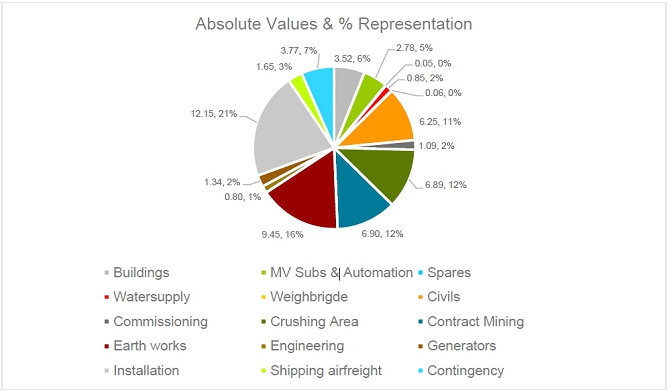
For
the corporate costs, the following is a summary and the percentage representation of each item in relation to the total corporate cost
structure.
Table
18-23 Corporate Costs Breakdown
| CBS
- Corporate Costs Breakdown |
Estimate
to Complete |
%
Breakdown |
| Taxes |
0.90 |
6% |
| Owners
Team Management Services |
8.16 |
58% |
| Land
Acquisition |
1.14 |
8% |
| Environment
& Social |
2.20 |
15% |
| Temporary
Facilities |
0.36 |
3% |
| Insurance |
0.34 |
2% |
| Contingency |
1.08 |
8% |
| Total |
14.17 |
100% |
The
data above is represented graphically below.
|
| SGS Geological Services |
| S-K 1300 Technical Report – FS Neves Lithium Project – Minas Gerais, Brazil | Page 385 |
| | |
Figure
18-2 Corporate Costs Breakdown
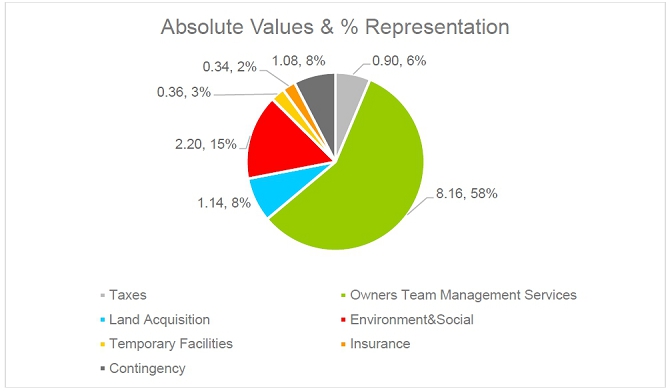
All
expenditures incurred up to the date of this report have been classified as sunk costs and are already financed. The sunk costs are applied
against taxation in the financial model. The incurred values are sourced from Atlas’s SAP database, which records all disbursements
along with the applicable exchange rates at the time of payment.
Table
18-24 provides a detailed summary of the realized costs, based on contractual obligations that are either concluded or currently in progress.
Table
18-24 Cost Breakdown Structure
| CBS
- Cost Breakdown Structure |
SUNK
COST |
| Bins
& Conveyors |
2.99 |
| Buildings |
0.45 |
| DMS |
5.86 |
| Effluent |
2.93 |
| MV
Subs & Automation |
2.20 |
| Piping |
0.76 |
| Screens
- Prep & sizing |
1.64 |
| Spares |
1.35 |
| Steelwork
& Platework |
1.56 |
| Tanks |
0.64 |
| Water
Supply |
0.03 |
| Civils |
0.00 |
| Commissioning |
0.01 |
| Earth
works |
0.21 |
| Engineering |
2.86 |
| Project
Development |
3.66 |
| Shipping
|
2.91 |
| Total |
30.04 |
|
| SGS Geological Services |
| S-K 1300 Technical Report – FS Neves Lithium Project – Minas Gerais, Brazil | Page 386 |
| | |
The
CDM contract represents the most significant portion of the sunk costs, and comprises the scope for the process plant as described below:
Conveyors
including:
| |
● |
Belt
specification of Class 400/3 ply, 5 mm top, 2 mm bottom, M Class |
| |
● |
Primary
scraper with T3 blades |
| |
● |
Secondary
scraper with T3 blades |
| |
● |
Plough
scraper with PU blades |
| |
● |
Skirting |
| |
● |
Impact
systems and material flow have been tested and modelled with flow analysis software. |
| |
● |
Standardized
(where possible) pulleys, drives, cleaning, skirting, impact, idlers, etc. |
| |
● |
Single-side
walkway 750 mm wide |
| |
● |
Gravity
take-ups |
| |
● |
Three
screw take-ups |
| |
● |
Non-belt-scale
belts |
| |
● |
Belt-scale
belts |
| |
● |
Head
chutes allowing for fitment of cross stream samplers at four locations. |
| |
● |
Guards |
| |
● |
Heads,
tails, discharge/feed chutes, trestles and gantry/stringer sections. |
Belt
Feeders including:
| |
● |
Two
900 mm wide |
| |
● |
One
600 mm wide (Cleaner Feed) |
| |
● |
Belt
specification of Class 630/3 ply, 6 mm top, 2 mm bottom, M Class |
| |
● |
Primary
scraper with T3 blades |
| |
● |
Secondary
scraper with T3 blades |
| |
● |
Plough
scraper with PU blades |
| |
● |
Skirting |
| |
● |
Impact
systems |
| |
● |
Standardized
pulleys, drives, cleaning, skirting, impact, idlers, etc. |
| |
● |
Single-side
walkway 750 mm wide |
| |
● |
Screw
take-ups. |
| |
● |
Guards |
| |
● |
Heads,
tails, discharge/feed chutes, trestles and gantry/stringer sections. |
|
| SGS Geological Services |
| S-K 1300 Technical Report – FS Neves Lithium Project – Minas Gerais, Brazil | Page 387 |
| | |
DMS
Module:
| |
● |
Primary
DMS Module |
| |
● |
Secondary
DMS module |
Effluent
handling module and ancillaries:
| |
● |
Thickener
c/w torque control, lifting, fully bolted construction |
| |
● |
Civil
layout |
| |
● |
Flocculant
system |
| |
● |
Underflow
pumps |
| |
● |
Standalone
electrical supply and control (only cable in, not multiple cables from distant MCC) |
| |
● |
Surge
storage and agitation |
| |
● |
Filtration
sub-module |
| |
● |
Feed
pumps |
| |
● |
Water
injection |
| |
● |
Spillage
pumps |
| |
● |
Filtrate
sump |
| |
● |
Grit/fines
discharge platework |
| |
● |
Walkways,
structures and access points |
| |
● |
Suction
piping |
| |
● |
Valves |
| |
● |
Needle
tank for process water |
| |
● |
Process
water pumps |
| |
● |
Firewater
skid c/w diesel pump, container, electric pump, jockey pump, all piping in container, all electrics in container, i/o for comms with
Scada |
| |
● |
Compressor
modules (running and s/by) c/w refrigerant dryers, auto condensation drains, receiver, filters. |
| |
● |
Additional
flocculant plant for belt filter feed flocculant (as per flocculant plant for thickener) |
Tramp
magnet and tanks:
| |
● |
Auto-Cleaning
Tramp Magnet and Drive |
| |
● |
Modular
Tank 800 m3 |
| |
● |
Modular
Tank 150 m3 |
| |
● |
Modular
Tank 200 m3 |
| |
● |
Needle
Tank (configured to thickener and process water tank) |
|
| SGS Geological Services |
| S-K 1300 Technical Report – FS Neves Lithium Project – Minas Gerais, Brazil | Page 388 |
| | |
Screening
buildings, chutes, sumps, and samplers:
| |
● |
Chutes
with VRN and ceramic liners |
| |
● |
Interstage
and Feed-Prep complete structures |
| |
● |
Underflow
sumps with lining |
| |
● |
Cross
stream head samplers |
| |
● |
Thickener
underflow vezin sampler |
Buffer
tanks, agitators, and screen cleaning:
| |
● |
Bolted
together modular tanks |
| |
● |
Tank
top steelwork |
| |
● |
Walkway
and handrailing |
| |
● |
Baffle
plates |
| |
● |
Rubber
lining |
| |
● |
Nozzles |
| |
● |
Agitators
suitable for these tanks |
Feed
Prep:
| |
● |
Feed
Prep Screen |
| |
● |
Sink
Sizing Screen (Secondary Desliming) |
| |
● |
Underpan
to suit |
Pumps,
piping and valves:
| |
● |
Supply
of pumps, bases, drives and guards, motors |
| |
● |
Pre-Fabricated
Spool Pieces (Ceramic Lined, Rubber Lined and HDPE) |
| |
● |
Steel
Piping |
| |
● |
HDPE
Piping |
| |
● |
Pipe
Supports |
| |
● |
Fasteners
and U-Bolts |
| |
● |
Hoses |
| |
● |
Valves |
| |
● |
Fittings |
| |
● |
Couplings |
| |
● |
Spray
Nozzles |
| |
● |
Gauges |
|
| SGS Geological Services |
| S-K 1300 Technical Report – FS Neves Lithium Project – Minas Gerais, Brazil | Page 389 |
| | |
Electrical,
control and instrumentation:
| |
● |
DMS
Modules smart switchgear, PLCs and i/o |
| |
● |
Smart
switchgear and MCCs for remainder of process plant |
| |
● |
PLCs
for remainder of process plant |
| |
● |
Control
room c/w a/c room, IT Cabinet, Desks, Chairs, PC, UPS, flooring |
| |
● |
Belt
scales |
| |
● |
PA
nuclear |
| |
● |
Plant
instruments - Flow meters, pressure indication, transmitters, level control |
| |
● |
Conveyor
instruments - blocked chute, alignment, rip detect, pull wire, start warning, limits, stop/starts |
| |
● |
Cable
Racking Plant (outside of DMS modules) |
| |
● |
Cable
Glands |
| |
● |
Instrument
Cable (outside of DMS modules) |
Steelwork
and platework:
| |
● |
Support
Steel (filter and thickener feed) |
| |
● |
Feed
Bins |
| |
● |
Transfer
Towers |
| |
● |
MCC
Structure |
Spare
Parts:
| |
● |
Belt
filter - 2-year operational spares, commissioning spares, critical spares |
| |
● |
Thickener
- 2-year operational spares, commissioning spares, critical spares |
| |
● |
Flocculant
Plants - 2-year operational spares, commissioning spares, critical spares |
| |
● |
Belt
scale spares |
| |
● |
Spare
cyclones - high chrome (Primary and Secondary) |
| |
● |
Thickener
control panel upgrade |
| |
● |
Belt
filter guards along bottom sides of belt filter |
| |
● |
Rubber
lining of thickener cone |
Sustaining
projects are primarily aimed at ensuring the continuity, safety, and efficiency of existing operations, by maintaining the integrity
and productive capacity of the company’s assets over time. Unlike growth projects, which focus on expanding installed capacity,
sustaining initiatives are essential to preserve operational performance, comply with regulatory requirements, and mitigate risks related
to obsolescence, natural wear, or critical failures.
To
fulfill the purpose of sustaining projects, ensuring continuity, safety, and efficiency of existing operations, while maintaining the
integrity and productive capacity of the company’s assets over time—a value equivalent to 3% of all equipment and direct
cost services was adopted. In other words, 3% of the sunk cost value was added as a separate line item under the CAPEX estimate.
|
| SGS Geological Services |
| S-K 1300 Technical Report – FS Neves Lithium Project – Minas Gerais, Brazil | Page 390 |
| | |
However,
due to certain specific items that were individually assessed, some costs were considered outside the standard 3% rate. These items were
included in the respective years in which they will be required and are referred to as “special sustaining” items, such as:
Table
18-25 Sustaining Capital
| Sustaining
Capital Year 1 |
7.79 |
| PDER-1
Tailing Phase 2 |
1.26 |
| PDE-2
Tailing Phase 2 |
3.05 |
| Access
Mine x Plant |
3.49 |
| Sustaining
Capital Year 2 |
2.58 |
| PDER-1
Tailing Phase 3 |
2.58 |
These
special sustaining items were evaluated separately, both technically and financially, and incorporated into the CAPEX estimate according
to their expected timing and criticality.
| 18.7 | Operating
Cost Estimate |
The
operating cost estimate (OPEX) includes mining, crushing, DMS plant process cost, G&A, product freight and port costs, which will
be in Ilhéus Port, in the state of Bahia. Operating costs are summarized in Table 18-26. The table also presents the costs grouped
per tonne of spodumene concentrate with a base grade of 5.5% Li₂O (SC 5.5).
Table
18-26 Operating Costs Summary
| Item |
Total
Cost
(USD
million) |
Unit
Cost
(USD/t
of SC5.5) |
Unit
Cost
(USD/t
Ore) |
| Mining |
274 |
288.0 |
37.8 |
| Crushing |
14 |
14.6 |
1.9 |
| DMS
Plant Cost |
88 |
92.4 |
12.1 |
| G&A |
49 |
51.6 |
6.8 |
| Freight
& Port Cost |
40 |
41.9 |
5.5 |
| Total |
464.6 |
488.5 |
64.1 |
Notes:
| 1. | Numbers
may not add due to rounding. |
| 2. | The
costs above are presented net of tax credits. |
Table
18-27 shows a summary of the annual production and Table 18-28 shows a detailed LOM operating cost including mining, crushing, DMS plant
cost, G&A and freight & port cost.
Table
18-27 Annual Production
| Project
Year |
-2 |
-1 |
1 |
2 |
3 |
4 |
5 |
6 |
7 |
Total
Production |
| Waste
mined (kt) |
- |
1,227 |
12,823 |
19,497 |
22,728 |
24,630 |
21,704 |
15,684 |
2,945 |
120,011 |
| Ore
mined (kt) |
- |
126 |
1,108 |
813 |
1,362 |
1,127 |
1,232 |
1,145 |
339 |
7,127 |
| Ore
processed (kt) |
- |
- |
879 |
1,131 |
1,131 |
1,177 |
1,151 |
1,152 |
633 |
7,253 |
| SC5.5
produced (kt) |
- |
- |
120 |
151 |
151 |
151 |
150 |
151 |
78 |
951 |
|
| SGS Geological Services |
| S-K 1300 Technical Report – FS Neves Lithium Project – Minas Gerais, Brazil | Page 391 |
| | |
Notes:
| 1. | Numbers
may not add due to rounding. |
Table
18-28 Total Operating Costs Summary (USD million)
| Description |
Total |
1 |
2 |
3 |
4 |
5 |
6 |
7 |
| Mining |
273.9 |
29.3 |
42.7 |
50.5 |
54.3 |
49.9 |
39.2 |
8.0 |
| Crushing |
13.9 |
2.1 |
2.2 |
2.2 |
2.2 |
2.1 |
2.1 |
1.1 |
| DMS
Plant Cost |
87.8 |
13.5 |
13.8 |
13.6 |
13.5 |
13.3 |
13.0 |
7.1 |
| G&A |
49.0 |
7.2 |
7.3 |
7.3 |
7.3 |
7.3 |
7.2 |
5.4 |
| Freight
& Port Cost |
39.9 |
5.0 |
6.3 |
6.3 |
6.3 |
6.3 |
6.3 |
3.2 |
| |
|
|
|
|
|
|
|
|
| Total
OPEX |
464.6 |
57.1 |
72.3 |
80.0 |
83.5 |
78.9 |
67.8 |
24.9 |
| Total
Cost/t Ore Processed |
64.1 |
51.6 |
89.0 |
58.7 |
74.1 |
64.1 |
59.2 |
73.3 |
| Total
Cost/t Spodumene Concentrate (dry) |
488.5 |
477.1 |
480.3 |
530.1 |
553.7 |
525.5 |
449.9 |
318.9 |
Notes:
The
following items are not included in the costs shown in Table 18-28:
| 1. | Royalties |
| 2. | CFEM
(Government Mining Royalty) |
| 18.7.1 | Mining
Operating Costs Summary |
The
mine operating cost was calculated based on the following factors:
| |
1. |
Waste
and ore sequencing developed by the company Prominas, aiming to meet the processing plant capacity of approximately 1.2 MTPY and
achieve an annual production of 150,000 tonnes of spodumene concentrate. |
| |
2. |
Mine
sequencing based on ore grades, maintaining the assumption of 150,000 tonnes of spodumene concentrate produced per year. |
| |
3. |
Market
quotations from leading companies with proven expertise in open-pit mining execution and operations. |
The
mine operating cost includes the following: services drilling, blasting, loading and hauling of waste and ore, waste spreading, ore stockpile
rehandling, secondary breakage using hydraulic excavators, equipment rental for infrastructure improvements, access road maintenance,
water trucks for road dust suppression, personnel, consulting services, and other indirect costs.
Also
included are the necessary consumables for performing the above activities: diesel fuel, explosives, blasting accessories, and dust control
polymers for road treatment.
The
average mining cost during operations is estimated at USD 2.15/t mined.
Load
and hauling waste are the major mining cost activity representing 44% of total costs, followed by Diesel (19%), and drilling/blasting
waste (12%).
|
| SGS Geological Services |
| S-K 1300 Technical Report – FS Neves Lithium Project – Minas Gerais, Brazil | Page 392 |
| | |
The
mining OPEX is estimated to be USD 37.8/t processed or USD 288.0/t of spodumene concentrate produced.
Table
18-29 shows, in a consolidated manner, the mine operating costs, the cost per tonne of ore fed, the cost per tonne of spodumene concentrate,
the percentage share of each item in the total mine cost, and the percentage share in the cost of spodumene concentrate.
Table
18-29 Total Mining Operating Cost (USD Million)
| Mining
costs |
Total |
US$/t
of ore |
%
of mining costs |
US$/t
of SC5.5 |
%
of SC5.5 costs |
| Total
Mining costs |
273.9 |
37.8 |
100% |
288.0 |
59% |
| Overburden
drilling and blasting services |
33.9 |
4.7 |
12% |
35.6 |
7% |
| Overburden
load and hauling services |
121.7 |
16.8 |
44% |
128.0 |
26% |
| Pegmatite
drilling and blasting services |
3.3 |
0.5 |
1% |
3.5 |
1% |
| Pegmatite
load and hauling services |
17.4 |
2.4 |
6% |
18.3 |
4% |
| Payroll |
10.5 |
1.4 |
4% |
11.0 |
2% |
| Diesel |
52.3 |
7.2 |
19% |
55.0 |
11% |
| Grade
control services |
1.2 |
0.2 |
0% |
1.3 |
0% |
| Infrastructure
Equipment services |
20.9 |
2.9 |
8% |
22.0 |
4% |
| Fixed
costs |
12.8 |
1.8 |
5% |
13.4 |
3% |
| 18.7.2 | Crushing
Processing Cost Summary |
The
crushing cost includes the plant feed service using loaders, the cost of consumable spare parts as quoted by the supplier, maintenance
costs calculated using an annual factor of 5% over the investment value, power costs related to diesel consumption by the generators
for plant operation, and other minor costs.
To
estimate diesel consumption, the installed power was calculated based on the equipment list, and a consumption rate of 262 liters of
diesel per MWh was applied, as indicated by the supplier.
The
crushing processing OPEX includes operating and maintenance labour, and indirect charges associated with the crushing plant. Based on
these cost assumptions, inclusions and exclusions, the OPEX is estimated to be USD 1.9/t processed or USD 14.64/t of spodumene concentrate
produced.
| 18.7.3 | DMS
Plant Operating Cost Summary |
The
DMS plant cost is composed of the following items:
| |
● |
Reagents
– costs related to the use of ferrosilicon for DMS plant operation and polymers used in the thickening and filtration processes. |
| |
● |
Maintenance
costs – calculated using an annual factor of 5% of the installed equipment capital costs. |
| |
● |
Payroll
- Salaries, charges, and benefits for the operations, maintenance, and process teams. |
|
| SGS Geological Services |
| S-K 1300 Technical Report – FS Neves Lithium Project – Minas Gerais, Brazil | Page 393 |
| | |
| |
● |
Diesel
- Diesel consumption related to power generators as well as to the rented equipment used for plant feeding, and for the handling
of concentrate and plant tailings. |
| |
● |
Rental
of power generators - Generator rental services, which include operation and maintenance. |
| |
● |
Rental
Equipment – includes wheel loaders, trucks, and water trucks for internal waste movement, DMS plant feeding, and loading of
concentrate trucks. |
| |
● |
Fixed
costs – include personnel expenses and other minor costs. |
| |
● |
Concentrate
transportation – service for transporting the concentrate from the DMS plant to the transshipment area. |
| |
● |
Transshipment
cost (included under ‘Other’ line) – includes truck loading for shipment to the Port of Ilhéus, as well
as maintenance and other operational services. |
| |
● |
Laboratory
(included under ‘Other’ line) – includes the costs of services contracted from SGS Laboratories for chemical and
particle size analyses required for full operation. |
Note:
the laboratory will be installed in the transshipment area and operated by SGS under Atlas coordination.
All
costs were estimated based on quotations obtained from suppliers in the market, such as:
| |
● |
Ferrosilicon
– DMS Powders |
| |
● |
Polymers
– SNF |
| |
● |
Equipment
rental – Conec and RED |
| |
● |
Concentrate
transportation (Mine trucks) – G7 Transportadora |
| |
● |
Laboratory
services – SGS Outsourcing |
| |
● |
The
power cost refers to the rental service of gensets and the diesel consumption required for their operation. The gensets rental cost
was based on the rental agreement signed between Atlas Lithium and the company Tecnogera. This agreement includes not only the rental
of the generator sets but also all costs related to 24/7 operation and maintenance. |
| |
● |
The
estimated diesel consumption of 262 liters per MWh was also provided by the supplier and used here for cost calculation. The power
demand was calculated by Promon Engenharia based on the installed equipment power, load factor, and utilization factor of the DMS
plant. Based on these cost assumptions, inclusions and exclusions, the OPEX to Power is estimated to be USD 5.4/t processed or USD
41.3/t of spodumene concentrate produced. |
The
Plant DMS Cost is estimated to be USD 12.1/t processed or USD 92.4/t of spodumene concentrate produced. Table 18-30 presents the respective
costs and their percentage contribution to the total production cost of spodumene concentrate.
|
| SGS Geological Services |
| S-K 1300 Technical Report – FS Neves Lithium Project – Minas Gerais, Brazil | Page 394 |
| | |
Table
18-30 Total DMS Plant Operating Cost (USD Million)
| DMS
Plant |
Total |
US$/t
of ore |
%
of DMS costs |
US$/t
of SC5.5 |
%
of SC5.5 costs |
| Total
DMS plant costs |
87.9 |
12.1 |
100% |
92.4 |
19% |
| Reagents |
4.3 |
0.6 |
5% |
4.5 |
1% |
| Maintenance |
6.0 |
0.8 |
7% |
6.3 |
1% |
| Payroll |
13.4 |
1.9 |
15% |
14.1 |
3% |
| Diesel |
33.7 |
4.6 |
38% |
35.5 |
7% |
| Rental
of power generators |
5.5 |
0.8 |
6% |
5.8 |
1% |
| Rental
equipment |
15.1 |
2.1 |
17% |
15.8 |
3% |
| Transportation
to TSP |
5.0 |
0.7 |
6% |
5.3 |
1% |
| Other |
4.9 |
0.7 |
6% |
5.2 |
1% |
G&A
services include general management, accounting and finance, IT, Legal, environmental and social management, human resources, supply
chain, camp, surface support, health and safety, engineering & project management, security and facilities operating cost.
The
G&A OPEX is estimated to be USD 6.8/t processed or USD 51.6/t of spodumene concentrate produced.
| 18.7.5 | Freight
and Port Operating Cost Summary |
The
concentrate transportation cost was estimated based on the use of the Port of Ilhéus, located in the southwest of the state of
Bahia, approximately 555 km from the transshipment area located in the city of Araçuaí, Minas Gerais.
The
transportation will be carried out using tipper trucks with load capacities ranging from 40 to 60 tonnes.
The
Port of Ilhéus, located in southern Bahia, has an operational capacity to handle up to 1 million tonnes of cargo per year. In
2023, the port recorded its highest throughput since 2008, with a total of 556,597 tonnes.
The
port is capable of handling vessels of up to 60,000 deadweight tonnes, serving medium-sized ships.
The
unit costs for road freight operations, storage, and port-related expenses were quoted with logistics and transportation companies as
well as agents operating at the Port of Ilhéus. Table 18-31 below presents the assumed unit costs.
Table
18-31 Unitary Cost to Freight and Port Expenses (USD)
| Logistics |
Total |
%
of SC5.5 costs |
| Total
logistics costs |
39.9 |
41.9 |
| Road
freight from site to Port of Ilhéus |
30.6 |
32.2 |
| Port
Operations |
8.2 |
8.6 |
| Port
charges |
1.1 |
1.2 |
The
total costs in the table above are unit prices based on a metric tonne, that is, including an estimated moisture content of 5%.
|
| SGS Geological Services |
| S-K 1300 Technical Report – FS Neves Lithium Project – Minas Gerais, Brazil | Page 395 |
| | |
The
evaluation of the Project economics considers all relevant costs and revenues associated with the development and execution of the Project.
These are used to derive a set of industry standard measures of economic performance. The Project Net Present Value (NPV) is re-calculated
for range of values at a discount rate of 7% for some of the key inputs so that the sensitivity of the NPV (considered a key indicator)
can be assessed.
Taxation
and royalties in Brazil are levied on a federal, state and local level across most activities and commodities. Several taxation incentives
are in place to encourage project development. To ensure that the taxation and royalty basis of the economic analysis was applied appropriately
Atlas’ Tax Department reviewed the economic model and applied taxes and tax incentives where appropriate. The outcomes of this
review have been incorporated into the results reported herein and a summary of that treatment is presented in Appendix A.
All
dollar values in this section are in United States dollars (US$ or USD) or unless otherwise stated.
| 19.1 | Project
Economic Headline Results |
Table
19-1 and Table 19-2 show the Project headline economic results before and after taxation for a flat Spodumene 5.5% Li (SC5.5) price of:
Table
19-1 Project Economic Model Headline Results Before Taxation
| Item |
Unit |
Results |
| Net cash flow |
US$M |
906,155 |
| NPV |
US$M |
629,040 |
| IRR |
% |
162% |
Table
19-2 Project Economic Model Headline Results After Taxation
| Item |
Unit |
Results |
| Net cash flow |
US$M |
779,639 |
| NPV |
US$M |
539,225 |
| IRR |
% |
145% |
Atlas
prepared a cash flow and financial analysis model (the model) based on inputs derived from mining and processing schedules reflecting
capital and operating cost estimates including applicable royalties for the Project. The mining schedule used for the model (which drove
processing and revenue) was developed on a monthly basis for the mine life. The construction schedule was broken down in a monthly basis.
All inputs are consolidated annually in this report.
The
model was based on the following:
| |
● |
100%
equity ownership by Atlas |
| |
● |
Costing
from April 2025 |
| |
● |
18-month
pre-production period for preparation for plant construction and for plant construction |
| |
● |
All
costs reported in US$ and where costs were estimated in Brazilian Reais the exchange rate used was 6.00 Reais (BRL) to the US$. |
|
| SGS Geological Services |
| S-K 1300 Technical Report – FS Neves Lithium Project – Minas Gerais, Brazil | Page 396 |
| | |
The
objective of preparing the cash flow model was to:
| |
● |
Assess
the economic viability of the Project and assess project sensitivity to changes in input parameters. |
| |
● |
Collate
all the inputs for the following disciplines into a single model: |
| |
○ |
Mining |
| |
○ |
Processing |
| |
○ |
Metallurgical |
| |
○ |
Metal
pricing |
| |
○ |
Pre-production
capital costs |
| |
○ |
Production
sustaining capital |
| |
○ |
Operating
costs |
| |
● |
Environmental
costs |
| |
● |
Royalties
(CFEM) |
| |
● |
Be
sufficiently flexible to enable options (capital and operating configurations) to be evaluated. |
| |
● |
Provide
sufficient information to management so that they are supported in any decision-making process. |
| |
● |
Provide
the basis for future studies and a decision whether to proceed. |
The
model was interrogated to determine the following values after taxation:
| |
○ |
Net
cash flow |
| |
○ |
NPV
at 7% discount rate (NPV) |
| |
○ |
IRR |
| |
○ |
Breakeven
(NPV) SC5.5 price |
| |
○ |
C1
cost per tonne of SC5.5 |
| |
○ |
Production
year payback. |
| |
○ |
Mining
costs/t SC5.5 |
| |
○ |
Processing
costs/t SC5.5 |
| |
○ |
Total
costs/t SC5.5 |
| |
○ |
AISC
costs/t SC5.5 |
| |
○ |
Production
payback years. |
| |
○ |
Capital
intensity |
|
| SGS Geological Services |
| S-K 1300 Technical Report – FS Neves Lithium Project – Minas Gerais, Brazil | Page 397 |
| | |
| 19.3 | Economic
Model Inputs |
Table
19-3 shows the inputs used in the model under the base case scenario.
Table
19-3 Model Inputs
| Item |
Unit |
Value |
Source |
| Pre-production period |
months |
18 |
Atlas Engineering team |
| Life of Project production |
years |
6.8 |
Prominas schedule |
| LOM ore mined and processed |
kt |
7,253 |
Prominas schedule |
| LOM waste mined |
kt |
121,238 |
Prominas schedule |
| LOM average strip ratio |
t |
16.8 |
Prominas schedule |
| LOM average Li2O grade |
% |
1.17 |
Prominas schedule |
| LOM metallurgical recovery |
% |
61.7 |
CDM Plant design |
| LOM average product – Li2O grade |
% |
5.5 |
CDM Plant design |
| Plant throughput (average) |
Mt/a |
1.1 |
CDM Plant design |
| LOM SC5.5 price |
US$/t |
1,700 |
Assumption |
| 19.4 | Economic
Model Results |
The
model results are shown in Table 19-4 below.
Table
19-4 Project Economic Performance (Post Taxation)
| Item |
Unit |
Value |
| Net
cash flow |
US$M |
779,639 |
| NPV |
US$M |
539,225 |
| IRR |
% |
145% |
| Breakeven
(NPV) SC5.5 price |
US$/t |
735 |
| Mining
costs |
US$/t
ore |
38 |
| Mining
costs |
US$/t
SC5.5 |
288 |
| C1
Cost1 |
US$/t
SC5.5 |
489 |
| All
in Sustaining cost2 |
US$/t
SC5.5 |
594 |
| Production
year payback |
Years |
0.92 |
| LOM
Li recovered |
Kt |
52 |
| Average
SC5.5 production at 1.2 Mt/a ore |
kt/a |
146 |
| Total
revenue |
US$M |
1,541 |
| Total
production costs |
US$M |
465 |
| Operating
cash flow |
US$M |
871 |
| Capital
intensity – Initial capex/t lithium |
$US/t
SC5.5 |
96 |
1
C1 costs include cash expenses incurred during mining, processing, administration and delivery of the SC5.5 in the port in Brazil.
2
All-in Sustaining Costs include C1 costs plus royalties and sustaining CAPEX.
|
| SGS Geological Services |
| S-K 1300 Technical Report – FS Neves Lithium Project – Minas Gerais, Brazil | Page 398 |
| | |
| 19.5 | Production
and Cashflow Summary |
The
annual project physicals are shown in Table 19-5. They are based on the mining schedule developed by Prominas (Section 13- Mining), and
the process plant performance predicted by CDM (Sections 10 and 14 - Process Plant).
Table
19-5 Production Physicals per Year
| Project Year |
-2 |
-1 |
1 |
2 |
3 |
4 |
5 |
6 |
7 |
Total |
| Waste mined (kt) |
- |
1,227 |
12,823 |
19,497 |
22,728 |
24,630 |
21,704 |
15,684 |
2,945 |
121,238 |
| Ore mined (kt) |
- |
126 |
1,108 |
813 |
1,362 |
1,127 |
1,232 |
1,145 |
339 |
7,253 |
| Li2O grade % of ore mined (average) |
0.00% |
0.94% |
1.25% |
1.17% |
1.19% |
1.13% |
1.17% |
1.17% |
1.04% |
1.17% |
| Ore processed (kt) |
- |
- |
879 |
1,131 |
1,131 |
1,177 |
1,151 |
1,152 |
633 |
7,253 |
| Li2O grade % of ore processed (average) |
0.00% |
0.00% |
1.21% |
1.19% |
1.19% |
1.14% |
1.16% |
1.17% |
1.10% |
1.17% |
| SC5.5 produced (kt) |
- |
- |
120 |
151 |
151 |
151 |
150 |
151 |
78 |
951 |
The
annual after-tax cash flow generated in the model based on the physicals are shown in Table 19-6.
Table
19-6 Project Financials Per Year – After Taxation
| Project period |
-2 |
-1 |
1 |
2 |
3 |
4 |
5 |
6 |
7 |
Total |
| Revenue (US$M) |
- |
- |
194 |
244 |
244 |
244 |
243 |
244 |
126 |
1,541 |
| Operating costs (US$M) |
- |
- |
47 |
80 |
72 |
83 |
77 |
70 |
35 |
465 |
| Capital expenditure (US$M) |
1 |
65 |
9 |
5 |
2 |
2 |
2 |
2 |
1 |
91 |
| Net cash flow (US$M) |
(1) |
(70) |
92 |
137 |
128 |
127 |
129 |
137 |
100 |
779 |
|
C1 cost
(US$/t SC5.5) |
- |
- |
396 |
534 |
475 |
551 |
513 |
464 |
447 |
489 |
Table
19-7 below presents the annualized cash flow statement for the based on the model prepared:
|
| SGS Geological Services |
| S-K 1300 Technical Report – FS Neves Lithium Project – Minas Gerais, Brazil | Page 399 |
| | |
Table
19-7 Annualized Cash Flow Statement (in US$’000)
| |
|
|
|
Years
|
| Cash
Flow |
|
Total |
|
-2 |
-1 |
1 |
2 |
3 |
4 |
5 |
6 |
7 |
>7 |
| Net
revenues |
|
|
|
|
|
|
|
|
|
|
|
|
|
| Gross
revenues |
|
1,540,602 |
|
- |
- |
193,964 |
244,007 |
244,340 |
244,413 |
243,386 |
244,218 |
126,274 |
- |
| |
|
|
|
|
|
|
|
|
|
|
|
|
|
| Royalties |
|
(46,218) |
|
- |
- |
(5,819) |
(7,320) |
(7,330) |
(7,332) |
(7,302) |
(7,327) |
(3,788) |
- |
| CFEM |
|
(30,812) |
|
- |
- |
(3,879) |
(4,880) |
(4,887) |
(4,888) |
(4,868) |
(4,884) |
(2,525) |
- |
| Net
revenues |
|
1,463,572 |
|
- |
- |
184,266 |
231,806 |
232,123 |
232,192 |
231,217 |
232,007 |
119,960 |
- |
| |
|
|
|
|
|
|
|
|
|
|
|
|
|
| Freight
/ Port |
|
(39,884) |
|
- |
- |
(5,039) |
(6,337) |
(6,338) |
(6,333) |
(6,298) |
(6,301) |
(3,238) |
- |
| Cost
of goods sold (Cash) |
|
(375,670) |
|
- |
- |
(35,165) |
(66,811) |
(58,077) |
(69,459) |
(63,487) |
(56,466) |
(26,205) |
- |
| Gross
Margin |
|
1,048,019 |
|
- |
- |
144,063 |
158,658 |
167,709 |
156,401 |
161,431 |
169,241 |
90,517 |
- |
| |
|
|
|
|
|
|
|
|
|
|
|
|
|
| Other
operating costs |
|
(1,522) |
|
- |
(318) |
- |
- |
- |
- |
- |
- |
(1,204) |
- |
| G&A |
|
(49,030) |
|
- |
- |
(7,245) |
(7,302) |
(7,292) |
(7,282) |
(7,271) |
(7,245) |
(5,393) |
- |
| EBITDA |
|
997,467 |
|
- |
(318) |
136,818 |
151,356 |
160,417 |
149,119 |
154,160 |
161,995 |
83,919 |
- |
| |
|
|
|
|
|
|
|
|
|
|
|
|
|
| Income
tax |
|
(126,516) |
|
- |
- |
(12,546) |
(18,198) |
(21,169) |
(19,346) |
(19,978) |
(23,456) |
(11,823) |
- |
| |
|
|
|
|
|
|
|
|
|
|
|
|
|
| ∆
need of working capital |
|
- |
|
(34) |
(4,127) |
(22,716) |
8,374 |
(8,778) |
(728) |
(2,791) |
453 |
29,776 |
571 |
| Accounts
payable |
|
- |
|
- |
345 |
4,823 |
1,400 |
99 |
388 |
(196) |
(674) |
(6,186) |
- |
| Li
inventories |
|
- |
|
- |
- |
(9,676) |
8,111 |
(8,246) |
(469) |
(1,893) |
2,195 |
9,978 |
- |
| Accounts
receivable |
|
- |
|
- |
- |
(20,251) |
(250) |
139 |
211 |
(250) |
69 |
20,333 |
- |
| Payroll |
|
- |
|
- |
- |
287 |
(0) |
0 |
0 |
0 |
0 |
(287) |
- |
| Taxes |
|
- |
|
(34) |
(4,472) |
2,101 |
(887) |
(770) |
(857) |
(453) |
(1,137) |
5,937 |
571 |
| |
|
|
|
|
|
|
|
|
|
|
|
|
|
| Operating
cash flow |
|
870,951 |
|
(34) |
(4,444) |
101,555 |
141,533 |
130,469 |
129,045 |
131,391 |
138,993 |
101,872 |
571 |
| |
|
|
|
|
|
|
|
|
|
|
|
|
|
| Sustaining
CAPEX |
|
(24,111) |
|
- |
- |
(8,556) |
(4,995) |
(2,457) |
(2,262) |
(2,262) |
(2,262) |
(1,319) |
- |
| Construction
CAPEX |
|
(53,030) |
|
(393) |
(52,035) |
(602) |
- |
- |
- |
- |
- |
- |
- |
| Capitalized
corporate costs |
|
(14,170) |
|
(947) |
(13,097) |
(127) |
- |
- |
- |
- |
- |
- |
- |
| Cash
flow from investing activities |
|
(91,312) |
|
(1,340) |
(65,132) |
(9,285) |
(4,995) |
(2,457) |
(2,262) |
(2,262) |
(2,262) |
(1,319) |
- |
| |
|
|
|
|
|
|
|
|
|
|
|
|
|
| Post
tax |
|
|
|
|
|
|
|
|
|
|
|
|
|
| Monthly
cash in / (out) flow |
|
779,639 |
|
(1,373) |
(69,576) |
92,271 |
136,538 |
128,012 |
126,784 |
129,129 |
136,731 |
100,552 |
571 |
| Cumulative
cash in / (out) flow |
|
|
|
(1,373) |
(70,949) |
21,322 |
157,859 |
285,872 |
412,655 |
541,785 |
678,516 |
779,068 |
779,639 |
| |
|
|
|
|
|
|
|
|
|
|
|
|
|
| Pre
tax |
|
|
|
|
|
|
|
|
|
|
|
|
|
| Monthly
cash in / (out) flow |
|
906,155 |
|
(1,373) |
(69,576) |
104,817 |
154,736 |
149,182 |
146,130 |
149,107 |
160,187 |
112,375 |
571 |
| Cumulative
cash in / (out) flow |
|
|
|
(1,373) |
(70,949) |
33,867 |
188,603 |
337,785 |
483,915 |
633,022 |
793,208 |
905,584 |
906,155 |
|
| SGS Geological Services |
| S-K 1300 Technical Report – FS Neves Lithium Project – Minas Gerais, Brazil | Page 400 |
| | |
Figure
19-1 below summarizes the annual net cash flow used/generated by the Project and the cumulative cash exposure/generation:
Figure
19-1 Post-Taxes Annualized Cash Flow Generation (in US$’000)
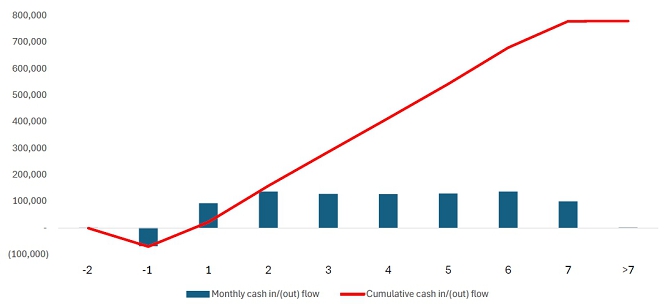
|
| SGS Geological Services |
| S-K 1300 Technical Report – FS Neves Lithium Project – Minas Gerais, Brazil | Page 401 |
| | |
Figure
19-2 below details the monthly and cumulative cash burn / generation of years -1 and 1 (months -12 to 12), representing the transition
from construction into production phase. Given the low cost per tonne produced and the quick ramp up of the plant, the Project becomes
a positive cash flow generator in the fourth month of operations. Maximum cash exposure achieves US$78 million.
Figure
19-2 Cash Flow Generation Transitioning from Construction into Operations (in US$’000)
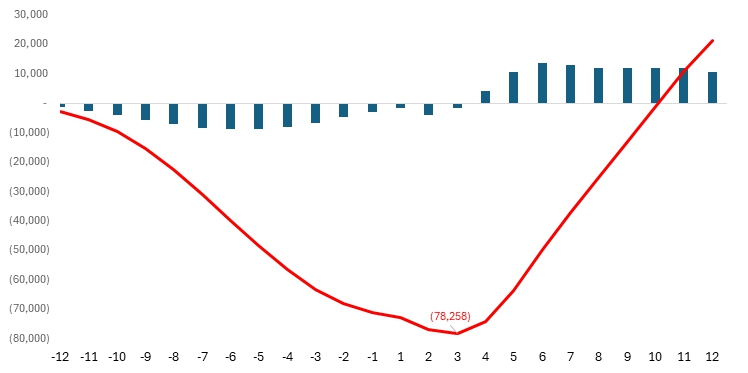
|
| SGS Geological Services |
| S-K 1300 Technical Report – FS Neves Lithium Project – Minas Gerais, Brazil | Page 402 |
| | |
The
model was used to prepare a sensitivity analysis for the NPV for the Project after taxation. The sensitivity analysis was completed on
the following variables:
| ● | Price
of SC5.5 |
| ● | Metallurgical
recovery |
| ● | BRL
Exchange rate |
| ● | Discount
rate |
| ● | Total
CAPEX |
| ● | Mining
costs |
The
sensitivity analysis determines how the NPV is affected by changes to one variable while holding the other variables constant. The results
of the sensitivity analysis are presented in Table 19-8.
Table
19-8 Sensitivity Table for NPV (in US$’000), After Taxation
| |
-30% |
-20% |
-10% |
0% |
10% |
20% |
30% |
| Price
of SC5.5 |
260,095 |
353,192 |
446,225 |
539,225 |
632,211 |
725,185 |
818,155 |
| Metallurgical
recovery |
280,538 |
366,809 |
453,030 |
539,225 |
625,408 |
711,581 |
797,749 |
| BRL
Exchange rate |
392,126 |
453,468 |
501,125 |
539,225 |
570,387 |
596,348 |
618,310 |
| Discount
rate |
601,568 |
579,961 |
559,192 |
539,225 |
520,028 |
501,566 |
483,811 |
| Total
CAPEX |
563,440 |
555,368 |
547,297 |
539,225 |
531,154 |
523,082 |
515,010 |
| Mining
costs |
589,793 |
572,937 |
556,081 |
539,225 |
522,369 |
505,512 |
488,656 |
The
sensitivity chart is presented in Figure 19-3 and covers a range of variable changes from -30% to +30%.
|
| SGS Geological Services |
| S-K 1300 Technical Report – FS Neves Lithium Project – Minas Gerais, Brazil | Page 403 |
| | |
Figure
19-3 Sensitivity to NPV (in US$’000) for Changes in Various Key Inputs
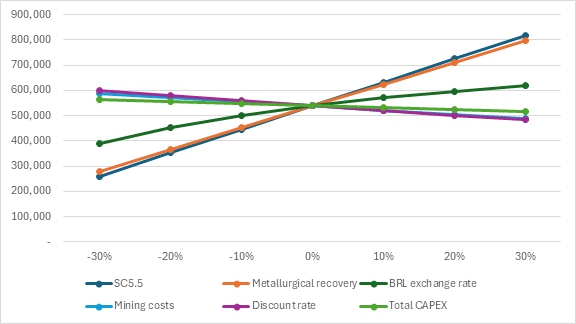
Figure
19-3 shows that the Project’s NPV is most sensitive to SC5.5 price and metallurgical recovery. This is expected as these two factors
directly affect revenue. The SC5.5 price for the Project is US$1,700/t. The metallurgical recovery in the plant is well supported by
metallurgical test work and detailed plant design (Sections 10 and 14).
The
next most sensitive factor is the BRL exchange rate. The US$/BRL rate of 6.0 used for the operating and capital cost build up is higher
than the prevailing market rate of 5.55 as at the date of this study. Figure 19-3 shows that the Project’s NPV is relatively insensitive
to the other factors considered.
An
after taxation breakeven analysis was undertaken for both NPV and net cash flow. This analysis is conducted on the sensitivity analysis
data and provides the SC5.5 price which will bring either the NPV or net cash flow to $0. The results of this analysis are presented
in Table 19-9.
Table
19-9 Breakeven Analysis After Taxation
| Item |
Unit |
Breakeven
price |
| Net
cash flow |
US$/t
SC5.5 |
705 |
| NPV |
US$/t
SC5.5 |
735 |
The
economic analysis demonstrates that the Project presents a compelling economic case for the development and execution of the project
using a SC5.5 price of US$1,700/t over its 6.8-year life. In view of the predicted strengthening of the commodity price, the case presented
is regarded as robust with significant upside.
The
Project requires investment of approximately US$80 million, including construction related costs, corporate costs, sustaining CAPEX,
general and administrative expenses and working capital, to enable it to reach to its positive cash flow generation phase, with a payback
period lower than 1 year, generating an NPV of US$539 million with an IRR of 145% per annum.
|
| SGS Geological Services |
| S-K 1300 Technical Report – FS Neves Lithium Project – Minas Gerais, Brazil | Page 404 |
| | |
The
region is home to other notable lithium mines and projects, including the Companhia Brasileira de Lítio’s (CBL) Cachoeira
mine, which has been producing lithium since 1993; Lithium Ionic’s properties (Itinga Lithium Project and Salinas Lithium Project);
and Sigma Lithium’s Grota do Cirilo project (Phase 1 production having commenced from Xuxa deposit in 2023. Production is expected
to be approximately tripled by 2024 via a Phase 2 & 3 expansion through the development of the nearby Barreiro and NDC deposits).
The Latin Resources Colina Project had completed the PEA Technical Studies on November 2023. The Neves property is approximately 104
kilometers straight distance from the Colina Project.
|
| SGS Geological Services |
| S-K 1300 Technical Report – FS Neves Lithium Project – Minas Gerais, Brazil | Page 405 |
| | |
| 21 | OTHER
RELEVANT DATA AND INFORMATION |
No
other information or explanation is necessary to take this TRS understandable and not misleading.
|
| SGS Geological Services |
| S-K 1300 Technical Report – FS Neves Lithium Project – Minas Gerais, Brazil | Page 406 |
| | |
| 22 | INTERPRETATION
AND CONCLUSIONS |
This
TRS was prepared at the request of Atlas Lithium Corporation, a company existing under the laws of USA, trading under the symbol “ATLX”
on the National Association of Securities dealers (NASDAQ) Exchange with its U.S. corporate office at 1200 N Federal Hwy, Suite 200,
Boca Raton, FL 33432.
This
document presents the results of the feasibility study evaluation of the Neves Project (“Neves”) and focuses primarily on
the Neves deposit, together with an initial exploration summary of the Gaia project (“Gaia”).
This
TRS is a feasibility study completed for Atlas’s Neves Project and is the second TRS for the Project filed with the United States
Securities and Exchange Commission (SEC).
Atlas
Lithium initiated geological reconnaissance and literature reviews of the Neves area in 2021 including detailed geological mapping on
pegmatites with historical mine workings located within the exploration areas. As a result, 91 new pegmatite bodies were identified at
Neves and a drilling campaign was commenced in 2021 and is currently ongoing. To date, a total of 536 exploration holes (RC and DD holes)
for 100,403 m of drilling were completed.
The
Gaia project was initiated in 2025 with exploration mapping, sampling and soli geochemistry, with over 70 pegmatite bodies being identified.
A short drilling campaign on the most prospective pegmatites was completed, with six holes being drilled for 501 meters of core.
The
Neves Project has a combined open pit constrained Mineral Resource at Anitta 1, Anitta 2, Anitta 2.5, Anitta 3, Anitta 3N and Anitta
4 containing a Measured resource of 1.249 Mt at 1.00% Li2O, and an Inferred Mineral Resource of 0.15 Mt at 0.81% Li2O.
Metallurgical
test work conducted on samples collected from Anitta 1 pit by SGS Lakefield produced a spodumene concentrate that could be sold to a
Chemical Plant for conversion into lithium carbonate and hydroxide. Current laboratory test work conducted at SGS Lakefield in Canada
indicated that the DMS process is a suitable technology to recover the spodumene from the deposit. Based on the DMS test and SGS proprietary
model, the expected lithium recovery in the future commercial plant will be around 61.7% with a concentrate grade around 5.5% of Li2O.
Additional HLS testing conducted on variability samples collected from Anitta 2, Anitta 2.5, Anitta 3 and Anitta 4 by SGS Geosol in Belo
Horizonte indicated similar or better lithium recovery consistent with producing a 5.5% Li2O concentrate.
Based
on the test work, two stages of DMS in a rougher and cleaner configuration have been utilized in the process design, with the secondary
DMS treating the primary DMS concentrate. As DMS is not effective in the treatment of fine material, the minus 0.85 mm material will
be dewatered and then report to the tailings in the current process design.
Besides
HLS and DMS pilot tests, SGS Lakefield also conducted additional beneficiation studies, including flotation tests on the combined material
from DMS middlings and minus 0.85 mm material, DMS middlings re-crush and DMS tests, and magnetic separation experiments on the final
DMS concentrate. These tests indicated additional opportunities for potential future operations, which are described in Section 1.5 and
Section 23.3.
The
capital cost estimates are detailed and suitable at a feasibility study level. Capital components are identified and costed with back
up multiple quotations from vendors and contractors.
The
operating cost estimates are consistent with the mine plan, and are suitably costed for feasibility study.
The
project shows robust economics with an after tax NPV of $542M USD and an IRR of 145%.
The
lithium price assumptions are conservative, based on price forecasts and trailing average calculations.
|
| SGS Geological Services |
| S-K 1300 Technical Report – FS Neves Lithium Project – Minas Gerais, Brazil | Page 407 |
| | |
The
Neves Lithium Project contains within-pit Measured and Inferred Mineral Resources that are associated with well-defined mineralized trends
and models. The deposit is open along strike and at depth.
Given
the prospective nature of the Neves Deposit, it is the QP’s opinion that the Project merits further exploration and that a proposed
plan for further work by Atlas is justified. A proposed work program by Atlas will help advance the Project and will provide key inputs
required to evaluate the economic viability of the Project.
The
QP is recommending Atlas conduct further exploration, subject to funding and any other matters which may cause the proposed exploration
program to be altered in the normal course of its business activities or alterations which may affect the program as a result of exploration
activities themselves.
The
Neves Lithium Project contains within-pit Measured and Inferred Mineral Resources that are associated with well-defined mineralized trends
and models. The deposit is open along strike and at depth.
Given
the prospective nature of the Neves Deposit, it is the QP’s opinion that the Project merits further exploration. It is recommended
that Atlas continue with their surface mapping and sampling and soil sampling and extensional drilling programs.
It
is recommended that Atlas continue with their surface mapping, sampling and soil sampling over the Gaia project and develop a diamond
drill program to bring the project to a mineral resource status.
| 23.1.3 | Geological
Model Maintenance and Quality Control |
As
outlined in section 13 and the planned organizational structure of the project, it is recommended to maintain a qualified team composed
of geologists and mining technicians, responsible for:
| ● | Systematic
updating of the block model. |
| ● | Quality
control of mining operations (QA/QC). |
| ● | Improving
mineral predictability to support short-term mine planning. |
Based
on the metallurgical tests conducted and the site visit, some risks and opportunities are identified and corresponding recommendations
are summarized below.
| ● | During
the site visit, relatively large spodumene crystals in numerous ore samples were pointed
out by Atlas lithium personnel to the SGS QPs. Based on the information provided by Atlas
Lithium geologists, most of the spodumene in this deposit consists of relatively large crystals.
This situation usually corresponds to an elevated DMS recovery of spodumene. A larger crush
size for DMS feed with DMS middling re-crushing can be further explored in a future test
program or future operation to optimize the lithium recovery. |
|
| SGS Geological Services |
| S-K 1300 Technical Report – FS Neves Lithium Project – Minas Gerais, Brazil | Page 408 |
| | |
| ● | SGS
Lakefield conducted flotation tests on the combined material of minus 0.85 mm material and
DMS middlings and indicated that at least 50% of the lithium in the material can be recovered
to the final concentrate having a potential product grade of 5.5% lithium oxide. Though flotation
is not included in the current process design, it is a future opportunity for consideration. |
| ● | Micaceous
material was observed at the mine site during SGS QPs visit, this type of material will be
difficult to remove by the DMS process. If this material contaminates the final spodumene
concentrate, a reflux classifier or magnetic separator can be considered to remove these
impurities and further improve the concentrate grade. |
| ● | There
was a significant portion of lithium present in the minus 0.85 mm material as revealed by
the metallurgical tests. To further optimize the lithium recovery, the dense media separation
size range could possibly be further lowered to 0.5 mm or so to optimize the overall lithium
recovery. |
| ● | If
there is a market for a lower grade petalite concentrate, recovering the petalite mineral
through DMS can be further explored. |
| ● | As
concentrate dispatch costs are an important contributor to the operating costs, it is recommended
to investigate concentrate dispatch cost reduction by drying of the final concentrate prior
to transportation. |
| 23.3 | Mining
Methods and Mineral Reserves |
SGS
offers the following recommendations regards mining:
| ● | Conduct
a dilution study to determine the optimal block size and confirm the value of diluted content
in the model. Analyze operational strategies to support minimizing dilution to the ROM. |
| ● | Modeling
of surface and groundwater flows that will report to the open pits is recommended for future
studies. These flows should be predicted throughout the proposed life of the pit. A pit dewatering
system should be developed and incorporated into the overall water management plan. |
| ● | As
currently planned, develop a slope monitoring program and a ground control management plan
for the operations phase. |
| ● | Refine
the open pit designs and mining schedule to maximize profitability. |
| 23.3.1 | Mine
Planning Scenario Validation |
The
proposed operational sequencing scenario represents the best technical alternative identified, based on the analyses and simulations
carried out using the current block model.
It
is recommended that any revisions to the mine plan be made only in the event of significant changes in the following:
| ● | Geological
block model. |
| ● | Geotechnical
parameters that directly impact slope stability or pit geometry. |
| 23.3.2 | Operational
Monitoring of Mining Activities |
Maintain
a team of mining technicians and supervisors dedicated to daily operational monitoring, focused on:
| ● | Guiding
selective loading to minimize ore dilution and waste contamination. |
|
| SGS Geological Services |
| S-K 1300 Technical Report – FS Neves Lithium Project – Minas Gerais, Brazil | Page 409 |
| | |
| ● | Ensuring
compliance with mine plan boundaries. |
| 23.3.3 | Rock
Blasting Activity, Fragmentation, Explosives and Storage |
Execute
blasting operations according to the technical parameters defined in the project to ensure:
| ● | Adequate
ore fragmentation to facilitate selectivity and handling. |
| ● | Preservation
of slope stability. |
It
is recommended to develop additional studies to optimize fragmentation as the mining operation advances.
The
next steps for the project include advancing the detailed engineering design, ensuring full alignment with the assumptions and guidelines
established in the basic design. Additionally, it is necessary to proceed with the application for the Explosives Use Registration (CR)
from the Brazilian Army, a mandatory requirement for drilling and blasting operations. The development of a comprehensive Safety Plan
for explosives-related activities is also required, covering operational procedures, risk mitigation, and emergency protocols, to be
submitted as part of the explosives storage authorization process. Furthermore, the Blast Design (Blast Plan) must be periodically updated
according to mine progress, with adjustments to blasting parameters to optimize rock fragmentation for both ore and waste, considering
operational performance and local geological conditions.
| 23.3.4 | Topography
and Slope Shaping |
Ensure
continuous monitoring of mining execution by the surveying team, as foreseen within the OPEX activities, to:
| ● | Ensure
accurate execution of slopes, ramps, and berms as per the design. |
| ● | Ensure
proper positioning of accesses and adherence to the mine plan. |
| 23.3.5 | Access
Infrastructure and Operational Cycles |
According
to the fleet sizing plan, it is recommended to:
| ● | Maintain
access roads to ensure operational regularity and safety. |
| ● | Implement
effective dust control to ensure visibility, operational safety, and compliance with planned
cycle times. |
| 23.3.6 | Geotechnical
Investigation and Instrumentation Monitoring |
The
SGS QP offers the following recommendations related to geotechnical investigations for the following:
Implement
and maintain continuous monitoring using control instruments, as defined in the instrumentation plan. Action plans must be developed
and executed in response to deviations identified through instrumentation readings.
| ● | It
is recommended to establish and maintain a standardized geological, structural, and geotechnical
mapping protocol to be consistently applied throughout all phases of the mine life cycle. |
|
| SGS Geological Services |
| S-K 1300 Technical Report – FS Neves Lithium Project – Minas Gerais, Brazil | Page 410 |
| | |
For
improvements in geotechnical geological information, it is suggested:
| ● | Complete
geotechnical description of all boreholes; |
| ● | New
geotechnical tests of rocks such as UCS test, triaxial test, indirect tensile test and direct
shear test parallel perpendicular and at 65º to the foliation; |
| ● | Structural
geological and geotechnical mapping of the pit opening; |
| ● | Pressure
water loss tests (Packer test) and installation of piezometers; |
| 23.3.7 | Visual
Monitoring and Regulatory Compliance |
| ● | Maintain
routine visual inspections of critical geotechnical structures. |
| ● | Ensure
full compliance with technical standards and operational procedures related to construction
and structural stability of the project. |
The
infrastructure engineering designs have been developed to a detailed level, incorporating the technical specifications and data provided
by equipment manufacturers during their respective design phases. It is recommended to carry out a comprehensive review focused on the
coordination and integration of the suppliers’ final designs with the final designs for civil works and electromechanical installations,
in order to ensure full compatibility, avoid interferences, and mitigate potential construction and assembly risks.
| 23.5 | Mine
Waste Storage Facilities |
The
SGS QP recommends the following additional validation to refine the detailed design of the WRTSF, OPSF and WMPs, in addition to the geotechnical
investigations:
| ● | Consider
staged consolidation and slope stability analysis, given the presence of undrained foundation
conditions. |
| ● | Develop
an instrumentation and monitoring program for construction and operation of the WRTSF with
established threshold alert levels and an appropriate response framework. |
| 23.6 | Waste
Dumps (PDER-1 and PDE-2 Waste Project) |
It
is recommended that the following additional work be included in the detailed engineering phase:
| ● | Detailing
of the access roads and water drainage areas during all the construction phases of the project. |
| ● | Design
of dumping phases aimed at reducing initial installation costs and maintenance costs over
the useful life of the mine. |
The
SGS QP recommends the following studies related to water management to support future detailed design:
|
| SGS Geological Services |
| S-K 1300 Technical Report – FS Neves Lithium Project – Minas Gerais, Brazil | Page 411 |
| | |
| ● | It
is recommended to maintain the continuous update of hydrogeological numerical models according
to the progress of mining activities. |
| ● | Carry
out routine monitoring of groundwater levels, following the hydrogeological report guidelines,
as the systematic collection and analysis of piezometric data to monitor/understand water
table dynamics related to dewatering, slope stability, and environmental controls throughout
the mine’s operational life. |
| 23.9 | Environmental
Studies and Permitting |
The
QP offers the following recommendation related to the environment:
| ● | It
is recommended to ensure full compliance with all environmental conditions and compensation
measures established in the project’s environmental license, in accordance with applicable
legal and regulatory requirements. |
| ● | Additionally,
the implementation of all actions defined in the Environmental Control Plan (PCA) to ensure
proper execution/mitigation, monitoring, and corrective measures. |
| ● | Maintain
transparent, continuous, and constructive communication with stakeholders—including
regulatory agencies, local communities, and other interested parties. |
| ● | Atlas
will facilitate with the Environmental Agency the granting of the Concomitant Environment
License (LAC 1) and Authorization for Environmental Intervention (AIA) of Anitta 3 and PDE-2,
still in the process of analysis by the Agency. |
Power
is the second largest process operating cost, and further use of renewables is recommended, as well as trying to obtain power from sources
cheaper than diesel fuel (natural gas pipeline, high voltage overland power lines, etc.) if availability becomes suitable for the project
timeline.
In
accordance with the operational schedule and as illustrated in the operational histogram, Atlas is responsible for ensuring the timely
mobilization of the Operational Readiness and Mine Development Management teams. Furthermore, as detailed in the current Owner’s
Team budget, Atlas shall proactively conduct all required training programs for its personnel to ensure readiness and alignment with
project milestones.
| ● | Based
on the current economics, this project should progress to the detailed engineering and development
/ Life of Mine budgeting phase. |
| ● | Detailed
monthly bench plans should be developed with the selected mining contractor to ensure compliance
to plan |
Develop
Detail Engineering for Bulk Earthworks and Construction Support facilities (i.e. roads and facilities platforms, and service hub, raw
water supply, etc.) to allow for an immediate construction start after investment decision, while detail engineering for the rest of
the plant and facilities can be performed during the first year of construction.
|
| SGS Geological Services |
| S-K 1300 Technical Report – FS Neves Lithium Project – Minas Gerais, Brazil | Page 412 |
| | |
ABNT.
2004. Associação Brasileira de Normas Técnicas. ABNT. NBR 10.004: Solid Waste – Classification. Rio de Janeiro,
November 2004.
ABNT.
2017. Associação Brasileira de Normas Técnicas. ABNT. NBR 13.028: Mining – Preparation and presentation of
design of tailings, sediments and/or water dams - Requirements. Rio de Janeiro, November 2017.
ABNT.
2017. Associação Brasileira de Normas Técnicas. ABNT. NBR 13.029: Mining – Elaboration and presentation of
a mining waste disposal design. Rio de Janeiro, July 2017.
Alkmim,
F. F., Kuchenbecker, M., Reis, H. L., & Pedrosa-Soares, A. C. 2017. The Araçuaí Belt. São Francisco craton,
eastern Brazil: Tectonic genealogy of a miniature continent, 255-276.
Geophysical
Survey with the Very Low Frequency (VLF) Method for the Feasibility Groundwater Capture, Atlas Lítio Brasil Ltda. Prepare by Lito
Logica, Dandra Santos Rodrigues dated December 2023
Chapter
Situation of Mining Law-National Mining Agency Environmental Licensing – Project Anitta. Report Created by CREA on September/2023.
Relatorio
Diagnostico Estrada Rural Municipal Trecho Araçuaí,-Baxia Quente, Dated August 20. 2023
Technical
Report Summary on Neves Lithium Project, Brazil S-K 1300 Report for Brazil Minerals Inc with Effective Date: August 10,2022.
Karous,
M. R. and Hjelt, S. E. 1983. Linear Filtering of VLF Dip Angle Measurements. Geophysical Prospecting, Vol.31, pp.782-794.
NBR
12212 - Poço tubular - Construção de poço tubular para captação de água subterrânea.
|
| SGS Geological Services |
| S-K 1300 Technical Report – FS Neves Lithium Project – Minas Gerais, Brazil | Page 413 |
| | |
Plans
and Diagrams:
2608-XGN3-100(01)-REV3
- AREA 420- DP1 - PROCESS FLOW DIAGRAM
2608-XGN3-200(01)-REV2
- AREA 440- DP2 - PROCESS FLOW DIAGRAM
ATL001-CAL-PR-001
RevC – PROCESS MASS BALANCE
ATL-B-DU-170-PRO-E-0001-REV0
– SINGLE LINE DIAGRAM
CG217-F141-320-001-REVC
- AREA 320 - MOBILE CRUSHING- PROCESS FLOW DIAGRAM
CG217-F141-410-001-REVD
- AREA 410 - FEED PREPARATION - PROCESS FLOW DIAGRAM
CG217-F141-420-001-REVD
- AREA 420 - PRIMARY DMS - PROCESS FLOW DIAGRAM
CG217-F141-430-001-REVD
- AREA 430 - INTERSTAGE - PROCESS FLOW DIAGRAM
CG217-F141-440-001-REVC
- AREA 440A - CLEANER PPA - PROCESS FLOW DIAGRAM
CG217-F141-450-001-REVD
- AREA 450 - DEWATERING AND GRIT - PROCESS FLOW DIAGRAM
CG217-F141-510-001-REVC
- AREA 510 - TAILS - PROCESS FLOW DIAGRAM
CG217-F141-530-001-REVD
- AREA 530 - PRODUCT - PROCESS FLOW DIAGRAM
CG217-F141-600-001-REVC
- AREA 600 - WATER - PROCESS FLOW DIAGRAM
CG217-F141-610-001-REVA
- AREA 610 - COMPRESSED AIR - PROCESS FLOW DIAGRAM
NEV-B-DS-215-DFM-F-0001_A
- PDER 1 - FASE II - PLANTA, SECAO TIPICA E DETALHE
NEV-B-DS-215-DFM-F-0002_A
- PDE 2 - FASE I - PLANTA, SECAO TIPICA E DETALHE
NEV-B-DS-215-DFM-F-0003_A
- PDER 1 - FASE III - PLANTA, SECAO TIPICA E DETALHE
NEV-B-DS-215-DFM-F-0004_A
- PDE 2 - FASE II - PLANTA, SECAO TIPICA E DETALHE
NEV-B-DS-215-DFM-F-0013_A
- DRENAGEM INTERNA - ARRANJO GERAL - PLANTA
NEV-B-DS-215-DFM-F-0014_A
- DRENAGEM INTERNA - PDER-01 - PLANTA, PERFIL E DETALHES TIPICOS - FL.01/02
NEV-B-DS-215-DFM-F-0015_A
- DRENAGEM INTERNA - PDER-1 - PLANTA, PERFIL E DETALHES TIPICOS - FL.02/02
NEV-B-DS-215-DFM-F-0016_A
- DRENAGEM INTERNA - PDE2 - PLANTA, PERFIL E DETALHES TIPICOS
NEV-B-DS-215-DFM-F-0017_B
- DIAGRAMACAO DA DRENAGEM - PLANTA - PDER-1 - FASES I E II
NEV-B-DS-215-DFM-F-0018_B
- DIAGRAMACAO DA DRENAGEM - PLANTA - PDER-1 - FASE III
NEV-B-DS-215-DFM-F-0023_A
- INSTRUMENTACAO - PLANTA - PDER-1
NEV-B-DS-215-DFM-F-0024_A
- INSTRUMENTACAO - SECOES INSTRUMENTADAS - PDER-1 - FL. 01/02
NEV-B-DS-215-DFM-F-0025_A
- INSTRUMENTACAO - SECOES INSTRUMENTADAS E DETALHES - PDER-1 - FL. 02/02
NEV-B-DS-215-DFM-F-0026_A
- INSTRUMENTACAO - PLANTA - PDE-2
NEV-B-DS-215-DFM-F-0029_B
- DIAGRAMACAO DA DRENAGEM - PLANTA - PDE-2 - FASE I
NEV-B-DS-215-DFM-F-0030_B
- DIAGRAMACAO DA DRENAGEM - PLANTA - PDE-2 - FASE II
NEV-B-DS-215-DFM-F-0031_A
- INSTRUMENTACAO - SECOES INSTRUMENTADAS E DETALHES - PDE-2
NEV-B-MD-215-DFM-F-0002_A
- BASIC DESIGN – WASTE PILE – PDER-1 AND PDE-2 – SUMMARY REPORT
NEV-B-RL-215-DFM-F-0002_A
- PDER-1 E PDE-2 - CONSOLIDAÇÃO DE DADOS - RELATÓRIO TÉCNICO
NEV-B-RL-215-DFM-F-0003_A
- ANÁLISE DE ESTABILIDADE - RELATORIO TECNICO
NEV-B-RL-215-DFM-F-0006_A
- TRATAMENTO DE FUNDACAO E DRENAGEM INTERNA - RELATORIO TECNICO
NEV-B-RL-215-DFM-F-0007_A
- ESTUDOS HIDROLOGICOS E HIDRAULICOS - PDER-1 - RELATORIO TECNICO
NEV-B-RL-215-DFM-F-0008_A
- ESTUDOS HIDROLOGICOS E HIDRAULICOS - PDE-2 - RELATORIO TECNICO
NEV-B-RL-600-WSP-Z-0001_J
– Modelo Hidrogeológico Conceitual e Numérico da Região das Cavas II e III – Projeto Anitta
ORB-B-DS-100-PRO-P-0001_B
– General Arrangement of Processing Plant Area
ORB-B-DS-800-PRO-P-0001_C
– General Arrangement of Transshipment Area
ORB-B-DS-717-PRO-A-0012_A
– Waste Deposit – Plan, side and isometric views
ORB-B-DS-721-PRO-A-0015_A
– Laboratory – Plan, side and isometric views
ORB-B-DS-723-PRO-A-0017_C
– Workshop – Plan, side and isometric views
ORB-B-DS-724-PRO-A-0018_C
– Warehouse – Plan, side and isometric views
ORB-D-MD-700-PRO-A-0007_0
– Architecture Descriptive Memorial – Modular Buildings
ORB-D-MD-700-PRO-A-0006_0
– Architecture Descriptive Memorial – Vinyl Canvas Buildings
ORB-D-MD-700-PRO-A-0007_0
– Architecture Descriptive Memorial – Masonry buildings
|
| SGS Geological Services |
| S-K 1300 Technical Report – FS Neves Lithium Project – Minas Gerais, Brazil | Page 414 |
| | |
| 25 | RELIANCE
ON INFORMATION PROVIDED BY THE REGISTRANT |
In
cases where the study QP have relied on contributions from third parties, the conclusions and recommendations are exclusively those of
the particular QP. The QPs have reviewed the information provided by third parties for which the results and opinions outlined in this
TRS are dependent and have used all means necessary in their professional judgement to verify it and have no reasons to doubt its reliability
and have determined it to be adequate for the purposes of this TRS. The QPs do not disclaim any responsibility for the information, conclusions,
and estimates contained in this TRS.
The
QP have relied on the registrant for property ownership and mineral tenure in Section 3. The QP deem it reasonable to rely on the registrant
for this information.
The
QP have relied on the registrant’s information obtained through Benchmark Mineral Intelligence for assistance with the lithium
price forecast. The QP deem it reasonable to rely on the registrant for this information since Atlas Lithium economic evaluation are
supported by third party evaluation as well as lithium market expertise.
|
| SGS Geological Services |
| S-K 1300 Technical Report – FS Neves Lithium Project – Minas Gerais, Brazil | Page 415 |
| | |
APPENDIX
A
Taxation
Report
|
| SGS Geological Services |
| S-K 1300 Technical Report – FS Neves Lithium Project – Minas Gerais, Brazil | Page 416 |
| | |
The
Brazilian Constitution lists the competences for taxable events in the different government levels: Federal, State and Municipal.
The
administrative-political autonomy, which is an essential characteristic of our Federative System, confers to each level of government
the possibility of creating new taxes, fees (due to its police power or to the use of public services), improving charges (due to public
works), as well as granting incentives, which remains being the main Brazilian strategy to attract investments.
The
tax analysis for the Neves Project (“the Project”) was developed by Atlas Lithium’s financial department taking into
consideration the existing current tax laws and the tax changes incorporated by the Brazilian Complementary Law 214/2025 (“Law
214/2025”), which will be in force from January 1, 2026. Tax analysis was applied to capital costs, operating costs, sales of Lithium
concentrate and profits.
The
work was developed from the basic taxes applicable to various activities of the Project and the tax benefits provided for by the legislation
of each tax at Federal, State or municipal level.
The
relevant taxes included in the analysis are the following:
Federal
level
II:
Imposto de Importação
IPI:
Imposto sobre Produtos Industrializados
IRPJ:
Imposto de Renda da Pessoa Jurídica
CSLL:
Contribuição Social sobre o Lucro Líquido
COFINS:
Contribuição para o Financiamento da Seguridade Social
PIS:
Programa de Integração Social
CFEM:
Compensação Financeira pela Exploração de Recursos Minerais
AFRMM:
Adicional ao Frete para Renovação da Marinha Mercante
CIDE:
Contribuições de Intervenção no Domínio Econômico
IBS:
Imposto sobre bens e serviços (established by law 214/2025)
CBS:
Contribuição sobre bens e serviços (established by law 214/2025)
State
level
ICMS:
Imposto sobre Operações Relativas à Circulação de Mercadorias e sobre Prestação de Serviços
de Transporte Interestadual e Intermunicipal e de Comunicação
DIFAL:
Additional ICMS to be paid in case tax rates from states involved are different.
TFRM:
Taxa de Controle, Acompanhamento e Fiscalização das Atividades de Pesquisa, Lavra, Exploração e Aproveitamento
de Recursos Minerários
Municipal
level
ISSQN:
Imposto sobre Serviços de Qualquer Natureza
| 1.1 | Taxes
on Lithium Concentrate Sales |
The
analysis below takes into consideration the fact that the totality of the Project’s production is expected to be exported.
| 1.1.1 | Federal
level taxes: PIS, COFINS and IPI |
PIS
- According to the art.5 of Law nº 10,637 of December 30th, 2002, PIS is charged on gross revenues from sales, except for exports
which are exempted to pay PIS.
COFINS
- According to the art.6 of law nº 10,833 of December 29th, 2003, COFINS is charged on gross revenues from sales, except
for exports which are exempted to pay COFINS.
|
| SGS Geological Services |
| S-K 1300 Technical Report – FS Neves Lithium Project – Minas Gerais, Brazil | Page 417 |
| | |
IPI
- According to the Federal Constitution of October 05th, 1988, article 153, § 3, item III, IPI is charged on gross revenues from
sales of manufactured items, except for exports which are exempted to pay IPI.
| 1.1.2 | State
of Minas Gerais tax: ICMS |
Following
the ICMS regulation approved by the Decree 43,080 from Minas Gerais state, the ICMS is charged on general sales of goods and intermunicipal
and interstate transportation. Export sales of products are exempt from the incidence of ICMS as stated in the Federal Constitution of
October 05th, 1988, article 155, § 2, X, a) and corroborated by article 153, III, of the Minas Gerais state ICMS regulation.
CFEM
- Government Royalty
Royalty
paid to the Federal Government – Compensação Financeira pela Exploração de Recursos Minerais (CFEM).
The Federal Constitution of Brazil has established that the States, Municipalities, the Federal District and certain agencies of the
federal administration are entitled to receive royalties for the exploitation of mineral resources by holders of mining concessions (including
extraction permits).
It
is owed by legal entities in the mining business that exploit or extract mineral resources and payable upon sale of the mining product
from the mine or other mining deposit or beneficiation of the mining product or its consumption by the mining entity.
CFEM
is applied on the exploited Lithium ore. In accordance with law 13,540/2017, CFEM is due on the first exit of the mined product, which
can occur on the sale of the product or on the transformation of it. In the Project situation, first exit is represented by the sale
of the Lithium Concentrate.
CFEM
is calculated as a percentage of gross revenues, depending on the material mined. For Lithium, it represents 2% of gross revenues.
Landowners
Rights
The
ownership of mineral resources, including those in the subsoil, belong to the Union, as stated in the Federal Constitution of 1988 in
articles 20, IX and 176, § ,1 and it is up to the Union to grant or authorize the exploration and the exploitation even if on private
property. Such grant or authorization shall be established by means of a research authorization permit.
The
Constitution is clear in demonstrating that the landowner is not always the owner of the right of research and exploitation, quite contrary,
the owner may be obliged to authorize the use of the land for others to exploit it, thus there is a limitation on the right of ownership.
As
a compensation, the constitutional provision guarantees the landowner a share of the results generated by the exploration and exploitation
of respective subsoil:
“Art.
176 – (...), § 2) The landowner is guaranteed to participate in the results of the mining, in the form and value stated by
the law”.
Compensation
to the owner during the research and exploration period is also ensured by the Mining Code, as well as the damage and damage caused by
the explorer.
The
current Mining Code determines that the participation of the landowner in the results of the mining will be 50% (fifty percent) of the
amount due to the States, Federal District, Municipalities and the Union, as CFEM- Financial Compensation for the Exploitation of Mineral
Resources.
|
| SGS Geological Services |
| S-K 1300 Technical Report – FS Neves Lithium Project – Minas Gerais, Brazil | Page 418 |
| | |
In
the case of the Project, the mineral substance to be mined is Lithium, therefore the landowner will have the right to receive an amount
equivalent to 1.0% of gross revenues, that is 50% of the rate of 2.0% that Atlas Lithium will pay monthly as CFEM to the Government,
according to the mining results.
Depending
on the negotiation with the landowner, the compensation can be included in the amounts paid for the acquisition of the area and no future
royalties will be due in this case.
| 1.1.4 | TFRM
– State Tax on Mineral Resources |
The
state Law No. 19,976/2011 (Minas Gerais state) was establish to create a tax for the purposes of Control, Monitoring and Supervision
of Research, Mining, Exploration and Exploitation activities of Mining Resources – (TFRM).
The
taxable event of TFRM is the regular exercise of the police power conferred to the State in which mineral resources are located over
the activities of research, mining, exploration and exploitation.
The
value of TFRM will be equivalent to one Fiscal Standard Units of the State of Minas Gerais - UFEMG, in force on the date of payment,
per ton of ore extracted.
In
accordance with the article 7, III of Law 19,976/2011, mining activities developed on the SUDENE (Northeast Development Superintendence)
area are exempted of TFRM. The Project is located in an area covered by SUDENE and therefore is exempted to pay TFRM.
The
tax analysis was elaborated based on CAPEX developed by Promon for the Feasibility Study (“FS”), based on firm and budgetary
quotes received from potential providers and estimates based on Promon and Atlas database. The tax classification was a detailed work,
based on the General Rules of the Common External Tariff (TEC) of Mercosur and also on the Industrialized Products Tax Table (TIPI),
defined in the legislation. Based on the fiscal classification, tax incidence at federal, state and municipal levels was applied, as
well as the tax benefits provided for by legislation, taking into account the activity and location of the project.
As
a general rule, taxes are incurred on all CAPEX items, such as: services, materials, domestic and imported machinery and equipment.
Due
to the characteristics of each tribute, incidences and tax benefits, the CAPEX items were divided according to their origins, imported
or domestic.
| 1.2.1 | Tax
incurrence on imported items |
From
the Common External Tariff (TEC) of Mercosur and the Industrialized Products Tax Table (TIPI) the tax incurrence on imported items is
as follows:
| | a) | Imposto
de Importação (II): Federal level, tax rates from 0% to 14.0%; |
| | b) | Imposto
de Produtos Industrializados (IPI): Federal level, tax rates from 0% to 20.0%; |
| c) | Contribuição
da Seguridade Social Importação (COFINS-i): Federal level, tax rates from 7.60%
(services) to 10.65%; |
| d) | Programa
de Integração Social Importação (PIS-i): Federal level, tax rates
from 1.65% (services) to 2.10%; |
| e) | Contribuição
de Intervenção no Domínio Econômico (CIDE): Federal level, tax
rates of 10.0% |
| | f) | Imposto
de Renda Retido na Fonte (IRRF): Federal level, tax rates of 15.0% |
| g) | Imposto
sobre as Operações Relativas à Circulação de Mercadorias
e sobre as Prestações de Serviços de transporte interestadual, intermunicipal
e de comunicação (ICMS): State level, tax rates from up to 18.0%; |
| h) | Imposto
sobre Serviços de Qualquer Natureza (ISSQN): Municipal level rate from 3.0% to 5%; |
| i) | Adicional
de Frete e Renovação da Marinha Mercante (AFRMM): Federal level tax levied
on international freight at a rate of 8.0%. |
|
| SGS Geological Services |
| S-K 1300 Technical Report – FS Neves Lithium Project – Minas Gerais, Brazil | Page 419 |
| | |
| 1.2.2 | Tax
Incurrence on domestic items |
Domestic
items are also classified according to the Common External Tariff (TEC) of Mercosur and the Industrialized Products Tax Table (TIPI).
The relevant taxes incurred on domestic items are the following:
| | a) | Imposto
de Produtos Industrializados (IPI): Federal level, tax rates from 0% to 20.0%; |
| | b) | Contribuição
da Seguridade Social (COFINS): Federal level, tax rates from 3.0% to 7.60%; |
| | c) | Programa
de Integração Social (PIS): Federal level, tax rates from 0.65% to 1.65%; |
| d) | Imposto
sobre as Operações Relativas à Circulação de Mercadorias
e sobre as Prestações de Serviços de transporte interestadual, intermunicipal
e de comunicação (ICMS): State level, tax rates up to to 18.0% (reduced to
0% following state tax benefits disclosed in section 3.0); |
| | e) | Diferencial
de alíquotas de ICMS (DIFAL): State level, tax rates up to 18.0% |
| f) | Imposto
sobre Serviços de Qualquer Natureza (ISSQN): Municipal level, tax rates from 3.0%
to 5%. |
| 1.2.3 | Taxes
on domestic freight: |
Taxes
levied on road freight are the following:
| a) | PIS
– As a general rule, the rate is 1.65% (adopted). The calculation basis is the value
of the freight contract; |
| b) | COFINS
– As a general rule, the rate is 7.60% (adopted). The calculation basis is the value
of the freight contract; |
| | c) | ICMS
– rates are variable according to the region of origin: |
| | | i.
7.0% for the freight originated in the South or Southeast regions; |
| | | ii.
12.0% for the freight originated in the North, Northeast or Central-West; |
| | | iii.
18% fro the freight in the same state; |
| | d) | ICMS
DIFAL– The rates are the following: |
| | | i.
11.0% for the freight originated in the South or Southeast regions; |
| | | ii.
6.0% for the freight originated in the North, Northeast or Central-West. |
The
tax analysis on OPEX was elaborated on the estimates prepared by Atlas for the FS. The tax classification was based on the General Rules
of the Common External Tariff (TEC) of Mercosur and also on the Industrialized Products Tax Table (TIPI), defined in the legislation.
| 1.3.1 | Tax
incurrence on imported items |
From
the Common External Tariff (TEC) of Mercosur and the Industrialized Products Tax Table (TIPI) the tax incurrence on imported items are
as follows:
| | a) | Imposto
de Importação (II): Federal level, tax rate 0%; |
| | b) | Imposto
de Produtos Industrializados (IPI): Federal level, tax rates at 0%; |
| c) | Contribuição
da Seguridade Social Importação (COFINS-i): Federal level, tax rates from 7.60%
(services) to 10.65%; |
| d) | Programa
de Integração Social Importação (PIS-i): Federal level, tax rates
from 1.65% (services) to 2.10%; |
| e) | Imposto
sobre as Operações Relativas à Circulação de Mercadorias
e sobre as Prestações de Serviços de transporte interestadual, intermunicipal
e de comunicação (ICMS): State level, tax rate of 18.0% (reduced to 0% following
state tax benefits disclosed in section 3.0). |
|
| SGS Geological Services |
| S-K 1300 Technical Report – FS Neves Lithium Project – Minas Gerais, Brazil | Page 420 |
| | |
| 1.3.2 | Tax
Incurrence on domestic items |
Domestic
items are also classified according to the Common External Tariff (TEC) of Mercosur and the Industrialized Products Tax Table (TIPI).
The relevant taxes incurred on domestic items are the following:
| | a) | Imposto
de Produtos Industrializados (IPI): Federal level; rates from 0% to 15.0%; |
| | b) | Contribuição
da Seguridade Social (COFINS): Federal level; rates of 3.00% and 7.60%; |
| | c) | Programa
de Integração Social (PIS): Federal level; rate of 0.65% and 1.65%; |
| d) | Imposto
sobre as Operações relativas à Circulação de Mercadorias
e sobre as Prestações de Serviços de transporte interestadual, intermunicipal
e de comunicação (ICMS): State level; rates up to 18.0% (reduced to 0% following
state tax benefits disclosed in section 3.0); |
| e) | Imposto
sobre Serviços de Qualquer Natureza (ISSQN): Municipal level; rate from 3.0% to 5.0%. |
| f) | Imposto
sobre bens e serviços (IBS): Federal level and valid after the tax change instituted
by law 214/2025. Rate at 18.7% (See section 4 for Tax Reform details) |
| g) | Contribuição
sobre bens e serviços (CBS): Federal level and valid after the tax change instituted
by law 214/2025. Rate at 9.3% (See section 4 for Tax Reform details) |
| 1.4.1 | Corporate
income tax (IRPJ): |
The
regulations of the Imposto de Renda (IRPJ) in force are consolidated under Decree nº 3,000 of March 26th, 1999. These
regulations apply to all taxpayers. Only the federal government may charge income tax, however, part of the income tax collected is transferred
to states and municipalities.
Brazilian
corporate income tax is charged on the net taxable income at a basic rate of 15.0%, plus a surtax of 10.0% on the annual income exceeding
R$240k. Totaling a 25.0% load.
| 1.4.2 | Social
contribution on net profits (CSLL): |
The
Contribuição Social sobre Lucro Líquido (CSLL) was introduced to fund social and welfare programs and is paid in
addition to the corporate income tax for tax purposes. Social contribution tax basis is similar to the tax basis for the corporate income
tax, although some specific adjustments may be applicable to one tax and not to the other. The applicable rate is 9% on net income. There
are no tax benefits.
| 2 | FEDERAL
LEVEL TAX BENEFITS: |
RECAP,
EX-TARIFÁRIO, DRAWBACK AND SUDENE: The benefits considered on items, including machinery, equipment and instrumentation, are the
following:
The
RECAP suspends the payment of the PIS/COFINS applicable on items classified in the TEC and TIPI as Capital Goods, i.e. new, domestic
and imported machinery and equipment to be purchased as initial investment (CAPEX) by Exporting companies. To enjoy the benefit, Atlas
needed to obtain an authorization from the Secretaria da Receita Federal-SRF (Federal Revenue).
The
legal basis for the RECAP is in effect and provided for in articles 12 to 16 of Law No. 11,196 of November 21, 2005 and the list of items
marked “BK” are included in Federal Decree No. 6,581 of September 26, 2008.
|
| SGS Geological Services |
| S-K 1300 Technical Report – FS Neves Lithium Project – Minas Gerais, Brazil | Page 421 |
| | |
Atlas
was able to apply RECAP in the acquisition of the majority of the equipment acquired domestically and abroad.
Reduction
of Import Tax (II) from 14.0% to 0% to equipment without any similar manufactured in Brazil. Those equipment are classified as Ex-Tariffs
in the CAPEX database. The Project requested the benefit to the Foreign Trade Secretariat which is a branch of the Ministry of Industry,
Foreign Trade and Services (MDIC) with respect to the acquisition of the DMS plant.
The
EX-TARIFÁRIO has resulted in an estimated savings of US$3 million in total CAPEX.
The
Drawback regime in Brazil is a special customs mechanism designed to enhance the competitiveness of Brazilian exports by reducing or
eliminating taxes on inputs used in the production of goods destined for international markets. Established by Decree-Law No. 37/1966,
this regime offers significant cost savings for exporters by allowing tax exemptions or suspensions on imported or domestically acquired
raw materials, intermediate goods, and packaging materials that are incorporated into exported products.
Through
the drawback benefit, Atlas is able to import or acquire domestically, without immediate tax payment, goods that will be used in the
manufacturing of products intended for export. Taxes such as Import Duty (II), Industrialized Product Tax (IPI), Social Integration Program
(PIS), Contribution for the Financing of Social Security (COFINS), the Additional Freight for the Renewal of the Merchant Marine (AFRMM)
and ICMS (this specific tax is only suspended in import processes) are suspended. Once the final product is exported within the stipulated
timeframe, the suspension becomes a definitive exemption.
Atlas
applied the drawback benefit in the acquisition of FeSi to be used in the lithium processing plant.
| 2.4.1 | IRPJ
Reduction due to Project Implementation: |
SUDENE
- INCOME TAX (Law 13,799 from January 3rd, 2019) – The Company is subject to corporate income tax in Brazil at a rate of 25% and
to social contribution tax at a rate of 9%. The Company is entitled to a special Brazilian tax incentive granted by SUDENE which provides
a 75% reduction of the corporate income tax (IRPJ) payable for eligible projects.
Atlas
is required to apply for the incentive to be analyzed and approved by SUDENE. Once approved, Atlas will be entitled to the SUDENE tax
incentive for a 10 years period commencing in the year of receipt of the Appraisal Certificate from SUDENE.
Legal
basis: Federal supplementary Law nº 124, of January 3rd, 2007. Overall burden can be reduced from a combined rate of 34% to 15.25%.
This
understanding is based on meeting the following requirements:
| a) | The
project consists of the implementation of a new mining-industrial complex consisting of extraction
and processing activities to produce Lithium Concentrate; |
| b) | According
to the Federal Decree nº 4,212/2002 (art. 2), the Project is in a priority sector for
purposes of INCOME TAX benefits; |
| c) | The
main economic activity of the Project is listed in the referred Decree, in its section “V”
features: “of the extractive industry of metallic minerals, represented by productive
complexes for the use of mineral resources of the region”; |
| d) | The
implementation of a new production unit in SUDENE area constitutes fundamental requirement
for the granting of the benefit of IRPJ reduction as article 5, subparagraph “IV”
of the Ordinance nº 283/2013. |
|
| SGS Geological Services |
| S-K 1300 Technical Report – FS Neves Lithium Project – Minas Gerais, Brazil | Page 422 |
| | |
| 2.4.2 | Incentivized
Accelerated Depreciation: |
The
benefits from SUDENE also include the possibility of accounting for an accelerated depreciation of the assets, in order to reduce the
calculation basis of income taxes payable. This accelerated depreciation of assets may represent significant tax savings, especially
for high intensity capital projects like the Project.
Legal
basis: art. 31 of Law nº 11,196 of November 21st, 2005; Decree nº 5,988, of October 19th, 2006; Decree
Nº 4,212, of April 26th, 2002; and Decree nº 4,213, of April 26th, 2002.
| 2.4.3 | PIS
and COFINS credits anticipation: |
Utilization
of PIS and COFINS in 12 months from the acquisition (when the asset is ready to be operated) of the assets in which the credits have
been originated rather than following the depreciation period, legal basis: art. 31 of Law nº 11,196 of November 21st,
2005; item III of §1 of art. 3 of Law nº 10,637 of December 30th, 2002; item III of §1 of art. 3 of Law nº
10,833 of December 29th, 2003; paragraph 4 of art.15 of Law nº 10,865 of April 30th, 2004; Decree nº
5,988, of December 19th, 2006; Decree nº 5,789, of May 25th, 2006; Decree nº 4,212, of April 26th,
2002; and Decree nº 4,213, of April 26th, 2002.
The
Secretariat of State for Finance (SEFAZ) is responsible for the analysis and granting of ICMS benefits to companies planning to invest
in the State of Minas Gerais.
The
State of Minas Gerais, after analysing Atlas’ investments plan, put together a special ruling through which it granted Atlas an
ICMS exemption on specific transactions. We have considered that the Project meets the conditions proposed by Minas Gerais State incentive
requirements and applied the following benefit for the ICMS on Atlas CAPEX determination:
| a) | Exemption
of the ICMS on imports of machinery and equipment for the fixed assets, for which there is
no similar item produced in Minas Gerais. |
The
ICMS state benefit has resulted in an estimated savings of US$3.6 million in total CAPEX.
| 4 | TAX
REFORM IN BRAZIL: COMPLEMENTARY LAW 214/2025 |
Aiming
to simplify the tax regime in Brazil, in 2025 the Brazilian Congress and the Government approved the complementary Law n. 214, which
states the fundaments of the tax change supposed to be valid from January 01, 2026.
The
essential change brought by the tax reform is the replacement of 5 existing taxes (PIS, COFINS, IPI, ICMS and ISS) for 2 new taxes: IBS
and CBS. Another important topic is that IBS and CBS will follow a non-cumulative regime, where the entirety of taxes paid on purchases
of materials and services will be available to offset future tax payments and the excess of credits, if applicable, will be reimbursed
by the government.
The
transition from the old regime to the new tax regime will take 7 years to be completed, as described below:
2026
– Testing phase with marginal rates for IBS and CBS. No impact on amounts payable, but taxpayers need to start complying with IBS/CBS
tax returns.
2027
– CBS starts being fully charged in all materials and services and PIS, COFINS and IPI are discontinued. Expected rate to CBS is
9.3%, however it still depends on tax authorities’ final regulation.
2028
– Testing phase of state and municipal pieces of IBS. No material impacts on amounts payable.
|
| SGS Geological Services |
| S-K 1300 Technical Report – FS Neves Lithium Project – Minas Gerais, Brazil | Page 423 |
| | |
2029
– ICMS and ISS rates charged at 90% of their respective rates and IBS charged at 10% of its expected rate (18.7%, subject to final
regulation from tax authorities).
2030
– ICMS and ISS rates charged at 80% of their respective rates and IBS charged at 20% of its expected rate (18.7%, subject to final
regulation from tax authorities).
2031
– ICMS and ISS rates charged at 70% of their respective rates and IBS charged at 30% of its expected rate (18.7%, subject to final
regulation from tax authorities).
2032
– ICMS and ISS rates charged at 60% of their respective rates and IBS charged at 40% of its expected rate (18.7%, subject to final
regulation from tax authorities).
2033
– IBS and CBS fully adopted and ICMS and ISS fully discontinued.
The
Project’s cash flow model considers the transition of the tax rates throughout the tax reform transition period.
| | a) | Federal
Law 10.637 of December 30, 2002 (PIS-Non cumulative) |
| | b) | Federal
Law 10.833 of December 29, 2003 (COFINS-Non cumulative) |
| | c) | Federal
Law 11.196 of November 21, 2005 (RECAP) |
| | d) | Federal
Law 13,540/2017 (CFEM) |
| | e) | Federal
Law 13,799/2019 (SUDENE projects) |
| | f) | Federal
Law 124/2007 (creation SUDENE) |
| | g) | Federal
Decree 6.581 of September 26, 2008 (list of “BK” items). |
| | h) | Federal
Decree-Law No. 37/1966 (Drawback) |
| i) | Federal
Decree-Law No. 227 of February 28, 1967, Law No. 6,567 of September 24, 1978, Law No. 7,805
of July 18, 1989, and part of Law No. 13,575 of December 26, 2017 and the Federal Constitution
of 1988 (BRAZILIAN MINING CODE). |
| | j) | Federal
Complementary Law 214/2025 (Tax reform) |
| | k) | Minas
Gerais state decree 43,080 – ICMS regulation |
| | l) | Minas
Gerais state Law No. 19,976/2011 (TFRM) |
|
| SGS Geological Services |
| S-K 1300 Technical Report – FS Neves Lithium Project – Minas Gerais, Brazil | Page 424 |
| | |