UNITED STATES SECURITIES AND EXCHANGE COMMISSION
Washington, D.C. 20549
FORM 10-K
For the fiscal year ended December 31 , 2025
or
For the transition period from ____ to _____
Commission File Number: 000-23189

(Exact name of registrant as specified in its charter)
| (State or other jurisdiction of incorporation or organization) | (I.R.S. Employer Identification No.) | |||||||
(Address of principal executive offices, including ZIP code)
Registrant’s telephone number, including area code: 952 -937-8500
Securities registered pursuant to Section 12(b) of the Act:
| Title of each class | Trading Symbol(s) | Name of each exchange on which registered | ||||||
Securities registered pursuant to Section 12(g) of the Act: None
Indicate by check mark if the registrant is a well-known seasoned issuer, as defined in Rule 405 of the Securities Act. Yes ☒ No ☐
Indicate by check mark if the registrant is not required to file reports pursuant to Section 13 or Section 15(d) of the Act. Yes ☐ No ☒
Indicate by check mark whether the registrant (1) has filed all reports required to be filed by Section 13 or 15(d) of the Securities Exchange Act of 1934 during the preceding 12 months (or for such shorter period that the registrant was required to file such reports) and (2) has been subject to such filing requirements for the past 90 days. Yes ☒ No ☐
Indicate by check mark whether the registrant has submitted electronically every Interactive Date File required to be submitted pursuant to Rule 405 of Regulation S-T (§232.405 of this chapter) during the preceding 12 months (or for such shorter period that the registrant was required to submit such files). Yes ☒ No ☐
Indicate by check mark whether the registrant is a large accelerated filer, an accelerated filer, a non-accelerated filer, a smaller reporting company, or emerging growth company. See definitions of “large accelerated filer,” “accelerated filer,” “smaller reporting company,” “emerging growth company” in Rule 12b-2 of the Exchange Act.
| ☒ | Accelerated filer | ☐ | Non-accelerated filer | ☐ | Smaller reporting company | Emerging growth company | |||||||||||||||||||||||
If an emerging growth company, indicate by check mark if the registrant has elected not to use the extended transition period for complying with any new or revised financial accounting standards provided pursuant to Section 13(a) of the Exchange Act. ☐
Indicate by check mark whether the registrant has filed a report on and attestation to its management’s assessment of the effectiveness of its internal control over financial reporting under Section 404(b) of the Sarbanes-Oxley Act (15 U.S.C. 7262(b)) by the registered public accounting firm that prepared or issued its audit report. ☒
If securities are registered pursuant to Section 12(b) of the Act, indicate by check mark whether the financial statements of the registrant included in the filing reflect the correction of an error to previously issued financial statements. ☐
Indicate by check mark whether any of those error corrections are restatements that required a recovery analysis of incentive-based compensation received by any of the registrant’s executive officers during the relevant recovery period pursuant to § 240.10D-1(b). ☐
Indicate by check mark whether the registrant is a shell company (as defined in Rule 12b-2 of the Exchange Act). Yes ☐ No ☒
The aggregate market value of voting stock held by non-affiliates of the registrant as of June 30, 2025, was $11,317,245,827 (based upon the closing price of $95.95 per common share on that date as quoted on The Nasdaq Global Select Market).
As of February 11, 2026, the number of shares outstanding of the registrant’s common stock, par value $0.10 per share, was 118,620,833 .
DOCUMENTS INCORPORATED BY REFERENCE
C.H. ROBINSON WORLDWIDE, INC.
ANNUAL REPORT ON FORM 10-K
For the Year Ended December 31, 2025
TABLE OF CONTENTS
| PART I | Page | |||||||
| Item 1. | ||||||||
| Item 1A. | ||||||||
| Item 1B. | ||||||||
| Item 1C. | ||||||||
| Item 2. | ||||||||
| Item 3. | ||||||||
| Item 4. | ||||||||
| PART II | ||||||||
| Item 5. | ||||||||
| Item 6. | ||||||||
| Item 7. | ||||||||
| Item 7A. | ||||||||
| Item 8. | ||||||||
| Item 9. | ||||||||
| Item 9A. | ||||||||
| Item 9B. | ||||||||
| Item 9C. | ||||||||
| PART III | ||||||||
| Item 10. | ||||||||
| Item 11. | ||||||||
| Item 12. | ||||||||
| Item 13. | ||||||||
| Item 14. | ||||||||
| PART IV | ||||||||
| Item 15. | ||||||||
| Item 16. | ||||||||
2
PART I
ITEM 1. BUSINESS
Overview
C.H. Robinson Worldwide, Inc. (“C.H. Robinson,” “the company,” “we,” “us,” or “our”) is one of the largest global logistics providers in the world, with consolidated total revenues of $16.2 billion in 2025. As a leader in Lean artificial intelligence (“AI”) supply chains, we deliver logistics like no one else. For more than a century, companies everywhere have looked to us to reimagine how goods move. We deliver tailored solutions across the world via truckload, less-than-truckload, ocean, air, and more. With our unique combination of human insight and Lean AI working as one, supply chains move faster, smarter, and more sustainably.
Operating throughout North America, Europe, Asia, Oceania, South America, and the Middle East, we help ensure the seamless delivery of goods across industries and continents. Our global suite of multimodal logistics services brings together the expertise of our people with custom technology differentiated by one of the largest datasets on shipments, routings, and carriers in the world.
The Robinson Operating Model is the foundation of our strategy, execution, and accountability throughout the organization. Rooted in Lean principles, it’s a disciplined approach to continuous improvement, driving operational effectiveness that allows us to deliver greater value to our customers. Accelerated speed in decision-making allows us to more quickly identify and pursue opportunities. Rigorous measurement allows for more strategic problem-solving and course correction.
We apply that same rigor to our innovation. Lean AI is our unique and disciplined method of applying artificial intelligence, at scale, to achieve tangible business results. Our innovations with AI, machine learning, and data science benefit our customers, contract carriers, and employees and help power our growth strategy. We have expanded the use of generative and agentic AI in our industry, creating proprietary technology to perform work that defied automation for decades. Our customers get better service, faster speed-to-market and more cost savings. The contract carriers in our network get hyper-customized load recommendations and optimized appointment times for pickup and delivery, helping them run their businesses more efficiently. AI also frees our people from repetitive, mundane tasks so they can focus on more strategic work. Our enhancements to our dynamic costing and pricing models are key contributors to expanding our operating margins and growing volume and market share.
Our proprietary technology connects 75,000 customers and 450,000 contract carriers. We work closely with a global network of transportation companies, including motor carriers, railroads, and ocean and air carriers. We utilize those relationships to efficiently and cost-effectively arrange the transport of our customers’ freight. In 2025, our customers trusted us to manage approximately 37 million shipments and $23 billion in freight. As an integral part of our transportation services, we also provide a wide range of value-added logistics services, such as freight consolidation, drop trailer, cross-border logistics, customs brokerage and trade compliance, supply chain consulting and design, and fully managed third-party logistics (“3PL”) and fourth-party logistics (“4PL”) solutions.
Our global team of supply chain experts, differentiated technology, and integrated product portfolio across ocean, air, rail, and truck shipping bring unique value to the marketplace. Our global perspective across all links in the supply chain is critical in supporting shippers through market volatility and global supply chain disruptions.
In addition to transportation and logistics services, we also provide sourcing services under the trade name Robinson Fresh® (“Robinson Fresh”). Our sourcing services consist primarily of the buying, selling, and/or marketing of fresh fruits, vegetables, and other value-added perishable items.
Segment information. We have two reportable segments, North American Surface Transportation (“NAST”) and Global Forwarding, with our remaining operating segments reported as All Other and Corporate. The All Other and Corporate segment includes Robinson Fresh, Managed Solutions, Other Surface Transportation outside of North America, and other miscellaneous revenues and unallocated corporate expenses. See additional disclosure in Note 8, Segment Reporting, to our consolidated financial statements.
NAST provides transportation and logistics services across North America through a network of offices in the United States, Canada, and Mexico. The primary services provided by NAST include truckload and less than truckload (“LTL”) transportation brokerage services.
Global Forwarding provides transportation and logistics services through an international network of offices in North America, Europe, Asia, Oceania, South America, and the Middle East and also contracts with independent agents worldwide. The primary services provided by Global Forwarding include ocean freight services, air freight services, and customs brokerage.
3
Robinson Fresh provides sourcing services that primarily include the buying, selling, and/or marketing of fresh fruits, vegetables, and other value-added perishable items. Robinson Fresh sources products from around the world.
In November 2024, we launched C.H. Robinson Managed Solutions™ to address a growing gap in the marketplace for shippers wanting seamless access to 4PL services, 3PL managed transportation, and transportation management system (“TMS”) technology from one provider. Consulting services, logistics optimization, and day-to-day logistics management services formerly offered through our TMC division are now offered through Managed Solutions.
Other Surface Transportation revenues were primarily earned by our Europe Surface Transportation operating segment. Europe Surface Transportation provided transportation and logistics services, including truckload and LTL transportation services, across Europe. The sale of our Europe Surface Transportation business was announced in July 2024 and closed in February 2025.
Sales
Transportation and Logistics Services
C.H. Robinson provides freight transportation and related logistics and supply chain services. Our services range from commitments on a specific shipment to much more comprehensive and integrated relationships. We execute these services by investing in and retaining talented employees, developing innovative proprietary systems and processes, and utilizing a network of contracted transportation providers, including, but not limited to, contracted motor carriers, railroads, and ocean and air carriers. We make a profit that is driven by the value we provide our customers and the resulting difference between what we charge to our customers for the totality of services provided to them and what we pay to the transportation providers to transport the freight.
We provide the following transportation and logistics services:
•Truckload: Through our contracts with motor carriers, we have access to dry vans, temperature-controlled vans, flatbeds, and bulk capacity. Through the use of our proprietary Navisphere® platform, we connect our customers with contracted motor carriers that specialize in their transportation lanes and product types, and we help contracted motor carriers optimize the use of their equipment.
•LTL: LTL transportation involves the shipment of single or multiple pallets of freight. We primarily focus on shipments of a single pallet or larger, although we handle any size shipment. Through our contracts with motor carriers and the use of Navisphere, we consolidate freight and freight information to provide our customers with a single source of freight visibility. In many instances, we consolidate partial shipments for several customers into full truckloads.
•Ocean: As a licensed Non-Vessel Operating Common Carrier (“NVOCC”) and freight forwarder, we consolidate shipments, determine routing, select ocean carriers, contract for ocean shipments, and/or provide for local pickup and delivery of shipments.
•Air: As a certified Indirect Air Carrier (“IAC”) and freight forwarder, we organize air shipments and provide door-to-door service.
•Customs: Our customs brokers are licensed and regulated by U.S. Customs and Border Protection and other authoritative governmental agencies to assist importers and exporters in meeting regulatory and operational requirements governing imports and exports.
•Other Logistics Services: We provide intermodal transportation service, which is the shipment of freight in containers or trailers by a combination of truck and rail. In addition, we provide fee-based Managed Solutions, warehousing services, and other services.
Customers communicate their freight needs, typically on an order-by-order basis, to the C.H. Robinson team responsible for their account, either directly or through highly automated connections established between Navisphere and the customers’ transportation management system. The C.H. Robinson team then ensures all necessary information regarding each shipment is available in Navisphere. We use the information from Navisphere and other available sources to select the best contracted carrier based on factors such as their service score, equipment availability, freight rates, and other relevant factors.
Once the contracted carrier is selected, we receive the contracted carrier’s commitment to provide the transportation. During the time when a shipment is executed, we connect frequently with the contracted carrier to track the status of the shipment to meet the unique needs of our customers.
4
For most of our transportation and logistics services, we are a service provider. By accepting the customer’s order, we accept certain responsibilities for transportation of the shipment from origin to destination. The carrier’s contract is with us, not the customer, and we are responsible for prompt payment of freight charges. In cases where we have agreed to pay for claims for damage to freight while in transit, we pursue reimbursement from the contracted carrier for the claims. In our Managed Solutions business, we are often acting as the shipper’s agent. In those cases, the carrier’s contract is typically with the customer, and we collect a fee for our services.
As a result of our logistics expertise, our technology, our global suite of services, and integrated modes of transportation, some of our customers have us handle all, or a substantial portion, of their freight transportation needs. Our dynamic costing and pricing models assist our employees in pricing our services to provide a profit to us for the totality of services performed for the customer. Our services to the customer may be priced on a spot market, or transactional basis, or prearranged contractual rates. Most of our contractual rate commitments are for one year or less and allow for renegotiation. As is typical in the transportation industry, most of these contracts do not include specific volume commitments. When we enter into prearranged rate agreements for truckload services with our customers, the underlying linehaul portion of the rate is usually accompanied by a fuel surcharge agreement that allows for fuel to primarily be a pass-through cost.
We purchase most of our truckload services from our contracted truckload carriers on a spot market, or transactional basis, even when we are working with the customer on a contractual basis. In some cases, we may get advance commitments from one or more contracted motor carriers to transport contracted shipments for the length of our customer contract or to provide transportation services within dense transportation lanes. In those cases where we have prearranged rates with contracted motor carriers, there is typically a calculated fuel surcharge based on a mutually agreed-upon formula.
While providing day-to-day transportation services, our employees often identify opportunities for additional logistics services as they become more familiar with our customers’ daily operations and the nuances of our customers’ supply chains. We offer a wide range of logistics services on a global basis that reduce or eliminate supply chain inefficiencies. We analyze customers’ transportation rate structures, modes of shipping, and carrier selection. We identify opportunities to consolidate shipments and centralize purchase order management for cost savings. We suggest ways to improve operating and shipping procedures and manage claims. We help customers minimize storage through transloading, crossdocking, drop trailer, and other flow-through operations. Many of these services are provided in connection with providing the freight transportation, based on the nature of the customer relationship. Our breadth of value-added services also includes supply chain consulting and design, analytics, customs brokerage and compliance, project logistics, warehousing, and cargo insurance—for which we are usually paid separately.
We have broadened our relationship with many of our customers by emphasizing integrated logistics solutions, resulting in our management of a greater portion of their supply chains. We often serve our customers through specially created teams and through multiple locations. Our transportation and logistics services are provided to numerous international customers through our worldwide network.
Transportation services accounted for approximately 95 percent of adjusted gross profits in 2025, 2024, and 2023. Adjusted gross profits is a non-GAAP financial measure calculated as total revenues less the total of purchased transportation and related services and the cost of purchased products sourced for resale. For additional information, see Item 7 of Part II, Management’s Discussion and Analysis of Financial Condition and Results of Operations.
The table below shows our adjusted gross profits by transportation mode, for the years ended December 31 (in thousands):
| 2025 | 2024 | 2023 | 2022 | 2021 | |||||||||||||||||||||||||
| Truckload | $ | 1,052,281 | $ | 1,072,691 | $ | 1,039,079 | $ | 1,561,310 | $ | 1,280,629 | |||||||||||||||||||
| LTL | 609,736 | 572,169 | 550,373 | 632,116 | 523,365 | ||||||||||||||||||||||||
| Ocean | 432,874 | 519,970 | 420,883 | 729,839 | 711,223 | ||||||||||||||||||||||||
| Air | 136,695 | 135,901 | 123,470 | 198,166 | 225,286 | ||||||||||||||||||||||||
| Customs | 132,776 | 107,480 | 97,096 | 107,691 | 100,539 | ||||||||||||||||||||||||
| Other Logistics Services | 224,279 | 225,599 | 255,735 | 251,547 | 210,958 | ||||||||||||||||||||||||
| Total | $ | 2,588,641 | $ | 2,633,810 | $ | 2,486,636 | $ | 3,480,669 | $ | 3,052,000 | |||||||||||||||||||
5
Sourcing
Since we were founded in 1905, we have been in the business of sourcing fresh produce. Much of our logistics expertise can be traced to our significant experience in handling produce and other perishable commodities. Because of its perishable nature, produce must be rapidly packaged, carefully transported within tight timetables, usually in temperature-controlled equipment, and quickly distributed to replenish high-turnover inventories maintained by our customers. In many instances, we consolidate an individual customer’s produce orders into truckload quantities at the point of origin and arrange for transportation of the truckloads, often to multiple destinations. Our sourcing customer base includes grocery retailers, restaurants, foodservice distributors, and produce wholesalers.
Our sourcing services include inventory forecasting and replenishment, brand management, and category development services. We have various national and regional branded-produce programs, including both proprietary brands and nationally licensed brands. These programs contain a wide variety of high quality, fresh bulk, and value-added fruits and vegetables. These brands have expanded our market presence and relationships with many of our retail customers. We have also instituted quality assurance and monitoring programs as part of our branded and preferred grower programs. Sourcing accounted for approximately five percent of our adjusted gross profits in 2025, 2024, and 2023.
Customer Relationships
We work to establish long-term relationships with our customers and increase the amount of business done with each customer by providing them with a full range of logistics services and people on whom they can rely. During 2025, we served 75,000 customers worldwide, ranging from Fortune 100 companies to small businesses in a wide variety of industries. During 2025, our largest customer accounted for approximately two percent of our consolidated total revenues. The number of customers we served worldwide declined from 83,000 in 2024 driven by the sale of our Europe Surface Transportation business.
We seek additional business from existing customers and pursue new customers based on our knowledge of the marketplace, our unique information advantage, and the range of logistics services we can provide. We believe our account management disciplines, expertise, tailored solutions, and technology enable our employees to better serve our customers by combining a broad knowledge of logistics and market conditions with a deep, data-driven understanding of the specific supply chain issues facing individual customers and specific industries.
Markets and Resources
Competition
The transportation services industry is highly competitive and fragmented. We compete against traditional and non-traditional logistics companies, including transportation providers that own equipment, third-party freight brokers, technology matching services, internet freight brokers, carriers offering logistics services, on-demand transportation service providers, NVOCCs, IACs, and freight forwarders. We also buy from and sell transportation services to companies that compete with us.
In our sourcing business, we compete with produce brokers, produce growers, produce marketing companies, produce wholesalers, and foodservice buying groups. We also buy from and sell produce to companies that compete with us.
6
We often compete with respect to price, scope of services, or a combination thereof, but believe that our most significant competitive advantages are:
•People and relationships: Our knowledgeable, dedicated, and empowered people act as an extension of our customers’ teams to innovate and execute their supply chain strategies. Our large number of unique, strong relationships provide global connections and valuable market knowledge;
•Global suite of services: A wide and integrated selection of services and products, supported by regional and local expertise, provide our customers with consistent capacity and service levels;
•Scale: Our customers leverage our significant capacity, broad procurement options, global data insights, and substantial shipment volumes for better efficiency, service, and marketplace advantages;
•Lean AI, data, and technology: The combination of our expertise, scale, and tailored solutions gives our technology an edge. We have one of the largest datasets of shipments, routings, and carriers in the world. Generative AI and agentic AI are especially powerful in our hands, helping us unlock the value in our vast amount of data and create new proprietary technology that leads the industry forward. We use our data, data scientists, and data analysts to drive smarter solutions and products for our customers. Our proprietary Navisphere platform provides agility, flexibility, global visibility, easy integration, broad connectivity, and advanced security;
•Process: Proven processes and tailored solutions combine strategy with practical experience for customized action plans that succeed in the real world; and
•Stability: Our customers and our contract carriers rely on us to support critical elements of their business. Our financial strength, discipline, and consistent track record of success are a key foundation of our ability to sustainably meet their needs.
Proprietary Information Technology and Intellectual Property
Our technology is driving digital transformation in our industry and brings the value of Lean AI, machine learning, data science, and analytics to our customers to help solve their most complex logistics challenges. With approximately 800 technologists across product, data, engineering, and AI, we continue to make smart, talent-focused investments globally in this critical area and continue to build the next generation of tools and processes that are creating smarter, faster, better supply chains.
Using large language models, generative AI, and agentic AI, we have created proprietary technology that automates steps across the lifecycle of a shipment: from giving customers a price quote, to processing orders, to setting appointments for pickup and delivery. Transactions are performed in seconds, giving customers greater efficiency, speed-to-market, and cost savings while improving employee productivity, as measured by shipments per person per day.
Our fleet of more than 30 AI agents is integrated with Navisphere, our global, multimodal transportation management system. Navisphere is essential for serving our customers and contract carriers and for managing our business. Most of our global network operates on Navisphere, using it to match customer needs with supplier capabilities, to collaborate, and to access centralized support resources to complete all facets of a transaction. In 2025, we managed approximately 37 million shipments for 75,000 customers utilizing the more than 450,000 contract carriers on our platform.
Navisphere and our other technology help our employees service customer orders, select the optimal mode of transportation, build and consolidate shipments, identify appropriate carriers, and manage exceptions, all based on customer-specific service parameters. Our data estate and scale provide our organization with the business intelligence to support decision-making in all areas of our business.
Navisphere gives customers one place to purchase, manage, and track their freight transportation around the world. It allows them to communicate worldwide with parties in their supply chain across languages, currencies, and continents. It also offers sophisticated analytics, visibility, and data-driven tools to improve supply chain performance and meet increasing customer demands, including the following:
•Our advanced analytics tools use data science to turn customers’ raw freight data into valuable insights, surfacing trends in transportation performance and spend that can be used for decision-making in real time or over time. Analysis is provided down to the shipment and order level.
•Our advanced visibility tools allow our customers to see their freight across all modes and services globally in a single view. Details of shipment contents, shipment status, disruptions to shipments, and resulting adjustments to estimated
7
time of arrival using AI are provided for the customer to manage their supply chain exceptions. Collaboration, intelligent notifications, and performance scorecards allow customers to manage their supply chain and identify inefficiencies.
•Navisphere Optimizer™ helps customers minimize the travel time, distance, and total miles of their freight, while maximizing their trailer utilization and savings. It is used during the transportation planning process and dynamically selects the right route with the right mode and right carrier on the right day.
Navisphere is also integrated into 44 third-party transportation management systems and/or enterprise resource planning systems, allowing our Dynamic Pricing Engine to directly deliver real-time quotes to customers when they have freight to be picked up or delivered. This eliminates the need for our customers to shop around and provides them an automated solution.
Enhancements to our dynamic costing and pricing models allow us to react to market signals more quickly and accurately. Through a combination of more inputs, an upgraded algorithm, and greater configurability, these proprietary data science models serve to optimize our purchasing of shipping capacity and the price we offer our customers.
Navisphere Carrier provides contracted motor carriers access to the functionality necessary to efficiently manage their relationships with C.H. Robinson. Contracted motor carriers can search and book available freight, provide online status updates, keep track of receivables, and upload scanned documentation. Many of our contracted motor carriers’ favorite features of Navisphere Carrier are also available through our Navisphere Carrier mobile application for Android® and iOS® mobile operating systems.
Freightquote® by C.H. Robinson (“Freightquote”) is a web-based, mobile-responsive offering designed to streamline the shipping process for small business customers, allowing the booking of freight without any shipping knowledge or expertise. Freightquote’s small business customers can go online with their smart phone, tablet, or computer to book their LTL or truckload freight, track shipments, get proactive notifications, and pay for transportation services with a credit card.
We rely on a combination of cybersecurity, trademarks, copyrights, trade secrets, and nondisclosure and non-competition agreements to establish and protect our intellectual property and proprietary technology. Additionally, we have numerous registered trademarks, trade names, and logos in the United States and internationally. Our reliance on our intellectual property and proprietary technology subjects us to certain risks that, if realized, would negatively impact our operating results. For a description of such risks and their potential effect on our business, see Item 1A. of Part I, Risk Factors.
Relationships with Transportation Providers
We continually work on establishing contractual relationships with qualified transportation providers that meet both our and our customers’ service requirements to provide dependable services, favorable pricing, and available capacity during periods when demand for transportation equipment is greater than the supply. We own very little transportation equipment and do not employ the people directly involved with the delivery of our customers’ freight, so these relationships are critical to our success.
In 2025, more than 450,000 transportation providers were on our platform, the vast majority of which are contracted motor carriers. To strengthen and maintain our relationships with contracted motor carriers, our employees regularly communicate with them and try to assist them by increasing their equipment utilization, reducing their empty miles, and repositioning their equipment. To make it easier for contracted motor carriers to work with us, we send hyper-customized load recommendations to them directly, give them simple tools to make offers and instantly book loads, and provide financial services that make it easier to get paid. For those contracted motor carriers that would like to be paid faster than our standard terms, we offer cash advances of up to 60 percent upon picking up a load and, in exchange for a discount, expedited final payment upon proof of delivery.
Contracted motor carriers provide us access to dry vans, temperature-controlled vans, flatbeds, and bulk capacity. These contracted motor carriers are of all sizes, including owner-operators of a single truck, small and mid-size fleets, private fleets, and the largest national trucking companies. Consequently, we are not dependent on any one contracted motor carrier. In 2025, our largest truck transportation provider was less than one percent of our total cost of transportation, and contracted motor carriers that had fewer than 100 trucks transported approximately 72 percent of our truckload shipments. Every U.S. and Canadian motor carrier we do business with is required to execute a contract that establishes the motor carrier is acting as an independent contractor. At the time the contract is executed, and thereafter, through subscriptions with a third-party service, we confirm that each U.S. contracted motor carrier is properly licensed and insured, has the necessary federally issued authority to provide transportation services, and can provide the necessary level of service on a dependable basis. Our motor carrier contracts require the contracted motor carrier to issue invoices only to, and accept payment solely from, us for the shipments they transport under their contract with us and allow us to withhold payment to satisfy previous claims or shortages. Our
8
standard contracts do not include volume commitments, and typically, the initial contract rate is modified each time we confirm an individual shipment with a contracted motor carrier.
In our NVOCC ocean transportation business, we have contracts with most of the major ocean carriers, which support a variety of service and rate needs for our customers. We negotiate annual contracts that establish the predetermined rates we agree to pay the ocean carriers. The rates are negotiated based on expected volumes from our customers in specific trade lanes. These contracts are often amended throughout the year to reflect changes in market conditions.
We operate both as a consolidator and as a transactional IAC in the United States and internationally. We select air carriers and provide for local pickup and delivery of shipments. We execute our air freight services through our relationships with air carriers, charter services, block space agreements, capacity space agreements, and transactional spot market negotiations. Through charter services, we contract part or all of an airplane to meet customer requirements. Our block space agreements and capacity space agreements are contracts for a defined time period. The contracts include fixed allocations for predetermined flights at agreed upon rates that are reviewed periodically throughout the year. The transactional negotiations afford us the ability to capture excess capacity at prevailing market rates for a specific shipment.
Seasonality
Our operating results have been subject to seasonal trends as a result of, or as influenced by, numerous factors, including national holidays, weather patterns, consumer demand, economic conditions, and other similar and subtle forces. Although seasonal changes in the transportation industry have not had a significant impact on our cash flow or results of operations, we expect this trend to continue, and we cannot guarantee that it will not adversely impact us in the future.
Government Regulation
Our operations may be regulated and licensed by various federal, state, and local transportation agencies in the United States and similar governmental agencies in foreign countries in which we operate.
We are subject to licensing and regulation as a property freight broker and are licensed by the U.S. Department of Transportation (“DOT”) to arrange for the transportation of property by motor vehicle. The DOT prescribes qualifications for acting in this capacity, including certain surety bonding requirements. C.H. Robinson is also licensed under, and subject to regulation by, the Federal Maritime Commission (“FMC”) as an ocean transportation intermediary in the capacity as both a freight forwarder and NVOCC; we maintain separate bonds and licenses for each. We operate as a U.S. Department of Homeland Security certified IAC, providing air freight services, subject to commercial standards set forth by the International Air Transport Association (“IATA”) and federal regulations issued by the Transportation Security Administration (“TSA”). C.H. Robinson performs customs brokerage services pursuant to its customs brokerage license issued by U.S. Customs and Border Protection (“CBP”). As a licensed customs broker, C.H. Robinson has experience working with other government agencies that maintain jurisdiction over certain customs entries. We also hold Customs Trade Partnership Against Terrorism (“CTPAT”) certification with CBP as both a customs broker and NVOCC.
Although Congress enacted legislation in 1994 that substantially preempts the authority of states to exercise economic regulation of motor carriers and brokers of freight, some intrastate shipments for which we arrange transportation may be subject to additional licensing, registration, or permit requirements. We contractually require and rely on the motor carrier transporting the shipment to ensure compliance with these types of requirements. We, along with the contracted motor carriers on which we rely to arrange transportation services for our customers, are also subject to a variety of federal and state safety and environmental regulations. Although compliance with the regulations governing licensees in these areas has not had a materially adverse effect on our operations or financial condition in the past, there can be no assurance that such regulations or changes thereto will not adversely impact our operations in the future. Violation of these regulations could also subject us to fines, as well as increased claims liability.
We buy and sell fresh produce under licenses issued by the U.S. Department of Agriculture (“USDA”) as required by the Perishable Agricultural Commodities Act (“PACA”). Other sourcing and distribution activities may be subject to various federal and state food and drug statutes and regulations.
As a publicly traded company and issuer of stock, we are subject to and maintain compliance with various anti-corruption and anti-bribery statutes such as the U.S. Foreign Corrupt Practices Act (“FCPA”), the UK Bribery Act 2010, and certain other foreign countries’ equivalent statutes or programs in the countries in which we operate.
We are subject to laws and regulations in the United States and other countries concerning the handling of personal information, including laws that require us to notify governmental authorities and/or affected individuals of data breaches involving certain personal information. These laws and regulations include, for example, the European General Data Protection Regulation and
9
the California Consumer Privacy Act. Regulatory actions or litigation seeking to impose significant penalties could be brought against us in the event of a data breach or alleged non-compliance with such laws and regulations.
Human Capital
At C.H. Robinson, our employees connect the world and power our transformation, creating value for our customers and contract carriers today and anticipating what they will need next. They are supply chain experts and problem solvers who act as strategic partners, leveraging scale, data, and expertise to solve challenges in global supply chains. Customers and carriers consistently identify our people as a key differentiator, citing the expertise that enables us to deliver speed, simplicity, quality, and clarity in every interaction.
Our employees bring our enterprise strategy and the Robinson Operating Model to life through The Robinson Way, a culture framework that aligns our purpose, customer promise, and behavioral advantages (Authentic, Persistent, Accountable, Curious, United). This framework emphasizes delivering exceptional service and high value through our expertise, scale, and tailored solutions while embracing innovation and continuous improvement. The Robinson Way provides clarity on how every role contributes to our success and inspires a sense of purpose and direction in a rapidly evolving supply chain landscape. It reinforces forging lasting relationships with integrity and respect; committing to executional excellence; owning successes and failures; challenging the status quo; and working together to raise the bar through smarter, faster, and simpler ways of working. This framework aligns employees with the company’s strategic goals and creates a high-performance culture of engagement, recognition, and continuous improvement, enhancing career growth and job satisfaction while driving innovation and speed.
We attract, retain, and reward exceptional talent through a performance culture grounded in purpose and a commitment to career development, growth, and innovation. As a service company, success depends on creating an environment where people are empowered to succeed, grow, and innovate.
We are a global company with a large and varied customer and contract carrier base. We work with 75,000 customers across a wide variety of industries, with 450,000 contract carriers on our platform. As of December 31, 2025, we had a total of 11,855 employees in 37 countries. Our employees speak 70 languages and encompass four generations in the workplace. Our success depends on a workforce that reflects the communities where we live and work—and the diversity of our customers and contract carriers. This alignment strengthens relationships and drives meaningful impact across the global supply chain. We harness the unique perspectives, skills, and experiences of our global network of supply chain experts to fuel innovation, strengthen collaboration, and build a team positioned to win in a rapidly changing market. This approach delivers smarter solutions for customers, contract carriers, and growers, creating a competitive edge in attracting and retaining top talent.
Oversight and Governance
Our Board of Directors and Talent and Compensation Committee oversee our human capital management efforts. They receive regular updates from our Chief Human Resources and Environmental, Social, and Governance (“ESG”) Officer on key talent strategy initiatives, success measurements, and other relevant matters including hiring, retention, culture, employee engagement, succession planning, leadership, compensation, and benefits.
Our People
Our global workforce includes 11,855 employees and 761 contingent workers, as presented below. We have 9,899 network employees, while the remaining employees support functions such as Advanced Analytics and Data Science, Communications and Marketing, Finance, Human Resources, Legal, Product, and Technology and Engineering. Among our employees, 99 percent work full-time hours.
The following table illustrates our employee count by global region as of December 31, 2025:
| North America | Europe | Asia and the Middle East | Oceania | South America | Total | |||||||||||||||||||||||||||||||||
| Network employees | 7,305 | 812 | 1,249 | 313 | 220 | 9,899 | ||||||||||||||||||||||||||||||||
| Shared services employees | 1,448 | 271 | 193 | 18 | 26 | 1,956 | ||||||||||||||||||||||||||||||||
Total Employees | 8,753 | 1,083 | 1,442 | 331 | 246 | 11,855 | ||||||||||||||||||||||||||||||||
| Contingent workers | 642 | 5 | 78 | 9 | 27 | 761 | ||||||||||||||||||||||||||||||||
10
Talent Acquisition, Engagement, and Retention
C.H. Robinson attracts, engages, and retains top talent by combining our reputation for supply chain expertise with advanced technology, meaningful career opportunities, and a high performance culture grounded in innovation, continuous improvement, and inclusion. We use data-driven recruitment strategies and targeted marketing to strengthen our talent brand and drive a high-quality pipeline of candidates aligned with our strategic goals. We seek individuals who embody our behavioral advantages while demonstrating adaptability, collaboration, and a passion for solving complex challenges with speed, simplicity, quality and clarity.
Lean AI and how our people leverage it, is a key part of how we’re building a smarter and faster C.H. Robinson. Lean AI has become a talent differentiator, starting with the hiring process. We explore how candidates leverage AI during interviews to help us identify continuous learners and innovators. We then put Lean AI technology in the hands of our employees and are investing in the development of critical skills to make their work efficient and allow them to deliver more impact. Lean AI is rapidly accelerating how our people solve problems, drive growth, and deliver more value to our customers and carriers. Our strategy and operating model are the engine, and Lean AI is our accelerator. Together, they help us solve problems, drive growth, and deliver more value to our customers and carriers.
Our employee turnover ratio in 2025, which is calculated as the number of employees who departed in the 12 months ended December 31, 2025, divided by the average number of employees in the 12 months ended December 31, 2025, was 19 percent. We actively drive retention by focusing on top drivers for our employees, including compensation, work-life balance, and career growth opportunities. This has enabled us to maintain a voluntary turnover rate of 11 percent, lower than companies of similar size and industry.
We regularly survey our employees and engage in focus groups to better understand what they value and how we can continuously enhance their experience. Our 2025 engagement survey generated a 76 percent engagement score. Survey feedback underscores that our employees are aligned with our strategic direction, committed to continuous improvement, ready to learn and work with AI tools, and trust our leaders to guide them through change.
Onboarding and Development
We grow and develop leaders and employees by offering opportunities for early-career talent and seasoned experts to work on complex, strategic projects that shape global supply chains and deliver value for some of the world’s largest companies. Our talent model prioritizes developing talent and leaders and building expertise, recognizing that experience, knowledge, and relationships compound over time to drive innovation and competitive advantage.
We take a strategic approach to developing great leaders, leveraging our scale, global footprint, and deep relationships to create leaders who can navigate complexity and deliver with speed, simplicity, and clarity. At C.H. Robinson, 79 percent of our people leaders have been with us for more than five years, and over half for more than 10 years, a testament to our commitment to career growth and retention. We identify strong talent early and use a defined success profile to illustrate what excellence looks like at C.H. Robinson. We use data driven insights to measure leadership effectiveness and optimize performance through our operating model, technology tools, and culture, ensuring our employees are supported by strong, knowledgeable leaders.
Our onboarding process provides employees with clarity on our culture, strategy, and growth opportunities. It includes training on our operating model, proprietary technology systems, customer service philosophy, and differentiating behaviors. Onboarding is followed by on-the-job training and ongoing performance and development conversations to reinforce learning and accelerate growth.
Throughout their careers, employees have access to a digital learning platform that supports continuous development through a variety of in-person and virtual leadership development and skill-building programs. Employees can explore career paths through an online resource center that provides resources for performance, development, and recognition, empowering them to own their growth journey.
Wellness, Benefits, and Compensation
At C.H. Robinson, we take a comprehensive view of supporting our employees’ health and wellbeing. Our total rewards strategies support employees’ health, wealth, and self, incorporating market-competitive pay and comprehensive benefit programs for all global employees.
We are committed to creating and maintaining a safe and secure workplace for all employees. Our safety efforts across divisions and regions are united by the warehouse environmental, health, and safety policy, which is publicly available in the company’s global Code of Ethics.
11
We deliver highly competitive and meaningful benefit programs designed to meet the needs of our global workforce. Our benefit programs include healthcare, retirement benefits, and an employee assistance program in various global locations, providing additional no-cost access to behavioral health benefits and counseling. Benefits are reviewed annually to ensure competitiveness and clarity, incorporating employee feedback to meet a variety of needs.
Our compensation programs are designed to align with company goals and drive sustainable, profitable growth. Incentives are performance-based and emphasize an ownership mentality, rewarding employees for delivering customer value, growing market share, and expanding margins. Enterprise bonus plans use financial measures tied to strategic priorities, and compensation incorporates individual, team, and enterprise performance for accountability and consistency. For customer-facing roles, incentives balance volume and margin. Increased compensation transparency strengthens the link between pay and performance and provides visibility into career opportunities.
Our equity program is an important part of how we stay competitive from a total compensation perspective, as it incentivizes and rewards leadership for sustained enterprise performance. In our equity program, we grant equity to about 11 percent of our employees. Additionally, 36 percent of eligible employees participate in our employee stock purchase plan. Both aspects contribute to our internal ownership being broad and deep. Refer to Note 6, Capital Stock and Stock Award Plans, to our consolidated financial statements for further discussion related to our equity award plan design.
Community Engagement
C.H. Robinson and the C.H. Robinson Foundation invest in organizations that support our people, strengthen our industry, and make a positive impact on communities around the globe. Our community engagement work is also a key part of our culture and how we engage and develop our people.
We provide support through grantmaking for our industry and communities, scholarship programs, disaster relief and humanitarian aid, and employee-driven philanthropy to support the organizations our people care about most.
Environmental Sustainability
We prioritize work that drives long-term growth for the business by aligning with our enterprise strategy and stakeholder needs. We focus our sustainability efforts in three areas: helping customers meet their sustainability goals, working to reduce our own greenhouse gas emissions, and contributing to advancements in sustainability within the transportation industry.
The C.H. Robinson business model is based on finding efficiencies and reducing waste across supply chains. Our scope and scale, combined with our supply chain experts and advanced technology, position us to help our customers report and reduce emissions to meet sustainability-related goals and comply with associated regulations. We are also proud to have joined multiple industry coalitions that advance the scalability of infrastructure alongside the Smart Freight Centre, our peers, our shippers, and our contract carriers in 2025. The company’s Alternative Fuel Program is now available across all modes, providing shippers with access to alternative fuels or advanced technology around the world. Since the launch of our program, C.H. Robinson has logged more than 3 million miles on alternative fuels and electric vehicles.
Additionally, Robinson Fresh focuses on reducing waste through innovative technologies and sustainable packaging options across our product portfolio. Our proactive management of supply networks enables us to create more sustainable, efficient, and flexible supply chains that support both our customers’ needs and the long-term viability of fresh produce sourcing and the logistics industry.
We measure and report on our Scope 1, 2, and 3 emissions in our annual sustainability report, and disclose the results of climate scenario analysis through the company’s annual climate risk report, updated mid-year. In 2023, we announced the completion of our science-aligned, below 2°C goal to reduce our Scope 1 and 2 carbon intensity by 40 percent by 2025. Not only did we exceed our goal, but we were also proud to accomplish this work two years early. We expect to continuously evolve and improve our greenhouse gas reporting and management.
As a leader in our industry, we collaborate with non-profit and academic institutions on supply chain sustainability topics, including sponsorship of research and participation in working groups focused on innovation within the transportation industry.
Additional information about our human capital management and environmental sustainability initiatives, goals, and achievements are available in the sustainability report or climate risk report available on our website; however, neither the sustainability report nor the climate risk report are incorporated by reference in, and are not a part of, this Annual Report on Form 10-K.
12
Information about our Executive Officers
The Board of Directors designates the executive officers annually. Below are the names, ages, and positions of the executive officers as of February 13, 2026:
| Name | Age | Position | ||||||||||||
| David P. Bozeman | 57 | President and Chief Executive Officer | ||||||||||||
| Dorothy G. Capers | 64 | Chief Legal Officer and Corporate Secretary | ||||||||||||
| Michael Castagnetto | 49 | President of NAST | ||||||||||||
| Angela K. Freeman | 58 | Chief Human Resources and ESG Officer | ||||||||||||
| Damon Lee | 48 | Chief Financial Officer | ||||||||||||
| Arun Rajan | 57 | Chief Strategy and Innovation Officer | ||||||||||||
| Michael J. Short | 55 | President of Global Freight Forwarding | ||||||||||||
David P. Bozeman was named the President and Chief Executive Officer in June 2023. Prior to joining C.H. Robinson, Dave served as Vice President, Ford Customer Service Division, and Vice President, Enthusiast Vehicles, for Ford Blue of Ford Motor Company, an automobile manufacturer, a position he held since August 2022. Prior to joining Ford, Dave was Senior Vice President, Amazon Transportation Services of Amazon.com, Inc., an electronic commerce and cloud computing company, from February 2017 to August 2022. Dave previously held leadership positions of increasing responsibility at Caterpillar Inc. and Harley-Davidson, Inc. He currently serves on the board of directors for 3M Company, the Brookings Institution, and the Conservation Fund. Dave holds a Master of Science degree in Engineering Management from the Milwaukee School of Engineering and a Bachelor of Science degree in Manufacturing Design from Bradley University.
Dorothy G. Capers was named Chief Legal Officer and Corporate Secretary in May 2025. Prior to joining C.H. Robinson, Dorothy served as Senior Vice President and General Counsel at Xylem Inc., a global water technology company, from February 2022 to May 2025, and as Executive Vice President and Global General Counsel at National Express Group, a multinational transportation company, from March 2018 to March 2022. Earlier in her career, she held legal leadership roles at US Foods, Inc., and served as Deputy Corporation Counsel for the City of Chicago and as a prosecutor for the Cook County State’s Attorney’s Office. Dorothy currently serves on the Board of the Chicago State University Foundation. She holds a Juris Doctor degree from Howard University School of Law and a Bachelor of Arts degree from the University of Illinois.
Michael Castagnetto was promoted to President of NAST in February 2024. Prior executive and management positions with the company include NAST Vice President of Customer Success from January 2023 to January 2024, Robinson Fresh President, from January 2020 to December 2022 and other management roles of increasing responsibility since 2013. Prior to these roles, Michael held various customer-facing roles within the company. He began his career with C.H. Robinson through the company’s acquisition of FoodSource, Inc., in 2005. He is a board member of the Angel Foundation. He holds a Bachelor of Arts degree from Saint Mary’s College of California.
Angela K. Freeman was named Chief Human Resources Officer in January 2015, and in October 2019, also became ESG Officer. She additionally serves as the Chair of the Board of the C.H. Robinson Foundation. Prior to her current roles, she served as Vice President of Human Resources from August 2012 to December 2014 and Vice President of Investor Relations and Public Affairs from January 2009 to August 2012. Previous positions at C.H. Robinson include Director of Investor Relations and Director of Marketing Communications. In addition to her responsibilities at C.H. Robinson, Angela currently serves on the Board of Directors of the Aebi Schmidt Group, and on the Board of the University of North Dakota Alumni Association & Foundation. Prior to joining C.H. Robinson in 1998, Angela was with McDermott/O’Neill & Associates, a Boston-based public affairs firm. Angela holds a Bachelor of Arts degree and a Bachelor of Science degree from the University of North Dakota and a Master of Science degree from the London School of Economics.
Damon Lee was named Chief Financial Officer in June 2024. Previously, he served as Vice President and Chief Financial Officer of GE Commercial Engines and Services, the largest division of GE Aerospace, from August 2022 to May 2024, and as Vice President and Chief Financial Officer, Commercial Services of GE Aerospace from May 2021 to August 2022. Prior to joining GE Aerospace, Damon served as Vice President of Finance (CFO), Electrical Distribution Systems at Aptiv Corporation PLC from July 2018 to June 2021. He previously held positions of increasing responsibility at Precision Castparts Corp., Eaton Corporation plc, Newell-Rubbermaid (now Newell Brands Inc.), Ingersoll Rand Inc., and Mattel, Inc. Damon holds a Bachelor of Science degree and Master of Business Administration degree, both from Murray State University.
Arun Rajan was named Chief Strategy and Innovation Officer in June 2024. He previously served as the Company’s Chief Operating Officer from October 2022 to June 2024, leading the Product, Technology, Data Science, Analytics, and Marketing organizations at C.H. Robinson. Arun joined C.H. Robinson as Chief Product Officer in September 2021. Prior to joining
13
C.H. Robinson, Arun was the Chief Technology Officer of Whole Foods Market, part of Amazon, from September 2019 to July 2021. Arun also held leadership positions at Zappos, an online retail company, through its acquisition by Amazon, serving as Chief Operating Officer from April 2015 to August 2019, Acting Chief Operating Officer from September 2014 to March 2015, and Chief Technology Officer from 2009 to 2013. Prior to Zappos, Arun’s leadership roles included serving as the Chief Technology Officer of One Kings Lane in San Francisco, Co-founder and Chief Technology Officer of New York City’s Intent Media, Chief Technology Officer of Travelocity Europe and LastMinute.com in London, and Co-Founder and Chief Technology Officer of ITRadar.com in Minneapolis, Minnesota. Arun holds a Bachelor of Science degree in Computer Science from Pittsburgh State University and a Master of Science degree in Information Systems Management from the University of Arizona.
Michael J. Short was named President of Global Freight Forwarding in May 2015. He joined C.H. Robinson through the company’s acquisition of Phoenix International in 2012 and is a veteran of the global forwarding industry. Prior to being named President of Global Freight Forwarding, Michael served as Vice President, Global Forwarding – North America. Prior to joining C.H. Robinson, he held a number of roles at Phoenix International, including Regional Manager, Sales Manager, and General Manager of the St. Louis office. He holds a Bachelor of Science degree from the University of Missouri.
Investor Information
We were reincorporated in Delaware in 1997 as the successor to a business existing, in various legal forms, since 1905. Our corporate office is located at 14701 Charlson Road, Eden Prairie, Minnesota, 55347-5088, and our telephone number is (952) 937-8500. Copies of our Annual Report on Form 10-K, Quarterly Reports on Form 10-Q, Proxy Statement, Current Reports on Form 8-K, and amendments to those reports filed or furnished pursuant to Section 13(a) or 15(d) of the Securities Exchange Act of 1934 are available free of charge through our website (www.chrobinson.com) as soon as reasonably practicable after we electronically file the material with the Securities and Exchange Commission. Information contained on our website is not part of this report.
Cautionary Statement Relevant to Forward-Looking Information
This Annual Report on Form 10-K, including our financial statements, Management’s Discussion and Analysis of Financial Condition and Results of Operations in Item 7 of Part II of this report, and other documents incorporated by reference, contain certain “forward-looking statements” within the meaning of Section 27A of the Securities Act of 1933, as amended, and Section 21E of the Securities Exchange Act of 1934, as amended. When used in this Form 10-K and in our other filings with the Securities and Exchange Commission, in our press releases, presentations to securities analysts or investors, in oral statements made by or with the approval of any of our executive officers, the words or phrases “believes,” “may,” “could,” “will,” “expects,” “should,” “continue,” “anticipates,” “intends,” “will likely result,” “estimates,” “projects,” or similar expressions and variations thereof are intended to identify such forward-looking statements.
Except for the historical information contained in this Form 10-K, the matters set forth in this document may be deemed to be forward-looking statements that represent our expectations, beliefs, intentions, or strategies concerning future events. These forward-looking statements are subject to certain risks and uncertainties that could cause actual results to differ materially from our historical experience or our present expectations, including, but not limited to, factors such as changes in economic conditions, including uncertain consumer demand; changes in market demand and pressures on the pricing for our services; fuel price increases or decreases, or fuel shortages; competition and growth rates within the global logistics industry that could adversely impact our profitability and ability to achieve our long-term growth targets; freight levels and increasing costs and availability of truck capacity or alternative means of transporting freight; risks associated with seasonal changes or significant disruptions in the transportation industry; risks associated with identifying and completing suitable acquisitions; our dependence upon and changes in relationships with existing contracted truck, rail, ocean, and air carriers; risks associated with the loss of significant customers; risks associated with reliance on technology to operate our business, including reliance on third-party platforms and cybersecurity related risks; our ability to staff and retain employees; risks associated with operations outside of the United States; our ability to successfully integrate the operations of acquired companies with our historic operations or efficiently manage divestitures; climate change related risks; risks associated with our indebtedness; risks associated with interest rates; risks associated with litigation, including contingent auto liability and insurance coverage; risks associated with the potential impact of changes in government regulations, including environmental-related regulations; risks associated with the changes to income tax regulations; risks associated with the produce industry, including food safety and contamination issues; the impact of changes in political and governmental conditions; changes to our capital structure; changes due to catastrophic events; risks associated with the usage of AI technologies; and other risks and uncertainties, including those described in Item 1A, Risk Factors. Forward-looking statements speak only as of the date they are made. We undertake no obligation to update these statements in light of subsequent events or developments.
14
ITEM 1A. RISK FACTORS
The following are material factors that could affect our financial performance and could cause actual results for future periods to differ materially from our anticipated results or other expectations, including those expressed in any forward-looking statements made in this Annual Report on Form 10-K. We may also refer to this disclosure to identify factors that may cause actual results to differ from those expressed in other forward-looking statements, including those made in oral presentations such as telephone conferences and webcasts open to the public.
Business environment and competition risk factors
Economic recession could have a significant, adverse impact on our business. The transportation industry historically has experienced cyclical fluctuations in financial results due to economic recessions, downturns in business cycles of our customers, interest rate fluctuations, currency fluctuations, and other economic factors beyond our control. Deterioration in the economic environment subjects our business to various risks, which may have a material and adverse impact on our operating results and cause us to not reach our long-term growth goals:
•Decrease in volumes: A reduction in overall freight volumes in the marketplace may reduce our opportunities for growth. A significant portion of our freight is comprised of transactional or spot market opportunities. The market may be impacted by supply chain disruptions, overall economic conditions, or changes in trade policies such as tariffs. In addition, if a downturn in our customers’ business cycles causes a reduction in the volumes of freight shipped by those customers, particularly in the retail, food, beverage, automotive, industrial, manufacturing, housing, chemicals, or technology industries, our operating results could be adversely affected.
•Credit risk and working capital: Some of our customers may face economic difficulties and may not be able to pay us, and some may go out of business. In addition, some customers may not pay us as quickly as they have in the past, which may cause our working capital needs to increase.
•Transportation provider failures: A significant number of our contracted transportation providers may go out of business, and we may be unable to secure sufficient equipment or other transportation services to meet our commitments to our customers.
•Expense management: We may not be able to appropriately adjust our expenses to changing market demands. In order to maintain high variability in our business model, it is necessary to adjust staffing levels to changing market demands. In periods of rapid change, it may be more difficult to match our staffing levels to our business needs. In addition, we have other expenses that are fixed for a period of time, and we may not be able to adequately adjust them in a period of rapid change in market demand.
Higher carrier prices may result in decreased adjusted gross profit margin and increases in working capital. Carriers can be expected to charge higher prices if market conditions warrant or to cover higher operating expenses. Our adjusted gross profits and income from operations may decrease if we are unable to increase our pricing to our customers. Increased demand for over the road transportation services and changes in regulations may reduce available capacity and increase motor carrier pricing. In some instances where we have entered into contract freight rates with customers, in the event market conditions change and those contracted rates are below market rates, we may be required to provide transportation services at a loss. As our volumes increase or we increase freight rates charged to our customers, the resulting increase in revenues may increase our working capital needs due to our business model, which generally has a higher length of days sales outstanding than days payables outstanding. Adjusted gross profit margin is a non-GAAP financial measure calculated as adjusted gross profits divided by total revenues. For additional information, see Item 7 of Part II, Management’s Discussion and Analysis of Financial Condition and Results of Operations.
Changing fuel costs and interruptions of fuel supplies may have an impact on our adjusted gross profit margin. In our truckload transportation business, fluctuating fuel prices may result in a decreased adjusted gross profit margin. While our different pricing arrangements with customers and contracted motor carriers make it very difficult to measure the precise impact, we believe fuel costs essentially act as a pass-through cost to our truckload business. In times of fluctuating fuel prices, our adjusted gross profit margin may also fluctuate.
15
Our dependence on third parties to provide equipment and services may impact the delivery and quality of our transportation and logistics services. We do not employ the people directly involved in delivering our customers’ freight. We depend on independent third parties to provide truck, rail, ocean, and air services and to report certain events to us, including but not limited to, shipment status information and freight claims. These independent third parties may not fulfill their obligations to us, or our relationship with these parties may change, which may prevent us from meeting our commitments to our customers. Our reliance on these third parties also could cause delays in reporting certain events, including recognizing claims. In addition, if we are unable to secure sufficient equipment or other transportation services from third parties to meet our commitments to our customers, our operating results could be materially and adversely affected, and our customers could switch to our competitors temporarily or permanently. Many of these risks are beyond our control, including:
•equipment and driver shortages in the transportation industry, particularly among contracted motor carriers;
•changes in regulations impacting transportation;
•disruption in the supply or cost of fuel;
•reduction or deterioration in rail service;
•geopolitical factors that may limit the availability of certain carriers;
•the introduction of alternative means of transporting freight; and
•unanticipated changes in freight markets.
We face substantial industry competition, including impacts from technological disruption and automation adoption. We operate in an intensely competitive transportation and logistics industry, facing both traditional and non-traditional competitors, including asset-based carriers, third-party freight brokers, technology-driven matching platforms, internet freight brokers, carriers offering logistics services, and on-demand transportation providers. Customers may also choose to bring certain services in-house, and we often buy and sell transportation services from and to many of our competitors. Increased competition could reduce our market opportunities, create downward pressure on freight rates, and adversely affect our adjusted gross profits and income from operations. In some instances where we have entered into contract freight rates with customers, changes in market conditions could require us to provide transportation services at a loss.
The industry is undergoing rapid technological change, including the emergence of disruptive technologies and accelerated adoption of automation and AI. Competitors are leveraging advanced digital platforms, AI-driven freight matching, and automation to improve efficiency and reduce costs. If we fail to maintain the pace, scale, or quality of automation and AI adoption, we may be unable to achieve our strategic goals for operational efficiency and digital transformation. Inability to keep up with these advancements could increase our cost to serve customers, reduce productivity and negatively impact our ability to compete. Delays in implementing new systems or integrating emerging technologies into our workflows may also lead to higher operating expenses and missed opportunities for growth. If we cannot effectively respond to competitive pressures and technological disruption, our business, financial condition, and results of operations could be materially and adversely affected.
Our earnings may be affected by seasonal changes or significant disruptions in the transportation industry. Results of operations for our industry generally show a seasonal pattern as customers reduce shipments during and after the winter holiday season. We believe this historical pattern has been the result of, or influenced by, numerous factors, including national holidays, weather patterns, consumer demand, economic conditions, and other similar and subtle forces. Although seasonal changes in the transportation industry have not had a significant impact on our cash flow or results of operations, we expect this trend to continue, and we cannot guarantee it will not adversely impact us in the future. The transportation industry may also be significantly impacted by disruptions such as port congestion and the availability of transportation equipment, as well as factors such as labor shortages, fuel prices, shifts in consumer demand toward more locally sourced products, and regulatory changes. These disruptions may impact the growth rates within the global logistics industry and our ability to provide transportation services for our customers, each of which may adversely impact our results of operations and operating cash flows.
We may be unable to identify or complete suitable acquisitions and investments. We may acquire or make investments in complementary businesses, products, services, or technologies. We cannot guarantee we will be able to identify suitable acquisitions or investment candidates. Even if we identify suitable candidates, we cannot guarantee we will make acquisitions or investments on commercially acceptable terms, if at all. The timing and number of acquisitions we pursue may also cause volatility in our financial results. In addition, we may incur debt or be required to issue equity securities to pay for future acquisitions or investments. The issuance of any equity securities could be dilutive to our stockholders.
16
Our sourcing business is dependent upon the supply and price of fresh produce. The supply and price of fresh produce is affected by weather and growing conditions, including but not limited to, flood, drought, freeze, insects, disease, and other conditions over which we have no control. Commodity prices can be affected by shortages or overproduction and are often highly volatile. If we are unable to secure fresh produce to meet our commitments to our customers, our operating results could be materially and adversely affected, and our customers could switch to our competitors temporarily or permanently. To assure access to certain commodities, we occasionally make monetary advances to growers to finance their operations. Repayment of these advances is dependent upon the growers’ ability to grow and harvest marketable crops.
Company risk factors
We rely on technology to operate our business, with the majority of our operating systems developed internally and supplemented by third-party technology, which may subject us to cybersecurity events and disruptions. Our continued success depends on the effective operation and adaptation of these systems to meet the evolving needs of our customers and users. The automation of existing processes and the use of third-party technology and cloud network capacity may increase our exposure to cybersecurity risks and system availability reliance. We depend on our technology staff and third-party vendors to implement changes and maintain our systems efficiently. Failure to maintain, protect, and enhance our operating systems could result in a competitive disadvantage and loss of customers.
We process and maintain confidential, proprietary, personal, and sensitive information, including financial and business data. Our information technology systems, devices, storage, and applications, as well as those maintained by third-party providers, are vulnerable to damage, disruptions, and shutdowns due to cyberattacks, ransomware, malware, phishing, denial of service attacks, and other unauthorized access attempts. These incidents have occurred in the past and may happen again, potentially causing material service outages, inappropriate access, or other significant business interruptions. The frequency and sophistication of cyberattacks have increased globally, making it challenging to anticipate and prevent such events or mitigate their effects. Additionally, we may not immediately detect these incidents.
Given the interconnected nature of the supply chain and our significant industry presence, we may be an attractive target for cyberattacks. Many aspects of our operations depend on third-party networks and systems, which are also susceptible to cyber risks. While we have dedicated resources for security, privacy, and incident response, our processes may not be adequate to prevent or limit harm or to remediate incidents promptly.
A failure to prevent a cyberattack that impacts the performance, reliability, security, and availability of our systems could result in service interruptions, operational difficulties, inability to retain or attract customers, loss of revenues or market share, expose us to legal claims and government actions, liability to customers, reputational damage, and increased service and maintenance costs. Addressing these issues could be costly, and our insurance coverage may not be sufficient to cover all liabilities. These impacts could adversely affect our financial condition, results of operations, and growth prospects.
Our international operations subject us to operational, financial, and data privacy risks. We provide services within and between foreign countries on an increasing basis. Our business outside of the United States is subject to various risks, including:
•changes in tariffs, trade restrictions, trade agreements, and taxations. In 2025, the United States government made significant changes to our national trade policy, including imposing tariffs on certain goods imported into the United States. The tariffs impacted our Global Forwarding business in 2025, most significantly in the second quarter of 2025, with volatile market conditions causing global demand fluctuations and lower volumes. Changes in United States trade policy, including tariffs on certain imported goods, could continue to increase our costs and disrupt global supply chains. These actions, and any retaliatory measures by other countries, may lead to higher transportation costs and reduced demand, resulting in potential loss of freight volume. Additionally, heightened customs requirements could delay shipments and require significant internal resources, increasing operating expenses and negatively impacting our ability to serve customers efficiently. If we cannot mitigate these challenges, our business, financial condition, and results of operations could be materially affected;
•difficulties in managing or overseeing foreign operations and agents;
•limitations on the repatriation of funds because of foreign exchange controls;
•different liability standards;
•intellectual property laws of countries that do not protect our rights in our intellectual property, including but not limited to, our proprietary information systems, to the same extent as the laws of the United States;
17
•issues related to non-compliance with laws, rules, and regulations in the countries in which we operate including, among others, those promulgated by the United States Office of Foreign Assets Control (“OFAC”) related to sanctions and embargoes and the United States Foreign Corrupt Practices Act related to bribery and corruption. Failure to comply could result in reputational harm, substantial penalties, and operational restrictions; and
•global laws and regulations regarding the collection, use, processing, and transfer of personal information may impact our services by imposing restrictions on processing, increasing legal claim liability, and increasing regulatory scrutiny and fines. These requirements continue to evolve and vary by region and regime, which increases the risk of noncompliance and impacts operations, including additional expenses and resources necessary to manage compliant operations.
The occurrence or consequences of any of these factors may restrict our ability to operate in the affected region and/or decrease the profitability of our operations in that region.
As we continue to expand our business internationally, we expose the company to increased risk of loss from foreign currency fluctuations, as well as longer accounts receivable payment cycles. Foreign currency fluctuations could result in currency exchange gains or losses or could affect the book value of our assets and liabilities. Furthermore, we may experience unanticipated changes to our income tax liabilities resulting from changes in geographical income mix and changing international tax legislation. We have limited control over these risks, and if we do not correctly anticipate changes in international economic and political conditions, we may not alter our business practices in time to avoid adverse effects.
Our ability to appropriately staff and retain employees is important to our business model. Our continued success depends upon our ability to attract and retain motivated logistics professionals. In order to maintain high variability in our business model, it is necessary to adjust staffing levels to changing market demands. In periods of rapid change, it may be more difficult to match our staffing level to our business needs. We cannot guarantee we will be able to continue to hire and retain a sufficient number of qualified personnel. In addition, macroeconomic factors impacting the labor market may result in higher costs to hire and retain qualified personnel. Because of our comprehensive employee training program, our employees are attractive targets for new and existing competitors. Our continued success depends significantly on our ability to develop talented employees and prepare them for leadership roles.
We use, and may continue to expand our use of, machine learning and AI technologies to deliver our services and operate our business. We leverage machine learning and AI technologies to enhance operational efficiency, automate processes, and improve the customer experience across our logistics platform. If we fail to successfully integrate AI into our platform and business processes, or if we fail to keep pace with rapidly evolving AI technological developments, including attracting and retaining talented AI developers, programmers, and cybersecurity personnel, we may face a competitive disadvantage. At the same time, the use or offering of AI technologies may result in new or expanded risks and liabilities, including enhanced government or regulatory scrutiny, litigation, privacy and compliance issues, ethical concerns, confidentiality, reputational harm, and security risks. It is not possible to predict all of the risks related to the use of AI, and changes in laws, rules, directives, and regulations governing the use of AI may adversely affect our ability to develop and use AI or subject us to additional legal liability. The cost of complying with laws and regulations governing AI could be significant and would increase our operating expenses, which could adversely affect our business, financial condition, and results of operations. Further, market demand and acceptance of AI technologies are uncertain, and we may be unsuccessful in efforts to further incorporate AI into our processes.
We derive a significant portion of our total revenues and adjusted gross profits from our largest customers. During 2025, our top 100 customers based on total revenue comprised approximately 40 percent of our consolidated total revenues and our top 100 customers based on adjusted gross profits comprised approximately 28 percent of our consolidated adjusted gross profits. Our largest customer comprised approximately two percent of our consolidated total revenues. The sudden loss of major customers could materially and adversely affect our operating results.
We may be subject to the negative impacts of climate change, which could adversely impact our business and financial results. The potential impacts of climate change may subject us to various risks, including:
•physical risks such as extreme weather conditions or other types of weather events, which could disrupt our operations;
•compliance costs and transition risks such as increased regulation on us and on our contracted transportation providers; and
•reputational and strategic risks due to shifts in customer demands such as customers requiring more fuel-efficient transportation, autonomous transportation modes, or increased transparency to carbon emissions in their supply chains.
18
Such impacts may disrupt our operations by adversely affecting our ability to procure services that meet regulatory or customer requirements and may negatively affect our results of operations, cash flows, and financial condition.
We may have difficulties integrating acquired companies or efficiently managing divestitures. For acquisitions, success depends upon efficiently integrating the acquired business into our existing operations. If we complete a large acquisition or multiple acquisitions within a short period of time, we may experience heightened difficulties integrating the acquired companies. We are required to integrate these businesses into our internal control environment, which may present challenges that are different than those presented by organic growth and that may be difficult to manage. If we are unable to successfully integrate and grow these acquisitions and to realize contemplated revenue synergies and cost savings, our business, prospects, results of operations, financial position, and cash flows could be materially and adversely affected.
Divestiture activity poses risks, and success depends upon efficiently managing the transition process. Failure to do so includes potential risks, including disruption to our core operations, failure to deliver the anticipated value for shareholders, diverting management’s attention from other strategic initiatives, negative impacts on our customer and contract carrier relationships, and the loss of key employees. The inability to successfully manage these risks may result in higher operating expenses, lost revenues, or other negative effects on earnings and our financial results.
Our growth and profitability may not continue, or we may not achieve our long-term growth targets, which may result in a decrease in our stock price. There can be no assurance that our long-term growth targets will be achieved or that we will be able to effectively adapt our management, administrative, and operational systems to respond to any future growth. Future changes in and expansion of our business, or changes in economic or political conditions, could adversely affect our operating margins. Slower or less profitable growth or losses could adversely affect our stock price.
Our indebtedness could adversely impact our financial condition and results of operations. Significant adverse economic and industry conditions could negatively affect our ability to pay principal and interest on our debt and limit our ability to fund working capital, capital expenditures, possible acquisitions, dividends, share repurchases, or other investments. If we are unable to generate sufficient cash flows to satisfy our debt obligations or refinance these debt obligations with commercially acceptable terms, it may adversely impact our financial position and results of operations. We may be unable to comply with the various restrictions and covenants under our indebtedness, which may result in default and our outstanding indebtedness may become immediately due and payable and adversely impact our financial position.
We may be adversely impacted by changing interest rates. We are exposed to changes in interest rates, primarily on our short-term debt that carries floating interest rates. Interest rates are highly sensitive to many factors, including governmental monetary policies, economic conditions, and other factors beyond our control. A significant increase in interest rates could adversely impact our financial position and results of operations.
Governmental, regulatory, and legal risk factors
Changes to income tax regulations in the United States and other jurisdictions where we operate may increase our tax liability. We are subject to income taxes in the United States and other jurisdictions where we operate. Changes to income tax laws and regulations in any of the jurisdictions where we operate could adversely affect our overall tax liability. The Organization for Economic Cooperation and Development (“OECD”) reached agreement among various countries to implement a minimum 15 percent tax rate on certain multinational enterprises, commonly referred to as Pillar Two. Many non-U.S. tax jurisdictions have either enacted legislation to adopt certain components of the Pillar Two Model Rules beginning in 2024, including the European Union Member States, with the adoption of additional components in later years, or announced their plans to enact legislation in future years. We are subject to these rules in certain jurisdictions in which we operate, and any expected tax impacts have been included in our results. Some of these legislative changes could impact our effective tax rate and tax liabilities. Given the numerous proposed tax law changes and the uncertainty regarding such proposed legislative changes, the impact of Pillar Two could adversely impact our effective tax rate, financial position, and results of operations.
We are subject to claims arising from our transportation operations. We use the services of thousands of third-party transportation companies in connection with our transportation operations. From time to time, the drivers employed and engaged by the motor carriers with which we contract are involved in accidents, which may result in serious personal injuries. The resulting types and/or amounts of damages may be excluded by or exceed the amount of insurance coverage maintained by the contracted motor carrier. We contractually require all motor carriers we work with to carry at least $750,000 in automobile liability insurance. We also require all contracted motor carriers to maintain workers’ compensation and other insurance coverage as required by law. Most contracted motor carriers have insurance exceeding these minimum requirements, as well as cargo insurance in varying policy amounts. Railroads, which are generally self-insured, provide limited common carrier cargo loss or damage liability protection, which generally ranges from $100,000 to $250,000 per shipment. Although these drivers are not our employees and all of these drivers are employees, owner-operators, or independent contractors working for the contracted motor carriers, from time to time, claims may be asserted against us for their actions or for our actions in retaining
19
them. Claims against us may exceed the amount of our insurance coverage or may not be covered by insurance at all. A material increase in the frequency or severity of accidents, liability claims, workers’ compensation claims, or unfavorable resolutions of claims could materially and adversely affect our operating results. In addition, significant increases in insurance costs or the inability to purchase insurance as a result of these claims could reduce our profitability. Our involvement in the transportation of certain goods, including but not limited to, hazardous materials, could also increase our exposure in the event one of our contracted motor carriers is involved in an accident resulting in injuries or contamination.
In North America, as a property freight broker, we are not legally liable for loss or damage to our customers’ cargo. In our customer contracts, we may agree to assume cargo liability up to a stated maximum. We typically do not assume cargo liability to our customers above minimum industry standards in our international freight forwarding, ocean transportation, or air freight businesses on international or domestic air shipments. Although we are not legally liable for loss or damage to our customers’ cargo, from time to time, claims may be asserted against us for cargo losses. We maintain a broad cargo liability insurance policy to help protect us against catastrophic losses that may not be recovered from the responsible contracted carrier. We also carry various liability insurance policies, including automobile and general liability, with total automobile limits of $135 million subject to a $10 million per incident deductible, and total general liability limits of $87 million subject to a $500,000 per incident deductible.
Buying and reselling fresh produce exposes us to possible product liability. Agricultural chemicals used on fresh produce are subject to various approvals, and the commodities themselves are subject to regulations on cleanliness and contamination. Product recalls in the produce industry have been caused by concern about particular chemicals and alleged contamination, often leading to lawsuits brought by consumers of allegedly affected produce. We may face claims for a variety of damages arising from the sale of produce, which may include potentially uninsured consequential damages. While we are insured for up to $87 million for product liability claims subject to a $500,000 per incident deductible, settlement of class action claims is often costly, and we cannot guarantee our coverage will be adequate or that it will continue to be available. If we have to recall produce, we may be required to bear the cost of repurchasing, transporting, and destroying any allegedly contaminated product, as well as associated consequential damages. We carry product recall and contamination insurance coverage of $30 million. A loss for which we are not adequately insured could materially affect our financial results. The coverage we currently have in place may not apply to a particular loss, or it may not be sufficient to cover all liabilities to which we may be subject. This policy has a retention of $3.5 million per incident. Any recall or allegation of contamination could affect our reputation, particularly our proprietary and/or licensed branded produce programs, which could materially and adversely affect our operating results. Loss due to spoilage (including the need for disposal) is also a routine part of the sourcing business.
Any material litigation related to the above types of claims or claims arising from our transportation operations may require significant time from management and could cause us to incur substantial legal and related costs, which may include damages that could have a material adverse impact on our financial results.
Our business depends upon compliance with numerous government regulations. Our operations may be regulated and licensed by various federal, state, and local transportation agencies in the United States and similar governmental agencies in foreign countries in which we operate.
We are subject to licensing and regulation as a property freight broker and are licensed by the DOT to arrange for the transportation of property by motor vehicle. The DOT prescribes qualifications for acting in this capacity, including certain surety bonding requirements. For purposes of our Global Forwarding services, we are also subject to regulation by the FMC as an ocean freight forwarder and NVOCC, and we maintain separate bonds and licenses for each. We operate as a U.S. Department of Homeland Security certified IAC, providing air freight services, subject to commercial standards set forth by the IATA and federal regulations issued by the TSA. We provide customs brokerage services as a customs broker under a license issued by CBP, and we maintain CTPAT certification with CBP. Some customs entries fall within the jurisdiction of other authoritative governmental agencies (e.g., Food and Drug Administration, Fish and Wildlife Service, etc.). We also have and maintain other licenses as required by law.
We source fresh produce under a license issued by the U.S. Department of Agriculture (“USDA”) as required by Perishable Agricultural Commodities Act (“PACA”). We are also subject to various regulations and requirements promulgated by other international, domestic, state, and local agencies and port authorities. Our failure to comply with the laws and regulations applicable to entities holding these licenses could materially and adversely affect our results of operations or financial condition.
20
Legislative or regulatory changes can affect the economics of the transportation industry by requiring changes in operating practices or influencing the demand for, and the cost of providing, transportation services. As part of our logistics services, we operate owned or leased warehouse facilities. Our operations at these facilities include both warehousing and distribution services, and we are subject to various federal, state, and international environmental; work safety; and hazardous materials regulations. We may experience an increase in operating costs, such as security costs, as a result of governmental regulations that have been or will be adopted in response to terrorist activities and potential terrorist activities. No assurances can be given that we will be able to pass these increased costs on to our customers in the form of rate increases or surcharges, and our operations and profitability may be materially and adversely affected as a result.
United States Department of Homeland Security regulations applicable to our customers that import goods into the United States and our contracted ocean carriers can impact our ability to provide and/or receive services with and from these parties. Enforcement measures related to violations of these regulations can slow and/or prevent the delivery of shipments, which may negatively impact our operations.
We cannot predict the impact future regulations may have on our business. Our failure to maintain required permits or licenses, or to comply with applicable regulations, could result in substantial fines or revocation of our operating permits and licenses.
Our contracted transportation providers are subject to an increasingly complex climate-related regulatory landscape, including transitional risks relating to climate change, which could directly or indirectly have a material adverse effect on our business. Future and existing environmental regulatory requirements in the United States and abroad could adversely affect operations and increase operating expenses, which in turn could increase our purchased transportation costs. We may also incur expenses as a result of regulators requiring additional climate-related disclosures regarding our contracted transportation providers that may be labor-intensive to report on. Given the continuously developing nature of these regulatory frameworks, we cannot predict its effect on our company, but if we are unable to pass such costs along to our customers, our business could be materially and adversely affected. Even without any new legislation or regulation, increased public concern regarding greenhouse gas emissions by transportation carriers could harm the reputations of companies operating in the transportation and logistics industries and shift consumer demand toward more locally-sourced products and away from our services.
General risk factors
We may be subject to negative impacts of changes in political and governmental conditions. Our operations may be impacted by the influences of significant political, governmental, and similar changes and our ability to respond to them, including:
•changes in political conditions and in governmental policies;
•changes in and compliance with international and domestic laws and regulations; and
•wars, civil unrest, acts of terrorism, and other global conflicts, such as the current conflict in the Red Sea, which is impacting the global freight market.
We may be subject to negative impacts of catastrophic events. A disruption or failure of our systems or operations in the event of a major earthquake, weather event, cyber-attack, heightened security measures, actual or threatened terrorist attack, strike, civil unrest, pandemic, or other catastrophic event could cause delays in providing services or performing other critical functions. We are particularly vulnerable to these risks given the broad and global scope of our operations. A catastrophic event that results in the destruction or disruption of any of our critical business or information systems could harm our ability to conduct normal business operations and adversely impact our operating results.
ITEM 1B. UNRESOLVED STAFF COMMENTS
None.
ITEM 1C. CYBERSECURITY
Cybersecurity Risk Management and Strategy
Our global reach and the ever-evolving threat landscape makes data security and privacy a critical priority for us. Our Chief Information Security Officer and their global cybersecurity team reports to our Chief Technology Officer and together, they are responsible for our network security, cybersecurity risk management processes, and business continuity. This team partners with leaders from all our global regions to align our cybersecurity risk management processes and strategic goals with our business priorities and ultimately mitigate cybersecurity risk at C.H. Robinson.
21
Our global cybersecurity team has experience and expertise with potential cybersecurity threats and supporting mitigation of the potential cybersecurity threats facing our organization and vulnerabilities facing our technology infrastructure. Our Chief Information Security Officer has over a decade of experience leading cyber-security oversight, and others on our global cybersecurity team have cybersecurity experience and certifications. We view cybersecurity as a shared responsibility, and we periodically perform simulations and tabletop exercises at a management level and incorporate external resources and advisors as needed. All employees are required to complete cybersecurity trainings at least once a year and have access to more frequent cybersecurity trainings. We also require employees in certain roles to complete additional role-based, specialized cybersecurity trainings. Program performance is reported to and monitored by senior leadership and the Audit Committee on a quarterly basis.
We have processes and programs in place to meet our global compliance obligations and work with our employees and teams across the globe to ensure security and data protection principles are integrated into the way we do business every day. We utilize a set of controls that integrate guidance from the EU’s General Data Protection Regulations and align with the U.S. National Institute of Standards and Technology’s (“NIST”) framework. We undergo a regular independent assessment of our operational and strategic maturity across NIST controls and summary performance is shared with senior leadership including our board of directors. In addition, we submit to independent assessments by external parties, including System and Organizational Controls (“SOC”) 2 Type 2 audits, covering customer-facing and line-of-business applications to ensure all safeguards function as they should. These functions are also supported by internal compliance teams that perform additional layers of testing prior to SOC 2 Type 2 procedures.
Our Technology Resilience program is aligned with industry standards for disaster recovery including the Disaster Recovery Institute International’s Professional Practices. The program includes processes such as regular continuity and cybersecurity exercises, protected backups for critical data, defined recovery time and recovery point objectives with supporting achievability metrics, application criticality tiering, ongoing audits and maintenance, awareness and training initiatives, business impact analysis, and risk evaluation and control measures. These measures are intended to mitigate the impact of potential disruptions but cannot eliminate all risks.
Cybersecurity Governance
22
and Technology Risk Management and their global cybersecurity team has experience and expertise with potential cybersecurity threats and supporting mitigation of the potential cybersecurity threats facing our organization and vulnerabilities facing our technology infrastructure.
ITEM 2. PROPERTIES
Our corporate headquarters are located in Eden Prairie, Minnesota. We own three buildings in Eden Prairie totaling 224,000 square feet, which includes a data center of approximately 18,000 square feet. These facilities support employees across our NAST, Global Forwarding, and All Other and Corporate segments. The properties are owned and not subject to mortgages or other material encumbrances.
We lease approximately 180 office locations in 36 countries across North America, Europe, Asia, South America, Oceania, and the Middle East. Significant leased facilities include a 201,000 square foot facility in Kansas City, Missouri, with an expiration date of April 2032. Approximately 100,000 square feet of this facility is subleased to a third-party and the remaining space is used primarily by our NAST segment. We also lease a 207,000 square foot facility in Chicago, Illinois, with an expiration date of August 2033, which is used by our NAST, Global Forwarding, and All Other and Corporate segments. In addition, we lease approximately 4.4 million square feet of warehouse space in 26 locations, primarily within the United States, as well as a 32,000 square foot data center in Oronoco, Minnesota that is used by our All Other and Corporate segment.
Most of our offices and warehouses are leased from third parties under arrangements with initial terms ranging from 1 to 15 years. Our office locations range in space from 1,000 to 207,000 square feet.
We continue to optimize our real estate footprint across the network in consideration of expected staffing levels and flexible work arrangements. In 2025, we had a restructuring initiative related to the consolidation and centralization of our facilities to align with workforce reductions. These actions include downsizing, subleasing, early termination, or abandonment of certain office locations under operating leases. Refer to Note 14, Restructuring, for further detail on our 2025 Restructuring Program. We will continue to assess our facilities footprint in the future to ensure we have the appropriate real estate footprint based on our current level of operations. We have not had difficulty in obtaining sufficient office space and believe we can renew existing leases or relocate to new offices as leases expire, if deemed necessary.
ITEM 3. LEGAL PROCEEDINGS
We are not subject to any pending or threatened litigation other than routine litigation arising in the ordinary course of our business operations. For some legal proceedings, we have accrued an amount that reflects the aggregate liability deemed probable and estimable, but this amount is not material to our consolidated financial position, results of operations, or cash flows. Because of the preliminary nature of many of these proceedings, the difficulty in ascertaining the applicable facts relating to many of these proceedings, the inconsistent treatment of claims made in many of these proceedings, and the difficulty of predicting the settlement value of many of these proceedings, we are not able to estimate an amount or range of any reasonably possible losses. However, based upon our historical experience, the resolution of these proceedings is not expected to have a material adverse effect on our consolidated financial position, results of operations, or cash flows.
ITEM 4. MINE SAFETY DISCLOSURES
Not applicable.
23
PART II
ITEM 5. MARKET FOR REGISTRANT’S COMMON EQUITY, RELATED STOCKHOLDER MATTERS, AND ISSUER PURCHASES OF EQUITY SECURITIES
Our common stock began trading on The Nasdaq National Market on October 15, 1997, and currently trades on the Nasdaq Global Select Market under the symbol “CHRW”.
On February 11, 2026, the closing sales price per share of our common stock as quoted on the Nasdaq Global Select Market was $196.33 per share. On February 9, 2026, there were 129 holders of record. On February 9, 2026, there were 512,467 beneficial owners of our common stock.
Our declaration of dividends is subject to the discretion of the Board of Directors. Any determination as to the payment of dividends will depend upon our results of operations, capital requirements, financial condition, and such other factors as the Board of Directors may deem relevant. Accordingly, there can be no assurance the Board of Directors will declare or continue to pay dividends on the shares of common stock in the future.
The following table provides information about company purchases of common stock during the quarter ended December 31, 2025:
| Period | Total Number of Shares Purchased (1) | Average Price Paid Per Share | Total Number of Shares Purchased as Part of Publicly Announced Plans or Programs | Maximum Number of Shares That May Yet Be Purchased Under the Plans or Programs (2) | |||||||||||||||||||
| October 1, 2025 – October 31, 2025 | 305,284 | $ | 129.38 | 302,500 | 4,147,530 | ||||||||||||||||||
| November 1, 2025 – November 30, 2025 | 237,278 | 153.01 | 234,000 | 3,913,530 | |||||||||||||||||||
| December 1, 2025 – December 31, 2025 | 355,565 | 160.79 | 244,000 | 3,669,530 | |||||||||||||||||||
| Fourth Quarter 2025 | 898,127 | $ | 148.06 | 780,500 | 3,669,530 | ||||||||||||||||||
________________________________
(1)The total number of shares purchased includes: (i) 780,500 shares of common stock were purchased under the authorization described below; and (ii) 117,627 shares of common stock surrendered to satisfy statutory tax withholding obligations under our stock incentive plans.
(2)On December 9, 2021, the Board of Directors increased the company’s share repurchase authorization by an additional 20,000,000 shares of common stock. As of December 31, 2025, there were 3,669,530 shares remaining for future repurchases. Repurchases can be made in the open market or in privately negotiated transactions, including Rule 10b5-1 plans and accelerated repurchase programs.
On October 28, 2025, the Board of Directors approved an additional $2.0 billion of authorization under the company’s share repurchase program. The stock repurchase program does not obligate the company to acquire any amount of common stock and shall expire or terminate at the Board's discretion.
24
The graph below compares the cumulative 5-year total return of holders of C.H. Robinson Worldwide, Inc.’s common stock with the cumulative total returns of the S&P 500 index and the Nasdaq Transportation index. The graph tracks the performance of a $100 investment in our common stock and in each index (with the reinvestment of all dividends) from December 31, 2020 to December 31, 2025.
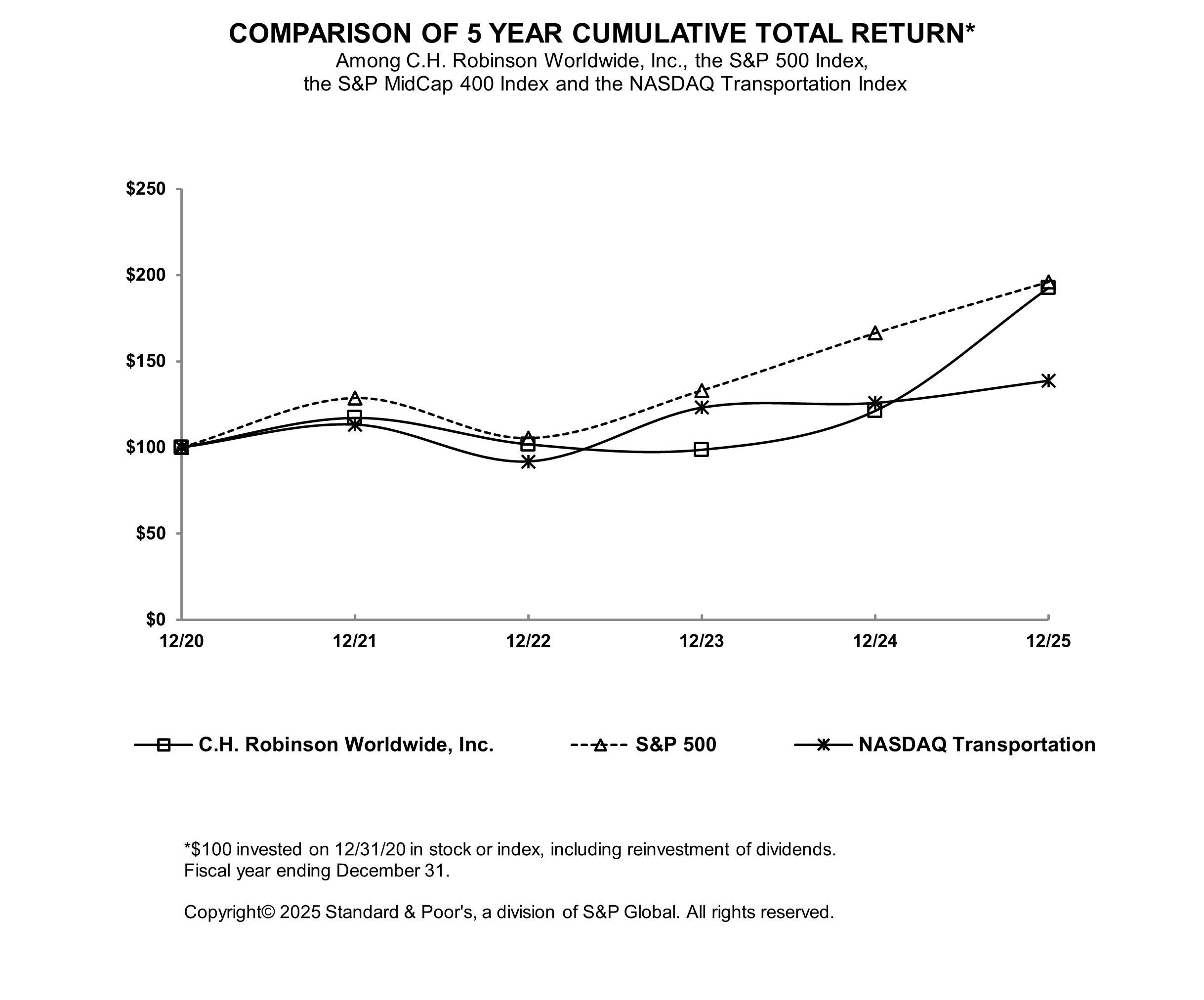
| December 31, | |||||||||||||||||||||||||||||||||||
| 2020 | 2021 | 2022 | 2023 | 2024 | 2025 | ||||||||||||||||||||||||||||||
C.H. Robinson Worldwide, Inc. | $ | 100.00 | $ | 117.18 | $ | 101.83 | $ | 98.67 | $ | 121.26 | $ | 192.75 | |||||||||||||||||||||||
S&P 500 | 100.00 | 128.71 | 105.40 | 133.10 | 166.40 | 196.16 | |||||||||||||||||||||||||||||
Nasdaq Transportation | 100.00 | 113.28 | 91.78 | 123.12 | 125.85 | 138.77 | |||||||||||||||||||||||||||||
The stock price performance included in this graph is not necessarily indicative of future stock price performance.
ITEM 6. RESERVED
25
ITEM 7. MANAGEMENT’S DISCUSSION AND ANALYSIS OF FINANCIAL CONDITION AND RESULTS OF OPERATIONS
OVERVIEW
C.H. Robinson Worldwide, Inc. (“C.H. Robinson,” “the company,” “we,” “us,” or “our”) is one of the largest global logistics providers in the world, with consolidated total revenues of $16.2 billion in 2025. As a leader in Lean AI supply chains, we deliver logistics like no one else. For more than a century, companies everywhere have looked to us to reimagine how goods move. We deliver tailored solutions across the world via truckload, less-than-truckload, ocean, air, and more. With our unique combination of human insight and Lean AI working as one, supply chains move faster, smarter, and more sustainably.
Our adjusted gross profits and adjusted gross profit margin are non-GAAP financial measures. Adjusted gross profits is calculated as gross profits excluding amortization of internally developed software utilized to directly serve our customers and contracted carriers. Adjusted gross profit margin is calculated as adjusted gross profits divided by total revenues. We believe adjusted gross profits and adjusted gross profit margin are useful measures of our ability to source, add value, and sell services and products that are provided by third parties, and we consider adjusted gross profits to be a primary performance measurement. Accordingly, the discussion of our results of operations often focuses on the changes in our adjusted gross profits and adjusted gross profit margin. The reconciliation of gross profits to adjusted gross profits and gross profit margin to adjusted gross profit margin is presented below (dollars in thousands):
| Twelve Months Ended December 31, | |||||||||||||||||||||||||||||||||||
| 2025 | 2024 | 2023 | |||||||||||||||||||||||||||||||||
| Revenues: | |||||||||||||||||||||||||||||||||||
| Transportation | $ | 14,823,804 | $ | 16,353,745 | $ | 16,372,660 | |||||||||||||||||||||||||||||
| Sourcing | 1,408,959 | 1,371,211 | 1,223,783 | ||||||||||||||||||||||||||||||||
| Total revenues | 16,232,763 | 17,724,956 | 17,596,443 | ||||||||||||||||||||||||||||||||
| Costs and expenses: | |||||||||||||||||||||||||||||||||||
| Purchased transportation and related services | 12,235,163 | 13,719,935 | 13,886,024 | ||||||||||||||||||||||||||||||||
| Purchased products sourced for resale | 1,268,190 | 1,240,007 | 1,105,811 | ||||||||||||||||||||||||||||||||
| Direct internally developed software amortization | 58,258 | 44,308 | 33,620 | ||||||||||||||||||||||||||||||||
| Total direct costs | 13,561,611 | 15,004,250 | 15,025,455 | ||||||||||||||||||||||||||||||||
| Gross profits/Gross profit margin | 2,671,152 | 16.5 | % | 2,720,706 | 15.3 | % | 2,570,988 | 14.6 | % | ||||||||||||||||||||||||||
| Plus: Direct internally developed software amortization | 58,258 | 44,308 | 33,620 | ||||||||||||||||||||||||||||||||
| Adjusted gross profits/Adjusted gross profit margin | $ | 2,729,410 | 16.8 | % | $ | 2,765,014 | 15.6 | % | $ | 2,604,608 | 14.8 | % | |||||||||||||||||||||||
Our adjusted operating margin is a non-GAAP financial measure calculated as operating income divided by adjusted gross profit. We believe adjusted operating margin is a useful measure of our profitability in comparison to our adjusted gross profit, which we consider a primary performance metric as discussed above. The reconciliation of operating margin to adjusted operating margin is presented below (dollars in thousands):
| Twelve Months Ended December 31, | ||||||||||||||||||||
| 2025 | 2024 | 2023 | ||||||||||||||||||
| Total revenues | $ | 16,232,763 | $ | 17,724,956 | $ | 17,596,443 | ||||||||||||||
| Operating income | 794,961 | 669,141 | 514,607 | |||||||||||||||||
| Operating margin | 4.9 | % | 3.8 | % | 2.9 | % | ||||||||||||||
| Adjusted gross profit | $ | 2,729,410 | $ | 2,765,014 | $ | 2,604,608 | ||||||||||||||
| Operating income | 794,961 | 669,141 | 514,607 | |||||||||||||||||
| Adjusted operating margin | 29.1 | % | 24.2 | % | 19.8 | % | ||||||||||||||
26
MARKET TRENDS
Carrier capacity in the North America surface transportation market continued to contract toward the end of 2025 as carriers exited the market. This gradual tightening, coupled with disruptive weather events and incremental pressures from the enforcement of commercial driver regulations, contributed to upward pressure on transportation rates. As a result, the market has become increasingly sensitive, with spot market rates exhibiting sharper than typical reactions to changes in supply and demand conditions. Despite these emerging pressures, the market has not fully transitioned into a sustained upcycle. Key indicators, such as truckload routing guide depth within our Managed Solutions business, have remained at historically low levels for nearly two years. Routing guide depth represents the average number of carriers contacted prior to acceptance when procuring a transportation provider. Average routing guide depth was 1.3 in the fourth quarter of 2025, compared to 1.2 for much of the prior two years. While this increase reflects early signs of a tightening market, soft demand conditions and remaining excess capacity continue to temper the pace of the shift.
The global forwarding market continued to face a persistent imbalance in 2025, marked by excess vessel capacity and weak global demand. Despite carriers’ ongoing avoidance of the Suez Canal, which has resulted in longer transit times and strain on global networks, vessel capacity has remained elevated. While short periods of rate volatility have occurred due to shifting trade and tariff policies, front‑loading, seasonal factors, and carriers’ use of blank sailings, international freight rates have largely remained depressed as weak demand outweighed these pressures. Looking ahead, uncertainty persists due to geopolitical and macroeconomic factors, including evolving trade policies, the Red Sea conflict, and carriers’ ability to effectively manage excess capacity. Despite this uncertainty, we expect ocean pricing to remain under pressure until global freight demand meaningfully improves. Similar dynamics continue to affect the air freight market. Although demand has shown resilience in certain technology‑focused sectors, overall air freight pricing remains sensitive to tariff developments and broader economic conditions, including cost-efficient ocean freight rates.
BUSINESS TRENDS
Our surface transportation results in 2025 reflected the challenging market conditions described above, including the increase in transportation rates as capacity tightened in the market near the end of the year. Throughout the year, we continued to advance our dynamic pricing and costing capabilities, navigating both the prolonged softness in demand and the rising cost environment that emerged toward year‑end. These enhanced capabilities allowed us to better react to changing market conditions and led to an improvement in adjusted gross profit per transaction in 2025 compared to 2024. Our average truckload linehaul rate charged to customers, excluding fuel surcharges, increased approximately 2.5 percent during 2025 reflecting our advanced dynamic pricing. Our average truckload linehaul cost per mile, excluding fuel surcharges, increased approximately 2.0 percent over the same period, reflecting our disciplined costing capabilities. Despite operating in a persistently soft market for much of the year, our combined North American Surface Transportation (“NAST”) truckload and LTL volumes significantly outperformed the Cass Freight Index increasing 1.0 percent compared to 2024.
Our Global Forwarding results in 2025 were largely consistent with the market trends discussed above. Throughout the year, we experienced short-lived periods of pricing and volume volatility largely associated with shifting trade policies. Despite this volatility, overall ocean freight rates and volumes declined from the elevated levels observed in 2024, primarily due to excess vessel capacity and weak global consumer demand. Our total ocean freight volumes decreased 4.5 percent while our air freight tonnage decreased 11.5 percent in 2025 compared to the prior year.
27
SELECTED OPERATING PERFORMANCE AND OTHER SIGNIFICANT ITEMS
The following summarizes select 2025 year-over-year operating comparisons to 2024:
•Total revenues decreased 8.4 percent to $16.2 billion, primarily driven by the divestiture of our Europe Surface Transportation business, in addition to lower pricing and volume in our ocean services and lower fuel surcharges in our truckload services.
•Gross profits decreased 1.8 percent to $2.7 billion. Adjusted gross profits decreased 1.3 percent to $2.7 billion, primarily driven by lower adjusted gross profit per transaction in our ocean services and the divestiture of our Europe Surface Transportation business, which were partially offset by higher adjusted gross profit per transaction in our LTL, truckload, and customs services.
•Personnel expenses decreased 5.9 percent to $1.4 billion, primarily due to cost-optimization efforts and productivity improvements and the divestiture of our Europe Surface Transportation business. Average employee headcount decreased 11.5 percent.
•Other selling, general, and administrative (“SG&A”) expenses decreased 11.8 percent to $564.3 million, primarily due to a $44.5 million loss in the prior year related to the divestiture of our Europe Surface Transportation business and prior year restructuring charges for impairments related to reducing our facilities footprint. In addition, other SG&A expenses declined across several expense categories in 2025 due to cost optimization efforts.
•Income from operations totaled $795.0 million, up 18.8 percent from last year, due to the decrease in operating expenses. Adjusted operating margin of 29.1 percent increased 490 basis points.
•Interest and other income/expenses, net totaled $72.5 million, which primarily consisted of $63.1 million of interest expense, which decreased $22.8 million versus last year due to a lower average debt balance and lower variable interest rates. The current year results also included an $11.2 million net loss from foreign currency revaluation and realized foreign currency gains and losses.
•The effective tax rate for 2025 was 18.7 percent compared to 19.6 percent in 2024. The lower rate was driven by higher foreign tax credits, higher tax benefits from share-based compensation, and the prior year impact of the divestiture of our European Surface Transportation business, partially offset by a reduced benefit from U.S. tax credits in the current year and non-recurring discrete items in the prior year.
•Net income totaled $587.1 million, up 26.1 percent from a year ago. Diluted earnings per share increased 25.1 percent to $4.83.
28
CONSOLIDATED RESULTS OF OPERATIONS
The following table summarizes our results of operations (dollars in thousands, except per share data):
| Twelve Months Ended December 31, | ||||||||||||||||||||||||||||||||
| 2025 | 2024 | % change | 2023 | % change | ||||||||||||||||||||||||||||
| Revenues: | ||||||||||||||||||||||||||||||||
| Transportation | $ | 14,823,804 | $ | 16,353,745 | (9.4) | % | $ | 16,372,660 | (0.1) | % | ||||||||||||||||||||||
| Sourcing | 1,408,959 | 1,371,211 | 2.8 | % | 1,223,783 | 12.0 | % | |||||||||||||||||||||||||
Total revenues | 16,232,763 | 17,724,956 | (8.4) | % | 17,596,443 | 0.7 | % | |||||||||||||||||||||||||
| Costs and expenses: | ||||||||||||||||||||||||||||||||
| Purchased transportation and related services | $ | 12,235,163 | $ | 13,719,935 | (10.8) | % | $ | 13,886,024 | (1.2) | % | ||||||||||||||||||||||
| Purchased products sourced for resale | 1,268,190 | 1,240,007 | 2.3 | % | 1,105,811 | 12.1 | % | |||||||||||||||||||||||||
| Personnel expenses | 1,370,158 | 1,456,249 | (5.9) | % | 1,465,735 | (0.6) | % | |||||||||||||||||||||||||
| Other selling, general, and administrative expenses | 564,291 | 639,624 | (11.8) | % | 624,266 | 2.5 | % | |||||||||||||||||||||||||
Total costs and expenses | 15,437,802 | 17,055,815 | (9.5) | % | 17,081,836 | (0.2) | % | |||||||||||||||||||||||||
Income from operations | 794,961 | 669,141 | 18.8 | % | 514,607 | 30.0 | % | |||||||||||||||||||||||||
| Interest and other expense | (72,504) | (89,937) | (19.4) | % | (105,421) | (14.7) | % | |||||||||||||||||||||||||
Income before provision for income taxes | 722,457 | 579,204 | 24.7 | % | 409,186 | 41.6 | % | |||||||||||||||||||||||||
| Provision for income taxes | 135,376 | 113,514 | 19.3 | % | 84,057 | 35.0 | % | |||||||||||||||||||||||||
Net income | $ | 587,081 | $ | 465,690 | 26.1 | % | $ | 325,129 | 43.2 | % | ||||||||||||||||||||||
Diluted net income per share | $ | 4.83 | $ | 3.86 | 25.1 | % | $ | 2.72 | 41.9 | % | ||||||||||||||||||||||
Average employee headcount | 12,733 | 14,386 | (11.5) | % | 16,041 | (10.3) | % | |||||||||||||||||||||||||
Adjusted gross profit margin percentage(1) | ||||||||||||||||||||||||||||||||
| Transportation | 17.5% | 16.1% | 140 bps | 15.2% | 90 bps | |||||||||||||||||||||||||||
| Sourcing | 10.0% | 9.6% | 40 bps | 9.6% | – bps | |||||||||||||||||||||||||||
| Total adjusted gross profit margin | 16.8% | 15.6% | 120 bps | 14.8% | 80 bps | |||||||||||||||||||||||||||
________________________________
(1) Adjusted gross profit margin is a non-GAAP financial measure explained above.
The following discussion and analysis of our Results of Operations and Liquidity and Capital Resources includes a comparison of the twelve months ended December 31, 2025, to the twelve months ended December 31, 2024. A similar discussion and analysis that compares the twelve months ended December 31, 2024, to the twelve months ended December 31, 2023, can be found in Item 7, “Management’s Discussion and Analysis of Financial Condition and Results of Operations,” of our 2024 Annual Report on Form 10-K filed with the SEC on February 14, 2025.
A reconciliation of our reportable segments to our consolidated results can be found in Note 8, Segment Reporting, in Part II, Financial Information of this Annual Report on Form 10-K.
Consolidated Results of Operations—Twelve Months Ended December 31, 2025 Compared to Twelve Months Ended December 31, 2024
Total revenues and direct costs. Total revenues and direct costs decreased primarily due to the divestiture of our Europe Surface Transportation business, as well as lower pricing and volume in our ocean services and lower fuel surcharges in our truckload services. During 2024, ocean transportation revenues and direct costs were elevated as a result of ongoing disruptions, including the Red Sea conflict, which strained capacity and increased ocean freight rates. While short periods of rate volatility occurred during 2025, driven by shifting trade policies, front-loading, seasonal factors, and carriers’ use of blank sailings, overall ocean freight rates have largely remained depressed as weak demand outweighed these pressures. Our sourcing total revenue and direct costs increased, driven by increased case volume with retail and foodservice customers.
29
Gross profits and adjusted gross profits. Our transportation adjusted gross profits decreased due to lower adjusted gross profit per transaction in our ocean services and the divestiture of our Europe Surface Transportation business. These impacts were partially offset by increased adjusted gross profit per transaction in our LTL, truckload, and customs services. The decline in ocean services was largely attributable to the significant reduction in market pricing during 2025, compared to the same period in 2024 discussed above. Conversely, the increase in adjusted gross profit per transaction in LTL and truckload services reflects the continued advancement of our dynamic pricing and costing capabilities. These advancements have allowed us to respond more rapidly to market fluctuations through more frequent and precise pricing discovery. Sourcing adjusted gross profits increased, driven by an increase in integrated supply chain solutions for foodservice and retail customers.
Operating expenses. Personnel expenses decreased, primarily due to cost optimization efforts including lower average employee headcount, as well as the impact of the divestiture of our Europe Surface Transportation business. Other SG&A expenses also decreased, driven by the prior year loss recognized on the divestiture of our Europe Surface Transportation business and prior year restructuring charges related to reducing our facilities footprint. In addition, other SG&A expenses decreased across several expense categories in the current year.
In addition to the above, our personnel expenses for 2025 included $30.0 million of severance and related personnel expenses related to our 2025 Restructuring Program. In addition, other SG&A expenses for 2025 included $2.5 million of expenses associated with our 2025 Restructuring Program and the divestiture of our Europe Surface Transportation business. We also incurred $8.8 million in other SG&A expenses in 2025, primarily from a $6.3 million impairment charge on our Kansas City regional center lease resulting from the execution of a sublease agreement on a portion of the building.
Our personnel expenses for 2024 included $24.1 million of severance and related personnel expenses related to our 2024 Restructuring Program. We also incurred $66.2 million in other SG&A expenses in 2024. These expenses were primarily due to a $44.5 million loss related to the divestiture of our Europe Surface Transportation business and $21.9 million related to our 2024 Restructuring Program. Refer to Note 14, Restructuring, for further discussion related to our 2025 and 2024 Restructuring Programs. Refer to Note 15, Divestitures, for further discussion related to the divestiture of our Europe Surface Transportation business.
Interest and other income/expense, net. Interest and other income/expense, net was $72.5 million, primarily consisting of $63.1 million of interest expense, which decreased $22.8 million compared to the prior year due to a lower average debt balance and lower variable interest rates. The current year also included an $11.2 million unfavorable impact from foreign currency revaluation and realized foreign currency gains and losses. The prior year included a $7.4 million unfavorable impact from foreign currency revaluation and realized foreign currency gains and losses.
Provision for income taxes. Our effective income tax rate was 18.7 percent in 2025 and 19.6 percent in 2024. The lower rate was driven by higher foreign tax credits, higher tax benefits from shared-based compensation, and the prior year impact of the divestiture of our European Surface Transportation business, which reduced our effective tax rate compared to the prior year by 4.2 percentage points, 2.6 percentage points, and 1.3 percentage points, respectively. These reductions were partially offset by a lower benefit from U.S. tax credits and non-recurring discrete items in the prior year, which increased our effective tax rate compared to the prior year by 5.4 percentage points and 1.1 percentage points, respectively.
30
NAST Segment Results of Operations
| Twelve Months Ended December 31, | |||||||||||||||||||||||||||||
| (dollars in thousands) | 2025 | 2024 | % change | 2023 | % change | ||||||||||||||||||||||||
| Total revenues | $ | 11,562,714 | $ | 11,727,539 | (1.4) | % | $ | 12,471,075 | (6.0) | % | |||||||||||||||||||
| Costs and expenses: | |||||||||||||||||||||||||||||
| Purchased transportation and related services | 9,856,385 | 10,086,344 | (2.3) | % | 10,877,221 | (7.3) | % | ||||||||||||||||||||||
| Personnel expenses | 643,979 | 669,611 | (3.8) | % | 662,037 | 1.1 | % | ||||||||||||||||||||||
| Other selling, general, and administrative expenses | 440,514 | 440,292 | 0.1 | % | 471,857 | (6.7) | % | ||||||||||||||||||||||
Total costs and expenses | 10,940,878 | 11,196,247 | (2.3) | % | 12,011,115 | (6.8) | % | ||||||||||||||||||||||
| Income from operations | $ | 621,836 | $ | 531,292 | 17.0 | % | $ | 459,960 | 15.5 | % | |||||||||||||||||||
| Twelve Months Ended December 31, | |||||||||||||||||||||||||||||
| 2025 | 2024 | % change | 2023 | % change | |||||||||||||||||||||||||
Average employee headcount | 5,158 | 5,696 | (9.4) | % | 6,469 | (11.9) | % | ||||||||||||||||||||||
| Service line volume statistics | |||||||||||||||||||||||||||||
| Truckload | 0.5 | % | (2.5) | % | |||||||||||||||||||||||||
| LTL | 1.5 | % | 2.5 | % | |||||||||||||||||||||||||
Adjusted gross profits(1) | |||||||||||||||||||||||||||||
| Truckload | $ | 1,024,228 | $ | 994,722 | 3.0 | % | $ | 943,674 | 5.4 | % | |||||||||||||||||||
| LTL | 603,116 | 565,892 | 6.6 | % | 543,657 | 4.1 | % | ||||||||||||||||||||||
| Other | 78,985 | 80,581 | (2.0) | % | 106,523 | (24.4) | % | ||||||||||||||||||||||
| Total adjusted gross profits | $ | 1,706,329 | $ | 1,641,195 | 4.0 | % | $ | 1,593,854 | 3.0 | % | |||||||||||||||||||
________________________________
(1) Adjusted gross profit is a non-GAAP financial measure explained above.
Twelve Months Ended December 31, 2025 Compared to Twelve Months Ended December 31, 2024
Total revenues and direct costs. NAST total revenues and direct costs decreased primarily due to lower fuel surcharges driven by a year-over-year decrease in diesel fuel prices and a shorter average length of haul in truckload services. These declines were partially offset by increased LTL and truckload volumes and an increase in truckload linehaul rates. Our average truckload linehaul rate per mile charged to our customers, which excludes fuel surcharges, increased approximately 2.5 percent. Our truckload linehaul cost per mile, excluding fuel surcharges, increased approximately 2.0 percent.
Gross profits and adjusted gross profits. NAST adjusted gross profits increased driven by higher adjusted gross profits per transaction in both truckload and LTL services. The improvement was driven by the continued advancement of our dynamic pricing and costing capabilities. These advancements have allowed us to respond more rapidly to market fluctuations through more frequent and precise pricing discovery. NAST other adjusted gross profits decreased, primarily due to a decrease in warehousing services.
Operating expenses. NAST personnel expenses decreased driven by cost optimization efforts and productivity improvements, including lower average headcount. NAST other SG&A expenses were flat as higher allocated corporate expenses were offset by lower expenditures on purchased services, including contingent worker expenses, and lower occupancy expense.
In addition to the above, NAST personnel expenses for 2025 included $10.2 million of severance and related personnel expenses. We also incurred $0.4 million in restructuring related other SG&A expenses in 2025. These expenses were both associated with our 2025 Restructuring Program. Personnel expenses for 2024 included $10.2 million of severance and related personnel expenses. We also incurred $6.9 million in restructuring related other SG&A expenses in 2024. These expenses were both associated with our 2024 Restructuring Program. Refer to Note 14, Restructuring, for further discussion related to our 2025 and 2024 Restructuring Programs.
The operating expenses of NAST and all other segments include allocated corporate expenses. Allocated personnel expenses consist primarily of stock-based compensation allocated based upon segment participation levels in our equity plans. Remaining
31
corporate allocations, including corporate functions and technology related expenses, are primarily included within each segment’s other SG&A expenses and allocated based upon relevant segment operating metrics.
Global Forwarding Segment Results of Operations
| Twelve Months Ended December 31, | |||||||||||||||||||||||||||||
| (dollars in thousands) | 2025 | 2024 | % change | 2023 | % change | ||||||||||||||||||||||||
| Total revenues | $ | 3,090,018 | $ | 3,805,018 | (18.8) | % | $ | 2,997,704 | 26.9 | % | |||||||||||||||||||
| Costs and expenses: | |||||||||||||||||||||||||||||
| Purchased transportation and related services | 2,348,097 | 3,002,469 | (21.8) | % | 2,308,339 | 30.1 | % | ||||||||||||||||||||||
| Personnel expenses | 349,955 | 371,576 | (5.8) | % | 366,464 | 1.4 | % | ||||||||||||||||||||||
| Other selling, general, and administrative expenses | 208,183 | 218,497 | (4.7) | % | 237,071 | (7.8) | % | ||||||||||||||||||||||
Total costs and expenses | 2,906,235 | 3,592,542 | (19.1) | % | 2,911,874 | 23.4 | % | ||||||||||||||||||||||
| Income from operations | $ | 183,783 | $ | 212,476 | (13.5) | % | $ | 85,830 | 147.6 | % | |||||||||||||||||||
| Twelve Months Ended December 31, | |||||||||||||||||||||||||||||
| 2025 | 2024 | % change | 2023 | % change | |||||||||||||||||||||||||
Average employee headcount | 4,284 | 4,678 | (8.4) | % | 5,222 | (10.4) | % | ||||||||||||||||||||||
| Service line volume statistics | |||||||||||||||||||||||||||||
| Ocean | (4.5) | % | 5.5 | % | |||||||||||||||||||||||||
| Air | (11.5) | % | 17.0 | % | |||||||||||||||||||||||||
| Customs | 1.0 | % | 4.5 | % | |||||||||||||||||||||||||
Adjusted gross profits(1) | |||||||||||||||||||||||||||||
| Ocean | $ | 432,531 | $ | 519,878 | (16.8) | % | $ | 420,826 | 23.5 | % | |||||||||||||||||||
| Air | 134,716 | 134,289 | 0.3 | % | 121,978 | 10.1 | % | ||||||||||||||||||||||
| Customs | 132,798 | 107,485 | 23.6 | % | 97,095 | 10.7 | % | ||||||||||||||||||||||
| Other | 41,876 | 40,897 | 2.4 | % | 49,466 | (17.3) | % | ||||||||||||||||||||||
| Total adjusted gross profits | $ | 741,921 | $ | 802,549 | (7.6) | % | $ | 689,365 | 16.4 | % | |||||||||||||||||||
________________________________
(1)Adjusted gross profit is a non-GAAP financial measure explained above.
Twelve Months Ended December 31, 2025 Compared to Twelve Months Ended December 31, 2024
Total revenues and direct costs. Global Forwarding total revenues and direct costs decreased driven by significantly lower pricing and purchased transportation costs in ocean services, in addition to lower volume in our ocean services. In 2024, ocean transportation revenues and direct costs were elevated due to global supply chain disruptions, including the Red Sea conflict, which strained capacity and elevated ocean freight rates. While short periods of rate volatility occurred during 2025, driven by shifting trade policies, front-loading, seasonal factors, and carriers’ use of blank sailings, overall ocean freight rates have largely remained depressed as weak demand outweighed these pressures. Many of these same market dynamics contributed to declines in total revenues and direct costs within our air freight services. During 2024, disruptions in the ocean freight market and heightened ecommerce demand out of North Asia increased air freight volumes and pricing in certain trade lanes. This contrasted with the comparatively weak consumer demand environment in 2025, which contributed to lower pricing and direct costs and lower volumes in air freight services.
Gross profits and adjusted gross profits. Global Forwarding adjusted gross profits decreased driven by lower adjusted gross profit per shipment and lower volumes in ocean services. The decline in adjusted gross profit per shipment in ocean services reflected the significant reduction in market pricing during 2025 compared to the same period in 2024, as discussed above. Partially offsetting the decline, customs adjusted gross profits increased, driven by higher duty advance fees reflecting elevated global tariff rates in 2025.
Operating expenses. Personnel expenses decreased primarily due to cost optimization efforts and productivity improvements and lower incentive compensation, partially offset by higher restructuring charges in the current year related to workforce reductions. Other SG&A expenses decreased with reductions across several expense categories; most notably lower claims expense.
32
In addition to the above, personnel expenses for 2025 included $15.0 million of severance and related personnel expenses. We also incurred $1.2 million in other SG&A expenses in 2025. These expenses were both associated with our 2025 Restructuring Program. Personnel expenses for 2024 included $6.9 million of severance and related personnel expenses. We also incurred $4.7 million in other SG&A expenses in 2024. These expenses were both associated with our 2024 Restructuring Program. Refer to Note 14, Restructuring, for further discussion related to our 2025 and 2024 Restructuring Programs.
All Other and Corporate Segment Results of Operations
All Other and Corporate includes our Robinson Fresh and Managed Solutions segments, as well as Other Surface Transportation outside of North America and other miscellaneous revenues and unallocated corporate expenses.
| Twelve Months Ended December 31, | |||||||||||||||||||||||||||||
| (dollars in thousands) | 2025 | 2024 | % change | 2023 | % change | ||||||||||||||||||||||||
| Total revenues | $ | 1,580,031 | $ | 2,192,399 | (27.9) | % | $ | 2,127,664 | 3.0 | % | |||||||||||||||||||
| Purchased transportation and related services and products sourced for resale | 1,298,871 | 1,871,129 | (30.6) | % | 1,806,275 | 3.6 | % | ||||||||||||||||||||||
| Loss from operations | (10,658) | (74,627) | N/M | (31,183) | N/M | ||||||||||||||||||||||||
Adjusted gross profits(1) | |||||||||||||||||||||||||||||
| Robinson Fresh | 161,094 | 146,310 | 10.1 | % | 131,216 | 11.5 | % | ||||||||||||||||||||||
| Managed Solutions | 115,429 | 113,770 | 1.5 | % | 116,196 | (2.1) | % | ||||||||||||||||||||||
| Other Surface Transportation | 4,637 | 61,190 | (92.4) | % | 73,977 | (17.3) | % | ||||||||||||||||||||||
| Total adjusted gross profits | $ | 281,160 | $ | 321,270 | (12.5) | % | $ | 321,389 | — | % | |||||||||||||||||||
________________________________
(1) Adjusted gross profit is a non-GAAP financial measure explained above.
Twelve Months Ended December 31, 2025 Compared to Twelve Months Ended December 31, 2024
Total revenues and direct costs. Total revenues and direct costs decreased, driven by the divestiture of our Europe Surface Transportation business on February 1, 2025. Partially offsetting this decrease was an increase in total revenues in our Robinson Fresh business driven by increased case volume with retail and foodservice customers.
Gross profits and adjusted gross profits. Robinson Fresh adjusted gross profits increased driven by an increase in integrated supply chain solutions for retail and foodservice customers. Managed Solutions adjusted gross profits increased due to an increase in freight under management. Other Surface Transportation adjusted gross profits decreased as a result of the divestiture of our Europe Surface Transportation business.
Restructuring, lease impairment charge, and divestiture expenses. Personnel expenses in 2025 included $4.8 million of severance and related personnel expenses associated with our 2025 Restructuring Program and the divestiture of our Europe Surface Transportation business. We also incurred $7.2 million in other SG&A expenses in 2025, primarily from a $6.3 million impairment charge on our Kansas City regional center lease resulting from the execution of a sublease agreement on a portion of the building. In addition, other SG&A expenses for 2025 included $0.9 million loss related to the divestiture of our Europe Surface Transportation business.
Personnel expenses in 2024, included $7.0 million of severance and related personnel expenses, primarily associated with our 2024 Restructuring Program. We also incurred $54.5 million of other SG&A expenses in 2024, that included a $44.5 million loss related to the divestiture of our Europe Surface Transportation business. Refer to Note 14, Restructuring, for further discussion related to our 2025 and 2024 Restructuring Programs. Refer to Note 15, Divestitures, for further discussion related to the divestiture of our Europe Surface Transportation business.
33
LIQUIDITY AND CAPITAL RESOURCES
We have historically generated substantial cash from operations, which has enabled us to fund our organic growth while paying cash dividends and repurchasing stock. In addition, we maintain the following debt facilities as described in Note 4, Financing Arrangements (dollars in thousands):
| Description | Carrying Value as of December 31, 2025 | Borrowing Capacity | Maturity | |||||||||||||||||
| Revolving Credit Facility | $ | — | $ | 1,000,000 | November 2027 | |||||||||||||||
| Senior Notes, Series B | 150,000 | 150,000 | August 2028 | |||||||||||||||||
| Senior Notes, Series C | 175,000 | 175,000 | August 2033 | |||||||||||||||||
Receivables Securitization Facility(1) | 166,654 | 500,000 | August 2027 | |||||||||||||||||
Senior Notes (1) | 597,784 | 600,000 | April 2028 | |||||||||||||||||
| Total debt | $ | 1,089,438 | $ | 2,425,000 | ||||||||||||||||
________________________________
(1) Net of unamortized discounts and issuance costs.
We expect to use our current debt facilities and potentially other indebtedness incurred in the future to assist us in continuing to fund working capital, capital expenditures, possible acquisitions, dividends, share repurchases, or other investments.
Cash and cash equivalents totaled $160.9 million as of December 31, 2025, and $145.8 million as of December 31, 2024. Cash and cash equivalents held outside the United States totaled $144.9 million as of December 31, 2025, and $134.0 million as of December 31, 2024. Working capital increased from $644.7 million at December 31, 2024, to $966.8 million at December 31, 2025.
We prioritize our investments to grow our market share and expand globally in key industries, trade lanes, and geographies, and to digitize our customer, carrier, and internal tools to support our organic growth. We are continually looking for acquisitions, but those acquisitions must fit our culture and enhance our growth opportunities.
The following table summarizes our major sources and uses of cash and cash equivalents (dollars in thousands):
| Twelve months ended December 31, | 2025 | 2024 | % change | 2023 | % change | ||||||||||||||||||||||||
| Sources (uses) of cash: | |||||||||||||||||||||||||||||
| Cash provided by operating activities | $ | 914,519 | $ | 509,084 | 79.6 | % | $ | 731,946 | (30.4) | % | |||||||||||||||||||
| Capital expenditures | (70,543) | (74,288) | (84,111) | ||||||||||||||||||||||||||
| Acquisitions, net of cash acquired | (11,864) | — | — | ||||||||||||||||||||||||||
| Proceeds from divestiture | 27,737 | — | — | ||||||||||||||||||||||||||
| Other investing | — | — | 1,324 | ||||||||||||||||||||||||||
| Cash used for investing activities | (54,670) | (74,288) | 26.4 | % | (82,787) | (10.3) | % | ||||||||||||||||||||||
| Repurchase of common stock | (354,652) | — | (63,884) | ||||||||||||||||||||||||||
| Cash dividends | (301,376) | (294,772) | (291,569) | ||||||||||||||||||||||||||
| Net (repayments) borrowings on debt | (289,000) | (204,000) | (394,000) | ||||||||||||||||||||||||||
| Other financing activities | 82,280 | 82,673 | 31,620 | ||||||||||||||||||||||||||
| Net cash used for financing activities | (862,748) | (416,099) | (107.3) | % | (717,833) | (42.0) | % | ||||||||||||||||||||||
| Effect of exchange rates on cash and cash equivalents | 7,232 | (8,152) | (3,284) | ||||||||||||||||||||||||||
| Net change in cash and cash equivalents, including cash and cash equivalents classified within assets held for sale | $ | 4,333 | $ | 10,545 | $ | (71,958) | |||||||||||||||||||||||
34
Cash flows from operating activities. Cash flows from operating activities increased significantly in 2025, reflecting our strong operating performance and higher net income versus the prior year. Operating cash flows also benefited from a significant reduction in ocean freight costs compared to the elevated rates experienced in 2024, as further discussed in the market trends and business trends sections above. We continue to closely monitor credit and collections activities and the quality of our accounts receivable balance to minimize risk as well as work with our customers to facilitate the movement of goods across their supply chains while also ensuring timely payment.
Cash used for investing activities. Our investing activities consist primarily of capital expenditures and cash paid for acquisitions. Capital expenditures consisted primarily of investments in software, which are intended to deliver scalable solutions, including those driven by AI, that transform our processes, improve our customer and contract carrier experience, accelerate the pace of development, and improve our dynamic pricing and costing capabilities.
The sale of our Europe Surface Transportation business closed effective February 1, 2025. We received $27.7 million of consideration at closing with additional fixed installment payments due throughout 2026. The remaining consideration due is collateralized by all current and future accounts receivable of the Europe Surface Transportation business.
We anticipate capital expenditures in 2026 to be approximately $75 million to $85 million.
Cash used for financing activities. Net cash used for financing activities increased significantly in 2025 compared to 2024, driven by an increase in cash returned to shareholders and net payments on outstanding borrowings. In 2025, we resumed share repurchases under our board authorization and increased our annual dividend to shareholders. Despite the increase in cash returned to shareholders our strong cash flow from operations allowed us to reduce our outstanding borrowings on debt. We had net repayments on debt in 2025, 2024, and 2023. Net repayments in 2025 and 2024 were primarily to decrease the outstanding balance on the Receivables Securitization Facility and the Revolving Credit Facility. Net repayments in 2023 were primarily to repay the Senior Notes Series A, which matured in August 2023, and the 364-Day Unsecured Revolving Credit Facility, which matured in May 2023.
In December 2022, the Board of Directors increased the number of shares authorized to be repurchased by 20,000,000 shares. As of December 31, 2025, there were 3,669,530 shares remaining for future repurchases. On October 28, 2025, the Board of Directors approved an additional $2.0 billion of authorization under the company’s share repurchase program. The stock repurchase program does not obligate the company to acquire any amount of common stock and shall expire or terminate at the Board's discretion; however, the company currently expects to execute the share repurchase program over a period of approximately three years. Over the long term, we remain committed to our quarterly dividend and share repurchases to enhance shareholder value. Such repurchases, if any, will depend on prevailing market conditions, our liquidity requirements, contractual restrictions, and other factors.
We may seek to retire or purchase our outstanding Senior Notes through open market cash purchases, privately negotiated transactions, or otherwise.
We believe that, assuming no change in our current business plan, our available cash, together with expected future cash generated from operations, the amount available under our credit facilities, and credit available in the market, will be sufficient to satisfy our anticipated needs for working capital, capital expenditures, and cash dividends for at least the next 12 months and the foreseeable future thereafter. We also believe we could obtain funds under lines of credit or other forms of indebtedness on short notice, if needed.
As of December 31, 2025, we were in compliance with all of the covenants under our debt agreements.
CRITICAL ACCOUNTING ESTIMATES
Our consolidated financial statements and accompanying notes are prepared in accordance with accounting principles generally accepted in the United States (“U.S. GAAP”). The preparation of the consolidated financial statements requires management to make estimates and assumptions that affect the reported amounts of assets, liabilities, revenue, expenses, and the related disclosures. Because future events and their effects cannot be determined with certainty, actual results could differ from our assumptions and estimates, and such differences could be material.
Our significant accounting policies are discussed in Note 1, Summary of Significant Accounting Policies, of the Notes to the Consolidated Financial Statements, included in Item 8, Financial Statements and Supplementary Data, of this Annual Report on Form 10-K. We consider the following items in our consolidated financial statements to require significant estimation or judgment.
35
REVENUE RECOGNITION. At contract inception, we assess the goods and services promised in our contracts with customers and identify our performance obligations to provide distinct goods and services to our customers. Our transportation and logistics service arrangements often require management to use judgment and make estimates that impact the amounts and timing of revenue recognition.
Transportation and Logistics Services. As a global logistics provider, our primary performance obligation under our customer contracts is to utilize our relationships with a wide variety of transportation companies to efficiently and cost-effectively transport our customers’ freight. Revenue is recognized for these performance obligations as they are satisfied over the contract term, which generally represents the transit period. The transit period can vary based upon the method of transport; generally, a number of days for over the road, rail, and air transportation, or several weeks in the case of an ocean shipment.
Recognizing revenue for contracts where the transit period is partially complete or completed and not yet invoiced at period end requires management to make judgments that affect the amounts and timing of revenue recognized at period end. As of December 31, 2025, we recorded revenue of $156.4 million for services we have provided while a shipment was still in-transit, but for which we had not yet completed our performance obligation or had not yet invoiced our customer compared to $200.3 million at December 31, 2024. The amount of revenue recognized for contracts where the transit period was partially complete decreased as of December 31, 2025, compared to December 31, 2024, driven by the macroeconomic and industry factors reducing the cost of purchased transportation and sell rates in ocean services. See Item 7 of Part II, Management’s Discussion and Analysis of Financial Condition and Results of Operations, for further information.
We utilize our historical knowledge of shipping lanes and estimated transit times to determine the transit period in cases where our customers’ freight has not reached its intended destination. In addition, we analyze contract data for the first few days following the reporting date combined with our historical experience of trends related to partially completed contracts as of the reporting date to determine our right to consideration for the services we have provided where the transit period is partially complete or completed and not yet invoiced at period end. Differences in contract data for the first few days following the reporting date compared with our historical experience or disruptions such as weather events, port congestion, or other delays could cause the actual amount of revenue earned at period end to differ from these estimates.
Total revenues represent the total dollar value of revenue recognized from contracts with customers for the goods and services we provide. Substantially all of our revenue is attributable to contracts with our customers. Most transactions in our transportation and sourcing businesses are recorded at the gross amount we charge our customers for the services we provide and goods we sell. In these transactions, we are primarily responsible for fulfilling the promise to provide the specified good or service to our customer and we have discretion in establishing the price for the specified good or service. Additionally, in our sourcing business, in some cases we take inventory risk before the specified good has been transferred to our customer.
Customs brokerage, managed solutions, freight forwarding, and sourcing managed procurement transactions are recorded at the net amount we charge our customers for the service we provide because many of the factors stated above are not present. See also Note 1, Summary of Significant Accounting Policies, for further information regarding our revenue recognition policies.
GOODWILL. Goodwill represents the excess of the cost of acquired businesses over the net of the fair value of identifiable tangible assets and identifiable intangible assets purchased and liabilities assumed.
Goodwill is tested for impairment annually on November 30, or more frequently if events or changes in circumstances indicate that the asset might be impaired. Typically, we first perform a qualitative assessment to determine whether it is more likely than not that the fair value of our reporting units is less than their respective carrying value (“Step Zero Analysis”). If the Step Zero Analysis indicates it is more likely than not that the fair value of our reporting units is less than their respective carrying value, an additional impairment assessment is performed (“Step One Analysis”).
When we perform a Step One Analysis, the fair value of each reporting unit is compared with the carrying amount of the reporting unit, including goodwill. If the carrying amount of a reporting unit exceeds its fair value, an impairment loss is recognized in an amount equal to that excess, limited to the total amount of goodwill allocated to that reporting unit.
In the Step One Analysis, the fair value of each reporting unit is determined using either a discounted cash flow analysis, the market approach, or a combination of both. Projecting discounted future cash flows requires the use of significant judgment to make significant estimates regarding future revenues and expenses, projected capital expenditures, changes in working capital, and the appropriate discount rate. Use of the market approach consists of comparisons to comparable publicly-traded companies that are similar in size and industry. Actual results may differ from those used in our valuations when a Step One Analysis is performed.
36
As part of our annual Step Zero Analysis performed in 2025, there were no factors identified suggesting that it was more likely than not that the fair value was less than their respective carrying value. As such, a Step One Analysis was not completed and no impairments were recorded.
INCOME TAX RESERVES. The calculation of our tax liabilities involves dealing with uncertainties in the application of complex tax regulations in a multitude of jurisdictions across our global operations. We establish reserves when, despite our belief that our tax return positions are fully supportable, we believe that certain positions are likely to be challenged, and we may or may not prevail in full or in part. Under U.S. GAAP, if we determine a tax position, more likely than not, will be sustained upon audit based solely on the technical merits of the position, we recognize the benefit. We measure the benefit by determining the amount that is greater than 50 percent likely of being realized upon resolution. We presume all tax positions will be examined by a taxing authority with full knowledge of all relevant information.
We regularly monitor our tax positions and tax liabilities. We reevaluate the technical merits of our tax positions and recognize an uncertain tax benefit, or derecognize a previously recorded tax benefit, when there is (i) a completion of a tax audit, (ii) effective settlement of an issue, (iii) litigation of the issue, including appeals, (iv) a change in applicable tax law including a tax case or legislative guidance, or (v) the expiration of the applicable statute of limitations. Significant judgment is required in accounting for income tax reserves. Although we believe we have adequately provided for liabilities resulting from tax assessments by taxing authorities, positions taken by these tax authorities could have a material impact on our effective tax rate, consolidated earnings, financial position, and/or cash flows. Uncertain income tax positions are included in “Accrued income taxes” or “Noncurrent income taxes payable” in the consolidated balance sheets.
DISCLOSURES ABOUT CONTRACTUAL OBLIGATIONS AND COMMERCIAL CONTINGENCIES
The following table aggregates all contractual commitments and commercial obligations, due by period, which affect our financial condition and liquidity position as of December 31, 2025 (dollars in thousands):
| 2026 | 2027 | 2028 | 2029 | 2030 | Thereafter | Total | |||||||||||||||||||||||||||||||||||
| Borrowings under credit agreements | $ | 167,000 | $ | — | $ | — | $ | — | $ | — | $ | — | $ | 167,000 | |||||||||||||||||||||||||||
Senior notes(1) | 25,200 | 25,200 | 607,350 | — | — | — | 657,750 | ||||||||||||||||||||||||||||||||||
Long-term notes payable(1) | 14,440 | 14,440 | 164,440 | 8,050 | 8,050 | 199,150 | 408,570 | ||||||||||||||||||||||||||||||||||
Maturity of lease liabilities(2) | 84,147 | 74,844 | 59,736 | 44,716 | 31,663 | 46,205 | 341,311 | ||||||||||||||||||||||||||||||||||
Purchase obligations(3) | 79,870 | 37,232 | 16,340 | 12,705 | 18 | — | 146,165 | ||||||||||||||||||||||||||||||||||
| Total | $ | 370,657 | $ | 151,716 | $ | 847,866 | $ | 65,471 | $ | 39,731 | $ | 245,355 | $ | 1,720,796 | |||||||||||||||||||||||||||
________________________________
(1)Amounts payable relate to the semi-annual interest due on the senior and long-term notes and the principal amount at maturity.
(2) We maintain operating leases for office space, warehouses, office equipment, and trailers. See Note 10, Leases, for further information.
(3) Purchase obligations include agreements for services that are enforceable and legally binding and that specify all significant terms. As of December 31, 2025, such obligations primarily include ocean and air freight capacity, telecommunications services, third-party software contracts, maintenance contracts, and information technology related capacity. In some instances, our contractual commitments may be usage based or require estimates as to the timing of cash settlement.
We have no financing lease obligations. Long-term liabilities consist primarily of noncurrent taxes payable and long-term notes payable. Due to the uncertainty with respect to the amounts or timing of future cash flows associated with our unrecognized tax benefits as of December 31, 2025, we are unable to make reasonably reliable estimates of the period of cash settlement with the respective taxing authority. Therefore, $34.9 million of unrecognized tax benefits have been excluded from the contractual obligations table above. See Note 5, Income Taxes, to the consolidated financial statements for a discussion on income taxes. As of December 31, 2025, we do not have significant off-balance sheet arrangements as defined in Item 303(a)(4)(ii) of Regulation S-K.
37
ITEM 7A. QUANTITATIVE AND QUALITATIVE DISCLOSURES ABOUT MARKET RISK
We had $160.9 million of cash and cash equivalents on December 31, 2025. Substantially all of the cash equivalents are in demand accounts with financial institutions. The primary market risks associated with these investments are liquidity risks.
We are a party to a credit agreement with various lenders consisting of a $1 billion revolving credit facility. Interest accrues on the revolving loan at a variable rate determined by a pricing schedule or the base rate (which is the highest of: (a) the administrative agent’s prime rate, (b) the federal funds rate plus 0.50 percent, or (c) the sum of one-month SOFR plus a specified margin). There was nothing outstanding on the revolving credit facility as of December 31, 2025.
We are a party to the Note Purchase Agreement, as amended, with various institutional investors with fixed rates consisting of: (i) $150 million of the company’s 4.26 percent Senior Notes, Series B, due August 27, 2028, and (ii) $175 million of the company’s 4.6 percent Senior Notes, Series C, due August 27, 2033. There was $325 million outstanding on the Senior Notes as of December 31, 2025. The fair value of the Senior Notes approximated $311.8 million as of December 31, 2025.
We issued Senior Notes through a public offering on April 9, 2018. The Senior Notes bear an annual interest rate of 4.2 percent payable semi-annually on April 15 and October 15, until maturity on April 15, 2028. Taking into effect the amortization of the original issue discount and all underwriting and issuance expenses, the Senior Notes have an effective yield to maturity of approximately 4.39 percent per annum. The fair value of the Senior Notes, excluding debt discounts and issuance costs, approximated $602.8 million as of December 31, 2025, based primarily on the market prices quoted from external sources. The carrying value of the Senior Notes was $597.8 million as of December 31, 2025.
We are a party to a Receivables Securitization Facility with various lenders, which provides an aggregate funding available of $500 million. Interest accrues on the facility at variable rates based on SOFR plus a margin. There was $166.7 million outstanding, net of unamortized issuance costs, on the Receivables Securitization Facility as of December 31, 2025.
A hypothetical 100-basis-point change in the interest rate would not have a material effect on our earnings. We do not use derivative financial instruments to manage interest rate risk or to speculate on future changes in interest rates. A rise in interest rates could negatively affect the fair value of our debt facilities.
Foreign Exchange Risk
We frequently transact using currencies other than the U.S. Dollar, primarily the Chinese Yuan, Euro, Canadian Dollar, Mexican Peso, and Singapore Dollar. We operate through a network of offices in North America, Europe, Asia, Oceania, South America, and the Middle East. Due to the global nature of our business, we use our expertise and global logistics platform to connect shippers with transportation providers that are in different parts of the world to efficiently and cost-effectively move our customers’ freight. This often results in a shipment involving multiple parties, currencies, and participating C.H. Robinson offices. This global cooperation often results in assets and liabilities, including intercompany balances, denominated in a currency other than the functional currency. In these instances, most commonly, we have balances denominated in U.S. Dollars in regions where the U.S. Dollar is not the functional currency, and vice versa. This results in foreign exchange risk.
The Company may seek to manage its exposure to the risk of fluctuations in foreign currency exchange rates through the use of foreign currency forward contracts although the impact of foreign currency forward contracts were not material as of and for the twelve months ended December 31, 2025.
Foreign exchange risk can be quantified by performing a sensitivity analysis assuming a hypothetical change in the value of the U.S. Dollar compared to other currencies in which we transact. Our primary foreign exchange risks are associated with the U.S. Dollar versus the Euro, Chinese Yuan, Singapore Dollar, Canadian Dollar, and Mexican Peso. All other things being equal, a hypothetical 10 percent weakening of the U.S. Dollar against these currencies on December 31, 2025, would have decreased our net income by approximately $14.2 million and a hypothetical 10 percent strengthening of the U.S. Dollar against these on December 31, 2025, would have increased our net income by approximately $11.6 million. We are also exposed to foreign exchange risk associated with the U.S. Dollar versus the Hong Kong Dollar, although the Hong Kong Dollar is pegged to the U.S. Dollar.
38
ITEM 8. FINANCIAL STATEMENTS AND SUPPLEMENTARY DATA
REPORT OF INDEPENDENT REGISTERED PUBLIC ACCOUNTING FIRM
To the stockholders and the Board of Directors of C.H. Robinson Worldwide, Inc.
Opinion on the Financial Statements
We have audited the accompanying consolidated balance sheets of C.H. Robinson Worldwide, Inc. and subsidiaries (the “Company”) as of December 31, 2025 and 2024, the related consolidated statements of operations and comprehensive income, stockholders' investment, and cash flows, for each of the three years in the period ended December 31, 2025, and the related notes (collectively referred to as the “financial statements”). In our opinion, the financial statements present fairly, in all material respects, the financial position of the Company as of December 31, 2025 and 2024, and the results of its operations and its cash flows for each of the three years in the period ended December 31, 2025, in conformity with accounting principles generally accepted in the United States of America.
We have also audited, in accordance with the standards of the Public Company Accounting Oversight Board (United States) (PCAOB), the Company's internal control over financial reporting as of December 31, 2025, based on criteria established in Internal Control — Integrated Framework (2013) issued by the Committee of Sponsoring Organizations of the Treadway Commission and our report dated February 13, 2026, expressed an unqualified opinion on the Company's internal control over financial reporting.
Basis for Opinion
These financial statements are the responsibility of the Company's management. Our responsibility is to express an opinion on the Company's financial statements based on our audits. We are a public accounting firm registered with the PCAOB and are required to be independent with respect to the Company in accordance with the U.S. federal securities laws and the applicable rules and regulations of the Securities and Exchange Commission and the PCAOB.
We conducted our audits in accordance with the standards of the PCAOB. Those standards require that we plan and perform the audit to obtain reasonable assurance about whether the financial statements are free of material misstatement, whether due to error or fraud. Our audits included performing procedures to assess the risks of material misstatement of the financial statements, whether due to error or fraud, and performing procedures that respond to those risks. Such procedures included examining, on a test basis, evidence regarding the amounts and disclosures in the financial statements. Our audits also included evaluating the accounting principles used and significant estimates made by management, as well as evaluating the overall presentation of the financial statements. We believe that our audits provide a reasonable basis for our opinion.
Critical Audit Matter
The critical audit matter communicated below is a matter arising from the current-period audit of the financial statements that was communicated or required to be communicated to the audit committee and that (1) relates to accounts or disclosures that are material to the financial statements and (2) involved our especially challenging, subjective, or complex judgments. The communication of critical audit matters does not alter in any way our opinion on the financial statements, taken as a whole, and we are not, by communicating the critical audit matter below, providing a separate opinion on the critical audit matter or on the accounts or disclosures to which it relates.
Revenue Recognition — Refer to Notes 1 and 9 to the financial statements
Critical Audit Matter Description
Transportation and logistics revenue is recognized for performance obligations identified in the customer contract as they are satisfied over the contract term, which generally represents the transit period. Recognizing revenue at period end for contracts where the transit period is partially complete at period end or completed and not yet invoiced, requires management to make judgments that affect the amounts and timing of revenue recognized. At December 31, 2025, the Company recorded revenue of $156.4 million for services it provided while a shipment was still in-transit but for which the Company had not yet completed its performance obligation or had not yet invoiced the customer.
Auditing the estimate of the Company’s revenue recorded for contracts where the transit period is partially complete or completed and not yet invoiced as of the reporting date required a high degree of auditor judgment when performing audit procedures and evaluating the results of those procedures.
39
How the Critical Audit Matter Was Addressed in the Audit
Our audit procedures related to management’s estimate of the revenue recorded for contracts where the transit period is partially complete or completed and not yet invoiced as of the reporting date included the following, among others:
▪We tested the effectiveness of controls over revenue recognized over time, including management’s controls over the identification of shipments in-transit, the portion of the transit period completed, and the estimate of contracts completed but not yet invoiced.
▪We evaluated management’s ability to identify the shipments in-transit and to estimate the revenue to be recorded for contracts where the transit period is partially complete or completed and not yet invoiced at the reporting date by:
•Performing a retrospective review of management’s estimate for prior reporting periods.
•Testing the accuracy and completeness of the data in the system-generated report utilized in management’s revenue cutoff estimate with the assistance of our information technology specialists.
•Assessing the estimate methodology for reasonableness, in light of recent market events or changes within the Company’s operating environment.
•Testing the mathematical accuracy of management’s estimate.
/s/ Deloitte & Touche LLP
Minneapolis, Minnesota
February 13, 2026
We have served as the Company’s auditor since 2002.
40
REPORT OF INDEPENDENT REGISTERED PUBLIC ACCOUNTING FIRM
To the stockholders and the Board of Directors of C.H. Robinson Worldwide, Inc.
Opinion on Internal Control over Financial Reporting
We have audited the internal control over financial reporting of C.H. Robinson Worldwide, Inc. and subsidiaries (the “Company”) as of December 31, 2025, based on criteria established in Internal Control — Integrated Framework (2013) issued by the Committee of Sponsoring Organizations of the Treadway Commission (COSO). In our opinion, the Company maintained, in all material respects, effective internal control over financial reporting as of December 31, 2025, based on criteria established in Internal Control — Integrated Framework (2013) issued by COSO.
We have also audited, in accordance with the standards of the Public Company Accounting Oversight Board (United States) (PCAOB), the consolidated financial statements as of and for the year ended December 31, 2025, of the Company and our report dated February 13, 2026, expressed an unqualified opinion on those financial statements.
Basis for Opinion
The Company's management is responsible for maintaining effective internal control over financial reporting and for its assessment of the effectiveness of internal control over financial reporting, included in the accompanying Management's Report on Internal Control Over Financial Reporting. Our responsibility is to express an opinion on the Company's internal control over financial reporting based on our audit. We are a public accounting firm registered with the PCAOB and are required to be independent with respect to the Company in accordance with the U.S. federal securities laws and the applicable rules and regulations of the Securities and Exchange Commission and the PCAOB.
We conducted our audit in accordance with the standards of the PCAOB. Those standards require that we plan and perform the audit to obtain reasonable assurance about whether effective internal control over financial reporting was maintained in all material respects. Our audit included obtaining an understanding of internal control over financial reporting, assessing the risk that a material weakness exists, testing and evaluating the design and operating effectiveness of internal control based on the assessed risk, and performing such other procedures as we considered necessary in the circumstances. We believe that our audit provides a reasonable basis for our opinion.
Definition and Limitations of Internal Control over Financial Reporting
A company's internal control over financial reporting is a process designed to provide reasonable assurance regarding the reliability of financial reporting and the preparation of financial statements for external purposes in accordance with generally accepted accounting principles. A company's internal control over financial reporting includes those policies and procedures that (1) pertain to the maintenance of records that, in reasonable detail, accurately and fairly reflect the transactions and dispositions of the assets of the company; (2) provide reasonable assurance that transactions are recorded as necessary to permit preparation of financial statements in accordance with generally accepted accounting principles, and that receipts and expenditures of the company are being made only in accordance with authorizations of management and directors of the company; and (3) provide reasonable assurance regarding prevention or timely detection of unauthorized acquisition, use, or disposition of the company's assets that could have a material effect on the financial statements.
Because of its inherent limitations, internal control over financial reporting may not prevent or detect misstatements. Also, projections of any evaluation of effectiveness to future periods are subject to the risk that controls may become inadequate because of changes in conditions, or that the degree of compliance with the policies or procedures may deteriorate.
/s/ Deloitte & Touche LLP
Minneapolis, Minnesota
February 13, 2026
41
C.H. ROBINSON WORLDWIDE, INC.
CONSOLIDATED BALANCE SHEETS
(In thousands, except per share data)
See accompanying notes to the consolidated financial statements.
| December 31, | |||||||||||
| 2025 | 2024 | ||||||||||
| ASSETS | |||||||||||
| Current assets: | |||||||||||
| Cash and cash equivalents | $ | $ | |||||||||
Receivables, net of allowance for credit loss of $ | |||||||||||
| Contract assets, net of allowance for credit loss | |||||||||||
| Prepaid expenses and other | |||||||||||
| Assets held for sale | |||||||||||
Total current assets | |||||||||||
| Property and equipment | |||||||||||
| Accumulated depreciation and amortization | ( | ( | |||||||||
| Net property and equipment | |||||||||||
| Goodwill | |||||||||||
Other intangible assets, net of accumulated amortization of $ | |||||||||||
| Right-of-use lease assets | |||||||||||
| Deferred tax assets | |||||||||||
| Other assets | |||||||||||
Total assets | $ | $ | |||||||||
| LIABILITIES AND STOCKHOLDERS’ INVESTMENT | |||||||||||
| Current liabilities: | |||||||||||
| Accounts payable | $ | $ | |||||||||
| Outstanding checks | |||||||||||
| Accrued expenses: | |||||||||||
| Compensation | |||||||||||
| Transportation expense | |||||||||||
| Income taxes | |||||||||||
| Other accrued liabilities | |||||||||||
| Current lease liabilities | |||||||||||
| Current portion of debt | |||||||||||
| Liabilities held for sale | |||||||||||
Total current liabilities | |||||||||||
| Long-term debt | |||||||||||
| Noncurrent lease liabilities | |||||||||||
| Noncurrent income taxes payable | |||||||||||
| Deferred tax liabilities | |||||||||||
| Other long-term liabilities | |||||||||||
Total liabilities | |||||||||||
| Commitments and contingencies | |||||||||||
| Stockholders’ investment: | |||||||||||
Preferred stock, $ | |||||||||||
Common stock, $ | |||||||||||
| Additional paid-in capital | |||||||||||
| Retained earnings | |||||||||||
| Accumulated other comprehensive loss | ( | ( | |||||||||
Treasury stock at cost ( | ( | ( | |||||||||
Total stockholders’ investment | |||||||||||
Total liabilities and stockholders’ investment | $ | $ | |||||||||
42
C.H. ROBINSON WORLDWIDE, INC.
CONSOLIDATED STATEMENTS OF OPERATIONS AND COMPREHENSIVE INCOME
(In thousands, except per share data)
| For the years ended December 31, | |||||||||||||||||
| 2025 | 2024 | 2023 | |||||||||||||||
| Revenues: | |||||||||||||||||
| Transportation | $ | $ | $ | ||||||||||||||
| Sourcing | |||||||||||||||||
Total revenues | |||||||||||||||||
| Costs and expenses: | |||||||||||||||||
| Purchased transportation and related services | |||||||||||||||||
| Purchased products sourced for resale | |||||||||||||||||
| Personnel expenses | |||||||||||||||||
| Other selling, general, and administrative expenses | |||||||||||||||||
Total costs and expenses | |||||||||||||||||
| Income from operations | |||||||||||||||||
| Interest and other income/expenses, net | ( | ( | ( | ||||||||||||||
| Income before provision for income taxes | |||||||||||||||||
| Provision for income taxes | |||||||||||||||||
| Net income | |||||||||||||||||
| Other comprehensive income (loss) | ( | ||||||||||||||||
Comprehensive income | $ | $ | $ | ||||||||||||||
Basic net income per share | $ | $ | $ | ||||||||||||||
Diluted net income per share | $ | $ | $ | ||||||||||||||
Basic weighted average shares outstanding | |||||||||||||||||
Dilutive effect of outstanding stock awards | |||||||||||||||||
Diluted weighted average shares outstanding | |||||||||||||||||
See accompanying notes to the consolidated financial statements.
43
C.H. ROBINSON WORLDWIDE, INC.
CONSOLIDATED STATEMENTS OF STOCKHOLDERS’ INVESTMENT
(In thousands, except per share data)
| Common Shares Outstanding | Amount | Additional Paid-in Capital | Retained Earnings | Accumulated Other Comprehensive Loss | Treasury Stock | Total Stockholders’ Investment | |||||||||||||||||||||||||||||||||||
| Balance December 31, 2022 | $ | $ | $ | $ | ( | $ | ( | $ | |||||||||||||||||||||||||||||||||
| Net income | |||||||||||||||||||||||||||||||||||||||||
Foreign currency adjustments | |||||||||||||||||||||||||||||||||||||||||
Dividends declared, $ | ( | ( | |||||||||||||||||||||||||||||||||||||||
Stock issued for employee benefit plans | ( | ||||||||||||||||||||||||||||||||||||||||
| Stock-based compensation expense | |||||||||||||||||||||||||||||||||||||||||
| Repurchase of common stock | ( | ( | ( | ( | |||||||||||||||||||||||||||||||||||||
| Balance December 31, 2023 | ( | ( | |||||||||||||||||||||||||||||||||||||||
| Net income | |||||||||||||||||||||||||||||||||||||||||
Foreign currency adjustments | ( | ( | |||||||||||||||||||||||||||||||||||||||
Dividends declared, $ | ( | ( | |||||||||||||||||||||||||||||||||||||||
| Stock issued for employee benefit plans | ( | ||||||||||||||||||||||||||||||||||||||||
| Stock-based compensation expense | |||||||||||||||||||||||||||||||||||||||||
| Balance December 31, 2024 | ( | ( | |||||||||||||||||||||||||||||||||||||||
| Net income | |||||||||||||||||||||||||||||||||||||||||
| Foreign currency adjustments | |||||||||||||||||||||||||||||||||||||||||
Dividends declared, $ | ( | ( | |||||||||||||||||||||||||||||||||||||||
| Stock issued for employee benefit plans | ( | ||||||||||||||||||||||||||||||||||||||||
| Stock-based compensation expense | |||||||||||||||||||||||||||||||||||||||||
| Repurchase of common stock | ( | ( | ( | ( | |||||||||||||||||||||||||||||||||||||
| Balance, December 31, 2025 | $ | $ | $ | $ | ( | $ | ( | $ | |||||||||||||||||||||||||||||||||
See accompanying notes to the consolidated financial statements.
44
C.H. ROBINSON WORLDWIDE, INC.
CONSOLIDATED STATEMENTS OF CASH FLOWS
(In thousands)
| For the year ended December 31, | |||||||||||||||||
| 2025 | 2024 | 2023 | |||||||||||||||
| OPERATING ACTIVITIES | |||||||||||||||||
| Net income | $ | $ | $ | ||||||||||||||
| Adjustments to reconcile net income to net cash provided by operating activities: | |||||||||||||||||
| Depreciation and amortization | |||||||||||||||||
| Provision for credit losses | ( | ||||||||||||||||
| Stock-based compensation | |||||||||||||||||
| Deferred income taxes | ( | ( | |||||||||||||||
| Excess tax benefit on stock-based compensation | ( | ( | ( | ||||||||||||||
| Loss on disposal groups held for sale | ( | ||||||||||||||||
| Other operating activities | |||||||||||||||||
| Changes in operating elements: | |||||||||||||||||
| Receivables | ( | ||||||||||||||||
| Contract assets | ( | ||||||||||||||||
| Prepaid expenses and other | ( | ( | |||||||||||||||
| Right of use asset | ( | ||||||||||||||||
| Accounts payable and outstanding checks | ( | ( | |||||||||||||||
| Accrued compensation | ( | ||||||||||||||||
| Accrued transportation expense | ( | ( | |||||||||||||||
| Accrued income taxes | ( | ||||||||||||||||
| Other accrued liabilities | ( | ( | |||||||||||||||
| Lease liability | ( | ( | |||||||||||||||
| Other assets and liabilities | |||||||||||||||||
| Net cash provided by operating activities | |||||||||||||||||
| INVESTING ACTIVITIES | |||||||||||||||||
| Purchases of property and equipment | ( | ( | ( | ||||||||||||||
| Purchases and development of software | ( | ( | ( | ||||||||||||||
| Acquisitions, net of cash acquired | ( | ||||||||||||||||
| Proceeds from divestiture | |||||||||||||||||
| Proceeds from sale of property and equipment | |||||||||||||||||
| Net cash used for investing activities | ( | ( | ( | ||||||||||||||
| FINANCING ACTIVITIES | |||||||||||||||||
| Proceeds from stock issued for employee benefit plans | |||||||||||||||||
| Stock tendered for payment of withholding taxes | ( | ( | ( | ||||||||||||||
| Repurchase of common stock | ( | ( | |||||||||||||||
| Cash dividends | ( | ( | ( | ||||||||||||||
| Proceeds from long-term borrowings | |||||||||||||||||
| Payments on long-term borrowings | ( | ( | |||||||||||||||
| Proceeds from short-term borrowings | |||||||||||||||||
| Payments on short-term borrowings | ( | ( | ( | ||||||||||||||
| Net cash used for financing activities | ( | ( | ( | ||||||||||||||
| Effect of exchange rates on cash and cash equivalents | ( | ( | |||||||||||||||
| Net change in cash and cash equivalents, including cash and cash equivalents classified within assets held for sale | ( | ||||||||||||||||
| Plus: net decrease (increase) in cash and cash equivalents within assets held for sale | ( | ||||||||||||||||
Cash and cash equivalents, beginning of year | |||||||||||||||||
Cash and cash equivalents, end of year | $ | $ | $ | ||||||||||||||
| Supplemental cash flow disclosures | |||||||||||||||||
| Cash paid for interest | |||||||||||||||||
| Accrued share repurchases held in other accrued liabilities | |||||||||||||||||
See accompanying notes to the consolidated financial statements.
45
C.H. ROBINSON WORLDWIDE, INC.
NOTES TO CONSOLIDATED FINANCIAL STATEMENTS
NOTE 1: SUMMARY OF SIGNIFICANT ACCOUNTING POLICIES
BASIS OF PRESENTATION. C.H. Robinson Worldwide, Inc., and our subsidiaries (“the company,” “we,” “us,” or “our”) are a global provider of transportation services and logistics solutions through a network of offices operating in North America, Europe, Asia, Oceania, South America, and the Middle East. The consolidated financial statements include the accounts of C.H. Robinson Worldwide, Inc., and our majority owned and controlled subsidiaries. Our minority interests in subsidiaries are not significant. All intercompany transactions and balances have been eliminated in the consolidated financial statements.
USE OF ESTIMATES. The preparation of financial statements, in conformity with accounting principles generally accepted in the United States, requires management to make estimates and assumptions that affect the reported amounts of assets and liabilities as of the date of the financial statements and the reported amounts of revenues and expenses during the reporting period. Estimates have been prepared on the basis of the most current and best information available, and our actual results could differ materially from those estimates.
REVENUE RECOGNITION. At contract inception, we assess the goods and services promised in our contracts with customers and identify our performance obligations to provide distinct goods and services to our customers. We have determined the following distinct goods and services represent our primary performance obligations.
Transportation and Logistics Services. As a global logistics provider, our primary performance obligation under our customer contracts is to utilize our relationships with a wide variety of transportation companies to efficiently and cost-effectively transport our customers’ freight. Revenue is recognized for these performance obligations as they are satisfied over the contract term, which generally represents the transit period. The transit period can vary based upon the method of transport, generally a number of days for over the road, rail, and air transportation, or several weeks in the case of an ocean shipment. Determining the transit period and how much of it has been completed as of the reporting date may require management to make judgments that affect the timing of revenue recognized. When the customer’s freight reaches its intended destination our performance obligation is complete. Pricing for our services is generally a fixed amount and is typically due within 30 days upon completion of our performance obligation, but can vary based on the nature of the service provided and certain other factors.
We also provide certain value-added logistics services, such as customs brokerage, fee-based managed solutions, warehousing services, and supply chain consulting and optimization services. These services may include one or more performance obligations, which are generally satisfied over the service period as we perform our obligations. The service period may be a very short duration, in the case of customs brokerage, or it may be longer in the case of warehousing, managed solutions, and supply chain consulting and optimization services. Pricing for our services is established in the customer contract and is dependent upon the specific needs of the customer but may be agreed upon at a fixed fee per transaction, labor hour, or service period. Payment is typically due within 30 days upon completion of our performance obligation, but can vary based on the nature of the service provided and certain other factors.
Sourcing Services. We contract with grocery retailers, restaurants, foodservice distributors, and produce wholesalers to provide sourcing services under the trade name Robinson Fresh® (“Robinson Fresh”). Our primary service obligation under these contracts is the buying, selling, and/or marketing of produce including fresh fruits, vegetables, and other value-added perishable items. Revenue is recognized when our performance obligations under these contracts are satisfied at a point in time, generally when the produce is received by our customer. Pricing under these contracts is generally a fixed amount and is typically due within 20 to 30 days of completion of our performance obligation, but can vary based on the nature of the service provided and certain other factors.
In many cases, as additional performance obligations, we contract to arrange logistics and transportation of the products we buy, sell, and/or market. These performance obligations are satisfied over the contract term consistent with our other transportation and logistics services. The contract period is typically less than one year . Pricing for our services is generally a fixed amount and is typically due within 30 days upon completion of our performance obligation, but can vary based on the nature of the service provided and certain other factors.
Total revenues represent the total dollar value of revenue recognized from contracts with customers for the goods and services we provide. Substantially all our revenues are attributable to contracts with our customers. Our adjusted gross profits are our total revenues less purchased transportation and related services, including contracted motor carrier, rail, ocean, air, and other costs, and the purchase price and services related to the products we source. Most transactions in our transportation and sourcing businesses are recorded at the gross amount we charge our customers for the services we provide and goods we sell. In these transactions, we are primarily responsible for fulfilling the promise to provide the specified good or service to our customers and we have discretion in establishing the price for the specified good or service. Additionally, in our sourcing
46
business, in some cases, we take inventory risk before the specified good has been transferred to our customer. Customs brokerage, managed solutions, freight forwarding, and sourcing managed procurement transactions are recorded at the net amount we charge our customers for the services we provide because many of the factors stated above are not present.
CONTRACT ASSETS. Contract assets represent amounts for which we have the right to consideration for the services we have provided while a shipment is still in-transit but for which we have not yet completed our performance obligations or have not yet invoiced our customer. Upon completion of our performance obligations, which can vary in duration based upon the method of transport, and billing our customer, these amounts become classified within accounts receivable and are then typically due within 30 days.
ACCRUED TRANSPORTATION EXPENSE. Accrued transportation expense represents amounts we owe to vendors, primarily transportation providers, for the services they have provided while a shipment is still in-transit as of the reporting date.
ALLOWANCE FOR CREDIT LOSSES. Accounts receivable and contract assets are reduced by an allowance for expected credit losses. We determine our allowance for expected credit losses based on our past credit loss experience, our customers’ credit risk ratings, and other customer specific and macroeconomic factors. We compute an expected loss ratio for each credit rating pool based upon our historical write-off experience and apply it to our accounts receivable (i.e., loss ratio approach). This approach is then supplemented by the professional judgment of management, primarily in consideration of recent developments, write-off experience, and risk concentrations, for purposes of determining the expected credit loss allowance.
PREPAID EXPENSES AND OTHER. Prepaid expenses and other includes items such as software maintenance contracts, prepaid insurance premiums, other prepaid operating expenses, and inventories, consisting primarily of produce and related products held for resale.
RIGHT-OF-USE LEASE ASSETS. Right-of-use lease assets are recognized upon lease commencement and represent our right to use an underlying asset for the lease term.
LEASE LIABILITIES. Lease liabilities are recognized at commencement date and represent our obligation to make the lease payments arising from a lease, measured on a discounted basis.
PROPERTY AND EQUIPMENT. Property and equipment are recorded at cost. Maintenance and repair expenditures are charged to expense as incurred. Depreciation is computed using the straight-line method over the estimated life of the asset. Amortization of leasehold improvements is computed over the shorter of the lease term or the estimated useful life of the improvement.
47
We recognized the following depreciation expense (in thousands):
| 2025 | $ | |||||||
| 2024 | ||||||||
| 2023 | ||||||||
A summary of our property and equipment as of December 31 is as follows (in thousands):
| 2025 | 2024 | ||||||||||
| Furniture, fixtures, and equipment | $ | $ | |||||||||
| Buildings | |||||||||||
| Corporate aircraft | |||||||||||
| Leasehold improvements | |||||||||||
| Land | |||||||||||
| Construction in progress | |||||||||||
| Less: accumulated depreciation and amortization | ( | ( | |||||||||
Net property and equipment (1) | $ | $ | |||||||||
_________________________________________
(1) Includes $3.7 million of net property and equipment for the Europe Surface Transportation disposal group, which is presented within assets held for sale on the consolidated balance sheets as of December 31, 2024. Refer to Note 15, Divestitures, for further discussion related to the sale of our Europe Surface Transportation business.
| 2025 | $ | |||||||
| 2024 | ||||||||
| 2023 | ||||||||
A summary of our purchased and internally developed software as of December 31 is as follows (in thousands):
| 2025 | 2024 | ||||||||||
| Purchased software | $ | $ | |||||||||
| Internally developed software | |||||||||||
| Less accumulated amortization | ( | ( | |||||||||
| Net software | $ | $ | |||||||||
48
INCOME TAXES. Income taxes are accounted for using the asset and liability method. Under this method, deferred tax assets and liabilities are recognized for the future tax consequences of temporary differences between the carrying amounts and tax bases of assets and liabilities using enacted rates.
Annual tax provisions include amounts considered sufficient to pay assessments that may result from examination of prior year tax returns; however, the amount ultimately paid upon resolution of issues raised may differ from the amounts accrued.
The financial statement benefits of an uncertain income tax position are recognized when more likely than not, based on the technical merits, the position will be sustained upon examination. Unrecognized tax benefits are, more likely than not, owed to a taxing authority, and the amount of the contingency that is greater than 50 percent likely to be realized can be reasonably estimated. Uncertain income tax positions are included in “Accrued income taxes” or “Noncurrent income taxes payable” in the consolidated balance sheets.
COMPREHENSIVE INCOME (LOSS). Comprehensive income (loss) consists primarily of foreign currency translation adjustments. It is presented on our consolidated statements of operations and comprehensive income.
STOCK-BASED COMPENSATION. We have issued stock awards, including stock options, performance-based restricted stock units and shares, and time-based restricted stock units, to our key employees and non-employee directors. The awards vest over to five years , either based on the achievement of certain dilutive earnings per share, adjusted gross profits, adjusted operating margin targets, or the passage of time. The related compensation expense for each award is recognized over the appropriate vesting period. The fair value of each share-based payment award is established on the date of grant. For grants of restricted shares and restricted stock units, the fair value is established based on the market price on the date of the grant, discounted for post-vesting holding restrictions. The discounts on outstanding grants with post-vesting holding restrictions vary from 11 percent to 20 percent and are calculated using the Black-Scholes option pricing model-protective put method. Changes in expected volatility and risk-free interest rates are the primary reason for changes in the discount.
For grants of stock options, we use the Black-Scholes option pricing model to estimate the fair value of these share-based payment awards. The determination of the fair value of stock options is affected by our stock price and a number of assumptions, including expected volatility, expected term, risk-free interest rate, and dividend yield.
NOTE 2: GOODWILL AND OTHER INTANGIBLE ASSETS
The change in the carrying amount of goodwill is as follows (in thousands):
| NAST | Global Forwarding | All Other and Corporate | Total | ||||||||||||||||||||
| December 31, 2023 balance | $ | $ | $ | $ | |||||||||||||||||||
| Foreign currency translation | ( | ( | ( | ( | |||||||||||||||||||
December 31, 2024 balance(1) | |||||||||||||||||||||||
| Acquisitions | |||||||||||||||||||||||
Divestitures(2) | ( | ( | |||||||||||||||||||||
| Foreign currency translation | |||||||||||||||||||||||
| December 31, 2025 balance | $ | $ | $ | $ | |||||||||||||||||||
_________________________________________
(1) Includes $28.6 million of goodwill for the Europe Surface Transportation disposal group, which is presented within assets held for sale on the consolidated balance sheets. Refer to Note 15, Divestitures, for further discussion related to the sale of our Europe Surface Transportation business.
(2) On February 1, 2025, the Company completed the sale of our Europe Surface Transportation business. In connection with the sale, we disposed of goodwill included in the Europe Surface Transportation disposal group. Refer to Note 15, Divestitures, for further discussion related to the sale of our Europe Surface Transportation business.
Goodwill is tested at least annually for impairment on November 30, or more frequently if events or changes in circumstances indicate the asset might be impaired. We first perform a qualitative assessment to determine whether it is more likely than not the fair value of our reporting units is less than their respective carrying value (“Step Zero Analysis”). If the Step Zero Analysis indicates it is more likely than not the fair value of our reporting units is less than their respective carrying value, an additional impairment assessment is performed (“Step One Analysis”).
As part of our annual Step Zero Analysis performed in 2025, there were no factors identified suggesting that it was more likely than not that the fair value was less than their respective carrying value. As such, a Step One Analysis was not completed and no
49
Identifiable intangible assets consisted of the following as of December 31 (in thousands):
| 2025 | 2024 | ||||||||||||||||||||||||||||||||||
| Cost | Accumulated Amortization | Net | Cost | Accumulated Amortization | Net | ||||||||||||||||||||||||||||||
| Finite-lived intangibles | |||||||||||||||||||||||||||||||||||
Customer relationships(1) | $ | $ | ( | $ | $ | $ | ( | $ | |||||||||||||||||||||||||||
| Indefinite-lived intangibles | |||||||||||||||||||||||||||||||||||
| Trademarks | — | — | |||||||||||||||||||||||||||||||||
Total intangibles(1) | $ | $ | ( | $ | $ | $ | ( | $ | |||||||||||||||||||||||||||
_________________________________________
(1) Amounts as of December 31, 2024, include $2.7 million of net intangible assets for the Europe Surface Transportation disposal group, which is presented within assets held for sale on the consolidated balance sheets. Refer to Note 15, Divestitures, for further discussion related to the sale of our Europe Surface Transportation business.
Amortization expense for other intangible assets was (in thousands):
| 2025 | $ | ||||
| 2024 | |||||
| 2023 | |||||
Finite-lived intangible assets, by reportable segment, as of December 31, 2025, will be amortized over their remaining lives as follows (in thousands):
| NAST | Global Forwarding | Total | |||||||||||||||
| 2026 | $ | $ | $ | ||||||||||||||
| 2027 | |||||||||||||||||
| Total | $ | ||||||||||||||||
NOTE 3: FAIR VALUE MEASUREMENT
Accounting guidance on fair value measurements for certain financial assets and liabilities requires assets and liabilities carried at fair value be classified and disclosed in one of the following three categories:
•Level 1-Quoted market prices in active markets for identical assets or liabilities.
•Level 2-Observable market-based inputs or unobservable inputs that are corroborated by market data.
•Level 3-Unobservable inputs reflecting the reporting entity’s own assumptions or external inputs from inactive markets.
50
Assets and liabilities held for sale. On July 27, 2024, we entered into an agreement to sell our Europe Surface Transportation business. The sale included all assets and liabilities of the business other than our proprietary technology platform. As a result of the divestiture the Europe Surface Transportation disposal group was classified as held for sale as of December 31, 2024. We measured the disposal group at its fair value less costs incurred to sell and recorded a $44.5 million pre-tax loss on the disposal group in twelve months ended December 31, 2024. The fair value of the assets and liabilities held for sale were classified as Level 2 in the fair value hierarchy based on the negotiated sale price, which is an observable market-based input. The sale closed with an effective date of February 1, 2025. There are no remaining assets and liabilities held for sale as of December 31, 2025. Refer to Note 15, Divestitures, for further discussion related to the sale of our Europe Surface Transportation business.
The Company may seek to manage its exposure to the risk of fluctuations in foreign currency exchange rates through the use of foreign currency forward contracts. Foreign currency forward contracts are accounted for at fair value with the recognition of all derivative instruments as either assets or liabilities on the balance sheet, and changes in fair value recognized in interest and other income/expenses, net in the consolidated statements of operations and comprehensive income. These contracts are accounted for as non-designated hedges pursuant to ASC Topic 815, “Derivatives and Hedging.” Foreign currency forward contracts are classified under Level 2 of the fair value hierarchy and are measured using market-based rates. The impact of foreign currency forward contracts were not material as of and for the twelve months ended December 31, 2025 and 2024.
NOTE 4: FINANCING ARRANGEMENTS
The components of our short-term and long-term debt and the associated interest rates were as follows (dollars in thousands):
| Average interest rate as of | Carrying value as of | |||||||||||||||||||||||||||||||
| December 31, 2025 | December 31, 2024 | Maturity | December 31, 2025 | December 31, 2024 | ||||||||||||||||||||||||||||
| Revolving Credit Facility | % | % | November 2027 | $ | $ | |||||||||||||||||||||||||||
| Senior Notes, Series B | % | % | August 2028 | |||||||||||||||||||||||||||||
| Senior Notes, Series C | % | % | August 2033 | |||||||||||||||||||||||||||||
Receivables Securitization Facility (1) | % | % | August 2027 | |||||||||||||||||||||||||||||
Senior Notes(1) | % | % | April 2028 | |||||||||||||||||||||||||||||
| Total debt | ||||||||||||||||||||||||||||||||
| Less: Current maturities and short-term borrowing | ( | |||||||||||||||||||||||||||||||
| Long-term debt | $ | $ | ||||||||||||||||||||||||||||||
________________________________
(1) Net of unamortized discounts and issuance costs.
51
SENIOR UNSECURED REVOLVING CREDIT FACILITY
We have a senior unsecured revolving credit facility (the “Credit Agreement”) with a total availability of $1 billion, which may be reduced by standby letters of credit. The Credit Agreement has a maturity date of November 19, 2027. Borrowings under the Credit Agreement generally bear interest at a variable rate determined by a pricing schedule or the base rate (which is the highest of (a) the administrative agent’s prime rate, (b) the federal funds rate plus 0.50 percent, or (c) the sum of one-month SOFR plus a specified margin). As of December 31, 2025, the variable rate equaled SOFR and a credit spread adjustment of 0.10 percent plus 1.00 percent. In addition, there is a commitment fee on the average daily undrawn stated amount under the facility ranging from 0.07 percent to 0.15 percent. The recorded amount of borrowings outstanding, if any, approximates fair value because of the short maturity period of the debt; therefore, we consider these borrowings to be a Level 2 financial liability.
The Credit Agreement contains various restrictions and covenants that require us to maintain certain financial ratios, including a maximum leverage ratio of 3.75 to 1.00. The Credit Agreement also contains customary events of default.
NOTE PURCHASE AGREEMENT
On August 23, 2013, we entered into a Note Purchase Agreement with certain institutional investors (the “Purchasers”). On August 27, 2013, the Purchasers purchased an aggregate principal amount of $500 million of our Senior Notes, Series A, Senior Notes Series B, and Senior Notes Series C (collectively, the “Notes”). Interest on the Notes is payable semi-annually in arrears. The fair value of the Notes approximated $311.8 million as of December 31, 2025. We estimate the fair value of the Notes primarily using an expected present value technique, which is based on observable market inputs using interest rates currently available to companies of similar credit standing for similar terms and remaining maturities and considering our own risk. If the Notes were recorded at fair value, they would be classified as Level 2 financial liability. Senior Notes Series A matured in August 2023.
The Note Purchase Agreement contains various restrictions and covenants that require us to maintain certain financial ratios, including a maximum leverage ratio of 3.50 to 1.00, a minimum interest coverage ratio of 2.00 to 1.00, and a maximum consolidated priority debt to consolidated total asset ratio of 10 percent.
The Note Purchase Agreement provides for customary events of default. The occurrence of an event of default would permit certain Purchasers to declare certain Notes then outstanding to be immediately due and payable. Under the terms of the Note Purchase Agreement, the Notes are redeemable, in whole or in part, at 100 percent of the principal amount being redeemed together with a “make-whole amount” (as defined in the Note Purchase Agreement), and accrued and unpaid interest with respect to each Note. The obligations of the company under the Note Purchase Agreement and the Notes are guaranteed by C.H. Robinson Company, a Delaware corporation and a wholly-owned subsidiary of the company, and by C.H. Robinson Company, Inc., a Minnesota corporation and an indirect wholly-owned subsidiary of the company. On November 21, 2022, we executed the third amendment to the Note Purchase Agreement to among other things, facilitate the terms of the Credit Agreement.
52
U.S. TRADE ACCOUNTS RECEIVABLE SECURITIZATION
On November 19, 2021, we entered into a receivables purchase agreement and related transaction documents with Bank of America, N.A. and Wells Fargo Bank, N.A. to provide a receivables securitization facility (the “Receivables Securitization Facility”). The Receivables Securitization Facility is based on the securitization of a portion of our U.S. trade accounts receivable with a total availability of $500 million as of December 31, 2025. The interest rate on borrowings under the Receivables Securitization Facility is based on SOFR plus a credit spread adjustment of 0.10 percent plus 0.80 percent. In addition, there is a commitment fee on the average daily undrawn stated amount under the facility of 0.20 percent.
The recorded amount of borrowings outstanding under the Receivables Securitization Facility approximates fair value because it can be redeemed on short notice and the interest rate floats. We consider these borrowings to be a Level 2 financial liability.
The Receivables Securitization Facility contains various customary affirmative and negative covenants, and it also contains customary default and termination provisions, which provide for acceleration of amounts owed under the Receivables Securitization Facility upon the occurrence of certain specified events.
On August 12, 2025, we amended the Receivables Securitization Facility to extend the termination date of the facility to August 12, 2027. The total available remains $500 million, and we have the option to utilize an accordion feature, if needed, of an additional $250 million pursuant to the provisions of the Receivables Purchase Agreement, amended by the Receivables Purchase Amendment.
SENIOR NOTES
On April 9, 2018, we issued senior unsecured notes (“Senior Notes”) through a public offering. The Senior Notes bear an annual interest rate of 4.20 percent payable semi-annually on April 15 and October 15, until maturity on April 15, 2028. Taking into effect the amortization of the original issue discount and all underwriting and issuance expenses, the Senior Notes have an effective yield to maturity of approximately 4.39 percent per annum. The fair value of the Senior Notes, excluding debt discounts and issuance costs, approximated $602.8 million as of December 31, 2025, based primarily on the market prices quoted from external sources. The carrying value of the Senior Notes was $597.8 million as of December 31, 2025.
We may redeem the Senior Notes, in whole or in part, at any time and from time to time prior to their maturity at the applicable redemption prices described in the Senior Notes. Upon the occurrence of a “change of control triggering event” as defined in the Senior Notes (generally, a change of control of us accompanied by a reduction in the credit rating for the Senior Notes), we will generally be required to make an offer to repurchase the Senior Notes from holders at 101 percent of their principal amount plus accrued and unpaid interest to the date of repurchase.
The Senior Notes were issued under an indenture that contains covenants imposing certain limitations on our ability to incur liens; enter into sales and leaseback transactions above certain limits; and consolidate, merge, or transfer substantially all of our assets and those of our subsidiaries on a consolidated basis. It also provides for customary events of default (subject in certain cases to customary grace and cure periods), which include among other things nonpayment, breach of covenants in the indenture, and certain events of bankruptcy and insolvency. If an event of default occurs and is continuing with respect to the Senior Notes, the trustee or holders of at least 25 percent in principal amount outstanding of the Senior Notes may declare the principal and the accrued and unpaid interest, if any, on all of the outstanding Senior Notes to be due and payable. These covenants and events of default are subject to a number of important qualifications, limitations, and exceptions that are described in the indenture. The indenture does not contain any financial ratios or specified levels of net worth or liquidity to which we must adhere.
In addition to the above financing agreements, we have a $20 million discretionary line of credit with U.S. Bank of which $18.9 million is currently utilized for standby letters of credit related to insurance collateral as of December 31, 2025. These standby letters of credit are renewed annually and were undrawn as of December 31, 2025.
53
NOTE 5: INCOME TAXES
C.H. Robinson Worldwide, Inc., and its 80 percent (or more) owned U.S. subsidiaries file a consolidated federal income tax return. We file unitary or separate state returns based on state filing requirements. With few exceptions, we are no longer subject to audits of U.S. federal, state and local, or non-U.S. income tax returns before 2021.
The Company is no longer indefinitely reinvested with respect to the unremitted earnings of any foreign subsidiaries. However, the Company continues to assert indefinite reinvestment with respect to certain other outside‑basis temporary differences related to those subsidiaries. It is not practicable for the Company to estimate the amount of unrecognized deferred tax liability associated with other outside-basis temporary differences.
In 2021, the Organization for Economic Cooperation and Development (“OECD”) announced an Inclusive Framework on Base Erosion and Profit Shifting including Pillar Two Model Rules defining the global minimum tax, which calls for the taxation of large multinational corporations at a minimum rate of 15 percent. Subsequently, multiple sets of administrative guidance have been issued. Many non-U.S. tax jurisdictions have either recently enacted legislation to adopt certain components of the Pillar Two Model Rules beginning in 2024 (including the European Union Member States) with the adoption of additional components in later years or announced their plans to enact legislation in future years. We are subject to these rules in certain jurisdictions in which we operate, and any expected tax impacts have been included in our results.
Recent OECD administrative guidance introduced a new “Side‑by‑Side” framework under Pillar Two, including a Side‑by‑Side Safe Harbor that can significantly reduce or eliminate top‑up taxes for multinational groups headquartered in eligible jurisdictions. The guidance that was released in early January 2026 adds clarity around the application of the global minimum tax rules, including new safe harbors and simplified compliance measures intended to ease the Pillar Two reporting and calculation burden for affected companies. The Company is currently reviewing this new guidance to evaluate potential implications for our global tax profile, operational structures, and reporting obligations beginning in 2026. The rules implemented for the tax year 2025 did not result in additional tax for the Company.
Income before provision for income taxes consisted of (in thousands):
| Twelve Months Ended December 31, | |||||||||||||||||
| 2025 | 2024 | 2023 | |||||||||||||||
| Domestic | $ | $ | $ | ||||||||||||||
| Foreign | |||||||||||||||||
| Total | $ | $ | $ | ||||||||||||||
A reconciliation of the beginning and ending amount of unrecognized tax benefits, excluding interest and penalties, is as follows (in thousands):
| As of December 31, | |||||||||||||||||
| 2025 | 2024 | 2023 | |||||||||||||||
| Unrecognized tax benefits, beginning of period | $ | $ | $ | ||||||||||||||
| Additions based on tax positions related to the current year | |||||||||||||||||
| Additions for tax positions of prior years | |||||||||||||||||
| Reductions for tax positions of prior years | ( | ( | ( | ||||||||||||||
| Lapse in statute of limitations | ( | ( | ( | ||||||||||||||
| Settlements | ( | ( | ( | ||||||||||||||
| Unrecognized tax benefits, end of the period | $ | $ | $ | ||||||||||||||
Income tax expense considers amounts that may be needed to cover exposures for open tax years. We do not expect any material impact related to open tax years; however, actual settlements may differ from amounts accrued.
As of December 31, 2025, December 31, 2024, and December 31, 2023, we had unrecognized tax benefits and related interest and penalties of $34.9 million, $23.5 million, and $20.1 million, respectively, all of which would affect our effective tax rate if recognized. In the unlikely event these unrecognized tax benefits and related interest and penalties were recognized fully in 2025, the impact to the annual effective tax rate would have been 4.8 percent.
We recognize interest and penalties related to uncertain tax positions in the provision for income taxes. During the years ended December 31, 2025, 2024, and 2023, we recognized approximately $0.9 million, $0.7 million, and $0.7 million in interest and penalties, respectively. We had approximately $5.3 million and $3.7 million for the payment of interest and penalties related to
54
uncertain tax positions accrued within noncurrent income taxes payable as of December 31, 2025 and 2024, respectively. These amounts are not included in the reconciliation above.
The components of the provision for income taxes consist of the following (in thousands):
| Twelve Months Ended December 31, | |||||||||||||||||
| 2025 | 2024 | 2023 | |||||||||||||||
| Tax provision: | |||||||||||||||||
| Federal | $ | $ | $ | ||||||||||||||
| State | |||||||||||||||||
| Foreign | |||||||||||||||||
| Deferred provision (benefit): | |||||||||||||||||
| Federal | ( | ( | |||||||||||||||
| State | ( | ||||||||||||||||
| Foreign | ( | ( | |||||||||||||||
| ( | ( | ||||||||||||||||
| Total provision | $ | $ | $ | ||||||||||||||
A reconciliation of the provision for income taxes using the statutory federal income tax rate to our effective income tax rate after the adoption of ASU 2023-09, Income Taxes (Topic 740): Improvements to Income Tax Disclosure, is as follows (dollars in thousands):
| Year Ended December 31, 2025 | |||||||||||
| $ | % | ||||||||||
| U.S. federal statutory rate | $ | % | |||||||||
State and local income taxes, net of federal income tax effect(1) | |||||||||||
| Foreign tax effects | |||||||||||
| Effect of cross-border tax laws (net of foreign tax credits) | |||||||||||
| Subpart F income | ( | ( | |||||||||
| Global intangible low-taxed income | |||||||||||
| Other | ( | ( | |||||||||
| Tax credits | ( | ( | |||||||||
| Changes in valuation allowances | ( | ( | |||||||||
| Nontaxable or nondeductible items | |||||||||||
| Share-based payment awards | ( | ( | |||||||||
| Section 162(m) limitations on compensation | |||||||||||
| Other | |||||||||||
| Changes in unrecognized tax benefits | |||||||||||
| Other adjustments | |||||||||||
| Effective income tax rate | $ | % | |||||||||
________________________________
(1) State taxes in Illinois, New Jersey, and Texas make up the majority (greater than 50 percent) of the tax effect in this category.
55
A reconciliation of the provision for income taxes using the statutory federal income tax rate to our effective income tax rate prior to the adoption of ASU 2023-09 is as follows:
________________________________
| Twelve Months Ended December 31, | |||||||||||
| 2024 | 2023 | ||||||||||
| Federal statutory rate | % | % | |||||||||
| State income taxes, net of federal benefit | |||||||||||
| Section 199 deduction | |||||||||||
| Share-based payment awards | ( | ( | |||||||||
| Foreign tax credits | ( | ||||||||||
| Other U.S. tax credits and incentives | ( | ( | |||||||||
| Foreign tax rate differential | ( | ||||||||||
| Remeasurement of deferred tax balances | ( | ||||||||||
Business divestitures(1) | |||||||||||
| Section 162(m) limitations on compensation | |||||||||||
| Other | |||||||||||
| Effective income tax rate | % | % | |||||||||
(1) Amounts in 2024 relate to the divestiture of our Europe Surface Transportation business. Amounts in 2023 relate to the divestiture of our Argentina operations. Refer to Note 15, Divestitures, for further discussion related to these divestitures.
Income taxes paid (net of refunds received) are presented below (in thousands). Jurisdictions where income taxes paid exceeded five percent of total income taxes paid (net of refunds received) are disclosed separately.
| Twelve Months Ended December 31, 2025 | |||||
| Federal | $ | ||||
| State and local | |||||
| Foreign | |||||
| China | |||||
| Ireland | ( | ||||
| Other | |||||
| Total income taxes paid (net of refunds received) | $ | ||||
Cash income taxes paid (net of refunds received) were $131.8 million and $155.9 million for the twelve months ended December 31, 2024 and December 31, 2023, respectively.
56
| As of December 31, | |||||||||||
| 2025 | 2024 | ||||||||||
| Deferred tax assets: | |||||||||||
| Lease liabilities | $ | $ | |||||||||
| Compensation | |||||||||||
| Accrued expenses | |||||||||||
| Foreign affiliate prepayment | |||||||||||
Foreign net operating loss carryforwards | |||||||||||
| Long-lived assets | |||||||||||
Other | |||||||||||
Total deferred tax assets (before valuation allowance) | |||||||||||
Less: valuation allowance | ( | ( | |||||||||
| Total deferred tax assets | |||||||||||
| Deferred tax liabilities: | |||||||||||
| Right-of-use assets | ( | ( | |||||||||
| Prepaid assets | ( | ( | |||||||||
| Foreign withholding tax | ( | ( | |||||||||
Other(1) | ( | ( | |||||||||
| Total deferred tax liabilities | ( | ( | |||||||||
| Net deferred tax assets | $ | $ | |||||||||
(1)The amounts as of December 31, 2024, have been adjusted to conform to current year presentation.
We had foreign net operating loss carryforwards with a tax effect of $59.1 million as of December 31, 2025, and $69.6 million as of December 31, 2024. The net operating loss carryforwards will expire at various dates through 2042, with certain jurisdictions having indefinite carryforward terms. We continually monitor and review the foreign net operating loss carryforwards to determine the ability to realize the deferred tax assets associated with the foreign net operating loss carryforwards. As of December 31, 2025 and December 31, 2024, we have recorded a valuation allowance of $48.8 million and $64.2 million, respectively, against the deferred tax asset related to the foreign operating loss carryforwards that are primarily in Luxembourg.
NOTE 6: CAPITAL STOCK AND STOCK AWARD PLANS
PREFERRED STOCK. Our Certificate of Incorporation authorizes the issuance of 20,000,000 shares of preferred stock, par value $0.10 per share. There are no shares of preferred stock outstanding. The preferred stock may be issued by resolution of our Board of Directors at any time without any action of the stockholders. The Board of Directors may issue the preferred stock in one or more series and fix the designation and relative powers. These include voting powers, preferences, rights, qualifications, limitations, and restrictions of each series. The issuance of any such series may have an adverse effect on the rights of holders of common stock and may impede the completion of a merger, tender offer, or other takeover attempt.
COMMON STOCK. Our Certificate of Incorporation authorizes 480,000,000 shares of common stock, par value $0.10 per share. Subject to the rights of preferred stock, which may from time to time be outstanding, holders of common stock are entitled to receive dividends out of funds legally available, when and if declared by the Board of Directors, and to receive their share of the net assets of the company legally available for distribution upon liquidation or dissolution.
For each share of common stock held, stockholders are entitled to one vote on each matter to be voted on by the stockholders, including the election of directors. Holders of common stock are not entitled to cumulative voting. The stockholders do not have preemptive rights. All outstanding shares of common stock are fully paid and nonassessable.
57
STOCK AWARD PLANS. Stock-based compensation cost is measured at the grant date based on the value of the award and is recognized as expense as it vests. A summary expense recognized within personnel expenses in our consolidated statements of operations and comprehensive income for stock-based compensation is as follows (in thousands):
| 2025 | 2024 | 2023 | |||||||||||||||
| Stock options | $ | $ | $ | ||||||||||||||
| Stock awards | |||||||||||||||||
| Company expense on ESPP discount | |||||||||||||||||
| Total stock-based compensation expense | $ | $ | $ | ||||||||||||||
On May 5, 2022, our shareholders approved a 2022 Equity Incentive Plan (the “Plan”), authorizing the issuance of up to 4,261,884 shares pursuant to awards granted under the Plan. On May 8, 2025, the Plan was amended and restated, and our shareholders approved an increase in the number of shares authorized for issuance by 4,000,000 . The Plan allows us to grant certain stock awards, including stock options at fair market value, performance-based restricted stock units (“PSUs”) and shares, and time-based restricted stock units, to our key employees and non-employee directors. Shares subject to awards under the Plan or certain of our prior equity incentive plans that expire or are canceled without delivery of shares or that are settled in cash generally may become available again for issuance under the Plan. There were 4,976,254 shares available for stock awards under the Plan as of December 31, 2025.
STOCK OPTIONS. We have awarded stock options to certain key employees that vested primarily based on their continued employment. These awards were fully vested in 2024 and there is no remaining unrecognized compensation expense related to stock options as of December 31, 2025. The outstanding options have expiration dates between 2026 and 2030. Although participants can exercise options via a stock swap exercise, we do not issue reloads (restoration options) on the grants.
The following schedule summarizes stock option activity in the plans.
| Options | Weighted Average Exercise Price | Aggregate Intrinsic Value (in thousands) | Average Remaining Life (years) | ||||||||||||||||||||
| Outstanding as of December 31, 2024 | $ | $ | |||||||||||||||||||||
| Exercised | ( | ||||||||||||||||||||||
| Forfeitures | ( | ||||||||||||||||||||||
| Outstanding as of December 31, 2025 | $ | $ | |||||||||||||||||||||
| Vested as of December 31, 2025 | $ | ||||||||||||||||||||||
| Exercisable as of December 31, 2025 | $ | ||||||||||||||||||||||
There were no potentially dilutive stock options for 2025 excluded from our diluted net income per share calculations because these securities’ exercise prices were anti-dilutive (e.g., greater than the average market price of our common stock).
Information on the intrinsic value of options exercised is as follows (in thousands):
| 2025 | $ | ||||
| 2024 | |||||
| 2023 | |||||
STOCK AWARDS. We have awarded performance-based restricted shares, performance-based restricted stock units (“PSUs”), and time-based restricted stock units. Most of our awards granted prior to 2024 contain restrictions on the awardees’ ability to sell or transfer vested awards for a specified period of time. The fair value of these awards is established based on the market price on the date of grant, discounted for post-vesting holding restrictions. The discounts on outstanding grants with post-vesting holding restrictions vary from 11 percent to 20 percent and are calculated using the Black-Scholes option pricing model-protective put method. The duration of the restriction period to sell or transfer vested awards, changes in the measured stock price volatility, and changes in interest rates are the primary reasons for changes in the discount. These grants are being expensed based on the terms of the awards.
We have awarded PSUs to certain key employees. These PSUs vest over a three-year period based on the achievement of certain dilutive earnings per share, adjusted gross profits, and adjusted operating margin targets. These PSUs contain an upside opportunity of up to 200 percent of target contingent upon obtaining certain targets mentioned above over their respective performance period.
58
The following table summarizes activity related to our PSUs as of December 31, 2025:
| Number of Restricted Shares and Restricted Stock Units | Weighted Average Grant Date Fair Value | ||||||||||
| Unvested as of December 31, 2024 | $ | ||||||||||
Granted(1) | |||||||||||
| Vested | ( | ||||||||||
Forfeitures(2) | ( | ||||||||||
| Unvested as of December 31, 2025 | $ | ||||||||||
________________________________
(1)Amount represents PSU grants at target.
(2)Includes awards forfeited for not achieving performance targets.
The following table summarizes unvested PSUs by vesting period at target:
| First Vesting Date | Last Vesting Date | Performance Shares and Stock Units Granted, Net of Forfeitures | Weighted Average Grant Date Fair Value (1) | Unvested Performance Shares and Restricted Stock Units | |||||||||||||||||||||||||
December 31, 2023 | December 31, 2026 | $ | (2) | ||||||||||||||||||||||||||
| December 31, 2024 | December 31, 2026 | ||||||||||||||||||||||||||||
| December 31, 2025 | December 31, 2027 | ||||||||||||||||||||||||||||
| $ | |||||||||||||||||||||||||||||
________________________________
(1)Amount shown is the weighted average grant date fair value of PSUs granted, net of forfeitures.
(2)Remaining unvested PSUs were granted on June 26, 2023, upon the appointment of our President and Chief Executive Officer.
We granted an additional 247,793 PSUs at target in February 2026. These awards have a weighted average grant date fair value of $197.73 and will vest over a three-year period and contain an upside opportunity of up to 200 percent based upon achieving cumulative three-year dilutive earnings per share targets.
Time-Based Awards
We have awarded time-based restricted stock unit awards to certain key employees. These time-based awards vest over a three-year period. In 2023, we also granted retention awards, which vest over a one-year to three-year period. These awards vest primarily based on the passage of time and the employee’s continued employment and are being expensed based on the terms of the awards.
The following table summarizes activity related to our time-based restricted stock unit grants as of December 31, 2025:
| Number of Restricted Shares and Stock Units | Weighted Average Grant Date Fair Value | ||||||||||
| Unvested as of December 31, 2024 | $ | ||||||||||
| Granted | |||||||||||
| Vested | ( | ||||||||||
| Forfeitures | ( | ||||||||||
| Unvested as of December 31, 2025 | $ | ||||||||||
We granted an additional 292,406 time-based restricted stock units in February 2026. These awards have a weighted average grant date fair value of $197.73 and will vest over a three-year period.
59
A summary of the fair value of stock awards vested (in thousands):
| 2025 | $ | ||||
| 2024 | |||||
| 2023 | |||||
As of December 31, 2025, there was unrecognized compensation expense of $123.9 million related to previously granted stock awards assuming maximum achievement is obtained on our PSUs. The amount of future expense to be recognized will be based on the passage of time and contingent upon achieving cumulative three-year dilutive earnings per share targets over their respective performance period.
EMPLOYEE STOCK PURCHASE PLAN. Our 1997 Employee Stock Purchase Plan allows our employees to contribute up to $10,000 of their annual cash compensation to purchase company stock. Purchase price is determined using the closing price on the last day of the quarter discounted by 15 percent. Shares are vested immediately. The following is a summary of the employee stock purchase plan activity (dollar amounts in thousands):
| Shares Purchased By Employees | Aggregate Cost to Employees | Expense Recognized By the Company | |||||||||||||||
| 2025 | $ | $ | |||||||||||||||
| 2024 | |||||||||||||||||
| 2023 | |||||||||||||||||
SHARE REPURCHASE PROGRAMS. On December 9, 2021, the Board of Directors increased the company’s share repurchase authorization by an additional 20,000,000 shares of common stock. As of December 31, 2025, we had 3,669,530 shares remaining under the share repurchase authorization. The activity under these authorizations is as follows (dollar amounts in thousands):
| Shares Repurchased | Total Value of Shares Repurchased | ||||||||||
| 2025 Repurchases | $ | ||||||||||
| 2024 Repurchases | |||||||||||
| 2023 Repurchases | |||||||||||
NOTE 7: COMMITMENTS AND CONTINGENCIES
EMPLOYEE BENEFIT PLANS. We offer a defined contribution plan, which qualifies under section 401(k) of the Internal Revenue Code and covers all eligible U.S. employees. We can also elect to make matching contributions to the plan. Annual discretionary contributions may also be made to the plan. Defined contribution plan expense, including matching contributions, is as follows (in thousands):
| 2025 | $ | ||||
| 2024 | |||||
| 2023 | |||||
We contributed a defined contribution match of six
LEASE COMMITMENTS. We maintain operating leases for office space, warehouses, office equipment, trailers, and a small number of intermodal containers. See Note 10, Leases, for further information.
60
NOTE 8: SEGMENT REPORTING
Our segments are based on our method of internal reporting, which generally segregates the segments by service line and the primary services they provide to our customers. The internal reporting of segments is aligned with the reporting and review process used by our chief operating decision maker (“CODM”), our Chief Executive Officer. The accounting policies of our reportable segments are the same as those described in the summary of significant accounting policies. We do not report our intersegment revenues by segment to our CODM and do not believe they are a meaningful metric for evaluating the performance of our reportable segments.
Our CODM utilizes segment operating income as the primary measure to evaluate the performance of our reportable segments. Operating income is an important measure of our ability to optimize our cost structure through innovation of our proprietary operating systems and accelerating the capabilities of our workforce. It also guides the allocation of resources, including employees, technology investments, and capital resource investments to each segment. Additionally, operating income is also an important measure of our ability to maintain pricing discipline and driving profitable growth while effectively serving our customers and contract carriers. We consider operating income to be our primary performance metric. The review of segment performance and the allocation of resources occurs primarily in the annual budgeting process and through a regular cadence of operating reviews to monitor the progress of strategic initiatives included in our enterprise balanced scorecard.
We identify two reportable segments with all other segments included in “All Other and Corporate” as follows:
•North American Surface Transportation: NAST provides freight transportation services across North America through a network of offices in the United States, Canada, and Mexico. The primary services provided by NAST are truckload and less than truckload (“LTL”) transportation services.
•Global Forwarding: Global Forwarding provides global logistics services through an international network of offices in North America, Asia, Europe, Oceania, South America, and the Middle East and also contracts with independent agents worldwide. The primary services provided by Global Forwarding include ocean freight services, air freight services, and customs brokerage.
•All Other and Corporate: All Other and Corporate includes our Robinson Fresh and Managed Solutions segments, as well as Other Surface Transportation outside of North America and other miscellaneous revenues and unallocated corporate expenses. Robinson Fresh provides sourcing services including the buying; selling; and/or marketing of fresh fruits, vegetables, and other value-added perishable items. Managed Solutions provides Transportation Management Services, or Managed TMS. Other Surface Transportation revenues were primarily earned by our Europe Surface Transportation segment which was sold effective February 1, 2025. Europe Surface Transportation provided transportation and logistics services including truckload and LTL transportation services across Europe. Refer to Note 15, Divestitures, for further discussion related to the sale of our Europe Surface Transportation business.
61
Reportable segment information is as follows (dollars in thousands):
Twelve Months Ended December 31, 2025 | |||||||||||||||||
| NAST | Global Forwarding | Total | |||||||||||||||
| Revenues from external customers | $ | $ | $ | ||||||||||||||
Other revenues from external customers (1) | |||||||||||||||||
Total consolidated revenues | |||||||||||||||||
Less significant segment expenses: | |||||||||||||||||
Purchased transportation and related services (2) | |||||||||||||||||
Personnel expenses (2) | |||||||||||||||||
Other selling, general, and administrative expenses (2) | |||||||||||||||||
| Segment operating income | |||||||||||||||||
Other operating income (loss)(1) | ( | ||||||||||||||||
Total consolidated operating income | |||||||||||||||||
Interest and other income/expenses, net | ( | ||||||||||||||||
Income before provision for income taxes | $ | ||||||||||||||||
Twelve Months Ended December 31, 2024 | |||||||||||||||||
| NAST | Global Forwarding | Total | |||||||||||||||
| Revenues from external customers | $ | $ | $ | ||||||||||||||
Other revenues from external customers (1) | |||||||||||||||||
Total consolidated revenues | |||||||||||||||||
Less significant segment expenses: | |||||||||||||||||
Purchased transportation and related services (2) | |||||||||||||||||
Personnel expenses (2) | |||||||||||||||||
Other selling, general, and administrative expenses (2) | |||||||||||||||||
| Segment operating income | |||||||||||||||||
Other operating income (loss)(1) | ( | ||||||||||||||||
Total consolidated operating income | |||||||||||||||||
Interest and other income/expenses, net | ( | ||||||||||||||||
Income before provision for income taxes | $ | ||||||||||||||||
Twelve Months Ended December 31, 2023 | |||||||||||||||||
| NAST | Global Forwarding | Total | |||||||||||||||
| Revenues from external customers | $ | $ | $ | ||||||||||||||
Other revenues from external customers (1) | |||||||||||||||||
Total consolidated revenues | |||||||||||||||||
Less significant segment expenses: | |||||||||||||||||
Purchased transportation and related services (2) | |||||||||||||||||
Personnel expenses (2) | |||||||||||||||||
Other selling, general, and administrative expenses (2) | |||||||||||||||||
| Segment operating income | |||||||||||||||||
Other operating income (loss)(1) | ( | ||||||||||||||||
Total consolidated operating income | |||||||||||||||||
Interest and other income/expenses, net | ( | ||||||||||||||||
Income before provision for income taxes | $ | ||||||||||||||||
________________________________
(1) Other revenues from external customers and operating income (loss) are attributable to our Robinson Fresh and Managed Solutions segments, as well as Other Surface Transportation outside of North America and other miscellaneous revenues and unallocated corporate expenses.
(2) The significant expense categories and amounts align with the segment-level information that is regularly provided to the CODM.
62
Additional segment disclosures as of, and for the years ended, December 31, 2025, 2024, and 2023, is as follows (dollars in thousands):
| NAST | Global Forwarding | All Other and Corporate | Consolidated | ||||||||||||||||||||
| December 31, 2025 | |||||||||||||||||||||||
| Depreciation and amortization | $ | $ | $ | $ | |||||||||||||||||||
Total assets(1) | |||||||||||||||||||||||
| Average employee headcount | |||||||||||||||||||||||
| December 31, 2024 | |||||||||||||||||||||||
| Depreciation and amortization | $ | $ | $ | $ | |||||||||||||||||||
Total assets(1) | |||||||||||||||||||||||
| Average employee headcount | |||||||||||||||||||||||
| December 31, 2023 | |||||||||||||||||||||||
| Depreciation and amortization | $ | $ | $ | $ | |||||||||||||||||||
Total assets(1) | |||||||||||||||||||||||
| Average employee headcount | |||||||||||||||||||||||
________________________________
(1) All cash and cash equivalents and certain owned properties are included in All Other and Corporate.
The following table presents our total revenues (based on location of the customer) and long-lived assets (including other intangible assets and other assets) by geographic regions (in thousands):
| For the year ended December 31, | |||||||||||||||||
| 2025 | 2024 | 2023 | |||||||||||||||
| Total revenues | |||||||||||||||||
| U.S. | $ | $ | $ | ||||||||||||||
| Other locations | |||||||||||||||||
| Total revenues | $ | $ | $ | ||||||||||||||
| As of December 31, | |||||||||||||||||
| 2025 | 2024 | 2023 | |||||||||||||||
| Long-lived assets | |||||||||||||||||
| U.S. | $ | $ | $ | ||||||||||||||
| Other locations | |||||||||||||||||
| Total long-lived assets | $ | $ | $ | ||||||||||||||
63
NOTE 9: REVENUE FROM CONTRACTS WITH CUSTOMERS
A summary of our total revenues disaggregated by major service line and timing of revenue recognition is presented below for each of our reportable segments for the twelve months ended December 31, 2025, 2024, and 2023, as follows (dollars in thousands):
_______________________________
| Twelve Months Ended December 31, 2025 | |||||||||||||||||||||||
| NAST | Global Forwarding | All Other and Corporate | Total | ||||||||||||||||||||
| Major service lines: | |||||||||||||||||||||||
Transportation and logistics services(1) | $ | $ | $ | $ | |||||||||||||||||||
Sourcing(2) | |||||||||||||||||||||||
| Total | $ | $ | $ | $ | |||||||||||||||||||
| Twelve Months Ended December 31, 2024 | |||||||||||||||||||||||
| NAST | Global Forwarding | All Other and Corporate | Total | ||||||||||||||||||||
| Major service lines: | |||||||||||||||||||||||
Transportation and logistics services(1) | $ | $ | $ | $ | |||||||||||||||||||
Sourcing(2) | |||||||||||||||||||||||
| Total | $ | $ | $ | $ | |||||||||||||||||||
| Twelve Months Ended December 31, 2023 | |||||||||||||||||||||||
| NAST | Global Forwarding | All Other and Corporate | Total | ||||||||||||||||||||
| Major service lines: | |||||||||||||||||||||||
Transportation and logistics services(1) | $ | $ | $ | $ | |||||||||||||||||||
Sourcing(2) | |||||||||||||||||||||||
| Total | $ | $ | $ | $ | |||||||||||||||||||
(1) Transportation and logistics services performance obligations are completed over time.
(2) Sourcing performance obligations are completed at a point in time.
We typically do not receive consideration and amounts are not due from our customer prior to the completion of our performance obligations and as such contract liabilities as of December 31, 2025 and 2024, and revenue recognized in the twelve months ended December 31, 2025, 2024, and 2023, resulting from contract liabilities were not significant. Contract assets and accrued expenses—transportation expenses fluctuate from period to period primarily based upon changes in transportation pricing and costs and shipments in-transit at period end.
Approximately 88 percent, 89 percent, and 90 percent of our total revenues for the twelve months ended December 31, 2025, 2024, and 2023, respectively, are attributable to arranging for the transportation of our customers’ freight for which we transfer control and satisfy our performance obligation over the requisite transit period. A days-in-transit output method is used to measure the progress of our performance as of the reporting date. We determine the transit period based upon the departure date and the delivery date, which may be estimated if delivery has not occurred as of the reporting date. Determining the transit period and how much of it has been completed as of the reporting date may require management to make judgments that affect the timing of revenue recognized. We have determined that revenue recognition over the transit period provides a faithful depiction of the transfer of goods and services to our customer as our obligation is performed over the transit period. The transaction price for our performance obligation under these arrangements is generally fixed and readily determinable upon contract inception and is not contingent upon the occurrence or non-occurrence of another event.
Approximately nine percent, eight percent, and seven percent of our total revenues for the twelve months ended December 31, 2025, 2024, and 2023, respectively, are attributable to buying, selling, and/or marketing of produce including fresh fruits, vegetables, and other value-added perishable items. Total revenues for these transactions are recognized at a point in time upon completion of our performance obligation, which is generally when the produce is received by our customer. The transaction price for our performance obligation under these arrangements is generally fixed and readily determinable upon contract inception and is not contingent upon the occurrence or non-occurrence of another event.
64
Approximately three
We expense incremental costs of obtaining customer contracts (i.e., sales commissions) due to the short duration of our arrangements as the amortization period of such amounts is expected to be less than one year . These amounts are included within personnel expenses in our consolidated statements of operations and comprehensive income. In addition, we do not disclose the aggregate amount of transaction price allocated to performance obligations that are unsatisfied as of the end of the period, as our contracts have an expected length of one year or less. Finally, for certain of our performance obligations, such as fee-based managed solutions, supply chain consulting and optimization services, and warehousing services, we have recognized revenue in the amount for which we have the right to invoice our customer as we have determined this amount corresponds directly with the value provided to the customer for our performance completed to date.
NOTE 10: LEASES
We determine if our contractual agreements contain a lease at inception. A lease is identified when a contract allows us the right to control an identified asset for a period of time in exchange for consideration. Our lease agreements consist primarily of operating leases for office space, warehouses, office equipment, and trailers. We do not have material financing leases. Frequently, we enter into contractual relationships with a wide variety of transportation companies for freight capacity and utilize those relationships to efficiently and cost-effectively arrange the transport of our customers’ freight. These contracts typically have a term of twelve months or less and do not allow us to direct the use or obtain substantially all of the economic benefits of a specifically identified asset. Accordingly, these agreements are not considered leases.
Our operating leases are included on the consolidated balance sheets as right-of-use lease assets and lease liabilities. A right-of-use lease asset represents our right to use an underlying asset over the term of a lease, while a lease liability represents our obligation to make lease payments arising from the lease. Current and noncurrent lease liabilities are recognized on the commencement date at the present value of lease payments, including non-lease components, which consist primarily of common area maintenance and parking charges. Right-of-use lease assets are also recognized on the commencement date as the total lease liability plus prepaid rents. As our leases typically do not provide an implicit rate, we use our fully collateralized incremental borrowing rate based on the information available at commencement date in determining the present value of lease payments. The incremental borrowing rate is influenced by market interest rates, our credit rating, and lease term, and as such, may differ for individual leases.
Our lease agreements typically do not contain variable lease payments, residual value guarantees, purchase options, or restrictive covenants. Many of our leases include the option to renew for a period of months to several years. The term of our leases may include the option to renew when it is reasonably certain we will exercise that option, although these occurrences are seldom. We have lease agreements with lease components (e.g., payments for rent) and non-lease components (e.g., payments for common area maintenance and parking), which are all accounted for as a single lease component.
We do not have material lease agreements that have not yet commenced that are expected to create significant rights or obligations as of December 31, 2025.
65
Information regarding lease costs, other lease information, remaining lease term, and discount rate are presented below (dollars in thousands):
| Twelve Months Ended December 31, | |||||||||||||||||
| Lease Costs | 2025 | 2024(1) | 2023(1) | ||||||||||||||
| Operating lease expense | $ | $ | $ | ||||||||||||||
| Short-term lease expense | |||||||||||||||||
Right-of-use asset impairments(2) | |||||||||||||||||
Total lease expense(3) | $ | $ | $ | ||||||||||||||
(1) The twelve months ended December 31, 2024 and December 31, 2023 have been adjusted to conform to current year presentation.
(2) During the twelve months ended December 31, 2025, we recognized a $6.3 million impairment charge included in All Other and Corporate resulting from the execution of a sublease agreement on a portion of our Kansas City Regional Center. The impairment was determined by comparing the discounted cash flows of the head lease and sublease rental payments. All other right-of-use asset impairments were associated with restructuring initiatives. During the twelve months ended December 31, 2024, we recognized $12.0 million of impairments associated with restructuring initiatives. Refer to Note 14, Restructuring, for further discussion related to our restructuring programs.
(3) Total lease expense is included within other selling, general, and administrative expenses in our consolidated statements of operations and comprehensive income.
| Twelve Months Ended December 31, | |||||||||||||||||
| Other Lease Information | 2025 | 2024 | 2023 | ||||||||||||||
| Operating cash outflows from operating leases | $ | $ | $ | ||||||||||||||
| Right-of-use lease assets obtained in exchange for new lease liabilities | |||||||||||||||||
| As of December 31, | |||||||||||
| Lease Term and Discount Rate | 2025 | 2024 | |||||||||
| Weighted average remaining lease term (in years) | |||||||||||
| Weighted average discount rate | % | % | |||||||||
The maturity of lease liabilities as of December 31, 2025, were as follows (in thousands):
| Maturity of Lease Liabilities | Operating Leases | |||||||
| 2026 | $ | |||||||
| 2027 | ||||||||
| 2028 | ||||||||
| 2029 | ||||||||
| 2030 | ||||||||
| Thereafter | ||||||||
| Total lease payments | ||||||||
| Less: Interest | ( | |||||||
| Present value of lease liabilities | $ | |||||||
NOTE 11. ALLOWANCE FOR CREDIT LOSSES
Our allowance for credit losses is computed using a number of factors, including our past credit loss experience and our customers’ credit ratings, in addition to other customer-specific factors. We have also considered recent trends and developments related to the current macroeconomic environment in determining our ending allowance for credit losses for both accounts receivable and contract assets. The allowance for credit losses on contract assets was not significant.
66
A rollforward of our allowance for credit losses on our accounts receivable balance is presented below for the twelve months ended December 31, 2024 and 2025 (in thousands):
| Balance, December 31, 2023 | $ | ||||
| Provision | |||||
| Write-offs | ( | ||||
Balance, December 31, 2024(1) | |||||
| Provision | |||||
| Write-offs | ( | ||||
| Balance, December 31, 2025 | $ | ||||
_________________________________________
(1) Includes an immaterial allowance for credit losses for the Europe Surface Transportation disposal group, which is presented within assets held for sale on the consolidated balance sheets. Refer to Note 15, Divestitures, for further discussion related to the sale of our Europe Surface Transportation business.
Recoveries of amounts previously written off were not significant for the twelve months ended December 31, 2025.
NOTE 12: CHANGES IN ACCUMULATED OTHER COMPREHENSIVE LOSS
Accumulated other comprehensive loss is included in the Stockholders’ investment on our consolidated balance sheets. The recorded balance as of December 31, 2025 and 2024, was $77.7 million and $110.4 million, respectively, and is comprised primarily of foreign currency adjustments, including foreign currency translation.
Other comprehensive income was $32.7 million for the twelve months ended December 31, 2025, driven primarily by fluctuations in the Singapore Dollar, Australian Dollar, and the Euro. Other comprehensive loss was $29.5 million for the twelve months ended December 31, 2024, driven primarily by fluctuations in the Singapore Dollar, Australian Dollar, and the Euro.
NOTE 13: RECENTLY ISSUED ACCOUNTING PRONOUNCEMENTS
Recently Adopted Accounting Standards:
In December 2023, the FASB issued Accounting Standard Update (“ASU”) 2023-09, Income Taxes (Topic 740): Improvements to Income Tax Disclosures, which expands the required disaggregation within the income tax rate reconciliation and by requiring disaggregation of income taxes paid by jurisdiction. The ASU requires public business entities to provide a more detailed, tabular rate reconciliation using both percentages and amounts, with certain reconciling items disaggregated by nature and/or jurisdiction, and to disclose income taxes paid (net of refunds received) disaggregated between federal, state/local, and foreign jurisdictions. We adopted ASU 2023‑09 for the fiscal year ended December 31, 2025, and have prospectively updated our income tax disclosures in accordance with the new requirements. The adoption primarily impacted the presentation and level of disaggregation within the rate reconciliation and income taxes paid disclosures, as reflected in Note 5, Income Taxes.
Recently Issued Accounting Standards:
In September 2025, the FASB issued ASU 2025-06, Intangibles-Goodwill and Other-Internal-Use Software (Subtopic 350-40): Targeted Improvements to the Accounting for Internal-Use Software. The ASU modernizes the accounting for internal‑use software by eliminating the previous software project stage model and replacing it with a principles‑based capitalization threshold. Under the new guidance, entities begin capitalizing internal‑use software costs when management authorizes and commits to funding the project and it is probable that the project will be completed and the software will perform its intended function. The guidance is effective for all public entities for fiscal years beginning after December 15, 2027, including interim periods within those fiscal years. Entities may adopt the ASU prospectively, retrospectively, or using a modified retrospective approach, and early adoption is permitted. The Company is currently evaluating the impact of this ASU on our accounting policies, related capitalization practices, disclosures, and consolidated financial statements.
67
In July 2025, the FASB issued ASU 2025-05 that amends ASC 326, Financial Instruments — Credit Losses: Measurement of Credit Losses for Accounts Receivable and Contract Assets, which is intended to reduce the cost and complexity of estimating expected credit losses for current accounts receivable and current contract assets arising from transactions accounted for under ASC 606. The ASU introduces a practical expedient that allows entities to assume that current economic conditions as of the balance‑sheet date will remain unchanged for the remaining life of these assets when developing reasonable and supportable forecasts. The guidance is effective for fiscal years beginning after December 15, 2025, including interim periods within those fiscal years, and early adoption is permitted. The Company expects to adopt ASU 2025-05 on January 1, 2026. We do not expect the adoption of this ASU to have a material impact on our consolidated financial statements.
NOTE 14: RESTRUCTURING
2025 Restructuring Program: In the second quarter of 2025, we initiated a new restructuring program (the “2025 Restructuring Program”) aimed at enhancing operational efficiency and achieving cost savings through the adoption of advanced technologies, including artificial intelligence (“AI”). The program is centered around two key initiatives:
Process Optimization and Workforce Productivity - The first initiative focuses on streamlining operations by leveraging cutting-edge technological innovations to significantly enhance workforce productivity. This includes the integration of automation and AI-driven solutions to reduce manual processes and improve overall efficiency. As a result of this initiative, we have incurred and expect to continue to incur, severance and related personnel costs associated with workforce reductions.
Facilities Consolidation and Footprint Optimization - The second initiative involves the consolidation and centralization of our facilities to align with the reduced workforce resulting from the first initiative. This effort is designed to optimize our physical footprint and support a more agile and cost-effective operating model. As a result of this initiative, the Company anticipates recognizing asset impairments related to the early termination or abandonment of certain facilities under operating leases.
These initiatives are expected to materially reduce our cost structure and better position the Company for sustainable, long-term growth in an increasingly technology-driven marketplace. The 2025 Restructuring Program is expected to span the next three years, during which we will continue to implement advanced technologies across the enterprise and review opportunities to consolidate our global facilities.
In 2025, we recognized restructuring charges of $30.4 million primarily related to workforce reductions and related personnel expenses. We expect to incur restructuring charges of $50 million to $75 million in total over the duration of the 2025 Restructuring Program primarily related to severance and other personnel related costs and impairments related to the early termination or abandonment of facilities under operating leases. The amount and timing of the restructuring charges we will recognize depend upon multiple factors, such as the implementation and integration of automation and AI-driven solutions across targeted areas of the enterprise, natural employee turnover, and our ability to consolidate our global facilities. Cash payments related to the 2025 Restructuring Program totaled $24.6 million in the twelve months ended December 31, 2025.
A summary of charges related to our 2025 Restructuring Program are presented below (in thousands):
________________________________
| Twelve Months Ended December 31, | |||||
| 2025 | |||||
| $ | |||||
| Total | $ | ||||
(1) Amounts are included within personnel expenses in our consolidated statements of operations and comprehensive income.
(2) Amounts are included within other selling, general, and administrative expenses in our consolidated statements of operations and comprehensive income.
68
The following table summarizes restructuring charges related to our 2025 Restructuring Program by reportable segment (in thousands):
| Twelve Months Ended December 31, 2025 | |||||||||||||||||||||||
| NAST | Global Forwarding | All Other and Corporate | Consolidated | ||||||||||||||||||||
| Personnel expenses | $ | $ | $ | $ | |||||||||||||||||||
| Other selling, general, and administrative expenses | |||||||||||||||||||||||
The following table summarizes activity related to our 2025 Restructuring Program and liabilities included in our consolidated balance sheets (in thousands):
| Accrued Severance and Other Personnel Expenses | Accrued Other Selling, General, and Administrative Expenses | Total(1) | |||||||||||||||
| Balance, December 31, 2024 | $ | $ | $ | ||||||||||||||
| Restructuring charges | |||||||||||||||||
| Cash payments | ( | ( | ( | ||||||||||||||
| Settled non-cash | ( | ( | |||||||||||||||
Accrual adjustments(2) | ( | ( | |||||||||||||||
| Balance, December 31, 2025 | $ | $ | $ | ||||||||||||||
________________________________
(1) Amounts are included within accrued expenses - compensation on the consolidated balance sheet as of December 31, 2025.
(2) Accrual adjustments primarily relate to changes in estimates for certain employee termination costs, including those settling for an amount different than originally estimated and foreign currency adjustments.
2024 Restructuring Program: In 2024, the Company announced a restructuring program (the “2024 Restructuring Program”) to drive our enterprise strategy and reduce our cost structure. The 2024 Restructuring Program was executed in phases, focused on waste reduction, reprioritizing our product and technology teams on fewer strategic initiatives, driving synergies across our portfolio of services, and unifying the go-to-market strategy of our divisions.
The major initiatives included 1) optimizing our management hierarchy, which included a reduction in workforce; 2) reprioritizing the efforts of our product and technology teams, resulting in the impairment of certain internally developed software projects. We have realigned our product and technology teams to focus on fewer strategic initiatives to accelerate the capabilities of our platform to deliver market-leading outcomes for our customers, contract carriers, and employees.
In 2024, we recognized restructuring charges of $45.7 million primarily related to workforce reductions, an impairment of internally developed software, and charges related to reducing our facilities footprint including early termination or abandonment of office buildings under operating leases. We paid $3.7 million and $21.6 million in the twelve months ended December 31, 2025 and 2024, respectively, related to the 2024 Restructuring Program. The initiatives under our 2024 Restructuring Program were completed in 2024 and there are no remaining accrued liabilities related to the program.
A summary of charges related to our 2024 Restructuring Program are presented below (in thousands):
| Twelve Months Ended December 31, | |||||
| 2024 | |||||
| $ | |||||
| Total | $ | ||||
(1) Amounts are included within personnel expenses in our consolidated statements of operations and comprehensive income.
(2) Amounts are included within other selling, general, and administrative expenses in our consolidated statements of operations and comprehensive income.
69
The following table summarizes restructuring charges related to our 2024 Restructuring Program by reportable segment (in thousands):
| Twelve Months Ended December 31, 2024 | |||||||||||||||||||||||
| NAST | Global Forwarding | All Other and Corporate | Consolidated | ||||||||||||||||||||
| Personnel expenses | $ | $ | $ | $ | |||||||||||||||||||
| Other selling, general, and administrative expenses | |||||||||||||||||||||||
The following table summarizes activity related to our 2024 Restructuring Program and liabilities included in our consolidated balance sheets (in thousands):
| Accrued Severance and Other Personnel Expenses | Accrued Other Selling, General, and Administrative Expenses | Total(1) | |||||||||||||||
| Balance, December 31, 2023 | $ | $ | $ | ||||||||||||||
| Restructuring charges | |||||||||||||||||
| Cash payments | ( | ( | ( | ||||||||||||||
| Settled non-cash | ( | ( | |||||||||||||||
Accrual adjustments(2) | ( | ( | ( | ||||||||||||||
| Balance, December 31, 2024 | |||||||||||||||||
| Cash payments | ( | ( | ( | ||||||||||||||
Accrual adjustments(2) | ( | ( | ( | ||||||||||||||
| Balance, December 31, 2025 | $ | $ | $ | ||||||||||||||
________________________________
(1) Amounts are included within accrued expenses - compensation on the consolidated balance sheets as of December 31, 2024.
(2) Accrual adjustments primarily relate to changes in estimates for certain employee termination costs, including those settling for an amount different than originally estimated and foreign currency adjustments.
2022 Restructuring Program: In 2022, we announced organizational changes to support our enterprise strategy of accelerating our digital transformation and productivity initiatives. We paid $3.6 million of cash related to the 2022 Restructuring Program in the twelve months ended December 31, 2024. The initiatives under our 2022 Restructuring Program were completed in 2023 and there are no remaining accrued liabilities related to the program.
A summary of charges related to our 2022 Restructuring Program are presented below (in thousands):
| Twelve Months Ended December 31, | |||||
| 2023 | |||||
| $ | |||||
| Total | $ | ||||
(1) Amounts are included within personnel expenses in our consolidated statements of operations and comprehensive income.
(2) Amounts are included within other selling, general, and administrative expenses in our consolidated statements of operations and comprehensive income.
The following table summarizes restructuring charges related to our 2022 Restructuring Program by reportable segment for the year ended 2023 (in thousands):
| NAST | Global Forwarding | All Other and Corporate | Consolidated | |||||||||||||||||||||||
| Personnel expenses | $ | $ | $ | $ | ||||||||||||||||||||||
| Other selling, general, and administrative expenses | ||||||||||||||||||||||||||
70
NOTE 15: DIVESTITURES
Europe Surface Transportation Divestiture: In 2024, we entered into an agreement with sennder Technologies GmbH to sell our Europe Surface Transportation business, which was included in our All Other and Corporate segment. The divestiture was part of our enterprise strategy to drive focus on profitable growth in our four core modes—North American truckload and LTL and global ocean and air—as engines to ignite growth and create the most value for our stakeholders. We determined the divestiture did not represent a strategic shift that would have a major effect on our consolidated results of operations, and therefore the results of our Europe Surface Transportation business are not reported as discontinued operations. The sale included all of the assets and liabilities of the business other than our proprietary technology platform.
Upon entering into the agreement to sell the business in 2024, the assets and liabilities of our Europe Surface Transportation disposal group were classified as held for sale resulting in a $32.8 million pre-tax loss on the disposal group classified as held for sale in 2024. Including the direct costs incurred to sell the business and the loss on the disposal group, the total pre-tax loss recognized was $44.5 million in 2024.
The sale closed effective February 1, 2025. We received $27.7 million of consideration at closing with additional fixed installment payments due throughout 2026. The remaining consideration due is collateralized by all current and future accounts receivable of the Europe Surface Transportation business. We recognized transaction related expenses net of post-closing working capital adjustments of $2.1 million in the twelve months ended December 31, 2025. There are no remaining assets and liabilities held for sale as of December 31, 2025.
A summary of exit and disposal costs related to our Europe Surface Transportation divestiture included in our All Other and Corporate segment is presented below (in thousands):
| Twelve Months Ended December 31, | |||||||||||
| 2025 | 2024 | ||||||||||
Personnel expenses(1) | $ | $ | |||||||||
Income tax benefits(3) | ( | ( | |||||||||
| Total | $ | $ | |||||||||
(1) Amounts are included within personnel expenses in our consolidated statements of operations and comprehensive income.
(2) Amounts are included within other selling, general, and administrative expenses in our consolidated statements of operations and comprehensive income. For the twelve months ended December 31, 2024, the amounts consist primarily of a $44.5 million loss on the disposal group and direct costs to sell.
(3) Amounts are included within provision for income taxes in our consolidated statements of operations and comprehensive income.
71
A summary of assets and liabilities associated with the Europe Surface Transportation disposal group that were held for sale, is presented below (in thousands):
| As of December 31, 2024 | |||||
| Assets held for sale: | |||||
| Cash and cash equivalents | $ | ||||
| Receivables | |||||
| Goodwill and other intangible assets | |||||
| Right-of-use lease assets | |||||
| Other assets | |||||
| Valuation allowance | ( | ||||
Total assets held for sale(1) | $ | ||||
| Liabilities held for sale: | |||||
| Accounts payable | $ | ||||
| Lease liabilities | |||||
| Other liabilities | |||||
Total liabilities held for sale(1) | $ | ||||
Cumulative translation loss of foreign entities to be sold(2) | $ | ||||
________________________________
(1) Assets and liabilities held for sale are separately presented on the consolidated balance sheets.
(2) Cumulative translation loss of foreign entities sold was included within accumulated other comprehensive losses on the consolidated balance sheets.
South American Divestiture: In 2023, we announced a plan to divest our operations in Argentina to mitigate our exposure to the deteriorating economic conditions and increasing political instability there. We identified a local independent agent to continue serving our customers in the region. As a result of these actions, we recognized a $22.0 million pre-tax loss on divestiture in 2023 primarily related to disposal and exit activities including asset impairments and workforce reductions. The divestiture was completed near the end of 2023 for nominal consideration.
A summary of exit and disposal costs related to our South American divestiture is presented below (in thousands):
| Twelve Months Ended December 31, | ||||||||
| 2023 | ||||||||
Severance and other personnel expenses(1) | $ | |||||||
Other selling, general, and administrative expenses(2) | ||||||||
Other miscellaneous expenses(3) | ||||||||
Income tax benefits(4) | ( | |||||||
| Total | $ | |||||||
(1) Amounts are included within personnel expenses in our consolidated statements of operations and comprehensive income.
(2) Amounts are included within other selling, general, and administrative expenses in our consolidated statements of operations and comprehensive income and consist primarily of a $17.7 million loss on the disposal group.
(3) Amounts are included within interest and other income/expense, net in our consolidated statements of operations and comprehensive income.
(4) Amounts are included within provision for income taxes in our consolidated statements of operations and comprehensive income.
72
The following table summarizes exit and disposal costs related to our South American divestiture by reportable segment (in thousands):
| Twelve Months Ended December 31, 2023 | |||||||||||||||||||||||
| NAST | Global Forwarding | All Other and Corporate | Consolidated | ||||||||||||||||||||
| Personnel expenses | $ | $ | $ | $ | |||||||||||||||||||
| Other selling, general, and administrative expenses | |||||||||||||||||||||||
| Other miscellaneous expenses | |||||||||||||||||||||||
| Income tax benefits | ( | ( | |||||||||||||||||||||
ITEM 9. CHANGES IN AND DISAGREEMENTS WITH ACCOUNTANTS ON ACCOUNTING AND FINANCIAL DISCLOSURE
None.
ITEM 9A. CONTROLS AND PROCEDURES
Evaluation of Disclosure Controls and Procedures
We maintain disclosure controls and procedures as defined in Rules 13a–15(e) and 15d–15(e) under the Securities Exchange Act of 1934 (“Exchange Act”) that are designed to provide reasonable assurance information required to be disclosed by us in reports we file or submit under the Exchange Act is (i) recorded, processed, summarized, and reported within the time periods specified in SEC rules and forms; and (ii) accumulated and communicated to our management, including our principal executive officer and principal financial officer, as appropriate to allow timely decisions regarding disclosure.
Our management, including our Chief Executive Officer and Chief Financial Officer, assessed the effectiveness of the design and operation of our disclosure controls and procedures (as defined in Rules 13a-15(e) and 15d-15(e) under the Exchange Act) as of December 31, 2025. Based upon that assessment, our Chief Executive Officer and Chief Financial Officer concluded that our disclosure controls and procedures were effective at the reasonable assurance level as of December 31, 2025.
Changes in Internal Control Over Financial Reporting
There were no changes in our internal control over financial reporting (as defined in Rules 13a–15(f) and 15d–15(f) under the Exchange Act) that occurred during the three months ended December 31, 2025, that have materially affected, or are reasonably likely to materially affect, our internal control over financial reporting.
Management’s Report on Internal Control Over Financial Reporting
Our management is responsible for establishing and maintaining adequate internal control over financial reporting as defined in Rules 13a–15(f) and 15d–15(f) under the Exchange Act.
The Company’s internal control over financial reporting is a process designed under the supervision of our Chief Executive Officer and Chief Financial Officer to provide reasonable assurance regarding the reliability of financial reporting and the preparation of our financial statements for external purposes in accordance with generally accepted accounting principles. The Company’s internal control over financial reporting includes those policies and procedures that (i) pertain to the maintenance of records that, in reasonable detail, accurately and fairly reflect the transactions and dispositions of the assets of the Company; (ii) provide reasonable assurance transactions are recorded as necessary to permit preparation of consolidated financial statements in accordance with generally accepted accounting principles, and that receipts and expenditures of the Company are being made only in accordance with authorizations of management and directors of the Company; and (iii) provide reasonable assurance regarding the prevention or timely detection of unauthorized acquisition, use or disposition of the Company’s assets that could have a material effect on the consolidated financial statements.
Because of its inherent limitations, internal control over financial reporting may not prevent or detect misstatements. Also, projections of any evaluation of effectiveness to future periods are subject to the risk that controls may become inadequate because of changes in conditions, or the degree of compliance with the policies or procedures may deteriorate.
Management assessed the effectiveness of the Company’s internal control over financial reporting as of December 31, 2025, using the criteria set forth by the Committee of Sponsoring Organizations of the Treadway Commission (COSO) in Internal Control-Integrated Framework (2013). Based on that assessment and the COSO criteria, management concluded that, as of December 31, 2025, the Company maintained effective internal control over financial reporting.
73
The Company’s independent registered public accounting firm, Deloitte & Touche LLP, has audited the Company’s internal control over financial reporting as of December 31, 2025, and has issued a report that is included in Item 8 of this Annual Report on Form 10-K.
ITEM 9B. OTHER INFORMATION
Except as follows, none of our directors or officers adopted or terminated
ITEM 9C. DISCLOSURE REGARDING FOREIGN JURISDICTIONS THAT PREVENT INSPECTIONS
None.
PART III
ITEM 10. DIRECTORS, EXECUTIVE OFFICERS, AND CORPORATE GOVERNANCE
Information with respect to our Board of Directors contained under the heading “Proposal 1: Election of Directors” in the Proxy Statement, is incorporated in this Form 10-K by reference. Information with respect to our executive officers is provided in Part I, Item 1 of this Form 10-K.
We have adopted a code of ethics that applies to our principal executive officer, principal financial officer, principal accounting officer, directors, and all other company employees performing similar functions. This code of ethics, which is part of our corporate compliance program, is posted on the Investors page of our website at www.chrobinson.com in the Governance Documents section under the caption “Code of Ethics.”
We intend to satisfy the disclosure requirement under Item 10 of Form 8-K regarding an amendment to, or waiver from, a provision of this code of ethics by posting such information on our website, at the web address specified above.
The information contained under the heading Insider Trading Policy in the Proxy Statement is incorporated in this Form 10-K by reference.
ITEM 11. EXECUTIVE COMPENSATION
The information contained under the headings or subheadings “Compensation of Directors” and “Compensation Discussion and Analysis” (excluding the information presented under the subheading “Pay Versus Performance”) in the Proxy Statement is incorporated in this Form 10-K by reference.
74
ITEM 12. SECURITY OWNERSHIP OF CERTAIN BENEFICIAL OWNERS AND MANAGEMENT AND RELATED STOCKHOLDER MATTERS
(a) Equity Compensation Plans
The following table summarizes share and exercise price information about our equity compensation plans as of December 31, 2025:
________________________________
| Plan Category | Number of Securities to Be Issued Upon Exercise of Outstanding Options, Warrants, and Rights | Weighted Average Exercise Price of Outstanding Options, Warrants, and Rights | Number of Securities Remaining Available for Future Issuance Under Equity Compensation Plans (Excluding Securities Reflected in the First Column) (1) | |||||||||||||||||
Equity compensation plans approved by security holders | 4,714,660 | (2) | $ | 79.84 | (3) | 6,449,679 | ||||||||||||||
| Equity compensation plans not approved by security holders | 48,789 | (4) | — | — | ||||||||||||||||
| Total | 4,763,449 | $ | 79.84 | 6,449,679 | ||||||||||||||||
(1) Includes 1,473,425 shares available for issuance under our Employee Stock Purchase Plan and 4,976,254 shares that may become subject to future awards in the form of stock options, restricted stock units, performance shares, and performance-based restricted stock units under the Plan.
(2) Represents 1,687,918 shares issuable upon exercise of outstanding stock options, 1,600,399 vested and 625,642 unvested restricted stock units, and 221,836 vested and 578,865 unvested performance stock units that will vest if target levels are achieved.
(3) Represents weighted average exercise price of outstanding stock options.
(4) Upon the appointment of our President and CEO, we granted 142,584 time-based restricted units and 91,016 performance stock units at target. As of December 31, 2025, 25,641 restricted stock units remained unvested and outstanding, and 54,348 vested and 23,148 unvested performance stock units that will vest if target levels are achieved.
(b) Security Ownership
The information contained under the heading “Security Ownership of Certain Beneficial Owners and Management” in the Proxy Statement is incorporated in this Form 10-K by reference.
ITEM 13. CERTAIN RELATIONSHIPS AND RELATED TRANSACTIONS, AND DIRECTOR INDEPENDENCE
The information contained under the heading “Related Party Transactions” and “Director Independence” in the Proxy Statement is incorporated in this Form 10-K by reference.
ITEM 14. PRINCIPAL ACCOUNTING FEES AND SERVICES
The information contained under the heading “Proposal 3: Ratification of the Selection of Independent Auditors” in the Proxy Statement is incorporated in this Form 10-K by reference.
PART IV
ITEM 15. EXHIBITS AND FINANCIAL STATEMENT SCHEDULES
(a)The following documents are filed as part of this report:
(1)The Company’s 2025 Consolidated Financial Statements and the Report of Independent Registered Public Accounting Firm are included in Part II, Item 8. Financial Statements and Supplementary Data.
a.Deloitte & Touche LLP (PCAOB ID No. 34 )
b.Location: Minneapolis, Minnesota
(2)All financial statement schedules are omitted as the required information is inapplicable or the information is presented in the consolidated financial statements or related notes.
(b)Index to Exhibits-Any document incorporated by reference is identified by a parenthetical referencing the SEC filing, which included the document. We will furnish a copy of any Exhibit at no cost to a security holder upon request.
75
INDEX TO EXHIBITS
| Number | Description | |||||||
| 3.1 | ||||||||
| 3.2 | ||||||||
| 4.1 | ||||||||
| 4.2 | ||||||||
| 4.3 | ||||||||
| 4.4 | ||||||||
| †10.1 | ||||||||
| †10.2 | ||||||||
| †10.3 | ||||||||
| 10.4 | ||||||||
| 10.5 | ||||||||
| 10.6 | ||||||||
| 10.7 | ||||||||
| 10.8 | ||||||||
| 10.9 | ||||||||
| 10.10 | ||||||||
| 10.11 | ||||||||
| 10.12 | ||||||||
| 10.13 | ||||||||
76
| 10.14 | ||||||||
| †10.15 | ||||||||
| †10.16* | ||||||||
| †10.17 | ||||||||
| †10.18* | ||||||||
| †10.19 | ||||||||
| †10.20 | ||||||||
| †10.21 | ||||||||
| †10.22 | ||||||||
| †10.23 | ||||||||
| †10.24 | ||||||||
| †10.25 | ||||||||
| †10.26 | ||||||||
| †10.27 | ||||||||
| †10.28 | ||||||||
| †10.29 | ||||||||
| †10.30 | ||||||||
| †10.31 | ||||||||
| †10.32 | ||||||||
| †10.33 | ||||||||
| †10.34* | ||||||||
| *19.1 | ||||||||
| *21 | ||||||||
| *23.1 | ||||||||
| *24 | ||||||||
| *31.1 | ||||||||
| *31.2 | ||||||||
| *32.1 | ||||||||
77
| *32.2 | ||||||||
| 97 | ||||||||
| *101 | The following financial statements from our Annual Report on Form 10-K for the year ended December 31, 2025, filed on February 13, 2026, formatted in Inline XBRL: (i) Consolidated Statements of Operations and Comprehensive Income for the years ended December 31, 2025, 2024, and 2023, (ii) Consolidated Balance Sheets as of December 31, 2025 and 2024, (iii) Consolidated Statements of Cash Flows for the years ended December 31, 2025, 2024, and 2023, (iv) Consolidated Statements of Stockholders’ Investment for the years ended 2025, 2024, and 2023, and (v) the Notes to the Consolidated Financial Statements, tagged as blocks of text. | |||||||
| 104 | The cover page from the Current Report on Form 10-K formatted in Inline XBRL | |||||||
| * | Filed herewith | ||||
| † | Management contract or compensatory plan or arrangement required to be filed as an exhibit to Form 10-K pursuant to Item 15(c) of the Form 10-K Report | ||||
ITEM 16. FORM 10-K SUMMARY
None.
78
SIGNATURES
Pursuant to the requirements of the Section 13 or 15(d) of the Securities Exchange Act of 1934, the registrant has duly caused this Report to be signed on its behalf by the undersigned, thereunto duly authorized, in the City of Eden Prairie, State of Minnesota, on February 13, 2026.
| C.H. ROBINSON WORLDWIDE, INC. | ||||||||
| By: | /s/ Damon J. Lee | |||||||
| Damon J. Lee | ||||||||
| Chief Financial Officer | ||||||||
Pursuant to the requirements of the Securities Exchange Act of 1934, this Report has been signed below by the following persons on behalf of the registrant and in the capacities indicated on February 13, 2026.
| Signature | Title | |||||||
| /s/ David P. Bozeman | Chief Executive Officer (Principal Executive Officer) | |||||||
| David P. Bozeman | ||||||||
| /s/ Damon J. Lee | Chief Financial Officer (Principal Financial Officer and Principal Accounting Officer) | |||||||
| Damon J. Lee | ||||||||
| * | Chair of the Board | |||||||
| Jodee A. Kozlak | ||||||||
| * | Director | |||||||
| Kermit R. Crawford | ||||||||
| * | Director | |||||||
| Edward G. Feitzinger | ||||||||
| * | Director | |||||||
| Timothy C. Gokey | ||||||||
| * | Director | |||||||
| Mark A. Goodburn | ||||||||
| * | Director | |||||||
| Mary J. Steele Guilfoile | ||||||||
| * | Director | |||||||
| Michael H. McGarry | ||||||||
| * | Director | |||||||
| Paige K. Robbins | ||||||||
| * | Director | |||||||
| Paula C. Tolliver | ||||||||
| *By: | /s/ Dorothy G. Capers | |||||||
| Dorothy G. Capers | ||||||||
| Chief Legal Officer and Secretary | ||||||||
79