FOR IMMEDIATE RELEASE
CNA FINANCIAL ANNOUNCES FIRST QUARTER 2026
NET INCOME OF $0.78 PER SHARE AND CORE INCOME OF $0.83 PER SHARE
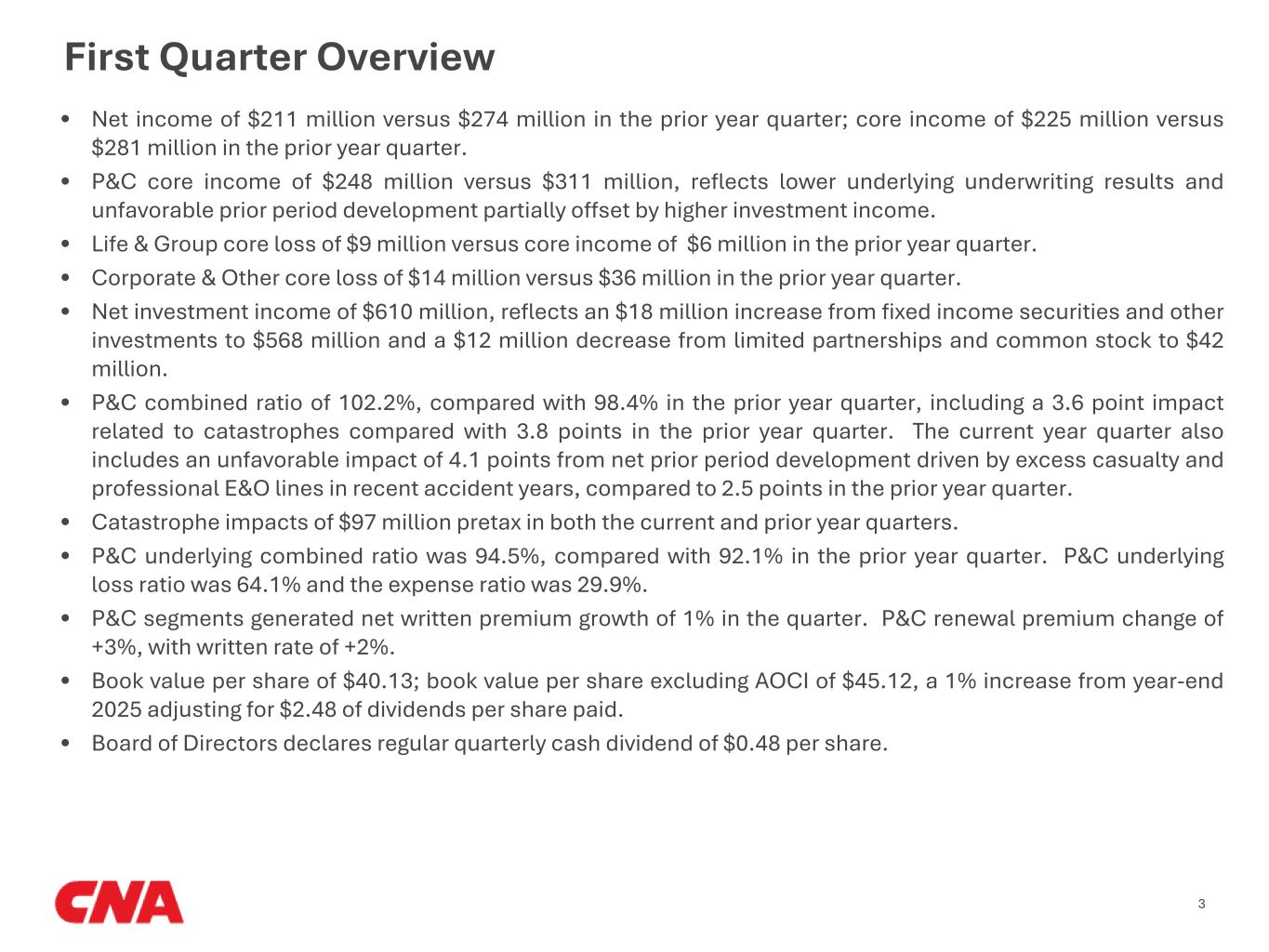
•Net income of $211 million versus $274 million in the prior year quarter; core income of $225 million versus $281 million in the prior year quarter.
•P&C core income of $248 million versus $311 million, reflects lower underlying underwriting results and unfavorable prior period development partially offset by higher net investment income.
•Life & Group core loss of $9 million versus core income of $6 million in the prior year quarter.
•Corporate & Other core loss of $14 million versus $36 million in the prior year quarter.
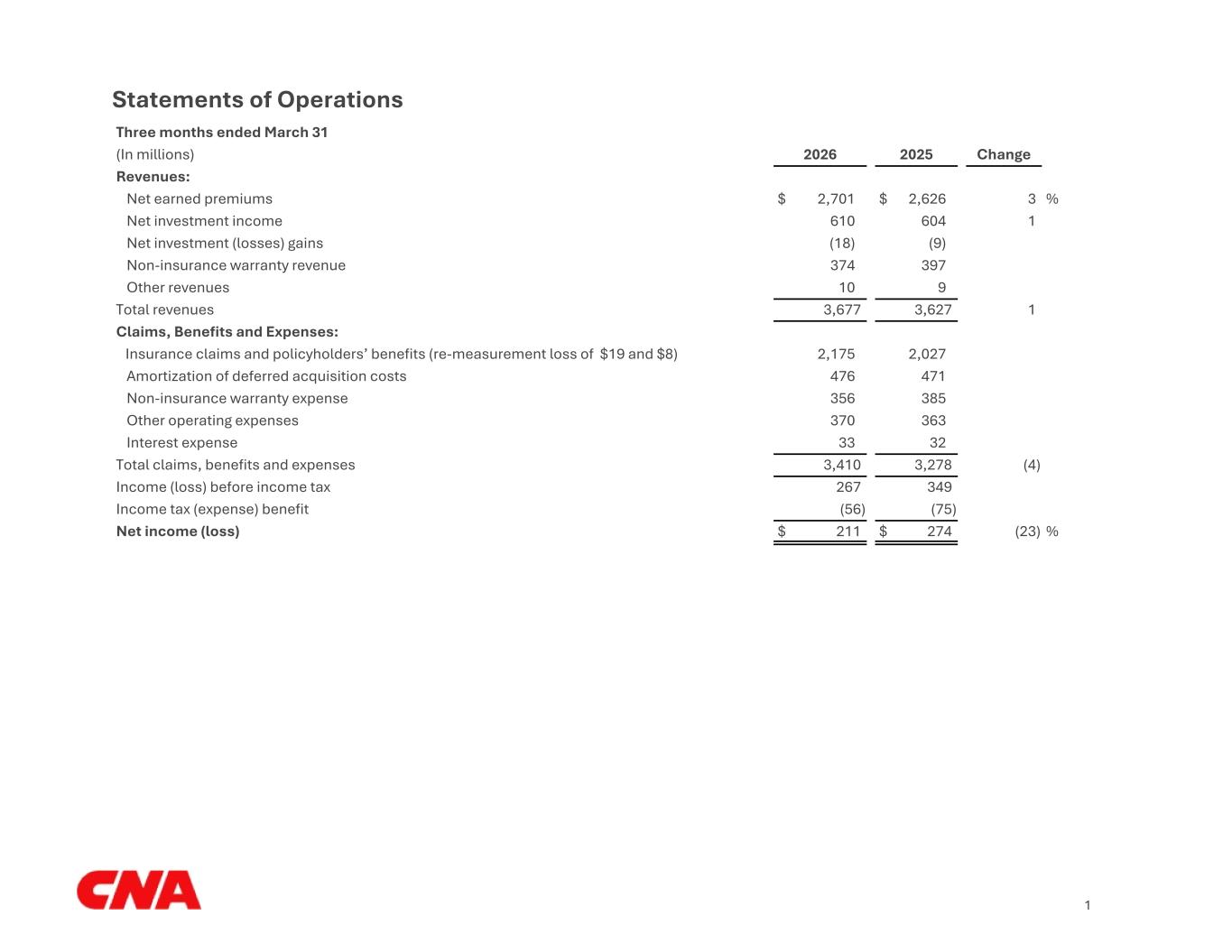
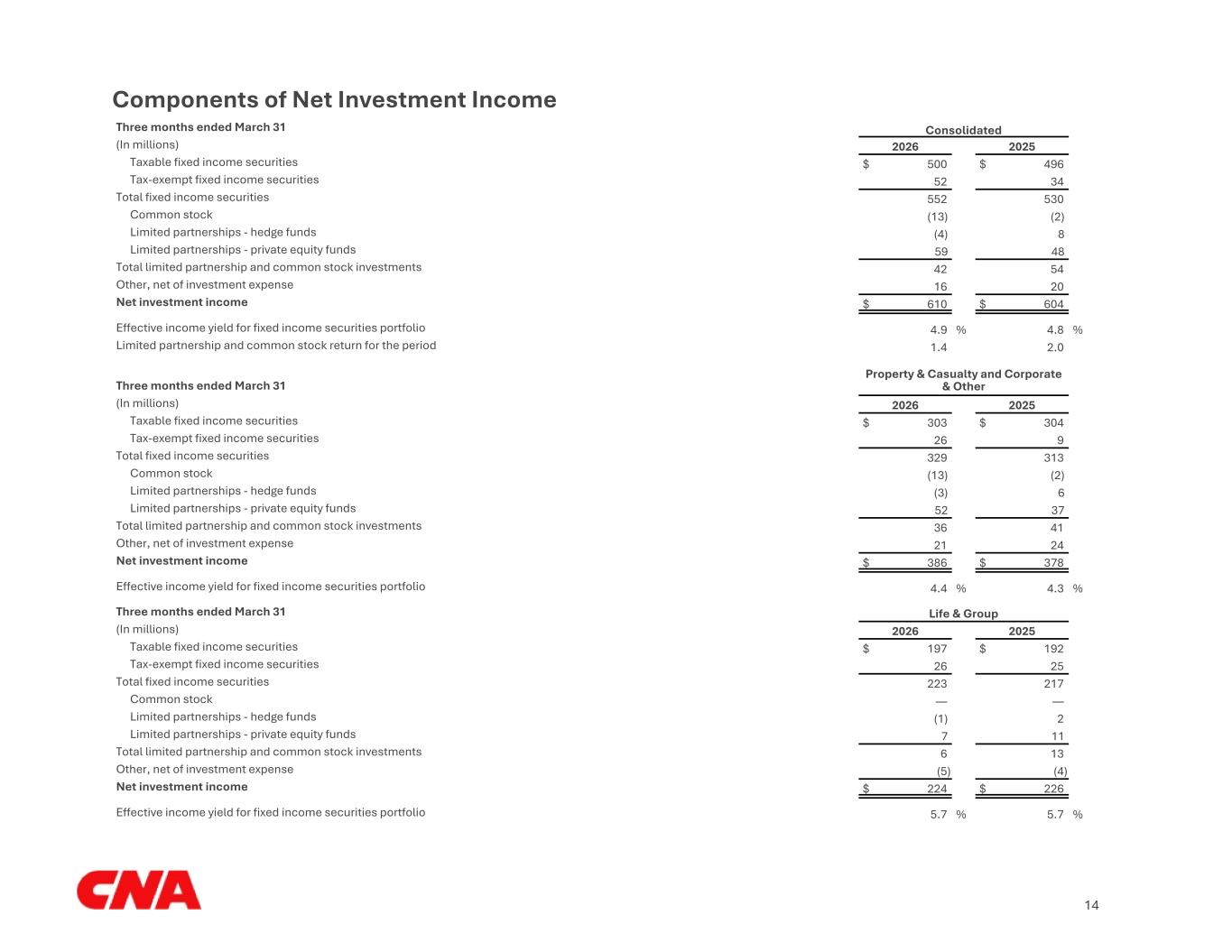
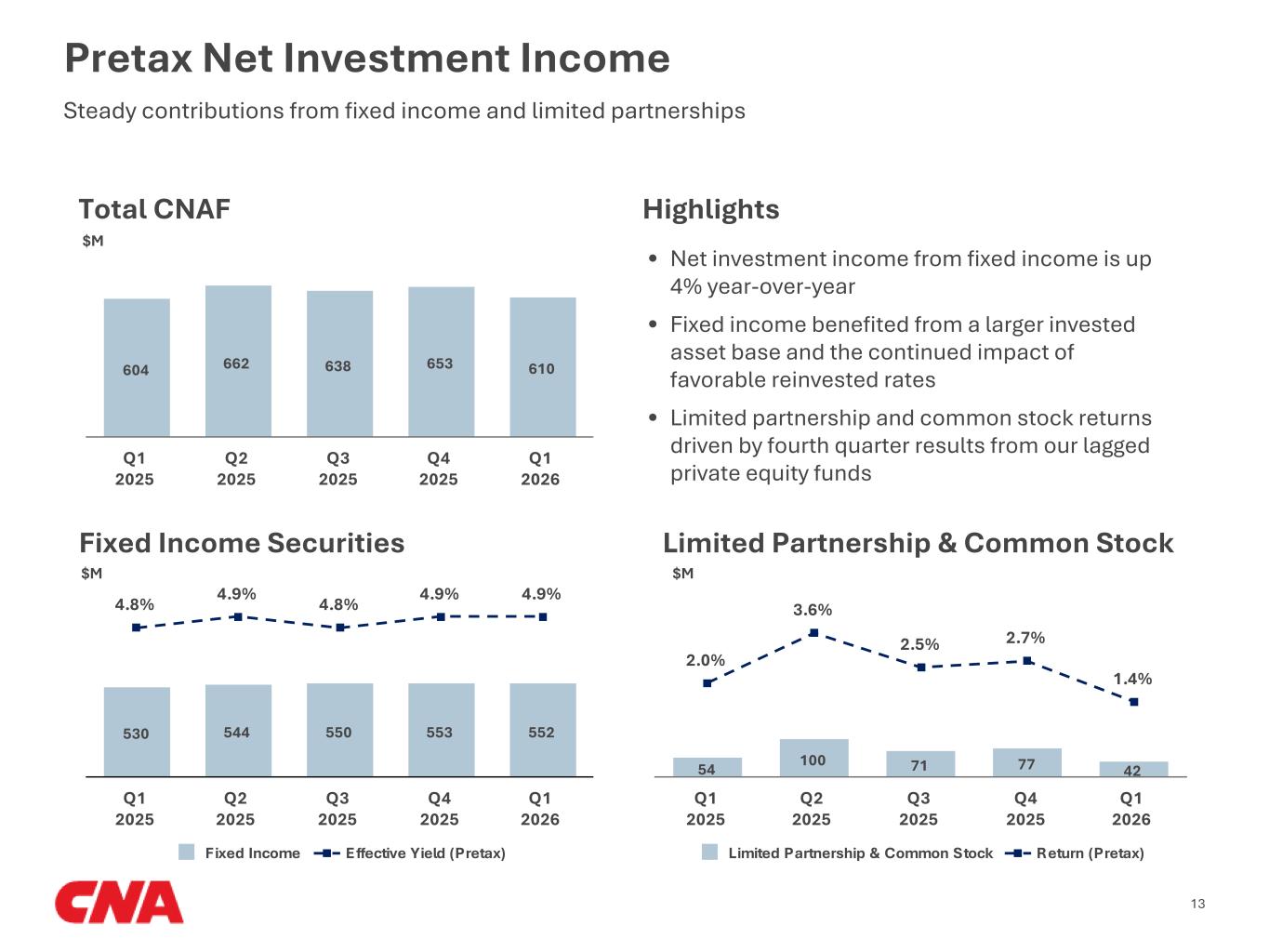
•Net investment income of $610 million, reflects an $18 million increase from fixed income securities and other investments to $568 million and a $12 million decrease from limited partnerships and common stock to $42 million.
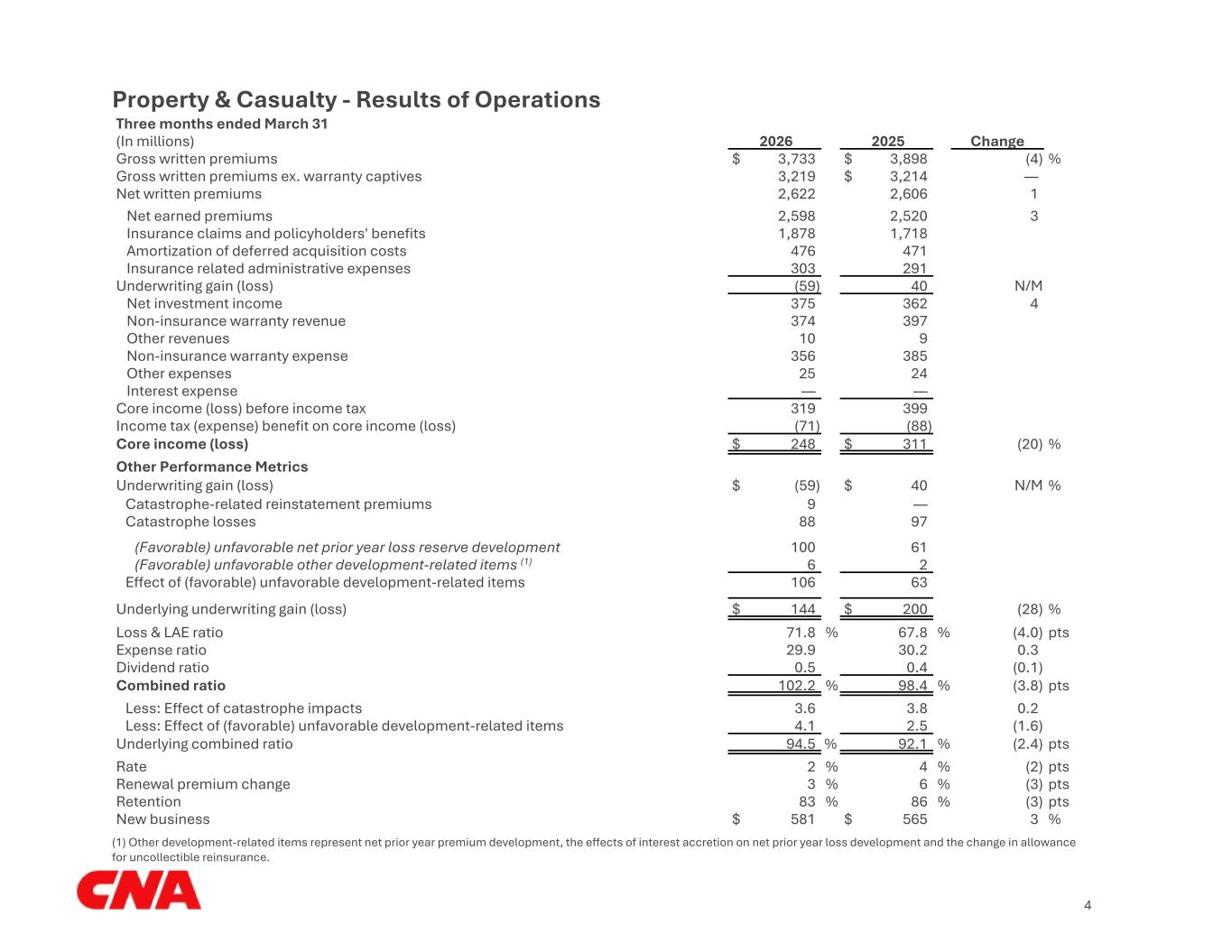
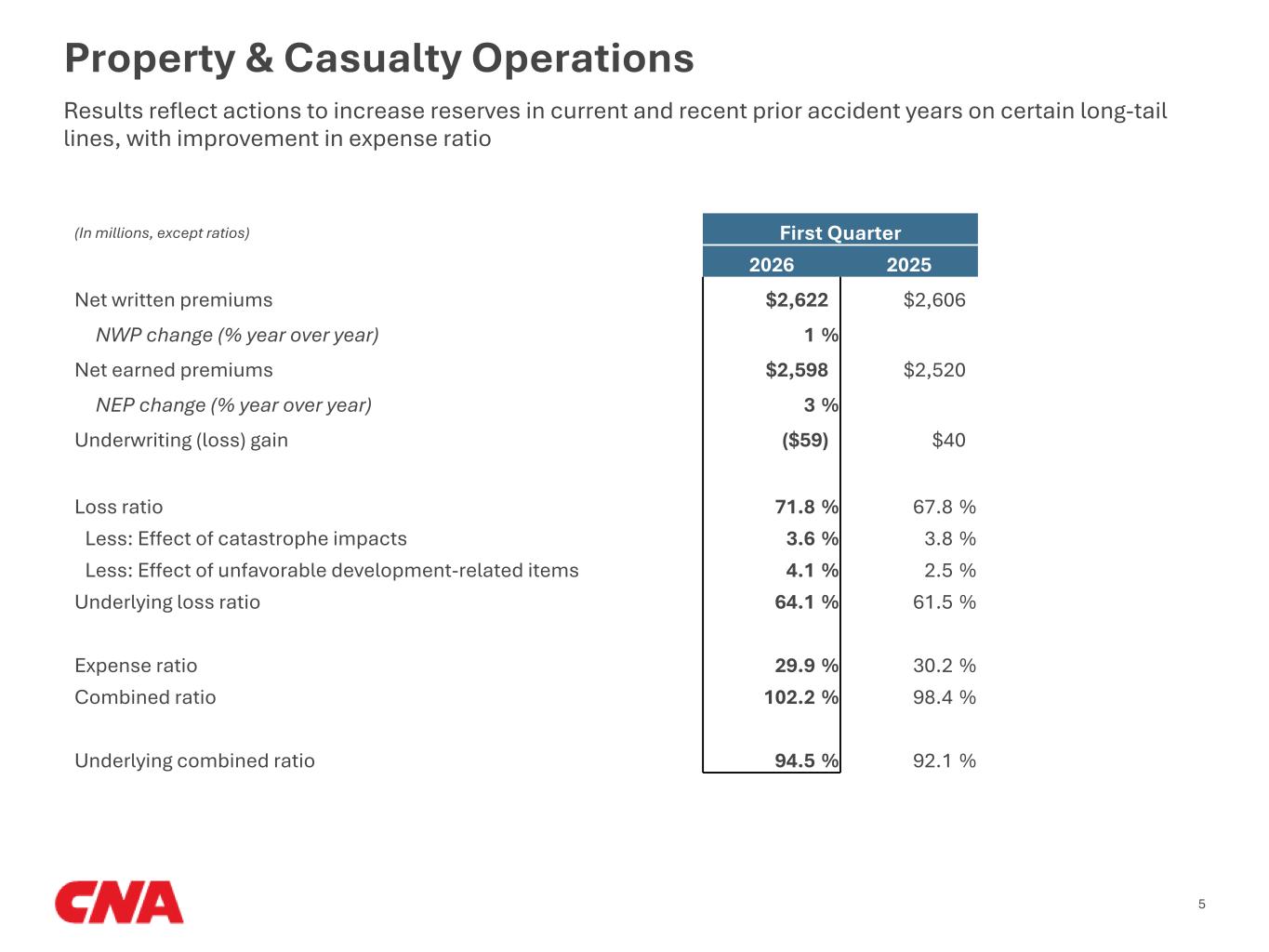
•P&C combined ratio of 102.2%, compared with 98.4% in the prior year quarter, including a 3.6 point impact related to catastrophes compared with 3.8 points in the prior year quarter. The current year quarter also includes an unfavorable impact of 4.1 points from net prior period development driven by excess casualty and professional E&O lines in recent accident years, compared to 2.5 points in the prior year quarter.
•Catastrophe impacts of $97 million pretax in both the current and prior year quarters.
•P&C underlying combined ratio was 94.5%, compared with 92.1% in the prior year quarter. P&C underlying loss ratio was 64.1% and the expense ratio was 29.9%.
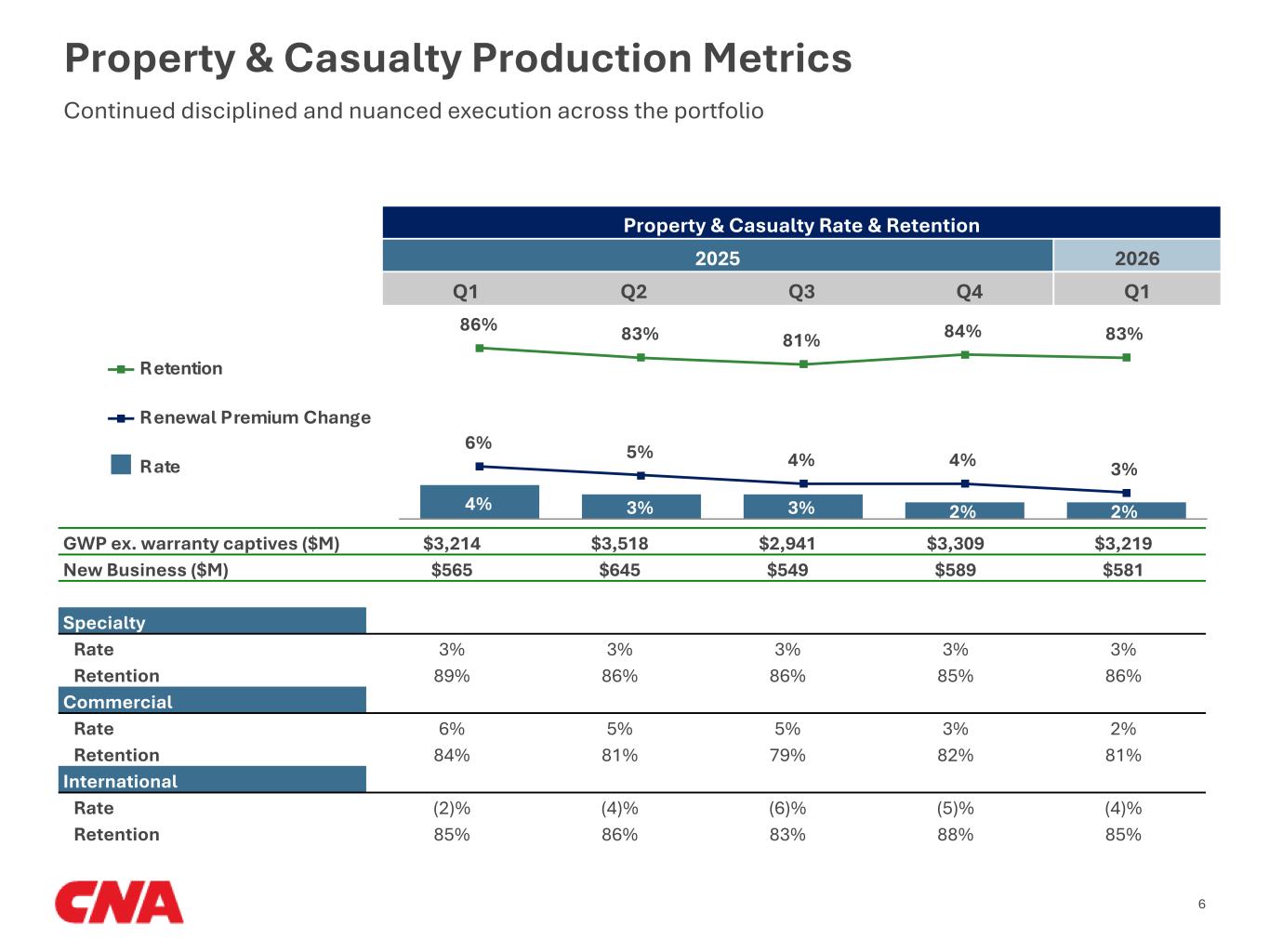
•P&C segments generated net written premium growth of 1% in the quarter. P&C renewal premium change of +3%, with written rate of +2%.
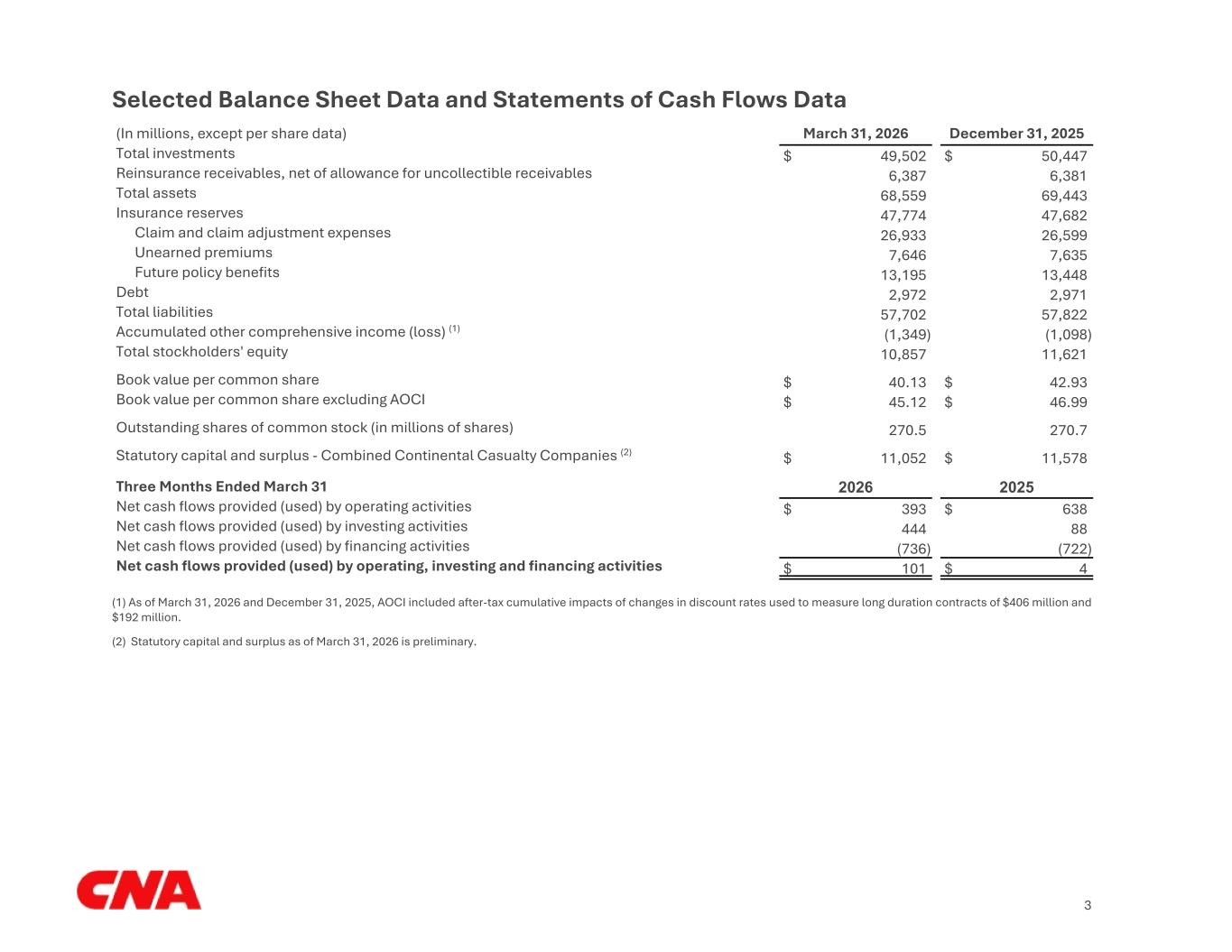
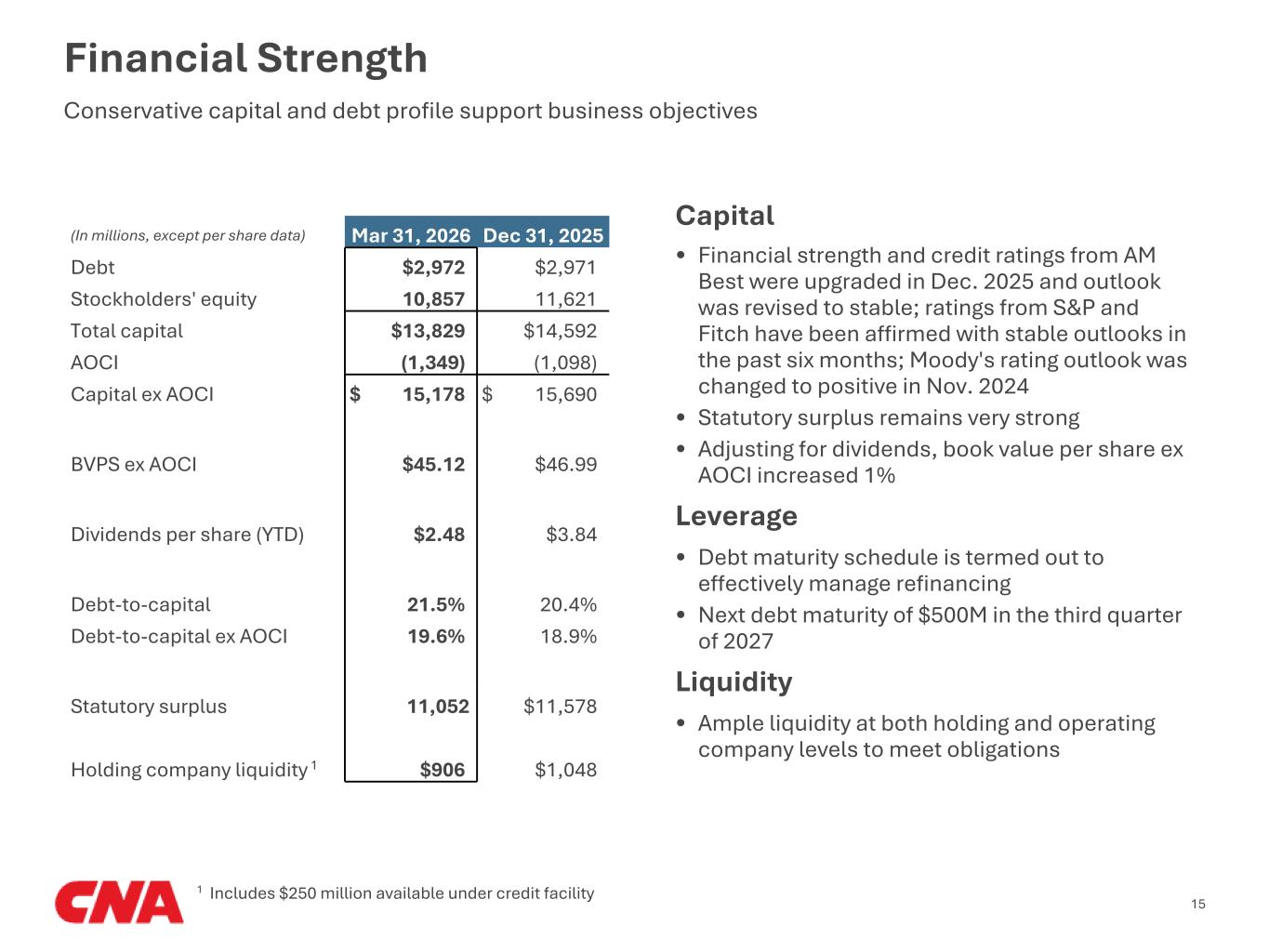
•Book value per share of $40.13; book value per share excluding AOCI of $45.12, a 1% increase from year-end 2025 adjusting for $2.48 of dividends per share paid.
•Board of Directors declares regular quarterly cash dividend of $0.48 per share.
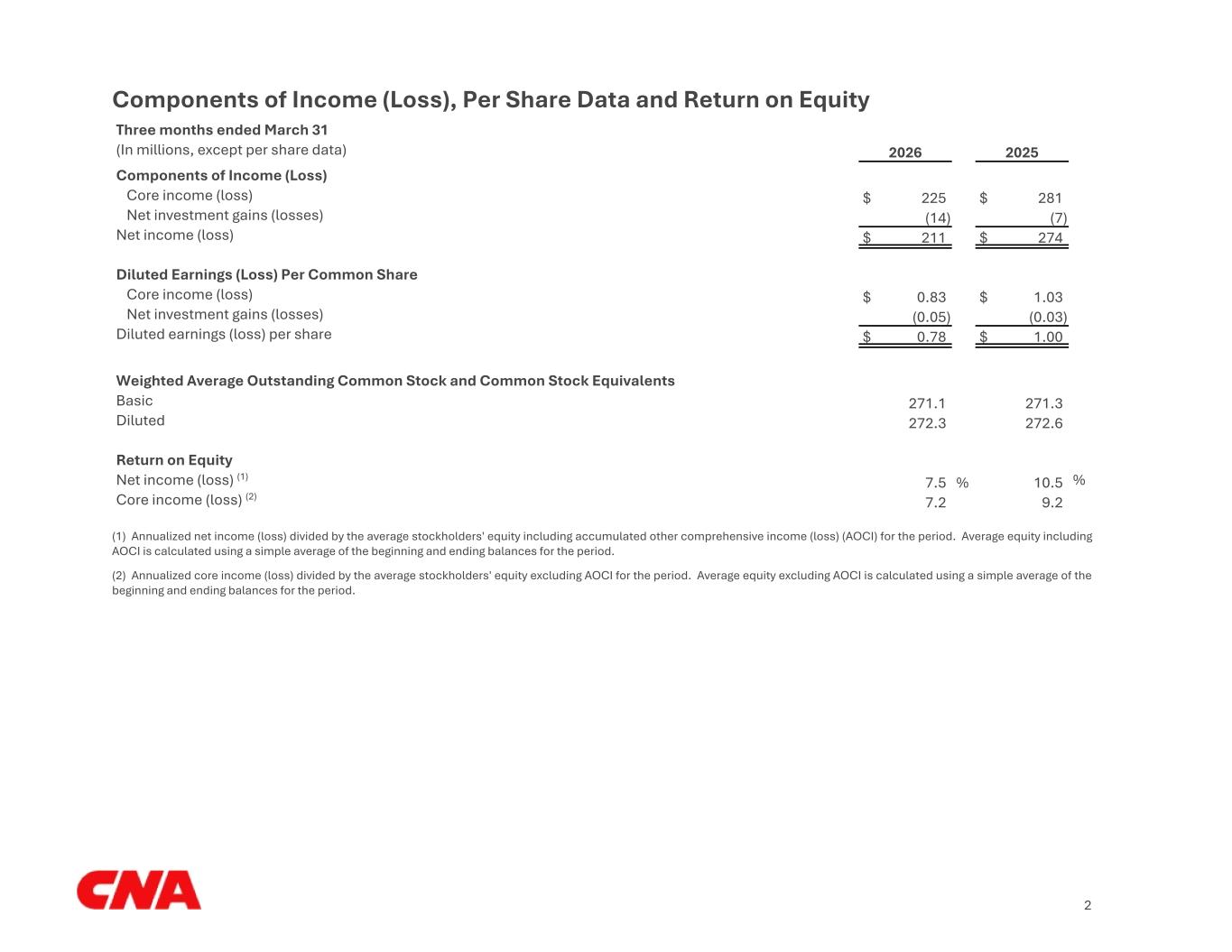
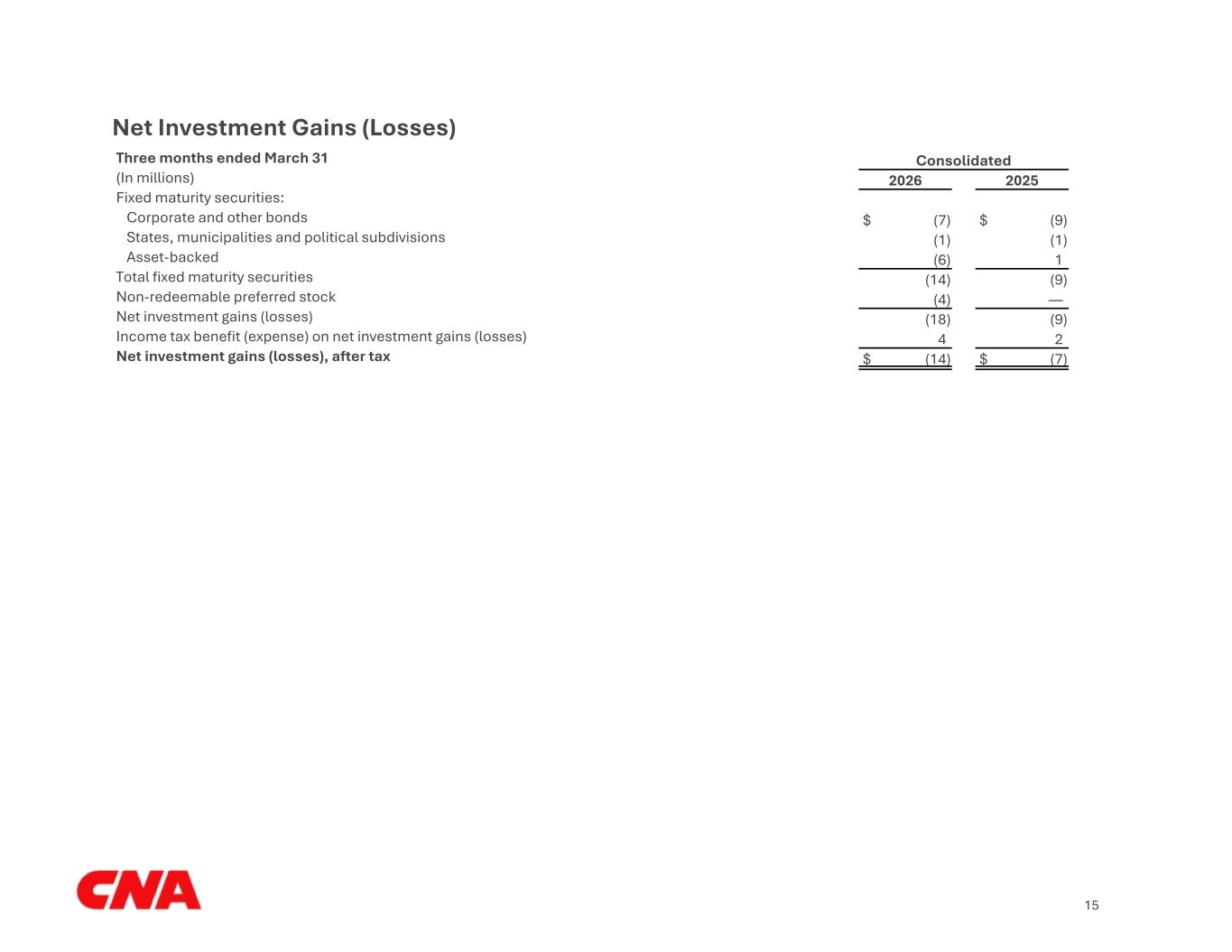
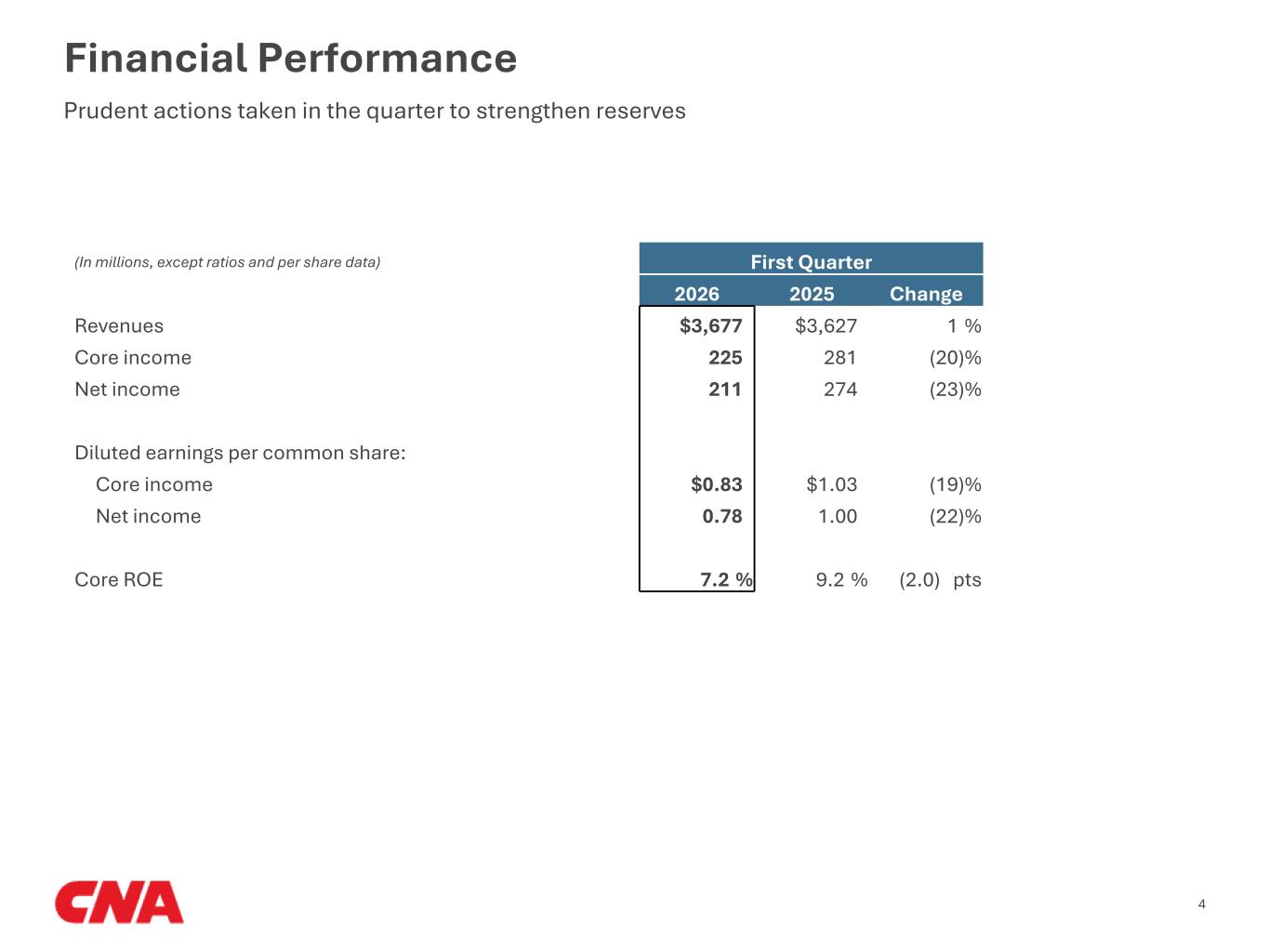
CHICAGO, May 4, 2026 --- CNA Financial Corporation (NYSE: CNA) today announced first quarter 2026 net income of $211 million, or $0.78 per share, versus $274 million, or $1.00 per share, in the prior year quarter. Net investment losses for the quarter were $14 million compared to $7 million in the prior year quarter. Core income for the quarter was $225 million, or $0.83 per share, versus $281 million, or $1.03 per share, in the prior year quarter.
Our Property & Casualty segments delivered core income of $248 million for the first quarter of 2026, a decrease of $63 million compared to the prior year quarter reflecting lower underlying underwriting results and unfavorable prior period development partially offset by higher net investment income. P&C segments generated net written premium growth of 1%.
Our Life & Group segment produced a core loss of $9 million for the first quarter of 2026 versus core income of $6 million in the prior year quarter.
Our Corporate & Other segment reported a core loss of $14 million for the first quarter of 2026 versus $36 million in the prior year quarter.
CNA Financial declared a quarterly cash dividend of $0.48 per share, payable June 4, 2026 to stockholders of record on May 18, 2026.
| | | | | | | | | | | | | | | |
| Results for the Three Months
Ended March 31 | | |
| ($ millions, except per share data) | 2026 | | 2025 | | | | |
| Net income | $ | 211 | | | $ | 274 | | | | | |
Core income (a) | 225 | | | 281 | | | | | |
| | | | | | | |
| Net income per diluted share | $ | 0.78 | | | $ | 1.00 | | | | | |
| Core income per diluted share | 0.83 | | | 1.03 | | | | | |
| | | | | | | | | | | | | | | | | |
| March 31, 2026 | | December 31, 2025 |
| Book value per share | $ | 40.13 | | $ | 42.93 |
| Book value per share excluding AOCI | | 45.12 | | | 46.99 |
(a)Management utilizes the core income (loss) financial measure to monitor the Company's operations. Please refer herein to the Reconciliation of GAAP Measures to Non-GAAP Measures section of this press release for further discussion of this non-GAAP measure.
“In the first quarter we achieved $225 million of core income buoyed by strong investment income and reinforcing our unwavering focus on underwriting discipline. The fundamentals of our business remain strong as we execute deliberate strategies to optimize our portfolio at a time when the industry is experiencing pressure on growth, rate and loss cost trends.
The P&C all-in combined ratio was 102.2% in the quarter and included 3.6 points of catastrophe impact and 4.1 points of prior period development. We took decisive action this quarter to add additional prudence to P&C reserves in recent accident years on excess casualty in Commercial and professional E&O in Specialty, which we view as fundamentally appropriate given the current environment. Our underlying loss ratio of 64.1% also reflects this additional level of prudence, and our underlying combined ratio was 94.5%.
Net written premiums grew 1% in the quarter, new business grew 3% to $581 million and retention was 83%. We grew certain pockets of our portfolio that offer accretive returns and held the line in other areas we felt the market is not supporting an acceptable level of return.
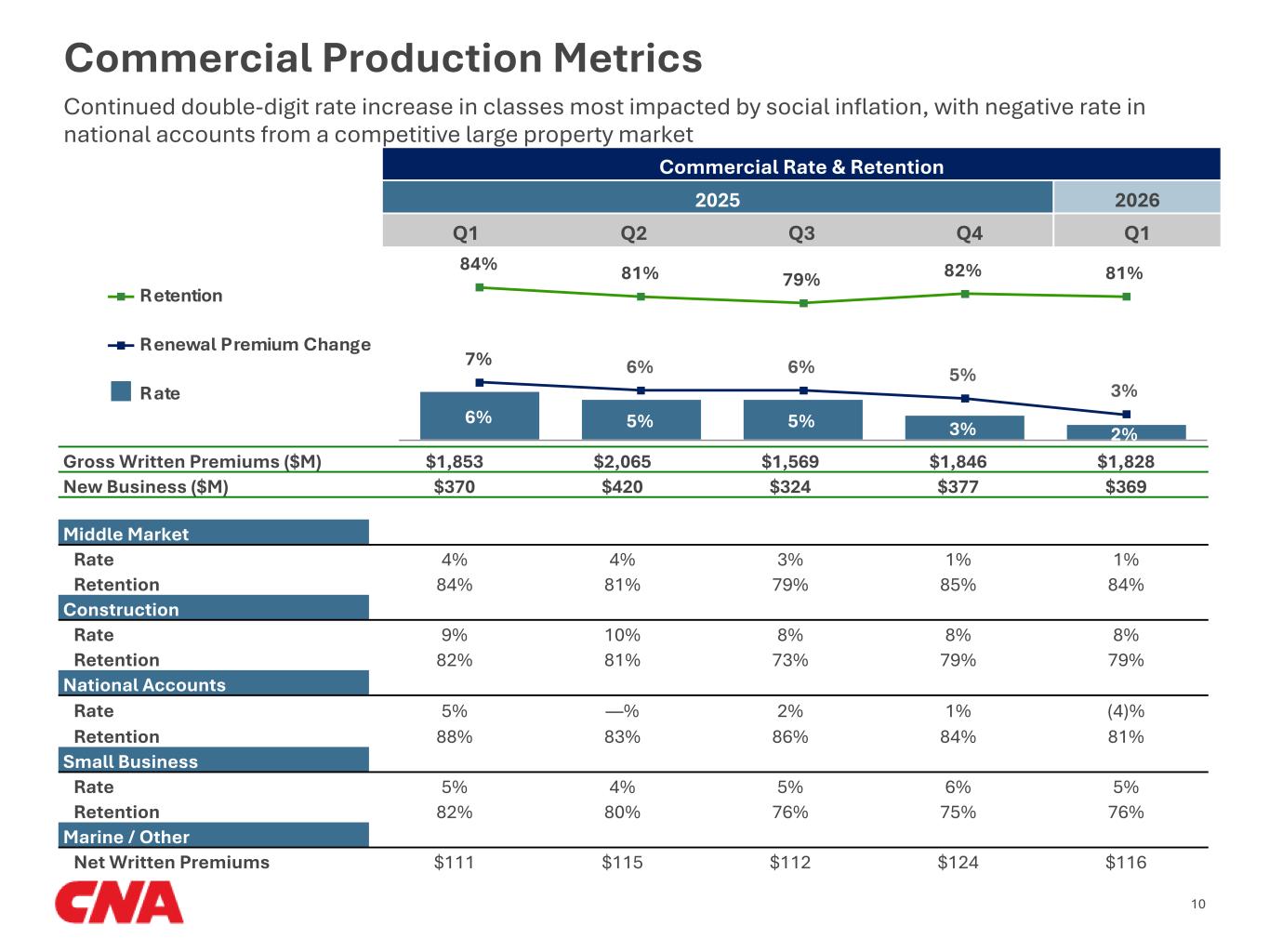
Rate increase was 2% while renewal premium change was up 3% reflecting significant differentiation by business unit and class. For example, we continue to achieve double-digit rate increase in social inflation impacted classes of business, while national accounts property was down double-digit due to the competitive environment in that space.
Looking ahead to the rest of the year, we will continue to operate with confidence and prioritize underwriting discipline. We remain committed to executing in the marketplace as we implement specialized underwriting strategies to achieve profitable growth while maintaining the strength of our balance sheet in the current environment,” said Douglas M. Worman, Chairman & Chief Executive Officer of CNA Financial Corporation.
Property & Casualty Operations
| | | | | | | | | | | | | | | | | | | | | | |
| | | Results for the Three Months Ended March 31 |
| ($ millions) | | | | | | 2026 | | 2025 |
| | | | | | | | | | |
| | | | | | | | | | |
| Net written premiums | | | | | | $ | 2,622 | | | | $ | 2,606 | | |
| NWP change (% year over year) | | | | | | 1 | | % | | | |
| Net earned premiums | | | | | | $ | 2,598 | | | | $ | 2,520 | | |
| NEP change (% year over year) | | | | | | 3 | | % | | | |
| Underwriting (loss) gain | | | | | | $ | (59) | | | | $ | 40 | | |
| Net investment income | | | | | | $ | 375 | | | | $ | 362 | | |
| Core income | | | | | | $ | 248 | | | | $ | 311 | | |
| | | | | | | | | | |
| Loss ratio | | | | | | 71.8 | | % | | 67.8 | | % |
| Less: Effect of catastrophe impacts | | | | | | 3.6 | | | | 3.8 | | |
| Less: Effect of unfavorable development-related items | | | | | | 4.1 | | | | 2.5 | | |
| Underlying loss ratio | | | | | | 64.1 | | % | | 61.5 | | % |
| | | | | | | | | | |
| Expense ratio | | | | | | 29.9 | | % | | 30.2 | | % |
| | | | | | | | | | |
| Combined ratio | | | | | | 102.2 | | % | | 98.4 | | % |
| Underlying combined ratio | | | | | | 94.5 | | % | | 92.1 | | % |
•The underlying combined ratio increased 2.4 points as compared with the prior year quarter, primarily the result of a 2.6 point increase in the underlying loss ratio to 64.1%, with increases across each segment. The expense ratio improved 0.3 points compared with the prior year quarter.
•The combined ratio increased 3.8 points as compared with the prior year quarter. Unfavorable net prior period development in the Specialty and Commercial segments increased the loss ratio by 4.1 points in the current quarter compared to 2.5 points in the prior year quarter. Catastrophe impacts were $97 million in the quarter, inclusive of $9 million of catastrophe-related reinsurance reinstatement premiums, compared with $97 million for the prior year quarter. The effect of catastrophe impacts on the loss ratio was 3.6 points in the quarter compared with 3.8 points for the prior year quarter.
Business Operating Highlights
Specialty
| | | | | | | | | | | | | | | | | | | | | | |
| | | | Results for the Three Months Ended March 31 |
| ($ millions) | | | | | | 2026 | | 2025 |
| | | | | | | | | | |
| | | | | | | | | | |
| Net written premiums | | | | | | $ | 834 | | | | $ | 842 | | |
| NWP change (% year over year) | | | | | | (1) | | % | | | |
| Net earned premiums | | | | | | $ | 852 | | | | $ | 830 | | |
| NEP change (% year over year) | | | | | | 3 | | % | | | |
| | | | | | | | | | |
| | | | | | | | | | |
| Underwriting (loss) gain | | | | | | $ | (24) | | | | $ | 42 | | |
| | | | | | | | | | |
| Loss ratio | | | | | | 68.7 | | % | | 61.4 | | % |
| Less: Effect of catastrophe impacts | | | | | | — | | | | — | | |
| Less: Effect of unfavorable development-related items | | | | | | 5.9 | | | | 1.3 | | |
| Underlying loss ratio | | | | | | 62.8 | | % | | 60.1 | | % |
| | | | | | | | | | |
| Expense ratio | | | | | | 33.6 | | % | | 33.4 | | % |
| | | | | | | | | | |
| Combined ratio | | | | | | 102.7 | | % | | 95.1 | | % |
| Underlying combined ratio | | | | | | 96.8 | | % | | 93.8 | | % |
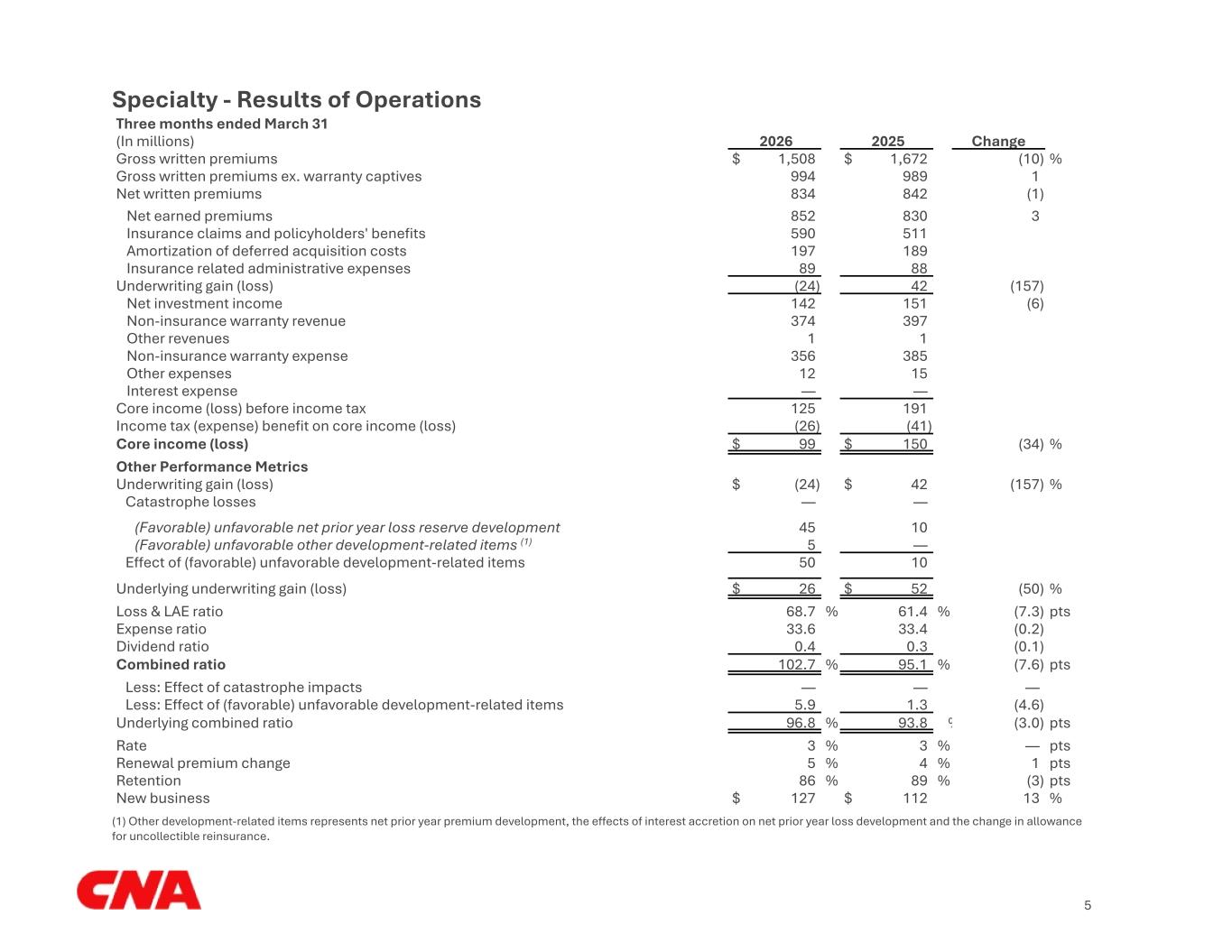
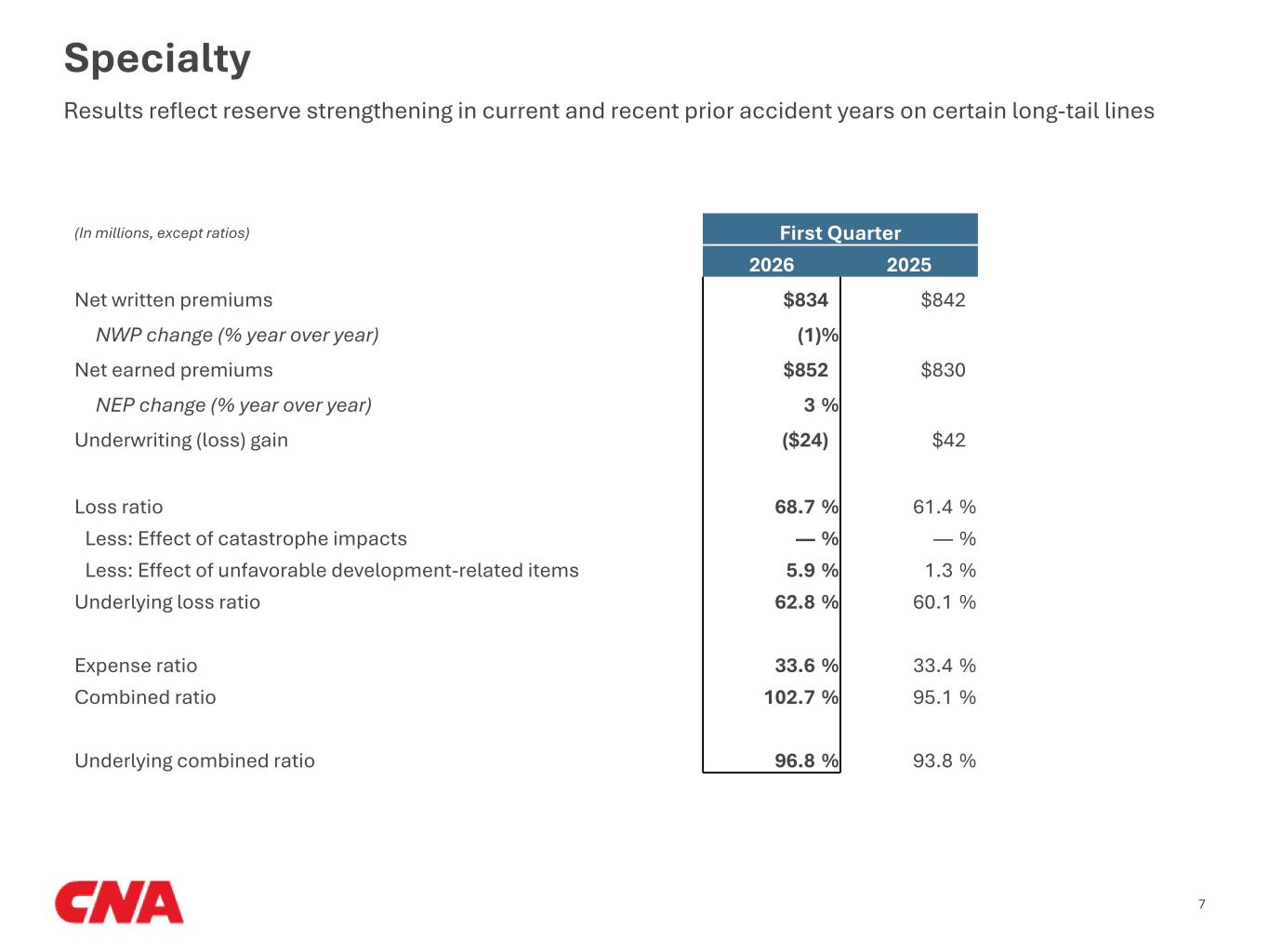
•The underlying combined ratio increased 3.0 points as compared with the prior year quarter. The underlying loss ratio increased 2.7 points as compared with the prior year quarter reflecting loss cost trends exceeding rate for certain lines in recent quarters. The expense ratio increased 0.2 points as compared with the prior year quarter.
•The combined ratio increased 7.6 points as compared with the prior year quarter. Unfavorable net prior period development, driven by professional errors & omissions (E&O) business in recent accident years, increased the loss ratio by 5.9 points in the current quarter as compared with 1.3 points in the prior year quarter.
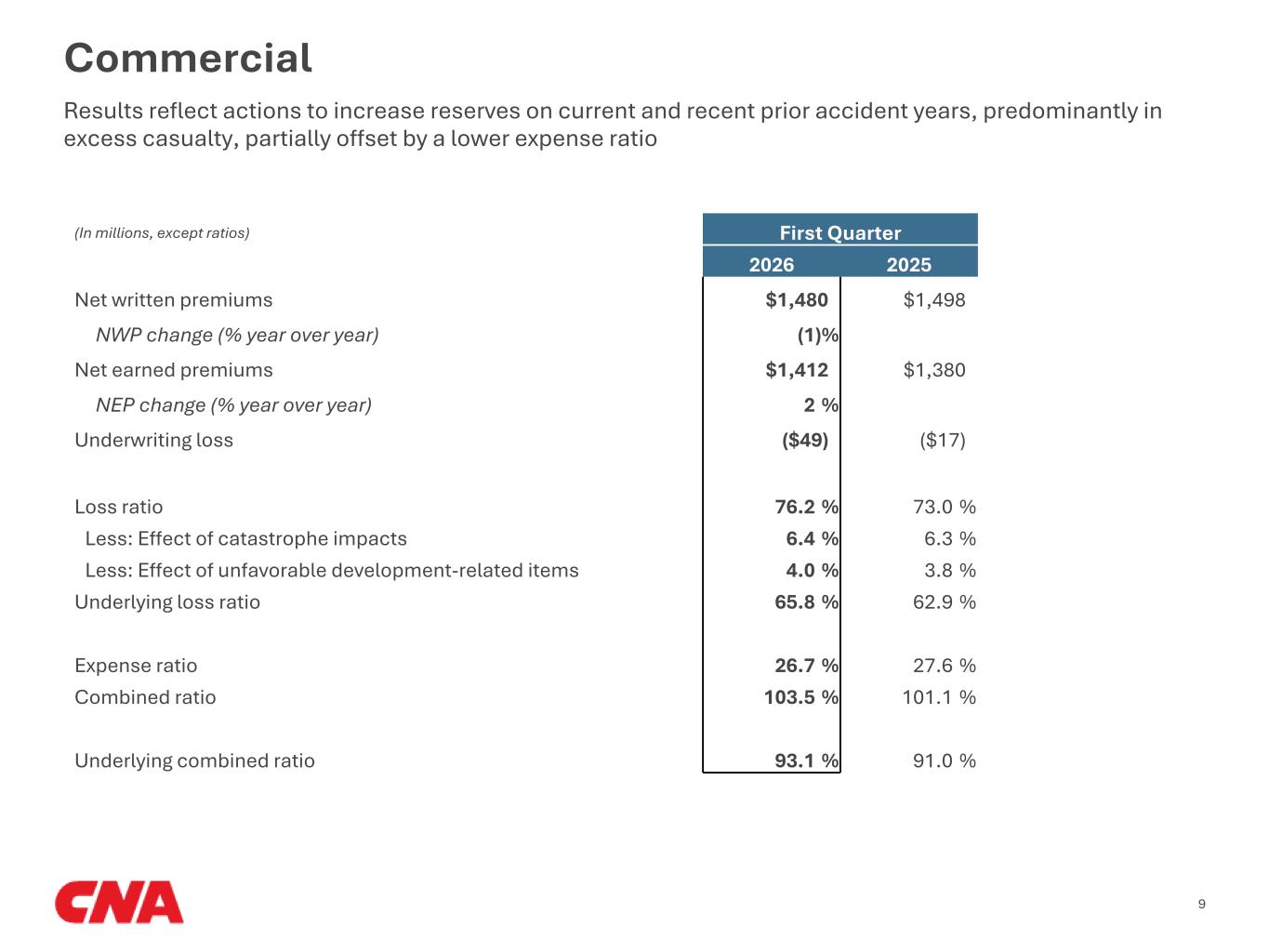
Commercial
| | | | | | | | | | | | | | | | | | | | | | |
| | | | Results for the Three Months Ended March 31 |
| ($ millions) | | | | | | 2026 | | 2025 |
| | | | | | | | | | |
| | | | | | | | | | |
| Net written premiums | | | | | | $ | 1,480 | | | | $ | 1,498 | | |
| NWP change (% year over year) | | | | | | (1) | | % | | | |
| Net earned premiums | | | | | | $ | 1,412 | | | | $ | 1,380 | | |
| NEP change (% year over year) | | | | | | 2 | | % | | | |
| | | | | | | | | | |
| | | | | | | | | | |
| Underwriting loss | | | | | | $ | (49) | | | | $ | (17) | | |
| | | | | | | | | | |
| Loss ratio | | | | | | 76.2 | | % | | 73.0 | | % |
| Less: Effect of catastrophe impacts | | | | | | 6.4 | | | | 6.3 | | |
| Less: Effect of unfavorable development-related items | | | | | | 4.0 | | | | 3.8 | | |
| Underlying loss ratio | | | | | | 65.8 | | % | | 62.9 | | % |
| | | | | | | | | | |
| Expense ratio | | | | | | 26.7 | | % | | 27.6 | | % |
| | | | | | | | | | |
| Combined ratio | | | | | | 103.5 | | % | | 101.1 | | % |
| Underlying combined ratio | | | | | | 93.1 | | % | | 91.0 | | % |
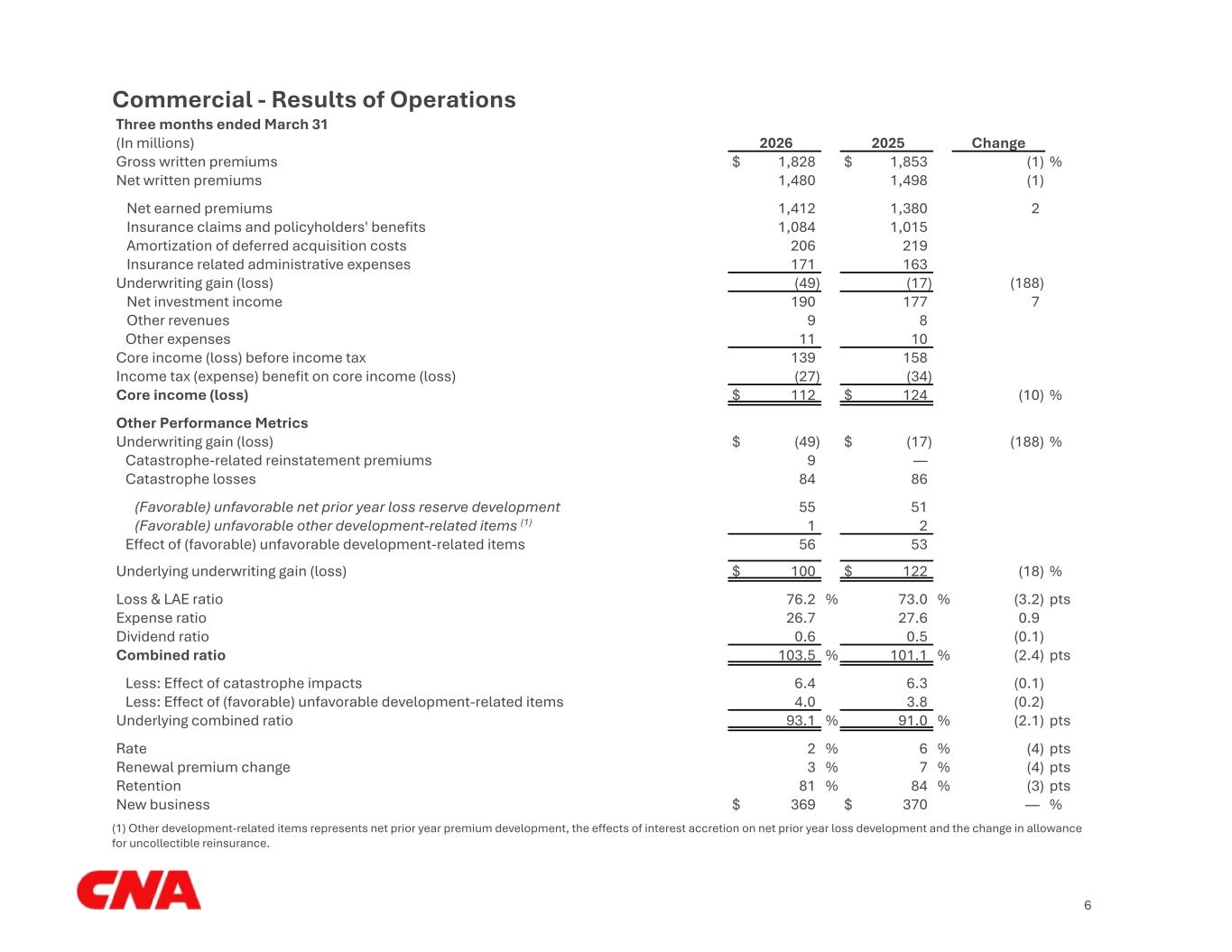
•The underlying combined ratio increased 2.1 points as compared with the prior year quarter. The underlying loss ratio increased 2.9 points compared with the prior year quarter as a result of increases in excess casualty and workers' compensation. The expense ratio improved 0.9 points primarily due to a favorable acquisition ratio.
•The combined ratio increased 2.4 points as compared with the prior year quarter. Unfavorable net prior period development, driven by excess casualty in recent accident years, increased the loss ratio by 4.0 points in the current quarter compared with 3.8 points in the prior year quarter. Catastrophe impacts were $93 million in the quarter, inclusive of $9 million of catastrophe-related reinsurance reinstatement premiums, compared with $86 million for the prior year quarter. The effect of catastrophe impacts on the loss ratio was 6.4 points in the quarter compared with 6.3 points for the prior year quarter.
International
| | | | | | | | | | | | | | | | | | | | | | |
| | | | Results for the Three Months Ended March 31 |
| ($ millions) | | | | | | 2026 | | 2025 |
| | | | | | | | | | |
| | | | | | | | | | |
| Net written premiums | | | | | | $ | 308 | | | | $ | 266 | | |
| NWP change (% year over year) | | | | | | 16 | | % | | | |
| Net earned premiums | | | | | | $ | 334 | | | | $ | 310 | | |
| NEP change (% year over year) | | | | | | 8 | | % | | | |
| | | | | | | | | | |
| | | | | | | | | | |
| Underwriting gain | | | | | | $ | 14 | | | | $ | 15 | | |
| | | | | | | | | | |
| Loss ratio | | | | | | 61.0 | | % | | 62.1 | | % |
| Less: Effect of catastrophe impacts | | | | | | 1.2 | | | | 3.6 | | |
| Less: Effect of (favorable) unfavorable development-related items | | | | | | — | | | | — | | |
| Underlying loss ratio | | | | | | 59.8 | | % | | 58.5 | | % |
| | | | | | | | | | |
| Expense ratio | | | | | | 34.9 | | % | | 33.3 | | % |
| | | | | | | | | | |
| Combined ratio | | | | | | 95.9 | | % | | 95.4 | | % |
| Underlying combined ratio | | | | | | 94.7 | | % | | 91.8 | | % |
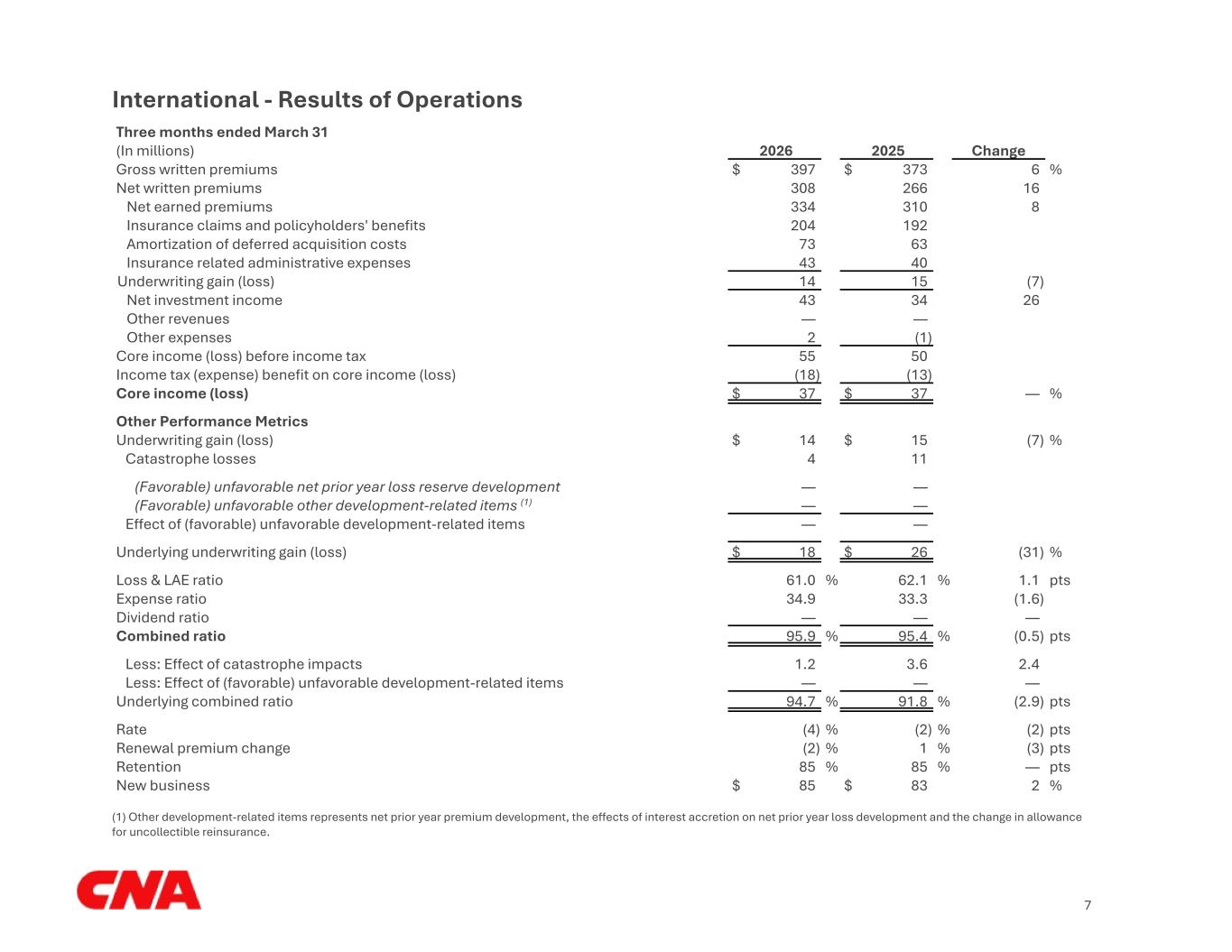
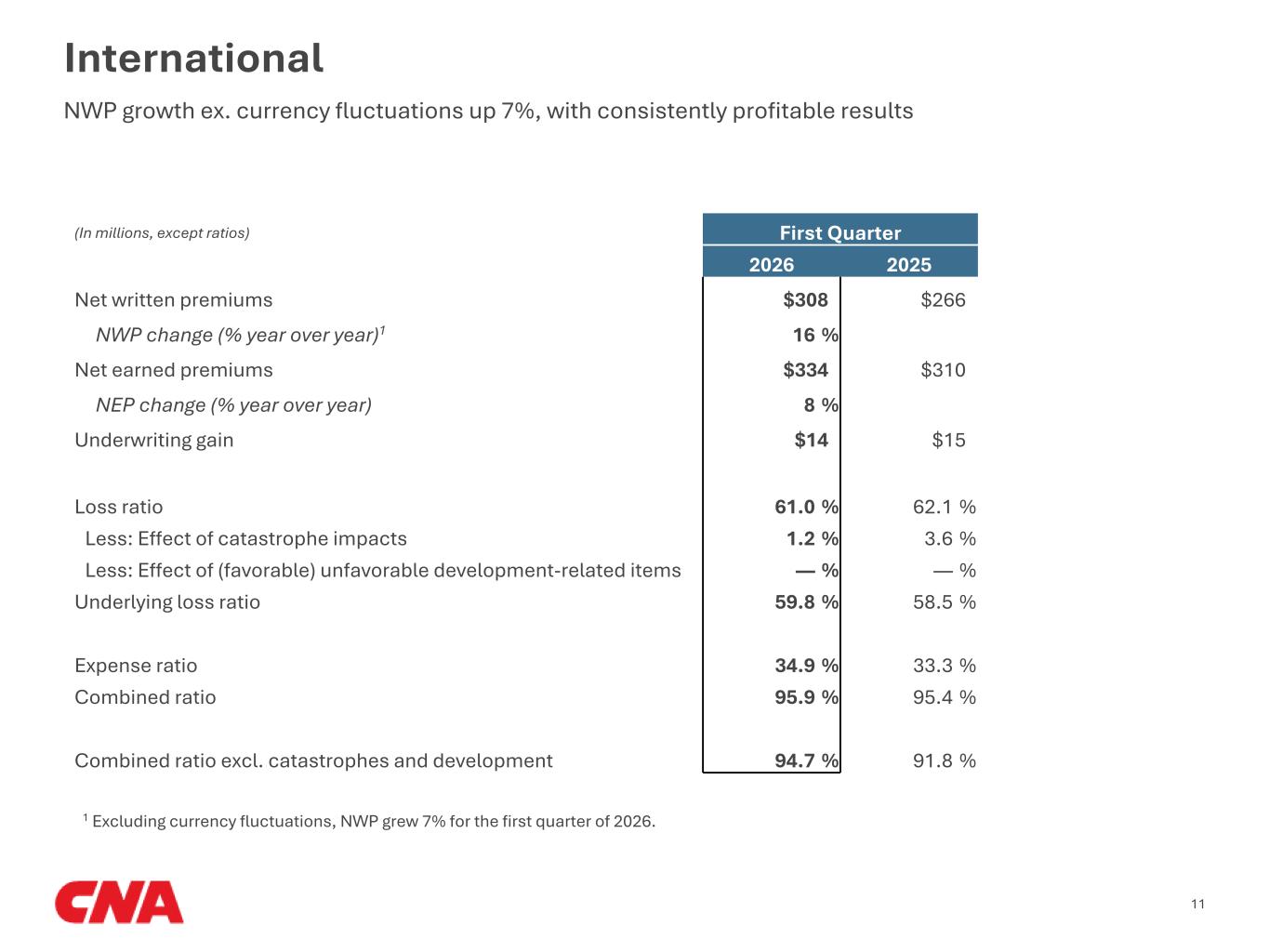
•The underlying combined ratio increased 2.9 points as compared with the prior year quarter. The expense ratio increased 1.6 points attributed to higher employee related costs and acquisition costs partially offset by net earned premium growth of 8%. The underlying loss ratio increased 1.3 points as compared with the prior year quarter driven by continued pricing pressure.
•The combined ratio increased 0.5 points as compared with the prior year quarter. Catastrophe losses were $4 million, or 1.2 points of the loss ratio in the quarter compared with $11 million or 3.6 points of the loss ratio, for the prior year quarter.
•Excluding currency fluctuations, net written premiums grew 7% for the first quarter of 2026.
Life & Group
| | | | | | | | | | | | | | | | | | | | | | | |
| | | Results for the Three Months Ended March 31 |
| ($ millions) | | | | | | | 2026 | | 2025 |
| Net earned premiums | | | | | | | $ | 103 | | | | $ | 106 | | |
| Claims, benefits and expenses | | | | | | | 344 | | | | 330 | | |
| | | | | | | | | | | |
| | | | | | | | | | | |
| Net investment income | | | | | | | $ | 224 | | | | $ | 226 | | |
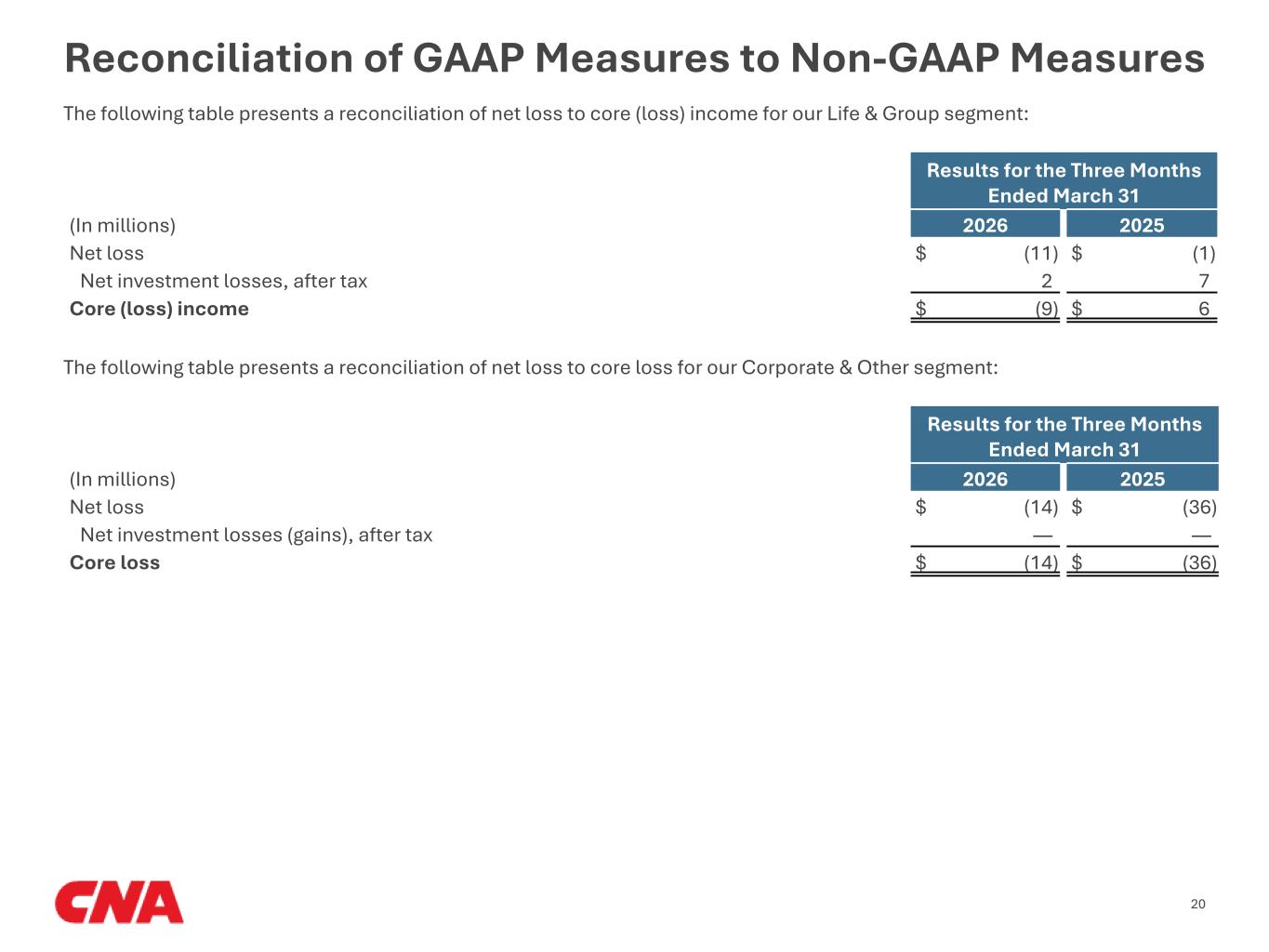
| Core (loss) income | | | | | | | $ | (9) | | | | $ | 6 | | |
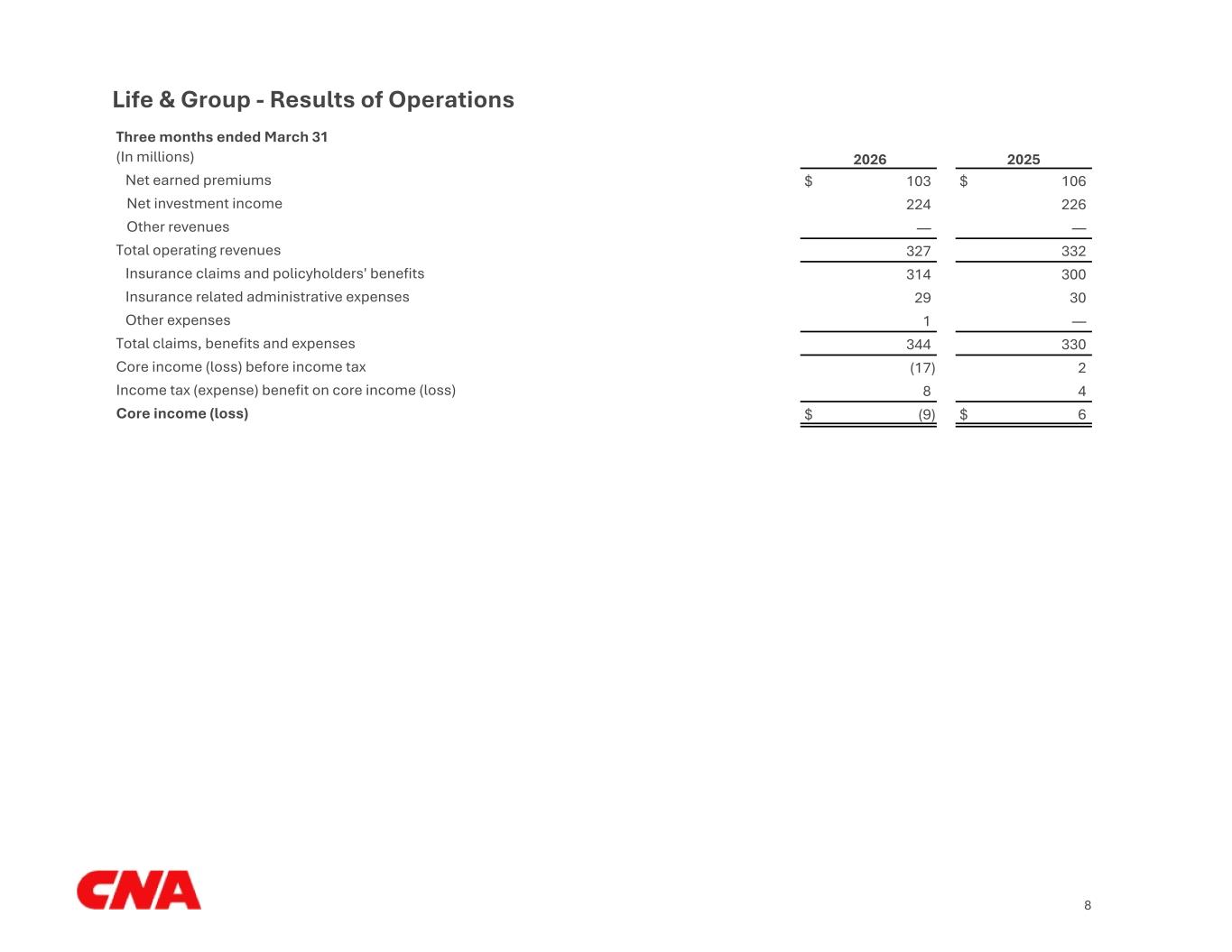
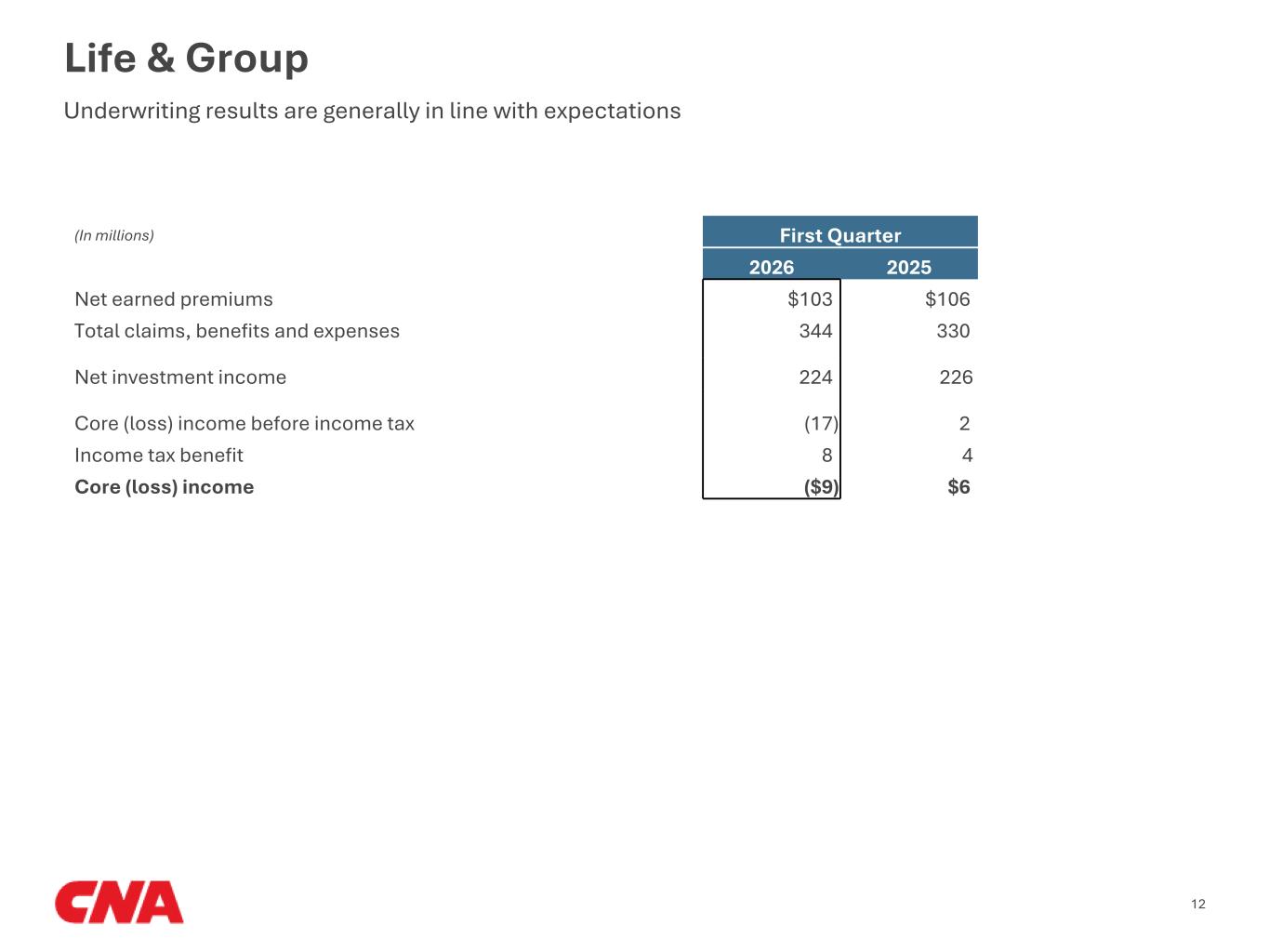
Core results decreased $15 million for the first quarter of 2026 as compared with the prior year quarter. Results for the current year quarter reflect unfavorable morbidity partially offset by favorable persistency. Results for the prior year quarter reflected favorable persistency.
Corporate & Other
| | | | | | | | | | | | | | | | | | | | | | |
| | | Results for the Three Months Ended March 31 |
| ($ millions) | | | | | | 2026 | | 2025 |
| Insurance claims and policyholders' benefits | | | | | | $ | (17) | | | | $ | 9 | | |
| Interest expense | | | | | | 33 | | | | 32 | | |
| Net investment income | | | | | | 11 | | | | 16 | | |
| Core loss | | | | | | (14) | | | | (36) | | |
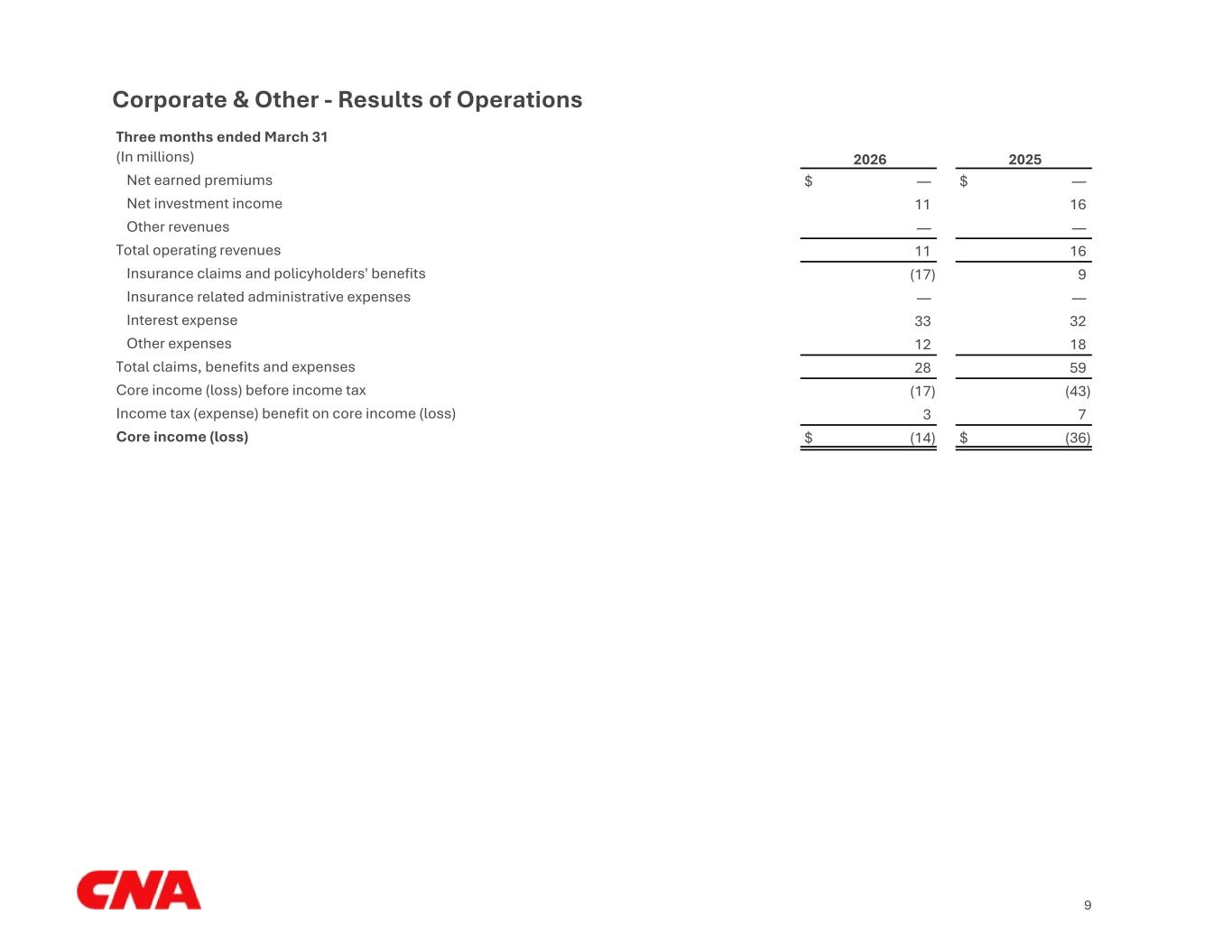
Core loss improved $22 million for the first quarter of 2026 as compared with the prior year quarter. There was no prior period development in the current year quarter compared to a $17 million after-tax charge in the prior year quarter related to unfavorable prior period development associated with legacy mass tort.
Net Investment Income
| | | | | | | | | | | | | | | | | | | | | | |
| | | Results for the Three Months Ended March 31 |
| | | | | | 2026 | | 2025 |
| Fixed income securities and other | | | | | | $ | 568 | | | | $ | 550 | | |
| Limited partnership and common stock investments | | | | | | 42 | | | | 54 | | |
| Net investment income | | | | | | $ | 610 | | | | $ | 604 | | |
Net investment income increased $6 million for the first quarter of 2026. The increase was driven by higher income from fixed income securities as a result of a larger invested asset base and favorable reinvestment rates partially offset by lower common stock returns.
Stockholders' Equity
Stockholders’ equity of $10.9 billion decreased 7% from year-end 2025, primarily due to dividends paid to stockholders and an increase in net unrealized investment losses partially offset by net income.
Book value per share ex AOCI of $45.12 increased 1% from year-end 2025 adjusting for $2.48 of dividends per share.
As of March 31, 2026, statutory capital and surplus for the Combined Continental Casualty Companies was $11.1 billion.
About the Company
CNA is one of the largest U.S. commercial property and casualty insurance companies. Backed by more than 125 years of experience, CNA provides a broad range of standard and specialized insurance products and services for businesses and professionals in the U.S., Canada and Europe. For more information, please visit CNA at cna.com.
Contacts
| | | | | | | | |
| Media: | | Analysts: |
Kelly Messina | Vice President, Marketing | | Ralitza K. Todorova | Vice President, Investor Relations & Rating Agencies |
| 872-817-0350 | | 312-822-3834 |
Earnings Remarks & Materials
A transcript of earnings remarks will be available on CNA's website at cna.com via the Investor Relations section. Remarks will include commentary from the Company's Chairman and Chief Executive Officer, Douglas M. Worman, and Chief Financial Officer, Scott R. Lindquist. An earnings presentation and financial supplement information related to the results will also be posted and available on the CNA website.
Definition of Reported Segments
•Specialty provides management and professional liability and other coverages through property and casualty products and services using a network of retail and wholesale brokers, independent agencies and managing general underwriters.
•Commercial works with a network of retail and wholesale brokers and independent agents to market a broad range of property and casualty insurance products to all types of insureds targeting small business, construction, middle market and other commercial customers.
•International underwrites property and casualty coverages on a global basis through a branch operation in Canada, a European business consisting of insurance companies based in the U.K. and Luxembourg and Hardy, our Lloyd's Syndicate.
•Life & Group includes the individual and group run-off long-term care businesses as well as structured settlement obligations not funded by annuities related to certain property and casualty claimants.
•Corporate & Other primarily includes certain corporate expenses, including interest on corporate debt, and the results of certain property and casualty business in run-off, including asbestos and environmental pollution (A&EP), a legacy portfolio of excess workers' compensation (EWC) policies and legacy mass tort reserves.
Financial Measures
Management utilizes the following metrics in their evaluation of the Property & Casualty Operations.
These ratios are calculated using financial results prepared in accordance with accounting principles generally accepted in the United States of America (GAAP).
•Loss ratio is the percentage of net incurred claim and claim adjustment expenses to net earned premiums.
•Underlying loss ratio represents the loss ratio excluding catastrophe-related reinstatement premiums, catastrophe losses and development-related items.
•Expense ratio is the percentage of insurance underwriting and acquisition expenses, including the amortization of deferred acquisition costs, to net earned premiums.
•Dividend ratio is the ratio of policyholders' dividends incurred to net earned premiums.
•Combined ratio is the sum of the loss ratio, the expense and the dividend ratio.
•Underlying combined ratio is the sum of the underlying loss ratio, the expense ratio and the dividend ratio.
The underlying loss ratio and the underlying combined ratio are deemed to be non-GAAP financial measures, and management believes some investors may find these ratios useful to evaluate our underwriting performance since they remove the impact of catastrophes, which are unpredictable as to timing and amount, and development-related items as they are not indicative of our current year underwriting performance. The components to reconcile the combined ratio and loss ratio to the underlying combined ratio and underlying loss ratio for Property & Casualty, Specialty, Commercial and International segments are set forth on pages 3, 4, 5 and 6, respectively.
Renewal premium change represents the estimated change in average premium on policies that renew, including rate and exposure changes.
Rate represents the average change in price on policies that renew excluding exposure change.
Exposure represents the measure of risk used in the pricing of the insurance product. The change in exposure represents the change in premium dollars on policies that renew as a result of the change in risk of the policy.
Retention represents the percentage of premium dollars renewed, excluding rate and exposure changes, in comparison to the expiring premium dollars from policies available to renew.
New business represents premiums from policies written with new customers and additional policies written with existing customers.
Development-related items represents net prior year loss reserve and premium development, and includes the effects of interest accretion and change in allowance for uncollectible reinsurance.
Statutory capital and surplus represents the excess of an insurance company's admitted assets over its liabilities, including loss reserves, as determined in accordance with statutory accounting practices. Statutory capital and surplus as of the current period is preliminary.
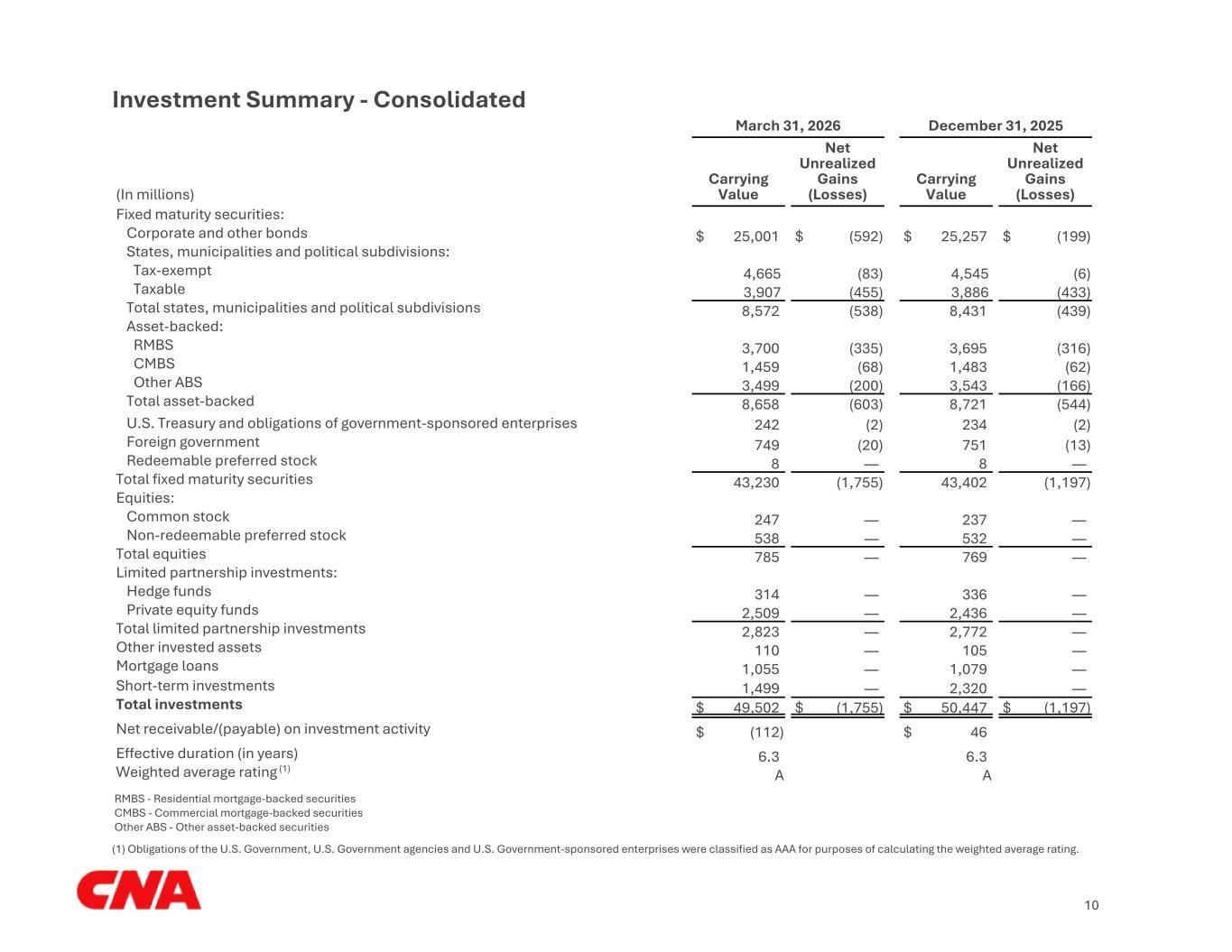
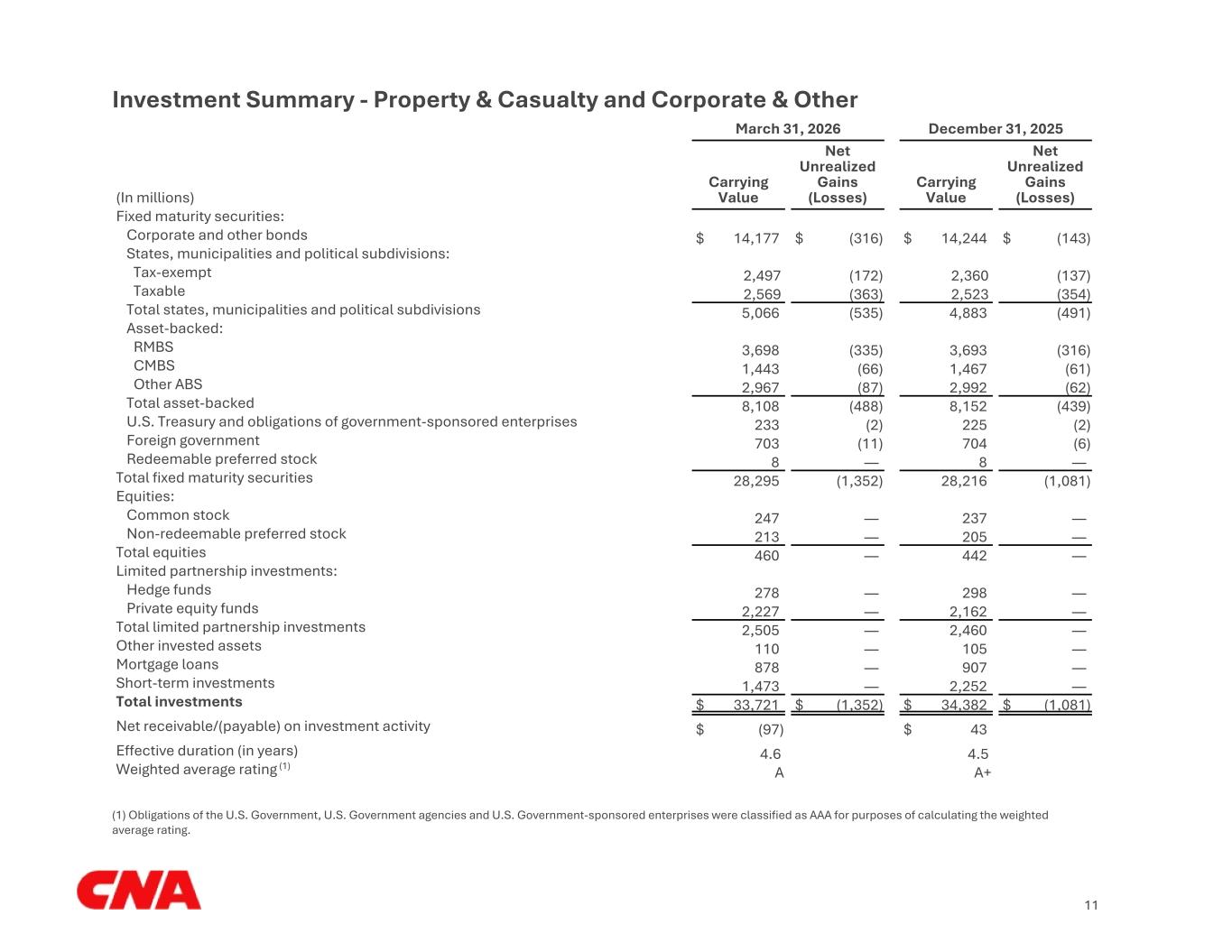
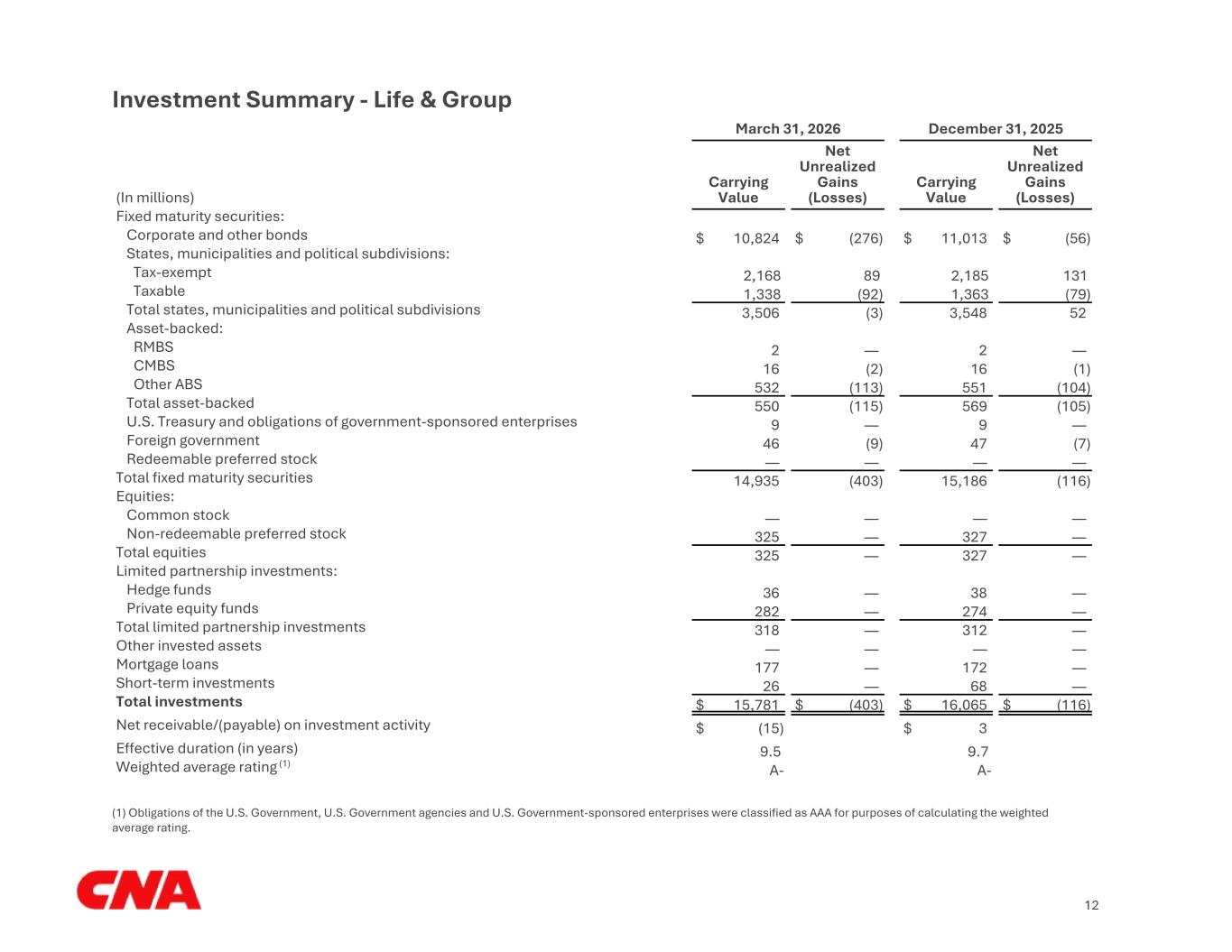
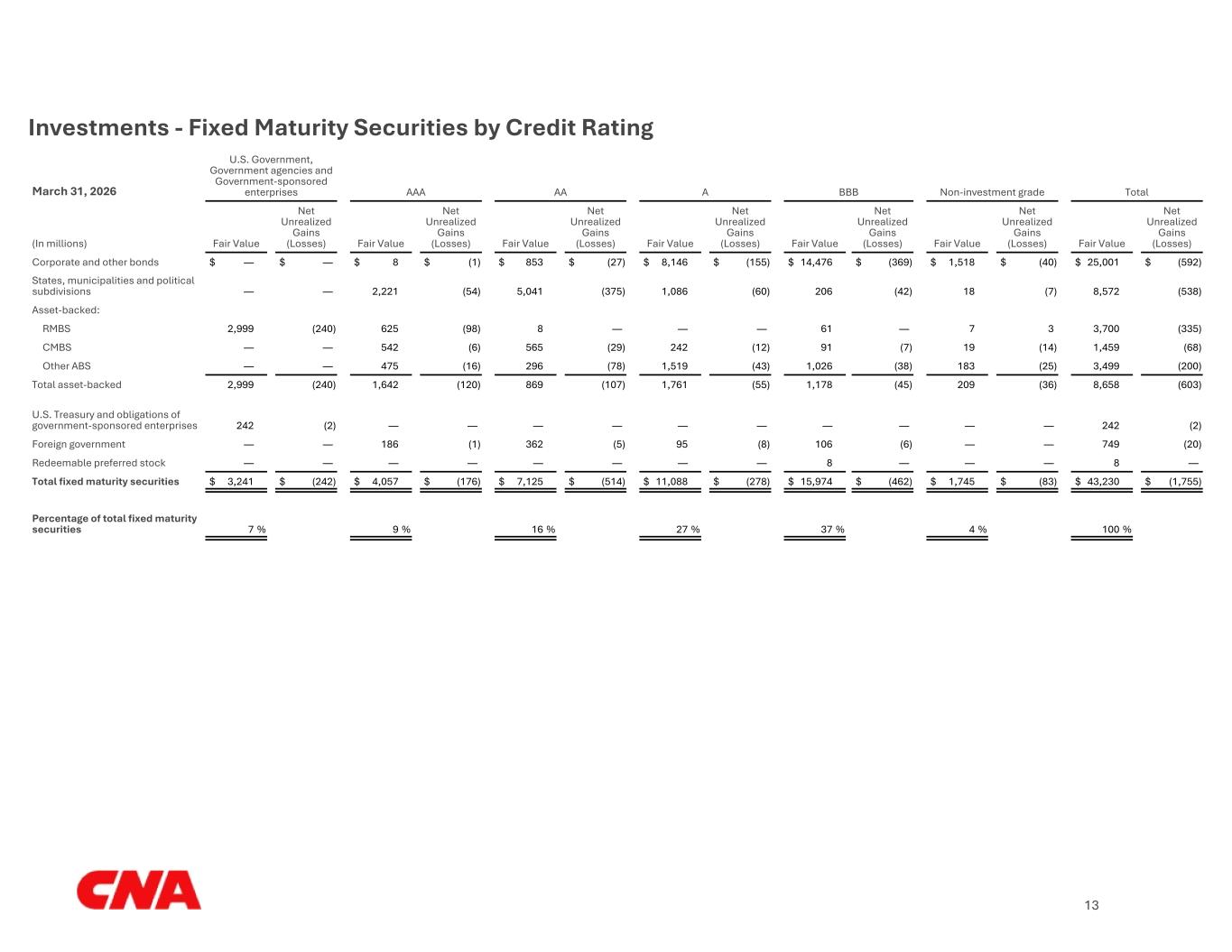
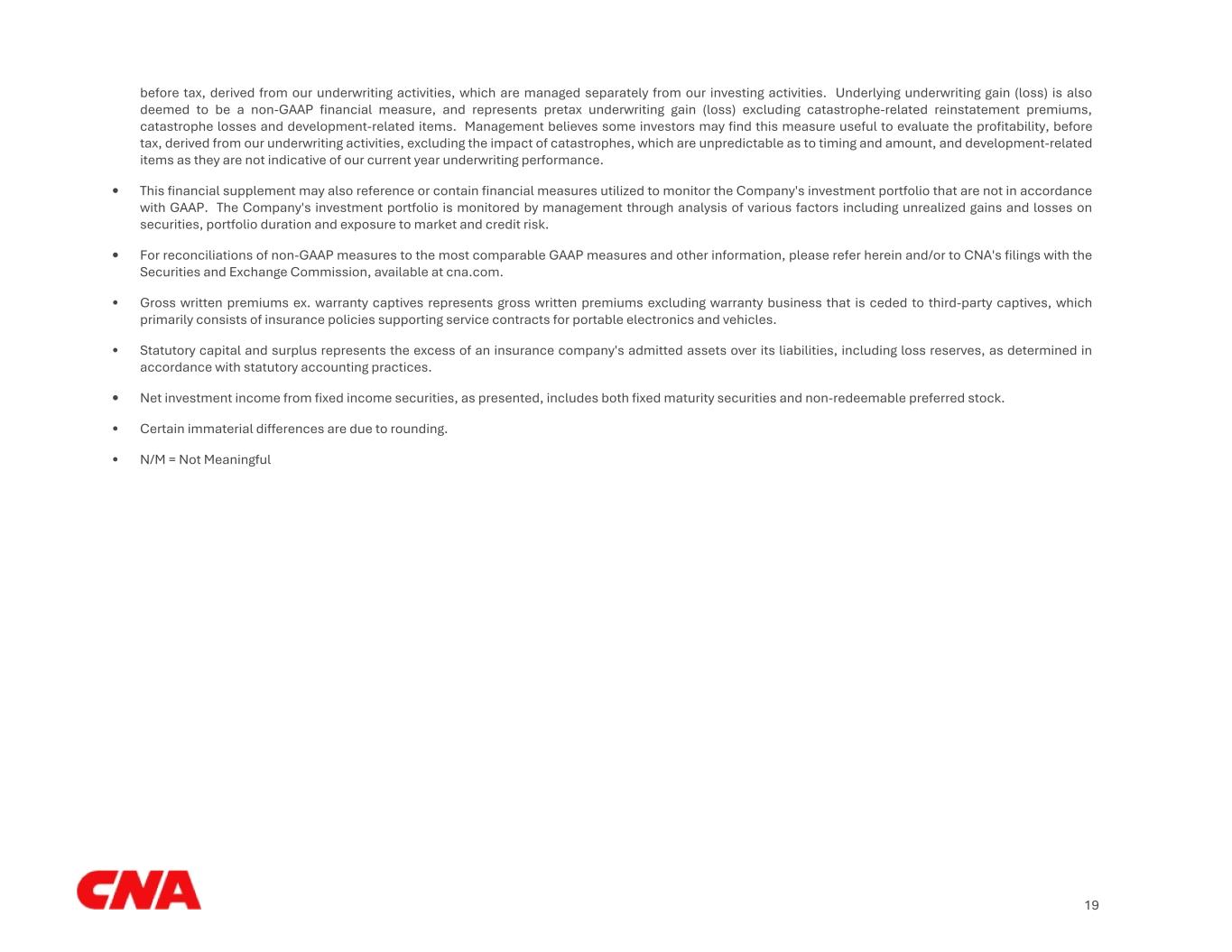
The Company's investment portfolio is monitored by management through analysis of various factors including unrealized gains and losses on securities, portfolio duration and exposure to market and credit risk.
Reconciliation of GAAP Measures to Non-GAAP Measures
Management utilizes financial measures not in accordance with GAAP to monitor the Company's insurance operations and investment portfolio. The Company believes the presentation of these measures provides investors with a better understanding of the significant factors that comprise the Company's operating performance. Reconciliations of these measures to the most comparable GAAP measures follow below.
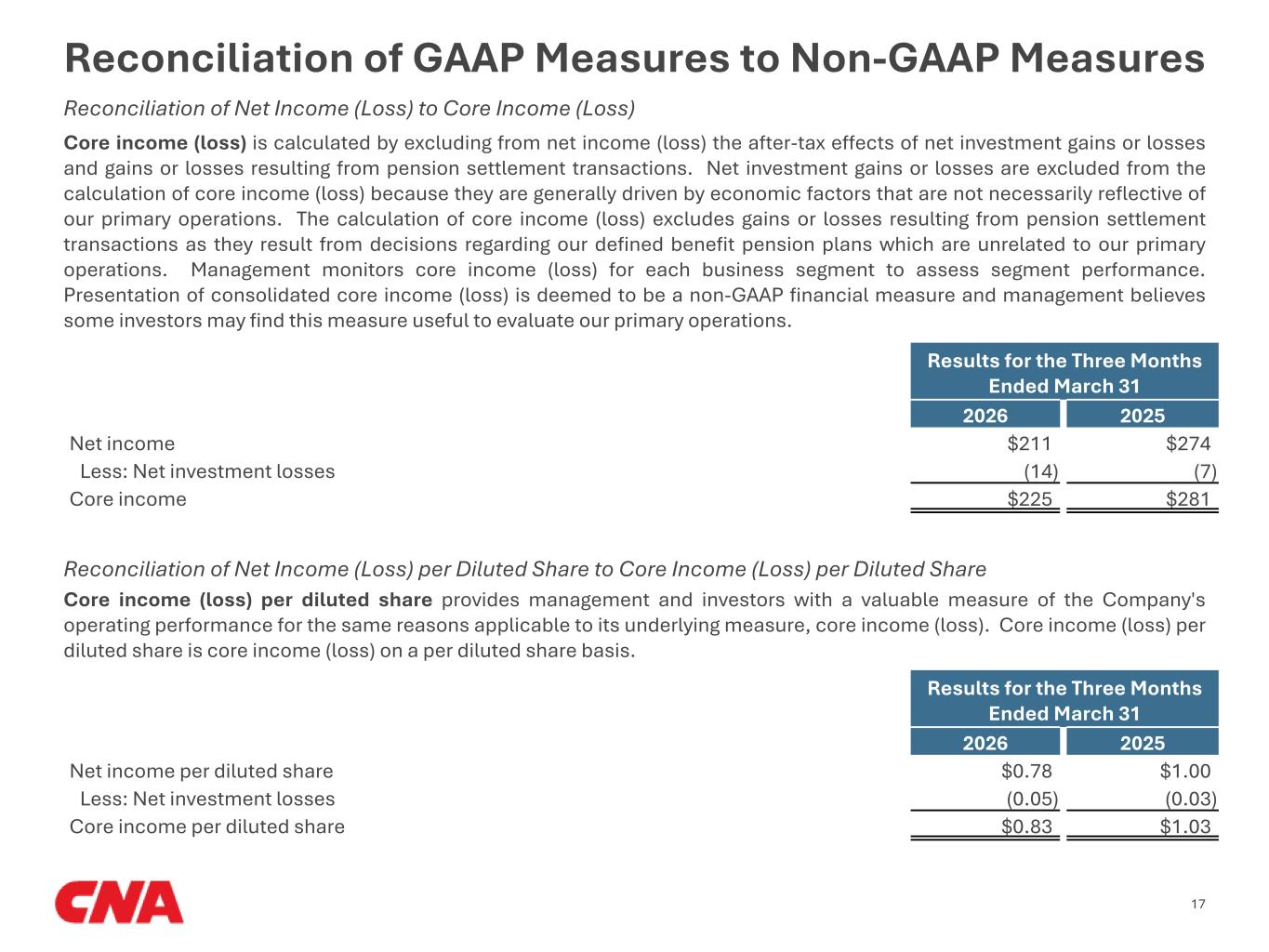
Reconciliation of Net Income (Loss) to Core Income (Loss)
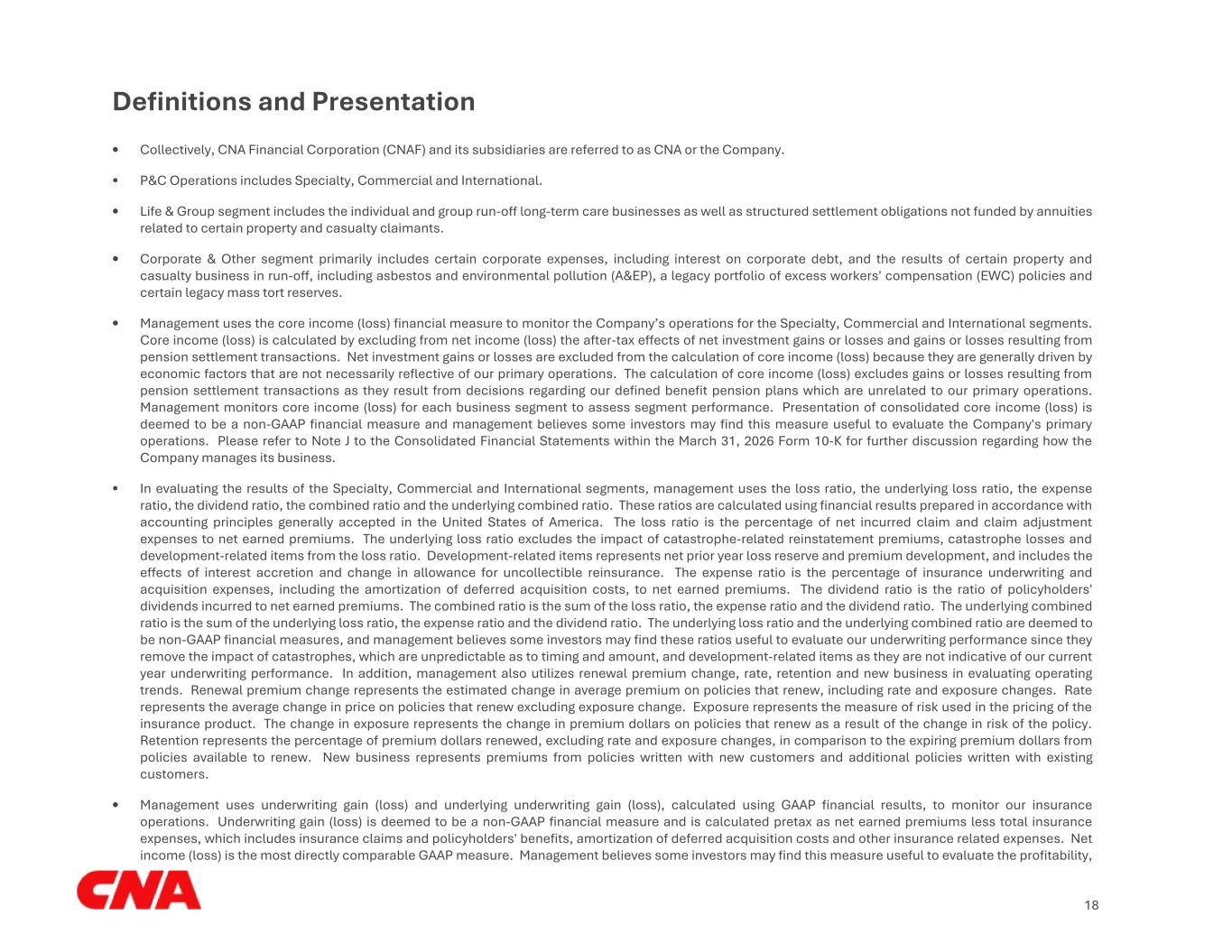
Core income (loss) is calculated by excluding from net income (loss) the after-tax effects of net investment gains or losses and gains or losses resulting from pension settlement transactions. Net investment gains or losses are excluded from the calculation of core income (loss) because they are generally driven by economic factors that are not necessarily reflective of our primary operations. The calculation of core income (loss) excludes gains or losses resulting from pension settlement transactions as they result from decisions regarding our defined benefit pension plans which are unrelated to our primary operations. Management monitors core income (loss) for each business segment to assess segment performance. Presentation of consolidated core income (loss) is deemed to be a non-GAAP financial measure.
| | | | | | | | | | | | | | | |
| | | Results for the Three Months Ended March 31 |
| ($ millions) | | | | | 2026 | | 2025 |
| Net income | | | | | $ | 211 | | | $ | 274 | |
| Less: Net investment losses | | | | | (14) | | | (7) | |
| | | | | | | |
| Core income | | | | | $ | 225 | | | $ | 281 | |
Reconciliation of Net Income (Loss) per Diluted Share to Core Income (Loss) per Diluted Share
Core income (loss) per diluted share provides management and investors with a valuable measure of the Company's operating performance for the same reasons applicable to its underlying measure, core income (loss). Core income (loss) per diluted share is core income (loss) on a per diluted share basis.
| | | | | | | | | | | | | | | |
| | | Results for the Three Months Ended March 31 |
| | | | | 2026 | | 2025 |
| Net income per diluted share | | | | | $ | 0.78 | | | $ | 1.00 | |
| Less: Net investment losses | | | | | (0.05) | | | (0.03) | |
| | | | | | | |
| Core income per diluted share | | | | | $ | 0.83 | | | $ | 1.03 | |
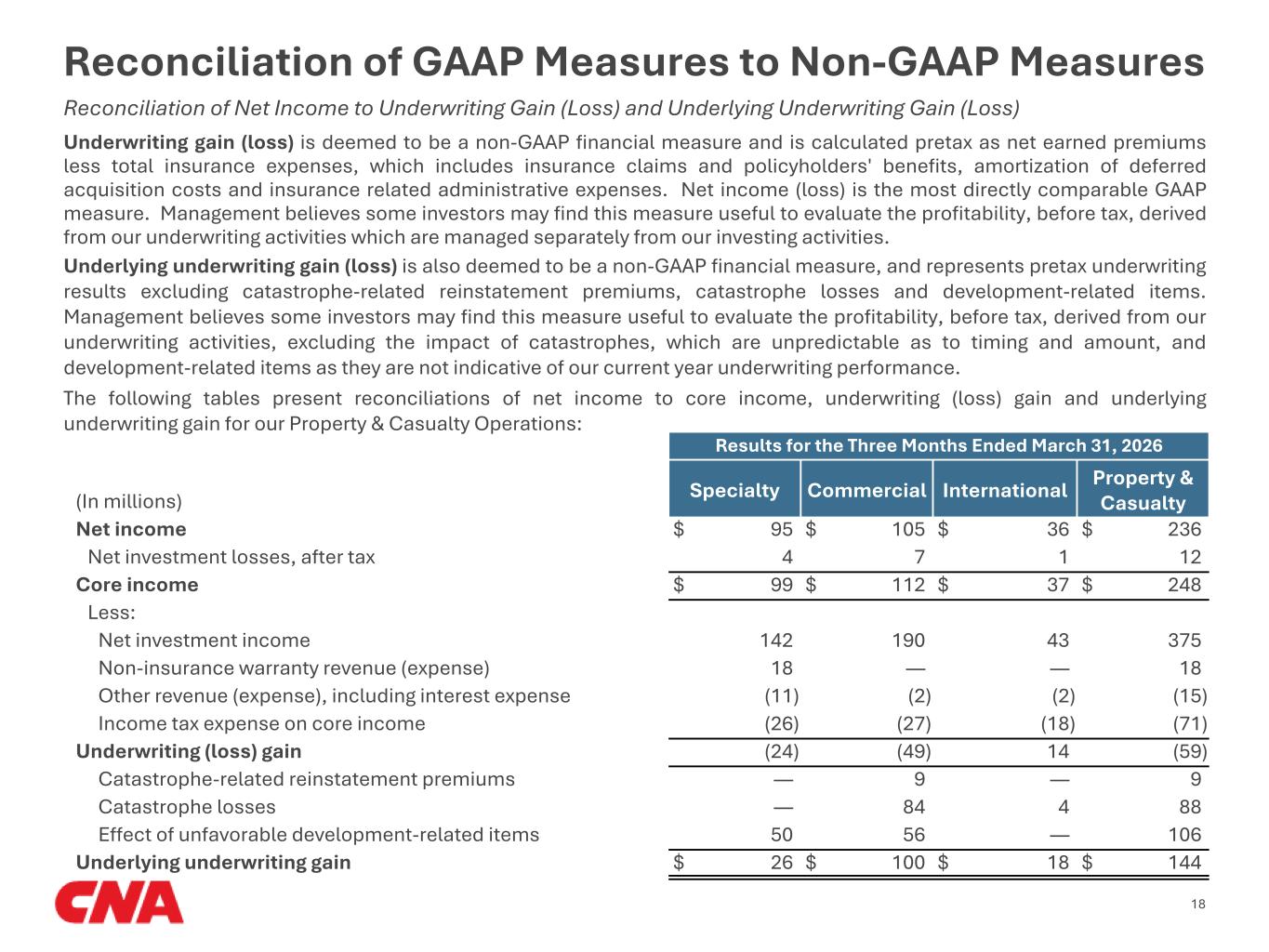
Reconciliation of Net Income (Loss) to Underwriting Gain (Loss) and Underlying Underwriting Gain (Loss)
Underwriting gain (loss) is deemed to be a non-GAAP financial measure and is calculated pretax as net earned premiums less total insurance expenses, which includes insurance claims and policyholders' benefits, amortization of deferred acquisition costs and insurance related administrative expenses. Net income (loss) is the most directly comparable GAAP measure. Management believes some investors may find this measure useful to evaluate the profitability, before tax, derived from our underwriting activities which are managed separately from our investing activities.
Underlying underwriting gain (loss) is also deemed to be a non-GAAP financial measure, and represents pretax underwriting results excluding catastrophe-related reinstatement premiums, catastrophe losses and development-related items. Management believes some investors may find this measure useful to evaluate the profitability, before tax, derived from our underwriting activities, excluding the impact of catastrophes, which are unpredictable as to timing and amount, and development-related items as they are not indicative of our current year underwriting performance. The following tables present reconciliations of net income to core income, underwriting gain and underlying underwriting gain for our Property & Casualty Operations.
| | | | | | | | | | | | | | | | | | | | | |
| Results for the Three Months Ended March 31, 2026 |
| Specialty | Commercial | International | Property & Casualty | | | | | | | |
| (In millions) | | | | | | | | | | | |
| Net income | $ | 95 | | $ | 105 | | $ | 36 | | $ | 236 | | | | | | | | |
| Net investment losses, after tax | 4 | | 7 | | 1 | | 12 | | | | | | | | |
| | | | | | | | | | | |
| Core income | $ | 99 | | $ | 112 | | $ | 37 | | $ | 248 | | | | | | | | |
| | | | | | | | | | | |
| Less: | | | | | | | | | | | |
| Net investment income | 142 | | 190 | | 43 | | 375 | | | | | | | | |
| Non-insurance warranty revenue (expense) | 18 | | — | | — | | 18 | | | | | | | | |
| Other revenue (expense), including interest expense | (11) | | (2) | | (2) | | (15) | | | | | | | | |
| Income tax expense on core income | (26) | | (27) | | (18) | | (71) | | | | | | | | |
| Underwriting (loss) gain | (24) | | (49) | | 14 | | (59) | | | | | | | | |
| Catastrophe-related reinstatement premiums | — | | 9 | | — | | 9 | | | | | | | | |
| Catastrophe losses | — | | 84 | | 4 | | 88 | | | | | | | | |
| Effect of unfavorable development-related items | 50 | | 56 | | — | | 106 | | | | | | | | |
| Underlying underwriting gain | $ | 26 | | $ | 100 | | $ | 18 | | $ | 144 | | | | | | | | |
| | | | | | | | | | | | | | | | | | | | | |
| Results for the Three Months Ended March 31, 2025 |
| Specialty | Commercial | International | Property & Casualty | | | | | | | |
| (In millions) | | | | | | | | | | | |
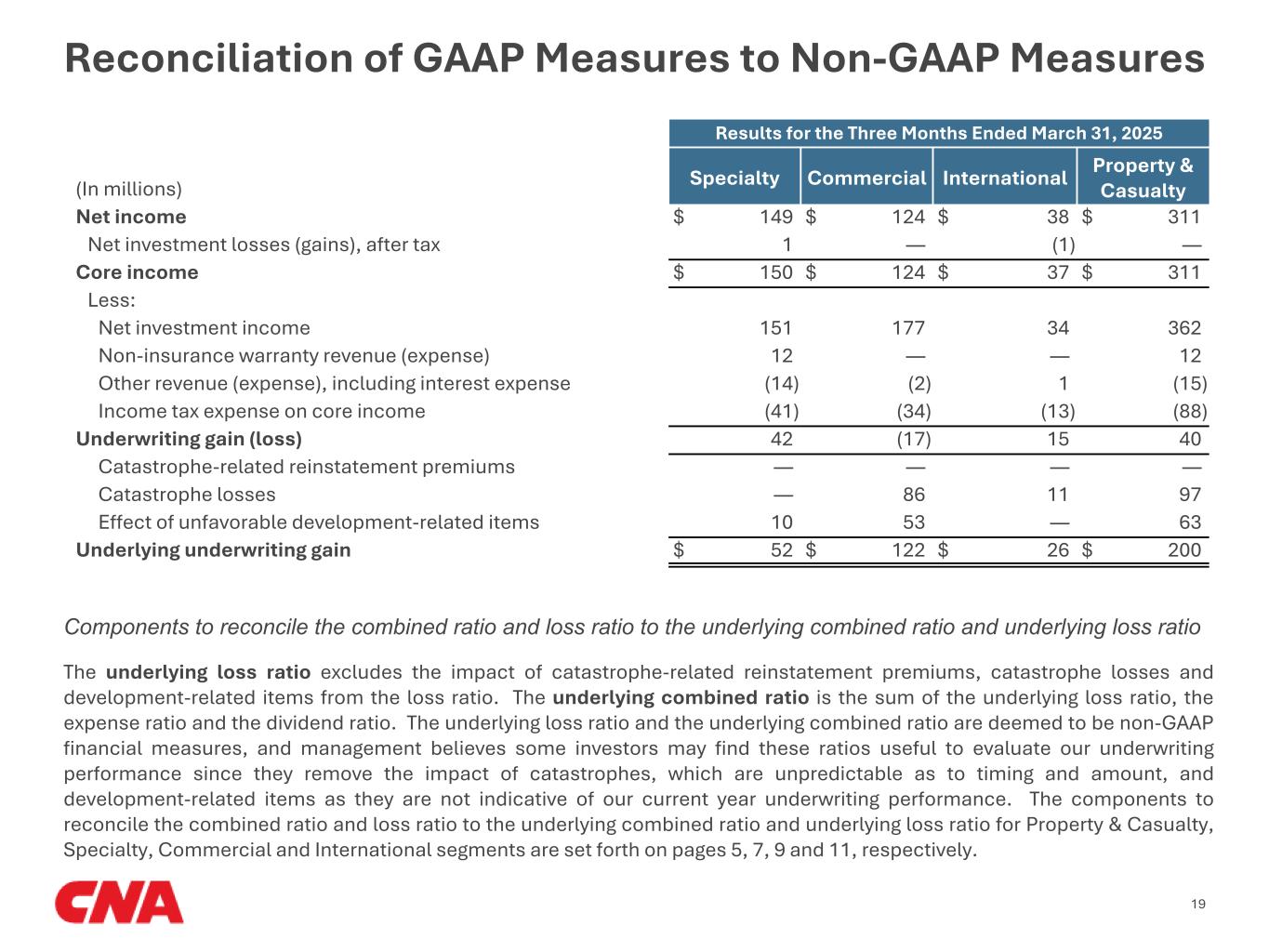
| Net income | $ | 149 | | $ | 124 | | $ | 38 | | $ | 311 | | | | | | | | |
| Net investment losses (gains), after tax | 1 | | — | | (1) | | — | | | | | | | | |
| | | | | | | | | | | |
| Core income | $ | 150 | | $ | 124 | | $ | 37 | | $ | 311 | | | | | | | | |
| | | | | | | | | | | |
| Less: | | | | | | | | | | | |
| Net investment income | 151 | | 177 | | 34 | | 362 | | | | | | | | |
| Non-insurance warranty revenue (expense) | 12 | | — | | — | | 12 | | | | | | | | |
| Other revenue (expense), including interest expense | (14) | | (2) | | 1 | | (15) | | | | | | | | |
| Income tax expense on core income | (41) | | (34) | | (13) | | (88) | | | | | | | | |
| Underwriting gain (loss) | 42 | | (17) | | 15 | | 40 | | | | | | | | |
| Catastrophe-related reinstatement premiums | — | | — | | — | | — | | | | | | | | |
| Catastrophe losses | — | | 86 | | 11 | | 97 | | | | | | | | |
| Effect of unfavorable development-related items | 10 | | 53 | | — | | 63 | | | | | | | | |
| Underlying underwriting gain | $ | 52 | | $ | 122 | | $ | 26 | | $ | 200 | | | | | | | | |
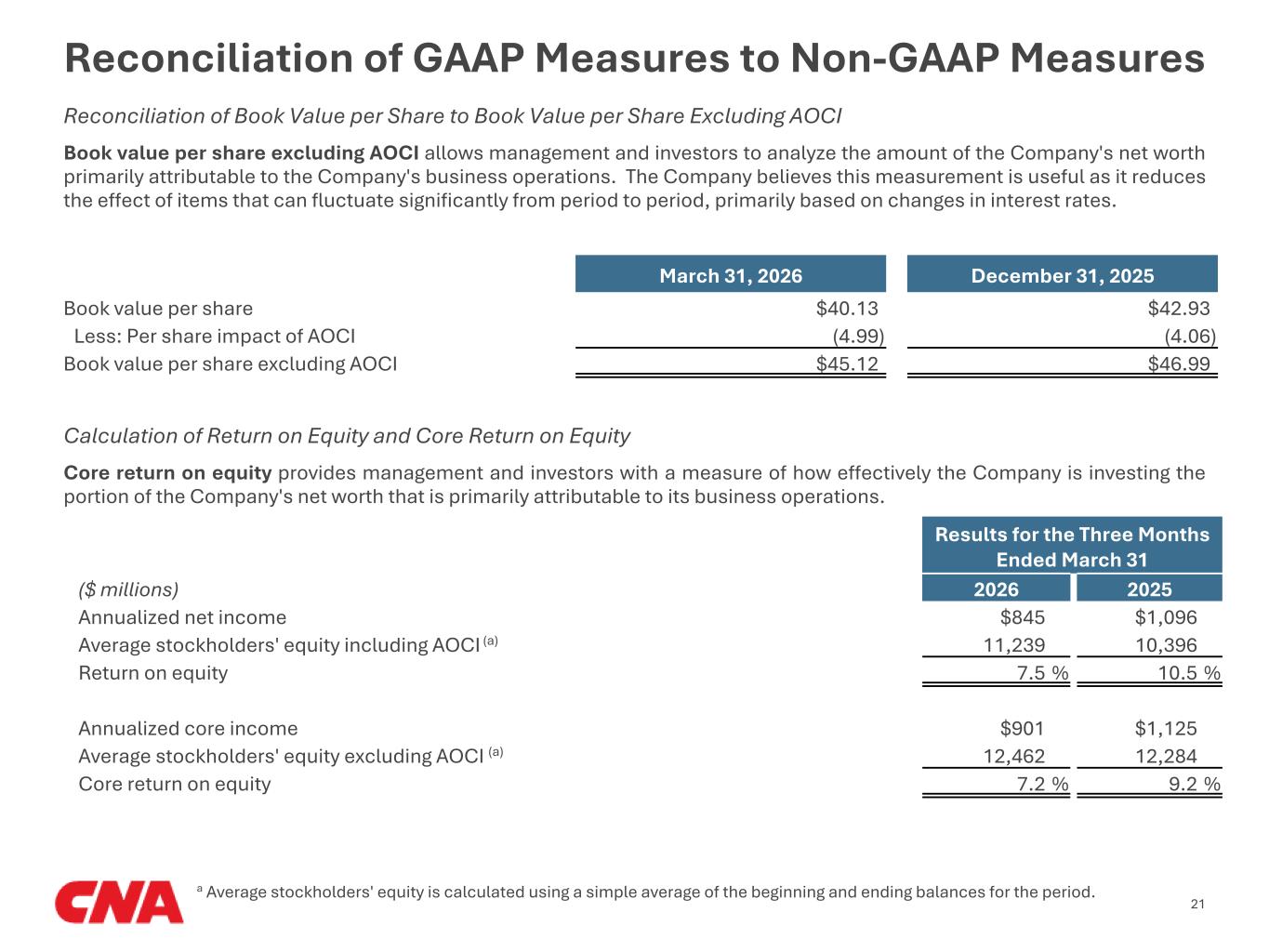
Reconciliation of Book Value per Share to Book Value per Share Excluding AOCI
Book value per share excluding AOCI allows management and investors to analyze the amount of the Company's net worth primarily attributable to the Company's business operations. The Company believes this measurement is useful as it reduces the effect of items that can fluctuate significantly from period to period, primarily based on changes in interest rates.
| | | | | | | | | | | |
| March 31, 2026 | | December 31, 2025 |
| Book value per share | $ | 40.13 | | | $ | 42.93 | |
| Less: Per share impact of AOCI | (4.99) | | | (4.06) | |
| Book value per share excluding AOCI | $ | 45.12 | | | $ | 46.99 | |
Calculation of Return on Equity and Core Return on Equity
Core return on equity provides management and investors with a measure of how effectively the Company is investing the portion of the Company's net worth that is primarily attributable to its business operations.
| | | | | | | | | | | | | | | | | | | |
| | | Results for the Three Months Ended March 31 |
| ($ millions) | | | | | | 2026 | | 2025 | |
| Annualized net income | | | | | | $ | 845 | | | $ | 1,096 | | |
Average stockholders' equity including AOCI (a) | | | | | | 11,239 | | | 10,396 | | |
| Return on equity | | | | | | 7.5 | | % | 10.5 | | % |
| | | | | | | | | |
| Annualized core income | | | | | | $ | 901 | | | $ | 1,125 | | |
Average stockholders' equity excluding AOCI (a) | | | | | | 12,462 | | | 12,284 | | |
| Core return on equity | | | | | | 7.2 | | % | 9.2 | | % |
(a)Average stockholders' equity is calculated using a simple average of the beginning and ending balances for the period.
For additional information, please refer to CNA's most recent 10-K on file with the Securities and Exchange Commission, as well as the financial supplement, available at cna.com.
Forward-Looking Statements
This press release includes statements that relate to anticipated future events (forward-looking statements) rather than actual present conditions or historical events. These statements are made pursuant to the safe harbor provisions of the Private Securities Litigation Reform Act of 1995 and generally include words such as “believes,” “expects,” “intends,” “anticipates,” “estimates” and similar expressions. Forward-looking statements, by their nature, are subject to a variety of inherent risks and uncertainties that could cause actual results to differ materially from the results projected. Many of these risks and uncertainties cannot be controlled by CNA. For a detailed description of these risks and uncertainties, please refer to CNA’s filings with the Securities and Exchange Commission, available at cna.com.
Any forward-looking statements made in this press release are made by CNA as of the date of this press release. Further, CNA does not have any obligation to update or revise any forward-looking statement contained in this press release, even if CNA’s expectations or any related events, conditions or circumstances change.
Any descriptions of coverage under CNA policies or programs in this press release are provided for convenience only and are not to be relied upon with respect to questions of coverage, exclusions or limitations. With regard to all such matters, the terms and provisions of relevant insurance policies are primary and controlling. In addition, please note that all coverages may not be available in all states.
“CNA" is a registered trademark of CNA Financial Corporation. Certain CNA Financial Corporation subsidiaries use the "CNA" trademark in connection with insurance underwriting and claims activities. Copyright © 2026 CNA. All rights reserved.
# # #
CNA Financial First Quarter 2026 Earnings Remarks
Douglas M. Worman, Chairman and Chief Executive Officer:
In the first quarter we continued to successfully drive our underwriting strategies to generate consistently profitable returns as we navigate this challenging market. The fundamentals of our business remain strong as we execute specialized and deliberate strategies to achieve profitable growth. We grew certain pockets of our portfolio that offer accretive returns and scaled back in other areas where the market can’t earn an acceptable return. We took prudent actions this quarter to strengthen both our prior accident year reserves as well as our current accident year loss ratio. Catastrophe impacts in the quarter were consistent with our five-year average.
Core income was $225 million in the first quarter, with net investment income of $610 million which was up slightly compared with the prior year quarter. Higher earnings from the fixed income portfolio were modestly offset by a market decline in common stocks.
The P&C all-in combined ratio was 102.2% in the quarter, including 3.6 points or $97 million of catastrophe impacts, which was consistent with the prior year quarter. Catastrophe impacts were driven by severe convective storms, more than half of which were driven by a significant winter storm in January and a severe hail event in March. Prior period development for P&C overall was unfavorable by $106 million, or 4.1 points of the combined ratio, and was driven by reserve strengthening primarily in recent accident years in our excess casualty and affinity professional errors and omissions (E&O) classes. The P&C underlying combined ratio was 94.5%, up 2.4 points compared to the prior year quarter. The expense ratio was 29.9%, down 0.3 points from the prior year, while the P&C underlying loss ratio was 64.1%, up 2.6 points from the prior year quarter.
The higher underlying loss ratio reflects our belief that a higher degree of conservatism in our loss pick is appropriate given the continuation of uncertainties around longer tailed classes of business. Further, across the P&C portfolio in aggregate, earned rate has been trailing our estimate of loss cost trend. This dynamic puts upward pressure on the underlying loss ratio of a stable portfolio, all else equal. We have implemented targeted underwriting actions to address the underlying headwinds, but these actions will take time to translate into results. In light of the current rate and trend dynamics, we believe this conservative approach is appropriate, and we remain focused on sustainable performance. In addition, we increased our loss cost trends modestly, which are now slightly above 7% for the P&C portfolio overall. The increase in loss cost trend was minor and mostly driven by the two classes of business that drove our prior accident year reserve strengthening. We do not anticipate social inflation abating, and the continued impacts of increased attorney involvement and lengthening development patterns have been reflected in our prior accident year reserves and current accident year loss ratio.
In the quarter, net written premium growth was 1% in the aggregate, but similar to last quarter there is significant variation by segment and class of business unique to the competitive environment in each area. New business of $581 million was up 3% with similar variation by segment and class. P&C rate change was 2%, consistent with the fourth quarter, and renewal premium change was 3%. In each of our segments, we are growing where we see quality opportunities and being disciplined where we do not, which is a result of the current competitive environment and is reflected in our retention levels.
Turning to each of the three P&C operating segments, in Commercial, the all-in combined ratio was 103.5% compared to 101.1% in the prior year quarter. Catastrophe impacts were $93 million or 6.4 points on the combined ratio. Unfavorable prior period development of $56 million added 4.0 points to the combined ratio. The loss development in the quarter was wholly driven by excess casualty in the recent accident years where we continue to see the potential for higher claim frequency and severity from the ongoing impacts of social inflation. The underlying combined ratio was 93.1% compared to 91.0% in the prior year quarter. The underlying loss ratio increased to 65.8%, from 63.4% in the fourth quarter and 62.9% in the prior year quarter. This was driven by an increase in our excess casualty underlying loss ratio, reflecting both the trends the industry is experiencing, and substantial additional prudence on our part. Even with the higher
excess casualty loss ratio, we continue to believe the margins and opportunities in this class are attractive. In addition to excess casualty, we also increased the workers’ compensation loss ratio in the current accident year given the ongoing significant negative rate in that line coupled with our mid-single digit long-run loss cost trend assumptions. The expense ratio improved by nearly a point to 26.7% and is now below 27% for the third consecutive quarter.
In Commercial, net written premium declined 1% and new business growth was flat. Retention in the quarter was 81% with significant variation by business unit and class. The level of net written premium growth varies significantly based on how we are reacting to the current dynamics in the market. For example, net written premium growth was 13% in middle market with new business up 17% as we still see good opportunities there. Within middle market, workers’ compensation net written premium was up 22%, as we still see pockets to grow profitably while being more selective in certain geographies and accounts. On the other hand, net written premium declined 14% in national accounts property where we are seeing a significant amount of undisciplined market behavior, and net written premium declined 9% in construction where certain classes and geographies continue to be substantively impacted by social inflation and, as a result, we are executing on underwriting actions in segments of that portfolio. We are cognizant of the fact that the underlying causes of social inflation have not abated and are not benign, and so we are being disciplined in how we transact the business. In areas like national accounts property, there are still pockets where we see rate adequacy and opportunity despite the higher level of competition, but we will not pursue growth at the expense of profit dollars. Rate change was 2% in the quarter, down about a point compared to the fourth quarter. Similar to the growth, rate was also bifurcated, with rates in commercial auto and excess casualty remaining in double-digits, whereas rate was down double-digits in national accounts property. Workers’ compensation rates continue to be down low single-digit. Excluding workers’ compensation and national accounts property where we see that heightened level of competition, rate was up 7%.
For Specialty, the all-in combined ratio was 102.7% compared to 95.1% in the prior year quarter. Prior period development was unfavorable by $50 million or 5.9 points of the combined ratio. The prior period development was driven by reserve strengthening in recent accident years for our affinity professional E&O class where we are reacting to signs of slightly higher severity. The underlying combined ratio was 96.8% compared to 93.8% in the prior year quarter. The underlying loss ratio was 62.8%, up from 60.6% in the fourth quarter and 60.1% in the prior year quarter. Earned rate continues to lag overall long-run loss cost trends, and we have been prudent in reflecting the recent accident year reserve pressure in our underlying loss ratio. As further evidence of our prudent approach, we are not yet reflecting the potential beneficial impact of underwriting strategies and rather waiting to see how it bears out over time. The expense ratio was 33.6% compared to 33.4% in the prior year quarter.
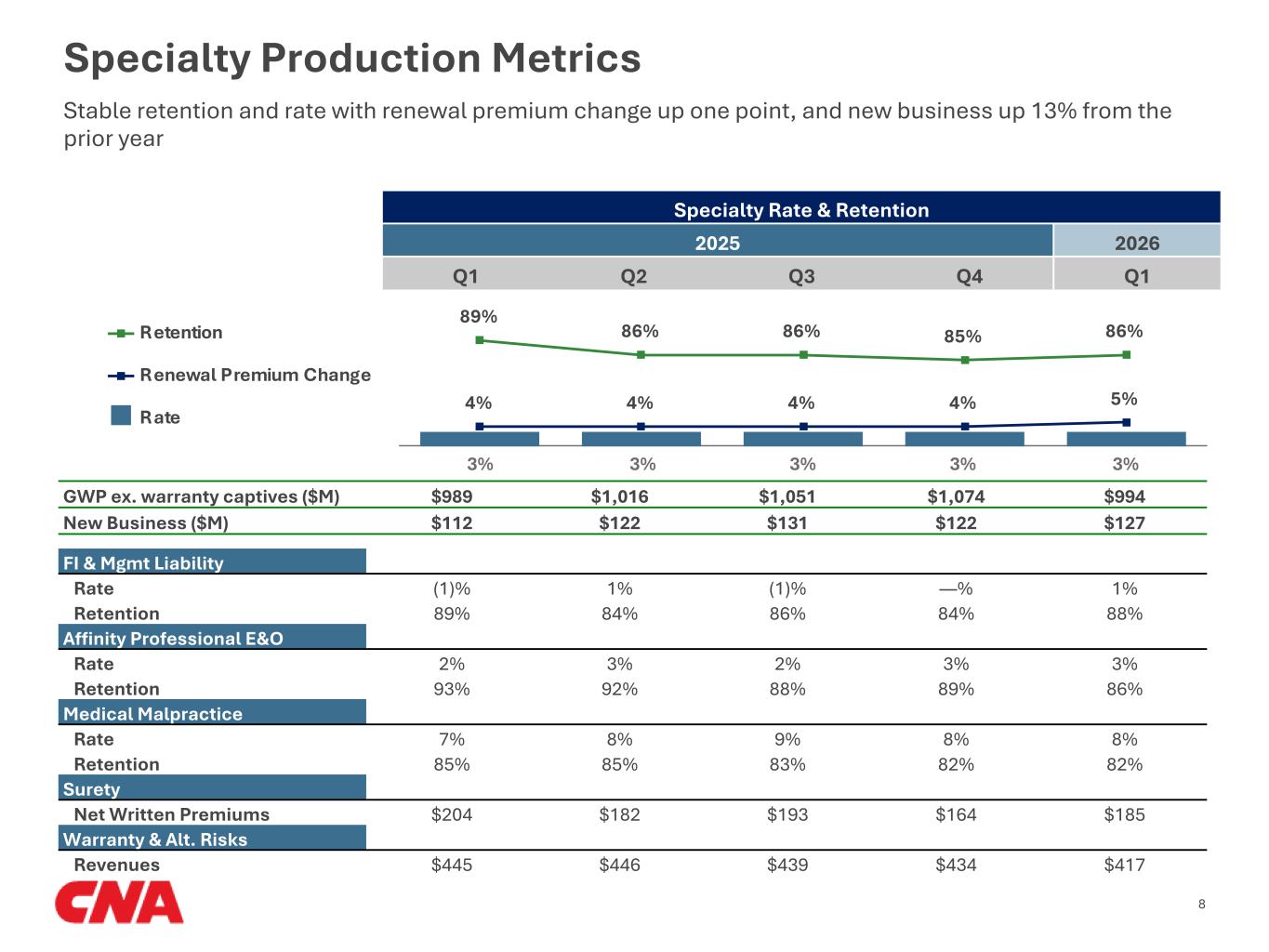
In Specialty, net written premium declined 1% in the quarter, heavily influenced by volatility in surety where premiums declined 9%. This is off of a large base that grew 12% in the prior year quarter and reflects fewer jumbo bond opportunities in the quarter. Our construction clients have plenty of backlogged projects but the timing of the start of those projects will result in quarterly premium volatility. Specialty growth excluding surety was up 2%.
For Specialty overall, new business was up 13% in the quarter and retention was 86%, fairly consistent with recent quarters. Rate remained consistent this quarter at 3% with renewal premium change up a point to 5%. Rate change has been consistent at 3% for the past five quarters with some variation by class. Rate was up a point to 1% in financial and management liability lines in the aggregate, with the continuation of low to mid-single digit rates in public company directors and officers (D&O) and cyber. Rate remained strong in healthcare at 8% and stable in affinity business at 3%.
For International, the all-in combined ratio was 95.9% with 1.2 points of catastrophe losses. The underlying combined ratio was 94.7%. The underlying loss ratio was 59.8% compared to 58.5% in the prior year quarter. The increase in the underlying loss ratio was due to the continued soft market conditions across the segment. The expense ratio was 34.9% compared to 33.3% in the prior year quarter.
International net written premium grew 16% in the quarter, or 7% excluding currency fluctuation. New business grew 2% in the quarter and retention was 85%. Rates were down 4% in the quarter as the environment continues to be highly competitive. Despite this heightened level of competition, we continue to find excellent opportunities in Canada, Continental Europe and the U.K. regions that are still at strong levels of rate adequacy in specific lines and geographies.
Scott R. Lindquist, Chief Financial Officer:
CNA’s first quarter core income was $225 million compared to $281 million in the prior year quarter, resulting in a first quarter core return on equity of 7.2% and a trailing twelve‑month core return on equity excluding accumulated other comprehensive income (AOCI) of 10.6%. The decrease in core income reflects prudent actions to strengthen prior year loss reserves in excess casualty and professional E&O lines for recent accident years as well as an increase in the current accident year loss ratios.
Our P&C expense ratio for the first quarter was 29.9%, an improvement of 0.3 points compared with the prior year quarter. Our expense ratio improvement this quarter reflects favorable acquisition costs and continued operating discipline, even as we continue to increase investment in our technology, digital and artificial intelligence (AI) capabilities. While there is always a degree of quarter‑to‑quarter variability in this ratio, we continue to believe an expense ratio around 30% represents a reasonable run‑rate for the full year 2026.
The P&C net prior period development impact on the combined ratio was 4.1 points in the current quarter, compared with 2.5 points in the prior year quarter. In the Specialty segment, prior period development was $50 million unfavorable, primarily driven by professional E&O business in recent accident years. In the Commercial segment, prior period development was $56 million unfavorable driven by excess casualty in recent accident years.
The P&C paid‑to‑incurred ratio was 77% this quarter, below the low-to-mid 80% average of the past four years, primarily reflecting the reserve strengthening taken during the quarter. P&C paid losses naturally vary from quarter-to-quarter, and while individual quarters may move up or down, the underlying trend in paid losses has increased over time, consistent with portfolio growth and higher loss costs.
The Life & Group segment produced a core loss of $9 million for the quarter with underwriting results broadly in line with expectations, compared to a $6 million gain in the prior year quarter which reflected modestly favorable persistency experience.
The Corporate segment produced a core loss of $14 million in the first quarter compared to a $36 million loss in the prior year quarter. The prior year quarter included a $17 million after-tax charge related to unfavorable prior period development largely associated with legacy mass tort abuse claim activity. As a reminder, we conduct our comprehensive review of legacy mass tort exposures in the second quarter of each year.
Net investment income was $610 million in the first quarter compared with $604 million in the prior year quarter, an increase of 1%. The increase was driven by our fixed income and other investments, partially offset by lower returns in our limited partnership and common stock portfolios.
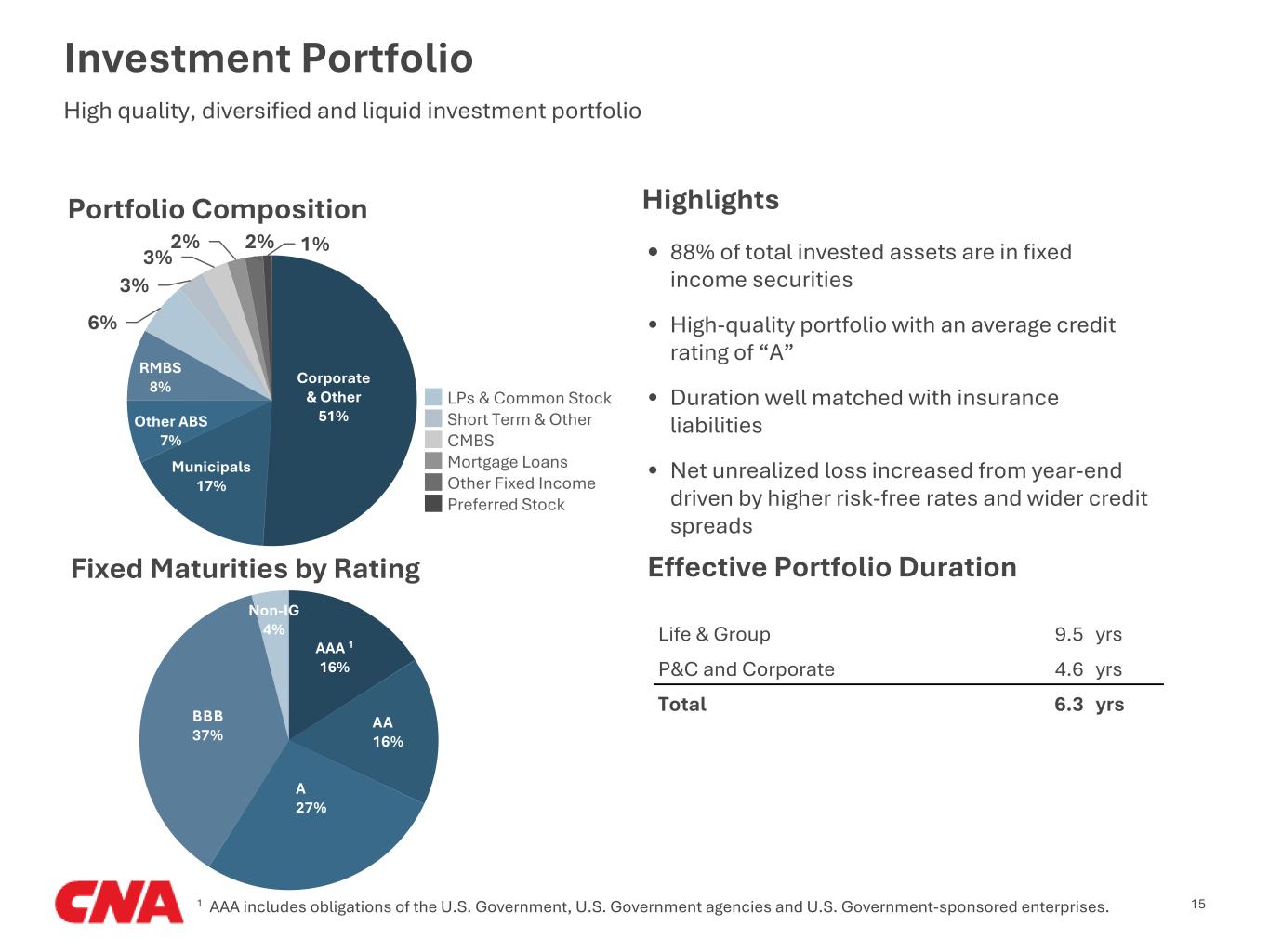
Fixed income and other investments generated $568 million of income, up 3% compared to the prior year quarter. Our A-rated fixed income portfolio continues to provide consistent contributions to core income, which have been steadily increasing because of favorable reinvestment rates and a growing asset base. The effective income yield of our consolidated fixed income portfolio was 4.9% in the first quarter, up from 4.8% in the prior year quarter. Reinvestment rates continue to be above our P&C portfolio effective income yield of 4.4% and are fairly in line with our Life & Group portfolio effective income yield of 5.7%.
Looking ahead, based on the current interest rate environment, we expect income from fixed income and other investments to be about $575 million in the second quarter. For the full year, we expect income from fixed income and other investments to be about $2,300 million, or a 2% increase as compared to the full year 2025.
Our limited partnership and common stock portfolio returned a $42 million gain, or 1.4%, in the current quarter compared to a $54 million gain, or 2.0%, in the prior year quarter. The lower return was primarily due to our hedge fund and common stock portfolios, whose returns were in line with the broader public equity market performance.
As a reminder, private equity funds, which represent about 90% of our limited partnership portfolio, generally report to us on a quarter lag, so results this quarter were primarily reflective of performance from the fourth quarter of 2025. Given the recent volatility in public equity markets, we believe we may see similar volatility in our limited partnership and common stock portfolio results in the near term.
At quarter‑end, our balance sheet remained very strong. Stockholders’ equity excluding AOCI was $12.2 billion, or $45.12 per share. Including AOCI, stockholders’ equity was $10.9 billion, or $40.13 per share. Statutory capital and surplus in the combined Continental Casualty Companies was $11.1 billion at quarter‑end, reflecting the continued strength of our capital position.
Operating cash flow for the quarter was $393 million as compared to $638 million in the prior year first quarter. The decrease includes approximately $100 million of payments related to specific reinsurance treaties, which occurred in the first quarter of this year but were paid in the second quarter of last year. Outside of this timing difference, operating cash flow reflects higher paid losses compared with the prior year first quarter, as a result of normal quarter-to-quarter paid loss variability and portfolio growth in prior years, while remaining well supported by strong investment results and steady premium collections. The effective tax rate on core income for the quarter was 21.1%, consistent with our expectations for the full year.
Finally, we are pleased to announce our regular quarterly dividend of $0.48 per share, payable on June 4, 2026 to shareholders of record on May 18, 2026.
Douglas M. Worman, Chairman and Chief Executive Officer:
Overall, we produced $225 million of core income despite taking actions to continue to increase the prudence in our underlying loss ratio and long-tailed lines reserves for recent accident years. These long-tailed excess casualty and professional lines will play out over time; however, as we demonstrated last year on primary commercial auto, our philosophy is to respond quickly to any early adverse loss trend signals and market pricing pressure to address potential uncertainty. At the same time we continue to be measured on the anticipated benefits of our underwriting actions. This gives us what we believe to be an appropriately conservative position on our reserves and underlying loss ratio. In summary, we will not jeopardize our long term value creation by not recognizing market trends and adjusting underwriting strategies. We are executing our strategies with precision and nuance, growing substantially in some areas where we see opportunity while maintaining strong discipline in others that are subject to an irrational level of competition.
Our expense ratio is down, and as we have gained efficiency we have continued to place investments in technology and AI, which have started to benefit us through a well-structured and evolving strategy. This includes over 100 separate AI initiatives executed across different areas of the organization, ranging from the use of AI to intake and triage submissions, to summarization of claims documents and generation of actionable insights. We are also using AI to analyze accounts within our risk control area, perform advanced analytics to gain insights on exposure to loss at a depth never before possible and support a variety of other initiatives covering virtually every functional area in our organization.
Looking ahead to the rest of the year, we will continue to operate with strong discipline, and we remain committed to tightening our execution in the marketplace as we execute detailed underwriting strategies to optimize our portfolio in the current environment.
Reconciliation of GAAP Measures to Non-GAAP Measures
These earnings remarks contain financial measures that are not in accordance with accounting principles generally accepted in the United States of America (GAAP). Management utilizes these financial measures to monitor the Company's insurance operations and investment portfolio. The Company believes the presentation of these measures provides investors with a better understanding of the significant factors that comprise the Company's operating performance. Reconciliations of these measures to the most comparable GAAP measures follow below.
Reconciliation of Net Income (Loss) to Core Income (Loss)
Core income (loss) is calculated by excluding from net income (loss) the after-tax effects of net investment gains or losses and gains or losses resulting from pension settlement transactions. Net investment gains or losses are excluded from the calculation of core income (loss) because they are generally driven by economic factors that are not necessarily reflective of our primary operations. The calculation of core income (loss) excludes gains or losses resulting from pension settlement transactions as they result from decisions regarding our defined benefit pension plans which are unrelated to our primary operations. Management monitors core income (loss) for each business segment to assess segment performance. Presentation of consolidated core income (loss) is deemed to be a non-GAAP financial measure.
| | | | | | | | | | | | | | | |
| | | Results for the Three Months Ended March 31 |
| ($ millions) | | | | | 2026 | | 2025 |
| Net income | | | | | $ | 211 | | | $ | 274 | |
| Less: Net investment losses | | | | | (14) | | | (7) | |
| | | | | | | |
| Core income | | | | | $ | 225 | | | $ | 281 | |
Reconciliation of Net Income (Loss) per Diluted Share to Core Income (Loss) per Diluted Share
Core income (loss) per diluted share provides management and investors with a valuable measure of the Company's operating performance for the same reasons applicable to its underlying measure, core income (loss). Core income (loss) per diluted share is core income (loss) on a per diluted share basis.
| | | | | | | | | | | | | | | |
| | | Results for the Three Months Ended March 31 |
| | | | | 2026 | | 2025 |
| Net income per diluted share | | | | | $ | 0.78 | | | $ | 1.00 | |
| Less: Net investment losses | | | | | (0.05) | | | (0.03) | |
| | | | | | | |
| Core income per diluted share | | | | | $ | 0.83 | | | $ | 1.03 | |
Reconciliation of Net Income (Loss) to Underwriting Gain (Loss) and Underlying Underwriting Gain (Loss)
Underwriting gain (loss) is deemed to be a non-GAAP financial measure and is calculated pretax as net earned premiums less total insurance expenses, which includes insurance claims and policyholders' benefits, amortization of deferred acquisition costs and insurance related administrative expenses. Net income (loss) is the most directly comparable GAAP measure. Management believes that underwriting gain (loss) provides investors with a valuable measure of profitability, before tax, derived from our underwriting activities which are managed separately from our investing activities.
Underlying underwriting gain (loss) is also deemed to be a non-GAAP financial measure, and represents pretax underwriting results excluding catastrophe-related reinstatement premiums, catastrophe losses and development-related items. Management believes some investors may find this measure useful to evaluate the profitability, before tax, derived from our underwriting activities, excluding the impact of catastrophes, which are unpredictable as to timing and amount, and development-related items as they are not indicative of our current year underwriting performance. The following tables present reconciliations of net income to core income, underwriting gain and underlying underwriting gain for our Property & Casualty Operations.
| | | | | | | | | | | | | | | |
| Results for the Three Months Ended March 31, 2026 |
| Specialty | Commercial | International | Property & Casualty | |
| (In millions) | | | | | |
| Net income | $ | 95 | | $ | 105 | | $ | 36 | | $ | 236 | | |
| Net investment losses, after tax | 4 | | 7 | | 1 | | 12 | | |
| | | | | |
| Core income | $ | 99 | | $ | 112 | | $ | 37 | | $ | 248 | | |
| | | | | |
| Less: | | | | | |
| Net investment income | 142 | | 190 | | 43 | | 375 | | |
| Non-insurance warranty revenue (expense) | 18 | | — | | — | | 18 | | |
| Other revenue (expense), including interest expense | (11) | | (2) | | (2) | | (15) | | |
| Income tax expense on core income | (26) | | (27) | | (18) | | (71) | | |
| Underwriting (loss) gain | (24) | | (49) | | 14 | | (59) | | |
| Catastrophe-related reinstatement premiums | — | | 9 | | — | | 9 | | |
| Catastrophe losses | — | | 84 | | 4 | | 88 | | |
| Effect of unfavorable development-related items | 50 | | 56 | | — | | 106 | | |
| Underlying underwriting gain | $ | 26 | | $ | 100 | | $ | 18 | | $ | 144 | | |
| | | | | | | | | | | | | | | |
| Results for the Three Months Ended March 31, 2025 |
| Specialty | Commercial | International | Property & Casualty | |
| (In millions) | | | | | |
| Net income | $ | 149 | | $ | 124 | | $ | 38 | | $ | 311 | | |
| Net investment losses (gains), after tax | 1 | | — | | (1) | | — | | |
| | | | | |
| Core income | $ | 150 | | $ | 124 | | $ | 37 | | $ | 311 | | |
| | | | | |
| Less: | | | | | |
| Net investment income | 151 | | 177 | | 34 | | 362 | | |
| Non-insurance warranty revenue (expense) | 12 | | — | | — | | 12 | | |
| Other revenue (expense), including interest expense | (14) | | (2) | | 1 | | (15) | | |
| Income tax expense on core income | (41) | | (34) | | (13) | | (88) | | |
| Underwriting gain (loss) | 42 | | (17) | | 15 | | 40 | | |
| Catastrophe-related reinstatement premiums | — | | — | | — | | — | | |
| Catastrophe losses | — | | 86 | | 11 | | 97 | | |
| Effect of unfavorable development-related items | 10 | | 53 | | — | | 63 | | |
| Underlying underwriting gain | $ | 52 | | $ | 122 | | $ | 26 | | $ | 200 | | |
Components to reconcile the combined ratio and loss ratio to the underlying combined ratio and underlying loss ratio
The underlying loss ratio excludes the impact of catastrophe-related reinstatement premiums, catastrophe losses and development-related items from the loss ratio. The underlying combined ratio is the sum of the underlying loss ratio, the expense ratio and the dividend ratio. The underlying loss ratio and the underlying combined ratio are deemed to be non-GAAP financial measures, and management believes some investors may find these ratios useful to evaluate our underwriting performance since they remove the impact of catastrophes which are unpredictable as to timing and amount, and development-related items as they are not indicative of our current year underwriting performance.
Specialty | | | | | | | | | | | | | | | | | | | | | | | |
| | | Results for the Three Months Ended March 31 |
| | | | | 2026 | | 2025 |
| Loss ratio | | | | | | | 68.7 | | % | | 61.4 | | % |
| Less: Effect of catastrophe impacts | | | | | | | — | | | | — | | |
| Less: Effect of unfavorable development-related items | | | | | | | 5.9 | | | | 1.3 | | |
| Underlying loss ratio | | | | | | | 62.8 | | % | | 60.1 | | % |
| | | | | | | | | | | |
| Expense ratio | | | | | | | 33.6 | | % | | 33.4 | | % |
| | | | | | | | | | | |
| Combined ratio | | | | | | | 102.7 | | % | | 95.1 | | % |
| Underlying combined ratio | | | | | | | 96.8 | | % | | 93.8 | | % |
Commercial | | | | | | | | | | | | | | | | | | | | | | | |
| | | Results for the Three Months Ended March 31 |
| | | | | 2026 | | 2025 |
| Loss ratio | | | | | | | 76.2 | | % | | 73.0 | | % |
| Less: Effect of catastrophe impacts | | | | | | | 6.4 | | | | 6.3 | | |
| Less: Effect of unfavorable development-related items | | | | | | | 4.0 | | | | 3.8 | | |
| Underlying loss ratio | | | | | | | 65.8 | | % | | 62.9 | | % |
| | | | | | | | | | | |
| Expense ratio | | | | | | | 26.7 | | % | | 27.6 | | % |
| | | | | | | | | | | |
| Combined ratio | | | | | | | 103.5 | | % | | 101.1 | | % |
| Underlying combined ratio | | | | | | | 93.1 | | % | | 91.0 | | % |
International | | | | | | | | | | | | | | | | | | | | | | | |
| | | Results for the Three Months Ended March 31 |
| | | | | 2026 | | 2025 |
| Loss ratio | | | | | | | 61.0 | | % | | 62.1 | | % |
| Less: Effect of catastrophe impacts | | | | | | | 1.2 | | | | 3.6 | | |
| Less: Effect of (favorable) unfavorable development-related items | | | | | | | — | | | | — | | |
| Underlying loss ratio | | | | | | | 59.8 | | % | | 58.5 | | % |
| | | | | | | | | | | |
| Expense ratio | | | | | | | 34.9 | | % | | 33.3 | | % |
| | | | | | | | | | | |
| Combined ratio | | | | | | | 95.9 | | % | | 95.4 | | % |
| Underlying combined ratio | | | | | | | 94.7 | | % | | 91.8 | | % |
Property & Casualty
| | | | | | | | | | | | | | | | | | | | | | | |
| | | Results for the Three Months Ended March 31 |
| | | | | 2026 | | 2025 |
| Loss ratio | | | | | | | 71.8 | | % | | 67.8 | | % |
| Less: Effect of catastrophe impacts | | | | | | | 3.6 | | | | 3.8 | | |
| Less: Effect of unfavorable development-related items | | | | | | | 4.1 | | | | 2.5 | | |
| Underlying loss ratio | | | | | | | 64.1 | | % | | 61.5 | | % |
| | | | | | | | | | | |
| Expense ratio | | | | | | | 29.9 | | % | | 30.2 | | % |
| | | | | | | | | | | |
| Combined ratio | | | | | | | 102.2 | | % | | 98.4 | | % |
| Underlying combined ratio | | | | | | | 94.5 | | % | | 92.1 | | % |
Reconciliation of Book Value per Share to Book Value per Share Excluding AOCI
Book value per share excluding accumulated other comprehensive income (loss) (AOCI) allows management and investors to analyze the amount of the Company's net worth primarily attributable to the Company's business operations. The Company believes this measurement is useful as it reduces the effect of items that can fluctuate significantly from period to period, primarily based on changes in interest rates.
| | | | | | | | | | | |
| March 31, 2026 | | December 31, 2025 |
| Book value per share | $ | 40.13 | | | $ | 42.93 | |
| Less: Per share impact of AOCI | (4.99) | | (4.06) |
| Book value per share excluding AOCI | $ | 45.12 | | | $ | 46.99 | |
Calculation of Return on Equity and Core Return on Equity
Core return on equity provides management and investors with a measure of how effectively the Company is investing the portion of the Company's net worth that is primarily attributable to its business operations. | | | | | | | | | | | | | | | | | | |
| | | Results for the Three Months Ended March 31 | |
| ($ millions) | | | | | 2026 | | 2025 | |
| Annualized net income | | | | | $ | 845 | | | $ | 1,096 | | |
Average stockholders' equity including AOCI (a) | | | | | 11,239 | | 10,396 | |
| Return on equity | | | | | 7.5 | | % | 10.5 | | % |
| | | | | | | | |
| Annualized core income | | | | | $ | 901 | | | $ | 1,125 | | |
Average stockholders' equity excluding AOCI (a) | | | | | 12,462 | | 12,284 | |
| Core return on equity | | | | | 7.2 | | % | 9.2 | | % |
(a)Average stockholders' equity is calculated using a simple average of the beginning and ending balances for the period.
For additional information, please refer to CNA's filings with the Securities and Exchange Commission available at cna.com.
Forward-Looking Statements
These earnings remarks include statements that relate to anticipated future events (forward-looking statements) rather than actual present conditions or historical events. These statements are made pursuant to the safe harbor provisions of the Private Securities Litigation Reform Act of 1995 and generally include words such as “believes,” “expects,” “intends,” “anticipates,” “estimates” and similar expressions. Forward-looking statements, by their nature, are subject to a variety of inherent risks and uncertainties that could cause actual results to differ materially from the results projected. Many of these risks and
uncertainties cannot be controlled by CNA. For a detailed description of these risks and uncertainties, please refer to CNA’s filings with the Securities and Exchange Commission, available at cna.com.
Any forward-looking statements made in these earnings remarks are made by CNA as of the date of these remarks. Further, CNA does not have any obligation to update or revise any forward-looking statement contained in these remarks, even if CNA’s expectations or any related events, conditions or circumstances change.