Exhibit 99.1
Castle Biosciences Reports Second Quarter 2023 Results
Q2 2023 revenue increased 44% over Q2 2022 to $50 million
Q2 2023 total test reports increased 52% over Q2 2022
Raising full year 2023 revenue guidance to at least $180 million from $170-180 million
Conference call and webcast today at 4:30 p.m. ET
FRIENDSWOOD, Texas - Aug. 2, 2023--Castle Biosciences, Inc. (Nasdaq: CSTL), a company improving health through innovative tests that guide patient care, today announced its financial results for the second quarter and six months ended June 30, 2023.
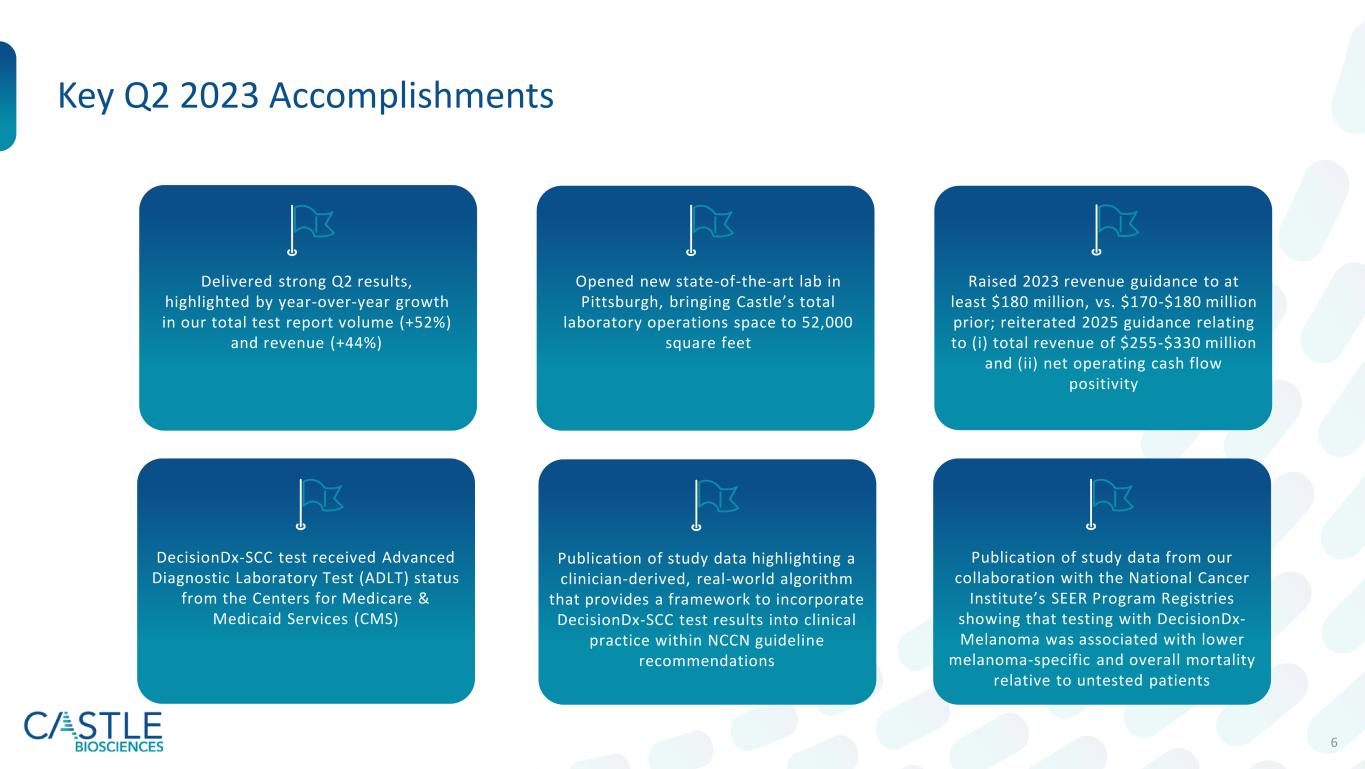
“Castle delivered an outstanding second quarter, with strength across our entire test portfolio,” said Derek Maetzold, president and chief executive officer of Castle Biosciences. “Building on our first quarter momentum and driven by consistent execution across the entire Castle team, we delivered strong test report volume and revenue growth. Based on strong first half 2023 execution and confidence in our business, we are raising our 2023 revenue guidance to at least $180 million.
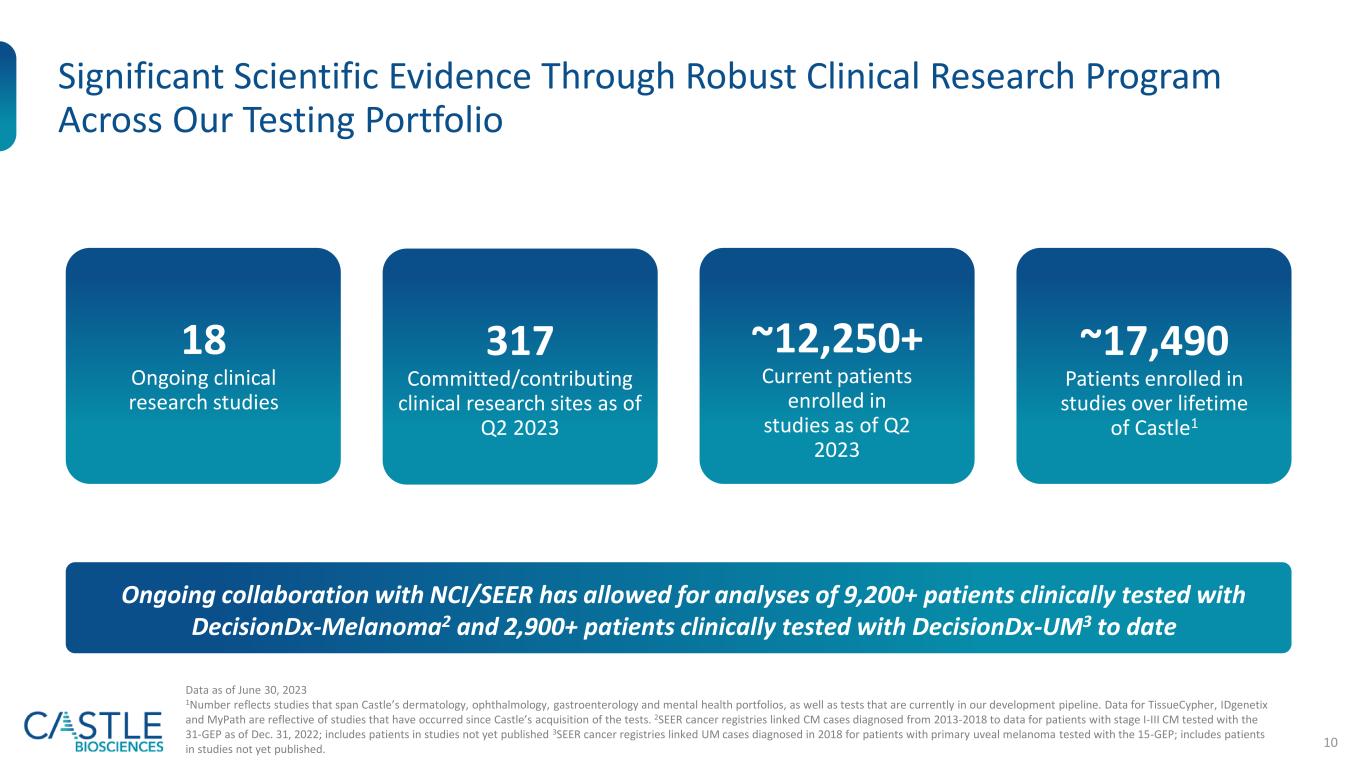
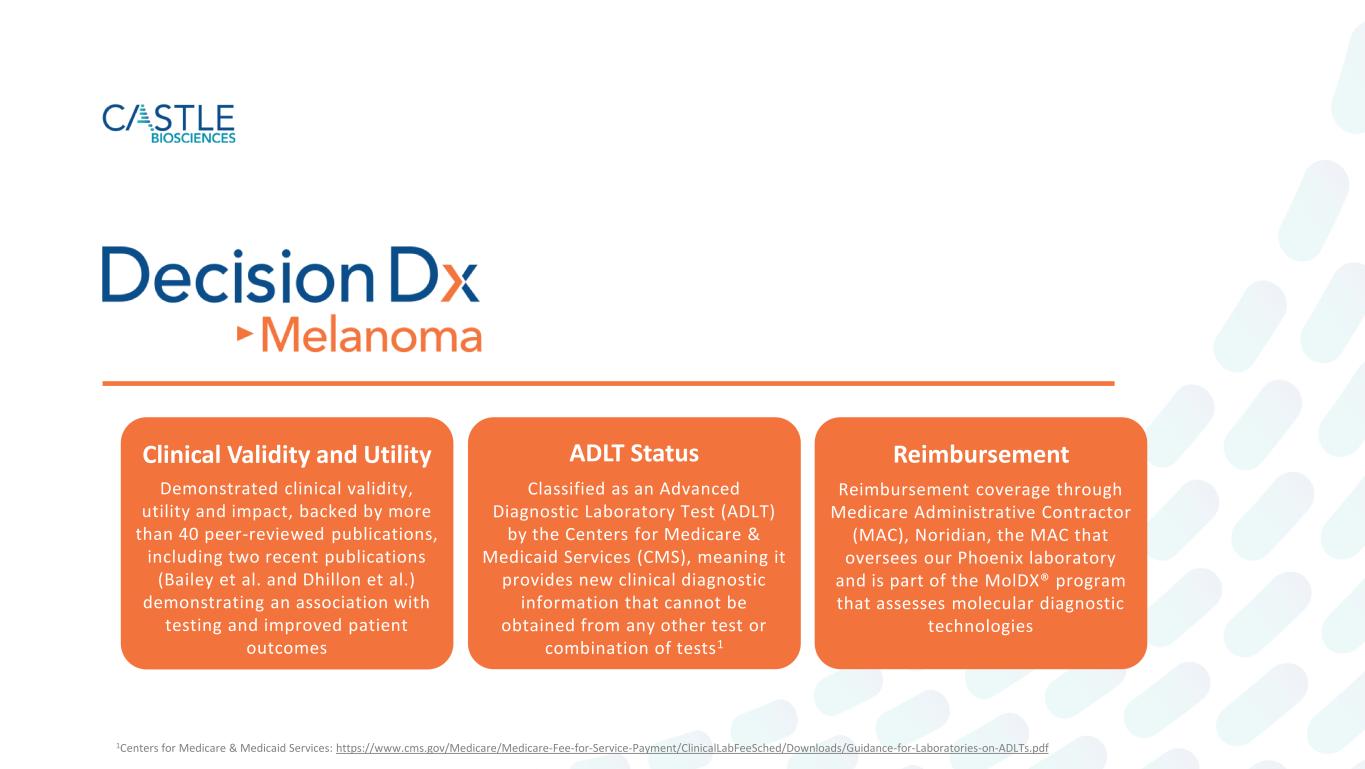
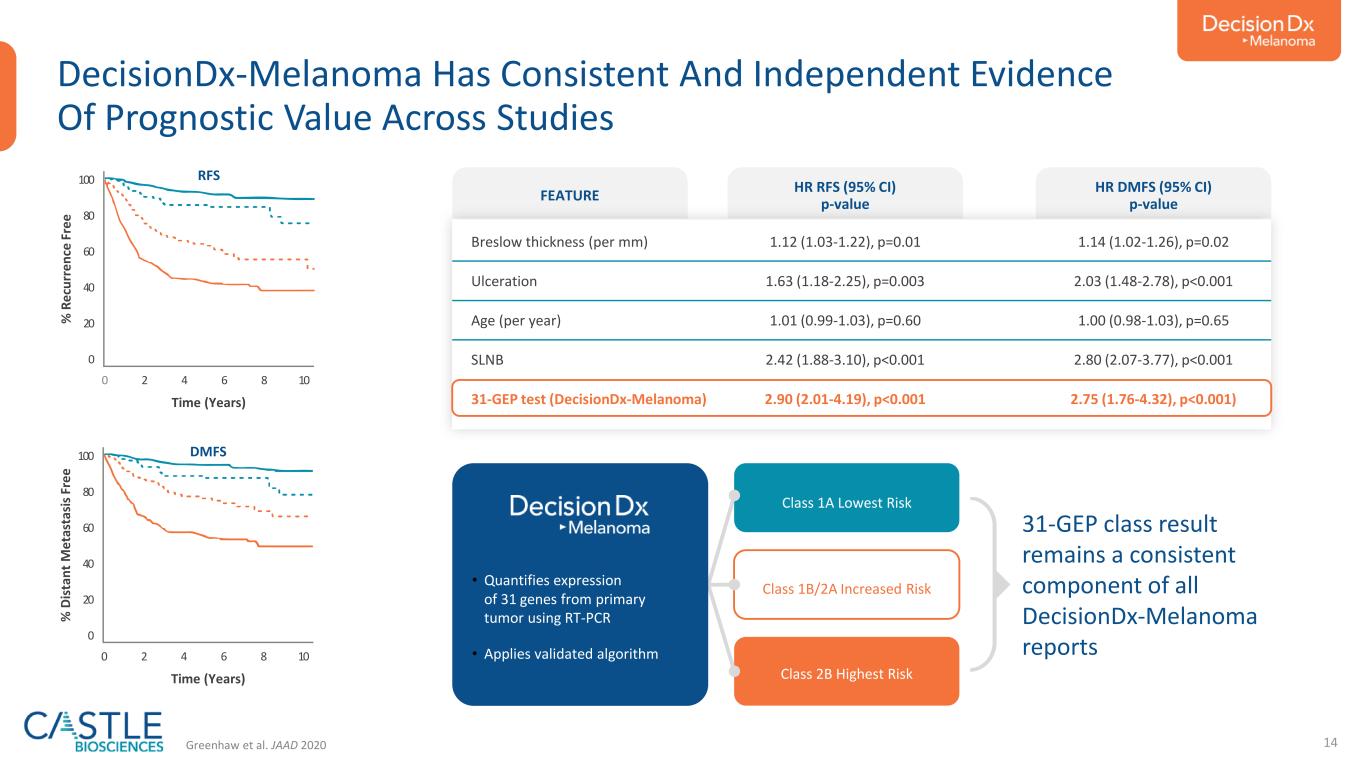
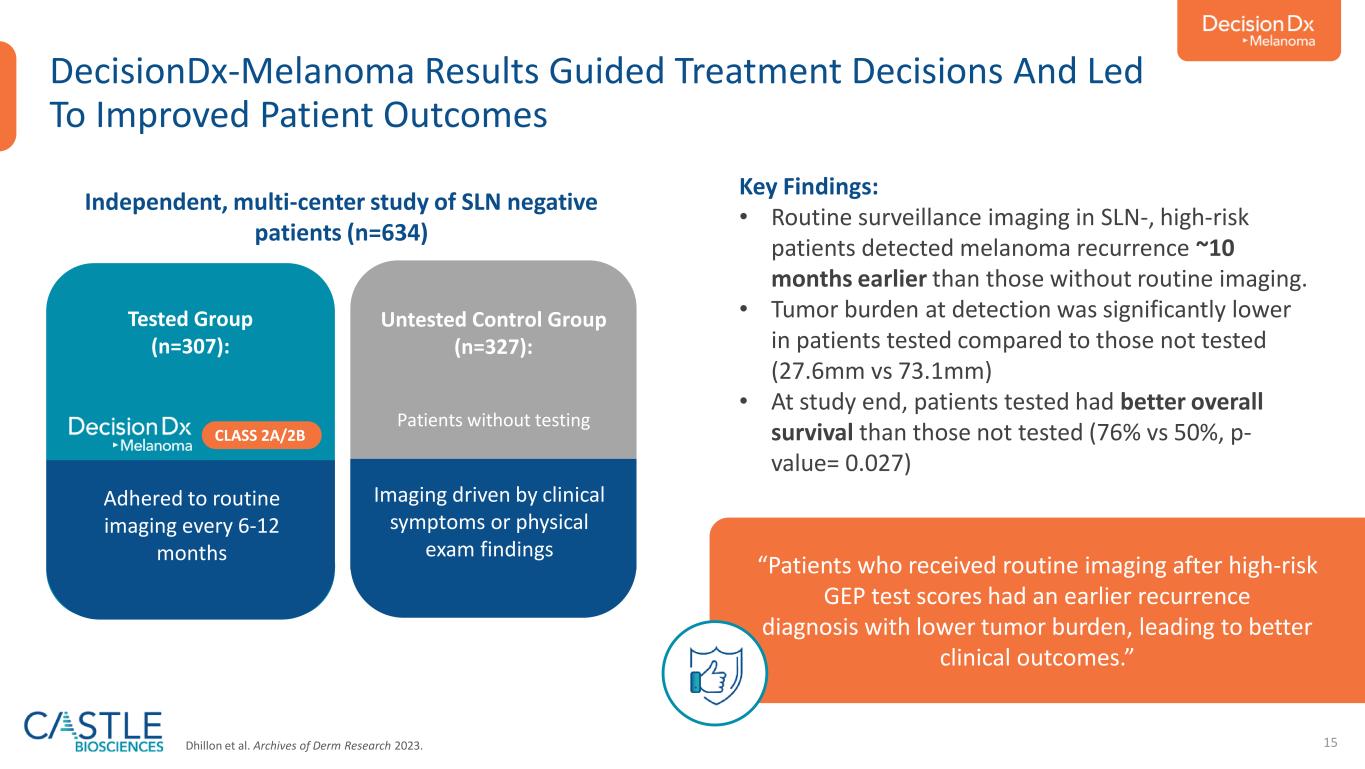
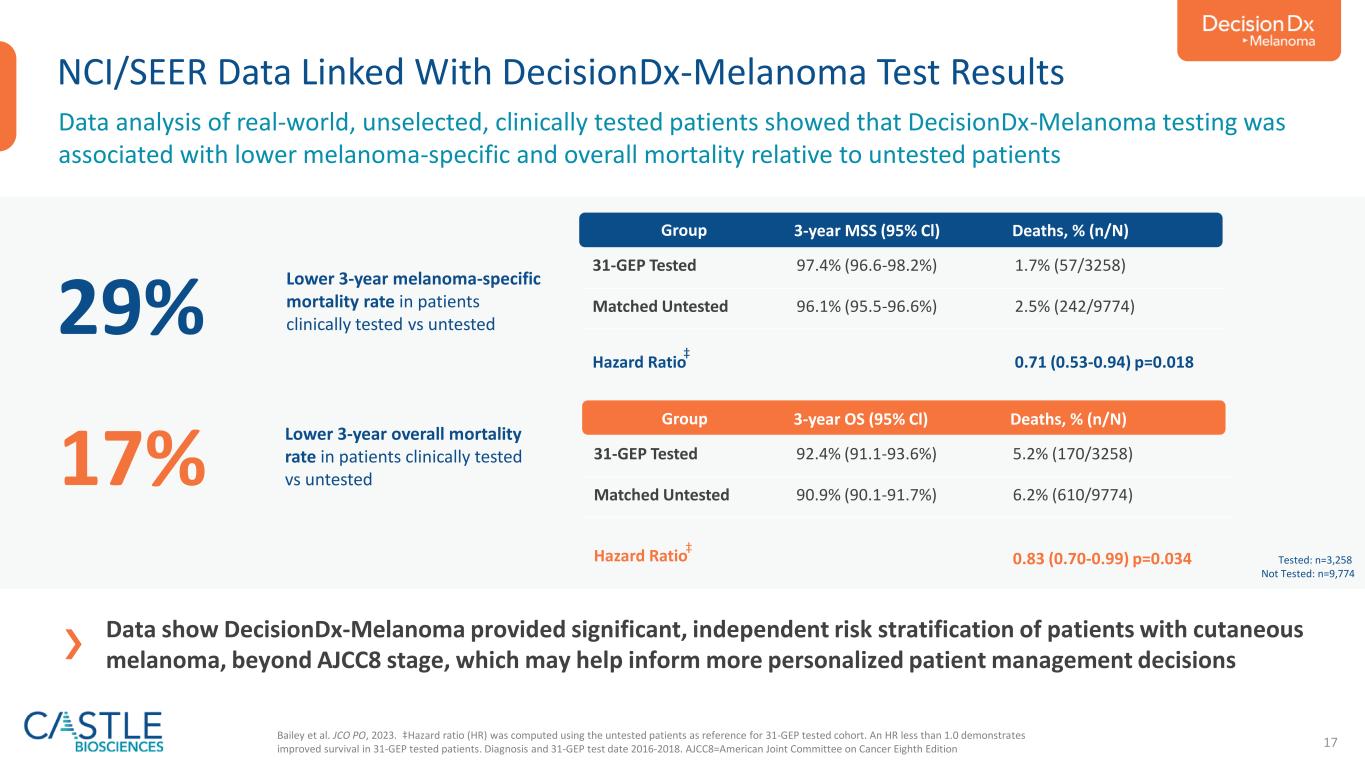
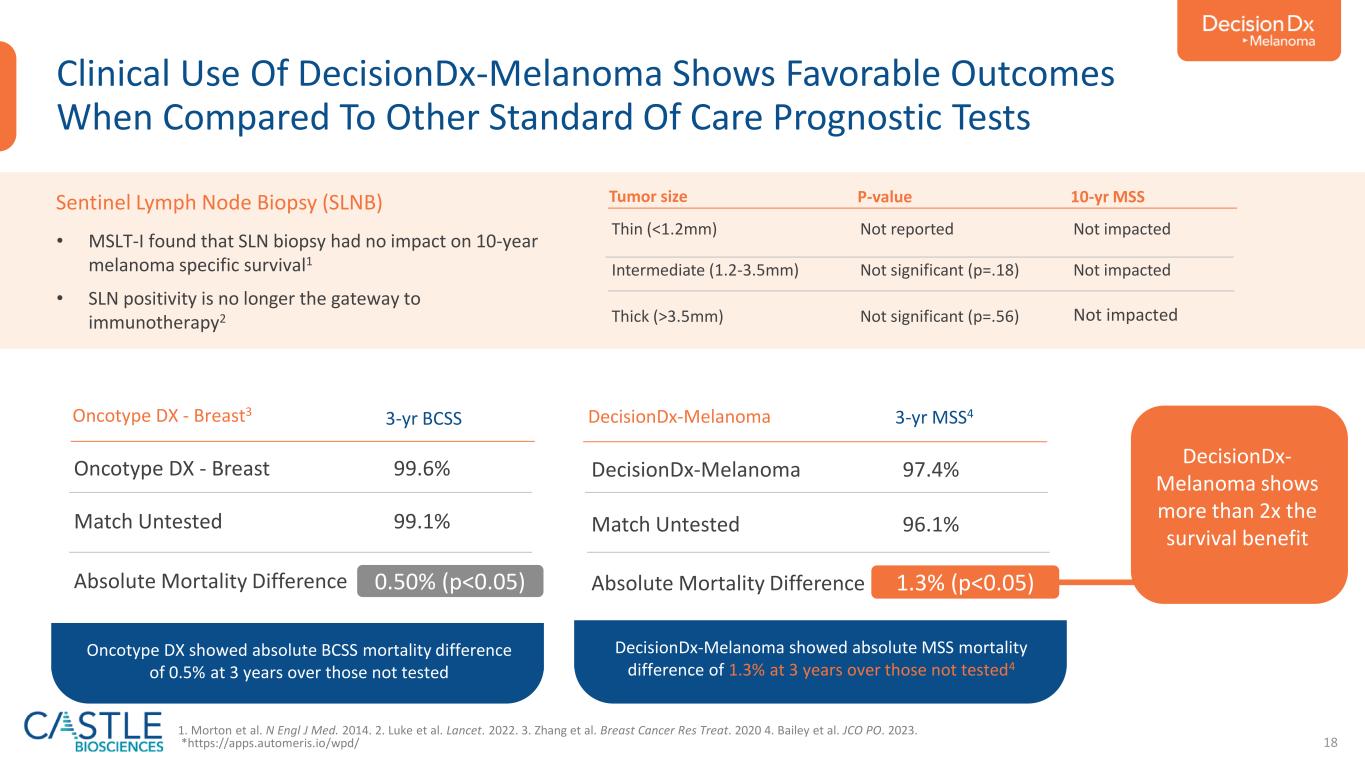
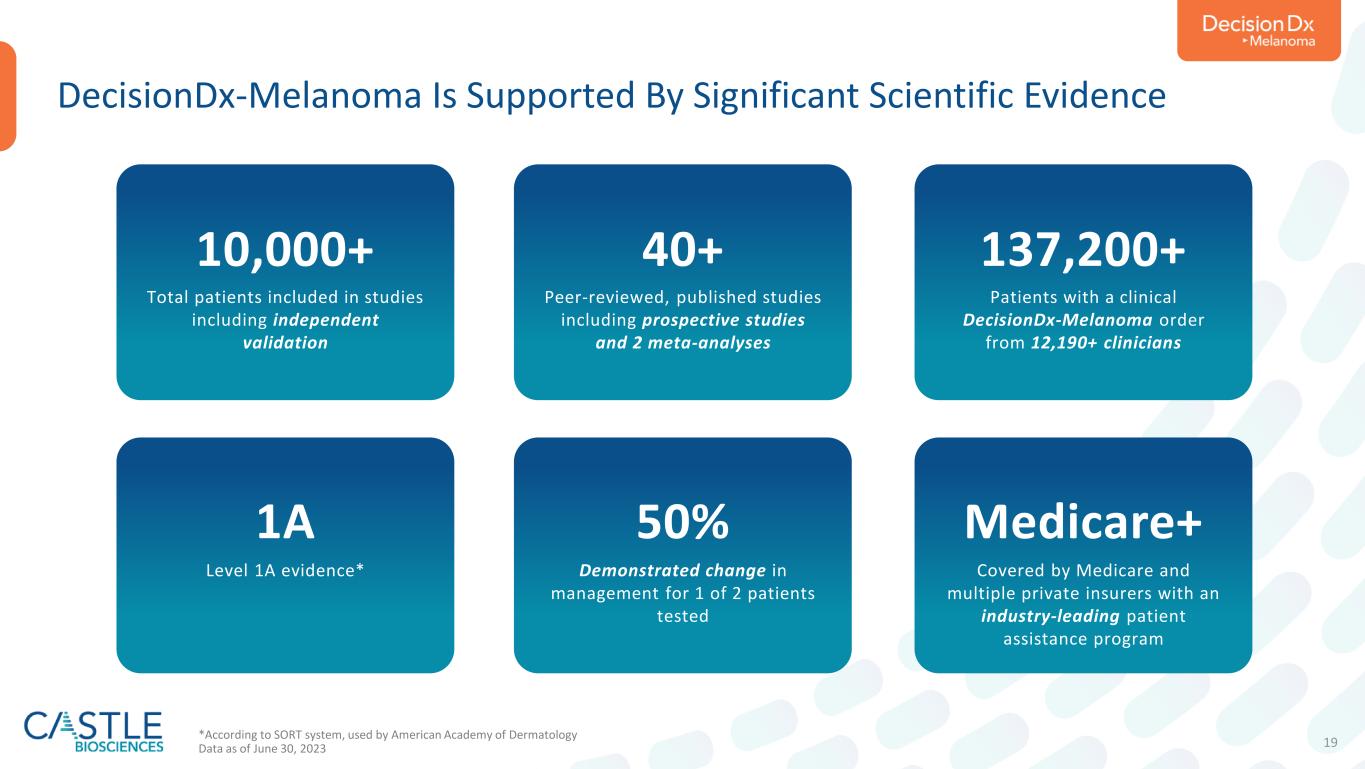
“In addition, we expanded our body of evidence, further demonstrating the clinical value of our innovative tests and supporting adoption by clinicians and payers. Specifically, two patient outcome studies on our DecisionDx®-Melanoma test were published in the second quarter. The first study was from our collaboration with the National Cancer Institute’s SEER Program Registries. Data from this study showed that testing with DecisionDx-Melanoma was associated with lower melanoma-specific and overall mortality relative to untested patients. A similar study was published by Dhillon, et al. This independent, multi-center study found that sentinel lymph node negative patients whose follow-up treatment pathway was directed by the DecisionDx-Melanoma test for use of routine imaging in patients with high-risk DecisionDx-Melanoma results led to earlier detection of recurrences, when the tumor burden was lower. At study end, 76% of patients in the tested group who had a melanoma recurrence were alive compared to 50% in the untested group.
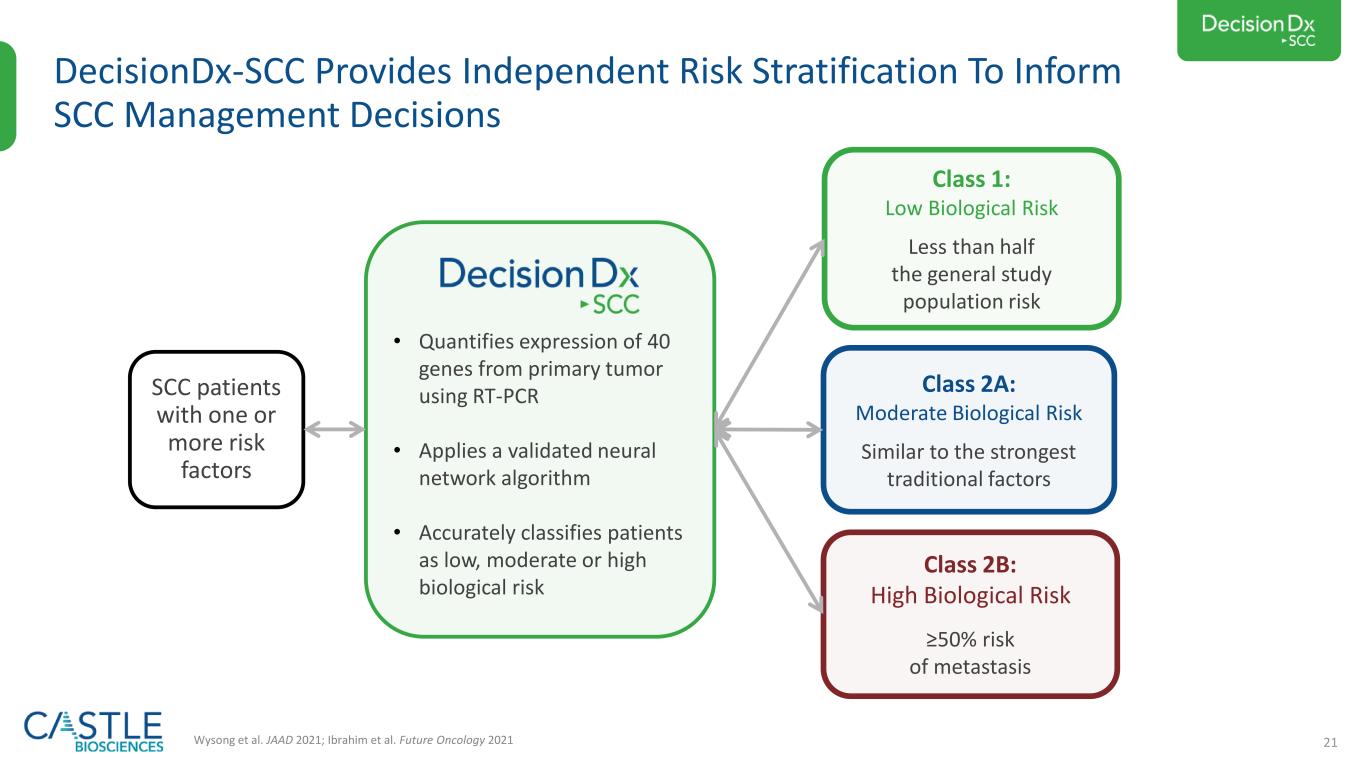
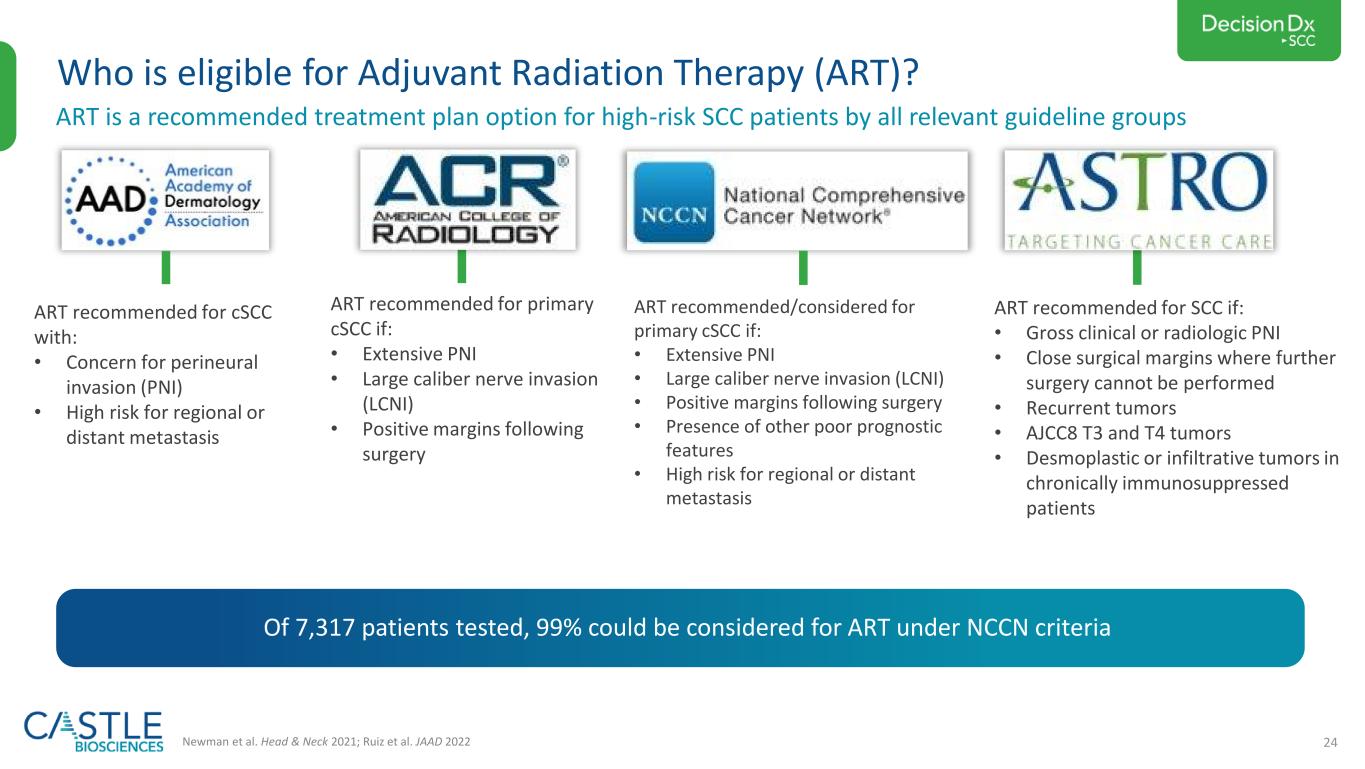
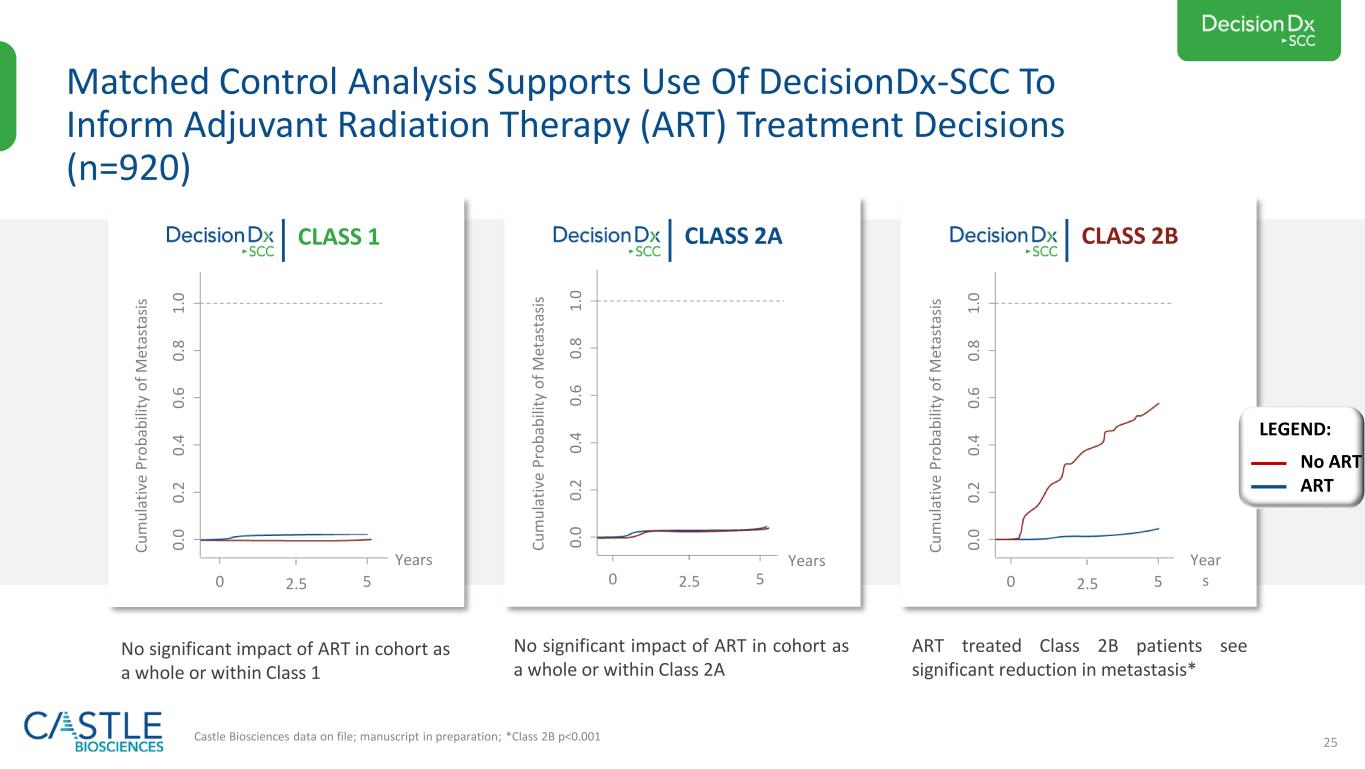
“Additionally, during open comment periods, we had the opportunity to present data to a number of Medicare contractors related to one of the treatments that our DecisionDx®-SCC test has been shown to inform, adjuvant radiation therapy (ART). These data from a matched control analysis compare patients with high-risk squamous cell carcinoma (SCC) with one or more risk factors who received ART and those who did not. When evaluating this cohort, we observed that the DecisionDx-SCC Class 2B result could identify a group of patients with a significant reduction in metastasis rate after having received ART and that the DecisionDx-SCC Class 1 patients did not receive a benefit from ART.
“Castle delivered an outstanding second quarter, with strength across our entire test portfolio,” said Derek Maetzold, president and chief executive officer of Castle Biosciences. “Building on our first quarter momentum and driven by consistent execution across the entire Castle team, we delivered strong test report volume and revenue growth. Based on strong first half 2023 execution and confidence in our business, we are raising our 2023 revenue guidance to at least $180 million.
“In addition, we expanded our body of evidence, further demonstrating the clinical value of our innovative tests and supporting adoption by clinicians and payers. Specifically, two patient outcome studies on our DecisionDx®-Melanoma test were published in the second quarter. The first study was from our collaboration with the National Cancer Institute’s SEER Program Registries. Data from this study showed that testing with DecisionDx-Melanoma was associated with lower melanoma-specific and overall mortality relative to untested patients. A similar study was published by Dhillon, et al. This independent, multi-center study found that sentinel lymph node negative patients whose follow-up treatment pathway was directed by the DecisionDx-Melanoma test for use of routine imaging in patients with high-risk DecisionDx-Melanoma results led to earlier detection of recurrences, when the tumor burden was lower. At study end, 76% of patients in the tested group who had a melanoma recurrence were alive compared to 50% in the untested group.
“Additionally, during open comment periods, we had the opportunity to present data to a number of Medicare contractors related to one of the treatments that our DecisionDx®-SCC test has been shown to inform, adjuvant radiation therapy (ART). These data from a matched control analysis compare patients with high-risk squamous cell carcinoma (SCC) with one or more risk factors who received ART and those who did not. When evaluating this cohort, we observed that the DecisionDx-SCC Class 2B result could identify a group of patients with a significant reduction in metastasis rate after having received ART and that the DecisionDx-SCC Class 1 patients did not receive a benefit from ART.
“Our continued success is a testament to the ongoing dedication of our team to our patient-centric mission. With a track record of delivering on our short- and long-term strategies, combined with a healthy balance sheet and multi-year plan to deliver revenue growth and positive net operating cash flow by year-ending 2025, we are managing the business with a goal of driving near- and long-term shareholder value.”
Second Quarter Ended June 30, 2023, Financial and Operational Highlights
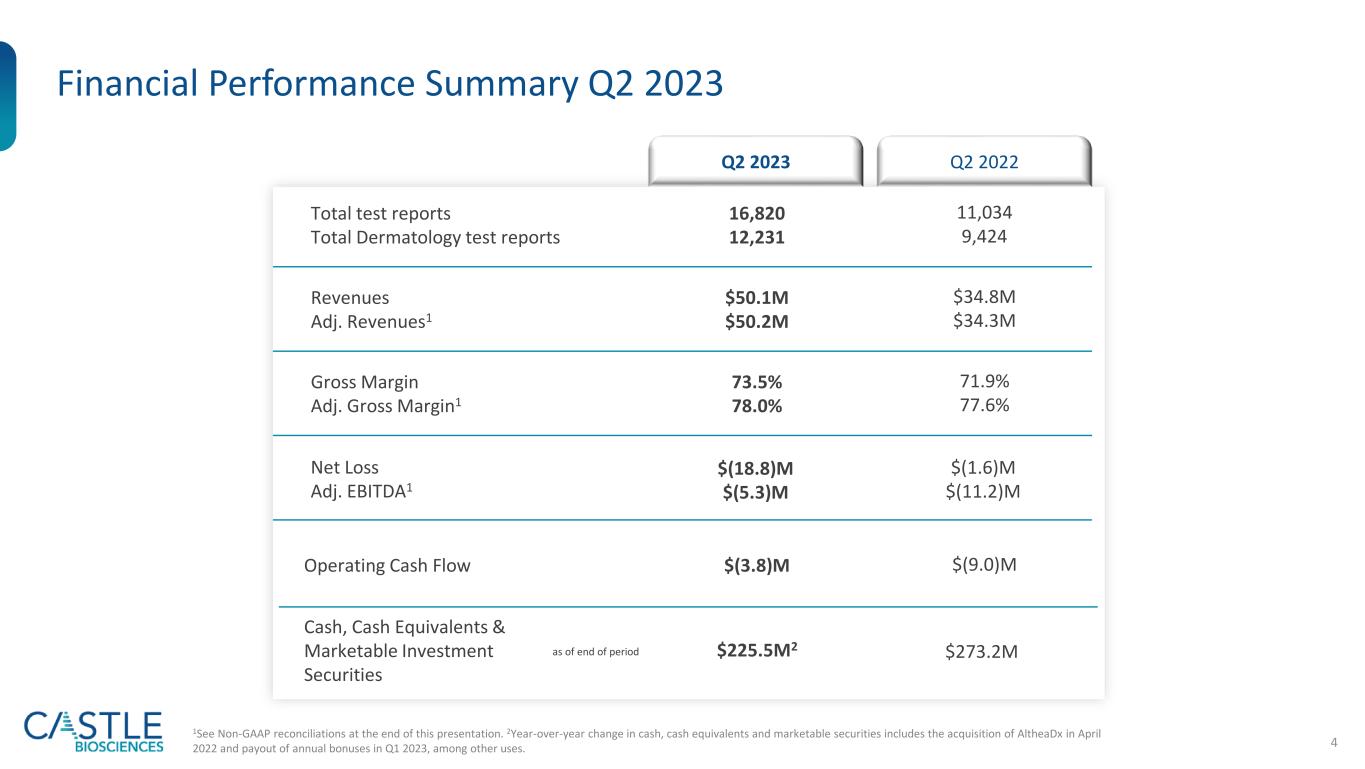
•Revenues were $50.1 million, a 44% increase compared to $34.8 million during the same period in 2022. Included in revenue for the period were revenue adjustments related to tests delivered in prior periods. These prior period revenue adjustments for the quarter ended June 30, 2023, were $0.1 million of net negative revenue adjustments, compared to $0.6 million of net positive revenue adjustments for the same period in 2022.
•Adjusted revenues, which exclude the effects of revenue adjustments related to tests delivered in prior periods, were $50.2 million, a 47% increase compared to $34.3 million for the same period in 2022.
•Delivered 16,820 total test reports in the second quarter of 2023, an increase of 52% compared to 11,034 in the same period of 2022:
◦DecisionDx-Melanoma test reports delivered in the quarter were 8,597, compared to 7,125 in the second quarter of 2022, an increase of 21%.
◦DecisionDx-SCC test reports delivered in the quarter were 2,681, compared to 1,344 in the second quarter of 2022, an increase of 99%.
◦MyPath® Melanoma test reports delivered in the quarter were 953, compared to 955 MyPath Melanoma and DiffDx®-Melanoma aggregate test reports in the second quarter of 2022.
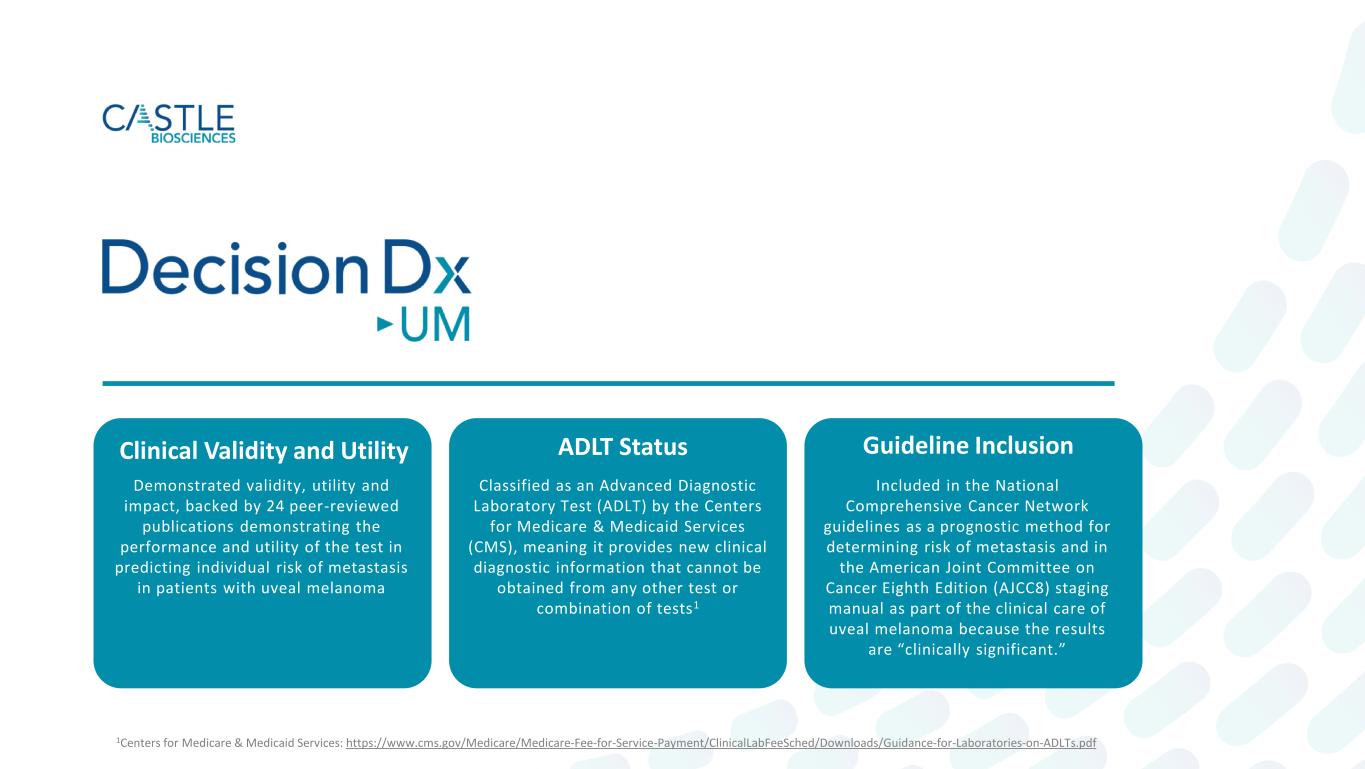
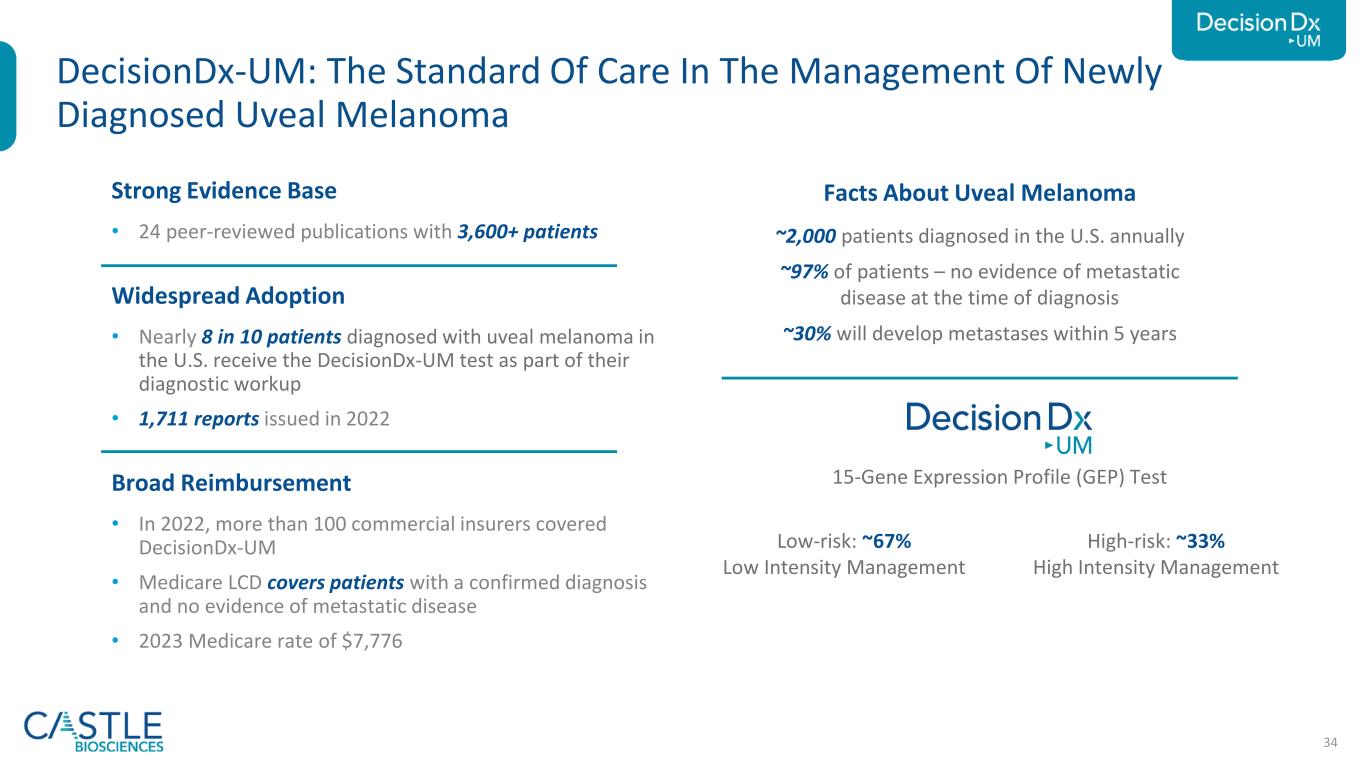
◦DecisionDx®-UM test reports delivered in the quarter were 461, compared to 431 in the second quarter of 2022, an increase of 7%.
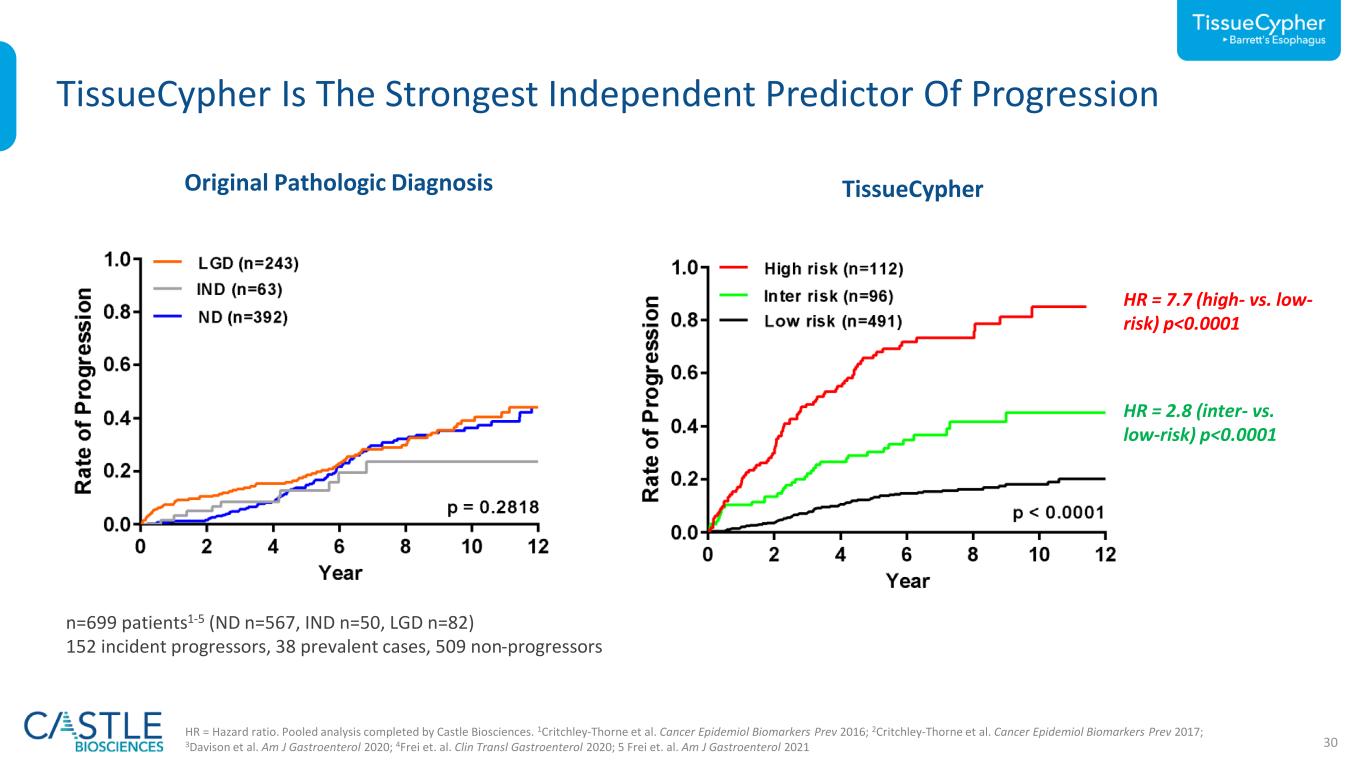
◦TissueCypher® Barrett’s Esophagus test reports delivered in the quarter were 1,447, compared to 352 in the second quarter of 2022, an increase of 311%.
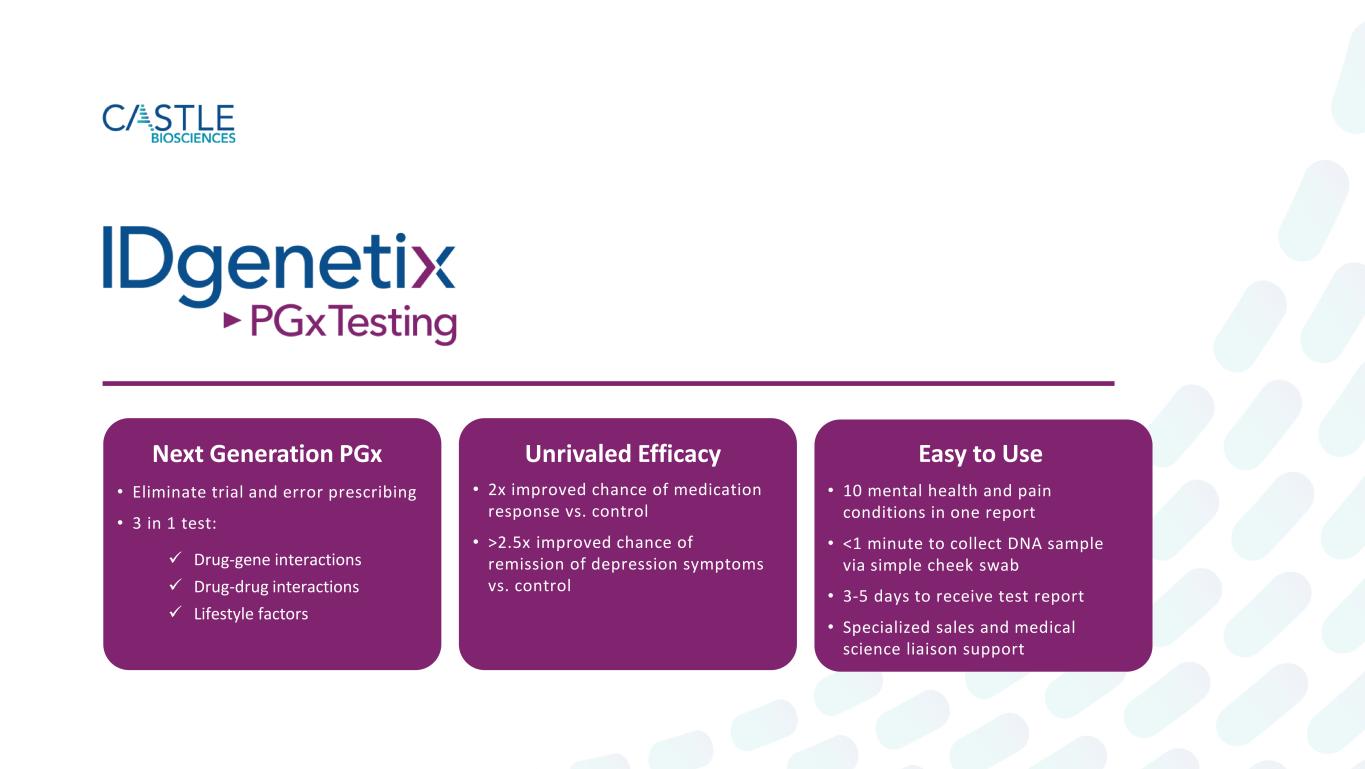
◦IDgenetix® test reports delivered in the quarter were 2,681, compared to 827 in the second quarter of 2022, an increase of 224%.
•Gross margin for the quarter ended June 30, 2023, was 73%, and adjusted gross margin was 78%.
•Net cash used in operations was $3.8 million, compared to $9.0 million for the same period in 2022.
•Net loss for the second quarter, which includes non-cash stock-based compensation expense of $12.8 million, was $(18.8) million, compared to $(1.6) million for the same period in 2022.
•Adjusted EBITDA for the second quarter was $(5.3) million, compared to $(11.2) million for the same period in 2022.
Six Months Ended June 30, 2023, Selected Results
•Revenues were $92.2 million, a 49% increase compared to $61.7 million during the same period in 2022. Included in revenue for the period were revenue adjustments related to tests delivered in prior periods. These prior period revenue adjustments for the six months ended June 30, 2023, were $1.7 million of net negative revenue adjustments, compared to $0.3 million of net negative revenue adjustments for the same period in 2022.
•Adjusted revenues, which exclude the effects of revenue adjustments related to tests delivered in prior periods, were $93.9 million, a 51% increase compared to $62.0 million for the same period in 2022.
•Delivered 31,736 total test reports in the six months ended June 30, 2023, an increase of 61% compared to 19,661 in the same period of 2022:
◦DecisionDx-Melanoma test reports delivered in the six months ended June 30, 2023, were 16,180, compared to 13,148 for the same period in 2022, an increase of 23%.
◦DecisionDx-SCC test reports delivered in the six months ended June 30, 2023, were 5,092, compared to 2,486 for the same period in 2022, an increase of 105%.
◦MyPath Melanoma and DiffDx-Melanoma test reports delivered in the six months ended June 30, 2023, were 1,933, compared to 1,905 MyPath Melanoma and DiffDx-Melanoma aggregate test reports for the same period in 2022, an increase of 1%.
◦DecisionDx-UM test reports delivered in the six months ended June 30, 2023, were 870, compared to 887 for the same period in 2022, a decrease of 2%.
◦TissueCypher Barrett’s Esophagus test reports delivered in the six months ended June 30, 2023, were 2,830, compared to 408 for the same period in 2022, following our initial offering of the test beginning in December 2021.
◦IDgenetix test reports delivered in the six months ended June 30, 2023, were 4,831, compared to 827 for the same period in 2022, following our initial offering of the test beginning in April 2022.
•Gross margin for the six months ended June 30, 2023, was 72%, and adjusted gross margin was 77%.
•Net cash used in operations was $29.2 million, compared to $30.4 million for the same period in 2022.
•Net loss for the six months ended June 30, 2023, which includes non-cash stock-based compensation expense of $26.4 million, was $(48.0) million, compared to $(26.3) million for the same period in 2022.
•Adjusted EBITDA for the six months ended June 30, 2023, was $(20.4) million, compared to $(22.6) million for the same period in 2022.
Cash, Cash Equivalents and Marketable Investment Securities
As of June 30, 2023, the Company’s cash, cash equivalents and marketable investment securities totaled $225.5 million.
2023 Outlook
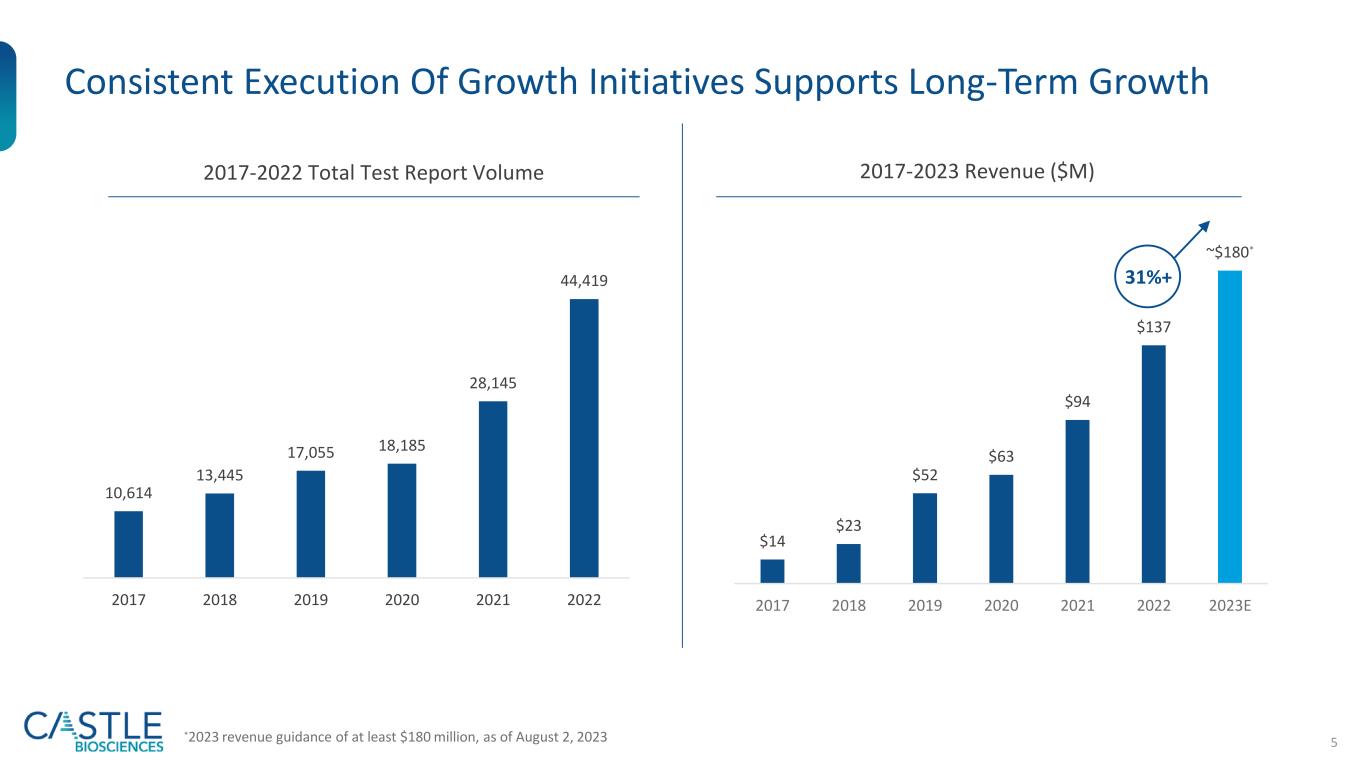
Castle Biosciences is increasing its guidance for anticipated total revenue in 2023. The Company now anticipates generating at least $180 million in total revenue in 2023 compared to the previously provided guidance of $170-180 million.
Second Quarter and Recent Accomplishments and Highlights
Dermatology
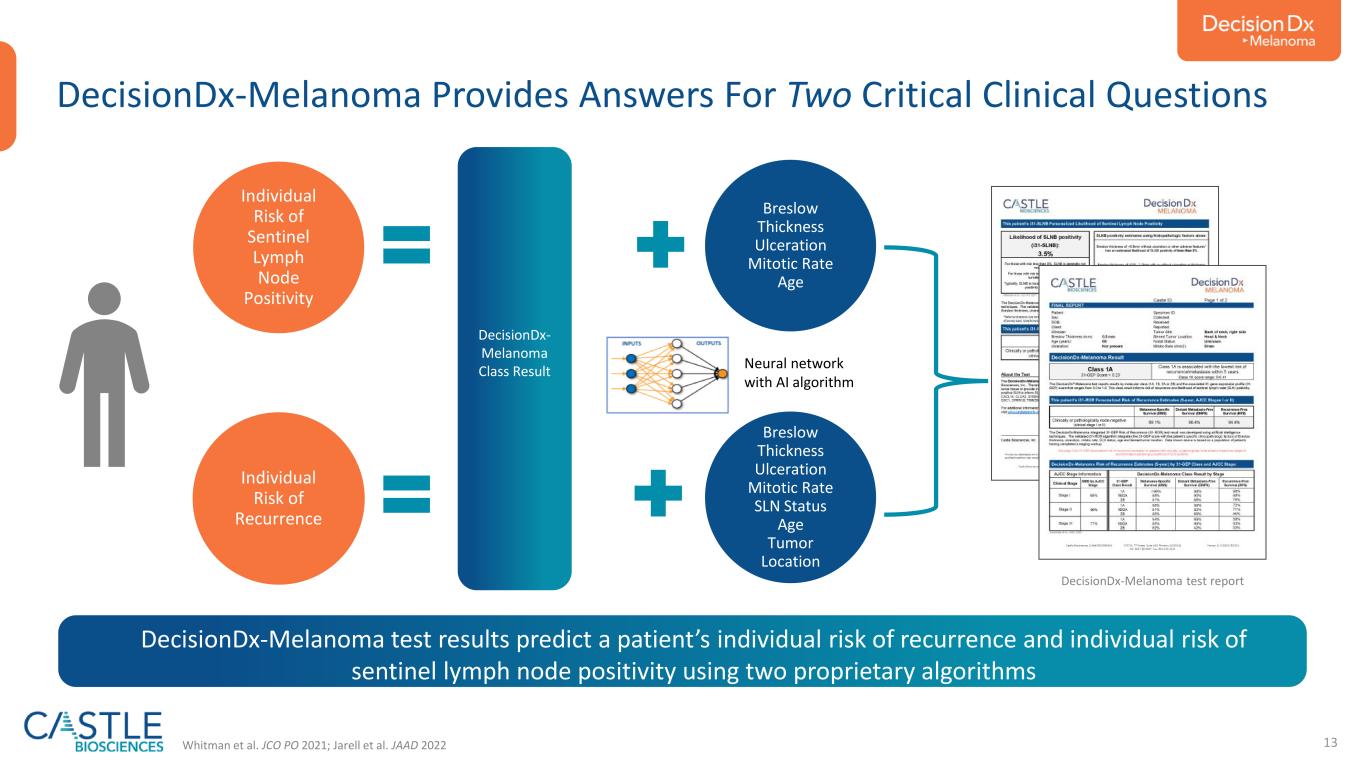
•DecisionDx-Melanoma: In June, the Company announced the initial publication of its collaboration with the National Cancer Institute’s SEER Program Registries. This large study of real-world, unselected patients confirmed prior prospective and retrospective studies showing DecisionDx-Melanoma provided clinically meaningful and significant, independent risk stratification of patients with cutaneous melanoma (CM), beyond American Joint Committee on Cancer Eighth Edition (AJCC8) stage. Additionally, the study showed that testing with DecisionDx-Melanoma was associated with lower melanoma-specific and overall mortality relative to untested patients. The publication can be found here.
•DecisionDx-Melanoma: In May, the Company announced an independent, multi-center study providing a direct chain of evidence that use of DecisionDx-Melanoma test results to guide radiological surveillance could lead to improved patient outcomes. Specifically, this study directly compared the impact of management changes in sentinel lymph node negative patients whose follow-up pathway was directed by the DecisionDx-Melanoma test to patients in the same institution who were not tested and, therefore, did not have their follow-up pathway changed from the institution’s traditional follow-up pathway. The results showed that metastasis was detected earlier, when the tumor burden was smaller, and at study end, 76% of patients in the tested group who had a metastasis were alive compared to 50% in the untested group. The study, authored by Dhillon et al., can be found here.
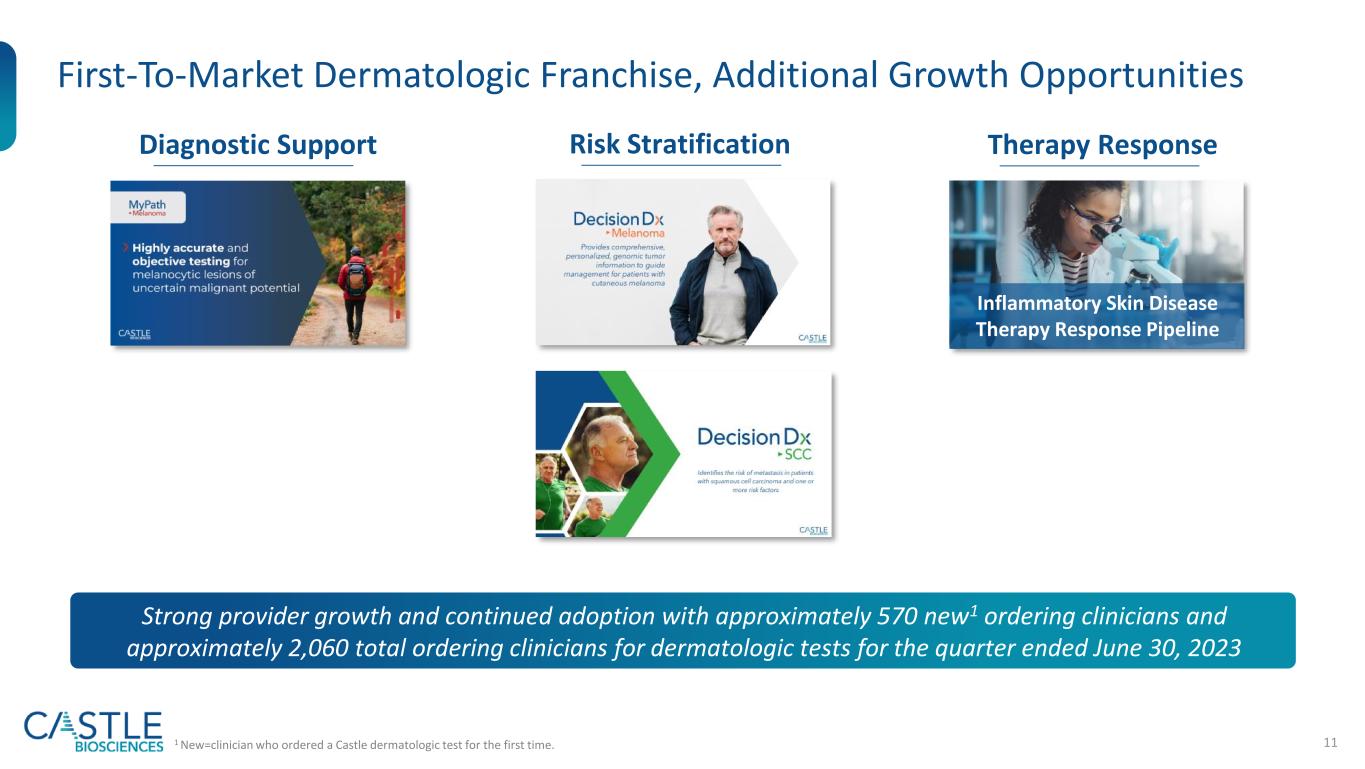
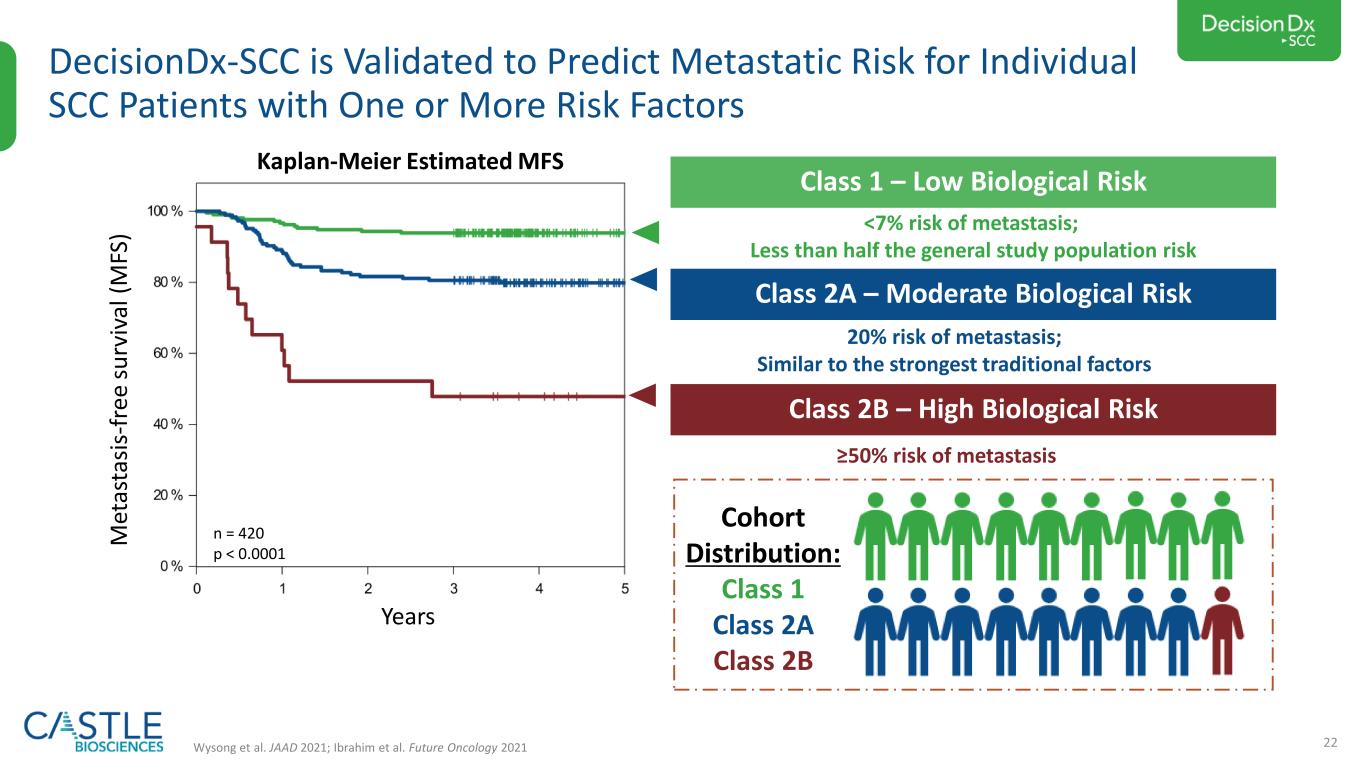
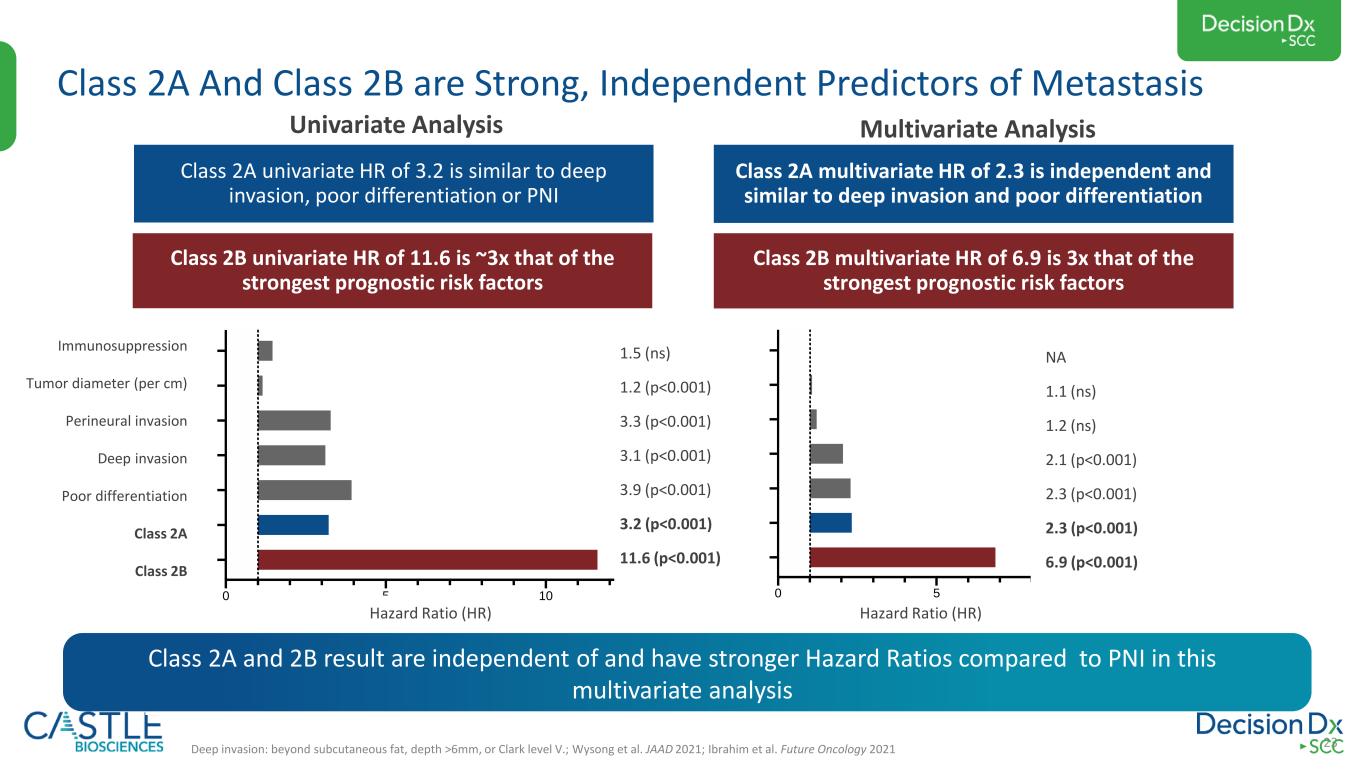
•DecisionDx-SCC: In June, the Company announced new data demonstrating the ability of the DecisionDx-SCC test to identify cutaneous squamous cell carcinoma (cSCC) tumors at a biologically high risk of metastasis in a subset of patients considered to be at a low risk of metastasis by traditional staging. In the study, the DecisionDx-SCC test was able to significantly stratify three-year metastasis free survival rates within the AJCC8 and Brigham and Women’s Hospital T1 populations of the cSCC cohort. See the Company’s news release from June 12, 2023, for more information.
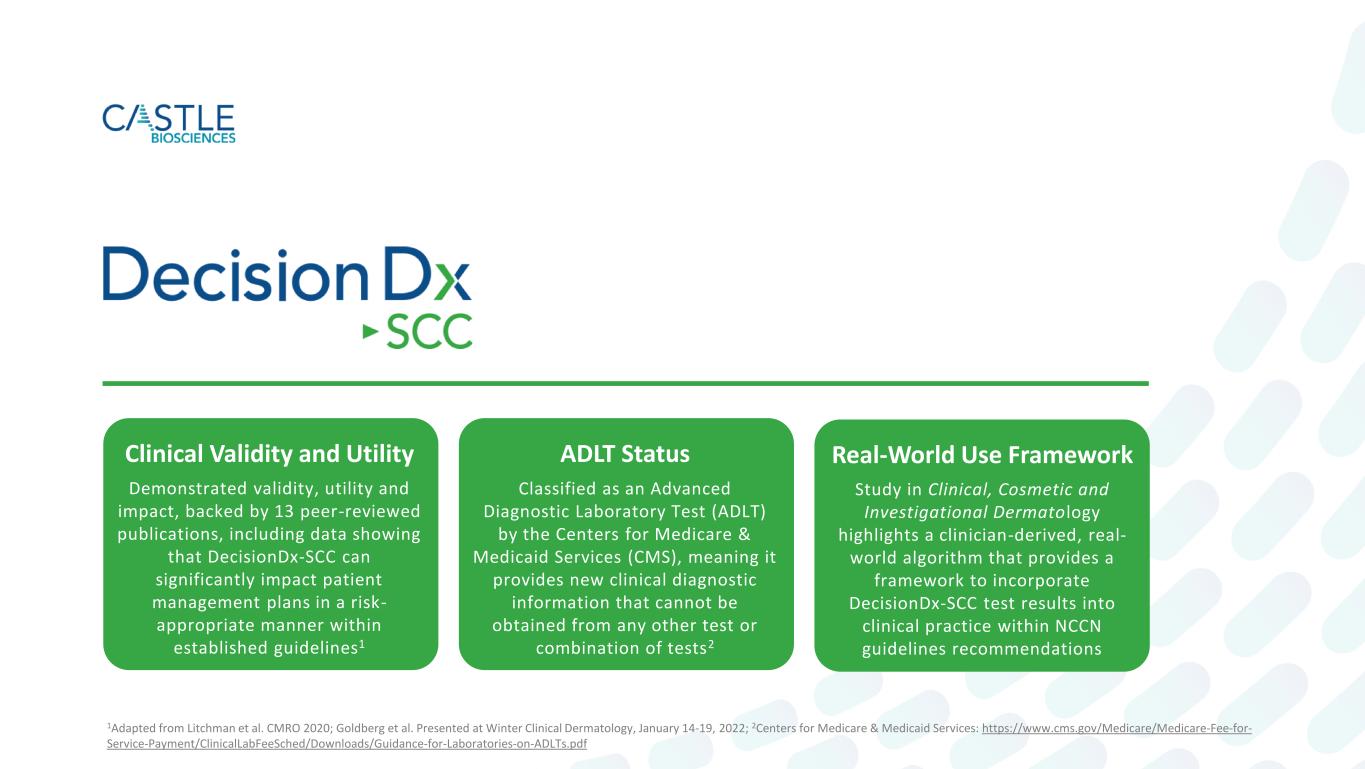
•DecisionDx-SCC: In June, the Company announced the publication of a paper highlighting a clinician-derived, real-world algorithm that provides a framework to incorporate DecisionDx-SCC test results into clinical practice within National Comprehensive Cancer Network (NCCN) guideline recommendations. This framework for stratifying patients with advanced cSCC includes a treatment algorithm that demonstrates how use of DecisionDx-SCC test results can assist clinicians in identifying personalized, risk-aligned treatment pathway improvements for patients with high-risk cSCC, based on the patient’s tumor biology, which may help improve their disease outcome. The publication can be found here.
Gastroenterology
•In May, the Company announced that its three posters at the recent Digestive Disease Week Annual Meeting were honored as “Posters of Distinction” by the American Gastroenterological Association Institute Council, ranking among the top 10% of the more than 3,100 abstracts showcased during the meeting. See the Company’s news release from May 26, 2023, for more information.
•In May, the Company announced that it had been selected as the winner of the “Best Use of Artificial Intelligence in Healthcare” award in the seventh annual MedTech Breakthrough Awards program for its innovative TissueCypher Barrett’s Esophagus (BE) test. The TissueCypher test provides clinicians with important information about a patient’s individual risk of progression to esophageal cancer based on advanced analysis of biopsied tissue to guide more informed and risk-aligned management of BE patients. See the Company’s news release from May 15, 2023, for more information.
Mental Health
•In June, ECRI, an independent, nonprofit organization improving the safety, quality and cost-effectiveness of care across all healthcare settings, concluded its genetic test assessment of Castle’s
IDgenetix test with a four out of five, or “Somewhat Favorable,” rating. Commercial payers utilize ECRI evaluations to assist in making coverage decisions.
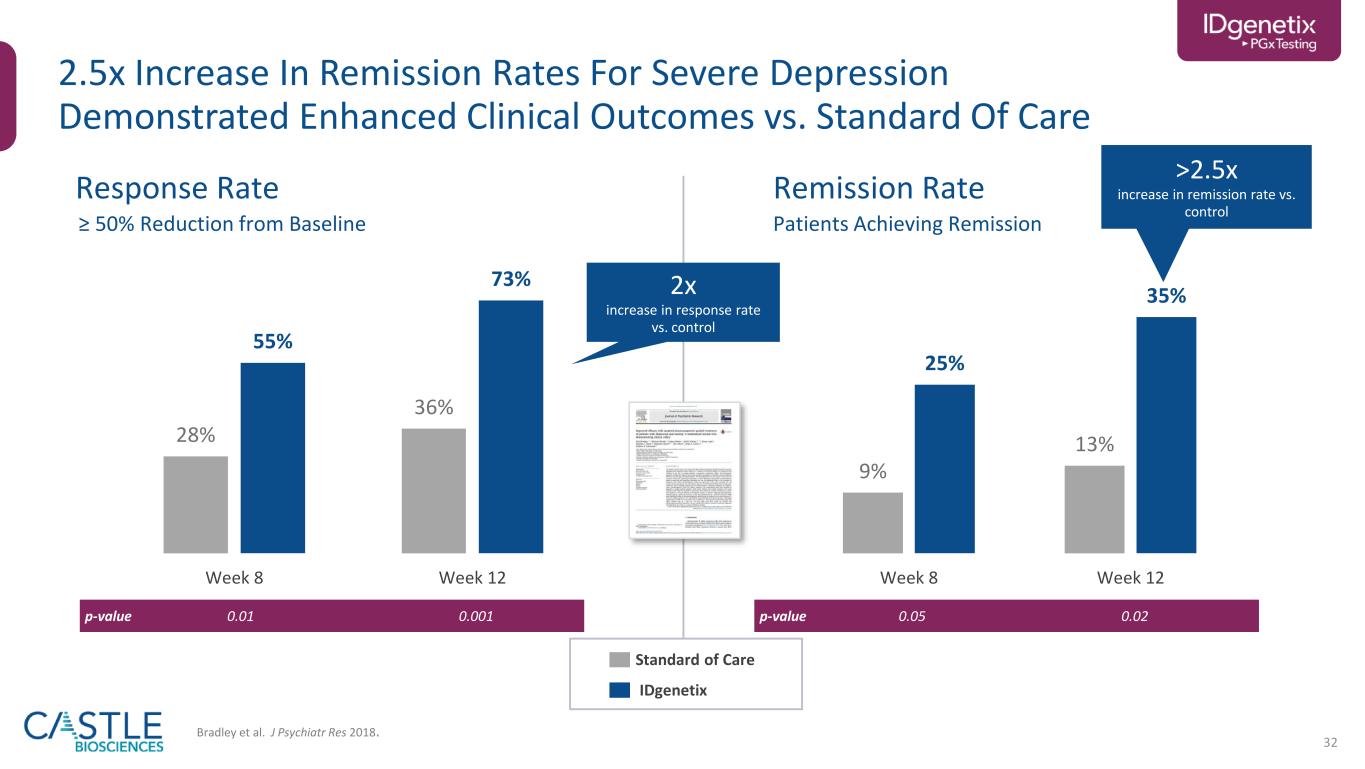
•In May, the Company announced real-world study data demonstrating that use of IDgenetix to guide medication management can significantly improve medication response and remission rates in patients diagnosed with moderate to severe depression, compared to current standard-of-care treatment. The study abstract can be found here.
Corporate
•In July, the Company announced that it had earned a second consecutive Arizona Top Workplace award from AZ Central, the digital home of The Arizona Republic newspaper. See the Company’s news release from July 17, 2023, for more information.
•In May, the Company announced that it opened a new state-of-the-art laboratory facility in Pittsburgh. The new 20,000-square-foot facility doubles the size of its previous Pittsburgh laboratory and is expected to have the capacity and ability to process each of its proprietary tests. Additionally, the Company anticipates doubling its workforce in Pittsburgh, creating approximately 35 new jobs by the end of 2023. See the Company’s news release from May 22, 2023, for more information.
Conference Call and Webcast Details
Castle Biosciences will hold a conference call on Wednesday, August 2, 2023, at 4:30 p.m. Eastern time to discuss its second quarter 2023 results and provide a corporate update.
A live webcast of the conference call can be accessed here: https://events.q4inc.com/attendee/543951973 or via the webcast link on the Investor Relations page of the Company’s website, https://ir.castlebiosciences.com/overview/default.aspx. Please access the webcast at least 10 minutes before the conference call start time. An archive of the webcast will be available on the Company’s website until August 23, 2023.
To access the live conference call via phone, please dial 833 470 1428 from the United States, or +1 404 975 4839 internationally, at least 10 minutes prior to the start of the call, using the conference ID 967509.
There will be a brief Question & Answer session following management commentary.
Use of Non-GAAP Financial Measures (UNAUDITED)
In this release, we use the metrics of Adjusted Revenues, Adjusted Gross Margin and Adjusted EBITDA, which are non-GAAP financial measures and are not calculated in accordance with generally accepted accounting principles in the United States (GAAP). Adjusted Revenues and Adjusted Gross Margin reflect adjustments to GAAP net revenues to exclude net positive and/or net negative revenue adjustments recorded in the current period associated with changes in estimated variable consideration related to test reports delivered in previous periods. Adjusted Gross Margin further excludes acquisition-related intangible asset amortization. Adjusted EBITDA excludes from net loss interest income, interest expense, income tax expense (benefit), depreciation and amortization expense, stock-based compensation expense, change in fair value of contingent consideration and acquisition related transaction costs.
We use Adjusted Revenues, Adjusted Gross Margin and Adjusted EBITDA internally because we believe these metrics provide useful supplemental information in assessing our revenue and operating performance reported in accordance with GAAP, respectively. We believe that Adjusted Revenues, when used in conjunction with our test report volume information, facilitates investors’ analysis of our current-period revenue performance and average selling price performance by excluding the effects of revenue adjustments related to test reports delivered in prior periods, since these adjustments may not be indicative of the current or future performance of our business. We believe that providing Adjusted Revenues may also help facilitate comparisons to our historical periods. Adjusted Gross Margin is calculated using Adjusted Revenues and therefore excludes the impact of revenue adjustments related to test reports delivered in prior periods, which we believe is useful to investors as described above. We further exclude acquisition-related intangible asset amortization in the calculation of Adjusted Gross Margin. We believe that excluding acquisition-related intangible asset amortization may facilitate gross margin comparisons to historical periods and may be useful in assessing current-period performance without regard to the historical accounting valuations of intangible assets, which are applicable only to tests we acquired rather than internally developed. We believe Adjusted EBITDA may
enhance an evaluation of our operating performance because it excludes the impact of prior decisions made about capital investment, financing, investing and certain expenses we believe are not indicative of our ongoing performance. However, these non-GAAP financial measures may be different from non-GAAP financial measures used by other companies, even when the same or similarly titled terms are used to identify such measures, limiting their usefulness for comparative purposes.
These non-GAAP financial measures are not meant to be considered in isolation or used as substitutes for net revenues, gross margin, or net loss reported in accordance with GAAP; should be considered in conjunction with our financial information presented in accordance with GAAP; have no standardized meaning prescribed by GAAP; are unaudited; and are not prepared under any comprehensive set of accounting rules or principles. In addition, from time to time in the future, there may be other items that we may exclude for purposes of these non-GAAP financial measures, and we may in the future cease to exclude items that we have historically excluded for purposes of these non-GAAP financial measures. Likewise, we may determine to modify the nature of adjustments to arrive at these non-GAAP financial measures. Because of the non-standardized definitions of non-GAAP financial measures, the non-GAAP financial measure as used by us in this press release and the accompanying reconciliation tables have limits in their usefulness to investors and may be calculated differently from, and therefore may not be directly comparable to, similarly titled measures used by other companies. Accordingly, investors should not place undue reliance on non-GAAP financial measures. Reconciliations of these non-GAAP financial measures to the most directly comparable GAAP financial measures are presented in the tables at the end of this release.
About Castle Biosciences
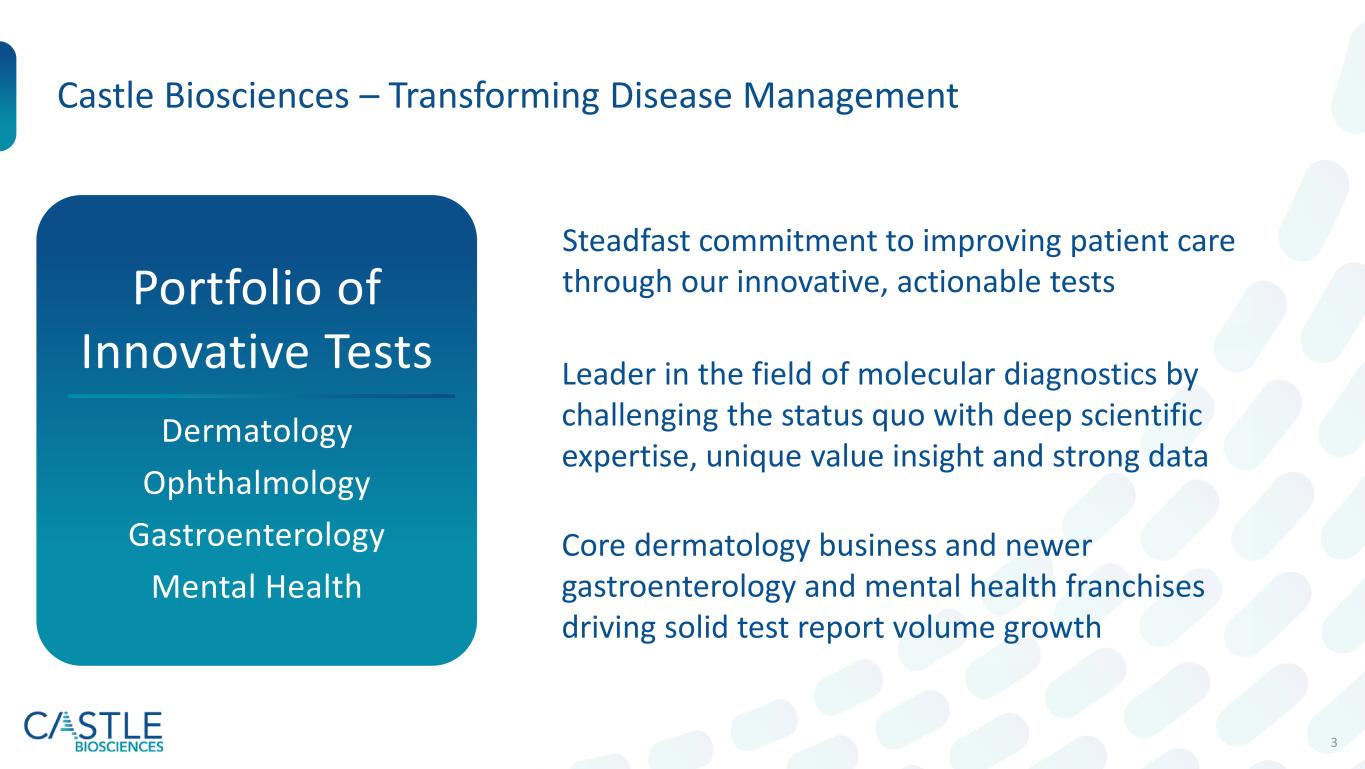
Castle Biosciences (Nasdaq: CSTL) is a leading diagnostics company improving health through innovative tests that guide patient care. The Company aims to transform disease management by keeping people first: patients, clinicians, employees and investors.
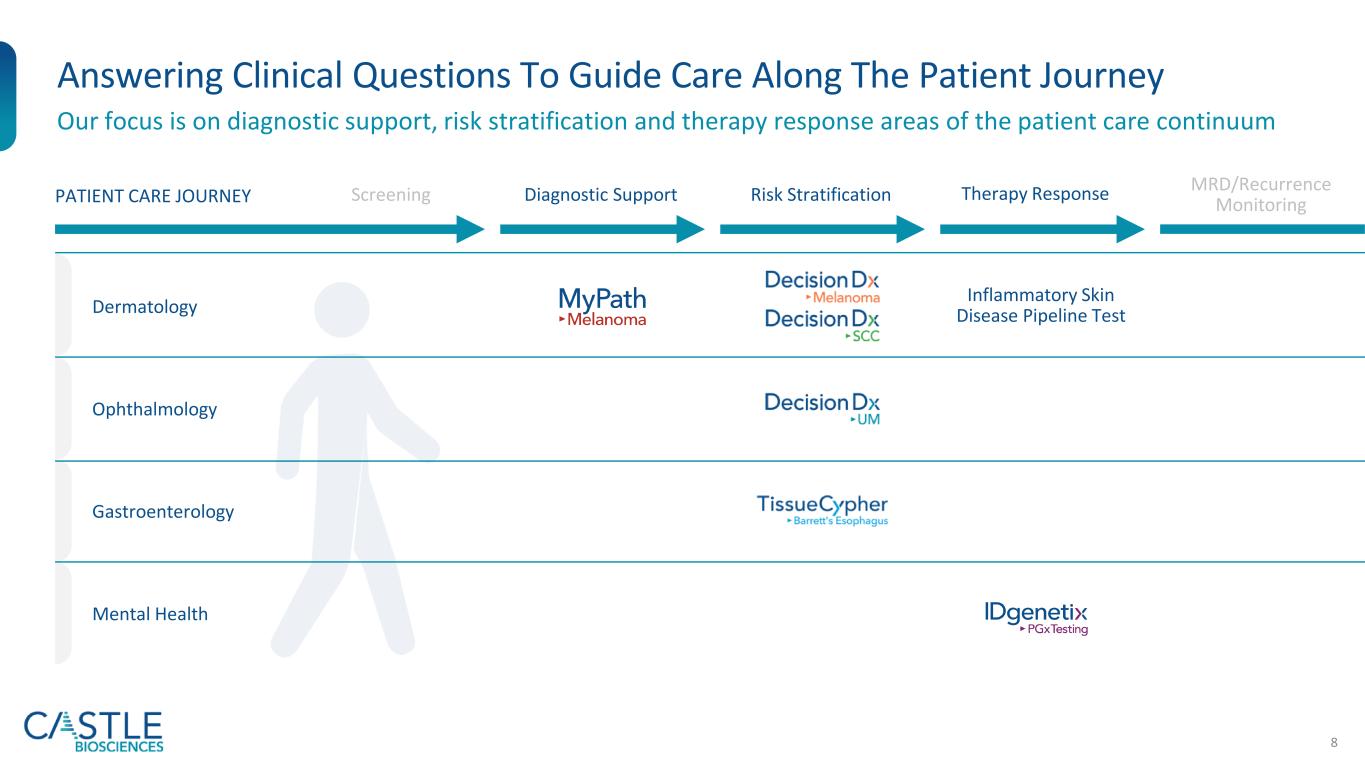
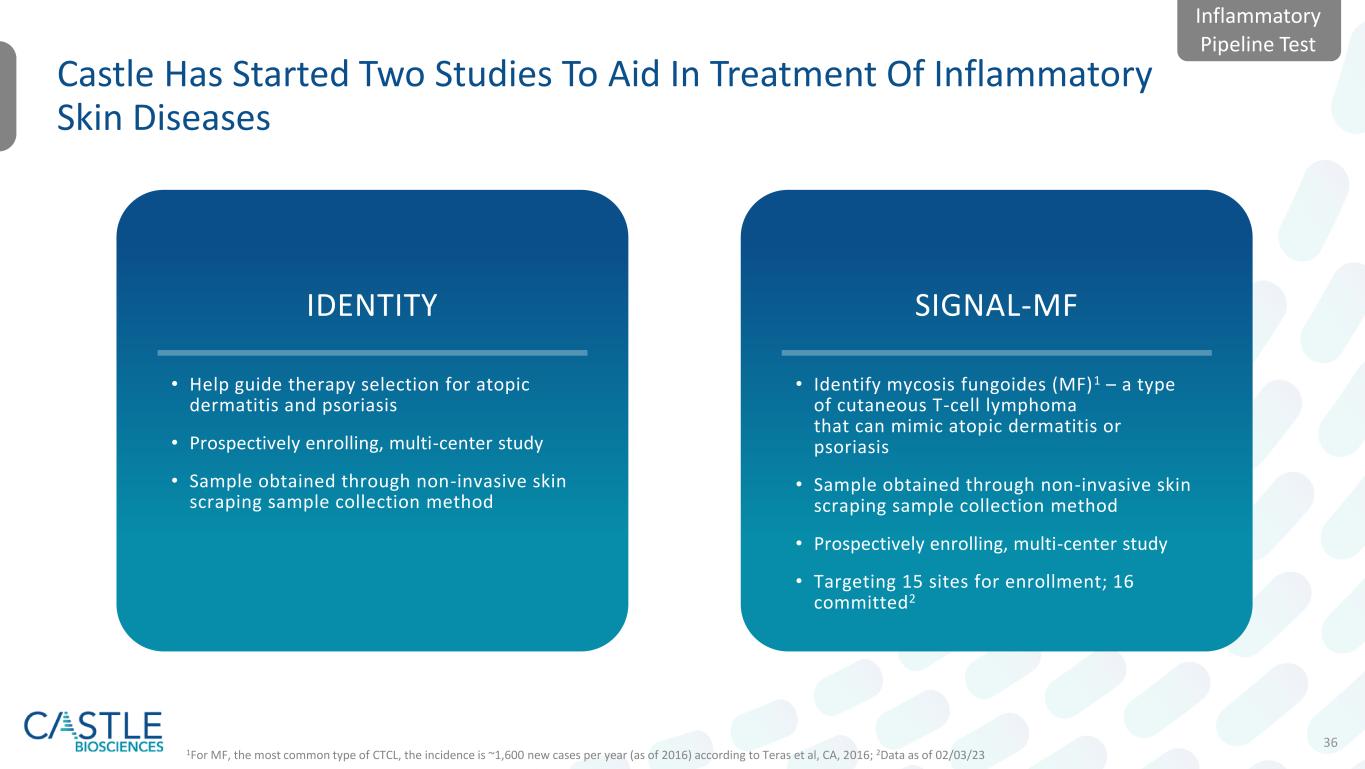
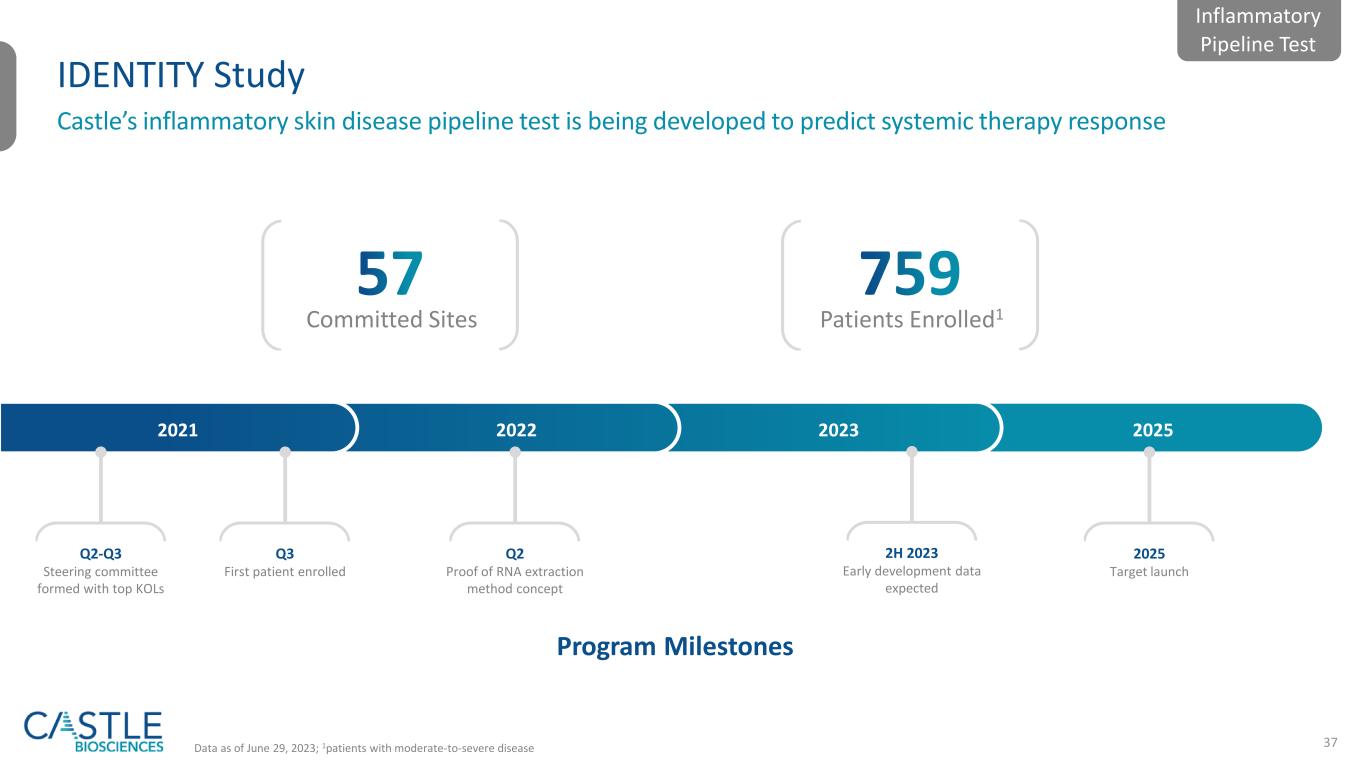
Castle’s current portfolio consists of tests for skin cancers, uveal melanoma, Barrett’s esophagus and mental health conditions. Additionally, the Company has active research and development programs for tests in other diseases with high clinical need, including its test in development to predict systemic therapy response in patients with moderate-to-severe psoriasis, atopic dermatitis and related conditions. To learn more, please visit www.CastleBiosciences.com and connect with us on LinkedIn, Facebook, Twitter and Instagram.
DecisionDx-Melanoma, DecisionDx-CMSeq, DecisionDx-SCC, MyPath Melanoma, DiffDx-Melanoma, DecisionDx-UM, DecisionDx-PRAME, DecisionDx-UMSeq, TissueCypher and IDgenetix are trademarks of Castle Biosciences, Inc.
Forward-Looking Statements
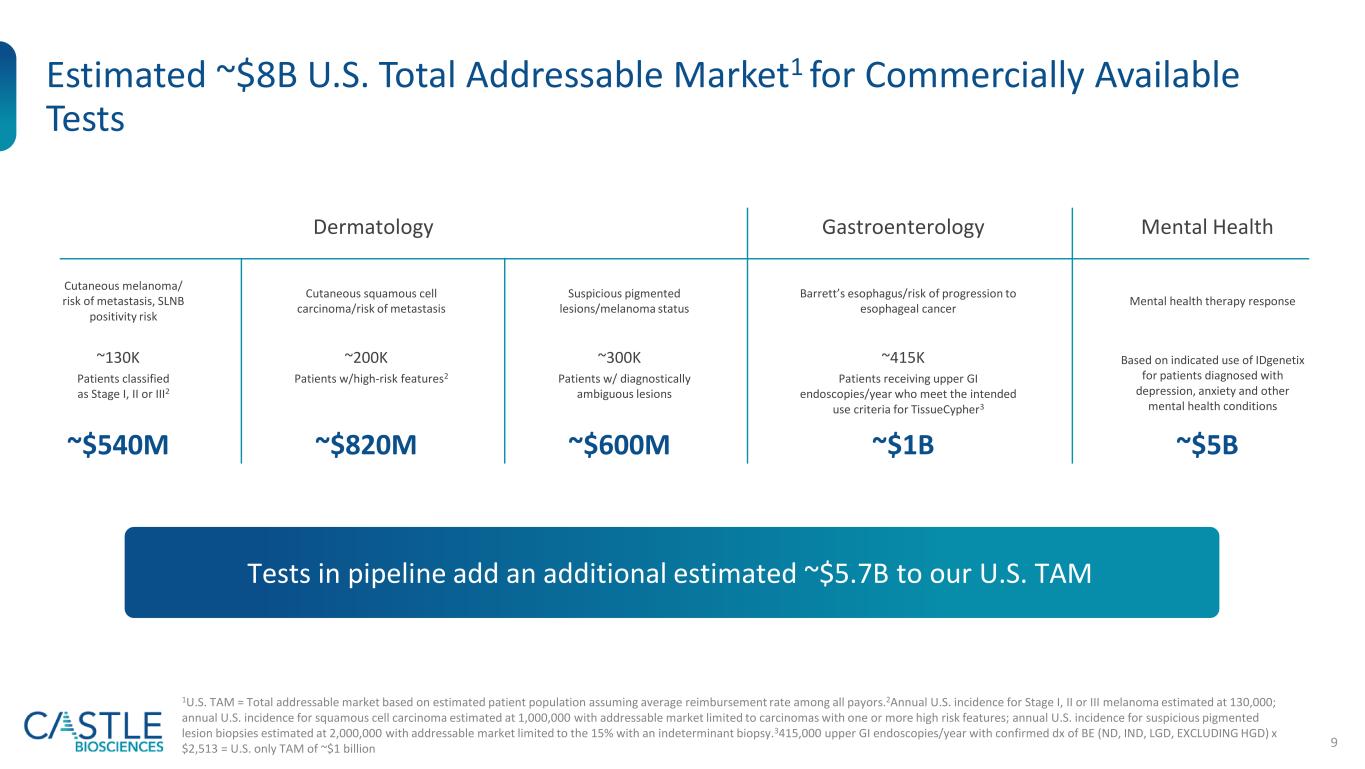
This press release contains forward-looking statements within the meaning of Section 27A of the Securities Act of 1933, as amended, and Section 21E of the Securities Exchange Act of 1934, as amended, which are subject to the “safe harbor” created by those sections. These forward-looking statements include, but are not limited to, statements concerning our expectations regarding: (i) our full year 2023 revenue guidance of at least $180 million; (ii) the potential of a DecisionDx-SCC Class 2B result to identify the limited number of patients who received a significant reduction in metastasis rate after having received ART as well as the DecisionDx-SCC Class 1 patients who did not receive a benefit from ART; (iii) the potential clinical value and utility of our tests, including with respect to findings in the studies highlighted in this press release; (iv) our multi-year plan to deliver revenue growth and positive net operating cash flow by 2025 and our management of the business with a goal of driving near- and long-term shareholder value; (v) our belief that use of DecisionDx-Melanoma test results to guide radiological surveillance could lead to improved patient outcomes; (vi) the potential of DecisionDx-SCC test results to assist clinicians in identifying personalized, risk-aligned treatment pathway improvements for patients with high-risk cSCC, based on the patient’s tumor biology, which may help improve their disease outcome; and (vii) our anticipated doubling of our workforce in Pittsburgh and our expectation that our laboratory facility in Pittsburgh will have the capacity and ability to process each of our proprietary tests. The words “anticipate,” “can,” “could,” “expect,” “goal,” “may,” “plan” and similar expressions are intended to identify forward-looking statements, although not all forward-looking statements contain these identifying words. We may not actually achieve the plans, intentions, or expectations disclosed in our forward-looking statements and you should not place undue reliance on our forward-looking statements. Actual results or
events could differ materially from the plans, intentions and expectations disclosed in the forward-looking statements that we make. These forward-looking statements involve risks and uncertainties that could cause our actual results to differ materially from those in the forward-looking statements, including, without limitation: the accuracy of our assumptions and expectations underlying our fiscal 2023 revenue guidance (including, without limitation, our assumptions or expectations regarding continued reimbursement for our DecisionDx-SCC test at the current rate and reimbursement for our other products and subsequent coverage decisions, our estimated total addressable markets for our products and product candidates and the related expenses, capital requirements and potential needs for additional financing, the anticipated cost, timing and success of our product candidates, and our plans to research, develop and commercialize new tests and our ability to successfully integrate new businesses, assets, products or technologies acquired through acquisitions), the effects of macroeconomic events and conditions, including inflation and monetary supply shifts, labor shortages, liquidity concerns at, and failures of, banks and other financial institutions or other disruptions in the banking system or financing markets and recession risks, supply chain disruptions, outbreaks of contagious diseases (such as the COVID-19 pandemic) and geopolitical events (such as the ongoing Ukraine-Russia conflict), among others, on our business and our efforts to address its impact on our business; subsequent study or trial results and findings may contradict earlier study or trial results and findings or may not support the results discussed in this press release, including with respect to the tests discussed in this press release; our planned installation of additional equipment and supporting technology infrastructures and implementation of certain process efficiencies may not enable us to increase the future scalability of our TissueCypher Test; actual application of our tests may not provide the aforementioned benefits to patients; our newer gastroenterology and mental health franchises may not contribute to the achievement of our long-term financial targets as anticipated; and the risks set forth under the heading “Risk Factors” in our Annual Report on Form 10-K for the year ended December 31, 2022, our Quarterly Report on Form 10-Q for the three months ended June 30, 2023 and in our other filings with the SEC. The forward-looking statements are applicable only as of the date on which they are made, and we do not assume any obligation to update any forward-looking statements, except as may be required by law.
Investor Relations Contact:
Camilla Zuckero
281-906-3868
Media Contact:
Allison Marshall
###
CASTLE BIOSCIENCES, INC.
CONDENSED CONSOLIDATED STATEMENTS OF OPERATIONS
(UNAUDITED)
(in thousands, except per share data)
| Three Months Ended June 30, | Six Months Ended June 30, | ||||||||||||||||||||||
| 2023 | 2022 | 2023 | 2022 | ||||||||||||||||||||
| NET REVENUES | $ | 50,138 | $ | 34,838 | $ | 92,175 | $ | 61,690 | |||||||||||||||
| OPERATING EXPENSES AND OTHER OPERATING INCOME | |||||||||||||||||||||||
| Cost of sales (exclusive of amortization of acquired intangible assets) | 11,058 | 7,686 | 21,240 | 13,630 | |||||||||||||||||||
| Research and development | 13,308 | 11,926 | 27,701 | 22,687 | |||||||||||||||||||
| Selling, general and administrative | 44,681 | 37,498 | 91,443 | 67,951 | |||||||||||||||||||
| Amortization of acquired intangible assets | 2,248 | 2,097 | 4,470 | 3,745 | |||||||||||||||||||
| Change in fair value of contingent consideration | — | (20,398) | — | (17,836) | |||||||||||||||||||
| Total operating expenses, net | 71,295 | 38,809 | 144,854 | 90,177 | |||||||||||||||||||
| Operating loss | (21,157) | (3,971) | (52,679) | (28,487) | |||||||||||||||||||
| Interest income | 2,399 | 370 | 4,735 | 400 | |||||||||||||||||||
| Interest expense | (3) | (4) | (7) | (7) | |||||||||||||||||||
| Loss before income taxes | (18,761) | (3,605) | (47,951) | (28,094) | |||||||||||||||||||
Income tax expense (benefit) | 16 | (1,957) | 30 | (1,823) | |||||||||||||||||||
| Net loss | $ | (18,777) | $ | (1,648) | $ | (47,981) | $ | (26,271) | |||||||||||||||
| Loss per share, basic and diluted | $ | (0.70) | $ | (0.06) | $ | (1.80) | $ | (1.02) | |||||||||||||||
| Weighted-average shares outstanding, basic and diluted | 26,733 | 26,064 | 26,670 | 25,746 | |||||||||||||||||||
Stock-Based Compensation Expense
Stock-based compensation expense is included in the condensed consolidated statements of operations as follows (in thousands):
| Three Months Ended June 30, | Six Months Ended June 30, | ||||||||||||||||||||||
| 2023 | 2022 | 2023 | 2022 | ||||||||||||||||||||
| Cost of sales (exclusive of amortization of acquired intangible assets) | $ | 1,202 | $ | 897 | $ | 2,474 | $ | 1,750 | |||||||||||||||
| Research and development | 2,486 | 1,831 | 5,073 | 3,659 | |||||||||||||||||||
| Selling, general and administrative | 9,161 | 6,055 | 18,827 | 11,793 | |||||||||||||||||||
| Total stock-based compensation expense | $ | 12,849 | $ | 8,783 | $ | 26,374 | $ | 17,202 | |||||||||||||||
CASTLE BIOSCIENCES, INC.
CONDENSED CONSOLIDATED STATEMENTS OF COMPREHENSIVE LOSS
(UNAUDITED)
(in thousands)
| Three Months Ended June 30, | Six Months Ended June 30, | ||||||||||||||||||||||
| 2023 | 2022 | 2023 | 2022 | ||||||||||||||||||||
| Net loss | $ | (18,777) | $ | (1,648) | $ | (47,981) | $ | (26,271) | |||||||||||||||
| Other comprehensive (loss) income: | |||||||||||||||||||||||
| Net unrealized (loss) gain on marketable investment securities | (8) | — | 237 | — | |||||||||||||||||||
| Comprehensive loss | $ | (18,785) | $ | (1,648) | $ | (47,744) | $ | (26,271) | |||||||||||||||
CASTLE BIOSCIENCES, INC.
CONDENSED CONSOLIDATED BALANCE SHEETS
(in thousands)
| June 30, 2023 | December 31, 2022 | ||||||||||
| ASSETS | (unaudited) | ||||||||||
| Current Assets | |||||||||||
| Cash and cash equivalents | $ | 95,874 | $ | 122,948 | |||||||
| Marketable investment securities | 129,634 | 135,677 | |||||||||
| Accounts receivable, net | 31,314 | 23,476 | |||||||||
| Inventory | 6,121 | 3,980 | |||||||||
| Prepaid expenses and other current assets | 6,111 | 6,207 | |||||||||
| Total current assets | 269,054 | 292,288 | |||||||||
| Long-term accounts receivable, net | 1,227 | 1,087 | |||||||||
| Property and equipment, net | 20,511 | 14,315 | |||||||||
| Operating lease assets | 11,539 | 12,181 | |||||||||
| Goodwill and other intangible assets, net | 121,879 | 126,348 | |||||||||
| Other assets – long-term | 1,190 | 1,110 | |||||||||
| Total assets | $ | 425,400 | $ | 447,329 | |||||||
| LIABILITIES AND STOCKHOLDERS’ EQUITY | |||||||||||
| Current Liabilities | |||||||||||
| Accounts payable | $ | 7,135 | $ | 4,731 | |||||||
| Accrued compensation | 17,298 | 24,358 | |||||||||
| Operating lease liabilities | 1,966 | 1,777 | |||||||||
| Other accrued and current liabilities | 7,318 | 5,262 | |||||||||
| Total current liabilities | 33,717 | 36,128 | |||||||||
| Noncurrent operating lease liabilities | 12,427 | 11,533 | |||||||||
| Deferred tax liability | 441 | 428 | |||||||||
| Other liabilities | 47 | 90 | |||||||||
| Total liabilities | 46,632 | 48,179 | |||||||||
| Stockholders’ Equity | |||||||||||
Common stock | 27 | 27 | |||||||||
| Additional paid-in capital | 587,771 | 560,409 | |||||||||
| Accumulated deficit | (208,886) | (160,905) | |||||||||
| Accumulated other comprehensive loss | (144) | (381) | |||||||||
| Total stockholders’ equity | 378,768 | 399,150 | |||||||||
| Total liabilities and stockholders’ equity | $ | 425,400 | $ | 447,329 | |||||||
CASTLE BIOSCIENCES, INC.
CONDENSED CONSOLIDATED STATEMENTS OF CASH FLOWS
(UNAUDITED)
(in thousands)
| Six Months Ended June 30, | |||||||||||
| 2023 | 2022 | ||||||||||
| OPERATING ACTIVITIES | |||||||||||
| Net loss | $ | (47,981) | $ | (26,271) | |||||||
| Adjustments to reconcile net loss to net cash used in operating activities: | |||||||||||
| Depreciation and amortization | 5,932 | 4,779 | |||||||||
| Stock-based compensation expense | 26,374 | 17,202 | |||||||||
| Change in fair value of contingent consideration | — | (17,836) | |||||||||
| Deferred income taxes | 13 | (1,839) | |||||||||
| Accretion of discounts on marketable investment securities | (2,282) | — | |||||||||
| Other | 213 | 39 | |||||||||
| Change in operating assets and liabilities: | |||||||||||
| Accounts receivable | (7,978) | (5,628) | |||||||||
| Prepaid expenses and other current assets | 158 | (707) | |||||||||
| Inventory | (2,141) | (1,066) | |||||||||
| Operating lease assets | (469) | 437 | |||||||||
| Other assets | (80) | 504 | |||||||||
| Accounts payable | 3,071 | 302 | |||||||||
| Operating lease liabilities | 958 | (445) | |||||||||
| Accrued compensation | (7,060) | (1,013) | |||||||||
| Other accrued and current liabilities | 2,047 | 1,111 | |||||||||
| Net cash used in operating activities | (29,225) | (30,431) | |||||||||
| INVESTING ACTIVITIES | |||||||||||
| Purchases of property and equipment | (7,373) | (1,807) | |||||||||
| Asset acquisition, adjustment to purchase price | — | 547 | |||||||||
| Acquisition of business, net of cash and cash equivalents acquired | — | (26,661) | |||||||||
| Proceeds from sale of property and equipment | 8 | 8 | |||||||||
| Purchases of marketable investment securities | (86,438) | — | |||||||||
| Proceeds from maturities of marketable investment securities | 95,000 | — | |||||||||
| Net cash provided by (used in) investing activities | 1,197 | (27,913) | |||||||||
| FINANCING ACTIVITIES | |||||||||||
| Proceeds from exercise of common stock options | 184 | 509 | |||||||||
| Payment of employees’ taxes on vested restricted stock units | (848) | (88) | |||||||||
| Proceeds from contributions to the employee stock purchase plan | 1,688 | 1,511 | |||||||||
| Repayment of principal portion of finance lease liabilities | (70) | (55) | |||||||||
| Net cash provided by financing activities | 954 | 1,877 | |||||||||
| NET CHANGE IN CASH AND CASH EQUIVALENTS | (27,074) | (56,467) | |||||||||
| Beginning of period | 122,948 | 329,633 | |||||||||
| End of period | $ | 95,874 | $ | 273,166 | |||||||
CASTLE BIOSCIENCES, INC.
Reconciliation of Non-GAAP Financial Measures (UNAUDITED)
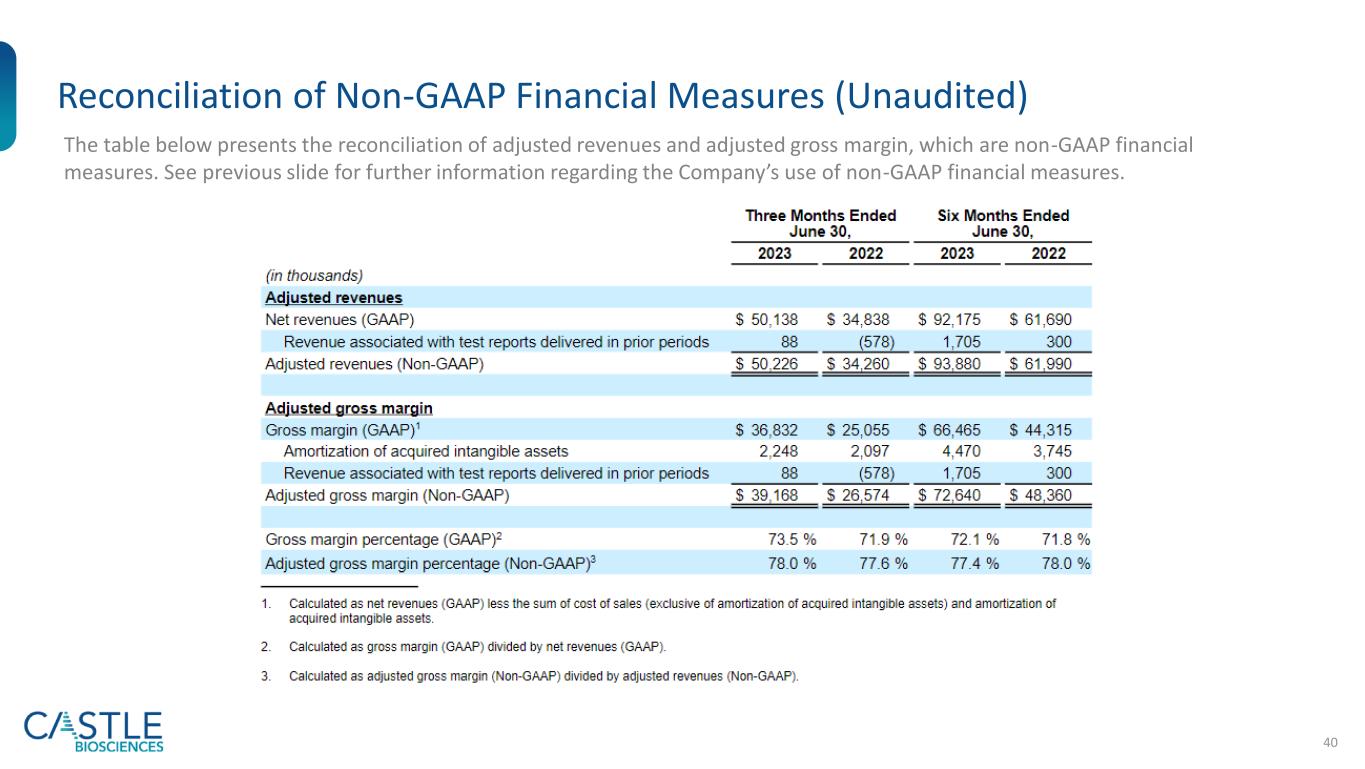
The table below presents the reconciliation of adjusted revenues and adjusted gross margin, which are non-GAAP financial measures. See "Use of Non-GAAP Financial Measures (UNAUDITED)" above for further information regarding the Company's use of non-GAAP financial measures.
| Three Months Ended June 30, | Six Months Ended June 30, | ||||||||||||||||||||||
| 2023 | 2022 | 2023 | 2022 | ||||||||||||||||||||
| (in thousands) | |||||||||||||||||||||||
| Adjusted revenues | |||||||||||||||||||||||
| Net revenues (GAAP) | $ | 50,138 | $ | 34,838 | $ | 92,175 | $ | 61,690 | |||||||||||||||
| Revenue associated with test reports delivered in prior periods | 88 | (578) | 1,705 | 300 | |||||||||||||||||||
| Adjusted revenues (Non-GAAP) | $ | 50,226 | $ | 34,260 | $ | 93,880 | $ | 61,990 | |||||||||||||||
| Adjusted gross margin | |||||||||||||||||||||||
Gross margin (GAAP)1 | $ | 36,832 | $ | 25,055 | $ | 66,465 | $ | 44,315 | |||||||||||||||
| Amortization of acquired intangible assets | 2,248 | 2,097 | 4,470 | 3,745 | |||||||||||||||||||
| Revenue associated with test reports delivered in prior periods | 88 | (578) | 1,705 | 300 | |||||||||||||||||||
| Adjusted gross margin (Non-GAAP) | $ | 39,168 | $ | 26,574 | $ | 72,640 | $ | 48,360 | |||||||||||||||
Gross margin percentage (GAAP)2 | 73.5 | % | 71.9 | % | 72.1 | % | 71.8 | % | |||||||||||||||
Adjusted gross margin percentage (Non-GAAP)3 | 78.0 | % | 77.6 | % | 77.4 | % | 78.0 | % | |||||||||||||||
1.Calculated as net revenues (GAAP) less the sum of cost of sales (exclusive of amortization of acquired intangible assets) and amortization of acquired intangible assets.
2.Calculated as gross margin (GAAP) divided by net revenues (GAAP).
3.Calculated as adjusted gross margin (Non-GAAP) divided by adjusted revenues (Non-GAAP).
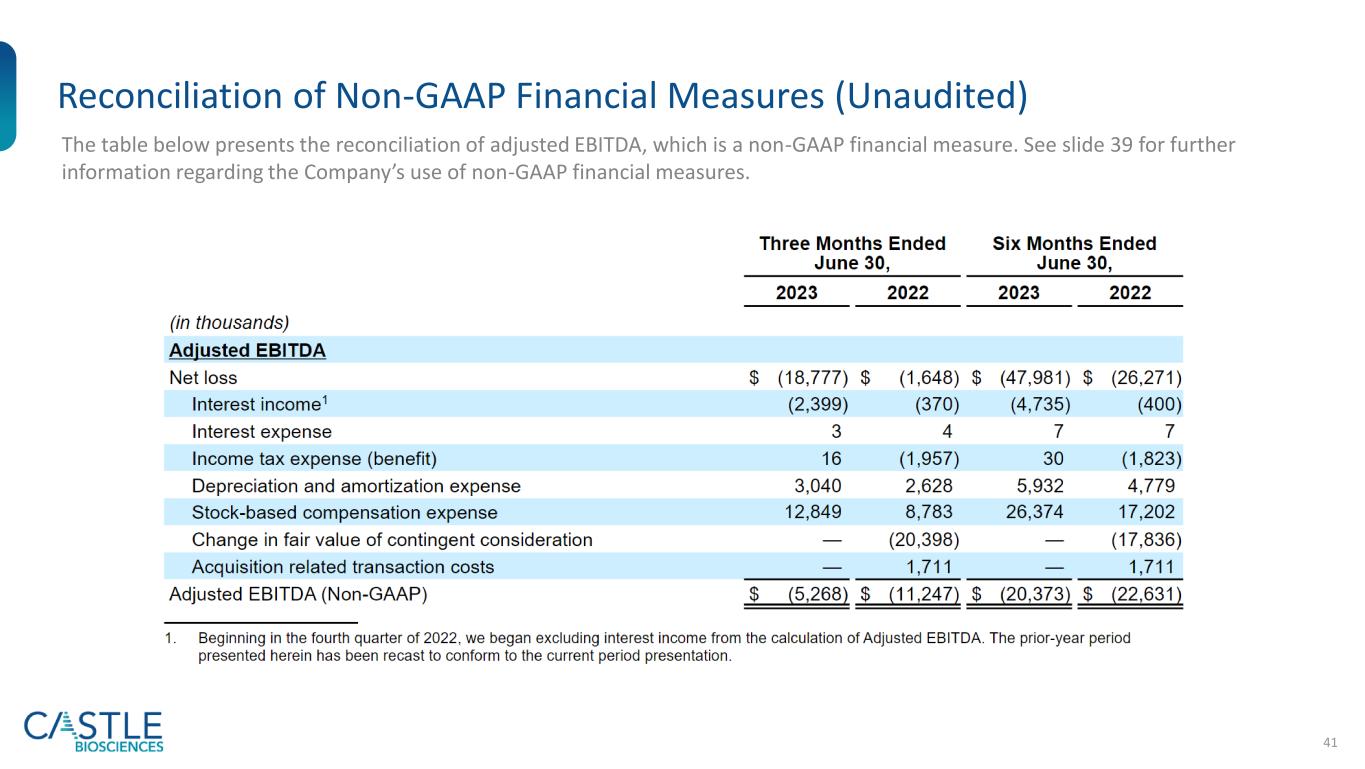
The table below presents the reconciliation of adjusted EBITDA, which is a non-GAAP financial measure. See "Use of Non-GAAP Financial Measures (UNAUDITED)" above for further information regarding the Company's use of non-GAAP financial measures.
| Three Months Ended June 30, | Six Months Ended June 30, | ||||||||||||||||||||||
| 2023 | 2022 | 2023 | 2022 | ||||||||||||||||||||
| (in thousands) | |||||||||||||||||||||||
| Adjusted EBITDA | |||||||||||||||||||||||
| Net loss | $ | (18,777) | $ | (1,648) | $ | (47,981) | $ | (26,271) | |||||||||||||||
Interest income1 | (2,399) | (370) | (4,735) | (400) | |||||||||||||||||||
| Interest expense | 3 | 4 | 7 | 7 | |||||||||||||||||||
Income tax expense (benefit) | 16 | (1,957) | 30 | (1,823) | |||||||||||||||||||
| Depreciation and amortization expense | 3,040 | 2,628 | 5,932 | 4,779 | |||||||||||||||||||
| Stock-based compensation expense | 12,849 | 8,783 | 26,374 | 17,202 | |||||||||||||||||||
| Change in fair value of contingent consideration | — | (20,398) | — | (17,836) | |||||||||||||||||||
| Acquisition related transaction costs | — | 1,711 | — | 1,711 | |||||||||||||||||||
| Adjusted EBITDA (Non-GAAP) | $ | (5,268) | $ | (11,247) | $ | (20,373) | $ | (22,631) | |||||||||||||||
1. Beginning in the fourth quarter of 2022, we began excluding interest income from the calculation of Adjusted EBITDA. The prior-year period presented herein has been recast to conform to the current period presentation.