UNITED STATES
SECURITIES AND EXCHANGE COMMISSION
Washington, D.C. 20549
FORM
CURRENT REPORT
Pursuant to Section 13 or 15(d) of the
Securities Exchange Act of 1934
Date of Report (Date of earliest event reported):
| Commission
File Number |
Exact
Name of Registrant as Specified in its Charter, State or other |
IRS Employer Identification No. |

![]() |
||
|
(a
|
||
(a
|
||
(a |
Check the appropriate box below if the Form 8-K filing is intended to simultaneously satisfy the filing obligation of the registrant under any of the following provisions:
SECURITIES REGISTERED PURSUANT TO SECTION 12(b) OF THE ACT:
| Registrant | Title of each class | Trading Symbol(s) | Name
of each exchange on which registered |
| Duke Energy | |||
| Duke Energy | |||
| Duke Energy | each representing a 1/1,000th interest in a share of 5.75% Series A Cumulative Redeemable Perpetual Preferred Stock, par value $0.001 per share | ||
| Duke Energy | |||
| Duke Energy | |||
| Duke Energy |
Indicate by check mark whether the registrant
is an emerging growth company as defined in Rule 405 of the Securities Act of 1933 (§230.405 of this chapter) or Rule 12b-2 of
the Securities Exchange Act of 1934 (§240.12b-2 of this chapter). Emerging growth company
If an emerging growth company, indicate by check mark if the registrant has elected not to use the extended transition period for complying with any new or revised financial accounting standards provided pursuant to Section 13(a) of the Exchange Act. ¨
Item 1.01. Entry into a Material Definitive Agreement.
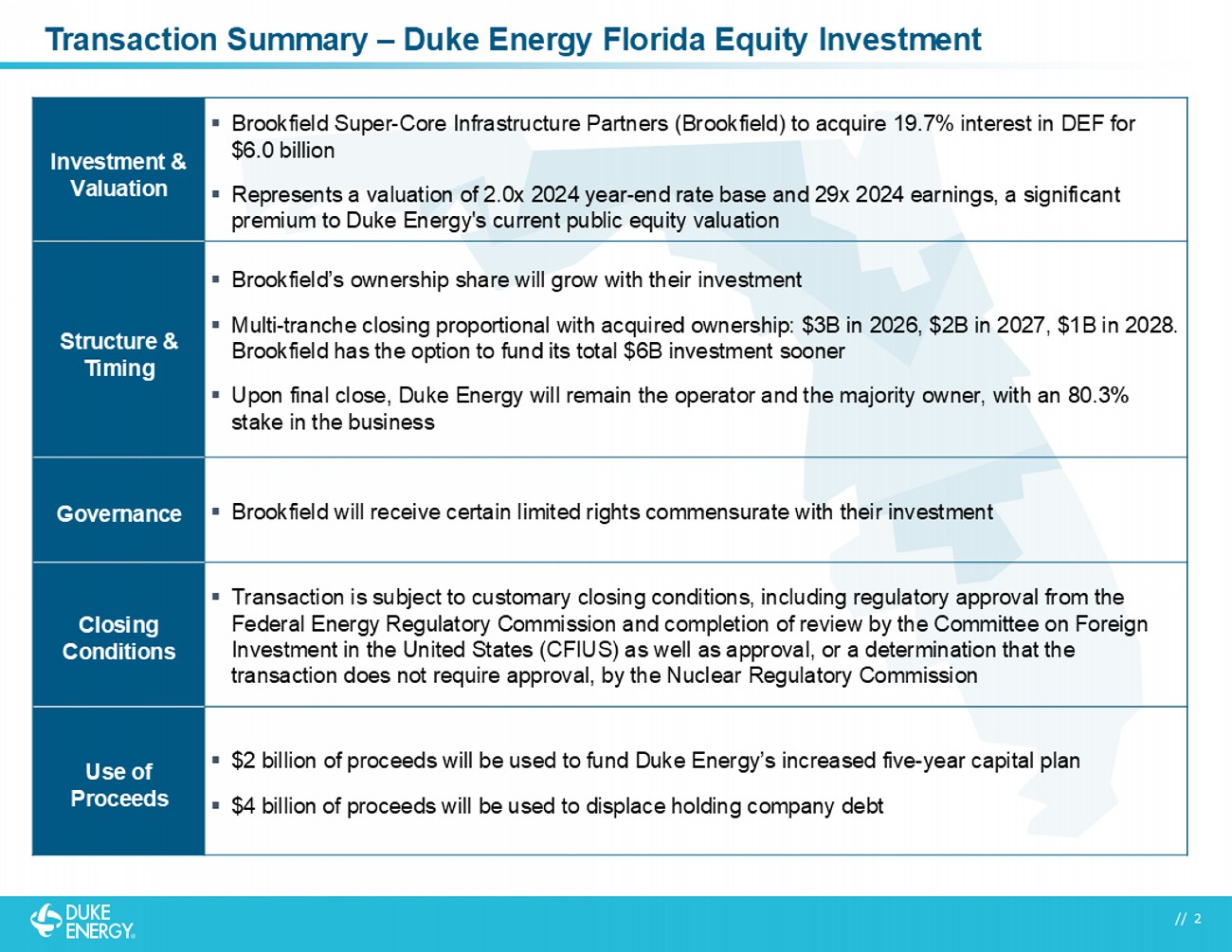
On August 4, 2025, Duke Energy Corporation (“Duke Energy”), Progress Energy, Inc. (“PEI”) and Florida Progress, LLC (“Florida Progress”) entered into an Investment Agreement (the “Investment Agreement”) with Peninsula Power Holdings L.P., a Delaware limited partnership, an affiliate of Brookfield Super-Core Infrastructure Partners (“Investor”), pursuant to which Florida Progress agreed to issue to Investor, and Investor agreed to acquire from Florida Progress, certain newly issued membership interests of Florida Progress such that Investor will own up to 19.7% of the issued and outstanding Florida Progress membership interests following a series of closings, for an aggregate amount of $6 billion, subject to certain adjustments described below. Florida Progress is the sole owner of Duke Energy Florida, LLC (“DEF”). At the first closing under the Investment Agreement (the “First Closing”), Florida Progress will issue to Investor 9.2% of the Florida Progress membership interests issued and outstanding immediately after the First Closing, subject to adjustment, in exchange for $2.8 billion. The First Closing will be followed by additional closings (the “Subsequent Closings”) with the following subsequent investments occurring no later than on the following timeline: (i) Investor will invest an additional $200 million in Florida Progress no later than December 31, 2026; (ii) Investor will invest an additional $500 million in Florida Progress no later than June 30, 2027; (iii) Investor will invest an additional $1.5 billion in Florida Progress no later than December 31, 2027; and (iv) Investor will invest an additional $1 billion in Florida Progress no later than June 30, 2028.
The acquired percentage of membership interests with respect to the First Closing is subject to reduction to the extent certain capital contributions are made to Florida Progress by PEI on or after the date of the Investment Agreement and prior to the First Closing. The investment price for the Subsequent Closings is subject to reduction for certain payments made by Florida Progress with respect to indebtedness.
The closing of the transactions contemplated by the Investment Agreement and the issuance of Florida Progress membership interests thereunder is subject to the satisfaction of certain customary conditions described in the Investment Agreement, including receipt of the approval of the Federal Energy Regulatory Commission and completion of review by the Committee on Foreign Investments in the United States, as well as approval, or a determination that the transaction does not require approval, by the Nuclear Regulatory Commission. The First Closing will occur following the date on which the applicable conditions have been satisfied and is expected to occur in early 2026, and the Subsequent Closings will occur no later than the timeline set forth above and following the date on which the applicable conditions have been satisfied, with the final closing expected to occur by June 30, 2028. Following the First Closing, Investor has the option to fund the subsequent investments, and acquire the corresponding additional interests, earlier than the scheduled timeline set forth above.
In addition, each of the parties has agreed to customary covenants prior to the First Closing, including, among others, the following: (i) PEI will conduct the business of Florida Progress and its subsidiaries in the ordinary course of business consistent with past practices and will preserve, maintain and protect the assets of Florida Progress and its subsidiaries in material compliance with applicable laws and material permits and contracts; (ii) the parties will cooperate and use reasonable best efforts to obtain the required regulatory consents as soon as reasonably practicable; and (iii) the parties will take all action and do all things necessary, proper or advisable under applicable laws to consummate the transactions, including executing documents and taking actions as may be reasonably requested by another party in order to consummate the transactions, subject to customary exceptions.
The Investment Agreement contains representations and warranties by Duke Energy, PEI and Investor, which are customary for transactions of this type. It also obligates the parties to indemnify each other from and after the First Closing for certain losses arising out of breaches of the Investment Agreement or failure by a party to perform with respect to the representations, warranties or covenants contained in the Investment Agreement, among other things, subject to customary limitations. The Investment Agreement contains certain termination rights for both PEI and Investor prior to the First Closing, including termination: (i) by mutual consent of PEI and Investor; (ii) by either Investor or PEI if the First Closing has not occurred by May 4, 2026, subject to possible extension to November 4, 2026; (iii) by either Investor or PEI, as the case may be, prior to the First Closing upon certain material breaches or failures to perform any of the representations, warranties, covenants or agreements by the other party; or (iv) by either Investor or PEI prior to the First Closing in the event of a final and non-appealable order or action restraining, enjoining or otherwise prohibiting the transactions. The Investment Agreement also provides that, upon termination of the Investment Agreement under certain specified circumstances prior to the First Closing, Investor will be required to pay PEI a termination fee of $240 million.
In connection with the First Closing, Investor, Florida Progress and PEI will enter into an Amended and Restated Limited Liability Company Operating Agreement of Florida Progress (the “LLC Agreement”), the form of which has been agreed to by the parties. The LLC Agreement will establish the general framework governing the relationship between Investor and PEI, and their respective successors and transferees, as members of Florida Progress and will provide Investor with limited governance rights commensurate with its ownership. Certain transfer restrictions, transfer rights and other rights apply to Investor and PEI under the LLC Agreement, including (i) the right of Investor to require PEI to acquire Investor’s Florida Progress interests in certain circumstances and (ii) the right of PEI to require Investor to sell its Florida Progress interests to PEI in certain circumstances.
The foregoing summaries of the Investment Agreement and the LLC Agreement and the transactions contemplated thereby are subject to, and qualified in their entirety by, the full terms of the Investment Agreement and the LLC Agreement, respectively. The full terms of the Investment Agreement will be filed no later than with Duke Energy’s, PEI’s and DEF’s Quarterly Report on Form 10-Q for the period ended September 30, 2025. The full terms of the LLC Agreement will be filed no later than with Duke Energy’s, PEI’s and DEF’s Quarterly Report on Form 10-Q for the period in which the parties enter into the LLC Agreement.
Item 7.01. Regulation FD Disclosure.
On August 5, 2025, Duke Energy issued a press release announcing the transaction, which is furnished as Exhibit 99.1 hereto and is incorporated herein by reference. In addition, Duke Energy released an overview providing additional detail on the transaction, which is furnished as Exhibit 99.2 hereto and is incorporated herein by reference.
The information provided in this Item 7.01 (including Exhibit 99.1 and Exhibit 99.2) shall not be deemed “filed” for purposes of Section 18 of the Securities Exchange Act of 1934, as amended (the “Exchange Act”) or otherwise subject to the liabilities under that Section and shall not be deemed to be incorporated by reference into any filing under the Securities Act of 1933, as amended (the “Securities Act”), or the Exchange Act, except as expressly set forth by specific reference in such filing.
Forward-Looking Information
This document includes forward-looking statements within the meaning of Section 27A of the Securities Act of 1933 and Section 21E of the Securities Exchange Act of 1934. Forward-looking statements are based on management’s beliefs and assumptions and can often be identified by terms and phrases that include “anticipate,” “believe,” “intend,” “estimate,” “expect,” “continue,” “should,” “could,” “may,” “plan,” “project,” “predict,” “will,” “potential,” “forecast,” “target,” “guidance,” “outlook” or other similar terminology. Various factors may cause actual results to be materially different than the suggested outcomes within forward-looking statements; accordingly, there is no assurance that such results will be realized. These factors include, but are not limited to:
| o | The ability to implement our business strategy, including meeting forecasted load growth demand, grid and fleet modernization objectives, and our carbon emission reduction goals, while balancing customer reliability and affordability; |
| o | State, federal and foreign legislative and regulatory initiatives, including costs of compliance with existing and future environmental requirements and/or uncertainty of applicability or changes to such legislative and regulatory initiatives, including those related to climate change, as well as rulings that affect cost and investment recovery or have an impact on rate structures or market prices; |
| o | The extent and timing of costs and liabilities to comply with federal and state laws, regulations and legal requirements related to coal ash remediation, including amounts for required closure of certain ash impoundments, are uncertain and difficult to estimate; |
| o | The ability to timely recover eligible costs, including amounts associated with coal ash impoundment retirement obligations, asset retirement and construction costs related to carbon emissions reductions, and costs related to significant weather events, and to earn an adequate return on investment through rate case proceedings and the regulatory process; |
| o | The costs of decommissioning nuclear facilities could prove to be more extensive than amounts estimated and all costs may not be fully recoverable through the regulatory process; |
| o | The impact of extraordinary external events, such as a global pandemic or military conflict, and their collateral consequences, including the disruption of global supply chains or the economic activity in our service territories; |
| o | Costs and effects of legal and administrative proceedings, settlements, investigations and claims; |
| o | Industrial, commercial and residential decline in service territories or customer bases resulting from sustained downturns of the economy, storm damage, reduced customer usage due to cost pressures from inflation, tariffs, or fuel costs, worsening economic health of our service territories, reductions in customer usage patterns, or lower than anticipated load growth, particularly if usage of electricity by data centers is less than currently projected, energy efficiency efforts, natural gas building and appliance electrification, and use of alternative energy sources, such as self-generation and distributed generation technologies; |
| o | Federal and state regulations, laws and other efforts designed to promote and expand the use of energy efficiency measures, natural gas electrification, and distributed generation technologies, such as private solar and battery storage, in Duke Energy service territories could result in a reduced number of customers, excess generation resources as well as stranded costs; |
| o | Advancements in technology, including artificial intelligence; |
| o | Additional competition in electric and natural gas markets and continued industry consolidation; |
| o | The influence of weather and other natural phenomena on operations, financial position, and cash flows, including the economic, operational and other effects of severe storms, hurricanes, droughts, earthquakes and tornadoes, including extreme weather associated with climate change; |
| o | Changing or conflicting investor, customer and other stakeholder expectations and demands, particularly regarding environmental, social and governance matters and costs related thereto; |
| o | The ability to successfully operate electric generating facilities and deliver electricity to customers including direct or indirect effects to Duke Energy resulting from an incident that affects the United States electric grid or generating resources; |
| o | Operational interruptions to our natural gas distribution and transmission activities; |
| o | The availability of adequate interstate pipeline transportation capacity and natural gas supply; |
| o | The impact on facilities and business from a terrorist or other attack, war, vandalism, cybersecurity threats, data security breaches, operational events, information technology failures or other catastrophic events, such as severe storms, fires, explosions, pandemic health events or other similar occurrences; |
| o | The inherent risks associated with the operation of nuclear facilities, including environmental, health, safety, regulatory and financial risks, including the financial stability of third-party service providers; |
| o | The timing and extent of changes in commodity prices, including any impact from increased tariffs and interest rates, and the ability to timely recover such costs through the regulatory process, where appropriate, and their impact on liquidity positions and the value of underlying assets; |
| o | The results of financing efforts, including the ability to obtain financing on favorable terms, which can be affected by various factors, including credit ratings, interest rate fluctuations, compliance with debt covenants and conditions, an individual utility’s generation portfolio, and general market and economic conditions; |
| o | Credit ratings of the Duke Energy Registrants (as defined in Duke Energy's Annual Report on Form 10-K for the year ended December 31, 2024) may be different from what is expected; |
| o | Declines in the market prices of equity and fixed-income securities and resultant cash funding requirements for defined benefit pension plans, other post-retirement benefit plans and nuclear decommissioning trust funds; |
| o | Construction and development risks associated with the completion of the Duke Energy Registrants’ capital investment projects, including risks related to financing, timing and receipt of necessary regulatory approvals, obtaining and complying with terms of permits, meeting construction budgets and schedules and satisfying operating and environmental performance standards, as well as the ability to recover costs from customers in a timely manner, or at all; |
| o | Changes in rules for regional transmission organizations, including changes in rate designs and new and evolving capacity markets, and risks related to obligations created by the default of other participants; |
| o | The ability to control operation and maintenance costs; |
| o | The level of creditworthiness of counterparties to transactions; |
| o | The ability to obtain adequate insurance at acceptable costs and recover on claims made; |
| o | Employee workforce factors, including the potential inability to attract and retain key personnel; |
| o | The ability of subsidiaries to pay dividends or distributions to Duke Energy (the Parent); |
| o | The performance of projects undertaken by our businesses and the success of efforts to invest in and develop new opportunities; |
| o | The effect of accounting and reporting pronouncements issued periodically by accounting standard-setting bodies and the SEC; |
| o | The impact of United States tax legislation to our financial condition, results of operations or cash flows and our credit ratings; |
| o | The impacts from potential impairments of goodwill or investment carrying values; |
| o | Asset or business acquisitions and dispositions, including the transactions pursuant to the Investment Agreement, may not be consummated or may not yield the anticipated benefits, which could adversely affect our financial condition, credit metrics, or ability to execute strategic and capital plans; and |
| o | The actions of activist shareholders could disrupt our operations, impact our ability to execute on our business strategy or cause fluctuations in the trading price of our common stock. |
Additional risks and uncertainties are identified and discussed in the Duke Energy Registrants’ reports filed with the Securities and Exchange Commission and available at its website at sec.gov. In light of these risks, uncertainties and assumptions, the events described in the forward-looking statements might not occur or might occur to a different extent or at a different time than described. Forward-looking statements speak only as of the date they are made and the Duke Energy Registrants expressly disclaim an obligation to publicly update or revise any forward-looking statements, whether as a result of new information, future events or otherwise.
Item 9.01. Financial Statements and Exhibits.
(d) Exhibits.
| 99.1 | Duke Energy Corporation Press Release, August 5, 2025 | |
| 99.2 | Transaction Overview, dated August 5, 2025 | |
| 104 | Cover Page Interactive Data File (embedded within the Inline XBRL document) |
SIGNATURE
Pursuant to the requirements of the Securities Exchange Act of 1934, the registrant has duly caused this report to be signed on its behalf by the undersigned hereunto duly authorized.
| DUKE ENERGY CORPORATION | ||
| Date: August 5, 2025 | By: | /s/ David S. Maltz |
| David S. Maltz | ||
| Vice President, Legal, Chief Governance Officer and Corporate Secretary | ||

| PROGRESS ENERGY, INC. | ||
| Date: August 5, 2025 | By: | /s/ David S. Maltz |
| David S. Maltz | ||
| Corporate Secretary | ||
|
DUKE ENERGY FLORIDA, LLC | ||
| Date: August 5, 2025 | By: | /s/ David S. Maltz |
| David S. Maltz | ||
| Vice President, Legal, Chief Governance Officer and Corporate Secretary | ||

Exhibit 99.1
![]() | ![]() |

Media Contact: Gillian Moore
24-Hour: 800.559.3853
Analysts Contact: Abby Motsinger
Office: 704.382.7624
Aug. 5, 2025
Duke Energy partners with Brookfield to secure investment in Duke Energy Florida, expands capital plan to $87 billion
| ● | Brookfield invests in a 19.7% non-controlling equity interest in Duke Energy Florida for $6 billion |
| ● | Partnership supports $4 billion increase in Duke Energy Florida’s five-year capital plan aimed at enhancing company's ability to meet customers' rapidly growing and evolving energy demands |
| ● | Attractive valuation and efficient form of financing enables 100 basis point increase in Duke Energy’s long-term FFO/Debt target to 15%, supports 5% to 7% EPS growth rate through 2029 |
| ● | Duke Energy to remain majority owner and operator of DEF; no changes to workforce, operations or Florida leadership team |
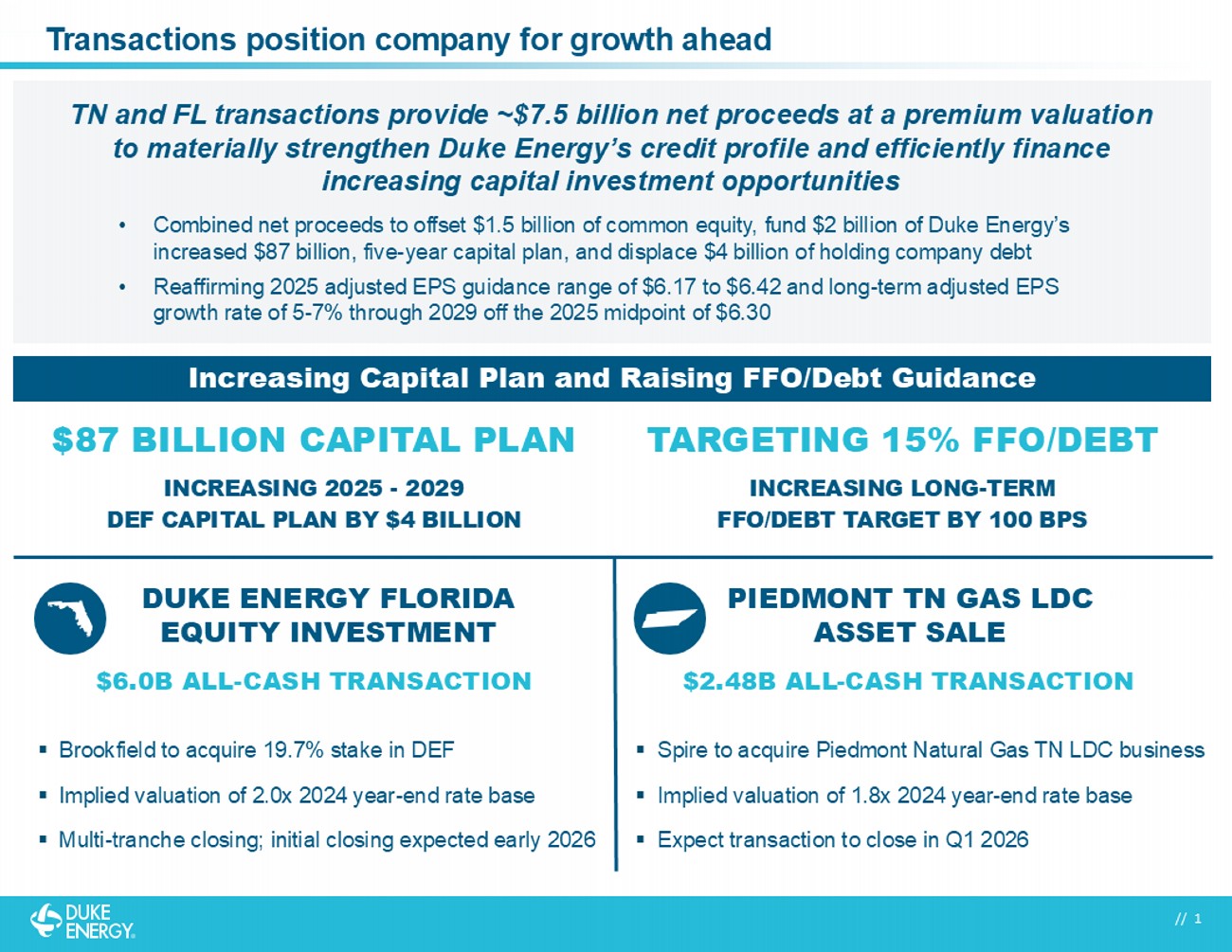
CHARLOTTE, N.C. – Duke Energy (NYSE: DUK) today announced it has entered into a definitive agreement for Brookfield, through its Super-Core Infrastructure strategy, to hold a 19.7% indirect equity interest in Duke Energy Florida for an aggregate amount of $6 billion. Brookfield is a leading infrastructure investor, with over $200 billion in assets under management across the utilities, transport, midstream and data sectors.
The all-cash transaction is an attractive and efficient form of financing. The investment supports Duke Energy’s ability to serve customers in its fast-growing electric and gas utilities, strengthens its balance sheet and funds ongoing capital needs associated with its energy modernization strategy.
The investment represents a significant premium to Duke Energy's current public equity valuation. Two billion dollars of the proceeds from the transaction will fund Duke Energy’s increased $87 billion, five-year capital plan and $4 billion will be used to displace holding company debt.
“For more than a century, we’ve had the privilege of serving extraordinary Florida communities, which are now some of the most dynamic and fastest growing in the nation,” said Harry Sideris, president and chief executive officer. “We’re pleased to have Brookfield, a highly regarded infrastructure investor, as a long-term partner in Duke Energy Florida. This significant transaction at a compelling valuation best positions Duke Energy to unlock additional capital investments in Duke Energy Florida during this unprecedented growth period. It also materially strengthens Duke Energy’s overall credit profile, which in turn enables us to invest in our energy modernization plans across our entire footprint – all while helping keep prices as low as possible for our customers.”
“We are delighted to partner with Duke Energy in a critical business and premier regulated utility like Duke Energy Florida through Brookfield’s Super-Core Infrastructure strategy. We look forward to supporting the continued growth of Duke Energy Florida’s regulated asset base and, accordingly, ensuring excellent service delivery for its customers,” said Sam Pollock, chief executive officer of Brookfield’s infrastructure group. “This transaction underscores our patient strategy of partnering with leading corporates and investing in essential infrastructure assets that underpin economic growth, and that generate stable long-term cash flows across market cycles.”
“Duke Energy Florida is a vertically integrated electric utility company providing critical services to 2 million customers across central and western Florida. The $4 billion increase in Duke Energy Florida’s five-year capital plan takes total investment in the state to over $16 billion through 2029. This plan is underpinned by grid modernization and resiliency initiatives, as well as generation capacity enhancements to support the dynamic service territory and expanding customer base.
“Duke Energy’s commitment to our customers and communities is unwavering, driving us to continuously find innovative ways to meet the moment for our customers. This exciting partnership allows us to do just that,” said Melissa Seixas, Duke Energy Florida state president. “This partnership will create value for all of our communities as we invest in generation, transmission and distribution enhancements that increase reliability, maintain affordability and support future economic development in our state.”
Transaction structure
Brookfield will invest in Florida Progress, which owns all of Duke Energy Florida. Brookfield will acquire its indirect equity interest in Duke Energy Florida in phases, with Florida Progress receiving $2.8 billion at the first closing expected to occur in early 2026 and another $200 million by the end of 2026. An additional $2 billion will be received in 2027 and the remaining $1 billion will be received in 2028. Brookfield has the option to fund the total $6 billion investment sooner.
Duke Energy will retain an 80.3% interest in the business and will continue to operate Duke Energy Florida with its best-in-class workforce. Brookfield will receive certain rights commensurate with its ownership interest.
The transaction is subject to customary closing conditions, including regulatory approval from the Federal Energy Regulatory Commission and completion of review by the Committee on Foreign Investment in the United States as well as approval, or a determination that the transaction does not require approval, by the Nuclear Regulatory Commission.
JP Morgan Securities LLC is serving as Duke Energy’s financial advisor. Skadden, Arps, Slate, Meagher & Flom LLP is serving as Duke Energy’s legal advisor. RBC Capital Markets LLC is serving as Brookfield’s financial advisor. Kirkland & Ellis LLP is serving as Brookfield’s legal advisor.
Duke Energy
Duke Energy is executing an ambitious energy transition, keeping customer reliability and value at the forefront as it builds a smarter energy future. The company is investing in major electric grid upgrades and cleaner generation, including natural gas, nuclear, renewables and energy storage.
More information is available at duke-energy.com and the Duke Energy News Center. Follow Duke Energy on X, LinkedIn, Instagram and Facebook, and visit illumination for stories about the people and innovations powering our energy transition.
Brookfield
Brookfield Asset Management is a leading global alternative asset manager, headquartered in New York, with over $1 trillion of assets under management. Brookfield invests client capital for the long term with a focus on real assets and essential service businesses that form the backbone of the global economy. Brookfield offers a range of alternative investment products to investors around the world — including public and private pension plans, endowments and foundations, sovereign wealth funds, financial institutions, insurance companies and private wealth investors.
Non-GAAP financial Measures
This document includes a reference to Duke Energy’s forecasted adjusted EPS long-term range of annual growth of 5% to 7% through 2029. Forecasted adjusted EPS is a non-GAAP financial measure as it represents basic EPS from continuing operations available to Duke Energy Corporation common stockholders (GAAP reported EPS), adjusted for the per share impact of special items. Special items represent certain charges and credits, which management believes are not indicative of Duke Energy’s ongoing performance. Due to the forward-looking nature of this non-GAAP financial measure for future periods, information to reconcile it to the most directly comparable GAAP financial measure is not available at this time, as management is unable to project all special items for future periods, such as legal settlements, the impact of regulatory orders or asset impairments.
This document includes a reference to Duke Energy’s target FFO to Debt ratio. This ratio reflects non-GAAP financial measures. The numerator of the FFO to Debt ratio is calculated principally by using net cash provided by operating activities on a GAAP basis, adjusted for changes in working capital, ARO spend, depreciation and amortization of operating leases, long-term portion of deferred fuel, operating activities allocated to the Duke Energy Indiana minority interest and reduced for capitalized interest (including any AFUDC interest). The denominator for the FFO to Debt ratio is calculated principally by using the balance of long-term debt (excluding purchase accounting adjustments, long-term debt allocated to the Duke Energy Indiana minority interest, and long-term debt associated with the Crystal River Unit 3 Nuclear Plant and Duke Energy Carolinas and Duke Energy Progress Storm Securitizations), including current maturities, operating lease liabilities, plus notes payable, commercial paper outstanding, underfunded pension liability, and adjustments to hybrid debt and preferred stock issuances based on how credit rating agencies view the instruments. Due to the forward-looking nature of expected FFO to Debt ratio, the information to reconcile it to the most directly comparable GAAP financial measure is not available, as management is unable to project special items, as discussed above under Adjusted EPS.
Forward-Looking Information
This document includes forward-looking statements within the meaning of Section 27A of the Securities Act of 1933 and Section 21E of the Securities Exchange Act of 1934. Forward-looking statements are based on management’s beliefs and assumptions and can often be identified by terms and phrases that include “anticipate,” “believe,” “intend,” “estimate,” “expect,” “continue,” “should,” “could,” “may,” “plan,” “project,” “predict,” “will,” “potential,” “forecast,” “target,” “guidance,” “outlook” or other similar terminology. Various factors may cause actual results to be materially different than the suggested outcomes within forward-looking statements; accordingly, there is no assurance that such results will be realized. These factors include, but are not limited to:
| ● | The ability to implement our business strategy, including meeting forecasted load growth demand, grid and fleet modernization objectives, and our carbon emission reduction goals, while balancing customer reliability and affordability; |
| ● | State, federal and foreign legislative and regulatory initiatives, including costs of compliance with existing and future environmental requirements and/or uncertainty of applicability or changes to such legislative and regulatory initiatives, including those related to climate change, as well as rulings that affect cost and investment recovery or have an impact on rate structures or market prices; |
| ● | The extent and timing of costs and liabilities to comply with federal and state laws, regulations and legal requirements related to coal ash remediation, including amounts for required closure of certain ash impoundments, are uncertain and difficult to estimate; |
| ● | The ability to timely recover eligible costs, including amounts associated with coal ash impoundment retirement obligations, asset retirement and construction costs related to carbon emissions reductions, and costs related to significant weather events, and to earn an adequate return on investment through rate case proceedings and the regulatory process; |
| ● | The costs of decommissioning nuclear facilities could prove to be more extensive than amounts estimated and all costs may not be fully recoverable through the regulatory process; |
| ● | The impact of extraordinary external events, such as a global pandemic or military conflict, and their collateral consequences, including the disruption of global supply chains or the economic activity in our service territories; |
| ● | Costs and effects of legal and administrative proceedings, settlements, investigations and claims; |
| ● | Industrial, commercial and residential decline in service territories or customer bases resulting from sustained downturns of the economy, storm damage, reduced customer usage due to cost pressures from inflation, tariffs, or fuel costs, worsening economic health of our service territories, reductions in customer usage patterns, or lower than anticipated load growth, particularly if usage of electricity by data centers is less than currently projected, energy efficiency efforts, natural gas building and appliance electrification, and use of alternative energy sources, such as self-generation and distributed generation technologies; |
| ● | Federal and state regulations, laws and other efforts designed to promote and expand the use of energy efficiency measures, natural gas electrification, and distributed generation technologies, such as private solar and battery storage, in Duke Energy service territories could result in a reduced number of customers, excess generation resources as well as stranded costs; |
| ● | Advancements in technology, including artificial intelligence; |
| ● | Additional competition in electric and natural gas markets and continued industry consolidation; |
| ● | The influence of weather and other natural phenomena on operations, financial position, and cash flows, including the economic, operational and other effects of severe storms, hurricanes, droughts, earthquakes and tornadoes, including extreme weather associated with climate change; |
| ● | Changing or conflicting investor, customer and other stakeholder expectations and demands, particularly regarding environmental, social and governance matters and costs related thereto; |
| ● | The ability to successfully operate electric generating facilities and deliver electricity to customers including direct or indirect effects to the Company resulting from an incident that affects the United States electric grid or generating resources; |
| ● | Operational interruptions to our natural gas distribution and transmission activities; |
| ● | The availability of adequate interstate pipeline transportation capacity and natural gas supply; |
| ● | The impact on facilities and business from a terrorist or other attack, war, vandalism, cybersecurity threats, data security breaches, operational events, information technology failures or other catastrophic events, such as severe storms, fires, explosions, pandemic health events or other similar occurrences; |
| ● | The inherent risks associated with the operation of nuclear facilities, including environmental, health, safety, regulatory and financial risks, including the financial stability of third-party service providers; |
| ● | The timing and extent of changes in commodity prices, including any impact from increased tariffs and interest rates, and the ability to timely recover such costs through the regulatory process, where appropriate, and their impact on liquidity positions and the value of underlying assets; |
| ● | The results of financing efforts, including the ability to obtain financing on favorable terms, which can be affected by various factors, including credit ratings, interest rate fluctuations, compliance with debt covenants and conditions, an individual utility’s generation portfolio, and general market and economic conditions; |
| ● | Credit ratings of the Duke Energy Registrants may be different from what is expected; |
| ● | Declines in the market prices of equity and fixed-income securities and resultant cash funding requirements for defined benefit pension plans, other post-retirement benefit plans and nuclear decommissioning trust funds; |
| ● | Construction and development risks associated with the completion of the Duke Energy Registrants’ capital investment projects, including risks related to financing, timing and receipt of necessary regulatory approvals, obtaining and complying with terms of permits, meeting construction budgets and schedules and satisfying operating and environmental performance standards, as well as the ability to recover costs from customers in a timely manner, or at all; |
| ● | Changes in rules for regional transmission organizations, including changes in rate designs and new and evolving capacity markets, and risks related to obligations created by the default of other participants; |
| ● | The ability to control operation and maintenance costs; |
| ● | The level of creditworthiness of counterparties to transactions; |
| ● | The ability to obtain adequate insurance at acceptable costs and recover on claims made; |
| ● | Employee workforce factors, including the potential inability to attract and retain key personnel; |
| ● | The ability of subsidiaries to pay dividends or distributions to Duke Energy Corporation holding company (the Parent); |
| ● | The performance of projects undertaken by our businesses and the success of efforts to invest in and develop new opportunities; |
| ● | The effect of accounting and reporting pronouncements issued periodically by accounting standard-setting bodies and the SEC; |
| ● | The impact of United States tax legislation to our financial condition, results of operations or cash flows and our credit ratings; |
| ● | The impacts from potential impairments of goodwill or investment carrying values; |
| ● | Asset or business acquisitions and dispositions, including the transactions pursuant to the Investment Agreement, may not be consummated or may not yield the anticipated benefits, which could adversely affect our financial condition, credit metrics, or ability to execute strategic and capital plans; and |
| ● | The actions of activist shareholders could disrupt our operations, impact our ability to execute on our business strategy, or cause fluctuations in the trading price of our common stock. |
Additional risks and uncertainties are identified and discussed in the Duke Energy Registrants' reports filed with the SEC and available at the SEC's website at sec.gov. In light of these risks, uncertainties and assumptions, the events described in the forward-looking statements might not occur or might occur to a different extent or at a different time than described. Forward-looking statements speak only as of the date they are made and the Duke Energy Registrants expressly disclaim an obligation to publicly update or revise any forward-looking statements, whether as a result of new information, future events or otherwise.
###
Exhibit 99.2

// 1 // 1 Transactions position company for growth ahead $87 BILLION CAPITAL PLAN INCREASING 2025 - 2029 DEF CAPITAL PLAN BY $4 BILLION DUKE ENERGY FLORIDA EQUITY INVESTMENT ▪ Brookfield to acquire 19.7% stake in DEF ▪ Implied valuation of 2.0x 2024 year - end rate base ▪ Multi - tranche closing; initial closing expected early 2026 ▪ Spire to acquire Piedmont Natural Gas TN LDC business ▪ Implied valuation of 1.8x 2024 year - end rate base ▪ Expect transaction to close in Q1 2026 PIEDMONT TN GAS LDC ASSET SALE $6.0B ALL - CASH TRANSACTION $2.48B ALL - CASH TRANSACTION TARGETING 15% FFO/DEBT INCREASING LONG - TERM FFO/DEBT TARGET BY 100 BPS Increasing Capital Plan and Raising FFO/Debt Guidance • Combined net proceeds to offset $1.5 billion of common equity, fund $2 billion of Duke Energy’s increased $87 billion, five - year capital plan, and displace $4 billion of holding company debt • Reaffirming 2025 adjusted EPS guidance range of $6.17 to $6.42 and long - term adjusted EPS growth rate of 5 - 7% through 2029 off the 2025 midpoint of $6.30 TN and FL transactions provide ~$7.5 billion net proceeds at a premium valuation to materially strengthen Duke Energy’s credit profile and efficiently finance increasing capital investment opportunities

// 2 // 2 Transaction Summary – Duke Energy Florida Equity Investment ▪ Brookfield Super - Core Infrastructure Partners (Brookfield) to acquire 19.7% interest in DEF for $6.0 billion ▪ Represents a valuation of 2.0x 2024 year - end rate base and 29x 2024 earnings, a significant premium to Duke Energy's current public equity valuation Investment & Valuation ▪ Brookfield’s ownership share will grow with their investment ▪ Multi - tranche closing proportional with acquired ownership: $3B in 2026, $2B in 2027, $1B in 2028. Brookfield has the option to fund its total $6B investment sooner ▪ Upon final close, Duke Energy will remain the operator and the majority owner, with an 80.3% stake in the business Structure & Timing ▪ Brookfield will receive certain limited rights commensurate with their investment Governance ▪ Transaction is subject to customary closing conditions, including regulatory approval from the Federal Energy Regulatory Commission and completion of review by the Committee on Foreign Investment in the United States (CFIUS) as well as approval, or a determination that the transaction does not require approval, by the Nuclear Regulatory Commission Closing Conditions ▪ $2 billion of proceeds will be used to fund Duke Energy’s increased five - year capital plan ▪ $4 billion of proceeds will be used to displace holding company debt Use of Proceeds

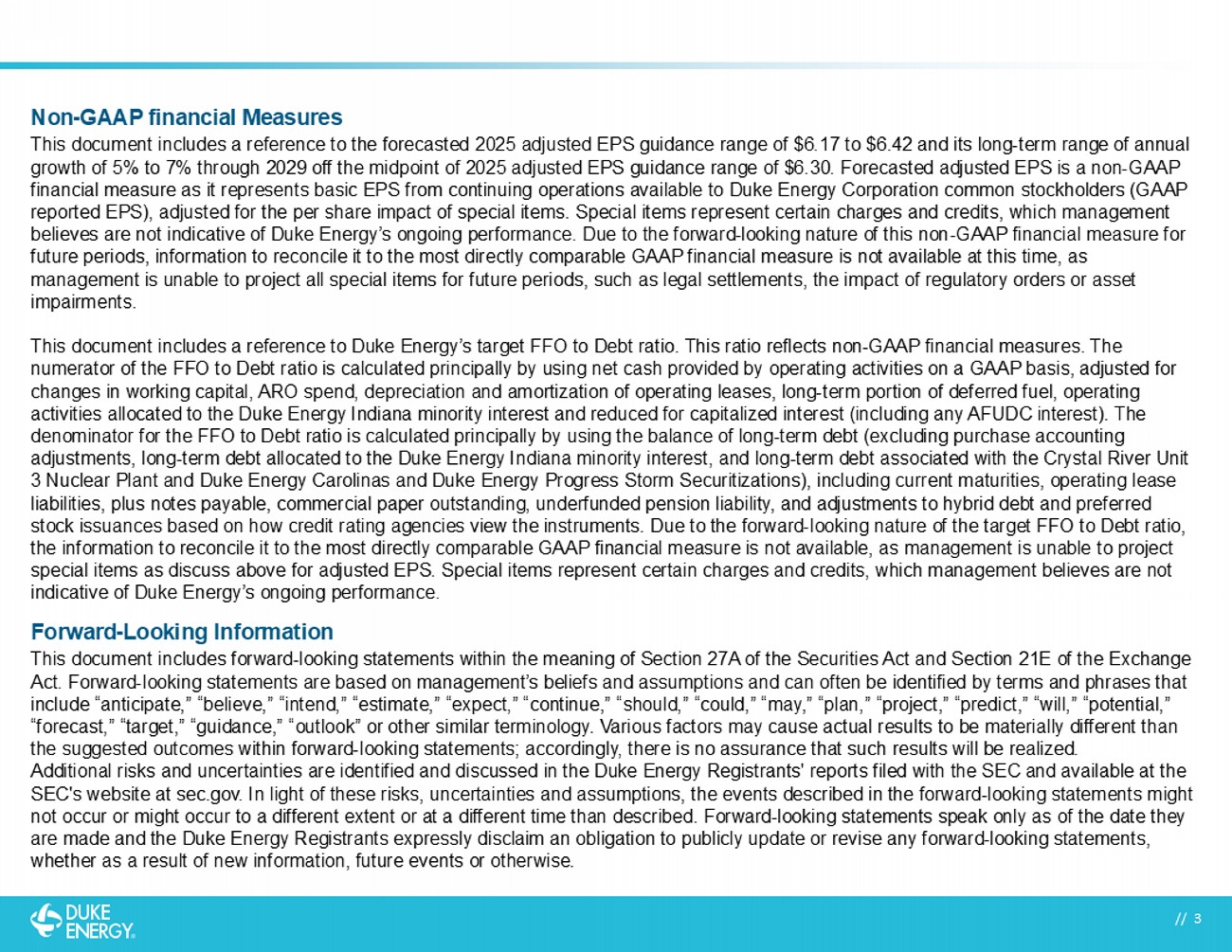
// 3 // 3 Non - GAAP financial Measures This document includes a reference to the forecasted 2025 adjusted EPS guidance range of $6.17 to $6.42 and its long - term range of annual growth of 5% to 7% through 2029 off the midpoint of 2025 adjusted EPS guidance range of $6.30. Forecasted adjusted EPS is a n on - GAAP financial measure as it represents basic EPS from continuing operations available to Duke Energy Corporation common stockhold ers (GAAP reported EPS), adjusted for the per share impact of special items. Special items represent certain charges and credits, which ma nagement believes are not indicative of Duke Energy’s ongoing performance. Due to the forward - looking nature of this non - GAAP financial m easure for future periods, information to reconcile it to the most directly comparable GAAP financial measure is not available at this t ime , as management is unable to project all special items for future periods, such as legal settlements, the impact of regulatory ord ers or asset impairments. This document includes a reference to Duke Energy’s target FFO to Debt ratio. This ratio reflects non - GAAP financial measures. T he numerator of the FFO to Debt ratio is calculated principally by using net cash provided by operating activities on a GAAP bas is, adjusted for changes in working capital, ARO spend, depreciation and amortization of operating leases, long - term portion of deferred fuel, op erating activities allocated to the Duke Energy Indiana minority interest and reduced for capitalized interest (including any AFUDC i nte rest). The denominator for the FFO to Debt ratio is calculated principally by using the balance of long - term debt (excluding purchase accou nting adjustments, long - term debt allocated to the Duke Energy Indiana minority interest, and long - term debt associated with the Cryst al River Unit 3 Nuclear Plant and Duke Energy Carolinas and Duke Energy Progress Storm Securitizations), including current maturities, oper ati ng lease liabilities, plus notes payable, commercial paper outstanding, underfunded pension liability, and adjustments to hybrid debt and preferred stock issuances based on how credit rating agencies view the instruments. Due to the forward - looking nature of the target FFO to Debt ratio, the information to reconcile it to the most directly comparable GAAP financial measure is not available, as management is una ble to project special items as discuss above for adjusted EPS. Special items represent certain charges and credits, which management believ es are not indicative of Duke Energy’s ongoing performance. Forward - Looking Information This document includes forward - looking statements within the meaning of Section 27A of the Securities Act and Section 21E of the Exchange Act. Forward - looking statements are based on management’s beliefs and assumptions and can often be identified by terms and phras es that include “anticipate,” “believe,” “intend,” “estimate,” “expect,” “continue,” “should,” “could,” “may,” “plan,” “project,” “pr edi ct,” “will,” “potential,” “forecast,” “target,” “guidance,” “outlook” or other similar terminology. Various factors may cause actual results to be mate ria lly different than the suggested outcomes within forward - looking statements; accordingly, there is no assurance that such results will be realized. Additional risks and uncertainties are identified and discussed in the Duke Energy Registrants' reports filed with the SEC an d a vailable at the SEC's website at sec.gov. In light of these risks, uncertainties and assumptions, the events described in the forward - looking st atements might not occur or might occur to a different extent or at a different time than described. Forward - looking statements speak only as o f the date they are made and the Duke Energy Registrants expressly disclaim an obligation to publicly update or revise any forward - looking state ments, whether as a result of new information, future events or otherwise.