Investor Relations: Sam Ramraj, (626) 302-2540
Media Relations: (626) 302-2255
Edison International Reports First Quarter 2026 Results
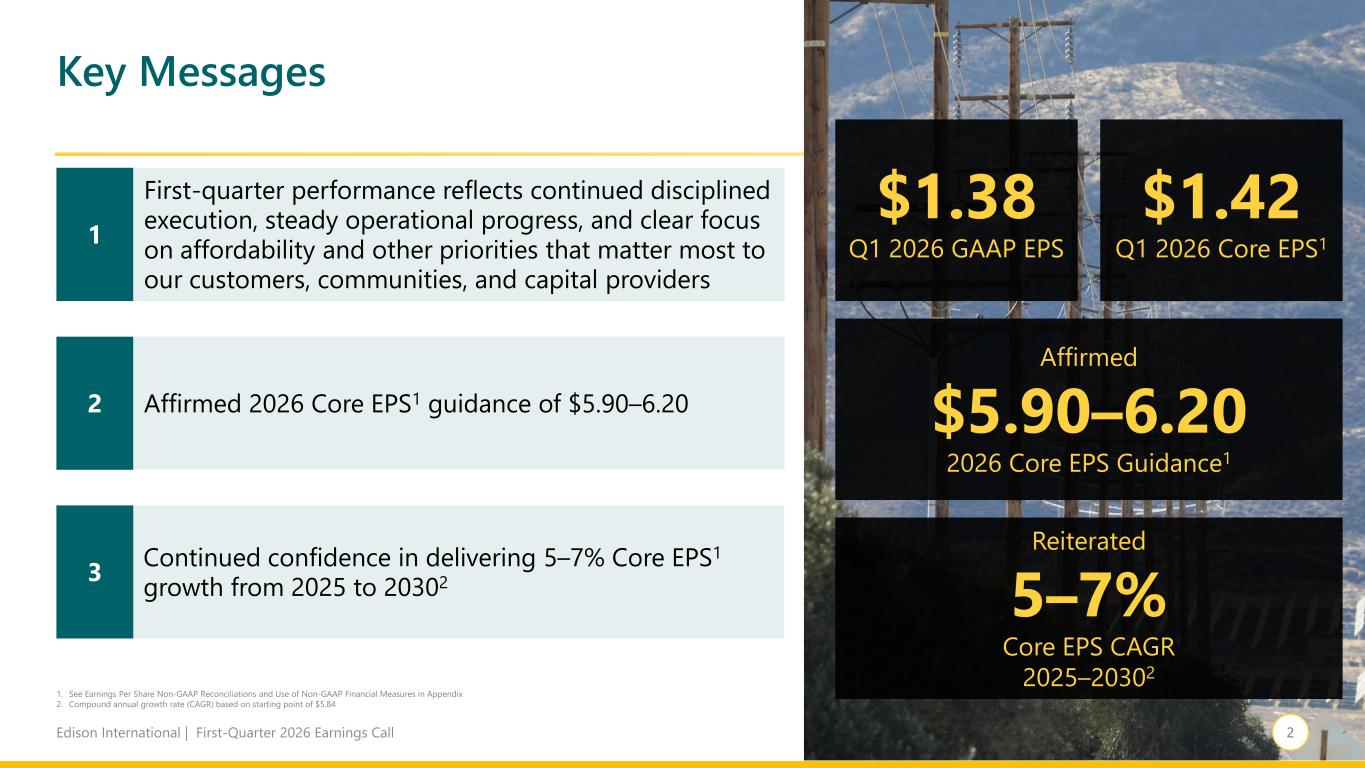
•First-quarter 2026 GAAP EPS of $1.38; core EPS of $1.42
•First-quarter performance reflects continued disciplined execution, steady operational progress, and a clear focus on affordability and other priorities that matter most to our customers, communities, and capital providers
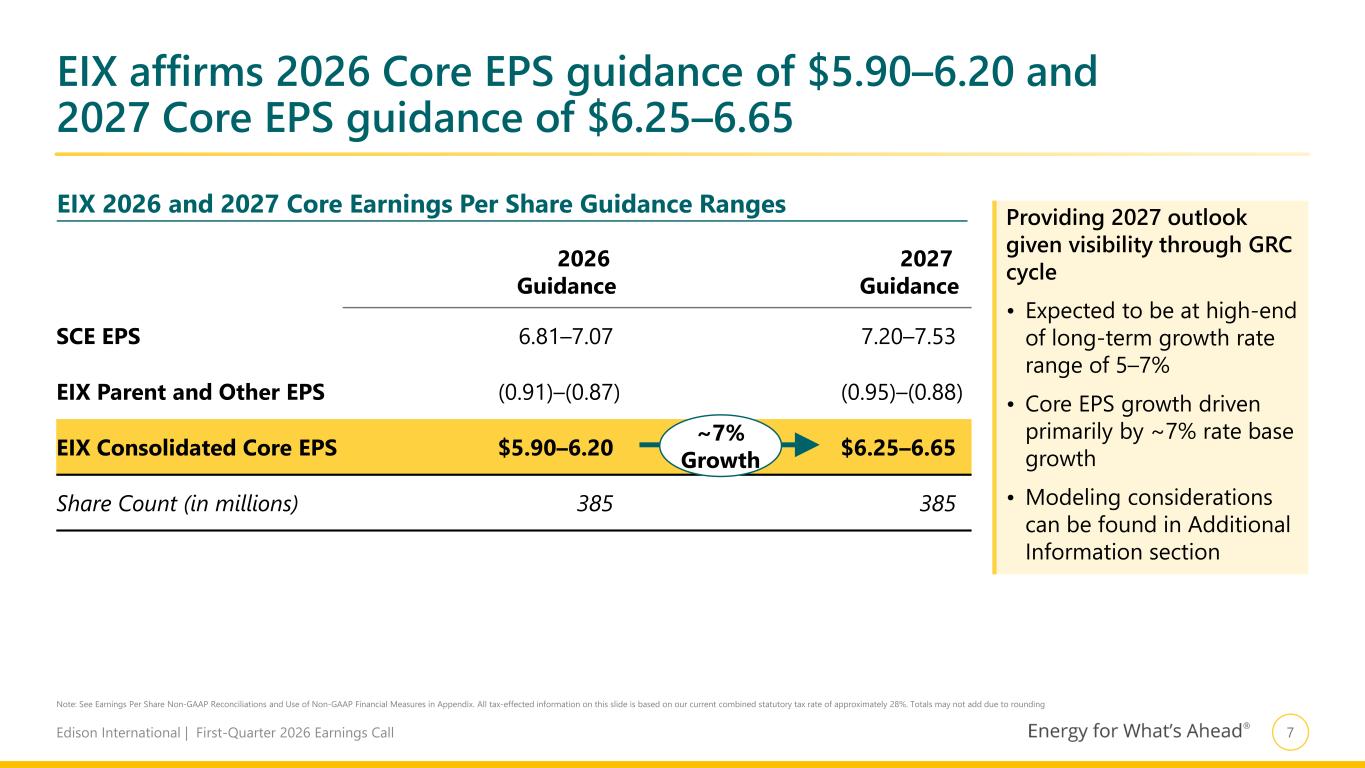
•Affirmed 2026 core EPS guidance of $5.90-$6.20
•Continued confidence in delivering 5-7% core EPS growth from 2025-2030
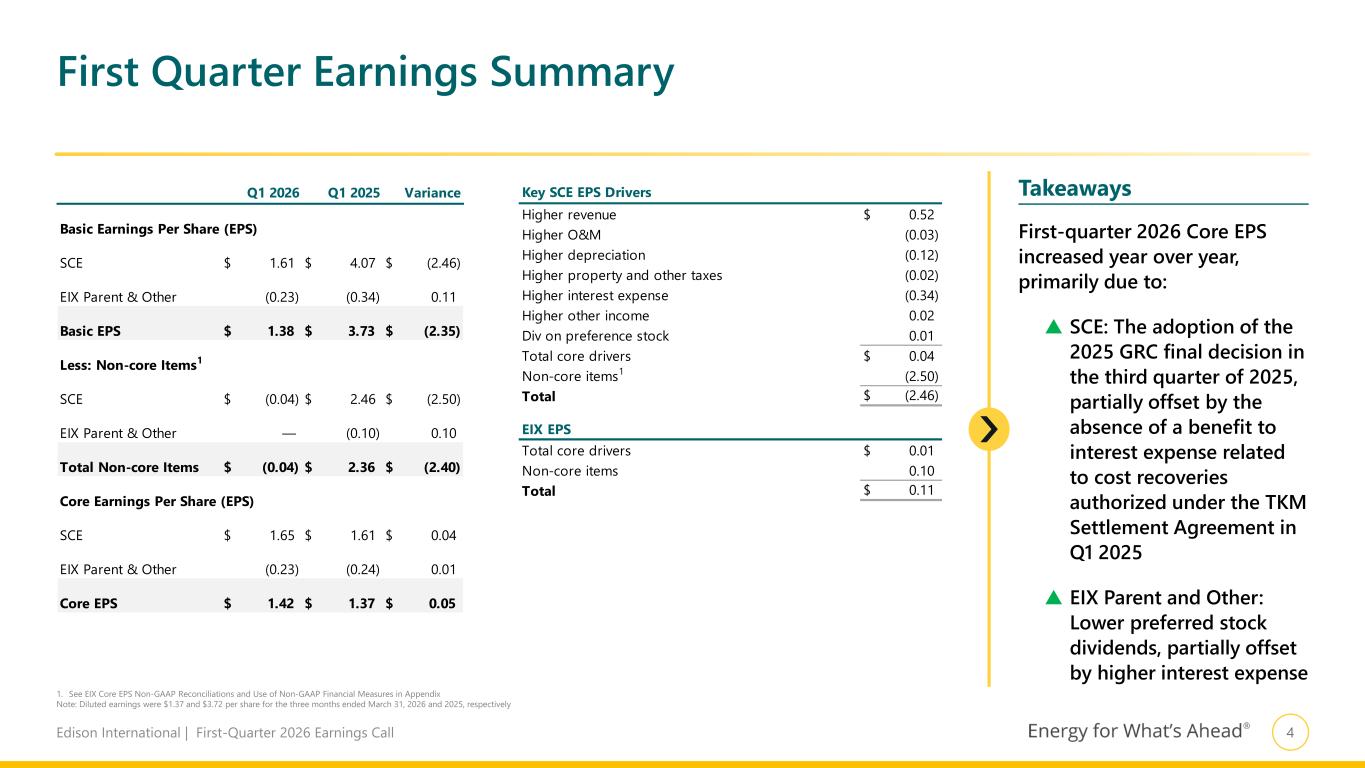
ROSEMEAD, Calif., Apr. 28, 2026 — Edison International (NYSE: EIX) today reported first-quarter net income of $531 million, or $1.38 per share, compared to net income of $1,436 million, or $3.73 per share, in the first quarter of last year. As adjusted, first-quarter core earnings were $546 million, or $1.42 per share, compared to core earnings of $528 million, or $1.37 per share, in the first quarter of last year.
Southern California Edison’s first-quarter 2026 core earnings per share (EPS) increased year over year, primarily due to the adoption of the 2025 GRC final decision in the third quarter of 2025, partially offset by the absence of a benefit to interest expense related to cost recoveries authorized under the TKM Settlement Agreement in 2025
Edison International Parent and Other’s first-quarter 2026 core loss per share decreased year over year, primarily due to lower preferred stock dividends, partially offset by higher interest expense.
“We are pleased with our start to the year and the momentum across our business,” said Pedro J. Pizarro, president and CEO of Edison International. “Our continued performance reflects disciplined execution and steady operational progress to make communities safer and more resilient, including wildfire mitigation and rebuilding efforts.”
Pizarro added, “At the same time, we remain focused on supporting communities impacted by wildfires, including through the Wildfire Recovery Compensation Program. SCE remains committed to administering the program in a transparent way that is responsive to community needs with fast and fair payments.”
Edison International uses core earnings internally for financial planning and analysis of performance. Core earnings are also used when communicating with investors and analysts regarding Edison International’s earnings results to facilitate comparisons of the company’s performance from period to period. Please see the attached tables to reconcile core earnings to basic GAAP earnings.
2026 Earnings Guidance
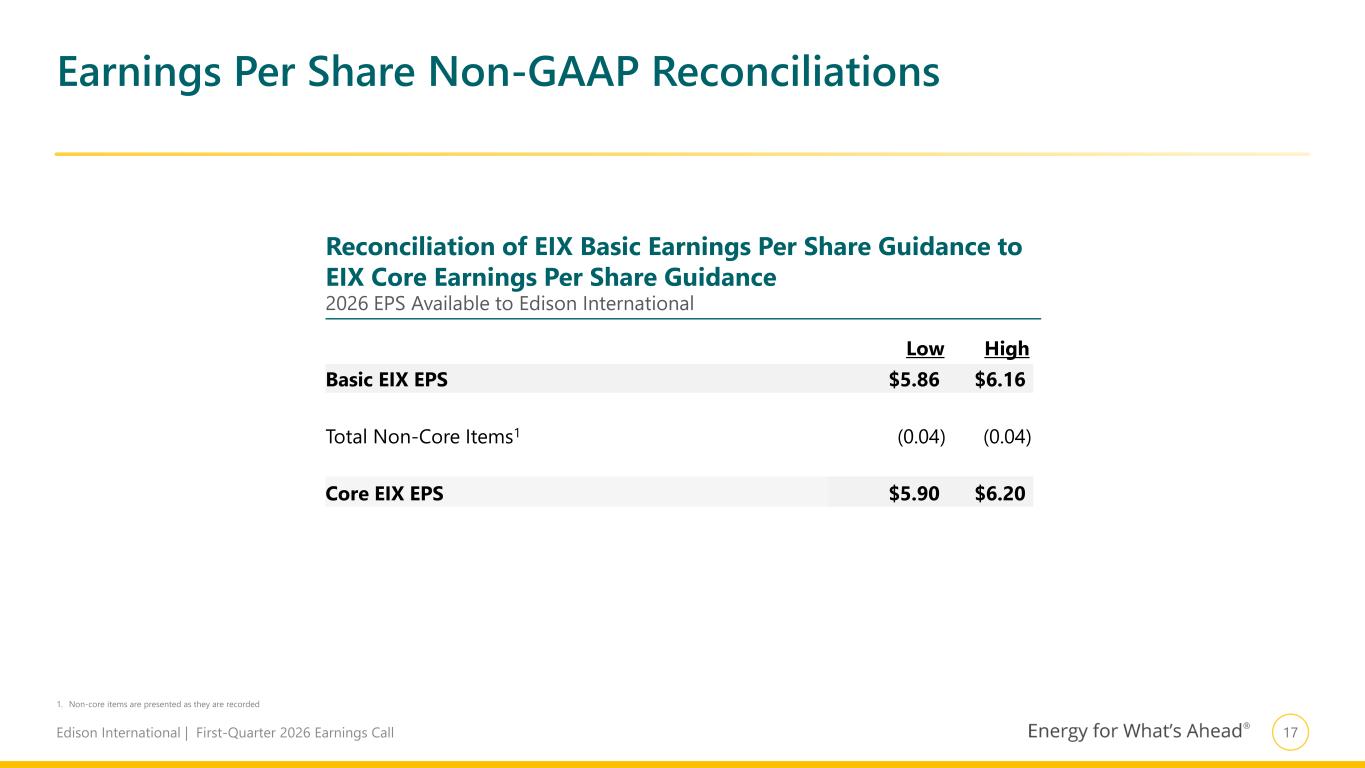
The company affirmed its earnings guidance range for 2026, as summarized in the following table. See the presentation accompanying the company’s conference call for further information and assumptions.
| | | | | | | | | | | | | | | | | | | | |
|
| 2026 Earnings Guidance as of Feb. 18., 2026 | 2026 Earnings Guidance as of Apr. 28, 2026 | |
| | Low | High | Low | High | |
| EIX Basic EPS | $ | 5.90 | | $ | 6.20 | | $ | 5.86 | | $ | 6.16 | | |
| Less: Non-core Items* | — | | — | | (0.04) | | (0.04) | | |
| EIX Core EPS | $ | 5.90 | | $ | 6.20 | | $ | 5.90 | | $ | 6.20 | | |
*There were ($15) million, or ($0.04) per share, of non-core items recorded for the three months ending Mar. 31, 2026. Basic EPS guidance only incorporates non-core items until Mar. 31, 2026.
First Quarter 2026 Earnings Conference Call and Webcast Details
| | | | | |
When: | Tuesday, Apr. 28, 1:30-2:30 p.m. (PDT) |
Telephone Numbers: | 1-888-673-9780 (U.S.) and 1-312-470-0178 (Int'l) — Passcode: Edison |
Telephone Replay: | 1-800-685-6667 (U.S.) and 1-203-369-3864 (Int’l) — Passcode: 1838 |
| Telephone replay available through May 12 at 6 p.m. (PDT) |
Webcast | edisoninvestor.com |
Edison International has posted its earnings conference call prepared remarks by the CEO and CFO, the teleconference presentation, and Form 10-Q on the company’s investor relations website. These materials are available at edisoninvestor.com.
About Edison International
Edison International (NYSE: EIX) is one of the nation’s largest electric utility holding companies, focused on providing clean and reliable energy and energy services through its independent companies. Headquartered in Rosemead, Calif., Edison International is the parent company of Southern California Edison Company, a utility delivering electricity to 15 million people across Southern, Central and Coastal California. Edison International is also the parent company of Trio (formerly Edison Energy), a portfolio of nonregulated competitive businesses providing integrated sustainability and energy advisory services to large commercial, industrial and institutional organizations in North America and Europe.
Appendix
Use of Non-GAAP Financial Measures
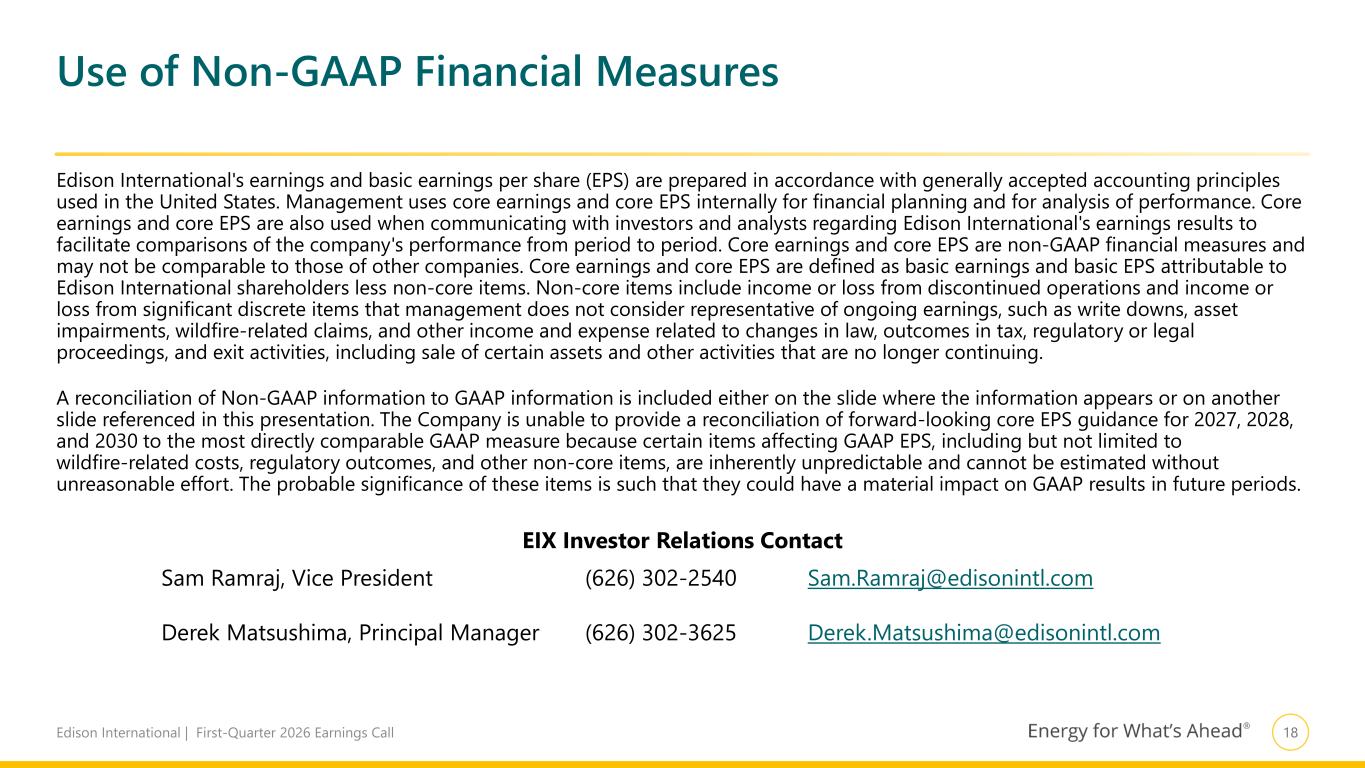
Edison International’s earnings are prepared in accordance with generally accepted accounting principles used in the United States and represent the company’s earnings as reported to the Securities and Exchange Commission. Our management uses core earnings and core earnings per share ("EPS") internally for financial planning and for analysis of performance of Edison International and Southern California Edison. We also use core earnings and core EPS when communicating with analysts and investors regarding our earnings results to facilitate comparisons of the Company’s performance from period to period. Financial measures referred to as net income, basic EPS, core earnings, or core EPS also apply to the description of earnings or earnings per share.
Core earnings and core EPS are non-GAAP financial measures and may not be comparable to those of other companies. Core earnings and core EPS are defined as basic earnings and basic EPS excluding income or loss from discontinued operations and income or loss from significant discrete items that management does not consider representative of ongoing earnings. Basic earnings and losses refer to net income or losses attributable to Edison International shareholders. Core earnings are reconciled to basic earnings in the attached tables. The impact of participating securities (vested awards that earn dividend equivalents that may participate in undistributed earnings with common stock) for the principal operating subsidiary is not material to the principal operating subsidiary’s EPS and is therefore reflected in the results of the Edison International holding company, which is included in Edison International Parent and Other.
Safe Harbor Statement
Statements contained in this release about future performance, including, without limitation, operating results, capital expenditures, rate base growth, dividend policy, financial outlook, and other statements that are not purely historical, are forward-looking statements. These forward-looking statements reflect our current expectations; however, such statements involve risks and uncertainties. Actual results could differ materially from current expectations. These forward-looking statements represent our expectations only as of the date of this release, and Edison International assumes no duty to update them to reflect new information, events or circumstances. Important factors that could cause different results include, but are not limited to the:
•ability of SCE to recover its costs through regulated rates, timely or at all, including uninsured wildfire-related costs (including amounts paid for self-insured retention and co-insurance, and amounts not recoverable from the Wildfire Fund), and costs incurred for wildfire restoration efforts and to mitigate the risk of utility equipment causing future wildfires;
•the cybersecurity of Edison International's and SCE's critical information technology systems for grid control and business, employee and customer data, and the physical security of Edison International's and SCE's critical assets and personnel;
•risks associated with the construction, operation, and maintenance of electrical facilities, including worker, contractor, and public safety issues, the risk of utility assets causing or contributing to wildfires, failure, availability, efficiency, and output of equipment and facilities, and availability and cost of spare parts;
•impact of affordability of customer rates on SCE's ability to execute its strategy, including the impact of lower‑than‑expected load growth and higher operating and capital costs (due to factors such as supply chain constraints, tariffs, inflation, and rising interest rates), which could affect SCE’s ability to obtain regulatory approval of, or cost recovery for, operations and maintenance expenses and proposed capital investment projects, as well as influence legislative actions;
•ability of SCE to update its grid infrastructure to maintain system integrity and reliability, and meet electrification needs;
•ability of SCE to implement its operational and strategic plans, including its Wildfire Mitigation Plan, its target energization times and capital investment program, including challenges related to project site identification, public opposition, environmental mitigation, construction, permitting, contractor performance, changes in the California Independent System Operator's (“CAISO”) transmission plans, and governmental approvals;
•risks of regulatory or legislative restrictions that would limit SCE's ability to implement operational measures to mitigate wildfire risk, including Public Safety Power Shutoff (“PSPS”) and fast curve settings, when conditions warrant or would otherwise limit SCE's operational practices relative to wildfire risk mitigation;
•ability of SCE to obtain safety certifications from the Office of Energy Infrastructure Safety of the California Natural Resources Agency (“OEIS“);
•risk that the California Wildfire Legislation or anticipated new California legislation does not effectively mitigate the significant exposure faced by California investor-owned utilities related to liability for damages arising from catastrophic wildfires where utility facilities are alleged to be a substantial or contributing cause, including the longevity of the Wildfire Fund and the California Public Utilities Commission (“CPUC”) interpretation of and actions under the California Wildfire Legislation, including its interpretation of the clarified prudency standard;
•ability of Edison International and SCE to effectively attract, manage, develop and retain a skilled workforce, including its contract workers;
•decisions and other actions by the CPUC, the Federal Energy Regulatory Commission, and the United States Nuclear Regulatory Commission, the California legislature and other governmental authorities, including decisions and actions related to nationwide or statewide crisis, approval of regulatory proceeding settlements, determinations of authorized rates of return or return on equity, the recoverability of wildfire-related and debris flow-related costs, issuance of SCE's wildfire safety certification, reforming wildfire-related liability protections available to California investor-owned utilities, wildfire mitigation efforts, approval and implementation of electrification programs, and delays in executive, regulatory and legislative actions;
•governmental, statutory, regulatory, or administrative changes or initiatives affecting the electricity industry, including the market structure rules applicable to each market adopted by the North American Electric Reliability Corporation, CAISO, Western Electricity Coordinating Council, and similar regulatory bodies in adjoining regions, and changes in the United States' and California's environmental priorities that lessen the importance placed on greenhouse gas reduction and other climate related priorities;
•potential for penalties or disallowances for non-compliance with applicable laws and regulations, including fines, penalties and disallowances related to customer notifications and to wildfires where SCE's equipment is alleged to be associated with ignition;
•extreme weather-related incidents (including events caused, or exacerbated, by climate change), such as wildfires, debris flows, flooding, droughts, high wind events and extreme heat events and other natural disasters (such as earthquakes), which could cause, among other things, worker and public safety issues, property damage, outages and other operational issues (such as issues due to damaged infrastructure), PSPS activations and unanticipated costs;
•risks associated with the decommissioning of San Onofre, including those related to worker and public safety, public opposition, permitting, governmental approvals, on-site storage of spent nuclear fuel and other radioactive material, delays, contractual disputes, and cost overruns;
•risks associated with cost allocation resulting in higher rates for utility bundled service customers because of possible customer bypass or departure for other electricity providers such as Community Choice Aggregators (“CCA,” which are cities, counties, and certain other public agencies with the authority to generate and/or purchase electricity for their local residents and businesses) and Electric Service Providers (entities that offer electric power and ancillary services to retail customers, other than electrical corporations (like SCE) and CCAs);
•actions by credit rating agencies to downgrade Edison International or SCE’s credit ratings or to place those ratings on negative watch or negative outlook.
Other important factors are discussed under the headings “Forward-Looking Statements”, “Risk Factors” and “Management’s Discussion and Analysis” in Edison International’s Form 10-K and other reports filed with the Securities and Exchange Commission, which are available on our website: edisoninvestor.com. These filings also provide additional information on historical and other factual data contained in this release.
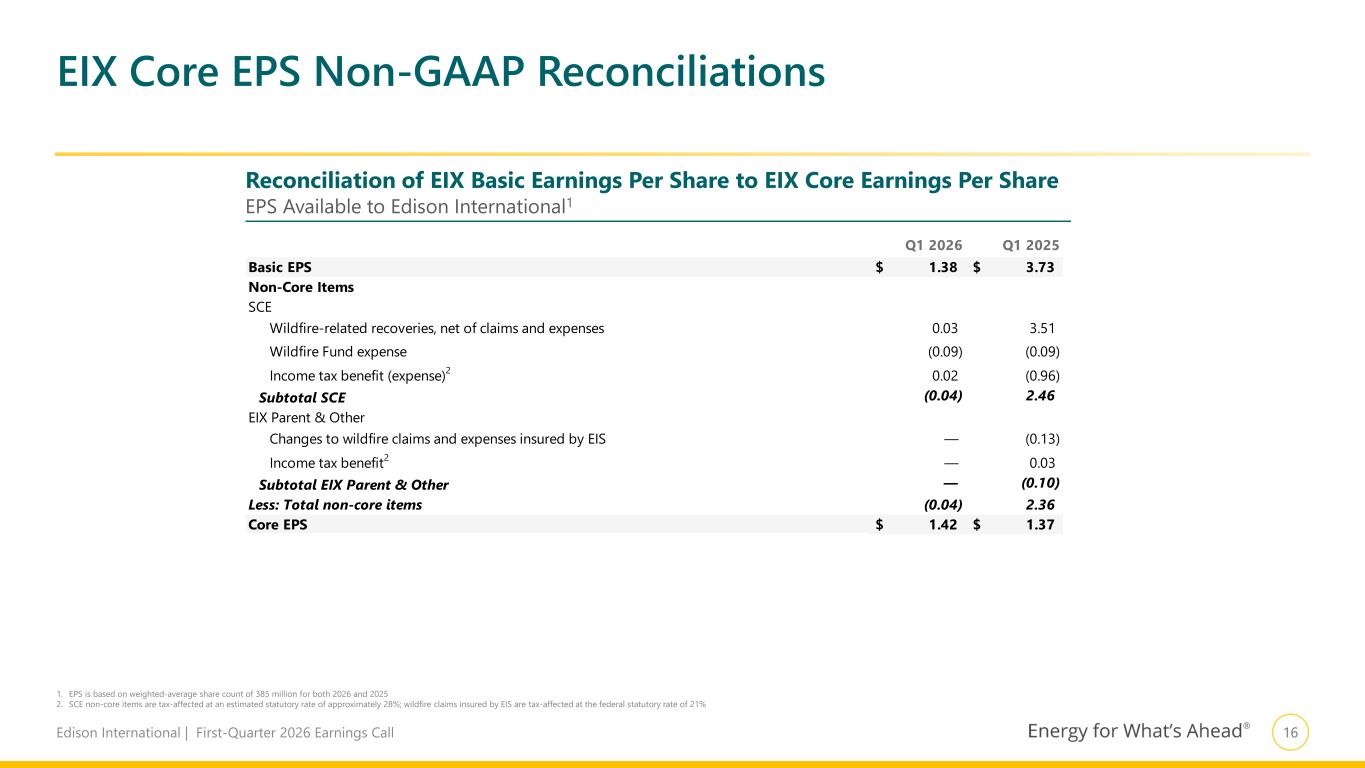
First Quarter Reconciliation of Basic Earnings Per Share to Core Earnings Per Share
| | | | | | | | | | | | | | | | | | | | | | | |
| Three Months Ended March 31, | | | | | | |
| 2026 | | 2025 | | Change | | | | | | |
Earnings (loss) per share available to Edison International | | | | | | | | | | | |
SCE | $ | 1.61 | | | $ | 4.07 | | | $ | (2.46) | | | | | | | |
Edison International Parent and Other | (0.23) | | | (0.34) | | | 0.11 | | | | | | | |
Edison International | 1.38 | | | 3.73 | | | (2.35) | | | | | | | |
Less: Non-core items | | | | | | | | | | | |
SCE | (0.04) | | | 2.46 | | | (2.50) | | | | | | | |
Edison International Parent and Other | — | | | (0.10) | | | 0.10 | | | | | | | |
Total non-core items | (0.04) | | | 2.36 | | | (2.40) | | | | | | | |
Core earnings (loss) per share | | | | | | | | | | | |
SCE | 1.65 | | | 1.61 | | | 0.04 | | | | | | | |
Edison International Parent and Other | (0.23) | | | (0.24) | | | 0.01 | | | | | | | |
Edison International | $ | 1.42 | | | $ | 1.37 | | | $ | 0.05 | | | | | | | |
Note: Diluted earnings were $1.37 and $3.72 per share for the three months ended March 31, 2026 and 2025, respectively.
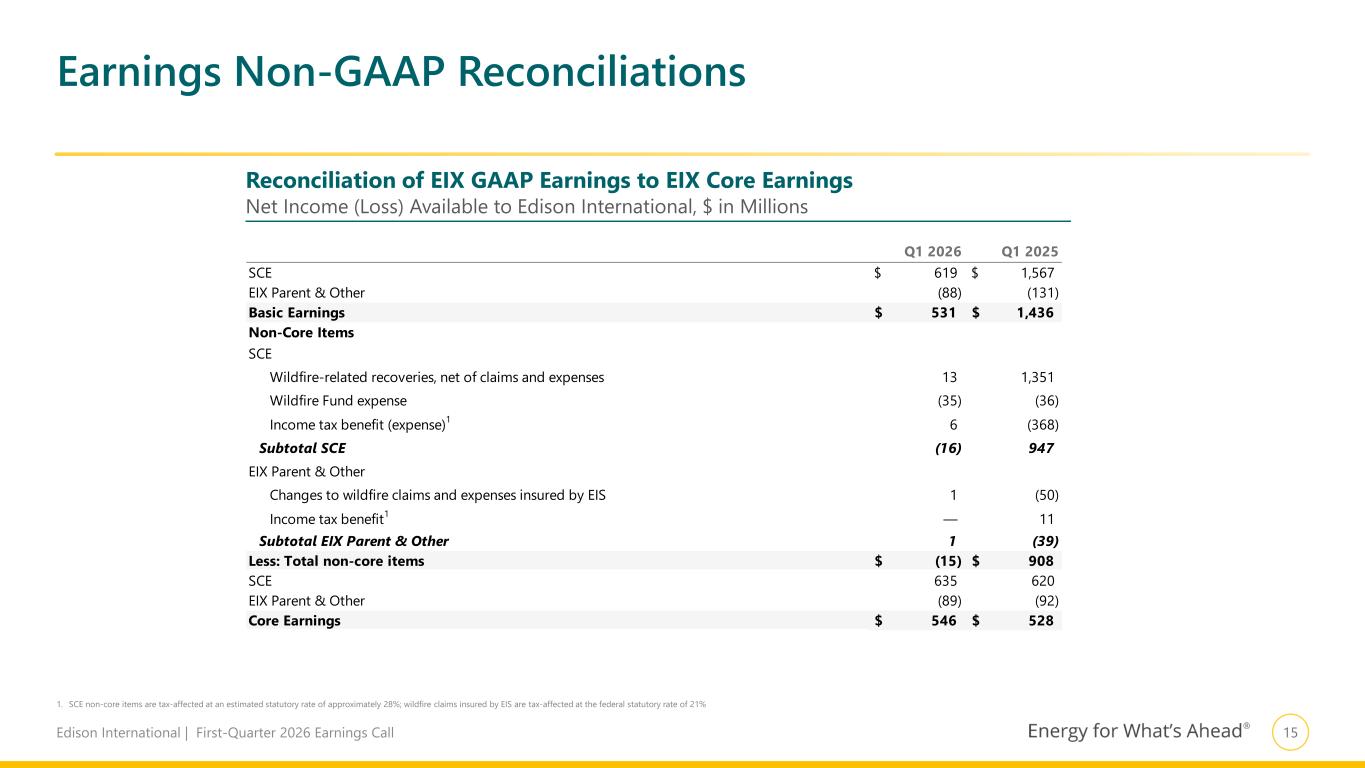
First Quarter Reconciliation of Basic Earnings to Core Earnings (in millions)
| | | | | | | | | | | | | | | | | | | | | | | |
| Three Months Ended March 31, | | | | | | |
(in millions) | 2026 | | 2025 | | Change | | | | | | |
Net income (loss) available to Edison International | | | | | | | | | | | |
SCE | $ | 619 | | | $ | 1,567 | | | $ | (948) | | | | | | | |
Edison International Parent and Other | (88) | | | (131) | | | 43 | | | | | | | |
Edison International | 531 | | | 1,436 | | | (905) | | | | | | | |
| Less: Non-core items | | | | | | | | | | | |
SCE 1,2 | (16) | | | 947 | | | (963) | | | | | | | |
Edison International Parent and Other3 | 1 | | | (39) | | | 40 | | | | | | | |
Total non-core items | (15) | | | 908 | | | (923) | | | | | | | |
Core earnings (losses) | | | | | | | | | | | |
SCE | 635 | | | 620 | | | 15 | | | | | | | |
Edison International Parent and Other | (89) | | | (92) | | | 3 | | | | | | | |
Edison International | $ | 546 | | | $ | 528 | | | $ | 18 | | | | | | | |
1Includes net earnings of $13 million ($9 million after-tax) recorded in 2026 primarily due to expected recoveries, partially offset by claims and legal expenses associated with Other Wildfire Events, and net earnings of $1,351 million ($973 million after-tax) in 2025 primarily related to the TKM Settlement Agreement and insurance reimbursements related to Other Wildfire Events.
2Includes amortization of SCE's Wildfire Fund expenses of $35 million ($25 million after-tax) and $36 million ($26 million after-tax) for the three months ended March 31, 2026 and 2025, respectively.
3Includes net earnings of $1 million ($1 million after-tax) recorded in 2026 primarily due to updated estimates of claims accruals, net of legal expenses, and charges of $50 million ($39 million after-tax) recorded in 2025, both related to wildfire claims insured by EIS.
| | | | | | | | | | | | | | | |
| Condensed Consolidated Statements of Income | Edison International | | |
| | | | | | | |
| Three months ended
March 31, | | |
| (in millions, except per-share amounts, unaudited) | 2026 | | 2025 | | | | |
| Operating revenue | $ | 4,103 | | | $ | 3,811 | | | | | |
| Purchased power and fuel | 970 | | | 1,047 | | | | | |
| Operation and maintenance | 1,017 | | | 983 | | | | | |
Wildfire-related claims, net of (recoveries) | (5) | | | (1,305) | | | | | |
| Wildfire Fund expense | 35 | | | 36 | | | | | |
| Depreciation and amortization | 834 | | | 742 | | | | | |
| Property and other taxes | 179 | | | 166 | | | | | |
Asset impairment and other | (1) | | | 8 | | | | | |
| Total operating expenses | 3,029 | | | 1,677 | | | | | |
| Operating income | 1,074 | | | 2,134 | | | | | |
| Interest expense | (524) | | | (301) | | | | | |
| Other income, net | 121 | | | 107 | | | | | |
| Income before income taxes | 671 | | | 1,940 | | | | | |
Income tax expense | 101 | | | 448 | | | | | |
| Net income | 570 | | | 1,492 | | | | | |
| Less: Preference stock dividend requirements of SCE | 29 | | | 34 | | | | | |
| Preferred stock dividend requirements of Edison International | 10 | | | 22 | | | | | |
| Net income available to Edison International common shareholders | $ | 531 | | | $ | 1,436 | | | | | |
| Basic earnings per share: | | | | | | | |
| Weighted average shares of common stock outstanding | 385 | | 385 | | | | |
| Basic earnings per common share available to Edison International common shareholders | $ | 1.38 | | | $ | 3.73 | | | | | |
| Diluted earnings per share: | | | | | | | |
| Weighted average shares of common stock outstanding, including effect of dilutive securities | 387 | | 386 | | | | |
| Diluted earnings per common share available to Edison International common shareholders | $ | 1.37 | | | $ | 3.72 | | | | | |
| | | | | | | | | | | |
| Condensed Consolidated Balance Sheets | Edison International |
| | | |
| (in millions, unaudited) | March 31,
2026 | | December 31,
2025 |
| ASSETS | | | |
| Cash and cash equivalents | $ | 168 | | | $ | 158 | |
Receivables, net of allowances for uncollectible accounts of $348 and $356 at respective dates | 1,577 | | | 1,463 | |
| Accrued unbilled revenue | 1,022 | | | 1,238 | |
| Inventory | 542 | | | 535 | |
| Prepaid expenses | 280 | | | 119 | |
| Regulatory assets | 2,660 | | | 3,290 | |
| Wildfire Fund contributions | 138 | | | 138 | |
| Other current assets | 789 | | | 745 | |
| Total current assets | 7,176 | | | 7,686 | |
| Nuclear decommissioning trusts | 4,457 | | | 4,535 | |
| Other investments | 63 | | | 51 | |
| Total investments | 4,520 | | | 4,586 | |
Utility property, plant and equipment, net of accumulated depreciation and amortization of $15,196 and $15,060 at respective dates | 64,020 | | | 63,131 | |
Nonutility property, plant and equipment, net of accumulated depreciation of $117 and $132 at respective dates | 194 | | | 197 | |
| Total property, plant and equipment | 64,214 | | | 63,328 | |
Receivables, net of allowances for uncollectible accounts of $39 and $49 at respective dates | 36 | | | 38 | |
Regulatory assets (include $3,072 and $3,092 related to a Variable Interest Entity ("VIE") at respective dates) | 13,011 | | | 12,960 | |
| Wildfire Fund contributions | 1,705 | | | 1,740 | |
| Operating lease right-of-use assets | 1,148 | | | 1,161 | |
| Long-term insurance receivables | 456 | | | 359 | |
| Other long-term assets | 2,209 | | | 2,168 | |
| Total other assets | 18,565 | | | 18,426 | |
| Total assets | $ | 94,475 | | | $ | 94,026 | |
| | | | | | | | | | | |
| Condensed Consolidated Balance Sheets | Edison International |
| | | |
| (in millions, except share amounts, unaudited) | March 31,
2026 | | December 31,
2025 |
LIABILITIES AND EQUITY | | | |
| Short-term debt | $ | 1,242 | | | $ | 2,390 | |
| Current portion of long-term debt | 2,996 | | | 1,928 | |
| Accounts payable | 2,413 | | | 2,344 | |
| Wildfire-related claims | 556 | | | 585 | |
| Accrued interest | 504 | | | 473 | |
| Regulatory liabilities | 354 | | | 1,158 | |
| Current portion of operating lease liabilities | 120 | | | 120 | |
| Other current liabilities | 1,515 | | | 1,538 | |
| Total current liabilities | 9,700 | | | 10,536 | |
Long-term debt (includes $3,004 and $3,022 related to a VIE at respective dates) | 37,311 | | | 36,070 | |
| Deferred income taxes and credits | 9,275 | | | 9,114 | |
| Pensions and benefits | 365 | | | 370 | |
| Asset retirement obligations | 2,598 | | | 2,583 | |
| Regulatory liabilities | 10,870 | | | 10,627 | |
| Operating lease liabilities | 1,028 | | | 1,041 | |
| Wildfire-related claims | 837 | | | 721 | |
| Other deferred credits and other long-term liabilities | 3,607 | | | 3,705 | |
| Total deferred credits and other liabilities | 28,580 | | | 28,161 | |
| Total liabilities | 75,591 | | | 74,767 | |
| | | |
Preferred stock (50,000,000 shares authorized; zero and 414,342 shares of Series A and 83,503 and 87,937 shares of Series B issued and outstanding at respective dates) | 83 | | | 497 | |
Common stock, no par value (800,000,000 shares authorized; 384,793,941 and 384,787,056 shares issued and outstanding at respective dates) | 6,332 | | | 6,362 | |
| Accumulated other comprehensive income | 6 | | | 6 | |
| Retained earnings | 10,899 | | | 10,714 | |
| Total Edison International's shareholders' equity | 17,320 | | | 17,579 | |
| Noncontrolling interests – preference stock of SCE | 1,564 | | | 1,680 | |
| Total equity | 18,884 | | | 19,259 | |
| Total liabilities and equity | $ | 94,475 | | | $ | 94,026 | |
| | | | | | | | | | | |
| Condensed Consolidated Statements of Cash Flows | Edison International |
| | | |
| Three months ended March 31, |
| (in millions, unaudited) | 2026 | | 2025 |
Cash flows from operating activities: | | | |
| Net income | $ | 570 | | | $ | 1,492 | |
| Adjustments to reconcile to net cash provided by operating activities: | | | |
| Depreciation and amortization | 834 | | | 742 | |
| Equity allowance for funds used during construction | (56) | | | (46) | |
| | | |
| Asset impairment and other | (1) | | | 8 | |
| Deferred income taxes | 46 | | | 421 | |
| Wildfire Fund amortization expense | 35 | | | 36 | |
| Other | 27 | | | 28 | |
| Nuclear decommissioning trusts | 2 | | | (34) | |
| Changes in operating assets and liabilities: | | | |
| Receivables | (131) | | | 269 | |
| Inventory | (9) | | | (1) | |
| Accounts payable | 109 | | | 70 | |
| | | |
| Other current assets and liabilities | (71) | | | (221) | |
| Derivative assets and liabilities, net | 23 | | | 33 | |
| Regulatory assets and liabilities, net | 81 | | | (1,443) | |
| | | |
| Wildfire-related claims, net of insurance recoveries | (22) | | | (131) | |
| Other noncurrent assets and liabilities | (10) | | | 1 | |
| Net cash provided by operating activities | 1,427 | | | 1,224 | |
| Cash flows from financing activities: | | | |
Long-term debt issued, net of premium (discount) and issuance costs of $2 and $(49) for the respective periods | 3,552 | | | 3,501 | |
| Long-term debt repaid | (1,251) | | | (1) | |
| | | |
| Short-term debt repaid | (432) | | | — | |
| | | |
| Common stock repurchased | (26) | | | (29) | |
| | | |
| Preferred stock repurchased | (538) | | | — | |
| Commercial paper repayments, net of borrowing | (711) | | | (1,687) | |
| Dividends and distribution to noncontrolling interests | (27) | | | (34) | |
| Common stock dividends paid | (338) | | | (319) | |
| Preferred stock dividends paid | (13) | | | (44) | |
| Other | (4) | | | (13) | |
| Net cash provided by financing activities | 212 | | | 1,374 | |
| Cash flows from investing activities: | | | |
| Capital expenditures | (1,539) | | | (1,408) | |
| Proceeds from sale of nuclear decommissioning trust investments | 1,991 | | | 1,406 | |
| Purchases of nuclear decommissioning trust investments | (1,993) | | | (1,372) | |
| Other | (47) | | | — | |
| Net cash used in investing activities | (1,588) | | | (1,374) | |
| Net increase in cash and cash equivalents and restricted cash and cash equivalents | 51 | | | 1,224 | |
| Cash and cash equivalents and restricted cash and cash equivalents at beginning of period | 720 | | | 684 | |
| Cash and cash equivalents and restricted cash and cash equivalents at end of period | $ | 771 | | | $ | 1,908 | |
| | | |
Prepared Remarks of Edison International CEO and CFO
First Quarter 2026 Earnings Teleconference
April 28, 2026, 1:30 p.m. (PT)
Pedro Pizarro, President and Chief Executive Officer, Edison International
Let me start by acknowledging that last week we announced Maria’s retirement plans. This is the last earnings call that Maria and I are partnering on together. I’ll come back to this at the end of my remarks because if I start now, I may not make it to my comments! Before moving on, I’d like to welcome Susan Hardwick to our Board. She brings over 35 years of leadership experience in electric and water utilities, including as CEO of American Water, with deep strengths in operations, finance, and regulatory oversight.
We are pleased with our start to the year and the momentum across our business. Edison International’s first-quarter 2026 core EPS was $1.42. Our continued performance reflects disciplined execution, steady operational progress, and a clear focus on the priorities that matter most to our customers, communities, and capital providers. Importantly, we are reaffirming our 2026 core EPS guidance and other financial targets, including our 5 to 7% core EPS growth over the long term. Our targets are supported by strong visibility into the capital plan, SCE’s regulatory outlook, and a sustained focus on safety and risk management.
Today, I will focus on three areas. First, our continued work to make communities safer and more resilient, including wildfire mitigation and rebuilding efforts. Second, key legislative developments. And finally, our confidence in the financial outlook, which Maria will expand on in her remarks.
Beginning with wildfire mitigation and grid reliability, safety and community protection continue to guide SCE decisions and investments. Over the past several years, the utility has made substantial progress strengthening the grid, improving situational awareness, and reducing wildfire risk across its service area. The planned physical hardening
work on the distribution system in high fire risk areas is now about 93% complete, reflecting years of sustained investment in covered conductor and targeted undergrounding.
SCE continues to evolve its public safety power shutoff, or PSPS, protocols, which include enhancing its analysis of on-the-ground conditions, enabled by its vast network of weather stations and overall system visibility. These measures plus the grid hardening work I mentioned earlier are keeping SCE customers and communities safe. Importantly, in March, the Office of Energy Infrastructure Safety approved SCE’s annual safety certification after its independent assessment of the utility’s WMP and SCE’s continued progress implementing its plan.
SCE’s wildfire mitigation plan includes new and expanded tools to improve safety, reliability, and efficiency across its network. Let me share some tangible examples. SCE is using AI models to improve grid inspections and identify maintenance needs, with faster and more accurate diagnostics and enhanced quality control. Since 2023, SCE has developed and deployed AI and machine learning models that are collectively capable of detecting nearly 100 unique object classes and dozens of defect conditions. SCE is also using LiDAR and satellite imagery to support precise, proactive vegetation management to help prevent ignitions. The utility is also expanding its deployment of early fault detection tools that identify abnormal grid conditions, enabling earlier awareness and faster response to potential equipment issues or ignition risk. Capabilities like these are increasingly integrated into how SCE monitors conditions, anticipates risk, and deploys resources in real time.
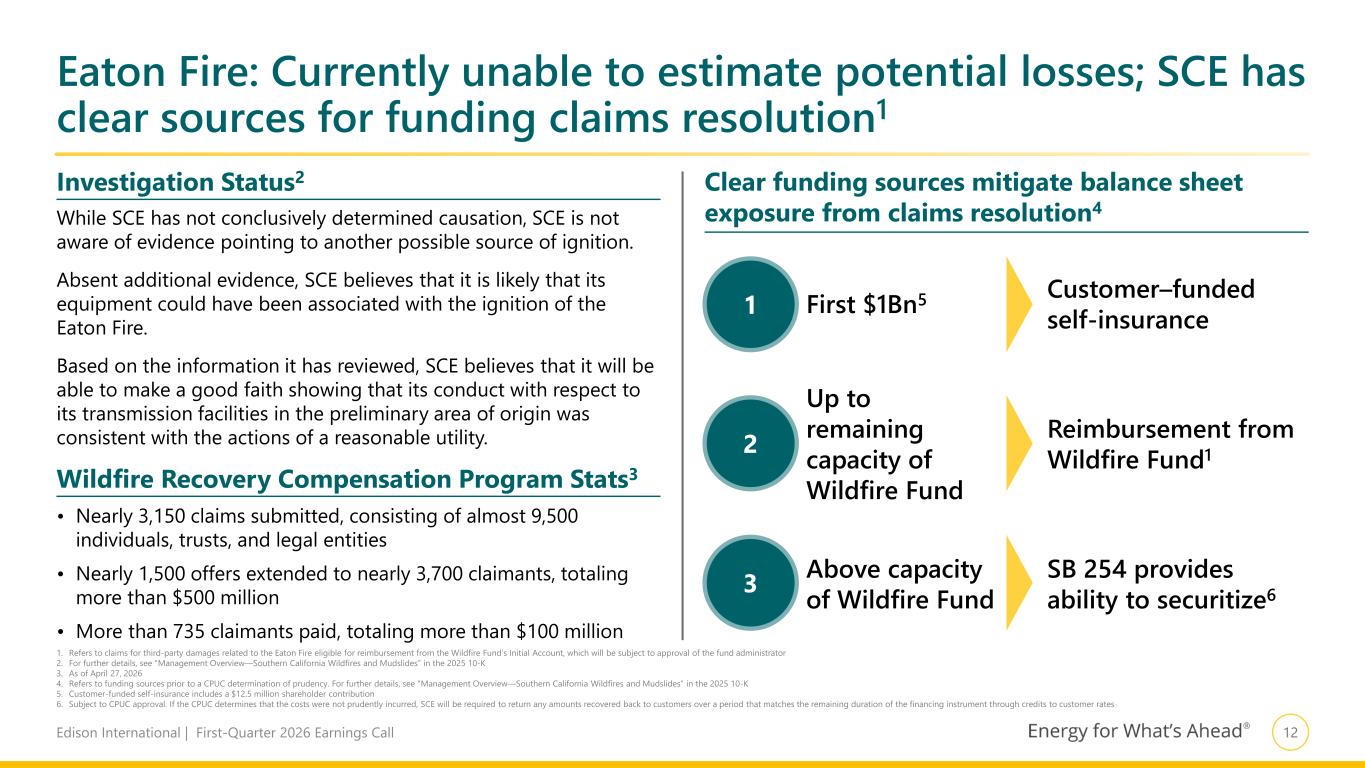
Turning to the Wildfire Recovery Compensation Program, or WRCP, SCE continues to make progress. SCE has now extended nearly 1,500 offers totaling over 500 million dollars to community members impacted by the Eaton Fire, helping families and individuals move forward more quickly without the delays and uncertainty of traditional litigation. SCE remains committed to administering the program in a transparent way that is responsive to community needs with fast and fair payments.
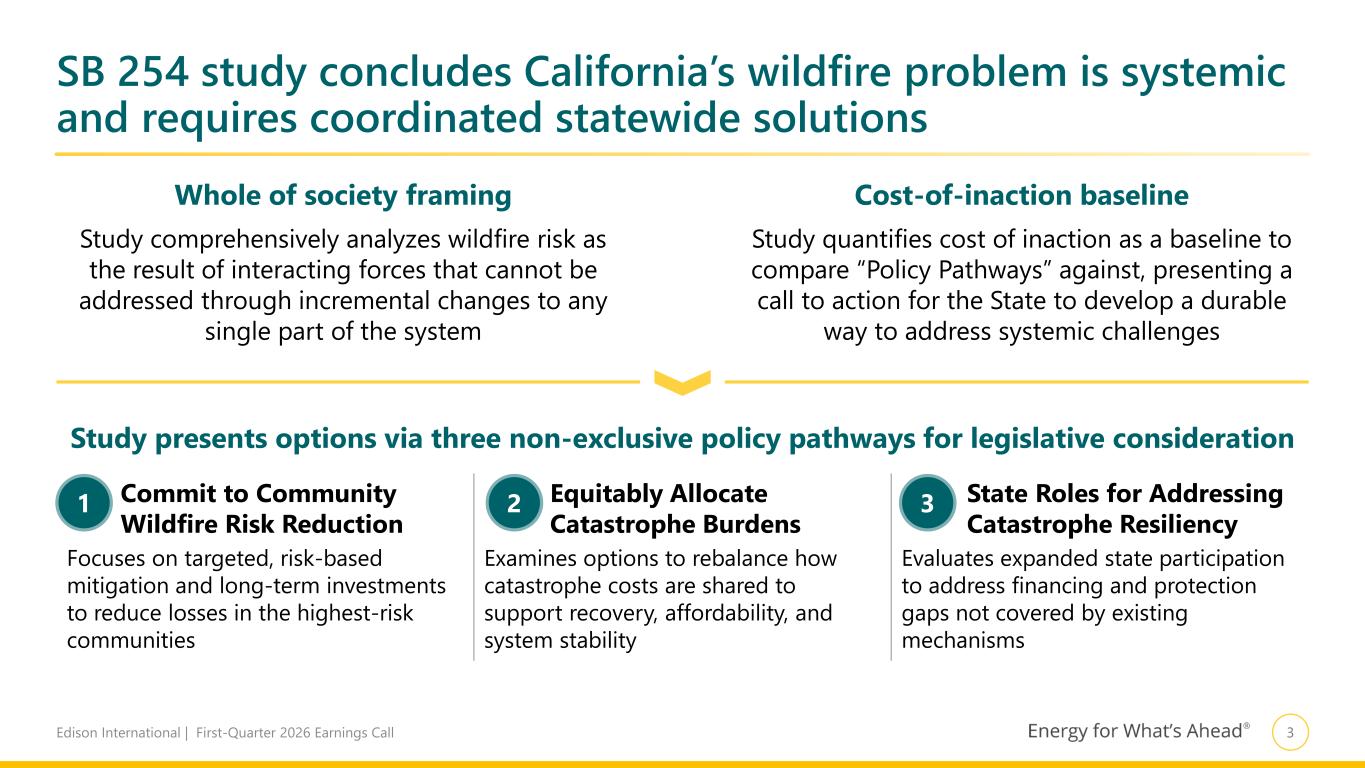
On the legislative front, earlier this month, the California Earthquake Authority released its study. It reinforces that addressing California’s growing wildfire risk requires a whole-of-society approach, and that the status quo is not working for customers, policyholders, or wildfire impacted-communities, who ultimately bear the real and increasing costs of inaction. It presents options for policymaker consideration, including three non-exclusive pathways, a defined set of strategies, and more than two dozen specific policy choices for reforming California’s wildfire, insurance, and utility systems. We have provided a summary on page 3. There is urgency for legislative action, and we remain actively engaged with policymakers and key stakeholders to help shape solutions that support safety, affordability, and long-term resilience for California communities.
Our team is also fully engaged on the various pieces of proposed legislation pertaining to utilities, with affordability a critical focus. A common goal across wildfire reform and affordability is to build the right whole-of-society approach, allocating wildfire risk equitably across the economy and attracting capital at a reasonable cost on customer bills. This will benefit both customers and capital providers.
Operational excellence is a core Edison value as SCE aims to maintain its cost leadership position with the lowest system average rate among the large IOUs in the state. I have shared on prior earnings calls examples of operational excellence in practice, including SCE’s use of AI in areas like grid inspections, vegetation management, and wildfire situational awareness, including the award‑winning AWARE grid monitoring platform. The team continues to explore new AI-enabled process improvements across the entire value chain. Let me share another recent example. All utilities have instances where electricity usage can occur at a location before it is fully linked to an active customer billing record. In the past, identifying those situations required periodic, manual checks and often occurred after the fact. Through SCE’s internal innovation program, in only a handful of development hours, frontline teams developed an initial proof of concept of an AI‑driven approach that continuously monitors for these situations and brings them to the surface earlier, with
clearer and more actionable insights. Once implemented, we anticipate this approach could yield roughly $25 million in potential unbilled revenue savings over a three-to-six-month period. It’s a good illustration of how smarter systems and disciplined execution translate directly into stronger financial controls and support long‑term affordability.
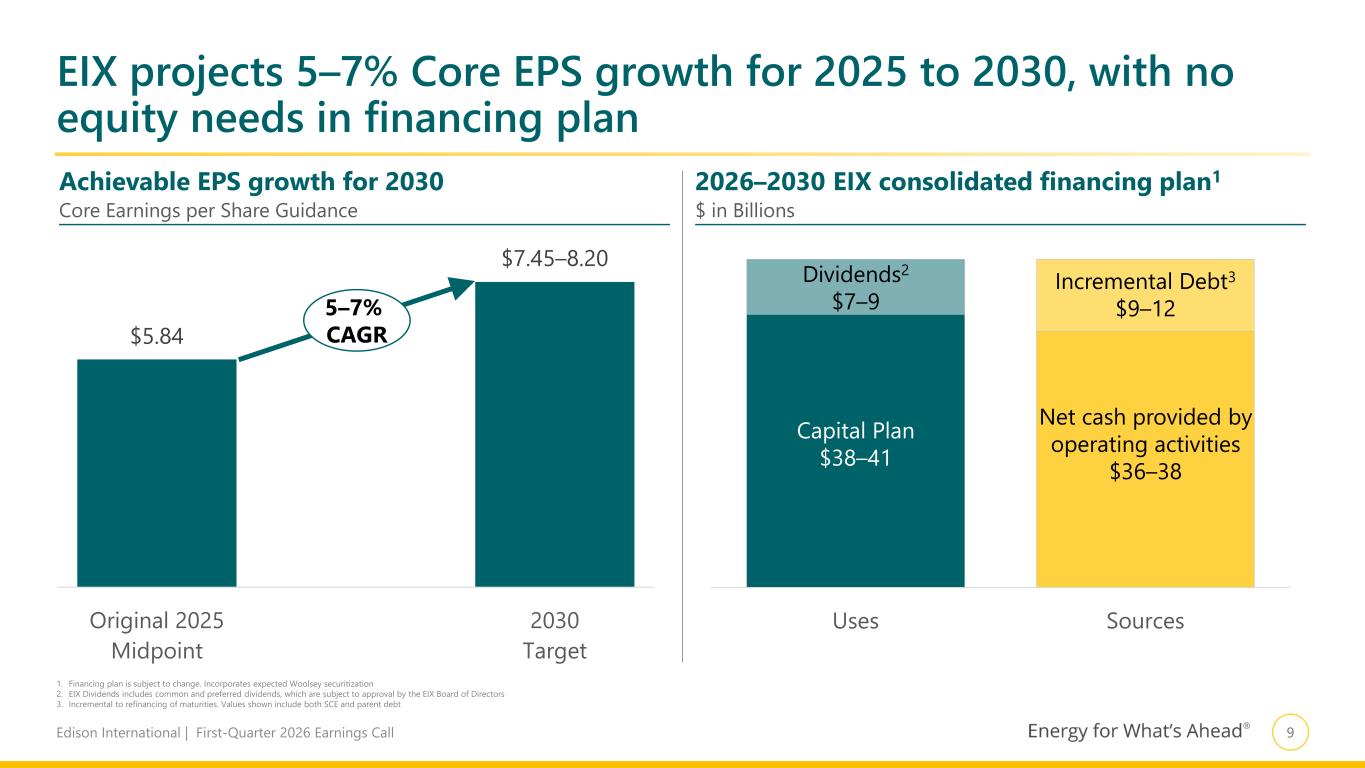
Let me now turn briefly to the financial outlook. We remain confident in the company’s financial position and long‑term trajectory. Major SCE regulatory decisions like the 2025 GRC, cost of capital, and legacy wildfire cost recoveries are successfully resolved, providing clear visibility to 2028 earnings. Combined with our operational progress and disciplined capital execution, this all supports our confidence in our long‑term targets, including 5 to 7% core EPS growth with no new equity needs.
Before I turn it over to Maria, we announced that she will retire on September 1st after transitioning the Edison International CFO role on July 3rd to Aaron Moss, who is here in the room with us today. Maria will focus her final months on critical policy priorities, including the SB 254 process, and supporting Aaron’s transition. This is bittersweet, as Maria and I have partnered continuously for over 15 years across our Edison Mission Energy, SCE, and EIX “gigs.” Our board, our team, and I are grateful for the outstanding leadership she has provided across multiple challenges that many of our investors will remember well, including the EME restructuring, helping our communities recover after tragic wildfires, a global pandemic, four SCE GRCs, and shepherding the investment and operational improvement opportunities created by the clean energy transition, historic load growth, and the rapid ascendence of AI. Throughout it all, she has shown great financial skill, unflappable balance, a deep commitment to engaging with our investors, and a real passion for developing our people, including Aaron. Aaron, Maria, and I worked closely together through the EME restructuring and kept on going as Aaron took on the EIX and SCE controller roles, and most recently as SCE’s chief financial officer. He has been a key leader of SCE’s operational excellence efforts over the past several years, and many of you know him well already from his extensive investor interactions. I am excited about and confident in our new chapter together.
Maria Rigatti, Executive Vice President and Chief Financial Officer, Edison International
Over the years I have spent with Edison, I have had the privilege to work with dedicated people who are focused on delivering on the commitments we have made to our customers, communities and investors. I thank the team for their focus and innovation. I also want to thank all our investors for your engagement and feedback through the opportunities and challenges that Edison has managed, and I know that Pedro, Aaron, and the entire team will continue to benefit from your support.
In my comments today, I’ll cover first-quarter 2026 results, our capital and rate base outlook, regulatory updates, and our earnings guidance.
EIX reported first quarter core EPS of $1.42. Page 4 provides the year‑over‑year quarterly variance analysis. Core earnings increased by 5 cents, primarily due to the adoption of the GRC decision last year, partially offset by the absence of about 30 cents recorded in Q1 2025 related to the TKM cost recovery approval. Parent and Other core loss was 1 cent lower, driven primarily by lower financing costs following the redemption of preferred stock.
Overall, the quarter reflects benefits from solid execution and SCE having strong regulatory visibility with no major proceedings driving this year’s results. Importantly, it also reflects the quality and durability of our earnings profile, while keeping our focus squarely on delivering safe, reliable, and affordable service for customers. Our first quarter results reinforce our confidence in the underlying business and our ability to deliver consistent performance through the year.
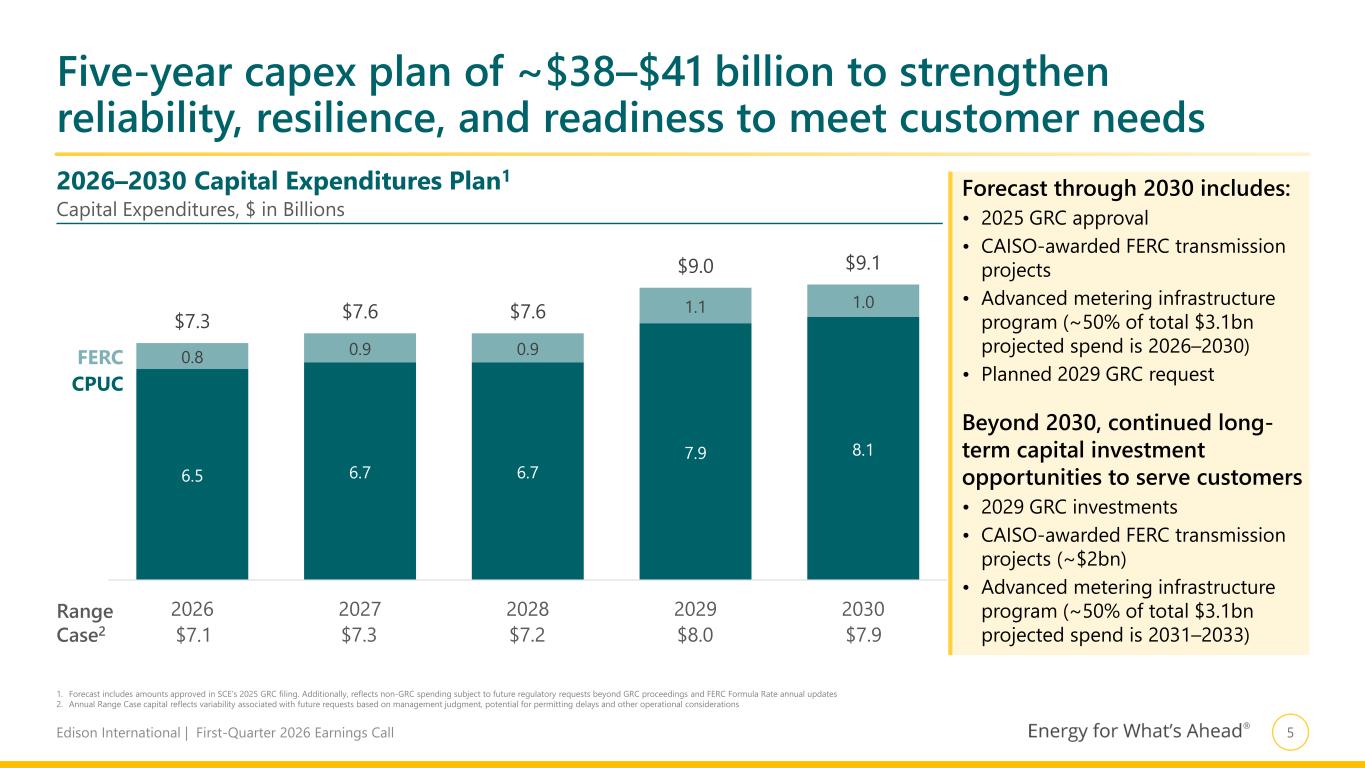
Building on first quarter performance, I’ll turn to SCE’s capital and rate base outlook, shown on pages 5 and 6, which is unchanged from last quarter. Our capital plan of $38 to $41 billion from 2026 through 2030 is driven by essential investments in the grid to meet customer needs and support California’s clean energy objectives. We are executing this plan with an unwavering focus on affordability and cost discipline. I want to reinforce Pedro’s
earlier comments on execution and line of sight into our financial projections. With an approved GRC covering the bulk of SCE’s capital plan through 2028, we have a high degree of confidence in our ability to execute and deliver on this plan in a way that meets customer needs and regulatory expectations.
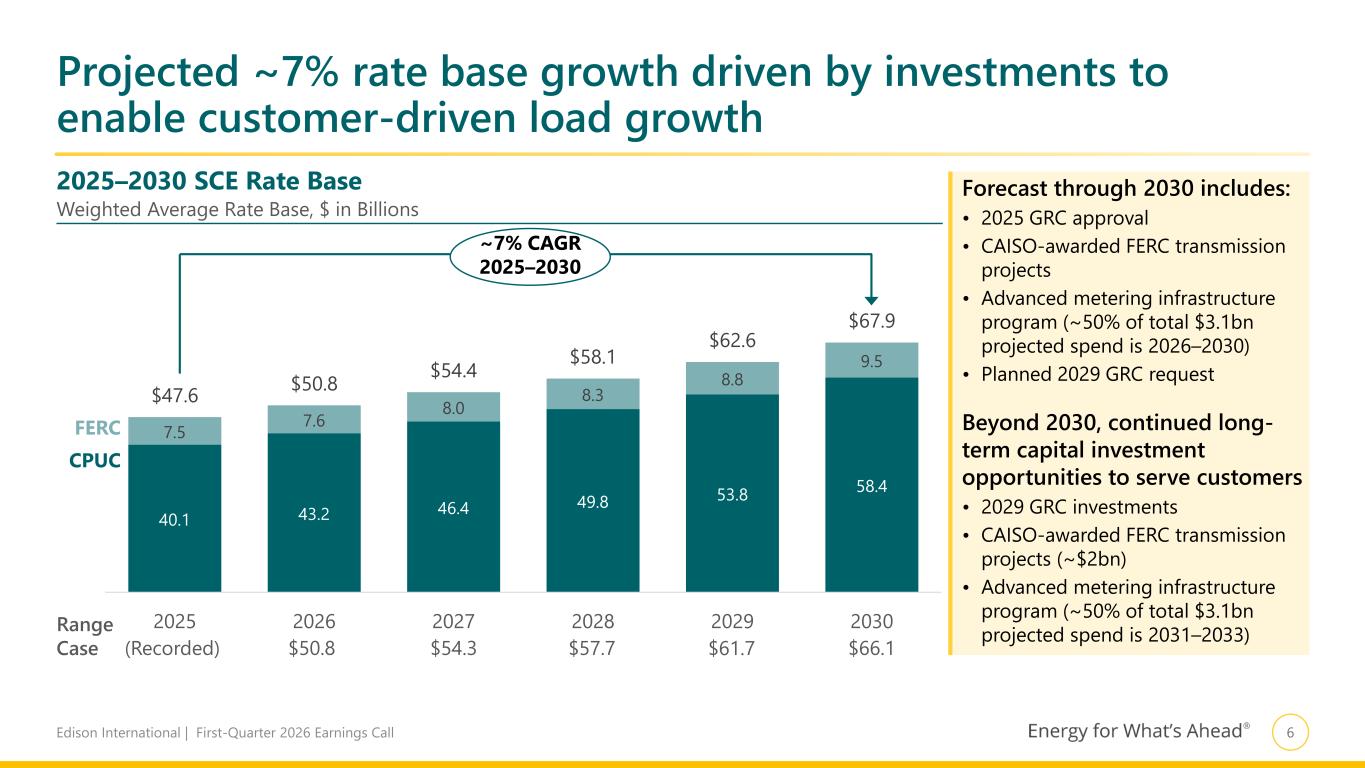
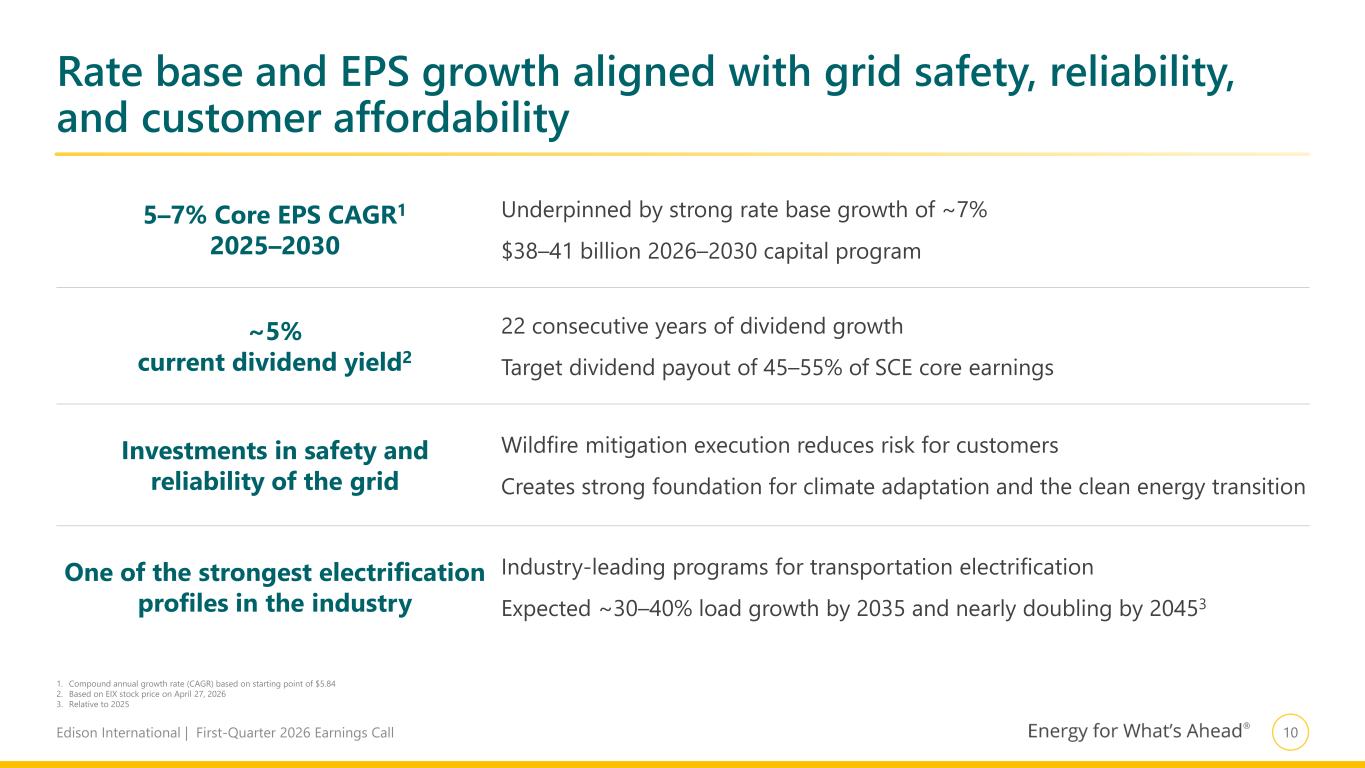
That confidence is further bolstered by long-term fundamentals, as we ensure the grid is ready for the economywide electrification ahead. Customer demand for an increasingly reliable and resilient grid continues to grow, making the need for sustained grid investment clear. As shown on page 6, we expect SCE rate base compound annual growth of approximately 7% from 2025 to 2030, reflecting both near-term visibility and the long-term case for grid investment. SCE is focused on executing the work authorized under its current GRC, which provides clarity for most of its operations through 2028. In addition to the approved GRC, SCE has two significant standalone applications underway.
The first is the NextGen ERP program, which we have discussed in prior quarters. The second is SCE’s AMI 2.0 application, which was filed in March and requests approximately $3.1 billion of capital investment through 2033. As we have previously disclosed, the capital associated with both programs is already incorporated in our capital plan.
AMI 2.0 represents a comprehensive modernization effort with benefits across the system. It supports grid resilience and operational efficiency, enables more advanced customer services, and provides the data foundation needed to support electrification, distributed energy resources, and more dynamic system management.
Looking ahead to the next GRC cycle, SCE will take the first step next month by filing its Risk Assessment and Mitigation Phase, or RAMP, application. This filing informs the next GRC and outlines the risk mitigations that guide proposed investments across wildfire risk, transmission and distribution reliability, cybersecurity, climate adaptation, and other safety-related measures. As in prior cycles, this process provides a clear, safety- and risk-driven framework for evaluating capital needs and supports consistent engagement with regulators and stakeholders on safety and risk priorities.
I will highlight that following the resolution of several major proceedings last year, 2026 represents a cleaner regulatory slate, meaning fewer open proceedings and greater visibility into capital recovery, which further supports our confidence in the utility’s ability to execute the long-term plan reflected in our capital and rate base outlook.
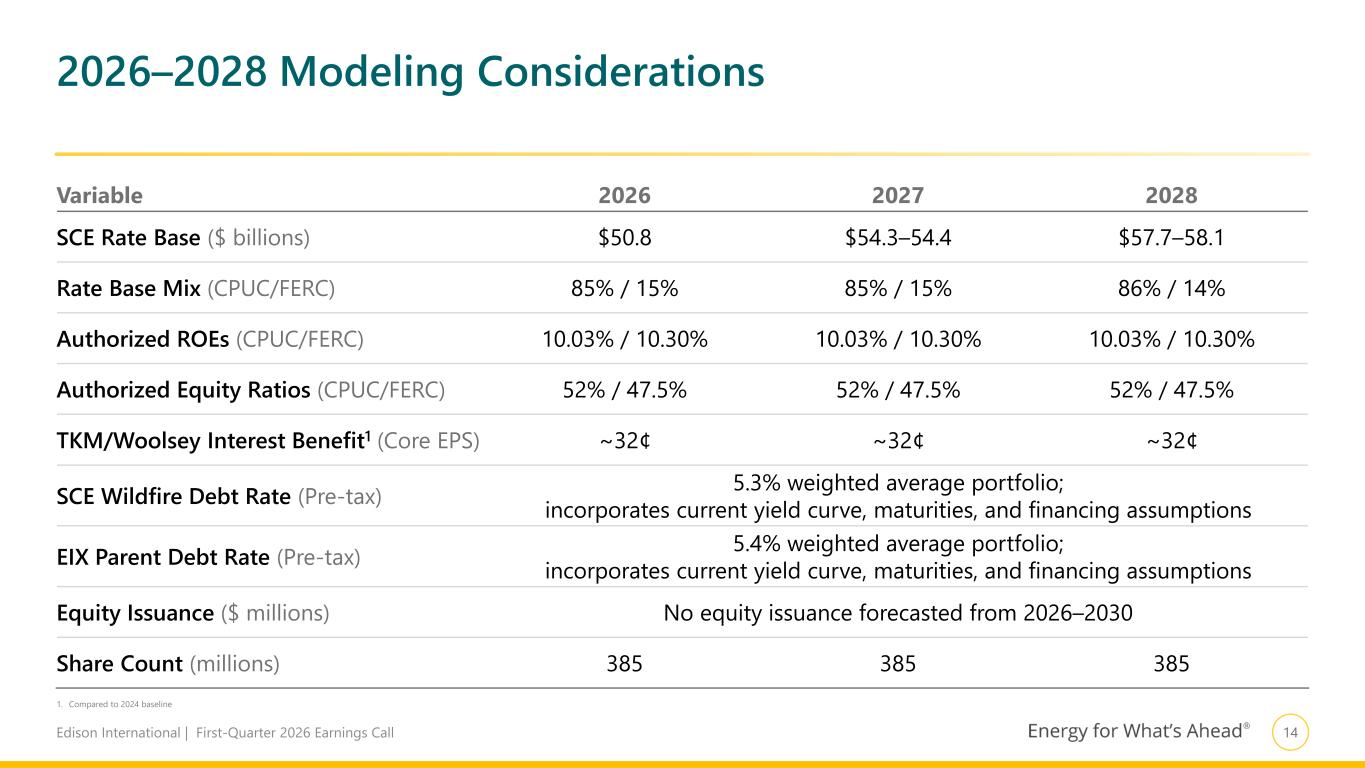
I want to underscore an important differentiator in our financial strategy. We plan to deliver this growth without issuing new common equity for at least the next five years, through 2030. This builds on our track record of cost-effectively managing our credit metrics and having issued only about $400 million of common equity over the last 5 years. We will continue to finance the business efficiently and remain committed to our 15% to 17% FFO‑to‑debt framework. We expect to be within this range in the forecast window, and EIX has one of the strongest consolidated FFO-to-debt ratios projected by S&P. These data points demonstrate the strength of our balance sheet and cash flow profile. This diligence allows us to fund critical infrastructure investment, maintain financial flexibility, and create value for both customers and shareholders.
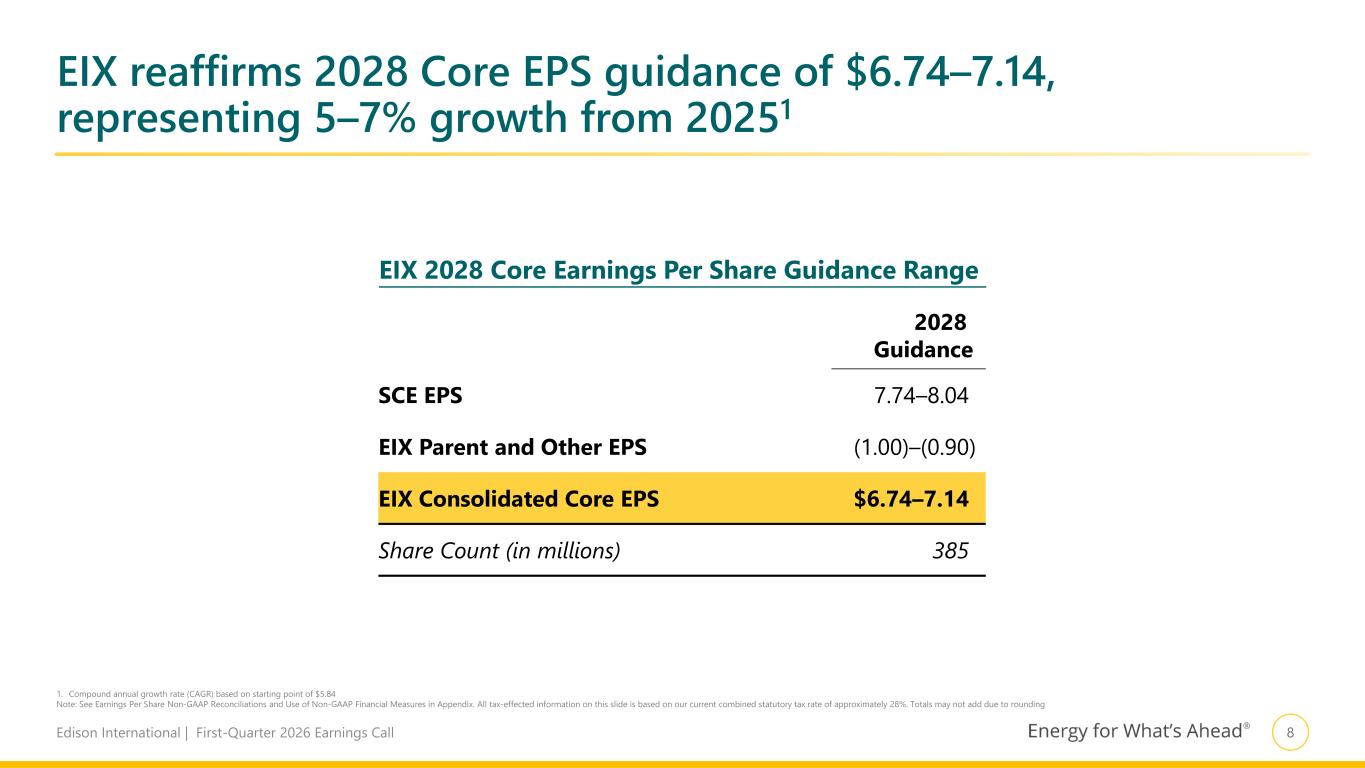
Moving to earnings guidance, we are affirming our 2026 core EPS range of $5.90 to $6.20. We are also affirming our previously provided core EPS targets for 2027, 2028, and 2030, as well as our long-term EPS growth rate. With a strong start to the year, we remain confident in our ability to deliver on these commitments for customers and capital providers.
That confidence is grounded in disciplined execution. We continue to maintain a strong focus on capital prioritization, operating efficiency, and cost management. Investments are evaluated through a risk‑based framework with a clear line of sight to recovery. This rigor reinforces our ability to deliver on our long‑term financial targets, while continuing to advance safety, reliability, and resilience for the customers and communities we serve.