Investor Relations: Sam Ramraj, (626) 302-2540
Media Relations: (626) 302-2255
Edison International Reports Fourth-Quarter and Full-Year 2024 Results
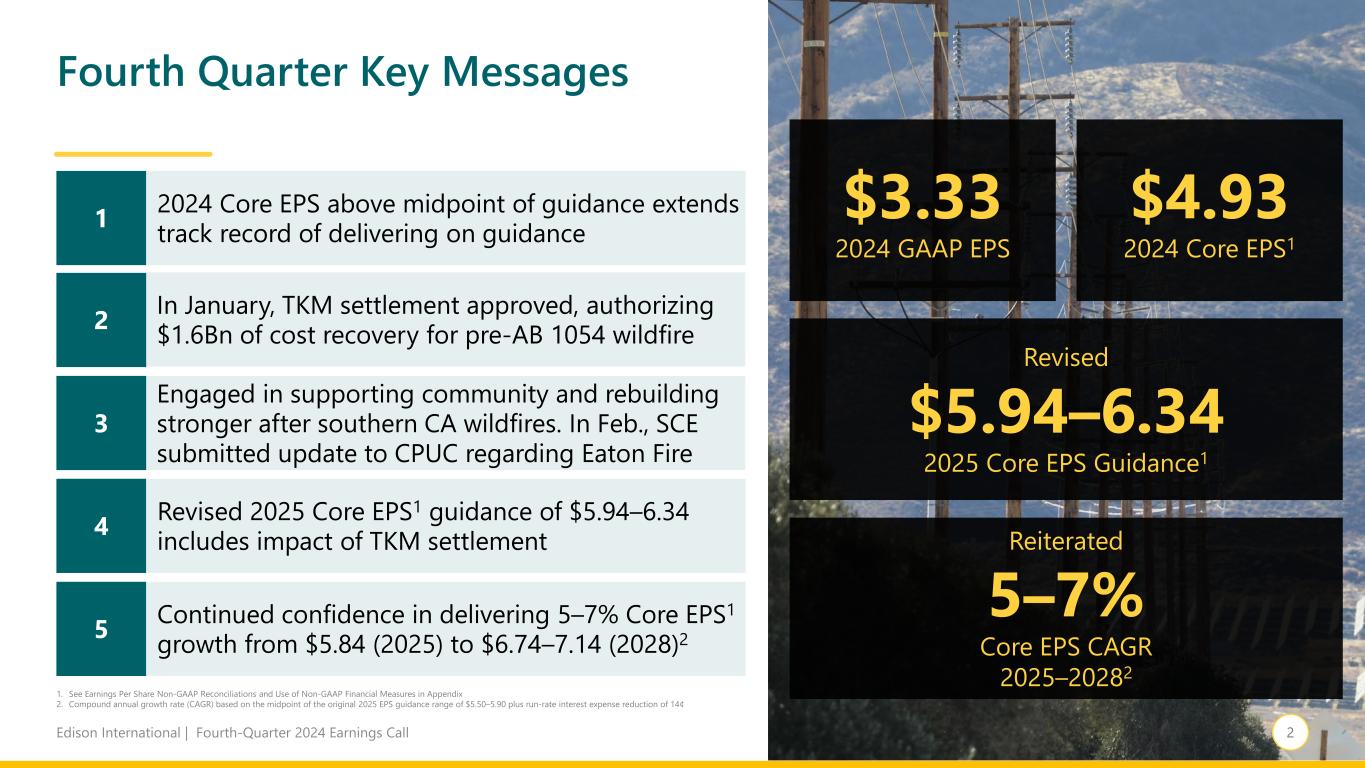
•Fourth-quarter 2024 GAAP EPS of $0.88; Core EPS of $1.05
•Full-year 2024 GAAP EPS of $3.33; Core EPS of $4.93
•TKM settlement approved, authorizing $1.6 billion of cost recovery for pre-AB 1054 wildfire
•Revised 2025 Core EPS guidance of $5.94-$6.34 includes impact of TKM settlement
•Continued confidence in delivering 5-7% Core EPS growth from $5.84 (2025) to $6.74-$7.14 (2028)
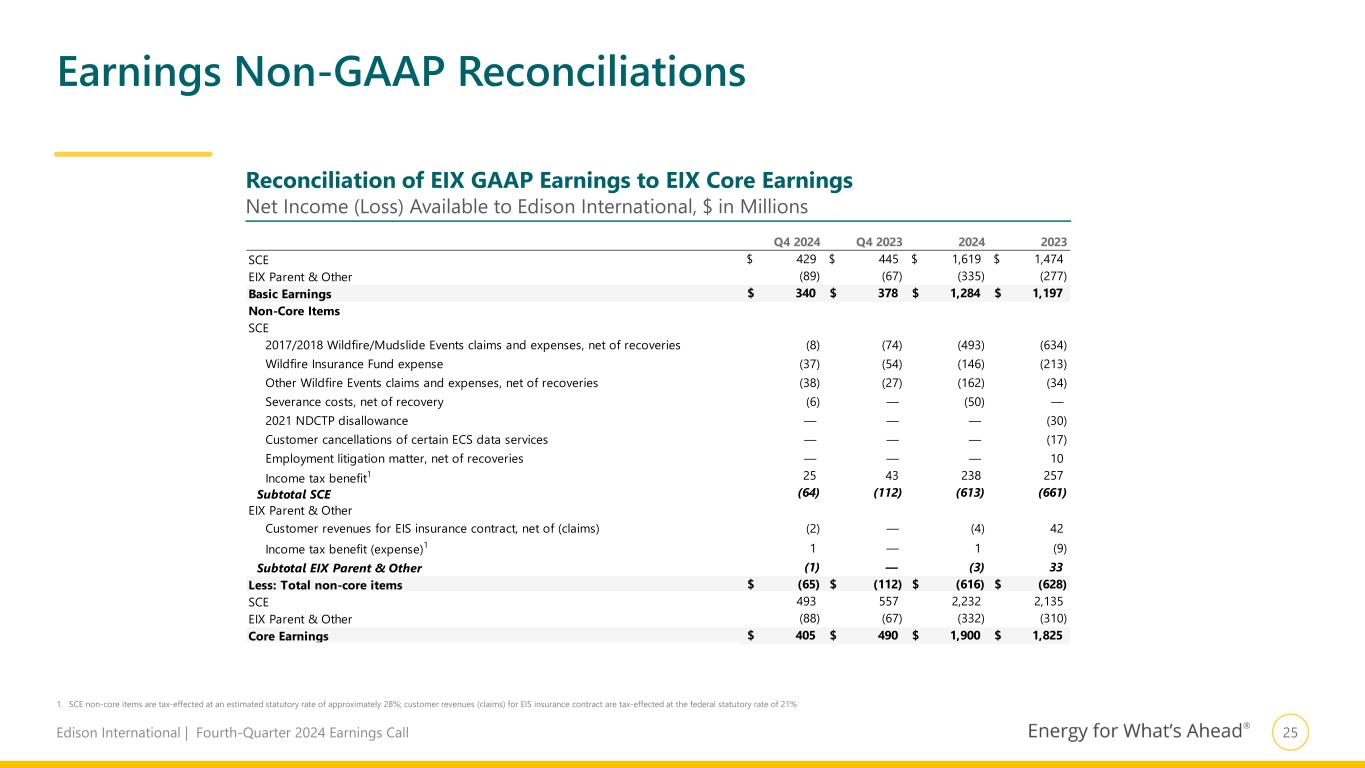
ROSEMEAD, Calif., Feb. 27, 2025 — Edison International (NYSE: EIX) today reported fourth-quarter net income of $340 million, or $0.88 per share, compared to net income of $378 million, or $0.99 per share, in the fourth quarter of last year. As adjusted, fourth-quarter core earnings were $405 million, or $1.05 per share, compared to core earnings of $490 million, or $1.28 per share, in the fourth quarter of last year.
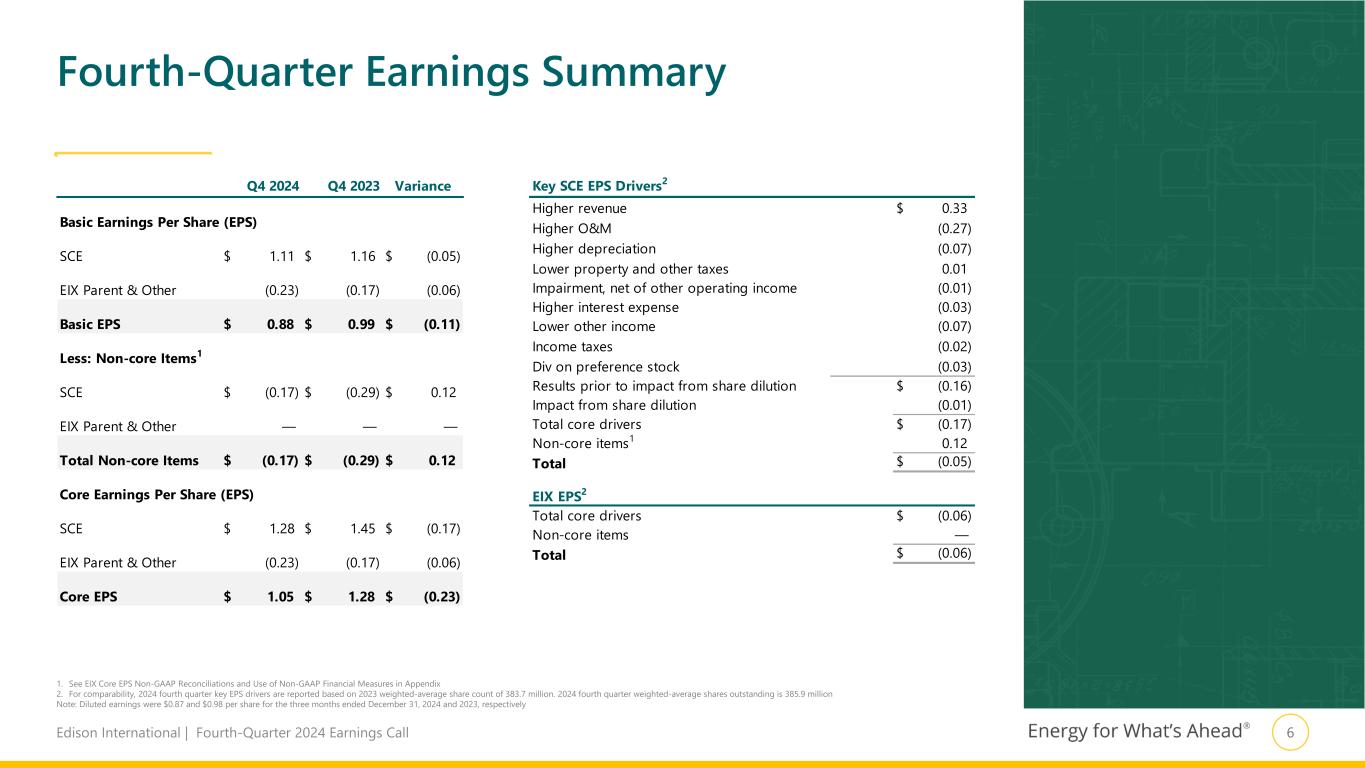
Southern California Edison’s fourth-quarter 2024 core earnings per share (EPS) decreased year over year, primarily due to higher operation and maintenance expense and higher interest expense, partially offset by higher revenue authorized in Track 4 of SCE's 2021 General Rate Case and an increase in the authorized rate of return resulting from the cost of capital adjustment mechanism.
Edison International Parent and Other’s fourth-quarter 2024 core loss per share increased year over year, primarily due to higher interest expense and gains on preferred stock repurchases in 2023.
“The catastrophic impact of the recent wildfires underscores the importance of grid resiliency and the actions SCE has taken to harden its system to support the communities it serves. SCE continues to execute its robust, risk-prioritized wildfire mitigation plan. We will continue to invest in SCE’s important work to make its system safer for its customers and communities,” said Pedro J. Pizarro, president and CEO of Edison International. “SCE continues to make progress as it works diligently on reconstruction after the Eaton and Palisades fires.”
Pizarro added, “We have been actively engaged in conversations with key stakeholders including other utilities, the Governor’s Office and legislative leaders to find solutions to support the safety of the community, effectively manage customer costs and reinforce confidence in California’s utilities. We believe policymakers will act to make the enhancements needed to strengthen the industry-leading AB 1054 regulatory framework.”
Full-Year Earnings
For 2024, Edison International reported net income of $1,284 million, or $3.33 per share, compared to $1,197 million, or $3.12 per share, for 2023. As adjusted, Edison International’s core earnings were $1,900 million, or $4.93 per share, compared to $1,825 million, or $4.76 per share, in 2023.
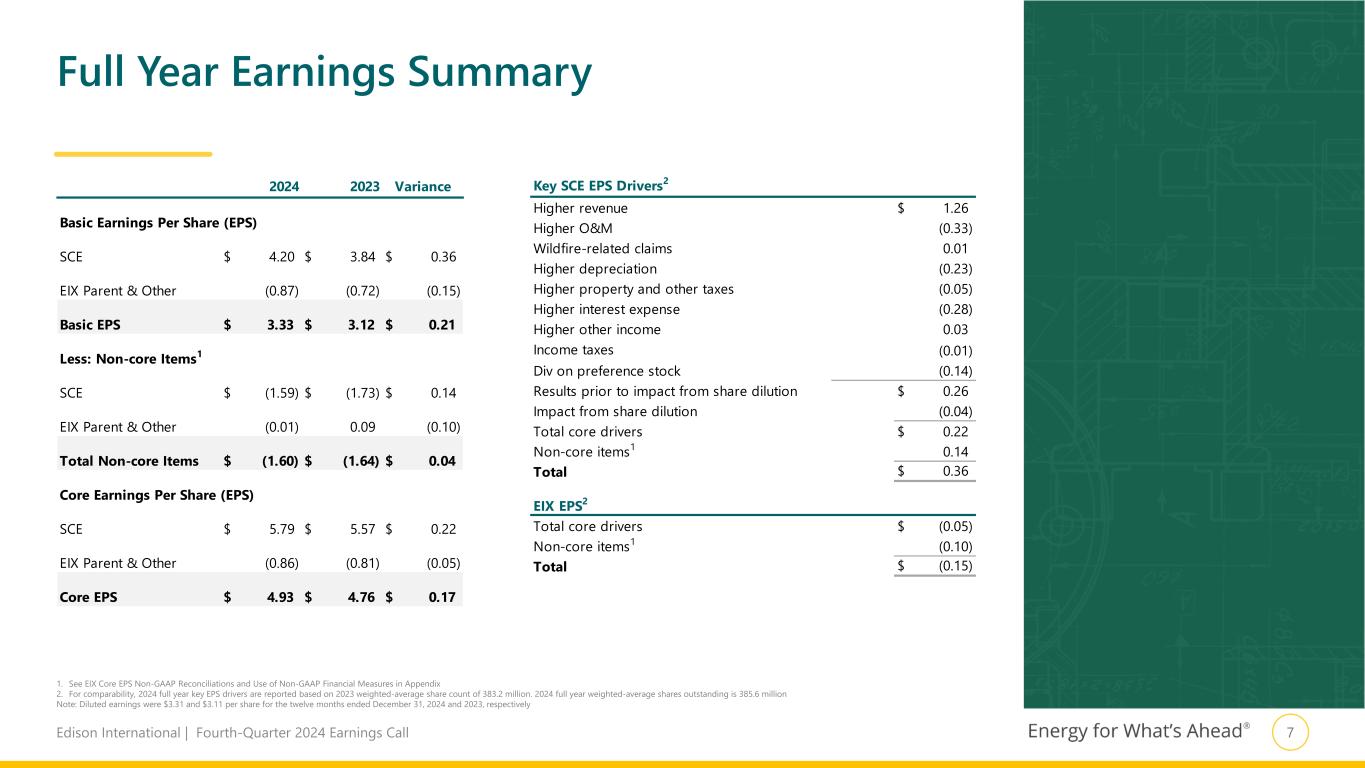
SCE’s full-year core EPS was higher, primarily due to higher revenue authorized in Track 4 of SCE's 2021 General Rate Case and an increase in the authorized rate of return resulting from the cost of capital adjustment mechanism, partially offset by higher interest expense.
Edison International Parent and Other’s full-year loss per share increased primarily due to higher interest expense.
Edison International uses core earnings internally for financial planning and analysis of performance. Core earnings are also used when communicating with investors and analysts regarding Edison International’s earnings results to facilitate comparisons of the company’s performance from period to period. Please see the attached tables to reconcile core earnings to basic GAAP earnings.
Eaton Fire
For information on the Eaton Fire investigation and other information related to the fire, please see the Company's Form 10-K filed with the SEC today and the Section 315 Letter submitted to the CPUC on Feb. 6, 2025, which can be found posted in the section titled "Southern California Wildfires," at www.edisoninvestor.com.
2025 Earnings Guidance
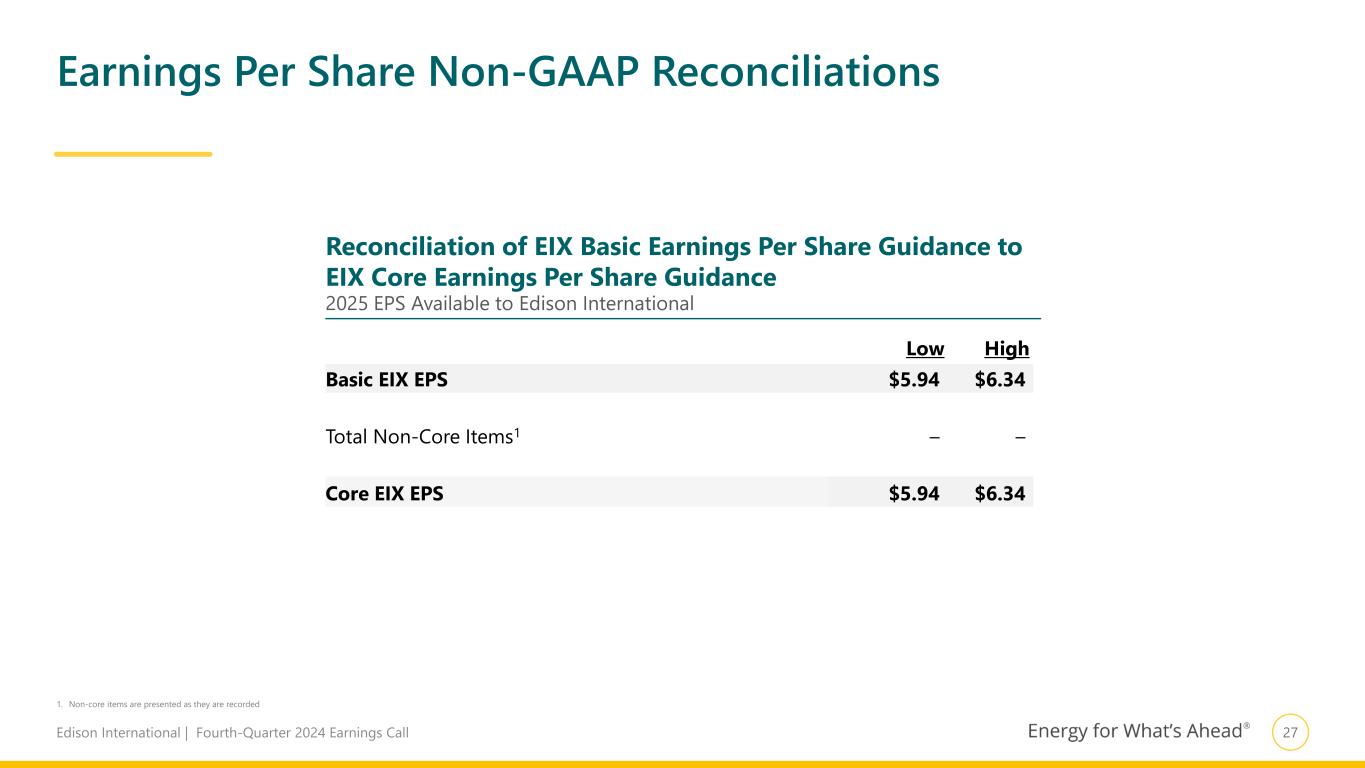
The company's revised earnings guidance range for 2025 includes the core earnings impact associated with the TKM settlement, as summarized in the following chart. See the presentation accompanying the company’s conference call for further information and assumptions.
| | | | | | | | | | | | | | |
|
| 2025 Earnings Guidance as of Feb. 27, 2025 | |
| | Low | High | |
| EIX Basic EPS | $ | 5.94 | | $ | 6.34 | | |
| Less: Non-Core Items | — | | — | | |
| EIX Core EPS | $ | 5.94 | | $ | 6.34 | | |
Edison International and Southern California Edison Declare Dividends
Today, the board of directors of Edison International declared a quarterly common stock dividend of $0.8275 per share, payable on April 30, 2025, to shareholders of record on April 7, 2025. It also declared dividends on preferred stock. Additionally, the board of directors of Southern California Edison Company today declared dividends on preference stock. For more information, please see the related news release at www.edisoninvestor.com.
Fourth Quarter and Full-Year 2024 Earnings Conference Call and Webcast Details
| | | | | |
When: | Thursday, Feb. 27, 1:30-2:30 p.m. (PST) |
| Telephone Numbers: | 1-888-673-9780 (U.S.) and 1-312-470-0178 (Int'l) — Passcode: Edison |
| Telephone Replay: | 1-800-685-6667 (U.S.) and 1-203-369-3864 (Int’l) — Passcode: 9413 |
| Telephone replay available through March 12 at 6 p.m. (PST) |
Webcast | www.edisoninvestor.com |
Edison International has posted its earnings conference call prepared remarks by the CEO and CFO, the teleconference presentation, and Form 10-K to the company’s investor relations website. These materials are available at www.edisoninvestor.com.
About Edison International
Edison International (NYSE: EIX) is one of the nation’s largest electric utility holding companies, focused on providing clean and reliable energy and energy services through its independent companies. Headquartered in Rosemead, California, Edison International is the parent company of Southern California Edison Company, a utility delivering electricity to 15 million people across Southern, Central and Coastal California. Edison International is also the parent company of Trio (formerly Edison Energy), a portfolio of nonregulated competitive businesses providing integrated sustainability and energy advisory services to large commercial, industrial and institutional organizations in North America and Europe.
Appendix
Use of Non-GAAP Financial Measures
Edison International’s earnings are prepared in accordance with generally accepted accounting principles used in the United States and represent the company’s earnings as reported to the Securities and Exchange Commission. Our management uses core earnings and core earnings per share (EPS) internally for financial planning and for analysis of performance of Edison International and Southern California Edison. We also use core earnings and core EPS when communicating with analysts and investors regarding our earnings results to facilitate comparisons of the Company’s performance from period to period. Financial measures referred to as net income, basic EPS, core earnings, or core EPS also apply to the description of earnings or earnings per share.
Core earnings and core EPS are non-GAAP financial measures and may not be comparable to those of other companies. Core earnings and core EPS are defined as basic earnings and basic EPS excluding income or loss from discontinued operations and income or loss from significant discrete items that management does not consider representative of ongoing earnings. Basic earnings and losses refer to net income or losses attributable to Edison International shareholders. Core earnings are reconciled to basic earnings in the attached tables. The impact of participating securities (vested awards that earn dividend equivalents that may participate in undistributed earnings with common stock) for the principal operating subsidiary is not material to the principal operating subsidiary’s EPS and is therefore reflected in the results of the Edison International holding company, which is included in Edison International Parent and Other.
Safe Harbor Statement
Statements contained in this release about future performance, including, without limitation, operating results, capital expenditures, rate base growth, dividend policy, financial outlook, and other statements that are not purely historical, are forward-looking statements. These forward-looking statements reflect our current expectations; however, such statements involve risks and uncertainties. Actual results could differ materially from current expectations. These forward-looking statements represent our expectations only as of the date of this release, and Edison International assumes no duty to update them to reflect new information, events or circumstances. Important factors that could cause different results include, but are not limited to the:
•ability of SCE to recover its costs through regulated rates, timely or at all, including uninsured wildfire-related and debris flow-related costs (including amounts paid for self-insured retention and co-insurance), and costs incurred to mitigate the risk of utility equipment causing future wildfires;
•the cybersecurity of Edison International's and SCE's critical information technology systems for grid control and business, employee and customer data, and the physical security of Edison International's and SCE's critical assets and personnel;
•risks associated with the operation and maintenance of electrical facilities, including worker, contractor, and public safety issues, the risk of utility assets causing or contributing to wildfires, failure, availability, efficiency, and output of equipment and facilities, and availability and cost of spare parts;
•impact of affordability of customer rates on SCE's ability to execute its strategy, including the impact of affordability on SCE’s ability to obtain regulatory approval of, or cost recovery for, operations and maintenance expenses, proposed capital investment projects, and increased costs due to supply chain constraints, tariffs, inflation and rising interest rates;
•ability of SCE to update its grid infrastructure to maintain system integrity and reliability, and meet electrification needs;
•ability of SCE to implement its operational and strategic plans, including its Wildfire Mitigation Plan and capital investment program, including those related to project site identification, public opposition, environmental mitigation, construction, permitting, contractor performance, changes in the California Independent System Operator's (“CAISO”) transmission plans, and governmental approvals;
•risks of regulatory or legislative restrictions that would limit SCE's ability to implement operational measures to mitigate wildfire risk, including Public Safety Power Shutoff (“PSPS”) and fast curve settings, when conditions warrant or would otherwise limit SCE's operational practices relative to wildfire risk mitigation;
•ability of SCE to obtain safety certifications from the Office of Energy Infrastructure Safety of the California Natural Resources Agency (“OEIS“);
•risk that California Assembly Bill 1054 (“AB 1054“) does not effectively mitigate the significant exposure faced by California investor-owned utilities related to liability for damages arising from catastrophic wildfires where utility facilities are alleged to be a substantial cause, including the longevity of the Wildfire Insurance Fund and the California Public Utilities Commission (“CPUC”) interpretation of and actions under AB 1054, including its interpretation of the prudency standard clarified by AB 1054;
•ability of Edison International and SCE to effectively attract, manage, develop and retain a skilled workforce, including its contract workers;
•decisions and other actions by the CPUC, the Federal Energy Regulatory Commission, and the United States Nuclear Regulatory Commission and other governmental authorities, including decisions and actions related to nationwide or statewide crisis, approval of regulatory proceeding settlements, determinations of authorized rates of return or return on equity, the recoverability of wildfire-related and debris flow-related costs, issuance of SCE's wildfire safety certification, wildfire mitigation efforts, approval and implementation of electrification programs, and delays in executive, regulatory and legislative actions;
•governmental, statutory, regulatory, or administrative changes or initiatives affecting the electricity industry, including the market structure rules applicable to each market adopted by the North American Electric Reliability Corporation, CAISO, Western Electricity Coordinating Council, and similar regulatory bodies in adjoining regions, and changes in the United States' and California's environmental priorities that lessen the importance placed on greenhouse gas reduction and other climate related priorities;
•potential for penalties or disallowances for non-compliance with applicable laws and regulations, including fines, penalties and disallowances related to wildfires where SCE's equipment is alleged to be associated with ignition;
•extreme weather-related incidents (including events caused, or exacerbated, by climate change), such as wildfires, debris flows, flooding, droughts, high wind events and extreme heat events and other natural disasters (such as earthquakes), which could cause, among other things, worker and public safety issues, property damage, outages and other operational issues (such as issues due to damaged infrastructure), PSPS activations and unanticipated costs;
•risks associated with the decommissioning of San Onofre, including those related to worker and public safety, public opposition, permitting, governmental approvals, on-site storage of spent nuclear fuel and other radioactive material, delays, contractual disputes, and cost overruns;
•risks associated with cost allocation resulting in higher rates for utility bundled service customers because of possible customer bypass or departure for other electricity providers such as Community Choice Aggregators (“CCA,” which are cities, counties, and certain other public agencies with the authority to generate and/or purchase electricity for their local residents and businesses) and Electric Service Providers (entities that offer electric power and ancillary services to retail customers, other than electrical corporations (like SCE) and CCAs);
•actions by credit rating agencies to downgrade Edison International or SCE’s credit ratings or to place those ratings on negative watch or negative outlook.
Other important factors are discussed under the headings “Forward-Looking Statements”, “Risk Factors” and “Management’s Discussion and Analysis” in Edison International’s Form 10-K and other reports filed with the Securities and Exchange Commission, which are available on our website: www.edisoninvestor.com. These filings also provide additional information on historical and other factual data contained in this release.
Fourth Quarter Reconciliation of Basic Earnings Per Share to Core Earnings Per Share
| | | | | | | | | | | | | | | | | | | | | | | | | | | | | | | | | | | |
| Three Months Ended
December 31, | | | | Twelve Months Ended
December 31, | | |
| 2024 | | 2023 | | Change | | 2024 | | 2023 | | Change |
Earnings (loss) per share available to Edison International | | | | | | | | | | | |
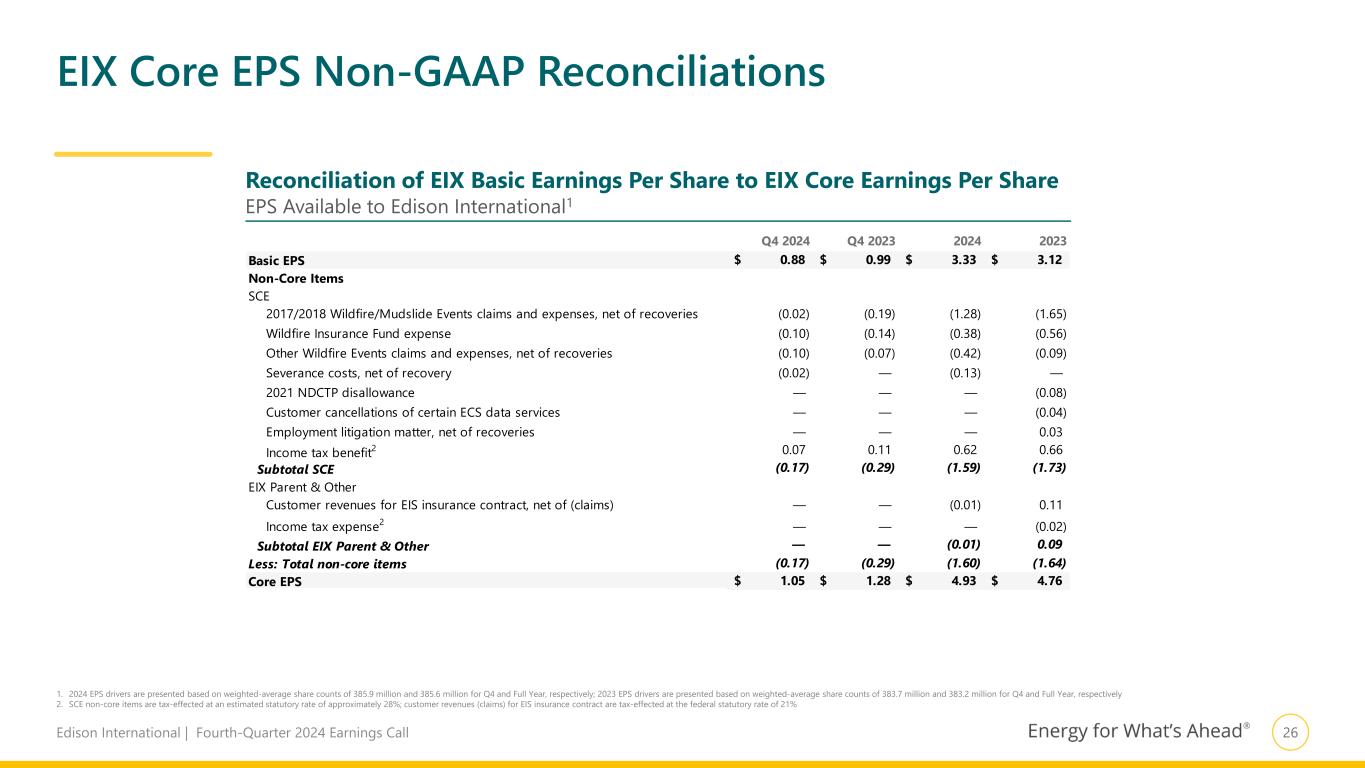
SCE | $ | 1.11 | | | $ | 1.16 | | | $ | (0.05) | | | $ | 4.20 | | | $ | 3.84 | | | $ | 0.36 | |
Edison International Parent and Other | (0.23) | | | (0.17) | | | (0.06) | | | (0.87) | | | (0.72) | | | (0.15) | |
Edison International | 0.88 | | | 0.99 | | | (0.11) | | | 3.33 | | | 3.12 | | | 0.21 | |
Less: Non-core items | | | | | | | | | | | |
SCE | (0.17) | | | (0.29) | | | 0.12 | | | (1.59) | | | (1.73) | | | 0.14 | |
Edison International Parent and Other | — | | | — | | | — | | | (0.01) | | | 0.09 | | | (0.10) | |
Total non-core items | (0.17) | | | (0.29) | | | 0.12 | | | (1.60) | | | (1.64) | | | 0.04 | |
Core earnings (loss) per share | | | | | | | | | | | |
SCE | 1.28 | | | 1.45 | | | (0.17) | | | 5.79 | | | 5.57 | | | 0.22 | |
Edison International Parent and Other | (0.23) | | | (0.17) | | | (0.06) | | | (0.86) | | | (0.81) | | | (0.05) | |
Edison International | $ | 1.05 | | | $ | 1.28 | | | $ | (0.23) | | | $ | 4.93 | | | $ | 4.76 | | | $ | 0.17 | |
Note: Diluted earnings were $0.87 and $0.98 per share for the three months ended December 31, 2024 and 2023, respectively. Diluted earnings were $3.31 and $3.11 per share for the twelve months ended December 31, 2024 and 2023, respectively.
Fourth Quarter Reconciliation of Basic Earnings Per Share to Core Earnings (in millions)
| | | | | | | | | | | | | | | | | | | | | | | | | | | | | | | | | | | |
| Three Months Ended
December 31, | | | | Twelve Months Ended
December 31, | | |
(in millions) | 2024 | | 2023 | | Change | | 2024 | | 2023 | | Change |
Net income (loss) available to Edison International | | | | | | | | | | | |
SCE | $ | 429 | | | $ | 445 | | | $ | (16) | | | $ | 1,619 | | | $ | 1,474 | | | $ | 145 | |
Edison International Parent and Other | (89) | | | (67) | | | (22) | | | (335) | | | (277) | | | (58) | |
Edison International | 340 | | | 378 | | | (38) | | | 1,284 | | | 1,197 | | | 87 | |
| Less: Non-core items | | | | | | | | | | | |
SCE 1,2,3,4,5,6,7 | (64) | | | (112) | | | 48 | | | (613) | | | (661) | | | 48 | |
Edison International Parent and Other8 | (1) | | | — | | | (1) | | | (3) | | | 33 | | | (36) | |
Total non-core items | (65) | | | (112) | | | 47 | | | (616) | | | (628) | | | 12 | |
Core earnings (losses) | | | | | | | | | | | |
SCE | 493 | | | 557 | | | (64) | | | 2,232 | | | 2,135 | | | 97 | |
Edison International Parent and Other | (88) | | | (67) | | | (21) | | | (332) | | | (310) | | | (22) | |
Edison International | $ | 405 | | | $ | 490 | | | $ | (85) | | | $ | 1,900 | | | $ | 1,825 | | | $ | 75 | |
1.Includes charges for 2017/2018 Wildfire/Mudslide Events claims and expenses, net of FERC recoveries of $8 million ($6 million after-tax) and $74 million ($53 million after-tax) for the three months ended December 31, 2024 and 2023, $493 million ($355 million after-tax) and $634 million ($457 million after-tax) for the twelve months ended December 31, 2024 and 2023, respectively.
2.Includes charges for Other Wildfire Events claims and expenses, net of expected insurance and regulatory recoveries, of $38 million ($27 million after-tax) and $27 million ($19 million after-tax) for the three months ended December 31, 2024 and 2023, $162 million ($117 million after-tax) and $34 million ($25 million after-tax) for the twelve months ended December 31, 2024 and 2023, respectively.
3.Includes amortization of SCE's Wildfire Insurance Fund expenses of $37 million ($27 million after tax) and $54 million ($39 million after-tax) for the three months ended December 31, 2024 and 2023, $146 million ($105 million after-tax) and $213 million ($153 million after-tax) for the twelve months ended December 31, 2024 and 2023, respectively.
4.Includes severance costs, net of expected FERC recovery, of $6 million ($4 million after-tax) for the three months ended December 31, 2024 and $50 million ($36 million after-tax), for the twelve months ended December 31, 2024.
5.Includes a charge of $30 million ($21 million after-tax) for a disallowance related to the 2021 NDCTP for the twelve months ended December 31, 2023.
6.Includes a charge related to customer cancellations of certain ECS data services of $17 million ($12 million after-tax) for the twelve months ended December 31, 2023.
7.Includes an insurance recovery of $10 million ($7 million after-tax) related to settlement of an employment litigation matter for the twelve months ended December 31, 2023.
8.Includes expected wildfire claims of $2 million ($1 million after-tax) insured by EIS for the three months ended December 31, 2024, and expected wildfire claims of $4 million ($3 million after-tax) insured by EIS and net earnings of $42 million ($33 million after-tax) related to customer revenues for an EIS insurance contract offset by expected wildfire claims insured by EIS for the twelve months ended December 31, 2024 and 2023, respectively.
| | | | | | | | | | | | | | | | | |
| Consolidated Statements of Income | Edison International |
| | | | | |
| Year ended December 31, |
| (in millions, except per-share amounts) | 2024 | | 2023 | | 2022 |
| Operating revenue | $ | 17,599 | | | $ | 16,338 | | | $ | 17,220 | |
| Purchased power and fuel | 5,209 | | | 5,486 | | | 6,375 | |
| Operation and maintenance | 5,172 | | | 4,138 | | | 4,724 | |
| Wildfire-related claims, net of insurance recoveries | 652 | | | 667 | | | 1,313 | |
| Wildfire Insurance Fund expense | 146 | | | 213 | | | 214 | |
| Depreciation and amortization | 2,866 | | | 2,635 | | | 2,561 | |
| Property and other taxes | 624 | | | 571 | | | 501 | |
| Impairment, net of other operating income | — | | | 1 | | | 49 | |
| Total operating expenses | 14,669 | | | 13,711 | | | 15,737 | |
| Operating income | 2,930 | | | 2,627 | | | 1,483 | |
| Interest expense | (1,869) | | | (1,612) | | | (1,169) | |
| Other income, net | 502 | | | 500 | | | 348 | |
| Income before income taxes | 1,563 | | | 1,515 | | | 662 | |
| Income tax expense | 17 | | | 108 | | | (162) | |
| Net income | 1,546 | | | 1,407 | | | 824 | |
| Less: Preference stock dividend requirements of SCE | 175 | | | 123 | | | 107 | |
| Preferred stock dividend requirements of Edison International | 87 | | | 87 | | | 105 | |
| Net income available to Edison International common shareholders | $ | 1,284 | | | $ | 1,197 | | | $ | 612 | |
| Basic earnings per share: | | | | | |
| Weighted average shares of common stock outstanding | 386 | | | 383 | | | 381 | |
| Basic earnings per common share available to Edison International common shareholders | $ | 3.33 | | | $ | 3.12 | | | $ | 1.61 | |
| Diluted earnings per share: | | | | | |
| Weighted average shares of common stock outstanding, including effect of dilutive securities | 388 | | | 385 | | | 383 | |
| Diluted earnings per common share available to Edison International common shareholders | $ | 3.31 | | | $ | 3.11 | | | $ | 1.60 | |
| | | | | | | | | | | |
| Consolidated Balance Sheets | Edison International |
| | | |
| December 31, |
| (in millions) | 2024 | | 2023 |
| ASSETS | | | |
| Cash and cash equivalents | $ | 193 | | | $ | 345 | |
Receivables, less allowances of $352 and $360 for uncollectible accounts at respective dates | 2,169 | | | 2,016 | |
| Accrued unbilled revenue | 848 | | | 742 | |
| Inventory | 538 | | | 527 | |
| Prepaid expenses | 103 | | | 112 | |
| Regulatory assets | 2,748 | | | 2,524 | |
| Wildfire Insurance Fund contributions | 138 | | | 204 | |
| Other current assets | 418 | | | 341 | |
| Total current assets | 7,155 | | | 6,811 | |
| Nuclear decommissioning trusts | 4,286 | | | 4,173 | |
| Other investments | 57 | | | 54 | |
| Total investments | 4,343 | | | 4,227 | |
Utility property, plant and equipment, less accumulated depreciation and amortization of $14,207 and $12,910 at respective dates | 59,047 | | | 55,877 | |
Nonutility property, plant and equipment, less accumulated depreciation of $124 and $114 at respective dates | 207 | | | 207 | |
| Total property, plant and equipment | 59,254 | | | 56,084 | |
Receivables, less allowances of $43 and $4 for uncollectible accounts at respective dates | 62 | | | 4 | |
Regulatory assets (include $1,512 and $1,558 related to a Variable Interest Entity ("VIE") at respective dates) | 8,886 | | | 8,897 | |
| Wildfire Insurance Fund contributions | 1,878 | | | 1,951 | |
| Operating lease right-of-use assets | 1,180 | | | 1,221 | |
| Long-term insurance receivables | 418 | | | 501 | |
| Other long-term assets | 2,403 | | | 2,062 | |
| Total other assets | 14,827 | | | 14,636 | |
| Total assets | $ | 85,579 | | | $ | 81,758 | |
| | | | | | | | | | | |
| Consolidated Balance Sheets | Edison International |
| | | |
| December 31, |
(in millions, except share amounts) | 2024 | | 2023 |
LIABILITIES AND EQUITY | | | |
| Short-term debt | $ | 998 | | | $ | 1,077 | |
| Current portion of long-term debt | 2,049 | | | 2,697 | |
| Accounts payable | 2,000 | | | 1,983 | |
| Wildfire-related claims | 60 | | | 30 | |
| Accrued interest | 422 | | | 390 | |
| Regulatory liabilities | 1,347 | | | 763 | |
| Current portion of operating lease liabilities | 124 | | | 120 | |
| Other current liabilities | 1,439 | | | 1,538 | |
| Total current liabilities | 8,439 | | | 8,598 | |
Long-term debt (include $1,468 and $1,515 related to a VIE at respective dates) | 33,534 | | | 30,316 | |
| Deferred income taxes and credits | 7,180 | | | 6,672 | |
| Pensions and benefits | 384 | | | 415 | |
| Asset retirement obligations | 2,580 | | | 2,666 | |
| Regulatory liabilities | 10,159 | | | 9,420 | |
| Operating lease liabilities | 1,056 | | | 1,101 | |
| Wildfire-related claims | 941 | | | 1,368 | |
| Other deferred credits and other long-term liabilities | 3,566 | | | 3,258 | |
| Total deferred credits and other liabilities | 25,866 | | | 24,900 | |
| Total liabilities | 67,839 | | | 63,814 | |
| | | |
Preferred stock (50,000,000 shares authorized; 1,159,317 shares of Series A and 503,454 and 532,454 shares of Series B issued and outstanding at respective dates) | 1,645 | | | 1,673 | |
Common stock, no par value (800,000,000 shares authorized; 384,784,719 and 383,924,912 shares issued and outstanding at respective dates) | 6,353 | | | 6,338 | |
| Accumulated other comprehensive loss | — | | | (9) | |
| Retained earnings | 7,567 | | | 7,499 | |
| Total Edison International's shareholders' equity | 15,565 | | | 15,501 | |
| Noncontrolling interests – preference stock of SCE | 2,175 | | | 2,443 | |
| Total equity | 17,740 | | | 17,944 | |
| Total liabilities and equity | $ | 85,579 | | | $ | 81,758 | |
| | | | | | | | | | | | | | | | | |
| Consolidated Statements of Cash Flows | Edison International |
| | | | | |
| Years ended December 31, |
(in millions) | 2024 | | 2023 | | 2022 |
Cash flows from operating activities: | | | | | |
| Net income | $ | 1,546 | | | $ | 1,407 | | | $ | 824 | |
| Adjustments to reconcile to net cash provided by operating activities: | | | | | |
| Depreciation and amortization | 2,939 | | | 2,721 | | | 2,633 | |
| Allowance for equity during construction | (187) | | | (157) | | | (137) | |
| Impairment, net of other operating income | — | | | 1 | | | 49 | |
| Deferred income taxes | 9 | | | 108 | | | (177) | |
| Wildfire Insurance Fund amortization expense | 146 | | | 213 | | | 214 | |
| Other | 81 | | | 57 | | | 80 | |
| Nuclear decommissioning trusts | (174) | | | (180) | | | (123) | |
| Contributions to Wildfire Insurance Fund | (95) | | | (95) | | | (95) | |
| Changes in operating assets and liabilities: | | | | | |
| Receivables | (278) | | | (349) | | | (252) | |
| Inventory | (14) | | | (63) | | | (58) | |
| Accounts payable | 53 | | | (408) | | | 367 | |
| Tax receivables and payables | (43) | | | 9 | | | 18 | |
| Other current assets and liabilities | (42) | | | 185 | | | 207 | |
| Derivative assets and liabilities, net | 28 | | | (174) | | | 115 | |
| Regulatory assets and liabilities, net | 1,219 | | | 576 | | | (51) | |
| Wildfire-related insurance receivable | 83 | | | (36) | | | (390) | |
| Wildfire-related claims | (397) | | | (410) | | | (56) | |
| Other noncurrent assets and liabilities | 140 | | | (4) | | | 48 | |
| Net cash provided by operating activities | 5,014 | | | 3,401 | | | 3,216 | |
| Cash flows from financing activities: | | | | | |
Long-term debt issued, net of discount and issuance costs of $44, $54, and $62 for the respective years | 5,256 | | | 5,121 | | | 5,971 | |
| Long-term debt repaid | (2,701) | | | (2,498) | | | (1,085) | |
| Short-term debt issued | — | | | 1,076 | | | 1,000 | |
| Short-term debt repaid | (401) | | | (2,407) | | | (1,543) | |
| | | | | |
| Common stock repurchased | (200) | | | — | | | — | |
| Preferred and preference stock issued, net of issuance cost | 345 | | | 542 | | | — | |
| Preferred and preference stock repurchased and redeemed | (656) | | | (289) | | | — | |
| Commercial paper borrowing (repayments), net | 308 | | | 1,102 | | | (317) | |
| Dividends and distribution to noncontrolling interests | (168) | | | (117) | | | (110) | |
| Common stock dividends paid | (1,198) | | | (1,112) | | | (1,050) | |
| Preferred stock dividends paid | (88) | | | (108) | | | (99) | |
| Other | 177 | | | 137 | | | 114 | |
| Net cash provided by financing activities | 674 | | | 1,447 | | | 2,881 | |
| Cash flows from investing activities: | | | | | |
| Capital expenditures | (5,707) | | | (5,448) | | | (5,778) | |
| Proceeds from sale of nuclear decommissioning trust investments | 5,019 | | | 4,597 | | | 4,177 | |
| Purchases of nuclear decommissioning trust investments | (4,898) | | | (4,417) | | | (4,054) | |
| Other | 50 | | | 35 | | | 81 | |
| Net cash used in investing activities | (5,536) | | | (5,233) | | | (5,574) | |
| Net increase (decrease) in cash, cash equivalents and restricted cash | 152 | | | (385) | | | 523 | |
| Cash, cash equivalents and restricted cash at beginning of year | 532 | | | 917 | | | 394 | |
| Cash, cash equivalents and restricted cash at end of year | $ | 684 | | | $ | 532 | | | $ | 917 | |
| | | | | |
Prepared Remarks of Edison International CEO and CFO
Fourth Quarter 2024 Earnings Teleconference
February 27, 2025, 1:30 p.m. (PT)
Pedro Pizarro, President and Chief Executive Officer, Edison International
I’d like to start by saying that our hearts continue to be with those who have been impacted by the recent southern California wildfires, including our own 18 team members who lost their homes. We are grateful for the first responders, our colleagues, and community partners who have begun the long recovery process. Edison’s number one value — and priority — remains safety: the safety of the public, our customers, and our team members. SCE continues to make tremendous progress as it works diligently on reconstruction after the Eaton and Palisades fires.
Turning to the Eaton Fire, its cause remains undetermined, and the investigation continues and is complex. SCE is examining the available evidence to help determine potential causes of ignition, including the possibility of being linked to SCE’s equipment. Engineers, photogrammetrists, meteorologists, and other experts are reviewing images, videos, and other information as part of this review. We anticipate the full investigation will take several months or longer to complete and there isn’t a discrete timeline for the County or SCE to complete their respective investigations. For example, one valuable next step involves further examination and testing of the idle transmission line near the reported point of origin to examine the equipment for things like arc marks or missing metal, but this may still take many weeks as it requires agreeing on a protocol with plaintiffs’ attorneys and other interested stakeholders. We are committed to being transparent throughout this process.
While this investigation is ongoing, we believe that SCE is a reasonable operator of its electric system. Importantly, the Commission has recognized in numerous decisions that the prudence standard does not demand perfection. We believe that prudence derives from the soundness of the utility’s decision-making process, and whether its overall policies, systems, and practices are consistent with actions of a reasonable utility, and there is CPUC precedent supporting our interpretation. If it is determined that SCE’s transmission equipment was associated with the ignition of the Eaton Fire, based on the information we have reviewed thus far, we are confident that SCE would make a good faith showing that its conduct with respect to
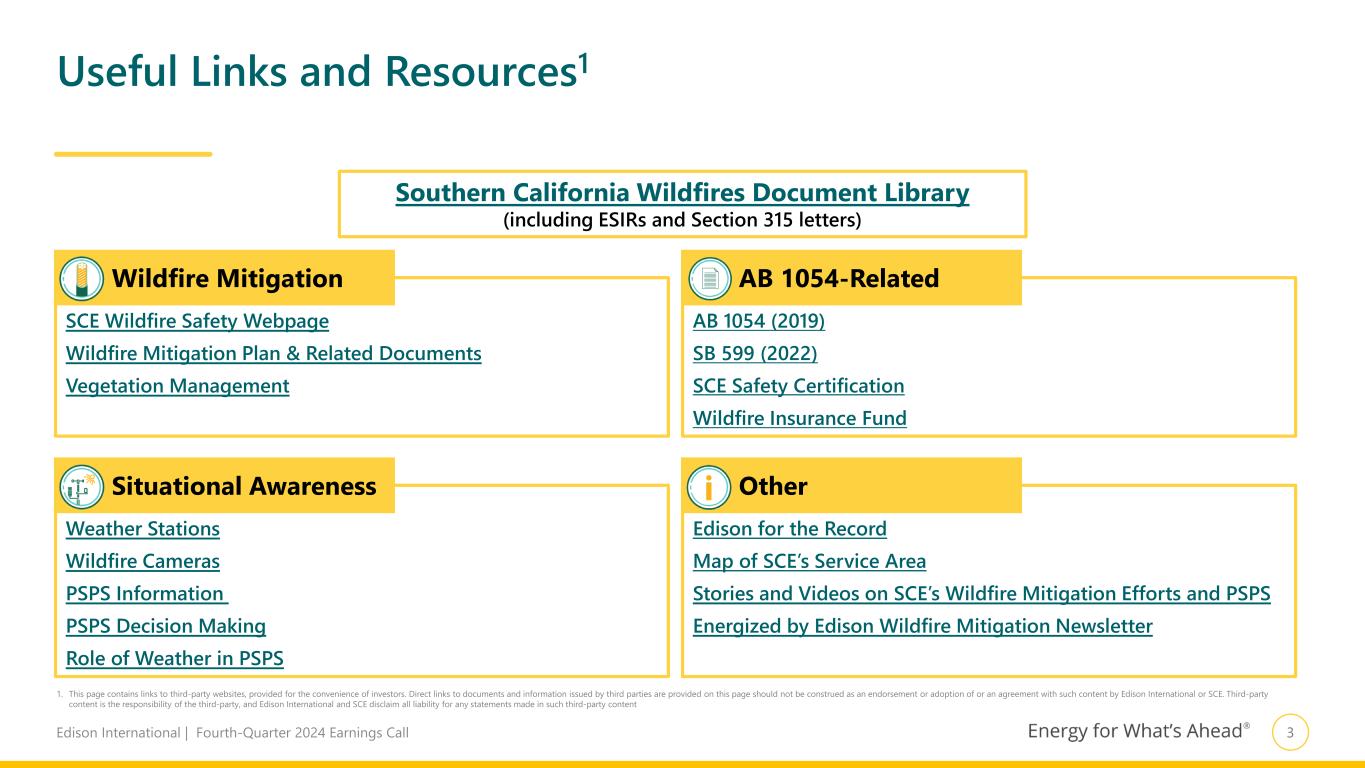
its transmission facilities in the Eaton Canyon area was consistent with actions of a reasonable utility. That is the standard by which the utility is judged, as written into statute by AB 1054. Page 3 provides a number of helpful links that pertain to information about SCE’s wildfire mitigation, company disclosures, legislation, and other resources.
The catastrophic impact of the recent wildfires underscores the importance of grid resiliency and the actions SCE has taken to harden its system to support the communities it serves. SCE continues to execute its robust, risk-prioritized wildfire mitigation plan, which is approved by California’s Office of Energy Infrastructure Safety and ratified by the CPUC. This has significantly bolstered efforts to protect against wildfire threats and to respond when they happen. SCE has now installed more than 6,400 miles of covered conductor and has hardened nearly 90% of its distribution lines in high fire risk area. This is in addition to significant investments in operational measures in transmission and distribution, such as vegetation management and the extensive network of weather stations and high definition, AI-enabled wildfire cameras that provide greater situational awareness for SCE and fire agencies. We will continue to invest in SCE’s important work to make its system safer for its customers and communities.
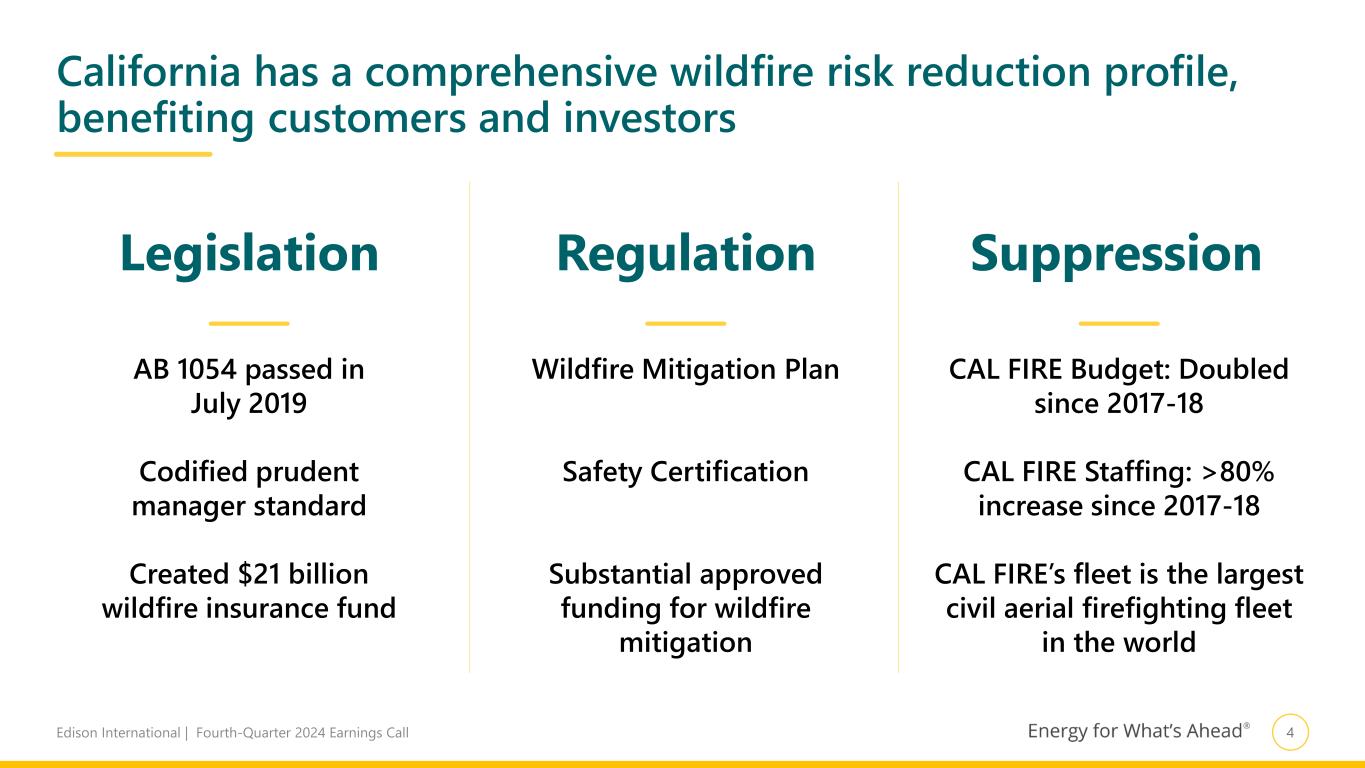
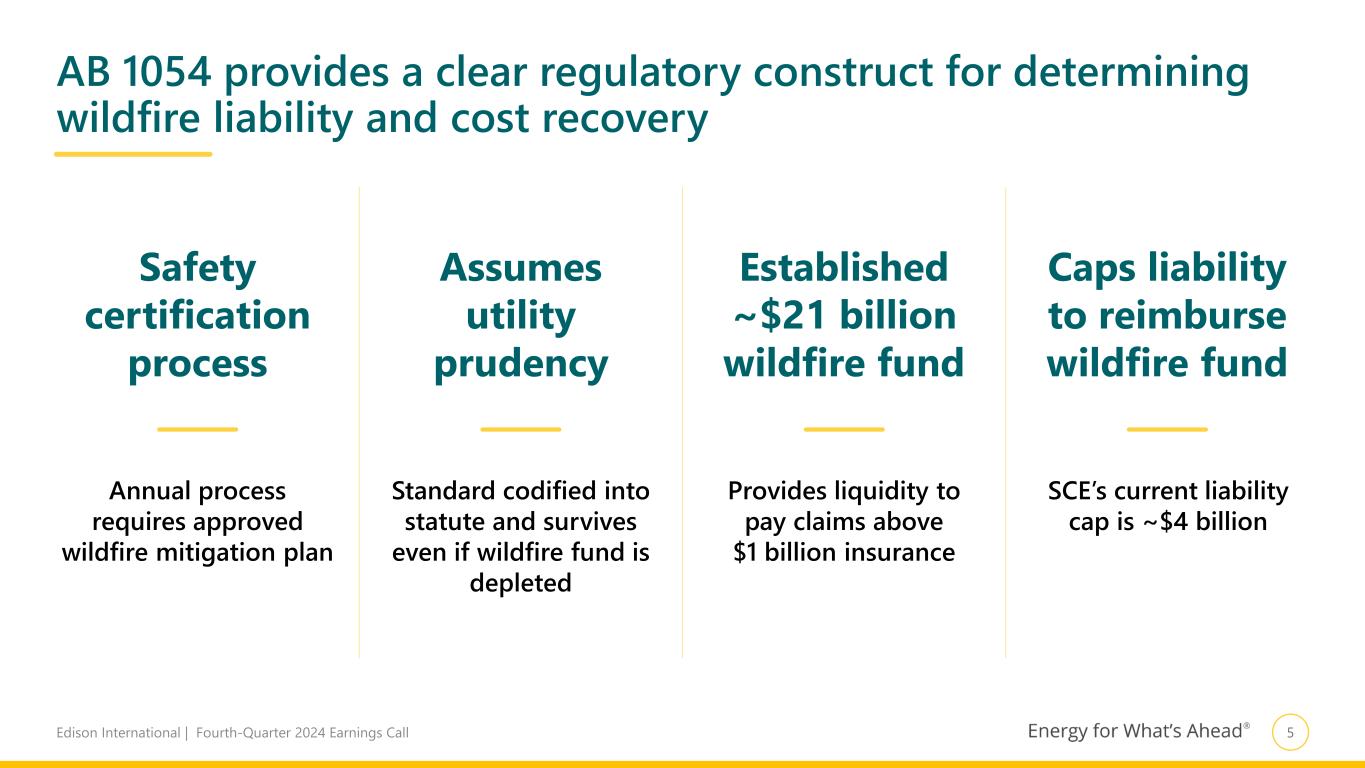
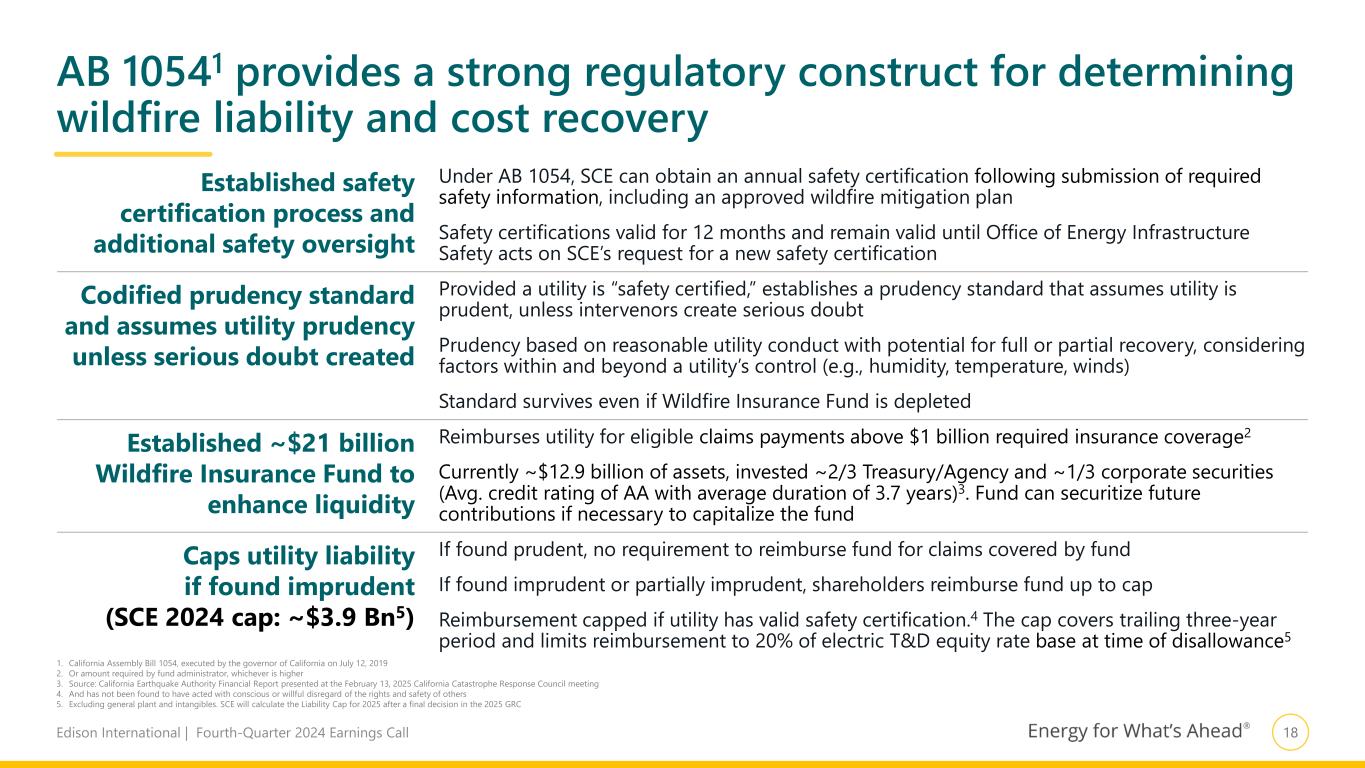
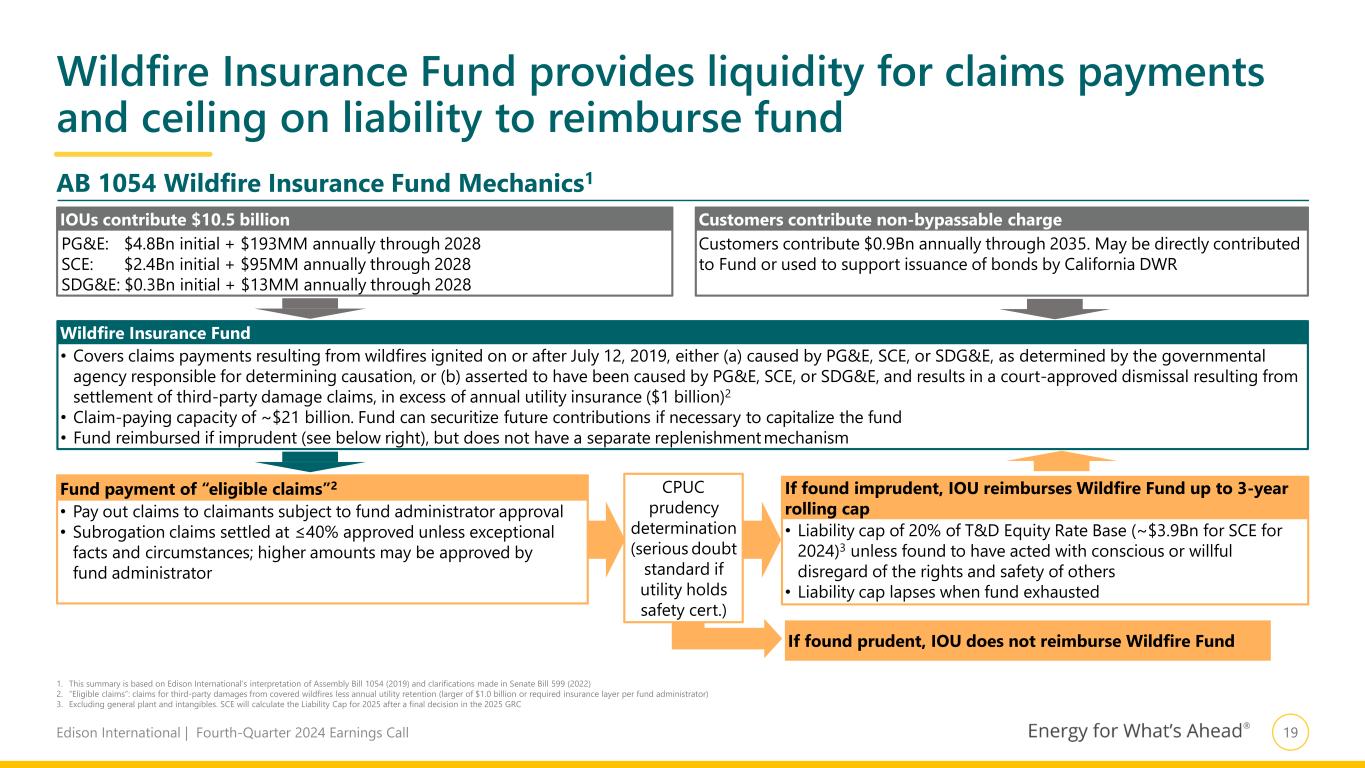
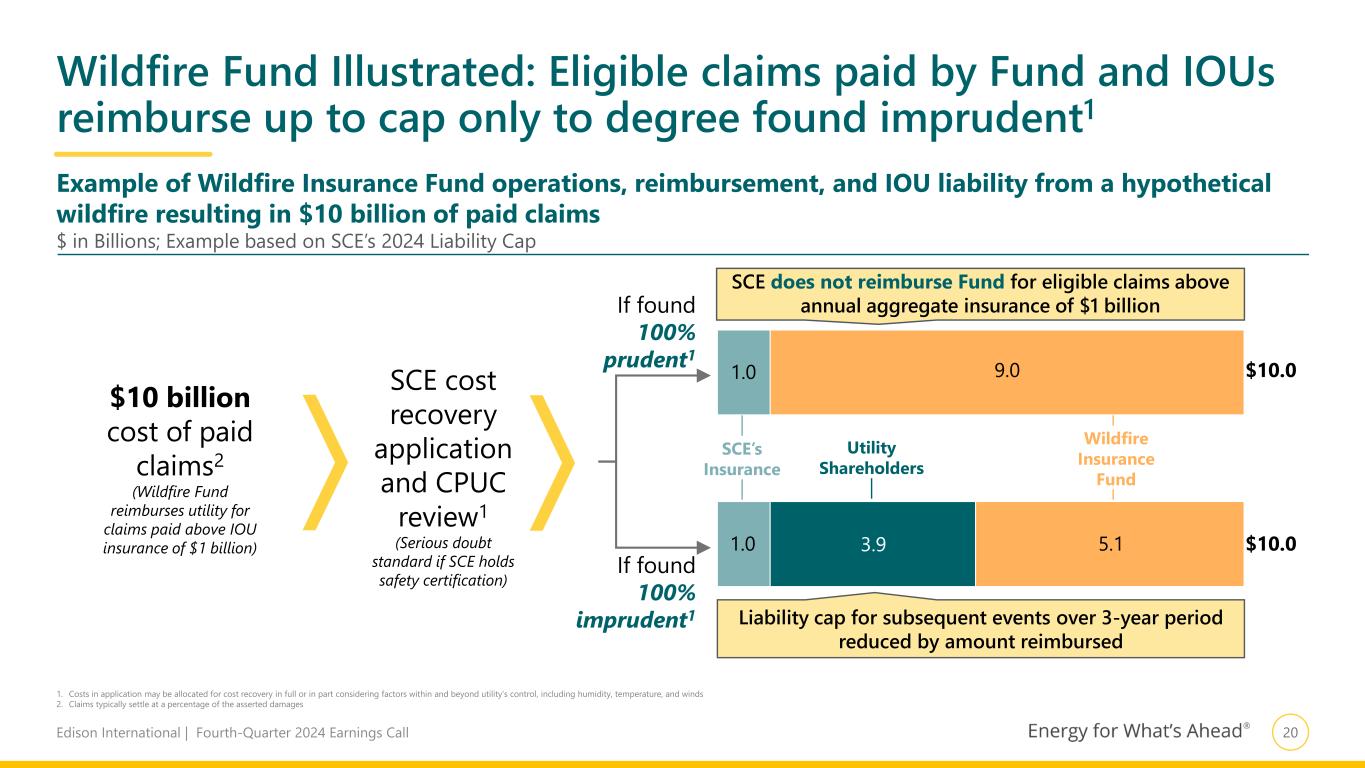
On the regulatory framework, SCE has received timely approval of its safety certification each year, which provides a presumption of prudency and a cap on the liability to reimburse the Wildfire Fund. We have confidence in the Fund and believe it is working as intended to protect wildfire victims, customers, and investors. The Fund has $21 billion of claim-paying capacity and has largely been unused by California IOUs. Let me also emphasize that the Fund provides liquidity for paying claims, thus in the event a utility were to need to make claims payments, it would not have to use its balance sheet.
Turning to the legislative front, California has consistently demonstrated a strong commitment to supporting customers and the investor-owned utilities that serve them. Over my 25‑year career at Edison, I’ve personally witnessed the state’s leadership during challenging times, from the energy crisis in the early 2000s, to the urgent need to develop new generation resources in the mid‑2000s, managing through the financial crisis in 2008, dealing with natural gas spikes in the mid‑2010s, and guiding the state through the COVID pandemic. Importantly, Governor Newsom led the charge in 2019 along with his colleagues in the legislature to pass and implement AB 1054, the model among all states to address wildfire risk. If we conclude
SCE’s equipment ignited the Eaton Fire, which was then fanned by hurricane-force winds in spite of firefighters’ best efforts, this catastrophe is precisely what AB 1054 was designed to address, recognizing wildfire risk will never be zero. This legislation reshaped the regulatory and financial landscape by balancing wildfire cost recovery with utility accountability and customer protections. Multiple stakeholders benefit and I want to focus on three broad areas:
•First, customer and community safety benefit from the risk reduction achieved through the WMP and safety certification process;
•Second, communities that suffer losses related to wildfires associated with utility equipment have a funding source for claims payments;
•And third, investor-owned utilities that participate in the Fund benefit from a structure that provides liquidity for claims payments, a clear prudence standard, and a liability cap — all of which support financial stability and long-term investment in the grid at the most affordable cost to customers.
The magnitude of the recent wildfires has brought the long-term durability of the Fund into focus. We have been actively engaged in conversations with key stakeholders including other utilities, the Governor’s Office, and legislative leaders to find solutions to support the safety of the community, effectively manage customer costs, and reinforce investor confidence in California’s utilities. We are confident policymakers will make the enhancements needed to strengthen the industry-leading AB 1054 regulatory framework.
Before moving on to our financial results, I’d like to note an addition to our board of directors that was announced last week. Former U.S. Secretary of Energy Jennifer Granholm will join the board of directors of both EIX and SCE. Jennifer has deep expertise in energy technology, energy policy, safety, and sustainability. We’re thrilled she is joining our boards, and we look forward to the guidance she will provide based on her understanding of the technical, political, and economic forces shaping our industry today. I know Jennifer has many organizations seeking her time, so I appreciate her vote of confidence in our company’s strong future.
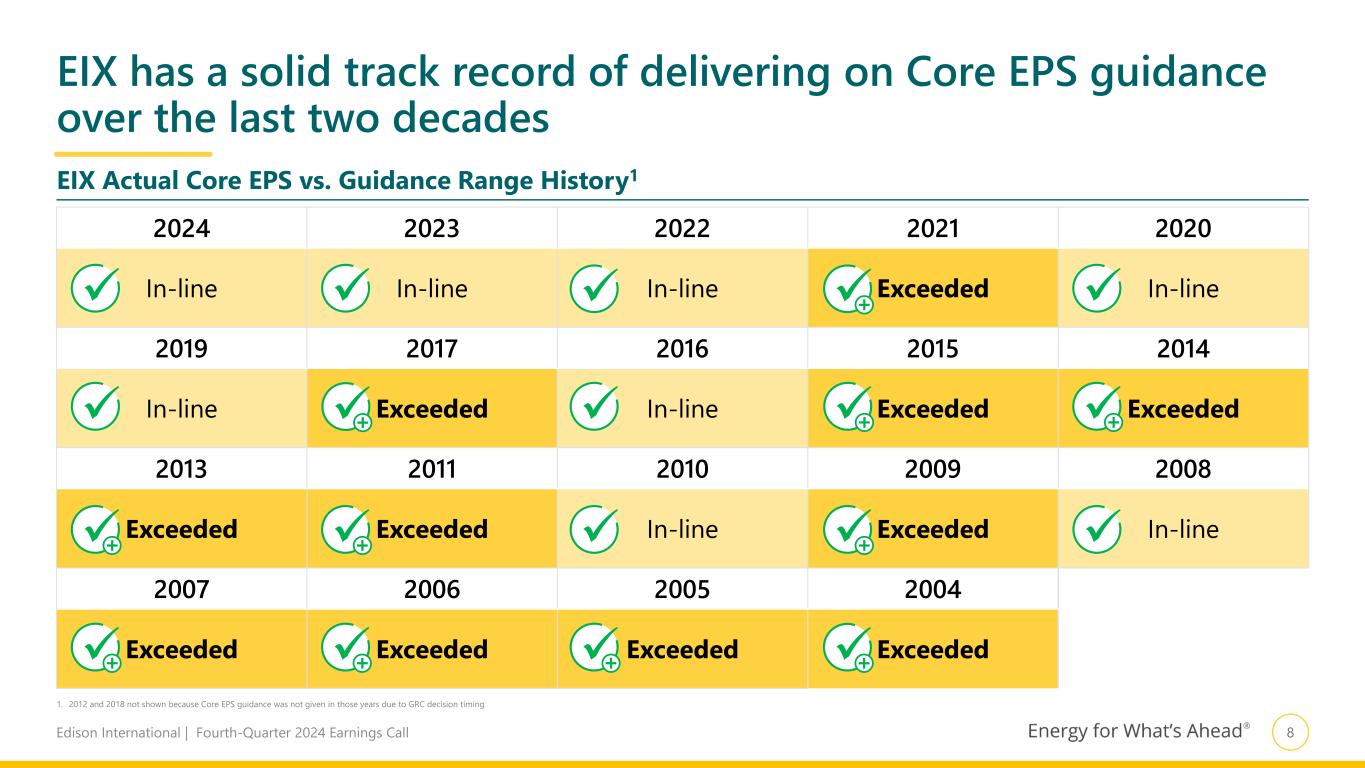
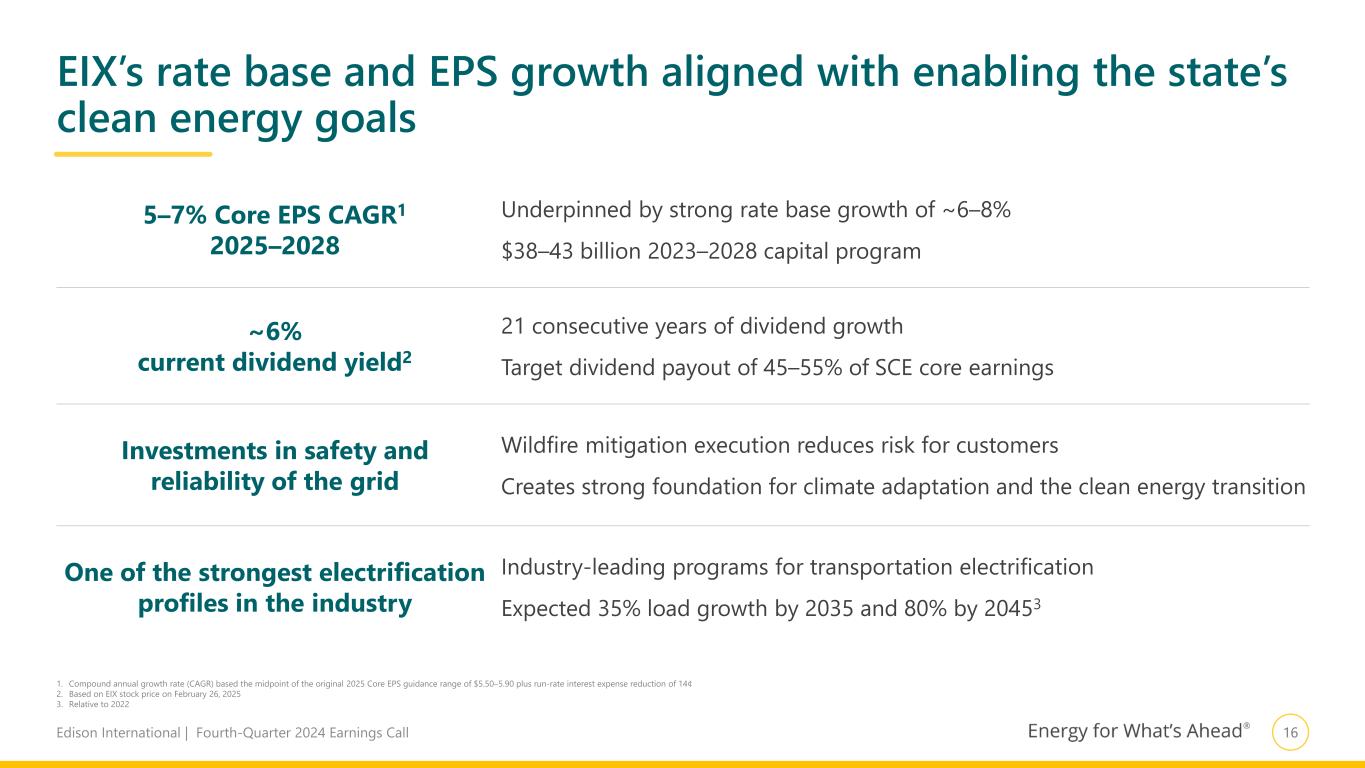
For 2024, Edison International’s core EPS of $4.93 was above the midpoint of our guidance. This extends our track record of meeting or exceeding annual EPS guidance over the last two decades. Additionally, we remain confident in our ability to meet our 2025 EPS guidance and deliver a 5 to 7% core EPS CAGR through 2028. Maria will discuss our financial performance and outlook later.
Further, today the Board declared EIX’s first quarter 2025 common stock dividend of 82.75 cents per share. Consistent with its regular process, the Board took into account a broad range of considerations and scenarios before making this declaration. There is no change to our current dividend policy or outlook, which balances a competitive dividend that investors expect with reinvesting SCE’s earnings back into the infrastructure that serves customers’ needs. This consistent and growing dividend demonstrates the confidence in our financial outlook, which supports raising cost-effective capital and directly benefits customer rates.
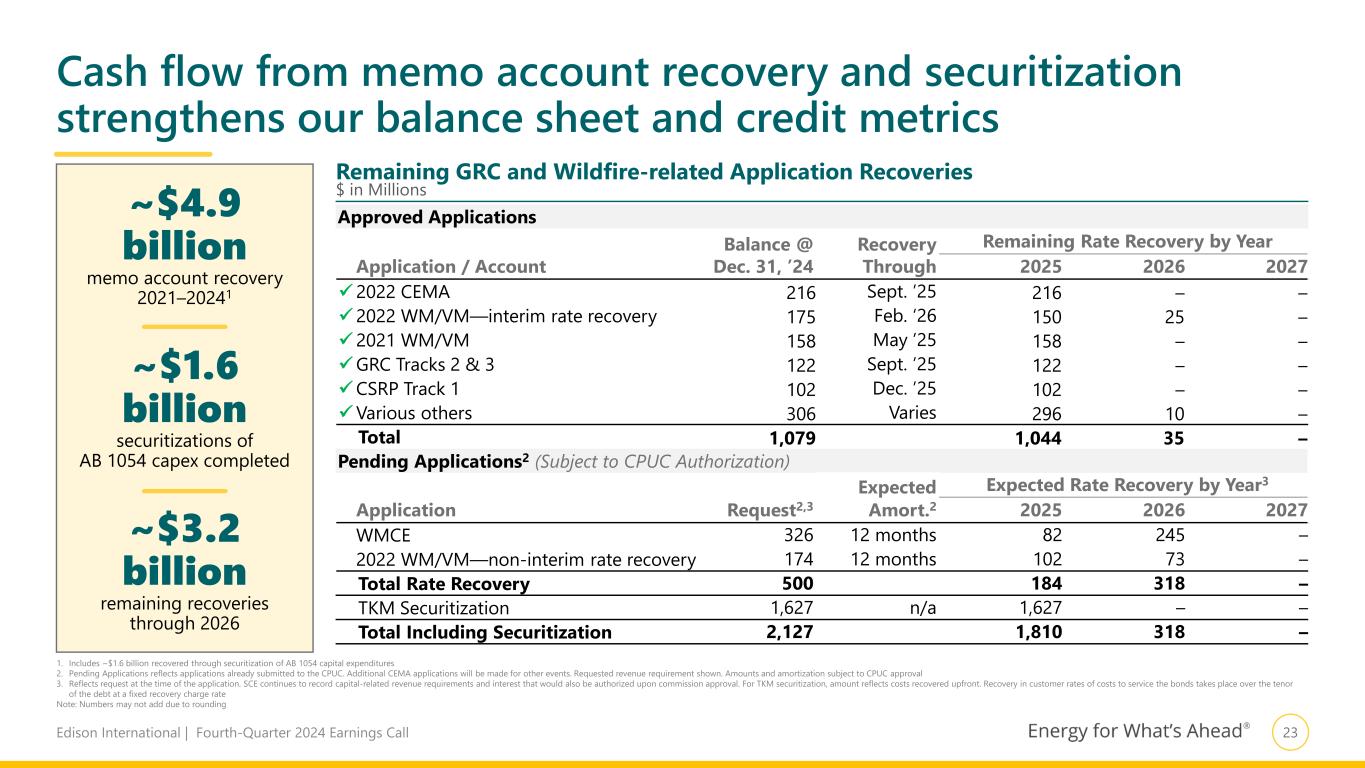
On the regulatory front, we are very encouraged by the CPUC’s unanimous approval of the TKM settlement agreement, allowing SCE to recover about $1.6 billion, or 60%, of the wildfire claims payments and associated costs for a pre-AB 1054 wildfire. Approval of the settlement signals a constructive cost recovery framework in California. In fact, following approval, CPUC President Reynolds made important remarks about cost recovery and AB 1054. She noted how under state law, SCE, like public entities, is liable for damages from a fire caused by its electrical system, but, if the utility acted prudently, these costs are covered by customers. She also noted that, because of AB 1054, in the future the Wildfire Fund would cover claims similar to those in TKM. SCE expects to file its TKM securitization application in March.
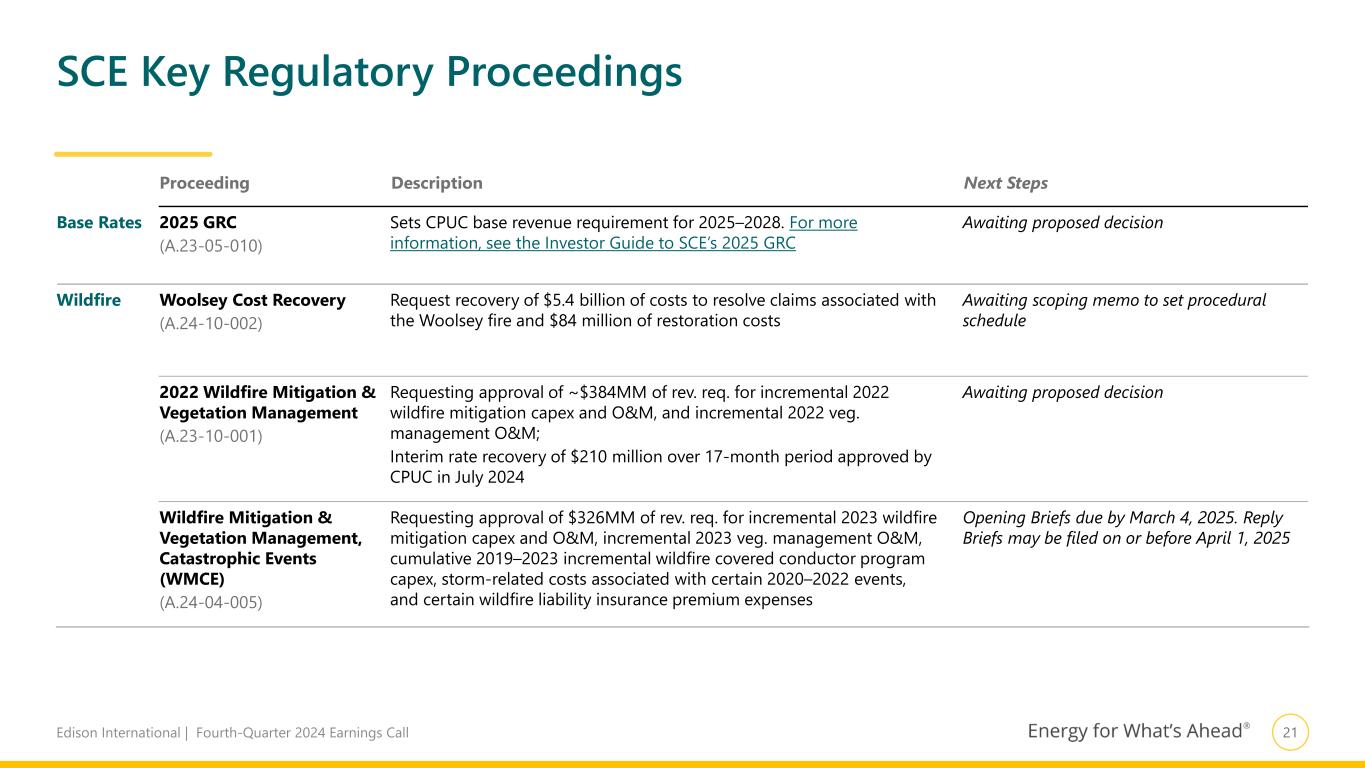
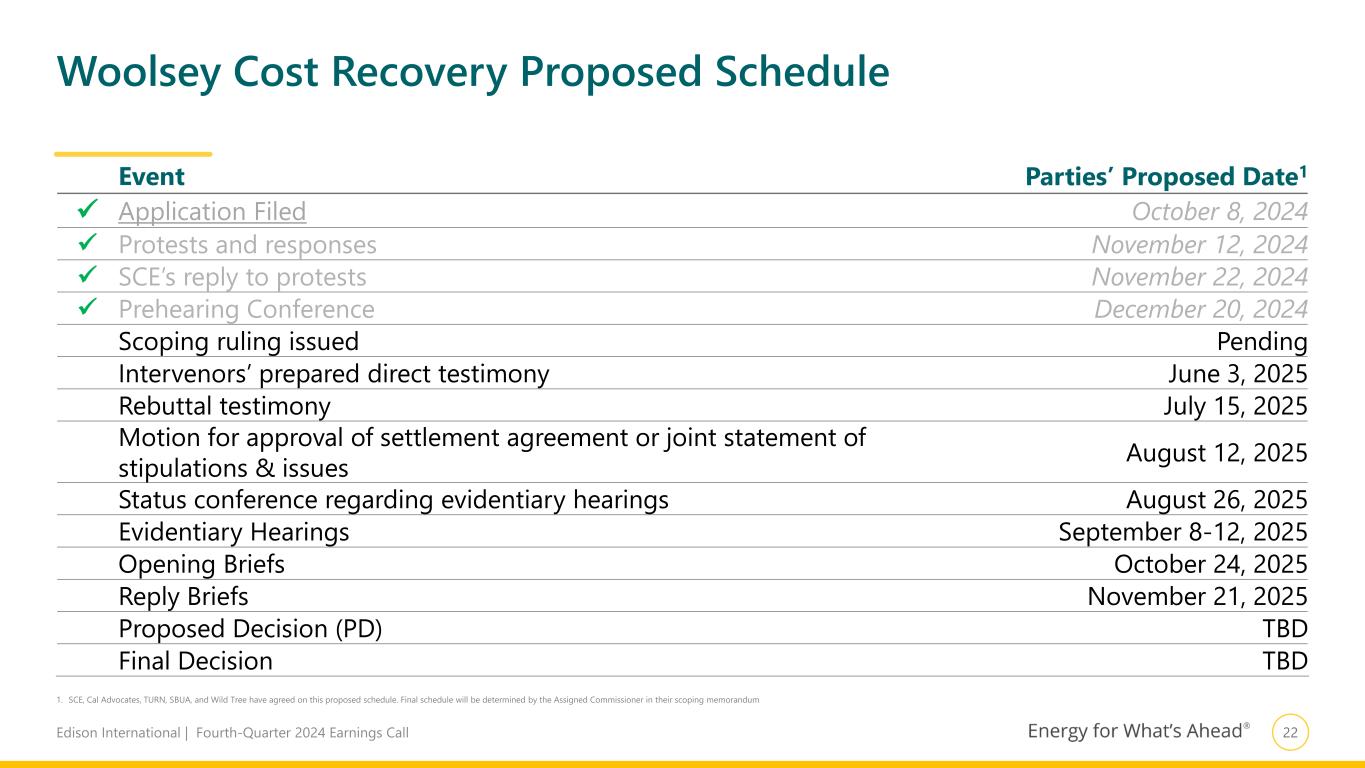
The Woolsey cost recovery proceeding is underway. Based on the prehearing conference, participating intervenors noted similar areas of focus and engagement to those in TKM. If the ALJ adopts the schedule SCE and intervenors jointly proposed, the next major filings to watch for are intervenor testimony due in early June and rebuttal testimony due in mid-July. The proposed schedule also includes a motion for approval of a settlement agreement or joint statement of stipulations of issues that would be due in mid-August. Just like with TKM, the utility is open to settlement discussions if a fair and reasonable outcome can be achieved. We look forward to keeping you updated on progress in this important proceeding.
Let me conclude by saying that SCE is focused on partnering with impacted communities on near- and long-term strategies to build back stronger, all while we continue to execute on core operations and deliver on the commitments we have laid out for you. I look forward to sharing more updates throughout the year.
Maria Rigatti, Executive Vice President and Chief Financial Officer, Edison International
Before I turn to our financial results, I also want to take a take a moment to recognize the tireless efforts of our team to manage the response to the southern California wildfires. Our management team is grateful for our colleagues who have come together to restore power and help customers recover. Turning to my comments today, I will discuss fourth quarter and full year 2024 results, our focus areas for 2025, SCE’s capital and rate base forecasts, and 2025 guidance.
For the fourth quarter, EIX reported core EPS of $1.05. Full-year 2024 core EPS of $4.93 was above the midpoint of our guidance range. Pages 6 and 7 provide the year-over-year variance analysis and additional color can be found in our earnings news release. This strong performance demonstrates our ability to manage the business and extends our track record of meeting annual EPS guidance over the last two decades, as shown on page 8.
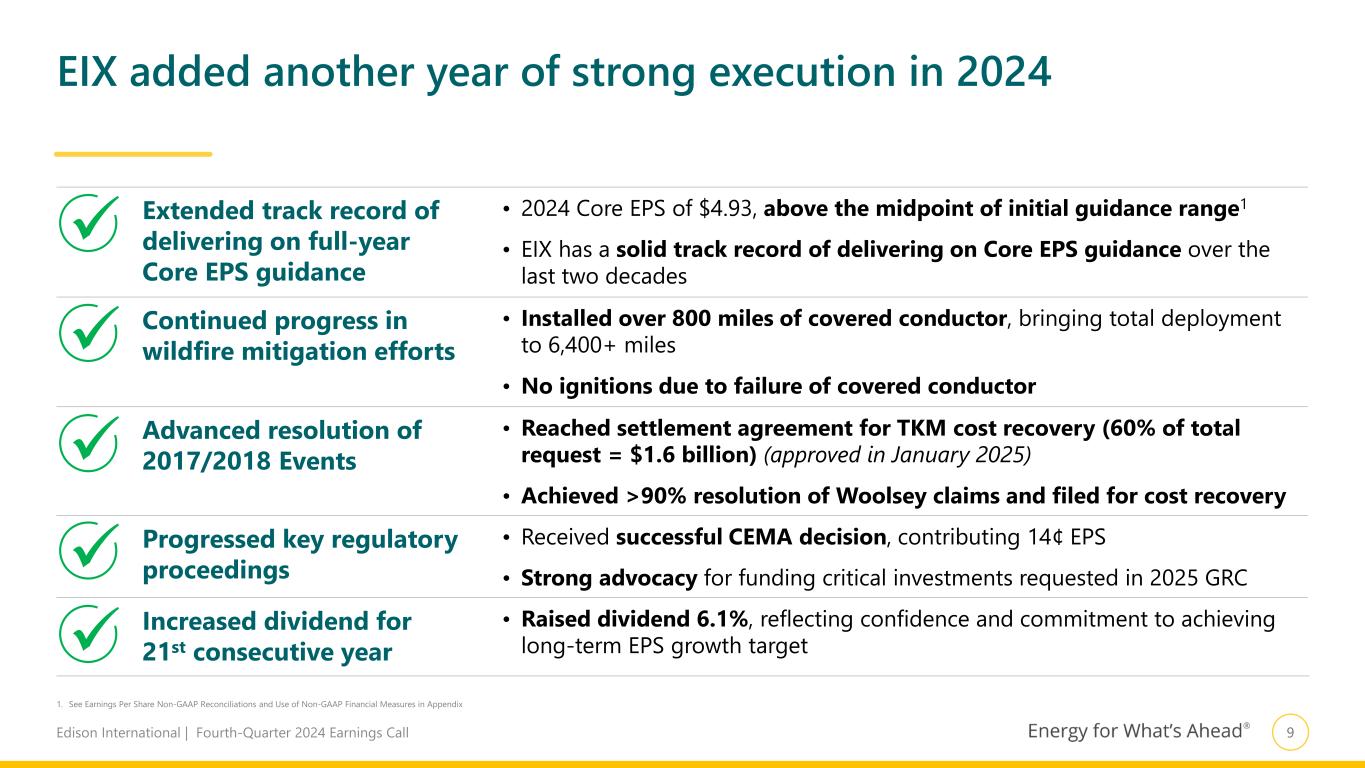
Delivering strong financial results was just one accomplishment in another year of strong execution in 2024, as shown on page 9. SCE also continued its progress in hardening the grid and making its system safer for customers by installing over 800 miles of covered conductor, bringing total deployment to more than 6,400 miles. On the regulatory front, we were pleased to see a number of positive developments. First, the timely settlement of TKM, which Pedro addressed earlier. Second, the utility reached substantial completion of resolving claims for Woolsey and filed the cost recovery application. Third, the CPUC issued a final decision in the 2022 CEMA proceeding, which contributed 14 cents to 2024 EPS. Fourth, the utility continued its strong advocacy in the 2025 GRC and settled numerous issues with intervenors. Lastly, reflecting the confidence and commitment to achieving our long-term EPS growth target, in December we raised the dividend by 6.1%, which was the 21st consecutive annual increase.
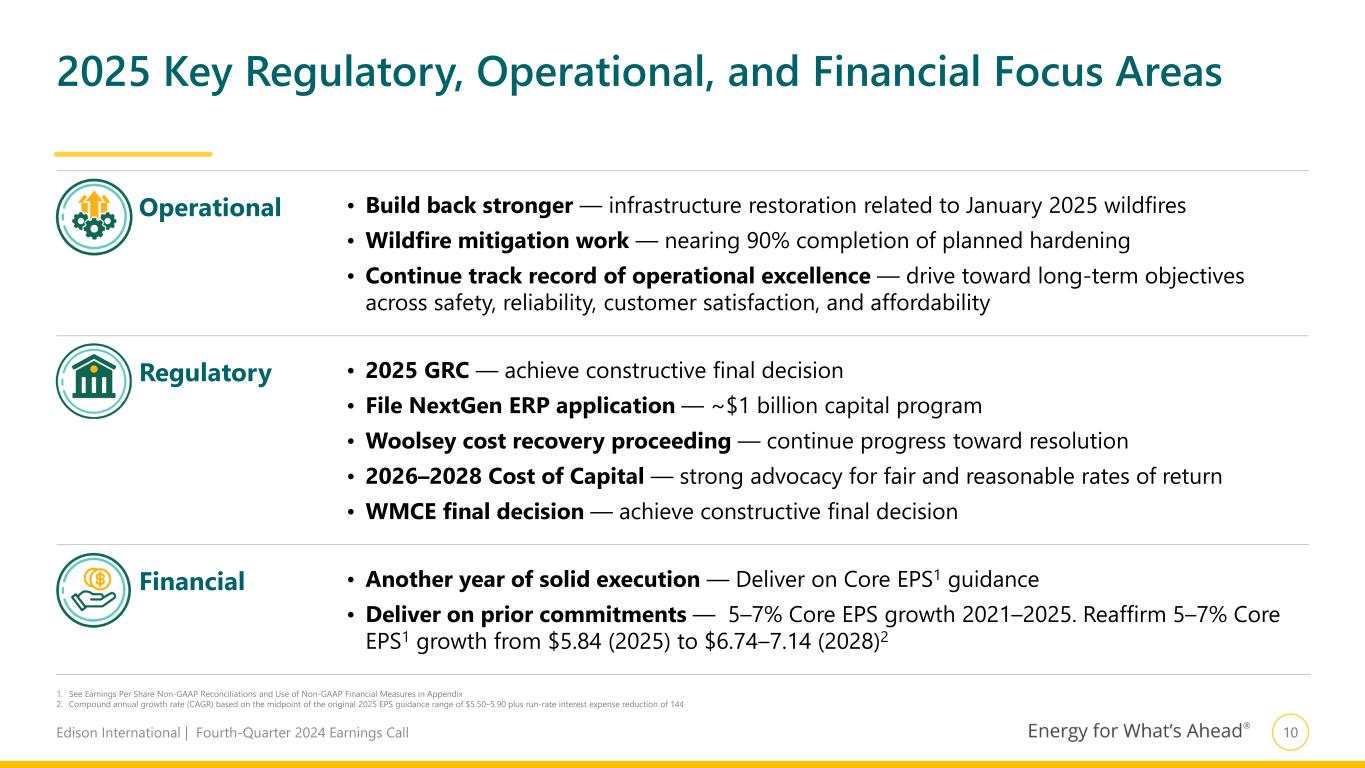
Page 10 summarizes the key management focus areas for 2025. Supporting the people and communities affected by wildfires is front and center. Rebuilding and emerging stronger by restoring infrastructure and bringing power back to those areas is critical. SCE will also continue its wildfire mitigation work and its focus on operational excellence to reduce costs for customers. There will also be additional progress on the regulatory front. This year, we expect SCE will receive decisions on its 2025 General Rate Case, its WMCE filing, and its cost of capital application for 2026 through 2028. Additionally, the utility will be filing an application for its NextGen ERP program. SCE will also continue its progress towards resolving the Woolsey cost recovery proceeding.
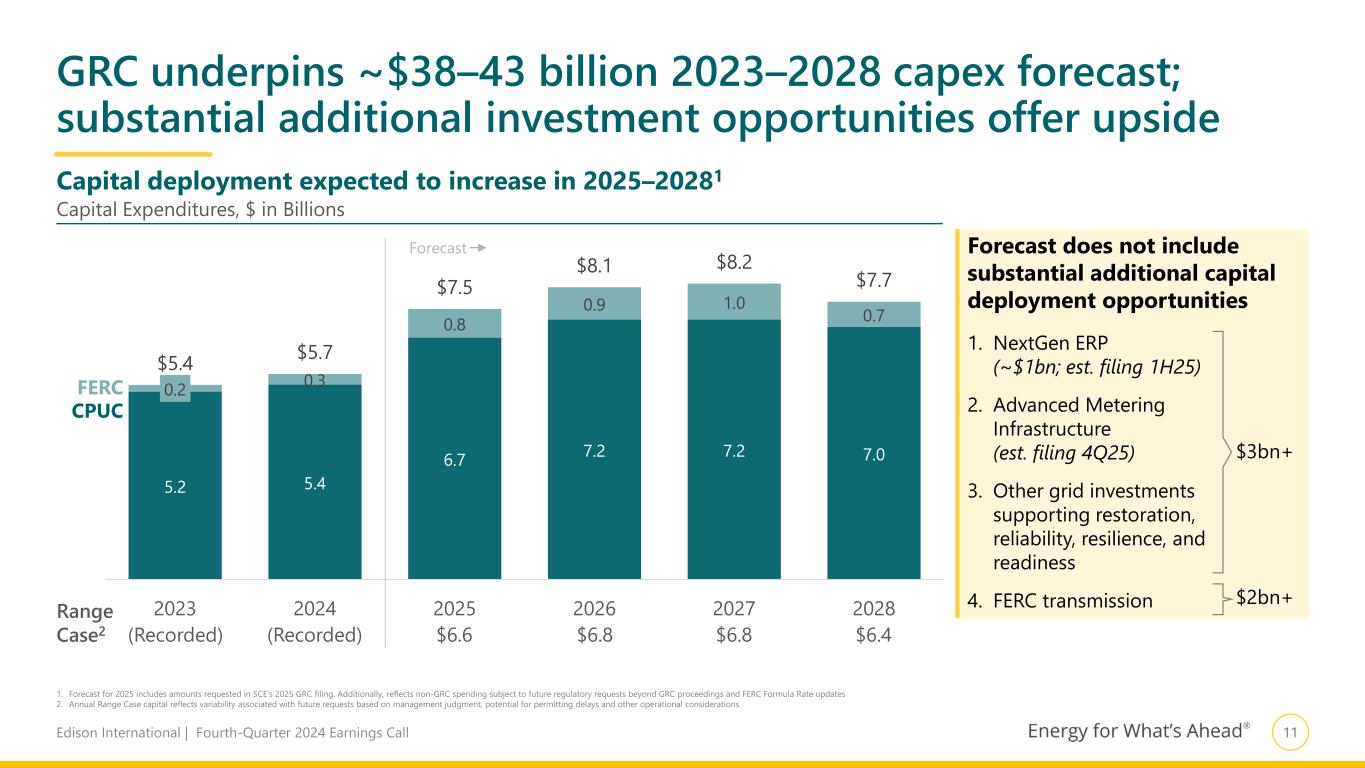
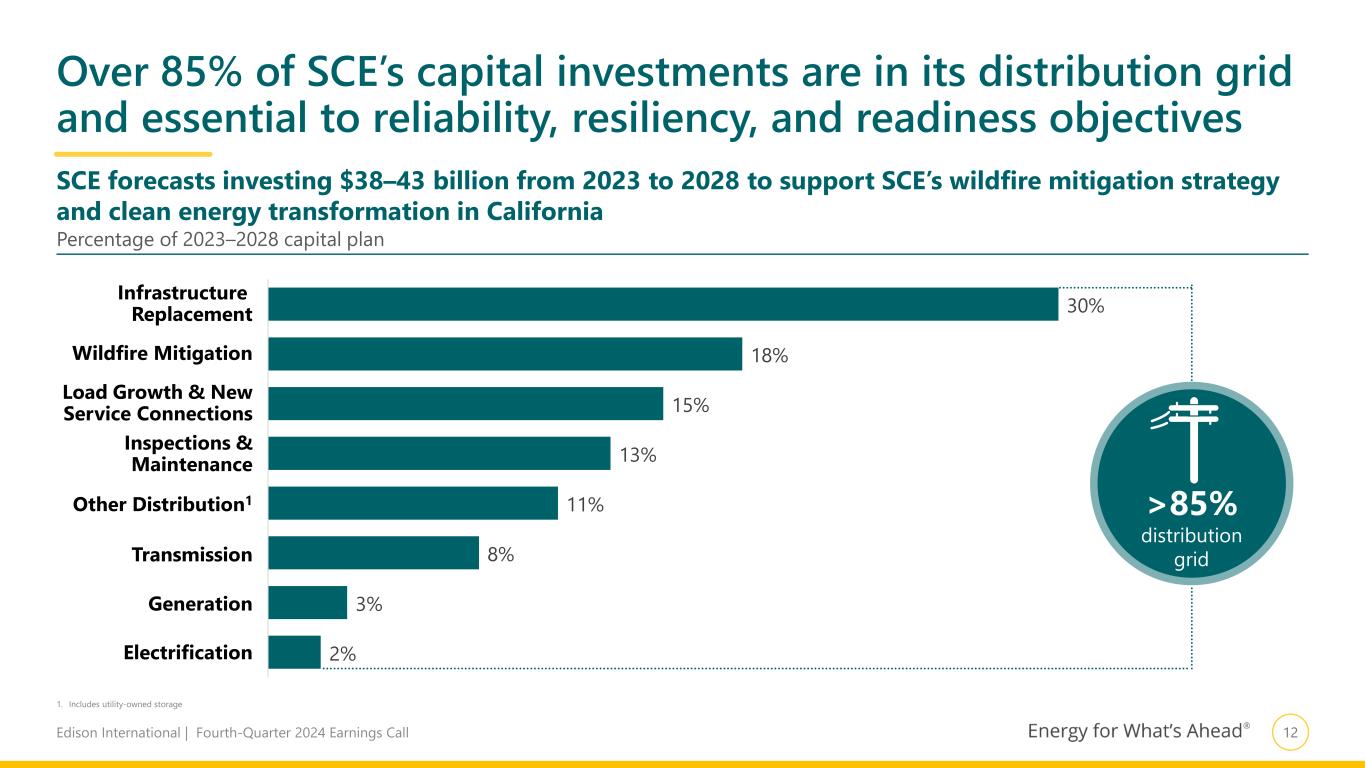
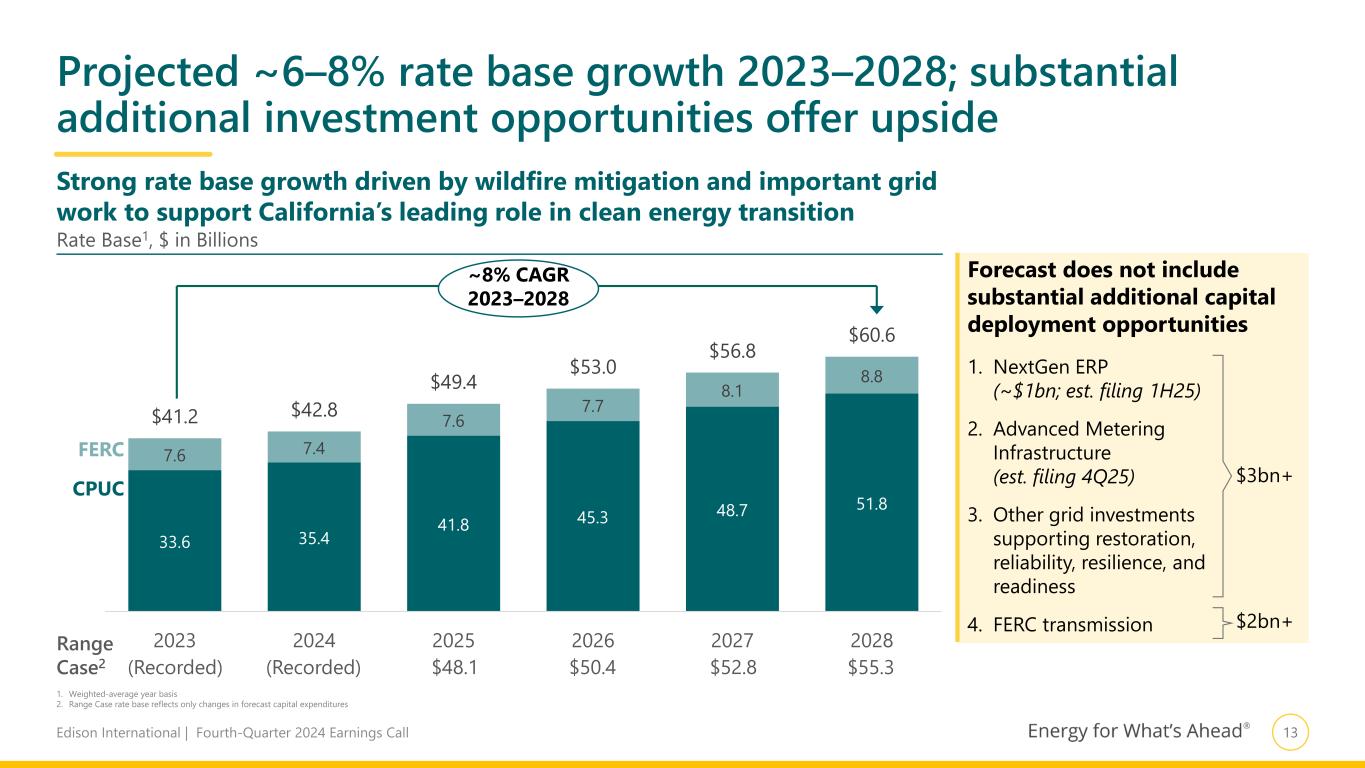
Let’s now turn to SCE’s capital and rate base forecasts shown on pages 11, 12, and 13. The 2025 GRC is the core driver of the outlook through 2028. SCE’s capital plan is focused on replacing aging infrastructure to support reliability and safety for customers, continuing grid hardening investments to mitigate risk and enhance resiliency, and expanding the grid to make the system ready for load growth today and in the future as customers increase their electricity usage.
I would also like to highlight several additional capital deployment opportunities that support customer needs over the coming years, which we have discussed in the past and are not yet included in the plan. SCE has refined estimates for these projects, resulting in an increase of at least $1 billion to these opportunities. One such investment is the NextGen ERP project I just mentioned. Later this year, the utility also plans to file an application for an advanced metering infrastructure program to replace and upgrade the first generation of smart meters, which are at the end of their useful lives. We also anticipate additional system needs on the distribution grid, including for system restoration and expansion. Further, SCE has more than $2 billion of FERC transmission projects in development.
Moving to SCE’s 2025 GRC, the utility is awaiting a proposed decision from the ALJ. We remain optimistic that we could see a proposed decision during the first half of the year. To reiterate our previous comments, SCE made a compelling case and even based on intervenors’ positions, SCE’s rate base growth would still be in line with its range case forecast of 6%. Once SCE gets a final decision from the CPUC on the GRC, we will refresh our capital plan, financing plan, 2025 EPS guidance, and EPS growth forecast.
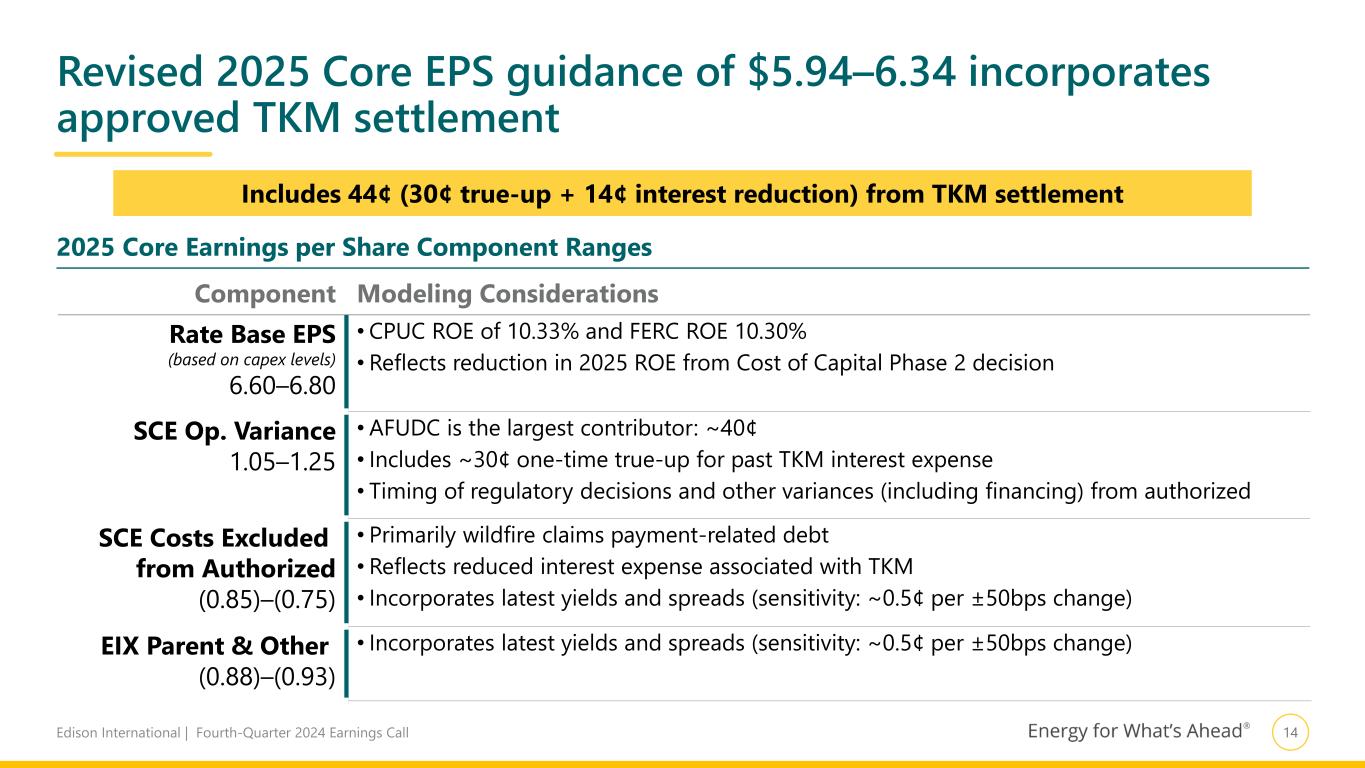
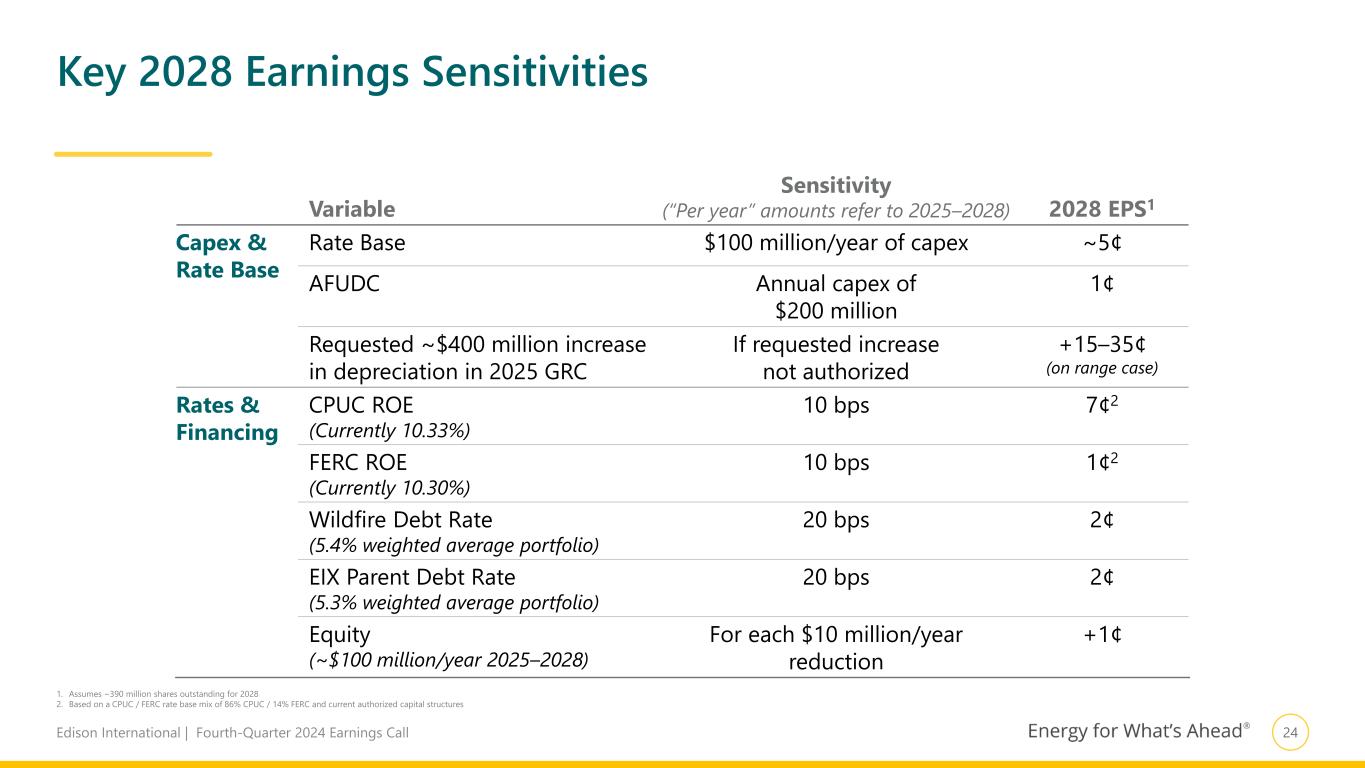
Turning to EPS guidance, page 14 shows our 2025 core EPS guidance and modeling considerations. You will see that we have revised the guidance range. This is simply our prior range of $5.50 to $5.90 plus the incremental 44 cents associated with the recently approved TKM settlement. As we have discussed before, those 44 cents are composed of a 30‑cent one-time true-up for historical interest expense and the 14‑cent annual reduction in unrecoverable interest expense.
While SCE waits for the GRC decision, I want to remind you that we will be recording revenue at 2024 rates, adjusted for the change in ROE. Therefore, quarterly results comparisons pending a 2025 GRC decision are not meaningful. We will record a true-up when we receive a final decision. SCE has established a memo account to track the differences in revenue until it receives a final decision, which will be retroactive to January 1. I’ll touch briefly on the parent financing plan. This year, EIX has $800 million of debt maturities, a portion of which were pre-funded through a debt offering last December.
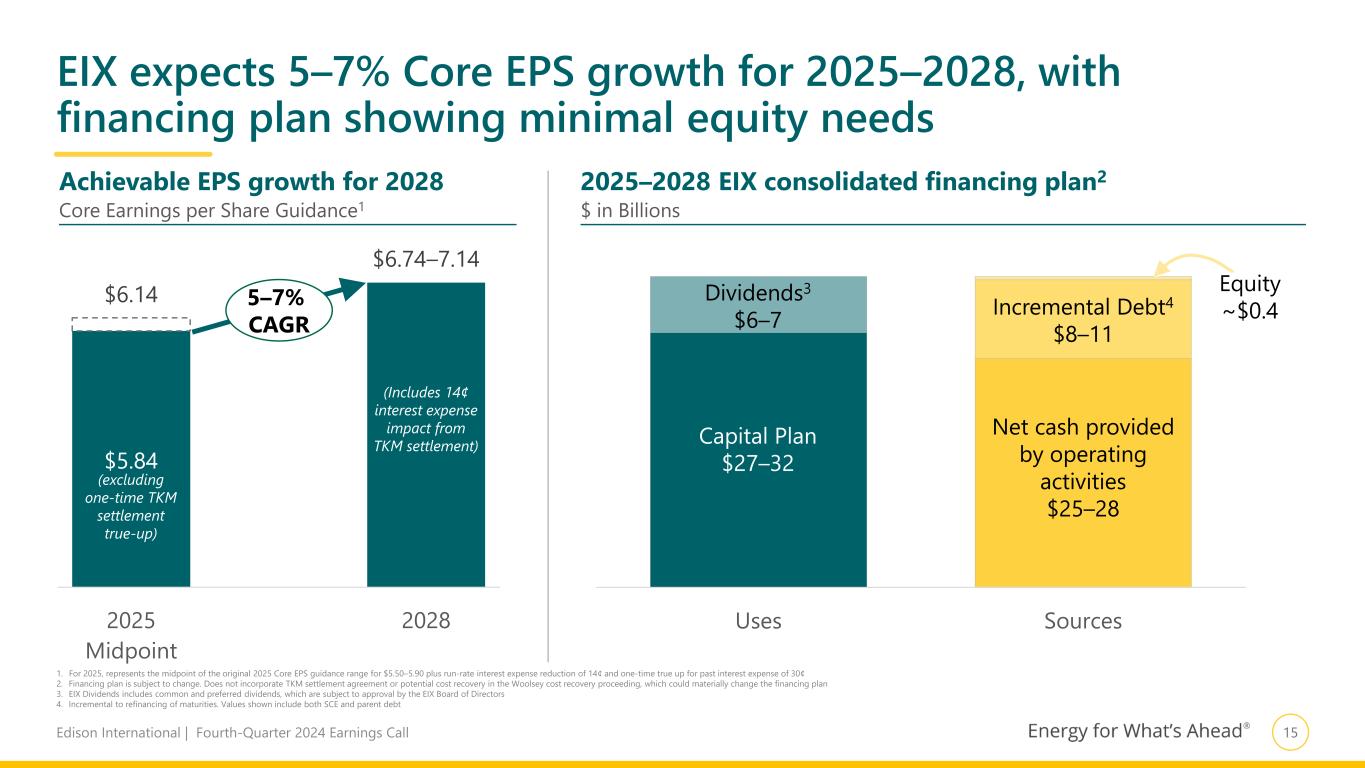
Moving to our longer-term outlook on page 15, you will see that we have also incorporated the benefit from the 14‑cent interest expense reduction resulting from the TKM settlement into the 2028 EPS range. Given that this annual interest reduction will be ongoing and is part of our base year, we are maintaining our target of 5 to 7% core EPS growth off a higher base of $5.84.
While the cause of the Eaton Fire remains under investigation and we are not speculating on potential outcomes, AB 1054 was enacted to ensure the financial stability of California’s utilities in scenarios like this. The supportive regulatory framework and processes established by this legislation ensure that no utility would have to use its balance sheet while accessing the Wildfire Fund to make claims payments. Additionally, the potential liability to reimburse the Fund is capped. Lastly, the prudence standard means a utility is presumed to be a prudent manager if it has a safety certification — which SCE has.
Given these factors and the supportive regulatory framework, we remain confident in our financial outlook as we continue to support wildfire response, recovery, and efforts to rebuild. SCE’s core operations and the central role it plays in the clean energy transition remain the driving force behind our core earnings growth.