Exhibit 3.1


As filed with the Securities and Exchange Commission on April 20, 2026.
Registration No. 333-[ ]
UNITED
STATES
SECURITIES AND EXCHANGE COMMISSION
Washington, D.C. 20549
FORM
REGISTRATION
STATEMENT UNDER
THE SECURITIES ACT OF 1933
(Exact name of registrant as specified in its charter)
| (State or other jurisdiction of | (Primary Standard Industrial | (I.R.S. Employer | ||
| incorporation or organization) | Classification Code Number) | Identification Number) |
5725 S Valley View Blvd, Ste 5 #378094
Las
Vegas, NV 89118
Tel: 802-242-1238
(Address, including zip code, and telephone number, including area code, of registrant’s principal executive offices)
Molly Huang
Chief Executive Officer
5725 S Valley View Blvd, Ste 5 #378094
Las
Vegas, NV 89118
Tel: 802-242-1238
(Name, address, including zip code, and telephone number, including area code, of agent for service)
Copies to:
Arila E. Zhou, Esq. Robinson & Cole LLP 666 Third Ave, 20th Floor New York, NY 10017 Tel: 212-451-2908 |
Jing Ye, Esq. Ye & Associate, P.C. 275 5th Avenue,2nd Floor New York, NY 10016 Tel: (929)-300-7489 |
Approximate date of commencement of proposed sale to the public: As soon as practicable after the effective date of this registration statement.
If any of the securities being registered on this Form are to be offered on a delayed or continuous basis pursuant to Rule 415 under the Securities Act of 1933 check the following box. ☐
If this Form is filed to register additional securities for an offering pursuant to Rule 462(b) under the Securities Act, please check the following box and list the Securities Act registration statement number of the earlier effective registration statement for the same offering. ☐
If this Form is a post-effective amendment filed pursuant to Rule 462(c) under the Securities Act, check the following box and list the Securities Act registration statement number of the earlier effective registration statement for the same offering. ☐
If this Form is a post-effective amendment filed pursuant to Rule 462(d) under the Securities Act, check the following box and list the Securities Act registration statement number of the earlier effective registration statement for the same offering. ☐
Indicate by check mark whether the registrant is a large accelerated filer, an accelerated filer, a non-accelerated filer, a smaller reporting company or an emerging growth company. See the definitions of “large accelerated filer,” “accelerated filer,” “smaller reporting company” and “emerging growth company” in Rule 12b-2 of the Exchange Act.
| Large accelerated filer ☐ | Accelerated filer ☐ | Smaller
reporting company | |
| Emerging
growth company |
If
an emerging growth company, indicate by check mark if the registrant has elected not to use the extended transition period for
complying with any new or revised financial accounting standards provided pursuant to Section 7(a)(2)(B) of the Securities
Act.
The Registrant hereby amends this Registration Statement on such date or dates as may be necessary to delay its effective date until the Registrant shall file a further amendment which specifically states that this Registration Statement shall thereafter become effective in accordance with Section 8(a) of the Securities Act of 1933, as amended, or until the Registration Statement shall become effective on such date as the Securities and Exchange Commission, acting pursuant to said Section 8(a), may determine.
The information contained in this preliminary prospectus is not complete and may be changed. These securities may not be sold until the registration statement filed with the Securities and Exchange Commission is effective. This preliminary prospectus is not an offer to sell these securities and it is not soliciting an offer to buy these securities in any state where the offer or sale is not permitted.
| PRELIMINARY PROSPECTUS | SUBJECT TO COMPLETION | DATED [ ], 2026 |
10,000,000 Units
East West Ave Acquisition Corp.
East
West Ave Acquisition Corp.is a blank check company whose business purpose is to effect a merger, capital stock exchange, asset acquisition,
stock purchase, reorganization or similar business combination with
This is an initial public offering of our securities. Each unit has an offering price of $10.00 and consists of one share of common stock and one right to receive one-eighth (1/8) of a share of common stock. Each eight rights entitle the holder thereof to receive one common stock upon the consummation of our business combination. We refer to the rights included in the units as “rights” or “public rights”. The underwriters have a 45-day option from the date of this prospectus to purchase up to 1,500,000 additional units to cover over-allotments, if any.
Our
sponsors (the “sponsors”, each a “sponsor”, and together with our directors and officers, the “insiders”),
East West Ave LLC (the “sponsor A”), a Delaware limited liability company, and NFR Capital Limited (the “sponsor B”),
a Hong Kong company, have committed to purchase from us
units and
units, respectively, or
units total (collectively, the “private units”)
at a price of $
per unit, with each unit consisting of one share of common
stock (the “private shares”) and one right to receive one-eighth (1/8) of a share of common stock upon the consummation of
an initial business combination (each a “private right”), for an aggregate purchase price of $
Our sponsors currently own an aggregate of 2,875,000 shares of common stock (which were purchased for $25,000 and which we refer to as “founder shares”) (up to 375,000 founder shares of which are subject to forfeiture depending on the extent to which the underwriters’ over-allotment option is exercised).
The following table illustrates the difference between the public offering price per unit and our net tangible book value per share, as adjusted to reflect various potential redemption levels that may occur in connection with the closing of our initial business combination, which we refer to as “NTBV,” on a pro forma basis to give effect to this offering and the issuance of the representative shares and the private units, assuming no exercise of the over-allotment option and exercise of the over-allotment option in full. NTBV excludes the effect of the consummation of our initial business combination or any related transactions or expenses. See the Section entitled “Dilution” of this prospectus for additional information.
| As of February 28, 2026 | ||||||||||||||||||||||||||||||||||
| Offering Price of $10.00 per unit | 25% of Maximum Redemption | 50% of Maximum Redemption | 75% of Maximum Redemption | Maximum Redemption(1) | ||||||||||||||||||||||||||||||
| NTBV | NTBV | Difference between NTBV and Offering Price | NTBV | Difference between NTBV and Offering Price | NTBV | Difference between NTBV and Offering Price | NTBV | Difference between NTBV and Offering Price | ||||||||||||||||||||||||||
| Assuming Full Exercise of Over-Allotment Option | ||||||||||||||||||||||||||||||||||
| Assuming No Exercise of Over-Allotment Option | ||||||||||||||||||||||||||||||||||
| (1) |
Currently, there is no public market for our units, common stock or rights. We have applied to have our units listed on the Nasdaq Global Market under the symbol “[EWAV]U” on or promptly after the date of this prospectus. We cannot guarantee that our securities will be approved for listing on the NASDAQ. We expect the shares of common stock and rights comprising the units to begin separate trading on the 52nd day following the date of this prospectus unless Prime Number Capital, LLC informs us of its decision to allow earlier separate trading, subject to our satisfaction of certain conditions. Once the securities comprising the units begin separate trading, we expect that the common stock and rights will be listed on the Nasdaq Global Market under the symbols “[EWAV]” and “[EWAV]R,” respectively.
We are an “emerging growth company” under applicable federal securities laws and will be subject to reduced public company reporting requirements.
All of our officers and directors are U.S. citizens or permanent residents residing in the U.S., except that one of our independent director nominees, Mr. Honna is a Hong Kong resident. In addition, our sponsor B is a Hong Kong company and the shareholder and director of sponsor B is a Hong Kong resident. Investors will be able to effect service of process and enforce judgement of United States courts predicated upon civil liabilities and criminal penalties on them under United States securities laws against our officers and directors, except against our overseas-based insiders. For Mr. Honna or our sponsor B, however, it may be difficult to effect service of process, enforcing foreign judgments, or bringing actions against him or it. See “Risk Factors — You may experience difficulties in effecting service of legal process, enforcing foreign judgments, or bringing actions against our overseas-based insiders based on foreign laws.” on page 31 of this prospectus.
In addition, we believe that none of our officers, directors and sponsors have significant ties to China except that: (x) Ms. Molly Huang, our Chief Executive Officer, President and director and the manager of East West Ave LLC, the sponsor A, is a U.S. citizen and resident who has historically worked for several Chinese and Hong Kong based companies; (y) our Sponsor B, NFR Capital Limited, is a Hong Kong company, whose director and shareholder is Yanjie Wang, a resident of Hong Kong; (z) Mr. Honna, our independent director nominee, is a resident of Hong Kong. We do not believe that we or the business combination will be subject to the jurisdiction, control or intervention of the PRC Government or the legal and operational risks associated thereof, since none of our directors or officers are resident or citizens of China or Hong Kong, and we will not undertake our initial business combination with any company being based in or having the majority of the company’s operations in China. However, it is possible that the Chinese government may exercise oversight and discretion of our sponsor B’s conduct, which may result in material change in our search for a target business, and/or the value of the securities we are registering. See “Risk Factors — Given certain ties we have with Hong Kong and China, the Chinese government may intervene or influence our operations at any time through our insiders who are based in or have significant ties in China, which could result in a material change in our search for a target business and the value of the securities we are offering. Changes in the policies, regulations, rules, and the enforcement of laws of the PRC government may be adopted quickly with little advance notice and could have a significant impact upon our ability to operate.” on page 38 of this prospectus. In addition, our ties to China and Hong Kong would make us a less attractive partner to a non-China-based target company and such perception may potentially limit or negatively impact our search for an initial business combination. See “Risk Factors — It is uncertain whether our significant ties to Hong Kong and China would make us a less attractive partner to a non-China-based target company and such perception may potentially limit or negatively impact our search for an initial business combination.” on page 40 of this prospectus.
Further, although we currently do not have any People’s Republic of China (the “PRC”) subsidiary or China operations, our insiders’ ties to China present legal and operational risks to us and our investors, including significant risks related to actions that may be taken by China in the areas of regulatory, liquidity and enforcement, even though we will not undertake our initial business combination with any company being based in or having the majority of the company’s operations in China. For example, if these ties were to cause China to view us as subject to their regulatory authority, China could take actions that could materially hinder or prevent our offering of securities to investors and cause the value of such securities to significantly decline or be worthless. See “Summary – General —-Potential Approvals from the PRC Governmental Authorities for this Offering” for additional information.
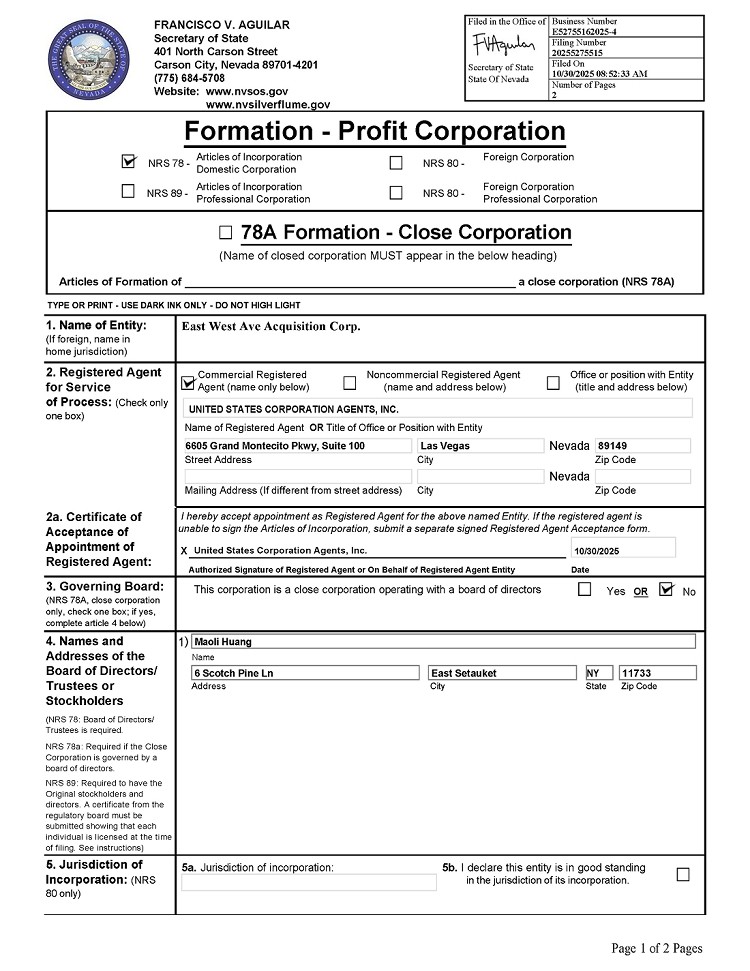
Our company is a blank check company incorporated in the state of Nevada. One of our sponsors is located in Hong Kong, however, we currently do not hold any equity interest in any PRC company or operate any business in China and our officers and directors are located outside of China. Therefore, we believe we are not required to obtain permissions or approvals from any PRC government authorities, including the CSRC or the Cyberspace Administration of China, or any other government entity, to issue our securities to foreign investors and to list on a U.S. exchange or operate our business. As of the date of this prospectus, we have not received any inquiry, notice, warning, sanctions or regulatory objection to this offering from the CSRC or any other PRC governmental authorities. However, if we inadvertently concluded that such permissions or approvals are not required, or applicable laws, regulations, or interpretations change and we are required to obtain such permissions or approvals in the future, and we are denied permission and/or approvals, the relevant PRC government agencies could subject us to a stringent approval process from the relevant government entities in connection with this offering, continued listing on a U.S. exchange, the potential business combination, and the issuance of shares or the maintenance of our status as a publicly listed company outside China. We may also be subject to registration with the CSRC following this offering pursuant to the Trial Administrative Measures. It is uncertain when and whether we will be required to obtain permission from the PRC government to continue to list on a U.S. exchange in the future and offer our securities to foreign investors. If we inadvertently concluded that such permissions or approvals are not required, or applicable laws, regulations, or interpretations change and we are required to obtain such permissions or approvals in the future, including pursuant to the Trial Administrative Measures, and we are denied permission and/or approvals from Chinese authorities to list on U.S. exchanges or offer our securities to foreign investors, we may not be able to continue listing on a U.S. exchange or be subject to other severe consequences, which would materially affect the interest of the investors. In addition, any changes in PRC law, regulations, or interpretations may severely affect our operations after this offering. The use of the term “operate” and “operations” includes the process of searching for a target business and conducting related activities. For more information, see “Risk Factors — Given certain ties we have with Hong Kong and China, the Chinese government may intervene or influence our operations at any time through our insiders who are based in or have significant ties in China, which could result in a material change in our search for a target business and the value of the securities we are offering. Changes in the policies, regulations, rules, and the enforcement of laws of the PRC government may be adopted quickly with little advance notice and could have a significant impact upon our ability to operate.” on page 38 of this prospectus.
On December 16, 2021, pursuant to the Holding Foreign Companies Accountable Act (the “HFCAA”), the PCAOB issued a Determination Report which found that the PCAOB is unable to inspect or investigate completely registered public accounting firms headquartered in: (i) China, and (ii) Hong Kong. On August 26, 2022, the PCAOB signed a Statement of Protocol with the China Securities Regulatory Commission and the Ministry of Finance of the PRC (“SOP”), taking the first step toward opening access for the PCAOB to inspect and investigate registered public accounting firms headquartered in mainland China and Hong Kong completely, consistent with U.S. law. Pursuant to the SOP, the PCAOB shall have independent discretion to select any issuer audits for inspection or investigation and has the unfettered ability to transfer information to the SEC. On December 15, 2022, the PCAOB determined that the PCAOB was able to secure complete access to inspect and investigate registered public accounting firms headquartered in mainland China and Hong Kong and voted to vacate its previous determinations to the contrary.
However, should PRC authorities obstruct or otherwise fail to facilitate the PCAOB’s access in the future, the PCAOB will consider the need to issue a new determination. Our California-headquartered auditor, Fortune CPA, Inc, is an independent registered public accounting firm registered with the PCAOB and has been inspected by the PCAOB on a regular basis. The PCAOB currently has access to inspect the working papers of our auditor. Our auditor is not headquartered in China or Hong Kong and was not identified in the determination report as a firm subject to the PCAOB’s determination.
As described in “Proposed Business — Sourcing of Potential Initial Business Combination Targets” and “Management — Conflicts of Interest,” each of our directors and officers presently has, and any of them in the future may have additional, fiduciary, contractual or other obligations or duties to one or more other entities pursuant to which such officer or director is or will be required to present a business combination opportunity to such entities. There may be actual or potential material conflicts of interest (direct and indirect) between the sponsors, any affiliates thereof, or promoters as one group, and purchasers in the offering as another group in determining whether a particular target business is an appropriate business with which to effectuate our initial business combination. The low price that our insiders (directly or indirectly) paid for the founder shares creates an incentive whereby our insiders could potentially make a substantial profit even if we select an acquisition target that subsequently declines in value and is unprofitable for public stockholders. If we are unable to complete our initial business combination within 18 months from the closing of this offering, or by such earlier liquidation date as our board of directors may approve, the founder shares and private rights may expire worthless, except to the extent they receive liquidating distributions from assets outside the trust account, which could create an incentive for our insiders to complete a transaction even if we select an acquisition target that subsequently declines in value and is unprofitable for public stockholders. Further, each of our directors and officers may have a conflict of interest with respect to evaluating a particular business combination if the retention or resignation of any such directors and officers was included by a target business as a condition to any agreement with respect to our initial business combination.
The following table sets forth the payments to be received by our insiders from us prior to or in connection with the completion of our initial business combination and the securities issued and to be issued by us to insiders. See the section titled “Summary – Sourcing of Potential Initial Business Combination Targets,” “Proposed Business – Sourcing of Potential Initial Business Combination Targets” on page 79,” Management — Conflicts of Interest” on page 106, “Management – Executive Officer and Director Compensation” on page 102,” “Certain Relationships and Related Party transactions” on page 112, “Description of Securities – Private Units,” on page 115, “Description of Securities – Working Capital Loan Units,” on page 115, “Description of Securities – Founder Shares” on page 118, and “Description of Securities – Registration Rights Agreement,” and “Risk Factors – Since our insiders will lose their entire investment in us if our initial business combination is not completed (other than with respect to public shares they may acquire during or after this offering), a conflict of interest may arise in determining whether a particular business combination target is appropriate for our initial business combination” on page 47 for more information.
| Entity/Individual | Amount
of Compensation to be to be Issued |
Consideration Paid or to be Paid | ||
East West Ave LLC (sponsor A) |
shares of common stock(1) | $ | ||
| private units(1) | $ | |||
| Up
to $ |
Repayment of loans made to us by our sponsor to cover offering-related and organizational expenses. | |||
| $ |
Office space, administrative and support services | |||
| Up
to $ |
Working capital loans to finance transaction costs in connection with an intended initial business combination. | |||
| Services in connection with identifying, investigating and completing an initial business combination, or managing our operation as a public company | ||||
NFR Capital Limited (sponsor B) |
shares of common stock | $ | ||
| private units(1) | $ | |||
| Up
to $ |
Working capital loans to finance transaction costs in connection with an intended initial business combination. | |||
| Services in connection with identifying, investigating and completing an initial business combination, or managing our operation as a public company | ||||
Molly Huang (manager of sponsor A and CEO of the Company) |
founder shares(2) | Services in connection with identifying, investigating and completing an initial business combination, or managing our operation as a public company.
| ||
|
Services in connection with identifying, investigating and completing an initial business combination, or managing our operation as a public company.
| |||
See also information concerning East West Ave LLC (sponsor A) described elsewhere in this table
|
See also information concerning East West Ave LLC (sponsor A) described elsewhere in this table | |||
Yanjie Wang (director of sponsor B) |
See information concerning NFR Capital Limited (sponsor B) described elsewhere in this table | See information concerning NFR Capital Limited (sponsor B) described elsewhere in this table
| ||
Thomas Kerkaert (CFO of the Company) |
$ founder shares |
Services in connection with identifying, investigating and completing an initial business combination, or managing our operation as a public company.
| ||
|
Services in connection with identifying, investigating and completing an initial business combination, or managing our operation as a public company. | |||
Irfan Verjee (independent director nominee) |
$ founder shares |
Services in connection with identifying, investigating and completing an initial business combination, or managing our operation as a public company.
Services in connection with identifying, investigating and completing an initial business combination, or managing our operation as a public company.
| ||
| Masahiro Honna (independent director nominee) | founder shares
|
Services in connection with identifying, investigating and completing an initial business combination, or managing our operation as a public company.
| ||
|
Services in connection with identifying, investigating and completing an initial business combination, or managing our operation as a public company.
| |||
| Samir Parikh (independent director nominee) | founder shares
|
Services in connection with identifying, investigating and completing an initial business combination, or managing our operation as a public company.
| ||
|
Services in connection with identifying, investigating and completing an initial business combination, or managing our operation as a public company.
|
| (1) | Assumes no exercise of the over-allotment option and the full forfeiture of 375,000 shares without exercise of the underwriters’ over-allotment option. |
| (2) | Not including 636,333 founder shares that Ms. Huang holds through her membership interest in sponsor A, over which she does not hold any voting or dispositive rights but would be entitled to receive the shares upon distribution by or liquidation of the sponsor A. |
Because our insiders acquired the founder shares at an average nominal price of $0.0087, our public stockholders will incur immediate and substantial dilution upon the closing of this offering, assuming no value is ascribed to the rights included in the units. See the section titled “Risk Factors — Risks Relating to our Securities — Our sponsors paid an aggregate of $25,000 to cover certain of our offering costs in exchange for 2,875,000 founder shares, or approximately an average price of $0.0087 per founder share and, accordingly, you will experience immediate and substantial dilution from the purchase of our shares of common stock.” Public stockholders will experience additional dilution from the issuance of common stock upon the conversion of any public rights and the issuance of common stock upon the conversion of any private rights. Additional shares may be issued upon conversion of any private rights underlying private units issued upon conversion of working capital loans up to $3,000,000. As a result, the compensation to be paid and securities issued to the insiders, their affiliates, or promoters may result in a material dilution of the equity interests of public stockholders.
Investing in our securities involves a high degree of risk. See “Summary – The Offering – Founder Shares,” “Summary –The Offering – Private units and underlying securities,” “Risk Factors” and “Certain Relationships and Related Party Transactions”. Investors will not be entitled to protections normally afforded to investors in Rule 419 blank check offerings. Neither the U.S. Securities and Exchange Commission nor any state securities commission has approved or disapproved of these securities or determined if this prospectus is truthful or complete. Any representation to the contrary is a criminal offense.
| Per Share | Without Over-allotment Option | With
Over-allotment Option | ||||||||||
| Initial public offering price | $ | 10.000 | $ | 100,000,000 | $ | 115,000,000 | ||||||
| Underwriting discounts and commissions(1) | 0.125 | $ | 1,250,000 | $ | 1,437,500 | |||||||
| Proceeds to us, before expenses | $ | 9.875 | $ | 98,750,000 | $ | 113,562,500 | ||||||
| (1) | The underwriters will be entitled to an underwriting discount equal to 1.25% of the gross proceeds from the sale of the over-allotment units. In addition to the cash compensation set forth herein, we have agreed to issue to the representative of the underwriters or its designee an aggregate of 75,000 shares of common stock (or 86,250 shares of common stock if the underwriters’ over-allotment option is exercised in full), which we refer to herein as the “representative shares”, as part of representative compensation, which will be issued upon the consummation of this offering, and 100,000 deferred underwriting compensation shares (or up to 115,000 deferred underwriting compensation shares if the over-allotment option is exercised in full) upon the closing of an initial business combination of the Company. See also “Underwriting” for a description of compensation and other items of value payable to the underwriters. |
Of the proceeds we receive from this offering and the sale of the private placement units described in this prospectus, $100,000,000 ($10.00 per share), or $115,000,000 ($10.00 per share) if the underwriters’ over-allotment option is exercised in full, will be deposited into a trust account in the United States with Wilmington Trust, N.A. acting as trustee, after deducting $1,250,000 (or $1,437,500 if the over-allotment option is exercised in full) in underwriting commissions payable upon the closing of this offering, $662,500 to pay fees and expenses in connection with the closing of this offering, and $1,087,500 (or $900,000 if the over-allotment option is exercised in full) held outside the trust account for working capital purposes following this offering.
The underwriters are offering the units for sale on a firm commitment basis. The underwriters expect to deliver the units to the purchasers on or about , 2026.
Prime Number Capital, LLC
The date of this prospectus is , 2026
TABLE OF CONTENTS
We are responsible for the information contained in this prospectus. We have not authorized anyone to provide you with different information, and we take no responsibility for any other information others may give to you. We are not, and the underwriters are not, making an offer to sell securities in any jurisdiction where the offer or sale is not permitted. You should not assume that the information contained in this prospectus is accurate as of any date other than the date on the front of this prospectus.
| i |
TRADEMARKS
This prospectus contains references to trademarks and service marks belonging to other entities. Solely for convenience, trademarks and trade names referred to in this prospectus may appear without the ® or TM symbols, but such references are not intended to indicate, in any way, that the applicable licensor will not assert, to the fullest extent under applicable law, its rights to these trademarks and trade names. We do not intend our use or display of other companies’ trade names, trademarks or service marks to imply a relationship with, or endorsement or sponsorship of us by, any other companies.
| ii |
SUMMARY
This summary only highlights the more detailed information appearing elsewhere in this prospectus. As this is a summary, it does not contain all of the information that you should consider in making an investment decision. You should read this entire prospectus carefully, including the information under “Risk Factors” and our financial statements and the related notes included elsewhere in this prospectus, before investing.
Unless otherwise stated in this prospectus or the context otherwise requires, references to:
| ● | “approved extension” are to an extension of the date by which we must complete our initial business combination as approved by the affirmative vote of the holders of a majority of the shares of our common stock that are voted at a stockholder meeting held to amend our organizational documents to extend such date; |
| ● | “sponsor
B” are to |
| ● | “combination window” are to the period of time provided in the articles of incorporation of the Company within which the company may consummate its initial business combination, which shall commence from the closing of this offering and shall ends on the 18th month anniversary of the closing of this offering (or such later date as approved by the affirmative vote of the holders of a majority of the shares of our common stock that are voted at a stockholder meeting held to amend our organizational documents to extend such date); |
| ● | “sponsor
A” are to |
| ● | “directors” are to our current directors and directors to be duly appointed;
|
| ● | “founder shares” are to shares of our common stock initially purchased by our sponsors in a private placement; |
| ● | “insiders” are to the sponsors, directors and officers of the Company; |
| ● | “management” or our “management team” are to our executive officers and directors; |
| ● | “NRS” are to the Nevada Revised Statutes. |
| ● | “private placement” are to the private placement to our sponsors (and/or their designees) of the private units that will occur simultaneously with this offering. |
| ● | “private rights” are to the rights sold as part of the private units, each to receive one-eighth (1/8) of a private share upon the consummation of an initial business combination; |
| ● | “private shares” are to the shares of common stock sold as part of the private units; |
| ● | “private units” are to the units issued to our sponsors (and/or its designees) in a private placement simultaneously closing with the closing of this offering, with each private unit consisting of one private share and one private right; |
| ● | “public rights” refer to the rights sold as part of the units in this offering; |
| ● | “public shares” are to shares of common stock sold as part of the units in this offering (whether they are purchased in this offering or thereafter in the open market); |
| 1 |
| ● | “public units” are to the units in this offering (whether they are purchased in this offering or thereafter in the open market); |
| ● | “public stockholders” are to the holders of our public shares, including our insiders and management team to the extent our insiders and/or officers or directors purchase public shares, provided that each insider’s and member of our management team’s status as a “public stockholder” will only exist with respect to such public shares; |
| ● | “representative shares” are to the 75,000 shares of common stock (or up to 86,250 shares of common stock to the extent that the underwriters’ over-allotment option is exercised in full or in part) to be issued to Prime Number Capital, LLC, and/or its designees, at the closing of this offering; |
| ● | “sponsors” are to sponsor A and sponsor B; |
| ● | “we,” “us,” “company,” “Company” or “our company” are to East West Ave Acquisition Corp., a Nevada corporation; |
Unless we tell you otherwise, the information in this prospectus assumes that the underwriters will not exercise their over-allotment option.
| 2 |
GENERAL
We are a newly organized blank check company formed as a Nevada corporation for the purpose of effecting a merger, capital stock exchange, asset acquisition, stock purchase, reorganization or similar business combination with one or more businesses. Throughout this prospectus we will refer to this as our initial business combination. We have not selected any specific business combination target and we have not, nor has anyone on our behalf, engaged in any substantive discussions, directly or indirectly, with any business combination target with respect to an initial business combination with us. Although we will not limit our search to any particular industry, we intend to focus our search for a target business in the financial technology, digital assets, and energy solutions sectors. In addition, although we will not limit our search to any particular geographic region, we will not undertake our initial business combination with any company being based in or having the majority of the company’s operations in China (including Hong Kong and Macau).
We intend to prioritize combinations where we see significant opportunity for attractive risk adjusted investor returns driven by the dynamics of a public listing. Since our team has experience and contacts in many different industries within and outside financial services, if we find a quality combination in an industry outside of financial services, we may choose to pursue that combination. We believe we can capitalize on the network and ability of our management team to identify, acquire, and manage a business. We intend to find a combination that can benefit from our experience, support infrastructure, and differentiated global network.
We are a blank check company incorporated in the state of Nevada. One of our sponsors is located in Hong Kong, however, we currently do not hold any equity interest in any PRC company or operate any business in China and our management including officers and directors are located outside of China. Therefore, we do not believe that we are currently required to obtain from PRC authorities permission to operate and issue securities to foreign investors, notwithstanding that some of our insiders have ties with China, and have not sought any permission from PRC authorities to operate and issue securities to foreign investors since our only activity to date is to offer securities outside of China. However, if we are incorrect in our conclusion that such permissions are not required, and should China determine that, notwithstanding the foregoing, we are required to obtain permission to operate and issue securities to foreign investors, or if applicable laws, regulations or interpretations change and we are required to obtain such permissions or approvals in the future, our ability to issue securities to foreign investors may be materially adversely affected.
Pursuant to the Holding Foreign Companies Accountable Act, or the HFCAA, the PCAOB issued a Determination Report on December 16, 2021 which found that the PCAOB is unable to inspect or investigate completely registered public accounting firms headquartered in (1) mainland China of the PRC because of a position taken by one or more authorities in mainland China and (2) Hong Kong, a Special Administrative Region and dependency of the PRC, because of a position taken by one or more authorities in Hong Kong. In addition, the PCAOB’s report identified the specific registered public accounting firms which are subject to these determinations. On December 15, 2022, the PCAOB announced that PCAOB has secured complete access to inspect and investigate public accounting firms headquartered in mainland China and Hong Kong, and vacated previous determinations to the contrary. However, uncertainties exist with respect to the implementation of this framework and there is no assurance that the PCAOB will be able to execute, in a timely manner, its future inspections and investigations in a manner that satisfies the Protocol. Should PRC authorities obstruct or otherwise fail to facilitate the PCAOB’s access — in any way and at any point in the future — the Board of PCAOB will act immediately to consider the need to issue a new determination. Our California-headquartered auditor, Fortune CPA, Inc, is an independent registered public accounting firm and is subject to regular inspection by the PCAOB. Fortune CPA, Inc is not headquartered in mainland China or Hong Kong and was not identified in the Determination Report as a firm subject to the PCAOB’s determinations. In addition, we will affirmatively exclude any target company whose financial statements of which are audited by an accounting firm that the PCAOB has been unable to inspect for two consecutive years at the time of our business combination.
BUSINESS STRATEGY
Our management team’s primary goal is to enhance stockholder value by applying its operational and business management expertise to identify targets with established track record and organic growth potential for acquisition. In line with this approach, we have outlined several key focus areas that we consider important when evaluating potential acquisition targets. While these focus areas will guide our evaluation process, we may choose to depart from them if circumstances warrant:
| ● | Leadership profile: We prioritize acquiring businesses that are led by visionary management teams with a demonstrated history of delivering growth and profitability. Our focus is on leaders who not only possess deep operational expertise but also have a clear, forward-looking strategy for their company’s future. We believe that a compelling vision, combined with a proven ability to execute and adapt, is essential for sustained value creation. Whether the business has already established a strong performance record or is structured around an innovative model that is likely to attract public market interest, we seek management teams who can articulate and realize ambitious goals, inspire their organizations, and navigate the complexities of scaling as a public company. |
| 3 |
| ● | Growth trajectory: We seek to acquire companies that have demonstrated the ability to generate consistent revenue streams and maintain profitability over time. Our ideal targets are those with established business models and operational discipline, ensuring a solid foundation for ongoing financial performance. Building on the foundation set by past success, the ideal targets should be poised to succeed in the future as well. This includes organizations with continued opportunities to scale—whether by accelerating organic growth, entering new markets, or pursuing strategic acquisitions. | |
| ● | Operational excellence: We actively seek out businesses that exemplify operational excellence as a core part of their identity. This means we prioritize companies that have established robust, efficient processes across their operations, enabling them to consistently deliver high-quality products or services while controlling costs and minimizing waste. Effective management is a key component—leaders who set clear objectives, monitor performance rigorously, and foster accountability throughout the organization are better positioned to drive sustainable results. | |
| ● | Upside potential: We seek acquisition targets where we can capitalize on a compelling valuation relative to their intrinsic and future potential. Our approach is to identify businesses that not only demonstrate the ability to generate steady cash flows and operational efficiencies, but are also positioned for further value creation. In our evaluation, we prioritize companies where we see clear opportunities to unlock additional value—whether through organic growth, cost optimization, or strategic expansion, including follow-on acquisitions. We also assess the potential for future earnings growth and improvements in capital structure, aiming to deliver superior, risk-adjusted returns to stockholders by acquiring businesses at attractive entry points and supporting their long-term growth trajectory. |
These focus areas are meant to serve as general considerations rather than an exhaustive list. Our assessment of any potential business combination may also take into account other relevant factors as determined by our management.
If we decide to pursue a business combination with a target that does not meet these criteria, we will disclose this in our communications to stockholders regarding the transaction, such as proxy statements or tender offer documents filed with the U.S. Securities and Exchange Commission (the “SEC”).
| 4 |
OUR MANAGEMENT TEAM
We intend to fully leverage our management team’s extensive and proprietary network of relationships across the business landscape—including corporate executives, private equity and venture capital firms, growth capital providers, investment banks, and specialized consultants—to identify, evaluate, and support high-quality business combination opportunities. Our team’s broad connectivity enables us to access a diverse pipeline of potential targets, including opportunities that may not be widely marketed or accessible to the general investment community.
In addition to these relationships, several officers or directors bring a deep track record in corporate finance, mergers and acquisitions, and strategic advisory roles. This experience provides us with unique perspectives and analytical rigor when assessing the financial health, operational strength, and long-term potential of prospective targets. Our ability to conduct thorough due diligence, evaluate complex capital structures, and understand industry-specific dynamics positions us to make informed decisions and add value throughout the acquisition process.
We believe that this combination of robust networks and specialized expertise not only enhances our ability to source attractive business combination candidates but also makes us a preferred partner for target companies seeking strategic growth and public market access. However, none of our management team is obligated to remain with the company after an acquisition transaction, and we cannot provide assurance that the resignation or retention of our current management will be a term or condition in any agreement relating to business combination. Moreover, despite the competitive advantages we believe we have, we remain subject to significant competition with respect to identifying and executing a business combination.
Maoli (Molly) Huang, CEO, President and director. Ms. Huang has served as our director, CEO and President since October 2025. Ms. Huang brings to the Company more than two decades of asset management, corporate finance and investment banking experience in senior executive and management roles. Before joining the Company, Ms. Huang acted as Managing Director of Amber Capital Asia, a Hong Kong investment management firm, from the United States from August 2024 to October 2025, overseeing the overall investment strategy, capital allocation and portfolio management for the firm, before transitioning to a consulting role for the company in the United States. Ms. Huang joined Amber Capital Asia after a period of freelancing consulting work for companies and entrepreneurs from June 2023 to August 2024. Previously Ms. Huang spent a decade at Seazen Group Holdings (SSE: 601155), a real estate and investment management company, and its portfolio companies, where she served in various senior executive roles, including as Head of Capital Market from 2012 to 2019 and Executive Director from 2012 to 2014 for Seazen Group Holdings, Managing Partner from 2015 to 2019 for Seazen Capital Partners in the US, Group Vice President from July 2019 to June 2023 for Seazen Development Holdings, and CEO of Seazen Asset Management Pte. Ltd. in Singapore, an asset management spun off from Seazen Development Holdings, from June 2021 to June 2023. Ms. Huang received her M.B.A. degree from the Wharton School of Business, University of Pennsylvania, and M.S. and B.S. degrees in economics from Nanjing University.
We believe Ms. Huang qualifies as a director because of her extensive investment banking and financial management experience.
Thomas Kerkaert, CFO and director. Mr. Kerkaert has served as our CFO and director since February 2026. Mr. Kerkaert has over 20 years of experience in senior finance and accounting leadership roles. From March 2022 to August 2025, he served as the CFO of Riverbend Sandler Pools, a private equity-backed swimming pool contracting platform where he oversaw finance and accounting. From August 2020 to March 2022, he served as the CFO of Legacy Housing Corporation (NASDAQ: LEGH), where he oversaw SEC reporting, investor relations, and the broader finance organization for the manufactured homes producer. From July 2013 to August 2020, he held senior finance roles at Sandvik AB, a global industrial company, including controller, director of finance, and vice president of finance, with responsibility for finance and various management functions. Mr. Kerkaert received both his master’s degree in accounting and his bachelor’s degree in business management from the University of Arizona. He is a Certified Public Accountant in Texas and Arizona.
We believe Mr. Kerkaert qualifies as a director because of his extensive financial management experience.
Samir Parikh, independent director nominee. Mr. Parikh will become our independent director upon the listing our securities on the NASDAQ. Mr. Parikh has more than two decades of experience in public and private market investments. He has served as the sole Managing Partner at GiantLeap Capital, an investment management firm that he founded in 2021. Before founding GiantLeap, Mr. Parikh served as the Chief Investment Officer at Juna Capital, a family office, from 2018 to 2021, where he also advised hedge funds Hudson Bay Capital and Key Square Group. He also served as Head of Public Equities, Real Estate, at Fir Tree Partners, a leading global investment manager for institutional investors. Prior to his role at Fir Tree Partners, Mr. Parikh founded and managed Juna Capital Management, a hedge fund, from 2013 to 2016. Mr. Parikh received his M.B.A. degree from Harvard Business School, and B.A. degree in economics from the University of Chicago with honors.
We believe Mr. Parikh qualifies as a director because of his extensive experience in public and private market management.
Irfan Verjee, independent director nominee. Mr. Verjee will become our independent director upon the listing our securities on the NASDAQ. Mr. Verjee has more than two decades of venture capital and investment management experience, with a particular focus on clean energy and green energy technologies. Mr. Verjee has served as the Managing Partner at Shomei Capital, an investment management he co-founded to focus on renewable energy and emerging technologies investments, since 2017. He has also served as a finance director of Crop Intellect Ltd., an agricultural and environment technology firm, since July 2024, and as the CEO and director of Shomax Energy US Inc., a green fertilizing technology developer, since January 2021. Previously, Mr. Verjee served as CEO and director of Vestec, Inc., an artificial intelligence (AI) developer, from 2013 to 2015. He has also served as a portfolio manager and analyst at Kingdon Capital, a longstanding New York hedge fund, from 2000 to 2008. Mr. Verjee started his career at Oppenheimer Capital, an asset manager, where he worked from 1997 to 2000. Mr. Verjee received his BCom degree in finance and economics from McGill University.
We believe Mr. Parikh qualifies as a director because of his extensive experience in public and private market management.
Masahiro Honna, independent director nominee. Mr. Honna will become our independent director upon the listing our securities on the NASDAQ. Mr. Honna has more than two decades of experience in M&A and IPO advisory and investment management services. Mr. Honna has served as a managing director of KYGO Limited, a Hong Kong based investment management and advisory firm he founded, since 2009. From 2018 to 2022, Mr. Honna also served as a managing director of OWL Hong Kong Limited until its integration into KYGO Limited. Before founding KYGO Limited, Mr. Honna spent almost a decade at Goldman Sachs from 2000 to 2009, where he worked as an executive director in Tokyo and Beijing for several years on a variety of IPO and M&A advisory matters. Mr. Honna started his career at Nomura Securities, a major Japanese financial institution, as an analyst from 1997 to 2000. Mr. Honna received his bachelor’s degree in international relations from Tokyo University.
We believe Mr. Honna qualifies as a director because of the M&A advisory and investment management experience he brings.
| 5 |
None of our insiders has prior experience in special purpose acquisition companies, although they collectively have solid knowledge and experience in capital markets, investments as well as M&A. In recent years, the number of special purpose acquisition companies that have been formed has increased substantially. Many potential targets for special purpose acquisition companies have already entered into an initial business combination, and there are still many companies preparing for an initial public offering. As a result, at times, fewer attractive targets may be available to consummate an initial business combination. In addition, because there are more special purpose acquisition companies seeking to enter into an initial business combination with available targets, the competition for available targets with attractive fundamentals or business models may increase, which could cause targets companies to demand improved financial terms. See “Risk Factors — As the number of special purpose acquisition companies evaluating targets increases, attractive targets may become scarcer and there may be more competition for attractive targets. This could increase the cost of our initial business combination and could even result in our inability to find a target or to consummate an initial business combination” on page 31 for additional information. The high level of competition may negatively impact the acquisition terms we are able to negotiate because, among other things, attractive target companies will be able to demand higher purchase prices and more favorable closing conditions, including minimum cash required in the trust account at closing or PIPE financing requirements and board designation rights with respect to the combined company.
We believe that none of our officers, directors and sponsors have significant ties to China except that: (x) Ms. Molly Huang, our Chief Executive Officer, President and director and the manager of East West Ave LLC, the sponsor A, is a U.S. citizen and resident who has historically worked for several Chinese and Hong Kong based companies; (y) our Sponsor B, NFR Capital Limited, is a Hong Kong company, whose director and shareholder is Yanjie Wang, a resident of Hong Kong; (z) Mr. Honna, our independent director nominee, is a resident of Hong Kong. We do not believe that we or the business combination will be subject to the jurisdiction, control or intervention of the PRC Government or the legal and operational risks associated thereof, since none of our directors or officers are resident or citizens of China or Hong Kong, and we will not undertake our initial business combination with any company being based in or having the majority of the company’s operations in China. However, the PRC government has significant authority to intervene or influence our operations at any time through our insiders who are based in or have significant ties in China. See “Risk Factors — Given certain ties we have with Hong Kong and China, the Chinese government may intervene or influence our operations at any time through our insiders who are based in or have significant ties in China, which could result in a material change in our search for a target business and the value of the securities we are offering. Changes in the policies, regulations, rules, and the enforcement of laws of the PRC government may be adopted quickly with little advance notice and could have a significant impact upon our ability to operate.” on page 38 of this prospectus. In addition, our ties to China and Hong Kong would make us a less attractive partner to a non-China-based target company and such perception may potentially limit or negatively impact our search for an initial business combination. See “Risk Factors — It is uncertain whether our significant ties to Hong Kong and China would make us a less attractive partner to a non-China-based target company and such perception may potentially limit or negatively impact our search for an initial business combination.” on page 40 of this prospectus.
Enforcement of Civil Liabilities
All of our officers and directors are U.S. citizens or permanent residents residing in the U.S., except that one of our independent director nominees, Mr. Honna is a Hong Kong resident. In addition, our sponsor B is a Hong Kong company and the shareholder and director of sponsor B is a Hong Kong resident. Investors will be able to effect service of process and enforce judgement of United States courts predicated upon civil liabilities and criminal penalties on them under United States securities laws against our officers and directors, except against our overseas-based insiders. For Mr. Honna or our sponsor B, however, it may be difficult to effect service of process, enforcing foreign judgments, or bringing actions against him or it. See “Risk Factors—You may experience difficulties in effecting service of legal process, enforcing foreign judgments, or bringing actions against our overseas-based insiders based on foreign laws.” on page 31 of this prospectus.
There is also uncertainty as to whether the courts of Hong Kong would (1) recognize or enforce judgments of U.S. courts obtained against our insiders that are predicated upon the civil liability provisions of the federal securities laws of the United States or the securities laws of any state in the United States, or (2) entertain original actions brought in Hong Kong against us or our insiders that are predicated upon the federal securities laws of the United States or the securities laws of any state in the United States.
In addition, judgments of United States courts will not be directly enforced in Hong Kong. There are currently no treaties or other arrangements providing for reciprocal enforcement of foreign judgments between Hong Kong and the United States. However, subject to certain conditions, including but not limited to when the judgment is for a definite sum of money in a civil matter and not in respect of taxes, fines, penalties or similar charges, the judgment is final and conclusive rendered by a court with jurisdiction to adjudicate the matter and has not been stayed or satisfied in full, the judgment is from a competent court, the judgment was not obtained by fraud, misrepresentation or mistake nor obtained in proceedings which contravenes the rules of natural justice and the enforcement of the judgment is not contrary to public policy in Hong Kong, Hong Kong courts may accept such judgment obtained from a United States court as a debt due under the rules of common law. However, a separate legal action for debt must be commenced in Hong Kong in order to recover such debt from the judgment debtor.
Potential Approvals from the PRC Governmental Authorities for this Offering
Based on our understanding of the current PRC laws and regulations, no prior permission is required under the rules and regulations listed above from any PRC governmental authorities (including the China Securities Regulatory Commission (the “CSRC”)) for consummating this offering by our company, given that: (a) the CSRC currently has not issued any definitive rule or interpretation concerning whether offerings like ours under this prospectus are subject to the M&A Rules; (b) our company is a blank check company newly incorporated in the state of Nevada rather than in China, with no business or operations in China; and (c) our officers and directors are located outside of China.
We do not believe that we require any approval from PRC governmental authorities for this offering, including, but not limited to, those permission requirements of the CSRC, Cyberspace Administration of China (the “CAC”), notwithstanding that our insiders’ ties to China. Accordingly, we have not applied for (or been denied) any permissions by any PRC governmental authorities. If the CSRC or another PRC governmental authority subsequently determines that its approval is needed for this offering, we may face approval delays, adverse actions, or sanctions by the CSRC or other PRC governmental authorities.
However, there can be no assurance that the relevant PRC governmental authorities, including the CSRC, would reach the same conclusion as us, or that the CSRC or any other PRC governmental authorities would not promulgate new rules or new interpretations of current rules which would require us to obtain CSRC or other PRC governmental approvals for this offering. If the CSRC or another PRC governmental authority subsequently determines that its approval is needed for this offering, we may face approval delays, adverse actions, or sanctions by the CSRC or other PRC governmental authorities.
In any such event, complying with the requirements of the above-mentioned regulations and other relevant rules and any required approval processes with PRC governmental authorities could be time-consuming and may delay this offering or a potential business combination. These governmental authorities may impose fines and penalties, limit our operations in China, or take other actions that could materially adversely affect our business, financial condition, results of operations, reputation and prospects, as well as significantly limit or significantly hinder our ability to offer or continue to offer securities to investors and cause the value of our securities to significantly decline or be worthless, if we fail to comply with the above-mentioned regulations or other relevant rules. No PRC legal counsel has been retained for purpose of this offering and consequently the company did not rely on the advice of PRC counsel. The above discussion is based on our management’s understanding of the current PRC laws, rules, regulations and local market practices and we cannot assure you that our management’s understanding is correct. We have been closely monitoring regulatory developments in China regarding any necessary approvals from the CSRC or other PRC governmental authorities required for overseas listings, including this offering and a potential business combination with a target business based in and primarily operating in China. As of the date of this prospectus, we have not received any inquiry, notice, warning, sanctions or regulatory objection to this offering from the CSRC or other PRC governmental authorities.
| 6 |
BUSINESS COMBINATION CRITERIA
Consistent with our business strategy, we have identified the following general criteria and guidelines that we believe are important in evaluating prospective target businesses. We will use these criteria and guidelines in evaluating initial business combination opportunities, but we may decide to enter into our initial business combination with a target business that does not meet these criteria and guidelines. We intend to seek to acquire companies within industries that exhibit strong characteristics including, but not limited to, the following:
| ● | Public market-ready scale; |
| ● | Strong management team; |
| ● | Long-term organic growth or growth potential; |
| ● | Consolidation opportunities to scale; |
| ● | Attractive competitive dynamics; |
| ● | Differentiated products or services; and |
These criteria are not intended to be exhaustive. Any evaluation relating to the merits of a particular initial business combination may be based, to the extent relevant, on these general guidelines as well as other considerations, factors and criteria that our management team may deem relevant. In the event that we decide to enter into our initial business combination with a target business that does not meet the above criteria and guidelines, we will disclose that the target business does not meet the above criteria in our stockholder communications related to our initial business combination, which, as discussed in this prospectus, would be in the form of proxy solicitation materials or tender offer documents, as applicable, that we would file with the SEC. In evaluating a prospective target business, we expect to conduct a due diligence review which may encompass, among other things, meetings with incumbent management and employees, document reviews, interviews with customers and suppliers, inspections of facilities, as well as reviewing financial and other information which will be made available to us.
The time required to select and evaluate a target business and to structure and complete our initial business combination, and the costs associated with this process, are not currently ascertainable with any degree of certainty. Any costs incurred with respect to the identification and evaluation of, and negotiation with, a prospective target business with which our initial business combination is not ultimately completed will result in our incurring losses and will reduce the funds we can use to complete another business combination. The company will not pay any consulting fees to members of our management team, or any of their respective affiliates, for services rendered to or in connection with our initial business combination.
| 7 |
INITIAL BUSINESS COMBINATION
We
will have until 18 months from the closing of this offering (or such later date pursuant to an approved extension) to consummate our
initial business combination (the “combination window”).
We will consummate our initial business combination only if we have net tangible assets of at least $5,000,001 upon such consummation and, solely if we seek stockholder approval, a majority of the issued and outstanding common stock voted are voted in favor of the business combination. We chose our net tangible asset threshold of $5,000,001 to ensure that following a business combination we would avoid being subject to Rule 419 promulgated under the Securities Act.
NASDAQ rules require that we must consummate an initial business combination with one or more operating businesses or assets with a fair market value equal to at least 80% of the net assets held in the trust account (less any taxes payable on interest earned). Our board of directors will make the determination as to the fair market value of our initial business combination. Additionally, pursuant to NASDAQ rules, any initial business combination must be approved by a majority of our independent directors. We are not required to obtain an opinion from an unaffiliated third party that the target business we select has a fair market value in excess of at least 80% of the balance of the trust account unless our board of directors cannot make such determination on its own.
We are also not required to obtain an opinion from an unaffiliated third party indicating that the price we are paying is fair to our stockholders from a financial point of view unless the target is affiliated with our insiders. If our board of directors is not able to independently determine the fair market value of our initial business combination, we will obtain an opinion from an independent investment banking firm or another independent firm that commonly renders valuation opinions for the type of company we are seeking to acquire or from an independent accounting firm with respect to the satisfaction of such criteria. While we consider it unlikely that our board of directors will not be able to make an independent determination of the fair market value of our initial business combination, it may be unable to do so if it is less familiar or experienced with the business of a particular target or if there is a significant amount of uncertainty as to the value of the target’s assets or prospects.
We anticipate structuring our initial business combination so that the post-transaction company in which our public stockholders own shares will own or acquire 100% of the equity interests or assets of the target business or businesses. We may, however, structure our initial business combination such that the post-transaction company owns or acquires less than 100% of such interests or assets of the target business in order to meet certain objectives of the target management team or stockholders or for other reasons, but we will only complete such business combination if the post-transaction company owns or acquires 50% or more of the outstanding voting securities of the target or otherwise acquires a controlling interest in the target sufficient for it not to be required to register as an investment company under the Investment Company Act of 1940, as amended, or the “Investment Company Act”. Even if the post-transaction company owns or acquires 50% or more of the voting securities of the target, our stockholders prior to the business combination may collectively own a minority interest in the post-transaction company, depending on valuations ascribed to the target and us in the business combination transaction. For example, we could pursue a transaction in which we issue a substantial number of new shares in exchange for all of the outstanding capital stock of a target. In this case, we would acquire a 100% controlling interest in the target. However, as a result of the issuance of a substantial number of new shares, our stockholders immediately prior to our initial business combination could own less than a majority of our outstanding shares subsequent to our initial business combination. If less than 100% of the equity interests or assets of a target business or businesses are owned or acquired by the post-transaction company, the portion of such business or businesses that is owned or acquired is what will be taken into account for purposes of the 80% of net assets test described above. If the business combination involves more than one target business, the 80% of net assets test will be based on the aggregate value of all of the target businesses.
Prior to the date of this prospectus, we will file a Registration Statement on Form 8-A with the SEC to voluntarily register our securities under Section 12 of the Securities Exchange Act of 1934, as amended, or the Exchange Act. As a result, we will be subject to the rules and regulations promulgated under the Exchange Act. We have no current intention of filing a Form 15 to suspend our reporting or other obligations under the Exchange Act prior or subsequent to the consummation of our initial business combination.
| 8 |
SOURCING OF POTENTIAL INITIAL BUSINESS COMBINATION TARGETS
We believe our management team’s significant operating and transaction experience and relationships will provide us with a substantial number of potential initial business combination targets. Over the course of their careers, our officers or directors have developed a broad network of contacts and corporate relationships around the world, which includes private equity firms, venture capitalists and entrepreneurs. This network has grown through the activities of our management team sourcing, acquiring and financing businesses, the reputation of our management team for integrity and fair dealing with sellers, financing sources and target management teams and the experience of our management team in executing transactions under varying economic and financial market conditions. In addition, our officers or directors have developed contacts derived directly from serving on the boards of directors of several public and private companies.
This network has provided our management team with a flow of referrals, which in the past has resulted in numerous transactions which were proprietary or where a limited group of investors were invited to participate in the sale process. We believe that this network will provide us with multiple investment opportunities. In addition, we anticipate that target business combination candidates will be brought to our attention by various unaffiliated sources, including participants in our targeted markets and their advisors, private equity funds and large business enterprises seeking to divest non-core assets or divisions.
While we do not presently anticipate engaging the services of professional firms or other individuals that specialize in business acquisitions on any formal basis, we may engage these firms or other individuals in the future, in which event we may pay a finder’s fee, consulting fee or other compensation to be determined in an arm’s length negotiation based on the terms of the transaction. We will engage a finder only to the extent our management determines that the use of a finder may bring opportunities to us that may not otherwise be available to us or if finders approach us on an unsolicited basis with a potential transaction that our management determines is in our best interest to pursue. Payment of a finder’s fee is customarily tied to completion of a transaction, in which case any such fee will be paid out of the funds held in the trust account. In no event, however, will our insiders or their affiliates, be paid any finder’s fee, consulting fee or other compensation by the company prior to, or for any services they render in order to effectuate, the completion of our initial business combination (regardless of the type of transaction). In addition, commencing on the date of this prospectus, we will pay our sponsor A $10,000 per month, for up to 18 months, for office space, secretarial and administrative services provided to members of our management team. Any such payments prior to our initial business combination will be made from funds held outside the trust account.
We are not prohibited from pursuing an initial business combination with a company that is affiliated with the insiders, or completing the business combination through a joint venture or other form of shared ownership with the insiders; accordingly, such affiliated person(s) may have a conflict of interest in determining whether a particular target business is an appropriate business with which to effectuate our initial business combination as such affiliated person(s) would have interests different from our public stockholders and would likely not receive any financial benefit unless we consummated such business combination. In the event we seek to complete an initial business combination with a target that is affiliated with the insiders, we, or a committee of independent directors, would obtain an opinion from an independent investment banking firm or an independent firm that commonly renders valuation opinions for the type of company we are seeking to acquire or from an independent accounting firm stating that such an initial business combination is fair to our company from a financial point of view.
The low price that our insiders (directly or indirectly) paid for the founder shares creates an incentive whereby our management team could potentially make a substantial profit even if we select an acquisition target that subsequently declines in value and is unprofitable for public stockholders. If we are unable to complete our initial business combination within the combination window, or by such earlier liquidation date as our board of directors may approve, the founder shares and private units (and the underlying securities) will be worthless, except to the extent they receive liquidating distributions from assets outside the trust account. Additionally, we will repay, in the closing of this initial public offering, up to $500,000 in loans made to us by our sponsor A to cover offering-related and organizational expenses accrued prior to the offering, and we will reimburse our sponsor A $10,000 per month, for up to 18 months, for office space, administrative and support services made available to us, as described elsewhere in this prospectus. We will repay any loans which may be made by our insiders or their affiliates to finance transaction costs in connection with an intended initial business combination or our operation as a public company; up to $3,000,000 of such loans may be convertible into private units at a price of $10.00 per unit at the option of the lender.
[Molly Huang, our CEO, President and director, is the manager of East West Ave LLC, the Sponsor A, which entitles her to have the sole voting, dispositive or investment powers over the founder shares and private shares held by the Sponsor A. Yanjie Wang, a Hong Kong citizen and resident, is the sole director and the manager of NFR Capital Limited, the Sponsor B, which entitles him to have the sole voting, dispositive or investment powers over the founder shares and private shares held by the Sponsor B. In addition to Ms. Huang and Mr. Wang, each of Sponsor A and Sponsor B have some passive shareholders who do not have any voting or dispositive rights over the founder shares and private units held by Sponsor A or Sponsor B but would be entitled to receive founder shares and private units upon distribution by or liquidation of the sponsors.
Shareholders entitled to receive approximately 10% or more allocation of our securities owned by Sponsor A in aggregate include, assuming the over-allotment option is exercised in full, Molly Huang, a U.S. person and our CEO, who is entitled to receive 636,333 founder shares and 22,200 private units; Zhumei Yang, a U.S. person, who is entitled to receive 400,000 founder shares and 60,000 private units; Xin Gu, a U.S. person, who is entitled to receive 266,667 founder shares and 40,000 private unit;, and Viva Elegance Ltd, a limited company incorporated in British Virgin Islands and owned by Keran Ai, a Hong Kong person, which is entitled to receive 240,000 founder shares.
Shareholders entitled to receive approximately 10% or more allocation of our securities owned by Sponsor B in aggregate include several passive shareholders of Sponsor B’s shareholder, G70 Vision Investment Ltd., a company incorporated in the British Virgin Islands (“G70 Vision”), including Techlex Advisory Limited, a company incorporated in the British Virgin Islands and owned by Dao Bian, a Hong Kong resident, which is entitled to receive 168,000 founder shares and 240,000 private units; Global 70 MFO Limited, a company incorporated in the British Virgin Islands and owned by Lu Sun, a Hong Kong person, which is entitled to receive 112,000 founder shares and 160,000 private units; Zhongming Lu, a Hong Kong person, who is entitled to receive 112,000 founder shares and 160,000 private units; Da Liu, a PRC person, who is entitled to receive 84,000 founder shares and 120,000 private units; and Fisso Investments Limited, a company incorporated in the British Virgin Islands and owned by Zhengdong Ni, a Hong Kong resident, which is entitled to receive 84,000 founder shares and 120,000 private units, in each case whether or not the over-allotment option is exercised.]
| 9 |
The following table sets forth the payments to be received by our insiders from us prior to or in connection with the completion of our initial business combination and the securities issued and to be issued by us to insiders:
| Entity/Individual | Amount of Compensation to be to be Issued |
Consideration Paid or to be Paid | ||
East West Ave LLC (sponsor A) |
shares of common stock(1) | $ | ||
| private units(1) | $ | |||
| Up
to $ |
Repayment of loans made to us by our sponsor to cover offering-related and organizational expenses. | |||
| $ |
Office space, administrative and support services | |||
| Up
to $ |
Working capital loans to finance transaction costs in connection with an intended initial business combination. | |||
| Reimbursement for any out-of-pocket expenses related to identifying, investigating and completing an initial business combination, and managing our operation as a public company | Services in connection with identifying, investigating and completing an initial business combination, or managing our operation as a public company | |||
NFR Capital Limited (sponsor B) |
shares of common stock | $ | ||
| private units(1) | $ | |||
| Up to $3,000,000 in working capital loans may be convertible into private units at a price of $10.00 per unit (collectively with other insiders) | Working capital loans to finance transaction costs in connection with an intended initial business combination. | |||
| Reimbursement for any out-of-pocket expenses related to identifying, investigating and completing an initial business combination, or managing our operation as a pubic company | Services in connection with identifying, investigating and completing an initial business combination, or managing our operation as a public company | |||
Molly Huang (manager of sponsor A and CEO of the Company) |
founder shares (2) | Services in connection with identifying, investigating and completing an initial business combination, or managing our operation as a public company.
| ||
Reimbursement for any out-of-pocket expenses related to identifying, investigating and completing an initial business combination, or managing our operation as a public company
|
Services in connection with identifying, investigating and completing an initial business combination, or managing our operation as a public company.
| |||
See also information concerning East West Ave LLC (sponsor A) described elsewhere in this table
|
See also information concerning East West Ave LLC (sponsor A) described elsewhere in this table | |||
Yanjie Wang (director of sponsor B) |
See information concerning NFR Capital Limited (sponsor B) described elsewhere in this table | See information concerning NFR Capital Limited (sponsor B) described elsewhere in this table
| ||
Thomas Kerkaert (CFO of the Company) |
$ founder shares |
Services in connection with identifying, investigating and completing an initial business combination, or managing our operation as a public company.
| ||
Reimbursement for any out-of-pocket expenses related to identifying, investigating and completing an initial business combination, or managing our operation as a public company
|
Services in connection with identifying, investigating and completing an initial business combination, or managing our operation as a public company. | |||
Irfan Verjee (independent director nominee) |
$ founder shares |
Services in connection with identifying, investigating and completing an initial business combination, or managing our operation as a public company.
Services in connection with identifying, investigating and completing an initial business combination, or managing our operation as a public company.
| ||
| Reimbursement for any out-of-pocket expenses related to identifying, investigating and completing an initial business combination, or managing our operation as a public company | ||||
| Masahiro Honna (independent director nominee) | founder shares
|
Services in connection with identifying, investigating and completing an initial business combination, or managing our operation as a public company.
| ||
|
Reimbursement for any out-of-pocket expenses related to identifying, investigating and completing an initial business combination, or managing our operation as a public company | Services in connection with identifying, investigating and completing an initial business combination, or managing our operation as a public company.
| ||
| Samir Parikh (independent director nominee) | founder shares
|
Services in connection with identifying, investigating and completing an initial business combination, or managing our operation as a public company.
| ||
|
Reimbursement for any out-of-pocket expenses related to identifying, investigating and completing an initial business combination, or managing our operation as a public company | Services in connection with identifying, investigating and completing an initial business combination, or managing our operation as a public company.
|
| (1) | Assumes no exercise of the over-allotment option and the full forfeiture of 375,000 shares without exercise of the underwriters’ over-allotment option. |
| (2) | Not including 636,333 founder shares that Ms. Huang holds through her membership interest in the sponsor A, over which she does not hold any voting or dispositive rights but would be entitled to receive the shares upon distribution by or liquidation of the sponsor A. |
Because our insiders acquired the founder shares at an average nominal price of $0.0087, our public stockholders will incur immediate and substantial dilution upon the closing of this offering, assuming no value is ascribed to the rights included in the units. See the section titled “Risk Factors — Risks Relating to our Securities — Our sponsors paid an aggregate of $25,000 to cover certain of our offering costs in exchange for 2,875,000 founder shares, or approximately an average nominal price of $0.0087 per founder share and, accordingly, you will experience immediate and substantial dilution from the purchase of our shares of common stock.” Public stockholders will experience additional dilution from the issuance of common stock upon the conversion of any public rights and the issuance of common stock upon the conversion of any private rights. Additional shares may be issued upon the conversion of any private rights underlying private units issued upon conversion of working capital loans up to $3,000,000. As a result, the compensation to be paid and securities issued to the insiders, their affiliates, or promoters may result in a material dilution of the equity interests of public stockholders.
| 10 |
The following table sets forth information with respect to our insiders and the public stockholders:
| Shares Purchased | Total Consideration | |||||||||||||||||||
| Number | Percentage | Amount | Percentage | Average Price Per Share | ||||||||||||||||
| Insiders(1) | 2,500,000 | 19.57 | % | $ | 25,000 | 0.02 | % | $ | 0.0087 | |||||||||||
| Private Shares | 272,500 | 2.13 | % | 2,725,000 | 2.65 | % | $ | 10 | ||||||||||||
| Public Stockholders | 10,000,000 | 78.30 | % | 100,000,000 | 97.33 | % | $ | 10 | ||||||||||||
| 12,772,500 | 100.00 | % | $ | 102,750,000 | 100.00 | % | ||||||||||||||
(1) Assumes that 375,000 founder shares are forfeited after the closing of this offering in the event the underwriters do not exercise their over-allotment option.
Each of our directors and officers presently has, and any of them in the future may have additional, fiduciary or contractual obligations to another entity pursuant to which such officer or director is or will be required to present a business combination opportunity to such entity, including other special purpose acquisition companies. Accordingly, if any of our officers or directors becomes aware of a business combination opportunity which is suitable for an entity to which he or she has then current fiduciary or contractual obligations, he or she will honor his or her fiduciary or contractual obligations to present such business combination opportunity to such other entities.
Our amended and restated certificate of incorporation will provide that, to the fullest extent permitted by applicable law: (i) no individual serving as a director or an officer shall have any duty, except and to the extent expressly assumed by contract, to refrain from engaging directly or indirectly in the same or similar business activities or lines of business as us, and (ii) we renounce any interest or expectancy in, or in being offered an opportunity to participate in, any potential transaction or matter which may be a corporate opportunity for any director or officer, on the one hand, and us, on the other. The purpose for the surrender of corporate opportunities is to allow officers, directors or other representatives with multiple business affiliations to continue to serve as an officer of our company or on our board of directors. Our directors and officers may from time to time be presented with opportunities that could benefit both another business affiliation and us. In the absence of the “corporate opportunity” waiver in our charter, certain candidates would not be able to serve as an officer or director. We believe we substantially benefit from having representatives who bring significant, relevant and valuable experience to our management, and, as a result, the inclusion of the “corporate opportunity” waiver in our amended and restated certificate of incorporation will provide us with greater flexibility to attract and retain the directors and officers that we feel are the best candidates. However, based on the existing relationships of our insiders, their level of financial investment in us and the potential loss of such investment if no business combination is consummated, the fact that we may consummate a business combination with a target in a broad range of sectors, and that the type of transaction that we would target would be of a nature substantially different than what they would target, we do not believe that the fiduciary duties or contractual obligations of our officers or directors will materially affect our ability to complete our initial business combination. Further, none of our management teams’ business affiliations are actively engaged in the business of acquiring a company.
Our insiders and their affiliates may sponsor or form other special purpose acquisition companies similar to ours or may pursue other business or investment ventures during the period in which we are seeking an initial business combination. As a result, our insiders could have conflicts of interest in determining whether to present business combination opportunities to us or to any other special purpose acquisition company with which they may become involved. Any such companies, businesses or investments may present additional conflicts of interest in pursuing an initial business combination. None of the entities to which our directors and officers currently owe fiduciary duties or contractual obligations are themselves in the business of engaging in business combinations. Besides, our sponsors are not involved in a fiduciary capacity with, nor have any contractual obligations to, any special purpose acquisition company. Therefore, as there is no formal commitment to proceed in this manner, we expect that our company will have priority over any other special purpose acquisition companies (if any) subsequently formed by our insiders with respect to acquisition opportunities until we complete our initial business combination or enter into a contractual agreement that would restrict our ability to engage in material discussions regarding a potential initial business combination. As a result of the foregoing, we do not believe that any potential conflicts from our insiders’ other business or investment ventures would materially affect our ability to complete our initial business combination.
In addition, our insiders may sponsor or form other special purpose acquisition companies similar to ours or may pursue other business or investment ventures during the period in which we are seeking an initial business combination. Any such companies, businesses or investments may present additional conflicts of interest in pursuing an initial business combination.
| 11 |
However, we do not believe that any such potential conflicts would materially affect our ability to complete our initial business combination.
Additional Financing
We have not selected any specific business combination target but intend to target businesses with enterprise values that are greater than what we could acquire with the net proceeds of this offering and the sale of the private units. As a result, if the cash portion of the purchase price exceeds the amount available from the trust account, net of amounts needed to satisfy any redemption by public stockholders, we may be required to seek additional financing to complete such proposed initial business combination. Such additional financing may be in the form of PIPE transactions or convertible debt transactions. These financing transactions would be designed to ensure a return on investment to the investor in exchange for assisting the company in completing the business combination or providing sufficient liquidity to the post-combination company. The price of the shares we issue may therefore be less, and potentially significantly less, than the market price for our shares at such time. Any such issuances of equity securities could dilute the interests of our existing stockholders. These financing transactions may be significantly dilutive to the post-combination company, and represent the type of financing risk that is not associated with traditional initial public offerings. We cannot assure you that financing will be available to us on acceptable terms, if at all. None of our insiders, directors or officers or their affiliates are obligated to provide any such financing to us. To the extent that additional financing proves to be unavailable when needed to complete our initial business combination, we would be compelled to either restructure the transaction or abandon that particular business combination and seek an alternative target business candidate.
In addition, even if we do not need additional financing to complete our initial business combination, we may require such financing to fund the operations or growth of the target business. The failure to secure additional financing could have a material adverse effect on the continued development or growth of the target business. None of our insiders or stockholders is required to provide any financing to us in connection with or after our initial business combination.
CORPORATE INFORMATION
Our executive offices are located at 5725 S Valley View Blvd, Ste 5 #378094, Las Vegas, NV 89118, and our telephone number is 802-242-1238.
We are an “emerging growth company,” as defined in Section 2(a) of the Securities Act of 1933, as amended (the “Securities Act”), as modified by the Jumpstart Our Business Startups Act of 2012 (the “JOBS Act”). As such, we are eligible to take advantage of certain exemptions from various reporting requirements that are applicable to other public companies that are not “emerging growth companies” including, but not limited to, not being required to comply with the auditor attestation requirements of Section 404 of the Sarbanes-Oxley Act of 2002, or the Sarbanes-Oxley Act, reduced disclosure obligations regarding executive compensation in our periodic reports and proxy statements, and exemptions from the requirements of holding a non-binding advisory vote on executive compensation and stockholder approval of any golden parachute payments not previously approved. If some investors find our securities less attractive as a result, there may be a less active trading market for our securities, and the prices of our securities may be more volatile.
In addition, Section 107 of the JOBS Act also provides that an “emerging growth company” can take advantage of the extended transition period provided in Section 7(a)(2)(B) of the Securities Act for complying with new or revised accounting standards. In other words, an “emerging growth company” can delay the adoption of certain accounting standards until those standards would otherwise apply to private companies. We intend to take advantage of the benefits of this extended transition period.
We will remain an emerging growth company until the earlier of (1) the last day of the fiscal year (a) following the fifth anniversary of the closing of this offering, (b) in which we have total annual gross revenue of at least $1.235 billion, or (c) in which we are deemed to be a large accelerated filer, which means the market value of our common stock that is held by non-affiliates exceeds $700 million as of the prior May 31, and (2) the date on which we have issued more than $1.0 billion in non-convertible debt securities during the prior three-year period. References herein to “emerging growth company” will have the meaning associated with it in the JOBS Act.
Additionally, we are a “smaller reporting company” as defined in Item 10(f)(1) of Regulation S-K. Smaller reporting companies may take advantage of certain reduced disclosure obligations, including, among other things, providing only two years of audited financial statements. We will remain a smaller reporting company until the last day of the fiscal year in which (1) the market value of our common stock held by non-affiliates exceeds $250 million as of the prior May 31, and (2) our annual revenues exceeded $100 million during such completed fiscal year and the market value of our common stock held by non-affiliates exceeds $700 million as of the prior May 31.
| 12 |
THE OFFERING
In making your decision on whether to invest in our securities, you should take into account not only the backgrounds of the members of our management team, but also the special risks we face as a blank check company and the fact that this offering is not being conducted in compliance with Rule 419 promulgated under the Securities Act. You will not be entitled to protections normally afforded to investors in Rule 419 blank check offerings. You should carefully consider these and the other risks set forth in the section below entitled “Risk Factors” in this prospectus.
| Securities offered | ||||
| ● | ||||
| ● | ||||
| NASDAQ symbols | Units: “EWAVU” Common stock: “EWAV” Rights: “EWAVR” | |||
| Trading commencement and separation of shares of common stock and rights | The units are expected to begin trading on or promptly after the date of this prospectus. The shares of common stock and rights comprising the units will begin separate trading on the 52nd day following the date of this prospectus unless Prime Number Capital, LLC (“PNCPS”) informs us of its decision to allow earlier separate trading, subject to our having filed the Current Report on Form 8-K described below and having issued a press release announcing when such separate trading will begin. Once the shares of common stock and rights commence separate trading, holders will have the option to continue to hold units or separate their units into the component securities. Holders will need to have their brokers contact our transfer agent in order to separate the units into shares of common stock and rights. We will not issue fractional shares. As a result, you must hold rights in multiples of 8 in order to receive shares for all of your rights upon closing of a business combination. | |||
| Separate trading of the common stock and rights is prohibited until we have filed a Current Report on Form 8-K | In no event will the common stock and rights be traded separately until we have filed with the SEC a Current Report on Form 8-K which includes an audited balance sheet reflecting our receipt of the gross proceeds at the closing of this offering. We will file the Current Report on Form 8-K promptly after the closing of this offering, which closing is anticipated to take place three business days from the date of this prospectus. If the underwriters’ over-allotment option is exercised following the initial filing of such Current Report on Form 8-K, a second or amended Current Report on Form 8-K will be filed to provide updated financial information to reflect the exercise of the underwriters’ over-allotment option. | |||
| Units: | ||
| Number outstanding before this offering | 0 | |
| Number of private units to be issued in a private placement simultaneously with this offering | 272,500(1) | |
| Number of units to be outstanding after this offering | 10,272,500(2) |
| 13 |
| Common stock: | ||
| Number of shares outstanding before this offering | 2,875,000(3) | |
| Number of representative shares to be issued in a private placement simultaneously with this offering | 75,000(4) | |
| Number of shares to be outstanding after this offering | 12,847,500(5)(6) | |
| Rights: | ||
| Number of shares issuable under rights outstanding before this offering | 0 | |
| Number of shares issuable under rights to be outstanding after this offering | 1,284,062(7) |
(1) Represents the issuance to our sponsors (and/or their designees) of an aggregate of 272,500 private units in a private placement to be completed concurrently with the consummation of this offering. No additional private units will be issued in connection with the exercise of the over-allotment option, if any.
(2) Consists of (i) 10,000,000 public units and (ii) 272,500 private units to be issued in the private placement. Excluding the issuance of an additional 1,500,000 public units if the underwriters’ over-allotment option is exercised in full.
(3) Includes up to 375,000 founder shares that will be forfeited by the sponsors depending on the extent to which the underwriters’ over-allotment option is exercised.
(4) Represents the issuance to the underwriters of 75,000 shares of common stock in a private placement to be completed concurrently with the consummation of this offering. Excludes the issuance of an additional 11,500 shares if the underwriters’ over-allotment option is exercised in full.
(5) Assumes no exercise of the underwriters’ over-allotment option and the forfeiture of 375,000 founder shares by the sponsors for no consideration.
(6) Consists of (i) 10,000,000 public shares underlying the public units, (ii) 272,500 private shares underlying the private units, (iii) 2,500,000 founder shares, and (iv) 75,000 representative shares.
| 14 |
(7) Consists of (i) public rights convertible into 1,250,000 shares, (ii) private rights convertible into 34,062 shares. Excludes issuance of additional public rights convertible into 187,500 shares if the underwriters’ over-allotment option is exercised in full.
| Terms of Rights: | Except in cases where we are not the surviving company in a business combination, each holder of public rights will automatically receive one-eighth (1/8) of one share of common stock upon consummation of our initial business combination. In the event we will not be the surviving company upon completion of our initial business combination, each holder of a right will be required to affirmatively convert his, her or its rights in order to receive the one-eighth (1/8) of one share underlying each right upon consummation of the business combination. We will not issue fractional shares in connection with an exchange of rights. Fractional shares will either be rounded down to the nearest whole share or otherwise addressed in accordance with the applicable provisions of the Nevada Revised Statutes. As a result, you must hold rights in multiples of 8 in order to receive shares for all of your rights upon closing of a business combination. If we are unable to complete an initial business combination within the required time period and we redeem the public shares for the funds held in the trust account, holders of rights will not receive any of such funds for their rights, and the rights will expire worthless. |
| Founder shares: | On November 8, 2025, one of our sponsors, East West Ave LLC (the “Sponsor A”), paid $5,000 in exchange for 20,000 founder shares, or approximately $0.25 per share. On November 20, 2025, we issued a dividend of approximately 142.75 founder shares for every issued and outstanding founder share, or an aggregate of 2,855,000 founder shares (the “Dividend Shares”), in exchange for an additional consideration of $20,000, resulting in the Sponsor A holding an aggregate of 2,875,000 founder shares for a per share consideration of $0.0087. On March 5, 2026 the Sponsor A entered into a securities assignment agreement with NFR Capital Limited, the other sponsor (the “Sponsor B”), pursuant to which, the Sponsor B acquired 560,000 founder shares for $4,872, for a per share consideration of $0.0087, and agreed to acquire 80,000 units in the private placement at $10.00 per unit to be consummated simultaneously with the consummation of this offering. Our Sponsor A has committed to enter into a securities transfer agreement immediately before this offering with each of our directors, pursuant to which, the sponsor shall transfer (w) 100,000 founder shares to Ms. Huang, (x) 40,000 founder shares to Mr. Kerkaert, (y) 20,000 founder shares to each of Meres. Parikh and Honna, (z) 10,000 founder shares to Mr. Verjee, immediately after the offering. Prior to the initial investment in the company of $25,000 by the sponsors, the company had no assets, tangible or intangible. The per share price of the founder shares was determined by dividing the amount of cash contributed to the company by the number of founder shares issued. The number of founder shares outstanding was determined based on the expectation that the total size of this offering would be a maximum of 11,500,000 units if the underwriters’ over- allotment option is exercised in full, and therefore that such founder shares would represent 20% of the outstanding shares after this offering (not including the representative shares, private shares, or any share underlying the units issuable upon conversion of working capital loans). Up to 375,000 founder shares will be forfeited by Sponsor A depending on the extent to which the underwriters’ over-allotment option is not exercised. | |||
| The founder shares are identical to the shares of common stock included in the units being sold in this offering, except that: | ||||
| ● | the founder shares are subject to certain transfer restrictions, as described in more detail below; | |||
| ● | the founder shares are entitled to registration rights; | |||
| and | ||||
| ● | our insiders have entered into a letter agreement with us, pursuant to which they have agreed to (i) waive their redemption rights with respect to any founder shares, private shares and public shares they hold in connection with the completion of our initial business combination, (ii) waive their redemption rights with respect to any founder shares, private shares and public shares they hold in connection with a stockholder vote to approve an amendment to our amended and restated articles of incorporation to modify the substance or timing of our obligation to redeem 100% of our public shares if we have not consummated an initial business combination within 18 months from the closing of this offering (or such later date pursuant to an approved extension) (the “combination window”) or with respect to any other material provisions relating to stockholders’ rights or pre-initial business combination activity and (iii) waive their rights to liquidating distributions from the trust account with respect to any founder shares and private shares they hold if we fail to complete our initial business combination within the combination window or any extended period of time that we may have to consummate an initial business combination as a result of an amendment to our amended and restated articles of incorporation (although they will be entitled to liquidating distributions from the trust account with respect to any public shares they hold if we fail to complete our initial business combination within the prescribed time frame). If we submit our initial business combination to our public stockholders for a vote, our insiders and underwriters have agreed to vote their founder shares, private shares, representative shares, and any public shares purchased during or after this offering in favor of our initial business combination. As a result, for purpose of seeking stockholder approval for our initial business combination, in addition to our founder shares, private shares and representative shares, we would need additional 3,576,251 public shares to vote in order to obtain a quorum which will be, pursuant to our amended and restated articles of incorporation, a majority of our outstanding shares of common stock entitled to vote at the meeting. Once a quorum is obtained, (i) assuming only a quorum is present and voted at such meeting held to vote on our initial business combination, 364,376 public shares, or 3.64% of the 10,000,000 public shares sold in this offering are needed to be voted in favor of the business combination, or (ii) assuming all outstanding shares are present and voted, we need additional 3,576,251 public shares, or 35.76% of the 10,000,000 public shares sold in this offering are needed to be voted in favor of a transaction (none of our insiders or their affiliates has indicated any intention to purchase units in this offering or any units or common stock in the open market or in private transactions other than the private units). | |||
| 15 |
| Transfer restrictions on founder shares and the private units | Our insiders have agreed not to transfer, assign or sell any of their founder shares until: (i) with respect to 50% of the founder shares, the earlier of (x) six months after the date of the consummation of an initial business combination or (y) the date on which the closing price of our common stock equals or exceeds $12.00 per share (as adjusted for stock splits, stock dividends, reorganizations and recapitalizations) for any 20 trading days within any 30-trading day period commencing after our initial business combination and (ii) with respect to the remaining 50% of the founder shares, six months after the date of the consummation of our initial business combination; except to certain permitted transferees and under certain circumstances as described herein under “Principal Stockholders — Transfers of Founder Shares and Private Units”. Although no such transfers or cancellations are contemplated, we could agree to permit such transfer or cancellation to facilitate the closing of a business combination. Any permitted transferees will be subject to the same restrictions and other agreements of our insiders with respect to any founder shares. We refer to such transfer restrictions throughout this prospectus as the lock-up. Notwithstanding the foregoing, if we consummate a transaction after our initial business combination which results in our stockholders having the right to exchange their shares for cash, securities or other property, the founder shares will be released from the lock-up.
The private units (including the shares of common stock underlying the private units and private rights contained therein) will not be transferable, assignable or salable until after the completion of our initial business combination, except as described herein under “Principal Stockholders — Transfers of Founder Shares and Private Units”.
Assuming no liquidation, merger, share exchange, reorganization or other similar transaction takes place, lock-ups on the founder shares and private units would expire as follows: |
| Founder Shares | Private Placement Units | |||
| (i) with respect to 50% of the founder shares, the earlier of (x) six months after the date of the consummation of an initial business combination or (y) the date on which the closing price of our common stock equals or exceeds $12.00 per share (as adjusted for stock splits, stock dividends, reorganizations and recapitalizations) for any 20 trading days within any 30-trading day period commencing after our initial business combination and (ii) with respect to the remaining 50% of the founder shares, twelve months after the date of the consummation of our initial business combination | After the completion of the business combination. |
| Voting Rights | Holders of record of our common stock (including the founder shares) will vote together as a single class on all matters submitted to a vote of our stockholders, with each share of common stock entitling the holder to one vote except as required by law. | |
| Private units and underlying securities | Our sponsors have committed, pursuant to a written agreement, to purchase 272,500 private units, at $10.00 per unit, including 192,500 units by the Sponsor A, and 80,000 by the Sponsor B, respectively, for an aggregate purchase price of $2,725,000 (whether or not the over-allotment option is exercised). The private units are identical to the units sold in this offering except that the private units (including the underlying securities) may not, subject to certain limited exceptions, be transferred, assigned or sold by the holders until after the completion of our initial business combination. A portion of the purchase price of the private units will be added to the proceeds from this offering and the private placement to be held in the trust account such that at the time of closing $100,000,000 ($10.00 per share), or $115,000,000 ($10.00 per share) if the underwriters exercise their over-allotment option in full, will be held in the trust account. If we do not complete our initial business combination within the combination window, the private units (and the underlying securities) will expire worthless. |
| 16 |
| Representative shares | We have agreed to issue to the underwriters 75,000 representative shares, or up to 86,250 representative shares if the underwriters’ over-allotment option is exercised in full at the closing of this offering. The representative shares are identical to the public shares underlying the public units sold in this offering except that the representative shares may not, be transferred, assigned or sold by the holders for a period of 180 days immediately after the commencement of sales of the public units pursuant to FINRA Rule 5110(e)(1).
In addition, the underwriters have also agreed to (i) waive their redemption rights with respect to their representative shares in connection with the completion of our initial business combination, (ii) waive their redemption rights with respect to their representative shares in connection with a stockholder vote to approve an amendment to our amended and restated articles of incorporation (A) to modify the substance or timing of our obligation to redeem 100% of our public shares if we do not complete our initial business combination within the combination window, or (B) with respect to any other provision relating to stockholders’ rights or pre-initial business combination activity and (iii) waive their rights to liquidating distributions from the trust account with respect to their representative shares if we fail to complete our initial business combination within the combination window. In addition, the underwriters have agreed to vote any representative shares held by them in favor of our initial business combination and any charter amendment associated with the extension of the combination period. |
|
| Transfer restrictions on the representative shares and underlying securities | The shares have been deemed compensation by FINRA and are therefore subject to a lock-up for a period of 180 days immediately following the commencement of sales of the public units pursuant to Rule 5110(e)(1) of FINRA’s Conduct Rules. Pursuant to FINRA Rule 5110(e)(1), these securities will not be the subject of any hedging, short sale, derivative, put or call transaction that would result in the economic disposition of the securities by any person for a period of 180 days immediately following the commencement of sales of the public units, nor may they be sold, transferred, assigned, pledged or hypothecated for a period of 180 days immediately following the commencement of sales of the public units except to any underwriter and selected dealer participating in the offering and their bona fide officers or partners. | |
| Proceeds to be held in trust account |
|
| 17 |
| Anticipated expenses and funding sources | Unless and until we complete our initial business combination, no proceeds held in the trust account will be available for our use, except the withdrawal of interest to pay our taxes and up to $100,000 in dissolution expenses, and/or to redeem our public shares in connection with an amendment to our amended and restated articles of incorporation, as described above. The proceeds held in the trust account will be invested only in U.S. government treasury obligations with a maturity of 185 days or less or in money market funds meeting certain conditions under Rule 2a-7 under the Investment Company Act which invest only in direct U.S. government treasury obligations. We estimate the interest earned on the trust account (assuming no exercise of the over-allotment option) will be approximately $[ ] per year, assuming an interest rate of [ ]% per year; however, we can provide no assurances regarding this amount. Unless and until we complete our initial business combination, we may pay our expenses only from: | |||
| ● | the net proceeds of this offering and the sale of the private units not held in the trust account, which initially will be approximately $1,087,500 (or $900,000 if the over-allotment option is exercised in full) in working capital after the payment of approximately $662,500 (whether or not the underwriters’ overallotment option is exercised) in expenses relating to this offering; and | |||
| ● | any loans or additional investments from our insiders or their affiliates or other third parties, although they are under no obligation to advance funds or invest in us, and provided that any such loans will not have any claim on the proceeds held in the trust account unless such proceeds are released to us upon the completion of our initial business combination. Up to $3,000,000 of such loans may be convertible into units, at a price of $10.00 per unit, at the option of the lender. The units would be identical to the private units. | |||
| Ability to extend time to complete an initial business combination sources | We have until the end of the combination window to consummate our initial business combination. If we anticipate that we may be unable to consummate our initial business combination within such 18-month combination window, we may seek stockholder approval to amend our amended and restated articles of incorporation to extend the date by which we must consummate our initial business combination. If we seek stockholder approval for an extension, holders of public shares will be offered an opportunity to redeem their shares at a per share price, payable in cash, equal to the aggregate amount then on deposit in the trust account, including interest earned thereon (which interest shall be net of taxes payable and up to $100,000 of interest released to us to pay dissolution expenses), divided by the number of then issued and outstanding public shares, subject to applicable law. If we are unable to complete our initial business combination within the combination window, we will redeem 100% of the public shares at a per share price, payable in cash, equal to the aggregate amount then on deposit in the trust account, including interest earned on the funds held in the trust account (which interest shall be net of taxes payable and up to $100,000 of interest released to us to pay dissolution expenses), divided by the number of then outstanding public shares, subject to applicable law and certain conditions as further described herein.
| |||
| Unless and until we complete our initial business combination no proceeds held in the trust account will be available for our use, except the withdrawal of interest to pay our income taxes, and/or to redeem our public shares in connection with an amendment to our amended and restated certificate of incorporation, as described above. The proceeds held in the trust account may only be held as cash or in an interest bearing demand deposit account at a bank, or invested in direct U.S. government treasury obligations having a maturity of 185 days or less, or in certain money market funds which invest only in direct U.S. government treasury obligations. | ||||
| 18 |
| Unless and until we complete our initial business combination, we may pay our expenses only from: | ||||
| ● | the net proceeds of this offering and the sale of the private units not held in the trust account; and | |||
| ● | any loans or additional investments from our insiders or their affiliates or other third parties, although they are under no obligation to advance funds or invest in us, and provided that any such loans will not have any claim on the proceeds held in the trust account unless such proceeds are released to us upon completion of our initial business combination. Up to $3,000,000 of such loans may be convertible into private units at a price of $10.00 per unit, at the option of the lender. The units would be identical to the private units. | |||
| Conditions to completing our initial business combination | the NASDAQ rules require that we must consummate an initial business combination with one or more operating businesses or assets with a fair market value equal to at least 80% of the net assets held in the trust account (less any taxes payable on interest earned). Our board of directors will make the determination as to the fair market value of our initial business combination. Additionally, pursuant to NASDAQ rules, any initial business combination must be approved by a majority of our independent directors. If our board of directors is not able to independently determine the fair market value of our initial business combination, we will obtain an opinion from an independent investment banking firm or an independent firm that commonly renders valuation opinions for the type of company we are seeking to acquire or from an independent accounting firm. While we consider it unlikely that our board of directors will not be able to make an independent determination of the fair market value of our initial business combination, it may be unable to do so if it is less familiar or experienced with the business of a particular target or if there is a significant amount of uncertainty as to the value of the target’s assets or prospects. We will complete our initial business combination only if the post-transaction company in which our public stockholders own shares will own or acquire 50% or more of the outstanding voting securities of the target or is otherwise not required to register as an investment company under the Investment Company Act. Even if the post-transaction company owns or acquires 50% or more of the voting securities of the target, our stockholders prior to our initial business combination may collectively own a minority interest in the post business combination company, depending on valuations ascribed to the target and us in the business combination transaction. For example, we could pursue a transaction in which we issue a substantial number of new shares in exchange for all of the outstanding capital stock or shares of a target. In this case, we would acquire a 100% controlling interest in the target. However, as a result of the issuance of a substantial number of new shares, our stockholders immediately prior to our initial business combination could own less than a majority of our issued and outstanding shares subsequent to our initial business combination. If less than 100% of the equity interests or assets of a target business or businesses are owned or acquired by the post-transaction company, the portion of such business or businesses that is owned or acquired is what will be taken into account for purposes of the 80% of net assets test described above, provided that in the event that the business combination involves more than one target business, the 80% of net assets test will be based on the aggregate value of all of the target businesses and we will treat the target businesses together as our initial business combination for purposes of a seeking stockholder approval or conducting a tender offer, as applicable. | |||
| If we are unable to complete our initial business combination within the combination window, or by such earlier liquidation date as our board of directors may approve, the founder shares and private units (and the underlying securities) will be worthless, except to the extent they receive liquidating distributions from assets outside the trust account. Additionally, we will repay up to $500,000 in loans made to us by our Sponsor A to cover offering-related and organizational expenses under the promissory note issued to our Sponsor A on November 8, 2025 and we will reimburse our Sponsor A $10,000 per month, for up to 18 months, for office space, administrative and support services made available to us, as described elsewhere in this prospectus. We will repay any loans which may be made by our insiders or their affiliates to finance transaction costs in connection with an intended initial business combination and our operation as a public company; up to $3,000,000 of such loans may be convertible into private units at a price of $10.00 per unit at the option of the lender. Upon consummation of this offering, we will also reimburse our insiders, or any of their respective affiliates for any out-of-pocket expenses related to identifying, investigating and completing an initial business combination, or managing our operation as a public company. | ||||
| 19 |
| Permitted purchases of public shares and public rights by our affiliates | If we seek stockholder approval of our initial business combination and we do not conduct redemptions in connection with our initial business combination pursuant to the tender offer rules, our insiders or their affiliates may purchase shares or public rights in privately negotiated transactions or in the open market either prior to or following the completion of our initial business combination. There is no limit on the number of shares our insiders or their affiliates may purchase in such transactions, subject to compliance with applicable law and Nasdaq rules. However, our insiders have no current commitments, plans or intentions to engage in such transactions and have not formulated any terms or conditions for any such transactions. None of the funds held in the trust account will be used to purchase shares or public rights in such transactions. If they engage in such transactions, they will be restricted from making any such purchases when they are in possession of any material nonpublic information not disclosed to the seller or if such purchases are prohibited by Regulation M under the Exchange Act. We do not currently anticipate that such purchases, if any, would constitute a tender offer subject to the tender offer rules under the Exchange Act or a going-private transaction subject to the going-private rules under the Exchange Act; however, if the purchasers determine at the time of any such purchases that the purchases are subject to such rules, the purchasers will comply with such rules. We expect any such purchases will be reported pursuant to Section 13 and Section 16 of the Exchange Act to the extent such purchasers are subject to such reporting requirements. See “Proposed Business — Permitted Purchases of Our Securities” for a description of how our insiders or their affiliates will select which stockholders to purchase securities from in any private transaction. The purpose of any such purchases of shares could be to satisfy a closing condition in an agreement with a target that requires us to have a minimum net worth or a certain amount of cash at the completion of our initial business combination, where it appears that such requirement would otherwise not be met. The purpose of any such purchases of public rights could be to reduce the number of public rights outstanding. Any such purchases of our securities may result in the completion of our initial business combination that may not otherwise have been possible. In addition, if such purchases are made, the public “float” of our common stock or rights may be reduced and the number of beneficial holders of our securities may be reduced, which may make it difficult to maintain or obtain the quotation, listing or trading of our securities on a national securities exchange. | |
| Redemption rights for public stockholders upon the completion of our initial business combination | We will provide our public stockholders with the opportunity to redeem all or a portion of their public shares upon the completion of our initial business combination at a per-share price, payable in cash, equal to the aggregate amount then on deposit in the trust account calculated as of two business days prior to the consummation of our initial business combination, including interest earned on the funds held in the trust account (which interest shall be net of taxes payable and up to $100,000 of interest released to us to pay dissolution expenses), divided by the number of then outstanding public shares, subject to the limitations and on the conditions described herein. The amount in the trust account is initially anticipated to be $10.00 per public share (whether or not the underwriters exercise their over-allotment option in full). However, the redemption rights for the public stockholders are subject to certain limitations, including that under our amended and restated articles of incorporation, (i) a public stockholder, together with any affiliate of such stockholder or any other person with whom such stockholder is acting in concert or as a “group” (as defined under Section 13 of the Exchange Act), will be restricted from redeeming its shares with respect to more than an aggregate of 15% of the shares sold in this offering, and (ii) as we may not consummate an initial business combination if we cannot maintain net tangible assets of $5,000,001 upon such business combination, we may only redeem up to such number of public shares that would permit us to maintain net tangible assets of $5,000,001. If our initial business combination requires us to use substantially all of our cash to pay the purchase price, the redemption threshold may be further limited.
There will be no redemption rights upon the completion of our initial business combination with respect to our rights. Our insiders have entered into a letter agreement with us, pursuant to which they have agreed to waive their redemption rights with respect to any founder shares they hold and any public shares they may acquire during or after this offering in connection with the completion of our initial business combination. |
|
| Manner of conducting redemptions | We will provide our public stockholders with the opportunity to redeem all or a portion of their public shares upon the completion of our initial business combination either (i) in connection with a stockholder meeting called to approve the business combination (regardless of whether a stockholder votes on the proposed transaction (and regardless of whether a stockholder votes for, votes against, or abstains with respect to the transaction, if the stockholder elects to vote) or (ii) without a stockholder vote by means of a tender offer.
However, the redemption rights for the public stockholders are subject to certain limitations, including that under our amended and restated articles of incorporation, (i) a public stockholder, together with any affiliate of such stockholder or any other person with whom such stockholder is acting in concert or as a “group” (as defined under Section 13 of the Exchange Act), will be restricted from redeeming its shares with respect to more than an aggregate of 15% of the shares sold in this offering, and (ii) as we may not consummate an initial business combination if we cannot maintain net tangible assets of $5,000,001 upon such business combination, we may only redeem up to such number of public shares that would permit us to maintain net tangible assets of $5,000,001. If our initial business combination requires us to use substantially all of our cash to pay the purchase price, the redemption threshold may be further limited.
The decision as to whether we will seek stockholder approval of a proposed business combination or conduct a tender offer will be made by us, solely in our discretion, and will be based on a variety of factors such as the timing of the transaction and whether the terms of the transaction would require us to seek stockholder approval under applicable law or stock exchange listing requirement. Asset acquisitions and share purchases would not typically require stockholder approval while direct mergers with our company where we do not survive and any transactions where we issue more than 20% of our outstanding common stock or seek to amend our amended and restated articles of incorporation would require stockholder approval. So long as we obtain and maintain a listing for our securities on the Nasdaq Global Market we will be required to comply with the NASDAQ’s stockholder approval rules. |
|
| The requirement that we provide our public stockholders with the opportunity to redeem their public shares by one of the two methods listed above will be contained in provisions of our amended and restated articles of incorporation and will apply whether or not we maintain our registration under the Exchange Act or our listing on the NASDAQ. Such provisions may be amended if approved by holders of 65% of our common stock entitled to vote thereon. If we amend such provisions of our amended and restated articles of incorporation, we will provide our public stockholders with the opportunity to redeem their public shares (up to an aggregate of 15% for each public stockholder of the shares sold in this offering, as described in more detail in this prospectus) in connection with a stockholder meeting. |
| 20 |
| If we provide our public stockholders with the opportunity to redeem their public shares in connection with a stockholder meeting, we will: |
| ● | conduct the redemptions in conjunction with a proxy solicitation pursuant to Regulation 14A of the Exchange Act, which regulates the solicitation of proxies, and not pursuant to the tender offer rules, and | |
| ● | file proxy materials with the SEC. |
| If we seek stockholder approval, we will complete our initial business combination only if a majority of the outstanding shares of common stock casted (or such greater number of shares as is required by applicable law) are voted in favor of the initial business combination. A quorum for such meeting will consist of the holders present in person or by proxy of shares of outstanding capital stock of the Company representing a majority of the voting power of all outstanding shares of capital stock of the Company entitled to vote at such meeting. Shares of common stock held by our insiders and holders of the representative shares will count towards this quorum and our insiders have agreed to vote any founder shares and private shares they hold and any public shares purchased during or after this offering (including in open market and privately negotiated transactions) in favor of our initial business combination. For purposes of seeking approval of the majority of our outstanding shares of common stock casted, non-votes will have no effect on the approval of our initial business combination once a quorum is obtained. As a result, for purpose of seeking stockholder approval for our initial business combination, addition to our founder shares, private shares and representative shares, we would need additional 3,576,251 public shares to vote in order to obtain a quorum which will be, pursuant to our amended and restated articles of incorporation, a majority of our outstanding shares of common stock entitled to vote at the meeting. Once a quorum is obtained, (i) assuming only a quorum is present and voted at such meeting held to vote on our initial business combination, 364,376 public shares, or 3.64% of the 10,000,000 public shares sold in this offering are needed to be voted in favor of the business combination, or (ii) assuming all outstanding shares are present and voted, we need additional 3,576,251 public shares, or 35.76% of the 10,000,000 public shares sold in this offering are needed to be voted in favor of a transaction (none of our insiders or their affiliates has indicated any intention to purchase units in this offering or any units or common stock in the open market or in private transactions other than the private units). These voting thresholds, and the voting agreements of our insiders, may make it more likely that we will consummate our initial business combination. Each public stockholder may elect to redeem its public shares irrespective of whether they vote for or against the proposed transaction or whether they were a stockholder on the record date for the stockholder meeting held to approve the proposed transaction. |
| If a stockholder vote is not required and we do not decide to hold a stockholder vote for business or other legal reasons, we will: |
| ● | conduct the redemptions pursuant to Rule 13e-4 and Regulation 14E of the Exchange Act, which regulate issuer tender offers, and | |
| ● | file tender offer documents with the SEC prior to completing our initial business combination which contain substantially the same financial and other information about our initial business combination and the redemption rights as is required under Regulation 14A of the Exchange Act, which regulates the solicitation of proxies. |
| In the event we conduct redemptions pursuant to the tender offer rules, our offer to redeem will remain open for at least 20 business days, in accordance with Rule 14e-1(a) under the Exchange Act, and we will not be permitted to complete our initial business combination until the expiration of the tender offer period. In addition, the tender offer will be conditioned on public stockholders not tendering more than the number of public shares we are permitted to redeem. If public stockholders tender more shares than we have offered to purchase, we will withdraw the tender offer and not complete such initial business combination. |
| Upon the public announcement of our initial business combination, if we elect to conduct redemptions pursuant to the tender offer rules, we or our sponsors will terminate any purchases of shares of our common stock in the open market, in order to comply with Rule 14e-5 under the Exchange Act. |
| We intend to require our public stockholders seeking to exercise their redemption rights, whether they are record holders or hold their shares in “street name,” to, at the holder’s option, either deliver their stock certificates to our transfer agent or deliver their shares to our transfer agent electronically using The Depository Trust Company’s DWAC (Deposit/Withdrawal At Custodian) system, prior to the date set forth in the proxy materials or tender offer documents, as applicable. In the case of proxy materials, this date may be up to two business days prior to the vote on the proposal to approve the initial business combination. In addition, if we conduct redemptions in connection with a stockholder vote, we intend to require a public stockholder seeking redemption of its public shares to also submit a written request for redemption to our transfer agent two business days prior to the vote in which the name of the beneficial owner of such shares is included. The proxy materials or tender offer documents, as applicable, that we will furnish to holders of our public shares in connection with our initial business combination will indicate whether we are requiring public stockholders to satisfy such delivery requirements. |
| We believe that this will allow our transfer agent to efficiently process any redemptions without the need for further communication or action from the redeeming public stockholders, which could delay redemptions and result in additional administrative cost. If the proposed initial business combination is not approved and we continue to search for a target company, we will promptly return any certificates or shares delivered by public stockholders who elected to redeem their shares. Our proposed initial business combination may impose a minimum cash requirement for: (i) cash consideration to be paid to the target or its owners, (ii) cash for working capital or other general corporate purposes or (iii) the retention of cash to satisfy other conditions. In the event the aggregate cash consideration we would be required to pay for all shares of common stock that are validly submitted for redemption plus any amount required to satisfy cash conditions pursuant to the terms of the proposed initial business combination exceed the aggregate amount of cash available to us, we will not complete the initial business combination or redeem any shares in connection with such initial business combination, and all shares of common stock submitted for redemption will be returned to the holders thereof. We may, however, raise funds through the issuance of equity-linked securities or through loans, advances or other indebtedness in connection with our initial business combination, including pursuant to forward purchase agreements or backstop arrangements we may enter into following consummation of this offering, in order to, among other reasons, satisfy such minimum cash requirements. |
| 21 |
| Limitation on redemption rights of stockholders holding 15% or more of the shares sold in this offering if we hold stockholder vote | Notwithstanding the foregoing redemption rights, if we seek stockholder approval of our initial business combination and we do not conduct redemptions in connection with our initial business combination pursuant to the tender offer rules, our amended and restated articles of incorporation provide that a public stockholder, together with any affiliate of such stockholder or any other person with whom such stockholder is acting in concert or as a “group” (as defined under Section 13 of the Exchange Act), will be restricted from redeeming its shares with respect to more than an aggregate of 15% of the shares sold in this offering, without our prior consent. We believe the restriction described above will discourage stockholders from accumulating large blocks of shares, and subsequent attempts by such holders to use their ability to redeem their shares as a means to force us or our management to purchase their shares at a significant premium to the then-current market price or on other undesirable terms. Absent this provision, a public stockholder holding more than an aggregate of 15% of the shares sold in this offering could threaten to exercise its redemption rights against a business combination if such holder’s shares are not purchased by us, our insiders at a premium to the then-current market price or on other undesirable terms. By limiting our stockholders’ ability to redeem to no more than 15% of the shares sold in this offering, we believe we will limit the ability of a small group of stockholders to unreasonably attempt to block our ability to complete our initial business combination, particularly in connection with a business combination with a target that requires as a closing condition that we have a minimum net worth or a certain amount of cash. However, we would not be restricting our stockholders’ ability to vote all of their shares (including all shares held by those stockholders that hold more than 15% of the shares sold in this offering) for or against our initial business combination. | |
| Release of funds in trust account on closing of our initial business combination | On the completion of our initial business combination, the funds held in the trust account will be used to pay amounts due to any public stockholders who exercise their redemption rights as described above under “Redemption rights for public stockholders upon the completion of our initial business combination,” to pay all or a portion of the consideration payable to the target or owners of the target of our initial business combination and to pay other expenses associated with our initial business combination. If our initial business combination is paid for using equity or debt securities, or not all of the funds released from the trust account are used for payment of the consideration in connection with our initial business combination, we may apply the balance of the cash released to us from the trust account for general corporate purposes, including for maintenance or expansion of operations of post- transaction businesses, the payment of principal or interest due on indebtedness incurred in completing our initial business combination, to fund the purchase of other companies or for working capital. | |
| Redemption of public shares and distribution and liquidation if no initial business combination | Our amended and restated articles of incorporation provide that we will have only 18 months from the closing of this offering (or such later date pursuant to an approved extension) to complete our initial business combination. If we are unable to complete our initial business combination within such 18 month, we will: (i) cease all operations except for the purpose of winding up, (ii) as promptly as reasonably possible but not more than ten business days thereafter, redeem the public shares, at a per-share price, payable in cash, equal to the aggregate amount then on deposit in the trust account, including interest earned on the funds held in the trust account (which interest shall be net of taxes payable and up to $100,000 of interest released to us to pay dissolution expenses), divided by the number of then outstanding public shares, which redemption will completely extinguish public stockholders’ rights as stockholders (including the right to receive further liquidating distributions, if any), and (iii) as promptly as reasonably possible following such redemption, subject to the approval of our remaining stockholders and our board of directors, liquidate and dissolve, subject, in each case, to our obligations under Nevada law to provide for claims of creditors and the requirements of other applicable law. There will be no redemption rights or liquidating distributions with respect to our public rights, which will expire worthless if we fail to complete our initial business combination within the combination window. | |
We will consummate our initial business combination only if we have net tangible assets of at least $5,000,001 upon such consummation and, solely if we seek stockholder approval, a majority of the issued and outstanding common stock voted are voted in favor of the business combination. We chose our net tangible asset threshold of $5,000,001 to ensure that following a business combination we would avoid being subject to Rule 419 promulgated under the Securities Act. | ||
| If we do not complete our initial business combination within the combination window, while we do not currently intend to seek stockholder approval to amend our amended and restated articles of incorporation to extend the amount of time we will have to consummate an initial business combination, we may elect to do so in the future. There is no limit on the number of extensions that we may seek. If we determine not to or are unable to extend the time period to consummate our initial business combination or fail to obtain stockholder approval to extend the combination window, our sponsors’ investment in our founder shares and private units will be worthless. |
| 22 |
| Our insiders have entered into agreements with us, pursuant to which they have waived their rights to liquidating distributions from the trust account with respect to their founder shares if we fail to complete our initial business combination within the combination window, or any extended period of time that we may have to consummate an initial business combination as a result of an amendment to our amended and restated articles of incorporation. However, if our insiders acquire public shares in or after this offering, they will be entitled to liquidating distributions from the trust account with respect to such public shares if we fail to complete our initial business combination within the combination window. |
| Our insiders have agreed, pursuant to a written agreement with us, that they will not propose any amendment to our amended and restated articles of incorporation to modify the substance or timing of our obligation to redeem 100% of our public shares if we do not complete our initial business combination within the combination window or with respect to any other material provisions relating to stockholders’ rights or pre-initial business combination activity, unless we provide our public stockholders with the opportunity to redeem their common stock upon approval of any such amendment at a per-share price, payable in cash, equal to the aggregate amount then on deposit in the trust account, including interest earned on the funds held in the trust account (which interest shall be net of taxes payable and up to $100,000 of interest released to us to pay dissolution expenses), divided by the number of then outstanding public shares, subject to the limitations described above under “Limitations on redemptions.” For example, our board of directors may propose such an amendment if it determines that additional time is necessary to complete our initial business combination. In such event, we will conduct a proxy solicitation and distribute proxy materials pursuant to Regulation 14A of the Exchange Act seeking stockholder approval of such proposal, and in connection therewith, provide our public stockholders with the redemption rights described above upon stockholder approval of such amendment. |
| Limited payments to insiders | There will be no finder’s fees, consulting fee, cash payment or other compensation paid by us to our insiders or their affiliates prior to, or in connection with any services rendered in order to effectuate, the consummation of our initial business combination (regardless of the type of transaction). However, the following payments will be made to our insiders or their affiliates, and, if made prior to our initial business combination will be made from funds held outside the trust account.
| |||
| ● | Repayment of up to an aggregate of $500,000 in loans made to us by our Sponsor A to cover offering-related and organizational expenses; | |||
| ● | Payment to our Sponsor A of $10,000 per month, for up to 18 months, for office space, secretarial and administrative services provided to members of our management team; | |||
| ● | Reimbursement for any out-of-pocket expenses related to identifying, investigating, negotiating and completing an initial business combination; and | |||
| ● | Repayment of non-interest bearing loans which may be made by our insiders to finance transaction costs in connection with an intended initial business combination and our operation as a public company. Up to $3,000,000 of such loans may be convertible into units at a price of $10.00 per unit at the option of the lender. The units would be identical to the private units. If we do not complete a business combination, the loans would be repaid out of funds not held in the trust account, and only to the extent available. Except for the foregoing, the terms of such loans, if any, have not been determined and no written agreements exist with respect to such loans. | |||
| 23 |
Potential Impact of PRC Laws and Regulations on this Offering |
Notwithstanding that our insiders’ ties to China, we believe that we are not required to obtain any permission to issue our securities in this initial public offering from any PRC authorities and no permission has been sought or denied because we are a Nevada corporation and our management are located outside of China, and we do not have any subsidiary or operation in China. However, if we inadvertently conclude that permission or approval is not required, or applicable laws, regulation, or interpretation change such that we are required to obtain approval in the future, we may be subject to investigations by competent regulators, fines or penalties, ordered to suspend our relevant operations and rectify any on-compliance, prohibited from engaging in relevant business or conducting any offering, and these risks could result in a material adverse effect on our operations, significantly limit or completely hinder our ability to offer or continue to offer securities to investors, or cause such securities to significantly decline in value or become worthless. | |
| Audit Committee | We will establish and maintain an audit committee. Among its responsibilities, the audit committee will review on a quarterly basis all payments that were made to our insiders or their affiliates and monitor compliance with the other terms relating to this offering. If any noncompliance is identified, then the audit committee will be charged with the responsibility to promptly take all action necessary to rectify such noncompliance or otherwise to cause compliance with the terms of this offering. For more information, see the section entitled “Management — Committees of the Board of Directors — Audit Committee.” | |
| Conflicts of interest | ||
| 24 |
| 25 |
RISKS
We are a blank check company that has conducted no operations and has generated no revenues. Until we complete our initial business combination, we will have no operations and will generate no operating revenues. In making your decision on whether to invest in our securities, you should take into account not only the background of our management team, but also the special risks we face as a blank check company, as well as the fact that this offering is not being conducted in compliance with Rule 419 promulgated under the Securities Act, and, therefore, you will not be entitled to protections normally afforded to investors in Rule 419 blank check offerings. For additional information concerning how Rule 419 blank check offerings differ from this offering, please see “Proposed Business — Comparison of This Offering to Those of Blank Check Companies Subject to Rule 419.” You should carefully consider these, and the other risks set forth in the section entitled “Risk Factors” in this prospectus.
A brief summary of some of the risk factors that make an investment in us speculative or risky include:
| ● | Whether we will be able to complete our initial business combination; |
| ● | Whether we will be successful in retaining or recruiting, or making changes required in, our officers, key employees or directors following our initial business combination; |
| ● | How much time our directors and officers allocate to us and potentially having conflicts of interest with our business or in approving our initial business combination, as a result of which they would then receive expense reimbursements and other benefits; |
| ● | Whether we will need to obtain additional financing to complete our initial business combination; |
| ● | Whether there is a sufficient pool of prospective target businesses for us to acquire, given competition; |
| ● | Whether our insiders are able to generate a number of potential investment opportunities; |
| ● | Whether our securities are delisted from the NASDAQ prior to our business combination or an inability to have our securities listed on NASDAQ following a business combination; |
| ● | The fact that we may have limited liquidity in our securities; |
| ● | The fact there has not previously been a market for our securities; |
| ● | The fact that we have certain ties with Hong Kong and China, which may expose us to certain legal or operational risks in China or make us a less attractive partner to a non-China-based target company; |
| ● | The fact there has not previously been a market for our securities; and |
| ● | Our financial performance following our business combination. |
| 26 |
RISK FACTORS
An investment in our securities involves a high degree of risk. You should consider carefully all of the risks described below, together with the other information contained in this prospectus, before making a decision to invest in our units. This prospectus also contains forward-looking statements that involve risks and uncertainties. Our actual results could differ materially from those anticipated in the forward-looking statements as a result of specific factors, including the risks described below. If any of the following events occur, our business, financial condition and operating results may be materially adversely affected. In that event, the trading price of our securities could decline, and you could lose all or part of your investment.
Risks Relating to Our Business and Structure
We are a blank check company with no operating history and no revenues, and you have no basis on which to evaluate our ability to achieve our business objective.
We are a blank check company incorporated under the laws of the State of Nevada with no operating results, and we will not commence operations until obtaining funding through this offering. Because we lack an operating history, you have no basis upon which to evaluate our ability to achieve our business objective of completing our initial business combination. We have no plans, arrangements or understandings with any prospective target business concerning a business combination and may be unable to complete our initial business combination. If we fail to complete our initial business combination, we will never generate any operating revenues.
Our stockholders may not be afforded an opportunity to vote on our proposed initial business combination, and even if we hold a vote, holders of our founder shares will participate in such vote, which means we may complete our initial business combination even though a majority of our public stockholders do not support such a combination.
We may choose not to hold a stockholder vote to approve our initial business combination if the business combination would not require stockholder approval under applicable law or stock exchange listing requirement. Except for as required by applicable law or stock exchange requirement, the decision as to whether we will seek stockholder approval of a proposed business combination or will allow stockholders to sell their shares to us in a tender offer will be made by us, solely in our discretion, and will be based on a variety of factors, such as the timing of the transaction and whether the terms of the transaction would otherwise require us to seek stockholder approval. Even if we seek stockholder approval, the holders of our founder shares will participate in the vote on such approval. Accordingly, we may complete our initial business combination even if a majority of our public stockholders do not approve of the business combination we complete. Please see the section entitled “Proposed Business — Stockholders May Not Have the Ability to Approve Our Initial Business Combination” for additional information.
If we seek stockholder approval of our initial business combination, our insiders and management team have agreed to vote in favor of such initial business combination, regardless of how our public stockholders vote.
Our insiders will own 20% of our outstanding common stock immediately following the closing of this offering (not including the representative shares, private shares, or any share underlying the units issuable upon conversion of working capital loans). Our insiders and management team also may from time to time purchase common stock prior to our initial business combination. Our amended and restated articles of incorporation provide that, for purpose of seeking stockholder approval for our initial business combination, in addition to our founder shares, private shares and representative shares, we would need a majority of our outstanding shares of common stock entitled to vote at the meeting. As a result, for purpose of seeking stockholder approval for our initial business combination, in addition to our founder shares, private shares and representative shares, we would need additional 3,576,251 public shares to vote in order to obtain a quorum which will be, pursuant to our amended and restated articles of incorporation, a majority of our outstanding shares of common stock entitled to vote at the meeting. Once a quorum is obtained, (i) assuming only a quorum is present and voted at such meeting held to vote on our initial business combination, 364,376 public shares, or 3.64% of the 10,000,000 public shares sold in this offering are needed to be voted in favor of the business combination, or (ii) assuming all outstanding shares are present and voted, we need additional 3,576,251 public shares, or 35.76% of the 10,000,000 public shares sold in this offering are needed to be voted in favor of a transaction (none of our insiders or their affiliates has indicated any intention to purchase units in this offering or any units or common stock in the open market or in private transactions other than the private units). Accordingly, if we seek stockholder approval of our initial business combination, the agreement by our insiders and management team to vote in favor of our initial business combination will increase the likelihood that we will receive the requisite stockholder approval for such initial business combination.
| 27 |
Your only opportunity to affect the investment decision regarding a potential business combination may be limited to the exercise of your right to redeem your shares from us for cash.
At the time of your investment in us, you will not be provided with an opportunity to evaluate the specific merits or risks of our initial business combination. Since our board of directors may complete a business combination without seeking stockholder approval, public stockholders may not have the right or opportunity to vote on the business combination, unless we seek such stockholder vote. Accordingly, your only opportunity to affect the investment decision regarding our initial business combination may be limited to exercising your redemption rights within the period of time (which will be at least 20 business days) set forth in our tender offer documents mailed to our public stockholders in which we describe our initial business combination.
The ability of our public stockholders to redeem their shares for cash may make our financial condition unattractive to potential business combination targets, which may make it difficult for us to enter into a business combination with a target.
We may seek to enter into a business combination transaction agreement with minimum cash requirement for (i) cash consideration to be paid to the target or its owners, (ii) cash for working capital or other general corporate purposes or (iii) the retention of cash to satisfy other conditions. If too many public stockholders exercise their redemption rights, we would not be able to meet such closing condition and, as a result, would not be able to proceed with the business combination. Furthermore, in no event will we redeem our public shares in connection with our initial business combination in an amount that would cause our net tangible assets to be less than $5,000,001. Consequently, if accepting all properly submitted redemption requests would cause our net tangible assets to be less than $5,000,001 or such greater amount necessary to satisfy a closing condition as described above, we would not proceed with such redemption and the related business combination and may instead search for an alternate business combination.
The ability of our public stockholders to exercise redemption rights with respect to a large number of our shares may not allow us to complete the most desirable business combination or optimize our capital structure.
At the time we enter into an agreement for our initial business combination, we will not know how many stockholders may exercise their redemption rights, and therefore will need to structure the transaction based on our expectations as to the number of shares that will be submitted for redemption. If our initial business combination agreement requires us to use a portion of the cash in the trust account to pay the purchase price, or requires us to have a minimum amount of cash at closing, we will need to reserve a portion of the cash in the trust account to meet such requirements, or arrange for third party financing. In connection with the successful consummation of our business combination, we may redeem up to that number of shares of common stock that would permit us to maintain net tangible assets of $5,000,001. If our business combination requires us to use substantially all of our cash to pay the purchase price, the redemption threshold may be further limited. In addition, if a larger number of shares is submitted for redemption than we initially expected, we may need to restructure the transaction to reserve a greater portion of the cash in the trust account or arrange for third party financing. Raising additional third-party financing may involve dilutive equity issuances or the incurrence of indebtedness at higher than desirable levels. The above considerations may limit our ability to complete the most desirable business combination available to us or optimize our capital structure.
The ability of our public stockholders to exercise redemption rights with respect to a large number of our shares could increase the probability that our initial business combination would be unsuccessful and that you would have to wait for liquidation in order to redeem your shares.
If our initial business combination agreement requires us to use a portion of the cash in the trust account to pay the purchase price, or requires us to have a minimum amount of cash at closing, the probability that our initial business combination would be unsuccessful is increased. If our initial business combination is unsuccessful, you would not receive your pro rata portion of the trust account until we liquidate the trust account. If you are in need of immediate liquidity, you could attempt to sell your shares in the open market; however, at such time our shares may trade at a discount to the pro rata amount per share in the trust account. In either situation, you may suffer a material loss on your investment or lose the benefit of funds expected in connection with your exercise of redemption rights until we liquidate or you are able to sell your shares in the open market.
| 28 |
The requirement that we complete our initial business combination within 18 months after the closing of this offering may give potential target businesses leverage over us in negotiating a business combination and may limit the time we have in which to conduct due diligence on potential business combination targets, in particular as we approach our dissolution deadline, which could undermine our ability to complete our initial business combination on terms that would produce value for our stockholders.
Any potential target business with which we enter into negotiations concerning a business combination will be aware that we must complete our initial business combination within the combination window. Consequently, such target business may obtain leverage over us in negotiating a business combination, knowing that if we do not complete our initial business combination with that particular target business, we may be unable to complete our initial business combination with any target business. This risk will increase as we get closer to the timeframe described above. In addition, we may have limited time to conduct due diligence and may enter into our initial business combination on terms that we would have rejected upon a more comprehensive investigation.
We may not be able to find a suitable target business and complete our initial business combination within 18 months after the closing of this offering. Our ability to complete our initial business combination may be negatively impacted by general market conditions, volatility in the capital and debt markets and the other risks described herein. Additionally, events such as terrorist attacks, natural disasters or a significant outbreak of infectious diseases may negatively impact businesses we may seek to acquire. It may also have the effect of heightening many of the other risks described elsewhere in this ‘‘Risk Factors” section, such as those related to the market for our securities and cross-border transactions.
If we have not completed our initial business combination within the combination window, we will: (i) cease all operations except for the purpose of winding up, (ii) as promptly as reasonably possible but not more than ten business days thereafter, redeem the public shares, at a per-share price, payable in cash, equal to the aggregate amount then on deposit in the trust account, including interest earned on the funds held in the trust account (which interest shall be net of taxes payable and up to $100,000 of interest released to us to pay dissolution expenses), divided by the number of then outstanding public shares, which redemption will completely extinguish public stockholders’ rights as stockholders (including the right to receive further liquidating distributions, if any), and (iii) as promptly as reasonably possible following such redemption, subject to the approval of our remaining stockholders and our board of directors, liquidate and dissolve, subject in each case, to our obligations under Nevada law to provide for claims of creditors and the requirements of other applicable law.
If we seek stockholder approval of our initial business combination, our insiders and their affiliates may elect to purchase shares or public rights from public stockholders, which may influence a vote on a proposed business combination and reduce the public “float” of our common stock.
If we do not complete our initial business combination within the combination window, while we do not currently intend to seek stockholder approval to amend our amended and restated certificate of incorporation to extend the amount of time we will have to consummate an initial business combination, we may elect to do so in the future. There is no limit on the number of extensions that we may seek.
If we seek stockholder approval of our initial business combination and we do not conduct redemptions in connection with our initial business combination pursuant to the tender offer rules, our insiders or their affiliates may purchase shares or public rights in privately negotiated transactions or in the open market either prior to or following the completion of our initial business combination, although they are under no obligation to do so. There is no limit on the number of shares our insiders or their affiliates may purchase in such transactions, subject to compliance with applicable law and the NASDAQ rules. However, other than as expressly stated herein, our insiders have no current commitments, plans or intentions to engage in such transactions and have not formulated any terms or conditions for any such transactions. None of the funds in the trust account will be used to purchase shares or public rights in such transactions. Such purchases may include a contractual acknowledgment that such stockholder, although still the record holder of our shares, is no longer the beneficial owner thereof and therefore agrees not to exercise its redemption rights. In the event that our insiders or their affiliates purchase shares in privately negotiated transactions from public stockholders who have already elected to exercise their redemption rights, such selling stockholders would be required to revoke their prior elections to redeem their shares. The purpose of any such purchases of shares could be to satisfy a closing condition in an agreement with a target that requires us to have a minimum net worth or a certain amount of cash at the completion of our initial business combination, where it appears that such requirement would otherwise not be met. The purpose of any such purchases of public rights could be to reduce the number of public rights outstanding. Any such purchases of our securities may result in the completion of our initial business combination that may not otherwise have been possible. We expect any such purchases will be reported pursuant to Section 13 and Section 16 of the Exchange Act to the extent such purchasers are subject to such reporting requirements. See “Proposed Business — Permitted Purchases of Our Securities” for a description of how our insiders or their affiliates will select which stockholders to purchase securities from in any private transaction.
| 29 |
In addition, if such purchases are made, the public “float” of our common stock or public rights and the number of beneficial holders of our securities may be reduced, possibly making it difficult to obtain or maintain the quotation, listing or trading of our securities on a national securities exchange.
If a stockholder fails to receive notice of our offer to redeem our public shares in connection with our initial business combination, or fails to comply with the procedures for tendering its shares, such shares may not be redeemed.
We will comply with the proxy rules or tender offer rules, as applicable, when conducting redemptions in connection with our initial business combination. Despite our compliance with these rules, if a stockholder fails to receive our proxy materials or tender offer documents, as applicable, such stockholder may not become aware of the opportunity to redeem its shares. In addition, proxy materials or tender offer documents, as applicable, that we will furnish to holders of our public shares in connection with our initial business combination will describe the various procedures that must be complied with in order to validly tender or submit public shares for redemption. For example, we intend to require our public stockholders seeking to exercise their redemption rights, whether they are record holders or hold their shares in “street name,” to, at the holder’s option, either deliver their stock certificates to our transfer agent, or to deliver their shares to our transfer agent electronically prior to the date set forth in the proxy materials or tender offer documents, as applicable. In the case of proxy materials, this date may be up to two business days prior to the vote on the proposal to approve the initial business combination. In addition, if we conduct redemptions in connection with a stockholder vote, we intend to require a public stockholder seeking redemption of its public shares to also submit a written request for redemption to our transfer agent two business days prior to the vote in which the name of the beneficial owner of such shares is included. In the event that a stockholder fails to comply with these or any other procedures disclosed in the proxy or tender offer materials, as applicable, its shares may not be redeemed. See the section of this prospectus entitled “Proposed Business — Manner of Conducting Redemptions.”
Changes in the market for directors and officers liability insurance could make it more difficult and more expensive for us to negotiate and complete an initial business combination.
The market for directors and officers liability insurance for special purpose acquisition companies has changed in recent years. Fewer insurance companies are offering quotes for directors and officers liability coverage, the premiums charged for such policies have generally increased and the terms of such policies have generally become less favorable. There can be no assurance that these trends will not continue.
The increased cost and decreased availability of directors and officers liability insurance could make it more difficult and more expensive for us to negotiate an initial business combination. In order to obtain directors and officers liability insurance or modify its coverage as a result of becoming a public company, the post-business combination entity might need to incur greater expense, accept less favorable terms or both. However, any failure to obtain adequate directors and officers liability insurance could have an adverse impact on the post-business combination’s ability to attract and retain qualified directors and officers.
| 30 |
In addition, even after we were to complete an initial business combination, our directors and officers could still be subject to potential liability from claims arising from conduct alleged to have occurred prior to the initial business combination. As a result, in order to protect our directors and officers, the post-business combination entity may need to purchase additional insurance with respect to any such claims (“run-off insurance”). The need for run-off insurance would be an added expense for the post-business combination entity, and could interfere with or frustrate our ability to consummate an initial business combination on terms favorable to our investors.
You may experience difficulties in effecting service of legal process, enforcing foreign judgments, or bringing action against our overseas-based insiders based on foreign laws.
One of our independent director nominees, Mr. Honna, is and may continue to be Hong Kong citizen. In addition, our sponsor B is a Hong Kong company and the shareholder and director of sponsor B is a Hong Kong resident. As such, you may incur additional costs and procedural obstacles in effecting service of legal process, enforcing foreign judgments or bringing actions in Hong Kong against our overseas-based insiders. While as judgments entered in the United States can be enforced in Hong Kong under common law, if you want to enforce a judgment of the United States in Hong Kong, it must be a final judgment conclusive upon the merits of the claim, for a liquidated amount in a civil matter and not in respect of taxes, fines, penalties, or similar charges, the proceedings in which the judgment was obtained were not contrary to natural justice, and the enforcement of the judgment is not contrary to public policy of Hong Kong. Such a judgment must be for a fixed sum and must also come from a “competent” court as determined by the private international law rules applied by the Hong Kong courts. As a result, it may be difficult for investors to enforce against Mr. Honna or sponsor B judgments obtained in United States courts, including judgments predicated upon the civil liability provisions of the securities laws of the United States or any state in the United States.
As the number of special purpose acquisition companies evaluating targets increases, attractive targets may become scarcer and there may be more competition for attractive targets. This could increase the cost of our initial business combination and could even result in our inability to find a target or to consummate an initial business combination.
In recent years, the number of special purpose acquisition companies that have been formed has increased substantially. Many potential targets for special purpose acquisition companies have already entered into an initial business combination, and there are still many companies preparing for an initial public offering. As a result, at times, fewer attractive targets may be available to consummate an initial business combination.
In addition, because there are more special purpose acquisition companies seeking to enter into an initial business combination with available targets, the competition for available targets with attractive fundamentals or business models may increase, which could cause targets companies to demand improved financial terms.
Attractive deals could also become scarcer for other reasons, such as economic or industry sector downturns, geopolitical tensions, or increases in the cost of additional capital needed to close business combinations or operate targets post-business combination. This could increase the cost of, delay or otherwise complicate or frustrate our ability to find and consummate an initial business combination, and may result in our inability to consummate an initial business combination on terms favorable to our investors altogether.
We may engage our underwriters or one or more of their affiliates to provide additional services to us after this offering, which may include acting as M&A advisor in connection with an initial business combination or as placement agent in connection with a related financing transaction. Our underwriters are entitled to receive 100,000 shares of common stock as (deferred underwriting compensation shares (or 115,000 shares if the underwriters’ over-allotment option is exercised in full) only upon the successful completion of an initial business combination. These financial incentives may cause them to have potential conflicts of interest in rendering any such additional services to us after this offering, including, for example, in connection with the sourcing and consummation of an initial business combination.
We may engage our underwriters or one or more of their affiliates to provide additional services to us after this offering, including, for example, identifying potential targets, providing M&A advisory services, acting as a placement agent in a private offering or arranging debt financing transactions. We may pay our underwriters or one or more of their affiliates fair and reasonable fees or other compensation that would be determined at that time in an arm’s length negotiation; provided that no agreement will be entered into with our underwriters or any of their affiliates and no fees or other compensation for such services will be paid to our underwriters or any of their affiliates prior to the date that is 60 days from the date of this prospectus, unless such payment would not be deemed underwriters’ compensation in connection with this offering. Our underwriters are also entitled to receive a deferred underwriting fee that is conditioned on the successful completion of an initial business combination. Our underwriters or their affiliates’ financial interests tied to the consummation of a business combination transaction may give rise to potential conflicts of interest in providing any such additional services to us, including potential conflicts of interest in connection with the sourcing and consummation of an initial business combination.
| 31 |
You will not have any rights or interests in funds from the trust account, except under certain limited circumstances. Therefore, to liquidate your investment, you may be forced to sell your public shares or rights, potentially at a loss.
Our public stockholders will be entitled to receive funds from the trust account only upon the earlier to occur of: (i) our completion of an initial business combination, and then only in connection with those shares of common stock that such stockholder properly elected to redeem, subject to the limitations described herein, (ii) the redemption of any public shares properly tendered in connection with a stockholder vote to amend our amended and restated articles of incorporation to modify the substance or timing of our obligation to redeem 100% of our public shares if we do not complete our initial business combination within the combination window, or with respect to any other material provisions relating to stockholders’ rights or pre-initial business combination activity, and (iii) the redemption of our public shares if we are unable to complete an initial business combination within the combination window, subject to applicable law and as further described herein. In addition, if our plan to redeem our public shares if we are unable to complete an initial business combination within the combination window is not completed for any reason, compliance with Nevada law may require that we submit a plan of dissolution to our then-existing stockholders for approval prior to the distribution of the proceeds held in our trust account. In that case, public stockholders may be forced to wait beyond the combination window before they receive funds from our trust account. In no other circumstances will a public stockholder have any right or interest of any kind in the trust account. Holders of rights will not have any right to the proceeds held in the trust account with respect to the rights. Accordingly, to liquidate your investment, you may be forced to sell your public shares or rights, potentially at a loss.
You will not be entitled to protections normally afforded to investors of many other blank check companies.
Since the net proceeds of this offering and the sale of the private units are intended to be used to complete an initial business combination with a target business that has not been selected, we may be deemed to be a “blank check” company under the United States securities laws. However, because we will be listed on the NASDAQ, we will be exempt from rules promulgated by the SEC to protect investors in blank check companies, such as Rule 419. Accordingly, investors will not be afforded the benefits or protections of those rules. Among other things, this means our units will be immediately tradable and we will have a longer period of time to complete our initial business combination than do companies subject to Rule 419. Moreover, if this offering were subject to Rule 419, that rule would prohibit the release of any interest earned on funds held in the trust account to us unless and until the funds in the trust account were released to us in connection with our completion of an initial business combination. For a more detailed comparison of our offering to offerings that comply with Rule 419, please see “Proposed Business — Comparison of This Offering to Those of Blank Check Companies Subject to Rule 419.”
If we seek stockholder approval of our initial business combination and we do not conduct redemptions pursuant to the tender offer rules, and if you or a “group” of stockholders are deemed to hold in excess of 15% of our common stock, you will lose the ability to redeem all such shares in excess of 15% of our common stock.
If we seek stockholder approval of our initial business combination and we do not conduct redemptions in connection with our initial business combination pursuant to the tender offer rules, our amended and restated articles of incorporation provide that a public stockholder, together with any affiliate of such stockholder or any other person with whom such stockholder is acting in concert or as a “group” (as defined under Section 13 of the Exchange Act), will be restricted from seeking redemption rights with respect to more than an aggregate of 15% of the shares sold in this offering without our prior consent, which we refer to as the “Excess Shares.” However, we would not be restricting our stockholders’ ability to vote all of their shares (including Excess Shares) for or against our initial business combination. Your inability to redeem the Excess Shares will reduce your influence over our ability to complete our initial business combination and you could suffer a material loss on your investment in us if you sell Excess Shares in open market transactions. Additionally, you will not receive redemption distributions with respect to the Excess Shares if we complete our initial business combination. And as a result, you will continue to hold that number of shares exceeding 15% and, in order to dispose of such shares, would be required to sell your shares in open market transactions, potentially at a loss.
| 32 |
Because of our limited resources and the significant competition for business combination opportunities, it may be more difficult for us to complete our initial business combination. If we are unable to complete our initial business combination, our public stockholders may receive only their pro rata portion of the funds in the trust account that are available for distribution to public stockholders, and our public rights will expire worthless.
We expect to encounter competition from other entities having a business objective similar to ours, including private investors (which may be individuals or investment partnerships), other blank check companies and other entities, domestic and international, competing for the types of businesses we intend to acquire. Many of these individuals and entities are well-established and have extensive experience in identifying and effecting, directly or indirectly, acquisitions of companies operating in or providing services to various industries. Many of these competitors possess similar or greater technical, human and other resources to ours or more local industry knowledge than we do and our financial resources will be relatively limited when contrasted with those of many of these competitors. While we believe there are numerous target businesses we could potentially acquire with the net proceeds of this offering and the sale of the private units, our ability to compete with respect to the acquisition of certain target businesses that are sizable will be limited by our available financial resources. This inherent competitive limitation gives others an advantage in pursuing the acquisition of certain target businesses. Furthermore, we are obligated to offer holders of our public shares the right to redeem their shares for cash at the time of our initial business combination in conjunction with a stockholder vote or via a tender offer. Target companies will be aware that this may reduce the resources available to us for our initial business combination. Any of these obligations may place us at a competitive disadvantage in successfully negotiating a business combination. If we are unable to complete our initial business combination, our public stockholders may receive only their pro rata portion of the funds in the trust account that are available for distribution to public stockholders, and our public rights will expire worthless.
The requirement that the target business or businesses that we acquire must collectively have a fair market value equal to at least 80% of the balance of the funds in the trust account (less taxes payable on interest earned) at the time of the execution of a definitive agreement for our initial business combination may limit the type and number of companies that we may complete such a business combination with.
Pursuant to the NASDAQ listing rules, the target business or businesses that we acquire must collectively have a fair market value equal to at least 80% of the balance of the funds in the trust account (less any deferred underwriting commissions and taxes payable on interest earned) at the time of the execution of a definitive agreement for our initial business combination. This restriction may limit the type and number of companies with which we may complete a business combination. If we are unable to locate a target business or businesses that satisfy this fair market value test, we may be forced to liquidate, and you will only be entitled to receive your pro rata portion of the funds in the trust account. If the NASDAQ delists our securities from trading on its exchange after this offering, we would not be required to satisfy the fair market value requirement described above and could complete a business combination with a target business having a fair market value substantially below 80% of the balance in the trust account.
If the net proceeds of this offering not being held in the trust account are insufficient to allow us to operate for at least the 18 months following the closing of the offering, it could limit the amount available to fund our search for a target business or businesses and complete our initial business combination, and we will depend on loans from our insiders or their affiliates to fund our search and to complete our initial business combination.
Of the net proceeds of this offering, only approximately $1,087,500 (or $900,000 if the over-allotment option is exercised in full) will be available to us initially outside the trust account to fund our working capital requirements. We believe that, upon the closing of this offering, the funds available to us outside of the trust account will be sufficient to allow us to operate for at least the 18 months following such closing; however, we cannot assure you that our estimate is accurate.
In the event that our offering expenses exceed our estimate of $1,087,500 (or $900,000 if over-allotment option is exercised in full), we may fund such excess with funds not to be held in the trust account. In such case, the amount of funds we intend to be held outside the trust account would decrease by a corresponding amount. Conversely, in the event that the offering expenses are less than our estimate of $1,087,500 (or $900,000 if over-allotment option is exercised in full), the amount of funds we intend to be held outside the trust account would increase by a corresponding amount. The amount held in the trust account will not be impacted as a result of such increase or decrease. If we are required to seek additional capital, we would need to borrow funds from our insiders or other third parties to operate or may be forced to liquidate. Neither our insiders nor their affiliates are under any obligation to advance funds to us in such circumstances. Any such advances would be repaid only from funds held outside the trust account or from funds released to us upon the completion of our initial business combination. Up to $3,000,000 of such loans may be convertible into units at a price of $10.00 per unit at the option of the lender. The units would be identical to the private units. Prior to the completion of our initial business combination, we do not expect to seek loans from parties other than our sponsors or their affiliates as we do not believe third parties will be willing to loan such funds and provide a waiver against any and all rights to seek access to funds in our trust account. If we are unable to complete our initial business combination because we do not have sufficient funds available to us, we will be forced to cease operations and liquidate the trust account. Consequently, our public stockholders may only receive an estimated $10.00 per share, or possibly less, on our redemption of our public shares, and our rights will expire worthless.
| 33 |
The securities in which we invest the proceeds held in the trust account could bear a negative rate of interest, which could reduce the interest income available for payment of taxes or reduce the value of the assets held in trust such that the per share redemption amount received by stockholders may be less than $10.00 per share.
The net proceeds of this offering and certain proceeds from the sale of the private units, in the amount of $100,000,000 (or $115,000,000 if the underwriters’ over-allotment option is exercised in full), may only be invested in direct U. S. Treasury obligations having a maturity of 185 days or less, or in certain money market funds which invest only in direct U.S. Treasury obligations. While short-term U.S. Treasury obligations currently yield a positive rate of interest, they have briefly yielded negative interest rates in recent years. Central banks in Europe and Japan pursued interest rates below zero in recent years, and the Open Market Committee of the Federal Reserve has not ruled out the possibility that it may in the future adopt similar policies in the United States. In the event of very low or negative yields, the amount of interest income (which we may withdraw to pay income taxes, if any) would be reduced. In the event that we are unable to complete our initial business combination, our public stockholders are entitled to receive their pro-rata share of the proceeds held in the trust account, plus any interest income. If the balance of the trust account is reduced below $100,000,000 (or $115,000,000 if the underwriters’ over-allotment option is exercised in full) as a result of negative interest rates, the amount of funds in the trust account available for distribution to our public stockholders may be reduced below $10.00 per share.
Subsequent to our completion of our initial business combination, we may be required to take write-downs or write-offs, restructuring and impairment or other charges that could have a significant negative effect on our financial condition, results of operations and the price of our securities, which could cause you to lose some or all of your investment.
Even if we conduct extensive due diligence on a target business with which we combine, we cannot assure you that this diligence will identify all material issues that may be present with a particular target business, that it would be possible to uncover all material issues through a customary amount of due diligence, or that factors outside of the target business and outside of our control will not later arise. As a result of these factors, we may be forced to later write-down or write-off assets, restructure our operations, or incur impairment or other charges that could result in our reporting losses. Even if our due diligence successfully identifies certain risks, unexpected risks may arise and previously known risks may materialize in a manner not consistent with our preliminary risk analysis. Even though these charges may be non-cash items and not have an immediate impact on our liquidity, the fact that we report charges of this nature could contribute to negative market perceptions about us or our securities. In addition, charges of this nature may cause us to violate net worth or other covenants to which we may be subject as a result of assuming pre-existing debt held by a target business or by virtue of our obtaining debt financing to partially finance the initial business combination or thereafter. Accordingly, any stockholders or rights holders who choose to remain stockholders following the business combination could suffer a reduction in the value of their securities. Such stockholders or rights holders are unlikely to have a remedy for such reduction in value unless they are able to successfully claim that the reduction was due to the breach by our officers or directors of a duty of care or other fiduciary duty owed to them, or if they are able to successfully bring a private claim under securities laws that the proxy materials or tender offer documents, as applicable, relating to the business combination contained an actionable material misstatement or material omission.
If third parties bring claims against us, the proceeds held in the trust account could be reduced and the per- share redemption amount received by stockholders may be less than $10.00 per share.
Placing of funds in the trust account by us may not protect those funds from third party claims against us. Although we will seek to have all vendors, service providers, prospective target businesses and other entities with which we do business execute agreements with us waiving any right, title, interest or claim of any kind in or to any monies held in the trust account for the benefit of our public stockholders, such parties may not execute such agreements, or even if they execute such agreements they may not be prevented from bringing claims against the trust account, including, but not limited to, fraudulent inducement, breach of fiduciary responsibility or other similar claims, as well as claims challenging the enforceability of the waiver, in each case in order to gain advantage with respect to a claim against our assets, including the funds held in the trust account. If any third party refuses to execute an agreement waiving such claims to the monies held in the trust account, our management will consider whether competitive alternatives are reasonably available to us and will only enter into an agreement with such third party if management believes that such third party’s engagement would be in the best interests of the company under the circumstances. The underwriters of this offering as well as our registered independent public accounting firm have not executed and will not execute agreements with us waiving such claims to the monies held in the trust account.
Examples of possible instances where we may engage a third party that refuses to execute a waiver include the engagement of a third party consultant whose particular expertise or skills are believed by management to be significantly superior to those of other consultants that would agree to execute a waiver or in cases where management is unable to find a service provider willing to execute a waiver. In addition, there is no guarantee that such entities will agree to waive any claims they may have in the future as a result of, or arising out of, any negotiations, contracts or agreements with us and will not seek recourse against the trust account for any reason. Upon redemption of our public shares, if we are unable to complete our initial business combination within the prescribed timeframe, or upon the exercise of a redemption right in connection with our initial business combination, we will be required to provide for payment of claims of creditors that were not waived that may be brought against us within the 10 years following redemption. Accordingly, the per-share redemption amount received by public stockholders could be less than the $10.00 per public share initially held in the trust account, due to claims of such creditors. Pursuant to the letter agreement the form of which is filed as an exhibit to the registration statement of which this prospectus forms a part, our sponsors have agreed that they will be liable to us if and to the extent any claims by a third party for services rendered or products sold to us, or a prospective target business with which we have entered into a written letter of intent, confidentiality or other similar agreement or business combination agreement, reduce the amount of funds in the trust account to below the lesser of (i) $10.00 per public share and (ii) the actual amount per public share held in the trust account as of the date of the liquidation of the trust account, if less than $10.00 per public share due to reductions in the value of the trust assets, less taxes payable, provided that such liability will not apply to any claims by a third party or prospective target business who executed a waiver of any and all rights to the monies held in the trust account (whether or not such waiver is enforceable) nor will it apply to any claims under our indemnity of the underwriters of this offering against certain liabilities, including liabilities under the Securities Act. However, we have not asked our sponsors to reserve for such indemnification obligations, nor have we independently verified whether our sponsors have sufficient funds to satisfy their indemnity obligations and we believe that our sponsors’ only assets are securities of our company. Therefore, we cannot assure you that our sponsors would be able to satisfy those obligations.
As a result, if any such claims were successfully made against the trust account, the funds available for our initial business combination and redemptions could be reduced to less than $10.00 per public share. In such event, we may not be able to complete our initial business combination, and you would receive such lesser amount per share in connection with any redemption of your public shares. None of our officers or directors will indemnify us for claims by third parties including, without limitation, claims by vendors and prospective target businesses.
| 34 |
Our directors may decide not to enforce the indemnification obligations of our sponsors, resulting in a reduction in the amount of funds in the trust account available for distribution to our public stockholders.
In the event that the proceeds in the trust account are reduced below the lesser of (i) $10.00 per share and (ii) the actual amount per public share held in the trust account as of the date of the liquidation of the trust account if less than $10.00 per public share due to reductions in the value of the trust assets, in each case less taxes payable, and our sponsors assert that they are unable to satisfy their obligations or that they have no indemnification obligations related to a particular claim, our independent directors would determine whether to take legal action against our sponsors to enforce their indemnification obligations. While we currently expect that our independent directors would take legal action on our behalf against our sponsors to enforce their indemnification obligations to us, it is possible that our independent directors in exercising their business judgment and subject to their fiduciary duties may choose not to do so in any particular instance. If our independent directors choose not to enforce these indemnification obligations, the amount of funds in the trust account available for distribution to our public stockholders may be reduced below $10.00 per share.
We may not have sufficient funds to satisfy indemnification claims of our directors and executive officers.
We have agreed to indemnify our directors and officers to the fullest extent permitted by law. However, our directors and officers have agreed to waive any right, title, interest or claim of any kind in or to any monies in the trust account and to not seek recourse against the trust account for any reason whatsoever. Accordingly, any indemnification provided will be able to be satisfied by us only if (i) we have sufficient funds outside of the trust account or (ii) we consummate an initial business combination. Our obligation to indemnify our directors and officers may discourage stockholders from bringing a lawsuit against our officers or directors for breach of their fiduciary duty. These provisions also may have the effect of reducing the likelihood of derivative litigation against our directors and officers, even though such an action, if successful, might otherwise benefit us and our stockholders. Furthermore, a stockholder’s investment may be adversely affected to the extent we pay the costs of settlement and damage awards against our directors and officers pursuant to these indemnification provisions.
If, after we distribute the proceeds in the trust account to our public stockholders, we file a bankruptcy petition or an involuntary bankruptcy petition is filed against us that is not dismissed, a bankruptcy court may seek to recover such proceeds, and the members of our board of directors may be viewed as having breached their fiduciary duties to our creditors, thereby exposing the members of our board of directors and us to claims of punitive damages.
If, after we distribute the proceeds in the trust account to our public stockholders, we file a bankruptcy petition or an involuntary bankruptcy petition is filed against us that is not dismissed, any distributions received by stockholders could be viewed under applicable debtor/creditor and/or bankruptcy laws as either a “preferential transfer” or a “fraudulent conveyance.” As a result, a bankruptcy court could seek to recover some or all amounts received by our stockholders. In addition, our board of directors may be viewed as having breached its fiduciary duty to our creditors and/or having acted in bad faith, by paying public stockholders from the trust account prior to addressing the claims of creditors, thereby exposing itself and us to claims of punitive damages.
If, before distributing the proceeds in the trust account to our public stockholders, we file a bankruptcy petition or an involuntary bankruptcy petition is filed against us that is not dismissed, the claims of creditors in such proceeding may have priority over the claims of our stockholders and the per-share amount that would otherwise be received by our stockholders in connection with our liquidation may be reduced.
If, before distributing the proceeds in the trust account to our public stockholders, we file a bankruptcy petition or an involuntary bankruptcy petition is filed against us that is not dismissed, the proceeds held in the trust account could be subject to applicable bankruptcy law, and may be included in our bankruptcy estate and subject to the claims of third parties with priority over the claims of our stockholders. To the extent any bankruptcy claims deplete the trust account, the per-share amount that would otherwise be received by our stockholders in connection with our liquidation may be reduced.
If we are deemed to be an investment company under the Investment Company Act, we may be required to institute burdensome compliance requirements and our activities may be restricted, which may make it difficult for us to complete our initial business combination or force us to abandon our efforts to complete an initial business combination.
If we are deemed to be an investment company under the Investment Company Act, our activities may be restricted, including:
● restrictions on the nature of our investments; and
● restrictions on the issuance of securities, each of which may make it difficult for us to complete our initial business combination. In addition, we may have imposed upon us burdensome requirements, including:
● registration as an investment company;
● adoption of a specific form of corporate structure; and
● reporting, record keeping, voting, proxy and disclosure requirements and other rules and regulations.
| 35 |
In order not to be regulated as an investment company under the Investment Company Act, unless it can qualify for an exclusion, a company must ensure that it is engaged primarily in a business other than investing, reinvesting or trading of securities and that its activities do not include investing, reinvesting, owning, holding or trading “investment securities” constituting more than 40% of our assets (exclusive of U.S. government securities and cash items) on an unconsolidated basis.
The SEC recently provided guidance that the determination of whether a special purpose acquisition company, like us, is an “investment company” under the Investment Company Act is a facts and circumstances determination requiring individualized analysis and depends on a variety of factors, including a SPAC’s duration, asset composition, business purpose and activities, and “is a question of facts and circumstances” requiring individualized analysis. When applying these factors to us we do not believe that our principal activities will subject us to the Investment Company Act. To this end, the Company was formed for the purpose of completing an initial business combination with one or more businesses. Our business will be focused on identifying and completing an initial business combination, and thereafter, operating the post-transaction business or assets for the long term. Further, we do not plan to buy businesses or assets with a view to resale or profit from their resale and we do not plan to buy unrelated businesses or assets or to be a passive investor. In addition, the proceeds held in the trust account will only be held as cash or in an interest bearing demand deposit account at a bank, or invested in United States “government securities” within the meaning of Section 2(a)(16) of the Investment Company Act having a maturity of 185 days or less or in money market funds meeting certain conditions under Rule 2a-7 promulgated under the Investment Company Act which invest only in direct U.S. government treasury obligations; the holding of these assets in this form is intended to be temporary and for the sole purpose of facilitating the intended business combination. To mitigate the risk that we might be deemed to be an investment company for purposes of the Investment Company Act, which risk increases the longer that we hold investments in the trust account, we may, at any time (based on our management team’s ongoing assessment of all factors related to our potential status under the Investment Company Act), instruct the trustee to liquidate the investments held in the trust account and instead to hold the funds in the trust account in cash or in an interest bearing demand deposit account at a bank. Pursuant to the investment management trust agreement, the trustee will not be permitted to invest in other securities or assets. By restricting the investment of the proceeds in this manner, and by focusing our directors’ and officers’ time toward, and operating our business for the purpose of, acquiring and growing businesses for the long term (rather than buying and selling businesses in the manner of a merchant bank or private equity fund or investing in assets for the purpose of achieving investment returns on such assets), we intend to avoid being deemed an “investment company” within the meaning of the Investment Company Act. Further, investing in our securities is not intended for persons who are seeking a return on investments in government securities or investment securities. Instead, the trust account will be intended as a holding place for funds pending the earliest to occur of either: (i) the completion of our initial business combination; (ii) the redemption of any public shares properly submitted in connection with a stockholder vote to amend our amended and restated certificate of incorporation (A) to modify the substance or timing of our obligation to allow redemption in connection with our initial business combination or to redeem 100% of our public shares if we do not complete our initial business combination within the combination window or (B) with respect to any other material provisions relating to stockholders’ rights or pre-initial business combination activity; or (iii) absent an initial business combination within the combination window, our return of the funds held in the trust account to our public stockholders as part of our redemption of the public shares. If we do not invest the proceeds as described above, we may be deemed to be subject to the Investment Company Act. Notwithstanding that we have limited our activities as described above, we could nevertheless be considered to be operating as an unregistered investment company. If our facts and circumstances change over time, we will update our disclosure in future filings with the SEC to reflect how those changes impact the risk that we may be considered to be operating as an unregistered investment company.
If we were deemed to be an investment company for purposes of the Investment Company Act, we would need to register as such under the Investment Company Act and compliance with these additional regulatory burdens would require additional expenses for which we have not allotted funds and may hinder our ability to complete a business combination. We may also be forced to abandon our efforts to complete an initial business combination, and instead be required to liquidate the trust account and may be required to change our operations or wind down our operations. In which case, our investors would not be able to realize the benefits of owning shares in a successor operating business, including the potential appreciation in the value of our securities following such a transaction, and our rights would expire worthless.
If we were deemed to be an investment company for purposes of the Investment Company Act, compliance with these additional regulatory burdens would require additional expenses for which we have not allotted funds and may hinder our ability to complete a business combination. We may also be forced to abandon our efforts to complete an initial business combination and instead be required to liquidate the trust account. If we are required to liquidate the trust account, our investors will not be able to realize the benefits of owning shares in a successor operating business, including the potential appreciation in the value of our securities following such a transaction, and our rights would expire worthless. On the liquidation of our trust account, our public stockholders may receive only approximately $10.00 per share, or less in certain circumstances, and our rights will expire worthless. Changes in laws or regulations or in how such laws or regulations are interpreted or applied, or a failure to comply with any laws and regulations, may adversely affect our business, including our ability to negotiate and complete our initial business combination, and results of operations.
We are subject to rules and regulations enacted by various national, regional and local governing bodies, including for example, the SEC, and to new and evolving regulatory measures under applicable law. Compliance with, and monitoring of, applicable laws and regulations may be difficult, time consuming and costly and our efforts to comply with such new and evolving laws and regulations have resulted in and are likely to continue to result in, increased general and administrative expenses and a diversion of management time and attention, In addition, these changes could have a material adverse effect on our business, investments and results of operations.
On January 24, 2024, the SEC adopted a series of new rules, effective as of July 1, 2024, relating to SPACs (the “SPAC Rules”) requiring, among other items, (i) additional disclosures relating to SPAC business combination transactions; (ii) additional disclosures relating to dilution and to conflicts of interest involving sponsors and their affiliates in both SPAC initial public offerings and de-SPAC transactions; (iii) the use of projections by SPACs in SEC filings in connection with proposed business combination transactions; (iv) amendments to the financial statement requirements applicable to business combination transactions involving SPACs; and (v) both the SPAC and the target company’s status as co-registrants on de-SPAC registration statements.
| 36 |
In addition, the SEC’s adopting release provided guidance describing circumstances in which a SPAC could become subject to regulation under the Investment Company Act, including its duration, asset composition, business purpose, and the activities of the SPAC and its management team in furtherance of such goals.
Compliance with the SPAC Rules and related guidance may increase the costs of and the time needed to negotiate and complete an initial business combination and may constrain the circumstances under which we could complete an initial business combination.
This evolution may result in continuing uncertainty regarding compliance matters and additional costs necessitated by ongoing revisions to our disclosure and governance practices. A failure to comply with applicable laws or regulations and any subsequent changes, as interpreted and applied, could have a material adverse effect on our business, including our ability to negotiate and complete our initial business combination, and results of operations.
Our stockholders may be held liable for claims by third parties against us to the extent of distributions received by them upon redemption of their shares.
Under Nevada law, stockholders may be held liable for claims by third parties against a corporation to the extent of distributions received by them in a dissolution.
The pro rata portion of our trust account distributed to our public stockholders upon the redemption of our public shares in the event we do not complete our initial business combination within the combination window may be considered a liquidating distribution under Nevada law. We cannot assure you that we will properly assess all claims that may be potentially brought against us. As such, our stockholders could potentially be liable for any claims to the extent of distributions received by them (but no more). Any action or suit must be commenced within two years after the dissolution if the plaintiff knew or should have known the underlying facts on or before the dissolution, or within three years after the date of dissolution in all other cases.
Furthermore, if the pro rata portion of our trust account distributed to our public stockholders upon the redemption of our public shares in the event we do not complete our initial business combination within the combination window is not considered a liquidating distribution under Nevada law and such redemption distribution is deemed to be unlawful (potentially due to the imposition of legal proceedings that a party may bring or due to other circumstances that are currently unknown), then pursuant to Section 11.380 of the Nevada Revised Statutes (“NRS”), the statute of limitations for claims of creditors against stockholders could be three years after the plaintiff knew or should have known the underlying facts.
Provisions in our amended and restated articles of incorporation and Nevada law may inhibit a takeover of us, which could limit the price investors might be willing to pay in the future for our shares of common stock and could entrench management.
Our amended and restated articles of incorporation will contain provisions that may discourage unsolicited takeover proposals that stockholders may consider to be in their best interests. These provisions include:
| ● | the ability of the board of directors to designate the terms of and issue new series of preferred stock, which may make more difficult the removal of management and may discourage transactions that otherwise could involve payment of a premium over prevailing market prices for our securities; | |
| ● | a staggered board of directors; and | |
| ● | the requirement that directors may be removed only for cause and only by the affirmative vote of holders of at least two-thirds (2/3) of the voting power of all then outstanding shares of capital stock of the Corporation entitled to vote generally in the election of directors, voting together as a single class (this provision complies with Nevada law (NRS 78.335), which requires at least a two-thirds vote for director removal and does not permit a lower threshold); and | |
| ● | the fact that prior to the completion of our initial business combination only holders of our founder shares, which have been issued to our sponsors, are entitled to vote on the appointment of directors. |
These provisions, particularly the two-thirds removal threshold and the classified board, may make it more difficult for our stockholders to remove directors or effect a change in control of the Corporation than would be the case if Nevada law allowed removal by a simple majority vote or without cause. This could discourage potential acquirers from making takeover proposals or tender offers, which could delay or prevent a change in control that some stockholders may consider to be in their best interests.
All of these provisions may make more difficult the removal of management and may discourage transactions that otherwise could involve payment of a premium over prevailing market prices for our securities.
We are also subject to anti-takeover provisions under Nevada law, which could delay or prevent a change of control. Together these provisions may make the removal of management more difficult and may discourage transactions that otherwise could involve payment of a premium over prevailing market prices for our securities.
| 37 |
Provisions in our amended and restated articles of incorporation and Nevada law may have the effect of discouraging lawsuits against our directors and officers.
Our amended and restated articles of incorporation will require, unless we consent in writing to the selection of an alternative forum, the Eighth Judicial District Court of Clark County, Nevada or the U.S. Federal District Court for the District of Nevada, shall, to the fullest extent permitted by law, be the exclusive forum for any or all actions, suits or proceedings, whether civil, administrative or investigative or that asserts any claim or counterclaim, (a) brought in the name or right of our company or on our behalf; (b) asserting a claim for breach of any fiduciary duty owed by any director, officer, employee or agent of our company to us or our stockholders; (c) arising or asserting a claim pursuant to any provision of Chapters 78 or 92A of the NRS or any provision of our amended and restated articles of incorporation or bylaws; (d) to interpret, apply, enforce or determine the validity of our amended and restated articles of incorporation or bylaws; or (e) asserting a claim governed by the internal affairs doctrine. Notwithstanding the foregoing, our amended and restated articles of incorporation will provide that the U.S. Federal District Court for the District of Nevad shall, to the fullest extent permitted by law, be the exclusive forum for any or all actions, suits, or proceedings arising under (i) the Exchange Act or any other claim for which federal courts have exclusive jurisdiction and (ii) the Securities Act.
Although we believe this provision benefits us by providing increased consistency in the application of Nevada law in the types of lawsuits to which it applies, a court (either in the State of Nevada or otherwise) may determine that this provision is either unenforceable or inapplicable to a particular claim due to choice-of-law considerations. To the extent it is enforceable, the provision may have the effect of discouraging lawsuits against our directors and officers.
Given certain ties we have with Hong Kong and China, the Chinese government may intervene or influence our operations at any time through our insiders who are based in or have significant ties in China, which could result in a material change in our search for a target business and the value of the securities we are offering. Changes in the policies, regulations, rules, and the enforcement of laws of the PRC government may be adopted quickly with little advance notice and could have a significant impact upon our ability to operate.
We believe that none of our officers, directors and sponsors have significant ties to China except that: (x) Ms. Molly Huang, our Chief Executive Officer, President and director and the manager of East West Ave LLC, the sponsor A, is a U.S. citizen and resident who has historically worked for several Chinese and Hong Kong based companies; (y) our Sponsor B, NFR Capital Limited, is a Hong Kong company, whose director and shareholder is Yanjie Wang, a resident of Hong Kong; (z) Mr. Honna, our independent director nominee, is a resident of Hong Kong. We do not believe that we or the business combination will be subject to the jurisdiction, control or intervention of the PRC Government or the legal and operational risks associated thereof, since none of our directors or officers are resident or citizens of China or Hong Kong, and we will not undertake our initial business combination with any company being based in or having the majority of the company’s operations in China. However, it is possible that the Chinese government may exercise oversight and discretion of our sponsor B’s conduct, which may result in material change in our search for a target business, and/or the value of the securities we are registering.
We have certain ties with Hong Kong and China, as some of our directors and officers have held or continue to hold positions in companies with operations in mainland China or Hong Kong, and our sponsor B is an entity incorporated in Hong Kong, controlled by an individual based on Hong Kong. We do not believe that we or the business combination will be subject to the jurisdiction, control or intervention of the PRC Government or the legal and operational risks associated thereof, since none of our directors or officers are resident or citizens of China or Hong Kong, and we will not undertake our initial business combination with any company being based in or having the majority of the company’s operations in China. It is possible, however, that the Chinese government may exercise oversight and discretion of our sponsor B’s conduct; it is also possible that the Chinese government may intervene or influence our operations at any time through the directors, and officers who have ties in China. Any oversight, intervention or influence by the PRC Government may result in a material change in our search for a target business and/or the value of the securities we are offering.
Based on our understanding of the current PRC laws and regulations, no prior permission is required under the rules and regulations from any PRC governmental authorities (including the CSRC) for consummating this offering by our company, given that: (a) the CSRC currently has not issued any definitive rule or interpretation concerning whether offerings like ours under this prospectus are subject to the M&A Rules; (b) our company is a blank check company newly incorporated in the state of Nevada rather than in China, with no business or operations in China; and (c) our officers and directors are located outside of China. However, there can be no assurance that the relevant PRC governmental authorities, including the CSRC, would reach the same conclusion as us, or that the CSRC or any other PRC governmental authorities would not promulgate new rules or new interpretations of current rules which would require us to obtain CSRC or other PRC governmental approvals for this offering. If the CSRC or another PRC governmental authority subsequently determines that its approval is needed for this offering, we may face approval delays, adverse actions or sanctions by the CSRC or other PRC governmental authorities. Moreover, in light of recent statements by the Chinese government indicating an intent to exert more oversight and control over offerings that are conducted overseas and/or foreign investment in companies that it determines are China-based issuers, if the PRC were to determine that, because our sponsor B is a Hong Kong company controlled by a Hong Kong resident, our company is a China-based issuer, any such determination could significantly limit or significantly hinder our ability to offer or continue to offer securities to investors and cause the value of our securities to significantly decline or be worthless.
Though we will not consider or undertake an initial business combination with any company whose financial statements of which are audited by an accounting firm that the PCAOB is unable to inspect for two consecutive years, we cannot assure you that certain existing or future U.S. laws and regulations may not restrict or eliminate our ability to complete a business combination with certain companies.
The PCAOB is currently unable to conduct inspections on accounting firms in the PRC without the approval of the Chinese government authorities. The auditor and its audit work in the PRC may not be inspected fully by the PCAOB. Inspections of other auditors conducted by the PCAOB outside China have at times identified deficiencies in those auditors’ audit procedures and quality control procedures, which may be addressed as part of the inspection process to improve future audit quality. The lack of PCAOB inspections of audit work undertaken in China prevents the PCAOB from regularly evaluating the PRC auditor’s audits and its quality control procedures.
Further, future developments in U.S. laws may restrict our ability or willingness to complete certain business combinations with companies. For instance, the recently enacted Holding Foreign Companies Accountable Act (the “HFCA Act”) would restrict our ability to consummate a business combination with a target business unless that business met certain standards of the PCAOB and would require delisting of a company from U.S. national securities exchanges if the PCAOB is unable to inspect its public accounting firm for three consecutive years. The HFCA Act also requires public companies to disclose, among other things, whether they are owned or controlled by a foreign government, specifically, those based in China. Furthermore, the documentation we may be required to submit to the SEC proving certain beneficial ownership requirements and establishing that we are not owned or controlled by a foreign government in the event that we use a foreign public accounting firm not subject to inspection by the PCAOB or where the PCAOB is unable to completely inspect or investigate our accounting practices or financial statements because of a position taken by an authority in the foreign jurisdiction could be onerous and time consuming to prepare.
Furthermore, on June 22, 2021, the U.S. Senate passed the Accelerating Holding Foreign Companies Accountable Act (“AHFCAA”), which, if signed into law, would amend the HFCA Act and require the SEC to prohibit an issuer’s securities from trading on any U.S. stock exchanges if its auditor is not subject to PCAOB inspections for two consecutive years instead of three consecutive years.
Our financial statements are currently audited by Fortune CPA, Inc, which is subject to inspection by the PCAOB. And as a result, we affirmatively exclude any target of which financial statements are audited by an accounting firm that the United States PCAOB is unable to inspect for two consecutive years beginning in 2021 and thus, we may not be able to consummate a business combination with a favored target business due to these laws.
On November 5, 2021, the SEC approved the PCAOB’s Rule 6100, Board Determinations Under the Holding Foreign Companies Accountable Act. Rule 6100 provides a framework for the PCAOB to use when determining, as contemplated under the HFCA Act, whether it is unable to inspect or investigate completely registered public accounting firms located in a foreign jurisdiction because of a position taken by one or more authorities in that jurisdiction.
| 38 |
Pursuant to the Holding Foreign Companies Accountable Act, or the HFCA Act, the PCAOB issued a Determination Report on December 16, 2021 which found that the PCAOB is unable to inspect or investigate completely registered public accounting firms headquartered in (1) mainland China of the PRC because of a position taken by one or more authorities in mainland China and (2) Hong Kong, a Special Administrative Region and dependency of the PRC, because of a position taken by one or more authorities in Hong Kong. In addition, the PCAOB’s report identified the specific registered public accounting firms which are subject to these determinations. Our auditor, Audit Alliance LLP, is headquartered in Singapore, and, as an auditor of companies that are traded publicly in the United States and a firm registered with the PCAOB, is subject to laws in the United States pursuant to which the PCAOB conducts regular inspections to assess its compliance with the applicable professional standards. Our auditor was not identified in this report as a firm subject to the PCAOB’s determination announced on December 16, 2021. As a result, we do not believe that the Holding Foreign Companies Accountable Act and related regulations will affect us. On August 26, 2022, the PCAOB announced that it had signed a Statement of Protocol (the “SOP”) with the China Securities Regulatory Commission and the Ministry of Finance of China. The SOP, together with two protocol agreements governing inspections and investigations (together, the “SOP Agreement”), establishes a specific, accountable framework to make possible complete inspections and investigations by the PCAOB of audit firms based in mainland China and Hong Kong, as required under U.S. law. The SOP Agreement remains unpublished and is subject to further explanation and implementation. Pursuant to the fact sheet with respect to the SOP Agreement disclosed by the SEC, the PCAOB shall have sole discretion to select any audit firms for inspection or investigation and the PCAOB inspectors and investigators shall have a right to see all audit documentation without redaction. On December 15, 2022, the PCAOB announced that it was able to secure complete access to inspect and investigate PCAOB-registered public accounting firms headquartered in mainland China and Hong Kong completely in 2022.
Uncertainties in the interpretation and enforcement of PRC laws and regulations and changes in policies, rules, and regulations in China, which may be quick with little advance notice, could limit the legal protection available to you and us.
The PRC legal system is based on written statutes. Unlike common law systems, it is a system in which legal cases have limited value as precedents. In the late 1970s, the PRC government began to promulgate a comprehensive system of laws and regulations governing economic matters in general. The legislation over the past three decades has significantly increased the protection afforded to various forms of foreign or private-sector investment in China. Any future PRC subsidiary would be subject to various PRC laws and regulations generally applicable to companies in China. Since these laws and regulations are relatively new and the PRC legal system continues to rapidly evolve, however, the interpretations of many laws, regulations, and rules are not always uniform and enforcement of these laws, regulations, and rules involve uncertainties.
Furthermore, the PRC legal system is based in part on government policies, internal rules, and regulations that may have retroactive effect and may change quickly with little advance notice. As a result, we may not be aware of our violation of these policies and rules until sometime after the violation. Such uncertainties, including uncertainties over the scope and effect of our contractual, property (including intellectual property), and procedural rights, and any failure to respond to changes in the regulatory environment in China could materially and adversely affect our business and impede our ability to continue our operations. In addition, the legal and regulatory risks associated with doing business in China may make us a less attractive partner in an initial business combination than other special purpose acquisition companies that do not have ties to China. As such, our insiders’ ties to China may make it harder for us to complete an initial business combination with a target company without any such ties.
If the approval of the China Securities Regulatory Commission is required in connection with this offering, we cannot predict whether we will be able to obtain such approval.
The M&A Rules, adopted by six PRC regulatory agencies requires an overseas special purpose vehicle formed for listing purposes through acquisitions of PRC domestic companies and controlled by PRC companies or individuals to obtain the approval of the China Securities Regulatory Commission (“CSRC”) prior to the listing and trading of such special purpose vehicle’s securities on an overseas stock exchange. On September 21, 2006, the CSRC published on its official website procedures specifying documents and materials required to be submitted to it by any such special purpose vehicle seeking CSRC’s approval of overseas listings. However, substantial uncertainty remains regarding the scope and applicability of the M&A Rules and the CSRC approval requirement to offshore special purpose vehicles.
In addition, the Opinions jointly issued by the General Office of the Central Committee of the Communist Party of China and the General Office of the State Council (the “Opinions”), which were made available to the public on July 6, 2021, call for strengthened regulation over illegal securities activities and supervision of overseas listings by China-based companies and propose to take effective measures, such as promoting the development of relevant regulatory systems to deal with the risks and incidents faced by China-based overseas-listed companies. The Opinions also provide that the State Council will revise provisions regarding the overseas issuance and listing of shares by companies limited by shares and will clarify the duties of domestic regulatory authorities. As of the date of this prospectus, no official guidance and related implementation rules have been issued in relation to the recently issued Opinions and the interpretation and implementation of the Opinions remain unclear at this stage.
| 39 |
On February 17, 2023, the CSRC promulgated the Trial Measures, which took effect on March 31, 2023. The Trial Measures supersede the prior M&A Rules and clarified and emphasized several aspects, which include but are not limited to: (1) comprehensive determination of the “indirect overseas offering and listing by PRC domestic companies” in compliance with the principle of “substance over form” and particularly, an issuer will be required to go through the filing procedures under the Trial Measures if the following criteria are met at the same time: (a) 50% or more of the issuer’s operating revenue, total profit, total assets or net assets as documented in its audited consolidated financial statements for the most recent accounting year comes from PRC domestic companies, and (b) the main parts of the issuer’s business activities are conducted in mainland China, or its main places of business are located in mainland China, or the senior managers in charge of its business operation and management are mostly Chinese citizens or domiciled in mainland China; (2) exemptions from immediate filing requirements for issuers that (a) have already been listed or registered but not yet listed in foreign securities markets, including U.S. markets, prior to the effective date of the Trial Measures, (b) are not required to re-perform the regulatory procedures with the relevant overseas regulatory authority or the overseas stock exchange, and (c) whose such overseas securities offering or listing shall be completed before September 30, 2023, provided however that such issuers shall carry out filing procedures as required if they conduct refinancing or are involved in other circumstances that require filing with the CSRC; (3) a negative list of types of issuers banned from listing or offering overseas, such as (a) issuers whose listing or offering overseas has been recognized by the State Council of the PRC as a possible threat to national security, (b) issuers whose affiliates have been recently convicted of bribery and corruption, (c) issuers under ongoing criminal investigations, and (d) issuers under major disputes regarding equity ownership; (4) issuers’ compliance with web security, data security, and other national security laws and regulations; (5) issuers’ filing and reporting obligations, such as the obligation to file with the CSRC after it submits an application for initial public offering to overseas regulators, and the obligation after offering or listing overseas to report to the CSRC material events including a change of control or voluntary or forced delisting of the issuer; and (6) the CSRC’s authority to fine both issuers and their shareholders between 1 and 10 million RMB for failure to comply with the Trial Measures, including failure to comply with filing obligations or committing fraud and misrepresentation.
Based on our understanding of the current PRC laws and regulations, we believe that our company is not required to obtain any prior permission from any PRC governmental authorities (including the CSRC) for consummating this offering, given that our company is a blank check company incorporated in the state of Nevada and our management are located outside of China and we do not have any subsidiary or operation in China. As a result, we believe that our company is not required to obtain any material licenses or approvals.
As of the date of this prospectus, we have not received any inquiry, notice, warning, sanctions or regulatory objection to this offering from the CSRC or any other PRC governmental authorities. However, there remains some uncertainty and no assurance as to how our interpretations to the M&A Rules, the Opinions and the Trial Measures will be interpreted or implemented by the relevant PRC governmental authorities, including the CSRC, or that the CSRC or any other PRC governmental authorities would not promulgate new rules or adopt new interpretation of existing rules that would require us to obtain CSRC or other PRC governmental approvals for this offering or, in the context of an overseas offering or if we decide to consummate the business combination with a target business based in and primarily operating in China.
If the CSRC or another PRC governmental authority subsequently determines that its approval is needed for this offering, or for our business combination with a target business based in and primarily operating in China, or approval obtained for the business combination is subsequently rescinded, we may face adverse actions or sanctions by the CSRC or other PRC governmental authorities. For example, we may be required to register with the CSRC following the Offering as a result of the Trial Measures. These governmental authorities may delay this offering or a potential business combination, impose fines and penalties, limit our operations in China, or take other actions that could result in our inability to consummate an initial business combination with a China-based business, or materially adversely affect our business, financial condition, results of operations, reputation and prospects, as well as the trading price of our securities or the continued listing on a U.S. exchange. Any changes in PRC law, regulations, or interpretations may severely affect our operations after this offering.
It is uncertain whether our significant ties to Hong Kong and China would make us a less attractive partner to a non-China-based target company and such perception may potentially limit or negatively impact our search for an initial business combination.
We have certain ties with Hong Kong and China, as some of our directors and officers have held or continue to hold positions in companies with operations in mainland China or Hong Kong, and our sponsor B is an entity incorporated in Hong Kong, controlled by an individual based on Hong Kong. Our ties with China may make us a less attractive partner to a non-China-based target company and such perception may potentially limit or negatively impact our search for an initial business combination.
Risks Relating to Completing a Business Combination
Because we are neither limited to evaluating a target business in a particular industry sector nor have we selected any specific target businesses with which to pursue our initial business combination, you will be unable to ascertain the merits or risks of any particular target business’s operations.
Our efforts to identify a prospective initial business combination target will not be limited to a particular industry, sector or geographic region. While we may pursue an initial business combination opportunity in any industry or sector, we intend to capitalize on the ability of our management team to identify, acquire and operate a business or businesses that can benefit from our management team’s established global relationships and operating experience. Our management team has extensive experience in identifying and executing strategic investments globally and has done so successfully in a number of sectors. Our amended and restated articles of incorporation prohibit us from effectuating a business combination with another blank check company or similar company with nominal operations. Because we have not yet selected any specific target business with respect to a business combination, there is no basis to evaluate the possible merits or risks of any particular target business’ operations, results of operations, cash flows, liquidity, financial condition or prospects. To the extent we complete our initial business combination, we may be affected by numerous risks inherent in the business operations with which we combine. For example, if we combine with a financially unstable business or an entity lacking an established record of sales or earnings, we may be affected by the risks inherent in the business and operations of a financially unstable or a development stage entity. Although our directors and officers will endeavor to evaluate the risks inherent in a particular target business, we cannot assure you that we will properly ascertain or assess all of the significant risk factors or that we will have adequate time to complete due diligence.
Furthermore, some of these risks may be outside of our control and leave us with no ability to control or reduce the chances that those risks will adversely impact a target business. We also cannot assure you that an investment in our units will ultimately prove to be more favorable to investors than a direct investment, if such opportunity were available, in a business combination target. Accordingly, any stockholder or rights holder who choose to remain securities holders following the business combination could suffer a reduction in the value of their securities. Such securities holders are unlikely to have a remedy for such reduction in value unless they are able to successfully claim that the reduction was due to the breach by our officers or directors of a duty of care or other fiduciary duty owed to them, or if they are able to successfully bring a private claim under securities laws that the proxy materials or tender offer documents, as applicable, relating to the business combination contained an actionable material misstatement or material omission.
| 40 |
The digital asset industry may be subject to heightened regulatory scrutiny from the SEC, CFTC, or other regulatory agencies.
Although we have not selected any specific business combination target, we may focus our search on companies operating in the financial technology, digital asset and energy solutions sectors. The digital asset industry is currently experiencing increased regulatory attention and rapidly evolving frameworks by U.S. and international authorities, including, but not limited to, the SEC and Commodity Futures Trading Commission (CFTC). In addition, if we pursue a business combination with a target that operates outside the United States, we will also be subject to the regulatory frameworks of such foreign jurisdictions, including, for example, laws and regulations relating to digital asset compliance and licensing requirements. Any changes to, or uncertainties in, such foreign regulatory regimes could materially affect our ability to identify and consummate a business combination and the post-combination operations and value of the target business. Heightened scrutiny may result in increased compliance costs, potential restrictions, delays in completing a business combination, or even inability to consummate a transaction in this sector. Any regulatory enforcement action, changes in applicable laws or regulations, or differing interpretations of existing regulations could have a material adverse effect on our ability to identify and complete a business combination and on the operating results and value of any business with which we combine.
Blockchain and cryptocurrency assets are subject to extreme price volatility and technological obsolescence.
If we consummate a business combination with a target in the blockchain or cryptocurrency industry, we will be subject to the risks inherent in these assets and the underlying technologies, which have exhibited extreme price fluctuations and are subject to rapid technological change. The market prices of crypto assets can be highly volatile, driven by myriad market, regulatory, security, and network factors that are often unpredictable. Furthermore, blockchain and associated technologies are still developing and may be rendered obsolete or substantially less valuable by new technological innovations. Such volatility or obsolescence may impair the target’s operations, financial performance, or prospects, and therefore materially and adversely affect the value of your investment.
Past performance by our management team and their affiliates may not be indicative of future performance of an investment in us.
Information regarding performance by, or businesses associated with, our management team or businesses associated with them is presented for informational purposes only. The past performance of our management team or their respective affiliates is not a guarantee of either (i) success with respect to any business combination we may consummate; or (ii) that we will be able to identify a suitable candidate for our initial business combination. You should not rely on the historical record of our management team’s or their respective affiliates’ performance as indicative of any future performance.
| 41 |
Each of our sponsors have the ability to remove itself as the Company’s sponsor or to substantially reduce each of their interests in the Company before identifying a business combination, which may result in change in the strategy and focus of our Company in pursuing a business combination.
Each of our sponsors may surrender or forfeit, transfer or exchange our founder shares, private units or any of our other securities, including for no consideration, as well as subject any such securities to earn-outs or other restrictions, or otherwise amend the terms of any such securities or enter into any other arrangements with respect to any such securities. [In addition, the members of each of our sponsors could, with the permission of the sponsor’s managing member, transfer their membership interests in the sponsor, thereby transferring control of such sponsor to a third party.] Through the forgoing means, each of our sponsors may remove itself as the Company’s sponsor, substantially reduce such sponsor’s interests in the Company, or have its control transferred to a third party before we identify a business combination. Any such reduction of the interests of either of our sponsors in the securities of the Company or transfer of sponsor interests may lead to the sponsor’s managing member no longer having voting power or control over the affairs of the Company in pursuing a business combination. This could also result in a change to our management team, acquisition strategy and criteria and our industry focus without stockholders having the ability to consider the merits of a change in the management team.
Involvement of members of our management and companies with which they are affiliated in civil disputes and litigation or governmental investigations unrelated to our business affairs could materially impact our ability to consummate an initial business combination.
Officers or directors and companies with which they are affiliated have been, and in the future will continue to be, involved in a wide variety of business affairs, including transactions, such as sales and purchases of businesses, and ongoing operations. As a result of such involvement, members of our management and companies with which they are affiliated in past have been, and may in the future continue to be, involved in civil disputes and litigation and governmental investigations relating to their business affairs unrelated to our company which may progress. Given our management’s extensive involvement in financial services, asset management, insurance and other regulated industries, those civil disputes, litigation and governmental investigations could involve FINRA, SEC and/or state regulatory bodies and could result in settlements where parties are named publicly. Any such claims, investigations or settlements may be detrimental to our reputation and could negatively affect our ability to identify and complete an initial business combination and may have an adverse effect on the price of our securities.
We may seek business combination opportunities in industries or sectors that may be outside of our management’s areas of expertise.
We intend to focus our search on companies operating in the financial technology, digital asset and energy solutions sectors. However, we may consider a business combination outside of our management’s areas of expertise if a business combination candidate is presented to us and we determine that such candidate offers an attractive business combination opportunity for our company. Although our management will endeavor to evaluate the risks inherent in any particular business combination candidate, we cannot assure you that we will adequately ascertain or assess all of the significant risk factors. We also cannot assure you that an investment in our units will not ultimately prove to be less favorable to investors in this offering than a direct investment, if an opportunity were available, in a business combination candidate. In the event we elect to pursue a business combination outside of the areas of our management’s expertise, our management’s expertise may not be directly applicable to its evaluation or operation, and the information contained in this prospectus regarding the areas of our management’s expertise would not be relevant to an understanding of the business that we elect to acquire. As a result, our management may not be able to ascertain or assess adequately all of the relevant risk factors. Accordingly, any stockholders who choose to remain stockholders following our initial business combination could suffer a reduction in the value of their shares. Such stockholders are unlikely to have a remedy for such reduction in value.
Although we have identified general criteria and guidelines that we believe are important in evaluating prospective target businesses, we may enter into our initial business combination with a target that does not meet such criteria and guidelines, and as a result, the target business with which we enter into our initial business combination may not have attributes entirely consistent with our general criteria and guidelines.
Although we have identified general criteria and guidelines for evaluating prospective target businesses, it is possible that the target business with which we enter into our initial business combination will not have all of these positive attributes. If we complete our initial business combination with a target that does not meet some or all of these guidelines, such combination may not be as successful as a combination with a business that does meet all of our general criteria and guidelines. In addition, if we announce a prospective business combination with a target that does not meet our general criteria and guidelines, a greater number of stockholders may exercise their redemption rights, which may make it difficult for us to meet any closing condition with a target business that requires us to have a minimum net worth or a certain amount of cash. In addition, if stockholder approval of the transaction is required by law, or we decide to obtain stockholder approval for business or other legal reasons, it may be more difficult for us to attain stockholder approval of our initial business combination if the target business does not meet our general criteria and guidelines. If we are unable to complete our initial business combination, our public stockholders may only receive their pro rata portion of the funds in the trust account that are available for distribution to public stockholders, and our rights will expire worthless.
| 42 |
We are not required to obtain an opinion from an independent investment banking firm or from a valuation or appraisal firm, and consequently, you may have no assurance from an independent source that the price we are paying for the business is fair to our stockholders from a financial point of view.
Unless we complete our initial business combination with an affiliated entity or our board of directors cannot independently determine the fair market value of the target business or businesses (including with the assistance of financial advisors), we are not required to obtain an opinion from an independent investment banking firm or an independent firm that commonly renders valuation opinions for the type of company we are seeking to acquire or from an independent accounting firm that the price we are paying is fair to our stockholders from a financial point of view. If no opinion is obtained, our stockholders will be relying on the judgment of our board of directors, who will determine fair market value based on standards generally accepted by the financial community. Such standards used will be disclosed in our proxy materials or tender offer documents, as applicable, related to our initial business combination.
We may issue additional shares of common stock or shares of preferred stock to complete our initial business combination or under an employee incentive plan after completion of our initial business combination. Any such issuances would dilute the interest of our stockholders and likely present other risks.
Our amended and restated articles of incorporation authorize the issuance of up to 100,000,000 shares of common stock, par value $0.0001 per share, and 4,000,000 shares of preferred stock, par value $0.0001 per share.
Immediately after this offering, there will be 89,762,500 (assuming that the underwriters have not exercised their over-allotment option and the forfeiture of 300,000 founder shares) authorized but unissued shares of common stock, available for issuance which amount does not take into account shares reserved for issuance upon conversion of outstanding rights. Immediately after this offering, there will be no shares of preferred stock issued and outstanding.
We may issue a substantial number of additional shares of common stock or shares of preferred stock to complete our initial business combination or under an employee incentive plan after completion of our initial business combination. However, our amended and restated articles of incorporation provide, among other things, that prior to our initial business combination, we may not issue additional shares that would entitle the holders thereof to (i) receive funds from the trust account or (ii) vote as a class with our public shares (a) on any initial business combination or (b) to approve an amendment to our amended and restated articles of incorporation to (x) extend the time we have to consummate a business combination beyond the combination window, or (y) amend the foregoing provisions. These provisions of our amended and restated articles of incorporation, like all provisions of our amended and restated articles of incorporation, may be amended with a stockholder vote.
The issuance of additional shares of common stock or shares of preferred stock:
| ● | may significantly dilute the equity interest of investors in this offering; |
| ● | may subordinate the rights of holders of common stock if shares of preferred stock are issued with rights senior to those afforded our common stock; |
| ● | could cause a change in control if a substantial number of shares of common stock is issued, which may affect, among other things, our ability to use our net operating loss carry forwards, if any, and could result in the resignation or removal of our present directors and officers; |
| ● | may adversely affect prevailing market prices for our units, common stock and/or rights; |
| ● | may make us a less attractive target and thereby make it more difficult for us to complete an initial business combination; and |
| ● | may impact our ability to complete a financing in connection with our initial business combination or the price at which such financing may be completed. |
We may issue shares of our common stock to investors in connection with our initial business combination at a price which is less than the prevailing market price of our of common stock at that time.
In connection with our initial business combination, we may issue shares of common stock to investors in private placement transactions (so-called PIPE transactions) at a price of $10.00 per share, or at a price which approximates the per-share amounts in our trust account at such time, which is generally approximately $10.00 per share. The purpose of such issuances will be to enable us to provide sufficient liquidity to the post-business combination entity and to complete the business combination. Such arrangements result in costs particular to the business combination process that would not generally be incurred in a traditional IPO. Such agreements may be structured in a way intended to ensure a return on investment to the investor in return for funds facilitating the completion of the business combination. The price of the shares we issue may therefore be less, and potentially significantly less, than the market price for our shares at such time. If we are not able to secure such financing and there are significant redemption from our trust account, it is possible that we might not be able to complete an initial business combination.
The grant of registration rights to our insiders and holders of our private units may make it more difficult to complete our initial business combination, and the future exercise of such rights may adversely affect the market price of our shares of common stock.
Pursuant to an agreement to be entered into concurrently with the issuance and sale of the securities in this offering, our insiders and their permitted transferees can demand that we register the founder shares, private units, the units issuable upon conversion of working capital loans and any common stock issuable upon the conversion of the rights underlying the private units or the units issued upon conversion of working capital loans (the “working capital units”).
| 43 |
We will bear the cost of registering these securities. The registration and availability of such a significant number of securities for trading in the public market may have an adverse effect on the market price of our common stock. In addition, the existence of the registration rights may make our initial business combination more costly or difficult to conclude. This is because the stockholders of the target business may increase the equity stake they seek in the combined entity or ask for more cash consideration to offset the negative impact on the market price of our common stock that is expected when the shares of common stock owned by our insiders or their respective permitted transferees are registered.
Resources could be wasted in researching business combinations that are not completed, which could materially adversely affect subsequent attempts to locate and acquire or merge with another business. If we are unable to complete our initial business combination, our public stockholders may only receive their pro rata portion of the funds in the trust account that are available for distribution to public stockholders, and our rights will expire worthless.
We anticipate that the investigation of each specific target business and the negotiation, drafting and execution of relevant agreements, disclosure documents and other instruments will require substantial management time and attention and substantial costs for accountants, attorneys and others. If we decide not to complete a specific initial business combination, the costs incurred up to that point for the proposed transaction likely would not be recoverable. Furthermore, if we reach an agreement relating to a specific target business, we may fail to complete our initial business combination for any number of reasons including those beyond our control. Any such event will result in a loss to us of the related costs incurred which could materially adversely affect subsequent attempts to locate and acquire or merge with another business. If we are unable to complete our initial business combination, our public stockholders may only receive their pro rata portion of the funds in the trust account that are available for distribution to public stockholders, and our rights will expire worthless.
We are dependent upon our executive directors and officers and their loss could adversely affect our ability to operate.
Our operations are dependent upon a relatively small group of individuals and, in particular, our executive directors and officers. We believe that our success depends on the continued service of our directors and officers, at least until we have completed our initial business combination. In addition, our executive directors and officers are not required to commit any specified amount of time to our affairs and, accordingly, will have conflicts of interest in allocating their time among various business activities, including identifying potential business combinations and monitoring the related due diligence. We do not have an employment agreement with, or key-man insurance on the life of, any of our directors or executive officers. The unexpected loss of the services of one or more of our directors or executive officers could have a detrimental effect on us.
Our ability to successfully effect our initial business combination and to be successful thereafter will be dependent upon the efforts of our key personnel, some of whom may join us following our initial business combination. The loss of key personnel could negatively impact the operations and profitability of our post-combination business.
Our ability to successfully effect our initial business combination is dependent upon the efforts of our key personnel. The role of our key personnel in the target business, however, cannot presently be ascertained. Although some of our key personnel may remain with the target business in senior management or advisory positions following our initial business combination, it is likely that some or all of the management of the target business will remain in place. While we intend to closely scrutinize any individuals we engage after our initial business combination, we cannot assure you that our assessment of these individuals will prove to be correct. These individuals may be unfamiliar with the requirements of operating a company regulated by the SEC, which could cause us to have to expend time and resources helping them become familiar with such requirements.
| 44 |
Our key personnel may negotiate employment or consulting agreements with a target business in connection with a particular business combination, and a particular business combination may be conditioned on the retention or resignation of such key personnel. These agreements may provide for them to receive compensation following our initial business combination and as a result, may cause them to have conflicts of interest in determining whether a particular business combination is the most advantageous.
Our key personnel may be able to remain with our company after the completion of our initial business combination only if they are able to negotiate employment or consulting agreements in connection with the business combination. Such negotiations would take place simultaneously with the negotiation of the business combination and could provide for such individuals to receive compensation in the form of cash payments and/or our securities for services they would render to us after the closing of the business combination. Such negotiations also could make such key personnel’s retention or resignation a condition to any such agreement. The personal and financial interests of such individuals may influence their motivation in identifying and selecting a target business, subject to their fiduciary duties under Nevada law.
We may have a limited ability to assess the management of a prospective target business which may affect our initial business combination with a target business whose management may not have the skills, qualifications or abilities to manage a public company.
When evaluating the desirability of effecting our initial business combination with a prospective target business, our ability to assess the target business’s management may be limited due to a lack of time, resources or information. Our assessment of the capabilities of the target business’s management, therefore, may prove to be incorrect and such management may lack the skills, qualifications or abilities we suspected. Should the target business’s management not possess the skills, qualifications or abilities necessary to manage a public company, the operations and profitability of the post-combination business may be negatively impacted. Accordingly, any stockholders or rights holders who choose to remain stockholders following the business combination could suffer a reduction in the value of their securities. Such stockholders are unlikely to have a remedy for such reduction in value unless they are able to successfully claim that the reduction was due to the breach by our officers or directors of a duty of care or other fiduciary duty owed to them, or if they are able to successfully bring a private claim under securities laws that the proxy solicitation or tender offer materials, as applicable, relating to the business combination contained an actionable material misstatement or material omission.
The directors and officers of an acquisition candidate may resign upon the completion of our initial business combination. The loss of a business combination target’s key personnel could negatively impact the operations and profitability of our post-combination business.
The role of an acquisition candidate’s key personnel upon the completion of our initial business combination cannot be ascertained at this time. Although we contemplate that certain members of an acquisition candidate’s management team will remain associated with the acquisition candidate following our initial business combination, it is possible that members of the management of an acquisition candidate will not wish to remain in place.
Our directors and officers presently have, and any of them in the future may have additional, fiduciary or contractual obligations to other entities, including blank check companies, and, accordingly, may have conflicts of interest in allocating their time and in determining to which entity a particular business opportunity should be presented.
Following the completion of this offering and until we consummate our initial business combination, we intend to engage in the business of identifying and combining with one or more businesses. Our insiders are, and in the future may become, affiliated with such entities (such as operating companies or investment vehicles) that are engaged in a similar business. We do not have employment contracts with our directors and officers that will limit their ability to work at other businesses. Our directors and officers presently and any in the future may have, additional fiduciary or contractual obligations to other entities pursuant to which such officer or director is or will be required to present a business combination opportunity to such entities. Accordingly, they may have conflicts of interest in determining to which entity a particular business opportunity should be presented. These conflicts may not be resolved in our favor and a potential target business may be presented to another entity prior to its presentation to us.
Our directors and officers presently and in the future may have additional, fiduciary or contractual obligations to other entities pursuant to which such officer or director is or will be required to present a business combination opportunity. Accordingly, if any of our officers or directors becomes aware of a business combination opportunity which is suitable for an entity to which he or she has then-current fiduciary or contractual obligations, he or she will honor his or her fiduciary or contractual obligations to present such opportunity to such entity. In addition, our CEO and President, Molly Huang, has indirect interests in our Sponsor A. The remaining membership interests are held by third party investors that are not affiliated with members of our management.
Our amended and restated certificate of incorporation will provide that, to the fullest extent permitted by applicable law: (i) no individual serving as a director or an officer shall have any duty, except and to the extent expressly assumed by contract, to refrain from engaging directly or indirectly in the same or similar business activities or lines of business as us, and (ii) we renounce any interest or expectancy in, or in being offered an opportunity to participate in, any potential transaction or matter which may be a corporate opportunity for any director or officer, on the one hand, and us, on the other. The purpose for the surrender of corporate opportunities is to allow officers, directors or other representatives with multiple business affiliations to continue to serve as an officer of our company or on our board of directors. Our directors and officers may from time to time be presented with opportunities that could benefit both another business affiliation and us. In the absence of the “corporate opportunity” waiver in our charter, certain candidates would not be able to serve as an officer or director. We believe we substantially benefit from having representatives who bring significant, relevant and valuable experience to our management, and, as a result, the inclusion of the “corporate opportunity” waiver in our amended and restated certificate of incorporation will provide us with greater flexibility to attract and retain the directors and officers that we feel are the best candidates. However, based on the existing relationships of our insiders, their level of financial investment in us and the potential loss of such investment if no business combination is consummated, the fact that we may consummate a business combination with a target in a broad range of sectors, and that the type of transaction that we would target would be of a nature substantially different than what they would target, we do not believe that the fiduciary duties or contractual obligations of our officers or directors will materially affect our ability to complete our initial business combination. Further, none of our management teams’ business affiliations are actively engaged in the business of acquiring a company.
| 45 |
While there is no formal commitment to proceed in this manner, we expect that our company will have priority over any other special purpose acquisition companies (if any) subsequently formed by our insiders with respect to acquisition opportunities until we complete our initial business combination or enter into a contractual agreement that would restrict our ability to engage in material discussions regarding a potential initial business combination. We expect this company to have priority with respect to such acquisition opportunities because our goal is to complete a business combination with a strong target company and build a track record which includes the successful completion of our initial business combination before turning to other potential opportunities in the market for subsequently formed special purpose acquisition companies. As a result of the foregoing, we do not believe that any potential conflicts from our management team’s other business or investment ventures would materially affect our ability to complete our initial business combination.
For a complete discussion of our executive officers’ and directors’ business affiliations and the potential conflicts of interest that you should be aware of, please see “Management — Officers, Directors and Director Nominees,” “Management — Conflicts of Interest” and “Certain Relationships and Related Party Transactions.”
Our executive directors and officers will allocate their time to other businesses thereby causing conflicts of interest in their determination as to how much time to devote to our affairs. This conflict of interest could have a negative impact on our ability to complete our initial business combination.
Our executive directors and officers are not required to, and will not, commit their full time to our affairs, which may result in a conflict of interest in allocating their time between our operations and our search for a business combination and their other businesses. We do not intend to have any full-time employees prior to the completion of our initial business combination. Each of our executive officers is engaged in several other business endeavors for which he may be entitled to substantial compensation, and our executive officers are not obligated to contribute any specific number of hours per week to our affairs. If our executive officers’ and directors’ other business affairs require them to devote substantial amounts of time to such affairs in excess of their current commitment levels, it could limit their ability to devote time to our affairs which may have a negative impact on our ability to complete our initial business combination. For a complete discussion of our executive officers’ and directors’ other business affairs, please see “Management — Directors and officers.”
Our executive officers, directors, security holders and their respective affiliates may have competitive pecuniary interests that conflict with our interests.
We have not adopted a policy that expressly prohibits our directors, executive officers, security holders or affiliates from having a direct or indirect pecuniary or financial interest in any investment to be acquired or disposed of by us or in any transaction to which we are a party or have an interest. In fact, we may enter into a business combination with a target business that is affiliated with our insiders, although we do not intend to do so. Nor do we have a policy that expressly prohibits any such persons from engaging for their own account in business activities of the types conducted by us. Accordingly, such persons or entities may have a conflict between their interests and ours.
The personal and financial interests of our directors and officers may influence their motivation in timely identifying and selecting a target business and completing a business combination. Consequently, our directors’ and officers’ discretion in identifying and selecting a suitable target business may result in a conflict of interest when determining whether the terms, conditions and timing of a particular business combination are appropriate and in our stockholders’ best interest. If this were the case, it would be a breach of their fiduciary duties to us as a matter of Nevada law and we or our stockholders might have a claim against such individuals for infringing on our stockholders’ rights. However, we might not ultimately be successful in any claim we may make against them for such reason.
| 46 |
We may engage in a business combination with one or more target businesses that have relationships with entities that may be affiliated with our insiders or existing holders which may raise potential conflicts of interest.
In light of the involvement of our insiders with other entities, we may decide to acquire one or more businesses affiliated with our insiders or existing holders. Our directors also serve as officers and board members for other entities, including, without limitation, those described under “Management — Conflicts of Interest.” Such entities may compete with us for business combination opportunities. Our insiders are not currently aware of any specific opportunities for us to complete our initial business combination with any entities with which they are affiliated, and there have been no substantive discussions concerning a business combination with any such entity or entities. Although we will not be specifically focusing on, or targeting, any transaction with any affiliated entities, we would pursue such a transaction if we determined that such affiliated entity met our criteria for a business combination as set forth in “Proposed Business — Business Combination Criteria” and such transaction was approved by a majority of our independent and disinterested directors. Despite our agreement to obtain an opinion from an independent investment banking firm or an independent firm that commonly renders valuation opinions for the type of company we are seeking to acquire or from an independent accounting firm regarding the fairness to our company from a financial point of view of a business combination with one or more domestic or international businesses affiliated with our insiders or existing holders, potential conflicts of interest still may exist and, as a result, the terms of the business combination may not be as advantageous to our public stockholders as they would be absent any conflicts of interest.
Since our insiders will lose their entire investment in us if our initial business combination is not completed (other than with respect to public shares they may acquire during or after this offering), a conflict of interest may arise in determining whether a particular business combination target is appropriate for our initial business combination.
On November 8, 2025, the Sponsor A, paid $5,000 in exchange for 20,000 founder shares, or approximately $0.25 per share. On November 20, 2025, we issued a dividend of approximately 142.75 founder shares for every issued and outstanding founder share, or an aggregate of 2,855,000 Dividend Shares, in exchange for an additional consideration of $20,000, resulting in the Sponsor A holding an aggregate of 2,875,000 founder shares for a per share consideration of $0.0087. On March 5, 2026, the Sponsor A entered into a securities assignment agreement with the Sponsor B, pursuant to which, the Sponsor B acquired 560,000 founder shares for $4,872, for a per share consideration of $0.0087, and agreed to acquire 80,000 units in the private placement at $10.00 per unit to be consummated simultaneously with the consummation of this offering. Our Sponsor A has committed to enter into a securities transfer agreement immediately before this offering with each of our directors, pursuant to which, the Sponsor A shall transfer (w) 100,000 founder shares to Ms. Huang, (y) 40,000 founder shares to Mr. Kerkaert, (y) 20,000 founder shares to each of Mr. Parikh and Honna, (z) 10,000 founder shares to Mr. Verjee, immediately after the offering.
The number of founder shares outstanding was determined based on the expectation that the total size of this offering would be a maximum of 11,500,000 units if the underwriters’ over-allotment option is exercised in full, and therefore that such founder shares would represent 20% of the outstanding shares after this offering (not including the representative shares, private shares, or any share underlying the units issuable upon conversion of working capital loans). Up to 375,000 of the founder shares will be forfeited by the Sponsor A depending on the extent to which the underwriters’ over-allotment is exercised. The founder shares will be worthless if we do not complete an initial business combination. In addition, our sponsors have committed to purchase an aggregate of 272,500 private units, consisting of one private share and one private right, that will also be worthless if we do not complete our initial business combination. Our insiders and members of our board of directors could make a substantial profit (approximately $25,000,000 with respect to the founder shares if the founder shares were to be sold at $10.00 per share and assuming the underwriters do not exercise their overallotment option) after the initial business combination even if public investors experience substantial losses and, accordingly, may have a conflict of interest in determining whether a particular target business is an appropriate business with which to effectuate our initial business combination. The personal and financial interests of our executive directors and officers may influence their motivation in identifying and selecting a target business combination, completing an initial business combination and influencing the operation of the business following the initial business combination. This risk may become more acute as the 18-month anniversary of the closing of this offering nears, which is the deadline for our completion of an initial business combination.
| 47 |
We may issue notes or other debt securities, or otherwise incur substantial debt, to complete a business combination, which may adversely affect our leverage and financial condition and thus negatively impact the value of our stockholders’ investment in us.
Although we have no commitments as of the date of this prospectus to issue any notes or other debt securities, or to otherwise incur outstanding debt following this offering, we may choose to incur substantial debt to complete our initial business combination. We and our officers have agreed that we will not incur any indebtedness unless we have obtained from the lender a waiver of any right, title, interest or claim of any kind in or to the monies held in the trust account. As such, no issuance of debt will affect the per share amount available for redemption from the trust account. Nevertheless, the incurrence of debt could have a variety of negative effects, including:
| ● | default and foreclosure on our assets if our operating revenues after an initial business combination are insufficient to repay our debt obligations; |
| ● | acceleration of our obligations to repay the indebtedness even if we make all principal and interest payments when due if we breach certain covenants that require the maintenance of certain financial ratios or reserves without a waiver or renegotiation of that covenant; |
| ● | our immediate payment of all principal and accrued interest, if any, if the debt is payable on demand; |
| ● | our inability to obtain necessary additional financing if the debt contains covenants restricting our ability to obtain such financing while the debt is outstanding; |
| ● | our inability to pay dividends on our common stock; |
| ● | using a substantial portion of our cash flow to pay principal and interest on our debt, which will reduce the funds available for dividends on our common stock if declared, expenses, capital expenditures, acquisitions and other general corporate purposes; |
| ● | limitations on our flexibility in planning for and reacting to changes in our business and in the industry in which we operate; |
| ● | increased vulnerability to adverse changes in general economic, industry and competitive conditions and adverse changes in government regulation; and |
| ● | limitations on our ability to borrow additional amounts for expenses, capital expenditures, acquisitions, debt service requirements, execution of our strategy and other purposes and other disadvantages compared to our competitors who have less debt. |
We may only be able to complete one business combination with the proceeds of this offering and the sale of the private units, which will cause us to be solely dependent on a single business which may have a limited number of products or services. This lack of diversification may negatively impact our operations and profitability.
The net proceeds from this offering and the sale of the private units will provide us with $100,000,000 (or $115,000,000 if the underwriters’ over-allotment option is exercised in full) that we may use to complete our initial business combination.
| 48 |
We may effectuate our initial business combination with a single target business or multiple target businesses simultaneously or within a short period of time. However, we may not be able to effectuate our initial business combination with more than one target business because of various factors, including the existence of complex accounting issues and the requirement that we prepare and file pro forma financial statements with the SEC that present operating results and the financial condition of several target businesses as if they had been operated on a combined basis. By completing our initial business combination with only a single entity, our lack of diversification may subject us to numerous economic, competitive and regulatory developments. Further, we would not be able to diversify our operations or benefit from the possible spreading of risks or offsetting of losses, unlike other entities which may have the resources to complete several business combinations in different industries or different areas of a single industry. Accordingly, the prospects for our success may be:
| ● | solely dependent upon the performance of a single business, property or asset, or |
| ● | dependent upon the development or market acceptance of a single or limited number of products, processes or services. |
This lack of diversification may subject us to numerous economic, competitive and regulatory risks, any or all of which may have a substantial adverse impact upon the particular industry in which we may operate subsequent to our initial business combination.
We may attempt to simultaneously complete business combinations with multiple prospective targets, which may hinder our ability to complete our initial business combination and give rise to increased costs and risks that could negatively impact our operations and profitability.
If we determine to simultaneously acquire several businesses that are owned by different sellers, we will need for each of such sellers to agree that our purchase of its business is contingent on the simultaneous closings of the other business combinations, which may make it more difficult for us, and delay our ability, to complete our initial business combination. With multiple business combinations, we could also face additional risks, including additional burdens and costs with respect to possible multiple negotiations and due diligence investigations (if there are multiple sellers) and the additional risks associated with the subsequent assimilation of the operations and services or products of the acquired companies in a single operating business. If we are unable to adequately address these risks, it could negatively impact our profitability and results of operations.
We may attempt to complete our initial business combination with a private company about which little information is available, which may result in a business combination with a company that is not as profitable as we suspected, if at all.
In pursuing our business combination strategy, we may seek to effectuate our initial business combination with a privately held company. Very little public information generally exists about private companies, and we could be required to make our decision on whether to pursue a potential initial business combination on the basis of limited information, which may result in a business combination with a company that is not as profitable as we suspected, if at all.
Our management may not be able to maintain control of a target business after our initial business combination. We cannot provide assurance that, upon loss of control of a target business, new management will possess the skills, qualifications or abilities necessary to profitably operate such business.
We may structure our initial business combination so that the post-transaction company in which our public stockholders own shares will own less than 100% of the equity interests or assets of a target business, but we will only complete such business combination if the post-transaction company owns or acquires 50% or more of the outstanding voting securities of the target or otherwise acquires a controlling interest in the target sufficient for us not to be required to register as an investment company under the Investment Company Act. We will not consider any transaction that does not meet such criteria. Even if the post- transaction company owns 50% or more of the voting securities of the target, our stockholders prior to the business combination may collectively own a minority interest in the post business combination company, depending on valuations ascribed to the target and us in the business combination. For example, we could pursue a transaction in which we issue a substantial number of new shares of common stock in exchange for all of the outstanding capital stock of a target. In this case, we would acquire a 100% interest in the target. However, as a result of the issuance of a substantial number of new shares of common stock, our stockholders immediately prior to such transaction could own less than a majority of our outstanding common stock subsequent to such transaction. In addition, other minority stockholders may subsequently combine their holdings resulting in a single person or group obtaining a larger share of the company’s shares than we initially acquired. Accordingly, this may make it more likely that our management will not be able to maintain control of the target business.
| 49 |
Because we must furnish our stockholders with target business financial statements, we may lose the ability to complete an otherwise advantageous initial business combination with some prospective target businesses.
The federal proxy rules require that the proxy statement with respect to the vote on an initial business combination include historical and pro forma financial statement disclosure. We will include the same financial statement disclosure in connection with our tender offer documents, whether or not they are required under the tender offer rules. These financial statements may be required to be prepared in accordance with, or be reconciled to, accounting principles generally accepted in the United States of America (“GAAP”), or international financial reporting standards as issued by the International Accounting Standards Board (“IFRS”), depending on the circumstances and the historical financial statements may be required to be audited in accordance with the standards of the Public Company Accounting Oversight Board (United States) (“PCAOB”). These financial statement requirements may limit the pool of potential target businesses we may acquire because some targets may be unable to provide such financial statements in time for us to disclose such statements in accordance with federal proxy rules and complete our initial business combination within the prescribed time frame.
We do not have a specified maximum redemption threshold. The absence of such a redemption threshold may make it possible for us to complete our initial business combination with which a substantial majority of our stockholders or rights holders do not agree.
Our proposed initial business combination may impose a minimum cash requirement for: (i) cash consideration to be paid to the target or its owners, (ii) cash for working capital or other general corporate purposes or (iii) the retention of cash to satisfy other conditions. As a result, we may be able to complete our initial business combination even though a substantial majority of our public stockholders do not agree with the transaction and have redeemed their shares or, if we seek stockholder approval of our initial business combination and do not conduct redemptions in connection with our initial business combination pursuant to the tender offer rules, have entered into privately negotiated agreements to sell their shares to our insiders or any of their affiliates. In the event the aggregate cash consideration we would be required to pay for all shares of common stock that are validly submitted for redemption plus any amount required to satisfy cash conditions pursuant to the terms of the proposed business combination exceed the aggregate amount of cash available to us, we will not complete the business combination or redeem any shares in connection with such initial business combination, all shares of common stock submitted for redemption will be returned to the holders thereof, and we instead may search for an alternate business combination.
In order to effectuate an initial business combination, special purpose acquisition companies have, in the recent past, amended various provisions of their charters and other governing instruments, including their rights agreements. We cannot assure you that we will not seek to amend our amended and restated articles of incorporation or governing instruments in a manner that will make it easier for us to complete our initial business combination that our stockholders may not support.
In order to effectuate a business combination, special purpose acquisition companies have, in the recent past, amended various provisions of their charters and governing instruments, including their rights agreements. For example, special purpose acquisition companies have amended the definition of business combination and increased redemption thresholds and extended the time to consummate an initial business combination. Amending our amended and restated articles of incorporation will require the approval of holders of 65% of our common stock and, solely with respect to any amendment to the terms of the rights or any provision of the rights agreement, 50% of the number of the then outstanding rights. In addition, our amended and restated articles of incorporation requires us to provide our public stockholders with the opportunity to redeem their public shares for cash if we propose an amendment to our amended and restated articles of incorporation to modify the substance or timing of our obligation to redeem 100% of our public shares if we do not complete an initial business combination within 18 months of the closing of this offering or with respect to any other material provisions relating to stockholders’ rights or pre-initial business combination activity. To the extent any of such amendments would be deemed to fundamentally change the nature of the securities offered through this registration statement, we would register, or seek an exemption from registration for, the affected securities. We cannot assure you that we will not seek to amend our charter or governing instruments or extend the time to consummate an initial business combination in order to effectuate our initial business combination. If we seek to extend the time to consummate an initial business combination, we will be required to offer our stockholders the right to redeem their shares for a pro rata share of the aggregate amount then on deposit in the trust account at a per share redemption price equal to the amount in the trust account in connection with a stockholder vote relating to such extension. We cannot assure you that if we seek such extension that we will be able to maintain our the NASDAQ listing following such redemptions.
| 50 |
The provisions of our amended and restated articles of incorporation that relate to our pre-business combination activity (and corresponding provisions of the agreement governing the release of funds from our trust account) may be amended with the approval of holders of 65% of our common stock, which is a lower amendment threshold than that of some other special purpose acquisition companies. It may be easier for us, therefore, to amend our amended and restated articles of incorporation to facilitate the closing of an initial business combination that some of our stockholders may not support.
Our amended and restated articles of incorporation provide that any of its provisions related to pre- business combination activity (including the requirement to deposit proceeds of this offering and the private placements of the private units into the trust account and not release such amounts except in specified circumstances, and to provide redemption rights to public stockholders as described herein) may be amended if approved by holders of 65% of our common stock entitled to vote thereon and corresponding provisions of the trust agreement governing the release of funds from our trust account may be amended if approved by holders of 65% of our common stock entitled to vote thereon. If we amend such provisions of our amended and restated articles of incorporation, we will provide our public stockholders with the opportunity to redeem their public shares (up to an aggregate of 15% for each public stockholder of the shares sold in this offering, as described in more detail in this prospectus) in connection with a stockholder meeting (regardless of whether a stockholder votes on the proposed amendment and regardless of whether a stockholder votes for, votes against, or abstains with respect to the proposed amendment, if the stockholder elects to vote). In all other instances, our amended and restated articles of incorporation may be amended by holders of a majority of our outstanding common stock entitled to vote thereon, subject to applicable provisions of the NRS or applicable stock exchange rules. Our insiders, who will collectively beneficially own 20% of our common stock upon the closing of this offering (assuming they do not purchase any units in this offering and excluding the representative shares, private shares, or any share underlying the units issuable upon conversion of working capital loans), may participate in any vote to amend our amended and restated articles of incorporation and/or trust agreement and will have the discretion to vote in any manner they choose. As a result, we may be able to amend the provisions of our amended and restated articles of incorporation which govern our pre- business combination behavior more easily than some other special purpose acquisition companies, and this may increase our ability to complete a business combination with which you do not agree. Our stockholders may pursue remedies against us for any breach of our amended and restated articles of incorporation.
Our insiders have agreed, pursuant to written agreements with us, that they will not propose any amendment to our amended and restated articles of incorporation to modify the substance or timing of our obligation to redeem 100% of our public shares if we do not complete our initial business combination within the combination window, or with respect to any other material provisions relating to stockholders’ rights or pre-initial business combination activity, unless we provide our public stockholders with the opportunity to redeem their common stock upon approval of any such amendment at a per-share price, payable in cash, equal to the aggregate amount then on deposit in the trust account, including interest earned on the funds held in the trust account (which interest shall be net of taxes payable and up to $100,000 of interest released to us to pay dissolution expenses), divided by the number of then outstanding public shares.
Our stockholders are not parties to, or third-party beneficiaries of, these agreements and, as a result, will not have the ability to pursue remedies against our insiders for any breach of these agreements. As a result, in the event of a breach, our stockholders would need to pursue a stockholder derivative action, subject to applicable law.
| 51 |
Certain agreements related to this offering may be amended without stockholder approval.
Each of the agreements related to this offering to which we are a party, other than the rights agreement and the investment management trust agreement, may be amended without stockholder approval. Such agreements are: the underwriting agreement; the letter agreement among us and our insiders; the registration rights agreement among us and our insiders; the private units purchase agreement between us and our sponsors; and the administrative services agreement between us and our Sponsor A. These agreements contain various provisions that our public stockholders might deem to be material. For example, our letter agreement and the underwriting agreement contain certain lock-up provisions with respect to the founder shares, private units and other securities held by our insiders. Amendments to such agreements would require the consent of the applicable parties thereto and would need to be approved by our board of directors, which may do so for a variety of reasons, including to facilitate our initial business combination. While we do not expect our board of directors to approve any amendment to any of these agreements prior to our initial business combination, it may be possible that our board of directors, in exercising its business judgment and subject to its fiduciary duties, chooses to approve one or more amendments to any such agreement. Any amendment entered into in connection with the consummation of our initial business combination will be disclosed in our proxy materials or tender offer documents, as applicable, related to such initial business combination, and any other material amendment to any of our material agreements will be disclosed in a filing with the SEC. Any such amendments would not require approval from our stockholders, may result in the completion of our initial business combination that may not otherwise have been possible, and may have an adverse effect on the value of an investment in our securities. For example, amendments to the lock-up provision discussed above may result in our insiders selling their securities earlier than they would otherwise be permitted, which may have an adverse effect on the price of our securities.
We may be unable to obtain additional financing to complete our initial business combination or to fund the operations and growth of a target business, which could compel us to restructure or abandon a particular business combination.
We have not selected any specific business combination target but intend to target businesses with enterprise values that are greater than we could acquire with the net proceeds of this offering and the sale of the private units. As a result, if the cash portion of the purchase price exceeds the amount available from the trust account, net of amounts needed to satisfy any redemption by public stockholders, we may be required to seek additional financing to complete such proposed initial business combination. We cannot assure you that such financing will be available on acceptable terms, if at all.
To the extent that additional financing proves to be unavailable when needed to complete our initial business combination, we would be compelled to either restructure the transaction or abandon that particular business combination and seek an alternative target business candidate. Further, we may be required to obtain additional financing in connection with the completion of our initial business combination for general corporate purposes, including for maintenance or expansion of operations of the post- transaction businesses, the payment of principal or interest due on indebtedness incurred in completing our initial business combination, or to fund the purchase of other companies. These financing transactions are designed to ensure a return on investment to the investor in exchange for assisting the company in completing the business combination or providing sufficient liquidity to the post-combination company. The price of the shares we issue may therefore be less, and potentially significantly less, than the market price for our shares at such time. Any such issuances of equity securities could dilute the interests of our existing stockholders. These financing transactions may be significantly dilutive to the post-combination company, and represent the type of financing risk that is not associated with traditional initial public offerings. If we are unable to complete our initial business combination, our public stockholders may only receive their pro rata portion of the funds in the trust account that are available for distribution to public stockholders, and our rights will expire worthless. In addition, even if we do not need additional financing to complete our initial business combination, we may require such financing to fund the operations or growth of the target business. The failure to secure additional financing could have a material adverse effect on the continued development or growth of the target business. None of our officers, directors or stockholders is required to provide any financing to us in connection with or after our initial business combination.
Our insiders control a substantial interest in us and thus may exert a substantial influence on actions requiring a stockholder vote, potentially in a manner that you do not support.
Upon the closing of this offering, our insiders will own 20% of our issued and outstanding common stock (assuming they do not purchase any units in this offering and excluding the representative shares, private shares, or any share underlying the units issuable upon conversion of working capital loans). Accordingly, they may exert a substantial influence on actions requiring a stockholder vote, potentially in a manner that you do not support, including amendments to our amended and restated articles of incorporation. If our insiders purchase any units in this offering or if our insiders purchase any additional common stock in the aftermarket or in privately negotiated transactions, this would increase their control.
Neither our insiders nor, to our knowledge, any of our officers or directors, have any current intention to purchase additional securities, other than as disclosed in this prospectus. Factors that would be considered in making such additional purchases would include consideration of the current trading price of our common stock. In addition, our board of directors, whose members were elected by our sponsors, is and will be divided into three classes, each of which will generally serve for a terms for three years with only one class of directors being elected in each year. We may not hold an annual meeting of stockholders to elect new directors prior to the completion of our initial business combination, in which case all of the current directors will continue in office until at least the closing of the business combination. If there is an annual meeting, as a consequence of our “staggered” board of directors, only a minority of the board of directors will be considered for election and our insiders, because of their ownership position, will have considerable influence regarding the outcome. Accordingly, our insiders will continue to exert substantial influence at least until the completion of our initial business combination.
| 52 |
We may not be able to complete an initial business combination with a U.S. target company if such initial business combination is subject to U.S. foreign investment regulations and review by a U.S. government entity such as the Committee on Foreign Investment in the United States (CFIUS), or ultimately prohibited.
Investments that involve the acquisition of, or investment in, a U.S. business by a non-U.S. investor may be subject to U.S. laws that regulate foreign investments in U.S. businesses and access by foreign persons to technology developed and produced in the United States. These laws include Section 721 of the Defense Production Act of 1950, as amended by the Foreign Investment Risk Review Modernization Act of 2018 (FIRRMA), and the regulations at 31 C.F.R. Parts 800 and 802, as amended, administered by the CFIUS. In addition, certain federally licensed businesses in the United States, such as broadcasters and airlines, may be subject to rules or regulations that limit foreign ownership.
CFIUS is an interagency committee authorized to review certain transactions involving foreign investment in the United States by foreign persons in order to determine the effect of such transactions on the national security of the United States. Whether CFIUS has jurisdiction to review an acquisition or investment transaction depends on, among other factors, the nature and structure of the transaction, including the level of beneficial ownership interest and the nature of any information or governance rights involved. For example, investments that result in “control” of a “U.S. business” by a “foreign person” (in each case, as such terms are defined in 31 C.F.R. Part 800) that might be considered by CFIUS to be a covered transaction that CFIUS would have authority to review.
Our Sponsor A is currently managed by its manager, Molly Huang, who also serves as our director, CEO and President. Ms. Huang is a U.S. citizen and resident, and the Sponsor A is beneficially owned by Ms. Huang. Our Sponsor B, however, is currently managed by its manager, Yanjie Wang, a Hong Kong citizen and resident, and is indirectly, beneficially owned by Mr. Wang. As of the date of this prospectus, our Sponsor B is a “foreign person” as such terms are defined in 31 C.F.R. Part 800. If our Sponsor B is deemed to have such “control” over us as defined under 31 C.F.R. Section 800.208, among other parts, or we seek or receive investments from a non-U.S. investor, and the terms of such investment may confer such rights, authorities or votes that could result in “control” by such non-U.S. investors as defined therein, we could potentially be subject to such foreign ownership restrictions and/or CFIUS review.
The scope of CFIUS was expanded by FIRRMA to include certain non-passive, non-controlling investments in sensitive U.S. businesses and certain acquisitions of real estate even with no underlying U.S. business. FIRRMA and subsequent implementing regulations that are now in force also subject certain categories of investments to mandatory filings. If our potential initial business combination with a U.S. business falls within the scope of foreign ownership restrictions, we may be unable to consummate a business combination with such business.
If our potential business combination falls within CFIUS’s jurisdiction, we may be required to make a mandatory filing, determine to submit a voluntary notice to CFIUS, or proceed with the initial business combination without notifying CFIUS and then bear the risk of CFIUS intervention, before or after closing the initial business combination. CFIUS may decide to block or delay our initial business combination, impose conditions to mitigate national security concerns with respect to such initial business combination or order us to divest all or a portion of a U.S. business of the combined company if we had proceeded without first obtaining CFIUS clearance. The foreign ownership limitations, and the potential impact of CFIUS, may limit the attractiveness of a transaction with us or prevent us from pursuing certain initial business combination opportunities that we believe would otherwise be beneficial to us and our stockholders. As a result, the pool of potential targets with which we could complete an initial business combination may be limited and we may be adversely affected in terms of competing with other special purpose acquisition companies which do not have similar foreign ownership issues.
Moreover, the process of government review, whether by CFIUS or otherwise, could be lengthy. Because we only have 18 months to complete our initial business combination, our failure to obtain any required approvals within the requisite time period may prevent us from completing the transaction and require us to liquidate. If we liquidate, our public stockholders may only receive $10.00 per common stock initially, and our rights will expire worthless. Our public stockholders may also lose the potential investment opportunity in a target company and the opportunity of realizing future gains on such investments through any price appreciation in the combined company.
The Excise Tax included in the Inflation Reduction Act of 2022 may decrease the value of our securities following our initial business combination and hinder our ability to consummate an initial business combination and decrease the amount of funds available for distribution in connection with a liquidation.
The Inflation Reduction Act of 2022, which, among other things, imposes a 1% U.S. federal excise tax on certain repurchases (including redemptions) of stock by publicly traded U.S. corporations after December 31, 2022 (the “Excise Tax”), subject to certain exceptions. If applicable, the amount of the Excise Tax is generally 1% of the aggregate fair market value of any stock repurchased by the corporation during a taxable year, net of the aggregate fair market value of certain new stock issuances by the repurchasing corporation during the same taxable year. The Biden administration has proposed increasing the Excise Tax rate from 1% to 4%; however, it is unclear whether such a change will be enacted and, if enacted, how soon it could take effect.
Because we are a Nevada corporation and our securities will trade on the Nasdaq Global Market following the date of this prospectus, we will be subject to the Excise Tax with respect to any redemptions (including redemptions in connection with an extension vote or the initial business combination). Whether and to what extent we would be subject to the Excise Tax in connection with a business combination, extension vote or otherwise would depend on a number of factors, including (i) the fair market value of the redemptions and repurchases in connection with the business combination, extension vote or otherwise, (ii) the structure of a business combination (including the timing of any domestication), (iii) the nature and amount of any “PIPE” or other equity issuances in connection with a business combination (or otherwise issued not in connection with a business combination but issued within the same taxable year of a business combination) and (iv) the content of final regulations and other additional guidance from the U.S. Department of the Treasury (the “Treasury”). On June 28, 2024, the Treasury finalized certain of the proposed regulations (those relating to procedures for reporting and paying the Excise Tax). The remaining regulations (largely relating to the computation of the Excise Tax) remain in proposed form. The Treasury intends to finalize these proposed regulations at a later date and, until such time, taxpayers may continue to rely on the proposed regulations.
Any Excise Tax that becomes payable as a result of any redemptions of our common stock (or other shares into which such common stock may be converted) would be payable by us and not by the redeeming holder. To the extent the Excise Tax is applicable, the amount of cash available to pay redemptions or to transfer to the target business in connection with our initial business combination may be reduced, which could result in our inability to meet conditions in the agreement relating to our initial business combination related to a minimum cash requirement, if any, or otherwise result in the stockholders of the combined company (including any of our stockholders who do not exercise their redemption rights in connection with the initial business combination) to economically bear the impact of the Excise Tax. Consequently, the Excise Tax may make a transaction with us less appealing to potential business combination targets. Finally, subject to certain exceptions, the Excise Tax should not apply in the event of our complete liquidation.
| 53 |
In addition, the Excise Tax may make a transaction with us less appealing to potential business combination targets, and thus, potentially hinder our ability to enter into and consummate an initial business combination, particularly an initial business combination in which substantial PIPE issuances are not contemplated.
On December 27, 2022, the U.S. Department of Treasury released Notice 2023-2, which provides taxpayers with interim guidance on the Excise Tax that may be relied upon until the IRS issues proposed Treasury regulations on such matter. Furthermore, Notice 2023-2 includes as one of its many exceptions to the Excise Tax, a distribution in complete liquidation of a “covered corporation” to which Section 331 of the Code applies (so long as Section 332(a) of the Code also does not apply). Consequently, we would not expect the Excise Tax to apply if there is a complete liquidation of our public shares under Section 331 of the Code. Nonetheless, we are not permitted to use the proceeds placed in the trust account and the interest earned thereon to pay any excise taxes or any other similar fees or taxes in nature that may be imposed on the company pursuant to any current, pending or future rules or laws, including without limitation any excise tax due imposed under the Inflation Reduction Act on any redemptions or stock buybacks by our company.
Recent increases in inflation in the United States and elsewhere could make it more difficult for us to complete our initial business combination.
Recent increases in inflation in the United States and elsewhere may lead to increased price volatility for publicly traded securities, including ours, or other national, regional or international economic disruptions, any of which could make it more difficult for us to complete our initial business combination.
Risks Relating to Our Securities
Our sponsors paid an aggregate of $25,000 to cover certain of our offering costs in exchange for 2,875,000 founder shares, or approximately an average nominal price of $0.0087 per founder share and, accordingly, you will experience immediate and substantial dilution from the purchase of our shares of common stock.
The difference between the public offering price per share (allocating all of the unit purchase price to the share of common stock and none to the rights included in the unit) and the pro forma net tangible book value per share of our common stock after this offering constitutes the dilution to you and the other investors in this offering. Our insiders acquired the founder shares at a nominal price, significantly contributing to this dilution. Upon the closing of this offering, and assuming maximum redemption and no value is ascribed to the rights included in the units, the private units, the representative shares and the other public stockholders will incur an immediate and substantial dilution of approximately [ ]% or $[ ] per share, assuming no exercise of the underwriters’ over-allotment option, the difference between the pro forma net tangible book value per share after this offering of $[ ] and the initial offering price of $10.00 per unit.
The determination of the offering price of our units, the size of this offering and terms of the units is more arbitrary than the pricing of securities and size of an offering of an operating company in a particular industry. You may have less assurance, therefore, that the offering price of our units properly reflects the value of such units than you would have in a typical offering of an operating company.
Prior to this offering there has been no public market for any of our securities. The public offering price of the units and the terms of the rights were negotiated between us and the underwriters. In determining the size of this offering, management held customary organizational meetings with representatives of the underwriters, both prior to our inception and thereafter, with respect to the state of capital markets, generally, and the amount the underwriters believed they reasonably could raise on our behalf. Factors considered in determining the size of this offering, prices and terms of the units, including the common stock and rights underlying the units, include:
| ● | the history and prospects of companies whose principal business is the acquisition of other companies; |
| ● | prior offerings of those companies; |
| ● | our prospects for acquiring an operating business at attractive values; |
| ● | a review of debt to equity ratios in leveraged transactions; |
| ● | our capital structure; |
| ● | an assessment of our management and their experience in identifying operating companies; |
| ● | general conditions of the securities markets at the time of this offering; and |
| ● | other factors as were deemed relevant. |
Although these factors were considered, the determination of our offering size, price and terms of the units is more arbitrary than the pricing of securities of an operating company in a particular industry since we have no historical operations or financial results.
There is currently no market for our securities and a market for our securities may not develop, which would adversely affect the liquidity and price of our securities.
There is currently no market for our securities. Stockholders therefore have no access to information about prior market history on which to base their investment decision. Following this offering, the price of our securities may vary significantly due to one or more potential business combinations and general market or economic conditions. Furthermore, an active trading market for our securities may never develop or, if developed, it may not be sustained. You may be unable to sell your securities unless a market can be established and sustained.
| 54 |
Our rights agreement will designate the courts of the State of New York or the United States District Court for the Southern District of New York as the sole and exclusive forum for certain types of actions and proceedings that may be initiated by holders of our rights, which could limit the ability of rights holders to obtain a favorable judicial forum for disputes with our company.
Our rights agreement will provide that, subject to applicable law, (i) any action, proceeding or claim against us arising out of or relating in any way to the rights agreement, including under the Securities Act, will be brought and enforced in the courts of the State of New York or the United States District Court for the Southern District of New York, and (ii) that we irrevocably submit to such jurisdiction, which jurisdiction shall be the exclusive forum for any such action, proceeding or claim. We will waive any objection to such exclusive jurisdiction and that such courts represent an inconvenient forum.
Notwithstanding the foregoing, these provisions of the rights agreement will not apply to suits brought to enforce any liability or duty created by the Exchange Act or any other claim for which the federal district courts of the United States of America are the sole and exclusive forum. Any person or entity purchasing or otherwise acquiring any interest in any of our rights shall be deemed to have notice of and to have consented to the forum provisions in our rights agreement. If any action, the subject matter of which is within the scope the forum provisions of the rights agreements, is filed in a court other than a court of the State of New York or the United States District Court for the Southern District of New York (a “foreign action”) in the name of any holder of our rights, such holder shall be deemed to have consented to: (x) the personal jurisdiction of the state and federal courts located in the State of New York in connection with any action brought in any such court to enforce the forum provisions (an “enforcement action”), and (y) having service of process made upon such rights holder in any such enforcement action by service upon such rights holder’s counsel in the foreign action as agent for such rights holder.
This choice-of-forum provision may limit a rights holder’s ability to bring a claim in a judicial forum that it finds favorable for disputes with our company, which may discourage such lawsuits. Alternatively, if a court were to find this provision of our rights agreements inapplicable or unenforceable with respect to one or more of the specified types of actions or proceedings, we may incur additional costs associated with resolving such matters in other jurisdictions, which could materially and adversely affect our business, financial condition and results of operations and result in a diversion of the time and resources of our management and board of directors.
| 55 |
Our rights may have an adverse effect on the market price of our shares of common stock and make it more difficult to effectuate our initial business combination.
We will be issuing rights that will result in the issuance of up to 1,250,000 shares of common stock as part of the units offered by this prospectus and private rights that will result in the issuance of an additional 37,500 shares of common stock. The potential for the issuance of a substantial number of additional shares upon exercise or conversion of the foregoing securities could make us a less attractive acquisition vehicle in the eyes of a target business. Such securities, when exercised or converted, will increase the number of issued and outstanding shares of common stock and reduce the value of the shares issued to complete the business combination. Accordingly, these securities may make it more difficult to effectuate a business combination or increase the cost of acquiring the target business. Additionally, the sale, or even the possibility of sale, of the shares underlying these securities could have an adverse effect on the market price for our securities or on our ability to obtain future financing. If and to the extent these securities are exercised or converted, you may experience dilution to your holdings.
Holders of rights will not have redemption rights.
If we are unable to complete an initial business combination within the required time period and we redeem the funds held in the trust account, the rights will expire and holders will not receive any of such proceeds with respect to the rights.
We have no obligation to net cash settle the rights.
If we are unable to complete an initial business combination within the required time period and we redeem and distribute the funds held in the trust account, the rights will expire and holders will not receive any of such proceeds with respect to the rights.
Because each unit contains one right with eight rights to receive one common stock, the units may be worth less than units of other blank check companies.
Each unit contains one share of common stock and one right to receive one-eighth of one share of common stock. Accordingly, you must hold rights in multiples of eight in order to receive shares underlying the rights upon the consummation of our initial business combination. This is different from other offerings similar to ours whose units include one common stock and one right to receive one whole share. We have established the components of the units in this way in order to reduce the dilutive effect of the rights upon completion of an initial business combination since the rights will be converted in the aggregate for one-eighth of the number of shares compared to units that each contain one right to receive one whole share, thus making us, we believe, a more attractive merger partner for target businesses. Nevertheless, this unit structure may cause our units to be worth less than if they included one right to receive one whole share.
| 56 |
General Risk Factors
NASDAQ may delist our securities from trading on its exchange, which could limit investors’ ability to make transactions in our securities and subject us to additional trading restrictions.
We have applied to have our units listed on the Nasdaq Global Market on or promptly after the date of this prospectus and our common stock and rights on or promptly after their date of separation. We cannot guarantee that our securities will be approved for listing on the NASDAQ. Although after giving effect to this offering we expect to meet, on a pro forma basis, the minimum initial listing standards set forth in the Nasdaq Global Market’s listing standards, we cannot assure you that our securities will be, or will continue to be, listed on the Nasdaq Global Market in the future or prior to our initial business combination. In order to continue listing our securities on the Nasdaq Global Market prior to our initial business combination, we must maintain certain financial, distribution and share price levels. Generally, based on the NASDAQ’s current listing standards, we must maintain a minimum market value of listed securities of $50,000,000 and a minimum number of 400 holders of our listed securities. Additionally, in connection with our initial business combination, we will be required to demonstrate compliance with the Nasdaq Global Market’s initial listing requirements, which are more rigorous than the Nasdaq Global Market’s continued listing requirements, in order to continue to maintain the listing of our securities on the Nasdaq Global Market. For instance, based on the Nasdaq Global Market’s current listing standards, our stock price would be required to be at least $4.00 per share, the market value of our listed securities would be required to be at least $75 million (or we would need to satisfy certain stockholders’ equity or total assets and total revenue requirements) and we would be required to have a minimum of 400 round lot holders of our securities (with at least 50% of such round lot holders holding securities with a market value of at least $2,500). We cannot assure you that we will be able to meet those initial listing requirements at that time.
If NASDAQ delists our securities from trading on its exchange and we are not able to list our securities on another national securities exchange, we expect our securities could be quoted on an over-the-counter market. If this were to occur, we could face significant material adverse consequences, including:
| ● | a limited availability of market quotations for our securities; |
| ● | reduced liquidity for our securities; |
| ● | a determination that our common stock is a “penny stock” which will require brokers trading in our common stock to adhere to more stringent rules and possibly result in a reduced level of trading activity in the secondary trading market for our securities; |
| ● | a limited amount of news and analyst coverage; and |
| ● | a decreased ability to issue additional securities or obtain additional financing in the future. |
The National Securities Markets Improvement Act of 1996, which is a federal statute, prevents or preempts the states from regulating the sale of certain securities, which are referred to as “covered securities.” Because we expect that our units and eventually our common stock and rights will be listed on the NASDAQ, our units, common stock and rights will qualify as covered securities under the statute. Although the states are preempted from regulating the sale of our securities, the federal statute does allow the states to investigate companies if there is a suspicion of fraud, and, if there is a finding of fraudulent activity, then the states can regulate or bar the sale of covered securities in a particular case. While we are not aware of a state having used these powers to prohibit or restrict the sale of securities issued by blank check companies, other than the State of Idaho, certain state securities regulators view blank check companies unfavorably and might use these powers, or threaten to use these powers, to hinder the sale of securities of blank check companies in their states. Further, if we were no longer listed on the NASDAQ, our securities would not qualify as covered securities under the statute and we would be subject to regulation in each state in which we offer our securities.
| 57 |
Changes in laws or regulations, or a failure to comply with any laws and regulations, may adversely affect our business, including our ability to negotiate and complete our initial business combination, and results of operations.
We are subject to laws and regulations enacted by national, regional and local governments. In particular, we will be required to comply with certain SEC and other legal requirements. Compliance with, and monitoring of, applicable laws and regulations may be difficult, time consuming and costly. Those laws and regulations and their interpretation and application may also change from time to time and those changes could have a material adverse effect on our business, investments and results of operations. In addition, a failure to comply with applicable laws or regulations, as interpreted and applied, could have a material adverse effect on our business, including our ability to negotiate and complete our initial business combination, and results of operations.
Compliance obligations under the Sarbanes-Oxley Act may make it more difficult for us to effectuate our initial business combination, require substantial financial and management resources, and increase the time and costs of completing an initial business combination.
Section 404 of the Sarbanes-Oxley Act requires that we evaluate and report on our system of internal controls beginning with our Annual Report on Form 10-K for the year ending November 30, 2026. Only in the event we are deemed to be a large accelerated filer or an accelerated filer, and no longer qualify as an emerging growth company, will we be required to comply with the independent registered public accounting firm attestation requirement on our internal control over financial reporting. Further, for as long as we remain an emerging growth company, we will not be required to comply with the independent registered public accounting firm attestation requirement on our internal control over financial reporting. The fact that we are a blank check company makes compliance with the requirements of the Sarbanes- Oxley Act particularly burdensome on us as compared to other public companies because a target business with which we seek to complete our initial business combination may not be in compliance with the provisions of the Sarbanes-Oxley Act regarding adequacy of its internal controls. The development of the internal control of any such entity to achieve compliance with the Sarbanes-Oxley Act may increase the time and costs necessary to complete any such business combination.
We are an emerging growth company and a smaller reporting company within the meaning of the Securities Act, and if we take advantage of certain exemptions from disclosure requirements available to emerging growth companies or smaller reporting companies, this could make our securities less attractive to investors and may make it more difficult to compare our performance with other public companies.
We are an “emerging growth company” within the meaning of the Securities Act, as modified by the JOBS Act, and we may take advantage of certain exemptions from various reporting requirements that are applicable to other public companies that are not emerging growth companies including, but not limited to, not being required to comply with the auditor internal controls attestation requirements of Section 404 of the Sarbanes-Oxley Act, reduced disclosure obligations regarding executive compensation in our periodic reports and proxy statements, and exemptions from the requirements of holding a nonbinding advisory vote on executive compensation and stockholder approval of any golden parachute payments not previously approved. As a result, our stockholders may not have access to certain information they may deem important. We could be an emerging growth company for up to five years, although circumstances could cause us to lose that status earlier, including if the market value of our common stock held by non-affiliates exceeds $700 million as of any May 31 before that time, in which case we would no longer be an emerging growth company as of the following November 30. We cannot predict whether investors will find our securities less attractive because we will rely on these exemptions. If some investors find our securities less attractive as a result of our reliance on these exemptions, the trading prices of our securities may be lower than they otherwise would be, there may be a less active trading market for our securities and the trading prices of our securities may be more volatile.
| 58 |
Further, Section 102(b)(1) of the JOBS Act exempts emerging growth companies from being required to comply with new or revised financial accounting standards until private companies (that is, those that have not had a Securities Act registration statement declared effective or do not have a class of securities registered under the Exchange Act) are required to comply with the new or revised financial accounting standards. The JOBS Act provides that a company can elect to opt out of the extended transition period and comply with the requirements that apply to non-emerging growth companies but any such election to opt out is irrevocable. We have elected not to opt out of such extended transition period which means that when a standard is issued or revised and it has different application dates for public or private companies, we, as an emerging growth company, can adopt the new or revised standard at the time private companies adopt the new or revised standard. This may make comparisons of our financial statements with another public company which is neither an emerging growth company nor an emerging growth company which has opted out of using the extended transition period difficult or impossible because of the potential differences in accounting standards used.
Additionally, we are a “smaller reporting company” as defined in Item 10(f)(1) of Regulation S-K. Smaller reporting companies may take advantage of certain reduced disclosure obligations, including, among other things, providing only two years of audited financial statements. We will remain a smaller reporting company until the last day of the fiscal year in which (1) the market value of our common stock held by non-affiliates exceeds $250 million as of the prior May 31, and (2) our annual revenues exceeded $100 million during such completed fiscal year and the market value of our common stock held by non-affiliates exceeds $700 million as of the prior May 31. To the extent we take advantage of such reduced disclosure obligations, it may also make comparison of our financial statements with other public companies difficult or impossible.
Cyber incidents or attacks directed at us could result in information theft, data corruption, operational disruption and/or financial loss.
We depend on digital technologies, including information systems, infrastructure and cloud applications and services, including those of third parties with which we may deal. Sophisticated and deliberate attacks on, or security breaches in, our systems or infrastructure, or the systems or infrastructure of third parties or the cloud, could lead to corruption or misappropriation of our assets, proprietary information and sensitive or confidential data. As an early stage company without significant investments in data security protection, we may not be sufficiently protected against such occurrences. We may not have sufficient resources to adequately protect against, or to investigate and remediate any vulnerability to, cyber incidents. It is possible that any of these occurrences, or a combination of them, could have adverse consequences on our business and lead to financial loss.
If we effect our initial business combination with a company located outside of the United States, we would be subject to a variety of additional risks that may adversely affect us.
If we pursue a target company with operations or opportunities outside of the United States for our initial business combination, we may face additional burdens in connection with investigating, agreeing to and completing such initial business combination, and if we effect such initial business combination, we would be subject to a variety of additional risks that may negatively impact our operations.
If we pursue a target company with operations or opportunities outside of the United States for our initial business combination, we would be subject to risks associated with cross-border business combinations, including in connection with investigating, agreeing to and completing our initial business combination, conducting due diligence in a foreign jurisdiction, having such transaction approved by any local governments, regulators or agencies and changes in the purchase price based on fluctuations in foreign exchange rates.
If we effect our initial business combination with such a company, we would be subject to any special considerations or risks associated with companies operating in an international setting, including any of the following:
| ● | costs and difficulties inherent in managing cross-border business operations; |
| 59 |
| ● | rules and regulations regarding currency redemption; |
| ● | complex corporate withholding taxes on individuals; |
| ● | laws governing the manner in which future business combinations may be effected; |
| ● | exchange listing and/or delisting requirements; |
| ● | tariffs and trade barriers; |
| ● | regulations related to customs and import/export matters; |
| ● | local or regional economic policies and market conditions; |
| ● | unexpected changes in regulatory requirements; |
| ● | challenges in managing and staffing international operations; |
| ● | longer payment cycles; |
| ● | tax issues, such as tax law changes and variations in tax laws as compared to the United States; |
| ● | currency fluctuations and exchange controls; |
| ● | rates of inflation; |
| ● | challenges in collecting accounts receivable; |
| ● | cultural and language differences; |
| ● | employment regulations; |
| ● | underdeveloped or unpredictable legal or regulatory systems; |
| ● | corruption; |
| ● | protection of intellectual property; |
| ● | social unrest, crime, strikes, riots and civil disturbances; |
| ● | regime changes and political upheaval; |
| ● | terrorist attacks and wars; and |
| ● | deterioration of political relations with the United States. |
We may not be able to adequately address these additional risks. If we were unable to do so, we may be unable to complete such initial business combination, or, if we complete such initial business combination, our operations might suffer, either of which may adversely impact our business, financial condition and results of operations.
| 60 |
CAUTIONARY NOTE REGARDING FORWARD-LOOKING STATEMENTS
Some of the statements contained in this prospectus may constitute “forward-looking statements” for purposes of the federal securities laws. Our forward-looking statements include, but are not limited to, statements regarding our or our management team’s expectations, hopes, beliefs, intentions or strategies regarding the future. In addition, any statements that refer to projections, forecasts or other characterizations of future events or circumstances, including any underlying assumptions, are forward-looking statements. The words “anticipate,” “believe,” “continue,” “could,” “estimate,” “expect,” “intends,” “may,” “might,” “plan,” “possible,” “potential,” “predict,” “project,” “should,” “would” and similar expressions may identify forward-looking statements, but the absence of these words does not mean that a statement is not forward-looking. Forward-looking statements in this prospectus may include, for example, statements about:
| ● | our ability to select an appropriate target business or businesses; |
| ● | our ability to complete our initial business combination; |
| ● | our expectations around the performance of the prospective target business or businesses; |
| ● | our success in retaining or recruiting, or changes required in, our officers, key employees or directors following our initial business combination; |
| ● | our directors and officers allocating their time to other businesses and potentially having conflicts of interest with our business or in approving our initial business combination; |
| ● | our potential ability to obtain additional financing to complete our initial business combination; |
| ● | our pool of prospective target businesses; |
| ● | the ability of our directors and officers to generate a number of potential business combination opportunities; |
| ● | our public securities’ potential liquidity and trading; |
| ● | the lack of a market for our securities; |
| ● | the use of proceeds not held in the trust account or available to us from interest income on the trust account balance; |
| ● | the trust account not being subject to claims of third parties; or |
| ● | our financial performance following this offering. |
The forward-looking statements contained in this prospectus are based on our current expectations and beliefs concerning future developments and their potential effects on us. There can be no assurance that future developments affecting us will be those that we have anticipated. These forward-looking statements involve a number of risks, uncertainties (some of which are beyond our control) or other assumptions that may cause actual results or performance to be materially different from those expressed or implied by these forward-looking statements. These risks and uncertainties include, but are not limited to, those factors described under the heading “Risk Factors”. Should one or more of these risks or uncertainties materialize, or should any of our assumptions prove incorrect, actual results may vary in material respects from those projected in these forward-looking statements. We undertake no obligation to update or revise any forward-looking statements, whether as a result of new information, future events or otherwise, except as may be required under applicable securities laws.
| 61 |
USE OF PROCEEDS
We are offering 10,000,000 units at an offering price of $10.00 per unit. We estimate that the net proceeds of this offering together with the funds we will receive from the sale of the private units will be used as set forth in the following table.
| Without Over-allotment Option | Over-allotment Option Exercised | |||||||
| Gross proceeds | ||||||||
| Gross proceeds from units offered to public(1) | $ | 100,000,000 | $ | 115,000,000 | ||||
| Gross proceeds from private placement | 2,725,000 | 2,725,000 | ||||||
| Total gross proceeds | $ | 102,725,000 | $ | 117,725,000 | ||||
| Estimated offering expenses(2) | ||||||||
| Underwriting commissions(3) | $ | 1,250,000 | $ | 1,437,500 | ||||
| Legal fees and expenses | 260,000 | 260,000 | ||||||
| Accounting fees and expenses | 55,000 | 55,000 | ||||||
| SEC/FINRA expenses | 36,949 | 36,949 | ||||||
| Exchange listing and filing fees | 80,000 | 80,000 | ||||||
| Printing and engraving expenses | 30,000 | 30,000 | ||||||
| Reimbursement of Underwriter Offering Expenses | 150,000 | 150,000 | ||||||
| Miscellaneous | 30,551 | 30,551 | ||||||
| % of public offering size | $ | 1,872,500 | $ | 2,060,000 | ||||
| Proceeds after estimated offering expenses | $ | 100,852,500 | 115,665,000 | |||||
| Held in trust account(4) | $ | 100,000,000 | 115,000,000 | |||||
| % of public offering size | 100 | % | 100 | % | ||||
| Not held in trust account | $ | 852,500 | $ | 665,000 | ||||
The following table shows the use of the approximately $852,500 (or $665,000 if over-allotment option is exercised in full) of net proceeds not held in the trust account. (5)
| Without Over-allotment Option | Over-allotment Option Exercised | |||||||||||||||
| Amount | % of Total | Amount | % of Total | |||||||||||||
| Legal, accounting, due diligence, travel, and other expenses in connection with any business combination | $ | 120,000 | 14.08 | 120,000 | 18.05 | |||||||||||
| Legal and accounting fees related to regulatory reporting obligations | 50,000 | 5.87 | 50,000 | 7.52 | ||||||||||||
| Administrative and support services(6) | 180,000 | 21.11 | 180,000 | 27.07 | ||||||||||||
| Continued Listing | 80,000 | 9.38 | 80,000 | 12.03 | ||||||||||||
| D&O insurance | 120,000 | 14.08 | 120,000 | 18.05 | ||||||||||||
| Director/officer compensation(7) | 108,000 | 12.67 | 108,000 | 16.24 | ||||||||||||
| Miscellaneous | 194,500 | 22.82 | 7,000 | 1.05 | ||||||||||||
| Total | $ | 852,500 | 100.0 | 665,000 | 100.0 | |||||||||||
| 62 |
| (1) | Includes gross proceeds from this offering of $100,000,000 (or $115,000,000 if the underwriters’ overallotment option is exercised in full). Also reflects the amount payable to public stockholders who properly redeem their shares in connection with our successful completion of our initial business combination. |
| (2) | A portion of the offering expenses have been paid from the proceeds of loans from our Sponsor A of up to $500,000 as described in this prospectus. These loans will be repaid upon the closing of this offering out of the $662,500 (whether or not the underwriters’ overallotment option is exercised) of offering proceeds that has been allocated for the payment of offering expenses other than underwriting commissions. In the event that offering expenses are more than as set forth in this table, they will be repaid using a portion of the $852,500 (or $665,000 if the underwriters’ overallotment option is exercised in full) of offering proceeds not held in the trust account and set aside for post-closing working capital expenses. In the event that offering expenses are less than set forth in this table, any such amounts will be used for post-closing working capital expenses. |
| (3) | The underwriter will be entitled to an underwriting discount equal to 1.25% of the gross proceeds of this offering. In addition, the underwriters will receive representative shares equaling 0.75% of the units sold in this offering, or 75,000 shares of common stock, at the closing of this offering. If the underwriters’ over-allotment option is exercised in full, an additional 11,250 shares will be issued to the underwriters. See “Underwriting”. |
| (4) | The funds held in the trust account, less amounts released to the trustee to pay redeeming stockholders, will be released to us and can be used to pay all or a portion of the purchase price of the business or businesses with which our initial business combination occurs or for general corporate purposes, including payment of principal or interest on indebtedness incurred in connection with our initial business combination, to fund the purchases of other companies or for working capital. |
| (5) | These expenses are estimates only. Our actual expenditures for some or all of these items may differ from the estimates set forth herein. For example, we may incur greater legal and accounting expenses than our current estimates in connection with negotiating and structuring our initial business combination based upon the level of complexity of such business combination. In the event we identify a business combination target in a specific industry subject to specific regulations, we may incur additional expenses associated with legal due diligence and the engagement of special legal counsel. In addition, our staffing needs may vary and as a result, we may engage a number of consultants to assist with legal and financial due diligence. We do not anticipate any change in our intended use of proceeds, other than fluctuations among the current categories of allocated expenses, which fluctuations, to the extent they exceed current estimates for any specific category of expenses, would not be available for our expenses. The amount in the table above does not include interest available to us from the trust account. The proceeds held in the trust account will be invested only in U.S. government treasury obligations with a maturity of 185 days or less or in money market funds meeting certain conditions under Rule 2a-7 under the Investment Company Act which invest only in direct U.S. government treasury obligations. We estimate the interest earned on the trust account (assuming no exercise of the over-allotment option) will be approximately $[ ] per year, assuming an interest rate of [ ]% per year; however, we can provide no assurances regarding this amount. |
| (6) | Subsequent to the closing of this offering, we will pay our Sponsor A $10,000 per month, for up to 18 months, for office space, secretarial and administrative services provided to members of our management team. |
| (7) | The company has agreed to enter into a certain offer letter with Mr. Verjee, our independent director nominee, pursuant to which the Company agrees to pay $3,000 per month from the closing of this offering until the conclusion of his term as a director of the Company. |
The rules of NASDAQ provide that at least 90% of the gross proceeds from this offering and the sale of the private units be deposited in a trust account. Of the $100,000,000 in gross proceeds we receive from this offering and the sale of the private units described in this prospectus, or $115,000,000 if the underwriters’ over-allotment option is exercised in full, $100,000,000 ($10.00 per share), or $115,000,000 ($10.00 per share) if the underwriters’ over-allotment option is exercised in full, will be deposited into a trust account with Wilmington Trust, N.A. acting as trustee, after deducting $1,250,000 (or $1,437,500 if the over-allotment option is exercised in full) in underwriting commissions payable upon the closing of this offering, $662,500 to pay fees and expenses in connection with the closing of this offering, and $852,500 (or $665,000 if the over-allotment option is exercised in full) held outside the trust account for working capital purposes following this offering. The proceeds held in the trust account will be invested only in U.S. government treasury bills with a maturity of 185 days or less or in money market funds meeting certain conditions under Rule 2a-7 under the Investment Company Act which invest only in direct U.S. government treasury obligations. We estimate the interest earned on the trust account (assuming no exercise of the over-allotment option) will be approximately $[ ] per year, assuming an interest rate of [ ]% per year; however, we can provide no assurances regarding this amount.
| 63 |
We expect that the interest earned on the trust account will be sufficient to pay income taxes. We will not be permitted to withdraw any of the principal or interest held in the trust account, except for the withdrawal of interest to pay our tax obligations and up to $100,000 to pay dissolution expenses, until the earliest of (i) the completion of our initial business combination, (ii) the redemption of our public shares if we are unable to complete our initial business combination within the combination window, subject to applicable law, and (iii) the redemption of our public shares properly submitted in connection with a stockholder vote to approve an amendment to our amended and restated articles of incorporation to modify the substance or timing of our obligation to redeem 100% of our public shares if we have not consummated our initial business combination within the combination window or with respect to any other material provisions relating to stockholders’ rights or pre-initial business combination activity.
The net proceeds held in the trust account may be used as consideration to pay the sellers of a target business with which we ultimately complete our initial business combination. If our initial business combination is paid for using equity or debt securities, or not all of the funds released from the trust account are used for payment of the consideration in connection with our initial business combination, we may apply the balance of the cash released from the trust account for general corporate purposes, including for maintenance or expansion of operations of the post-transaction company, the payment of principal or interest due on indebtedness incurred in completing our initial business combination, to fund the purchase of other companies or for working capital. There is no limitation on our ability to raise funds through the issuance of equity-linked securities or through loans, advances or other indebtedness in connection with our initial business combination, including pursuit to forward purchase agreements or backstop arrangements we may enter into following consummation of this offering. However, our amended and restated articles of incorporation provide that, following this offering and prior to the consummation of our initial business combination, we will be prohibited from issuing additional securities that would entitle the holders thereof to (i) receive funds from the trust account or (ii) vote as a class with our public shares (a) on any initial business combination or (b) to approve an amendment to our amended and restated articles of incorporation to (x) extend the time we have to consummate a business combination beyond the combination window or (y) amend the foregoing provisions.
We believe that amounts not held in trust will be sufficient to pay the costs and expenses to which such proceeds are allocated. This belief is based on the fact that while we may begin preliminary due diligence of a target business in connection with an indication of interest, we intend to undertake in-depth due diligence, depending on the circumstances of the relevant prospective business combination, only after we have negotiated and signed a letter of intent or other preliminary agreement that addresses the terms of a business combination. However, if our estimate of the costs of undertaking in-depth due diligence and negotiating a business combination is less than the actual amount necessary to do so, we may be required to raise additional capital, the amount, availability and cost of which is currently unascertainable. If we are required to seek additional capital, we could seek such additional capital through loans or additional investments from our insiders or their affiliates, but such persons are not under any obligation to advance funds to, or invest in, us.
Subsequent to the closing of this offering, we will pay our Sponsor A $10,000 per month, for up to 18 months, for office space, secretarial and administrative services provided to members of our management team. Upon the completion of our initial business combination or our liquidation, we will cease paying these monthly fees.
Prior to the closing of this offering, our Sponsor A has agreed to loan us up to $500,000 to be used for a portion of the expenses of this offering. These loans are non-interest bearing, unsecured and are due at the earlier of the closing of this offering or the date on which the company determines not to conduct the offering described herein. The loan will be repaid upon the closing of this offering out of the $852,500 (whether or not the underwriters’ overallotment option is exercised) of offering proceeds that has been allocated to the payment of offering expenses.
In addition, in order to finance transaction costs in connection with an intended initial business combination, our insiders or their affiliates may, but are not obligated to, loan us funds as may be required. If we complete our initial business combination, we would repay such loaned amounts. In the event that our initial business combination does not close, we may use a portion of the working capital held outside the trust account to repay such loaned amounts but no proceeds from our trust account would be used to repay such loaned amounts. Up to $3,000,000 of such loans may be convertible into units at a price of $10.00 per unit at the option of the lender. The units would be identical to the private units. Except as set forth above, the terms of such loans, if any, have not been determined and no written agreements exist with respect to such loans. Prior to the completion of our initial business combination, we do not expect to seek loans from parties other than our sponsor or their affiliates as we do not believe third parties will be willing to loan such funds and provide a waiver against any and all rights to seek access to funds in our trust account.
| 64 |
DIVIDEND POLICY
We have not paid any cash dividends on our common stock to date and do not intend to pay cash dividends prior to the completion of our initial business combination. The payment of cash dividends in the future will be dependent upon our revenues and earnings, if any, capital requirements and general financial condition subsequent to completion of our initial business combination. Further, if we incur any indebtedness, our ability to declare dividends may be limited by restrictive covenants we may agree to in connection therewith. The payment of any cash dividends subsequent to our initial business combination will be within the discretion of our board of directors at such time. If we increase or decrease the size of this offering pursuant to Rule 462(b) under the Securities Act, we will effect a stock dividend or share contribution back to capital or other appropriate mechanism immediately prior to the consummation of this offering in such amount as to maintain the number of founder shares at 20.0% of our issued and outstanding common stock upon the consummation of this offering (not including the representative shares, private shares, or any share underlying the units issuable upon conversion of working capital loans). Further, if we incur any indebtedness in connection with our initial business combination, our ability to declare dividends may be limited by restrictive covenants we may agree to in connection therewith.
| 65 |
DILUTION
As of February 28, 2026, our net tangible book value was $(115,594), or approximately $(0.04) per common share. Assuming the maximum redemptions, after giving effect to the sale of 10,000,000 shares of common stock included in the units we are offering by this prospectus (or 11,500,000 shares of common stock if the underwriters’ over-allotment option is exercised in full), the private placements of private units, the issuance of the representative shares and the deduction of underwriting commissions and estimated expenses of this offering, our pro forma net tangible book value at February 28, 2026 would have been $5,000,008 or $1.53 per share (or $1.36 per share if the underwriters’ over-allotment option is exercised in full), representing an immediate decrease in net tangible book value (as decreased by the value of 9,582,393 shares of common stock that may be redeemed for cash, or 11,063,643 shares of common stock if the underwriters’ over-allotment option is exercised in full) of $1.57 per share (or $1.40 per share if the underwriters’ over-allotment option is exercised in full) to our insiders as of the date of this prospectus. Total dilution to public stockholders from this offering will be $8.47 per share (or $8.64 per share if the underwriters’ over-allotment option is exercised in full).
The following tables illustrate the dilution to the public stockholders on a per-share basis, assuming no value is attributed to the rights included in the units and the private units:
| No exercise of over-allotment option | No Redemption | 25% of Maximum Redemptions | 50% of Maximum Redemptions | 75% of Maximum Redemptions | Maximum Redemptions (1) | |||||||||||||||
| Public offering price | $ | 10.00 | 10.00 | 10.00 | 10.00 | 10.00 | ||||||||||||||
| Net tangible book value before this offering | ( | ) | ( | ) | ( | ) | ( | ) | ( | ) | ||||||||||
| Decrease attributable to public stockholders and sale of the units | 7.86 | 7.40 | 6.61 | 5.16 | 1.57 | |||||||||||||||
| Pro forma net tangible book value after this offering | ||||||||||||||||||||
| Dilution to public stockholders | $ | |||||||||||||||||||
| Percentage of dilution to public stockholders | 21.50 | % | 26.40 | % | 34.30 | % | 48.80 | % | 84.70 | % | ||||||||||
| (1) |
Full exercise of over-allotment option | No Redemption | 25% of Maximum Redemptions | 50% of Maximum Redemptions | 75% of Maximum Redemptions | Maximum (1) | |||||||||||||||
| Public offering price | $ | 10.00 | 10.00 | 10.00 | 10.00 | 10.00 | ||||||||||||||
| Net tangible book value before this offering | ( | ) | ( | ) | ( | ) | ( | ) | ( | ) | ||||||||||
| Decrease attributable to public stockholders and sale of the units | 7.89 | 7.40 | 6.60 | 5.08 | 1.38 | |||||||||||||||
| Pro forma net tangible book value after this offering | ||||||||||||||||||||
| Dilution to public stockholders | $ | |||||||||||||||||||
| Percentage of dilution to public stockholders | 21.50 | % | 26.40 | % | 34.40 | % | 49.20 | % | 86.40 | % | ||||||||||
| (1) |
For purposes of presentation, we have reduced our pro forma net tangible book value after this offering (assuming no exercise of the underwriters’ over-allotment option) by $100,000,000 because holders of up to approximately 100% of our public shares may redeem their shares for a pro rata share of the aggregate amount then on deposit in the trust account at a per share redemption price equal to the amount in the trust account as set forth in our tender offer or proxy materials (initially anticipated to be the aggregate amount held in trust two business days prior to the commencement of our tender offer or stockholders meeting, including interest earned on the funds held in the trust account and not previously released to us to pay our tax obligations, divided by the number of shares of common stock sold in this offering.
| 66 |
The following table sets forth information with respect to our insiders and the public stockholders:
| Shares Purchased | Total Consideration | Average Price | ||||||||||||||||||
| Number | Percentage | Amount | Percentage | Per Share | ||||||||||||||||
| Insiders(1) | 2,500,000 | 19.57 | % | 25,000 | 0.02 | % | 0.01 | |||||||||||||
| Private Shares | 272,500 | 2.13 | % | 2,725,000 | 2.65 | % | 10.00 | |||||||||||||
| Public Stockholders | 10,000,000 | 78.29 | % | 100,000,000 | 97.32 | % | 10.00 | |||||||||||||
| 12,772,500 | 100.00 | % | 102,750,000 | 100.00 | % | |||||||||||||||
(1) Assumes that 375,000 founder shares are forfeited after the closing of this offering in the event the underwriters do not exercise their over-allotment option.
The pro forma net tangible book value per share after the offering is calculated as follows:
| No exercise of over-allotment option | No Redemption | 25% of Maximum Redemptions | 50% of Maximum Redemptions | 75% of Maximum Redemptions | Maximum Redemptions | |||||||||||||||
| Numerator: | ||||||||||||||||||||
| Net tangible book deficit before this offering | ( | ) | ( | ) | ( | ) | ( | ) | ( | ) | ||||||||||
| Net proceeds from this offering and sale of the private units, net of expenses(1) | ||||||||||||||||||||
| Plus: Offering costs accrued in advance, excluded from tangible book value | ||||||||||||||||||||
| Less: Proceeds held in trust subject to redemption(2) | ( | ) | ( | ) | ( | ) | ( | ) | ||||||||||||
| Denominator: | ||||||||||||||||||||
| Common shares issued and outstanding prior to this offering | ||||||||||||||||||||
| Common shares forfeited if over-allotment is not exercised | ( | ) | ( | ) | ( | ) | ( | ) | ( | ) | ||||||||||
| Common shares included in the units offered | ||||||||||||||||||||
| Common shares included in the private units | ||||||||||||||||||||
| Common shares included in the representative shares | ||||||||||||||||||||
| Less: Shares subject to redemption | ( | ) | ( | ) | ( | ) | ( | ) | ||||||||||||
| (1) |
| (2) |
| Full exercise of over-allotment option | No Redemption | 25% of Maximum Redemptions | 50% of Maximum Redemptions | 75% of Maximum Redemptions | Maximum Redemptions | |||||||||||||||
| Numerator: | ||||||||||||||||||||
| Net tangible book deficit before this offering | ( | ) | ( | ) | ( | ) | ( | ) | ( | ) | ||||||||||
| Net proceeds from this offering and sale of the private units, net of expenses(1) | ||||||||||||||||||||
| Plus: Offering costs accrued in advance, excluded from tangible book value | ||||||||||||||||||||
| Less: Proceeds held in trust subject to redemption(2) | ( | ) | ( | ) | ( | ) | ( | ) | ||||||||||||
| Denominator: | ||||||||||||||||||||
| Common stock issued and outstanding prior to this offering | ||||||||||||||||||||
| Common stock forfeited if over-allotment is not exercised | ||||||||||||||||||||
| Common stock included in the units offered | ||||||||||||||||||||
| Common stock included in the private units | ||||||||||||||||||||
| Common shares included in the representative shares | ||||||||||||||||||||
| Less: Shares subject to redemption | ( | ) | ( | ) | ( | ) | ( | ) | ||||||||||||
| (1) |
| (2) |
| 67 |
CAPITALIZATION
The following table sets forth our capitalization at February 28, 2025, and as adjusted to give effect to the filing of our amended and restated articles of incorporation, the sale of 10,000,000 units in this offering for $100,000,000 (or $10.00 per unit), the sale of 272,500 private units for $2,725,000 (or $10.00 per unit) and the application of the estimated net proceeds derived from the sale of such securities, assuming no exercise by the underwriters of their over-allotment option:
| [ ], 2025 | ||||||||
| Actual | As Adjusted(3) | |||||||
| Notes payable to related party(1) | $ | 232,014 | - | |||||
| Common stock subject to possible redemption, 0 shares actual and 9,588,384 shares as adjusted(2) | $ | - | 95,883,840 | |||||
| Common stock, $0.0001 par value, 500,000,000 shares authorized, 2,875,000 and 2,917,607 shares issued and outstanding, actual and as adjusted, respectively (excluding 0 and 9,588,384 shares subject to possible redemption), actual and as adjusted, respectively(4)(5) | $ | 288 | 292 | |||||
| Additional paid-in capital | $ | 8,712 | - | |||||
| Subscription receivable | $ | - | - | |||||
| Accumulated (deficit) equity | $ | (13,652 | ) | 4,999,716 | ||||
| Total stockholders’ equity | $ | 71,348 | 5,000,008 | |||||
| Total capitalization | $ | 303,362 | 100,823,938 | |||||
| (1) | Our Sponsor A may loan us up to $500,000 under an unsecured promissory note to be used for a portion of the expenses of this offering. The “as adjusted” information gives effect to the repayment of any loans made under this note out of the proceeds from this offering and the sale of the private units. As of February 28, 2025, we had borrowed $232,014 under the promissory note. |
| (2) | Upon the completion of our initial business combination, we will provide our public stockholders with the opportunity to redeem their public shares for cash at a per share price equal to the aggregate amount then on deposit in the trust account calculated as of two business days prior to the consummation of our initial business combination, including interest earned on the funds held in the trust account (which interest shall be net of taxes payable and up to $100,000 of interest released to us to pay dissolution expenses), divided by the number of then outstanding public shares. |
| (3) | Actual share amount is prior to any forfeiture of founder shares and as adjusted amount assumes no exercise of the underwriters’ over-allotment option and forfeiture of an aggregate of 375,000 founder shares. |
| (4) | On November 20, 2025, we issued a dividend of approximately 142.75 founder shares for every issued and outstanding founder share resulting in our insiders holding an aggregate of 2,875,000 founder shares. |
| (5) | Upon the completion of our initial business combination, we will provide our public stockholders with the opportunity to redeem their public shares for cash at a per share price equal to the aggregate amount then on deposit in the trust account calculated as of two business days prior to the consummation of the initial business combination, including interest earned on the funds held in the trust account and not previously released to us to pay our taxes. While redemptions in connection with a business combination cannot cause our net tangible assets to fall below $5,000,001, all common stock are redeemable and classified as such on the balance sheet until such date that a redemption event takes place. |
| 68 |
MANAGEMENT’S DISCUSSION AND ANALYSIS
OF FINANCIAL CONDITION AND RESULTS OF OPERATIONS
Overview
We are a blank check company incorporated on October 30, 2025 as a Nevada corporation and formed for the purpose of effecting a merger, amalgamation, share exchange, asset acquisition, share purchase, reorganization or similar business combination with one or more businesses or entities, which we refer to throughout this prospectus as our initial business combination. We have not selected any business combination target and we have not, nor have anyone on our behalf, initiated any substantive discussions, directly or indirectly, with any business combination target. Although we will not limit our search to any particular industry, we intend to focus our search for a target business in the financial technology, digital assets, and energy solutions sectors. In addition, although we will not limit our search to any particular geographic region, we will not undertake our initial business combination with any company being based in or having the majority of the company’s operations in China (including Hong Kong and Macau).
We intend to effectuate our initial business combination using cash from the proceeds of this offering and the private placement of the private placement units, the proceeds of the sale of equity or equity-linked securities or through loans, advances or other indebtedness in connection with our initial business combination (pursuant to forward purchase agreements or backstop agreements we may enter into following the consummation of this offering or otherwise), other securities issuances, or a combination of the foregoing.
The issuance of additional equity or equity-linked securities in connection with a business combination to the owners of the target or other investors:
| ● | may significantly reduce the equity interest of investors in this offering; | |
| ● | may subordinate the rights of holders of common stock of the Company if preferred stock is issued with rights senior to those holders of our common stock; | |
| ● | could cause a change in control if a substantial number of shares of our common stock are issued, which may affect, among other things, our ability to use our net operating loss carry forwards, if any, and could result in the resignation or removal of our present directors and officers; | |
| ● | may have the effect of delaying or preventing a change of control of us by diluting the share ownership or voting rights of a person seeking to obtain control of us; and | |
| ● | may adversely affect prevailing market prices for our securities. |
Similarly, if we issue debt securities or otherwise incur significant debt to banks or other lenders or the owners of a target, it could result in:
| ● | default and foreclosure on our assets if our operating revenues after an initial business combination are insufficient to repay our debt obligations; | |
| ● | acceleration of our obligations to repay the indebtedness even if we make all principal and interest payments when due, if we breach certain covenants that require the maintenance of certain financial ratios or reserves without a waiver or renegotiation of such covenants; | |
| ● | our immediate payment of all principal and accrued interest, if any, if the debt security is payable on demand; | |
| ● | our inability to obtain necessary additional financing if the debt security contains covenants restricting our ability to obtain such financing while the debt security is outstanding; | |
| ● | using a substantial portion of our cash flow to pay principal and interest on our debt, which will reduce the funds available for expenses, capital expenditures, acquisitions and other general corporate purposes; | |
| ● | limitations on our flexibility in planning for and reacting to changes in our business and in the industry in which we operate; | |
| ● | increased vulnerability to adverse changes in general economic, industry and competitive conditions and adverse changes in government regulation; and | |
| ● | limitations on our ability to borrow additional amounts for expenses, capital expenditures, acquisitions, debt service requirements, execution of our strategy, and other disadvantages compared to our competitors who have less debt. |
As indicated in the accompanying financial statements, as of February 28, 2026 and November 30, 2025, we had cash of $26,149 and $20,000 and deferred offering costs of $186,942 and $50,000, respectively. Further, we expect to incur significant costs in the pursuit of our initial business combination. We cannot assure you that our plans to raise capital or to complete our initial business combination will be successful.
Results of Operations and Known Trends or Future Events
We have neither engaged in any operations nor generated any revenues to date. Our only activities since inception have been organizational activities and those necessary to prepare for this offering. Following this offering, we will not generate any operating revenue until after completion of our initial business combination. We will generate non-operating income in the form of interest income on cash after this offering. There has been no significant change in our financial or trading position and no material adverse change has occurred since the date of our audited financial statements. After this offering, we expect to incur increased expenses as a result of being a public company (for legal, financial reporting, accounting and auditing compliance), as well as for due diligence expenses. We expect our expenses to increase substantially after the closing of this offering.
| 69 |
Liquidity and Capital Resources
Our liquidity needs have been satisfied prior to the completion of this offering through $85,000 paid by the sponsors to cover certain of our offering and formation costs in exchange for the issuance of the founder shares to our sponsors and $500,000 in loans available from our Sponsor A.
We estimate that after deducting (x) $1,250,000 (or $1,437,500 if the over-allotment option is exercised in full) in underwriting commissions payable upon the closing of this offering, (y) $662,500 to pay fees and expenses in connection with the closing of this offering, and (z) $852,500 (or $665,000 if the over-allotment option is exercised in full) held outside the trust account for working capital purposes following this offering, from the net proceeds from the sale of the units in this offering and the sale of the private units for an aggregate purchase price of $102,725,000 (or $117,725,000 if the underwriters’ over-allotment option is exercised in full), $100,000,000 (or $115,000,000 if the underwriters’ over-allotment option is exercised in full) will be held in the trust account. The proceeds held in the trust account will initially be invested only in U.S. government treasury obligations with a maturity of 185 days or less or in money market funds meeting certain conditions under Rule 2a-7 under the Investment Company Act which invest only in direct U.S. government treasury obligations; the holding of these assets in this form is intended to be temporary and for the sole purpose of facilitating the intended business combination. To mitigate the risk that we might be deemed to be an investment company for purposes of the Investment Company Act, which risk increases the longer that we hold investments in the trust account, we may, at any time (based on our management team’s ongoing assessment of all factors related to our potential status under the Investment Company Act), instruct the trustee to liquidate the investments held in the trust account and instead to hold the funds in the trust account in cash or in an interest bearing demand deposit account at a bank. The remaining approximately $852,500 (or $665,000 if the underwriters’ over-allotment option is exercised in full) will not be held in the trust account. In the event that our offering expenses exceed our estimate of $662,500, we may fund such excess with funds not to be held in the trust account. In such case, the amount of funds we intend to be held outside the trust account would decrease by a corresponding amount. Conversely, in the event that the offering expenses are less than our estimate of $662,500, the amount of funds we intend to be held outside the trust account would increase by a corresponding amount.
We intend to use substantially all of the funds held in the trust account, including any amounts representing interest earned on the trust account. We may withdraw interest to pay our taxes, if any. Our annual income tax obligations will depend on the amount of interest and other income earned on the amounts held in the trust account. We expect the interest earned on the amount in the trust account will be sufficient to pay our income taxes. To the extent that our equity or debt is used, in whole or in part, as consideration to complete our initial business combination, the remaining proceeds held in the trust account will be used as working capital to finance the operations of the target business or businesses, make other acquisitions and pursue our growth strategies.
Prior to the completion of our initial business combination, we will have available to us the approximately $852,500 (or $665,000 if the over-allotment option is exercised in full) of proceeds held outside the trust account (assuming our offering expenses are as expected). We will use these funds to primarily identify and evaluate target businesses, perform business due diligence on prospective target businesses, travel to and from the offices, plants or similar locations of prospective target businesses or their representatives or owners, review corporate documents and material agreements of prospective target businesses, and structure, negotiate and complete a business combination.
We do not believe we will need to raise additional funds following this offering in order to meet the expenditure required for operating our business prior to our initial business combination. However, if our estimates of the costs of identifying a target business, undertaking in-depth due diligence and negotiating an initial business combination are less than the actual amount necessary to do so, we may have insufficient funds available to operate our business prior to our initial business combination. In order to fund working capital deficiencies or finance transaction costs in connection with an intended initial business combination, our insiders or their affiliates may, but are not obligated to, loan us funds as may be required. If we complete our initial business combination, we would repay such loaned amounts. In the event that our initial business combination does not close, we may use amounts held outside the trust account to repay such loaned amounts but no proceeds from our trust account would be used for such repayment. Up to $3,000,000 of such loans may be convertible into units at a price of $10.00 per unit at the option of the lender. Such units would be identical to the private units. The terms of such loans, if any, have not been determined and no written agreements exist with respect to such loans. Prior to the completion of our initial business combination, we do not expect to seek loans from parties other than our sponsors or their affiliates as we do not believe third parties will be willing to loan such funds and provide a waiver against any and all rights to seek access to funds in our trust account.
| 70 |
We expect our primary liquidity requirements during that period to include approximately $120,000 for legal, accounting, due diligence, travel and other expenses associated with structuring, negotiating and documenting successful business combinations; $50,000 for legal and accounting fees related to regulatory reporting requirements; $80,000 for NASDAQ and other continued listing expenses; $120,000 for directors’ and officers’ liability insurance; $180,000 for office space, utilities and secretarial and administrative support; $108,000 for certain director compensation; and approximately $194,500 for general working capital that will be used for miscellaneous expenses and reserves. These amounts are estimates and may differ materially from our actual expenses.
Subject to compliance with applicable securities laws, we would only complete such financing simultaneously with the completion of our initial business combination. If we are unable to complete our initial business combination because we do not have sufficient funds available to us, we will be forced to liquidate the trust account. In addition, following our initial business combination, if cash on hand is insufficient, we may need to obtain additional financing in order to meet our obligations.
Related Party Transactions
On November 8, 2025, the Sponsor A, paid $5,000 in exchange for 20,000 founder shares, or approximately $0.25 per share. On November 20, 2025, we issued a dividend of approximately 142.75 founder shares for every issued and outstanding founder share, or an aggregate of 2,855,000 Dividend Shares, in exchange for an additional consideration of $20,000, resulting in the Sponsor A holding an aggregate of 2,875,000 founder shares for a per share consideration of $0.0087. On March 5, 2026, the Sponsor A entered into a securities assignment agreement with the Sponsor B, pursuant to which, the Sponsor B acquired 560,000 founder shares for $4,872, for a per share consideration of $0.0087, and agreed to acquire 80,000 units in the private placement at $10.00 per unit to be consummated simultaneously with the consummation of this offering. Our Sponsor A has committed to enter into a securities transfer agreement immediately before this offering with each of our directors, pursuant to which, the Sponsor A shall transfer (w) 100,000 founder shares to Ms. Huang, (x) 40,000 founder shares to Mr. Kerkaert, (y) 20,000 founder shares to each of Mr. Parikh and Honna, (z) 10,000 founder shares to Mr. Verjee, immediately after the offering.
The number of founder shares outstanding was determined based on the expectation that the total size of the offering would be a maximum of 11,500,000 units if the underwriters’ over- allotment option is exercised in full, and therefore that such founder shares would represent 20% of the outstanding shares after the offering (not including the representative shares, private shares, or any share underlying the units issuable upon conversion of working capital loans). Up to 375,000 founder shares will be forfeited by our Sponsor A depending on the extent to which the underwriters’ over-allotment option is not exercised.
| 71 |
Our sponsors have committed, pursuant to a written agreement, to purchase 272,500 private units, at $10.00 per unit, including 192,500 units for the Sponsor A, and 80,000 for the Sponsor B, respectively, for an aggregate purchase price of $2,725,000 (whether or not the over-allotment option is exercised). The private units are identical to the units sold in this offering except that the private units (including the underlying securities) may not, subject to certain limited exceptions, be transferred, assigned or sold by the holders until after the completion of our initial business combination. A portion of the purchase price of the private units will be added to the proceeds from this offering and the private placement to be held in the trust account such that at the time of closing $100,000,000 ($10.00 per share), or $115,000,000 ($10.00 per share) if the underwriters exercise their over-allotment option in full, will be held in the trust account. If we do not complete our initial business combination within the combination window, the private units (and the underlying securities) will expire worthless. Upon separation, the private units will be separated into 272,500 private shares and 272,500 private rights.
On November 8, 2025, our Sponsor A agreed to loan us an aggregate amount of up to $500,000 to be used for a portion of the expenses of this offering. These loans would be non-interest bearing, unsecured and are due at the earlier of December 31, 2026 or the closing of this offering. As of February 28, 2026 and November 30, 2025, we had borrowed $232,014 and $158,562 under the promissory note with our sponsor, respectively.
Our Sponsor A has agreed, commencing on the effective date of the registration statement of which this prospectus forms a part, we will reimburse our Sponsor A $10,000 per month, for up to 18 months, for office space, utilities and secretarial and administrative support made available to us. Upon completion of our initial business combination or our liquidation, we will cease paying these monthly fees. No administrative service expense had been paid for the period from October 30, 2025 (inception) through February 28, 2026.
Our insiders or their affiliates, will be reimbursed for any out-of-pocket expenses incurred in connection with activities on our behalf such as identifying potential target businesses and performing due diligence on suitable business combinations. Our audit committee will review on a quarterly basis all payments that were made to our insiders or their affiliates and will determine which expenses and the amount of expenses that will be reimbursed. There is no cap or ceiling on the reimbursement of out-of-pocket expenses incurred by such persons in connection with activities on our behalf.
In addition, in order to finance transaction costs in connection with an intended initial business combination, our insiders or their affiliates may, but are not obligated to, loan us funds as may be required on a non-interest basis. If we complete an initial business combination, we would repay such loaned amounts. In the event that the initial business combination does not close, we may use amounts held outside the trust account to repay such loaned amounts but no proceeds from our trust account would be used for such repayment. Up to $3,000,000 of such loans may be convertible into private units at a price of $10.00 per unit at the option of the lender. Such units would be identical to the private units. Except as set forth above, the terms of such loans, if any, have not been determined and no written agreements exist with respect to such loans. Prior to the completion of our initial business combination, we do not expect to seek loans from parties other than our sponsors or their affiliates as we do not believe third parties will be willing to loan such funds and provide a waiver against any and all rights to seek access to funds in our trust account. As of February 28, 2026 and November 30, 2025, we had no borrowings under the working capital loans.
Pursuant to a registration rights agreement we will enter into with our sponsors prior to the closing of this offering, we may be required to register certain securities for sale under the Securities Act. These holders, and holders of units issued upon conversion of working capital loans, if any, are entitled under the registration rights agreement to make up to three demands that we register certain of our securities held by them for sale under the Securities Act and to have the securities covered thereby registered for resale pursuant to Rule 415 under the Securities Act. In addition, these holders have the right to include their securities in other registration statements filed by us. We will bear the costs and expenses of filing any such registration statements. See “Certain Relationships and Related Party Transactions.”
| 72 |
Controls and Procedures
We are not currently required to maintain an effective system of internal controls as defined by Section 404 of the Sarbanes-Oxley Act. We will be required to comply with the internal control requirements of the Sarbanes-Oxley Act for the fiscal year ending November 30, 2026. Only in the event that we are deemed to be a large accelerated filer or an accelerated filer and no longer an emerging growth company would we be required to comply with the independent registered public accounting firm attestation requirement. Further, for as long as we remain an emerging growth company as defined in the JOBS Act, we intend to take advantage of certain exemptions from various reporting requirements that are applicable to other public companies that are not emerging growth companies including, but not limited to, not being required to comply with the independent registered public accounting firm attestation requirement. Prior to the closing of this offering, we have not completed an assessment, nor has our independent registered public accounting firm tested our systems, of internal controls. We expect to assess the internal controls of our target business or businesses prior to the completion of our initial business combination and, if necessary, to implement and test additional controls as we may determine are necessary in order to state that we maintain an effective system of internal controls. A target business may not be in compliance with the provisions of the Sarbanes-Oxley Act regarding the adequacy of internal controls. Many small and mid-sized target businesses we may consider for our initial business combination may have internal controls that need improvement in areas such as:
| ● | staffing for financial, accounting and external reporting areas, including segregation of duties; | |
| ● | reconciliation of accounts; | |
| ● | proper recording of expenses and liabilities in the period to which they relate; | |
| ● | evidence of internal review and approval of accounting transactions; | |
| ● | documentation of processes, assumptions and conclusions underlying significant estimates; and | |
| ● | documentation of accounting policies and procedures. |
Because it will take time, management involvement and perhaps outside resources to determine what internal control improvements are necessary for us to meet regulatory requirements and market expectations for our operation of a target business, we may incur significant expenses in meeting our public reporting responsibilities, particularly in the areas of designing, enhancing, or remediating internal and disclosure controls. Doing so effectively may also take longer than we expect, thus increasing our exposure to financial fraud or erroneous financing reporting.
Once our management’s report on internal controls is complete, we will retain our independent registered public accounting firm to audit and render an opinion on such report when required by Section 404 of the Sarbanes-Oxley Act. The independent registered public accounting firm may identify additional issues concerning a target business’s internal controls while performing their audit of internal control over financial reporting.
Quantitative and Qualitative Disclosures about Market Risk
The net proceeds of this offering and the sale of the private units held in the trust account will initially be invested only in U.S. government treasury obligations with a maturity of 185 days or less or in money market funds meeting certain conditions under Rule 2a-7 under the Investment Company Act which invest only in direct U.S. government treasury obligations. Due to the short-term nature of these investments, we believe there will be no associated material exposure to interest rate risk.
Off-Balance Sheet Arrangements; Commitments and Contractual Obligations; Quarterly Results
As of February 28, 2026 and November 30, 2025, we did not have any off-balance sheet arrangements as defined in Item 303(a)(4)(ii) of Regulation S-K and did not have any commitments or contractual obligations. No unaudited quarterly operating data is included in this prospectus as we have not conducted any operations to date.
JOBS Act
The JOBS Act contains provisions that, among other things, relax certain reporting requirements for qualifying public companies. We will qualify as an “emerging growth company” and under the JOBS Act will be allowed to comply with new or revised accounting pronouncements based on the effective date for private (not publicly traded) companies. We are electing to delay the adoption of new or revised accounting standards, and as a result, we may not comply with new or revised accounting standards on the relevant dates on which adoption of such standards is required for non-emerging growth companies. As a result, our financial statements may not be comparable to companies that comply with new or revised accounting pronouncements as of public company effective dates.
Additionally, we are in the process of evaluating the benefits of relying on the other reduced reporting requirements provided by the JOBS Act. Subject to certain conditions set forth in the JOBS Act, if, as an “emerging growth company,” we choose to rely on such exemptions we may not be required to, among other things, (i) provide an independent registered public accounting firm’s attestation report on our system of internal controls over financial reporting pursuant to Section 404, (ii) provide all of the compensation disclosure that may be required of non-emerging growth public companies under the Dodd-Frank Wall Street Reform and Consumer Protection Act, (iii) comply with any requirement that may be adopted by the PCAOB regarding mandatory audit firm rotation or a supplement to the report of the independent registered public accounting firm providing additional information about the audit and the financial statements (auditor discussion and analysis), and (iv) disclose certain executive compensation related items such as the correlation between executive compensation and performance and comparisons of the CEO’s compensation to median employee compensation. These exemptions will apply for a period of five years following the completion of this offering or until we are no longer an “emerging growth company,” whichever is earlier.
| 73 |
PROPOSED BUSINESS
General
We are a newly organized blank check company formed as a Nevada corporation for the purpose of effecting a merger, capital stock exchange, asset acquisition, stock purchase, reorganization or similar business combination with one or more businesses. Throughout this prospectus we will refer to this as our initial business combination. We have not selected any specific business combination target and we have not, nor has anyone on our behalf, engaged in any substantive discussions, directly or indirectly, with any business combination target with respect to an initial business combination with us. Although we will not limit our search to any particular industry, we intend to focus our search for a target business in the financial technology, digital assets, and energy solutions sectors. In addition, although we will not limit our search to any particular geographic region, we will not undertake our initial business combination with any company being based in or having the majority of the company’s operations in China (including Hong Kong and Macau).
We intend to prioritize combinations where we see significant opportunity for attractive risk adjusted investor returns driven by the dynamics of a public listing. Since our team has experience and contacts in many different industries within and outside financial services, if we find a quality combination in an industry outside of financial services, we may choose to pursue that combination. We believe we can capitalize on the network and ability of our management team to identify, acquire, and manage a business. We intend to find a combination that can benefit from our experience, support infrastructure, and differentiated global network.
Business Strategy
Our management team’s primary goal is to enhance stockholder value by applying its operational and business management expertise to identify targets with established track record and organic growth potential for acquisition. In line with this approach, we have outlined several key focus areas that we consider important when evaluating potential acquisition targets. While these focus areas will guide our evaluation process, we may choose to depart from them if circumstances warrant:
| ● | Leadership profile: We prioritize acquiring businesses that are led by visionary management teams with a demonstrated history of delivering growth and profitability. Our focus is on leaders who not only possess deep operational expertise but also have a clear, forward-looking strategy for their company’s future. We believe that a compelling vision, combined with a proven ability to execute and adapt, is essential for sustained value creation. Whether the business has already established a strong performance record or is structured around an innovative model that is likely to attract public market interest, we seek management teams who can articulate and realize ambitious goals, inspire their organizations, and navigate the complexities of scaling as a public company. |
| ● | Growth trajectory: We seek to acquire companies that have demonstrated the ability to generate consistent revenue streams and maintain profitability over time. Our ideal targets are those with established business models and operational discipline, ensuring a solid foundation for ongoing financial performance. Building on the foundation set by past success, the ideal targets should be poised to succeed in the future as well. This includes organizations with continued opportunities to scale—whether by accelerating organic growth, entering new markets, or pursuing strategic acquisitions. |
| ● | Operational excellence: We actively seek out businesses that exemplify operational excellence as a core part of their identity. This means we prioritize companies that have established robust, efficient processes across their operations, enabling them to consistently deliver high-quality products or services while controlling costs and minimizing waste. Effective management is a key component—leaders who set clear objectives, monitor performance rigorously, and foster accountability throughout the organization are better positioned to drive sustainable results. |
| ● | Upside potential: We seek acquisition targets where we can capitalize on a compelling valuation relative to their intrinsic and future potential. Our approach is to identify businesses that not only demonstrate the ability to generate steady cash flows and operational efficiencies, but are also positioned for further value creation. In our evaluation, we prioritize companies where we see clear opportunities to unlock additional value—whether through organic growth, cost optimization, or strategic expansion, including follow-on acquisitions. We also assess the potential for future earnings growth and improvements in capital structure, aiming to deliver superior, risk-adjusted returns to stockholders by acquiring businesses at attractive entry points and supporting their long-term growth trajectory. |
| 74 |
These focus areas are meant to serve as general considerations rather than an exhaustive list. Our assessment of any potential business combination may also take into account other relevant factors as determined by our management. If we decide to pursue a business combination with a target that does not meet these criteria, we will disclose this in our communications to stockholders regarding the transaction, such as proxy statements or tender offer documents filed with the U.S. Securities and Exchange Commission (the “SEC”).
Our Management Team
We intend to fully leverage our management team’s extensive and proprietary network of relationships across the business landscape—including corporate executives, private equity and venture capital firms, growth capital providers, investment banks, and specialized consultants—to identify, evaluate, and support high-quality business combination opportunities. Our team’s broad connectivity enables us to access a diverse pipeline of potential targets, including opportunities that may not be widely marketed or accessible to the general investment community.
In addition to these relationships, several officers or directors bring a deep track record in corporate finance, mergers and acquisitions, and strategic advisory roles. This experience provides us with unique perspectives and analytical rigor when assessing the financial health, operational strength, and long-term potential of prospective targets. Our ability to conduct thorough due diligence, evaluate complex capital structures, and understand industry-specific dynamics positions us to make informed decisions and add value throughout the acquisition process.
We believe that this combination of robust networks and specialized expertise not only enhances our ability to source attractive business combination candidates but also makes us a preferred partner for target companies seeking strategic growth and public market access. However, none of our management team is obligated to remain with the company after an acquisition transaction, and we cannot provide assurance that the resignation or retention of our current management will be a term or condition in any agreement relating to business combination. Moreover, despite the competitive advantages we believe we have, we remain subject to significant competition with respect to identifying and executing a business combination.
Maoli (Molly) Huang, CEO, President and director. Ms. Huang has served as our director, CEO and President since October 2025. Ms. Huang brings to the Company more than two decades of asset management, corporate finance and investment banking experience in senior executive and management roles. Before joining the Company, Ms. Huang acted as Managing Director of Amber Capital Asia, a Hong Kong investment management firm, from the United States from August 2024 to October 2025, overseeing the overall investment strategy, capital allocation and portfolio management for the firm, before transitioning to a consulting role for the company in the United States. Ms. Huang joined Amber Capital Asia after a period of freelancing consulting work for companies and entrepreneurs from June 2023 to August 2024. Previously Ms. Huang spent a decade at Seazen Group Holdings (SSE: 601155), a real estate and investment management company, and its portfolio companies, where she served in various senior executive roles, including as Head of Capital Market from 2012 to 2019 and Executive Director from 2012 to 2014 for Seazen Group Holdings, Managing Partner from 2015 to 2019 for Seazen Capital Partners in the US, Group Vice President from July 2019 to June 2023 for Seazen Development Holdings, and CEO of Seazen Asset Management Pte. Ltd. in Singapore, an asset management spun off from Seazen Development Holdings, from June 2021 to June 2023. Ms. Huang received her M.B.A. degree from the Wharton School of Business, University of Pennsylvania, and M.S. and B.S. degrees in economics from Nanjing University.
We believe Ms. Huang qualifies as a director because of her extensive investment banking and financial management experience.
Thomas Kerkaert, CFO and director. Mr. Kerkaert has served as our CFO and director since February 2026. Mr. Kerkaert has over 20 years of experience in senior finance and accounting leadership roles. From March 2022 to August 2025, he served as the CFO of Riverbend Sandler Pools, a private equity-backed swimming pool contracting platform where he oversaw finance and accounting. From August 2020 to March 2022, he served as the CFO of Legacy Housing Corporation (NASDAQ: LEGH), where he oversaw SEC reporting, investor relations, and the broader finance organization for the manufactured homes producer. From July 2013 to August 2020, he held senior finance roles at Sandvik AB, a global industrial company, including controller, director of finance, and vice president of finance, with responsibility for finance and various management functions. Mr. Kerkaert received both his master’s degree in accounting and his bachelor’s degree in business management from the University of Arizona. He is a Certified Public Accountant in Texas and Arizona.
We believe Mr. Kerkaert qualifies as a director because of his extensive financial management experience.
Samir Parikh, independent director nominee. Mr. Parikh will become our independent director upon the listing our securities on the NASDAQ. Mr. Parikh has more than two decades of experience in public and private market investments. He has served as the sole Managing Partner at GiantLeap Capital, an investment management firm that he founded in 2021. Before founding GiantLeap, Mr. Parikh served as the Chief Investment Officer at Juna Capital, a family office, from 2018 to 2021, where he also advised hedge funds Hudson Bay Capital and Key Square Group. He also served as Head of Public Equities, Real Estate, at Fir Tree Partners, a leading global investment manager for institutional investors. Prior to his role at Fir Tree Partners, Mr. Parikh founded and managed Juna Capital Management, a hedge fund, from 2013 to 2016. Mr. Parikh received his M.B.A. degree from Harvard Business School, and B.A. degree in economics from the University of Chicago with honors.
| 75 |
We believe Mr. Parikh qualifies as a director because of his extensive experience in public and private market management.
Irfan Verjee, independent director nominee. Mr. Verjee will become our independent director upon the listing our securities on the NASDAQ. Mr. Verjee has more than two decades of venture capital and investment management experience, with a particular focus on clean energy and green energy technologies. Mr. Verjee has served as the Managing Partner at Shomei Capital, an investment management he co-founded to focus on renewable energy and emerging technologies investments, since 2017. He has also served as Finance Director of Crop Intellect Ltd., an agricultural and environment technology firm, since July 2024, and as the CEO and director of Shomax Energy US Inc., a green fertilizing technology developer, since January 2021. Previously, Mr. Verjee served as CEO and director of Vestec, Inc., an artificial intelligence (AI) developer, from 2013 to 2015. He has also served as a portfolio manager and analyst at Kingdon Capital, a longstanding New York hedge fund, from 2000 to 2008. Mr. Verjee started his career at Oppenheimer Capital, an asset manager, where he worked from 1997 to 2000. Mr. Verjee received his BCom degree in finance and economics from McGill University.
We believe Mr. Verjee qualifies as a director because of his asset management and venture capital background.
Masahiro Honna, independent director nominee. Mr. Honna will become our independent director upon the listing our securities on the NASDAQ. Mr. Honna has more than two decades of experience in M&A and IPO advisory and investment management services. Mr. Honna has served as the Managing Director of KYGO Limited, a Hong Kong based investment management and advisory firm he founded, since 2009. From 2018 to 2022, Mr. Honna also served as the Managing Director of OWL Hong Kong Limited until its integration into KYGO Limited. Before founding KYGO Limited, Mr. Hanna spent almost a decade at Goldman Sachs from 2000 to 2009, where he worked as executive director in Tokyo and Beijing for several years on a variety of IPO and M&A advisory matters. Mr. Honna started his career at Nomura Securities, the major Japanese financial institution, as an analyst from 1997 to 2000. Mr. Honna received his Bachelor’s degree in International Relations from Tokyo University.
We believe Mr. Honna qualifies as a director because of the M&A advisory and investment management experience he brings.
None of our insiders has prior experience in special purpose acquisition companies, although they collectively have solid knowledge and experience in capital markets, investments as well as M&A. In recent years, the number of special purpose acquisition companies that have been formed has increased substantially. Many potential targets for special purpose acquisition companies have already entered into an initial business combination, and there are still many companies preparing for an initial public offering. As a result, at times, fewer attractive targets may be available to consummate an initial business combination. In addition, because there are more special purpose acquisition companies seeking to enter into an initial business combination with available targets, the competition for available targets with attractive fundamentals or business models may increase, which could cause targets companies to demand improved financial terms. See “Risk Factors — As the number of special purpose acquisition companies evaluating targets increases, attractive targets may become scarcer and there may be more competition for attractive targets. This could increase the cost of our initial business combination and could even result in our inability to find a target or to consummate an initial business combination” on page 31 for additional information. The high level of competition may negatively impact the acquisition terms we are able to negotiate because, among other things, attractive target companies will be able to demand higher purchase prices and more favorable closing conditions, including minimum cash required in the trust account at closing or PIPE financing requirements and board designation rights with respect to the combined company.
The past performance of our management team or their respective affiliates is not a guarantee of either: (i) success with respect to any business combination we may consummate; or (ii) that we will be able to identify a suitable candidate for our initial business combination. You should not rely on the historical record of our management team’s or their respective affiliates’ performance as indicative of any future performance.
| 76 |
For more information on the experience and background of our management team, see the section entitled “Management.”
Business Combination Criteria
Consistent with our business strategy, we have identified the following general criteria and guidelines that we believe are important in evaluating prospective target businesses. We will use these criteria and guidelines in evaluating initial business combination opportunities, but we may decide to enter into our initial business combination with a target business that does not meet these criteria and guidelines. We intend to seek to acquire companies within industries that exhibit strong characteristics including, but not limited to, the following:
| ● | Public market-ready scale; |
| ● | Strong management team; |
| ● | Recurring revenues; |
| ● | High barrier to entry; |
| ● | Long-term organic growth; |
| ● | Consolidation opportunities to scale; |
| ● | Attractive competitive dynamics; |
| ● | Differentiated products or services; and |
| ● | Strong cash flow conversion. |
These criteria are not intended to be exhaustive. Any evaluation relating to the merits of a particular initial business combination may be based, to the extent relevant, on these general guidelines as well as other considerations, factors and criteria that our management team may deem relevant. In the event that we decide to enter into our initial business combination with a target business that does not meet the above criteria and guidelines, we will disclose that the target business does not meet the above criteria in our stockholder communications related to our initial business combination, which, as discussed in this prospectus, would be in the form of proxy solicitation materials or tender offer documents, as applicable, that we would file with the SEC. In evaluating a prospective target business, we expect to conduct a due diligence review which may encompass, among other things, meetings with incumbent management and employees, document reviews, interviews of customers and suppliers, inspections of facilities, as well as reviewing financial and other information which will be made available to us.
The time required to select and evaluate a target business and to structure and complete our initial business combination, and the costs associated with this process, are not currently ascertainable with any degree of certainty. Any costs incurred with respect to the identification and evaluation of, and negotiation with, a prospective target business with which our initial business combination is not ultimately completed will result in our incurring losses and will reduce the funds we can use to complete another business combination. The company will not pay any consulting fees to members of our management team, or any of their respective affiliates, for services rendered to or in connection with our initial business combination.
Initial Business Combination
We will have until the combination window to consummate our initial business combination. If we do not complete our initial business combination within the combination window, while we do not currently intend to seek stockholder approval to amend our amended and restated certificate of incorporation to extend the amount of time we will have to consummate an initial business combination, we may elect to do so in the future. There is no limit on the number of extensions that we may seek. If we are unable to consummate our initial business combination within the applicable time period, we will, as promptly as possible but not more than ten business days thereafter, redeem 100% of our outstanding public shares for a pro rata portion of the funds held in the trust account, including a pro rata portion of any interest earned on the funds held in the trust account and not previously released to us to pay our tax obligations, and then seek to dissolve and liquidate. However, we may not be able to distribute such amounts as a result of claims of creditors which may take priority over the claims of our public stockholders. In the event of our dissolution and liquidation, the rights included in the private units will expire worthless.
| 77 |
NASDAQ rules and our amended and restated articles of incorporation require that we must consummate an initial business combination with one or more operating businesses or assets with a fair market value equal to at least 80% of the net assets held in the trust account (less any taxes payable on interest earned. Our board of directors will make the determination as to the fair market value of our initial business combination. Additionally, pursuant to NASDAQ rules, any initial business combination must be approved by a majority of our independent directors. If our board of directors is not able to independently determine the fair market value of our initial business combination, we will obtain an opinion from an independent investment banking firm or an independent firm that commonly renders valuation opinions for the type of company we are seeking to acquire or from an independent accounting firm with respect to the satisfaction of such criteria. While we consider it unlikely that our board of directors will not be able to make an independent determination of the fair market value of our initial business combination, it may be unable to do so if it is less familiar or experienced with the business of a particular target or if there is a significant amount of uncertainty as to the value of the target’s assets or prospects.
We anticipate structuring our initial business combination so that the post-transaction company in which our public stockholders own shares will own or acquire 100% of the equity interests or assets of the target business or businesses. We may, however, structure our initial business combination such that the post- transaction company owns or acquires less than 100% of such interests or assets of the target business in order to meet certain objectives of the target management team or stockholders or for other reasons, but we will only complete such business combination if the post-transaction company owns or acquires 50% or more of the outstanding voting securities of the target or otherwise acquires a controlling interest in the target sufficient for it not to be required to register as an investment company under the Investment Company Act of 1940, as amended, or the “Investment Company Act”. Even if the post-transaction company owns or acquires 50% or more of the voting securities of the target, our stockholders prior to the business combination may collectively own a minority interest in the post-transaction company, depending on valuations ascribed to the target and us in the business combination transaction. For example, we could pursue a transaction in which we issue a substantial number of new shares in exchange for all of the outstanding capital stock of a target. In this case, we would acquire a 100% controlling interest in the target. However, as a result of the issuance of a substantial number of new shares, our stockholders immediately prior to our initial business combination could own less than a majority of our outstanding shares subsequent to our initial business combination. If less than 100% of the equity interests or assets of a target business or businesses are owned or acquired by the post-transaction company, the portion of such business or businesses that is owned or acquired is what will be taken into account for purposes of the 80% of net assets test described above. If the business combination involves more than one target business, the 80% of net assets test will be based on the aggregate value of all of the target businesses.
We are not presently engaged in, and we will not engage in, any operations for an indefinite period of time following this offering. We intend to effectuate our initial business combination using cash from the proceeds of this offering and the private placement of the private units, the proceeds of the sale of our shares in connection with our initial business combination (including any cash received from the sale of securities pursuant to forward purchase agreements or backstop agreements we may enter into following the consummation of this offering or otherwise), shares issued to the owners of the target, debt issued to bank or other lenders or the owners of the target, or a combination of the foregoing. We may seek to complete our initial business combination with a company or business that may be financially unstable or in its early stages of development or growth, which would subject us to the numerous risks inherent in such companies and businesses.
If our initial business combination is paid for using equity or debt securities, or not all of the funds released from the trust account are used for payment of the consideration in connection with our initial business combination or used for redemptions of our common stock, we may apply the balance of the cash released to us from the trust account for general corporate purposes, including for maintenance or expansion of operations of the post-transaction company, the payment of principal or interest due on indebtedness incurred in completing our initial business combination, to fund the purchase of other companies or for working capital.
We have not selected any specific business combination target and we have not, nor has anyone on our behalf, engaged in any substantive discussions, directly or indirectly, with any business combination target with respect to an initial business combination with us. Accordingly, there is no current basis for investors in this offering to evaluate the possible merits or risks of the target business with which we may ultimately complete our initial business combination. Although our management will assess the risks inherent in a particular target business with which we may combine, we cannot assure you that this assessment will result in our identifying all risks that a target business may encounter. Furthermore, some of those risks may be outside of our control, meaning that we can do nothing to control or reduce the chances that those risks will adversely affect a target business.
| 78 |
We may need to obtain additional financing to complete our initial business combination, either because the transaction requires more cash than is available from the proceeds held in our trust account or because we become obligated to redeem a significant number of our public shares upon the closing of the business combination, in which case we may issue additional securities or incur debt in connection with such business combination. There are no prohibitions on our ability to issue securities or incur debt in connection with our initial business combination. We are not currently a party to any arrangement or understanding with any third party with respect to raising any additional funds through the sale of securities, the incurrence of debt or otherwise.
Prior to the date of this prospectus, we will file a Registration Statement on Form 8-A with the SEC to voluntarily register our securities under Section 12 of the Securities Exchange Act of 1934, as amended, or the Exchange Act. As a result, we will be subject to the rules and regulations promulgated under the Exchange Act. We have no current intention of filing a Form 15 to suspend our reporting or other obligations under the Exchange Act prior or subsequent to the consummation of our initial business combination.
Sourcing of Potential Initial Business Combination Targets
We believe our management team’s significant operating and transaction experience and relationships will provide us with a substantial number of potential initial business combination targets. Over the course of their careers, our officers or directors have developed a broad network of contacts and corporate relationships around the world, which includes private equity firms, venture capitalists and entrepreneurs. This network has grown through the activities of our management team sourcing, acquiring and financing businesses, the reputation of our management team for integrity and fair dealing with sellers, financing sources and target management teams and the experience of our management team in executing transactions under varying economic and financial market conditions. In addition, our officers or directors have developed contacts derived directly from serving on the boards of directors of several public and private companies.
This network has provided our management team with a flow of referrals, which in the past has resulted in numerous transactions which were proprietary or where a limited group of investors were invited to participate in the sale process. We believe that this network will provide us with multiple investment opportunities. In addition, we anticipate that target business combination candidates will be brought to our attention by various unaffiliated sources, including participants in our targeted markets and their advisors, private equity funds and large business enterprises seeking to divest non-core assets or divisions.
While we do not presently anticipate engaging the services of professional firms or other individuals that specialize in business acquisitions on any formal basis, we may engage these firms or other individuals in the future, in which event we may pay a finder’s fee, consulting fee or other compensation to be determined in an arm’s length negotiation based on the terms of the transaction. We will engage a finder only to the extent our management determines that the use of a finder may bring opportunities to us that may not otherwise be available to us or if finders approach us on an unsolicited basis with a potential transaction that our management determines is in our best interest to pursue. Payment of a finder’s fee is customarily tied to completion of a transaction, in which case any such fee will be paid out of the funds held in the trust account. In no event, however, will our insiders or their affiliates, be paid any finder’s fee, consulting fee or other compensation by the company prior to, or for any services they render in order to effectuate, the completion of our initial business combination (regardless of the type of transaction). In addition, commencing on the date of this prospectus, we will pay our Sponsor A $10,000 per month, for up to 18 months, for office space, secretarial and administrative services provided to members of our management team. Any such payments prior to our initial business combination will be made from funds held outside the trust account.
We are not prohibited from pursuing an initial business combination with a company that is affiliated with the insiders, or completing the business combination through a joint venture or other form of shared ownership with the insiders; accordingly, such affiliated person(s) may have a conflict of interest in determining whether a particular target business is an appropriate business with which to effectuate our initial business combination as such affiliated person(s) would have interests different from our public stockholders and would likely not receive any financial benefit unless we consummated such business combination. In the event we seek to complete an initial business combination with a target that is affiliated with the insiders, we, or a committee of independent directors, would obtain an opinion from an independent investment banking firm or an independent firm that commonly renders valuation opinions for the type of company we are seeking to acquire or from an independent accounting firm stating that such an initial business combination is fair to our company from a financial point of view.
The insiders will directly or indirectly own founder shares and/or private units following this offering and, accordingly, may have a conflict of interest in determining whether a particular target business is an appropriate business with which to effectuate our initial business combination. The low price that the insiders (directly or indirectly) paid for the founder shares creates an incentive whereby they could potentially make a substantial profit even if we select an acquisition target that subsequently declines in value and is unprofitable for public stockholders. If we are unable to complete our initial business combination within the combination window, the founder shares and private units may expire worthless, except to the extent they receive liquidating distributions from assets outside the trust account, which could create an incentive for our insiders to complete a transaction even if we select an acquisition target that subsequently declines in value and is unprofitable for public stockholders. Further, each of the officers or directors may have a conflict of interest with respect to evaluating a particular business combination if the retention or resignation of any such person was included by a target business as a condition to any agreement with respect to our initial business combination. See “Management — Conflicts of Interest” for additional information.
The low price that our insiders (directly or indirectly) paid for the founder shares creates an incentive whereby our management team could potentially make a substantial profit even if we select an acquisition target that subsequently declines in value and is unprofitable for public stockholders. If we are unable to complete our initial business combination within the combination window, or by such earlier liquidation date as our board of directors may approve, the founder shares and private units (and the underlying securities) will be worthless, except to the extent they receive liquidating distributions from assets outside the trust account. Additionally, we will repay, in the closing of this initial public offering, up to $500,000 in loans made to us by our Sponsor A to cover offering-related and organizational expenses accrued prior to the offering, and we will reimburse our Sponsor A $10,000 per month, for up to 18 months, for office space, administrative and support services made available to us, as described elsewhere in this prospectus. We will repay any loans which may be made by our insiders or their affiliates to finance transaction costs in connection with an intended initial business combination; up to $3,000,000 of such loans may be convertible into private units at a price of $10.00 per unit at the option of the lender. Upon consummation of this offering, we will also reimburse our insiders or their affiliates for any out-of-pocket expenses related to identifying, investigating and completing an initial business combination, or managing our operation as a public company.
| 79 |
The following table sets forth the payments to be received by our insiders from us prior to or in connection with the completion of our initial business combination and the securities issued and to be issued by us to insiders:
| Entity/Individual | Amount
of Compensation to be to be Issued |
Consideration Paid or to be Paid | ||
East West Ave LLC (sponsor A) |
1,750,000 shares of common stock(1) | $20,128 | ||
| 192,500 private units(1) | $1,925,000 | |||
| Up to $500,000 | Repayment of loans made to us by our sponsor to cover offering-related and organizational expenses. | |||
| $10,000 per month | Office space, administrative and support services | |||
| Up to $3,000,000 in working capital loans may be convertible into private units at a price of $10.00 per unit (collectively with other insiders) | Working capital loans to finance transaction costs in connection with an intended initial business combination. | |||
| Reimbursement for any out-of-pocket expenses related to identifying, investigating and completing an initial business combination, and managing our operation as a public company | Services in connection with identifying, investigating and completing an initial business combination, or managing our operation as a public company | |||
NFR Capital Limited (sponsor B) |
560,000 shares of common stock | $4,872 | ||
| 80,000 private units(1) | $800,000 | |||
| Up to $3,000,000 in working capital loans may be convertible into private units at a price of $10.00 per unit (collectively with other insiders) | Working capital loans to finance transaction costs in connection with an intended initial business combination. | |||
| Reimbursement for any out-of-pocket expenses related to identifying, investigating and completing an initial business combination, or managing our operation as a public company | Services in connection with identifying, investigating and completing an initial business combination, or managing our operation as a public company | |||
Molly Huang (manager of sponsor A and CEO of the Company) |
100,000 founder shares | Services in connection with identifying, investigating and completing an initial business combination, or managing our operation as a public company.
| ||
Reimbursement for any out-of-pocket expenses related to identifying, investigating and completing an initial business combination, or managing our operation as a public company
|
Services in connection with identifying, investigating and completing an initial business combination, or managing our operation as a public company.
| |||
See also information concerning East West Ave LLC (sponsor A) described elsewhere in this table
|
See also information concerning East West Ave LLC (sponsor A) described elsewhere in this table | |||
Yanjie Wang (director of sponsor B) |
See information concerning NFR Capital Limited (sponsor B) described elsewhere in this table | See information concerning NFR Capital Limited (sponsor B) described elsewhere in this table
| ||
Thomas Kerkaert (CFO of the Company) |
$3,000 per month 40,000 founder shares |
Services in connection with identifying, investigating and completing an initial business combination, or managing our operation as a public company. | ||
| Reimbursement for any out-of-pocket expenses related to identifying, investigating and completing an initial business combination, or managing our operation as a public company | Services in connection with identifying, investigating and completing an initial business combination, or managing our operation as a public company.
| |||
Irfan Verjee (independent director nominee) |
$3,000 per month | Services in connection with identifying, investigating and completing an initial business combination, or managing our operation as a public company.
| ||
| 10,000 founder shares | ||||
| Reimbursement for any out-of-pocket expenses related to identifying, investigating and completing an initial business combination, or managing our operation as a public company | ||||
| Masahiro Honna (independent director nominee) | 20,000 founder shares
|
Services in connection with identifying, investigating and completing an initial business combination, or managing our operation as a public company.
| ||
|
Reimbursement for any out-of-pocket expenses related to identifying, investigating and completing an initial business combination, or managing our operation as a public company | Services in connection with identifying, investigating and completing an initial business combination, or managing our operation as a public company.
| ||
| Samir Parikh (independent director nominee) | 20,000 founder shares
|
Services in connection with identifying, investigating and completing an initial business combination, or managing our operation as a public company.
| ||
|
Reimbursement for any out-of-pocket expenses related to identifying, investigating and completing an initial business combination, or managing our operation as a public company | Services in connection with identifying, investigating and completing an initial business combination, or managing our operation as a public company.
|
| (1) | Reimbursement for any out-of-pocket expenses related to identifying, investigating and completing an initial business combination, or managing our operation as a public company |
| 80 |
Because our insiders acquired the founder shares at a nominal price of $0.0087, our public stockholders will incur immediate and substantial dilution upon the closing of this offering, assuming no value is ascribed to the rights included in the units. See the section titled “Risk Factors — Risks Relating to our Securities — Our sponsors paid an aggregate of $25,000 to cover certain of our offering costs in exchange for 2,875,000 founder shares, or approximately $0.0087 per founder share and, accordingly, you will experience immediate and substantial dilution from the purchase of our shares of common stock.” Public stockholders will experience additional dilution from the issuance of common stock upon the conversion of any public rights and the issuance of common stock upon the conversion of any private rights. Additional shares may be issued upon the conversion of any private rights underlying private units issued upon conversion of working capital loans up to $3,000,000. As a result, the compensation to be paid and securities issued to the insiders, their affiliates, or promoters may result in a material dilution of the equity interests of public stockholders.
The following table sets forth information with respect to our insiders and the public stockholders:
| Shares Purchased | Total Consideration | Average Price | ||||||||||||||||||
| Number | Percentage | Amount | Percentage | Per Share | ||||||||||||||||
| Insiders(1) | 2,500,000 | % | $ | 25,000 | % | $ | 0.0087 | |||||||||||||
| Private Shares | 272,500 | % | 2,725,000 | % | $ | 10 | ||||||||||||||
| Public Stockholders | 10,000,000 | % | 100,000,000 | % | $ | 10 | ||||||||||||||
| 12,772,500 | 100.00 | % | $ | 102,750,000 | 100.00 | % | ||||||||||||||
(1) Assumes that 375,000 founder shares are forfeited after the closing of this offering in the event the underwriters do not exercise their over-allotment option.
Each of our directors and officers presently has, and any of them in the future may have additional, fiduciary or contractual obligations to another entity pursuant to which such officer or director is or will be required to present a business combination opportunity to such entity, including other special purpose acquisition companies. Accordingly, if any of our officers or directors becomes aware of a business combination opportunity which is suitable for an entity to which he or she has then current fiduciary or contractual obligations, he or she will honor his or her fiduciary or contractual obligations to present such business combination opportunity to such other entities.
Our amended and restated certificate of incorporation will provide that, to the fullest extent permitted by applicable law: (i) no individual serving as a director or an officer shall have any duty, except and to the extent expressly assumed by contract, to refrain from engaging directly or indirectly in the same or similar business activities or lines of business as us, and (ii) we renounce any interest or expectancy in, or in being offered an opportunity to participate in, any potential transaction or matter which may be a corporate opportunity for any director or officer, on the one hand, and us, on the other. The purpose for the surrender of corporate opportunities is to allow officers, directors or other representatives with multiple business affiliations to continue to serve as an officer of our company or on our board of directors. Our directors and officers may from time to time be presented with opportunities that could benefit both another business affiliation and us. In the absence of the “corporate opportunity” waiver in our charter, certain candidates would not be able to serve as an officer or director. We believe we substantially benefit from having representatives who bring significant, relevant and valuable experience to our management, and, as a result, the inclusion of the “corporate opportunity” waiver in our amended and restated certificate of incorporation will provide us with greater flexibility to attract and retain the directors and officers that we feel are the best candidates. However, based on the existing relationships of our insiders, their level of financial investment in us and the potential loss of such investment if no business combination is consummated, the fact that we may consummate a business combination with a target in a broad range of sectors, and that the type of transaction that we would target would be of a nature substantially different than what they would target, we do not believe that the fiduciary duties or contractual obligations of our officers or directors will materially affect our ability to complete our initial business combination. Further, none of our management teams’ business affiliations are actively engaged in the business of acquiring a company.
Our insiders and their affiliates may sponsor or form other special purpose acquisition companies similar to ours or may pursue other business or investment ventures during the period in which we are seeking an initial business combination. As a result, our insiders could have conflicts of interest in determining whether to present business combination opportunities to us or to any other special purpose acquisition company with which they may become involved. Any such companies, businesses or investments may present additional conflicts of interest in pursuing an initial business combination. None of the entities to which our directors and officers currently owe fiduciary duties or contractual obligations are themselves in the business of engaging in business combinations. Besides, our sponsors are not involved in a fiduciary capacity with, nor have any contractual obligations to, any special purpose acquisition company. Therefore, as there is no formal commitment to proceed in this manner, we expect that our company will have priority over any other special purpose acquisition companies (if any) subsequently formed by our insiders with respect to acquisition opportunities until we complete our initial business combination or enter into a contractual agreement that would restrict our ability to engage in material discussions regarding a potential initial business combination. As a result of the foregoing, we do not believe that any potential conflicts from our insiders’ other business or investment ventures would materially affect our ability to complete our initial business combination.
In addition, our insiders may sponsor or form other special purpose acquisition companies similar to ours or may pursue other business or investment ventures during the period in which we are seeking an initial business combination. Any such companies, businesses or investments may present additional conflicts of interest in pursuing an initial business combination.
However, we do not believe that any such potential conflicts would materially affect our ability to complete our initial business combination.
| 81 |
Financial Position
With funds available for a business combination initially in the amount of $100,000,000 (assuming no redemptions) (or $115,000,000 (assuming no redemptions) if the underwriters’ over-allotment option is exercised in full), we offer a target business a variety of options such as creating a liquidity event for its owners, providing capital for the potential growth and expansion of its operations or strengthening its balance sheet by reducing its debt ratio. Because we are able to complete our initial business combination using our cash, debt or equity securities, or a combination of the foregoing, we have the flexibility to use the most efficient combination that will allow us to tailor the consideration to be paid to the target business to fit its needs and desires. However, we have not taken any steps to secure third party financing and there can be no assurance it will be available to us.
Additional Financing
We have not selected any specific business combination target but intend to target businesses with enterprise values that are greater than what we could acquire with the net proceeds of this offering and the sale of the private units. As a result, if the cash portion of the purchase price exceeds the amount available from the trust account, net of amounts needed to satisfy any redemption by public stockholders, we may be required to seek additional financing to complete such proposed initial business combination. Such additional financing may be in the form of PIPE transactions or convertible debt transactions. These financing transactions would be designed to ensure a return on investment to the investor in exchange for assisting the company in completing the business combination or providing sufficient liquidity to the post-combination company. The price of the shares we issue may therefore be less, and potentially significantly less, than the market price for our shares at such time. Any such issuances of equity securities could dilute the interests of our existing stockholders. These financing transactions may be significantly dilutive to the post-combination company, and represent the type of financing risk that is not associated with traditional initial public offerings. We cannot assure you that financing will be available to us on acceptable terms, if at all. None of our insiders, directors or officers or their affiliates are obligated to provide any such financing to us. To the extent that additional financing proves to be unavailable when needed to complete our initial business combination, we would be compelled to either restructure the transaction or abandon that particular business combination and seek an alternative target business candidate.
In addition, even if we do not need additional financing to complete our initial business combination, we may require such financing to fund the operations or growth of the target business. The failure to secure additional financing could have a material adverse effect on the continued development or growth of the target business. None of our insiders or stockholders is required to provide any financing to us in connection with or after our initial business combination.
Lack of Business Diversification
For an indefinite period of time after the completion of our initial business combination, the prospects for our success may depend entirely on the future performance of a single business. Unlike other entities that have the resources to complete business combinations with multiple entities in one or several industries, it is probable that we will not have the resources to diversify our operations and mitigate the risks of being in a single line of business. By completing our initial business combination with only a single entity, our lack of diversification may:
| ● | subject us to negative economic, competitive and regulatory developments, any or all of which may have a substantial adverse impact on the particular industry in which we operate after our initial business combination, and |
| ● | cause us to depend on the marketing and sale of a single product or limited number of products or services. |
Limited Ability to Evaluate the Target’s Management Team
Although we intend to closely scrutinize the management of a prospective target business when evaluating the desirability of effecting our initial business combination with that business, our assessment of the target business’s management may not prove to be correct. In addition, future management may not have the necessary skills, qualifications or abilities to manage a public company. Furthermore, the future role of members of our management team, if any, in the target business cannot presently be stated with any certainty. The determination as to whether any of the officers or directors will remain with the combined company will be made at the time of our initial business combination. While it is possible that one or more of our directors will remain associated in some capacity with us following our initial business combination, it is unlikely that any of them will devote their full efforts to our affairs subsequent to our initial business combination. Moreover, we cannot assure you that officers or directors will have significant experience or knowledge relating to the operations of the particular target business.
We cannot assure you that any of our key personnel will remain in senior management or advisory positions with the combined company. The determination as to whether any of our key personnel will remain with the combined company will be made at the time of our initial business combination.
Following a business combination, we may seek to recruit additional managers to supplement the incumbent management of the target business. We cannot assure you that we will have the ability to recruit additional managers, or that additional managers will have the requisite skills, knowledge or experience necessary to enhance the incumbent management.
| 82 |
Stockholders May Not Have the Ability to Approve Our Initial Business Combination
We may conduct redemptions without a stockholder vote pursuant to the tender offer rules of the SEC subject to the provisions of our amended and restated articles of incorporation. However, we will seek stockholder approval if it is required by law or applicable stock exchange rule, or we may decide to seek stockholder approval for business or other legal reasons.
Presented in the table below is a graphic explanation of the types of initial business combinations we may consider and whether stockholder approval is currently required under Nevada law for each such transaction.
| Type of Transaction | Whether Stockholder Approval is Required | |
| Purchase of assets | No | |
| Purchase of stock of target not involving a merger with the company. | No | |
Merger of target into a subsidiary of the company. |
No | |
| Merger of the company with a target | Yes |
Under the NASDAQ’s listing rules, stockholder approval would be required for our initial business combination if, for example:
| ● | We issue (other than in a public offering for cash) shares of common stock that will either (a) be equal to or in excess of 20% of the number of our shares of common stock then outstanding or (b) have voting power equal to or in excess of 20% of the voting power then outstanding; |
| ● | Any of our directors, officers or substantial stockholders (as defined by NASDAQ rules) has a 5% or greater interest, directly or indirectly, in the target business or assets to be acquired and if the number of shares of common stock to be issued, or if the number of shares of common stock in which the securities may be convertible or exercisable, exceeds either (a) 1% of the number of shares of common stock or 1% of the voting power outstanding before the issuance in the case of any of our directors and officers and (b) 5% of the number of shares of common stock or 5% of the voting power outstanding before the issuance in the case of any substantial securityholder; or |
| ● | The issuance or potential issuance of common stock will result in our undergoing a change of control. |
The decision as to whether we will seek stockholder approval of a proposed business combination in those instances in which stockholder approval is not required by applicable law or stock exchange rule will be made by us, solely in our discretion, and will be based on business and other reasons, which include a variety of factors, including, but not limited to:
| ● | the timing of the transaction, including in the event we determine stockholder approval would require additional time and there is either not enough time to seek stockholder approval or doing so would place the company at a disadvantage in the transaction or result in other additional burdens on the company; |
| ● | the expected cost of holding a stockholder vote; |
| ● | the risk that the stockholders would fail to approve the proposed business combination; |
| ● | other time and budget constraints of the company; and |
| ● | additional legal complexities of a proposed business combination that would be time-consuming and burdensome to present to stockholders. |
| 83 |
Permitted Purchases of Our Securities
If we seek stockholder approval of our initial business combination and we do not conduct redemptions in connection with our initial business combination pursuant to the tender offer rules, our insiders or their affiliates may purchase shares or public rights in privately negotiated transactions or in the open market either prior to or following the completion of our initial business combination. There is no limit on the number of shares our insiders, directors, officers, advisors or their affiliates may purchase in such transactions, subject to compliance with applicable law and NASDAQ rules. However, other than as expressly stated herein, our insiders have no current commitments, plans or intentions to engage in such transactions and have not formulated any terms or conditions for any such transactions. None of the funds in the trust account will be used to purchase shares or public rights in such transactions. If they engage in such transactions, they will be restricted from making any such purchases when they are in possession of any material non-public information not disclosed to the seller or if such purchases are prohibited by Regulation M under the Exchange Act.
In the event that our insiders and their affiliates purchase shares in privately negotiated transactions from public stockholders who have already elected to exercise their redemption rights, such selling stockholders would be required to revoke their prior elections to redeem their shares. We do not currently anticipate that such purchases, if any, would constitute a tender offer subject to the tender offer rules under the Exchange Act or a going-private transaction subject to the going-private rules under the Exchange Act; however, if the purchasers determine at the time of any such purchases that the purchases are subject to such rules, the purchasers will comply with such rules. Any such purchases will be reported pursuant to Section 13 and Section 16 of the Exchange Act to the extent such purchasers are subject to such reporting requirements. None of the funds held in the trust account will be used to purchase shares or public rights in such transactions prior to completion of our initial business combination.
The purpose of any such purchases of shares could be to satisfy a closing condition in an agreement with a target that requires us to have a minimum net worth or a certain amount of cash at the closing of our initial business combination, where it appears that such requirement would otherwise not be met. The purpose of any such purchases of public rights could be to reduce the number of public rights outstanding. Any such purchases of our securities may result in the completion of our initial business combination that may not otherwise have been possible. In addition, if such purchases are made, the public “float” of our shares of common stock or public rights may be reduced and the number of beneficial holders of our securities may be reduced, which may make it difficult to maintain or obtain the quotation, listing or trading of our securities on a national securities exchange.
Our insiders and their affiliates anticipate that they may identify the stockholders with whom our insiders or their affiliates may pursue privately negotiated purchases by either the stockholders contacting us directly or by our receipt of redemption requests submitted by stockholders (in the case of common stock) following our mailing of proxy materials in connection with our initial business combination. To the extent that insiders or their affiliates enter into a private purchase, they would identify and contact only potential selling stockholders who have expressed their election to redeem their shares for a pro rata share of the trust account or vote against our initial business combination, whether or not such stockholder has already submitted a proxy with respect to our initial business combination but only if such shares have not already been voted at the stockholder meeting related to our initial business combination. Our insiders or their affiliates will select which stockholders to purchase shares from based on a negotiated price and number of shares and any other factors that they may deem relevant, and will only purchase shares if such purchases comply with Regulation M under the Exchange Act and the other federal securities laws.
| 84 |
Any purchases by our insiders or their affiliates who are affiliated purchasers under Rule 10b-18 under the Exchange Act will only be made to the extent such purchases are able to be made in compliance with Rule 10b-18, which is a safe harbor from liability for manipulation under Section 9(a)(2) and Rule 10b-5 of the Exchange Act. Rule 10b-18 has certain technical requirements that must be complied with in order for the safe harbor to be available to the purchaser. Our insiders or their affiliates will not make purchases of common stock if the purchases violate Section 9(a)(2) or Rule 10b-5 of the Exchange Act. Any such purchases will be reported pursuant to Section 13 and Section 16 of the Exchange Act to the extent such purchases are subject to such reporting requirements.
Additionally, in the event our insiders or their affiliates were to purchase shares or rights from public stockholders, such purchases would be structured in compliance with the requirements of Rule 14e-5 under the Exchange Act including, in pertinent part, through adherence to the following:
| ● | our registration statement/proxy statement filed for our business combination transaction would disclose the possibility that our insiders or their affiliates may purchase shares or rights from public stockholders outside the redemption process, along with the purpose of such purchases; | |
| ● | if our insiders or their affiliates were to purchase shares or rights from public stockholders, they would do so at a price no higher than the price offered through our redemption process; | |
| ● | our registration statement/proxy statement filed for our business combination transaction would include a representation that any of our securities purchased by insiders or their affiliates would not be voted in favor of approving the business combination transaction; | |
| ● | our insiders or their affiliates would not possess any redemption rights with respect to our securities or, if they do acquire and possess redemption rights, they would waive such rights; and | |
| ● | we would disclose in a Current Report on Form 8-K, before our security holder meeting to approve the business combination transaction, the following material items: | |
| ● | the amount of our securities purchased outside of the redemption offer by our insiders or their affiliates, along with the purchase price; | |
| ● | the purpose of the purchases by our insiders or their affiliates; | |
| ● | the impact, if any, of the purchases by insiders or their affiliates on the likelihood that the business combination transaction will be approved; | |
| ● | the identities of our security holders who sold to our insiders or their affiliates (if not purchased on the open market) or the nature of our security holders (e.g., 5% security holders) who sold to our insiders or their affiliates; and | |
| ● | the number of our securities for which we have received redemption requests pursuant to our redemption offer. |
| 85 |
Redemption Rights for Public Stockholders upon the Completion of Our Initial Business Combination
We will provide our public stockholders with the opportunity to redeem all or a portion of their shares of common stock (up to an aggregate of 15% for each public stockholder of the shares sold in this offering, as described in more detail in this prospectus) upon the completion of our initial business combination at a per-share price, payable in cash, equal to the aggregate amount then on deposit in the trust account calculated as of two business days prior to the consummation of the initial business combination, including interest earned on the funds held in the trust account (which interest shall be net of taxes payable and up to $100,000 of interest released to us to pay dissolution expenses), divided by the number of then outstanding public shares, subject to the limitations and on the conditions described herein. The amount in the trust account is initially anticipated to be $10.00 per public share. Our insiders have entered into a letter agreement with us, pursuant to which they have agreed to waive their redemption rights with respect to any founder shares and public shares they may hold in connection with the completion of our initial business combination.
Limitations on Redemptions
Our proposed initial business combination may impose a minimum cash requirement for: (i) cash consideration to be paid to the target or its owners, (ii) cash for working capital or other general corporate purposes or (iii) the retention of cash to satisfy other conditions. In the event the aggregate cash consideration we would be required to pay for all shares of common stock that are validly submitted for redemption plus any amount required to satisfy cash conditions pursuant to the terms of the proposed initial business combination exceed the aggregate amount of cash available to us, we will not complete the initial business combination or redeem any shares in connection with such initial business combination, and all shares of common stock submitted for redemption will be returned to the holders thereof. We may, however, raise funds through the issuance of equity-linked securities or through loans, advances or other indebtedness in connection with our initial business combination, including pursuant to forward purchase agreements or backstop arrangements we may enter into following consummation of this offering, in order to, among other reasons, satisfy such minimum cash requirements.
Manner of Conducting Redemptions
We will provide our public stockholders with the opportunity to redeem all or a portion of their public shares upon the completion of our initial business combination either (i) in connection with a stockholder meeting called to approve the initial business combination (regardless of whether a stockholder votes on the proposed transaction (and regardless of whether a stockholder votes for, votes against, or abstains with respect to the transaction, if the stockholder elects to vote) or (ii) without a stockholder vote by means of a tender offer.
However, the redemption rights for the public stockholders are subject to certain limitations, including that under our amended and restated articles of incorporation, (i) a public stockholder, together with any affiliate of such stockholder or any other person with whom such stockholder is acting in concert or as a “group” (as defined under Section 13 of the Exchange Act), will be restricted from redeeming its shares with respect to more than an aggregate of 15% of the shares sold in this offering, and (ii) as we may not consummate an initial business combination if we cannot maintain net tangible assets of $5,000,001 upon such business combination, we may only redeem up to such number of public shares that would permit us to maintain net tangible assets of $5,000,001. If our initial business combination requires us to use substantially all of our cash to pay the purchase price, the redemption threshold may be further limited.
The decision as to whether we will seek stockholder approval of a proposed initial business combination or conduct a tender offer will be made by us, solely in our discretion, and will be based on a variety of factors such as the timing of the transaction and whether the terms of the transaction would require us to seek stockholder approval under applicable law or stock exchange listing requirements.
Asset acquisitions and stock purchases would not typically require stockholder approval while direct mergers with our company where we do not survive and any transactions where we issue more than 20% of our outstanding common stock or seek to amend our amended and restated articles of incorporation would require stockholder approval. So long as we obtain and maintain a listing for our securities on the NASDAQ, we will be required to comply with the NASDAQ’s stockholder approval rules.
The requirement that we provide our public stockholders with the opportunity to redeem their public shares by one of the two methods listed above will be contained in provisions of our amended and restated articles of incorporation and will apply whether or not we maintain our registration under the Exchange Act or our listing on the NASDAQ. Such provisions may be amended if approved by holders of 65% of our common stock entitled to vote thereon. If we amend such provisions of our amended and restated articles of incorporation, we will provide our public stockholders with the opportunity to redeem their public shares (up to an aggregate of 15% for each public stockholder of the shares sold in this offering, as described in more detail in this prospectus) in connection with a stockholder meeting.
If we provide our public stockholders with the opportunity to redeem their public shares in connection with a stockholder meeting, we will:
| ● | conduct the redemptions in conjunction with a proxy solicitation pursuant to Regulation 14A of the Exchange Act, which regulates the solicitation of proxies, and not pursuant to the tender offer rules, and |
| ● | file proxy materials with the SEC. |
| 86 |
If we seek stockholder approval, we will complete our initial business combination only if a majority of the outstanding shares of common stock casted (or such greater number of shares as is required by applicable law) are voted in favor of the initial business combination. A quorum for such meeting will consist of the holders present in person or by proxy of shares of outstanding capital stock of the Company representing a majority of the voting power of all outstanding shares of capital stock of the Company entitled to vote at such meeting. Shares of common stock held by our insiders and holders of the representative shares will count towards this quorum and our insiders have agreed to vote any founder shares and private shares they hold and any public shares purchased during or after this offering (including in open market and privately negotiated transactions) in favor of our initial business combination. For purposes of seeking approval of the majority of our outstanding shares of common stock casted, non-votes will have no effect on the approval of our initial business combination once a quorum is obtained. As a result, for purpose of seeking stockholder approval for our initial business combination, addition to our founder shares, private shares and representative shares, we would need additional 3,576,251 public shares to vote in order to obtain a quorum which will be, pursuant to our amended and restated articles of incorporation, a majority of our outstanding shares of common stock entitled to vote at the meeting. Once a quorum is obtained, (i) assuming only a quorum is present and voted at such meeting held to vote on our initial business combination, 364,376 public shares, or 3.64% of the 10,000,000 public shares sold in this offering are needed to be voted in favor of the business combination, or (ii) assuming all outstanding shares are present and voted, we need additional 3,576,251 public shares, or 35.76% of the 10,000,000 public shares sold in this offering are needed to be voted in favor of a transaction (none of our insiders or their affiliates has indicated any intention to purchase units in this offering or any units or common stock in the open market or in private transactions other than the private units). These voting thresholds, and the voting agreements of our insiders, may make it more likely that we will consummate our initial business combination. Each public stockholder may elect to redeem its public shares irrespective of whether they vote for or against the proposed transaction or whether they were a stockholder on the record date for the stockholder meeting held to approve the proposed transaction.
If a stockholder vote is not required and we do not decide to hold a stockholder vote for business or other legal reasons, we will:
| ● | conduct the redemptions pursuant to Rule 13e-4 and Regulation 14E of the Exchange Act, which regulate issuer tender offers, and |
| ● | file tender offer documents with the SEC prior to completing our initial business combination, which contain substantially the same financial and other information about the initial business combination and the redemption rights as is required under Regulation 14A of the Exchange Act, which regulates the solicitation of proxies. |
In the event we conduct redemptions pursuant to the tender offer rules, our offer to redeem will remain open for at least 20 business days, in accordance with Rule 14e-1(a) under the Exchange Act, and we will not be permitted to complete our initial business combination until the expiration of the tender offer period.
Upon the public announcement of our initial business combination, if we elect to conduct redemptions pursuant to the tender offer rules, we or our sponsors will terminate any purchases of shares of our common stock in the open market, in order to comply with Rule 14e-5 under the Exchange Act.
We intend to require our public stockholders seeking to exercise their redemption rights, whether they are record holders or hold their shares in “street name,” to, at the holder’s option, either deliver their stock certificates to our transfer agent or deliver their shares to our transfer agent electronically using The Depository Trust Company’s DWAC (Deposit/Withdrawal At Custodian) system, prior to the date set forth in the proxy materials or tender offer documents, as applicable. In the case of proxy materials, this date may be up to two business days prior to the vote on the proposal to approve the initial business combination. In addition, if we conduct redemptions in connection with a stockholder vote, we intend to require a public stockholder seeking redemption of its public shares to also submit a written request for redemption to our transfer agent two business days prior to the vote in which the name of the beneficial owner of such shares is included. The proxy materials or tender offer documents, as applicable, that we will furnish to holders of our public shares in connection with our initial business combination will indicate whether we are requiring public stockholders to satisfy such delivery requirements. We believe that this will allow our transfer agent to efficiently process any redemptions without the need for further communication or action from the redeeming public stockholders, which could delay redemptions and result in additional administrative cost. If the proposed initial business combination is not approved and we continue to search for a target company, we will promptly return any certificates or shares delivered by public stockholders who elected to redeem their shares.
| 87 |
Our proposed initial business combination may impose a minimum cash requirement for: (i) cash consideration to be paid to the target or its owners, (ii) cash for working capital or other general corporate purposes or (iii) the retention of cash to satisfy other conditions. In the event the aggregate cash consideration we would be required to pay for all shares of common stock that are validly submitted for redemption plus any amount required to satisfy cash conditions pursuant to the terms of the proposed initial business combination exceed the aggregate amount of cash available to us, we will not complete the initial business combination or redeem any shares in connection with such initial business combination, and all shares of common stock submitted for redemption will be returned to the holders thereof. We may, however, raise funds through the issuance of equity-linked securities or through loans, advances or other indebtedness in connection with our initial business combination, including pursuant to forward purchase agreements or backstop arrangements we may enter into following consummation of this offering, in order to, among other reasons, satisfy such minimum cash requirements.
Limitation on Redemption Upon Completion of Our Initial Business Combination If We Seek Stockholder Approval
If we seek stockholder approval of our initial business combination and we do not conduct redemptions in connection with our initial business combination pursuant to the tender offer rules, our amended and restated articles of incorporation provide that a public stockholder, together with any affiliate such stockholder or any other person with whom such stockholder is acting in concert or as a “group” (as defined under Section 13 of the Exchange Act), will be restricted from seeking redemption rights with respect to Excess Shares, without our prior consent. We believe this restriction will discourage stockholders from accumulating large blocks of shares, and subsequent attempts by such holders to use their ability to exercise their redemption rights against a proposed business combination as a means to force us or our management to purchase their shares at a significant premium to the then-current market price or on other undesirable terms. Absent this provision, a public stockholder holding more than an aggregate of 15% of the shares sold in this offering could threaten to exercise its redemption rights if such holder’s shares are not purchased by us or our insiders at a premium to the then-current market price or on other undesirable terms. By limiting our stockholders’ ability to redeem no more than 15% of the shares sold in this offering without our prior consent, we believe we will limit the ability of a small group of stockholders to unreasonably attempt to block our ability to complete our initial business combination, particularly in connection with a business combination with a target that requires as a closing condition that we have a minimum net worth or a certain amount of cash.
However, we would not be restricting our stockholders’ ability to vote all of their shares (including Excess Shares) for or against our initial business combination.
Delivering Stock Certificates in Connection with the Exercise of Redemption Rights
As described above, we intend to require our public stockholders seeking to exercise their redemption rights, whether they are record holders or hold their shares in “street name,” to, at the holder’s option, either deliver their stock certificates to our transfer agent or deliver their shares to our transfer agent electronically using The Depository Trust Company’s DWAC (Deposit/Withdrawal At Custodian) system, prior to the date set forth in the proxy materials or tender offer documents, as applicable. In the case of proxy materials, this date may be up to two business days prior to the vote on the proposal to approve the initial business combination. In addition, if we conduct redemptions in connection with a stockholder vote, we intend to require a public stockholder seeking redemption of its public shares to also submit a written request for redemption to our transfer agent two business days prior to the vote in which the name of the beneficial owner of such shares is included. The proxy materials or tender offer documents, as applicable, that we will furnish to holders of our public shares in connection with our initial business combination will indicate whether we are requiring public stockholders to satisfy such delivery requirements. Accordingly, a public stockholder would have up to two business days prior to the vote on the initial business combination if we distribute proxy materials, or from the time we send out our tender offer materials until the close of the tender offer period, as applicable, to submit or tender its shares if it wishes to seek to exercise its redemption rights. In the event that a stockholder fails to comply with these or any other procedures disclosed in the proxy or tender offer materials, as applicable, its shares may not be redeemed. Given the relatively short exercise period, it is advisable for stockholders to use electronic delivery of their public shares.
| 88 |
There is a nominal cost associated with the above-referenced process and the act of certificating the shares or delivering them through the DWAC system. The transfer agent will typically charge the broker submitting or tendering shares a fee of approximately $80.00 and it would be up to the broker whether or not to pass this cost on to the redeeming holder. However, this fee would be incurred regardless of whether or not we require holders seeking to exercise redemption rights to submit or tender their shares. The need to deliver shares is a requirement of exercising redemption rights regardless of the timing of when such delivery must be effectuated.
Any request to redeem such shares, once made, may be withdrawn at any time up to the date set forth in the proxy materials or tender offer documents, as applicable. Furthermore, if a holder of a public share delivered its certificate in connection with an election of redemption rights and subsequently decides prior to the applicable date not to elect to exercise such rights, such holder may simply request that the transfer agent return the certificate (physically or electronically). It is anticipated that the funds to be distributed to holders of our public shares electing to redeem their shares will be distributed promptly after the completion of our initial business combination.
If our initial business combination is not approved or completed for any reason, then our public stockholders who elected to exercise their redemption rights would not be entitled to redeem their shares for the applicable pro rata share of the trust account. In such case, we will promptly return any certificates delivered by public holders who elected to redeem their shares.
If our initial proposed initial business combination is not completed, we may continue to try to complete an initial business combination with a different target until the combination window.
Redemption of Public Shares and Liquidation if No Initial Business Combination
Our amended and restated articles of incorporation will provide that we will have only 18 months from the closing of this offering (or such later date pursuant to an approved extension) to complete our initial business combination. If we do not complete our initial business combination within such 18-month combination window, we will: (i) cease all operations except for the purpose of winding up, (ii) as promptly as reasonably possible but not more than ten business days thereafter, redeem the public shares, at a per-share price, payable in cash, equal to the aggregate amount then on deposit in the trust account, including interest (less amounts released to us to pay our tax obligations and up to $100,000 of interest to pay dissolution expenses), divided by the number of then outstanding public shares, which redemption will completely extinguish public stockholders’ rights as stockholders (including the right to receive further liquidating distributions, if any), and (iii) as promptly as reasonably possible following such redemption, subject to the approval of our remaining stockholders and our board of directors, liquidate and dissolve, subject in each case to our obligations under Nevada law to provide for claims of creditors and the requirements of other applicable law. There will be no redemption rights or liquidating distributions with respect to our rights, which will expire worthless if we fail to complete our initial business combination within the combination window.
If we do not complete our initial business combination within the combination window, while we do not currently intend to seek stockholder approval to amend our amended and restated certificate of incorporation to extend the amount of time we will have to consummate an initial business combination, we may elect to do so in the future. There is no limit on the number of extensions that we may seek. If we determine not to or are unable to extend the time period to consummate our initial business combination or fail to obtain stockholder approval to extend the combination window, our sponsor’s investment in our founder shares and private units will be worthless.
Our insiders will enter into a letter agreement with us pursuant to which they have agreed or will agree to waive their rights to liquidating distributions from the trust account with respect to any founder shares and independent director shares they hold if we fail to complete our initial business combination within the combination window or any extended period of time that we may have to consummate an initial business combination as a result of an amendment to our amended and restated articles of incorporation. However, if our insiders or their affiliates acquire public shares in or after this offering, they will be entitled to liquidating distributions from the trust account with respect to such public shares if we fail to complete our initial business combination within the combination window.
Our insiders have agreed, pursuant to a letter agreement with us, that they will not propose any amendment to our amended and restated articles of incorporation to modify the substance or timing of our obligation to redeem 100% of our public shares if we do not complete our initial business combination within the combination window or with respect to any other material provisions relating to stockholders’ rights or pre-initial business combination activity, unless we provide our public stockholders with the opportunity to redeem their public shares upon approval of any such amendment at a per-share price, payable in cash, equal to the aggregate amount then on deposit in the trust account, including interest (less amounts released to us to pay our tax obligations), divided by the number of then outstanding public shares.
| 89 |
We expect that all costs and expenses associated with implementing our plan of dissolution, as well as payments to any creditors, will be funded from amounts remaining out of the approximately $1,087,500 (or $900,000 if the over-allotment option is exercised in full) of proceeds held outside the trust account, although we cannot assure you that there will be sufficient funds for such purpose. However, if those funds are not sufficient to cover the costs and expenses associated with implementing our plan of dissolution, to the extent that there is any interest accrued in the trust account not required to pay taxes, we may request the trustee to release to us an additional amount of up to $100,000 of such accrued interest to pay those costs and expenses.
If we were to expend all of the net proceeds of this offering and the sale of the private units, other than the proceeds deposited in the trust account, and without taking into account interest, if any, earned on the trust account and any tax payments or expenses for the dissolution of the trust, the per-share redemption amount received by stockholders upon our dissolution would be approximately $10.00 per share. The proceeds deposited in the trust account could, however, become subject to the claims of our creditors which would have higher priority than the claims of our public stockholders. We cannot assure you that the actual per-share redemption amount received by stockholders will not be substantially less than $10.00 per share.
Although we will seek to have all vendors, service providers (other than our independent registered public accounting firm), prospective target businesses and other entities with which we do business execute agreements with us waiving any right, title, interest or claim of any kind in or to any monies held in the trust account for the benefit of our public stockholders, there is no guarantee that they will execute such agreements or even if they execute such agreements that they would be prevented from bringing claims against the trust account including but not limited to fraudulent inducement, breach of fiduciary responsibility or other similar claims, as well as claims challenging the enforceability of the waiver, in each case in order to gain an advantage with respect to a claim against our assets, including the funds held in the trust account. If any third party refuses to execute an agreement waiving such claims to the monies held in the trust account, our management will consider whether competitive alternatives are reasonably available to us and will only enter into an agreement with such third party if management believes that such third party’s engagement would be in the best interests of the company under the circumstances. Examples of possible instances where we may engage a third party that refuses to execute a waiver include the engagement of a third party consultant whose particular expertise or skills are believed by management to be significantly superior to those of other consultants that would agree to execute a waiver or in cases where management is unable to find a service provider willing to execute a waiver. The underwriter of this offering and our independent registered public accounting firm will not execute agreements with us waiving such claims to the monies held in the trust account. In addition, there is no guarantee that such entities will agree to waive any claims they may have in the future as a result of, or arising out of, any negotiations, contracts or agreements with us and will not seek recourse against the trust account for any reason. In order to protect the amounts held in the trust account, our sponsors agreed that it will be liable to us if and to the extent any claims by a third party for services rendered or products sold to us, or a prospective target business with which we have entered into a written letter of intent, confidentiality or other similar agreement or business combination agreement, reduce the amount of funds in the trust account to below the lesser of (i) $10.00 per public share and (ii) the actual amount per public share held in the trust account as of the date of the liquidation of the trust account, if less than $10.00 per public share due to reductions in the value of the trust assets, less taxes payable, provided that such liability will not apply to any claims by a third party or prospective target business who executed a waiver of any and all rights to the monies held in the trust account (whether or not such waiver is enforceable) nor will it apply to any claims under our indemnity of the underwriter of this offering against certain liabilities, including liabilities under the Securities Act. However, we have not asked our sponsors to reserve for such indemnification obligations, nor have we independently verified whether our sponsors have sufficient funds to satisfy its indemnity obligations and we believe that our sponsor’s only assets are securities of our company. Therefore, we cannot assure you that our sponsors would be able to satisfy those obligations. As a result, if any such claims were successfully made against the trust account, the funds available for our initial business combination and redemptions could be reduced to less than $10.00 per public share. In such event, we may not be able to complete our initial business combination, and you would receive such lesser amount per share in connection with any redemption of your public shares. None of our officers or directors will indemnify us for claims by third parties including, without limitation, claims by vendors and prospective targets businesses.
| 90 |
In the event that the proceeds in the trust account are reduced below the lesser of (i) $10.00 per public share and (ii) the actual amount per public share held in the trust account as of the date of the liquidation of the trust account if less than $10.00 per share due to reductions in the value of the trust assets, in each case less taxes payable, and each or either of sponsors assert that it is unable to satisfy its indemnification obligations or that it has no indemnification obligations related to a particular claim, our independent directors would determine whether to take legal action against such sponsor to enforce its indemnification obligations. While we currently expect that our independent directors would take legal action on our behalf against such sponsor to enforce its indemnification obligations to us, it is possible that our independent directors in exercising their business judgment may choose not to do so in any particular instance. Accordingly, we cannot assure you that due to claims of creditors the actual value of the per-share redemption price will not be less than $10.00 per share.
We will seek to reduce the possibility that our sponsors will have to indemnify the trust account due to claims of creditors by endeavoring to have all vendors, service providers, prospective target businesses or other entities with which we do business execute agreements with us waiving any right, title, interest or claim of any kind in or to monies held in the trust account. Our sponsors will also not be liable as to any claims under our indemnity of the underwriter of this offering against certain liabilities, including liabilities under the Securities Act. We will have access to up to approximately $1,087,500 (or $900,000 if the over-allotment option is exercised in full) from the proceeds of this offering with which to pay any such potential claims (including costs and expenses incurred in connection with our liquidation, currently estimated to be no more than approximately $100,000).
In the event that we liquidate and it is subsequently determined that the reserve for claims and liabilities is insufficient, stockholders who received funds from our trust account could be liable for claims made by creditors. In the event that our offering expenses exceed our estimate of $1,087,500 (or $900,000 if the over-allotment option is exercised in full), we may fund such excess with funds from the funds not to be held in the trust account. In such case, the amount of funds we intend to be held outside the trust account would decrease by a corresponding amount. Conversely, in the event that the offering expenses are less than our estimate of $1,087,500 (or $900,000 if the over-allotment option is exercised in full), the amount of funds we intend to be held outside the trust account would increase by a corresponding amount.
Under Nevada law, a stockholder may be held liable for claims by third parties against a corporation to the extent of distributions received by them in a dissolution or such stockholder’s pro rata share of such claim, whichever is less.
The pro rata portion of our trust account distributed to our public stockholders upon the redemption of our public shares in the event we do not complete our initial business combination within the combination window may be considered a liquidating distribution under Nevada law. We cannot assure you that we will properly assess all claims that may be potentially brought against us. As such, our stockholders could potentially be liable for any claims to the extent of distributions received by them (but no more). Any action or suit must be commenced within two years after the dissolution if the plaintiff could have known the underlying facts on or before the dissolution, or within three years after the date of dissolution in all other cases.
Furthermore, if the pro rata portion of our trust account distributed to our public stockholders upon the redemption of our public shares in the event we do not complete our initial business combination within the combination window is not considered a liquidating distribution under Nevada law and such redemption distribution is deemed to be unlawful (potentially due to the imposition of legal proceedings that a party may bring or due to other circumstances that are currently unknown), then pursuant to Section 11.380 of the NRS, the statute of limitations for claims of creditors against stockholders could be three years after the plaintiff could have known the underlying facts.
| 91 |
However, because we are a blank check company, rather than an operating company, and our operations will be limited to searching for prospective target businesses to acquire, the only likely claims to arise would be from our vendors (such as lawyers, investment bankers, etc.) or prospective target businesses. As described above, pursuant to the obligation contained in our underwriting agreement, we will seek to have all vendors, service providers, prospective target businesses or other entities with which we do business execute agreements with us waiving any right, title, interest or claim of any kind in or to any monies held in the trust account. As a result of this obligation, the claims that could be made against us are significantly limited and the likelihood that any claim that would result in any liability extending to the trust account is remote.
Further, our sponsors may be liable only to the extent necessary to ensure that the amounts in the trust account are not reduced below (i) $10.00 per public share or (ii) such lesser amount per public share held in the trust account as of the date of the liquidation of the trust account, due to reductions in value of the trust assets, in each case net of the amount of interest withdrawn to pay taxes and will not be liable as to any claims under our indemnity of the underwriter of this offering against certain liabilities, including liabilities under the Securities Act. In the event that an executed waiver is deemed to be unenforceable against a third party, our sponsors will not be responsible to the extent of any liability for such third-party claims.
If we file a bankruptcy petition or an involuntary bankruptcy petition is filed against us that is not dismissed, the proceeds held in the trust account could be subject to applicable bankruptcy law, and may be included in our bankruptcy estate and subject to the claims of third parties with priority over the claims of our stockholders. To the extent any bankruptcy claims deplete the trust account, we cannot assure you we will be able to return $10.00 per share to our public stockholders. Additionally, if we file a bankruptcy petition or an involuntary bankruptcy petition is filed against us that is not dismissed, any distributions received by stockholders could be viewed under applicable debtor/creditor and/or bankruptcy laws as either a “preferential transfer” or a “fraudulent conveyance.” As a result, a bankruptcy court could seek to recover some or all amounts received by our stockholders. Furthermore, our board of directors may be viewed as having breached its fiduciary duty to our creditors and/or may have acted in bad faith, and thereby exposing itself and our company to claims of punitive damages, by paying public stockholders from the trust account prior to addressing the claims of creditors. We cannot assure you that claims will not be brought against us for these reasons.
Our public stockholders will be entitled to receive funds from the trust account only (i) in the event of the redemption of our public shares if we do not complete our initial business combination within the combination window, (ii) in connection with a stockholder vote to amend our amended and restated articles of incorporation to modify the substance or timing of the ability of public stockholders to seek redemption in connection with an initial business combination or our obligation to redeem 100% of our public shares if we do not complete our initial business combination within the combination window or with respect to any other material provisions relating to stockholders’ rights or pre-initial business combination activity or (iii) if they redeem their respective shares for cash upon the completion of our initial business combination. In no other circumstances will a stockholder have any right or interest of any kind to or in the trust account. In the event we seek stockholder approval in connection with our initial business combination, a stockholder’s voting in connection with the business combination alone will not result in a stockholder’s redeeming its shares to us for an applicable pro rata share of the trust account. Such stockholder must have also exercised its redemption rights described above. These provisions of our amended and restated articles of incorporation, like all provisions of our amended and restated articles of incorporation, may be amended with a stockholder vote.
Comparison of Redemption or Purchase Prices in Connection with Our Initial Business Combination and if We Fail to Complete Our Initial Business Combination.
The following table compares the redemptions and other permitted purchases of public shares that may take place in connection with the completion of our initial business combination and if we are unable to complete our initial business combination within 18 months from the closing of this offering (or such later date pursuant to an approved extension).
| 92 |
| Redemptions
in Connection with Our Initial Business Combination |
Other
Permitted Purchases of Public Shares by Our Affiliates |
Redemptions
if We Fail to Complete an Initial Business Combination | ||||
| Calculation of redemption price | Redemptions at the time of our initial business combination may be made pursuant to a tender offer or in connection with a stockholder vote. The redemption price will be the same whether we conduct redemptions pursuant to a tender offer or in connection with a stockholder vote. In either case, our public stockholders may redeem their public shares for cash equal to the aggregate amount then on deposit in the trust account calculated as of two business days prior to the consummation of the initial business combination (which is initially anticipated to be $10.00 per share ), including interest earned on the funds held in the trust account (which interest shall be net of taxes payable and up to $100,000 of interest released to us to pay dissolution expenses), divided by the number of then outstanding public shares. | If we seek stockholder approval of our initial business combination, our insiders, directors, officers, advisors or their affiliates may purchase shares in privately negotiated transactions or in the open market either prior to or following completion of our initial business combination. There is no limit to the prices that our insiders, directors, officers, advisors or their affiliates may pay in these transactions. If they engage in such transactions, they will be restricted from making any such purchases when they are in possession of any material nonpublic information not disclosed to the seller or if such purchases are prohibited by Regulation M under the Exchange Act. We do not currently anticipate that such purchases, if any, would constitute a tender offer subject to the tender offer rules under the Exchange Act or a going-private transaction subject to the going- private rules under the Exchange Act; however, if the purchasers determine at the time of any such purchases that the purchases are subject to such rules, the purchasers will comply with such rules. | If we are unable to complete our initial business combination within 18 months from the closing of this offering (or such later date pursuant to an approved extension), we will redeem all public shares at a per-share price, payable in cash, equal to the aggregate amount, then on deposit in the trust account (which is initially anticipated to be $10.00 per share ), including interest earned on the funds held in the trust account (which interest shall be net of taxes payable and up to $100,000 of interest released to us to pay dissolution expenses), divided by the number of then outstanding public shares. |
| 93 |
| Redemptions
in Connection with Our Initial Business Combination |
Other
Permitted Purchases of Public Shares by Our Affiliates |
Redemptions
if We Fail to Complete an Initial Business Combination | ||||
| Impact to remaining stockholders | The redemptions in connection with our initial business combination will reduce the book value per share for our remaining stockholders, who will bear the burden of the interest withdrawn in order to pay our taxes and working capital expenses (to the extent not paid from amounts accrued as interest on the funds held in the trust account). | If the permitted purchases described above are made, there would be no impact to our remaining stockholders because the purchase price would not be paid by us. | The redemption of our public shares if we fail to complete our initial business combination will reduce the book value per share for the shares held by our insiders, who will be our only remaining stockholders after such redemptions. |
Comparison of This Offering to Those of Blank Check Companies Subject to Rule 419
The following table compares the terms of this offering to the terms of an offering by a blank check company subject to the provisions of Rule 419. This comparison assumes that the gross proceeds, underwriting commissions and underwriting expenses of our offering would be identical to those of an offering undertaken by a company subject to Rule 419, and that the underwriters will not exercise their over- allotment option. None of the provisions of Rule 419 apply to our offering because we will be listed on a national securities exchange, we will have net tangible assets in excess of $5,000,001 upon the successful consummation of this offering and will file a Current Report on Form 8-K, including an audited balance sheet demonstrating this fact.
| Terms of Our offering | Terms Under a Rule 419 Offering | |||
| Escrow of offering proceeds | $100,000,000 of the net proceeds of this offering and the sale of the private units will be deposited into a trust account located in the United States with Wilmington Trust, N.A. acting as trustee. | Approximately $89,998,740 of the offering proceeds, representing the gross proceeds of this offering less allowable underwriting commissions, expenses and company deductions under Rule 419, would be required to be deposited into either an escrow account with an insured depositary institution or in a separate bank account established by a broker-dealer in which the broker-dealer acts as trustee for persons having the beneficial interests in the account. | ||
| Investment of net proceeds | $100,000,000 of the net proceeds of this offering and the sale of the private units held in trust will be invested only in U.S. government treasury obligations with a maturity of 185 days or less or in money market funds meeting certain conditions under Rule 2a-7 under the Investment Company Act which invest only in direct U.S. government treasury obligations. | Proceeds could be invested only in specified securities such as a money market fund meeting conditions of the Investment Company Act or in securities that are direct obligations of, or obligations guaranteed as to principal or interest by, the United States. |
| 94 |
| Terms of Our offering | Terms Under a Rule 419 Offering | |||
| Receipt of interest on escrowed funds | Interest on proceeds from the trust account to be paid to stockholders is reduced by any taxes paid or payable and, in the event of our liquidation for failure to complete our initial business combination within the allotted time, up to $100,000 of net interest that may be released to us should we have no or insufficient working capital to fund the costs and expenses of our dissolution and liquidation. | Interest on funds in escrow account would be held for the sole benefit of investors, unless and only after the funds held in escrow were released to us in connection with our completion of a business combination. | ||
| Limitation on fair value or net assets of target business | We must complete one or more business combinations having an aggregate fair market value of at least 80% of our assets held in the trust account (less any taxes payable on interest earned) at the time of the agreement to enter into the initial business combination. | The fair value or net assets of a target business must represent at least 80% of the maximum offering proceeds. | ||
| Trading of securities issued | The units are expected to begin trading on or promptly after the date of this prospectus. The common stock and rights comprising the units will begin separate trading on the 52nd day following the date of this prospectus unless ThinkEquity informs us of its decision to allow earlier separate trading, subject to our having filed the Current Report on Form 8-K described below and having issued a press release announcing when such separate trading will begin. We will file the Current Report on Form 8-K promptly after the closing of this offering, which closing is anticipated to take place three business days from the date of this prospectus. If the over-allotment option is exercised following the initial filing of such Current Report on Form 8-K, a second or amended Current Report on Form 8-K will be filed to provide updated financial information to reflect the exercise of the over- allotment option. | No trading of the units or the underlying common stock and rights would be permitted until the closing of a business combination. During this period, the securities would be held in the escrow or trust account. |
| 95 |
| Terms of Our offering | Terms Under a Rule 419 Offering | |||
| Election to remain an investor | We will provide our public stockholders with the opportunity to redeem their public shares (up to an aggregate of 15% for each public stockholder of the shares sold in this offering, as described in more detail in this prospectus) for cash at a per share price equal to the aggregate amount then on deposit in the trust account calculated as of two business days prior to the consummation of our initial business combination, including interest earned on the funds held in the trust account (which interest shall be net of taxes payable and up to $100,000 of interest released to us to pay dissolution expenses), divided by the number of then outstanding public shares, upon the completion of our initial business combination, subject to the limitations described herein. We may not be required by law to hold a stockholder vote. If we are not required by law and do not otherwise decide to hold a stockholder vote, we will, pursuant to our amended and restated articles of incorporation, conduct the redemptions pursuant to the tender offer rules of the SEC and file tender offer documents with the SEC which will contain substantially the same financial and other information about the initial business combination and the redemption rights as is required under the SEC’s proxy rules. If, however, we hold a stockholder vote, we will, like many blank check companies, offer to redeem shares in conjunction with a proxy solicitation pursuant to the proxy rules and not pursuant to the tender offer rules. If we seek stockholder approval, we will complete our initial business combination only if a majority of the shares of common stock casted are voted in favor of the business combination. Additionally, each public stockholder may elect to redeem their public shares irrespective of whether they vote for or against the proposed transaction. | A prospectus containing information pertaining to the business combination required by the SEC would be sent to each investor. Each investor would be given the opportunity to notify the company in writing, within a period of no less than 20 business days and no more than 45 business days from the effective date of a post-effective amendment to the company’s registration statement, to decide if he, she or it elects to remain a stockholder of the company or require the return of his, her or its investment. If the company has not received the notification by the end of the 45th business day, funds and interest or dividends, if any, held in the trust or escrow account are automatically returned to the stockholder. Unless a sufficient number of investors elect to remain investors, all funds on deposit in the escrow account must be returned to all of the investors and none of the securities are issued. |
| 96 |
| Terms of Our offering | Terms Under a Rule 419 Offering | |||
| Business combination deadline | If we are unable to complete an initial business combination within 18 months from the closing of this offering (or such later date pursuant to an approved extension), we will (i) cease all operations except for the purpose of winding up, (ii) as promptly as reasonably possible but not more than ten business days thereafter, redeem 100% of the public shares, at a per- share price, payable in cash, equal to the aggregate amount then on deposit in the trust account, including interest earned on the funds held in the trust account (which interest shall be net of taxes payable and up to $100,000 of interest released to us to pay dissolution expenses), divided by the number of then outstanding public shares, which redemption will completely extinguish public stockholders’ rights as stockholders (including the right to receive further liquidating distributions, if any), and (iii) as promptly as reasonably possible following such redemption, subject to the approval of our remaining stockholders and our board of directors, liquidate and dissolve, subject in each case to our obligations under Nevada law to provide for claims of creditors and in all cases subject to the requirements of other applicable law. | If an acquisition has not been completed within 18 months after the effective date of the company’s registration statement, funds held in the trust or escrow account are returned to investors. | ||
| Release of funds | Except for the withdrawal of interest to pay our taxes, none of the funds held in trust will be released from the trust account until the earliest of (i) the completion of our initial business combination, (ii) the redemption of our public shares if we are unable to complete our initial business combination within 18 months from the closing of this offering (or such later date pursuant to an approved extension), subject to applicable law, and (iii) the redemption of our public shares properly submitted in connection with a stockholder vote to approve an amendment to our amended and restated articles of incorporation to modify the substance or timing of our obligation to redeem 100% of our public shares if we have not consummated an initial business combination within 18 months from the closing of this offering (or such later date pursuant to an approved extension) or with respect to any other material provisions relating to stockholders’ rights or pre-initial business combination activity. | The proceeds held in the escrow account are not released until the earlier of the closing of a business combination or the failure to effect a business combination within the allotted time. |
| 97 |
| Terms of Our offering | Terms Under a Rule 419 Offering | |||
| Delivering stock certificates in connection with the exercise of redemption rights | We intend to require our public stockholders seeking to exercise their redemption rights, whether they are record holders or hold their shares in “street name,” to, at the holder’s option, either deliver their stock certificates to our transfer agent or deliver their shares to our transfer agent electronically using The Depository Trust Company’s DWAC (Deposit/Withdrawal At Custodian) system, prior to the date set forth in the proxy materials or tender offer documents, as applicable. In the case of proxy materials, this date may be up to two business days prior to the vote on the proposal to approve the initial business combination. In addition, if we conduct redemptions in connection with a stockholder vote, we intend to require a public stockholder seeking redemption of its public shares to also submit a written request for redemption to our transfer agent two business days prior to the vote in which the name of the beneficial owner of such shares is included. The proxy materials or tender offer documents, as applicable, that we will furnish to holders of our public shares in connection with our initial business combination will indicate whether we are requiring public stockholders to satisfy such delivery requirements. Accordingly, a public stockholder would have up to two business days prior to the vote on the initial business combination if we distribute proxy materials, or from the time we send out our tender offer materials until the close of the tender offer period, as applicable, to submit or tender its shares if it wishes to seek to exercise its redemption rights. | Many blank check companies provide that a stockholder can vote against a proposed business combination and check a box on the proxy card indicating that such stockholder is seeking to exercise its redemption rights. After the business combination is approved, the company would contact such stockholders to arrange for delivery of its share certificates to verify ownership. |
| 98 |
| Terms of Our offering | Terms Under a Rule 419 Offering | |||
| Limitation on redemption rights of stockholders holding more than 15% of the shares sold in this offering if we hold a stockholder vote | If we seek stockholder approval of our initial business combination and we do not conduct redemptions in connection with our initial business combination pursuant to the tender offer rules, our amended and restated articles of incorporation provide that a public stockholder, together with any affiliate of such stockholder or any other person with whom such stockholder is acting in concert or as a “group” (as defined under Section 13 of the Exchange Act), will be restricted from seeking redemption rights with respect to Excess Shares, without our prior consent. In addition, our amended and restated articles of incorporation will provide that we will only redeem our public shares in connection with our initial business combination so long as (after such redemption) our net tangible assets will be at least $5,000,001 either immediately prior to or upon consummation of our initial business combination and after payment of underwriters’ fees and commissions.
However, we would not restrict our stockholders’ ability to vote all of their shares (including Excess Shares) for or against our initial business combination. |
Many blank check companies provide no restrictions on the ability of stockholders to redeem shares based on the number of shares held by such stockholders in connection with an initial business combination. |
Competition
In identifying, evaluating and selecting a target business for our initial business combination, we may encounter competition from other entities having a business objective similar to ours, including other special purpose acquisition companies and blank check companies, private equity groups and leveraged buyout funds, public companies and operating businesses seeking strategic acquisitions. Many of these entities are well established and have extensive experience identifying and effecting business combinations directly or through affiliates. Moreover, many of these competitors possess greater financial, technical, human and other resources and relevant industry knowledge than us. Our ability to acquire larger target businesses will be limited by our available financial resources.
This inherent limitation gives others an advantage in pursuing the acquisition of a target business. Furthermore, our obligation to pay cash in connection with our public stockholders who exercise their redemption rights may reduce the resources available to us for our initial business combination and our outstanding rights, and the future dilution they potentially represent, may not be viewed favorably by certain target businesses. Either of these factors may place us at a competitive disadvantage in successfully negotiating an initial business combination.
Facilities
We currently utilize office space at 5725 S Valley View Blvd, Ste 5 #378094, Las Vegas, NV 89118 provided by our Sponsor A. We consider our current office space adequate for our current operations.
Employees
We currently have one executive officer: Molly Huang, who serves both as the Chief Executive Officer and Chief Financial Officer. Ms. Huang is not obligated to devote any specific number of hours to our matters but she intends to devote as much of her time as she deems necessary to our affairs until we have completed our initial business combination. The amount of time Ms. Huang will devote in any time period will vary based on whether a target business has been selected for our initial business combination and the stage of the business combination process we are in. We do not intend to have any full time employees prior to the completion of our initial business combination.
Periodic Reporting and Financial Information
We will register our units, common stock and rights under the Exchange Act and have reporting obligations, including the requirement that we file annual, quarterly and current reports with the SEC. In accordance with the requirements of the Exchange Act, our annual reports will contain financial statements audited and reported on by our independent registered public accountants.
| 99 |
We will provide stockholders with audited financial statements of the prospective target business as part of the proxy solicitation materials or tender offer documents sent to stockholders to assist them in assessing the target business. In all likelihood, these financial statements will need to be prepared in accordance with, or reconciled to, GAAP, or IFRS, depending on the circumstances, and the historical financial statements may be required to be audited in accordance with the standards of the PCAOB. These financial statement requirements may limit the pool of potential target businesses we may conduct an initial business combination with because some targets may be unable to provide such statements in time for us to disclose such statements in accordance with federal proxy rules and complete our initial business combination within the prescribed time frame. We cannot assure you that any particular target business identified by us as a potential business combination candidate will have financial statements prepared in accordance with the requirements outlined above, or that the potential target business will be able to prepare its financial statements in accordance with the requirements outlined above. To the extent that these requirements cannot be met, we may not be able to acquire the proposed target business. While this may limit the pool of potential business combination candidates, we do not believe that this limitation will be material.
We will be required to evaluate our internal control procedures for the fiscal year ending November 30, 2026 as required by the Sarbanes-Oxley Act. Only in the event we are deemed to be a large accelerated filer or an accelerated filer, and no longer qualify as an emerging growth company, will we be required to have our internal control procedures audited. A target business may not be in compliance with the provisions of the Sarbanes-Oxley Act regarding adequacy of their internal controls. The development of the internal controls of any such entity to achieve compliance with the Sarbanes-Oxley Act may increase the time and costs necessary to complete any such business combination.
Prior to the date of this prospectus, we will file a Registration Statement on Form 8-A with the SEC to voluntarily register our securities under Section 12 of the Exchange Act. As a result, we will be subject to the rules and regulations promulgated under the Exchange Act. We have no current intention of filing a Form 15 to suspend our reporting or other obligations under the Exchange Act prior or subsequent to the consummation of our initial business combination.
We are an “emerging growth company,” as defined in Section 2(a) of the Securities Act, as modified by the JOBS Act. As such, we are eligible to take advantage of certain exemptions from various reporting requirements that are applicable to other public companies that are not “emerging growth companies” including, but not limited to, not being required to comply with the auditor attestation requirements of Section 404 of the Sarbanes-Oxley Act reduced disclosure obligations regarding executive compensation in our periodic reports and proxy statements, and exemptions from the requirements of holding a non-binding advisory vote on executive compensation and stockholder approval of any golden parachute payments not previously approved. If some investors find our securities less attractive as a result, there may be a less active trading market for our securities and the prices of our securities may be more volatile.
In addition, Section 107 of the JOBS Act also provides that an “emerging growth company” can take advantage of the extended transition period provided in Section 7(a)(2)(B) of the Securities Act for complying with new or revised accounting standards. In other words, an “emerging growth company” can delay the adoption of certain accounting standards until those standards would otherwise apply to private companies. We intend to take advantage of the benefits of this extended transition period.
We will remain an emerging growth company until the earlier of (1) the last day of the fiscal year (a) following the fifth anniversary of the closing of this offering, (b) in which we have total annual gross revenue of at least $1.235 billion, or (c) in which we are deemed to be a large accelerated filer, which means the market value of our shares of common stock that are held by non-affiliates exceeds $700 million as of the prior May 31, and (2) the date on which we have issued more than $1.0 billion in non-convertible debt securities during the prior three-year period.
Additionally, we are a “smaller reporting company” as defined in Item 10(f)(1) of Regulation S-K. Smaller reporting companies may take advantage of certain reduced disclosure obligations, including, among other things, providing only two years of audited financial statements. We will remain a smaller reporting company until the last day of the fiscal year in which (1) the market value of our common stock held by non-affiliates exceeds $250 million as of the end of that year’s second fiscal quarter, or (2) our annual revenues exceeded $100 million during such completed fiscal year and the market value of our common stock held by non-affiliates exceeds $700 million as of the end of that year’s second fiscal quarter.
Legal Proceedings
There is no material litigation, arbitration or governmental proceeding currently pending against us or any officers or directors in their capacity as such.
| 100 |
MANAGEMENT
Directors and officers
Our directors and officers are as follows:
| Name | Age | Position | ||
| Maoli (Molly) Huang | 51 | Chief Executive Officer, President and Director | ||
| Thomas Kerkaert | 44 | Chief Financial Officer and Director | ||
| Samir Parikh | 50 | Director | ||
| Irfan Verjee | 50 | Director | ||
| Masahiro Honna | 52 | Director |
Maoli (Molly) Huang, CEO, President and director. Ms. Huang has served as our director, CEO and President since October 2025. Ms. Huang brings to the Company more than two decades of asset management, corporate finance and investment banking experience in senior executive and management roles. Before joining the Company, Ms. Huang acted as Managing Director of Amber Capital Asia, a Hong Kong investment management firm, from the United States from August 2024 to October 2025, overseeing the overall investment strategy, capital allocation and portfolio management for the firm, before transitioning to a consulting role for the company in the United States. Ms. Huang joined Amber Capital Asia after a period of freelancing consulting work for companies and entrepreneurs from June 2023 to August 2024. Previously Ms. Huang spent a decade at Seazen Group Holdings (SSE: 601155), a real estate and investment management company, and its portfolio companies, where she served in various senior executive roles, including as Head of Capital Market from 2012 to 2019 and Executive Director from 2012 to 2014 for Seazen Group Holdings, Managing Partner from 2015 to 2019 for Seazen Capital Partners in the US, Group Vice President from July 2019 to June 2023 for Seazen Development Holdings, and CEO of Seazen Asset Management Pte. Ltd. in Singapore, an asset management spun off from Seazen Development Holdings, from June 2021 to June 2023. Ms. Huang received her M.B.A. degree from the Wharton School of Business, University of Pennsylvania, and M.S. and B.S. degrees in economics from Nanjing University.
We believe Ms. Huang qualifies as a director because of her extensive investment banking and financial management experience.
Thomas Kerkaert, CFO and director. Mr. Kerkaert has served as our CFO and director since February 2026. Mr. Kerkaert has over 20 years of experience in senior finance and accounting leadership roles. From March 2022 to August 2025, he served as the CFO of Riverbend Sandler Pools, a private equity-backed swimming pool contracting platform where he oversaw finance and accounting. From August 2020 to March 2022, he served as the CFO of Legacy Housing Corporation (NASDAQ: LEGH), where he oversaw SEC reporting, investor relations, and the broader finance organization for the manufactured homes producer. From July 2013 to August 2020, he held senior finance roles at Sandvik AB, a global industrial company, including controller, director of finance, and vice president of finance, with responsibility for finance and various management functions. Mr. Kerkaert received both his master’s degree in accounting and his bachelor’s degree in business management from the University of Arizona. He is a Certified Public Accountant in Texas and Arizona.
We believe Mr. Kerkaert qualifies as a director because of his extensive financial management experience.
Samir Parikh, independent director nominee. Mr. Parikh will become our independent director upon the listing our securities on the NASDAQ. Mr. Parikh has more than two decades of experience in public and private market investments. He has served as the sole Managing Partner at GiantLeap Capital, an investment management firm that he founded in 2021. Before founding GiantLeap, Mr. Parikh served as the Chief Investment Officer at Juna Capital, a family office, from 2018 to 2021, where he also advised hedge funds Hudson Bay Capital and Key Square Group. He also served as Head of Public Equities, Real Estate, at Fir Tree Partners, a leading global investment manager for institutional investors. Prior to his role at Fir Tree Partners, Mr. Parikh founded and managed Juna Capital Management, a hedge fund, from 2013 to 2016. Mr. Parikh received his M.B.A. degree from Harvard Business School, and B.A. degree in economics from the University of Chicago with honors.
We believe Mr. Parikh qualifies as a director because of his extensive experience in public and private market management.
Irfan Verjee, independent director nominee. Mr. Verjee will become our independent director upon the listing our securities on the NASDAQ. Mr. Verjee has more than two decades of venture capital and investment management experience, with a particular focus on clean energy and green energy technologies. Mr. Verjee has served as the Managing Partner at Shomei Capital, an investment management he co-founded to focus on renewable energy and emerging technologies investments, since 2017. He has also served as Finance Director of Crop Intellect Ltd., an agricultural and environment technology firm, since July 2024, and as the CEO and director of Shomax Energy US Inc., a green fertilizing technology developer, since January 2021. Previously, Mr. Verjee served as CEO and director of Vestec, Inc., an artificial intelligence (AI) developer, from 2013 to 2015. He has also served as a portfolio manager and analyst at Kingdon Capital, a longstanding New York hedge fund, from 2000 to 2008. Mr. Verjee started his career at Oppenheimer Capital, an asset manager, , where he worked from 1997 to 2000. Mr. Verjee received his BCom degree in finance and economics from McGill University.
We believe Mr. Verjee qualifies as a director because of his asset management and venture capital background.
| 101 |
Masahiro Honna, independent director nominee. Mr. Honna will become our independent director upon the listing our securities on the NASDAQ. Mr. Honna has more than two decades of experience in M&A and IPO advisory and investment management services. Mr. Honna has served as the Managing Director of KYGO Limited, a Hong Kong based investment management and advisory firm he founded, since 2009. From 2018 to 2022, Mr. Honna also served as the Managing Director of OWL Hong Kong Limited until its integration into KYGO Limited. Before founding KYGO Limited, Mr. Hanna spent almost a decade at Goldman Sachs from 2000 to 2009, where he worked as executive director in Tokyo and Beijing for several years on a variety of IPO and M&A advisory matters. Mr. Honna started his career at Nomura Securities, the major Japanese financial institution, as an analyst from 1997 to 2000. Mr. Honna received his Bachelor’s degree in International Relations from Tokyo University.
We believe Mr. Honna qualifies as a director because of the M&A advisory and investment management experience he brings.
Number and Terms of Office of Directors and officers
Our board of directors consists of three members and is divided into three classes with only one class of directors being elected in each year, and with each class (except for those directors appointed prior to our first annual meeting of stockholders) serving a three-year term. In accordance with NASDAQ corporate governance requirements, we are not required to hold an annual meeting until one year after our first fiscal year end following our listing on the NASDAQ. The term of office of the first class of directors, consisting of [ ], will expire at our first annual meeting of stockholders. The term of office of the second class of directors, consisting of [ ], will expire at the second annual meeting of stockholders. The term of office of the third class of directors, consisting of [ ], will expire at the third annual meeting of stockholders.
Our officers are appointed by the board of directors and serve at the discretion of the board of directors, rather than for specific terms of office. Our board of directors is authorized to appoint officers as it deems appropriate pursuant to our amended and restated articles of incorporation.
Director Independence
The rules of NASDAQ require that a majority of our board of directors be independent within one year of our initial public offering. Our board of directors has determined that Samir Parikh, Irfan Verjee, Masahiro Honna are “independent directors” as defined in NASDAQ rules and applicable SEC rules. Our independent directors will have regularly scheduled meetings at which only independent directors are present.
Executive Officer and Director Compensation
Our Sponsor A has committed to enter into a securities transfer agreement immediately before this offering with each of our directors, pursuant to which, the Sponsor A shall transfer (w) 100,000 founder shares to Ms. Huang, (x) 40,000 founder shares to Mr. Kerkaert, (y) 20,000 founder shares to each of Mr. Parikh and Honna, (z) 10,000 founder shares to Mr. Verjee, immediately after the offering.
In addition, we have offered to and our CFO, Mr. Kerkaert has accepted, an offer letter, dated January 16, 2026, which was effective from the date of the agreement until the earlier of: (i) the termination of the offer letter; (ii) the date that the Company consummates an initial business combination; (iii) the date the Company is wound up; or (iv) the date that he vacates his positions or he is removed or disqualified from his positions pursuant to the Company’s articles of incorporation. The offer letter provides that, during the term of the offer letter, Mr. Kerkaert, in addition to 40,000 founder shares to be transferred from Sponsor A pursuant to the securities transfer agreement discussed above, shall receive a monthly cash compensation of $3,000 from the date of the IPO until the conclusion of the term of the offer letter.
We have also offered to and our independent director nominee, Mr. Verjee has accepted, an offer letter, dated [ ], 2026, which was effective from the date of the offering until the earlier of: (i) the termination of the offer letter; (ii) the date that the Company consummates an initial business combination; (iii) the date the Company is wound up; or (iv) the date that he vacates his positions or he is removed or disqualified from his positions pursuant to the Company’s articles of incorporation. The offer letter provides that, during the term of the offer letter, Mr. Verjee, in addition to 10,000 founder shares to be transferred from Sponsor A pursuant to the securities transfer agreement discussed above, shall receive a monthly cash compensation of $3,000 from the date of the IPO until the conclusion of the term of the offer letter.
Lastly, commencing on the date that our securities are first listed on the Nasdaq Global Market through the earlier of consummation of our initial business combination and our liquidation, we will pay our Sponsor A $10,000 per month, for up to 18 months, for office space, secretarial and administrative services provided to members of our management team. In addition, our insiders or their affiliates will be reimbursed for any out-of-pocket expenses incurred in connection with activities on our behalf such as identifying potential target businesses and performing due diligence on suitable business combinations.
Our audit committee will review on a quarterly basis all payments that were made to our insiders or their affiliates. Any such payments prior to an initial business combination will be made from funds held outside the trust account. Other than quarterly audit committee review of such reimbursements, we do not expect to have any additional controls in place governing our reimbursement payments to our directors and executive officers for their out-of-pocket expenses incurred in connection with our activities on our behalf in connection with identifying and consummating an initial business combination. Other than these payments and reimbursements, no compensation of any kind, including finder’s and consulting fees, will be paid by the company to our insiders or their affiliates, prior to completion of our initial business combination.
After the completion of our initial business combination, directors or officers or directors who remain with us may be paid consulting or management fees from the combined company. All of these fees will be fully disclosed to stockholders, to the extent then known, in the proxy solicitation materials or tender offer materials furnished to our stockholders in connection with a proposed business combination. We have not established any limit on the amount of such fees that may be paid by the combined company to our directors or members of management. It is unlikely the amount of such compensation will be known at the time of the proposed business combination, because the directors of the post-combination business will be responsible for determining executive officer and director compensation. Any compensation to be paid to our executive officers will be determined, or recommended to the board of directors for determination, either by a compensation committee constituted solely by independent directors or by a majority of the independent directors on our board of directors.
We do not intend to take any action to ensure that officers or directors maintain their positions with us after the consummation of our initial business combination, although it is possible that some or all of our executive directors and officers may negotiate employment or consulting arrangements to remain with us after our initial business combination. The existence or terms of any such employment or consulting arrangements to retain their positions with us may influence our management’s motivation in identifying or selecting a target business but we do not believe that the ability of our management to remain with us after the consummation of our initial business combination will be a determining factor in our decision to proceed with any potential business combination. We are not party to any agreements with our executive directors and officers that provide for benefits upon termination of employment.
| 102 |
Committees of the Board of Directors
Upon the listing of our securities on the NASDAQ, our board of directors will have three standing committees: an audit committee, a compensation committee and a nominating and corporate governance committee. Subject to phase-in rules and a limited exception, the rules of NASDAQ and Rule 10A-3 of the Exchange Act require that the audit committee of a listed company be comprised solely of independent directors. Subject to phase-in rules and a limited exception, the rules of NASDAQ require that the compensation committee of a listed company be comprised solely of independent directors.
Audit Committee
Upon the listing of our securities on the NASDAQ, we will establish an audit committee of the board of directors. Samir Parikh, Irfan Verjee, and Masahiro Honna will serve as members of our audit committee, and Masahiro Honna will chair the audit committee. We expect all of the members of our audit committee to be independent.
Each member of the audit committee is financially literate and our board of directors has determined that Andrew B. McIntyre qualifies as an “audit committee financial expert” as defined in applicable SEC rules and has accounting or related financial management expertise.
We will adopt an audit committee charter, which will detail the principal functions of the audit committee, including:
| ● | assisting board oversight of (1) the integrity of our financial statements, (2) our compliance with legal and regulatory requirements, (3) our independent registered public accounting firm’s qualifications and independence, and (4) the performance of our internal audit function and independent registered public accounting firm; the appointment, compensation, retention, replacement, and oversight of the work of the independent auditors and any other independent registered public accounting firm engaged by us; |
| ● | pre-approving all audit and non-audit services to be provided by the independent auditors or any other registered public accounting firm engaged by us, and establishing pre-approval policies and procedures; reviewing and discussing with the independent registered public accounting firm all relationships the auditors have with us in order to evaluate their continued independence; |
| ● | setting clear policies for audit partner rotation in compliance with applicable laws and regulations; obtaining and reviewing a report, at least annually, from the independent registered public accounting firm describing (1) the independent registered public accounting firm’s internal quality- control procedures and (2) any material issues raised by the most recent internal quality-control review, or peer review, of the audit firm, or by any inquiry or investigation by governmental or professional authorities, within the preceding five years respecting one or more independent audits carried out by the firm and any steps taken to deal with such issues; |
| ● | meeting to review and discuss our annual audited financial statements and quarterly financial statements with management and the independent auditor, including reviewing our specific disclosures under “Management’s Discussion and Analysis of Financial Condition and Results of Operations”; reviewing and approving any related party transaction required to be disclosed pursuant to Item 404 of Regulation S-K promulgated by the SEC prior to us entering into such transaction; and |
| ● | reviewing with management, the independent, and our legal advisors, as appropriate, any legal, regulatory or compliance matters, including any correspondence with regulators or government agencies and any employee complaints or published reports that raise material issues regarding our financial statements or accounting policies and any significant changes in accounting standards or rules promulgated by the Financial Accounting Standards Board, the SEC or other regulatory authorities. |
| 103 |
Compensation Committee
Upon the listing of our securities on the NASDAQ, we will establish a compensation committee of the board of directors. Samir Parikh, Irfan Verjee, and Masahiro Honna will serve as members of our compensation committee. Samir Parikh will chair the compensation committee.
We will adopt a compensation committee charter, which will detail the principal functions of the compensation committee, including:
| ● | reviewing and approving on an annual basis the corporate goals and objectives relevant to our Chief Executive Officer’s compensation evaluating our Chief Executive Officer’s performance in light of such goals and objectives and determining and approving the remuneration (if any) of our Chief Executive Officer based on such evaluation; |
| ● | reviewing and making recommendations to our board of directors with respect to the compensation, and any incentive compensation and equity based plans that are subject to board approval of all of our other officers; |
| ● | reviewing our executive compensation policies and plans; |
| ● | implementing and administering our incentive compensation equity-based remuneration plans; |
| ● | reviewing and discussing with management the Compensation Discussion and Analysis disclosure required by SEC regulations and determining whether to recommend to the board that such disclosure be included in our Annual Report on Form 10-K and any proxy statement for the election of directors; |
| ● | approving all special perquisites, special cash payments and other special compensation and benefit arrangements for our officers and employees; |
| ● | producing a report on executive compensation to be included in our annual proxy statement; and |
| ● | reviewing, evaluating and recommending changes, if appropriate, to the remuneration for directors. |
Notwithstanding the foregoing, as indicated above, other than the payment to our Sponsor A of $10,000 per month, for up to 18 months, for office space, utilities and secretarial and administrative support and reimbursement of expenses, no compensation of any kind, including finders, consulting or other similar fees, will be paid to any of our existing stockholders, officers, directors or any of their respective affiliates, prior to, or for any services they render in order to effectuate the consummation of an initial business combination. Accordingly, it is likely that prior to the consummation of an initial business combination, the compensation committee will only be responsible for the review and recommendation of any compensation arrangements to be entered into in connection with such initial business combination.
The charter will also provide that the compensation committee may, in its sole discretion, retain or obtain the advice of a compensation consultant, independent legal counsel or other adviser and will be directly responsible for the appointment, compensation and oversight of the work of any such adviser. However, before engaging or receiving advice from a compensation consultant, external legal counsel or any other adviser, the compensation committee will consider the independence of each such adviser, including the factors required by NASDAQ and the SEC.
| 104 |
Nominating and Corporate Governance Committee
Upon the listing of our securities on the NASDAQ, we will establish a nominating and corporate governance committee of the board of directors. The initial members of our nominating and corporate governance will be Samir Parikh, Irfan Verjee, and Masahiro Honna. Irfan Verjee will serve as chair of the nominating and corporate governance committee.
We will adopt a nominating and corporate governance committee charter, which will detail the purpose and responsibilities of the nominating and corporate governance committee, including:
| ● | identifying and screening individuals qualified to serve as directors, consistent with criteria approved by the board, and recommending to the board of directors candidates for nomination for election at the annual meeting of stockholders or to fill vacancies on the board of directors; |
| ● | developing and recommending to the board of directors and overseeing implementation of our corporate governance guidelines; |
| ● | coordinating and overseeing the annual self-evaluation of the board of directors, its committees, individual directors and management in the governance of the company; and |
| ● | reviewing on a regular basis our overall corporate governance and recommending improvements as and when necessary. |
The charter will also provide that the nominating and corporate governance committee may, in its sole discretion, retain or obtain the advice of, and terminate, any search firm to be used to identify director candidates, and will be directly responsible for approving the search firm’s fees and other retention terms.
We have not formally established any specific, minimum qualifications that must be met or skills that are necessary for directors to possess. In general, in identifying and evaluating nominees for director, the board of directors considers educational background, diversity of professional experience, knowledge of our business, integrity, professional reputation, independence, wisdom, and the ability to represent the best interests of our stockholders. Prior to our initial business combination, holders of our public shares will not have the right to recommend director candidates for nomination to our board of directors.
Compensation Committee Interlocks and Insider Participation
None of our executive officers currently serves, and in the past year has not served, as a member of the compensation committee of any entity that has one or more executive officers serving on our board of directors.
| 105 |
Code of Business Conduct and Ethics
Prior to the consummation of this offering, we will adopt a Code of Business Conduct and Ethics applicable to our directors, officers and employees. We have filed a copy of our form of the Code of Business Conduct and Ethics and our audit committee and compensation committee charters as exhibits to the registration statement of which this prospectus is a part. You will be able to review this document by accessing our public filings at the SEC’s web site at www.sec.gov. In addition, a copy of the Code of Business Conduct and Ethics and the charters of the committees will be provided without charge upon request from us. See the section of this prospectus entitled “Where You Can Find Additional Information.” If we make any amendments to our Code of Business Conduct and Ethics other than technical, administrative or other non-substantive amendments, or grant any waiver, including any implicit waiver, from a provision of the Code of Business Conduct and Ethics applicable to our principal executive officer, principal financial officer principal accounting officer or controller or persons performing similar functions requiring disclosure under applicable SEC or NASDAQ rules, we will disclose the nature of such amendment or waiver on our website. The information included on our website is not incorporated by reference into this Form S-1 or in any other report or document we file with the SEC, and any references to our website are intended to be inactive textual references only.
Conflicts of Interest
In general, directors and officers of a corporation incorporated under the laws of the State of Nevada are required to present business opportunities to a corporation if:
| ● | the corporation could financially undertake the opportunity; |
| ● | the opportunity is within the corporation’s line of business; and |
| ● | it would not be fair to our company and its stockholders for the opportunity not to be brought to the attention of the corporation. |
Each of our directors and officers presently has, and any of them in the future may have additional, fiduciary or contractual obligations to another entity pursuant to which such officer or director is or will be required to present a business combination opportunity to such entity, including other special purpose acquisition companies. Accordingly, if any of our officers or directors becomes aware of a business combination opportunity which is suitable for an entity to which he or she has then current fiduciary or contractual obligations, he or she will honor his or her fiduciary or contractual obligations to present such business combination opportunity to such other entities.
Our amended and restated certificate of incorporation will provide that, to the fullest extent permitted by applicable law: (i) no individual serving as a director or an officer shall have any duty, except and to the extent expressly assumed by contract, to refrain from engaging directly or indirectly in the same or similar business activities or lines of business as us, and (ii) we renounce any interest or expectancy in, or in being offered an opportunity to participate in, any potential transaction or matter which may be a corporate opportunity for any director or officer, on the one hand, and us, on the other. The purpose for the surrender of corporate opportunities is to allow officers, directors or other representatives with multiple business affiliations to continue to serve as an officer of our company or on our board of directors. Our directors and officers may from time to time be presented with opportunities that could benefit both another business affiliation and us. In the absence of the “corporate opportunity” waiver in our charter, certain candidates would not be able to serve as an officer or director. We believe we substantially benefit from having representatives who bring significant, relevant and valuable experience to our management, and, as a result, the inclusion of the “corporate opportunity” waiver in our amended and restated certificate of incorporation will provide us with greater flexibility to attract and retain the directors and officers that we feel are the best candidates. However, based on the existing relationships of our insiders, their level of financial investment in us and the potential loss of such investment if no business combination is consummated, the fact that we may consummate a business combination with a target in a broad range of sectors, and that the type of transaction that we would target would be of a nature substantially different than what they would target, we do not believe that the fiduciary duties or contractual obligations of our officers or directors will materially affect our ability to complete our initial business combination. Further, none of our management teams’ business affiliations are actively engaged in the business of acquiring a company.
Our insiders and their affiliates may sponsor or form other special purpose acquisition companies similar to ours or may pursue other business or investment ventures during the period in which we are seeking an initial business combination. As a result, our insiders could have conflicts of interest in determining whether to present business combination opportunities to us or to any other special purpose acquisition company with which they may become involved. Any such companies, businesses or investments may present additional conflicts of interest in pursuing an initial business combination. None of the entities to which our directors and officers currently owe fiduciary duties or contractual obligations are themselves in the business of engaging in business combinations. Besides, our sponsors are not involved in a fiduciary capacity with, nor have any contractual obligations to, any special purpose acquisition company. Therefore, as there is no formal commitment to proceed in this manner, we expect that our company will have priority over any other special purpose acquisition companies (if any) subsequently formed by our insiders with respect to acquisition opportunities until we complete our initial business combination or enter into a contractual agreement that would restrict our ability to engage in material discussions regarding a potential initial business combination. As a result of the foregoing, we do not believe that any potential conflicts from our insiders’ other business or investment ventures would materially affect our ability to complete our initial business combination.
In addition, our insiders may sponsor or form other special purpose acquisition companies similar to ours or may pursue other business or investment ventures during the period in which we are seeking an initial business combination. Any such companies, businesses or investments may present additional conflicts of interest in pursuing an initial business combination.
However, we do not believe that any such potential conflicts would materially affect our ability to complete our initial business combination.
| 106 |
| Individual | Entity | Entity’s Business | Affiliation | |||
| Maoli (Molly) Huang | Amber Capital Asia | Investment Management | Consultant | |||
| East West Ave LLC | Sponsor of SPAC | Manager | ||||
| Samir Parikh | GiantLeap Capital | Investment Management | Managing Partner | |||
| Irfan Verjee | Shomei Capital | Investment | Managing Partner | |||
| Crop Intellect Ltd. | Agricultural Technology | Finance Director | ||||
| Shomax Energy US Inc. | Fertilizer Technology | CEO and Director | ||||
| Masahiro Honna | KYGO Limited | M&A Advisory | Managing Director |
Potential investors should also be aware of the following other potential conflicts of interest:
| ● | Our executive directors and officers are not required to, and will not, commit their full time to our affairs, which may result in a conflict of interest in allocating their time between our operations and our search for a business combination and their other businesses. We do not intend to have any full-time employees prior to the completion of our initial business combination. Each of our executive officers is engaged in several other business endeavors for which he may be entitled to substantial compensation, and our executive officers are not obligated to contribute any specific number of hours per week to our affairs. |
| ● | Our insiders purchased founder shares prior to the date of this prospectus and will purchase private units in a transaction that will close simultaneously with the closing of this offering. Our insiders have entered into agreements with us, pursuant which they have agreed to waive their redemption rights with respect to their founder shares and any public shares they hold in connection with the completion of our initial business combination. The other officers or directors have entered into agreements similar to the one entered into by our insiders with respect to any public shares acquired by them in or after this offering. Additionally, our insiders have agreed to waive their rights to liquidating distributions from the trust account with respect to their founder shares if we fail to complete our initial business combination within the prescribed time frame or any extended period of time that we may have to consummate an initial business combination as a result of an amendment to our amended and restated articles of incorporation. If we do not complete our initial business combination within the prescribed time frame, the private units will expire worthless. Furthermore, our insiders have agreed not to transfer, assign or sell any of their founder shares until: (i) with respect to 50% of the founder shares, the earlier of (x) six months after the date of the consummation of an initial business combination or (y) the date on which the closing price of our common stock equals or exceeds $12.00 per share (as adjusted for stock splits, stock dividends, reorganizations and recapitalizations) for any 20 trading days within any 30-trading day period commencing after our initial business combination and (ii) with respect to the remaining 50% of the founder shares, six months after the date of the consummation of our initial business combination. In addition, we could agree to permit the holders of our founder shares to transfer shares or agree to cancel such securities. Although no such transfers or cancellations are contemplated, we could agree to permit such transfer or cancellation to facilitate the closing of a business combination. Any permitted transferees will be subject to the same restrictions and other agreements of our insiders with respect to any founder shares. We refer to such transfer restrictions throughout this prospectus as the lock-up. Notwithstanding the foregoing, if we consummate a transaction after our initial business combination which results in our stockholders having the right to exchange their shares for cash, securities or other property, the founder shares will be released from the lock-up. Subject to certain limited exceptions, the private units will not be transferable until following the completion of our initial business combination. Because each of our executive directors and officers will own common stock and rights directly or indirectly, they may have a conflict of interest in determining whether a particular target business is an appropriate business with which to effectuate our initial business combination. |
| 107 |
| ● | Our key personnel may negotiate employment or consulting agreements with a target business in connection with a particular business combination. These agreements may provide for them to receive compensation following our initial business combination and as a result, may cause them to have conflicts of interest in determining whether to proceed with a particular business combination. |
| ● | Our directors and officers may have a conflict of interest with respect to evaluating a particular business combination if the retention or resignation of any such directors and officers was included by a target business as a condition to any agreement with respect to our initial business combination. |
In the event our insiders provide loans to us to finance transaction costs and/or incur expenses on our behalf in connection with an initial business combination, such persons may have a conflict of interest in determining whether a particular target business is an appropriate business with which to effectuate our initial business combination as such loans may not be repaid and/or such expenses may not be reimbursed unless we consummate such business combination.
Similarly, if we agree to pay our insiders a finder’s fee, advisory fee, consulting fee or success fee in order to effectuate the completion of our initial business combination, such persons may have a conflict of interest in determining whether a particular target business is an appropriate business with which to effectuate our initial business combination as any such fee may not be paid unless we consummate such business combination.
We are not prohibited from pursuing an initial business combination with a business combination target that is affiliated with our insiders or completing the business combination through a joint venture or other form of shared ownership with our insiders; accordingly, such affiliated person(s) may have a conflict of interest in determining whether a particular target business is an appropriate business with which to effectuate our initial business combination as such affiliated person(s) would have interests different from our public stockholders and would likely not receive any financial benefit unless we consummated such business combination. In the event we seek to complete our initial business combination with a business combination target that is affiliated with our insiders, we, or a committee of independent directors, would obtain an opinion from an independent investment banking firm or an independent firm that commonly renders valuation opinions for the type of company we are seeking to acquire or from an independent accounting firm that such initial business combination is fair to our company from a financial point of view. We are not required to obtain such an opinion in any other context. Furthermore, in no event will our insiders or their affiliates, be paid by the company any finder’s fee, consulting fee or other compensation prior to, or for any services they render in order to effectuate, the completion of our initial business combination.
Further, commencing on the date our securities are first listed on the NASDAQ, we will also pay our Sponsor A $10,000 per month, for up to 18 months, for office space, secretarial and administrative services provided to members of our management team.
We cannot assure you that any of the above-mentioned conflicts will be resolved in our favor.
In the event that we submit our initial business combination to our public stockholders for a vote, our insiders and underwriters have agreed to vote their founder shares, private shares, representative shares, and any public shares purchased during or after this offering in favor of our initial business combination.
| 108 |
Limitation on Liability and Indemnification of Directors and officers
Our amended and restated articles of incorporation will provide that our directors and officers will be indemnified by us to the fullest extent authorized by Nevada law, as it now exists or may in the future be amended. In addition, our amended and restated articles of incorporation will provide that our directors will not be personally liable for monetary damages to us or our stockholders for breaches of their fiduciary duty as directors, unless they violated their duty of loyalty to us or our stockholders, acted in bad faith, knowingly or intentionally violated the law, authorized unlawful payments of dividends, unlawful stock purchases or unlawful redemptions, or derived an improper personal benefit from their actions as directors.
We will enter into agreements with our directors and officers to provide contractual indemnification in addition to the indemnification provided for in our amended and restated articles of incorporation. Our bylaws also will permit us to secure insurance on behalf of any officer, director or employee for any liability arising out of his or her actions, regardless of whether Nevada law would permit such indemnification. We will purchase a policy of directors’ and officers’ liability insurance that insures our directors and officers against the cost of defense, settlement or payment of a judgment in some circumstances and insures us against our obligations to indemnify our directors and officers. Except with respect to any public shares they may acquire in this offering or thereafter (in the event we do not consummate an initial business combination), our directors and officers have agreed to waive (and any other persons who may become an officer or director prior to the initial business combination will also be required to waive) any right, title, interest or claim of any kind in or to any monies in the trust account, and not to seek recourse against the trust account for any reason whatsoever, including with respect to such indemnification.
These provisions may discourage stockholders from bringing a lawsuit against our directors for breach of their fiduciary duty. These provisions also may have the effect of reducing the likelihood of derivative litigation against directors and officers, even though such an action, if successful, might otherwise benefit us and our stockholders. Furthermore, a stockholder’s investment may be adversely affected to the extent we pay the costs of settlement and damage awards against directors and officers pursuant to these indemnification provisions.
We believe that these provisions, the directors’ and officers’ liability insurance and the indemnity agreements are necessary to attract and retain talented and experienced directors and officers.
| 109 |
PRINCIPAL STOCKHOLDERS
The following table sets forth information regarding the beneficial ownership of our common stock as of the date of this prospectus, and as adjusted to reflect the sale of our common stock included in the units offered by this prospectus, and assuming no purchase of units in this offering, by:
| ● | each person known by us to be the beneficial owner of more than 5% of our outstanding shares of common stock; |
| ● | each of our executive directors and officers; and |
| ● | all our executive directors and officers as a group. |
Unless otherwise indicated, we believe that all persons named in the table have sole voting and investment power with respect to all of our common stock beneficially owned by them. The following table does not reflect record of beneficial ownership of any shares of common stock issuable upon conversion of rights as the rights are not convertible within sixty days of the date of this prospectus.
On November 8, 2025, the Sponsor A, paid $5,000 in exchange for 20,000 founder shares, or approximately $0.25 per share. On November 20, 2025, we issued a dividend of approximately 142.75 founder shares for every issued and outstanding founder share, or an aggregate of 2,855,000 Dividend Shares, in exchange for an additional consideration of $20,000, resulting in the Sponsor A holding an aggregate of 2,875,000 founder shares for a per share consideration of $0.0087. On March 5, 2026, the Sponsor A entered into a securities assignment agreement with the Sponsor B, pursuant to which, the Sponsor B acquired 560,000 founder shares for $4,872, for a per share consideration of $0.0087, and agreed to acquire 80,000 units in the private placement at $10.00 per unit to be consummated simultaneously with the consummation of this offering. Our Sponsor A has committed to enter into a securities transfer agreement immediately before this offering with each of our directors, pursuant to which, the Sponsor A shall transfer (w) 100,000 founder shares to Ms. Huang, (x) 40,000 founder shares to Mr. Kerkaert, (y) 20,000 founder shares to each of Mr. Parikh and Honna, (z) 10,000 founder shares to Mr. Verjee, immediately after the offering. Prior to the initial investment in the company of $25,000 by the sponsors, the Company had no assets, tangible or intangible. The purchase price of the founder shares was determined by dividing the amount of cash contributed to the company by the number of founder shares issued. The number of founder shares outstanding was determined based on the expectation that the total size of this offering would be a maximum of 11,500,000 units if the underwriters’ over-allotment option is exercised in full, and therefore that such founder shares would represent 20% of the outstanding shares after this offering (not including the representative shares, private shares, or any share underlying the units issuable upon conversion of working capital loans). Up to 375,000 of the founder shares will be forfeited by the Sponsor A depending on the extent to which the underwriters’ over-allotment is exercised. The post-offering percentages in the following table assume that the underwriters do not exercise their over-allotment option, that the Sponsor A have forfeited 375,000 founder shares, and that there are 12,847,500 shares of common stock, consisting of (i) 10,000,000 shares of common stock, (ii) 2,500,000 founder shares, (iii) 272,500 private shares, (iv) 75,000 representative shares, issued and outstanding after this offering.
| Before Offering | After Offering | |||||||||||||||
| Name and Address of Beneficial Owner(1) | Number
of Shares Beneficially Owned(2) | Approximate Percentage of Outstanding Common Stock | Number
of Shares Beneficially Owned(2) | Approximate Percentage of Outstanding Common Stock | ||||||||||||
| Maoli (Molly) Huang(3)(4) | 2,315,000 | (5) | 80.52 | % | 1,942,500 | 15.12 | % | |||||||||
| Thomas Kerkaert | - | - | % | 40,000 | * | % | ||||||||||
| Irfan Verjee | - | - | % | 10,000 | * | % | ||||||||||
| Samir Parikh | - | - | % | 20,000 | * | % | ||||||||||
| Masahiro Honna | - | - | % | 20,000 | * | % | ||||||||||
| All executive directors and officers as a group (5 individuals) | 2,315,000 | (5) | 80.52 | % | 2,132,500 | 16.60 | % | |||||||||
| Other 5% Stockholders | ||||||||||||||||
| East West Ave LLC (our Sponsor A)(3)(4) | 2,315,000 | (5) | % | % | ||||||||||||
| NFR Capital Limited(6) | 560,000 | % | 640,000 | 4.98 | % | |||||||||||
| * | Less than one percent |
| (1) | Unless otherwise noted, the business address of each of the following is 5725 S Valley View Blvd, Ste 5 #378094, Las Vegas, NV 89118. |
| (2) | Interests shown include founder shares and private units. |
| (3) | Molly Huang, our CEO, President and director, is the manager of East West Ave LLC, the Sponsor A, which entitles her to have voting, dispositive or investment powers over the Sponsor A. Thus, she is deemed to have beneficial ownership of the shares held by the Sponsor A. |
| (4) | Our Sponsor A has committed to enter into a securities transfer agreement immediately before this offering with each of our directors, pursuant to which, the Sponsor A shall transfer (w) 100,000 founder shares to Ms. Huang, (x) 40,000 founder shares to Mr. Kerkaert; (y) 20,000 founder shares to each of Mr. Parikh and Honna, (z) 10,000 founder shares to Mr. Verjee, immediately after the offering. |
| (5) | Includes up to 375,000 founder shares that will be forfeited by the Sponsor A depending on the extent to which the underwriters’ over-allotment option is exercised. |
| (6) | Yanjie Wang is the sole director NFR Capital Limited, the Sponsor B, which entitles him to have voting, dispositive or investment powers over the Sponsor B. Thus, he is deemed to have beneficial ownership of the shares held by the Sponsor B. |
| 110 |
Immediately after this offering, our insiders will beneficially own 20.0% of our issued and outstanding common stock upon the consummation of this offering (not including the representative shares, private shares, or any share underlying the units issuable upon conversion of working capital loans). Because of this ownership block, our insiders may be able to effectively influence the outcome of all other matters requiring approval by our stockholders, including amendments to our amended and restated articles of incorporation and approval of significant corporate transactions including our initial business combination.
Our Sponsor A and our Sponsor B have committed to purchase from us 192,500 units and 80,000 units, respectively, or 272,500 units total (collectively, the “private units”) at a price of $10.00 per unit, with each unit consisting of one share of common stock (the “private shares”) and one right to receive one-eighth (1/8) of a share of common stock upon the consummation of an initial business combination (each a “private right”), for an aggregate purchase price of $2,725,000 (whether or not the over-allotment option is exercised). These purchases will take place on a private placement basis simultaneously with the consummation of this offering.
[Molly Huang, our CEO, President and director, is the manager of East West Ave LLC, the Sponsor A, which entitles her to have the sole voting, dispositive or investment powers over the founder shares and private shares held by the Sponsor A. Yanjie Wang, a Hong Kong citizen and resident, is the sole director and the manager of NFR Capital Limited, the Sponsor B, which entitles him to have the sole voting, dispositive or investment powers over the founder shares and private shares held by the Sponsor B. In addition to Ms. Huang and Mr. Wang, each of Sponsor A and Sponsor B have some passive shareholders who do not have any voting or dispositive rights over the founder shares and private units held by Sponsor A or Sponsor B but would be entitled to receive founder shares and private units upon distribution by or liquidation of the sponsors.
Shareholders entitled to receive approximately 10% or more allocation of our securities owned by Sponsor A in aggregate include, assuming the over-allotment option is exercised in full, Molly Huang, a U.S. person and our CEO, who is entitled to receive 636,333 founder shares and 22,200 private units; Zhumei Yang, a U.S. person, who is entitled to receive 400,000 founder shares and 60,000 private units; Xin Gu, a U.S. person, who is entitled to receive 266,667 founder shares and 40,000 private unit;, and Viva Elegance Ltd, a limited company incorporated in British Virgin Islands and owned by Keran Ai, a Hong Kong resident, which is entitled to receive 240,000 founder shares.
Shareholders entitled to receive approximately 10% or more allocation of our securities owned by Sponsor B in aggregate include several passive shareholders of Sponsor B’s shareholder, G70 Vision Investment Ltd., a company incorporated in the British Virgin Islands (“G70 Vision”), including Techlex Advisory Limited, a company incorporated in the British Virgin Islands and owned by Dao Bian, a Hong Kong resident, which is entitled to receive 168,000 founder shares and 240,000 private units; Global 70 MFO Limited, a company incorporated in the British Virgin Islands and owned by Lu Sun, a Hong Kong resident, which is entitled to receive 112,000 founder shares and 160,000 private units; Zhongming Lu, a Hong Kong resident, who is entitled to receive 112,000 founder shares and 160,000 private units; Da Liu, a PRC resident, who is entitled to receive 84,000 founder shares and 120,000 private units; and Fisso Investments Limited, a company incorporated in the British Virgin Islands and owned by Zhengdong Ni, a Hong Kong resident, which is entitled to receive 84,000 founder shares and 120,000 private units, in each case whether or not the over-allotment option is exercised.]
A portion of the purchase price of the private units will be added to the proceeds from this offering to be held in the trust account such that at the time of closing of this offering $100,000,000 ($10.00 per share), or $115,000,000 ($10.00 per share) if the underwriters exercise their over-allotment option in full, will be held in the trust account. If we do not complete our initial business combination within the combination window, the private units will expire worthless.
Our sponsors, directors and officers are deemed to be our “promoters” as such term is defined under the federal securities laws.
Transfers of Founder Shares and Private Units
The founder shares, private units and any shares of common stock issued upon conversion or exercise thereof are each subject to transfer restrictions pursuant to lock-up provisions in the agreements entered into by our insiders and management team. Those lock-up provisions provide that such securities are not transferable or salable (i) in the case of the founder shares, (a) with respect to 50% of the founder shares, the earlier of (x) six months after the date of the consummation of an initial business combination or (y) the date on which the closing price of our common stock equals or exceeds $12.00 per share (as adjusted for stock splits, stock dividends, reorganizations and recapitalizations) for any 20 trading days within any 30-trading day period commencing after our initial business combination and (ii) with respect to the remaining 50% of the founder shares, six months after the date of the consummation of our initial business combination, provided, if we consummate a transaction after our initial business combination which results in our stockholders having the right to exchange their shares for cash, securities or other property, the founder shares will be released from the lock-up and (ii) in the case of the private units until after the completion of our initial business combination, except in each case (a) to our officers or directors, any affiliate or family member of any of our officers or directors, any affiliate of our sponsors or to any member of the sponsors or any of their affiliates, (b) in the case of an individual, as a gift to such person’s immediate family or to a trust, the beneficiary of which is a member of such person’s immediate family, an affiliate of such person or to a charitable organization; (c) in the case of an individual, by virtue of laws of descent and distribution upon death of such person; (d) in the case of an individual, pursuant to a qualified domestic relations order; (e) by private sales or transfers made in connection with any forward purchase agreement or similar arrangement or in connection with the consummation of a business combination at prices no greater than the price at which the shares and rights were originally purchased; (f) by virtue of the laws of the jurisdiction where each of our sponsors is incorporated or such sponsor’s organizational documents upon dissolution of either of both of our sponsors, (g) in the event of our liquidation prior to our consummation of our initial business combination; or (h) in the event that, subsequent to our consummation of an initial business combination, we complete a liquidation, merger, capital stock exchange or other similar transaction which results in all of our stockholders having the right to exchange their common stock for cash, securities or other property; provided, however, that in the case of clauses (a) through (f) these permitted transferees must enter into a written agreement agreeing to be bound by these transfer restrictions and the other restrictions contained in the letter agreement.
Registration Rights
The holders of the (i) founder shares, which were issued in a private placement prior to the closing of this offering, (ii) private units, which will be issued in a private placement simultaneously with the closing of this offering, (iii) the private shares and the shares of common stock underlying the private rights and (vi) the shares of common stock and (iv) the shares of common stock underlying the rights included in the units that may be issued upon conversion of working capital loans, will have registration rights to require us to register a sale of any of our securities held by them pursuant to a registration rights agreement to be signed prior to or on the effective date of this offering. Pursuant to the registration rights agreement and assuming the underwriters exercise their over-allotment option in full and $3.0 million of working capital loans are converted into private units, we will be obligated to register up to 3,537,562 shares of common stock. The number of shares of common stock includes (i) 2,875,000 founder shares, (ii) 272,500 shares of common stock underlying the private units, (iii) 46,000 representative shares, (iv) 272,500 shares of common stock underlying the working capital units, (v) 34,062 shares of common stock underlying the private rights, and (vi) 37,500 shares of common stock underlying the rights included in the working capital units. The holders of these securities are entitled to make up to three demands, excluding short form demands, that we register such securities. In addition, the holders have certain “piggy-back” registration rights with respect to registration statements filed subsequent to our completion of our initial business combination. We will bear the expenses incurred in connection with the filing of any such registration statements.
| 111 |
CERTAIN RELATIONSHIPS AND RELATED PARTY TRANSACTIONS
On November 8, 2025, one of our sponsors, East West Ave LLC (the “Sponsor A”), paid $5,000 in exchange for 20,000 founder shares, or approximately $0.25 per share. On November 20, 2025, we issued a dividend of approximately 142.75 founder shares for every issued and outstanding founder share, or an aggregate of 2,855,000 founder shares (the “Dividend Shares”), in exchange for an additional consideration of $20,000, resulting in the Sponsor A holding an aggregate of 2,875,000 founder shares for a per share consideration of $0.0087. On March 5, 2026, the Sponsor A entered into a securities assignment agreement with NFR Capital Limited, the other sponsor (the “Sponsor B”), pursuant to which, the Sponsor B acquired 560,000 founder shares for $4,872, for a per share consideration of $0.0087, and agreed to acquire 80,000 units in the private placement at $10.00 per unit to be consummated simultaneously with the consummation of this offering. Our Sponsor A has committed to enter into a securities transfer agreement immediately before this offering with each of our directors, pursuant to which, the Sponsor A shall transfer (w) 100,000 founder shares to Ms. Huang, (x) 40,000 founder shares to Mr. Kerkaert, (y) 20,000 founder shares to each of Mr. Parikh and Honna, (z) 10,000 founder shares to Mr. Verjee, immediately after the offering. In addition, the Company has agreed to enter into an offer letter with Mr. Verjee, pursuant to which the Company agrees to pay $3,000 per month from the date the IPO is consummated until the conclusion of his term as a director of the Company. Prior to the initial investment in the company of $25,000 by the sponsors, the Company had no assets, tangible or intangible. The purchase price of the founder shares was determined by dividing the amount of cash contributed to the company by the number of founder shares issued. The number of founder shares outstanding was determined based on the expectation that the total size of this offering would be a maximum of 11,500,000 units if the underwriters’ over-allotment option is exercised in full, and therefore that such founder shares would represent 20% of the outstanding shares after this offering (not including the representative shares, private shares, or any share underlying the units issuable upon conversion of working capital loans). Up to 375,000 of the founder shares will be forfeited by the Sponsor A depending on the extent to which the underwriters’ over-allotment is exercised.
Our Sponsor A and our Sponsor B have committed to purchase from us 192,500 units and 80,000 units, respectively, or 272,500 units total (collectively, the “private units”) at a price of $10.00 per unit, with each unit consisting of one share of common stock (the “private shares”) and one right to receive one-eighth (1/8) of a share of common stock upon the consummation of an initial business combination (each a “private right”), for an aggregate purchase price of $2,725,000 (whether or not the over-allotment option is exercised). These purchases will take place on a private placement basis simultaneously with the consummation of this offering.
On November 8, 2025, our Sponsor A agreed to loan us an aggregate amount of up to $500,000 to be used for a portion of the expenses of this offering. These loans would be non-interest bearing, unsecured and are due at the earlier of December 31, 2026 or the closing of this offering. As of February 28, 2026 and November 30, 2025, we had borrowed $232,014 and $158,562, respectively, under the promissory note with our sponsor.
We currently utilize office space at 5725 S Valley View Blvd, Ste 5 #378094, Las Vegas, NV 89118 from our Sponsor A. Subsequent to the closing of this offering, we will pay our Sponsor A $10,000 per month, for up to 18 months, for office space, secretarial and administrative services provided to members of our management team. Upon completion of our initial business combination or our liquidation, we will cease paying these monthly fees.
Except as otherwise disclosed above and elsewhere in this prospectus, no compensation of any kind, including finder’s and consulting fees, will be paid by the company to our insiders or their affiliates, for services rendered prior to or in connection with the closing of an initial business combination. However, these individuals will be reimbursed for any out-of-pocket expenses incurred in connection with activities on our behalf such as identifying potential target businesses and performing due diligence on suitable business combinations. Our audit committee will review on a quarterly basis all payments that were made to our insiders or their affiliates.
Prior to the closing of this offering, our sponsors may loan us funds to be used for a portion of the expenses of this offering. These loans would be non-interest bearing, unsecured and are due at the earlier of the closing of this offering or the date on which the company determines not to conduct the offering described herein.
In addition, in order to finance transaction costs in connection with an intended initial business combination, our insiders or their affiliates may, but are not obligated to, loan us funds as may be required on a non-interest basis. If we complete an initial business combination, we would repay such loaned amounts. In the event that the initial business combination does not close, we may use a portion of the working capital held outside the trust account to repay such loaned amounts but no proceeds from our trust account would be used for such repayment.
Up to $3,000,000 of such loans may be convertible into units at a price of $10.00 per unit at the option of the lender. The units would be identical to the private units. Except as set forth above, the terms of such loans, if any, have not been determined and no written agreements exist with respect to such loans. Prior to the completion of our initial business combination, we do not expect to seek loans from parties other than our sponsor or their affiliates as we do not believe third parties will be willing to loan such funds and provide a waiver against any and all rights to seek access to funds in our trust account.
| 112 |
Any of the foregoing payments to our sponsors, repayments of loans from our sponsors or repayments of working capital loans prior to our initial business combination will be made using funds held outside the trust account.
After our initial business combination, officers or directors who remain with us may be paid consulting, management or other fees from the combined company with any and all amounts being fully disclosed to our stockholders, to the extent then known, in the proxy solicitation or tender offer materials, as applicable, furnished to our stockholders. It is unlikely the amount of such compensation will be known at the time of distribution of such tender offer materials or at the time of a stockholder meeting held to consider our initial business combination, as applicable, as it will be up to the directors of the post-combination business to determine executive and director compensation.
We have entered into a registration rights agreement with respect to the founder shares and private units which is described under the heading “Principal Stockholders — Registration Rights.”
In addition, although there are no current plans to do so, in order to facilitate our initial business combination or a PIPE financing or for any other reason determined by our sponsor in their sole discretion, our sponsors may surrender or forfeit, transfer or exchange our founder shares, private units or any of our other securities, including for no consideration, as well as subject any such securities to earn-outs or other restrictions, or otherwise amend the terms of any such securities or enter into any other arrangements with respect to any such securities.
Policy for Approval of Related Party Transactions
The audit committee of our board of directors will adopt a policy setting forth the policies and procedures for its review and approval or ratification of “related party transactions.” A “related party transaction” is any consummated or proposed transaction or series of transactions: (i) in which the company was or is to be a participant; (ii) the amount of which exceeds (or is reasonably expected to exceed) the lesser of $120,000 or 1% of the average of the company’s total assets at year end for the prior two completed fiscal years in the aggregate over the duration of the transaction (without regard to profit or loss); and (iii) in which a “related party” had, has or will have a direct or indirect material interest. “Related parties” under this policy will include: (i) our directors, nominees for director or executive officers; (ii) any record or beneficial owner of more than 5% of any class of our voting securities; (iii) any immediate family member of any of the foregoing if the foregoing person is a natural person; and (iv) any other person who maybe a “related person” pursuant to Item 404 of Regulation S-K under the Exchange Act. Pursuant to the policy, the audit committee will consider (i) the relevant facts and circumstances of each related party transaction, including if the transaction is on terms comparable to those that could be obtained in arm’s-length dealings with an unrelated third party, (ii) the extent of the related party’s interest in the transaction, (iii) whether the transaction contravenes our code of ethics or other policies, (iv) whether the audit committee believes the relationship underlying the transaction to be in the best interests of the company and its stockholders and (v) the effect that the transaction may have on a director’s status as an independent member of the board and on his or her eligibility to serve on the board’s committees.
Management will present to the audit committee each proposed related party transaction, including all relevant facts and circumstances relating thereto. Under the policy, we may consummate related party transactions only if our audit committee approves or ratifies the transaction in accordance with the guidelines set forth in the policy. The policy will not permit any director or executive officer to participate in the discussion of, or decision concerning, a related person transaction in which he or she is the related party.
| 113 |
DESCRIPTION OF SECURITIES
We are a Nevada corporation and our affairs are governed by our amended and restated articles of incorporation and the NRS. Pursuant to our amended and restated articles of incorporation which will be adopted prior to the consummation of this offering, we will be authorized to issue [100,000,000] shares of common stock, as well as [4,000,000] shares of preferred stock, $0.0001 par value each. The following description summarizes certain terms of our capital stock as set out more particularly in our amended and restated articles of incorporation. Because it is only a summary, it may not contain all the information that is important to you.
Units
Public Units
Each unit has an offering price of $10.00 and consists of one share of common stock and one right. Each right entitles the holder thereof to receive one-eighth (1/8) of a share of common stock upon consummation of our initial business combination. We will not issue fractional shares. As a result, you must hold rights in multiples of 8 in order to receive shares for all of your rights upon closing of a business combination. The common stock and rights comprising the units are expected to begin separate trading on the 52nd day following the date of this prospectus unless the underwriters inform us of its decision to allow earlier separate trading, subject to our having filed the Current Report on Form 8-K described below and having issued a press release announcing when such separate trading will begin. Once the shares of common stock and rights commence separate trading, holders will have the option to continue to hold units or separate their units into the component securities. Holders will need to have their brokers contact our transfer agent in order to separate the units into common stock and rights.
In no event will the common stock and rights be traded separately until we have filed with the SEC a Current Report on Form 8-K which includes an audited balance sheet reflecting our receipt of the gross proceeds at closing of this offering. We will file a Current Report on Form 8-K which includes this audited balance sheet promptly after the closing of this offering, which closing is anticipated to take place three business days after the date of this prospectus.
If the underwriters’ over-allotment option is exercised following the initial filing of such Current Report on Form 8-K, a second or amended Current Report on Form 8-K will be filed to provide updated financial information to reflect the exercise of the underwriters’ over-allotment option.
Additionally, the units that have not already been separated will automatically separate into their component parts in connection with the completion of our initial business combination and will no longer be listed thereafter.
| 114 |
Private Units
The private units will not be transferable, assignable or salable until after the completion of our initial business combination (except, among other limited exceptions as described under “Principal Stockholders — Restrictions on Transfers of Founder Shares and Private Units,” to our insiders or their affiliates). The private units are otherwise identical to the units sold in this offering except that the securities underlying the working capital units will be entitled to registration rights.
Working Capital Units
In order to finance transaction costs in connection with an intended initial business combination, our insiders or their affiliates may, but are not obligated to, loan us funds as may be required. Up to $3,000,000 of such loans may be convertible into units at a price of $10.00 per unit at the option of the lender, or “working capital units”.
The working capital units will not be transferable, assignable or salable until after the completion of our initial business combination. Otherwise, the working capital units are identical to the units sold in this offering except that the securities underlying the working capital units will be entitled to registration rights.
Common Stock
Prior to the date of this prospectus, there were 2,875,000 founder shares outstanding, all of which were held of record by our insiders, so that our insiders will own 20% of our issued and outstanding common stock (assuming they do not purchase any units in this offering and excluding the representative shares, private shares, or any share underlying the units issuable upon conversion of working capital loans). Up to 375,000 of the founder shares will be forfeited by our insiders depending on the extent to which the underwriters’ over-allotment is exercised. Upon the closing of this offering, 12,847,500 of our shares of common stock will be outstanding (assuming no exercise of the underwriters’ over-allotment option and the corresponding forfeiture of 375,000 founder shares by the Sponsor A) including:
| ● | 10,000,000 shares of common stock underlying units issued as part of this offering; |
| ● | 75,000 representative shares issued as part of this offering; |
| ● | 272,500 shares of common stock underlying the private units; and |
| ● | 2,500,000 founder shares held by our insiders. |
| 115 |
Stockholders of record are entitled to one vote for each share held on all matters to be voted on by stockholders. Holders of common stock (including the founder shares, private shares and representative shares) will vote together as a single class on all matters submitted to a vote of our stockholders except as required by law. Unless specified in our amended and restated articles of incorporation, or as required by applicable provisions of the NRS or applicable stock exchange rules, the affirmative vote of a majority of our shares of common stock that are voted is required to approve any such matter voted on by our stockholders. Our board of directors is divided into three classes, each of which will generally serve for a term of three years with only one class of directors being elected in each year. There is no cumulative voting with respect to the election of directors, with the result that the holders of more than 50% of the shares voted for the election of directors can elect all of the directors. Our stockholders are entitled to receive ratable dividends when, as and if declared by the board of directors out of funds legally available therefor.
Because our amended and restated articles of incorporation authorize the issuance of up to 100,000,000 shares of common stock, if we were to enter into a business combination, we may (depending on the terms of such a business combination) be required to increase the number of shares of common stock which we are authorized to issue at the same time as our stockholders vote on the business combination to the extent we seek stockholder approval in connection with our initial business combination. Our board of directors is divided into three classes with only one class of directors being elected each year and each class (except for those directors appointed prior to our first annual meeting of stockholders) serving a three-year term.
In accordance with NASDAQ corporate governance requirements, we are not required to hold an annual meeting until one year after our first fiscal year end following our listing on the NASDAQ. We may not hold an annual meeting to appoint new directors prior to the consummation of our initial business combination.
We will provide our public stockholders with the opportunity to redeem all or a portion of their public shares upon the completion of our initial business combination at a per-share price, payable in cash, equal to the aggregate amount then on deposit in the trust account calculated as of two business days prior to the consummation of our initial business combination, including interest earned on the funds held in the trust account (which interest shall be net of taxes payable and up to $100,000 of interest released to us to pay dissolution expenses), divided by the number of then outstanding public shares.
However, the redemption rights for the public stockholders are subject to certain limitations, including that under our amended and restated articles of incorporation, (i) a public stockholder, together with any affiliate of such stockholder or any other person with whom such stockholder is acting in concert or as a “group” (as defined under Section 13 of the Exchange Act), will be restricted from redeeming its shares with respect to more than an aggregate of 15% of the shares sold in this offering, and (ii) as we may not consummate an initial business combination if we cannot maintain net tangible assets of $5,000,001 upon such business combination, we may only redeem up to such number of public shares that would permit us to maintain net tangible assets of $5,000,001. If our initial business combination requires us to use substantially all of our cash to pay the purchase price, the redemption threshold may be further limited.
The amount in the trust account is initially anticipated to be $10.00 per public share. Our insiders have entered into a letter agreement with us, pursuant to which they have agreed to waive their redemption rights with respect to any founder shares, private shares and public shares they hold in connection with the completion of our initial business combination.
In addition, the underwriters have agreed to (i) waive their redemption rights with respect to their representative shares in connection with the completion of our initial business combination, (ii) waive their redemption rights with respect to their representative shares in connection with a stockholder vote to approve an amendment to our amended and restated articles of incorporation (A) to modify the substance or timing of our obligation to redeem 100% of our public shares if we do not complete our initial business combination within the combination window or (B) with respect to any other provision relating to stockholders’ rights or pre-initial business combination activity and (iii) waive their rights to liquidating distributions from the trust account with respect to their representative shares if we fail to complete our initial business combination within the combination window. In addition, the underwriters have agreed to vote any representative shares held by them in favor of our initial business combination and any charter amendment associated with the extension of the combination period.
Unlike many special purpose acquisition companies that hold stockholder votes and conduct proxy solicitations in conjunction with their initial business combinations and provide for related redemptions of public shares for cash upon completion of such initial business combinations even when a vote is not required by law, if a stockholder vote is not required by law and we do not decide to hold a stockholder vote for business or other legal reasons, we will, pursuant to our amended and restated articles of incorporation, conduct the redemptions pursuant to the tender offer rules of the SEC, and file tender offer documents with the SEC prior to completing our initial business combination. Our amended and restated articles of incorporation requires these tender offer documents to contain substantially the same financial and other information about our initial business combination and the redemption rights as is required under the SEC’s proxy rules. If, however, a stockholder approval of the transaction is required by law, or we decide to obtain stockholder approval for business or other legal reasons, we will, like many special purpose acquisition companies, offer to redeem shares in conjunction with a proxy solicitation pursuant to the proxy rules and not pursuant to the tender offer rules. If we seek stockholder approval, we will complete our initial business combination only if a majority of the shares of common stock casted are voted in favor of our initial business combination. However, the participation of our insiders or their affiliates in privately negotiated transactions (as described in this prospectus), if any, could result in the approval of our initial business combination even if a majority of our public stockholders vote, or indicate their intention to vote, against such initial business combination. For purposes of seeking approval of the majority of our outstanding shares of common stock, non-votes will have no effect on the approval of our initial business combination once a quorum is obtained.
| 116 |
If we seek stockholder approval of our initial business combination and we do not conduct redemptions in connection with our initial business combination pursuant to the tender offer rules, our amended and restated articles of incorporation provide that a public stockholder, together with any affiliate of such stockholder or any other person with whom such stockholder is acting in concert or as a “group” (as defined under Section 13 of the Exchange Act), will be restricted from redeeming its shares with respect to Excess Shares, without our prior consent. However, we would not be restricting our stockholders’ ability to vote all of their shares (including Excess Shares) for or against our initial business combination. Our stockholders’ inability to redeem the Excess Shares will reduce their influence over our ability to complete our initial business combination, and such stockholders could suffer a material loss in their investment if they sell such Excess Shares in open market transactions. Additionally, such stockholders will not receive redemption distributions with respect to the Excess Shares if we complete our initial business combination. And, as a result, such stockholders will continue to hold that number of shares exceeding 15% and, in order to dispose such shares would be required to sell their shares in open market transactions, potentially at a loss.
If we seek stockholder approval in connection with our initial business combination, our insiders have agreed to vote any founder shares and private shares they hold and any public shares purchased during or after this offering in favor of our initial business combination. As a result, for purpose of seeking stockholder approval for our initial business combination, addition to our founder shares, private shares and representative shares, we would need additional 3,576,251 public shares to vote in order to obtain a quorum which will be, pursuant to our amended and restated articles of incorporation, a majority of our outstanding shares of common stock entitled to vote at the meeting. Once a quorum is obtained, (i) assuming only a quorum is present and voted at such meeting held to vote on our initial business combination, 364,376 public shares, or 3.64% of the 10,000,000 public shares sold in this offering are needed to be voted in favor of the business combination, or (ii) assuming all outstanding shares are present and voted, we need additional 3,576,251 public shares, or 35.76% of the 10,000,000 public shares sold in this offering are needed to be voted in favor of a transaction (none of our insiders or their affiliates has indicated any intention to purchase units in this offering or any units or common stock in the open market or in private transactions other than the private units).
Pursuant to our amended and restated articles of incorporation, we have until 18 months from the closing of this offering to consummate our initial business combination. If we anticipate that we may be unable to consummate our initial business combination within such 18-month combination window, we may seek stockholder approval to amend our amended and restated articles of incorporation to extend the date by which we must consummate our initial business combination. If we seek stockholder approval for an extension, holders of public shares will be offered an opportunity to redeem their shares at a per share price, payable in cash, equal to the aggregate amount then on deposit in the trust account, including interest earned thereon (which interest shall be net of taxes payable and up to $100,000 of interest released to us to pay dissolution expenses), divided by the number of then issued and outstanding public shares, subject to applicable law. If we are unable to complete our initial business combination within the combination window, we will (i) cease all operations except for the purpose of winding up, (ii) as promptly as reasonably possible but no more than ten business days thereafter, redeem the public shares, at a per-share price, payable in cash, equal to the aggregate amount then on deposit in the trust account, including interest earned on the funds held in the trust account (which interest shall be net of taxes payable and up to $100,000 of interest released to us to pay dissolution expenses), divided by the number of then outstanding public shares, which redemption will completely extinguish public stockholders’ rights as stockholders (including the right to receive further liquidating distributions, if any), and (iii) as promptly as reasonably possible following such redemption, subject to the approval of our remaining stockholders and our board of directors, liquidate and dissolve, subject in each case to our obligations under Nevada law to provide for claims of creditors and the requirements of other applicable law. Our insiders and the underwriters have entered into agreements with us, pursuant to which they have agreed to waive their rights to liquidating distributions from the trust account with respect to their founder shares and representative shares if we fail to complete our initial business combination within the combination window, or any extended period of time that we may have to consummate an initial business combination as a result of an amendment to our amended and restated articles of incorporation. However, if our insiders or management team acquire public shares in or after this offering, they will be entitled to liquidating distributions from the trust account with respect to such public shares if we fail to complete our initial business combination within the prescribed time period.
| 117 |
In the event of a liquidation, dissolution or winding up of the company after a business combination, our stockholders are entitled to share ratably in all assets remaining available for distribution to them after payment of liabilities and after provision is made for each class of shares, if any, having preference over the common stock. Our stockholders have no preemptive or other subscription rights. There are no sinking fund provisions applicable to the common stock, except that we will provide our public stockholders with the opportunity to redeem their public shares (up to an aggregate of 15% for each public stockholder of the shares sold in this offering, as described in more detail in this prospectus) for cash at a per share price equal to the aggregate amount then on deposit in the trust account, including interest earned on the funds held in the trust account (which interest shall be net of taxes payable and up to $100,000 of interest released to us to pay dissolution expenses), divided by the number of then outstanding public shares, upon the completion of our initial business combination, subject to the limitations described herein.
Founder Shares and Private Shares
Except as described below, the founder shares and private shares are identical to the shares of common stock included in the units being sold in this offering, and holders of founder shares and private shares have the same stockholder rights as public stockholders, except that (i) the founder shares are subject to certain transfer restrictions, as described in more detail below, and (ii) our insiders have entered into a letter agreement with us, pursuant to which they have agreed (A) to waive their redemption rights with respect to any founder shares, private shares and public shares they hold in connection with the completion of our initial business combination, (B) to waive their redemption rights with respect to any founder shares, private shares and public shares they hold in connection with a stockholder vote to approve an amendment to our amended and restated articles of incorporation to modify the substance or timing of our obligation to redeem 100% of our public shares if we have not consummated an initial business combination within the combination window, or with respect to any other material provisions relating to stockholders’ rights or pre-initial business combination activity and (C) to waive their rights to liquidating distributions from the trust account with respect to any founder shares and private shares they hold if we fail to complete our initial business combination within the combination window or any extended period of time that we may have to consummate an initial business combination as a result of an amendment to our amended and restated articles of incorporation, although they will be entitled to liquidating distributions from the trust account with respect to any public shares they hold if we fail to complete our initial business combination within such time period. If we submit our initial business combination to our public stockholders for a vote, our insiders and underwriters have agreed to vote their founder shares, private shares, representative shares and any public shares purchased during or after this offering in favor of our initial business combination.
With certain limited exceptions, the founder shares are not transferable, assignable or salable (except to our directors and officers and other persons or entities affiliated with our sponsors, each of whom will be subject to the same transfer restrictions) until the earlier of: (i) with respect to 50% of the founder shares, the earlier of (x) six months after the date of the consummation of an initial business combination or (y) the date on which the closing price of our common stock equals or exceeds $12.00 per share (as adjusted for stock splits, stock dividends, reorganizations and recapitalizations) for any 20 trading days within any 30-trading day period commencing after our initial business combination and (ii) with respect to the remaining 50% of the founder shares, six months after the date of the consummation of our initial business combination, provided, if we consummate a transaction after our initial business combination which results in our stockholders having the right to exchange their shares for cash, securities or other property, the founder shares will be released from the lock-up. Up to 375,000 founder shares will be forfeited by the Sponsor A, depending on the exercise of the over-allotment option.
The private units will not be transferable, assignable or salable until after the completion of our initial business combination (except to our directors and officers and other persons or entities affiliated with our sponsors, each of whom will be subject to the same transfer restrictions).
Representative shares
The underwriters have agreed to (i) waive their redemption rights with respect to their representative shares in connection with the completion of our initial business combination, (ii) waive their redemption rights with respect to their representative shares in connection with a stockholder vote to approve an amendment to our amended and restated articles of incorporation (A) to modify the substance or timing of our obligation to redeem 100% of our public shares if we do not complete our initial business combination within the combination window, or (B) with respect to any other provision relating to stockholders’ rights or pre-initial business combination activity and (iii) waive their rights to liquidating distributions from the trust account with respect to their representative shares if we fail to complete our initial business combination within the combination window. In addition, the underwriters have agreed to vote any representative shares held by them in favor of our initial business combination and any charter amendment associated with the extension of the combination period.
The shares have been deemed compensation by FINRA and are therefore subject to a lock-up for a period of 180 days immediately following the commencement of sales of the public units pursuant to Rule 5110(e)(1) of FINRA’s Conduct Rules. Pursuant to FINRA Rule 5110(e)(1), these securities will not be the subject of any hedging, short sale, derivative, put or call transaction that would result in the economic disposition of the securities by any person for a period of 180 days immediately following the commencement of sales of the public units, nor may they be sold, transferred, assigned, pledged or hypothecated for a period of 180 days immediately following the effective date of the registration statement of which this prospectus forms a part except to any underwriter and selected dealer participating in the offering and their bona fide officers or partners. Otherwise, the representative shares are identical to the shares of common stock underlying the units sold in this offering.
| 118 |
Preferred Stock
Our amended and restated articles of incorporation authorize 4,000,000 shares of preferred stock and provides that shares of preferred stock may be issued from time to time in one or more series. Our board of directors will be authorized to fix the voting rights, if any, designations, powers, preferences, the relative, participating, optional or other special rights and any qualifications, limitations and restrictions thereof, applicable to the shares of each series. Our board of directors will be able to, without stockholder approval, issue shares of preferred stock with voting and other rights that could adversely affect the voting power and other rights of the holders of the common stock and could have anti-takeover effects. The ability of our board of directors to issue shares of preferred stock without stockholder approval could have the effect of delaying, deferring or preventing a change of control of us or the removal of existing management. We have no preferred shares outstanding at the date hereof. Although we do not currently intend to issue any shares of preferred stock, we cannot assure you that we will not do so in the future. No shares of preferred stock are being issued or registered in this offering.
Rights
Except in cases where we are not the surviving company in a business combination, each holder of a right will automatically receive one-eighth (1/8) of a share of common stock upon consummation of our initial business combination, even if the holder of a public right converted all shares of common stock held by him, her or it in connection with the initial business combination or an amendment to our certificate of incorporation with respect to our pre-business combination activities. In the event we will not be the surviving company upon completion of our initial business combination, each holder of a right will be required to affirmatively convert his, her or its rights in order to receive the one-eighth (1/8) of a share underlying each right upon consummation of the business combination. No additional consideration will be required to be paid by a holder of rights in order to receive his, her or its additional shares of common stock upon consummation of an initial business combination. The shares issuable upon exchange of the rights will be freely tradable (except to the extent held by affiliates of ours). If we enter into a definitive agreement for a business combination in which we will not be the surviving entity, the definitive agreement will provide for the holders of rights to receive the same per share consideration the holders of the common stock will receive in the transaction on an as-converted into common stock basis.
We will not issue fractional shares in connection with an exchange of rights. Fractional shares will either be rounded down to the nearest whole share or otherwise addressed in accordance with the applicable provisions of the Delaware General Corporation Law. As a result, you must hold rights in multiples of 8 in order to receive shares for all of your rights upon closing of a business combination. If we are unable to complete an initial business combination within the required time period and we liquidate the funds held in the trust account, holders of rights will not receive any of such funds with respect to their rights, nor will they receive any distribution from our assets held outside of the trust account with respect to such rights, and the rights will expire worthless. Further, there are no contractual penalties for failure to deliver securities to the holders of the rights upon consummation of an initial business combination. Additionally, in no event will we be required to net cash settle the rights. Accordingly, the rights may expire worthless.
| 119 |
Dividends
We have not paid any cash dividends on our common stock to date and do not intend to pay cash dividends prior to the closing of a business combination. The payment of cash dividends in the future will be dependent upon our revenues and earnings, if any, capital requirements and general financial condition subsequent to completion of a business combination. The payment of any cash dividends subsequent to a business combination will be within the discretion of our board of directors at such time. If we increase or decrease the size of this offering, then we will effect a stock dividend or share contribution back to capital or other appropriate mechanism, as applicable, with respect to our founder shares immediately prior to the consummation of the offering in such amount as to maintain the number of founder shares at 20.0% of our issued and outstanding common stock upon the consummation of this offering (not including the representative shares, private shares, or any share underlying the units issuable upon conversion of working capital loans). Further, if we incur any indebtedness, our ability to declare dividends may be limited by restrictive covenants we may agree to in connection therewith.
Our Transfer Agent and Rights Agent
The transfer agent for our common stock and rights agent for our rights is Vstock Transfer, LLC. We have agreed to indemnify Vstock Transfer, LLC in its roles as transfer agent and rights agent, its agents and each of its stockholders, directors, officers and employees against all claims and losses that may arise out of acts performed or omitted for its activities in that capacity, except for any liability due to any gross negligence or intentional misconduct of the indemnified person or entity. Vstock Transfer, LLC has agreed that it has no right of set-off or any right, title, interest or claim of any kind to, or to any monies in, the trust account, and has irrevocably waived any right, title, interest or claim of any kind to, or to any monies in, the trust account that it may have now or in the future. Accordingly, any indemnification provided will only be able to be satisfied, or a claim will only be able to be pursued, solely against us and our assets outside the trust account and not against the any monies in the trust account or interest earned thereon.
Amended and Restated Articles of Incorporation
Our amended and restated articles of incorporation will contain certain requirements and restrictions relating to this offering that will apply to us until the completion of our initial business combination. These provisions cannot be amended without the approval of the holders of 65% of our common stock. Our insiders, who will collectively beneficially own 20% of our common stock upon the closing of this offering (assuming they do not purchase any units in this offering and not including the representative shares, private shares, or any share underlying the units issuable upon conversion of working capital loans), may participate in any vote to amend our amended and restated articles of incorporation and will have the discretion to vote in any manner they choose. Specifically, our amended and restated articles of incorporation provide, among other things, that:
| ● | If we are unable to complete our initial business combination within the combination window, we will (i) cease all operations except for the purpose of winding up, (ii) as promptly as reasonably possible but no more than ten business days thereafter, redeem the public shares, at a per-share price, payable in cash, equal to the aggregate amount then on deposit in the trust account, including interest earned on the funds held in the trust account (which interest shall be net of taxes payable and up to $100,000 of interest released to us to pay dissolution expenses), divided by the number of then outstanding public shares, which redemption will completely extinguish public stockholders’ rights as stockholders (including the right to receive further liquidating distributions, if any), and (iii) as promptly as reasonably possible following such redemption, subject to the approval of our remaining stockholders and our board of directors, liquidate and dissolve, subject in each case to our obligations under Nevada law to provide for claims of creditors and in all cases subject to the requirements of other applicable law; |
| 120 |
| ● | Prior to our initial business combination, we may not issue additional securities that would entitle the holders thereof to (i) receive funds from the trust account or (ii) vote as a class with our public shares (a) on our initial business combination or (b) to approve an amendment to our amended and restated articles of incorporation to (x) extend the time we have to consummate a business combination beyond the combination window or (y) amend the foregoing provisions; |
| ● | Although we do not intend to enter into a business combination with a target business that is affiliated with our insiders, we are not prohibited from doing so. In the event we enter into such a transaction, we, or a committee of independent directors, will obtain an opinion from an independent investment banking or an independent firm that commonly renders valuation opinions for the type of company we are seeking to acquire or from an independent accounting firm that such a business combination is fair to our company from a financial point of view; |
| ● | If a stockholder vote on our initial business combination is not required by law and we do not decide to hold a stockholder vote for business or other legal reasons, we will offer to redeem our public shares pursuant to Rule 13e-4 and Regulation 14E of the Exchange Act, and will file tender offer documents with the SEC prior to completing our initial business combination which contain substantially the same financial and other information about our initial business combination and the redemption rights as is required under Regulation 14A of the Exchange Act. Whether or not we maintain our registration under the Exchange Act or our listing on the NASDAQ, we will provide our public stockholders with the opportunity to redeem their public shares (up to an aggregate of 15% for each public stockholder of the shares sold in this offering, as described in more detail in this prospectus) by one of the two methods listed above. |
| We will consummate our initial business combination only if we have net tangible assets of at least $5,000,001 upon such consummation and, solely if we seek stockholder approval, a majority of the issued and outstanding common stock voted are voted in favor of the business combination. We chose our net tangible asset threshold of $5,000,001 to ensure that following a business combination we would avoid being subject to Rule 419 promulgated under the Securities Act. |
| ● | So long as we obtain and maintain a listing for our securities on the NASDAQ, NASDAQ rules require that we must not consummate an initial business combination with one or more operating businesses or assets with a fair market value of at least 80% of the assets held in the trust account (less any taxes payable on interest earned at the time of the agreement to enter into the initial business combination; |
| ● | If our stockholders approve an amendment to our amended and restated articles of incorporation to modify the substance or timing of our obligation to redeem 100% of our public shares if we do not complete our initial business combination within the combination window, or with respect to any other material provisions relating to stockholders’ rights or pre-initial business combination activity, we will provide our public stockholders with the opportunity to redeem all or a portion of their common stock (up to an aggregate of 15% for each public stockholder of the shares sold in this offering, as described in more detail in this prospectus) upon such approval at a per-share price, payable in cash, equal to the aggregate amount then on deposit in the trust account, including interest earned on the funds held in the trust account (which interest shall be net of taxes payable and up to $100,000 of interest released to us to pay dissolution expenses), divided by the number of then outstanding public shares, subject to the limitations described herein; and |
| ● | We will not effectuate our initial business combination with another blank check company or a similar company with nominal operations. |
Certain Anti-Takeover Provisions of Nevada law and our Amended and Restated Articles of Incorporation and Bylaws
Business Combinations
We will be subject to the provisions of Sections 78.411 to 78.444, inclusive, of the NRS regulating corporate takeovers upon completion of this offering. This statute generally prohibits a Nevada corporation with at least 200 stockholders of record from engaging in various “combination” transactions with any interested stockholder for a period of up to four years after the date of the transaction in which the person first became an interested stockholder, unless the combination or transaction was approved by the board of directors before such person became an interested stockholder or the combination is approved by the board of directors, if within two years after the date in which the person became an interested stockholder, and is approved by the affirmative vote of stockholders representing at least 60% (for a combination within two years after the date of the transaction in which the person first became an interested stockholder) or a majority (for combinations between two and four years after the date of the transaction in which the person first became an interested stockholder) of the outstanding voting power held by disinterested stockholders. Alternatively, a corporation may engage in a combination with an interested stockholder more than two years after such person becomes an interested stockholder if:
| 121 |
| ● | the consideration to be paid to the holders of the corporation’s stock, other than the interested stockholder, is at least equal to the highest of: (a) the highest price per share paid by the interested stockholder within the two years immediately preceding the date of the announcement of the combination or the transaction in which it became an interested stockholder, whichever is higher, plus interest compounded annually and less certain dividends paid, (b) the market value per share of common stock on the date of announcement of the combination or the date the interested stockholder acquired the shares, whichever is higher, plus interest compounded annually and less certain dividends paid, or (c) for holders of preferred stock, the highest liquidation value of the preferred stock (plus accrued preferred dividends declared or due to such holders, unless such preferred dividends are already included in such liquidation value), if it is higher; and |
| ● | the interested stockholder has not become the owner of any additional voting shares since the date of becoming an interested stockholder except by certain permitted transactions. |
A “combination” is generally defined to include (i) mergers or consolidations with the “interested stockholder” or an affiliate or associate of the interested stockholder, (ii) any sale, lease, exchange, mortgage, pledge, transfer or other disposition of assets of the corporation, in one transaction or a series of transactions, to or with the interested stockholder or an affiliate or associate of the interested stockholder: (a) having an aggregate market value equal to 5% or more of the aggregate market value of the assets (determined on a consolidated basis) of the corporation, (b) having an aggregate market value equal to 5% or more of the aggregate market value of all outstanding shares of the corporation or (c) representing more than 10% of the earning power or net income (determined on a consolidated basis) of the corporation, (iii) any issuance or transfer of securities to the interested stockholder or an affiliate or associate of the interested stockholder, in one transaction or a series of transactions, having an aggregate market value equal to 5% or more of the aggregate market value of all of the outstanding voting shares of the corporation (other than upon the conversion of the rights to purchase shares offered, or a dividend or distribution made pro rata to all stockholders of the corporation), (iv) adoption of a plan or proposal for liquidation or dissolution of the corporation with the interested stockholder or an affiliate or associate of the interested stockholder under any agreement, arrangement or understanding, whether or not in writing, and (v) certain other transactions having the effect of increasing the proportionate share of voting securities beneficially owned by the interested stockholder or an affiliate or associate of the interested stockholder.
In general, an “interested stockholder” means any person who (i) beneficially owns, directly or indirectly, 10% or more of the voting power of the outstanding voting shares of a corporation, or (ii) is an affiliate or associate of the corporation that beneficially owned, within two years prior to the date in question, 10% or more of the voting power of the then-outstanding shares of the corporation.
We have opted out of the protections of Sections 78.411 to 78.444, inclusive, of the NRS in our amended and restated articles of incorporation until our founder ceases to beneficially own at least 15% of our outstanding shares of common stock.
Our authorized but unissued common stock and preferred stock are available for future issuances without stockholder approval and could be utilized for a variety of corporate purposes, including future offerings to raise additional capital, acquisitions and employee benefit plans. The existence of authorized but unissued and unreserved common stock and preferred stock could render more difficult or discourage an attempt to obtain control of us by means of a proxy contest, tender offer, merger or otherwise.
| 122 |
Control Share Acquisitions
The “control share” provisions of Sections 78.378 to 78.3793, inclusive, of the NRS apply to “issuing corporations” that are Nevada corporations doing business, directly or through an affiliated corporation, in Nevada, and having at least 200 stockholders of record, including at least 100 of whom have addresses in Nevada appearing on the stock ledger of the corporation at all times during the 90 immediately preceding days. We will not be subject to these “control share” provisions unless we do business in Nevada. The control share statute prohibits an acquirer, under certain circumstances, from voting its “control shares” of an issuing corporation’s stock after crossing certain ownership threshold percentages, unless the acquirer obtains approval of the issuing corporation’s disinterested stockholders or unless the issuing corporation amends its articles of incorporation or bylaws within 10 days of the acquisition. The statute specifies three thresholds: one-fifth or more but less than one-third, one-third but less than a majority, and a majority or more, of the outstanding voting power of a corporation in the election of directors. Generally, once an acquirer crosses one of the foregoing thresholds, those shares acquired in an acquisition or offer to acquire in an acquisition and acquired within 90 days immediately preceding the date that the acquirer crosses one of the thresholds become “control shares,” and such control shares are deprived of the right to vote until disinterested stockholders restore the right. In addition, the corporation, if provided in its articles of incorporation or bylaws in effect on the tenth (10th) day following the acquisition of a controlling interest, may cause the redemption of all of the control shares at the average price paid for such shares if the acquirer does not deliver an “offeror’s statement” to the registered office of the corporation within 10 days following its acquisition of such “control shares” or, if such offeror’s statement is timely delivered, the stockholders do not accord the control shares full voting rights. If control shares are accorded full voting rights and the acquiring person has acquired a majority or more of all voting power, all other stockholders who did not vote in favor of authorizing voting rights to the control shares are entitled to demand payment for the fair value of their shares in accordance with statutory procedures established for dissenters’ rights.
We have opted out of these provisions in our amended and restated articles of incorporation until our founder ceases to beneficially own at least 15% of our outstanding shares of common stock.
Exclusive forum for certain lawsuits
Our amended and restated articles of incorporation will require, unless we consent in writing to the selection of an alternative forum, the Eighth Judicial District Court of Clark County, Nevada or the U.S. Federal District Court for the District of Nevada, shall, to the fullest extent permitted by law, be the exclusive forum for any or all actions, suits or proceedings, whether civil, administrative or investigative or that asserts any claim or counterclaim, (a) brought in the name or right of our company or on our behalf; (b) asserting a claim for breach of any fiduciary duty owed by any director, officer, employee or agent of our company to us or our stockholders; (c) arising or asserting a claim pursuant to any provision of Chapters 78 or 92A of the NRS or any provision of our amended and restated articles of incorporation or bylaws; (d) to interpret, apply, enforce or determine the validity of our amended and restated articles of incorporation or bylaws; or (e) asserting a claim governed by the internal affairs doctrine. Notwithstanding the foregoing, our amended and restated articles of incorporation will provide that the U.S. Federal District Court for the District of Nevad shall, to the fullest extent permitted by law, be the exclusive forum for any or all actions, suits, or proceedings arising under (i) the Exchange Act or any other claim for which federal courts have exclusive jurisdiction and (ii) the Securities Act.
Although we believe this provision benefits us by providing increased consistency in the application of Nevada law in the types of lawsuits to which it applies, a court (either in the State of Nevada or otherwise) may determine that this provision is unenforceable or inapplicable to a particular claim due to choice-of-law considerations. To the extent it is enforceable, the provision may have the effect of discouraging lawsuits against our directors and officers.
Special meeting of stockholders
Our bylaws provide that special meetings of our stockholders may be called only by a majority vote of our board of directors, by our Chief Executive Officer or by our Chairman.
Advance notice requirements for stockholder proposals and director nominations
Our bylaws provide that stockholders seeking to bring business before our annual meeting of stockholders, or to nominate candidates for election as directors at our annual meeting of stockholders, must provide timely notice of their intent in writing. To be timely, a stockholder’s notice will need to be received by the company secretary at our principal executive offices not later than the close of business on the 90th day nor earlier than the opening of business on the 120th day prior to the anniversary date of the immediately preceding annual meeting of stockholders. Pursuant to Rule 14a-8 under the Exchange Act, proposals seeking inclusion in our annual proxy statement must comply with the notice periods contained therein. Our bylaws also specify certain requirements as to the form and content of a stockholders’ meeting. These provisions may preclude our stockholders from bringing matters before our annual meeting of stockholders or from making nominations for directors at our annual meeting of stockholders.
| 123 |
Action by written consent
Nevada law permits stockholder action by written consent unless the corporation’s articles of incorporation or bylaws provide otherwise. Pursuant to Section 78.320 of the NRS, any action required to be taken at any annual or special meeting of the stockholders may be taken without a meeting, if a written consent to such action is signed by the holders of outstanding stock having at least a majority of the voting power of all classes entitled to vote, or such different proportion that would be required for such an action at a meeting of the stockholders. Our amended and restated articles of incorporation will provide that stockholder action by written consent will not be permitted and that all stockholder actions must be taken at a meeting of our stockholders other than with respect to any action required or permitted to be taken exclusively by holders of our founder shares (including the appointment or removal of directors prior to our initial business combination), in which case such action may be taken by written consent.
Common Stock Consent Right
For so long as shares of our common stock are outstanding, we may not amend, alter or repeal any provision in our amended and restated articles of incorporation so as to adversely affect the relative rights, preferences, qualifications, limitations or restrictions of either such class of common stock as compared to those of the other class of common stock without the affirmative vote of the holders of a majority of the voting power of the outstanding shares of each class of common stock whose relative rights, preferences, qualifications, limitations or restrictions are so affected.
Classified Board of Directors
Our board of directors will initially be divided into three classes, Class I, Class II and Class III, with members of each class serving staggered three-year terms. Our amended and restated articles of incorporation will provide that the authorized number of directors may be changed only by resolution of the board of directors. Subject to the terms of any preferred stock, any or all of the directors may be removed from office at any time, but only for cause and only by the affirmative vote of holders of at least two-thirds (2/3) of the voting power of all then outstanding shares of our capital stock entitled to vote generally in the election of directors. Any vacancy on our board of directors, including a vacancy resulting from an enlargement of our board of directors, may be filled only by vote of a majority of our directors then in office.
Securities Eligible for Future Sale
Immediately after this offering we will have 12,847,500 (or 14,733,750 if the underwriters’ over-allotment option is exercised in full) shares of common stock outstanding. Of these shares, the shares of common stock sold in this offering (10,000,000 shares of common stock if the underwriters’ over- allotment option is not exercised and 11,500,000 shares if the underwriters’ over-allotment option is exercised in full) will be freely tradable without restriction or further registration under the Securities Act, except for any common stock purchased by one of our affiliates within the meaning of Rule 144 under the Securities Act. All of the outstanding founder shares (2,500,000 founder shares if the underwriters’ over-allotment option is not exercised and 2,875,000 founder shares if the underwriters’ over-allotment option is exercised in full) and all of the private shares (300,000 private shares regardless of whether the underwriters exercise their over-allotment option) will be restricted securities under Rule 144, in that they were issued in private transactions not involving a public offering.
| 124 |
Rule 144
Pursuant to Rule 144, a person who has beneficially owned restricted shares and rights for at least six months would be entitled to sell their securities provided that (i) such person is not deemed to have been one of our affiliates at the time of, or at any time during the three months preceding, a sale and (ii) we are subject to the Exchange Act periodic reporting requirements for at least three months before the sale and have filed all required reports under Section 13 or 15(d) of the Exchange Act during the 12 months (or such shorter period as we were required to file reports) preceding the sale.
Persons who have beneficially owned restricted shares or rights for at least six months but who are our affiliates at the time of, or at any time during the three months preceding, a sale, would be subject to additional restrictions, by which such person would be entitled to sell within any three-month period only a number of securities that does not exceed the greater of:
| ● | 1% of the total number of shares of common stock then outstanding, which will equal 12,847 shares immediately after this offering (or 14,733 if the underwriters exercise in full their over-allotment option); or |
| ● | the average weekly reported trading volume of the common stock during the four calendar weeks preceding the filing of a notice on Form 144 with respect to the sale. |
Sales by our affiliates under Rule 144 are also limited by manner of sale provisions and notice requirements and to the availability of current public information about us.
Restrictions on the Use of Rule 144 by Shell Companies or Former Shell Companies
Rule 144 is not available for the resale of securities initially issued by shell companies (other than business combination related shell companies) or issuers that have been at any time previously a shell company. However, Rule 144 also includes an important exception to this prohibition if the following conditions are met:
| ● | the issuer of the securities that was formerly a shell company has ceased to be a shell company; |
| ● | the issuer of the securities is subject to the reporting requirements of Section 13 or 15(d) of the Exchange Act; |
| ● | the issuer of the securities has filed all Exchange Act reports and material required to be filed, as applicable, during the preceding 12 months (or such shorter period that the issuer was required to file such reports and materials), other than Form 8-K reports; and |
| ● | at least one year has elapsed from the time that the issuer filed current Form 10 type information with the SEC reflecting its status as an entity that is not a shell company. |
As a result, our insiders will be able to sell their founder shares, private units, private shares, private rights and the shares underlying the private rights, as applicable, pursuant to Rule 144 without registration one year after we have completed our initial business combination.
Registration Rights
The holders of the (i) founder shares, which were issued in a private placement prior to the closing of this offering, (ii) private units, which will be issued in a private placement simultaneously with the closing of this offering, (iii) the private shares and the shares of common stock underlying the private rights and (vi) the shares of common stock and (iv) the shares of common stock underlying the rights included in the units that may be issued upon conversion of working capital loans, will have registration rights to require us to register a sale of any of our securities held by them pursuant to a registration rights agreement to be signed prior to or on the effective date of this offering. Pursuant to the registration rights agreement and assuming the underwriters exercise their over-allotment option in full and $3.0 million of working capital loans are converted into private units, we will be obligated to register up to 3,650,000 shares of common stock. The number of shares of common stock includes (i) 2,875,000 founder shares, (ii) 300,000 shares of common stock underlying the private units, (iii) 100,000 representative shares to be issued at the consummation of the initial business combination, (iv) 300,000 shares of common stock underlying the working capital units, (v) 37,500 shares of common stock underlying the private rights, and (vi) 37,500 shares of common stock underlying the rights included in the working capital units. The holders of these securities are entitled to make up to three demands, excluding short form demands, that we register such securities. In addition, the holders have certain “piggy-back” registration rights with respect to registration statements filed subsequent to our completion of our initial business combination. We will bear the expenses incurred in connection with the filing of any such registration statements.
Listing of Securities
We have applied to have our units listed on the Nasdaq Global Market under the symbol “EWAVU” commencing on or promptly after the date of this prospectus. We cannot guarantee that our securities will be approved for listing on the Nasdaq Global Market. Once the securities comprising the units begin separate trading, we expect that the common stock and rights will be listed on the Nasdaq Global Market under the symbols “EWAV” and “EWAV R,” respectively.
| 125 |
U.S. FEDERAL INCOME TAX CONSIDERATIONS
The following discussion is a summary of certain U.S. federal income tax consequences generally applicable to the acquisition, ownership and disposition of our units (each consisting of one share of common stock and one right to receive one-eighth (1/8) of a share of common stock, which we refer to collectively as our securities). Because the components of a unit are separable at the option of the holder, the holder of a unit generally should be treated, for U.S. federal income tax purposes, as the owner of the underlying common stock and one right to receive one-eighth (1/8) of a share of common stock components of the unit, as the case may be. As a result, the discussion below with respect to actual holders of common stock and rights should also apply to holders of units (as the deemed owners of the underlying common stock and rights that comprise the units). This discussion applies only to securities that are held as capital assets for U.S. federal income tax purposes and is applicable only to holders who purchased units for cash in this offering. This discussion assumes that the common stock and rights will trade separately and that any distributions made (or deemed made) by us on our common stock and any consideration received (or deemed received) by a holder in consideration for the sale or other disposition of our securities will be in U.S. dollars. This summary is based upon U.S. federal income tax laws as of the date of this prospectus, which are subject to change or differing interpretations, possibly with retroactive effect.
This discussion is a summary only and does not describe all of the tax consequences that may be relevant to you in light of your particular circumstances, including but not limited to the alternative minimum tax, the Medicare tax on certain investment income and the different consequences that may apply if you are subject to special rules that apply to certain types of investors, including but not limited to:
| ● | our insiders; | |
| ● | financial institutions or financial services entities; | |
| ● | broker-dealers; | |
| ● | taxpayers that are subject to the mark-to-market tax accounting rules; | |
| ● | S Corporations; | |
| ● | tax-exempt entities; | |
| ● | individual retirement accounts or other tax deferred accounts; | |
| ● | governments or agencies or instrumentalities thereof; | |
| ● | insurance companies; | |
| ● | regulated investment companies; | |
| ● | real estate investment trusts; | |
| ● | expatriates or former long-term residents of the United States; | |
| ● | persons that actually or constructively own five percent or more of our voting shares or five percent or more of the total value of our shares; | |
| ● | persons that acquired our securities pursuant to an exercise of employee share options, in connection with employee share incentive plans or otherwise as compensation or in connection with services; | |
| ● | persons that hold our securities as part of a straddle, constructive sale, hedging, conversion or other integrated or similar transaction; |
| 126 |
| ● | persons required to accelerate the recognition of any item of gross income with respect to common stock or rights as a result of such income being recognized on an applicable financial statement; |
| ● | U.S. Holders whose functional currency is not the U.S. dollar; |
| ● | controlled foreign corporations; or |
| ● | passive foreign investment companies. |
If a partnership (including an entity or arrangement treated as a partnership for U.S. federal income tax purposes) holds our securities, the tax treatment of a partner, member or other beneficial owner in such partnership will generally depend upon the status of the partner, member or other beneficial owner, the activities of the partnership and certain determinations made at the partner, member or other beneficial owner level. If you are a partner, member or other beneficial owner of a partnership holding our securities, you are urged to consult your tax advisor regarding the tax consequences of the acquisition, ownership and disposition of our securities.
This discussion is based on the Internal Revenue Code of 1986, as amended (the “Code”), and administrative pronouncements, judicial decisions and final, temporary and proposed Treasury regulations as of the date hereof, which are subject to change, possibly on a retroactive basis, and changes to any of which subsequent to the date of this prospectus may affect the tax consequences described herein. No ruling from the Internal Revenue Service (the “IRS”) has been or will be sought regarding any tax matter discussed herein. The IRS may disagree with the discussion herein, and its determination may be upheld by a court. Moreover, there can be no assurance that future legislation, regulations, administrative rulings or court decisions will not adversely affect the accuracy of the statements in this discussion. This discussion does not address any aspect of state, local or non-U.S. taxation, or any U.S. federal taxes other than income taxes (such as gift and estate taxes).
You should consult your tax advisor with respect to the application of U.S. federal tax laws to your particular situation, as well as any tax consequences arising under the laws of any state, local or foreign jurisdiction.
THIS DISCUSSION IS ONLY A SUMMARY OF CERTAIN U.S. FEDERAL INCOME TAX CONSIDERATIONS ASSOCIATED WITH THE ACQUISITION, OWNERSHIP AND DISPOSITION OF OUR SECURITIES. EACH PROSPECTIVE INVESTOR IN OUR SECURITIES IS URGED TO CONSULT ITS OWN TAX ADVISOR WITH RESPECT TO THE PARTICULAR TAX CONSEQUENCES TO SUCH INVESTOR OF THE ACQUISITION, OWNERSHIP AND DISPOSITION OF OUR SECURITIES, INCLUDING THE APPLICABILITY AND EFFECT OF ANY U.S. FEDERAL NON-INCOME, STATE, LOCAL, AND NON-U.S. TAX LAWS.
Personal Holding Company Status
We could be subject to a second level of U.S. federal income tax on a portion of our income if we are determined to be a personal holding company, or PHC, for U.S. federal income tax purposes. A U.S. corporation generally will be classified as a PHC for U.S. federal income tax purposes in a given taxable year if (i) at any time during the last half of such taxable year, five or fewer individuals (without regard to their citizenship or residency and including as individuals for this purpose certain entities such as certain tax-exempt organizations, pension funds and charitable trusts) own or are deemed to own (pursuant to certain constructive ownership rules) more than 50% of the stock of the corporation by value and (ii) at least 60% of the corporation’s adjusted ordinary gross income, as determined for U.S. federal income tax purposes, for such taxable year consists of PHC income (which includes, among other things, dividends, interest, certain royalties, annuities and, under certain circumstances, rents).
Depending on the date and size of our initial business combination, it is possible that at least 60% of our adjusted ordinary gross income may consist of PHC income. In addition, depending on the concentration of our stock in the hands of individuals, including the members of our sponsors and certain tax-exempt organizations, pension funds and charitable trusts, it is possible that more than 50% of our stock may be owned or deemed owned (pursuant to the constructive ownership rules) by such persons during the last half of a taxable year. Thus, no assurance can be given that we will not be a PHC following this offering or in the future. If we are or were to become a PHC in a given taxable year, we would be subject to an additional PHC tax, currently imposed at a rate of 20%, on our undistributed PHC income, which generally includes our taxable income, subject to certain adjustments.
Allocation of Purchase Price and Characterization of a Unit
No statutory, administrative or judicial authority directly addresses the treatment of a unit or instruments similar to a unit for U.S. federal income tax purposes and, therefore, that treatment is not entirely clear. The acquisition of a unit should be treated for U.S. federal income tax purposes as the acquisition of one share of our common stock and one right to receive one-eighth (1/8) of a share of common stock. For U.S. federal income tax purposes, each holder of a unit must allocate the purchase price paid by such holder for such unit between the one share of common stock and the right based on the relative fair market value of each at the time of issuance. Under U.S. federal income tax law, each investor must make his or her own determination of such value based on all the relevant facts and circumstances. Therefore, we strongly urge each investor to consult his or her tax advisor regarding the determination of value for these purposes. The price allocated to each share of common stock and the right should be the stockholder’s tax basis in such share or right, as the case may be. Any disposition of a unit should be treated for U.S. federal income tax purposes as a disposition of the share of common stock and the right comprising the unit, and the amount realized on the disposition should be allocated between the common stock and the right based on their respective relative fair market values (as determined by each such unit holder based on all the relevant facts and circumstances) at the time of disposition. The separation of shares of common stock and rights comprising units should not be a taxable event for U.S. federal income tax purposes.
| 127 |
The foregoing U.S. federal income tax treatment of the shares of common stock and rights and a holder’s purchase price allocation are not binding on the IRS or the courts. Because there are no authorities that directly address instruments that are similar to the units, no assurance can be given that the IRS or the courts will agree with the characterization described above or the discussion below. Accordingly, each prospective investor is urged to consult its own tax advisors regarding the tax consequences of an investment in a unit (including alternative characterizations of a unit). The balance of this discussion assumes that the characterization of the units described above is respected for U.S. federal income tax purposes.
U.S. Holders
This section applies to you if you are a “U.S. holder.” A U.S. holder is a beneficial owner of our units, shares of common stock or rights who or that is, for U.S. federal income tax purposes:
| ● | an individual citizen or resident of the United States; |
| ● | a corporation (or other entity treated as a corporation for United States federal income tax purposes) that is created or organized (or treated as created or organized) in or under the laws of the United States, any state thereof or the District of Columbia; |
| ● | an estate the income of which is subject to United States federal income taxation regardless of its source; or |
| ● | a trust if (A) a court within the United States is able to exercise primary supervision over the administration of the trust and one or more U.S. persons have the authority to control all substantial decisions of the trust, or (B) it has in effect a valid election to be treated as a U.S. person. |
Taxation of Distributions.
If we pay distributions in cash or other property (other than certain distributions of our stock or rights to acquire our stock) to U.S. holders of our common stock, such distributions generally will constitute dividends for U.S. federal income tax purposes to the extent paid from our current or accumulated earnings and profits, as determined under U.S. federal income tax principles. Distributions in excess of current and accumulated earnings and profits will constitute a return of capital that will be applied against and reduce (but not below zero) the U.S. holder’s adjusted tax basis in our common stock. Any remaining excess will be treated as gain realized on the sale or other disposition of the common stock and will be treated as described under “U.S. Holders — Gain or Loss on Sale, Taxable Exchange or Other Taxable Disposition of Common Stock and Rights” below.
Dividends we pay to a U.S. holder that is a taxable corporation generally will qualify for the dividends received deduction if the requisite holding period is satisfied. With certain exceptions (including, but not limited to, dividends treated as investment income for purposes of investment interest deduction limitations), and provided certain holding period requirements are met, dividends we pay to a non-corporate U.S. holder generally will constitute “qualified dividends” that will be subject to tax at preferential long-term capital gains rates. It is unclear whether the redemption rights with respect to the common stock described in this prospectus may prevent a U.S. holder from satisfying the applicable holding period requirements with respect to the dividends received deduction or the preferential tax rate on qualified dividend income, as the case may be. If the holding period requirements are not satisfied, then a corporation may not be able to qualify for the dividends received deduction and would have taxable income equal to the entire dividend amount, and non-corporate U.S. holders may be subject to tax on such dividend at regular ordinary income tax rates instead of the preferential rate that applies to qualified dividend income.
Gain or Loss on Sale, Taxable Exchange or Other Taxable Disposition of Common Stock and Rights.
Upon a sale or other taxable disposition of our common stock or rights which, in general, would include a redemption of common stock or rights that is treated as a sale of such securities as described below, and including as a result of a dissolution and liquidation in the event we do not consummate an initial business combination within the required time period, a U.S. holder generally will recognize capital gain or loss in an amount equal to the difference between the amount realized and the U.S. holder’s adjusted tax basis in the common stock or rights. Any such capital gain or loss generally will be long-term capital gain or loss if the U.S. holder’s holding period for the common stock or rights so disposed of exceeds one year. It is unclear, however, whether the redemption rights with respect to the common stock described in this prospectus may suspend the running of the applicable holding period for this purpose. If the running of the holding period for the common stock is suspended, then non-corporate U.S. holders may not be able to satisfy the one-year holding period requirement for long-term capital gain treatment, in which case any gain on a sale or taxable disposition of the shares would be subject to short-term capital gain treatment and would be taxed at regular ordinary income tax rates. Long-term capital gains recognized by non-corporate U.S. holders will be eligible to be taxed at reduced rates. The deductibility of capital losses is subject to limitations.
| 128 |
Generally, the amount of gain or loss recognized by a U.S. holder is an amount equal to the difference between (i) the sum of the amount of cash and the fair market value of any property received in such disposition (or, if the common stock or rights are held as part of units at the time of the disposition, the portion of the amount realized on such disposition that is allocated to the common stock or the rights based upon the then relative fair market values of the common stock and the rights included in the units) and (ii) the U.S. holder’s adjusted tax basis in its common stock or rights so disposed of. A U.S. holder’s adjusted tax basis in its common stock or rights generally will equal the U.S. holder’s acquisition cost (that is, as discussed above, the portion of the purchase price of a unit allocated to a share of common stock or one right to receive one-eighth (1/8) of a share of common stock) less, in the case of a share of common stock, any prior distributions treated as a return of capital.
Redemption of Common Stock.
In the event that a U.S. holder’s common stock is redeemed pursuant to the redemption provisions described in this prospectus under the section of this prospectus entitled “Description of Securities — Common Stock” or if we purchase a U.S. holder’s common stock in an open market transaction (such open market purchase of common stock by us is referred to as a “redemption” for the remainder of this discussion), the treatment of the transaction for U.S. federal income tax purposes will depend on whether the redemption or purchase by us qualifies as a sale of the common stock under Section 302 of the Code. If the redemption or purchase by us qualifies as a sale of the common stock, the U.S. holder will be treated as described under “U.S. Holders — Gain or Loss on Sale, Taxable Exchange or Other Taxable Disposition of Common Stock and Rights” above. If the redemption or purchase by us does not qualify as a sale of the common stock, the U.S. holder will be treated as receiving a corporate distribution with the tax consequences described above under “U.S. Holders — Taxation of Distributions”. Whether a redemption or purchase by us qualifies for sale treatment will depend largely on the total number of shares of our stock treated as held by the U.S. holder (including any stock constructively owned by the U.S. holder as a result of owning rights) relative to all of our shares outstanding both before and after the redemption or purchase by us. The redemption or purchase by us of common stock generally will be treated as a sale of the common stock (rather than as a corporate distribution) if the redemption or purchase by us (i) is “substantially disproportionate” with respect to the U.S. holder, (ii) results in a “complete termination” of the U.S. holder’s interest in us or (iii) is “not essentially equivalent to a dividend” with respect to the U.S. holder. These tests are explained more fully below.
In determining whether any of the foregoing tests are satisfied, a U.S. holder takes into account not only stock actually owned by the U.S. holder, but also shares of our stock that are constructively owned by such U.S. holder. A U.S. holder may constructively own, in addition to stock owned directly, stock owned by certain related individuals and entities in which the U.S. holder has an interest or that have an interest in such U.S. holder, as well as any stock the U.S. holder has a right to acquire by exercise of an option, which would generally include common stock which could be acquired pursuant to the exercise of the rights. In order to meet the substantially disproportionate test, the percentage of our outstanding voting stock actually and constructively owned by the U.S. holder immediately following the redemption or purchase by us of common stock must, among other requirements, be less than 80% of the percentage of our outstanding voting stock actually and constructively owned by the U.S. holder immediately before the redemption or purchase by us. There will be a complete termination of a U.S. holder’s interest if either (i) all of the shares of our stock actually and constructively owned by the U.S. holder are redeemed or (ii) all of the shares of our stock actually owned by the U.S. holder are redeemed and the U.S. holder is eligible to waive, and effectively waives in accordance with specific rules, the attribution of stock owned by certain family members and the U.S. holder does not constructively own any other shares of our stock (including any stock constructively owned by the U.S. holder as a result of owning rights). The redemption or purchase by us of the common stock will not be essentially equivalent to a dividend if the redemption or purchase by us results in a “meaningful reduction” of the U.S. holder’s proportionate interest in us. Whether the redemption or purchase by us will result in a meaningful reduction in a U.S. holder’s proportionate interest in us will depend on the particular facts and circumstances. However, the IRS has indicated in a published ruling that even a small reduction in the proportionate interest of a small minority stockholder in a publicly held corporation who exercises no control over corporate affairs may constitute such a “meaningful reduction.” A U.S. holder should consult with its own tax advisors as to the tax consequences of a redemption or purchase by us.
If none of the foregoing tests is satisfied, then the redemption or purchase by us will be treated as a corporate distribution and the tax effects will be as described under “U.S. Holders — Taxation of Distributions,” above. After the application of those rules, any remaining tax basis of the U.S. holder in the redeemed common stock will be added to the U.S. holder’s adjusted tax basis in its remaining stock, or, if it has none, to the U.S. holder’s adjusted tax basis in its rights or possibly in other stock constructively owned by it.
| 129 |
Satisfaction or Lapse of a Right.
The delivery of shares of common stock in satisfaction of a right is not expected to be a taxable event. The U.S. holder’s tax basis in the share of our common stock received upon receipt of shares with respect to a right generally should be an amount equal to the sum of the U.S. holder’s initial investment in the right (i.e., the portion of the U.S. holder’s purchase price for each unit that is allocated to the right, as described above under “— Allocation of Purchase Price and Characterization of a Unit”). The U.S. holder’s holding period for the common stock received in satisfaction of the rights generally should begin on the date following receipt of shares (or possibly the date of receipt) with respect to a right and should not include the period during which the U.S. holder held the rights. If a right is allowed to lapse unexercised, a U.S. holder may be allowed to recognize a capital loss equal to such holder’s tax basis in the right. The treatment of the rights is uncertain under U.S. federal income tax law. Prospective investors should consult their own tax advisors with respect to the tax treatment of the rights.
Information Reporting and Backup Withholding.
In general, information reporting requirements may apply to dividends paid to a U.S. holder and to the proceeds of the sale or other disposition of our units, shares of common stock and rights, unless the U.S. holder is an exempt recipient. Backup withholding may apply to such payments if the U.S. holder fails to provide a taxpayer identification number, a certification of exempt status or has been notified by the IRS that it is subject to backup withholding (and such notification has not been withdrawn).
Backup withholding is not an additional tax. Any amounts withheld under the backup withholding rules will be allowed as a credit against a U.S. holder’s U.S. federal income tax liability and may entitle such holder to a refund, provided the required information is timely furnished to the IRS.
Non-U.S. Holders
This section applies to you if you are a “Non-U.S. holder.” As used herein, the term “Non-U.S. holder” means a beneficial owner of our units, common stock or rights who or that is for U.S. federal income tax purposes:
| ● | a non-resident alien individual (other than certain former citizens and residents of the United States subject to U.S. tax as expatriates); |
| ● | a foreign corporation or |
| ● | an estate or trust that is not a U.S. holder; |
but generally does not include an individual who is present in the United States for 183 days or more in the taxable year of disposition. If you are such an individual, you should consult your tax advisor regarding the U.S. federal income tax consequences of the acquisition, ownership or sale or other disposition of our securities.
Taxation of Distributions.
In general, any distributions (including constructive distributions) we make to a Non-U.S. holder of shares of our common stock, to the extent paid out of our current or accumulated earnings and profits (as determined under U.S. federal income tax principles), will constitute dividends for U.S. federal income tax purposes and, provided such dividends are not effectively connected with the Non-U.S. holder’s conduct of a trade or business within the United States, we will be required to withhold tax from the gross amount of the dividend at a rate of 30%, unless such Non-U.S. holder is eligible for a reduced rate of withholding tax under an applicable income tax treaty and provides proper certification of its eligibility for such reduced rate (usually on an IRS Form W-8BEN or W-8BEN-E). Any distribution not constituting a dividend will be treated first as reducing (but not below zero) the Non-U.S. holder’s adjusted tax basis in its shares of our common stock and, to the extent such distribution exceeds the Non-U.S. holder’s adjusted tax basis, as gain realized from the sale or other disposition of the common stock, which will be treated as described under “Non-U.S. Holders — Gain on Sale, Taxable Exchange or Other Taxable Disposition of Common Stock and Rights” below. In addition, if we determine that we are classified as a “United States real property holding corporation” (see “Non-U.S. Holders — Gain on Sale, Taxable Exchange or Other Taxable Disposition of Common Stock and Rights” below), we will withhold 15% of any distribution that exceeds our current and accumulated earnings and profits.
Dividends we pay to a Non-U.S. holder that are effectively connected with the Non-U.S. holder’s conduct of a trade or business within the United States (or, if a tax treaty applies, are attributable to a United States permanent establishment or fixed base maintained by the Non-U.S. holder) will generally not be subject to U.S. withholding tax, provided such Non-U.S. holder complies with certain certification and disclosure requirements (usually by providing an applicable IRS Form W-8). Instead, such dividends will generally be subject to U.S. federal income tax as if the Non-U.S. holder were a United States resident, subject to an applicable tax treaty providing otherwise. A Non-U.S. holder that is a corporation receiving effectively connected dividends may also be subject to an additional “branch profits tax” imposed at a rate of 30% (or a lower treaty rate).
Satisfaction or Lapse of a Right.
The U.S. federal income tax treatment of a Non-U.S. holder’s exercise of a right, or the lapse of a right held by a Non-U.S. holder, generally will correspond to the U.S. federal income tax treatment of a right by a U.S. holder, as described under “U.S. Holders — Satisfaction or Lapse of a Right” above.
Gain on Sale, Taxable Exchange or Other Taxable Disposition of Common Stock and Rights.
A Non-U.S. holder generally will not be subject to U.S. federal income or withholding tax in respect of gain realized on a sale, taxable exchange or other taxable disposition of our common stock, which would include a dissolution and liquidation in the event we do not complete an initial business combination within 18 months from the closing of this offering, or rights (including an expiration or redemption of our rights), in each case without regard to whether those securities were held as part of a unit, unless:
| ● | the gain is effectively connected with the conduct of a trade or business by the Non-U.S. holder within the United States (and, under certain tax treaties, is attributable to a United States permanent establishment or fixed base maintained by the Non-U.S. holder); or |
| 130 |
| ● | we are or have been a “United States real property holding corporation” for U.S. federal income tax purposes at any time during the shorter of the five-year period ending on the date of disposition or the period that the Non-U.S. holder held our common stock, and, in the case where shares of our common stock are regularly traded on an established securities market, the Non-U.S. holder has owned, directly or constructively, more than 5% of our common stock at any time within the shorter of the five-year period preceding the disposition or such Non-U.S. holder’s holding period for the shares of our common stock. There can be no assurance that our common stock will be treated as regularly traded on an established securities market for this purpose. |
Unless an applicable tax treaty provides otherwise, gain described in the first bullet point above will be subject to tax at generally applicable U.S. federal income tax rates as if the Non-U.S. holder were a United States resident. Any gains described in the first bullet point above of a Non-U.S. holder that is a foreign corporation may also be subject to an additional “branch profits tax” at a 30% rate (or lower treaty rate).
If the second bullet point above applies to a Non-U.S. holder, gain recognized by such holder on the sale, exchange or other disposition of our common stock or rights will be subject to tax at generally applicable U.S. federal income tax rates. In addition, a buyer of our common stock or rights from such holder may be required to withhold U.S. federal income tax at a rate of 15% of the amount realized upon such disposition. We cannot determine whether we will be a United States real property holding corporation in the future until we complete an initial business combination. We will be classified as a United States real property holding corporation if the fair market value of our “United States real property interests” equals or exceeds 50 percent of the sum of the fair market value of our worldwide real property interests plus our other assets used or held for use in a trade or business, as determined for U.S. federal income tax purposes.
Non-U.S. holders should consult their tax advisors regarding potentially applicable income tax treaties that may provide for different rules.
Redemption of Common Stock.
The characterization for U.S. federal income tax purposes of the redemption of a Non-U.S. holder’s common stock generally will correspond to the U.S. federal income tax characterization of such a redemption of a U.S. holder’s common stock, as described under “U.S. Holders — Redemption of Common Stock” above, and the consequences of the redemption to the Non-U.S. holder will be as described above under “Non-U.S. Holders — Taxation of Distributions” and “Non-U.S. Holders — Gain on Sale, Taxable Exchange or Other Taxable Disposition of Common Stock and Rights,” as applicable. Because it may not be certain at the time a Non-U.S. holder is redeemed whether such Non-U.S. holder’s redemption will be treated as a sale of shares or a distribution constituting a dividend, and because such determination will depend in part on a Non-U.S. holder’s particular circumstances, we or the applicable withholding agent may not be able to determine whether (or to what extent) a Non-U.S. holder is treated as receiving a dividend for U.S. federal income tax purposes. Therefore, we or the applicable withholding agent may withhold tax at a rate of 30% on the gross amount of any consideration paid to a Non-U.S. holder in redemption of such Non-U.S. holder’s common stock unless special procedures are available to Non-U.S. holders to certify that they are entitled to exemptions from, or reductions in, such withholding tax. However, there can be no assurance that such special certification procedures will be available. A Non-U.S. holder generally may obtain a refund of any such excess amounts withheld by timely filing an appropriate claim for refund with the IRS. Non-U.S. holders should consult their own tax advisors regarding the application of the foregoing rules in light of their particular facts and circumstances.
Information Reporting and Backup Withholding.
Information returns will be filed with the IRS in connection with payments of dividends and the proceeds from a sale or other disposition of our units, shares of common stock and rights. A Non-U.S. holder may have to comply with certification procedures to establish that it is not a United States person in order to avoid information reporting and backup withholding requirements. The certification procedures required to claim a reduced rate of withholding under a treaty generally will satisfy the certification requirements necessary to avoid the backup withholding as well.
Backup withholding is not an additional tax. The amount of any backup withholding from a payment to a Non-U.S. holder will be allowed as a credit against such holder’s U.S. federal income tax liability and may entitle such holder to a refund, provided that the required information is timely furnished to the IRS.
All Non-U.S. holders should consult their tax advisors regarding the application of information reporting and backup withholding to them.
FATCA Withholding Taxes.
Sections 1471 through 1474 of the Code and the Treasury Regulations and administrative guidance promulgated thereunder (commonly referred as the “Foreign Account Tax Compliance Act” or “FATCA”) generally impose withholding at a rate of 30% in certain circumstances on dividends in respect of our securities which are held by or through certain foreign financial institutions (including investment funds), unless any such institution (1) enters into, and complies with, an agreement with the IRS to report, on an annual basis, information with respect to interests in, and accounts maintained by, the institution that are owned by certain U.S. persons and by certain non-U.S. entities that are wholly or partially owned by U.S. persons and to withhold on certain payments, or (2) if required under an intergovernmental agreement between the United States and an applicable foreign country, reports such information to its local tax authority, which will exchange such information with the U.S. authorities. An intergovernmental agreement between the United States and an applicable foreign country may modify these requirements. Accordingly, the entity through which our securities are held will affect the determination of whether such withholding is required. Similarly, dividends in respect of our securities held by an investor that is a non-financial non-U.S. entity that does not qualify under certain exceptions will generally be subject to withholding at a rate of 30%, unless such entity either (1) certifies to us or the applicable withholding agent that such entity does not have any “substantial United States owners” or (2) provides certain information regarding the entity’s “substantial United States owners,” which will in turn be provided to the U.S. Department of Treasury. Under certain circumstances, a Non-U.S. holder might be eligible for refunds or credits of such withholding taxes, and a Non-U.S. holder might be required to file a U.S. federal income tax return to claim such refunds or credits.
Thirty percent withholding under FATCA was scheduled to apply to payments of gross proceeds from the sale or other disposition of property that produces U.S.-source interest or dividends beginning on January 1, 2019, but on December 13, 2018, the IRS released proposed regulations that, if finalized in their proposed form, would eliminate the obligation to withhold on gross proceeds. Such proposed regulations also delayed withholding on certain other payments received from other foreign financial institutions that are allocable, as provided for under final Treasury Regulations, to payments of U.S.-source dividends, and other fixed or determinable annual or periodic income. Although these proposed Treasury Regulations are not final, taxpayers generally may rely on them until final Treasury Regulations are issued. All prospective investors should consult their tax advisors regarding the possible implications of FATCA on their investment in our securities.
THE DISCUSSION ABOVE IS A GENERAL SUMMARY. IT DOES NOT COVER ALL TAX MATTERS THAT MAY BE IMPORTANT TO YOU. EACH INVESTOR SHOULD CONSULT ITS TAX ADVISOR ABOUT THE TAX CONSEQUENCES OF AN INVESTMENT IN OUR COMMON STOCK AND RIGHTS BASED ON THE INVESTOR’S CIRCUMSTANCES.
| 131 |
UNDERWRITING
Subject to the terms and conditions of the underwriting agreement, dated the date of this prospectus, between us and Prime Number Capital, LLC, as representative of the underwriters (the “Representative”), we have agreed to sell to the underwriters, and the underwriters have agreed to purchase from us, the number of units set forth opposite their respective names below.
| Underwriter | Number of Units | |||
| Prime Number Capital, LLC | ||||
| Total | 10,000,000 | |||
The underwriting agreement provides that the underwriters are obligated to purchase all of the units offered by this prospectus if any units are purchased, other than those units subject to the over-allotment option described below. The obligations of the underwriters are subject to customary closing conditions, including the receipt of legal opinions and officers’ certificates.
We have agreed to indemnify the underwriters against certain liabilities under the Securities Act, or to contribute to payments the underwriters may be required to make in respect thereof.
The units are being offered by the underwriters, subject to prior sale, when, as and if issued to and accepted by them, subject to approval of legal matters by their counsel and the satisfaction of the other conditions set forth in the underwriting agreement. The underwriters reserve the right to reject orders in whole or in part.
At the closing of this offering, the underwriters will be entitled to underwriting compensation equal to 1.25% of the gross proceeds of this offering, payable in cash. In addition, as part of the underwriting compensation payable at the closing of this offering, we have agreed to issue to the Representative 75,000 shares of our common stock, or up to 86,250 shares of common stock if the underwriters’ over-allotment option is exercised in full (i.e., the “representative shares”).
The representative shares are identical to the public shares underlying the units sold in this offering, except that such shares have been deemed underwriting compensation by FINRA and are subject to the lock-up restrictions imposed by FINRA Rule 5110(e)(1). Pursuant to that rule, the representative shares may not be sold, transferred, assigned, pledged, hypothecated or otherwise disposed of, nor may any transaction be entered into that would result in the economic disposition of such shares, for a period of 180 days immediately following the commencement of sales of the public units, except as permitted by FINRA Rule 5110(e)(2).
In addition to the underwriting compensation payable at the closing of this offering, we have agreed to pay a deferred underwriting commission, payable solely in equity, upon the completion of our initial business combination. The deferred underwriting commission will consist of shares of common stock equal to 1.00% of the aggregate number of shares sold in this offering, including any shares sold pursuant to the underwriters’ over-allotment option (the “deferred underwriting compensation shares”). The deferred underwriting compensation shares will be issued only upon the consummation of our initial business combination and will be subject to a three-month lock-up period following the completion of the business combination. The deferred underwriting compensation shares have been deemed underwriting compensation by FINRA and are subject to the applicable restrictions under FINRA Rule 5110.
Waivers and Voting Agreements
The underwriters have agreed to waive (i) their redemption rights with respect to the Representative shares in connection with the completion of our initial business combination, (ii) their redemption rights with respect to such shares in connection with any stockholder vote to approve an amendment to our amended and restated articles of incorporation relating to our obligation to redeem public shares if we do not complete an initial business combination within the required time period or relating to other pre-business-combination stockholder rights and (iii) their rights to receive liquidating distributions from the trust account with respect to such shares if we fail to complete an initial business combination within the required time period. The underwriters have also agreed to vote any such shares held by them in favor of our initial business combination and any related charter amendment.
Except as described above, no other underwriting discounts or commissions will be payable in connection with this offering.
Over-Allotment Option
If the underwriters sell more units than the total number set forth above, we have granted the underwriters an option, exercisable for 45 days from the date the registration statement of which this prospectus forms a part is declared effective, to purchase up to 1,500,000 additional units at the public offering price, less the underwriting compensation described above. The option may be exercised solely to cover over-allotments, if any. Units issued pursuant to the option will be issued on the same terms and conditions as the other units offered hereby.
Underwriting Discounts and Commissions
The following table shows the underwriting compensation payable by us in connection with this offering, assuming no exercise and full exercise of the underwriters’ over-allotment option.
| Per Unit | Without Over-Allotment | Full Exercise of Over-Allotment | ||||||||||
| Public Offering Price | $ | 10.00 | $ | 100,000,000 | $ | 115,000,000 | ||||||
| Cash underwriting commission (1.25%) | $ | 0.125 | $ | 1,250,000 | $ | 1,437,500 | ||||||
| representative shares (0.75%) | — | 75,000 shares | 86,250 shares | |||||||||
| deferred representative shares (1.00%) (1) | — | 100,000 shares | 115,000 shares | |||||||||
| Proceeds to us before expenses | $ | 9.875 | $ | 98,750,000 | $ | 113,562,500 | ||||||
| (1) | The deferred underwriting compensation shares will be issued only upon the consummation of our initial business combination and will be subject to a three-month lock-up period following the completion of the business combination. |
| 132 |
Expenses of the Offering
We have agreed to bear all costs and expenses relating to this offering, including legal and accounting fees, printing and filing expenses, SEC and FINRA filing fees, transfer agent and rights agent fees, and other customary expenses incurred in connection with this offering. We have also agreed to reimburse the underwriters for out-of-pocket expenses incurred in connection with this offering, subject to a cap of $150,000. We have previously paid the Representative an advance of $100,000 in connection with the services, which cash advance will be credited against such out-of-pocket expenses, capped at $150,000, and will be refunded to the extent not actually incurred.
Pricing of the Offering
The Representative has advised us that the underwriters propose to offer the units to the public at the public offering price set forth on the cover page of this prospectus. After the commencement of the offering, the Representative may change the public offering price and other selling terms.
Determination of Offering Price
Prior to this offering, there has been no public market for our securities. The initial public offering price and other terms of this offering were determined through negotiations between us and the Representative. Factors considered included prior offerings of similar blank check companies, our management team and prevailing market conditions.
Listing
We expect our units to be listed on the Nasdaq Global Market under the symbol “EWAVU” on or promptly after the date of this prospectus. Once the securities comprising the units begin separate trading, we expect the common stock and rights to be listed under the symbols “EWAV” and “EWAVR,” respectively.
Stabilization and Other Transactions
In connection with this offering, the underwriters may engage in stabilizing transactions, short sales, syndicate covering transactions or the imposition of penalty bids in accordance with Regulation M under the Exchange Act. Stabilizing transactions consist of bids or purchases of securities for the purpose of preventing or retarding a decline in the market price of the units. Short sales involve the sale by the underwriters of a greater number of units than they are required to purchase in the offering, which may be covered by purchases in the open market or by exercise of the over-allotment option. Syndicate covering transactions involve purchases of units in the open market after the distribution has been completed in order to cover short positions incurred in connection with the offering. Penalty bids permit the underwriters to reclaim selling concessions from syndicate members in connection with purchases made to cover syndicate short positions.
These activities may have the effect of stabilizing or maintaining the market price of the units at a level above that which might otherwise prevail in the open market. Neither we nor the underwriters make any representation or prediction as to the direction or magnitude of any effect that such transactions may have on the price of the units. The underwriters are not obligated to engage in these activities and may discontinue them at any time.
Selling Restrictions
No action has been taken by us or the underwriters that would permit a public offering of the units, or possession or distribution of this prospectus, in any jurisdiction where action for that purpose is required. The units may not be offered or sold, directly or indirectly, nor may this prospectus or any other offering material relating to the units be distributed or published in any jurisdiction except under circumstances that will result in compliance with applicable laws and regulations. The underwriters have agreed that all offers and sales of the units by them will be made in compliance with applicable securities laws.
Other Matters
Following the completion of this offering, the obligations of the underwriters under the underwriting agreement will be deemed satisfied, and the underwriters will not be obligated to provide additional services to us. Any future services would be subject to separate agreements and applicable FINRA rules.
| 133 |
LEGAL MATTERS
The validity of the securities offered in this prospectus is being passed upon for us by Robinson & Cole LLP, New York, New York with respect to the units and rights and by the Doney Law Firm with respect to the common stock and matters of Nevada law. Certain legal matters in connection with this offering will be passed upon for the underwriters by Ye & Associates, P.C., New York, New York.
EXPERTS
The audited financial statements of East West Ave Acquisition Corp., as of November 30, 2025, and the related statements of operations, changes in stockholder’s equity and cash flows for the period from October 30 2025 (inception) through November 30, 2025 and for the period ended November 30, 2025, included in this prospectus have been audited by Fortune CPA, Inc., an independent registered public accounting firm, as set forth in their report thereon, appearing elsewhere in this prospectus, and are included in reliance upon such report given on the authority of such firm as experts in accounting and auditing.
| 134 |
WHERE YOU CAN FIND ADDITIONAL INFORMATION
We have filed with the SEC a registration statement on Form S-l under the Securities Act with respect to the securities we are offering by this prospectus. This prospectus does not contain all of the information included in the registration statement. For further information about us and our securities, you should refer to the registration statement and the exhibits and schedules filed with the registration statement. Whenever we make reference in this prospectus to any of our contracts, agreements or other documents, the references are materially complete but may not include a description of all aspects of such contracts, agreements or other documents, and you should refer to the exhibits attached to the registration statement for copies of the actual contract, agreement or other document.
Upon completion of this offering, we will be subject to the information requirements of the Exchange Act and will file annual, quarterly and current event reports, proxy statements and other information with the SEC. You can read our SEC filings, including the registration statement, over the Internet at the SEC’s website at www.sec.gov.
| 135 |
EAST WEST AVE ACQUISITION CORP.
INDEX TO FINANCIAL STATEMENTS
| F-1 |
REPORT OF INDEPENDENT REGISTERED PUBLIC ACCOUNTING FIRM
To the Board of Directors and
Stockholders of East West Ave Acquisition Corp.
Opinion on the Financial Statements
We have audited the accompanying balance sheet of East West Ave Acquisition Corp. (the “Company”) from October 30, 2025 (inception) to November 30, 2025, and the related statements of operations, changes in stockholders’ equity, and cash flows for the period from October 30, 2025 (inception) to November 30, 2025, and the related notes (collectively referred to as the “financial statements”). In our opinion, the financial statements present fairly, in all material respects, the financial position of the Company from October 30, 2025 (inception) to November 30, 2025 and the results of its operation and its cash flows for the period from October 30, 2025 (inception) to November 30, 2025 in conformity with accounting principles generally accepted in the United States of America.
The Company’s Ability to Continue as a Going Concern
The accompanying financial statements have been prepared assuming that the Company will continue as a going concern. As discussed in Note 2 to the financial statements, the Company has suffered losses from operations. Therefore, the Company has stated substantial doubt about its ability to continue as a going concern. Management’s plans in regard to these matters are also described in Note 2. The financial statements do not include any adjustments that might result from the outcome of this uncertainty.
Basis for Opinion
These financial statements are the responsibility of the Company’s management. Our responsibility is to express an opinion on these financial statements based on our audit. We are a public accounting firm registered with the Public Company Accounting Oversight Board (United States) (“PCAOB”) and are required to be independent with respect to the Company in accordance with the U.S. federal securities laws and the applicable rules and regulations of the Securities and Exchange Commission and the PCAOB.
We conducted our audit in accordance with the standards of the PCAOB. Those standards require that we plan and perform the audit to obtain reasonable assurance about whether the financial statements are free of material misstatement, whether due to error or fraud. The Company is not required to have, nor were we engaged to perform, an audit of its internal control over financial reporting. As part of our audit, we are required to obtain an understanding of internal control over financial reporting but not for the purpose of expressing an opinion on the effectiveness of the entity’s internal control over financial reporting. Accordingly, we express no such opinion.
Our audit included performing procedures to assess the risks of material misstatement of the financial statements, whether due to error or fraud, and performing procedures that respond to those risks. Such procedures included examining, on a test basis, evidence regarding the amounts and disclosures in the financial statements. Our audit also included evaluating the accounting principles used and significant estimates made by management, as well as evaluating the overall presentation of the financial statements. We believe that our audit provides a reasonable basis for our opinion.
Critical Audit Matters
The critical audit matters communicated below are matters arising from the current period audit of the financial statements that were communicated or required to be communicated to the audit committee and that: (1) relate to accounts or disclosures that are material to the financial statements and (2) involved our especially challenging, subjective, or complex judgments. The communication of critical audit matters does not alter in any way our opinion on the financial statements, taken as a whole, and we are not, by communicating the critical audit matters below, providing separate opinions on the critical audit matters or on the accounts or disclosures to which they relate.
Going Concern
As described further in Note 2 to the financial statements, the Company has incurred losses for the period from October 30, 2025 (inception) to November 30, 2025 and expects to incur additional losses in the future.
We determined the Company’s ability to continue as a going concern is a critical audit matter due to the estimation and uncertainty regarding the Company’s future cash flows and the risk of bias in management’s judgments and assumptions in estimating these cash flows.
Our audit procedures related to the Company’s assertion on its ability to continue as a going concern included the following, among others:
We reviewed the Company’s working capital and liquidity ratios and forecasted cash receipt, operating expenses, and uses and sources of cash used in management’s assessment of whether the Company has sufficient liquidity to fund operations for at least one year from the financial statement issuance date. This testing included inquiries with management, comparison of prior period forecasts to actual results, consideration of positive and negative evidence impacting management’s forecasts, the Company’s financing arrangements in place as of the report date, market and industry factors and consideration of the Company’s relationships with its financing partners.
/s/ Fortune CPA, Inc
We have served as the Company’s auditor since 2025.
Garden Grove, CA
December 29, 2025
PCAOB # 6901
| F-2 |
EAST WEST AVE ACQUISITION CORP.
BALANCE SHEET
| As of November 30, 2025 | ||||
| ASSETS: | ||||
| Cash | $ | 20,000 | ||
| Prepaid expense – current asset | 100,000 | |||
| Total Current Assets | 120,000 | |||
| Deferred offering costs | 50,000 | |||
| Total Non-Current Assets | 50,000 | |||
| Total Assets | $ | 170,000 | ||
| LIABILITIES AND SHAREHOLDER’S EQUITY: | ||||
| Liabilities | ||||
| Promissory note – related party | 158,562 | |||
| Total Non-Current Liabilities | 158,562 | |||
| Total Liabilities | 158,562 | |||
| Commitments and Contingencies (Note 6) | ||||
| Shareholder’s Equity | ||||
| Preference stock, $0.0001 par value; 4,000,000 shares authorized; none issued and outstanding | - | |||
| Common stock, $0.0001 par value, 500,000,000 shares authorized; 2,875,000 shares issued and outstanding (1) | 288 | |||
| Additional paid-in capital | 24,712 | |||
| Subscriptions receivable | (5,000 | ) | ||
| Accumulated deficit | (8,562 | ) | ||
| Total Shareholder’s Equity | 11,438 | |||
| TOTAL LIABILITIES AND SHAREHOLDER’S EQUITY | $ | 170,000 | ||
(1) Includes up to an aggregate of 375,000 shares of common stock subject to forfeiture to the extent that the underwriters’ over-allotment is not exercised in full or in part (see Note 5).
The accompanying notes are an integral part of the financial statements.
| F-3 |
EAST WEST AVE ACQUISITION CORP.
STATEMENT OF OPERATIONS
| For the Period from October 30, 2025 (Inception) through November 30, 2025 | ||||
| Formation and operating costs | $ | 8,562 | ||
| Net loss | $ | (8,562 | ) | |
| Weighted average number of shares outstanding, basic and diluted (1) | 2,500,000 | |||
| Basic and diluted net loss per share | $ | (0.003 | ) | |
(1) Excludes up to an aggregate of 375,000 shares of common stock subject to forfeiture to the extent that the underwriters’ over-allotment is not exercised in full or in part (see Note 5).
The accompanying notes are an integral part of the financial statements.
| F-4 |
EAST WEST AVE ACQUISITION CORP.
STATEMENT
OF CHANGES IN SHAREHOLDER’S EQUITY
FOR THE PERIOD FROM OCTOBER 30, 2025 (INCEPTION) TO NOVEMBER 30, 2025
| Additional | Total | |||||||||||||||||||||||
| common stock | Paid-in | Subscription | Accumulated | Shareholders’ | ||||||||||||||||||||
| Shares | Amount | Capital | Receivable | Deficit | Equity | |||||||||||||||||||
| Balance as of October 30, 2025 (Inception) | — | $ | — | $ | — | $ | — | $ | — | $ | — | |||||||||||||
| Issuance of common stock to Sponsors (1) | 2,875,000 | 288 | 24,712 | (5,000 | ) | — | 20,000 | |||||||||||||||||
| Net loss | — | — | — | (8,562 | ) | (8,562 | ) | |||||||||||||||||
| Balance as of November 30, 2025 | 2,875,000 | $ | 288 | $ | 24,712 | $ | (5,000 | ) | $ | (8,562 | ) | $ | 11,438 | |||||||||||
| (1) | Includes up to an aggregate of 375,000 shares of common stock subject to forfeiture to the extent that the underwriters’ over-allotment is not exercised in full or in part (see Note 5). |
The accompanying notes are an integral part of the financial statements.
| F-5 |
EAST WEST AVE ACQUISITION CORP.
STATEMENT
OF CASH FLOWS
FOR THE PERIOD FROM OCTOBER 30, 2025 (INCEPTION) TO NOVEMBER 30, 2025
| For the Period from October 30, 2025 (Inception) through November 30, 2025 | ||||
| Cash flows from operating activities: | ||||
| Net loss | $ | (8,562 | ) | |
| Changes in operating assets: | ||||
| Deferred offering costs | (100,000 | ) | ||
| Prepaid expenses | (50,000 | ) | ||
| Net cash used in operating activities | $ | (158,562 | ) | |
| Cash flows from Financing Activities: | ||||
| Proceeds from issuance of common stock to Sponsor A | $ | 20,000 | ||
| Borrowing from a related party | 158,562 | |||
| Net cash provided by financing activities | $ | 178,562 | ||
| Net change in cash | 20,000 | |||
| Cash, beginning at date of incorporation | — | |||
| Cash, end of the period | $ | 20,000 | ||
| Supplemental disclosure of non-cash information: | ||||
| Prepaid expenses paid through promissory note – related party | $ | 100,000 | ||
Deferred offering costs included in promissory note – related party | $ | 50,000 | ||
| Formation and operating costs paid by Sponsor A under Promissory Note – related party | $ | 8,562 | ||
The accompanying notes are an integral part of the financial statements.
| F-6 |
EAST WEST AVE ACQUISITION CORP.
NOTES TO FINANCIAL STATEMENTS
NOTE 1. DESCRIPTION OF ORGANIZATION AND BUSINESS OPERATIONS
East West Ave Acquisition Corp. (the “Company”) is a blank check company incorporated in Nevada on October 30, 2025. The Company was formed for the purpose of effecting a merger, amalgamation, share exchange, asset acquisition, share purchase, reorganization or similar business combination with one or more businesses (“Business Combination”). While the Company may pursue an acquisition opportunity in any business, industry, sector or geographical location, the Company intends to focus on industries that complement its management team’s background, and to capitalize on the ability of the Company’s management team to identify and acquire a business. The Company is an early stage and emerging growth company and, as such, the Company is subject to all of the risks associated with early stage and emerging growth companies.
As of November 30, 2025, the Company had not yet commenced any operations. All activity for the period from October 30, 2025 (inception) through November 30, 2025 related to the Company’s formation and the Proposed Public Offering (as defined below). The Company will not generate any operating revenues until after the completion of its initial Business Combination, at the earliest. The Company will generate non-operating income in the form of interest income on cash from the proceeds derived from the Proposed Public Offering (as defined below). The Company has selected November 30 as its fiscal year end.
The Company’s sponsors are East West Avenue LLC (the “Sponsor A”), a Delaware limited liability company, and NFR Capital Limited (the “Sponsor B”), a Hong Kong company (the “Sponsors”, each a “Sponsor”, and together with the Company’s directors and officers, the “Insiders”). The Company’s ability to commence operations is contingent upon obtaining adequate financial resources through a proposed initial public offering of 10,000,000 units at $10.00 per unit (or 11,500,000 units if the underwriter’s over-allotment option is exercised in full) (the “Units” and, with respect to the shares of common stock included in the Units being offered, the “Public Shares”) which is discussed in Note 3 (the “Proposed Public Offering”) and the sale of 272,500 Units (whether or not the underwriters’ over-allotment option is exercised in full) (the “Private Units”) at a price of $10.00 per unit in a private placement to the Company’s Sponsors (as discussed in Note 4), that will close simultaneously with the Proposed Public Offering.
The Company’s management has broad discretion with respect to the specific application of the net proceeds of the Proposed Public Offering and sale of the Private Units, although substantially all of the net proceeds are intended to be applied generally toward consummating a Business Combination. The stock exchange listing rules require that the Business Combination must be with one or more target businesses that together have a fair market value equal to at least 80% of the balance in the Trust Account (as defined below) (excluding the amount of any taxes payable on the income earned on the Trust Account) at the time of the execution of an agreement to enter into a Business Combination. However, the Company will complete a Business Combination only if the post-Business Combination company owns or acquires 50% or more of the outstanding voting securities of the target or otherwise acquires a controlling interest in the target sufficient for it not to be required to register as an investment company under the Investment Company Act of 1940, as amended (the “Investment Company Act”). There is no assurance that the Company will be able to successfully effect a Business Combination.
Upon the closing of the Proposed Public Offering, management has agreed that $10.00 per unit sold in the Proposed Public Offering, will be held in a trust account (“Trust Account”) located in the United States with Wilmington Trust, N.A. acting as trustee, and may be invested only in U.S. government securities with a maturity of 185 days or less or in money market funds meeting certain conditions under Rule 2a-7 under the Investment Company Act, that invest only in direct U.S. government treasury obligations, the holding of these assets in this form is intended to be temporary and for the sole purpose of facilitating the intended Business Combination. Except with respect to interest earned on the funds held in the Trust Account that may be released to the Company to pay its tax obligations and pay up to $100,000 in dissolution expenses, the proceeds from the Proposed Public Offering and the sale of the Private Units will not be released from the Trust Account until the earliest of (i) the completion of the initial Business Combination, (ii) the redemption of the Company’s Public Shares if the Company is unable to complete its initial Business Combination within the Combination Period (as defined below), subject to applicable law, and (iii) the redemption of the Company’s Public Shares properly submitted in connection with a stockholder vote to amend the Company’s amended and restated articles of incorporation to modify the substance or timing of the Company’s obligation to redeem 100% of its Public Shares if the Company has not consummated an initial Business Combination within the Combination Period (as defined below), or with respect to any other material provisions relating to shareholders’ rights or pre-initial Business Combination activity. The proceeds deposited in the Trust Account could become subject to the claims of the Company’s creditors, if any, which could have priority over the claims of the Company’s public shareholders.
| F-7 |
The Company will provide its public shareholders with the opportunity to redeem all or a portion of their Public Shares upon the completion of the initial Business Combination either (i) in connection with a shareholder meeting called to approve the initial Business Combination or (ii) without a shareholder vote by means of a tender offer. The decision as to whether the Company will seek shareholder approval of a proposed initial Business Combination or conduct a tender offer will be made by the Company, solely in its discretion. The public shareholders will be entitled to redeem their Public Shares at a per-share price, payable in cash, equal to the aggregate amount then on deposit in the Trust Account as of two business days prior to the consummation of the initial Business Combination, including interest earned on the funds held in the Trust Account (which interest shall be net of taxes payable and up to $100,000 of interest released to the Company to pay dissolution expenses) divided by the number of then outstanding public shares, subject to the limitations and on the conditions described herein. The amount in the Trust Account is initially anticipated to be $10.00 per public share. These Public Shares subject to redemption will be recorded at a redemption value and classified as temporary equity upon the completion of the Proposed Public Offering, in accordance with Accounting Standards Codification (“ASC”) Topic 480 “Distinguishing Liabilities from Equity.”
The Company will have until 18 months from the closing of the Proposed Public Offering (or such later date pursuant to an approved extension) or with respect to any other material provisions relating to stockholders’ rights or pre-initial Business Combination activity (the “Combination Period”). If the Company is unable to complete its initial Business Combination within the Combination Period, the Company will (i) cease all operations except for the purpose of winding up, (ii) as promptly as reasonably possible but not more than ten business days thereafter, redeem the public shares, at a per-share price, payable in cash, equal to the aggregate amount then on deposit in the Trust Account, including interest earned on the funds held in the Trust Account (which interest shall be net of taxes payable and up to $100,000 of interest released to the Company to pay dissolution expenses), divided by the number of then outstanding Public Shares, which redemption will completely extinguish public stockholders’ rights as stockholders (including the right to receive further liquidating distributions, if any), and (iii) as promptly as reasonably possible following such redemption, subject to the approval of the Company’s remaining shareholders and its board of directors, liquidate and dissolve, subject in each case to its obligations under Nevada law to provide for claims of creditors and the requirements of other applicable law. There will be no redemption rights or liquidating distributions with respect to the Company’s Public Rights (as defined below), which will expire worthless if the Company fail to complete its initial Business Combination within the Combination Period.
The Company’s Insiders have entered into a letter agreement with the Company, pursuant to which they have agreed to (i) waive their redemption rights with respect to their Founder Shares (as defined below), shares of Common Stock (the “Private Shares”) included in the Private Units (as defined below) and Public Shares in connection with the completion of the initial Business Combination; (ii) waive their redemption rights with respect to their Founder Shares and Private Shares and Public Shares in connection with a shareholder vote to approve an amendment to the Company’s amended and restated articles of incorporation; (iii) waive their rights to liquidating distributions from the Trust Account with respect to their Founder Shares and Private Shares if the Company fail to complete its initial Business Combination within the Combination Period, although they will be entitled to liquidating distributions from the Trust Account with respect to any Public Shares they hold if the Company fail to complete its initial Business Combination within the prescribed time frame and to liquidating distributions from assets outside the Trust Account; and (iv) vote any Founder Shares and Private Shares held by them and any Public Shares purchased during or after the Proposed Public Offering (including in open market and privately-negotiated transactions) in favor of the initial Business Combination (except that any Public Shares such parties may purchase in compliance with the requirements of Rule 14e-5 under the Exchange Act would not be voted in favor of approving the Business Combination transaction).
In order to protect the amounts held in the Trust Account, the Sponsors have agreed that they will be liable to the Company if and to the extent any claims by a third party for services rendered or products sold to the Company, or a prospective target business with which the Company has entered into a written letter of intent, confidentiality or other similar agreement or Business Combination agreement, reduce the amount of funds in the Trust Account to below the lesser of (i) $10.00 per public share and (ii) the actual amount per public share held in the Trust Account as of the date of the liquidation of the Trust Account, if less than $10.00 per public share due to reductions in the value of the trust assets, less permitted withdrawals, provided that such liability will not apply to any claims by a third party or prospective target business who executed a waiver of any and all rights to the monies held in the Trust Account (whether or not such waiver is enforceable) nor will they apply to any claims under the Company’s indemnity of the underwriters of the Proposed Public Offering against certain liabilities, including liabilities under the Securities Act. However, the Company has not asked the Sponsors to reserve for such indemnification obligations, nor has the Company independently verified whether its Sponsors has sufficient funds to satisfy its indemnity obligations and the Company believes that the Sponsors’ only assets are securities of the Company. The Sponsors may not be able to satisfy those obligations. As a result, if any such claims were successfully made against the Trust Account, the funds available for the initial Business Combination and redemptions could be reduced to less than $10.00 per public share. In such event, the Company may not be able to complete its initial Business Combination, and you would receive such lesser amount per share in connection with any redemption of your public shares. None of the Company’s officers or directors will indemnify the Company for claims by third parties including, without limitation, claims by vendors and prospective target businesses.
| F-8 |
NOTE 2. SUMMARY OF SIGNIFICANT ACCOUNTING POLICIES
Basis of Presentation
The accompanying financial statements are presented in U.S. Dollars and conformity with accounting principles generally accepted in the United States of America (“U.S. GAAP”) and pursuant to the rules and regulations of the U.S. Securities and Exchange Commission (the “SEC”).
Going Concern Considerations
As of November 30, 2025, the Company had $20,000 in cash, a working capital of $120,000 (excluding deferred offering costs), and accumulated deficit of $8,562. On November 8, 2025, the Company’s Sponsor A agreed to loan the Company an aggregate of up to $500,000 to be used for a portion of the expenses of the Proposed Public Offering. The loan is non-interest bearing, unsecured and due at the earlier of December 31, 2026 or the closing of the Proposed Public Offering.
The Company has incurred and expects to continue to incur significant costs in pursuit of its financing and acquisition plans. These conditions raise substantial doubt about the Company’s ability to continue as a going concern for a period of time within one year after the date that the financial statements are issued. Management plans to address this uncertainty through the Proposed Public Offering as discussed in Note 3. There is no assurance that the Company’s plans to raise capital or to consummate a Business Combination will be successful or successful within the period available to consummate a Business Combination. The financial statements do not include any adjustments that might result from the outcome of this uncertainty.
Emerging Growth Company
The Company is an “emerging growth company,” as defined in Section 2(a) of the Securities Act, as modified by the Jumpstart Our Business Startups Act of 2012 (the “JOBS Act”), and it may take advantage of certain exemptions from various reporting requirements that are applicable to other public companies that are not emerging growth companies including, but not limited to, not being required to comply with the auditor attestation requirements of Section 404 of the Sarbanes-Oxley Act, reduced disclosure obligations regarding executive compensation in its periodic reports and proxy statements, and exemptions from the requirements of holding a nonbinding advisory vote on executive compensation and shareholder approval of any golden parachute payments not previously approved.
Further, Section 102(b)(1) of the JOBS Act exempts emerging growth companies from being required to comply with new or revised financial accounting standards until private companies (that is, those that have not had a Securities Act registration statement declared effective or do not have a class of securities registered under the Exchange Act) are required to comply with the new or revised financial accounting standards. The JOBS Act provides that a company can elect to opt out of the extended transition period and comply with the requirements that apply to non-emerging growth companies but any such election to opt out is irrevocable.
The Company has elected not to opt out of such extended transition period which means that when a standard is issued or revised and it has different application dates for public or private companies, the Company, as an emerging growth company, can adopt the new or revised standard at the time private companies adopt the new or revised standard. This may make comparison of the Company’s financial statements with another public company which is neither an emerging growth company nor an emerging growth company which has opted out of using the extended transition period difficult or impossible because of the potential differences in accounting standards used.
Use of Estimates
The preparation of financial statements in conformity with U.S. GAAP requires management to make estimates and assumptions that affect the reported amounts of assets and liabilities and disclosure of contingent assets and liabilities at the date of the financial statements and the reported amounts of revenues and expenses during the reporting period.
| F-9 |
Making estimates requires management to exercise significant judgment. It is at least reasonably possible that the estimate of the effect of a condition, situation or set of circumstances that existed at the date of the financial statements, which management considered in formulating its estimate, could change in the near term due to one or more future confirming events. Accordingly, the actual results could differ significantly from those estimates.
Cash
Cash includes deposits held by financial institutions that can be added to or withdrawn without limitation. The Company considers all short-term investments with an original maturity of three months or less when purchased to be cash equivalents. The Company had $20,000 cash balance as of November 30, 2025.
Prepaid expense
Prepaid expenses are comprised of prepaid consultancy fees, professional fees and office supplies. These amounts are recognized as expenses on a straight-line basis over the relevant non-cancellable contract term or expected benefit period, so the balances are realized over the life of the underlying arrangements, with the portion expected to be expensed within the next twelve months classified as current and the remainder as non-current. Prepaid expenses are not subject to expected credit loss assessment, as they represent advance payments for goods or services to be received from counterparties rather than contractual rights to receive cash. The Company had $100,000 prepaid expenses as of November 30, 2025.
Deferred Offering Costs
Deferred offering costs consist principally of professional and registration fees that are related to the Proposed Public Offering. The Company complies with the requirements of the ASC 340-10-S99 and SEC Staff Accounting Bulletin (“SAB”) Topic 5A — “Expenses of Offering.” Financial Accounting Standards Board (“FASB”) ASC 470-20, “Debt with Conversion and Other Options,” addresses the allocation of proceeds from the issuance of convertible debt into its equity and debt components. The Company applies this guidance to allocate Proposed Public Offering proceeds from the Public Units between common stock and rights, using the residual method by allocating Proposed Public Offering proceeds first to assigned value of the rights and then to the common stock. Offering costs allocated to the shares of common stock subject to possible redemption will be charged to temporary equity, and offering costs allocated to the rights included in the Public Units and Private Units will be charged to shareholder’s equity as the rights, after management’s evaluation, will be accounted for under equity treatment. Should the Proposed Public Offering prove to be unsuccessful, these deferred costs, as well as additional expenses to be incurred, will be charged to operations. As of November 30, 2025, the Company had offering costs of $50,000.
Income Taxes
The Company complies with the accounting and reporting requirements of ASC Topic 740, “Income Taxes,” which requires an asset and liability approach to financial accounting and reporting for income taxes. Deferred income tax assets and liabilities are computed for differences between the financial statement and tax bases of assets and liabilities that will result in future taxable or deductible amounts, based on enacted tax laws and rates applicable to the periods in which the differences are expected to affect taxable income. Valuation allowances are established, when necessary, to reduce deferred tax assets to the amount expected to be realized.
ASC Topic 740 prescribes a recognition threshold and a measurement attribute for the financial statement recognition and measurement of tax positions taken or expected to be taken in a tax return. For those benefits to be recognized, a tax position must be more-likely-than-not to be sustained upon examination by taxing authorities. The Company’s management determined that the Nevada is the Company’s major tax jurisdiction. The Company recognizes accrued interest and penalties related to unrecognized tax benefits, if any, as income tax expense. There were no unrecognized tax benefits as of November 30, 2025 and no amounts accrued for interest and penalties. The Company is currently not aware of any issues under review that could result in significant payments, accruals or material deviation from its position. The Company is subject to income tax examinations by major taxing authorities since inception.
The provision for income taxes was deemed to be de minimis for the period from October 30, 2025 (inception) to November 30, 2025.
| F-10 |
Derivative Financial Instruments
The Company evaluates its financial instruments to determine if such instruments are derivatives or contain features that qualify as embedded derivatives in accordance with ASC Topic 815, “Derivatives and Hedging.” For derivative financial instruments that are accounted for as liabilities, the derivative instrument is initially recorded at its fair value on the grant date and is then re-valued at each reporting date, with changes in the fair value reported in the statements of operations. The classification of derivative instruments, including whether such instruments should be recorded as liabilities or as equity, is evaluated at the end of each reporting period. Derivative liabilities are classified in the balance sheet as current or non-current based on whether or not net cash settlement or conversion of the instrument could be required within 12 months of the balance sheet date. The underwriters’ over-allotment option is deemed to be a freestanding financial instrument indexed to the contingently redeemable shares and will be accounted for as a liability pursuant to ASC 480 if not fully exercised at the time of the Proposed Public Offering. The over-allotment option is not issued or outstanding as of November 30, 2025.
Rights
The Company accounts for rights as either equity-classified or liability-classified instruments based on an assessment of the rights specific terms and applicable authoritative guidance in FASB ASC 480, Distinguishing Liabilities from Equity (“ASC 480”) and ASC 815, Derivatives and Hedging (“ASC 815”). The assessment considers whether the rights are freestanding financial instruments pursuant to ASC 480, meet the definition of a liability pursuant to ASC 480, and whether the rights meet all of the requirements for equity classification under ASC 815, including whether the rights are indexed to the Company’s own common shares and whether the rights holders could potentially require “net cash settlement” in a circumstance outside of the Company’s control, among other conditions for equity classification. This assessment, which requires the use of professional judgment, is conducted at the time of rights issuance and as of each subsequent quarterly period end date while the rights are outstanding.
For issued or modified rights that meet all of the criteria for equity classification, the rights are required to be recorded as a component of additional paid-in capital at the time of issuance. For issued or modified rights that do not meet all the criteria for equity classification, the rights are required to be treated as liabilities, and recorded at their initial fair value on the date of issuance, and each balance sheet date thereafter. Changes in the estimated fair value of the rights are recognized as a non-cash gain or loss on the statements of operations.
There are no rights currently outstanding as of November 30, 2025.
Net Loss Per Common Share
The Company complies with accounting and disclosure requirements of ASC Topic 260, “Earnings Per Share.” Net loss per share is computed by dividing net loss by the weighted average number of shares of common stock outstanding during the period, excluding shares of common stock subject to forfeiture. Weighted average shares were reduced for the effect of an aggregate of 375,000 shares of common stock that are subject to forfeiture if the over-allotment option is not exercised by the underwriters. At November 30, 2025, the Company did not have any dilutive securities and other contracts that could, potentially, be exercised or converted into shares of common stock and then share in the earnings of the Company. As a result, diluted loss per share is the same as basic loss per share for the periods presented.
Concentration of Credit Risk
Financial instruments that potentially subject the Company to concentration of credit risk consist of a cash account in a financial institution which at times may exceed the Federal depository insurance coverage of $250,000. As of November 30, 2025, the Company held $20,000 in a United States bank account, and the Company has not experienced losses on this account and management believes the Company is not exposed to significant risks on such an account.
Fair Value of Financial Instruments
The fair value of the Company’s assets and liabilities, which qualify as financial instruments under ASC Topic 820, “Fair Value Measurements and Disclosures,” approximates the carrying amounts represented in the accompanying balance sheet, primarily due to their short-term nature.
| F-11 |
Recent Accounting Pronouncements
In November 2023, the FASB issued ASU 2023-07, Segment Reporting (Topic 280): Improvements to Reportable Segment Disclosures. The amendments in this ASU require disclosures, on an annual and interim basis, of significant segment expenses that are regularly provided to the chief operating officer decision maker (“CODM”), as well as the aggregate amount of other segment items included in the reported measure of segment profit or loss. The ASU requires that a public entity disclose the title and position of the CODM and an explanation of how the CODM uses the reported measure(s) of segment profit or loss in assessing segment performance and deciding how to allocate resources. Public entities will be required to provide all annual disclosures currently required by Topic 280 in interim periods, and entities with a single reportable segment are required to provide all the disclosures required by the amendments in this ASU and existing segment disclosures in Topic 280. This ASU is effective for fiscal years beginning after December 15, 2023, and interim periods within fiscal years beginning after December 15, 2024, with early adoption permitted. The Company adopted ASU 2023-07 on October 30, 2025, inception.
Management does not believe that any other recently issued, but not effective, accounting standards, if currently adopted, would have a material effect on the Company’s financial statements.
NOTE 3. PROPOSED PUBLIC OFFERING
Pursuant to the Proposed Public Offering, the Company will offer for sale up to 10,000,000 Units (or 11,500,000 Units if the underwriters’ over-allotment option is exercised in full) at a purchase price of $10.00 per unit. Each Unit will consist of one share of common stock and one right to receive one-eighth (1/8) of a share of common stock (each, a “Public Right”). Each holder of a Public Right will automatically receive one-eighth (1/8) of one share of common stock upon consummation of the initial Business Combination.
The Company will grant the underwriter a 45-day option from the date of the final prospectus relating to the Proposed Public Offering to purchase up to 1,500,000 additional Units to cover over-allotments, if any, at the Proposed Public Offering price, less underwriting discounts and commissions.
NOTE 4. PRIVATE PLACEMENT
The Company’s Sponsor A and Sponsor B have each committed to purchase 192,500 Private Units and 80,000 Private Units, respectively, or an aggregate of 272,500 Private Units (whether or not the underwriters’ over-allotment option is exercised in full) at a price of $10.00 per Private Unit from the Company in a private placement that will occur simultaneously with the closing of the Proposed Public Offering. The Private Units are identical to the Units sold in the Proposed Public Offering except that the Private Units (including the underlying securities) may not, subject to certain limited exceptions, be transferred, assigned or sold by the holders until after the completion of the Business Combination. If the Company does not complete the Business Combination within the Combination Period, the Private Units (and the underlying securities) will expire worthless. Upon separation, the Private Units will be separated into 272,500 Private Shares and 272,500 private rights.
NOTE 5. RELATED PARTY TRANSACTIONS
Founder Shares
On November 8, 2025, the Company’s Sponsor A paid $5,000 in exchange for 20,000 shares of common stock, or approximately $0.25 per share. On November 20, 2025, the Company issued a dividend of approximately 142.75 founder shares for every issued and outstanding founder share, or an aggregate of 2,855,000 founder shares (the “Dividend Shares), in exchange for an additional consideration of $20,000, resulting in the Sponsor holding an aggregate of 2,875,000 founder shares (the “Founder Shares”) for a per share consideration of $0.0087, with a $5,000 shares of common stock subscription receivable outstanding, due and payable by the Sponsor A to the Company which was funded subsequent to the balance sheet date. The Sponsor A has committed to enter into a securities transfer agreement immediately before this offering with each of the Company’s directors, pursuant to which, the Sponsor A shall transfer (w) 100,000 Founder Shares to Ms. Molly Huang, the CEO, President and director of the Company, (x) 40,000 founder shares to Mr. Kerkaert, the CFO of the Company; (y) 20,000 Founder Shares to each of Mr. Samir Parikh and Masahiro Honna, the independent director nominee of the Company, (z) 10,000 Founder Shares to Mr. Irfan Verjee, the independent director nominee of the Company, immediately after the Proposed Public Offering. The number of Founder Shares outstanding was determined based on the expectation that the total size of the Proposed Public Offering would be a maximum of 11,500,000 units if the underwriters’ over- allotment option is exercised in full, and therefore that such founder shares would represent 20% of the outstanding shares after the Proposed Public Offering (not including the Representative Shares, Private Shares, or any share underlying the units issuable upon conversion of Working Capital Loans). Up to 375,000 Founder Shares will be forfeited by the Sponsor A depending on the extent to which the underwriters’ over-allotment option is not exercised.
| F-12 |
The Company’s Insiders have agreed not to transfer, assign or sell any of their Founder Shares until: (i) with respect to 50% of the Founder Shares, the earlier of (x) six months after the date of the consummation of the initial Business Combination or (y) the date on which the closing price of the Company’s common stock equals or exceeds $12.00 per share (as adjusted for stock splits, stock dividends, reorganizations and recapitalizations) for any 20 trading days within any 30-trading day period commencing after the initial Business Combination and (ii) with respect to the remaining 50% of the Founder Shares, six months after the date of the consummation of the initial Business Combination; except to certain permitted transferees and under certain circumstances. Although no such transfers or cancellations are contemplated, the Company could agree to permit such transfer or cancellation to facilitate the closing of the Business Combination. Any permitted transferees will be subject to the same restrictions and other agreements of the Company’s initial stockholders with respect to any Founder Shares. The Company refer to such transfer restrictions throughout this prospectus as the lock-up. Notwithstanding the foregoing, if the Company consummate a transaction after the initial Business Combination which results in its stockholders having the right to exchange their shares for cash, securities or other property, the Founder Shares will be released from the lock-up.
Promissory Note — Related Party
On November 8, 2025, the Sponsor A agreed to loan the Company an aggregate of up to $500,000 to be used for a portion of the expenses of the Proposed Public Offering. The loan is non-interest bearing, unsecured and shall be payable on the earlier of (i) December 31, 2026 or (ii) the closing of the Proposed Public Offering. These loans will be repaid out of the proceeds not held in the Trust Account. As of November 30, 2025, the Company had borrowed $158,562 under the promissory note.
Related Party Loans
In order to finance transaction costs in connection with an intended initial Business Combination, the Insiders or an affiliate of the Insiders may, but are not obligated to, loan the Company funds as may be required (the “Working Capital Loans”). Up to $3,000,000 of such Working Capital Loans may be convertible into units at a price of $10.00 per unit at the option of the lender. The units would be identical to the Private Units. The terms of such Working Capital Loans by the Insiders, if any, have not been determined and no written agreements exist with respect to such loans. As of November 30, 2025, the Company had no borrowings under the Working Capital Loans.
Administrative Services Agreement
Commencing on the effective date of the registration statement of the Proposed Public Offering, the Company will reimburse the Sponsor A in an amount equal to $10,000 per month, for up to 18 months, for office space, administrative and support services made available to us. Upon completion of an initial Business Combination or liquidation, the Company will cease paying these monthly fees. As of November 30, 2025, such arrangements had not been executed.
NOTE 6. COMMITMENTS AND CONTINGENCIES
Risks and Uncertainties
The United States and global markets are experiencing volatility and disruption following the geopolitical instability resulting from the ongoing Russia-Ukraine conflict and the recent escalation of the Israel-Hamas conflict. In response to the ongoing Russia-Ukraine conflict, the North Atlantic Treaty Organization (“NATO”) deployed additional military forces to eastern Europe, and the United States, the United Kingdom, the European Union and other countries have announced various sanctions and restrictive actions against Russia, Belarus and related individuals and entities, including the removal of certain financial institutions from the Society for Worldwide Interbank Financial Telecommunication payment system. Certain countries, including the United States, have also provided and may continue to provide military aid or other assistance to Ukraine and to Israel, increasing geopolitical tensions among a number of nations. The invasion of Ukraine by Russia and the escalation of the Israel-Hamas conflict and the resulting measures that have been taken, and could be taken in the future, by NATO, the United States, the United Kingdom, the European Union, Israel and its neighboring states and other countries have created global security concerns that could have a lasting impact on regional and global economies. Although the length and impact of the ongoing conflicts are highly unpredictable, they could lead to market disruptions, including significant volatility in commodity prices, credit and capital markets, as well as supply chain interruptions and increased cyber-attacks against U.S. companies. Additionally, any resulting sanctions could adversely affect the global economy and financial markets and lead to instability and lack of liquidity in capital markets.
| F-13 |
Any of the above-mentioned factors, or any other negative impact on the global economy, capital markets or other geopolitical conditions resulting from the Russian invasion of Ukraine, the escalation of the Israel-Hamas conflict and subsequent sanctions or related actions, could adversely affect the Company’s search for an initial Business Combination and any target business with which the Company may ultimately consummate an initial Business Combination.
Registration Rights
The holders of the Founder Shares, Private Units, Representative Shares ( as defined below), and units that may be issued on conversion of Working Capital Loans (and in each case holders of their component securities, as applicable) will have registration rights to require the Company to register a sale of any of the Company’s securities held by them and any other securities of the Company acquired by them prior to the consummation of the initial Business Combination pursuant to a registration rights agreement to be signed prior to or on the effective date of the Proposed Public Offering. The holders of these securities are entitled to make up to three demands, excluding short form demands, that the Company register such securities. In addition, the holders have certain “piggy-back” registration rights with respect to registration statements filed subsequent to the completion of the Business Combination. The Company will bear the expenses incurred in connection with the filing of any such registration statements.
Underwriting Agreement
The Company will grant the underwriters a 45-day option to purchase up to 1,500,000 additional Units to cover over-allotments at the Proposed Public Offering price, less the underwriting discounts and commissions.
At the closing of the Proposed Public Offering, the underwriters will be entitled to underwriting compensation equal to 1.25% of the gross proceeds of the Proposed Public Offering, or $1,250,000 in the aggregate (or $1,437,500 if the underwriter’s over-allotment option is exercised in full), payable in cash. In addition, as part of the underwriting compensation payable at the closing of the Proposed Public Offering, the Company have agreed to issue to Prime Number Capital, LLC, as representative of the underwriters (the “Representative”), 75,000 shares of its common stock, (or up to 86,250 shares of common stock if the underwriters’ over-allotment option is exercised in full) (the “Representative Shares”).
In addition to the underwriting compensation payable at the closing of the Proposed Public Offering, the Company have agreed to pay a deferred underwriting commission, payable solely in equity, upon the completion of the initial Business Combination. The deferred underwriting commission will consist of shares of common stock equal to 1.00% of the aggregate number of shares sold in the Proposed Public Offering, including any shares sold pursuant to the underwriters’ over-allotment option (the “deferred underwriting compensation shares”). The deferred underwriting compensation shares will be issued only upon the consummation of the initial Business Combination and will be subject to a three-month lock-up period following the completion of the Business Combination.
In addition, the Company have agreed to bear all costs and expenses relating to the Proposed Public Offering, including legal and accounting fees, printing and filing expenses, SEC and FINRA filing fees, transfer agent, warrant agent and rights agent fees, and other customary expenses incurred in connection with the Proposed Public Offering. The Company have also agreed to reimburse the underwriters for out-of-pocket expenses incurred in connection with this offering, subject to a cap of $150,000. Upon execution of the Underwriting Agreement, the Company has paid the Representative a retainer of $100,000 in connection with the services.
Representative Shares
The Company will issue to the Representative an aggregate of 75,000 Representative Shares (or up to 86,250 Representative Shares if the underwriters’ over-allotment option is exercised in full at the closing of the Proposed Public Offering) at the closing of the Proposed Public Offering. The Company will account for such shares as an offering cost of the Proposed Public Offering, with a corresponding credit to stockholder’s equity.
| F-14 |
The Representative Shares are identical to the Public Shares underlying the Units sold in the Proposed Public Offering, except that such shares have been deemed underwriting compensation by FINRA and are subject to the lock-up restrictions imposed by FINRA Rule 5110(e)(1). Pursuant to that rule, the Representative Shares may not be sold, transferred, assigned, pledged, hypothecated or otherwise disposed of, nor may any transaction be entered into that would result in the economic disposition of such shares, for a period of 180 days immediately following the commencement of sales of the public units, except as permitted by FINRA Rule 5110(e)(2).
In addition, The Company will issue to the Representative an aggregate of 100,000 deferred underwriting compensation shares (or up to 115,000 deferred underwriting compensation shares if the underwriters’ over-allotment option is exercised in full at the closing of the Proposed Public Offering) upon the completion of the initial Business Combination. The deferred underwriting compensation shares have been deemed underwriting compensation by FINRA and are subject to the applicable restrictions under FINRA Rule 5110.
The underwriters have agreed to (i) waive their redemption rights with respect to their Representative Shares in connection with the completion of the initial Business Combination, (ii) waive their redemption rights with respect to their Representative Shares in connection with a stockholder vote to approve an amendment to the Company’s amended and restated articles of incorporation, (iii) waive their rights to liquidating distributions from the Trust Account with respect to their Representative Shares if the Company fail to complete its initial Business Combination within the Combination Period, and (iv) vote any Representative Shares held by them in favor of the initial Business Combination.
NOTE 7. SHAREHOLDER’S EQUITY
Preferred Stock — The Company is authorized to issue a total of 4,000,000 shares of preferred stock with a par value of $0.0001 per share. As of November 30, 2025, there were no shares of preferred stock issued or outstanding.
Common Stock — The Company is authorized to issue 500,000,000 shares of common stock with a par value of $0.0001 per share. Holders of shares of common stock were entitled to one vote for each share.
As of November 30, 2025, there were 2,875,000 shares of common stock issued and outstanding, of which an aggregate of up to 375,000 shares of common stock are subject to forfeiture to the extent that the underwriters’ over-allotment option is not exercised in full or in part so that the number of Founder Shares will equal 20% of the Company’s issued and outstanding ordinary shares after the Proposed Public Offering (excluding the Representative Shares, Private Shares, or any share underlying the units issuable upon conversion of Working Capital Loans).
As of November 30, 2025, the common stock subscriptions receivable was equal to $5,000 which was funded subsequent to the balance sheet date.
Right — No rights are currently outstanding. Except in cases where the Company is not the surviving company in a Business Combination, each holder of a right will automatically receive one-eighth (1/8) of one share of common stock upon consummation of the initial Business Combination. even if the holder of a public right converted all shares of common stock held by him, her or it in connection with the initial Business Combination or an amendment to the Company’s certificate of incorporation with respect to its pre-business combination activities. In the event the Company will not be the surviving company upon completion of its initial Business Combination, each holder of a right will be required to affirmatively convert his, her or its rights in order to receive the one-eighth (1/8) of one share underlying each right upon consummation of the Business Combination. No additional consideration will be required to be paid by a holder of rights in order to receive his, her or its additional shares of common stock upon consummation of the initial Business Combination. The shares issuable upon exchange of the rights will be freely tradable (except to the extent held by affiliates of the Company). If the Company enter into a definitive agreement for a business combination in which it will not be the surviving entity, the definitive agreement will provide for the holders of rights to receive the same per share consideration the holders of the common stock will receive in the transaction on an as-converted into common stock basis.
| F-15 |
The Company will not issue fractional shares in connection with an exchange of rights. Fractional shares will either be rounded down to the nearest whole share or otherwise addressed in accordance with the applicable provisions of the Nevada Revised Statutes. As a result, holder of rights must hold rights in multiples of 8 in order to receive shares for all of their rights upon closing of the Business Combination. If the Company is unable to complete an initial Business Combination within the required time period and the Company liquidate the funds held in the Trust Account, holders of rights will not receive any of such funds for their rights, nor will they receive any distribution from the Company’s assets held outside of the Trust Account with respect to such rights, and the rights will expire worthless. Further, there are no contractual penalties for failure to deliver securities to the holders of the rights upon consummation of the initial Business Combination. Additionally, in no event will the Company be required to net cash settle the rights. Accordingly, the rights may expire worthless.
NOTE 8. SEGMENT INFORMATION
ASC Topic 280, “Segment Reporting,” establishes standards for companies to report in their financial statement information about operating segments, products, services, geographic areas, and major customers. Operating segments are defined as components of an enterprise for which separate financial information is available that is regularly evaluated by the Company’s chief operating decision maker, or group, in deciding how to allocate resources and assess performance.
The Company’s chief operating decision maker has been identified as the Chief Executive Officer (“CODM”), who reviews the operating results for the Company as a whole to make decisions about allocating resources and assessing financial performance. Accordingly, management has determined that the Company only has one operating segment.
When evaluating the Company’s performance and making key decisions regarding resource allocation the CODM reviews several key metrics, which include the following:
For the Period from October 30, 2025 (inception) through November 30, 2025 | ||||
| Formation and operating costs | $ | 8,562 | ||
The key measures of segment profit or loss reviewed by the CODM are formation and operating costs. Formation and operating costs are reviewed and monitored by the CODM to manage and forecast cash to ensure enough capital is available to complete a Proposed Public Offering and eventually a Business Combination within the Combination Period. The CODM also reviews formation and operating costs to manage, maintain and enforce all contractual agreements to ensure costs are aligned with all agreements and budget.
Note 9. SUBSEQUENT EVENTS
The Company evaluated subsequent events and transactions that occurred after the balance sheet date through December 29, 2025, the date that the financial statements were available to be issued. Based upon this review, the Company did not identify any subsequent events that would have required adjustment or disclosure in the financial statements.
| F-16 |
EAST WEST AVE ACQUISITION CORP.
CONDENSED BALANCE SHEET
| As of February 28, 2026 | As of November 30, 2025 | |||||||
| (Unaudited) | ||||||||
| ASSETS: | ||||||||
| Cash | $ | 26,149 | $ | 20,000 | ||||
| Prepaid expense – current asset | 100,000 | 100,000 | ||||||
| Total Current Assets | 126,149 | 120,000 | ||||||
| Deferred offering costs | 186,942 | 50,000 | ||||||
| Total Non-Current Assets | 186,942 | 50,000 | ||||||
| Total Assets | $ | 313,091 | $ | 170,000 | ||||
| LIABILITIES AND SHAREHOLDER’S EQUITY: | ||||||||
| Liabilities | ||||||||
| Promissory note – related party, current | $ | 232,014 | $ | - | ||||
| Accrued offering expense and accrued liabilities | 9,729 | - | ||||||
| Total Current Liabilities | 241,743 | - | ||||||
| Promissory note – related party, non-current | - | 158,562 | ||||||
| Total Non-Current Liabilities | - | 158,562 | ||||||
| Total Liabilities | 241,743 | 158,562 | ||||||
| Commitments and Contingencies (Note 6) | ||||||||
| Shareholder’s Equity | ||||||||
| Preference stock, $0.0001 par value; 4,000,000 shares authorized; none issued and outstanding | - | - | ||||||
| Common stock, $0.0001 par value, 500,000,000 shares authorized; 2,875,000 shares issued and outstanding (1) | 288 | 288 | ||||||
| Additional paid-in capital | 84,712 | 24,712 | ||||||
| Subscriptions receivable | - | (5,000 | ) | |||||
| Accumulated deficit | (13,652 | ) | (8,562 | ) | ||||
| Total Shareholder’s Equity | 71,348 | 11,438 | ||||||
| TOTAL LIABILITIES AND SHAREHOLDER’S EQUITY | $ | 313,091 | $ | 170,000 | ||||
(1) Includes up to an aggregate of 375,000 shares of common stock subject to forfeiture to the extent that the underwriters’ over-allotment is not exercised in full or in part (see Note 5).
The accompanying notes are an integral part of the condensed financial statements.
| F-17 |
EAST WEST AVE ACQUISITION CORP.
CONDENSED STATEMENT OF OPERATIONS
(UNAUDITED)
| For The Three Months Ended February 28, 2026 | ||||
| Formation and operating costs | $ | 5,090 | ||
| Net loss | $ | (5,090 | ) | |
| Weighted average number of shares outstanding, basic and diluted (1) | 2,500,000 | |||
| Basic and diluted net loss per share | $ | (0.002 | ) | |
(1) Excludes up to an aggregate of 375,000 shares of common stock subject to forfeiture to the extent that the underwriters’ over-allotment is not exercised in full or in part (see Note 5).
The accompanying notes are an integral part of the condensed financial statements.
| F-18 |
EAST WEST AVE ACQUISITION CORP.
CONDENSED STATEMENT OF CHANGES IN
SHAREHOLDER’S EQUITY
FOR THE PERIOD FROM OCTOBER 30, 2025 (INCEPTION) TO FEBRUARY 28, 2026
(UNAUDITED)
| Additional | Total | |||||||||||||||||||||||
| common stock | Paid-in | Subscription | Accumulated | Shareholders’ | ||||||||||||||||||||
| Shares | Amount | Capital | Receivable | Deficit | Equity | |||||||||||||||||||
| Balance as of October 30, 2025 (Inception) | — | $ | — | $ | — | $ | — | $ | — | $ | — | |||||||||||||
| Issuance of common stock to Sponsors (1) | 2,875,000 | 288 | 24,712 | (5,000 | ) | — | 20,000 | |||||||||||||||||
| Net loss | — | — | — | (8,562 | ) | (8,562 | ) | |||||||||||||||||
| Balance as of November 30, 2025 | 2,875,000 | $ | 288 | $ | 24,712 | $ | (5,000 | ) | $ | (8,562 | ) | $ | 11,438 | |||||||||||
| Capital injection from Sponsors | — | — | 60,000 | 5,000 | — | 65,000 | ||||||||||||||||||
| Net loss | (5,090 | ) | (3,240 | ) | ||||||||||||||||||||
| Balance as of February 28, 2026 | 2,875,000 | $ | 288 | $ | 84,712 | $ | — | $ | (13,652 | ) | $ | 71,348 | ||||||||||||
| (1) | Includes up to an aggregate of 375,000 shares of common stock subject to forfeiture to the extent that the underwriters’ over-allotment is not exercised in full or in part (see Note 5). |
The accompanying notes are an integral part of the condensed financial statements.
| F-19 |
EAST WEST AVE ACQUISITION CORP.
CONDENSED STATEMENT OF CASH FLOWS
(UNAUDITED)
| For The Three Months Ended February 28, 2026 | ||||
| Cash flows from operating activities: | ||||
| Net loss | $ | (5,090 | ) | |
| Changes in operating assets: | ||||
| Deferred offering costs | (126,942 | ) | ||
| Accrued offering expense and accrued liabilities | (271 | ) | ||
| Net cash used in operating activities | $ | (132,303 | ) | |
| Cash flows from Financing Activities: | ||||
| Capital contribution from Sponsors | $ | 65,000 | ||
| Borrowing from a related party | 73,452 | |||
| Net cash provided by financing activities | $ | 138,452 | ||
| Net change in cash | 6,149 | |||
| Cash, beginning of the period | 20,000 | |||
| Cash, end of the period | $ | 26,149 | ||
| Supplemental disclosure of non-cash information: | ||||
| Deferred offering costs included in promissory note – related party | $ | 68,392 | ||
| Formation and operating costs paid by Sponsor A under Promissory Note – related party | $ | 5,060 | ||
| Deferred offering costs included in accrued offering expense and accrued liabilities | $ | 10,000 | ||
The accompanying notes are an integral part of the condensed financial statements.
| F-20 |
EAST WEST AVE ACQUISITION CORP.
NOTES TO FINANCIAL STATEMENTS
NOTE 1. DESCRIPTION OF ORGANIZATION AND BUSINESS OPERATIONS
East West Ave Acquisition Corp. (the “Company”) is a blank check company incorporated in Nevada on October 30, 2025. The Company was formed for the purpose of effecting a merger, amalgamation, share exchange, asset acquisition, share purchase, reorganization or similar business combination with one or more businesses (“Business Combination”). While the Company may pursue an acquisition opportunity in any business, industry, sector or geographical location, the Company intends to focus on industries that complement its management team’s background, and to capitalize on the ability of the Company’s management team to identify and acquire a business. The Company is an early stage and emerging growth company and, as such, the Company is subject to all of the risks associated with early stage and emerging growth companies.
As of November 30, 2025, the Company had not yet commenced any operations. All activity for the period from October 30, 2025 (inception) through February 28, 2026 related to the Company’s formation and the Proposed Public Offering (as defined below). The Company will not generate any operating revenues until after the completion of its initial Business Combination, at the earliest. The Company will generate non-operating income in the form of interest income on cash from the proceeds derived from the Proposed Public Offering (as defined below). The Company has selected November 30 as its fiscal year end.
The Company’s sponsors are East West Avenue LLC (the “Sponsor A”), a Delaware limited liability company, and NFR Capital Limited (the “Sponsor B”), a Hong Kong company (the “Sponsors”, each a “Sponsor”, and together with the Company’s directors and officers, the “Insiders”). The Company’s ability to commence operations is contingent upon obtaining adequate financial resources through a proposed initial public offering of 10,000,000 units at $10.00 per unit (or 11,500,000 units if the underwriter’s over-allotment option is exercised in full) (the “Units” and, with respect to the shares of common stock included in the Units being offered, the “Public Shares”) which is discussed in Note 3 (the “Proposed Public Offering”) and the sale of 272,500 Units (whether or not the underwriters’ over-allotment option is exercised in full) (the “Private Units”) at a price of $10.00 per unit in a private placement to the Company’s Sponsors (as discussed in Note 4), that will close simultaneously with the Proposed Public Offering.
The Company’s management has broad discretion with respect to the specific application of the net proceeds of the Proposed Public Offering and sale of the Private Units, although substantially all of the net proceeds are intended to be applied generally toward consummating a Business Combination. The stock exchange listing rules require that the Business Combination must be with one or more target businesses that together have a fair market value equal to at least 80% of the balance in the Trust Account (as defined below) (excluding the amount of any taxes payable on the income earned on the Trust Account) at the time of the execution of an agreement to enter into a Business Combination. However, the Company will complete a Business Combination only if the post-Business Combination company owns or acquires 50% or more of the outstanding voting securities of the target or otherwise acquires a controlling interest in the target sufficient for it not to be required to register as an investment company under the Investment Company Act of 1940, as amended (the “Investment Company Act”). There is no assurance that the Company will be able to successfully effect a Business Combination.
Upon the closing of the Proposed Public Offering, management has agreed that $10.00 per unit sold in the Proposed Public Offering, will be held in a trust account (“Trust Account”) located in the United States with Wilmington Trust, N.A. acting as trustee, and may be invested only in U.S. government securities with a maturity of 185 days or less or in money market funds meeting certain conditions under Rule 2a-7 under the Investment Company Act, that invest only in direct U.S. government treasury obligations, the holding of these assets in this form is intended to be temporary and for the sole purpose of facilitating the intended Business Combination. Except with respect to interest earned on the funds held in the Trust Account that may be released to the Company to pay its tax obligations and pay up to $100,000 in dissolution expenses, the proceeds from the Proposed Public Offering and the sale of the Private Units will not be released from the Trust Account until the earliest of (i) the completion of the initial Business Combination, (ii) the redemption of the Company’s Public Shares if the Company is unable to complete its initial Business Combination within the Combination Period (as defined below), subject to applicable law, and (iii) the redemption of the Company’s Public Shares properly submitted in connection with a stockholder vote to amend the Company’s amended and restated articles of incorporation to modify the substance or timing of the Company’s obligation to redeem 100% of its Public Shares if the Company has not consummated an initial Business Combination within the Combination Period (as defined below), or with respect to any other material provisions relating to shareholders’ rights or pre-initial Business Combination activity. The proceeds deposited in the Trust Account could become subject to the claims of the Company’s creditors, if any, which could have priority over the claims of the Company’s public shareholders.
| F-21 |
The Company will provide its public shareholders with the opportunity to redeem all or a portion of their Public Shares upon the completion of the initial Business Combination either (i) in connection with a shareholder meeting called to approve the initial Business Combination or (ii) without a shareholder vote by means of a tender offer. The decision as to whether the Company will seek shareholder approval of a proposed initial Business Combination or conduct a tender offer will be made by the Company, solely in its discretion. The public shareholders will be entitled to redeem their Public Shares at a per-share price, payable in cash, equal to the aggregate amount then on deposit in the Trust Account as of two business days prior to the consummation of the initial Business Combination, including interest earned on the funds held in the Trust Account (which interest shall be net of taxes payable and up to $100,000 of interest released to the Company to pay dissolution expenses) divided by the number of then outstanding public shares, subject to the limitations and on the conditions described herein. The amount in the Trust Account is initially anticipated to be $10.00 per public share. These Public Shares subject to redemption will be recorded at a redemption value and classified as temporary equity upon the completion of the Proposed Public Offering, in accordance with Accounting Standards Codification (“ASC”) Topic 480 “Distinguishing Liabilities from Equity.”
The Company will have until 18 months from the closing of the Proposed Public Offering (or such later date pursuant to an approved extension) or with respect to any other material provisions relating to stockholders’ rights or pre-initial Business Combination activity (the “Combination Period”). If the Company is unable to complete its initial Business Combination within the Combination Period, the Company will (i) cease all operations except for the purpose of winding up, (ii) as promptly as reasonably possible but not more than ten business days thereafter, redeem the public shares, at a per-share price, payable in cash, equal to the aggregate amount then on deposit in the Trust Account, including interest earned on the funds held in the Trust Account (which interest shall be net of taxes payable and up to $100,000 of interest released to the Company to pay dissolution expenses), divided by the number of then outstanding Public Shares, which redemption will completely extinguish public stockholders’ rights as stockholders (including the right to receive further liquidating distributions, if any), and (iii) as promptly as reasonably possible following such redemption, subject to the approval of the Company’s remaining shareholders and its board of directors, liquidate and dissolve, subject in each case to its obligations under Nevada law to provide for claims of creditors and the requirements of other applicable law. There will be no redemption rights or liquidating distributions with respect to the Company’s Public Rights (as defined below), which will expire worthless if the Company fail to complete its initial Business Combination within the Combination Period.
The Company’s Insiders have entered into a letter agreement with the Company, pursuant to which they have agreed to (i) waive their redemption rights with respect to their Founder Shares (as defined below), shares of Common Stock (the “Private Shares”) included in the Private Units (as defined below) and Public Shares in connection with the completion of the initial Business Combination; (ii) waive their redemption rights with respect to their Founder Shares and Private Shares and Public Shares in connection with a shareholder vote to approve an amendment to the Company’s amended and restated articles of incorporation; (iii) waive their rights to liquidating distributions from the Trust Account with respect to their Founder Shares and Private Shares if the Company fail to complete its initial Business Combination within the Combination Period, although they will be entitled to liquidating distributions from the Trust Account with respect to any Public Shares they hold if the Company fail to complete its initial Business Combination within the prescribed time frame and to liquidating distributions from assets outside the Trust Account; and (iv) vote any Founder Shares and Private Shares held by them and any Public Shares purchased during or after the Proposed Public Offering (including in open market and privately-negotiated transactions) in favor of the initial Business Combination (except that any Public Shares such parties may purchase in compliance with the requirements of Rule 14e-5 under the Exchange Act would not be voted in favor of approving the Business Combination transaction).
In order to protect the amounts held in the Trust Account, the Sponsors have agreed that they will be liable to the Company if and to the extent any claims by a third party for services rendered or products sold to the Company, or a prospective target business with which the Company has entered into a written letter of intent, confidentiality or other similar agreement or Business Combination agreement, reduce the amount of funds in the Trust Account to below the lesser of (i) $10.00 per public share and (ii) the actual amount per public share held in the Trust Account as of the date of the liquidation of the Trust Account, if less than $10.00 per public share due to reductions in the value of the trust assets, less permitted withdrawals, provided that such liability will not apply to any claims by a third party or prospective target business who executed a waiver of any and all rights to the monies held in the Trust Account (whether or not such waiver is enforceable) nor will they apply to any claims under the Company’s indemnity of the underwriters of the Proposed Public Offering against certain liabilities, including liabilities under the Securities Act. However, the Company has not asked the Sponsors to reserve for such indemnification obligations, nor has the Company independently verified whether its Sponsors has sufficient funds to satisfy its indemnity obligations and the Company believes that the Sponsors’ only assets are securities of the Company. The Sponsors may not be able to satisfy those obligations. As a result, if any such claims were successfully made against the Trust Account, the funds available for the initial Business Combination and redemptions could be reduced to less than $10.00 per public share. In such event, the Company may not be able to complete its initial Business Combination, and you would receive such lesser amount per share in connection with any redemption of your public shares. None of the Company’s officers or directors will indemnify the Company for claims by third parties including, without limitation, claims by vendors and prospective target businesses.
| F-22 |
NOTE 2. SUMMARY OF SIGNIFICANT ACCOUNTING POLICIES
Basis of Presentation
The accompanying financial statements are presented in U.S. Dollars and conformity with accounting principles generally accepted in the United States of America (“U.S. GAAP”) and pursuant to the rules and regulations of the U.S. Securities and Exchange Commission (the “SEC”).
Going Concern Considerations
As of February 28, 2026, the Company had $26,149 in cash, a working capital deficit of $115,594 (excluding deferred offering costs), and accumulated deficit of $13,652. On November 8, 2025, the Company’s Sponsor A agreed to loan the Company an aggregate of up to $500,000 to be used for a portion of the expenses of the Proposed Public Offering. The loan is non-interest bearing, unsecured and due at the earlier of December 31, 2026 or the closing of the Proposed Public Offering.
The Company has incurred and expects to continue to incur significant costs in pursuit of its financing and acquisition plans. These conditions raise substantial doubt about the Company’s ability to continue as a going concern for a period of time within one year after the date that the financial statements are issued. Management plans to address this uncertainty through the Proposed Public Offering as discussed in Note 3. There is no assurance that the Company’s plans to raise capital or to consummate a Business Combination will be successful or successful within the period available to consummate a Business Combination. The financial statements do not include any adjustments that might result from the outcome of this uncertainty.
Emerging Growth Company
The Company is an “emerging growth company,” as defined in Section 2(a) of the Securities Act, as modified by the Jumpstart Our Business Startups Act of 2012 (the “JOBS Act”), and it may take advantage of certain exemptions from various reporting requirements that are applicable to other public companies that are not emerging growth companies including, but not limited to, not being required to comply with the auditor attestation requirements of Section 404 of the Sarbanes-Oxley Act, reduced disclosure obligations regarding executive compensation in its periodic reports and proxy statements, and exemptions from the requirements of holding a nonbinding advisory vote on executive compensation and shareholder approval of any golden parachute payments not previously approved.
Further, Section 102(b)(1) of the JOBS Act exempts emerging growth companies from being required to comply with new or revised financial accounting standards until private companies (that is, those that have not had a Securities Act registration statement declared effective or do not have a class of securities registered under the Exchange Act) are required to comply with the new or revised financial accounting standards. The JOBS Act provides that a company can elect to opt out of the extended transition period and comply with the requirements that apply to non-emerging growth companies but any such election to opt out is irrevocable.
The Company has elected not to opt out of such extended transition period which means that when a standard is issued or revised and it has different application dates for public or private companies, the Company, as an emerging growth company, can adopt the new or revised standard at the time private companies adopt the new or revised standard. This may make comparison of the Company’s financial statements with another public company which is neither an emerging growth company nor an emerging growth company which has opted out of using the extended transition period difficult or impossible because of the potential differences in accounting standards used.
Use of Estimates
The preparation of financial statements in conformity with U.S. GAAP requires management to make estimates and assumptions that affect the reported amounts of assets and liabilities and disclosure of contingent assets and liabilities at the date of the financial statements and the reported amounts of revenues and expenses during the reporting period.
| F-23 |
Making estimates requires management to exercise significant judgment. It is at least reasonably possible that the estimate of the effect of a condition, situation or set of circumstances that existed at the date of the financial statements, which management considered in formulating its estimate, could change in the near term due to one or more future confirming events. Accordingly, the actual results could differ significantly from those estimates.
Cash
Cash includes deposits held by financial institutions that can be added to or withdrawn without limitation. The Company considers all short-term investments with an original maturity of three months or less when purchased to be cash equivalents. The Company had $26,149 cash balance as of February 28, 2026.
Prepaid expense
Prepaid expenses are comprised of prepaid consultancy fees, professional fees and office supplies. These amounts are recognized as expenses on a straight-line basis over the relevant non-cancellable contract term or expected benefit period, so the balances are realized over the life of the underlying arrangements, with the portion expected to be expensed within the next twelve months classified as current and the remainder as non-current. Prepaid expenses are not subject to expected credit loss assessment, as they represent advance payments for goods or services to be received from counterparties rather than contractual rights to receive cash. The Company had $100,000 prepaid expenses as of February 28, 2026.
Deferred Offering Costs
Deferred offering costs consist principally of professional and registration fees that are related to the Proposed Public Offering. The Company complies with the requirements of the ASC 340-10-S99 and SEC Staff Accounting Bulletin (“SAB”) Topic 5A — “Expenses of Offering.” Financial Accounting Standards Board (“FASB”) ASC 470-20, “Debt with Conversion and Other Options,” addresses the allocation of proceeds from the issuance of convertible debt into its equity and debt components. The Company applies this guidance to allocate Proposed Public Offering proceeds from the Public Units between common stock and rights, using the residual method by allocating Proposed Public Offering proceeds first to assigned value of the rights and then to the common stock. Offering costs allocated to the shares of common stock subject to possible redemption will be charged to temporary equity, and offering costs allocated to the rights included in the Public Units and Private Units will be charged to shareholder’s equity as the rights, after management’s evaluation, will be accounted for under equity treatment. Should the Proposed Public Offering prove to be unsuccessful, these deferred costs, as well as additional expenses to be incurred, will be charged to operations. As of February 28, 2026, the Company had offering costs of $186,942.
Income Taxes
The Company complies with the accounting and reporting requirements of ASC Topic 740, “Income Taxes,” which requires an asset and liability approach to financial accounting and reporting for income taxes. Deferred income tax assets and liabilities are computed for differences between the financial statement and tax bases of assets and liabilities that will result in future taxable or deductible amounts, based on enacted tax laws and rates applicable to the periods in which the differences are expected to affect taxable income. Valuation allowances are established, when necessary, to reduce deferred tax assets to the amount expected to be realized.
ASC Topic 740 prescribes a recognition threshold and a measurement attribute for the financial statement recognition and measurement of tax positions taken or expected to be taken in a tax return. For those benefits to be recognized, a tax position must be more-likely-than-not to be sustained upon examination by taxing authorities. The Company’s management determined that the Nevada is the Company’s major tax jurisdiction. The Company recognizes accrued interest and penalties related to unrecognized tax benefits, if any, as income tax expense. There were no unrecognized tax benefits as of February 28, 2026 and November 30, 2025 and no amounts accrued for interest and penalties. The Company is currently not aware of any issues under review that could result in significant payments, accruals or material deviation from its position. The Company is subject to income tax examinations by major taxing authorities since inception.
The provision for income taxes was deemed to be de minimis for the period from October 30, 2025 (inception) to February 28, 2026.
| F-24 |
Derivative Financial Instruments
The Company evaluates its financial instruments to determine if such instruments are derivatives or contain features that qualify as embedded derivatives in accordance with ASC Topic 815, “Derivatives and Hedging.” For derivative financial instruments that are accounted for as liabilities, the derivative instrument is initially recorded at its fair value on the grant date and is then re-valued at each reporting date, with changes in the fair value reported in the statements of operations. The classification of derivative instruments, including whether such instruments should be recorded as liabilities or as equity, is evaluated at the end of each reporting period. Derivative liabilities are classified in the balance sheet as current or non-current based on whether or not net cash settlement or conversion of the instrument could be required within 12 months of the balance sheet date. The underwriters’ over-allotment option is deemed to be a freestanding financial instrument indexed to the contingently redeemable shares and will be accounted for as a liability pursuant to ASC 480 if not fully exercised at the time of the Proposed Public Offering. The over-allotment option is not issued or outstanding as of February 28, 2026.
Rights
The Company accounts for rights as either equity-classified or liability-classified instruments based on an assessment of the rights specific terms and applicable authoritative guidance in FASB ASC 480, Distinguishing Liabilities from Equity (“ASC 480”) and ASC 815, Derivatives and Hedging (“ASC 815”). The assessment considers whether the rights are freestanding financial instruments pursuant to ASC 480, meet the definition of a liability pursuant to ASC 480, and whether the rights meet all of the requirements for equity classification under ASC 815, including whether the rights are indexed to the Company’s own common shares and whether the rights holders could potentially require “net cash settlement” in a circumstance outside of the Company’s control, among other conditions for equity classification. This assessment, which requires the use of professional judgment, is conducted at the time of rights issuance and as of each subsequent quarterly period end date while the rights are outstanding.
For issued or modified rights that meet all of the criteria for equity classification, the rights are required to be recorded as a component of additional paid-in capital at the time of issuance. For issued or modified rights that do not meet all the criteria for equity classification, the rights are required to be treated as liabilities, and recorded at their initial fair value on the date of issuance, and each balance sheet date thereafter. Changes in the estimated fair value of the rights are recognized as a non-cash gain or loss on the statements of operations.
There are no rights currently outstanding as of February 28, 2026.
Net Loss Per Common Share
The Company complies with accounting and disclosure requirements of ASC Topic 260, “Earnings Per Share.” Net loss per share is computed by dividing net loss by the weighted average number of shares of common stock outstanding during the period, excluding shares of common stock subject to forfeiture. Weighted average shares were reduced for the effect of an aggregate of 375,000 shares of common stock that are subject to forfeiture if the over-allotment option is not exercised by the underwriters. At February 28, 2026, the Company did not have any dilutive securities and other contracts that could, potentially, be exercised or converted into shares of common stock and then share in the earnings of the Company. As a result, diluted loss per share is the same as basic loss per share for the periods presented.
Concentration of Credit Risk
Financial instruments that potentially subject the Company to concentration of credit risk consist of a cash account in a financial institution which at times may exceed the Federal depository insurance coverage of $250,000. As of February 28, 2026, the Company held $26,149 in a United States bank account, and the Company has not experienced losses on this account and management believes the Company is not exposed to significant risks on such an account.
Fair Value of Financial Instruments
The fair value of the Company’s assets and liabilities, which qualify as financial instruments under ASC Topic 820, “Fair Value Measurements and Disclosures,” approximates the carrying amounts represented in the accompanying balance sheet, primarily due to their short-term nature.
| F-25 |
Recent Accounting Pronouncements
In November 2023, the FASB issued ASU 2023-07, Segment Reporting (Topic 280): Improvements to Reportable Segment Disclosures. The amendments in this ASU require disclosures, on an annual and interim basis, of significant segment expenses that are regularly provided to the chief operating officer decision maker (“CODM”), as well as the aggregate amount of other segment items included in the reported measure of segment profit or loss. The ASU requires that a public entity disclose the title and position of the CODM and an explanation of how the CODM uses the reported measure(s) of segment profit or loss in assessing segment performance and deciding how to allocate resources. Public entities will be required to provide all annual disclosures currently required by Topic 280 in interim periods, and entities with a single reportable segment are required to provide all the disclosures required by the amendments in this ASU and existing segment disclosures in Topic 280. This ASU is effective for fiscal years beginning after December 15, 2023, and interim periods within fiscal years beginning after December 15, 2024, with early adoption permitted. The Company adopted ASU 2023-07 on October 30, 2025, inception.
Management does not believe that any other recently issued, but not effective, accounting standards, if currently adopted, would have a material effect on the Company’s financial statements.
NOTE 3. PROPOSED PUBLIC OFFERING
Pursuant to the Proposed Public Offering, the Company will offer for sale up to 10,000,000 Units (or 11,500,000 Units if the underwriters’ over-allotment option is exercised in full) at a purchase price of $10.00 per unit. Each Unit will consist of one share of common stock and one right to receive one-eighth (1/8) of a share of common stock (each, a “Public Right”). Each holder of a Public Right will automatically receive one-eighth (1/8) of one share of common stock upon consummation of the initial Business Combination.
The Company will grant the underwriter a 45-day option from the date of the final prospectus relating to the Proposed Public Offering to purchase up to 1,500,000 additional Units to cover over-allotments, if any, at the Proposed Public Offering price, less underwriting discounts and commissions.
NOTE 4. PRIVATE PLACEMENT
The Company’s Sponsor A and Sponsor B have each committed to purchase 192,500 Private Units and 80,000 Private Units, respectively, or an aggregate of 272,500 Private Units (whether or not the underwriters’ over-allotment option is exercised in full) at a price of $10.00 per Private Unit from the Company in a private placement that will occur simultaneously with the closing of the Proposed Public Offering. The Private Units are identical to the Units sold in the Proposed Public Offering except that the Private Units (including the underlying securities) may not, subject to certain limited exceptions, be transferred, assigned or sold by the holders until after the completion of the Business Combination. If the Company does not complete the Business Combination within the Combination Period, the Private Units (and the underlying securities) will expire worthless. Upon separation, the Private Units will be separated into 272,500 Private Shares and 272,500 private rights.
NOTE 5. RELATED PARTY TRANSACTIONS
Founder Shares
On November 8, 2025, the Company’s Sponsor A paid $5,000 in exchange for 20,000 shares of common stock, or approximately $0.25 per share. On November 20, 2025, the Company issued a dividend of approximately 142.75 founder shares for every issued and outstanding founder share, or an aggregate of 2,855,000 founder shares (the “Dividend Shares), in exchange for an additional consideration of $20,000, resulting in the Sponsor holding an aggregate of 2,875,000 founder shares (the “Founder Shares”) for a per share consideration of $0.0087, with a $5,000 shares of common stock subscription receivable outstanding, due and payable by the Sponsor A to the Company which was funded subsequent to the balance sheet date. On March 5, 2026, the Sponsor A entered into a securities assignment agreement with Sponsor B, pursuant to which, the Sponsor B acquired 560,000 founder shares for $4,872, for a per share consideration of $0.0087, and agreed to acquire 80,000 units in the private placement at $10.00 per unit to be consummated simultaneously with the consummation of this offering. The Sponsor A has committed to enter into a securities transfer agreement immediately before this offering with each of the Company’s directors, pursuant to which, the Sponsor A shall transfer (w) 100,000 Founder Shares to Ms. Molly Huang, the CEO, President and director of the Company, (x) 40,000 founder shares to Mr. Kerkaert, the CFO of the Company; (y) 20,000 Founder Shares to each of Mr. Samir Parikh and Masahiro Honna, the independent director nominee of the Company, (z) 10,000 Founder Shares to Mr. Irfan Verjee, the independent director nominee of the Company, immediately after the Proposed Public Offering. The number of Founder Shares outstanding was determined based on the expectation that the total size of the Proposed Public Offering would be a maximum of 11,500,000 units if the underwriters’ over- allotment option is exercised in full, and therefore that such founder shares would represent 20% of the outstanding shares after the Proposed Public Offering (not including the Representative Shares, Private Shares, or any share underlying the units issuable upon conversion of Working Capital Loans). Up to 375,000 Founder Shares will be forfeited by the Sponsor A depending on the extent to which the underwriters’ over-allotment option is not exercised.
| F-26 |
The Company’s Insiders have agreed not to transfer, assign or sell any of their Founder Shares until: (i) with respect to 50% of the Founder Shares, the earlier of (x) six months after the date of the consummation of the initial Business Combination or (y) the date on which the closing price of the Company’s common stock equals or exceeds $12.00 per share (as adjusted for stock splits, stock dividends, reorganizations and recapitalizations) for any 20 trading days within any 30-trading day period commencing after the initial Business Combination and (ii) with respect to the remaining 50% of the Founder Shares, six months after the date of the consummation of the initial Business Combination; except to certain permitted transferees and under certain circumstances. Although no such transfers or cancellations are contemplated, the Company could agree to permit such transfer or cancellation to facilitate the closing of the Business Combination. Any permitted transferees will be subject to the same restrictions and other agreements of the Company’s initial stockholders with respect to any Founder Shares. The Company refer to such transfer restrictions throughout this prospectus as the lock-up. Notwithstanding the foregoing, if the Company consummate a transaction after the initial Business Combination which results in its stockholders having the right to exchange their shares for cash, securities or other property, the Founder Shares will be released from the lock-up.
Promissory Note — Related Party
On November 8, 2025, the Sponsor A agreed to loan the Company an aggregate of up to $500,000 to be used for a portion of the expenses of the Proposed Public Offering. The loan is non-interest bearing, unsecured and shall be payable on the earlier of (i) December 31, 2026 or (ii) the closing of the Proposed Public Offering. These loans will be repaid out of the proceeds not held in the Trust Account. As of February 28, 2026 and November 31, 2025, the Company had borrowed $232,014 and $158,562 under the promissory note.
Related Party Loans
In order to finance transaction costs in connection with an intended initial Business Combination, the Insiders or an affiliate of the Insiders may, but are not obligated to, loan the Company funds as may be required (the “Working Capital Loans”). Up to $3,000,000 of such Working Capital Loans may be convertible into units at a price of $10.00 per unit at the option of the lender. The units would be identical to the Private Units. The terms of such Working Capital Loans by the Insiders, if any, have not been determined and no written agreements exist with respect to such loans. As of February 28, 2026, the Company had no borrowings under the Working Capital Loans.
Administrative Services Agreement
Commencing on the effective date of the registration statement of the Proposed Public Offering, the Company will reimburse the Sponsor A in an amount equal to $10,000 per month, for up to 18 months, for office space, administrative and support services made available to us. Upon completion of an initial Business Combination or liquidation, the Company will cease paying these monthly fees. As of February 28, 2026, such arrangements had not been executed.
NOTE 6. COMMITMENTS AND CONTINGENCIES
Risks and Uncertainties
The United States and global markets are experiencing volatility and disruption following the geopolitical instability resulting from the ongoing Russia-Ukraine conflict and the recent escalation of the Israel-Hamas conflict. In response to the ongoing Russia-Ukraine conflict, the North Atlantic Treaty Organization (“NATO”) deployed additional military forces to eastern Europe, and the United States, the United Kingdom, the European Union and other countries have announced various sanctions and restrictive actions against Russia, Belarus and related individuals and entities, including the removal of certain financial institutions from the Society for Worldwide Interbank Financial Telecommunication payment system. Certain countries, including the United States, have also provided and may continue to provide military aid or other assistance to Ukraine and to Israel, increasing geopolitical tensions among a number of nations. The invasion of Ukraine by Russia and the escalation of the Israel-Hamas conflict and the resulting measures that have been taken, and could be taken in the future, by NATO, the United States, the United Kingdom, the European Union, Israel and its neighboring states and other countries have created global security concerns that could have a lasting impact on regional and global economies. Although the length and impact of the ongoing conflicts are highly unpredictable, they could lead to market disruptions, including significant volatility in commodity prices, credit and capital markets, as well as supply chain interruptions and increased cyber-attacks against U.S. companies. Additionally, any resulting sanctions could adversely affect the global economy and financial markets and lead to instability and lack of liquidity in capital markets.
| F-27 |
Any of the above-mentioned factors, or any other negative impact on the global economy, capital markets or other geopolitical conditions resulting from the Russian invasion of Ukraine, the escalation of the Israel-Hamas conflict and subsequent sanctions or related actions, could adversely affect the Company’s search for an initial Business Combination and any target business with which the Company may ultimately consummate an initial Business Combination.
Registration Rights
The holders of the Founder Shares, Private Units, Representative Shares ( as defined below), and units that may be issued on conversion of Working Capital Loans (and in each case holders of their component securities, as applicable) will have registration rights to require the Company to register a sale of any of the Company’s securities held by them and any other securities of the Company acquired by them prior to the consummation of the initial Business Combination pursuant to a registration rights agreement to be signed prior to or on the effective date of the Proposed Public Offering. The holders of these securities are entitled to make up to three demands, excluding short form demands, that the Company register such securities. In addition, the holders have certain “piggy-back” registration rights with respect to registration statements filed subsequent to the completion of the Business Combination. The Company will bear the expenses incurred in connection with the filing of any such registration statements.
Underwriting Agreement
The Company will grant the underwriters a 45-day option to purchase up to 1,500,000 additional Units to cover over-allotments at the Proposed Public Offering price, less the underwriting discounts and commissions.
At the closing of the Proposed Public Offering, the underwriters will be entitled to underwriting compensation equal to 1.25% of the gross proceeds of the Proposed Public Offering, or $1,250,000 in the aggregate (or $1,437,500 if the underwriter’s over-allotment option is exercised in full), payable in cash. In addition, as part of the underwriting compensation payable at the closing of the Proposed Public Offering, the Company have agreed to issue to Prime Number Capital, LLC, as representative of the underwriters (the “Representative”), 75,000 shares of its common stock, (or up to 86,250 shares of common stock if the underwriters’ over-allotment option is exercised in full) (the “Representative Shares”).
In addition to the underwriting compensation payable at the closing of the Proposed Public Offering, the Company have agreed to pay a deferred underwriting commission, payable solely in equity, upon the completion of the initial Business Combination. The deferred underwriting commission will consist of shares of common stock equal to 1.00% of the aggregate number of shares sold in the Proposed Public Offering, including any shares sold pursuant to the underwriters’ over-allotment option (the “deferred underwriting compensation shares”). The deferred underwriting compensation shares will be issued only upon the consummation of the initial Business Combination and will be subject to a three-month lock-up period following the completion of the Business Combination.
In addition, the Company have agreed to bear all costs and expenses relating to the Proposed Public Offering, including legal and accounting fees, printing and filing expenses, SEC and FINRA filing fees, transfer agent, warrant agent and rights agent fees, and other customary expenses incurred in connection with the Proposed Public Offering. The Company have also agreed to reimburse the underwriters for out-of-pocket expenses incurred in connection with this offering, subject to a cap of $150,000. Upon execution of the Underwriting Agreement, the Company has paid the Representative a retainer of $100,000 in connection with the services.
Representative Shares
The Company will issue to the Representative an aggregate of 75,000 Representative Shares (or up to 86,250 Representative Shares if the underwriters’ over-allotment option is exercised in full at the closing of the Proposed Public Offering) at the closing of the Proposed Public Offering. The Company will account for such shares as an offering cost of the Proposed Public Offering, with a corresponding credit to stockholder’s equity.
| F-28 |
The Representative Shares are identical to the Public Shares underlying the Units sold in the Proposed Public Offering, except that such shares have been deemed underwriting compensation by FINRA and are subject to the lock-up restrictions imposed by FINRA Rule 5110(e)(1). Pursuant to that rule, the Representative Shares may not be sold, transferred, assigned, pledged, hypothecated or otherwise disposed of, nor may any transaction be entered into that would result in the economic disposition of such shares, for a period of 180 days immediately following the commencement of sales of the public units, except as permitted by FINRA Rule 5110(e)(2).
In addition, The Company will issue to the Representative an aggregate of 100,000 deferred underwriting compensation shares (or up to 115,000 deferred underwriting compensation shares if the underwriters’ over-allotment option is exercised in full at the closing of the Proposed Public Offering) upon the completion of the initial Business Combination. The deferred underwriting compensation shares have been deemed underwriting compensation by FINRA and are subject to the applicable restrictions under FINRA Rule 5110.
The underwriters have agreed to (i) waive their redemption rights with respect to their Representative Shares in connection with the completion of the initial Business Combination, (ii) waive their redemption rights with respect to their Representative Shares in connection with a stockholder vote to approve an amendment to the Company’s amended and restated articles of incorporation, (iii) waive their rights to liquidating distributions from the Trust Account with respect to their Representative Shares if the Company fail to complete its initial Business Combination within the Combination Period, and (iv) vote any Representative Shares held by them in favor of the initial Business Combination.
NOTE 7. SHAREHOLDER’S EQUITY
Preferred Stock — The Company is authorized to issue a total of 4,000,000 shares of preferred stock with a par value of $0.0001 per share. As of February 28, 2026, there were no shares of preferred stock issued or outstanding.
Common Stock — The Company is authorized to issue 500,000,000 shares of common stock with a par value of $0.0001 per share. Holders of shares of common stock were entitled to one vote for each share.
As of February 28, 2026, there were 2,875,000 shares of common stock issued and outstanding, of which an aggregate of up to 375,000 shares of common stock are subject to forfeiture to the extent that the underwriters’ over-allotment option is not exercised in full or in part so that the number of Founder Shares will equal 20% of the Company’s issued and outstanding ordinary shares after the Proposed Public Offering (excluding the Representative Shares, Private Shares, or any share underlying the units issuable upon conversion of Working Capital Loans).
Right — No rights are currently outstanding. Except in cases where the Company is not the surviving company in a Business Combination, each holder of a right will automatically receive one-eighth (1/8) of one share of common stock upon consummation of the initial Business Combination. even if the holder of a public right converted all shares of common stock held by him, her or it in connection with the initial Business Combination or an amendment to the Company’s certificate of incorporation with respect to its pre-business combination activities. In the event the Company will not be the surviving company upon completion of its initial Business Combination, each holder of a right will be required to affirmatively convert his, her or its rights in order to receive the one-eighth (1/8) of one share underlying each right upon consummation of the Business Combination. No additional consideration will be required to be paid by a holder of rights in order to receive his, her or its additional shares of common stock upon consummation of the initial Business Combination. The shares issuable upon exchange of the rights will be freely tradable (except to the extent held by affiliates of the Company). If the Company enter into a definitive agreement for a business combination in which it will not be the surviving entity, the definitive agreement will provide for the holders of rights to receive the same per share consideration the holders of the common stock will receive in the transaction on an as-converted into common stock basis.
| F-29 |
The Company will not issue fractional shares in connection with an exchange of rights. Fractional shares will either be rounded down to the nearest whole share or otherwise addressed in accordance with the applicable provisions of the Nevada Revised Statutes. As a result, holder of rights must hold rights in multiples of 8 in order to receive shares for all of their rights upon closing of the Business Combination. If the Company is unable to complete an initial Business Combination within the required time period and the Company liquidate the funds held in the Trust Account, holders of rights will not receive any of such funds for their rights, nor will they receive any distribution from the Company’s assets held outside of the Trust Account with respect to such rights, and the rights will expire worthless. Further, there are no contractual penalties for failure to deliver securities to the holders of the rights upon consummation of the initial Business Combination. Additionally, in no event will the Company be required to net cash settle the rights. Accordingly, the rights may expire worthless.
NOTE 8. SEGMENT INFORMATION
ASC Topic 280, “Segment Reporting,” establishes standards for companies to report in their financial statement information about operating segments, products, services, geographic areas, and major customers. Operating segments are defined as components of an enterprise for which separate financial information is available that is regularly evaluated by the Company’s chief operating decision maker, or group, in deciding how to allocate resources and assess performance.
The Company’s chief operating decision maker has been identified as the Chief Executive Officer (“CODM”), who reviews the operating results for the Company as a whole to make decisions about allocating resources and assessing financial performance. Accordingly, management has determined that the Company only has one operating segment.
When evaluating the Company’s performance and making key decisions regarding resource allocation the CODM reviews several key metrics, which include the following:
For The Three
Months Ended | ||||
| Formation and operating costs | $ | 5,090 | ||
The key measures of segment profit or loss reviewed by the CODM are formation and operating costs. Formation and operating costs are reviewed and monitored by the CODM to manage and forecast cash to ensure enough capital is available to complete a Proposed Public Offering and eventually a Business Combination within the Combination Period. The CODM also reviews formation and operating costs to manage, maintain and enforce all contractual agreements to ensure costs are aligned with all agreements and budget.
Note 9. SUBSEQUENT EVENTS
The Company evaluated subsequent events and transactions that occurred after the balance sheet date through [**], 2026, the date that the financial statements were available to be issued. Based upon this review, the Company did not identify any subsequent events that would have required adjustment or disclosure in the financial statements.
On March 5, 2026, the Sponsor A entered into a securities assignment agreement with the Sponsor B, pursuant to which, the Sponsor B acquired 560,000 founder shares for $4,872, for a per share consideration of $0.0087, and agreed to acquire 80,000 units in the private placement at $10.00 per unit to be consummated simultaneously with the consummation of this offering. Our Sponsor A has committed to enter into a securities transfer agreement immediately before this offering with each of our directors, pursuant to which, the Sponsor A shall transfer (w) 100,000 founder shares to Ms. Huang, (x) 40,000 founder shares to Mr. Kerkaert, (y) 20,000 founder shares to each of Mr. Parikh and Honna, (z) 10,000 founder shares to Mr. Verjee, immediately after the offering.
| F-30 |
10,000,000 Units
East West Ave Acquisition Corp.
PRELIMINARY PROSPECTUS
Prime Number Capital, LLC
, 2026
Through and including __, 2026 (the 25th day after the date of this offering), all dealers effecting transactions in these securities, whether or not participating in this offering, may be required to deliver a prospectus. This is in addition to a dealer’s obligation to deliver a prospectus when acting as an underwriter and with respect to an unsold allotment or subscription.
PART II
INFORMATION NOT REQUIRED IN PROSPECTUS
Item 13. Other Expenses of Issuance and Distribution.
The estimated expenses payable by us in connection with the offering described in this registration statement (other than the underwriting discount and commissions) will be as follows:
| Legal fees and expenses | 260,000 | |||
| Accounting fees and expenses | 55,000 | |||
| SEC/FINRA expenses | 36,949 | |||
| Exchange listing and filing fee | 80,000 | |||
| Printing and engraving expenses | 30,000 | |||
| Reimbursement of offering expenses | 150,000 | |||
| Miscellaneous | 30,551 | |||
| Total | $ | 622,500 |
Item 14. Indemnification of Directors and Officers.
Section 78.7502(1) of the Nevada Revised Statutes, or “NRS,” allows us to indemnify any person made or threatened to be made a party to any action (except an action by or in our right, which is known as a “derivative action”), by reason of the fact that he or she is or was a director, officer, employee or agent of the company, or is or was serving at our request as a director, officer, employee or agent of another corporation, against expenses including attorneys’ fees, judgments, fines and amounts paid in settlement actually and reasonably incurred by him in connection with the action, suit or proceeding if he or she either (i) acted in a good faith manner which he reasonably believed to be in or not opposed to our best interests, and, with respect to any criminal action or proceeding, had no reasonable cause to believe that his conduct was unlawful, or (ii) is protected under the Nevada law that provides that directors and officers are not liable for any damages for any act or failure to act in the capacity of a director or officer other than in circumstances where both (a) the presumption that the director or officer acted in good faith, on an informed basis and with a view to the interests of the corporation has been rebutted, and (b) the act or failure to act of the director or officer is proven to have been a breach of his or her fiduciary duties as a director or officer and such breach is proven to have involved intentional misconduct, fraud or a knowing violation of law. Under NRS 78.7502(2), a similar standard of care applies to derivative actions, with the exception of the standard applying to criminal actions. Under NRS 78.7502, decisions as to whether the payment of discretionary indemnification is proper are to be made by a majority vote of our stockholders, a quorum consisting of disinterested directors, by written opinion of independent legal counsel if such quorum of disinterested directors either cannot be obtained or can be obtained but requests such written opinion. NRS 78.751 requires us to indemnify directors, officers, employees and agents against expenses, including, without limitation, attorneys’ fees, actually and reasonably incurred by such person in defending an action to the extent they are successful on the merits. We may also pay expenses as they are incurred and in advance of a final disposition of the action if we receive an undertaking by such director or officer re repay the amount if it is determined by a court that such person was not entitled to be indemnified.
| II-1 |
Our amended and restated articles of incorporation authorize us to indemnify and to advance expenses to each current, former or prospective director, officer, employee or agent of the Corporation to the fullest extent permitted by Sections 78.7502 and 78.751 of the NRS, or any successor provision of Nevada law allowing greater indemnification or advancement of expenses.
Our bylaws, which we intend to adopt immediately prior to the closing of this offering, will provide, among other things, that, to the fullest extent permitted by applicable law, as the same exists or may hereafter be amended, we shall indemnify and hold harmless any person who was or is a party or is threatened to be made a party to or is otherwise involved in any threatened, pending or completed action, suit or proceeding, whether civil, criminal, administrative, or investigative by reason of the fact that he is or was a director or officer of our company, or is or was serving at our request as a director, officer, employee or agent of another corporation or of a partnership, joint venture, trust, other enterprise or nonprofit entity, against all liability and loss suffered and expenses (including, without limitation, attorneys’ fees, judgments, fines, ERISA excise taxes and penalties and amounts paid in settlement) reasonably incurred by him in connection with such proceeding.
We shall also pay the expenses (including, without limitation, attorneys’ fees) incurred in defending or otherwise participating in any such proceeding in advance of its final disposition of any person who was or is made a party or is threatened to be made a party to or is otherwise involved in any threatened, pending or completed action, suit or proceeding, whether civil, criminal, administrative or investigative, by reason of the fact that he or she is or was a director or officer of our company or, while a director or officer of our company, is or was serving at our request as a director, officer, employee or agent of another corporation or of a partnership, joint venture, trust, other enterprise or nonprofit entity, to the fullest extent not prohibited by applicable law.
Insofar as indemnification for liabilities arising under the Securities Act may be permitted to our directors, officers, and controlling persons pursuant to the foregoing provisions, or otherwise, we have been advised that, in the opinion of the SEC, such indemnification is against public policy as expressed in the Securities Act and is, therefore, unenforceable. In the event that a claim for indemnification against such liabilities (other than the payment of expenses incurred or paid by a director, officer or controlling person in a successful defense of any action, suit or proceeding) is asserted by such director, officer or controlling person in connection with the securities being registered, we will, unless in the opinion of its counsel the matter has been settled by controlling precedent, submit to the court of appropriate jurisdiction the question whether such indemnification by it is against public policy as expressed in the Securities Act and will be governed by the final adjudication of such issue.
To the extent that a director, officer, or employee or agent of our company has been successful on the merits or otherwise in defense of any action, suit or proceeding referred to above, or in defense of any claim, issue or matter therein, he shall be indemnified against expenses (including attorneys’ fees) actually and reasonably incurred by him in connection therewith.
The right to indemnification which will be conferred by our bylaws is a contract right that includes the right to be paid by us the expenses incurred in defending or otherwise participating in any proceeding referenced above in advance of its final disposition, provided, however, that if the NRS requires, an advancement of expenses incurred by our officer or director (solely in the capacity as an officer or director of our corporation) will be made only upon delivery to us of an undertaking, by or on behalf of such officer or director, to repay all amounts so advanced if it is ultimately determined that such person is not entitled to be indemnified for such expenses under our amended and restated articles of incorporation, bylaws or otherwise.
The rights to indemnification and advancement of expenses will not be deemed exclusive of any other rights which any person covered by our amended and restated articles of incorporation and bylaws may have or hereafter acquire under law, our amended and restated articles of incorporation, our bylaws, an agreement, vote of stockholders or disinterested directors, or otherwise.
| II-2 |
Any repeal or amendment of provisions of our amended and restated articles of incorporation or bylaws affecting indemnification rights, whether by our stockholders or by changes in law, or the adoption of any other provisions inconsistent therewith, will (unless otherwise required by law) be prospective only, except to the extent such amendment or change in law permits us to provide broader indemnification rights on a retroactive basis, and will not in any way diminish or adversely affect any right or protection existing at the time of such repeal or amendment or adoption of such inconsistent provision with respect to any act or omission occurring prior to such repeal or amendment or adoption of such inconsistent provision. Our bylaws will also permit us, to the extent and in the manner authorized or permitted by law, to indemnify and to advance expenses to persons other that those specifically covered by our amended and restated articles of incorporation and bylaws.
Our bylaws also provide for a right of an indemnitee to bring a suit in the event a claim for indemnification or advancement of expenses is not paid in full by us within a specified period of time. In addition, our bylaws permit us to purchase and maintain insurance, at our expense, to protect us and/or any director, officer, employee or agent of our corporation or another corporation, partnership, joint venture, trust or other enterprise against any expense, liability or loss, whether or not we would have the power to indemnify such person against such expense, liability or loss under the NRS.
We will enter into indemnification agreements with each of our directors and officers a form of which is filed as an exhibit to this Registration Statement.
These agreements will require us to indemnify these individuals to the fullest extent permitted under Nevada law against liabilities that may arise by reason of their service to us, and to advance expenses incurred as a result of any proceeding against them as to which they could be indemnified.
Pursuant to the Underwriting Agreement to be filed as Exhibit 1.1 to this Registration Statement, we have agreed to indemnify the underwriter and the underwriter has agreed to indemnify us against certain civil liabilities that may be incurred in connection with this offering, including certain liabilities under the Securities Act.
Item 15. Recent Sales of Unregistered Securities.
November 8, 2025, one of our sponsors, East West Ave LLC (the “Sponsor A”), paid $5,000 in exchange for 20,000 founder shares, or approximately $0.25 per share. On November 20, 2025, we issued a dividend of approximately 142.75 founder shares for every issued and outstanding founder share, or an aggregate of 2,855,000 Dividend Shares, in exchange for an additional consideration of $20,000, resulting in the Sponsor A holding an aggregate of 2,875,000 founder shares for a per share consideration of $0.0087. On March 5, 2026, the Sponsor A entered into a securities assignment agreement with NFR Capital Limited, the other sponsor (the “Sponsor B”), pursuant to which, the Sponsor B acquired 560,000 founder shares for $4,872, for a per share consideration of $0.0087, and agreed to acquire 80,000 units in the private placement at $10.00 per unit to be consummated simultaneously with the consummation of this offering. Our Sponsor A has committed to enter into a securities transfer agreement immediately before this offering with each of our directors, pursuant to which, the Sponsor A shall transfer (w) 100,000 founder shares to Ms. Huang, (x) 40,000 founder shares to Mr. Kerkaert, (y) 20,000 founder shares to each of Mr. Parikh and Honna, (z) 10,000 founder shares to Mr. Verjee, immediately after the offering. Prior to the initial investment in the company of $25,000 by the sponsors, the company had no assets, tangible or intangible. The per share price of the founder shares was determined by dividing the amount of cash contributed to the company by the number of founder shares issued. The number of founder shares outstanding was determined based on the expectation that the total size of this offering would be a maximum of 11,500,000 units if the underwriters’ over- allotment option is exercised in full, and therefore that such founder shares would represent 20% of the outstanding shares after this offering (not including the representative shares, private shares, or any share underlying the units issuable upon conversion of working capital loans). Up to 375,000 founder shares will be forfeited by the Sponsor A depending on the extent to which the underwriters’ over-allotment option is not exercised.
Our sponsors (the “sponsors”, each a “sponsor”), East West Ave LLC (the “Sponsor A”), a Delaware limited liability company, and NFR Capital Limited (the “Sponsor B”), a Hong Kong company, have committed to purchase from us 192,500 units and 80,000 units, respectively, or 272,500 units total (collectively, the “private units”) at a price of $10.00 per unit, with each unit consisting of one share of common stock (the “private shares”) and one right to receive one-eighth (1/8) of a share of common stock upon the consummation of an initial business combination (each a “private right”), for an aggregate purchase price of $2,725,000 (whether or not the over-allotment option is exercised). These purchases will take place on a private placement basis simultaneously with the consummation of this offering. This issuance will be made pursuant to the exemption from registration contained in Section 4(a)(2) of the Securities Act.
No underwriting discounts or commissions were paid with respect to such sales.
| II-3 |
Item 16. Exhibits and Financial Statement Schedules.
(a) The following exhibits are filed as part of this Registration Statement:
* To be filed.
(b) Financial Statements. See page F-1 for an index to the financial statements and schedules included in the registration statement.
| II-4 |
Item 17. Undertakings.
| (a) | The undersigned registrant hereby undertakes to provide to the underwriters at the closing specified in the underwriting agreements, certificates in such denominations and registered in such names as required by the underwriters to permit prompt delivery to each purchaser. |
| (b) | Insofar as indemnification for liabilities arising under the Securities Act of 1933 may be permitted to directors, officers and controlling persons of the registrant pursuant to the foregoing provisions, or otherwise, the registrant has been advised that in the opinion of the Securities and Exchange Commission such indemnification is against public policy as expressed in the Act and is, therefore, unenforceable. In the event that a claim for indemnification against such liabilities (other than the payment by the registrant of expenses incurred or paid by a director, officer or controlling person of the registrant in the successful defense of any action, suit or proceeding) is asserted by such director, officer or controlling person in connection with the securities being registered, the registrant will, unless in the opinion of its counsel the matter has been settled by controlling precedent, submit to a court of appropriate jurisdiction the question whether such indemnification by it is against public policy as expressed in the Act and will be governed by the final adjudication of such issue. |
| (c) | The undersigned registrant hereby undertakes that: |
| (1) | For purposes of determining any liability under the Securities Act of 1933, the information omitted from the form of prospectus filed as part of this registration statement in reliance upon Rule 430A and contained in a form of prospectus filed by the registrant pursuant to Rule 424(b)(1) or (4) or 497(h) under the Securities Act shall be deemed to be part of this registration statement as of the time it was declared effective. |
| (2) | For the purpose of determining any liability under the Securities Act of 1933, each post-effective amendment that contains a form of prospectus shall be deemed to be a new registration statement relating to the securities offered therein, and the offering of such securities at that time shall be deemed to be the initial bona fide offering thereof. |
| II-5 |
SIGNATURES
Pursuant to the requirements of the Securities Act of 1933, the registrant has duly caused this registration statement to be signed on its behalf by the undersigned, thereunto duly authorized, in New York, on the 20th day of April, 2026.
| East West Ave Acquisition Corp. | ||
| By: | /s/ Maoli (Molly) Huang | |
| Name: | Maoli (Molly) Huang | |
| Title: | Chief Executive Officer | |
Pursuant to the requirements of the Securities Act of 1933, this Registration Statement has been signed by the following persons in the capacities and on the dates indicated.
| Name | Position | Date | ||
| /s/ Maoli (Molly) Huang | Chief Executive Officer | April 20, 2026 | ||
| Maoli (Molly) Huang | (Principal Executive Officer) | |||
| /s/ Thomas Kerkaert | Chief Financial Officer | April 20, 2026 | ||
| Thomas Kerkaert | (Principal Financial and Accounting Officer) |
| II-6 |
Exhibit 3.1
Exhibit 3.2
Amended
AND RESTATED
ARTICLES OF INCORPORATION
OF
EaST WEST AVE ACQUISITION CORP.
[_], 2026
East West Ave Acquisition Corp., a corporation organized and existing under the laws of the State of Nevada (the “Corporation”), DOES HEREBY CERTIFY AS FOLLOWS:
1. The name of the Corporation is “East West Ave Acquisition Corp.” The original articles of incorporation of the Corporation were filed with the Secretary of State of the State of Nevada on October 30, 2025 (the “Original Articles”).
2. These Amended and Restated Articles of Incorporation (the “Amended and Restated Articles”), which both restates and amends the provisions of the Original Articles, was duly adopted in accordance with Nevada Revised Statutes (“NRS”) Sections 78.315, 78.320 and 78.390.
3. These Amended and Restated Articles shall become effective on the date of filing with the Secretary of State of Nevada.
4. Certain capitalized terms used in these Amended and Restated Articles are defined where appropriate herein.
5. The text of the Original Articles is hereby restated and amended in its entirety to read as follows:
ARTICLE
I
NAME
The name of the corporation is East West Ave Acquisition Corp. (the “Corporation”).
ARTICLE
II
PURPOSE
The purpose of the Corporation is to engage in any lawful act or activity for which corporations may be organized under NRS Chapter 78 governing private corporations. In addition to the powers and privileges conferred upon the Corporation by law and those incidental thereto, the Corporation shall possess and may exercise all the powers and privileges that are necessary or convenient to the conduct, promotion or attainment of the business or purposes of the Corporation, including, but not limited to, effecting a merger, capital stock exchange, asset acquisition, stock purchase, reorganization or similar business combination involving the Corporation and one or more businesses (a “Business Combination”).
ARTICLE
III
REGISTERED AGENT
The address of the Corporation’s registered office in the State of Nevada is 6605 Grand Montecito Pkwy, Suite 100, and the name of the Corporation’s registered agent at such address is United States Corporate Agents, Inc.
ARTICLE
IV
CAPITALIZATION
Section 4.1 Authorized Capital Stock. The total number of shares of all classes of capital stock, each with a par value of $0.0001 per share, which the Corporation is authorized to issue is 104,000,000 shares, consisting of (a) 100,000,000 shares of common stock (the “Common Stock”) and (b) 4,000,000 shares of preferred stock (the “Preferred Stock”).
Section 4.2 Preferred Stock. Subject to Article IX of these Amended and Restated Articles, the Board of Directors of the Corporation (the “Board”) is hereby expressly authorized to provide out of the unissued shares of the Preferred Stock for one or more series of Preferred Stock and to establish from time to time the number of shares to be included in each such series and to fix the voting rights, if any, designations, powers, preferences and relative, participating, optional, special and other rights, if any, of each such series and any qualifications, limitations and restrictions thereof, as shall be stated in the resolution or resolutions adopted by the Board providing for the issuance of such series and included in a certificate of designation (a “Preferred Stock Designation”) filed pursuant to NRS Section 78.1955, and the Board is hereby expressly vested with the authority to the full extent provided by law, now or hereafter, to adopt any such resolution or resolutions.
Section 4.3 Common Stock.
(a) Voting.
(i) Except as otherwise required by law or these Amended and Restated Articles (including any Preferred Stock Designation), the holders of the Common Stock shall exclusively possess all voting power with respect to the Corporation.
(ii) Except as otherwise required by law or these Amended and Restated Articles (including any Preferred Stock Designation), the holders of shares of Common Stock shall be entitled to one vote for each such share on each matter properly submitted to the stockholders of the Corporation (the “stockholders”) on which the holders of the Common Stock are entitled to vote.
(iii) Except as otherwise required by law or these Amended and Restated Articles (including any Preferred Stock Designation), at any annual or special meeting of the stockholders, holders of the Common Stock shall have the exclusive right to vote for the election of directors and on all other matters properly submitted to a vote of the stockholders. Notwithstanding the foregoing, except as otherwise required by law or these Amended and Restated Articles (including any Preferred Stock Designation), holders of shares of any series of Common Stock shall not be entitled to vote on any amendment to these Amended and Restated Articles (including any amendment to any Preferred Stock Designation) that relates solely to the terms of one or more outstanding series of Preferred Stock or other series of Common Stock if the holders of such affected series of Preferred Stock or Common Stock, as applicable, are entitled exclusively, either separately or together with the holders of one or more other such series, to vote thereon pursuant to these Amended and Restated Articles (including any Preferred Stock Designation) or NRS Chapters 78 and/or 92A.
(c) Dividends. Subject to applicable law, the rights, if any, of the holders of any outstanding series of the Preferred Stock and the provisions of Article IX hereof, the holders of shares of Common Stock shall be entitled to receive such dividends and other distributions (payable in cash, property or capital stock of the Corporation) when, as and if declared thereon by the Board from time to time out of any assets or funds of the Corporation legally available therefor and shall share equally on a per share basis in such dividends and distributions.
(d) Liquidation, Dissolution or Winding Up of the Corporation. Subject to applicable law, the rights, if any, of the holders of any outstanding series of the Preferred Stock and the provisions of Article IX hereof, in the event of any voluntary or involuntary liquidation, dissolution or winding up of the Corporation, after payment or provision for payment of the debts and other liabilities of the Corporation, the holders of shares of Common Stock shall be entitled to receive all the remaining assets of the Corporation available for distribution to its stockholders, ratably in proportion to the number of shares of Common Stock held by them.
Section 4.4 Rights and Options. The Corporation has the authority to create and issue rights, warrants and options entitling the holders thereof to acquire from the Corporation any shares of its capital stock of any class or classes, with such rights, warrants and options to be evidenced by or in instrument(s) approved by the Board. The Board is empowered to set the exercise price, duration, times for exercise and other terms and conditions of such rights, warrants or options; provided, however, that the consideration to be received for any shares of capital stock issuable upon exercise thereof may not be less than the par value thereof.
ARTICLE
V
BOARD OF DIRECTORS
Section 5.1 Board Powers. The business and affairs of the Corporation shall be managed by, or under the direction of, the Board. In addition to the powers and authority expressly conferred upon the Board by statute, these Amended and Restated Articles or the bylaws of the Corporation (“Bylaws”), the Board is hereby empowered to exercise all such powers and do all such acts and things as may be exercised or done by the Corporation, subject, nevertheless, to the provisions of NRS Chapters 78 and 92A, these Amended and Restated Articles and any Bylaws adopted by the stockholders; provided, however, that no Bylaws hereafter adopted by the stockholders shall invalidate any prior act of the Board that would have been valid if such Bylaws had not been adopted.
Section 5.2 Number, Election and Term.
(a) The number of directors of the Corporation, other than those who may be elected by the holders of one or more series of the Preferred Stock voting separately by class or series, shall be fixed from time to time exclusively by the Board pursuant to a resolution adopted by a majority of the Board.
(b) Subject to Section 5.5 hereof, the Board shall be divided into three classes, as nearly equal in number as possible and designated Class I, Class II and Class III. The Board is authorized to assign members of the Board already in office to Class I, Class II or Class III. The term of the initial Class I Directors shall expire at the first annual meeting of the stockholders following the effectiveness of these Amended and Restated Articles, the term of the initial Class II Directors shall expire at the second annual meeting of the stockholders following the effectiveness of these Amended and Restated Articles and the term of the initial Class III Directors shall expire at the third annual meeting of the stockholders following the effectiveness of these Amended and Restated Articles. At each succeeding annual meeting of the stockholders, beginning with the first annual meeting of the stockholders following the effectiveness of these Amended and Restated Articles, each of the successors elected to replace the class of directors whose term expires at that annual meeting shall be elected for a three-year term or until the election and qualification of their respective successors in office, subject to their earlier death, resignation or removal. Subject to Section 5.5 hereof, if the number of directors that constitutes the Board is changed, any increase or decrease shall be apportioned by the Board among the classes so as to maintain the number of directors in each class as nearly equal as possible, but in no case shall a decrease in the number of directors constituting the Board shorten the term of any incumbent director. Subject to the rights of the holders of one or more series of Preferred Stock, voting separately by class or series, to elect directors pursuant to the terms of one or more series of Preferred Stock, the election of directors shall be determined by a plurality of the votes cast by the stockholders present in person or represented by proxy at the meeting and entitled to vote thereon. The Board is hereby expressly authorized, by resolution or resolutions thereof, to assign members of the Board already in office to the aforesaid classes at the time these Amended and Restated Articles (and therefore such classification) becomes effective in accordance with NRS Chapter 78.
(c) Subject to Section 5.5 hereof, a director shall hold office until the annual meeting for the year in which his or her term expires and until his or her successor has been elected and qualified, subject, however, to such director’s earlier death, resignation, retirement, disqualification or removal.
(d) Unless and except to the extent that the Bylaws shall so require, the election of directors need not be by written ballot. The holders of shares of Common Stock shall not have cumulative voting rights.
Section 5.3 Newly Created Directorships and Vacancies. Subject to Section 5.5 hereof, newly created directorships resulting from an increase in the number of directors and any vacancies on the Board resulting from death, resignation, retirement, disqualification, removal or other cause may be filled solely and exclusively by a majority vote of the remaining directors then in office, even if less than a quorum or by a sole remaining director (and not by stockholders), and any director so chosen shall hold office for the remainder of the full term of the class of directors to which the new directorship was added or in which the vacancy occurred and until his or her successor has been elected and qualified, subject, however, to such director’s earlier death, resignation, retirement, disqualification or removal.
Section 5.4 Removal. Subject to Section 5.5 hereof, any or all of the directors may be removed from office at any time, but only for cause and only by the affirmative vote of holders of at least two-thirds (2/3) of the voting power of all then outstanding shares of capital stock of the Corporation entitled to vote generally in the election of directors, voting together as a single class.
Section 5.5 Preferred Stock - Directors. Notwithstanding any other provision of this Article V, and except as otherwise required by law, whenever the holders of one or more series of the Preferred Stock shall have the right, voting separately by class or series, to elect one or more directors, the term of office, the filling of vacancies, the removal from office and other features of such directorships shall be governed by the terms of such series of the Preferred Stock as set forth in these Amended and Restated Articles (including any Preferred Stock Designation) and such directors shall not be included in any of the classes created pursuant to this Article V unless expressly provided by such terms.
Section 5.6 Quorum. A quorum for the transaction of business by the directors shall be set forth in the Bylaws.
ARTICLE
VI
BYLAWS
In furtherance and not in limitation of the powers conferred upon it by law, the Board shall have the power and is expressly authorized to adopt, amend, alter or repeal the Bylaws. The affirmative vote of a majority of the Board shall be required to adopt, amend, alter or repeal the Bylaws. The Bylaws also may be adopted, amended, altered or repealed by the stockholders; provided, however, that in addition to any vote of the holders of any class or series of capital stock of the Corporation required by law or by these Amended and Restated Articles (including any Preferred Stock Designation), the affirmative vote of the holders of at least a majority of the voting power of all then outstanding shares of capital stock of the Corporation entitled to vote generally in the election of directors, voting together as a single class, shall be required for the stockholders to adopt, amend, alter or repeal the Bylaws; and provided further, however, that no Bylaws hereafter adopted by the stockholders shall invalidate any prior act of the Board that would have been valid if such Bylaws had not been adopted.
ARTICLE
VII
MEETINGS OF STOCKHOLDERS; ACTION BY WRITTEN CONSENT
Section 7.1 Meetings. Subject to the rights, if any, of the holders of any outstanding series of the Preferred Stock, and to the requirements of applicable law, special meetings of stockholders may be called only by the Chairman of the Board, Chief Executive Officer of the Corporation, or the Board pursuant to a resolution adopted by a majority of the Board, and the ability of the stockholders to call a special meeting is hereby specifically denied. Except as provided in the foregoing sentence, special meetings of stockholders may not be called by another person or persons.
Section 7.2 Advance Notice. Advance notice of stockholder nominations for the election of directors and of business to be brought by stockholders before any meeting of the stockholders shall be given in the manner provided in the Bylaws.
Section 7.3 Action by Written Consent. Except as may be otherwise provided for or fixed pursuant to these Amended and Restated Articles (including any Preferred Stock Designation) relating to the rights of the holders of any outstanding series of Preferred Stock, subsequent to the consummation of the Offering, any action required or permitted to be taken by the stockholders must be effected by a duly called annual or special meeting of such stockholders and may not be effected by written consent of the stockholders.
ARTICLE
VIII
LIMITED LIABILITY; INDEMNIFICATION
Section 8.1 Limitation of Director Liability. A director of the Corporation shall not be personally liable to the Corporation or its stockholders for any monetary damages for breach of fiduciary duty as a director, except to the extent such exemption from liability or limitation thereof is not permitted under NRS Chapter 78 as the same exists or may hereafter be amended unless a director violated his or her duty of loyalty to the Corporation or its stockholders, acted in bad faith, knowingly or intentionally violated the law, authorized unlawful payments of dividends, unlawful stock purchases or unlawful redemptions, or derived improper personal benefit from his or her actions as a director. Any amendment, modification or repeal of the foregoing sentence shall not adversely affect any right or protection of a director of the Corporation hereunder in respect of any act or omission occurring prior to the time of such amendment, modification or repeal.
Section 8.2 Indemnification and Advancement of Expenses.
(a) To the fullest extent permitted by applicable law, as the same exists or may hereafter be amended, the Corporation shall indemnify and hold harmless each person who is or was made a party or is threatened to be made a party to or is otherwise involved in any threatened, pending or completed action, suit or proceeding, whether civil, criminal, administrative or investigative (a “proceeding”) by reason of the fact that he or she is or was a director or officer of the Corporation or, while a director or officer of the Corporation, is or was serving at the request of the Corporation as a director, officer, employee or agent of another corporation or of a partnership, joint venture, trust, other enterprise or nonprofit entity, including service with respect to an employee benefit plan (an “indemnitee”), whether the basis of such proceeding is alleged action in an official capacity as a director, officer, employee or agent, or in any other capacity while serving as a director, officer, employee or agent, against all liability and loss suffered and expenses (including, without limitation, attorneys’ fees, judgments, fines, ERISA excise taxes and penalties and amounts paid in settlement) reasonably incurred by such indemnitee in connection with such proceeding. The Corporation shall to the fullest extent not prohibited by applicable law pay the expenses (including attorneys’ fees) incurred by an indemnitee in defending or otherwise participating in any proceeding in advance of its final disposition; provided, however, that, to the extent required by applicable law, such payment of expenses in advance of the final disposition of the proceeding shall be made only upon receipt of an undertaking, by or on behalf of the indemnitee, to repay all amounts so advanced if it shall ultimately be determined that the indemnitee is not entitled to be indemnified under this Section 8.2 or otherwise. The rights to indemnification and advancement of expenses conferred by this Section 8.2 shall be contract rights and such rights shall continue as to an indemnitee who has ceased to be a director, officer, employee or agent and shall inure to the benefit of his or her heirs, executors and administrators. Notwithstanding the foregoing provisions of this Section 8.2(a), except for proceedings to enforce rights to indemnification and advancement of expenses, the Corporation shall indemnify and advance expenses to an indemnitee in connection with a proceeding (or part thereof) initiated by such indemnitee only if such proceeding (or part thereof) was authorized by the Board.
(b) The rights to indemnification and advancement of expenses conferred on any indemnitee by this Section 8.2 shall not be exclusive of any other rights that any indemnitee may have or hereafter acquire under law, these Amended and Restated Articles, the Bylaws, an agreement, vote of stockholders or disinterested directors, or otherwise.
(c) Any repeal or amendment of this Section 8.2 by the stockholders or by changes in law, or the adoption of any other provision of these Amended and Restated Articles inconsistent with this Section 8.2, shall, unless otherwise required by law, be prospective only (except to the extent such amendment or change in law permits the Corporation to provide broader indemnification rights on a retroactive basis than permitted prior thereto), and shall not in any way diminish or adversely affect any right or protection existing at the time of such repeal or amendment or adoption of such inconsistent provision in respect of any proceeding (regardless of when such proceeding is first threatened, commenced or completed) arising out of, or related to, any act or omission occurring prior to such repeal or amendment or adoption of such inconsistent provision.
(d) This Section 8.2 shall not limit the right of the Corporation, to the extent and in the manner authorized or permitted by law, to indemnify and to advance expenses to persons other than indemnitees.
ARTICLE
IX
BUSINESS COMBINATION REQUIREMENTS; EXISTENCE
Section 9.1 General.
(a) The provisions of this Article IX shall apply during the period commencing upon the effectiveness of these Amended and Restated Articles and terminating upon the consummation of the Corporation’s initial Business Combination and no amendment to this Article IX shall be effective prior to the consummation of the initial Business Combination unless approved by the affirmative vote of the holders of at least sixty-five percent (65%) of all then outstanding shares of the Common Stock. The Corporation shall not undertake an initial business combination with any entity with its principal business operations or is headquartered in China (including Hong Kong and Macau).
(b) Immediately after the Offering, a certain amount of the net offering proceeds received by the Corporation in the Offering (including the proceeds of any exercise of the underwriters’ over-allotment option) and certain other amounts specified in the Corporation’s registration statement on Form S-1, initially filed with the U.S. Securities and Exchange Commission (the “SEC”) on [_], 2025, as amended (the “Registration Statement”), shall be deposited in a trust account (the “Trust Account”), established for the benefit of the Public Stockholders (as defined below) pursuant to the Investment Management Trust Agreement between the Wilmington Trust, N.A. (the “Trust Agreement”). Except for the withdrawal of interest to pay taxes, none of the funds held in the Trust Account (including the interest earned on the funds held in the Trust Account) will be released from the Trust Account until the earliest to occur of (i) the completion of the initial Business Combination, (ii) the redemption of 100% of the Offering Shares (as defined below) if the Corporation is unable to complete its initial Business Combination within 18 months from the closing of the Offering (which shall be extended to such later time pursuant to this Section 9.1 and Section 9.7) (the applicable deadline shall be referred as the “Business Combination Deadline”) and (iii) the redemption of shares in connection with a vote seeking to amend such provisions of these Amended and Restated Articles as described in Section 9.7. Holders of shares of Common Stock included as part of the units sold in the Offering (the “Offering Shares”) (whether such Offering Shares were purchased in the Offering or in the secondary market following the Offering and whether or not such holders are the sponsors of the Offering (i.e. each of East West Ave LLC, a Delaware limited liability company, and NFR Capital Limited, a Hong Kong company, collectively with the successor of either entity, the “Sponsors”) or officers or directors of the Corporation, or affiliates of any of the foregoing) are referred to herein as “Public Stockholders.”
Section 9.2 Redemption Rights.
(a) Prior to the consummation of the initial Business Combination, the Corporation shall provide all holders of Offering Shares with the opportunity to have their Offering Shares redeemed upon the consummation of the initial Business Combination pursuant to, and subject to the limitations of, Sections 9.2(b) and 9.2(d) hereof (such rights of such holders to have their Offering Shares redeemed pursuant to such Sections, the “Redemption Rights”) for cash equal to the applicable redemption price per share determined in accordance with Section 9.2(b) hereof (the “Redemption Price”); provided, however, that the Corporation will only redeem Offering Shares so long as (after such redemption), the Corporation’s net tangible assets (as determined in accordance with Rule 3a51-1(g)(1) of the Securities Exchange Act of 1934, as amended (the “Exchange Act”) (or any successor rule)), or of any entity that succeeds the Corporation as a public company, will be at least $5,000,001 or any greater net tangible asset or cash requirement which may be contained in the agreement relating to the initial Business Combination upon consummation of the initial Business Combination (such limitation hereinafter called the “Redemption Limitation”). Notwithstanding anything to the contrary contained in these Amended and Restated Articles, there shall be no Redemption Rights or liquidating distributions with respect to any warrant issued pursuant to the Offering.
(b) If the Corporation offers to redeem the Offering Shares other than in conjunction with a stockholder vote on an initial Business Combination with a proxy solicitation pursuant to Regulation 14A of the Securities Exchange Act of 1934, as amended (the “Exchange Act”) (or any successor rules or regulations) and filing proxy materials with the SEC, the Corporation shall offer to redeem the Offering Shares upon the consummation of the initial Business Combination, subject to lawfully available funds therefor, in accordance with the provisions of Section 9.2(a) hereof pursuant to a tender offer in accordance with Rule 13e-4 and Regulation 14E of the Exchange Act (or any successor rule or regulation) (such rules and regulations hereinafter called the “Tender Offer Rules”) which it shall commence prior to the consummation of the initial Business Combination and shall file tender offer documents with the SEC prior to the consummation of the initial Business Combination that contain substantially the same financial and other information about the initial Business Combination and the Redemption Rights as is required under Regulation 14A of the Exchange Act (or any successor rule or regulation) (such rules and regulations hereinafter called the “Proxy Solicitation Rules”), even if such information is not required under the Tender Offer Rules; provided, however, that if a stockholder vote is required by law to approve the proposed initial Business Combination, or the Corporation decides to submit the proposed initial Business Combination to the stockholders for their approval for business or other legal reasons, the Corporation shall offer to redeem the Offering Shares, subject to lawfully available funds therefor, in accordance with the provisions of Section 9.2(a) hereof in conjunction with a proxy solicitation pursuant to the Proxy Solicitation Rules (and not the Tender Offer Rules) at a price per share equal to the Redemption Price calculated in accordance with the following provisions of this Section 9.2(b). In the event that the Corporation offers to redeem the Offering Shares pursuant to a tender offer in accordance with the Tender Offer Rules, the Redemption Price per share of the Common Stock payable to holders of the Offering Shares tendering their Offering Shares pursuant to such tender offer shall be equal to the quotient obtained by dividing: (i) the aggregate amount on deposit in the Trust Account as of two business days prior to the consummation of the initial Business Combination, including interest earned on the funds held in the Trust Account (which interest shall be net of taxes payable and up to $100,000 of interest to pay dissolution expenses), by (ii) the total number of then outstanding Offering Shares. If the Corporation offers to redeem the Offering Shares in conjunction with a stockholder vote on the proposed initial Business Combination pursuant to a proxy solicitation, the Redemption Price per share of the Common Stock payable to holders of the Offering Shares exercising their Redemption Rights (irrespective of whether they voted in favor or against the Business Combination) shall be equal to the quotient obtained by dividing: (x) the aggregate amount on deposit in the Trust Account as of two business days prior to the consummation of the initial Business Combination, including interest earned on the funds held in the Trust Account (which interest shall be net of taxes payable and up to $100,000 of interest to pay dissolution expenses), by (y) the total number of then outstanding Offering Shares.
(c) If the Corporation offers to redeem the Offering Shares in conjunction with a stockholder vote on an initial Business Combination pursuant to a proxy solicitation, a Public Stockholder, together with any affiliate of such stockholder or any other person with whom such stockholder is acting in concert or as a “group” (as defined under Section 13(d)(3) of the Exchange Act), shall be restricted from seeking Redemption Rights with respect to more than an aggregate of 15% of the Offering Shares without the prior consent of the Corporation.
(d) In the event that the Corporation has not consummated an initial Business Combination before the Business Combination Deadline, the Corporation shall (i) cease all operations except for the purpose of winding up, (ii) as promptly as reasonably possible but not more than ten business days thereafter subject to lawfully available funds therefor, redeem 100% of the Offering Shares in consideration of a per-share price, payable in cash, equal to the quotient obtained by dividing (A) the aggregate amount then on deposit in the Trust Account, including interest earned on the funds held in the Trust Account (which interest shall be net of taxes payable and up to $100,000 of interest to pay dissolution expenses), by (B) the total number of then outstanding Offering Shares, which redemption will completely extinguish rights of the Public Stockholders (including the right to receive further liquidating distributions, if any), subject to applicable law, and (iii) as promptly as reasonably possible following such redemption, subject to the approval of the remaining stockholders and the Board in accordance with applicable law, dissolve and liquidate, subject in each case to the Corporation’s obligations under NRS Chapter 78 to provide for claims of creditors and other requirements of applicable law.
(e) If the Corporation offers to redeem the Offering Shares in conjunction with a stockholder vote on an initial Business Combination, the Corporation shall consummate the proposed initial Business Combination only if (i) such initial Business Combination is approved by the affirmative vote of the holders of a majority of the shares of the Common Stock that are voted at a stockholder meeting held to consider such initial Business Combination and (ii) the Redemption Limitation is not exceeded.
(f) If the Corporation conducts a tender offer pursuant to Section 9.2(b), the Corporation shall consummate the proposed initial Business Combination only if the Redemption Limitation is not exceeded.
Section 9.3 Distributions from the Trust Account.
(a) A Public Stockholder shall be entitled to receive funds from the Trust Account only as provided in Sections 9.2(a), 9.2(b), 9.2(d) or 9.7 hereof. In no other circumstances shall a Public Stockholder have any right or interest of any kind in or to distributions from the Trust Account, and no stockholder other than a Public Stockholder shall have any interest in or to the Trust Account.
(b) Each Public Stockholder that does not exercise its Redemption Rights shall retain its interest in the Corporation and shall be deemed to have given its consent to the release of the remaining funds in the Trust Account to the Corporation, and following payment to any Public Stockholders exercising their Redemption Rights, the remaining funds in the Trust Account shall be released to the Corporation.
(c) The exercise by a Public Stockholder of the Redemption Rights shall be conditioned on such Public Stockholder following the specific procedures for redemptions set forth by the Corporation in any applicable tender offer or proxy materials sent to the Public Stockholders relating to the proposed initial Business Combination. Payment of the amounts necessary to satisfy the Redemption Rights properly exercised shall be made as promptly as practical after the consummation of the initial Business Combination.
Section 9.4 Share Issuances. Prior to the consummation of the Corporation’s initial Business Combination, the Corporation shall not issue any additional shares of capital stock of the Corporation that would entitle the holders thereof to receive funds from the Trust Account or vote as a class with the Common Stock on any initial Business Combination, on any pre-Business Combination activity or on any amendment to this Article IX.
Section 9.5 Transactions with Affiliates. In the event the Corporation enters into an initial Business Combination with a target business that is affiliated with each of the Sponsors, or the directors or officers of the Corporation, the Corporation, or a committee of the independent directors of the Corporation, shall obtain an opinion from an independent investment banking firm, an independent accounting firm or an independent firm that commonly renders valuation opinions that such Business Combination is fair to the Corporation from a financial point of view.
Section 9.6 No Transactions with Other Blank Check Companies. The Corporation shall not enter into an initial Business Combination with another blank check company or a similar company with nominal operations.
Section 9.7 Additional Redemption Rights. If, in accordance with Section 9.1(a), any amendment is made to these Amended and Restated Articles (a) to modify the substance or timing of the Corporation’s obligation to redeem 100% of the Offering Shares if the Corporation has not consummated an initial Business Combination before the Business Combination Deadline or (b) with respect to any other material provisions of these Amended and Restated Articles relating to stockholders’ rights or pre-initial Business Combination activity, the Public Stockholders shall be provided with the opportunity to redeem their Offering Shares upon the approval of any such amendment, at a per-share price, payable in cash, equal to the aggregate amount then on deposit in the Trust Account, including interest earned on the funds held in the Trust Account (which interest shall be net of taxes payable and up to $100,000 of interest to pay dissolution expenses), divided by the number of then outstanding Offering Shares ; provided, however, that any such amendment will be voided, and this Article IX will remain unchanged, if any stockholders who wish to redeem are unable to redeem due to the Redemption Limitation.
Section 9.8 Minimum Value of Initial Business Combination. The Corporation’s initial Business Combination must be comprised of one or more Business Combinations having an aggregate fair market value of at least 80% of the value of the assets held in the Trust Account (excluding any deferred underwriting commissions) at the time the Corporation signs a definitive agreement in connection with the initial Business Combination.
Section 9.9 Interested Stockholder Combination Provisions Opt-Out. In accordance with NRS Section 78.434, the Corporation hereby expressly elects to not be governed by NRS Sections 78.411 to 78.444, inclusive, until the date on which each of the Sponsors ceases to beneficially own at least 15% of the Corporation’s outstanding shares of Common Stock, at which point NRS Sections 78.411 to 78.444, inclusive, shall apply to the Corporation.
Section 9.10 Control Share Provisions Opt-Out. In accordance with NRS Section 78.378, the Corporation hereby expressly elects to not be governed by NRS Sections 78.378 to 78.3793, inclusive, until the date on which each of the Sponsors ceases to beneficially own at least 15% of the Corporation’s outstanding shares of Common Stock, at which point NRS Sections 78.378 to 78.3793, inclusive, shall apply to the Corporation.
ARTICLE
X
CORPORATE OPPORTUNITY
To the extent allowed by law, the doctrine of corporate opportunity, or any other analogous doctrine, shall not apply with respect to the Corporation or any of its officers or directors, or any of their respective affiliates, in circumstances where the application of any such doctrine would conflict with any fiduciary duties or contractual obligations they may have as of the date of these Amended and Restated Articles or in the future, and the Corporation renounces any expectancy that any of the directors or officers of the Corporation will offer any such corporate opportunity of which he or she may become aware to the Corporation, except, the doctrine of corporate opportunity shall apply with respect to any of the directors or officers of the Corporation with respect to a corporate opportunity that was offered to such person solely in his or her capacity as a director or officer of the Corporation and (i) such opportunity is one the Corporation is legally and contractually permitted to undertake and would otherwise be reasonable for the Corporation to pursue and (ii) the director or officer is permitted to refer that opportunity to the Corporation without violating any legal obligation.
ARTICLE
XI
AMENDMENT OF AMENDED AND RESTATED ARTICLES OF INCORPORATION
The Corporation reserves the right at any time and from time to time to amend, alter, change or repeal any provision contained in these Amended and Restated Articles (including any Preferred Stock Designation), and other provisions authorized by the laws of the State of Nevada at the time in force that may be added or inserted, in the manner now or hereafter prescribed by these Amended and Restated Articles and NRS Chapter 78; and, except as set forth in Article VIII, all rights, preferences and privileges of whatever nature herein conferred upon stockholders, directors or any other persons by and pursuant to these Amended and Restated Articles in its present form or as hereafter amended are granted subject to the right reserved in this Article XI; provided, however, that Article IX of these Amended and Restated Articles may be amended only as provided therein.
ARTICLE
XII
EXCLUSIVE FORUM FOR CERTAIN LAWSUITS
Section 12.1 Forum. Unless the Corporation consents in writing to the selection of an alternative forum, the Eighth Judicial District Court of Clark County in the State of Nevada, or the U.S. Federal District Court for the District of Nevada (the “Selected Court”) shall be the sole and exclusive forum for any stockholder (including a beneficial owner) to bring (i) any derivative action or proceeding brought on behalf of the Corporation, (ii) any action asserting a claim of breach of a fiduciary duty owed by any director, officer or other employee of the Corporation to the Corporation or the Corporation’s stockholders, (iii) any action asserting a claim against the Corporation, its directors, officers or employees arising pursuant to any provision of NRS Chapters 78 and/or 92A or these Amended and Restated Articles or the Bylaws, or (iv) any action asserting a claim against the Corporation, its directors, officers or employees governed by the internal affairs doctrine and, if brought outside of Nevada, the stockholder bringing the suit will be deemed to have consented to service of process on such stockholder’s counsel, except for, as to each of (i) through (iv) above, any claim (A) as to which the Selected Court determines that there is an indispensable party not subject to the jurisdiction of the Selected Court (and the indispensable party does not consent to the personal jurisdiction of the Selected Court within ten days following such determination), (B) which is vested in the exclusive jurisdiction of a court or forum other than the Selected Court. Notwithstanding the foregoing, the provisions of this Section 12.1 will not apply to suits brought to enforce a duty or liability created by the Exchange Act, the Securities Act of 1933, as amended, or any other claim for which the U.S. Federal District Court for the District of Nevada shall have exclusive jurisdiction. Any person or entity purchasing or otherwise acquiring any interest in any security of the Corporation shall be deemed to have notice of and consented to the provisions of this Section 12.1.
Section 12.2 Consent to Jurisdiction. If any action the subject matter of which is within the scope of Section 12.1 immediately above is filed in a court other than a court located within the State of Nevada (a “Foreign Action”) in the name of any stockholder, such stockholder shall be deemed to have consented to (i) the personal jurisdiction of the state and federal courts located within the State of Nevada in connection with any action brought in any such court to enforce Section 12.1 immediately above (an “FSC Enforcement Action”) and (ii) having service of process made upon such stockholder in any such FSC Enforcement Action by service upon such stockholder’s counsel in the Foreign Action as agent for such stockholder.
Section 12.3 Severability. If any provision or provisions of this Article XII shall be held to be invalid, illegal or unenforceable as applied to any person or entity or circumstance for any reason whatsoever, then, to the fullest extent permitted by law, the validity, legality and enforceability of such provisions in any other circumstance and of the remaining provisions of this Article XII (including, without limitation, each portion of any sentence of this Article XII containing any such provision held to be invalid, illegal or unenforceable that is not itself held to be invalid, illegal or unenforceable) and the application of such provision to other persons or entities and circumstances shall not in any way be affected or impaired thereby. Any person or entity purchasing or otherwise acquiring any interest in shares of capital stock of the Corporation shall be deemed to have notice of and consented to the provisions of this Article XII.
[Signature Page Follows]
IN WITNESS WHEREOF, East West Ave Acquisition Corp. has caused these Amended and Restated Articles to be duly executed and acknowledged in its name and on its behalf by an authorized officer as of the date first set forth above.
| East West Ave Acquisition Corp. | ||
| By: | ||
| Name: | ||
| Title: | ||
[Signature Page to Amended and Restated Articles of Incorporation]
Exhibit 3.3
Bylaws
OF
East West Ave Acquisition Corp.,
A Nevada Corporation
ARTICLE I
Shareholder
Section 1.1. Annual Meetings. An annual meeting of stockholders of East West Ave Acquisition Corp. (the “Corporation”) shall be held for the election of directors on a date and at a time and place either within or without the state of Nevada fixed by resolution of the Board of Directors. Any other proper business may be transacted at the annual meeting.
Section 1.2. Special Meetings. Special meetings of the stockholders may be called at any time by the Board of Directors, the Chairman of the Board or the holders of shares entitled to cast not less than ten percent of the votes at the meeting, such meeting to be held on a date and at a time and place either within or without the state of Nevada as may be stated in the notice of the meeting. Business transacted at any special meeting of the shareholders shall be limited to the purposes stated in the notice.
Section 1.3. Notice of Meetings. Whenever stockholders are required or permitted to take any action at a meeting, a written notice of the meeting shall be given not less than ten nor more than sixty days before the date of the meeting to each stockholder entitled to vote thereat. If mailed, such notice shall be deemed to be given when deposited in the United States mail, postage prepaid, directed to the stockholder at such stockholder’s address as it appears on the records of the Corporation. Such notice shall state the place, date and hour of the meeting, and in the case of a special meeting, the general purpose for which the meeting is called.
Section 1.4. Adjournments. Any meeting of stockholders may be adjourned from time to time, to reconvene at the same or some other place. Notice need not be given of any such adjourned meeting if the date, time and place thereof are announced at the meeting at which the adjournment is taken. At the adjourned meeting the Corporation may transact any business which might have been transacted at the original meeting. If the adjournment is for more than 30 days or if after the adjournment a new record date is fixed for the adjourned meeting, a notice of the adjourned meeting shall be given to each stockholder of record entitled to vote at the meeting.
Section 1.5. Quorum. At each meeting of stockholders, except where otherwise provided by law or the Articles of Incorporation or these bylaws, the holders of a majority of the outstanding shares of stock entitled to vote, represented in person or by proxy, shall constitute a quorum at a meeting of the stockholders. In the absence of a quorum, any meeting of stockholders may be adjourned from time to time by the vote of a majority of the shares represented either in person or by proxy until a quorum is present or represented. Shares of its own capital stock belonging to the Corporation or to another Corporation where the majority of the voting power is held by the Corporation shall nether be entitled to vote nor counted for quorum purposes; provided, however, that the foregoing shall not limit the right of the Corporation to vote stock, including but not limited to its own stock, held by it in a fiduciary capacity.
Section 1.6. Organization. Meetings of stockholders shall be presided over by the Chairman of the Board of Directors, if any, or in the absence of the Chairman of the Board by the Vice Chairman of the Board, if any, or in the absence of the Vice Chairman of the Board by the President, or in the absence of the foregoing persons by a chairman designated by the Board of Directors, or in the absence of such designation by a chairman chosen at the meeting. The Secretary, or in the absence of the Secretary, an Assistant Secretary, shall act as secretary of the meeting, or in their absence the chairman of the meeting may appoint any person to act as secretary of the meeting.
Section 1.7. Voting. Unless otherwise provided in the Articles of Incorporation, each stockholder entitled to vote at any meeting of stockholders shall be entitled to one vote for each share held by such stockholder which has voting power upon the matter in questions. Directors shall be elected by a plurality of the votes of the shares present in person or represented by proxy at the meeting and entitled to vote on the election of directors. In all other matters, unless otherwise provided by law or by the Articles of Incorporation or these bylaws, the affirmative vote of the holders of a majority of the shares present in person or represented by proxy and entitled to vote on the subject matter at a meeting in which a quorum is present shall be the act of the stockholders. Where a separate vote by class or classes is required, the affirmative vote of the holders of a majority of the shares of such class or classes present in person or represented by proxy shall be the act of such class or classes, except as otherwise provided by law or by the Articles of Incorporation or these bylaws.
Section 1.8. Stockholder’s Proxies. Every person entitled to vote or to express consent or dissent to corporate action in writing without a meeting may authorize another person or persons to act by proxy with respect to such shares. No proxy shall be valid after the expiration of three years from the date thereof unless otherwise provided in the proxy. Every proxy continues in full force and effect until revoked by the person executing it. Such revocation may be effected by a writing delivered to the Corporation stating that the proxy is revoked or by a subsequent proxy executed by the person executing the prior proxy and presented to the meeting, or as to any meeting by attendance at such meeting and voting in person by the person executing the proxy.
Section 1.9. Fixing Date for Determination of Stockholders of Record. In order that the Corporation may determine the stockholders entitled to notice of any meeting, the Board of Directors may fix a record date, which shall not be more than sixty nor less than ten days prior to the date of such meeting, nor shall the record date precede the date upon which the resolution fixing the record date is adopted by the Board of Directors. In order that the Corporation may determine the stockholders entitled to consent to corporate action without a meeting, the Board of Directors may fix a record date, which shall not precede, or be more than 10 days after, the date upon which the resolution fixing the record date is adopted by the Board of Directors. In order that the Corporation may determine the stockholders entitled to receive payment of any dividend or other distribution or allotment of any rights or of any other lawful action, the Board of Directors may fix a record date, which shall not be more than sixty days prior to such action.
If no record date is fixed: (1) the record date for determining stockholders entitled to notice of or to vote at a meeting of stockholders shall be at the close of business on the business day next preceding the day on which notice is given or, if notice is waived, at the close of business on the business day next preceding the day on which the meeting is held; (2) the record date for determining stockholders entitled to give consent to corporate action in writing without a meeting, when no prior action by the Board of directors has been taken, shall be the day on which the first written consent is given; if prior action by the Board is required, then the record date shall be the close of business on the date the Board of Directors adopts the resolution taking such prior action, and (3) the record date for determining stockholders for any other purpose shall be at the close of business on the day on which the Board of Directors adopts the resolution relating thereto, unless the Board of Directors sets a new record date.
Section 1.10. Consent of Stockholders in Lieu of Meeting. Except as otherwise provided in the Articles of Incorporation, any action which may be taken at any annual or special meeting of the stockholders may be taken without a meeting and without prior notice, if a consent in writing, setting forth the action so taken, shall be signed by the holders of outstanding shares having not less than the minimum number of votes that would be necessary to authorize or take such action at a meeting at which all shares entitled to vote thereon were present and voted, and shall be delivered to the Corporation. Every written consent shall bear the date of signature of each stockholder who signs the consent, and no written consent shall be effective unless, within 60 days of the earliest consent, written consents signed by a sufficient number of holders have been delivered to the Corporation.
Unless all stockholders entitled to vote consent in writing, prompt notice of any stockholder approval without a meeting shall be given to those stockholders who have not consented in writing and who, if the action had been taken at a meeting, would have been entitled to notice of the meeting if the record date for such meeting had been the date that sufficient consents were delivered to Corporation.
ARTICLE II
Board of Directors
Section 2.1. Powers; Number. The business and affairs of the Corporation shall be managed by, and all corporate powers shall be exercised by or under, the direction of the Board of Directors, except as otherwise provided by laws or in the Articles of Incorporation. The first Board of Directors shall consist of the number of members set forth in the original Articles of Incorporation. Thereafter, the Board of Directors shall consist of one or more members, the number thereof to be determined from time to time by the Board of Directors.
Section 2.2. Election; Term of Office; Resignation; Removal; Vacancies. Each director shall hold office until a successor has been elected and qualified or until his or her earlier resignation or removal. Any director may resign effective upon giving written notice to the Chairman of the Board, the President or the Secretary of the Corporation. Such resignation shall take effect at the time specified therein, and unless otherwise specified therein no acceptance of such resignation shall be necessary to make it effective. Any or all of the directors may be removed, with or without cause if such removal is approved by a majority of the outstanding voting shares then entitled to vote on the election of directors. Unless otherwise provided in the Articles of Incorporation or in these bylaws, vacancies and newly-created directorships resulting from any increase in the authorized number of directors may be filled by a majority of the directors then in office, although less than a quorum, or by the sole remaining director.
Section 2.3. Regular Meetings. Regular meetings of the Board of Directors may be held without notice at such places within or without the state of Nevada and at such times as the Board of Directors may from time to time determine, and if so determined notice thereof need not be given.
Section 2.4. Special Meetings; Notice of Meetings; Waiver of Notice. Special meetings of the Board of Directors may be held at any time or place within or without the state of Nevada whenever called by the Chairman of the Board, by the Vice Chairman of the Board, if any, or by any two directors. Reasonable notice shall be given by the person or persons calling the meeting unless a director signs a waiver of notice or a consent to holding the meeting or an approval of the minutes thereof, whether before or after the meeting, or who attends the meeting without protesting the lack of notice prior to the meeting or at its commencement.
Section 2.5. Participation in Meetings by Conference Telephone Permitted. Members of the Board of Directors, or any committee designated by the Board of Directors, may participate in a meeting of the Board of Directors or of such committee, as the case may be, through the use of conference telephone or similar communications equipment by means of which all members participating in such meeting can hear one another, and participation in a meeting pursuant to this Section shall constitute presence in person at such meeting.
Section 2.6. Quorum; Adjournment; Vote Required for Action. At all meetings of the Board of Directors a majority of the authorized number of directors shall constitute a quorum for the transaction of business. The vote of a majority of the directors present at a meeting at which a quorum is present shall be shall be the act of the Board of Directors unless the Articles of Incorporation or these bylaws shall require a vote of a greater number.
Section 2.7. Organization. Meetings of the Board of Directors shall be presided over by the Chairman of the Board, or in the absence of the Chairman of the Board by the Vice Chairman of the Board, if any, or in their absence by a chairman chosen at the meeting. The Secretary, or in the absence of the Secretary an Assistant Secretary, shall act as secretary of the meeting, but in the absence of the Secretary and any Assistant Secretary the chairman of the meeting may appoint any person to act as secretary of the meeting.
Section 2.8. Action by Directors Without a Meeting. Any action required or permitted to be taken by the Board of Directors, or any committee thereof, may be taken without a meeting if all members of the Board of Directors or of such committee, as the case may be, consent in writing to such action and such consent is filed with the minutes of the proceedings of the Board of Directors.
Section 2.9. Compensation of Directors. The Board of Directors shall have the authority to fix the compensation of directors for services in any capacity.
ARTICLE
III
Committees
Section 3.1. Committees of Directors. The Board of Directors may designate one or more committees, each consisting of one or more directors. Any committee, to the extent provided in the resolution of the Board of Directors, shall have and may exercise all the powers and authority of the Board of Directors, except that no such committee shall have power or authority with respect to the following matters:
a) Approving or adopting, or recommending to the stockholders, any action or matter expressly required by Nevada General Corporation Law to be submitted to the stockholders for approval; or
b) The amendment or repeal of the bylaws, or the adoption of new bylaws.
Section 3.2. Committee Rules. Unless the Board of Directors otherwise provides, each committee designated by the Board of Directors may adopt, amend and repeal rules for the conduct of its business. In the absence of a provision by the Board of Directors or a provision in the rules of such committee to the contrary, each committee shall conduct its business in the same manner as the Board of Directors conducts its business pursuant to Article II of these bylaws.
ARTICLE
IV
Officers
Section 4.1. Officers; Election. As soon as practicable after the annual meeting of stockholders in each year, the Board of Directors shall elect a President and a Secretary, and if it so determines, elect from among its members a Chairman of the Board and a Vice Chairman of the Board. The Board of Directors may also elect one or more Vice Presidents, one or more Assistant Secretaries, and such other officers as the Board of Directors may deem desirable or appropriate and may give any of them such further designations or alternate titles as it considers desirable. Any number of offices may be held by the same person.
Section 4.2. Term of Office; Resignation; Removal; Vacancies. Except as otherwise provided in the resolution of the Board of Directors electing any officer, each officer shall hold office until his or her successor is elected and qualified or until his or her earlier resignation or removal. Any officer may resign at any time upon written notice to the Board of Directors or to the Chairman of the Board or the Secretary of the Corporation. Such resignation shall take effect at the time specified therein, and unless otherwise specified therein no acceptance of such resignation shall be necessary to make it effective. The Board of Directors may remove any officer with or without cause at any time. Any such removal shall be without prejudice to the contractual rights of such officer, if any, with the Corporation, but the election of an officer shall not of itself create contractual rights. Any vacancy occurring in any office of the Corporation by death, resignation, removal or otherwise may be filled by the Board of Directors at any regular or special meeting.
Section 4.3. Powers and Duties. The officers of the Corporation shall have such powers and duties in the management of the Corporation as shall be stated in these bylaws or in a resolution of the Board of Directors which is not inconsistent with these bylaws and, to the extent not so stated, as generally pertain to their respective offices, subject to the control of the Board of Directors. The Secretary shall have the duty to record the proceedings of the meetings of the stockholders, the Board of Directors and any committees in a book to be kept for that purpose. The Board of Directors may require any officer, agent or employee to give security for the faithful performance of his or her duties.
ARTICLE V
Forms of Certificates; Loss and Transfer of Shares
Section 5.1. Forms of Certificates. Every holder of shares in the Corporation shall be entitled to have a certificate signed in the name of the Corporation by (1) the President, any Vice President, Chairman of the Board or Vice Chairman, and (2) by the Chief Financial Officer, Treasurer, Assistant Treasurer, Secretary or Assistant Secretary. Each certificate shall state the number of shares and the class or series of shares owned by such stockholder. If such certificate is manually signed by one officer or manually countersigned by a transfer agent or by a registrar, any other signature on the certificate may be a facsimile. In case any officer, transfer agent or registrar who has signed or whose facsimile signature has been placed upon a certificate shall have ceased to be such officer, transfer agent or registrar before such certificate is issued, it may be issued by the Corporation with the same effect as if such person were such officer, transfer agent or registrar at the date of issue.
If the Corporation is authorized to issue more than one class of stock or more than one series of any class, the powers, designations, preferences, relative or other special rights, qualifications, restrictions and limitations of each class or series shall be set forth in full or summarized on the face or back of the certificate representing such class or series of stock, provided that in lieu of the foregoing, there may be set forth on the back or face of the certificate a statement that the Corporation will furnish without charge to each stockholder who requests the powers, designations, preferences, relative or other special rights, qualifications, restrictions and limitations of such class or series.
Section 5.2. Lost, Stolen or Destroyed Stock Certificates; Issuance of New Certificates. The Corporation may issue a new share certificate or a new certificate for any other security in the place of any certificate theretofore issued by it, alleged to have been lost, stolen or destroyed, and the Corporation may require the owner of the lost, stolen or destroyed certificate, or such owner’s legal representative, to give the Corporation a bond sufficient to indemnify it against any claim that may be made against it (including any expense or liability) on account of the alleged loss, theft or destruction of any such certificate or the issuance of such new certificate.
ARTICLE
VI
Records
Section 6.1 Records. The Corporation shall keep a stock ledger, a list of stockholders and other books and records as may be required to run the Corporation. The Secretary shall have the duty to record the proceedings of the meetings of the stockholders, the Board of Directors and any committees in a book to be kept for that purpose.
Section 6.2. Form of Records. Any records maintained by the Corporation in the regular course of its business, including its stock ledger, books of account and minute books, may be kept on, or be in the form of, computer discs, magnetic tape, photographs, or any other information storage device, provided that the records so kept can be converted into clearly legible form within a reasonable time. The Corporation shall so convert any records so kept upon the request of any person entitled to inspect the same.
ARTICLE
VII
Miscellaneous
Section 7.1. Fiscal Year. The fiscal year of the Corporation shall be determined by the Board of Directors.
Section 7.2. Seal. The Corporation may have a corporate seal which shall have the name of the Corporation inscribed thereon and shall be in such form as may be approved from time to time by the Board of Directors. The corporate seal may be used by causing it or a facsimile thereof to be impressed or affixed or in any other manner reproduced.
Section 7.3. Waiver of Notice of Meetings of Stockholders, Directors and Committees. Whenever notice is required to be given by law or under any provision of the Articles of Incorporation or these bylaws, a written waiver thereof, signed by the person entitled to notice, whether before or after the time stated therein, shall be deemed equivalent of notice. Attendance of a person at a meeting shall constitute a waiver of notice of such meeting, except when the person attends a meeting for the express purpose of objecting, at the beginning of the meeting, to the transaction of any business because the meeting is not lawfully called or convened. Neither the business to be transacted at, nor the purpose of, any regular or special meeting of the stockholders, directors or members of a committee of directors need be specified in any written waiver of notice unless required in the Articles of Incorporation or these bylaws.
Section 7.4. Interested Directors; Quorum. No contract or transaction between the Corporation and one or more of its directors or between the Corporation and any other Corporation, firm or association in which one or more of its directors are directors, or have a financial interest, shall be void or voidable solely for this reason, or solely because such director or directors are present at the meeting of the Board of Directors or committee thereof which authorizes, approves or ratifies the contract or transaction, or solely because his or her or their votes are counted for such purpose, if: (1) the material facts as to his or her relationship or interest and as to the contract or transaction are fully disclosed or are known to the Board of Directors or the committee, and the Board of Directors or committee authorizes, approves or ratifies the contract or transaction in good faith authorizes the contract or transaction by the affirmative votes of a majority of the disinterested directors, even though the disinterested directors be less than a quorum; or (2) the material facts as to his or her relationship or interest and as to the contract or transaction are fully disclosed or are known to the stockholders and such contract or transaction is specifically approved by the stockholders in good faith by vote of the stockholders; or (3) the contract or transaction is fair as to the Corporation as of the time it is authorized, approved or ratified, by the Board of Directors, a committee thereof or the stockholders. Common or interested directors may be counted in determining the presence of a quorum at a meeting of the Board of Directors or of a committee which authorizes the contract or transaction.
Section 7.5. Indemnification. The Corporation shall have the power to indemnify to the full extent permitted by law any person made or threatened to be made a party to any action, suit or proceeding, whether civil, criminal, administrative or investigative, by reason of the fact that such person or such person’s testator or instate is or was a director, officer or employee of the Corporation or serves or served at the request of the Corporation as a director, officer, employee or agent of another enterprise. Expenses, including attorneys’ fees, incurred by any such person in defending against such action, suit or proceeding may be paid in advance of the final disposition of such action, suit or proceeding by the Corporation upon receipt by it of an undertaking of such person to repay such expenses if it shall be ultimately determined that such person is not entitled to be indemnified by the Corporation. For purposes of this Section, the term “Corporation” shall include any predecessor of the Corporation and any constituent corporation absorbed by the Corporation in consolidation or merger; the term “other enterprise” shall include any corporation, partnership, joint venture, trust or employee benefit plan; service “at the request of the Corporation” shall include services as a director, officer or employee of the Corporation which imposes duties on, or involves services by, such director, officer or employee with respect to an employee benefit plan, its participants or beneficiaries; any excise taxes assessed on a person with respect to an employee benefit plan shall be deemed to be indemnifiable expenses; and action by a person with respect to an employee benefit plan which such person reasonable believes to be in the interest of the participants and beneficiaries of such plan shall be deemed to be action not opposed to the best interests of the Corporation.
Section 7.6. Amendment of Bylaws. These bylaws may be amended or repealed, and new bylaws adopted, by the Board of Directors. The stockholders entitled to vote, however, retain the right to adopt additional bylaws and may amend or repeal any bylaw whether or not adopted by them.
[Remainder Intentionally Left Blank.]
Exhibit 3.4
Amended and Restated
BYLAWS
OF
East West Ave Acquisition Corp.
(THE “CORPORATION”)
ARTICLE I
OFFICES
Section 1.1. Registered Office. The registered office of the Corporation within the State of Nevada shall be located at either (a) the principal place of business of the Corporation in the State of Nevada or (b) the office of the corporation or individual acting as the Corporation’s registered agent in Nevada.
Section 1.2. Additional Offices. The Corporation may, in addition to its registered office in the State of Nevada, have such other offices and places of business, both within and outside the State of Nevada, as the Board of Directors of the Corporation (the “Board”) may from time to time determine or as the business and affairs of the Corporation may require.
ARTICLE II
STOCKHOLDERS MEETINGS
Section 2.1. Annual Meetings. The annual meeting of stockholders shall be held at such place, either within or without the State of Nevada, and time and on such date as shall be determined by the Board and stated in the notice of the meeting, provided that the Board may in its sole discretion determine that the meeting shall not be held at any place, but may instead be held solely by means of remote communication pursuant to Section 9.5(a). At each annual meeting, the stockholders entitled to vote on such matters shall elect those directors of the Corporation to fill any term of a directorship that expires on the date of such annual meeting and may transact any other business as may properly be brought before the meeting.
Section 2.2. Special Meetings. Subject to the rights of the holders of any outstanding series of the preferred stock of the Corporation (“Preferred Stock”), and to the requirements of applicable law, special meetings of stockholders, for any purpose or purposes, may be called only by the Chairman of the Board, Chief Executive Officer, or the Board pursuant to a resolution adopted by a majority of the Board, and may not be called by any other person. Special meetings of stockholders shall be held at such place, either within or without the State of Nevada, and at such time and on such date as shall be determined by the Board and stated in the Corporation’s notice of the meeting, provided that the Board may in its sole discretion determine that the meeting shall not be held at any place, but may instead be held solely by means of remote communication pursuant to Section 9.5(a).
Section 2.3. Notices. Written notice of each stockholders meeting stating the place, if any, date, and time of the meeting, and the means of remote communication, if any, by which stockholders and proxy holders may be deemed to be present in person and vote at such meeting and the record date for determining the stockholders entitled to vote at the meeting, if such date is different from the record date for determining stockholders entitled to notice of the meeting, shall be given in the manner permitted by Section 9.3 to each stockholder entitled to vote thereat as of the record date for determining the stockholders entitled to notice of the meeting, by the Corporation not less than 10 nor more than 60 days before the date of the meeting unless otherwise required by Chapter 78 of the Nevada Revised Statutes (“NRS”) governing private corporations, as the same exists or may hereafter be amended. If said notice is for a stockholders meeting other than an annual meeting, it shall in addition state the purpose or purposes for which the meeting is called, and the business transacted at such meeting shall be limited to the matters so stated in the Corporation’s notice of meeting (or any supplement thereto). Any meeting of stockholders as to which notice has been given may be postponed, and any meeting of stockholders as to which notice has been given may be cancelled, by the Board upon public announcement (as defined in Section 2.7(c)) given before the date previously scheduled for such meeting.
Section 2.4. Quorum. Except as otherwise provided by applicable law, the Corporation’s Articles of Incorporation, as the same may be amended or restated from time to time (the “Articles of Incorporation”) or these Bylaws, the presence, in person or by proxy, at a stockholders meeting of the holders of shares of outstanding capital stock of the Corporation representing a majority of the voting power of all outstanding shares of capital stock of the Corporation entitled to vote at such meeting shall constitute a quorum for the transaction of business at such meeting, except that when specified business is to be voted on by a class or series of stock voting as a class, the holders of shares representing a majority of the voting power of the outstanding shares of such class or series shall constitute a quorum of such class or series for the transaction of such business. If a quorum shall not be present or represented by proxy at any meeting of the stockholders of the Corporation, the chairman of the meeting may adjourn the meeting from time to time in the manner provided in Section 2.6 until a quorum shall attend. The stockholders present at a duly convened meeting may continue to transact business until adjournment, notwithstanding the withdrawal of enough stockholders to leave less than a quorum. Shares of its own stock belonging to the Corporation or to another corporation, if a majority of the voting power of the shares entitled to vote in the election of directors of such other corporation is held, directly or indirectly, by the Corporation, shall neither be entitled to vote nor be counted for quorum purposes; provided, however, that the foregoing shall not limit the right of the Corporation or any such other corporation to vote shares held by it in a fiduciary capacity.
Section 2.5. Voting of Shares.
(a) Voting Lists. The Secretary of the Corporation (the “Secretary”) shall prepare, or shall cause the officer or agent who has charge of the stock ledger of the Corporation to prepare and make, at least 10 days before every meeting of stockholders, a complete list of the stockholders of record entitled to vote at such meeting; provided, however, that if the record date for determining the stockholders entitled to vote is less than 10 days before the meeting date, the list shall reflect the stockholders entitled to vote as of the tenth day before the meeting date, arranged in alphabetical order and showing the address and the number and class of shares registered in the name of each stockholder. Nothing contained in this Section 2.5(a) shall require the Corporation to include electronic mail addresses or other electronic contact information on such list. Such list shall be open to the examination of any stockholder, for any purpose germane to the meeting, during ordinary business hours for a period of at least 10 days prior to the meeting: (i) on a reasonably accessible electronic network, provided that the information required to gain access to such list is provided with the notice of the meeting, or (ii) during ordinary business hours, at the principal place of business of the Corporation. In the event that the Corporation determines to make the list available on an electronic network, the Corporation may take reasonable steps to ensure that such information is available only to stockholders of the Corporation. If the meeting is to be held at a place, then the list shall be produced and kept at the time and place of the meeting during the whole time thereof, and may be inspected by any stockholder who is present. If a meeting of stockholders is to be held solely by means of remote communication as permitted by Section 9.5(a), the list shall be open to the examination of any stockholder during the whole time of the meeting on a reasonably accessible electronic network, and the information required to access such list shall be provided with the notice of meeting. The stock ledger shall be the only evidence as to who are the stockholders entitled to examine the list required by this Section 2.5(a) or to vote in person or by proxy at any meeting of stockholders.
(b) Manner of Voting. At any stockholders meeting, every stockholder entitled to vote may vote in person or by proxy. If authorized by the Board, the voting by stockholders or proxy holders at any meeting conducted by remote communication may be effected by a ballot submitted by electronic transmission (as defined in Section 9.3), provided that any such electronic transmission must either set forth or be submitted with information from which the Corporation can determine that the electronic transmission was authorized by the stockholder or proxy holder. The Board, in its discretion, or the chairman of the meeting of stockholders, in such person’s discretion, may require that any votes cast at such meeting shall be cast by written ballot.
(c) Proxies. Each stockholder entitled to vote at a meeting of stockholders or to express consent or dissent to corporate action in writing without a meeting may authorize another person or persons to act for such stockholder by proxy, but no such proxy shall be voted or acted upon after three years from its date, unless the proxy provides for a longer period. Proxies need not be filed with the Secretary until the meeting is called to order, but shall be filed with the Secretary before being voted. Without limiting the manner in which a stockholder may authorize another person or persons to act for such stockholder as proxy, either of the following shall constitute a valid means by which a stockholder may grant such authority. No stockholder shall have cumulative voting rights.
(i) A stockholder may execute a writing authorizing another person or persons to act for such stockholder as proxy. Execution may be accomplished by the stockholder or such stockholder’s authorized officer, director, employee or agent signing such writing or causing such person’s signature to be affixed to such writing by any reasonable means, including, but not limited to, by facsimile signature.
| 2 |
(ii) A stockholder may authorize another person or persons to act for such stockholder as proxy by transmitting or authorizing the transmission of an electronic transmission to the person who will be the holder of the proxy or to a proxy solicitation firm, proxy support service organization or like agent duly authorized by the person who will be the holder of the proxy to receive such transmission, provided that any such electronic transmission must either set forth or be submitted with information from which it can be determined that the electronic transmission was authorized by the stockholder. Any copy, facsimile telecommunication or other reliable reproduction of the writing or transmission authorizing another person or persons to act as proxy for a stockholder may be substituted or used in lieu of the original writing or transmission for any and all purposes for which the original writing or transmission could be used; provided that such copy, facsimile telecommunication or other reproduction shall be a complete reproduction of the entire original writing or transmission.
(d) Required Vote. Subject to the rights of the holders of one or more series of Preferred Stock, voting separately by class or series, to elect directors pursuant to the terms of one or more series of Preferred Stock, at all meetings of stockholders at which a quorum is present, the election of directors shall be determined by a plurality of the votes cast by the stockholders present in person or represented by proxy at the meeting and entitled to vote thereon. All other matters presented to the stockholders at a meeting at which a quorum is present shall be determined by the vote of a majority of the votes cast by the stockholders present in person or represented by proxy at the meeting and entitled to vote thereon, unless the matter is one upon which, by applicable law, the Articles of Incorporation, these Bylaws or applicable stock exchange rules, a different vote is required, in which case such provision shall govern and control the decision of such matter.
(e) Inspectors of Election. The Board may, and shall if required by law, in advance of any meeting of stockholders, appoint one or more persons as inspectors of election, who may be employees of the Corporation or otherwise serve the Corporation in other capacities, to act at such meeting of stockholders or any adjournment thereof and to make a written report thereof. The Board may appoint one or more persons as alternate inspectors to replace any inspector who fails to act. If no inspectors of election or alternates are appointed by the Board, the chairman of the meeting shall appoint one or more inspectors to act at the meeting. Each inspector, before discharging his or her duties, shall take and sign an oath faithfully to execute the duties of inspector with strict impartiality and according to the best of his or her ability. The inspectors shall ascertain and report the number of outstanding shares and the voting power of each; determine the number of shares present in person or represented by proxy at the meeting and the validity of proxies and ballots; count all votes and ballots and report the results; determine and retain for a reasonable period a record of the disposition of any challenges made to any determination by the inspectors; and certify their determination of the number of shares represented at the meeting and their count of all votes and ballots. No person who is a candidate for an office at an election may serve as an inspector at such election. Each report of an inspector shall be in writing and signed by the inspector or by a majority of them if there is more than one inspector acting at such meeting. If there is more than one inspector, the report of a majority shall be the report of the inspectors.
Section 2.6. Adjournments. Any meeting of stockholders, annual or special, may be adjourned by the chairman of the meeting, from time to time, whether or not there is a quorum, to reconvene at the same or some other place. Notice need not be given of any such adjourned meeting if the date, time, and place, if any, thereof, and the means of remote communication, if any, by which stockholders and proxy holders may be deemed to be present in person and vote at such adjourned meeting are announced at the meeting at which the adjournment is taken. At the adjourned meeting the stockholders, or the holders of any class or series of stock entitled to vote separately as a class, as the case may be, may transact any business that might have been transacted at the original meeting. If the adjournment is for more than 30 days, notice of the adjourned meeting shall be given to each stockholder of record entitled to vote at the meeting. If after the adjournment a new record date for stockholders entitled to vote is fixed for the adjourned meeting, the Board shall fix a new record date for notice of such adjourned meeting in accordance with Section 9.2, and shall give notice of the adjourned meeting to each stockholder of record entitled to vote at such adjourned meeting as of the record date fixed for notice of such adjourned meeting.
| 3 |
Section 2.7. Advance Notice for Business.
(a) Annual Meetings of Stockholders. No business may be transacted at an annual meeting of stockholders, other than business that is either (i) specified in the Corporation’s notice of meeting (or any supplement thereto) given by or at the direction of the Board, (ii) otherwise properly brought before the annual meeting by or at the direction of the Board or (iii) otherwise properly brought before the annual meeting by any stockholder of the Corporation (x) who is a stockholder of record entitled to vote at such annual meeting on the date of the giving of the notice provided for in this Section 2.7(a) and on the record date for the determination of stockholders entitled to vote at such annual meeting and (y) who complies with the notice procedures set forth in this Section 2.7(a). Notwithstanding anything in this Section 2.7(a) to the contrary, only persons nominated for election as a director to fill any term of a directorship that expires on the date of the annual meeting pursuant to Section 3.2 will be considered for election at such meeting.
(i) In addition to any other applicable requirements, for business (other than nominations) to be properly brought before an annual meeting by a stockholder, such stockholder must have given timely notice thereof in proper written form to the Secretary and such business must otherwise be a proper matter for stockholder action. Subject to Section 2.7(a)(iii), a stockholder’s notice to the Secretary with respect to such business, to be timely, must be received by the Secretary at the principal executive offices of the Corporation not later than the close of business on the 90th day nor earlier than the opening of business on the 120th day before the anniversary date of the immediately preceding annual meeting of stockholders; provided, however, that in the event that the annual meeting is more than 30 days before or more than 60 days after such anniversary date (or if there has been no prior annual meeting), notice by the stockholder to be timely must be so delivered not earlier than the close of business on the 120th day before the meeting and not later than the later of (x) the close of business on the 90th day before the meeting or (y) the close of business on the 10th day following the day on which public announcement of the date of the annual meeting is first made by the Corporation. The public announcement of an adjournment or postponement of an annual meeting shall not commence a new time period (or extend any time period) for the giving of a stockholder’s notice as described in this Section 2.7(a).
(ii) To be in proper written form, a stockholder’s notice to the Secretary with respect to any business (other than nominations) must set forth as to each such matter such stockholder proposes to bring before the annual meeting (A) a brief description of the business desired to be brought before the annual meeting, the text of the proposal or business (including the text of any resolutions proposed for consideration and in the event such business includes a proposal to amend these Bylaws, the language of the proposed amendment) and the reasons for conducting such business at the annual meeting, (B) the name and record address of such stockholder and the name and address of the beneficial owner, if any, on whose behalf the proposal is made, (C) the class or series and number of shares of capital stock of the Corporation that are owned beneficially and of record by such stockholder and by the beneficial owner, if any, on whose behalf the proposal is made, (D) a description of all arrangements or understandings between such stockholder and the beneficial owner, if any, on whose behalf the proposal is made and any other person or persons (including their names) in connection with the proposal of such business by such stockholder, (E) any material interest of such stockholder and the beneficial owner, if any, on whose behalf the proposal is made in such business and (F) a representation that such stockholder (or a qualified representative of such stockholder) intends to appear in person or by proxy at the annual meeting to bring such business before the meeting.
(iii) The foregoing notice requirements of this Section 2.7(a) shall be deemed satisfied by a stockholder as to any proposal (other than nominations) if the stockholder has notified the Corporation of such stockholder’s intention to present such proposal at an annual meeting in compliance with Rule 14a-8 (or any successor thereof) of the Securities Exchange Act of 1934, as amended (the “Exchange Act”), and such stockholder has complied with the requirements of such Rule for inclusion of such proposal in a proxy statement prepared by the Corporation to solicit proxies for such annual meeting. No business shall be conducted at the annual meeting of stockholders except business brought before the annual meeting in accordance with the procedures set forth in this Section 2.7(a), provided, however, that once business has been properly brought before the annual meeting in accordance with such procedures, nothing in this Section 2.7(a) shall be deemed to preclude discussion by any stockholder of any such business. If the Board or the chairman of the annual meeting determines that any stockholder proposal was not made in accordance with the provisions of this Section 2.7(a) or that the information provided in a stockholder’s notice does not satisfy the information requirements of this Section 2.7(a), such proposal shall not be presented for action at the annual meeting. Notwithstanding the foregoing provisions of this Section 2.7(a), if the stockholder (or a qualified representative of the stockholder) does not appear at the annual meeting of stockholders of the Corporation to present the proposed business, such proposed business shall not be transacted, notwithstanding that proxies in respect of such matter may have been received by the Corporation.
| 4 |
(iv) In addition to the provisions of this Section 2.7(a), a stockholder shall also comply with all applicable requirements of the Exchange Act and the rules and regulations thereunder with respect to the matters set forth herein. Nothing in this Section 2.7(a) shall be deemed to affect any rights of stockholders to request inclusion of proposals in the Corporation’s proxy statement pursuant to Rule 14a-8 under the Exchange Act.
(b) Special Meetings of Stockholders. Only such business shall be conducted at a special meeting of stockholders as shall have been brought before the meeting pursuant to the Corporation’s notice of meeting. Nominations of persons for election to the Board may be made at a special meeting of stockholders at which directors are to be elected pursuant to the Corporation’s notice of meeting only pursuant to Section 3.2.
(c) Public Announcement. For purposes of these Bylaws, “public announcement” shall mean disclosure in a press release reported by the Dow Jones News Service, Associated Press or comparable national news service or in a document publicly filed or furnished by the Corporation with the Securities and Exchange Commission pursuant to Sections 13, 14 or 15(d) of the Exchange Act (or any successor thereto).
Section 2.8. Conduct of Meetings. The chairman of each annual and special meeting of stockholders shall be the Chairman of the Board or, in the absence (or inability or refusal to act) of the Chairman of the Board, the Chief Executive Officer (if he or she shall be a director) or, in the absence (or inability or refusal to act of the Chief Executive Officer or if the Chief Executive Officer is not a director, the President (if he or she shall be a director) or, in the absence (or inability or refusal to act) of the President or if the President is not a director, such other person as shall be appointed by the Board. The date and time of the opening and the closing of the polls for each matter upon which the stockholders will vote at a meeting shall be announced at the meeting by the chairman of the meeting. The Board may adopt such rules and regulations for the conduct of the meeting of stockholders as it shall deem appropriate. Except to the extent inconsistent with these Bylaws or such rules and regulations as adopted by the Board, the chairman of any meeting of stockholders shall have the right and authority to convene and to adjourn the meeting, to prescribe such rules, regulations and procedures and to do all such acts as, in the judgment of such chairman, are appropriate for the proper conduct of the meeting. Such rules, regulations or procedures, whether adopted by the Board or prescribed by the chairman of the meeting, may include, without limitation, the following: (a) the establishment of an agenda or order of business for the meeting; (b) rules and procedures for maintaining order at the meeting and the safety of those present; (c) limitations on attendance at or participation in the meeting to stockholders of record of the Corporation, their duly authorized and constituted proxies or such other persons as the chairman of the meeting shall determine; (d) restrictions on entry to the meeting after the time fixed for the commencement thereof; and (e) limitations on the time allotted to questions or comments by participants. Unless and to the extent determined by the Board or the chairman of the meeting, meetings of stockholders shall not be required to be held in accordance with the rules of parliamentary procedure. The secretary of each annual and special meeting of stockholders shall be the Secretary or, in the absence (or inability or refusal to act) of the Secretary, an Assistant Secretary so appointed to act by the chairman of the meeting. In the absence (or inability or refusal to act) of the Secretary and all Assistant Secretaries, the chairman of the meeting may appoint any person to act as secretary of the meeting.
Section 2.9. Consents in Lieu of Meeting. Unless otherwise provided by the Articles of Incorporation, until the Corporation consummates an initial public offering (“Offering”), any action required to be taken at any annual or special meeting of stockholders, or any action which may be taken at any annual or special meeting of such stockholders, may be taken without a meeting, without prior notice and without a vote, if a consent in writing, setting forth the action so taken, shall be signed by the holders of outstanding stock entitled to vote thereon having not less than the minimum number of votes that would be necessary to authorize or take such action at a meeting at which all shares entitled to vote thereon were present and voted, and shall be delivered to the Corporation by delivery to its registered office in the State of Nevada, its principal place of business, or an officer or agent of the Corporation having custody of the book in which proceedings of meetings of stockholders are recorded. Delivery made to the Corporation’s registered office shall be by hand or by certified or registered mail, return receipt requested.
Every written consent shall bear the date of signature of each stockholder who signs the consent, and no written consent shall be effective to take the corporate action referred to therein unless, within 60 days of the earliest dated consent delivered in the manner required by this section and NRS Chapter 78 (as the same exists or may hereafter be amended) to the Corporation, written consents signed by a sufficient number of holders entitled to vote to take action are delivered to the Corporation by delivery to its registered office in Nevada, its principal place of business or an officer or agent of the Corporation having custody of the book in which proceedings of meetings of stockholders are recorded. Delivery made to the Corporation’s registered office shall be by hand or by certified or registered mail, return receipt requested.
| 5 |
ARTICLE III
DIRECTORS
Section 3.1. Powers; Number. The business and affairs of the Corporation shall be managed by or under the direction of the Board, which may exercise all such powers of the Corporation and do all such lawful acts and things as are not by statute or by the Articles of Incorporation or by these Bylaws required to be exercised or done by the stockholders. Directors need not be stockholders or residents of the State of Nevada. Subject to the Articles of Incorporation, the number of directors shall be fixed exclusively by resolution of the Board.
Section 3.2. Advance Notice for Nomination of Directors.
(a) Only persons who are nominated in accordance with the following procedures shall be eligible for election as directors of the Corporation, except as may be otherwise provided by the terms of one or more series of Preferred Stock with respect to the rights of holders of one or more series of Preferred Stock to elect directors. Nominations of persons for election to the Board at any annual meeting of stockholders, or at any special meeting of stockholders called for the purpose of electing directors as set forth in the Corporation’s notice of such special meeting, may be made (i) by or at the direction of the Board or (ii) by any stockholder of the Corporation (x) who is a stockholder of record entitled to vote in the election of directors on the date of the giving of the notice provided for in this Section 3.2 and on the record date for the determination of stockholders entitled to vote at such meeting and (y) who complies with the notice procedures set forth in this Section 3.2.
(b) In addition to any other applicable requirements, for a nomination to be made by a stockholder, such stockholder must have given timely notice thereof in proper written form to the Secretary. To be timely, a stockholder’s notice to the Secretary must be received by the Secretary at the principal executive offices of the Corporation (i) in the case of an annual meeting, not later than the close of business on the 90th day nor earlier than the close of business on the 120th day before the anniversary date of the immediately preceding annual meeting of stockholders; provided, however, that in the event that the annual meeting is more than 30 days before or more than 60 days after such anniversary date (or if there has been no prior annual meeting), notice by the stockholder to be timely must be so received not earlier than the close of business on the 120th day before the meeting and not later than the later of (x) the close of business on the 90th day before the meeting or (y) the close of business on the 10th day following the day on which public announcement of the date of the annual meeting was first made by the Corporation; and (ii) in the case of a special meeting of stockholders called for the purpose of electing directors, not later than the close of business on the 10th day following the day on which public announcement of the date of the special meeting is first made by the Corporation. In no event shall the public announcement of an adjournment or postponement of an annual meeting or special meeting commence a new time period (or extend any time period) for the giving of a stockholder’s notice as described in this Section 3.2.
(c) Notwithstanding anything in paragraph (b) to the contrary, in the event that the number of directors to be elected to the Board at an annual meeting is greater than the number of directors whose terms expire on the date of the annual meeting and there is no public announcement by the Corporation naming all of the nominees for the additional directors to be elected or specifying the size of the increased Board before the close of business on the 90th day prior to the anniversary date of the immediately preceding annual meeting of stockholders, a stockholder’s notice required by this Section 3.2 shall also be considered timely, but only with respect to nominees for the additional directorships created by such increase that are to be filled by election at such annual meeting, if it shall be received by the Secretary at the principal executive offices of the Corporation not later than the close of business on the 10th day following the date on which such public announcement was first made by the Corporation.
(d) To be in proper written form, a stockholder’s notice to the Secretary must set forth (i) as to each person whom the stockholder proposes to nominate for election as a director (A) the name, age, business address and residence address of the person, (B) the principal occupation or employment of the person, (C) the class or series and number of shares of capital stock of the Corporation that are owned beneficially or of record by the person and (D) any other information relating to the person that would be required to be disclosed in a proxy statement or other filings required to be made in connection with solicitations of proxies for election of directors pursuant to Section 14 of the Exchange Act and the rules and regulations promulgated thereunder; and (ii) as to the stockholder giving the notice (A) the name and record address of such stockholder as they appear on the Corporation’s books and the name and address of the beneficial owner, if any, on whose behalf the nomination is made, (B) the class or series and number of shares of capital stock of the Corporation that are owned beneficially and of record by such stockholder and the beneficial owner, if any, on whose behalf the nomination is made, (C) a description of all arrangements or understandings relating to the nomination to be made by such stockholder among such stockholder, the beneficial owner, if any, on whose behalf the nomination is made, each proposed nominee and any other person or persons (including their names), (D) a representation that such stockholder (or a qualified representative of such stockholder) intends to appear in person or by proxy at the meeting to nominate the persons named in its notice and (E) any other information relating to such stockholder and the beneficial owner, if any, on whose behalf the nomination is made that would be required to be disclosed in a proxy statement or other filings required to be made in connection with solicitations of proxies for election of directors pursuant to Section 14 of the Exchange Act and the rules and regulations promulgated thereunder. Such notice must be accompanied by a written consent of each proposed nominee to being named as a nominee and to serve as a director if elected.
| 6 |
(e) If the Board or the chairman of the meeting of stockholders determines that any nomination was not made in accordance with the provisions of this Section 3.2, or that the information provided in a stockholder’s notice does not satisfy the information requirements of this Section 3.2, then such nomination shall not be considered at the meeting in question. Notwithstanding the foregoing provisions of this Section 3.2, if the stockholder (or a qualified representative of the stockholder) does not appear at the meeting of stockholders of the Corporation to present the nomination, such nomination shall be disregarded, notwithstanding that proxies in respect of such nomination may have been received by the Corporation.
(f) In addition to the provisions of this Section 3.2, a stockholder shall also comply with all of the applicable requirements of the Exchange Act and the rules and regulations thereunder with respect to the matters set forth herein. Nothing in this Section 3.2 shall be deemed to affect any rights of the holders of Preferred Stock to elect directors pursuant to the Articles of Incorporation.
Section 3.3. Compensation. Unless otherwise restricted by the Articles of Incorporation or these Bylaws, the Board shall have the authority to fix the compensation of directors, including for service on a committee of the Board, and may be paid either a fixed sum for attendance at each meeting of the Board or other compensation as director. The directors may be reimbursed their expenses, if any, of attendance at each meeting of the Board. No such payment shall preclude any director from serving the Corporation in any other capacity and receiving compensation therefor. Members of committees of the Board may be allowed like compensation and reimbursement of expenses for service on the committee.
ARTICLE IV
BOARD MEETINGS
Section 4.1. Annual Meetings. The Board shall meet as soon as practicable after the adjournment of each annual stockholders meeting at the place of the annual stockholders meeting unless the Board shall fix another time and place and give notice thereof in the manner required herein for special meetings of the Board. No notice to the directors shall be necessary to legally convene this meeting, except as provided in this Section 4.1.
Section 4.2. Regular Meetings. Regularly scheduled, periodic meetings of the Board may be held without notice at such times, dates and places (within or without the State of Nevada) as shall from time to time be determined by the Board.
Section 4.3. Special Meetings. Special meetings of the Board (a) may be called by the Chairman of the Board, Chief Executive Officer or President and (b) shall be called by the Chairman of the Board, Chief Executive Officer, President or Secretary on the written request of at least a majority of directors then in office, or the sole director, as the case may be, and shall be held at such time, date and place (within or without the State of Nevada) as may be determined by the person calling the meeting or, if called upon the request of directors or the sole director, as specified in such written request. Notice of each special meeting of the Board shall be given, as provided in Section 9.3, to each director (i) at least 24 hours before the meeting if such notice is oral notice given personally or by telephone or written notice given by hand delivery or by means of a form of electronic transmission and delivery; (ii) at least two days before the meeting if such notice is sent by a nationally recognized overnight delivery service; and (iii) at least five days before the meeting if such notice is sent through the United States mail. If the Secretary shall fail or refuse to give such notice, then the notice may be given by the officer who called the meeting or the directors who requested the meeting. Any and all business that may be transacted at a regular meeting of the Board may be transacted at a special meeting. Except as may be otherwise expressly provided by applicable law, the Articles of Incorporation, or these Bylaws, neither the business to be transacted at, nor the purpose of, any special meeting need be specified in the notice or waiver of notice of such meeting. A special meeting may be held at any time without notice if all the directors are present or if those not present waive notice of the meeting in accordance with Section 9.4.
| 7 |
Section 4.4. Quorum; Required Vote. A majority of the Board shall constitute a quorum for the transaction of business at any meeting of the Board, and the act of a majority of the directors present at any meeting at which there is a quorum shall be the act of the Board, except as may be otherwise specifically provided by applicable law, the Articles of Incorporation or these Bylaws. If a quorum shall not be present at any meeting, a majority of the directors present may adjourn the meeting from time to time, without notice other than announcement at the meeting, until a quorum is present.
Section 4.5. Consent In Lieu of Meeting. Unless otherwise restricted by the Articles of Incorporation or these Bylaws, any action required or permitted to be taken at any meeting of the Board or any committee thereof may be taken without a meeting if all members of the Board or committee, as the case may be, consent thereto in writing or by electronic transmission, and the writing or writings or electronic transmission or transmissions (or paper reproductions thereof) are filed with the minutes of proceedings of the Board or committee. Such filing shall be in paper form if the minutes are maintained in paper form and shall be in electronic form if the minutes are maintained in electronic form.
Section 4.6. Organization. The chairman of each meeting of the Board shall be the Chairman of the Board or, in the absence (or inability or refusal to act) of the Chairman of the Board, the Chief Executive Officer (if he or she shall be a director) or, in the absence (or inability or refusal to act) of the Chief Executive Officer or if the Chief Executive Officer is not a director, the President (if he or she shall be a director) or in the absence (or inability or refusal to act) of the President or if the President is not a director, a chairman elected from the directors present. The Secretary shall act as secretary of all meetings of the Board. In the absence (or inability or refusal to act) of the Secretary, an Assistant Secretary shall perform the duties of the Secretary at such meeting. In the absence (or inability or refusal to act) of the Secretary and all Assistant Secretaries, the chairman of the meeting may appoint any person to act as secretary of the meeting.
ARTICLE V
COMMITTEES OF DIRECTORS
Section 5.1. Establishment. The Board may by resolution of the Board designate one or more committees, each committee to consist of one or more of the directors of the Corporation. Each committee shall keep regular minutes of its meetings and report the same to the Board when required by the resolution designating such committee. The Board shall have the power at any time to fill vacancies in, to change the membership of, or to dissolve any such committee.
Section 5.2. Available Powers. Any committee established pursuant to Section 5.1 hereof, to the extent permitted by applicable law and by resolution of the Board, shall have and may exercise all of the powers and authority of the Board in the management of the business and affairs of the Corporation, and may authorize the seal of the Corporation to be affixed to all papers that may require it.
Section 5.3. Alternate Members. The Board may designate one or more directors as alternate members of any committee, who may replace any absent or disqualified member at any meeting of such committee. In the absence or disqualification of a member of the committee, the member or members thereof present at any meeting and not disqualified from voting, whether or not he, she or they constitute a quorum, may unanimously appoint another member of the Board to act at the meeting in place of any such absent or disqualified member.
Section 5.4. Procedures. Unless the Board otherwise provides, the time, date, place, if any, and notice of meetings of a committee shall be determined by such committee. At meetings of a committee, a majority of the number of members of the committee (but not including any alternate member, unless such alternate member has replaced any absent or disqualified member at the time of, or in connection with, such meeting) shall constitute a quorum for the transaction of business. The act of a majority of the members present at any meeting at which a quorum is present shall be the act of the committee, except as otherwise specifically provided by applicable law, the Articles of Incorporation, these Bylaws or the Board. If a quorum is not present at a meeting of a committee, the members present may adjourn the meeting from time to time, without notice other than an announcement at the meeting, until a quorum is present. Unless the Board otherwise provides and except as provided in these Bylaws, each committee designated by the Board may make, alter, amend and repeal rules for the conduct of its business. In the absence of such rules each committee shall conduct its business in the same manner as the Board is authorized to conduct its business pursuant to Article III and Article IV of these Bylaws.
| 8 |
ARTICLE VI
OFFICERS
Section 6.1. Officers. The officers of the Corporation elected by the Board shall be a Chief Executive Officer, a Chief Financial Officer, a Secretary and such other officers (including without limitation, a Chairman of the Board, Presidents, Vice Presidents, Partners, Managing Directors, Senior Managing Directors, Assistant Secretaries and a Treasurer) as the Board from time to time may determine. Officers elected by the Board shall each have such powers and duties as generally pertain to their respective offices, subject to the specific provisions of this Article VI. Such officers shall also have such powers and duties as from time to time may be conferred by the Board. The Chief Executive Officer or President may also appoint such other officers (including without limitation one or more Vice Presidents and Controllers) as may be necessary or desirable for the conduct of the business of the Corporation. Such other officers shall have such powers and duties and shall hold their offices for such terms as may be provided in these Bylaws or as may be prescribed by the Board or, if such officer has been appointed by the Chief Executive Officer or President, as may be prescribed by the appointing officer.
(a) Chairman of the Board. The Chairman of the Board shall preside when present at all meetings of the stockholders and the Board. The Chairman of the Board shall have general supervision and control of the acquisition activities of the Corporation subject to the ultimate authority of the Board, and shall be responsible for the execution of the policies of the Board with respect to such matters. In the absence (or inability or refusal to act) of the Chairman of the Board, the Chief Executive Officer (if he or she shall be a director) shall preside when present at all meetings of the stockholders and the Board. The powers and duties of the Chairman of the Board shall not include supervision or control of the preparation of the financial statements of the Corporation (other than through participation as a member of the Board). The position of Chairman of the Board and Chief Executive Officer may be held by the same person.
(b) Chief Executive Officer. The Chief Executive Officer shall be the chief executive officer of the Corporation, shall have general supervision of the affairs of the Corporation and general control of all of its business subject to the ultimate authority of the Board, and shall be responsible for the execution of the policies of the Board with respect to such matters, except to the extent any such powers and duties have been prescribed to the Chairman of the Board pursuant to Section 6.1(a) above. In the absence (or inability or refusal to act) of the Chairman of the Board, the Chief Executive Officer (if he or she shall be a director) shall preside when present at all meetings of the stockholders and the Board. The position of Chief Executive Officer and President may be held by the same person.
(c) President. The President shall make recommendations to the Chief Executive Officer on all operational matters that would normally be reserved for the final executive responsibility of the Chief Executive Officer. In the absence (or inability or refusal to act) of the Chairman of the Board and Chief Executive Officer, the President (if he or she shall be a director) shall preside when present at all meetings of the stockholders and the Board. The President shall also perform such duties and have such powers as shall be designated by the Board. The position of President and Chief Executive Officer may be held by the same person.
(d) Vice Presidents. In the absence (or inability or refusal to act) of the President, the Vice President (or in the event there be more than one Vice President, the Vice Presidents in the order designated by the Board) shall perform the duties and have the powers of the President. Any one or more of the Vice Presidents may be given an additional designation of rank or function.
| 9 |
(e) Secretary.
(i) The Secretary shall attend all meetings of the stockholders, the Board and (as required) committees of the Board and shall record the proceedings of such meetings in books to be kept for that purpose. The Secretary shall give, or cause to be given, notice of all meetings of the stockholders and special meetings of the Board and shall perform such other duties as may be prescribed by the Board, the Chairman of the Board, Chief Executive Officer or President. The Secretary shall have custody of the corporate seal of the Corporation and the Secretary, or any Assistant Secretary, shall have authority to affix the same to any instrument requiring it, and when so affixed, it may be attested by his or her signature or by the signature of such Assistant Secretary. The Board may give general authority to any other officer to affix the seal of the Corporation and to attest the affixing thereof by his or her signature.
(ii) The Secretary shall keep, or cause to be kept, at the principal executive office of the Corporation or at the office of the Corporation’s transfer agent or registrar, if one has been appointed, a stock ledger, or duplicate stock ledger, showing the names of the stockholders and their addresses, the number and classes of shares held by each and, with respect to certificated shares, the number and date of certificates issued for the same and the number and date of certificates cancelled.
(f) Assistant Secretaries. The Assistant Secretary or, if there be more than one, the Assistant Secretaries in the order determined by the Board shall, in the absence (or inability or refusal to act) of the Secretary, perform the duties and have the powers of the Secretary.
(g) Chief Financial Officer. The Chief Financial Officer shall perform all duties commonly incident to that office (including, without limitation, the care and custody of the funds and securities of the Corporation, which from time to time may come into the Chief Financial Officer’s hands and the deposit of the funds of the Corporation in such banks or trust companies as the Board, the Chief Executive Officer or the President may authorize).
(h) Treasurer. The Treasurer shall, in the absence (or inability or refusal to act) of the Chief Financial Officer, perform the duties and exercise the powers of the Chief Financial Officer.
Section 6.2. Term of Office; Removal; Vacancies. The elected officers of the Corporation shall be appointed by the Board and shall hold office until their successors are duly elected and qualified by the Board or until their earlier death, resignation, retirement, disqualification, or removal from office. Any officer may be removed, with or without cause, at any time by the Board. Any officer appointed by the Chief Executive Officer or President may also be removed, with or without cause, by the Chief Executive Officer or President, as the case may be, unless the Board otherwise provides. Any vacancy occurring in any elected office of the Corporation may be filled by the Board. Any vacancy occurring in any office appointed by the Chief Executive Officer or President may be filled by the Chief Executive Officer, or President, as the case may be, unless the Board then determines that such office shall thereupon be elected by the Board, in which case the Board shall elect such officer.
Section 6.3. Other Officers. The Board may delegate the power to appoint such other officers and agents, and may also remove such officers and agents or delegate the power to remove same, as it shall from time to time deem necessary or desirable.
Section 6.4. Multiple Officeholders; Stockholder and Director Officers. Any number of offices may be held by the same person unless the Articles of Incorporation or these Bylaws otherwise provide. Officers need not be stockholders or residents of the State of Nevada.
ARTICLE VII
SHARES
Section 7.1. Certificated and Uncertificated Shares. The shares of the Corporation may be certificated or uncertificated, subject to the sole discretion of the Board and the requirements of NRS Chapter 78, as the same exists or may hereafter be amended.
| 10 |
Section 7.2. Multiple Classes of Stock. If the Corporation shall be authorized to issue more than one class of stock or more than one series of any class, the Corporation shall (a) cause the powers, designations, preferences and relative, participating, optional or other special rights of each class of stock or series thereof and the qualifications, limitations or restrictions of such preferences and/or rights to be set forth in full or summarized on the face or back of any certificate that the Corporation issues to represent shares of such class or series of stock or (b) in the case of uncertificated shares, within a reasonable time after the issuance or transfer of such shares, send to the registered owner thereof a written notice containing the information required to be set forth on certificates as specified in clause (a) above; provided, however, that, except as otherwise provided by applicable law, in lieu of the foregoing requirements, there may be set forth on the face or back of such certificate or, in the case of uncertificated shares, on such written notice a statement that the Corporation will furnish without charge to each stockholder who so requests the powers, designations, preferences and relative, participating, optional or other special rights of each class of stock or series thereof and the qualifications, limitations or restrictions of such preferences or rights.
Section 7.3. Signatures. Each certificate representing capital stock of the Corporation shall be signed by or in the name of the Corporation by (a) the Chairman of the Board, Chief Executive Officer, the President or a Vice President and (b) the Treasurer, an Assistant Treasurer, the Secretary or an Assistant Secretary of the Corporation. Any or all the signatures on the certificate may be a facsimile. In case any officer, transfer agent or registrar who has signed or whose facsimile signature has been placed upon a certificate shall have ceased to be such officer, transfer agent or registrar before such certificate is issued, such certificate may be issued by the Corporation with the same effect as if such person were such officer, transfer agent or registrar on the date of issue.
Section 7.4. Consideration and Payment for Shares.
(a) Subject to applicable law and the Articles of Incorporation, shares of stock may be issued for such consideration, having in the case of shares with par value a value not less than the par value thereof, and to such persons, as determined from time to time by the Board. The consideration may consist of any tangible or intangible property or any benefit to the Corporation including cash, promissory notes, services performed, contracts for services to be performed or other securities, or any combination thereof.
(b) Subject to applicable law and the Articles of Incorporation, shares may not be issued until the full amount of the consideration has been paid, unless upon the face or back of each certificate issued to represent any partly paid shares of capital stock or upon the books and records of the Corporation in the case of partly paid uncertificated shares, there shall have been set forth the total amount of the consideration to be paid therefor and the amount paid thereon up to and including the time said certificate representing certificated shares or said uncertificated shares are issued.
Section 7.5. Lost, Destroyed or Wrongfully Taken Certificates.
(a) If an owner of a certificate representing shares claims that such certificate has been lost, destroyed or wrongfully taken, the Corporation shall issue a new certificate representing such shares or such shares in uncertificated form if the owner: (i) requests such a new certificate before the Corporation has notice that the certificate representing such shares has been acquired by a protected purchaser; (ii) if requested by the Corporation, delivers to the Corporation a bond sufficient to indemnify the Corporation against any claim that may be made against the Corporation on account of the alleged loss, wrongful taking or destruction of such certificate or the issuance of such new certificate or uncertificated shares; and (iii) satisfies other reasonable requirements imposed by the Corporation.
(b) If a certificate representing shares has been lost, apparently destroyed or wrongfully taken, and the owner fails to notify the Corporation of that fact within a reasonable time after the owner has notice of such loss, apparent destruction or wrongful taking and the Corporation registers a transfer of such shares before receiving notification, the owner shall be precluded from asserting against the Corporation any claim for registering such transfer or a claim to a new certificate representing such shares or such shares in uncertificated form.
| 11 |
Section 7.6. Transfer of Stock.
(a) If a certificate representing shares of the Corporation is presented to the Corporation with an endorsement requesting the registration of transfer of such shares or an instruction is presented to the Corporation requesting the registration of transfer of uncertificated shares, the Corporation shall register the transfer as requested if:
(i) in the case of certificated shares, the certificate representing such shares has been surrendered;
(ii)(A) with respect to certificated shares, the endorsement is made by the person specified by the certificate as entitled to such shares; (B) with respect to uncertificated shares, an instruction is made by the registered owner of such uncertificated shares; or (C) with respect to certificated shares or uncertificated shares, the endorsement or instruction is made by any other appropriate person or by an agent who has actual authority to act on behalf of the appropriate person;
(iii) the Corporation has received a guarantee of signature of the person signing such endorsement or instruction or such other reasonable assurance that the endorsement or instruction is genuine and authorized as the Corporation may request;
(iv) the transfer does not violate any restriction on transfer imposed by the Corporation that is enforceable in accordance with Section 7.8(a); and
(v) such other conditions for such transfer as shall be provided for under applicable law have been satisfied.
(b) Whenever any transfer of shares shall be made for collateral security and not absolutely, the Corporation shall so record such fact in the entry of transfer if, when the certificate for such shares is presented to the Corporation for transfer or, if such shares are uncertificated, when the instruction for registration of transfer thereof is presented to the Corporation, both the transferor and transferee request the Corporation to do so.
Section 7.7. Registered Stockholders. Before due presentment for registration of transfer of a certificate representing shares of the Corporation or of an instruction requesting registration of transfer of uncertificated shares, the Corporation may treat the registered owner as the person exclusively entitled to inspect for any proper purpose the stock ledger and the other books and records of the Corporation, vote such shares, receive dividends or notifications with respect to such shares and otherwise exercise all the rights and powers of the owner of such shares, except that a person who is the beneficial owner of such shares (if held in a voting trust or by a nominee on behalf of such person) may, upon providing documentary evidence of beneficial ownership of such shares and satisfying such other conditions as are provided under applicable law, may also so inspect the books and records of the Corporation.
Section 7.8. Effect of the Corporation’s Restriction on Transfer.
(a) A written restriction on the transfer or registration of transfer of shares of the Corporation or on the amount of shares of the Corporation that may be owned by any person or group of persons, if permitted by NRS Chapter 78 (as the same exists or may hereafter be amended) and noted conspicuously on the certificate representing such shares or, in the case of uncertificated shares, contained in a notice, offering circular or prospectus sent by the Corporation to the registered owner of such shares within a reasonable time prior to or after the issuance or transfer of such shares, may be enforced against the holder of such shares or any successor or transferee of the holder including an executor, administrator, trustee, guardian or other fiduciary entrusted with like responsibility for the person or estate of the holder.
(b) A restriction imposed by the Corporation on the transfer or the registration of shares of the Corporation or on the amount of shares of the Corporation that may be owned by any person or group of persons, even if otherwise lawful, is ineffective against a person without actual knowledge of such restriction unless: (i) the shares are certificated and such restriction is noted conspicuously on the certificate; or (ii) the shares are uncertificated and such restriction was contained in a notice, offering circular or prospectus sent by the Corporation to the registered owner of such shares within a reasonable time prior to or after the issuance or transfer of such shares.
Section 7.9. Regulations. The Board shall have power and authority to make such additional rules and regulations, subject to any applicable requirement of law, as the Board may deem necessary and appropriate with respect to the issue, transfer or registration of transfer of shares of stock or certificates representing shares. The Board may appoint one or more transfer agents or registrars and may require for the validity thereof that certificates representing shares bear the signature of any transfer agent or registrar so appointed.
| 12 |
ARTICLE VIII
INDEMNIFICATION
Section 8.1. Right to Indemnification. To the fullest extent permitted by applicable law, as the same exists or may hereafter be amended, the Corporation shall indemnify and hold harmless each person who was or is made a party or is threatened to be made a party to or is otherwise involved in any threatened, pending or completed action, suit or proceeding, whether civil, criminal, administrative or investigative (hereinafter a “proceeding”), by reason of the fact that he or she is or was a director or officer of the Corporation or, while a director or officer of the Corporation, is or was serving at the request of the Corporation as a director, officer, employee or agent of another corporation or of a partnership, joint venture, trust, other enterprise or nonprofit entity, including service with respect to an employee benefit plan (hereinafter an “Indemnitee”), whether the basis of such proceeding is alleged action in an official capacity as a director, officer, employee or agent, or in any other capacity while serving as a director, officer, employee or agent, against all liability and loss suffered and expenses (including, without limitation, attorneys’ fees, judgments, fines, ERISA excise taxes and penalties and amounts paid in settlement) reasonably incurred by such Indemnitee in connection with such proceeding; provided, however, that, except as provided in Section 8.3 with respect to proceedings to enforce rights to indemnification, the Corporation shall indemnify an Indemnitee in connection with a proceeding (or part thereof) initiated by such Indemnitee only if such proceeding (or part thereof) was authorized by the Board.
Section 8.2. Right to Advancement of Expenses. In addition to the right to indemnification conferred in Section 8.1, an Indemnitee shall also have the right to be paid by the Corporation to the fullest extent not prohibited by applicable law the expenses (including, without limitation, attorneys’ fees) incurred in defending or otherwise participating in any such proceeding in advance of its final disposition (hereinafter an “advancement of expenses”); provided, however, that, if NRS Chapter 78 (as the same exists or may hereafter be amended) requires, an advancement of expenses incurred by an Indemnitee in his or her capacity as a director or officer of the Corporation (and not in any other capacity in which service was or is rendered by such Indemnitee, including, without limitation, service to an employee benefit plan) shall be made only upon the Corporation’s receipt of an undertaking (hereinafter an “undertaking”), by or on behalf of such Indemnitee, to repay all amounts so advanced if it shall ultimately be determined that such Indemnitee is not entitled to be indemnified under this Article VIII or otherwise.
Section 8.3. Right of Indemnitee to Bring Suit. If a claim under Section 8.1 or Section 8.2 is not paid in full by the Corporation within 60 days after a written claim therefor has been received by the Corporation, except in the case of a claim for an advancement of expenses, in which case the applicable period shall be 20 days, the Indemnitee may at any time thereafter bring suit against the Corporation to recover the unpaid amount of the claim. If successful in whole or in part in any such suit, or in a suit brought by the Corporation to recover an advancement of expenses pursuant to the terms of an undertaking, the Indemnitee shall also be entitled to be paid the expense of prosecuting or defending such suit. In (a) any suit brought by the Indemnitee to enforce a right to indemnification hereunder (but not in a suit brought by an Indemnitee to enforce a right to an advancement of expenses) it shall be a defense that, and (b) in any suit brought by the Corporation to recover an advancement of expenses pursuant to the terms of an undertaking, the Corporation shall be entitled to recover such expenses upon a final judicial decision from which there is no further right to appeal (hereinafter a “final adjudication”) that, the Indemnitee has not met any applicable standard for indemnification set forth in NRS Chapter 78, as the same exists or may hereafter be amended. Neither the failure of the Corporation (including its directors who are not parties to such action, a committee of such directors, independent legal counsel, or its stockholders) to have made a determination prior to the commencement of such suit that indemnification of the Indemnitee is proper in the circumstances because the Indemnitee has met the applicable standard of conduct set forth in NRS Chapter 78 (as the same exists or may hereafter be amended), nor an actual determination by the Corporation (including a determination by its directors who are not parties to such action, a committee of such directors, independent legal counsel, or its stockholders) that the Indemnitee has not met such applicable standard of conduct, shall create a presumption that the Indemnitee has not met the applicable standard of conduct or, in the case of such a suit brought by the Indemnitee, shall be a defense to such suit. In any suit brought by the Indemnitee to enforce a right to indemnification or to an advancement of expenses hereunder, or by the Corporation to recover an advancement of expenses pursuant to the terms of an undertaking, the burden of proving that the Indemnitee is not entitled to be indemnified, or to such advancement of expenses, under this Article VIII or otherwise shall be on the Corporation.
| 13 |
Section 8.4. Non-Exclusivity of Rights. The rights provided to any Indemnitee pursuant to this Article VIII shall not be exclusive of any other right, which such Indemnitee may have or hereafter acquire under applicable law, the Articles of Incorporation, these Bylaws, an agreement, a vote of stockholders or disinterested directors, or otherwise.
Section 8.5. Insurance. The Corporation may maintain insurance, at its expense, to protect itself and/or any director, officer, employee or agent of the Corporation or another corporation, partnership, joint venture, trust or other enterprise against any expense, liability or loss, whether or not the Corporation would have the power to indemnify such person against such expense, liability or loss under NRS Chapter 78, as the same exists or may hereafter be amended.
Section 8.6. Indemnification of Other Persons. This Article VIII shall not limit the right of the Corporation to the extent and in the manner authorized or permitted by law to indemnify and to advance expenses to persons other than Indemnitees. Without limiting the foregoing, the Corporation may, to the extent authorized from time to time by the Board, grant rights to indemnification and to the advancement of expenses to any employee or agent of the Corporation and to any other person who is or was serving at the request of the Corporation as a director, officer, employee or agent of another corporation or of a partnership, joint venture, trust or other enterprise, including service with respect to an employee benefit plan, to the fullest extent of the provisions of this Article VIII with respect to the indemnification and advancement of expenses of Indemnitees under this Article VIII.
Section 8.7. Amendments. Any repeal or amendment of this Article VIII by the Board or the stockholders of the Corporation or by changes in applicable law, or the adoption of any other provision of these Bylaws inconsistent with this Article VIII, will, to the extent permitted by applicable law, be prospective only (except to the extent such amendment or change in applicable law permits the Corporation to provide broader indemnification rights to Indemnitees on a retroactive basis than permitted prior thereto), and will not in any way diminish or adversely affect any right or protection existing hereunder in respect of any act or omission occurring prior to such repeal or amendment or adoption of such inconsistent provision; provided however, that amendments or repeals of this Article VIII shall require the affirmative vote of the stockholders holding at least 66.7% of the voting power of all outstanding shares of capital stock of the Corporation.
Section 8.8. Certain Definitions. For purposes of this Article VIII, (a) references to “other enterprise” shall include any employee benefit plan; (b) references to “fines” shall include any excise taxes assessed on a person with respect to an employee benefit plan; (c) references to “serving at the request of the Corporation” shall include any service that imposes duties on, or involves services by, a person with respect to any employee benefit plan, its participants, or beneficiaries; and (d) a person who acted in good faith and in a manner such person reasonably believed to be in the interest of the participants and beneficiaries of an employee benefit plan shall be deemed to have acted in good faith, on an informed basis and with a view to the interests of the Corporation.
Section 8.9. Contract Rights. The rights provided to Indemnitees pursuant to this Article VIII shall be contract rights and such rights shall continue as to an Indemnitee who has ceased to be a director, officer, agent or employee and shall inure to the benefit of the Indemnitee’s heirs, executors and administrators.
Section 8.10. Severability. If any provision or provisions of this Article VIII shall be held to be invalid, illegal or unenforceable for any reason whatsoever: (a) the validity, legality and enforceability of the remaining provisions of this Article VIII shall not in any way be affected or impaired thereby; and (b) to the fullest extent possible, the provisions of this Article VIII (including, without limitation, each such portion of this Article VIII containing any such provision held to be invalid, illegal or unenforceable) shall be construed so as to give effect to the intent manifested by the provision held invalid, illegal or unenforceable.
| 14 |
ARTICLE IX
MISCELLANEOUS
Section 9.1. Place of Meetings. If the place of any meeting of stockholders, the Board or committee of the Board for which notice is required under these Bylaws is not designated in the notice of such meeting, such meeting shall be held at the principal business office of the Corporation; provided, however, if the Board has, in its sole discretion, determined that a meeting shall not be held at any place, but instead shall be held by means of remote communication pursuant to Section 9.5 hereof, then such meeting shall not be held at any place.
Section 9.2. Fixing Record Dates.
(a) In order that the Corporation may determine the stockholders entitled to notice of any meeting of stockholders or any adjournment thereof, the Board may fix a record date, which shall not precede the date upon which the resolution fixing the record date is adopted by the Board, and which record date shall not be more than 60 nor less than 10 days before the date of such meeting. If the Board so fixes a date, such date shall also be the record date for determining the stockholders entitled to vote at such meeting unless the Board determines, at the time it fixes such record date, that a later date on or before the date of the meeting shall be the date for making such determination. If no record date is fixed by the Board, the record date for determining stockholders entitled to notice of and to vote at a meeting of stockholders shall be at the close of business on the business day next preceding the day on which notice is given, or, if notice is waived, at the close of business on the business day next preceding the day on which the meeting is held. A determination of stockholders of record entitled to notice of or to vote at a meeting of stockholders shall apply to any adjournment of the meeting; provided, however, that the Board may fix a new record date for the adjourned meeting, and in such case shall also fix as the record date for stockholders entitled to notice of such adjourned meeting the same or an earlier date as that fixed for determination of stockholders entitled to vote in accordance with the foregoing provisions of this Section 9.2(a) at the adjourned meeting.
(b) In order that the Corporation may determine the stockholders entitled to receive payment of any dividend or other distribution or allotment of any rights or the stockholders entitled to exercise any rights in respect of any change, conversion or exchange of stock, or for the purpose of any other lawful action, the Board may fix a record date, which record date shall not precede the date upon which the resolution fixing the record date is adopted, and which record date shall be not more than 60 days prior to such action. If no record date is fixed, the record date for determining stockholders for any such purpose shall be at the close of business on the day on which the Board adopts the resolution relating thereto.
Section 9.3. Means of Giving Notice.
(a) Notice to Directors. Whenever under applicable law, the Articles of Incorporation or these Bylaws notice is required to be given to any director, such notice shall be given either (i) in writing and sent by mail, or by a nationally recognized delivery service, (ii) by means of facsimile telecommunication or other form of electronic transmission, or (iii) by oral notice given personally or by telephone. A notice to a director will be deemed given as follows: (i) if given by hand delivery, orally, or by telephone, when actually received by the director, (ii) if sent through the United States mail, when deposited in the United States mail, with postage and fees thereon prepaid, addressed to the director at the director’s address appearing on the records of the Corporation, (iii) if sent for next day delivery by a nationally recognized overnight delivery service, when deposited with such service, with fees thereon prepaid, addressed to the director at the director’s address appearing on the records of the Corporation, (iv) if sent by facsimile telecommunication, when sent to the facsimile transmission number for such director appearing on the records of the Corporation, (v) if sent by electronic mail, when sent to the electronic mail address for such director appearing on the records of the Corporation, or (vi) if sent by any other form of electronic transmission, when sent to the address, location or number (as applicable) for such director appearing on the records of the Corporation.
(b) Notice to Stockholders. Whenever under applicable law, the Articles of Incorporation or these Bylaws notice is required to be given to any stockholder, such notice may be given (i) in writing and sent either by hand delivery, through the United States mail, or by a nationally recognized overnight delivery service for next day delivery, or (ii) by means of a form of electronic transmission consented to by the stockholder, to the extent permitted by, and subject to the conditions set forth in NRS Section 78.370, as the same exists or may hereafter be amended. A notice to a stockholder shall be deemed given as follows: (i) if given by hand delivery, when actually received by the stockholder, (ii) if sent through the United States mail, when deposited in the United States mail, with postage and fees thereon prepaid, addressed to the stockholder at the stockholder’s address appearing on the stock ledger of the Corporation, (iii) if sent for next day delivery by a nationally recognized overnight delivery service, when deposited with such service, with fees thereon prepaid, addressed to the stockholder at the stockholder’s address appearing on the stock ledger of the Corporation, and (iv) if given by a form of electronic transmission consented to by the stockholder to whom the notice is given and otherwise meeting the requirements set forth above, (A) if by facsimile transmission, when directed to a number at which the stockholder has consented to receive notice, (B) if by electronic mail, when directed to an electronic mail address at which the stockholder has consented to receive notice, (C) if by a posting on an electronic network together with separate notice to the stockholder of such specified posting, upon the later of (1) such posting and (2) the giving of such separate notice, and (D) if by any other form of electronic transmission, when directed to the stockholder. A stockholder may revoke such stockholder’s consent to receiving notice by means of electronic communication by giving written notice of such revocation to the Corporation. Any such consent shall be deemed revoked if (1) the Corporation is unable to deliver by electronic transmission two consecutive notices given by the Corporation in accordance with such consent and (2) such inability becomes known to the Secretary or an Assistant Secretary or to the Corporation’s transfer agent, or other person responsible for the giving of notice; provided, however, the inadvertent failure to treat such inability as a revocation shall not invalidate any meeting or other action.
| 15 |
(c) Electronic Transmission. “Electronic transmission” means any form of communication, not directly involving the physical transmission of paper, that creates a record that may be retained, retrieved and reviewed by a recipient thereof, and that may be directly reproduced in paper form by such a recipient through an automated process, including but not limited to transmission by telex, facsimile telecommunication, electronic mail, telegram and cablegram.
(d) Notice to Stockholders Sharing Same Address. Without limiting the manner by which notice otherwise may be given effectively by the Corporation to stockholders, any notice to stockholders given by the Corporation under any provision of NRS Chapter 78 (as the same exists or may hereafter be amended), the Articles of Incorporation or these Bylaws shall be effective if given by a single written notice to stockholders who share an address if consented to by the stockholders at that address to whom such notice is given. A stockholder may revoke such stockholder’s consent by delivering written notice of such revocation to the Corporation. Any stockholder who fails to object in writing to the Corporation within 60 days of having been given written notice by the Corporation of its intention to send such a single written notice shall be deemed to have consented to receiving such single written notice.
(e) Exceptions to Notice Requirements. Whenever notice is required to be given, under NRS Chapter 78 (as the same exists or may hereafter be amended), the Articles of Incorporation or these Bylaws, to any person with whom communication is unlawful, the giving of such notice to such person shall not be required and there shall be no duty to apply to any governmental authority or agency for a license or permit to give such notice to such person. Any action or meeting that shall be taken or held without notice to any such person with whom communication is unlawful shall have the same force and effect as if such notice had been duly given. In the event that the action taken by the Corporation is such as to require the filing of a certificate with the Secretary of State of Nevada, the certificate shall state, if such is the fact and if notice is required, that notice was given to all persons entitled to receive notice except such persons with whom communication is unlawful.
Whenever notice is required to be given by the Corporation, under any provision of NRS Chapter 78 (as the same exists or may hereafter be amended), the Articles of Incorporation or these Bylaws, to any stockholder to whom (1) notice of two consecutive annual meetings of stockholders and all notices of stockholder meetings or of the taking of action by written consent of stockholders without a meeting to such stockholder during the period between such two consecutive annual meetings, or (2) all, and at least two payments (if sent by first-class mail) of dividends or interest on securities during a 12-month period, have been mailed addressed to such stockholder at such stockholder’s address as shown on the records of the Corporation and have been returned undeliverable, the giving of such notice to such stockholder shall not be required. Any action or meeting that shall be taken or held without notice to such stockholder shall have the same force and effect as if such notice had been duly given. If any such stockholder shall deliver to the Corporation a written notice setting forth such stockholder’s then current address, the requirement that notice be given to such stockholder shall be reinstated. In the event that the action taken by the Corporation is such as to require the filing of a certificate with the Secretary of State of Nevada, the certificate need not state that notice was not given to persons to whom notice was not required to be given pursuant to NRS Section 78.370 (as the same exists or may hereafter be amended). The exception in subsection (1) of the first sentence of this paragraph to the requirement that notice be given shall not be applicable to any notice returned as undeliverable if the notice was given by electronic transmission.
| 16 |
Section 9.4. Waiver of Notice. Whenever any notice is required to be given under applicable law, the Articles of Incorporation, or these Bylaws, a written waiver of such notice, signed by the person or persons entitled to said notice, or a waiver by electronic transmission by the person entitled to said notice, whether before or after the time stated therein, shall be deemed equivalent to such required notice. All such waivers shall be kept with the books of the Corporation. Attendance at a meeting shall constitute a waiver of notice of such meeting, except where a person attends for the express purpose of objecting to the transaction of any business on the ground that the meeting was not lawfully called or convened.
Section 9.5. Meeting Attendance via Remote Communication Equipment.
(a) Stockholder Meetings. If authorized by the Board in its sole discretion, and subject to such guidelines and procedures as the Board may adopt, stockholders entitled to vote at such meeting and proxy holders not physically present at a meeting of stockholders may, by means of remote communication:
(i) participate in a meeting of stockholders; and
(ii) be deemed present in person and vote at a meeting of stockholders, whether such meeting is to be held at a designated place or solely by means of remote communication, provided that (A) the Corporation shall implement reasonable measures to verify that each person deemed present and permitted to vote at the meeting by means of remote communication is a stockholder or proxy holder, (B) the Corporation shall implement reasonable measures to provide such stockholders and proxy holders a reasonable opportunity to participate in the meeting and, if entitled to vote, to vote on matters submitted to the applicable stockholders, including an opportunity to read or hear the proceedings of the meeting substantially concurrently with such proceedings, and (C) if any stockholder or proxy holder votes or takes other action at the meeting by means of remote communication, a record of such votes or other action shall be maintained by the Corporation.
(b) Board Meetings. Unless otherwise restricted by applicable law, the Articles of Incorporation or these Bylaws, members of the Board or any committee thereof may participate in a meeting of the Board or any committee thereof by means of conference telephone or other communications equipment by means of which all persons participating in the meeting can hear each other. Such participation in a meeting shall constitute presence in person at the meeting, except where a person participates in the meeting for the express purpose of objecting to the transaction of any business on the ground that the meeting was not lawfully called or convened.
Section 9.6. Dividends. The Board may from time to time declare, and the Corporation may pay, dividends (payable in cash, property or shares of the Corporation’s capital stock) on the Corporation’s outstanding shares of capital stock, subject to applicable law and the Articles of Incorporation.
Section 9.7. Reserves. The Board may set apart out of the funds of the Corporation available for dividends a reserve or reserves for any proper purpose and may abolish any such reserve.
Section 9.8. Contracts and Negotiable Instruments. Except as otherwise provided by applicable law, the Articles of Incorporation or these Bylaws, any contract, bond, deed, lease, mortgage or other instrument may be executed and delivered in the name and on behalf of the Corporation by such officer or officers or other employee or employees of the Corporation as the Board may from time to time authorize. Such authority may be general or confined to specific instances as the Board may determine. The Chairman of the Board, the Chief Executive Officer, the President, the Chief Financial Officer, the Treasurer or any Vice President may execute and deliver any contract, bond, deed, lease, mortgage or other instrument in the name and on behalf of the Corporation. Subject to any restrictions imposed by the Board, the Chairman of the Board Chief Executive Officer, President, the Chief Financial Officer, the Treasurer or any Vice President may delegate powers to execute and deliver any contract, bond, deed, lease, mortgage or other instrument in the name and on behalf of the Corporation to other officers or employees of the Corporation under such person’s supervision and authority, it being understood, however, that any such delegation of power shall not relieve such officer of responsibility with respect to the exercise of such delegated power.
| 17 |
Section 9.9. Fiscal Year. The fiscal year of the Corporation shall be fixed by the Board.
Section 9.10. Seal. The Board may adopt a corporate seal, which shall be in such form as the Board determines. The seal may be used by causing it or a facsimile thereof to be impressed, affixed or otherwise reproduced.
Section 9.11. Books and Records. The books and records of the Corporation may be kept within or outside the State of Nevada at such place or places as may from time to time be designated by the Board.
Section 9.12. Resignation. Any director, committee member or officer may resign by giving notice thereof in writing or by electronic transmission to the Chairman of the Board, the Chief Executive Officer, the President or the Secretary. The resignation shall take effect at the time it is delivered unless the resignation specifies a later effective date or an effective date determined upon the happening of an event or events. Unless otherwise specified therein, the acceptance of such resignation shall not be necessary to make it effective.
Section 9.13. Surety Bonds. Such officers, employees and agents of the Corporation (if any) as the Chairman of the Board, Chief Executive Officer, President or the Board may direct, from time to time, shall be bonded for the faithful performance of their duties and for the restoration to the Corporation, in case of their death, resignation, retirement, disqualification or removal from office, of all books, papers, vouchers, money and other property of whatever kind in their possession or under their control belonging to the Corporation, in such amounts and by such surety companies as the Chairman of the Board, Chief Executive Officer, President or the Board may determine. The premiums on such bonds shall be paid by the Corporation and the bonds so furnished shall be in the custody of the Secretary.
Section 9.14. Securities of Other Corporations. Powers of attorney, proxies, waivers of notice of meeting, consents in writing and other instruments relating to securities owned by the Corporation may be executed in the name of and on behalf of the Corporation by the Chairman of the Board, Chief Executive Officer, President, any Vice President or any officers authorized by the Board. Any such officer, may, in the name of and on behalf of the Corporation, take all such action as any such officer may deem advisable to vote in person or by proxy at any meeting of security holders of any corporation in which the Corporation may own securities, or to consent in writing, in the name of the Corporation as such holder, to any action by such corporation, and at any such meeting or with respect to any such consent shall possess and may exercise any and all rights and power incident to the ownership of such securities and which, as the owner thereof, the Corporation might have exercised and possessed. The Board may from time to time confer like powers upon any other person or persons.
Section 9.15. Amendments. The Board shall have the power to adopt, amend, alter or repeal the Bylaws. The affirmative vote of a majority of the Board shall be required to adopt, amend, alter or repeal the Bylaws. The Bylaws also may be adopted, amended, altered or repealed by the stockholders; provided, however, that in addition to any vote of the holders of any class or series of capital stock of the Corporation required by applicable law or the Articles of Incorporation, the affirmative vote of the holders of at least a majority of the voting power (except as otherwise provided in Section 8.7) of all outstanding shares of capital stock of the Corporation entitled to vote generally in the election of directors, voting together as a single class, shall be required for the stockholders to adopt, amend, alter or repeal the Bylaws.
| 18 |
Exhibit 4.1
[Form of Unit Certificate]
| NUMBER | UNITS |
| U- |
SEE REVERSE FOR CERTAIN DEFINITIONS
CUSIP G275913 200
EAST WEST AVE ACQUISITION CORP.
UNITS CONSISTING OF ONE SHARE OF COMMON STOCK AND ONE RIGHT, WITH EACH RIGHT ENTITLING THE HOLDER TO RECEIVE ONE EIGHTH OF ONE SHARE OF COMMON STOCK
THIS CERTIFIES THAT _________________ is the owner of _______________Units of East West Ave Acquisition Corp., a Nevada company (the “Company”), transferrable on the books of the Company in person or by duly authorized attorney upon surrender of this certificate properly endorsed.
Each Unit (the “Unit”) consists of one (1) one share of the common stock, par value $0.0001 per share (the “Common Stock”), of the Company, and one (1) right (each right, a”Right”). Each Right entitles the holder to receive one-eighth (1/8) of one share of the Common Stock upon the Company’s consummation of an initial Business Combination (as defined in the Company’s Amended and Restated Articles of Incorporation and all amendments thereto). The Common Stock and Rights comprising the Units represented by this certificate are not transferable separately prior to [●], 2026, unless Prime Number Capital, LLC, elects to allow separate trading earlier, subject to the Company’s filing of a Current Report on Form 8-K with the Securities and Exchange Commission containing an audited balance sheet reflecting the Company’s receipt of the gross proceeds of the Company’s initial public offering and issuing a press release announcing when separate trading will begin. The terms of the Rights are governed by a Rights Agreement, dated as of [_], 2026 (the”Rights Agreement”), between the Company and VStock Transfer LLC, as Rights Agent, and are subject to the terms and provisions contained therein, all of which terms and provisions the holder of this certificate consents to by acceptance hereof. Copies of the Rights Agreement are on file at the office of the Rights Agent at [*], and are available to any Right holder on written request and without cost.
This certificate is not valid unless countersigned by the Transfer Agent and registered by the Registrar of the Company.
This certificate shall be governed by and construed in accordance with the internal laws of the State of New York.
Witness the facsimile signature of a duly authorized signatory of the Company.
Authorized Signatory
Transfer Agent
EAST WEST AVE ACQUISITION CORP.
The Company will furnish without charge to each unitholder who so requests, a statement of the powers, designations, preferences and relative, participating, optional or other special rights of each class of equity or series thereof of the Company and the qualifications, limitations, or restrictions of such preferences and/or rights.
The following abbreviations, when used in the inscription on the face of this certificate, shall be construed as though they were written out in full according to applicable laws or regulations:
| TEN COM | — | as tenants in common | UNIF GIFT MIN ACT | _________Custodian___________ | ||||
| (Cust) (Minor) | ||||||||
| TEN ENT | — | as tenants by the entireties | ||||||
| Under Uniform Gifts to Minors Act | ||||||||
| JT TEN | — | as
joint tenants with right of survivorship and not as tenants in common |
____________________________ (State) |
Additional abbreviations may also be used though not in the above list.
For value received, hereby sell, assign and transfer unto
(PLEASE INSERT SOCIAL SECURITY OR OTHER IDENTIFYING NUMBER OF ASSIGNEE)
(PLEASE PRINT OR TYPEWRITE NAME AND ADDRESS, INCLUDING ZIP CODE, OF ASSIGNEE)
Units represented by the within certificate, and do hereby irrevocably constitute and appoint Attorney to transfer the said Units on the books of the within named Company with full power of substitution in the premises.
Dated
| Notice: | The signature to this assignment must correspond with the name as written upon the face of the certificate in every particular, without alteration or enlargement or any change whatever. |
| Signature(s) Guaranteed: | |
| THE SIGNATURE(S) MUST BE GUARANTEED BY AN ELIGIBLE GUARANTOR INSTITUTION (BANKS, STOCKBROKERS, SAVINGS AND LOAN ASSOCIATIONS AND CREDIT UNIONS WITH MEMBERSHIP IN AN APPROVED SIGNATURE GUARANTEE MEDALLION PROGRAM, PURSUANT TO S.E.C. RULE 17Ad-15 UNDER THE SECURITIES EXCHANGE ACT OF 1934, AS AMENDED (OR ANY SUCCESSOR RULE)). |
As more fully described in, and subject to the terms and conditions described in, the Company’s final prospectus for its initial public offering dated the holder(s) of this certificate shall be entitled to receive a pro-rata portion of certain funds held in the trust account established in connection with the Company’s initial public offering in the event that (i) the Company redeems the Common Stock included in the Units sold in its initial public offering and liquidates because it does not consummate an initial Business Combination within the time period set forth in the Company’s Amended and Restated Articles of Incorporation, as the same may be amended from time to time, or (ii) if the holder(s) properly redeem for cash his, her or its respective shares of Common Stock included in the Units represented by this certificate in connection (x) with a general meeting called to approve the initial Business Combination, or (y) without a shareholder vote by means of a tender offer (or proxy solicitation, solely in the event the Company seeks shareholder approval of the proposed initial Business Combination) setting forth the details of a proposed initial Business Combination, or (z) with a shareholder vote to amend the Company’s Amended and Restated Articles of Incorporation (A) to modify the substance or timing of the Company’s obligation to allow redemption inconnection with the Company’s initial business combination or to redeem 100% of the Common Stock included in the units sold in the Company’s initial public offering if it does not consummate an initial Business Combination within the time set forth in the Company’s Amended and Restated Articles of Incorporation or (B) with respect to any other material provisions relating to shareholders’ rights or pre-initial Business Combination activity, as the same may be amended from time to time. In no other circumstances shall the holder(s) have any right or interest of any kind in or to the trust account.
Exhibit 4.2
| NUMBER | NUMBER | |
| C- [●] | ||
| SHARES | ||
| SEE REVERSE FOR CERTAIN DEFINITIONS | ||
| CUSIP [ ] |
EAST WEST AVE ACQUISITION CORP.
INCORPORATED UNDER THE LAWS OF THE STATE OF NEVADA
COMMON STOCK
This Certifies that is the owner of FULLY PAID AND NON-ASSESSABLE SHARES OF THE PAR VALUE OF $0.0001 EACH OF THE COMMON STOCK OF
EAST WEST AVE ACQUISITION CORP.
(THE “CORPORATION”)
transferable on the books of the Corporation in person or by duly authorized attorney upon surrender of this certificate properly endorsed, and subject to the Company’s amended and restated articles of incorporation, as the same may be amended from time to time (the “Articles of Incorporation”). The Corporation will be forced to redeem all of its public shares of Common stock if it is unable to complete a business combination within the period of time set forth in the Articles of Incorporation, as more fully described in the Corporation’s final prospectus dated [ ], 2026.
This certificate is not valid unless countersigned by the Transfer Agent and registered by the Registrar.
Witness the seal of the Corporation and the facsimile signatures of its duly authorized officers.
| Chief Executive Officer | [Corporate Seal] Nevada | Chief Financial Officer |
EAST WEST AVE ACQUISITION CORP.
The Corporation will furnish without charge to each stockholder who so requests the powers, designations, preferences and relative, participating, optional or other special rights of each class of stock or series thereof of the Corporation and the qualifications, limitations, or restrictions of such preferences and/or rights. This certificate and the shares represented thereby are issued and shall be held subject to all the provisions of the Certificate of Incorporation and all amendments thereto and resolutions of the Board of Directors providing for the issue of securities (copies of which may be obtained from the secretary of the Corporation), to all of which the holder of this certificate by acceptance hereof assents. The following abbreviations, when used in the inscription on the face of this certificate, shall be construed as though they were written out in full according to applicable laws or regulations:
| TEN COM | - | as tenants in common | UNIF GIFT MIN ACT | - | Custodian | |||
| TEN ENT | - | as tenants by the entireties | (Cust) | (Minor) | ||||
| JT TEN | - | as joint tenants with right of survivorship and not as tenants in common | under Uniform Gifts to Minors Act (State) | |||||
Additional abbreviations may also be used though not in the above list.
For value received, hereby sells, assigns and transfers unto
(PLEASE INSERT SOCIAL SECURITY OR OTHER IDENTIFYING NUMBER(S) OF ASSIGNEE(S))
(PLEASE PRINT OR TYPEWRITE NAME(S) AND ADDRESS(ES), INCLUDING ZIP CODE, OF ASSIGNEE(S))
Shares of the capital stock represented by the within Certificate, and hereby irrevocably constitutes and appoints
Attorney to transfer the said stock on the books of the within named Corporation with full power of substitution in the premises.
| Dated: | |
NOTICE: THE SIGNATURE(S) TO THIS ASSIGNMENT MUST CORRESPOND WITH THE NAME AS WRITTEN UPON THE FACE OF THE CERTIFICATE IN EVERY PARTICULAR, WITHOUT ALTERATION OR ENLARGEMENT OR ANY CHANGE WHATEVER.
| Signature(s) Guaranteed: | |
| By | |
THE SIGNATURE(S) MUST BE GUARANTEED BY AN ELIGIBLE GUARANTOR INSTITUTION (BANKS, STOCKBROKERS, SAVINGS AND LOAN ASSOCIATIONS AND CREDIT UNIONS WITH MEMBERSHIP IN AN APPROVED SIGNATURE GUARANTEE MEDALLION PROGRAM, PURSUANT TO S.E.C. RULE 17Ad-15 (OR ANY SUCCESSOR RULE).
| 2 |
In each case, as more fully described in the Corporation’s final prospectus dated [ ], 2026, the holder(s) of this certificate shall be entitled to receive a pro-rata portion of certain funds held in the trust account established in connection with its initial public offering only in the event that (i) the Corporation redeems the shares of Common stock sold in the Company’s initial public offering and liquidates because it does not consummate an initial business combination within the time period set forth in the Articles of Incorporation, as the same may be amended from time to time, (ii) the Corporation redeems the shares of Common stock sold in its initial public offering in connection with a stockholder vote (x) to amend the Corporation’s amended and restated certificate of incorporation to modify the substance or timing of the Corporation’s obligation to redeem 100% of the Common stock if it does not consummate an initial business combination f it does not consummate an initial business combination within the time set forth in the Articles of Incorporation or (y) with respect to any other provisions relating to stockholders’ rights or pre-initial business combination activity, or (iii) if the holder(s) seek(s) to redeem for cash his, her or its respective shares of Common stock in connection with a tender offer (or proxy solicitation, solely in the event the Corporationseeks stockholder approval of the proposed initial business combination) setting forth the details of a proposed initial business combination. In no other circumstances shall the holder(s) have any right or interest of any kind in or to the trust account.
| 3 |
Exhibit 4.3
| NUMBER | RIGHTS |
| ________R |
EAST WEST AVE ACQUISITION CORP.
INCORPORATED UNDER THE LAWS OF THE STATE OF NEVADA
SEE REVERSE FOR CERTAIN DEFINITIONS
CUSIP G 275913 101
THIS CERTIFIES THAT, for value received_____________ is the registered holder of a right or rights (the “Share Right” or “Share Rights,” respectively) to receive one-eighth of one share of the common stock, par value $0.0001 per share (““), of East West Ave Acquisition Corp. (the “Company”) for each Share Right evidenced by this Share Right Certificate on the Company’s consummation of an initial business combination (as defined in the Company’s amended and restated articles of incorporation and all amendments thereto) upon surrender of this Share Right Certificate pursuant to the Share Rights Agreement (the “Share Rights Agreement”) between the Company and VStock Transfer LLC (the “Share Rights Agent”). In no event will the Company be required to net cash settle any Share Right.
Upon liquidation of the Company in the event an initial business combination is not consummated during the required period as identified in the Company’s Amended and Restated Articles of Incorporation, as the same may be amended from time to time, the Share Right(s) shall expire and be worthless. The holder of a Share Right or Share Rights shall have no right or interest of any kind in the Company’s trust account (as defined in the prospectus relating to the Company’s initial public offering).
Upon
due presentment for registration of transfer of the Share Right Certificate at the office or agency of the Share Rights Agent a new Share
Right Certificate or Share Right Certificates of like tenor and evidencing in the aggregate a like number of Share Rights shall be issued
to the transferee in exchange for this Share Right Certificate,
The Company and the Share Rights Agent may deem and treat the registered holder as the absolute owner of this Share Right Certificate (notwithstanding any notation of ownership or other writing hereon made by anyone), for the purpose of any conversion hereof, of any distribution to the registered holder, and for all other purposes, and neither the Company nor the Share Rights Agent shall be affected by any notice to the contrary.
Holders of a Share Right or Share Rights are not entitled to any of the rights of a shareholder of the Company.
Dated:
| Secretary | [Corporate Seal] | Chairman of the Board |
| 2026 |
The following abbreviations, when used in the inscription on the face of this certificate, shall be construed as though they were written out in full according to applicable laws or regulations:
| TEN COM – | as tenants in common | UNIF GIFT MIN ACT-_____Custodian_____ |
| TEN ENT – | as tenants by the entireties | (Cust) (Minor) |
| JT TEN – | as joint tenants with right of survivorship and not as tenants in common Act |
under Uniform Gifts to Minors Act _____________ (State) |
Additional Abbreviations may also be used though not in the above list.
EAST WEST AVE ACQUISITION CORP.
The Company will furnish without charge to each shareholder who so requests the powers, designations, preferences and relative, participating, optional or other special rights of each class of shares or series thereof of the Company and the qualifications, limitations, or restrictions of such preferences and/or rights. This certificate and the rights represented thereby are issued and shall be held subject to all the provisions of the Share Rights Agreement, and all amendments thereto, to all of which the holder of this certificate by acceptance hereof assents.
For value received,___________________________ hereby sell, assign and transfer unto
| PLEASE INSERT SOCIAL SECURITY OR OTHER IDENTIFYING NUMBER OF ASSIGNEE |
| (PLEASE PRINT OR TYPEWRITE NAME AND ADDRESS, INCLUDING ZIP CODE, OF ASSIGNEE) |
| Rights represented by the within Certificate, and do hereby irrevocably constitute and appoint |
________________________________________________________________________________Attorney to transfer the said Rights on the books of the within named Company will full power of substitution in the premises.
Dated ___________
| Notice: | The signature to this assignment must correspond with the name as written upon the face of the certificate in every particular, without alteration or enlargement or any change whatever. |
Signature(s) Guaranteed:
| THE SIGNATURE(S) SHOULD BE GUARANTEED BY AN ELIGIBLE GUARANTOR INSTITUTION (BANKS, STOCKBROKERS, SAVINGS AND LOAN ASSOCIATIONS AND CREDIT UNIONS WITH MEMBERSHIP IN AN APPROVED SIGNATURE GUARANTEE MEDALLION PROGRAM, PURSUANT TO S.E.C. RULE 17Ad-15). |
Exhibit 4.4
RIGHTS AGREEMENT
This Rights Agreement (this “Agreement”) is made as of [●], 2026 between East West Ave Acquisition Corp., a Nevada corporation (the “Company”), and VStock Transfer, LLC, a California limited liability company, as right agent (the “Right Agent”).
WHEREAS, the Company has received a firm commitment from Prime Number Capital LLC, as the representative of the several underwriters, (the “Representative”), to purchase up to an aggregate of 11,500,000 units (including up to 1,500,000 units if the over-allotment option is exercised in full or in part), each unit (“Unit”) comprised of one share of common stock of the Company, par value $0.0001 per share (the “Common Stock”), and one right to receive one-eighth of one share of Common Stock (the “Public Rights”) upon the happening of the triggering event described herein, and in connection therewith, will issue and deliver up to an aggregate of 11,500,000 Public Rights upon consummation of such public offering, 1,500,000 of which are attributable to the over-allotment option (“Public Offering”);
WHEREAS, the Company has filed with the Securities and Exchange Commission (the “SEC”) a Registration Statement on Form S-1, File No. 333-[ ] (“Registration Statement”), for the registration, under the Securities Act of 1933, as amended (“Act”) of, among other securities, the Public Rights and the Common Stock issuable to the holders of the Public Rights;
WHEREAS, the Company desires the Right Agent to act on behalf of the Company, and the Right Agent is willing to so act, in connection with the issuance, registration, transfer and exchange of the Rights;
WHEREAS, the Company desires to provide for the form and provisions of the Rights, the terms upon which they shall be issued, and the respective rights, limitation of rights, and immunities of the Company, the Right Agent, and the holders of the Rights; and
WHEREAS, all acts and things have been done and performed which are necessary to make the Rights, when executed on behalf of the Company and countersigned by or on behalf of the Right Agent, as provided herein, the valid, binding and legal obligations of the Company, and to authorize the execution and delivery of this Agreement.
NOW, THEREFORE, in consideration of the mutual agreements herein contained, the parties hereto agree as follows:
| 1. | Appointment of Right Agent. The Company hereby appoints the Right Agent to act as agent for the Company for the Rights, and the Right Agent hereby accepts such appointment and agrees to perform the same in accordance with the terms and conditions set forth in this Agreement. |
| 2. | Rights. |
| 2.1. | Form of Right. Each Right shall be issued in registered form only, shall be in substantially the form of Exhibit A hereto, the provisions of which are incorporated herein and shall be signed by, or bear the facsimile signature of, the Chairman of the Board or Chief Executive Officer and Treasurer, Secretary or Assistant Secretary of the Company and shall bear a facsimile of the Company’s seal. In the event the person whose facsimile signature has been placed upon any Right shall have ceased to serve in the capacity in which such person signed the Right before such Right is issued, it may be issued with the same effect as if he or she had not ceased to be such at the date of issuance. |
| 2.2. | Effect of Countersignature. Unless and until countersigned by the Right Agent pursuant to this Agreement, a Right shall be invalid and of no effect and may not be exchanged for Common Stock. |
| 2.3. | Registration. |
| 2.3.1. | Right Register. The Right Agent shall maintain books (“Right Register”) for the registration of original issuance and the registration of transfer of the Rights. Upon the initial issuance of the Rights, the Right Agent shall issue and register the Rights in the names of the respective holders thereof in such denominations and otherwise in accordance with instructions delivered to the Right Agent by the Company. |
| 2.3.2. | Registered Holder. Prior to due presentment for registration of transfer of any Right, the Company and the Right Agent may deem and treat the person in whose name such Right shall be registered upon the Right Register (“registered holder”) as the absolute owner of such Right and of each Right represented thereby (notwithstanding any notation of ownership or other writing on the Right Certificate made by anyone other than the Company or the Right Agent), for the purpose of the exchange thereof, and for all other purposes, and neither the Company nor the Right Agent shall be affected by any notice to the contrary. |
| 2.4. | Detachability of Rights. The securities comprising the Units, including the Rights, will not be separately transferable until the fifty-second (52nd) day after the date hereof unless the Representative informs the Company of its decision to allow earlier separate trading, but in no event will separate trading of the securities comprising the Units begin until (i) the Company files a Current Report on Form 8-K which includes an audited balance sheet reflecting the receipt by the Company of the gross proceeds of the Public Offering including the proceeds received by the Company from the exercise of the over-allotment option, if the over-allotment option is exercised on the date hereof, and (ii) the Company issues a press release and files a Current Report on Form 8-K announcing when such separate trading shall begin. |
| 3. | Terms and Exchange of Rights. |
| 3.1. | Rights. Each Right shall entitle the holder thereof to receive one-eighth of one share of Common Stock upon the happening of the Exchange Event (described below). Subject to Section 3.3.1 below with respect to the registered holders of Rights, in the event that the Company is not the surviving entity immediately following the Exchange Event, holders of Rights shall be entitled to automatically receive the kind and amount of securities or properties of the surviving entity as the holders of each one-eighth of one share of Common Stock is entitled to receive in the Exchange Event. No additional consideration shall be paid by a holder of Rights in order to receive his, her or its Common Stock upon the Exchange Event as the purchase price for such shares of Common Stock has been included in the purchase price for the Units. In no event will the Company be required to net cash settle the Rights or issue fractional share of Common Stock. |
| 3.2. | Exchange Event. The Exchange Event shall be the Company’s consummation of an initial Business Combination (as defined in the Company’s Amended and Restated Articles of Incorporation). |
| 3.3. | Exchange of Rights. |
| 3.3.1. | Issuance of Certificates. As soon as practicable upon the occurrence of the Exchange Event, the Company shall direct registered holders of the Rights to return their Rights Certificates to the Right Agent subject to dissenter rights as provided in the applicable law if any in the event that the Company is not the surviving entity in a Business Combination. Upon receipt of a valid Rights Certificate, the Company shall issue to the registered holder of such Right(s) a certificate or certificates for the number of full share of Common Stock to which he, she or it is entitled, registered in such name or names as may be directed by him, her or it. Notwithstanding the foregoing, or any provision contained in this Agreement to the contrary, in no event will the Company be required to net cash settle the Rights. The Company shall not issue fractional shares upon exchange of Rights. At the time of the Exchange Event, the Company will instruct the Right Agent to round down to the nearest whole share of Common Stock or otherwise inform it how fractional shares will be addressed in accordance with the Nevada Revised Statutes as the same may be amended from time to time. |
| 3.3.2. | Valid Issuance. All shares of Common Stock issued upon an Exchange Event in conformity with this Agreement shall be validly issued, fully paid and nonassessable. |
| 3.3.3. | Date of Issuance. Each person in whose name any such certificate for shares of Common Stock is issued shall for all purposes be deemed to have become the holder of record of such shares on the date of the Exchange Event, irrespective of the date of delivery of such certificate. |
| 3.3.4. | Company Not Surviving Following Exchange Event. If the Exchange Event results in the Company not continuing as a publicly held reporting entity, the definitive agreement will provide for the holders of Rights to receive the same per share consideration as the holders of the Common Stock will receive in with the Exchange Event, for the number of shares such holder is entitled to pursuant to Section 3.3.1 above. |
| 3.4. | Duration of Rights. If the Exchange Event does not occur within 18 months from the closing of the Public Offering (or such later time as provided in the Company’s Articles of Incorporation, as amended from time to time), and such Business Combination has not yet been consummated within the applicable time period, the Rights shall expire and shall be worthless. |
| 4. | Transfer and Exchange of Rights. |
| 4.1. | Registration of Transfer. The Right Agent shall register the transfer, from time to time, of any outstanding Right upon the Right Register, upon surrender of such Right for transfer, properly endorsed with signatures properly guaranteed and accompanied by appropriate instructions for transfer. Upon any such transfer, a new Right representing an equal aggregate number of Rights shall be issued and the old Right shall be cancelled by the Right Agent. |
| 4.2. | Procedure for Surrender of Rights. Rights may be surrendered to the Right Agent, together with a written request for exchange or transfer, and thereupon the Right Agent shall issue in exchange therefor one or more new Rights as requested by the registered holder of the Rights so surrendered, representing an equal aggregate number of Rights; provided, however, that in the event that a Right surrendered for transfer bears a restrictive legend, the Right Agent shall not cancel such Right and issue new Rights in exchange therefor until the Right Agent has received an opinion of counsel for the Company stating that such transfer may be made and indicating whether the new Rights must also bear a restrictive legend. |
| 4.3. | Fractional Rights. The Right Agent shall not be required to effect any registration of transfer or exchange which will result in the issuance of a Right Certificate for a fraction of a Right. |
| 4.4. | Service Charges. |
| 4.5. | Adjustments to Conversion Ratios. The number of shares of Common Stock that the holders of Rights are entitled to receive as a result of the occurrence of an Exchange Event shall be equitably adjusted to reflect appropriately the effect of any stock split, stock dividend, reorganization, recapitalization, reclassification, combination, exchange of stock or other like change with respect to shares of Common Stock occurring on or after the date hereof and prior to the Exchange Event. |
| 4.6. | Right Execution and Countersignature. The Right Agent is hereby authorized to countersign and to deliver, in accordance with the terms of this Agreement, the Rights required to be issued pursuant to the provisions of this Section 4, and the Company, whenever required by the Right Agent, will supply the Right Agent with Rights duly executed on behalf of the Company for such purpose. |
| 5. | Other Provisions Relating to Rights of Holders of Rights. |
| 5.1. | No Rights as Stockholder. Until exchange of a Right for shares of Common Stock as provided for herein, a Right does not entitle the registered holder thereof to any of the rights of a stockholder of the Company, including, without limitation, the right to receive dividends, or other distributions, exercise any preemptive rights to vote or to consent or to receive notice as stockholders in respect of the meetings of stockholders or the election of directors of the Company or any other matter. |
| 5.2. | Lost, Stolen, Mutilated, or Destroyed Rights. If any Right is lost, stolen, mutilated, or destroyed, the Company and the Right Agent may on such terms as to indemnity or otherwise as they may in their discretion impose (which shall, in the case of a mutilated Right, include the surrender thereof), issue a new Right of like denomination, tenor, and date as the Right so lost, stolen, mutilated, or destroyed. Any such new Right shall constitute a substitute contractual obligation of the Company, whether or not the allegedly lost, stolen, mutilated, or destroyed Right shall be at any time enforceable by anyone. |
| 5.3. | Reservation of shares of Common Stock. The Company shall at all times reserve and keep available a number of its authorized but unissued shares of Common Stock that will be sufficient to permit the exchange of all outstanding Rights issued pursuant to this Agreement. |
| 6. | Concerning the Right Agent and Other Matters. |
| 6.1. | Payment of Taxes. The Company will from time to time promptly pay all taxes and charges that may be imposed upon the Company or the Right Agent in respect of the issuance or delivery of shares of Common Stock upon the exchange of Rights, but the Company shall not be obligated to pay any transfer taxes in respect of the Rights or such shares. |
| 6.2. | Resignation, Consolidation, or Merger of Right Agent. |
| 6.2.1. | Appointment of Successor Right Agent. The Right Agent, or any successor to it hereafter appointed, may resign its duties and be discharged from all further duties and liabilities hereunder after giving sixty (60) days’ notice in writing to the Company. If the office of the Right Agent becomes vacant by resignation or incapacity to act or otherwise, the Company shall appoint in writing a successor Right Agent in place of the Right Agent. If the Company shall fail to make such appointment within a period of 30 days after it has been notified in writing of such resignation or incapacity by the Right Agent or by the holder of the Right (who shall, with such notice, submit his, her or its Right for inspection by the Company), then the holder of any Right may apply to the Supreme Court of the State of New York for the County of New York for the appointment of a successor Right Agent at the Company’s cost. Any successor Right Agent, whether appointed by the Company or by such court, shall be a corporation organized and existing under the laws of the State of New York, in good standing and having its principal office in the State of New York, and authorized under such laws to exercise corporate trust powers and subject to supervision or examination by federal or state authority. After appointment, any successor Right Agent shall be vested with all the authority, powers, rights, immunities, duties, and obligations of its predecessor Right Agent with like effect as if originally named as Right Agent hereunder, without any further act or deed; but if for any reason it becomes necessary or appropriate, the predecessor Right Agent shall execute and deliver, at the expense of the Company, an instrument transferring to such successor Right Agent all the authority, powers, and rights of such predecessor Right Agent hereunder; and upon request of any successor Right Agent the Company shall make, execute, acknowledge, and deliver any and all instruments in writing for more fully and effectually vesting in and confirming to such successor Right Agent all such authority, powers, rights, immunities, duties, and obligations. |
| 6.2.2. | Notice of Successor Right Agent. In the event a successor Right Agent shall be appointed, the Company shall give notice thereof to the predecessor Right Agent and the transfer agent for the Common Stock not later than the effective date of any such appointment. |
| 6.2.3. | Merger or Consolidation of Right Agent. Any corporation into which the Right Agent may be merged or with which it may be consolidated or any corporation resulting from any merger or consolidation to which the Right Agent shall be a party shall be the successor Right Agent under this Agreement without any further act. |
| 6.3. | Fees and Expenses of Right Agent. |
| 6.3.1. | Remuneration. The Company agrees to pay the Right Agent reasonable remuneration for its services as such Right Agent hereunder and will reimburse the Right Agent upon demand for all expenditures that the Right Agent may reasonably incur in the execution of its duties hereunder. |
| 6.3.2. | Further Assurances. The Company agrees to perform, execute, acknowledge, and deliver or cause to be performed, executed, acknowledged, and delivered all such further and other acts, instruments, and assurances as may reasonably be required by the Right Agent for the carrying out or performing of the provisions of this Agreement. |
| 6.4. | Liability of Right Agent. |
| 6.4.1. | Reliance on Company Statement. Whenever in the performance of its duties under this Agreement, the Right Agent shall deem it necessary or desirable that any fact or matter be proved or established by the Company prior to taking or suffering any action hereunder, such fact or matter (unless other evidence in respect thereof be herein specifically prescribed) may be deemed to be conclusively proved and established by a statement signed by the Chief Executive Officer or Chief Financial Officer and delivered to the Right Agent. The Right Agent may rely upon such statement for any action taken or suffered in good faith by it pursuant to the provisions of this Agreement. |
| 6.4.2. | Indemnity. The Right Agent shall be liable hereunder only for its own gross negligence, willful misconduct or bad faith. Subject to Section 6.6, the Company agrees to indemnify the Right Agent and save it harmless against any and all liabilities, including judgments, costs and reasonable counsel fees, for anything done or omitted by the Right Agent in the execution of this Agreement except as a result of the Right Agent’s gross negligence, willful misconduct, or bad faith. |
| 6.4.3. | Exclusions. The Right Agent shall have no responsibility with respect to the validity of this Agreement or with respect to the validity or execution of any Right (except its countersignature thereof); nor shall it be responsible for any breach by the Company of any covenant or condition contained in this Agreement or in any Right; nor shall it by any act hereunder be deemed to make any representation or warranty as to the authorization or reservation of any shares of Common Stock to be issued pursuant to this Agreement or any Right or as to whether any shares of Common Stock will, when issued, be valid and fully paid and nonassessable. |
| 6.5. | Acceptance of Agency. The Right Agent hereby accepts the agency established by this Agreement and agrees to perform the same upon the terms and conditions herein set forth. |
| 6.6. | Waiver. The Right Agent hereby waives any right of set-off or any other right, title, interest or claim of any kind (“Claim”) in, or to any distribution of, the Trust Account (as defined in that certain Investment Management Trust Agreement, dated as of the date hereof, by and between the Company and the Right Agent as trustee thereunder) and hereby agrees not to seek recourse, reimbursement, payment or satisfaction for any Claim against the Trust Account for any reason whatsoever. |
| 7. | Miscellaneous Provisions. |
| 7.1. | Successors. All the covenants and provisions of this Agreement by or for the benefit of the Company or the Right Agent shall bind and inure to the benefit of their respective successors and assigns. |
| 7.2. | Notices. Any notice, statement or demand authorized by this Agreement to be given or made by the Right Agent or by the holder of any Right to or on the Company shall be sufficiently given when so delivered if by hand or overnight delivery or if sent by certified mail or private courier service within five days after deposit of such notice, postage prepaid, addressed (until another address is filed in writing by the Company with the Right Agent), as follows: |
East West Ave Acquisition Corp.
[ ]
Attn: [ ]
Email:[ ]
and
Robinson & Cole LLP
Chrysler East Building
666 Third Avenue, 20th floor
New York, NY 10017
Attn: Arila E. Zhou, Esq.
Email: azhou@rc.com
VStock Transfer, LLC
18 Lafayette Place,
Woodmere, NY 11598
Attn:
And
Prime Number Capital LLC
14 Myrtle Drive
Great Neck, New York 11021
Attn: [ ]
Email: [ ]
And
Ye & Associate, PC
[ ]
Attn: [ ]
Email: [ ]
| 7.3. | Applicable Law. The validity, interpretation, and performance of this Agreement and of the Rights shall be governed in all respects by the laws of the State of New York, without giving effect to conflicts of law principles that would result in the application of the substantive laws of another jurisdiction. The Company hereby agrees that any action, proceeding or claim against it arising out of or relating in any way to this Agreement shall be brought and enforced in the courts of the State of New York or the United States District Court for the Southern District of New York, and irrevocably submits to such jurisdiction, which jurisdiction shall be exclusive. The Company hereby waives any objection to such exclusive jurisdiction and that such courts represent an inconvenient forum. Any such process or summons to be served upon the Company may be served by transmitting a copy thereof by registered or certified mail, return receipt requested, postage prepaid, addressed to it at the address set forth in Section 7.2 hereof. Such mailing shall be deemed personal service and shall be legal and binding upon the Company in any action, proceeding or claim. |
| 7.4. | Persons Having Rights under this Agreement. Nothing in this Agreement expressed and nothing that may be implied from any of the provisions hereof is intended, or shall be construed, to confer upon, or give to, any person or corporation other than the parties hereto and the registered holders of the Rights and, for the purposes of Sections 3.1, 3.2, 7.4 and 7.8 hereof, the Representative, any right, remedy, or claim under or by reason of this Agreement or of any covenant, condition, stipulation, promise, or agreement hereof. the Representative shall be deemed to be a third-party beneficiary of this Agreement with respect to Sections 3.1, 3.2, 7.4 and 7.8 hereof. All covenants, conditions, stipulations, promises, and agreements contained in this Agreement shall be for the sole and exclusive benefit of the parties hereto (and the Representative with respect to Sections 3.1, 3.2, 7.4 and 7.8 hereof) and their successors and assigns and of the registered holders of the Rights. |
| 7.5. | Examination of this Agreement. A copy of this Agreement shall be available at all reasonable times at the office of the Right Agent in the Borough of Manhattan, City and State of New York, for inspection by the registered holder of any Right. The Right Agent may require any such holder to submit his, her or its Right for inspection by it. |
| 7.6. | Counterparts. This Agreement may be executed in any number of original or facsimile counterparts and each of such counterparts shall for all purposes be deemed to be an original, and all such counterparts shall together constitute but one and the same instrument. |
| 7.7. | Effect of Headings. The Section headings herein are for convenience only and are not part of this Agreement and shall not affect the interpretation thereof. |
| 7.8. | Amendments. This Agreement may be amended by the parties hereto without the consent of any registered holder for the purpose of curing any ambiguity, or of curing, correcting or supplementing any defective provision contained herein or adding or changing any other provisions with respect to matters or questions arising under this Agreement as the parties may deem necessary or desirable and that the parties deem shall not adversely affect the interest of the registered holders. All other modifications or amendments shall require the written consent or vote of the registered holders of a majority of the then outstanding Rights. The provisions of this Section 7.8 may not be modified, amended or deleted without the prior written consent of the Representative. |
| 7.9. | Severability. This Agreement shall be deemed severable, and the invalidity or unenforceability of any term or provision hereof shall not affect the validity or enforceability of this Agreement or of any other term or provision hereof. Furthermore, in lieu of any such invalid or unenforceable term or provision, the parties hereto intend that there shall be added as a part of this Agreement a provision as similar in terms to such invalid or unenforceable provision as may be possible and be valid and enforceable. |
[Signature Page Follows]
IN WITNESS WHEREOF, this Agreement has been duly executed by the parties hereto as of the day and year first above written.
| EAST WEST AVE ACQUISITION CORP. | ||
| By: | ||
| Name: | Dongfang Wang | |
| Title: | Chief Executive Officer | |
| VSTOCK TRANSFER, LLC, AS RIGHT AGENT | ||
| By: | ||
| Name: | Yoel Goldfeder | |
| Title: | Chief Executive Officer | |
[Signature Page to Rights Agreement- East West Ave Acquisition Corp.]
EXHIBIT A
Form of Right
EXHIBIT 5.1

666 Third Avenue, 20th floor
New York, NY 10017
Main (212) 451-2900
Fax (212) 451-2999
March [ ], 2026
East West Ave Acquisition Corp.
5725 S Valley View Blvd, Ste 5 #378094
Las Vegas, NV 89118
| Re: | Registration Statement on Form S-1 |
Ladies and Gentlemen:
We have been engaged as U.S. securities counsel by East West Ave Acquisition Corp., a Nevada corporation (the “Company”), to issue the below opinion in connection with the Registration Statement on Form S-1 (including all amendments, the “Registration Statement”) filed with the U.S. Securities and Exchange Commission under the Securities Act of 1933, as amended (the “Act”), covering an underwritten public offering of (i) 10,000,000 units (the “Units”), with each Unit consisting of one share of common stock of the Company, par value $0.0001 per share (the “Common Stock”), and one right to receive one-eighth of one share of Common Stock (collectively, the “Rights”); (ii) up to 1,150,000 Units (the “Over-Allotment Units”) for which the underwriters have been granted an over-allotment option; (iii) all shares of Common Stock and Rights issued as part of the Units and the Over-Allotment Units; and (iv) all shares of Common Stock issuable upon the conversion of the Rights included in the Units and the Over-Allotment Units.
We have examined such documents and considered such legal matters as we have deemed necessary and relevant as the basis for the opinion set forth below. With respect to such examination, we have assumed the genuineness of all signatures, the authenticity of all documents submitted to us as originals, the conformity to original documents of all documents submitted to us as reproduced or certified copies, and the authenticity of the originals of those latter documents. As to questions of fact material to this opinion, we have, to the extent deemed appropriate, relied upon certain representations of certain officers of the Company.
Our opinion herein is expressed solely with respect to the laws of the State of New York. Our opinion is based on these laws as in effect on the date hereof and as of the effective date of the Registration Statement, and we assume no obligation to revise or supplement this opinion after the effective date of the Registration Statement should the law be changed by legislative action, judicial decision or otherwise. Where our opinions expressed herein refer to events to occur at a future date, we have assumed that there will have been no changes in the relevant law or facts between the date hereof and such future date. Our opinions expressed herein are limited to the matters expressly stated herein and no opinion is implied or may be inferred beyond the matters expressly stated. Not in limitation of the foregoing, we are not rendering any opinion as to the compliance with any other federal or state law, rule or regulation relating to securities, or to the sale or issuance thereof, and we do not purport to pass on any matter governed by the laws of the state of Nevada.

East West Ave Acquisition Corp.
Page 2
__, 2026
Based upon the foregoing, we are of the opinion that:
When the Registration Statement becomes effective under the Act, and when the offering is completed as contemplated by the Registration Statement, the Units, the Over-allotment Units, and the Rights (including the Rights issuable in connection with the Over-Allotment Units), when issued, delivered and paid for, as contemplated by the Registration Statement, will constitute the valid and legally binding obligations of the Company, enforceable in accordance with their terms except: (a) as such enforceability may be limited by bankruptcy, insolvency, reorganization or similar laws affecting creditors’ rights generally and by general equitable principles (regardless of whether enforceability is considered in a proceeding in equity or at law); (b) as enforceability of any indemnification or contribution provision may be limited under the federal and state securities laws; (c) that the remedy of specific performance and injunctive and other forms of equitable relief may be subject to the equitable defenses and to the discretion of the court before which any proceeding therefor may be brought; (d) we express no opinion as to whether a state court outside of the State of New York or a federal court of the United States (such as in the state of Nevada) would give effect to the choice of New York law provided for in the Rights Agreement; and (e) we express no opinion to the extent that, notwithstanding the current reservation of the shares of Common Stock, future issuances of securities of the Company, including the Common Stock, and/or adjustments to outstanding securities of the Company, including the shares of Common Stock issuable upon conversion of the Rights underlying the Units and the Overallotment Units, may cause the number of shares of Common Stock underlying the Units and the Overallotment Units to exceed the number that remain authorized but unissued.
We hereby consent to the use of this opinion as an exhibit to the Registration Statement, to the use of our name as your U.S. securities counsel and to all references made to us in the Registration Statement and in the prospectus forming a part thereof. In giving this consent, we do not hereby admit that we are in the category of persons whose consent is required under Section 7 of the Act, or the rules and regulations promulgated thereunder.
| Very truly yours, | |
| [draft] | |
| ROBINSON & COLE LLP |
Exhibit 5.2
The Doney Law Firm Securities & Corporate Law |
Scott P. Doney, Esq. 3651 Lindell Rd Ste D121 Las Vegas, NV 89103 702.982.5686 scott@doneylawfirm.com |
[*], 2026
East West Ave Acquisition Corp.
5725 S Valley View Blvd, Ste 5 #378094
Las Vegas, NV 89118
Re: East West Ave Acquisition Corp. Registration Statement on Form S-1
Ladies and Gentlemen:
East West Ave Acquisition Corp., a Nevada corporation (the “Company”), has filed with the Securities and Exchange Commission (the “Commission”) a Registration Statement on Form S-1 (as amended, the “Registration Statement”), under the Securities Act of 1933, as amended (the “Act”). The Registration Statement relates to (A) the underwritten public offering (the “Offering”) by the Company of up to 11,500,000 units of the Company (the “Units”) (including up to 1,500,000 Units subject to the option of the Underwriters (as defined below) to purchase additional Units), each Unit consisting of:
| (i) | one share of the Company’s common stock, par value $0.0001 per share (“Common Stock,” and the shares of Common Stock underlying the Units and the Rights (as defined below), the “Shares”), for an aggregate of up to 11,500,000 Shares (including up to 1,500,000 Shares included in the Units subject to the Underwriters’ option to purchase additional Units); and | |
| (ii) | one right (each, a “Right” and, collectively, the “Rights”) to receive one-eighth (1/8) of a share of Common Stock upon the consummation by the Company of a merger, capital stock exchange, asset acquisition, stock purchase, reorganization, or similar business combination involving the Company and one or more businesses), |
and (B) up to 86,250 shares of Common Stock (including up to 11,250 shares of Common Stock issuable subject to the Underwriters’ option to purchase additional Units) issuable to the Underwriters (the “Representative Shares”), pursuant to the terms of an underwriting agreement (the “Underwriting Agreement”) to be executed by the Company and Prime Number Capital, LLC, as representative of the several underwriters named therein (the “Underwriters”).
We have acted as special Nevada counsel to the Company. This opinion is being rendered in accordance with the requirements of Item 601(b)(5) of Regulation S-K under the Act.
We have examined (a) the Articles of Incorporation of the Company in effect as of the date hereof, together with all amendments thereto (collectively, the “Existing Charter”), (b) the form of Amended and Restated Articles of Incorporation of the Company to be filed with the Secretary of State of the State of Nevada prior to the sale of any Units (which will amend and restate the Existing Charter upon such filing by the Company), filed with the Securities and Exchange Commission, and attached as Exhibit 3.2 to the Registration Statement (the “New Charter”), (c) the Registration Statement, (d) the form of Underwriting Agreement, filed as Exhibit 1.1 to the Registration Statement, (e) the form of Right certificate, filed as Exhibit [] to the Registration Statement, and (f) the form of Rights Agreement, filed as Exhibit [] to the Registration Statement (the “Rights Agreement”). We have also examined copies of such corporate records, agreements, documents and other instruments of the Company and other certificates and documents of officials of the Company, public officials, and others, as we have deemed appropriate for purposes of this letter.
We have assumed for purposes of this opinion: (a) information contained in documents reviewed by us is true, complete and correct; (b) the genuineness and authenticity of all signatures on original documents; (c) the accuracy and completeness of all documents delivered to us and the authenticity of all documents submitted to us as originals; (d) the conformity to originals of all documents submitted to us as copies; € the accuracy, completeness and authenticity of certificates of public officials; (f) the legal capacity of all natural persons; and (g) the due authorization, execution and delivery of all documents by the parties thereto.
We have also assumed that (x) upon sale and delivery of the Shares, the certificates representing such Shares, will conform to the specimens thereof filed as exhibits to the Registration Statement and will have been duly countersigned by the transfer agent and duly registered by the registrar or, if uncertificated, valid book-entry notations for the issuance of the Shares in uncertificated form will have been duly made in the register of the Company, (y) the Underwriting Agreement described in the Registration Statement shall have been duly executed and delivered, and (z) before the issuance of the Units, the Shares, the Rights and the Representative Shares, the Registration Statement will have become effective under the Act . In addition, in providing the opinions herein, we have relied, with respect to matters related to the Company’s existence, upon the certificates referenced above.
Based upon the foregoing, and subject to the assumptions, exceptions, qualifications, and limitations stated herein, we are of the opinion that:
| (i) | The Shares included in the Units have been duly authorized and, when the Units are issued and sold by the Company and delivered to the Underwriters against payment of the agreed consideration therefor in accordance with the Underwriting Agreement, the Shares included in the Units will be validly issued, fully paid and non-assessable; | |
| (ii) | The Shares underlying the Rights have been duly authorized and, when issued and delivered by the Company in accordance with the terms therein and the terms of the Rights Agreement, will be validly issued, fully paid and non-assessable; and | |
| (iii) | The Representative Shares have been duly authorized and, when delivered to the Underwriters against payment of the agreed consideration therefor in accordance with the Underwriting Agreement, the Representative Shares will be validly issued, fully paid and non-assessable. |
The opinions and other matters in this letter are qualified in their entirety and subject to the following:
| A. | We express no opinion as to the laws of any jurisdiction other than Chapters 78 and 92A of the Nevada Revised Statutes, the Nevada Constitution, and reported judicial decisions relating thereto. With respect to other matters of law, including the validity and legally binding nature of the Units and the Rights under New York law, we note that you have received the opinion, dated as of the date hereof, of Robinson & Cole LLP. | |
| B. | The matters expressed in this letter are subject to and qualified and limited by (i) applicable bankruptcy, insolvency, fraudulent transfer and conveyance, reorganization, moratorium and similar laws affecting creditors’ rights and remedies generally; and general principles of equity, including without limitation, concepts of materiality, reasonableness, good faith and fair dealing and the possible unavailability of specific performance or injunctive relief (regardless of whether considered in a proceeding in equity or at law). | |
| C. | This opinion letter is limited to the matters expressly stated herein and no opinion is to be inferred or implied beyond the opinions expressly set forth herein. We expressly disavow any obligation to advise you with respect to future changes in law or in our knowledge or as to any event or change of condition occurring subsequent to the date of this letter. This opinion is for your benefit in connection with the Registration Statement and may be relied upon by you and by persons entitled to rely upon it pursuant to the applicable provisions of the Act. |
We consent to the filing of this opinion as an exhibit to the Registration Statement and to the reference to us under the caption “Legal Matters” in the prospectus forming a part of the Registration Statement. In giving these consents, we do not thereby admit that we are within the category of persons whose consent is required under Section 7 of the Act or the rules and regulations of the Commission.
| Very truly yours, | |
| /s/ Doney Law Firm |
Exhibit 10.1
East West Ave Acquisition Corp.
5725 S Valley View Blvd, Ste 5 #378094
Las Vegas, NV 89118
[ ], 2026
Re: Initial Public Offering
Ladies and Gentlemen:
This letter (this “Letter Agreement”) is being delivered to you in accordance with the Underwriting Agreement (the “Underwriting Agreement”) to be entered into by and among East West Ave Acquisition Corp., a Nevada corporation (the “Company”), Prime Number Capital, LLC (“Prime Number”), as the representative (the “Representative”) of the several underwriters (the “Underwriters”), relating to an underwritten initial public offering (the “Public Offering”), of up to 11,500,000 of the Company’s units (including up to 1,500,000 units that may be purchased to cover over-allotments, if any) (the “Units”), each comprised of one share of the Company’s common stock, par value $0.0001 per share (the “Common Stock”), and one right to receive one-eighth (1/8) of a share of Common Stock (each, a “Right”). The Units shall be sold in the Public Offering pursuant to a registration statement on Form S-1 and prospectus (the “Prospectus”) filed by the Company with the Securities and Exchange Commission (the “Commission”) and the Units have been approved to be listed on the Nasdaq Global Market. Certain capitalized terms used herein are defined in paragraph 11 hereof.
In order to induce the Company and the Underwriters to enter into the Underwriting Agreement and to proceed with the Public Offering and for other good and valuable consideration, the receipt and sufficiency of which are hereby acknowledged, East West Ave LLC (“Sponsor A”), NFR Capital Limited (“Sponsor B”, together with Sponsor A, the “Sponsors”) and each of the undersigned individuals (together with the Sponsors, the “Insiders” and each an “Insider”), each of whom is a member of the Company’s board of directors and/or management team or a personnel of the Company or a designee of them, hereby agrees with the Company as follows:
1.Each of the Insiders agrees that if the Company seeks stockholder approval of a proposed Business Combination, then in connection with such proposed Business Combination, it, he or she shall (i) vote any shares of Common Stock owned by it, him or her in favor of any proposed Business Combination, (B) not to propose, or vote in favor of, prior to and unrelated to an initial Business Combination, an amendment to the amended and restated certificate of incorporation of the Company that would affect the substance or timing of the Company’s redemption obligation to redeem all Public Shares (defined below) if the Company cannot complete an initial Business Combination within Completion Period (defined below), unless the Company provides public stockholders an opportunity to redeem their Public Shares in conjunction with any such amendment, (C) not to redeem any shares of Common Stock held by it, him or her into the right to receive cash from the Trust Account in connection with a stockholder vote to approve our proposed initial Business Combination or sell any shares to the Company in any tender offer in connection with the proposed initial Business Combination, and (D) that the Founder Shares shall not participate in any liquidating distribution upon winding up if a Business Combination is not consummated. For purposes of this agreement, “Completion Period” refers to the period following the completion of this offering at the end of which, if we have not completed our initial business combination, we will redeem 100% of the public shares at a per share price, payable in cash, equal to the aggregate amount then on deposit in the Trust Account, including interest earned on the funds held in the Trust Account and not previously released to us to pay our taxes, if any (less up to $100,000 of interest to pay dissolution expenses), divided by the number of then outstanding public shares, subject to applicable law and certain conditions and as further described herein. Pursuant to the amended and restated certificate of incorporation of the Company, the Completion Period ends 18 months from the closing of the Public Offering, or such later date as approved by the affirmative vote of the holders of a majority of the shares of our Common Stock that are voted at a stockholder meeting held to amend our organizational documents to extend such date.
2. Each of the Insiders agrees that in the event that the Company fails to consummate a Business Combination within the Completion Period, the Sponsors and each Insider shall take all reasonable steps to cause the Company to (i) cease all operations except for the purpose of winding up, (ii) as promptly as reasonably possible but not more than 10 business days thereafter, subject to lawfully available funds therefor, redeem 100% of shares of Common Stock sold as part of the Units in the Public Offering (the “Public Shares”), at a per-share price, payable in cash, equal to the aggregate amount then on deposit in the Trust Account, including interest earned on the funds held in the Trust Account and not previously released to the Company to pay its taxes (less up to $100,000 of interest to pay dissolution expenses), divided by the number of then outstanding Public Shares, which redemption will completely extinguish all Public Stockholders’ rights as stockholders of the Company (including the right to receive further liquidation distributions, if any), subject to applicable law, and (iii) as promptly as reasonably possible following such redemption, subject to the approval of the Company’s remaining stockholders and the Company’s board of directors, dissolve and liquidate, subject in each case to the Company’s obligations under Nevada law to provide for claims of creditors and other requirements of applicable law.
3. Each of the Insiders acknowledges that it, he or she has no right, title, interest or claim of any kind in or to any monies held in the Trust Account or any other asset of the Company as a result of any liquidation of the Company with respect to the Founder Shares held by it, him or her. Each of the Insiders hereby further waives, with respect to any shares of Common Stock held by it, him or her, if any, any redemption rights it, he or she may have in connection with the consummation of a Business Combination, including, without limitation, any such rights available in the context of a stockholder vote to approve such Business Combination or in the context of a tender offer made by the Company to purchase shares of Common Stock (although the Insiders shall be entitled to redemption and liquidation rights with respect to any Public Shares it or they hold if the Company fails to consummate a Business Combination within the Completion Period.
4. In the event of the liquidation of the Trust Account, the Sponsors (which for purposes of clarification shall not extend to any other shareholders, members or managers of the Sponsors) agree to indemnify and hold harmless the Company against any and all loss, liability, claim, damage and expense whatsoever (including, but not limited to, any and all legal or other expenses reasonably incurred in investigating, preparing or defending against any litigation, whether pending or threatened, or any claim whatsoever) to which the Company may become subject as a result of any claim by (i) any third party (other than the Company’s independent accountants) for services rendered or products sold to the Company or (ii) a prospective target business with which the Company has entered into a letter of intent, confidentiality or other similar agreement for a Business Combination agreement (a “Target”); provided, however, that such indemnification of the Company by the Sponsors shall apply only to the extent necessary to ensure that such claims by a third party for services rendered (other than the Company’s independent public accountants) or products sold to the Company or a Target do not reduce the amount of funds in the Trust Account to below (i) $10.00 per share of the Public Shares or (ii) such lesser amount per share of the Public Shares held in the Trust Account due to reductions in the value of the trust assets as of the date of the liquidation of the Trust Account, in each case, net of the amount of interest earned on the property in the Trust Account which may be withdrawn to pay taxes, except as to any claims by a third party (including a Target) who executed a waiver of any and all rights to seek access to the Trust Account and except as to any claims under the Company’s indemnity of the Underwriters against certain liabilities, including liabilities under the Securities Act. In the event that any such executed waiver is deemed to be unenforceable against such third party, the Sponsors shall not be responsible to the extent of any liability for such third party claims. The Sponsors shall have the right to defend against any such claim with counsel of its choice reasonably satisfactory to the Company if, within 15 days following written receipt of notice of the claim to the Sponsors, the Sponsors notify the Company in writing that they shall undertake such defense.
| 2 |
5. To the extent that the Underwriters do not exercise their over-allotment option to purchase up to an additional 1,500,000 Units within 45 days from the date of the Prospectus (and as further described in the Prospectus), the Sponsors agree to forfeit, at no cost, a number of Founder Shares in the aggregate equal to the product of 375,000 multiplied by a fraction, (i) the numerator of which is 1,500,000 minus the number of Units purchased by the Underwriters upon the exercise of their over-allotment option, and (ii) the denominator of which is 1,500,000. The forfeiture will be adjusted to the extent that the over-allotment option is not exercised in full by the Underwriters so that the Sponsors and the Insiders will own an aggregate of 20.0% of the Company’s issued and outstanding shares of the Common Stock after the Public Offering (assuming that the Insiders do not purchase any Public Shares or Units in the Public Offering).
6. Each of the Insiders hereby agree and acknowledge that: (i) the Underwriters and the Company would be irreparably injured in the event of a breach by such Sponsor or an Insider of its, his or her obligations under paragraphs 1, 2, 3, 4, 5, 7(a), 7(b), and 9 of this Letter Agreement (ii) monetary damages may not be an adequate remedy for such breach and (iii) the non-breaching party shall be entitled to injunctive relief, in addition to any other remedy that such party may have in law or in equity, in the event of such breach.
7. (a) Subject to the exceptions set forth herein, each of the Insiders agrees that it, he or she shall not Transfer 50% of its Founder Shares until the earlier to occur of: (A) six months after the completion of the Company’s initial Business Combination, or (B) the date on which the closing price of the Company’s Common Stock equals or exceeds $12.00 per share (as adjusted for share splits, share dividends, reorganizations and recapitalizations) for any 20 trading days within any 30-trading day period commencing after the completion of the Company’s initial Business Combination; and shall not Transfer the remaining 50% of the Founder Shares until the six months after the completion of the Company’s initial Business Combination (the “Founder Shares Lock-up Period”).
(b) Subject to the exceptions set forth herein, each of the Insiders agree not to Transfer, directly or indirectly, any Private Units (including the underlying Private Shares and Private Rights) or Working Capital Shares held by it, he or she until after the completion of a Business Combination (the “Private Units Lock-up Period”, together with the Founder Shares Lock-up Period, the “Lock-up Periods”).
(c) Notwithstanding the provisions set forth in paragraphs 7(a) and (b), Transfers of the Founder Shares, Private Placement Units (including the underlying Private Placement Shares and Private Placement Rights) that are held by the Initial Stockholders or any of their permitted transferees (that have complied with this paragraph 7(c)), are permitted (a) to Company’s officers or directors, any affiliate or family member of any of Company’s officers or directors, any affiliate of Company’s Sponsors or to any member of the Sponsors or any of their affiliates, (b) in the case of an individual, as a gift to such person’s immediate family or to a trust, the beneficiary of which is a member of such person’s immediate family, an affiliate of such person or to a charitable organization; (c) in the case of an individual, by virtue of laws of descent and distribution upon death of such person; (d) in the case of an individual, pursuant to a qualified domestic relations order; (e) by private sales or transfers made in connection with any forward purchase agreement or similar arrangement or in connection with the consummation of a business combination at prices no greater than the price at which the shares and rights were originally purchased; (f) by virtue of the laws of the jurisdiction where each of Company’s Sponsors is incorporated or such Sponsor’s organizational documents upon dissolution of either of both of Company’s Sponsors, (g) in the event of Company’s liquidation prior to Company’s consummation of its initial business combination; or (h) in the event that, subsequent to Company’s consummation of an initial business combination, the Company completes a liquidation, merger, capital stock exchange or other similar transaction which results in all of Company’s stockholders having the right to exchange their common stock for cash, securities or other property; provided, however, that in the case of clauses (a) through (f) these permitted transferees must enter into a written agreement agreeing to be bound by these transfer restrictions and the other restrictions contained herein.
| 3 |
8. Each of the Insiders represents and warrants that it, he or she has never been suspended or expelled from membership in any securities or commodities exchange or association or had a securities or commodities license or registration denied, suspended or revoked. Each Insider’s biographical information furnished to the Company (including any such information included in the Prospectus) is true and accurate in all respects and does not omit any material information with respect to the Insider’s background. Each Insider’s questionnaire furnished to the Company is true and accurate in all respects. Each of the Insiders represents and warrants that: it, he or she is not subject to or a respondent in any legal action for, any injunction, cease-and-desist order or order or stipulation to desist or refrain from any act or practice relating to the offering of securities in any jurisdiction; it, he or she has never been convicted of, or pleaded guilty to, any crime (i) involving fraud, (ii) relating to any financial transaction or handling of funds of another person, or (iii) pertaining to any dealings in any securities and it, he or she is not currently a defendant in any such criminal proceeding. The Company represents and warrants that, to its knowledge, (i) none of the Insiders has been suspended or expelled from membership in any securities or commodities exchange or association or had a securities or commodities license or registration denied, suspended or revoked, (ii) each Insider’s biographical information furnished to the Company (including any such information included in the Prospectus) is true and accurate in all respects and does not omit any material information with respect to such advisor’s background and each advisor’s questionnaire furnished to the Company is true and accurate in all respects, (iii) none of the Insiders is subject to or a respondent in any legal action for, any injunction, cease-and-desist order or order or stipulation to desist or refrain from any act or practice relating to the offering of securities in any jurisdiction; and (iii) none of the Insiders has been convicted of, or pleaded guilty to, any crime (x) involving fraud, (y) relating to any financial transaction or handling of funds of another person, or (z) pertaining to any dealings in any securities and none of its advisors is currently a defendant in any such criminal proceeding.
9. Except as disclosed in the Prospectus and cash or other compensation to the Company’s officers or advisors to be engaged subsequent to the consummation of the Public Offering (which will be disclosed in the Company’s other filings with the Securities and Exchange Commission), neither the Sponsors nor any individual who is an officer, director or advisor of the Company as of the date hereof nor any affiliate thereof shall receive from the Company any finder’s fee, reimbursement, consulting fee, monies in respect of any repayment of a loan or other compensation prior to, or in connection with any services rendered in order to effectuate the consummation of the Company’s initial Business Combination (regardless of the type of transaction that it is), other than the following, none of which will be made from the proceeds held in the Trust Account prior to the completion of the initial Business Combination: repayment of a loan and advances up to an aggregate of $500,000 made to the Company by Sponsor A in connection the preparation of the Public Offering; reimbursement for any out-of-pocket expenses related to identifying, investigating and consummating an initial Business Combination; and repayment of loans, if any, and on such terms as to be determined by the Company from time to time, made by any of the Sponsors and/or their affiliates or designees to finance transaction costs in connection with an intended initial Business Combination or to extend the time that the Company need to complete an initial Business Combination, provided, that, if the Company does not consummate an initial Business Combination, a portion of the working capital held outside the Trust Account may be used by the Company to repay such loaned amounts so long as no proceeds from the Trust Account are used for such repayment. Up to $3,000,000 of such loans may be convertible into units at a price of $10.00 per Unit at the option of the lender (the “Working Capital Units”). Such Units would be identical to the Private Units.
| 4 |
10. Each of the Insiders has full right and power, without violating any agreement to which it is bound (including, without limitation, any non-competition or non-solicitation agreement with any employer or former employer), to enter into this Letter Agreement and, as applicable, to serve as an officer and/or a director on the board of directors of the Company and hereby consents to being named in the Prospectus as an officer and/or a director of the Company.
11. As used herein, (i) “Business Combination” shall mean a merger, capital stock exchange, asset acquisition, stock purchase, reorganization or similar business combination involving the Company and one or more businesses; (ii) “Founder Shares” shall mean the 2,875,000 shares of the Company’s Common Stock, held by the Initial Stockholders (up to 375,000 shares of which are subject to complete or partial forfeiture by the Sponsor if the over-allotment option is not exercised in full by the Underwriters); (iii) “Initial Stockholders” shall mean the Sponsors, the Insiders, and/or their designees who hold Founder Shares; (iv) “Private Units” shall mean 272,500 Units, including 272,500 shares of Common Stock (the “Private Shares”) and 272,500 Rights (the “Private Rights”) that the Sponsors have agreed to purchase in a private placement that shall occur simultaneously with the consummation of the Public Offering; (v) “Public Stockholders” shall mean the holders of securities issued in the Public Offering; (vi) “Trust Account” shall mean the trust fund into which a portion of the net proceeds of the Public Offering and the sale of the Private Units shall be deposited; (vii) “Transfer” shall mean the (a) sale or assignment of, offer to sell, contract or agreement to sell, hypothecate, pledge, grant of any option to purchase or otherwise dispose of or agreement to dispose of, directly or indirectly, or establishment or increase of a put equivalent position or liquidation with respect to or decrease of a call equivalent position within the meaning of Section 16 of the Securities Exchange Act of 1934, as amended, and the rules and regulations of the Commission promulgated thereunder with respect to, any security, (b) entry into any swap or other arrangement that transfers to another, in whole or in part, any of the economic consequences of ownership of any security, whether any such transaction is to be settled by delivery of such securities, in cash or otherwise, or (c) public announcement of any intention to effect any transaction specified in clause (a) or (b).
12. This Letter Agreement constitutes the entire agreement and understanding of the parties hereto in respect of the subject matter hereof and supersedes all prior understandings, agreements, or representations by or among the parties hereto, written or oral, to the extent they relate in any way to the subject matter hereof or the transactions contemplated hereby. This Letter Agreement may not be changed, amended, modified or waived (other than to correct a typographical error) as to any particular provision, except by a written instrument executed by all parties hereto.
13. No party hereto may assign either this Letter Agreement or any of its rights, interests, or obligations hereunder without the prior written consent of the other parties. Any purported assignment in violation of this paragraph shall be void and ineffectual and shall not operate to transfer or assign any interest or title to the purported assignee. This Letter Agreement shall be binding on the Sponsor and each Insider and their respective successors, heirs and assigns and permitted transferees.
| 5 |
14. Nothing in this Letter Agreement shall be construed to confer upon, or give to, any person or corporation other than the parties hereto any right, remedy or claim under or by reason of this Letter Agreement or of any covenant, condition, stipulation, promise or agreement hereof. All covenants, conditions, stipulations, promises and agreements contained in this Letter Agreement shall be binding on each of the Insiders and his, her or its respective successors, heirs and assigns and permitted transferees.
15. This Letter Agreement may be executed in any number of original or facsimile counterparts and each of such counterparts shall for all purposes be deemed to be an original, and all such counterparts shall together constitute but one and the same instrument.
16. This Letter Agreement shall be deemed severable, and the invalidity or unenforceability of any term or provision hereof shall not affect the validity or enforceability of this Letter Agreement or of any other term or provision hereof. Furthermore, in lieu of any such invalid or unenforceable term or provision, the parties hereto intend that there shall be added as a part of this Letter Agreement a provision as similar in terms to such invalid or unenforceable provision as may be possible and be valid and enforceable.
17. This Letter Agreement shall be governed by and construed and enforced in accordance with the laws of the State of New York, without giving effect to conflicts of law principles that would result in the application of the substantive laws of another jurisdiction. The parties hereto (i) all agree that any action, proceeding, claim or dispute arising out of, or relating in any way to, this Letter Agreement shall be brought and enforced in the courts of New York City, in the State of New York, and irrevocably submit to such jurisdiction and venue, which jurisdiction and venue shall be exclusive and (ii) waive any objection to such exclusive jurisdiction and venue or that such courts represent an inconvenient forum.
18. Any notice, consent or request to be given in connection with any of the terms or provisions of this Letter Agreement shall be in writing and shall be sent by express mail or similar private courier service, by certified mail (return receipt requested), by hand delivery or facsimile transmission.
19. This Letter Agreement shall terminate on the earlier of (i) the expiration of the Lock-up Periods or (ii) the liquidation of the Company; provided, however, that this Letter Agreement shall earlier terminate in the event that the Public Offering is not consummated and closed by December 31, 2026; provided further that paragraph 4 of this Letter Agreement shall survive such liquidation.
[Signature page follows]
| 6 |
| Sincerely, | ||
| EAST WEST AVE ACQUISITION CORP. | ||
| By: | ||
| Name: | Maoli Huang | |
| Title: | Chairwoman and CEO | |
[Signature Page to the Insider Letter Agreement-Company]
| 7 |
| EAST WEST AVE LLC | NFR Capital Limited | |||
| By: | ||||
| Name: | Maoli Huang | Name: | ||
| Title: | Manager | Title: | ||
| Maoli Huang | Thomas Kerkaert | |||
| (CEO and Chairwoman) | (CFO) | |||
| Masahiro Honna | Samir Parikh | |||
| (Independent Director) | (Independent Director) | |||
| Irfan Verjee | |
| (Independent Director) |
[Signature Page to the Insider Letter Agreement– Sponsors and Insiders]
| 8 |
Exhibit 10.2
FORM OF INVESTMENT MANAGEMENT TRUST AGREEMENT
This Investment Management Trust Agreement (this “Agreement”) is made effective as of [●], 2026, by and between East West Ave Acquisition Corp., a Nevada corporation (the “Company”), and Wilmington Trust, National Association, a national banking association (the “Trustee”).
WHEREAS, the Company’s registration statement on Form S-1, File No.333-[ ] (the “Registration Statement”) for the initial public offering of the Company’s units (the “Units”), each of which consists of one share of common stock, par value $0.0001 per share, of the Company(the “Common Stock”), and one right, each whole right entitling the holder thereof to receive one-eighth of one share of the Common Stock (such initial public offering hereinafter referred to as the “Offering”), has been declared effective as of the date hereof by the U.S. Securities and Exchange Commission (the “SEC”); and
WHEREAS, the Company has entered into an Underwriting Agreement (the “Underwriting Agreement”) with Prime Number Capital, LLC, as the representative (the “Representative”) of the several underwriters (the “Underwriters”) named therein; and
WHEREAS, as described in the Registration Statement, $100,000,000 of the gross proceeds of the Offering and sale of the Placement Units (as defined in the Underwriting Agreement) (or $$115,000,000 if the Underwriters’ option to purchase additional units is exercised in full) will be delivered to the Trustee to be deposited and held in a segregated trust account located at all times in the United States (the “Trust Account”) for the benefit of the Company and the holders of the Common Stock included in the Units issued in the Offering as hereinafter provided (the amount to be delivered to the Trustee (and any interest subsequently earned thereon) is referred to herein as the “Property,” the shareholders for whose benefit the Trustee shall hold the Property will be referred to as the “Public Shareholders,” and the Public Shareholders and the Company will be referred to together as the “Beneficiaries”); and
WHEREAS, the Company and the Trustee desire to enter into this Agreement to set forth the terms and conditions pursuant to which the Trustee shall hold the Property.
NOW THEREFORE, IT IS AGREED:
1. Agreements and Covenants of Trustee. The Trustee hereby agrees and covenants to:
(a) Hold the Property in trust for the Beneficiaries in accordance with the terms of this Agreement in the Trust Account established by the Trustee in the United States at Wilmington Trust, National Association.
(b) Manage, supervise and administer the Trust Account subject to the terms and conditions set forth herein;
(c) In a timely manner, upon the written instruction of the Company, invest and reinvest the Property in United States government securities within the meaning of Section 2(a)(16) of the Investment Company Act of 1940, as amended, having a maturity of 185 days or less, or in money market funds meeting the conditions of paragraphs (d)(1), (d)(2), (d)(3) and (d)(4) of Rule 2a-7 promulgated under the Investment Company Act of 1940, as amended (or any successor rule), which invest only in direct U.S. government treasury obligations, as determined by the Company; it being understood that the Trust Account will earn no interest while account funds are uninvested awaiting the Company’s instructions hereunder;
(d) Collect and receive, when due, all interest or other income arising from the Property, which shall become part of the “Property,” as such term is used herein;
(e) Promptly notify the Company and the Representative of all communications received by the Trustee with respect to any Property requiring action by the Company;
(f) Supply any necessary information or documents as may be requested by the Company (or its authorized agents) in connection with the Company’s preparation of tax returns relating to assets held in the Trust Account or in connection with the preparation or completion of the audit of the Company’s financial statements by the Company’s auditors;
(g) Participate in any plan or proceeding for protecting or enforcing any right or interest arising from the Property if, as and when instructed by the Company to do so;
(h) Render to the Company monthly written statements of the activities of, and amounts in, the Trust Account reflecting all receipts and disbursements of the Trust Account;
(i) Commence liquidation of the Trust Account only after and within two business days following (x) receipt of, and only in accordance with the terms of, a letter from the Company (“Termination Letter”) in a form substantially similar to that attached hereto as either Exhibit A or Exhibit B, as applicable, signed on behalf of the Company by an Authorized Representative (as such term is defined below), and complete the liquidation of the Trust Account and distribute the Property in the Trust Account, including interest earned on the funds held in the Trust Account and not previously released to the Company to pay any taxes (net of any taxes payable and less up to $100,000 of interest that may be released to the Company to pay dissolution expenses), only as directed in the Termination Letter and other documents referred to therein; or (y) upon the date which is the later of (1) 18 months after the closing of the Offering and (2) such a later date as may be approved by the Company’s shareholders in accordance with the Company’s amended and restated articles of incorporation (the “Articles of Incorporation”); provided, if a Termination Letter has not been received by the Trustee prior to such date, in which case the Trust Account shall be liquidated in accordance with the procedures set forth in the Termination Letter attached as Exhibit B and the Property in the Trust Account, including interest earned on the funds held in the Trust Account and not previously released to the Company to pay any taxes (net of any taxes payable and less up to $100,000 of interest that may be released to the Company to pay dissolution expenses) shall be distributed to the Public Shareholders of record as of such date; provided, further, that in the event the Trustee receives a Termination Letter in a form substantially similar to Exhibit B hereto, or if the Trustee begins to liquidate the Property because it has received no such Termination Letter by the date specified in clause (y) of this Section 1(i), the Trustee shall keep the Trust Account open until twelve (12) months following the date the Property has been distributed to the Public Shareholders;
(j)
Upon written request from the Company, which may be given from time to time in a form substantially similar to that attached hereto as
Exhibit C (a “Tax Payment Withdrawal Instruction”), withdraw from the Trust Account and distribute to
the Company the amount of interest earned on the Property requested by the Company to cover any tax obligation owed by the Company as
a result of assets of the Company or interest or other income earned on the Property, which amount shall be delivered directly to the
Company by electronic funds transfer or other method of prompt payment, and the Company shall forward such payment to the relevant taxing
authority, as applicable; provided, however, that to the extent there is not sufficient cash in the Trust Account to pay
such tax obligation, the Trustee shall liquidate such assets held in the Trust Account as shall be designated by the Company in writing
to make such distribution so long as there is no reduction in the principal amount initially deposited in the Trust
| 2 |
(k) Upon written request from the Company, which may be given from time to time in a form substantially similar to that attached hereto as Exhibit D (a “Shareholder Redemption Withdrawal Instruction”), the Trustee shall distribute to the Company the amount requested by the Company to be used to redeem Common Stock from Public Shareholders properly submitted in connection with a shareholder vote to approve an amendment to the Company’s Articles of Incorporation to modify the substance or timing of the Company’s obligation to redeem 100% of its public Common Stock if the Company has not consummated an initial Business Combination within such time as is described in the Company’s Articles of Incorporation. The written request of the Company referenced above shall constitute presumptive evidence that the Company is entitled to distribute said funds, and the Trustee shall have no responsibility to look beyond said request;
(l) Only release the Property in accordance with a written instruction, signed by an Authorized Representative (as such term is defined below) of the Company substantially in the form attached as Exhibit A, B, C or D, as applicable, attached hereto (each, a “Written Direction” and collectively, the “Written Direction”); and
(m) Not make any withdrawals or distributions from the Trust Account other than pursuant to Section 1(i), (j) or (k) above.
2. Agreements and Covenants of the Company. The Company hereby agrees and covenants to:
(a) Give all instructions to the Trustee hereunder in writing, signed by an Authorized Representative (as such term is defined below) of the Company. In addition, except with respect to its duties under Sections 1(i), 1(j) or 1(k) hereof, the Trustee shall be entitled to rely on, and shall be protected in relying on, any verbal or telephonic advice or instruction which it, in good faith and with reasonable care, believes to be given by any one of the persons authorized above to give written instructions, provided that the Company shall promptly confirm such instructions in writing;
(b) Subject to Section 4 hereof, hold the Trustee harmless and indemnify the Trustee from and against any and all reasonable and documented out-of-pocket expenses, including reasonable outside counsel fees and disbursements, or losses suffered by the Trustee in connection with any action taken by it hereunder and in connection with any action, suit or other proceeding brought against the Trustee involving any claim, or in connection with any claim or demand, which in any way arises out of or relates to this Agreement, the services of the Trustee hereunder, or the Property or any interest earned on the Property, except for expenses and losses resulting from the Trustee’s gross negligence, fraud or willful misconduct. Promptly after the receipt by the Trustee of notice of demand or claim or the commencement of any action, suit or proceeding, pursuant to which the Trustee intends to seek indemnification under this Section 2(b), it shall notify the Company in writing of such claim (hereinafter referred to as the “Indemnified Claim”), provided, that no failure or delay by the Trustee to so notify the Company shall relieve the Company from its obligations under this Agreement, except as and to the extent it is found, in a final, unappealable judgment by a court of competent jurisdiction, that such failure or delay actually and materially prejudiced the Company. The Trustee shall have the right to conduct and manage the defense against such Indemnified Claim; provided that the Trustee shall obtain the consent of the Company with respect to the selection of counsel, which consent shall not be unreasonably withheld or delayed. The Trustee may not agree to settle any Indemnified Claim without the prior written consent of the Company, which such consent shall not be unreasonably withheld or delayed. The Company may participate in such action with its own counsel and at its sole cost and expense;
(c) Pay the Trustee the fees set forth on Schedule A hereto, including an initial acceptance fee, annual administration fee and transaction processing fee, which fees shall be subject to modification by the parties from time to time. It is expressly understood that the Property shall not be used to pay such fees unless and until it is distributed to the Company pursuant to Sections 1(i) through 1(k) hereof. The Company shall pay the Trustee the initial acceptance fee and the first annual administration fee at the consummation of the Offering. The Company shall not be responsible for any other fees or charges of the Trustee except as set forth in this Section 2(c), Schedule A and as may be provided in Section 2(b) hereof;
(d) In connection with any vote of the Company’s shareholders regarding any merger, capital stock exchange, asset acquisition, stock purchase, reorganization or similar business combination involving the Company and one or more businesses (a “Business Combination”), provide to the Trustee an affidavit or certificate of the inspector of elections for the shareholder meeting verifying the vote of such shareholders regarding such Business Combination;
| 3 |
(e) Provide the Representative with a copy of any Termination Letter(s) and/or any other correspondence that is sent to the Trustee with respect to any proposed withdrawal from the Trust Account promptly after it issues the same;
(f) Expressly provide in any Instruction Letter (as defined in Exhibit A) delivered in connection with a Termination Letter in the Form of Exhibit A that the Deferred Discount be paid directly to the account or accounts directed by the Representative.
(g) Instruct the Trustee to make only those distributions that are permitted under this Agreement, and refrain from instructing the Trustee to make any distributions that are not permitted under this Agreement;
(h) Designate, on an incumbency certificate delivered to Trustee on the date hereof (the “Incumbency Certificate”), its authorized representatives for purposes of this Agreement (each such individual, an “Authorized Representative” of the Company), which shall certify that the title, contact information and specimen signature of each such Authorized Representative as set forth therein is true and correct; and
(i) Amend, at any time, the Incumbency Certificate by signing and submitting to the Trustee an amended Incumbency Certificate, which shall be effective upon receipt by the Trustee of such amendment.
3. Limitations of Liability. The Trustee shall have no responsibility or liability to:
(a) Imply obligations, perform duties, inquire or otherwise be subject to the provisions of any agreement or document other than this Agreement and that which is expressly set forth herein;
(b) Take any action with respect to the Property, other than as directed in Section 1 hereof, and the Trustee shall have no liability to any third party except for liability arising out of the Trustee’s gross negligence or willful misconduct;
(c) Institute any proceeding for the collection of any principal and income arising from, or institute, appear in or defend any proceeding of any kind with respect to, any of the Property unless and until it shall have received instructions from the Company given as provided herein to do so and the Company shall have advanced or guaranteed to it funds sufficient to pay any expenses incident thereto;
(d) Refund any depreciation in principal of any Property;
(e) Assume that the authority of any person designated by the Company to give instructions hereunder shall not be continuing unless provided otherwise in such designation, or unless the Company shall have delivered a written revocation of such authority to the Trustee;
(f) The other parties hereto or to anyone else for any action taken or omitted by it, or any action suffered by it to be taken or omitted, in good faith and in the Trustee’s best judgment, except for the Trustee’s gross negligence or willful misconduct. The Trustee may rely conclusively and shall be protected in acting upon any Written Direction, order, notice, demand, certificate, opinion or advice of counsel (including counsel chosen by the Trustee, which counsel may be the Company’s counsel), statement, instrument, report or other paper or document (not only as to its due execution and the validity and effectiveness of its provisions, but also as to the truth and acceptability of any information therein contained) which the Trustee believes, in good faith and with reasonable care, to be genuine and to be signed or presented by the proper person or persons. The Trustee shall be deemed to be acting with reasonable care with respect to any Written Direction if it takes such action in conformity with its standard procedures for confirming instructions for wires applicable to the Company. The Trustee shall not be bound by any notice or demand, or any waiver, modification, termination or rescission of this Agreement or any of the terms hereof, unless evidenced by a written instrument delivered to the Trustee, signed by the proper party or parties and, if the duties or rights of the Trustee are affected, unless it shall give its prior written consent thereto;
(g) Verify the accuracy of the information contained in the Registration Statement or any other filings made by the Company with the SEC;
| 4 |
(h) Provide any assurance that any Business Combination entered into by the Company or any other action taken by the Company is as contemplated by the Registration Statement;
(i) File information returns with respect to the Trust Account with any local, state or federal taxing authority or provide periodic written statements to the Company documenting the taxes payable by the Company, if any, relating to any interest income earned on the Property;
(j) Prepare, execute and file tax reports, income or other tax returns and pay any taxes with respect to any income generated by, and activities relating to, the Trust Account, regardless of whether such tax is payable by the Trust Account or the Company, including, but not limited to, income tax obligations, except pursuant to Section 1(j) hereof; or
(k) Verify calculations, qualify or otherwise approve the Company’s written requests for distributions pursuant to Sections 1(i), 1(j) or 1(k) hereof.
The Company also agrees that the Trustee will only be responsible for direct damages, and not for any type of indirect, special, consequential, or punitive damages, even if the Trustee is aware of the potential for such damages.
4. Trust Account Waiver. The Trustee has no right of set-off or any right, title, interest or claim of any kind (“Claim”) to, or to any monies in, the Trust Account, and hereby irrevocably waives any Claim to, or to any monies in, the Trust Account that it may have now or in the future. In the event the Trustee has any Claim against the Company under this Agreement, including, without limitation, under Section 2(b) or Section 2(c) hereof, the Trustee shall pursue such Claim solely against the Company and its assets outside the Trust Account and not against the Property or any monies in the Trust Account.
5. Termination. This Agreement shall terminate as follows:
(a) If the Trustee gives written notice to the Company that it desires to resign under this Agreement, the Company shall use its reasonable efforts to locate a successor trustee, pending which the Trustee shall continue to act in accordance with this Agreement. At such time that the Company notifies the Trustee that a successor trustee has been appointed and has agreed to become subject to the terms of this Agreement (whether following the Trustee giving notice that it desires to resign under this Agreement or the Company otherwise electing to replace the Trustee under this Agreement), the Trustee shall transfer the management of the Trust Account to the successor trustee, including but not limited to the transfer of copies of the reports and statements relating to the Trust Account, whereupon this Agreement shall terminate; provided, however, that in the event that the Company does not locate a successor trustee within ninety (90) days of receipt of the resignation notice from the Trustee, the Trustee may submit an application to have the Property deposited with any court in the State of New York or with the United States District Court for the Southern District of New York and upon such deposit, the Trustee shall be immune from any liability whatsoever; or
(b) At such time that the Trustee has completed the liquidation of the Trust Account and its obligations in accordance with the provisions of Section 1(i) hereof and distributed the Property in accordance with the provisions of the Termination Letter, this Agreement shall terminate except with respect to Section 2(b).
(c) If the Offering is not consummated within ten (10) business days of the date of this Agreement, in which case any funds received by the Trustee from any of the Company, East West Ave LLC, or NFR Capital Limited, as applicable, shall be returned promptly following the receipt by the Trustee of written instructions from the Company.
6. Miscellaneous.
(a) The Company and the Trustee each acknowledge that the Trustee will follow the security procedures set forth herein with respect to funds transferred from the Trust Account. The Company and the Trustee will each restrict access to confidential information relating to such security procedures to authorized persons. Each party must notify the other party immediately if it has reason to believe unauthorized persons may have obtained access to such confidential information, or of any change in its authorized personnel. In executing funds transfers, the Trustee shall rely upon all information supplied to it by the Company, including, account names, account numbers, and all other identifying information relating to a Beneficiary, Beneficiary’s bank or intermediary bank. Except for any liability arising out of the Trustee’s gross negligence or willful misconduct, the Trustee shall not be liable for any loss, liability or out-of-pocket expense resulting from any error in the information or transmission of the funds.
| 5 |
(b) This Agreement shall be governed by and construed and enforced in accordance with the laws of the State of New York, applicable to contracts wholly performed within the borders of such state and without giving effect to conflicts of law principles that would result in application of the substantive laws of another jurisdiction. This Agreement may be executed in several original or facsimile counterparts, each one of which shall constitute an original, and together shall constitute but one instrument.
(c) This Agreement contains the entire agreement and understanding of the parties hereto with respect to the subject matter hereof. Except for Section 1(i) through (m) (which sections may not be modified, amended or deleted without (x) the approval of at least two-thirds of the shareholders of the Company who attend and vote at a general meeting of the company, or (y) the approval by unanimous written resolutions of all shareholders of the Company; provided that no such amendment will affect any shareholder of the Company who has validly elected to redeem his, her or its Common Stock in connection with a shareholder vote sought to amend this Agreement), this Agreement or any provision hereof may only be changed, amended or modified (other than to correct a typographical error) by a writing signed by each of the parties hereto.
(d) The parties hereto consent to the jurisdiction and venue of any state or federal court located in the City of New York, State of New York, for purposes of resolving any disputes hereunder. AS TO ANY CLAIM, CROSS-CLAIM OR COUNTERCLAIM IN ANY WAY RELATING TO THIS AGREEMENT, EACH PARTY WAIVES THE RIGHT TO TRIAL BY JURY.
(e) Any notice, consent or request to be given in connection with any of the terms or provisions of this Agreement shall be in writing and shall be sent by express mail or similar private courier service, by certified mail (return receipt requested), by hand delivery, by facsimile transmission or by email:
if to the Trustee, to:
Wilmington Trust, National Association
213 Market Street, 2nd Fl Harrisburg, PA 17101
Attn: Corporate Trust Administration
Email: akohr@wilmingtontrust.com
in each case, with copies to:
if to the Company, to:
East West Ave Acquisition Corp.
5725 S Valley View Blvd, Ste 5 #378094
Las Vegas, NV 89118
Attn.: Maoli Huang, CEO
in each case, with copies to:
Arila E. Zhou, Esq.
Robinson & Cole LLP
azhou@rc.com
666 Third Avenue, 20th Floor
New York, NY 10017
(f) This Agreement may not be assigned by the Trustee without the prior consent of the Company, which such consent shall not be unreasonably withheld.
(g) Each of the Company and the Trustee hereby represents that it has the full right and power and has been duly authorized to enter into this Agreement and to perform its respective obligations as contemplated hereunder. The Trustee acknowledges and agrees that it shall not make any claims or proceed against the Trust Account, including by way of set-off, and shall not be entitled to any funds in the Trust Account under any circumstance.
| 6 |
(h) The Trustee hereby consents to the inclusion of Wilmington Trust in the Registration Statement and other materials relating to the Offering and the Business Combination.
(i) Each of the Company and the Trustee hereby acknowledges and agrees that the Representative, on behalf of the Underwriters, is a third party beneficiary of this Agreement.
(j) Except as specified herein, no party to this Agreement may assign its rights or delegate its obligations hereunder to any other person or entity.
(k) In the event that any Property shall be attached, garnished or levied upon by any court order, or the delivery thereof shall be stayed or enjoined by an order of a court, or any order, judgment or decree shall be made or entered by any court order affecting the Property, the Trustee is hereby expressly authorized, in its reasonable discretion, to comply with all writs, orders or decrees so entered or issued, or which it is advised by legal counsel of its own choosing is binding upon it. In the event that the Trustee obeys or complies with any such writ, order or decree it shall not be liable to any of the parties or to any other person, firm or corporation, should, by reason of such compliance notwithstanding, such writ, order or decree be subsequently reversed, modified, annulled, set aside or vacated.
(l) The Trustee shall not be responsible or liable for any failure or delay in the performance of its obligation under this Agreement arising out of or caused, directly or indirectly, by circumstances beyond its reasonable control, including, without limitation, acts of God; earthquakes; fire; flood; wars; acts of terrorism; civil or military disturbances; sabotage; epidemic; riots; interruptions, loss or malfunctions of utilities, computer (hardware or software) or communications services; accidents; labor disputes; acts of civil or military authority or governmental action (any such event, a “Force Majeure Event”). Notwithstanding anything to the contrary in this Agreement, for purposes of all services provided pursuant to this Agreement (the “Services”), Trustee shall continuously maintain business continuity and disaster recovery plans (including regular updates) that are consistent with then-current industry standards applicable to similarly situated providers of services comparable to the Services. Without limiting the generality of the foregoing, the business continuity and/or disaster recovery plans will cover the computer software, computer hardware, telecommunications capabilities and other similar or related items of automated, computerized, software system(s) and network(s) or system(s) and will be designed, among other things, to permit the ongoing operation and functionality of the Services on a continuous basis and/or to facilitate the continuation and/or resumption of, the Services. In the event of disruption in the Services for any reason including the occurrence of a Force Majeure Event that causes Trustee to be required to allocate limited resources between or among Trustee’s affected customers, Trustee shall not do so in a manner that is intended to treat the Company less favorably than other similarly situated affected customers generally. In addition, in the event Trustee has knowledge that there is, or has been, an incident affecting the integrity or availability of Trustee’s business continuity and disaster recovery system, Trustee shall endeavor to notify the Company in writing, as promptly as practicable, of the incident.
(m) The Trustee shall be entitled to consult with legal counsel in the event that a question or dispute arises with regard to the construction of any of the provisions hereof, and shall incur no liability and shall be fully protected in acting in accordance with the advice or opinion of such counsel.
[Signature Page Follows]
| 7 |
IN WITNESS WHEREOF, the parties have duly executed this Investment Management Trust Agreement as of the date first written above.
| COMPANY: | ||
| EAST WEST AVE ACQUISITION CORP. | ||
| By: | ||
| Name: | Maoli Huang | |
| Title: | CEO | |
| TRUSTEE: | ||
| Wilmington Trust, National Association, | ||
| as Trustee | ||
| By: | ||
| Name: | ||
| Title: | ||
[Signature Page to Form of Investment Management Trust Agreement-East West Ave Acquisition Corp.]
| 8 |
SCHEDULE A
Fee Schedule
Trust Services
Acceptance Fee:
Waived
Initial Fees as they relate to Wilmington Trust acting in the capacity of Trustee and includes review of the Investment Management/Trustee Agreement; acceptance of the Trustee appointment; setting up of the Trust Account(s) and associated records; and coordination of receipt of funds, if any, for deposit to the Trust Account(s). Acceptance Fee payable at time of Trust Agreement execution:
| Trustee - Administration Fee |
$______ per annum
For review and execution of SPAC trust agreement, including KYC review and onboarding; reporting; investment management of SPAC proceeds; dissolution of SPAC trust and distribution of proceeds to transfer agent and/or investors; and other ongoing administrative services as required.
| Out-of-Pocket Expenses: | If any, billed at cost |
| 9 |
EXHIBIT A
[Letterhead of Company]
[Insert date]
Wilmington Trust, National Association
1100 North Market Street
Rodney Square North
Wilmington, DE 19890
Re: Trust Account No. Termination Letter
Ladies and Gentlemen:
Pursuant to Section 1(i) of the Investment Management Trust Agreement between East West Ave Acquisition Corp. (the “Company”) and Wilmington Trust, National Association (the “Trustee”), dated as of ___, 2026 (the “Trust Agreement”), this is to advise you that the Company has entered into an agreement with___________________ (the “Target Business”) to consummate a business combination with Target Business (the “Business Combination”) on or about [insert date]. The Company shall notify you at least forty-eight (48) hours in advance of the actual date (or such shorter time period as you may agree) of the consummation of the Business Combination (the “Consummation Date”). Capitalized terms used but not defined herein shall have the meanings set forth in the Trust Agreement.
In accordance with the terms of the Trust Agreement, we hereby authorize you to commence to liquidate all of the assets of the Trust Account on [insert date], and to transfer proceeds to the account of the paying agent specified by the Company to the effect that, on the Consummation Date, all of the funds held in the Trust Account will be immediately available for transfer to the account or accounts that Prime Number Capital, LLC (the “Representative”) (with respect to the Deferred Discount) and the Company shall direct on the Consummation Date. It is acknowledged and agreed that while the funds are on deposit in the trust account at [•] awaiting distribution, neither the Company nor the Representative will earn any interest or dividends.
On the Consummation Date (i) counsel for the Company shall deliver to you written notification that the Business Combination has been consummated, or will be consummated substantially, concurrently with your transfer of funds to the accounts as directed by the Company (the “Notification”) and (ii) the Company shall deliver to you (a) [an affidavit] [a certificate] of the Chief Executive Officer of the Company, which verifies that the Business Combination has been approved by a vote of the Company’s shareholders, if a vote is held, and (b) joint written instruction signed by the Company and the Representative with respect to the transfer of the funds held in the Trust Account, including payment of the Deferred Discount from the Trust Account (the “Instruction Letter”). You are hereby directed and authorized to transfer the funds held in the Trust Account immediately upon your receipt of the Notification and the Instruction Letter, in accordance with the terms of the Instruction Letter. In the event that certain deposits held in the Trust Account may not be liquidated by the Consummation Date without penalty, you will notify the Company in writing of the same and the Company shall direct you as to whether such funds should remain in the Trust Account and be distributed after the Consummation Date to the Company. Upon the distribution of all the funds, net of any payments necessary for reasonable unreimbursed expenses related to liquidating the Trust Account, your obligations under the Trust Agreement shall be terminated.
In the event that the Business Combination is not consummated on the Consummation Date described in the notice thereof and we have not notified you on or before the original Consummation Date of a new Consummation Date, then upon receipt by the Trustee of written instructions from the Company, the funds held in the Trust Account shall be reinvested as provided in Section 1(c) of the Trust Agreement on the business day immediately following the Consummation Date as set forth in the notice as soon thereafter as possible.
| 10 |
| Very truly yours, | ||
| EAST WEST AVE ACQUISITION CORP. | ||
| By: | ||
| Name: | ||
| Title: | ||
cc: Prime Number Capital, LLC
| 11 |
EXHIBIT B
[Letterhead of Company]
[Insert date]
Wilmington Trust, National Association
1100 North Market Street
Rodney Square North
Wilmington, DE 19890
Re: Trust Account No. Termination Letter
Ladies and Gentlemen:
Pursuant to Section 1(i) of the Investment Management Trust Agreement between East West Ave Acquisition Corp. (the “Company”) and Wilmington Trust, National Association (the “Trustee”), dated as of ___, 2026 (the “Trust Agreement”), this is to advise you that the Company has been unable to effect a business combination with a Target Business (the “Business Combination”) within the time frame specified in the Company’s Articles of Incorporation, as described in the Company’s Registration Statement relating to the Offering. Capitalized terms used but not defined herein shall have the meanings set forth in the Trust Agreement.
In accordance with the terms of the Trust Agreement, we hereby authorize you to liquidate all of the assets in the Trust Account on ___________ and to await distribution to the Public Shareholders. The Company has selected [•] as the record date for the purpose of determining the Public Shareholders entitled to receive their share of the liquidation proceeds. Upon the distribution of all the funds, your obligations under the Trust Agreement shall be terminated, except to the extent otherwise provided in Section 1(i) of the Trust Agreement.
| 12 |
| Very truly yours, | ||
| East West Ave Acquisition Corp. | ||
| By: | ||
| Name: | ||
| Title: | ||
cc: Prime Number Capital, LLC
| 13 |
EXHIBIT C
[Letterhead of Company]
[Insert date]
Wilmington Trust, National Association
1100 North Market Street
Rodney Square North
Wilmington, DE 19890
Re: Trust Account No. Tax Payment Withdrawal Instruction
Ladies and Gentlemen:
Pursuant to Section 1(j) of the Investment Management Trust Agreement between East West Ave Acquisition Corp. (the “Company”) and Wilmington Trust, National Association (the “Trustee”), dated as of ___, 2026 (the “Trust Agreement”), the Company hereby requests that you deliver to the Company $____________ of the interest income earned on the Property as of the date hereof. Capitalized terms used but not defined herein shall have the meanings set forth in the Trust Agreement.
The Company needs such funds to pay for the tax obligations as set forth on the attached tax return or tax statement. In accordance with the terms of the Trust Agreement, you are hereby directed and authorized to transfer (via wire transfer) such funds promptly upon your receipt of this letter to the Company’s operating account at:
[WIRE INSTRUCTION INFORMATION]
| 14 |
| Very truly yours, | ||
| East West Ave Acquisition Corp. | ||
| By: | ||
| Name: | ||
| Title: | ||
cc: Prime Number Capital, LLC
| 15 |
EXHIBIT D
[Letterhead of Company]
[Insert date]
Wilmington Trust, National Association
1100 North Market Street
Rodney Square North
Wilmington, DE 19890
Re: Trust Account No. Shareholder Redemption Withdrawal Instruction
Ladies and Gentlemen:
Pursuant to Section 1(k) of the Investment Management Trust Agreement between East West Ave Acquisition Corp. (the “Company”) and Wilmington Trust, National Association (the “Trustee”), dated as of ___, 2026 (the “Trust Agreement”), the Company hereby requests that you deliver to the Company $___________ of the principal and interest income earned on the Property as of the date hereof. Capitalized terms used but not defined herein shall have the meanings set forth in the Trust Agreement.
The Company needs such funds to pay its Public Shareholders who have properly elected to have their Common Stock redeemed by the Company in connection with a shareholder vote to approve an amendment to the Company’s Articles of Incorporation to modify the substance or timing of the Company’s obligation to redeem 100% of its public shares if the Company has not consummated an initial Business Combination within such time as is described in the Company’s Articles of Incorporation. As such, you are hereby directed and authorized to transfer (via wire transfer) such funds promptly upon your receipt of this letter to the redeeming Public Shareholders in accordance with your customary procedures.
| Very truly yours, | ||
| East West Ave Acquisition Corp. | ||
| By: | ||
| Name: | ||
| Title: | ||
cc: Prime Number Capital, LLC
| 16 |
Exhibit 10.3
REGISTRATION RIGHTS AGREEMENT
THIS REGISTRATION RIGHTS AGREEMENT (this “Agreement”), dated as of [ ] 2026, is made and entered into by and among East West Ave Acquisition Corp., a Nevada corporation (the “Company”), East West Ave LLC (“Sponsor A”), NFR Capital Limited (“Sponsor B”, together with Sponsor A, the “Sponsors”), and undersigned party listed under Holder on the signature page hereto (each such party, together with any person or entity who hereafter becomes a party to this Agreement pursuant to Section 5.2 of this Agreement is defined as a “Holder” and collectively the “Holders”).
RECITALS
WHEREAS, the Company and the Sponsor A entered into a Securities Purchase Agreement (the “Founder Shares Purchase Agreement”), dated as of November 8, 2025, pursuant to which Sponsor A purchased an aggregate of 2,875,000 shares of the Company’s common stock, par value $0.0001 per share (the “Common Stock”), of which up to 375,000 shares of Common Stock will be forfeited to the Company for no consideration depending on the extent to which the underwriters of the Company’s initial public offering exercise their over-allotment option (the “Founder Shares”);
WHEREAS,
Sponsor A and Sponsor B entered into a securities assignment agreement, dated as of [ ], 2026, pursuant to which Sponsor
B acquired
WHEREAS, Sponsor A and each of the Company’s directors entered into a securities assignment agreement, dated as of [ ], 2026, pursuant to which Sponsor A shall transfer (i) 100,000 Founder Shares to Maoli Huang, (ii) 40,000 Founder Shares to Thomas Kerkaert, (iii) 20,000 Founder Shares to each of Samir Parikh and Masahiro Honna, (iv) 10,000 Founder Shares to Irfan Verjee, immediately after the offering;
WHEREAS, the Company entered in to an underwriting agreement with the Prime Number Capital, LLC as the representative (the “Representative”) of the several underwriters named therein, dated as of [ ], 2026, pursuant to which the Representative and/or its designees will receive an aggregate of 100,000 shares of Common Stock (or up to 115,000 shares of Common Stock to the extent that the over-allotment option is exercised) (the “Representative Shares”), which will be issued only upon the consummation of the Company’s initial business combination;
WHEREAS, on [ ], 2026, the Company entered into certain private units purchase agreements with the Sponsors, pursuant to which, Sponsors have agreed to purchase an aggregate of 272,500 units (the “Private Units”), with each Private Unit consisting of one share of Common Stock (the “Private Shares”) and one right (a “Private Right”) to receive one-eighth (1/8) of one share of Common Stock upon the consummation of the Company’s initial business combination, at a purchase price of $10.00 per units in a private placement transaction occurring simultaneously with the closing of the Company’s initial public offering (and the closing of the over-allotment option exercise, if applicable); and
WHEREAS, in order to finance the Company’s transaction costs in connection with an intended initial Business Combination (as defined below), the Sponsor, its affiliates and designees may loan to the Company funds as the Company may require, of which up to $3,000,000 of such loans may be convertible into units (“Working Capital Units”) at a price of $10.00 per Working Capital Unit. Each Working Capital Unit will consist of one share of Common Stock (the “Working Capital Shares”) and one right to receive one-eighth (1/8) of one share of Common Stock upon the consummation of the Company’s initial business combination; and
WHEREAS, the Company and the Holders desire to enter into this Agreement, pursuant to which the Company shall grant the Holders certain registration rights with respect to certain securities of the Company, as set forth in this Agreement.
| 1 |
NOW, THEREFORE, in consideration of the representations, covenants and agreements contained herein, and certain other good and valuable consideration, the receipt and sufficiency of which are hereby acknowledged, the parties hereto, intending to be legally bound, hereby agree as follows:
ARTICLE I
DEFINITIONS
1.1 Definitions. The terms defined in this Article I shall, for all purposes of this Agreement, have the respective meanings set forth below:
“Adverse Disclosure” shall mean any public disclosure of material non-public information, which disclosure, in the good faith judgment of the Chief Executive Officer or principal financial officer of the Company, after consultation with counsel to the Company, (i) would be required to be made in any Registration Statement or Prospectus in order for the applicable Registration Statement or Prospectus not to contain any untrue statement of a material fact or omit to state a material fact necessary to make the statements contained therein (in the case of any prospectus and any preliminary prospectus, in the light of the circumstances under which they were made) not misleading, (ii) would not be required to be made at such time if the Registration Statement were not being filed, and (iii) the Company has a bona fide business purpose for not making such information public.
“Agreement” shall have the meaning given in the Preamble.
“Board” shall mean the Board of Directors of the Company.
“Business Combination” shall mean any merger, capital stock exchange, asset acquisition, stock purchase, reorganization or other similar business combination with one or more businesses, involving the Company.
“Commission” shall mean the Securities and Exchange Commission.
“Common Stock” shall have the meaning given in the Recitals hereto.
“Company” shall have the meaning given in the Preamble.
“Demand Registration” shall have the meaning given in subsection 2.1.1.
“Demanding Holder” shall have the meaning given in subsection 2.1.1.
“Exchange Act” shall mean the Securities Exchange Act of 1934, as it may be amended from time to time.
“Form S-1” shall have the meaning given in subsection 2.1.1.
“Form S-3” shall have the meaning given in subsection 2.3.
“Founder Shares” shall have the meaning given in the Recitals hereto and shall be deemed to include the shares of Common Stock issuable upon conversion thereof.
| 2 |
“Founder Shares Lock-up Period” shall mean, with respect to the Founder Shares, the period ending on the earlier of (A) 180 days after the completion of the Company’s initial Business Combination or (B) subsequent to the Company’s initial Business Combination, the date on which the Company completes a liquidation, merger, capital stock exchange, reorganization or other similar transaction that results in all of the Company’s public stockholders having the right to exchange their shares of Common Stock for cash, securities or other property.
“Founder Shares Purchase Agreement” shall have the meaning given in the Recitals hereto.
“Holders” shall have the meaning given in the Preamble.
“Insider Letter” shall mean that certain letter agreement, dated as of [ ], 2026, by and among the Company, the Sponsors, and each of the Company’s officers, directors and director nominees.
“Maximum Number of Securities” shall have the meaning given in subsection 2.1.4.
“Misstatement” shall mean an untrue statement of a material fact or an omission to state a material fact required to be stated in a Registration Statement or Prospectus, or necessary to make the statements in a Registration Statement or Prospectus in the light of the circumstances under which they were made not misleading.
“Permitted Transferees” shall mean any person or entity to whom a Holder of Registrable Securities is permitted to transfer such Registrable Securities prior to the expiration of the Founder Shares Lock-up Period, Representative Shares Lock-up Period or Private Placement Lock-up Period, as the case may be, under the Insider Letter, this Agreement, and any other applicable agreement between such Holder and the Company, and to any transferee thereafter.
“Piggyback Registration” shall have the meaning given in subsection 2.2.1.
“Private Placement Lock-up Period” shall mean, the lock-up period contained in the Insider Letter with respect to Private Units or Working Capital Units that are held by the initial purchasers of such units or their Permitted Transferees.
“Pro Rata” shall have the meaning given in subsection 2.1.4.
“Prospectus” shall mean the prospectus included in any Registration Statement, as supplemented by any and all prospectus supplements and as amended by any and all post-effective amendments and including all material incorporated by reference in such prospectus.
“Registrable Security” shall mean (a) the Founder Shares, (b) the Representative Shares, (c) the Private Units (including any shares of Common Stock underlying the Private Units and any shares of Common Stock issued or issuable upon the conversion of the Private Rights), (d) any outstanding shares of Common Stock or any other equity security (including the shares of Common Stock issued or issuable upon the exercise of any other equity security) of the Company held by a Holder as of the date of this Agreement or acquired prior to or in connection with the Business Combination, which, for the avoidance of doubt, shall include any shares of Common Stock received by a Holder on or after the date hereof as a distribution from the Sponsors in connection with its liquidation and dissolution, (e) any Working Capital Units (including any shares of Common Stock underlying the Working Capital Units and any shares of Common Stock issued or issuable upon the conversion of the underlying rights included in the Working Capital Units), (f) any equity securities (including the shares of Common Stock issued or issuable upon the exercise of any such equity security) of the Company held by a Holder on or after the date of the Business Combination to the extent that such securities are “restricted securities” (as defined in Rule 144 under the Securities Act (“Rule 144”)) or are otherwise held by an “affiliate” (as defined in Rule 144) of the Company and (g) any other equity security of the Company issued or issuable with respect to any shares of Common Stock by way of a share capitalization or share sub-division or in connection with a combination of shares, recapitalization, merger, consolidation or reorganization; provided, however, that, as to any particular Registrable Security, such securities shall cease to be Registrable Securities when: (A) a Registration Statement with respect to the sale of such securities shall have become effective under the Securities Act and such securities shall have been sold, transferred, disposed of or exchanged in accordance with such Registration Statement; (B) such securities shall have been otherwise transferred, new certificates for such securities not bearing a legend restricting further transfer shall have been delivered by the Company and subsequent public distribution of such securities shall not require registration under the Securities Act; (C) such securities shall have ceased to be outstanding; (D) such securities may be sold without registration pursuant to Rule 144 (but with no volume or other restrictions or limitations including as to manner or timing of sale or current public information requirements); or (E) such securities have been sold to, or through, a broker, dealer or underwriter in a public distribution or other public securities transaction.
| 3 |
“Registration” shall mean a registration effected by preparing and filing a registration statement or similar document in compliance with the requirements of the Securities Act, and the applicable rules and regulations promulgated thereunder, and such registration statement becoming effective.
“Registration Expenses” shall mean the out-of-pocket expenses of a Registration, including, without limitation, the following:
(A) all registration and filing fees (including fees with respect to filings required to be made with the Financial Industry Regulatory Authority, Inc.) and any securities exchange on which the Common Stock is then listed;
(B) fees and expenses of compliance with securities or blue sky laws (including reasonable fees and disbursements of counsel for the Underwriters in connection with blue sky qualifications of Registrable Securities);
(C) printing, messenger, telephone and delivery expenses;
(D) reasonable fees and disbursements of counsel for the Company;
(E) reasonable fees and disbursements of all independent registered public accountants of the Company incurred specifically in connection with such Registration; and
(F) reasonable fees and expenses of one (1) legal counsel selected by the majority-in-interest of the Demanding Holders initiating a Demand Registration to be registered for offer and sale in the applicable Registration.
“Registration Statement” shall mean any registration statement that covers the Registrable Securities pursuant to the provisions of this Agreement, including the Prospectus included in such registration statement, amendments (including post-effective amendments) and supplements to such registration statement, and all exhibits to and all material incorporated by reference in such registration statement.
“Representative Shares Lock-up Period” shall mean the three-month lock-up period following the completion of the Business Combination.
“Requesting Holder” shall have the meaning given in subsection 2.1.1.
“Securities Act” shall mean the Securities Act of 1933, as amended from time to time.
“Sponsor” shall have the meaning given in the Recitals hereto.
“Underwriter” shall mean a securities dealer who purchases any Registrable Securities as principal in an Underwritten Offering and not as part of such dealer’s market-making activities.
| 4 |
“Underwritten Registration” or “Underwritten Offering” shall mean a Registration in which securities of the Company are sold to an Underwriter in a firm commitment underwriting for distribution to the public.
“Working Capital Units” shall have the meaning given in the Recitals hereto.
ARTICLE II
REGISTRATIONS
2.1 Demand Registration.
2.1.1 Request for Registration. Subject to the provisions of subsection 2.1.4 and Section 2.4 hereof, at any time and from time to time on or after the date the Company consummates the Business Combination, the Holders of at least a majority in interest of the then-outstanding number of Registrable Securities (the “Demanding Holders”) may make a written demand for Registration under the Securities Act of all or part of their Registrable Securities, which written demand shall describe the amount and type of securities to be included in such Registration and the intended method(s) of distribution thereof (such written demand a “Demand Registration”). The Company shall, within ten (10) days of the Company’s receipt of the Demand Registration, notify, in writing, all other Holders of Registrable Securities of such demand, and each Holder of Registrable Securities who thereafter wishes to include all or a portion of such Holder’s Registrable Securities in a Registration pursuant to a Demand Registration (each such Holder that includes all or a portion of such Holder’s Registrable Securities in such Registration, a “Requesting Holder”) shall so notify the Company, in writing, within five (5) days after the receipt by the Holder of the notice from the Company. Upon receipt by the Company of any such written notification from a Requesting Holder(s) to theCompany, such Requesting Holder(s) shall be entitled to have their Registrable Securities included in a Registration pursuant to a Demand Registration and the Company shall effect, as soon thereafter as practicable, but not more than forty five (45) days immediately after the Company’s receipt of the Demand Registration, the Registration of all Registrable Securities requested by the Demanding Holders and Requesting Holders pursuant to such Demand Registration. Under no circumstances shall the Company be obligated to effect more than an aggregate of three (3) Registrations pursuant to a Demand Registration under this subsection 2.1.1 with respect to any or all Registrable Securities; provided, however, that a Registration shall not be counted for such purposes unless a Form S-1 or any similar long-form registration statement that may be available at such time (“Form S-1”) has become effective and all of the Registrable Securities requested by the Requesting Holders to be registered on behalf of the Requesting Holders in such Form S-1 Registration have been sold, in accordance with Section 3.1 of this Agreement.
2.1.2 Effective Registration. Notwithstanding the provisions of subsection 2.1.1 above or any other part of this Agreement, a Registration pursuant to a Demand Registration shall not count as a Registration unless and until (i) the Registration Statement filed with the Commission with respect to a Registration pursuant to a Demand Registration has been declared effective by the Commission and (ii) the Company has complied with all of its obligations under this Agreement with respect thereto; provided, further, that if, after such Registration Statement has been declared effective, an offering of Registrable Securities in a Registration pursuant to a Demand Registration is subsequently interfered with by any stop order or injunction of the Commission, federal or state court or any other governmental agency the Registration Statement with respect to such Registration shall be deemed not to have been declared effective, unless and until, (i) such stop order or injunction is removed, rescinded or otherwise terminated, and (ii) a majority-in-interest of the Demanding Holders initiating such Demand Registration thereafter affirmatively elect to continue with such Registration and accordingly notify the Company in writing, but in no event later than five (5) days, of such election; and provided, further, that the Company shall not be obligated or required to file anotherRegistration Statement until the Registration Statement that has been previously filed with respect to a Registration pursuant to a Demand Registration becomes effective or is subsequently terminated.
| 5 |
2.1.3 Underwritten Offering. Subject to the provisions of subsection 2.1.4 and Section 2.4 hereof, if a majority-in-interest of the Demanding Holders so advise the Company as part of their Demand Registration that the offering of the Registrable Securities pursuant to such Demand Registration shall be in the form of an Underwritten Offering, then the right of such Demanding Holder or Requesting Holder (if any) to include its Registrable Securities in such Registration shall be conditioned upon such Holder’s participation in such Underwritten Offering and the inclusion of such Holder’s Registrable Securities in such Underwritten Offering to the extent provided herein. All such Holders proposing to distribute their Registrable Securities through an Underwritten Offering under this subsection 2.1.3 shall enter into an underwriting agreement in customary form with the Underwriter(s) selected for such Underwritten Offering by the majority-in-interest of the Demanding Holders initiating the Demand Registration.
2.1.4 Reduction of Underwritten Offering. If the managing Underwriter or Underwriters in an Underwritten Registration pursuant to a Demand Registration, in good faith, advises the Company, the Demanding Holders and the Requesting Holders (if any) in writing that the dollar amount or number of Registrable Securities that the Demanding Holders and the Requesting Holders (if any) desire to sell, taken together with all other Common Stock or other equity securities that the Company desires to sell and the Common Stock, if any, as to which a Registration has been requested pursuant to separate written contractual piggy-back registration rights held by any other stockholders who desire to sell, exceeds the maximum dollar amount or maximum number of equity securities that can be sold in the Underwritten Offering without adversely affecting the proposed offering price, the timing, the distribution method, or the probability of success of such offering (such maximum dollar amount or maximum number of such securities, as applicable, the “Maximum Number of Securities”), then the Company shall include in such Underwritten Offering, as follows: (i) first, the Registrable Securities of the Demanding Holders and the Requesting Holders (if any) (pro rata based on the respective number of Registrable Securities that each Demanding Holder and Requesting Holder (ifany) has requested be included in such Underwritten Registration and the aggregate number of Registrable Securities that the Demanding Holders and Requesting Holders have requested be included in such Underwritten Registration (such proportion is referred to herein as “Pro Rata”)) that can be sold without exceeding the Maximum Number of Securities; (ii) second, to the extent that the Maximum Number of Securities has not been reached under the foregoing clause (i), Common Stock or other equity securities that the Company desires to sell, which can be sold without exceeding the Maximum Number of Securities; and (iii) third, to the extent that the Maximum Number of Securities has not been reached under the foregoing clauses (i) and (ii), Common Stock or other equity securities of other persons or entities that the Company is obligated to register in a Registration pursuant to separate written contractual arrangements with such persons and that can be sold without exceeding the Maximum Number of Securities.
| 6 |
2.1.5 Demand Registration Withdrawal. A majority-in-interest of the Demanding Holders initiating a Demand Registration or a majority-in-interest of the Requesting Holders (if any), pursuant to a Registration under subsection 2.1.1 shall have the right to withdraw from a Registration pursuant to such Demand Registration for any or no reason whatsoever upon written notification to the Company and the Underwriter or Underwriters (if any) of their intention to withdraw from such Registration prior to the effectiveness of the Registration Statement filed with the Commission with respect to the Registration of their Registrable Securities pursuant to such Demand Registration. Notwithstanding anything to the contrary in this Agreement, the Company shall be responsible for the Registration Expenses incurred in connection with a Registration pursuant to a Demand Registration prior to its withdrawal under this subsection 2.1.5.
2.2 Piggyback Registration.
2.2.1 Piggyback Rights. If, at any time on or after the date the Company consummates an initial Business Combination, the Company proposes to file a Registration Statement under the Securities Act with respect to an offering of equity securities, or securities or other obligations exercisable or exchangeable for, or convertible into equity securities, for its own account or for the account of stockholders of the Company (or by the Company and by the stockholders of the Company including, without limitation, pursuant to Section 2.1 hereof), other than a Registration Statement (i) filed in connection with any employee stock option or other benefit plan, (ii) for an exchange offer or offering of securities solely to the Company’s existing stockholders, (iii) for an offering of debt that is convertible into equity securities of the Company or (iv) for a dividend reinvestment plan, then the Company shall give written notice of such proposed filing to all of the Holders of Registrable Securities as soon as practicable but not less than ten (10) days before the anticipated filing date of such Registration Statement, which notice shall (A) describe the amount and type of securities to be included in such offering, the intended method(s) of distribution, and the name of the proposed managing Underwriter or Underwriters, if any, in such offering, and (B) offer to all of theHolders of Registrable Securities the opportunity to register the sale of such number of Registrable Securities as such Holders may request in writing within five (5) days after receipt of such written notice (such Registration a “Piggyback Registration”). The Company shall, in good faith, cause such Registrable Securities to be included in such Piggyback Registration and shall use its commercially reasonable efforts to cause the managing Underwriter or Underwriters of a proposed Underwritten Offering to permit the Registrable Securities requested by the Holders pursuant to this subsection 2.2.1 to be included in a Piggyback Registration on the same terms and conditions as any similar securities of the Company included in such Registration and to permit the sale or other disposition of such Registrable Securities in accordance with the intended method(s) of distribution thereof. All such Holders proposing to distribute their Registrable Securities through an Underwritten Offering under this subsection 2.2.1 shall enter into an underwriting agreement in customary form with the Underwriter(s) selected for such Underwritten Offering by the Company.
2.2.2 Reduction of Piggyback Registration. If the managing Underwriter or Underwriters in an Underwritten Registration that is to be a Piggyback Registration, in good faith, advises the Company and the Holders of Registrable Securities participating in the Piggyback Registration in writing that the dollar amount or number of shares of Common Stock that the Company desires to sell, taken together with (i) the shares of Common Stock, if any, as to which Registration has been demanded pursuant to separate written contractual arrangements with persons or entities other than the Holders of Registrable Securities hereunder, (ii) the Registrable Securities as to which registration has been requested pursuant to Section 2.2 hereof, and (iii) the shares of Common Stock, if any, as to which Registration has been requested pursuant to separate written contractual piggy-back registration rights of other stockholders of the Company, exceeds the Maximum Number of Securities, then:
(a) If the Registration is undertaken for the Company’s account, the Company shall include in any such Registration (A) first, the Common Stock or other equity securities that the Company desires to sell, which can be sold without exceeding the Maximum Number of Securities; (B) second, to the extent that the Maximum Number of Securities has not been reached under the foregoing clause (A), the Registrable Securities of Holders exercising their rights to register their Registrable Securities pursuant to subsection 2.2.1 hereof, pro rata, based on the respective number of Registrable Securities that each Holder has so requested exercising its rights to register its Registrable Securities, which can be sold without exceeding the Maximum Number of Securities; and (C) third, to the extent that the Maximum Number of Securities has not been reached under the foregoing clauses (A) and (B), the Common Stock, if any, as to which Registration has been requested pursuant to written contractual piggy-back registration rights of other stockholders of the Company, which can be sold without exceeding the Maximum Number of Securities;
| 7 |
(b) If the Registration is pursuant to a request by persons or entities other than the Holders of Registrable Securities, then the Company shall include in any such Registration (A) first, the Common Stock or other equity securities, if any, of such requesting persons or entities, other than the Holders of Registrable Securities, which can be sold without exceeding the Maximum Number of Securities; (B) second, to the extent that the Maximum Number of Securities has not been reached under the foregoing clause (A), the Registrable Securities of Holders exercising their rights to register their Registrable Securities pursuant to subsection 2.2.1, pro rata based on the respective number of Registrable Securities that each Holder has requested be included in such Underwritten Registration and the aggregate number of Registrable Securities that the Holders have requested to be included in such Underwritten Registration, which can be sold without exceeding the Maximum Number of Securities; (C) third, to the extent that the Maximum Number of Securities has not been reached under the foregoing clauses (A) and (B), the Common Stock or other equity securities that the Company desires to sell, which can be sold without exceeding the Maximum Number of Securities; and (D) fourth, to the extent that the Maximum Number of Securities has not been reached under theforegoing clauses (A), (B) and (C), the Common Stock or other equity securities for the account of other persons or entities that the Company is obligated to register pursuant to separate written contractual arrangements with such persons or entities, which can be sold without exceeding the Maximum Number of Securities.
2.2.3 Piggyback Registration Withdrawal. Any Holder of Registrable Securities shall have the right to withdraw from a Piggyback Registration for any or no reason whatsoever upon written notification to the Company and the Underwriter or Underwriters (if any) of his, her or its intention to withdraw from such Piggyback Registration prior to the effectiveness of the Registration Statement filed with the Commission with respect to such Piggyback Registration. The Company (whether on its own good faith determination or as the result of a request for withdrawal by persons pursuant to separate written contractual obligations) may withdraw a Registration Statement filed with the Commission in connection with a Piggyback Registration at any time prior to the effectiveness of such Registration Statement. Notwithstanding anything to the contrary in this Agreement, the Company shall be responsible for the Registration Expenses incurred in connection with the Piggyback Registration prior to its withdrawal under this subsection 2.2.3.
2.2.4 Unlimited Piggyback Registration Rights. For purposes of clarity, any Registration effected pursuant to Section 2.2 hereof shall not be counted as a Registration pursuant to a Demand Registration effected under Section 2.1 hereof.
| 8 |
2.3 Registrations on Form S-3. The Holders of Registrable Securities may at any time, and from time to time, request in writing that the Company, pursuant to Rule 415 under the Securities Act (or any successor rule promulgated thereafter by the Commission), register the resale of any or all of their Registrable Securities on Form S-3 or any similar short form registration statement that may be available at such time (“Form S-3”); provided, however, that the Company shall not be obligated to effect such request through an Underwritten Offering. Within five (5) days of the Company’s receipt of a written request from a Holder or Holders of Registrable Securities for a Registration on Form S-3, the Company shall promptly give written notice of the proposed Registration on Form S-3 to all other Holders of Registrable Securities, and each Holder of Registrable Securities who thereafter wishes to include all or a portion of such Holder’s Registrable Securities in such Registration on Form S-3 shall so notify the Company, in writing, within ten (10) days after the receipt by the Holder of the notice from the Company. As soon as practicable thereafter, but not more than twelve (12) days after the Company’s initial receipt of such written request for a Registration on Form S-3, the Company shall file a Registration Statement relating to all or such portion of such Holder’sRegistrable Securities as are specified in such written request, together with all or such portion of Registrable Securities of any other Holder or Holders joining in such request as are specified in the written notification given by such Holder or Holders; provided, however, that the Company shall not be obligated to effect any such Registration pursuant to Section 2.3 hereof if (i) a Form S-3 is not available for such offering; or (ii) the Holders of Registrable Securities, together with the Holders of any other equity securities of the Company entitled to inclusion in such Registration, propose to sell the Registrable Securities and such other equity securities (if any) at any aggregate price to the public of less than $10,000,000.
2.4 Restrictions on Registration Rights. If (A) during the period starting with the date sixty (60) days prior to the Company’s good faith estimate of the date of the filing of, and ending on a date one hundred and twenty (120) days after the effective date of, a Company initiated Registration and provided that the Company has delivered written notice to the Holders prior to receipt of a Demand Registration pursuant to subsection 2.1.1 and it continues to actively employ, in good faith, all reasonable efforts to cause the applicable Registration Statement to become effective; (B) the Holders have requested an Underwritten Registration and the Company and the Holders are unable to obtain the commitment of underwriters to firmly underwrite the offer; or (C) in the good faith judgment of the Board such Registration would be seriously detrimental to the Company and the Board concludes as a result that it is essential to defer the filing of such Registration Statement at such time, then in each case the Company shall furnish to such Holders a certificate signed by the Chairman of the Board stating that in the good faith judgment of the Board it would be seriously detrimental to the Company for such Registration Statement to be filed in the near future and that it is therefore essential to defer the filing of such Registration Statement. In such event, the Company shall havethe right to defer such filing for a period of not more than thirty (30) days; provided, however, that the Company shall not defer its obligation in this manner more than once in any 12 month period.
ARTICLE III
COMPANY PROCEDURES
3.1 General Procedures. If at any time on or after the date the Company consummates an initial Business Combination the Company is required to effect the Registration of Registrable Securities, the Company shall use its commercially reasonable efforts to effect such Registration to permit the sale of such Registrable Securities in accordance with the intended plan of distribution thereof, and pursuant thereto the Company shall, as expeditiously as possible:
3.1.1 prepare and file with the Commission as soon as practicable a Registration Statement with respect to such Registrable Securities and use its commercially reasonable efforts to cause such Registration Statement to become effective and remain effective until all Registrable Securities covered by such Registration Statement have been sold;
| 9 |
3.1.2 prepare and file with the Commission such amendments and post-effective amendments to the Registration Statement, and such supplements to the Prospectus, as may be reasonably requested by the majority-in-interest of the Holders with Registrable Securities registered on such Registration Statement or any Underwriter of Registrable Securities or as may be required by the rules, regulations or instructions applicable to the registration form used by the Company or by the Securities Act or rules and regulations thereunder to keep the Registration Statement effective until all Registrable Securities covered by such Registration Statement are sold in accordance with the intended plan of distribution set forth in such Registration Statement or supplement to the Prospectus;
3.1.3 prior to filing a Registration Statement or Prospectus, or any amendment or supplement thereto, furnish without charge to the Underwriters, if any, and the Holders of Registrable Securities included in such Registration, and such Holders’ legal counsel, copies of such Registration Statement as proposed to be filed, each amendment and supplement to such Registration Statement (in each case including all exhibits thereto and documents incorporated by reference therein), the Prospectus included in such Registration Statement (including each preliminary Prospectus), and such other documents as the Underwriters and the Holders of Registrable Securities included in such Registration or the legal counsel for any such Holders may request in order to facilitate the disposition of the Registrable Securities owned by such Holders;
3.1.4 prior to any public offering of Registrable Securities, use its commercially reasonable efforts to (i) register or qualify the Registrable Securities covered by the Registration Statement under such securities or “blue sky” laws of such jurisdictions in the United States as the Holders of Registrable Securities included in such Registration Statement (in light of their intended plan of distribution) may request and (ii) take such action necessary to cause such Registrable Securities covered by the Registration Statement to be registered with or approved by such other governmental authorities as may be necessary by virtue of the business and operations of the Company and do any and all other acts and things that may be necessary or advisable to enable the Holders of Registrable Securities included in such Registration Statement to consummate the disposition of such Registrable Securities in such jurisdictions; provided, however, that the Company shall not be required to qualify generally to do business in any jurisdiction where it would not otherwise be required to qualify or take any action to which it would be subject to general service of process or taxation in any such jurisdiction where it is not then otherwise so subject;
3.1.5 cause all such Registrable Securities to be listed on each securities exchange or automated quotation system on which similar securities issued by the Company are then listed;
3.1.6 provide a transfer agent or warrant agent, as applicable, and registrar for all such Registrable Securities no later than the effective date of such Registration Statement;
3.1.7 advise each seller of such Registrable Securities, promptly after it shall receive notice or obtain knowledge thereof, of the issuance of any stop order by the Commission suspending the effectiveness of such Registration Statement or the initiation or threatening of any proceeding for such purpose and promptly use its commercially reasonable efforts to prevent the issuance of any stop order or to obtain its withdrawal if such stop order should be issued;
| 10 |
3.1.8 at least five (5) days prior to the filing of any Registration Statement or Prospectus or any amendment or supplement to such Registration Statement or Prospectus or any document that is to be incorporated by reference into such Registration Statement or Prospectus, furnish a copy thereof to each seller of such Registrable Securities or its counsel;
3.1.9 notify the Holders at any time when a Prospectus relating to such Registration Statement is required to be delivered under the Securities Act, of the happening of any event as a result of which the Prospectus included in such Registration Statement, as then in effect, includes a Misstatement, and then to correct such Misstatement as set forth in Section 3.4 hereof;
3.1.10 permit a representative of the Holders (such representative to be selected by a majority of the participating Holders), the Underwriters, if any, and any attorney or accountant retained by such Holders, or Underwriter to participate, at each such person’s own expense, in the preparation of the Registration Statement, and cause the Company’s officers, directors and employees to supply all information reasonably requested by any such representative, Underwriter, attorney or accountant in connection with the Registration; provided, however, that such representative or Underwriters enter into a confidentiality agreement, in form and substance reasonably satisfactory to the Company, prior to the release or disclosure of any such information and provided further, the Company may not include the name of any Holder or Underwriter or any information regarding any Holder or Underwriter in any Registration Statement or Prospectus, any amendment or supplement to such Registration Statement or Prospectus, any document that is to be incorporated by reference into such Registration Statement or Prospectus, or any response to any comment letter, without the prior written consent of such Holder or Underwriter and providing each such Holder or Underwriter a reasonable amount of time to review and comment on such applicable document, which comments the Company shall include unlesscontrary to applicable law;
3.1.11 obtain a “cold comfort” letter from the Company’s independent registered public accountants in the event of an Underwritten Registration, in customary form and covering such matters of the type customarily covered by “cold comfort” letters as the managing Underwriter may reasonably request, and reasonably satisfactory to a majority-in-interest of the participating Holders;
3.1.12 on the date the Registrable Securities are delivered for sale pursuant to such Registration, obtain an opinion, dated such date, of counsel representing the Company for the purposes of such Registration, addressed to the Holders, the placement agent or sales agent, if any, and the Underwriters, if any, covering such legal matters with respect to the Registration in respect of which such opinion is being given as the Holders, placement agent, sales agent, or Underwriter may reasonably request and as are customarily included in such opinions and negative assurance letters, and reasonably satisfactory to a majority in interest of the participating Holders;
3.1.13 in the event of any Underwritten Offering, enter into and perform its obligations under an underwriting agreement, in usual and customary form, with the managing Underwriter of such offering;
3.1.14 make available to its security holders, as soon as reasonably practicable, an earnings statement covering the period of at least twelve (12) months beginning with the first day of the Company’s first full calendar quarter after the effective date of the Registration Statement which satisfies the provisions of Section 11(a) of the Securities Act and Rule 158 thereunder (or any successor rule promulgated thereafter by the Commission);
| 11 |
3.1.15 if the Registration involves the Registration of Registrable Securities involving gross proceeds in excess of $51,000,000, use its reasonable efforts to make available senior executives of the Company to participate in customary “road show” presentations that may be reasonably requested by the Underwriter in any Underwritten Offering; and
3.1.16 otherwise, in good faith, cooperate reasonably with, and take such customary actions as may reasonably be requested by the Holders, in connection with such Registration.
3.2 Registration Expenses. The Registration Expenses of all Registrations shall be borne by the Company. It is acknowledged by the Holders that the Holders shall bear all incremental selling expenses relating to the sale of Registrable Securities, such as Underwriter’s commissions and discounts, brokerage fees, Underwriter marketing costs and, other than as set forth in the definition of “Registration Expenses,” all reasonable fees and expenses of any legal counsel representing the Holders.
3.3 Requirements for Participation in Underwritten Offerings. No person may participate in any Underwritten Offering for equity securities of the Company pursuant to a Registration initiated by the Company hereunder unless such person (i) agrees to sell such person’s securities on the basis provided in any underwriting arrangements approved by the Company and (ii) completes and executes all customary questionnaires, powers of attorney, indemnities, lock-up agreements, underwriting agreements and other customary documents as may be reasonably required under the terms of such underwriting arrangements.
3.4 Suspension of Sales; Adverse Disclosure. Upon receipt of written notice from the Company that a Registration Statement or Prospectus contains a Misstatement, each of the Holders shall forthwith discontinue disposition of Registrable Securities until he, she or it has received copies of a supplemented or amended Prospectus correcting the Misstatement (it being understood that the Company hereby covenants to prepare and file such supplement or amendment as soon as practicable after the time of such notice), or until he, she or it is advised in writing by the Company that the use of the Prospectus may be resumed. If the filing, initial effectiveness or continued use of a Registration Statement in respect of any Registration at any time would require the Company to make an Adverse Disclosure or would require the inclusion in such Registration Statement of financial statements that are unavailable to the Company for reasons beyond the Company’s control, the Company may, upon giving prompt written notice of such action to the Holders, delay the filing or initial effectiveness of, or suspend use of, such Registration Statement for the shortest period of time, but in no event more than ninety (90) days in any 12-month period, determined in good faith by the Company to be necessary for such purpose. In the event the Company exercises its rights under the preceding sentence,the Holders agree to suspend, immediately upon their receipt of the notice referred to above, their use of the Prospectus relating to any Registration in connection with any sale or offer to sell Registrable Securities. The Company shall immediately notify the Holders of the expiration of any period during which it exercised its rights under this Section 3.4.
| 12 |
3.5 Reporting Obligations. As long as any Holder shall own Registrable Securities, the Company, at all times while it shall be a reporting company under the Exchange Act, covenants to file timely (or obtain extensions in respect thereof and file within the applicable grace period) all reports required to be filed by the Company after the date hereof pursuant to Sections 13(a) or 15(d) of the Exchange Act and to promptly furnish the Holders with true and complete copies of all such filings. The Company further covenants that it shall take such further action as any Holder may reasonably request, all to the extent required from time to time to enable such Holder to sell shares of Common Stock held by such Holder without registration under the Securities Act within the limitation of the exemptions provided by Rule 144 promulgated under the Securities Act (or any successor rule promulgated thereafter by the Commission), including providing any legal opinions. Upon the request of any Holder, the Company shall deliver to such Holder a written certification of a duly authorized officer as to whether it has complied with such requirements.
ARTICLE IV
INDEMNIFICATION AND CONTRIBUTION
4.1 Indemnification.
4.1.1 The Company agrees to indemnify, to the extent permitted by law, each Holder of Registrable Securities, its officers and directors and each person who controls such Holder (within the meaning of the Securities Act) against all losses, claims, damages, liabilities and expenses (including attorneys’ fees) caused by any untrue or alleged untrue statement of material fact contained in any Registration Statement, Prospectus or preliminary Prospectus or any amendment thereof or supplement thereto or any omission or alleged omission of a material fact required to be stated therein or necessary to make the statements therein not misleading, except insofar as the same are caused by or contained in any information furnished in writing to the Company by such Holder expressly for use therein. The Company shall indemnify the Underwriters, their officers and directors and each person who controls such Underwriters (within the meaning of the Securities Act) to the same extent as provided in the foregoing with respect to the indemnification of the Holder.
4.1.2 In connection with any Registration Statement in which a Holder of Registrable Securities is participating, such Holder shall furnish to the Company in writing such information and affidavits as the Company reasonably requests for use in connection with any such Registration Statement or Prospectus and, to the extent permitted by law, shall indemnify the Company, its directors and officers and agents and each person who controls the Company (within the meaning of the Securities Act) against any losses, claims, damages, liabilities and expenses (including without limitation reasonable attorneys’ fees) resulting from any untrue statement of material fact contained in the Registration Statement, Prospectus or preliminary Prospectus or any amendment thereof or supplement thereto or any omission of a material fact required to be stated therein or necessary to make the statements therein not misleading, but only to the extent that such untrue statement or omission is contained in any information or affidavit so furnished in writing by such Holder expressly for use therein. The Holders of Registrable Securities shall indemnify the Underwriters, their officers, directors and each person who controls such Underwriters (within the meaning of the Securities Act) to the same extent as provided in the foregoing with respect to indemnification of the Company. For the avoidanceof doubt, the obligation to indemnify under this Section 4.1.2 shall be several, not joint and several, among the Holders of Registrable Securities, and the total indemnification liability of a Holder under this Section 4.1.2 shall be in proportion to and limited to the net proceeds received by such Holder from the sale of Registrable Securities pursuant to such Registration Statement.
| 13 |
4.1.3 Any person entitled to indemnification herein shall (i) give prompt written notice to the indemnifying party of any claim with respect to which it seeks indemnification (provided that the failure to give prompt notice shall not impair any person’s right to indemnification hereunder to the extent such failure has not materially prejudiced the indemnifying party) and (ii) unless in such indemnified party’s reasonable judgment a conflict of interest between such indemnified and indemnifying parties may exist with respect to such claim, permit such indemnifying party to assume the defense of such claim with counsel reasonably satisfactory to the indemnified party. If such defense is assumed, the indemnifying party shall not be subject to any liability for any settlement made by the indemnified party without its consent (but such consent shall not be unreasonably withheld). An indemnifying party who is not entitled to, or elects not to, assume the defense of a claim shall not be obligated to pay the fees and expenses of more than one counsel for all parties indemnified by such indemnifying party with respect to such claim, unless in the reasonable judgment of any indemnified party a conflict of interest may exist between such indemnified party and any other of such indemnified parties with respect to such claim. No indemnifying party shall, without the consent of theindemnified party, consent to the entry of any judgment or enter into any settlement which cannot be settled in all respects by the payment of money (and such money is so paid by the indemnifying party pursuant to the terms of such settlement) or which settlement does not include as an unconditional term thereof the giving by the claimant or plaintiff to such indemnified party of a release from all liability in respect to such claim or litigation.
4.1.4 The indemnification provided for under this Agreement shall remain in full force and effect regardless of any investigation made by or on behalf of the indemnified party or any officer, director or controlling person of such indemnified party and shall survive the transfer of securities.
4.1.5 If the indemnification provided under Section 4.1 hereof from the indemnifying party is unavailable or insufficient to hold harmless an indemnified party in respect of any losses, claims, damages, liabilities and expenses referred to herein, then the indemnifying party, in lieu of indemnifying the indemnified party, shall contribute to the amount paid or payable by the indemnified party as a result of such losses, claims, damages, liabilities and expenses in such proportion as is appropriate to reflect the relative fault of the indemnifying party and the indemnified party, as well as any other relevant equitable considerations. The relative fault of the indemnifying party and indemnified party shall be determined by reference to, among other things, whether any action in question, including any untrue or alleged untrue statement of a material fact or omission or alleged omission to state a material fact, was made by, or relates to information supplied by, such indemnifying party or indemnified party, and the indemnifying party’s and indemnified party’s relative intent, knowledge, access to information and opportunity to correct or prevent such action; provided, however, that the liability of any Holder under this subsection 4.1.5 shall be limited to the amount of the net proceeds received by such Holder in such offering giving rise to such liability. The amountpaid or payable by a party as a result of the losses or other liabilities referred to above shall be deemed to include, subject to the limitations set forth in subsections 4.1.1, 4.1.2 and 4.1.3 above, any legal or other fees, charges or expenses reasonably incurred by such party in connection with any investigation or proceeding. The parties hereto agree that it would not be just and equitable if contribution pursuant to this subsection 4.1.5 were determined by pro rata allocation or by any other method of allocation, which does not take account of the equitable considerations referred to in this subsection 4.1.5. No person guilty of fraudulent misrepresentation (within the meaning of Section 11(f) of the Securities Act) shall be entitled to contribution pursuant to this subsection 4.1.5 from any person who was not guilty of such fraudulent misrepresentation.
| 14 |
ARTICLE V
MISCELLANEOUS
5.1 Notices. Any notice or communication under this Agreement must be in writing and given by (i) deposit in the United States mail, addressed to the party to be notified, postage prepaid and registered or certified with return receipt requested, (ii) delivery in person or by courier service providing evidence of delivery, or (iii) transmission by hand delivery, electronic mail, telecopy, telegram or facsimile. Each notice or communication that is mailed, delivered, or transmitted in the manner described above shall be deemed sufficiently given, served, sent, and received, in the case of mailed notices, on the third business day following the date on which it is mailed and, in the case of notices delivered by courier service, hand delivery, electronic mail, telecopy, telegram or facsimile, at such time as it is delivered to the addressee (with the delivery receipt or the affidavit of messenger) or at such time as delivery is refused by the addressee upon presentation. Any notice or communication under this Agreement must be addressed, if to the Company, to: 48 Bridge Street, Building A, Metuchen, New Jersey 08840, and, if to any Holder, at such Holder’s address or contact information as set forth in the Company’s books and records. Any party may change its address for notice at any time and from time to time by written notice to the other parties hereto, and suchchange of address shall become effective thirty (30) days after delivery of such notice as provided in this Section 5.1.
5.2 Assignment; No Third Party Beneficiaries.
5.2.1 This Agreement and the rights, duties and obligations of the Company hereunder may not be assigned or delegated by the Company in whole or in part.
5.2.2 Prior to the expiration of the Founder Shares Lock-up Period, Representative Shares Lock-up Period or the Private Placement Lock-up Period, as the case may be, no Holder may assign or delegate such Holder’s rights, duties or obligations under this Agreement, in whole or in part, except in connection with a transfer of Registrable Securities by such Holder to a Permitted Transferee but only if such Permitted Transferee agrees to become bound by the transfer restrictions set forth in this Agreement. After the expiration of the Founder Shares Lock-up Period, Representative Shares Lock-up Period or the Private Placement Lock-up Period, as the case may be, the Holder may assign or delegate such Holder’s rights, duties or obligations under this Agreement, in whole or in part, to any transferee.
5.2.3 This Agreement and the provisions hereof shall be binding upon and shall inure to the benefit of each of the parties and its successors and the permitted assigns of the Holders, which shall include Permitted Transferees.
5.2.4 This Agreement shall not confer any rights or benefits on any persons that are not parties hereto, other than as expressly set forth in this Agreement and Section 5.2 hereof.
5.2.5 No assignment by any party hereto of such party’s rights, duties and obligations hereunder shall be binding upon or obligate the Company unless and until the Company shall have received (i) written notice of such assignment as provided in Section 5.1 hereof and (ii) the written agreement of the assignee, in a form reasonably satisfactory to the Company, to be bound by the terms and provisions of this Agreement (which may be accomplished by an addendum or certificate of joinder to this Agreement). Any transfer or assignment made other than as provided in this Section 5.2 shall be null and void.
5.3 Counterparts. This Agreement may be executed in multiple counterparts (including facsimile or PDF counterparts), each of which shall be deemed an original, and all of which together shall constitute the same instrument, but only one of which need be produced.
| 15 |
5.4 Governing Law; Venue. NOTWITHSTANDING THE PLACE WHERE THIS AGREEMENT MAY BE EXECUTED BY ANY OF THE PARTIES HERETO, THE PARTIES EXPRESSLY AGREE THAT (I) THIS AGREEMENT SHALL BE GOVERNED BY AND CONSTRUED UNDER THE LAWS OF THE STATE OF NEW YORK AS APPLIED TO AGREEMENTS AMONG NEW YORK RESIDENTS ENTERED INTO AND TO BE PERFORMED ENTIRELY WITHIN NEW YORK, WITHOUT REGARD TO THE CONFLICT OF LAW PROVISIONS OF SUCH JURISDICTIONAND (II) THE VENUE FOR ANY ACTION TAKEN WITH RESPECT TO THE AGREEMENT SHALL BE ANY STATE OR FEDERAL COURT IN NEW YORK COUNTY IN THE STATE OF NEW YORK.
EACH PARTY HERETO ACKNOWLEDGES AND AGREES THAT ANY CONTROVERSY WHICH MAY ARISE UNDER THIS AGREEMENT IS LIKELY TO INVOLVE COMPLICATED AND DIFFICULT ISSUES, AND, THEREFORE, EACH SUCH PARTY HEREBY IRREVOCABLY AND UNCONDITIONALLY WAIVES TO THE FULLEST EXTENT PERMITTED BY APPLICABLE LAW, ANY RIGHT SUCH PARTY MAY HAVE TO A TRIAL BY JURY IN RESPECT TO ANY ACTION DIRECTLY OR INDIRECTLY ARISING OUT OF, UNDER OR IN CONNECTION WITH OR RELATING TO THIS AGREEMENT OR THE TRANSACTIONS CONTEMPLATED BY THIS AGREEMENT.
5.5 Amendments and Modifications. Upon the written consent of the Company and the Holders of at least a majority in interest of the Registrable Securities at the time in question, compliance with any of the provisions, covenants and conditions set forth in this Agreement may be waived, or any of such provisions, covenants or conditions may be amended or modified; provided, however, that notwithstanding the foregoing, any amendment hereto or waiver hereof that adversely affects one Holder, solely in his, her or its capacity as a holder of the shares of capital stock of the Company, in a manner that is materially different from the other Holders (in such capacity) shall require the consent of the Holder so affected. No course of dealing between any Holder or the Company and any other party hereto or any failure or delay on the part of a Holder or the Company in exercising any rights or remedies under this Agreement shall operate as a waiver of any rights or remedies of any Holder or the Company. No single or partial exercise of any rights or remedies under this Agreement by a party shall operate as a waiver or preclude the exercise of any other rights or remedies hereunder or thereunder by such party.
5.6 Other Registration Rights. The Company represents and warrants that no person, other than a Holder of Registrable Securities, has any right to require the Company to register any securities of the Company for sale or to include such securities of the Company in any Registration filed by the Company for the sale of securities for its own account or for the account of any other person. Further, the Company represents and warrants that this Agreement supersedes any other registration rights agreement or agreement with similar terms and conditions and in the event of a conflict between any such agreement or agreements and this Agreement, the terms of this Agreement shall prevail.
5.7 Term. This Agreement shall terminate upon the earlier of (i) the tenth anniversary of the date of this Agreement or (ii) the date as of which (A) all of the Registrable Securities have been sold pursuant to a Registration Statement (but in no event prior to the applicable period referred to in Section 4(a)(3) of the Securities Act and Rule 174 thereunder (or any successor rule promulgated thereafter by the Commission)) or (B) the Holders of all Registrable Securities are permitted to sell the Registrable Securities under Rule 144 (or any similar provision) under the Securities Act without limitation on the amount of securities sold or the manner of sale and without compliance with the current public reporting requirements set forth under Rule 144(i)(2). The provisions of Section 3.5 and Article IV shall survive any termination.
[SIGNATURE PAGES FOLLOW]
| 16 |
IN WITNESS WHEREOF, the undersigned have caused this Agreement to be executed as of the date first written above.
| COMPANY: | ||
| EAST WEST AVE ACQUISITION CORP. | ||
| By: | ||
| Name: | Maoli Huang | |
| Title: | Chief Executive Officer and Chairwoman | |
[Signature Page to the Registration Rights Agreement - Company]
| 17 |
HOLDER:
| EAST WEST AVE LLC | ||
| By: | ||
| Name: | Maoli Huang | |
| Title: | Manager | |
| NFR CAPITAL LIMITED | ||
| By: | ||
| Name: | ||
| Title: | ||
| MAOLI HUANG | ||
| Email: | ||
| Address: | ||
| THOMAS KERKAERT | ||
| Email: | ||
| Address: | ||
| 18 |
| IRFAN VERJEE | ||
| Email: | ||
| Address: | ||
| MASAHIRO HONNA: | ||
| Email: | ||
| Address: | ||
| SAMIR PARIKH: | ||
| Email: | ||
| Address: | ||
| Prime Number Capital, LLC | ||
| As holder of Representative Shares | ||
| By: | ||
| Name: | ||
| Title: | ||
[Signature Page to the Registration Rights Agreement - Holder]
| 19 |
Exhibit 10.4
EAST WEST AVE ACQUISITION CORP.
[ ], 2026
East West Ave LLC
[Address]
RE:Securities Purchase Agreement
Ladies and Gentlemen:
We are pleased to accept the offer you (the “Subscriber”) have made to purchase 192,500 units (the “Units”), each comprised of one share of the common stock, par value $0.0001 per share (the “Common Stock”), and one right to receive one-eighth (1/8) of a share of Common Stock upon the consummation of the Company’s initial business combination (each, a “Right”) in ourselves, East West Ave Acquisition Corp., a Nevada corporation (the “Company”), whether or not the over-allotment option is exercised in connection with the initial public offering of the Company. The terms on which the Company is willing to sell the Units to the Subscriber pursuant to Section 4(a)(2) of the Securities Act of 1933, as amended (the “Securities Act”), and the Company and the Subscriber’s agreements regarding such Units, are as follows:
1. Purchase of Units. The Company hereby sells and issues to the Subscriber, and the Subscriber hereby purchases from the Company the Units, for an aggregate purchase price of $1,925,000, on the terms and subject to the conditions set forth in this agreement (this “Agreement”). Concurrently with the Subscriber’s execution of this Agreement, the Company is delivering to the Subscriber certificate(s) registered in the Subscriber’s name representing the Units, receipt of which the Subscriber hereby acknowledges.
2. Representations, Warranties and Agreements.
2.1. Subscriber’s Representations, Warranties and Agreements. To induce the Company to issue the Units (and the underlying securities) to the Subscriber, the Subscriber hereby represents and warrants to the Company and agrees with the Company as follows:
2.1.1. No Government Recommendation or Approval. The Subscriber understands that no United States federal or state agency or similar agency of any other country has passed upon or made any recommendation or endorsement of the offering of the Units (and the underlying securities).
2.1.2. No Conflicts. The execution, delivery and performance of this Agreement and the consummation by the Subscriber of the transactions contemplated hereby do not violate, conflict with or constitute a default under (i) the provisions of the organizational documents of such Subscriber, if any, (ii) any agreement, indenture or instrument to which such Subscriber is a party, or (iii) any law, statute, rule or regulation to which the Subscriber is subject, or any agreement, order, judgment or decree to which such Subscriber is subject.
| 1 |
2.1.3. Organization and Authority. Upon execution and delivery by the Subscriber, this Agreement is a legal, valid and binding agreement of such Subscriber, enforceable against such Subscriber in accordance with its terms, except as such enforceability may be limited by applicable bankruptcy, insolvency, fraudulent conveyance or similar laws affecting the enforcement of creditors’ rights generally and subject to general principles of equity (regardless of whether enforcement is sought in a proceeding at law or in equity).
2.1.4. Experience, Financial Capability and Suitability. Each Subscriber is: (i) sophisticated in financial matters and is able to evaluate the risks and benefits of the investment in the Units and (ii) able to bear the economic risk of its investment in the Units for an indefinite period of time because the Units have not been registered under the Securities Act of 1933, as amended (the “Securities Act”), and therefore cannot be sold unless subsequently registered under the Securities Act or an exemption from such registration is available. The Subscriber has substantial experience in evaluating and investing in transactions of securities in companies similar to the Company so that he or she is capable of evaluating the merits and risks of its investment in the Company and has the capacity to protect its own interests. The Subscriber must bear the economic risk of this investment until the Units are sold pursuant to: (i) an effective registration statement under the Securities Act or (ii) an exemption from registration available with respect to such sale. The Subscriber is able to bear the economic risks of an investment in the Units and to afford a complete loss of Subscriber’s investment in the Units.
2.1.5. Access to Information; Independent Investigation. Prior to the execution of this Agreement, the Subscriber has had the opportunity to ask questions of and receive answers from representatives of the Company concerning an investment in the Company, as well as the finances, operations, business and prospects of the Company, and the opportunity to obtain additional information to verify the accuracy of all information so obtained. In determining whether to make this investment, Subscriber has relied solely on Subscriber’s own knowledge and understanding of the Company and its business based upon Subscriber’s own due diligence investigation and the information furnished pursuant to this paragraph. Subscriber understands that no person has been authorized to give any information or to make any representations which were not furnished pursuant to this Section 2 and Subscriber has not relied on any other representations or information in making its investment decision, whether written or oral, relating to the Company, its operations and/or its prospects.
2.1.6. Private Offering. The Subscriber acknowledges the sale contemplated hereby is being made in reliance on a private placement exemption pursuant to Section 4(a)(2) of the Securities Act.
2.1.7. Investment Purposes. The Subscriber is purchasing the Units solely for investment purposes, for the Subscriber’s own account and not for the account or benefit of any other person, and not with a view towards the distribution or dissemination thereof and the Subscriber has no present arrangement to sell the interest in the Units to or through any person or entity. The Subscriber did not decide to enter into this Agreement as a result of any general solicitation or general advertising within the meaning of Rule 502 under the Securities Act.
| 2 |
2.1.8. Restrictions on Transfer; Shell Company; Affiliate Status. The Subscriber understands the Units are being offered in a transaction not involving a public offering within the meaning of the Securities Act. Subscriber understands the Units (and the underlying securities) will be “restricted securities” within the meaning of Rule 144(a)(3) under the Securities Act and Subscriber understands that the certificates representing the Units will contain a legend in respect of such restrictions. If in the future the Subscriber decides to offer, resell, pledge or otherwise transfer the Units (and the underlying securities), such Units (and the underlying securities) may be offered, resold, pledged or otherwise transferred only pursuant to: (i) registration under the Securities Act, or (ii) an available exemption from registration. Subscriber agrees that if any transfer of the Units or any interest therein is proposed to be made, as a condition precedent to any such transfer, Subscriber may be required to deliver to the Company an opinion of counsel satisfactory to the Company. Absent registration or an exemption, the Subscriber agrees not to resell the Units (and the underlying securities). The Subscriber further acknowledges that because the Company is a shell company, Rule 144 may not be available to the Subscriber for the resale of the Units until one year following consummation of the initial business combination of the Company, despite technical compliance with the requirements of Rule 144 and the release or waiver of any contractual transfer restrictions. Such Subscriber (a) acknowledges that after the issuance of the Units (and the underlying securities), such Subscriber may be deemed an “affiliate” of the Company under the Securities Act, (b) acknowledges understanding the additional restrictions under the Securities Act applicable to affiliate of the Company, and (c) acknowledges that it had a full and fair opportunity and the means to obtain United States securities counsel and discuss such restrictions prior to entering into this Agreement.
2.1.9. No Governmental Consents. No governmental, administrative or other third party consents or approvals are required, necessary or appropriate on the part of Subscriber in connection with the transactions contemplated by this Agreement.
2.1.10. Bad Actor. Such Subscriber is not subject to any of the “Bad Actor” disqualifications described in Rule 506(d)(1)(i) to (viii) under the Securities Act (a “Disqualification Event”), except for a Disqualification Event covered by Rule 506(d)(2) or (d)(3) under the Securities Act. The Subscriber has exercised reasonable care to determine whether he, she or it is subject to a Disqualification Event. The purchase of the Units will not subject the Company to any Disqualification Event. There are no matters that would have triggered disqualification under Rule 506(d)(1) under the Securities Act but occurred before September 23, 2013.
2.1.11. No Legal Advice from Company. The Subscriber acknowledges that it has had the opportunity to review this Agreement and the transactions contemplated by this Agreement and the other agreements entered into between the parties hereto with its own legal counsel and investment and tax advisors. Except for any statements or representations of the Company made in this Agreement and the other agreements entered into between the parties hereto, the Subscriber is relying solely on such counsel and advisors and not on any statements or representations of the Company or any of its representatives or agents for legal, tax or investment advice with respect to this investment, the transactions contemplated by this Agreement or the securities laws of any jurisdiction.
2.1.13. Reliance on Representations and Warranties. The Subscriber understands the Units are being offered and sold to it in reliance on exemptions from the registration requirements under the Securities Act, and analogous provisions in the laws and regulations of various states, and that the Company is relying upon the truth and accuracy of the representations, warranties, agreements, acknowledgments and understandings of the Subscriber set forth in this Agreement in order to determine the applicability of such provisions.
| 3 |
2.1.14. No General Solicitation or General Advertising; No Directed Selling Efforts. The Subscriber is not aware of any form of general solicitation or general advertising (within the meaning of Regulation S) in respect of the Units, including (1) any advertisement, article, notice or other communication published in any newspaper, magazine, or similar media or broadcast over television, radio, or the internet; and (2) any seminar or meeting whose attendees have been invited by any general solicitation or general advertising.
2.2. Company’s Representations, Warranties and Agreements. To induce the Subscriber to purchase the Units, the Company hereby represents and warrants to the Subscriber and agrees with the Subscriber as follows:
2.2.1. Organization and Corporate Power. The Company is a corporation duly incorporated, validly existing and in good standing under the laws of State of Nevada and is qualified to do business in every jurisdiction in which the failure to so qualify would reasonably be expected to have a material adverse effect on the financial condition, operating results or assets of the Company. The Company possesses all requisite corporate power and authority necessary to carry out the transactions contemplated by this Agreement.
2.2.2. No Conflicts. The execution, delivery and performance of this Agreement and the consummation by the Company of the transactions contemplated hereby do not violate, conflict with or constitute a default under (1) the certificate of incorporation of the Company, (2) any agreement, indenture or instrument to which the Company is a party, or (3) any law, statute, rule or regulation to which the Company is subject, or any agreement, order, judgment or decree to which the Company is subject. Other than any registration statement which may be filed pursuant thereto, the Company is not required under federal, state or local law, rule or regulation to obtain any consent, authorization or order of, or make any filing or registration with, any court or governmental agency or self-regulatory entity in order for it to perform any of its obligations under this Agreement or issue the Units in accordance with the terms hereof.
2.2.3. Title to Securities. Upon issuance in accordance with, and payment pursuant to, the terms hereof, the Units (and the underlying securities) will be duly and validly issued, fully paid and nonassessable. Upon issuance in accordance with, and payment pursuant to, the terms hereof the Subscriber will have or receive good title to the Units (and the underlying securities), free and clear of all liens, claims and encumbrances of any kind, other than (i) transfer restrictions hereunder and under the other agreements contemplated hereby, (ii) transfer restrictions under federal and state securities laws, and (iii) liens, claims or encumbrances imposed due to the action of the Subscriber.
2.2.4. Enforcement. This Agreement constitutes, and upon the execution and delivery thereof, valid and binding obligations of the Company enforceable against the Company in accordance with its terms, except as such enforceability may be limited by applicable bankruptcy, insolvency, fraudulent conveyance, moratorium, reorganization, or similar laws relating to, or affecting generally the enforcement of, creditors’ rights and remedies or by equitable principles of general application and except as enforcement of rights to indemnity and contribution may be limited by federal and state securities laws or principles of public policy.
| 4 |
2.2.5. No Registration. Assuming the accuracy of the representations and warranties of the Subscriber contained in this Agreement, the issuance and sale of the Units (and the underlying securities) pursuant to this Agreement is exempt from registration requirements of the Securities Act, and neither the Company nor, to the knowledge of the Company, any authorized representative acting on its behalf, has taken or will take any action hereafter that would cause the loss of such exemption.
2.2.6. No Integration. Neither the Company nor any of its affiliates have, directly or indirectly through any agent, sold, offered for sale, solicited offers to buy or otherwise negotiated in respect of, any “security” (as defined in the Securities Act) that is or will be integrated with the sale of the Units (and the underlying securities) in a manner that would require registration under the Securities Act.
2.2.7. No General Solicitation or General Advertising. Neither the Company nor any person acting on behalf of the Company has offered or sold any of the Units by any form of general solicitation or general advertising (within the meaning of Regulation S promulgated under the Securities Act) including (1) any advertisement, article, notice or other communication published in any newspaper, magazine, or similar media or broadcast over television, radio, or the interne; and (2) any seminar or meeting whose attendees have been invited by any general solicitation or general advertising; nor has it seen or been aware of any activity that, to its knowledge, constitutes general solicitation or general advertising.
3. Waiver of Liquidation Distributions; Redemption Rights. In connection with the Units purchased pursuant to this Agreement and, subject to the below, any other Company securities purchased on a private placement basis, the Subscriber hereby waives any and all right, title, interest or claim of any kind in or to any distributions by the Company from the Trust Account (as such term is defined in the Investment Management Trust Agreement to be entered by and between the Company and the trustee thereunder), in the event of a liquidation of the Company upon the Company’s failure to timely complete a business combination.
| 5 |
4. Restrictions on Transfer.
4.1. Securities Law Restrictions. The Subscriber agrees not to sell, transfer, pledge, hypothecate or otherwise dispose of all or any part of the Units (and the underlying securities) unless, prior thereto (i) a registration statement on the appropriate form under the Securities Act and applicable state securities laws with respect to the Units (and the underlying securities) proposed to be transferred shall then be effective, or (ii) that an exemption from registration is available under the Securities Act and the rules promulgated by the Commission thereunder and is in compliance with all applicable state securities laws.
4.2. Restrictive Legends. Unless counsel otherwise advises, all certificates representing the Units (and the underlying securities) shall have endorsed thereon legends substantially as follows:
“THE SECURITIES REPRESENTED HEREBY HAVE NOT BEEN REGISTERED UNDER THE SECURITIES ACT OF 1933, AS AMENDED (THE “SECURITIES ACT”), OR ANY STATE SECURITIES LAWS AND NEITHER THE SECURITIES NOR ANY INTEREST THEREIN MAY BE OFFERED, SOLD, TRANSFERRED, PLEDGED OR OTHERWISE DISPOSED OF EXCEPT PURSUANT TO AN EFFECTIVE REGISTRATION STATEMENT UNDER THE SECURITIES ACT OR PURSUANT TO AN EXEMPTION FROM REGISTRATION THEREUNDER, IN EACH CASE IN ACCORDANCE WITH ALL APPLICABLE SECURITIES LAWS OF THE STATES OR OTHER JURISDICTIONS, AND IN THE CASE OF A TRANSACTION EXEMPT FROM REGISTRATION, SUCH SECURITIES MAY ONLY BE TRANSFERRED IF THE COMPANY AND TRANSFER AGENT FOR SUCH SECURITIES HAS RECEIVED DOCUMENTATION SATISFACTORY TO IT THAT SUCH TRANSACTION DOES NOT REQUIRE REGISTRATION UNDER THE SECURITIES ACT.”
4.3. Additional Units or Substituted Securities. In the event of the declaration of a stock dividend, the declaration of an extraordinary dividend payable in a form other than stock, a spin-off, a stock split, an adjustment in conversion ratio, a recapitalization or a similar transaction affecting the Company’s outstanding capital stock without receipt of consideration, any new, substituted or additional securities or other property which are by reason of such transaction distributed with respect to any Units subject to this Section 5 or into which such Units thereby become convertible shall immediately be subject to this Section 5. Appropriate adjustments to reflect the distribution of such securities or property shall be made to the number and/or class of Units subject to this Section 4.
5. Other Agreements.
5.1. Further Assurances. The Subscriber agrees to execute such further instruments and to take such further action as may reasonably be necessary to carry out the intent of this Agreement.
5.2. No Obligation as to Employment. The Company is not by reason of this Agreement obligated to employ, or continue to employ, the Subscriber in any capacity.
| 6 |
5.3. Notices. All notices, requests, consents and other communications hereunder shall be in writing, shall be addressed to the receiving party’s address set forth on the first page of this Agreement or to such other address as a party may designate by notice hereunder, and shall be either (1) delivered by hand, (2) sent by overnight courier, (3) sent via facsimile, or (4) sent by certified mail, return receipt requested, postage prepaid. All notices, requests, consents and other communications hereunder shall be deemed to have been given either (i) if by hand, at the time of the delivery thereof to the receiving party at the address of such party set forth above, (ii) if sent by overnight courier, on the next business day following the day such notice is delivered to the courier service, (iii) if sent via facsimile, when receipt is acknowledged, or (iv) if sent by certified mail, on the (5th) business day following the day such mailing is made.
5.4. Entire Agreement. This Agreement embodies the entire agreement and understanding between the Subscriber and the Company with respect to the subject matter hereof and supersedes all prior oral or written agreements and understandings relating to the subject matter hereof. No statement, representation, warranty, covenant or agreement of any kind not expressly set forth in this Agreement shall affect, or be used to interpret, change or restrict, the express terms and provisions of this Agreement.
5.5. Modifications and Amendments. The terms and provisions of this Agreement may be modified or amended only by written agreement executed by all parties hereto.
5.6. Waivers and Consents. The terms and provisions of this Agreement may be waived, or consent for the departure therefrom granted, only by written document executed by the party entitled to the benefits of such terms or provisions. No such waiver or consent shall be deemed to be or shall constitute a waiver or consent with respect to any other terms or provisions of this Agreement, whether or not similar. Each such waiver or consent shall be effective only in the specific instance and for the purpose for which it was given, and shall not constitute a continuing waiver or consent.
5.7. Assignment. The rights and obligations under this Agreement may not be assigned by either party hereto without the prior written consent of the other party.
5.8. Benefit. All statements, representations, warranties, covenants and agreements in this Agreement shall be binding on the parties hereto and shall inure to the benefit of the respective successors and permitted assigns of each party hereto. Nothing in this Agreement shall be construed to create any rights or obligations except among the parties hereto, and no person or entity shall be regarded as a third-party beneficiary of this Agreement.
5.9. Governing Law. This Agreement and the rights and obligations of the parties hereunder shall be construed in accordance with and governed by the laws of the State of New York for agreements made and to be wholly performed within such country.
5.10. Severability. In the event that any court of competent jurisdiction shall determine that any provision, or any portion thereof, contained in this Agreement shall be unreasonable or unenforceable in any respect, then such provision shall be deemed limited to the extent that such court deems it reasonable and enforceable, and as so limited shall remain in full force and effect. In the event that such court shall deem any such provision, or portion thereof, wholly unenforceable, the remaining provisions of this Agreement shall nevertheless remain in full force and effect.
| 7 |
5.11. No Waiver of Rights, Powers and Remedies. No failure or delay by a party hereto in exercising any right, power or remedy under this Agreement, and no course of dealing between the parties hereto, shall operate as a waiver of any such right, power or remedy of such party. No single or partial exercise of any right, power or remedy under this Agreement by a party hereto, nor any abandonment or discontinuance of steps to enforce any such right, power or remedy, shall preclude such party from any other or further exercise thereof or the exercise of any other right, power or remedy hereunder. The election of any remedy by a party hereto shall not constitute a waiver of the right of such party to pursue other available remedies. No notice to or demand on a party not expressly required under this Agreement shall entitle the party receiving such notice or demand to any other or further notice or demand in similar or other circumstances or constitute a waiver of the rights of the party giving such notice or demand to any other or further action in any circumstances without such notice or demand.
5.12. Survival of Representations and Warranties. All representations and warranties made by the parties hereto in this Agreement or in any other agreement, certificate or instrument provided for or contemplated hereby, shall survive the execution and delivery hereof and any investigations made by or on behalf of the parties.
5.13. No Broker or Finder. Each of the parties hereto represents and warrants to the other that no broker, finder or other financial consultant has acted on its behalf in connection with this Agreement or the transactions contemplated hereby in such a way as to create any liability on the other. Each of the parties hereto agrees to indemnify and save the other harmless from any claim or demand for commission or other compensation by any broker, finder, financial consultant or similar agent claiming to have been employed by or on behalf of such party and to bear the cost of legal expenses incurred in defending against any such claim.
5.14. Headings and Captions. The headings and captions of the various subdivisions of this Agreement are for convenience of reference only and shall in no way modify or affect the meaning or construction of any of the terms or provisions hereof.
5.15. Counterparts. This Agreement may be executed in one or more counterparts, all of which when taken together shall be considered one and the same agreement and shall become effective when counterparts have been signed by each party and delivered to the other party, it being understood that both parties need not sign the same counterpart. In the event that any signature is delivered by facsimile transmission or by e-mail delivery of a “.pdf” format data file, such signature shall create a valid and binding obligation of the party executing (or on whose behalf such signature is executed) with the same force and effect as if such facsimile or “.pdf” signature page were an original thereof.
6. Indemnification. Each party shall indemnify the other against any loss, cost or damages (including reasonable attorney’s fees and expenses) incurred as a result of such party’s breach of any representation, warranty, covenant or agreement in this Agreement.
7. Disclosure. The Subscriber agrees not to disclose information about this Agreement and the transactions contemplated hereby until and to the extent the Company publicly discloses such information.
8. Fees. Each party hereto shall be responsible for its own internal costs and legal, accounting and other professional fees incurred in connection with the negotiation, preparation and execution of this Agreement.
[Signature Page Follows]
| 8 |
If the foregoing accurately sets forth our understanding and agreement, please sign the enclosed copy of this agreement and return it to us.
Accepted and agreed this
[ ], 2026
| Very truly yours, | ||
| EAST WEST AVE ACQUISITION CORP. | ||
| By: | ||
| Name: | Maoli Huang | |
| Title: | CEO and Chairwoman | |
[Signature Page to Private Units Purchase Agreement-the Company]
| 9 |
| Accepted and agreed to this | ||
| [ ], 2026 | ||
| East West Ave LLC | ||
| By: | ||
| Name: | Maoli Huang | |
| Title: | Manager | |
[Signature Page to Private Units Purchase Agreement-Sponsor A]
| 10 |
Exhibit 10.5
EAST WEST AVE ACQUISITION CORP.
[ ], 2026
NFR Capital Limited
[Address]
RE: Securities Purchase Agreement
Ladies and Gentlemen:
We are pleased to accept the offer you (the “Subscriber”) have made to purchase 80,000 units (the “Units”), each comprised of one share of the common stock, par value $0.0001 per share (the “Common Stock”), and one right to receive one-eighth (1/8) of a share of Common Stock upon the consummation of the Company’s initial business combination (each, a “Right”) in ourselves, East West Ave Acquisition Corp., a Nevada corporation (the “Company”), whether or not the over-allotment option is exercised in connection with the initial public offering of the Company. The terms on which the Company is willing to sell the Units to the Subscriber pursuant to Section 4(a)(2) of the Securities Act of 1933, as amended (the “Securities Act”), and the Company and the Subscriber’s agreements regarding such Units, are as follows:
1.Purchase of Units. The Company hereby sells and issues to the Subscriber, and the Subscriber hereby purchases from the Company the Units, for an aggregate purchase price of $800,000, on the terms and subject to the conditions set forth in this agreement (this “Agreement”). Concurrently with the Subscriber’s execution of this Agreement, the Company is delivering to the Subscriber certificate(s) registered in the Subscriber’s name representing the Units, receipt of which the Subscriber hereby acknowledges.
2.Representations, Warranties and Agreements.
2.1.Subscriber’s Representations, Warranties and Agreements.To induce the Company to issue the Units (and the underlying securities) to the Subscriber, the Subscriber hereby represents and warrants to the Company and agrees with the Company as follows:
2.1.1.No Government Recommendation or Approval.The Subscriber understands that no United States federal or state agency or similar agency of any other country has passed upon or made any recommendation or endorsement of the offering of the Units (and the underlying securities).
2.1.2.No Conflicts.The execution, delivery and performance of this Agreement and the consummation by the Subscriber of the transactions contemplated hereby do not violate, conflict with or constitute a default under (i) the provisions of the organizational documents of such Subscriber, if any, (ii) any agreement, indenture or instrument to which such Subscriber is a party, or (iii) any law, statute, rule or regulation to which the Subscriber is subject, or any agreement, order, judgment or decree to which such Subscriber is subject.
| 1 |
2.1.3.Organization and Authority.Upon execution and delivery by the Subscriber, this Agreement is a legal, valid and binding agreement of such Subscriber, enforceable against such Subscriber in accordance with its terms, except as such enforceability may be limited by applicable bankruptcy, insolvency, fraudulent conveyance or similar laws affecting the enforcement of creditors’ rights generally and subject to general principles of equity (regardless of whether enforcement is sought in a proceeding at law or in equity).
2.1.4.Experience, Financial Capability and Suitability.Each Subscriber is: (i) sophisticated in financial matters and is able to evaluate the risks and benefits of the investment in the Units and (ii) able to bear the economic risk of its investment in the Units for an indefinite period of time because the Units have not been registered under the Securities Act of 1933, as amended (the “Seurities Act”), and therefore cannot be sold unless subsequently registered under the Securities Act or an exemption from such registration is available. The Subscriber has substantial experience in evaluating and investing in transactions of securities in companies similar to the Company so that he or she is capable of evaluating the merits and risks of its investment in the Company and has the capacity to protect its own interests. The Subscriber must bear the economic risk of this investment until the Units are sold pursuant to: (i) an effective registration statement under the Securities Act or (ii) an exemption from registration available with respect to such sale. The Subscriber is able to bear the economic risks of an investment in the Units and to afford a complete loss of Subscriber’s investment in the Units.
2.1.5.Access to Information; Independent Investigation.Prior to the execution of this Agreement, the Subscriber has had the opportunity to ask questions of and receive answers from representatives of the Company concerning an investment in the Company, as well as the finances, operations, business and prospects of the Company, and the opportunity to obtain additional information to verify the accuracy of all information so obtained. In determining whether to make this investment, Subscriber has relied solely on Subscriber’s own knowledge and understanding of the Company and its business based upon Subscriber’s own due diligence investigation and the information furnished pursuant to this paragraph. Subscriber understands that no person has been authorized to give any information or to make any representations which were not furnished pursuant to this Section 2 and Subscriber has not relied on any other representations or information in making its investment decision, whether written or oral, relating to the Company, its operations and/or its prospects.
2.1.6.Private Offering.The Subscriber acknowledges the sale contemplated hereby is being made in reliance on a private placement exemption pursuant to Section 4(a)(2) of the Securities Act.
2.1.7.Investment Purposes.The Subscriber is purchasing the Units solely for investment purposes, for the Subscriber’s own account and not for the account or benefit of any other person, and not with a view towards the distribution or dissemination thereof and the Subscriber has no present arrangement to sell the interest in the Units to or through any person or entity. The Subscriber did not decide to enter into this Agreement as a result of any general solicitation or general advertising within the meaning of Rule 502 under the Securities Act.
| 2 |
2.1.8.Restrictions on Transfer; Shell Company; Affiliate Status. The Subscriber understands the Units are being offered in a transaction not involving a public offering within the meaning of the Securities Act. Subscriber understands the Units (and the underlying securities) will be “restricted securities” within the meaning of Rule 144(a)(3) under the Securities Act and Subscriber understands that the certificates representing the Units will contain a legend in respect of such restrictions. If in the future the Subscriber decides to offer, resell, pledge or otherwise transfer the Units (and the underlying securities), such Units (and the underlying securities) may be offered, resold, pledged or otherwise transferred only pursuant to: (i) registration under the Securities Act, or (ii) an available exemption from registration. Subscriber agrees that if any transfer of the Units or any interest therein is proposed to be made, as a condition precedent to any such transfer, Subscriber may be required to deliver to the Company an opinion of counsel satisfactory to the Company. Absent registration or an exemption, the Subscriber agrees not to resell the Units (and the underlying securities). The Subscriber further acknowledges that because the Company is a shell company, Rule 144 may not be available to the Subscriber for the resale of the Units until one year following consummation of the initial businesscombination of the Company, despite technical compliance with the requirements of Rule 144 and the release or waiver of any contractual transfer restrictions. Such Subscriber (a) acknowledges that after the issuance of the Units (and the underlying securities), such Subscriber may be deemed an “affiliate” of the Company under the Securities Act, (b) acknowledges understanding the additional restrictions under the Securities Act applicable to affiliate of the Company, and (c) acknowledges that it had a full and fair opportunity and the means to obtain United States securities counsel and discuss such restrictions prior to entering into this Agreement.
2.1.9.No Governmental Consents. No governmental, administrative or other third party consents or approvals are required, necessary or appropriate on the part of Subscriber in connection with the transactions contemplated by this Agreement.
2.1.10.Bad Actor. Such Subscriber is not subject to any of the “Bad Actor” disqualifications described in Rule 506(d)(1)(i) to (viii) under the Securities Act (a “Disqualification Event”), except for a Disqualification Event covered by Rule 506(d)(2) or (d)(3) under the Securities Act. The Subscriber has exercised reasonable care to determine whether he, she or it is subject to a Disqualification Event. The purchase of the Units will not subject the Company to any Disqualification Event. There are no matters that would have triggered disqualification under Rule 506(d)(1) under the Securities Act but occurred before September 23, 2013.
2.1.11.No Legal Advice from Company.The Subscriber acknowledges that it has had the opportunity to review this Agreement and the transactions contemplated by this Agreement and the other agreements entered into between the parties hereto with its own legal counsel and investment and tax advisors. Except for any statements or representations of the Company made in this Agreement and the other agreements entered into between the parties hereto, the Subscriber is relying solely on such counsel and advisors and not on any statements or representations of the Company or any of its representatives or agents for legal, tax or investment advice with respect to this investment, the transactions contemplated by this Agreement or the securities laws of any jurisdiction.
2.1.13.Reliance on Representations and Warranties.The Subscriber understands the Units are being offered and sold to it in reliance on exemptions from the registration requirements under the Securities Act, and analogous provisions in the laws and regulations of various states, and that the Company is relying upon the truth and accuracy of the representations, warranties, agreements, acknowledgments and understandings of the Subscriber set forth in this Agreement in order to determine the applicability of such provisions.
| 3 |
2.1.14.No General Solicitation or General Advertising; No Directed Selling Efforts. The Subscriber is not aware of any form of general solicitation or general advertising (within the meaning of Regulation S) in respect of the Units, including (1) any advertisement, article, notice or other communication published in any newspaper, magazine, or similar media or broadcast over television, radio, or the internet; and (2) any seminar or meeting whose attendees have been invited by any general solicitation or general advertising.
2.2.Company’s Representations, Warranties and Agreements.To induce the Subscriber to purchase the Units, the Company hereby represents and warrants to the Subscriber and agrees with the Subscriber as follows:
2.2.1.Organization and Corporate Power.The Company is a corporation duly incorporated, validly existing and in good standing under the laws of State of Nevada and is qualified to do business in every jurisdiction in which the failure to so qualify would reasonably be expected to have a material adverse effect on the financial condition, operating results or assets of the Company. The Company possesses all requisite corporate power and authority necessary to carry out the transactions contemplated by this Agreement.
2.2.2.No Conflicts.The execution, delivery and performance of this Agreement and the consummation by the Company of the transactions contemplated hereby do not violate, conflict with or constitute a default under (1) the certificate of incorporation of the Company, (2) any agreement, indenture or instrument to which the Company is a party, or (3) any law, statute, rule or regulation to which the Company is subject, or any agreement, order, judgment or decree to which the Company is subject. Other than any registration statement which may be filed pursuant thereto, the Company is not required under federal, state or local law, rule or regulation to obtain any consent, authorization or order of, or make any filing or registration with, any court or governmental agency or self-regulatory entity in order for it to perform any of its obligations under this Agreement or issue the Units in accordance with the terms hereof.
2.2.3.Title to Securities.Upon issuance in accordance with, and payment pursuant to, the terms hereof, the Units (and the underlying securities) will be duly and validly issued, fully paid and nonassessable. Upon issuance in accordance with, and payment pursuant to, the terms hereof the Subscriber will have or receive good title to the Units (and the underlying securities), free and clear of all liens, claims and encumbrances of any kind, other than (i) transfer restrictions hereunder and under the other agreements contemplated hereby, (ii) transfer restrictions under federal and state securities laws, and (iii) liens, claims or encumbrances imposed due to the action of the Subscriber.
2.2.4.Enforcement.This Agreement constitutes, and upon the execution and delivery thereof, valid and binding obligations of the Company enforceable against the Company in accordance with its terms, except as such enforceability may be limited by applicable bankruptcy, insolvency, fraudulent conveyance, moratorium, reorganization, or similar laws relating to, or affecting generally the enforcement of, creditors’ rights and remedies or by equitable principles of general application and except as enforcement of rights to indemnity and contribution may be limited by federal and state securities laws or principles of public policy.
| 4 |
2.2.5.No Registration.Assuming the accuracy of the representations and warranties of the Subscriber contained in this Agreement, the issuance and sale of the Units (and the underlying securities) pursuant to this Agreement is exempt from registration requirements of the Securities Act, and neither the Company nor, to the knowledge of the Company, any authorized representative acting on its behalf, has taken or will take any action hereafter that would cause the loss of such exemption.
2.2.6.No Integration.Neither the Company nor any of its affiliates have, directly or indirectly through any agent, sold, offered for sale, solicited offers to buy or otherwise negotiated in respect of, any “security” (as defined in the Securities Act) that is or will be integrated with the sale of the Units (and the underlying securities) in a manner that would require registration under the Securities Act.
2.2.7.No General Solicitation or General Advertising.Neither the Company nor any person acting on behalf of the Company has offered or sold any of the Units by any form of general solicitation or general advertising (within the meaning of Regulation S promulgated under the Securities Act) including (1) any advertisement, article, notice or other communication published in any newspaper, magazine, or similar media or broadcast over television, radio, or the interne; and (2) any seminar or meeting whose attendees have been invited by any general solicitation or general advertising; nor has it seen or been aware of any activity that, to its knowledge, constitutes general solicitation or general advertising.
3.Waiver of Liquidation Distributions; Redemption Rights.In connection with the Units purchased pursuant to this Agreement and, subject to the below, any other Company securities purchased on a private placement basis, the Subscriber hereby waives any and all right, title, interest or claim of any kind in or to any distributions by the Company from the Trust Account (as such term is defined in the Investment Management Trust Agreement to be entered by and between the Company and the trustee thereunder), in the event of a liquidation of the Company upon the Company’s failure to timely complete a business combination.
| 5 |
4.Restrictions on Transfer.
4.1.Securities Law Restrictions. The Subscriber agrees not to sell, transfer, pledge, hypothecate or otherwise dispose of all or any part of the Units (and the underlying securities) unless, prior thereto (i) a registration statement on the appropriate form under the Securities Act and applicable state securities laws with respect to the Units (and the underlying securities) proposed to be transferred shall then be effective, or (ii) that an exemption from registration is available under the Securities Act and the rules promulgated by the Commission thereunder and is in compliance with all applicable state securities laws.
4.2.Restrictive Legends.Unless counsel otherwise advises, all certificates representing the Units (and the underlying securities) shall have endorsed thereon legends substantially as follows:
“THE SECURITIES REPRESENTED HEREBY HAVE NOT BEEN REGISTERED UNDER THE SECURITIES ACT OF 1933, AS AMENDED (THE “SECURITIES ACT”), OR ANY STATE SECURITIES LAWS AND NEITHER THE SECURITIES NOR ANY INTEREST THEREIN MAY BE OFFERED, SOLD, TRANSFERRED, PLEDGED OR OTHERWISE DISPOSED OF EXCEPT PURSUANT TO AN EFFECTIVE REGISTRATION STATEMENT UNDER THE SECURITIES ACT OR PURSUANT TO AN EXEMPTION FROM REGISTRATION THEREUNDER, IN EACH CASE IN ACCORDANCE WITH ALL APPLICABLE SECURITIES LAWS OF THE STATES OR OTHER JURISDICTIONS, AND IN THE CASE OF A TRANSACTION EXEMPT FROM REGISTRATION, SUCH SECURITIES MAY ONLY BE TRANSFERRED IF THE COMPANY AND TRANSFER AGENT FOR SUCH SECURITIES HAS RECEIVED DOCUMENTATION SATISFACTORY TO IT THAT SUCH TRANSACTION DOES NOT REQUIRE REGISTRATION UNDER THE SECURITIES ACT.”
4.3.Additional Units or Substituted Securities.In the event of the declaration of a stock dividend, the declaration of an extraordinary dividend payable in a form other than stock, a spin-off, a stock split, an adjustment in conversion ratio, a recapitalization or a similar transaction affecting the Company’s outstanding capital stock without receipt of consideration, any new, substituted or additional securities or other property which are by reason of such transaction distributed with respect to any Units subject to this Section 5 or into which such Units thereby become convertible shall immediately be subject to this Section 5. Appropriate adjustments to reflect the distribution of such securities or property shall be made to the number and/or class of Units subject to this Section 4.
5.Other Agreements.
5.1.Further Assurances.The Subscriber agrees to execute such further instruments and to take such further action as may reasonably be necessary to carry out the intent of this Agreement.
5.2.No Obligation as to Employment.The Company is not by reason of this Agreement obligated to employ, or continue to employ, the Subscriber in any capacity.
| 6 |
5.3.Notices.All notices, requests, consents and other communications hereunder shall be in writing, shall be addressed to the receiving party’s address set forth on the first page of this Agreement or to such other address as a party may designate by notice hereunder, and shall be either (1) delivered by hand, (2) sent by overnight courier, (3) sent via facsimile, or (4) sent by certified mail, return receipt requested, postage prepaid. All notices, requests, consents and other communications hereunder shall be deemed to have been given either (i) if by hand, at the time of the delivery thereof to the receiving party at the address of such party set forth above, (ii) if sent by overnight courier, on the next business day following the day such notice is delivered to the courier service, (iii) if sent via facsimile, when receipt is acknowledged, or (iv) if sent by certified mail, on the (5th) business day following the day such mailing is made.
5.4.Entire Agreement.This Agreement embodies the entire agreement and understanding between the Subscriber and the Company with respect to the subject matter hereof and supersedes all prior oral or written agreements and understandings relating to the subject matter hereof. No statement, representation, warranty, covenant or agreement of any kind not expressly set forth in this Agreement shall affect, or be used to interpret, change or restrict, the express terms and provisions of this Agreement.
5.5.Modifications and Amendments.The terms and provisions of this Agreement may be modified or amended only by written agreement executed by all parties hereto.
5.6.Waivers and Consents.The terms and provisions of this Agreement may be waived, or consent for the departure therefrom granted, only by written document executed by the party entitled to the benefits of such terms or provisions. No such waiver or consent shall be deemed to be or shall constitute a waiver or consent with respect to any other terms or provisions of this Agreement, whether or not similar. Each such waiver or consent shall be effective only in the specific instance and for the purpose for which it was given, and shall not constitute a continuing waiver or consent.
5.7.Assignment.The rights and obligations under this Agreement may not be assigned by either party hereto without the prior written consent of the other party.
5.8.Benefit.All statements, representations, warranties, covenants and agreements in this Agreement shall be binding on the parties hereto and shall inure to the benefit of the respective successors and permitted assigns of each party hereto. Nothing in this Agreement shall be construed to create any rights or obligations except among the parties hereto, and no person or entity shall be regarded as a third-party beneficiary of this Agreement.
5.9.Governing Law.This Agreement and the rights and obligations of the parties hereunder shall be construed in accordance with and governed by the laws of the State of New York for agreements made and to be wholly performed within such country.
5.10.Severability.In the event that any court of competent jurisdiction shall determine that any provision, or any portion thereof, contained in this Agreement shall be unreasonable or unenforceable in any respect, then such provision shall be deemed limited to the extent that such court deems it reasonable and enforceable, and as so limited shall remain in full force and effect. In the event that such court shall deem any such provision, or portion thereof, wholly unenforceable, the remaining provisions of this Agreement shall nevertheless remain in full force and effect.
| 7 |
5.11.No Waiver of Rights, Powers and Remedies.No failure or delay by a party hereto in exercising any right, power or remedy under this Agreement, and no course of dealing between the parties hereto, shall operate as a waiver of any such right, power or remedy of such party. No single or partial exercise of any right, power or remedy under this Agreement by a party hereto, nor any abandonment or discontinuance of steps to enforce any such right, power or remedy, shall preclude such party from any other or further exercise thereof or the exercise of any other right, power or remedy hereunder. The election of any remedy by a party hereto shall not constitute a waiver of the right of such party to pursue other available remedies. No notice to or demand on a party not expressly required under this Agreement shall entitle the party receiving such notice or demand to any other or further notice or demand in similar or other circumstances or constitute a waiver of the rights of the party giving such notice or demand to any other or further action in any circumstances without such notice or demand.
5.12.Survival of Representations and Warranties.All representations and warranties made by the parties hereto in this Agreement or in any other agreement, certificate or instrument provided for or contemplated hereby, shall survive the execution and delivery hereof and any investigations made by or on behalf of the parties.
5.13.No Broker or Finder.Each of the parties hereto represents and warrants to the other that no broker, finder or other financial consultant has acted on its behalf in connection with this Agreement or the transactions contemplated hereby in such a way as to create any liability on the other. Each of the parties hereto agrees to indemnify and save the other harmless from any claim or demand for commission or other compensation by any broker, finder, financial consultant or similar agent claiming to have been employed by or on behalf of such party and to bear the cost of legal expenses incurred in defending against any such claim.
5.14.Headings and Captions.The headings and captions of the various subdivisions of this Agreement are for convenience of reference only and shall in no way modify or affect the meaning or construction of any of the terms or provisions hereof.
5.15.Counterparts.This Agreement may be executed in one or more counterparts, all of which when taken together shall be considered one and the same agreement and shall become effective when counterparts have been signed by each party and delivered to the other party, it being understood that both parties need not sign the same counterpart. In the event that any signature is delivered by facsimile transmission or by e-mail delivery of a “.pdf” format data file, such signature shall create a valid and binding obligation of the party executing (or on whose behalf such signature is executed) with the same force and effect as if such facsimile or “.pdf” signature page were an original thereof.
6.Indemnification.Each party shall indemnify the other against any loss, cost or damages (including reasonable attorney’s fees and expenses) incurred as a result of such party’s breach of any representation, warranty, covenant or agreement in this Agreement.
7.Disclosure.The Subscriber agrees not to disclose information about this Agreement and the transactions contemplated hereby until and to the extent the Company publicly discloses such information.
8.Fees.Each party hereto shall be responsible for its own internal costs and legal, accounting and other professional fees incurred in connection with the negotiation, preparation and execution of this Agreement.
[Signature Page Follows]
| 8 |
If the foregoing accurately sets forth our understanding and agreement, please sign the enclosed copy of this agreement and return it to us.
Accepted and agreed this
[ ], 2026
| Very truly yours, | ||
| EAST WEST AVE ACQUISITION CORP. | ||
| By: | ||
| Name: | Maoli Huang | |
| Title: | CEO and Chairwoman | |
[Signature Page to Private Units Purchase Agreement-the Company]
| 9 |
| Accepted and agreed to this | ||
| [ ], 2026 | ||
| NFR Capital Limited | ||
| By: | ||
| Name: | Yanjie Wang | |
| Title: | Director | |
[Signature Page to Private Units Purchase Agreement-Sponsor A]
| 10 |
Exhibit 10.6
INDEMNIFICATION AGREEMENT
This Agreement, made and entered into effective as of [●], 2026 (“Agreement”), by and between East West Ave Acquisition Corp., a Nevada company (“Company”), and the undersigned indemnitee (“Indemnitee”).
WHEREAS, the adoption of the Sarbanes-Oxley Act of 2002 and other laws, rules and regulations being promulgated have increased the potential for liability of officers and directors; and
WHEREAS, the board of directors of the Company (“Board”) has determined that the ability to attract and retain such persons is in the best interests of the Company’s shareholders; and
WHEREAS, it is reasonable, prudent and necessary for the Company to obligate itself contractually to indemnify, hold harmless, exonerate and to advance expenses on behalf of, such persons to the fullest extent permitted by applicable law so that such persons will serve or continue to serve the Company free from undue concern that they will not be adequately indemnified; and
WHEREAS, this Agreement is a supplement to and in furtherance of the Company’s Amended and Restated Articles of Incorporation (the “Amended and Restated Articles of Incorporation”) and any resolutions adopted pursuant thereto and shall neither be deemed to be a substitute therefor nor to diminish or abrogate any rights of Indemnitee thereunder; and
WHEREAS, Indemnitee is willing to serve on behalf of the Company on the condition that he be indemnified according to the terms of this Agreement;
NOW, THEREFORE, in consideration of the premises and the covenants contained herein, and subject to the provisions of the letter agreement dated as of [●], 2026, the Company and Indemnitee do hereby covenant and agree as follows:
1.Definitions. For purposes of this Agreement.
1.1 “Change in Control” means a change in control of the Company occurring after the date hereof of a nature that would be required to be reported in response to Item 6(e) of Schedule 14A of Regulation 14A (or in response to any similar item on any similar schedule or form) promulgated under the Securities Exchange Act of 1934, as amended (“Exchange Act”), whether or not the Company is then subject to such reporting requirement provided, however, that, without limitation, such a Change in Control shall be deemed to have occurred if after the date hereof (i) any “person” (as such term is used in Sections 13(d) and 14(d) of the Exchange Act), other than a person who is an officer or director of the Company on the date hereof (and any of such person’s affiliates), is or becomes “beneficial owner” (as defined in Rule 13d-3 under the Exchange Act), directly or indirectly, of securities of the Company representing 50% or more of the combined voting power of the then issued and outstanding securities of the Company without the prior approval of at least two-thirds of the members of the Board in office immediately prior to such person attaining such percentage interest; (ii) the Company is a party to a merger, consolidation, sale of assets or other reorganization, or a proxy contest, as a consequence of which (A) members of the Board in office immediately prior to suchtransaction or event constitute less than a majority of the Board thereafter or (B) the voting securities of the Company issued and outstanding immediately prior to such transaction do not continue to represent (either by remaining outstanding or by being converted into voting securities of the surviving entity) more than 50% of the combined voting power of the voting securities of the surviving entity issued and outstanding immediately after such transaction with the power to elect at least a majority of the board of directors or other governing body of such surviving entity; or (iii) during any period of two consecutive years, individuals who at the beginning of such period constituted the Board (including for this purpose any new director whose election or nomination for election by the Company’s shareholders was approved by a vote of at least two-thirds of the directors then still in office who were directors at the beginning of such period or whose election or nomination for election was previously so approved) cease for any reason to constitute at least a majority of the Board.
1.2 “Corporate Status” means the status of a person who is or was a director, officer, employee, agent or fiduciary of the Company or of any other corporation, partnership, joint venture, trust, employee benefit plan or other enterprise which such person is or was serving at the request of the Company. In addition, service at the actual request of the Company, for purposes of this Agreement, Indemnitee shall be deemed to be serving or to have served at the request of the Company as a director, officer, employee, agent or fiduciary of any other enterprise if Indemnitee is or was serving as a director, officer, employee, agent or fiduciary of such enterprise and (A) such enterprise is or at the time of such service was an affiliate of the Company, (B) such enterprise is or at the time of such service was an employee benefit plan (or related trust) sponsored or maintained by the Company or an affiliate of the Company or (C) the Company or an affiliate of the Company directly or indirectly caused Indemnitee to be nominated, elected, appointed, designated, employed, engaged or selected to serve in such capacity
1.3 “Disinterested Director” means a director of the Company who is not and was not a party to the Proceeding in respect of which indemnification is sought by Indemnitee.
1.4 “Expenses” means all reasonable attorneys’ fees, retainers, court costs (including trial and appeals), transcript costs, fees of experts, witness fees, travel expenses, duplicating costs, printing and binding costs, telephone charges, postage, delivery service fees, federal, state, local, or foreign taxes imposed as a result of the actual or deemed receipt of any payments under this Agreement, and all other disbursements or expenses of the types customarily incurred in connection with prosecuting, defending, preparing to prosecute or defend, investigating, or being or preparing to be a witness in a Proceeding.
Expenses also shall include Expenses incurred in connection with any appeal resulting from any Proceeding, including without limitation the principal, premium, security for, and other costs relating to any cost bond, supersedeas bond, or other appeal bond or its equivalent. Expenses, however, shall not include amounts paid in settlement by Indemnitee or the amount of judgments or fines against Indemnitee.
1.5 “Independent Counsel” means a law firm, or a member of a law firm, that is experienced in matters of corporation law and neither presently is, nor in the past five years has been, retained to represent: (i) the Company or Indemnitee in any other matter material to either such party (other than with respect to matters concerning Indemnitee under this Agreement, or of other indemnitees under similar indemnification agreements), or (ii) any other party to the Proceeding giving rise to a claim for indemnification hereunder. Notwithstanding the foregoing, the term “Independent Counsel” does not include any person who, under the applicable standards of professional conduct then prevailing, would have a conflict of interest in representing either the Company or Indemnitee in an action to determine Indemnitee’s rights under this Agreement. Except as provided in the first sentence of Section 9.3 hereof, Independent Counsel shall be selected by (a) the Disinterested Directors or (b) a committee of the Board consisting of two or more Disinterested Directors or if (a) and (b) above are not possible, then by a majority of the full Board.
1.6 “Proceeding” means any action, suit, arbitration, alternate dispute resolution mechanism, investigation, administrative hearing or any other proceeding, whether conducted by or on behalf of the Company or any other party, whether civil, criminal, administrative or investigative, except one initiated by an Indemnitee pursuant to Section 11 of this Agreement to enforce his rights under this Agreement.
2.Services by Indemnitee.
2.1 Indemnitee agrees to serve as a director, officer or employee of the Company. Indemnitee may at any time and for any reason resign from such position (subject to any other contractual obligation or any obligation imposed by operation of law).
3.Indemnification – General.
Except with respect to actions finally adjudicated to be a result of actual fraud or intentional misconduct of the Indemnitee, the Company shall indemnify, and, subject to Section 26 hereof, advance Expenses to, Indemnitee as provided in this Agreement to the fullest extent permitted by applicable law in effect on the date hereof and to such greater extent as any amendment to or interpretation of applicable law may thereafter from time to time permit. The rights of Indemnitee provided under the preceding sentence shall include, but shall not be limited to, the rights set forth in the other Sections of this Agreement.
4.Proceedings Other Than Proceedings by or in the Right of the Company.
Indemnitee shall be entitled to the rights of indemnification provided in this Agreement if, by reason of his Corporate Status, he is, was or is threatened to be made, a party to any threatened, pending or completed Proceeding, other than a Proceeding by or in the right of the Company. Pursuant to this Agreement, subject to Section 26 hereof, Indemnitee shall be indemnified against Expenses, judgments, penalties, fines and amounts paid in settlement actually and reasonably incurred by him or on his behalf in connection with any such Proceeding or any claim, issue or matter therein, if he acted in good faith and in a manner he reasonably believed to be in or not opposed to the best interests of the Company, and, with respect to any criminal Proceeding, had no reasonable cause to believe his conduct was unlawful; provided, in no event shall Indemnitee be entitled to be indemnified, held harmless or advanced any amounts hereunder in respect of any Expenses, judgments, liabilities, fines, penalties and amounts paid in settlement (if any) that Indemnitee may incur by reason of his or her own actual fraud or intentional misconduct. Indemnitee shall not be found to have committed actual fraud or intentional misconduct for any purpose of this Agreement unless or until a court of competent jurisdiction shall have made a finding to that effect.
| 2 |
5.Proceedings by or in the Right of the Company.
Indemnitee shall be entitled to the rights of indemnification provided in this Agreement if, by reason of his Corporate Status, he was or is threatened to be made, a party to any threatened, pending or completed Proceeding brought by or in the right of the Company to procure a judgment in its favor. Pursuant to this Agreement, subject to Section 26 hereof, Indemnitee shall be indemnified against amounts paid in settlement and Expenses actually and reasonably incurred by him or on his behalf in connection with the defense or settlement of any such Proceeding if he acted in good faith and in a manner he reasonably believed to be in or not opposed to the best interests of the Company. Notwithstanding the foregoing, no indemnification under this paragraph shall be made in respect of (1) a threatened or pending Proceeding which is settled or otherwise disposed of, or (2) any claim, issue or matter as to which such person shall have been adjudged to be liable to the Company, unless and only to the extent that the court in which such Proceeding shall have been brought, was brought or is pending, shall determine, upon application, that Indemnitee is fairly and reasonably entitled to indemnity for such portion of the settlement amount and Expenses as the court deems proper.
6.Indemnification for Expenses of Party Who is Wholly or Partly Successful.
Notwithstanding any other provision of this Agreement except for Section 26 hereof, to the extent that Indemnitee is, by reason of his Corporate Status, a party to and is successful, on the merits or otherwise, in any Proceeding, he shall be indemnified against all Expenses (and, when eligible hereunder, amounts paid in settlement) actually and reasonably incurred by him or on his behalf in connection therewith. If Indemnitee is not wholly successful in such Proceeding but is successful, on the merits or otherwise, as to one or more but less than all claims, issues or matters in such Proceeding, the Company shall indemnify Indemnitee against all Expenses (and, when eligible hereunder, amount paid in settlement) actually and reasonably incurred by him or on his behalf in connection with each successfully resolved claim, issue or matter. For purposes of this Agreement, the term “successful, on the merits or otherwise,” includes, but is not limited to, (i) any termination, withdrawal, or dismissal (with or without prejudice) of any Proceeding against the Indemnitee without any express finding of liability or guilt against him, and (ii) the expiration of 90 days after the making of any claim or threat of a Proceeding without the institution of the same and without any promise or payment made to induce a settlement.
7.Indemnification for Expenses as a Witness.
Notwithstanding any other provision of this Agreement except for Section 26 hereof, to the extent that Indemnitee is, by reason of his Corporate Status, a witness in any Proceeding, he shall be indemnified against all Expenses actually and reasonably incurred by him or on his behalf in connection therewith.
8.Advancement of Expenses and Other Amounts.
Subject to Section 26 hereof, the Company shall advance all Expenses, judgments, penalties, fines and, when eligible hereunder, amounts paid in settlement, incurred by or on behalf of Indemnitee in connection with any Proceeding within thirty (30) days after the receipt by the Company of a statement or statements from Indemnitee requesting such advance or advances from time to time, whether prior to or after final disposition of such Proceeding. Such statement or statements shall reasonably evidence the Expenses, judgments, penalties, fines and amounts paid in settlement, incurred by Indemnitee and shall include or be preceded or accompanied by an agreement by or on behalf of Indemnitee to repay any Expenses, judgments, penalties, fines and amounts paid in settlement advanced if it shall ultimately be determined that Indemnitee is not entitled to be indemnified against such Expenses, judgments, penalties, fines and, when eligible hereunder, amounts paid in settlement. In connection with any request for advancement of Expenses, judgments, penalties, fines and amounts paid in settlement, Indemnitee shall not be required to provide any documentation or information to the extent that the provision thereof would undermine or otherwise jeopardize attorney-client privilege. The Company’s obligation in respect of the advancement of Expenses, judgments, penalties, fines andamounts paid in settlement in connection with a criminal Proceeding in which Indemnitee is a defendant shall terminate at such time as Indemnitee pleads guilty or is convicted after trial and such conviction becomes final and no longer subject to appeal. Advances shall be unsecured and interest free. Advances shall be made without regard to Indemnitee’s ability to repay such amounts and without regard to Indemnitee’s ultimate entitlement to indemnification under the other provisions of this Agreement.
9.Procedure for Determination of Entitlement to Indemnification.
9.1 To obtain indemnification under this Agreement in connection with any Proceeding, and for the duration thereof, Indemnitee shall submit to the Company a written request, including therein or therewith such documentation and information as is reasonably available to Indemnitee and is reasonably necessary to determine whether and to what extent Indemnitee is entitled to indemnification. The Secretary of the Company shall, promptly upon receipt of any such request for indemnification, advise the Board in writing that Indemnitee has requested indemnification.
9.2 Upon written request by Indemnitee for indemnification pursuant to Section 9.1 hereof, a determination, if required by applicable law, with respect to Indemnitee’s entitlement thereto shall be made in such case: (i) if a Change in Control shall have occurred, by Independent Counsel (unless Indemnitee shall request that such determination be made by the Board or the shareholders, in which case in the manner provided for in clauses (ii) or (iii) of this Section 9.2) in a written opinion to the Board, a copy of which shall be delivered to Indemnitee; (ii) if a Change of Control shall not have occurred, at the election of the Company, (A) by the Board by a majority vote of a quorum consisting of Disinterested Directors, or (B) if a quorum of the Board consisting of Disinterested Directors is not obtainable, by a majority of a committee of the Board consisting of two or more Disinterested Directors, or (C) by Independent Counsel in a written opinion to the Board, a copy of which shall be delivered to Indemnitee, or (D) by the shareholders of the Company, by a majority vote of a quorum consisting of shareholders who are not parties to the proceeding, or if no such quorum is obtainable, by a majority vote of shareholders who are not parties to such proceeding; or (iii) as provided in Section 10.2 of this Agreement. The Company promptly will advise Indemnitee inwriting with respect to any determination that Indemnitee is or is not entitled to indemnification, including a description of any reason or basis for which indemnification has been denied. If it is so determined that Indemnitee is entitled to indemnification, payment to Indemnitee shall be made within ten (10) days after such determination. Indemnitee shall cooperate with the person, persons or entity making such determination with respect to Indemnitee’s entitlement to indemnification, including providing to such person, persons or entity upon reasonable advance request any documentation or information which is not privileged or otherwise protected from disclosure and which is reasonably available to Indemnitee and reasonably necessary to such determination. Any costs or expenses (including attorneys’ fees and disbursements) incurred by Indemnitee in so cooperating with the person, persons or entity making such determination shall be borne by the Company (irrespective of the determination as to Indemnitee’s entitlement to indemnification) and the Company hereby indemnifies and agrees to hold Indemnitee harmless therefrom.
| 3 |
9.3 If a Change of Control shall have occurred, Independent Counsel shall be selected by Indemnitee (unless Indemnitee shall request that such selection be made by the Board), and Indemnitee (or the Board, as the case may be) shall give written notice to the other party advising it of the identity of Independent Counsel so selected. In either event, Indemnitee or the Company, as the case may be, may, within seven days after such written notice of selection shall have been given, deliver to the Company or to Indemnitee, as the case may be, a written objection to such selection. Such objection may be asserted only on the ground that Independent Counsel so selected does not meet the requirements of “Independent Counsel” as defined in Section 1 of this Agreement, and the objection shall set forth with particularity the factual basis of such assertion. If such written objection is made, Independent Counsel so selected may not serve as Independent Counsel unless and until a court has determined that such objection is without merit. If, within 20 days after submission by Indemnitee of a written request for indemnification pursuant to Section 9.1 hereof, no Independent Counsel shall have been selected and not objected to, either the Company or Indemnitee may petition a court of competent jurisdiction, for resolution of any objection which shall have been made by theCompany or Indemnitee to the other’s selection of Independent Counsel and/or for the appointment as Independent Counsel of a person selected by such court or by such other person as such court shall designate, and the person with respect to whom an objection is so resolved or the person so appointed shall act as Independent Counsel under Section 9.2 hereof. The Company shall pay any and all reasonable fees and expenses of Independent Counsel incurred by such Independent Counsel in connection with its actions pursuant to this Agreement, and the Company shall pay all reasonable fees and expenses incident to the procedures of this Section 9.3, regardless of the manner in which such Independent Counsel was selected or appointed. Upon the due commencement date of any judicial proceeding pursuant to Section 11.1(iii) of this Agreement, Independent Counsel shall be discharged and relieved of any further responsibility in such capacity (subject to the applicable standards of professional conduct then prevailing).
10.Presumptions and Effects of Certain Proceedings.
10.1 In making a determination with respect to entitlement to indemnification hereunder, the person or persons or entity making such determination shall presume that Indemnitee is entitled to indemnification under this Agreement if Indemnitee has submitted a request for indemnification in accordance with Section 9.1 of this Agreement, and the Company shall have the burden of proof to overcome that presumption by clear and convincing evidence in connection with the making by any person, persons or entity of any determination contrary to that presumption. Neither the failure of the Company (including by the Disinterested Directors or Independent Counsel) to have made a determination prior to the commencement of any action pursuant to this Agreement that indemnification is proper in the circumstances because Indemnitee has met the applicable standard of conduct, nor an actual determination by the Company (including by the Disinterested Directors or Independent Counsel) that Indemnitee has not met such applicable standard of conduct, shall be a defense to the action or create a presumption that Indemnitee has not met the applicable standard of conduct.
10.2 If the person, persons or entity empowered or selected under Section 9 of this Agreement to determine whether Indemnitee is entitled to indemnification shall not have made a determination within sixty (60) days after receipt by the Company of the request therefor, the requisite determination of entitlement to indemnification shall be deemed to have been made and Indemnitee shall be entitled to such indemnification, absent (i) a misstatement by Indemnitee of a material fact, or an omission of a material fact necessary to make Indemnitee’s statement not materially misleading, in connection with the request for indemnification, or (ii) prohibition of such indemnification under applicable law; provided, however, that such 60-day period may be extended for a reasonable time, not to exceed an additional thirty (30) days, if the person, persons or entity making the determination with respect to entitlement to indemnification in good faith require(s) such additional time for the obtaining or evaluating of documentation and/or information relating thereto; and provided, further, however, that the foregoing provisions of this Section 10.2 shall not apply (i) if the determination of entitlement to indemnification is to be made by the shareholders pursuant to Section 9.2 of this Agreement and if (A) within 15 days after receipt by the Company of the request for suchdetermination the Board has resolved to submit such determination to the shareholders for their consideration at an annual meeting thereof to be held within 75 days after such receipt and such determination is made thereat, or (B) a special meeting of shareholders is called within 15 days after such receipt for the purpose of making such determination, such meeting is held for such purpose within 60 days after having been so called and such determination is made thereat, or (ii) if the determination of entitlement to indemnification is to be made by Independent Counsel pursuant to Section 9.2 of this Agreement. In connection with each meeting at which a shareholder’s determination will be made, the Company shall solicit proxies that expressly include a proposal to indemnify or reimburse the Indemnitee. The Company shall afford the Indemnitee ample opportunity to present evidence of the facts upon which the Indemnitee relies for indemnification in any Company proxy statement relating to such shareholders determination. Subject to the fiduciary duties of its members under applicable law, the Board will not recommend against indemnification or reimbursement in any proxy statement relating to the proposal to indemnify or reimburse the Indemnitee.
| 4 |
10.3 The termination of any Proceeding or of any claim, issue or matter therein, by judgment, order, settlement or conviction, or upon a plea of nolo contendere or its equivalent, shall not (except as otherwise expressly provided in this Agreement) of itself adversely affect the right of Indemnitee to indemnification or create a presumption that Indemnitee did not act in good faith and in a manner which he reasonably believed to be in or not opposed to the best interests of the Company or, with respect to any criminal Proceeding, that Indemnitee had reasonable cause to believe that his conduct was unlawful.
10.4 For purposes of this Agreement, the Indemnitee shall be deemed to have acted in good faith and in a manner he reasonably believed to be in or not opposed to the best interests of the Company, or, with respect to any criminal Proceeding, to have had no reasonable cause to believe his conduct was unlawful, if his action is based on (i) the records or books of account of the Company, or another enterprise, including financial statements, (ii) information supplied to him by the officers of the Company or another enterprise in the course of their duties, (iii) the advice of legal counsel for the Company or another enterprise, or of an independent certified public accountant or an appraiser or other expert selected with reasonable care by the Company or another enterprise. The term “another enterprise” as used in this Section shall mean any other corporation or any partnership, joint venture, trust, employee benefit plan or other enterprise of which the Indemnitee is or was serving at the request of the Company as a director, officer, partner, trustee, employee or agent. The provisions of this Section shall not be deemed to be exclusive or to limit in any way the other circumstances in which the Indemnitee may be deemed to have met the applicable standard of conduct set forth herein. Whether or not the foregoing provisions of this Section 10.4 are satisfied, itshall in any event be presumed that Indemnitee has at all times acted in good faith and in a manner he reasonably believed to be in or not opposed to the best interests of the Company, or, with respect to any criminal Proceeding, to have had no reasonable cause to believe Indemnitee’s conduct was unlawful. Anyone seeking to overcome this presumption shall have the burden of proof and the burden of persuasion by clear and convincing evidence.
10.5 The knowledge and/or actions, or failure to act, of any other director, officer, trustee, partner, manager, managing member, fiduciary, agent or employee of the Company shall not be imputed to Indemnitee for purposes of determining the right to indemnification under this Agreement.
11.Remedies of Indemnitee.
11.1 In the event that (i) a determination is made pursuant to Section 9 of this Agreement that Indemnitee is not entitled to indemnification under this Agreement, (ii) advancement of Expenses is not timely made pursuant to Section 8 of this Agreement, (iii) the determination of indemnification is to be made by Independent Counsel pursuant to Section 9.2 of this Agreement and such determination shall not have been made and delivered in a written opinion within sixty (60) days after receipt by the Company of the request for indemnification, (iv) payment of indemnification is not made pursuant to Section 7 of this Agreement within thirty (30) days after receipt by the Company of a written request therefor, or (v) payment of indemnification is not made within thirty (30) days after a determination has been made that Indemnitee is entitled to indemnification or such determination is deemed to have been made pursuant to Section 9 or 10 of this Agreement, Indemnitee shall be entitled to an adjudication in an appropriate court of the State of New York, or in any other court of competent jurisdiction, of his entitlement to such indemnification or advancement of Expenses, judgments, penalties, fines or, when eligible hereunder, amounts paid in settlement. The Company shall not oppose Indemnitee’s right to seek any such adjudication.
11.2 In the event that a determination shall have been made pursuant to Section 9 of this Agreement that Indemnitee is not entitled to indemnification, any judicial proceeding commenced pursuant to this Section shall be conducted in all respects as a de novo trial on the merits and Indemnitee shall not be prejudiced by reason of that adverse determination.
11.3 If a determination shall have been made or deemed to have been made pursuant to Section 9 or 10 of this Agreement that Indemnitee is entitled to indemnification, the Company shall be bound by such determination in any judicial proceeding commenced pursuant to this Section, absent (i) a misstatement by Indemnitee of a material fact, or an omission of a material fact necessary to make Indemnitee’s statement not materially misleading, in connection with the request for indemnification, or (ii) prohibition of such indemnification under applicable law.
11.4 The Company shall be precluded from asserting in any judicial proceeding commenced pursuant to this Section that the procedures and presumptions of this Agreement are not valid, binding and enforceable and shall stipulate in any such court that the Company is bound by all the provisions of this Agreement.
11.5 In the event that Indemnitee, pursuant to this Section, seeks a judicial adjudication of his rights under, or to recover damages for breach of, this Agreement or any other agreement, including any other indemnification, contribution or advancement agreement, or any provision of the Company’s Amended and Restated Articles of Incorporation now or hereafter in effect, or for recovery under directors’ and officers’ liability insurance policies maintained by the Company, Indemnitee shall be entitled to recover from the Company, and shall be indemnified by the Company against, any and all expenses (of the kinds described in the definition of Expenses) actually and reasonably incurred by him in such judicial adjudication, but only if he prevails therein. If it shall be determined in such judicial adjudication that Indemnitee is entitled to receive less than all of the indemnification or advancement of expenses sought, the expenses incurred by Indemnitee in connection with such judicial adjudication shall be appropriately prorated. In addition, the Company shall, if so requested by Indemnitee, advance the foregoing expenses to Indemnitee, subject to and in accordance with Section 8.
| 5 |
12.Procedure Regarding Indemnification.
With respect to any Proceedings, the Indemnitee, prior to taking any action with respect to such Proceeding, shall consult with the Company as to the procedure to be followed in defending, settling, or compromising the Proceeding and may not consent to any settlement or compromise of the Proceeding without the written consent of the Company (which consent may not be unreasonably withheld or delayed). The Company shall be entitled to participate in defending, settling or compromising any Proceeding and to assume the defense of such Proceeding with counsel of its choice and shall assume such defense if requested by the Indemnitee. Notwithstanding the election by, or obligation of, the Company to assume the defense of a Proceeding, the Indemnitee shall have the right to participate in the defense of such Proceeding and to employ counsel of Indemnitee’s choice, but the fees and expenses of such counsel shall be at the expense of the Indemnitee unless (i) the employment of such counsel has been authorized in writing by the Company, or (ii) the Indemnitee has reasonably concluded that there may be defenses available to him which are different from or additional to those available to the Company (in which latter case the Company shall not have the right to direct the defense of such Proceeding on behalf of the Indemnitee), in either of which events the fees and expenses ofnot more than one additional firm of attorneys selected by the Indemnitee shall be borne by the Company. If the Company assumes the defense of a Proceeding, then counsel for the Company and Indemnitee shall keep Indemnitee reasonably informed of the status of the Proceeding and promptly send to Indemnitee copies of all documents filed or produced in the Proceeding, and the Company shall not compromise or settle any such Proceeding without the written consent of the Indemnitee (which consent may not be unreasonably withheld or delayed) if the relief provided shall be other than monetary damages and shall promptly notify the Indemnitee of any settlement and the amount thereof.
13.Non-Exclusivity; Survival of Rights; Insurance; Subrogation; Contribution.
13.1 The rights of indemnification and to receive advancement of Expenses as provided by this Agreement shall not be deemed exclusive of any other rights to which Indemnitee may at any time be entitled under applicable law, the Company’s Amended and Restated Articles of Incorporation, any agreement, a vote of shareholders or a resolution of directors, or otherwise. No amendment, alteration or repeal of this Agreement or any provision hereof shall be effective as to any Indemnitee with respect to any action taken or omitted by such Indemnitee in his Corporate Status prior to such amendment, alteration or repeal. To the extent that a change in applicable law and the Company’s Amended and Restated Articles of Incorporation, whether by statute or judicial decision, permits greater indemnification, hold harmless or exoneration rights or advancement of Expenses than would be afforded currently under the Company’s Amended and Restated Articles of Incorporation or this Agreement, then this Agreement (without any further action by the parties hereto) shall automatically be deemed to be amended to require that the Company indemnifies the Indemnitee to the fullest extent permitted by applicable law and the Company’s Amended and Restated Articles of Incorporation. No right or remedy herein conferred is intended to beexclusive of any other right or remedy, and every other right and remedy shall be cumulative and in addition to every other right and remedy given hereunder or now or hereafter existing at law or in equity or otherwise. The assertion or employment of any right or remedy hereunder, or otherwise, shall not prevent the concurrent assertion or employment of any other right or remedy.
13.2 To the extent that the Company maintains an insurance policy or policies providing liability insurance for directors, officers, employees, agents or fiduciaries of the Company or of any other corporation, partnership, joint venture, trust, employee benefit plan or other enterprise which such person serves at the request of the Company, Indemnitee shall be covered by such policy or policies in accordance with its or their terms to the maximum extent of the coverage available for any such director, officer, employee, agent or fiduciary under such policy or policies. If, at the time the Company receives notice from any source of a Proceeding as to which Indemnitee is a party or a participant (as a witness, deponent or otherwise), the Company has director and officer liability insurance in effect, the Company shall give prompt notice of such Proceeding to the insurers in accordance with the procedures set forth in the respective policies. The Company shall thereafter use commercially reasonable efforts to cause such insurers to pay, on behalf of Indemnitee, all amounts payable as a result of such Proceeding in accordance with the terms of such policies.
13.3 In the event of any payment under this Agreement, the Company shall be subrogated to the extent of such payment to all of the rights of recovery of Indemnitee, who shall execute all papers required and take all action necessary to secure such rights, including execution of such documents as are reasonably necessary to enable the Company to bring suit to enforce such rights.
| 6 |
13.4 The Company shall not be liable under this Agreement to make any payment of amounts otherwise indemnifiable hereunder if and to the extent that Indemnitee has otherwise actually received such payment under any insurance policy, contract, agreement or otherwise.
13.5 If a determination is made that Indemnitee is not entitled to indemnification, after Indemnitee submits a written request therefor, under this Agreement, then in respect of any threatened, pending or completed Proceeding in which the Company is jointly liability with the Indemnitee (or would be if joined in such Proceeding), the Company shall contribute to the amount of Expenses, judgments, fines and amounts paid in settlement by the Indemnitee in such proportion as is appropriate to reflect (i) the relative benefits received by the Company on the one hand and the Indemnitee on the other hand from the transaction from which Proceeding arose, and (ii) the relative fault of the Company on the one hand and of the Indemnitee on the other hand in connection with the events that resulted in such Expenses, judgments, fines or amounts paid in settlement, as well as any other relevant equitable considerations. The relative fault of the Company on the one hand and of the Indemnitee on the other hand shall be determined by reference to, among other things, the parties’ relative intent, knowledge, access to information and opportunity to correct or prevent the circumstances resulting in such Expenses, judgments, fines or amounts paid in settlement. The Company agrees that it would not be just and equitable if contribution pursuant to this Section were determined by prorata allocation or any other method of allocation that does not take into account the foregoing equitable considerations. The determination as to the amount of the contribution, if any, shall be made by: (i) a court of competent jurisdiction upon the application of both the Indemnitee and the Company (if the Proceeding had been brought in, and final determination had been rendered by such court); (ii) the Board by a majority vote of a quorum consisting of Disinterested Directors; or (iii) Independent Counsel, if a quorum is not obtainable for purpose of (ii) above, or, even if obtainable, a quorum of Disinterested Directors so directs.
14.Duration of Agreement.
This Agreement shall continue until and terminate upon the later of: (a) ten (10) years after the date that Indemnitee shall have ceased to serve as a director and/or officer of the Company, or (b) the final termination of all pending Proceedings in respect of which Indemnitee is granted rights of indemnification or advancement of Expenses, judgments, penalties, fines or amounts paid in settlement hereunder and or any proceeding commenced by Indemnitee pursuant to Section 11 of this Agreement. This Agreement shall be binding upon the Company and its successors and assigns and shall inure to the benefit of Indemnitee and his spouse, heirs, executors, personal representatives and administrators. The Company shall require and cause any successor (whether direct or indirect by purchase, merger, consolidation, or otherwise) to all, substantially all, or a substantial part, of the business and/or assets of the Company, by written agreement in form and substance satisfactory to Indemnitee, expressly to assume and agree to perform this Agreement in the same manner and to the same extent that the Company would be required to perform if no such succession had taken place.
15.Severability.
If any provision or provisions of this Agreement shall be held to be invalid, illegal or unenforceable for any reason whatsoever: (a) the validity, legality and enforceability of the remaining provisions of this Agreement (including, without limitation, each portion of any Section of this Agreement containing any such provision held to be invalid, illegal or unenforceable, that is not itself invalid, illegal or unenforceable) shall not in any way be affected or impaired thereby and shall remain enforceable to the fullest extent permitted by applicable law and the Company’s Amended and Restated Articles of Incorporation; (b) such provision or provisions shall be deemed reformed to the extent necessary to conform to applicable law and the Company’s Amended and Restated Articles of Incorporation and to give the maximum effect to the intent of the parties hereto; and (b) to the fullest extent possible, the provisions of this Agreement (including, without limitation, each portion of any Section of this Agreement containing any such provision held to be invalid, illegal or unenforceable, that is not itself invalid, illegal or unenforceable) shall be construed so as to give effect to the intent manifested by the provision held invalid, illegal or unenforceable.
16.Entire Agreement.
This Agreement constitutes the entire agreement between the Company and the Indemnitee with respect to the subject matter hereof and supersedes all prior agreements, understanding, negotiations and discussion, both written and oral, between the parties hereto with respect to such subject matter (the “Prior Agreements”); provided, however, that if this Agreement shall ever be held void or unenforceable for any reasons whatsoever, and is not reformed pursuant to Section 15 hereof, then (i) this Agreement shall not be deemed to have superseded any Prior Agreements; (ii) all of such Prior Agreements shall be deemed to be in full force and effect notwithstanding the execution of this Agreement; and (iii) the Indemnitee shall be entitled to maximum indemnification benefits provided under any Prior Agreements, as well as those provided under applicable law, the Company’s Amended and Restated Articles of Incorporation, a vote of shareholders or resolution of directors.
| 7 |
17.Exception to Right of Indemnification or Advancement of Expenses.
17.1 Except as provided in Section 11.5, Indemnitee shall not be entitled to indemnification or advancement of Expenses, judgments, penalties, fines and amounts paid in settlement under this Agreement with respect to any Proceeding, or any claim therein, brought or made by him against the Company.
17.2 Indemnitee shall not be entitled to indemnification or advancement of Expenses under this Agreement with respect to any Proceeding, or any claim therein, arising from the purchase and sale by Indemnitee of securities in violation of Section 16(b) of the Exchange Act or Company similar successor statute.
18.Covenant Not to Sue; Limitation of Actions; Release of Claims.
No legal action shall be brought and no cause of action shall be asserted by or on behalf of the Company (or any of its subsidiaries) against the Indemnitee, his spouse, heirs, executors, personal representatives or administrators after the expiration of two (2) years from the date of accrual of such cause of action and any claim or cause of action of the Company (or any of its subsidiaries) shall be extinguished and deemed released unless asserted by the filing of a legal action within such two (2) year period; provided, however, that if any shorter period of limitation is otherwise applicable to any such cause of action, such shorter period shall govern.
19.Identical Counterparts.
This Agreement may be executed in one or more counterparts, each of which shall for all purposes be deemed to be an original but all of which together shall constitute one and the same Agreement.
20.Headings.
The headings of the paragraphs of this Agreement are inserted for convenience only and shall not be deemed to constitute part of this Agreement or to affect the construction thereof.
21.Modification and Waiver.
No supplement, modification or amendment of this Agreement shall be binding unless executed in writing by both of the parties hereto. No waiver of any of the provisions of this Agreement shall be deemed or shall constitute a waiver of any other provisions hereof (whether or not similar) nor shall such waiver constitute a continuing waiver.
22.Notice by Indemnitee.
Indemnitee agrees promptly to notify the Company in writing upon being served with any summons, citation, subpoena, complaint, indictment, information or other document relating any Proceeding or matter which may be subject to indemnification or advancement of Expenses, judgments, penalties, fines or amounts paid in settlement covered hereunder. The failure to notify the Company on a timely basis shall not constitute a waiver of Indemnitee’s rights under this Agreement, except to the extent that such failure or delay (i) causes the amounts paid or to be paid by the Company to be greater than they otherwise would have been, (ii) adversely affects the Company’s ability to obtain for itself or Indemnitee coverage or proceeds under any insurance policy available to the Company or Indemnitee, or (iii) otherwise results in prejudice to the Company.
23.Notices.
All notices, requests, demands and other communications hereunder shall be in writing and shall be deemed to have been duly given if (i) delivered by hand and receipted for by the party to whom such notice or other communication shall have been directed, or (ii) mailed by certified or registered mail with postage prepaid, on the third business day after the date on which it is so mailed:
If to Indemnitee, to:
c/o East West Ave Acquisition Corp.
5725 S Valley View Blvd, Ste 5 #378094
Las Vegas, NV 89118
If to the Company, to:
c/o East West Ave Acquisition Corp.
5725 S Valley View Blvd, Ste 5 #378094
Las Vegas, NV 89118
or to such other address or such other person as Indemnitee or the Company shall designate in writing in accordance with this Section, except that notices regarding changes in notices shall be effective only upon receipt.
| 8 |
24.Governing Law.
The parties agree that this Agreement shall be governed by, and construed and enforced in accordance with, the laws of the State of New York applicable to contracts made and performed in that state without giving effect to the principles of conflicts of laws. The Company and Indemnitee each hereby irrevocably consents to the jurisdiction of the courts of the State of New York and the federal courts within the State for all purposes in connection with any action or proceeding that arises out of or relates to this Agreement and agrees that any action instituted under this Agreement shall be brought only in the United States District Court for the Southern District of New York and any New York State court within that District.
25.Mutual Acknowledgment.
Both the Company and Indemnitee acknowledge that, in certain instances, Federal law or applicable public policy may prohibit the Company from indemnifying its directors and officers under this Agreement or otherwise. Indemnitee understands and acknowledges that the Company has undertaken or may be required in the future in certain circumstances to undertake with the Securities and Exchange Commission to submit the question of indemnification to a court for a determination of the Company’s right under public policy to indemnify Indemnitee.
26.Waiver of Claims to Trust Account.
Notwithstanding anything herein to the contrary, Indemnitee hereby agrees that it does not have any right, title, interest or claim of any kind (each, a “Claim”) in or to any monies in the trust account established in connection with the Company’s initial public offering for the benefit of the Company and holders of shares issued in such offering, and hereby waives any Claim it may have in the future as a result of, or arising out of, any services provided to the Company and will not seek recourse against such trust account for any reason whatsoever. Accordingly, Indemnitee acknowledges and agrees that any indemnification provided hereto will only be able to be satisfied by the Company if (i) the Company has sufficient funds outside of the Trust Account to satisfy its obligations hereunder or (ii) the Company consummates a Business Combination.
27.Miscellaneous.
Use of the masculine pronoun shall be deemed to include usage of the feminine pronoun where appropriate.
[Signature Page Follows]
| 9 |
IN WITNESS WHEREOF, the parties hereto have executed this Agreement on the day and year first above written.
| East West Ave Acquisition Corp. | ||
| By: | ||
| Name: | Maoli Huang | |
| Title: | Chairwoman and Chief Executive Officer | |
| Maoli Huang | |
| Samir Parikh | |
| Masahiro Honna | |
| Irfan Verjee | |
| Thomas Kerkaert |
[Signature Page to Indemnification Agreement]
| 10 |
Exhibit 10.7
THIS PROMISSORY NOTE (“NOTE”) HAS NOT BEEN REGISTERED UNDER THE SECURITIES ACT OF 1933, AS AMENDED (THE “SECURITIES ACT”). THIS NOTE HAS BEEN ACQUIRED FOR INVESTMENT ONLY AND MAY NOT BE SOLD, TRANSFERRED OR ASSIGNED IN THE ABSENCE OF REGISTRATION OF THE RESALE THEREOF UNDER THE SECURITIES ACT OR AN OPINION OF COUNSEL REASONABLY SATISFACTORY IN FORM, SCOPE AND SUBSTANCE TO THE COMPANY THAT SUCH REGISTRATION IS NOT REQUIRED.
PROMISSORY NOTE
| Principal Amount: Up to $500,000 | Effective as of November 8, 2025 New York, New York |
East West Ave Acquisition Corp., a Nevada corporation and blank check company (the “Maker”), promises to pay to the order of East West Avenue LLC or its registered assigns or successors in interest (the “Payee”), or order, the principal sum of up to Five Hundred Thousand Dollars ($500,000) in lawful money of the United States of America, on the terms and conditions described below. All payments on this Note shall be made by check or wire transfer of immediately available funds or as otherwise determined by the Maker to such account as the Payee may from time to time designate by written notice in accordance with the provisions of this Note.
1. Principal. The principal balance of this Note shall be payable by the Maker on the earlier of: (i) December 31, 2026 or (ii) the date on which Maker consummates an initial public offering of its securities. The principal balance may be prepaid at any time. Under no circumstances shall any individual, including but not limited to any officer, director, employee or shareholder of the Maker, be obligated personally for any obligations or liabilities of the Maker hereunder.
2. Interest. No interest shall accrue on the unpaid principal balance of this Note.
3. Drawdown Requests. Maker and Payee agree that Maker may request up to Five Hundred Thousand Dollars $500,000 for costs reasonably related to Maker’s initial public offering of its securities. The principal of this Note may be drawn down from time to time prior to the earlier of: (i) December 31, 2026 or (ii) the date on which Maker consummates an initial public offering of its securities, upon written request from Maker to Payee (each, a “Drawdown Request”). Each Drawdown Request must state the amount to be drawn down. Payee shall fund each Drawdown Request no later than five (5) business days after receipt of a Drawdown Request; provided, however, that the maximum amount of drawdowns collectively under this Note is Five Hundred Thousand Dollars $500,000. Once an amount is drawn down under this Note, it shall not be available for future Drawdown Requests even if prepaid. No fees, payments or other amounts shall be due to Payee in connection with, or as a result of, any Drawdown Request by Maker. Notwithstanding the foregoing, all payments shall be applied first to payment in full of any costs incurred in the collection of any sum due under this Note, including (without limitation) reasonable attorneys’ fees, and then to the reduction of the unpaid principal balance of this Note.
4. Application of Payments. All payments shall be applied first to payment in full of any costs incurred in the collection of any sum due under this Note, including (without limitation) reasonable attorney’s fees, then to the payment in full of any late charges and finally to the reduction of the unpaid principal balance of this Note.
| 1 |
5. Events of Default. The following shall constitute an event of default (“Event of Default”):
(a) Failure to Make Required Payments. Failure by Maker to pay the principal amount due pursuant to this Note within five (5) business days of the date specified above.
(b) Voluntary Bankruptcy, Etc. The commencement by Maker of a voluntary case under any applicable bankruptcy, insolvency, reorganization, rehabilitation or other similar law, or the consent by it to the appointment of or taking possession by a receiver, liquidator, assignee, trustee, custodian, sequestrator (or other similar official) of Maker or for any substantial part of its property, or the making by it of any assignment for the benefit of creditors, or the failure of Maker generally to pay its debts as such debts become due, or the taking of corporate action by Maker in furtherance of any of the foregoing.
(c) Involuntary Bankruptcy, Etc. The entry of a decree or order for relief by a court having jurisdiction in the premises in respect of Maker in an involuntary case under any applicable bankruptcy, insolvency or other similar law, or appointing a receiver, liquidator, assignee, custodian, trustee, sequestrator (or similar official) of Maker or for any substantial part of its property, or ordering the winding-up or liquidation of its affairs, and the continuance of any such decree or order unstayed and in effect for a period of 60 consecutive days.
6. Remedies.
(a) Upon the occurrence of an Event of Default specified in Section 5(a) hereof, Payee may, by written notice to Maker, declare this Note to be due immediately and payable, whereupon the unpaid principal amount of this Note, and all other amounts payable hereunder, shall become immediately due and payable without presentment, demand, protest or other notice of any kind, all of which are hereby expressly waived, anything contained herein or in the documents evidencing the same to the contrary notwithstanding.
(b) Upon the occurrence of an Event of Default specified in Sections 5(b) and 5(c), the unpaid principal balance of this Note, and all other sums payable with regard to this Note, shall automatically and immediately become due and payable, in all cases without any action on the part of Payee.
7. Waivers. Maker and all endorsers and guarantors of, and sureties for, this Note waive presentment for payment, demand, notice of dishonor, protest, and notice of protest with regard to the Note, all errors, defects and imperfections in any proceedings instituted by Payee under the terms of this Note, and all benefits that might accrue to Maker by virtue of any present or future laws exempting any property, real or personal, or any part of the proceeds arising from any sale of any such property, from attachment, levy or sale under execution, or providing for any stay of execution, exemption from civil process, or extension of time for payment; and Maker agrees that any real estate that may be levied upon pursuant to a judgment obtained by virtue hereof or any writ of execution issued hereon, may be sold upon any such writ in whole or in part in any order desired by Payee.
| 2 |
8. Unconditional Liability. Maker hereby waives all notices in connection with the delivery, acceptance, performance, default, or enforcement of the payment of this Note, and agrees that its liability shall be unconditional, without regard to the liability of any other party, and shall not be affected in any manner by any indulgence, extension of time, renewal, waiver or modification granted or consented to by Payee, and consents to any and all extensions of time, renewals, waivers, or modifications that may be granted by Payee with respect to the payment or other provisions of this Note, and agrees that additional makers, endorsers, guarantors, or sureties may become parties hereto without notice to Maker or affecting Maker’s liability hereunder.
9. Notices. All notices, statements or other documents which are required or contemplated by this Note shall be made in writing and delivered: (i) personally or sent by first class registered or certified mail, overnight courier service or facsimile or electronic transmission to the address designated in writing, (ii) by facsimile to the number most recently provided to such party or such other address or fax number as may be designated in writing by such party or (iii) by electronic mail, to the electronic mail address most recently provided to such party or such other electronic mail address as may be designated in writing by such party. Any notice or other communication so transmitted shall be deemed to have been given on the day of delivery, if delivered personally, on the business day following receipt of written confirmation, if sent by facsimile or electronic transmission, one (1) business day after delivery to an overnight courier service or five (5) days after mailing if sent by mail.
10. Construction. THIS NOTE SHALL BE CONSTRUED AND ENFORCED IN ACCORDANCE WITH THE LAWS OF NEW YORK, WITHOUT REGARD TO CONFLICT OF LAW PROVISIONS THEREOF.
11. Severability. Any provision contained in this Note which is prohibited or unenforceable in any jurisdiction shall, as to such jurisdiction, be ineffective to the extent of such prohibition or unenforceability without invalidating the remaining provisions hereof, and any such prohibition or unenforceability in any jurisdiction shall not invalidate or render unenforceable such provision in any other jurisdiction.
12. Trust Waiver. Notwithstanding anything herein to the contrary, the Payee hereby waives any and all right, title, interest or claim of any kind (“Claim”) in or to any distribution of or from the trust account to be established in which the proceeds of the initial public offering (the “IPO”) to be conducted by the Maker (including the deferred underwriters discounts and commissions) and the proceeds of the sale of the warrants to be issued in a private placement to occur prior to the closing of the IPO are to be deposited, as described in greater detail in the registration statement and prospectus to be filed with the Securities and Exchange Commission in connection with the IPO, and hereby agrees not to seek recourse, reimbursement, payment or satisfaction for any Claim against the trust account for any reason whatsoever.
13. Amendment; Waiver. Any amendment hereto or waiver of any provision hereof may be made with, and only with, the written consent of the Maker and the Payee.
14. Assignment. No assignment or transfer of this Note or any rights or obligations hereunder may be made by any party hereto (by operation of law or otherwise) without the prior written consent of the other party hereto and any attempted assignment without the required consent shall be void.
[Signature Page Follows]
| 3 |
IN WITNESS WHEREOF, Maker, intending to be legally bound hereby, has caused this Note to be duly executed by the undersigned as of the day and year first above written.
| East West Ave Acquisition Corp. | ||
| By: | /s/ Maoli Huang | |
| Name: | Maoli Huang | |
| Title: | Chief Executive Officer | |
[Signature Page to Promissory Note]
| 4 |
Exhibit 10.8
EAST WEST AVE ACQUISITION CORP.
5725 S Valley View Blvd, Ste 5 #378094
Las Vegas, NV 89118
November 8, 2025
East West Avenue LLC
5725 S Valley View Blvd, Ste 5 #378094
Las Vegas, NV 89118
| RE: | Securities Purchase Agreement |
Ladies and Gentlemen:
We are pleased to accept the offer you (the “Subscriber”) have made to purchase 20,000 shares (the “Shares”) of common stock, par value $0.0001 per share (the “Common Stock”) in ourselves, East West Ave Acquisition Corp., a Nevada corporation (the “Company”). The terms on which the Company is willing to sell the Shares to the Subscriber pursuant to Section 4(a)(2) of the Securities Act of 1933, as amended (the “Securities Act”), and the Company and the Subscriber’s agreements regarding such Shares, are as follows:
1. Purchase of Shares. The Company hereby sells and issues to the Subscriber, and the Subscriber hereby purchases from the Company the Shares, for an aggregate purchase price of $5,000, on the terms and subject to the conditions set forth in this agreement (this “Agreement”). Concurrently with the Subscriber’s execution of this Agreement, the Company is delivering to the Subscriber certificate(s) registered in the Subscriber’s name representing the Shares, receipt of which the Subscriber hereby acknowledges.
2. Representations, Warranties and Agreements.
2.1. Subscriber’s Representations, Warranties and Agreements. To induce the Company to issue the Shares to the Subscriber, the Subscriber hereby represents and warrants to the Company and agrees with the Company as follows:
2.1.1. No Government Recommendation or Approval. The Subscriber understands that no United States federal or state agency or similar agency of any other country has passed upon or made any recommendation or endorsement of the offering of the Shares.
2.1.2. No Conflicts. The execution, delivery and performance of this Agreement and the consummation by the Subscriber of the transactions contemplated hereby do not violate, conflict with or constitute a default under (i) the provisions of the organizational documents of such Subscriber, if any, (ii) any agreement, indenture or instrument to which such Subscriber is a party, or (iii) any law, statute, rule or regulation to which the Subscriber is subject, or any agreement, order, judgment or decree to which such Subscriber is subject.
2.1.3. Organization and Authority. Upon execution and delivery by the Subscriber, this Agreement is a legal, valid and binding agreement of such Subscriber, enforceable against such Subscriber in accordance with its terms, except as such enforceability may be limited by applicable bankruptcy, insolvency, fraudulent conveyance or similar laws affecting the enforcement of creditors’ rights generally and subject to general principles of equity (regardless of whether enforcement is sought in a proceeding at law or in equity).
| 1 |
2.1.4. Experience, Financial Capability and Suitability. Each Subscriber is: (i) sophisticated in financial matters and is able to evaluate the risks and benefits of the investment in the Shares and (ii) able to bear the economic risk of its investment in the Shares for an indefinite period of time because the Shares have not been registered under the Securities Act of 1933 and therefore cannot be sold unless subsequently registered under the Securities Act or an exemption from such registration is available. The Subscriber has substantial experience in evaluating and investing in transactions of securities in companies similar to the Company so that he or she is capable of evaluating the merits and risks of its investment in the Company and has the capacity to protect its own interests. The Subscriber must bear the economic risk of this investment until the Shares are sold pursuant to: (i) an effective registration statement under the Securities Act or (ii) an exemption from registration available with respect to such sale. The Subscriber is able to bear the economic risks of an investment in the Shares and to afford a complete loss of Subscriber’s investment in the Shares.
2.1.5. Access to Information; Independent Investigation. Prior to the execution of this Agreement, the Subscriber has had the opportunity to ask questions of and receive answers from representatives of the Company concerning an investment in the Company, as well as the finances, operations, business and prospects of the Company, and the opportunity to obtain additional information to verify the accuracy of all information so obtained. In determining whether to make this investment, Subscriber has relied solely on Subscriber’s own knowledge and understanding of the Company and its business based upon Subscriber’s own due diligence investigation and the information furnished pursuant to this paragraph. Subscriber understands that no person has been authorized to give any information or to make any representations which were not furnished pursuant to this Section 2 and Subscriber has not relied on any other representations or information in making its investment decision, whether written or oral, relating to the Company, its operations and/or its prospects.
2.1.6. Private Offering. The Subscriber acknowledges the sale contemplated hereby is being made in reliance on a private placement exemption pursuant to Section 4(a)(2) of the Securities Act.
2.1.7. Investment Purposes. The Subscriber is purchasing the Shares solely for investment purposes, for the Subscriber’s own account and not for the account or benefit of any other person, and not with a view towards the distribution or dissemination thereof and the Subscriber has no present arrangement to sell the interest in the Shares to or through any person or entity. The Subscriber did not decide to enter into this Agreement as a result of any general solicitation or general advertising within the meaning of Rule 502 under the Securities Act.
| 2 |
2.1.8. Restrictions on Transfer; Shell Company; Affiliate Status. The Subscriber understands the Shares are being offered in a transaction not involving a public offering within the meaning of the Securities Act. Subscriber understands the Shares will be “restricted securities” within the meaning of Rule 144(a)(3) under the Securities Act and Subscriber understands that the certificates representing the Shares will contain a legend in respect of such restrictions. If in the future the Subscriber decides to offer, resell, pledge or otherwise transfer the Shares, such Shares may be offered, resold, pledged or otherwise transferred only pursuant to: (i) registration under the Securities Act, or (ii) an available exemption from registration. Subscriber agrees that if any transfer of its Shares or any interest therein is proposed to be made, as a condition precedent to any such transfer, Subscriber may be required to deliver to the Company an opinion of counsel satisfactory to the Company. Absent registration or an exemption, the Subscriber agrees not to resell the Shares. The Subscriber further acknowledges that because the Company is a shell company, Rule 144 may not be available to the Subscriber for the resale of the Shares until one year following consummation of the initial business combination of the Company, despite technical compliance with the requirements of Rule 144 and the release or waiver of any contractual transfer restrictions. Such Subscriber (a) acknowledges that after the issuance of the Shares, such Subscriber may be deemed an “affiliate” of the Company under the Securities Act, (b) acknowledges understanding the additional restrictions under the Securities Act applicable to affiliate of the Company, and (c) acknowledges that it had a full and fair opportunity and the means to obtain United States securities counsel and discuss such restrictions prior to entering into this Agreement.
2.1.9. No Governmental Consents. No governmental, administrative or other third party consents or approvals are required, necessary or appropriate on the part of Subscriber in connection with the transactions contemplated by this Agreement.
2.1.10. Bad Actor. Such Subscriber is not subject to any of the “Bad Actor” disqualifications described in Rule 506(d)(1)(i) to (viii) under the Securities Act (a “Disqualification Event”), except for a Disqualification Event covered by Rule 506(d)(2) or (d)(3) under the Securities Act. The Subscriber has exercised reasonable care to determine whether he, she or it is subject to a Disqualification Event. The purchase of the Shares will not subject the Company to any Disqualification Event. There are no matters that would have triggered disqualification under Rule 506(d)(1) under the Securities Act but occurred before September 23, 2013.
2.1.11. No Legal Advice from Company. The Subscriber acknowledges that it has had the opportunity to review this Agreement and the transactions contemplated by this Agreement and the other agreements entered into between the parties hereto with its own legal counsel and investment and tax advisors. Except for any statements or representations of the Company made in this Agreement and the other agreements entered into between the parties hereto, the Subscriber is relying solely on such counsel and advisors and not on any statements or representations of the Company or any of its representatives or agents for legal, tax or investment advice with respect to this investment, the transactions contemplated by this Agreement or the securities laws of any jurisdiction.
2.1.13. Reliance on Representations and Warranties. The Subscriber understands the Shares are being offered and sold to it in reliance on exemptions from the registration requirements under the Securities Act, and analogous provisions in the laws and regulations of various states, and that the Company is relying upon the truth and accuracy of the representations, warranties, agreements, acknowledgments and understandings of the Subscriber set forth in this Agreement in order to determine the applicability of such provisions.
2.1.14. No General Solicitation or General Advertising; No Directed Selling Efforts. The Subscriber is not aware of any form of general solicitation or general advertising (within the meaning of Regulation S) in respect of the Shares, including (1) any advertisement, article, notice or other communication published in any newspaper, magazine, or similar media or broadcast over television, radio, or the internet; and (2) any seminar or meeting whose attendees have been invited by any general solicitation or general advertising.
| 3 |
2.2. Company’s Representations, Warranties and Agreements. To induce the Subscriber to purchase the Shares, the Company hereby represents and warrants to the Subscriber and agrees with the Subscriber as follows:
2.2.1. Organization and Corporate Power. The Company is a corporation duly incorporated, validly existing and in good standing under the laws of State of Nevada and is qualified to do business in every jurisdiction in which the failure to so qualify would reasonably be expected to have a material adverse effect on the financial condition, operating results or assets of the Company. The Company possesses all requisite corporate power and authority necessary to carry out the transactions contemplated by this Agreement.
2.2.2. No Conflicts. The execution, delivery and performance of this Agreement and the consummation by the Company of the transactions contemplated hereby do not violate, conflict with or constitute a default under (1) the certificate of incorporation of the Company, (2) any agreement, indenture or instrument to which the Company is a party, or (3) any law, statute, rule or regulation to which the Company is subject, or any agreement, order, judgment or decree to which the Company is subject. Other than any registration statement which may be filed pursuant thereto, the Company is not required under federal, state or local law, rule or regulation to obtain any consent, authorization or order of, or make any filing or registration with, any court or governmental agency or self-regulatory entity in order for it to perform any of its obligations under this Agreement or issue the Shares in accordance with the terms hereof.
2.2.3. Title to Securities. Upon issuance in accordance with, and payment pursuant to, the terms hereof, the Shares will be duly and validly issued, fully paid and nonassessable. Upon issuance in accordance with, and payment pursuant to, the terms hereof the Subscriber will have or receive good title to the Shares, free and clear of all liens, claims and encumbrances of any kind, other than (i) transfer restrictions hereunder and under the other agreements contemplated hereby, (ii) transfer restrictions under federal and state securities laws, and (iii) liens, claims or encumbrances imposed due to the action of the Subscriber.
2.2.4. Enforcement. This Agreement constitutes, and upon the execution and delivery thereof, valid and binding obligations of the Company enforceable against the Company in accordance with its terms, except as such enforceability may be limited by applicable bankruptcy, insolvency, fraudulent conveyance, moratorium, reorganization, or similar laws relating to, or affecting generally the enforcement of, creditors’ rights and remedies or by equitable principles of general application and except as enforcement of rights to indemnity and contribution may be limited by federal and state securities laws or principles of public policy.
2.2.5. No Registration. Assuming the accuracy of the representations and warranties of the Subscriber contained in this Agreement, the issuance and sale of the Shares pursuant to this Agreement is exempt from registration requirements of the Securities Act, and neither the Company nor, to the knowledge of the Company, any authorized representative acting on its behalf, has taken or will take any action hereafter that would cause the loss of such exemption.
| 4 |
2.2.6. No Integration. Neither the Company nor any of its affiliates have, directly or indirectly through any agent, sold, offered for sale, solicited offers to buy or otherwise negotiated in respect of, any “security” (as defined in the Securities Act) that is or will be integrated with the sale of the Shares in a manner that would require registration under the Securities Act.
2.2.7. No General Solicitation or General Advertising. Neither the Company nor any person acting on behalf of the Company has offered or sold any of the Shares by any form of general solicitation or general advertising (within the meaning of Regulation S promulgated under the Securities Act) including (1) any advertisement, article, notice or other communication published in any newspaper, magazine, or similar media or broadcast over television, radio, or the internet; and (2) any seminar or meeting whose attendees have been invited by any general solicitation or general advertising; nor has it seen or been aware of any activity that, to its knowledge, constitutes general solicitation or general advertising.
3. Waiver of Liquidation Distributions; Redemption Rights. In connection with the Shares purchased pursuant to this Agreement and, subject to the below, any other Company securities purchased on a private placement basis, the Subscriber hereby waives any and all right, title, interest or claim of any kind in or to any distributions by the Company from the Trust Account (as such term is defined in the Investment Management Trust Agreement to be entered by and between the Company and the trustee thereunder), in the event of a liquidation of the Company upon the Company’s failure to timely complete a business combination.
4. Restrictions on Transfer.
4.1. Securities Law Restrictions. The Subscriber agrees not to sell, transfer, pledge, hypothecate or otherwise dispose of all or any part of the Shares unless, prior thereto (i) a registration statement on the appropriate form under the Securities Act and applicable state securities laws with respect to the Shares proposed to be transferred shall then be effective, or (ii) that an exemption from registration is available under the Securities Act and the rules promulgated by the Commission thereunder and is in compliance with all applicable state securities laws.
4.2. Restrictive Legends. Unless counsel otherwise advises, all certificates representing the Shares shall have endorsed thereon legends substantially as follows:
“THE SECURITIES REPRESENTED HEREBY HAVE NOT BEEN REGISTERED UNDER THE SECURITIES ACT OF 1933, AS AMENDED (THE “SECURITIES ACT”), OR ANY STATE SECURITIES LAWS AND NEITHER THE SECURITIES NOR ANY INTEREST THEREIN MAY BE OFFERED, SOLD, TRANSFERRED, PLEDGED OR OTHERWISE DISPOSED OF EXCEPT PURSUANT TO AN EFFECTIVE REGISTRATION STATEMENT UNDER THE SECURITIES ACT OR PURSUANT TO AN EXEMPTION FROM REGISTRATION THEREUNDER, IN EACH CASE IN ACCORDANCE WITH ALL APPLICABLE SECURITIES LAWS OF THE STATES OR OTHER JURISDICTIONS, AND IN THE CASE OF A TRANSACTION EXEMPT FROM REGISTRATION, SUCH SECURITIES MAY ONLY BE TRANSFERRED IF THE COMPANY AND TRANSFER AGENT FOR SUCH SECURITIES HAS RECEIVED DOCUMENTATION SATISFACTORY TO IT THAT SUCH TRANSACTION DOES NOT REQUIRE REGISTRATION UNDER THE SECURITIES ACT.”
| 5 |
4.3. Additional Shares or Substituted Securities. In the event of the declaration of a stock dividend, the declaration of an extraordinary dividend payable in a form other than stock, a spin-off, a stock split, an adjustment in conversion ratio, a recapitalization or a similar transaction affecting the Company’s outstanding capital stock without receipt of consideration, any new, substituted or additional securities or other property which are by reason of such transaction distributed with respect to any Shares subject to this Section 4 or into which such Shares thereby become convertible shall immediately be subject to this Section 4. Appropriate adjustments to reflect the distribution of such securities or property shall be made to the number and/or class of Shares subject to this Section 4.
5. Other Agreements.
5.1. Further Assurances. The Subscriber agrees to execute such further instruments and to take such further action as may reasonably be necessary to carry out the intent of this Agreement.
5.2. No Obligation as to Employment. The Company is not by reason of this Agreement obligated to employ, or continue to employ, the Subscriber in any capacity.
5.3. Notices. All notices, requests, consents and other communications hereunder shall be in writing, shall be addressed to the receiving party’s address set forth on the first page of this Agreement or to such other address as a party may designate by notice hereunder, and shall be either (1) delivered by hand, (2) sent by overnight courier, (3) sent via facsimile, or (4) sent by certified mail, return receipt requested, postage prepaid. All notices, requests, consents and other communications hereunder shall be deemed to have been given either (i) if by hand, at the time of the delivery thereof to the receiving party at the address of such party set forth above, (ii) if sent by overnight courier, on the next business day following the day such notice is delivered to the courier service, (iii) if sent via facsimile, when receipt is acknowledged, or (iv) if sent by certified mail, on the (5th) business day following the day such mailing is made.
5.4. Entire Agreement. This Agreement embodies the entire agreement and understanding between the Subscriber and the Company with respect to the subject matter hereof and supersedes all prior oral or written agreements and understandings relating to the subject matter hereof. No statement, representation, warranty, covenant or agreement of any kind not expressly set forth in this Agreement shall affect, or be used to interpret, change or restrict, the express terms and provisions of this Agreement.
5.5. Modifications and Amendments. The terms and provisions of this Agreement may be modified or amended only by written agreement executed by all parties hereto.
5.6. Waivers and Consents. The terms and provisions of this Agreement may be waived, or consent for the departure therefrom granted, only by written document executed by the party entitled to the benefits of such terms or provisions. No such waiver or consent shall be deemed to be or shall constitute a waiver or consent with respect to any other terms or provisions of this Agreement, whether or not similar. Each such waiver or consent shall be effective only in the specific instance and for the purpose for which it was given, and shall not constitute a continuing waiver or consent.
| 6 |
5.7. Assignment. The rights and obligations under this Agreement may not be assigned by either party hereto without the prior written consent of the other party.
5.8. Benefit. All statements, representations, warranties, covenants and agreements in this Agreement shall be binding on the parties hereto and shall inure to the benefit of the respective successors and permitted assigns of each party hereto. Nothing in this Agreement shall be construed to create any rights or obligations except among the parties hereto, and no person or entity shall be regarded as a third-party beneficiary of this Agreement.
5.9. Governing Law. This Agreement and the rights and obligations of the parties hereunder shall be construed in accordance with and governed by the laws of the State of New York, without giving effect to the conflict of laws provisions thereof to the extent such principles or rules would require or permit the application of the laws of any jurisdiction other than those of the State of New Yorks.
5.10. Severability. In the event that any court of competent jurisdiction shall determine that any provision, or any portion thereof, contained in this Agreement shall be unreasonable or unenforceable in any respect, then such provision shall be deemed limited to the extent that such court deems it reasonable and enforceable, and as so limited shall remain in full force and effect. In the event that such court shall deem any such provision, or portion thereof, wholly unenforceable, the remaining provisions of this Agreement shall nevertheless remain in full force and effect.
5.11. No Waiver of Rights, Powers and Remedies. No failure or delay by a party hereto in exercising any right, power or remedy under this Agreement, and no course of dealing between the parties hereto, shall operate as a waiver of any such right, power or remedy of such party. No single or partial exercise of any right, power or remedy under this Agreement by a party hereto, nor any abandonment or discontinuance of steps to enforce any such right, power or remedy, shall preclude such party from any other or further exercise thereof or the exercise of any other right, power or remedy hereunder. The election of any remedy by a party hereto shall not constitute a waiver of the right of such party to pursue other available remedies. No notice to or demand on a party not expressly required under this Agreement shall entitle the party receiving such notice or demand to any other or further notice or demand in similar or other circumstances or constitute a waiver of the rights of the party giving such notice or demand to any other or further action in any circumstances without such notice or demand.
5.12. Survival of Representations and Warranties. All representations and warranties made by the parties hereto in this Agreement or in any other agreement, certificate or instrument provided for or contemplated hereby, shall survive the execution and delivery hereof and any investigations made by or on behalf of the parties.
5.13. No Broker or Finder. Each of the parties hereto represents and warrants to the other that no broker, finder or other financial consultant has acted on its behalf in connection with this Agreement or the transactions contemplated hereby in such a way as to create any liability on the other. Each of the parties hereto agrees to indemnify and save the other harmless from any claim or demand for commission or other compensation by any broker, finder, financial consultant or similar agent claiming to have been employed by or on behalf of such party and to bear the cost of legal expenses incurred in defending against any such claim.
5.14. Headings and Captions. The headings and captions of the various subdivisions of this Agreement are for convenience of reference only and shall in no way modify or affect the meaning or construction of any of the terms or provisions hereof.
5.15. Counterparts. This Agreement may be executed in one or more counterparts, all of which when taken together shall be considered one and the same agreement and shall become effective when counterparts have been signed by each party and delivered to the other party, it being understood that both parties need not sign the same counterpart. In the event that any signature is delivered by facsimile transmission or by e-mail delivery of a “.pdf” format data file, such signature shall create a valid and binding obligation of the party executing (or on whose behalf such signature is executed) with the same force and effect as if such facsimile or “.pdf” signature page were an original thereof.
6. Indemnification. Each party shall indemnify the other against any loss, cost or damages (including reasonable attorney’s fees and expenses) incurred as a result of such party’s breach of any representation, warranty, covenant or agreement in this Agreement.
7. Disclosure. The Subscriber agrees not to disclose information about this Agreement and the transactions contemplated hereby until and to the extent the Company publicly discloses such information.
8. Fees. Each party hereto shall be responsible for its own internal costs and legal, accounting and other professional fees incurred in connection with the negotiation, preparation and execution of this Agreement.
[Signature Page Follows]
| 7 |
If the foregoing accurately sets forth our understanding and agreement, please sign the enclosed copy of this agreement and return it to us.
Accepted and agreed this
November 8, 2025
| Very truly yours, | ||
| EAST WEST AVE ACQUISITION CORP. | ||
| By: | /s/ Maoli Huang | |
| Name: | Maoli Huang | |
| Title: | CEO | |
[Signature Page to Insider Shares Purchase Agreement-the Company]
| 8 |
Accepted and agreed to this
November 8, 2025
| EAST WEST AVENUE LLC | ||
| By: | /s/ Maoli Huang | |
| Name: | Maoli Huang | |
| Title: | Member | |
[Signature Page to Insider Shares Purchase Agreement-East West Avenue LLC]
| 9 |
Exhibit 10.9
SECURITIES TRANSFER AGREEMENT
This Securities Transfer Agreement is dated as of March 5, 2026 (this “Agreement”), by and among East West Ave LLC, a Delaware limited liability company (the “Seller”), and the party identified on the signature page hereto (the “Buyer”).
WHEREAS, the Seller is a sponsor of East West Ave Acquisition Corp., a Nevada corporation (the “Company”), a newly-organized blank check company, or special purpose acquisition company, formed for the purpose of effecting a merger, capital stock exchange, asset acquisition, stock purchase, reorganization or similar business combination involving the Corporation and one or more businesses (a “Business Combination”);
WHEREAS, the Buyer is another sponsor of the Company;
WHEREAS, the Company is contemplating its initial public offering of 10,000,000 units, each consisting one share of common stock, $0.0001 par value, and one right (the “IPO”);
WHEREAS, the Company has granted the underwriters in the IPO an option (the “Over-allotment Option”) to purchase up to additional 1,500,000 units within 45 days of the closing of the IPO;
WHEREAS, in connection with the IPO, the Seller acquired 2,875,000 shares of common stock of the Company, $0.0001 par value (“Founder Shares”), among which, up to 375,000 shares are subject to forfeiture if the Over-allotment Option is not exercised (each, a “Founder Share”, collectively, the “Founder Shares”) at the aggregate purchase price of $25,000, or approximately $0.0087 per share (the “Per-Share Purchase Price”);
WHEREAS, on the terms and subject to the conditions set forth in this Agreement, the Seller wishes to transfer to the Buyer and the Buyer wishes to acquire from the Seller, the aggregated amount of 800,000 Founder Shares at the Per-Share Purchase Price immediately prior to or upon the effectiveness of the registration statement (the “Registration Statement”) in Form S-1 to be filed with the U.S. Securities and Exchange Commission (the “Commission”) in connection with the IPO.
NOW, THEREFORE, in consideration of the premises, representations, warranties and the mutual covenants contained in this Agreement, and for other good and valuable consideration, the receipt, sufficiency and adequacy of which are hereby acknowledged, the parties hereto, intending to be legally bound, hereby agree as follows:
Section 1. Transfer of Subject Shares. The Seller hereby agrees to transfer the aggregated amount of 560,000 Founder Shares (the “Subject Shares”) to the Buyer immediately prior to or upon the effectiveness of Registration Statement (the “Transfer”) and the Buyer agrees to pay the Seller an aggregate amount of $4852(the “Purchase Price”) at the Transfer, in consideration of the transfer of the Subject Shares.
Section 2. Potential Forfeiture of Subject Shares.
(a) In the event that the IPO is not consummated on or prior to June 30, 2026, the Buyer shall automatically forfeit all of the Subject Shares held by the Buyer, which Subject Shares shall automatically be assigned and returned to the Seller, and the Seller shall promptly return the Purchase Price to the Buyer.
(b) The Buyer shall take all actions as may be reasonably necessary to consummate any forfeiture or sale contemplated by this Section 2, including entering into agreements and delivering certificates and instruments and consents as may be deemed by the Seller to be necessary or appropriate, and the Buyer hereby grants to Seller and any representative designated by the Seller without further action by the Buyer a limited irrevocable power of attorney to effect any forfeiture or transfer contemplated hereby on behalf of the Buyer, which power of attorney shall be deemed to be coupled with an interest.
Section 3. Investment Representations. The Buyer represents and warrants, with respect to itself only, as set forth herein. The Buyer hereby acknowledges that an investment in the Subject Shares involves certain significant risks. The Buyer has no need for liquidity in its investment in the Subject Shares for the foreseeable future and is able to bear the risk of that investment for an indefinite period. The Buyer acknowledges and hereby agrees that the Subject Shares have not been registered under the Securities Act of 1933, as amended (the “Securities Act”), or any state or other jurisdiction’s securities laws and thus are “restricted securities” under Rule 144 of the Securities Act and will not be transferable under any circumstances unless registered by the Company in accordance with federal and state securities laws or sold in compliance with an exemption under such laws and such transfer complies with all lock-up restrictions applicable to the Buyer (which shall be described in the Company’s final prospectus dated for the IPO to be filed with the Commission, under the Securities Act).
The Subject Shares are being acquired solely for the Buyer’s own account, for investment purposes only, and are not being purchased with a view to or for the resale, distribution, subdivision or fractionalization thereof; and the Buyer has no present plans to enter into any contract, undertaking, agreement or arrangement for such resale, distribution, subdivision or fractionalization. The Buyer has been given the opportunity to (i) ask questions of and receive answers from the Seller and the Company concerning the terms and conditions of the Subject Shares, and the business and financial condition of the Company and (ii) obtain any additional information that the Seller possesses or can acquire without unreasonable effort or expense that is necessary to assist the Buyer in evaluating the advisability of the purchase of the Subject Shares and an investment in the Company. The Buyer is not relying on any oral representation made by any person as to the Company or its operations, financial condition or prospects. The Buyer is not relying on the Seller, the Company or their respective officers, directors or advisors with respect to the legal, tax, economic or other considerations of the Buyer relating to the purchase of the Founder Shares, and in regard to such considerations, the Buyer has relied on the advice of, or has consulted with, only its own advisors. The Buyer is not purchasing the Subject Shares as a result of or subsequent to any advertisement, article, notice or other communication published on the internet, in any newspaper, magazine or similar media or broadcast over television or radio, any seminar or meeting, or any solicitation of a subscription by a person not previously known to it in connection with investments in securities generally. The Buyer (i) has knowledge and experience in business and financial matters, prior investment experience, including investment in securities that are non-listed, unregistered and/or not traded on a national securities exchange; (ii) recognizes the highly speculative nature of the purchase of the Founder Shares; and (iii) is able to bear the economic risk that it hereby assumes. The Buyer is an “accredited investor” as defined in Rule 501(a) of Regulation D promulgated by the Commission under the Securities Act.
Section 4. Representations and Warranties. Each of the parties hereto represents and warrants, to the other parties as follows:
(c) The Seller has good and marketable title to the Subject Shares held by such Seller free and clear of all liens and encumbrances and that, upon updating the records of ownership, the Buyer will have good and marketable title to the Subject Shares.
(d) Each party has all requisite power and authority to execute, deliver and perform its obligations under this Agreement.
(e) The execution, delivery and performance by each party of this Agreement and the consummation of the transactions contemplated hereby have been duly authorized by all necessary action on the part of such party, and do not violate, conflict with or result in any breach or contravention of, or the creation of any lien under, any contractual obligation of such party, or any requirement under any law applicable to such party, and do not violate any judgment, injunction, suit, award, decree or order of any nature of any governmental authority against, or binding upon, such party, and (if such party is an entity) do not contravene the terms of such party’s organizational documents, or any amendment thereof .
(f) No approval, consent, compliance, exemption, authorization or other action by, or notice to or filing with, any governmental authority or any other person, and no lapse of a waiting period under any applicable law, is necessary or required in connection with the execution, delivery or performance by each party of this Agreement or the transactions contemplated hereby.
(g) There are no actions, suits, proceedings, claims, complaints, disputes, arbitrations or investigations pending or, to the knowledge of each party, threatened, at law, in equity, in arbitration or before any governmental authority against such party purporting to enjoin or restrain the execution, delivery or performance by such party of this Agreement or the transactions contemplated hereby; and
(h) This Agreement has been duly executed and delivered by each party and will be valid and binding on such party and enforceable against such party in accordance with its terms, except may be limited by applicable bankruptcy, insolvency, reorganization, fraudulent transfer or conveyance, moratorium or similar laws affecting the enforcement of creditors rights generally and general equitable principles, regardless of whether such enforceability is considered in a proceeding at law or in equity.
(i) The Seller shall indemnify the Buyer and keep it indemnified against all claims, damages, losses, outgoings and liabilities whatsoever which may arise out of any breach of the warranties, together with all costs, charges, interest, penalties and expenses relating thereto.
(j) The Seller hereby acknowledges that the Buyer has entered into this Agreement in reliance on, among other things, that each of the warranties is true and accurate in all respects and not misleading in any respect.
(k) Prior to the execution of this Agreement, each party has had ample opportunity to consult with counsel and has independently determined to proceed with this Agreement with or without such counsel. Neither party has relied upon counsel with respect to any advice of any nature or kind regarding this Agreement, including regarding tax matters.
Section 5. Entire Agreement. This Agreement contains the entire agreement between the parties hereto in respect of the subject matter contained herein and supersedes all prior agreements and understandings of the parties, oral and written, with respect to the subject matter contained herein.
Section 6. Third Party Beneficiaries. This Agreement is intended for the benefit of the parties hereto and their respective permitted successors and assigns, and, which is specifically agreed to be and acknowledged by each party as a third-party beneficiary hereof, is not for the benefit of, nor may any provision hereof be enforced by, any other person.
Section 7. Successors and Assigns. This Agreement shall be binding upon and inure to the benefit of the parties and their successors and assigns. Neither party shall assign this Agreement or any rights or obligations hereunder without the prior written consent of the other.
Section 8. Survival. The representations, warranties, covenants and agreements made in this Agreement shall survive any investigation made by any party hereto and the closing of the transactions contemplated hereby.
Section 9. Binding Effect; Benefits. This Agreement and all the provisions hereof shall be binding upon and inure to the benefit of the parties hereto and their respective successors and permitted assigns; nothing in this Agreement, expressed or implied, is intended to confer on any persons other than the parties hereto or their respective successors and permitted assigns, any rights, remedies, obligations or liabilities under or by reason of this Agreement.
Section 10. Amendment; Waivers. All modifications, amendments or waivers to this Agreement shall require the written consent of each of the party.
Section 11. Dispute Resolution. The validity, interpretation, and performance of this Agreement shall be governed in all respects by the laws of the State of New York, without giving effect to conflicts of law principles thereof.
Section 12. Counterparts. This Agreement may be executed in two or more counterparts, each of which will be deemed an original but all of which together will constitute one and the same instrument.
[Signature Page Follows]
IN WITNESS WHEREOF, the undersigned have executed this Agreement to be effective as of the date first set forth above.
SELLER: |
||
| EAST WEST AVE LLC | ||
| By: | /s/Molly Huang | |
| Name: | Molly Huang | |
| Title: | Manager | |
|
BUYER:
|
||
| NFR CAPITAL LIMITED | ||
| By : | /s/ Yanjie Wang | |
| Name: | Yanjie Wang | |
| Title: | Director | |
[Signature Page to Securities Transfer Agreement]
Exhibit
SECURITIES TRANSFER AGREEMENT
This Securities Transfer Agreement is dated as of [ ], 2026 (this “Agreement”), by and among East West Ave LLC, a Delaware limited liability company (the “Seller”), and the parties identified on the signature page hereto (each a “Buyer”, collectively, the “Buyers”).
WHEREAS, the Seller is a sponsor of East West Ave Acquisition Corp., a Nevada corporation (the “Company”), a newly-organized blank check company, or special purpose acquisition company, formed for the purpose of effecting a merger, capital stock exchange, asset acquisition, stock purchase, reorganization or similar business combination involving the Corporation and one or more businesses (a “Business Combination”);
WHEREAS, the Company is contemplating its initial public offering of 10,000,000 units, each consisting of one share of common stock, $0.0001 par value, and one right (the “IPO”);
WHEREAS, the Company has granted the underwriters in the IPO an option (the “Over-allotment Option”) to purchase up to additional 1,500,000 units within 45 days of the closing of the IPO;
WHEREAS, in connection with the IPO, the Seller acquired 2,875,000 shares of common stock of the Company, $0.0001 par value (“Founder Shares”), among which, up to 375,000 shares are subject to forfeiture if the Over-allotment Option is not exercised (each, a “Founder Share”, collectively, the “Founder Shares”) at the aggregate purchase price of $25,000, or approximately $0.0087 per share (the “Per-Share Purchase Price”);
WHEREAS, each of the Buyers is a director, director nominee, officer, or employee of the Company;
WHEREAS, on the terms and subject to the conditions set forth in this Agreement, the Seller wishes to transfer to the Buyers and the Buyers wish to acquire from the Seller, the aggregated amount of 190,000 Founder Shares immediately prior to or upon the effectiveness of the registration statement (the “Registration Statement”) in Form S-1 to be filed with the U.S. Securities and Exchange Commission (the “Commission”) in connection with the IPO.
NOW, THEREFORE, in consideration of the premises, representations, warranties and the mutual covenants contained in this Agreement, and for other good and valuable consideration, the receipt, sufficiency and adequacy of which are hereby acknowledged, the parties hereto, intending to be legally bound, hereby agree as follows:
Section 1. Transfer of Subject Shares. The Seller hereby agrees to transfer the aggregated amount of 190,000 Founder Shares (the “Subject Shares”) to the Buyers as set forth in Schedule I hereto immediately prior to or upon the effectiveness of Registration Statement (the “Transfer”) in exchange for each Buyer’s service as director, director nominee, officer, or employee for the Company.
Section 2. Potential Forfeiture of Subject Shares.
(a) In the event that the Company determines for any reason not to nominate, elect or appoint any Buyer as a member of the board of directors of the Company, or if any Buyer otherwise does not become a member of the board of directors of the Company for any reason, on or prior to the closing of the IPO, or if the IPO is not consummated on or prior to June 30, 2026, such Buyer shall automatically forfeit all of the Subject Shares held by such Buyer, which Subject Shares shall automatically be assigned and returned to the Seller.
(b) The applicable Buyer shall take all actions as may be reasonably necessary to consummate any forfeiture or sale contemplated by this Section 2, including entering into agreements and delivering certificates and instruments and consents as may be deemed by the Seller to be necessary or appropriate, and the applicable Buyer hereby grants to Seller and any representative designated by the Seller without further action by such Buyer a limited irrevocable power of attorney to effect any forfeiture or transfer contemplated hereby on behalf of the Buyer, which power of attorney shall be deemed to be coupled with an interest.
Section 3. Investment Representations. Each Buyer represents and warrants, with respect to himself or herself only, as set forth herein. Each Buyer hereby acknowledges that an investment in the Subject Shares involves certain significant risks. Each Buyer has no need for liquidity in its investment in the Subject Shares for the foreseeable future and is able to bear the risk of that investment for an indefinite period. Each Buyer acknowledges and hereby agrees that the Subject Shares have not been registered under the Securities Act of 1933, as amended (the “Securities Act”), or any state or other jurisdiction’s securities laws and thus are “restricted securities” under Rule 144 of the Securities Act and will not be transferable under any circumstances unless registered by the Company in accordance with federal and state securities laws or sold in compliance with an exemption under such laws and such transfer complies with all lock-up restrictions applicable to such Buyer (which shall be described in the Company’s final prospectus dated for the IPO to be filed with the Commission, under the Securities Act).
The Subject Shares are being acquired solely for each Buyer’s own account, for investment purposes only, and are not being acquired with a view to or for the resale, distribution, subdivision or fractionalization thereof; and such Buyer has no present plans to enter into any contract, undertaking, agreement or arrangement for such resale, distribution, subdivision or fractionalization. Each Buyer has been given the opportunity to (i) ask questions of and receive answers from the Seller and the Company concerning the terms and conditions of the Subject Shares, and the business and financial condition of the Company and (ii) obtain any additional information that the Seller possesses or can acquire without unreasonable effort or expense that is necessary to assist such Buyer in evaluating the advisability of the acquisition of the Subject Shares and an investment in the Company. Each Buyer is not relying on any oral representation made by any person as to the Company or its operations, financial condition or prospects. Each Buyer is not relying on the Seller, the Company or their respective officers, directors or advisors with respect to the legal, tax, economic or other considerations of such Buyer relating to the acquisition of the Founder Shares, and in regard to such considerations, such Buyer has relied on the advice of, or has consulted with, only its own advisors. Each Buyer is not purchasing the Subject Shares as a result of or subsequent to any advertisement, article, notice or other communication published on the internet, in any newspaper, magazine or similar media or broadcast over television or radio, any seminar or meeting, or any solicitation of a subscription by a person not previously known to it in connection with investments in securities generally. Each Buyer (i) has knowledge and experience in business and financial matters, prior investment experience, including investment in securities that are non-listed, unregistered and/or not traded on a national securities exchange; (ii) recognizes the highly speculative nature of the acquisition of the Founder Shares; and (iii) is able to bear the economic risk that it hereby assumes. Each Buyer is an “accredited investor” as defined in Rule 501(a) of Regulation D promulgated by the Commission under the Securities Act.
Section 4. Representations and Warranties. Each of the parties hereto represents and warrants, to the other parties as follows:
(c) The Seller has good and marketable title to the Subject Shares held by such Seller free and clear of all liens and encumbrances and that, upon updating the records of ownership, each Buyer will have good and marketable title to the Subject Shares.
(d) Each party has all requisite power and authority to execute, deliver and perform its obligations under this Agreement.
(e) The execution, delivery and performance by each party of this Agreement and the consummation of the transactions contemplated hereby have been duly authorized by all necessary action on the part of such party, and do not violate, conflict with or result in any breach or contravention of, or the creation of any lien under, any contractual obligation of such party, or any requirement under any law applicable to such party, and do not violate any judgment, injunction, suit, award, decree or order of any nature of any governmental authority against, or binding upon, such party, and (if such party is an entity) do not contravene the terms of such party’s organizational documents, or any amendment thereof .
(f) No approval, consent, compliance, exemption, authorization or other action by, or notice to or filing with, any governmental authority or any other person, and no lapse of a waiting period under any applicable law, is necessary or required in connection with the execution, delivery or performance by each party of this Agreement or the transactions contemplated hereby.
(g) There are no actions, suits, proceedings, claims, complaints, disputes, arbitrations or investigations pending or, to the knowledge of each party, threatened, at law, in equity, in arbitration or before any governmental authority against such party purporting to enjoin or restrain the execution, delivery or performance by such party of this Agreement or the transactions contemplated hereby; and
(h) This Agreement has been duly executed and delivered by each party and will be valid and binding on such party and enforceable against such party in accordance with its terms, except may be limited by applicable bankruptcy, insolvency, reorganization, fraudulent transfer or conveyance, moratorium or similar laws affecting the enforcement of creditors rights generally and general equitable principles, regardless of whether such enforceability is considered in a proceeding at law or in equity.
(i) The Seller shall indemnify each Buyer and keep it indemnified against all claims, damages, losses, outgoings and liabilities whatsoever which may arise out of any breach of the warranties, together with all costs, charges, interest, penalties and expenses relating thereto.
(j) The Seller hereby acknowledges that each Buyer has entered into this Agreement in reliance on, among other things, that each of the warranties is true and accurate in all respects and not misleading in any respect.
(k) Prior to the execution of this Agreement, each party has had ample opportunity to consult with counsel and has independently determined to proceed with this Agreement with or without such counsel. None of the parties has relied upon counsel with respect to any advice of any nature or kind regarding this Agreement, including regarding tax matters.
Section 5. Entire Agreement. This Agreement contains the entire agreement between the parties hereto in respect of the subject matter contained herein and supersedes all prior agreements and understandings of the parties, oral and written, with respect to the subject matter contained herein.
Section 6. Third Party Beneficiaries. This Agreement is intended for the benefit of the parties hereto and their respective permitted successors and assigns, and, which is specifically agreed to be and acknowledged by each party as a third-party beneficiary hereof, is not for the benefit of, nor may any provision hereof be enforced by, any other person.
Section 7. Successors and Assigns. This Agreement shall be binding upon and inure to the benefit of the parties and their successors and assigns. none of the parties shall assign this Agreement or any rights or obligations hereunder without the prior written consent of the other.
Section 8. Survival. The representations, warranties, covenants and agreements made in this Agreement shall survive any investigation made by any party hereto and the closing of the transactions contemplated hereby.
Section 9. Binding Effect; Benefits. This Agreement and all the provisions hereof shall be binding upon and inure to the benefit of the parties hereto and their respective successors and permitted assigns; nothing in this Agreement, expressed or implied, is intended to confer on any persons other than the parties hereto or their respective successors and permitted assigns, any rights, remedies, obligations or liabilities under or by reason of this Agreement.
Section 10. Amendment; Waivers. All modifications, amendments or waivers to this Agreement shall require the written consent of each of the party.
Section 11. Dispute Resolution. The validity, interpretation, and performance of this Agreement shall be governed in all respects by the laws of the State of New York, without giving effect to conflicts of law principles thereof.
Section 12. Counterparts. This Agreement may be executed in two or more counterparts, each of which will be deemed an original but all of which together will constitute one and the same instrument.
[Signature Page Follows]
IN WITNESS WHEREOF, the undersigned have executed this Agreement to be effective as of the date first set forth above.
SELLER:
| EAST WEST AVE LLC | ||
| By: | ||
| Name: | Molly Huang | |
| Title: | Manager | |
BUYERS:
| MAOLI HUANG | ||
| Email: | ||
| Address: | ||
| THOMAS KERKAERT | ||
| Email: | ||
| Address: | ||
| IRFAN VERJEE | ||
| Email: | ||
| Address: | ||
| MASAHIRO HONNA: | ||
| Email: | ||
| Address: | ||
| SAMIR PARIKH: | ||
| Email: | ||
| Address: | ||
[Signature Page to Securities Transfer Agreement]
Schedule I
| Name of Buyer | Number of Subject Shares | |||
| Maoli Huang | 100,000 | |||
| Thomas Kerkaert | 40,000 | |||
| Irfan Verjee | 10,000 | |||
| Masahiro Honna | 20,000 | |||
| Samir Parikh | 20,000 | |||
| Total: 190,000 | ||||
Exhibit 10.11
EAST WEST AVE ACQUISITION CORP.
5725 S Valley View Blvd, Ste 5 #378094
Las Vegas, NV 89118
[XX], 2026
East West Ave LLC
[address]
Re: Administrative Service Agreement
Ladies and Gentlemen:
This letter agreement by and between East West Ave Acquisition Corp. (the “Company”) and East West Ave LLC (the “Provider”), dated as of the date of this letter agreement, will confirm our agreement that, commencing on the date the Registration Statement on Form S-1 and prospectus filed with the U.S. Securities and Exchange Commission (File No.333-[ ]) (the “Registration Statement”) is declared effective (the “Effective Date”) and continuing until the earliest of (a) the consummation by the Company of an initial business combination, (b) the Company’s liquidation and (c) 18 months from the Effective Date (such earliest date hereinafter referred to as the “Termination Date”) (in the case of clauses (a) and (b), as described in the Registration Statement).
(i) The Provider shall make available, or cause to be made available, to the Company, such administrative and other services as may be reasonably requested by the Company. In exchange therefor, the Company shall pay to the Provider the sum of $10,000 per month on the Effective Date and continuing monthly thereafter until the Termination Date, up to $180,000 in the aggregate; and
(ii) The Provider hereby irrevocably waives any and all right, title, interest, causes of action and claims of any kind as a result of, or arising out of, this letter agreement (each, a “Claim”) in or to, and any and all right to seek payment of any amounts due to it out of, the trust account established for the benefit of the public stockholders of the Company and into which substantially all of the proceeds of the Company’s initial public offering will be deposited (the “Trust Account”), and hereby irrevocably waives any Claim it may have in the future, which Claim would reduce, encumber or otherwise adversely affect the Trust Account or any monies or other assets in the Trust Account, and further agrees not to seek recourse, reimbursement, payment or satisfaction of any Claim against the Trust Account or any monies or other assets in the Trust Account for any reason whatsoever.
This letter agreement constitutes the entire agreement and understanding of the parties hereto in respect of its subject matter and supersedes all prior understandings, agreements, or representations by or among the parties hereto, written or oral, to the extent they relate in any way to the subject matter hereof or the transactions contemplated hereby.
This letter agreement may not be amended, modified or waived as to any particular provision, except by a written instrument executed by the parties hereto.
No party hereto may assign either this letter agreement or any of its rights, interests, or obligations hereunder without the prior written approval of the other party. Any purported assignment in violation of this paragraph shall be void and ineffectual and shall not operate to transfer or assign any interest or title to the purported assignee.
Any litigation between the parties (whether grounded in contract, tort, statute, law or equity) shall be governed by, construed in accordance with, and interpreted pursuant to the laws of the State of New York that apply to contracts made and performed entirely within such State.
[Signature Page Follows]
| Very truly yours, | ||
| EAST WEST AVE ACQUISITION CORP. | ||
| By: | ||
| Name: | Maoli Huang | |
| Title: | CEO and Chairwoman | |
| Agreed: | ||
| EAST WEST AVE LLC | ||
| By: | ||
| Name: | Maoli Huang | |
| Title: | Manager | |
[Signature Page to the Administrative Services Agreement]
Exhibit 10.12
EAST WEST AVE ACQUISITION CORP.
5725 S Valley View Blvd, Ste 5 #378094
Las
Vegas, NV 89118
January 16, 2026
Thomas Kerkaert
i/c/o East West Ave Acquisition Corp.
5725 S Valley View Blvd, Ste 5 #378094
Las Vegas, NV 89118
Re: CFO Offer Letter
Ladies and Gentlemen,
East West Ave Acquisition Corp., a Nevada company (the “Company”), is pleased to offer you the positions (the “Positions”) as Chief Financial Officer and as a member of its Board of Directors (the “Board”). We believe your background and experience will be a significant asset to the Company and we look forward to your service in your Positions. Should you choose to accept the Positions and such other offices that the Company may appoint from time to time (each an “Office”, including the Positions), this letter agreement (the “Agreement”) shall constitute an agreement between you and the Company and contains all the terms and conditions relating to the services you agree to provide to the Company. Capitalized terms used but not defined herein shall have the meanings set forth in the Company’s articles of incorporation, as amended (the “Charter”).
1. Term. Your term (the “Term”) as the Chief Financial Officer effective as of the date that you are appointed by the Board to the Offices and shall end as of the earlier of the date: (i) either party terminates this Agreement pursuant to Section 5 hereof; (ii) the date that the Company’s Business Combination (as defined below) is consummated; (iii) the date the Company is wound up; or (iv) the date that you vacate or are removed or disqualified from all of your Offices pursuant to the Charter.
2. Services. You shall render services and perform the duties as provided in the Charter or as assigned by the Board from time to time to each Office you hold (hereinafter your “Duties”). During the Term of this Agreement, you shall perform the Duties as necessary for the best interest of the Company, and attend and participate in such number of meetings of the Board as regularly or specially called. You may attend and participate in each such meeting via teleconference, video conference or in person. You shall consult with the other members of the Board as necessary via telephone, electronic mail or other forms of correspondence. You shall also comply with all Company policies as may exist and be in effect from time to time.
3. Compensation.
a. Compensation. As compensation for your services to the Company in the Offices, during the Term, you will receive compensation as set forth on Schedule A attached hereto (hereinafter, the “Compensation”), subject to annual review and adjustment by the Board or any committee designated by the Board. The Compensation may be paid by one of the Company’s affiliates, including without limitation, either or both of the sponsors of the Company’s initial public offering, East West Ave LLC, a Delawar limited liability company (the “Sponsor A”), or NFR Capital Limited, a Hong Kong company (together with Sponsor A, the “Sponsors”). For avoidance of doubt, in the event of any conflict of interest between the Company and either or both of Sponsors, you shall act in the best interest of the Company (including, where applicable, to the detriment of the Sponsors), and such conduct shall not constitute a breach of this Agreement.
b. Business Expense. You shall be reimbursed for reasonable and approved expenses incurred by you in connection with the performance of your Duties during the Term, in accordance with the Company’s expense reimbursement and related party policies.
c. No Additional Compensations or Benefits. Absent a written agreement signed by the Company, you shall not be entitled to any remuneration of any kind, including without limitation, in cash or in any securities of the Company, other than that expressly set forth in this Agreement, for any work or services that you performs for, or information you provide to the Company during the Term. You acknowledge that you have not been promised, and are not entitled to, a position as an employee, contractor, or director, with any entity that results from any merger, capital stock exchange, asset acquisition, stock purchase, reorganization or similar business combination involving the Company and one or more businesses (the “Business Combination”).
4. No Assignment. Because of the personal nature of the services to be rendered by you, this Agreement may not be assigned by you without the prior written consent of the Company.
5. Termination and Resignation.
a. Disability. This Agreement shall terminate if you have a disability, including any physical or mental impairment which, as reasonably determined by the Board, renders you unable to perform the essential functions of your positions at the Company, even with reasonable accommodation that does not impose an undue burden on the Company, for more than 30 days in any 12-month period, unless a longer period is required by applicable law, in which case that longer period shall apply.
b. Good Reason. You may terminate this Agreement hereunder for “Good Reason” upon the occurrence, without the written consent of the Company, of an event constituting a material breach of this Agreement by the Company that has not been fully cured within ten (10) business days after written notice thereof has been given by you to the Company setting forth in sufficient detail the conduct or activities you believe constitute grounds for Good Reason, including but not limited to:
i. the failure by the Company to pay to you any portion of the Compensation, within five (5) business days of the date such compensation is due; or
ii. any material breach by the Company of this Agreement.
c. Notice of Termination. Termination under this Section of the Agreement shall be communicated by written notice of termination (“Notice of Termination”) from the terminating party to the other party. The notice of termination shall indicate the specific provision(s) of the Agreement relied upon in effecting the termination.
d. Compensation upon Termination.
i. Death. If this Agreement is terminated by reason of death, the Company shall have no further obligations under this Agreement.
ii. By Company without Cause or by You for Good Reason. If this Agreement is terminated by the Company other than for Cause (as defined below) or by you for Good Reason, the Company shall (x) continue to pay and otherwise provide to you, during any notice period, the Compensation; and (y) pay to you any such amount as may be agreed between the Company and you.
iii. By Company for Cause or by You other than for Good Reason. If this Agreement is terminated by the Company for Cause or by you other than for Good Reason, the Company shall pay you the Compensation at the rate in effect at the time Notice of Termination is given through the Date of Termination, and the Company shall have no additional obligations to you under this Agreement.
e. For the avoidance of doubt, the following conditions each shall constitute “Cause”:
i. Commission of any act of fraud or gross negligence by you during the Term that, in the case of gross negligence, has a material adverse effect on the business or financial condition of the Company and/or its subsidiaries and affiliated entities;
ii. Wilful material misrepresentation at any time by you to the Board;
iii. The wilful failure or refusal to comply with any of your material obligations hereunder or to comply with a reasonable and lawful instruction of the Board, which failure to comply with such instruction continues for a period of ten (10) days after your receipt of written notice from the Board identifying in reasonable detail the objectionable action or inaction; or
iv. Engagement by you in any misconduct or the commission by you of any act that is materially injurious or detrimental to the substantial interest of the Company and/or its subsidiaries and affiliated entities, as determined by the Board.
6. Governing Law. All questions with respect to the construction and/or enforcement of this Agreement, and the rights and obligations of the parties hereunder, shall be determined in accordance with the law of the state of New York.
7. Dispute Resolution. Any controversy or claim arising out of or relating to this Agreement, or the breach thereof, shall be settled by arbitration administered by the American Arbitration Association in accordance with its arbitration rules, and judgment on the award rendered by the arbitrator(s) may be entered in any court having jurisdiction thereof.
8. Entire Agreement; Amendment; Waiver; Counterparts. This Agreement expresses the entire understanding with respect to the subject matter hereof and supersedes and terminates any prior oral or written agreements with respect to the subject matter hereof. Any term of this Agreement may be amended and observance of any term of this Agreement may be waived only with the written consent of the parties hereto. Waiver of any term or condition of this Agreement by any party shall not be construed as a waiver of any subsequent breach or failure of the same term or condition or waiver of any other term or condition of this Agreement. The failure of any party at any time to require performance by any other party of any provision of this Agreement shall not affect the right of any such party to require future performance of such provision or any other provision of this Agreement. This Agreement may be executed in separate counterparts each of which will be an original and all of which taken together will constitute one and the same agreement, and may be executed using facsimiles of signatures, and a facsimile of a signature shall be deemed to be the same, and equally enforceable, as an original of such signature.
9. Indemnification. The indemnifications of your services as the Chief Financial Officer, as a member of the Board and/or such other Office(s) during the Term under this Agreement shall be set forth in a separate agreement to be agreed upon by the parties.
10. Acknowledgement. You accept this Agreement subject to all the terms and provisions of this Agreement. You agree to accept as binding, conclusive, and final all decisions or interpretations of the Board of the Company of any questions arising under this Agreement.
[remainder of page intentionally left blank; signature page follows]
The Agreement has been executed and delivered by the undersigned and is made effective as of the date set first set forth above.
| Sincerely, | ||
| EAST WEST AVE ACQUISITION CORP. | ||
| By: | /s/ Molly Huang | |
| Name: | Molly Huang | |
| Title: | Director | |
| AGREED
AND ACCEPTED as of the date set first set forth above: |
| By: | /s/ Thomas Kerkaert | |
| Name: | Thomas Kerkaert |
Schedule A
Compensation
| 1. | The Company shall cause the Sponsor A to enter into a securities transfer agreement with Thomas Kerkaert, pursuant to which Sponsor A shall agree to transfer 40,000 shares of common stock, par value $0.0001 per share of the Company, to Thomas Kerkaert, immediately prior to the Company’s initial public offering. |
| 2. | In addition, the Company shall pay or cause any affiliates of the Company to pay Thomas Kerkaert $3,000 in cash for each month commencing on the date of the Company’s initial public offering and ending on the date that the Term is concluded. |
| 3. | The compensation committee of the Board may at its discretion consider and approve such other compensations or incentives as it deems appropriate after the Company’s initial public offering, including in connection with any transaction financing the officers of the Company secures for the Business Combination. |
Exhibit 10.13
East West Ave Acquisition Corp
Board of Director Officer Letter
[__], 2026
Dear [__],
On behalf of East West Ave Acquisition Corp, a Nevada company (the “Company”), I am pleased to invite you to join the Company’s Board of Directors (the “Board”), subject to the effectiveness of the registration statement on Form S-1 in connection with the initial public offering of the Company (the date of such election being the “Effective Date”). You will serve as a director from the Effective Date until the date upon which you are not re-elected or your earlier removal or resignation.
In consideration for your service on the Board and subject to approval by the Board, you will receive the compensation set forth in Schedule I attached hereto.
The Company will reimburse you for all reasonable travel expenses that you incur in connection with your attendance at meetings of the Board, in accordance with the Company’s expense reimbursement policy as in effect from time to time. In addition, you will receive indemnification as a director of the Company to the maximum extent extended to directors of the Company generally, as set forth in the Company’s articles of incorporation, an indemnification agreement between the Company and you (which will be provided to you upon the Effective Date), and any director and officer insurance the Company may have and maintain from time to time.
In accepting this offer, you are representing to us that (i) you do not know of any conflict which would restrict your service on the Board and (ii) you will not provide the Company with any documents, records, or other confidential information belonging to other parties.
This letter sets forth the entire compensation you will receive for your service on the Board. Nothing in this letter should be construed as an offer of employment. If the foregoing terms are agreeable, please indicate your acceptance by signing the letter in the space provided below and returning this letter to the Company.
Sincerely,
| East West Ave Acquisition Corp. | ||
| By: | ||
| Name: | [ ] | |
| Title: | Director | |
| Accepted and Agreed | ||
| Signature: | ||
| Name: | [__] | |
| Date: | [__], 2026 | |
Schedule I
| 1. | The Company shall cause East West Ave LLC, one of the sponsors of the Company (the “Sponsor”), to enter into a securities transfer agreement by and among the Company, the Sponsor and members of the Board, pursuant to which Sponsor shall agree to transfer [ ] shares of common stock, par value $0.0001 per share of the Company, to you, immediately prior to the Company’s initial public offering. |
Exhibit 14
East West Ave Acquisition Corp.
(the “Company”)
Code of Conduct and Ethics
| I. | Introduction |
The Company requires the highest standards of professional and ethical conduct from its employees, officers and directors. Our reputation for honesty and integrity is key to the success of its business. The Company intends that its business practices will comply with the laws of all of the jurisdictions in which it operates and that honesty, integrity and accountability will always characterize the Company’s business activity. No employee, officer or director may achieve results through violations of laws or regulations or unscrupulous dealings.
This Code reflects the Company’s commitment to this culture of honesty, integrity and accountability and outlines the basic principles and policies with which all employees, officers and directors are expected to comply. Therefore, we expect you to read this Code thoroughly and carefully.
In addition to following this Code in all aspects of your business activities, you are expected to seek guidance in any situation where there is a question regarding compliance issues, whether with the letter or the spirit of the Company’s policies and applicable laws. Cooperation with this Code is essential to the continued success of the Company’s business and the cultivation and maintenance of its reputation as a good corporate citizen. Misconduct is never justified, even where sanctioned or ordered by an officer or other individual in a position of higher management. No individual, regardless of stature or position, can authorize actions that are illegal, or that jeopardize or violate Company standards. We note that this Code sets forth general principles of conduct and ethics and is intended to work in conjunction with the specific policies and procedures that are covered in the Company’s compliance manual or in separate specific policy statements, such as the Securities Trading Policy and the Related Persons Transaction Policy, and you should refer to those policies and procedures for more detail in the specified context.
Nothing in this Code prohibits you from reporting possible violations of federal law or regulation to any governmental agency or entity, including but not limited to the Department of Justice, the Securities and Exchange Commission, the Congress, and any agency Inspector General, or making other disclosures that are protected under the whistleblower provisions of federal law or regulation. You do not need the prior authorization of the Company to make any such reports or disclosures and you are not required to notify the Company that you have made such reports or disclosures.
| II. | Conflicts of Interest |
A conflict of interest occurs when your private interest interferes, appears to interfere or is inconsistent in any way with the interests of the Company. For example, conflicts of interest may arise if:
| ● | You cause the Company to engage in business transactions with a company that you, your friends or your relatives control without having obtained the appropriate prior approvals required. | |
| ● | You are in a position to (i) compete with, rather than help, the Company or (ii) make a business decision not on the basis of the Company’s interest but rather for your own personal advantage. | |
| ● | You take actions, or have personal or family interests, which may make it difficult to perform your work (or discharge your duties and obligations) effectively. | |
| ● | You, or any of your family members or affiliates, receive improper personal benefits other than gratuities and payments received or provided in compliance with the guidelines set forth in “Gifts and Entertainment” below, as a result of your position in the Company. |
A conflict of interest may not be immediately recognizable, so potential conflicts must be reported immediately to the Secretary of the Company (the “Secretary”). Further, if you become aware of a conflict or potential conflict involving another employee, officer or director, you should bring it to the attention of the Secretary or a member of the Audit Committee of the Board of Directors at the principal executive offices of the Company.
If the concern requires confidentiality, including keeping particular individuals anonymous, then this confidentially will be protected, except to the extent necessary to conduct an effective investigation or as required by under applicable law, regulation or legal proceedings.
| III. | Related Party Transactions |
Before entering any such transaction, arrangement or relationship, the Secretary must be notified of the facts and circumstances of the proposed transaction, arrangement or relationship. If the Secretary determines that a transaction, arrangement or relationship is indeed a related party transaction, then such transaction will be sent to the Audit Committee (or the Chair of such committee) for their review and approval. Only those transactions that are in the best interests of the Company shall be approved.
| IV. | Corporate Opportunities |
When carrying out your duties or responsibilities, you owe a duty to the Company to advance its legitimate interests. The Company’s certificate of incorporation and corporate governance guidelines contain important policies with respect to corporate opportunities.
| V. | Public Reporting |
Full, fair, accurate and timely disclosure must be made in the reports and other documents that the Company files with, or submits to, the SEC and in its other public communications. Such disclosure is critical to ensure that the Company maintains its good reputation, complies with its obligations under the securities laws and meets the expectations of its shareholders.
Persons responsible for the preparation of such documents and reports and other public communications must exercise the highest standard of care in accordance with the following guidelines:
| ● | all accounting records, and the reports produced from such records, must comply with all applicable laws; | |
| ● | all accounting records must fairly and accurately reflect the transactions or occurrences to which they relate; | |
| ● | all accounting records must fairly and accurately reflect in reasonable detail the Company’s assets, liabilities, revenues and expenses; | |
| ● | accounting records must not contain any false or intentionally misleading entries; | |
| ● | no transactions should be intentionally misclassified as to accounts, departments or accounting periods; | |
| ● | all transactions must be supported by accurate documentation in reasonable detail and recorded in the proper account and in the proper accounting period; | |
| ● | no information should be concealed from the internal auditors or the independent auditors; and | |
| ● | compliance with the Company’s internal control over financial reporting and disclosure controls and procedures is required. |
| VI. | Confidentiality |
Employees, officers and directors must maintain and protect the confidentiality of information entrusted to them by the Company, or that otherwise comes into their possession, during the course of their employment or while carrying out their duties and responsibilities, except when disclosure is authorized by the Company or legally mandated.
The obligation to preserve confidential information continues even after employees, officers and directors leave the Company.
| 2 |
Confidential information encompasses all non-public information (including, for example, “inside information” or information that third-parties have entrusted to the Company) that may be of use to competitors, or may otherwise be harmful to the Company or its key stakeholders, if disclosed. Financial information is of special sensitivity and should under all circumstances be considered confidential, except where its disclosure is approved by the Company or when the information has been publicly disseminated.
| VII. | Protection and Proper Use of Company Assets |
All employees, officers and directors should promote and ensure the efficient and responsible use of the Company’s assets and resources by the Company. Theft, carelessness and waste have a direct impact on the Company’s profitability. Any suspected incidents of fraud or theft should be immediately reported for investigation.
Company assets, such as proprietary information, funds, materials, supplies, products, equipment, software, facilities, and other assets owned or leased by the Company or that are otherwise in the Company’s possession, may only be used for legitimate business purposes and must never be used for illegal purposes.
Proprietary information includes any information that is not generally known to the public or would be valued by, or helpful to, our competitors. Examples of proprietary information are intellectual property, business and strategic plans and employee information. The obligation to use proprietary information only for legitimate business purposes continues even after individuals leave the Company.
| VIII. | Insider Trading |
Insider trading is unethical and illegal. Employees, officers and directors must not trade in securities of a company while in possession of material non-public information regarding that company. It is also illegal to “tip” or pass on inside information to any other person who might make an investment decision based on that information or pass the information to third parties. The Company has an Insider Trading Policy, which sets forth obligations in respect of trading in the Company’s securities.
| IX. | Fair Dealing |
Each employee, officer and director, in carrying out his or her duties and responsibilities, should endeavor to deal fairly with each other and the Company’s customers, suppliers and competitors. No employee, officer or director should take unfair advantage of anyone through illegal conduct, manipulation, concealment, abuse of privileged information, misrepresentation of material facts or any other unfair-dealing practice.
| X. | Compliance with Laws, Rules and Regulations |
Compliance with both the letter and spirit of all laws, rules and regulations applicable to the Company, including any securities exchange or other organization or body that regulates the Company, is critical to our reputation and continued success. All employees, officers and directors must respect and obey the laws of the cities, states and countries in which the Company operates and avoid even the appearance of impropriety.
Employees, officers or directors who fail to comply with this Code and applicable laws will be subject to disciplinary measures, up to and including discharge from the Company.
| XI. | Compliance with Antitrust Laws |
The Company believes in fair and open competition, and adheres strictly to applicable antitrust laws. It should be noted however that the following section is not an exhaustive summary of relevant antitrust laws. Additional antitrust considerations not covered in this section include participation in trade association, monopolization, price discrimination and other practices that affect competition.
As a general proposition, any contact with a competitor may be problematic under antitrust laws. Accordingly, all employees, officers and directors should avoid any such contact relating to the business of the Company or the competitor without first obtaining the approval of the Secretary. Any additional concerns relating to the aforementioned areas of potential antitrust breach should also be directed to the Secretary.
| 3 |
The Company notes below some general rules concerning contact with competitors:
| ● | Agreements among competitors, whether written or oral, that relate to prices are illegal per se. In other words, such agreements, by themselves, constitute violations of the antitrust laws. There are no circumstances under which agreements among competitors relating to prices may be found legal. Price fixing is a criminal offense, and may subject the Company to substantial fines and penalties and the offending employee to imprisonment and fines. | |
| ● | Antitrust laws may be violated even in the absence of a formal agreement relating to prices. Under certain circumstances, an agreement to fix prices may be inferred from conduct, such as the exchange of price information, and from communications among competitors even without an express understanding. Although exchanges of price information are permitted in certain circumstances, employees of the Company should not participate in such exchanges without first obtaining the approval of the Secretary. | |
| ● | It is a per se violation of antitrust laws for competitors to agree, expressly or by implication, to divide markets by territory or customers. | |
| ● | It is a per se violation of the antitrust laws for competitors to agree not to do business with a particular customer or supplier. As with agreements to fix prices, the antitrust laws can be violated even in the absence of an express understanding. | |
| ● | Any communication between competitors concerning problems with any customer or supplier may violate antitrust laws and should be avoided. |
| XII. | Compliance with Environmental Laws |
The Company is sensitive to the environmental, health and safety consequences of its operations. Accordingly, the Company strictly complies with all applicable Federal and State environmental laws and regulations, including, among others, the Clean Air Act, the Federal Water Pollution Control Act, the Resource Conservation and Recovery Act and the Occupational Safety and Health Act, and considers sustainability in its planning decisions. If any individual has any doubt as to the applicability or meaning of a particular environmental, health or safety regulation, he or she should discuss the matter with the Secretary.
| XIII. | Discrimination and Harassment |
The Company values a diverse working environment and is committed to providing equal opportunity in all aspects of our business. Abusive, harassing or offensive conduct is unacceptable, whether verbal, physical or visual. Examples include derogatory comments based on racial or ethnic characteristics and unwelcome sexual advances. The Company encourages the reporting of harassment when it occurs.
| XIV. | Safety and Health |
The Company is committed to keeping its workplaces free from hazards. You should report any accidents, injuries or unsafe equipment, practices or conditions immediately to a supervisor or other designated person. Threats or acts of violence or physical intimidation are prohibited.
You must not engage in the use of any substance that could prevent you from discharging your work duties and responsibilities safely and effectively.
| XV. | Company Records and Document Retention |
Records created, received or used during the conduct of Company business, including all communications sent or received using the Company’s email system, are at all times the property of the Company wherever those records may be located. At any time, the Company and, in certain circumstances, third parties (including government officials), may review, without prior notice to personnel, any and all firm records, including records marked “Personal” or “Private.”
Any records that you create and store are subject to this Code and may be demanded by third parties during the course of litigation or a government investigation or, in the case of records sent outside the Company, subject to the records retention policies of the recipients.
You should, therefore, avoid discriminatory remarks, harassment and threats of violence or similar inappropriate or unlawful conduct. This applies to communications of all kinds, including e-mail, instant messaging, voice mail messages, text messages, video recordings and informal notes or interoffice memos. Records should be retained and destroyed in accordance with the Company’s records retention policy.
| 4 |
| XVI. | Use of Electronic Media |
The Company has developed a policy to ensure that you understand the rules governing your use of the Company’s computer network, and options for e-mail and voicemail or other messaging services, Internet access or other use of electronic media. All Company equipment, including desks, computers and computer systems, computer software, electronic storage devices, cellphones or other mobile devices, e-mail, voicemail and other physical items are for business use only. The Company at all times retains the right to access and search all such electronic media or other items contained in or used in conjunction with the Company’s computer, e-mail, voicemail and Internet access systems and equipment with no prior notice.
Like the Company’s computer network, e-mail and voicemail services, access to Internet services such as web-browsing or newsgroups is provided to employees by the Company only for business use. Any personal use must be infrequent and must not involve any prohibited activity, interfere with the productivity of the employee or his or her coworkers, consume system resources or storage capacity on an ongoing basis or involve large file transfers or otherwise deplete system resources available for business purposes.
Your messages and computer information are considered Company property and consequently, employees should not have an expectation of privacy in the context of computer and voice mail use. Unless prohibited by law, the Company reserves the right to access and disclose this information as necessary for business purposes. Use good judgment, and do not access, send messages or store any information that you would not want to be seen or heard by other individuals.
The Company also recognizes that many employees are choosing to express themselves by using Internet technologies, such as blogs, wikis, file-sharing, user generated audio and video, virtual worlds, and social networking sites, such as Facebook, LinkedIn and Twitter. Whether you choose to participate in such social networking outside of work on your own time is your own decision.
| XVII. | Business Gifts and Entertainment |
Business gifts and entertainment are often customary courtesies designed to build goodwill among business partners and clients. However, issues may arise when such courtesies compromise, or appear to compromise, the recipient’s ability to make objective and fair business decisions. In addition, issues can arise when the intended recipient is a government official. Offering or receiving any gift, gratuity or entertainment that might be perceived to unfairly influence a business relationship should be avoided. These guidelines apply at all times, and do not change during traditional gift giving seasons, and apply equally to employees, officers or directors offering gifts and entertainment to the Company’s business associates.
The value of gifts should be nominal, both with respect to frequency and monetary amount. Frequent gifting to a recipient may be perceived as an attempt to create an obligation to the giver, and is therefore inappropriate. Likewise, business entertainment should be moderately scaled and intended only to facilitate legitimate business goals. For example, should tickets to a sporting or cultural event be offered, the offeror must attend the event as well. The following questions may provide guidance in the instance of doubt:
| ● | Is the action legal? | |
| ● | Does the action raise doubts or concerns? | |
| ● | Should another individual be consulted? | |
| ● | Is the action clearly business-related? | |
| ● | Is the action or gift moderate, reasonable, and in good taste? | |
| ● | Would public disclosure of the action or gift embarrass or harm the Company? | |
| ● | Is there an expectation of reciprocation or favors? |
Strict rules apply when the Company does business with governmental agencies and officials, whether in the U.S. or in other countries, as discussed in more detail below.
Because of the sensitive nature of these relationships, you must seek approval from a supervisor and/or the Secretary before offering or making any gifts or hospitality to governmental officials or employees.
| 5 |
| XVIII. | Political Activities and Contributions |
The Company respects the right of each of its employees to participate in the political process and to engage in political activities of his or her choosing; however, while involved in their personal and civic affairs employees must make clear at all times that their views and actions are their own, and not those of the Company. Employees may not use the Company’s resources to support their choice of political parties, causes or candidates.
The Company may occasionally express its views on local and national issues that affect its operations. In such cases, Company funds and resources may be used, but only when permitted by law and by Company guidelines. The Company may also make limited contributions to political parties or candidates in jurisdictions where it is legal and customary to do so. The Company may pay related administrative and solicitation costs for political action committees formed in accordance with applicable laws and regulations. Any use of Company resources for the Company’s political activities, including contributions or donations, requires advance approval by the Company’s Secretary.
| XIX. | Bribery and Corruption |
Employees, officers and directors must comply with all laws prohibiting bribery, corruption and kickbacks, including laws prohibiting improper payments to domestic and foreign officials such as the U.S. Foreign Corrupt Practices Act (the “FCPA”). While this section focuses primarily on foreign officials, this Policy equally prohibits bribery of domestic officials and commercial or private sector parties.
The FCPA prohibits an offer, payment, promise of payment or authorization of the payment of any money or thing of value to a foreign official, foreign political party, official of a foreign political party or candidate for political office to induce or influence any act or decision of such person or party or to secure any improper advantage. The FCPA prohibits such conduct whether done directly or indirectly through an agent or other intermediary.
Although U.S. law does allow certain payments to foreign officials intended solely to expedite non-discretionary routine government action, sometimes called “grease” or “facilitating” payments, this exception is a narrow one and such payments are often illegal under other laws. Accordingly, the Company’s policy is to avoid such payments.
Therefore, no payment may be made to a foreign official even for non-discretionary action without first consulting with and obtaining written authorization from the Secretary or a Chief Executive Officer. If a facilitating payment is authorized, such payment must be accurately and fairly recorded in the Company’s books, records and accounts.
The FCPA further requires compliance by the Company with record keeping and internal controls requirements. The Company must maintain financial records which, in reasonable detail, accurately and fairly reflect transactions and disposition of corporate assets. In particular, all bank accounts that receive or disburse funds on behalf of the Company shall be properly authorized and any such transactions recorded on the official books and records of the Company. In addition, the Company must maintain a system of internal controls sufficient to provide reasonable assurances that the Company’s assets are used only in accordance with directives and authorizations by the board of directors and senior management, and that checks and balances are employed so as to prevent the by-passing or overriding of these controls.
Violation of the FCPA is an offense, subjecting the Company to substantial fines and penalties and any officer, director, employee or shareholder acting on behalf of the Company to imprisonment and fines. The FCPA prohibits the Company from paying, directly or indirectly, a fine imposed upon an individual pursuant to the FCPA. Violation of this policy may result in disciplinary actions up to and including discharge from the Company.
| XX. | Compliance with and Amendments of This Code |
Failure to comply with this Code or applicable laws, rules or regulations may result in disciplinary measures, including discharge from your position with the Company. Violations of this Code may also constitute violations of law and may result in civil or criminal penalties for such person, such person’s supervisors and/or the Company. The Board of Directors will determine, or designate appropriate persons to determine, appropriate actions to be taken in the event of a violation of this Code in relation to Executives and Directors. In determining what action is appropriate in a particular case, the Board of Directors or its designee will consider the nature and severity of the violation, whether the violation was a single occurrence or repeated occurrences, whether the violation was intentional or inadvertent, whether the individual in question had been advised prior to the violation as to the proper course of action and whether or not the individual in question had committed other violations in the past. The Secretary will determine appropriate actions to be taken in the event of a violation of this code in relation to all other employees.
| 6 |
This Code cannot, and is not intended to, address all of the ethical complexities that may arise during the course of employment or association with the Company. There will be occasions where circumstances not covered by policy or procedure arise, and where a judgment must be made as to the appropriate course of action. In such circumstances, the Company encourages common sense decision-making, and consultation with a manager, member of human resources, or the Secretary for guidance pursuant to the methods discussed below in “Compliance and Contact Details”.
Any material amendment of this Code will be made only by the Board of Directors and will be promptly disclosed as required by law or stock exchange regulation.
| XXI. | Compliance and Contact Details |
| 1. | Confidential Advice |
If you think that an actual or possible violation has occurred, it is important to report your concerns immediately. If you do not feel comfortable discussing the matter with your supervisor, manager or human resources, please contact the Chief Executive Officer.
The Company strives to ensure that all questions or concerns are handled fairly, discreetly and thoroughly. You may choose to remain anonymous.
| 2. | Employee Reporting |
The Company proactively promotes ethical behavior and encourages employees, officers and directors promptly to report evidence of illegal or unethical behavior, or violations of this Code to the Secretary or for issues involving officers and directors to the Chief Executive Officer or the Chairman of the Audit Committee. You may choose to remain anonymous in reporting any possible violation of this Code.
Once a report is made and received, the Company will investigate promptly and all employees, officers and directors are expected to cooperate candidly with relevant investigatory procedures. Appropriate remedial action may be taken, based on the outcome of such investigation.
The Company has a no-tolerance policy for retaliation against persons who raise good faith compliance, ethics or related issues. However, it is unacceptable to file a report knowing it to be false.
| 3. | Waiver |
Any waiver of this Code for any executive officer or director will be made only by the Board of Directors and will be promptly disclosed as required by law or stock exchange regulation.
| 7 |
Exhibit 23.1
 |
12361 Lewis St Ste 202 Garden Grove, CA 92840 Phone (714)-820-3316 Fax (714)-333-4992 |
CONSENT OF INDEPENDENT REGISTERED PUBLIC ACCOUNTING FIRM
We consent to the inclusion in this Registration Statement of East West Ave Acquisition Corp. on Form S-1 of our report dated December 29, 2025, with respect to the balance sheet of East West Ave Acquisition Corp. from October 30, 2025 (inception) to November 30, 2025, and the related statements of operations, changes in stockholders’ equity, and cash flows for the period from October 30, 2025 (inception) to November 30, 2025, and the related notes thereto. We also consent to the reference to our firm under the heading “Experts” in such Registration Statement.
/s/ Fortune CPA, Inc.
Garden Grove, California
April
Exhibit 99.1
AUDIT COMMITTEE CHARTER
OF
EAST WEST AVE ACQUISITION CORP.
Adopted: [●], 2026
The responsibilities and powers of the Audit Committee of the Board of Directors (the “Board”) of East West Ave Acquisition Corp. (the “Company”), as delegated by the Board, are set forth in this charter (this “Charter”). Whenever the Audit Committee takes an action, it shall exercise its independent judgment on an informed basis that the action is in the best interests of the Company and its shareholders.
| I. | PURPOSE |
The purpose of the Audit Committee shall be to represent and assist the Board in the oversight and monitoring of:
| ● | The Company’s accounting and financial reporting processes and the audits of the Company’s financial statements; | |
| ● | The integrity of the Company’s financial statements; | |
| ● | The Company’s internal accounting and financial controls; and | |
| ● | The Company’s compliance with legal and regulatory requirements, and the independent auditors’ qualifications, independence and performance. |
| II. | COMMITTEE MEMBERSHIP |
The Audit Committee will initially consist of three members of the Board. The members of the Audit Committee shall be appointed by and serve at the discretion of the Board. Members of the Audit Committee must meet the following criteria:
| ● | Each member must meet the independence and experience requirements and standards established from time to time by the Securities and Exchange Commission (the “SEC”) and any securities exchange on which the Company’s securities are listed or quoted for trading, in each case as amended from time to time. | |
| ● | Each member must be financially literate and able to read and understand fundamental financial statements, including the Company’s balance sheet, statement of operations and statement of cash flows, as determined by the Board. | |
| ● | At least one member must have accounting or related financial management expertise, as the Board interprets such qualification in its business judgment, by virtue of such member’s current or past employment experience in finance or accounting, requisite professional certification in finance or accounting, or any other comparable experience or background which results in such individual’s financial sophistication. | |
| ● | Each member shall also meet any other requirements and standards established from time to time to time by the SEC and any securities exchange on which the Company’s securities are listed or quoted for trading, in each case as amended from time to time, for audit committee members. |
The Board shall designate one member of the Audit Committee as its chairperson.
An Audit Committee member may resign by delivering his or her written resignation to the chairman of the Board, or may be removed by majority vote of the Board by delivery to such member of written notice of removal, to take effect at a date specified therein, or upon delivery of such written notice to such member if no date is specified. The Board shall have the power at any time to fill vacancies in the Audit Committee, subject to such new member(s) satisfying the above requirements.
| III. | MEETINGS AND PROCEDURES |
The Audit Committee will set its own schedule of meetings and will meet at least quarterly, with the option of holding additional meetings at such times as it deems necessary or appropriate. Meetings of the Audit Committee shall be called by a majority of the members of the Audit Committee upon such notice as is provided for in the Company’s charter documents with respect to meetings of the Board. A majority of the Audit Committee members shall constitute a quorum. Actions of the Audit Committee may be taken in person at a meeting or in writing without a meeting. Actions taken at a meeting, to be valid, shall require the approval of a majority of the members of the Audit Committee present and voting. Actions taken in writing, to be valid, shall be signed by all members of the Audit Committee. The Audit Committee will maintain written minutes of its meetings, which minutes will be filed with the minutes of the meetings of the Board. Periodically, the Audit Committee shall meet separately with the Company’s management, with the internal auditors and/or internal control director, and with the independent auditors.
The Audit Committee may form subcommittees for any purpose that the Audit Committee deems appropriate and may delegate to such subcommittees such power and authority as the Audit Committee deems appropriate. The Audit Committee shall not delegate to a subcommittee any power or authority required by law, regulation or listing standard to be exercised by the Audit Committee as a whole.
The Audit Committee shall make regular reports to the Board, which reports shall include to the extent that the Audit Committee deems appropriate, any issues that arise with respect to the quality or integrity of the Company’s financial statements, the Company’s compliance with legal or regulatory requirements, the performance and independence of the Company’s independent auditors or the performance of the internal audit function.
| IV. | COMMITTEE AUTHORITY AND RESPONSIBILITIES |
The Audit Committee shall appoint and oversee the work of the independent auditors, approve the compensation of the independent auditors and review and, if appropriate, discharge the independent auditors. In this regard, the independent auditors shall report directly to the Audit Committee, and the Audit Committee shall have the sole authority to approve the hiring and discharging of the independent auditors, all audit engagement fees and terms and all permissible non-audit engagements with the independent auditors.
The Audit Committee shall pre-approve (or, where permitted under the rules of the SEC, subsequently approve) engagements of the independent auditors to render audit services and/or establish pre-approval policies and procedures for such engagements, provided that (i) such policies and procedures are detailed as to the particular services rendered, (ii) the Audit Committee is informed of each such service and (iii) such policies and procedures do not include delegation to management of the Audit Committee’s responsibilities under the Securities Exchange Act of 1934 or SEC rules. The Audit Committee shall also pre-approve any non-audit services proposed to be provided to the Company by the independent auditors.
The Audit Committee shall review and reassess the adequacy and scope of this Charter annually and recommend any proposed changes to the Board for approval.
The Audit Committee shall evaluate its performance annually.
To the extent deemed necessary or appropriate, the Audit Committee shall be responsible for:
Oversight of the Company’s Relationship with the Independent Auditor
| ◌ | Review the independence of the independent auditors, including (i) obtaining on a periodic basis a formal written statement from the independent auditors delineating all relationships between the independent auditors and the Company, (ii) maintaining an active dialogue with the independent auditors, covering any disclosed relationship or services that may impair their objectivity and independence, (iii) presenting this statement to the Board and (iv) to the extent there are any such relationships, monitoring and investigating them and, if necessary, taking, or recommending to the Board that the Board take, appropriate action to maintain the independence of the independent auditors. | |
| ◌ | Evaluate, at least annually, the independent auditors’ qualifications, performance and independence, which evaluation shall include a review and evaluation of the lead partner of the independent auditors, and take appropriate action to oversee the independence of the independent auditors. | |
| ◌ | Review, in consultation with the independent auditors, the annual audit plan and scope of audit activities and monitor such plan’s progress. | |
| ◌ | Establish policies regarding the hiring of employees or former employees of the independent auditors. |
| 2 |
Financial Statements and Disclosure Matters
| ◌ | Discuss and, as appropriate, review with management and the independent auditors the Company’s financial statements and annual and quarterly reports, including the Company’s disclosures under Management’s Discussion and Analysis of Financial Condition and Results of Operations, discuss with the independent auditors any other matters required to be discussed by accounting and auditing standards, and recommend to the Board whether the audited financial statements should be included in the Company’s annual report. | |
| ◌ | Discuss with management, the internal auditor and the independent auditors significant financial reporting issues raised and judgments made in connection with the preparation of the Company’s financial statements, including the review of (i) major issues regarding accounting principles and financial statement presentation, including any significant changes in the Company’s selection or application of accounting principles; (ii) analyses prepared by management and/or the independent auditors setting forth significant financial reporting issues raised and judgments made in connection with the preparation of the financial statements, including analyses of the effects of alternative GAAP or IFRS methods on the financial statements; (iii) the effect of regulatory and accounting initiatives, as well as off-balance sheet arrangements, on the Company’s financial statements; and (iv) the type and presentation of information be included in earnings press releases, as well as any financial information and earnings guidance to be provided to analysts and rating agencies. | |
| ◌ | At least annually, obtain and review a report by the independent auditor describing: (i) the audit firm’s internal quality-control procedures; (ii) any material issues raised by the most recent internal quality-control review, or peer review, of the audit firm, or (iii) by any inquiry or investigation by governmental or professional authorities, within the preceding five years, respecting one or more independent audits carried out by the audit firm, and any steps taken to deal with any such issues described in the report. | |
| ◌ | Receive, review and discuss quarterly reports from the independent auditors on (i) the Company’s major critical accounting policies and practices; (ii) significant alternative treatments of financial information within GAAP or IFRS that have been discussed with management; (iii) ramifications of the use of such alternative disclosures and treatments; (iv) any treatments preferred by the independent auditors; and (v) other material written communications between the independent auditors and management, such as any management letter or schedule of unadjusted differences. | |
| ◌ | Review on a regular basis with the Company’s independent auditors any problems or difficulties encountered by the independent auditors in the course of any audit work, including management’s response with respect thereto, any restrictions on the scope of the independent auditors’ activities or on access to requested information, and any significant disagreements with management; and ensure the resolution of any disagreements between management and the independent auditors regarding financial reporting. | |
| ◌ | Review disclosures regarding the Company’s internal controls that are required to be included in SEC reports. | |
| ◌ | Discuss with management and the independent auditors any correspondence with regulators or governmental agencies and any published reports that raise material issues regarding the Company’s financial statements or accounting policies. | |
| ◌ | Discuss with management earnings press releases and financial information and earnings guidance to be provided to analysts and rating agencies, including any proposed use of “pro forma” or “adjusted” non- GAAP and non-IFRS information. |
Oversight of the Company’s Internal Control Function
| ◌ | Review the adequacy and effectiveness of the Company’s internal control policies and procedures on a regular basis, including the responsibilities, budget and staffing of the Company’s internal audit and control function, as well as the need for any special audit procedures in response to material control deficiencies, through inquiry and discussions with the Company’s independent auditors and management. | |
| ◌ | Review the reports prepared by management, assessing the adequacy and effectiveness of the Company’s internal controls and procedures, prior to the inclusion of such reports in the Company’s periodic filings as required under SEC rules. |
Compliance Oversight Responsibilities
| ◌ | Discuss and review guidelines and policies with respect to risk assessment and risk management, including the Company’s insurance coverage from time to time. | |
| ◌ | Discuss with the Company’s chief legal officer legal matters that may have a material impact on the financial statements or the Company’s compliance procedures. | |
| ◌ | Establish procedures for receiving, retaining and treating complaints received by the Company regarding accounting, internal accounting controls or auditing matters and procedures for the confidential, anonymous submission by employees of concerns regarding questionable accounting or auditing matters. | |
| ◌ | Review, approve and monitor the Company’s code of ethics applicable to its senior financial officers. | |
| ◌ | Review any conflicts of interest and related party transactions to assess an impact on the Company’s internal controls or financial reporting and disclosure. |
The Audit Committee shall have the authority to engage independent counsel and other advisers, as it determines necessary, to carry out its duties. The Company shall provide for appropriate funding, as determined by the Audit Committee, for payment of (i) compensation to the independent auditors engaged for the purpose of preparing or issuing an audit report or performing other audit review or attest services for the Company, (ii) compensation to any advisers employed by the Audit Committee and (iii) ordinary administrative expenses of the Audit Committee that are necessary or appropriate for carrying out its duties.
| 3 |
Exhibit 99.2
COMPENSATION COMMITTEE CHARTER
OF
EAST WEST AVE ACQUISITION CORP.
Adopted: [●], 2026
The responsibilities and powers of the Compensation Committee of the Board of Directors (the “Board”) of East West Ave Acquisition Corp. (the “Company”), as delegated by the Board, are set forth in this charter (this “Charter”). Whenever the Compensation Committee takes an action, it shall exercise its independent judgment on an informed basis that the action is in the best interests of the Company and its shareholders.
| I. | PURPOSE |
The purpose of the Compensation Committee shall be to assist the Board in determining the compensation of the Chief Executive Officer, the chairman of the Board, the Chief Financial Officer and other executive officers of the Company (collectively, the “Executives”) and make recommendations to the Board with respect to the compensation of the non-Executive officers of the Company and the independent directors.
| II. | COMMITTEE MEMBERSHIP |
The Compensation Committee shall consist of at least two members of the Board. Each member shall meet the independence and experience requirements and standards established from time to time to time by the Securities and Exchange Commission (the “SEC”) and any securities exchange on which the Company’s securities are listed or quoted for trading, in each case as amended from time to time. In addition, each member must qualify as a “Non-Employee Director” under Rule 16b-3 under the Securities Exchange Act of 1934, as amended (the “Exchange Act”), and satisfy the requirements of Section 162(m) of the Internal Revenue Code for “outside directors,” and any other regulatory requirements.
The Board shall elect the members of the Compensation Committee at the first Board meeting practicable and may make changes from time to time pursuant to the provisions below. The members of the Compensation Committee shall serve until their successors are appointed and qualify. Unless a chairman of the Compensation Committee (the “Chairman”) is elected by the Board or by a majority of the members of the Compensation Committee, no chairman of the Compensation Committee shall be designated. If appointed by the Board or the members of the Compensation Committee, the Chairman shall be a member of the Compensation Committee and, if present, shall preside at each meeting of the Compensation Committee. The Chairman shall perform such duties as may from time to time be assigned to the Chairman by the Compensation Committee or the Board.
A Compensation Committee member may resign by delivering his or her written resignation to the chairman of the Board, or may be removed by majority vote of the Board by delivery to such member of written notice of removal, to take effect at a date specified therein, or upon delivery of such written notice to such member if no date is specified. The Board shall have the power at any time to fill vacancies in the Compensation Committee, subject to such new member(s) satisfying the above requirements.
| III. | MEETINGS AND COMMITTEE ACTION |
The Compensation Committee shall meet at such times as it deems necessary to fulfill its responsibilities, but not less frequently than annually. Meetings of the Compensation Committee shall be called by a majority of the members of the Compensation Committee upon such notice as is provided for in the Company’s charter documents with respect to meetings of the Board. A majority of the Compensation Committee members shall constitute a quorum. Actions of the Compensation Committee may be taken in person at a meeting or in writing without a meeting. Actions taken at a meeting, to be valid, shall require the approval of a majority of the members of the Compensation Committee present and voting. Actions taken in writing, to be valid, shall be signed by all members of the Compensation Committee. The Compensation Committee shall report its minutes from each meeting to the Board.
A majority of the members of the Compensation Committee may establish, consistent with the requirements of this Charter, such rules as may from time to time be necessary or appropriate for the conduct of the business of the Compensation Committee. At each meeting, a majority of the members of the Compensation Committee shall appoint as secretary a person who may, but need not, be a member of the Compensation Committee. A certificate of the secretary of the Compensation Committee or minutes of a meeting of the Compensation Committee executed by the secretary setting forth the names of the members of the Compensation Committee present at the meeting or actions taken by the Compensation Committee at the meeting shall be sufficient evidence at all times as to the members of the Compensation Committee who were present, or such actions taken.
The Compensation Committee shall have the authority to delegate any of its responsibilities to subcommittees as it may deem appropriate in its sole discretion. The Chief Executive Officer of the Company may not be present during voting or deliberations of the Compensation Committee with respect to his compensation.
| IV. | COMMITTEE AUTHORITY AND RESPONSIBILITIES |
The Compensation Committee shall have the following authority and responsibilities:
| ● | At least annually review the Company’s corporate goals and objectives relevant to the Executives’ compensation; evaluate the Executives’ performance in light of such goals and objectives; and, either as a Compensation Committee or, together with the other independent directors (as directed by the Board), determine and approve the Executives’ compensation level based on this evaluation (and Chief Executive Officer may not be present during voting or deliberations on his or her compensation). In determining the long-term incentive component of the Executives’ compensation, the Compensation Committee will consider the Company’s performance, the value of similar incentive awards to the Executives at comparable companies, the awards given to the Executives in past years and any relevant legal requirements and associated guidance of the applicable law. | |
| ● | At least annually review and make recommendations to the Board with respect to director compensation to assist the Board in making the final determination as to director compensation. | |
| ● | Attempt to ensure that the Company’s compensation program is effective in attracting and retaining key employees, reinforce business strategies and objectives for enhanced shareholder value, and administer the compensation program in a fair and equitable manner consistent with established policies and guidelines. | |
| ● | Administer the Company’s incentive-compensation plans and equity-based plans, insofar as provided therein. | |
| ● | Make recommendations to the Board regarding approval, disapproval, modification, or termination of existing or proposed employee benefit plans. | |
| ● | Approve any share option award or any other type of award as may be required for complying with any tax, securities, or other regulatory requirement, or otherwise determined to be appropriate or desirable by the Compensation Committee or Board. | |
| ● | Approve the policy for authorizing claims for expenses from the Executives. | |
| ● | Retain or obtain the advice of a compensation consultant, legal counsel or other adviser, in the sole discretion of the Compensation Committee. The Compensation Committee shall be directly responsible for the appointment, compensation and oversight of the work of any compensation consultant, legal counsel and other adviser retained by the Compensation Committee. The Company shall provide for appropriate funding, as determined by the compensation committee, for payment of reasonable compensation to a compensation consultant, legal counsel or any other adviser retained by the Compensation Committee. The Compensation Committee shall have sole authority to approve related fees and retention terms. | |
| ● | Review and approve the compensation disclosure and analysis prepared by the Company’s management, as required to be included in the Company’s proxy statement or annual report, or equivalent, filed with the SEC. | |
| ● | Review and assess the adequacy of this charter annually. |
| 2 |
Exhibit 99.3
NOMINATING COMMITTEE CHARTER
EAST WEST AVE ACQUISITION CORP.
Adopted: [ ], 2026
The responsibilities and powers of the Corporate Governance and Nominating Committee (the “Nominating Committee”) of the Board of Directors (“Board”) of East West Ave Acquisition Corp., a NevadaNevada company (the “Company”), as delegated by the Board, are set forth in this charter. Whenever the Nominating Committee takes an action, it shall exercise its independent judgment on an informed basis that the action is in the best interests of the Company and its shareholders.
I. PURPOSE
As set forth herein, the Nominating Committee shall, among other things, discharge the responsibilities of the Board relating to the appropriate size, functioning, and needs of the Board including, but not limited to, recruitment and retention of high quality Board members and committee composition and structure.
II. MEMBERSHIP
The Nominating Committee shall consist of at least two members of the Board as determined from time to time by the Board. Each member shall be “independent” in accordance with the listing standards of the Nasdaq Stock Market LLC, as amended from time to time.
The Board shall elect the members of this Nominating Committee at the first Board meeting practicable following the annual meeting of shareholders and may make changes from time to time pursuant to the provisions below. Unless a chair is elected by the Board, the members of the Nominating Committee shall designate a chair by majority vote of the full Nominating Committee membership.
A Nominating Committee member may resign by delivering his or her written resignation to the chairman of the Board, or may be removed by majority vote of the Board by delivery to such member of written notice of removal, to take effect at a date specified therein, or upon delivery of such written notice to such member if no date is specified.
III. MEETINGS AND COMMITTEE ACTION
The Nominating Committee shall meet at such times as it deems necessary to fulfill its responsibilities. Meetings of the Nominating Committee shall be called by the chairman of the Nominating Committee upon such notice as is provided for in the memorandum and articles of association of the Company with respect to meetings of the Board. A majority of the members shall constitute a quorum. Actions of the Nominating Committee may be taken in person at a meeting or in writing without a meeting. Actions taken at a meeting, to be valid, shall require the approval of a majority of the members present and voting. Actions taken in writing, to be valid, shall be signed by all members of the Nominating Committee. The Nominating Committee shall report its minutes from each meeting to the Board.
The chairman of the Nominating Committee may establish such rules as may from time to time be necessary or appropriate for the conduct of the business of the Nominating Committee. At each meeting, the chairman shall appoint as secretary a person who may, but need not, be a member of the Nominating Committee. A certificate of the secretary of the Nominating Committee or minutes of a meeting of the Nominating Committee executed by the secretary setting forth the names of the members of the Nominating Committee present at the meeting or actions taken by the Nominating Committee at the meeting shall be sufficient evidence at all times as to the members of the Nominating Committee who were present, or such actions taken.
IV. COMMITTEE AUTHORITY AND RESPONSIBILITIES
| ● | Developing the criteria and qualifications for membership on the Board. | |
| ● | Recruiting, reviewing and nominating candidates for election to the Board or to fill vacancies on the Board. | |
| ● | Reviewing candidates proposed by shareholders, and conducting appropriate inquiries into the background and qualifications of any such candidates. | |
| ● | Establishing subcommittees for the purpose of evaluating special or unique matters. | |
| ● | Monitoring and making recommendations regarding committee functions, contributions, and composition. | |
| ● | Evaluating, on an annual basis, the Nominating Committee’s performance. |
BOARD OF DIRECTOR CANDIDATE GUIDELINES
The Nominating Committee (the “Nominating Committee”) of the Board of Directors (“Board”) of East West Ave Acquisition Corp., a Nevada company (the “Company”) will identify, evaluate, and recommend candidates to become members of the Board with the goal of creating a balance of knowledge and experience. Nominations to the Board may also be submitted to the Nominating Committee by the Company’s shareholders in accordance with the Company’s policy, a copy of which is attached hereto. Candidates will be reviewed in the context of current composition of the Board (including the diversity in background, experience, and viewpoints of the Board), the operating requirements of the Company, and the long-term interests of the Company’s shareholders. In conducting this assessment, the Nominating Committee will consider and evaluate each director-candidate based upon its assessment of the following criteria:
| ● | Whether the candidate is independent pursuant to the requirements of the Rule 5600 of the Nasdaq Stock Market LLC. | |
| ● | Whether the candidate is accomplished in his or her field and has a reputation, both personal and professional, that is consistent with the image and reputation of the Company. | |
| ● | Whether the candidate has the ability to read and understand basic financial statements. The Nominating Committee also will determine if a candidate satisfies the criteria for being an “audit committee financial expert,” as defined by the Securities and Exchange Commission. | |
| ● | Whether the candidate has relevant experience and expertise and would be able to provide insights and practical wisdom based upon that experience and expertise. | |
| ● | Whether the candidate has knowledge of the Company and issues affecting the Company. | |
| ● | Whether the candidate is committed to enhancing shareholder value. | |
| ● | Whether the candidate fully understands, or has the capacity to fully understand, the legal responsibilities of a director and the governance processes of a public company. | |
| ● | Whether the candidate is of high moral and ethical character and would be willing to apply sound, objective, and independent business judgment, and to assume broad fiduciary responsibility. | |
| ● | Whether the candidate has, and would be willing to commit, the required hours necessary to discharge the duties of Board membership. | |
| ● | Whether the candidate has any prohibitive interlocking relationships or conflicts of interest. | |
| ● | Whether the candidate is able to develop a good working relationship with other Board members and contribute to the Board’s working relationship with the senior management of the Company. | |
| ● | Whether the candidate is able to suggest business opportunities to the Company. |
SHAREHOLDER RECOMMENDATIONS FOR DIRECTORS
Shareholders who wish to recommend to the Nominating Committee (the “Nominating Committee”) of the Board of Directors (“Board”) of East West Ave Acquisition Corp., a Nevada company (the “Company”), a candidate for election to the Board should send a written recommendation to East West Ave Acquisition Corp., 5725 S Valley View Blvd, Ste 5 #378094, Las Vegas, NV 89118, Attn: Nominating Committee with a copy to the Corporate Secretary. The Corporate Secretary will promptly forward all such letters to the members of the Nominating Committee. Shareholders must follow certain procedures to recommend to the Nominating Committee candidates for election as directors. In general, in order to provide sufficient time to enable the Nominating Committee to evaluate candidates recommended by shareholders in connection with selecting candidates for nomination in connection with the Company’s annual meeting of shareholders, the Corporate Secretary must receive the shareholder’s recommendation no later than thirty (30) days after the end of the Company’s fiscal year.
The recommendation must contain the following information about the candidate:
| ● | Name; | |
| ● | Age; | |
| ● | Business and current residence addresses, as well as residence addresses for the past 20 years; | |
| ● | Principal occupation or employment and employment history (name and address of employer and job title) for the past 10 years (or such shorter period as the candidate has been in the workforce); | |
| ● | Educational background; | |
| ● | Permission for the Company to conduct a background investigation, including the right to obtain education, employment, and credit information; | |
| ● | The number of the common stock shares of the Company beneficially owned by the candidate; | |
| ● | The information that would be required to be disclosed by the Company about the candidate under the rules of the SEC in a Proxy Statement soliciting proxies for the election of such candidate as a director (which currently includes information required by Items 401, 404 and 405 of Regulation S-K); and | |
| ● | A signed consent of the nominee to serve as a director of the Company, if elected. |
Exhibit 99.4
CONSENT OF SAMIR PARIKH
East West Ave Acquisition Corp. intends to file a Registration Statement on Form S-1 (together with any amendments or supplements thereto, the “Registration Statement”), registering securities for issuance in its initial public offering. As required by Rule 438 under the Securities Act of 1933, as amended, the undersigned hereby consents to being named in the Registration Statement as a Director Nominee.
| Date: April 20, 2026 | |
| /s/ Samir Parikh | |
| Samir Parikh |
Exhibit 99.5
CONSENT OF IRFAN VERJEE
East West Ave Acquisition Corp. intends to file a Registration Statement on Form S-1 (together with any amendments or supplements thereto, the “Registration Statement”), registering securities for issuance in its initial public offering. As required by Rule 438 under the Securities Act of 1933, as amended, the undersigned hereby consents to being named in the Registration Statement as a Director Nominee.
| Date: April 20, 2026 | |
| /s/ Irfan Verjee | |
| Irfan Verjee |
Exhibit 99.6
CONSENT OF MASAHIRO HONNA
East West Ave Acquisition Corp. intends to file a Registration Statement on Form S-1 (together with any amendments or supplements thereto, the “Registration Statement”), registering securities for issuance in its initial public offering. As required by Rule 438 under the Securities Act of 1933, as amended, the undersigned hereby consents to being named in the Registration Statement as a Director Nominee.
| Date: April 20, 2026 | |
| /s/ Masahiro Honna | |
| Masahiro Honna |