Guardian Metal Resources PLC_June 30, 2026
0002039972FY11P1Y321DP1Y167D1.001.001.001.001.001.000.010.020.011000000false00020399722025-12-310002039972ifrs-full:ComputerEquipmentMember2025-07-012026-06-300002039972gmtl:TempiuteInc.Member2026-06-302026-06-300002039972gmtl:PilotMetalsIncMember2026-06-302026-06-300002039972gmtl:GuardianExplorationLtdMember2026-06-302026-06-300002039972gmtl:GuardianExplorationIncMember2026-06-302026-06-300002039972gmtl:GoldenMetalResourcesLlcMember2026-06-302026-06-300002039972gmtl:GmetTungstenHoldingCo.Member2026-06-302026-06-300002039972gmtl:BfmResourcesIncMember2026-06-302026-06-300002039972gmtl:AdvanceTungstenReserveInc.Member2026-06-302026-06-300002039972ifrs-full:GrossCarryingAmountMemberifrs-full:LandMember2026-06-300002039972ifrs-full:GrossCarryingAmountMemberifrs-full:ComputerEquipmentMember2026-06-300002039972ifrs-full:LandMember2026-06-300002039972ifrs-full:GrossCarryingAmountMember2026-06-300002039972ifrs-full:ComputerEquipmentMember2026-06-3000020399722025-07-220002039972ifrs-full:AccumulatedImpairmentMembergmtl:ReclamationBondsMember2026-06-300002039972gmtl:IfrsShareBasedPaymentArrangementTrancheTwoMemberifrs-full:MajorOrdinaryShareTransactionsMembergmtl:MarkThorpeMembersrt:DirectorMember2026-07-172026-07-170002039972gmtl:IfrsShareBasedPaymentArrangementTrancheOneMemberifrs-full:MajorOrdinaryShareTransactionsMembergmtl:MarkThorpeMembersrt:DirectorMember2026-07-172026-07-170002039972ifrs-full:PotentialOrdinaryShareTransactionsMember2026-07-172026-07-170002039972gmtl:MichaelSchlumpbergerMembersrt:DirectorMember2025-12-012025-12-310002039972ifrs-full:WarrantsMember2024-06-300002039972ifrs-full:WarrantsMember2025-06-300002039972ifrs-full:WarrantsMembersrt:DirectorMember2025-07-012026-06-300002039972ifrs-full:FinancialLiabilitiesAtAmortisedCostCategoryMembergmtl:TradeAndOtherPayablesMembergmtl:NotLaterThan2MonthsMember2026-06-300002039972ifrs-full:FinancialLiabilitiesAtAmortisedCostCategoryMembergmtl:TradeAndOtherPayablesMembergmtl:LaterThanTwoMonthsAndNotLaterThanTwelveMonthsMember2026-06-300002039972ifrs-full:FinancialLiabilitiesAtAmortisedCostCategoryMembergmtl:NotLaterThan2MonthsMember2026-06-300002039972ifrs-full:FinancialLiabilitiesAtAmortisedCostCategoryMembergmtl:LaterThanTwoMonthsAndNotLaterThanTwelveMonthsMember2026-06-300002039972ifrs-full:FinancialLiabilitiesAtAmortisedCostCategoryMembergmtl:TradeAndOtherPayablesMembergmtl:NotLaterThan2MonthsMember2025-06-300002039972ifrs-full:FinancialLiabilitiesAtAmortisedCostCategoryMembergmtl:NotLaterThan2MonthsMember2025-06-300002039972gmtl:TradeAndOtherReceivablesMember2026-06-300002039972gmtl:OtherNonCurrentAssetMember2026-06-300002039972gmtl:IfrsCashAndCashEquivalentsMember2026-06-300002039972gmtl:GovernmentAwardReceivableMember2026-06-300002039972gmtl:TradeAndOtherReceivablesMember2025-06-300002039972gmtl:IfrsCashAndCashEquivalentsMember2025-06-300002039972gmtl:ZephyrGroupLlcMember2025-07-012026-06-300002039972gmtl:SchlumpbergerInc.Member2025-07-012026-06-300002039972gmtl:MbbTradingPtyLtdMember2025-07-012026-06-300002039972gmtl:AbundanceResourcesInternationalLlc.Member2025-07-012026-06-300002039972gmtl:ZephyrGroupLlcMember2024-07-012025-06-300002039972gmtl:SchlumpbergerInc.Member2024-07-012025-06-300002039972gmtl:MbbTradingPtyLtdMember2024-07-012025-06-300002039972gmtl:AbundanceResourcesInternationalLlc.Member2024-07-012025-06-300002039972gmtl:PilotMetalsIncMember2026-06-300002039972gmtl:GoldenMetalResourcesLlcMember2026-06-300002039972gmtl:BfmResourcesIncMember2026-06-300002039972gmtl:PilotMetalsIncMember2025-06-300002039972gmtl:BfmResourcesIncMember2025-06-300002039972gmtl:WhiteElephantProjectMember2026-06-300002039972gmtl:WebsiteMember2026-06-300002039972gmtl:TempiuteProjectMember2026-06-300002039972gmtl:StonewalProjectMember2026-06-300002039972gmtl:PilotMountainProjectMember2026-06-300002039972gmtl:PilotMountainNorthProjectMember2026-06-300002039972gmtl:KibbyBasinProjectMember2026-06-300002039972gmtl:GolcondaProjectMember2026-06-300002039972gmtl:GarfieldProjectMember2026-06-300002039972gmtl:CinchProjectMember2026-06-300002039972gmtl:WebsiteMember2025-06-300002039972gmtl:TempiuteProjectMember2025-06-300002039972gmtl:StonewalProjectMember2025-06-300002039972gmtl:PilotMountainProjectMember2025-06-300002039972gmtl:KibbyBasinProjectMember2025-06-300002039972gmtl:GolcondaProjectMember2025-06-300002039972gmtl:GarfieldProjectMember2025-06-300002039972gmtl:WebsiteMember2024-06-300002039972gmtl:StonewalProjectMember2024-06-300002039972gmtl:PilotMountainProjectMember2024-06-300002039972gmtl:KibbyBasinProjectMember2024-06-300002039972gmtl:GolcondaProjectMember2024-06-300002039972gmtl:GarfieldProjectMember2024-06-300002039972gmtl:SharesToBeIssuedMember2024-07-012025-06-300002039972ifrs-full:IssuedCapitalMember2023-07-012024-06-300002039972gmtl:SharesToBeIssuedMember2023-07-012024-06-300002039972ifrs-full:ReserveOfSharebasedPaymentsMember2025-07-012026-06-300002039972ifrs-full:ReserveOfSharebasedPaymentsMember2024-07-012025-06-300002039972ifrs-full:SharePremiumMember2023-07-012024-06-300002039972ifrs-full:ReserveOfSharebasedPaymentsMember2023-07-012024-06-300002039972gmtl:WebsiteMember2024-07-012025-06-300002039972ifrs-full:FinancialLiabilitiesAtAmortisedCostCategoryMembergmtl:TradeAndOtherPayablesMember2026-06-300002039972ifrs-full:FinancialLiabilitiesAtAmortisedCostCategoryMember2026-06-300002039972ifrs-full:FinancialLiabilitiesAtAmortisedCostCategoryMembergmtl:TradeAndOtherPayablesMember2025-06-300002039972ifrs-full:FinancialLiabilitiesAtAmortisedCostCategoryMember2025-06-300002039972ifrs-full:FinancialAssetsAtAmortisedCostCategoryMembergmtl:TradeAndOtherReceivablesMember2026-06-300002039972ifrs-full:FinancialAssetsAtAmortisedCostCategoryMembergmtl:OtherNonCurrentAssetMember2026-06-300002039972ifrs-full:FinancialAssetsAtAmortisedCostCategoryMembergmtl:IfrsCashAndCashEquivalentsMember2026-06-300002039972ifrs-full:FinancialAssetsAtAmortisedCostCategoryMembergmtl:GovernmentAwardReceivableMember2026-06-300002039972ifrs-full:FinancialAssetsAtAmortisedCostCategoryMember2026-06-300002039972ifrs-full:FinancialAssetsAtAmortisedCostCategoryMembergmtl:IfrsCashAndCashEquivalentsMember2025-06-300002039972ifrs-full:FinancialAssetsAtAmortisedCostCategoryMember2025-06-300002039972gmtl:ExercisePrice40pMember2026-06-300002039972gmtl:ExercisePrice14pMember2026-06-300002039972gmtl:ExercisePrice131.37pMember2026-06-300002039972gmtl:ExercisePrice10.75pMember2026-06-300002039972ifrs-full:SharePremiumMember2026-06-300002039972ifrs-full:RetainedEarningsMember2026-06-300002039972ifrs-full:ReserveOfSharebasedPaymentsMember2026-06-300002039972ifrs-full:ReserveOfExchangeDifferencesOnTranslationMember2026-06-300002039972ifrs-full:IssuedCapitalMember2026-06-300002039972ifrs-full:CapitalReserveMember2026-06-300002039972ifrs-full:SharePremiumMember2025-06-300002039972ifrs-full:RetainedEarningsMember2025-06-300002039972ifrs-full:ReserveOfSharebasedPaymentsMember2025-06-300002039972ifrs-full:ReserveOfExchangeDifferencesOnTranslationMember2025-06-300002039972ifrs-full:IssuedCapitalMember2025-06-300002039972ifrs-full:CapitalReserveMember2025-06-300002039972ifrs-full:SharePremiumMember2024-06-300002039972ifrs-full:RetainedEarningsMember2024-06-300002039972ifrs-full:ReserveOfSharebasedPaymentsMember2024-06-300002039972ifrs-full:ReserveOfExchangeDifferencesOnTranslationMember2024-06-300002039972ifrs-full:IssuedCapitalMember2024-06-300002039972ifrs-full:CapitalReserveMember2024-06-300002039972gmtl:SharesToBeIssuedMember2024-06-300002039972ifrs-full:SharePremiumMember2023-06-300002039972ifrs-full:RetainedEarningsMember2023-06-300002039972ifrs-full:ReserveOfSharebasedPaymentsMember2023-06-300002039972ifrs-full:ReserveOfExchangeDifferencesOnTranslationMember2023-06-300002039972ifrs-full:IssuedCapitalMember2023-06-300002039972ifrs-full:CapitalReserveMember2023-06-300002039972gmtl:HighestPaidDirectorMember2025-07-012026-06-300002039972gmtl:HighestPaidDirectorMember2024-07-012025-06-300002039972gmtl:HighestPaidDirectorMember2023-07-012024-06-300002039972ifrs-full:FinancialLiabilitiesAtAmortisedCostCategoryMember2025-07-012026-06-300002039972ifrs-full:FinancialAssetsAtAmortisedCostCategoryMember2025-07-012026-06-300002039972srt:DirectorMember2023-07-012024-06-300002039972ifrs-full:MajorOrdinaryShareTransactionsMembergmtl:MarkThorpeMembersrt:DirectorMember2026-07-172026-07-1700020399722025-12-012025-12-310002039972ifrs-full:RetainedEarningsMember2025-07-012026-06-300002039972ifrs-full:ReserveOfExchangeDifferencesOnTranslationMember2025-07-012026-06-300002039972ifrs-full:RetainedEarningsMember2024-07-012025-06-300002039972ifrs-full:ReserveOfExchangeDifferencesOnTranslationMember2024-07-012025-06-300002039972ifrs-full:RetainedEarningsMember2023-07-012024-06-300002039972ifrs-full:ReserveOfExchangeDifferencesOnTranslationMember2023-07-012024-06-3000020399722024-06-3000020399722023-06-300002039972srt:ChiefFinancialOfficerMember2025-07-012026-06-300002039972gmtl:FinanceAdministratorMember2025-07-012026-06-300002039972srt:DirectorMember2024-07-012025-06-300002039972gmtl:GoldenMetalResourcesLlcMember2026-06-300002039972gmtl:GoldenMetalResourcesLlcMember2025-06-300002039972ifrs-full:GrossCarryingAmountMemberifrs-full:LandMember2025-07-012026-06-300002039972ifrs-full:GrossCarryingAmountMemberifrs-full:ComputerEquipmentMember2025-07-012026-06-300002039972ifrs-full:GrossCarryingAmountMember2025-07-012026-06-300002039972gmtl:WhiteElephantProjectMember2025-07-012026-06-300002039972gmtl:TempiuteProjectMember2025-07-012026-06-300002039972gmtl:StonewalProjectMember2025-07-012026-06-300002039972gmtl:PilotMountainNorthProjectMember2025-07-012026-06-300002039972gmtl:KibbyBasinProjectMember2025-07-012026-06-300002039972gmtl:GolcondaProjectMember2025-07-012026-06-300002039972gmtl:GarfieldProjectMember2025-07-012026-06-300002039972gmtl:CinchProjectMember2025-07-012026-06-300002039972gmtl:TempiuteProjectMember2024-07-012025-06-300002039972gmtl:StonewalProjectMember2024-07-012025-06-300002039972gmtl:PilotMountainProjectMember2024-07-012025-06-300002039972gmtl:KibbyBasinProjectMember2024-07-012025-06-300002039972gmtl:GolcondaProjectMember2024-07-012025-06-300002039972gmtl:GarfieldProjectMember2024-07-012025-06-3000020399722025-06-300002039972gmtl:KibbyBasinPilotNorthWhiteElephantAndCinchProjectsMember2025-07-012026-06-300002039972ifrs-full:WarrantsMember2025-07-012026-06-300002039972ifrs-full:WarrantsMember2024-07-012025-06-300002039972srt:ChiefExecutiveOfficerMember2023-05-032023-05-030002039972gmtl:GolcondaProjectMembergmtl:EurekaResourcesMember2021-05-212021-05-210002039972gmtl:StonewalProjectMembergmtl:SunriseResourcesGroupMember2021-06-170002039972gmtl:GarfieldProjectMembergmtl:SunriseResourcesGroupMember2021-06-170002039972gmtl:SunriseResourcesGroupMembergmtl:StonewalProjectMember2021-06-170002039972gmtl:SunriseResourcesGroupMembergmtl:GarfieldProjectMember2021-06-170002039972gmtl:EurekaResourcesMembergmtl:GolcondaProjectMember2021-05-210002039972gmtl:WhiteElephantProjectMember2026-06-300002039972gmtl:PilotMountainNorthProjectMember2026-06-300002039972gmtl:KibbyBasinProjectMember2026-06-300002039972gmtl:CinchProjectMember2026-06-300002039972gmtl:GrSilverMiningMembergmtl:GolcondaProjectMembergmtl:EurekaResourcesMember2021-05-200002039972gmtl:GolcondaProjectMembergmtl:EurekaResourcesMember2021-05-210002039972gmtl:GoldenMetalResourcesAustraliaPtyLtd.Membergmtl:ThorMiningPlcMembergmtl:BlackFireIndustrialMineralsPtyLtdMember2021-12-142021-12-140002039972gmtl:MichaelSchlumpbergerMembersrt:DirectorMember2025-11-300002039972srt:DirectorMember2025-07-012026-06-300002039972gmtl:TempiuteProjectMember2025-01-310002039972gmtl:GoldenMetalResourcesLlcMember2024-07-012025-06-300002039972gmtl:GoldenMetalResourcesLlcMember2025-07-012026-06-300002039972gmtl:GoldenMetalResourcesLlcMember2025-07-012026-06-300002039972ifrs-full:CurrencyRiskMembercurrency:GBP2025-07-012026-06-300002039972ifrs-full:CurrencyRiskMember2025-07-012026-06-300002039972ifrs-full:CurrencyRiskMembercurrency:GBP2024-07-012025-06-300002039972ifrs-full:CurrencyRiskMembercurrency:AUD2024-07-012025-06-300002039972ifrs-full:CurrencyRiskMember2024-07-012025-06-300002039972ifrs-full:WarrantsMemberifrs-full:MajorOrdinaryShareTransactionsMember2026-08-172026-08-170002039972gmtl:PublicMember2026-03-242026-03-2400020399722026-03-242026-03-2400020399722026-01-022026-01-0200020399722025-07-222025-07-220002039972ifrs-full:WarrantsMember2025-07-012026-06-300002039972ifrs-full:SharePremiumMember2025-07-012026-06-300002039972ifrs-full:ShareOptionsMember2025-07-012026-06-300002039972ifrs-full:IssuedCapitalMember2025-07-012026-06-300002039972ifrs-full:SharePremiumMember2024-07-012025-06-300002039972ifrs-full:IssuedCapitalMember2024-07-012025-06-300002039972ifrs-full:CurrencyRiskMembercurrency:GBP2026-06-300002039972ifrs-full:CurrencyRiskMember2026-06-300002039972ifrs-full:CurrencyRiskMembercurrency:GBP2025-06-300002039972ifrs-full:CurrencyRiskMembercurrency:AUD2025-06-300002039972ifrs-full:CurrencyRiskMember2025-06-300002039972gmtl:PublicMemberdei:AdrMember2026-03-242026-03-240002039972gmtl:IfrsShareBasedPaymentArrangementTrancheTwoMemberifrs-full:MajorOrdinaryShareTransactionsMembergmtl:MichaelSchlumpbergerMembersrt:DirectorMember2026-07-172026-07-170002039972gmtl:IfrsShareBasedPaymentArrangementTrancheOneMemberifrs-full:MajorOrdinaryShareTransactionsMembergmtl:MichaelSchlumpbergerMembersrt:DirectorMember2026-07-172026-07-170002039972ifrs-full:WarrantsMember2026-06-300002039972gmtl:PilotMountainProjectMember2025-07-012026-06-300002039972ifrs-full:MajorOrdinaryShareTransactionsMembergmtl:MichaelSchlumpbergerMembersrt:DirectorMember2026-07-172026-07-170002039972ifrs-full:MajorOrdinaryShareTransactionsMembergmtl:JasonStarzeckiMembersrt:DirectorMember2026-07-172026-07-170002039972ifrs-full:MajorOrdinaryShareTransactionsMembersrt:ChiefExecutiveOfficerMember2026-07-172026-07-170002039972gmtl:PowerMetalResourcesPlcMembergmtl:ThorMiningPlcMember2021-12-142021-12-1400020399722021-12-142021-12-140002039972gmtl:TempiuteProjectMember2026-06-300002039972gmtl:StonewalProjectMember2026-06-300002039972gmtl:PilotMountainProjectMember2026-06-300002039972gmtl:GolcondaProjectMember2026-06-300002039972gmtl:GarfieldProjectMember2026-06-300002039972gmtl:NevadaSelectRoyaltyMembergmtl:PilotMountainProjectMember2021-11-010002039972gmtl:GolcondaProjectMember2021-05-210002039972gmtl:GoldenMetalResourcesAustraliaPtyLtd.Membergmtl:ThorMiningPlcMembergmtl:PilotMetalsIncMember2021-12-142021-12-140002039972gmtl:GoldenMetalResourcesAustraliaPtyLtd.Membergmtl:ThorMiningPlcMembergmtl:BfmResourcesIncMember2021-12-142021-12-140002039972gmtl:TempiuteProjectMembergmtl:OwnerOfTempiuteProjectMember2025-01-3100020399722024-07-012025-06-3000020399722023-07-012024-06-300002039972dei:AdrMember2025-07-012026-06-300002039972ifrs-full:OrdinarySharesMember2025-07-012026-06-3000020399722026-06-300002039972dei:BusinessContactMember2025-07-012026-06-3000020399722025-07-012026-06-30gmtl:classgmtl:companygmtl:employeegmtl:Ygmtl:Optionxbrli:sharesiso4217:USDiso4217:AUDgmtl:EquityInstrumentsiso4217:GBPxbrli:pureiso4217:GBPxbrli:sharesgmtl:segmentiso4217:USDxbrli:shares

Table of Contents

​

​

UNITED STATES

SECURITIES AND EXCHANGE COMMISSION

Washington, D.C. 20549

​

FORM 20-F

​

(Mark One)

​

☐

REGISTRATION STATEMENT PURSUANT TO SECTION 12(b) OR (g) OF THE SECURITIES EXCHANGE ACT OF 1934

OR

☒

ANNUAL REPORT PURSUANT TO SECTION 13 OR 15(d) OF THE SECURITIES EXCHANGE ACT OF 1934

For the fiscal year ended June 30, 2026

OR

☐

TRANSITION REPORT PURSUANT TO SECTION 13 OR 15(d) OF THE SECURITIES EXCHANGE ACT OF 1934

For the transition period from                           to                          .

OR

☐

SHELL COMPANY REPORT PURSUANT TO SECTION 13 OR 15(d) OF THE SECURITIES EXCHANGE ACT OF 1934

Date of event requiring this shell company report                        

​

Commission file number: 001-43199

Guardian Metal Resources PLC

(Exact name of Registrant as specified in its charter)

Not applicable

(Translation of Registrant’s name into English)

United Kingdom

(Jurisdiction of incorporation or organization)

c/o Orana Corporate LLP

25 Eccleston Place

London SW1W 9NF

United Kingdom

+44 207 0788 496

(Address of principal executive offices)

Oliver Friesen

Chief Executive Officer

+44 207 0788 496

oliver.friesen@guardianmetalresources.com

c/o Orana Corporate LLP

25 Eccleston Place

London SW1W 9NF

United Kingdom

(Name, Telephone, E-mail and/or Facsimile number and Address of Company Contact Person)

​

Securities registered or to be registered pursuant to Section 12(b) of the Act:

​

​

​

​

​

​

Title of each class

  ​ ​ ​

Trading Symbol(s)

  ​ ​ ​

Name of each exchange on which registered

Ordinary shares, with a nominal value of £0.01 per share

​

​

​

NYSE American(1)

American Depositary Shares, each representing five (5) ordinary shares

​

GMTL

​

NYSE American

​

(1)

Not for trading, but only in connection with the registration of American Depositary Shares, pursuant to the requirements of the Securities and Exchange Commission.

​

Securities registered or to be registered pursuant to Section 12(g) of the Act:

​

None

​

Securities for which there is a reporting obligation pursuant to Section 15(d) of the Act:

​

None

​

Indicate the number of outstanding shares of each of the issuer’s classes of capital or common stock as of the close of the period covered by the annual report.

​

The number of outstanding shares as of June 30, 2026 was:

​

​

​

Title of Class

Number of Shares Outstanding

Ordinary shares, with a nominal value of £0.01 per share

194,807,981

​

Indicate by check mark if the registrant is a well-known seasoned issuer, as defined in Rule 405 of the Securities Act.

​

Yes ☐No ☒

​

Table of Contents

If this report is an annual or transition report, indicate by check mark if the registrant is not required to file reports pursuant to Section 13 or 15(d) of the Securities Exchange Act of 1934.

​

Yes ☐No ☒

​

Note – Checking the box above will not relieve any registrant required to file reports pursuant to Section 13 or 15(d) of the Securities Exchange Act of 1934 from their obligations under those Sections.

​

Indicate by check mark whether the registrant (1) has filed all reports required to be filed by Section 13 or 15(d) of the Securities Exchange Act of 1934 during the preceding 12 months (or for such shorter period that the registrant was required to file such reports), and (2) has been subject to such filing requirements for the past 90 days.

​

Yes ☒No ☐

​

Indicate by check mark whether the registrant has submitted electronically every Interactive Data File required to be submitted pursuant to Rule 405 of Regulation S-T (§232.405 of this chapter) during the preceding 12 months (or for such shorter period that the registrant was required to submit such files).

​

Yes ☒No ☐

​

Indicate by check mark whether the registrant is a large accelerated filer, an accelerated filer, a non-accelerated filer, or an emerging growth company. See definition of “large accelerated filer,” “accelerated filer,” and “emerging growth company” in Rule 12b-2 of the Exchange Act. (Check one):

​

​

​

​

Large Accelerated Filer ☐

Accelerated Filer ☐

Non-accelerated Filer ☒

Emerging growth company ☒

​

​

​

If an emerging growth company that prepares its financial statements in accordance with U.S. GAAP, indicate by check mark if the registrant has elected not to use the extended transition period for complying with any new or revised financial accounting standards provided pursuant to Section 13(a) of the Exchange Act. ☐

​

The term “new or revised financial accounting standard” refers to any update issued by the Financial Accounting Standards Board to its Accounting Standards Codification after April 5, 2012.

​

Indicate by check mark whether the registrant has filed a report on and attestation to its management’s assessment of the effectiveness of its internal control over financial reporting under Section 404(b) of the Sarbanes-Oxley Act (15 U.S.C. 7262(b)) by the registered public accounting firm that prepared or issued its audit report. ☐

​

If securities are registered pursuant to Section 12(b) of the Act, indicate by check mark whether the financial statements of the registrant included in the filing reflect the correction of an error to previously issued financial statements. ☐

​

Indicate by check mark whether any of those error corrections are restatements that required a recovery analysis of incentive based compensation received by any of the registrant’s executive officers during the relevant recovery period pursuant to §240.10D-1(b). ☐

​

Indicate by check mark which basis of accounting the registrant has used to prepare the financial statements included in this filling:

​

☐U.S. GAAP

☒International Financial Reporting Standards as issued by the International Accounting Standards Board

☐Other

​

If “Other” has been checked in response to the previous question, indicate by check mark which financial statement item the registrant has elected to follow.

​

☐ Item 17☐ Item 18

​

If this is an annual report, indicate by check mark whether the registrant is a shell company (as defined in Rule 12b-2 of the Exchange Act).

​

Yes ☐No ☒

​

[APPLICABLE ONLY TO ISSUERS INVOLVED IN BANKRUPTCY PROCEEDINGS DURING THE PAST FIVE YEARS]

Indicate by check mark whether the registrant has filed all documents and reports required to be filed by Section 12, 13 or 15(d) of the Securities Exchange Act of 1934 subsequent to the distribution of securities under a plan confirmed by a court.

​

Yes ☐No ☐

​

​

​

Table of Contents

TABLE OF CONTENTS

​

​

Page

INTRODUCTION

1

PART I

8

Item 1. Identity of Directors, Senior Management and Advisers

8

Item 2. Offer Statistics and Expected Timetable

8

Item 3. Key Information

8

A. [Reserved]

8

B. Capitalization and indebtedness

8

C. Reasons for the offer and use of proceeds

8

D. Risk factors

8

Item 4. Information on the Company

44

A. History and development of the company

44

B. Business overview

46

C. Organizational structure

71

D. Property, plants and equipment

71

Item 4A. Unresolved Staff Comments

71

Item 5. Operating and Financial Review and Prospects

71

A. Operating results

71

B. Liquidity and capital resources

74

C. Research and development, patents and licenses, etc.

77

D. Trend information

77

E. Critical accounting estimates

77

Item 6. Directors, Senior Management and Employees

77

A. Directors and senior management

77

B. Compensation

78

C. Board practices

78

D. Employees

82

E. Share ownership

83

F. Disclosure of a registrant’s action to recover erroneously awarded compensation

88

Item 7. Major Shareholders and Related Party Transactions

88

A. Major shareholders

88

B. Related party transactions

89

C. Interests of experts and counsel

90

Item 8. Financial Information

90

A. Consolidated statements and other financial information

90

B. Significant changes

91

Item 9. The Offer and Listing

92

A. Offer and listing details

92

B. Plan of distribution

92

C. Markets

92

D. Selling shareholders

92

E. Dilution

92

F. Expenses of the issue

92

Item 10. Additional Information

92

A. Share capital

92

B. Memorandum and articles of association

92

C. Material contracts

92

D. Exchange controls

93

E. Taxation

93

F. Dividends and paying agents

101

G. Statements by experts

101

H. Documents on display

101

I. Subsidiary information

101

J. Annual report to security holders

101

Item 11. Qualitative and Quantitative Disclosures About Market Risk

101

i

Table of Contents

Item 12. Description of Securities Other than Equity Securities

101

A. Debt securities

101

B. Warrants and rights

101

C. Other securities

101

D. American Depositary Shares

102

PART II

104

Item 13. Defaults, Dividend Arrearages and Delinquencies

104

Item 14. Material Modifications to the Rights of Security Holders and Use of Proceeds

104

E. Use of proceeds

104

Item 15. Controls and Procedures

104

A. Disclosure controls and procedures

104

B. Management’s annual report on internal control over financial reporting

104

C. Attestation report of the registered public accounting firm

105

D. Changes in internal control over financial reporting

105

Item 16A. Audit Committee Financial Expert

105

Item 16B. Code of Ethics

105

Item 16C. Principal Accountant Fees and Services

105

Item 16D. Exemptions from the Listing Standards for Audit Committees

105

Item 16E. Purchases of Equity Securities by the Issuer and Affiliated Purchasers

105

Item 16F. Change in Registrant’s Certifying Accountant

105

Item 16G. Corporate Governance

106

Item 16H. Mine Safety Disclosure

107

Item 16I. Disclosures Regarding Foreign Jurisdictions that Prevent Inspections

107

Item 16J. Insider Trading Policies

107

Item 16K. Cybersecurity

108

PART III

110

Item 17. Financial Statements

110

Item 18. Financial Statements

110

Item 19. Exhibits

111

A. Annual Report

111

B. Form F-1

111

C. Exhibits

112

​

​

​

ii

Table of Contents

INTRODUCTION

In this annual report on Form 20-F (the “Annual Report on Form 20-F” or the “Annual Report”), except where the context otherwise requires or where otherwise indicated, the terms “Guardian,” the “Company,” “we,” “us,” “our company” and “our business” refer to Guardian Metal Resources PLC, a public limited company incorporated under the laws of England and Wales, together with its consolidated subsidiaries as a consolidated entity. The term “ordinary shares” refers to ordinary shares of Guardian, each with a nominal value of £0.01 per share, and the term “ADSs” refers to Guardian’s American Depositary Shares (“ADSs”), each of which represents five (5) ordinary shares.

Pursuant to Rule 12b-23(a) of the U.S. Securities Exchange Act of 1934, as amended (the “Exchange Act”), certain information required to be included in this Annual Report on Form 20-F is being incorporated by reference from the Company’s statutory annual report for the year ended June 30, 2026, including the consolidated financial statements (the “Consolidated Financial Statements”) of the Company included therein (the “Annual Report 2026”), as specified in this Annual Report on Form 20-F. In addition, certain information included in this Annual Report on Form 20-F is incorporated by reference from the Company’s registration statement on Form F-1 (File No. 333-295580) filed with the SEC on May 6, 2026 (the “Form F-1”), as specified in this Annual Report on Form 20-F (see Item 19.B). Therefore, the information in this Annual Report on Form 20-F should be read in conjunction with the Annual Report 2026 and the Form F-1, to the extent specified (see Exhibits 15.1 and 15.2, respectively). With the exception of the items and pages so specified, the Annual Report 2026 and the Form F-1 are not, and shall not be deemed to be, filed as part of this Annual Report on Form 20-F.

The terms “USD,” “U.S. dollars” and “$” refer to the currency of the United States; the terms “GBP” and “£” refer to pounds sterling. The Company publishes its financial statements in USD.

Forward-looking statements

The information set forth in this Annual Report on Form 20-F contains “forward-looking statements” as that term is defined in the U.S. Private Securities Litigation Reform Act of 1995. In some cases, you can identify forward-looking statements by the following words: “may,” “might,” “will,” “could,” “would,” “should,” “expect,” “plan,” “anticipate,” “intend,” “seek,” “believe,” “estimate,” “predict,” “potential,” “continue,” “contemplate,” “aim,” “possible” or the negative of these terms or other comparable terminology, although not all forward-looking statements contain these words. These statements involve risks, uncertainties and other factors that may cause our actual results, levels of activity, performance or achievements to be materially different from the information expressed or implied by these forward-looking statements. Although we believe that we have a reasonable basis for each forward-looking statement contained in this Annual Report on Form 20-F, we caution you that these statements are based on a combination of facts and factors currently known by us and our projections of the future, about which we cannot be certain. Forward-looking statements in this Annual Report on Form 20-F include, but are not limited to, statements about:

●the volatility of tungsten and other commodity prices and the impact of commodity-price fluctuations on our project economics;
●the presence, continuity, quality and quantity of mineralization at our projects, including the accuracy of mineral resource and reserve estimates and metallurgical recoveries;
●our ability to successfully carry out exploration, drilling, pre-feasibility and feasibility programs and to develop the Pilot Mountain and Tempiute projects into commercial mining operations;
●actual capital and operating costs, which may differ materially from our estimates and the availability and cost of equipment, contractors, fuel, energy, water and other key inputs;
●our ability to obtain, maintain and renew required permits, licenses, approvals, mining claims, water rights and other authorizations on acceptable terms and in a timely manner;
●our ability to secure adequate financing for exploration, development, construction and potential production and the terms, availability and cost of future debt or equity financings;
●future geopolitical, economic, inflationary, interest-rate, trade and export policy, supply chain and currency-exchange conditions that may affect our costs, financing options and project timelines or demand for U.S. domestic tungsten supply;

1

Table of Contents

●the performance, availability and reliability of third-party contractors, suppliers, consultants and service providers on whom we depend for key aspects of our operations;
●our ability to access, secure, upgrade or construct necessary infrastructure, including roads, power, water and processing facilities;
●the risks inherent in mining, exploration and development activities, including geologic, hydrologic, geotechnical, environmental, safety and operational hazards;
●our ability to protect our information technology systems, data and operations from cybersecurity threats and system failures;
●our ability to attract, retain and manage qualified personnel and maintain satisfactory labor relations;
●the availability, cost and sufficiency of insurance coverage for potential operating risks, environmental liabilities and other hazards;
●the competitive environment for mineral exploration and development, including competition for properties, financing, personnel and equipment; and
●our ability to maintain valid title to our mineral properties and mining claims and to defend against potential title defects or challenge.

You should refer to Item 3.D of this Annual Report on Form 20-F for a discussion of other important factors that may cause our actual results to differ materially from those expressed or implied by our forward-looking statements. As a result of these factors, we cannot assure you that the forward-looking statements in this Annual Report on Form 20-F will prove to be accurate.

In addition, statements that “we believe” and similar statements reflect our beliefs and opinions on the relevant subject. These statements are based upon information available to us as of the date of this Annual Report on Form 20-F, and although we believe such information forms a reasonable basis for such statements, such information may be limited or incomplete, and our statements should not be read to indicate that we have conducted a thorough inquiry into, or review of, all potentially available relevant information. These statements are inherently uncertain, and investors are cautioned not to unduly rely upon these statements. Furthermore, if our forward-looking statements prove to be inaccurate, the inaccuracy may be material. In light of the significant uncertainties in these forward-looking statements, you should not regard these statements as a representation or warranty by us or any other person that we will achieve our objectives and plans in any specified time frame, or at all. We undertake no obligation to publicly update any forward-looking statements, whether as a result of new information, future events or otherwise, except as required by law.

Enforceability of civil liabilities

We are incorporated and currently existing under the laws of England and Wales. In addition, certain of our directors and officers reside outside the United States, and most of the assets of our non-U.S. subsidiaries are located outside the United States. As a result, it may be difficult for investors to effect service of process on us or those persons in the United States or to enforce in the United States judgments obtained in United States courts against us or those persons based on the civil liability or other provisions of the United States securities laws or other laws. In addition, uncertainty exists as to whether the courts of England and Wales would:

●recognize or enforce judgments of United States courts obtained against us or our directors or officers predicated upon the civil liabilities provisions of the securities laws of the United States or any state in the United States; or
●entertain original actions brought in England and Wales against us or our directors or officers predicated upon the securities laws of the United States or any state in the United States.

2

Table of Contents

There is currently no treaty between (i) the United States and (ii) England and Wales providing for reciprocal recognition and enforcement of judgments of United States courts in civil and commercial matters (although the United States and the United Kingdom are both parties to the New York Convention on the Recognition and Enforcement of Foreign Arbitral Awards) and that a final judgment for the payment of money rendered by any general or state court in the United States based on civil liability, whether or not predicated solely upon the United States securities laws, would not be automatically enforceable in England and Wales. We have also been advised by Haynes and Boone CDG LLP that any final and conclusive monetary judgment for a definite sum obtained against us in United States courts with competent jurisdiction would be treated by the courts of England and Wales as a cause of action in itself and sued upon as a debt at common law so that no retrial of the issues would be necessary, provided that:

●the relevant U.S. court had jurisdiction over the original proceedings according to English conflicts of laws principles at the time when proceedings were initiated;
●England and Wales courts had jurisdiction over the matter on enforcement, and we were duly served with process within such jurisdiction or permission was given for service, and process was duly served, outside such jurisdiction;
●the U.S. judgment was final and conclusive on the merits in the sense of being final and unalterable in the court that pronounced it and being for a definite sum of money;
●the judgment given by the courts was not (directly or indirectly) in respect of penalties, taxes, fines or similar fiscal or revenue obligations (or otherwise based on a U.S. law that an English court considers to relate to a penal, revenue or other public law);
●the judgment was not procured by, or impeachable on the grounds of, fraud;
●the bringing of proceedings in the original court was not contrary to an agreement under which the dispute was to be settled otherwise by proceedings in that court, unless the defendant agreed or submitted to the jurisdiction of that court;
●recognition or enforcement of the judgment in England and Wales would not be contrary to public policy or the Human Rights Act 1998;
●the proceedings pursuant to which judgment was obtained were not contrary to natural justice, and the judgment is not opposed to natural justice;
●the U.S. judgment was not arrived at by doubling, trebling or otherwise multiplying a sum assessed as compensation for the loss or damages sustained and is not otherwise a judgment in respect of which section 5 of the Protection of Trading Interests Act 1980 has the effect of precluding courts in the U.K. from entertaining proceedings at common law for the recovery of any sum payable under such a judgment;
●there is not a prior decision of an English court or the court of another jurisdiction on the issues in question between the same parties; and
●the English enforcement proceedings were commenced within the limitation period.

Whether these requirements are met in respect of a judgment based upon the civil liability provisions of the United States securities laws, including whether the award of monetary damages under such laws would constitute a penalty, is an issue for the court making such decision.

Subject to the foregoing, by obtaining a judgment from the courts in England and Wales, investors may be able to enforce in England and Wales judgments in civil and commercial matters that have been obtained from U.S. federal or state courts. Nevertheless, we cannot assure you that any such judgment obtained from U.S. federal or state courts will be so recognized or enforceable in England and Wales.

3

Table of Contents

If an English court gives judgment for the sum payable under a U.S. judgment, the English judgment will be enforceable by methods generally available for this purpose. In addition, it may not be possible to obtain an English judgment or to enforce that judgment if the judgment debtor is or becomes subject to any insolvency or similar proceedings, or if the judgment debtor has any setoff or counterclaim against the judgment creditor. Also note that, in any enforcement proceedings, the judgment debtor may raise any counterclaim that could have been brought if the action had been originally brought in England unless the subject of the counterclaim was in issue and denied in the U.S. proceedings.

Cautionary note regarding presentation of mineral resource and mineral reserve estimates

This Annual Report on Form 20-F refers to estimated mineral resources, including indicated and inferred mineral resources, and to estimated mineral reserves, including probable mineral reserves. See “—Certain Definitions” for the definition of those terms.

The mineral resource and mineral reserve estimates included in this Annual Report on Form 20-F have been prepared in accordance with Subpart 1300 of Regulation S-K (“S-K 1300”). Under S-K 1300, mineral resources are estimated by a qualified person based on geological evidence, sampling and testing and reasonable prospects of economic extraction, but mineral resources are not mineral reserves and do not have demonstrated economic viability. Mineral reserves are estimated by a qualified person by applying modifying factors to indicated and, where applicable, measured mineral resources that, in the opinion of the qualified person, can be the basis of an economically viable project. We have declared probable mineral reserves only at our Pilot Mountain project; no proven mineral reserves have been declared.

Inferred mineral resources are subject to uncertainty as to their existence and as to their economic and legal feasibility. The level of geological uncertainty associated with an inferred mineral resource is too high to apply relevant technical and economic factors likely to influence the prospects of economic extraction in a manner useful for evaluation of economic viability. Because an inferred mineral resource has the lowest level of geological confidence of all mineral resources, which prevents the application of the modifying factors in a manner useful for evaluation of economic viability, an inferred mineral resource may not be considered when assessing the economic viability of a mining project and may not be converted to a mineral reserve.

Our mineral resource estimates may be materially affected by geology, environmental, permitting, legal, title, taxation, sociopolitical, marketing or other relevant factors. In addition, inferred mineral resources have the lowest level of geological confidence, which prevents the application of the modifying factors in a manner useful for evaluation of economic viability; they may not be considered when assessing the economic viability of a mining project and may not be converted to a mineral reserve.

Unless the context otherwise requires, all references in this Annual Report on Form 20-F to “qualified person(s)” are to a qualified person as defined in S-K 1300. Our disclosure relating to mineral resources and mineral reserves is supported by a technical report summary prepared by qualified persons in accordance with S-K 1300. The technical report summary for the Pilot Mountain project has been filed as Exhibit 96.1 to this Annual Report on Form 20-F.

Qualified persons statement

Certain scientific and technical information contained in this Annual Report on Form 20-F was derived from a technical report summary prepared by qualified persons. In particular:

●Information relating to Pilot Mountain is derived from the technical report summary, entitled “S-K 1300 Technical Report Summary Pre-Feasibility Study – Individual Disclosure Pilot Mountain Tungsten,” issued August 21, 2026, with an effective date of June 30, 2026, prepared by Samuel, NewFields and RESPEC. Samuel, NewFields and RESPEC are the qualified persons under S-K 1300. The scientific and technical information related to Pilot Mountain contained in the S-K 1300 Report and reproduced in this Annual Report on Form 20-F has been approved by the applicable qualified persons.

​

4

Table of Contents

Certain definitions

The following is a glossary of certain industry and other defined terms used in this Annual Report on Form 20-F:

●“Amdel” means Amdel Laboratories Ltd.
●“APT” means ammonium paratungstate, the industry’s key intermediate product and pricing benchmark.
●“BLM” means the federal Bureau of Land Management.
●“Base Met Labs” means Base Metallurgical Laboratories Ltd.
●“Cinch” refers to the Cinch Project, an early-stage tungsten and silver exploration property, consisting of 14 unpatented mining claims covering approximately 1.17 km² in Nevada, in which we hold a 100% interest through Guardian Exploration Inc., our wholly owned subsidiary.
●“Coffey Mining” means Coffey Mining (Pty) Ltd.
●“Concentration(s)” means the physical, chemical or biological process to increase the grade of the metal or mineral of interest.
●“EA” means an Environmental Assessment from the BLM.
●“Exploration targets” refers to statements or estimates of the exploration potential of a mineral deposit in a defined geological setting. where the statement or estimate, quoted as a range of tonnage and a range of grade (or quality) relates to mineralization for which there has been insufficient exploration to estimate a mineral resource.
●“Garfield” refers to the Garfield Project, an early-stage exploration gold-silver-copper property consisting of 218 unpatented mining claims covering approximately 17.81 km² in Nevada, in which we hold a 100% interest through Guardian Exploration Inc., our wholly owned subsidiary.
●“Golconda” refers to the Golconda Project, an early-stage exploration-stage gold project comprising 44 unpatented mining claims covering approximately 3.04 km² in Humboldt County, Nevada. We hold an earn-in option to acquire up to 100% of the project pursuant to the Golconda Option Agreement.
●“GZRINM” means Guangzhou Research Institute of Non-ferrous Metals.
●“Indicated mineral resource(s)” is that part of a mineral resource for which quantity and grade or quality are estimated on the basis of adequate geological evidence and sampling. The level of geological certainty associated with an indicated mineral resource is sufficient to allow a qualified person to apply modifying factors in sufficient detail to support mine planning and evaluation of the economic viability of the deposit. Because an indicated mineral resource has a lower level of confidence than the level of confidence of a measured mineral resource, an indicated mineral resource may only be converted to a probable mineral reserve.
●“Inferred mineral resource(s)” or “Inferred” is that part of a mineral resource for which quantity and grade or quality are estimated on the basis of limited geological evidence and sampling. The level of geological uncertainty associated with an inferred mineral resource is too high to apply relevant technical and economic factors likely to influence the prospects of economic extraction in a manner useful for evaluation of economic viability. Because an inferred mineral resource has the lowest level of geological confidence of all mineral resources, which prevents the application of the modifying factors in a manner useful for evaluation of economic viability, an inferred mineral resource may not be considered when assessing the economic viability of a mining project and may not be converted to a mineral reserve.
●“Kibby Basin” refers to the Kibby Basin Project, an early-stage lithium exploration property, consisting of 46 unpatented mining claims covering approximately 3.7 km² in Nevada, in which we hold a 100% interest through Guardian Exploration Inc., our wholly owned subsidiary.

5

Table of Contents

●“Mineral deposit(s)” means a mineralized body that has been intersected by a sufficient number of closely spaced drill holes and/or underground/surface samples to support sufficient tonnage and grade of metal(s) or mineral(s) of interest to warrant further exploration-development work.
●“Mineral reserve(s)” means an estimate of tonnage and grade or quality of indicated and measured mineral resources that, in the opinion of the qualified person, can be the basis of an economically viable project. More specifically, it is the economically mineable part of a measured or indicated mineral resource, which includes diluting materials and allowances for losses that may occur when the material is mined or extracted.
●“Mineral resource(s)” means a concentration or occurrence of materials of economic interest in or on the earth’s crust in such form, grade or quality, and quantity that there are reasonable prospects for economic extraction. A mineral resource is a reasonable estimate of mineralization, taking into account relevant factors such as cut-off grade, likely mining dimensions, location or continuity, that, with the assumed and justifiable technical and economic conditions, is likely to, in whole or in part, become economically extractable. It is not merely an inventory of all mineralization drilled or sampled.
●“NDEP” means Nevada Division of Environmental Protection.
●“NEPA” means National Environmental Policy Act.
●“NewFields” means NewFields Mining Design & Technical Services, LLC.
●“NSR” means net smelter royalty.
●“NT claims” refers to the 45 unpatented mining claims held by Pilot Metals Inc., a wholly owned subsidiary of the Company, in relation to the Pilot Mountain project.
●“Open-pit mining” means a method of extracting rock or minerals from the earth by their removal from an open pit. Open-pit mines for extraction of ore are used when deposits of commercially useful minerals or rock are found near the surface; that is, where the overburden surface material covering the valuable deposit is relatively thin, or the material of interest is structurally unsuitable for underground mining.
●“PEAs” means preliminary economic assessments, which are used to assess the economic viability of a mineral deposit.
●“PFS” means the pre-feasibility study in respect of the Pilot Mountain project, the results of which are summarized in the technical report summary filed as Exhibit 96.1 to this Annual Report on Form 20-F.
●“Pilot Mountain” or the “Project” refers to the Pilot Mountain Project, a development-stage tungsten project (as defined in S-K 1300) located in the Walker Lane region of Mineral County, Nevada, in which we hold a 100% interest through Pilot Metals Inc. and Golden Metal Resources, LLC, our wholly owned subsidiaries. Pilot Mountain comprises 287 unpatented claims, including mill site claims, covering approximately 22.7 km² on federally administered BLM land.
●“Pilot North” refers to the Pilot North Project, an early-stage tungsten, copper and silver exploration property, consisting of 113 unpatented mining claims covering approximately 9.44 km² in Nevada, in which we hold a 100% interest through Guardian Exploration Inc., our wholly owned subsidiary. This is a strategic location near Pilot Mountain.
●“PoO” means Plan of Operations.
●“Probable mineral reserve(s)” means the economically mineable part of an indicated and, in some cases, a measured mineral resource.
●“RESPEC” means RESPEC Company LLC.
●“Samuel” means Samuel Engineering, Inc.

6

Table of Contents

●“Stonewall” refers to the Stonewall Project, an early-stage gold-silver exploration property comprising 19 unpatented lode mining claims covering approximately 1.59 km², in which we hold a 100% interest through Guardian Exploration Inc., our wholly owned subsidiary.
●“t of W” means tonnes of tungsten.
●“Tempiute” refers to the Tempiute Project, an exploration-stage tungsten project located in Lincoln County, Nevada, in which we hold an earn-in option to acquire up to 100% of the patented mining and select mill site (6), lode (4) and placer (2) mining claims pursuant to the Exploration Lease and Option to Purchase Agreement Tempiute Project, through Tempiute Inc., our wholly owned subsidiary. Tempiute consists of 65 unpatented lode mining claims, 10 patented mining claims, 9 mill site claims and 209 placer mining claims covering approximately 20.5 km².
●“UCC” means Union Carbide Corporation.
●“White Elephant” refers to the White Elephant Project, an early-stage tungsten exploration property, consisting of 57 unpatented mining claims covering approximately 4.77 km² in Nevada, in which we hold a 100% interest through Guardian Exploration Inc., our wholly owned subsidiary.

​

7

Table of Contents

PART I

Item 1. Identity of Directors, Senior Management and Advisers

Not applicable.

Item 2. Offer Statistics and Expected Timetable

Not applicable.

Item 3. Key Information

A.[Reserved]

B.Capitalization and indebtedness

Not applicable.

C.Reasons for the offer and use of proceeds

Not applicable.

D.Risk factors

Set out below is a summary of certain risk factors which could affect Guardian’s future results and may cause them to differ from expected results materially. The factors discussed below should not be regarded as a complete and comprehensive statement of all potential risks and uncertainties that Guardian’s business faces.

Risks Relating to Our Business and Industry

We have no history of mineral production and may never engage in mineral production.

We currently have no operating mines, nor do we have any interest in any mining operations. All of our mineral projects are at the exploration stage, other than Pilot Mountain which is at the development stage, and have never been mined by us, nor have we produced any revenue from mining operations. We also have no applicable operating history upon which to base estimates of future operating costs, capital spending requirements, site remediation costs or asset retirement obligations. Our company has no experience in developing or operating a mine. We may never be able to develop and produce minerals from a commercially viable ore body or mine.

Mineral exploration activities are highly speculative, have a high risk of failure, and may never result in finding ore bodies sufficient to develop a producing mine.

While mineral exploration is necessary to identify potential mineralization, very few mineral properties that are explored are ultimately developed into producing mines. Major expenses will be required to locate and establish mineral reserves, to develop metallurgical processes and to construct mining and processing facilities at a particular site. Most exploration projects do not result in the discovery of commercially mineable ore deposits, and anticipated levels of recovery of mineral resources and mineral reserves, if any, may not be realized, nor may any identified mineral deposit ever qualify as a commercially mineable (or viable) ore body that can be legally and economically exploited. Our exploration programs and activities may not result in the discovery, development or production of a commercially viable ore body or mine.

It is impossible to ensure that the exploration or development programs we plan will result in a profitable commercial mining operation. Estimates of mineral reserves, mineral resources, mineral deposits and production costs can be affected by environmental permitting regulations and requirements, weather, environmental factors, unforeseen technical difficulties, the metallurgy of the mineralization forming the mineral deposit, unusual or unexpected geological formations and work interruptions. The exact effect of these factors cannot be accurately predicted, but the combination of these factors may result in us not receiving an adequate return on invested capital.

8

Table of Contents

Our business is and will be subject to market fluctuations, including fluctuations in tungsten prices.

Our business strategy is directly linked to commodity prices. In the future, our revenues are expected to be derived from the sale of tungsten concentrate (WO₃). Similar to other commodities, tungsten markets are cyclical and may be volatile.

The Company may enter into forward sales or other market strategies to mitigate its exposure to the tungsten market once it commences production. It is not the Company’s current intention to enter into forward or hedging contracts well in advance of potential production. Currently, the Company intends to maintain significant exposure to the tungsten market, and a more formal policy may be implemented if development and construction financing is considered.

Our future sales, if unhedged, would be denominated in U.S. dollars per metric tonne unit (“MTU”) of WO₃ concentrate. Changes in the average price of one (1) MTU of APT, as quoted on the Fastmarkets, would be expected to impact our potential revenue per MTU of WO₃ concentrate. The pre-feasibility study for the Pilot Mountain project, the results of which were announced on June 30, 2026 (the “PFS”), assesses, among other cost and revenue factors, sensitivity to the tungsten price and other metals in the deposit, such as silver and zinc, and the estimated economic outcomes of the PFS are highly sensitive to the tungsten price assumptions used therein.

Tungsten prices fluctuate and are affected by many factors, including demand from industrial sectors such as defense, aerospace and energy, international economic and political trends, including the nationalization of critical minerals, expectations of inflation, expectations of economic activity, the exchange rate of the U.S. dollar to other major currencies, political and economic conditions including international trade disputes and the imposition of tariffs, interest rates, global or regional consumption and demand patterns, speculative activities and increased production due to improved mining and production methods, production costs in major tungsten-producing regions, speculative positions taken by investors or traders in tungsten, wars and other conflicts, changes in supply and changing investor or consumer sentiment (including in connection with the transition to a low-carbon economy, investor interest in cryptocurrencies and other investment alternatives) as well as competition from alternative materials, all of which are beyond our control.

In addition, our operating costs may be affected by general inflationary pressures and increases in the cost or availability of key inputs such as energy, electricity and fuel supply, water supply and access, labor, consumables, critical raw materials, reagents, transportation and equipment. Disruptions in global or regional supply chains, shortages of equipment, spare parts or raw materials, or interruptions in the supply of utilities could delay our operations or materially increase costs. Because a portion of our expenditures is denominated in foreign currencies, exchange rate volatility could also amplify these cost impacts.

Tungsten prices may also be negatively affected by any slowing of the global economy, increases in exports from single market economy countries, notably China, unfavorable shifts in tungsten demand in key markets such as Asia, Europe and North America, and the release of tungsten concentrate into the market from the U.S. National Defense Stockpile. Conversely, supply-side constraints may exert upward pressure on prices. On February 4, 2025, China implemented export restrictions on certain tungsten products, which have continued to tighten global supply and support higher prices. These restrictions, together with heightened U.S. policy focusing on critical-minerals security, have continued to increase volatility in tungsten pricing.

The aggregate effect of these factors is impossible to predict. If tungsten prices fall below our anticipated all-in sustaining costs per MTU for one or more of our projects, including the Pilot Mountain and Tempiute tungsten projects, as well as any other tungsten exploration or development properties we may acquire or advance in the future, we may experience losses and be required to curtail or suspend some or all exploration and development activities. A prolonged decline in tungsten prices could adversely affect our ability to potentially generate positive cash flow from future operations.

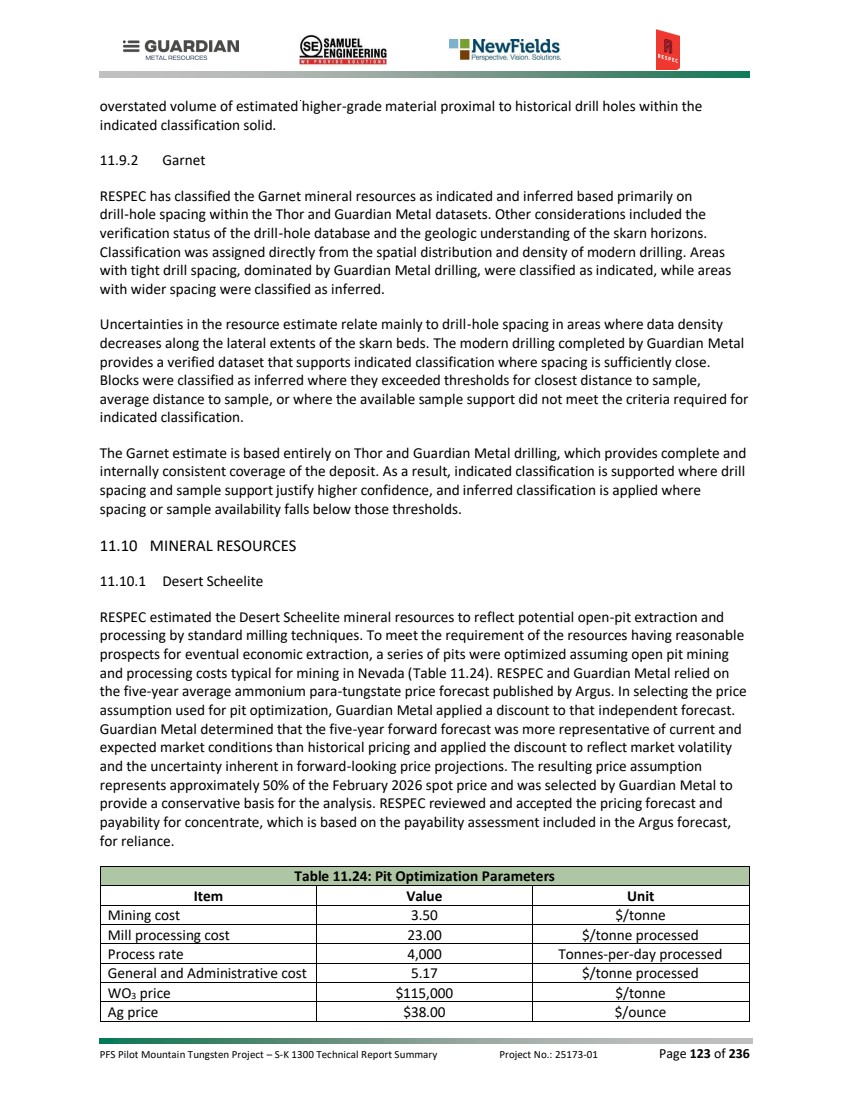
Our mineral resource and mineral reserve estimates for Pilot Mountain are based on an assumed WO₃ price of $115,000 per tonne, which is used by the qualified persons in establishing reasonable prospects of economic extraction and in pit optimization under Subpart 1300 of Regulation S-K, and the economic analysis in the PFS assumes a base case price of $197,300 per tonne of WO₃ (on an APT basis, representing a 35% discount to the spot price of approximately $304,000 per tonne as of June 12, 2026). The value of tungsten concentrate is estimated by applying a factor to the APT price, and this factor may vary depending on market conditions and other factors. If APT prices decline materially below the level used in the resource estimate, or if the factor applied to derive concentrate value changes unfavorably, the estimated mineral resources and any future project evaluations may be adversely affected. Increased price volatility could also impact the timing, scope or economic attractiveness of further project activities.

9

Table of Contents

Mining is a capital-intensive industry, and we may be unable to obtain the funding required to advance our projects.

Tungsten exploration, development and mining require substantial amounts of capital to identify and delineate mineral resources and reserves, undertake geological mapping and drilling, conduct metallurgical testing, construct and maintain mining and processing infrastructure, comply with regulatory requirements, and meet ongoing operational needs. As our projects advance, we expect capital needs to increase materially in connection with permitting activities, development work, construction of processing facilities and any future production operations.

Our future capital expenditure requirements will depend on many factors, including the results of exploration programs, updates to the technical report summary for the Pilot Mountain project, changes to mine plans, the cost and availability of equipment, labor and contractors, and broader market conditions such as interest rates and tungsten commodity prices. If we are unable to obtain adequate financing on acceptable terms, or at all, we may be forced to delay, reduce in scope or cancel planned exploration, development or construction activities.

In addition, our ability to fund capital expenditures from internally generated cash flows will depend on our ability to successfully advance our projects to production and operate profitably, neither of which is guaranteed. If cash flows are insufficient or if we face difficulties raising debt or equity financing, we may be unable to carry out our business plan, complete development milestones or maintain our properties in good standing. Any delay or interruption to planned capital projects may increase costs, reduce future production capacity, and adversely affect our competitiveness.

Because tungsten projects typically require significant upfront investment and have long development timelines, any inability to secure timely financing could materially and adversely affect our business, results of operations and financial condition.

Actual capital and operating costs in respect of our mines and development projects may be significantly higher than estimated capital and operating costs.

Capital and operating cost estimates are based on the interpretation of geological data, the PFS stage and other technical studies, anticipated climatic conditions, market conditions for required products and services and other factors and assumptions regarding foreign exchange currency rates. Because we are in the exploration stage across all our project except Pilot Mountain, which is in the development stage, and have not yet established mineral reserves, on projects other than Pilot Mountain, these estimates are inherently more uncertain and subject to change as additional drilling, engineering and design work is completed. Any of the following events could affect the ultimate accuracy of such estimates: unanticipated changes in grade and tonnage of ore to be mined and processed; incorrect data on which engineering assumptions are made; lack of availability of key components or equipment; delay in construction schedules, unanticipated transportation costs; the inaccuracy of major equipment and construction cost estimates; the inaccuracy of operating cost or scale estimates; labor negotiations; changes in government regulation (including regulations regarding prices, cost of consumables, royalties, duties, taxes, permitting and restrictions on production quotas on exportation of minerals); raw material costs; changes in commodity prices, availability of financing on acceptable terms and title or right of use claims.

​

10

Table of Contents

Lack of reliability and inaccuracies of historical information could hinder our exploration plans.

We have relied on, and the disclosure in the technical report summary for the Pilot Mountain project is in part based on, certain historical-geological, geochemical, geophysical and drilling data compiled by previous operators of Pilot Mountain. To the extent any such historical data is inaccurate, incomplete or was collected using methods that do not meet current industry standards, our exploration interpretations, mineral resource estimates and related plans may be adversely affected. In addition, cost estimates and assumptions used in connection with our exploration programs may not prove accurate. Such estimates are based on interpretations of geological information, anticipated site conditions and other technical and economic factors. Any of the following, among other risks and uncertainties described in this Annual Report on Form 20-F, could affect the accuracy of any such historical data or other estimates or assumptions: variability in grade or tonnage of mineralized material; errors or gaps in historical datasets; changes in drilling, assay or metallurgical costs; unexpected logistical or transportation constraints; availability of labor and equipment; or changes in permitting requirements, environmental regulations, taxes, royalties or land tenure matters. If these assumptions or historical datasets prove inaccurate, our exploration results, timelines and ability to advance our projects may be negatively affected.

Our actual costs may significantly exceed the estimated costs and economic returns estimated in our preliminary economic assessments and feasibility studies.

Feasibility studies, pre-feasibility studies and preliminary economic assessments (“PEAs”) are used to assess the economic viability of a mineral deposit. There is no certainty that existing or future pre-feasibility or feasibility studies or PEAs will be realized. Actual costs may significantly exceed estimated costs and economic returns may differ significantly from those estimated in the studies. There are many factors involved in the determination of the economic viability of a mineral deposit, including the achievement of satisfactory mineral reserve and mineral resource estimates, the level of estimated metallurgical recoveries, product quality and competition, capital and operating cost estimates and estimates of future tungsten and any by-product prices.

The Pilot Mountain project has completed the pre-feasibility stage, with the results of the PFS announced on June 30, 2026, supported by the U.S. Department of War Defense Production Act Title III award received in July 2025, and any advancement to a full feasibility study and a construction decision will depend on the results of ongoing exploration, permitting, financing and market conditions. The Tempiute project is a historical tungsten producer; a letter of intent was signed on October 31, 2024, and a definitive option agreement completed on January 25, 2025. The technical report summary for the Pilot Mountain tungsten project recommends that Pilot Mountain proceed to the definitive feasibility stage, into front-end engineering designs and continued drilling at Pilot Mountain. We advanced exploration activities at Tempiute through an extensive drilling program and expanded the Company’s land position at Tempiute. If the assumptions or estimations in the Pilot Mountain project PFS or the Tempiute project drilling program or other pre-feasibility workstreams are incorrect or if actual costs exceed those currently estimated, the projects may be economically unviable.

The accuracy of our mineral resource and mineral reserve estimates cannot be assured, and the volume of materials we are able to recover may be materially lower.

Our declared mineral resources and probable mineral reserves relate solely to our Pilot Mountain project; no mineral resources or mineral reserves have been established at any of our other projects. Our Tempiute project had no declared mineral resources as of June 30, 2026; work undertaken during fiscal year 2026 included drilling. No assurance can be given that the anticipated production will be achieved or that any indicated level of recovery of tungsten will be realized.

The estimation of mineral reserves and mineral resources is a subjective process that is partially dependent upon the judgment of the persons preparing the estimates. The process relies on the quantity and quality of available data and is based on knowledge, mining experience, statistical analysis of drilling results and industry practices. Valid estimates made at a given time may significantly change when new information becomes available. Our mineral resource estimates and mineral reserve estimates presented in this Annual Report on Form 20-F are, in accordance with Subpart 1300 of Regulation S-K, based on tungsten recoveries in small-scale laboratory tests and may not be indicative of the mineralization in the entire orebody, and we may not be able to achieve similar results in larger scale tests under on-site conditions or during production. Large-scale continuity and character of our deposits will only be determined once significant additional drilling and sampling have been completed and analyzed. Actual mineralization or formations may be different from those predicted.

11

Table of Contents

No assurance can be given that any part or all of our mineral resources will ever be converted into mineral reserves. Mineral resources that are not mineral reserves do not have demonstrated economic viability. Due to the uncertainty that may be attached to inferred mineral resources, there is no assurance that inferred mineral resources will be upgraded to measured or indicated mineral resources as a result of continued exploration. If resources are upgraded to reserves, the ore volume and grade actually recovered by us may also differ from the estimated volumes and grades of the mineral reserves and mineral resources.

There are numerous uncertainties inherent in estimating mineral reserves and resources, including many factors beyond our control. The qualification of any ore as a reserve or resource estimate is materially dependent on prevailing metal prices and the cost of recovering and processing minerals at the individual mine sites. Prolonged declines in the market price of tungsten may render mineral reserves or resources containing relatively lower grades of mineralization uneconomical to recover and could thereby materially reduce our mineral resources or, if any, mineral reserves. Should such reductions occur, we may be required to take a material write-down of our investment in mining properties, reduce the carrying value of one or more of our assets or delay or discontinue production or the development of new projects, resulting in increased net losses and reduced potential future cash flow. Other than the probable mineral reserves declared at our Pilot Mountain project, we have not established mineral reserves, and our mine plans for other projects, if developed, will remain subject to significant uncertainty until reserves are delineated and even then such plans will remain subject to risks and uncertainties inherent in mining. Market price fluctuations of tungsten and other by-product metals such as silver and zinc, as well as increased production costs or reduced recovery rates, may render mineral resources or reserves containing relatively lower grades of mineralization uneconomical to recover and may ultimately result in a restatement of mineral reserves or resources. Short-term factors relating to the mineral reserve, such as the need for orderly development of ore bodies or the processing of new or different grades, the technical complexity of orebody, unusual or unexpected orebody formations, ore dilution or varying metallurgical and other ore characteristics may impair the profitability of a mine in any particular period. Failure to obtain or maintain necessary permits or government approvals, or changes to applicable tax and customs regimes or applicable legislation, could also influence the accuracy of our mineral resources or, if any, mineral reserves or cause us to reduce our mineral resources or, if any, mineral reserves.

Mineral resource estimates for properties that have not commenced production or at deposits that have not yet been exploited are based, in most instances, on very limited and widely spaced drill hole information, which is not necessarily indicative of conditions between and around the drill holes. Accordingly, such mineral resource estimates may require revision as more drilling information becomes available or as production experience is gained.

The mineral resource and mineral reserve estimates described in this Annual Report on Form 20-F should thus not be interpreted as assurances of commercial viability or potential or of the profitability of any future operations. Investors are cautioned not to place undue reliance on these estimates. A technical report summary issued by Samuel, NewFields and RESPEC on August 21, 2026, with an effective date of June 30, 2026, has been filed as Exhibit 96.1 to this Annual Report on Form 20-F. For a summary, please refer to Item 4.B.

Our mineral reserve and mineral resource estimates may prove inaccurate, and we may never be able to establish, replenish or expand our mineral resources or convert additional mineral resources into mineral reserves.

We have declared probable mineral reserves, as defined under Subpart 1300 of Regulation S-K, only at our Pilot Mountain project, and we have no proven mineral reserves at any of our projects; our other projects remain at the exploration stage with no established mineral resources or mineral reserves. Any potential future production beyond the mine plan contemplated by the PFS would depend on our ability to: (i) complete additional drilling and technical work to improve confidence in existing mineral resources, (ii) identify additional mineralized material through further exploration and (iii) demonstrate, through more advanced technical studies, that mineral reserves can be established. There is no assurance that any of these steps will be successful, that our estimated mineral reserves will be realized in the quantities or grades estimated, or that any of our other projects will ever support the declaration of mineral reserve.

Mineral resource estimates inherently involve uncertainty. Assumptions used by the qualified person to declare mineral resources may prove incorrect, or conditions may change with respect to operating or capital costs, metallurgical recoveries, product values, or other technical and economic factors. If the underlying assumptions used in preparing the mineral resource estimate for Pilot Mountain prove inaccurate, or if economic or technical conditions change, the mineral resources may be materially reduced, reclassified or rendered uneconomic and our ability to advance the project could be adversely affected.

There is no assurance that our exploration programs will result in the discovery of additional mineralization or that any existing or future mineral resources will ever be converted into mineral reserves.

12

Table of Contents

Delays in the performance of any of the contractors, suppliers, consultants or other persons on which we are dependent in connection with our exploration, evaluation and potential construction activities, delay in or failure to receive the required governmental approvals and permits in a timely manner or on reasonable terms or termination of any existing or future required approvals or permits, or a delay or failure in connection with the completion and successful operation of the operational elements of any future mining operations could delay or prevent such projects from advancing to production.

The successful advancement of our projects through exploration to engineering and into construction and eventual production, including the development of the Pilot Mountain and Tempiute tungsten projects, is subject to a number of factors, including the availability and performance of engineering and construction contractors, mining contractors, suppliers and consultants, the receipt and maintenance of required governmental approvals and permits in connection with the development of mining facilities, the conduct of mining operations (including the receipt and maintenance of environmental permits) and the successful construction and operation of key infrastructure, such as ore passes, among other operational elements. Any delay in the performance of any one or more of the contractors, suppliers, consultants or other persons on which we are dependent in connection with our development activities, delay in or failure to receive the required governmental approvals and permits in a timely manner or on reasonable terms, the termination of any required approvals or permits, or a delay in or failure in connection with the completion and successful operation of the operational elements of any future mining operations could delay or prevent such projects from advancing to production.

There can be no assurance that any of our current or future exploration, development or production plans will be successful, that we will be able to obtain sufficient funds to finance exploration, development or production activities, that personnel and equipment will be available in a timely manner or on reasonable terms to successfully advance or complete such projects, that we will be able to obtain all necessary governmental approvals and permits or that the development and potential operating costs associated with the advancement of our projects will not be significantly higher than anticipated by us. Any of the foregoing factors could delay or prevent such projects from advancing to production, which in turn could adversely impact our operations and financial condition.

Our projects have no relevant operating history upon which to base estimates of future cash flow and may not be commercially viable.

Our projects have no relevant operating history upon which to base estimates of future cash flow. The Pilot Mountain project had small-scale production in the 1940s and the Tempiute project had production from the early 1900s up to the 1980s. The records of production and costs are not current enough to base estimates of future cash flow upon. In addition, historical production at Tempiute was largely from underground mining, which generally has higher costs than open pit mining, which was part of the PFS at Pilot Mountain. We are considering rehabilitation of underground workings at Tempiute to establish positions for underground drilling. If underground work would be undertaken, it would bring increased risks, including but not limited to, falls of ground and other safety risks. We are also looking at the potential of unrecovered metal in the tailings left from previous production at Tempiute. The capital expenditures and time required to develop our exploration projects into operating mines are considerable and changes in costs or construction schedules may affect project economics. Thus, it is possible that actual costs may change significantly and economic returns may differ materially from our estimates.

Commercial viability of a future mining project is predicated on many factors such as estimation of mineral resources (and their eventual conversion into reserves), anticipated metallurgical recoveries, environmental considerations, permitting and anticipated capital and operating costs, as well as available capital to develop such project. Any mineral resources estimated in technical assessments may not be realized or converted into reserves, and the level of future metal prices needed to ensure commercial viability may not materialize. Development projects are subject to the completion of successful feasibility studies and environmental assessments, issuance of necessary governmental permits and availability of adequate financing. Development projects are uncertain and it is possible that actual capital and operating costs and economic returns will differ significantly from those estimated. Consequently, there is a risk that future projects may be subject to write-down and/or closure as they may not be commercially viable.

We have negative cash flows from our operations.

For the fiscal year ended June 30, 2026, we sustained net losses from operations and had a negative operating cash flow of $6.0 million compared to negative operating cash flow of $1.1 million for the fiscal year ended June 30, 2025 and $0.7 million for the fiscal year ended June 30, 2024. As of June 30, 2026, we had cash and cash equivalents of approximately $52.5 million and accumulated losses of approximately $18.4 million. We have had negative operating cash flows in prior periods and may continue to do so and we will need to use available cash to fund any such negative cash flow.

13

Table of Contents

We anticipate that the Company will remain cash flow negative for several years. The generation of positive cash flow from operations will depend on the successful development and commencement of production at the Pilot Mountain and Tempiute tungsten projects and any delay in bringing these projects into production would extend the period during which we remain cash flow negative. We may, in the future, seek further financing through long-term debt from financial institutions, debt or equity financing though capital markets, or private placements. The availability of this capital is subject to general economic conditions and lender and investor interest in our projects and there can be no assurance that additional capital or financing will be available if needed or that, if available, the terms of such financings will be acceptable to us. Any changes in these estimates or adverse developments in the availability of capital could materially impact our financial performance and results of operations.

Our business and ability to advance our projects may be negatively affected by global financial conditions.

Global financial conditions continue to be characterized as volatile, including elevated inflation in mining inputs (labor, fuel, electricity, reagents, equipment and contractor services). Persistent input cost inflation or shortages in Nevada or other regions where we may operate due to local or global financial conditions could increase our capital and operating costs, extend schedules and adversely affect project economics. In recent years, global markets have been adversely impacted by various credit crises, significant fluctuations in fuel and energy costs and metals prices, inflation, geopolitical conflict and health pandemics. Many industries, including the mining industry, have been impacted by these market conditions, which have contributed to increased economic uncertainty, higher capital costs and, for pre-production companies like ours, potentially reduced access to financing. These factors have increased the risk of disruption to global trade flows and supply chains, including availability and lead times for mining and processing equipment.

Further, global financial conditions remain subject to sudden and rapid destabilizations in response to future events, as government authorities may have limited resources to respond to future crises. Global economic uncertainty, disruptions to global trade flows and supply chains and continued or worsened slowdown in the financial markets or other economic conditions, including but not limited to tariffs, consumer spending, employment rates, business conditions, inflation, fuel and energy costs, consumer debt levels, lack of available credit, the state of the financial markets, interest rates and tax rates may adversely affect our ability to secure project financing, maintain exploration and development timelines and advance our projects toward production.

Future crises may be precipitated by any number of causes, including natural disasters, geopolitical conflict or instability, changes to energy prices or sovereign defaults. If increased levels of volatility continue or in the event of a rapid destabilization of global supply chains or economic conditions, it may result in a material adverse effect on commodity prices, demand for metals, including tungsten, availability of credit, investor confidence and general financial market liquidity, all of which may adversely affect our ability to fund and advance our projects and the market price of our securities.

Foreign currency exchange rate fluctuations could adversely affect our operating costs, capital expenditures and results of operations.

A portion of our monetary assets and liabilities, including cash and cash equivalents, receivables and payables, as well as certain income and expense items such as operating expenses and capital expenditures, are and are expected to continue to be, denominated in currencies other than the U.S. dollar, principally the pound sterling. We hold significant amounts of cash from time to time in pounds sterling and a depreciation of this currency against the U.S. dollar could adversely affect our results of operations and our ability to advance our projects in the United States. Fluctuations in exchange rates between the U.S. dollar and other currencies could result in significant changes to our reported financial position and results, which may not be offset by corresponding changes in revenues. From time to time, we may use hedging arrangements, such as forward currency contracts, to manage foreign exchange exposure; however, these activities may be limited in scope and may not fully offset the impact of currency movements. As disclosed in Note 21 to the Consolidated Financial Statements and under Item 5, a 10% strengthening or weakening of sterling against the U.S. dollar would have a measurable impact on our profit or loss and equity. Any substantial or prolonged change in currency exchange rates could therefore have a material adverse effect on our business, financial condition and results of operations.

​

14

Table of Contents

Disruption to current trade practices could have a material impact on our ability to procure inputs and equipment for our operations and projects, and, in the future, market our products.

Access to markets for any tungsten products we may produce in the future and our ability to procure inputs and equipment required for our projects and operations may be subject to interruptions or trade barriers due to policies and tariffs or import/export restrictions of individual countries. Any tungsten products we may sell in the future could be subject to tariffs or other trade measures that do not apply to producers in certain other jurisdictions, potentially affecting the competitiveness of our products and our ability to access certain markets.

Geopolitical tensions and trade disputes, particularly those affecting China, Europe and the United States, may impact the availability and pricing of tungsten. For example, in late 2024 and continuing into 2026, China instituted and expanded restrictions on exports of critical minerals, including tungsten, to the United States. Although China has since suspended certain of its export control measures relating to rare earths and certain other critical minerals, its restrictions on tungsten exports remain in place and have been further tightened, including through the announcement in December 2025 of arrangements limiting tungsten exports for the 2026-2027 period to a limited number of approved exporters, and negotiations between the United States and China are ongoing. With China accounting for a significant share of global tungsten supply, any changes in laws and regulations, export or import restrictions, tariffs or sanctions, or any perpetuation or escalation of any existing restrictions, tariffs or sanctions, could create volatility in the market and affect both the cost of inputs we require for our projects and the price environment for tungsten.

The recent and evolving introduction, modification, suspension, reimposition and threatened expansion of tariffs and other trade measures between major economies, including the United States, China and the European Union, have contributed to increased uncertainty in global trade and international supply chains. The scope, duration and application of these measures continue to evolve and remain subject to change. Tariffs, export controls, sanctions and other trade restrictions, together with the occurrence of trade disputes or other governmental actions relating to tariffs, trade agreements or trade policies, could adversely affect global economic conditions, disrupt international trade, increase market volatility and adversely affect the cost of inputs required for our projects, the price environment for tungsten and our business, financial condition, results of operations and prospects.

The imposition of any tariff on tungsten ore, concentrates, oxide and related materials produced and sold by us may adversely affect our business, financial condition and results of operations. In addition, tariffs on the import of critical equipment or materials required for either the capital development or operating phases of our projects could materially increase our capital or operating costs. Elevated tariffs could also limit the supply or availability of such equipment or materials, which may have a material adverse impact on our business.

Changes in geopolitical conditions, including a reduction or reversal of current trade restrictions and critical-minerals policies, could materially reduce the strategic importance of domestic tungsten projects like ours and adversely affect our business.

Our business strategy is premised in part on the current geopolitical and national-security environment, including ongoing trade tensions between the United States and China, China’s restrictions on exports of certain strategic minerals and U.S. government policies aimed at strengthening domestic supply chains for critical minerals. These developments have increased interest in and potential support for U.S.-based tungsten projects such as ours.

There is no assurance that these conditions will continue. Any improvement or de-escalation in U.S.-China relations, a reduction or removal of tariffs or export controls or a shift in U.S. government priorities regarding access to critical minerals could lessen or eliminate the perceived strategic value of domestic tungsten production. Similarly, if China were to resume or expand exports of tungsten or other related materials, global supply and pricing dynamics could change materially, which could reduce the demand for U.S. domestic tungsten production.

In addition, the U.S. Department of War and other federal agencies may decide not to continue, or may significantly reduce, efforts to promote domestic critical-minerals development. If government interest or policy support for domestic tungsten projects declines, our ability to attract financing, secure commercial partnerships or advance the development of our projects could be adversely affected. These developments could have a material negative impact on our business, prospects and the potential economic viability of our projects.

15

Table of Contents

Increases in production costs may adversely affect our business.

Changes in our production costs could have a major impact on our profitability. Our principal production expenses are contractor costs, equipment, materials, personnel costs and energy. Changes in costs at any of our current or future mining and processing operations could occur as a result of unforeseen events, including international and local economic and political events, weather and climate conditions, increases in the costs of explosives, oil, steel, reagents, power supply and other consumables, union demands and scarcity of labor and could result in changes in profitability or reserve or resource estimates. Many of these factors may be beyond our control. For example, the availability of grid power in Nevada in the near term remains uncertain. Any delays in the delivery of grid power could significantly and adversely affect our ability to develop and operate mining projects, including Pilot Mountain and Tempiute and our financial condition and results of operations.

We rely on third-party suppliers for equipment hire and for a number of raw materials, including but not limited to fuel and, if we proceed to scale and advance towards production operations, steel and reagents. Any material increases in the cost of equipment hire or raw materials, or our inability to source viable and economic alternative third-party suppliers for the supply of our equipment and raw materials, could have a materially adverse effect on our results of operations or financial position.

We may not be able to secure financing on favorable terms, or at all, to meet our future capital needs.

In order to fund the costs associated with the exploration, development, mining and processing of minerals from our properties and our mine plans and to meet expected future obligations, we may, from time to time, be required to obtain additional financing. Given that our Pilot Mountain and Tempiute projects are currently in the development and exploration stages, respectively, and are not generating operating cash flows, our ability to fund such activities will depend heavily on access to external financing. Although we raised approximately $21 million in aggregate gross proceeds through a private placement of ordinary shares and received a $6.2 million award from the U.S. Department of War in July 2025, and raised approximately $68.3 million in aggregate gross proceeds in our initial public offering of ADSs completed in March 2026, we expect that we will continue to incur significant expenditures and will require substantial additional capital in future periods to advance feasibility, permitting and construction, including in respect of the initial capital expenditures of approximately $288.7 million for the Pilot Mountain project estimated in the PFS. Metal prices, environmental rehabilitation and restitution, revenue and income taxes, transportation and other operating costs, working capital needs, capital expenditures and geological results are also factors which may have an impact on the amount of additional financing that may be required.

Equity and debt markets are subject to significant volatility and because the Pilot Mountain and Tempiute projects have no recent production history, obtaining financing may be more difficult. In addition, tungsten prices are reported only in weekly quotations rather than through continuous live markets and this relative lack of transparency may make financing our projects more challenging compared to other metals with more liquid markets. Further, debt financing, if available, may also impose certain restrictions on our operating activities or include financial covenants, such as accompanying tungsten hedging requirements and minimum liquidity levels, or restrict our ability to enter into additional financing arrangements. There is no guarantee that such equity or debt financing will be available to us or that these financings would be obtained on terms favorable to us. Any inability to secure financing on favorable terms or at all may adversely affect our business and financial position and may result in a delay or indefinite postponement of exploration, development or production of any or all of our properties, or even a loss of exploration or development rights.

See Item 5.B.

If we incur indebtedness in the future, we may be subject to restrictive covenants and security arrangements that could limit our operational and financial flexibility and a default could have a material adverse effect on our business.

Any debt financing we obtain in the future may contain covenants that impose restrictions on our operations, such as limitations on additional indebtedness, liens, asset sales, investments, acquisitions, dividends, share repurchases or other distributions, as well as requirements to maintain certain financial ratios or other performance metrics. These restrictive covenants could restrict our ability to pursue strategic opportunities, respond to changing market conditions or fund necessary capital expenditures and could place us at a competitive disadvantage relative to peers not subject to such restrictions.

16

Table of Contents

If our indebtedness is secured by some or all of our assets, including our mineral properties, a default under the relevant financing agreements could result in the lender foreclosing on the collateral, which could include our most significant operating assets. In the event of a default, lenders may accelerate repayment of outstanding amounts and exercise remedies that could materially and adversely affect our financial condition and ability to continue as a going concern. Even if we are able to comply with these restrictive covenants, the need to monitor and manage compliance could divert management attention from operations. There can be no assurance that we will be able to meet any future debt service obligations or comply with restrictive covenants in any future debt instruments and any failure to do so could have a material adverse effect on our business, financial condition and results of operations.

We are subject to costs and risks associated with increased or changing laws and regulations affecting our business, including the need to obtain government permits, consents and licenses.

Exploration, development and mining activities are subject to laws and regulations governing health and work safety, employment standards, environmental matters, social matters, mine development, prospecting, mineral production, exports, taxes, labor standards, reclamation obligations and other matters. In Nevada, where our Pilot Mountain and Tempiute projects are located, our operations are also subject to U.S. federal laws as well as permitting requirements administered by the Nevada Division of Environmental Protection (“NDEP”) and the federal Bureau of Land Management (“BLM”). For example, development of the Pilot Mountain project will require a Plan of Operations (“PoO”) and related Environmental Assessment (“EA”) or Environmental Impact Statement (“EIS”) from the BLM, as well as applicable NDEP permits (including water pollution control, reclamation and air quality permits, as required). Future changes in applicable laws, regulations, agreements or changes in their enforcement or regulatory interpretation could result in changes in the legal requirements or in the terms of permits and agreements applicable to us or our properties, which could have a material adverse impact on our operations, including our exploration programs and future development projects. Although recent Executive Orders, including numerous issued in 2025 and 2026 relating to energy security, critical-mineral production and supply chain resilience, have emphasized federal priorities to strengthen domestic critical-minerals development, there can be no assurance that such priorities will continue.

Our projects are subject to review and permitting by both the NDEP and federal authorities. Obtaining necessary permits and licenses can be a complex, time-consuming process and there can be no assurance that required permits will be obtainable on acceptable terms, in a timely manner or at all. The costs and delays associated with obtaining permits and complying with these permits and applicable laws and regulations could stop or materially delay or restrict us from proceeding with the development of an exploration project or the operation or further development of a mine. Any failure to comply with applicable laws and regulations or permits, even if inadvertent, could result in interruption or closure of exploration, development or mining operations or material fines, administrative or legal proceedings brought by governmental agencies or other third parties, penalties or other liabilities, which could have an adverse effect on our business, financial condition or results of operation.

We are also subject to laws and regulations and acts by authorities related to environmental protection, health and safety, cultural and natural resource protection, water usage and reclamation that may limit or modify our exploration and development plans or impact our work programs, production volumes, costs and any future reserves and resources. For example, we acquired key water rights at Pilot Mountain; however, additional approvals may be required as projects advance. The Pilot Mountain and Tempiute projects will require an approved PoO, environmental assessments and reclamation bonding before construction can commence. The Company has an approved PoO for the Pilot Mountain project for exploration and pre-feasibility work to expand the disturbed land area in connection with drilling and related activities. The Company submitted a mine PoO for the Pilot Mountain project to the BLM which is expected to initiate the NEPA environmental review process with respect to mine development. The mine PoO and the related EA or EIS will be reviewed by federal and state regulators. There can be no assurance that the mine PoO, the EA or EIS will be accepted as submitted, or that they will not be significantly modified in a manner that could delay or prevent the planned works or the quality of our potential reserves or resources.

For any future mine development contemplated by the PFS, the Company may be required to submit additional filings to federal and state agencies, including an updated mine PoO and EA, or potentially a more expansive EIS. There can be no assurance that any such filings will result in the required approvals to advance the projects as planned, or at all, and any delay in, or expansion of the scope of, such environmental review could delay the development timeline contemplated by the PFS.

17

Table of Contents

Disagreements with local communities and other stakeholders could adversely impact our business and reputation.

As a mining business, we may come under pressure in the jurisdictions in which we operate, or will operate in the future, to demonstrate that (i) other stakeholders (including employees, communities surrounding our operations and the countries in which we operate) benefit and will continue to benefit from our commercial activities and/or (ii) we operate in a manner that will minimize any potential damage or disruption to the interests of those stakeholders. We work to consider the interest of all stakeholders including but not limited to communities, but we may face opposition with respect to our current and future development, exploration and operation of projects and mines, which could materially adversely affect our business, results of operations and financial condition. Further, certain non-governmental organizations are often critical of the mining industry and related practices, including the use of hazardous substances in processing activities. The adverse publicity generated by these organizations or others related to extractive industries generally, or to our operations specifically, could negatively impact our reputation, financial condition and relationships with the communities in which we operate or our stakeholders generally. They may engage in protests or bring administrative or legal proceedings to object to the issuance of required permits, require environmental reviews or seek damages. These actions may be related not only to current activities, but also the historic mining activities of previous owners. Any such opposition, criticism, adverse publicity protests or proceeding could adversely affect us and result in the potential loss of our rights or failure of our projects.

Our business could be adversely affected by the failure or unavailability of certain critical assets or infrastructure.

Mining, processing, development and exploration activities depend on access to and an ability to maintain adequate and reliable infrastructure, including roads, railways, power sources and water supply. If the required infrastructure is not readily available, it may have to be built and there is no assurance that it can be built in a timely manner or at all. There is no assurance that we can access and maintain the infrastructure needed, or, where necessary, obtain rights of way, government authorizations and permits to construct or upgrade the same at a reasonable cost, in a timely manner, or at all. Access to infrastructure may also be interrupted by natural causes, such as drought, floods, earthquakes, landslides and other weather phenomena, or man-made causes, such as blockades, sabotage, conflicts, government issues, political events, protests, rationing or competing uses, as well as global pandemics. Inadequate, inconsistent or costly infrastructure could compromise many aspects of the project’s feasibility, viability and profitability, including, but not limited to the construction schedule, capital and operating costs.

In Nevada, our projects are located in remote areas and depend on the availability and maintenance of access roads, power lines and water infrastructure. Unusual or infrequent weather phenomena, sabotage, government or other interference in the maintenance or provision of such infrastructure could adversely affect our business, financial condition and results of operations. NV Energy, the electricity utility serving the area of the Pilot Mountain project, has indicated that it could take five years or more to deliver grid power to the site. As a result, alternative power sources are being evaluated for our Nevada projects, which may significantly increase potential operating costs or delay or prevent advancement. At the Tempiute project, although a power substation is located on the property, the condition, capacity and timing of any connection to key property infrastructure are uncertain and may require significant upgrades, so the availability of electricity from the grid may present a significant issue that could delay or prevent the advancement of the project. Changes in the quantity of water in regions where we operate, whether excessive or deficient amounts, may affect exploration and development activities, mining and processing operations, water management and treatment facilities, tailings storage facilities, closure and reclamation efforts and may increase levels of dust in dry conditions and land erosion and slope stability in case of prolonged wet conditions. Water shortages may also result from environmental and climate events that are out of our control and ability to manage. For example, inadequate rainfall or the occurrence of drought may stop operations, which could materially affect future production. Conversely, excessive rainfall or flooding may also result in operational difficulties, including geotechnical instability, increased dewatering demands and additional water management requirements. In addition, we cannot predict the potential outcome of pending or future legal proceedings or negotiations related to water rights, claims, contracts and uses, which may impact our operations. The loss of water rights, in whole or in part, or shortages of water to which we have established rights, could impact existing operations or prevent future exploration. Further, laws and regulations may be introduced in the jurisdictions in which we operate that could limit our access to sufficient water resources. Additionally, failure to manage water discharge or contamination risks could lead to environmental liabilities and reputational damage.

18

Table of Contents

Concessions, authorizations, licenses and permits are subject to expiration, limitation on renewal and various other risks and uncertainties.

Our operations and exploration activities depend on permits, approvals and licenses from governmental regulatory agencies and other authorities (including federal agencies such as BLM, state agencies and county authorities) in the jurisdictions in which we operate. Our Pilot Mountain project currently consists of unpatented mining claims located on land managed by the BLM and we conduct exploration and early development work there through our U.S. subsidiaries. Our Tempiute project, by contrast, consists of both patented claims and unpatented mineral claims. We are subject to laws and regulations that can change at any time and changes in laws and regulations may require modifications to our plans and operations and result in unanticipated capital expenditures. We are also exposed to political and regulatory risk in our relationship with governmental and regulatory authorities that issue these permits and approvals.

Apart from unpatented mining claims, we may need to obtain various federal, state and county authorizations, licenses and permits from governmental or other regulatory bodies in connection with the planning, maintenance, operation and closure of our projects. Such authorizations, licenses and permits may be subject to fixed expiration dates or periodic review or renewal. There is no assurance that renewals will be granted as and when sought and there is no assurance that new conditions will not be imposed in connection with renewal. In addition, failure to comply with applicable laws and regulations, including failure to pay annual BLM and county claim maintenance fees, may invalidate title to mineral rights held by us.

If so, the costs of holding or renewing our unpatented mining claims and other approvals may render our business objectives unviable. Accordingly, we need to continually assess the economic and technical potential of each project to determine if the costs of maintaining the claims and permits are justified by the results of operations to date and we might elect to let some of our claims lapse. There can be no assurance that permits and approvals will be obtained on terms favorable to us, or at all, for our future intended exploration or development targets.

We are also subject to laws and regulations and acts by authorities, related to dams, caves, Indigenous People and Traditional Communities that may limit or modify our mining plans, impact our production volumes, costs and reserves and resources.

Our business faces uncertainties and risks relating to the development of its Pilot Mountain and Tempiute tungsten projects.

Our ability to achieve tungsten production in the future is dependent on the successful development of the Pilot Mountain and Tempiute tungsten projects. Pilot Mountain has completed the pre-feasibility study stage, with the results of the PFS announced on June 30, 2026, and Tempiute is a historic producing tungsten mine where drilling is underway as of H2 2026. There are many risks and unknowns inherent in all projects. For example, the economic feasibility of projects is based upon many factors, including:

●the accuracy of the resource estimates;
●metallurgical recoveries from PFS-stage metallurgical test work at Pilot Mountain and historical records at Tempiute;
●capital and operating costs of such projects;
●the timetables for the construction, commissioning and ramp-up of such projects and any delays or interruptions;
●the reliability of construction designs and accuracy of engineering;
●changes in scope;
●the ability to manage large-scale construction;
●the future prices of commodities, including tungsten, to which our projects’ economics are highly sensitive; and
●changes and restrictions from new or current environmental rules as they apply to the planned projects.

19

Table of Contents

Unforeseen circumstances, including those related to the amount and nature of the mineralization at the development site, technological impediments to extraction and processing, legal requirements, governmental intervention, infrastructure limitations, transport issues, environmental issues and local community relations or other events, could result in the development of the Pilot Mountain and Tempiute tungsten projects becoming impractical or uneconomic. Further, actual costs and economic returns may differ materially from our estimates, or we may fail or be delayed in obtaining the governmental permits and approvals necessary in connection with the projects, in which case the projects may not proceed either on their anticipated timing or at all.

Frequently, new and/or expanded mining operations experience unexpected problems during the start-up phase and delays can often occur prior to production reaching its expected steady-state levels. We may also experience actual capital and operating costs and operating results that differ materially from those anticipated. In addition, experience from actual mining or processing operations may identify new or unexpected conditions that could reduce production below, or increase capital or operating costs above, current estimates. Accordingly, we cannot provide assurance that our activities will result in profitable mining operations at the Pilot Mountain and Tempiute tungsten projects.

The development of the Pilot Mountain project has been assisted by a $6.2 million award from the U.S. Department of War; approximately $6.1 million of this funding has been received as of the date of this Annual Report on Form 20-F. The final payments are anticipated on delivery of the final reporting and contract completion. We funded the PFS from cash on hand, including amounts received under the award. We have not yet secured the additional financing required to complete development of the Pilot Mountain project, including in respect of the initial capital expenditures of approximately $288.7 million estimated in the PFS. A budget of $28.0 million has been approved by our board for the Pilot Mountain for work through June 30 2027. Current expenditures relating to the Tempiute tungsten project are currently budgeted at $9.6 million for work through June 30, 2027, however this budget is subject to change, management approvals and regular project reviews. We expect to fund development and exploration work and initial scoping and engineering activities, as applicable, at Pilot Mountain and Tempiute from available cash resources.

The development and operation of the Pilot Mountain and Tempiute tungsten projects are subject to obtaining and maintaining various permits, licenses and regulatory approvals from local, regional and national authorities, including federal permits from the BLM for activities on unpatented mining claims and related annual BLM maintenance fees and filings, as well as state environmental approvals. The permitting process can be lengthy, complex and subject to change and there is no guarantee that all necessary approvals will be obtained in a timely manner or at all.

Cyberattacks, including unauthorized disclosure, destruction or modification of data through cybersecurity breaches, computer viruses or otherwise may adversely affect our business and reputation.

We are reliant on the continuous and uninterrupted operations of our information technology systems, including our networks, equipment, hardware, software, telecommunications and other information technology (collectively, “IT Systems”) and the IT Systems of our vendors and third-party service providers, to operate our business. User access and security of all IT Systems are critical elements to our operations. Our operations depend, in part, on how well we and our suppliers protect IT Systems against damage from a number of threats, including, but not limited to, cable cuts, damage to physical plants, natural disasters, terrorism, fire, power loss, hacking, computer viruses, vandalism and theft. These risks are evolving as IT Systems and cyberattacks or breaches become more sophisticated and prevalent. These cyberattacks are also becoming increasingly sophisticated through the use of artificial intelligence and machine learning tools and tactics and are often well-funded, including in some cases by state sponsors. These disruptions may also occur for non-malicious reasons, such as the widespread server-related outages caused by CrowdStrike’s defective software update in July 2024. Any IT System’s failure pertaining to availability, access or system security could result in disruption for personnel and could adversely affect our reputation, operations or financial performance.

Our operations also depend on the timely maintenance, upgrade and replacement of IT Systems, as well as preemptive expenses to mitigate the risks of failures. Increasingly, the operating and control systems at our projects rely on IT Systems to monitor ongoing operations and optimize performance. Our financial control and accounting systems depend on our IT Systems and our workforce increasingly works remotely, which has further increased our reliance on our IT Systems and associated risks. Adoption of new technology that promotes operational efficiency, such as the use of artificial intelligence, may further expose our IT Systems to risk. As our use of IT Systems increases and evolves and cybersecurity attacks become more sophisticated or pervasive, we may have to incur significant costs to upgrade our IT Systems to protect against any failures. New or improved IT Systems that we procure may have defects, not be installed properly or not integrate with our other IT Systems.

20

Table of Contents

Our IT Systems could be compromised by unauthorized parties attempting to extract sensitive, confidential or personal information, corrupting information or disrupting business processes or by inadvertent or intentional actions by our employees or vendors. A cybersecurity incident (including system-encrypting ransomware) resulting in a security breach or failure to identify a security threat could disrupt our business and could result in the loss of sensitive, confidential or personal information or other assets, as well as litigation, regulatory enforcement, violation of privacy and security laws and regulations and remediation costs.

The occurrence of one or more IT System’s failure could have effects including damage to our equipment, operational delays, loss or corruption of data, compromise of confidential or otherwise protected information, delay in the delivery of supplies and services, increased health and safety risks, increases in capital expenditures, loss of production, accidental discharge of regulated materials, expensive remediation efforts, distraction of management, damage to our reputation and events of noncompliance, which could lead to regulatory fines or penalties, or ransom payments. Any of the foregoing could have a material adverse effect on our results of operations and financial performance.

Although to date we have not experienced any material losses relating to cyberattacks or other information security breaches, there can be no assurance that we will not incur such losses in the future. Because critical minerals are considered strategically important in the United States, companies involved in their exploration and development may attract heightened attention from threat actors and our operations may face an elevated risk of cyberattacks compared to other mining companies. Our risk and exposure to these matters cannot be fully mitigated because of, among other things, the evolving nature of these threats. As a result, cybersecurity and the continued development and enhancement of controls, processes and practices designed to protect systems, computers, software, data and networks from attack, damage or unauthorized access remain a priority. As cyber threats continue to evolve, we may be required to expend additional resources to continue to modify or enhance protective measures or to investigate and remediate any security vulnerabilities.

Mining operations involve significant hazards and a high degree of risk.

Our exploration, development and mining operations are subject to significant risks inherent to the mining industry, some of which are beyond our control. Such risks include, but are not limited to, unusual and unexpected geologic formations, seismic activity, rock bursts, cave-ins, flooding, pit wall failure and other conditions involved in the drilling, blasting, mining and processing of material, any of which could result in damage to, or destruction of, mines and other producing facilities, damage to life or property, environmental damage, delays, suspensions or permanent cessation of activities, monetary losses and possible legal liability. We may undertake underground rehabilitation and development work in the year ahead which would bring additional risks and require additional safety measures, insurance and expense. Although we believe adequate precautions to minimize risk are being taken, mineral-process operations are subject to hazards such as fire, equipment failure or failure of retaining dams around tailings disposal areas, which may result in environmental pollution and consequent liability.

In addition, from time to time, we may be subject to governmental investigations and claims and litigation filed on behalf of persons who are harmed while at our properties or otherwise in connection with our operations. To the extent that we are subject to personal injury or other claims or lawsuits in the future, it may not be possible to predict the ultimate outcome of these claims and lawsuits due to the nature of personal injury litigation. Similarly, if we are subject to governmental investigations or proceedings, we may incur significant penalties and fines and enforcement actions against us could result in the closing of certain of our mining operations. If claims and lawsuits or governmental investigations or proceedings are ultimately resolved against us, it could have a material adverse effect on our financial performance, financial position and results of operations. Also, if we mine on property without the appropriate licenses and approvals, we could incur liability or our operations could be suspended.

Our business is exposed to the cyclicality of global economic activity.

Our business, financial performance and results of operations are significantly affected by the market prices and demand for the metals we are developing and expect to produce in the future, particularly tungsten from our Pilot Mountain and Tempiute projects, which in turn is driven by a wide variety of cyclical global macroeconomic factors.

Historically, prices and demand for metals have been subject to wide fluctuations which can be material and can occur over short periods of time and are affected by numerous factors beyond our control, including the cyclicality of consumer and industrial consumption. We cannot predict whether and to what extent metal prices and demand will rise or fall in the future. An increase in the production of metals worldwide or changes in, among other things, technology, industrial processes or consumer habits, including increased demand for substitute materials, may decrease the demand for these metals.

21

Table of Contents

A fall in demand, resulting from economic downturns or other factors, could also decrease the volume of metals that are able to sell once in production and, therefore, materially adversely impact our results of operations and financial position.

Future declines in tungsten prices could have an adverse impact on our results of operations and financial position and we may consider curtailing, modifying or discontinuing certain exploration, development or production operations. In addition, we may not be able to adjust production volume in a timely or cost-efficient manner in response to sustained changes in tungsten prices.

Lower utilization of capacity during periods of weak prices may expose us to higher unit production costs since a significant portion of our cost structure is fixed in the short term due to the high capital intensity of mining operations. If tungsten prices drop significantly, the economic prospects of the Pilot Mountain, Tempiute or any other tungsten projects we may acquire or develop could be significantly reduced or rendered uneconomic.

Low tungsten prices would affect our liquidity and ability to raise equity capital and borrow for any future mine development. If these conditions persist for an extended period, we may have to look for other sources of cash. Conversely, during periods of high demand, our ability to rapidly increase production capacity is limited, which could prevent us from meeting demand for our products and make acquiring long lead capital items more challenging and expensive.

Conditions of global conflict can bring significant market volatility in equity and debt capital markets, making financing and/or favorable terms more difficult to obtain and causing significant cost changes as well as supply chain challenges. We do not have any hedging in place for offtake of products, the costs or the supply of critical items such as, but not limited to, fuel and reagents for our mining projects.

Our business is subject to health, safety and environmental laws and regulations, and concessions, authorizations, licenses and permits are subject to expiration, suspension, limitation on renewal and various other risks and uncertainties.

Environmental laws and regulations may affect us. These laws and regulations set various standards regulating environmental quality, natural resources, reclamation and workplace health and safety. These laws and regulations are administered and enforced by a number of governmental authorities, such as the U.S. Environmental Protection Agency, the U.S. Mine Safety and Health Administration, the BLM, the Nevada Bureau of Mining Regulation and Reclamation and the NDEP. We may incur substantial costs to maintain compliance with environmental, health and safety laws and regulations and such costs could increase if existing laws and regulations are revised or reinterpreted or if new laws or regulations become applicable to our operations. Failure to comply with these environmental, health and safety laws and regulations may result in the orders suspending or restricting our operations, administrative civil or criminal liabilities, injunctions, third-party property damage or personal injury claims, investigatory cleanup or other remedial obligations, or other adverse effects on our business, financial condition or operations. Current and future legislative, regulatory and judicial action could result in changes to operating permits, material changes in operations and increased capital and operating expenditures, among others.

These laws and regulations require us to obtain federal and state permits and approvals for our operations and projects, including, for example, an approved PoO, environmental assessments, environmental impact statements and reclamation bonding for the Pilot Mountain and Tempiute projects. The Company has an approved PoO for the Pilot Mountain project for exploration and pre-feasibility work to expand the disturbed land area in connection with drilling and related activities. The Company submitted a mine PoO for the Pilot Mountain project to the BLM which is expected to initiate the NEPA environmental review process with respect to mine development. The mine PoO and the related EA or EIS will be reviewed by federal and state regulators. We also expect that any future exploration or development activities at our Tempiute project would require obtaining additional federal and/or state permits and approvals and may be subject to further environmental review. These permits and approvals are often necessary to start construction, continue operations or in connection with significant changes in existing operations. Our permits may be suspended or revoked in connection with violations of permit conditions or applicable environmental, health and safety laws and regulations, the impact of our operations on the environment or changes in the nature and scope of our activities. The duration and success of our efforts to obtain and renew licenses or permits are contingent upon many variables not within our control, including the interpretation of applicable requirements implemented by the authorities. We may not be able to obtain or renew licenses or permits that are necessary to our operations, or the cost to obtain or renew licenses or permits may exceed what we believe we can recover from the property. Any unexpected delays or costs associated with the licensing or permitting process could delay the exploration or development or impede the operation of any of our projects, which could adversely impact our operations and profitability.

22

Table of Contents

Certain environmental laws, such as the federal Comprehensive Environmental Response, Compensation and Liability Act, impose strict, joint and several liability for costs to investigate, remediate and restore sites where hazardous substances have been stored or released, including sites subject to legacy contamination. We may be required to investigate or remediate contaminated properties currently or formerly owned or operated by us or third-party sites at which waste materials we generated were disposed, regardless of whether such contamination resulted from our actions or from the conduct of others. Additionally, claims for damages to persons or property, including damages to natural resources, may result from the environmental, health and safety impacts of our operations.

In addition, mining is subject to potential risks and accidents that could result in serious injury or death to employees or members of our human capital. The impact of any such accidents and liabilities could affect the profitability of our operations, cause an interruption to operations, lead to a loss of permits or licenses, affect our reputation and our ability to obtain further permits or licenses, damage community and stakeholder relations and reduce our perceived appeal as an employer.

Substantial and increasingly intense competition may harm our business.

The mineral exploration, development and production industry is intensely competitive in all of its phases and we must compete in all aspects of our operations with a substantial number of large established mining companies, as well as mid-tier and junior miners and exploration companies with greater liquidity, greater access to credit and other financial resources, newer or more efficient equipment, lower-cost structures, more effective risk management policies and procedures and/or greater ability than us to withstand losses.

Many of these companies currently have greater resources than we do to be able to identify and evaluate prospective mineral projects or titles and often have greater financial resources to be able to pursue their acquisition. In addition, we also encounter competition for the hiring of key personnel whether as employees, consultants or other service providers. The mineral exploration and mining industry is currently facing a shortage of experienced mining professionals. Moreover, the demand for exploration equipment (including drilling rigs), technical consultants and assay labs is very high and such personnel and services may not be available, or if they are, at costs that are greater than expected resulting in an increase in our costs. This competition affects us by increasing the time and cost to conduct exploration activities.

There is also a limited supply of desirable mineral properties available for claim staking, leasing, exploration or acquisition in the areas where we operate, such as Nevada and in other jurisdictions where we may contemplate conducting activities. Many companies and individuals are engaged in the mining business and, as a result, the competition for these properties is intense. We may be at a competitive disadvantage in acquiring talent or mining properties, as we must compete with these companies and individuals, some of which may have greater financial resources and larger technical staff than us or be able to leverage synergies that are not available to us.

Our competitors may be able to respond more quickly to new laws or regulations or emerging technologies or devote greater resources to the expansion of their operations than we can. In addition, current and potential competitors may make strategic acquisitions or establish cooperative relationships among themselves or with third parties. Accordingly, there can be no assurance that we will be able to compete successfully for new mining properties. The increase in tungsten prices over the past two years has resulted in an increased interest in active tungsten projects and more competition generally.

The increase in the price of tungsten over the past two years has attracted a number of companies to focus on mining and exploration for tungsten in the United States and elsewhere. For example, several historically producing mines have been acquired by companies with the objective of re-starting production. The increased focus on tungsten in the mining industry may bring increased competition for capital and resources needed for new tungsten mines. New increased mining opportunities may create the perception or reality of increased supply of tungsten, which may negatively affect the price of tungsten and create competition for off-take contracts and downstream processing facility capacities.

As global efforts to reduce dependency on Chinese tungsten increase and Chinese export bans come into effect, competition among non-Chinese producers and new entrants into the tungsten supply chain may also intensify. This new competitive dynamic could impact pricing, market share and long-term profitability. Failure to maintain cost competitiveness or secure strategic partnerships may adversely affect our market position.

23

Table of Contents

If we lose key personnel, our business, financial condition and results of operations may be adversely affected.

Our business is dependent on retaining the services of our key management personnel with a variety of skills and experience, including in relation to the development and operation of our projects in Nevada and any other jurisdictions in which we may operate in the future. Our success is and will continue to be dependent to a significant extent on the expertise and experience of our directors and senior management. The loss of the services of key personnel could have a materially adverse effect on our business. Our success will also depend to a significant degree upon the contributions of qualified technical personnel and our ability to attract and retain highly skilled personnel. Competition for such personnel is significant. Any inability to attract and retain these people could have a material adverse effect on our business and operations.

Labor disputes may disrupt our operations from time to time.

Production at our mining operations and development projects is dependent upon the efforts of our employees and our operations would be adversely affected if we fail to maintain satisfactory labor relations. Factors such as work slowdowns or stoppages caused by the attempted unionization of operations and difficulties in recruiting qualified miners and hiring and training new miners in Nevada and other jurisdictions where we operate could materially adversely affect our business and results of operations. Such events could reduce production, delay project timelines and result in us not meeting our business objectives.

In addition, relations between us and our employees may be affected by changes in the scheme of labor relations and employment laws introduced by the relevant governmental authorities in whose jurisdictions we carry on business. Changes in such legislation or in the relationship between us and our employees may have a material adverse effect on our business, financial condition and results of operations. Furthermore, we are reliant on the integrity and good conduct of our employees and are subject to the risk that employee misconduct could occur. Although we take precautions to prevent and detect employee misconduct, these precautions may not be effective and we could be exposed to unknown and unmanaged risks or losses, including regulatory sanctions and serious harm to our reputation. Our adoption of the QCA Corporate Governance Code and the Code of Conduct (as defined below), among other governance and compliance policies and processes, may not prevent incidents of theft, dishonesty or other fraudulent behavior nor can we guarantee compliance with legal and regulatory requirements. If material employee misconduct does occur, our business, financial condition and results of operations could be adversely affected.

Our business could be adversely affected by the performance of our counterparties and outside contractors we do not control.

It is common industry practice for certain aspects of mining operations including, but not limited to, drilling, blasting and construction, to be conducted by one or more outside contractors and we may rely on outside contractors for such future activities. We also rely on third parties for certain transportation, logistics, maintenance and sample analysis. Deficient or negligent work, or work not completed in a timely manner, could have a material adverse effect on our business and operations. We are also subject to a number of risks associated with the use of such contractors, including, but not limited to: (a) us having reduced control over the aspects of the operations that are the responsibility of a contractor; (b) failure of the contractor to perform work properly or at a satisfactory level of quality and safety; (c) failure of a contractor to perform under its agreement(s), including, but not limited to, inability to meet the contractual timelines or to otherwise deliver in accordance with the terms of the contract; (d) inability to replace the contractor if the contractual relationship is terminated; (e) interruption of operations in the event the contractor ceases operations as a result of a contractual dispute with us or as a result of insolvency or other unforeseen events (including events of force majeure); (f) failure of the contractor to comply with applicable legal and regulatory requirements; and (g) an inadequate contractor cybersecurity program or customer data management and privacy, exposing us to external attacks or leaking of our confidential information, any of which could have a material adverse effect on our business, financial condition or results of operations.

Our directors and officers are or may become subject to conflicts of interest.

Certain of our directors and officers are or may become associated with other mining and/or mineral exploration and development companies, including entities with current or potential operations in Nevada or in the tungsten sector, which may give rise to conflicts of interest. Directors who have a material interest in any person who is a party to a material contract or a proposed material contract with us are required to disclose that interest and abstain from voting on any resolution to approve such a contract. In addition, directors and officers are required to act honestly and in good faith with a view to our best interests. Further, any failure of our directors or officers to address these conflicts in an appropriate manner or to allocate opportunities that they become aware of to us in accordance with applicable corporate governance policies and relevant laws could have a material adverse effect on our business, financial condition, results of operations, cash flows or prospects.

24

Table of Contents

The acquisition of title to mineral properties is a detailed and time-consuming process and there is no guarantee that title to such mineral properties will not be contested or challenged.

The acquisition of title to mineral properties is a very detailed and time-consuming process. Title to and the area of mineral concessions may be defective or disputed. Although we believe we have taken reasonable measures to ensure proper title to our interests in our properties, there is no guarantee that title to such mineral property interests will not be contested or challenged. Third parties may have unregistered or unknown valid claims underlying portions of our interest, including prior unregistered liens, agreements, transfers, royalties or claims, and title may be affected by, among other things, undetected defects. In some cases, title to mineral rights and surface rights has been divided and we may hold only surface rights or only mineral rights over a particular property, which can lead to potential conflict with the holder of the other rights. In the United States, unpatented mining claims are subject to oversight by BLM and require the payment of annual maintenance fees and compliance with other regulatory obligations; failure to meet such requirements could result in loss of title.

Our mineral property interests may be subject to prior unregistered agreements or transfers and ownership may be affected by undetected irregularities. Mining rights may be contested and, if such contest is successful, the development of our assets and/or operations may be adversely affected.

Title insurance is generally not available for mineral properties and our ability to ensure that we have obtained secure claim to individual mineral properties or mining concessions may be severely constrained. We rely on title information and/or representations and warranties provided by our grantors. Any challenge to our title could result in litigation, insurance claims and potential losses, delay the exploration and development of a property and ultimately result in the loss of some or all of our interest in the property. In addition, if we mine on property without the appropriate title, we could incur liability for such activities.

Our insurance policies may not be sufficient to cover all claims.

Our business and operations are subject to a number of risks and hazards generally, including adverse environmental conditions, industrial accidents, labor disputes, unusual or unexpected geological conditions, ground or slope failures, cave-ins, catastrophic equipment failures, changes in the regulatory environment and natural phenomena such as inclement weather conditions, floods and earthquakes, as well as potential supply chain disruptions and cybersecurity incidents. Such occurrences could result in damage to mineral properties or production facilities, personal injury or death, environmental damage to our properties or the properties of others, delays in mining, monetary losses and possible legal liability.

Although we maintain insurance to protect against certain risks in such amounts as we consider reasonable, our insurance will not cover all the potential risks associated with a mining company’s operations. We may also be unable to maintain insurance to cover these risks at economically feasible premiums. Insurance coverage may not continue to be available or may not be adequate to cover any resulting liability. Moreover, insurance against risks such as environmental pollution or other hazards as a result of exploration, development and production is not generally available to us or to other companies in the mining industry on acceptable terms. We might also become subject to liability for pollution or other hazards that may not be insured against or that we may elect not to insure against because of premium costs or other reasons. Losses from these events or delays in cash receipt from an insurance claim recovery may cause us to incur significant costs and cash outflows that could have a material adverse effect upon our financial performance and results of operations. In addition, certain policies may include deductibles, exclusions or coverage limitations that could result in us bearing a portion of any loss. The Company carries certain insurance coverage, including for third-party liability and directors’ and officers’ liability, but there can be no assurance that such insurance will be adequate to cover any particular loss or that it will continue to be available on acceptable terms, if at all. If the Company elects to work underground, this may increase insurance costs.

25

Table of Contents

Natural disasters, as well as geotechnical and hydrological conditions, such as landslides, droughts, pit wall failures, tailings dam failures, dry stack tailings failures and rock fragility and climate change may have an adverse effect on our business.

We and the mining industry are facing continued geotechnical challenges, which could adversely impact our production and profitability. Unanticipated adverse geotechnical and hydrological conditions, such as landslides, droughts, pit wall failures, tailings dam failures, dry stack failures and rock fragility may occur in the future and such events may not be detected in advance. Geotechnical instabilities and adverse climatic conditions can be difficult to predict and are often affected by risks and hazards outside of our control, such as severe weather, including extreme heat events and significant rainfall, which may lead to periodic floods, mudslides, wall instability and seismic activity, which may result in slippage of material. There can be no assurance that future weather events will not adversely affect mining and exploration activities at our Nevada projects or at any other locations we may operate in the future. In particular, mining, drilling and exploration activities may be suspended due to poor ground conditions, ore haulage activities may be slowed or delayed as roads may be temporarily flooded and deposits where the host rock is clayish in nature may have to be mined or processed at slower than anticipated rates and/or mixed with lower grade stockpile ore. At certain locations, recoveries may be affected by water availability and quality, which is a material consideration in arid regions such as Nevada. Furthermore, the occurrence of physical climate change events may result in substantial costs to respond to the event and/or recover from the event and to prevent recurrent damage, through either the modification of, or addition to, existing infrastructure at our operations. The scientific community has predicted an increase, over time, in the frequency and severity of extraordinary or catastrophic natural phenomena as a result of climate change. We can provide no assurance that we will be able to predict, respond to, measure, monitor or manage the risks posed as a result.

Geotechnical failures could result in limited or restricted access to mine sites, suspension of operations, government investigations, increased monitoring costs, remediation costs, loss of ore and other impacts, which could cause one or more of our projects to be less profitable than currently anticipated and could result in a material adverse effect on our results of operations and financial position.

Our potential mining and processing operations are, in some instances, energy intensive. We acknowledge climate change as an international and community concern. Physical climate change events and the trend toward more stringent regulations aimed at reducing the effects of climate change could adversely impact our operations, the operations of our supply chain partners, the demand for the minerals produced by our operations, our decisions to pursue future opportunities or maintain existing operations, which could have an adverse effect on our business and future operations. We can provide no assurance that efforts to mitigate the risks of climate change will be effective and that the physical risks of climate change will not have an adverse effect on our operations and profitability. In addition, as climate change is increasingly perceived as an international and community concern, stakeholders may increase demands for emissions reductions and call upon mining companies to better manage their consumption of climate-relevant resources. Such regulatory requirements and stakeholder requests and demands may have an adverse impact on us. Further, the supply and availability of electrical components could be challenging and create delays in our projects.

26

Table of Contents

Our business may be adversely affected by increasing environmental, social and governance-related legal requirements or stakeholder-driven demands, including pertaining to climate change.

Recent regulatory, compliance and transparency demands on environmental, social and governance (“ESG”) matters by regulatory authorities, investors, financial institutions, insurers and reinsurers, among others, may represent a challenge for us in terms of transparency, timeliness, veracity and depth of the information revealed. ESG requirements and disclosure expectations differ across jurisdictions and stakeholders and are subject to change over time at the local, state or federal level. ESG is a complex and evolving area of regulatory and stakeholder requirements and our communications or actions in this area may give rise to scrutiny, protests or legal challenges by special interest groups or others. Our disclosures with respect to ESG matters may be based on hypothetical expectations and assumptions that may or may not be representative of current or actual risks or events or forecasts of expected risks or events, including the costs associated therewith. Mandatory ESG-related disclosures are also emerging as an area where we may be, or may become, subject to required disclosures in certain jurisdictions and any such mandatory disclosures may similarly necessitate the use of hypothetical, projected or estimated data, some of which is not controlled by us and is inherently subject to imprecision. Disclosures reliant upon such expectations and assumptions are necessarily uncertain and may be prone to error or subject to misinterpretation given the long timelines involved and the lack of an established single approach to identifying, measuring and reporting on many ESG matters. Although we may adopt ESG-related targets, we may not be able to meet them in the manner or on such a timeline as initially contemplated and we cannot guarantee that such targets will improve our ESG profile, including, but not limited to, as a result of unforeseen costs or technical difficulties associated with achieving such results. Further, despite any voluntary actions, we may receive pressure from certain investors, lenders, employees or other groups to adopt more aggressive ESG-related targets or policies, but we cannot guarantee that we will be able to implement such targets because of potential costs or technical or operational obstacles. Furthermore, our approach to ESG matters may become the subject of scrutiny by stakeholders that may have divergent or conflicting views regarding ESG or in connection with laws, regulations and policies aimed at restricting or discouraging the consideration of ESG factors by companies, which could adversely affect our reputation, business, financial performance, market access and growth.

Our reputation, as well as our stakeholder relationships, could be adversely impacted as a result of, among other things, any failure to meet any ESG plans or targets or stakeholder perceptions of statements made by us, our employees and executives, agents or other third parties or public pressure from investors or policy groups to change our policies. Furthermore, public statements with respect to ESG matters, such as emission reduction goals, other environmental targets or other commitments addressing certain social issues, are becoming increasingly subject to heightened scrutiny from public and governmental authorities related to the risk of potential “greenwashing,” i.e., misleading information or false claims overstating potential ESG benefits. We may face increased litigation risk from private parties and governmental authorities related to our ESG efforts. Additionally, any such alleged claims of greenwashing against us or others in our industry could lead to negative sentiment and the diversion of investment. To the extent that we are unable to respond timely and appropriately to any negative publicity, our reputation could be harmed. Damage to our overall reputation could have a negative impact on our financial results and require additional resources to rebuild our reputation.

In addition, certain governments have introduced or are introducing climate change legislation and treaties at the international, national, state/provincial and local levels. Regulation relating to greenhouse gas emissions (such as carbon taxes) and energy efficiency is becoming more stringent in certain jurisdictions. If these regulatory trends continue, this may result in increased costs at our operations.

We may pursue strategic acquisitions or investments. The failure of an acquisition or investment to produce the anticipated results, or the inability to integrate an acquired company fully, could harm our business.

We may actively pursue the acquisition of exploration, development and production assets consistent with our acquisition and growth strategy. From time to time, we may also acquire securities of or other interests in companies with respect to which we may enter into acquisitions or other transactions. Acquisition transactions involve inherent risks, including but not limited to: (i) accurately assessing the value, strengths, weaknesses, contingent and other liabilities and potential profitability of acquisition candidates; (ii) ability to achieve identified and anticipated operating and financial synergies; (iii) unanticipated costs; (iv) diversion of management attention from existing business; (v) potential loss of our key employees or key employees of any business acquired; (vi) unanticipated changes in business, industry or general economic conditions that affect the assumptions underlying the acquisition; and (vi) decline in the value of acquired properties, companies or securities.

27

Table of Contents

To acquire properties and companies, we may be required to use available cash, incur debt, issue additional ADSs or other securities or a combination of any one or more of these. This could affect our future flexibility and ability to raise capital, to explore, develop and operate our properties and could dilute existing shareholders and decrease the trading price of our securities. There is no assurance that when evaluating a possible acquisition, we will correctly identify and manage the risks and costs inherent in the business to be acquired. There may be no right for our shareholders to evaluate the merits or risks of any future acquisition undertaken by us, except as required by applicable laws and regulations.

Evaluating, negotiating and completing an acquisition may also require substantial management time commitments, regardless of whether the acquisition is completed. The negotiation of potential acquisitions and the integration of acquired operations could disrupt our business by diverting management and employees’ attention away from day-to-day operations.

Any one or more of these factors or other risks could cause us not to realize the anticipated benefits of an acquisition of properties or companies and could have a material adverse effect on our financial condition.

We may enter into joint ventures or other strategic arrangements, which could limit our ability to control project development and expose us to additional risks.

We may from time to time enter into joint ventures, partnerships or other strategic arrangements with third parties in connection with the exploration, development or operation of our projects. These arrangements may involve the sharing of ownership, management and operational control, which could result in us having to rely on our partners for technical expertise, access to financing, regulatory compliance or day-to-day operational decisions. Our interests may not be aligned with those of our partners and disagreements or disputes could arise that may delay decision-making, result in litigation or arbitration or otherwise impair the development or operation of the project.

In addition, our partners may fail to meet their obligations, experience financial or operational difficulties or take actions contrary to our interests, including failing to fund their share of project costs. If we are unable to enforce our rights under the relevant agreements, we may be required to contribute more capital or assume additional obligations to protect our investment.

Any loss of control over a material project, or a failure by a partner to perform its obligations, could have a material adverse effect on our business, results of operations and financial condition.

Our reputation could be damaged, including as a result of the actual or perceived occurrence of any number of events and could include any negative publicity, whether true or not, which could have an adverse impact on our financial performance, cash flows and growth prospects.

As a result of the increased usage and the speed and global reach of social media and other web-based tools used to generate, publish and discuss user-generated content and to connect with other users, companies today are at a much greater risk of losing control over how they are perceived in the marketplace. Damage to our reputation can be the result of the actual or perceived occurrence of any number of events, including environmental incidents, safety events, permit or regulatory compliance issues, disputes with local communities or negative commentary from stakeholders or media and could include any negative publicity, whether true or not. While we intend to protect our image and reputation, we do not ultimately have direct control over how we are perceived by others.

Reputational damage, including reputational damage to other mining companies operating in jurisdictions where we operate, may result in decreased investor confidence, increased challenges in developing and maintaining community and stakeholder relations, increased regulatory scrutiny and an impediment to our overall ability to advance our projects and strategy, which could have a material adverse impact on our results of operations, financial condition and prospects. While we intend to operate in a socially responsible manner, there is no guarantee that our efforts in this respect will mitigate this potential risk.

28

Table of Contents

Uncertainties relating to taxes in the countries in which we have operations could materially adversely affect our financial condition and results of operations and reduce net returns to our shareholders.

Our taxes are affected by several factors, some of which are outside of our control, including the application and interpretation of the relevant tax laws and treaties. If our filing position, application of tax incentives or similar “holidays” or our eligibility for treaty benefits were to change or be challenged for any reason, this could have a material adverse effect on our business, financial condition and results of operations. For example, if we were to fail to qualify for benefits under the U.S.-U.K. income tax treaty (such as due to the lack of sufficient trading of our ADSs), we could be subject to withholding taxes on payments we receive from our U.S. subsidiaries.

We may be subject to tax audits by various tax authorities in the jurisdictions where we operate. Tax audits may result in additional tax, interest payments and penalties which would negatively affect our financial condition and operating results. New laws and regulations or changes in tax rules and regulations or the interpretation of tax laws by the courts or the tax authorities may also have a substantial negative impact on our business. There is no assurance that our current financial condition will not be materially adversely affected in the future due to such changes.

We are unable to predict what tax reform may be proposed or enacted in the future or what effect such changes would have on our business, but such changes, to the extent they are brought into tax legislation, regulations, policies or practices in jurisdictions in which we operate, could increase the estimated tax liability that we have expensed to date and paid or accrued on our balance sheets and otherwise affect our financial position, future results of operations, cash flows in a particular period and overall or effective tax rates in the future in countries where we have operations, reduce post-tax returns to our shareholders and increase the complexity, burden and cost of tax compliance.

Our ability to utilize tax losses carryforwards or any other tax attributes to offset taxable income may be subject to various limitations under U.S. or U.K. tax laws. Furthermore, it is possible that amounts shown on our financial statements as deferred tax assets may in fact not be utilized in full to reduce our future taxable income and such amounts may require adjustments from time to time.

We will incur increased costs as a result of operating as a public company in the United States.

We are a public company with shares admitted to trading on AIM and our ADSs admitted to trading on the NYSE American and, as a result, we have incurred and will continue to incur significant legal, accounting and other expenses that we would not incur if our shares were traded solely on AIM. As a public company listed on a stock exchange in the United States, we are subject to the reporting requirements of the Exchange Act, the Sarbanes-Oxley Act, the Dodd-Frank Wall Street Reform and Consumer Protection Act, as well as rules adopted and to be adopted, by the Securities and Exchange Commission (the “SEC”) and the NYSE American. Our management and other personnel will need to devote a substantial amount of time to these compliance initiatives and may not effectively or efficiently manage the ongoing transition to also being a public company in the United States. Moreover, we expect these rules and regulations to substantially increase our legal and financial compliance costs and to make some activities more time-consuming and costly. For example, we expect these rules and regulations to make it more difficult and more expensive for us to obtain director and officer liability insurance and we may be forced to accept reduced policy limits or incur substantially higher costs to maintain the same or similar coverage. We cannot predict or estimate the amount or timing of additional costs we may incur to respond to these requirements. The impact of these requirements could also make it more difficult for us to attract and retain qualified persons to serve on our board of directors, our board committees or as executive officers.

In addition, these rules and regulations are often subject to varying interpretations and evolving guidance, which may create continuing uncertainty regarding compliance obligations and require ongoing revisions to our disclosure and governance practices, further increasing compliance costs.

Certain members of our management team have experience managing a company publicly traded in the United States and complying with the increasingly complex laws pertaining to public companies in the United States. However, other members of the Board and management do not have such experience. The additional demands associated with being a public company in the United States may disrupt regular operations of our business by diverting the attention of some of our senior management team away from revenue producing activities to management and administrative oversight, adversely affecting our ability to attract and complete business opportunities and increasing the difficulty in both retaining professionals and managing and growing our businesses.

29

Table of Contents

In addition, pursuant to Section 404(a) of the Sarbanes-Oxley Act, our senior management will be required to furnish a report on the effectiveness of our internal control over financial reporting in our annual report on Form 20-F beginning with our second annual report on Form 20-F after our initial public offering which occurred in March 2026 (our “IPO”). While we remain an emerging growth company, we will not be required to include an attestation report from our independent registered public accounting firm mandated by Section 404(b). However, preparing for eventual compliance with Section 404 will nonetheless require dedicating internal resources, potentially engaging outside consultants and adopting detailed work plans and testing procedures. Despite these efforts, there is a risk that we may be unable to conclude, within the prescribed time frame or at all, that our internal control over financial reporting is effective. If we identify one or more material weaknesses, it could result in a loss of confidence in the reliability of our financial statements and an adverse reaction in the financial markets.

Our management team may not successfully or efficiently manage our ongoing transition to being a public company in the United States subject to significant regulatory oversight and reporting obligations under the U.S. federal securities laws and the continuous scrutiny of securities analysts and investors.

In addition, the public reporting obligations associated with being a public company in the United States may subject us to litigation as a result of increased scrutiny of our financial reporting. If we are involved in litigation regarding our public reporting obligations, this could subject us to substantial costs, divert resources and management attention from our business and seriously undermine our business.

Failure to comply with existing and future rules and obligations of the stock exchanges on which our securities are listed may subject us, our subsidiaries and/or members of our management team to, among other things, delisting, litigation, investigations, expenses, fines and other applicable sanctions.

Any of these effects could harm our business, financial condition and results of operations.

Adverse outcomes in legal proceedings could subject us to substantial damages and adversely affect our results of operations and profitability.

We may from time to time be party to civil, environmental, tax, labor, criminal, regulatory and administrative or legal proceedings, as well as arbitration and administrative proceedings. We cannot guarantee that the outcome will be favorable to us and that we have adequately recorded provisions for any such proceedings.

Decisions contrary to our interests that involve substantial amounts, especially in cases in which we have not recorded provisions or in which the amounts provisioned are lower than final adjudicated amounts, could prevent our conduct of business as planned and may have an adverse effect on our results of operations and business. In addition, government authorities may have understandings or interpretations different from ours in connection with the conduct of our business and may subject us to contingencies for other reasons that require us to spend significant amounts or lead to the loss of grants from government authorities.

Moreover, we may not have sufficient funds to post collateral or provide guarantees in judicial or administrative proceedings involving substantial amounts. Even if we do not post such collateral or provide guarantees, we will be liable for paying any amounts due pursuant to any unfavorable outcomes in legal proceedings. We cannot assure you that, if we cannot make such payments, our assets, including financial assets, will not be attached or that we will be able to obtain tax good-standing certificates, all of which may have a material adverse effect on our business, financial condition and results of operations.

See Item 8 for further information.

We may identify material weaknesses in our internal control over financial reporting and, if we fail to maintain effective internal controls over financial reporting, we may be unable to accurately report our results of operations, meet our reporting obligations and/or prevent fraud.

Prior to our IPO, we were not an SEC registrant and were not required to assess or report on the effectiveness of our internal control over financial reporting under the Sarbanes-Oxley Act.

30

Table of Contents

In connection with the audit of our Consolidated Financial Statements for the fiscal year ended June 30, 2026, our external auditors obtained an understanding of our internal controls relevant to their audit in order to design audit procedures that are appropriate in the circumstances, but not for the purpose of expressing an opinion on the effectiveness of our internal controls in accordance with the provisions of the Sarbanes-Oxley Act.

We are required to comply with the requirements of the Sarbanes-Oxley Act, including establishing and maintaining effective internal control over financial reporting and disclosure controls and procedures. As an emerging growth company, we are not required to comply with the auditor attestation requirement under Section 404(b) of the Sarbanes-Oxley Act until we cease to qualify as an emerging growth company. However, our management will be required to assess the effectiveness of our internal control over financial reporting under Section 404(a) beginning with our second annual report on Form 20-F following our IPO.

If we fail to maintain an effective internal control environment, we could suffer material misstatements in our financial statements, fail to meet our reporting obligations or fail to prevent fraud, which would likely cause investors to lose confidence in our reported financial information. This could, in turn, limit our access to capital markets, harm our results of operations and lead to a decline in the trading price of our securities. Additionally, ineffective internal control over financial reporting could expose us to increased risk of fraud or misuse of corporate assets and subject us to potential delisting from the NYSE American, regulatory investigations and civil or criminal sanctions.

Our testing of internal controls may in the future reveal deficiencies that are considered material weaknesses or significant deficiencies, any of which could have a material adverse effect on our business and results of operations.

Disclosure controls and procedures over financial reporting may not prevent or detect all errors or acts of fraud.

Disclosure controls and procedures, including internal controls over financial reporting, are designed to provide reasonable assurance that information required to be disclosed by us in reports filed or submitted under the Exchange Act is accumulated and communicated to management and recorded, processed, summarized and reported within the time periods specified in the SEC’s rules and forms.

These disclosure controls and procedures have inherent limitations, which include the possibility that judgments in decision-making can be faulty and result in errors or mistakes. Additionally, controls can be circumvented by any unauthorized override of the controls. Consequently, our business is exposed to risk from potential noncompliance with policies, employee misconduct, negligence and fraud, which could result in regulatory sanctions, civil claims and serious reputational or financial harm. In particular, it is not always possible to deter employee misconduct and the precautions we take to prevent and detect this activity may not always be effective. Accordingly, because of the inherent limitations in the control system, misstatements due to error or fraud may occur and not be detected.

We may also acquire businesses with unknown liabilities, contingent liabilities, internal control deficiencies or other risks. We have policies and procedures to review potential acquisition candidates for a variety of due diligence matters, including compliance with applicable regulations, laws and title records prior to acquisition. Despite these efforts, realization of any of these liabilities or deficiencies may increase our expenses, adversely affect our financial position or cause us to fail to meet our public financial reporting obligations (including as a result of difficulties in integrating different internal control systems with our existing internal control systems).

We are subject to anticorruption, anti-bribery and anti-money laundering laws and regulations.

We are subject to various anticorruption, anti-bribery and anti-money laundering laws and regulations of the United Kingdom, the United States and other jurisdictions in which we operate, that prohibit, among other things, our involvement in improper payments to certain public officials for the purpose of obtaining advantages or in transferring the proceeds of criminal activities. We have adopted a set of policies, initially put in place at the time of our AIM listing and we continue to update them as our business evolves. These policies are supported by procedures and resources designed to address both new and existing legal and regulatory requirements, including through the engagement of qualified compliance professionals and, where appropriate, external advisors. However, any errors, failures or delays in complying with anticorruption, anti-bribery and anti-money laundering laws and regulations could result in significant criminal and civil lawsuits, penalties, forfeiture of significant assets or other enforcement actions, as well as reputational harm.

31

Table of Contents

Regulators may increase enforcement of these obligations, which may require us to further revise or expand our compliance program, including the procedures we use to verify the identity of our customers and to monitor our counterparties and to monitor transactions and business relationships. Regulators regularly reexamine the transaction volume thresholds at which we must obtain and keep applicable records or verify identities of customers and any change in such thresholds could result in greater costs for compliance. Costs associated with fines or enforcement actions, changes in compliance requirements or limitations on our ability to grow could harm our business and any new requirements or changes to existing requirements could impose significant costs, result in delays or disruptions to our operations, make it more difficult for us to conduct business with certain counterparties and reduce the attractiveness of our business.

Proposed changes to United States federal mining and public land law could impose, among other things, royalties and fees paid to the United States government by mining companies and royalty holders.

Periodically, members of the United States Congress have introduced bills which would supplant or alter the provisions of the General Mining Law of 1872, which governs the disposition of metallic minerals on lands owned by the federal government. Some of our mineral properties occur on unpatented mining claims located on United States federal lands. There have been recent proposals to amend the United States mining law to impose royalties or other fees on the production of select hardrock minerals, such as tungsten, from U.S. federal lands, as well as reclamation fees on production from federal and other lands.

Any such proposal, if enacted by the United States Congress, could substantially increase the cost of holding mining claims and could reduce our revenue from unpatented mining claims and on other lands in the United States. Moreover, such legislation could significantly impair the ability of our properties to develop mineral resources on unpatented mining claims. Although at this time we are not able to predict what royalties and fees may be imposed in the future, the imposition of such royalties and fees could adversely affect the potential for development of such mining claims and the economics of existing operating mines. Passage of such legislation may result in a material and adverse effect on our profitability, results of operations, financial condition and the trading price of our securities.

Land reclamation and mine closure may be burdensome and costly.

Land reclamation and mine closure requirements are generally imposed on mineral exploration companies, such as ours, which require us, among other things, to minimize the effects of land disturbance. Such requirements may include controlling the discharge of potentially dangerous effluents from a site and restoring a site’s landscape to its pre-exploration form. The actual costs of reclamation and mine closure are uncertain and planned expenditures may differ from the actual expenditures required. Therefore, the amount that we are required to spend could be materially higher than current estimates. Any additional amounts required to be spent on reclamation and mine closure may have a material adverse effect on our financial performance, financial position and results of operations and may cause us to alter our operations. In addition, we may be in the future required to maintain financial assurances, such as letters of credit, to secure reclamation obligations under certain laws and regulations. The failure to acquire, maintain or renew such financial assurances could subject us to fines and penalties or suspension of our operations. Letters of credit or other forms of financial assurance may represent only a portion of the total amount of money that may be spent on reclamation over the life of a mine’s operation. Although we include liabilities for estimated reclamation and mine closure costs in our financial statements, it may be necessary to spend more than what is projected to fund required reclamation and mine closure activities.

Transitioning to a lower-carbon economy may entail extensive policy, legal, technology and market changes to address mitigation and adaptation requirements related to climate change.

As an exploration- and development-stage company focused on tungsten and other critical minerals in the United States, we are exposed to various risks in the global transition to a lower-carbon economy across our operations, supply chain and downstream industries. These risks stem from potential government or other third-party commitments to reducing greenhouse gas emissions in the short, medium and long term, which could in the future require us to make significant investments and incur significant expenses. We may not be able to adequately adapt our business to any economic transitions geared towards limiting global warming.

As part of global value chains and with evolving policy actions around climate change, we face uncertainty and potential misalignment between national and regional governments and sectoral actions. We are exposed to significant financial burdens to comply with and adapt to new climate change regulations and standards. Our failure to make progress in these areas on a timely basis, or revisions of any initiatives and goals we may adopt, could adversely affect our businesses, access to capital and reputation.

32

Table of Contents

We intend to monitor identified transition risks, such as (i) potential changes in environmental or climate-related regulations that could increase permitting or compliance requirements for mining and exploration projects, (ii) evolving investor and lender expectations regarding environmental, social and governance performance, (iii) reputational risks or challenges in maintaining stakeholder support if sustainability standards are perceived as inadequate and (iv) market or supply chain developments that may require demonstrating low-carbon or responsibly sourced production to secure offtake or financing. While we currently consider our exposure to such transition risks to be limited given our focus on exploration and development of critical minerals that support the energy transition, ongoing policy, market or investor developments could, over time, increase compliance obligations, affect permitting timelines or influence access to capital.

Our holding company structure makes us dependent on the operations of our subsidiaries.

The only material asset of our holding company is all of the outstanding capital stock of our operating subsidiaries. As such, we are dependent on the earnings and cash flow of and dividends and distributions from our operating subsidiaries to pay our expenses incidental to being a public holding company and to pay any cash dividend or distribution on our securities, in each case that may be authorized by our board of directors. The ability of our subsidiaries to pay dividends or make other distributions to us is subject to applicable law and may be restricted by covenants in future debt or other financing agreements, as well as the need to retain funds for their own operations, development projects and obligations. In the event of a subsidiary’s liquidation, we may lose all or a portion of our investment in that subsidiary. Any such limitations, or the perception that such limitations may exist now or in the future, could have an adverse impact on our valuation and the price of our securities.

Concentration of future sales among a limited number of customers could expose us to significant risks.

We currently do not generate revenue from the sale of tungsten concentrate or other mineral products and do not have any binding offtake or sales agreements in place. If production begins at the Pilot Mountain and Tempiute tungsten projects, we expect that sales of our products may be concentrated among a limited number of customers, particularly in the early years of production. Dependence on a small number of customers could expose us to a variety of risks, including reduced pricing leverage, higher credit risk and the potential loss of a significant portion of our future revenues if any such customer reduces or ceases purchases from us. In addition, the loss of any major customer, delays in entering into offtake agreements or failure to secure new customers on favorable terms could materially and adversely affect our business, financial condition and results of operations. In June 2023, we entered into a non-binding letter of intent with Global Tungsten & Powders LLC, located in Towanda, Pennsylvania. The letter of intent is non-binding and does not establish any firm offtake commitments or conditions.

We have not yet secured any binding offtake agreements for our products and may be unable to do so on commercially acceptable terms or at all.

We have not entered into any binding offtake or sales agreements for tungsten or any other products that may be produced from our Pilot Mountain and Tempiute tungsten projects. Offtake agreements are often an important component in securing project financing, as they can provide revenue certainty and demonstrate market demand. If we are unable to negotiate offtake agreements on terms acceptable to us, or at all, we may face challenges in obtaining the financing required to develop and operate our projects.

In addition, without binding offtake agreements in place prior to production, we would be exposed to prevailing market prices at the time of sale, which may be volatile and could be materially lower than projected prices used in our feasibility studies. The absence of committed buyers could also result in delays in selling our production, potentially leading to reduced revenues, lower cash flows and adverse impacts on our business, financial condition and results of operations. Even if we secure offtake agreements, they may contain conditions precedent, termination rights or other provisions that could limit their effectiveness in supporting project financing or guaranteeing sales.

Risks Related to Our Securities

Any sale of a substantial number of our ordinary shares or ADSs, or the perception that such sales may occur, could adversely affect the price of our securities.

Sales of substantial amounts of our securities in the public market, or the perception that these sales could occur, could adversely affect the market price of our securities and could materially impair our ability to raise capital through equity offerings in the future. We cannot predict what effect, if any, market sales of securities held by our significant shareholders or any other shareholder or the availability of these securities for future sale will have on the market price of our securities.

33

Table of Contents

The price of our securities may be volatile and may fluctuate due to factors beyond our control.

The price for our securities may vary from the market prices. The stock market in general has experienced extreme volatility that has often been unrelated to the operating performance of particular companies and the trading price of our securities may be volatile due to factors beyond our control. As a result of this volatility, if you purchase our securities, you may not be able to resell those securities at or above the purchase price. The market price of our securities may fluctuate significantly due to a variety of factors, including, among others:

●operating results that vary from the expectations of securities analysts and investors;
●the perceived value and development progress of our mineral projects;
●changes in the price of tungsten and other commodities we may produce;
●the operating and securities price performance of companies that investors consider to be comparable to us;
●announcements of strategic developments, acquisitions and other material events by us or our competitors;
●failure to meet or exceed project development timelines or cost estimates;
●issuance of new or updated research or reports by securities analysts;
●changes in government regulations
●significant legal proceedings;
●financing or other corporate transactions;
●the loss of any of our key personnel;
●sales of our ADSs or ordinary shares by us, our executive officers and board members or our shareholders in the future;
●price and volume fluctuations in the overall stock market, including as a result of trends in the economy as a whole; or volatility in the metals and mining sector; and
●other events and factors discussed in this “Risk Factors” section and elsewhere in this Annual Report on Form 20-F, many of which are beyond our control.

These and other market and industry factors may cause the market price and demand for our securities to fluctuate substantially, regardless of our actual operating performance, which may limit or prevent investors from readily selling their securities and may otherwise negatively affect the liquidity of our securities. In addition, the stock market in general has experienced extreme price and volume fluctuations that have often been unrelated or disproportionate to the operating performance of these companies. In the past, when the market price of a stock has been volatile, holders of that stock have sometimes instituted securities class action litigation against the issuer. If any of the holders of our securities were to bring such a lawsuit against us, we could incur substantial costs defending the lawsuit and the attention of our senior management would be diverted from the operation of our business. Any adverse determination in litigation could also subject us to significant liabilities.

34

Table of Contents

If securities or industry analysts do not publish research, or publish inaccurate or unfavorable research, about our business, the price of our securities and our trading volume could decline.

The trading market for our securities will depend in part on the research and reports that securities or industry analysts publish about us or our business. Securities and industry analysts may not publish research on us. Given our current stage of development and lack of revenue from operations, analysts may be less inclined to initiate or maintain coverage. If too few securities or industry analysts provide coverage on us, the trading price for our securities would likely be negatively affected. In the event securities or industry analysts provide coverage, if one or more of the analysts who cover us downgrade our securities or publish inaccurate or unfavorable research about our business, the price of our securities would likely decline. If one or more of these analysts cease coverage of us or fail to publish reports on us regularly, demand for our securities could decrease, which might cause the price of our securities and trading volume to decline. In addition, because our securities may be thinly traded, any such changes in coverage or sentiment could result in increased price volatility.

The dual listing of our ordinary shares and our ADSs may adversely affect the liquidity and value of our ordinary shares and ADSs.

Our ordinary shares are admitted to trading on AIM and our ADSs trade on the NYSE American. We cannot predict the effect of the dual listing on the value of our ADSs and ordinary shares. The dual listing of our ADSs and ordinary shares may dilute the liquidity of these securities in one or both markets and may adversely affect the development of an active trading market for our ADSs in the United States. The price of our ADSs could also be adversely affected by trading in our ordinary shares on AIM. In the event that we decided to cancel admission of our ordinary shares to trading on AIM, requisite consent of shareholders in a general meeting would be required pursuant to the AIM Rules for Companies, unless the London Stock Exchange agrees otherwise. We cannot predict the effect such cancellation would have on the market price of our ADSs or ordinary shares.

The NYSE American may in the future delist our ADSs from its exchange, which could limit investors’ ability to make transactions in our securities and subject us to additional trading restrictions.

Since March 2026, our ADSs have been listed on NYSE American under the symbol “GMTL”. We cannot assure you that our ADSs will continue to be listed on NYSE American. If NYSE American delists our ADSs from trading on its exchange, we could face significant material adverse consequences, including:

●a limited availability of market quotations for our ADSs;
●a determination that our ADSs are “penny stock” which will require brokers trading in our ADSs to adhere to more stringent rules and possibly resulting in a reduced level of trading activity in the secondary trading market for our ADSs;
●a limited amount of news and analyst of coverage for our Company; and
●a decreased ability to issue additional securities or obtain additional financing in the future.

35

Table of Contents

We are an “emerging growth company,” a “smaller reporting company” and a “foreign private issuer” and we cannot be certain if the reduced reporting requirements applicable to “emerging growth companies” and “smaller reporting companies” will make our securities less attractive to investors.

We are an “emerging growth company,” as defined in the JOBS Act. For as long as we continue to be an emerging growth company, we may take advantage of exemptions from various reporting requirements that are applicable to other public companies that are not emerging growth companies, including not being required to comply with the auditor attestation requirements of Section 404 of the Sarbanes-Oxley Act, exemptions from the requirements of holding a nonbinding advisory vote on executive compensation and shareholder approval of any golden parachute payments not previously approved. As an emerging growth company, we are permitted to present only two years of financial results, as compared to three years, for comparable data reported by other public companies. We may take advantage of these exemptions until we are no longer an emerging growth company. We could be an emerging growth company for up to five years, although circumstances could cause us to lose that status earlier, including if the aggregate market value of our ADSs and ordinary shares held by non-affiliates exceeds $700 million as of any December 31 (the end of our second fiscal quarter) before that time, in which case we would no longer be an emerging growth company as of the following June 30 (our fiscal year-end). We cannot predict if investors will find our securities less attractive because we may rely on these exemptions. If some investors find our securities less attractive as a result, there may be a less active trading market for our securities, and the price of our securities may be more volatile.

We are also a “smaller reporting company” as defined in the Exchange Act. We may continue to be a smaller reporting company even after we are no longer an emerging growth company. We may take advantage of certain of the scaled disclosures available to smaller reporting companies until the fiscal year following the determination that our voting and non-voting ordinary shares held by non-affiliates is $250 million or more measured on the last business day of our second fiscal quarter, or (i) we no longer have annual revenues of less than $100 million during the most recently completed fiscal year and (ii) our voting and non-voting ordinary shares held by non-affiliates is $700 million or more measured on the last business day of our second fiscal quarter.

In addition, we report under the Exchange Act as a “foreign private issuer.” As a foreign private issuer, we are permitted to take advantage of certain provisions under the rules that allow us to follow the laws of the United Kingdom for certain corporate governance matters. Even after we no longer qualify as an emerging growth company, as long as we qualify as a foreign private issuer under the Exchange Act, we will be exempt from certain provisions of the Exchange Act that are applicable to U.S. domestic public companies. Foreign private issuers, like emerging growth companies and smaller reporting companies, also are exempt from certain more stringent executive compensation disclosure rules. Thus, if we remain a foreign private issuer, even if we no longer qualify as an emerging growth company or smaller reporting company, we will continue to be exempt from the more stringent compensation disclosures required of public companies that are neither an emerging growth company nor a foreign private issuer. We may take advantage of these exemptions until such time as we are no longer a foreign private issuer.

We qualify as a foreign private issuer and, as a result, are not subject to U.S. proxy rules and are subject to Exchange Act reporting obligations that, to some extent, are more lenient and less frequent than those of a U.S. domestic public company.

We report under the Exchange Act as a non-U.S. company with foreign private issuer status. Because we qualify as a foreign private issuer under the Exchange Act, we are exempt from certain provisions of the Exchange Act that are applicable to U.S. domestic public companies, including (i) the sections of the Exchange Act regulating the solicitation of proxies, consents or authorizations in respect of a security registered under the Exchange Act; (ii) the sections of the Exchange Act requiring insiders to file public reports of their stock ownership and trading activities and liability for insiders who profit from trades made in a short period of time; and (iii) the rules under the Exchange Act requiring the filing with the SEC of quarterly reports on Form 10-Q containing unaudited financial and other specified information, or current reports on Form 8-K, upon the occurrence of specified significant events. In addition, as a foreign private issuer with a fiscal year ending on June 30, we are not required to file our annual report on Form 20-F until 120 days after fiscal year-end, whereas U.S. domestic issuers that are accelerated filers are required to file their annual report on Form 10-K within 75 days after the end of each fiscal year. Foreign private issuers also are exempt from Regulation Fair Disclosure, aimed at preventing issuers from making selective disclosures of material information. As a result of the above, you may not have the same protections afforded to shareholders of companies that are not foreign private issuers, some investors may find our securities less attractive and there may be a less active trading market for our securities.

36

Table of Contents

As a foreign private issuer, we are permitted to adopt certain home country practices in relation to corporate governance matters that differ significantly from the NYSE American corporate governance listing standards. These practices may afford less protection to shareholders than they would enjoy if we complied fully with the NYSE American corporate governance listing standards.

As a foreign private issuer listed on the NYSE American, we are subject to corporate governance listing standards. However, the NYSE American rules permit a foreign private issuer like us to follow the corporate governance practices of its home country in lieu of certain NYSE American corporate governance listing standards, provided that we disclose which requirements that we have not complied with in any year and confirm the U.K. corporate governance practices we have complied with. Certain corporate governance practices in the United Kingdom, which is our home country, may differ significantly from the NYSE American corporate governance listing standards. For example, neither the laws of the United Kingdom nor our articles of association (“Articles of Association”) have quorum requirements similar to Section 123 of the NYSE American LLC Company Guide. Although we voluntarily comply with the higher corporate governance standards of the QCA Corporate Governance Code, we could include non-independent directors as members of our nomination and remuneration committee and our independent directors would not necessarily hold regularly scheduled meetings at which only independent directors are present. We may in the future elect to follow home country practices in the United Kingdom with regard to other matters. Therefore, our shareholders may be afforded less protection than they otherwise would have under the NYSE American corporate governance listing standards applicable to U.S. domestic issuers. See Item 16.G.

We may lose our foreign private issuer status, which would then require us to comply with the Exchange Act’s domestic reporting regime and cause us to incur significant legal, accounting and other expenses.

As a foreign private issuer, we are not required to comply with all of the periodic disclosure and current reporting requirements of the Exchange Act applicable to U.S. domestic issuers. We are required to determine our status as a foreign private issuer on an annual basis at the end of our second fiscal quarter. We would cease to be a foreign private issuer, and be required to transition on January 1 of the following year, at such time as more than 50% of our outstanding voting securities are held by U.S. residents and any of the following three circumstances applies:

●the majority of our executive officers or directors are U.S. citizens or residents;
●more than 50% of our assets are located in the United States; or
●our business is administered principally in the United States.

If we lose our status as a foreign private issuer, we would be required to comply with the Exchange Act reporting and other requirements applicable to U.S. domestic issuers, including the requirement to prepare our financial statements in accordance with U.S. generally accepted accounting principles, which are more detailed and extensive than the requirements for foreign private issuers. We may also be required to make changes in our corporate governance practices in accordance with various SEC and NYSE American rules. The regulatory and compliance costs to us under U.S. securities laws if we are required to comply with the reporting requirements applicable to a U.S. domestic issuer may be significantly higher than the cost we would incur as a foreign private issuer. As a result, we expect that a loss of foreign private issuer status would increase our legal and financial compliance costs and would make some activities highly time consuming and costly. If we lose foreign private issuer status and are unable to comply with the reporting requirements applicable to a U.S. domestic issuer by the applicable deadlines, we would not be in compliance with applicable SEC rules or the rules of the NYSE American, which could cause investors to lose confidence in our public reports and could have a material adverse effect on the trading price of our securities. We also expect that if we were required to comply with the rules and regulations applicable to U.S. domestic issuers, it would make it more difficult and expensive for us to obtain director and officer liability insurance and we may be required to accept reduced coverage or incur substantially higher costs to obtain coverage. These rules and regulations could also make it more difficult for us to attract and retain qualified members of our board of directors.

37

Table of Contents

UCAM Limited (“UCAM”) beneficially owns approximately 22% of our ordinary shares. This concentration of ownership and voting power will limit your ability to influence corporate matters.

UCAM beneficially owns approximately 22% of our issued and outstanding ordinary shares. As a result, UCAM has the power to exercise significant influence over matters requiring shareholder approval, including the election of directors, amendments to our Articles of Association and certain transactions. Furthermore, we could be prevented from entering into transactions that could be beneficial to us or other shareholders, or third parties could be discouraged from making an offer or take-over bid to acquire us at a price per share or ADS that is above the then-current market price. In addition, if UCAM were to sell a substantial amount of its ordinary shares, the market price of our securities could fall. The perception that such a sale could occur may also adversely affect the market price of our securities.

Fluctuations in the exchange rate between the U.S. dollar and the pound sterling may increase the risk of holding ADSs.

The share price of ordinary shares is quoted on AIM in pounds sterling, while our ADSs trade on the NYSE American in U.S. dollars. Fluctuations in the exchange rate between the U.S. dollar and the pound sterling may result in differences between the value of our ADSs and the value of ordinary shares, which may result in heavy trading by investors seeking to exploit such differences. In addition, as a result of fluctuations in the exchange rate between the U.S. dollar and the pound sterling, the U.S. dollar equivalent of the proceeds that a holder of our ADSs would receive upon the sale in the United Kingdom of any ordinary shares withdrawn from the depositary and the U.S. dollar equivalent of any cash dividends paid in pound sterling on ordinary shares represented by our ADSs could also decline.

If we issue shares or ADSs in future financings, shareholders may experience dilution, our operations may become restricted or we may have to relinquish valuable rights, all of which could cause the price of our securities to decline.

We may from time to time issue additional shares or ADSs at a discount from the trading price of our shares or ADSs. As a result, our security holders would experience immediate dilution upon the issuance of any of our shares or ADSs at such discount. In addition, as opportunities present themselves, we may enter into financing or similar arrangements in the future, including but not limited to public and private equity offerings, debt financings and strategic partnerships and alliances. To the extent that we raise additional capital through the sale of equity, convertible debt securities or other equity-based derivative securities, our equity holders’ interests will be diluted, and the terms of the securities may include liquidation or other preferences that may be senior to the rights of our existing shareholders or holders of ADSs.

Any indebtedness we incur would result in increased payment obligations and could involve restrictive covenants, such as limitations on our ability to incur additional debt and other operating restrictions that could adversely impact our ability to conduct our business. Any debt or additional equity financing that we raise may contain terms that are not favorable to us or our equity holders. Furthermore, the issuance of additional securities, whether equity or debt, by us, or the possibility of such issuance, may cause the market price of our securities to decline and existing equity holders may not agree with our financing plans or the terms of such financings. If we raise additional funds through strategic partnerships, collaborations and alliances and licensing arrangements with third parties, we may have to relinquish valuable rights to our IP or products, or grant licenses on terms unfavorable to us.

We may from time to time distribute rights to our shareholders, including rights to acquire our securities. However, we cannot make rights available to holders in the U.S. unless we register the offer and sale of the rights and the securities to which the rights relate under the U.S. Securities Act of 1933, as amended (the “Securities Act), or an exemption from the registration requirements is available.

38

Table of Contents

Because we may not pay any cash dividends on our securities in the future, capital appreciation, if any, may be your sole source of gains and you may never receive a return on your investment.

We have never declared or paid cash dividends on our ordinary shares. Under current U.K. law, a company’s accumulated realized profits, so far as not previously utilized by distribution or capitalization, must exceed its accumulated realized losses so far as not previously written off in a reduction or reorganization of capital duly made (determined by reference to our relevant (non-consolidated) accounts), before dividends can be paid. Moreover, in respect of a U.K. public company, both before and after any distribution is made, the amount of the company’s net assets must not be less than the aggregate of its called-up share capital and undistributable reserves. Therefore, we must have distributable profits and sufficient net assets before issuing a dividend. In the future, our board of directors may decide, in its discretion, whether dividends may be declared and paid. As a result, capital appreciation, if any, on our securities may be your sole source of gains, and you will suffer a loss on your investment if you are unable to sell your securities at or above the purchase price. We currently intend to retain any future earnings to finance the operation and expansion of our business, and we do not expect to declare or pay any dividends for the foreseeable future. See Item 8.A.

Securities traded on AIM may carry a higher risk than securities traded on other exchanges, which may impact the value of your investment.

Our ordinary shares are currently traded on AIM. Investment in equities traded on AIM is sometimes perceived to carry a higher risk than an investment in equities quoted on exchanges with more stringent listing requirements, such as the main market of the London Stock Exchange, NYSE or Nasdaq. This is because AIM imposes less stringent corporate governance and ongoing reporting requirements than those other exchanges. In addition, AIM requires only half-yearly, rather than quarterly, financial reporting. You should be aware that the value of our ordinary shares may be influenced by many factors, some of which may be specific to us and some of which may affect AIM-traded companies generally, including the depth and liquidity of the market, our performance, a large or small volume of trading in our ordinary shares, legislative changes and general economic, political or regulatory conditions and that the prices may be volatile and subject to extensive fluctuations. Therefore, the market price of our ordinary shares, our ADSs or of the ordinary shares underlying our ADSs, may not reflect the underlying value of our company. In addition, because AIM operates during different trading hours than the U.S. markets, discrepancies in timing may contribute to increased volatility in the trading price of our securities.

You may not be able to exercise your right to vote the ordinary shares underlying your ADSs.

ADS holders may only exercise voting rights with respect to the ordinary shares underlying their respective ADSs in accordance with the provisions of the deposit agreement.

Pursuant to the deposit agreement, the depositary will solicit voting instructions from ADS holders only if it receives notice of a shareholders’ meeting and sufficient information in a timely manner and if such solicitation is practicable and permitted under applicable law. Upon receipt of such notice, and subject to the terms of the deposit agreement and applicable law, the depositary will endeavor, insofar as practicable, to notify holders of ADSs and solicit voting instructions.

If timely notice is not received, or if solicitation is not practicable or permitted under applicable law, ADS holders may not receive voting materials or be able to instruct the depositary to vote the ordinary shares underlying their ADSs.

Holders of the ADSs will not be able to exercise the preemptive subscription rights related to the ordinary shares that they represent and may suffer dilution of their equity holding in the event of future issuances of our ordinary shares.

English law generally provides shareholders with preemptive rights when new shares are issued for cash. Shareholders’ preemptive subscription rights, in the event of issuances of ordinary shares against cash payment, may be disapplied by a special resolution of the shareholders at a general meeting of our shareholders. On December 17, 2025, our shareholders approved the exclusion of preemptive rights, with such authority expiring on the earlier of 15 months from the date of approval of that exclusion or the conclusion of our next annual general meeting. Such exclusion will need to be renewed upon expiration (i.e., on the earlier of the date that is 15 months after December 17, 2025, or the conclusion of our next annual general meeting) to remain effective, but may be sought more frequently for additional five-year terms (or any shorter period). The absence of preemptive rights for existing equity holders may cause dilution to such holders.

39

Table of Contents

Furthermore, ADS holders would not be entitled, even if such rights accrued to our shareholders in any given instance, to receive such preemptive subscription rights related to the ordinary shares that they represent. Under the deposit agreement, the depositary will not make rights available to ADS holders unless the rights and any related securities are registered under the Securities Act or exempt from registration under the Securities Act. The depositary may attempt to sell any such subscription rights relating to the ordinary shares underlying the ADSs and distribute the net proceeds of any such sale to ADS holders pro rata, after deduction of applicable fees, taxes and expenses. However, the depositary is under no obligation to make any such sale. If the depositary determines that the sale of rights is unlawful or not reasonably practicable, it will allow the rights to lapse, in which case ADS holders will receive no value for these rights.

Further, if we offer holders of our ordinary shares the option to receive dividends in either cash or ordinary shares, under the deposit agreement, ADS holders will not be permitted to elect to receive dividends in ordinary shares or cash, but will receive whichever option we provide as a default to shareholders who fail to make such an election.

Purchasers of ADSs may not receive distributions on our ordinary shares in the form of ADSs or any value for them if it is illegal or impractical to make them available to holders of ADSs.

The depositary for our ADSs has agreed to pay to purchasers of our ADSs the cash dividends or other distributions it or the custodian receives on our ordinary shares or other deposited securities after deducting its fees and expenses. Purchasers of our ADSs will receive these distributions in proportion to the number of our ordinary shares their ADSs represent. However, in accordance with the limitations set forth in the deposit agreement, it may be unlawful or impractical to make a distribution available to holders of ADSs. We have no obligation to take any other action to permit the distribution of our ADSs, ordinary shares, rights or anything else to holders of our ADSs. This means that purchasers of ADSs may not receive the distributions we make on our ordinary shares or any value from them if it is unlawful or impractical to make them available to them. These restrictions may have a material adverse effect on the value of a purchaser’s ADSs.

You may be subject to limitations on transfers of the ADSs.

The ADSs are transferable on the books of the depositary. However, the depositary may close its transfer books at any time or from time to time when it deems expedient in connection with the performance of its duties. In addition, the depositary may refuse to deliver, transfer or register transfers of ADSs generally when our books or the books of the depositary are closed, or at any time if we or the depositary deems it advisable to do so because of any requirement of law or of any government or governmental body, or under any provision of the deposit agreement, or for any other reason, in accordance with the terms of the deposit agreement.

ADS holders may not be entitled to a jury trial with respect to claims arising under the deposit agreement, which could result in less favorable outcomes to the plaintiff(s) in any such action.

The deposit agreement governing the ADSs representing our ordinary shares provides that, to the fullest extent permitted by applicable law, holders and beneficial owners of ADSs irrevocably waive the right to a jury trial of any claim that they may have against us or the depositary arising from or relating to our ordinary shares, our ADSs or the deposit agreement, including any claim under the U.S. federal securities laws. The waiver continues to apply to claims that arise during the period when a holder holds the ADSs, even if the ADS holder subsequently withdraws the underlying ordinary shares.

However, you will not be deemed, by agreeing to the terms of the deposit agreement, to have waived our or the depositary’s compliance with U.S. federal securities laws and the rules and regulations promulgated thereunder. In fact, you cannot waive our or the depositary’s compliance with U.S. federal securities laws and the rules and regulations promulgated thereunder. If we or the depositary opposed a demand for jury trial relying on above-mentioned jury trial waiver, it is up to the court to determine whether such waiver was enforceable considering the facts and circumstances of that case in accordance with the applicable state and federal law.

40

Table of Contents

If this jury trial waiver provision is prohibited by applicable law, an action could nevertheless proceed under the terms of the deposit agreement with a jury trial. To our knowledge, the enforceability of a jury trial waiver under the federal securities laws has not been finally adjudicated by a federal court or by the United States Supreme Court. Nonetheless, we believe that a jury trial waiver provision is generally enforceable under the laws of the State of New York, which govern the deposit agreement, by a federal or state court in the City of New York. In determining whether to enforce a jury trial waiver provision, New York courts will consider whether the visibility of the jury trial waiver provision within the agreement is sufficiently prominent such that a party has knowingly waived any right to trial by jury. We believe that this is the case with respect to the deposit agreement and the ADSs. In addition, New York courts will not enforce a jury trial waiver provision in order to bar a viable setoff or counterclaim sounding in fraud or one which is based upon a creditor’s negligence in failing to liquidate collateral upon a guarantor’s demand, or in the case of an intentional tort claim, none of which we believe are applicable in the case of the deposit agreement or the ADSs. If you or any other holders or beneficial owners of ADSs bring a claim against us or the depositary relating to the matters arising under the deposit agreement or our ADSs, including claims under federal securities laws, you or such other holder or beneficial owner may not have the right to a jury trial regarding such claims, which may limit and discourage lawsuits against us or the depositary. If a lawsuit is brought against us or the depositary according to the deposit agreement, it may be heard only by a judge or justice of the applicable trial court, which would be conducted according to different civil procedures and may have different outcomes compared to that of a jury trial, including results that could be less favorable to the plaintiff(s) in any such action.

Moreover, as the jury trial waiver relates to claims arising out of or relating to the ADSs or the deposit agreement, we believe that, as a matter of construction of the clause, the waiver would likely continue to apply to ADS holders who withdraw the ordinary shares from the ADS facility with respect to claims arising before the cancellation of the ADSs and the withdrawal of the ordinary shares, and the waiver would most likely not apply to ADS holders who subsequently withdraw the ordinary shares represented by ADSs from the ADS facility with respect to claims arising after the withdrawal. However, to our knowledge, there has been no case law on the applicability of the jury trial waiver to ADS holders who withdraw the ordinary shares represented by the ADSs from the ADS facility.

ADS holders have limited choice of forum, which could limit your ability to obtain a favorable judicial forum for complaints against us, the depositary or our respective directors, officers or employees.

The deposit agreement governing our ADSs provides that the deposit agreement and the ADSs will be interpreted in accordance with the laws of the State of New York. Under the deposit agreement, by holding or owning an American Depositary Receipt (“ADR”) or ADS or an interest therein, ADS holders and beneficial owners irrevocably agree that any legal suit, action or proceeding against or involving ADS holders or beneficial owners brought by us or the depositary, arising out of or based upon the deposit agreement, the ADSs, the ADRs or the transactions contemplated therein or thereby, may be instituted in a state or federal court in New York, New York, and by holding or owning an ADR or ADS or an interest therein each irrevocably waives any objection that it may now or hereafter have to the laying of venue of any such proceeding, and irrevocably submits to the non-exclusive jurisdiction of such courts in any such suit, action or proceeding.

Under the deposit agreement, by holding or owning an ADR or ADS or an interest therein, ADS holders and beneficial owners each irrevocably agree that any legal suit, action or proceeding against or involving the depositary and/or us brought by ADS holders or beneficial owners, arising out of or based upon the deposit agreement, the ADSs, the ADRs or the transactions contemplated therein or thereby, including, without limitation, claims under the Securities Act, may be instituted only in the United States District Court for the Southern District of New York (or in the state courts of New York County in New York if either (i) the United States District Court for the Southern District of New York lacks subject matter jurisdiction over a particular dispute or (ii) the designation of the United States District Court for the Southern District of New York as the exclusive forum for any particular dispute is, or becomes, invalid, illegal or unenforceable).

These choice of forum provisions may increase your cost and limit your ability to bring a claim in a judicial forum that you find favorable for disputes with us, the depositary or our and the depositary’s respective directors, officers or employees, which may discourage such lawsuits against us, the depositary and our and the depositary’s respective directors, officers or employees. However, it is possible that a court could find such choice of forum provisions to be inapplicable or unenforceable. The enforceability of similar choice of forum provisions has been challenged in legal proceedings.

41

Table of Contents

Under the deposit agreement, the depositary may bring actions against us arising out of or based upon the deposit agreement, the ADSs, the ADRs or the transactions contemplated thereby in the state or federal courts located in New York, New York or, at the depositary’s option, in any competent court in England and Wales. Notwithstanding the foregoing, ADS holders will not be deemed to have waived compliance with the federal securities laws and the rules and regulations promulgated thereunder. Claims arising under the Securities Act may be brought in federal or state courts as provided in Section 22 of the Securities Act, and claims arising under the Exchange Act are subject to the exclusive jurisdiction of the federal courts pursuant to Section 27 of the Exchange Act.

The rights of our shareholders may differ from the rights typically offered to shareholders of a U.S. corporation.

We are incorporated under English law. The rights of holders of ordinary shares and, therefore, certain of the rights of holders of ADSs, are governed by English law, including the provisions of the U.K. Companies Act 2006 (as amended) (the “Companies Act 2006”) and by our Articles of Association. These rights differ in certain respects from the rights of shareholders in typical U.S. corporations. For further information, please see Item 10.B.

We are entitled to amend the deposit agreement and to change the rights of ADS holders under the terms of such agreement, or to terminate the deposit agreement, without the prior consent of the ADS holders.

We are entitled to amend the deposit agreement and to change the rights of the ADS holders under the terms of such agreement without the prior consent of the ADS holders. We and the depositary may agree to amend the deposit agreement in any way we decide is necessary or advantageous to us. Amendments may reflect, among other things, operational changes in the ADS program, legal developments affecting ADSs or changes in the terms of our business relationship with the depositary. In the event that the terms of an amendment impose or increase any fees on a per ADS basis, charges or expenses (other than stock transfer or other taxes and other governmental charges, transfer or registration fees, the transaction fee per cancellation request (including any cancellation request made through SWIFT, facsimile transmission or any other method of communication)), applicable delivery expenses or other such fees, charges or expenses, or that would otherwise prejudice any substantial existing right of the ADS holders, such amendment will not become effective as to outstanding ADSs until the expiration of 30 days after notice of that amendment has been disseminated to the ADS holders; but no prior consent of the ADS holders is required under the deposit agreement. Furthermore, we may decide to terminate the ADS facility at any time for any reason. For example, terminations may occur when the ADSs are delisted from the stock exchange in the United States on which the ADSs are listed and we do not list the ADSs on another stock exchange in the United States, nor is there a symbol available for over-the-counter trading of the ADSs in the United States. If the ADS facility will terminate, ADS holders will receive at least 30 days’ prior notice, but no prior consent is required from them. Under the circumstances that we decide to make an amendment to the deposit agreement that is disadvantageous to ADS holders or terminate the deposit agreement, the ADS holders may choose to sell their ADSs or surrender their ADSs and become direct holders of the underlying ordinary shares, but will have no right to any compensation whatsoever.

Claims of U.S. civil liabilities may not be enforceable against us.

We are incorporated under English law. Substantially all of our assets are located outside the United States. The majority of our management and board of directors reside outside the United States. As a result, it may not be possible for investors to effect service of process within the United States upon such persons or to enforce judgments obtained in U.S. courts against them or us, including judgments predicated upon the civil liability provisions of the U.S. federal securities laws.

The United States and the United Kingdom do not currently have a treaty providing for recognition and enforcement of judgments (other than arbitration awards) in civil and commercial matters. Consequently, a final judgment for payment given by a court in the United States, whether or not predicated solely upon U.S. securities laws, would not automatically be recognized or enforceable in the United Kingdom. In addition, uncertainty exists as to whether U.K. courts would entertain original actions brought in the United Kingdom against us or our directors or senior management predicated upon the securities laws of the United States or any state in the United States. Any final and conclusive monetary judgment for a definite sum obtained against us in U.S. courts would be treated by the courts of the United Kingdom as a cause of action in itself and sued upon as a debt at common law so that no retrial of the issues would be necessary, provided that certain requirements are met. Whether these requirements are met in respect of a judgment based upon the civil liability provisions of the U.S. securities laws, including whether the award of monetary damages under such laws would constitute a penalty, is an issue for the court making such decision. If an English court gives judgment for the sum payable under a U.S. judgment, the English judgment will be enforceable by methods generally available for this purpose. These methods generally permit the English court discretion to prescribe the manner of enforcement.

42

Table of Contents

As a result, U.S. investors may not be able to enforce against us or our executive officers, board of directors or certain experts named herein who are residents of the United Kingdom or countries other than the United States any judgments obtained in U.S. courts in civil and commercial matters, including judgments under the U.S. federal securities laws.

Our passive foreign investment company (“PFIC”) status for any taxable year is subject to uncertainty. If we are a PFIC for any taxable year during which a U.S. investor owns our ADSs or ordinary shares, the investor will generally be subject to adverse U.S. federal income tax consequences.

In general, a non-U.S. corporation will be a PFIC for U.S. federal income tax purposes for any taxable year in which (i) 75% or more of its gross income consists of passive income, or (ii) 50% or more of the average value of its assets (generally determined on a quarterly basis) consist of assets that produce, or are held for the production of, passive income. For purposes of the above calculations, a non-U.S. corporation that directly or indirectly owns at least 25% by value of the ordinary shares of another corporation is generally treated as if it held its proportionate share of the assets of the other corporation and received directly its proportionate share of the income of the other corporation. Passive income generally includes interest, dividends, certain rents and royalties, net gains from assets that produce passive income and net gains from transactions in commodities, with an exception for certain active business commodities gains (the “Commodities Exception”). Cash is generally a passive asset for PFIC purposes. The value of a company’s goodwill and other intangible assets is active under the PFIC rules to the extent attributable to activities that produce active income.

Based on the composition of our income (including from governmental grants, which are not shown on our income statements but we treat as income for U.S. federal income tax purposes) and the estimated value of our assets (including the value of our goodwill and other intangible assets that are not shown on our balance sheet), we believe that we were not a PFIC for our taxable year ended June 30, 2026. However, our PFIC status for any taxable year is an annual factual determination that can be made only after the end of that year and depends on the composition of our income and assets and the value of our assets from time to time. Prior to our mines becoming operational, our gross income may consist primarily of government grants and consultancy and technical service fees (which we believe are likely to be treated as active income to the extent included in our income for U.S. federal income tax purposes) and interest (which is passive income). However, the treatment of the government grants as our taxable income and the classification of such income as active for purposes of the PFIC rules is not entirely clear. Moreover, the receipt of government grants and consultancy and technical service fees is non-recurring in nature, and the government grants are subject to various conditions. In addition, the amount of our gross income and the timing of its inclusion for U.S. federal income tax purposes may differ from their accounting treatment (and thus may not correspond to the amounts shown on our income statements), and the Internal Revenue Service may disagree with the timing or amount of income that we or an investor may consider as earned for any taxable year. Therefore, there can be no assurance as to the amount of any non-passive income earned by us for any taxable year. It is possible that our non-passive gross income (if any) for any taxable year will constitute 25% or less of our total gross income, in which case we will be a PFIC for such year. Once we commence earning income from sales of minerals in future taxable years, our PFIC status for any taxable year may depend upon the extent to which our income will be treated as active under the Commodities Exception, the application of which may not be entirely clear in all cases.

Furthermore, because we hold a significant amount of cash, our PFIC status for any taxable year depends in part on the value of our goodwill and other intangible assets. If the value of our goodwill and other intangible assets for any taxable year is determined by reference to our market capitalization (which has been, and may continue to be, volatile, particularly prior to the commencement of sales of minerals from our mines), the risk of us being or becoming a PFIC for any taxable year will increase if our market capitalization fluctuates or declines significantly.

If we are a PFIC for any taxable year during which a U.S. investor owns our ADSs or ordinary shares, the U.S. investor generally will be subject to adverse U.S. federal income tax consequences, including increased tax liability on disposition gains and “excess distributions,” and additional reporting requirements. This will generally continue to be the case even if we ceased to be a PFIC in a later taxable year, unless certain elections are made. See “Taxation—Material U.S. Federal Income Tax Considerations” below.

43

Table of Contents

Item 4. Information on the Company

A. History and development of the company

Guardian was incorporated as a private limited company with the legal name Golden Metal Resources Limited under the laws of England and Wales on April 22, 2021, with the company number 13351178. On March 8, 2022, Guardian re-registered as a public limited company, and on July 4, 2024, changed the company name to Guardian Metal Resources PLC. The address of Guardian’s registered office is c/o Orana Corporate LLP, 25 Eccleston Place, London SW1W 9NF, United Kingdom, and its telephone number is +(44) 20 7078 8496. The Company’s agent for service of process in the United States is Golden Metal Resources, LLC, address 3800 Howard Hughes Parkway STE 1000, Las Vegas, Nevada 89169, United States of America. The Company was formed to hold and advance the Nevada mineral exploration assets previously held by Power Metal Resources PLC.

On May 10, 2023, the Company’s ordinary shares were admitted to trading on the AIM market of the London Stock Exchange under the ticker “GMET”. On October 13, 2023, the Company also obtained a cross-listing on the U.S. OTC market to broaden its investor base. On March 24, 2026, the Company completed its IPO on NYSE American, in which it issued and sold an aggregate of 5,055,953 ADSs, representing 25,279,765 ordinary shares, at a public offering price of $13.50 per ADS, including ADSs sold pursuant to the exercise of the underwriters’ over-allotment option. Since March 2026, the Company’s ADSs have been listed on NYSE American under the symbol “GMTL”.

Since incorporation, Guardian has progressively expanded its portfolio of mineral assets in Nevada. At the time of admission to AIM in May 2023, the Company held four projects: Pilot Mountain (tungsten-copper-silver-zinc), Garfield (gold-silver-copper), Stonewall (gold-silver) and an earn-in option at Golconda (gold). In July 2023, the portfolio was expanded through the staking of mineral claims over the Kibby Basin lithium project, bringing the total to five projects by 2024. In 2025, the Company further broadened its asset base by entering into a lease-option agreement to acquire Tempiute project, increasing the portfolio to six projects. In 2026, the portfolio was expanded through the staking of mineral claims over the Cinch tungsten-silver project, Pilot North tungsten-copper-silver project and White Elephant tungsten project, bringing the total to nine projects.

In January 2025, we completed the option to purchase the historical Tempiute (also known as the Emerson) tungsten mine in Nevada, following a letter of intent signed on October 31, 2024 and a definitive agreement dated January 25, 2025. Since completion of that acquisition, we have completed an initial exploratory drilling program. Drilling is continuing at Tempiute, and the Company has set an objective for 2027 of an initial resource assessment. There can be no assurance that a resource from such early-stage drilling will be established at Tempiute. During the fiscal year ended June 30, 2026, we also advanced pre-feasibility study workstreams at our Pilot Mountain project, including resource and geotechnical drilling, baseline environmental studies and early permitting activities.

In July 2025, we raised approximately £15.6 million (approximately $21.0 million) in aggregate gross proceeds through a private placement of 25,945,000 ordinary shares and received a $6.2 million Defense Production Act Title III award from the U.S. Department of War in support of the accelerated exploration and development of the Pilot Mountain project. In March 2026, we completed our U.S. initial public offering of 5,055,953 ADSs (representing 25,279,765 ordinary shares), including ADSs sold pursuant to the underwriters’ exercise of their option to purchase additional ADSs, at a public offering price of $13.50 per ADS, for aggregate gross proceeds of approximately $68.3 million, and our ADSs were listed on the NYSE American under the symbol “GMTL”. See Item 9.A “The Offer and Listing—Offer and listing details” and Item 14.E “Material Modifications to the Rights of Security Holders and Use of Proceeds—Use of proceeds.”

In May 2026, we announced the identification of an approximately 550-acre footprint of historical tungsten-enriched mine tailings at Tempiute and the staking of 193 additional mining claims, increasing the overall Tempiute project footprint by over 375%. In June 2026, we announced the discovery of the Tremor zone, a newly identified tungsten-mineralized skarn zone at Pilot Mountain. On June 17, 2026, we acquired property and water rights from Lincoln Estates Group LLC for a purchase price of $1.3 million in cash, comprising approximately 841 acres of real property and 2,540 acre-feet per annum of water rights located less than 10 miles from Tempiute. On June 30, 2026, we announced the results of the PFS for Pilot Mountain. See Item 4.B “—Mining Properties.”

44

Table of Contents

On June 26, 2026, Tempiute Inc. was incorporated as an indirect wholly owned subsidiary of the Company, held through Golden Metal Resources, LLC. As part of an internal corporate reorganization, with effect from 11:59:59 p.m. (Pacific time) on June 30, 2026, BFM Resources Inc. was merged into Pilot Metals Inc., with Pilot Metals Inc. as the surviving entity, and Pilot Metals Inc. became a wholly owned subsidiary of Golden Metal Resources, LLC. In connection with the reorganization, Guardian Gold Ltd., our wholly owned subsidiary incorporated in England and Wales, changed its name to Guardian Exploration Ltd, and our interests in the Garfield, Golconda, Kibby Basin, Stonewall, Cinch, Pilot North and White Elephant projects were transferred from Golden Metal Resources, LLC to Guardian Exploration Inc., a newly incorporated Nevada corporation wholly owned by Guardian Exploration Ltd. Following the end of fiscal year 2026, on July 7, 2026, we entered into a strategic partnership with the Montana Mining Association, advanced in conjunction with Montana Technological University and the Army Research Laboratory, under which we expect to supply an initial approximately 250-400 tonnes of stockpiled legacy ore from Tempiute for trial processing in Philipsburg, Montana. On July 14, 2026, we announced exploration results across our non-core portfolio, including at the newly staked Cinch, Pilot North and White Elephant. See Item 4.B “—Mining Properties” and Item 8.B “Financial Information—Significant changes.”

On September 10, 2026, we announced that we had entered into a collaboration agreement on August 25, 2026, with Oritain Global Limited (“Oritain”), a global leader in forensic origin verification, to facilitate development of a database of origin fingerprints for tungsten, intended to support the development of provenance verification for tungsten for governments, industry and end consumers.

On September 14, 2026, we announced exploration results and related technical information from the Tremor zone and the Good Hope zone at Pilot Mountain, as described in Item 4.B “Business Overview—Exploration results subsequent to fiscal year end: Tremor zone and Good Hope zone.”

Capital expenditure

For capital expenditures (including current capital expenditures), reference is made to Note 9 to the Consolidated Financial Statements included in the Annual Report 2026.

During the fiscal year ended June 30, 2026, our capital expenditures comprised capitalized exploration and evaluation expenditures of approximately $27.9 million, all of which related to our mineral projects in Nevada, United States, including approximately $18.9 million at Pilot Mountain and approximately $9.0 million at Tempiute. These capital expenditures were financed from internal resources, being cash on hand, including the net proceeds of our July 2025 private placement and our March 2026 initial public offering and amounts received under the DoW award; we did not incur indebtedness to finance capital expenditures. No principal divestitures are currently in progress.

For the fiscal years ended June 30, 2025 and 2024, our capital expenditures comprised capitalized exploration and evaluation expenditures of approximately $8.1 million and $1.5 million, respectively, in each case relating to our mineral projects in Nevada and financed from cash on hand. On June 17, 2026, we acquired property and water rights from Lincoln Estates Group LLC for $1.3 million in cash, as described above. Our principal capital expenditures currently in progress comprise the continued advancement of Pilot Mountain toward a feasibility study and the ongoing drilling program at Tempiute, for which our board has approved budgets of approximately $28.0 million and $9.6 million, respectively, for work through June 30, 2027, all of which relate to our projects in Nevada and which we expect to fund from available cash resources. The board of directors may approve additional funding beyond the budgets based on cash availability, financing opportunities or other potential funding sources.

No significant divestments took place in the fiscal period 2023-2026.

Public takeover offers

No such offers occurred during fiscal year 2026 or have occurred in fiscal year 2027 to date.

45

Table of Contents

Available information

The SEC maintains a website at www.sec.gov which contains, in electronic form, each of the reports and other information that Guardian has filed electronically with the SEC. Guardian’s website address is www.guardianmetalresources.com. The information contained on, or accessible through, the website is not incorporated by reference herein, and any information contained in, or that can be accessed through, the website should not be considered as part hereof. The website address has been included as an inactive textual reference only.

B. Business overview

We are a U.S.-focused exploration- and development-stage critical minerals company with a portfolio of tungsten and polymetallic projects located in the State of Nevada. Our principal tungsten asset is the Pilot Mountain project, followed by the Tempiute project, which are both situated in historic tungsten districts with well-known occurrences of scheelite-bearing skarn mineralization that have seen prior tungsten mining activity by third parties. In addition, we hold early-stage copper, gold, silver and lithium exploration properties, which we believe provide optionality and exposure to broader critical-minerals thematic trends.

Tungsten is designated as a critical mineral in the United States and the European Union. A diversified, domestic supply of tungsten in the United States is increasingly viewed as strategically important due to concentrated global production and recent export controls in China, which accounted for approximately 84% of global output in 2024, according to industry sources. Over the past year, we have advanced our flagship Pilot Mountain project through a drilling program that returned tungsten, silver and zinc intercepts, and have continued geological, metallurgical, environmental and engineering work to support future development planning. The results of the PFS for Pilot Mountain were announced on June 30, 2026, and the project moved into the definitive feasibility stage. The PFS included the initial declaration of reserves at Pilot Mountain.

Operations

We do not currently operate producing mines and have not generated revenue from mineral production. Our activities are focused on the exploration, technical evaluation and development of our mineral properties, including the advancement of the Pilot Mountain project following completion of the PFS, and on preparing the groundwork for future permitting and development decisions. Our projects are located within established mining jurisdictions in Nevada, where mining regulations and permitting processes have historically been favorable to the sector.

Our operational activities include exploration and resource definition drilling, environmental baseline studies and engineering studies. These programs are conducted through our U.S. subsidiaries and supported by independent consultants, including qualified persons as defined under Subpart 1300 of Regulation S-K.

In addition to ongoing work at Pilot Mountain and Tempiute, we manage a portfolio of earlier-stage exploration projects, including the Garfield gold-silver-copper project, the Golconda gold project, the Kibby Basin lithium project, the Stonewall gold-silver project, the Cinch tungsten-silver project, the Pilot North tungsten-copper-silver project and the White Elephant tungsten project. Together, we believe these properties provide a pipeline of exploration opportunities across multiple commodities within Nevada, a well-established mining jurisdiction. We continue to evaluate opportunities to advance our assets, maintain regulatory compliance and meet the technical and environmental requirements associated with future project development.

Principal markets

Our strategy is to supply tungsten and other critical minerals into U.S. and allied supply chains, particularly those supporting defense, energy transition, nuclear fusion and high-technology industries. Tungsten has been designated as a critical mineral by the U.S. government due to its importance in defense applications and limited non-Chinese supply sources. Should we advance our projects to production, we expect to market products primarily to customers in the U.S.

Seasonality

Our exploration activities may be subject to seasonal constraints, including winter weather conditions in Nevada that can affect access and drilling schedules. However, Nevada’s climate generally allows year-round exploration. We do not expect seasonality to materially affect our business.

46

Table of Contents

Raw materials/tungsten

Tungsten is our primary focus commodity. Tungsten is valued for its high melting point, strength and density, making it critical for defense, aerospace, nuclear and industrial applications. Global supply is dominated by China, which has historically accounted for more than 80% of production and refined supply, according to industry sources. U.S. policy emphasizes the need for domestic and allied sources of tungsten to reduce reliance on Chinese supply. We believe Pilot Mountain, our flagship project, is one of the largest known undeveloped tungsten deposits in the U.S. and positions us to potentially become a key domestic supplier.

Nevada is generally regarded as a favorable jurisdiction for mineral exploration and development. Nevada also has a long history of mineral development, with well over a century of gold and silver mining activity, and remains one of the most established mining jurisdictions in the United States. Such assessments are generally based on factors such as regulatory transparency, geological potential and permitting frameworks and should not be interpreted as assessments of, or guarantees of, permitting or regulatory outcomes for our projects.

Marketing channels

We do not currently generate revenue and have no commercial sales. Should our projects advance to production, we expect to market tungsten concentrate and any by-products to refiners, processors and industrial end-users in the United States and other jurisdictions seeking secure sources of critical minerals. We have engaged in preliminary, non-binding discussions with certain potential customers, including Global Tungsten & Powders LLC, regarding the possible future supply of tungsten concentrate; however, these discussions are at an early stage, are non-binding and may not result in any definitive agreement or commercial arrangement. There can be no assurance that any such discussions will lead to production, sales or revenue.

For our gold and copper assets, should they be developed, we would expect to sell gold doré to refiners and copper concentrate to commodity traders or smelters, consistent with industry practice. We do not expect to engage in direct consumer marketing. Our distribution strategy will therefore focus on strategic and industrial counterparties positioned within U.S. and Western supply chains.

Competitive environment

The mineral exploration and development business is highly competitive. We compete with other exploration companies for the acquisition of prospective mineral properties, technical expertise and access to capital. Many of these companies currently have greater resources than we do to be able to identify and evaluate prospective mineral projects or titles and often have greater financial resources to be able to pursue their acquisition. In addition, we also encounter competition for the hiring of key personnel whether as employees, consultants or other service providers. The mineral exploration and mining industry is currently facing a shortage of experienced mining professionals. Moreover, the demand for exploration equipment (including drilling rigs), technical consultants and assay labs is very high and such personnel and services may not be available, or if they are, at costs that are greater than expected resulting in an increase in our costs. This competition affects us by increasing the time and cost to conduct exploration activities.

The tungsten market is characterized by significant supply concentration and limited new project development. According to industry sources, China accounts for approximately 80%-85% of global primary tungsten supply, although its share is forecast to decline over the long term as ore grades fall, production costs increase and government mining quotas tighten. Chinese exports of controlled tungsten products such as APT and tungsten oxides continue to affect the market. According to industry sources, in January and February 2026, China exported approximately 1,805t of tungsten products, a 28% decrease compared to the same period in 2025.

Demand for tungsten is expected to grow broadly in line with global GDP, with the defense sector representing the fastest-growing end-use segment as military spending increases across NATO member states and other jurisdictions. Global tungsten markets are currently tight, with concentrate prices near record levels, driven by constrained Chinese supply, growing demand from defense applications and increased geopolitical uncertainty, including China’s 2025 export controls on APT, tungsten oxides, carbides and certain alloys.

We believe our Nevada tungsten projects, particularly Pilot Mountain and Tempiute, are positioned to benefit from the increasing strategic importance of non-Chinese tungsten supply, given their location in a stable jurisdiction with proximity to U.S. and Western end-markets. However, we face competition from established global producers and from new and restarted tungsten projects, including those in Kazakhstan, South Korea, Spain, the United Kingdom, Canada and Australia. Our ability to maintain a competitive position will depend on our success in advancing our projects to production, controlling costs and securing long-term offtake and customer relationships.

47

Table of Contents

Customers and contracts

We are an exploration- and development-stage company and currently do not generate revenue from mineral production or sales. We have not entered into any binding offtake agreements. In June 2023, we entered into a non-binding letter of intent with Global Tungsten & Powders LLC in respect of a potential future offtake agreement for tungsten concentrate from our Pilot Mountain project, subject to the completion of technical and legal due diligence; in light of the increase in tungsten prices since the letter of intent was entered into, we expect that its commercial terms would need to be updated in connection with any definitive agreement. We may from time to time enter into additional memoranda of understanding or option agreements with strategic or industrial partners.

Suppliers

As an exploration- and development-stage company, we do not maintain in-house drilling or laboratory operations and are therefore reliant on third-party contractors and service providers to carry out our exploration programs. These contractors include drilling companies, geophysical survey providers, assay laboratories, environmental consultants and other technical specialists, all of which are widely available in Nevada and surrounding states. While we do not believe we are materially dependent on any single supplier, the success and cost-efficiency of our programs depend on the continued availability of high-quality contractors and exploration services.

From time to time, the exploration sector experiences increased demand for drilling rigs, assay turnaround and skilled labor, particularly during periods of elevated commodity prices. Such conditions may increase costs or cause delays to our planned work programs. In addition, the sourcing of certain consumables, such as fuel, explosives and geochemical reagents, may be subject to market price volatility and supply chain constraints.

We intend to mitigate these risks by maintaining relationships with multiple contractors, engaging well-established providers and planning our work programs to allow flexibility in scheduling. For our tungsten and lithium projects, we may also require specialized metallurgical and technical services and we believe Nevada offers sufficient expertise to support our exploration and future development activities.

Products

We have not commenced commercial production. Our efforts are focused on identifying and defining mineral resources of tungsten in Nevada and the subsequent development of such resources. Our Pilot Mountain and Tempiute projects are tungsten-dominant, with potential by-products of copper, silver, zinc and gallium. We also hold early-stage projects prospective for tungsten (White Elephant), tungsten-copper-silver (Pilot North), tungsten-silver (Cinch), gold-silver-copper (Garfield), gold (Golconda), lithium (Kibby Basin) and gold-silver (Stonewall).

Dependence on patents, licenses, contracts and processes

We do not rely on patents or proprietary technologies in our business. Title to our projects is held through either unpatented, placer or mill site claims administered by the BLM as well as patented claims. The unpatented, mill site and placer claims are subject to annual maintenance fees and compliance with applicable mining laws and regulations. We are also party to certain option agreements, including our earn-in right at the Golconda project and the lease-option agreement to acquire the Tempiute tungsten project, which require us to make staged payments in order to maintain our interests.

We do not currently have any binding offtake agreements in place. We have, however, entered into non-binding arrangements, including a letter of intent with Global Tungsten & Powders LLC regarding potential future sales of tungsten concentrate from Pilot Mountain. We and Global Tungsten & Powders LLC have also engaged in preliminary discussions regarding potential cooperation areas relating to future supply chain development initiatives in the United States and allied jurisdictions. These discussions are exploratory in nature, do not create any binding commitments for either party and may not result in any formal agreements. We engage in preliminary discussions regarding other offtake agreements from time to time. Any future offtake, cooperation or supply-chain arrangements would depend on, among other factors, the advancement of our projects, market conditions, technical due-diligence outcomes and the negotiation of mutually acceptable terms. We also signed a memorandum of understanding with Oxford Sigma Limited in respect of potential tungsten applications in the fusion energy industry. These arrangements do not create enforceable obligations and may not result in binding contracts. Our ability to finance and develop our projects may in the future depend on securing binding offtake agreements with refiners, processors or end-users of tungsten and other commodities, and there can be no assurance that such agreements will be entered into on commercially acceptable terms or at all.

48

Table of Contents

Intellectual property

We rely on a combination of confidentiality as well as employee and third-party non-disclosure agreements, to establish and protect our intellectual property rights. As of June 30, 2026, we did not own any patents or copyrights and we have not registered or otherwise protected any trademarks. We own the domain names covering our brand “Guardian Metal Resources” and related logos and we maintain domain names, including “www.guardianmetalresources.com.”

Regulation

The exploration and development of a mining prospect are subject to regulation by a number of federal and state government authorities. Mineral exploration and development on federal lands are principally governed by the General Mining Law of 1872, as amended, which authorizes U.S. citizens and companies to locate mining claims on federal lands open to mineral entry. All of our Nevada projects, including Pilot Mountain, Tempiute, Garfield, Golconda, Kibby Basin, Stonewall, Pilot North, White Elephant and Cinch, include unpatented lode, mill site and/or placer mining claims administered by the BLM. To maintain these claims in good standing, we must comply with BLM regulations, including annual maintenance fees, performance of assessment work and submission of required filings. Tempiute, in addition to unpatented BLM mining, mill site and placer claims, includes certain patented (private) mining claims.

Under BLM regulations, low-impact activities such as surface mapping and sampling qualify as “casual use” and generally do not require prior approval, whereas mechanized exploration activities, including road construction and drilling, require either a notice-level filing or an approved PoO, depending on the level of proposed surface disturbance. Notice-level filings generally cover disturbance of up to approximately five acres; larger programs require a PoO, which is subject to review under the National Environmental Policy Act (“NEPA”), including preparation of an environmental assessment and, in some cases, an environmental impact statement.

At the state level, the NDEP regulates water use, air quality, mine reclamation and closure and management of hazardous materials. Nevada law requires operators to prepare and maintain approved reclamation plans and to post financial assurance in the form of reclamation bonds to cover closure obligations. Additional state and local permits may be required for drilling, water rights and the use or storage of explosives. Compliance with these requirements is a condition for continuing exploration and for advancing projects toward development. The failure to comply with the regulations and terms of permits and licenses may result in fines or other penalties or in revocation of a permit or license or loss of a prospect.

As a public limited company incorporated in the United Kingdom, we are also subject to the Companies Act 2006, the AIM Rules for Companies, U.K. Market Abuse Regulation (Regulation (EU) 596/2014), the U.K. City Code on Takeovers and Mergers (the “U.K. Takeover Code”) and certain provisions of the Disclosure Guidance and Transparency Rules of the U.K. Financial Conduct Authority (“DTRs”) and other applicable securities regulations including U.S. securities law requirements.

Environmental, health and safety matters

Exploration activities in Nevada are subject to federal and state environmental, health and safety requirements. These laws and regulations address, among other matters, land use and reclamation, air emissions, water use and discharge, protection of plant and wildlife, hazardous substances management, waste handling, worker health and safety and community engagement.

Our current exploration activities, which include drilling, geophysical surveys, mapping, sampling and related fieldwork, require permits and approvals that govern the scope and method of operations. These permits impose conditions intended to limit environmental impacts, manage water and waste and require reclamation of disturbed areas. If our projects advance toward development, more extensive environmental review processes may apply, including environmental assessments or environmental impact statements under the NEPA.

49

Table of Contents

Mining properties

This Annual Report on Form 20-F refers to mineral resource and mineral reserve estimates, including indicated and inferred mineral resources and probable mineral reserves. See “Introduction—Certain Definitions” for the definition of those terms. Unless the context otherwise requires, all references in this Annual Report on Form 20-F to “qualified person” are to a qualified person as defined in S-K 1300. Our disclosure relating to mineral resources and mineral reserves is based on supporting documentation prepared by qualified persons. The technical report summary for the Pilot Mountain tungsten project has been prepared by qualified persons, as described herein, and has been filed as Exhibit 96.1 to this Annual Report on Form 20-F. We are a U.S.-focused exploration- and development-stage critical minerals company with a portfolio of tungsten and polymetallic projects located in the State of Nevada. Our mineral property portfolio includes the following:

Development-stage property

●The Pilot Mountain Project (“Pilot Mountain” or the “Project”) — Pilot Mountain is a development-stage tungsten project (as defined in S-K 1300) located in the Walker Lane region of Mineral County, Nevada, approximately 19 air-kilometers east of the town of Mina. Pilot Mountain comprises 287 unpatented claims, including mill site claims, covering approximately 22.7 km² on federally administered BLM land and is accessible year-round from U.S. Highway 95 via gravel roads. We hold a 100% interest in the Project through Pilot Metals Inc. and Golden Metal Resources, LLC, our wholly owned subsidiaries. Pilot Mountain hosts the Desert Scheelite and Garnet tungsten-bearing skarn deposits together with several additional exploration targets, including the Gunmetal, Good Hope and Tremor zone targets. The results of the PFS for Pilot Mountain were announced on June 30, 2026, and probable mineral reserves have been declared for the Desert Scheelite and Garnet deposits with an effective date of June 15, 2026. For more information, see “— Individual Property Disclosure of Pilot Mountain.”

Exploration-stage properties

●The Tempiute Project (“Tempiute”) — Tempiute is an exploration-stage tungsten project located in Lincoln County, Nevada, within the historic Tempiute tungsten district, a past-producing area during multiple periods of the 20th century. Tempiute consists of 65 unpatented lode mining claims, 10 patented mining claims, 9 mill site claims and 209 placer mining claims covering approximately 20.5 km². The unpatented lode, mill site and placer mining claims are situated on BLM-administered federal land. We hold an earn-in option to acquire up to 100% of the patented mining and select mill site (6), lode (4) and placer (2) mining claims pursuant to the Exploration Lease and Option to Purchase Agreement Tempiute Project, through Tempiute Inc., our wholly owned subsidiary. Tempiute contains numerous historical tungsten workings and known scheelite-bearing skarn occurrences and is considered prospective for additional skarn-style tungsten mineralization. Historical tailings are also being assessed for environmental matters and for potential resources. We advanced exploration activities at Tempiute through an extensive drilling program, with initial visual observations supporting the continuity and scale potential of multiple skarn zones beyond the historical underground mined area. We also expanded the Company’s land position at Tempiute through additional claim staking, including the historical Schofield open-pit mine and a further 193 claims covering historical mine tailings. Currently, exploration drilling, with two drill rigs, is being completed in close proximity to the former underground mine workings to identify areas with potential and to define, with further drilling, a mineral resource proximal to the underground mine workings.

Other projects

●The Garfield Project (“Garfield”) — Garfield is an early-stage exploration gold-silver-copper project consisting of 218 unpatented mining claims covering approximately 17.81 km² in Nevada. We hold a 100% interest in Garfield through Guardian Exploration Inc., our wholly owned subsidiary. Garfield is prospective for gold, copper, silver and zinc, with historical reconnaissance work identifying several zones of anomalous base- and critical-metal mineralization. A 2% net smelter royalty (“NSR”) is retained by the vendor over the original claims (GAR 15 – 17) plus an area of influence, of which 1% may be repurchased by us.
●The Golconda Project (“Golconda”) — Golconda is an early-stage exploration gold project comprising 44 unpatented mining claims covering approximately 3.04 km² in Humboldt County, Nevada. We hold an earn-in option to acquire up to 100% of Golconda pursuant to the Golconda Option Agreement. Upon full earn-in, the underlying owner would retain a 1% NSR, subject to a partial buy-back right. Golconda is prospective for Carlin-type gold mineralization, with historical trenching and geochemical sampling identifying multiple targets.

50

Table of Contents

●The Pilot North Project (“Pilot North”) — Pilot North is an early-stage exploration tungsten-copper-silver project comprising 113 unpatented mining claims covering approximately 9.44 km². We hold a 100% interest in Pilot North through Guardian Exploration Inc., our wholly owned subsidiary. Pilot North lies within a broader basin where historical drilling and geophysical surveys have identified tungsten, copper and silver mineralization.
●The Cinch Project (“Cinch”) — Cinch is an early-stage exploration tungsten-silver project comprising 14 unpatented mining claims covering approximately 1.17 km². We hold a 100% interest in Cinch through Guardian Exploration Inc., our wholly owned subsidiary. Cinch lies within a broader basin where historical drilling and geophysical surveys have identified tungsten and silver mineralization.
●The White Elephant Project (“White Elephant”) — White Elephant is an early-stage exploration tungsten project comprising 57 unpatented mining claims covering approximately 4.77 km². We hold a 100% interest in White Elephant through Guardian Exploration Inc., our wholly owned subsidiary. White Elephant lies within a broader basin where historical drilling and geophysical surveys have identified tungsten mineralization.
●The Kibby Basin Project (“Kibby Basin”) — Kibby Basin is an early-stage exploration lithium project, consisting of 46 unpatented mining claims covering approximately 3.7 km² in Nevada. We hold a 100% interest in Kibby Basin through Guardian Exploration Inc., our wholly owned subsidiary. Kibby Basin lies within a broader basin where historical drilling and geophysical surveys have identified lithium. Kibby Basin is accessible through existing dirt roads and is situated on federally administered BLM land.
●The Stonewall Project (“Stonewall”) — Stonewall is an early-stage exploration gold-silver project comprising 19 unpatented lode mining claims covering approximately 1.59 km². We hold a 100% interest in Stonewall through Guardian Exploration Inc., our wholly owned subsidiary. Stonewall hosts historical workings and surface geochemical anomalies that are consistent with epithermal precious-metal systems. The seller retains a 2% NSR, of which 1% may be repurchased by us.

Map

Our mineral properties are located throughout Nevada, as shown in the map below.

Graphic

51

Table of Contents

Pilot Mountain has not generated any mineral production. None of our other mineral properties has generated any mineral production, and we recorded no mineral production, in the aggregate, during the three most recently completed fiscal years ended June 30, 2024, 2025 and 2026. Following completion of the PFS and the declaration of probable mineral reserves with an effective date of June 15, 2026, Pilot Mountain is a development-stage property for purposes of S-K 1300. The following tables set out our mineral resources for Pilot Mountain as of May 26, 2026 and our probable mineral reserves for Pilot Mountain as of June 15, 2026. There was no production or other depletion of, and no other material change in, our mineral resources or mineral reserves between the respective effective dates of the estimates and June 30, 2026, and the estimates set out below accordingly constitute our mineral resources and mineral reserves as of the end of the fiscal year ended June 30, 2026.

Indicated and Inferred Mineral Resource Estimates for Pilot Mountain (as of May 26, 2026)

​

​

​

​

​

​

​

​

​

​

​

​

​

​

​

​

​

​

​

​

​

​

  ​ ​ ​

Desert Scheelite Resources Exclusive Reserves

  ​ ​ ​

​

​

​

​

​

​

​

Cut-off

​

​

​

Average Grade

​

Contained Metal

​

​

Classification

  ​ ​ ​

% WO3

​

Tonnes

  ​ ​ ​

% WO3

  ​ ​ ​

g Ag/t

  ​ ​ ​

% Zn

  ​ ​ ​

t WO3

  ​ ​ ​

oz Ag

  ​ ​ ​

t Zn

Indicated


0.04


539,000


0.222


20.92


0.286


1,200


363,000


1,500

Inferred


0.04


1,933,000


0.158


11.48


0.286


3,000


713,000


5,500

Notes:

(1)The effective date of Desert Scheelite mineral resources is May 26, 2026.
(2)The estimate of mineral resources was done by RESPEC in metric tonnes.
(3)The point of reference is in situ mineralization prior to extraction by open pit mining methods.
(4)The average grades of the tabulations are comprised of the weighted average of block-diluted grades within an optimized pit.
(5)The Desert Scheelite mineral resource cut‑off grade of 0.04% WO₃ was selected by RESPEC. Operating assumptions were applied to establish a theoretical pit limit, including a WO₃ price of $115,000/t, an average recovery of 75% WO₃, a processing rate of 4,000 tonnes/day, $3.50/t mining cost for open pit, $23.00/t processing cost, $5.17/t processed for G&A and an 84% payability. Blocks outside the pit limit are considered not economic at this time.
(6)The accessory metals Ag and Zn shown in this table are the quantities contained within the mineral resources using the cut-off grade established for the primary commodity (tungsten trioxide (“WO3”)). No independent cut-off grade has been applied to these accessory metals. Reported quantities of accessory metals are therefore considered by-products of the primary metal resource and their value is contingent upon the ability to economically extract the by-products along with the primary commodity.
(7)The estimate of mineral resources may be materially affected by geology, environmental, permitting, legal, title, taxation, sociopolitical, marketing or other relevant issues.
(8)Rounding as required by reporting guidelines may result in apparent discrepancies between tonnes, grade and contained metal content.
(9)Mineral resources are reported exclusive of mineral reserves.
(10)Mineral resources are not mineral reserves and do not have demonstrated economic viability. An inferred mineral resource has a lower level of confidence than an indicated mineral resource and must not be converted to a mineral reserve. RESPEC reasonably expects that continued exploration and delineation will upgrade the majority of inferred mineral resources to indicated mineral resources.

​

​

​

​

​

​

​

​

​

​

​

​

​

​

​

​

​

​

​

​

​

​

  ​ ​ ​

Garnet Mineral Resources Exclusive Reserves

​

​

​

​

​

​

​

  ​ ​ ​

Cut-off

​

​

  ​ ​ ​

Average Grade

​

Contained Metal

Classification

  ​ ​ ​

% WO3

  ​ ​ ​

Tonnes

  ​ ​ ​

% WO3

  ​ ​ ​

g Ag/t

  ​ ​ ​

% Zn

  ​ ​ ​

t WO3

  ​ ​ ​

oz Ag

  ​ ​ ​

t Zn

Indicated

​

0.04


98,000

​

0.144


3.65

​

0.173


140


11,000


170

Inferred

​

0.04


364,000

​

0.11


1.87

​

0.111


400


22,000


400

Notes:

(1)The effective date of Garnet mineral resources is May 26, 2026.
(2)The estimate of mineral resources was done by RESPEC in metric tonnes.
(3)The point of reference is in situ mineralization prior to extraction by open pit mining methods.
(4)The average grades of the tabulations are comprised of the weighted average of block-diluted grades within an optimized pit.
(5)The Garnet mineral resource cut-off grade of 0.04% WO₃ was selected by RESPEC. Operating assumptions were applied to establish a theoretical pit limit, including a WO₃ price of $115,000/t, an average recovery of 75% WO₃, a processing rate of 4,000 tonnes/day, $3.50/t mining cost for open pit, $23.00/t processing cost, $5.17/t processed for G&A and an 84% payability. Blocks outside the pit limit are considered not economic at this time.
(6)The accessory metals Ag and Zn shown in this table are the quantities contained within the mineral resources using the cut-off grade established for the primary commodity (WO₃). No independent cut-off grade has been applied to these accessory metals. Reported quantities of accessory metals are therefore considered by-products of the primary metal resource and their value is contingent upon the ability to economically extract the by-products along with the primary commodity.
(7)The estimate of mineral resources may be materially affected by geology, environmental, permitting, legal, title, taxation, sociopolitical, marketing or other relevant issues.
(8)Rounding as required by reporting guidelines may result in apparent discrepancies between tonnes, grade and contained metal content.
(9)Mineral resources are reported exclusive of mineral reserves.
(10)Mineral resources are not mineral reserves and do not have demonstrated economic viability. An inferred mineral resource has a lower level of confidence than an indicated mineral resource and must not be converted to a mineral reserve. RESPEC reasonably expects that continued exploration and delineation will upgrade most inferred mineral resources to indicated mineral resources.

52

Table of Contents

​

​

​

​

​

​

​

​

​

​

​

​

​

​

​

​

​

​

​

​

​

​

​

Desert Scheelite Resources Inclusive Reserves

​

​

​

​

​

​

​

​

Cut-off

​

​

​

Average Grade

​

Contained Metal

​

​

Classification

​

% WO3

​

Tonnes

​

% WO3

​

g Ag/t

​

% Zn

​

t WO3

​

oz Ag

​

t Zn

Indicated

  ​ ​ ​

0.04

  ​ ​ ​

9,978,000

  ​ ​ ​

0.189

  ​ ​ ​

11.39

  ​ ​ ​

0.3

  ​ ​ ​

18,900

  ​ ​ ​

3,656,000

  ​ ​ ​

29,900

Inferred


0.04


1,933,000


0.158


11.48


0.286


3,000


713,000


5,500

Notes:

(1)The effective date of Desert Scheelite mineral resources is May 26, 2026.
(2)The estimate of mineral resources was done by RESPEC in metric tonnes.
(3)The point of reference is in situ mineralization prior to extraction by open pit mining methods.
(4)The average grades of the tabulations are comprised of the weighted average of block-diluted grades within an optimized pit.
(5)The Desert Scheelite mineral resource cut‑off grade of 0.04% WO₃ was selected by RESPEC. Operating assumptions were applied to establish a theoretical pit limit, including a WO₃ price of $115,000/t, an average recovery of 75% WO₃, a processing rate of 4,000 tonnes/day, $3.50/t mining cost for open pit, $23.00/t processing cost, $5.17/t processed for G&A and an 84% payability. Blocks outside the pit limit are considered not economic at this time.
(6)The accessory metals Ag and Zn shown in this table are the quantities contained within the mineral resources using the cut-off grade established for the primary commodity (WO3). No independent cut-off grade has been applied to these accessory metals. Reported quantities of accessory metals are therefore considered by-products of the primary metal resource and their value is contingent upon the ability to economically extract the by-products along with the primary commodity.
(7)The estimate of mineral resources may be materially affected by geology, environmental, permitting, legal, title, taxation, sociopolitical, marketing or other relevant issues.
(8)Rounding as required by reporting guidelines may result in apparent discrepancies between tonnes, grade and contained metal content.
(9)Mineral resources are reported inclusive of mineral reserves. Mineral reserves are a subset of the reported mineral resources and should not be added to the mineral resource estimates.
(10)Mineral resources are not mineral reserves and do not have demonstrated economic viability. An inferred mineral resource has a lower level of confidence than an indicated mineral resource and must not be converted to a mineral reserve. RESPEC reasonably expects that continued exploration and delineation will upgrade the majority of inferred mineral resources to indicated mineral resources.

​

​

​

​

​

​

​

​

​

​

​

​

​

​

​

​

​

​

​

​

​

​

​

Garnet Mineral Resources Inclusive Reserves

​

​

​

​

​

​

​

  ​ ​ ​

Cut-off

​

​

  ​ ​ ​

Average Grade

  ​ ​ ​

Contained Metal

Classification

  ​ ​ ​

% WO3

  ​ ​ ​

Tonnes

  ​ ​ ​

% WO3

  ​ ​ ​

g Ag/t

  ​ ​ ​

% Zn

  ​ ​ ​

t WO3

  ​ ​ ​

oz Ag

  ​ ​ ​

t Zn

Indicated

​

0.04


2,158,000

​

0.127


3.18

​

0.233


2,700


221,000


5,000

Inferred

​

0.04


364,000

​

0.11


1.87

​

0.111


400


22,000


400

Notes:

(1)The effective date of Garnet mineral resources is May 26, 2026.
(2)The estimate of mineral resources was done by RESPEC in metric tonnes.
(3)The point of reference is in situ mineralization prior to extraction by open pit mining methods.
(4)The average grades of the tabulations are comprised of the weighted average of block-diluted grades within an optimized pit.
(5)The Garnet mineral resource cut-off grade of 0.04% WO₃ was selected by RESPEC. Operating assumptions were applied to establish a theoretical pit limit, including a WO₃ price of $115,000/t, an average recovery of 75% WO₃, a processing rate of 4,000 tonnes/day, $3.50/t mining cost for open pit, $23.00/t processing cost, $5.17/t processed for G&A and an 84% payability. Blocks outside the pit limit are considered not economic at this time.
(6)The accessory metals Ag and Zn shown in this table are the quantities contained within the mineral resources using the cut-off grade established for the primary commodity (WO₃). No independent cut-off grade has been applied to these accessory metals. Reported quantities of accessory metals are therefore considered by-products of the primary metal resource and their value is contingent upon the ability to economically extract the by-products along with the primary commodity.
(7)The estimate of mineral resources may be materially affected by geology, environmental, permitting, legal, title, taxation, sociopolitical, marketing or other relevant issues.
(8)Rounding as required by reporting guidelines may result in apparent discrepancies between tonnes, grade and contained metal content.
(9)Mineral resources are reported inclusive of mineral reserves. Mineral reserves are a subset of the reported mineral resources and should not be added to the mineral resource estimates.
(10)Mineral resources are not mineral reserves and do not have demonstrated economic viability. An inferred mineral resource has a lower level of confidence than an indicated mineral resource and must not be converted to a mineral reserve. RESPEC reasonably expects that continued exploration and delineation will upgrade most inferred mineral resources to indicated mineral resources.

Probable Mineral Reserve Estimates for Pilot Mountain (as of June 15, 2026)

​

​

​

​

​

​

​

​

​

​

​

​

​

​

​

​

​

Probable Mineral Reserves

Deposit

  ​ ​ ​

Tonnes

  ​ ​ ​

% WO3

  ​ ​ ​

t WO3

  ​ ​ ​

g Ag/t

  ​ ​ ​

oz Ag

  ​ ​ ​

% Zn

  ​ ​ ​

t Zn

Desert Scheelite


9,738,000


0.182


17,768


10.68


3,343,000


0.30


28,813

Garnet


2,085,000


0.120


2,507


2.78


186,000


0.22


4,583

Total Probable


11,822,000


0.171


20,275


9.28


3,529,000


0.28


33,396

Notes:

(1)The effective date of the Desert Scheelite and Garnet mineral reserves is June 15, 2026.
(2)The point of reference for mineral reserves is the crusher.
(3)Resource blocks were diluted to the selective mining unit (“SMU”), and no additional dilution was added for reporting of reserves. The QP, RESPEC, responsible for the statement of reserves, believes that the blocks can be reasonably mined at the SMU size. Desert Scheelite SMU blocks were 5m by 2.5m by 5m in the X, Y and Z directions, respectively. Garnet SMU blocks were 5m by 5m by 2.5m in the X, Y and Z directions, respectively.

53

Table of Contents

(4)Reserves are reported based on a 0.040% WO₃ cutoff grade. The cutoff grade was applied only to the WO₃ grades. Silver, tungsten, and zinc are reported as the contained metals within the probable material processed.
(5)Rounding may result in apparent discrepancies between tonnages and contained metal totals.
(6)Indicated material has been converted to probable reserves. The resources do not contain any measured material, so no proven reserves are reported. All inferred resources are considered as waste material.
(7)Reserves are reported by RESPEC.
(8)Reserves are reported based on $115,000/t WO₃, $38.00/oz Ag, and $2,700/t Zn metal prices. Note that the final cashflow analysis uses a higher WO₃ price. The lower price is reasonable with the reporting of reserves as RESPEC considers material below the reporting cutoff grade to be immaterial.

​

Individual property disclosure of Pilot Mountain

Internal controls

We maintain internal controls over our exploration activities and mineral resource and mineral reserve estimation processes designed to ensure that geological, sampling, analytical and technical data used in our mineral resource and mineral reserve estimates are collected, verified and reviewed in accordance with applicable industry standards and Subpart 1300 of Regulation S-K.

These controls include the Company’s oversight of the qualified persons who prepared the technical report summary, including the design and supervision of exploration programs, the implementation and review of appropriate quality control and quality assurance (QC/QA) procedures, and the review of sampling, assay and analytical results for consistency and reliability prior to their use in mineral resource estimation. As part of these controls, the Company relies on the procedures performed and documented by the qualified person, including those described in Section 9.2.3 (Assays) of the technical report summary filed as Exhibit 96.1, which addresses the auditing, verification and assessment of historical and current exploration data.

We also evaluate historical exploration data relied upon in our mineral resource estimates to assess its reliability and relevance, and we review the assumptions, methodologies and conclusions underlying the mineral resource and mineral reserve estimates prepared by the qualified persons. Mineral resource estimates are inherently uncertain and depend on interpretations of geological data, sampling results and assumptions regarding continuity and grade. Our internal controls are designed to manage these risks through review and oversight processes; however, there can be no assurance that such controls will eliminate all uncertainty associated with mineral resource and mineral reserve estimation.

Exploration plans

Our planned exploration and development activities for Pilot Mountain include continued geological mapping, drilling, metallurgical testing, environmental baseline studies and engineering work to support future technical studies and permitting activities. Following completion of the PFS, the qualified persons have recommended that the Project advance to a definitive feasibility study and front-end engineering design, and the PFS design is intended to support the filing of a mine plan of operations with the BLM.

Total cost or book value

Pilot Mountain is carried on our balance sheet at a book value of $30,881,000 as of June 30, 2026 and $16,765,000 as of June 30, 2025.

Annual maintenance costs

Annual costs to maintain our mineral rights for Pilot Mountain consist primarily of claim maintenance fees, option payments and related holding costs, which we estimate to be approximately $84,000 per year.

Qualified Person

The following information in this section has been derived from the technical report summary, entitled “S-K 1300 Technical Report Summary Pre-Feasibility Study – Individual Disclosure Pilot Mountain Tungsten,” issued August 21, 2026, with an effective date of June 30, 2026, prepared by Samuel, NewFields and RESPEC. Samuel, NewFields and RESPEC are the qualified persons under S-K 1300. The technical report summary is included as an exhibit to this Annual Report on Form 20-F. Each of Samuel, NewFields and RESPEC is a third-party firm comprising mining experts that has signed the technical report summary in accordance with Item 1302(b)(1)(ii) of S-K 1300, and none of them is an employee of the Company. None of Samuel, NewFields or RESPEC is affiliated with the Company or any of its subsidiaries or with another entity that has an ownership, royalty or other interest in Pilot Mountain.

54

Table of Contents

Property description, location and ownership

Pilot Mountain is located in west-central Nevada on the eastern flank of the Pilot Mountains in Mineral County and covers a historic tungsten district that has been intermittently explored since the early 1900s. The Project area is centered at approximately 38°23’9”N, 117°52’26”W and lies approximately 19 air-kilometers east of the town of Mina, Nevada and approximately 39 kilometers by well-graded gravel road. Hawthorne, the nearest larger community, is located approximately 68 air-kilometers west-northwest of the property. The Project benefits from year-round access via U.S. Highway 95 and local gravel roads.

Graphic

The Project is situated on approximately 2,259.46 hectares (approximately 22.7 km²) of unpatented lode mining claims, together with four unpatented mill site claims covering approximately 8.09 hectares located at the former Dunham Mill area, on public land administered by the BLM within Sections 7 through 9 and 15 through 18 of Township 6 North, Range 37 East, Mount Diablo Base and Meridian.

​

55

Table of Contents

The Project comprises four principal mineralized areas: Garnet, Good Hope, Gunmetal and Desert Scheelite, located within three kilometers of one another, together forming Pilot Mountain. In addition, four unpatented Dunham Mill site claims are situated separately from the main claim block, as shown in the map below.

Graphic

The Project consists of a total of 287 unpatented claims, including mining claims and mill site claims. Of these:

●199 unpatented lode mining claims (the “BFM claims”) were located and recorded by BFM Resources Inc., then a wholly owned subsidiary of our Company (merged into Pilot Metals Inc. on June 30, 2026);
●four unpatented mill site claims were located by BFM Resources Inc. at the former Dunham Mill site;
●45 unpatented mining claims (the “NT claims”) are held by Pilot Metals Inc., a wholly owned subsidiary of our Company;
●31 unpatented mining claims (the “Recently Located BFM Claims”) located by Golden Metal Resources, LLC, a wholly owned subsidiary of our Company; and
●8 unpatented mining claims (the “Recently Located H2O Claims”) located by Golden Metal Resources, LLC.

All claims were located and recorded under the U.S. General Mining Law of 1872 and applicable federal and state regulations. All required annual federal claim maintenance fees and county recording fees have been paid with respect to these claims through September 1, 2027. Mineral rights associated with these unpatented mining claims confer the right to explore for, develop and mine locatable minerals on federally administered land, subject to the paramount title of the United States and compliance with applicable BLM surface management requirements and state and federal environmental regulations.

We control the Project through the BFM claims, the mill site claims, the NT claims, the Recently Located BFM Claims and the Recently Located H2O Claims, each held by either Pilot Metals Inc. or Golden Metal Resources, LLC, our wholly owned subsidiaries.

The 45 NT claims, which include the area of the current mineral resources and mineral reserves, are subject to a third-party royalty (the “Platoro Royalty”) of 2% of the gross revenues from the production and sale of minerals from those claims. There are no royalties associated with the BFM claims or the mill site claims, and there are no back-in rights. The royalty is controlled by Apex Royalties.

56

Table of Contents

Permit conditions

Pilot Mountain is located on federally administered public land managed by the BLM. Under BLM regulations, low-impact activities such as geologic mapping, soil sampling and rock sampling may be conducted as casual use without specific permits. Any road or trail construction, mechanized equipment use, drilling or trenching requires filings with the BLM or county, as applicable. Exploration activities that disturb up to approximately five acres can be permitted under a notice-level filing, which may include restrictions to protect biological, historical or archaeological resources. For activities conducted on BLM land, a reclamation bond is required to cover the cost of required reclamation work. The public lands comprising the Project are administered by the BLM through the Stillwater Field Office located in Carson City, Nevada.

Disturbances exceeding five acres require a PoO approved by the BLM, together with compliance with the NEPA (through an EA or an Environmental Impact Statement) and a reclamation permit issued by the NDEP Bureau of Mining Regulation and Reclamation. This process is standard in Nevada.

We currently hold an approved Exploration Plan of Operations (the “Plan”) that incorporated two Notices of Intent for exploration activities on Pilot Mountain: the Desert Scheelite area (NVNV-106362997) and Garnet area (NVNV-106714287). This Plan provides the required permit coverage for our ongoing and planned exploration activities, and we have posted reclamation bonds with the BLM to cover disturbances associated with this work. Our exploration Plan and the associated EA was approved by the BLM on February 12, 2026.

Baseline studies supporting the exploration permitting, comprising biological resources and cultural resources studies, have been completed and support the approved exploration PoO and EA. The baseline studies needed to support mine operation permitting are being developed using data from the ongoing exploration program, with key environmental resources, including geochemistry, surface water and groundwater hydrology, geology and soils, being characterized against the geologic models. The environmental baseline reports, which will include preliminary impact analyses and environmental protection measures for each resource area, will inform the mine plan of operations to be submitted to the BLM for analysis under the NEPA. The Company submitted a mine PoO for the Pilot Mountain project to the BLM which is expected to initiate the NEPA environmental review process with respect to mine development.

Baseline environmental studies completed to date have not identified any federally listed species in the Project area. Three golden eagle nests, inactive for at least the last two years, have been identified within the Project area and, following consultation with the U.S. Fish and Wildlife Service, an application has been submitted for a general take permit in respect of potential impacts during the nesting season. The TRS anticipates that the general take permit will be issued during 2026.

Geochemical characterization of waste rock, ore-grade and tailings materials is being conducted to evaluate acid rock drainage and metals leaching potential in support of mine design, materials management and closure planning. Static testing of 187 waste rock samples classified 97% of materials as non-potentially acid generating, reflecting low sulfide content and strong neutralization capacity associated with the carbonate-rich host lithologies, and ore-grade materials were also classified overwhelmingly as non-potentially acid generating. Thin bands of sulfide-enriched ore-grade material at Desert Scheelite (currently estimated at approximately 3% of ore-grade material) and the sulfide concentrate tailings were classified as potentially acid generating and are proposed to be subject to special handling. Kinetic humidity cell testing and tailings characterization are ongoing. Based on current hydrogeologic information, a pit lake may form in the Desert Scheelite open pit during the post-closure period; a pit lake is not currently expected at Garnet.

A Class III cultural resource inventory has been completed for the entire Project area and approved by the BLM and the Nevada State Historic Preservation Office, and the U.S. Army Corps of Engineers has issued a non-jurisdictional determination in respect of surface water features within or adjacent to the Project area under the Clean Water Act. Three monitoring wells and one piezometer have been installed to support groundwater characterization and baseline water quality monitoring. If the Project advances to construction and operations, additional permits and authorizations will be required, including a mine plan of operations and record of decision from the BLM, a water pollution control permit and mining reclamation permit from the NDEP, a Class II air quality operating permit, a dam safety permit and various other federal, state and local permits and approvals.

Other than the Platoro Royalty and the permitting requirements described in this section, there are no significant encumbrances to the Project, and no violations of, or fines in respect of, applicable permits or environmental requirements have been imposed on us in connection with the Project.

57

Table of Contents

Permit timelines are difficult to predict as a result of the complex nature of the permits and the control of third-party regulatory agencies on the responses to applications. The financial model calculates a value of the project from the grant of the permits and there may be a considerable delay from the current date.

Accessibility, climate, local resources, infrastructure and physiography

Pilot Mountain is accessible from U.S. Highway 95 by well-graded gravel roads that lead from the highway to the property and to the town of Mina, located approximately 39 kilometers to the west. The town of Hawthorne is located approximately 89 kilometers west of the Project by road.

The Project lies within an arid region of western Nevada characterized by low precipitation and generally dry conditions. Elevations within the Project area range from approximately 1,830 to 2,290 meters above sea level. Vegetation consists of sagebrush and rabbitbrush at lower elevations and pinyon pine and juniper at higher elevations. The Project is situated along the lower eastern slope of the Pilot Mountains, with steeper terrain to the west providing greater geological exposure and alluvial fans covering the eastern and northeastern portions of the property.

Local groundwater sources are sufficient to support current exploration activities, and water for drilling and engineering test work is being sourced from an existing historical borehole on-site. To meet the process water requirements of the planned plant, a 28-kilometer water pipeline and pumping system will be constructed, with fresh water supplied from wells. An existing 120 kV NV Energy power line located south of the Project’s property boundary is expected to provide the point of interconnection for a new 16-kilometer, 120 kV single-circuit overhead transmission line that will supply power to a new 120 kV/13.8 kV substation at the Project site. The existing access road network is adequate for current exploration activities but will require improvements to support potential construction or full operations. Fuel, supplies and mining support services are available in the nearby towns of Mina, Hawthorne, Yerington and Tonopah.

There is currently no operating mine, processing plant or other significant plant and equipment located at Pilot Mountain, and there is no underground development in use. Existing facilities and infrastructure at, or used in connection with, the Project comprise the drill and site access roads established across the Project, historical workings (including the historical test pit and historical disturbance at Desert Scheelite associated with the bulk sampling and limited mining activity described under “—History”), existing water supply wells and the groundwater monitoring wells and piezometer installed by us, together with an offsite core storage and processing facility in Hawthorne, Nevada. The facilities described in this section and under “—Infrastructure” below would be constructed if the Project is developed.

History

Pilot Mountain has been the subject of exploration for more than a century, resulting in an extensive body of geological, geophysical and drilling information, although only limited production has ever been recorded. Exploration began in the early 1900s following the discovery of scheelite on the east flank of the Pilot Mountains in 1916, during a regional increase in tungsten prospecting driven by high prices and new milling capacity in California. Multiple properties were developed at that time, but none recorded production.

In 1921, the United States Geological Survey inspected the district and documented the association of scheelite mineralization with the Gunmetal stock. Their work identified several mineralization styles on the property, including tactite, quartz-calcite-scheelite veins and concentrations of quartz, calcite, silver-bearing galena and scheelite. They considered the tactite style to have the greatest tonnage potential and reported scheelite grades up to 1% WO₃ in underground exposures at the Gunmetal Adit. Subsequent underground development in the 1940s did not materially advance the project and additional work encountered barren marble where tactite had been projected.

Limited production took place during the 1940s and 1950s. Internal reports by Union Carbide Corporation (“UCC”) recorded approximately 130 short tons produced through 1943 at the Garnet mine and approximately 15,378 short tons mined from Gunmetal between 1952 and 1956 after the property was reopened.

58

Table of Contents

Modern exploration began in 1968, when Hecla Mining drilled 16 percussion holes totaling approximately 1,652 meters to test porphyry copper-molybdenum targets between the Good Hope and Desert Scheelite zones and to evaluate tactite at Desert Scheelite. Duval Corporation leased the Desert Scheelite and Gunmetal areas in 1969, completing ground magnetic and induced polarization surveys, and began drilling in 1970. Duval’s early drilling targeted porphyry-style mineralization but returned only weakly mineralized quartz veins. Continued drilling in 1971 intersected copper-tungsten mineralization in sulfide-rich tactite northeast of Desert Scheelite and additional core and percussion drilling followed in 1972 and 1973.

In 1975, W.R. Grace drilled five angled drill holes totaling approximately 728 meters, confirming the width of the steeply dipping mineralization at Desert Scheelite. W.R. Grace did not exercise its option on the property. Duval continued exploration until 1977, when UCC optioned the property. UCC conducted sampling programs at the Gunmetal underground workings, reporting average grades of 0.40-0.50% WO₃ and advanced the project by completing geophysical surveys and additional drilling. Following successful drilling results in extensions of the Desert Scheelite and Middle Gunmetal/South Contact areas, UCC purchased Duval’s interest in December 1978. UCC carried out feasibility studies and a bulk sampling program of approximately 70,000 tonnes at Desert Scheelite before suspending work due to low tungsten prices.

More recent exploration was undertaken between 2011 and 2021. Black Fire Minerals Ltd. acquired an option in 2011 and drilled 15 holes designed to verify historical assay data, supporting the estimation of the first modern mineral resource in 2012. Thor Mining PLC acquired an interest in 2014, reviewed archival UCC data and, in 2017, completed nine drill holes targeting copper-silver mineralization at the Desert Scheelite and Garnet deposits.

Geological setting, mineralization and deposit

Regional geology

Pilot Mountain lies within the Walker Lane structural belt of western Nevada, a northwest-trending zone characterized by strike-slip faulting, extensional basins and associated magmatism that accommodate a significant portion of displacement between the Pacific and North American tectonic plates. Deformation within the belt is expressed through complex fault networks, localized subsidence and magmatic intrusions.

The oldest rocks in the Pilot Mountains are Permian to Jurassic in age and were deposited in back-arc basins related to remnant oceanic arcs and the initiation of the Sierra Nevada arc in the Triassic. Subsequent closure of the back-arc basin in the Jurassic resulted in compressional deformation, known as the Luning-Fencemaker thrust.

Early to Middle Jurassic orogenic movements resulted in deposition of quartzose sandstones and other clastic rocks unconformably over older sediments, with volcanic material becoming increasingly abundant upward. Numerous igneous intrusions emplaced between the Jurassic and Tertiary periods cut the layered rocks in the region, including Cretaceous granodiorite-quartz monzonite stocks and a Tertiary rhyodacite dome exposed in the Pilot Mountains. Widespread felsic to intermediate volcanic rocks of Middle to Upper Tertiary age also occur regionally. Later deformation is reflected in the northwest-trending, right-lateral faulting characteristic of the Walker Lane belt.

Property geology

The Project is underlain by a thick succession of Permian to Jurassic sedimentary and volcanic rocks intruded by Cretaceous granitic stocks, dykes and sills and locally overlain by Tertiary volcanic units. These units have been complexly deformed by thrust faulting and the combined stratigraphy exceeds 6,000 meters in thickness.

The oldest exposed unit is the Permian Mina Formation, comprising marine turbidites, chert and volcanogenic tuffaceous strata. It is prominently exposed in high cliffs south of the Desert Scheelite resource area. Overlying the Mina is the Triassic Luning Formation, the principal host to mineralization on the property. Although no complete section is preserved locally, the Luning is at least 2,300 meters thick in its type area and is subdivided into lower, middle and upper members.

●Lower Luning Member (ca. 800 meters thick): host to Desert Scheelite mineralization; composed of approximately 60% clastic rocks and 40% carbonates, with lithologies including fine-grained crystalline limestone and bioclastic carbonate (calcarenite) beds ranging from centimeters to 30 meters thick.

59

Table of Contents

●Middle Luning Member (ca. 100-450 meters): gradational contact with lower member; interbedded conglomerate, arenite, wacke and sandy mudstone.
●Upper Luning Member: host to mineralization in the Gunmetal-Garnet areas; composed of ca. 80% limestone and ca. 20% fine-grained clastic rocks; includes calcarenite beds up to 5 meters and thin-bedded limestone and mudstone units up to 10 meters thick.

The Lower Jurassic Dunlap Formation stratigraphically overlies the Luning Formation but occurs only in fault contact inside the property boundary, where it instead unconformably overlies the Mina Formation, and is locally exposed along the southwestern edge of the property. It is approximately 1,500 meters thick in the central Pilot Mountains and comprises sandstone, siltstone, shale, conglomerate and minor bioclastic limestone and tuff.

A Cretaceous biotite quartz monzonite stock intruded these units, producing contact metamorphism that converted carbonate rocks to marble and pelitic clastics to hornfels. Calc-silicate and skarn alteration formed locally within calcareous rocks during the later stages of intrusion, with metamorphic effects extending up to 300 meters from the northern contact and mineralization confined largely within ca. 90 meters of the contact. The southern contact is concealed beneath alluvium and sheetwash deposits.

Deposit type

The Desert Scheelite, Garnet, Good Hope, Tremor and Gunmetal zones are tungsten skarns formed where quartz monzonite intrusions interacted with carbonate-bearing sedimentary rocks of the Triassic Luning Formation. Tungsten skarns within the Great Basin formed where granitoid plutons intruded carbonate-rich rocks along the North American Cordilleran magmatic arc. Host rocks include Paleozoic shelf carbonates and Triassic-Jurassic basin carbonates with interlayered volcaniclastic units. Skarn ages range from Jurassic to Cenozoic, with most forming during the Cretaceous.

Associated plutons are typically coarse-grained granitoids crystallized at depths greater than 3 kilometers. Fractionation enriched incompatible elements, including tungsten, in late-stage melts, with tungsten partitioning into magmatic fluids that metasomatized surrounding carbonate rocks. Zoned calc-silicate assemblages formed through prograde and retrograde alteration, with economic tungsten mineralization typically hosted in exoskarns where scheelite is the dominant ore mineral.

Mineralization

Skarn mineralization at Pilot Mountain occurs in two principal compositional types: pyroxene-rich skarn and garnet-rich skarn. The garnet-rich type includes both base-metal-poor and base-metal-enriched subtypes. Skarn composition is controlled by the original carbonate host rocks, while base-metal enrichment is influenced by geochemical variations among the intruding quartz monzonite stocks.

Desert Scheelite

Desert Scheelite is a base-metal-enriched tungsten skarn developed within lower Luning Formation carbonates and interbedded biotite hornfels. The skarn extends approximately 650 meters along the contact of the Desert Scheelite quartz monzonite stock and persists at least 300 meters down-dip. It dips steeply north and contains two mineralized zones on the footwall and hanging-wall sides. Garnets are dominantly grossular-andradite solid solutions with Fe-rich andradite rims. Mineralization consists of abundant scheelite with pyrite, chalcopyrite and sphalerite, locally exceeding 20% in unoxidized samples. Mineralization is oriented sub-vertically and includes three higher-grade tungsten zones within skarn or marble hosts, which may reflect favorable structural and lithological controls. Ankerite, siderite, pyroxene and quartz are also present, with iron carbonates and quartz locally replacing garnet.

Garnet deposit

Both garnet skarns and pyroxene skarns occur at the Garnet deposit. Garnet skarns are interbedded with marble and early-stage pyroxene skarn. Mineralization occurs as high-grade scheelite in pyroxene-quartz-garnet skarn and as disseminated scheelite in rims of zoned garnets set in calcareous matrix. At depth, pyroxene skarns include (1) a dark-green subtype with brown garnet veinlets developed from dolomitic limestone host rocks, typically low-grade or barren in scheelite with possible molybdenite; and (2) a scheelite-rich subtype characterized by quartz and fibrous amphibole replacing coarse tremolite and diopside, occurring as beds up to 60 cm thick and enclosing barren dark-brown garnet porphyroblasts.

60

Table of Contents

Gunmetal zone

Gunmetal contains low-sulfide garnet skarn exhibiting both vertical replacement and stratiform replacement of upper Luning carbonates. Garnets fall within the grossular-andradite solid solution, with Fe-rich rims. Pyroxene and quartz are principal accessory minerals. Scheelite grades vary between beds and with distance from the intrusive contact, with higher grades nearer marble and lower grades near quartz monzonite. Thin, higher-grade skarn horizons occur locally within thicker barren hornfels.

Good Hope zone

Good Hope consists of skarn-altered Luning Formation exposed in a window beneath younger basalt outcrops, between multiple northwest-trending dextral Walker Lane faults. Skarn outcrops strike east-west, dip moderately to the north and are juxtaposed against quartz monzonite to the south. Mineralization contains more sulfides than at Garnet and Gunmetal, including common copper oxides where the skarn is weathered at surface.

Exploration

Since acquiring Pilot Mountain in 2021, we have advanced exploration through data review, updated geological modeling and targeted field programs designed to validate historical information and evaluate extensions of known mineralization. The work completed to date includes rock-chip sampling, geological mapping, geophysical surveying and core and reverse circulation drilling. These activities have also supported preliminary metallurgical and geotechnical considerations for future technical studies. Initial hydrological or geotechnical investigations have commenced and are ongoing on the Pilot Mountain deposits.

Rock chip sampling and geological mapping

In 2024, 21 rock-chip samples were collected and mapping activities were conducted across the Project, with samples analyzed for whole-rock and multi-element geochemistry. Samples of quartz monzonite were analyzed for geochemical fingerprinting to help identify causative intrusions and to assess whether multiple stocks are present. Results were similar across the quartz monzonite samples, suggesting that they belong to the same pluton but represent different levels within the broader porphyry/skarn system.

In 2025, a larger mapping and sampling campaign was conducted, focused on the area south of Desert Scheelite that had previously seen only limited work. Mapping defined large zones of quartz-sericite-pyrite (“QSP”) alteration associated with quartz monzonite dikes intruding the Mina Formation, together with an increase in quartz veining, and 189 rock-chip samples were analyzed for multi-element geochemistry. Samples of quartz-molybdenite-pyrite veins and molybdenite fracture coatings were also collected for Re-Os dating of molybdenite, returning Late Cretaceous ages of approximately 88.5 Ma and 86 Ma and constraining the quartz monzonite intrusion adjacent to Desert Scheelite to Cretaceous in age. In addition, a suite of 17 drill core samples was selected for thin sectioning and petrographic analysis, confirming a skarn assemblage dominated by garnet and pyroxene with varying degrees of retrograde alteration, with scheelite commonly associated with sulfide minerals including pyrite, chalcopyrite and sphalerite.

In December 2025, detailed mapping of the Garnet area was conducted to support the geologic model of the deposit for resource estimation, and in early 2026 limited mapping was conducted in the west Desert Scheelite and Good Hope areas to improve understanding of the structural architecture of the Project area and controls on mineralization and to generate exploration targets. In early 2026, a Quaternary fault study was also commissioned to determine the extent to which mapped Quaternary faults cross the Project area, in order to assist with the siting of facilities. The study determined that the original USGS-mapped locations of certain faults were mis-located due to a data projection issue, and no evidence of Quaternary fault rupture was identified for the Bettles-Well fault.

Geophysical surveys

In June 2023, while operating under the name Golden Metal Resources PLC, we completed a high-resolution induced polarization survey across Pilot Mountain. The program covered the Desert Scheelite deposit and the adjacent quartz monzonite intrusion and delineated three significant chargeability anomalies interpreted as potential disseminated sulfide mineralization. These anomalies provided early evidence of potential porphyry-style systems and guided subsequent exploration priorities. Ground magnetic surveying completed in 2024 assisted in mapping concealed intrusive bodies and alteration patterns.

61

Table of Contents

In 2025, we completed a three-dimensional induced polarization survey that extended coverage southward from the 2023 survey area. Integration of the two surveys confirmed the presence of chargeability anomalies associated with porphyry-style alteration and mineralization. The geophysical work remains early-stage relative to drilling and metallurgical studies, but the results may assist in refining exploration targets and evaluating potential resource expansion opportunities.

Drilling

Between 2024 and 2026, we drilled a total of 189 holes across the Project for a cumulative total of 22,459 meters, comprising 157 diamond core holes and 32 reverse circulation (“RC”) holes. Drilling comprised 81 holes at the Desert Scheelite deposit, 78 holes at the Garnet deposit, 29 holes on various exploration and condemnation targets and one hole targeting Porphyry South. Drill-hole collar locations were surveyed by contracted professional land surveyors and downhole deviation surveys were completed using gyroscopic tools. The drilling totals are summarized in the table below.

Guardian Drilling in 2024-2026

​

​

​

​

​

​

​

​

  ​ ​ ​

Type of 

  ​ ​ ​

​

  ​ ​ ​

​

Target

  ​ ​ ​

Drilling

  ​ ​ ​

Total Holes

  ​ ​ ​

Total (m)

Desert Scheelite


Core


78


10,626

Desert Scheelite


RC


3


482

Garnet


Core


71


5,802

Garnet


RC


7


625

Porphyry South


Core


1


407

Exploration/Condemnation


Core


7


747

Exploration/Condemnation


RC


22


3,770

Total


  ​


189


22,459

​

Drilling was performed by Diamondback Drilling using Boart Longyear LF Super 90 rigs. Crews applied barium-based grease with organic compounds during coring. Short drilling runs of one to two feet were used in shallow intervals to manage broken ground and mechanical methods, such as mallet tapping, use of a metal stake and barrel shaking, were used to remove core from the barrel where needed. Core boxes were labeled with hole identification, box number and depth intervals, and wood blocks were placed at the end of each run documenting footage, run length and recovered length. Core was washed with water and a plastic brush prior to boxing. Core recovery improved at depth as drilling encountered more competent rock. All RC drilling was performed by Alloy Drilling using an RC1500 rig with a face-sampling hammer to minimize potential downhole contamination, with samples collected at five-foot intervals and field duplicate samples taken every 100 feet.

The 2024-2026 drilling programs increased geological confidence in the Desert Scheelite and Garnet deposits and identified new exploration opportunities, most significantly the newly identified Tremor zone east of Desert Scheelite, where drilling intersected mineralization along a concealed quartz monzonite contact beneath post-mineral volcanic and alluvial cover. The discovery demonstrates the potential for blind mineralized systems elsewhere on the Project and represents a high-priority target for future exploration, together with the Gunmetal and Good Hope zones.

During the fiscal year ended June 30, 2026, we completed 91 core drill holes totaling approximately 11,457 meters and 49 RC drill holes totaling approximately 7,927 meters, collected 4,214 core samples and 1,944 RC samples, and obtained a total of approximately 6,158 assays in respect of those samples, in addition to zero rock-chip samples collected and assayed during the period. These sample totals do not include the blanks, certified reference materials (“CRMs”) or duplicates.

Sample preparation, analysis and security

Sampling data for the Desert Scheelite deposit are derived from drilling completed in the 1970s and by Black Fire (2011-2012), Thor (2017) and us (2024-2026). For the 2024-2026 core drilling, core was transported daily by our staff from the drill site to the core facility in Hawthorne, Nevada, where it was washed, reassembled, meter-marked, logged and photographed wet, dry and under UV light. Sample intervals were based on geological boundaries and ranged from 0.1 to 1.5 meters. Pre-numbered sample tags were stapled into the core boxes, core was cut lengthwise with half-core sampled and the remaining half returned to the boxes. Quarter-core duplicates were collected from the sampled half when required. Samples were bagged with inside and outside bar-coded tags, placed into supersacks, stored in a locked Quonset hut and delivered by our personnel to ALS with full chain-of-custody documentation. Density measurements were collected approximately every 10 meters using wax-coated immersion methods.

62

Table of Contents

ALS prepared and analyzed samples using four-acid digestion (ME-ICP61) with over-limit analyses (OG46, OG62) and pressed-pellet XRF for tungsten values exceeding 450 ppm W (ME-XRF15c). ALS is ISO/IEC 17025 and ISO 9001 accredited. American Assay Laboratories, also ISO/IEC 17025:2017 accredited, completed check analyses for some historical programs. A portion of the Garnet samples was analyzed by MSALABS, an independent commercial geochemical laboratory accredited to ISO/IEC 17025 and ISO 9001, using four-acid digestion with ICP-AES (ICP-230) and, for tungsten values exceeding 450 ppm W, fused-disk XRF (WRX4W). Analytical methods for the 1970s drilling included atomic absorption and colorimetric tungsten determinations, although supporting documentation is limited.

Our 2024-2026 QA/QC program included certified reference materials, blanks and field, coarse and pulp duplicates. RESPEC reviewed CRM and duplicate performance using statistical evaluation, scatterplots, regression analysis and relative percent difference analyses. CRM results showed a modest but persistent negative bias for tungsten (-3% to -15%), good agreement for copper and zinc and higher variability for silver. Blank sample performance was generally acceptable, with isolated failures attributable to localized contamination events rather than persistent contamination. Duplicate samples showed good reproducibility for tungsten, copper and zinc, with silver showing a modest negative bias.

Mineral processing and metallurgical testing

Metallurgical test work programs have been carried out at different laboratories between 2012 and 2026, and this work has identified froth flotation as the preferred processing technology for the beneficiation of the contained tungsten mineralization. The metallurgical test work and recovery methods are summarized in the technical report summary by Samuel, the qualified person responsible for mineral processing and metallurgical testing.

Several metallurgical test work programs have been completed on samples of mineralization from the Project. The work dates to 2012, when Black Fire contracted Amdel Laboratories Perth (“Amdel”) to perform initial mineralogical characterization and metallurgical test work, overseen by Coffey Mining. Test work was also performed in 2013 at the Guangzhou Research Institute of Non-Ferrous Metals (“GZRINM”) to expand on the mineralogy and metallurgical test work, and the last major test program before the current program was performed in 2019 at the Guangdong Institute of Resources Comprehensive Utilization (“GIRCU”).

The 2012 Amdel test work identified scheelite as the target tungsten-bearing mineral, occurring as inclusions or composites with garnet, quartz, calcite and various silicate gangue, with WO₃ grades across samples from different deposits ranging from 0.3% to 0.4% and accessory sulfides including pyrite, chalcopyrite and sphalerite. Gravity separation using two-stage tabling achieved an upgrade ratio of approximately 27:1 with 72.5% tungsten stage recovery to 1.7% of the feed mass, and rougher flotation test work achieved tungsten recoveries of up to 90.7%, although concentrate grades were limited by calcium gangue carryover. Overall tungsten recoveries were 63% to 65% with WO₃ concentrate grades of approximately 65%.

The 2013 GZRINM test work developed two exploratory flotation flowsheets, one also utilizing high-intensity magnetic separation, capable of producing tungsten concentrate at grades and recoveries above 60%, and confirmed scheelite as the dominant tungsten mineral, with liberation of greater than 93% at the tested grind sizes.

The 2019 GIRCU test work carried out mineralogical characterization and evaluated heavy medium separation, gravity separation, magnetic separation and flotation, again selecting flotation as the preferred flowsheet. The final 2019 flowsheet achieved a tungsten recovery of 76% with a WO₃ concentrate grade of approximately 68%.

Base Met Labs was contracted in 2025-2026 to perform the latest test work campaign, focused on optimizing the flotation flowsheet on samples selected to represent the current mineral resource. Base Met Labs received approximately 1,080 kg of sample from 14 geological drill holes and three metallurgical drill holes from the Desert Scheelite deposit, and the program analyzed two composite and nine variability samples, with six additional spatially representative samples used for comminution testing. The main oxide composite achieved a tungsten recovery of 78.5% with a concentrate grade of 62% WO₃ in a locked-cycle flotation test. At the conclusion of the metallurgical program, an estimated recovery of 78.5% for a concentrate grade greater than 50% WO₃ was recommended for use in the Project’s financial model. Test work is ongoing on certain variability samples and on samples from the Garnet deposit.

63

Table of Contents

Mineral resource estimates

The Desert Scheelite and Garnet mineral resource estimates were prepared by RESPEC in accordance with the SEC Modernized Property Disclosure Requirements for Mining Registrants under Subpart 1300 of Regulation S-K. The effective date of the estimates is May 26, 2026. RESPEC is independent of the Company and its subsidiaries. The material assumptions and criteria underlying the mineral resource estimates are summarized below and are set out in Section 11 of the technical report summary filed as Exhibit 96.1 to this Annual Report on Form 20-F.

Mineral resources are reported at a cut-off grade of 0.04% WO₃, which reflects assumptions for open-pit mining, conventional milling and flotation, metallurgical recoveries and operating costs typical for Nevada. The pit-shell optimization applied a mining cost of $3.50/t, processing cost of $23.00/t, general and administrative cost of $5.17/t processed, a WO₃ price of $115,000/t, a silver price of $38.00/oz, a zinc price of $2,700/t, a 75% WO₃ recovery and an 84% WO₃ payability, as well as recoveries of 60% for each of silver, copper and zinc. Silver and zinc are reported within the mineral resources as by-product metals using the WO₃ cut-off grade; no independent cut-off grades were applied to these metals and copper is not separately reported within the mineral resources.

Mineral resources have been classified as indicated and inferred in accordance with S-K 1300 definitions. Indicated resources are primarily informed by our modern angled drilling. Areas underlain by more widely spaced drilling or informed largely by historical drill holes have been classified as inferred. Approximately 84% of the Desert Scheelite mineral resources (inclusive of mineral reserves) by total tonnage (approximately 86% by contained WO₃) have been classified as indicated. Mineral resources are not mineral reserves and do not have demonstrated economic viability.

​

​

​

​

​

​

​

​

​

​

​

​

​

​

​

​

​

​

​

​

​

​

  ​ ​ ​

Desert Scheelite Resources Exclusive Reserves

​

​

​

​

​

​

​

  ​ ​ ​

Cut-off

  ​ ​ ​

​

  ​ ​ ​

Average Grade

  ​ ​ ​

Contained Metal

​

​

Classification

  ​ ​ ​

% WO3

  ​ ​ ​

Tonnes

  ​ ​ ​

% WO3

  ​ ​ ​

g Ag/t

  ​ ​ ​

% Zn

  ​ ​ ​

t WO3

  ​ ​ ​

oz Ag

  ​ ​ ​

t Zn

Indicated

​

0.04

​

539,000

​

0.222


20.92


0.286

​

1,200


363,000


1,500

Inferred

​

0.04

​

1,933,000

​

0.158


11.48


0.286

​

3,000


713,000


5,500

Notes:

(1)The effective date of Desert Scheelite mineral resources is May 26, 2026.
(2)The estimate of mineral resources was done by RESPEC in metric tonnes.
(3)The point of reference is in situ mineralization prior to extraction by open pit mining methods.
(4)The average grades of the tabulations are comprised of the weighted average of block-diluted grades within an optimized pit.
(5)The Desert Scheelite mineral resource cut‑off grade of 0.04% WO₃ was selected by RESPEC. Operating assumptions were applied to establish a theoretical pit limit, including a WO₃ price of $115,000/t, an average recovery of 75% WO₃, a processing rate of 4,000 tonnes/day, $3.50/t mining cost for open pit, $23.00/t processing cost, $5.17/t processed for G&A and an 84% payability. Blocks outside the pit limit are considered not economic at this time.
(6)The accessory metals Ag and Zn shown in this table are the quantities contained within the mineral resources using the cut-off grade established for the primary commodity (WO3). No independent cut-off grade has been applied to these accessory metals. Reported quantities of accessory metals are therefore considered by-products of the primary metal resource and their value is contingent upon the ability to economically extract the by-products along with the primary commodity.
(7)The estimate of mineral resources may be materially affected by geology, environmental, permitting, legal, title, taxation, sociopolitical, marketing or other relevant issues.
(8)Rounding as required by reporting guidelines may result in apparent discrepancies between tonnes, grade and contained metal content.
(9)Mineral resources are reported exclusive of mineral reserves.
(10)Mineral resources are not mineral reserves and do not have demonstrated economic viability. An inferred mineral resource has a lower level of confidence than an indicated mineral resource and must not be converted to a mineral reserve. RESPEC reasonably expects that continued exploration and delineation will upgrade the majority of inferred mineral resources to indicated mineral resources.

​

​

​

​

​

​

​

​

​

​

​

​

​

​

​

​

​

​

​

​

​

​

  ​ ​ ​

Desert Scheelite Resources Inclusive Reserves

​

​

​

​

​

​

​

  ​ ​ ​

Cut-off

​

​

  ​ ​ ​

Average Grade

  ​ ​ ​

Contained Metal

​

​

Classification

  ​ ​ ​

% WO3

  ​ ​ ​

Tonnes

  ​ ​ ​

% WO3

  ​ ​ ​

g Ag/t

  ​ ​ ​

% Zn

  ​ ​ ​

t WO3

  ​ ​ ​

oz Ag

  ​ ​ ​

t Zn

Indicated

​

0.04


9,978,000

​

0.189


11.39


0.3

​

18,900


3,656,000


29,900

Inferred

​

0.04


1,933,000

​

0.158


11.48


0.286

​

3,000


713,000


5,500

Notes:

(1)The effective date of Desert Scheelite mineral resources is May 26, 2026.
(2)The estimate of mineral resources was done by RESPEC in metric tonnes.
(3)The point of reference is in situ mineralization prior to extraction by open pit mining methods.
(4)The average grades of the tabulations are comprised of the weighted average of block-diluted grades within an optimized pit.
(5)The Desert Scheelite mineral resource cut‑off grade of 0.04% WO₃ was selected by RESPEC. Operating assumptions were applied to establish a theoretical pit limit, including a WO₃ price of $115,000/t, an average recovery of 75% WO₃, a processing rate of 4,000 tonnes/day, $3.50/t mining cost for open pit, $23.00/t processing cost, $5.17/t processed for G&A and an 84% payability. Blocks outside the pit limit are considered not economic at this time.

64

Table of Contents

(6)The accessory metals Ag and Zn shown in this table are the quantities contained within the mineral resources using the cut-off grade established for the primary commodity (tungsten trioxide (“WO3”)). No independent cut-off grade has been applied to these accessory metals. Reported quantities of accessory metals are therefore considered by-products of the primary metal resource and their value is contingent upon the ability to economically extract the by-products along with the primary commodity.
(7)The estimate of mineral resources may be materially affected by geology, environmental, permitting, legal, title, taxation, sociopolitical, marketing or other relevant issues.
(8)Rounding as required by reporting guidelines may result in apparent discrepancies between tonnes, grade and contained metal content.
(9)Mineral resources are reported inclusive of mineral reserves. Mineral reserves are a subset of the reported mineral resources and should not be added to the mineral resource estimates.
(10)Mineral resources are not mineral reserves and do not have demonstrated economic viability. An inferred mineral resource has a lower level of confidence than an indicated mineral resource and must not be converted to a mineral reserve. RESPEC reasonably expects that continued exploration and delineation will upgrade the majority of inferred mineral resources to indicated mineral resources.

At the Garnet deposit, our geologic model defines flat-lying skarn horizons and interpreted fault offsets that constrain the distribution of scheelite mineralization. RESPEC interpreted a tungsten mineral domain and a separate silver-zinc domain, and estimated tungsten trioxide, silver, copper and zinc using ordinary kriging, inverse distance and nearest neighbor methods, with the kriged results reported below. The Garnet mineral resources were evaluated assuming potential open-pit extraction and processing by standard flotation and milling techniques and are reported at a 0.04% WO₃ cut-off grade. Silver and zinc are included within the reported resources using the WO₃ cut-off grade and are treated as by-products contingent upon economic extraction of WO₃.

​

​

​

​

​

​

​

​

​

​

​

​

​

​

​

​

​

​

​

​

​

​

  ​ ​ ​

Garnet Mineral Resources Exclusive Reserves

​

​

​

​

​

​

​

  ​ ​ ​

Cut-off

  ​ ​ ​

​

  ​ ​ ​

Average Grade

  ​ ​ ​

Contained Metal

Classification

  ​ ​ ​

% WO3

  ​ ​ ​

Tonnes

  ​ ​ ​

% WO3

  ​ ​ ​

g Ag/t

  ​ ​ ​

% Zn

  ​ ​ ​

t WO3

  ​ ​ ​

oz Ag

  ​ ​ ​

t Zn

Indicated

​

0.04

​

98,000

​

0.144


3.65

​

0.173


140


11,000


170

Inferred

​

0.04

​

364,000

​

0.11


1.87

​

0.111


400


22,000


400

Notes:

(1)The effective date of Garnet mineral resources is May 26, 2026.
(2)The estimate of mineral resources was done by RESPEC in metric tonnes.
(3)The point of reference is in situ mineralization prior to extraction by open pit mining methods.
(4)The average grades of the tabulations are comprised of the weighted average of block-diluted grades within an optimized pit.
(5)The Garnet mineral resource cut-off grade of 0.04% WO₃ was selected by RESPEC. Operating assumptions were applied to establish a theoretical pit limit, including a WO₃ price of $115,000/t, an average recovery of 75% WO₃, a processing rate of 4,000 tonnes/day, $3.50/t mining cost for open pit, $23.00/t processing cost, $5.17/t processed for G&A and an 84% payability. Blocks outside the pit limit are considered not economic at this time.
(6)The accessory metals Ag and Zn shown in this table are the quantities contained within the mineral resources using the cut-off grade established for the primary commodity (WO₃). No independent cut-off grade has been applied to these accessory metals. Reported quantities of accessory metals are therefore considered by-products of the primary metal resource and their value is contingent upon the ability to economically extract the by-products along with the primary commodity.
(7)The estimate of mineral resources may be materially affected by geology, environmental, permitting, legal, title, taxation, sociopolitical, marketing or other relevant issues.
(8)Rounding as required by reporting guidelines may result in apparent discrepancies between tonnes, grade and contained metal content.
(9)Mineral resources are reported exclusive of mineral reserves.
(10)Mineral resources are not mineral reserves and do not have demonstrated economic viability. An inferred mineral resource has a lower level of confidence than an indicated mineral resource and must not be converted to a mineral reserve. RESPEC reasonably expects that continued exploration and delineation will upgrade most inferred mineral resources to indicated mineral resources.

​

​

​

​

​

​

​

​

​

​

​

​

​

​

​

​

​

​

​

​

​

​

  ​ ​ ​

Garnet Mineral Resources Inclusive Reserves

​

​

​

​

​

​

​

  ​ ​ ​

Cut-off

​

​

  ​ ​ ​

Average Grade

  ​ ​ ​

Contained Metal

Classification

  ​ ​ ​

% WO3

  ​ ​ ​

Tonnes

  ​ ​ ​

% WO3

  ​ ​ ​

g Ag/t

  ​ ​ ​

% Zn

  ​ ​ ​

t WO3

  ​ ​ ​

oz Ag

  ​ ​ ​

t Zn

Indicated

​

0.04


2,158,000

​

0.127


3.18

​

0.233


2,700


221,000


5,000

Inferred

​

0.04


364,000

​

0.11


1.87

​

0.111


400


22,000


400

Notes:

(1)The effective date of Garnet mineral resources is May 26, 2026.
(2)The estimate of mineral resources was done by RESPEC in metric tonnes.
(3)The point of reference is in situ mineralization prior to extraction by open pit mining methods.
(4)The average grades of the tabulations are comprised of the weighted average of block-diluted grades within an optimized pit.
(5)The Garnet mineral resource cut-off grade of 0.04% WO₃ was selected by RESPEC. Operating assumptions were applied to establish a theoretical pit limit, including a WO₃ price of $115,000/t, an average recovery of 75% WO₃, a processing rate of 4,000 tonnes/day, $3.50/t mining cost for open pit, $23.00/t processing cost, $5.17/t processed for G&A and an 84% payability. Blocks outside the pit limit are considered not economic at this time.
(6)The accessory metals Ag and Zn shown in this table are the quantities contained within the mineral resources using the cut-off grade established for the primary commodity (WO₃). No independent cut-off grade has been applied to these accessory metals. Reported quantities of accessory metals are therefore considered by-products of the primary metal resource and their value is contingent upon the ability to economically extract the by-products along with the primary commodity.
(7)The estimate of mineral resources may be materially affected by geology, environmental, permitting, legal, title, taxation, sociopolitical, marketing or other relevant issues.
(8)Rounding as required by reporting guidelines may result in apparent discrepancies between tonnes, grade and contained metal content.
(9)Mineral resources are reported inclusive of mineral reserves. Mineral reserves are a subset of the reported mineral resources and should not be added to the mineral resource estimates.

65

Table of Contents

(10)Mineral resources are not mineral reserves and do not have demonstrated economic viability. An inferred mineral resource has a lower level of confidence than an indicated mineral resource and must not be converted to a mineral reserve. RESPEC reasonably expects that continued exploration and delineation will upgrade most inferred mineral resources to indicated mineral resources.

The mineral resource estimates are supported by three-dimensional block models that incorporate the geological interpretation, mineral domains, lithology and oxidation surfaces. Drill-hole assays were validated and composited before estimation and density values were assigned by lithologic unit based on specific-gravity measurements collected on site. Grades for tungsten, silver, copper and zinc were interpolated using industry-standard geostatistical methods. The block model provides the basis for reporting the indicated and inferred mineral resources within the optimized open-pit shells for each of the Desert Scheelite and Garnet deposits.

Mineral reserve estimates

The mineral reserve estimates for the Project were prepared by RESPEC, with the supporting financial modeling completed by Samuel. The effective date of the Desert Scheelite and Garnet mineral reserves is June 15, 2026. Mineral reserves were defined by applying modifying factors to the mineral resources, including economic and geometrical parameters applied to pit optimizations, followed by pit designs, identification of waste-rock storage locations, production scheduling and the estimation of mining capital and operating costs based on contractor quotations. No measured mineral resources were defined in the resource model; indicated mineral resources within the pit designs and above a 0.040% WO₃ cut-off grade were used to estimate probable mineral reserves, and accordingly no proven mineral reserves are reported. All inferred mineral resources were treated as waste material. The material assumptions and criteria underlying the mineral reserve estimates are summarized below and are set out in Section 12 of the technical report summary filed as Exhibit 96.1 to this Annual Report on Form 20-F.

Probable Mineral Reserve Estimates for Pilot Mountain (as of June 15, 2026)

​

​

​

​

​

​

​

​

​

​

​

​

​

​

​

​

  ​ ​ ​

Probable Mineral Reserves

Deposit

  ​ ​ ​

Tonnes

  ​ ​ ​

% WO3

  ​ ​ ​

t WO3

  ​ ​ ​

g Ag/t

  ​ ​ ​

oz Ag

  ​ ​ ​

% Zn

  ​ ​ ​

t Zn

Desert Scheelite

​

9,738,000


0.182


17,768


10.68


3,343,000


0.30


28,813

Garnet

​

2,085,000


0.120


2,507


2.78


186,000


0.22


4,583

Total Probable

​

11,822,000


0.171


20,275


9.28


3,529,000


0.28


33,396

Notes:

(1)The effective date of the Desert Scheelite and Garnet mineral reserves is June 15, 2026.
(2)The point of reference for mineral reserves is the crusher.
(3)Resource blocks were diluted to the selective mining unit (“SMU”), and no additional dilution was added for reporting of reserves. The QP, RESPEC, responsible for the statement of reserves, believes that the blocks can be reasonably mined at the SMU size. Desert Scheelite SMU blocks were 5m by 2.5m by 5m in the X, Y and Z directions, respectively. Garnet SMU blocks were 5m by 5m by 2.5m in the X, Y and Z directions, respectively.
(4)Reserves are reported based on a 0.040% WO₃ cutoff grade. The cutoff grade was applied only to the WO₃ grades. Silver, tungsten, and zinc are reported as the contained metals within the probable material processed.
(5)Rounding may result in apparent discrepancies between tonnages and contained metal totals.
(6)Indicated material has been converted to probable reserves. The resources do not contain any measured material, so no proven reserves are reported. All inferred resources are considered as waste material.
(7)Reserves are reported by RESPEC.
(8)Reserves are reported based on $115,000/t WO₃, $38.00/oz Ag, and $2,700/t Zn metal prices. Note that the final cashflow analysis uses a higher WO3 price. The lower price is reasonable with the reporting of reserves as RESPEC considers material below the reporting cutoff grade to be immaterial.

Comparison of mineral resources and mineral reserves with the prior completed fiscal year

No mineral resources or mineral reserves had been determined for Pilot Mountain under S-K 1300 as of June 30, 2025, the end of our prior completed fiscal year. Our initial mineral resource estimate for the Desert Scheelite deposit was prepared by RESPEC with an effective date of December 1, 2025 and was reported in the technical report summary of RESPEC dated December 15, 2025, comprising indicated mineral resources of 8,694,000 tonnes at 0.206% WO₃ (17,900 tonnes of contained WO₃) and inferred mineral resources of 1,784,000 tonnes at 0.169% WO₃ (3,000 tonnes of contained WO₃), in each case at a 0.06% WO₃ cut-off grade and with silver, copper and zinc reported as by-product metals. The mineral resource estimates set out above, with an effective date of May 26, 2026, supersede that estimate and reflect additional drilling, updated geological modeling, revised resource classification and updated economic parameters (including the reduction of the cut-off grade to 0.04% WO₃) completed since December 15, 2025, together with the first mineral resource estimate for the Garnet deposit. See Sections 5 and 11 of the technical report summary.

66

Table of Contents

Accordingly, the net change in our mineral resources and mineral reserves relative to the end of the prior completed fiscal year comprises the initial determination of the mineral resources and probable mineral reserves set out above, and no percentage comparison against the prior completed fiscal year is presented. The probable mineral reserves, with an effective date of June 15, 2026, represent our first mineral reserves and resulted from the application of the modifying factors in the PFS to indicated mineral resources, as described under “—Mineral reserve estimates.”

Mining methods

The PFS contemplates conventional open-pit mining of the Desert Scheelite and Garnet deposits using contract mining. The Desert Scheelite ultimate pit is designed to be mined in five phases and the Garnet pit in two phases. Waste rock will be placed in a single waste rock storage facility (“WRSF”) to the north of the deposits, with a designed capacity of 36 million cubic meters, used as construction material for the tailings storage facility (“TSF”) or placed as backfill in mined-out pits. Production scheduling targets the ore and waste materials required for construction needs and the maintenance of the process plant capacity of 4,000 tonnes per day (approximately 1.46 million tonnes per year), with ramp-up to full production over approximately five months. The life-of-mine is estimated to require approximately 7.5 years of mining. The mining contractor will provide equipment and personnel, with maximum requirements estimated at four loaders and 16 haul trucks (with additional drilling, support and maintenance equipment) and a maximum of 153 contractor personnel operating two shifts, 24 hours per day, seven days per week, together with a maximum of nine owner mining professionals.

Processing and recovery methods

The process plant is designed to treat 4,000 tonnes per day of run-of-mine ore by crushing, grinding and flotation to produce a tungsten concentrate, with a targeted concentrate grade of 60% WO₃ and tailings stored in the geomembrane-lined TSF. The TSF will consist of two cells for the two separate tailings streams: the main impoundment, which will contain approximately 12 million dry tonnes of tailings from the tungsten milling and flotation process, and a separate cell that will contain approximately 0.3 million tonnes of sulfide concentrate, which is anticipated to be a filter cake product. Based on the metallurgical program, an estimated recovery of 78.5% for a concentrate grade greater than 50% WO₃ was recommended for use in the Project’s financial model.

Infrastructure

The major operating and administrative infrastructure to be constructed at the Pilot Mountain site includes site and access roads, primary and secondary crushing and crushed ore stockpile conveyor systems, a process facility with concentrator building, administration and laboratory buildings, a truck shop, warehouse, fuel depot and other mine facilities, water storage and distribution, the WRSF and the TSF. Power will be sourced from an existing 120 kV NV Energy power line located south of the Project’s property boundary, which is expected to provide the point of interconnection for a new 16-kilometer, 120 kV single-circuit overhead transmission line supplying a new 120 kV/13.8 kV substation at the Project site. Fresh water will be supplied from wells via a new 28-kilometer water pipeline and pumping system.

Capital and operating costs and economic analysis

The initial capital cost for the Project is estimated in the PFS at $288.7 million, including a 15% contingency of approximately $37.7 million, with sustaining capital of $33.9 million and closure costs of $22.3 million. The total life-of-mine operating cost is estimated at $936.9 million, or $79.25 per tonne of mineralized material processed. After inclusion of contingency and excluding scope changes, the capital cost estimate is considered to have a level of accuracy in the range of -15% to +20%.

At the base case price assumption of $197,300 per tonne of WO₃ (on an APT basis, representing an approximately 35% discount to the spot price of approximately $304,000 per tonne as of June 12, 2026, and assuming a payable factor of 82%), the economic analysis in the PFS indicates an after-tax net present value (at an 8% discount rate) of $660.3 million, an after-tax internal rate of return of 59.6%, undiscounted after-tax cash flow of approximately $1.06 billion and a capital payback period of approximately 12 months from first commercial production. The economic analysis is based exclusively on probable mineral reserves and constitutes forward-looking information; there is no guarantee that the results, estimates or projections in the PFS will be realized.

67

Table of Contents

Exploration results subsequent to fiscal year end: Tremor zone and Good Hope zone

No mineral resource estimate has been prepared for the Tremor zone or the Good Hope zone and further drilling and evaluation will be required to determine their significance to the broader Project. Significant mineralized intersections of 5m apparent width at or above the PFS Desert Scheelite and Garnet deposit mineral resource estimate cut-off grade of 0.04% WO3 are summarized below in Table 1 and Table 2. Drill collar locations are stated below in Table 3 and shown in Figure 1.

The scientific and technical information relating to the Tremor zone and the Good Hope zone set out in this section has been reviewed and approved by Nicholas John O’Reilly (MSc, DIC, MIMMM QMR, MAusIMM, FGS), a principal consultant of Mining Analyst Consulting Limited, which has been retained by the Company to provide technical support, and a qualified person under S-K 1300. Mr. O’Reilly is not an employee of the Company and is not affiliated with the Company or any of its subsidiaries or with any entity that has an ownership, royalty or other interest in Pilot Mountain. The exploration results described in this section are not covered by the technical report summary filed as Exhibit 96.1, and no technical report summary has been prepared in respect of the Tremor zone or the Good Hope zone. There is no certainty that further drilling will result in the estimation of a mineral resource or that any such resource would be incorporated into a future mine plan.

Tremor zone

The Tremor zone is a blind tungsten-skarn discovery that is obscured by alluvial cover with no direct surface outcrop. Mineralization was identified during condemnation drilling across an area that was under consideration as a location for the TSF. The initial discovery drillhole, PMR26-077 (as reported on June 4, 2026), intersected five distinct zones of tungsten-bearing skarn mineralization.

To date, 8,140 meters across 37 holes of combined core and reverse circulation (“RC”) drilling targeting the Tremor zone and other condemnation targets has been completed, with the majority of Tremor zone assays still pending. Mineralization has been confirmed in two separate areas, the northern and southern Tremor zones, with drilling to date focused on the northern zone. Within the northern zone, mineralization has been confirmed over 200m of strike extent and 190m of dip extent and mineralization remains open in multiple directions. Results are still pending for the southern zone which has been intersected in one hole located 180m south of the northern zone and remains open for extension in multiple directions.

The Tremor zone is located within a part of the Pilot Mountain project that is royalty free. While the Tremor zone was not incorporated into the PFS, the Company has retained flexibility within its infrastructure planning to allow for its potential inclusion in future studies, subject to further drilling and technical evaluation.

Good Hope zone

The Good Hope v is one of the Project’s at-surface skarn zones, which, alongside the Garnet and Gunmetal zones, had been identified as offering resource growth potential. Mineralization is exposed in a window below younger Tertiary volcanics and is hosted in east-west striking, gently north-dipping beds of Luning Formation limestone adjacent to a large body of quartz monzonite intrusion, which is the causative intrusive phase across Pilot Mountain. The Good Hope zone is located 1.3km north of the Desert Scheelite resource area and 1.1km east of the Garnet resource area. Mineralization at the Good Hope zone has been defined over a strike length of 100m starting from surface and down dip 65 meters. Mineralization is bound on the west by post-mineral faulting, which opens exploration and expansion potential seeking the offset portion of the zone.

The inaugural drill program at the Good Hope zone comprised 1,682m of combined core and RC drilling across 13 holes. Results confirm near surface high-grade mineralization and the potential to add new mineable resources for future studies.

68

Table of Contents

Assay Results and Collar Table

Table 1: Tremor Zone Significant Downhole Intersections

​

​

​

​

​

​

​

​

​

​

​

​

​

​

​

Drillhole ID

  ​ ​ ​

From (m)

  ​ ​ ​

To (m)

  ​ ​ ​

Length (m)

  ​ ​ ​

WO3 (%)

  ​ ​ ​

Zn (%)

  ​ ​ ​

Ag (ppm)

  ​ ​ ​

Cu (%)

PMR26-078


259.08


274.32


15.20


0.28


0.06


16.74


0.01

PMR26-079


251.46


259.08


7.60


0.13


0.47


86.32


0.02

PM26-088


139.97


204.12


64.15


0.20


0.32


3.76


0.08

incl.


147.68


161.95


14.27


0.34


0.59


5.09


0.08

PM26-090


101.19


106.30


5.11


0.34


0.74


153.31


0.76

and


129.24


139.00


9.75


0.12


0.38


25.45


0.01

and


144.54


162.00


17.46


0.07


0.18


0.81


0.01

incl.


147.41


155.05


7.64


0.10


0.24


0.63


0.01

PM26-097


53.23


69.83


16.60


0.19


2.09


16.90


0.12

incl.


59.06


69.83


10.77


0.23


3.12


23.76


0.15

and


86.03


130.31


44.08


0.18


0.40


57.23


0.03

incl.


86.03


92.20


6.17


0.22


0.51


203.87


0.01

and incl.


111.42


122.26


10.84


0.27


0.92


3.79


0.05

and


144.72


151.40


6.68


0.23


0.06


10.53


0.57

​

Note: Only material intercepts of at least 5m apparent width at the PFS resource cut-off grade of >0.04% WO3 are included. Weighted composite grades based on MSALABS certified assay results from analytical method codes: ICP-230; WRX-4W; ICA-6Ag; ICF-6Zn and ICF-6Cu.

Table 2: Good Hope Zone Significant Downhole Intersections

​

​

​

​

​

​

​

​

​

​

​

​

​

​

​

Drillhole ID

  ​ ​ ​

From (m)

  ​ ​ ​

To (m)

  ​ ​ ​

Length (m)

  ​ ​ ​

WO3 (%)

  ​ ​ ​

Zn (%)

  ​ ​ ​

Ag (ppm)

  ​ ​ ​

Cu (%)

GH26-01

​

12.19

​

25.14

​

12.95

​

0.79

​

0.49

​

7.90

​

0.79

GH26-02*


2.13


15.24


13.11


0.42


0.34


23.17


0.12

GH26-06


64.29


76.05


11.76


0.08


0.49


10.51


0.51

GH26-07


65.84


79.16


13.32


0.15


1.59


4.11


0.14

GH26-08


53.16


61.04


7.88


0.18


1.24


3.52


0.05

​

*Re-drill of the upper portion of GH26-01 where no core was recovered. Only material intercepts of at least 5m apparent width at the PFS resource cut-off grade of >0.04% WO3 are included. Weighted composite grades based on MSALABS certified assay results from analytical method codes: ICP-230; WRX-4W; ICA-6Ag; ICF-6Zn and ICF-6Cu.

Note: Holes PMR26-081 through PMR26-087, 091, 093 and 094 totaling 2,200 meters were drilled as condemnation holes to target infrastructure areas and confirmed no additional mineralization was present. PMR26-080, PM26-089, 092, 095 and GH26-03 through 05 and RGH-01 through 03 were Tremor or Good Hope zone exploration step-out holes totaling 1,999m drilled that did not intercept mineralization above a material grade and thickness cut-off of 5m at 0.04% WO3. PM26-096 intercepted significant visual scheelite mineralization and assays are still pending.

Table 3: Drill Hole Collar Table for Holes with Significant Downhole Intersections

​

​

​

​

​

​

​

​

​

​

​

​

​

​

​

​

​

Drillhole ID

  ​ ​ ​

Type

  ​ ​ ​

Zone

  ​ ​ ​

UTM Easting

  ​ ​ ​

UTM Northing

  ​ ​ ​

Elevation (m)

  ​ ​ ​

Azimuth

  ​ ​ ​

Dip

  ​ ​ ​

Hole Depth (m)

PMR26-078


RC


Tremor


425,072


4,248,157


1,853


270


(45)


303

PMR26-079


RC


Tremor


425,072


4,248,160


1,853


250


(45)


303

PM26-088


Core


Tremor


424,816


4,248,146


1,883


45


(60)


246

PM26-090


Core


Tremor


424,818


4,248,148


1,883


135


(50)


200

PM26-097


Core


Tremor


424,949


4,248,124


1,866


265


(50)


263

GH26-01


Core


Good Hope


423,941


4,249,670


1,962


—


(90)


97

GH26-02


Core


Good Hope


423,940


4,249,670


1,962


—


(90)


15

GH26-06


Core


Good Hope


423,941


4,249,745


1,948


230


(45)


116

GH26-07


Core


Good Hope


423,867


4,249,696


1,973


308


(80)


121

GH26-08


Core


Good Hope


423,871


4,249,695


1,973


140


(50)


124

​

69

Table of Contents

Note: UTM Zone 11 WGS84 datum. RC = Reverse Circulation Drill Hole. Core = Diamond Core Drill Hole

Quality Control and Assurance

All samples were submitted to MSALABS of Elko, Nevada which is an ISO9001 and ISO/IEC 17025 accredited laboratory. Samples were analyzed using method ICP-230, with any samples returning >450 ppm W being re-run using lithium borate fusion XRF analyses method. Guardian Metal’s QA/QC program includes regular insertion of standards, duplicates and blanks into the sample stream with stringent review of all results.

Figure 1: Map of Drill Holes Showing Planned PFS Pits, Waste Rock Storage Facility and Revised Tailings Storage Facility Locations

Graphic

Note: Garnet Pit and Desert Scheelite Pit outlines represent the extents of the planned open pits modelled in the recent Pre-Feasibility Study. WRSF = Waste Rock Storage Facility. TSF = Tailings Storage Facility.

70

Table of Contents

C. Organizational structure

Reference is made to page 15 of the Annual Report 2026 and Notes 1 and 12 to the Consolidated Financial Statements included in the Annual Report 2026. Following the internal corporate reorganization described in Item 4.A, our principal subsidiaries, each of which is wholly owned, are: Golden Metal Resources, LLC (Nevada), which holds certain of the Pilot Mountain project claims directly and holds Pilot Metals Inc. (Nevada), the principal holder of the Pilot Mountain project claims, and Tempiute Inc. (Nevada), the holder of our interest in the Tempiute project; and Guardian Exploration Ltd (England and Wales), which holds Guardian Exploration Inc. (Nevada), the holder of our other exploration projects.

D. Property, plants and equipment

Please see Item 4.B “—Mining Properties” and Item 5.B.

Item 4A. Unresolved Staff Comments

None.

Item 5. Operating and Financial Review and Prospects

In this section “we,” “us,” “and “our” refer to Guardian Metal Resources PLC, together with its consolidated subsidiaries as a consolidated entity. You should read the following discussion and analysis of our financial condition and results of operations together with our consolidated financial statements and related notes appearing elsewhere in this Annual Report on Form 20 - F. The following discussion is based on our financial information prepared in accordance with the IFRS, as issued by the International Accounting Standards Board, or IASB, which may differ in material respects from generally accepted accounting principles in other jurisdictions, including U.S. generally accepted accounting principles, or GAAP. Some of the information contained in this discussion and analysis, including, but not limited to, information with respect to our plans and strategy for our business and our expectations with respect to liquidity and capital resources, includes forward-looking statements. These forward-looking statements are subject to numerous risks and uncertainties, including, but not limited to, those risks and uncertainties described in the Item 3.D. “Risk Factors” and “Introduction—Forward-looking statements” in this Annual Report on Form 20 - F. Our actual results could differ materially from the results described in or implied by these forward-looking statements. We have elected to omit discussion of the earliest of the three years covered by our consolidated financial statements presented in this Annual Report because that disclosure for the fiscal year ended June 30, 2024 was included in our registration statement on Form F-1 (File 333-295580) under the section titled “Management’s Discussion and Analysis of Financial Condition and Results of Operations,” filed with the SEC on May 6, 2026 and available electronically at www.sec.gov.

A. Operating results

Our financial condition and results of operations are influenced by a combination of external market forces and internal development milestones. As an exploration- and development-stage company with assets located in Nevada and no operating revenue, the following factors are expected to have the most significant impact on our financial condition and results of operations:

●Commodity prices. Our project economics are directly affected by movements in the price of tungsten, which remains the key value driver across our portfolio. Tungsten prices strengthened during the period following China’s February 2025 export restrictions and have remained subject to heightened volatility. Future declines or volatility could adversely impact our ability to advance the development of our projects, access the capital markets and attract project financing.
●Supply and demand fundamentals. Global demand for tungsten is closely linked to industrial output, defense spending and investment in energy-transition technologies. Any sustained slowdown in these sectors, or material changes in Chinese export policy or global trade dynamics, could affect long-term pricing and the pace at which new projects are brought online.
●Input-cost inflation. Increases in the cost of drilling, fuel, power and contract services can affect the economics of exploration and future development studies. Broader inflationary pressures and supply-chain constraints in the U.S. mining and construction sectors may also influence our cost base and by extension the economics of our projects.

71

Table of Contents

●Government policy and funding. As a participant in the U.S. critical-minerals and defense supply chain initiatives, our progress has been and we believe will continue to be influenced by the timing and availability of federal support. We intend to, where available, take advantage of any future additional funding opportunities under the Defense Production Act or other government programs that provide important levers for accelerating project development.
●Access to capital markets. Our ability to fund ongoing exploration and development depends on conditions in the capital markets and investor sentiment towards the critical-minerals sector. We believe maintaining strong trading liquidity on AIM and NYSE American will remain essential to meeting our medium-term objectives.
●Foreign-exchange movements. We report and hold most of our cash in U.S. dollars, but we are a public company incorporated in England and Wales and have raised capital in pounds sterling. Movements in the USD/GBP exchange rate can therefore influence our reported results and available working capital.
●Tariffs and trade restrictions. Any changes in tariffs or export control policies on tungsten ore, concentrates or finished products could alter global trade flows and pricing structures, which may influence the economics and attractiveness of our project or potentially affect future sales and competitiveness once in production.

Collectively, these factors will determine the pace at which we can advance the Pilot Mountain and Tempiute projects, secure financing and position the Company to transition from exploration toward development.

Components of our results of operations

Our results of operations reflect our activities as an exploration- and development-stage company. We do not yet generate revenue, and our expenses mainly relate to corporate, exploration and project-related activities.

Revenue

We are an exploration- and development-stage company and do not currently generate revenue. We expect to begin earning revenue only once our projects are developed and enter production.

Gross profit

Gross profit represents revenue less the direct costs of generating that revenue, such as production or service delivery costs. As we do not yet have commercial operations or sales, we have not recorded any gross profit for the periods presented.

Other operating income and other income

Other operating income and other income comprise non-recurring receipts that are not part of our core exploration activities. During the fiscal year ended June 30, 2026, other operating income primarily related to rental income and other income related to an insurance claim received by our subsidiary Golden Metal Resources, LLC.

Administrative expenses

Administrative expenses primarily relate to consulting and director fees. Other administrative expenses include professional services fees for auditing, tax and general legal services, investor relations, as well as expenses associated with the requirements of being a listed public company on AIM and NYSE American. We expect that our administrative expenses will increase in the future as our business expands. These increases will likely include increased costs related to the hiring of additional personnel and fees to outside consultants, lawyers and accountants, among other expenses. Additionally, we anticipate increased costs associated with being a U.S. public company, including expenses related to services associated with maintaining compliance with NYSE American rules and SEC requirements, director compensation, insurance and investor relations costs.

Finance income

Finance income mainly represents interest earned on cash and short-term deposits.

72

Table of Contents

Taxation

Taxation represents income tax expense or benefit, including the impact of tax losses that may be available to offset future taxable profits under applicable tax rules.

Exchange translation

In preparing our financial information, transactions in currencies other than our functional currency, which is USD, are recorded at the rates of exchange prevailing on the dates of the respective transactions. At the respective balance sheet date, monetary items denominated in foreign currencies are retranslated at the rates prevailing at such balance sheet date. Exchange differences arising on the settlement of monetary items and on the retranslation of monetary items are included in our results of operations.

Segment reporting

We operate and report one business segment, which is the exploration and evaluation (“E&E”) of mineral resources in Nevada, United States.

Results of operations

Fiscal year ended June 30, 2026 compared to the fiscal year ended June 30, 2025

The following table sets forth our results of operations for the fiscal years ended June 30, 2026 and 2025:

​

​

​

​

​

​

  ​ ​ ​

Fiscal year ended June 30,

​

  ​ ​ ​

2026

  ​ ​ ​

2025

​

  ​ ​ ​

($thousands; audited)

Continuing operations

​

​

​

​

Revenue

​

—


—

Gross profit

​

—


—

Other operating income

​

23


2

Administrative expenses

​

(8,362)


(2,719)

Listing and admission expenses

​

(2,189)


—

Loss from operating activities

​

(10,528)


(2,717)

Other income

​

42


—

Finance income

​

448


6

Finance expense

​

(5)


—

Loss before taxation

​

(10,043)


(2,711)

Taxation

​

—


—

Loss for the year from continuing operations

​

(10,043)


(2,711)

Other comprehensive (loss)/income

​

  ​


  ​

Items that will or may be reclassified to profit or loss:

​

  ​


  ​

Exchange translation

​

(597)


908

Total other comprehensive (loss)/income

​

(597)


908

Total comprehensive (loss) for the year attributable to owners of the Company

​

(10,640)


(1,803)

​

Revenue

We did not generate revenue for the fiscal years ended June 30, 2026 and 2025, as our projects remain in the exploration and development stage.

Gross profit

We did not generate a gross profit for the fiscal years ended June 30, 2026 and 2025.

73

Table of Contents

Other operating income

Other operating income increased to $23,000 in the fiscal year ended June 30, 2026, compared to $2,000 for the fiscal year ended June 30, 2025, representing rental income.

Administrative expenses

Administrative expenses increased to $8,362,000 in the fiscal year ended June 30, 2026, from $2,719,000 in the fiscal year ended June 30, 2025. This increase mainly reflects higher corporate staff costs, legal and professional fees, investor relations, insurance and other administrative fees associated with advancing project work and general cost inflation.

Listing and admission expenses

Listing and admission expenses increased to $2,189,000 in the fiscal year ended June 30, 2026, from $0 in the fiscal year ended June 30, 2025. This increase mainly reflects higher corporate and professional-service costs associated with our IPO.

Other income

Other income increased to $42,000 in the fiscal year ended June 30, 2026, compared to $0 for the fiscal year ended June 30, 2025, representing insurance claim income received by our subsidiary Golden Metal Resources, LLC.

Finance income

Finance income was $448,000 in the fiscal year ended June 30, 2026, compared to $6,000 in the fiscal year ended June 30, 2025, which was derived primarily from interest earned on short-term cash deposits.

Finance expenses

Finance expenses increased to $5,000 in the fiscal year ended June 30, 2026, from $0 in the fiscal year ended June 30, 2025. This increase mainly reflects interest charges on credit cards.

Taxation

We recorded no tax expenses for fiscal years ended June 30, 2026 and 2025, as we did not generate taxable profits in either year.

Exchange translation

Exchange translation losses were $597,000 in the fiscal year ended June 30, 2026, compared with an exchange translation gain of $908,000 in the fiscal year ended June 30, 2025. The loss mainly reflects the strengthening of pound sterling against the U.S. dollar during the year, which increased the translated value of sterling-denominated balances.

Net loss

Our loss for the fiscal year ended June 30, 2026 was $10,043,000, compared with a loss of $2,711,000 in the fiscal year ended June 30, 2025. The wider loss was driven mainly by higher administrative expenses as we advanced corporate and technical activities and by listing and admission expenses of $2,189,000 associated with our IPO.

Governmental policies

Reference is made to Item 4 “Information on the Company—Business overview—Regulation.”

B. Liquidity and capital resources

We have historically financed our operations primarily through the sale of equity securities. As an exploration-and development-stage company, our cash needs relate mainly to project evaluation, permitting, corporate overhead and working-capital requirements.

74

Table of Contents

As of June 30, 2026, we had cash and cash equivalents of $52,459,000, compared with $1,873,000 as of June 30, 2025. Our cash and cash equivalents consist of balances held at banks and short-term deposits that are readily available to meet our obligations.

Our approach to managing liquidity is to maintain sufficient cash resources to meet our liabilities as they fall due under both normal and stressed conditions, while limiting credit exposure and preserving capital. We monitor liquidity on a rolling basis, considering expected cash inflows from future financing activities and anticipated exploration and administrative expenditures.

As of June 30, 2026, we had trade and other receivables of $1,499,000 and trade and other payables of $3,646,000, compared with $175,000 and $1,776,000, respectively, as of June 30, 2025. Working-capital movements primarily reflect the timing of project and corporate payments.

We believe our existing cash resources will be sufficient to fund current operations and planned exploration activities for at least the next 12 months from our reporting date. Future funding needs will depend on the pace of project development, the results of ongoing technical studies and the timing of regulatory milestones. We expect to access the equity markets opportunistically and as needed to support these activities and may also evaluate potential strategic or government-funding opportunities.

The following table presents the summary consolidated statement of cash flows for the periods presented.

​

​

​

​

​

​

  ​ ​ ​

For the year ended June 30,

​

  ​ ​ ​

2026

  ​ ​ ​

2025

​

​

(audited, $thousands)

Cash flows used in operating activities

​

​

​

​

Loss for the year from continuing activities

​

(10,043)


(2,711)

Adjustments for:

​

  ​


  ​

Share-based payment expense

​

2,097


162

Expenses settled in shares

​

324


63

Foreign exchange differences

​

735


444

​

​

(6,887)


(2,042)

Changes in working capital:

​

  ​


  ​

(Increase)/decrease in trade and other receivables

​

(985)


40

Increase in trade and other payables

​

1,895


880

Net cash outflows in operating activities

​

(5,977)


(1,122)

Cash flows from investing activities

​

  ​


  ​

Purchase of intangibles

​

(28,220)


(8,038)

Award received in relation to intangibles

​

2,153


—

Purchase of property, plant and equipment

​

(45)


—

Purchase of other non-current assets

​

(358)


—

Net cash outflows from investing activities

​

(26,470)


(8,038)

Cash flows from financing activities

​

  ​


  ​

Proceeds from issue of share capital, net of share issue costs

​

83,674


7,968

Net cash inflows generated from financing activities

​

83,674


7,968

(Decrease)/increase in cash and cash equivalents

​

51,227


(1,192)

Cash and cash equivalents at beginning of year

​

1,873


3,033

Effect of foreign currency exchange rates

​

(641)


32

Cash and cash equivalents at June 30

​

52,459


1,873

​

Net cash outflows in operating activities

Net cash outflows in operating activities were $5,977,000 in the fiscal year ended June 30, 2026, compared with $1,122,000 in the fiscal year ended June 30, 2025. These outflows mainly reflect administrative expenses and ongoing operational activities.

Net cash outflows from investing activities

Net cash outflows from investing activities totaled $26,470,000 in the fiscal year ended June 30, 2026, compared with $8,038,000 in the fiscal year ended June 30, 2025. The increase was primarily due to the pre-feasibility program at Pilot Mountain, the drilling program ramp-up at Tempiute along with minor E&E activities.

75

Table of Contents

Net cash inflows generated from financing activities

Net cash inflows from financing activities were $83,674,000 for the fiscal year ended June 30, 2026, compared with $7,968,000 in the fiscal year ended June 30, 2025. The increase mainly reflected our NYSE American listing, IPO and an equity fundraising.

Contractual obligations and commitments

We are required to maintain our mineral properties in good standing by meeting annual claim-maintenance and permitting obligations with the BLM and other local authorities. These expenditures are not fixed under long-term contracts and are expected to continue at a similar level in future periods.

We hold 100% ownership of the Pilot Mountain, Garfield, Stonewall, Kibby Basin, Cinch, Pilot North and White Elephant projects, and we have earn-in options and options to acquire up to 100% of the Tempiute and Golconda projects. Key terms for each project are summarized below:

●Pilot Mountain Project: The 45 NT claims within the project, which include the area of the current mineral resources and mineral reserves, are subject to a third-party royalty of 2% of gross revenues from the production and sale of minerals from those claims. We make annual advance payments of $40,000 toward this royalty obligation, and we make approximately $9,000 toward annual claim maintenance fees and local administration costs associated with the 45 NT claims. Annual claim and administration costs are approximately $80,000.
●Tempiute Project: We pay $25,000 every six months under an option to acquire 100% of the project. These payments count toward the purchase price if we exercise the option and complete the acquisition. Under the terms of the option, we may earn 100% ownership upon meeting certain conditions, including the delineation of a qualifying WO₃ mineral resource within the option period and payment of a resource-linked bonus amount. Upon exercise of the option, the vendor will retain a 1.5% NSR, 50% of which (0.75%) may be repurchased by us for $1 million in cash or shares. Beginning in year five, we will also make annual advance royalty payments of $25,000 until production begins. Annual claim and administration costs are approximately $60,000. The agreement can be terminated at any time without further payments.
●Garfield and Stonewall Projects: Sunrise Resources Group retains a 2% NSR on each project. We have the right to buy back 1% of each royalty for $1 million. Annual claim and administration costs are approximately $45,000 for Garfield and $4,000 for Stonewall.
●Golconda Project: We are required to pay $275,000 to Eureka Resources under an option agreement to acquire 100% of the project. The amount is payable through annual payments of $50,000 through 2027. Upon exercise, Eureka will retain a 1% NSR, which we have the right to buy back for $1 million. Annual claim and administration costs are approximately $10,000.
●Kibby Basin, Cinch, Pilot North and White Elephant Projects: We currently have no committed costs for these projects but continue to pay annual claim and administration costs of approximately $35,000.

We maintain a short-term office lease in London, United Kingdom and a small administrative office in Nevada. These leases are cancelable or of limited duration and are not material to our overall liquidity position. Other corporate commitments include professional-service and consultancy agreements entered into in the ordinary course of business.

We have no binding capital commitments for property, plant and equipment as of June 30, 2026. Expenditures on technical studies, drilling programs and environmental assessments will be incurred as approved by management from time to time.

We have no off-balance sheet arrangements, special-purpose entities or other relationships with unconsolidated entities that have, or are reasonably likely to have, a current or future material effect on our financial condition, results of operations, liquidity, capital expenditures or capital resources

See Note 23 to the Consolidated Financial Statements included in the Annual Report 2026 for further detail on capital commitments.

76

Table of Contents

C. Research and development, patents and licenses, etc.

We have not conducted any research and development activities for the last three years. For further information on patents and licenses, please refer to Item 4 “Information on the Company—Business Overview—Dependence on patents, licenses, contracts and processes” of this Annual Report on Form 20-F.

D. Trend information

Reference is made to Item 5 “Operating and Financial Review and Prospects—Operating Results” of this Annual Report on Form 20-F for trend information.

E. Critical accounting estimates

Reference is made to Note 3 to the Consolidated Financial Statements included in the Annual Report 2026.

Item 6. Directors, Senior Management and Employees

A. Directors and senior management

The following table sets forth the name and position of each of our board members and executive officers as of the date of this Annual Report on Form 20-F:

Name

  ​ ​ ​

Position

  ​ ​ ​

Date of Birth

Executive Officers

​

​

​

​

Jason Thomas Starzecki

​

Executive Chairman and Director

​

June 22, 1974

Oliver Friesen

​

Chief Executive Officer and Director

​

June 2, 1990

Jacob Daniel Mather

​

Chief Financial Officer

​

November 2, 1976

Non-Executive Board Members

​

​

​

​

Benjamin James Hodges

​

Non-Executive Director

​

June 11, 1974

Michael X. Schlumpberger

​

Non-Executive Director

​

July 1, 1963

Dr. Mark Thorpe

​

Non-Executive Director

​

January 22, 1960

​

Reference is made to the section titled “The Board of Directors” on page 13 of the Annual Report 2026 for the names, qualifications and principal positions held outside of Guardian for the members of the Guardian board of directors.

The following is a brief summary of the business experience of our Chief Financial Officer.

Jacob Daniel Mather has served as our Chief Financial Officer since March 2026. Prior to joining Guardian, he was the Chief Financial Officer at Golden Queen Mining Company in California where he supported a divestment process. Most recently, he was the Vice President Business Development at Ceibo Inc., a Chilean based copper sulfide leaching company where he led activities in North America. Mr. Mather also worked 12 years at Rio Tinto Group in a variety of finance and strategy roles, directing corporate strategy efforts including internal investment processes and external contracts. Mr. Mather holds a Bachelor of Science degree in chemical engineering from Brigham Young University and a Master of Business Administration from the University of Utah. Mr. Mather is a mining financial professional with over 20 years’ experience in the industry. There are no arrangements or understandings with major shareholders, customers, suppliers or others pursuant to which any of our directors or executive officers was selected as a director or executive officer.

77

Table of Contents

B. Compensation

For compensation data in respect of the members of the Guardian board of directors and the members of Guardian’s executive management, as applicable, reference is made to the section titled “Directors’ Report” on page 15 of the Annual Report 2026.

The following table presents the individual compensation provided to our Chief Financial Officer during the fiscal year ended June 30, 2026:

​

​

​

​

​

​

​

​

  ​ ​ ​

Salary

  ​ ​ ​

Bonus

  ​ ​ ​

Total

​

​

(in $)

Chief Financial Officer

​

​

​

​

​

​

Jacob Daniel Mather


90,625


—


90,625

​

Following the end of fiscal 2026, on July 17, 2026, the Company implemented previously approved share option arrangements with certain directors, granting an aggregate of 681,817 new options over ordinary shares: (i) an option over 400,000 ordinary shares granted to Dr. Mark Thorpe at an exercise price of £2.55 per share pursuant to the terms agreed on his appointment, with 100,000 vesting on grant and 300,000 vesting on November 21, 2026, and a life to expiry of three years from the date of grant; (ii) an option over 100,000 ordinary shares granted to Michael X. Schlumpberger at an exercise price of £1.31 per share, being the balance of the 400,000 options agreed on his November 2025 appointment (an option over 300,000 ordinary shares having been granted in December 2025), with 50% vesting on grant and 50% vesting on December 24, 2026; and (iii) an enterprise management incentive option over 181,817 ordinary shares granted to Oliver Friesen at an exercise price of 10.75 pence per share. In addition, the Company extended the exercise period of the option over 2,104,859 ordinary shares granted to Mr. Friesen under the EMI Option Deed dated May 3, 2023 by five years to May 3, 2031 and agreed to indemnify Mr. Friesen for the net tax cost arising from such original options not qualifying as enterprise management incentive options, subject to a cap.

Pension, retirement or similar benefits

Pursuant to the JT Service Agreement (as defined below), Jason Thomas Starzecki is entitled to be reimbursed for the cost of any private health insurance he procures, up to the amount of $1,000 per month. Oliver Friesen and Benjamin James Hodges are currently eligible to receive U.K. employer pension contributions in accordance with Part 1, Chapter 1 of the U.K. Pensions Act 2008, being the only two directors who ordinarily work in the U.K. under their respective service agreements and who satisfy the age and earnings criteria for automatic enrollment under the U.K. Pensions Act 2008. No other individuals currently satisfy the eligibility criteria for U.K. automatic enrollment pension contributions.

In the fiscal year ended June 30, 2026, the total amount set aside or accrued by Guardian to provide pension, retirement or similar benefits was $0 as such benefits are paid by the end of each month.

C. Board practices

Composition of our board of directors

Our board of directors is composed of five members. As a foreign private issuer, under the listing requirements and rules of NYSE American, we are not required to have independent directors on our board of directors, except that our audit committee is required to consist fully of independent directors, subject to certain phase-in schedules. However, our board of directors has determined that Benjamin James Hodges, Michael X. Schlumpberger and Dr. Mark Thorpe, three of our five directors, do not have a relationship that would interfere with the exercise of independent judgment in carrying out the responsibilities of director and that each of these directors satisfy the “independence” requirements set forth in Rule 10A-3 under the Exchange Act. There are no family relationships among any of our directors or executive officers.

In accordance with our Articles of Association, the following directors will retire from office and be eligible for re-election:

●any director who has been longest in office since their last appointment or reappointment and if those eligible for re-election were appointed or reappointed on the same day, the director who will retire shall (unless the directors otherwise agree among themselves) be determined by lot; and

78

Table of Contents

●any director who wishes to retire and offer himself for re-election (whether by reason of the U.K. Corporate Governance Code or for any other reason).

The number of directors to retire at each annual general meeting shall be one-third of their number, provided that: (i) if their number is more than three, but not a multiple thereof, then the number to retire shall be the number nearest to, but not exceeding, one-third, (ii) if their number is two, one of the directors shall retire and (iii) if their number is one, that director shall retire.

We comply with the requirements of provision 18 of the U.K. Corporate Governance Code that all directors be subject to annual re-election.

Retiring directors are eligible for re-election. Reference is made to the section titled “Description of Share Capital and Articles of Association—Articles of Association—Directors—Rotation of Directors,” on pages 107-127 of the Form F-1, which section is incorporated herein by reference (see Exhibit 15.2 and Item 19.B).

Committees of our board of directors

Our board has two standing committees: an audit committee (“Audit Committee”) and a remuneration committee (“Remuneration Committee”). Each of these committees is governed by a charter that is consistent with applicable U.K. law and SEC and NYSE American corporate governance rules, and such charters are available on our website at www.guardianmetalresources.com. The information contained on, or that can be accessed through, our website does not form part of this Annual Report on Form 20-F.

Audit Committee

Our Audit Committee consists of Benjamin James Hodges, Michael X. Schlumpberger and Dr. Mark Thorpe. Mr. Hodges serves as the chair of the Audit Committee. Our board has determined that all members of our Audit Committee meet the requirements for financial literacy under the applicable rules and regulations of the SEC and the NYSE American corporate governance rules. Our board has determined that Mr. Hodges and Mr. Schlumpberger are audit committee financial experts as defined by the SEC rules, and Mr. Hodges, Mr. Schlumpberger and Dr. Thorpe have the requisite financial experience as defined by the NYSE American corporate governance rules.

Our board has determined that each member of our audit committee is “independent” as such term is defined in Rule 10A-3(b)(1) under the Exchange Act, which is different from the general test for independence of board and committee members.

The Audit Committee is responsible for, among other things:

●recommending the appointment of the independent auditor to the board, who in turn will put the appointment of the independent auditor to the annual general meeting of shareholders;
●the appointment, remuneration, retention and oversight of any independent auditor engaged for the purpose of preparing or issuing an audit report or performing other audit services;
●pre-approving the audit services and non-audit services to be provided by our independent auditor before the auditor is engaged to render such services;
●evaluating the independent auditor’s qualifications, performance and independence and presenting its conclusions to the full board on at least an annual basis;
●reviewing and discussing with the executive officers, the board and the independent auditor our financial statements and our financial reporting process;
●approving or ratifying any related party transactions in accordance with the AIM Rules for Companies and related guidance;
●reviewing and overseeing the adequacy and effectiveness of our financial reporting and internal control policies and systems, covering all material controls, including financial, operational and compliance controls and the procedures for the identification, assessment, management and reporting of risks; and

79

Table of Contents

●periodically reviewing with management and the independent auditor our Code of Conduct and reviewing and reassessing the adequacy of the procedures in place to enforce the Code of Conduct and consider and discuss and, as appropriate, grant requested waivers from the Code of Conduct.

The Audit Committee meets at least three times per year and at such other times as the chair of the Audit Committee shall deem fit. Only members of the Audit Committee have the right to attend Audit Committee meetings, but other directors and external advisers may be invited to attend all or part of any meeting as and when appropriate.

Remuneration Committee

Our Remuneration Committee consists of Michael X. Schlumpberger, Benjamin James Hodges and Dr. Mark Thorpe. Mr. Schlumpberger serves as chair of the Remuneration Committee. Our board has determined that each of Mr. Schlumpberger, Mr. Hodges and Dr. Thorpe is independent under the NYSE American corporate governance rules, including the additional independence requirements applicable to the members of a remuneration committee.

The Remuneration Committee is responsible for, among other things:

●identifying, reviewing and proposing policies relevant to and setting of individual remuneration packages for the directors, officers and other key employees;
●evaluating each executive leadership team member’s performance in light of such policies and reporting to the board;
●analyzing the possible outcomes of the variable remuneration components and how they may affect the remuneration of the executive leadership team;
●recommending any equity long-term incentive component of each executive leadership team member’s compensation in line with the remuneration policy and reviewing our executive officer compensation and benefits policies generally; and
●reviewing and assessing risks arising from our compensation policies and practices.

The Remuneration Committee meets at least twice each year and at such other times as required.

Directors’ service contracts

Jason Thomas Starzecki

In September 2023, Jason Thomas Starzecki was appointed as a non-executive director and non-executive chairman of the Company. Effective from June 1, 2025, we entered into an executive chair service agreement with Mr. Starzecki (the “JT Service Agreement”). Pursuant to the JT Service Agreement, Mr. Starzecki is entitled to an annual base salary of $200,000 to be reviewed annually. He is also eligible for a bonus of such amount and at such intervals as the board, in its absolute discretion, may determine, as well as to participate in our incentive plans.

In January 2026, we entered into a side letter with Mr. Starzecki (“JT Side Letter”) in relation to the JT Service Agreement. The annual base salary of Mr. Starzecki was increased to $325,000 as of January 1, 2026.

As of his appointment and for six years following termination, Mr. Starzecki is entitled to be covered by a policy of directors’ and officers’ liability insurance on terms no less favorable than those in place from time to time for other members of the board.

Any intellectual property subsisting, or that may subsist in the future, in him, whether wholly or partially made by Mr. Starzecki, shall automatically vest in us absolutely. To the extent it does not automatically vest, Mr. Starzecki shall hold it in trust for us.

80

Table of Contents

Either party may terminate the JT Service Agreement, as amended by the JT Side Letter, by giving not less than six months’ prior written notice. We may also terminate Mr. Starzecki’s employment in our sole discretion at any time and with immediate effect, provided that within 28 days we pay an equivalent of six months’ base salary in lieu of notice. In the case of disqualification from acting as a director or resignation as a director without the prior written approval of the board, breach of any rules or regulations, ceasing to meet regulatory body requirements, gross misconduct, negligence and other breaches or criminal or civil offenses made by Mr. Starzecki during the course of appointment, we may terminate the service agreement with immediate effect without notice and with no liability to make further payment to him.

The JT Service Agreement, as amended by the JT Side Letter, contains customary provisions and representations, including confidentiality, non-competition and non-solicitation undertakings by Mr. Starzecki.

Oliver Friesen

In March 2022, we entered into a service agreement with Oliver Friesen (“OF Service Agreement”), which governs the terms of his service with us as Chief Executive Officer. Pursuant to the OF Service Agreement, Mr. Friesen was entitled to an annual base salary of £18,000 until our admission to AIM and upon successful admission, he was entitled to receive a bonus comprising fully paid-up shares in our equivalent to the net market value of £25,000, as well as an option to purchase 2.5% of the issued share capital of us on admission. Following admission, Mr. Friesen became entitled to an annual base salary of £70,000, to be reviewed annually, and he is eligible for a bonus of such amount and at such intervals as the board, in its absolute discretion, may determine.

In January 2025, we entered into a side letter with Mr. Friesen (“First OF Side Letter”) in relation to the OF Service Agreement. Among other things, the annual base salary of Mr. Friesen was increased to £210,000 as of January 1, 2025, and the board decided to award Mr. Friesen with back-pay in line with the new salary level, in lieu, back dated and pro-rated to October 1, 2024.

In January 2026, we entered into a second side letter with Mr. Friesen (“Second OF Side Letter” together with the First OF Side Letter, the “OF Side Letters”) in relation to the OF Service Agreement. The annual base salary of Mr. Friesen was increased to £322,000 as of January 1, 2026.

As of his appointment and for six years following termination, Mr. Friesen is entitled to be covered by a policy of directors’ and officers’ liability insurance on terms no less favorable than those in place from time to time for other members of the board.

Any intellectual property subsisting, or that may subsist in the future, in him, whether wholly or partially made by Mr. Friesen, shall automatically vest in us absolutely. To the extent it does not automatically vest, Mr. Friesen shall hold it in trust for us.

Either party may terminate the OF Service Agreement, as amended by the OF Side Letters, by giving not less than six months’ prior written notice, and we may also terminate Mr. Friesen’s employment in our sole discretion at any time and with immediate effect, provided that within 28 days we pay an equivalent of six months’ base salary in lieu of notice.

If Mr. Friesen’s employment is terminated by either party within six months of a change of control of the Company, provided notice is made by reason of any reconstruction or amalgamation of the Company, its subsidiaries or holding companies from time to time and/or any subsidiary of any holding company from time to time, whether by winding up or otherwise, Mr. Friesen shall be entitled to 18 months’ salary in addition to his entitlement to six months’ base salary in lieu of notice and, if Mr. Friesen gives notice of termination within six months of a change of control of the Company, he shall not be required to serve his six month notice period. Notwithstanding the foregoing, if Mr. Friesen’s employment is terminated at any time by reason of any reconstruction or amalgamation of the Company, its subsidiaries or holding companies from time to time and/or any subsidiary of any holding company from time to time, and Mr. Friesen is offered employment with any concern or undertaking involved in or resulting from the reconstruction or amalgamation on terms which, considered in their entirety, are no less favorable to any material extent than under the OF Service Agreement as amended by the OF Side Letters, Mr. Friesen shall have no claim against us, or any such undertaking, arising out of or connected with the termination.

In the case of disqualification from acting as a director or resignation as a director without the prior written approval of the board, breach of any rules or regulations, ceasing to meet regulatory body requirements, gross misconduct, negligence and other breaches or criminal or civil offenses made by Mr. Friesen during the course of appointment, we may terminate the OF Service Agreement, as amended by the OF Side Letters, with immediate effect without notice and with no liability to make further payment to him.

81

Table of Contents

The OF Service Agreement, as amended by the OF Side Letters, contains customary provisions and representations, including confidentiality, non-competition and non-solicitation undertakings by Mr. Friesen.

Non-employee director letter agreements

Each of Michael X. Schlumpberger, Benjamin James Hodges and Dr. Mark Thorpe was appointed as a non-executive director under letters of appointment, the terms of which are similar except for their respective remuneration, which is outlined below. These letters set out their duties and responsibilities, and they do not receive benefits upon termination or resignation from their positions as directors.

Either party may terminate the appointment by giving not less than three months’ prior written notice. In the case of disqualification, breach of any rules or regulations, bankruptcy, failure to observe the terms of the letter and other breaches or criminal or civil offenses made by any non-executive director during the course of their appointment, we may terminate the appointment with immediate effect.

In November 2025, we appointed Mr. Schlumpberger as a non-executive director, pursuant to which he is entitled to be paid an annual fee of $80,000. As of his appointment, Mr. Schlumpberger became entitled to the grant of 400,000 options in us over an 18-month period, 300,000 of which were granted in December 2025. Mr. Schlumpberger will also be eligible to participate in our incentive plans as of November 1, 2026. In July 2026, we entered into a side letter with Mr. Schlumpberger whereby the annual fee of Mr. Schlumpberger was increased to $100,000 as of June 1, 2026.

In March 2026, we appointed Mr. Hodges as an independent non-executive director pursuant to which he is entitled to be paid an annual fee of £60,000, effective April 1, 2026. Mr. Hodges is eligible to participate in our incentive plans as of March 23, 2027.

In May 2026, we appointed Dr. Thorpe as an independent non-executive director pursuant to which he was entitled to be paid an annual fee of $100,000, effective May 26, 2026. As of his appointment, Dr. Thorpe became entitled to the grant of 400,000 options in us over a six-month period, all of which were granted in July 2026. Dr. Thorpe is eligible to participate in our incentive plans as of May 19, 2027. In July 2026, we entered into a side letter with Mr. Hodges whereby the annual fee of Mr. Hodges was increased to £75,000 as of August 1, 2026.

D. Employees

As of June 30, 2026, Guardian had seven employees and officers, comprising the five members of its board of directors, its Chief Financial Officer and one financial controller, and had no other full-time employees, with two employees in the United Kingdom, four in the United States and one in Canada. Guardian engages consultants and contractors as needed to conduct exploration, corporate and administrative functions. As of June 30, 2025 and 2024, Guardian had five employees and officers, each year, comprising the five members of its board of directors. None of our employees is represented by a labor union or covered by a collective bargaining agreement.

82

Table of Contents

E. Share ownership

The following table presents information regarding the total amount of ordinary shares directly or indirectly owned by members of the Guardian Board and senior management as of September 11, 2026. The members of the Guardian Board and senior management do not have voting rights with respect to their ordinary shares that are different from the voting rights of other holders of our ordinary shares.

​

​

​

​

​

​

  ​ ​ ​

Number of

  ​ ​ ​

Percentage of

​

​

ordinary

​

ordinary

​

​

shares

​

shares

​

​

beneficially

​

beneficially

Executive officers and board members

​

owned

​

owned (%)

Jason Thomas Starzecki(1)


150,656


0.08

Oliver Friesen(2)


1,100,657


0.55

Jacob Daniel Mather


—


—

Benjamin James Hodges(3)


155,158


0.08

Michael X. Schlumpberger(4)


2,500


0.00

Dr. Mark Thorpe(5)


—


—

All executive officers and board members as a group (six persons)


1,408,971


0.71

(1)In addition, Mr. Starzecki has the right to acquire 1,000,000 additional ordinary shares pursuant to share options. 500,000 options were granted on December 22, 2023, have an exercise price of £0.14 and expire on December 22, 2026. 500,000 options were granted on December 24, 2025, have an exercise price of £1.3137 and expire on December 24, 2028.
(2)In addition, Mr. Friesen has the right to acquire 3,411,676 additional ordinary shares pursuant to share options. 2,104,859 options were granted on May 5, 2023, have an exercise price of £0.1075 and expire on May 3, 2031. 500,000 options were granted on December 22, 2023, have an exercise price of £0.14 and expire on December 22, 2026. 625,000 options were granted on December 24, 2025, have an exercise price of £1.3137 and expire on December 24, 2028. 181,817 options were granted on July 17, 2026, have an exercise price of £0.1075 and expire on July 17, 2036.
(3)In addition, Mr. Hodges has the right to acquire 400,000 additional ordinary shares pursuant to share options. 400,000 options were granted on December 24, 2025, have an exercise price of £1.3137 and expire on December 24, 2028.
(4)In addition, Mr. Schlumpberger has the right to acquire 400,000 additional ordinary shares pursuant to share options. 300,000 options were granted on December 24, 2025, have an exercise price of £1.3137 and expire on December 24, 2028. 100,000 options were granted on July 17, 2026, have an exercise price of £1.3137 and expire on July 17, 2029.
(5)In addition, Dr. Thorpe has the right to acquire 400,000 additional ordinary shares pursuant to share options. 400,000 options were granted on July 17, 2026, have an exercise price of £2.5500 and expire on July 17, 2029.

On July 17, 2026, the following purchases were made: (i) Mr. Starzecki purchased 1,100 ADSs (representing 5,500 ordinary shares) for a total of $10,494; (ii) Mr. Friesen purchased 20,000 ordinary shares for a total of £29,749.50; and (iii) Mr. Schlumpberger purchased 500 ADSs (representing 2,500 ordinary shares) for a total of $5,005.

Equity compensation arrangements

We have granted or may grant equity-based awards under short-term and long-term incentive plans. As a foreign private issuer, we may follow our home country corporate governance rules instead of certain corporate governance requirements of NYSE American, and we are exempt from NYSE American regulations that require a listed U.S. company to seek shareholder approval for the implementation of certain equity compensation plans and issuances of ordinary shares.

The following sections provide a summary of the terms of each of the short-term and long-term incentive plans that have been adopted by the Company.

83

Table of Contents

Long Term Incentive Plan (the “LTIP”)

The Company recognizes the need to attract, incentivize and retain employees and therefore has adopted the LTIP. The purpose of the LTIP is to retain and incentivize executive directors and employees whose contributions are essential to the continued growth and success of the business of the Company, in order to strengthen their commitment to the Company and, in turn, further the growth, development and success of the Company. The LTIP provides for the grant of options over ordinary shares in the Company which may be subject to a combination of performance and time vesting. The LTIP also provides for the grant of other conditional share awards over shares in the Company, including nil-costs options and restricted stock units.

Eligibility

Employees and the executive directors of the Company, and any subsidiary from time to time, are eligible to participate in the LTIP at the discretion of the board.

Administration of the LTIP

The board has the authority to operate, manage and administer the LTIP, but the Remuneration Committee will generally do so in practice as a duly authorized committee of the board.

Grant of options

Subject to the rules of the LTIP, the Company (acting through the board) may grant an award to any employee it chooses, provided that the Company may not grant awards (i) at any time when that grant would be prohibited by, or in breach of, Regulation (EU) 596/2014 as it forms part of U.K. domestic law by virtue of the European Union (Withdrawal) Act 2018, as amended by U.K. legislation from time to time, or any other law, regulation with the force of law or the AIM Rules for Companies, or (ii) after the 10th anniversary of the date on which the LTIP is adopted.

Awards will generally be subject to conditions relating to time and, possibly, performance. Once vested, options under the LTIP shall be exercisable for 10 years from the date of grant.

Each award entitles a participant to the right to acquire a specified number of shares upon vesting of the award or, in the case of awards comprising options, on exercise of such options.

On exercise of an option, payment of the aggregate exercise price shall be due from the participant for the shares subject to the option unless the board determines that an alternative means of payment will be acceptable.

Each award granted under the LTIP is evidenced by an award certificate in a form prescribed by the board. The award certificate will set out the individual terms and conditions which apply to each award.

Plan limits

Awards may not be granted where the grant would result in the total number of dilutive shares exceeding 10% of the issued share capital of the Company.

For the purposes of this limit, no account will be taken of any shares where the right to the shares has lapsed or of any awards made prior to our IPO.

Termination of employment or engagement

Ordinarily, an award will lapse if the relevant participant ceases to be an employee or director of the Company or any subsidiary from time to time, unless the board exercises its discretion to allow otherwise.

Certain leavers may be permitted to retain all or a proportion of their vested options (or such greater proportion as the board may determine in its absolute discretion), subject to a potential requirement to exercise them within 90 days following cessation of employment or service, depending on the circumstances of their cessation.

84

Table of Contents

Notwithstanding any other provision of the LTIP, if any participant dies whilst holding an award which has not been fully vested (or, in the case of options, exercised), his or her personal representative, heirs or legatees may, at any time within one year after the date of such death exercise an option with respect to the unexercised balance of the ordinary shares subject to the option.

Corporate events

If the board considers that a change of control is likely to occur, the board may decide that any option to the extent vested (or such greater proportion as the board may determine) may be exercised within a reasonable period to be specified by the board for that purpose and ending immediately prior to completion of that change of control. The board shall have discretion to determine that an option that is not exercised by the end of that period shall lapse.

If a change of control occurs, the participant may exercise the option to the extent vested (measured at the date of completion of the change of control) or such higher proportion as the board may, in its absolute discretion determine, within 30 days after the date on which the change of control completes. Ordinarily, to the extent not exercised, the option shall lapse at the end of the 30-day period.

Cash alternative

The board shall have absolute discretion to determine if and to what extent the exercise of options shall be settled in cash instead of ordinary shares. In which case, the participant will receive a cash amount equal to the market value of the relevant number of ordinary shares as at the date of exercise less the aggregate exercise price, if any. The board will arrange for any such payment to be made either by the Company or by another member via payroll or to a bank account nominated by the participant, subject always to all and any applicable tax withholding.

Net settlement

Instead of delivering the number of ordinary shares subject to an award, the Company may settle the award by procuring the transfer of sufficient ordinary shares to deliver the gain net, if any, in the following manner: (i) deduct the exercise price, if any, from the market value of ordinary share on the date of exercise; (ii) multiply the result by the number of ordinary shares specified in the relevant exercise notice; and (iii) deduct the aggregate tax liability.

Variation of share capital

If there is any variation of the share capital of the Company (whether that variation is a capitalization issue (other than a scrip dividend), rights issue, consolidation, subdivision or reduction of capital or otherwise) that affects (or may affect) the value of awards to participants, the board shall adjust the number and description of shares subject to each award or the exercise price of each option in a manner that the board, in its reasonable opinion, considers to be fair and appropriate. However (i) the total amount payable on the exercise of any option in full shall not be increased; and (ii) the exercise price for a share to be newly issued on the exercise of any option shall not be reduced below its nominal value (unless the board resolves to capitalize, from reserves, an amount equal to the amount by which the total nominal value of the relevant shares exceeds the total adjusted exercise price, and to apply this amount to pay for the relevant shares in full).

Amendments

The board may amend the LTIP from time to time, except that (i) the board may not amend the LTIP without the consent of participants if the amendment (x) applies to awards granted before the amendment was made, and (y) materially adversely affects the interests of participants and (ii) while ordinary shares are traded on a recognized stock exchange, the board may not make any amendment to the advantage of participants if that amendment relates to (x) the limits specified in the rules of the LTIP, and (y) rights relating to the variation of share capital, without the prior approval of the Company in a general meeting (except for minor amendments to benefit the administration of the LTIP, to take account of a change in legislation, or to obtain or maintain favorable tax, exchange control or regulatory treatment for participants or for the Company or any subsidiary from time to time).

85

Table of Contents

Overseas sub-plans

The board may establish sub-plans to operate in overseas territories (overseas sub-plans), provided that (i) all overseas sub-plans are subject to the limitations set out in the rules of the LTIP, (ii) only employees who are resident in (or otherwise subject to the tax laws of) the relevant territory are entitled to participate in any overseas sub-plan and (iii) no employee has an entitlement to awards under any overseas sub-plan greater than the maximum entitlement of an employee under the LTIP.

Any overseas sub-plan must be governed by rules similar to the rules of the LTIP, but modified to take account of applicable tax, social security, employment, company, exchange control, trust or securities (or any other relevant) law, regulation or practice.

Termination

The LTIP shall terminate upon the 10th anniversary of its adoption by the Company, unless terminated earlier by the board in its discretion. Termination of the LTIP shall be without prejudice to the subsisting rights of participants. Any award which has not previously lapsed, vested or been exercised will lapse automatically on the 10th anniversary of the date of the grant.

Pension rights

None of the benefits which may be received under the LTIP shall be pensionable.

Enterprise Management Incentives Plan (the “EMI Plan”)

The Company has adopted an EMI Plan under which U.K. directors and employees of the Company and any subsidiary from time to time, may be granted options (“EMI Options”) to acquire ordinary shares. EMI Options granted are intended to receive favorable tax treatment in the U.K. for U.K. tax resident employees pursuant to the U.K.’s prevailing enterprise management incentives legislation set out in Schedule 5 to the Income Tax (Earnings and Pensions) Act 2003.

The EMI Plan has been created as a sub-plan to the LTIP and is therefore identical to the LTIP in all material respects save as follows:

Eligibility

Any full-time director or employee who devotes at least 25 hours per week or 75% of their total working time (if less) to the business of the Company and any subsidiary from time to time, is eligible to participate. Actual participation is at the discretion of the Remuneration Committee. EMI Options are personal to the participant and not capable of assignment. EMI Options shall be granted by deed with no consideration payable by the participant.

Material interest

No person may participate in the EMI Plan if they have a “material interest” in the Company. Material interest means (broadly) ownership over 30% or more of the issued ordinary shares.

Individual participation limits

The aggregate market value (measured at the date of grant) of ordinary shares over which all outstanding EMI Options which are qualifying options for the purposes of Schedule 5 to the Income Tax (Earnings and Pensions) Act 2003 may be held by any one participant under the EMI Plan may not exceed £250,000.

EMI plan limits

No EMI Options may be granted under the EMI Plan on any date, if as a result the aggregate market value (at the date of grant) of all ordinary shares over which outstanding EMI Options subsist under the EMI Plan would exceed £3 million (increased to £6 million with effect from April 6, 2026).

Income tax and national insurance contributions

The EMI Plan contains provisions that will ensure that any income tax, employee’s and employer’s national insurance contributions that arise as a result of the exercise of any EMI Options will be payable by the participant.

86

Table of Contents

Advisers’ Plan (the “Advisers’ Plan”)

The Company has adopted the Advisers’ Plan in order to accommodate the grant of rights over ordinary shares to its non-executive directors and other non-employees who are providing services to the Company.

The purpose of the Advisers’ Plan is to provide the Company with a framework for the grant of rights over ordinary shares to such non-employees in a manner which can replicate in material respects the terms of options granted under the LTIP, but without prejudicing the employee share scheme status of the LTIP in the U.K.

U.S. Sub-Plan (the “U.S. Sub-Plan”)

On September 14, 2026, our board of directors adopted the U.S. Sub-Plan pursuant to Rule 24.8 of the LTIP. The U.S. Sub-Plan incorporates by reference all terms and conditions of the LTIP and the Advisors’ Plan and applies to employees or advisers of the Company and its subsidiaries who are U.S. citizens, residents or otherwise subject to U.S. federal income taxation in respect of an award (“U.S. Participants”) and supplements and, where necessary, modifies the rules of the LTIP and the Advisers’ Plan as they apply to U.S. Participants. The purpose of the U.S. Sub-Plan is to ensure compliance with applicable U.S. laws, including Section 409A of the Code (“Section 409A”), the Securities Act, and applicable U.S. tax, employment and securities laws, in connection with any equity awards granted to U.S. Participants.

The U.S. Sub-Plan does not create a separate pool of shares but rather draws upon the existing share authorization under the LTIP, and all awards granted under the U.S. Sub-Plan count toward the plan limits set out in the rules of the LTIP. To the extent permissible and in compliance with applicable U.S. laws, all grant types and awards permitted under the LTIP may be issued pursuant to the U.S. Sub-Plan to U.S. Participants. In the event of any conflict between the U.S. Sub-Plan and the LTIP or the Advisers’ Plan, the U.S. Sub-Plan prevails for U.S. Participants.

All awards granted to under the LTIP or the Advisers’ Plan to U.S. Participants are intended either to be exempt from or to comply with Section 409A. Awards that constitute deferred compensation subject to Section 409A may only be settled upon a permissible payment event, including separation from service, disability, death, a specified time or fixed schedule, a change in control event or an unforeseeable emergency. If a U.S. Participant is a specified employee at separation from service, payment of deferred compensation subject to Section 409A is delayed for six months, or until the participant’s death if earlier.

Shares may only be issued, delivered or transferred to U.S. Participants if registered under the Securities Act or pursuant to an available exemption, including Rule 701, Regulation D, Regulation S or Section 4(a)(2). The Company or the applicable employer may withhold from payments or share deliveries to satisfy U.S. federal, state and local tax obligations. The U.S. Sub-Plan constitutes an unfunded arrangement for U.S. federal income tax purposes and for purposes of the U.S. Employee Retirement Income Security Act of 1974 (“ERISA”) and is not intended to be subject to ERISA. The U.S. Sub-Plan is effective as of the date of its adoption by the board of directors and applies to all awards granted to U.S. Participants on or after the effective date.

Short Term Incentive Plan (the “STIP”)

Purpose

The STIP aims to compensate selected participants for their contribution to the achievement of the Company’s strategic objectives and of specific individual, financial and operational goals that serve and ensure the long-term interests and sustainability of the Company and other members of the group.

Beneficiaries

Eligible employees of the Company and/or its subsidiaries, including executive and non-executive directors, may be beneficiaries.

Implementation

The STIP will be implemented on an annual basis. The participants for each year of implementation will be determined based on the terms and conditions of the plan and the decision of the board or a designated committee thereof, including the Remuneration Committee.

87

Table of Contents

Payment of STIP

STIP awards are generally paid in cash, following determination of the attainment of specified individual and corporate performance conditions. The maximum amount payable under each award is 200% of the individual’s annual salary, although the board may in its absolute discretion determine a higher maximum at the date of grant.

F. Disclosure of a registrant’s action to recover erroneously awarded compensation

None.

Item 7. Major Shareholders and Related Party Transactions

A. Major shareholders

As of the date of this Annual Report on Form 20-F, the issued share capital of Guardian consisted of 198,797,008 ordinary shares.

The following table sets forth information relating to the beneficial ownership of our ordinary shares as of September 11, 2026 by each person, or group of affiliated persons, known by us to beneficially own 3% or more of our outstanding ordinary shares.

The number of ordinary shares beneficially owned by each entity or person is determined in accordance with the rules of the SEC, and the information is not necessarily indicative of beneficial ownership for any other purpose. Under such rules, beneficial ownership includes any shares over which the individual has sole or shared voting power or investment power as well as any shares that the individual has the right to acquire within 60 days of September 11, 2026 through the exercise of any option. Except as otherwise indicated, and subject to applicable community property laws, the persons named in the table have sole voting and investment power with respect to all ordinary shares held by that person.

The percentage of shares beneficially owned is computed on the basis of 198,797,008 of our ordinary shares as of September 11, 2026. Ordinary shares that a person has the right to acquire within 60 days of September 11, 2026 are deemed outstanding for purposes of computing the percentage ownership of the person holding such rights, but are not deemed outstanding for purposes of computing the percentage ownership of any other person, except with respect to the percentage ownership of all executive officers and management and supervisory board members as a group. Unless otherwise indicated below, the address for each beneficial owner listed is c/o Orana Corporate LLP, 25 Eccleston Place, London SW1W 9NF, United Kingdom. The principal shareholders listed below do not have voting rights with respect to their ordinary shares that are different from the voting rights of other holders of our ordinary shares.

​

​

​

​

​

​

  ​ ​ ​

Number of

  ​ ​ ​

Percentage of

​

​

ordinary shares

​

ordinary shares

​

​

beneficially owned

​

beneficially owned

​

​

prior to the date of

​

prior to the date of

​

​

this Annual Report

​

this Annual Report on

Name of Beneficial Owner

​

on Form 20-F

​

Form 20-F (%)

3% or greater shareholders


  ​


  ​

UCAM Limited(1)


42,841,352


21.55

Juggernaut Fund, L.P.(2)


24,699,825


12.42

Purebond Ltd(3)


9,750,000


4.90

Chang Turkmani


6,688,234


3.36

(1)The reported shares are held by UCAM. The address of UCAM is Level 5 20 Fenchurch Street, London, England, EC3M 3BY.
(2)The reported shares are owned by Juggernaut Fund, L.P. (“Juggernaut Fund”). Duquesne Family Office LLC (“Duquesne”) is the general partner and manager of Juggernaut Fund and shares voting and investment power over the shares held by Juggernaut Fund with Stanley F. Druckenmiller and Juggernaut Fund. Mr. Druckenmiller is the beneficial owner of Duquesne. The address of Juggernaut Fund is 40 West 57th Street, 25th Floor, New York, New York 10019.

88

Table of Contents

(3)Bhupendra Kansagra and Ramesh Kansagra are directors of Purebond Ltd (“Purebond”) and, in such capacity, have voting, investment and dispositive power over the ordinary shares held by Purebond. In addition, Bhupendra Kansagra beneficially owns 83,750 ordinary shares of the Company in his individual capacity, Ramesh Kansagra beneficially owns 151,000 ordinary shares of the Company in his individual capacity, Kala Kansagra beneficially owns 177,500 ordinary shares in her individual capacity and Jayshree Kansagra beneficially owns 77,500 ordinary shares in her individual capacity. Each of Bhupendra Kansagra and Ramesh Kansagra are also trustees of Solai Pension Scheme, which holds an additional 1,250,000 ordinary shares of the Company. The address of Purebond is Portland House 69-71 Wembley Hill Road, Wembley, Middlesex, England, HA9 8BU.

There is no complete record of all holders of our ordinary shares and therefore it is not possible to give an accurate breakdown of the geographical distribution of our share capital or of the number of shareholders by country of residence. Additionally, certain of our ordinary shares are held by brokers or other nominees and, as a result, the number of holders of record is not representative of the number of beneficial holders or of the residence of such beneficial holders. However, JPMorgan Chase Bank, N.A., our ADS depositary, has informed us that as of June 30, 2026 the total number of ADSs outstanding was 9,591,606 (representing 47,958,030 ordinary shares), representing approximately 24.6% of Guardian’s issued and outstanding share capital at that date. All of our ADSs are held of record by the depositary. For more information regarding our ADSs, see Item 12.D.

To the knowledge of our management: Guardian is not directly or indirectly owned or controlled by (a) another corporation or (b) any foreign government. Our management is not aware of Guardian being owned or controlled, directly or indirectly, by any third party, or of any agreements that could later result in any third party taking over control of Guardian. To the knowledge of our management, Guardian has no controlling shareholder.

B. Related party transactions

The following is a description of our related party transactions since July 1, 2023. For information on related party transactions, reference is made to Note 22 to the Consolidated Financial Statements in the Annual Report 2026.

Agreements with board members and executive officers

For a description of our other agreements with our board members and executive officers, please see Item 6.C.

Indemnification agreements

We have indemnification provisions in the letters of appointment with our non-executive directors and the Deeds of Indemnity. Our Articles of Association allow us to indemnify our board members and executive officers to the fullest extent permitted by law, subject to certain exceptions.

To the extent permitted by the Companies Act 2006, we are empowered to indemnify our directors against any liability they incur by reason of their directorship. On February 25, 2026, May 5, 2026 and September 14, 2026, we entered into deeds of indemnity with our directors and executive officers (together the “Deeds of Indemnity”). The Deeds of Indemnity provide for indemnities covering all liabilities arising out of or in connection with any proceeding brought or threatened against a director by a third party in any jurisdiction for negligence, default, breach of duty, breach of trust or otherwise, or relating to any application for relief made by a director to the court, in connection with the director’s acts or omissions while in the course of acting or purporting to act as our director or of any of our subsidiaries or which otherwise arises by virtue of the director holding or having held such a position (the “Indemnities”). The Indemnities qualify as third-party indemnity provisions as defined by section 234 of the Companies Act 2006.

In addition to such indemnification, we provide our directors and executive officers with directors’ and officers’ liability insurance.

Insofar as indemnification of liabilities arising under the Securities Act may be permitted to our board, executive officers or persons controlling us pursuant to the foregoing provisions, we have been informed that, in the opinion of the SEC, such indemnification is against public policy as expressed in the Securities Act and is therefore unenforceable.

89

Table of Contents

Related party transactions and AIM Rule 13 compliance

We do not have a stand-alone written related party transaction policy. As an AIM-traded company, we follow the requirements of Rule 13 of the AIM Rules for Companies in connection with related party transactions. Any transaction, agreement or arrangement with a related party is reviewed by the independent directors, who are required to consider the terms of the transaction and confirm that they are fair and reasonable insofar as our shareholders are concerned. We are also required to consult with our nominated adviser, who must confirm to us that the independent directors’ view is reasonable. Where required under Rule 13, we also announce the related party transaction without delay, including all prescribed details.

Transactions with UCAM

In October 2024, UCAM entered into a joint venture with Power Metal Resources PLC, which at the time was a significant shareholder of the Company.

On February 20, 2025, UCAM purchased 29,758,334 ordinary shares and 986,352 warrants to purchase ordinary shares from Power Metal Resources PLC for total consideration of £9,225,084.

On May 19, 2025, UCAM exercised warrants for 986,352 ordinary shares from the Company at £0.17 per share, raising approximately £167,680.

On July 23, 2025, UCAM subscribed for 16,666,666 ordinary shares at £0.60 per share (as part of the Company’s private placement of 25,945,000 ordinary shares raising approximately £15.6 million ($21.0 million)).

C. Interests of experts and counsel

Not applicable.

Item 8. Financial Information

A. Consolidated statements and other financial information

The Consolidated Financial Statements and Notes to the Consolidated Financial Statements on pages 31-34 and 38-63 of the Annual Report 2026 are incorporated herein by reference. See also Item 18.

Legal proceedings

From time to time, we may be subject to legal and governmental proceedings and claims in the ordinary course of business. We are not currently a party to any material legal or governmental proceedings and, to our knowledge, none is threatened.

Dividend policy

We have never declared or paid cash dividends on our ordinary shares. We currently intend to retain any future earnings to fund the operation and expansion of our business, and we do not expect to declare or pay any dividends for the foreseeable future. Any future determination to declare cash dividends will be made at the discretion of our board of directors, subject to applicable laws and will depend on a number of factors, including our financial condition, results of operations, capital requirements, contractual restrictions, general business conditions and other factors that our board of directors may deem relevant.

Under English law, among other things, we may only pay dividends if we have sufficient distributable reserves (determined by reference to our relevant (non-consolidated) accounts), which are our accumulated realized profits that have not been previously distributed or capitalized less our accumulated realized losses, so far as such losses have not been previously written off in a reduction or reorganization of capital. In addition, as a public limited company incorporated in England and Wales, we will only be able to make a distribution if the amount of our net assets is not less than the aggregate of our called-up share capital and undistributable reserves and if, and to the extent that, the distribution does not reduce the amount of those assets to less than that aggregate.

90

Table of Contents

B. Significant changes

No significant change has occurred since June 30, 2026, the date of the annual financial statements included in this Annual Report on Form 20-F, other than as otherwise disclosed in this Annual Report on Form 20-F. Without limitation: (i) on July 7, 2026, we entered into a strategic partnership with the Montana Mining Association, as described in Item 4.A “Information on the Company—History and development of the company”; (ii) on July 17, 2026, we granted an aggregate of 681,817 share options to certain directors and extended the exercise period of 2,104,859 existing options held by our Chief Executive Officer to May 3, 2031, as described in Item 6.B “Directors, Senior Management and Employees—Compensation”; (iii) on July 17, 2026, certain of our directors acquired ordinary shares and ADSs, as described in Item 6.E “Directors, Senior Management and Employees—Share ownership”; (iv) on July 14, 2026, we announced exploration results across our non-core project portfolio, including newly staked claims, as described in Item 4.A “Information on the Company—History and development of the company”; (v) on July 23, 2026, our wholly owned subsidiary Advance Tungsten Reserve, Inc., which was a dormant company, was dissolved; (vi) on August 17, 2026, 3,989,027 ordinary shares were issued upon the exercise of warrants prior to their expiry at an exercise price of £0.40 per share, for aggregate proceeds of approximately £1.6 million, including ordinary shares deposited into our ADS facility in connection with such exercises; (vii) on August 25, 2026, we entered into a collaboration agreement with Oritain, a global leader in forensic origin verification, to facilitate development of a database of origin fingerprints for tungsten, intended to support the development of provenance verification for tungsten for governments, industry and end consumers; and (viii) on September 14, 2026, we announced exploration results and related technical information from the Tremor zone and the Good Hope zone at Pilot Mountain, as described in Item 4.B “Business Overview—Mining Properties—Exploration results subsequent to fiscal year end: Tremor zone and Good Hope zone.”

​

91

Table of Contents

Item 9. The Offer and Listing

A. Offer and listing details

Our ordinary shares trade on AIM, a market of the London Stock Exchange, under the symbol “GMET”. Our ADSs are listed on the NYSE American under the symbol “GMTL”. See Exhibit 2.2 to this Annual Report on Form 20-F for a description of the ordinary shares.

B. Plan of distribution

Not applicable.

C. Markets

Reference is made to Item 9.A. hereof.

D. Selling shareholders

Not applicable.

E. Dilution

Not applicable.

F. Expenses of the issue

Not applicable.

Item 10. Additional Information

A. Share capital

Not applicable.

B. Memorandum and articles of association

Reference is made to the section titled “Description of Share Capital and Articles of Association,” on pages 107-127 of the Form F-1, which section is incorporated herein by reference (see Exhibit 15.2 and Item 19.B).

See also Exhibit 2.2 to this Annual Report on Form 20-F for a summary of certain material provisions of our Articles of Association, certain other constitutive documents and relevant provisions of the Companies Act. See Exhibit 1.1 to this Annual Report on Form 20-F for Guardian’s Articles of Association.

C. Material contracts

We have not entered into any material contracts outside the ordinary course of business within the two years preceding the date of this Annual Report on Form 20-F, other than the contracts described elsewhere in this Annual Report on Form 20-F, including the Exploration Lease and Option to Purchase Agreement in respect of the Tempiute project (see Item 5.B), the Right of First Refusal Agreements with UCAM and Duquesne, the Registration Rights Agreement and the directors’ service agreements and Deeds of Indemnity (see Items 6.C and 7.B), each of which, to the extent required, is filed or incorporated by reference as an exhibit to this Annual Report on Form 20-F (see Item 19).

92

Table of Contents

D. Exchange controls

Guardian is incorporated in England and Wales. There are currently no U.K. foreign exchange control restrictions or laws that would affect the remittance of dividends, interest or other payments to holders of our ordinary shares who are non-residents of the United Kingdom. The United Kingdom does not currently restrict the export or import of capital, and there are no limitations under English law or in our Articles of Association restricting the right of non-residents to hold or vote our ordinary shares, except as described in Item 10.B of this Annual Report on Form 20-F.

Following the United Kingdom’s withdrawal from the European Union, U.K. trade and financial sanctions (including asset freezes, travel bans and trade restrictions) are imposed pursuant to the Sanctions and Anti-Money Laundering Act 2018 as supplemented by regulations for specific sanctions regimes. These sanctions are administered by the Office of Financial Sanctions Implementation (“OFSI”) under His Majesty’s Treasury and the Office of Trade Sanctions (“OTSI”) under the auspices of the Department for Business & Trade. Trade sanctions prohibit or restrict trade with specified countries, territories, sectors, entities or individuals. Financial sanctions apply primarily to designated persons and entities and could affect the transfers of funds, making available economic resources or the provision of banking, lending, investment and insurance services in certain circumstances. Therefore, holders of our ordinary shares who are or become designated persons under applicable U.K. sanctions regimes may be subject to restrictions on their ability to receive or transfer funds related to our securities.

E. Taxation

Material United Kingdom Tax Considerations

For purposes of this section, all references to “the Company” refer to Guardian Metal Resources PLC only.

The following is intended as a general guide to current U.K. tax law and HMRC published practice (which is not binding) applying as at the date of this Annual Report on Form 20-F (both of which are subject to change at any time, possibly with retrospective effect) relating to the holding of ordinary shares and ADSs. It does not constitute legal or tax advice and does not purport to be a complete analysis of all U.K. tax considerations relating to the holding of ordinary shares or ADSs, or all of the circumstances in which holders of ordinary shares or ADSs may benefit from an exemption or relief from U.K. taxation. It is written on the basis that the Company does not (and will not at any time) derive 75% or more of its qualifying asset value, directly or indirectly, from U.K. land and property, and that the Company is and remains solely resident in the U.K. for tax purposes and will be subject to the U.K. tax regime.

Except to the extent that the position of non-U.K. resident persons is expressly referred to, this guide relates only to persons who are resident for tax purposes solely in the U.K. (and, in the case of individuals, who are taxed on the arising basis rather than under the four-year foreign income and gains regime (or any similar special regime)), who do not have a permanent establishment, branch, agency (or equivalent) or fixed base in any other jurisdiction with which the holding of the ordinary shares or ADSs is connected, and who are absolute beneficial owners of the ordinary shares or ADSs (and do not hold the ordinary shares or ADSs through an Individual Savings Account (“ISAs”) or a Self-Invested Personal Pension (“SIPPs”)) and who hold the ordinary shares or ADSs as investments (together, “U.K. Holders”). Holders should be aware that this guide does not consider whether the ordinary shares or ADSs qualify as eligible investments for ISAs or SIPPs. Holders are encouraged to seek advice from their own professional advisers regarding eligibility.

This guide may not relate to certain classes of U.K. Holders, such as (but not limited to):

●persons who are connected with the Company;
●financial institutions;
●insurance companies;
●charities or tax-exempt organizations;
●collective investment schemes;
●pension schemes;

93

Table of Contents

●market makers, intermediaries, brokers or dealers in securities;
●persons who have (or are deemed to have) acquired their ordinary shares or ADSs by virtue of an office or employment or who are or have been officers or employees of the Company or any of its affiliates; and
●individuals who are (or may be) entitled to claim, or have claimed, the four-year foreign income and gains regime (or any successor regime).

Based on published HMRC guidance we would expect that HMRC will regard a holder of ADSs as holding the beneficial interest in the underlying shares and therefore these paragraphs assume that a holder of ADSs is the beneficial owner of the underlying ordinary shares and any dividends paid in respect of the underlying ordinary shares (where the dividends are regarded for U.K. purposes as that person’s own income) for U.K. direct tax purposes.

THESE FOLLOWING PARAGRAPHS ARE A SUMMARY OF CERTAIN U.K. TAX CONSIDERATIONS AND ARE INTENDED AS A GENERAL GUIDE ONLY AND NOT A SUBSTITUTE FOR DETAILED TAX ADVICE. IT IS RECOMMENDED THAT ALL HOLDERS OF ORDINARY SHARES AND ADSs OBTAIN LEGAL AND TAX ADVICE AS TO THE CONSEQUENCES OF THE ACQUISITION, OWNERSHIP AND DISPOSAL OF THE ORDINARY SHARES OR ADSs IN THEIR OWN PARTICULAR CIRCUMSTANCES FROM THEIR OWN ADVISORS. IN PARTICULAR, NON-U.K. RESIDENT PERSONS, PERSONS WHO ARE NOT (OR MAY NOT BE) DOMICILED OR DEEMED DOMICILED IN THE U.K., OR PERSONS SUBJECT TO TAXATION IN ANY JURISDICTION OTHER THAN THE U.K. ARE ADVISED TO CONSIDER THE POTENTIAL IMPACT OF ANY RELEVANT DOUBLE TAXATION AGREEMENTS.

U.K. taxation of dividends

Withholding tax

Dividends paid by the Company will not be subject to any withholding or deduction at source for or on account of U.K. tax.

Income tax

An individual U.K. Holder may, depending on their particular circumstances, be subject to U.K. income tax on dividends received from the Company. An individual holder of ordinary shares or ADSs who is not resident for tax purposes in the United Kingdom should not be chargeable to U.K. income tax on dividends received from the Company unless they carry on (whether solely or in partnership) a trade, profession or vocation in the U.K. through a permanent establishment, branch or agency to which the ordinary shares or ADSs are attributable. There are certain exceptions for trading in the U.K. through independent agents, such as some brokers and investment managers.

U.K. Holders will generally be liable to income tax in respect of dividends or other income distributions of the Company. A U.K. Holder will generally benefit from an allowance in the form of an exemption from tax for the first £500 of dividend income received in the 2026/27 tax year (“Dividend Allowance”). Any dividends above the Dividend Allowance (taking account of any other dividend income received by the U.K. Holder in the same tax year) will be taxable at 10.75% (to the extent they fall within an individual’s basic rate band), 35.75% (to the extent they fall within an individual’s higher rate band) or 39.35% (to the extent they fall within an individual’s additional rate band) for the 2026/27 tax year.

For the purposes of determining which of the taxable bands dividend income falls into, dividend income is treated as the highest part of a U.K. Holder’s income. In addition, dividends within the Dividend Allowance count towards an individual’s basic and higher rate limits for the purposes of determining whether the threshold for higher rate or additional rate income tax is exceeded and will therefore affect the level of savings allowance to which they are entitled.

Corporation tax

A corporate holder of ordinary shares or ADSs that is not resident for tax purposes in the United Kingdom should not be chargeable to U.K. corporation tax on dividends received from the Company unless it carries on (whether solely or in partnership) a trade in the United Kingdom through a permanent establishment to which the ordinary shares or ADSs are attributable.

94

Table of Contents

Corporate U.K. Holders should not be subject to U.K. corporation tax on any dividend received from the Company so long as the dividend qualifies for an exemption, which should be the case, although certain conditions must be met. It should be noted that the exemptions, while of wide application, are not comprehensive and are subject to anti-avoidance rules in relation to a dividend. If the conditions for an exemption are not satisfied or such anti-avoidance provisions apply, or such U.K. Holder elects for an otherwise exempt dividend to be taxable, U.K. corporation tax will be chargeable on the amount of such dividend, at the rate of corporation tax then applicable to that corporate U.K. Holder. For the financial year beginning April 1, 2026, the main rate is 25% and the small profits rate is 19%.

U.K. taxation of disposals

A disposal or deemed disposal of ordinary shares or ADSs by a U.K. Holder may, depending on the U.K. Holder’s circumstances and subject to any available exemptions or reliefs (such as, in the case of certain individuals and trustees, the annual exempt amount), give rise to a chargeable gain or an allowable loss for the purposes of U.K. capital gains tax or, in the case of a corporate U.K. Holder, corporation tax on chargeable gains.

Where an individual U.K. Holder realizes a chargeable gain on the disposal of ordinary shares or ADSs, the gain (together with any other chargeable gains and allowable losses of the individual in the same tax year) will, after taking account of any available annual exempt amount (for the 2026/27 tax year, the capital gains tax annual exempt amount is £3,000), be subject to U.K. capital gains tax. Following changes introduced on October 30, 2024, the rate of capital gains tax is 18% to the extent that such gains fall within the unused part of the individual’s basic rate band and 24% to the extent that such gains fall above the basic rate band. The amount of capital gains tax payable will be subject to the availability of any exemptions, reliefs and/or allowable losses of the individual U.K. Holder.

If a corporate U.K. Holder becomes liable to U.K. corporation tax on the disposal (or deemed disposal) of ordinary shares or ADSs, any chargeable gain will be subject to U.K. corporation tax at the rate applicable to that corporate U.K. Holder, subject to any exemptions, reliefs and/or allowable losses. For the financial year beginning April 1, 2026, the main rate of corporation tax is 25% and the small profits rate is 19%, with marginal relief for profits between those thresholds.

A holder of ordinary shares or ADSs that is not a resident for tax purposes in the United Kingdom should not normally be liable to U.K. capital gains tax or corporation tax on chargeable gains on a disposal (or deemed disposal) of ordinary shares or ADSs, unless that person carries on (whether solely or in partnership) a trade, profession or vocation in the United Kingdom through a permanent establishment, branch or agency to which the ordinary shares or ADSs are attributable. However, an individual holder of ordinary shares or ADSs who has ceased to be resident for tax purposes in the United Kingdom and subsequently becomes resident in the United Kingdom again after a period of temporary non-residence may, in certain circumstances, be liable to U.K. capital gains tax on any chargeable gain realized on a disposal (or deemed disposal) of ordinary shares or ADSs during that period, on their return to the United Kingdom, subject to any available exemptions or reliefs. Individual Holders previously used the remittance basis and have moved to the four-year foreign income and gains (“FIG”) regime, or are within the Temporary Repatriation Facility introduced by Finance Act 2025 should seek their own professional tax advice before selling ordinary shares or ADSs as special rules may apply during the transitional period.

Stamp duty and stamp duty reserve tax

The discussion below relates to the holders of ordinary shares or ADSs wherever resident. However it should be noted that special rules may apply to certain persons such as market makers, brokers, dealers or intermediaries.

Issue of ordinary shares

No U.K. stamp duty or stamp duty reserve tax (“SDRT”) is generally payable on the issue of the underlying ordinary shares in the Company.

Transfers of ordinary shares

Ordinary shares in the Company are admitted to trading on AIM, a recognized growth market, and are not listed on any recognized stock exchange. On this basis, transfers of the Company’s ordinary shares should not give rise to any liability to U.K. stamp duty or SDRT, provided the ordinary shares continue to satisfy the conditions for the “growth market” exemption and no specific anti-avoidance provisions apply.

95

Table of Contents

If, in the future, the Company’s ordinary shares were to cease to qualify for the growth market exemption (for example, because they were admitted to listing on a recognized stock exchange), an unconditional agreement to transfer ordinary shares would normally give rise to a charge to SDRT at the rate of 0.5% of the amount or value of the consideration payable for the transfer, with the purchaser liable for the SDRT. Transfers of ordinary shares in certificated form would then also generally be subject to stamp duty at the rate of 0.5% of the amount or value of the consideration given for the transfer (rounded up to the nearest £5), normally payable by the purchaser, and any SDRT charge would be canceled or, if already paid, repaid (generally with interest) where the relevant transfer instrument is duly stamped within six years of the SDRT charge arising or is otherwise exempt from stamp duty.

Clearance services and depositary receipts

U.K. legislation contains provisions which can, in principle, impose stamp duty or SDRT at a rate of 1.5% on issues or transfers of shares into a depositary receipt system or clearance service. However, following legislative changes effective from January 1, 2024, no stamp duty or SDRT was payable at this 1.5% rate on issues of ordinary shares into the ADS facility, or on transfers of ordinary shares into the ADS facility that were integral to the capital raising or listing arrangements in connection with the Company’s initial NYSE American listing, provided the relevant statutory conditions were satisfied. This exemption, which previously applied through HMRC practice following EU court decisions, now has statutory footing under the Finance Act 2024.

For the purposes of this exemption, transfers qualified as exempt where they were part of arrangements pursuant to which the Company’s securities (or depositary receipts for such securities) were listed on a recognized stock exchange for the first time and where those arrangements did not affect the beneficial ownership of the securities. This included transfers by existing shareholders to the depositary on a no change of beneficial ownership basis solely to facilitate the Company’s initial NYSE American listing through the ADR program.

It is understood that HMRC regards the facilities of DTC as a clearance service for these purposes, and we are not aware of any election having been made by DTC under section 97A of the Finance Act 1986. On this basis, no SDRT should arise on paperless transfers of ADSs within DTC, and no U.K. stamp duty should generally be payable on an instrument transferring ADSs, provided that it is executed and retained outside the United Kingdom.

Stamp duty or SDRT could, in certain cases, still arise at the 1.5% rate on transfers of ordinary shares into a depositary receipt system or clearance service which do not fall within the statutory exemptions referred to above. Prospective holders should seek specific advice before entering into arrangements that might involve such transfers.

While the initial deposit of shares into the ADR facility as part of the listing arrangements was exempt from the 1.5% charge, investors should be aware that subsequent deposits of ordinary shares into the ADR facility (for example, to convert AIM-traded shares into NYSE American-traded ADRs for sale) would, if the conditions for the growth market exemption described above were not satisfied at the time of deposit, incur a 1.5% SDRT charge payable by the person depositing the shares. This would represent a significant cost for investors wishing to arbitrage between the AIM market of the London Stock Exchange and NYSE American markets or to convert their holdings from one form to the other.

Transfers of ADSs

No stamp duty or SDRT will be payable on the paperless transfer of ADSs through the facilities of DTC (provided, as noted above, that no Section 97A election has been made by DTC).

No U.K. stamp duty will, in practice, be payable on a written instrument transferring an ADS, provided that the instrument of transfer is executed and remains at all times outside the United Kingdom. Where these conditions are not met, the transfer of, or agreement to transfer, an ADS could, depending on the circumstances, attract a charge to U.K. stamp duty at the rate of 0.5% of the value of the consideration. However, in practice it should not be necessary to pay any U.K. stamp duty on such an instrument or agreement unless it is required for any purposes in the United Kingdom. If it is necessary to pay stamp duty, it may also be necessary to pay interest and penalties.

Material U.S. Federal Income Tax Considerations

The following are material U.S. federal income tax consequences to you of the ownership and disposition of our ADSs or ordinary shares, but this discussion does not purport to be a comprehensive description of all of the tax considerations that may be relevant to your decision to own the ADSs or ordinary shares.

96

Table of Contents

This discussion applies to you only if you are a U.S. Holder (as defined below) and you hold the ADSs or ordinary shares as capital assets for U.S. federal income tax purposes. In addition, it does not describe all of the tax consequences that may be relevant in light of your particular circumstances, including any minimum tax, the Medicare contribution tax on net investment income and tax consequences applicable to you if you are subject to special rules, such as if you are:

●a financial institution;
●an insurance company;
●a regulated investment company;
●a dealer or electing trader in securities that uses a mark-to-market method of tax accounting;
●a person that holds ADSs or ordinary shares as part of a straddle, integrated or similar transaction;
●a person whose functional currency for U.S. federal income tax purposes is not the U.S. dollar;
●an entity or arrangement classified as a partnership for U.S. federal income tax purposes or a partner or member thereof;
●a tax-exempt entity, “individual retirement account” or “Roth IRA”;
●a person that directly, indirectly or constructively owns ADSs or ordinary shares representing 10% or more of our stock by vote or value;
●a person who acquired ADSs or ordinary shares pursuant to the exercise of an employee stock option or otherwise as compensation; or
●a person that holds ADSs or ordinary shares in connection with a trade or business outside the United States.

If you are a partnership (or other entity or arrangement classified as a partnership for U.S. federal income tax purposes) that owns ADSs or ordinary shares, the U.S. federal income tax treatment of your partners will generally depend on their status and your activities. If you are a partnership that owns our ADSs or ordinary shares, you should consult your tax adviser as to the particular U.S. federal income tax consequences to you and your partners of owning and disposing of our ADSs or ordinary shares.

This discussion is based on the Internal Revenue Code of 1986, as amended (the “Code”), administrative pronouncements, judicial decisions and final, temporary and proposed Treasury regulations, all as of the date hereof, any of which is subject to change, possibly with retroactive effect. This discussion assumes that each obligation under the deposit agreement and any related agreement will be performed in accordance with its terms.

For purposes of this discussion you are a “U.S. Holder” if you are, for U.S. federal income tax purposes, a beneficial owner of the ADSs or ordinary shares and:

●a citizen or individual resident of the United States;
●a corporation, or other entity taxable as a corporation, created or organized in or under the laws of the United States, any state therein or the District of Columbia; or
●an estate or trust the income of which is subject to U.S. federal income taxation regardless of its source.

In general, if you own our ADSs you will be treated as the owner of the underlying ordinary shares represented by those ADSs for U.S. federal income tax purposes. Accordingly, no gain or loss will be recognized if you exchange your ADSs for the underlying ordinary shares represented by those ADSs or exchange ordinary shares for ADSs representing those ordinary shares.

97

Table of Contents

This discussion does not address the effects of any state, local or non-U.S. tax laws, or any U.S. federal taxes other than income taxes (such as U.S. federal estate or gift tax consequences). You should consult your tax adviser concerning the U.S. federal, state, local and non-U.S. tax consequences of owning and disposing of our ADSs or ordinary shares in your particular circumstances.

Passive foreign investment company rules

In general, a non-U.S. corporation will be a PFIC for U.S. federal income tax purposes for any taxable year in which (i) 75% or more of its gross income consists of passive income, or (ii) 50% or more of the average value of its assets (generally determined on a quarterly basis) consist of assets that produce, or are held for the production of, passive income. For purposes of the above calculations, a non-U.S. corporation that directly or indirectly owns at least 25% by value of the ordinary shares of another corporation is generally treated as if it held its proportionate share of the assets of the other corporation and received directly its proportionate share of the income of the other corporation. Passive income generally includes interest, dividends, certain rents and royalties, net gains from assets that produce passive income and net gains from transactions in commodities, with an exception for certain active business commodities gains (the “Commodities Exception”). Cash is generally a passive asset for PFIC purposes. The value of a company’s goodwill and other intangible assets is active under the PFIC rules to the extent attributable to activities that produce active income.

Based on the composition of our income (including from governmental grants, which are not shown on our income statements but we treat as income for U.S. federal income tax purposes) and the estimated value of our assets (including the value of our goodwill and other intangible assets that are not shown on our balance sheet), we believe that we were not a PFIC for our taxable year ended June 30, 2026. However, our PFIC status for any taxable year is an annual factual determination that can be made only after the end of that year and depends on the composition of our income and assets and the value of our assets from time to time. Prior to our mines becoming operational, our gross income may consist primarily of government grants and consultancy and technical service fees (which we believe are likely to be treated as active income to the extent included in our income for U.S. federal income tax purposes) and interest (which is passive income). However, the treatment of the government grants as our taxable income and the classification of such income as active for purposes of the PFIC rules is not entirely clear. Moreover, the receipt of government grants and consultancy and technical service fees is non-recurring in nature, and the government grants are subject to various conditions. In addition, the amount of our gross income and the timing of its inclusion for U.S. federal income tax purposes may differ from their accounting treatment (and thus may not correspond to the amounts shown on our income statements), and the U.S. Internal Revenue Service (the “IRS”) may disagree with the timing or amount of income that we or an investor may consider as earned for any taxable year. Therefore, there can be no assurance as to the amount of any non-passive income earned by us for any taxable year. It is possible that our non-passive gross income (if any) for any taxable year will constitute 25% or less of our total gross income, in which case we will be a PFIC for such year. Once we commence earning income from sales of minerals in future taxable years, our PFIC status for any taxable year may depend upon the extent to which our income will be treated as active under the Commodities Exception, the application of which may not be entirely clear in all cases.

Furthermore, because we hold a significant amount of cash, our PFIC status for any taxable year depends in part on the value of our goodwill and other intangible assets. If the value of our goodwill and other intangible assets for any taxable year is determined by reference to our market capitalization (which has been, and may continue to be, volatile, particularly prior to the commencement of sales of minerals from our mines), the risk of us being or becoming a PFIC for any taxable year will increase if our market capitalization fluctuates or declines significantly.

If we are a PFIC for any taxable year and any corporate non-U.S. entity in which we own or are deemed to own equity interests is also a PFIC (a “Lower-tier PFIC”), you will be deemed to own a proportionate amount (by value) of the shares of each Lower-tier PFIC and will be subject to U.S. federal income tax according to the rules described in the next paragraph on (i) certain distributions by the Lower-tier PFIC and (ii) dispositions of shares of the Lower-tier PFIC, in each case as if you held such shares directly, even though you will not receive any proceeds of those distributions or dispositions.

98

Table of Contents

In general, if we are a PFIC for any taxable year during which you own our ADSs or ordinary shares, gain recognized by you on a sale or other disposition (including certain pledges) of your ADSs or ordinary shares will be allocated ratably over your holding period. The amounts allocated to the taxable year of the sale or disposition and to any year before we became a PFIC will be taxed as ordinary income. The amount allocated to each other taxable year will be subject to tax at the highest rate in effect for individuals or corporations, as appropriate, for that taxable year, and an interest charge will be imposed on the resulting tax liability for each such year. Furthermore, to the extent that distributions received by you in any taxable year on your ADSs or ordinary shares exceed 125% of the average of the annual distributions on the ADSs or ordinary shares received during the preceding three taxable years or your holding period, whichever is shorter, the excess distributions will be subject to taxation in the same manner as gain, discussed immediately above. Under a rule commonly referred to as the “once a PFIC always a PFIC” rule, if we are a PFIC for any taxable year during which you own ADSs or ordinary shares, we will generally continue to be treated as a PFIC with respect to you for all succeeding years during which you own the ADSs or ordinary shares, even if we cease to meet the threshold requirements for PFIC status, unless you make a timely “deemed sale” election, in which case any gain on the deemed sale will be taxed under the PFIC rules described above.

Alternatively, if we are a PFIC and if the ADSs or ordinary shares, as applicable, are “regularly traded” on a “qualified exchange” (each as defined in applicable Treasury regulations), you may be able to make a mark-to-market election with respect to the ADSs or ordinary shares that will result in tax treatment different from the general tax treatment for PFICs described in the preceding paragraph. The ADSs and ordinary shares will be treated as regularly traded for any calendar year in which more than a de minimis quantity of the ADSs or ordinary shares, as applicable, are traded on a qualified exchange on at least 15 days during each calendar quarter. The NYSE American, where the ADSs are listed, is a qualified exchange for this purpose. A non-U.S. exchange is a “qualified exchange” if it is regulated by a governmental authority in the jurisdiction in which the exchange is located and meets certain trading volume, listing, financial disclosure, surveillance, and other requirements, and it is unclear whether AIM, where the ordinary shares are listed, will be treated as satisfying these requirements. The IRS has not identified specific foreign exchanges that are “qualified” for this purpose. If you are a U.S. Holder of ordinary shares, you should consult your tax adviser regarding whether a mark-to-market election would be available to your ordinary shares. If you make a valid mark-to-market election with respect to your ADS (or ordinary shares, if the election is available to ordinary shares), for any taxable year in which we are a PFIC you generally will recognize as ordinary income any excess of the fair market value of the ADSs (or ordinary shares) at the end of the taxable year over their adjusted tax basis, and will recognize an ordinary loss in respect of any excess of the adjusted tax basis of the ADSs or ordinary shares over their fair market value at the end of the taxable year to the extent of the net amount of income previously included as a result of the mark-to-market election. If you make the election, your tax basis in the ADSs or ordinary shares will be adjusted to reflect the income or loss amounts recognized. Any gain recognized on the sale or other disposition of ADSs or ordinary shares in a taxable year in which we are a PFIC will be treated as ordinary income and any loss will be treated as an ordinary loss (but only to the extent of the net amount of income previously included as a result of the mark-to-market election, with any excess treated as capital loss). If you make a valid mark-to-market election, distributions paid on ADSs or ordinary shares will be treated as discussed under “—Taxation of Distributions” below (but subject to the discussion in the following paragraph). Once made, the election will remain in effect for all taxable years in which we are a PFIC, unless it is revoked with the consent of the IRS, or the ADSs or ordinary shares cease to be regularly traded on a qualified exchange. There is no provision of law or official guidance that provides for a right to make a mark-to-market election with respect to any Lower-tier PFIC. As a result, if you make a mark-to-market election with respect to our ADSs or ordinary shares, you could nevertheless be subject to the PFIC rules described in the preceding paragraph with respect to your indirect interest in any Lower-tier PFIC. You should consult your tax adviser regarding the availability and advisability of making a mark-to-market election in your particular circumstances if we are a PFIC for any taxable year.

If we are a PFIC (or are treated as a PFIC with respect to you under the “once a PFIC always a PFIC” rule) for any taxable year in which we pay a dividend or the preceding taxable year, the favorable tax rate described below with respect to “qualified dividend income” paid to certain non-corporate U.S. Holders will not apply.

We do not intend to provide information necessary to make “qualified electing fund” elections which, if available, would result in tax treatment different from the general tax treatment for PFICs described above.

If we are a PFIC for any taxable year during which you own ADSs or ordinary shares, you will generally be required to file annual reports on IRS Form 8621. You should consult your tax adviser regarding our PFIC status for any taxable year and the potential application of the PFIC rules to your ownership of ADSs or ordinary shares.

Taxation of distributions

The following discussion is subject to the discussion under “—Passive Foreign Investment Company Rules” above.

99

Table of Contents

We currently do not intend to make distributions to our shareholders and ADS holders. Any distributions paid on the ADSs or ordinary shares, other than certain pro rata distributions of ADSs or ordinary shares, will be treated as dividends to the extent paid out of our current or accumulated earnings and profits, as determined under U.S. federal income tax principles. Because we do not maintain calculations of our earnings and profits under U.S. federal income tax law, it is expected that distributions generally will be reported to you as dividends. The amount of any dividend will generally be treated as foreign-source dividend income (unless we become at least 50% owned by U.S. persons, in which case all or a substantial portion of any dividend we pay may be treated as U.S. source dividend income). Dividends will not be eligible for the dividends-received deduction generally available to U.S. corporations under the Code.

Subject to applicable limitations, if you are a non-corporate U.S. Holder, dividends paid to you may be eligible for taxation as “qualified dividend income” taxable at a favorable rate if certain conditions are satisfied, including that (1) we are not a PFIC (and are not treated as a PFIC with respect to a particular U.S. Holder under the “once a PFIC always a PFIC” rule) for our taxable year in which the dividend is paid or the preceding taxable year, (2) we are eligible for the benefits of the tax treaty between the United States and the United Kingdom, or our ADSs or ordinary shares on which the dividends are paid are readily tradeable on an established securities market in the United States and (3) certain holding period and other requirements are met. Because our ADSs (but not our ordinary shares) are listed on the NYSE American, our ADSs are expected to be considered readily tradeable on an established securities market in the United States. There can be no assurance, however, that our ADSs will remain listed on NYSE American and therefore be considered readily tradeable on an established securities market in later years. If you are a non-corporate U.S. Holder you should consult your tax adviser regarding the availability of this favorable tax rate and any applicable limitations generally (e.g., taking into account whether we are or were a PFIC for any taxable year) and in your particular circumstances.

Dividends generally will be included in your income on the date of receipt by you (in the case of ordinary shares) or by the depositary (in the case of ADSs). The amount of income with respect to a dividend paid in pounds sterling will be the U.S. dollar amount calculated by reference to the spot rate in effect on the date of receipt, regardless of whether the payment is in fact converted into U.S. dollars on that date. If the dividend is converted into U.S. dollars on the date of receipt, you generally should not be required to recognize foreign currency gain or loss in respect of the amount received. You may have foreign currency gain or loss, taxable as U.S.-source ordinary income or loss, if the dividend is converted into U.S. dollars after the date of receipt.

Sale or other taxable disposition of ADSs or ordinary shares

The following discussion is subject to the discussion under “—Passive Foreign Investment Company Rules” above.

You will generally recognize capital gain or loss on a sale or other taxable disposition of ADSs or ordinary shares in an amount equal to the difference between the amount realized on the sale or disposition and your tax basis in the ADSs or ordinary shares disposed of, in each case as determined in U.S. dollars. The gain or loss will be long-term capital gain or loss if, at the time of the sale or disposition, you have owned the ADSs or ordinary shares for more than one year. If you are a non-corporate U.S. Holder, any long-term capital gains recognized by you will generally be subject to tax rates that are lower than those applicable to ordinary income. The deductibility of capital losses is subject to limitations.

Any gain or loss will generally be U.S.-source gain or loss for foreign tax credit purposes. Any U.K. stamp duty or SDRT (as discussed above under “—Material United Kingdom Tax Considerations”) imposed upon transfers of our ADSs or ordinary shares will not be creditable for U.S. federal income tax purposes. U.S. Holders should consult their tax advisers regarding whether any such U.K. stamp duty or SDRT may be deductible or reduce the amount of gain (or increase the amount of loss) recognized upon a sale or other disposition of our ADSs or ordinary shares.

Information reporting and backup withholding

Payments of dividends and sales proceeds that are made within the United States or through certain U.S.-related financial intermediaries may be subject to information reporting and backup withholding, unless (i) you are a corporation or other “exempt recipient” and establish that status if required to do so and (ii) in the case of backup withholding, you provide a correct taxpayer identification number and certify that you are not subject to backup withholding. The amount of any backup withholding from a payment to you will be allowed as a credit against your U.S. federal income tax liability and may entitle you to a refund, provided that the required information is timely furnished to the IRS.

100

Table of Contents

Foreign financial assets reporting

If you are an individual or one of certain specified entities, you may be required to report information relating to your ownership of ADSs or ordinary shares, or non-U.S. accounts through which your ADSs or ordinary shares are held. You should consult your tax adviser regarding your reporting obligations with respect to our ADSs and ordinary shares.

F. Dividends and paying agents

Not applicable.

G. Statements by experts

Not applicable.

H. Documents on display

Documents referred to and filed with the SEC together with this Annual Report on Form 20-F can be read and copied at the SEC’s public reference room located at 100 F Street, NE, Washington, DC 20549. Please call the SEC at 1-800-SEC-0330 for further information on the public reference rooms.

Copies of this Annual Report on Form 20-F as well as the Annual Report 2026 can be downloaded from the investors page at www. guardianmetalresources.com. The contents of this website are not incorporated by reference into this Annual Report on Form 20-F. This Annual Report on Form 20-F is also filed and can be viewed via EDGAR on www.sec.gov.

I. Subsidiary information

Not applicable.

J. Annual report to security holders

Guardian intends to submit any annual report provided to security holders in electronic format as an exhibit to a current report on Form 6-K.

Item 11. Qualitative and Quantitative Disclosures About Market Risk

Reference is made to Note 21 to the Consolidated Financial Statements included in the Annual Report 2026.

Item 12. Description of Securities Other than Equity Securities

A. Debt securities

Not applicable.

B. Warrants and rights

Not applicable.

C. Other securities

Not applicable.

101

Table of Contents

D. American Depositary Shares

Guardian’s ADR program is administered by JPMorgan Chase Bank, N.A. as depositary (JPMorgan Chase Bank, N.A., 270 Park Avenue, Floor 8, New York, New York, United States of America 10017). The ADSs are traded under the symbol “GMTL” on the NYSE American. Each ADS represents five (5) ordinary shares. The ordinary shares underlying the ADSs are admitted to trading under the symbol “GMET” on the AIM and not on the NYSE American, where they are only admitted for listing.

The depositary distributes relevant notices, reports and proxy materials to the holders of the ADSs. If dividends are paid to Guardian shareholders, the depositary will convert the amounts into U.S. dollars and distribute the dividends to the holders of the ADSs. See Exhibit 2.1 to this Annual Report on Form 20-F for a description of the rights of holders of the ADSs.

The holder of a ADS may have to pay the following fees and charges related to services in connection with the ownership of the ADS up to the amounts set forth in the table below.

​

​

​

Service

  ​ ​ ​

Fee

Issuance or delivery of an ADS, surrendering of an ADS for delivery of an ordinary share, reduction or cancellation of an ADS, including issuance, delivery, reducing, surrendering or cancellation in connection with share distributions, stock splits, rights and mergers

​

A maximum of $5.00 for each 100 ADSs (or portion thereof), to be paid to the Depositary

​

​

​

Distribution of cash or elective cash/stock dividend offered to the holder of the ADS

​

A maximum of $0.05 per ADS, to be paid to the Depositary

​

​

​

Direct or indirect distribution of securities (other than ADSs or rights to purchase additional ADSs) or the net cash proceeds from the public or private sale of any such securities

​

A maximum of $0.05 per ADS, to be paid to the Depositary

​

​

​

Services performed by the depositary in administering the ADSs

​

A maximum of $0.05 per ADS (or portion thereof), to be paid to the Depositary

​

​

​

Servicing of the ordinary shares, the sale of securities, the delivery of the ordinary shares or otherwise in connection with the depositary’s compliance with applicable law, rule or regulation

​

Reimbursement of charges and expenses as necessary

​

​

​

Taxes and other governmental charges payable by the holder of the ADS or persons depositing ordinary shares

​

As necessary

​

​

​

A transaction fee per cancellation request and any applicable delivery expenses

​

As necessary

​

​

​

The registration or transfer of ordinary shares on any applicable register in connection with the deposit or withdrawal of ordinary shares

​

As necessary

​

The depositary may make available to Guardian a set amount or a portion of the depositary fees charged in respect of the ADR program or otherwise upon such terms and conditions as Guardian and the depositary may agree from time to time. The depositary collects its fees for issuance and cancellation of Guardian ADSs directly from investors depositing ordinary shares or surrendering ADSs for the purpose of withdrawal or from intermediaries acting for them. The depositary collects fees for making distributions to investors by deducting those fees from the amounts distributed or by selling a portion of distributable property to pay the fees. The depositary may collect its annual fee for depositary services by deduction from cash distributions, or by directly billing investors, or by charging the book-entry system accounts of participants acting for them. The depositary will generally set off the amounts owing from distributions made to holders of ADSs. If, however, no distribution exists and payment owing is not timely received by the depositary, the depositary may refuse to provide any further services to ADR holders that have not paid those fees and expenses owing until such fees and expenses have been paid. At the discretion of the depositary, all fees and charges owing under the deposit agreement are due in advance and/or when declared owing by the depositary.

102

Table of Contents

The depositary may agree to reduce or waive certain fees, charges and expenses provided in the ADRs and in the deposit agreement, including, without limitation, those described above that would normally be charged on ADSs issued to or at the direction of, or otherwise held by, Guardian and/or certain ADR holders and beneficial owners and holders and beneficial owners of ordinary shares.

The depositary has agreed to reimburse certain reasonable expenses related to Guardian’s ADR program and incurred by Guardian in connection with the program. In the year ended June 30, 2026, Guardian received an aggregate of $0 in payments from the depositary.

​

103

Table of Contents

PART II

Item 13. Defaults, Dividend Arrearages and Delinquencies

None.

Item 14. Material Modifications to the Rights of Security Holders and Use of Proceeds

A.–D. None.

E. Use of proceeds

On March 19, 2026, our registration statement on Form F-1 (File No. 333-293793), together with the ADSs registered on our registration statement on Form F-6 (File No. 333-293901) relating to our initial public offering of ADSs was declared effective by the SEC. On March 24, 2026, we completed our IPO, in which we issued and sold an aggregate of 5,055,953 ADSs (representing 25,279,765 ordinary shares), including ADSs sold pursuant to the exercise of the underwriters’ over-allotment option, at a public offering price of $13.50 per ADS, for aggregate gross proceeds of approximately $68.3 million. BMO Capital Markets Corp., Cantor Fitzgerald & Co., D.A. Davidson & Co. and Berenberg Capital Markets LLC acted as underwriters for the IPO.

From the effective date of the registration statement through June 30, 2026, we incurred total expenses of approximately $5.1 million in connection with the issuance and distribution of the securities registered, consisting of approximately $4.3 million in underwriting discounts and commissions and approximately $793,000 in other offering expenses, resulting in net proceeds to us of approximately $63.2 million. In addition, we incurred approximately $2.2 million of listing and admission expenses, which were recognized as an expense in our consolidated statement of comprehensive income for the fiscal year ended June 30, 2026 and are not included in the expenses of the issuance and distribution set out above. None of such expenses were paid, directly or indirectly, to any of our directors or officers (or their associates), to persons owning 10% or more of our ordinary shares or to any of our affiliates.

As of June 30, 2026, we had used approximately $9.1 million of the net proceeds of the IPO, primarily for exploration, technical studies and permitting activities at the Pilot Mountain and Tempiute projects and for working capital and general corporate purposes. There has been no material change in the use of proceeds as described in the final prospectus for the IPO dated March 23, 2026. The remaining net proceeds are held in cash and cash equivalents, including short-term interest-bearing bank deposits.

Item 15. Controls and Procedures

A. Disclosure controls and procedures

We maintain disclosure controls and procedures (as such term is defined in Rules 13a-15(e) and 15d-15(e) under the Exchange Act) designed to ensure that information required to be disclosed in the Company’s reports filed under the Exchange Act is recorded, processed, authorized, summarized and reported within the time period specified in the SEC’s rules and forms, and that such information is accumulated and communicated to our management, including our Chief Executive Officer and Chief Financial Officer, as appropriate, to allow timely decisions regarding required disclosures.

Our management, with the participation of our Chief Executive Officer and Chief Financial Officer, has evaluated the effectiveness of our disclosure controls and procedures as of June 30, 2026. Based on such evaluation, our Chief Executive Officer and Chief Financial Officer have concluded that, as of June 30, 2026, our disclosure controls and procedures were effective.

B. Management’s annual report on internal control over financial reporting

This annual report does not include a report of management’s assessment regarding internal control over financial reporting or an attestation report of the Company’s registered public accounting firm due to a transition period established by rules of the SEC for newly public companies.

104

Table of Contents

C. Attestation report of the registered public accounting firm

Not applicable. This Annual Report on Form 20-F does not include an attestation report of the Company’s registered public accounting firm regarding internal control over financial reporting because, as an emerging growth company, the Company is exempt from the auditor attestation requirement of Section 404(b) of the Sarbanes-Oxley Act.

D. Changes in internal control over financial reporting

There were no changes in our internal control over financial reporting that occurred during the fiscal year ended June 30, 2026 that have materially affected, or are reasonably likely to materially affect, our internal control over financial reporting.

Item 16A. Audit Committee Financial Expert

Benjamin James Hodges and Michael X. Schlumpberger are designated as the Audit Committee financial experts as defined by the SEC and qualify as independent as defined by the U.S. Exchange Act and the NYSE American corporate governance rules applicable to listed companies as described in Section 803A of the NYSE American LLC Company Guide (the “NYSE Standards”).

Item 16B. Code of Ethics

We adopted a Code of Business Conduct (the “Code of Conduct”) in connection with our IPO, which covers a broad range of matters including the handling of conflicts of interest, compliance issues and other corporate policies. The Code of Conduct applies to all of our executive officers, board members and employees.

Our Code of Conduct may be found on our website at www.guardianmetalresources.com (the contents of our website are not incorporated by reference into this Annual Report on Form 20-F).

No amendments to, and no waivers (including implicit waivers) from, any provision of the Code of Conduct were made or granted with respect to any of our directors or executive officers during the fiscal year ended June 30, 2026.

Item 16C. Principal Accountant Fees and Services

Reference is made to Note 5 to the Consolidated Financial Statements, “Operating Expenses—Auditor’s remuneration—audit services,” in the Annual Report 2026 regarding fees paid to Guardian’s statutory auditors.

Pre-approval policies

Guardian’s audit committee assesses and pre-approves all audit and non-audit services provided by the statutory auditors. The pre-approval includes the type of service and a fee budget. Furthermore, the Guardian’s audit committee receives regular updates on actual services provided and fees realized.

Item 16D. Exemptions from the Listing Standards for Audit Committees

None.

Item 16E. Purchases of Equity Securities by the Issuer and Affiliated Purchasers

None.

Item 16F. Change in Registrant’s Certifying Accountant

Not applicable.

​

105

Table of Contents

Item 16G. Corporate Governance

As a public company incorporated in England and Wales and that has shares admitted to AIM, we are not required to comply with the U.K. Corporate Governance Code. We do, however, apply the U.K. Corporate Governance Code and comply with its principles and provisions so far as is practicable and appropriate given our size and status as an AIM-traded company.

As a “foreign private issuer,” as defined by the SEC, we are permitted to follow home country corporate governance practices instead of certain corporate governance practices required by NYSE American applicable to U.S. domestic issuers. We voluntarily follow most NYSE American corporate governance rules. However, we follow U.K. corporate governance practices in lieu of the NYSE American corporate governance rules as follows:

●We follow home country practice that permits our board of directors to consist of less than a majority of independent directors, rather than Section 803A(1) of the NYSE American LLC Company Guide, which requires that a majority of the board be independent;
●We follow home country practice that does not require us to hold regular executive sessions where only non-management directors are present, rather than Section 802(c) of the NYSE American LLC Company Guide, which requires an issuer to have regularly scheduled meetings at which only non-management directors attend;
●We follow home country practice that permits our audit committee to consist of less than three members, rather than Section 803B(2) of the NYSE American LLC Company Guide, which requires a minimum of three members;
●We follow home country practice that does not require a nominating committee of our board of directors, rather than Section 804 of the NYSE American LLC Company Guide, which requires that director nominees are selected, or recommended for selection by our board, either by (i) a nominating committee comprised solely of independent directors, or (ii) a majority of the independent directors, and that a formal written charter or board resolution, as applicable, addressing the nominations process is adopted;
●We follow home country practice that does not require us to disclose within four business days any determination to grant a waiver of the Code of Conduct to directors and officers. While we intend to disclose any amendments to our Code of Conduct, or waivers of its requirements, on our website or in public filings under the Exchange Act, English law does not prescribe a specific timeline for such disclosure;
●We follow home country practice that generally permits the board of directors, without shareholder approval, to establish or materially amend any equity compensation plans (to the extent that such equity compensation plans do not specifically foresee the issuance of new shares by the Company, for example, a phantom share plan or option plan with cash settlement only), rather than Section 711 of the NYSE American LLC Company Guide, which requires that our shareholders’ approve the establishment or any material amendments to any equity compensation plan;
●We follow home country practice and not the NYSE American corporate governance rules, relating to matters requiring shareholder approval. England and Wales law and our Articles of Association generally permit us, without shareholder approval, to take the following actions: (i) commence and defend the Company against litigation, (ii) issue shares pursuant to existing employee share schemes, (iii) refuse to register transfers of shares where the transfer is not effected in writing in any usual or common form or in such other form as is satisfactory to the directors, (iv) exercise all powers to borrow, raise money, give indemnities or guarantees and provide security, (v) manage the award of pensions, annuities, gratuities and superannuation or other allowances or benefits to current and former directors and employees of the Company and (vi) manage the Company’s business and exercise all such powers and do all such acts and things as may be exercised or done by the Company, provided these acts and powers are not reserved to the shareholders; and
●We follow home country practice, which generally permits an audit committee member to have been employed by the Company within the past three years, rather than Section 803B(2)(a)(i) of the NYSE American LLC Company Guide, which applies a more stringent independence standard, including by prohibiting audit committee service by a person who has been employed by the Company within the past three years.

106

Table of Contents

Under English law, the directors are responsible for managing the Company and may take any decisions that are not expressly reserved to shareholders under the Companies Act 2006 or our Articles of Association. Under English law, matters requiring shareholder approval generally include: (i) amendments to the articles of association, (ii) approval of the annual accounts and reports, (iii) declaration of final dividends, (iv) appointment and removal of directors and auditors, (v) authorization of the allotment of shares and disapplication of statutory preemption rights, (vi) approval of certain significant transactions, including mergers, reductions of capital, changes of name, re-registrations and winding up, (vii) approval of specified transactions involving directors (such as substantial property transactions and certain loans or guarantees) and (viii) approval of schemes of arrangement or a voluntary winding up where applicable. Except as stated above, we intend to comply with the rules generally applicable to U.S. domestic companies listed on NYSE American.

We may in the future decide to use other foreign private issuer exemptions with respect to some or all of the other NYSE American corporate governance rules. Accordingly, our shareholders may not have the same protections afforded to shareholders of U.S. domestic companies that are subject to all of the corporate governance requirements of NYSE American. If we cease to be a “foreign private issuer” under the NYSE American rules and the Exchange Act, as applicable, we will take all action necessary to comply with applicable NYSE American corporate governance rules.

Although we may rely on certain home country corporate governance practices, we are required to comply with the Notification of Noncompliance requirement in Section 810(b) of the NYSE American LLC Company Guide and the Clawback Policy requirement in Section 811 of the NYSE American LLC Company Guide. Further, we are required to have an audit committee that satisfies Section 803A of the NYSE American LLC Company Guide consisting of committee members that meet the independence requirements of Rule 10A-3(b)(1) under the Exchange Act.

Item 16H. Mine Safety Disclosure

None.

Item 16I. Disclosures Regarding Foreign Jurisdictions that Prevent Inspections

Not applicable.

Item 16J. Insider Trading Policies

Guardian has adopted, and its board of directors has approved, a Share Dealing Policy setting out requirements in relation to dealings in Guardian’s securities by directors, officers or employees, as well as by Guardian itself. Guardian believes such policy is reasonably designed to promote compliance with insider trading laws, rules and regulations, and the exchange listing standards applicable to Guardian. The Guardian board of directors recognizes that it is the individual responsibility of each director, officer and employee to ensure he or she complies with Guardian’s policy on dealings in Guardian’s securities as well as all applicable insider trading laws.

The policy is filed as Exhibit 11.1 to this Annual Report on Form 20-F.

​

​

107

Table of Contents

Item 16K. Cybersecurity

Cybersecurity risk management is an integral part of Guardian’s governance and management practices and is implemented through a structured approach designed to protect the confidentiality, integrity, availability, and authenticity of Guardian’s network and information systems. Guardian’s cybersecurity risk management processes are integrated into its overall risk management framework: cybersecurity risk is considered as part of the Audit Committee’s review of the adequacy and effectiveness of Guardian’s internal control policies and systems and of its procedures for the identification, assessment, management and reporting of risks (see Item 6.C), and is reviewed by the board of directors at least annually alongside the other principal risks facing Guardian’s business. Guardian’s approach relies principally on an external IT service and cybersecurity firm with an international presence (the “IT Firm”), which Guardian engages to manage its IT systems and cybersecurity, and on the Administrators (as defined below), who act as Guardian’s principal points of contact with the IT Firm. Other than the IT Firm, Guardian does not currently engage any assessors, consultants, auditors or other third parties in connection with its cybersecurity risk management processes. The IT Firm provides statistics on attempted suspicious login attempts and malicious emails received and quarantined, as well as vulnerability assessments of Guardian’s information systems on a monthly basis, and reports the results to the Administrators. The Administrators are tasked with overseeing and identifying risks from cybersecurity threats associated with Guardian’s use of third-party service providers, including the IT Firm and the providers of Guardian’s cloud-based email, file storage and accounting systems. The Administrators discharge this responsibility principally through their review of the IT Firm’s monthly reports and the quarterly calls described below, and the IT Firm in turn monitors the security of the third-party applications and services used by Guardian.

The Guardian board of directors retains ultimate responsibility for the approval and oversight of the Company’s cybersecurity risk-management measures in accordance with applicable regulatory requirements. The board of directors has not delegated oversight of cybersecurity risk to any committee of the board although the Audit Committee considers cybersecurity risk as part of its review of Guardian’s internal controls and risk management procedures described above. The board of directors is informed about cybersecurity risks through an update from the Administrators when required, and at least annually and, as described below, is informed promptly of any significant cybersecurity incident. The board of directors is supported by three designated administrators (the “Administrators”), being the chair of the Audit Committee, the Chief Executive Officer and the Commercial Operations Manager, who act as the principal points of contact with the IT Firm on all IT systems and cybersecurity matters. The Chief Executive Officer and Chief Financial Officer are the members of management responsible for assessing and managing Guardian’s material risks from cybersecurity threats, supported by the Administrators and the IT Firm. The Administrators report any cybersecurity issues to the board of directors and Chief Financial Officer by exception. None of the Administrators or the Chief Financial Officer holds a formal cybersecurity qualification or certification; the Administrators’ relevant experience consists of three years of managing Guardian’s IT systems and its relationship with the IT Firm. Guardian, including the Chief Executive Officer and the Chief Financial Officer, principally relies on the IT Firm’s expertise, which has provided and managed IT and cybersecurity services as a firm for ten years and holds ISO 27001 certification.

​

108

Table of Contents

The IT Firm manages Guardian’s IT systems, including cybersecurity, antivirus software and file and data storage. The IT Firm is also charged with recommending best-in-practice security software programs. All new data access requests for new users require approval from one of the Administrators, and the Administrators are copied in on all emails from the IT Firm. Guardian is provided with monthly reports summarizing details, including the number of suspicious emails intercepted and any login attempts from unexpected locations. Management has quarterly calls with the IT Firm where potential improvements in systems and security are discussed, and Guardian is made aware of any new cyber threats that companies are being affected by. In the event of a cybersecurity incident, the IT Firm is required to notify the Administrators promptly, and the IT Firm and the Administrators are responsible for containing, mitigating and remediating the incident. Guardian does not currently maintain a formal written incident response plan, and responses are undertaken with recommendations and advice from the IT Firm. The Administrators escalate any significant cybersecurity incident to the board of directors and Chief Financial Officer, who, in consultation with Guardian’s legal and regulatory advisers, are responsible for assessing the materiality of the incident and for determining whether any public disclosure is required. Guardian also provides periodic cybersecurity awareness training to its directors, officers and employees, including in relation to phishing.

​

During the fiscal year ended June 30, 2026 and through the date of this Annual Report on Form 20-F, Guardian has not identified any risks from cybersecurity threats, including as a result of any previous cybersecurity incidents, that have materially affected, or are reasonably likely to materially affect, Guardian, including its business strategy, results of operations or financial condition. Nevertheless, cybersecurity risks cannot be fully eliminated, and Guardian cannot guarantee that it has not experienced an undetected cybersecurity incident. Additional information regarding these risks is provided in Item 3.D.

​

​

109

Table of Contents

PART III

Item 17. Financial Statements

See response to Item 18.

Item 18. Financial Statements

The Consolidated Financial Statements on pages 31-34 of the Annual Report 2026 and Notes to the Consolidated Financial Statements on pages 38-63 of the Annual Report 2026 are incorporated herein by reference, except that parent company-only financial statements, tables, columns and related disclosures within such pages are not incorporated by reference and do not form part of this Annual Report on Form 20-F (other than Note 12 (Investments in subsidiaries), which is incorporated in full). The report of PKF Littlejohn LLP (PCAOB ID 2814), London, England, the Company’s independent registered public accounting firm, prepared in accordance with the standards of the PCAOB, is included below.

Report of Independent Registered Public Accounting Firm

To the Shareholders and Board of Directors of Guardian Metal Resources Plc

Opinion on the Consolidated Financial Statements

We have audited the accompanying consolidated statements of financial position of Guardian Metal Resources Plc and its subsidiaries (the “Company”) as of June 30, 2026 and 2025, the related consolidated statements of comprehensive income, consolidated statements of changes in equity and consolidated statements of cash flows for each of the three years in the period ended June 30, 2026, and the related notes to the financial statements, including significant accounting policies (collectively referred to as the “consolidated financial statements”). In our opinion, the consolidated financial statements present fairly, in all material respects, the financial position of the Company as of June 30, 2026 and 2025, and the results of its operations and its cash flows for each of the three years in the period ended June 30, 2026, in conformity with IFRS Accounting Standards as issued by the International Accounting Standards Board.

Basis for Opinion

These consolidated financial statements are the responsibility of the Company’s management. Our responsibility is to express an opinion on the Company’s consolidated financial statements based on our audits. We are a public accounting firm registered with the Public Company Accounting Oversight Board (United States) (“PCAOB”) and are required to be independent with respect to the Company in accordance with the U.S. federal securities laws and the applicable rules and regulations of the Securities and Exchange Commission and the PCAOB.

We conducted our audits in accordance with the standards of the PCAOB. Those standards require that we plan and perform the audits to obtain reasonable assurance about whether the consolidated financial statements are free of material misstatement, whether due to error or fraud. The Company is not required to have, nor were we engaged to perform, an audit of its internal control over financial reporting. As part of our audits, we are required to obtain an understanding of internal control over financial reporting, but not for the purpose of expressing an opinion on the effectiveness of the Company’s internal control over financial reporting. Accordingly, we express no such opinion.

Our audits included performing procedures to assess the risks of material misstatement of the consolidated financial statements, whether due to error or fraud, and performing procedures that respond to those risks. Such procedures included examining, on a test basis, evidence regarding the amounts and disclosures in the consolidated financial statements. Our audits also included evaluating the accounting principles used and significant estimates made by management, as well as evaluating the overall presentation of the consolidated financial statements. We believe that our audits provide a reasonable basis for our opinion.

We have served as the Company’s auditor since 2022.

/s/ PKF Littlejohn LLP

PKF Littlejohn LLP

PCAOB Registration Number 2814

London, England

September 15, 2026

110

Table of Contents

Item 19. Exhibits

A. Annual Report

The following pages from the Annual Report 2026 (see Exhibit 15.1) are incorporated by reference into this Annual Report on Form 20-F. The content of websites, other sources, reports and materials referenced on these pages, and parent company-only financial statements, tables, columns and related disclosures within such pages are not incorporated by reference and do not form part of this Annual Report on Form 20-F (other than Note 12 (Investments in subsidiaries), which is incorporated in full).

​

Page(s) in the
Annual Report

The Board of Directors

13-14

Directors’ Report

15-17

Chairman’s Corporate Governance Statement

17-22

Consolidated Financial Statements

​

Consolidated Statement of Comprehensive Income for the Years Ended June 30, 2026, 2025 and 2024

32

Consolidated Statement of Financial Position as of June 30, 2026 and 2025

33

Consolidated Statement of Changes in Equity for the Years Ended June 30, 2026, 2025 and 2024

34

Consolidated Statement of Cash Flows for the Years Ended June 30, 2026, 2025 and 2024

35

Notes to the Consolidated Financial Statements (excluding parent company-only financial statements, tables, columns and related disclosures within such pages are not incorporated by reference and do not form part of this Annual Report on Form 20-F (other than Note 12 (Investments in subsidiaries), which is incorporated in full)).

39-64

​

B. Form F-1

The following pages from the Form F-1 (File no. 333-295580) filed with the SEC by Guardian on May 6, 2026 (see Exhibit 15.2) are incorporated by reference into this Annual Report on Form 20-F. The content of websites, scientific articles and other sources referenced on these pages are not incorporated by reference into this Annual Report on Form 20-F.

​

Page(s) in the
Form F-1

Description of Share Capital and Articles of Association

107-127

​

​

111

Table of Contents

C. Exhibits

List of exhibits:

Exhibit No.

  ​ ​ ​

Description

  ​ ​ ​

Method of filing

​

​

​

​

​

1.1

​

Articles of Association of Guardian

​

Incorporated herein by reference to Exhibit 3.1 to our registration statement on Form F-1 (File No. 333-293793), as amended, initially filed with the SEC on February 26, 2026

​

​

​

​

​

2.1

​

Description of the rights of Guardian ADSs registered under Section 12 of the U.S. Exchange Act

​

Filed together with this Annual Report on Form 20-F

​

​

​

​

​

2.2

​

Description of the rights of Guardian ordinary shares registered under Section 12 of the U.S. Exchange Act

​

Filed together with this Annual Report on Form 20-F

​

​

​

​

​

4.1

​

Exploration Lease and Option to Purchase Agreement Tempiute Project

​

Incorporated herein by reference to Exhibit 10.1 to our registration statement on Form F-1 (File No. 333-293793), as amended, initially filed with the SEC on February 26, 2026

​

​

​

​

​

4.2

​

Right of First Refusal Agreement between the Registrant and UCAM

​

Incorporated herein by reference to Exhibit 10.2 to our registration statement on Form F-1 (File No. 333-293793), as amended, initially filed with the SEC on February 26, 2026

​

​

​

​

​

4.3

​

Right of First Refusal Agreement between the Registrant and Duquesne

​

Incorporated herein by reference to Exhibit 10.3 to our registration statement on Form F-1 (File No. 333-293793), as amended, initially filed with the SEC on February 26, 2026

​

​

​

​

​

4.4*

​

Deed of Indemnity between the Registrant and Jason Thomas Starzecki

​

Incorporated herein by reference to Exhibit 10.5 to our registration statement on Form F-1 (File No. 333-295580), filed with the SEC on May 6, 2026

​

​

​

​

​

4.5*

​

Deed of Indemnity between the Registrant and Oliver Friesen

​

Incorporated herein by reference to Exhibit 10.4 to our registration statement on Form F-1 (File No. 333-295580), filed with the SEC on May 6, 2026

​

​

​

​

​

4.6*

​

Deed of Indemnity between the Registrant and Benjamin James Hodges

​

Incorporated herein by reference to Exhibit 10.6 to our registration statement on Form F-1 (File No. 333-295580), filed with the SEC on May 6, 2026

​

​

​

​

​

4.7*

​

Deed of Indemnity between the Registrant and Mark Burnett

​

Incorporated herein by reference to Exhibit 10.7 to our registration statement on Form F-1 (File No. 333-295580), filed with the SEC on May 6, 2026

​

​

​

​

​

4.8*

​

Deed of Indemnity between the Registrant and Michael X. Schlumpberger

​

Incorporated herein by reference to Exhibit 10.8 to our registration statement on Form F-1 (File No. 333-295580), filed with the SEC on May 6, 2026

​

​

​

​

​

4.9*

​

Deed of Indemnity between the Registrant and Jacob Daniel Mather

​

Incorporated herein by reference to Exhibit 10.9 to our registration statement on Form F-1 (File No. 333-295580), filed with the SEC on May 6, 2026

​

​

​

​

​

4.10*

​

Deed of Indemnity between the Registrant and Dr. Mark Thorpe

​

Filed together with this Annual Report on Form 20-F

112

Table of Contents

Exhibit No.

  ​ ​ ​

Description

  ​ ​ ​

Method of filing

​

​

​

​

​

4.11*

​

Registration Rights Agreement, by and among the Registrant and the shareholders that are signatories thereto

​

Incorporated herein by reference to Exhibit 10.10 to our registration statement on Form F-1 (File No. 333-295580), filed with the SEC on May 6, 2026

​

​

​

​

​

8.1

​

List of subsidiaries

​

Filed together with this Annual Report on Form 20-F

​

​

​

​

​

11.1

​

Share Dealing Policy

​

Filed together with this Annual Report on Form 20-F

​

​

​

​

​

12.1

​

Certification of Oliver Friesen, Chief Executive Officer of Guardian, pursuant to Section 302 of the Sarbanes-Oxley Act of 2002

​

Filed together with this Annual Report on Form 20-F

​

​

​

​

​

12.2

​

Certification of Jacob Daniel Mather, Chief Financial Officer of Guardian, pursuant to Section 302 of the Sarbanes-Oxley Act of 2002

​

Filed together with this Annual Report on Form 20-F

13.1

​

Certification pursuant to 18 U.S.C. Section 1350, as adopted pursuant to Section 906 of the Sarbanes-Oxley Act of 2002

​

Filed together with this Annual Report on Form 20-F

​

​

​

​

​

15.1

​

Guardian’s Annual Report for the fiscal year ended June 30, 2026

​

Filed together with this Annual Report on Form 20-F. Certain of the information included within Exhibit 15.1, which is provided pursuant to Rule 12b-23(a)(3) of the U.S. Exchange Act, is incorporated by reference in this Annual Report on Form 20-F, as specified elsewhere in this Annual Report on Form 20-F. With the exception of the items and pages so specified, Exhibit 15.1 is not deemed to be filed as part of this Annual Report on Form 20-F

​

​

​

​

​

15.2

​

Guardian’s Registration Statement on Form F-1

​

Incorporated by reference to Guardian’s Form F-1 (File no. 333-295580) filed with the SEC on May 6, 2026

​

​

​

​

​

15.3

​

Consent of PKF Littlejohn LLP

​

Filed together with this Annual Report on Form 20-F

​

​

​

​

​

15.4

​

Consent of RESPEC Company LLC

​

Filed together with this Annual Report on Form 20-F

​

​

​

​

​

15.5

​

Consent of Samuel Engineering, Inc.

​

Filed together with this Annual Report on Form 20-F

​

​

​

​

​

15.6

​

Consent of NewFields Mining Design & Technical Services, LLC

​

Filed together with this Annual Report on Form 20-F

​

​

​

​

​

15.7

​

Consent of Nicholas John O’Reilly (Qualified Person) and Mining Analyst Consulting Limited

​

Filed together with this Annual Report on Form 20-F

​

​

​

​

​

96.1

​

S-K 1300 Technical Report Summary entitled “S-K 1300 Technical Report Summary Pre-Feasibility Study – Individual Disclosure Pilot Mountain Tungsten,” dated August 21, 2026, with an effective date of June 30, 2026

​

Filed together with this Annual Report on Form 20-F

​

​

​

​

​

97.1

​

Guardian’s Clawback Policy

​

Filed together with this Annual Report on Form 20-F

​

​

​

​

​

EX-101.SCH

​

XBRL Taxonomy Extension Schema Document

​

Filed together with this Annual Report on Form 20-F

​

​

​

​

​

EX-101.CAL

​

XBRL Taxonomy Extension Calculation Linkbase Document

​

Filed together with this Annual Report on Form 20-F

113

Table of Contents

Exhibit No.

  ​ ​ ​

Description

  ​ ​ ​

Method of filing

​

​

​

​

​

​

​

​

​

​

EX-101.DEF

​

XBRL Taxonomy Extension Definition Linkbase Document

​

Filed together with this Annual Report on Form 20-F

​

​

​

​

​

EX-101.LAB

​

XBRL Taxonomy Extension Labels Linkbase Document

​

Filed together with this Annual Report on Form 20-F

​

​

​

​

​

EX-101.PRE

​

XBRL Taxonomy Extension Presentation Linkbase Document

​

Filed together with this Annual Report on Form 20-F

​

​

​

​

​

104

​

Cover page interactive data file (formatted as inline XBRL and contained in Exhibit 101)

​

Filed together with this Annual Report on Form 20-F

*

Portions of this exhibit have been redacted pursuant to 4(a) of the Instructions as to Exhibits of Form 20-F.

​

​

​

114

Table of Contents

SIGNATURE

The registrant hereby certifies that it meets all of the requirements for filing on Form 20-F and that it has duly caused and authorized the undersigned to sign this annual report on its behalf.

​

​

​

​

​

GUARDIAN METAL RESOURCES PLC

​

​

​

By:

/s/ Oliver Friesen

​

​

Name:

Oliver Friesen

​

​

Title:

Chief Executive Officer

​

​

​

​

Date: September 17, 2026

​

​

​

​

​

​

​

​

​

Table of Contents

GUARDIAN METAL RESOURCES PLC

INDEPENDENT AUDITOR’S REPORT

TO THE MEMBERS OF GUARDIAN METAL RESOURCES PLC

FOR THE YEAR ENDED 30 JUNE 2026

REPORT OF INDEPENDENT REGISTERED PUBLIC ACCOUNTING FIRM

​

To the Shareholders and Board of Directors of Guardian Metal Resources Plc

Opinion on the Consolidated Financial Statements

We have audited the accompanying consolidated statements of financial position of Guardian Metal Resources Plc and its subsidiaries (the “Company”) as of June 30, 2026 and 2025, the related consolidated statements of comprehensive income, consolidated statements of changes in equity and consolidated statements of cash flows for each of the three years in the period ended June 30, 2026, and the related notes to the financial statements, including significant accounting policies (collectively referred to as the “consolidated financial statements”). In our opinion, the consolidated financial statements present fairly, in all material respects, the financial position of the Company as of June 30, 2026 and 2025, and the results of its operations and its cash flows for each of the three years in the period ended June 30, 2026, in conformity with IFRS Accounting Standards as issued by the International Accounting Standards Board.

Basis for Opinion

These consolidated financial statements are the responsibility of the Company’s management. Our responsibility is to express an opinion on the Company’s consolidated financial statements based on our audits. We are a public accounting firm registered with the Public Company Accounting Oversight Board (United States) (“PCAOB”) and are required to be independent with respect to the Company in accordance with the U.S. federal securities laws and the applicable rules and regulations of the Securities and Exchange Commission and the PCAOB.

We conducted our audits in accordance with the standards of the PCAOB. Those standards require that we plan and perform the audits to obtain reasonable assurance about whether the consolidated financial statements are free of material misstatement, whether due to error or fraud. The Company is not required to have, nor were we engaged to perform, an audit of its internal control over financial reporting. As part of our audits, we are required to obtain an understanding of internal control over financial reporting, but not for the purpose of expressing an opinion on the effectiveness of the Company’s internal control over financial reporting. Accordingly, we express no such opinion.

Our audits included performing procedures to assess the risks of material misstatement of the consolidated financial statements, whether due to error or fraud, and performing procedures that respond to those risks. Such procedures included examining, on a test basis, evidence regarding the amounts and disclosures in the consolidated financial statements. Our audits also included evaluating the accounting principles used and significant estimates made by management, as well as evaluating the overall presentation of the consolidated financial statements. We believe that our audits provide a reasonable basis for our opinion.

​

We have served as the Company’s auditor since 2022.

​

/s/ PKF Littlejohn LLP

PKF Littlejohn LLP

PCAOB Registration Number 2814

London, England

​

September 15, 2026

​

​

F-1

Table of Contents

GUARDIAN METAL RESOURCES PLC

CONSOLIDATED STATEMENT OF COMPREHENSIVE INCOME

FOR THE YEAR ENDED 30 JUNE 2026

​

​

​

​

​

​

​

​

​

​

​

  ​ ​ ​

​

  ​ ​ ​

Year ended

  ​ ​ ​

Year ended


Year ended

​

​

Note

​

30 June 2026

​

30 June 2025

​

30 June 2024

​

​

​

​

US$’000

​

US$’000


US$’000

Continuing operations

​

​

​

​

​

​

​

​

Revenue


​


—

​

—

​

—

Gross profit


​


—

​

—

​

—

​

​

​

​

​

​

​

​

​

Other operating income


​


23


2

​

—

Administrative expenses


5


(8,362)


(2,719)

​

(1,376)

Listing and admission expenses


5


(2,189)


—

​

—

Loss from operating activities


​


(10,528)


(2,717)

​

(1,376)

​

​

​

​

​

​

​

​

​

Other income

​

​

​

42

​

—

​

—

Finance income


​


448


6

​

—

Finance expense


​


(5)


—

​

—

Loss before taxation


​


(10,043)


(2,711)

​

(1,376)

​

​

​

​

​

​

​

​

​

Taxation


8


—


—

​

—

Loss for the year from continuing operations


​


(10,043)


(2,711)

​

(1,376)

Other comprehensive (loss)/ income

​

​

​

​

​

​

​

​

​

​

​

​

​

​

​

​

​

Items that will or may be reclassified to profit or loss;


​


​


​

​

​

Exchange translation

​

​

​

(597)

​

908

​

(13)

Total other comprehensive (loss)/income


​


(597)


908

​

(13)

​

​

​

​

​

​

​

​

​

Total comprehensive loss for the year


​


(10,640)


(1,803)

​

(1,389)

​

​

​

​

​

​

​

​

​

Earnings per share from continuing operations attributable to the ordinary equity holder of the parent:


​


  ​


  ​

​

​

Basic and diluted loss per share ($)


18


(0.03)


(0.02)

​

(0.02)

​

​

​

​

F-2

Table of Contents

GUARDIAN METAL RESOURCES PLC

CONSOLIDATED STATEMENT OF FINANCIAL POSITION

AS AT 30 JUNE 2026

​

​

​

​

​

​

​

​

​

  ​ ​ ​

Note

  ​ ​ ​

30 June 2026

  ​ ​ ​

30 June 2025

​

​

​

​

US$’000

​

US$’000

Assets

​

​

​

​

​

​

Non-current assets


  ​


  ​


  ​

Intangible assets


9


41,022


17,906

Property, plant and equipment


10


45


—

Other non-current assets


11


358


—

Total non-current assets

​

​


41,425


17,906

​

​

​

​

​

​

​

Current assets

​

​


  ​


  ​

Trade and other receivables


13


1,499


175

Award receivable

​

14

​

1,896

​

​

Cash and cash equivalents


15


52,459


1,873

Total current assets

​

​


55,854


2,048

​

​

​

​

​

​

​

Total assets

​

​


97,279


19,954

​

​

​

​

​

​

​

Liabilities

​

​


  ​


  ​

Current liabilities

​

​


  ​


  ​

Trade and other payables


20


3,646


1,776

Total current liabilities

​

​


3,646


1,776

​

​

​

​

​

​

​

Total liabilities

​

​


3,646


1,776

​

​

​

​

​

​

​

Net assets

​

​


93,633


18,178

​

​

​

​

​

​

​

Equity

​

​


  ​


  ​

Share capital


16


2,482


1,739

Share premium


16


100,812


17,557

Capital contribution reserve


17


5,897


5,897

Share based payment reserve


17


2,421


324

Exchange reserve


17


505


1,102

Accumulated losses


  ​


(18,484)


(8,441)

Total equity


  ​


93,633


18,178

​

The financial statements of Guardian Metal Resources plc, Company number 13351178, were approved by the board of Directors and authorised for issue on September 15, 2026. They were signed on its behalf by:

Oliver Friesen

Chief Executive Officer

​

​

F-3

Table of Contents

GUARDIAN METAL RESOURCES PLC

CONSOLIDATED STATEMENT OF CHANGES IN EQUITY

FOR THE YEAR ENDED 30 JUNE 2026

​

​

​

​

​

​

​

​

​

​

​

​

​

​

​

​

​

​

​

  ​ ​ ​

​

  ​ ​ ​

​

  ​ ​ ​

​

  ​ ​ ​

Capital

  ​ ​ ​

Share based

  ​ ​ ​

​

  ​ ​ ​

​

  ​ ​ ​

​

​

​

Share

​

Share

​

Shares to

​

contribution

​

payment

​

Exchange

​

Accumulated

​

​

​

​

capital

​

premium

​

be issued

​

reserve

​

reserve

​

reserve

​

losses

​

Total equity

​

​

US$‘000

​

US$‘000

​

US$‘000

​

US$’000

​

US$’000

​

US$’000

​

US$‘000

​

US$‘000

Balance at 01 July 2023


1,043


6,195


—


5,897


51


207


(4,354)


9,039

Loss for the year


—


—


—


—


—


—


(1,376)


(1,376)

Currency translation


—


—


—


—


—


(13)


—


(13)

Total comprehensive (expense) for the year


—


—


—


—


—


(13)


(1,376)


(1,389)

Issue of ordinary shares


303


3,542


174


—


—


—


—


4,019

Share issue costs


—


(71)


—


—


—


—


—


(71)

Share-based payments


—


14


—


—


111


—


—


125

Total transactions with owners


303


3,485


174


—


111


—


—


4,073

Balance at 30 June 2024


1,346


9,680


174


5,897


162


194


(5,730)


11,723

​

​

​

​

​

​

​

​

​

​

​

​

​

​

​

​

​

Balance at 01 July 2024


1,346


9,680


174


5,897


162


194


(5,730)


11,723

Loss for the year


—


—


—


—


—


—


(2,711)


(2,711)

Currency translation


—


—


—


—


—


908


—


908

Total comprehensive (expense) for the year


—


—


—


—


—


908


(2,711)


(1,803)

Issue of ordinary shares


393


8,006


(174)


—


—


—


—


8,225

Share issue costs


—


(129)


—


—


—


—


—


(129)

Share-based payments


—


—


—


—


162


—


—


162

Total transactions with owners


393


7,877


(174)


—


162


—


—


8,258

Balance at 30 June 2025


1,739


17,557


—


5,897


324


1,102


(8,441)


18,178

​

​

​

​

​

​

​

​

​

​

​

​

​

​

​

​

​

Balance at 01 July 2025

​

1,739

​

17,557

​

—

​

5,897

​

324

​

1,102

​

(8,441)

​

18,178

Loss for the year

​

—

​

—

​

—

​

—

​

—

​

—

​

(10,043)

​

(10,043)

Currency translation

​

—

​

—

​

—

​

—

​

—

​

(597)

​

—

​

(597)

Total comprehensive (expense) for the year

​

—

​

—

​

—

​

—

​

—

​

(597)

​

(10,043)

​

(10,640)

Issue of ordinary shares

​

743

​

89,643

​

—

​

—

​

—

​

—

​

—

​

90,386

Share issue costs

​

—

​

(6,388)

​

—

​

—

​

—

​

—

​

—

​

(6,388)

Share-based payments

​

—

​

—

​

—

​

—

​

2,097

​

—

​

—

​

2,097

Total transactions with owners

​

743

​

83,255

​

—

​

—

​

2,097

​

—

​

—

​

86,095

Balance at 30 June 2026

​

2,482

​

100,812

​

—

​

5,897

​

2,421

​

505

​

(18,484)

​

93,633

​

The following describes the nature and purpose of each reserve:

Share capital: amount subscribed for share capital at nominal value.

  ​

Share premium: amount subscribed for share capital in excess of nominal value.

Share based payment reserve: amounts recognised for the fair value of share options and warrants granted.

​

Exchange reserve: foreign exchange differences in re-translation.

​

Capital contribution reserve: relates to the assignment of receivables from subsidiary undertakings for which no consideration is expected to be paid.

Accumulated losses: cumulative net losses recognised in the financial statements.

​

​

F-4

Table of Contents

GUARDIAN METAL RESOURCES PLC

CONSOLIDATED STATEMENT OF CASH FLOWS

AS AT 30 JUNE 2026

​

​

​

​

​

​

​

​

​

  ​ ​ ​

Year ended

  ​ ​ ​

Year ended

  ​ ​ ​

Year ended

​

​

30 June 2026

​

30 June 2025


30 June 2024

​

​

US$’000

​

US$’000


US$’000

Cash flows used in operating activities


  ​


  ​

​

​

Loss for the year from continuing activities


(10,043)


(2,711)

​

(1,376)

Adjustments for:


  ​


  ​

​

​

Share-based payment expense


2,097


162

​

111

Expenses settled in shares


324


63

​

142

Foreign exchange differences


735


444

​

(3)

​


(6,887)


(2,042)

​

(1,126)

​

​

​

​

​

​

​

Changes in working capital:


  ​


  ​

​

​

(Increase)/decrease in trade and other receivables


(985)


40

​

53

Increase in trade and other payables


1,895


880

​

415

Net cash outflows used in operating activities


(5,977)


(1,122)

​

(658)

​

​

​

​

​

​

​

Cash flows from investing activities


  ​


  ​

​

​

Purchase of intangibles


(28,220)


(8,038)

​

(1,496)

Award received in relation to intangibles

​

2,153

​

—

​

—

Purchase of property, plant and equipment


(45)


—

​

—

Purchase of other non-current assets


(358)


—

​

—

Net cash outflows used in investing activities


(26,470)


(8,038)

​

(1,496)

​

​

​

​

​

​

​

Cash flows from financing activities


  ​


  ​

​

​

Proceeds from issue of share capital, net of share issue costs


83,674


7,968

​

3,819

Net cash inflows generated from financing activities


83,674


7,968

​

3,819

​

​

​

​

​

​

​

Increase/(decrease) in cash and cash equivalents


51,227


(1,192)

​

1,665

​

​

​

​

​

​

​

Cash and cash equivalents at beginning of year


1,873


3,033

​

1,371

Effect of foreign currency exchange rates


(641)


32

​

(3)

Cash and cash equivalents at 30 June


52,459


1,873

​

3,033

​

Non-cash transactions during the year

There were no material non-cash transactions during the year ended 30 June 2026.

​

​

F-5

Table of Contents

GUARDIAN METAL RESOURCES PLC

NOTES TO THE CONSOLIDATED FINANCIAL STATEMENTS

FOR THE YEAR ENDED 30 JUNE 2026

1.Reporting entity

Guardian Metal Resources plc is a public company limited by shares which is incorporated and domiciled in England and Wales. The address of the Company’s registered office is 25 Eccleston Place, London, England, SW1W 9NF. The consolidated financial statements of the Company as at and for the year ended 30 June 2026 include the Company and its subsidiaries. The Company is the ultimate parent company of Golden Metal Resources, LLC, Pilot Metals Inc., BFM Resources Inc., Guardian Exploration Ltd, Guardian Exploration Inc., GMET Tungsten Holdings Co., Advance Tungsten Reserve, Inc. and Tempiute Inc. Guardian Exploration Ltd is incorporated and domiciled in England and Wales, while the remaining subsidiaries are incorporated and domiciled in the U.S. The Group is primarily involved in the exploration and exploitation of mineral resources in the U.S.

​

2.Going concern

The financial statements are prepared on a going concern basis. In assessing whether the going concern assumption is appropriate, the Directors have taken into account all relevant available information about the current and future position of the Group, including current level of resources and the required level of spending on exploration and corporate activities. As at 30 June 2026 the Group had a cash balance of $52,459k.

The Board has reviewed the Group’s cash flow forecasts for 12 months from the date of signing, having regard to its current financial position and operational objectives. The predominant focus of operational activities over the period to June 2027 will be the delivery of a Definitive Feasibility Study on its Pilot Mountain project and a maiden resource at its Tempiute project, which are both fully funded. The cash flow forecasts indicate that the Group has the funds available to meet its operational activities and corporate activities for a period of at least twelve months from when the financial statements are authorised for issue and thus has sufficient working capital and cash flows to continue in operational existence.

Management expects the Group to retain sufficient liquidity throughout the 2027 fiscal year taking into account controllable expenditures. The cash forecasts consider a scenario that removes uncommitted financing and retains a prudent expenditure profile. Although the Company successfully raised funds in March 2026, future fundraising is not assumed. Before any mitigating actions, the forecasted cash flow decreases the monthly rate of cash outflows in the second half FY 2027 compared to the first half FY 2027. During the first half of FY 2027, if additional funds were to come in, the Group could approve additional expenditures in line with new cash balances and budgeting amounts and spend rates. If no additional funds were to come in, the Directors would take mitigating actions that are within management control or reasonably available if required, including deferral or reduction of discretionary exploration expenditure, phasing of study and development activities along with committed project work, active cost control over corporate and advisory expenditures and the use of available financing alternatives where appropriate.

The Group has flexibility over the timing and scale of exploration and evaluation programs. For the principal projects, management expects to maintain sufficient expenditure to preserve momentum and license standing while retaining discretion over non-committed activities. Taking this into consideration, the Company has therefore adopted the going concern basis of accounting in the preparation of the financial statements.

​

​

F-6

Table of Contents

GUARDIAN METAL RESOURCES PLC

NOTES TO THE CONSOLIDATED FINANCIAL STATEMENTS (CONTINUED)

FOR THE YEAR ENDED 30 JUNE 2026

3.Basis of preparation

(a)Statement of compliance

The consolidated financial statements have been prepared in accordance with UK-adopted international accounting standards and IFRS as issued by the IASB. As regards the Company financial statements, as applied in accordance with the requirements of the Companies Act 2006. The financial statements are prepared on the historical cost basis or the fair value basis where the fair value of relevant assets or liabilities has been applied.

The principal accounting policies adopted in the preparation of the financial statements are set out below. These policies have been consistently applied to the period presented, unless otherwise stated.

(b)

(i) New and amended standards, and interpretations issued and effective for the first time for annual reporting periods commencing on 1 January 2026 and have been adopted in preparing these financial statements:

●Amendments to the Classification and Measurement of Financial Instruments – Amendments to IFRS 9 Financial Instruments and IFRS 7 Financial Instruments: Disclosures – effective 1 January 2026
●Annual Improvements to IFRS Accounting Standards – Amendments to:

IFRS 1 First-time Adoption of International Financial Reporting Standards;

IFRS 7 Financial Instruments: Disclosures and its accompanying Guidance on implementing IFRS 7;

IFRS 9 Financial Instruments;

IFRS 10 Consolidated Financial Statements; and

IAS 7 Statement of Cash flows

(ii) New standards, amendments and interpretations in issue but not yet effective

At the date of approval of these financial statements, the following standards and interpretations which have not been applied in these financial statements were in issue for the period beginning 1 January 2027 but not yet effective:

●IFRS 18 Presentation and Disclosure in Financial Statements - effective 1 January 2027;
●IFRS 19 Subsidiaries without Public Accountability: Disclosures - effective 1 January 2027;
●IAS 21 The Effects of Changes in Foreign Exchange Rates - effective 1 January 2027

The Directors do not expect that the adoption of these standards will have a material impact on the financial information of the Group or Company in future periods.

(c)Functional and presentation currency

The consolidated and Company financial statements are presented in United States Dollar (US$). The Company’s functional currency is Pounds Sterling (£). All financial information presented has been rounded to the nearest thousand dollars, except where otherwise indicated.

F-7

Table of Contents

GUARDIAN METAL RESOURCES PLC

NOTES TO THE CONSOLIDATED FINANCIAL STATEMENTS (CONTINUED)

FOR THE YEAR ENDED 30 JUNE 2026

3.Basis of preparation (continued)

(d)Use of estimates and judgements

The preparation of the consolidated financial statements in conformity with IFRS requires management to make judgements, estimates and assumptions that affect the application of accounting policies and the reported amounts of assets, liabilities, income and expenses. Actual results may differ from these estimates.

Estimates and underlying assumptions are reviewed on an ongoing basis. Revisions to accounting estimates are recognised in the year in which the estimates are revised and in any future years affected.

The estimates and assumptions that have the most significant effect on the amounts recognised in the consolidated financial statements and/or have a significant risk of resulting in a material adjustment within the next financial year are as follows:

Carrying value of intangible assets – Note 9

In arriving at the carrying value of intangible assets, the Group determines the need for impairment in accordance with IFRS 6 based on the level of geological knowledge and confidence of the mineral resources. Such decisions are taken on the basis of the exploration and research work carried out in the period utilising expert reports.

​

4.Significant accounting policies

The accounting policies set out below have been applied consistently throughout the year presented in these consolidated financial statements and have been applied consistently by Group entities.

(a)Basis of consolidation

The consolidated financial statements incorporate the financial statements of the Company and entities controlled by the Company made up to 30 June each year. The comparatives are for the year ended 30 June 2025 and, in the case of the consolidated statement of comprehensive income, consolidated statement of changes in equity and consolidated statement of cash flows, the years ended 30 June 2025 and 30 June 2024.

Control is achieved when the Group is exposed, or has rights, to variable returns from its involvement with the investee and has the ability to affect those returns through its power over the investee.

Generally, there is a presumption that a majority of voting rights results in control. To support this presumption and when the Group has less than a majority of the voting or similar rights of an investee, the Group considers all relevant facts and circumstances in assessing whether it has power over an investee, including:

●the contractual arrangement with the other vote holders of the investee;
●rights arising from other contractual arrangements; and
●the Group’s voting rights and potential voting rights.

The Group re-assesses whether or not it controls an investee if facts and circumstances indicate that there are changes to one or more of the three elements of control. Subsidiaries are fully consolidated from the date on which control is transferred to the Group. They are deconsolidated from the date that control ceases. Assets, liabilities, income and expenses of a subsidiary acquired or disposed of during the period are included in the consolidated financial statements from the date the Group gains control until the date the Group ceases to control the subsidiary.

F-8

Table of Contents

GUARDIAN METAL RESOURCES PLC

NOTES TO THE CONSOLIDATED FINANCIAL STATEMENTS (CONTINUED)

FOR THE YEAR ENDED 30 JUNE 2026

4.Significant accounting policies (continued)

(a)Basis of consolidation (continued)

Acquisitions of mineral exploration licences through the acquisition of non-operational corporate structures that do not represent a business and therefore do not meet the definition of a business combination, are accounted for as the acquisition of an asset.

Where an acquisition transaction constitutes the acquisition of an asset and not a business, the consideration paid is allocated to assets and not a business, the consideration paid is allocated to assets and liabilities acquired based on their relative fair values.

Deferred tax is not recognised upon an asset acquisition.

Where necessary, adjustments are made to the financial statements of subsidiaries to bring the accounting policies used in line with those used by other members of the Group. All intragroup assets and liabilities, equity, income, expenses, and cash flows relating to transactions between members of the Group are eliminated in full on consolidation.

(i)

Subsidiaries and acquisitions

Business combinations are accounted for using the acquisition method as at the acquisition date – i.e., when control is transferred to the Group. Control is when the investor has power over the investee, exposure or rights, to variable returns from its involvements with the investee, and the ability to use its power over the investee to affect the amount of the investor’s returns.

The results of subsidiaries acquired or disposed of during the year are included in the statement of comprehensive income from the effective date of acquisition, or up to the effective date of disposal, as appropriate.

Investments and loans in subsidiaries

The Company recognises its investments in and loans to subsidiaries at cost less any provision for impairment. The Company applies the IFRS 9 simplified approach to measuring expected credit losses which uses a lifetime expected credit loss allowance for all loans to subsidiaries, except those classified as part of the net investment in subsidiaries.

(ii)

Transactions eliminated on consolidation

Intra-group balances and transactions, and any income and expenses arising from intra-group transactions, are eliminated in preparing the consolidated financial statements.

(b)Foreign currency

(i)

Foreign currency transactions

The financial information of the Group and Company is presented in the currency of the primary economic environment in which the entity operates (United States Dollar (US$)). The functional currency of the Company is Pounds Sterling (£).

In preparing the financial information of the Group, transactions in currencies other than the entity’s functional currency (foreign currencies) are recorded at the rates of exchange prevailing on the dates of the transactions. At the balance sheet date, monetary items denominated in foreign currencies are retranslated at the rates prevailing at the balance sheet date. Exchange differences arising on the settlement of monetary items and on the retranslation of monetary items are included in the statement of comprehensive income for the period.

F-9

Table of Contents

GUARDIAN METAL RESOURCES PLC

NOTES TO THE CONSOLIDATED FINANCIAL STATEMENTS (CONTINUED)

FOR THE YEAR ENDED 30 JUNE 2026

4.Significant accounting policies (continued)

(b)Foreign currency (continued)

The results and financial position of all Group entities that have a functional currency different from the presentation currency are translated into the presentation currency as follows:

Assets and liabilities for the statement of financial position presented are translated at the closing rate at the date of that statement of financial position;

●income and expenses for the income statement are translated at average exchange rates; and
●all resulting exchange differences are recognised as a separate component of equity.

Foreign currency differences arising on retranslation into an entity’s functional currency are recognised in profit or loss.

(ii)

Foreign operations

The assets and liabilities of foreign operations are translated to United States Dollar at exchange rates at the reporting date. The income and expenses of foreign operations are translated to United States Dollar at exchange rates at the dates of the transactions, with differences recognised in other comprehensive income.

When the settlement of a monetary item receivable from or payable to a foreign operation is neither planned nor likely in the foreseeable future, foreign currency gains and losses arising from such items are considered to form part of a net investment in the foreign operation and are recognised in other comprehensive income and presented in the exchange reserve in equity.

(c)Financial instruments

(i)

Financial assets

The Group classifies its financial assets on initial recognition based on the Group’s business model for managing the financial assets and the contractual cash flow characteristics of the financial assets.

Financial assets are measured at amortised cost where they are held within a business model whose objective is to hold assets to collect contractual cash flows and the contractual terms give rise on specified dates to cash flows that are solely payments of principal and interest on the principal amount outstanding.

The Group’s and Company’s financial assets measured at amortised cost comprise other receivables, cash and cash equivalents and reclamation bonds.

Financial assets measured at amortised cost are initially recognised at fair value and are subsequently measured at amortised cost using the effective interest method, less any expected credit loss allowance recognised in accordance with IFRS 9.

Expected credit losses

The Group and Company recognise expected credit losses (“ECLs”) on financial assets measured at amortised cost.

Loss allowances are measured using reasonable and supportable information available without undue cost or effort, including historical credit loss experience, current conditions and forecasts of future economic conditions.

For receivables, the Group and Company apply the simplified approach permitted by IFRS 9 and measure the loss allowance at an amount equal to lifetime expected credit losses.

F-10

Table of Contents

GUARDIAN METAL RESOURCES PLC

NOTES TO THE CONSOLIDATED FINANCIAL STATEMENTS (CONTINUED)

FOR THE YEAR ENDED 30 JUNE 2026

4.Significant accounting policies (continued)

(c)Financial instruments (continued)

In assessing expected credit losses, the Group and Company consider all available information relevant to the collectability of the asset, including:

●significant financial difficulties of the debtor;
●probability that the debtor will enter bankruptcy or financial reorganisation; or
●default or delinquency in payments.

Financial assets are written off when there is no reasonable expectation of recovery. Subsequent recoveries of amounts previously written off are recognised in profit or loss.

Cash and cash equivalents

Cash and cash equivalents comprise cash at bank and in hand and short term highly liquid deposits which are subject to an insignificant risk of changes in value.

Other non-current assets

Reclamation bonds are amounts deposited with regulatory authorities as security for the Company’s obligations to restore exploration sites. The bonds are recognised as financial assets and are recoverable upon satisfactory completion of the related reclamation activities. The bonds are measured at amortised cost.

(ii)

Financial liabilities

The Group and Company classify their financial liabilities into one of the categories discussed below, depending on the purpose for which the liability was incurred. The Group’s and Company’s accounting policy for each category is as follows:

Amortised cost

The Group’s and Company’s financial liabilities held at amortised cost are recognised in the statement of financial position when the Group and Company becomes a party to the contractual provision of the instrument.

Financial liabilities measured at amortised cost comprise trade payables and other short-dated monetary liabilities, which are initially recognised at fair value and subsequently carried at amortised cost using the effective interest rate method.

Determination of Fair values

All assets and liabilities for which fair value is measured or disclosed in the historical financial information are categorised within the fair value hierarchy. The fair value hierarchy prioritises the inputs to valuation techniques used to measure fair value. The Group and Company uses the following hierarchy for determining and disclosing the fair value of financial instruments and other assets and liabilities for which the fair value was used:

●level 1: quoted prices in active markets for identical assets or liabilities;
●level 2: inputs other than quoted prices included in level 1 that are observable for the asset or liability, either directly (as prices) or indirectly (derived from prices); and
●level 3: inputs for the asset or liability that are not based on observable market data (unobservable inputs).

F-11

Table of Contents

GUARDIAN METAL RESOURCES PLC

NOTES TO THE CONSOLIDATED FINANCIAL STATEMENTS (CONTINUED)

FOR THE YEAR ENDED 30 JUNE 2026

4.Significant accounting policies (continued)

(d)Share capital

Ordinary shares

Ordinary shares are classified as equity. There is one class of ordinary share in issue, as detailed in note 16.

(e)Capital contribution reserve

Capital contribution reserve represents receivables from subsidiary undertakings assigned to the Company as part of the Group reorganisation, for which no consideration was payable. Amounts recognised within the capital contribution reserve are presented separately within equity.

(f)Investment in subsidiaries

Investments in subsidiaries are recognised in the Company’s separate financial statements at cost less accumulated impairment losses.

Capital contributions made to subsidiaries are added to the cost of the relevant investment. This includes intercompany loan balances formally converted into capital contributions where the Company’s contractual right to repayment has been extinguished.

At each reporting date, the Company assesses whether there are indicators that an investment may be impaired. Where indicators exist, the carrying amount of the investment is compared with its recoverable amount. Any impairment loss is recognised in profit or loss.

(g)Intangible assets

(i)

Prospecting and exploration rights

Rights acquired with subsidiaries are recognised at fair value at the date of acquisition. Other rights acquired and development expenditure is recognised at cost.

The Group recognises expenditure as exploration and evaluation assets when it determines that those assets will be successful in finding specific mineral resources (IFRS 6 assets). Expenditure included in the initial measurement of exploration and evaluation assets and which are classified as intangible assets relate to the acquisition of rights to undertake topographical, geological, geochemical and geophysical studies, exploratory drilling, trenching, sampling and other activities to evaluate the technical feasibility and commercial viability of extracting a mineral resource.

Capitalisation of pre-production expenditure ceases when the mining property is capable of commercial production.

Administrative and overhead costs are expensed as incurred unless they are directly attributable to qualifying exploration and evaluation activities and meet the Group’s criteria for capitalisation when incurred. Expenditure previously recognised as an expense is not subsequently reinstated as an asset.

(ii)

Impairment

Whenever events or changes in circumstance indicate that the carrying amount of an asset may not be recoverable, an asset is reviewed for impairment. An assets carrying value is written down to its estimated recoverable amount (being the higher of the fair value less costs of disposal and value in use) if that is less than the assets carrying amount.

F-12

Table of Contents

GUARDIAN METAL RESOURCES PLC

NOTES TO THE CONSOLIDATED FINANCIAL STATEMENTS (CONTINUED)

FOR THE YEAR ENDED 30 JUNE 2026

4.Significant accounting policies (continued)

(g)Intangible assets (continued)

Impairment reviews for deferred exploration and evaluation expenditure are carried out on a project-by-project basis, with each project representing a potential single cash generating unit. An impairment review is undertaken when indicators of impairment arise such as:

-unexpected geological occurrences that render the resource uneconomic;
-title to the asset is compromised;
-variations in mineral prices that render the project uneconomic;
-substantive expenditure on further exploration and evaluation of mineral resources is neither budgeted nor planned; and
-the period for which the Group has the right to explore has expired and is not expected to be renewed.

Impairment losses are recognised in profit or loss. For all assets, an impairment loss is reversed only to the extent that the asset’s carrying amount does not exceed the carrying amount that would have been determined, net of depreciation or amortisation, if no impairment loss had been recognised.

(h)Share based payments

The grant date fair value of share-based payment awards granted to Directors, employees and consultants is recognised as an expense, with a corresponding increase in equity, over the period that the recipient becomes unconditionally entitled to the awards. The amount recognised as an expense is adjusted to reflect the number of awards for which the related service and non-market performance conditions are expected to be met, such that the amount ultimately recognised as an expense is based on the number of awards that meet the related service and non-market performance conditions at the vesting date. For share-based payment awards with non-vesting conditions, the grant-date fair value of the share-based payment is measured to reflect such conditions and there is no true-up for differences between expected and actual outcomes.

Market vesting conditions are factored into the fair value of all options granted. If all other vesting conditions are satisfied, a charge is made irrespective of whether market vesting conditions are satisfied. The cumulative expense is not adjusted for failure to achieve a market vesting condition.

Where terms and conditions of options are modified before they vest, the increase in the fair value of the options, measured immediately before and after the modification, is also charged to the income statement over the remaining vesting period.

(i)Taxation

Tax expense or credit comprises current and deferred tax. Current and deferred tax is recognised in profit or loss except to the extent that it relates to a business combination, or items recognised directly in equity or in other comprehensive income.

(i)

Current tax

Current tax is based on the taxable profit or loss for the year calculated using tax rates that have been enacted or substantively enacted by the end of the reporting year. The Company does not currently generate taxable profits.

(ii)

Deferred tax

Deferred tax is recognised on differences between the carrying amounts of assets and liabilities in the financial statements and the corresponding tax bases and is accounted for using the balance sheet liability method.

Deferred tax is calculated at the tax rates that have been enacted or substantively enacted and are expected to apply in the period when the liability is settled, or the asset realised. Deferred tax is charged or credited to the statement of comprehensive income, except when it relates to items charged or credited directly to equity, in which case the deferred tax is also dealt with in equity.

F-13

Table of Contents

GUARDIAN METAL RESOURCES PLC

NOTES TO THE CONSOLIDATED FINANCIAL STATEMENTS (CONTINUED)

FOR THE YEAR ENDED 30 JUNE 2026

4.Significant accounting policies (continued)

(i)Taxation (continued)

Deferred tax assets are recognised to the extent that it is probable that taxable profits will be available against which deductible temporary differences can be utilised.

Judgement is applied in making assumptions about future taxable income to determine the extent to which the Company recognises deferred tax assets, as well as the anticipated timing of the utilisation of the losses.

(j)Segmental information

An operating segment is defined as a component of an entity that engages in business activities from which it may earn revenues and incur expenses, whose operating results are regularly reviewed by the entity’s chief operating decision maker (“CODM”) and for which discrete financial information is available.

The Company’s CODM is the Board of Directors. The Board reviews consolidated financial information of the Group for the purposes of allocating resources and assessing performance.

During the year ended 30 June 2026, the Group operated as a single operating and reportable segment, being the exploration and evaluation of mineral resources in Nevada, United States. The Group is an exploration-stage company and does not generate revenues.

The information reviewed by the CODM includes consolidated financial information relating to operating expenditures and cash position. The CODM does not regularly review discrete measures of profit or loss by project or geographical area, nor does the CODM regularly review discrete information regarding assets or liabilities by project or geographical area.

The CODM reviews total assets as reported in the consolidated statement of financial position when making decisions regarding resource allocation. No separate measures of segment assets or liabilities are reviewed.

As a result, the Group has a single operating and reportable segment, and the segment information is the same as that presented in the consolidated statement of comprehensive income, consolidated statement of financial position, consolidated statement of changes in equity and consolidated statement of cash flows.

(k)Property, plant and equipment

Property, plant and equipment are stated at cost less accumulated depreciation and impairment losses. Land is not depreciated as it is considered to have an indefinite useful life.

Depreciation is recognised so as to write off the cost of assets over their estimated useful lives, using the straight-line method. Depreciation is charged as follows:

Computer equipment 3 year straight line

The assets’ residual values, useful lives and depreciation methods are reviewed annually. Assets are tested for impairment when indicators arise. Gains or losses on disposal are recognised in profit or loss when the asset is derecognised.

(l)Government awards and grants

Government awards and grants are recognised when there is reasonable assurance that the Group will comply with the conditions attached to the awards or grant and that the awards or grant will be received.

F-14

Table of Contents

GUARDIAN METAL RESOURCES PLC

NOTES TO THE CONSOLIDATED FINANCIAL STATEMENTS (CONTINUED)

FOR THE YEAR ENDED 30 JUNE 2026

4.Significant accounting policies (continued)

(l)Government awards and grants (continued)

Awards or grants relating to exploration and evaluation activities are accounted for in accordance with IAS 20. Where such awards or grants relate to expenditure that has been capitalised as exploration and evaluation assets, the grant is deducted from the carrying amount of the related asset. Income from awards or grants is therefore not presented separately in the statement of comprehensive income.

Amounts receivable in respect of qualifying expenditure incurred prior to the reporting date are recognised as a receivable where the Group has an enforceable entitlement to reimbursement.

​

5.Operating expenses

​

​

​

​

​

​

​

​

​

  ​ ​ ​

Year ended 30

  ​ ​ ​

Year ended 30

  ​ ​ ​

Year ended 30

Operating expenses include:

​

June 2026

​

June 2025

​

June 2024

​

​

US$’000

​

US$’000

​

US$’000

Staff costs


2,127

​

506


354

Share based payment expense


2,097

​

162


124

Auditor’s remuneration – audit services


99

​

95


37

Listing and admission expenses


2,189

​

—


—

Other administrative expenses


4,039

​

1,956


861

​


10,551

​

2,719


1,376

​

​

6.Staff costs

​

​

​

​

​

​

​

​

​

  ​ ​ ​

Year ended 30

  ​ ​ ​

Year ended 30

  ​ ​ ​

Year ended 30

​

​

June 2026

​

June 2025

​

June 2024

​

​

US$’000

​

US$’000

​

US$’000

Social security contributions

​

156

​

43

​

32

Directors’ salary and fees (note 7)


1,868

​

463


322

Staff salaries


94

​

—


—

Share based payments


2,097

​

162


124

Medical insurance


9

​

—


—

Total


4,224

​

668


478

​

The monthly average number of employees across the Group during the year was 7 (2025: 5), including 5 directors, 1 Chief Financial Officer and 1 Finance Administrator (2025: 5 directors).

​

7.Directors’ emoluments

​

​

​

​

​

​

​

​

​

  ​ ​ ​

Year ended 30

  ​ ​ ​

Year ended 30

  ​ ​ ​

Year ended 30

​

​

June 2026

​

June 2025

​

June 2024

​

  ​ ​ ​

US$’000

​

US$’000

  ​ ​ ​

US$’000

Social security contributions

​

156

​

43

​

32

Directors’ salary and fees


1,868

​

463


322

Share based payments


2,097

​

162


124

Medical insurance


4

​

—


—

Total


4,125

​

668


478

​

F-15

Table of Contents

GUARDIAN METAL RESOURCES PLC

NOTES TO THE CONSOLIDATED FINANCIAL STATEMENTS (CONTINUED)

FOR THE YEAR ENDED 30 JUNE 2026

7.Directors’ emoluments (continued)

Emoluments disclosed above include the following amounts paid to the highest Director:

​

​

​

​

​

​

​

​

​

  ​ ​ ​

Year ended 30

  ​ ​ ​

Year ended 30

  ​ ​ ​

Year ended 30

​

​

June 2026

​

June 2025

​

June 2024

​


US$’000

​

US$’000


US$’000

Emoluments for qualifying services


1,016

​

270


213

Total


1,016

​

270


213

​

The Directors of the Group have authority and responsibility for planning, directing and controlling the activities of the Group.

​

8.Taxation

​

​

​

​

​

​

​

​

Reconciliation of tax (credit)/expense

​

Year ended

​

Year ended

​

Year ended

​

​

30 June 2026

​

30 June 2025

​

30 June 2024

​

  ​ ​ ​

US$’000

​

US$’000

  ​ ​ ​

US$’000

Losses from operations

​

(10,043)

​

(2,711)

​

(1,376)

​

​

​

​

​

​

​

Tax using the Company’s effective domestic tax rate of 19% (2025: 19%, 2024: 19%)


(1,908)

​

(515)


(261)

Effects of:


​

​

​


​

Overseas tax rates differing from UK rate

​

(34)

​

—

​

—

Tax effect of disallowable expenditure


398

​

162


126

Current losses with no recognisable deferred tax asset


1,544

​

353


135

Tax charge


—

​

—


—

​

The tax reconciliation has been prepared using the UK corporation tax rate of 19%, being the domestic rate applicable to the parent company. The Group has operations in the United States which are subject to different tax rates. The impact of overseas tax rates is not material to the overall tax reconciliation due to the Group’s loss-making position and the non-recognition of deferred tax assets on tax losses.

​

Factors that may affect future tax charges

At the year end, the UK Company had estimated unused tax losses available for offset against suitable future profits of approximately US$14,315k (2025: US$4,356k, 2024: US$2,405k). A deferred tax asset has not been recognised in respect of such losses due to uncertainty of future profit streams.

The tax reconciliation included the tax effect of non-deductible expenditure of US$398k which represents permanent differences for tax purposes and does not form part of the losses available for carry forward.

The main rate of UK corporation tax during the year ended 30 June 2026 was 25 per cent, however the Company has applied the small profits rate being 19 per cent which is applicable to companies with profits under £50,000 (2025: 19 per cent, 2024: 19 per cent).

​

F-16

Table of Contents

GUARDIAN METAL RESOURCES PLC

NOTES TO THE CONSOLIDATED FINANCIAL STATEMENTS (CONTINUED)

FOR THE YEAR ENDED 30 JUNE 2026

9.Intangible assets

​

​

​

​

​

  ​ ​ ​

Prospecting and 

​

​

exploration rights

​

​

US$’000

As at 01 July 2024

​

9,280

Additions


8,103

Effect of foreign exchange


523

Balance at 30 June 2025


17,906

​

​

​

Additions


28,220

Less award funding received

​

(4,049)

Reclassification

​

(725)

Effect of foreign exchange


(330)

Balance at 30 June 2026


41,022

​

​

​

​

​

​

​

​

​

​

​

​

​

​

​

​

​

​

​

​

​

​

​

​

​

​

​

​

​

​

Pilot 

​

​

​

​

​

​

​

​

​

​

​

​

​

​

​

​

​

​

Pilot 

​

​

​

Mountain 

​

​

​

​

​

Kibby 

​

​

​

White

​

​

​

​

​

​

​

  ​ ​ ​

Mountain

  ​ ​ ​

Tempiute

  ​ ​ ​

North

  ​ ​ ​

Garfield

  ​ ​ ​

Stonewall

  ​ ​ ​

Basin

  ​ ​ ​

Golconda

  ​ ​ ​

Elephant

  ​ ​ ​

Cinch

  ​ ​ ​

Website

  ​ ​ ​

Total

​

  ​ ​ ​

US$‘000

  ​ ​ ​

US$‘000

  ​ ​ ​

US$‘000

  ​ ​ ​

US$‘000

  ​ ​ ​

US$‘000

  ​ ​ ​

US$‘000

  ​ ​ ​

US$‘000

​

US$‘000

​

US$‘000

  ​ ​ ​

US$‘000

  ​ ​ ​

US$‘000

As at 1 July 2024

​

8,664

​

—

​

—

​

329

​

51

​

25

​

207

​

—

​

—

​

4

​

9,280

Additions

​

7,631

​

291

​

—

​

95

​

5

​

12

​

69

​

—

​

—

​

—

​

8,103

Effect of foreign exchange


470


—


—


28


4


2


18

​

—

​

—


1


523

Balance at 30 June 2025


16,765


291


—


452


60


39


294

​

—

​

—


5


17,906

​

​

​

​

​

​

​

​

​

​

​

​

​

​

​

​

​

​

​

​

​

​

​

As at 1 July 2025


16,765


291


—


452


60


39


294

​

—

​

—


5


17,906

Additions


18,862


8,992


113


134


4


11


73

​

15

​

16


—


28,220

Less award funding received

​

(4,049)

​

—

​

—

​

—

​

—

​

—

​

—

​

—

​

—

​

—

​

(4,049)

Reclassification

​

(400)

​

(325)

​

—

​

—

​

—

​

—

​

—

​

—

​

—

​

—

​

(725)

Effect of foreign exchange


(297)


(5)


—


(15)


(2)


(1)


(10)

​

—

​

—


—


(330)

Balance at 30 June 2026


30,881


8,953


113


571


62


49


357

​

15

​

16


5


41,022

​

Intangible assets relate to exploration and evaluation project costs capitalised as of 30 June 2026. Additions to project costs during the year ended 30 June 2026 were in relation to projects in Nevada, USA. The exploration projects comprise of the Pilot Mountain Project, Tempiute Project, Garfield Project, Golconda Summit Project, Pilot Mountain North Project, Stonewall Project, Kibby Basin Project, White Elephant Project and Cinch Project. The Group is the operator of the Tempiute Project and Golconda Summit Project, both of these are held under an earn-in right from the mineral claim owner under an option agreement.

The Projects are at varying stages, from mineral resources growth and engineering stage through to early exploration stage. Each project consists of claims (including lode, millsite and placer) located on land managed by the United States Bureau of Land Management (“BLM”) while Tempiute is located predominantly on patented mining claims. Mineral exploration is focused on tungsten mainly at the Pilot Mountain and Tempiute projects, while other projects contain a variety of metals including tungsten, gold, copper, lithium, silver, and zinc.

A particular focus during the year was the advancement of Pilot Mountain from a principally exploration and resource-definition asset towards a defined development project capable of becoming an operating tungsten mine. The recently completed Pilot Mountain Pre-Feasibility Study, delivered on time and within budget, represents a key technical and economic milestone for the Group and provides the basis for the next phase of work, including detailed engineering, permitting, project financing and commercial planning. The study also supports the Group’s broader objective of establishing a secure, domestic U.S. tungsten supply chain and progressing Pilot Mountain towards potential production, subject to the required approvals, financing and final investment decisions. Costs supporting the project in general as well as the Pre-Feasibility study were capitalized into the project’s intangible asset.

Although the results of the Pilot Mountain Pre-Feasibility study were positive and robust, the Group concluded that technical feasibility and commercial viability were not yet demonstrable on 30 June 2026 because of key activities including permitting, detailed engineering, project financing and final investment approvals. Accordingly, Pilot Mountain continued to be classified as an exploration and evaluation asset under IFRS 6. Management also assessed the asset for indicators of impairment and concluded that no impairment was required.

F-17

Table of Contents

GUARDIAN METAL RESOURCES PLC

NOTES TO THE CONSOLIDATED FINANCIAL STATEMENTS (CONTINUED)

FOR THE YEAR ENDED 30 JUNE 2026

9.Intangible assets (continued)

Tempiute is a past-producing U.S. tungsten mine located predominantly on patented mining claims, with existing district infrastructure and significant exploration potential. Since securing the option, Guardian has advanced a drilling program that began early fiscal year 2026 and has continued to position the asset as a complementary component of a Nevada-based tungsten production hub. The purchase of water rights during fiscal 2026, together with existing power infrastructure in the district, has the potential to support future development and further strengthen Tempiute’s strategic value alongside Pilot Mountain. The combination of historical production, existing infrastructure, and new exploration potential establishes Tempiute as a highly complementary asset to Pilot Mountain, further strengthening Guardian’s ability to deliver scale within a Nevada-based tungsten production hub.

Guardian focussed its efforts on both Pilot Mountain and Tempiute during the fiscal year. Beyond additional claim staking and rock chip analysis, no substantive work was complete on the other projects during this fiscal year period

​

10.Property, plant and equipment

​

​

​

​

​

​

​

​

​

  ​ ​ ​

​

  ​ ​ ​

Computer

  ​ ​ ​

​

​

​

Land

​

Equipment

​

Total

​

​

US$’000

​

US$’000

​

US$’000

Cost

​

​

​

​

​

​

As at 01 July 2025


—


—


—

Additions


42


3


45

Balance at 30 June 2026


42


3


45

​

​

​

​

​

​

​

Accumulated depreciation


  ​


  ​


  ​

As at 1 July 2025


—


—


—

Depreciation


—


—


—

Balance at 30 June 2026


—


—


—

​

​

​

​

​

​

​

Net book value


  ​


  ​


  ​

As at 30 June 2025


—


—


—

As at 30 June 2026


42


3


45

​

​

11.Other non-current assets

Other non-current assets relate to reclamation bonds deposited with regulatory authorities as security for the Group’s obligations to restore exploration sites. The bonds are recoverable upon satisfactory completion of the related reclamation activities.

The Group has provided reclamation bonds to the Bureau of Land Management (“BLM”). Management expects the bonds to be fully recoverable upon completion of the related reclamation obligations and has concluded that no impairment exists at the reporting date.

Management has assessed the associated restoration obligations arising from exploration activities undertaken to date. This assessment was based on the limited extent of site disturbance, principally road grading and drill pad preparation, and management’s expectation that the cost of restoring these areas would be low. Accordingly, management concluded that any provision that may be required at the reporting date would be immaterial to the financial statements.

​

F-18

Table of Contents

GUARDIAN METAL RESOURCES PLC

NOTES TO THE CONSOLIDATED FINANCIAL STATEMENTS (CONTINUED)

FOR THE YEAR ENDED 30 JUNE 2026

12.Investments in subsidiaries

Non - current investments

​

​

​

​

​

​

​

  ​ ​ ​

Year ended 

  ​ ​ ​

Year ended 

​

​

30 June 2026

​

30 June 2025

​

​

US$’000

​

US$’000

Investment in Golden Metal Resources, LLC

​

30,485

​

—

Investment in Pilot Metals Inc.


5,880


5,880

Investment in BFM Resources Inc.


17


17

Total


36,382


5,897

​

During the year, the Company converted its intercompany loan receivable from Golden Metal Resources, LLC into a capital contribution. Following the conversion, the loan receivable was derecognised and the carrying amount of the Company’s investment in Golden Metal Resources, LLC was increased by US$30.485 million. The conversion was a non-cash transaction.

​

Subsidiaries

  ​ ​ ​

Activity

  ​ ​ ​

Country of
incorporation

  ​ ​ ​

Ownership
interest

  ​ ​ ​

Registered office

Golden Metal Resources, LLC

​

Mining and exploration

​

USA

​

100% of ordinary shares held directly

​

3800 Howard Hughes Parkway STE 1000, Las Vegas, NV 89169, USA

​

​

​

​

​

​

​

​

​

Pilot Metals Inc.

​

Mining and exploration

​

USA

​

100% of ordinary shares held directly

​

241 Ridge Street STE 210. Reno, NV 89501, USA

​

​

​

​

​

​

​

​

​

BFM Resources Inc.

​

Mining and exploration

​

USA

​

100% of ordinary shares held directly

​

241 Ridge Street STE 210. Reno, NV 89501, USA

​

​

​

​

​

​

​

​

​

Guardian Exploration Ltd

​

Mining and exploration

​

UK

​

100% of ordinary shares held directly

​

25 Eccleston Place, London, SW1W 9NF, United Kingdom

​

​

​

​

​

​

​

​

​

Guardian Exploration Inc.

​

Mining and exploration

​

USA

​

100% of ordinary shares held indirectly through Guardian Exploration Ltd

​

3800 Howard Hughes Parkway STE 100, Las Vegas, NV 89169, USA

​

​

​

​

​

​

​

​

​

GMET Tungsten Holding Co.

​

Mining and exploration

​

USA

​

100% of ordinary shares held directly

​

3800 Howard Hughes Parkway STE 100, Las Vegas, NV 89169, USA

​

​

​

​

​

​

​

​

​

Advance Tungsten Reserve, Inc.

​

Mining and exploration

​

USA

​

100% of ordinary shares held indirectly through GMET Tungsten Holding Co.

​

3800 Howard Hughes Parkway STE 100, Las Vegas, NV 89169, USA

​

​

​

​

​

​

​

​

​

Tempiute Inc.

​

Mining and exploration

​

USA

​

100% of ordinary shares held indirectly by Golden Metal Resources, LLC

​

3800 Howard Hughes Parkway STE 100, Las Vegas, NV 89169, USA

​

​

​

F-19

Table of Contents

GUARDIAN METAL RESOURCES PLC

NOTES TO THE CONSOLIDATED FINANCIAL STATEMENTS (CONTINUED)

FOR THE YEAR ENDED 30 JUNE 2026

13.Trade and other receivables

​

​

​

​

​

​

​

  ​ ​ ​

As at 30

  ​ ​ ​

As at 30

​

​

June 2026

​

June 2025

​

​

US$’000

​

US$’000

VAT receivable


64


50

Trade receivables


22


—

Other receivables


1,413


125

Trade and other receivables


1,499


175

​

​

14.Award receivable

​

During the year, the Group was a recipient of funding under an award from the United States Department of War in support of the advancement of the Pilot Mountain project. The total award available under the agreement is $6.2 million, subject to the incurrence of qualifying expenditure and compliance with the grant conditions.

​

As the award relates to exploration and evaluation activities, amounts recognised have been offset against the carrying value of the related exploration and evaluation asset.

​

Award funding recognised during the year totalled $4,048,515 (2025: $nil), of which $2,152,913 was received in cash during the year and $1,895,602 was recognised as a receivable as at 30 June 2026.

​

Management considers that all conditions relating to amounts recognised at 30 June 2026 had been satisfied. Future reimbursement awards remain subject to the submission and approval of qualifying claims in accordance with the award agreement.

​

15.Cash and cash equivalents

​

​

​

​

​

​

​

  ​ ​ ​

As at 30

  ​ ​ ​

As at 30

​

​

June 2026

​

June 2025

​

​

US$’000

​

US$’000

Bank balances


52,459


1,873

Cash and cash equivalents


52,459


1,873

​

​

16.Share capital

​

​

​

​

​

​

​

  ​ ​ ​

Number of ordinary shares

​

​

Year ended

  ​ ​ ​

Year ended

​

​

30 June 2026

​

30 June 2025

Balance at beginning of year


139,438,971


109,832,217

Expenses settled in shares


—


170,000

Shares issued in relation to acquisition


—


150,000

Issued for cash


55,369,010


29,286,754

In issue at 30 June – fully paid (par value 1.0p)


194,807,981


139,438,971

​

​

​

​

​

​

​

  ​ ​ ​

Ordinary share capital

​

​

Year ended 

  ​ ​ ​

Year ended

​

​

30 June 2026

​

30 June 2025

​

​

US$’000

​

US$’000

Balance at beginning of year

  ​ ​ ​

1,739

  ​ ​ ​

1,346

Expenses settled in shares


—


2

Shares issued in relation to acquisition


—


2

Share issues


743


389

Balance at end of year


2,482


1,739

​

F-20

Table of Contents

GUARDIAN METAL RESOURCES PLC

NOTES TO THE CONSOLIDATED FINANCIAL STATEMENTS (CONTINUED)

FOR THE YEAR ENDED 30 JUNE 2026

16.Share capital (continued)

​

​

​

​

​

​

  ​ ​ ​

Share premium

​

​

Year ended

  ​ ​ ​

Year ended

​

​

30 June 2026

​

30 June 2025

​

​

US$’000

​

US$’000

Balance at beginning of year


17,557


9,680

Expenses settled in shares


—


61

Shares issued in relation to acquisition


—


63

Share issues


89,643


7,882

Expenses relating to share issues


(6,388)


(129)

Balance at 30 June


100,812


17,557

​

The shares have attached to them full voting, dividend, and capital distribution (including winding up) rights; they do not confer any rights of redemption.

On 22 July 2025, the Company raised $20,998,233 (£15,567,000) before expenses, via a direct subscription of 25,945,000 new ordinary shares of £0.01 each.

On 2 January 2026, the Company issued 229,249 new ordinary shares to directors as part of the Company’s short term incentive performance (STIP) scheme, with a value of $324,321 (£241,422).

On 24 March 2026, the Company completed its initial public offering (IPO) on the New York Stock Exchange (NYSE.A), in which it issued and sold an aggregate of 5,055,953 ADSs (representing 25,279,765 ordinary shares), including ADSs sold pursuant to the exercise of the underwriters’ over-allotment option, at a public offering price of $13.50 per ADS, for aggregate gross proceeds of approximately $68,255,366 (£51,030,141).

During the year, warrants were exercised over 2,214,996 ordinary shares, resulting in funds received of $457,799 (£339,195), and options were exercised over 1,700,000 ordinary shares $350,978 (£264,000).

17.Reserves

Accumulated losses

Accumulated losses comprise cumulative accounting profits and losses since incorporation.

Share capital

The share capital comprises the issued ordinary shares of the Company at par value.

Share premium

The share premium comprises the excess value recognised from the issue of ordinary shares above par value.

Exchange reserve

The exchange reserve comprises exchange differences arising on translation of assets from functional currency £ to presentational currency US$. As the Group is primarily involved in the exploration and exploitation of mineral resources in the US, the consolidated and Company financial statements are presented in US$.

Share based payment reserve

The share based payment reserve comprises of amounts recognised for the fair value of share options and warrants granted.

F-21

Table of Contents

GUARDIAN METAL RESOURCES PLC

NOTES TO THE CONSOLIDATED FINANCIAL STATEMENTS (CONTINUED)

FOR THE YEAR ENDED 30 JUNE 2026

17.Reserves (continued)

Capital contribution

The capital contribution represents the value of loans assigned from subsidiary undertakings as part of a Group reorganisation. The loans were acquired by the Company following the collapse of three Group companies, namely Golden Metal Resources Australia Pty Ltd, Black Fire Industrial Minerals Pty Ltd and Industrial Minerals (USA) Pty Ltd, and the acquisition of debt due to Thor Mining Plc.

A Share Purchase Agreement (SPA) was entered into with Thor Mining Plc on 14 December 2021 for the acquisition of 1,256,350 ordinary shares in Black Fire Industrial Minerals Pty Ltd by Golden Metal Resources Australia Pty Ltd. Debt due to Thor Mining Plc from BFM Resources Inc. and Pilot Metals Inc. of AUD$1,873k and AUD$2,064k respectively was acquired by Golden Metal Resources Australia Pty Ltd during the transaction.

Following the transaction, Golden Metal Resources Australia Pty Ltd, Black Fire Industrial Minerals Pty Ltd and Industrial Minerals (USA) Pty Ltd, all previously subsidiaries of the Company, were deregistered or liquidated. Intragroup debt amounting to US$5,897k, including the debt acquired from Thor Mining Plc by Golden Metal Resources Australia Pty Ltd, was transferred to the Company. This has been recognised as a capital contribution in these Financial Statements.

Consideration of US$1,765k, comprising 48,118,920 ordinary shares and 12,500,000 warrants for ordinary shares in Power Metal Resources Plc and US$115k in cash, was settled by Power Metal Resources Plc to Thor Mining Plc on behalf of Golden Metal Resources Australia Pty Ltd.

The consideration paid by Power Metal Resources Plc of US$1,765k was recharged to the Company and capitalised as an intangible asset.

​

18.Earnings per share

Basic and diluted loss per share

The calculation of basic and diluted loss per share is based on the loss attributable to ordinary shareholders of US$10,043k (2025: US$2,711k, 2024: US$1,376k), and a weighted average number of ordinary shares in issue of 288,966,419 (2025: 123,960,520, 2024: 89,803,058). The basic and diluted earnings per share are the same given the loss for the year, making the outstanding share options and warrants anti-dilutive.

​

19.Share options and warrants

Reconciliation of outstanding share options:

​

​

​

​

​

​

​

  ​ ​ ​

​

  ​ ​ ​

Weighted

​

​

​

​

average

​

​

Number of

​

exercise price

2026

​

options

​

(£’s)

Outstanding at 1 July 2025


7,404,860


0.18

Granted during the year


3,850,000


1.31

Exercised during the year


(1,700,000)


0.16

Lapsed during the year


(500,000)


0.02

Outstanding at 30 June 2026


9,054,860


0.67

Exercisable at 30 June 2026


7,129,860


0.67

​

F-22

Table of Contents

GUARDIAN METAL RESOURCES PLC

NOTES TO THE CONSOLIDATED FINANCIAL STATEMENTS (CONTINUED)

FOR THE YEAR ENDED 30 JUNE 2026

19.Share options and warrants (continued)

​

​

​

​

​

​

​

  ​ ​ ​

​

  ​ ​ ​

Weighted

​

​

​

​

average

​

​

Number of

​

exercise price

2025

​

options

​

(£’s)

Outstanding at 1 July 2024


6,004,860


0.13

Granted during the year


1,400,000


0.09

Outstanding at 30 June 2025


7,404,860


0.18

Exercisable at 30 June 2025


6,704,860


0.18

​

The weighted average contractual life of the options outstanding at the reporting date is one year and 321 days (2025: one year and 167 days).

Exercise prices of share options outstanding at 30 June 2026 are 10.75p, 14p, 40p, 131.37p.

The fair values of the options granted during the year were calculated using the Black Scholes Model with the following assumptions:

​

​

​

​

​

​

Date granted

  ​ ​ ​

December 2025

​

Risk free interest rate

​


3.793

%

Expected volatility

​


66.377

%

Expected dividend yield

​


0

%

Life of the option

​


1

year

Share price at measurement date

​

£

1.3350

​

Fair value

​

£

1,440,591

​

​

In the current year, expected volatility was calculated using the Company’s historical share price over the one-year period prior to the grant date, whereas in the prior year it was based on the average volatility of five similar companies in the same industry.

US$2,097k has been recognised as a share-based payment expense in the Statement of Comprehensive Income related to portion of share options deemed to have vested during the year.

Directors’ Options

There were 2,225,000 options issued to Directors during the year.

Reconciliation of outstanding warrants

​

​

​

​

​

​

​

​

​

​

Weighted average

​

​

Number of

​

exercise price

2026

  ​ ​ ​

warrants

  ​ ​ ​

(£’s)

Outstanding at 1 July 2025

​

6,304,023

​

0.31

Exercised


(2,214,996)


0.15

Outstanding at 30 June 2026


4,089,027


0.40

Exercisable at 30 June 2026


4,089,027


0.40

​

F-23

Table of Contents

GUARDIAN METAL RESOURCES PLC

NOTES TO THE CONSOLIDATED FINANCIAL STATEMENTS (CONTINUED)

FOR THE YEAR ENDED 30 JUNE 2026

19.Share options and warrants (continued)

​

​

​

​

​

​

​

​

​

​

Weighted average

​

​

Number of

​

exercise price

2025

  ​ ​ ​

warrants

  ​ ​ ​

(£’s)

Outstanding at 1 July 2024

​

21,106,446

​

0.14

Granted during the year


4,209,027


0.40

Exercised


(18,908,700)


0.18

Lapsed


(102,750)


0.17

Outstanding at 30 June 2025


6,304,023


0.31

Exercisable at 30 June 2025


6,304,023


0.31

​

The weighted average contractual life of the warrants outstanding is one year (2025: 260 days).

Exercise prices of warrants outstanding at 30 June 2026 was 40p.

Directors’ warrants

There were no warrants issued to Directors during the year.

​

20.Trade and other payables

​

​

​

​

​

​

​

​

As at 30

​

As at 30

​

  ​ ​ ​

June 2026

  ​ ​ ​

June 2025

​

​

US$’000

​

US$’000

Trade payables

​

972

​

1,140

Other payables


4


65

Accrued expenses


2,670


571

Trade and other payables


3,646


1,776

​

​

21.Financial instruments

Financial risk management

Overview

The Group has exposure to the following risks arising from financial instruments:

-credit risk
-liquidity risk
-market risk
-currency risk

This note presents information about the Group’s exposure to each of the above risks, the Group’s objectives, policies and processes for measuring and managing risk, and the Group’s management of capital.

​

F-24

Table of Contents

GUARDIAN METAL RESOURCES PLC

NOTES TO THE CONSOLIDATED FINANCIAL STATEMENTS (CONTINUED)

FOR THE YEAR ENDED 30 JUNE 2026

21.Financial instruments (continued)

Risk management framework

The Company’s board of Directors has overall responsibility for the establishment and oversight of the Group’s risk management framework.

The Group’s risk management policies are established to identify and analyse the risks faced by the Group, to set appropriate risk limits and controls, and to monitor risks and adherence to limits. Risk management policies and systems are reviewed regularly to reflect changes in market conditions and the Group’s activities. The Group, through its training, management standards and procedures, aims to develop a disciplined and constructive control environment in which all employees understand their roles and obligations.

Cost may be an appropriate estimation of fair value at the measurement date only in limited circumstances, such as for a pre-revenue entity when there is no catalyst for change in fair value, or if the transaction date is relatively close to the measurement date. Other indicators include insufficient recent information; a wide range of possible fair values and cost represents the best estimate.

Financial assets carried at amortised cost

​

​

​

​

​

​

​

​

As at 30

​

As at 30

​

​

June 2026

​

June 2025

​

  ​ ​ ​

US$’000

  ​ ​ ​

US$’000

Cash and cash equivalents

​

52,459

​

1,873

Trade and other receivables

​

22

​

—

Award receivable

​

1,896

​

—

Other non-current assets

​

358

​

—

Amounts due from related parties


—


—

​


54,735


1,873

​

Financial liabilities carried at amortised cost

​

​

​

​

​

​

​

  ​ ​ ​ ​

As at 30

  ​ ​ ​ ​

As at 30

​

​

June 2026

​

June 2025

​

​

US$’000

​

US$’000

Trade and other payables

​

3,642

​

1,710

​


3,642


1,710

​

Credit risk

Credit risk is the risk of financial loss to the Group if a customer or counterparty to a financial instrument fails to meet its contractual obligations.

F-25

Table of Contents

GUARDIAN METAL RESOURCES PLC

NOTES TO THE CONSOLIDATED FINANCIAL STATEMENTS (CONTINUED)

FOR THE YEAR ENDED 30 JUNE 2026

21.Financial instruments (continued)

Exposure to credit risk

The carrying amount of financial assets represents the maximum credit exposure. The maximum exposure to credit risk at the reporting date was as follows:

​

​

​

​

​

​

​

​

As at 30

​

As at 30

​

  ​ ​ ​

June 2026

  ​ ​ ​

June 2025

​

​

​

​

(restated)

​

​

US$’000

​

US$’000

Cash and cash equivalents


52,459


1,873

Trade and other receivables


22


125

Award receivable

​

1,896

​

—

Other non-current assets


358


—

Amounts due from related parties

​

—

​

—

​


54,735


1,998

​

Liquidity risk is the risk that the Group will encounter difficulty in meeting the obligations associated with its financial liabilities that are settled by delivering cash or another financial asset. The Group’s approach to managing liquidity is to ensure, as far as possible, that it will always have sufficient liquidity to meet its liabilities when due, under both normal and stressed conditions, without incurring unacceptable losses or risking damage to the Group’s reputation.

The following are the contractual maturities of financial liabilities, including estimated interest payments and excluding the impact of netting agreements.

Non-derivative financial liabilities carried at amortised cost

​

​

​

​

​

​

​

​

​

​

​

Carrying

​

2 months

​

​

​

More than

​

​

amount

​

or less

​

3-12 months

​

1 year

30 June 2026

  ​ ​ ​

US$’000

  ​ ​ ​

US$’000

  ​ ​ ​

US$’000

  ​ ​ ​

US$’000

Trade and other payables

​

3,642

​

3,528

​

114

​

—

​

​

3,642

​

3,528

​

114

​

—

​

Exposure to credit risk

​

​

​

​

​

​

​

​

​

​

​

Carrying

​

2 months

​

​

​

More than

​

​

amount

​

or less

​

3-12 months

​

1 year

30 June 2025 (restated)

  ​ ​ ​

US$’000

  ​ ​ ​

US$’000

  ​ ​ ​

US$’000

  ​ ​ ​

US$’000

Trade and other payables

​

1,710

​

1,710

​

—

​

—

​

​

1,710

​

1,710

​

—

​

—

​

Comparative information has been restated to include accrued expenses within trade and other payables which were omitted from the prior year disclosure.

​

The Group reviews its facilities regularly to ensure that it has adequate funds for operations and expansion plans.

Market risk

Market risk is the risk that changes in market prices, such as foreign exchange rates, interest rates and equity prices will affect the Group’s income or the value of its holdings of financial instruments. The objective of market risk management is to manage and control market risk exposures within acceptable parameters, while optimising the return. Due to the nature of the Group’s operations, it will be mainly exposed to fluctuations in the price of tungsten, copper and gold. The Group, where able, will look to hedge its foreign currency exposure.

​

F-26

Table of Contents

GUARDIAN METAL RESOURCES PLC

NOTES TO THE CONSOLIDATED FINANCIAL STATEMENTS (CONTINUED)

FOR THE YEAR ENDED 30 JUNE 2026

21.Financial instruments (continued)

Currency risk

The Group operates internationally and is exposed to foreign currency risk arising on cash and cash equivalents and receivables denominated in a currency other than the respective functional currencies of Group entities. The main currency in which these transactions primarily are denominated are US Dollars (USD). The following balances that were held in foreign currency at the reporting date are:

​

​

​

​

​

​

​

  ​ ​ ​

30 June

  ​ ​ ​

30 June

​

​

2026

​

2025

Net foreign currency financial assets/(liabilities)

​

US$’000

​

US$’000

GBP

​

107

​

1,258

AUD


—


(8)

Total net exposure


107


1,250

​

Sensitivity analysis

A 10 per cent strengthening of USD against the respective currencies at 30 June would have increased/(decreased) equity and profit or loss by the amounts shown below:

​

​

​

​

​

​

​

​

​

​

​

​

Profit and Loss

  ​ ​ ​

Equity

​

​

30 June

​

30 June

​

30 June

​

30 June

​

​

2026

​

2025

​

2026

​

2025

​

  ​ ​ ​

US$’000

  ​ ​ ​

US$’000

  ​ ​ ​

US$’000

  ​ ​ ​

US$’000

GBP


(11)


(126)


(11)


(126)

AUD


—


1


—


1

Total net exposure


(11)


(125)


(11)


(125)

​

A 10 per cent weakening of USD against the respective currencies would have an equal but opposite effect.

Capital risk management

The Group’s policy is to maintain a strong capital base to maintain investor, creditor and market confidence and to sustain future development of the business. The capital structure of the business consists of cash and cash equivalents, debt and equity, which at 30 June 2026 for the Group totalled US$93,633k (2025: US$18,178k). The total cash and cash equivalents is set out above and in note 15.

Fair values and carrying amounts

The carrying values of financial assets and liabilities are all approximate to their fair values per the statement of financial position.

​

22.Related parties

During the year, the Company advanced funds of $25.6m (2025: $4.9m), and recharged net costs totalling $390k (2025: $48k), including management charges for director and consultant fees totalling $409k (2025: $120k), to Golden Metal Resources, LLC, the Company’s wholly owned subsidiary

During the year, the Board approved the capitalisation of intercompany loan balances of $30.485 million into the Company’s investment in Golden Metal Resources, LLC. Following this reclassification, no amount was outstanding at the reporting date (2025: $4.9 million).

​

F-27

Table of Contents

GUARDIAN METAL RESOURCES PLC

NOTES TO THE CONSOLIDATED FINANCIAL STATEMENTS (CONTINUED)

FOR THE YEAR ENDED 30 JUNE 2026

22.Related parties (continued)

Transactions with key management personnel:

During the year the Company paid US$10.8k (2025: US$31.1k) to MBB Trading Pty Ltd, a company in which M Billing (a director who resigned during the year) has a beneficial interest in, for his director services. These fees are in line with his Director contract.

During the year the Company paid US$561k (2025: US$50.8k) to The Zephyr Group LLC, a company in which J.T. Starzecki has a beneficial interest in, for his director services. These fees are in line with his Director contract.

During the year the Company paid US$54.9k (2025: US$nil) to Schlumpberger Inc., a company in which Michael Schlumpberger has a beneficial interest in, for his director services. These fees are in line with his Director contract.

During the year the Company paid US$11k (2025: US$nil) to Abundance Resources International, LLC., a company in which Mark Thorpe has a beneficial interest in, for his director services. These fees are in line with his Director contract.

​

23.Capital commitments

The Company has 100 per cent ownership of the Pilot Mountain, Garfield, Pilot Mountain North, and Stonewall, Kibby Basin, White Elephant and Cinch projects, and an earn-in option for up to 100 per cent of the Tempiute Project and up to 100 per cent of the Golconda Summit Project.

On 1 November 2021, the Company acquired Black Fire Industrial Minerals Pty Ltd from Thor Mining Plc in order to acquire the Pilot Mountain Project. Certain mining claims within the Pilot Mountain Project are subject to a two per cent royalty held by Nevada Select Royalty based on actual proceeds from the sale of minerals. In addition, Nevada Select Royalty is entitled to receive non-refundable prepayments in respect of the Pilot Metals Royalty at a current rate of US$40,000 per annum. Guardian Metal is committed to approximately $80,000 per annum for vehicle management costs/claim related fees.

In January 2025, the Company signed an option agreement to purchase 100 per cent of the Tempiute Tungsten Project. During the term of the agreement, the Company is committed to paying the owner US$25,000 every six months, which is to be netted against the purchase price should the Company elect to exercise its option. Further, the Company shall pay the owner US$25,000 on the fifth anniversary of the deed and on each succeeding anniversary until the Company commences commercial production of minerals from the property. Each payment represents an advance payment of any royalties due to the owner. The agreement allows the Company to terminate at any time without incurring additional liabilities beyond payments accrued up to the termination date. As such, no liability for future payments has been recognised in the financial statements. Guardian Metal is committed to approximately $60,000 per annum for vehicle management costs/claim related fees.

On 21 May 2021, the Company became the operator of the Golconda Summit Project when it entered into an Assignment and Assumption Agreement with GR Silver Mining and the Company was also assigned the Golconda Option Agreement to earn-in up to 100 per cent. GR Silver Mining historically entered into the Golconda Option Agreement to acquire 100 per cent title and interest with Eureka Resources, a private Nevada based company. Under the terms of the Assignment and Assumption Agreement, the Company has assumed the obligation to pay the remaining liability of US$275,000 due under the Golconda Option Agreement to Eureka Resources. Eureka Resources holds a 1 per cent net smelter royalty over the Golconda Summit Project which can be bought back at any time by the Company within one year after commencement of production for US$1,000,000. Annual payments of US$50,000 are payable by the Company on or before 11 August of each of 2023, 2024, 2025, 2026 and 2027 and the Company holds an option to purchase the leased claims for US$335,000, less the amount of annual payments made. Guardian Metal is committed to approximately $10,000 per annum for vehicle management costs/claim related fees.

F-28

Table of Contents

GUARDIAN METAL RESOURCES PLC

NOTES TO THE CONSOLIDATED FINANCIAL STATEMENTS (CONTINUED)

FOR THE YEAR ENDED 30 JUNE 2026

23.Capital commitments (continued)

On 17 June 2021, Golden Metal Resources, LLC acquired the Garfield and Stonewall Projects from the Sunrise Resources Group. Under the terms of the Acquisition Agreements, the Sunrise Resources Group retain a 2 per cent royalty over the Garfield and Stonewall Projects. 1 per cent of each project royalty may be repurchased by the Company for US$1,000,000 at any time. Guardian Metal is committed to approximately $45,000 per annum for costs/claim related fees in relation to Garfield, and approximately $4,000 per annum in relation to Stonewall.

The Company is not committed to any costs in relation to the Kibby Basin, Pilot North, White Elephant or Cinch projects, but continues to pay the $35,000 per annum yearly maintenance claim fees.

​

24.Post balance sheet events

On 1 July 2026, the Company implemented an internal corporate reorganization pursuant to which Tempiute Inc. was incorporated as a wholly owned subsidiary of the Company and BFM Resources Inc. and Pilot Metals Inc. were merged, with Pilot Metals Inc. as the surviving entity.

On 7 July 2026, the Company announced that it had entered into a strategic partnership with the Montana Mining Association, in collaboration with Montana Technological University and the U.S. Army Research Laboratory, to advance a domestic tungsten mining and recovery pilot programme for U.S. defence applications.

On 14 July 2026, the Company announced exploration results across our non-core portfolio, including at the newly staked Cinch, Pilot North and White Elephant.

On 17 July 2026, the Company implemented previously approved share option arrangements with certain directors, granting an aggregate of 681,817 new options over ordinary shares: (i) an option over 400,000 ordinary shares granted to Dr. Mark Thorpe at an exercise price of £2.55 per share pursuant to the terms agreed on his appointment, with 100,000 vesting on grant and 300,000 vesting on 21 November 2026, and a life to expiry of three years from the date of grant; (ii) an option over 100,000 ordinary shares granted to Michael X. Schlumpberger at an exercise price of £1.31 per share, being the balance of the 400,000 options agreed on his November 2025 appointment (an option over 300,000 ordinary shares having been granted in December 2025), with 50% vesting on grant and 50% vesting on 24 December,2026; and (iii) an enterprise management incentive option over 181,817 ordinary shares granted to Oliver Friesen at an exercise price of 10.75 pence per share. In addition, the Company extended the exercise period of the option over 2,104,859 ordinary shares granted to Mr. Friesen under the EMI Option Deed dated 3 May 2023 by five years to 3 May 2031 and agreed to indemnify Mr. Friesen for the net tax cost arising from such original options not qualifying as enterprise management incentive options, subject to a cap.

On 17 July 2026, the following purchases were made: (i) Mr. Starzecki purchased 5,500 ordinary shares as ADRs for a total of $10,494; (ii) Mr. Friesen purchased 20,000 ordinary shares for a total of £29,749.50; and (iii) Mr. Schlumpberger purchased 2,500 ordinary shares as ADRs for a total of $5,005.

On 23 July 2026, the Company’s wholly owned subsidiary Advance Tungsten Reserve, Inc., which was a dormant company, was dissolved.

On 17 August 2026, 3,989,027 ordinary shares were issued upon the exercise of warrants prior to their expiry, including ordinary shares deposited into the Company’s ADS facility in connection with such exercises.

On 25 August 2026, the Company entered into a collaboration agreement with Oritain, a global leader in forensic origin verification, to facilitate development of a database of origin fingerprints for tungsten, intended to support the development of provenance verification for tungsten for governments, industry and end consumers.

On September 14, 2026, we announced exploration results and related technical information from the Tremor Zone and the Good Hope Zone at Pilot Mountain.

​

​

F-29

Exhibit 2.1

DESCRIPTION OF THE RIGHTS OF GUARDIAN AMERICAN DEPOSITARY SHARES

REGISTERED UNDER SECTION 12 OF THE EXCHANGE ACT

The following is a summary of the general terms and provisions of the deposit agreement dated March 24, 2026 (the “deposit agreement”), among Guardian Metal Resources PLC (“Guardian”), JPMorgan Chase Bank, N.A., in its capacity as depositary (“JPMorgan” or the “depositary”) and all holders and beneficial owners from time to time of American Depositary Receipts (“ADRs”) issued thereunder. This summary does not purport to be complete. American Depositary Share (“ADS”) holders should read the deposit agreement, which is filed as Exhibit 4.1 to Guardian’s Registration Statement on Form F-1 (File No. 333-295580) filed with the U.S. Securities and Exchange Commission (the “SEC”) on May 6, 2026 (the “Registration Statement”). The terms the “Company,” “we,” “us” and “our” refer to Guardian. The terms “I,” “you” and “your” refer to ADS holders.

American Depositary Shares

Each ADS represents an ownership interest in five (5) ordinary shares of Guardian, with a nominal value of £0.01 per share (the “ordinary shares”), deposited with the custodian, as agent of the depositary, under the deposit agreement, evidencing ADSs issued thereunder.

The depositary’s office is located at 270 Park Avenue, Floor 8, New York, New York 10017.

The ADS-to-ordinary share ratio is subject to amendment as provided in the form of ADR (which may give rise to fees contemplated by the form of ADR). Each ADS also represents any securities, cash or other property deposited with the depositary but which the depositary has not distributed directly to you. The form of ADR is attached to the deposit agreement which is attached as Exhibit 4.1 to the Registration Statement.

A beneficial owner is any person or entity having a beneficial ownership interest in ADSs. A beneficial owner need not be the holder of the ADR evidencing such ADS. If a beneficial owner is not an ADR holder, it must rely on the holder of the ADR(s) evidencing such ADSs in order to assert any rights or receive any benefits under the deposit agreement. A beneficial owner shall only be able to exercise any right or receive any benefit under the deposit agreement solely through the holder of the ADR(s) evidencing the ADSs owned by such beneficial owner. The arrangements between a beneficial owner and the holder of the corresponding ADRs may affect the beneficial owner’s ability to exercise any rights it may have.

An ADR holder shall be deemed to have all requisite authority to act on behalf of any and all beneficial owners of the ADSs evidenced by the ADRs registered in such ADR holder’s name for all purposes under the deposit agreement and ADRs. The depositary’s only notification obligations under the deposit agreement and the ADRs, other than to us as provided under the deposit agreement, is to registered ADR holders. Notice to an ADR holder shall be deemed, for all purposes of the deposit agreement and the ADRs, to constitute notice to any and all beneficial owners of the ADSs evidenced by such ADR holder’s ADRs.

Unless certificated ADRs are specifically requested, all ADSs are issued on the books of our depositary in book-entry form and periodic statements are mailed to you which reflect your ownership interest in such ADSs. In our description, references to American depositary receipts or ADRs shall include the statements you receive that reflect your ownership of ADSs.

You may hold ADSs either directly or indirectly through your broker or other financial institution. If you hold ADSs directly, by having an ADS registered in your name on the books of the depositary, you are an ADR holder. This description assumes you hold your ADSs directly. If you hold the ADSs through your broker or financial institution nominee, you must rely on the procedures of such broker or financial institution to assert the rights of an ADR holder described in this section. You should consult with your broker or financial institution to find out what those procedures are.

​


As an ADR holder or beneficial owner, we do not treat you as a shareholder of ours and you do not have any shareholder rights. English law governs shareholder rights. Because the depositary or its nominee is the shareholder of record for the shares represented by all outstanding ADSs, shareholder rights rest with such record holder. Your rights are those of an ADR holder or of a beneficial owner. Such rights derive from the terms of the deposit agreement among us, the depositary and all holders and beneficial owners from time to time of ADRs issued under the deposit agreement and, in the case of a beneficial owner, from the arrangements between the beneficial owner and the holder of the corresponding ADRs. The obligations of our Company and the depositary and its agents are also set out in the deposit agreement. Because the depositary or its nominee is actually the registered owner of the ordinary shares, you must rely on it to exercise the rights of a shareholder on your behalf. The deposit agreement, the ADRs and the ADSs are governed by the internal laws of the State of New York without giving effect to the application of the conflict of law principles thereof. Under the deposit agreement, as an ADR holder or a beneficial owner of ADSs, you agree that any legal suit, action or proceeding against or involving us or the depositary, arising out of or based upon the deposit agreement, the ADSs, the ADRs or the transactions contemplated thereby, may only be instituted by you in the United States District Court for the Southern District of New York (or, in certain cases, the state courts of New York County, New York) and you irrevocably waive any objection which you may have to the laying of venue of any such proceeding and irrevocably submit to the nonexclusive jurisdiction of such courts in any such suit, action or proceeding.

The following is a summary of what we believe to be the material terms of the deposit agreement. Notwithstanding this, because it is a summary, it may not contain all the information that you may otherwise deem important. For more complete information, you should read the entire deposit agreement and the form of ADR that contains the terms of your ADSs. You may obtain a copy of the deposit agreement, which has been filed as an exhibit to our Registration Statement. You may also obtain a copy of the deposit agreement at the SEC’s Public Reference Room, which is currently located at 100 F Street, NE, Washington, DC 20549. You may obtain information on the operation of the Public Reference Room by calling the SEC at 1-800-732-0330. You may also find the Annual Report on Form 20-F, Registration Statement and the deposit agreement on the SEC’s website at http://www.sec.gov.

Distributions on Deposited Securities, Sales

How do I receive dividends and other distributions on the ordinary shares underlying my ADSs?

We may make various types of distributions with respect to our securities. The depositary has agreed that, to the extent practicable, it will pay to you the cash dividends or other distributions it or the custodian receives on ordinary shares or other deposited securities, after converting any cash received into U.S. dollars (if it determines such conversion may be made on a reasonable basis) and, in all cases, making any necessary deductions provided for in the deposit agreement. The depositary may utilize a division, branch or affiliate of JPMorgan to direct, manage and/or execute any public and/or private sale of securities and/or property under the deposit agreement. Such division, branch and/or affiliate may charge the depositary a fee in connection with such sales, which fee is considered an expense of the depositary chargeable to holders of ADSs. All sales of securities will be handled by the depositary in accordance with its then current policies. You will receive these distributions in proportion to the number of underlying securities that your ADSs represent. In all instances where the deposit agreement or an ADR refers to a “sale” (or words of similar import) of securities or property, the depositary may, but shall not be obligated, to effect any such sale unless the securities to be sold are listed and publicly traded on a securities exchange or there is a public market for the property to be sold. To the extent the securities are not so listed and publicly traded or there is no public market for the property so distributed by us: (i) the depositary shall, in the event the deposit agreement is terminated and the depositary holds deposited securities that are not listed and publicly traded after the termination date of the deposit agreement, act in accordance with the termination provisions of the deposit agreement and form of ADR in respect of such securities and property; and (ii) in the event the depositary or its custodian receives a distribution other than cash, our ordinary shares and/or rights to acquire our ordinary shares and such distribution consists of securities or property that are not distributed by the depositary, the depositary will be deemed to have sold the aggregate number of securities and/or property so received for nominal value and shall have no obligation to distribute such securities or any proceeds from the deemed sale thereof to the ADR holders. Furthermore, in the event the depositary endeavors to make a sale of ordinary shares, other securities or property, such securities and/or property may be sold in a block sale or single lot transaction.

​


Except as stated below, the depositary will deliver such distributions to ADR holders in proportion to their interests in the following manner:

·

Cash. The depositary will distribute any U.S. dollars available to it resulting from a cash dividend or other cash distribution or the net proceeds of sales of any other distribution or portion thereof (to the extent applicable), on an averaged or other practicable basis, subject to (i) appropriate adjustments for taxes withheld, (ii) such distribution being permissible or practicable with respect to certain registered ADR holders and (iii) deduction of the depositary’s and/or its agents’ fees and expenses in (a) converting any foreign currency to U.S. dollars to the extent that it determines that such conversion may be made on a reasonable basis, (b) transferring foreign currency or U.S. dollars to the United States by such means as the depositary may determine to the extent that it determines that such transfer may be made on a reasonable basis, (c) obtaining any approval or license of any governmental authority required for such conversion or transfer, which is obtainable at a reasonable cost and within a reasonable time and (d) making any sale by public or private means in any commercially reasonable manner. To the extent that any of the deposited securities is not or shall not be entitled, by reason of its date of issuance, or otherwise, to receive the full amount of such cash dividend, distribution or net proceeds of sales, the depositary shall make appropriate adjustments in the amounts distributed to the ADR holders issued in respect of such deposited securities. To the extent we or the depositary shall be required to withhold and do withhold from any cash dividend, distribution or net proceeds from sales in respect of any deposited securities an amount on account of taxes, the amount distributed on the ADSs issued in respect of such deposited securities shall be reduced accordingly.

To the extent the depositary determines in its discretion that it would not be permitted by applicable law, rule or regulation, or it would not otherwise be practicable, to convert foreign currency into U.S. dollars and distribute such U.S. dollars to some or all of the ADR holders entitled thereto, the depositary may in its discretion distribute some or all of the foreign currency received by the depositary as it deems permissible and practicable to, or retain and hold such foreign currency uninvested and without liability for interest thereon for the respective accounts of, the ADR holders entitled to receive the same. To the extent the depositary retains and holds any cash, foreign currency, securities or other property as permitted under the deposit agreement, any and all fees, charges and expenses related to, or arising from, the holding thereof shall be paid from such cash, foreign currency securities or other property, or the net proceeds from the sale thereof, thereby reducing the amount so held. If exchange rates fluctuate during a time when the depositary cannot convert a foreign currency, you may lose some or all of the value of the distribution.

·

Shares. In the case of a distribution in ordinary shares, the depositary will issue additional ADRs to evidence the number of ADSs representing such ordinary shares. Only whole ADSs will be issued. Any ordinary shares that would result in fractional ADSs will be sold and the net proceeds of the public or private sales of such will be distributed in the same manner as cash to the ADR holders entitled thereto.

·

Rights to receive additional ordinary shares. In the case of a distribution of rights to subscribe for additional ordinary shares or other rights, if we timely provide evidence satisfactory to the depositary that it may lawfully distribute such rights, the depositary will distribute warrants or other instruments in the discretion of the depositary representing such rights. However, if we do not timely furnish such evidence, the depositary may:

(i)

sell such rights if practicable and distribute the net proceeds of the public or private sales of such rights in the same manner as cash to the ADR holders entitled thereto; or

(ii)

if it is not practicable to sell such rights by reason of the non-transferability of the rights, limited markets therefor, their short duration or otherwise, do nothing and allow such rights to lapse, in which case ADR holders will receive nothing and the rights may lapse.

We have no obligation to file a registration statement under the Securities Act in order to make any rights available to ADR holders.

·

Other Distributions. In the case of a distribution of securities or property other than those described above, the depositary may either (i) distribute such securities or property in any manner it deems equitable and practicable or (ii) to the extent the depositary deems distribution of such securities or


property not to be equitable and practicable, sell such securities or property and distribute any net proceeds of public or private sales in the same way it distributes cash.

·

Elective Distributions. In the case of a dividend payable at the election of our shareholders in cash or in additional ordinary shares, we will notify the depositary at least thirty (30) days prior to the proposed distribution stating whether or not we wish such elective distribution to be made available to ADR holders. The depositary shall make such elective distribution available to ADR holders only if (i) we shall have timely requested that the elective distribution is available to ADR holders, (ii) the depositary shall have determined that such distribution is reasonably practicable and (iii) the depositary shall have received satisfactory documentation within the terms of the deposit agreement including any legal opinions of counsel that the depositary in its reasonable discretion may request. If the above conditions are not satisfied, the depositary shall, to the extent permitted by law, distribute to the ADR holders, on the basis of the same determination as is made in the local market in respect of the ordinary shares for which no election is made, either (x) cash or (y) additional ADSs representing such additional ordinary shares. If the above conditions are satisfied, the depositary shall establish procedures to enable ADR holders to elect the receipt of the proposed dividend in cash or in additional ADSs. There can be no assurance that ADR holders or beneficial owners of ADSs generally, or any ADR holder or beneficial owner of ADSs in particular, will be given the opportunity to receive elective distributions on the same terms and conditions as the holders of ordinary shares.

If the depositary determines in its sole discretion that any distribution described above is not practicable with respect to any or all ADR holders, the depositary may choose any method of distribution that it deems practicable for such ADR holder, including the distribution of some or all of any cash, foreign currency, securities or other property (or appropriate documents evidencing the right to receive some or all of any such cash, foreign currency, security or other property) and/or it may retain some or all of such items, without paying interest on or investing them, on behalf of the ADR holder as deposited securities, in which case the ADSs will also represent the retained items. To the extent the depositary does not reasonably believe it will be permitted by applicable law, rule or regulation to convert foreign currency into U.S. dollars and distribute such U.S. dollars to some or all of the ADR holders, the depositary may in its discretion distribute the foreign currency received by the depositary to, or hold such foreign currency uninvested and without liability for interest thereon for the respective accounts of, the ADR holders entitled to receive the same. To the extent the depositary holds such foreign currency, any and all costs and expenses related to, or arising from, the holding of such foreign currency shall be paid from such foreign currency thereby reducing the amount so held.

Any U.S. dollars will be paid via wire transfer and/or distributed by checks drawn on a bank in the United States for whole dollars and cents. Fractional cents will be withheld without liability and dealt with by the depositary in accordance with its then current practices.

The depositary is not responsible if it fails to determine that any distribution or action is lawful or reasonably practicable.

There can be no assurance that the depositary will be able to convert any currency at a specified exchange rate or sell any property, rights, ordinary shares or other securities at a specified price, nor that any of such transactions can be completed within a specified time period. All purchases and sales of securities will be handled by the depositary in accordance with its then current policies, which are currently set forth on the “Disclosures” page (or successor page) of www.adr.com (as updated by the depositary from time to time, “ADR.com”).

Deposit, Withdrawal and Cancellation

How does the depositary issue ADSs?

The depositary will issue ADSs if you or your broker deposit ordinary shares or evidence of rights to receive ordinary shares with the custodian and pay the fees and expenses owing to the depositary in connection with such issuance.

In connection with the deposit of ordinary shares, the depositary or its custodian may require the following in a form satisfactory to it: (i) a written order directing the depositary to issue to, or upon the written order of, the person or persons designated in such order ADSs representing such deposited securities; (ii) proper endorsements or duly


executed instruments of transfer in respect of such deposited ordinary shares; (iii) instruments assigning to the depositary, its custodian or a nominee of either any distribution on or in respect of such deposited ordinary shares or indemnity therefor; and (iv) proxies entitling the custodian to vote such deposited ordinary shares. The deposited ordinary shares and any such additional items are referred to as “deposited securities.” As soon as practicable after the custodian receives deposited securities pursuant to any such deposit or pursuant to a distribution or change affecting deposited securities, the custodian shall present such deposited securities for registration of transfer into the name of the depositary, its custodian or a nominee of either, in each case for the benefit of ADR holders, to the extent such registration is practicable, at the cost and expense of the person making such deposit (or for whose benefit such deposit is made) and shall obtain evidence satisfactory to it of such registration.

The custodian will hold all deposited securities for the account and to the order of the depositary, in each case for the benefit of ADR holders, to the extent not prohibited by law. ADR holders and beneficial owners thus have no direct ownership interest in the ordinary shares and only have such rights as are contained in the deposit agreement. The custodian will also hold any additional securities, property and cash received on or in substitution for the deposited securities.

Deposited securities are not intended to and shall not, constitute proprietary assets of the depositary, the custodian or their nominees. Beneficial ownership in deposited securities is intended to be and shall at all times during the term of the deposit agreement continue to be, vested in the beneficial owners of the ADSs representing such deposited securities. Notwithstanding anything else contained herein, in the deposit agreement, in the form of ADR and/or in any outstanding ADSs, the depositary, the custodian and their respective nominees are intended to be and shall at all times during the term of the deposit agreement be, the record holder(s) only of the deposited securities represented by the ADSs for the benefit of the ADR holders. The depositary, on its own behalf and on behalf of the custodian and their respective nominees, disclaims any beneficial ownership interest in the deposited securities held on behalf of the ADR holders.

Upon each deposit of ordinary shares, receipt of related delivery documentation and compliance with the other provisions of the deposit agreement, including the payment of the fees and charges of the depositary and any taxes or other fees or charges owing, the depositary will issue an ADR or ADRs in the name or upon the order of the person entitled thereto evidencing the number of ADSs to which such person is entitled. All of the ADSs issued will, unless specifically requested to the contrary, be part of the depositary’s direct registration system and a registered holder will receive periodic statements from the depositary which will show the number of ADSs registered in such ADR holder’s name. An ADR holder can request that the ADSs not be held through the depositary’s direct registration system and that a certificated ADR be issued.

How do ADR holders cancel an ADS and obtain deposited securities?

When you turn in your ADR certificate at the depositary’s office, or when you provide proper instructions and documentation in the case of direct registration ADSs, subject to the provisions of or governing our ordinary shares (including, without limitation, our governing documents and all applicable laws, rules and regulations), the depositary will, upon payment of certain applicable fees, charges and taxes, deliver the underlying shares to you or upon your written order. Delivery of deposited securities in certificated form will be made at the custodian’s office (or from the custodian to the extent dematerialized). If, at any time each ADS represents a fraction of one ordinary share, unless otherwise agreed by the depositary, ADSs may only be cancelled in multiples of such number of shares as will permit whole shares to be delivered. At your risk, expense and request, the depositary may deliver deposited securities (including any certificates therefor) at such other place as you may request.

The depositary may only restrict the withdrawal of deposited securities in connection with:

·

temporary delays caused by closing our transfer books or those of the depositary or the deposit of ordinary shares in connection with voting at a shareholders’ meeting, or the payment of dividends;

·

the payment of fees, taxes and similar charges; or

·

compliance with any U.S. or foreign laws or governmental regulations relating to the ADRs or to the withdrawal of deposited securities.


This right of withdrawal may not be limited by any other provision of the deposit agreement.

Record Dates

The depositary may, after consultation with us if practicable, fix record dates (which, to the extent applicable, shall be as near as practicable to any corresponding record dates set by us) for the determination of the registered ADR holders who will be entitled (or obligated, as the case may be):

·

to receive any distribution on or in respect of deposited securities,

·

to give instructions for the exercise of voting rights,

·

to pay any fees assessed by, or owing to, the depositary for administration of the ADR program and for any expenses as provided for in the ADR, or

·

to receive any notice or to act or be obligated in respect of other matters,

all subject to the provisions of the deposit agreement.

Voting Rights

How do I vote?

If you are an ADR holder and the depositary asks you to provide it with voting instructions, you may instruct the depositary how to exercise the voting rights for the ordinary shares which underlie your ADSs. As soon as practicable after receipt from us of notice of any meeting at which the holders of ordinary shares are entitled to vote, or of our solicitation of consents or proxies from holders of ordinary shares, the depositary shall fix the ADS record date in accordance with the provisions of the deposit agreement, provided that if the depositary receives a written request from us in a timely manner and at least thirty (30) days prior to the date of such vote or meeting, the depositary shall, at our expense, distribute to the registered ADR holders a “voting notice” stating (i) final information particular to such vote and meeting and any solicitation materials, (ii) that each ADR holder on the record date set by the depositary will, subject to any applicable provisions of the laws of England and Wales, be entitled to instruct the depositary as to the exercise of the voting rights, if any, pertaining to the deposited securities represented by the ADSs evidenced by such ADR holder’s ADRs and (iii) the manner in which such instructions may be given, including instructions for giving a discretionary proxy to a person designated by us. Each ADR holder shall be solely responsible for the forwarding of voting notices to the beneficial owners of ADSs registered in such ADR holder’s name. There is no guarantee that ADR holders and beneficial owners generally or any holder or beneficial owner in particular will receive the notice described above with sufficient time to enable such ADR holder or beneficial owner to return any voting instructions to the depositary in a timely manner.

Following actual receipt by the ADR department responsible for proxies and voting of ADR holders’ instructions (including, without limitation, instructions of any entity or entities acting on behalf of the nominee for The Depository Trust Company, or “DTC”), the depositary shall, in the manner and on or before the time established by the depositary for such purpose, endeavor to vote or cause to be voted the deposited securities represented by the ADSs evidenced by such ADR holders’ ADRs in accordance with such instructions insofar as practicable and permitted under the provisions of or governing deposited securities.

Under the laws of England and Wales and our Articles of Association, (i) voting on all resolutions at any meeting of our shareholders is to be conducted on a show of hands, unless a poll is demanded by our shareholders or is demanded by the chairman of the meeting or is required by our Articles of Association. A poll may be demanded by (a) the chairman, (b) not fewer than two shareholders present or in person or by proxy at the meeting and entitled to vote on the resolution, (c) any shareholder(s) present in person or by proxy at the meeting representing in the aggregate not less than 10% of the total voting rights of all the shareholders having the right to attend and vote on the resolution (excluding any voting rights attaching to treasury shares) or (d) any shareholders present in person or by proxy at the meeting holding our shares conferring a right to vote on the resolution (excluding any voting rights attaching to the treasury shares) being shares on which an aggregate sum has been paid up equal to not less than 10% of the total sum paid up on all the shares conferring that right; (ii) an ordinary resolution is passed on a show of hands if it is approved


by a simple majority (more than 50%) of the votes cast by shareholders present (in person or by proxy) and entitled to vote. If a poll is demanded, an ordinary resolution is passed if it is approved by holders representing a simple majority of the total voting rights of shareholders present, in person or by proxy or in advance, who, being entitled to vote, vote on the resolution; and (iii) a special resolution requires the affirmative vote of not less than 75% of the votes cast on a show of hands by shareholders present, in person or by proxy, at the meeting and entitled to vote. If a poll is demanded, a special resolution is passed if it is approved by shareholders representing not less than 75% of the total voting rights of shareholders who, being entitled to vote, vote in person, by proxy or in advance.

ADR holders are strongly encouraged to forward their voting instructions to the depositary as soon as possible. For instructions to be valid, the ADR department of the depositary that is responsible for proxies and voting must receive them in the manner and on or before the time specified, notwithstanding that such instructions may have been physically received by the depositary prior to such time. The depositary will not itself exercise any voting discretion in respect of deposited securities. The depositary and its agents will not be responsible for any failure to carry out any instructions to vote any of the deposited securities, for the manner in which any voting instructions are given, including instructions to give a discretionary proxy to a person designated by us, for the manner in which any vote is cast, including, without limitation, any vote cast by a person to whom the depositary is instructed to grant a discretionary proxy pursuant to the terms of the deposit agreement, or for the effect of any such vote. Notwithstanding anything contained in the deposit agreement or any ADR, the depositary may, to the extent not prohibited by any law, rule or regulation, or by the rules, regulations or requirements of any stock exchange on which the ADSs are listed, in lieu of distribution of the materials provided to the depositary in connection with any meeting of or solicitation of consents or proxies from holders of deposited securities, distribute to the registered holders of ADRs a notice that provides such ADR holders with or otherwise publicizes to such ADR holders instructions on how to retrieve such materials or receive such materials upon request (i.e., by reference to a website containing the materials for retrieval or a contact for requesting copies of the materials).

There can be no assurance that you will receive voting materials in sufficient time to instruct the depositary to vote. If notice of a meeting and the related voting matters is not transmitted to the depositary with sufficient advance notice, or if the solicitation of voting instructions is not practicable or permitted under applicable law or the terms of the deposit agreement, including due to timing constraints and the involvement of brokers, dealers or other intermediaries outside of our control, you, or persons who hold their ADSs through brokers, dealers or other third parties, may not have the opportunity to exercise voting rights with respect to the ordinary shares underlying your ADSs.

Reports and Other Communications

Will ADR holders be able to view our reports?

The deposit agreement, the provisions of or governing deposited securities and any written communications from us which are both received by the custodian or its nominee as a holder of deposited securities and made generally available to the holders of deposited securities, are available for inspection by ADR holders at the offices of the depositary in the United States, on the SEC’s internet website or upon request to the depositary (which request may be refused by the depositary at its discretion).

Additionally, if we make any written communications generally available to holders of our shares and we furnish copies thereof (or English translations or summaries) to the depositary, it will distribute the same to registered ADR holders.

Fees and Expenses

What fees and expenses will I be responsible for paying?

The depositary may charge each person to whom ADSs are issued, including, without limitation, issuances against deposits of ordinary shares, issuances in respect of share distributions, rights and other distributions, issuances pursuant to a stock dividend or stock split declared by us or issuances pursuant to a merger, exchange of securities or any other transaction or event affecting the ADSs or deposited securities, and each person surrendering ADSs for withdrawal of deposited securities or whose ADRs are cancelled or reduced for any other reason, a fee of up to $5.00 for each 100 ADSs (or any portion thereof) issued, delivered, reduced, cancelled or surrendered, or upon which a share


distribution or elective distribution is made or offered, as the case may be. The depositary may sell (by public or private sale) sufficient securities and property received in respect of a share distribution, rights and/or other distribution prior to such deposit to pay such charge.

The following additional fees, charges and expenses shall also be incurred by the ADR holders, the beneficial owners, by any party depositing or withdrawing ordinary shares or by any party surrendering ADSs and/or to whom ADSs are issued (including, without limitation, issuance pursuant to a stock dividend or stock split declared by us or an exchange of stock regarding the ADSs or the deposited securities or a distribution of ADSs), whichever is applicable:

·

a fee of up to $0.05 per ADS held for any cash distribution made, or for any elective cash/stock dividend offered, pursuant to the deposit agreement;

·

an aggregate fee of up to $0.05 per ADS per calendar year (or portion thereof) for services performed by the depositary in administering the ADRs (which fee may be charged on a periodic basis during each calendar year and shall be assessed against holders of ADRs as of the record date or record dates set by the depositary during each calendar year and shall be payable in the manner described in the next succeeding provision);

·

an amount for the reimbursement of such fees, charges and expenses as are incurred by the depositary and/or any of its agents (including, without limitation, the custodian, as well as charges and expenses incurred on behalf of ADR holders in connection with compliance with foreign exchange control regulations or any law or regulation relating to foreign investment) in connection with the servicing of the ordinary shares or other deposited securities, the sale of securities (including, without limitation, deposited securities), the delivery of deposited securities or otherwise in connection with the depositary’s or its custodian’s compliance with applicable law, rule or regulation (which charges and expenses may be assessed on a proportionate basis against ADR holders as of the record date or dates set by the depositary and shall be payable at the sole discretion of the depositary by billing such ADR holders or by deducting such charge or expense from one or more cash dividends or other cash distributions);

·

a fee of up to $0.05 per ADS held for the direct or indirect distribution of securities (other than ADSs or rights to purchase additional ADSs as described under “Distributions on Deposited Securities, Sales” above) or the net cash proceeds from the public or private sale of any such securities, regardless of whether any such distribution and/or sale is made by, for, or received from, or (in each case) on behalf of, the depositary, us and/or any third party (which fee may be assessed against ADR holders as of a record date set by the depositary);

·

stock transfer or other taxes and other governmental charges;

·

a transaction fee per cancellation request (including any cancellation request made through SWIFT, facsimile transmission or any other method of communication) as disclosed on the “Disclosures” page (or successor page) of ADR.com and any applicable delivery expenses (which are payable by such persons or ADR holders);

·

transfer or registration fees for the registration of transfer of deposited securities on any applicable register in connection with the deposit or withdrawal of deposited securities; and

·

fees of any division, branch or affiliate of the depositary utilized by the depositary to direct, manage and/or execute any public and/or private sale of securities under the deposit agreement.

To facilitate the administration of various depositary receipt transactions, including disbursement of dividends or other cash distributions and other corporate actions, the depositary may engage the foreign exchange desk within JPMorgan Chase Bank, N.A. (the “Bank”) and/or its affiliates in order to enter into spot foreign exchange transactions to convert foreign currency into U.S. dollars (“FX Transactions”). For certain currencies, FX Transactions are entered into with the Bank or an affiliate, as the case may be, acting in a principal capacity. For other currencies, FX Transactions are routed directly to and managed by an unaffiliated local custodian (or other third-party local liquidity provider), and neither the Bank nor any of its affiliates is a party to such FX Transactions.

​


The foreign exchange rate applied to a FX Transaction will be either (i) a published benchmark rate, or (ii) a rate determined by a third-party local liquidity provider, in each case plus or minus a spread, as applicable. The depositary will disclose which foreign exchange rate and spread, if any, apply to such currency on the “Disclosures” page (or successor page) of ADR.com. Such applicable foreign exchange rate and spread may (and neither the depositary, the Bank nor any of their affiliates is under any obligation to ensure that such rate does not) differ from rates and spreads at which comparable transactions are entered into with other customers or the range of foreign exchange rates and spreads at which the Bank or any of its affiliates enters into FX Transactions in the relevant currency pair on the date of the FX Transaction. Additionally, the timing of execution of a FX Transaction varies according to local market dynamics, which may include regulatory requirements, market hours and liquidity in the foreign exchange market or other factors. Furthermore, the Bank and its affiliates may manage the associated risks of their position in the market in a manner they deem appropriate without regard to the impact of such activities on the depositary, us, ADR holders or beneficial owners. The spread applied does not reflect any gains or losses that may be earned or incurred by the Bank and its affiliates as a result of risk management or other hedging related activity.

Notwithstanding the foregoing, to the extent we provide U.S. dollars to the depositary, neither the Bank nor any of its affiliates will execute a FX Transaction as set forth herein. In such case, the depositary will distribute the U.S. dollars received from us.

Further details relating to the applicable foreign exchange rate, the applicable spread and the execution of FX Transactions will be provided by the depositary on ADR.com. Each holder and beneficial owner by holding or owning an ADR or ADS or an interest therein, and we, each acknowledge and agree that the terms applicable to FX Transactions disclosed from time to time on ADR.com will apply to any FX Transaction executed pursuant to the deposit agreement.

We will pay all other fees, charges and expenses of the depositary and any agent of the depositary (except the custodian) pursuant to agreements from time to time between us and the depositary.

The right of the depositary to charge and receive payment of fees, charges and expenses survives the termination of the deposit agreement, and shall extend for those fees, charges and expenses incurred prior to the effectiveness of any resignation or removal of the depositary.

The fees and charges described above may be amended from time to time by agreement between us and the depositary.

The depositary anticipates reimbursing us for certain expenses incurred by us that are related to the establishment and maintenance of the ADR program upon such terms and conditions as we and the depositary may agree from time to time. The depositary may make available to us a set amount or a portion of the depositary fees charged in respect of the ADR program or otherwise upon such terms and conditions as we and the depositary may agree from time to time. The depositary collects its fees for issuance and cancellation of ADSs directly from investors depositing ordinary shares or surrendering ADSs for the purpose of withdrawal or from intermediaries acting for them. The depositary collects fees for making distributions to investors by deducting those fees from the amounts distributed or by selling a portion of distributable property to pay the fees. The depositary may collect its annual fee for depositary services by deduction from cash distributions, or by directly billing investors, or by charging the book-entry system accounts of participants acting for them. The depositary will generally set off the amounts owing from distributions made to holders of ADSs. If, however, no distribution exists and payment owing is not timely received by the depositary, the depositary may refuse to provide any further services to ADR holders that have not paid those fees and expenses owing until such fees and expenses have been paid. At the discretion of the depositary, all fees and charges owing under the deposit agreement are due in advance and/or when declared owing by the depositary.

Under certain limited circumstances, the depositary may reduce or waive certain fees, charges and expenses provided in the ADRs and in the deposit agreement, including, without limitation, those described above that would normally be charged on ADSs issued to or at the direction of, or otherwise held by, us and/or certain ADR holders and beneficial owners and holders and beneficial owners of our ordinary shares.


Payment of Taxes

ADR holders and/or beneficial owners must pay any tax or other governmental charge payable by the custodian or the depositary on any ADS or ADR, deposited security or distribution. If any taxes or other governmental charges (including any penalties and/or interest) shall become payable by or on behalf of the custodian or the depositary with respect to any ADR, any deposited securities represented by the ADSs evidenced thereby or any distribution thereon such tax or other governmental charge shall be paid by the ADR holder thereof to the depositary and by holding or owning, or having held or owned, an ADR or any ADSs evidenced thereby, the ADR holder and all beneficial owners thereof and all prior ADR holders and beneficial owners thereof, jointly and severally, agree to indemnify, defend and save harmless each of the depositary and its agents in respect of such tax or other governmental charge. Notwithstanding the depositary’s right to seek payment from current or former ADR holders and beneficial owners, each ADR holder and beneficial owner and each prior ADR holder and beneficial owner, by holding or owning, or having held or owned, an ADR or an interest in ADSs acknowledges and agrees that the depositary has no obligation to seek payment of amounts owing from any current or prior beneficial owner. If an ADR holder owes any tax or other governmental charge, the depositary may (i) deduct the amount thereof from any cash distributions, or (ii) sell deposited securities (by public or private sale) and deduct the amount owing from the net proceeds of such sale. In either case, the ADR holder remains liable for any shortfall. If any tax or governmental charge is unpaid, the depositary may also refuse to effect any registration, registration of transfer, split up or combination of ADRs or withdrawal of deposited securities until such payment is made. If any tax or governmental charge is required to be withheld on any cash distribution, the depositary may deduct the amount required to be withheld from any cash distribution or, in the case of a noncash distribution, sell the distributed property or securities (by public or private sale) in such amounts and in such manner as the depositary deems necessary and practicable to pay such taxes and distribute any remaining net proceeds or the balance of any such property after deduction of such taxes to the ADR holders entitled thereto. Neither we nor the depositary nor any of our or its respective agents, shall be liable to ADR holders or beneficial owners of the ADSs for failure of any of such holders or beneficial owners to comply with applicable tax laws, rules and/or regulations.

As an ADR holder or beneficial owner, you will be agreeing to indemnify us, the depositary, its custodian and any of our or their respective officers, directors, employees, agents and affiliates against and hold each of them harmless from, any claims by any governmental authority with respect to taxes, additions to tax, penalties or interest arising out of any refund of taxes, reduced rate of withholding at source or other tax benefit obtained, which obligations shall survive any transfer or surrender of ADSs or the termination of the deposit agreement.

Reclassifications, Recapitalizations and Mergers

If we take certain actions that affect the deposited securities, including (i) any change in par value, split up, consolidation, cancellation or other reclassification of deposited securities or (ii) any distributions of shares or other property not made to holders of ADRs or (iii) any recapitalization, reorganization, merger, consolidation, liquidation, receivership, bankruptcy or sale of all or substantially all of our assets, then the depositary may choose to and shall if reasonably requested by us:

·

amend the form of ADR;

·

distribute additional or amended ADRs;

·

distribute cash, securities or other property it has received in connection with such actions;

·

sell by public or private sale any securities or property received and distribute the proceeds as cash; or

·

none of the above.

If the depositary does not choose any of the above options, any of the cash, securities or other property it receives will constitute part of the deposited securities and each ADS will then represent a proportionate interest in such property.


Amendment and Termination

How may the deposit agreement be amended?

We may agree with the depositary to amend the deposit agreement and the ADSs without your consent for any reason. ADR holders must be given at least thirty (30) days’ notice of any amendment that imposes or increases any fees on a per ADS basis, charges or expenses (other than stock transfer or other taxes and other governmental charges, transfer or registration fees, a transaction fee per cancellation request (including any cancellation request made through SWIFT, facsimile transmission or any other method of communication), applicable delivery expenses or other such fees, charges or expenses), or otherwise prejudices any substantial existing right of ADR holders or beneficial owners. Such notice need not describe in detail the specific amendments effectuated thereby, but must identify to ADR holders and beneficial owners a means to access the text of such amendment. If an ADR holder or beneficial owner continues to hold an ADR or ADRs, after being so notified, such ADR holder and any beneficial owner are deemed to agree to such amendment and to be bound by the deposit agreement as so amended. No amendment, however, will impair your right to surrender your ADSs and receive the underlying securities, except in order to comply with mandatory provisions of applicable law.

Any amendments or supplements that (i) are reasonably necessary (as agreed by us and the depositary) in order for (a) the ADSs to be registered on Form F-6 under the Securities Act or (b) the ADSs or ordinary shares to be traded solely in electronic book-entry form and (ii) do not in either such case impose or increase any fees or charges to be borne by ADR holders, shall be deemed not to prejudice any substantial rights of ADR holders or beneficial owners. Notwithstanding the foregoing, if any governmental body or regulatory body should adopt new laws, rules or regulations that would require amendment or supplement of the deposit agreement or the form of ADR to ensure compliance therewith, we and the depositary may amend or supplement the deposit agreement and the form of ADR (and all outstanding ADRs) at any time in accordance with such changed laws, rules or regulations. Such amendment or supplement to the deposit agreement in such circumstances may become effective before a notice of such amendment or supplement is given to ADR holders or within any other period of time as required for compliance.

Notice of any amendment to the deposit agreement or form of ADRs shall not need to describe in detail the specific amendments effectuated thereby and failure to describe the specific amendments in any such notice shall not render such notice invalid, provided, however, that, in each such case, the notice given to the ADR holders identifies a means for ADR holders and beneficial owners to retrieve or receive the text of such amendment (i.e., upon retrieval from the SEC’s, the depositary’s or our website or upon request from the depositary).

How may the deposit agreement be terminated?

The depositary may at any time and shall at our written direction, terminate the deposit agreement and the ADRs by mailing notice of such termination to the registered holders of ADRs at least thirty (30) days prior to the date fixed in such notice for such termination, or by providing such notice by any other means permitted under the deposit agreement (including electronic transmission), provided that such notice is given at least thirty (30) days prior to the Termination Date; provided, however, if the depositary shall have (i) resigned as depositary under the deposit agreement, notice of such termination by the depositary shall not be provided to registered ADR holders unless a successor depositary shall not be operating under the deposit agreement within sixty (60) days of the date of such resignation and (ii) been removed as depositary under the deposit agreement, notice of such termination by the depositary shall not be provided to registered holders of ADRs unless a successor depositary shall not be operating under the deposit agreement on the 60th day after our notice of removal was first provided to the depositary. Notwithstanding anything to the contrary in the deposit agreement, the depositary may terminate the deposit agreement (i) without notifying us, but subject to giving thirty (30) days’ notice to the ADR holders, under the following circumstances: (a) in the event of our bankruptcy, liquidation proceedings or insolvency, (b) if our ordinary shares are delisted from a “national securities exchange” (that has registered with the Commission under Section 6 of the Exchange Act), (c) if we effect (or will effect) a redemption of all or substantially all of the deposited securities, or a cash or share distribution representing a return of all or substantially all of the value of the deposited securities, (d) there are no deposited securities with respect to ADSs remaining, including if the deposited securities are cancelled, or the deposit securities have been deemed to have no value or (e) there occurs a merger, consolidation, sale of assets or other transaction as a result of which securities or other property are delivered in exchange for or in lieu of deposited securities and (ii) immediately without prior notice to the Company, any ADR holder or beneficial owner or any other person if (a) required by any law, rule or regulation relating to sanctions by any governmental authority or body, (b)


the depositary would be subject to liability under or pursuant to any law, rule or regulation or (c) required by any governmental authority or body, in each case under (ii) as determined by the depositary in its reasonable discretion.

If our shares are not listed and publicly traded on a stock exchange or in a securities market as of the date so fixed for termination or if, for any reason, the depositary does not sell the deposited securities, then after such date fixed for termination, the depositary shall use its reasonable efforts to ensure that the ADSs cease to be eligible for settlement within DTC and that neither DTC nor any of its nominees shall thereafter be an ADR holder. At such time as the ADSs cease to be DTC eligible and/or neither DTC nor any of its nominees is an ADR holder, to the extent we are not, to the depositary’s knowledge, insolvent or in bankruptcy or liquidation, the depositary shall (i) cancel all outstanding ADRs; (ii) request DTC to provide the depositary with information on those holding ADSs through DTC and, upon receipt thereof, revise the ADR register to reflect the information provided by DTC; (iii) instruct its custodian to deliver all deposited securities to us, a subsidiary or affiliate of ours (the company representative) or an independent trust company engaged by us (the trustee) to hold those deposited securities in trust for the beneficial owners of the ADRs if we are not permitted to hold any of the deposited securities under applicable law and/or we have directed the depositary to deliver such deposited securities to the company representative or trustee along with a stock transfer form and/or such other instruments of transfer covering such deposited securities as are needed under applicable law, in either case referring to the names set forth on the ADR register and (iv) provide us with a copy of the ADR register.

Upon receipt of any instrument of transfer covering such deposited securities and the ADR Register, we have agreed that we will, depending on what is legally required under local law, either deliver to each person reflected on such ADR register appropriate documentation to effect the transfer to such persons of the deposited securities previously represented by the ADSs evidenced by their ADRs, approve the transfer of the deposited securities previously represented by their ADRs to the persons listed on the ADR register (as applicable), procure the relevant updates to the register of members of the Company to reflect the transfer of the deposited securities previously represented by their ADRs to the persons listed on the ADR register (as applicable) and provide the depositary with a certified copy of the updated register of our shareholders.

To the extent the depositary reasonably believes that we are insolvent, as determined by applicable law, or if we are in receivership, have filed for bankruptcy and/or are otherwise in restructuring, administration or liquidation and in any such case the deposited securities are not listed and publicly traded on a securities exchange after the termination date, or if, for any reason, the depositary believes it is not able to or cannot practicably sell the deposited securities promptly and without undue effort, the depositary shall notify the ADR holders of such and thereafter the deposited securities shall be deemed to have no value (and such ADR holders shall be deemed to have instructed the depositary that the deposited securities have no value). The depositary may (and, by holding an ADR or an interest therein, all holders irrevocably consent and agree that the depositary may) instruct its custodian to deliver all deposited securities to us (acting, as applicable by an administrator, receiver, administrative receiver, liquidator, provisional liquidator, restructuring officer, interim restructuring officer, trustee, controller or other entity overseeing the bankruptcy, insolvency, administration, restructuring or liquidation process) and notify us that the deposited securities are surrendered for no consideration. The deposit agreement requires us, subject to applicable law, to promptly accept the surrender of the deposited securities for no consideration and deliver to the depositary a written notice confirming (i) the acceptance of the surrender of the deposited securities for no consideration and (ii) the cancellation of such deposited securities. Promptly after notifying us that the deposited securities are surrendered for no consideration and irrespective of whether we have complied with the immediately preceding sentence, the depositary shall notify ADR holders that their ADSs have been cancelled with no consideration being payable to such ADR holders.

Upon the depositary’s compliance with the provisions of any of the above three paragraphs, the depositary and its agents shall be discharged from all and cease to have any, obligations under the deposit agreement and the ADRs.

If our ordinary shares are listed and publicly traded on a securities exchange and the depositary believes that it is able, permissible and practicable to sell the deposited securities without undue effort, then the depositary may endeavor to publicly or privately sell (as long as it may lawfully do so) the deposited securities, which sale may be effected in a block sale/single lot transaction and, after the settlement of such sale(s), to the extent legally permissible and practicable, distribute or hold in an account (which may be a segregated or unsegregated account) the net proceeds of such sale(s), less any amounts owing to the depositary (including, without limitation, cancellation fees), together with any other cash then held by it under the deposit agreement, in trust, without liability for interest, for the pro rata


benefit of the holders entitled thereto. After making such sale, the depositary shall be discharged from all obligations in respect of the deposit agreement and the ADRs, except to account for such net proceeds and other cash.

Limitations on Obligations and Liability

Limits on our obligations and the obligations of the depositary; limits on liability to ADR holders, beneficial owners and others

Prior to the issue, registration, registration of transfer, split-up, combination, or cancellation of any ADRs, or the delivery of any distribution in respect thereof and from time to time in the case of the production of proofs as described below, we or the depositary or its custodian may require:

·

payment with respect thereto of (i) any stock transfer or other tax or other governmental charge, (ii) any stock transfer or registration fees in effect for the registration of transfers of ordinary shares or other deposited securities upon any applicable register and (iii) any applicable fees and expenses described in the deposit agreement;

·

the production of proof satisfactory to it of (i) the identity of any signatory and genuineness of any signature and (ii) such other information, including without limitation, information as to citizenship, residence, exchange control approval, beneficial or other ownership of, or interest in, any securities, compliance with applicable law, regulations, provisions of or governing deposited securities and terms of the deposit agreement and the ADRs, as it may deem necessary or proper; and

·

compliance with such regulations as the depositary may establish consistent with the deposit agreement or as the depositary believes are required, necessary or advisable in order to comply with applicable laws, rules and regulations.

The issuance of ADRs, the acceptance of deposits of ordinary shares, the registration, registration of transfer, split-up or combination of ADRs or the withdrawal of ordinary shares, may be suspended, generally or in particular instances, when the ADR register or any register for deposited securities is closed or when any such action is deemed required, necessary or advisable by the depositary for any reason provided that the ability to withdraw ordinary shares may only be limited under the following circumstances: (i) temporary delays caused by closing transfer books of the depositary or our transfer books or the deposit of ordinary shares in connection with voting at a shareholders’ meeting, or the payment of dividends, (ii) the payment of fees, taxes and similar charges and (iii) compliance with any laws or governmental regulations relating to ADRs or to the withdrawal of deposited securities. The depositary may close the ADR register (and/or any portion thereof) at any time or from time to time when deemed expedient by it.

The deposit agreement expressly limits the obligations and liability of the depositary, the depositary’s custodian or ourselves and each of our and their respective directors, officers, employees, agents and affiliates, provided, however, that no provision of the deposit agreement is intended to constitute a waiver or limitation of any rights that ADR holders or beneficial owners may have under the Securities Act or the Exchange Act, to the extent applicable. The deposit agreement provides that each of us, the depositary and our respective directors, officers, employees, agents and affiliates will:

·

incur or assume no liability (including, without limitation, to ADR holders or beneficial owners) if any present or future law, rule, regulation, fiat, order or decree of the United States, England and Wales or any other country or jurisdiction, or of any governmental or regulatory authority or any securities exchange or market or automated quotation system, the provisions of or governing any deposited securities, any present or future provision of our Articles of Association, any act of God, war, terrorism, epidemic, pandemic, nationalization, expropriation, currency restrictions, extraordinary market conditions, work stoppage, strike, civil unrest, revolutions, rebellions, explosions, cyber, ransomware or malware attack, computer failure or circumstance our, the depositary’s or our respective directors’, officers’, employees’, agents’ or affiliates’ direct and immediate control shall prevent or delay, or shall cause any of them to be subject to any civil or criminal penalty in connection with, any act which the deposit agreement or the ADRs provide shall be done or performed by any such party (including, without limitation, voting);


·

incur or assume no liability (including, without limitation, to ADR holders or beneficial owners) by reason of any nonperformance or delay, caused as aforesaid, in the performance of any act or things which by the terms of the deposit agreement it is provided shall or may be done or performed or any exercise or failure to exercise discretion under the deposit agreement or the ADRs including, without limitation, any failure to determine that any distribution or action may be lawful or reasonably practicable;

·

incur or assume no liability (including, without limitation, to holders or beneficial owners) if it performs its obligations specifically set forth in the deposit agreement and ADRs without gross negligence, willful misconduct or fraud;

·

in the case of the depositary and its agents, be under no obligation to appear in, prosecute or defend any action, suit or other proceeding in respect of any deposited securities the ADSs or the ADRs;

·

in the case of us and our agents, be under no obligation to appear in, prosecute or defend any action, suit or other proceeding in respect of any deposited securities the ADSs or the ADRs, which in our or our agents’ opinion, as the case may be, may involve us in expense or liability, unless indemnity satisfactory to us or our agent, as the case may be, against all expense (including fees and disbursements of counsel) and liability is furnished as often as may be requested;

·

not be liable (including, without limitation, to ADR holders or beneficial owners) for any action or inaction by it in reliance upon the advice of or information from any legal counsel, any accountant, any person presenting ordinary shares for deposit, any registered holder of ADRs, or any other person believed by it to be competent to give such advice or information and/or, in the case of the depositary, from us; or

·

may rely and shall be protected in acting upon any written notice, request, direction, instruction or document believed by it to be genuine and to have been signed, presented or given by the proper party or parties.

The depositary shall not be a fiduciary or have any fiduciary duty to ADR holders or beneficial owners.

The depositary and its agents may fully respond to any and all demands or requests for information maintained by or on its behalf in connection with the deposit agreement, any registered holder or holders of ADRs, any ADRs or otherwise related to the deposit agreement or ADRs to the extent such information is requested or required by or pursuant to any lawful authority, including without limitation laws, rules, regulations, administrative or judicial process, banking, securities or other regulators. The depositary shall not be liable for the acts or omissions made by, or the insolvency of, any securities depository, clearing agency or settlement system. Furthermore, the depositary shall not be responsible for and shall incur no liability in connection with or arising from, the insolvency of any custodian that is not a branch or affiliate of JPMorgan. Notwithstanding anything to the contrary contained in the deposit agreement or any ADRs, the depositary shall not be responsible for and shall incur no liability in connection with or arising from, any act or omission to act on the part of the custodian except to the extent that any registered ADR holder has incurred liability directly as a result of the custodian having (i) committed fraud or willful misconduct in the provision of custodial services to the depositary or (ii) failed to use reasonable care in the provision of custodial services to the depositary as determined in accordance with the standards prevailing in the jurisdiction in which the custodian is located. The depositary and the custodian(s) may use third-party delivery services and providers of information regarding matters such as, but not limited to, pricing, proxy voting, corporate actions, class action litigation and other services in connection with the ADRs and the deposit agreement and use local agents to provide services such as, but not limited to, attendance at any meetings of security holders of issuers. Although the depositary and the custodian will use reasonable care (and cause their agents to use reasonable care) in the selection and retention of such third-party providers and local agents, they will not be responsible for any errors or omissions made by them in providing the relevant information or services.

The depositary has no obligation to inform ADR holders or beneficial owners about the requirements of the laws, rules or regulations or any changes therein or thereto of England and Wales, the United States or any other country or jurisdiction or of any governmental or regulatory authority or any securities exchange or market or automated quotation system.


Additionally, none of the depositary, the custodian or us, or any of their or our respective directors, officers, employees, agents or affiliates shall be liable for the failure by any registered holder of ADRs or beneficial owner to obtain the benefits of credits or refunds of non-U.S. tax paid against such ADR holder’s or beneficial owner’s income tax liability. The depositary is under no obligation to provide the ADR holders and beneficial owners, or any of them, with any information about our tax status. None of us, the depositary, the custodian or any of our or their respective directors, officers, employees, agents or affiliates shall incur any liability for any tax or tax consequences that may be incurred by registered ADR holders or beneficial owners on account of their ownership or disposition of ADRs or ADSs.

Neither the depositary nor its agents will be responsible for any failure to carry out any instructions to vote any of the deposited securities, for the manner in which any voting instructions are given, including instructions to give a discretionary proxy to a person designated by us, for the manner in which any vote is cast, including, without limitation, any vote cast by a person to whom the depositary is instructed to grant a discretionary proxy pursuant to the terms of the deposit agreement, or for the effect of any such vote. The depositary shall endeavor to effect any sale of securities or other property and any conversion of currency, securities or other property, in each case as is referred to or contemplated in the deposit agreement or the form of ADR, in accordance with the depositary’s normal practices and procedures under the circumstances applicable to such sale or conversion, but shall have no liability (in the absence of its own willful default, gross negligence or fraud or that of its agents, officers, directors or employees) with respect to the terms of any such sale or conversion, including the price at which such sale or conversion is effected, or if such sale or conversion shall not be practicable, or shall not be believed, deemed or determined to be practicable by the depositary. Specifically, the depositary shall not have any liability for the price received in connection with any public or private sale of securities (including, without limitation, for any sale made at a nominal price), the timing thereof or any delay in action or omission to act nor shall it be responsible for any error or delay in action, omission to act, default or negligence on the part of the party so retained in connection with any such sale or proposed sale. The depositary shall not incur any liability in connection with or arising from any failure, inability or refusal by us or any other party, including any share registrar, transfer agent or other agent appointed by us, the depositary or any other party, to process any transfer, delivery or distribution of cash, ordinary shares, other securities or other property, including, without limitation upon the termination of the deposit agreement, or otherwise to comply with any provisions of the deposit agreement that are applicable to it. The depositary may rely upon instructions from us or our counsel in respect of any approval or license required for any currency conversion, transfer or distribution. The depositary shall not incur any liability for the content of any information submitted to it by us or on our behalf for distribution to ADR holders or for any inaccuracy of any translation thereof, for any investment risk associated with acquiring an interest in the deposited securities, for the validity or worth of the deposited securities, for the creditworthiness of any third party, for allowing any rights to lapse upon the terms of the deposit agreement or for the failure or timeliness of any notice from us. The depositary shall not be liable for any acts or omissions made by a successor depositary whether in connection with a previous act or omission of the depositary or in connection with any matter arising wholly after the removal or resignation of the depositary. Notwithstanding any other provision of the deposit agreement or the ADRs to the contrary, neither we or the depositary, nor any of our or their respective agents shall be liable to the other for any indirect, special, punitive or consequential damages (excluding reasonable fees and expenses of counsel) or lost profits, in each case of any form incurred by any of them, or liable to any other person or entity (including, without limitation, ADR holders or beneficial owners), for any such damages, or any fees or expenses of counsel in connection therewith, whether or not foreseeable and regardless of the type of action in which such a claim may be brought; provided, however, that (i) notwithstanding the foregoing and, for the avoidance of doubt, the depositary and its agents shall be entitled to reasonable legal fees and expenses in defending against any claim for such damages and (ii) to the extent such damages arise from or out of a claim brought by a third party (including, without limitation, ADR holders or beneficial owners) against the depositary or any of its agents, the depositary and its agents shall be entitled to full indemnification from us for all such damages and reasonable fees and expenses of counsel in connection therewith, unless such damages are found to have been a direct result of the gross negligence, willful misconduct or fraud of the depositary.

In the deposit agreement each party thereto (including, for avoidance of doubt, each ADR holder and beneficial owner) irrevocably waives, to the fullest extent permitted by applicable law, any right it may have to a trial by jury in any suit, action or proceeding against the depositary and/or us directly or indirectly arising out of or relating to the shares or other deposited securities, the ADSs or the ADRs, the deposit agreement or any transaction contemplated therein, or the breach thereof (whether based on contract, tort, common law or any other theory). No provision of the


deposit agreement or the ADRs is intended to constitute a waiver or limitation of any rights which an ADR holder or any beneficial owner may have under the Securities Act or the Exchange Act, to the extent applicable.

The depositary and its agents may own and deal in any class of securities of our company and our affiliates and in ADSs.

Disclosure of Interest in ADSs

To the extent that the provisions of or governing any deposited securities may require disclosure of or impose limits on beneficial or other ownership of, or interest in, deposited securities, other shares and other securities and may provide for blocking transfer, voting or other rights to enforce such disclosure or limits, you as ADR holders or beneficial owners agree to comply with all such disclosure requirements and ownership limitations and to comply with any reasonable instructions we may provide in respect thereof. For instance, we reserve the right to instruct you to deliver your ADSs for cancellation and withdrawal of the deposited securities so as to permit us to deal directly with you as a holder and/or beneficial owner of ordinary shares.

Books of Depositary

The depositary or its agent will maintain a register for the registration, registration of transfer, combination and split-up of ADRs, which register shall include the depositary’s direct registration system. Registered holders of ADRs may inspect such records at the depositary’s office at all reasonable times, but solely for the purpose of communicating with other ADR holders in the interest of the business of our company or a matter relating to the deposit agreement. Such register (and/or any portion thereof) may be closed at any time or from time to time, when deemed expedient by the depositary.

The depositary will maintain facilities for the delivery and receipt of ADRs.

Appointment

In the deposit agreement, each registered holder of ADRs and each beneficial owner, upon acceptance of any ADSs or ADRs (or any interest in any of them) issued in accordance with the terms and conditions of the deposit agreement will be deemed for all purposes to:

·

be a party to and bound by the terms of the deposit agreement and the applicable ADR or ADRs;

·

appoint the depositary its attorney-in-fact, with full power to delegate, to act on its behalf and to take any and all actions contemplated in the deposit agreement and the applicable ADR or ADRs, to adopt any and all procedures necessary to comply with applicable laws and to take such action as the depositary in its sole discretion may deem necessary or appropriate to carry out the purposes of the deposit agreement and the applicable ADR and ADRs, the taking of such actions to be the conclusive determinant of the necessity and appropriateness thereof; and

·

acknowledge and agree that (i) nothing in the deposit agreement or any ADR shall give rise to a partnership or joint venture among the parties thereto, nor establish a fiduciary or similar relationship among such parties, (ii) the depositary, its divisions, branches and affiliates and their respective agents, may from time to time be in the possession of nonpublic information about us, ADR holders, beneficial owners and/or their respective affiliates, (iii) the depositary and its divisions, branches and affiliates may at any time have multiple banking relationships with us, ADR holders, beneficial owners and/or the affiliates of any of them, (iv) the depositary and its divisions, branches and affiliates may, from time to time, be engaged in transactions in which parties adverse to us, ADR holders, or beneficial owners may have interests, (v) nothing contained in the deposit agreement or any ADR(s) shall (a) preclude the depositary or any of its divisions, branches or affiliates from engaging in any such transactions or establishing or maintaining any such relationships, or (b) obligate the depositary or any of its divisions, branches or affiliates to disclose any such transactions or relationships or to account for any profit made or payment received in any such transactions or relationships, (vi) the depositary shall not be deemed to have knowledge of any information held by any branch, division or affiliate of the depositary and (vii) notice to an ADR holder shall be deemed, for all purposes of the deposit agreement and the ADRs, to


constitute notice to any and all beneficial owners of the ADSs evidenced by such ADR holder’s ADRs. For all purposes under the deposit agreement and the ADRs, the ADR holders thereof shall be deemed to have all requisite authority to act on behalf of any and all beneficial owners of the ADSs evidenced by such ADRs.

Consent to Jurisdiction

Claims between the Company and the Depositary

Under the deposit agreement, we have submitted to the non-exclusive jurisdiction of the state and federal courts in New York, New York, and have appointed an agent for service of process on our behalf. Subject to the terms of the deposit agreement, any legal suit, action or proceeding arising out of or based upon the deposit agreement, the ADSs, the ADRs or the transactions contemplated thereby may be brought by us or the depositary in such courts.

The deposit agreement further provides that the depositary may, at its option, institute actions against us arising out of or based upon the deposit agreement, the ADSs, the ADRs or the transactions contemplated thereby in any competent court in England and Wales.

Claims involving ADS holders and beneficial owners

Under the deposit agreement, by holding or owning an ADR or ADS or an interest therein, ADS holders and beneficial owners each irrevocably agree that any legal suit, action or proceeding against or involving ADS holders or beneficial owners brought by us or the depositary, arising out of or based upon the deposit agreement, the ADSs, the ADRs or the transactions contemplated therein or thereby, may be instituted in a state or federal court in New York, New York, and by holding or owning an ADR or ADS or an interest therein each irrevocably waives any objection that it may now or hereafter have to the laying of venue of any such proceeding, and irrevocably submits to the non-exclusive jurisdiction of such courts in any such suit, action or proceeding.

Under the deposit agreement, by holding or owning an ADR or ADS or an interest therein, ADS holders and beneficial owners each irrevocably agree that any legal suit, action or proceeding against or involving the depositary and/or us brought by ADS holders or beneficial owners, arising out of or based upon the deposit agreement, the ADSs, the ADRs or the transactions contemplated therein or thereby, including, without limitation, claims under the Securities Act, may be instituted only in the United States District Court for the Southern District of New York (or in the state courts of New York County in New York if either (i) the United States District Court for the Southern District of New York lacks subject matter jurisdiction over a particular dispute or (ii) the designation of the United States District Court for the Southern District of New York as the exclusive forum for any particular dispute is, or becomes, invalid, illegal or unenforceable).

These forum provisions may increase your costs and limit your ability to bring a claim in a judicial forum that you find favorable for disputes with the depositary or us, or the depositary’s or our respective directors, officers or employees, which may discourage such lawsuits against the depositary, us and the depositary’s and our respective directors, officers or employees. However, it is possible that a court could find such choice of forum provisions to be inapplicable or unenforceable. The enforceability of similar choice of forum provisions has been challenged in legal proceedings.

Federal securities law claims

Notwithstanding the foregoing, holders of ADSs and beneficial owners will not be deemed to have waived compliance with the federal securities laws and the rules and regulations promulgated thereunder.

Claims arising under the Securities Act may be brought in federal or state courts as provided in Section 22 of the Securities Act. Claims arising under the Exchange Act are subject to the exclusive jurisdiction of the federal courts pursuant to Section 27 of the Exchange Act.

Jury Trial Waiver

In the deposit agreement, each party thereto (including, for the avoidance of doubt, each ADR holder and beneficial owner of, and/or holder of interests in, ADSs or ADRs) irrevocably waives, to the fullest extent permitted


by applicable law, any right it may have to a trial by jury in any suit, action or proceeding against the depositary and/or us directly or indirectly arising out of, based on or relating in any way to the shares or other deposited securities, the ADSs or the ADRs, the deposit agreement or any transaction contemplated therein, or the breach thereof (whether based on contract, tort, common law or any other theory), including any claim under the U.S. federal securities laws.

The waiver of jury trial provision applies to all holders of ADSs, including purchasers who acquire ADSs on the secondary market. As the waiver relates to claims arising as a matter of contract in relation to the ADSs, we believe that, as a matter of construction of the clause, the waiver would likely continue to apply to ADS holders who withdraw the ordinary shares represented by the ADSs from the ADS facility with respect to claims arising before the withdrawal, and the waiver would most likely not apply to ADS holders who subsequently withdraw the ordinary shares represented by ADSs from the ADS facility with respect to claims arising after the withdrawal. If we or the depositary opposed a jury trial demand based on the waiver, the court would determine whether the waiver was enforceable in the facts and circumstances of that case in accordance with applicable case law.

If we or the depositary were to oppose a jury trial demand based on such waiver, the court would determine whether the waiver was enforceable in the facts and circumstances of that case in accordance with applicable state and federal law, including whether a party knowingly, intelligently and voluntarily waived the right to a trial by jury. The waiver to right to a trial by jury in the deposit agreement is not intended to be deemed a waiver by any holder or beneficial owner of our or the depositary’s compliance with any provisions of U.S. federal securities laws or the rules and regulations promulgated thereunder.


Exhibit 2.2

Description of rights of ordinary shares

Registered under Section 12 of the Securities Exchange Act of 1924 (the “Exchange Act”)

This exhibit contains a description of the rights of the holders of ordinary shares. Ordinary shares underlying the ADSs are held by JPMorgan Chase Bank, N.A., as depositary. The following summary does not purport to be complete and is subject to, and is qualified in its entirety by reference to, the applicable provisions of English law and the Company’s articles of association (the “Articles of Association”), a copy of which is incorporated by reference as Exhibit 1.1 of the Annual Report on Form 20-F, of which this Exhibit 2.2 is a part. We encourage you to read the Articles and the applicable provisions of English law for additional information.

Ordinary Shares

In accordance with our Articles of Association, the following summarizes the rights of holders of our ordinary shares:

·

each holder of our ordinary shares is entitled to one vote and upon a poll each holder of our ordinary shares is entitled to one vote per ordinary share on all matters to be voted on by shareholders generally; and

·

holders of our ordinary shares are entitled to receive such dividends as are recommended by our directors and declared by our shareholders.

Registered Shares

We are required by the Companies Act 2006 to keep a register of our shareholders. Under English law, the ordinary shares are deemed to be issued when the name of the shareholder is entered in our share register. The share register therefore is prima facie evidence of the identity of our shareholders and the shares that they hold. The share register generally provides limited, or no, information regarding the ultimate beneficial owners of our ordinary shares. Our share register is maintained by our registrar, Share Registrars Limited.

Holders of our ADSs are not treated as one of our shareholders and their names are therefore not entered in our share register. The depositary, the custodian or their nominees are the holder of the shares underlying our ADSs. Holders of our ADSs have a right to receive the ordinary shares underlying their ADSs.

Under the Companies Act 2006, we must enter an allotment of shares in our share register as soon as practicable and in any event within two months of the allotment. We will perform all procedures necessary to update the share register to reflect the ordinary shares sold from time to time, including updating the share register with the number of ordinary shares to be issued from time to time to the depositary. We also are required by the Companies Act 2006 to register a transfer of shares (or give the transferee notice of and reasons for refusal) as soon as practicable and in any event within two months of receiving notice of the transfer.

We, any of our shareholders or any other affected person may apply to the court for rectification of the share register if:

·

the name of any person, without sufficient cause, is wrongly entered in or omitted from our register of members; or

·

there is a default or unnecessary delay in entering on the register the fact of any person having ceased to be a member or on which we have a lien, provided that such refusal does not prevent dealings in the shares taking place on an open and proper basis.

Preemptive Rights

English law generally provides shareholders with preemptive rights when new shares are issued for cash; however, it is possible for a company’s articles of association, or shareholders by special resolution, to exclude preemptive rights. Such an exclusion of preemptive rights may be for a maximum period of up to five years from the date of adoption of the articles of association, if the exclusion is contained in the articles of association, or from the date of the shareholder resolution, if the exclusion is by shareholder resolution. In either case, this exclusion would need to be renewed by the company’s shareholders upon its expiration (i.e., at least every five years).

​


On December 17, 2025, our shareholders approved the exclusion of preemptive rights, with such authority expiring on the earlier of 15 months after the date of approval of that exclusion or the conclusion of our annual general meeting. Such exclusion will need to be renewed upon expiration (i.e., on the earlier of the date that is 15 months after December 17, 2025, or the conclusion of our next annual general meeting) to remain effective, but may be sought more frequently for additional five-year terms (or any shorter period).

Articles of Association

Shares and Rights Attaching to Them

Objects

The objects of our Company are unrestricted in accordance with section 31(1) of the Companies Act 2006.

Share Rights

Without prejudice to any special rights conferred on shareholders or holders of a class of shares, the Company may, by ordinary resolution, determine that any shares are allotted with special rights, privileges or restrictions.

Voting Rights

Subject to the provisions of the Companies Act 2006 and any restrictions imposed in our Articles of Association and any rights or restrictions attached to any class of shares of our share capital, on a resolution, on a show of hands:

·

every shareholder present in person shall have one vote;

·

each proxy present who has been duly appointed by one or more shareholders entitled to vote on the resolution has one vote unless the proxy has been appointed by more than one shareholder entitled to vote on the resolution in which case: (i) where the proxy has been instructed by one or more of such members to vote for the resolution and by one or more of such members to vote against the resolution the proxy has one vote for and one vote against the resolution; or (ii) where the proxy has been instructed by one or more of such members as to how he or she should vote on the resolution and all those instructions are to vote the same way and one or more other members have given the proxy discretion as to how to vote, he or she may cast one vote “for” or one vote “against” in accordance with those instructions and may cast a second discretionary vote the other way; and

·

each person authorized by a corporation to exercise voting powers on behalf of the corporation is entitled to exercise the same voting powers as the corporation would be entitled to unless a corporation authorizes more than one person, in which case: (i) if more than one person authorized by the same corporation purport to exercise the power to vote on a show of hands in respect of the same shares in the Company and exercise the power in the same way as each other, the power is treated as exercised in that way; or (ii) if more than one person authorized by the same corporation purports to exercise the power to vote on a show of hands in respect of the same shares in the Company and they do not exercise the power in the same way as each other, the power is treated as not exercised.

Subject to the provisions of the Companies Act 2006 and any restrictions imposed by our Articles of Association and any rights or restrictions attached to any class of shares of our share capital, on a vote on a resolution on a poll, every shareholder present shall have one vote for every ordinary share in our share capital held by him or his or her or her appointee, or and if entitled to more than one vote need not, if he or she votes, use all his votes or cast all his votes in the same way.

At any general meeting, a resolution put to the vote of the meeting shall be decided on a show of hands unless a poll is (before or on the declaration of the result of show of hands) demanded by the chairman of the meeting or by those shareholders entitled under the provisions of the Companies Act 2006 to demand a poll. Subject to the provisions of the Companies Act 2006, as described in “—Differences in Corporate Law—Voting Rights” below, a poll may be demanded by:

·

a chair of the meeting;

·

at least two shareholders present in person or by proxy and entitled to vote;

​


·

any shareholder(s) present in person or by proxy and representing in the aggregate not less than 10% of the total voting rights of all shareholders having the right to attend and vote at the meeting (excluding the shares held in treasury); or

·

any shareholder(s) present in person or by proxy and holding shares conferring a right to attend and vote at the meeting on which there have been paid-up sums in the aggregate equal to not less than 10% of the total sums paid up on all shares conferring that right (excluding the shares held in treasury).

Restrictions on Voting

Subject to the provisions of the Companies Act 2006, no shareholder shall, unless the directors otherwise determine, be entitled (save as a proxy for another member) to be present or vote on any question at any general meeting of the Company or upon any poll, either personally or by proxy, or to be reckoned in any quorum or to exercise any other right or privilege in relation to general meetings of the Company in respect of the shares he or she holds if any calls or other moneys due and payable by him or her to the Company in respect of the shares remain unpaid.

The board may from time to time make calls upon the shareholders in respect of any money unpaid on their shares, provided that at least 14 days’ notice be given of each call, and each shareholder shall be liable to pay at the time and place so specified the amount called on his or her shares.

Where shares conferring a right to vote are held jointly by two or more persons, any one of such persons may vote at any meeting either personally or by proxy, as if he or she were solely entitled thereto and if more than one of such joint holders are present at any meeting, either personally or by proxy, the shareholder whose name appears first on the register of members as one of the holders of such shares and no other, shall be entitled to cast the vote.

Dividends

We may, by ordinary resolution of shareholders, declare dividends. No dividend will be payable except out of profits of the Company available for distribution in accordance with the provisions of the Companies Act 2006, or in excess of the amount recommended by the directors. If, in the opinion of the directors, the profit of the Company justifies such payments, the directors may: (i) pay the fixed dividends on any class of shares carrying a fixed dividend expressed to be payable on fixed dates on the half-yearly or other dates prescribed for payment; and (ii) pay interim dividends of such amounts and on such dates as they think fit.

Subject to the provisions of the Companies Act 2006 and except as otherwise provided by our Articles of Association or by the rights or privileges attached to any shares carrying a preferential or special rights to dividends, Company profits will be used to pay dividends on shares and all dividends shall be declared and paid according to the amounts paid up on the shares and shall be apportioned and paid pro rata according to the amounts paid up on the shares during any part of the period in respect of which the dividend is paid.

No dividend or other moneys payable by us on or in respect of any share shall bear interest against us. Any dividend unclaimed or retained in accordance with our Articles of Association after a period of 12 years from the date such dividend became due for payment will be forfeited and revert to us.

With the sanction of an ordinary resolution of the Company, all or any part of the dividend can be paid by the distribution of specific assets and the directors must give effect to such ordinary resolution. With the sanction of an ordinary resolution of the Company, the directors may offer any holders of ordinary shares the right to elect to receive in lieu of a dividend an allotment of ordinary shares credited as fully paid up, instead of or part of a cash dividend, subject to such exclusions or arrangements as the board may deem necessary or expedient.

The directors may deduct from any dividend or other moneys payable to any shareholder on or in respect of a share any money payable by him or her to the Company on account of calls or otherwise in relation to shares in the Company.

Change of Control

There is no specific provision in our Articles of Association that would have the effect of delaying, deferring or preventing a change of control.

​


Distributions on Winding-Up

If the Company is wound up (whether the liquidation is voluntary, under supervision or by the court) the liquidator may, with the authority of a special resolution, divide among the shareholders whose names are entered on the register of members of the Company at the date of winding-up, in specie or kind the whole or any part of the assets of the Company. Whether or not the assets consist of property of one kind or of different kinds the liquidator can set such value as he or she deems fair upon any one or more class or classes of property and can determine how such division is carried out as between such members or different classes of members. If any such division shall be other than in accordance with the existing rights of such members, every member shall have the same right of dissent and other ancillary rights as if the resolution were a special resolution passed in accordance with section 110 of the Insolvency Act 1986.

Variation of Rights

Subject to the provisions of the Companies Act 2006, whenever the share capital is divided into different classes of shares, all or any of the rights and privileges attached to any class (unless otherwise provided by the terms of issue of the shares of that class) may be varied, or abrogated either in the manner provided by such rights or (in the absence of such provision) either with the written consent of the shareholders of at least three-fourths in nominal value of the issued shares of that class (excluding any shares held as treasury shares) or by special resolution passed at a separate general meeting of the holders of such shares. The Companies Act 2006 provides a right to object to the variation of the share capital by the shareholders who did not vote in favor of the variation. Should an aggregate of not less than 15% of the shareholders of the issued shares in question apply to the court to have the variation cancelled, the variation shall have no effect unless and until it is confirmed by the court.

Alteration to Share Capital

We may, by ordinary resolution of shareholders, consolidate and divide all or any of our share capital into shares of larger nominal value than our existing shares, or sub-divide our shares or any of them into shares of a smaller nominal value. We may, by special resolution of shareholders, in a manner authorized by law, reduce our share capital or any capital redemption reserve fund or any share premium account in any manner authorized by the Companies Act 2006. We may redeem or purchase all or any of our shares as described in “—Other UK Law Considerations—Purchase of Own Shares.”

Preemption Rights

In certain circumstances, our shareholders may have statutory preemption rights under the Companies Act 2006 in respect of the allotment of new shares as described in “—Preemptive Rights” and “—Differences in Corporate Law—Preemptive Rights” in this section.

Transfer of Shares

Any certificated shareholder may transfer all or any of his or her shares by an instrument of transfer in writing in any usual or common form or in any other manner approved by the board. Any written instrument of transfer shall be executed by or on behalf of the transferor and (in the case of a partly paid share) the transferee.

All transfers of uncertificated shares shall be made in accordance with and subject to the provisions of the Uncertificated Securities Regulations 2001 and the facilities and requirements of its relevant system. The Uncertificated Securities Regulations 2001 permit shares to be issued and held in uncertificated form and transferred by means of a computer-based system.

The board may decline to register any transfer of any share held in certificated form:

·

if the share is partly paid;

·

if the Company has a lien on a partly paid share unless to do so would prevent dealings in partly paid shares from taking place on an open and proper basis;

·

if a notice has been duly served in respect of a share pursuant to section 793 of the Companies Act 2006 and: (i) the share or shares that were the subject of that notice represented in aggregate at least 0.25 percent of that class of shares (calculated exclusive of any treasury shares of that class); and (ii) the person or persons on whom the notice was served failed to comply with the requirements of the notice within the period for compliance specified in the notice (being not less than 14 days from the date of

​


service of the notice) and remains in default in complying with the notice, unless the transfer in question is to a bona fide unconnected third party such as a sale through a recognized investment exchange or an overseas exchange or as a result of an acceptance of a takeover offer;

·

if the transfer is of a share or shares (whether fully paid or not) in favor of more than four joint holders as transferee; or

·

if the transfer is to an entity which is not a natural or legal person, to a minor, to a person in respect of whom a receiving order or adjudication order in bankruptcy has been made which remains undischarged or to a person who is then suffering from mental disorder.

If the board declines to register a transfer it shall, as soon as practicable and in any event within two months after the date on which a transfer form is lodged, send to the transferee notice of the refusal, together with reasons for the refusal.

CREST

To be traded on AIM, securities must be able to be transferred and settled through the CREST system. CREST is a computerized paperless share transfer and settlement system that allows securities to be transferred by electronic means, without the need for a written instrument of transfer. Our Articles of Association are consistent with CREST membership and, among other things, allow for the holding and transfer of shares in uncertificated form.

Shareholder Meetings

Annual General Meetings

In accordance with the Companies Act 2006, we are required in each year to hold an annual general meeting in addition to any other general meetings in that year and to specify the meeting as such in the notice convening it. The annual general meeting shall be convened whenever and wherever the board sees fit, subject to the requirements of the Companies Act 2006, as described in “—Differences in Corporate Law—Annual General Meeting” and “— Differences in Corporate Law—Notice of General Meetings” below.

Notice of General Meetings

The arrangements for the calling of general meetings are described in “—Differences in Corporate Law— Notice of General Meetings” below.

Quorum of General Meetings

No business shall be transacted at any general meeting unless a quorum is present. At least two shareholders present in person or by proxy and entitled to vote shall be a quorum for all purposes. If within 10 minutes from the time appointed for the holding of a general meeting (or such longer time as the chairman of the meeting may decide) a quorum is not present, the meeting, if convened on the requisition of members, shall be dissolved. In any other case it shall be adjourned to such time (being not less than 14 days nor more than 28 days from then) and place as decided by the chairman. If at an adjourned meeting a quorum is not present within 10 minutes from the time appointed for holding the meeting, the member or members present in person or by proxy or (in the case of a corporation) by a representative and entitled to vote upon the business to be transacted shall be a quorum and shall have power to decide upon all matters that could properly have been disposed of at the meeting from which the adjournment took place.

Class Meetings

The provisions in our Articles of Association relating to general meetings apply to every separate general meeting of the holders of a class of shares except that:

·

the quorum for such class meeting shall be two holders in person or by proxy representing not less than one-third in nominal value of the issued shares of the class (excluding any shares held in treasury);

·

at the class meeting, a holder of shares of the class present in person or by proxy may demand a poll and shall on a poll be entitled to one vote for every share of the class held by him or her; and

​


·

if at any adjourned meeting of such holders a quorum is not present at the meeting, one holder of shares of the class present in person or by proxy at an adjourned meeting constitutes a quorum.

Directors

Number of Directors

We may not have less than two directors on the board of directors and there is no maximum number of directors.

Appointment of Directors

A single resolution for the appointment of two or more persons as directors is void unless a resolution that it shall be moved has first been agreed to by the meeting without any vote being given against it.

At any general meeting, no person other than a director retiring at the meeting shall, unless recommended by the directors for election, be eligible for appointment as a director unless not less than 7 nor more than 28 days before the date of the meeting: (i) a notice in writing, authenticated by a member (other than the person to be proposed) who is qualified to attend and vote at that meeting, containing his intention to propose the person for election; and (ii) a notice in writing authenticated by the person proposed as a director of his willingness to be elected; have both been left at the registered office or sent to the Company secretary.

Without prejudice to the power to appoint any person to be a director by shareholder resolution, the board has power to appoint any person to be a director, either to fill a casual vacancy or as an addition to the existing board but so that the total number of directors does not exceed the maximum number fixed by or in accordance with our Articles of Association.

Any director appointed by the board shall retire from office at the next annual general meeting. Such a director is eligible for election at that meeting but shall not be taken into account in determining the directors or the number of directors who are to retire by rotation at such meeting.

Rotation of Directors

At each annual general meeting, the following directors will retire from office and be eligible for re-election:

·

any director who has been longest in office since their last appointment or reappointment and between directors who were appointed or reappointed on the same day, those to retire shall (unless the directors otherwise agree among themselves) be determined by lot; and

·

any director who wishes to retire and offer himself for re-election (whether by reason of the UK Corporate Governance Code or for any other reason).

The number of directors to retire at each annual general meeting shall be one-third of their number provided that: (i) if their number is more than three, but not a multiple thereof, then the number to retire shall be the number nearest to, but not exceeding, one-third, (ii) if their number is two, one of the directors shall retire and (iii) if their number is one, that director shall retire.

A director who retires at the annual general meeting shall be eligible for re-election.

The shareholders may, at the meeting at which a director retires, fill the vacated office by electing a person and in default the retiring director shall, if willing to continue to act, be deemed to have been re-elected, unless at such meeting it is expressly resolved not to fill such vacated office or unless a resolution for the re-election of such director shall have been put to the meeting and lost or unless the default is due to the moving of a resolution in contravention of Article 114 of our Articles of Association or unless such director has attained any applicable retiring age.

Directors’ Interests

A director may hold any other office or employment with the Company (other than the office of auditor) in conjunction with his office of director for such period and on such terms as the directors may determine. A director or intending director may enter into any contract, arrangement, transaction or proposal with the Company relating to the tenure of any other office or employment. Any such contract, arrangement, transaction or proposal entered

​


into or authorized by the directors cannot be avoided and the director is not liable to account to the Company for any benefit realized from any such contract, arrangement, transaction or proposal by reason of either holding office as a director or because of the fiduciary relationship established by the office if the director has declared his interest in accordance with the Companies Act 2006. In accordance with the Companies Act 2006, a director who is in any way, whether directly or indirectly, interested in a proposed or existing transaction or arrangement with us shall declare the nature of his interest.

In the case of interests arising where a director is in any way, directly or indirectly, interested in (i) a proposed transaction or arrangement with us or (ii) a transaction or arrangement that has been entered into by us and save as otherwise provided by our Articles of Association, such director shall not vote at a meeting of the board or of a committee of the board on any resolution concerning such matter in which he has any interest that conflicts or may conflict with the interests of the Company as defined in Article 107 of our Articles of Association (otherwise than by virtue of his interest in shares, debentures or other securities of, or otherwise in or through, us) unless his interest or duty arises only because the resolution relates to one or more of the following paragraphs:

·

the giving of any guarantee, security or indemnity to him in respect of money lent by or obligations incurred by him or by any other person at the request of or for the benefit of the Company or any of its subsidiary undertakings insofar as the Companies Act 2006 permits;

·

the giving of any guarantee, security or indemnity to a third party in respect of a debt or obligation of the Company or any of its subsidiary undertakings for which he himself has assumed responsibility in whole or in part under a guarantee or indemnity or by the giving of security;

·

any proposal concerning an offer of shares or debentures or other securities (including options and warrants) of or by the Company or any of its subsidiary undertakings for subscription or purchase in which offer he is or may be entitled to participate as a holder of securities or in the underwriting or sub-underwriting thereof;

·

any contract, arrangement, transaction or other proposal concerning any other body corporate in which he is interested, directly or indirectly and whether as an officer or shareholder or otherwise howsoever, provided that he is not the holder of or beneficially interested in 1% or more of any class of the equity share capital of such body corporate (or of any third body corporate through which his interest is derived) or of the voting rights available to members of the relevant body corporate (any such interest being deemed for the purpose of Article 108.4 of our Articles of Association to be a material interest in all circumstances);

·

any contract, arrangement, transaction or other proposal concerning the adoption, modification or operation of a superannuation fund or retirement, death or disability benefits scheme under which he may benefit and which has been approved by or is subject to and conditional upon approval by the Board of the Inland Revenue for taxation purposes or which does not accord to any director as such any privilege or advantage not accorded to the employees to which such scheme or fund relates;

·

any contract, arrangement, transaction or proposal concerning the adoption, modification or operation of any scheme for enabling employees including full-time executive directors of the Company and/or any subsidiary to acquire shares of the Company or any arrangement for the benefit of employees of the Company or any of its subsidiaries under which the director benefits in a similar manner to employees and which does not accord to any director as such, any privilege or advantage not generally accorded to the employees to whom such scheme relates; or

·

any proposal concerning any insurance which the Company proposes to purchase and/or maintain for or for the benefit of any director or for the benefit of persons who include directors.

Save as provided above, a director shall not vote in respect of any contract or arrangement or any other proposal whatsoever in which he has any interest which (together with any interest of any person connected with him or her) is to his knowledge a material interest otherwise than by virtue of his interests in shares or debentures or other securities of or otherwise through the Company or in respect of which he has any duty which conflicts with his duty to the Company.

A director shall not be counted in the quorum present at a meeting in relation to a resolution on which he is not entitled to vote.

​


If a question arises at a meeting of the board or of a committee of the board as to the right of a director to vote and such question is not resolved by his voluntarily agreeing to abstain from voting, the question shall be referred to the Chairman of the meeting and his ruling in relation to any director other than himself shall be final and conclusive except in a case where the nature or extent of the interest of the director concerned has not been fairly disclosed.

Directors’ Fees and Remuneration

Each director may be paid his reasonable traveling, hotel and other expenses properly incurred in and about the business of the Company, including expenses of attending and returning from meetings of the board or committees of the board or general meetings. Any director who performs special or extra services which in the opinion of the board go beyond the ordinary duties of a director may be paid such extra remuneration as the board or a committee appointed by the board may determine.

An executive director shall receive such remuneration as the board or a committee appointed by the board may determine and may (without limitation) be by way of fixed salary, lump sum, commission on dividends or profits of the Company (or of any other company in which the Company is interested) or other participation in any such profits by any combination of them.

A non-executive director may be paid a fee at such rate as may from time to time be determined by the board.

Borrowing Powers

The board may exercise all the powers to borrow money and to mortgage or charge our undertaking, property and assets and uncalled capital or any part thereof and to issue debentures and other securities, whether outright or as collateral security for any debt, liability or obligation of us or of any third party.

Indemnity

Subject to the provisions of and so far as may be permitted under the law of England and Wales, every director, alternate director, secretary or other officer (other than any person (whether an officer or not) engaged by the Company as auditor) shall be entitled to be indemnified by the Company (and the Company shall also be able to indemnify directors of any associated company (as defined in section 256 of the Companies Act 2006)) out of the assets of the Company against all losses or liabilities which he may sustain or incur in or about the actual or purported execution or discharge of the duties of his office or the exercise or purported exercise of his powers or otherwise in relation thereto, provided that no director of the Company or an associated company is indemnified by the Company against: (a) any liability incurred by the director to the Company or an associated company; (b) any liability incurred by the director to pay a fine imposed in criminal proceedings or a sum payable to a regulatory authority by way of a penalty in respect of non-compliance with any requirements of a regulatory nature; or (c) any liability incurred by the director (i) in defending any criminal proceedings in which that director is convicted, (ii) in defending any civil proceedings brought by the registrant or an associated company where final judgment is against the director, (iii) or in connection with any applications under sections 661(3), 661(4) or 1157 of the Companies Act 2006 for which the court refuses to grant him relief.

Subject to the provisions of and so far as may be permitted by under the laws of England and Wales, and without prejudice to Article 179.1 of our Articles of Association, the board of directors shall have the power to purchase and maintain insurance at the expense of the Company for or for the benefit of any persons who are or were at any time directors, officers or employees of the Company, any holding company of the Company, or any other body, whether or not incorporated, in which the Company or such holding company or any of the predecessors of the Company or such holding company has or had any interest whether direct or indirect or which is in any way allied to or associated with the Company, or any subsidiary undertaking of the Company or of such other body (a “Relevant Company”), or who were or were at any time trustees of any pension fund or employees’ share scheme in which employees of any Relevant Company are interested, including (without prejudice to the generality of the foregoing) insurance against any liability incurred by such persons in respect of any negligence, default, breach of duty or breach of trust of which they may be guilty in relation to a Relevant Company arising out of any act or omission in the actual or purported execution or discharge of their duties or in the exercise or purported exercise of their powers or otherwise in relation to their duties, powers or offices in relation to any Relevant Company, or any such pension fund or employees’ share scheme.

​


Other UK Law Considerations

Notification of Voting Rights

A shareholder in a public company incorporated in the United Kingdom whose shares are admitted to trading on AIM is required pursuant to Rule 5 of the DTRs to notify us of the percentage of his or her voting rights if the percentage of voting rights that he or she holds as a shareholder or through his or her direct or indirect holding of financial instruments (or a combination of such holdings) reaches, exceeds or falls below 3%, 4%, 5%, 6%, 7%, 8%, 9%, 10% and each 1% threshold thereafter up to 100% as a result of an acquisition or disposal of shares or financial instruments or as a result of events that change the total number or breakdown of our voting rights.

Mandatory Purchases and Acquisitions

Pursuant to Sections 979 to 991 of the Companies Act 2006, where a takeover offer has been made for us and the offeror has acquired or unconditionally contracted to acquire not less than 90% in value of the shares to which the offer relates and not less than 90% of the voting rights carried by those shares, the offeror may give notice to the holder of any shares to which the offer relates which the offeror has not acquired or unconditionally contracted to acquire that he wishes to acquire and is entitled to so acquire, those shares on the same terms as the general offer. The offeror would do so by sending a notice to the outstanding minority shareholders telling them that it will compulsorily acquire their shares. Such notice must be sent within three months of the last day on which the offer can be accepted in the prescribed manner. The squeeze-out of the minority shareholders can be completed at the end of six weeks from the date the notice has been given, subject to the minority shareholders failing to successfully lodge an application to the court to prevent such squeeze-out any time prior to the end of those six weeks following which the offeror can execute a transfer of the outstanding shares in its favor and pay the consideration to us, which would hold the consideration in trust for the outstanding minority shareholders. The consideration offered to the outstanding minority shareholders whose shares are compulsorily acquired under the Companies Act 2006 must, in general, be the same as the consideration that was available under the takeover offer.

Sell Out

The Companies Act 2006 also gives our minority shareholders a right to be bought out in certain circumstances by an offeror who has made a takeover offer for all of our shares. The holder of shares to which the offer relates and who has not otherwise accepted the offer, may require the offeror to acquire his shares if, prior to the expiry of the acceptance period for such offer, (i) the offeror has acquired or has agreed to acquire not less than 90% in value of the voting shares and (ii) not less than 90% of the voting rights carried by those shares. The offeror may impose a time limit on the rights of minority shareholders to be bought out that is not less than three months after the end of the acceptance period. If a shareholder exercises his rights to be bought out, the offeror is required to acquire those shares on the terms of this offer or on such other terms as may be agreed.

Disclosure of Interest in Shares

Pursuant to Part 22 of the Companies Act 2006, we are empowered by notice in writing to any person whom we know or have reasonable cause to believe to be interested in our shares, or at any time during the three years immediately preceding the date on which the notice is issued has been so interested, within a reasonable time to disclose to us particulars of that person’s interest and (so far as is within his or her knowledge) particulars of any other interest that subsists or subsisted in those shares.

Under our Articles of Association, the directors may in their absolute discretion refuse to register or authorize the registration of the transfer of a share held in certificated form if a notice has been served in respect of a share pursuant to section 793 of the Companies Act concerning the disclosure of interests in voting shares and (i) the share or shares which were the subject of that notice represented in aggregate at least 0.25 percent of that class of shares (calculated exclusive of any treasury shares of that class); and (ii) the person or persons on whom the notice was served failed to comply with the requirements of the notice within the period for compliance specified in the notice (being not less than 14 days from the date of service of the notice) and remains in default in complying with the notice, unless the transfer in question is to a bona fide unconnected third party such as a sale through a recognized investment exchange or an overseas exchange or as a result of an acceptance of a takeover offer.

Purchase of Own Shares

Under English law, a limited company may only purchase its own shares out of the distributable profits of the company or the proceeds of a fresh issue of shares made for the purpose of financing the purchase, provided

​


that it is not restricted from doing so by its articles. A limited company may not purchase its own shares if, as a result of the purchase, there would no longer be any issued shares of the company other than redeemable shares or shares held as treasury shares. Shares must be fully paid in order to be repurchased.

Subject to the above, we may purchase our own shares in the manner prescribed below. We may make a market purchase of our own fully paid shares pursuant to an ordinary resolution of shareholders. The resolution authorizing the purchase must:

·

specify the maximum number of shares authorized to be acquired;

·

determine the maximum and minimum prices that may be paid for the shares; and

·

specify a date, not being later than five years after the passing of the resolution, on which the authority to purchase is to expire.

We may purchase our own fully paid shares other than on a recognized investment exchange pursuant to a purchase contract authorized by resolution of shareholders before the purchase takes place. Any authority will not be effective if any shareholder from whom we propose to purchase shares votes on the resolution and the resolution would not have been passed if he or she had not done so. The resolution authorizing the purchase must specify a date, not being later than five years after the passing of the resolution, on which the authority to purchase is to expire.

Distributions and Dividends

Under the Companies Act 2006, before a company can lawfully make a distribution or dividend, it must ensure that it has sufficient distributable reserves (determined by reference to our relevant nonconsolidated accounts). The basic rule is that a company’s profits available for the purpose of making a distribution are its accumulated, realized profits, so far as not previously utilized by distribution or capitalization, less its accumulated, realized losses, so far as not previously written off in a reduction or reorganization of capital duly made. The requirement to have sufficient distributable reserves before a distribution or dividend can be paid applies to us and to each of our subsidiaries that has been incorporated under English law.

It is not sufficient that we, as a public company, have made a distributable profit for the purpose of making a distribution. An additional capital maintenance requirement is imposed on us to ensure that the net worth of the company is at least equal to the amount of its capital. A public company can only make a distribution:

·

if, at the time that the distribution is made, the amount of its net assets (that is, the total excess of assets over liabilities) is not less than the total of its called up share capital and undistributable reserves; and

·

if and to the extent that, the distribution itself, at the time that it is made, does not reduce the amount of the net assets to less than that total.

UK City Code on Takeovers and Mergers

As a public company incorporated in England and Wales with our registered office in England and Wales and that has shares admitted to AIM, we are subject to the UK Takeover Code, which is issued and administered by the UK Panel on Takeovers and Mergers (the “Panel”). The UK Takeover Code provides a framework within which takeovers of companies subject to it are conducted. In particular, the UK Takeover Code contains certain rules in respect of mandatory offers. Under Rule 9 of the UK Takeover Code, if a person:

·

acquires an interest in our shares which, when taken together with shares in which he or persons acting in concert with him are interested, carries 30% or more of the voting rights of our shares;

·

who, together with persons acting in concert with him, is interested in shares that in the aggregate carry not less than 30% and not more than 50% of the voting rights of our shares and such persons, or any person acting in concert with him, acquires additional interests in shares that increase the percentage of shares carrying voting rights in which that person is interested; or

·

the acquirer and depending on the circumstances, its concert parties, would be required (except with the consent of the Panel) to make an offer for the entirety of our outstanding shares in cash or be accompanied by a cash alternative at a price not less than the highest price paid for any interests in the shares by the acquirer or its concert parties during the previous 12 months.

​


Exchange Controls

There are no governmental laws, decrees, regulations or other legislation in the United Kingdom that may affect the import or export of capital, including the availability of cash and cash equivalents for use by us, or that may affect the remittance of dividends, interest or other payments by us to nonresident holders of our ordinary shares or ADSs, other than withholding tax requirements. There is no limitation imposed by English law or in our Articles of Association on the right of nonresidents to hold or vote shares.

Differences in Corporate Law

The applicable provisions of the Companies Act 2006 differ from laws applicable to U.S. corporations and their shareholders. Set forth below is a summary of certain differences between the provisions of the Companies Act 2006 applicable to us and the General Corporation Law of the State of Delaware relating to shareholders’ rights and protections. This summary is not intended to be a complete discussion of the respective rights.

​

​

​

England & Wales

​

Delaware

​

​

​

​

​

Number of Directors

​

Under the Companies Act 2006, a public limited company must have at least two directors and the number of directors may be fixed by or in the manner provided in a company’s articles of association, provided that such number does not fall below two directors.

​

Under Delaware law, a corporation must have at least one director and the number of directors shall be fixed by or in the manner provided in the bylaws.

​

​

​

​

​

Removal of Directors

​

Under the Companies Act 2006, shareholders may remove a director without cause by an ordinary resolution (which is passed by a simple majority of those voting in person or by proxy at a general meeting) notwithstanding any provisions of any service contract the director has with the company, provided 28 clear days’ notice of the resolution has been given to the company, and the company must, where practicable, give its shareholders the same time frame. If providing 28 clear days’ notice to shareholders is not practicable, the company must give its shareholders at least 14 clear days’ notice. On receipt of notice of an intended resolution to remove a director, the company must forthwith send a copy of the notice to the director concerned. Certain other procedural requirements under the Companies Act 2006 must also be followed, such as allowing the director to make representations against his or her removal either at the meeting or in writing.

​

Under Delaware law, any director or the entire board of directors may be removed, with or without cause, by the holders of a majority of the shares then entitled to vote at an election of directors, except (i) unless the certificate of incorporation provides otherwise, in the case of a corporation whose board of directors is classified, shareholders may effect such removal only for cause, or (ii) in the case of a corporation having cumulative voting, if less than the entire board of directors is to be removed, no director may be removed without cause if the votes cast against his removal would be sufficient to elect him if then cumulatively voted at an election of the entire board of directors, or, if there are classes of directors, at an election of the class of directors of which he is a part.

​

​

​

​

​

Vacancies on the Board of Directors

​

Under English law, the procedure by which directors, other than a company’s initial directors, are appointed is generally set out in a company’s articles of association, provided that where two or more persons are appointed as directors of a public limited company by resolution of the shareholders, resolutions appointing each director must be voted on individually unless a resolution that a single resolution for the appointment of two or more persons as directors has first been agreed to by the

​

Under Delaware law, vacancies and newly created directorships may be filled by a majority of the directors then in office (even though less than a quorum) or by a sole remaining director unless (i) otherwise provided in the certificate of incorporation or bylaws of the corporation or (ii) the certificate of incorporation directs that a particular class of stock is to elect such director, in which case a majority of the other directors elected by such class, or a sole

​


​

​

England & Wales

​

Delaware

​

​

​

​

​

​

​

meeting without any vote being given against it.

​

remaining director elected by such class, will fill such vacancy.

​

​

​

​

​

Annual General Meeting

​

Under the Companies Act 2006, a public limited company must hold an annual general meeting in each six-month period following the company’s annual accounting reference date.

​

Under Delaware law, the annual meeting of stockholders shall be held at such place, on such date and at such time as may be designated from time to time by the board of directors or as provided in the certificate of incorporation or by the bylaws.

​

​

​

​

​

General Meeting

​

Under the Companies Act 2006, a general meeting of the shareholders of a public limited company may be called by the directors.

Shareholders holding at least 5% of the paid-up capital of the company carrying voting rights at general meetings (excluding any paid up capital held as treasury shares) can require the directors to call a general meeting, and, if the directors fail to do so within a certain period, may themselves convene a general meeting.

​

Under Delaware law, special meetings of the stockholders may be called by the board of directors or by such person or persons as may be authorized by the certificate of incorporation or by the bylaws.

​

​

​

​

​

Notice of General Meetings

​

Under the Companies Act 2006, subject to a company’s articles of association providing for a longer period, 21 clear days’ notice must be given for an annual general meeting and any resolutions to be proposed at the meeting. Subject to a company’s articles of association providing for a longer period, at least 14 clear days’ notice is required for any other general meeting. In addition, certain matters, such as the removal of directors or auditors, require special notice, which is 28 clear days’ notice. The shareholders of a company may in all cases consent to a shorter notice period, the proportion of shareholders’ consent required being 100% of those entitled to attend and vote in the case of an annual general meeting and, in the case of any other general meeting, a majority in number of the members having a right to attend and vote at the meeting, being a majority who together hold not less than 95% in nominal value of the shares giving a right to attend and vote at the meeting.

​

Under Delaware law, unless otherwise provided in the certificate of incorporation or bylaws, written notice of any meeting of the stockholders must be given to each stockholder entitled to vote at the meeting not less than 10 nor more than 60 days before the date of the meeting and shall specify the place, date, hour and purpose or purposes of the meeting.

​

​

​

​

​

Proxy

​

Under the Companies Act 2006, at any meeting of shareholders, a shareholder may designate another person to attend, speak and vote at the meeting on their behalf by proxy.

​

Under Delaware law, at any meeting of stockholders, a stockholder may designate another person to act for such stockholder by proxy, but no such proxy shall be voted or acted upon after three years from its date, unless the proxy provides for a longer period. A director of a Delaware corporation may not issue a proxy representing the director’s voting rights as a director.

​


​

​

England & Wales

​

Delaware

​

​

​

​

​

Preemptive Rights

​

Under the Companies Act 2006, “equity securities,” being (i) shares in the company other than shares that, with respect to dividends and capital, carry a right to participate only up to a specified amount in a distribution (“ordinary shares”) or (ii) rights to subscribe for, or to convert securities into, ordinary shares, proposed to be allotted for cash must be offered first to the existing equity shareholders in the company in proportion to the respective nominal value of their holdings, unless an exception applies or a special resolution to the contrary has been passed by shareholders in a general meeting or the articles of association provide otherwise, in each case in accordance with the provisions of the Companies Act 2006.

​

Under Delaware law, shareholders have no preemptive rights to subscribe to additional issues of stock or to any security convertible into such stock unless and except to the extent that, such rights are expressly provided for in the certificate of incorporation.

​

​

​

​

​

Authority to Allot

​

Under the Companies Act 2006, the directors of a company must not allot shares or grant of rights to subscribe for or to convert any security into shares unless an ordinary resolution to the contrary has been passed by shareholders in a general meeting or the articles of association provide otherwise, in each case in accordance with the provisions of the Companies Act 2006.

​

Under Delaware law, if the corporation’s charter or certificate of incorporation so provides, the board of directors has the power to authorize the issuance of stock. It may authorize capital stock to be issued for consideration consisting of cash, any tangible or intangible property or any benefit to the corporation or any combination thereof. It may determine the amount of such consideration by approving a formula. In the absence of actual fraud in the transaction, the judgment of the directors as to the value of such consideration is conclusive.

​

​

​

​

​

Liability of Directors and Officers

​

Under the Companies Act 2006, any provision, whether contained in a company’s articles of association or any contract or otherwise, that purports to exempt a director of a company, to any extent, from any liability that would otherwise attach to him in connection with any negligence, default, breach of duty or breach of trust in relation to the company is void.

Any provision by which a company directly or indirectly provides an indemnity, to any extent, for a director of the company or of an associated company against any liability attaching to him in connection with any negligence, default, breach of duty or breach of trust in relation to the company of which he is a director is also void except as permitted by the Companies Act 2006, which provides exceptions for the company to (i) purchase and maintain insurance against such liability; (ii) provide a “qualifying third-party indemnity” (being an indemnity against liability incurred by the director to a person other than the company or an associated company and must not provide any

​

Under Delaware law, a corporation’s certificate of incorporation may include a provision eliminating or limiting the personal liability of a director to the corporation and its stockholders for damages arising from a breach of fiduciary duty as a director. However, no provision can limit the liability of a director for:

·

any breach of the director’s duty of loyalty to the corporation or its stockholders;

·

acts or omissions not in good faith or that involve intentional misconduct or a knowing violation of law;

·

intentional or negligent payment of unlawful dividends or stock purchases or redemptions; or

·

any transaction from which the director derives an improper personal benefit.

​


​

​

England & Wales

​

Delaware

​

​

​

​

​

​

​

indemnity against, amongst others, any liability in defending criminal proceedings in which he is convicted); and (iii) provide a “qualifying pension scheme indemnity” (being an indemnity against liability incurred in connection with the company’s activities as trustee of an occupational pension plan).

​

​

​

​

​

​

​

Voting Rights

​

Under English law, unless a poll is demanded by the shareholders of a company or is required by the chairman of the meeting or the company’s articles of association, shareholders shall vote on all resolutions on a show of hands. Under the Companies Act 2006, a poll may be demanded by (i) not fewer than five shareholders having the right to vote on the resolution; (ii) any shareholder(s) representing not less than 10% of the total voting rights of all the shareholders having the right to vote on the resolution (excluding any voting rights attaching to treasury shares); or (iii) any shareholder(s) holding shares in the company conferring a right to vote on the resolution (excluding any voting rights attaching to treasury shares) being shares on which an aggregate sum has been paid up equal to not less than 10% of the total sum paid up on all the shares conferring that right. A company’s articles of association may provide more extensive rights for shareholders to call a poll.

Under English law, an ordinary resolution is passed on a show of hands if it is approved by a simple majority (more than 50%) of the votes cast by shareholders present (in person or by proxy) and entitled to vote. If a poll is demanded, an ordinary resolution is passed if it is approved by holders representing a simple majority of the total voting rights of shareholders present, in person or by proxy or in advance, who, being entitled to vote, vote on the resolution.

Special resolutions require the affirmative vote of not less than 75% of the votes cast on a show of hands by shareholders present, in person or by proxy, at the meeting and entitled to vote. If a poll is demanded, a special resolution is passed if it is approved by shareholders representing not less than 75% of the total voting rights of shareholders who, being entitled to vote, vote in person, by proxy or in advance.

​

Delaware law provides that, unless otherwise provided in the certificate of incorporation, each stockholder is entitled to one vote for each share of capital stock held by such stockholder.

​


​

​

England & Wales

​

Delaware

​

​

​

​

​

Shareholder Vote on Certain Transactions

​

The Companies Act 2006 provides for schemes of arrangement, which are arrangements or compromises between a company and any class of shareholders or creditors and used in certain types of reconstructions, amalgamations, capital reorganizations or takeovers. These arrangements require:

·

the approval at a shareholders’ or creditors’ meeting convened by order of the court, of a majority in number of shareholders or creditors representing 75% in value of the capital held by, or debt owed to, the class of shareholders or creditors, or class thereof present and voting, either in person or by proxy; and

·

the approval of the court.

​

Generally, under Delaware law, unless the certificate of incorporation provides for the vote of a larger portion of the stock, completion of a merger, consolidation, sale, lease or exchange of all or substantially all of a corporation’s assets or dissolution requires:

·

the approval of the board of directors; and

·

approval by the vote of the holders of a majority of the outstanding stock or, if the certificate of incorporation provides for more or less than one vote per share, a majority of the votes of the outstanding stock of a corporation entitled to vote on the matter.

​

​

​

​

​

Standard of Conduct for Directors

​

Under English law, a director owes various statutory and fiduciary duties to the company, including:

·

to act in the way he considers, in good faith, would be most likely to promote the success of the company for the benefit of its members as a whole;

·

to avoid a situation in which he has, or can have, a direct or indirect interest that conflicts, or possibly conflicts, with the interests of the company;

·

to act in accordance with the company’s constitution and only exercise his powers for the purposes for which they are conferred;

·

to exercise independent judgment;

·

to exercise reasonable care, skill and diligence;

·

not to accept benefits from a third party conferred by reason of his being a director or doing, or not doing, anything as a director; and

·

a duty to declare any interest that he has, whether directly or indirectly, in a proposed or existing transaction or arrangement with the company.

​

Delaware law does not contain specific provisions setting forth the standard of conduct of a director. The scope of the fiduciary duties of directors is generally determined by the courts of the State of Delaware. In general, directors have a duty to act without self-interest, on a well-informed basis and in a manner they reasonably believe to be in the best interest of the stockholders.

Directors of a Delaware corporation owe fiduciary duties of care and loyalty to the corporation and to its stockholders. The duty of care generally requires that a director act in good faith, with the care that an ordinarily prudent person would exercise under similar circumstances. Under this duty, a director must inform himself of all material information reasonably available regarding a significant transaction. The duty of loyalty requires that a director act in a manner he reasonably believes to be in the best interests of the corporation. He must not use his corporate position for personal gain or advantage. In general, but subject to certain exceptions, actions of a director are presumed to have been made on an informed basis, in good faith and in the honest belief that the action taken was in the best interests of the corporation. However, this presumption may be rebutted by evidence of a breach of one of the fiduciary duties. Delaware courts have also imposed a heightened standard of conduct upon directors of a Delaware corporation who take any action designed to defeat a threatened change in control of the corporation.

​


​

​

England & Wales

​

Delaware

​

​

​

​

​

​

​

​

​

In addition, under Delaware law, when the board of directors of a Delaware corporation approves the sale or break-up of a corporation, the board of directors may, in certain circumstances, have a duty to obtain the highest value reasonably available to the stockholders.

​

​

​

​

​

Stockholder Suits

​

Under English law, generally, the company, rather than its shareholders, is the proper claimant in an action in respect of a wrong done to the company or where there is an irregularity in the company’s internal management. Notwithstanding this general position, the Companies Act 2006 provides that (i) a court may allow a shareholder to bring a derivative claim (that is, an action in respect of and on behalf of the company) in respect of a cause of action arising from a director’s negligence, default, breach of duty or breach of trust and (ii) a shareholder may bring a claim for a court order where the company’s affairs have been or are being conducted in a manner that is unfairly prejudicial to its shareholders generally or of some of its shareholders, or that an actual or proposed act or omission of the company is or would be so prejudicial.

​

Under Delaware law, a stockholder may initiate a derivative action to enforce a right of a corporation if the corporation fails to enforce the right itself. The complaint must:

●
state that the plaintiff was a stockholder at the time of the transaction of which the plaintiff complains or that the plaintiff’s shares thereafter devolved on the plaintiff by operation of law; and
●
allege with particularity the efforts made by the plaintiff to obtain the action the plaintiff desires from the directors and the reasons for the plaintiff’s failure to obtain the action; or
●
state the reasons for not making the effort.

Additionally, the plaintiff must remain a stockholder through the duration of the derivative suit. The action will not be dismissed or compromised without the approval of the Delaware Court of Chancery.

​


Exhibit 4.10

Certain confidential information contained in this document, marked by [***], has been omitted pursuant to Regulation S-K, Item 601(b) because the Registrant has determined that the omitted information (i) is not material and (ii) is the type that the Registrant treats as private or confidential.

DATED

14 September 2026

DEED OF INDEMNITY

between

(1) GUARDIAN METAL RESOURCES PLC

and

(2) MARK THORPE

​

​


This deed is dated 14 September 2026

Parties

(1)

Guardian Metal Resources plc incorporated and registered in England and Wales with company number 13351178 whose registered office is at C/O Orana Corporate LLP, 25 Eccleston Place, London, United Kingdom, SW1W 9NF (“Company”)

(2)Mark Thorpe of C/O Orana Corporate LLP, 25 Eccleston Place, London, United Kingdom, SW1W 9NF (“Director”)

BACKGROUND

(A)The Director is a director of the Company.

(B)

The Company’s articles of association (“Articles”) contemplate that the Company will indemnify the Company’s directors in relation to certain specific liabilities incurred by them in the performance of their duties as directors of the Company.

(C)

Accordingly, by resolution of the Board on 14 September 2026, the Company has agreed to enter into this deed of indemnity with the Director.

Agreed terms

1.Interpretation

The following definitions and rules of interpretation apply in this deed.

1.1Definitions:

“Application for Relief”: an application for relief made by the Director to the court under sections 661(3) or 661(4) or section 1157 of the CA 2006.

“Associated Company”: a company associated with the Company within the meaning of section 256(b) of the CA 2006.

“Board”: the board of directors of the Company, acting as such.

“Business Day”: a day, other than a Saturday, Sunday or public holiday in England, when banks in London are open for business.

“Claim”: has the meaning given in clause 2.1.

“CA 2006”: the Companies Act 2006.

“Favourable Conclusion”: has the meaning given in clause 6.6.

“Final”: in relation to any conviction, judgment or refusal of relief, has the meaning given in section 234(5) of the CA 2006.

“Liabilities”: all liabilities, costs, charges, expenses, judgments, settlements, compensation and other awards, damages and losses (including any direct, indirect or consequential losses

​

2


and all interest, penalties, fines, taxes and legal costs (calculated on a full indemnity basis) and all other reasonable professional costs and expenses).

“Loan Amounts”: has the meaning given in clause 6.2.

“Misconduct”: has the meaning given in clause 3.1(g).

“Proceeding”: any civil, criminal, administrative, investigative or other proceeding.

“Restricted Proceedings”: the proceedings referred to in clause 3.1(d) to the extent that they are in connection with any negligence, default, breach of duty or breach of trust (including alleged negligence, default, breach of duty or breach of trust) by the Director in relation to the Company or any of its Subsidiaries or otherwise arise by virtue of the Director having acted or purported to act as a director of the Company or of any of its Subsidiaries.

“Subsidiary”: has the meaning given in section 1159 of the CA 2006.

1.2

Clause headings shall not affect the interpretation of this deed.

1.3

Unless the context otherwise requires, references to clauses are to the clauses of this deed.

1.4

Unless the context otherwise requires, words in the singular shall include the plural and in the plural shall include the singular.

1.5

Unless the context otherwise requires, a reference to one gender shall include a reference to the other genders.

1.6

A reference to legislation or a legislative provision is a reference to it as amended, extended or re-enacted from time to time.

1.7

A reference to legislation or a legislative provision shall include all subordinate legislation made from time to time under that statute or statutory provision.

1.8

A reference to writing or written includes email (unless otherwise expressly provided in this deed).

1.9

Any words following the terms including, include, in particular, for example or any similar expression shall be construed as illustrative and shall not limit the sense of the words, description, definition, phrase or term preceding those terms.

1.10

Other and otherwise are illustrative and shall not limit the sense of the words, description, definition, phrase or term preceding them.

1.11

Any reference to an English legal term for any action, remedy, method of judicial proceeding, legal document, legal status, court, official or any legal concept or thing shall, in respect of any jurisdiction other than England, be deemed to include a reference to that which most nearly approximates to the English legal term in that jurisdiction.

​

3


2.

Indemnity

2.1

Subject to the terms of this deed, the Company shall indemnify the Director in respect of all Liabilities arising out of or in connection with any Proceeding brought or threatened against the Director in any jurisdiction for negligence, default, breach of duty, breach of trust or otherwise, or relating to any Application for Relief, in connection with the Director’s acts or omissions while in the course of acting or purporting to act as a director of the Company or of any of its Subsidiaries or which otherwise arises by virtue of the Director holding or having held such a position (“Claim”).

2.2

References in clause 2.1 to acts or omissions are to acts or omissions made or omitted to be made before, on or after the date of this deed, however:

(a)

if a company ceases to be a Subsidiary of the Company after the date of this deed, the Company shall only be liable to indemnify the Director in respect of Liabilities in relation to that company which were incurred before the date on which that company ceased to be a Subsidiary of the Company; and

(b)

the Director, as director of any company which becomes a Subsidiary of the Company after the date of this deed, shall be indemnified only in respect of Liabilities incurred after the date on which that company became a Subsidiary of the Company.

2.3

The Director shall continue to be indemnified under clause 2.1, notwithstanding that the Director may have ceased to be a director of the Company or any of its Subsidiaries.

2.4

Any obligation on the part of the Company to make a payment to the Director pursuant to clause 2.1 is conditional upon the Director having made an application in writing to the Company supported by the production of documentation which, in the reasonable opinion of the Board, is satisfactory evidence that:

(a)

the relevant Liability has been suffered or incurred by the Director and of the date(s) on which it was suffered or incurred and that it falls within the scope of the indemnity set out in clause 2.1; and

(b)

any costs and expenses which are to be reimbursed pursuant to clause 2.1 were properly incurred and are reasonable in amount.

2.5

If the Board is satisfied that the conditions set out in clause 2.4 have been fulfilled, it shall make payment to the Director within 28 days of the receipt of the evidence referred to in that clause.

3.

Exclusions and limitations

3.1

The indemnity in clause 2.1 shall not apply to:

(a)

the extent prohibited by the CA 2006 or otherwise prohibited by law;

(b)

any Liability incurred by the Director to the Company or any Associated Company;

​

4


(c)

any Liability of the Director to pay a fine imposed in criminal proceedings, or a sum payable to a regulatory authority by way of a penalty in respect of non-compliance with any requirement of a regulatory nature (however arising);

(d)

other than as provided in clause 6.6, any Liability incurred by the Director:

(i)

in defending criminal proceedings;

(ii)

in defending civil proceedings brought by the Company or any Associated Company; or

(iii)

in connection with any Application for Relief;

(e)

any Liability relating to any taxation or national insurance payable by the Director in connection with remuneration or other payments or benefits received from the Company or any of its Subsidiaries;

(f)

the extent that the Director is entitled to recover from any other person (including under any policy of insurance) any amount in relation to a Claim; or

(g)

any Liability incurred by, or any Claim made against, the Director which the Board reasonably determines arises out of the Director’s fraud, wilful default, wilful misconduct, reckless conduct, dishonesty, deliberate criminal conduct or act of bad faith (“Misconduct”), save that if a court, tribunal or regulatory authority thereafter finally determines that the relevant Liability or Claim did not arise from the Director’s Misconduct, the Director may, by notice to the Company, request payment of such amount from the Company as the Company would have been liable to pay under this deed had the Board not made such a determination and the Company shall, subject to the provisions of clause 2.4, pay such amount to the Director (without interest) within 28 days of the receipt of the evidence referred to in that clause.

3.2

Without prejudice to any other claims of the Company to repayment (whether in unjust enrichment or otherwise), in the event that the Company makes payment to the Director under this deed in respect of any Liability or Claim and it is subsequently determined by a court, tribunal or regulatory authority that that Liability or Claim was for, arose out of or was attributable to the Director’s Misconduct, the Director will immediately repay such payment to the Company.

4.

Notification and conduct of claims

4.1

If the Director receives any demand relating to any Claim or becomes aware of any circumstances which might or may reasonably be expected to give rise to the Company being required to indemnify the Director under clause 2.1 and before incurring any costs, charges or expenses in respect of any Claim (including, but not limited to, securing legal representation), the Director shall:

(a)

as soon as reasonably practicable, give written notice of the circumstances to the Company, as well as any other information which the Company may reasonably request from time to time;

(b)

take all reasonable action to mitigate any Liability suffered by the Director in respect of the circumstances giving rise to the Claim;

​

5


(c)

take all such action as the Company may reasonably request to avoid, dispute, resist, appeal or defend any claim and shall not make any admission of liability, agreement, settlement or compromise with any person in relation to any Claim without the prior written consent of the Company, such consent not to be unreasonably withheld;

(d)

forward all documents received by the Director in respect of the Claim to the Company as soon as reasonably practicable following receipt;

(e)

assist the Company as it may reasonably require in resisting, defending or settling the Claim; and

(f)

provide to the Company such information about the nature and amount of costs incurred by the Director in respect of a Claim as the Company may reasonably request from time to time.

4.2

Notwithstanding the provisions of clause 4.1, the Director shall not be required to provide any documents or information to the Company where doing so would result in a loss of privilege in such documents or information or where the Director is legally or contractually prevented from providing such documents or information.

4.3

The Company or a Subsidiary (as the case may be) will be entitled at any time to take over, negotiate and conduct in the Director’s name the defence or settlement of any Claim or to prosecute in the Director’s name for its own benefit any proceedings relating to a Claim.

4.4

If the Company or a Subsidiary exercises its rights under clause 4.3, the Company shall:

(a)

consult with the Director in relation to the conduct of the Claim or proceedings on aspects of the Claim or proceedings materially relevant to the Director and keep the Director reasonably informed of material developments in the Claim or proceedings, provided that the Company or Subsidiary shall be under no obligation to provide any information the provision of which is reasonably likely to adversely affect the Company’s or Subsidiary’s ability to claim in respect of the relevant loss under any applicable policy of insurance;

(b)

take into account the Director’s reasonable requests related to the Claim or proceedings (including any settlement) on issues which may be reasonably likely to result in material damage to the Director’s reputation; and

(c)

have full discretion in the conduct or settlement of any Claim or proceedings relating to such Claim provided the Director is not required to make any contribution to the settlement and the settlement contains no admission of liability by the Director.

5.

Payments

5.1

The Company shall, in the event that a payment is made to the Director under this deed in respect of a particular Liability, be entitled to recover from the Director an amount equal to any payment received by the Director under any policy of insurance or from any other third party source to the extent that such payment relates to the Liability, or if the payment received by the

​

6


Director is greater than the payment made under this deed, a sum equal to the payment made under this deed. The Director shall pay over such sum promptly on the Company’s request.

5.2

Where Clause 2.1 applies, the Company shall pay such amount to the Director as shall after the payment of any tax thereon leave the Director with sufficient funds to meet any Liability to which this deed applies. For the avoidance of doubt, when calculating the amount of any such tax the amount of any tax deductions, credits or reliefs which are or may be available to the Director in respect of the relevant payment under this deed received by the Director or any payment made by the Director to a third party in respect of (or in or towards the discharge of) the relevant Liability, but no other deductions, credits, reliefs or payments, is to be taken into account. In the event that any amount is paid to the Director under this deed but a tax deduction, credit or relief is (or becomes) available to the Director in respect of the relevant payment under this deed, or in respect of any payment made by the Director to a third party in respect of (or in or towards the discharge of) the relevant Liability, which was not taken into account in calculating the amount payable in respect of the relevant payment under this deed, the Director shall promptly make a payment to the Company of such an amount as is equal to the benefit of such deduction, credit or relief which was not taken into account.

6.

Funding of legal costs

6.1

Subject to the terms of this deed, the Company shall loan to the Director such amounts as are required to meet such reasonable legal and other costs of Restricted Proceedings as are incurred (or are to be incurred) by the Director, subject to and in accordance with any terms and conditions imposed, by law, under the Articles, the AIM Rules for Companies and UK Market Abuse Regulations (Regulation (EU) 596/2014), from time to time or such other body as may be applicable without obtaining shareholder approval.

6.2

The Company shall lend such amounts as provided for under clause 6.1 (“Loan Amounts”) to the Director within 14 days of receiving notice in writing from the Director of the amount required together with such evidence of the costs having been or to be properly incurred as the Company may reasonably require.

6.3

No interest shall accrue on the Loan Amounts.

6.4

All Loan Amounts outstanding to a Director in respect of particular Restricted Proceedings shall be repaid by the Director if, in respect of those proceedings (as applicable):

(a)

the Director is convicted;

(b)

judgement is given against the Director; or

(c)

the court refuses to grant the Director relief on the application,

and such outstanding Loan Amounts shall be repaid no later than the date when the conviction, judgment or the refusal of relief (as applicable) becomes Final.

6.5

The Company shall not be required to lend any amount under this clause 6, and any amounts lent shall become immediately repayable upon demand from the Company, to the extent that

​

7


the Board reasonably determines that the Restricted Proceedings arose out of the Director’s Misconduct.

6.6

In the event that Restricted Proceedings are either (i) abandoned, withdrawn or discontinued, (ii) settled, (iii) a permanent stay is granted, or (iv) a final determination of the court is made (or proceedings otherwise finally conclude) without any of the events referred to in clause 6.4(a) to clause 6.4(c) (as applicable) occurring (each such conclusion of proceedings being a “Favourable Conclusion”) then the indemnity provided under clause 2.1 shall thereafter apply with respect to all reasonable legal and other costs of those Restricted Proceedings as were incurred by the Director. Any liability of the Company to so indemnify the Director shall be set-off against any liability of the Director to repay to the Company any Loan Amounts outstanding in respect of those Restricted Proceedings; and shall be subject to the exclusions and limitations contained in clause 3, and clause 4 shall be applied with such changes as are appropriate.

6.7

In the event that a Favourable Conclusion is reached in relation to particular Restricted Proceedings but any Loan Amount lent to the Director in relation to those proceedings remains outstanding in circumstances where the Company is (for any reason) not liable or is no longer liable to indemnify or further indemnify the Director in relation to those Restricted Proceedings, then all such Loan Amounts which remain outstanding shall be immediately repayable on demand from the Company.

7.

Subrogation

In the event that the Company makes any payment under this deed, the Company shall be subrogated to the extent of such payment to all of the Director’s rights of recovery against third parties (including any claim under any applicable directors’ and officers’ insurance policy) in respect of the payment and the Director shall do everything that may be necessary to secure any such rights including:

(a)

the execution of any documents necessary to enable the Company effectively to bring an action in the name of the Director; and

(b)

the provision of assistance as a witness.

8.

Assignment and other dealings

8.1

The Company may at any time assign (or deal in any other manner with) any or all of its rights and obligations under this deed, provided that it gives prior written notice of such dealing to the Director. In the event of any such assignment by the Company, all references in this deed to the Company shall be deemed to include its assigns.

8.2

The Director shall not assign, transfer, mortgage, charge, subcontract, delegate, declare a trust over or deal in any other manner with any of the Director’s rights and obligations under this deed.

​

8


9.

Entire agreement

This deed constitutes the entire agreement between the parties and supersedes and extinguishes all previous agreements, promises, assurances, warranties, representations and understandings between them, whether written or oral, relating to its subject matter.

10.

Severance

10.1

If any provision or part-provision of this deed is or becomes invalid, illegal or unenforceable, it shall be deemed modified to the minimum extent necessary to make it valid, legal and enforceable. If such modification is not possible, the relevant provision or part-provision shall be deemed deleted. Any modification to or deletion of a provision or part-provision under this clause 10 shall not affect the validity and enforceability of the rest of this deed.

10.2

If one party gives notice to the other of the possibility that any provision or part-provision of this deed is invalid, illegal or unenforceable, the parties shall negotiate in good faith to amend such provision so that, as amended, it is legal, valid and enforceable, and, to the greatest extent possible, achieves the intended commercial result of the original provision.

11.

Notices and demands

11.1

Any notice or demand given to a party under or in connection with this deed shall be in writing and shall be delivered by hand or by pre-paid first-class post or other next working day delivery service at its registered office (if a company) or the address given in this deed (in any other case) or as otherwise notified in writing to the other party.

11.2

Any notice or demand shall be deemed to have been received:

(a)

if delivered by hand, on signature of a delivery receipt; or

(b)

if sent by pre-paid first-class post or other next working day delivery service, at 9.00 am on the second Business Day after posting.

11.3

This clause does not apply to the service of any proceedings or other documents in any legal action or, where applicable, any arbitration or other method of dispute resolution.

12.

Variation and waiver

12.1

No variation of this deed shall be effective unless it is in writing and signed by the parties (or their authorised representatives).

12.2

No failure or delay by a party to exercise any right or remedy provided under this deed or by law shall constitute a waiver of that or any other right or remedy, nor shall it prevent or restrict the further exercise of that or any other right or remedy. No single or partial exercise of such right or remedy shall prevent or restrict the further exercise of that or any other right or remedy.

​

9


13.

Counterparts

13.1

This deed may be executed in any number of counterparts, each of which when executed and delivered shall constitute a duplicate original, but all the counterparts shall together constitute the one deed.

13.2

Transmission of an executed counterpart of this deed (but for the avoidance of doubt not just a signature page) by email (in PDF, JPEG or other agreed format) shall take effect as delivery of an executed “wet-ink” counterpart of this deed. If either method of transmission is adopted, without prejudice to the validity of the deed thus made, each party shall provide the others with the “wet-ink” hard copy original of their counterpart as soon as reasonably possible thereafter.

14.

Third party rights

This deed does not give rise to any rights under the Contracts (Rights of Third Parties) Act 1999 to enforce any term of this deed.

15.

Governing law and jurisdiction

15.1

This deed and any dispute or claim (including non-contractual disputes or claims) arising out of or in connection with it or its subject matter or formation shall be governed by and construed in accordance with the law of England and Wales.

15.2

Each party irrevocably agrees that the courts of England and Wales shall have exclusive jurisdiction to settle any dispute or claim (including non-contractual disputes or claims) arising out of or in connection with this deed or its subject matter or formation.

This document has been executed as a deed and is delivered and takes effect on the date stated at the beginning of it.

​

10


​

SIGNED

)

​

​

)

​

GUARDIAN METAL RESOURCES PLC,

)

​

acting by Oliver Friesen, a director

​

​

​

)

​

(Print name): Oliver Friesen

)

(Sign name):

/s/ Oliver Friesen

​

)

​

a director

)

​

​

)

​

in the presence of:

)

​

​

​

​

Witness Name:

​

Alastair Bath

​

​

​

Witness Signature:

​

/s/ Alastair Bath

​

​

​

Witness Address:

​

[***]

​

​

​

​

​

​

​

​

​

​

​

​

​

​

​

​

​

​

SIGNED

)

​

​

)

​

Mark Thorpe

)

​

​

)

​

(Print name):

Mark Thorpe

)

(Sign name):

/s/ Mark Thorpe

​

)

​

in the presence of:

)

​

​

)

​

​

)

​

​

​

​

Witness Name:

​

Nichole Mize-Thorpe

​

​

​

Witness Signature:

​

/s/ Nichole Mize-Thorpe

​

​

​

Witness Address:

​

[***]

​

​

​

​

​

​

​

​

​

​

​

​

​

​

​

​

11


Exhibit 8.1

  ​ ​ ​

Country

  ​ ​ ​

Ownership Interest

Entity Name

​

​

Golden Metal Resources, LLC

​

United States

​

100%

Guardian Exploration Ltd.

​

England and Wales

​

100%

Pilot Metals Inc.

​

United States

​

100%

Tempiute Inc.

​

United States

​

100%

​


​

Exhibit 11.1

​

GUARDIAN METAL RESOURCES PLC

SHARE DEALING POLICY

14 September 2026

​

​

​

​


​

Contents

​

1.

Introduction

3

2.

Insider Dealing

4

3.

Unlawful Disclosure of Inside Information

4

4.

Market Manipulation

4

5.

Civil Sanctions for Breach of Market Abuse Regime

5

6.

Criminal Sanctions for Breach of Market Abuse Regime

5

7.

General

7

8.

Definitions

8

Part A - Clearance Procedures

14

1.

Inside Information

14

2.

Dealing by Restricted Persons

14

3.

Clearance to Deal

14

4.

Insider Lists

16

Further Guidance

16

Company Secretary Contact Details

16

Part B - Additional Provisions for PDMRs

17

1.

Circumstances for Refusal

17

2.

Notification of Transactions

18

3.

PCAs and Investment Managers

19

Part C - Inside Information Management

20

1.

Disclosure Officer

20

2.

Responsibility for Record Keeping

20

3.

Website

20

4.

Deciding whether information is inside information

20

5.

Deciding whether to delay the announcement of inside information

22

6.

During the period of delay in disclosing inside information

23

7.

Deciding to release inside information

25

8.

Advisers

25

Schedule 1 - Clearance Application Template

27

Schedule 2 - Notification Template (PDMR Transactions)

28

Schedule 3 - Examples of Notifiable Transactions

30

Schedule 4 - Letter from Company to PDMRs

31

Schedule 5 - Letter From PDMRs to PCAs

34

Schedule 6 - New Inside Information Matter - Details to be Recorded

36

Schedule 7 - Delayed Disclosure FCA Notification

38

Schedule 8 - Insider Notice

39

Schedule 9 - Adviser Notice

41

​

​

​


​

Guardian Metal Resources Plc – Share Dealing Policy

​

GUARDIAN METAL RESOURCES PLC

(the “Company”)

1.

Introduction

Set out in this document is the Company’s policy on dealings in securities and the management of inside information (the “Share Dealing Policy”). This Share Dealing Policy applies to all Applicable Employees, Restricted Persons and PDMRs (as defined below) of the Group (as defined below) including all members of the board of the Company (the “Board”).

The purpose of this Share Dealing Policy is to:

a)

assist the Company and its staff in complying with their obligations under the UK Market Abuse Regulation (Regulation (EU) 596/2014), the AIM Rules for Companies, the U.S. federal securities laws (including the Exchange Act and Rule 10b-5 thereunder) and the rules of the NYSE American;

b)

ensure that directors, employees and other persons subject to this Share Dealing Policy do not abuse, or place themselves under suspicion of abusing, Inside Information that they may have or be thought to have, especially in periods leading up to announcements of the Company’s results;

c)

set out the Company’s procedures for identifying, handling and (where appropriate) delaying the disclosure of Inside Information; and

d)

minimise the risk of inadvertent market abuse by PDMRs, Applicable Employees and their connected persons.

This Share Dealing Policy addresses the dealing restrictions set out in MAR (as defined below), reflects the requirements for a dealing policy under AIM Rule 21 (as amended from time to time) and consolidates the Company’s inside information management procedures. Because the Company’s ADSs are listed on the NYSE American and the Company is registered with the SEC under the Exchange Act, the Company and all persons subject to this Share Dealing Policy are also subject to the U.S. federal securities laws prohibiting insider trading and “tipping”, which apply equally to transactions in ordinary shares on AIM and in ADSs on the NYSE American. Compliance with this Share Dealing Policy does not, of itself, satisfy the obligations of PDMRs or their PCAs (as defined below) under Article 19 of MAR in respect of the notification of transactions; those obligations are personal and are summarised in Part B.

This Share Dealing Policy should be read in conjunction with any other relevant policies from time to time in force.

If this Share Dealing Policy does apply to you, you must understand that your freedom to deal in securities (including in particular, the Company’s securities) is restricted in a number of ways not only by the laws of England and Wales (for example, the insider dealing provisions of the Criminal Justice Act 1993) and the laws of the United States (for example, Section 10(b) of the Exchange Act and Rule 10b-5 thereunder) or restrictions in a director’s service agreement, but also by this Share Dealing Policy.

Under the UK Criminal Justice Act 1993, it is a criminal offence for an individual who has information as an insider to deal on a regulated market (which includes AIM for these purposes), on his own account or through or as a professional intermediary, in securities whose price would be significantly affected if the inside information were made public. It is

​

​

​

Page 3

​


​

Guardian Metal Resources Plc – Share Dealing Policy

​

also an offence to encourage insider dealing and to disclose inside information with a view to others profiting from it.

MAR defines market abuse as “a concept that encompasses unlawful behaviour on the financial markets”, which should be understood as comprising:

a)

insider dealing (see paragraph 2 below);

b)

unlawful disclosure of inside information (see paragraph 3 below); and

c)

market manipulation (see paragraph 4 below).

2.

Insider Dealing

Insider dealing arises where a person possesses inside information and uses that information by acquiring or disposing of (for its own account or for the account of a third party), directly or indirectly, financial instruments to which that information relates. This includes recommending that another person engage in insider dealing or inducing another person to engage in insider dealing on the basis of that inside information.

MAR expressly prohibits (i) using inside information to cancel or amend an existing order (placed before the possession of inside information); or (ii) placing an order that may not be executed, for example because an order to trade is not acted upon.

Under the U.S. federal securities laws, it is unlawful to purchase or sell any security while in possession of material non-public information relating to that security or its issuer, or to disclose (“tip”) such information to any other person who then trades on the basis of it. These prohibitions are not limited to Securities of the Company: they also prohibit dealing in the securities of any other company (for example a joint venture partner, contractor, supplier, offtake counterparty, financing source or potential acquisition target of the Group) on the basis of material non-public information about that company obtained through your role with the Group. They continue to apply for so long as you remain in possession of such information, and the fact that a transaction is small or is required for an independent personal reason (such as a financial need) is not a defence. The Company and its controlling persons may also be liable for failing to take reasonable steps to prevent insider trading by persons under their control.

3.

Unlawful Disclosure of Inside Information

This behaviour arises where a person possesses inside information and discloses that information to any other person, except where the disclosure is made in the normal exercise of an employment, a profession or duties. Insider dealing amounts to unlawful disclosure of inside information where the person disclosing the recommendation or inducement knows or ought to know that it was based on inside information.

4.

Market Manipulation

Behaviour amounts to market manipulation or attempted market manipulation where, amongst other situations, a person does anything that gives, or is likely to give, false or misleading signals as to the supply of, demand for, or price of, a financial instrument. This

​

​

​

Page 4

​


​

Guardian Metal Resources Plc – Share Dealing Policy

​

includes entering into a transaction or trade, giving information to the media, or otherwise transmitting false or misleading information.

Encouraging someone else to engage in any of the above market abuse behaviours is also an offence. The offence applies to any person, both corporates and individuals, it can catch behaviour outside the UK, it is based on the effect of the behaviour, rather than the intention, and no transaction is required for the offence to apply.

Breaches of this Share Dealing Policy are serious and could lead to disciplinary action.

5.

Civil Sanctions for Breach of Market Abuse Regime

The following information is subject to change from time to time and may therefore be superseded. Please contact the Chairman if you have any questions regarding this. The Financial Conduct Authority (the “FCA”) has the power to impose civil sanctions for breach of the Market Abuse Regulation, including:

a)

an unlimited financial penalty;

b)

a public statement that the person has engaged in market abuse;

c)

application to the court for an injunction to restrain threatened or continued market abuse or an injunction requiring a person to take steps to remedy market abuse or a freezing order;

d)

application to the court for a restitution order; or

e)

requiring the payment of compensation to victims.

6.

Criminal Sanctions for Breach of Market Abuse Regime

Insider dealing offences

It is a criminal offence under section 52 of the Criminal Justice Act 1993 if an “insider” (i.e. a person who has ‘inside information’):

a)

deals in price-affected securities when in possession of ‘inside information’;

b)

encourages another person to deal in price-affected securities when in possession of inside information. The offence is committed when the encouragement is given, whether or not the other person acts on it; or

c)

discloses inside information, other than in the proper performance of his/her employment, office or profession.

An individual holds information as an “insider” if:

a)

the information is, and he/she knows that the information is, inside information; and

b)

he/she has the information, and knows that he/she has the information, from an inside source.

An individual has information from an “inside source” if:

a)

he/she has the information through being a director, employee or shareholder of an issuer of securities (not necessarily the company whose securities are the subject of the insider dealing); or

​

​

Page 5

​


​

Guardian Metal Resources Plc – Share Dealing Policy

​

b)

he/she has access to the information by virtue of his/her employment, office or profession (for example, because he/she works for an adviser to the issuer); or

c)

the direct or indirect source of his/her information is a director, employee or shareholder of an issuer of securities.

‘Insider dealing’ is a criminal offence under Part V of the Criminal Justice Act 1993 and the FCA has the power to make a prosecution. A person found guilty of insider dealing is liable to:

a)

an unlimited fine; and/or

b)

imprisonment for a term not exceeding the general limit in a magistrates’ court on summary conviction or ten (10) years on conviction on indictment.

False or misleading statements

The FCA also has the power to prosecute individuals who:

a)

make a false or misleading statement under section 89 of the Financial Services Act 2012;

b)

create a false or misleading impression as to the market in, or the price or value of, a relevant investment under section 90 of the Financial Services Act 2012; or

c)

make a false or misleading statement or crate a false or misleading impression in relation to specified benchmarks under section 91 of the Financial Services Act 2012.

It is a criminal offence to make false or misleading statements or create false or misleading impressions with the intention of inducing (or being reckless as to whether it may induce) another person to acquire, dispose of, subscribe for or underwrite investments, or to refrain from doing so, or to exercise or refrain from exercising any rights conferred by the investments.

If found guilty of an offence under section 89, 90 or 91 of the Financial Services Act 2012, PDMRs and their PCAs are liable to:

a)

an unlimited fine; and/or

b)

imprisonment for a term not exceeding the general limit in a magistrates’ court on summary conviction or ten (10) years on conviction on indictment.

United States sanctions

Persons who violate the U.S. insider trading laws may be subject to disgorgement of profits made or losses avoided, civil penalties of up to three times the profit made or loss avoided, criminal fines of up to U.S.$5 million (U.S.$25 million for entities) and imprisonment of up to 20 years, an order barring the person from serving as a director or officer of a U.S. public company, and private civil actions by persons who traded contemporaneously. The Company and its directors and officers may also, as “controlling persons”, be subject to civil penalties of up to the greater of approximately U.S.$1 million (as adjusted for inflation) and three times the profit made or loss avoided by the person under their control.

​

​

​

Page 6

​


​

Guardian Metal Resources Plc – Share Dealing Policy

​

7.

General

Nothing in this Share Dealing Policy sanctions a breach of the market abuse provisions of the Market Abuse Regulation, the insider dealing provisions of the UK Criminal Justice Act 1993 or any other relevant legal or regulatory requirements.

a)

You must take care and, where appropriate, obtain legal advice and consult the Company’s nominated adviser and/or solicitors. For example, a dealing which may fall within an exemption of this Share Dealing Policy might still need to be disclosed to the Company. It is not a defence under the AIM Rules to seek legal advice and any such dealing should be discussed with the Company, which may need to consult with its nominated adviser.

b)

The preceding introduction and the rule headings in this document do not form part of this Share Dealing Policy, are for guidance and ease of reference only and are not to be construed as affecting the substance or interpretation of this Share Dealing Policy.

c)

Compliance with this Share Dealing Policy may not constitute a defence to any charge under applicable law.

d)

Part A of this Share Dealing Policy contains the Dealing clearance procedures which must be observed by the Company’s PDMRs, any person notified that they are on an “insider list” in accordance with Part A and those employees who have been told that the clearance procedures apply to them (collectively, “Restricted Persons”). This means that there will be certain times when such persons cannot Deal in Securities of the Company.

e)

Part B sets out certain additional obligations which apply only to PDMRs.

f)

Part C sets out the Company’s procedures for the identification, handling and disclosure of Inside Information.

g)

Failure by any person who is subject to this Share Dealing Policy to observe and comply with its requirements may result in disciplinary action. Depending on the circumstances, such non-compliance may also constitute a civil and/or criminal offence.

h)

The Company will not itself purchase or sell Securities of the Company (including by way of buy-back or market purchase) at a time when it is in possession of Inside Information that has not been made public, or during a Closed Period, other than the issue of Securities of the Company pursuant to the exercise or vesting of options, warrants or awards or other contractual commitments entered into before the relevant Closed Period began, or as otherwise permitted by applicable law and approved by the Board on the advice of the Nomad and the Company’s legal advisers.

i)

If you have any questions about this Share Dealing Policy, please speak to the Chairman or any other director designated by the Board for that purpose (as applicable).

​

​

​

Page 7

​


​

Guardian Metal Resources Plc – Share Dealing Policy

​

8.

Definitions

“AIM”

means the market of that name operated by the London Stock Exchange plc.

​

​

“AIM Rules”

means the AIM Rules for Companies published by the London Stock Exchange plc, as amended from time to time (including AIM Rule 21 regarding dealing policies).

​

​

“ADSs”

means American Depositary Shares, each representing five ordinary shares of the Company, which are listed on the NYSE American.

​

​

“Applicable Employee”

means any employee of the Company or its subsidiary undertaking who is not a PDMR.

​

​

“Board”

means the board of directors of the Company from time to time.

​

​

“Chairman”

means the chairman of the Company from time to time.

​

​

“Closed Period”

means:

(a) the period of 30 calendar days before the release of a preliminary announcement of the Company’s annual results or, where either:

(i)  no such announcement is released; or

(ii) the disclosed preliminary financial results do not contain all the key information relating to the financial figures that are expected to be included in the annual financial report, the period of 30 calendar days before the publication of the Company’s annual financial report;

(b) the period of 30 calendar days before the publication of the Company’s half-yearly financial report; or

(c) any other period that the Board, in its absolute discretion, designates as a closed period.

​

​

“Company”

means Guardian Metal Resources Plc, incorporated and registered in England and Wales with company number 13351178 whose registered office is at c/o Orana Corporate LLP, 25 Eccleston Place, London, United Kingdom, SW1W 9NF.

​

​

“Company Secretary”

means Orana Corporate LLP, or such other person as the Board may designate to perform the functions of the company secretary under this Share Dealing Policy.

​

​

​

​

Page 8

​


​

Guardian Metal Resources Plc – Share Dealing Policy

​

“Conditions”

means the conditions to delayed disclosure of Inside Information set out in Article 17(4) of MAR, as described in paragraph 3 of Part C of this Share Dealing Policy.

​

​

“Dealing”

means any type of transaction in Securities of the Company, including purchases, sales (whether of ordinary shares on AIM or of ADSs on the NYSE American or otherwise), the exercise of options, the receipt of shares under share plans, using Securities of the Company as security for a loan or other obligation and entering into, amending or terminating any agreement in relation to Securities of the Company (e.g. a Trading Plan or Investment Programme) in each case, whether for the person’s own account or for the account of a third party, and “Deal” shall be construed accordingly. A non-exhaustive list of the types of transactions that are classed as “Dealing” is set out in Schedule 3.

​

​

“Delayed Disclosure Records”

means, in respect of any Inside Information which is not disclosed immediately, a record of that information and its management and the reasons why it was not disclosed.

​

​

“Designated Officer”

means:

(a) if the person seeking clearance to Deal is a director (other than the Chairman), the Chairman or any other director designated by the Board for that purpose; or

(b) if the person seeking clearance to Deal is the Chairman, the full Board, or any other director designated by the Board for that purpose; or

(c) if the person seeking clearance to Deal is not a director, the Chairman or any other director designated by the Board for that purpose.

​

​

“Disclosure Officer”

means such director as the Board may designate from time to time, who shall be responsible for overseeing the Company’s obligations relating to inside information under Part C of this Share Dealing Policy. Where the Disclosure Officer is unavailable or has a conflict of interest, any other director designated by the Board shall act in his or her place.

​

​

“Exchange Act”

means the U.S. Securities Exchange Act of 1934, as amended, and the rules and regulations promulgated thereunder.

​

​

“FCA”

means the Financial Conduct Authority.

​

​

“Group”

means the Company, its subsidiary undertakings or any member of its group, and “Group Company” means any of them.

​

​

​

​

Page 9

​


​

Guardian Metal Resources Plc – Share Dealing Policy

​

“Inside Information”

means information about the Group of a precise nature, which has not been made public, relating, directly or indirectly, to one or more issuers or to one or more Securities of the Company, and which, if it were made public, would be likely to have a significant effect on the prices of those Securities of the Company. Information will be of a “precise nature” if it indicates a set of circumstances which exist, or which may reasonably be expected to come into existence, or an event which has occurred, or which may reasonably be expected to occur, where it is specific enough to enable a conclusion to be drawn as to the possible effect of that set of circumstances or event on the prices of the Securities of the Company. In this respect, in the case of a protracted process that is intended to bring about, or that results in, particular circumstances or a particular event, those future circumstances or that future event, and also the intermediate steps of that process which are connected with bringing about or resulting in those future circumstances or that future event, may be deemed to be precise information. Information which, if it were made public, would be likely to have a “significant effect” on the price of the Securities of the Company means information that a reasonable investor would be likely to use as part of the basis of his or her investment decision. For U.S. purposes, information is “material” if there is a substantial likelihood that a reasonable investor would consider it important in making a decision to buy, sell or hold Securities of the Company, and is “non-public” until it has been disseminated broadly to the market (for example through a Regulatory News Service announcement and, where applicable, a report on Form 6-K) and the market has had until the end of the second full trading day on the NYSE American following release to absorb it. Information is Inside Information for the purposes of this Share Dealing Policy if it satisfies either the MAR test or the U.S. test.

​

​

“Insider Lists”

means lists of persons working for the Company (or a member of its Group) with access to the Company’s Inside Information, whether permanently (“Permanent Insider List”) or in relation to a specific matter (“Specific Insider Lists”). Maintaining a Permanent Insider List is optional.

​

​

“Insider Notice”

means a notice in substantially the form set out in Schedule 8 informing the recipient that they are on an Insider List and explaining their duties.

​

​

“Investment Programme”

means a share acquisition scheme relating only to the Company’s shares under which:

​

​

​

​

Page 10

​


​

Guardian Metal Resources Plc – Share Dealing Policy

​

​

(a) shares are purchased by a Restricted Person pursuant to a regular standing order or direct debit or by regular deduction from the person’s salary or director’s fees; or

(b) shares are acquired by a Restricted Person by way of a standing election to re-invest dividends or other distributions received; or

(c) shares are acquired as part payment of a Restricted Person’s remuneration or director’s fees.

​

​

“Market Abuse Regulation” or “MAR”

means Regulation EU No 596/2014 on market abuse as it forms part of domestic law in the UK by virtue of the European Union (Withdrawal) Act 2018, as amended from time to time (including by the Financial Services Act 2021), and the Financial Services Act 2012 relating to misleading statements and impressions.

​

​

“Nomad”

means the Company’s nominated adviser appointed in accordance with the AIM Rules from time to time.

​

​

“NYSE American”

means the NYSE American LLC, or such other U.S. national securities exchange on which the ADSs may from time to time be listed.

​

​

“Notifiable Transaction”

means any transaction relating to Securities of the Company conducted for the account of a PDMR or PCA, whether the transaction was conducted by the PDMR or PCA or on his or her behalf by a third party and regardless of whether or not the PDMR or PCA had control over the transaction. This captures every transaction which changes a PDMR’s or PCA’s holding of Securities of the Company, even if the transaction does not require clearance under this Share Dealing Policy. It also includes gifts of Securities of the Company, the grant of options or share awards, the exercise of options or vesting of share awards and transactions carried out by investment managers or other third parties on behalf of a PDMR, including where discretion is exercised by such investment managers or third parties and including under Trading Plans or Investment Programmes. A non-exhaustive, non-binding list is included in Schedule 3.

​

​

“PCA”

means a person closely associated with a PDMR, being:

(a) the spouse or civil partner of a PDMR; or

(b) a PDMR’s child or stepchild under the age of 18 years who is unmarried and does not have a civil partner; or

(c) a relative who has shared the same household as the PDMR for at least one year on the date of the relevant Dealing; or

​

​

​

​

Page 11

​


​

Guardian Metal Resources Plc – Share Dealing Policy

​

​

(d) a legal person, body corporate, trust or partnership, the managerial responsibilities of which are discharged by a PDMR (or by a PCA referred to in paragraphs (a), (b), or (c) of this definition), which is directly or indirectly controlled by such a person, which is set up for the benefit of such a person or which has economic interests which are substantially equivalent to those of such a person.

​

​

“PDMR”

means a person discharging managerial responsibilities in respect of the Company, being either:

(a) a director of the Company; or

(b) a member of the administrative, management or supervisory body of the Company; or

(c) a senior executive who is not a member of the administrative, management or supervisory body of the Company, who has regular access to Inside Information relating directly or indirectly to the Company and the power to make managerial decisions affecting the future developments and business prospects of the Company; or

(d) any other employee who has been told by the Company that he or she is a PDMR.

​

​

“Record Keeper”

means the Company Secretary (or such other person as may be designated by the Board from time to time).

​

​

“Restricted Person”

means:

(a) a PDMR; or

(b) any person notified that they are on an “insider list”, in accordance with Part A, paragraph 4; or

(c) an Applicable Employee.

​

​

“Securities of the Company”

means any shares (including ordinary shares and ADSs, whether or not publicly traded or quoted) or debt instruments of the Company (or of any of the Company’s subsidiaries or subsidiary undertakings) or derivatives or other financial instruments linked to any of them, including phantom options.

​

​

“SEC”

means the U.S. Securities and Exchange Commission.

​

​

“Share Dealing Policy”

means this Share Dealing Policy, as amended from time to time.

​

​

“Securities Act”

means the U.S. Securities Act of 1933, as amended, and the rules and regulations promulgated thereunder.

​

​

​

​

Page 12

​


​

Guardian Metal Resources Plc – Share Dealing Policy

​

“Specific Insider List”

means an insider list created in respect of a specific piece of Inside Information, listing all persons with access to that specific Inside Information.

​

​

“Trading Plan”

means a written plan entered into by a Restricted Person and an independent third party that sets out a strategy for the acquisition and/or disposal of Securities of the Company by the Restricted Person, and:

(a) specifies the amount of Securities of the Company to be dealt in and the price at which and the date on which the Securities of the Company are to be dealt in; or

(b) gives discretion to that independent third party to make trading decisions about the amount of Securities of the Company to be dealt in and the price at which and the date on which the Securities of the Company are to be dealt in; or

(c) includes a method for determining the amount of Securities of the Company to be dealt in and the price at which and the date on which the Securities of the Company are to be dealt in. A Trading Plan includes a plan that is intended to satisfy the affirmative defence conditions of Rule 10b5-1(c) under the Exchange Act (a “Rule 10b5-1 Plan”).

​

​

​

​

Page 13

​


​

Guardian Metal Resources Plc – Share Dealing Policy

​

Part A - Clearance Procedures

The requirements of this Part A apply to all Restricted Persons.

1.

Inside Information

1.1

You cannot at any time tell anyone (including your family, friends and business acquaintances) any confidential information about the Group. In addition, if any information you have about the Company is Inside Information you cannot:

(a)

deal in any Securities of the Company or any instruments linked to them;

(b)

recommend, encourage or induce somebody else to do the same; and/or

(c)

disclose the Inside Information except where you are required to do so as part of your employment or duties (you will know if this is the case).

1.2

This behaviour is known as “insider dealing”. The prohibition applies even if you will not profit from the dealing.

1.3

All decisions as to whether a transaction, event or occurrence or other matter constitutes Inside Information will be taken by the Disclosure Officer, who shall report the decision to the Board as soon as reasonably practicable.

2.

Dealing by Restricted Persons

2.1

It is the Company’s policy that certain individuals from time to time be designated as a Restricted Person, because of their involvement in a particular transaction or business situation (for example, the annual results process) which means they may have access to Inside Information. You will be notified if you have been designated a Restricted Person and will also be notified when you are no longer a Restricted Person. If you are a PDMR you will always be considered a Restricted Person.

2.2

The Board has absolute discretion to designate any employee as a Restricted Person, thereby restricting that employee from Dealing in Securities of the Company, at any time. A Restricted Person must not Deal in Securities of the Company (i) whilst in possession of Inside Information (notwithstanding any clearance to Deal which may have been granted in accordance with this Share Dealing Policy); or (ii) in relation to a Restricted Person who is a PDMR, during a Closed Period unless the circumstances set out in paragraph 1.2 of Part B are relevant.

2.3

A Restricted Person must not Deal, and must procure that any PCAs must not Deal, in any Securities of the Company without obtaining clearance to Deal in advance in accordance with paragraph 3 of this Part A.

3.

Clearance to Deal

3.1

You must not Deal for yourself or for anyone else, directly or indirectly, in Securities of the Company without obtaining clearance from the Company in advance.

3.2

Applications for clearance to Deal must be made in writing and any such application should be submitted to the Company Secretary (who will liaise with the appropriate Designated Officer on your behalf) using the form set out in Schedule 1 (or by including the equivalent information in an email from your work email account). As well as requiring details about your proposed Dealing, submission of the form requires you to confirm that you do not have Inside Information. If you are a PDMR and you believe that any of the circumstances

​

​

Page 14

​


​

Guardian Metal Resources Plc – Share Dealing Policy

​

in paragraph 1.2 of Part B are relevant to the particular instance of Dealing in respect of which you are making an application, you shall include within such application an explanation as to why you believe this to be the case.

3.3

You must not submit an application for clearance to Deal if you are in possession of Inside Information. If you become aware that you are or may be in possession of Inside Information after you submit an application, you must inform the Company Secretary or the appropriate Designated Officer as soon as possible and you must refrain from Dealing (even if you have been given clearance).

3.4

If you are unsure whether you are in possession of Inside Information or not, please contact the Company Secretary.

3.5

By submitting a clearance application, you will be deemed to have confirmed and agreed that:

(a)

the information included in the form is accurate and complete;

(b)

you are not in possession of Inside Information relating to the Company or any Securities of the Company and if this should change at any time before the transaction, you undertake not to proceed with the transaction;

(c)

if you are a PDMR, you are not requesting to Deal on considerations of a short-term nature other than as disclosed with your application;

(d)

if you are given clearance to Deal and you still wish to Deal, you will do so as soon as possible and in any event within two business days and you understand that this permission is no longer valid beyond that time; and

(e)

if you become aware that you are in possession of Inside Information before you Deal, you will inform the Company Secretary and refrain from Dealing.

3.6

You will receive a written response to your application, normally within five business days. The Company must maintain a record of the response to any Dealing request made by a Restricted Person and of any clearance given. The Company will not normally give you reasons if you are refused permission to Deal. You must keep any refusal confidential and not discuss it with any other person.

3.7

If you are given clearance, you must Deal as soon as possible and in any event within two business days of receiving clearance. In the event that you do not Deal within two business days, you must “refresh” the clearance to Deal (in accordance with this paragraph 3) before Dealing.

3.8

Clearance to Deal may be given subject to conditions. Where this is the case, you must observe those conditions when Dealing.

3.9

As a general rule, clearance will not be given during a Closed Period or any period where there exists any matter which constitutes Inside Information in relation to the Group. Permission may be given in certain situations but applications for clearance will be assessed on a case-by-case basis.

3.10

Save for in exceptional circumstances, you will not be given clearance to Deal in any Securities of the Company on considerations of a short-term nature. A sale of Securities of the Company which were acquired less than six months previously will be considered to be Dealing of a short-term nature. Permission may be given in limited situations but applications for clearance will be assessed on a case-by-case basis.

​

​

​

Page 15

​


​

Guardian Metal Resources Plc – Share Dealing Policy

​

3.11

You must not enter into, amend or cancel a Trading Plan or an Investment Programme under which Securities of the Company may be purchased or sold unless clearance has been given to do so.

3.12

Different clearance procedures will apply where Dealing is being carried out by the Company in relation to an employee share plan (e.g. if the Company is making an option grant or share award to you, or shares are receivable on vesting under a long-term incentive plan). You will be notified separately of any arrangements for clearance if this applies to you.

3.13

If you act as the trustee of a trust, you should speak to the Designated Officer, Chairman, the Company Secretary or any other director designated by the Board for that purpose (as applicable) about your obligations in respect of any Dealing in Securities of the Company carried out by the trustee(s) of that trust.

3.14

You should seek further guidance from the Designated Officer, Chairman, or any other director designated by the Board for that purpose before transacting in:

(a)

units or shares in a collective investment undertaking (e.g. undertakings for collective investment in transferable securities or an alternative investment fund) which holds, or might hold, Securities of the Company; or

(b)

financial instruments which provide exposure to a portfolio of assets which has, or may have, an exposure to Securities of the Company.

3.15

This is the case even if you do not intend to transact in Securities of the Company by making the relevant investment.

3.16

Before seeking clearance to Deal, you must ensure that you are not bound by any lock-in arrangement entered into in connection with the admission of the Company’s shares to trading on AIM. If you are a director or officer of the Company or otherwise an “affiliate” of the Company for the purposes of the Securities Act, or you hold ordinary shares or ADSs that are “restricted securities” (for example, acquired on the exercise of warrants or options or in a private placement), any sale of ordinary shares or ADSs in the United States, on the NYSE American or to a U.S. person must be registered under the Securities Act or comply with an exemption.

4.

Insider Lists

4.1

You may from time to time also be notified by the Company that you are in possession of Inside Information and, if required, you may also be added to an Insider List (and you will be notified when this is no longer the case). If you are deemed to have Inside Information about the Group and/or have been notified that you are on an Insider List, you will be a Restricted Person.

4.2

The Company is required under MAR to maintain Insider Lists in respect of each piece of Inside Information. As an AIM-listed company, the Company must provide an Insider List to the FCA on request. The requirements for the maintenance of Insider Lists are set out in Part C.

Further Guidance

If you are uncertain as to whether or not a particular transaction requires clearance, you must obtain guidance from the Chairman, the Company Secretary, or any other director designated by the Board for that purpose (as applicable) before carrying out that transaction.

Company Secretary Contact Details

You can contact Orana Corporate LLP, the Company secretary at szulafqar@oranacorp.com or by telephone on +44 203 4756 843.

​

​

​

Page 16

​


​

Guardian Metal Resources Plc – Share Dealing Policy

​

Part B - Additional Provisions for PDMRs

This Part B applies to PDMRs only.

On appointment or designation as a PDMR, the Company will send the PDMR a letter substantially in the form set out in Schedule 4 notifying them of their obligations under this Share Dealing Policy and MAR.

If you are already a PDMR, the Company will have notified this to you.

1.

Circumstances for Refusal

1.1

You will not ordinarily be given clearance to Deal in Securities of the Company during any period when there exists any matter which constitutes Inside Information or during a Closed Period. In addition, if the person responsible for the clearance has reason to believe that the proposed Dealing is in breach of this Share Dealing Policy or any of the restrictions contained in the Market Abuse Regulation, they must refuse clearance.

1.2

The Company has a very limited ability to permit a PDMR to trade during a Closed Period but may, as an exception, allow a PDMR to do so where the proposed trading activity:

(a)

is a sale of shares in the Company and is necessary because of exceptional circumstances, extremely urgent, unforeseen and compelling reasons, such as severe financial difficulty, which require an immediate sale. When examining whether the circumstances described in the written request are exceptional, the following considerations will be taken into account, among other indicators:

(i)

whether and to the extent the PDMR is, at the moment of submitting its request, facing a legally enforceable commitment or claim, such as a court order; and

(ii)

whether and to the extent the PDMR has to fulfil, or is in a situation entered into before the beginning of the Closed Period requiring, the payment of sums to a third party (including a tax authority) and cannot reasonably satisfy a financial commitment or claim by means other than the immediate sale of Securities of the Company; or

(b)

is in relation to specific types of employee benefit scheme; or

(c)

is a transfer between the PDMR’s own security accounts and does not result in a change in beneficial ownership of the Securities of the Company; or

(d)

is in relation to (i) an undertaking or election to take up entitlements under a rights issue or other offer (including an offer for Securities of the Company in lieu of a cash dividend), (ii) the take up of entitlements under a rights issue or other offer or (iii) allowing entitlements to lapse under a rights issue or other offer; or

(e)

is a transfer between the PDMR’s own accounts (not including a personal pension scheme, family trust or jointly held account) and does not result in a change in the price of the Securities of the Company; or

(f)

is in relation to a share qualification contained in the Company’s articles of association and the PDMR has satisfactorily explained to the Company why the acquisition did not happen earlier,

​

​

​

Page 17

​


​

Guardian Metal Resources Plc – Share Dealing Policy

​

having regard to the provisions of the Market Abuse Regulation and the specific circumstances of the case in question, and provided that in each case the PDMR is able to demonstrate that the particular trade cannot be executed at any time other than in the relevant Closed Period and they do not have Inside Information.

1.3

A PDMR must talk to the appropriate Designated Officer in advance of any proposed transactions in Securities of the Company even when clearance is not required under this Share Dealing Policy, and must encourage any PCA to do the same.

1.4

If there is any doubt about the ability of any person to Deal, the Company’s legal advisers and Nomad should be consulted. In addition, the Company’s Nomad should be consulted at an early stage if a PDMR is seeking clearance to Deal in any of the circumstances set out in paragraph 1.2.

2.

Notification of Transactions

2.1

You must notify the Company and the FCA in writing of every Notifiable Transaction in Securities of the Company conducted for your account as follows:

(a)

Notifications to the Company must be made using the template in Schedule 2 and sent to the Company Secretary (who will forward it to the appropriate Designated Officer) as soon as practicable and in any event within one working day of the transaction date. You should ensure that your investment managers (whether discretionary or not) notify you of any Notifiable Transactions conducted on your behalf promptly so as to allow you to notify the Company within this time frame. Transactions in ADSs (including on the NYSE American) are Notifiable Transactions and must be notified in the same way.

(b)

Notifications to the FCA must be made promptly and in any event within three working days of the transaction date electronically using the PDMR form available on the FCA’s website. If you would like, the Company Secretary can assist you with this notification, provided that you ask him or her to do so within one working day of the transaction date.

(c)

If you are uncertain as to whether or not a particular transaction is a Notifiable Transaction, you must obtain guidance from the Company Secretary, the appropriate Designated Officer and the Company’s Nomad.

Note: The obligation to notify the FCA of transactions under Article 19 of MAR is a personal obligation of the PDMR (or PCA, as applicable). PDMRs and their PCAs must only notify the FCA of a Notifiable Transaction once the aggregate amount of all transactions (calculated from the beginning of the calendar year) has reached a threshold of €5,000. Thereafter, all subsequent Notifiable Transactions must be notified.

2.2

Once you have notified the Company of a Notifiable Transaction as required by paragraph 2.1(a), the Company must determine whether the information relating to the Notifiable Transaction is required to be made public in accordance with Article 19 of the Market Abuse Regulation and, if it is required to be made public, the Company will be required to make a market announcement of the Notifiable Transaction promptly and in any event within two working days of receipt of your notification. The Company will use the information in the notification sent to the Company Secretary in order to release the relevant Regulatory News Service announcement.

​

​

​

Page 18

​


​

Guardian Metal Resources Plc – Share Dealing Policy

​

2.3

Pursuant to MAR, it is your personal responsibility, and that of each of your PCAs, to give the Company and the FCA full and accurate details of any dealings in the Securities of the Company carried out on your or their own account within the timescales set out in paragraph 2.1. In making the relevant dealing notifications to the FCA, the Company acts solely on your behalf and will not be liable to the FCA or anyone else if the information supplied by you or your PCA is inaccurate or incomplete.

3.

PCAs and Investment Managers

3.1

You must provide the Company with a list of your PCAs and notify the Company of any changes that need to be made to that list.

3.2

Your PCAs are also required to notify the Company and the FCA in writing, within the time frames given in paragraph 2.1, of every Notifiable Transaction conducted for their account. Please see Schedule 3 for examples of Notifiable Transactions. You should inform your PCAs in writing of this requirement and keep a copy; the Company Secretary will provide you with a letter that you can use to do this (included at Schedule 5 of this Share Dealing Policy). If your PCAs would like, the Company Secretary can assist them with the notification to the FCA, provided that your PCA asks the Company Secretary to do so within one business day of the transaction date. A copy of the form for notifying the FCA is available on the FCA’s website.

3.3

During a Closed Period, you must try to prevent (by taking the steps in paragraph 3.4 below) any Dealings in the Securities of the Company:

(a)

by or on behalf of any of your PCAs; and

(b)

by an investment manager acting on your behalf or on behalf of any of your PCAs where either you or any of your PCAs has funds under management with that investment manager, whether or not discretionary.

3.4

You must inform each of your PCAs and each investment manager acting on your or their behalf in writing:

(a)

of the Company’s name;

(b)

of the Closed Periods when they cannot Deal in the Securities of the Company;

(c)

of any other times when you know you cannot Deal in the Securities of the Company because you have Inside Information about the Company (unless by doing so you would breach your duty of confidentiality to the Company);

(d)

that they must tell you immediately of their intention to Deal in the Securities of the Company so that you may seek clearance to deal; and

(e)

that they must inform you promptly of any subsequent Dealings in the Securities of the Company so that you can notify the Company of such Dealing.

3.5

If you have a life partner who does not satisfy the strict definition of a PCA but you are cohabiting, you are requested to ask them not to Deal (whether directly or through an investment manager) in Securities of the Company during Closed Periods and not to deal on considerations of a short-term nature. The Company will provide a letter which you can pass on to your partner to explain the reasons for this.

​

​

​

Page 19

​


​

Guardian Metal Resources Plc – Share Dealing Policy

​

Part C - Inside Information Management

This Part C sets out the Company’s procedures and policies for the identification, handling and disclosure of Inside Information. They are designed to help the Company comply with its obligations relating to Inside Information.

These procedures must be followed in every case of Inside Information or potential Inside Information.

1.

Disclosure Officer

The Board shall designate a director to act as the Disclosure Officer. Where the Disclosure Officer is unavailable or has a conflict of interest, any other director designated by the Board shall act in his or her place. The Disclosure Officer may seek the advice of the Company Secretary, the Company’s Nomad and legal advisers as necessary.

The Disclosure Officer is responsible for inter alia deciding whether information is inside for the purposes of MAR and/or price sensitive for the purposes of AIM Rule 11 and determining whether information is material for the purposes of the U.S. federal securities laws, and/or required to be furnished to the SEC on Form 6-K and/or pre-notified to the NYSE American (see paragraph 7 below), whether a delayed release is permissible under MAR.

2.

Responsibility for Record Keeping

Maintaining complete and accurate records and insider lists is important for the Company’s protection and the protection of its staff. The Record Keeper is responsible for keeping the Company’s Inside Information records. All information must be provided to the Record Keeper as soon as possible within the stated timescales and any follow up queries responded to within 1 business day.

The Insider Lists and Delayed Disclosure Records must be kept up to date at all times.

Only the Record Keeper, the Board of Directors and such other persons as may be approved by the Board and notified to the Record Keeper in writing as requiring access to the Insider Lists and/or the Delayed Disclosure Records due to the nature of their position or function may have access to those records.

Insider Lists shall be password protected and otherwise stored electronically such as to inhibit access to persons not authorised to view them. The Insider Lists must be treated in accordance with the Company’s data protection policy and all applicable data protection laws.

Records should be stored in electronic format for at least five years. The FCA may request access to the records at any time. Any request for access to the Company’s records should be referred to the Chief Financial Officer in the first instance.

3.

Website

Relevant announcements will be posted on the Company’s website through its automatic RNS feed. The Record Keeper will be responsible for ensuring that relevant announcements are posted on the Company’s website.

4.

Deciding whether information is inside information

Inside information is information which:

a)

is of a precise nature (i.e. it indicates a set of circumstances or event (current, future,

​

​

​

Page 20

​


​

Guardian Metal Resources Plc – Share Dealing Policy

​

past or reasonably expected – which have more than a “fanciful chance” of occurring) which is specific enough to enable a conclusion to be drawn as to the possible effects of the information on the price of the relevant financial instruments or related derivatives;

b)

has not been made public;

c)

relates (directly or indirectly) to one or more issuers (e.g. the Company) or to one or more financial instruments;

d)

if it were made public, would be likely to have a significant effect on the prices of those financial instruments or on the price of related derivative financial instruments (e.g. Contracts for Difference). MAR sets out that this should be interpreted as meaning information a reasonable investor would be likely to use as part of the basis of his investment decisions (which potentially extends the definition beyond price sensitivity). A “significant effect” on price has been interpreted to mean “non-trivial”.

Examples of inside information could include material acquisition negotiations, a new material contract, the loss of a substantial customer, sales figures out of line with forecasts, the resignation or hiring of key personnel and proposed fundraisings. It encompasses positive and negative developments. It can also include periodic financial information, even if the information is in line with market expectations. Information should be assessed on a case-by-case basis.

Any employee or director who becomes aware of information that they believe may be inside information (e.g. if they win or lose a very large contract) should relay that information to the Disclosure Officer immediately together with details of how it came to be in their possession if relevant. They should not tell any other person about the information. The Disclosure Officer should consider the information without delay (unless the information is manifestly not inside information).

In relation to Periodic Financial Reporting, the FCA advise that companies should start with the assumption that their results are inside information and document any decision in relation thereto. Accordingly, as soon as reasonably possible following the close of the relevant period end (half year or full year) the Chief Financial Officer should review the reporting timetable, form a preliminary view as to whether the financial information (or any parts of it) may be considered inside and consult the Disclosure Officer on the MAR implications of the financial information at an early stage, with reviews to follow as necessary. Where an earlier view is possible, the Chief Financial Officer should discuss this with the Disclosure Officer. In any case, the management accounts relating to the half and full year periods must be treated as inside information with dissemination strictly limited on a “need to know” basis. This review should form part of the routine reporting cycle.

In some cases, information may not fulfil the criteria for being inside at an early stage (e.g. in an M&A situation) but could clearly become inside in due course if matters progress. These matters must be treated as strictly confidential, kept on a “need to know” basis, have the information treated as if it were inside and be monitored as they develop to identify if and when they become inside information.

The Disclosure Officer is responsible for considering and determining whether any information within the Company is inside information. The Disclosure Officer will consult

​

​

​

Page 21

​


​

Guardian Metal Resources Plc – Share Dealing Policy

​

the Company’s Nomad and Company Secretary and may consult the Company’s legal advisers for assistance if necessary.

5.

Deciding whether to delay the announcement of inside information

Under MAR, the Company may delay the release of inside information (on its own responsibility) if all the following conditions (“Conditions”) are met:

a)

immediate disclosure is likely to prejudice the legitimate interests of the Company (e.g. if the Company is in the course of negotiations to acquire another business and public disclosure of that fact would be likely to jeopardise the negotiations or the issuer is in the process of preparing a periodic financial report and immediate public disclosure of information to be included in the report would impact on the orderly production and release of the report and could result in the incorrect assessment of the information by the public);

b)

delay of disclosure is not likely to mislead the public; and

c)

the Company is able to ensure the confidentiality of the information.

If the Disclosure Officer determines that information is inside information, they shall:

5.1

inform the other members of the Board about the inside information;

5.2

determine (in consultation with the Company Secretary and the Company’s Nomad (as necessary and practicable in the circumstances)) whether the information should be announced immediately or whether it is appropriate to delay the announcement;

5.3

if it is not considered appropriate to delay the announcement:

(a)

an announcement shall be drawn up, signed off and released as soon as possible in accordance with the usual practice of the Company in consultation with its Nomad (including the NYSE American notification and Form 6-K steps described in paragraph 7 below); and

(b)

a copy of the announcement shall be posted on the Company’s website as soon as possible following release of the announcement;

5.4

if it is considered appropriate to delay the disclosure of the information, the Disclosure Officer shall confirm if all the Conditions for delay are met;

5.5

if the Conditions are not met, the information will need to be announced as soon as possible as per 5.3. above;

5.6

if the Conditions are met:

(a)

if delay is permitted under the AIM Rules (which should be confirmed with the Nomad), the Disclosure Officer must record the decision and the information set out in Schedule 6 (“Schedule 6 Information”) and email it to the Record Keeper as soon as possible after the decision is made. If the Record Keeper was at the relevant Disclosure Officer meeting, they may draft the relevant record and information for approval by the Disclosure Officer;

(b)

the Record Keeper shall create a new matter specific Specific Insider List and include thereon the persons identified in the Schedule 6 Information provided (unless they appear on the Permanent Insider List) and request any additional information required to complete the Specific Insider List in respect of each person;

​

​

Page 22

​


​

Guardian Metal Resources Plc – Share Dealing Policy

​

(c)

the Record Keeper shall create a new Delayed Disclosure Record and update it according to the details provided in the Schedule 6 Information;

(d)

the Record Keeper shall send (or procure the sending) to each of the persons on the relevant Specific Insider List, a notice in substantially the form set out in Schedule 8 informing them that they are on the insider list and explaining their duties (“Insider Notice”) and requesting each recipient to complete the required details for the Specific Insider List and confirm their understanding of their obligations; and

(e)

the Disclosure Officer shall determine which persons or categories of persons need to know the inside information;

5.7

the Disclosure Officer shall nominate appropriate members to take primary responsibility for monitoring compliance with the Conditions;

5.8

the Disclosure Officer shall, in consultation with the Nomad, consider the need to prepare an appropriate announcement to be released in the event of a suspected leak, prepare the same if necessary and keep the same under review.

6.

During the period of delay in disclosing inside information

The following policies and procedures apply during the period of delay prior to the announcement of the information.

6.1

Inside information may only be given to those persons or categories of persons who have been approved by the Disclosure Officer. Such persons must be bound by an obligation of confidentiality and aware that they are not able to trade in the Company’s securities until the information has been publicly announced. Clarification should be sought where necessary from a member of the Board prior to disclosing inside information to any new person or category of person.

6.2

Documents concerning inside information held by the Company should be password protected and, where possible, not stored on a common drive which is generally accessible. The password should not be provided to anyone who has not been approved to receive it by a member of the Board. Even where a person may be aware of the general nature of the inside information, there may be good reason to limit access to more detailed information (e.g. due diligence reports and draft transaction documents).

6.3

Where inside information is contained in hard copy documents, the documents should not be shared save with those persons approved by a member of the Board to receive them. These documents must also not be left out and should be locked or hidden away when not in use. Hard copy documents should be shredded prior to disposal.

6.4

Telephone and in person discussions relating to inside information (whether on or off the Company’s premises) must be conducted in private so that persons who are not party to the information are not able to overhear it.

6.5

Where any new person is given the inside information, that person and the time that they became inside shall be notified to the Chief Financial Officer and the Record Keeper to add to the Specific Insider List and the Record Keeper shall send them an Insider Notice and request their details for the list.

6.6

The person within the Company disclosing the inside information to a person who is not already on the Insider List shall be responsible for advising the Record Keeper of the new person’s details.

​

​

Page 23

​


​

Guardian Metal Resources Plc – Share Dealing Policy

​

6.7

Where the details of any person on an Insider List change or the reason for their inclusion on the Insider List changes, they shall notify the Record Keeper as soon as possible and the Record Keeper shall update the Insider List as necessary.

6.8

Where a person ceases to have access to inside information, the Record Keeper shall be informed and the Insider List updated accordingly.

6.9

Where external parties are involved, they must be made aware that information is considered by the Company to be inside at or before the time it is provided (or if it becomes inside subsequently, as soon as reasonably practicable thereafter). It should not be provided to any person who is not obliged to maintain the confidentiality of the information. The Record Keeper should be made aware of which external parties are aware of the inside information and may confirm with those parties that they are keeping their own insider lists (although this is not an obligation of the Company).

6.10

If a leak is suspected (accidental or otherwise), it shall be immediately brought to the attention of the Board and the Disclosure Officer shall be notified immediately and shall (in conjunction with advisers if necessary) investigate and determine whether a leak has taken place which has not or cannot be successfully contained (e.g. it was given to an unauthorised staff member by accident but appropriately addressed to prevent further disclosure) and necessitates an immediate announcement of the inside information. If an announcement is required:

(a)

the Board shall be advised by the Disclosure Officer; and

(b)

an announcement shall be drawn up, signed off and released as soon as possible in accordance with the Company’s normal procedures (in consultation with the Company’s Nomad and legal advisers as necessary);

(c)

the announcement shall also be posted on the Company’s website as soon as possible after release for a period of at least five years;

(d)

the Record Keeper shall be informed;

(e)

the Record Keeper shall be responsible for lodging a notification of delayed disclosure with the FCA following release of the announcement if necessary;

(f)

the Record Keeper shall update the Insider List and close it if necessary; and

(g)

any person who received a market sounding from the Company in respect of the inside information shall be informed if the information (or part of it as appropriate) has ceased to be inside in accordance with Article 11 of MAR and the associated technical standards.

6.11

During the period of delay, the Disclosure Officer shall keep the Conditions under review at reasonable periodic intervals and on the occurrence of any event or discovery of new information which might affect how or if the Conditions are being met.

(a)

If the Disclosure Officer is satisfied (having consulted with the Company’s Board, legal advisers, the Company Secretary and/or Nomad if necessary) that the Conditions remain satisfied following a review, it shall confirm the same to the Record Keeper by email confirming the time and date of the review and whether there has been any change to the reasons why the Conditions are fulfilled since the last

​

​

Page 24

​


​

Guardian Metal Resources Plc – Share Dealing Policy

​

review. The Record Keeper shall update the Delayed Disclosure Record accordingly.

(b)

In the event of any change in circumstances that means that the Conditions are no longer fulfilled, the Disclosure Officer shall inform the Board immediately. An announcement will be required and the procedure set out in paragraph 5.3 above shall be followed.

7.

Deciding to release inside information

The Disclosure Officer shall be responsible for determining when inside information should be announced in consultation with the Company’s legal advisers, Nomad and the Company Secretary as necessary.

When an announcement is required:

7.1

the Board shall be advised by the Disclosure Officer;

7.2

an announcement shall be drawn up, signed off and released as soon as possible in accordance with the Company’s normal procedures (in consultation with the Company’s Nomad and legal advisers as necessary);

7.3

where the announcement is to be released at a time when the NYSE American is open for trading (or shortly before the opening of trading), the Company shall notify the NYSE American in advance in accordance with Sections 401 and 402 of the NYSE American Company Guide (which require at least ten minutes’ prior notice of the release of material news during, or shortly before, U.S. trading hours), and the announcement shall be furnished to the SEC under cover of Form 6-K promptly following its release to a Regulatory News Service;

7.4

the announcement shall also be posted on the Company’s website as soon as possible after release for a period of at least five years;

7.5

the Record Keeper shall be informed;

7.6

the Record Keeper shall be responsible for lodging the required notification of delayed disclosure with the FCA following release of the announcement (via the prescribed form on the FCA website www.fca.org.uk). The contents of the notification are set out in the form in Schedule 7; and

7.7

the Record Keeper shall update and close the Insider Lists; and

7.8

any person who received a market sounding from the Company in respect of the inside information shall be informed that the information has ceased to be inside in accordance with Article 11 of MAR and the associated technical standards. Where the Company’s broker conducted a market sounding on behalf of the Company, they will be responsible for ensuring this is done.

8.

Advisers

All advisers to the Company must be under an obligation of confidentiality to the Company either professionally or contractually.

Where advisers are acting for the Company in connection with a project which is or involves Inside Information, they should keep an insider list of their own staff working on our inside projects and be asked to confirm in writing that they will do so.

An email substantially in the form set out in Schedule 9 should be sent to the key contact at the relevant adviser by the Company Secretary when the adviser is first instructed by the Company and a response obtained and retained by or on behalf of the Company.

​

​

Page 25

​


​

Guardian Metal Resources Plc – Share Dealing Policy

​

Where a project has the potential to become inside, advisers should be notified of this with their initial instructions. When a project becomes inside, all advisers should be notified without delay that the project is inside and that they need to maintain an insider list.

The Company Secretary should be notified of each adviser working on a project and the key contact there.

​

​

Page 26

​


​

Guardian Metal Resources Plc – Share Dealing Policy

​

Schedule 1 - Clearance Application Template

GUARDIAN METAL RESOURCES PLC (the “Company”)

Application for Clearance to Deal

If you wish to apply for clearance to Deal under the Company’s Share Dealing Policy, please complete sections 1 and 2 of the table below and submit this form to the Company Secretary at szulafqar@oranacorp.com. By submitting this form, you will be deemed to have confirmed and agreed that:

a)

the information included in this form is accurate and complete;

b)

you are not in possession of Inside Information relating to the Company or any Securities of the Company and if this should change at any time before the transaction, you undertake not to proceed with the transaction;

c)

if you are given clearance to Deal and you still wish to Deal, you will do so as soon as possible and in any event within two business days and you understand that this permission is no longer valid beyond that time;

d)

if you become aware that you are in possession of Inside Information before you Deal, you will inform the Company Secretary and refrain from Dealing; and

e)

immediately after the transaction takes place and in any event within one working day of the transaction, you will notify the Company Secretary of the dealing in accordance with the Share Dealing Policy.

1.

Applicant

(a) Name

​

(b) Contact details

[Please include email address and telephone number.]

2.

Proposed dealing

(a) Description of the Securities of the Company

[e.g. a share, a debt instrument, a derivative or a financial instrument linked to a share or debt instrument.]

(b) Number of Securities of the Company

[If actual number is not known, provide a maximum amount (e.g. ‘up to 100 shares’ or ‘up to £1,000 of shares’).]

(c) Nature of the Dealing

[Description of the transaction type (e.g. acquisition; disposal; subscription; option exercise; settling a contract for difference; entry into, or amendment or cancellation of, an Investment Programme or Trading Plan).]

(d) Other details

[Please include all other relevant details which might reasonably assist the person considering your application for clearance (e.g. transfer will be for no consideration). If you are applying for clearance to enter into, amend or cancel an Investment Programme or Trading Plan, please provide full details or attach a copy of its terms.]

​

​

​

Page 27

​


​

Guardian Metal Resources Plc – Share Dealing Policy

​

Schedule 2 - Notification Template (PDMR Transactions)

Guardian Metal Resources Plc (the “Company”)

Transaction Notification

Please send your completed form to the Company Secretary at szulafqar@oranacorp.com, to be received as soon as is practicable after the Dealing and in any event within one working day of the transaction occurring. If you require any assistance in completing this form, please contact the Company Secretary.

PDMRs of the Company and their PCAs must also submit a notification of the same information to the FCA by submitting their online form (which requires the same information) promptly and in any event within 3 working days of the transaction occurring.

1.

Details of PDMR / person closely associated with them (“PCA”)

(a) Name

[Include first name(s) and last name(s). If the PCA is a legal person, state its full name including legal form.]

(b) Position / status

[For PDMRs, state job title e.g. CEO, CFO. For PCAs, state that the notification concerns a PCA and the name and position of the relevant PDMR.]

(c) Initial notification / amendment

[Please indicate if this is an initial notification or an amendment to a prior notification. If this is an amendment, please explain the previous error which this amendment has corrected.]

2.

Details of the transaction(s): section to be repeated for (i) each type of instrument; (ii) each type of transaction; (iii) each date; and (iv) each place where transactions have been conducted

(a) Description of the Securities of the Company

[State the nature of the instrument e.g. a share, a debt instrument, a derivative or a financial instrument linked to a share or debt instrument.]

(b) Nature of the transaction

[Description of the transaction type e.g. acquisition, disposal, subscription, contract for difference, etc. Please indicate whether the transaction is linked to the exercise of a share option programme. If the transaction was conducted pursuant to an Investment Programme or a Trading Plan, please indicate that fact and provide the date on which the relevant Investment Programme or Trading Plan was entered into.]

(c) Price(s) and volume(s)

[Where more than one transaction of the same nature are executed on the same day and at the same place, prices and volumes should be separately identified. Please specify the currency and the metric for quantity.]

​

​

​

​

Page 28

​


​

Guardian Metal Resources Plc – Share Dealing Policy

​

(d) Aggregated information

[Aggregated volume and, in the case of multiple transactions, the weighted average price. Please state the currency.]

(e) Date of the transaction

[Date of execution using the date format: YYYY-MM-DD and please specify the time zone.]

(f) Place of the transaction

[Please name the trading venue. If the transaction was not executed on any trading venue, please state ‘outside a trading venue’.] [For ADSs traded on the NYSE American, state “NYSE American”.]

​

​

​

​

Page 29

​


​

Guardian Metal Resources Plc – Share Dealing Policy

​

Schedule 3 - Examples of Notifiable Transactions

The following is a non-exhaustive, non-binding list of the types of transactions that are classed as “Dealing” and which constitute Notifiable Transactions:

a)

An acquisition, disposal, short sale, subscription or exchange.

b)

The acceptance or exercise of a share option or award, including of a share option/award granted to managers or employees as part of their remuneration package, and the disposal of shares stemming from the exercise and/or vesting of a share option/award.

c)

Entering into or exercising equity swaps.

d)

Transactions in or related to derivatives, including cash-settled transactions and phantom options.

e)

Entering into a contract for difference on a Security of the Company.

f)

The acquisition, disposal or exercise of rights, including put and call options, and warrants.

g)

Subscriptions to a capital increase or debt instrument issuance of the Company.

h)

Transactions in derivatives and financial instruments linked to a debt instrument of the Company, including credit default swaps.

i)

Conditional transactions, upon the occurrence of the conditions and actual execution of the transactions.

j)

Automatic or non-automatic conversion of a financial instrument into another financial instrument, including the exchange of convertible bonds to shares.

k)

Gifts and donations made or received, and inheritance received.

l)

Transactions executed in index-related products, baskets and derivatives.

m)

Transactions executed by a manager of an alternative investment fund in which the PDMR or its PCA has invested.

n)

Transactions executed in shares or units of investment funds, including alternative investment funds.

o)

Transactions executed by a third party under an individual portfolio or asset management mandate on behalf or for the benefit of a PDMR or their PCA.

p)

Borrowing or lending of shares or debt instruments of the Company or derivatives or other financial instruments linked to them.

q)

The pledging or lending of financial instruments or other Securities of the Company by or on behalf of a PDMR or a PCA. A pledge or similar security interest, of financial instruments in connection with the depositing of the financial instruments in a custody account does not need to be notified, unless and until such time that such pledge or other security interest is designated to secure a specific credit facility.

r)

Transactions undertaken by persons professionally arranging or executing transactions or by another person on behalf of a PDMR or a PCA, including where discretion is exercised.

s)

Transactions made under a life insurance policy, where the policyholder is a PDMR or a PCA and they bear the investment risk and have the power or discretion to make investment decisions regarding specific instruments in relation to the policy or to execute transactions regarding specific instruments for that policy. No notification obligation is imposed on the insurance company.

​

​

​

Page 30

​


​

Guardian Metal Resources Plc – Share Dealing Policy

​

Schedule 4 - Letter from Company to PDMRs

[ON COMPANY LETTERHEAD]

​

[Name of PDMR]

[Address]

[Date]

​

Dear [Name of PDMR]

Notification of transactions in Guardian Metal Resources Plc’s shares or debt instruments and related financial instruments

In this letter, Guardian Metal Resources Plc (the “Company”) draws your attention to:

a)

the notification obligations applying to any person discharging managerial responsibilities within the Company and/or one of its subsidiaries (a “PDMR”); and

b)

the notification obligations applying to persons closely associated with PDMRs.

[As a Director of the Company, you are a PDMR for the purposes of MAR.]

OR

[You have been designated by the Company as a PDMR for the purposes of MAR because you are a senior executive who has regular access to inside information relating directly or indirectly to the Company and have the power to take managerial decisions affecting the Company’s future developments and business prospects.]

The obligations in this letter therefore apply to you.

Note that as a PDMR, you cannot deal in any securities of the Company or related financial instruments during any MAR closed period, unless you are first able to obtain clearance to deal in advance in the limited circumstances permitted by MAR (as noted in Part B of the Share Dealing Policy). Dealings by PDMRs outside of MAR closed periods are governed by the Share Dealing Policy and may also require prior clearance.

1.Notification Obligation - PDMRs

You are required, as a PDMR, to notify the Company and the FCA in writing of the occurrence of all transactions conducted on your own account in the Company’s shares or debt instruments, or derivatives or any other financial instruments relating to those shares or debt instruments. The Company must in turn announce the information.

Under MAR, the PDMR must notify the FCA promptly and in any event no later than three working days after the date of the transaction. The Company requires notifications to be made by PDMRs to the Company within one working day of the date on which the transaction occurred, in order to give it time to comply with its obligations to notify the market within two working days of receipt of your notification.

​

​

​

Page 31

​


​

Guardian Metal Resources Plc – Share Dealing Policy

​

I attach a form to disclose transactions which you should complete as appropriate. Completed forms should be addressed to the Company Secretary at szulafqar@oranacorp.com. Following receipt of the information from you, the Company will notify the market.

The same notification must also be sent to the FCA using the online form on their website. Transactions in ADSs (including on the NYSE American) are notifiable in the same way as transactions in ordinary shares.

2.Notification Obligation - Persons Closely Associated

Persons closely associated with you have a separate, primary notification obligation in the case of transactions by them. Persons closely associated with you are:

a)

your spouse or civil partner;

b)

your dependent children, meaning children or stepchildren under the age of 18 years, who are unmarried and do not have a civil partner;

c)

a relative who has shared the same household for at least one year on the date of the transaction concerned; or

d)

a legal person, corporate body, trust or partnership whose managerial responsibilities are discharged by a PDMR or by a person referred to in any of paragraphs (a) to (c) above, which is directly or indirectly controlled by such a person, which is set up for the benefit of such a person, or the economic interests of which are substantially equivalent to those of such a person.

Persons closely associated with you must notify the Company and the FCA in writing of the occurrence of all transactions conducted on their own account in the Company’s shares, or derivatives or any other financial instruments relating to those shares, promptly and in any event within three working days of the date on which the transaction occurred.

3.Letter to Persons Closely Associated with you

You are required to notify persons closely associated with you of the notification obligations set out in paragraph 2. I attach a draft of an explanatory letter which you can send to persons closely associated with you. Please keep a copy of the notifications you send to those persons closely associated with you.

Please provide us with a list of all persons closely associated with you in the form attached to this letter. Please also inform the Company Secretary as soon as possible if there is a change in your persons closely associated.

4.Company Share Dealing Policy

I enclose, for your information and reference, a copy of the Share Dealing Policy, which applies to dealings by PDMRs (and to dealings by other employees) at any time.

If you have any questions regarding these disclosure obligations generally, please contact the Company Secretary.

Yours sincerely

​

​

​

​

Page 32

​


​

Guardian Metal Resources Plc – Share Dealing Policy

​

[●]

for and on behalf of

GUARDIAN METAL RESOURCES PLC

Name of PDMR:

Persons Closely Associated

Name

Reason for being a Person Closely
Associated

​

​

​

​

​

​

​

Signed: ......................................................

Dated: ......................................................

​

​

​

​

Page 33

​


​

Guardian Metal Resources Plc – Share Dealing Policy

​

Schedule 5 - Letter From PDMRs to PCAs

[Name of PCA]

[Address]

[Date]

Dear [Name of Person Closely Associated]

GUARDIAN METAL RESOURCES PLC - Transactions in the Company’s shares or debt instruments and related financial instruments

I am a person discharging managerial responsibility in relation to Guardian Metal Resources Plc (the “Company”). For the purposes of the Market Abuse Regulation (Regulation EU No 596/2014 as it forms part of domestic law in the UK by virtue of the European Union (Withdrawal) Act 2018, as amended from time to time), you are a person closely associated with me.

Notification of Transactions

The Market Abuse Regulation requires you, as a person closely associated with me, to notify the Company and the Financial Conduct Authority of the occurrence of all transactions conducted on your own account in the Company’s shares or debt instruments, or derivatives or any other financial instruments relating to those shares or debt instruments. The Company must in turn announce the information (if applicable).

Under the Market Abuse Regulation, both the notification from you and the Company’s announcement must be made promptly and no later than three working days after the date of the transaction. However, the Company requires the notification to be made to it within one working day of the date on which the transaction occurred, in order to give it time to comply with its obligation to notify the market within two working days.

I attach a form for disclosure of transactions, which you should complete as appropriate. Completed forms should be addressed to the Company Secretary at szulafqar@oranacorp.com. Following receipt of the information from you, the Company will notify the market (if applicable). If you have any questions on these notification obligations or their application, please contact the Company Secretary at szulafqar@oranacorp.com.

The same notification must also be sent to the FCA using the online form on their website. Transactions in ADSs (including on the NYSE American) are notifiable in the same way as transactions in ordinary shares.

If you wish, the Company will do this on your behalf, although you will retain responsibility for ensuring that your obligations have been complied with.

Dealing Restrictions

As a person discharging managerial responsibilities, I am not permitted to conduct any notifiable transactions (whether directly or through an investment manager) during certain “Closed Periods” nor to deal in the Company’s shares, debts or any other financial instruments

​

​

​

Page 34

​


​

Guardian Metal Resources Plc – Share Dealing Policy

​

on considerations of a short-term nature. Please do not conduct any notifiable transactions during any Closed Periods that I inform you of.

The Market Abuse Regulation has been enacted to prevent insider dealing, improper disclosure of inside information and market manipulation. There are accordingly penalties for failure to comply with the obligations to notify notifiable transactions, including an unlimited financial penalty.

Please sign and return a copy of this letter to acknowledge your responsibilities as a person closely associated with me as a person discharging managerial responsibilities of the Company.

Yours sincerely

[Name of PDMR]

............................................................................

Signature of PCA

​

​

​

Page 35

​


​

Guardian Metal Resources Plc – Share Dealing Policy

​

Schedule 6 - New Inside Information Matter - Details to be Recorded

The following information must be provided to the Record Keeper when a decision is made to delay the disclosure of Inside Information:

Project Name

​

Description of Inside Information

​

Date and time the Inside Information came into the Company’s possession

[YYYY-MM-DD, HH:MM (UTC)]

Date and time the decision was made not to announce the Inside Information

[YYYY-MM-DD, HH:MM (UTC)]

Timing of likely public disclosure of the Inside Information

​

Persons responsible for deciding to delay the announcement and the likely end date of the delay

[Disclosure Officer] [YYYY-MM-DD]

Explanation of how the Conditions have been met: (i) immediate disclosure is likely to prejudice the Company’s legitimate interests; (ii) a delay is not likely to mislead the public; (iii) the Company is able to ensure the confidentiality of the information

​

Explain the information barriers that have been put in place internally and with regard to third parties

​

Identity of the person(s) responsible for monitoring ongoing compliance with the Conditions

Disclosure Officer

Persons who know the Inside Information; reason for having access and time and date of disclosure

[Name / Reason / Time and Date]

​

​

​

​

Page 36

​


​

Guardian Metal Resources Plc – Share Dealing Policy

​

Persons responsible for deciding on public announcement of the Inside Information

Disclosure Officer

Persons responsible for notifying the FCA of the delayed release following announcement

Record Keeper

​

​

​

​

​

Page 37

​


​

Guardian Metal Resources Plc – Share Dealing Policy

​

Schedule 7 - Delayed Disclosure FCA Notification

Notifications are to be made to the FCA using their online form. See www.fca.org.uk. The following sets out the information that will be required:

Notification to the Financial Conduct Authority pursuant to Article 17(4) of Regulation (EU) No. 596/2014

(a) Full legal name of the Company

GUARDIAN METAL RESOURCES PLC

(b) Full name and position of the person making the notification

​

(c) Work email address and phone number of the person making the notification

​

(d) Identification of the publicly disclosed inside information that was subject to delayed disclosure: (i) title of the disclosure statement; (ii) reference number (if applicable); (iii) date and time of the public disclosure

​

(e) Date and time of the decision to delay the disclosure of inside information

[YYYY-MM-DD, HH:MM (UTC)]

(f) The identity of all persons with responsibilities for the decision of delaying the public disclosure of inside information

​

​

​

​

​

​

Page 38

​


​

Guardian Metal Resources Plc – Share Dealing Policy

​

Schedule 8 - Insider Notice

[To be sent by the Company Secretary via secure means]

[PROJECT [NAME OR MATTER] (“PROJECT”)]

NOTICE AS REQUIRED UNDER ARTICLE 18(2) OF THE MARKET ABUSE REGULATION

Please be informed that you have been placed on our insider list for the above-mentioned Project. This is because the Company considers that the Project constitutes and/or contains Inside Information and, accordingly, you are in possession of Inside Information relating to the Company or its securities.

We are required under Article 18(2) of the Market Abuse Regulation (Regulation (EU) No. 596/2014 as retained under UK law by the European Union (Withdrawal) Act 2018, as amended (“MAR”)) to take all reasonable steps to ensure that you acknowledge in writing your legal and regulatory duties and that you are aware of the sanctions applicable in the case of insider dealing and unlawful disclosure of Inside Information.

Please read the following information and confirm in writing (by signing below or by return email) that you have received it and have understood its contents.

Insider Dealing

Article 14 of MAR contains a prohibition on insider dealing and unlawful disclosure of Inside Information as follows. A person shall not:

a)

engage or attempt to engage in insider dealing;

b)

recommend that another person engage in insider dealing or induce another person to engage in insider dealing; or

c)

unlawfully disclose Inside Information.

Insider dealing arises where a person possesses Inside Information and uses that information by acquiring or disposing of, for its own account or for the account of a third party, directly or indirectly, financial instruments to which that information relates. The use of Inside Information by cancelling or amending an order concerning a financial instrument to which the information relates where the order was placed before the person concerned possessed the Inside Information is also considered insider dealing.

Sanctions

MAR will be enforced in the UK by the Financial Conduct Authority. Sanctions for breach of Article 14 include:

a)

substantial fines;

b)

confiscation of profits made or losses avoided;

c)

public or private censure;

​

​

​

Page 39

​


​

Guardian Metal Resources Plc – Share Dealing Policy

​

d)

a cease and desist order in relation to the offending conduct; and

e)

where a person works in an investment firm and exercises managerial responsibilities in that firm, temporary or permanent prohibition from exercising management functions.

In the UK, under the Criminal Justice Act 1993, insider dealing, encouraging insider dealing by others and disclosing Inside Information other than in the proper performance of employment, office or profession are also criminal offences. The penalties for the insider dealing offences are an unlimited fine and/or imprisonment (up to six months on summary conviction and up to ten years on conviction on indictment).

Accordingly, you cannot trade or attempt to trade in the Company’s securities (or any other securities which may be affected by the Project) for your own or anyone else’s benefit, either directly or indirectly, until the Project has been announced. You must also refrain from recommending, inducing or encouraging any other person to do so. You must keep the Inside Information strictly confidential save as required in the normal course of your employment, profession or duties to the Company for the purposes of the Project and not share it with any person (internally or externally) who is not part of the Project team without the prior authorisation of the Chief Executive Officer or Disclosure Officer.

Internal Policies

If you are an employee or officer of the Company or have otherwise agreed to be bound by it, you are also obliged to comply with the Company’s Share Dealing Policy.

Changes to your details

If any of your details as set out in the Insider List change, please inform us immediately by emailing your new details to our Company Secretary at szulafqar@oranacorp.com. These details comprise your name, work and personal telephone numbers, your company name and address, your function and reason for being an insider and your home address.

Confirmation

Please sign below to confirm that you have read this notice and understand its contents.

I acknowledge receipt of this notice and confirm I understand its contents and my obligations under MAR.

_________________________

Print Name: .......................................................

Date: .......................................................

​

​

​

​

Page 40

​


​

Guardian Metal Resources Plc – Share Dealing Policy

​

Schedule 9 - Adviser Notice

[To be sent by the Company Secretary]

Re: Guardian Metal Resources Plc (the “Company”)

Dear [Name of main contact at adviser],

We refer to the ongoing retainer arrangement between [Name of Adviser] and the Company. The purpose of this email is to ask you to confirm your compliance with the UK Market Abuse Regulation (“MAR”) in respect of the Company. Please read the below and confirm your agreement by return email.

As part of your involvement with the Company, you may be provided with Inside Information with respect to the Company from time to time. You must therefore ensure that you act in compliance with MAR in all respects including but not limited to the following:

a)

When in possession of Inside Information about the Company, you are required to draw up and maintain a list (an “Insider List”) of individuals working on the Company’s account (under a contract of employment or otherwise) who may from time to time possess, or have access to, Inside Information about the Company.

b)

Such Insider List must include: (i) in respect of each individual therein, all the information that would be required under MAR were the FCA to request a copy of the Insider List; (ii) the reason why each individual is on the Insider List; and (iii) the date on which the Insider List was created and updated.

c)

The Insider List must be promptly updated: (i) when there is a change to the reason why an individual is already on the Insider List; (ii) when any individual who is not already on the Insider List is provided with access to Inside Information; and (iii) to indicate the date on which an individual already on the Insider List no longer has access to Inside Information.

d)

The Insider List must be kept for a period of not less than five years from the date on which such Insider List was created or updated (whichever is later).

e)

You must provide the FCA with a copy of the Insider List as soon as possible upon request.

f)

You must inform the Company when there is a change to the principal contact at your organisation for the purposes of the above.

Please paste the below to the top of your return email (or amend as required):

I confirm that [Name of adviser] will comply with MAR and the procedures set out in this email in respect of the Company and that I am the key contact at my organisation for this purpose.

​

​

​

​

Page 41

​


​

Guardian Metal Resources Plc – Share Dealing Policy

​

If you have any queries about this procedure, please contact the Company Secretary directly at szulafqar@oranacorp.com.

Kind regards

[●]

Company Secretary

GUARDIAN METAL RESOURCES PLC

​

​

Page 42

​


Exhibit 12.1

CERTIFICATION PURSUANT TO SECTION 302 OF THE SARBANES-OXLEY ACT OF 2002

I, Oliver Friesen, certify that:

1.

I have reviewed this annual report on Form 20-F of Guardian Metal Resources PLC;

2.

Based on my knowledge, this report does not contain any untrue statement of a material fact or omit to state a material fact necessary to make the statements made, in light of the circumstances under which such statements were made, not misleading with respect to the period covered by this report;

3.

Based on my knowledge, the financial statements, and other financial information included in this report, fairly present in all material respects the financial condition, results of operations and cash flows of the company as of, and for, the periods presented in this report;

4.

The company’s other certifying officer(s) and I are responsible for establishing and maintaining disclosure controls and procedures (as defined in Exchange Act Rules 13a-15(e) and 15d-15(e)) for the company and have:

(a)

Designed such disclosure controls and procedures, or caused such disclosure controls and procedures to be designed under our supervision, to ensure that material information relating to the company, including its consolidated subsidiaries, is made known to us by others within those entities, particularly during the period in which this report is being prepared;

(b)

Paragraph omitted in accordance with Exchange Act Rule 13a-14(a);

(c)

Evaluated the effectiveness of the company’s disclosure controls and procedures and presented in this report our conclusions about the effectiveness of the disclosure controls and procedures, as of the end of the period covered by this report based on such evaluation; and

(d)

Disclosed in this report any change in the company’s internal control over financial reporting that occurred during the period covered by the annual report that has materially affected, or is reasonably likely to materially affect, the company’s internal control over financial reporting; and

5.

The company’s other certifying officer(s) and I have disclosed, based on our most recent evaluation of internal control over financial reporting, to the company’s auditors and the audit committee of the company’s board of directors (or persons performing the equivalent functions):

(a)

All significant deficiencies and material weaknesses in the design or operation of internal control over financial reporting which are reasonably likely to adversely affect the company’s ability to record, process, summarize and report financial information; and

(b)

Any fraud, whether or not material, that involves management or other employees who have a significant role in the company’s internal control over financial reporting.

​

​

​

​

Date: September 17, 2026

  ​ ​ ​

​

​

​

​

​

By:

/s/ Oliver Friesen

​

​

​

Name: Oliver Friesen

​

​

​

Title: Chief Executive Officer (Principal Executive Officer)

​

​

​


Exhibit 12.2

CERTIFICATION PURSUANT TO SECTION 302 OF THE SARBANES-OXLEY ACT OF 2002

I, Jacob Daniel Mather, certify that:

1.

I have reviewed this annual report on Form 20-F of Guardian Metal Resources PLC;

2.

Based on my knowledge, this report does not contain any untrue statement of a material fact or omit to state a material fact necessary to make the statements made, in light of the circumstances under which such statements were made, not misleading with respect to the period covered by this report;

3.

Based on my knowledge, the financial statements, and other financial information included in this report, fairly present in all material respects the financial condition, results of operations and cash flows of the company as of, and for, the periods presented in this report;

4.

The company’s other certifying officer(s) and I are responsible for establishing and maintaining disclosure controls and procedures (as defined in Exchange Act Rules 13a-15(e) and 15d-15(e)) for the company and have:

(a)

Designed such disclosure controls and procedures, or caused such disclosure controls and procedures to be designed under our supervision, to ensure that material information relating to the company, including its consolidated subsidiaries, is made known to us by others within those entities, particularly during the period in which this report is being prepared;

(b)

Paragraph omitted in accordance with Exchange Act Rule 13a-14(a);

(c)

Evaluated the effectiveness of the company’s disclosure controls and procedures and presented in this report our conclusions about the effectiveness of the disclosure controls and procedures, as of the end of the period covered by this report based on such evaluation; and

(d)

Disclosed in this report any change in the company’s internal control over financial reporting that occurred during the period covered by the annual report that has materially affected, or is reasonably likely to materially affect, the company’s internal control over financial reporting; and

5.

The company’s other certifying officer(s) and I have disclosed, based on our most recent evaluation of internal control over financial reporting, to the company’s auditors and the audit committee of the company’s board of directors (or persons performing the equivalent functions):

(a)

All significant deficiencies and material weaknesses in the design or operation of internal control over financial reporting which are reasonably likely to adversely affect the company’s ability to record, process, summarize and report financial information; and

(b)

Any fraud, whether or not material, that involves management or other employees who have a significant role in the company’s internal control over financial reporting.

​

​

​

​

Date: September 17, 2026

  ​ ​ ​

​

​

​

​

​

By:

/s/ Jacob Daniel Mather

​

​

​

Name: Jacob Daniel Mather

​

​

​

Title: Chief Financial Officer (Principal Financial Officer)

​

​

​


Exhibit 13.1

CERTIFICATION OF OLIVER FRIESEN, CHIEF EXECUTIVE OFFICER OF Guardian Metal Resources PLC, AND Jacob Daniel Mather, CHIEF FINANCIAL OFFICER OF Guardian Metal Resources PLC, PURSUANT TO SECTION 18 U.S.C. SECTION 1350, AS ADOPTED PURSUANT TO SECTION 906 OF

THE SARBANES-OXLEY ACT OF 2002

In connection with the Annual Report of Guardian Metal Resources PLC (the “Company”) on Form 20-F for the period ended June 30, 2026, as filed with the Securities and Exchange Commission on the date hereof (the “Report”), the undersigned hereby certify that to the best of our knowledge:

1. The Report fully complies with the requirements of Section 13(a) or 15(d) of the Securities Exchange Act of 1934; and

2. The information contained in the Report fairly presents, in all material respects, the financial condition and results of operations of the Company.

​

​

​

​

​

​

Date: September 17, 2026

  ​ ​ ​

​

​

​

​

​

​

​

​

​

​

​

​

By:

/s/ Oliver Friesen

​

By:

/s/ Jacob Daniel Mather

​

Name: Oliver Friesen

​

​

Name: Jacob Daniel Mather

​

Title: Chief Executive Officer

​

​

Title: Chief Financial Officer

​


Exhibit 15.1

​

GUARDIAN METAL RESOURCES PLC

​

Annual Report and Financial Statements

​

Registered number: 13351178

​

For the year ended 30 June 2026

​

​

​


GUARDIAN METAL RESOURCES PLC

​

CONTENTS

​

​

Page

​

​

Company Information

1

​

​

Chairman’s Statement

2

​

​

Chief Executive Officer’s Review

4

​

​

Strategic Report

8

​

​

The Board of Directors

13

​

​

Directors’ Report

15

​

​

Chairman’s Corporate Governance Statement

19

​

​

Independent Auditor’s Report to the Members of Guardian Metal Resources plc

25

​

​

Consolidated Statement of Comprehensive Income

32

​

​

Consolidated Statement of Financial Position

33

​

​

Consolidated Statement of Changes in Equity

34

​

​

Consolidated Statement of Cash Flows

35

​

​

Company Statement of Financial Position

36

​

​

Company Statement of Changes in Equity

37

​

​

Company Statement of Cash Flows

38

​

​

Notes to the Financial Statements

39

​

​

​


GUARDIAN METAL RESOURCES PLC

​

COMPANY INFORMATION

FOR THE YEAR ENDED 30 JUNE 2026

​

Directors:

J Starzecki

Executive Chairman

​

O Friesen

Chief Executive Officer

​

B Hodges

Non-Executive Director

​

M Schlumpberger

Non-Executive Director

​

M Thorpe

Non-Executive Director

​

​

​

Company secretary:

​

Orana Corporate LLP

25 Eccleston Place

London SW1W 9NF

​

​

​

​

Company number:

13351178

​

​

​

​

Auditor:

PKF Littlejohn LLP

Statutory Auditor

30 Churchill Place

Canary Wharf

London E14 5RE

​

​

​

​

Nominated adviser:

Cairn Financial Advisers LLP

9th Floor

107 Cheapside

London EC2V 6DN

​

​

​

​

Broker:

Tamesis Partners LLP

125 Old Broad Street

London EC2N 1AR

​

​

​

​

Joint Corporate Broker:

Joh. Berenberg, Gossler & Co KG, London Branch

60 Threadneedle Street

London EC2R 8HP

​

​

​

​

UK Solicitor:

Haynes & Boone CDG LLP

Alder Castle House

10 Noble Street

London EC2V 7JX

​

​

​

​

US Solicitor:

Haynes & Boone LLP

30 Rockefeller Plaza

22nd Floor

New York, NY

United States 10112

​

​

​

​

US Solicitor:

Davis Polk & Wardwell LLP

450 Lexington Avenue

New York, NY

United States 10017

​

​

​

1


GUARDIAN METAL RESOURCES PLC

​

CHAIRMAN’S STATEMENT

FOR THE YEAR ENDED 30 JUNE 2026

​

Guardian Metal Resources Plc (“Guardian Metal”) entered the 2026 financial year with a clear purpose: to advance its two Nevada tungsten projects and establish the financial, technical and organisational platform required for their development. Over the course of the year, the Company delivered substantial progress against that objective. We secured significant funding, strengthened our leadership and operating capability, expanded our presence in the U.S. capital markets through a listing on the NYSE American, and completed the Pilot Mountain Pre-Feasibility Study (“PFS”) on time. Together, these achievements have materially strengthened the foundations of the business and positioned Guardian Metal for its next phase of growth.

A defining feature of the year was the continued development of the Company’s leadership capability, both at Board level and on the ground in Nevada. We welcomed Mr Michael X. Schlumpberger and Dr Mark Thorpe as Non-Executive Directors, bringing extensive operational, permitting, technical and executive experience across the mining and critical minerals sectors. We also expanded our Nevada-based team, further strengthening the technical and operating capabilities required to support the Pilot Mountain PFS and advance Tempiute.

The combination of capital markets, mining, technical and corporate expertise within Guardian Metal has been essential as the Company transitions from exploration towards development. The Board believes the quality and experience of the team is now one of Guardian Metal’s principal differentiators. The Pilot Mountain PFS was led by the Company’s in-house team in collaboration with Samuel Engineering and specialist consultants, demonstrating our ability to combine strong internal ownership with high-quality external expertise.

We continued to build our Nevada operating platform around our core assets, increased project activity and a growing local presence. This work is important not only to the advancement of Pilot Mountain and Tempiute, but also to the establishment of Guardian Metal as a credible, long-term participant in Nevada’s mining industry.

Execution was equally evident at project level. Pilot Mountain progressed through resource definition, engineering and technical study work towards completion of the PFS, while Tempiute continued to advance as a complementary asset with the potential to contribute meaningfully to a future domestic U.S. tungsten supply chain.

Throughout the year, Guardian Metal remained disciplined and focused. Our capital and management attention were directed towards Pilot Mountain and Tempiute and the opportunity to help re-establish a secure domestic U.S. tungsten supply chain at a time when mineral security has become increasingly important to both defence and industry.

That strategy is underpinned by the quality and strategic relevance of our assets. We believe Pilot Mountain, our flagship project, is one of the largest known undeveloped tungsten deposits in the U.S. and positions us to potentially become a key domestic supplier.

The Company’s NYSE American IPO in March 2026, together with the associated US$68.3 million fundraise, represented another important strategic step. It aligned Guardian Metal’s capital markets presence more closely with its U.S.-based assets and broadened access to investors in the market most relevant to the Company’s long-term development strategy. In the Board’s view, this was not simply a financing event; it was an important part of positioning Guardian Metal within the U.S. critical minerals ecosystem.

Looking ahead, our priorities are clear. We intend to build on the successful Pilot Mountain PFS and advance engineering and permitting, and in parallel, we will continue to advance Tempiute in a disciplined manner, while maintaining a strong focus on capital allocation, execution, and shareholder value.

Guardian Metal has entered its next phase with an experienced team, a demonstrated ability to deliver and a strategy that is coherent, focused and well aligned with the long-term tungsten market and geopolitical environment. The Company ends FY2026 better funded, better positioned and more strategically relevant than at any point in its history.

On behalf of the Board, I would like to thank our employees, advisers, partners and government stakeholders for their contribution during the year, and our shareholders for their continued support. We have made substantial progress in FY2026 and look forward to building on that momentum in the year ahead.

​

​

2


GUARDIAN METAL RESOURCES PLC

​

CHAIRMAN’S STATEMENT (CONTINUED)

FOR THE YEAR ENDED 30 JUNE 2026

​

Sincerely,

/s/ J.T. Starzecki

J.T. Starzecki

Executive Chairman

15 September 2026

​

​

​

3


​

GUARDIAN METAL RESOURCES PLC

​

CHIEF EXECUTIVE OFFICER’S REVIEW

FOR THE YEAR ENDED 30 JUNE 2026

​

The year under review has been one of significant progress for Guardian Metal Resources Plc (“Guardian Metal” or the “Company”), as we continued to advance our strategy of establishing a domestic source of mined tungsten in the United States, which would be the first in over a decade.

During the year, we achieved multiple important operational and corporate milestones. Most notably, in July 2025, the U.S. Department of War under Title III of the Defense Production Act of 1950 (“DPA Title III”) invested US$6.2 million in Golden Metal Resources, LLC, our wholly owned U.S. subsidiary, to support the advancement of the Pilot Mountain project. The investment represented a major endorsement of both the strategic importance of the project and the growing recognition of tungsten as a critical mineral for U.S. defense and industrial supply chains.

Supported by this investment, we delivered a Pre-Feasibility Study (“PFS” or the “Study”) for Pilot Mountain, which demonstrated robust project economics and marked an important step in the project’s progression towards development. Alongside this, we continued to advance exploration activities across our portfolio, including an expanded drilling programme at Tempiute and initial investigations into the historical tailings and legacy ore stockpiles present on the property.

The year also marked an important milestone for the Company from a capital markets perspective. In March 2026, Guardian Metal completed an upsized Initial Public Offering on the NYSE American, broadening our access to U.S. investors and strengthening our presence in the market. This market presence will ultimately underpin the development of our Nevada-based tungsten projects.

Against a backdrop of increasing geopolitical uncertainty and continued focus on securing domestic critical mineral supplies, Guardian Metal is well positioned to play an important role in restoring mined tungsten production in the United States for the first time in over a decade.

Key developments during the year ended 30 June 2026

●Received a US$6.2 million investment from the U.S. Department of War under Title III of the Defense Production Act of 1950 to support the advancement of the Company’s 100%-owned Pilot Mountain Tungsten project in Nevada and completion of the project’s PFS.
●Completed the Pilot Mountain PFS, demonstrating robust project economics, including an after-tax NPV of US$660.3 million and an IRR of 59.6% using the base case tungsten price assumption of US$197,300 per tonne of WO3, representing an important milestone towards the potential redevelopment of domestic mined tungsten production in the U.S.
●Delivered a maiden S-K 1300 Mineral Resource Estimate (“MRE”) for Pilot Mountain in December 2025, followed by an upgraded MRE in June 2026 along with the Pre-feasibility Study. 97% of the Indicated Resources were subsequently converted into Probable Reserves totalling 11.8Mt.
●Completed total equity fundraisings of US$89.3 million, including an upsized Initial Public Offering on the NYSE American, raising gross proceeds of approximately US$68.3 million.
●Expanded the Company’s land position at Tempiute through additional claim staking, including the historical Schofield open-pit mine plus other areas of interest.
●Acquired property and water rights from Lincoln Estates Group LLC (“Lincoln Estates”), securing 841 acres of real property as well as 2,540 acre-feet of annual water rights, building on existing, in-place usable infrastructure at Tempiute to strengthen the foundation for potential development.
●Advanced exploration activities at Tempiute through an extensive drilling programme, with initial visual observations supporting the continuity and scale potential of multiple skarn zones beyond the historical underground mined area.

Pilot Mountain

The receipt of a US$6.2 million investment from the U.S. Department of War under Title III of the Defense Production Act represented a defining milestone for Guardian Metal during the year. The award recognised the strategic importance of advancing domestic tungsten production in the United States and provided important support for the completion of the Pilot Mountain PFS.

​

​

4


GUARDIAN METAL RESOURCES PLC

​

CHIEF EXECUTIVE OFFICER’S REVIEW (CONTINUED)

FOR THE YEAR ENDED 30 JUNE 2026

​

At a time when securing domestic supply of critical minerals has emerged as a clear priority, the study demonstrated robust economics using conventional open-pit mining methods and confirmed the project’s potential to become a strategically significant domestic source of mined tungsten. Guardian Metal is focused on the next steps of the Pilot Mountain project to advance from a PFS, through permitting a mine, mine construction and development, and tungsten production.

The PFS outlines production of approximately 15,916 tonnes of WO₃ over an initial eight-year mine life, generating after-tax free cash flow of US$1.058 billion. Based on the PFS’s base case tungsten price assumption of US$197,300 per tonne of WO3, Pilot Mountain is forecast to deliver an after-tax net present value of US$660.3 million at an 8% discount rate and an internal rate of return of 59.6%, with a forecast capital payback period of approximately one year from first commercial production. We believe these results demonstrate the strength of the project and its potential to become a meaningful contributor to future U.S. tungsten supply, reinforcing defense supply chain resilience.

During the period under review, we continued the expansion of the Pilot Mountain’s in-ground resources. The current reserve base comprises 11.8 million tonnes of Probable Reserves containing 20,275 tonnes of WO₃ derived from only two of the Project’s at-surface tungsten skarn-zones; Desert Scheelite and Garnet.

While the PFS represents an important milestone, we continue to see considerable opportunity to expand Pilot Mountain beyond its current development plan. Exploration completed during the year identified several additional drill-ready targets, that represent potential pathways to increase the resource base and extend mine life. In particular, the Good Hope and Gunmetal Zones are highly prospective, while the blind discovery of the Tremor Zone during routine condemnation drilling further highlights the exploration potential across the broader Pilot Mountain project area.

Drilling at the Tremor Zone commenced in June 2026 and will continue alongside ongoing Definitive Feasibility Study and permitting and exploration programmes. We believe the combination of a robust economic study together with multiple opportunities for future resource growth provides a strong platform for creating long-term value as we advance Pilot Mountain through the Definitive Feasibility Study and into our goal of commercial production.

Tempiute

Alongside the continued advancement of Pilot Mountain, we made significant progress at Tempiute during the year, further demonstrating the strategic value of this historic tungsten district and its potential to scale our Nevada-based tungsten offering.

Tempiute has a long history of tungsten production, having been operated most recently by Union Carbide during the 1980s, and was at one time one of the largest producing tungsten mine in the United States. As a result, Tempiute benefits from established infrastructure and a well-documented operating history, providing a robust foundation for future development.

Our exploration activities during the year focused on improving our understanding of the scale and potential of the mineralised system. Diamond drilling confirmed the continuity of multiple, stacked skarn zones beyond the historical underground workings, supporting our view that Tempiute offers considerable exploration upside. In parallel, we advanced geophysical, geochemical, and metallurgical studies, so broadening our understanding of the asset and informing future exploration and development programmes.

To further strengthen Tempiute’s long-term development potential, we completed the acquisition of property and water rights from Lincoln Estates in June 2026. The acquisition includes 841 acres of freehold land together with 2,540 acre-feet of annual water rights, complementing the existing infrastructure at Tempiute and enhancing the Company’s ability to advance future development activities. Securing these strategic land and water rights represents an important step in de-risking Tempiute and supporting its long-term redevelopment.

We continued to evaluate opportunities that could represent opportunities for nearer-term tungsten production. Historical mining operations at Tempiute have left legacy tailings and ore material at surface, and our initial assessment confirmed the presence of tungsten mineralisation. Further technical work is now underway to better understand both the characteristics and economic potential of these tailings areas. In addition to supporting the long-term development of Tempiute, these investigations may present opportunities for earlier tungsten production, complementing our broader strategy of re-establishing a secure domestic tungsten supply chain within the United States.

Taken together, the progress achieved at Tempiute during the year has endorsed our confidence in the long-term potential of the project. Combined with Pilot Mountain, we believe the asset provides Guardian Metal Resources with a compelling Nevada-based portfolio of advanced tungsten projects capable of supporting the future development of a secure, domestic tungsten industry in the United States.

5


GUARDIAN METAL RESOURCES PLC

​

CHIEF EXECUTIVE OFFICER’S REVIEW (CONTINUED)

FOR THE YEAR ENDED 30 JUNE 2026

​

Market Outlook

The imposition of tungsten export controls by China in February 2025 caused a significant and ongoing tightening of supply outside of China. Amongst other restrictions on critical mineral exports and ongoing geopolitical tensions, this has driven renewed critical mineral policies within the U.S. These policy initiatives are aimed at improving supply chain resilience, reducing reliance on foreign sources of critical minerals and supporting domestic mining, processing and manufacturing capacity. Tungsten is well aligned with these objectives, given its importance to defense, industrial and advanced manufacturing applications and the lack of recent mined production within the United States.

Against this backdrop, Guardian Metal is well positioned. Pilot Mountain and Tempiute represent two advanced tungsten projects located in Nevada, a well-established mining jurisdiction with existing downstream processing capability. This combination provides the Company with an important opportunity to lead the re-establishment of domestic mined tungsten production and support the development of a U.S. tungsten supply chain based entirely on U.S. soil.

While commodity markets inevitably remain subject to cyclical and geopolitical influences, we believe the fundamentals for tungsten remain compelling. Continued investment in defense, infrastructure and advanced manufacturing, with an increasing focus on U.S. critical mineral security, provides a supportive backdrop for the advancement of our projects.

Capital Markets

Alongside our operational achievements, we strengthened the Company’s capital markets position during the year.

Following the US$6.2 million investment from the DPA Title III office, we completed an approximately US$21 million equity fundraise. This funding provided additional capital resources to continue to advance both Pilot Mountain and Tempiute at pace.

A further milestone was achieved in March 2026 with Guardian Metal’s successful admission to trading on the NYSE American. The upsized Initial Public Offering, which raised gross proceeds of approximately US$68.3 million, broadened our shareholder base and established a strong platform from which to engage with U.S. investors.

Our U.S. listing reflects the evolution of Guardian Metal into a company whose principal assets, operational focus and strategic importance are centred in the U.S. We believe this enhanced U.S. capital markets presence positions the Company well to support the continued advancement of its projects.

Financial Highlights

As at 30 June 2026, the Group held cash balances of $52.459 million (2025: $1.873 million).

​

6


GUARDIAN METAL RESOURCES PLC

​

CHIEF EXECUTIVE OFFICER’S REVIEW (CONTINUED)

FOR THE YEAR ENDED 30 JUNE 2026

​

The Group reported a loss for the year of $10.043 million (2025: loss of $2.711 million). Cash used in operating activities totalled $5.977 million (2025: $1.122 million), while investment in the Group’s mining assets amounted to $26.470 million (2025: $8.038 million).

The Group remains well-funded to progress its key strategic objectives, supported by the successful capital raises completed during the year and the continued disciplined allocation of capital across its development portfolio.

Outlook

The progress achieved during the year has significantly advanced Guardian Metal’s objective of re-establishing domestic mined tungsten production in the United States.

With the successful completion of the Pilot Mountain Pre-Feasibility Study, our focus has now shifted towards permitting and completion of a Definitive Feasibility Study. In parallel, exploration programmes across the Good Hope, Gunmetal and Tremor zones (plus others) provide opportunities to enhance the Pilot Mountain’s resource base and support longer-term growth.

At Tempiute, we will continue to progress exploration, technical studies and development planning. Our strategic partnership with the Montana Mining Association to collaborate on a tungsten mining and recovery pilot program, using legacy ore from Tempiute as U.S. feedstock source, represents a tangible step toward near-term tungsten production based entirely on U.S. soil.

We believe Guardian Metal enters the new financial year from a position of considerable strength. The Company has two highly prospective tungsten projects in Nevada, a strengthened balance sheet, an expanded U.S. capital markets presence, and increasing strategic relevance within the critical minerals sector. As global focus on secure domestic supply chains continues to grow, we remain committed to advancing our projects responsibly and creating long-term value for shareholders.

Closing Remarks

The progress achieved during the year reflects the dedication, technical expertise, and commitment of our employees, consultants and partners. I would like to thank everyone involved for their hard work and professionalism throughout the year.

I would also like to thank our shareholders for their continued confidence and support. Their commitment has enabled Guardian Metal to deliver a series of important milestones and to strengthen its position as we continue to advance our projects.

Finally, I would like to acknowledge the support of the U.S. Department of War in providing the Title III investment that enabled completion of the Pilot Mountain PFS. We are grateful for the confidence placed in Guardian Metal and for the Department’s continued support of initiatives that strengthen domestic critical mineral supply chains in the United States.

As we look ahead, we remain resolutely focused on advancing our mission to reshore mined tungsten production in the U.S. and will continue to prioritize disciplined execution and lasting value creation. Finally, we treat the Company money like it’s our own as we drive for value for shareholders in the delivery of tungsten in the United States.

/s/ Oliver Friesen

Oliver Friesen Chief Executive Officer

15 September 2026

​

​

7


​

GUARDIAN METAL RESOURCES PLC

STRATEGIC REPORT

FOR THE YEAR ENDED 30 JUNE 2026

The Directors present their strategic report for Guardian Metal Resources plc for the year ended 30 June 2026.

Principal activity and business model

The principal activity of the Company is to contribute to the U.S.’s efforts to re-establish a stable and dependable domestic mined supply of tungsten, which is listed as a critical mineral by the U.S. Government. The Company’s dedication to responsible mining practices, along with its strategically located projects in mining-friendly Nevada, enhances its potential to play a pivotal role in the U.S. tungsten supply chain.

Background and review of business in the period

Guardian Metal Resources plc (“Guardian” or the “Company”) was incorporated on 22 April 2021 under the laws of England and Wales with Company number 13351178. On 22 February 2022 the Company was re-registered as a public limited company. The Company is the parent company of Golden Metal Resources, LLC, as well as Pilot Metals Inc., BFM Resources Inc. and Tempiute Inc., all of which are U.S. based, and direct title holders of mineral claims in the state of Nevada.

The purpose of the Company and its subsidiaries (the “Group”) is the holding of the Nevada mineral assets and progressing the exploration and development of those assets. At the year end the Group held nine exploration and development assets comprising the wholly owned Pilot Mountain, Pilot Mountain North, White Elephant, Cinch, Garfield, Stonewall, and Kibby Basin projects together with an earn in option over the Tempiute, and Golconda Summit projects (together the “Projects” or the “Nevada Projects”). The Projects are at varying stages, from early exploration stage through to mineral resources growth and engineering stage. Each project consists of claims (including lode, millsite and placer) located on land managed by the United States Bureau of Land Management (“BLM”) while Tempiute is located predominantly on patented mining claims. Mineral exploration is focused on tungsten, gold, copper, lithium, silver, and zinc.

A particular focus during the year was the advancement of Pilot Mountain from a principally exploration and resource-definition asset towards a defined development project capable of becoming an operating tungsten mine. The recently completed Pilot Mountain Pre-Feasibility Study, delivered on time and within budget, represents a key technical and economic milestone for the Group and provides the basis for the next phase of work, which includes detailed engineering, permitting, project financing and commercial planning. The study also supports the Group’s broader objective of establishing a secure, domestic U.S. tungsten supply and progressing Pilot Mountain towards potential production, subject to the required approvals, financing and final investment decisions.

During the year under review the Group incurred administrative expenses of US$10,551k (2025: US$2,719k), which included listing and admission expenses of US$2,189k relating to the Group’s admission to trading on the NYSE.A. In addition, the Group capitalised exploration expenses of US$27,495k (2025: US$8,103k). Administrative expenses included consulting and director fees, and other administrative expenses.

Future developments

The Group’s Pilot Mountain Pre-Feasibility Study provides a robust platform for the Group to move quickly towards through a Definitive Feasibility Study, and the next stage of development. Work at Pilot Mountain is expected to continue across key technical, engineering, permitting and commercial workstreams, including ongoing drilling to further support resource and reserve confidence, metallurgy to optimize the plant design, construction planning and project optimisation.

In parallel, Guardian Metal expects to increase drilling and engineering activity at Tempiute as it focuses efforts towards developing and restarting a historical operation. The purchase of water rights during FY 2026, together with existing power infrastructure in the district, has the potential to support future development at Tempiute and strengthens the strategic value of the Group’s Nevada tungsten portfolio.

The primary factors that are likely to affect the future development, performance and position of the Group are:

●fluctuations in commodity prices, primarily tungsten. Future declines in tungsten prices could have an adverse impact on our results of future operations and financial position;

​

​

8


GUARDIAN METAL RESOURCES PLC

STRATEGIC REPORT (CONTINUED)

FOR THE YEAR ENDED 30 JUNE 2026

●fluctuations in supply and demand for tungsten. A fall in demand, resulting from economic downturns or other factors, could also decrease the volume of metals that are able to sell once in production and, therefore, materially adversely impact our results of operations and financial position;
●inflation on input costs including labour, fuel and electricity. Increase in input costs could affect the economic viability of extraction of tungsten from our licences and thus our financial position; and
●the imposition of any tariff on tungsten ore, concentrates, oxide and related materials produced and sold by us may affect our business, financial condition and results of operations.

Environmental matters, community, human rights and employees

The Company is committed to maintaining high standards of environmental protection and care in the conduct of all aspects of its business. The Company’s exploration and development activities are subject to various levels of federal and state laws and regulations in the U.S. relating to the protection of the environment, including requirements for the closure and reclamation of mining properties.

The Company’s approach to environmental management includes maintaining compliance with all applicable legislation, regulations and authorizations, implementing proactive strategies for environmental protection, achieving continuous improvement in performance, and encouraging open, honest communications with governments, the general public and stakeholders.

Guardian Metal is committed to the promotion of environmental awareness and stewardship amongst employees and contractors at its Projects. This is achieved by providing accurate information and responsible environmental management that aims to ensure safety, due diligence and compliance.

Responsible environmental management is key to Guardian Metal’s success. The Company uses cost‐effective, best management practices when assessing, planning, constructing and operating its facilities in compliance with all applicable legislation and regulations. The Company works together with various government agencies and the public to enhance communications and the understanding of Guardian Metal’s operations and its environmental stewardship.

Guardian Metal’s guiding environmental principles are built into the management of its daily activities, and its philosophy is included in all work procedures and protocols. Every employee is committed to, and responsible for, the implementation of the Company’s environmental management plan.

Principal risks and uncertainties

Operational risk

Mining, exploration and development risk: there is no certainty that the expenditures made to date and to be made in the exploration and development of the Group’s projects will result in profitable commercial operations. The Group’s Nevada Projects are currently at an exploration and/or early development stage, with none currently in production. Further exploration and development work needs to be completed across the Nevada Projects to confirm commercial resources and reserves on the Company’s assets and Guardian Metal cannot give assurance that a commercially viable deposit exists on any of its Nevada Projects.

Title matters and Third Party Claims:

Whilst the Group has taken reasonable measures aiming to ensure an unencumbered right to explore its claim areas in Nevada, the Mining Claims may be subject to undetected defects. If a defect does exist, it is possible that the Group may lose all or part of its interest in one or more of the Mining Claims to which the defect relates and its exploration and prospects of commercial production may accordingly be adversely affected.

​

9


GUARDIAN METAL RESOURCES PLC

STRATEGIC REPORT (CONTINUED)

FOR THE YEAR ENDED 30 JUNE 2026

In addition, the failure to comply with all applicable laws and regulations, including failure to pay annual BLM and county claim maintenance fees may invalidate title to mineral rights held by the Group.

Environmental and Health and Safety:

The Group is aware of the potential impact that its operations may have on the environment and the need for its subsidiaries and contractors to fully comply with local U.S. regulatory requirements. The Group has adopted guidelines for its Health and Safety policy and its commitments to its host communities is at the forefront of its operational procedures. We generally lead meetings in the company with safety, environment and community.

Strategic risk

The Group’s strategy may not deliver the results expected by shareholders. The Directors regularly monitor the appropriateness of the strategy, taking into account both internal and external factors, together with progress in implementing the strategy, and modifying the strategy as may be required, based on developments and exploration results.

Financing and liquidity risk

The Group has an ongoing requirement to fund its activities through the equity capital markets. There is no certainty such funds will be available when needed. During the year the Group raised funds via placings in July 2025 and March 2026, and also via the exercise of warrants. In July 2025 the Group received an award of US$6.2 million from the United States DoW to advance and complete a Pre-Feasibility Study at the Group’s Pilot Mountain project. See note 14 to the financial statements.

The Directors have prepared cash flow forecasts for at least the next 12 months from the date of this report and, factoring in the Company’s ability to raise cash through additional financings, warrant and option conversions, and through potential further U.S. government grants, the Company is confident that sufficient financial resources are available to fund its operations.

From a wider perspective, it is noted that the junior resource sector is cyclical, with peaks and troughs in valuations of companies and generic sector confidence. The ease of financing follows this cyclicity and that means the financing environment for junior companies can switch from challenging to comfortable, and vice versa, quite quickly. The impact of cyclicity can be less significant for well-respected companies with successful business models, and therefore the actual financing experience is different for each company.

Any potential development and production of the Projects will depend on the results of feasibility studies, the recommendations of qualified mining engineers, geologists, metallurgists and other professional advisers, as well as further exploration programmes. Further funds will be required to develop the Projects through to production.

The Company has been able to raise cash through financings undertaken through its regulated brokers and will continue to do so when required.

Currency risk

The Group operates internationally and is exposed to currency risk arising on cash and cash equivalents, receivables and payables denominated in a currency other than the respective functional currencies of the Group, in particular, exploration costs denominated in US$. The Company maintains the majority of cash balances in US$ to mitigate this risk. It also monitors currency risk and works with advisors where required to mitigate this risk as much as is practically possible.

Key performance indicators

The key performance indicators the Directors use in assessing performance of the Group are cash management and ensuring that all claims that comprise the Group’s Projects remain in good standing. This is monitored regularly aiming to ensure that the Group can meet its obligations as they fall due. Key performance indicators will be reviewed for future reporting period as the operations of the Group’s activities expand and develop.

​

10


GUARDIAN METAL RESOURCES PLC

STRATEGIC REPORT (CONTINUED)

FOR THE YEAR ENDED 30 JUNE 2026

Section 172 statement

Section 172 of the Companies Act 2006 (“the Act”) requires directors to take into consideration the interests of stakeholders in their decision making, having regard to the following matters:

●consider the likely consequences of any decision in the long term;
●act fairly between the members of the Company/Group;
●maintain a reputation for high standards of business conduct;
●consider the interests of the Company’s/Group’s employees;
●foster the Company’s/Group’s relationships with suppliers, customers and others; and
●consider the impact of the Company’s/Group’s operations on the community and the environment.

Engagement with our shareholders and wider stakeholders plays an essential role throughout our business. We are aware that each stakeholder group requires a tailored engagement approach to foster effective and mutually beneficial relationships. Our understanding of stakeholders is then factored into boardroom discussions, regarding the potential long-term impacts of our strategic decisions on each group, and how we might best address their needs and concerns.

In addition, effective engagement with stakeholders at board level and throughout our business is crucial to fulfilling our purpose. While the importance of giving due consideration to our stakeholders is not new, we are taking the opportunity this year to explain in more detail how the Board engages with our stakeholders. We maintain contact with investors, employees, customers, suppliers, regulators and local communities so that we are aware of their views. This aims to ensure we can appropriately consider their interests in decision making.

The Board recognises the importance of its personnel, and the risk facing the Group in the event of the loss of key team members. Led by the Remuneration Committee, the Group ensures that its directors and key personnel collectively possess a diverse and extensively experienced skill set and seeks to retain its key staff by offering remuneration packages at competitive marketplace rates. The Remuneration Committee may, at its discretion, recommend the granting of options to eligible employees, including directors, of the Company or any of its subsidiaries, to subscribe for shares in the Company, exercisable at the prevailing market price of the shares of the Company on the date of grant of the particular option, in order to incentivise key management and staff. The Group may choose to adopt a formal option scheme in due course.

The Board aims to ensure that the Group endeavours to maintain good relationships with its suppliers through contracting on standard business terms and paying promptly, within reasonable commercial terms. In addition to communicating through news announcements made available on the Company’s website, and through regulated market announcements, the Group also engages in supplier face-to-face meetings, email and telephone conversations with key contacts.

The application of the s172 requirements can be demonstrated in relation to some of the key decisions made during the year to 30 June 2026:

●awarded a US$6.2 million investment from the U.S. Department of War to support the advancement of the Pilot Mountain project and completion of the Project’s PFS;
●Pilot Mountain PFS being delivered on time, and its role in supporting next-stage development;
●Delivered a maiden S-K 1300 Mineral Resource Estimate (“MRE”) for Pilot Mountain in December 2025, followed by an upgraded MRE in June 2026;
●Expanded the Company’s land position at Tempiute through additional claim staking, including the historical Schofield open-pit mine;
●Lincoln Estates property and water rights acquisition for Tempiute;
●NYSE American listing and upsized IPO, and its strategic alignment with the Company’s U.S. asset base; and
●build-out of a stronger management team and Nevada operating platform.

During the year to 30 June 2026, the Board assessed its current activities between the Board and its stakeholders, which demonstrated that the Board actively engages with its stakeholders and takes their various objectives into

​

11


GUARDIAN METAL RESOURCES PLC

STRATEGIC REPORT (CONTINUED)

FOR THE YEAR ENDED 30 JUNE 2026

consideration when making decisions. Specifically, actions the Board has taken to engage with its stakeholders over the year to 30 June 2026 include:

●arranging meetings with certain stakeholders to provide them with updates on the Group’s operational activities and other general corporate updates;
●developing an investor relations programme of meetings with existing and potential shareholders;
●attending the 2025 Annual General Meeting of Shareholders; and
●establishing a company culture and with the intention of enabling continuously improvement of company culture and morale as the Group continues to develop.

The Directors believe they have acted in the way most likely to promote the success of the Company for the benefit of its members as a whole, as required by the UK Companies Act 2006. The Directors have engaged with the Company’s stakeholders during the year.

In summary, through the activities outlined above about we look at our decisions in the short, medium and long term. We consider safety and the interest of our employees. We approach our relationships with all stakeholders including suppliers, and the community considering and fostering these relationships in open, honest fair dealing. All of our work and future plans consider the environment and community effects with a high standard of business.

This report was approved by the Board of Directors and signed on its behalf by:

/s/ Oliver Friesen

Oliver Friesen

Chief Executive Officer

15 September 2026

​

​

12


​

GUARDIAN METAL RESOURCES PLC

THE BOARD OF DIRECTORS

FOR THE YEAR ENDED 30 JUNE 2026

The Board comprises two Executive Directors, being Jason Thomas (“J.T.”) Starzecki and Oliver Friesen, and three Non-Executive Directors, being Michael X. Schlumpberger, Mark Thorpe and Ben Hodges. The Non-Executive Directors hold shares and options in the Company but are considered independent as their holdings are deemed to be insignificant.

The Board collectively brings a broad mix of skills, experience and perspectives relevant to the Company’s strategy, operations and principal risks, including mining and project development, geology, and technical studies, environmental permitting and rehabilitation, health and safety, capital markets, corporate finance, financial reporting, U.S. and U.K. public company governance, stakeholder engagement and government affairs. The Directors also bring international experience and language capabilities, including English across a range of jurisdictions and working familiarity with languages used in key mining, capital markets and stakeholder jurisdictions, which support effective engagement with advisers, investors, regulators, contractors, local communities and stakeholders in the markets in which the Group operates. The Board considers these areas of experience when addressing specific questions, risks and opportunities, and keeps its composition and capabilities under review as the business develops. While Board performance has historically been assessed informally through Board discussion rather than a formal process, the Directors intend to enhance this approach process by circulating a periodic self-assessment questionnaire to each Director, consistent with practices adopted for NYSE-listed companies, with the results reviewed by the Board to identify any training needs, skills gaps or opportunities to improve Board effectiveness. The Board also has open discussions of self-assessment and looks for opportunities for training as requirements and opportunities change.

J.T. Starzecki, Executive Chairman

As a seasoned executive with over 20 years of experience in the metals & mining industry, Mr. J.T. Starzecki has a proven track record of leading strategic initiatives and driving growth on global mining and exploration projects. His expertise lies in developing premier assets, enhancing shareholder value, capital markets development, government affairs, commercial agreements and implementing best practices in corporate governance. J.T. has successfully lead and participated in critical minerals exploration and development projects including Lithium, Potash, Polyhalite, Magnesium and Boron, in projects around the globe. J.T. holds a Bachelor of Arts Degree in Accounting from St. John’s University (MN).

Oliver Friesen, Chief Executive Officer

Oliver has spent over fifteen years in the mining and oil & gas sectors working in various technical and corporate roles. Most recently, he was a principal and founding partner of Ridgeline Exploration Services Inc., a full-service geological services company based out of Kelowna, Canada. He holds a B.Sc. (Hons.) degree in geology from the University of British Columbia and a M.Sc. degree focusing in sedimentology from Simon Fraser University. He has been actively involved in mineral exploration since 2010, primarily working within Canada, United States, Australia and Africa.

Benjamin Hodges, Non-Executive Director

Ben is a fellow of CPA Australia with 26 years’ experience in both the accounting profession and in industry, including over fifteen years’ experience in the extractive industries. He is currently Finance Director at AIM listed First Development Resources Plc, AIM listed Talon Resources Plc and Chief Financial Officer at Arcontech Group plc, all on a part-time basis. Previously he served as Chief Financial Officer of Thor Explorations Ltd, a company with dual listing on AIM and the TSXV, and Chief Financial Officer and Director at AIM listed Energy Pathways Plc. He has extensive experience working with listed growth companies with a focus on financial and management reporting, corporate governance, IPOs and corporate finance.

​

​

13


GUARDIAN METAL RESOURCES PLC

THE BOARD OF DIRECTORS (CONTINUED)

FOR THE YEAR ENDED 30 JUNE 2026

Michael Schlumpberger, Non-Executive Director

Michael Schlumpberger holds a wealth of operational and executive experience in the critical minerals space, including a 20-year tenure at PotashCorp, the world’s largest potash producer prior to its merger to form Nutrien. Following this, Michael acted as Chief Operations Officer of Passport Potash, where he spearheaded the scoping and development of a greenfield potash mine in Arizona, before he joined Highfield Resources as Executive General Manager of Operations to develop five separate potash projects in Spain. Michael continued to demonstrate a unique capacity for critical mineral advancement in the U.S. as Managing Director and Chief Executive Officer at ASX-listed American Pacific Borates Ltd, progressing the Fort Cady Boron and Lithium Project in Southern California. Michael currently acts as Non-Executive Director for Rapid Critical Metals, a critical mineral exploration company focused on Australia and North America.

Mark Thorpe, Non-Executive Director

As an accomplished senior mining executive with decades of experience at many mining companies, Dr. Mark Thorpe brings a wealth of permitting, environmental, and community engagement initiatives expertise. His experience covers the entire mine life cycle, from greenfield exploration through to mine closure and post-closure management, where he has consistently identified and implemented significant cost saving opportunities and upgraded safety systems. Mark has an extensive track record of securing environmental permits and regulatory approvals for complex mining and infrastructure projects across multiple jurisdictions. He holds a Ph.D. in mine land rehabilitation from the University of Saskatchewan and was the Chair of the Board of Directors of the Canada Mining Innovation Council.

​

​

14


​

GUARDIAN METAL RESOURCES PLC

DIRECTORS REPORT

FOR THE YEAR ENDED 30 JUNE 2026

The Directors present their report together with the audited consolidated financial statements of Guardian Metal Resources plc (the “Company”), together with its subsidiaries (the “Group”):

-Golden Metal Resources, LLC (100% owned)
-BFM Resources Inc. (100% owned)
-Pilot Metals Inc. (100% owned)
-Guardian Exploration Ltd (100% owned)
-Guardian Exploration Inc. (100% owned)
-GMET Tungsten Holding Co. (100% owned)
-Tempiute Inc. (100% owned)
-Advance Tungsten Reserve, Inc. (100% owned)

The Group’s focus is metals exploration and development with a focus currently on critical and precious metals exploration and development in North America.

Results

The Group reports a loss for the year of US$10,043k (2025: US$2,711k).

Major events after the reporting date

For information regarding events after the reporting date, see note 24 to the financial statements.

Dividends

The Directors do not recommend the payment of a dividend for the year ended 30 June 2026 (2025: Nil).

Financial risk management

The Group’s operations are exposed to a variety of financial risks, and these are detailed in note 21 to these financial statements.

Political donations

There were no political donations during the year ended 30 June 2026 (2025: Nil).

Bribery legislation

The Directors have adopted appropriate procedures to ensure compliance with the Bribery Act 2010.

​

15


​

GUARDIAN METAL RESOURCES PLC

DIRECTORS REPORT (CONTINUED)

FOR THE YEAR ENDED 30 JUNE 2026

​

Directors

The Directors who held office as at the date of the approval of these financial statements are as follows:

J.T. Starzecki, Executive Chairman

O Friesen, Chief Executive Officer

B Hodges, Non-Executive Director

M Schlumpberger, Non-Executive Director (appointed 03 November 2025)

M Thorpe, Non-Executive Director (appointed 21 May 2026)

Other changes in Directors are as follows:

M Billing, Non-Executive Director (resigned 03 November 2025)

M Burnett, Non-Executive Director (resigned 21 May 2026)

Directors’ interests

The beneficial interests of the Directors holding office at the end of 30 June 2026 in the issued share capital of the Company as of 30 June 2026 were as follows:

​

  ​ ​ ​

Number of ordinary
shares of 1p each

  ​ ​ ​

Percentage of issued
ordinary share capital

​

J.T. Starzecki

​

145,156

​

0.07

%

O Friesen

​

1,080,657

​

0.55

%

B Hodges

​

155,158

​

0.08

%

M Schlumpberger

​

—

​

—

​

M Thorpe

​

—

​

—

​

​

16


GUARDIAN METAL RESOURCES PLC

DIRECTORS REPORT (CONTINUED)

FOR THE YEAR ENDED 30 JUNE 2026

Details of share options and warrants granted to Directors are disclosed in note 19 to the financial statements

​

Directors’ remuneration and service contracts

Details of Directors’ emoluments including share-based payments are disclosed in note 7 to the financial statements.

​

​

  ​ ​ ​

Salary/fees
US$’000

  ​ ​ ​

Bonus
US$’000

  ​ ​ ​

STIP awards 1
US$’000

  ​ ​ ​

Total 2026
US$’000

  ​ ​ ​

Total 2025
US$’000

​

J.T. Starzecki

​

260

​

148

​

152

​

560

​

51

​

O Friesen

​

357

​

404

​

123

​

884

​

249

​

B Hodges

​

94

​

89

​

32

​

215

​

22

​

M Schlumpberger*

​

55

​

—

​

—

​

55

​

—

​

M Thorpe**

​

11

​

—

​

—

​

11

​

—

​

M Burnett***

​

65

​

50

​

17

​

132

​

31

​

M Billing****

​

11

​

—

​

—

​

11

​

31

​

D Ovadia*****

​

—

​

—

​

—

​

—

​

79

​

Total

​

853

​

691

​

324

​

1,868

​

463

​


1 STIP awards are shares issued to directors in accordance with the company’s Short Term Incentive Plan (refer to note 16)

* M Schlumpberger appointed on 11 November 2025

** M Thorpe appointed on 21 May 2026

***M Burnett resigned on 21 May 2026

**** M Billing resigned on 11 November 2025

***** D Ovadia resigned on 11 December 2024

​

There were two employees other than the Directors during the year ended 30 June 2026 (2025: no employees).

​

Directors’ indemnities

The Group maintains directors’ and officers’ liability insurance providing appropriate cover for any legal action brought against its Directors.

​

Going concern

The financial statements are prepared on a going concern basis. In assessing whether the going concern assumption is appropriate, the Directors have taken into account all relevant available information about the current and future position of the Group, including current level of resources and the required level of spending on exploration and corporate activities. As at 30 June 2026 the Group had a cash balance of $52,459k.

​

The Board has reviewed the Group’s cash flow forecasts for 12 months from the date of signing, having regard to its current financial position and operational objectives. The predominant focus of operational activities over the period to June 2027 will be the delivery of a Definitive Feasibility Study on its Pilot Mountain project, which is fully funded, and progression towards a maiden resource at its Tempiute Project. The cash flow forecasts indicate that the Group has the funds available to meet its operational activities and corporate activities for a period of at least twelve months from when the financial statements are authorised for issue and thus has sufficient working capital and cash flows to continue in operational existence. Taking this into consideration, the Company has therefore adopted the going concern basis of accounting in the preparation of the financial statements.

​

Statement of Directors’ responsibilities

The Directors are responsible for preparing the Strategic Report and Directors’ Report along with the financial statements in accordance with applicable law and regulations.

​

Company law requires the Directors to prepare financial statements for each financial year. Under that law the Directors have elected to prepare the Group and Company financial statements in accordance with UK-adopted International Accounting Standards (“UK -adopted IAS”), and International Financial Reporting Standards (“IFRS”) as issued by the International Accounting Standards Board (“IASB”), and in accordance with the Companies Act 2006.

​

17


GUARDIAN METAL RESOURCES PLC

DIRECTORS REPORT (CONTINUED)

FOR THE YEAR ENDED 30 JUNE 2026

Under company law the Directors must not approve the financial statements unless they are satisfied that they give a true and fair view of the state of affairs of the Group and Company and of the profit or loss of the Group. In preparing these financial statements the Directors are required to:

​

●select suitable accounting policies and then apply them consistently;
●make judgements and accounting estimates that are reasonable and prudent;
●state whether applicable accounting standards have been followed, subject to any material departures disclosed and explained in the financial statements; and
●prepare the financial statements on the going concern basis unless it is inappropriate to presume that the Group and Company will continue in business.

​

The Directors are responsible for keeping adequate accounting records that are sufficient to show and explain the Company’s transactions and disclose with reasonable accuracy at any time the financial position of the Company and enable them to ensure that the financial statements comply with the Companies Act 2006. They are also responsible for safeguarding the assets of the Company and hence for taking reasonable steps for the prevention and detection of fraud and other irregularities.

​

Disclosure of information to auditor

​

Each of the persons who are directors at the time when this Directors’ Report is approved has confirmed that:

​

●so far as each Director is aware, there is no relevant audit information of which the Company’s auditor is unaware, and
●each Director has taken all the steps that ought to have been taken as a director in order to be aware of any relevant audit information and to establish that the Company’s auditor is aware of that information.

​

Auditor

​

The auditor, PKF Littlejohn LLP, will be proposed for reappointment in accordance with section 485 of the Companies Act 2006. PKF Littlejohn LLP have expressed their willingness to continue in office.

​

By order of the Board

​

/s/ Oliver Friesen

Oliver Friesen

Chief Executive Officer

15 September 2026

​

​

18


​

GUARDIAN METAL RESOURCES PLC

CHAIRMAN’S CORPORATE GOVERNANCE STATEMENT

FOR THE YEAR ENDED 30 JUNE 2026

As Chairman of the Board of Directors of Guardian Metal Resources plc (“Guardian Metal” or the “Company”), (with its subsidiaries, the “Group”), it is my responsibility to ensure that the Company has both sound corporate governance and an effective board. As Chairman of the Company, my responsibilities include leading the Board effectively, overseeing the Company’s corporate governance model, and ensuring that relevant information flows freely between Executives and Non-Executives in a timely manner. The Chairman’s principal responsibility is to ensure that the Company and its Board are acting in the best interests of shareholders.

​

This report follows the structure of the Quoted Companies Alliance Corporate Governance (“QCA Code”) guidelines and explains how we have applied the guidance. The Board considers that the Group complies with the QCA Code so far as it is practicable having regard to the size, nature and current stage of development of the Company, and areas of non-compliance are explained in the text below. Further details of the Company’s compliance with the QCA Code can be found on the Company’s Corporate Governance page on the website (https://www.guardianmetalresources.com/investors/aim-rule-26/).

​

The Board understands that application of the QCA Code supports the Company’s medium to long-term success whilst simultaneously managing risks and providing an underlying framework of commitment and transparent communications with stakeholders.

​

QCA Principles

​

Principle 1: Establish a purpose, strategy and business model which promote long-term value for shareholders

The principal strategic objective of Guardian Metal Resources plc (the “Company” or the “Group”) is to explore and develop its U.S.-focused portfolio of critical mineral projects located in the state of Nevada, comprising tungsten and polymetallic exploration projects. To achieve this, the Company is highly selective in respect of existing and new business interests to ensure resources are focused on the projects with the greatest potential to deliver value to shareholders. The Company’s Board of Directors (the “Board”) has concluded that the highest medium and long-term value can be delivered to its shareholders through the focus on tungsten; working closely with the needs of the USA defense industrial base. The focus on tungsten is considered by the Company to increase the likelihood of the best return on investment for shareholders.

The Company’s purpose is to create value for its shareholders through sustainable and responsible project exploration and development. The Company’s intention is to deliver shareholder returns through capital appreciation and, in future, potential distribution via dividends or distribution of assets. Challenges to delivering the above strategies, long-term goals and shareholder value include various exploration, environmental and political risks, among others, those of which are further detailed in the Company’s filings with the U.S. Securities and Exchange Commission, including its Annual Report on Form 20-F, and in Part II of the Company’s AIM admission document, as well as steps the Board takes to protect the Company and mitigate these risks, thus securing a long-term future for the Company.

​

Principle 2: Promote a corporate culture that is based on ethical values and behaviours

​

The Board recognises that its decisions regarding strategy and risk will impact the corporate culture of the Group as a whole and that this will impact the performance of the Group. The Board is also aware that the tone and culture set by the Board will greatly impact all aspects of the Group as a whole. The corporate governance arrangements that the Board has adopted are designed to ensure that the Group delivers long-term value to shareholders, and that shareholders have the opportunity to express their views and expectations for the Group in a manner that encourages open dialogue with the Board.

A large part of the Group’s activities is centred upon an open and respectful dialogue with shareholders, contractors, regulators and other stakeholders. Therefore, the importance of sound ethical values and behaviours is crucial to the ability of the Group to successfully achieve its corporate objectives. The Board places great importance on this aspect of corporate life and seeks to ensure that this flows through all that the Group does. The Directors consider that at present the Group has an open culture facilitating comprehensive dialogue and feedback and enabling positive and constructive challenge.

​

​

19


GUARDIAN METAL RESOURCES PLC

CHAIRMAN’S CORPORATE GOVERNANCE STATEMENT (CONTINUED)

FOR THE YEAR ENDED 30 JUNE 2026

The Group has implemented, inter alia, the following policies to help ensure the highest standards of personal and professional ethical behaviour are adhered to:

​

-an Anti-Bribery and Corruption Policy

-a Whistleblowing Policy

-a Social Media Policy

-a Share Dealing Policy

​

Principle 3: Seek to understand and meet shareholder needs and expectations

The Company places a great deal of importance on communication with its stakeholders and is committed to establishing constructive relationships with investors and potential investors to assist it in developing an understanding of the views of its shareholders. The Company seeks to provide effective communication through future Interim and Annual Reports, along with Regulatory News Service (RNS) announcements which are also published on the Company website: https://www.guardianmetalresources.com.

​

The Directors meet regularly with private and institutional shareholders and other key stakeholders, including after the announcement of full-year and half-year results, and are responsible for ensuring that their expectations are understood by the Board. The Company’s Annual General Meetings of shareholders also provides an opportunity for dialogue between the Board and the Company’s shareholders. The Company is open to receiving feedback from key stakeholders and will take action where appropriate. The key contacts for shareholder liaison are Oliver Friesen and J.T. Starzecki.

​

The Company also engages the services of external media service providers who assist with the Company’s public and investor relations, ensuring information is accessible to stakeholders and released in a timely and informative manner. These advisers will also seek to further encourage and facilitate opportunities for shareholder engagement.

​

Principle 4: Take into account wider stakeholder interests, including social and environmental responsibilities, and their implications for long-term success

​

The Board considers the interests of shareholders and all relevant stakeholders in line with section 172 of the Companies Act 2006. The Company puts the safety of its employees and all stakeholders at the heart of all of its activities. The Board recognises that the long-term success of the Group is reliant upon the ongoing support of its shareholders and the efforts of its stakeholder groups, both internal and external. The Board has put in place a range of processes and systems aiming to ensure that there is close oversight and contact with its key resources and relationships. Engaging with the Group’s stakeholders is core to the Group’s strategy and is a driver of long-term shareholder value. The Board’s understanding of stakeholders is factored into boardroom discussions, including how to address their specific needs and concerns regarding the potential long-term impacts of the Group’s strategic decisions. The Board will regularly review the Group’s principal stakeholders and how it engages with them.

The Group has an Anti-Bribery and Corruption Policy and a Whistleblowing Policy in place to discourage unethical business conduct in the Group and to protect the interests of its workforce.

The Group also aims to minimize environmental disturbances during the exploration and development phases of its projects and rehabilitate such disturbances in accordance with all prevailing state and federal environmental regulations. In addition, the Directors have met and have had correspondence with local stakeholders within the regions in which the Group’s licences are held and engage with other stakeholders as appropriate. Feedback that has been garnered from such meetings, and which the Board intends to action, includes improved scoping and planning of exploration activities.

​

​

20


GUARDIAN METAL RESOURCES PLC

CHAIRMAN’S CORPORATE GOVERNANCE STATEMENT (CONTINUED)

FOR THE YEAR ENDED 30 JUNE 2026

Principle 5: Embed effective risk management, internal controls and assurance activities, considering both opportunities and threats, throughout the organisation

The Board recognises the need for an effective and well-defined risk management process, and it oversees and regularly reviews the current risk management and internal control mechanisms.

​

The Board is responsible for providing entrepreneurial leadership of the Group within a framework of prudent and effective controls which enable risks to be managed and assessed against the Group’s strategic aims.

The Board has overall responsibility for the establishment and oversight of the Group’s risk management framework. The Group’s risk management policies are established to identify and analyse the risks faced by the Group, to set appropriate risk limits and controls, and to monitor risks in a timely manner. The Board ensures that corrective action is taken and that risks are identified as early as practically possible, as well as being responsible for reviewing the effectiveness of internal financial controls. Risk management policies and systems are reviewed regularly to reflect changes in market conditions and the Group’s activities. Although no system of internal financial control can provide absolute assurance against material misstatement or loss, the Group’s system is designed to provide reasonable assurance that problems are identified on a timely basis and dealt with appropriately. In addition, members of the Board attend industry conferences and seminars to keep abreast of sector risks and industry changes. The Group regularly reviews its system of internal controls aiming to ensure compliance with best practice, while also having regard to its size and the resources available.

The Audit Committee has delegated responsibility to the Group’s management to ensure an effective system of financial control is maintained for timely and accurate reporting of consolidated financial statements and related financial information for review by the Board and the Group’s external auditors. The Committee maintains effective working relationships with the Board, Management, and the external auditors and monitor the independence and effectiveness of the auditors and the audit, to determine the adequacy and efficiency of internal controls and risk management systems.

An internal audit function is not yet considered necessary as day-to-day control is sufficiently exercised by the Group’s Executive Directors and Senior Management. However, the Board will continue to monitor the need for an internal audit function.

​

Risk management includes the environmental impact of the Group’s operations. The Group aims to ensure it makes all required environmental and social disclosures in its Annual Report. The Group strives to minimise its impact on the environment, employing best in industry operational practices and making use of technology available, to reduce carbon emissions and protect the ground on which it operates. Staff and sub-contractors are encouraged to make suggestions to Senior Management on ways to reduce energy usage and reduce carbon emissions.

​

The Board recognises the importance of its people, with regard to both their vital contribution to the success of the Group as well as their health and wellbeing. The Group aims to ensure that all staff and sub-contractors maintain a healthy work-life balance. This balance helps to promote both productivity and staff retention.

​

The Board takes seriously the matter of cyber security and has strict internal protocols over its IT environment to try and help minimise the threat of loss or disruption caused by cyber-attack. The Group engages with cyber security experts as and when required and encourages all staff and sub-contractors to report and communicate internally to all colleagues any suspicious emails received or warn of any known cyber scams.

Details as to the identified principal risks and uncertainties to the Group can be found in the Annual Report and Financial Statements, via the website link: https://www.guardianmetalresources.com/investors/financial-reports/

​

Principle 6: Establish and maintain the board as a well-functioning, balanced team led by the Chair

The Board of Directors of the Company (the “Board”) currently consists of the Executive Chair, J.T Starzecki, the Chief Executive Officer, Oliver Friesen and Non-Executive Directors (“NEDs”), Michael Schlumpberger, Mark Thorpe and Ben Hodges.

​

21


GUARDIAN METAL RESOURCES PLC

CHAIRMAN’S CORPORATE GOVERNANCE STATEMENT (CONTINUED)

FOR THE YEAR ENDED 30 JUNE 2026

Meetings are open and constructive, with every Director participating fully. The Board meets monthly and at other times as and when required, and to be efficient, the Directors meet both in person and by video conference. Directors are sent an agenda and Board papers ahead of every Board meeting to facilitate proper assessment of any matters requiring a decision or insight. Additional information is provided when requested by the Board or individual Directors. The Non-Executive Directors maintain ongoing communication with the Executive Directors and Senior Management between formal Board meetings. All Non-Executive Directors spend a minimum of two days a month on company business, or as much time necessary to fulfil their duties above this.

The Company has an Audit Committee, Remuneration Committee and a Nominations sub-committee that sits beneath the Remuneration Committee. All committees have the necessary skills and knowledge to discharge their duties effectively. As with board papers, committee papers are drafted and circulated to members of the relevant committee prior to meetings, thus allowing time for full consideration and necessary clarifications.

​

The Board is responsible for the risk management of the Group. The CEO identifies risks to the Group’s business as well as assessing industry threats and trends, and the Chief Financial Officer (“CFO”) has responsibility for ensuring that all disclosures relating to risk and controls are included in the Annual Report. The CEO and CFO brief the Board on risk matters at board meetings and the Board as a collective unit identify and discuss macroeconomic risks. Further detail on risk management is provided in Principle 4.

Directors’ conflicts of interest

The Group has effective procedures in place to monitor and deal with conflicts of interest. The Board is aware of the other commitments and interests of its Directors and changes to these commitments and interests are reported to and, where appropriate, agreed with the rest of the Board.

​

Principle 7: Maintain appropriate governance structures and ensure that individually and collectively the directors have the necessary up-to-date experience, skills and capabilities

The Company’s Directors bring a vast amount of experience from a range of industries including accounting and finance, natural resources and mining sectors. The Company believes that their skills reflect a very broad range of personal, commercial and professional experience, providing the ability to deliver the Group’s strategy for the benefit of shareholders over the medium and long-term. Directors are encouraged to maintain up-to-date skillsets by attending training, conferences and networking events.

The Board is satisfied it has a suitable balance between independence and knowledge and understanding of the Group. All Directors are encouraged to use their independent judgement and to challenge all matters, whether strategic or operational, enabling the Board to discharge its duties and responsibilities effectively. Biographical details of each Board member can be found here: https://guardianmetalresources.com/company/board-of-directors/ .

​

The three NEDs are all considered to be independent. Remuneration is paid to NEDs at market rates and there is no material level of share ownership by NEDs that would jeopardise the independence of either Director. No Non-Executive Director has any current contractual arrangement with the Company other than their letter of appointment as Director.

​

At Annual General Meetings of Shareholders, all Directors retire and stand for re-election in line with best practice.

​

Orana Corporate LLP (“Orana”) acts as Company Secretary and has been given the responsibility for ensuring that Board procedures are followed and that the Company complies with all applicable rules, regulations and obligations governing its operation, including assistance with board and shareholder meetings and compliance with the UK Market Abuse Regulation (MAR). Orana also supports the Board in its development of the Group’s corporate governance responsibilities, obligations under MAR and compliance with the AIM Rules. Its role and work are overseen by the Board Chairman.

​

​

22


GUARDIAN METAL RESOURCES PLC

CHAIRMAN’S CORPORATE GOVERNANCE STATEMENT (CONTINUED)

FOR THE YEAR ENDED 30 JUNE 2026

The Company’s Nominated Adviser, Cairn Financial Advisers LLP, is consulted on all matters. All Directors have access to independent professional advice, if required. The Board reviews annually the appropriateness and opportunity for continuing professional development, whether formal or informal.

The size and composition of the Board is matched to the scale and complexity of the business. As these evolve, the Board will address the current gender imbalance on the Board when considering future nominations.

The Board is committed to, and ultimately responsible for, high standards of corporate governance, and has chosen to progressively adopt the QCA Code. The Board reviews the Group’s corporate governance arrangements regularly and expects this to evolve over time, in line with the Group’s growth. The Board delegates responsibilities to its committees and individual members as it sees fit. The Chairman’s principal responsibilities are to ensure that the Group and the Board of Directors are acting in the best interests of shareholders. The Chairman’s leadership of the Board is undertaken in a manner which ensures that the Board retains its integrity and effectiveness and includes creating the right Board dynamic and ensuring that all important matters, in particular strategic decisions, receive adequate time and attention at Board meetings.

The CEO has, through powers delegated by the Board, responsibility for leadership of the management team in the execution of the Group’s corporate strategies and policies and for the day-to-day management of the business.

The Non-Executive Directors are tasked with constructively challenging the decisions of executive management and satisfying themselves that the systems of business risk management and internal financial controls are robust.

Whilst the Board has not formally adopted appropriate delegations of authority setting out matters reserved to the Board, there are effectively no decisions of any consequence made by any party other than the Directors. All Directors participate in the key areas of decision-making, including the following matters:

-formulating, reviewing and approving the Group’s strategy;

-formulating, reviewing and approving the Group’s budget;

-formulating, reviewing and approving the Group’s exploration projects;

-establishing a framework of prudent and effective controls which enable risks to be managed and assessed;

-ensuring the necessary financial and human resources are in place for the Group to meet its objectives; and

-setting the Group’s values and standards.

​

Principle 8: Evaluate board performance based on clear and relevant objectives, seeking continuous improvement

The Directors consider that the Group and Board are not yet of a sufficient size for a full board evaluation to make commercial and practical sense. In frequent board meetings/calls, the Directors can discuss any areas where they feel a change would be beneficial for the Group, and the Company Secretary remains on hand to provide impartial advice. As the Group grows, it intends to expand the Board and regularly re-consider the need for more formal Board evaluation.

The Board considers succession planning and composition to be a crucial element of ensuring the continued success and long-term prosperity for the Group and as such, succession planning recommendations are made by the Board as a whole. The Board will consider any Board imbalances for future nominations, including director independence and diversity, and will seek input from external advisors when required to assist in matters such as the identification of potential Board candidates, establishing additional committees and other initiatives to enhance the overall Corporate Governance of the Company.

​

​

23


GUARDIAN METAL RESOURCES PLC

CHAIRMAN’S CORPORATE GOVERNANCE STATEMENT (CONTINUED)

FOR THE YEAR ENDED 30 JUNE 2026

Principle 9: Establish a remuneration policy which is supportive of long-term value creation and the company’s purpose, strategy and culture

The Remuneration Committee has established a remuneration policy which has been approved by the Board. The policy focuses on remunerating senior management in accordance with market rates, while ensuring that the Group’s purpose, strategy and shareholder values are not compromised. Details of all awards pursuant to the Group’s share option plan including any performance-based vesting criteria are disclosed in the Annual Report.

The remuneration report will be put to shareholders for an advisory vote at each Annual General Meeting of Shareholders.

Principle 10: Communicate how the company is governed and is performing by maintaining a dialogue with shareholders and other key stakeholders

The Board is committed to maintaining effective communication and having constructive dialogue with its shareholders and other relevant stakeholders. The Group intends to have ongoing relationships with both its private and institutional shareholders (through meetings and presentations), and for them to have the opportunity to discuss issues and provide feedback at shareholder meetings of the Company.

In addition, the Company intends to facilitate shareholder engagement through attendance at the Annual General Meeting of the Company and other one-one to meetings with existing and potential shareholders. The Company will also seek to engage with shareholders through regulatory announcements, website disclosures, and the annual report and accounts.

The Company will report on the responsibilities and activities of each of the Board sub-committees in its annual reports going forward and also intends to release full proxy/poll votes after shareholder meetings and will post results on the Company website.

/s/ J.T. Starzecki

J.T. Starzecki

Executive Chairman

15 September 2026

​

​

24


​

GUARDIAN METAL RESOURCES PLC

​

INDEPENDENT AUDITOR’S REPORT TO THE MEMBERS OF GUARDIAN METAL RESOURCES PLC

​

Opinion

We have audited the financial statements of Guardian Metal Resources Plc (the ‘Company’) and its subsidiaries (the ‘Group’) for the year ended 30 June 2026 which comprise the Consolidated Statement of Comprehensive Income, the Consolidated Statement of Financial Position, the Consolidated Statement of Changes in Equity, the Consolidated Statement of Cash Flows , the Company Statement of Financial Position, the Company Statement of Changes in Equity, the Company Statement of Cash Flows and notes to the financial statements, including significant accounting policies. The financial reporting framework that has been applied in their preparation is applicable law and UK-adopted international accounting standards and as regards the Company financial statements, as applied in accordance with the provisions of the Companies Act 2006.

In our opinion:

●the financial statements give a true and fair view of the state of the Group’s and of the Company’s affairs as at 30 June 2026 and of the Group’s loss for the year then ended;
●the Group financial statements have been properly prepared in accordance with UK-adopted international accounting standards and in accordance with the requirements of the Companies Act 2006; and
●the Company financial statements have been properly prepared in accordance with UK-adopted international accounting standards and as applied in accordance with the provisions of the Companies Act 2006.

Separate opinion in relation to IFRSs as issued by the IASB

As explained in note 3 to the Group financial statements, the Group, in addition to complying with its legal obligation to apply UK-adopted international accounting standards, has also applied IFRSs as issued by the International Accounting Standards Board (IASB).

In our opinion the Group financial statements give a true and fair view of the consolidated financial position of the Group as at 30 June 2026 and of its consolidated financial performance and its cash flows for the year then ended in accordance with IFRSs as issued by the IASB.

Basis for opinion

We conducted our audit in accordance with International Standards on Auditing (UK) (ISAs (UK)) and applicable law. Our responsibilities under those standards are further described in the Auditor’s responsibilities for the audit of the financial statements section of our report. We are independent of the Group and Company in accordance with the ethical requirements that are relevant to our audit of the financial statements in the UK, including the FRC’s Ethical Standard as applied to listed entities, and we have fulfilled our other ethical responsibilities in accordance with these requirements. We believe that the audit evidence we have obtained is sufficient and appropriate to provide a basis for our opinion.

Conclusions relating to going concern

In auditing the financial statements, we have concluded that the directors’ use of the going concern basis of accounting in the preparation of the financial statements is appropriate. Our evaluation of the directors’ assessment of the Group’s and Company’s ability to continue to adopt the going concern basis of accounting included:

●Obtaining the directors’ going concern assessment and evaluating the appropriateness of the assessment;
●Reviewing the cash flow forecasts which cover the period to 16 September 2027 and identifying the key inputs and assumptions used, and assessing the reasonableness of those assumptions;
●Agreeing the key inputs to the forecasts to the underlying supporting documentation;
●Agreeing the year-end cash balances to the opening working capital position within the forecasts; We also considered the forecast cash balance as at July 2026, being the cash position at the date of our review of the forecast.

​

​

25


GUARDIAN METAL RESOURCES PLC

​

INDEPENDENT AUDITOR’S REPORT TO THE MEMBERS OF GUARDIAN METAL RESOURCES PLC (CONTINUED)

​

●Testing the mathematical accuracy of the forecasts including stress testing the key inputs and assumptions;
●Discussions with the directors as to any events which are known after the period of assessment which could impact the going concern conclusions;
●Performing a review of historical forecasts against actual performance to assess the ability to accurately forecast;
●Assessing the impact of the FY26 fundraising activities, NYSE listing proceeds, warrant exercises and U.S. Department of Defence funding on management’s going concern assessment and underlying cash flow forecasts; and
●Reviewing the adequacy of the disclosures in respect of going concern.

Based on the work we have performed, we have not identified any material uncertainties relating to events or conditions that, individually or collectively, may cast significant doubt on the Group’s or Company’s ability to continue as a going concern for a period of at least twelve months from when the financial statements are authorised for issue.

Our responsibilities and the responsibilities of the directors with respect to going concern are described in the relevant sections of this report.

Our application of materiality

The scope of our audit was influenced by our application of materiality. We set certain quantitative thresholds for materiality. These, together with qualitative considerations, helped us to determine the scope of our audit and the nature, timing and extent of our audit procedures on the individual financial statement line items and disclosures and to evaluate the effect of misstatements, both individually and in aggregate, on the financial statements as a whole.

​

Overall materiality for the Group financial statements as a whole was set at US$938,000 (2025: US$184,000), determined with reference to 1% of Group net assets (2025: 1%). We considered net assets to be the most relevant benchmark because the Group is primarily engaged in exploration activities and its principal assets comprise exploration and evaluation assets, which represent the core value of the Group. The percentage applied was selected to bring into scope the significant classes of transactions, account balances and disclosures relevant to shareholders.

​

Overall materiality for the Parent Company financial statements was set at US$703,500 (2025: US$165,600), determined using the same benchmark as the Group, being 1% of the Parent Company’s net assets. We considered net assets to be the most relevant benchmark because the Parent Company’s principal assets comprise investments in subsidiaries, exploration and evaluation assets and cash, which represent the core value of the Parent Company. Parent Company overall materiality was capped at 75% of Group overall materiality.

​

Performance materiality is set at an amount below overall materiality for the financial statements as a whole. In determining the appropriate level, we apply professional judgement and consider factors including our understanding of the Group and Company, the nature and extent of misstatements identified in previous audits, management’s approach to correcting identified misstatements, the control environment and significant transactions during the year. We use performance materiality to reduce to an appropriately low level the probability that the aggregate of uncorrected and undetected misstatements exceeds overall materiality. Specifically, we use performance materiality in determining the scope of our audit and the nature and extent of our testing of account balances, classes of transactions and disclosures. Performance materiality for the Group financial statements was set at $609,000 (2025: $119,600), determined as 65% (2025: 65%) of overall materiality for the Group financial statements as a whole.

​

Performance materiality for the Parent Company financial statements was set at US$456,750 (2025: US$107,600), determined as approximately 65% (2025: 65%) of Parent Company overall materiality. The same performance materiality percentage was therefore applied to both the Group and Parent Company.

​

In determining performance materiality, we considered the following factors:

​

26


GUARDIAN METAL RESOURCES PLC

​

INDEPENDENT AUDITOR’S REPORT TO THE MEMBERS OF GUARDIAN METAL RESOURCES PLC (CONTINUED)

​

●the number and quantum of identified misstatements in the prior year audit;
●management’s attitude to correcting misstatements identified; and
●our cumulative knowledge of the Group and Company and their environment, including industry specific trends.

We calculated the allocated component performance materiality based upon the significance of the component to the overall Group based on net assets. Thereafter, we set the appropriate performance materiality for each component with reference to the allocated component performance materiality and performed a reasonableness check between the aggregate component performance materiality and the maximum aggregate component performance materiality. The range of performance materiality allocated across components was between $304,500 and $456,750 (2025: $59,800 and $107,600)

​

We agreed with the Audit Committee that we would report all audit differences identified during the course of our audit in excess of US$46,000 (2025: US$9,200) at Group level and US$45,675 (2025: US$9,200) at Parent Company level, as well as differences below those thresholds that, in our view, warranted reporting on qualitative grounds. The Parent Company reporting threshold was determined as the lower of 10% of the performance materiality applied to the Parent Company and the Group reporting threshold.

​

We applied the concept of materiality in planning and performing our audit and in evaluating the effect of misstatement. No significant changes have come to light during the audit which required a revision of our materiality for the financial statements as a whole.

​

Our approach to the audit

In designing our audit, we determined materiality, as set out above, and assessed the risk of material misstatement in the financial statements. We obtained an understanding of the Group’s business model, operating environment and internal control framework, including its exploration and development activities in Nevada, USA, and the funding arrangements in place to support the advancement of its mineral projects. We performed our work using a risk-based audit approach, focusing on areas involving significant judgement and estimation. In particular, we identified the capitalisation and carrying value of exploration and evaluation assets, the recoverability of investments in subsidiary as those matters of most significance to the audit of the current year. These areas reflect the inherent estimation uncertainty associated with mineral exploration activities, the assessment of future project viability and commerciality.

The scope of our audit was determined with reference to the significance of the Group’s components and operations. Guardian Metal Resources plc and BFIM Group were assessed as material components for the purpose of the Group audit. In addition, we performed audit procedures over material balances held within Golden Metal Resources LLC, the principal balances of which comprise exploration and evaluation assets. All audit work was performed by the Group audit team in London.

We were responsible for the scope and direction of the audit and maintained direct oversight of all audit procedures performed across the Group. This, together with the procedures performed in response to the significant risks identified, provided us with sufficient and appropriate audit evidence to support our opinion on the Group and Company financial statements

Key audit matters

Key audit matters are those matters that, in our professional judgment, were of most significance in our audit of the financial statements of the current period and include the most significant assessed risks of material misstatement (whether or not due to fraud) we identified, including those which had the greatest effect on: the overall audit strategy, the allocation of resources in the audit; and directing the efforts of the engagement team. These matters were addressed in the context of our audit of the financial statements as a whole, and in forming our opinion thereon, and we do not provide a separate opinion on these matters.

​

27


GUARDIAN METAL RESOURCES PLC

​

INDEPENDENT AUDITOR’S REPORT TO THE MEMBERS OF GUARDIAN METAL RESOURCES PLC (CONTINUED)

​

Key Audit Matter

How our scope addressed this matter

Capitalisation and Carrying value of intangible exploration and evaluation assets (Group and Company) (Note 9)

Both the Group and Company hold material intangible assets relating to capitalised costs in respect of several mineral exploration projects. As at 30 June 2026, the carrying value of these assets amounted to $41,022,328 for the Group (2025: $17,906,318), represents a material balance in the consolidated statement of financial position. At a company level the carrying value of these assets amounted to $9,498,576 (2025: $9,666,960).

There is a risk that exploration and evaluation expenditure does not meet the criteria for capitalisation under IFRS 6 and has been inappropriately capitalised rather than expensed. Given the significant increase in exploration and evaluation assets during the year, there is an increased risk that expenditure incurred may not relate to qualifying exploration and evaluation activities or may be incorrectly classified. The determination of whether costs should be capitalised requires significant management judgement and could result in a material misstatement of the carrying value of intangible assets and the profit or loss for the year.

There is a risk that there are impairment indicators which could lead to an impairment of the year end intangibles balance.

The assessment of impairment will utilise the impairment indicators set out in IFRS 6 Exploration for and Evaluation of Mineral Resources.

The assessment requires significant management judgement due to the early-stage nature of the underlying projects and the uncertainties inherent in determining their future economic viability. This matter was considered to be a Key Audit Matter due to the materiality of the balance, the significant increase in the carrying value of the assets during the year, and the judgement involved in both assessing impairment indicators and determining whether expenditure meets the criteria for capitalisation under IFRS 6.

​

Any impairment recognised could have a material impact on the financial position and results of both the Group and the Company.

Our work in this area included:

●
Discussing with management and evaluating the development of the projects during the year, and subsequent to the year end, for evidence of impairment indicators in accordance with IFRS 6;
●
Obtaining and reviewing applicable correspondence and agreements (license agreements) to ensure transactions are accounted for in accordance with the terms therein;
●
Obtaining confirmation that the Group has good title to the applicable exploration licences, renewals obtained during the year;
●
Tests of detail on a sample of additions to intangible assets during the year. We vouched the selected sample to supporting documentation and assessed whether the costs met the capitalisation criteria under IFRS 6.
●
Reviewing and challenging management’s assessment of impairment indicators under IFRS 6, including considering current-year project developments and subsequent events; and
●
Reviewing the disclosures in the financial statements, including those relating to estimates and judgements used, and evaluating their completeness and compliance with the applicable financial reporting framework.

Carrying value of investments in subsidiaries (Company only) (Note 12)

The Company holds a material investment in its subsidiaries with a carrying value of $36,382,179 (2025: $5,897,146), the recoverability of which is dependent on the successful exploration and development of the underlying mineral exploration projects and the generation of future economic benefits.

Our work in this area included:

●
Obtaining and assessing management’s impairment assessment of the Company’s investment in subsidiaries, including an assessment of impairment indicators taking into account of internal and external factors;

​

​

28


GUARDIAN METAL RESOURCES PLC

​

INDEPENDENT AUDITOR’S REPORT TO THE MEMBERS OF GUARDIAN METAL RESOURCES PLC (CONTINUED)

​

​

As the subsidiaries’ projects remain at an early stage of development and are not currently generating revenues or cash flows, there is a risk that the carrying value of the investment may not be fully recoverable. Accordingly, management is required to exercise significant judgement in determining whether indicators of impairment exist and, where such indicators are identified, in assessing the recoverable amount of the investment in accordance with IAS 36, Impairment of Assets.

​

This matter was considered a Key Audit Matter due to the materiality of the investment balance in the Company statement of financial position and the significant judgement involved in assessing its recoverability. Any impairment recognised could have a material effect on the Company’s financial position and results for the year.

●
Considering the existence of impairment indicators in accordance with IAS 36 Impairment of Assets and assessing the reasonableness of management’s conclusions;
●
Reviewing the carrying value of the investments in subsidiaries with reference to the underlying net assets and mineral exploration projects held by the subsidiary entities,
●
including consideration of the audit work performed over the recoverability of exploration and evaluation assets;
●
Evaluating the status and future prospects of the underlying exploration projects, including exploration results, planned work programmes, funding requirements and management’s strategy for advancing the projects towards commercial development;
●
Assessing the accounting treatment of the intercompany loan and recharges formally converted into a capital contribution, including confirming that the converted amounts were appropriately added to the cost of the Company’s investment in subsidiaries; and
●
Reviewing the related disclosures in the financial statements and assessing whether the significant judgements and estimates applied by management have been appropriately disclosed in accordance with IFRS.

​

Other information

The other information comprises the information included in the annual report, other than the financial statements and our auditor’s report thereon. The directors are responsible for the other information contained within the annual report. Our opinion on the Group and Company financial statements does not cover the other information and, except to the extent otherwise explicitly stated in our report, we do not express any form of assurance conclusion thereon. Our responsibility is to read the other information and, in doing so, consider whether the other information is materially inconsistent with the financial statements or our knowledge obtained in the course of the audit, or otherwise appears to be materially misstated. If we identify such material inconsistencies or apparent material misstatements, we are required to determine whether this gives rise to a material misstatement in the financial statements themselves. If, based on the work we have performed, we conclude that there is a material misstatement of this other information, we are required to report that fact.

We have nothing to report in this regard.

Opinions on other matters prescribed by the Companies Act 2006

In our opinion, based on the work undertaken in the course of the audit:

●the information given in the strategic report and the directors’ report for the financial year for which the financial statements are prepared is consistent with the financial statements; and
●the strategic report and the directors’ report have been prepared in accordance with applicable legal requirements.

​

29


GUARDIAN METAL RESOURCES PLC

​

INDEPENDENT AUDITOR’S REPORT TO THE MEMBERS OF GUARDIAN METAL RESOURCES PLC (CONTINUED)

​

Matters on which we are required to report by exception

In the light of the knowledge and understanding of the Group and the Company and their environment obtained in the course of the audit, we have not identified material misstatements in the strategic report or the directors’ report.

We have nothing to report in respect of the following matters in relation to which the Companies Act 2006 requires us to report to you if, in our opinion:

●adequate accounting records have not been kept by the Company, or returns adequate for our audit have not been received from branches not visited by us; or
●the Company financial statements are not in agreement with the accounting records and returns; or
●certain disclosures of directors’ remuneration specified by law are not made; or
●we have not received all the information and explanations we require for our audit.

​

Responsibilities of directors

As explained more fully in the directors’ responsibilities statement, the directors are responsible for the preparation of the Group and Company financial statements and for being satisfied that they give a true and fair view, and for such internal control as the directors determine is necessary to enable the preparation of financial statements that are free from material misstatement, whether due to fraud or error.

In preparing the Group and Company financial statements, the directors are responsible for assessing the Group and the Company’s ability to continue as a going concern, disclosing, as applicable, matters related to going concern and using the going concern basis of accounting unless the directors either intend to liquidate the Group or the Company or to cease operations, or have no realistic alternative but to do so.

Auditor’s responsibilities for the audit of the financial statements

Our objectives are to obtain reasonable assurance about whether the financial statements as a whole are free from material misstatement, whether due to fraud or error, and to issue an auditor’s report that includes our opinion. Reasonable assurance is a high level of assurance but is not a guarantee that an audit conducted in accordance with ISAs (UK) will always detect a material misstatement when it exists. Misstatements can arise from fraud or error and are considered material if, individually or in the aggregate, they could reasonably be expected to influence the economic decisions of users taken on the basis of these financial statements.

Irregularities, including fraud, are instances of non-compliance with laws and regulations. We design procedures in line with our responsibilities, outlined above, to detect material misstatements in respect of irregularities, including fraud. The extent to which our procedures are capable of detecting irregularities, including fraud is detailed below:

●We obtained an understanding of the Group and Company and the sector in which they operate to identify laws and regulations that could reasonably be expected to have a direct effect on the financial statements. We obtained our understanding in this regard through discussions with management about the potential instances of non-compliance with laws and regulations both in the UK and in overseas operations, industry research, application of cumulative audit knowledge and experience of the sector.
●We determined the principal laws and regulations relevant to the Group and Company in this regard to be those arising from:
oThe Companies Act 2006;
oAIM Rules;
oOTCQB Rules;
oU.S. federal and Nevada state laws and regulations applicable to mineral exploration, mining claims, environmental matters and government funding arrangements;
oNYSE American Company Guide and continuing listing requirements
oSEC rules and regulations applicable to foreign private issuers

​

30


GUARDIAN METAL RESOURCES PLC

​

INDEPENDENT AUDITOR’S REPORT TO THE MEMBERS OF GUARDIAN METAL RESOURCES PLC (CONTINUED)

​

oSecurities Exchange Act of 1934 (including SEC reporting requirements for foreign private issuers and annual Form 20-F filings)
oThe operating terms set out in the exploration licences; and
oLocal tax and employment law in the UK and USA.
●We designed our audit procedures to ensure the audit team considered whether there were any indications of non-compliance by the Group and Company with those laws and regulations. These procedures included, but were not limited to:
oconducting enquiries of management regarding potential instances of non-compliance;
oreviewing legal and professional fees ledger accounts;
oreviewing board minutes and other correspondence from management.
●We also identified the risks of material misstatement of the financial statements due to fraud. We considered, in addition to the non-rebuttable presumption of a risk of fraud arising from management override of controls, whether key management judgements could include management bias. The potential for bias was identified in relation to the carrying value of the exploration assets and recoverability of investment in subsidiaries and we addressed this as outlined in the Key Audit Matters section. The potential for management bias also existed in the valuation of the share-based payments issued in the year and audit procedures were performed in this regard to recalculate the charge with reference to the underlying option agreements.
●As in all of our audits, we addressed the risk of fraud arising from management override of controls by performing audit procedures which included but were not limited to: the testing of journals; reviewing accounting estimates for evidence of bias; and evaluating the business rationale of any significant transactions that are unusual or outside the normal course of business.

Because of the inherent limitations of an audit, there is a risk that we will not detect all irregularities, including those leading to a material misstatement in the financial statements or non-compliance with regulation. This risk increases the more that compliance with a law or regulation is removed from the events and transactions reflected in the financial statements, as we will be less likely to become aware of instances of non-compliance. The risk is also greater regarding irregularities occurring due to fraud rather than error, as fraud involves intentional concealment, forgery, collusion, omission or misrepresentation.

​

A further description of our responsibilities for the audit of the financial statements is located on the Financial Reporting Council’s website at: www.frc.org.uk/auditorsresponsibilities. This description forms part of our auditor’s report.

Use of our report

This report is made solely to the company’s members, as a body, in accordance with Chapter 3 of Part 16 of the Companies Act 2006. Our audit work has been undertaken so that we might state to the company’s members those matters we are required to state to them in an auditor’s report and for no other purpose. To the fullest extent permitted by law, we do not accept or assume responsibility to anyone, other than the company and the company’s members as a body, for our audit work, for this report, or for the opinions we have formed.

​

/s/ Nicholas Joel

​

Nicholas Joel (Senior Statutory Auditor)

30 Churchill Place

For and on behalf of PKF Littlejohn LLP

London

Statutory Auditor

E14 5RE

15 September 2026

​

​

​

​

31


​

GUARDIAN METAL RESOURCES PLC

CONSOLIDATED STATEMENT OF COMPREHENSIVE INCOME

FOR THE YEAR ENDED 30 JUNE 2026

​

​

​

​

​

​

​

​

​

​

​

  ​ ​ ​

​

  ​ ​ ​

Year ended

  ​ ​ ​

Year ended


Year ended

​

​

Note

​

30 June 2026

​

30 June 2025

​

30 June 2024

​

​

​

​

US$’000

​

US$’000


US$’000

Continuing operations

​

​

​

​

​

​

​

​

Revenue


​


—

​

—

​

—

Gross profit


​


—

​

—

​

—

​

​

​

​

​

​

​

​

​

Other operating income


​


23


2

​

—

Administrative expenses


5


(8,362)


(2,719)

​

(1,376)

Listing and admission expenses


5


(2,189)


—

​

—

Loss from operating activities


​


(10,528)


(2,717)

​

(1,376)

​

​

​

​

​

​

​

​

​

Other income

​

​

​

42

​

—

​

—

Finance income


​


448


6

​

—

Finance expense


​


(5)


—

​

—

Loss before taxation


​


(10,043)


(2,711)

​

(1,376)

​

​

​

​

​

​

​

​

​

Taxation


8


—


—

​

—

Loss for the year from continuing operations


​


(10,043)


(2,711)

​

(1,376)

Other comprehensive (loss)/ income

​

​

​

​

​

​

​

​

​

​

​

​

​

​

​

​

​

Items that will or may be reclassified to profit or loss;


​


​


​

​

​

Exchange translation

​

​

​

(597)

​

908

​

(13)

Total other comprehensive (loss)/income


​


(597)


908

​

(13)

​

​

​

​

​

​

​

​

​

Total comprehensive loss for the year


​


(10,640)


(1,803)

​

(1,389)

​

​

​

​

​

​

​

​

​

Earnings per share from continuing operations attributable to the ordinary equity holder of the parent:


​


  ​


  ​

​

​

Basic and diluted loss per share ($)


18


(0.03)


(0.02)

​

(0.02)

​

​

​

​

The notes on pages 39 to 64 are an integral part of these financial statements.

32


​

GUARDIAN METAL RESOURCES PLC

CONSOLIDATED STATEMENT OF FINANCIAL POSITION

AS AT 30 JUNE 2026

​

​

​

​

​

​

​

​

​

  ​ ​ ​

Note

  ​ ​ ​

30 June 2026

  ​ ​ ​

30 June 2025

​

​

​

​

US$’000

​

US$’000

Assets

​

​

​

​

​

​

Non-current assets


  ​


  ​


  ​

Intangible assets


9


41,022


17,906

Property, plant and equipment


10


45


—

Other non-current assets


11


358


—

Total non-current assets

​

​


41,425


17,906

​

​

​

​

​

​

​

Current assets

​

​


  ​


  ​

Trade and other receivables


13


1,499


175

Award receivable

​

14

​

1,896

​

​

Cash and cash equivalents


15


52,459


1,873

Total current assets

​

​


55,854


2,048

​

​

​

​

​

​

​

Total assets

​

​


97,279


19,954

​

​

​

​

​

​

​

Liabilities

​

​


  ​


  ​

Current liabilities

​

​


  ​


  ​

Trade and other payables


20


3,646


1,776

Total current liabilities

​

​


3,646


1,776

​

​

​

​

​

​

​

Total liabilities

​

​


3,646


1,776

​

​

​

​

​

​

​

Net assets

​

​


93,633


18,178

​

​

​

​

​

​

​

Equity

​

​


  ​


  ​

Share capital


16


2,482


1,739

Share premium


16


100,812


17,557

Capital contribution reserve


17


5,897


5,897

Share based payment reserve


17


2,421


324

Exchange reserve


17


505


1,102

Accumulated losses


  ​


(18,484)


(8,441)

Total equity


  ​


93,633


18,178

​

The financial statements of Guardian Metal Resources plc, Company number 13351178, were approved by the board of Directors and authorised for issue on September 15, 2026. They were signed on its behalf by:

/s/ Oliver Friesen

Oliver Friesen

Chief Executive Officer

​

​

The notes on pages 39 to 64 are an integral part of these financial statements.

33


​

GUARDIAN METAL RESOURCES PLC

CONSOLIDATED STATEMENT OF CHANGES IN EQUITY

FOR THE YEAR ENDED 30 JUNE 2026

​

​

​

​

​

​

​

​

​

​

​

​

​

​

​

​

​

​

​

  ​ ​ ​

​

  ​ ​ ​

​

  ​ ​ ​

​

  ​ ​ ​

Capital

  ​ ​ ​

Share based

  ​ ​ ​

​

  ​ ​ ​

​

  ​ ​ ​

​

​

​

Share

​

Share

​

Shares to

​

contribution

​

payment

​

Exchange

​

Accumulated

​

​

​

​

capital

​

premium

​

be issued

​

reserve

​

reserve

​

reserve

​

losses

​

Total equity

​

​

US$‘000

​

US$‘000

​

US$‘000

​

US$’000

​

US$’000

​

US$’000

​

US$‘000

​

US$‘000

Balance at 01 July 2023


1,043


6,195


—


5,897


51


207


(4,354)


9,039

Loss for the year


—


—


—


—


—


—


(1,376)


(1,376)

Currency translation


—


—


—


—


—


(13)


—


(13)

Total comprehensive (expense) for the year


—


—


—


—


—


(13)


(1,376)


(1,389)

Issue of ordinary shares


303


3,542


174


—


—


—


—


4,019

Share issue costs


—


(71)


—


—


—


—


—


(71)

Share-based payments


—


14


—


—


111


—


—


125

Total transactions with owners


303


3,485


174


—


111


—


—


4,073

Balance at 30 June 2024


1,346


9,680


174


5,897


162


194


(5,730)


11,723

​

​

​

​

​

​

​

​

​

​

​

​

​

​

​

​

​

Balance at 01 July 2024


1,346


9,680


174


5,897


162


194


(5,730)


11,723

Loss for the year


—


—


—


—


—


—


(2,711)


(2,711)

Currency translation


—


—


—


—


—


908


—


908

Total comprehensive (expense) for the year


—


—


—


—


—


908


(2,711)


(1,803)

Issue of ordinary shares


393


8,006


(174)


—


—


—


—


8,225

Share issue costs


—


(129)


—


—


—


—


—


(129)

Share-based payments


—


—


—


—


162


—


—


162

Total transactions with owners


393


7,877


(174)


—


162


—


—


8,258

Balance at 30 June 2025


1,739


17,557


—


5,897


324


1,102


(8,441)


18,178

​

​

​

​

​

​

​

​

​

​

​

​

​

​

​

​

​

Balance at 01 July 2025

​

1,739

​

17,557

​

—

​

5,897

​

324

​

1,102

​

(8,441)

​

18,178

Loss for the year

​

—

​

—

​

—

​

—

​

—

​

—

​

(10,043)

​

(10,043)

Currency translation

​

—

​

—

​

—

​

—

​

—

​

(597)

​

—

​

(597)

Total comprehensive (expense) for the year

​

—

​

—

​

—

​

—

​

—

​

(597)

​

(10,043)

​

(10,640)

Issue of ordinary shares

​

743

​

89,643

​

—

​

—

​

—

​

—

​

—

​

90,386

Share issue costs

​

—

​

(6,388)

​

—

​

—

​

—

​

—

​

—

​

(6,388)

Share-based payments

​

—

​

—

​

—

​

—

​

2,097

​

—

​

—

​

2,097

Total transactions with owners

​

743

​

83,255

​

—

​

—

​

2,097

​

—

​

—

​

86,095

Balance at 30 June 2026

​

2,482

​

100,812

​

—

​

5,897

​

2,421

​

505

​

(18,484)

​

93,633

​

The following describes the nature and purpose of each reserve:

Share capital: amount subscribed for share capital at nominal value.

  ​

Share premium: amount subscribed for share capital in excess of nominal value.

Share based payment reserve: amounts recognised for the fair value of share options and warrants granted.

​

Exchange reserve: foreign exchange differences in re-translation.

​

Capital contribution reserve: relates to the assignment of receivables from subsidiary undertakings for which no consideration is expected to be paid.

Accumulated losses: cumulative net losses recognised in the financial statements.

​

​

The notes on pages 39 to 64 are an integral part of these financial statements.

34


​

GUARDIAN METAL RESOURCES PLC

CONSOLIDATED STATEMENT OF CASH FLOWS

AS AT 30 JUNE 2026

​

​

​

​

​

​

​

​

​

  ​ ​ ​

Year ended

  ​ ​ ​

Year ended

  ​ ​ ​

Year ended

​

​

30 June 2026

​

30 June 2025


30 June 2024

​

​

US$’000

​

US$’000


US$’000

Cash flows used in operating activities


  ​


  ​

​

​

Loss for the year from continuing activities


(10,043)


(2,711)

​

(1,376)

Adjustments for:


  ​


  ​

​

​

Share-based payment expense


2,097


162

​

111

Expenses settled in shares


324


63

​

142

Foreign exchange differences


735


444

​

(3)

​


(6,887)


(2,042)

​

(1,126)

​

​

​

​

​

​

​

Changes in working capital:


  ​


  ​

​

​

(Increase)/decrease in trade and other receivables


(985)


40

​

53

Increase in trade and other payables


1,895


880

​

415

Net cash outflows used in operating activities


(5,977)


(1,122)

​

(658)

​

​

​

​

​

​

​

Cash flows from investing activities


  ​


  ​

​

​

Purchase of intangibles


(28,220)


(8,038)

​

(1,496)

Award received in relation to intangibles

​

2,153

​

—

​

—

Purchase of property, plant and equipment


(45)


—

​

—

Purchase of other non-current assets


(358)


—

​

—

Net cash outflows used in investing activities


(26,470)


(8,038)

​

(1,496)

​

​

​

​

​

​

​

Cash flows from financing activities


  ​


  ​

​

​

Proceeds from issue of share capital, net of share issue costs


83,674


7,968

​

3,819

Net cash inflows generated from financing activities


83,674


7,968

​

3,819

​

​

​

​

​

​

​

Increase/(decrease) in cash and cash equivalents


51,227


(1,192)

​

1,665

​

​

​

​

​

​

​

Cash and cash equivalents at beginning of year


1,873


3,033

​

1,371

Effect of foreign currency exchange rates


(641)


32

​

(3)

Cash and cash equivalents at 30 June


52,459


1,873

​

3,033

​

Non-cash transactions during the year

There were no material non-cash transactions during the year ended 30 June 2026.

​

The notes on pages 39 to 64 are an integral part of these financial statements.

35


​

GUARDIAN METAL RESOURCES PLC

​

COMPANY STATEMENT OF FINANCIAL POSITION

AS AT 30 JUNE 2026

​

​

​

​

​

​

​

​

​

​

30 June 2026

​

30 June 2025

​

  ​ ​ ​

Note

  ​ ​ ​

US$’000

  ​ ​ ​

US$’000

Assets

​

​

​

​

​

​

Non-current assets

​

​

​

​

​

​

Intangible assets

​

9

​

9,499

​

9,667

Property, plant and equipment

​

10

​

1

​

—

Investment in subsidiaries

​

12

​

36,382

​

5,897

Total non-current assets

​

​

​

45,882

​

15,564

​

​

​

​

​

​

​

Current assets

​

​

​

​

​

​

Trade and other receivables

​

13

​

1,268

​

5,368

Cash and cash equivalents

​

15

​

51,951

​

1,457

Total current assets

​

​

​

53,219

​

6,825

​

​

​

​

​

​

​

Total assets

​

​

​

99,101

​

22,389

​

​

​

​

​

​

​

Liabilities

​

​

​

​

​

​

Current liabilities

​

​

​

​

​

​

Trade and other payables

​

20

​

1,004

​

738

Total current liabilities

​

​

​

1,004

​

738

​

​

​

​

​

​

​

Total liabilities

​

​

​

1,004

​

738

​

​

​

​

​

​

​

Net assets

​

​

​

98,097

​

21,651

​

​

​

​

​

​

​

Equity

​

​

​

​

​

​

Share capital

​

16

​

2,482

​

1,739

Share premium

​

16

​

100,812

​

17,557

Exchange reserve

​

17

​

12

​

1,345

Capital contribution reserve

​

17

​

5,897

​

5,897

Share based payment reserve

​

17

​

2,421

​

324

Accumulated losses

​

17

​

(13,527)

​

(5,211)

Total equity

​

​

​

98,097

​

21,651

​

As permitted by Section 408 of the Companies Act 2006, the income statement of the parent Company is not presented as part of these financial statements. The after-tax loss attributable to the parent Company for the year ended 30 June 2026 was US$8,316k (2025: loss of US$2,208k).

​

The financial statements of Guardian Metal Resources plc, Company number 13351178, were approved by the board of Directors and authorised for issue on September 15, 2026. They were signed on its behalf by:

​

/s/ Oliver Friesen

Oliver Friesen

Chief Executive Officer

​

The notes on pages 39 to 64 are an integral part of these financial statements.

36


​

GUARDIAN METAL RESOURCES PLC

​

COMPANY STATEMENT OF CHANGES IN EQUITY

FOR THE YEAR ENDED 30 JUNE 2026

​

​

​

​

​

​

​

​

​

​

​

​

​

​

​

Capital

​

Share based

​

​

​

​

​

Share

​

Share

​

Shares to

​

contribution

​

payment

​

Exchange

​

Accumulated

​

Total

​

  ​ ​ ​

capital

  ​ ​ ​

premium

  ​ ​ ​

be issued

  ​ ​ ​

reserve

  ​ ​ ​

reserve

  ​ ​ ​

reserve

  ​ ​ ​

losses

  ​ ​ ​

equity

​

US$‘000

​

US$‘000

​

US$‘000

​

US$’000

​

US$’000

​

US$’000

​

US$‘000

​

US$‘000

Balance at 01 July 2024

​

1,346

​

9,680

​

174

​

5,897

​

162

​

195

​

(3,003)

​

14,451

Loss for the year

​

—

​

—

​

—

​

—

​

—

​

—

​

(2,208)

​

(2,208)

Currency translation

​

—

​

—

​

—

​

—

​

—

​

1,150

​

—

​

1,150

Total comprehensive (expense) for the year

​

—

​

—

​

—

​

—

​

—

​

1,150

​

(2,208)

​

(1,058)

Issue of ordinary shares

​

393

​

8,006

​

(174)

​

—

​

—

​

—

​

—

​

8,225

Share issue costs

​

—

​

(129)

​

—

​

—

​

—

​

—

​

—

​

(129)

Share-based payments

​

—

​

—

​

—

​

—

​

162

​

—

​

—

​

162

Total transactions with owners

​

393

​

7,877

​

(174)

​

—

​

162

​

—

​

—

​

8,258

Balance at 30 June 2025

​

1,739

​

17,557

​

—

​

5,897

​

324

​

1,345

​

(5,211)

​

21,651

​

​

​

​

​

​

​

​

​

​

​

​

​

​

​

​

​

Balance at 01 July 2025

​

1,739

​

17,557

​

—

​

5,897

​

324

​

1,345

​

(5,211)

​

21,651

Loss for the year

​

—

​

—

​

—

​

—

​

—

​

—

​

(8,316)

​

(8,316)

Currency translation

​

—

​

—

​

—

​

—

​

—

​

(1,333)

​

—

​

(1,333)

Total comprehensive (expense) for the year

​

—

​

—

​

—

​

—

​

—

​

(1,333)

​

(8,316)

​

(9,649)

Issue of ordinary shares

​

743

​

89,643

​

—

​

—

​

—

​

—

​

—

​

90,386

Share issue costs

​

—

​

(6,388)

​

—

​

—

​

—

​

—

​

—

​

(6,388)

Share-based payments

​

—

​

—

​

—

​

—

​

2,097

​

—

​

—

​

2,097

Total transactions with owners

​

743

​

83,255

​

—

​

—

​

2,097

​

—

​

—

​

86,095

Balance at 30 June 2026

​

2,482

​

100,812

​

—

​

5,897

​

2,421

​

12

​

(13,527)

​

98,097

​

The following describes the nature and purpose of each reserve:

Share premium: amount subscribed for share capital in excess of nominal value.

Share capital: amount subscribed for share capital at nominal value.

Accumulated losses: cumulative net losses recognised in the financial statements.

Share based payment reserve: amounts recognised for the fair value of share options and warrants granted.

Exchange reserve: foreign exchange differences in re-translation.

Capital contribution reserve: relates to the assignment of receivables from subsidiary undertakings for which no consideration is expected to be paid.

​

​

​

​

The notes on pages 39 to 64 are an integral part of these financial statements.

37


​

GUARDIAN METAL RESOURCES PLC

​

COMPANY STATEMENT OF CASH FLOWS

FOR THE YEAR ENDED 30 JUNE 2026

​

​

​

Year ended

​

Year ended

​

  ​ ​ ​

30 June 2026

  ​ ​ ​

30 June 2025

​

​

US$’000

​

US$’000

Cash flows from operating activities

​

​

​

​

Loss for the year from continuing activities

​

(8,316)

​

(2,208)

Adjustments for:

​

​

​

​

Share based payment expense

​

2,097

​

162

Expenses settled in shares

​

324

​

63

Foreign exchange movements

​

(1)

​

686

​

​

(5,896)

​

(1,297)

Changes in working capital:

​

​

​

​

Increase in trade and other receivables

​

(26,572)

​

(5,128)

Increase/(decrease) in trade and other payables

​

292

​

(158)

Net cash outflows used in operating activities

​

(32,176)

​

(6,583)

​

​

​

​

​

Cash flows from investing activities

​

​

​

​

Purchase of intangibles

​

(362)

​

(2,968)

Purchase of property, plant and equipment

​

(1)

​

—

Net cash outflows used in investing activities

​

(363)

​

(2,968)

​

​

​

​

​

Cash flows from financing activities

​

​

​

​

Proceeds from issue of share capital

​

90,062

​

8,091

Share issue costs

​

(6,388)

​

(123)

Net cash inflows generated from financing activities

​

83,674

​

7,968

​

​

​

​

​

Increase/(decrease) in cash and cash equivalents

​

51,135

​

(1,583)

​

​

​

​

​

Cash and cash equivalents at beginning of year

​

1,457

​

3,008

Effect of foreign exchange rates

​

(641)

​

32

Cash and cash equivalents at 30 June

​

51,951

​

1,457

​

Non-cash transactions during the year

​

During the year, the Company converted its intercompany loan receivable from Golden Metal Resources, LLC totalling US$30,485k, to investment in subsidiary.

​

​

The notes on pages 39 to 64 are an integral part of these financial statements.

38


GUARDIAN METAL RESOURCES PLC

​

NOTES TO THE CONSOLIDATED FINANCIAL STATEMENTS

FOR THE YEAR ENDED 30 JUNE 2026

1.Reporting entity

Guardian Metal Resources plc is a public company limited by shares which is incorporated and domiciled in England and Wales. The address of the Company’s registered office is 25 Eccleston Place, London, England, SW1W 9NF. The consolidated financial statements of the Company as at and for the year ended 30 June 2026 include the Company and its subsidiaries. The Company is the ultimate parent company of Golden Metal Resources, LLC, Pilot Metals Inc., BFM Resources Inc., Guardian Exploration Ltd, Guardian Exploration Inc., GMET Tungsten Holdings Co., Advance Tungsten Reserve, Inc. and Tempiute Inc. Guardian Exploration Ltd is incorporated and domiciled in England and Wales, while the remaining subsidiaries are incorporated and domiciled in the U.S. The Group is primarily involved in the exploration and exploitation of mineral resources in the U.S.

​

2.Going concern

The financial statements are prepared on a going concern basis. In assessing whether the going concern assumption is appropriate, the Directors have taken into account all relevant available information about the current and future position of the Group, including current level of resources and the required level of spending on exploration and corporate activities. As at 30 June 2026 the Group had a cash balance of $52,459k.

The Board has reviewed the Group’s cash flow forecasts for 12 months from the date of signing, having regard to its current financial position and operational objectives. The predominant focus of operational activities over the period to June 2027 will be the delivery of a Definitive Feasibility Study on its Pilot Mountain project and a maiden resource at its Tempiute project, which are both fully funded. The cash flow forecasts indicate that the Group has the funds available to meet its operational activities and corporate activities for a period of at least twelve months from when the financial statements are authorised for issue and thus has sufficient working capital and cash flows to continue in operational existence.

Management expects the Group to retain sufficient liquidity throughout the 2027 fiscal year taking into account controllable expenditures. The cash forecasts consider a scenario that removes uncommitted financing and retains a prudent expenditure profile. Although the Company successfully raised funds in March 2026, future fundraising is not assumed. Before any mitigating actions, the forecasted cash flow decreases the monthly rate of cash outflows in the second half FY 2027 compared to the first half FY 2027. During the first half of FY 2027, if additional funds were to come in, the Group could approve additional expenditures in line with new cash balances and budgeting amounts and spend rates. If no additional funds were to come in, the Directors would take mitigating actions that are within management control or reasonably available if required, including deferral or reduction of discretionary exploration expenditure, phasing of study and development activities along with committed project work, active cost control over corporate and advisory expenditures and the use of available financing alternatives where appropriate.

The Group has flexibility over the timing and scale of exploration and evaluation programs. For the principal projects, management expects to maintain sufficient expenditure to preserve momentum and license standing while retaining discretion over non-committed activities. Taking this into consideration, the Company has therefore adopted the going concern basis of accounting in the preparation of the financial statements.

​

​

39


GUARDIAN METAL RESOURCES PLC

​

NOTES TO THE CONSOLIDATED FINANCIAL STATEMENTS (CONTINUED)

FOR THE YEAR ENDED 30 JUNE 2026

3.Basis of preparation

(a)Statement of compliance

The consolidated financial statements have been prepared in accordance with UK-adopted international accounting standards and IFRS as issued by the IASB. As regards the Company financial statements, as applied in accordance with the requirements of the Companies Act 2006. The financial statements are prepared on the historical cost basis or the fair value basis where the fair value of relevant assets or liabilities has been applied.

The principal accounting policies adopted in the preparation of the financial statements are set out below. These policies have been consistently applied to the period presented, unless otherwise stated.

(b)

(i) New and amended standards, and interpretations issued and effective for the first time for annual reporting periods commencing on 1 January 2026 and have been adopted in preparing these financial statements:

●Amendments to the Classification and Measurement of Financial Instruments – Amendments to IFRS 9 Financial Instruments and IFRS 7 Financial Instruments: Disclosures – effective 1 January 2026
●Annual Improvements to IFRS Accounting Standards – Amendments to:

IFRS 1 First-time Adoption of International Financial Reporting Standards;

IFRS 7 Financial Instruments: Disclosures and its accompanying Guidance on implementing IFRS 7;

IFRS 9 Financial Instruments;

IFRS 10 Consolidated Financial Statements; and

IAS 7 Statement of Cash flows

(ii) New standards, amendments and interpretations in issue but not yet effective

At the date of approval of these financial statements, the following standards and interpretations which have not been applied in these financial statements were in issue for the period beginning 1 January 2027 but not yet effective:

●IFRS 18 Presentation and Disclosure in Financial Statements - effective 1 January 2027;
●IFRS 19 Subsidiaries without Public Accountability: Disclosures - effective 1 January 2027;
●IAS 21 The Effects of Changes in Foreign Exchange Rates - effective 1 January 2027

The Directors do not expect that the adoption of these standards will have a material impact on the financial information of the Group or Company in future periods.

(c)Functional and presentation currency

The consolidated and Company financial statements are presented in United States Dollar (US$). The Company’s functional currency is Pounds Sterling (£). All financial information presented has been rounded to the nearest thousand dollars, except where otherwise indicated.

40


GUARDIAN METAL RESOURCES PLC

​

NOTES TO THE CONSOLIDATED FINANCIAL STATEMENTS (CONTINUED)

FOR THE YEAR ENDED 30 JUNE 2026

3.Basis of preparation (continued)

(d)Use of estimates and judgements

The preparation of the consolidated financial statements in conformity with IFRS requires management to make judgements, estimates and assumptions that affect the application of accounting policies and the reported amounts of assets, liabilities, income and expenses. Actual results may differ from these estimates.

Estimates and underlying assumptions are reviewed on an ongoing basis. Revisions to accounting estimates are recognised in the year in which the estimates are revised and in any future years affected.

The estimates and assumptions that have the most significant effect on the amounts recognised in the consolidated financial statements and/or have a significant risk of resulting in a material adjustment within the next financial year are as follows:

Group

Carrying value of intangible assets – Note 9

In arriving at the carrying value of intangible assets, the Group determines the need for impairment in accordance with IFRS 6 based on the level of geological knowledge and confidence of the mineral resources. Such decisions are taken on the basis of the exploration and research work carried out in the period utilising expert reports.

​

Parent

​

Impairment of investment in subsidiaries - Note 12

​

The investments in subsidiaries are assessed annually to determine if there is any indication that any of the investments might be impaired. Given that the major assets on the balance sheet of all subsidiaries is exploration and evaluation (“E&E”) minerals interests, and that it is the Company’s intention to undertake further exploration activities on each of the E&E cash generation units, subject to funding, the Company does not believe that an impairment of investment in subsidiaries is warranted for the year ended 30 June 2026.

​

Receivables from Group undertakings - Note 13

​

The Parent Company in applying the expected credit loss (ECL) model under IFRS 9 must make assumptions when implementing the forward-looking ECL model. This model is required to be used to assess the intercompany loans receivable from subsidiaries for impairment.

​

Estimations were made regarding the credit risk of the counterparty and the underlying probability of default in each of the credit loss scenarios. The scenarios identified by management included Production, Divestment, Fire-sale and Failure. These scenarios considered technical data, necessary licences to be awarded, the Company’s ability to raise finance, and ability to sell the project. The Directors make judgements on the expected likelihood and outcome of each of the above scenarios, and these expected values are applied to the loan balances.

​

Valuation of share-based payments - Note 19

​

Accounting for some equity-settled share-based payment awards requires the use of valuation models to estimate the future share price performance of the Company. These models require the Directors to make assumptions regarding the share price volatility, risk free rate and expected life of awards in order to determine the fair values of the awards at grant dates.

​

41


GUARDIAN METAL RESOURCES PLC

​

NOTES TO THE CONSOLIDATED FINANCIAL STATEMENTS (CONTINUED)

FOR THE YEAR ENDED 30 JUNE 2026

4.Significant accounting policies

The accounting policies set out below have been applied consistently throughout the year presented in these consolidated financial statements and have been applied consistently by Group entities.

(a)Basis of consolidation

The consolidated financial statements incorporate the financial statements of the Company and entities controlled by the Company made up to 30 June each year. The comparatives are for the year ended 30 June 2025 and, in the case of the consolidated statement of comprehensive income, consolidated statement of changes in equity and consolidated statement of cash flows, the years ended 30 June 2025 and 30 June 2024.

Control is achieved when the Group is exposed, or has rights, to variable returns from its involvement with the investee and has the ability to affect those returns through its power over the investee.

Generally, there is a presumption that a majority of voting rights results in control. To support this presumption and when the Group has less than a majority of the voting or similar rights of an investee, the Group considers all relevant facts and circumstances in assessing whether it has power over an investee, including:

●the contractual arrangement with the other vote holders of the investee;
●rights arising from other contractual arrangements; and
●the Group’s voting rights and potential voting rights.

The Group re-assesses whether or not it controls an investee if facts and circumstances indicate that there are changes to one or more of the three elements of control. Subsidiaries are fully consolidated from the date on which control is transferred to the Group. They are deconsolidated from the date that control ceases. Assets, liabilities, income and expenses of a subsidiary acquired or disposed of during the period are included in the consolidated financial statements from the date the Group gains control until the date the Group ceases to control the subsidiary.

Acquisitions of mineral exploration licences through the acquisition of non-operational corporate structures that do not represent a business and therefore do not meet the definition of a business combination, are accounted for as the acquisition of an asset.

Where an acquisition transaction constitutes the acquisition of an asset and not a business, the consideration paid is allocated to assets and not a business, the consideration paid is allocated to assets and liabilities acquired based on their relative fair values.

Deferred tax is not recognised upon an asset acquisition.

Where necessary, adjustments are made to the financial statements of subsidiaries to bring the accounting policies used in line with those used by other members of the Group. All intragroup assets and liabilities, equity, income, expenses, and cash flows relating to transactions between members of the Group are eliminated in full on consolidation.

(i)

Subsidiaries and acquisitions

Business combinations are accounted for using the acquisition method as at the acquisition date – i.e., when control is transferred to the Group. Control is when the investor has power over the investee, exposure or rights, to variable returns from its involvements with the investee, and the ability to use its power over the investee to affect the amount of the investor’s returns.

The results of subsidiaries acquired or disposed of during the year are included in the statement of comprehensive income from the effective date of acquisition, or up to the effective date of disposal, as appropriate.

​

42


GUARDIAN METAL RESOURCES PLC

​

NOTES TO THE CONSOLIDATED FINANCIAL STATEMENTS (CONTINUED)

FOR THE YEAR ENDED 30 JUNE 2026

4.Significant accounting policies (continued)

(a)Basis of consolidation (continued)

Investments and loans in subsidiaries

The Company recognises its investments in and loans to subsidiaries at cost less any provision for impairment. The Company applies the IFRS 9 simplified approach to measuring expected credit losses which uses a lifetime expected credit loss allowance for all loans to subsidiaries, except those classified as part of the net investment in subsidiaries.

(ii)

Transactions eliminated on consolidation

Intra-group balances and transactions, and any income and expenses arising from intra-group transactions, are eliminated in preparing the consolidated financial statements.

(b)Foreign currency

(i)

Foreign currency transactions

The financial information of the Group and Company is presented in the currency of the primary economic environment in which the entity operates (United States Dollar (US$)). The functional currency of the Company is Pounds Sterling (£).

In preparing the financial information of the Group, transactions in currencies other than the entity’s functional currency (foreign currencies) are recorded at the rates of exchange prevailing on the dates of the transactions. At the balance sheet date, monetary items denominated in foreign currencies are retranslated at the rates prevailing at the balance sheet date. Exchange differences arising on the settlement of monetary items and on the retranslation of monetary items are included in the statement of comprehensive income for the period.

The results and financial position of all Group entities that have a functional currency different from the presentation currency are translated into the presentation currency as follows:

Assets and liabilities for the statement of financial position presented are translated at the closing rate at the date of that statement of financial position;

●income and expenses for the income statement are translated at average exchange rates; and
●all resulting exchange differences are recognised as a separate component of equity.

Foreign currency differences arising on retranslation into an entity’s functional currency are recognised in profit or loss.

(ii)

Foreign operations

The assets and liabilities of foreign operations are translated to United States Dollar at exchange rates at the reporting date. The income and expenses of foreign operations are translated to United States Dollar at exchange rates at the dates of the transactions, with differences recognised in other comprehensive income.

When the settlement of a monetary item receivable from or payable to a foreign operation is neither planned nor likely in the foreseeable future, foreign currency gains and losses arising from such items are considered to form part of a net investment in the foreign operation and are recognised in other comprehensive income and presented in the exchange reserve in equity.

​

43


GUARDIAN METAL RESOURCES PLC

​

NOTES TO THE CONSOLIDATED FINANCIAL STATEMENTS (CONTINUED)

FOR THE YEAR ENDED 30 JUNE 2026

4.Significant accounting policies (continued)

(c)Financial instruments

(i)

Financial assets

The Group classifies its financial assets on initial recognition based on the Group’s business model for managing the financial assets and the contractual cash flow characteristics of the financial assets.

Financial assets are measured at amortised cost where they are held within a business model whose objective is to hold assets to collect contractual cash flows and the contractual terms give rise on specified dates to cash flows that are solely payments of principal and interest on the principal amount outstanding.

The Group’s and Company’s financial assets measured at amortised cost comprise other receivables, cash and cash equivalents and reclamation bonds.

Financial assets measured at amortised cost are initially recognised at fair value and are subsequently measured at amortised cost using the effective interest method, less any expected credit loss allowance recognised in accordance with IFRS 9.

Expected credit losses

The Group and Company recognise expected credit losses (“ECLs”) on financial assets measured at amortised cost.

Loss allowances are measured using reasonable and supportable information available without undue cost or effort, including historical credit loss experience, current conditions and forecasts of future economic conditions.

For receivables, the Group and Company apply the simplified approach permitted by IFRS 9 and measure the loss allowance at an amount equal to lifetime expected credit losses.

In assessing expected credit losses, the Group and Company consider all available information relevant to the collectability of the asset, including:

●significant financial difficulties of the debtor;
●probability that the debtor will enter bankruptcy or financial reorganisation; or
●default or delinquency in payments.

Financial assets are written off when there is no reasonable expectation of recovery. Subsequent recoveries of amounts previously written off are recognised in profit or loss.

Cash and cash equivalents

Cash and cash equivalents comprise cash at bank and in hand and short term highly liquid deposits which are subject to an insignificant risk of changes in value.

Other non-current assets

Reclamation bonds are amounts deposited with regulatory authorities as security for the Company’s obligations to restore exploration sites. The bonds are recognised as financial assets and are recoverable upon satisfactory completion of the related reclamation activities. The bonds are measured at amortised cost.

44


GUARDIAN METAL RESOURCES PLC

​

NOTES TO THE CONSOLIDATED FINANCIAL STATEMENTS (CONTINUED)

FOR THE YEAR ENDED 30 JUNE 2026

4.Significant accounting policies (continued)

(ii)

Financial liabilities

The Group and Company classify their financial liabilities into one of the categories discussed below, depending on the purpose for which the liability was incurred. The Group’s and Company’s accounting policy for each category is as follows:

Amortised cost

The Group’s and Company’s financial liabilities held at amortised cost are recognised in the statement of financial position when the Group and Company becomes a party to the contractual provision of the instrument.

Financial liabilities measured at amortised cost comprise trade payables and other short-dated monetary liabilities, which are initially recognised at fair value and subsequently carried at amortised cost using the effective interest rate method.

Determination of Fair values

All assets and liabilities for which fair value is measured or disclosed in the historical financial information are categorised within the fair value hierarchy. The fair value hierarchy prioritises the inputs to valuation techniques used to measure fair value. The Group and Company uses the following hierarchy for determining and disclosing the fair value of financial instruments and other assets and liabilities for which the fair value was used:

●level 1: quoted prices in active markets for identical assets or liabilities;
●level 2: inputs other than quoted prices included in level 1 that are observable for the asset or liability, either directly (as prices) or indirectly (derived from prices); and
●level 3: inputs for the asset or liability that are not based on observable market data (unobservable inputs).

(d)Share capital

Ordinary shares

Ordinary shares are classified as equity. There is one class of ordinary share in issue, as detailed in note 16.

(e)Capital contribution reserve

Capital contribution reserve represents receivables from subsidiary undertakings assigned to the Company as part of the Group reorganisation, for which no consideration was payable. Amounts recognised within the capital contribution reserve are presented separately within equity.

(f)Investment in subsidiaries

Investments in subsidiaries are recognised in the Company’s separate financial statements at cost less accumulated impairment losses.

Capital contributions made to subsidiaries are added to the cost of the relevant investment. This includes intercompany loan balances formally converted into capital contributions where the Company’s contractual right to repayment has been extinguished.

At each reporting date, the Company assesses whether there are indicators that an investment may be impaired. Where indicators exist, the carrying amount of the investment is compared with its recoverable amount. Any impairment loss is recognised in profit or loss.

45


GUARDIAN METAL RESOURCES PLC

​

NOTES TO THE CONSOLIDATED FINANCIAL STATEMENTS (CONTINUED)

FOR THE YEAR ENDED 30 JUNE 2026

4.Significant accounting policies (continued)

(g)Intangible assets

(i)

Prospecting and exploration rights

Rights acquired with subsidiaries are recognised at fair value at the date of acquisition. Other rights acquired and development expenditure is recognised at cost.

The Group recognises expenditure as exploration and evaluation assets when it determines that those assets will be successful in finding specific mineral resources (IFRS 6 assets). Expenditure included in the initial measurement of exploration and evaluation assets and which are classified as intangible assets relate to the acquisition of rights to undertake topographical, geological, geochemical and geophysical studies, exploratory drilling, trenching, sampling and other activities to evaluate the technical feasibility and commercial viability of extracting a mineral resource.

Capitalisation of pre-production expenditure ceases when the mining property is capable of commercial production.

Administrative and overhead costs are expensed as incurred unless they are directly attributable to qualifying exploration and evaluation activities and meet the Group’s criteria for capitalisation when incurred. Expenditure previously recognised as an expense is not subsequently reinstated as an asset.

(ii)

Impairment

Whenever events or changes in circumstance indicate that the carrying amount of an asset may not be recoverable, an asset is reviewed for impairment. An assets carrying value is written down to its estimated recoverable amount (being the higher of the fair value less costs of disposal and value in use) if that is less than the assets carrying amount.

Impairment reviews for deferred exploration and evaluation expenditure are carried out on a project-by-project basis, with each project representing a potential single cash generating unit. An impairment review is undertaken when indicators of impairment arise such as:

-unexpected geological occurrences that render the resource uneconomic;
-title to the asset is compromised;
-variations in mineral prices that render the project uneconomic;
-substantive expenditure on further exploration and evaluation of mineral resources is neither budgeted nor planned; and
-the period for which the Group has the right to explore has expired and is not expected to be renewed.

Impairment losses are recognised in profit or loss. For all assets, an impairment loss is reversed only to the extent that the asset’s carrying amount does not exceed the carrying amount that would have been determined, net of depreciation or amortisation, if no impairment loss had been recognised.

​

46


GUARDIAN METAL RESOURCES PLC

​

NOTES TO THE CONSOLIDATED FINANCIAL STATEMENTS (CONTINUED)

FOR THE YEAR ENDED 30 JUNE 2026

4.Significant accounting policies (continued)

(h)Share based payments

The grant date fair value of share-based payment awards granted to Directors, employees and consultants is recognised as an expense, with a corresponding increase in equity, over the period that the recipient becomes unconditionally entitled to the awards. The amount recognised as an expense is adjusted to reflect the number of awards for which the related service and non-market performance conditions are expected to be met, such that the amount ultimately recognised as an expense is based on the number of awards that meet the related service and non-market performance conditions at the vesting date. For share-based payment awards with non-vesting conditions, the grant-date fair value of the share-based payment is measured to reflect such conditions and there is no true-up for differences between expected and actual outcomes.

Market vesting conditions are factored into the fair value of all options granted. If all other vesting conditions are satisfied, a charge is made irrespective of whether market vesting conditions are satisfied. The cumulative expense is not adjusted for failure to achieve a market vesting condition.

Where terms and conditions of options are modified before they vest, the increase in the fair value of the options, measured immediately before and after the modification, is also charged to the income statement over the remaining vesting period.

(i)Taxation

Tax expense or credit comprises current and deferred tax. Current and deferred tax is recognised in profit or loss except to the extent that it relates to a business combination, or items recognised directly in equity or in other comprehensive income.

(i)

Current tax

Current tax is based on the taxable profit or loss for the year calculated using tax rates that have been enacted or substantively enacted by the end of the reporting year. The Company does not currently generate taxable profits.

(ii)

Deferred tax

Deferred tax is recognised on differences between the carrying amounts of assets and liabilities in the financial statements and the corresponding tax bases and is accounted for using the balance sheet liability method.

Deferred tax is calculated at the tax rates that have been enacted or substantively enacted and are expected to apply in the period when the liability is settled, or the asset realised. Deferred tax is charged or credited to the statement of comprehensive income, except when it relates to items charged or credited directly to equity, in which case the deferred tax is also dealt with in equity.

Deferred tax assets are recognised to the extent that it is probable that taxable profits will be available against which deductible temporary differences can be utilised.

Judgement is applied in making assumptions about future taxable income to determine the extent to which the Company recognises deferred tax assets, as well as the anticipated timing of the utilisation of the losses.

(j)Segmental information

An operating segment is defined as a component of an entity that engages in business activities from which it may earn revenues and incur expenses, whose operating results are regularly reviewed by the entity’s chief operating decision maker (“CODM”) and for which discrete financial information is available.

The Company’s CODM is the Board of Directors. The Board reviews consolidated financial information of the Group for the purposes of allocating resources and assessing performance.

47


GUARDIAN METAL RESOURCES PLC

​

NOTES TO THE CONSOLIDATED FINANCIAL STATEMENTS (CONTINUED)

FOR THE YEAR ENDED 30 JUNE 2026

4.Significant accounting policies (continued)

During the year ended 30 June 2026, the Group operated as a single operating and reportable segment, being the exploration and evaluation of mineral resources in Nevada, United States. The Group is an exploration-stage company and does not generate revenues.

The information reviewed by the CODM includes consolidated financial information relating to operating expenditures and cash position. The CODM does not regularly review discrete measures of profit or loss by project or geographical area, nor does the CODM regularly review discrete information regarding assets or liabilities by project or geographical area.

The CODM reviews total assets as reported in the consolidated statement of financial position when making decisions regarding resource allocation. No separate measures of segment assets or liabilities are reviewed.

As a result, the Group has a single operating and reportable segment, and the segment information is the same as that presented in the consolidated statement of comprehensive income, consolidated statement of financial position, consolidated statement of changes in equity and consolidated statement of cash flows.

(k)Property, plant and equipment

Property, plant and equipment are stated at cost less accumulated depreciation and impairment losses. Land is not depreciated as it is considered to have an indefinite useful life.

Depreciation is recognised so as to write off the cost of assets over their estimated useful lives, using the straight-line method. Depreciation is charged as follows:

Computer equipment

3 year straight line

​

The assets’ residual values, useful lives and depreciation methods are reviewed annually. Assets are tested for impairment when indicators arise. Gains or losses on disposal are recognised in profit or loss when the asset is derecognised.

(l)Government awards and grants

Government awards and grants are recognised when there is reasonable assurance that the Group will comply with the conditions attached to the awards or grant and that the awards or grant will be received.

Awards or grants relating to exploration and evaluation activities are accounted for in accordance with IAS 20. Where such awards or grants relate to expenditure that has been capitalised as exploration and evaluation assets, the grant is deducted from the carrying amount of the related asset. Income from awards or grants is therefore not presented separately in the statement of comprehensive income.

Amounts receivable in respect of qualifying expenditure incurred prior to the reporting date are recognised as a receivable where the Group has an enforceable entitlement to reimbursement.

​

48


GUARDIAN METAL RESOURCES PLC

​

NOTES TO THE CONSOLIDATED FINANCIAL STATEMENTS (CONTINUED)

FOR THE YEAR ENDED 30 JUNE 2026

5.Operating expenses

​

​

​

​

​

​

​

​

  ​ ​ ​

Year ended 30

  ​ ​ ​

Year ended 30

  ​ ​ ​

Year ended 30

Operating expenses include:

​

June 2026

​

June 2025

​

June 2024

​

​

US$’000

​

US$’000

​

US$’000

Staff costs


2,127

​

506


354

Share based payment expense


2,097

​

162


124

Auditor’s remuneration – audit services


99

​

95


37

Listing and admission expenses


2,189

​

—


—

Other administrative expenses


4,039

​

1,956


861

​


10,551

​

2,719


1,376

​

​

6.Staff costs

​

​

​

​

​

​

​

​

  ​ ​ ​

Year ended 30

  ​ ​ ​

Year ended 30

  ​ ​ ​

Year ended 30

​

​

June 2026

​

June 2025

​

June 2024

​

​

US$’000

​

US$’000

​

US$’000

Social security contributions

​

156

​

43

​

32

Directors’ salary and fees (note 7)


1,868

​

463


322

Staff salaries


94

​

—


—

Share based payments


2,097

​

162


124

Medical insurance


9

​

—


—

Total


4,224

​

668


478

​

The monthly average number of employees across the Group during the year was 7 (2025: 5), including 5 directors, 1 Chief Financial Officer and 1 Finance Administrator (2025: 5 directors).

​

7.Directors’ emoluments

Group and Company

​

​

​

​

​

​

​

​

  ​ ​ ​

Year ended 30

  ​ ​ ​

Year ended 30

  ​ ​ ​

Year ended 30

​

​

June 2026

​

June 2025

​

June 2024

​

  ​ ​ ​

US$’000

​

US$’000

  ​ ​ ​

US$’000

Social security contributions

​

156

​

43

​

32

Directors’ salary and fees


1,868

​

463


322

Share based payments


2,097

​

162


124

Medical insurance


4

​

—


—

Total


4,125

​

668


478

​

Emoluments disclosed above include the following amounts paid to the highest Director:

​

​

​

​

​

​

​

​

  ​ ​ ​

Year ended 30

  ​ ​ ​

Year ended 30

  ​ ​ ​

Year ended 30

​

​

June 2026

​

June 2025

​

June 2024

​


US$’000

​

US$’000


US$’000

Emoluments for qualifying services


1,016

​

270


213

Total


1,016

​

270


213

​

The Directors of the Group have authority and responsibility for planning, directing and controlling the activities of the Group.

​

​

49


GUARDIAN METAL RESOURCES PLC

​

NOTES TO THE CONSOLIDATED FINANCIAL STATEMENTS (CONTINUED)

FOR THE YEAR ENDED 30 JUNE 2026

8.Taxation

​

​

​

​

​

​

​

Reconciliation of tax (credit)/expense

​

Year ended

​

Year ended

​

Year ended

​

​

30 June 2026

​

30 June 2025

​

30 June 2024

​

  ​ ​ ​

US$’000

​

US$’000

  ​ ​ ​

US$’000

Losses from operations

​

(10,043)

​

(2,711)

​

(1,376)

​

​

​

​

​

​

​

Tax using the Company’s effective domestic tax rate of 19% (2025: 19%, 2024: 19%)


(1,908)

​

(515)


(261)

Effects of:


​

​

​


​

Overseas tax rates differing from UK rate

​

(34)

​

—

​

—

Tax effect of disallowable expenditure


398

​

162


126

Current losses with no recognisable deferred tax asset


1,544

​

353


135

Tax charge


—

​

—


—

​

The tax reconciliation has been prepared using the UK corporation tax rate of 19%, being the domestic rate applicable to the parent company. The Group has operations in the United States which are subject to different tax rates. The impact of overseas tax rates is not material to the overall tax reconciliation due to the Group’s loss-making position and the non-recognition of deferred tax assets on tax losses.

​

Factors that may affect future tax charges

At the year end, the UK Company had estimated unused tax losses available for offset against suitable future profits of approximately US$14,315k (2025: US$4,356k, 2024: US$2,405k). A deferred tax asset has not been recognised in respect of such losses due to uncertainty of future profit streams.

The tax reconciliation included the tax effect of non-deductible expenditure of US$398k which represents permanent differences for tax purposes and does not form part of the losses available for carry forward.

The main rate of UK corporation tax during the year ended 30 June 2026 was 25 per cent, however the Company has applied the small profits rate being 19 per cent which is applicable to companies with profits under £50,000 (2025: 19 per cent, 2024: 19 per cent).

​

9.Intangible assets

​

​

​

​

​

​

​

​

​

Company

​

  ​ ​ ​

Group Prospecting

  ​ ​ ​

Prospecting

​

​

and exploration

​

and exploration

​

​

rights

​

rights

​

​

US$’000

​

US$’000

As at 01 July 2024

​

9,280

​

6,111

Additions


8,103

​

3,033

Effect of foreign exchange


523

​

523

Balance at 30 June 2025


17,906

​

9,667

​

​

​

​

​

Additions


28,220

​

362

Less award funding received

​

(4,049)

​

(200)

Reclassification

​

(725)

​

—

Effect of foreign exchange


(330)

​

(330)

Balance at 30 June 2026


41,022

​

9,499

​

​

50


GUARDIAN METAL RESOURCES PLC

​

NOTES TO THE CONSOLIDATED FINANCIAL STATEMENTS (CONTINUED)

FOR THE YEAR ENDED 30 JUNE 2026

9.Intangible assets (continued)

​

​

​

​

​

​

​

​

​

​

​

​

​

​

​

​

​

​

​

​

​

​

​

​

​

​

​

​

​

​

Pilot 

​

​

​

​

​

​

​

​

​

​

​

​

​

​

​

​

​

​

Pilot 

​

​

​

Mountain 

​

​

​

​

​

Kibby 

​

​

​

White

​

​

​

​

​

​

​

  ​ ​ ​

Mountain

  ​ ​ ​

Tempiute

  ​ ​ ​

North

  ​ ​ ​

Garfield

  ​ ​ ​

Stonewall

  ​ ​ ​

Basin

  ​ ​ ​

Golconda

  ​ ​ ​

Elephant

  ​ ​ ​

Cinch

  ​ ​ ​

Website

  ​ ​ ​

Total

​

  ​ ​ ​

US$‘000

  ​ ​ ​

US$‘000

  ​ ​ ​

US$‘000

  ​ ​ ​

US$‘000

  ​ ​ ​

US$‘000

  ​ ​ ​

US$‘000

  ​ ​ ​

US$‘000

​

US$‘000

​

US$‘000

  ​ ​ ​

US$‘000

  ​ ​ ​

US$‘000

As at 1 July 2024

​

8,664

​

—

​

—

​

329

​

51

​

25

​

207

​

—

​

—

​

4

​

9,280

Additions

​

7,631

​

291

​

—

​

95

​

5

​

12

​

69

​

—

​

—

​

—

​

8,103

Effect of foreign exchange


470


—


—


28


4


2


18

​

—

​

—


1


523

Balance at 30 June 2025


16,765


291


—


452


60


39


294

​

—

​

—


5


17,906

​

​

​

​

​

​

​

​

​

​

​

​

​

​

​

​

​

​

​

​

​

​

​

As at 1 July 2025


16,765


291


—


452


60


39


294

​

—

​

—


5


17,906

Additions


18,862


8,992


113


134


4


11


73

​

15

​

16


—


28,220

Less award funding received

​

(4,049)

​

—

​

—

​

—

​

—

​

—

​

—

​

—

​

—

​

—

​

(4,049)

Reclassification

​

(400)

​

(325)

​

—

​

—

​

—

​

—

​

—

​

—

​

—

​

—

​

(725)

Effect of foreign exchange


(297)


(5)


—


(15)


(2)


(1)


(10)

​

—

​

—


—


(330)

Balance at 30 June 2026


30,881


8,953


113


571


62


49


357

​

15

​

16


5


41,022

​

Intangible assets relate to exploration and evaluation project costs capitalised as of 30 June 2026. Additions to project costs during the year ended 30 June 2026 were in relation to projects in Nevada, USA. The exploration projects comprise of the Pilot Mountain Project, Tempiute Project, Garfield Project, Golconda Summit Project, Pilot Mountain North Project, Stonewall Project, Kibby Basin Project, White Elephant Project and Cinch Project. The Group is the operator of the Tempiute Project and Golconda Summit Project, both of these are held under an earn-in right from the mineral claim owner under an option agreement.

The Projects are at varying stages, from mineral resources growth and engineering stage through to early exploration stage. Each project consists of claims (including lode, millsite and placer) located on land managed by the United States Bureau of Land Management (“BLM”) while Tempiute is located predominantly on patented mining claims. Mineral exploration is focused on tungsten mainly at the Pilot Mountain and Tempiute projects, while other projects contain a variety of metals including tungsten, gold, copper, lithium, silver, and zinc.

A particular focus during the year was the advancement of Pilot Mountain from a principally exploration and resource-definition asset towards a defined development project capable of becoming an operating tungsten mine. The recently completed Pilot Mountain Pre-Feasibility Study, delivered on time and within budget, represents a key technical and economic milestone for the Group and provides the basis for the next phase of work, including detailed engineering, permitting, project financing and commercial planning. The study also supports the Group’s broader objective of establishing a secure, domestic U.S. tungsten supply chain and progressing Pilot Mountain towards potential production, subject to the required approvals, financing and final investment decisions. Costs supporting the project in general as well as the Pre-Feasibility study were capitalized into the project’s intangible asset.

Although the results of the Pilot Mountain Pre-Feasibility study were positive and robust, the Group concluded that technical feasibility and commercial viability were not yet demonstrable on 30 June 2026 because of key activities including permitting, detailed engineering, project financing and final investment approvals. Accordingly, Pilot Mountain continued to be classified as an exploration and evaluation asset under IFRS 6. Management also assessed the asset for indicators of impairment and concluded that no impairment was required.

Tempiute is a past-producing U.S. tungsten mine located predominantly on patented mining claims, with existing district infrastructure and significant exploration potential. Since securing the option, Guardian has advanced a drilling program that began early fiscal year 2026 and has continued to position the asset as a complementary component of a Nevada-based tungsten production hub. The purchase of water rights during fiscal 2026, together with existing power infrastructure in the district, has the potential to support future development and further strengthen Tempiute’s strategic value alongside Pilot Mountain. The combination of historical production, existing infrastructure, and new exploration potential establishes Tempiute as a highly complementary asset to Pilot Mountain, further strengthening Guardian’s ability to deliver scale within a Nevada-based tungsten production hub.

Guardian focussed its efforts on both Pilot Mountain and Tempiute during the fiscal year. Beyond additional claim staking and rock chip analysis, no substantive work was complete on the other projects during this fiscal year period

​

51


GUARDIAN METAL RESOURCES PLC

​

NOTES TO THE CONSOLIDATED FINANCIAL STATEMENTS (CONTINUED)

FOR THE YEAR ENDED 30 JUNE 2026

10.Property, plant and equipment

Group

​

​

​

​

​

​

​

​

  ​ ​ ​

​

  ​ ​ ​

Computer

  ​ ​ ​

​

​

​

Land

​

Equipment

​

Total

​

​

US$’000

​

US$’000

​

US$’000

Cost

​

​

​

​

​

​

As at 01 July 2025


—


—


—

Additions


42


3


45

Balance at 30 June 2026


42


3


45

​

​

​

​

​

​

​

Accumulated depreciation


  ​


  ​


  ​

As at 1 July 2025


—


—


—

Depreciation


—


—


—

Balance at 30 June 2026


—


—


—

​

​

​

​

​

​

​

Net book value


  ​


  ​


  ​

As at 30 June 2025


—


—


—

As at 30 June 2026


42


3


45

​

​

Company

​

​

​

​

​

​

​

​

​

  ​ ​ ​

​

  ​ ​ ​

Computer

  ​ ​ ​

​

​

​

Land

​

Equipment

​

Total

​

​

US$’000

​

US$’000

​

US$’000

Cost

​

​

​

​

​

​

As at 01 July 2025


—


—


—

Additions


—


1


1

Balance at 30 June 2026


—


1


1

​

​

​

​

​

​

​

Accumulated depreciation


  ​


  ​


  ​

As at 1 July 2025


—


—


—

Depreciation


—


—


—

Balance at 30 June 2026


—


—


—

​

​

​

​

​

​

​

Net book value


  ​


  ​


  ​

As at 30 June 2025


—


—


—

As at 30 June 2026


—


1


1

​

11.Other non-current assets

Other non-current assets relate to reclamation bonds deposited with regulatory authorities as security for the Group’s obligations to restore exploration sites. The bonds are recoverable upon satisfactory completion of the related reclamation activities.

The Group has provided reclamation bonds to the Bureau of Land Management (“BLM”). Management expects the bonds to be fully recoverable upon completion of the related reclamation obligations and has concluded that no impairment exists at the reporting date.

Management has assessed the associated restoration obligations arising from exploration activities undertaken to date. This assessment was based on the limited extent of site disturbance, principally road grading and drill pad preparation, and management’s expectation that the cost of restoring these areas would be low. Accordingly, management concluded that any provision that may be required at the reporting date would be immaterial to the financial statements.

​

52


GUARDIAN METAL RESOURCES PLC

​

NOTES TO THE CONSOLIDATED FINANCIAL STATEMENTS (CONTINUED)

FOR THE YEAR ENDED 30 JUNE 2026

12.Investments in subsidiaries

Non - current investments

​

​

​

​

​

​

  ​ ​ ​

Year ended 

  ​ ​ ​

Year ended 

​

​

30 June 2026

​

30 June 2025

​

​

US$’000

​

US$’000

Investment in Golden Metal Resources, LLC

​

30,485

​

—

Investment in Pilot Metals Inc.


5,880


5,880

Investment in BFM Resources Inc.


17


17

Total


36,382


5,897

​

During the year, the Company converted its intercompany loan receivable from Golden Metal Resources, LLC into a capital contribution. Following the conversion, the loan receivable was derecognised and the carrying amount of the Company’s investment in Golden Metal Resources, LLC was increased by US$30.485 million. The conversion was a non-cash transaction.

Subsidiaries

  ​ ​ ​

Activity

  ​ ​ ​

Country of
incorporation

  ​ ​ ​

Ownership
interest

  ​ ​ ​

Registered office

Golden Metal Resources, LLC

​

Mining and exploration

​

USA

​

100% of ordinary shares held directly

​

3800 Howard Hughes Parkway STE 1000, Las Vegas, NV 89169, USA

​

​

​

​

​

​

​

​

​

Pilot Metals Inc.

​

Mining and exploration

​

USA

​

100% of ordinary shares held directly

​

241 Ridge Street STE 210. Reno, NV 89501, USA

​

​

​

​

​

​

​

​

​

BFM Resources Inc.

​

Mining and exploration

​

USA

​

100% of ordinary shares held directly

​

241 Ridge Street STE 210. Reno, NV 89501, USA

​

​

​

​

​

​

​

​

​

Guardian Exploration Ltd

​

Mining and exploration

​

UK

​

100% of ordinary shares held directly

​

25 Eccleston Place, London, SW1W 9NF, United Kingdom

​

​

​

​

​

​

​

​

​

Guardian Exploration Inc.

​

Mining and exploration

​

USA

​

100% of ordinary shares held indirectly through Guardian Exploration Ltd

​

3800 Howard Hughes Parkway STE 100, Las Vegas, NV 89169, USA

​

​

​

​

​

​

​

​

​

GMET Tungsten Holding Co.

​

Mining and exploration

​

USA

​

100% of ordinary shares held directly

​

3800 Howard Hughes Parkway STE 100, Las Vegas, NV 89169, USA

​

​

​

​

​

​

​

​

​

Advance Tungsten Reserve, Inc.

​

Mining and exploration

​

USA

​

100% of ordinary shares held indirectly through GMET Tungsten Holding Co.

​

3800 Howard Hughes Parkway STE 100, Las Vegas, NV 89169, USA

​

​

​

​

​

​

​

​

​

Tempiute Inc.

​

Mining and exploration

​

USA

​

100% of ordinary shares held indirectly by Golden Metal Resources, LLC

​

3800 Howard Hughes Parkway STE 100, Las Vegas, NV 89169, USA

​

​

​

53


GUARDIAN METAL RESOURCES PLC

​

NOTES TO THE CONSOLIDATED FINANCIAL STATEMENTS (CONTINUED)

FOR THE YEAR ENDED 30 JUNE 2026

13.Trade and other receivables

​

​

​

​

​

​

​

​

​

​

​

Group

​

Company

​

  ​ ​ ​

As at 30

  ​ ​ ​

As at 30

  ​ ​ ​

As at 30

  ​ ​ ​

As at 30

​

​

June 2026

​

June 2025

​

June 2026

​

June 2025

​

​

US$’000

​

US$’000

​

US$’000

​

US$’000

Receivables due from Group undertakings

​

—

​

—

​

294

​

5,194

VAT receivable


64


50

​

64


50

Trade receivables


22


—

​

22


—

Other receivables


1,413


125

​

888


122

Trade and other receivables


1,499


175

​

1,268


5,366

​

​

During the year, the Company converted its intercompany loan receivable from Golden Metal Resources, LLC into a capital contribution. Accordingly, the loan receivable was derecognised. A management recharge to Golden Metal Resources, LLC of $294k remains outstanding at the year end.

​

14.Award receivable

​

During the year, the Group was a recipient of funding under an award from the United States Department of War in support of the advancement of the Pilot Mountain project. The total award available under the agreement is $6.2 million, subject to the incurrence of qualifying expenditure and compliance with the grant conditions.

​

As the award relates to exploration and evaluation activities, amounts recognised have been offset against the carrying value of the related exploration and evaluation asset.

​

Award funding recognised during the year totalled $4,048,515 (2025: $nil), of which $2,152,913 was received in cash during the year and $1,895,602 was recognised as a receivable as at 30 June 2026.

​

Management considers that all conditions relating to amounts recognised at 30 June 2026 had been satisfied. Future reimbursement awards remain subject to the submission and approval of qualifying claims in accordance with the award agreement.

​

15.Cash and cash equivalents

​

​

​

​

​

​

​

​

​

​

​

Group

​

Company

​

  ​ ​ ​

As at 30

  ​ ​ ​

As at 30

  ​ ​ ​

As at 30

  ​ ​ ​

As at 30

​

​

June 2026

​

June 2025

​

June 2026

​

June 2025

​

​

US$’000

​

US$’000

​

US$’000

​

US$’000

Bank balances

​

52,459

​

1,873

​

51,951

​

1,457

Cash and cash equivalents


52,459


1,873

​

51,951


1,457

​

​

54


GUARDIAN METAL RESOURCES PLC

​

NOTES TO THE CONSOLIDATED FINANCIAL STATEMENTS (CONTINUED)

FOR THE YEAR ENDED 30 JUNE 2026

16.Share capital

​

​

​

​

​

​

  ​ ​ ​

Number of ordinary shares

​

​

Year ended

  ​ ​ ​

Year ended

​

​

30 June 2026

​

30 June 2025

Balance at beginning of year


139,438,971


109,832,217

Expenses settled in shares


—


170,000

Shares issued in relation to acquisition


—


150,000

Issued for cash


55,369,010


29,286,754

In issue at 30 June – fully paid (par value 1.0p)


194,807,981


139,438,971

​

​

​

​

​

​

​

  ​ ​ ​

Ordinary share capital

​

​

Year ended 

  ​ ​ ​

Year ended

​

​

30 June 2026

​

30 June 2025

​

​

US$’000

​

US$’000

Balance at beginning of year

  ​ ​ ​

1,739

  ​ ​ ​

1,346

Expenses settled in shares


—


2

Shares issued in relation to acquisition


—


2

Share issues


743


389

Balance at end of year


2,482


1,739

​

​

​

​

​

​

​

  ​ ​ ​

Share premium

​

​

Year ended

  ​ ​ ​

Year ended

​

​

30 June 2026

​

30 June 2025

​

​

US$’000

​

US$’000

Balance at beginning of year


17,557


9,680

Expenses settled in shares


—


61

Shares issued in relation to acquisition


—


63

Share issues


89,643


7,882

Expenses relating to share issues


(6,388)


(129)

Balance at 30 June


100,812


17,557

​

The shares have attached to them full voting, dividend, and capital distribution (including winding up) rights; they do not confer any rights of redemption.

On 22 July 2025, the Company raised $20,998,233 (£15,567,000) before expenses, via a direct subscription of 25,945,000 new ordinary shares of £0.01 each.

On 2 January 2026, the Company issued 229,249 new ordinary shares to directors as part of the Company’s short term incentive performance (STIP) scheme, with a value of $324,321 (£241,422).

On 24 March 2026, the Company completed its initial public offering (IPO) on the New York Stock Exchange (NYSE.A), in which it issued and sold an aggregate of 5,055,953 ADSs (representing 25,279,765 ordinary shares), including ADSs sold pursuant to the exercise of the underwriters’ over-allotment option, at a public offering price of $13.50 per ADS, for aggregate gross proceeds of approximately $68,255,366 (£51,030,141).

During the year, warrants were exercised over 2,214,996 ordinary shares, resulting in funds received of $457,799 (£339,195), and options were exercised over 1,700,000 ordinary shares $350,978 (£264,000).

​

55


GUARDIAN METAL RESOURCES PLC

​

NOTES TO THE CONSOLIDATED FINANCIAL STATEMENTS (CONTINUED)

FOR THE YEAR ENDED 30 JUNE 2026

17.Reserves

Accumulated losses

Accumulated losses comprise cumulative accounting profits and losses since incorporation.

Share capital

The share capital comprises the issued ordinary shares of the Company at par value.

Share premium

The share premium comprises the excess value recognised from the issue of ordinary shares above par value.

Exchange reserve

The exchange reserve comprises exchange differences arising on translation of assets from functional currency £ to presentational currency US$. As the Group is primarily involved in the exploration and exploitation of mineral resources in the US, the consolidated and Company financial statements are presented in US$.

Share based payment reserve

The share based payment reserve comprises of amounts recognised for the fair value of share options and warrants granted.

Capital contribution

The capital contribution represents the value of loans assigned from subsidiary undertakings as part of a Group reorganisation. The loans were acquired by the Company following the collapse of three Group companies, namely Golden Metal Resources Australia Pty Ltd, Black Fire Industrial Minerals Pty Ltd and Industrial Minerals (USA) Pty Ltd, and the acquisition of debt due to Thor Mining Plc.

A Share Purchase Agreement (SPA) was entered into with Thor Mining Plc on 14 December 2021 for the acquisition of 1,256,350 ordinary shares in Black Fire Industrial Minerals Pty Ltd by Golden Metal Resources Australia Pty Ltd. Debt due to Thor Mining Plc from BFM Resources Inc. and Pilot Metals Inc. of AUD$1,873k and AUD$2,064k respectively was acquired by Golden Metal Resources Australia Pty Ltd during the transaction.

Following the transaction, Golden Metal Resources Australia Pty Ltd, Black Fire Industrial Minerals Pty Ltd and Industrial Minerals (USA) Pty Ltd, all previously subsidiaries of the Company, were deregistered or liquidated. Intragroup debt amounting to US$5,897k, including the debt acquired from Thor Mining Plc by Golden Metal Resources Australia Pty Ltd, was transferred to the Company. This has been recognised as a capital contribution in these Financial Statements.

Consideration of US$1,765k, comprising 48,118,920 ordinary shares and 12,500,000 warrants for ordinary shares in Power Metal Resources Plc and US$115k in cash, was settled by Power Metal Resources Plc to Thor Mining Plc on behalf of Golden Metal Resources Australia Pty Ltd.

The consideration paid by Power Metal Resources Plc of US$1,765k was recharged to the Company and capitalised as an intangible asset.

​

18.Earnings per share

Basic and diluted loss per share

The calculation of basic and diluted loss per share is based on the loss attributable to ordinary shareholders of US$10,043k (2025: US$2,711k, 2024: US$1,376k), and a weighted average number of ordinary shares in issue of 288,966,419 (2025: 123,960,520, 2024: 89,803,058). The basic and diluted earnings per share are the same given the loss for the year, making the outstanding share options and warrants anti-dilutive.

​

56


GUARDIAN METAL RESOURCES PLC

​

NOTES TO THE CONSOLIDATED FINANCIAL STATEMENTS (CONTINUED)

FOR THE YEAR ENDED 30 JUNE 2026

19.Share options and warrants

Reconciliation of outstanding share options:

​

​

​

​

​

​

  ​ ​ ​

​

  ​ ​ ​

Weighted

​

​

​

​

average

​

​

Number of

​

exercise price

2026

​

options

​

(£’s)

Outstanding at 1 July 2025


7,404,860


0.18

Granted during the year


3,850,000


1.31

Exercised during the year


(1,700,000)


0.16

Lapsed during the year


(500,000)


0.02

Outstanding at 30 June 2026


9,054,860


0.67

Exercisable at 30 June 2026


7,129,860


0.67

​

​

​

​

​

​

​

  ​ ​ ​

​

  ​ ​ ​

Weighted

​

​

​

​

average

​

​

Number of

​

exercise price

2025

​

options

​

(£’s)

Outstanding at 1 July 2024


6,004,860


0.13

Granted during the year


1,400,000


0.09

Outstanding at 30 June 2025


7,404,860


0.18

Exercisable at 30 June 2025


6,704,860


0.18

​

The weighted average contractual life of the options outstanding at the reporting date is one year and 321 days (2025: one year and 167 days).

Exercise prices of share options outstanding at 30 June 2026 are 10.75p, 14p, 40p, 131.37p.

The fair values of the options granted during the year were calculated using the Black Scholes Model with the following assumptions:

​

​

​

​

​

Date granted

  ​ ​ ​

December 2025

​

Risk free interest rate

​


3.793

%

Expected volatility

​


66.377

%

Expected dividend yield

​


0

%

Life of the option

​


1

year

Share price at measurement date

​

£

1.3350

​

Fair value

​

£

1,440,591

​

​

In the current year, expected volatility was calculated using the Company’s historical share price over the one-year period prior to the grant date, whereas in the prior year it was based on the average volatility of five similar companies in the same industry.

US$2,097k has been recognised as a share-based payment expense in the Statement of Comprehensive Income related to portion of share options deemed to have vested during the year.

Directors’ Options

There were 2,225,000 options issued to Directors during the year.

57


GUARDIAN METAL RESOURCES PLC

​

NOTES TO THE CONSOLIDATED FINANCIAL STATEMENTS (CONTINUED)

FOR THE YEAR ENDED 30 JUNE 2026

19.Share options and warrants (continued)

Reconciliation of outstanding warrants

​

​

​

​

​

​

​

​

​

Weighted average

​

​

Number of

​

exercise price

2026

  ​ ​ ​

warrants

  ​ ​ ​

(£’s)

Outstanding at 1 July 2025

​

6,304,023

​

0.31

Exercised


(2,214,996)


0.15

Outstanding at 30 June 2026


4,089,027


0.40

Exercisable at 30 June 2026


4,089,027


0.40

​

​

​

​

​

​

​

​

​

​

Weighted average

​

​

Number of

​

exercise price

2025

  ​ ​ ​

warrants

  ​ ​ ​

(£’s)

Outstanding at 1 July 2024

​

21,106,446

​

0.14

Granted during the year


4,209,027


0.40

Exercised


(18,908,700)


0.18

Lapsed


(102,750)


0.17

Outstanding at 30 June 2025


6,304,023


0.31

Exercisable at 30 June 2025


6,304,023


0.31

​

The weighted average contractual life of the warrants outstanding is one year (2025: 260 days).

Exercise prices of warrants outstanding at 30 June 2026 was 40p.

Directors’ warrants

There were no warrants issued to Directors during the year.

​

20.Trade and other payables

​

​

​

​

​

​

​

​

​

​

​

Group

​

Company

​

  ​ ​ ​

As at 30

  ​ ​ ​

As at 30

  ​ ​ ​

As at 30

  ​ ​ ​

As at 30

​

​

June 2026

​

June 2025

​

June 2026

​

June 2025

​

​

US$’000

​

US$’000

​

US$’000

​

US$’000

Trade payables

​

972

​

1,140

​

84

​

394

Other payables

​

4

​

65

​

4

​

22

Accrued expenses

​

2,670

​

571

​

915

​

322

Trade and other payables


3,646


1,776

​

1,003


738

​

​

​

58


GUARDIAN METAL RESOURCES PLC

​

NOTES TO THE CONSOLIDATED FINANCIAL STATEMENTS (CONTINUED)

FOR THE YEAR ENDED 30 JUNE 2026

21.Financial instruments

Financial risk management

Overview

The Group has exposure to the following risks arising from financial instruments:

-credit risk
-liquidity risk
-market risk
-currency risk

This note presents information about the Group’s exposure to each of the above risks, the Group’s objectives, policies and processes for measuring and managing risk, and the Group’s management of capital.

Risk management framework

The Company’s board of Directors has overall responsibility for the establishment and oversight of the Group’s risk management framework.

The Group’s risk management policies are established to identify and analyse the risks faced by the Group, to set appropriate risk limits and controls, and to monitor risks and adherence to limits. Risk management policies and systems are reviewed regularly to reflect changes in market conditions and the Group’s activities. The Group, through its training, management standards and procedures, aims to develop a disciplined and constructive control environment in which all employees understand their roles and obligations.

Cost may be an appropriate estimation of fair value at the measurement date only in limited circumstances, such as for a pre-revenue entity when there is no catalyst for change in fair value, or if the transaction date is relatively close to the measurement date. Other indicators include insufficient recent information; a wide range of possible fair values and cost represents the best estimate.

Financial assets carried at amortised cost

​

​

​

​

​

​

​

​

​

​

​

Group

​

Company

​

  ​ ​ ​

As at 30

  ​ ​ ​

As at 30

  ​ ​ ​

As at 30

  ​ ​ ​

As at 30

​

​

June 2026

​

June 2025

​

June 2026

​

June 2025

​

​

US$’000

​

US$’000

​

US$’000

​

US$’000

Cash and cash equivalents

​

52,459

​

1,873

​

51,952

​

1,457

Trade and other receivables

​

22

​

—

​

22

​

—

Award receivable

​

1,896

​

—

​

—

​

—

Other non-current assets

​

358

​

—

​

—

​

—

Amounts due from related parties

​

-

​

—

​

294

​

5,194

​


54,735


1,873

​

52,268


6,651

​

59


GUARDIAN METAL RESOURCES PLC

​

NOTES TO THE CONSOLIDATED FINANCIAL STATEMENTS (CONTINUED)

FOR THE YEAR ENDED 30 JUNE 2026

21.Financial instruments (continued)

Financial liabilities carried at amortised cost

​

​

​

​

​

​

​

​

​

​

​

​

Group

​

Company

​

  ​ ​ ​

As at 30

  ​ ​ ​

As at 30

  ​ ​ ​

As at 30

  ​ ​ ​

As at 30

​

​

June 2026

​

June 2025

​

June 2026

​

June 2025

​

​

US$’000

​

US$’000

​

US$’000

​

US$’000

Trade and other payables

​

3,642

​

1,710

​

999

​

716

​


3,642


1,710

​

999


716

​

Credit risk

Credit risk is the risk of financial loss to the Group if a customer or counterparty to a financial instrument fails to meet its contractual obligations.

Exposure to credit risk

The carrying amount of financial assets represents the maximum credit exposure. The maximum exposure to credit risk at the reporting date was as follows:

​

​

​

​

​

​

​

​

​

​

​

Group

​

Company

​

  ​ ​ ​

As at 30

  ​ ​ ​

As at 30

  ​ ​ ​

As at 30

  ​ ​ ​

As at 30

​

​

June 2026

​

June 2025
(restated)

​

June 2026

​

2025
(restated)

​

​

US$’000

​

US$’000

​

US$’000

​

US$’000

Cash and cash equivalents

​

52,459

​

1,873

​

51,952

​

1,457

Trade and other receivables

​

22

​

125

​

22

​

11,215

Award receivable

​

1,896

​

—

​

—

​

—

Other non-current assets

​

358

​

—

​

—

​

—

Amounts due from related parties

​

—

​

—

​

294

​

—

​


54,735


1,998

​

52,268


12,672

​

Liquidity risk is the risk that the Group will encounter difficulty in meeting the obligations associated with its financial liabilities that are settled by delivering cash or another financial asset. The Group’s approach to managing liquidity is to ensure, as far as possible, that it will always have sufficient liquidity to meet its liabilities when due, under both normal and stressed conditions, without incurring unacceptable losses or risking damage to the Group’s reputation.

The following are the contractual maturities of financial liabilities, including estimated interest payments and excluding the impact of netting agreements.

Non-derivative financial liabilities carried at amortised cost

Group

​

​

​

​

​

​

​

​

​

​

​

Carrying

​

2 months

​

​

​

More than

​

​

amount

​

or less

​

3-12 months

​

1 year

30 June 2026

  ​ ​ ​

US$’000

  ​ ​ ​

US$’000

  ​ ​ ​

US$’000

  ​ ​ ​

US$’000

Trade and other payables

​

3,642

​

3,528

​

114

​

—

​

​

3,642

​

3,528

​

114

​

—

​

60


GUARDIAN METAL RESOURCES PLC

​

NOTES TO THE CONSOLIDATED FINANCIAL STATEMENTS (CONTINUED)

FOR THE YEAR ENDED 30 JUNE 2026

21.Financial instruments (continued)

Company

​

​

​

​

​

​

​

​

​

​

​

Carrying

​

2 months

​

​

​

More than

​

​

amount

​

or less

​

3-12 months

​

1 year

30 June 2026

  ​ ​ ​

US$’000

  ​ ​ ​

US$’000

  ​ ​ ​

US$’000

  ​ ​ ​

US$’000

Trade and other payables

​

999

​

999

​

—

​

—

​

​

999

​

999

​

—

​

—

​

Exposure to credit risk

Group

​

​

​

​

​

​

​

​

​

​

​

Carrying

​

2 months

​

​

​

More than

​

​

amount

​

or less

​

3-12 months

​

1 year

30 June 2025 (restated)

  ​ ​ ​

US$’000

  ​ ​ ​

US$’000

  ​ ​ ​

US$’000

  ​ ​ ​

US$’000

Trade and other payables

​

1,710

​

1,710

​

—

​

—

​

​

1,710

​

1,710

​

—

​

—

​

Company

​

​

​

​

​

​

​

​

​

​

​

Carrying

​

2 months

​

​

​

More than

​

​

amount

​

or less

​

3-12 months

​

1 year

30 June 2025 (restated)

  ​ ​ ​

US$’000

  ​ ​ ​

US$’000

  ​ ​ ​

US$’000

  ​ ​ ​

US$’000

Trade and other payables

​

716

​

716

​

—

​

—

​

​

716

​

716

​

—

​

—

​

Comparative information has been restated to include accrued expenses within trade and other payables which were omitted from the prior year disclosure.

​

The Group reviews its facilities regularly to ensure that it has adequate funds for operations and expansion plans.

Market risk

Market risk is the risk that changes in market prices, such as foreign exchange rates, interest rates and equity prices will affect the Group’s income or the value of its holdings of financial instruments. The objective of market risk management is to manage and control market risk exposures within acceptable parameters, while optimising the return. Due to the nature of the Group’s operations, it will be mainly exposed to fluctuations in the price of tungsten, copper and gold. The Group, where able, will look to hedge its foreign currency exposure.

Currency risk

The Group operates internationally and is exposed to foreign currency risk arising on cash and cash equivalents and receivables denominated in a currency other than the respective functional currencies of Group entities. The main currency in which these transactions primarily are denominated are US Dollars (USD). The following balances that were held in foreign currency at the reporting date are:

​

​

​

​

​

​

​

​

​

​

​

Group

​

Company

​

  ​ ​ ​

30 June

  ​ ​ ​

30 June

  ​ ​ ​

30 June

  ​ ​ ​

30 June

​

​

2026

​

2025

​

2026

​

2025

Net foreign currency financial assets/(liabilities)

​

US$’000

​

US$’000

​

US$’000

​

US$’000

GBP

​

107

​

1,258

​

107

​

1,258

AUD


—


(8)

​

—


(8)

Total net exposure


107


1,250

​

107


1,250

​

61


GUARDIAN METAL RESOURCES PLC

​

NOTES TO THE CONSOLIDATED FINANCIAL STATEMENTS (CONTINUED)

FOR THE YEAR ENDED 30 JUNE 2026

21.Financial instruments (continued)

Sensitivity analysis

A 10 per cent strengthening of USD against the respective currencies at 30 June would have increased/(decreased) equity and profit or loss by the amounts shown below:

​

​

​

​

​

​

​

​

​

Group and Company

​

Profit and Loss

  ​ ​ ​

Equity

​

​

30 June

​

30 June

​

30 June

​

30 June

​

​

2026

​

2025

​

2026

​

2025

​

  ​ ​ ​

US$’000

  ​ ​ ​

US$’000

  ​ ​ ​

US$’000

  ​ ​ ​

US$’000

GBP


(11)


(126)


(11)


(126)

AUD


—


1


—


1

Total net exposure


(11)


(125)


(11)


(125)

​

A 10 per cent weakening of USD against the respective currencies would have an equal but opposite effect.

Capital risk management

The Group’s policy is to maintain a strong capital base to maintain investor, creditor and market confidence and to sustain future development of the business. The capital structure of the business consists of cash and cash equivalents, debt and equity, which at 30 June 2026 for the Group totalled US$93,633k (2025: US$18,178k) and for the Company totalled US$98,097k (2025: US$21,651k). The total cash and cash equivalents is set out above and in note 15.

Fair values and carrying amounts

The carrying values of financial assets and liabilities are all approximate to their fair values per the statement of financial position.

​

22.Related parties

During the year, the Company advanced funds of $25.6m (2025: $4.9m), and recharged net costs totalling $390k (2025: $48k), including management charges for director and consultant fees totalling $409k (2025: $120k), to Golden Metal Resources, LLC, the Company’s wholly owned subsidiary

During the year, the Board approved the capitalisation of intercompany loan balances of $30.485 million into the Company’s investment in Golden Metal Resources, LLC. Following this reclassification, no amount was outstanding at the reporting date (2025: $4.9 million).

Transactions with key management personnel:

During the year the Company paid US$10.8k (2025: US$31.1k) to MBB Trading Pty Ltd, a company in which M Billing (a director who resigned during the year) has a beneficial interest in, for his director services. These fees are in line with his Director contract.

During the year the Company paid US$561k (2025: US$50.8k) to The Zephyr Group LLC, a company in which J.T. Starzecki has a beneficial interest in, for his director services. These fees are in line with his Director contract.

During the year the Company paid US$54.9k (2025: US$nil) to Schlumpberger Inc., a company in which Michael Schlumpberger has a beneficial interest in, for his director services. These fees are in line with his Director contract.

During the year the Company paid US$11k (2025: US$nil) to Abundance Resources International, LLC., a company in which Mark Thorpe has a beneficial interest in, for his director services. These fees are in line with his Director contract.

​

​

62


GUARDIAN METAL RESOURCES PLC

​

NOTES TO THE CONSOLIDATED FINANCIAL STATEMENTS (CONTINUED)

FOR THE YEAR ENDED 30 JUNE 2026

23.Capital commitments

The Company has 100 per cent ownership of the Pilot Mountain, Garfield, Pilot Mountain North, and Stonewall, Kibby Basin, White Elephant and Cinch projects, and an earn-in option for up to 100 per cent of the Tempiute Project and up to 100 per cent of the Golconda Summit Project.

On 1 November 2021, the Company acquired Black Fire Industrial Minerals Pty Ltd from Thor Mining Plc in order to acquire the Pilot Mountain Project. Certain mining claims within the Pilot Mountain Project are subject to a two per cent royalty held by Nevada Select Royalty based on actual proceeds from the sale of minerals. In addition, Nevada Select Royalty is entitled to receive non-refundable prepayments in respect of the Pilot Metals Royalty at a current rate of US$40,000 per annum. Guardian Metal is committed to approximately $80,000 per annum for vehicle management costs/claim related fees.

In January 2025, the Company signed an option agreement to purchase 100 per cent of the Tempiute Tungsten Project. During the term of the agreement, the Company is committed to paying the owner US$25,000 every six months, which is to be netted against the purchase price should the Company elect to exercise its option. Further, the Company shall pay the owner US$25,000 on the fifth anniversary of the deed and on each succeeding anniversary until the Company commences commercial production of minerals from the property. Each payment represents an advance payment of any royalties due to the owner. The agreement allows the Company to terminate at any time without incurring additional liabilities beyond payments accrued up to the termination date. As such, no liability for future payments has been recognised in the financial statements. Guardian Metal is committed to approximately $60,000 per annum for vehicle management costs/claim related fees.

On 21 May 2021, the Company became the operator of the Golconda Summit Project when it entered into an Assignment and Assumption Agreement with GR Silver Mining and the Company was also assigned the Golconda Option Agreement to earn-in up to 100 per cent. GR Silver Mining historically entered into the Golconda Option Agreement to acquire 100 per cent title and interest with Eureka Resources, a private Nevada based company. Under the terms of the Assignment and Assumption Agreement, the Company has assumed the obligation to pay the remaining liability of US$275,000 due under the Golconda Option Agreement to Eureka Resources. Eureka Resources holds a 1 per cent net smelter royalty over the Golconda Summit Project which can be bought back at any time by the Company within one year after commencement of production for US$1,000,000. Annual payments of US$50,000 are payable by the Company on or before 11 August of each of 2023, 2024, 2025, 2026 and 2027 and the Company holds an option to purchase the leased claims for US$335,000, less the amount of annual payments made. Guardian Metal is committed to approximately $10,000 per annum for vehicle management costs/claim related fees.

On 17 June 2021, Golden Metal Resources, LLC acquired the Garfield and Stonewall Projects from the Sunrise Resources Group. Under the terms of the Acquisition Agreements, the Sunrise Resources Group retain a 2 per cent royalty over the Garfield and Stonewall Projects. 1 per cent of each project royalty may be repurchased by the Company for US$1,000,000 at any time. Guardian Metal is committed to approximately $45,000 per annum for costs/claim related fees in relation to Garfield, and approximately $4,000 per annum in relation to Stonewall.

The Company is not committed to any costs in relation to the Kibby Basin, Pilot North, White Elephant or Cinch projects, but continues to pay the $35,000 per annum yearly maintenance claim fees.

​

​

63


GUARDIAN METAL RESOURCES PLC

​

NOTES TO THE CONSOLIDATED FINANCIAL STATEMENTS (CONTINUED)

FOR THE YEAR ENDED 30 JUNE 2026

24.Post balance sheet events

On 1 July 2026, the Company implemented an internal corporate reorganization pursuant to which Tempiute Inc. was incorporated as a wholly owned subsidiary of the Company and BFM Resources Inc. and Pilot Metals Inc. were merged, with Pilot Metals Inc. as the surviving entity.

On 7 July 2026, the Company announced that it had entered into a strategic partnership with the Montana Mining Association, in collaboration with Montana Technological University and the U.S. Army Research Laboratory, to advance a domestic tungsten mining and recovery pilot programme for U.S. defence applications.

On 14 July 2026, the Company announced exploration results across our non-core portfolio, including at the newly staked Cinch, Pilot North and White Elephant.

On 17 July 2026, the Company implemented previously approved share option arrangements with certain directors, granting an aggregate of 681,817 new options over ordinary shares: (i) an option over 400,000 ordinary shares granted to Dr. Mark Thorpe at an exercise price of £2.55 per share pursuant to the terms agreed on his appointment, with 100,000 vesting on grant and 300,000 vesting on 21 November 2026, and a life to expiry of three years from the date of grant; (ii) an option over 100,000 ordinary shares granted to Michael X. Schlumpberger at an exercise price of £1.31 per share, being the balance of the 400,000 options agreed on his November 2025 appointment (an option over 300,000 ordinary shares having been granted in December 2025), with 50% vesting on grant and 50% vesting on 24 December,2026; and (iii) an enterprise management incentive option over 181,817 ordinary shares granted to Oliver Friesen at an exercise price of 10.75 pence per share. In addition, the Company extended the exercise period of the option over 2,104,859 ordinary shares granted to Mr. Friesen under the EMI Option Deed dated 3 May 2023 by five years to 3 May 2031 and agreed to indemnify Mr. Friesen for the net tax cost arising from such original options not qualifying as enterprise management incentive options, subject to a cap.

​

On 17 July 2026, the following purchases were made: (i) Mr. Starzecki purchased 5,500 ordinary shares as ADRs for a total of $10,494; (ii) Mr. Friesen purchased 20,000 ordinary shares for a total of £29,749.50; and (iii) Mr. Schlumpberger purchased 2,500 ordinary shares as ADRs for a total of $5,005.

​

On 23 July 2026, the Company’s wholly owned subsidiary Advance Tungsten Reserve, Inc., which was a dormant company, was dissolved.

​

On 17 August 2026, 3,989,027 ordinary shares were issued upon the exercise of warrants prior to their expiry, including ordinary shares deposited into the Company’s ADS facility in connection with such exercises.

​

On 25 August 2026, the Company entered into a collaboration agreement with Oritain, a global leader in forensic origin verification, to facilitate development of a database of origin fingerprints for tungsten, intended to support the development of provenance verification for tungsten for governments, industry and end consumers.

​

On September 14, 2026, we announced exploration results and related technical information from the Tremor Zone and the Good Hope Zone at Pilot Mountain.

64


Exhibit 15.3

Consent of Independent Registered Public Accounting Firm

We consent to the incorporation by reference in the Registration Statement (Form F-1 No. 333-295580) of Guardian Metal Resources PLC (the “Registration Statement”) and in the related Prospectus of our report dated September 15, 2026, with respect to the consolidated financial statements of Guardian Metal Resources PLC as of and for the years ended June 30, 2026, 2025 and 2024, included in this Annual Report (Form 20-F) for the year ended June 30, 2026. We also consent to the reference to our firm under the caption “Experts” in the Registration Statement.

​

​

​

​

/s/ PKF Littlejohn LLP

  ​ ​ ​

​

​

​

​

PKF Littlejohn LLP

​

​

London, United Kingdom

​

​

September 17, 2026

​

​

​


​

Exhibit 15.4

​

​

​

​

​

​

​

Graphic

RESPEC Company, LLC
3824 Jet Drive
Rapid City, SD 57703

​

Consent of RESPEC Company, LLC

RESPEC Company, LLC, in connection with the Annual Report on Form 20-F for the fiscal year ended June 30, 2026 (the “Form 20-F”) of Guardian Metal Resources PLC (the “Company”), consents to:

​

​

i.

the public filing, incorporation by reference and use of the technical report titled “S-K 1300 Technical Report Summary Pre-Feasibility Study – Individual Disclosure Pilot Mountain Tungsten” (the “Technical Report Summary”), with an effective date of June 30, 2026 and a report date of August 21, 2026, prepared by us and in accordance with Subpart 1300 of Regulation S-K promulgated by the U.S. Securities and Exchange Commission (the “SEC”), as an exhibit to and/or referenced in the Form 20-F being filed by the Company with the SEC, and any amendments thereto;

ii.

the use of and reference to our company name in the Form 20-F, including our status as an expert or “qualified person” (as defined in Subpart 1300 of Regulation S-K promulgated by the SEC), in connection with the Form 20-F and the Technical Report Summary; and

iii.

the incorporation by reference of any extracts from, or summary of, the Technical Report Summary in the Form 20-F and the use of any information derived, summarized, quoted or referenced from the Technical Report Summary, or portions thereof, that were prepared by us, that we supervised the preparation of, and/or that was reviewed and approved by us, that is included or incorporated by reference in the Form 20-F.

RESPEC Company, LLC, is responsible for authoring, and this consent pertains to, Sections 3 to 9 (except 4.5), Sections 11 to 13, 15.7, 18.1.7, 18.2.3, and information related to areas of responsibility of Sections 1, 2 and 22 to 25 of the Technical Report Summary. We certify that we have read the Form 20-F and that the Form 20-F fairly and accurately represents the information in the Technical Report Summary for which we are responsible.

Report Effective Date: June 30, 2026

​

Graphic

Consent Date: September 17, 2026

​

​

/s/ Michael S. Lindholm

​

​

Michael S. Lindholm

​

​

Principal Geologist

​

​

RESPEC Company, LLC

​

​

​

​

respec.com

M0488.25002

​


Exhibit 15.5

CONSENT OF QUALIFIED THIRD-PARTY FIRM

SAMUEL ENGINEERING INC.

September 17, 2026

Re: Annual Report on Form 20-F for the fiscal year ended June 30, 2026 (the “Form 20-F”) of Guardian Metal Resources PLC (the “Company”)

Samuel Engineering Inc. consents to:

●the public filing, incorporation by reference and use of the technical report titled “S-K 1300 Technical Report Summary Pre-Feasibility Study – Individual Disclosure Pilot Mountain Tungsten” (the “Technical Report Summary”), with an effective date of June 30, 2026 and a report date of August 21, 2026, prepared by us and in accordance with Subpart 1300 of Regulation S-K promulgated by the U.S. Securities and Exchange Commission (the “SEC”), as an exhibit to and/or referenced in the Form 20-F being filed by the Company with the SEC, and any amendments thereto;
●the use of and reference to our company name in the Form 20-F, including our status as an expert or “qualified person” (as defined in Subpart 1300 of Regulation S-K promulgated by the SEC), in connection with the Form 20-F and the Technical Report Summary; and
●the incorporation by reference of any extracts from, or summary of, the Technical Report Summary in the Form 20-F and the use of any information derived, summarized, quoted or referenced from the Technical Report Summary, or portions thereof, that were prepared by us, that we supervised the preparation of, and/or that was reviewed and approved by us, that is included or incorporated by reference in the Form 20-F.

We are the qualified person responsible for authoring, and this consent pertains to Sections 4.5, 10, 14, 15 (except 15.7 and 15.8), 16, 17, 18.1 (except 18.1.7 and 18.1.8), 18.2.1, 18.2.2, 19, 20, 21, and information related to areas of responsibility for Sections 1, 2, 22, 23, 24 and 25 of the Technical Report Summary. We certify that we have read the Form 20-F and that the Form 20-F fairly and accurately represents the information in the Technical Report Summary for which we are responsible.

/s/ Josh Maida

​

Josh Maida, P.E., MBA, PMP

​

President

​

​

​

Samuel Engineering, Inc.

​

8450 E. Crescent Pkwy, Ste 200

​

Greenwood Village, CO 80111

​

​


Exhibit 15.6

CONSENT OF QUALIFIED THIRD-PARTY FIRM

NEWFIELDS MINING DESIGN & TECHNICAL SERVICES, LLC

September 17, 2026

Re: Annual Report on Form 20-F for the fiscal year ended June 30, 2026 (the “Form 20-F”) of Guardian Metal Resources PLC (the “Company”)

NewFields Mining Design & Technical Services, LLC consents to:

●the public filing, incorporation by reference and use of the technical report titled “S-K 1300 Technical Report Summary Pre-Feasibility Study – Individual Disclosure Pilot Mountain Tungsten” (the “Technical Report Summary”), with an effective date of June 30, 2026 and a report date of August 21, 2026, prepared by us and in accordance with Subpart 1300 of Regulation S-K promulgated by the U.S. Securities and Exchange Commission (the “SEC”), as an exhibit to and/or referenced in the Form 20-F being filed by the Company with the SEC, and any amendments thereto;
●the use of and reference to our company name in the Form 20-F, including our status as an expert or “qualified person” (as defined in Subpart 1300 of Regulation S-K promulgated by the SEC), in connection with the Form 20-F and the Technical Report Summary; and
●the incorporation by reference of any extracts from, or summary of, the Technical Report Summary in the Form 20-F and the use of any information derived, summarized, quoted or referenced from the Technical Report Summary, or portions thereof, that were prepared by us, that we supervised the preparation of, and/or that was reviewed and approved by us, that is included or incorporated by reference in the Form 20-F.

We are the qualified person responsible for authoring, and this consent pertains to Sections 15.8, 18.1.8, and information related to areas of responsibility for Sections 1, 2, 22, 23, 24 and 25 of the Technical Report Summary. We certify that we have read the Form 20-F and that the Form 20-F fairly and accurately represents the information in the Technical Report Summary for which we are responsible.

/s/ Adrien K. Butler

​

Adrien K. Butler

​

Senior Project Manager, Partner

​

​

NewFields Mining Design & Technical Services, LLC

9540 Maroon Circle, Ste. 300

​

Englewood, CO 80112

​

720.508.3300

​

​


Exhibit 15.7

Consent of Qualified Person and Mining Analyst Consulting LIMITED

Nicholas O’Reilly and Mining Analyst Consulting LIMITED

September 17, 2026

Re: Annual Report on Form 20-F for the fiscal year ended June 30, 2026 (the “Form 20-F”) of Guardian Metal Resources PLC (the “Company”)

The undersigned, Nicholas O’Reilly (the “Qualified Person”), and Mining Analyst Consulting Ltd. (the “Firm”) each hereby consent to:

●the public filing, incorporation by reference and use of the exploration results and related technical information from the Tremor Zone and the Good Hope Zone at the Company’s Pilot Mountain tungsten project, as announced by the Company on September 14, 2026 and as summarized in the Form 20-F under Item 4.B “Business Overview—Mining Properties—Exploration results subsequent to fiscal year end: Tremor zone and Good Hope zone” (the “Results”), in the Form 20-F being filed by the Company with the U.S. Securities and Exchange Commission (the “SEC”), and any amendments thereto; and
●the use of and reference to the name of the Qualified Person and the name of the Firm in the Form 20-F, including our status and the identification of the Qualified Person as an expert and as a “qualified person” (as defined in Subpart 1300 of Regulation S-K promulgated by the SEC), in connection with the Form 20-F and the Results.

The Qualified Person confirms that he is a “qualified person” as defined in Subpart 1300 of Regulation S-K, that he prepared or supervised the preparation of, and has reviewed and approved, the technical information relating to the Results summarized in the Form 20-F, and that he is not an employee, officer, director or affiliate of the Company and holds no securities of the Company. We certify that we have read the Form 20-F and that the Form 20-F fairly and accurately represents the Results and the information prepared by the Qualified Person for which we are responsible.

​

​

​

/s/ Nicholas O’Reilly

​

Nicholas O’Reilly (MSc, DIC, MIMMM QMR, MAusIMM, FGS)

​

Qualified Person, in his individual capacity, and Director, Principal Geologist, for and on behalf of Mining Analyst Consulting Limited

​

​

​

Old Common, Little London Road,

​

Cross-In-Hand

​

Heathfield, East Sussex

​

TN21 0LT

​

United Kingdom

​

​


Exhibit 96.1

GRAPHIC

S-K 1300 TECHNICAL REPORT SUMMARY PRE-FEASIBILITY STUDY – INDIVIDUAL DISCLOSURE PILOT MOUNTAIN TUNGSTEN FOR GUARDIAN METAL RESOURCES PREPARED BY Guardian Metal Resources 74-76 Temple Chambers, 3-7 Temple Avenue, London, England, EC4Y 0DT 720.635.3143 Samuel Engineering, Inc. 8450 East Crescent Pkwy. Ste. 200 Greenwood Village, CO 80111-2816 303.714.4840 NewFields Mining Design & Technical Services 9540 Maroon Circle, Ste. 300 Englewood, CO 80112 720.508.330 RESPEC Company, LLC 210 South Rock Boulevard Reno, NV 89502 775-997-0681 SE Project No. 25173-01, Rev 0 Effective Date: June 30, 2026 Report Date: August 21, 2026 Qualified Persons Steven Alan Pozder, P.E., MBA, Samuel Engineering, Inc. Cameron Wolf, P.E., Samuel Engineering, Inc. Adrien Butler, P.E., NewFields Mining Design & Technical Services Nathan Forsythe, CPG, RESPEC Company, LLC Thomas L. Dyer, P.E., RESPEC Company, LLC

GRAPHIC

Engineering ◆ Project Controls ◆ Estimating ◆ Construction Management DATE AND SIGNATURE PAGE This report, titled “S-K 1300 TECHNICAL REPORT SUMMARY PRE-FEASIBILITY STUDY – INDIVIDUAL DISCLOSURE PILOT MOUNTAIN TUNGSTEN, located near the town of Mina in Mineral County, Nevada, dated August 21, 2026, with an effective date of June 30, 2026, was prepared and signed by: Samuel Engineering, Inc. Dated August 21, 2026 /s/ Samuel Engineering, Inc. NewFields Mining Design & Technical Services Dated August 21, 2026 /s/ NewFields Mining Design & Technical Services RESPEC Company, LLC Dated August 21, 2026 /s/ RESPEC Company, LLC This report was authored by the qualified persons (each a “QP” and collectively, the “QPs”) listed in Section 2.3. Each QP and their respective Company only assumes responsibility for those sections or areas of the report that are referenced opposite their name in Section 2.3. None of such QPs, however, accepts any responsibility or liability for the sections or areas of this report that other QPs prepared.

GRAPHIC

Engineering ◆ Project Controls ◆ Estimating ◆ Construction Management Table of Contents 1.0 EXECUTIVE SUMMARY....................................................................................................1 1.1 PROPERTY LOCATION, DESCRIPTION, AND OWNERSHIP ..................................................2 1.2 HISTORY ..........................................................................................................................3 1.3 GEOLOGIC SETTING AND MINERALIZATION .....................................................................4 1.4 MINERAL RESOURCE AND RESERVE ESTIMATES...............................................................7 1.5 MINING METHODS ........................................................................................................11 1.6 METALLURGICAL TESTWORK AND RECOVERY METHODS ...............................................12 1.7 INFRASTRUCTURE..........................................................................................................13 1.8 ENVIRONMENTAL STUDIES, SOCIAL OR COMMUNITY IMPACT AND PERMITTING..........14 1.9 CLOSURE........................................................................................................................22 1.10 CAPITAL COST................................................................................................................22 1.11 OPERATING COST ..........................................................................................................23 1.12 FINANCIAL ECONOMICS AND METRICS ..........................................................................24 1.13 OPPORTUNITIES ............................................................................................................26 1.14 RISKS .............................................................................................................................26 1.15 RECOMMENDATIONS ....................................................................................................26 2.0 INTRODUCTION.............................................................................................................28 2.1 PRE-FEASIBILITY STUDY OVERVIEW................................................................................28 2.2 TERMS OF REFERENCE ...................................................................................................29 2.3 QUALIFIED PERSONS AND SOURCES OF INFORMATION.................................................29 2.4 PERSONAL INSPECTION .................................................................................................30 3.0 PROPERTY DESCRIPTION...............................................................................................31 3.1 LOCATION......................................................................................................................31 3.2 PROPERTY AND TITLE.....................................................................................................33 3.3 OWNERSHIP ..................................................................................................................36 3.4 ROYALTIES AND RETENTIONS ........................................................................................36 3.5 BACK-IN RIGHTS.............................................................................................................37 4.0 ACCESSIBILITY, CLIMATE, LOCAL RESOURCES, INFRASTRUCTURE AND PHYSIOGRAPHY ......................................................................................................................................38 4.1 ACCESSIBILITY................................................................................................................38 4.2 CLIMATE AND LENGTH OF OPERATING SEASON ............................................................38 4.3 LOCAL RESOURCES AND INFRASTRUCTURE....................................................................38 4.4 TOPOGRAPHY, ELEVATION AND VEGETATION ...............................................................38 4.5 AVAILABILITY OF AREA FOR MINE AND PROCESSING FACILITIES ....................................39 5.0 HISTORY........................................................................................................................40 5.1 PROPERTY HISTORY .......................................................................................................40 5.2 HISTORICAL MINERAL RESOURCE ESTIMATES ................................................................42 6.0 GEOLOGICAL SETTING, MINERALIZATION, AND DEPOSIT .............................................43 6.1 GEOLOGICAL SETTING ...................................................................................................43

GRAPHIC

Engineering ◆ Project Controls ◆ Estimating ◆ Construction Management 6.2 MINERALIZATION...........................................................................................................48 6.3 DEPOSIT TYPE ................................................................................................................50 7.0 EXPLORATION...............................................................................................................51 7.1 EXPLORATION HISTORY .................................................................................................51 7.2 GEOLOGICAL MAPPING AND STUDIES ...........................................................................51 7.3 GEOPHYSICS ..................................................................................................................52 7.4 FUTURE EXPLORATION ..................................................................................................52 7.5 DRILLING .......................................................................................................................52 8.0 SAMPLE PREPARATION, ANALYSES, AND SECURITY .....................................................55 8.1 SAMPLING METHODS AND QA/QC ................................................................................55 8.2 SAMPLE PREPARATION AND ANALYSES .........................................................................56 8.3 QUALITY ASSURANCE/QUALITY CONTROL .....................................................................58 8.4 QP OPINION ..................................................................................................................66 9.0 DATA VERIFICATION......................................................................................................68 9.1 SITE VISITS AND PERSONAL INSPECTIONS ......................................................................68 9.2 DRILL-HOLE DATA VERIFICATION ...................................................................................68 9.3 LIMITATIONS .................................................................................................................75 9.4 ADEQUACY OF DATA......................................................................................................75 10.0 MINERAL PROCESSING AND METALLURGICAL TESTING ...............................................77 10.1 REVIEW OF HISTORICAL METALLURGICAL TESTWORK ...................................................77 10.2 CURRENT METALLURGICAL TESTWORK PROGRAMS ......................................................88 11.0 MINERAL RESOURCE ESTIMATES ................................................................................103 11.1 DATABASE ...................................................................................................................105 11.2 GEOLOGIC MODEL.......................................................................................................106 11.3 MINERAL DOMAINS.....................................................................................................106 11.4 SPECIFIC GRAVITY........................................................................................................111 11.5 ASSAY CODING, CAPPING, AND COMPOSITING............................................................112 11.6 VARIOGRAPHY.............................................................................................................115 11.7 BLOCK MODEL CODING ...............................................................................................117 11.8 GRADE INTERPOLATION...............................................................................................118 11.9 CLASSIFICATION...........................................................................................................122 11.10 MINERAL RESOURCES ..................................................................................................123 11.11 MODEL VALIDATION....................................................................................................130 11.12 DISCUSSION OF RESOURCES ........................................................................................131 12.0 MINERAL RESERVE ESTIMATES ...................................................................................135 12.1 INTRODUCTION ...........................................................................................................135 12.2 PIT OPTIMIZATION.......................................................................................................135 12.3 PIT DESIGNS.................................................................................................................141 12.4 ULTIMATE PIT DESIGNS AND PIT PHASING...................................................................142 12.5 PROBABLE RESERVES ...................................................................................................148

GRAPHIC

Engineering ◆ Project Controls ◆ Estimating ◆ Construction Management 13.0 MINING METHODS......................................................................................................149 13.1 INTRODUCTION ...........................................................................................................149 13.2 WASTE ROCK STORAGE................................................................................................154 13.3 PRODUCTION SCHEDULE .............................................................................................155 13.4 EQUIPMENT & PERSONNEL REQUIREMENTS ...............................................................157 14.0 PROCESSING AND RECOVERY METHODS ....................................................................160 14.1 INTRODUCTION ...........................................................................................................160 14.2 PROCESS PLANT DESIGN..............................................................................................160 14.3 PROCESS PLANT DESCRIPTION.....................................................................................161 14.4 PROCESS PLANT MANPOWER.......................................................................................166 15.0 INFRASTRUCTURE .......................................................................................................168 15.1 INTRODUCTION ...........................................................................................................168 15.2 SITE ACCESS ROADS .....................................................................................................170 15.3 SITE ROADS..................................................................................................................170 15.4 WATER SUPPLY............................................................................................................170 15.5 POWER SUPPLY ...........................................................................................................171 15.6 BUILDINGS AND ANCILLARY FACILITIES........................................................................171 15.7 WASTE ROCK STORAGE FACILITY (WRSF) .....................................................................172 15.8 TAILINGS STORAGE FACILITY (TSF) ...............................................................................172 15.9 FIRE PROTECTION........................................................................................................175 15.10 LOGISTICS AND TRANSPORTATION ..............................................................................176 16.0 MARKET STUDIES AND CONTRACTS............................................................................177 16.1 INTRODUCTION ...........................................................................................................177 16.2 TUNGSTEN DEMAND AND FORECAST ..........................................................................177 16.3 TUNGSTEN PRICES & FORECAST...................................................................................178 16.4 TUNGSTEN SUPPLY OUTLOOK......................................................................................180 16.5 PAYABLES, TREATMENT AND REFINING CHARGES .......................................................181 16.6 ZINC AND SILVER PRICE AND PAYMENT .......................................................................181 16.7 CONTRACTS .................................................................................................................182 17.0 ENVIRONMENTAL STUDIES, PERMITTING AND PLANS, NEGOTIATIONS, OR AGREEMENTS WITH LOCAL INDIVIDUALS OR GROUPS...............................................184 17.1 INTRODUCTION ...........................................................................................................184 17.2 BASELINE STUDIES .......................................................................................................184 17.3 ENVIRONMENTAL CONSIDERATIONS/MONITORING PROGRAMS.................................189 17.4 KEY ENVIRONMENTAL ISSUES......................................................................................190 17.5 SOCIAL OR COMMUNITY IMPACT ................................................................................190 17.6 PERMITTING................................................................................................................190 18.0 CAPITAL AND OPERATING COSTS................................................................................192 18.1 CAPITAL COST..............................................................................................................192 18.2 OPERATING COST ........................................................................................................196

GRAPHIC

Engineering ◆ Project Controls ◆ Estimating ◆ Construction Management 19.0 ECONOMIC ANALYSIS..................................................................................................202 19.1 CAUTIONARY STATEMENT ...........................................................................................202 19.2 METHODOLOGY USED .................................................................................................203 19.3 FINANCIAL MODEL PARAMETERS ................................................................................203 19.4 CAPITAL COSTS ............................................................................................................204 19.5 OPERATING COST ........................................................................................................205 19.6 ROYALTIES ...................................................................................................................205 19.7 TAXES ..........................................................................................................................206 19.8 ECONOMIC RESULTS....................................................................................................206 19.9 SENSITIVITY ANALYSIS..................................................................................................209 20.0 ADJACENT PROPERTIES...............................................................................................213 21.0 OTHER RELEVANT DATA AND INFORMATION.............................................................214 21.1 ENVIRONMENTAL FOOTPRINT AND BENCHMARKING..................................................214 21.2 LOCAL PROSPERITY......................................................................................................214 22.0 INTERPRETATION AND CONCLUSIONS........................................................................215 22.1 PILOT MOUNTAIN TUNGSTEN PROJECT .......................................................................215 22.2 OVERALL RISKS AND OPPORTUNITIES SUMMARY ........................................................215 22.3 UPSIDE POTENTIALS ....................................................................................................215 22.4 SAMPLE PREPARATION, ANALYSES, AND SECURITY......................................................216 22.5 MINERAL RESOURCE ESTIMATES .................................................................................216 22.6 MINERAL RESERVE ESTIMATES ....................................................................................218 22.7 MINE PLAN AND MINING METHODS............................................................................218 22.8 METALLURGY AND MINERAL PROCESSING ..................................................................218 22.9 ENVIRONMENTAL STUDIES, PERMITTING AND SOCIAL OR COMMUNITY IMPACT........219 22.10 TAILINGS STORAGE FACILITY........................................................................................219 23.0 RECOMMENDATIONS .................................................................................................220 23.1 INTRODUCTION ...........................................................................................................220 23.2 RECOMMENDATIONS BUDGET SUMMARY ..................................................................221 23.3 GEOLOGY.....................................................................................................................221 23.4 MINING .......................................................................................................................222 23.5 METALLURGY AND MINERAL PROCESSING ..................................................................223 23.6 TAILINGS STORAGE FACILITY (TSF) ...............................................................................223 23.7 ENVIRONMENTAL AND PERMITTING ...........................................................................224 23.8 DFS/FEED ENGINEERING DESIGN.................................................................................225 24.0 REFERENCES ................................................................................................................226 25.0 RELIANCE ON INFORMATION PROVIDED BY THE REGISTRANT ...................................228 26.0 APPENDICES................................................................................................................229 26.1 APPENDIX A – UNITS OF MEASURE AND ABBREVIATIONS AND ACRONYMS.................229 26.2 APPENDIX B – MINERAL STATUS REPORT AND CLAIMS ................................................235

GRAPHIC

Engineering ◆ Project Controls ◆ Estimating ◆ Construction Management List of Tables Table 1.1: Desert Scheelite Inclusive Reserves ...........................................................................7 Table 1.2: Garnet Resources Inclusive Reserves.........................................................................8 Table 1.3: Mineral Reserves Statement....................................................................................10 Table 1.4: Yearly Pilot Mountain Project Mine Production ......................................................12 Table 1.5: Guardian Metal Resources Environmental Baseline Studies....................................15 Table 1.6: Required Permits and Regulatory Authorizations....................................................21 Table 1.7: Initial Capital Cost Summary....................................................................................22 Table 1.8: Project Operating Cost Summary.............................................................................23 Table 1.9: Economic Model Results – Base Case Price of $197,300 per tonne WO3 .................25 Table 2.1: Summary of Qualified Persons.................................................................................29 Table 5.1: Summary of Historical Drilling by Operator and Others...........................................40 Table 5.2: Desert Scheelite Mineral Resources.........................................................................42 Table 7.1: Guardian Drilling in 2024-2026 ................................................................................52 Table 8.1: CRMs Used by Guardian Metal ................................................................................60 Table 8.2: Summary of ALS Analyses for Guardian Certified Reference Materials 2024- 2026 ........................................................................................................................60 Table 8.3: Summary of MSALABS Analyses for Guardian Certified Reference Materials 2026 ........................................................................................................................61 Table 8.4: CRM Failures by Metal .............................................................................................61 Table 8.5: Summary of Results for Field Duplicates in 2024-2025 ............................................62 Table 8.6: Summary of Results for Preparation Duplicates in 2024–2025................................65 Table 8.7: Summary of Results for Pulp Duplicates in 2024-2025.............................................65 Table 9.1: Positional Offset Statistics WGS84 Versus NAD83 Coordinate Comparison ............69 Table 9.2: Verification GPS Checks of Drill Collars at the Pilot Mountain Project.....................70 Table 9.3: Desert Scheelite WO3 Population Statistics by Company.........................................72 Table 9.4: Garnet WO3 Population Statistics by Company .......................................................73 Table 9.5: Assay Results from Independent Confirmation Testing of Field Grab Samples .......76 Table 10.1: Material Balance for Whole Ore Flotation .............................................................82 Table 10.2: Material Balance for WHIMS plus Flotation...........................................................83 Table 10.3: Material Balance with Desulfurization...................................................................86 Table 10.4: Material Balance without Desulfurization .............................................................87

GRAPHIC

Engineering ◆ Project Controls ◆ Estimating ◆ Construction Management Table 10.5: Composite Information..........................................................................................88 Table 10.6: Sample Mineralization ...........................................................................................89 Table 10.7: Oxide Composite Mineralization............................................................................90 Table 10.8: Sulfide Composite Mineralization..........................................................................91 Table 10.9: Oxide Composite Scheelite Liberation ...................................................................91 Table 10.10: Sulfide Composite Scheelite Liberation................................................................92 Table 10.11: Comminution Testwork Results ...........................................................................92 Table 10.12: Locked Cycle Test Parameters..............................................................................94 Table 10.13: Sulfide Rougher Flotation Results........................................................................96 Table 10.14: Sulfide Cleaner Flotation Results .........................................................................97 Table 10.15: Tungsten Rougher Flotation Results ....................................................................98 Table 10.16: Tungsten Cleaner Flotation Results......................................................................99 Table 10.17: Concentrate Mineralization ...............................................................................100 Table 10.18: Concentrate Assays............................................................................................101 Table 11.1: Desert Scheelite Resource Database Descriptive Statistics—For All Accepted Sample Data Only..................................................................................105 Table 11.2: Garnet Resource Database Descriptive Statistics—For All Accepted Sample Data Only ..............................................................................................................106 Table 11.3: Desert Scheelite Grade Ranges of Tungsten, Silver, Copper, and Zinc Domains Determined from CPPs...........................................................................106 Table 11.4: Garnet Grade Ranges of Tungsten and Silver-Copper-Zinc Domains Determined from CPPs..........................................................................................109 Table 11.5: Desert Scheelite Density Statistics and Values Applied to the Different Lithologies in the Block Model ..............................................................................111 Table 11.6: Garnet Density Statistics and Values Applied to the Different Lithologies in the Block Model ....................................................................................................111 Table 11.7: Desert Scheelite Capping Levels for Tungsten, Silver, Copper, and Zinc by Domain..................................................................................................................112 Table 11.8: Desert Scheelite Tungsten Composite Descriptive Statistics................................112 Table 11.9: Desert Scheelite Silver Composite Descriptive Statistics......................................112 Table 11.10: Desert Scheelite Copper Composite Descriptive Statistics.................................113 Table 11.11: Desert Scheelite Zinc Composite Descriptive Statistics......................................113 Table 11.12: Garnet Capping Levels for Tungsten, Silver, Copper, and Zinc by Domain .........114 Table 11.13: Garnet Tungsten Composite Descriptive Statistics.............................................114

GRAPHIC

Engineering ◆ Project Controls ◆ Estimating ◆ Construction Management Table 11.14: Garnet Silver Composite Descriptive Statistics ..................................................114 Table 11.15: Garnet Copper Composite Descriptive Statistics................................................114 Table 11.16: Garnet Zinc Composite Descriptive Statistics.....................................................115 Table 11.17: Desert Scheelite Variography by Metal Domain ................................................115 Table 11.18: Garnet Variography by Metal Domain and Estimation Area ..............................116 Table 11.19: Desert Scheelite Search Ellipse Orientations......................................................117 Table 11.20: Garnet Search Ellipse Orientations ....................................................................118 Table 11.21: Desert Scheelite Estimation Parameters............................................................118 Table 11.22: Garnet Tungsten Estimation Parameters...........................................................120 Table 11.23: Garnet Silver, Copper, and Zinc Estimation Parameters ....................................121 Table 11.24: Pit Optimization Parameters..............................................................................123 Table 11.25: Desert Scheelite Inclusive Reserves ...................................................................124 Table 11.26: Desert Scheelite Exclusive Reserves...................................................................125 Table 11.27: Garnet Resources Inclusive Reserves.................................................................127 Table 11.28: Garnet Resources Exclusive Reserves ................................................................128 Table 12.1: Economic Parameters ..........................................................................................136 Table 12.2: Metal Recoveries and Payable Percentages.........................................................136 Table 12.3: PFS Metal Prices for Pit Optimization and Design................................................136 Table 12.4: Pit Optimization Slopes – Scheelite......................................................................137 Table 12.5: Pit Optimization Slopes – Garnet.........................................................................138 Table 12.6: WO3 % Cutoff Grades by WO3 Price per Metric Ton Unit (MTU)..........................138 Table 12.7: Desert Scheelite Pit Optimization Results............................................................139 Table 12.8: Garnet Pit Optimization Results...........................................................................139 Table 12.9: Desert Scheelite Pit by Pit Results........................................................................140 Table 12.10: Garnet Pit by Pit Results.....................................................................................141 Table 12.11: Haul Road Design Parameters............................................................................142 Table 12.12: In-Pit Probable Reserves and Contained Waste by Phase..................................148 Table 12.13: Mineral Reserves Statement..............................................................................148 Table 13.1: Yearly Desert Scheelite Mine Production.............................................................156 Table 13.2: Yearly Garnet Mine Production ...........................................................................156 Table 13.3: Yearly Total Pilot Mountain Project Mine Production .........................................156 Table 13.4: Process Material Delivery Summary ....................................................................157

GRAPHIC

Engineering ◆ Project Controls ◆ Estimating ◆ Construction Management Table 13.5: Stockpile Balance Summary .................................................................................157 Table 13.6: Equipment Requirements ....................................................................................158 Table 13.7: Personnel Requirements......................................................................................159 Table 14.1: Major Design Criteria ...........................................................................................160 Table 14.2: Pilot Mountain Salaried Personnel ......................................................................166 Table 14.3: Pilot Mountain Hourly Personnel.........................................................................167 Table 15.1: Electrical Load Analysis Summary ........................................................................171 Table 17.1: Guardian Metal Resources Environmental Baseline Studies................................185 Table 17.2: Required Permits and Regulatory Authorizations................................................190 Table 18.1: Initial Capital Cost Summary ................................................................................192 Table 18.2: Capital Cost Estimate Responsibilities .................................................................194 Table 18.3: Mine Capital Costs ...............................................................................................195 Table 18.4: General Operating Cost Assumptions ..................................................................196 Table 18.5: Process Operating Cost Summary ........................................................................196 Table 18.6: Labor Cost............................................................................................................197 Table 18.7: Process Power Cost..............................................................................................198 Table 18.8: Reagents Cost.......................................................................................................198 Table 18.9: Operating Supplies...............................................................................................199 Table 18.10: Miscellaneous Supplies Cost ..............................................................................199 Table 18.11: Mine Contractor Operating Costs.......................................................................200 Table 18.12: Forced Work Costs .............................................................................................200 Table 18.13: Mine General Costs............................................................................................201 Table 19.1: Economic Model Parameters...............................................................................203 Table 19.2: Initial Capital Cost Summary ................................................................................204 Table 19.3: Sustaining and Working Capital Cost Summary ...................................................205 Table 19.4: Project Operating Cost Summary.........................................................................205 Table 19.5: Economic Model Results - $197,300 W per tonne...............................................207 Table 19.6: Cash Flow Projections..........................................................................................208 Table 19.7: Tungsten Price Sensitivity ....................................................................................209 Table 19.8: CAPEX Sensitivity (Initial + Sustaining).................................................................211 Table 19.9: OPEX Sensitivity ...................................................................................................211 Table 23.1: Recommended DFS and FEED Budgets.................................................................221

GRAPHIC

Engineering ◆ Project Controls ◆ Estimating ◆ Construction Management

GRAPHIC

Engineering ◆ Project Controls ◆ Estimating ◆ Construction Management List of Figures Figure 1.1: Pilot Mountain Tungsten Project Site Layout (Samuel, 2026)...................................2 Figure 1.2: OPEX Split ...............................................................................................................24 Figure 3.1: Pilot Mountain Tungsten Project Location (RESPEC,2026)......................................31 Figure 3.2: Pilot Mountain Tungsten Project Site Access Route (RESPEC, 2026).......................32 Figure 3.3: Pilot Mountain Tungsten Project Tenement Map (RESPEC, 2026)..........................33 Figure 3.4: Regional Claims Map ..............................................................................................36 Figure 4.1: Desert Scheelite Test Pit in July 2025, Looking West, Showing Steeply Dipping Garnet Skarn (Brown) in Contact with Quartz Monzonite (White). ...........39 Figure 6.1: Property Geology of the Pilot Mountain Tungsten Project.....................................45 Figure 6.2: Desert Scheelite North-South Cross-Section 424305E Showing Tungsten Mineral Domain and Geology. ................................................................................46 Figure 6.3: Generalized Stratigraphic Column for the Pilot Mountain Tungsten Project..........47 Figure 7.1: Map of Drill Holes at the Pilot Mountain Project....................................................54 Figure 8.1. Tungsten Field Duplicate vs. Original, Desert Scheelite 2024-2025. .......................63 Figure 8.2: Zinc Field Duplicate vs. Original, Desert Scheelite 2024-2025.................................64 Figure 8.3: Silver Field Duplicate vs. Original, Desert Scheelite 2024-2025. .............................64 Figure 9.1: Box Plots of WO3 Data Sorted by Company............................................................72 Figure 9.2: Cumulative Probability Plots of Desert Scheelite WO3 Assays by Company— Guardian Metal in Blue, Duval in Green, and UCC in Red. ......................................73 Figure 9.3: Sample Length vs. WO3 Grade for Garnet Assay Sources........................................74 Figure 10.1: Tungsten trioxide recoveries versus grind size (GZRINM, 2013) ...........................79 Figure 10.2: Flowsheet for Whole Flotation scenario (GZRINM, 2013).....................................81 Figure 10.3: Flowsheet for WHIMS plus Flotation (GZRINM, 2013)..........................................82 Figure 10.4: Overall process flow with desulfurization (GZRINM, 2013) ..................................86 Figure 10.5: Overall process flow without desulfurization (GZRINM, 2013).............................87 Figure 10.6: Testwork Block Flow Diagram...............................................................................93 Figure 10.7: Sulfide Mass Pull...................................................................................................95 Figure 10.8: Tungsten Rougher Recovery .................................................................................98 Figure 11.1: Desert Scheelite North-South Cross-Section 424305E Showing Tungsten Mineral Domains and Geology..............................................................................108 Figure 11.2: Garnet East-West Cross-Section 4247980N Looking North, Showing Tungsten Mineral Domains and Geology ..............................................................110

GRAPHIC

Engineering ◆ Project Controls ◆ Estimating ◆ Construction Management Figure 11.3: North-South Cross-Section 424305E Showing WO3 Grades in the Desert Scheelite Block Model...........................................................................................126 Figure 11.4: East-West Cross-Section 4247980N Showing WO3 Grades in the Garnet Block Model ..........................................................................................................129 Figure 11.5: Desert Scheelite WO3 Bench Composite Grades versus Coincident Block Grades Interpolated by OK, ID2, and NN...............................................................130 Figure 11.6:. Garnet WO3 Bench Composite Grades versus Coincident Block Grades Interpolated by OK, ID2, and NN...........................................................................131 Figure 12.1: Desert Scheelite Geotechnical Zones..................................................................137 Figure 12.2: Desert Scheelite Ultimate Pit Design ..................................................................143 Figure 12.3: Desert Scheelite Phase 1a & Phase 1 ..................................................................144 Figure 12.4: Desert Scheelite Phase 2.....................................................................................145 Figure 12.5: Desert Scheelite Phase 3.....................................................................................146 Figure 12.6: Garnet Phase 1 & 2 .............................................................................................147 Figure 13.1: Pilot Mountain Project End of Mine Life .............................................................149 Figure 13.2: Pilot Mountain Project End of Year -2.................................................................150 Figure 13.3: Pilot Mountain Project End of Year -1.................................................................150 Figure 13.4: Pilot Mountain Project End of Year 1..................................................................151 Figure 13.5: Pilot Mountain Project End of Year 2..................................................................151 Figure 13.6: Pilot Mountain Project End of Year 3..................................................................152 Figure 13.7: Pilot Mountain Project End of Year 4..................................................................152 Figure 13.8: Pilot Mountain Project End of Year 5..................................................................153 Figure 13.9: Pilot Mountain Project End of Year 6..................................................................153 Figure 13.10: Pilot Mountain Project End of Year 7................................................................154 Figure 15.1: Site Plan (Samuel, 2026) .....................................................................................169 Figure 15.2: Site Access Route (RESPEC, 2026) .......................................................................170 Figure 16.1: Forecast Primary Tungsten Demand Scenarios to 2035 ......................................178 Figure 16.2: Forecast Primary Tungsten Demand Scenarios to 2035 ......................................178 Figure 16.3: Historical Tungsten APT Prices, 2024 - 2026 .......................................................179 Figures 16.4: Tungsten APT price forecast to 2040 (Rotterdam, $/mtu) ................................180 Figure 16.5: Forecast Primary Tungsten Supply Scenarios to 2035 (t W)................................181 Figure 19.1: OPEX Split ...........................................................................................................205 Figure 19.2: Tungsten Price per MTU Sensitivity on NPV 8%..................................................210

GRAPHIC

Engineering ◆ Project Controls ◆ Estimating ◆ Construction Management Figure 19.3: Tungsten Price per MTU Sensitivity on IRR .........................................................210 Figure 19.4: Multiple % Sensitivity on NPV 8%.......................................................................212 Figure 19.5: Multiple % Sensitivity on IRR ..............................................................................212 Figure 26.1: Units of Measure ...................................................................................................229 Figure 26.2: Abbreviations and Acronyms..............................................................................231

GRAPHIC

PFS Pilot Mountain Tungsten Project – S-K 1300 Technical Report Summary Project No.: 25173-01 Page 1 of 236 1.0 EXECUTIVE SUMMARY This Technical Report Summary (“Report”) is prepared for Guardian Metal Resources plc (“Guardian Metal” or the “Company”), a strategic exploration and development company focused on tungsten in Nevada, USA. Guardian Metal trades under the symbols NYSE.A: GMTL, LON: GMET, OTCQB: GMTLF, for the purposes of disclosing current updates and information related to its wholly owned Pilot Mountain tungsten project (“Pilot Mountain” or the “Project”). This report is a Technical Report Summary (TRS) which summarizes the findings of the Pre-feasibility Study (“PFS” or the “Study”) completed for the Pilot Mountain project in accordance with The United States Securities Exchange Commission (SEC) 17 CFR Part §229.1300 (S-K 1300) Standard Instructions for Regulation S-K subpart 1300 SEC S-K §229. 1304 and §229.601(b)(96). This TRS is intended to meet the requirements of S-K 1300 as considered for a pre-feasibility level of study and disclosure as defined in the regulations and supporting reference documents. The Report has been prepared in accordance with the standards and guidelines of S-K 1300 for the disclosure of material information and serves as the basis for declaring Mineral Reserves. The PFS draws upon Indicated resources from the Desert Scheelite and Garnet deposits which have been converted to reserves. The Mineral Resources are comprised of 21,600 tonnes of WO3 (12,136,000 tonnes grading 0.178% of WO3 Indicated), with Probable Mineral Reserves of 20,275 tonnes of WO3 (11,822,000 tonnes @ 0.171% WO3). As shown in Figure 1.1, the Project includes open pit mining from the Desert Scheelite and Garnet deposits. A total of 4,000 mtpd of run-of-mine (ROM) ore will be crushed and processed via flotation methods to create a tungsten concentrate, with tailings stored in the geomembrane-lined Tailings Storage Facility (TSF). Waste rock generated from open pit mining activities will be used to construct the TSF and additional waste rock will be stored in a separate waste rock storage facility. With the completion of this PFS, the Pilot Mountain project has progressed to the point of achieving the level of technical and economic confidence required to support Mineral Reserve estimation. The Qualified Persons (QP) meet the standards for a PFS-level assessment and confirm the Guardian Metal project's technical and financial viability, supporting the transition to the next stages of permitting, financing, and project development. There are no known impediments to the permits for the project or establishing sales of the mine mineral products. The Effective Date for this report is June 30, 2026.

GRAPHIC

PFS Pilot Mountain Tungsten Project – S-K 1300 Technical Report Summary Project No.: 25173-01 Page 2 of 236 Figure 1.1: Pilot Mountain Tungsten Project Site Layout (Samuel, 2026) 1.1 PROPERTY LOCATION, DESCRIPTION, AND OWNERSHIP The Pilot Mountain Tungsten Project’s property is located on the east side of the Pilot Mountains in west-central Nevada. The closest town is Mina, Nevada, located about 19 kilometers due west of the property. Pilot Mountain comprises of four existing sub-projects all within approximately three kilometers of each other; the Garnet, Good Hope, Gunmetal, and Desert Scheelite, and four Dunham Mill claims that are not contiguous with the rest of the claim block. The Project is comprised of 287 unpatented claims: 199 unpatented mining claims located by BFM Resources Inc., a wholly owned subsidiary of Guardian Metal Resources, known as the “BFM claims”; four unpatented mill site claims also located by BFM Resources Inc. on the site of the former Dunham Mill claims; 45 unpatented mining claims owned by Pilot Metals Inc. that are known as the “NT claims”; thirty-one (31) unpatented mining claims located by Golden Metal Resources LLC, a wholly owned subsidiary of Guardian Metal Resources, known as “Recently Located BFM Claims”; and eight (8) unpatented mining claims located by Golden Metal Resources LLC, known as the “Recently Located H2O Claims. The properties are subject to annual filing fees with the BLM of approximately $85,000 and the property has a third-party private royalty over mineral products sales from the property of 2% of Gross Revenues over part of the project including the area of reserves.

GRAPHIC

PFS Pilot Mountain Tungsten Project – S-K 1300 Technical Report Summary Project No.: 25173-01 Page 3 of 236 1.2 HISTORY 1.2.1 PROPERTY HISTORY Pilot Mountain has been subject to exploration activities since the early twentieth century, resulting in a substantial body of geological, geophysical, and drilling data. Despite this history of exploration, only limited production has been recorded. In 1916, scheelite was first discovered on the east flank of the Pilot Mountains. The discovery, as well as the discoveries of other similar skarn deposits in Nevada and California, directly resulted from a prospecting wave stimulated by high tungsten prices and the opening of several tungsten mills in the Bishop district in California. Reportedly, several properties were developed at this time in the Pilot Mountains, however, none of them recorded any production. In 1921, Hess and Larson of the United States Geological Survey (“USGS”) inspected the district and recognized the association of scheelite with the Gunmetal stock, mapped the location of tactites relative to the general outline of the stock, and identified three types of mineralization on the property: tactite, quartz-calcite-scheelite veins, and clots of quartz, calcite, silver-bearing galena, and scheelite. Hess and Larson considered the tactite mineralization to be the only type with significant tonnage potential. They examined the Gunmetal Adit on the northeast contact of the monzonite stock and observed grades up to 1% WO3 along this contact. In 1946, Kerr reported that additional underground development work at the Gunmetal location had been disappointing. Kerr noted that an association of quartz with higher-grade scheelite and the presence of quartz concentrations in the form of irregular, vertical, chimney-like masses, both within the granite porphyry and around its margins. Union Carbide Corporation (“UCC”) reported 130 short tons through 1943 for the Garnet mine but presented no figures for Gunmetal. In 1952, Kenneth W. Dunham reopened the old Gunmetal Mine. Union Carbide Corporation internal reports report approximately 15,378 short tons produced from Gunmetal between 1952-1956. Hecla Mining began exploring the Pilot Mountain property in 1968. To test porphyry Cu-Mo targets, Hecla drilled approximately 1,652m in 16 percussion holes between the Good Hope and Desert Scheelite zones and drilled several holes into tactite at Desert Scheelite. Hecla dropped the property after the drilling campaign. In 1969, Duval Corporation leased the Desert Scheelite and Gunmetal properties and completed ground magnetic and IP surveys. In 1970, Duval drilled four core holes totaling ~1,420m into an anomalous IP target south of Good Hope hoping to hit porphyry Cu-Mo mineralization. The holes only intersected weakly mineralized Cu-Mo quartz veins. Duval continued drilling in 1971 and encountered Cu-W mineralization in sulfide-rich tactite northeast of Desert Scheelite. In 1972 and 1973, they drilled seven additional core and percussion holes at Desert Scheelite. In 1975, W. R. Grace (“Grace") drilled five angled drill holes, totaling about 728 m, directed at the down-dip extension of the Desert Scheelite deposit. The program confirmed the width of the steeply dipping mineralization at Desert Scheelite, which had previously only been intersected in vertical drill holes. Grace did not exercise its option on the property.

GRAPHIC

PFS Pilot Mountain Tungsten Project – S-K 1300 Technical Report Summary Project No.: 25173-01 Page 4 of 236 Duval continued exploration until 1977, when UCC optioned the property. UCC sampling programs in the underground exposures of the Gunmetal Mine averaged between 0.40 and 0.50% WO3. In December 1978, UCC exercised their option to purchase Duval's interest. UCC completed mining feasibility studies on the property and conducted trial mining on the Desert Scheelite deposit through a 70,000-tonne bulk sampling exercise. Low tungsten prices halted their activities. 1.2.2 EXPLORATION - 2011-2021 In September 2011, Black Fire Minerals Ltd. (“Black Fire”) acquired an option on the property and completed a 15-hole drilling program designed to verify historical assay data. This program’s results supported the preparation of an initial mineral resource estimate for the Desert Scheelite deposit in 2012. In 2014, Thor Mining PLC (“Thor”) acquired an interest in the property. In 2017, Thor completed nine holes targeting copper-silver mineralization within the Desert Scheelite and Garnet deposits. 1.2.3 HISTORICAL RESOURCE ESTIMATES In 2012, Black Fire commissioned the first modern mineral resource estimate for the Desert Scheelite deposit in accordance with the JORC (2004) Code. The estimate outlined tungsten resources with copper and silver credits. Following additional drilling and project advancement, Thor Mining updated the resource estimate in 2018. The revised estimate reported 10.7 million tonnes at 0.26% WO₃, 19.4 g/t Ag, 0.15% Cu, and 0.38% Zn above a 0.15% WO₃ cut‑off, with the majority classified as indicated resources. The 2018 update incorporated zinc into the resource inventory for the first time, which added a potential by‑product stream to the project. The reader is cautioned not to treat the mineral resources estimate discussed above, or any part of them, as current mineral resources or mineral reserves. Neither RESPEC nor Guardian Metal is treating these historical estimates as current estimates. The historical mineral resource estimate discussed above is relevant only for historical completeness. RESPEC did not rely on any of the previous resource estimates in preparing the current work. 1.3 GEOLOGIC SETTING AND MINERALIZATION 1.3.1 REGIONAL GEOLOGY The Pilot Mountain property lies within the central Walker Lane structural belt of western Nevada, a northwest‑trending zone of strike‑slip faulting, extensional basins, and associated magmatism that accommodates a significant portion of the displacement between the Pacific and North American tectonic plates. The Walker Lane is interpreted as an incipient transform boundary, with deformation expressed through complex fault networks, localized subsidence, and magmatic intrusions that have influenced mineralization patterns across the belt and most directly influences the current geographic expressions of rock units [Wesnousky, 2005; Faulds and Henry, 2008]. The oldest rocks in the Pilot Mountains are Permian to Jurassic in age, and were deposited in back-arc basins related to remnant oceanic arcs and the initiation of the Sierra Nevada arc in the Triassic [Dickinson, 2006]. Subsequent closure of the back-arc basin in the Jurassic resulted in compressional deformation, known as the Luning-Fencemaker thrust.

GRAPHIC

PFS Pilot Mountain Tungsten Project – S-K 1300 Technical Report Summary Project No.: 25173-01 Page 5 of 236 During the Early to Middle Jurassic, orogenesis and erosion resulted in quartzose sandstones and other clastic rocks being deposited unconformably over older sediments. Additionally, volcanic material becomes progressively more abundant within the Jurassic successions, indicating that magmatism intensified in response to ongoing arc magmatism. In the Middle to Upper Tertiary, widespread felsic to intermediate volcanic rocks were deposited across the region. These volcanic units outcrop extensively and locally host precious‑metal mineralization outside the Pilot Mountain project area. Later tectonic activity in the region is primarily expressed as northwest‑trending right‑lateral trans-tensional faulting associated with the Walker Lane belt. This deformation overprints and offsets earlier structures. Within 50 kilometers to the northeast of the Pilot Mountains, Tertiary faulting transitions to classic Basin and Range extension 1.3.2 PROPERTY GEOLOGY The Pilot Mountain project area is underlain by a thick succession of Permian to Jurassic sedimentary and volcanic rocks locally intruded by Cretaceous granitic stocks, dykes, and sills. Overlying these rocks and around the margins of the project are a series of Tertiary volcanic units. Pre-Tertiary rocks have been complexly deformed by thrust faulting and have a combined stratigraphic thickness that exceeds 6,000 m. The oldest unit exposed is the Permian Mina Formation, a thick accumulation of marine turbidites, chert, and volcanogenic tuffaceous strata. South of the Desert Scheelite resource area, the Permian Mina Formation is prominently exposed in high cliffs across a major east-west trending fault scarp. The Mina is stratigraphically overlain by the Triassic Luning Formation, the principal host of mineralization on the property. Although no continuous stratigraphic section is preserved locally, the Luning is at least 2,300 m thick in its type locality and is subdivided into lower, middle, and upper members (Oldow, 1981). The Lower Jurassic Dunlap Formation stratigraphically overlies the Luning formation but only occurs in fault contact inside the property boundary, where instead it unconformably overlies the Mina formation with disconformable contact and locally the Dunlap is exposed along the southwestern edge of the property. It is ~1,500 m thick in the central Pilot Mountains and records both subaerial and submarine depositional environments. Lithologies include sandstone, siltstone, shale, conglomerate, and minor bioclastic limestone and tuff. Intrusion of a Jurassic Cretaceous biotite quartz monzonite stock produced contact metamorphism, converting adjacent carbonate rocks to marble and pelitic clastic rocks to hornfels. Skarn and calc‑silicate alteration, formed locally by metasomatic processes within marble and calcareous metaclastic units, occurred during the latter phases of emplacement. Evidence of metamorphism extends up to 300 m laterally from the northern contact of the stock, although significant mineralization in the modeled resource area is largely confined to within ~90 m of the contact. Near the intruding quartz monzonite stocks, large areas of the Luning Formation’s carbonate section have undergone recrystallization accompanied by bleaching. These effects have obscured original sedimentary structures and fossil remains. The degree of recrystallization varies from bed to bed, with some units becoming very coarsely crystalline.

GRAPHIC

PFS Pilot Mountain Tungsten Project – S-K 1300 Technical Report Summary Project No.: 25173-01 Page 6 of 236 1.3.3 MINERALIZATION The Desert Scheelite, Garnet, Good Hope, and Gunmetal deposits are tungsten skarn deposits formed where quartz monzonite intrusions interacted with carbonate-bearing sedimentary rocks of the Triassic Luning Formation. Mineralization formed through intrusion-related metasomatic processes that produced calc-silicate skarn (tactite) and associated tungsten-bearing mineralization. The Pilot Mountain deposits are hosted within the Triassic Luning Formation, with mineralization at Desert Scheelite and Good Hope occurring primarily in the lower Luning sequence and mineralization at Garnet and Gunmetal occurring within the upper Luning sequence. The Desert Scheelite and Good Hope deposits comprise steeply dipping to subvertical mineralized bodies that generally strike east-west, whereas the Garnet and Gunmetal deposits occur as stratabound, shallow-dipping to subhorizontal mineralized horizons. Mineralization is characterized by disseminated and locally vein-controlled scheelite hosted within garnet-pyroxene skarn that has undergone varying degrees of retrograde alteration. In addition to tungsten, the deposits contain variable concentrations of copper, zinc, and silver. Sulfide mineralization is dominated by pyrite, chalcopyrite, and sphalerite, which commonly occur with scheelite and locally form significant concentrations within unoxidized portions of the deposits. 1.3.4 EXPLORATION AND DRILLING Since acquiring the Pilot Mountain Project in 2021, Guardian Metal has completed a systematic exploration program consisting of geological mapping, geochemical sampling, geophysical surveys, and drilling designed to validate and expand mineral resources at the Desert Scheelite and Garnet deposits while evaluating additional exploration targets across the property. Geological investigations completed between 2024 and 2026 improved the understanding of mineralization controls and deposit geometry. Surface mapping and geochemical sampling confirmed the spatial relationship between tungsten-skarn mineralization and quartz monzonite intrusions. Geochemical fingerprinting indicates that the quartz monzonite bodies exposed across the project area are likely part of a common intrusive system. Additional mapping conducted south of the Desert Scheelite deposit identified extensive quartz-sericite-pyrite alteration, quartz-monzonite dikes, and increased quartz veining, supporting the interpretation of a larger mineralized porphyry-skarn system. Re-Os dating of molybdenite-bearing samples returned Late Cretaceous ages of approximately 88.5 Ma and 86 Ma, providing age constraints for mineralizing intrusive activity. Petrographic studies conducted on drill core from Desert Scheelite confirmed a skarn assemblage dominated by garnet and pyroxene with varying degrees of retrograde alteration. Scheelite mineralization commonly occurs with sulfide minerals including pyrite, chalcopyrite, and sphalerite, supporting the current geological interpretation of the deposit. Geophysical surveys have identified and refined exploration targets across the project. A high-resolution induced polarization survey completed in 2023 delineated multiple chargeability anomalies associated with disseminated sulfide mineralization adjacent to the Desert Scheelite deposit. Ground magnetic surveying completed in 2024 assisted in mapping concealed intrusive bodies and alteration patterns. A subsequent three-dimensional induced polarization survey completed in 2025 expanded coverage southward and confirmed several chargeability anomalies that remain prospective for additional skarn and porphyry-style mineralization.

GRAPHIC

PFS Pilot Mountain Tungsten Project – S-K 1300 Technical Report Summary Project No.: 25173-01 Page 7 of 236 Between 2024 and 2026, Guardian Metal completed 189 drill holes totaling approximately 22,459 m, consisting of 157 diamond core holes and 32 reverse circulation holes. Drilling focused primarily on the Desert Scheelite and Garnet deposits, with additional drilling conducted on exploration, condemnation, and porphyry targets. Approximately 11,108 m were drilled at Desert Scheelite and 6,427 m at Garnet. Drill-hole collar locations were surveyed by licensed professional surveyors, and downhole deviation surveys were completed using gyroscopic tools. The drilling programs successfully increased geological confidence in the Desert Scheelite and Garnet deposits, provided data supporting mineral resource estimation, geotechnical evaluation, and metallurgical studies, and identified new exploration opportunities. Of particular significance is the newly identified Tremor Zone east of Desert Scheelite, where drilling intersected mineralization along a concealed quartz monzonite contact beneath post-mineral volcanic and alluvial cover. The discovery demonstrates the potential for blind mineralized systems elsewhere on the property and represents a high-priority target for future exploration. Future exploration is expected to focus on extending known mineralization at Desert Scheelite and Garnet, testing interpreted fault-offset positions of existing deposits, evaluating the extent of mineralized intrusive bodies identified through geophysical surveys, and advancing emerging targets including the Tremor Zone, Gunmetal, Good Hope, and other prospective areas within the Pilot Mountain Project. 1.4 MINERAL RESOURCE AND RESERVE ESTIMATES 1.4.1 MINERAL RESOURCE ESTIMATES At Desert Scheelite, Guardian’s geologic model is well defined with distinctive rock units and forms the principal control for the metal domain modelling and resource estimation. RESPEC interpreted a tungsten mineral domain for Desert Scheelite to estimate tungsten trioxide, silver, copper, and zinc. Separate interpolations were run with ordinary kriging, inverse distance, and nearest neighbor for each metal. The kriged interpolation is reported in Table 1.1. The mineral resource estimate reported in Table 1.1 is inclusive of material categorized as mineral reserve. A mineral resource statement exclusive of mineral reserves is provided in Table 11.26. The Desert Scheelite mineral resources have been estimated to reflect potential open-pit extraction and processing by standard flotation and milling techniques. Resources were reported at a 0.04% WO3 cut-off. Silver and zinc are reported within the mineral resources using the WO3 cut-off grade. No independent cut-off grades were applied to silver or zinc. Those metals are considered by-products contingent upon economic extraction of WO3. RESPEC has classified Desert Scheelite mineral resources in accordance with the definitions for mineral resources in S-K 1300. Table 1.1: Desert Scheelite Inclusive Reserves Cut-off Average Grade Contained Metal Classification % WO3 Tonnes % WO3 g Ag/t % Zn t WO3 oz Ag t Zn Indicated 0.04 9,978,000 0.189 11.39 0.3 18,900 3,656,000 29,900 Inferred 0.04 1,933,000 0.158 11.48 0.286 3,000 713,000 5,500 Notes: 1. The effective date of Desert Scheelite mineral resources is May 26, 2026.

GRAPHIC

PFS Pilot Mountain Tungsten Project – S-K 1300 Technical Report Summary Project No.: 25173-01 Page 8 of 236 2. The estimate of mineral resources was done by RESPEC in metric tonnes. 3. The point of reference is in situ mineralization prior to extraction by open pit mining methods. 4. The average grades of the tabulations are comprised of the weighted average of block-diluted grades within an optimized pit. 5. The Desert Scheelite mineral resource cut‑off grade of 0.04% WO₃ was selected by the authors. Operating assumptions were applied to establish a theoretical pit limit, including a WO₃ price of $115,000/t, an average recovery of 75% WO₃, a processing rate of 4,000 tonnes/day, $3.50/t mining cost for open pit, $23.00/t processing cost, $5.17/t processed for G&A, and an 84% payability. Blocks outside the pit limit are considered not economic currently. 6. The accessory metals Ag and Zn shown in Table 11.24 are the quantities contained within the mineral resources using the cut-off grade established for the primary commodity (WO3). No independent cut-off grade has been applied to these accessory metals. Reported quantities of accessory metals are therefore considered by-products of the primary metal resource and their value is contingent upon the ability to economically extract the by-products along with the primary commodity. 7. The estimate of mineral resources may be materially affected by geology, environmental, permitting, legal, title, taxation, sociopolitical, marketing, or other relevant issues. 8. Rounding as required by reporting guidelines may result in apparent discrepancies between tonnes, grade, and contained metal content. 9. Mineral resources are reported inclusive of mineral reserves. Mineral reserves are a subset of the reported mineral resources and should not be added to the mineral resource estimates. 10. Mineral resources are not mineral reserves and do not have demonstrated economic viability. An inferred mineral resource has a lower level of confidence than an indicated mineral resource and must not be converted to a mineral reserve. RESPEC reasonably expects that continued exploration and delineation will upgrade most inferred mineral resources to indicated mineral resources. At Garnet, Guardian developed a geologic model defining flat-lying skarn horizons and interpreted fault offsets that help constrain the distribution of scheelite mineralization. RESPEC interpreted a tungsten mineral domain and a separate Ag-Zn domain to reflect the distribution of base-metal mineralization. Tungsten trioxide, silver, copper, and zinc were estimated using ordinary kriging, inverse distance, and nearest neighbor methods, with the kriged results reported in Table 1.2. The mineral resource estimate reported in Table 1.2 is inclusive of material categorized as mineral reserve. A mineral resource statement exclusive of mineral reserves is provided in Table 11.28. The Garnet mineral resources were evaluated assuming potential open-pit extraction and processing by standard flotation and milling techniques and are reported at a 0.04% WO3 cut-off grade. Silver and zinc are included within the reported resources using the WO3 cut-off and are treated as by-products contingent upon economic extraction of WO3. RESPEC has classified Garnet mineral resources in accordance with the definition for mineral resources in S-K 1300. Table 1.2: Garnet Resources Inclusive Reserves Cut-off Average Grade Contained Metal Classification % WO3 Tonnes % WO3 g Ag/t % Zn t WO3 oz Ag t Zn Indicated 0.04 2,158,000 0.127 3.18 0.233 2,700 221,000 5,000 Inferred 0.04 364,000 0.11 1.87 0.111 400 22,000 400 Notes: 1. The effective date of Garnet mineral resources is May 26, 2026. 2. The estimate of mineral resources was done by RESPEC in metric tonnes. 3. The point of reference is in situ mineralization prior to extraction by open pit mining methods. 4. The average grades of the tabulations are comprised of the weighted average of block-diluted grades within an optimized pit. 5. The Garnet mineral resource cut‑off grade of 0.04% WO₃ was selected by the authors. Operating assumptions were applied to establish a theoretical pit limit, including a WO₃ price of $115,000/t, an average recovery of 75% WO₃, a

GRAPHIC

PFS Pilot Mountain Tungsten Project – S-K 1300 Technical Report Summary Project No.: 25173-01 Page 9 of 236 processing rate of 4,000 tonnes/day, $3.50/t mining cost for open pit, $23.00/t processing cost, $5.17/t processed for G&A, and an 84% payability. Blocks outside the pit limit are considered not economic currently. 6. The accessory metals Ag and Zn shown in Table 11.24 are the quantities contained within the mineral resources using the cut-off grade established for the primary commodity (WO3). No independent cut-off grade has been applied to these accessory metals. Reported quantities of accessory metals are therefore considered by-products of the primary metal resource and their value is contingent upon the ability to economically extract the by-products along with the primary commodity. 7. The estimate of mineral resources may be materially affected by geology, environmental, permitting, legal, title, taxation, sociopolitical, marketing, or other relevant issues. 8. Rounding as required by reporting guidelines may result in apparent discrepancies between tonnes, grade, and contained metal content. 9. Mineral resources are reported inclusive of mineral reserves. Mineral reserves are a subset of the reported mineral resources and should not be added to the mineral resource estimates. 10. Mineral resources are not mineral reserves and do not have demonstrated economic viability. An inferred mineral resource has a lower level of confidence than an indicated mineral resource and must not be converted to a mineral reserve. RESPEC reasonably expects that continued exploration and delineation will upgrade most inferred mineral resources to indicated mineral resources. 1.4.2 MINERAL RESERVE ESTIMATES RESPEC has used Indicated resources as the basis to define reserves for both the Scheelite and Garnet deposits which together compose the Pilot Mountain project. Open pit mining was selected as the mining method. Mineral reserves have been defined by: • Defining economic and geometrical parameters; • Run pit optimizations to determine the ultimate pit limits and sequencing; • Define pit design parameters; • Create pit designs; • Identify waste-rock storage locations; • Producing mine and process production schedules; • Creating a Request for Quotation (RFQ) for mining contractors; and • Estimating mining capital and operating costs based on contractor quotations and mining general personnel and supply costs. Pit optimizations have been estimated using input economics, and geometry. The cutoff grades are based on the economic parameters and inputs for processing recoveries. The pit optimizations provided guidance for the ultimate pit designs and pit phases. Economic parameters used for pit limit analysis were developed by RESPEC and other consultants and applied to pit optimizations. Geotechnical recommendations for pit optimizations were flattened to represent anticipated ramp systems within the pit designs. The resulting pit shells from the optimizations were used to guide phased and ultimate pit designs which form the basis of the reserves. Of note, metal prices of $115,000/t WO3 were used as the basis for cutoff grades and pit design. While these are the prices used for resources, pit optimizations, and ultimately cutoff grades, they are lower than the final metal prices used for cashflow analysis. The lower metal prices enhance the economics by maintaining a higher cog than would be the case using the higher metal prices. The primary impact of the higher metal prices is immaterial to the size of the ultimate pit, though there could be additional low-grade material stockpiled and processed at the end of the mine life. The value of this low-grade material is considered to be non-material, and the exclusion of this material is reasonable based on the QP’s experience.

GRAPHIC

PFS Pilot Mountain Tungsten Project – S-K 1300 Technical Report Summary Project No.: 25173-01 Page 10 of 236 The Scheelite resource model assumes 2.5m X 5m X 5m blocks in the X, Y, Z directions. The 2.5 m in the X direction is perpendicular to the strike of the deposit. In the resource estimates, the blocks were domain diluted to the final block size and contain an inherent amount of dilution accordingly. The RESPEC believes that the block size represents a reasonable selective mining unit (“SMU”) and that the dilution implied is appropriate for the statement of reserves. The Garnet resource model assumes 5m X 5m X 2.5m in the X, Y, Z directions. The deposit ore has a distinct color difference from the surrounding gang which will allow selective mining to the SMU size. The Garnet resource has also been diluted to the SMU size and RESPEC believes that this is a reasonable SMU size for the mining of the deposit. For these reasons, no additional dilution has been added to the reserves. Desert Scheelite ultimate pit design is achieved by mining in 5 different pit phases with the first 2 pits named Phase 1a and Phase 1 followed by Phase 2, 3, and 4. Garnet pit designs were completed using the same parameters as Desert Scheelite. Garnet is to be mined with the Phase 1 to the south of the Phase 2. The 2 pit phases merge to have a common ridge between them. Mineral Reserves are defined by applying modifying factors to the Mineral Resources. The modifying factors include economic and geometrical factors to pit optimizations followed by pit designs as discussed above. In addition, production scheduling and mine costs were completed as described in Section 13 (Mining Methods). This information has been provided to Samuel Engineering who completed the financial modeling that supports the statement of Mineral Reserves. Of note, no Measured Resources were defined in the resource model. The QP used Indicated Resources within the pit designs and above the 0.040% WO3 cutoff grade as defined by the economic parameters to estimate Probable Reserves. Table 1.3 shows Probable Reserves for the project along with notes. Table 1.3: Mineral Reserves Statement Notes: 1. The effective date of Desert Scheelite and Garnet Mineral Reserves is June 15,2026. 2. The point of reference for Mineral Reserves is the crusher. 3. Resource blocks were diluted to the selective mining unit (SMU), and now additional dilution was added for reporting of Reserves. The QP, RESPEC, responsible for the statement of reserves, believes that the blocks can be reasonably mined at the SMU size. Desert Scheelite SMU blocks were 5m by 2.5m by 5m in the X, Y, and Z directions, respectively. Garnet SMU blocks were 5m by 5m by 2.5m in the X, Y, and Z directions, respectively. 4. Reserves are reported based on a 0.040% WO3 cutoff grade. The cutoff grade was applied only to the WO3 grades. Silver, Tungsten, and Zinc are reported as the contained metals within the Probable material processed. 5. Rounding may result in apparent discrepancies between tonnages and contained metal totals. 6. Indicated material has been converted to Probable Reserves. The resources do not contain any Measured material, so no Proven Reserves are reported. All Inferred resources are considered as waste material. 7. Reserves are reported by RESPEC. Probable Reserves Deposit k Tonnes WO3% WO3 t g Ag/t K Ozs Ag Zn% Zn t Desert Scheelite 9,738 0.182 17,768 10.68 3,343 0.30 28,813 Garnet 2,085 0.120 2,507 2.78 186 0.22 4,583 Total Probable 11,822 0.171 20,275 9.28 3,529 0.28 33,396

GRAPHIC

PFS Pilot Mountain Tungsten Project – S-K 1300 Technical Report Summary Project No.: 25173-01 Page 11 of 236 Reserves are reported based on $115,000/t WO3, $38.00/oz Ag, and $2,700/t Zn metal prices. Note that the final cashflow analysis uses a higher WO3 price. The lower price is reasonable with the reporting of reserves as RESPEC considers material below the reporting cutoff grade to be immaterial. 1.5 MINING METHODS The PFS presented in this report examines open-pit mining of the Pilot Mountain Tungsten project. This project consists of the Desert Scheelite and Garnet deposits, with waste material being sent to the tailings storage facility (“TSF”) to the east and a single waste rock storage facility (“WRSF”) to the north, as shown in Figure 1.1. Waste rock has been planned to be moved from the 2 deposits to either one waste rock storage facility (“WRSF”), as construction material to a tailings storage facility (“TSF”), or as backfill to one of the mined-out pits. The single WRSF located in the north (shown in Figure 1.1) has a designed capacity of 36M cubic meters of material. The TSF is located to the east of the Scheelite ultimate pit. The TSF includes a built-in pond area, and the total material requirements are 17M cubic meters. Production scheduling was completed using MineSched software (Version 2025). The production was completed by targeting ore and waste materials required for construction needs, and to maintain the process plant production capacity. Where possible, waste material was used for construction requirements including the material needed for roads and the TSF area. Additional associated waste material will be hauled to either the northern WRSF or, as available, will be placed into backfill locations. The backfill locations will primarily be in the western portions of the Desert Scheelite pit and into the southern Garnet pit. The designs for the backfill will be further defined in a definitive feasibility study. The nameplate capacity for the process plant is assumed to be 4k tonnes per day or 1.46M tonnes per year. A ramp-up in production is assumed to be 10%, 30%, and 60% of the nameplate capacity in months -3, -2, and -1. The start of commercial production is assumed to be in month 1 at 90% of nameplate capacity, with full production achieved in month 2. The mining schedule assumes contract mining, and the contractor will be required to provide equipment and personnel to maintain the production schedule. Contractors were provided with the production schedule and mining costs based on contractor quotations. The life-of-mine (“LOM”) is estimated to require about 7.5 years of mining. The LOM mine production schedule is shown in Table 1.4. RESPEC also provided process and stockpile balance sheets to Samuel Engineering for use in economical modeling.

GRAPHIC

PFS Pilot Mountain Tungsten Project – S-K 1300 Technical Report Summary Project No.: 25173-01 Page 12 of 236 Table 1.4: Yearly Pilot Mountain Project Mine Production Equipment and contractor personnel will be the responsibility of the mining contractor. Within the contractor quotations, they have specified the use of CAT 992 type loaders with 91-tonne (100-ton) type of rigid haul trucks. RESPEC has estimated the required yearly equipment and personnel based on the productivity estimated for the CAT 992 and 91t loader/truck match. Total equipment requirements are estimated to require a maximum of 4 loaders and 16 haul trucks with additional drills, support, and maintenance equipment to maintain the operations. Personnel requirements have been estimated based on the contractor's equipment and the mine general personnel required to operate the mine. The personnel requirements estimate a maximum of 153 contractor personnel to operate two shifts 24 hours per day and 7 days per week. In addition, owner mining personnel will be required to manage the contractor, provide short term mine planning guidance, and coordinate ore control. The maximum owner personnel totals 9 professionals, which brings the maximum mining personnel to 162 people. 1.6 METALLURGICAL TESTWORK AND RECOVERY METHODS Multiple metallurgical test work programs have been carried out at different laboratories between 2012 and 2026. This work has helped to identify froth flotation as the preferred processing technology for the beneficiation of the contained tungsten mineralization. Great effort was put into the identification and understanding of factors affecting the flowsheet performance, with grind targets and reagent recipes modified and progressively optimized. The selection of samples for composites, focusing on the mineralization within the deposit was also given considerable focus, resulting in the latest series of tests in 2026. A brief chronology of work and sample selection criteria is given below. The 2012 testwork at Amdel Laboratories Perth characterized samples with between 0.3% to 0.4% WO₃ grades. The testwork explored both flotation and gravity recovery of tungsten mineralization. Tungsten recoveries were 63% to 65% with WO₃ concentrate grades of 65%. Testwork was continued in 2019 at the Guangdong Institute of Resources Comprehensive Utilization (GIRCU) where samples were tested on their response to gravity separation, magnetic separation, and flotation. Flotation was again selected as the best flowsheet for the second stage of testwork. Tungsten recovery for the final flowsheet in 2019 was 76% with a WO₃ concentrate grade of 68%. Units Yr -2 Yr -1 Yr 1 Yr 2 Yr 3 Yr 4 Yr 5 Yr 6 Yr 7 Yr 8 Yr 9 Total Total Mined K Tonnes - 454 1,576 1,160 1,880 1,280 1,321 1,567 1,368 1,218 - 11,822 Above COG WO3% - 0.265 0.186 0.160 0.188 0.143 0.155 0.160 0.143 0.198 - 0.171 WO3 t - 1,201 2,925 1,854 3,539 1,836 2,049 2,505 1,951 2,415 - 20,275 g Ag/t - 10.66 11.46 11.48 9.04 5.96 9.15 7.48 5.52 14.45 - 9.28 K Ozs Ag - 156 580 428 546 245 388 377 243 565 - 3,529 Zn% - 0.304 0.375 0.429 0.305 0.170 0.208 0.229 0.203 0.337 - 0.282 Zn t - 1,378 5,913 4,978 5,726 2,171 2,749 3,594 2,781 4,107 - 33,396 Pond K Tonnes 296 - - - - - - - - - - 296 TSF K Tonnes 2,297 6,570 5,645 11,781 5,369 - - - - - - 31,662 WRSF K Tonnes - 616 2,384 2,599 12,071 20,680 20,269 14,318 13,140 6,269 - 92,346 Required Backfill K Tonnes - - - - - - - 3,053 14,902 6,269 - 24,224 Total Waste K Tonnes 2,592 7,186 8,029 14,380 17,440 20,680 20,269 17,371 28,042 12,538 - 148,528 Total Mined K Tonnes 2,592 7,639 9,605 15,540 19,320 21,960 21,590 18,938 29,410 13,756 - 160,350 Strip Ratio O:W NA 15.84 5.10 12.39 9.28 16.15 15.35 11.08 20.50 10.30 12.56

GRAPHIC

PFS Pilot Mountain Tungsten Project – S-K 1300 Technical Report Summary Project No.: 25173-01 Page 13 of 236 Base Met Laboratories was contracted in 2025-2026 to perform the latest testwork campaign. The testwork focused on optimizing the GIRCU flowsheet on samples selected to represent the current mineral resource. The test program analyzed two composite and nine variability samples to develop the current flowsheet. The main oxide composite achieved a tungsten recovery of 78.5%, with a concentrate grade of 62% WO₃, in a locked cycle flotation test. Six additional composites were also used to determine comminution parameters. 1.7 INFRASTRUCTURE 1.7.1 OPERATING AND ADMINISTRATIVE FACILITIES The major operating and administrative infrastructure to be constructed at the Pilot Mountain site include the following: • Site and access roads • Topsoil storage areas • Primary and secondary crusher, crushed ore stockpile conveyor systems • Water pipeline • Substation and overhead power lines • Process facility with concentrator building • Administration and laboratory buildings • Truck shop, warehouse, fuel depot, truck wash, and other mine facilities • Guard shack and scale • Explosive and detonator magazine sand explosive ANFO/diesel storage • Water storage and distribution • Waste Rock Storage Facility (WRSF) • Tailings Storage Facility (TSF) Power will be sourced from an existing 120 kV power line and fresh water to the site will be from wells. A wildlife fence will encompass the entire plant site and security fencing will be installed around the process facility, electrical substation and other critical areas. 1.7.2 TAILINGS STORAGE FACILITY The Tailings Storage Facility (TSF) was designed as a fully geomembrane-lined impoundment created by a rockfill dam, with embankments on the north, east, and south sides. The native ground, sloping from west to east, forms the containment on the west side. The ultimate embankment was designed with 3H:1V downstream slopes to accommodate future closure and reclamation activities. Upstream slopes were designed at 2.5H:1V to facilitate installation and preparation of the 5-meter-wide finer-grained fill that will be constructed directly over the rockfill as a transition to and bedding for the geomembrane liner. The TSF will consist of two cells for the two separate tailings streams: the bulk tailings and the sulfide concentrate. The main impoundment will contain approximately 12 million dry tonnes of tailings from the tungsten milling and floatation process. The sulfide concentrate will be stored in a separate cell, or the “Con Pond,” located in the northeast corner of the main impoundment. The Con Pond will contain approximately 0.3 million tonnes of sulfide concentrate, which is anticipated to be a filter cake product. The Con Pond will be constructed in two phases (Starter and Ultimate), while the main TSF, including the embankment, will likely be constructed in a total of four phases.

GRAPHIC

PFS Pilot Mountain Tungsten Project – S-K 1300 Technical Report Summary Project No.: 25173-01 Page 14 of 236 The geomembrane-lined impoundment will be covered by a gravel blanket drain and a network of perforated and corrugated polyethylene (CPe) pipes to promote tailings consolidation and drainage. The CPe pipes will transition to HDPE pipes and convey flows to a double-lined pond with a leak detection system. The underdrain pond will be located outside the ultimate embankment toe. The sulfide filtered tailings will be trucked to the Con Pond and end-dumped, scarified, and compacted in-place. Due to the low water content of the filter cake, no supernatant pond is expected in this area. The remaining tailings will be pumped as a slurry to the TSF and deposited sub-aerially via zoned spigots located along the embankment crest. The supernatant pond will be stored against native ground; no water will be stored against the embankments under normal operations. Water will be reclaimed from the supernatant pond via a shore-mounted pump with a floating intake located on a pump ramp constructed in the native basin portion of the impoundment. Water will be pumped to the processing facilities for reuse in the processing circuit. The first three phases of the TSF were designed to fully contain flows resulting from the Probable Maximum Precipitation (“PMP”) event with 1 meter of freeboard, with no spillway included in the design. For the fourth and final phase, an operational spillway will be graded into the southwest embankment corner. The operational spillway will also function as the final closure spillway. Toward the end of the facility life, the tailings beach and supernatant pond will be shaped, through careful tailings deposition, to direct the low point to the spillway to help facilitate closure. The conceptual closure plan includes placing cover fill over the embankment surface and revegetating. The tailings surface will be allowed to drain down and consolidate before the tailings can be trafficked over to place cover fill material. Post-closure, water reporting to the TSF will drain to the closure spillway, lined with reinforced concrete for erosion protection, and the outfall to the downstream termination point in the native drainage will be lined with riprap. 1.7.3 WASTE ROCK STORAGE FACILITY Waste rock from the Desert Scheelite and Garnet deposits to a single WRSF to the north, as shown in Figure 1.1 and discussed in Section 1.5 above. Appropriate stormwater controls have been included in the WRSF designs. The overall slope configuration meets a minimum recommended target static factor of safety of 1.3 and acceptable deformations under seismic loading for this type of facility. 1.8 ENVIRONMENTAL STUDIES, SOCIAL OR COMMUNITY IMPACT AND PERMITTING 1.8.1 INTRODUCTION Exploration and mining activities on private land in Nevada are regulated by Nevada Division of Environmental Protection (NDEP) Bureau of Mining Regulation and Reclamation (BMRR; collectively the NDEP–BMMR), and by the BLM or USFS on public land. For exploration projects on public land creating less than five acres of disturbance, a Notice and reclamation bond is required by the BLM. For projects proposing disturbance of over five acres, a Plan of Operations (PoO) and National Environmental Policy Act (NEPA) compliance is required by the land management agency along with a reclamation permit issued by NDEP–BMRR. Regulatory authority for the reclamation permit requirement is set forth in Sections 519A.010 through 519A.290 of the Nevada Revised Statute (NRS) and Sections 519A.120 through 519A.345 of the Nevada Administrative Code (NAC). Additional regulations regarding surety, trust funds for fluid management and enforcement are provided in Sections 519A.350 through 519A.392.

GRAPHIC

PFS Pilot Mountain Tungsten Project – S-K 1300 Technical Report Summary Project No.: 25173-01 Page 15 of 236 The Project is located on public lands with the public lands administered by the BLM through the Stillwater Field Office located in Carson City, Nevada. 1.8.2 ENVIRONMENTAL SETTING The Project site is situated on the eastern slopes of the Pilot Mountain Range in Mineral County, Nevada. The topography in the area is typical of that found in the Basin and Range Physiographic Province and is defined by north south trending mountain ranges separated by wide basins. The basin to the east of the Plan Area is Monte Cristo Valley. The site slopes generally to the east with elevation decreasing from 7,500 to 5,900 feet above mean sea level (amsl) across a distance of 2.5 miles. The landscape of the Project is moderately rugged on the east at the higher elevations and transitions to alluvial fan topography to the west. According to the Western Regional Climate Center (WRCC), the average maximum temperature in Mina, Nevada, located 4.3 air miles northwest of the Survey Area, is 95.6 degrees (°) Fahrenheit (F) in July, and the average minimum temperature is 20.7 °F in January. The average annual precipitation is 4.5 inches, peaking in May, and average snowfall is 7.2 inches peaking in January (WRCC 2016). The average annual evaporation rate is estimated to be approximately 66 inches per year. There are no perennial streams or standing waters (lakes, ponds, or wetlands) in the Project Area. 1.8.3 BASELINE STUDIES Baseline studies have been completed for the current exploration permitting to support the Exploration Plan of Operations (EPO) and the Environmental Assessment (EA) that have been approved by the BLM (Appendix B). These studies included Biological Resources and Cultural Resources. The baseline studies needed to support mine operation permitting are currently being developed utilizing the drilling being done for the exploration program. Key environmental resources including geochemistry, surface and groundwater hydrology, geology and soils have been advanced based on the geologic models to ensure full characterization of each geologic unit. The data presented in the baseline reports will be used to inform the development of the Mine Plan of Operations. The Environmental Baseline Reports (EBR) will follow the current BLM pre-planning format that includes preliminary impact analyses for each resource area that is critical in identifying sensitive resources and guide mine planning to specifically avoid or minimize environmental impacts. A series of Environmental Protection Measures (EPMs) will be developed for each resource in the baseline reports that will be carried into the PoO for use in the BLM NEPA analysis. Table 1.5 summarizes the baseline studies to be completed for the project. Table 1.5: Guardian Metal Resources Environmental Baseline Studies Study Resources Surveyed Status Cultural Resources Class III Cultural Resource Inventory completed for entire project area. Completed Results confidential. Biological Survey Report Pilot Mountain Biological Survey Report: Completed Vegetation Special Status Plant Species Noxious Weeds

GRAPHIC

PFS Pilot Mountain Tungsten Project – S-K 1300 Technical Report Summary Project No.: 25173-01 Page 16 of 236 Table 1.5: Guardian Metal Resources Environmental Baseline Studies Study Resources Surveyed Status General Wildlife Greater Sage Grouse and Habitat Assessment Pygmy Rabbit and Habitat Assessment Migratory Birds and Raptors Bats Threatened, Endangered and Candidate Wildlife Species Waste Rock and Ore Characterization A review of ore and waste rock to determine the long-term potential for metals leaching and acidic drainage. In Progress Static Testing /Acid base accounting Meteoric water mobility procedures Humidity cell testing Whole rock geochemistry Mineralogy Hydrogeology Report Report on the site hydrogeologic conditions that control surface and groundwater flow. In Progress Groundwater Hydrologic Modeling Report Groundwater flow model generated from groundwater monitoring and pump tests to determine aquifer characteristics and flow rate. In Progress Visual Resources Survey Report Analysis of impacts on visual resources To be Completed Paleontology Survey A review of the potential for paleontological resources that could be impacted by site development in conformance with the BLM Paleontological Resources Preservation requirements. To be Completed Transportation Survey Report A review of transportation resources and potential impacts from the project activities incorporated directly into baseline report To be Completed Socioeconomics A review of socioeconomics for current project To be Completed Recreation and Wilderness Areas A review of recreation and wilderness baseline conditions and potential impacts incorporated directly into the baseline report. To be Completed Air Quality Survey Report Report on baseline air quality conditions and preliminary modeling of air quality impacts from mine plan that will inform equipment selection and location for PoO and Air Quality Permit. In Progress Wild Horses Review of baseline wild horse conditions and analysis of potential impacts. To be Completed

GRAPHIC

PFS Pilot Mountain Tungsten Project – S-K 1300 Technical Report Summary Project No.: 25173-01 Page 17 of 236 Table 1.5: Guardian Metal Resources Environmental Baseline Studies Study Resources Surveyed Status Noise Review of baseline noise conditions and modeling of potential noise levels from proposed operations on nearest sensitive receptors. To be Completed Geology Review of baseline geologic conditions and assessment of potential impacts to geologic resources. Completed Soils Review of baseline soils conditions and analysis of available soil resources to reclaim the mine plan. Completed 1.8.4 BIOLOGICAL RESOURCES Westland Resources has completed the baseline biological studies for the project area. The baseline study included vegetation community and wildlife habitat mapping, noxious weed and invasive species surveys, BLM Special Status Species surveys, greater sage-grouse presence and absence surveys, pygmy rabbit presence and absence surveys, migratory bird and raptor surveys, acoustic bat surveys, golden eagle habitat analysis, and an Ecological Site Inventory analyzing rangeland health indicators. No sage grouse leks were found within the Project boundary. Three golden eagle nests have been identified within the project area that have not been active for at least the last two years. Due to the proximity of these nests to the Desert Scheelite Pit, it was determined that there was potential for impacts to the Golden Eagles during nesting season. After consultation with the U.S. Fish and Wildlife Service, it was decided that a General Take Permit may be necessary. An application has been submitted to the U.S. Fish and Wildlife Service for a general take permit that will be issued this year. The Mine Plan of Operations (MPO) prepared by GMR will include environmental protection measures and project design features to avoid or minimize the potential for significant impact to biological resources. Additional protection measures and mitigation may be identified during the NEPA analysis. 1.8.5 CULTURAL RESOURCES Westland Resources has compiled the full inventory of Class III Cultural Inventories, and the reports have been submitted and approved by the BLM and the Nevada State Historic Preservation Office (SHPO) in compliance with Section 106 of the National Historic Preservation Act of 1966 (NHPA). 1.8.6 SURFACE WATER RESOURCES Surface water features at the Site include ephemeral streams exhibiting surface flow only during significant precipitation or snowmelt events. Streamflow in these channels is typically ephemeral, short-lived and highly seasonal. Two minor springs are present near the Site that exhibit low or intermittent flow, contributing only minimally to the hydrologic budget. Spring discharge is generally confined to fractured rock zones. An analysis was performed as part of the supporting documentation for an Approved Jurisdictional Determination (AJD) request to the U.S. Army Corps of Engineers (USACE). Findings are based on a desktop review of publicly available geospatial and environmental datasets, including aerial imagery, USGS topographic maps, the U.S. Fish and Wildlife Service National Wetlands Inventory (NWI), and NRCS Web Soil Survey data. The evaluation found that all surface water features within or immediately

GRAPHIC

PFS Pilot Mountain Tungsten Project – S-K 1300 Technical Report Summary Project No.: 25173-01 Page 18 of 236 adjacent to the project area did not meet federal definitions of jurisdictional waters under the Clean Water Act (CWA) and a Non-Jurisdictional Determination was issued by the USACE. 1.8.7 GROUNDWATER RESOURCES A water budget for Monte Cristo Valley has been developed for the project. The only identified component of groundwater recharge to the basin is from direct precipitation that is infiltrated near the mountain front. This is recognized as “mountain-front recharge” and has been estimated at approximately 400 afy. Monte Cristo valley is a closed basin, and therefore no surface water inflow or outflow exists. Additionally, historic estimates have not identified any groundwater underflow (inflow) from adjacent basins. Under heavy precipitation events, surface water (or shallow sub-flow) may reach the playa at the center of the valley where it is evaporated. Precipitation to the valley floor is erratic and is mostly evapotranspired. Infiltration to the aquifer from precipitation on the valley floor is negligible. Sources of imported water to the basin have not been identified. Sources of groundwater outflow have been identified as either evapotranspiration or direct extraction (e.g., production wells). It is estimated that evapotranspiration equals mountain front recharge under steady state conditions (i.e., prior to development or groundwater extraction). However, per the Nevada Division of Water Resources (NDWR) (2026), committed groundwater uses in the basin is estimated at 398.5 afy, which is dominated by mining water use (351 afy), and includes stockwater (43 afy) and wildlife (4.5 afy) uses. Although approximately 99.6% of the estimated groundwater recharge (i.e., 400 afy) is committed for productive use, accurate pumpage or extraction values are not known. Any excess recharge is assumed to be evapotranspired by native vegetation. 1.8.7.1 Well Installation Three monitoring wells (Well-1S, Well-1D, Well-2) and one piezometer (PZ-1) were installed and tested to assess aquifer properties and allow for groundwater characterization and the collection of baseline groundwater quality conditions. Prior to drilling, technical specifications were developed and a hydrogeologist was onsite to oversee the drilling, well construction, well development, and testing. Prior to drilling activities at each site, GMR submitted well permit applications, including requests for a waiver for observation or monitor well(s) with the Nevada Department of Water Resources (NDWR) for all wells. Upon completion of borehole drilling, downhole geophysical logging was conducted in MW-1D. Due to borehole stability issues, no other boreholes were logged for geophysics. Well casing and annular materials were installed following borehole drilling and geophysical logging. The monitoring wells and piezometer PZ-1 were developed via airlifting, followed by pump development (for monitoring wells only). Relatively short duration pumping tests were completed for each monitoring well, and slug tests were performed on the piezometer. Water quality samples were collected from each new monitoring well at the end of pump testing. Based on the test data, the aquifer formations have relatively low hydraulic conductivity and transmissivity. Hydraulic conductivity values range from 0.02 – 0.69 feet per day (ft/d) for the alluvium, and 0.001 – 0.01 ft/d for the bedrock aquifer. Furthermore, the alluvial aquifer and the bedrock aquifer at the MW-1S and MW-1D location appear to be hydraulically disconnected, as there was no observed influence on water levels in the adjacent wells during the respective development and pumping periods. These wells are located approximately 30 feet apart and have been completed at different depths, in different formations. Due to the relatively short duration of the pumping tests, a longer-duration

GRAPHIC

PFS Pilot Mountain Tungsten Project – S-K 1300 Technical Report Summary Project No.: 25173-01 Page 19 of 236 pumping test at a lower flow rate (to sustain available drawdown) could provide better data to evaluate potential connection between the alluvial and bedrock aquifers. 1.8.7.2 Hydrologic Study Area (HAS) and Groundwater Flow Direction The Pilot Mountain Project is in the western part of Monte Cristo Valley groundwater basin, located in the central hydrographic region. The Monte Cristo Valley groundwater basin covers 276 square miles (157,440 acres) and is in a rural area between Tonopah and Mina. The hydrogeology at the project area includes Pleistocene to Quaternary basin fill sediments (e.g., alluvium and alluvial fan deposits) of variable thickness overlying moderately fractured bedrock consisting of a variety of formations. The alluvium, or the basin-fill deposits, comprise the primary aquifer reservoir of the valley. The perennial yield of the basin is estimated at 400 acre-feet per year (afy) per the NDWR. Committed groundwater uses in the basin is estimated at 398.5 afy, which is dominated by mining water use (351 afy), and includes stockwater (43 afy) and wildlife (4.5 afy) uses. Monte Cristo Valley is a closed basin with no surface water inflow or outflow. Groundwater elevations basically follow surface topography, and groundwater flows from west to east. The hydraulic gradient is steeper near the planned mine facilities at the toe of the mountain and gradually flattens into the valley to the east. 1.8.8 GEOCHEMICAL CONSIDERATIONS Geochemical characterization activities are being conducted by GMR in support of the Pilot Mountain Project, focused on waste rock, ore-grade, and tailings materials to be generated through open pit mining of the Desert Scheelite and Garnet deposits. The primary purpose of the program is to evaluate the environmental behavior of these materials in terms of acid rock drainage (ARD) and metals leaching (ML) potential, to support mine design and planning, develop waste and process materials management strategies, and to inform water quality analyses and closure strategies. These deposits occur primarily within carbonate-rich skarn and altered marble of the Luning Formation. The area is underlain by Triassic and Jurassic sedimentary and volcanic rocks, locally intruded by Cretaceous granitic stocks and bordered by Tertiary volcanics. The characterization program is consistent with Nevada, US BLM, and industry guidance, utilizing static geochemical test methods, including Acid-Base Accounting (ABA), Net Acid Generation (NAG) pH, total inorganic carbon (TIC), paste pH, and Meteoric Water Mobility Procedure (MWMP) rinse testing, supplemented by existing assay bulk chemical composition, to establish baseline geochemical characteristics. Kinetic humidity cell testing (HCT) and mineralogical analyses are currently in progress to evaluate long-term environmental behavior. Based on current hydrogeologic information, it is anticipated that a pit lake may form in the Desert Scheelite open pit during the post-closure period and testing was conducted following Nevada guidance based on the assumption of ‘saturated conditions’ at closure. However, a pit lake is not currently expected at Garnet due to its shallow depth above the water table. Static ABA testing of 187 waste rock samples indicated that the vast majority (97 percent) of materials were classified as non-potentially acid generating (NPAG) due to low sulfide content and strong neutralization capacity associated with carbonate-rich lithologies. Unoxidized intrusive material was the only grouped lithologic unit that included a limited number of individual samples classified as potentially acid generating (PAG). However, the consistently circumneutral to alkaline paste pH and NAG pH values in all waste rock samples supports the low likelihood of acid generation under both short-term and oxidizing conditions. On average, the 29 samples of ore-grade materials contained somewhat higher

GRAPHIC

PFS Pilot Mountain Tungsten Project – S-K 1300 Technical Report Summary Project No.: 25173-01 Page 20 of 236 average total sulfur content but also exhibited abundant neutralization potential as mineralization is hosted largely in carbonate-rich skarns and marbles. Ore samples were also classified overwhelmingly as NPAG. At Desert Scheelite, thin bands of sulfide-enriched materials were identified within the ore-grade skarns (currently estimated at 3 percent of the ore-grade material) and were classified as PAG material. Special-handling the sulfide-enriched, ore-grade material is currently proposed by GMR as part of their materials management plan. MWMP rinse testing of waste and ore-grade samples provided an indication of short-term contact water quality and reflected low metals concentrations with most analytes below Nevada reference water quality standards. Some localized variability was identified including samples with elevated concentrations of arsenic, antimony, selenium, molybdenum, and uranium in isolated occurrences, particularly within specific lithologies (including intrusives, marbles, and hornfels units). A kinetic humidity cell testing (HCT) program with mineralogical analyses was initiated to evaluate the timing and magnitude of constituent release under controlled weathering conditions. Nineteen samples were selected for testing across ore and waste materials and the range of observed environmental behavior. Kinetic HCT testing has been completed through 20 weeks and further supports stable, neutral to alkaline geochemical conditions with limited evidence of sustained sulfide oxidation at this point in the testing. Trace element results indicate variable but generally low-level metal/metalloid release, with some materials releasing elevated arsenic and antimony, as well as selenium, molybdenum, and uranium in early rinsing. Overall, the results suggest neutral conditions with metal release driven largely by initial flushing rather than sustained oxidation. The HCTs will continue to operate until stable trends are observed, and termination is approved by NDEP BMRR. Tailings characterization is ongoing in parallel with metallurgical testing. Composite samples of whole tailings, segregated (non-sulfide) tailings, and sulfide rougher concentrate have undergone static geochemical testing and HCTs have been initiated on whole tailings composite and the segregated (non-sulfide) composite. Both whole and segregated (non-sulfide) tailings contain low total sulfur and high neutralization capacity, classifying them as NPAG. However, some metals (e.g., arsenic, antimony, cadmium, iron, lead, manganese, molybdenum, and uranium) may be elevated in tailings supernatant, with implications for water management or process recycle. The sulfide concentrate tailings were classified as PAG and will require special handling in tailings management. Because tailings management options remain under evaluation, the geochemical data will play an important role in determining whether sulfide separation, dry stacking, or conventional impoundment is most appropriate. The completed and ongoing geochemical characterization program supports a targeted, risk-based materials management approach and provides a defensible foundation for mine design, closure planning, and permitting while ensuring that long-term environmental performance is appropriately evaluated. 1.8.9 ENVIRONMENTAL CONSIDERATIONS/MONITORING PROGRAMS Monitoring programs will be developed based on requirements of the regulatory agencies and the associated permits/approvals issued by those agencies. Some of the major permits required would include WPCP, Reclamation Permit, Air Quality Operating Permit, NEPA Record of Decision, and various other federal, state and local permits and approvals. Reclamation bonds associated with the reclamation permit must be posted prior to the transfer of the federal and state permits and will be reviewed and updated every three years to assess adequacy of the bond to cover current reclamation costs.

GRAPHIC

PFS Pilot Mountain Tungsten Project – S-K 1300 Technical Report Summary Project No.: 25173-01 Page 21 of 236 1.8.10 KEY ENVIRONMENTAL ISSUES Baseline studies have been focused on identifying potential environmental impacts and ensuring that the scope of the baseline studies have been expanded where needed to fully analyze the resource to ensure the data necessary for permitting will be completed. To date, no significant environmental issues have been identified. 1.8.11 SOCIAL OR COMMUNITY IMPACT A socioeconomic baseline report will be included in the EBRs completed for permitting. To date there has been no community concerns documented as evidenced by the Exploration Environmental Assessment public comment period receiving zero comments. Meetings with the Mineral County Commissioners have been held and the project was very well received. 1.8.12 PERMITTING Table 1.6 provides a complete list of the permits that may be required for mine construction and operations. Table 1.6: Required Permits and Regulatory Authorizations Permits and Authorizations Regulatory Agency Plan of Operations/Record of Decision Bureau of Land Management Explosives Permit U.S. Department of the Treasury, Bureau of Alcohol, Tobacco, and Firearms Surface Disturbance Permit and Class II Air Quality Operating Permit Nevada Department of Conservation and Natural Resources, Division of Environmental Protection, Bureau of Air Quality Water Pollution Control Permit Nevada Department of Conservation and Natural Resources, Division of Environmental Protection, Bureau of Mining Regulation and Reclamation Mining Reclamation Permit Nevada Department of Conservation and Natural Resources, Division of Environmental Protection, Bureau of Mining Regulation and Reclamation Industrial Artificial Pond Permit Nevada Department of Conservation and Natural Resources, Nevada Department of Wildlife (NDOW) Class III Waiver Landfill Permit Nevada Department of Conservation and Natural Resources, Division of Environmental Protection, Bureau of Solid Waste General Discharge Permit (Stormwater) Nevada Department of Conservation and Natural Resources, Division of Environmental Protection, Bureau of Water Pollution Control Hazardous Materials Storage Permit State of Nevada, Fire Marshall Division Hazardous Waste Identification Number United States Environmental Protection Agency Septic Treatment Permit Sewage Disposal System Permit Nevada Department of Conservation and Natural Resources, Division of Environmental Protection, Bureau of Water Pollution Control

GRAPHIC

PFS Pilot Mountain Tungsten Project – S-K 1300 Technical Report Summary Project No.: 25173-01 Page 22 of 236 Table 1.6: Required Permits and Regulatory Authorizations Permits and Authorizations Regulatory Agency Potable Water System Permit Nevada Department of Conservation and Natural Resources, Division of Environmental Protection, Bureau of Safe Drinking Water Dam Safety Permit State of Nevada Division of Water Resources Local Permits County Road Use and Maintenance Permit/Agreement Mineral County Building Planning Department 1.9 CLOSURE Nevada’s mine closure framework requires advance planning, detailed stabilization strategies, rigorous monitoring, and long-term post-closure oversight to protect water quality and ensure environmental safety. The Project emphasizes a robust closure plan and a fully funded reclamation and closure bond which will ensure safe closure of the mine at the end of operations that meets the post mining land use objectives for this site. The closure strategy involves returning the mine site and affected areas to productive self-sustaining ecosystems that meet or exceed the regulatory requirements of the State of Nevada and the Bureau of Land Management. Key activities of closure will be the physical and chemical stabilization of the site, decommissioning of equipment, demolition of physical structures; management of infrastructure; regrading and contouring to allow for stormwater drainage; and revegetation of disturbed land. Environmental monitoring of the site will continue from establishment of baseline conditions, through operations and closure, and finally into the post-closure period until the site is accepted as fully closed. 1.10 CAPITAL COST The capital cost estimate encompasses all direct and indirect expenditures, complete with appropriate contingencies for the various facilities required to commence production. It has been developed to align with the requirements of a PFS, encompassing the costs associated with designing, constructing, and commissioning the necessary facilities. The initial capital cost for the Project, as summarized in Table 1.7, is estimated at $288.7 million in US currency. Table 1.7: Initial Capital Cost Summary Description Cost ($000s) DIRECT COSTS General Site Facilities & Mine 31,513 Crushing 11,928 Grinding 21,137 Sulfide Flotation 19,743 Oxide Flotation 9,256 Concentrate Handling 6,842 Tailings Handling 2,772 Tailings Facility 17,651 Reagents 17,322 Water Pipeline 11,649 Utilities 5,444 INDIRECT COSTS

GRAPHIC

PFS Pilot Mountain Tungsten Project – S-K 1300 Technical Report Summary Project No.: 25173-01 Page 23 of 236 Table 1.7: Initial Capital Cost Summary Description Cost ($000s) Contractor Indirects 6,393 Construction Equipment 2,877 Third Party Surveying/Testing - Process 630 Third Party Surveying & QA/QC - TSF 1,103 Construction Camp 12,500 EPCM - Process & Ancillary Facilities 15,156 EPCM - Tailings Facilities 662 Pre-Operational Testing 400 Vendor Reps 327 Process Facilities Spare Parts 1,633 Initial Fills 1,169 Plant Mobile Equipment 2,053 Mine Equipment 1,705 Preproduction Mining 34,315 Freight 5,240 Owner's Cost 9,623 Contingency 37,657 TOTAL INITIAL CAPITAL 288,701 1.11 OPERATING COST The total Life-of-Mine (LOM) operating cost as depicted in Table 1.8 is estimated at $936 million. Figure 1.2 is a graphical representation of the operating cost, split between mining, processing and general and administrative costs. Table 1.8: Project Operating Cost Summary Description LOM Cost ($000s) LOM Cost/tonne Mineralized Material ($) LOM Cost/MTU WO3 ($) Mining 569,318 48.16 357.70 Processing 293,902 24.86 184.66 General & Administrative 73,682 6.23 46.29 LOM Operating Cost 936,902 79.25 588.64

GRAPHIC

PFS Pilot Mountain Tungsten Project – S-K 1300 Technical Report Summary Project No.: 25173-01 Page 24 of 236 Figure 1.2: OPEX Split 1.12 FINANCIAL ECONOMICS AND METRICS 1.12.1 Cautionary Statement Certain information and statements contained in this section and in the Report are “forward looking” in nature. Forward-looking statements include, but are not limited to, statements with respect to the economic and study parameters of the Project; Mineral Resource estimates; the cost and timing of any development of the Project; the proposed mine plan and mining methods; dilution and extraction recoveries; processing method and rates and production rates; projected metallurgical recovery rates; infrastructure requirements; capital, operating and sustaining cost estimates; the projected life of mine and other expected attributes of the Project; the net present value (NPV) and internal rate of return (IRR after-tax) and payback period of capital; capital; future metal prices; the timing of the environmental assessment process; changes to the Project configuration that may be requested as a result of stakeholder or government input to the environmental assessment process; government regulations and permitting timelines; estimates of reclamation obligations; requirements for additional capital; environmental risks; and general business and economic conditions. All forward-looking statements in this Report are necessarily based on opinions and estimates made as of the date such statements are made and are subject to important risk factors and uncertainties, many of which cannot be controlled or predicted. Material assumptions regarding forward-looking statements are discussed in this Report, where applicable. In addition to, and subject to, such specific assumptions discussed in more detail elsewhere in this Report, the forward-looking statements in this Report are subject to the following assumptions: • There being no significant disruptions affecting the development and operation of the Project. • The availability of certain consumables and services and the prices for power and other key supplies being approximately consistent with assumptions in the Report. • Labor and materials costs being approximately consistent with the assumptions in the Report. • Permitting and arrangements with stakeholders being consistent with current expectations as outlined in the Report. • All environmental approvals, required permits, licenses and authorizations will be obtained from the relevant governments and other relevant stakeholders. • Certain tax rates, including the allocation of certain tax attributes, being applicable to the Mining 61% Process 31% G & A 8% Operating Cost Split

GRAPHIC

PFS Pilot Mountain Tungsten Project – S-K 1300 Technical Report Summary Project No.: 25173-01 Page 25 of 236 Project. • The availability of financing for the planned development activities. • The timelines for exploration and development activities on the Project. • Assumptions made in Mineral Resource estimate and the financial analysis based on that estimate, including, but not limited to, geological interpretation, grades, commodity price assumptions, extraction and mining recovery rates, hydrological and hydrogeological assumptions, capital and operating cost estimates, and general marketing, political, business, and economic conditions. The production schedules and financial analysis annualized cash flow table are presented with conceptual years shown. Years shown in these tables are for illustrative purposes only. This PFS supports a Mineral Reserve declaration, with the mine plan and financial analysis based on Probable Mineral Reserves as defined under S-K 1300 standards. The PFS provides a higher level of confidence than previous studies, but like all forward-looking information, there is no guarantee that results, estimates, or projections will be realized as anticipated. 1.12.2 Economics, Pricing and Capex • After-tax NPV8 of US$660.3 million and Project IRR of 59.6%, with a capital payback period of 12 months generating after-tax free cash flow of US$1.058 billion. * • Expected low initial Project capital expenditure ("capex") of US$288.7 million, with sustaining capital of US$33.9 million and closure costs of US$22.3 million. Capex includes 15% contingency (US$37,656,635). • In its first full year of operations, the Project is modelled to generate US$348 million in Earnings Before Interest, Taxes, Depreciation, and Amortization (“EBDITA”) at the base case price of US$197,300 per tonne of WO3. • As of the 12 June 2026 spot price of US$304,000 per tonne, first year EBITDA is modelled to increase to US$569 million, representing an uplift of approximately 64% from the EBITDA base case price. • At the spot price the Project generates after-tax free cash flow of US$2.088 billion with a 101.6% IRR and NPV8 of US$1.366 billion and has a capital payback period of 6 months from first commercial production. • Expected adjusted operating cost of US$54,622 per tonne of WO3 in concentrate (including royalties, transportation, refining along with zinc and silver credits), with a targeted concentrate grade of 60% WO3. *Base case price assumption of US$197,300 per tonne of WO3, representing a 35% discount to the current spot price of approximately US$304,000 per tonne. All prices are for APT with the study assuming a payable factor of 82%. 1.12.3 Economics Summary The results of the economic analysis are further provided in Table 1.9. Table 1.9: Economic Model Results – Base Case Price of $197,300 per tonne WO3 Key Project Indicators Value US$ (000's) Pre Tax Economics IRR 67.8% Cash Flow (Undiscounted) $1,360,773 NPV 8% Discount Rate $856,682

GRAPHIC

PFS Pilot Mountain Tungsten Project – S-K 1300 Technical Report Summary Project No.: 25173-01 Page 26 of 236 Table 1.9: Economic Model Results – Base Case Price of $197,300 per tonne WO3 Key Project Indicators Value US$ (000's) 1st 3 Years Net Profit (Avg) $181,372 After Tax Results IRR 59.6% Cash Flow (Undiscounted) $1,058,090 NPV 8% Discount Rate $660,273 Payback (years) 1.0 1.13 OPPORTUNITIES The PFS identified several opportunities that could enhance the Project’s value, reduce risk, or improve operational flexibility during the next phase of study. These opportunities are not required to support the current pre-feasibility case; however, further evaluation could provide upside through resource expansion, improved metallurgical performance, optimized mine design, and refinements to tailings management. The principal opportunities identified for follow-up are summarized below: • Continue exploration across the claim area to test for additional tungsten resources. • Evaluate the Tremor, Gun Metal, and Good Hope areas to determine whether additional mineral resources can be defined. • Assess the relationship between concentrate grade and recovery to identify opportunities to improve tungsten recovery while maintaining a commercially saleable concentrate. • Improve geotechnical understanding of the rock masses forming the pit walls to determine whether pit wall angles can be steepened. • Evaluate a co-mingled tailings storage approach as an alternative to placing sulfide concentrate in a discrete holding cell within the TSF, as this may improve containment, reduce environmental risk, lower costs, and simplify operations. 1.14 RISKS Risk considerations are central to the pre-feasibility assessment, as they help determine whether the proposed project can advance with an acceptable level of uncertainty. This section identifies the key technical, financial, environmental, regulatory, operational, and stakeholder-related risks that could influence project viability, schedule, cost, and decision-making. The list is intended to highlight principle risks specific to this project: • Recovery of very low-grade material • Permitting delays • Staffing • Tungsten price volatility 1.15 RECOMMENDATIONS The Pilot Mountain project should advance to the next stages of design, engineering, and planning. Given its strong projected returns, the urgent need for tungsten, and its compact layout with well-understood environmental impacts, the PFS design should proceed to a Definitive Feasibility Study (DFS) and Front-End Engineering Design (FEED).

GRAPHIC

PFS Pilot Mountain Tungsten Project – S-K 1300 Technical Report Summary Project No.: 25173-01 Page 27 of 236 The PFS design is intended to support the Plan of Operations filing with the BLM, which will describe the project for permitting purposes. Accordingly, the DFS is not expected to require significant additional options analysis or introduce new operating concepts. Instead, the DFS should add engineering detail and increase confidence in the elements defined in the PFS. Further drilling may increase resources and extend mine life, but reserves and the mine plan are expected to remain largely unchanged. During the DFS and before permit submission, the TSF location should be specifically evaluated for optimization. Recent exploration drilling has identified potential resource expansion near the PFS TSF design area, and a more efficient water-diversion design may be possible for the permit application and final designs. Further investigation of this alternative is recommended. The DFS should be completed to SK-1300 standards by qualified specialists, with capital and operating costs estimated to an accuracy of ±15% and contingency of ≤10%. Consistent with SK-1300 guidelines, the study results may support a final decision by a proponent or financial institution to proceed with, or finance, project development. The FEED, recommended in addition to the DFS, will define critical-path activities in greater detail than the DFS and establish the technical and project-specific requirements needed to understand the full project scope. During FEED, initial concepts are developed into a comprehensive plan, including an updated risk and opportunities register. Given the project’s planned 15- to 18-month construction period, detailed planning will be essential. FEED should also define regulatory compliance requirements for construction and operation, incorporate stakeholder engagement, and ensure that engineering and design meet industry standards, regulatory requirements, and client specifications, thereby strengthening quality assurance for the completed project.

GRAPHIC

PFS Pilot Mountain Tungsten Project – S-K 1300 Technical Report Summary Project No.: 25173-01 Page 28 of 236 2.0 INTRODUCTION 2.1 PRE-FEASIBILITY STUDY OVERVIEW Guardian Metal Resources plc (“Guardian Metal” or the “Company”) engaged the services of Samuel Engineering, Inc. (“Samuel”) of Denver, Colorado, in conjunction with RESPEC Company LLC (“RESPEC”) of Reno Nevada, and NewFields Mining Design & Technical Services, LLC (“NewFields”) of Englewood, Colorado to prepare a Technical Report Summary (“TRS” or “Report”) as a Pre-Feasibility Study (PFS) on its Pilot Mountain Tungsten Project (“Pilot Mountain” or the “Project”) located near the town of Mina, Nevada, USA. This Technical Report been prepared in accordance with 17 CFR Part §229.1300 (S-K 1300) Standard Instructions for Regulation S-K subpart 1300 SEC S-K §229.1304 and §229.601(b)(96), and to comply with the disclosure requirements of Subpart 1300 of Regulation S-K, adopted by the U.S. Securities and Exchange Commission (SEC) for mining property disclosure, and is based on the results of the PFS, and updated estimate of mineral resources developed since the last Technical Report (RSI-3732) prepared by RESPEC, dated December 15, 2025. Guardian Metal is a strategic exploration and development company focused on tungsten in Nevada, USA and trades under the symbols NYSE.A: GMTL, LON: GMET, OTCQB: GMTLF, for the purposes of disclosing current updates and information related to its wholly-owned Pilot Mountain tungsten project. The Pilot Mountain Pre-feasibility Study demonstrates the technical and economic viability of the project, supporting the declaration of mineral reserves and providing a basis for future permitting, financing, and development decisions. This study incorporates: • Updated mineral resource and reserve estimates • Engineering and cost estimation • Mine planning and process design • Assessment of infrastructure, logistics, and execution planning • Environmental and closure considerations Previous studies included an initial assessment S-K 1300 TRS for the project prepared in 2025. It provided early-stage technical and economic assessments of the Pilot Mountain Project. This Pre-feasibility Study supersedes this earlier report and incorporates significant advancement in geology, metallurgy, engineering, and environmental planning. Key advancements from the previous TRS include: • Expanded site geological, hydrological, geotechnical, hydrogeological, and geochemical characterization. • Capital and operating cost estimates • Updated Mineral Resource Estimation • Mineral Reserve declaration • Mine design and production schedule • Process flowsheets • Plant layout and infrastructure design • Consideration of mine reclamation and closure This PFS confirms the Pilot Mountain Project's technical and financial viability, supporting the transition to the next stages of permitting, financing, and project development.

GRAPHIC

PFS Pilot Mountain Tungsten Project – S-K 1300 Technical Report Summary Project No.: 25173-01 Page 29 of 236 2.2 TERMS OF REFERENCE The Qualified Persons (QP) have prepared this Technical Report Summary under the assumption that all technical data provided by Guardian Metal Resources through its subsidiary Golden Metal and its consultants were accurate and complete as of the effective date. No significant limitations were imposed on the scope of work, and the QPs exercised professional judgment in all interpretations and conclusions presented herein. 2.3 QUALIFIED PERSONS AND SOURCES OF INFORMATION This Technical Report Summary was prepared by Samuel Engineering Inc. and other consultants in collaboration with Guardian Metal to declare Mineral Reserves for the Pilot Mountain Project. The PFS results and the Pilot Mountain property are material to Guardian Metal Resources and its subsidiary Golden Metal. The conclusions, interpretations, and estimates contained herein are based on: • Information available at the time of preparation, • Data supplied by outside sources, and • Assumptions, conditions, and qualifications outlined in this report. This report is intended to be read as a whole, as individual sections may not fully represent the context of the study. Each QP assumes responsibility only for the specific sections assigned to them, as detailed in Table 2.1 and does not assume liability for sections authored by other QPs. The QPs believe the report complies with 17 CFR Part §229.1300 (S-K 1300) Standard Instructions for Regulation S-K subpart 1300 SEC S-K §229. 1304 and §229.601(b)(96) and meets the requirements of S-K 1300 as considered for a Feasibility Study (FS) level of study and reporting disclosure as defined in the regulations and supporting reference documents. A summary of the QPs, as defined in S-K 1300, and their respective areas of responsibility is provided below in Table 2.1. The QP firms are not employees of, or affiliated with, the Company or any entity that has ownership, royalty, or other interest in the property. Table 2.1: Summary of Qualified Persons Areas of Responsibility QP (QP) Company S-K 1300 Item No. Property Description and Ownership, Project History, Geology, Mineralization, Deposit Types, Exploration, Drilling, Sample Preparation and Data Verification and QA/QC, Resource Estimation Nathan Forsythe, CPG RESPEC 3, 4 (except 4.5), 5, 6, 7, 8, 9, 11 Process, Metallurgy and Testing, Project Infrastructure, Process Operating Cost, Environmental Studies and Permitting, Geochemistry Cameron Wolf, P.E. Samuel 4.5, 10, 14, 15 (except 15.7 and 15.8), 17, 18.2.1, 18.2.2, 21 Mineral Reserve Estimate and Mining Methods, Waste Rock Storage Facility Thomas L. Dyer, P.E. RESPEC 12, 13, 15.7, 18.1.7, 18.2.3 Tailings Storage Facility Adrien Butler, P.E. NewFields 15.8, 18.1.8

GRAPHIC

PFS Pilot Mountain Tungsten Project – S-K 1300 Technical Report Summary Project No.: 25173-01 Page 30 of 236 Table 2.1: Summary of Qualified Persons Areas of Responsibility QP (QP) Company S-K 1300 Item No. Market Studies, Pricing and Contracts, Adjacent Properties, Process Capital Cost, Economic Analysis Steven Alan Pozder, P.E., MBA Samuel 16, 18.1 (except 18.1.7 and 18.1.8), 19, 20 Information relating to areas of responsibility for Sections All All 1, 2, 22, 23, 24, 25 2.4 PERSONAL INSPECTION In compliance with SEC S-K 1300 disclosure requirements, multiple Qualified Persons have conducted site visits to Pilot Mountain for technical verification. Key site inspections include: • Nathan Forsythe (RESPEC) – July 8 and 9, 2025; conducted field examinations of altered and mineralized rocks, reviewed, core sample handling, processing, and storage protocols at the sample-processing and storage facilities, observed core drilling and discussed QA/QC, logging procedures, and specific gravity (“SG”) measurements with Guardian Metal personnel, and collected confirmation samples for assay. • Adrien Butler (NewFields) – August 13 and 14, 2025. NewFields staff visited several potential sites for the TSF and WRSF, the existing open pit, existing waste dump, existing water supply wells, and the offsite core shed. • Cameron Wolf (Samuel Engineering) – August 13 and 14, 2025; focused on process design and infrastructure.

GRAPHIC

PFS Pilot Mountain Tungsten Project – S-K 1300 Technical Report Summary Project No.: 25173-01 Page 31 of 236 3.0 PROPERTY DESCRIPTION 3.1 LOCATION As shown in Figure 3.1, the Pilot Mountain Tungsten Project’s property is located on the east side of the Pilot Mountains in west-central Nevada, centered at 38°23’9” N, 117°52’26” W. The closest town is Mina, Nevada, located about 19 air kilometers due west of the property, or about 39km via a well-graded gravel road (Figure 3.2). The closest larger town, Hawthorne, Nevada, is located about 68 air kilometers west-northwest of the property. Figure 3.1: Pilot Mountain Tungsten Project Location (RESPEC,2026)

GRAPHIC

PFS Pilot Mountain Tungsten Project – S-K 1300 Technical Report Summary Project No.: 25173-01 Page 32 of 236 Figure 3.2: Pilot Mountain Tungsten Project Site Access Route (RESPEC, 2026) As shown in Figure 3.3, the project is located within 2,259.46ha of unpatented lode mining claims and 4 unpatented mill sites covering 8.09ha on public land administered by the BLM in Sections 7 through 9 and 15 through 18, Township 6 North, Range 37 East (T6N, R37E), Mount Diablo Base and Meridian in Mineral County, Nevada.

GRAPHIC

PFS Pilot Mountain Tungsten Project – S-K 1300 Technical Report Summary Project No.: 25173-01 Page 33 of 236 Figure 3.3: Pilot Mountain Tungsten Project Tenement Map (RESPEC, 2026) 3.2 PROPERTY AND TITLE RESPEC is not an expert regarding land, legal, environmental, social, and permitting matters. For the information presented in this section, they relied entirely on data provided by Guardian Metal Resources and on a report provided by the legal firm of Erwin Thompson Faillers dated June 4, 2026, that describes the record title and status of the unpatented mining claims which are controlled by Guardian Metal Resources and BFM Resources, Inc., a Nevada corporation that is a wholly-owned subsidiary of Guardian Metal Resources. RESPEC has reviewed the information provided by Guardian and Erwin Thompson Faillers and considers the third-party data suitable for use in this Technical Report Summary. The list of claims referenced in Erwin Thompson Faillers’ record title and status report is presented in Appendix B. RESPEC is not aware of any significant factors and/or risks beyond those described in this report that affect access, title, or the right or ability to perform work on the property. All discussion of total claim amounts are correct at the timing of the Erwin Thomas Felders’ report shown in Appendix B.

GRAPHIC

PFS Pilot Mountain Tungsten Project – S-K 1300 Technical Report Summary Project No.: 25173-01 Page 34 of 236 3.2.1 Property and Title The Pilot Mountain Tungsten project comprises four existing sub-projects all within approximately three kilometers of each other; the Garnet, Good Hope, Gunmetal, and Desert Scheelite, and four Dunham Mill claims that are not contiguous with the rest of the claim block (Figure 3.3). The Project’s exterior boundaries of the land packages, location of deposits and the boundary of the Platoro royalty area are also shown on Figure 3.3. The Pilot Mountain Project is comprised of 287 unpatented claims: 199 unpatented mining claims located by BFM Resources Inc., a wholly owned subsidiary of Guardian Metal Resources, known as the “BFM claims”; four unpatented mill site claims also located by BFM Resources Inc. on the site of the former Dunham Mill claims; 45 unpatented mining claims owned by Pilot Metals Inc. that are known as the “NT claims”; thirty-one (31) unpatented mining claims located by Golden Metal Resources LLC, a wholly owned subsidiary of Guardian Metal Resources, known as “Recently Located BFM Claims”; and eight (8) unpatented mining claims located by Golden Metal Resources LLC, known as the “Recently Located H2O Claims”. 3.2.2 The BFM Claims The Claims include the one hundred and ninety-nine (199) unpatented lode mining claims identified as the BFM 1 through 199 claims situated in Sections 4 through 10 and 15 through 22, T. 6 N., R. 37 E., MDM, in Mineral County, Nevada, which are more particularly described in Exhibit A-1 attached to and by this reference incorporated in this Report (collectively, the “Filed BFM Claims”). 3.2.3 Four Unpatented Mill Site Claims The Claims include the four (4) unpatented mill sites identified as the MS 1 through MS-4 situated in Section 24, T. 6 N., R. 37 E., MDM, in Esmeralda County, Nevada, which are more particularly described in Exhibit A-3 attached to and by this reference incorporated in this Report (collectively, the “MS Mill Sites”). 3.2.4 NT Claims The Claims include the forty-five (45) unpatented lode mining claims identified as the NT #1 through #7, #9 through #22, and #41 through #64 claims situated in Sections 8, 9, and 16, T. 6 N., R. 37 E., MDM, in Mineral County, Nevada, which are more particularly described in Exhibit A-2 attached to and by this reference incorporated in this Report (collectively, the “NT Claims”). 3.2.5 Two Overlapping Claims Two unpatented mining claims located on November 1, 1989, in the southwest quarter of Section 16 and the southeast quarter of Section 17, Township 6 North, Range 37 East, Turquoise Bonanza 4 and Turquoise Bonanza Ex, overlap certain of the BFM claims. These two claims are senior to the BFM Claims. Generally, when two unpatented mining claims conflict (overlap), the senior unpatented mining claim (the first to be located) has the superior title. Guardian Metal has determined that the lands within the Turquoise Bonanza 4 and Turquoise Bonanza Ex are not material to the Pilot Mountain Project.

GRAPHIC

PFS Pilot Mountain Tungsten Project – S-K 1300 Technical Report Summary Project No.: 25173-01 Page 35 of 236 3.2.6 Recently Located BFM Claims The Claims include the thirty-one (31) unpatented lode mining claims identified as the BFM 200 through 230 claims situated in Sections 10, 15, and 22, T. 6 N., R. 37 E., MDM, in Mineral County, Nevada, which are more particularly described in Exhibit A-4 attached to and by this reference incorporated in this Report (collectively, the “Recently Located BFM Claims”). 3.2.7 Recently Located H2O Claims The Claims include the eight (8) unpatented lode mining claims identified as H2O 1 through 6, 8, and 9 claims situated in Section 5, T. 7 N., R. 38 E., and Section 32, T. 8 N., R. 38 E., MDM, in Mineral County, Nevada, which are more particularly described in Exhibit A-6 attached to and by this reference incorporated in this Report (collectively, the “Recently Located H2O Claims”). The Company recently drilled RC exploration holes on these claims (See Figure 3.4).

GRAPHIC

PFS Pilot Mountain Tungsten Project – S-K 1300 Technical Report Summary Project No.: 25173-01 Page 36 of 236 Figure 3.4: Regional Claims Map 3.3 OWNERSHIP Ownership of unpatented mining claims is in the name of the holder (locator), subject to the paramount title of the United States of America, under the administration of the BLM. Under the Mining Law of 1872, which governs the location of unpatented mining claims on federal lands, the holder has the right to explore, develop, and mine minerals on unpatented mining claims without payments of production royalties to the United States Government, subject to the surface management regulation of the BLM and all other applicable state and federal environmental regulations. 3.4 ROYALTIES AND RETENTIONS 3.4.1 BFM Claims and Mill Site Claims There are no royalties associated with the 199 BFM claims and the four unpatented mill site claims.

GRAPHIC

PFS Pilot Mountain Tungsten Project – S-K 1300 Technical Report Summary Project No.: 25173-01 Page 37 of 236 3.4.2 NT Claims Third parties control a royalty of 2% of the gross revenues from the production and sale of minerals from the 45 NT Claims (Platoro Royalty). As shown on the map above, the royalty applies to the area of the current resources and reserves. 3.5 BACK-IN RIGHTS There are no back-in rights.

GRAPHIC

PFS Pilot Mountain Tungsten Project – S-K 1300 Technical Report Summary Project No.: 25173-01 Page 38 of 236 4.0 ACCESSIBILITY, CLIMATE, LOCAL RESOURCES, INFRASTRUCTURE AND PHYSIOGRAPHY 4.1 ACCESSIBILITY The Pilot Mountain Tungsten Project is in a sparsely populated area characterized by gently rolling topography that hosts ranching and mining activities. The site is approximately 260 road kilometers southeast of Reno, 146 km southeast of Yerington, and 113 km northwest of Tonopah via road. Hawthorne, the nearest large town, is approximately 89 road kilometers to the west of the project area on U.S. Highway 95 (Figure 3.1 and Figure 3.2). The closest railhead is in the much smaller town of Mina about 39 road kilometers west of the project area via a well-maintained gravel road. 4.2 CLIMATE AND LENGTH OF OPERATING SEASON The climate at the Pilot Mountain Tungsten Project is arid, with average summer maximums around 35°C and winter minimums around -7°C (data for Hawthorne). The average annual precipitation is approximately 25cm and tends to peak in May [Western Regional Climate Center, 2013]. Neither exploration, nor mine construction, nor mine operations are likely to be significantly impacted by weather at seasonal extremes. 4.3 LOCAL RESOURCES AND INFRASTRUCTURE Yerington, with a population of approximately 4,000, and Tonopah, with a population of approximately 1,900, serve as a regional support hub with a major airport and well-developed infrastructure and services that support the surrounding mining industry. Yerington, Tonopah, and Reno can supply sufficient skilled labor for the project. Nevada offers a strong mining infrastructure and access to skilled personnel and suppliers. 4.4 TOPOGRAPHY, ELEVATION AND VEGETATION The site lies on the lower eastern slope of the Pilot Mountains, northeast of Pilot Peak, in Mineral County, Nevada. Site elevations range from ~1,830 to ~2,290 m above sea level. Steeper topography on the west side of the property provides good exposure of geology, while to the east and northeast, alluvial cover surrounds isolated hills of black basalt. The site is sparsely vegetated, mostly by sagebrush, rabbitbrush and associated vegetation (Figure 4.1). At higher elevations on the west side of the property, pinyon and juniper trees are present. Despite steeper slopes in some areas, roads constructed for drill rig access have been established across much of the site.

GRAPHIC

PFS Pilot Mountain Tungsten Project – S-K 1300 Technical Report Summary Project No.: 25173-01 Page 39 of 236 Figure 4.1: Desert Scheelite Test Pit in July 2025, Looking West, Showing Steeply Dipping Garnet Skarn (Brown) in Contact with Quartz Monzonite (White). 4.5 AVAILABILITY OF AREA FOR MINE AND PROCESSING FACILITIES 4.5.1 Water and Site Access Local groundwater is sufficient to support current exploration activities. However, a 28 km water pipeline and pumping system will be constructed to meet the plant’s process water needs. Site access road meets current requirements but it may need to be upgraded during full production. 4.5.2 Power An existing 120 kV, Nevada Energy power utility line located south of the Project’s property boundary will provide the Point of Interconnection (POI) for a new 16 km, 120 kV single-circuit, overhead transmission line that will supply power to a new 120 kV /13.8 kV substation at the project site.

GRAPHIC

PFS Pilot Mountain Tungsten Project – S-K 1300 Technical Report Summary Project No.: 25173-01 Page 40 of 236 5.0 HISTORY The Pilot Mountain Tungsten Project has been subject to exploration activities since the early twentieth century, resulting in a substantial body of geological, geophysical, and drilling data. Despite this history of exploration, only limited production has been recorded. The sub-sections below provide a summary of past work and production history recorded at the Pilot Mountain Tungsten Project. Table 5.1 summarizes the drilling that historical operators and others completed at the Pilot Mountain Project from 1968-2017. Table 5.1: Summary of Historical Drilling by Operator and Others Company Years Total Holes Type Total (m) Hecla Mining 1968 16 Percussion 1,652 Duval 1970-1977 66 Core, Percussion, Unknown 12,587 Grace 1975 5 Unknown 728 Union Carbide 1978-1980 185 Core, Rotary, Unknown 23,234 Black Fire 2011-2012 15 Core 3,047 Thor Mining 2017 9 RC 953 Total 296 42,073 5.1 PROPERTY HISTORY 5.1.1 Exploration – 1900 - 1978 Scheelite was first discovered on the east flank of the Pilot Mountains in 1916 [Ross, 1961]. The discovery, as well as the discoveries of other similar skarn deposits in Nevada and California, directly resulted from a prospecting wave stimulated by high tungsten prices and the opening of several tungsten mills in the Bishop district in California [Hess and Larson, 1921]. Reportedly, several properties were developed at this time in the Pilot Mountains. However, none of them recorded any production. In 1921, Hess and Larson of the United States Geological Survey (“USGS”) inspected the district. They recognized the association of scheelite with the Gunmetal stock, mapped the location of tactites relative to the general outline of the stock, and identified three types of mineralization on the property: tactite, quartz-calcite-scheelite veins, and clots of quartz, calcite, silver-bearing galena, and scheelite. Hess and Larson considered the tactite mineralization to be the only type with significant tonnage potential. They examined the Gunmetal Adit on the northeast contact of the monzonite stock and reported a crushed zone along the stock contact with a "rather regular, nearly vertical vein which has slickensided walls and is from a few inches to three feet across, made up mostly of quartz, calcium-iron carbonate, and carrying some apatite, which is in part, at least, high grade scheelite ore" [Hess and Larson, 1921]. The adit followed this zone for about 185 feet. Hess and Larson observed grades up to 1% WO3 along this contact. Kerr [1946] reported that additional underground development work at the Gunmetal location had been disappointing. A long, crosscut tunnel that was driven through granite porphyry to intersect a projected tactite zone on the other side encountered only barren marble. Kerr also noted an association of quartz with higher-grade scheelite and the presence of quartz concentrations in the form of irregular, vertical, chimney-like masses, both within the granite porphyry and around its margins.

GRAPHIC

PFS Pilot Mountain Tungsten Project – S-K 1300 Technical Report Summary Project No.: 25173-01 Page 41 of 236 Union Carbide Corporation (“UCC”) internal reports for the Garnet mine recorded a small production of 130 short tons through 1943 but presented no figures for Gunmetal. In 1952, Kenneth W. Dunham reopened the old Gunmetal Mine. UCC internal reports report approximately 15,378 short tons produced from Gunmetal between 1952-1956. Hecla Mining (“Hecla”) began exploring the Pilot Mountain property in 1968. To test porphyry Cu-Mo targets, Hecla drilled approximately 1,652m in 16 percussion holes between the Good Hope and Desert Scheelite zones and drilled several holes into tactite at Desert Scheelite. Hecla dropped the property after the drilling campaign. Duval Corporation (“Duval") leased the Desert Scheelite and Gunmetal properties in 1969. They completed ground magnetic and IP surveys. In 1970, Duval drilled four core holes totaling ~1,420m into an anomalous IP target south of Good Hope hoping to hit porphyry Cu-Mo mineralization. The holes only intersected weakly mineralized Cu-Mo quartz veins. Duval continued drilling in 1971 and encountered Cu-W mineralization in sulfide-rich tactite northeast of Desert Scheelite. In 1972 and 1973, they drilled seven additional core and percussion holes at Desert Scheelite. In 1975, W. R. Grace (“Grace") obtained a lease-option agreement on the property and drilled five angled drill holes, totaling about 728m, directed at the down-dip extension of the Desert Scheelite deposit. The program confirmed the width of the steeply dipping mineralization at Desert Scheelite, which had previously only been intersected in vertical drill holes. Grace did not exercise its option on the property. Duval continued exploration until 1977, when UCC optioned the property. UCC sampling programs in the underground exposures of the Gunmetal Mine averaged between 0.40 and 0.50% WO3. UCC evaluated the Duval geophysical and drilling data and initiated a ground magnetic survey and a drilling program to evaluate the property further. After their drilling intersected scheelite mineralization in both an extension of the Desert Scheelite and in the Middle Gunmetal/South Contact areas, UCC exercised their option to purchase Duval's interest in December 1978. UCC completed mining feasibility studies on the property and conducted trial mining on the Desert Scheelite deposit through a 70,000-tonne bulk sampling exercise. Low tungsten prices halted their activities. 5.1.2 EXPLORATION - 2011-2021 Black Fire Minerals Ltd. (“Black Fire”) acquired an option on the property in September 2011 and completed a 15-hole drilling program designed to verify historical assay data. This program’s results supported the preparation of an initial mineral resource estimate for the Desert Scheelite deposit in 2012. Thor Mining PLC (“Thor”) acquired an interest in the property in 2014 and initiated a comprehensive exploration program that included a detailed review of archival data generated by UCC. In 2017, Thor completed nine holes targeting copper-silver mineralization within the Desert Scheelite and Garnet deposits.

GRAPHIC

PFS Pilot Mountain Tungsten Project – S-K 1300 Technical Report Summary Project No.: 25173-01 Page 42 of 236 5.2 HISTORICAL MINERAL RESOURCE ESTIMATES In 2012, Black Fire commissioned the first modern mineral resource estimate for the Desert Scheelite deposit. That estimate, prepared in accordance with the JORC (2004) Code, outlined tungsten resources with copper and silver credits. Following additional drilling and project advancement, Thor Mining updated the resource estimate in 2018. The revised estimate reported 10.7 million tonnes at 0.26% WO₃, 19.4 g/t Ag, 0.15% Cu, and 0.38% Zn above a 0.15% WO₃ cut‑off, with the majority classified as indicated resources. The 2018 update incorporated zinc into the resource inventory for the first time, which added a potential by‑product stream to the project [RES, 2018]. The reader is cautioned not to treat the mineral resources estimate discussed above, or any part of them, as current mineral resources or mineral reserves. A qualified person has not done sufficient work to classify these historical estimates as current mineral resources or mineral reserves. Neither RESPEC nor Guardian Metal is treating these historical estimates as current estimates. The historical mineral resource estimate discussed above is relevant only for historical completeness. RESPEC did not rely on any of the previous resource estimates in preparing the current work. The mineral resources reported in Section 11.0 of this technical report summary supersede Thor’s 2018 estimate and are the Desert Scheelite deposit’s only current mineral resources. The Company completed a mineral resource estimate announced on December 19, 2025. Table 5.2: Desert Scheelite Mineral Resources Mineral Resource Classification Cut-off Grade Tonnes Average Grade Contained Metal % WO3 WO3 (%) Ag (g/t) Cu (%) Zn (%) WO3 (t) Ag (oz) Cu (t) Zn (t) Indicated 0.06 8,694,000 0.206 12.43 0.085 0.315 17,900 3,475,000 7,400 27,400 Inferred 0.06 1,784,000 0.169 12.00 0.063 0.225 3,000 689,000 1,100 4,000 Notes: 1. The effective date of Desert Scheelite Mineral Resource statement is December 1, 2025. 2. Mineral Resource stated in metric tonnes. 3. Average grades of the tabulations are comprised of the weighted average of block-diluted grades within an optimised pit. 4. The Desert Scheelite Mineral Resource cut-off grade of 0.06% WO₃ was selected by the authors. Operating assumptions were applied to establish a theoretical pit limit, including a WO₃ price of $65,500/t, an average recovery of 80% WO₃, a processing rate of 4,000 tonnes/day, $2.75/t mining cost for open pit, $15.64/t processing cost, $3.00/t processed for G&A, and an 83% payability. Blocks outside the pit limit are not considered to be economic at this time. 5. The accessory metals Ag, Cu, and Zn shown in this table are the quantities contained within the mineral resources using the cut-off grade established for the primary commodity (WO3). No independent cut-off grade has been applied to these accessory metals. Reported quantities of accessory metals are therefore considered by-products of the primary metal resource and their value is contingent upon the ability to economically extract the by-products along with the primary commodity. 6. The estimate of mineral resources may be materially affected by geology, environmental, permitting, legal, title, taxation, sociopolitical, marketing, or other relevant issues. 7. Rounding as required by reporting guidelines may result in apparent discrepancies between tonnes, grade, and contained metal content. 8. Mineral Resources are not Mineral Reserves and do not have demonstrated economic viability. An Inferred Mineral Resource has a lower level of confidence than an Indicated Mineral Resource and must not be converted to a Mineral Reserve. RESPEC reasonably expects that continued exploration and delineation will upgrade the majority of Inferred Mineral Resources to Indicated Mineral Resources.

GRAPHIC

PFS Pilot Mountain Tungsten Project – S-K 1300 Technical Report Summary Project No.: 25173-01 Page 43 of 236 6.0 GEOLOGICAL SETTING, MINERALIZATION, AND DEPOSIT 6.1 GEOLOGICAL SETTING The geology and geologic setting of the Pilot Mountain property were originally described in Union Carbide’s Pilot Mountain Project Geologic Setting and Field Trip Guide prepared by D. E. Grabher [1984], which is the primary source for much of the following information. RESPEC has reviewed it and other sources and considers the information they present to be a materially accurate summary of the geology and mineralization of the Pilot Mountain property as presently understood. 6.1.1 Regional Geology The Pilot Mountain property lies within the central Walker Lane structural belt of western Nevada, a northwest‑trending zone of strike‑slip faulting, extensional basins, and associated magmatism that accommodates a significant portion of the displacement between the Pacific and North American tectonic plates. The Walker Lane is interpreted as an incipient transform boundary, with deformation expressed through complex fault networks, localized subsidence, and magmatic intrusions that have influenced mineralization patterns across the belt and most directly influences the current geographic expressions of rock units [Wesnousky, 2005; Faulds and Henry, 2008]. The oldest rocks in the Pilot Mountains are Permian to Jurassic in age and were deposited in back-arc basins related to remnant oceanic arcs and the initiation of the Sierra Nevada arc in the Triassic [Dickinson, 2006]. Subsequent closure of the back-arc basin in the Jurassic resulted in compressional deformation, known as the Luning-Fencemaker thrust. This orogenic even is expressed in the Pilot Mountains as the Luning allochthon, a thrust‑stack containing up to thirteen nappes, each generally composed of a single lithologic unit. These thrust sheets contain rocks of the Permian Mina formation, Triassic Luning formation and Jurassic Dunlap formation. These units vary from dominantly calcareous to sequences dominated by siltstones sandstones and conglomerates [Grabher, 1984; Oldow, 1981]. Geologists interpret the age of thrusting as lying between post‑late Early Jurassic (~175Ma) and Late Cretaceous (~68.7Ma) [Grabher, 1984; Speed, 1977] During the Early to Middle Jurassic, orogenesis and erosion resulted in quartzose sandstones and other clastic rocks being deposited unconformably over older sediments. Additionally, volcanic material becomes progressively more abundant within the Jurassic successions, indicating that magmatism intensified in response to ongoing arc magmatism. Regionally, back-arc satellite plutons of the Jurassic, and Cretaceous to Tertiary plutons related to shallowing and subsequent rollback of the Farallon plate were emplaced into the sedimentary rock package. Skarn mineralization is variably associated with these intrusions. In the Middle to Upper Tertiary, widespread felsic to intermediate volcanic rocks were deposited across the region. These volcanic units outcrop extensively and locally host precious‑metal mineralization outside the Pilot Mountain project area. Later tectonic activity in the region is primarily expressed as northwest‑trending right‑lateral trans-tensional faulting associated with the Walker Lane belt. This deformation overprints and offsets earlier structures. Within 50 kilometers to the northeast of the Pilot Mountains, Tertiary faulting transitions to classic Basin and Range extension

GRAPHIC

PFS Pilot Mountain Tungsten Project – S-K 1300 Technical Report Summary Project No.: 25173-01 Page 44 of 236 6.1.2 Property Geology The Pilot Mountain project area is underlain by a thick succession of Permian to Jurassic sedimentary and volcanic rocks locally intruded by Cretaceous granitic stocks, dykes, and sills. Overlying these rocks and around the margins of the project are a series of Tertiary volcanic units. Pre-Tertiary rocks have been complexly deformed by thrust faulting and have a combined stratigraphic thickness that exceeds 6,000 m. The oldest unit exposed is the Permian Mina Formation, a thick accumulation of marine turbidites, chert, and volcanogenic tuffaceous strata. South of the Desert Scheelite resource area, the Permian Mina Formation is prominently exposed in high cliffs across a major east-west trending fault scarp. The Mina is stratigraphically overlain by the Triassic Luning Formation, the principal host of mineralization on the property. Although no continuous stratigraphic section is preserved locally, the Luning is at least 2,300 m thick in its type locality and is subdivided into lower, middle, and upper members (Oldow, 1981). • The lower Luning member, which hosts mineralization at Desert Scheelite, is ~800m thick and composed of ~60% clastic rocks and ~40% carbonates. Lithologies include fine‑grained crystalline limestone and bioclastic carbonate (calcarenite) beds ranging from centimeters up to 30 m thick. • The middle Luning member crops out in thicknesses of 100–450 m but can be up to 900 m thick regionally (Oldow, 1981). The unit is dominated by siliciclastic facies, ranging from conglomerates to sandstones (arenites and wackes) and shales, but locally can contain minor limestone. It forms gradational contact with the lower member. • The upper Luning member, which hosts mineralization in the Gunmetal–Garnet areas, is composed of ~80% limestone and ~20% fine‑grained clastic rocks. Massive calcarenite beds up to 5 m-thick cyclically alternate with dark colored laminated micritic limestone, limey mudstone, and sandy mudstone up to 10 m thick. The Lower Jurassic Dunlap Formation stratigraphically overlies the Luning formation but only occurs in fault contact inside the property boundary, where it instead unconformably overlies the Mina formation. with disconformable contact and locally the Dunlap is exposed along the southwestern edge of the property. It is ~1,500 m thick in the central Pilot Mountains and records both subaerial and submarine depositional environments. Lithologies include sandstone, siltstone, shale, conglomerate, and minor bioclastic limestone and tuff. Intrusion of a Jurassic Cretaceous biotite quartz monzonite stock produced contact metamorphism, converting adjacent carbonate rocks to marble and pelitic clastic rocks to hornfels. Skarn and calc‑silicate alteration, formed locally by metasomatic processes within marble and calcareous metaclastic units, occurred during the latter phases of emplacement. Evidence of metamorphism extends up to 300 m laterally from the northern contact of the stock, although significant mineralization in the modeled resource area is largely confined to within ~90 m of the contact. Near the intruding quartz monzonite stocks, large areas of the Luning Formation’s carbonate section have undergone recrystallization accompanied by bleaching. These effects have obscured original sedimentary structures and fossil remains. The degree of recrystallization varies from bed to bed, with some units becoming very coarsely crystalline. The southern contact of the stock is concealed beneath Quaternary alluvium and sheetwash deposits [Golder, 2012].

GRAPHIC

PFS Pilot Mountain Tungsten Project – S-K 1300 Technical Report Summary Project No.: 25173-01 Page 45 of 236 Figure 6.1: Property Geology of the Pilot Mountain Tungsten Project

GRAPHIC

PFS Pilot Mountain Tungsten Project – S-K 1300 Technical Report Summary Project No.: 25173-01 Page 46 of 236 Figure 6.2: Desert Scheelite North-South Cross-Section 424305E Showing Tungsten Mineral Domain and Geology.

GRAPHIC

PFS Pilot Mountain Tungsten Project – S-K 1300 Technical Report Summary Project No.: 25173-01 Page 47 of 236 Figure 6.3: Generalized Stratigraphic Column for the Pilot Mountain Tungsten Project.

GRAPHIC

PFS Pilot Mountain Tungsten Project – S-K 1300 Technical Report Summary Project No.: 25173-01 Page 48 of 236 Calc‑silicate alteration of marbles, and conversion of mixed calcareous–argillaceous and marly sediments to calc‑silicate hornfels is widespread. The character of the altered rock depends largely on the original composition and degree of, metasomatism versus isocheimal metamorphism. though metasomatic processes may also have contributed. Thin diopside–feldspar–tremolite–clinozoisite beds of marly origin, as well as dense, light‑colored diopside–tremolite–K‑feldspar marbles, occur near mineralized centers but predate tungsten mineralization [Grabher, 1984]. Toward mineralized centers, the distinction between purely metamorphic and metasomatic effects becomes less clear. Hornfels typically darken to green, and pale grossularitic garnet and idocrase appear as lenses, veinlets, or knots within the marbles. Veinlets containing garnet, thulite, idocrase, tremolite, clinozoisite, and K‑feldspar crosscut the hornfels or follow bedding planes. Lenticular masses of grossularite garnet + idocrase ± sericite also occur in proximity to skarn [Grabher, 1984]. Volcanic rocks thicken on the northern and eastern portions of the project. There are no known dates for these units, but in terms of relative ages they consist of a volcanogenic sandstone up to 10m thick, a volcaniclastic debris flow with thicknesses up to 30 m thick, and columnar basalt flows. The volcaniclastic debris flow contains clasts of various lithologies, including skarn locally. The structural geology of the project area contains evidence of both Mesozoic compressional deformation and younger Walker Lane-style faulting. Mesozoic deformation related to the Luning-Fencemaker thrust is manifested as bedding parallel, ductile to semi-ductile attenuation localized along laminated micritic carbonate beds, but units lack the intense isoclinal folding associated with thrust nappes throughout the range as mapped by Oldow (1981). Large wavelength, gentle to open folding has been documented, specifically in the Garnet resource area, and is attributed to Mesozoic compression. Walker Lane style faulting consists of a series of sub-parallel, northwest trending, dextral, trans-tensional faults that offset rock units and locally deposits on the order of 10s of meters. This fault zone is interpreted to be a splay of the regional Petrified Spring-Bettles Well fault (USGS, 2020, Wesnousky, 2005). The NW trending fault zone is truncated in the area of the Desert Scheelite orebody by a series of east-northeast trending, steeply dipping faults that have been mapped by previous workers. These faults are localized at rheologic boundaries between skarn and quartz monzonite and on transitions between carbonate and siliciclastic beds. These faults display evidence of both normal and reverse motion and are interpreted to be the result of a restraining, left-stepping bend in the dextral fault system, which resulted in the formation of positive flower structure, which was then subjected to normal motion with continued regional trans-tensional tectonics. Other east-west faults occur south of Desert Scheelite, are through-going, and define a major lithologic transition between the Luning formation to the north and the Dunlap and Mina formations to the south. These structures bear resemblance to larger magnitude east-west faults of the central Walker Lane documented by Wesnousky (2005), particularly those of the Mina deflection, although their orientation and sense of motion within the project area are not fully understood. 6.2 MINERALIZATION The mineralization‑hosting skarn at Pilot Mountain is classified into two principal compositional types: pyroxene‑rich skarn and garnet‑rich skarn. The garnet‑rich variety occurs in two subtypes, one enriched in base metals and one relatively base‑metal poor. Skarn composition is largely controlled by the character of the host carbonate rocks and distance from the causative intrusion, while the degree of base‑metal enrichment appears to reflect the geochemical variability associated with typical retrograde skarn assemblages.

GRAPHIC

PFS Pilot Mountain Tungsten Project – S-K 1300 Technical Report Summary Project No.: 25173-01 Page 49 of 236 6.2.1 Desert Scheelite The Desert Scheelite deposit is a base‑metal enriched tungsten skarn developed within lower Luning Formation carbonates and interbedded biotite hornfels. The skarn zone extends for approximately 650 m along the contact of the Desert Scheelite quartz monzonite stock and persists for at least 300 m down‑dip. The skarn dips steeply north, containing two mineralized zones on both the footwall and hanging wall sides. Garnet compositions, based on limited petrographic and X‑ray diffraction studies, are dominantly grossular‑andradite solid solution, with Fe‑rich andradite rims on garnet porphyroblasts [Grabher, 1984]. Retrograde assemblages containing amphibole, epidote and chlorite contain a greater abundance of sulfides typically, including pyrite, chalcopyrite, sphalerite and galena. Mineralization is characterized by disseminated scheelite, along with pyrite and base‑metal sulfides, principally chalcopyrite and sphalerite, which locally exceed 20% combined in unoxidized samples. Tungsten grades within this skarn are notably consistent compared to other deposits on the property. Desert Scheelite contains relatively abundant ankerite and siderite, in addition to pyroxene and quartz. Both iron carbonates and quartz are observed replacing garnet [Grabher, 1984]. 6.2.2 Garnet Both garnet skarns and pyroxene skarns are present at the Garnet deposit. Garnet skarns are commonly interbedded with marble and early‑stage pyroxene skarns. Mineralization occurs as high‑grade scheelite horizons within pyroxene–quartz–garnet skarn and as disseminations in the outer rims of zoned, porphyroblastic garnets set in a calcareous matrix. Mineralization is focused along the margins of quartz monzonite sills, which are locally altered to endoskarn. At depth, pyroxene skarns are expressed in two distinct subtypes: (1) a dark green pyroxene skarn with brown garnet veinlets developed from an inferred dolomitic limestone host, which outside the altered zone contains chlorite and serpentine bands; this subtype is consistently very low‑grade to barren in scheelite, though molybdenite may occur; and (2) a scheelite‑rich skarn, possibly formed by replacement of pre‑existing diopside–tremolite hornfels layers, characterized by quartz and fibrous amphibole replacing coarse tremolite and diopside, occurring as beds up to 60cm thick and as a green matrix enclosing dark brown isotropic garnet porphyroblasts, which themselves are barren [Grabher, 1984]. Garnet lacks the more sulfide-rich retrograde phases observed at Desert Scheelite, but sphalerite does commonly occur throughout the deposit. Garnet skarns are sub-horizontal to gently dipping to the east, which reflects the gentle folding of the Luning formation. The skarn is locally offset by dextral faults on the order of several 10s of meters, and is underlain by a larger body of quartz monzonite. 6.2.3 Gunmetal Exposures at the Gunmetal deposit are characterized by low‑sulfide garnet skarn. The skarn exhibits both contact‑related vertical replacement and flat‑lying stratiform replacement of upper Luning carbonates. Petrographic and X‑ray diffraction studies indicate garnet compositions within the grossular‑andradite solid solution, with Fe‑rich rims on garnet porphyroblasts [Grabher, 1984]. Pyroxene and quartz are the principal accessory minerals. Scheelite grades vary both between beds and with distance from the intrusive contact, with higher grades adjacent to marble and lower grades near quartz monzonite.

GRAPHIC

PFS Pilot Mountain Tungsten Project – S-K 1300 Technical Report Summary Project No.: 25173-01 Page 50 of 236 The deposit also contains a narrow contact skarn and multiple stratiform skarns extending outward from the Gunmetal stock. These skarns are generally thinner, but locally include a zone of thin, higher‑grade skarn interbedded with thicker barren hornfels. Gunmetal is separated from Garnet by an east-northeast trending normal fault which down drops Garnet relative to Gunmetal. This is evidenced by the relative exposures of the quartz monzonite stock, which is exposed on surface at Gunmetal, but intersected at typical depths of 100 m at Garnet. 6.2.4 Good Hope Good Hope consists of skarn altered Luning formation exposed in a window below younger basalt outcrops, and between multiple northwest trending dextral Walker Lane faults. Skarn outcrops strike east-west and dip moderately to the north and are juxtaposed against quartz monzonite to the south. Mineralization contains more sulfides than Garnet and Gunmetal, including common copper oxides where skarn is weathered on surface. 6.3 DEPOSIT TYPE The Desert Scheelite and Garnet deposits are a tungsten skarn deposit. Tungsten skarn deposits in the Great Basin formed along the North American Cordilleran magmatic arc, where granitic to granodioritic plutons intruded carbonate-rich basement rocks. Great Basin skarns are concentrated along the margins and roof zones of the Sierra Nevada batholith in California and in dispersed plutons across Nevada. The host rocks include Paleozoic continental shelf and slope facies dominated by limestone, dolomite, and mixed siliciclastic assemblages, as well as Triassic to Jurassic back-arc basin carbonates interlayered with volcaniclastic and siliciclastic units. Skarn ages range from Jurassic to Cenozoic, with most deposits forming during the Cretaceous, coincident with pulsed Cordilleran arc magmatism and crustal thickening [Lederer et al, 2021]. Plutons associated with tungsten skarns are typically coarse-grained granitoids crystallized at depths greater than 3km. Extensive fractional crystallization enrich incompatible elements, such as tungsten, in residual felsic melts, where tungsten can partition into chlorine-rich magmatic fluids, driving metasomatic alteration of carbonate host rocks. Both reduced and oxidized plutons can generate tungsten skarns, though the highest grades are commonly linked to reduced granitic intrusions [Lederer et al, 2021]. Metasomatism of carbonates produces zoned calc-silicate assemblages through prograde and retrograde alteration assemblages. Prograde skarn minerals include garnet, pyroxene, and wollastonite, while retrograde assemblages are dominated by hydrous phases, including amphibole, chlorite and epidote. Skarn geometry is often controlled by depth of formation. Deep systems (>5–10km) can form as narrow, vertically extensive bodies along plutonic contacts surrounded by larger thermal aureoles, whereas shallow systems (<5km) can be more broadly developed as the result of sharper temperature and chemical gradients and display intense retrograde alteration due to meteoric water influx. Economic tungsten mineralization is typically restricted to exoskarns, where scheelite occurs as the dominant ore mineral [Lederer et al, 2021].

GRAPHIC

PFS Pilot Mountain Tungsten Project – S-K 1300 Technical Report Summary Project No.: 25173-01 Page 51 of 236 7.0 EXPLORATION 7.1 EXPLORATION HISTORY Since acquiring the Pilot Mountain project in 2021, Guardian Metal has advanced exploration through a combination of data review, updated geological modeling, and targeted drilling programs. Work has focused on validating the historical resource base, assessing extensions of known mineralization, and collecting samples to support metallurgical and geotechnical evaluations. These activities provide the foundation for pre‑feasibility assessment, with detailed results and methodologies discussed in the subsections that follow. 7.2 GEOLOGICAL MAPPING AND STUDIES In 2024, 21 rock chip samples were taken, and mapping activities were conducted across the property. Rocks were analyzed for both whole-rock and multi-element geochemistry. Samples of quartz-monzonite were analyzed for geochemical fingerprinting to help identify causative intrusions and whether multiple stocks were present. Results were similar across the various quartz-monzonite samples, suggesting that they all belong to the same pluton, but represent different levels with the broader porphyry/skarn system. In 2025, a larger mapping and sampling campaign was conducted, focused on the area south of Desert Scheelite that had previously seen only limited work. Mapping defined large zones of quartz-sericite-pyrite alteration associated with quartz monzonite dikes intruding the Mina formation, and an increase in quartz veining. 189 rock chip samples were analyzed for multi-element geochemistry. Additional samples of both quartz-molybdenite-pyrite and molybdenite fracture coatings in the quartz monzonite were taken for Re-Os dating of molybdenite. Results yielded ages of 88.5 and 86 Ma respectively, constraining the quartz-monzonite intrusion adjacent to Desert Scheelite to Cretaceous in age (Carter, 2025). In 2025, a suite of 17 drill core samples were selected for thin sectioning and petrographic analysis to better understand the mineralogy of Desert Scheelite (Colombo, 2025). The thin sections predominantly showed hydrogrossular garnet + pyroxene skarn in various stages of overprinting by retrograde and weathering minerals such as chlorite, amphibole, clay and carbonate. Varying amounts of sulfides were also noted, with pyrite occurring in many samples and chalcopyrite + sphalerite occurring together along scheelite commonly associated with sphalerite. Sulfides were most associated with samples containing overprinting minerals such as clays and amphiboles. In December of 2025, detailed mapping of the Garnet area was conducted to support a geologic model of the deposit for resource estimation, and in early 2026 limited mapping was conducted in the west Desert Scheelite and Good Hope areas to improve understanding of the structural architecture of the project area and controls on mineralization, in addition to generating exploration targets. In early 2026, a quaternary fault study was commissioned to determine the extent to which mapped quaternary faults crossed the project area, to assist with the location of facilities (Sawer, 2026). The original USGS mapped locations of some faults were determined to be mis-located due to a projection issue with the USGS data. Additionally, the Bettles-Well fault was mapped by the USGS in a location that conflicted with the Companies interpretation, so the mapped location was analyzed for any evidence of Quaternary fault rupture. No Quaternary fault rupture was identified for the Bettles-Well fault, and other faults further to the east in Monte Cristo valley were properly located.

GRAPHIC

PFS Pilot Mountain Tungsten Project – S-K 1300 Technical Report Summary Project No.: 25173-01 Page 52 of 236 7.3 GEOPHYSICS In June 2023, while operating under the name Golden Metal Resources PLC, Guardian Metal completed a high‑resolution induced polarization (“IP”) geophysical survey across the Pilot Mountain Project. The program encompassed the Desert Scheelite deposit and adjacent quartz monzonite stock, and it delineated three significant chargeability anomalies interpreted as disseminated sulfide mineralization. These anomalies provided early evidence of possible porphyry‑style systems and defined priority targets for follow‑up exploration. In June 2024, a ground-based magnetometer survey was conducted across the project to map magnetic features such as concealed intrusions and hornfels aureoles. The survey consisted of 30 survey lines at 100m spacing, with lengths varying from 450m to 2,000m. In 2025, Guardian Metal completed a three‑dimensional induced polarization (“3DIP”) survey targeting porphyry-style alteration and mineralization that extended coverage southward from the 2023 IP survey area. The 3DIP results, integrated with the 2023 IP, confirmed the presence of chargeability anomalies. Although geophysical work remains at an early-stage relative to drilling and metallurgical studies, the results may provide support for refinement of exploration targets and potential resource expansion. 7.4 FUTURE EXPLORATION Future exploration should focus on drilling high-priority targets that have the potential to define significant additional resources. Areas of interest include potential extensions of the Desert Scheelite ore body, which should focus on testing the extent of the quartz monzonite stock as outlined by magnetics, and areas where fault offsets of the known ore body may occur. The newly discovered Tremor Zone, located east of the Desert Scheelite deposit, was identified through drilling targeting a quartz monzonite contact interpreted from magnetic survey data. The mineralization is entirely concealed beneath alluvial fan deposits and Pliocene volcanic rocks and has no known surface expression. This target will be investigated with further drilling in the year ahead. Additional drilling at Garnet also has the potential to expand known mineralization, as well as drilling at Gunmetal, which has seen historic production but no drilling by the Company. The Company did some drilling at the Good Hope area during 2026. 7.5 DRILLING Table 7.1 summarizes the meters drilled in each target area at the Pilot Mountain Project. Guardian Metal has drilled a total of 157 core drill holes and 32 RC holes, which includes 81 holes at the Desert Scheelite deposit, 78 holes at the Garnet deposit, 29 holes on various exploration and condemnation targets, and one hole targeting Porphyry South. All drilling was conducted using diamond core and reverse circulation methods, and drill-hole locations were surveyed by contracted professional land surveyors. Table 7.1: Guardian Drilling in 2024-2026 Target Type of Drilling Total Holes Total (m) Desert Scheelite Core 78 10,626 Desert Scheelite RC 3 482 Garnet Core 71 5,802 Garnet RC 7 625

GRAPHIC

PFS Pilot Mountain Tungsten Project – S-K 1300 Technical Report Summary Project No.: 25173-01 Page 53 of 236 Table 7.1: Guardian Drilling in 2024-2026 Target Type of Drilling Total Holes Total (m) Porphyry South Core 1 407 Exploration/Condemnation Core 7 747 Exploration/Condemnation RC 22 3,770 Total 189 22,459 Guardian Metal contracted Diamondback Drilling, who operated Boart Longyear LF Super 90 rigs for core drilling. The crew applied barium‑based grease with organic compounds during coring. At shallow depths, they advanced short runs of one to two feet to manage broken core. The crew relied on mechanical methods to remove core from the barrel, including hammering the outside with a rubber mallet or claw hammer, ramming a metal stake into the back end, and shaking the barrel when necessary. The crew labeled cardboard core boxes with Guardian Metal information, including hole ID, box number, and from and to depths. They marked each run with wood blocks noting footage, interval length, and recovered length in feet. The crew washed tubes and core with a plastic brush and water before placing samples in boxes, ensuring clean presentation and accurate labeling. As drilling progressed, core recovery improved, with later runs producing more intact samples. Guardian Metal contracted Alloy drilling for all RC drilling, who operated a RC1500 rig capable of reaching max depths around 1500 feet. Sample bags were pre-labeled by Guardian Metal geologists with the hole ID and footage in 5-foot intervals and given to the drill crews who would rotary split a portion of the interval for an assay sample as well as retaining chips for a chip tray to be logged by geologists. All RC drilling was done with a face sampling hammer to minimize potential downhole contamination. Field duplicate samples were taken every 100 feet. After drilling, geologists would select what footages to assay and then transfer the original sample to a new bag with a unique sample ID.

GRAPHIC

PFS Pilot Mountain Tungsten Project – S-K 1300 Technical Report Summary Project No.: 25173-01 Page 54 of 236 Figure 7.1: Map of Drill Holes at the Pilot Mountain Project. Advanced Surveying & Professional Services (“ASPS”) surveyed all the drill collar locations for the 2024– 2026 program, along with 30 historical collars that remained physically identifiable on the project site. All collar positions were reported in Universal Transverse Mercator (“UTM”) coordinates using the WGS84 geodetic datum. Guardian Metal collected down-hole survey readings for the 2024–2025 drilling program at 10m intervals using the Gyromaster instrument manufactured by Stockholm Precision Tools. In 2026 downhole surveys were conducted with a Reflex Omnix42, utilizing both continuous gyro surveys where appropriate and multishot surveys every 50 feet on near vertical holes. Acoustic televiewer surveys were conducted on 6 holes that were drilled for geotechnical purposes.

GRAPHIC

PFS Pilot Mountain Tungsten Project – S-K 1300 Technical Report Summary Project No.: 25173-01 Page 55 of 236 8.0 SAMPLE PREPARATION, ANALYSES, AND SECURITY 8.1 SAMPLING METHODS AND QA/QC 8.1.1 Guardian Metal Sampling Methods Every day of active drilling, Guardian Metal geologists transported drill core from the drill site to the core facility in Hawthorne, Nevada. Once there, they placed the core on racks, pieced together and washed the core, and converted footages to meters labeled on the boxes and wood blocks. The geologists logged recovery, RQD, the primary and secondary lithologies, color, the presence and intensity of carbonate and quartz veining, faulting and structural intensity, alteration type and intensity, mineralization with visual estimates of modal mineral percentages, and the oxidation minerals present. They also documented jointing and other structural features and the redox state. Guardian Metal geologists selected sample intervals based on geology (e.g., skarn, oxidation zones). Intervals ranged from a minimum of 0.1 m to a maximum of 1.5 m. The geologists stapled pre‑numbered sample tags into the core box at the beginning of each run, with two tags inserted when duplicates were required. They marked sample intervals directly on the core with red lumber crayon and used blue crayon to mark UV-fluorescent scheelite, and yellow crayon to indicate powellite. The geologists initiated sampling once mineralized zones were encountered in the core and continued sampling through the entire mineralized interval. To ensure representative coverage, 5m of buffer samples were collected on both sides of each mineralized zone. Guardian Metal geologists photographed wet and dry core samples. Recently, they began photographing core boxes under UV light to highlight scheelite, powellite, and calcite fluorescence. After logging, the geologists placed core boxes next to the core saw. Sampling technicians cut the core from the top of the hole downward using a bench‑mounted saw. Cutters consistently sampled the right side of the core and returned the left side to the box in its original sequence. They sampled broken or rubbly intervals by volume. To make field duplicates, the cutters split the right half again, producing two quarter‑core samples. Technicians placed samples in large cloth bags with bar‑coded tags attached to the label, also inserted bar‑coded tags inside the bag, and transferred the bagged samples to supersacks labeled with the ALS client code and batch number. For quality assurance/quality control (“QA/QC”), Guardian Metal geologists inserted certified reference materials (“CRMs” or “standards”), blanks, and field, coarse, and pulp duplicates at defined frequencies into the sample register. The QA/QC samples were placed in gallon Ziplock bags with sample tags and hole numbers on the bag. The crew palletized the supersacks, which were stored inside a locked Quonset hut. Guardian Metal personnel delivered the supersacks directly to the ALS laboratory in Reno, Elko, or Carson City. Guardian Metal personnel obtained chain-of-custody documentation at the lab and scanned the documentation into the project database. Guardian Metal geologists also collected density samples every 10 m. They wax‑coated the density samples and measured their densities using the water immersion method without oven drying for dry weight. They chose density samples to represent the range of lithologies, alteration types, and mineralization styles present. However, only intact samples were measured, so lithologies that tended to be broken or fractured might not be accurately represented. Guardian Metal stores historical core outside under tarps in shipping containers that are not within the locked facility.

GRAPHIC

PFS Pilot Mountain Tungsten Project – S-K 1300 Technical Report Summary Project No.: 25173-01 Page 56 of 236 8.1.2 Historical Sampling Methods RESPEC reviewed drilling and sample collection methods conducted by Black Fire and Thor, relying primarily on prior reports prepared under JORC standards to compile available details [Golder 2012, RES 2018]. In 2012, Black Fire contracted Timberline Drilling Inc. (“Timberline”) to conduct core drilling using a track-mounted Boart Longyear LF90 drill rig. The drillers pre-collared the first 30m with a tri-cone roller bit due to poor ground conditions. RESPEC is not aware of any documentation identifying the specific procedures employed during drilling and core recovery. Black Fire geologists logged recovery, RQD, and the quality of the mark for core orientation. They also recorded UV fluorescence, lithology, alteration, mineralization, veining, and structures on geologic logs. Black Fire personnel photographed wet and dry core and marked samples on geological intervals using pre-numbered sample registers. Black Fire technicians cut the core, sent half for analysis, and retained the remaining half for reference. Black Fire personnel submitted QA/QC samples, including CRMs and blanks, with the core samples. RESPEC is not aware of any additional documentation identifying the specific procedures used for sampling and QA/QC insertion beyond what is available in the Golder [2012] and RES [2018] reports. Black Fire stored samples in a locked shed at Black Fire’s facility in Hawthorne, Nevada. After the completion of each hole, a Black Fire technician delivered the samples to ALS in Reno, Nevada. RESPEC does not have documentation indicating which drilling contractor or rig Thor used for the RC drilling they conducted. The drill crew collected 2 kg subsamples at 0.76 m (2.5 ft) intervals using a rotary splitter. Thor personnel collected, logged, and photographed chip tray samples. Thor geologists logged UV fluorescence, lithology, alteration, and mineralization. RESPEC is not aware of any additional documentation identifying the specific procedures Thor used to manage sampling and QA/QC insertion beyond what they reported. Thor stored samples in a locked shed at their facility in Hawthorne, Nevada. A Thor technician delivered the samples to ALS in Reno, Nevada. RESPEC has not identified or reviewed any documentation detailing the sample handling, preparation, security procedures, or chain of custody protocols employed during the 1970s drilling at the Pilot Mountain project. 8.2 SAMPLE PREPARATION AND ANALYSES 8.2.1 Guardian Metal Sample Preparation and Analytical Methods ALS Laboratories in Reno, Nevada prepared and analyzed the samples Guardian Metal submitted using established geochemical methods suitable for multi-element and ore-grade analysis. To conduct the initial assays for tungsten, silver, copper, and zinc, ALS used method ME-ICP61, a four-acid digestion followed by inductively coupled plasma–atomic emission spectroscopy (“ICP-AES”). This methodology provides reliable detection across a broad range of metal concentrations. To ensure accurate quantification of initial assays that exceeded upper detection limits (overlimits), ALS re-analyzed overlimit samples using ore-grade methods. ALS re-assayed overlimit silver samples using aqua regia (“OG46”) and four-acid (“OG62”) methodologies. ALS used OG62 to re-assay overlimit copper and zinc samples. These methods incorporate enhanced digestion and detection protocols designed for

GRAPHIC

PFS Pilot Mountain Tungsten Project – S-K 1300 Technical Report Summary Project No.: 25173-01 Page 57 of 236 high-concentration samples. Any tungsten samples that reported greater than 450 ppm W were re-analyzed using x-ray fluorescence (“ME-XRF15c”), a pressed pellet technique appropriate for quantifying tungsten trioxide (“WO3”) in high-grade material. ALS Laboratories is accredited to ISO/IEC 17025 for laboratory competence and ISO 9001 for quality management systems. These certifications confirm that ALS maintains rigorous analytical protocols and traceable procedures. RESPEC knows of no relationship between ALS and Guardian Metal other than that of an independent commercial laboratory providing analytical services to a client. MSALABS, an independent commercial geochemical laboratory headquartered in Langley, British Columbia, analyzed a portion of the Garnet samples using established multi‑element and ore‑grade analytical methods. For initial determinations of tungsten, silver, copper, and zinc, MSALABS used four‑acid digestion followed by inductively coupled plasma–atomic emission spectroscopy (“ICP‑230”). To quantify tungsten concentrations that exceeded the upper detection limit of the ICP‑230 method, MSALABS re‑analyzed overlimit samples using fused‑disk x‑ray fluorescence (“WRX4W”). Guardian Metal defined a threshold of 450 ppm W for triggering WRX4W re‑analysis, and MSALABS applied this threshold when selecting samples for fused‑disk x‑ray fluorescence measurement of WO3 in high‑grade material. MSALABS is accredited to ISO/IEC 17025 for laboratory competence and maintains ISO 9001–certified quality management systems. These accreditations confirm that MSALABS operates under rigorous analytical protocols and traceable procedures. RESPEC knows of no relationship between MSALABS and Guardian Metal other than that of an independent commercial laboratory providing analytical services to a client. 8.2.2 Historical Sample Preparation and Analytical Methods Analytical protocols for the Black Fire and Thor drilling campaigns at Desert Scheelite involved standardized sample preparation and multi-element analysis conducted by ALS. Upon receipt, ALS registered, weighed, dried, and crushed the samples to achieve greater than 70% passing a 2mm screen. The lab then obtained a 1,000 g split and pulverized it to greater than 85% passing a 75-micron screen. ALS subjected a portion of the prepared samples to a multi-acid digestion method suitable for near-total decomposition of silicate-rich material, then performed the elemental analysis using ICP-AES. To confirm analytical consistency, American Assay Laboratories (“AAL”) processed check samples using the same methodology. AAL is accredited under ISO/IEC 17025:2017, covering both sample preparation and analytical procedures. RESPEC knows of no relationship between ALS or AAL and Black Fire or Thor other than that of an independent commercial laboratory providing analytical services. Guardian Metal recovered a partial set of original assay certificates from the 1970s drilling programs conducted by UCC and Duval. These records provide limited insight into the analytical work performed for some of the assays obtained during that period. The laboratories identified in the available documentation include Rocky Mountain Geochemical, Skyline Labs, and Southwestern Assayers and Chemists. Sample preparation techniques used by these laboratories were not recorded in the available documentation and remain unknown to RESPEC. The

GRAPHIC

PFS Pilot Mountain Tungsten Project – S-K 1300 Technical Report Summary Project No.: 25173-01 Page 58 of 236 analytical methods employed included atomic absorption spectroscopy for multi-element analysis and colorimetric techniques for tungsten determination. Certification status for these laboratories during the 1970s is not fully documented. However, Skyline Labs is known to have held ISO 9001:2015 and ISO 17025:2017 certifications in later years, while no publicly available records confirm accreditation for Rocky Mountain Geochemical or Southwestern Assayers and Chemists. 8.3 QUALITY ASSURANCE/QUALITY CONTROL RESPEC compiled and evaluated QA/QC results from Guardian Metal’s 2024–2026 drilling programs and reviewed published QA/QC data for Black Fire and Thor. Results from CRMs, blanks, and field duplicates are summarized and discussed in this section. Certified Reference Materials CRMs are powdered materials containing known concentrations of target metals and are used to assess analytical accuracy. Commercial suppliers provide certified values and associated standard deviations derived from multiple laboratory analyses. Analytical results are typically considered acceptable when they fall within the certified value ± three standard deviations. Blanks Blanks contain metal concentrations below detection limits and are used to monitor laboratory contamination. Two types are commonly used: coarse blanks and analytical (pulp) blanks. Coarse blanks are crushed and pulverized through the full preparation process and are most effective for detecting contamination introduced during sample preparation. Analytical blanks, consisting of barren pulp material, monitor contamination at the analytical stage but are less diagnostic. Blanks returning values greater than five times the detection limit are considered failures. Duplicates Field duplicates are secondary splits of drill core or reverse circulation (“RC”) samples collected at the drill site or during core sampling. They are used to evaluate the natural heterogeneity of metal distribution in the deposit but also provide a measure of sampling precision and can identify potential issues with sample splitting. Preparation duplicates are coarse reject splits usually prepared by the laboratory at the request of project staff. Pulp duplicates are also produced by the lab for their internal QA/QC programs. 8.3.1 Guardian Metal QA/QC Results 8.3.1.1 CERTIFIED REFERENCE MATERIAL During their 2024-2026 drill programs, Guardian Metal used a combination of commercially produced and internally prepared CRMs. They obtained a commercial CRM from Geostats Pty Ltd. (“Geostats”) and another from CDN Resource Laboratories Ltd. (“CDN”). Both CRMs were certified for tungsten, but the CRM from CDN was also certified for copper (Table 8.1). Internally prepared standards were derived from Desert Scheelite drill material collected by Guardian Metal and certified for tungsten, silver, copper, lead, and zinc through round-robin testing managed by Moment Exploration Geochemistry Labs (“MEG”). The insertion rate for CRMs in Guardian Metal’s drilling program was approximately 6% for tungsten assays.

GRAPHIC

PFS Pilot Mountain Tungsten Project – S-K 1300 Technical Report Summary Project No.: 25173-01 Page 59 of 236 Table 8.2 and Table 8.3 summarize the evaluation of tungsten, silver, copper, and zinc analyses for all CRMs used by Guardian Metal. Analytical performance was generally within acceptable limits, and no consistent analytical bias evident across elements. Tungsten shows a modest but persistent negative bias (-3% to -15%) relative to the certified values. Although this bias is directional, its magnitude is within the range commonly observed for tungsten assay methods and is not considered material to the current resource estimate. Copper and zinc results plot close to the expected means, with biases typically within ±6%. Silver results display greater analytical variability than the other elements, however, the variability is not directional, the failure rate is low, and the results do not indicate a systematic analytical issue. Overall CRM failure rates across all elements were low (Table 8.4), with 48 failures out of 1,114 insertions (4.4%). Tungsten returned 26 failures from 344 CRMs (7.6%), including 20 low and six high outliers. This elevated failure rate, combined with the observed low bias, indicates that tungsten analyses show greater dispersion and a tendency to report low. The failures occur sporadically across batches, time periods, and laboratories and provide no evidence of a procedural or analytical issue. Silver returned six failures from 237 CRMs (2.5%), all on the high side. Copper showed 16 failures from 296 CRMs (5.4%), consisting of 13 low and three high outliers. Zinc returned one failure from 237 CRMs (0.4%). These results indicate generally strong QA/QC performance, with tungsten requiring closer monitoring. The apparent copper failures for CRM W311001X at MSALABS are attributed to incorrect analytical methodology, as all copper values reported at the upper detection limit. The three silver failures in W311001X are interpreted as genuine analytical inaccuracies, likely reflecting greater-than-expected variability in silver analyses, consistent with the higher standard deviation observed for this CRM. The cause of the elevated failure rate of GW-02 remains unknown. No clear analytical or procedural issues were identified, and the available information does not allow further evaluation. Guardian Metal reported that no CRM re-assays were requested because it considered the frequency of CRM failures to be insufficient to indicate deficiencies in the QA/QC program or analytical methods. Guardian Metal also noted that many of the low-side tungsten CRM failures occurred in the internally developed reference materials W311001X and W311003X, which exhibited a low bias in the 2024 round-robin certification program. The low bias observed in the current dataset is consistent with the results of that certification work.

GRAPHIC

PFS Pilot Mountain Tungsten Project – S-K 1300 Technical Report Summary Project No.: 25173-01 Page 60 of 236 Table 8.1: CRMs Used by Guardian Metal CRM ID Source Drill Years Insertion Count Certified W ppm W Std Dev ppm Certified Ag ppm Ag Std Dev ppm Certified Cu ppm Cu Std Dev ppm Certified Zn ppm Zn Std Dev ppm CDN-W-4 CDN 2024-2026 34 3,660 240 1,390 80 GW-02 Geostats 2024-2026 7 1,231 20 W311001X Guardian 2024-2026 62 1,930.8 224.1 52.06 1.74 42,370.3 1,378.1 7,236.2 293.3 W311002X Guardian 2024-2026 54 1,401.7 77.2 10.73 1 2,859.36 80.54 4,037.2 255.6 W311003X Guardian 2024-2026 6 3,550.2 318.3 20.93 1.17 357.03 17.72 10,221.7 486.4 Table 8.2: Summary of ALS Analyses for Guardian Certified Reference Materials 2024-2026 CRM ID Period Laboratory Element Insertions Expected Value ppm Grades in ppm Failure Counts Bias as % Low Mean High Low High CDN-W-4 2024-2026 ALS W 40 3,660 3,300 3,550 3,710 3 0 -3.0 CDN-W-4 2024-2026 ALS Cu 40 1,390 1,335 1,398 1,470 0 0 0.6 GW-02 2024-2026 ALS W 34 1,231 1,050 1,146 1,300 5 0 -6.9 W311001X 2024-2026 ALS W 120 1,931 1,590 1,748 2,000 0 0 -9.5 W311001X 2024-2026 ALS Ag 116 52.1 49.0 52.4 56.0 0 2 0.7 W311001X 2024-2026 ALS Cu 116 42,370 40,400 42,320 44,700 0 0 -0.1 W311001X 2024-2026 ALS Zn 116 7,236 6,870 7,320 7,820 0 1 1.2 W311002X 2024-2026 ALS W 70 1,402 1,230 1,355 1,510 4 0 -3.3 W311002X 2024-2026 ALS Ag 66 10.7 10.0 11.1 13.0 0 2 3.4 W311002X 2024-2026 ALS Cu 66 2,859 2,710 2,890 3,050 0 2 1.1 W311002X 2024-2026 ALS Zn 66 4,037 3,870 4,150 4,430 0 0 2.8 W311003X 2024-2026 ALS W 19 3,550 1,140 3,020 3,510 6 0 -14.9 W311003X 2024-2026 ALS Ag 19 20.9 20.0 21.6 24.0 0 1 3.2 W311003X 2024-2026 ALS Cu 19 357 326 348 370 0 0 -2.5 W311003X 2024-2026 ALS Zn 19 10,222 9,750 10,380 10,850 0 0 1.5

GRAPHIC

PFS Pilot Mountain Tungsten Project – S-K 1300 Technical Report Summary Project No.: 25173-01 Page 61 of 236 Table 8.3: Summary of MSALABS Analyses for Guardian Certified Reference Materials 2026 CRM ID Period Laboratory Element Insertions Expected Value ppm Grades in ppm Failure Counts Bias as % Low Mean High Low High CDN-W-4 2026 MSALABS W 19 3,660 3,422 3,610 3,895 0 0 -1.4 CDN-W-4 2026 MSALABS Cu 19 1,390 1,351 1,400 1,436 0 0 0.7 GW-02 2026 MSALABS W 6 1,231 1,531 1,638 1,715 0 6 33.1 W311001X 2026 MSALABS W 13 1,931 1,928 1,938 1,939 0 0 0.4 W311001X 2026 MSALABS Ag 13 52.1 49.5 53.7 58.6 0 1 3.2 W311001X 2026 MSALABS Cu 13 42,370 10,000 10,000 10,000 13 0 -76.4 W311001X 2026 MSALABS Zn 13 7,236 6,746 6,940 7,150 0 0 -4.1 W311002X 2026 MSALABS W 21 1,402 1,260 1,362 1,503 0 0 -2.8 W311002X 2026 MSALABS Ag 21 10.7 9.9 10.8 11.7 0 0 0.7 W311002X 2026 MSALABS Cu 21 2,859 2,744 2,856 3,065 0 1 -0.1 W311002X 2026 MSALABS Zn 21 4,037 3,698 4,048 3,870 0 0 0.3 W311003X 2026 MSALABS W 2 3,550 2,032 2,207 2,382 2 0 -37.8 W311003X 2026 MSALABS Ag 2 20.9 20.8 21.1 21.3 0 0 0.6 W311003X 2026 MSALABS Cu 2 357 343 347 350 0 0 -3.0 W311003X 2026 MSALABS Zn 2 10,222 9,593 9,795 9,996 0 0 -4.2 Table 8.4: CRM Failures by Metal Metal Total CRMs Low High Failures Total Rate W 344 20 6 26 7.6% Ag 237 0 6 6 2.5% Cu 296 13 3 16 5.4% Zn 237 0 1 1 0.4% Total 1,114 33 16 49 4.4%

GRAPHIC

PFS Pilot Mountain Tungsten Project – S-K 1300 Technical Report Summary Project No.: 25173-01 Page 62 of 236 8.3.1.2 BLANKS The blanks used during 2024–2026 were procured from MEG Labs and are certified. They consist of rhyolite cobbles sourced from western Nevada. The insertion rate was approximately 6%. For tungsten, 280 of the 419 analyses reported values below the detection limit of 10 ppm W. Another 135 analyses returned between 10 and 90 ppm W, all below the warning limit of 100 ppm W. Three analyses near 100 ppm W and one at 2,350 ppm W occurred after the processing of higher-grade samples and indicate limited contamination during sample preparation. For silver, 128 of the 419 analyses returned results below the detection limit of 0.5 ppm Ag, with one blank assay at 7.7 ppm Ag considered a failure. For copper, 33 of the 419 analyses reported results below the detection limit of 1 ppm Cu. A total of 343 analyses reported between 1 and 9 ppm Cu, below the warning limit of 10 ppm Cu. Forty-five analyses exceeded 10 ppm Cu and indicate minor contamination during sample preparation after higher-grade samples were processed. One failure at 4,050 ppm Cu corresponded to the same blank that returned 2,350 ppm W. The coarse blank returned repeated failures for zinc. However, the blank material had not been evaluated or certified for zinc and may therefore be unsuitable for monitoring potential contamination of this element. Consequently, the zinc blank results are not considered reliable indicators of laboratory or sample preparation contamination. 8.3.1.3 FIELD DUPLICATES RESPEC notes that additional field duplicate data were generated after the data cutoff for this QA/QC review and will be incorporated into a subsequent QA/QC update. These results were not included in the present evaluation. The interpretations in this subsection are based on the field duplicate dataset available to RESPEC at the time of review, which provides adequate basis for assessing sampling precision. Guardian Metal collected 34 field duplicates, consisting of quarter-core splits. RESPEC evaluated the results for these statistically, on scatterplots, and relative percent difference (“RPD”) analyses. The results are summarized in Table 8.5. Table 8.5: Summary of Results for Field Duplicates in 2024-2025 Type Start Date End Date Metal Counts RMA Regression Rel Pct Diff Corr Coeff All Used Outliers (y = dup, x = orig) ¼ core Field duplicate Sep-24 May-25 W 34 34 0 y = 1.036x - 24.022 3.5 0.958 Ag 34 29 2 y = 0.897x + 0.228 –10.9 0.962 Cu 34 34 0 y = 0.987x + 39.662 –1.3 0.998 Zn 34 34 0 y = 1.009x + 2.377 0.9 0.992 The RPDs for the elements in Table 8.5 indicate minimal bias between analyses of original and field duplicate samples for tungsten (Figure 8.1) and zinc (Figure 8.2). Tungsten duplicates returned an average RPD of 3.5% with a correlation coefficient of 0.958, reflecting low variability and strong reproducibility. Copper duplicates showed an average RPD of -1.3% and a correlation coefficient of 0.998, indicating excellent agreement. Zinc duplicates reported an average RPD of 0.9% with a correlation coefficient of 0.992, also demonstrating strong reproducibility. A slight negative bias was

GRAPHIC

PFS Pilot Mountain Tungsten Project – S-K 1300 Technical Report Summary Project No.: 25173-01 Page 63 of 236 observed in the silver assay duplicates, with duplicate values consistently reporting lower concentrations than the original assays (Figure 8.3). After removal of two outlier pairs, the average RPD remained at approximately -10%, though correlation remained strong at 0.962. The variability in field duplicates generally reflects natural heterogeneity in the deposit rather than systemic analytical errors. Sampling inconsistencies can also cause variability or bias in the RPD data. Figure 8.1. Tungsten Field Duplicate vs. Original, Desert Scheelite 2024-2025.

GRAPHIC

PFS Pilot Mountain Tungsten Project – S-K 1300 Technical Report Summary Project No.: 25173-01 Page 64 of 236 Figure 8.2: Zinc Field Duplicate vs. Original, Desert Scheelite 2024-2025. Figure 8.3: Silver Field Duplicate vs. Original, Desert Scheelite 2024-2025.

GRAPHIC

PFS Pilot Mountain Tungsten Project – S-K 1300 Technical Report Summary Project No.: 25173-01 Page 65 of 236 8.3.1.4 PREPARATION DUPLICATES RESPEC notes that additional preparation duplicate data were generated after the data cutoff for this QA/QC review and will be incorporated into a subsequent QA/QC update. These results were not included in the present evaluation. The interpretations in this subsection are based on the preparation duplicate dataset available to RESPEC at the time of review, which provides an adequate basis for assessing sample preparation precision. Guardian Metal marked 26 coarse duplicate samples in the original sample stream and instructed ALS to prepare duplicates from the coarse rejects of the original sample. RESPEC evaluated these duplicate pairs in the same manner as field duplicates. A summary of the results is presented in Table 8.6. Table 8.6: Summary of Results for Preparation Duplicates in 2024–2025 Type Start Date End Date Metal Counts RMA Regression Rel Pct Diff Corr Coeff All Used Outliers (y = dup, x = orig) coarse prep dup. Sep-24 May-25 W 26 26 0 y = 0.995x - 3.072 –0.5 0.989 Ag 26 26 0 y = 1.029x + 0.484 2.8 0.988 Cu 26 26 0 y = 0.999x + 20.583 –0.1 1.000 Zn 26 26 0 y = 0.973x + 33.281 –2.7 0.998 The analysis used all samples. No outliers were removed. RMA regression results indicate strong linear relationships between original and duplicate assays, with correlation coefficients ranging from 0.988 to 1.000. RPDs were minimal, ranging from -2.7% to +2.8%, which suggests good analytical precision and negligible bias across all metals. Regression slopes were near unity, further supporting the reproducibility of the preparation duplicate assays. Variability and bias in RPD data tends to decrease at each stage of crushing, such that variability is highest in field duplicates, lower in preparation duplicates, and lowest in pulp duplicates. 8.3.1.5 PULP DUPLICATES RESPEC notes that additional pulp duplicate data were generated after the QA/QC data cutoff and will be incorporated into a subsequent QA/QC update. These results were not included in the present evaluation. The interpretations in this subsection are based on the pulp duplicate dataset available to RESPEC at the time of review, which provides an adequate basis for assessing analytical precision. Guardian Metal also marked 23 pulp duplicate samples in the original sample stream and instructed ALS to prepare pulp duplicates by splitting the original pulp material. A summary of the results is presented in Table 8.7. Table 8.7: Summary of Results for Pulp Duplicates in 2024-2025 Type Start Date End Date Metal Counts RMA Regression Rel Pct Diff Corr Coeff All Used Outliers (y = dup, x = orig) pulp dup. Sep-24 May-25 W 23 23 0 y = 1.031x + 40.811 3.0 0.979 Ag 23 18 1 y = 0.930x - 0.216 –7.2 0.988 Cu 23 23 0 y = 0.985x - 46.092 –1.5 0.984 Zn 23 23 0 y = 1.033x - 13.139 –0.5 0.995 RESPEC used all samples in the evaluation except for silver. For silver, RESPEC used 18 samples and excluded one outlier. RMA regression results show strong correlations between original and duplicate

GRAPHIC

PFS Pilot Mountain Tungsten Project – S-K 1300 Technical Report Summary Project No.: 25173-01 Page 66 of 236 assays, with correlation coefficients ranging from 0.979 to 0.995. RPDs were low across all metals, ranging from –7.2% to +3.0%. The silver assays exhibited a slight negative bias (RPD = –7.2%), consistent with earlier observations of lower duplicate values at low grades. Overall, the pulp duplicate results demonstrate good analytical precision and minimal bias. 8.3.1.6 SUMMARY OF HISTORICAL QA/QC RESULTS No QA/QC data are available for the original 1970s drilling or for the 2017 program completed by Thor. During the preparation of this resource estimate, no independent assessment of Black Fire’s 2011–2012 QA/QC program was possible, as the supporting data were not available for review. Although earlier technical reports—Golder [2012] and RES [2018]—describe Black Fire’s QA/QC procedures and results from their campaigns, the absence of underlying data precluded RESPEC from evaluating or verifying the conclusions. As a result, all conclusions by RESPEC regarding data quality for the Thor and Blackfire QA/QC are based solely on the current dataset and accompanying documentation. 8.4 QP OPINION Based on the documentation reviewed, the authors believe that the sample preparation, analytical procedures, and QA/QC protocols implemented by Guardian Metal during the 2024–2026 drilling programs are adequate to support the resource estimate presented in Section 11.0. Guardian Metal’s core handling, sampling, and chain-of-custody procedures followed reasonable standard operating procedures and were applied consistently throughout the drilling programs. ALS and MSALABS conducted sample preparation and analysis using appropriate multi-element and ore-grade analytical methods, with re-analysis of overlimit samples using methods suitable for higher-grade material. Guardian Metal’s QA/QC measures included insertion of certified reference materials, blanks, and field, coarse, and pulp duplicates at statistically meaningful frequencies. RESPEC reviewed the available QA/QC dataset using statistical evaluation, RPD, and regression analysis. The results indicate acceptable analytical accuracy and precision for the purposes of mineral resource estimation. Tungsten CRM results exhibited a modest but persistent negative bias and a slightly elevated failure rate relative to the other analyzed elements; however, the bias was generally small, the failures occurred sporadically across laboratories and time periods, and the results do not indicate a systematic analytical or procedural issue. Blank sample performance was generally acceptable, with isolated failures attributable to localized contamination events rather than persistent contamination. Duplicate data demonstrate acceptable reproducibility and indicate no material sampling, preparation, or analytical issues affecting the assay dataset. The authors conclude that the QA/QC results are adequate to support the use of Guardian Metal assay data in resource estimation. The observed analytical variability and minor biases are not considered material to the classification or reporting of Mineral Resources. Historical drilling completed by Black Fire and Thor utilized recognized sampling, preparation, and analytical procedures and incorporated QA/QC programs that included standards and blanks. However, the underlying QA/QC datasets were not available for independent review by RESPEC. Due to the absence of QA/QC data, the authors place lower confidence in the Black Fire and Thor datasets compared to Guardian Metal’s drilling programs. Nevertheless, data validation and comparative analyses discussed in Section 9.0 support the inclusion of selected Black Fire and Thor drilling data in the mineral resource estimate presented in Section 11.0.

GRAPHIC

PFS Pilot Mountain Tungsten Project – S-K 1300 Technical Report Summary Project No.: 25173-01 Page 67 of 236 Historical drilling data completed during the 1970s lacks documented sampling protocols and QA/QC records. The authors place lower confidence in the historical assay data compared to more recent drilling programs. However, as discussed in Section 9.0, data validation and reconciliation against more recent drilling support the inclusion of selected historical data in the estimate of mineral resources presented in Section 11.0.

GRAPHIC

PFS Pilot Mountain Tungsten Project – S-K 1300 Technical Report Summary Project No.: 25173-01 Page 68 of 236 9.0 DATA VERIFICATION RESPEC performed a variety of tasks to verify the Desert Scheelite and Garnet project data. The authors compared the current drilling database to original digital records, which included assay results, collar coordinates, and down-hole orientation surveys. Because historical drilling documentation was limited and consisted primarily of scanned assay certificates, RESPEC manually audited a representative subset of the dataset. As detailed in Section 8.3, the authors evaluated the available QA/QC data associated with assays. In addition to the data review, RESPEC conducted a site visit that included direct inspection of the deposit area and Guardian Metal’s operational facility in Hawthorne, Nevada. 9.1 SITE VISITS AND PERSONAL INSPECTIONS Accompanied by Guardian Metal geological personnel, RESPEC geologists visited the Pilot Mountain project on July 8 and 9, 2025, and conducted field examinations of altered and mineralized rocks of the Desert Scheelite, Garnet and Gun Metal deposits. They reviewed core from Desert Scheelite deposit holes PM24-12 and PM24-04 at Guardian Metal’s sample processing facility in Hawthorne, Nevada. The RESPEC geologists also reviewed core sample handling, processing, and storage protocols at the sample-processing and storage facilities, directly observed core handling at a rig drilling into the Garnet deposit, discussed QA/QC, logging procedures, and specific gravity (“SG”) measurements with Guardian Metal personnel, performed GPS collar checks at locations of select holes at drill sites, and collected confirmation samples for assay. 9.2 DRILL-HOLE DATA VERIFICATION Guardian Metal compiles and manages Desert Scheelite and Garnet drill-hole data in a digital database. The database incorporates information sourced from original field records and laboratory-issued data files. Guardian Metal provided RESPEC with the complete dataset, including original down-hole survey records and collar location documentation. RESPEC obtained the assay certificates for the 2024–2026 drilling program by directly downloading the data from ALS’s secure reporting system. For MSALABS results, RESPEC verified that the assay data contained in the database were internally consistent and matched the sample intervals, identifiers, and analytical methods documented in the laboratory data provided by Guardian Metal. RESPEC’s verification of the Desert Scheelite and Garnet project data included audits of the assay, down-hole survey, and collar location tables. For each dataset, RESPEC constructed independent comparison tables using original source files and evaluated them against Guardian Metal’s database. Software tools used for this process included Microsoft Excel and the Hexagon MS Torque program. RESPEC and Guardian Metal collaboratively reviewed and resolved any identified discrepancies. The final data tables used for resource estimation incorporated all necessary corrections. 9.2.1 Drill-Hole Collar Locations 9.2.1.1 COORDINATE COMPARISONS Guardian Metal’s coordinate datum usage has been clearly documented. During the collar audit, RESPEC identified historical records that had previously been transformed to UTM coordinates using the NAD83 datum. To assess the positional implications of this discrepancy, RESPEC performed coordinate comparisons between WGS84 and NAD83 datums across all collar locations with ASPS survey records.

GRAPHIC

PFS Pilot Mountain Tungsten Project – S-K 1300 Technical Report Summary Project No.: 25173-01 Page 69 of 236 RESPEC calculated the positional offsets using Euclidean distance between Easting/Northing pairs. As summarized in Table 9.1, the mean offset was 0.1093 m with a standard deviation of 0.0006 m. These results confirm sub-decimeter consistency across the dataset. Table 9.1: Positional Offset Statistics WGS84 Versus NAD83 Coordinate Comparison Offset Statistic Value Minimum Offset 0.1087 Maximum Offset 0.1099 Mean Offset 0.1093 Median Offset 0.1097 Standard Deviation 0.0006 Number of Collar Points 70 Given the minimal positional difference and the consistent use of WGS84 in modern data acquisition, all coordinates in this report are retained in UTM WGS84. This approach ensures internal consistency and avoids unnecessary transformation artifacts. Based on the comparison results, the positional tolerance is well within acceptable limits. 9.2.1.2 GPS COLLAR CHECKS During the July 2025 Pilot Mountain project site visit, RESPEC geologists took GPS measurements on eight drill pads, or suspected drill pads, to spot-check coordinates in Guardian Metal’s collar tables (Table 9.2). Field measurements and collar coordinates in the database were taken in NAD83 meters for comparison in Table 9.2. RESPEC found direct evidence of drill holes—concrete plugs, drill pipe, or open holes—at six sites. Four sites had drill-hole identifications marked in some way, of which two were Guardian Metal holes. Two sites were suspected or determined to be pads using less direct evidence, such as the presence of cuttings, or level spots likely constructed for no other reason than drilling. Where no drill-hole identification was found at the site, the closest drill collar in the database was used for comparison. Table 9.2 gives the best-case comparisons (although unconfirmed). The RESPEC geologists used a Garmin eTrex - Legend non-differential GPS to measure coordinates at the drill sites and pads. The Garmin website indicates that the eTrex - Legend device is accurate to within “3- 5 m (10-16 ft), 95% typical with DGPS corrections, <15 m (49 ft) RMS, 95% typical.” The overall results were good for all holes and suspected pads, drill sites, and inferred collar locations. All measured coordinates were within an expected range of the non-differential GPS accuracy when compared to the database coordinates. The largest discrepancy was 3.6 m for northings and eastings. Differences up to 6.4 m were noted for elevations, although GPS readings in the vertical sense tend to be less accurate.

GRAPHIC

PFS Pilot Mountain Tungsten Project – S-K 1300 Technical Report Summary Project No.: 25173-01 Page 70 of 236 Table 9.2: Verification GPS Checks of Drill Collars at the Pilot Mountain Project Location Drill-Hole ID Description RESPEC GPS Collar Coordinates Guardian Database Collar Coordinates Difference - RESPEC vs Database Easting (m) Northing (m) Elevation (m) Easting (m) Northing (m) Elevation (m) Easting (m) Northing (m) Elevation (m) Desert Scheelite - Test pit DSDD-02? Old wood stake in ground with no apparent markings or concrete plug 424,040 4,248,272 1,955 424,040 4,248,273.41 1,956.2 0 1.41 1.2 Desert Scheelite - Test pit DSDD-03 2ft diameter concrete plug with hole ID carved into surface 424,083 4,248,286 1,954 424,083 4,248,288.78 1,956.7 0 2.78 2.7 Desert Scheelite - Test pit 87 Rebar with orange plastic cap possibly embedded in concrete; Adjacent orange pin flag marked with '87' 424,124 4,248,289 1,955 424,125 4,248,287.26 1,957.923 1 –1.74 2.923 Desert Scheelite - Near trench west of test pit PM24-33 1½in x 1½in wood stake marked with hole ID, proposed hole ID, and dip of hole; Painted red and embedded in concrete plug 423,906 4,248,252 1,989 423,908 4,248,248.73 1,990.148 2 –3.27 1.148 Desert Scheelite - South of test pit PM24-17 Same 1½in x 1½in wood stake embedded in concrete plug as PM24-17; Also has aluminum tag at base of stake marked with hole ID 424,305 4,248,331 1,945 424,307 4,248,328.79 1,948.363 2 –2.21 3.363 Good Hope DH-81 5½in-diameter casing extending 8in to 10in above ground surface on old drill pad. 423,916 4,249,462 1,953 423,917 4,249,458.4 1,957.8 1 –3.60 4.8 Garnet - At site of Guardian drill hole PMGR25- 119 in progress GR-070? Metal casing with metal cap is likely created on-site with cutting torch; Hole not marked, but GR-070 is the only drill hole with reasonable coordinates 422,230 4,249,455 2,176 422,233 4,249,452 2,175.7 3 –3.00 –0.3 Gun Metal GM-31 Metal cap with handle over open hole; Aluminum tag marked with hole ID attached to handle of cap with wire tie or bailing wire; Buried over time with 3in to 4in of loose sediment 422,447 4,248,861 2,143 422,448 4,248,858.6 2,149.4 1 –2.40 6.4 Note: Coordinates measured in UTM NAD 83 Zone 11 meters projection

GRAPHIC

PFS Pilot Mountain Tungsten Project – S-K 1300 Technical Report Summary Project No.: 25173-01 Page 71 of 236 9.2.2 Down-Hole Surveys Guardian Metal provided RESPEC with digital copies of the raw survey data in Excel format for each drill hole. RESPEC used these files to verify the down-hole orientation data stored in Guardian Metal’s database. RESPEC did not identify any discrepancies. No down-hole orientation data were available for the historical drill holes. As a result, survey verification was limited to the 2024–2026 dataset. No assessment of deviation parameters or survey accuracy was possible for earlier drilling campaigns. 9.2.3 Assays 9.2.3.1 AUDIT OF ASSAYS Using digital data files downloaded directly from ALS, RESPEC audited tungsten, silver, copper, and zinc assay values from Guardian Metal’s drilling programs in Guardian Metal’s database. RESPEC used scanned original certificates from Rocky Mountain Geochemical, Skyline Labs, and Southwestern Assayers and Chemists provided by Guardian Metal to verify historical drill-hole assays in the historical drill database. RESPEC identified minor discrepancies, primarily in historical silver, copper, or zinc assays where sample intervals were recorded as nil values in the database but reported as below detection limit on the original certificates. In addition, RESPEC discovered that the conversion factor from elemental tungsten to tungsten trioxide (WO3) was inconsistently applied across the assay records. RESPEC resolved all discrepancies in consultation with Guardian Metal personnel. During the audit of the historical tungsten assay dataset, RESPEC noted that the analytical method employed by UCC and Duval for Desert Scheelite was colorimetry, as indicated on original certificates from laboratories active during the 1970s, including Skyline. Colorimetric analysis was a routine and widely accepted technique for tungsten determination during that period. Although no QA/QC data from the original campaigns are available, RESPEC chose to use select historical colorimetric data in the current Desert Scheelite resource model based on the corroborating evidence from comparative analyses. For the Garnet deposit, RESPEC identified significant inconsistencies in the historical UCC assay data. The UCC samples were composited to variable and often excessively long intervals, and the resulting tungsten grades were consistently higher than comparable intervals in the modern Guardian Metal dataset. RESPEC used the UCC data only to support geological interpretation and excluded them from grade interpolation in the Garnet resource model. A detailed comparative assessment of the historical assays is provided in Section 9.2.3.2.2. 9.2.3.2 ASSESSMENT OF HISTORICAL ASSAYS 9.2.3.2.1 Desert Scheelite Population Comparison To assess the compatibility of the assay datasets generated by different operators, RESPEC constructed box plots and cumulative probability plots (“CPP”) for WO₃ values grouped by company. This method enabled visual comparison of distribution characteristics, including grade ranges, detection limits, and population continuity (Figure 9.1).

GRAPHIC

PFS Pilot Mountain Tungsten Project – S-K 1300 Technical Report Summary Project No.: 25173-01 Page 72 of 236 Figure 9.1: Box Plots of WO3 Data Sorted by Company. RESPEC evaluated the Guardian Metal, Duval, and UCC WO₃ datasets to assess their compatibility and impact on resource estimation. As summarized in Table 9.3, Guardian Metal and Duval report broadly similar grade distributions, with mean values near 0.12% WO₃ and medians around 0.02% WO3. Both datasets show high variability, strong skewness, and numerous outliers. This variability results from the broader sampling coverage that Guardian Metal and Duval conducted to capture the full range of WO₃ grades across the deposit. In contrast, the UCC dataset reflects a higher-grade population with a mean of 0.31% WO3, a median of 0.27% WO3, and shows tighter clustering with fewer outliers. The UCC distribution appears less skewed and more stable, but the smaller sample size and higher detection limit reduce its direct comparability to Guardian Metal and Duval. At the upper end of the distribution, Guardian Metal reports slightly higher WO₃ values, which RESPEC attributes to the use of XRF analysis for overlimit assays during the 2024–2025 drilling program. Overall, Guardian Metal and Duval provide a statistically compatible foundation for resource estimation, while UCC contributes valuable higher-grade context within its restricted population. Table 9.3: Desert Scheelite WO3 Population Statistics by Company Company Number of Samples Min Max Mean Median Co. of Variation Skewness Kurtosis Max Non-Outlier Guardian 2,174 0.00063 3.04 0.121 0.021 2.05 5.18 40.86 0.34 Duval 1,964 0.0003 2.84 0.115 0.021 1.89 4.05 27.93 0.34 UCC 516 0.02 1.93 0.312 0.270 0.78 1.77 6.05 0.82 The population distributions for Duval, Guardian Metal, and UCC show broadly similar grade profiles (Figure 9.2). Although the UCC dataset represents a smaller and more restricted population, its cumulative curve breaks at approximately 0.2% WO3 with a slope angle that closely matches those observed in the Duval and Guardian Metal datasets. Between approximately 10% and 90% of the data, the slope and spacing of the curves remain consistent across all three operators, indicating comparable grade populations despite differences in dataset size and detection limits. At the upper end of the distribution, Guardian Metal’s dataset extends to slightly higher WO₃ values, which RESPEC attributes to the use of XRF analyses for overlimit assays during the 2024-2026 drilling program.

GRAPHIC

PFS Pilot Mountain Tungsten Project – S-K 1300 Technical Report Summary Project No.: 25173-01 Page 73 of 236 Figure 9.2: Cumulative Probability Plots of Desert Scheelite WO3 Assays by Company—Guardian Metal in Blue, Duval in Green, and UCC in Red. To further assess the compatibility of the historical and modern assay datasets, RESPEC performed a comparison interpolation on a spatially constrained subset of the data. The analysis indicated that the historical-only dataset returned WO₃ grades approximately 17% higher than the Guardian Metal-only dataset. The overall grade populations appear broadly similar, but the limited number of lower grade samples, particularly in the UCC dataset, combined with selective sampling of mineralized intervals and higher detection limits, likely placed greater emphasis on higher grades in the interpolation. Another contributing factor is the drilling orientation of the historical holes. The vertical historical holes intersected the subvertical deposit at low angle oblique intercepts, which likely exaggerated the apparent thickness of higher-grade zones. In contrast, Guardian Metal designed its drilling program with angled holes to approximate true thickness and reduce geometric bias. RESPEC considers the observed difference to reflect sampling population effects and drilling geometry rather than a systematic analytical bias, although RESPEC cannot entirely rule out alternative explanations. 9.2.3.2.2 Garnet Assay Population Comparison RESPEC evaluated the Guardian Metal, Thor, and UCC assay datasets for the Garnet deposit (Table 9.4) to determine their suitability for combined use in grade interpolation. The analysis shows that Guardian Metal and Thor form a consistent modern population, while UCC represents a separate historical dataset with materially different grade characteristics. Table 9.4: Garnet WO3 Population Statistics by Company Company Number of Samples Min Max Mean Median Co. of Variation Skewness Kurtosis Max Non-Outlier Guardian 2,815 0.00009 1.23 0.048 0.003 2.53 4.17 22.15 0.05 Thor 593 0.003 1.97 0.060 0.003 3.00 6.28 51.84 0.05 UCC 107 0.001 1.24 0.326 0.255 0.79 1.43 2.20 0.87

GRAPHIC

PFS Pilot Mountain Tungsten Project – S-K 1300 Technical Report Summary Project No.: 25173-01 Page 74 of 236 Guardian Metal and Thor display aligned grade distributions and sampling behavior. Both datasets contain numerous short‑interval samples and show low central‑tendency values with high relative variability. Their statistical profiles indicate systematic sampling across both mineralized and unmineralized intervals, with infrequent high‑grade values occurring as isolated tail events. These characteristics support treating Guardian Metal and Thor as a unified population for estimation. The UCC dataset exhibits substantially higher grades, lower relative variability, and longer sample intervals (Figure 9.3). These characteristics indicate preferential sampling of mineralized zones and historical compositing practices rather than comprehensive coverage of the full grade range. The UCC grade distribution does not align with the modern datasets and would bias the modeled grade distribution if included in interpolation. Figure 9.3: Sample Length vs. WO3 Grade for Garnet Assay Sources Based on these results, RESPEC included Guardian Metal and Thor in the estimation dataset and excluded UCC from grade interpolation. RESPEC used the UCC data only to support geologic interpretation and to confirm the presence and general distribution of mineralized zones. The historical sampling intervals and grade characteristics differ from the modern drilling, and the available records do not allow RESPEC to verify that the UCC assays represent the same geologic grade population. 9.2.3.3 CONFIRMATION SAMPLES RESPEC geologists collected field grab samples from outcropping mineralized zones within the Desert Scheelite and Gunmetal deposits. They obtained these samples to provide independent confirmation of mineralization style and tenor, recorded the sample locations using a handheld GPS, and made basic lithologic descriptions of the samples at the time of collection. The samples were submitted to ALS for multi-element analysis (Table 9.5).

GRAPHIC

PFS Pilot Mountain Tungsten Project – S-K 1300 Technical Report Summary Project No.: 25173-01 Page 75 of 236 Independent analysis of the grab samples confirmed the existence of the tungsten and base metal mineralization that occurs at the Pilot Mountain project. Assay results were consistent with the observed lithologic associations, providing qualitative support for the geological interpretations and mineralization model. 9.3 LIMITATIONS The verification of the historical data was subject to several limitations. The lack of down-hole survey records for historical drill holes, prevented RESPEC from validating their orientation parameters or deviation profiles. In addition, incomplete or missing assay certificates from early campaigns, limited RESPEC’s ability to confirm original analytical results for some intervals. Where original documentation was unavailable, RESPEC necessarily relied on database entries. RESPEC documented these limitations and considered them in the assessment of the reliability of the historical data and in decisions regarding the use of that historical data in the estimate of mineral resources presented in Section 11.0. 9.4 ADEQUACY OF DATA In the authors’ opinions, the data reviewed and verified during the audit are adequate for use in mineral resource estimation and disclosure under S-K 1300. Limitations in the historical dataset, which include incomplete down-hole survey records and inconsistent assay documentation, were identified and addressed through comparative analysis. Confidence is lower in areas influenced predominantly by pre‑Guardian Metal drilling, particularly where vertical holes intersect steeply dipping mineralized zones at Desert Scheelite. These configurations may have introduced local bias toward wider zones of estimated higher grades. However, comparative analysis supports the overall inclusion of this historical data in the Desert Scheelite resource estimate, with the limitations noted. Guardian Metal’s dataset generated during the 2024-2026 drilling program meets current industry standards and supports the reliability of the resource model. Guardian Metal and RESPEC integrated the historical data with appropriate caution. While acknowledging that there is some risk associated with the estimated volume of higher-grade material, the resulting database is suitable for technical reporting, resource estimation, and regulatory compliance. Assays determined by colorimetric methods during the 1970s drilling campaigns are considered acceptable for inclusion in the mineral resource estimate. Although these methods are less precise than modern instrumental techniques, colorimetry was a recognized and widely used procedure for tungsten analysis at the time. Partial assay certificates recovered by Guardian Metal provide traceability, and one of the original laboratories, Skyline Labs, was later accredited to ISO 9001 and ISO/IEC 17025 standards. Although no QA/QC data from the original campaigns are available, the corroborating evidence from comparative analyses justifies the use of select historical colorimetric data in the current resource model. For the Garnet deposit, RESPEC noted more pronounced limitations in the historical dataset. The UCC drilling reflects older sampling practices, including unusually long composite intervals for which no supporting documentation or rationale has been recovered. These factors reduce confidence in the representativeness of the UCC assays relative to the modern Guardian Metal and Thor drilling and limit RESPEC’s ability to confirm that the historical samples characterize the same geologic grade population. As a result, RESPEC used the UCC dataset only to support geologic interpretation and to confirm the general distribution of mineralized zones and excluded the UCC assays from grade interpolation in the Garnet resource model.

GRAPHIC

PFS Pilot Mountain Tungsten Project – S-K 1300 Technical Report Summary Project No.: 25173-01 Page 76 of 236 Table 9.5: Assay Results from Independent Confirmation Testing of Field Grab Samples Sample ID Location Description RESPEC GPS Sample Location W Ag Pb Zn Cu Mo Easting Northing Elevation (ppm) (ppm) (ppm) (ppm) (ppm) (ppm) DS-01 Desert Scheelite - Test pit Oxidized garnet skarn with abundant black, dark brown and orange FeOx; Cu stain up dip in possible E-W, 70° north-dipping structure 424,033 4,248,259 1,960 1,360 25.6 15.0 13,150 7,600.0 213.0 DS-02 Desert Scheelite - Test pit Oxidized garnet skarn - Mixed garnet-rich, weakly to moderately oxidized skarn and strongly oxidized rock with dark brown to black FeOx; To south of DS-01 across quartz monzonite 'dike' 424,037 4,248,261 1,959 3,510 3.24 42.3 11,300 5,440.0 382.0 DS-03 Desert Scheelite - Trench Sample across 1m- to 2m-wide [possible] fault-breccia zone with abundant silicification, quartz and calcite veins and black FeOx stain; Within moderately to strongly oxidized skarn with high garnet content 423,920 4,248,246 1,986 760 1.8 47.8 654 57.5 36.6 DS-04 Gun Metal - In open cuts at east end of series of cuts and underground workings Grab sample from skarn cobbles and boulders in cut; Contains 80% to 90% garnet No GPS coordinates of location 2,780 3.33 4.6 1,170 26.0 27.1 DS-05 Gun Metal - In open cut in central portion of series of cuts and underground workings Skarn containing 80% to 90% garnet and abundant quartz veins 422,241 4,249,031 2,206 1,430 0.33 6.1 189 17.9 64.5 Note: Coordinates measured in UTM NAD 83 Zone 11 meters projection

GRAPHIC

PFS Pilot Mountain Tungsten Project – S-K 1300 Technical Report Summary Project No.: 25173-01 Page 77 of 236 10.0 MINERAL PROCESSING AND METALLURGICAL TESTING 10.1 REVIEW OF HISTORICAL METALLURGICAL TESTWORK 10.1.1 Pilot Mountain Historical Testwork Several metallurgical testwork programs have been completed on multiple samples of mineralization from the Pilot Mountain project. The work dates to 2012, when Black Fire Minerals contracted Amdel Laboratories Perth to perform initial mineralogical characterization and metallurgical testwork, overseen by Coffey Mining. Testwork was also performed in 2013 at Guangzhou Research Institute of Non-Ferrous Metals (GZRINM) to expand on the mineralogy and metallurgical testwork. The last major test program before the current program was performed in 2019 at the Guangdong Institute of Resources Comprehensive Utilization (GIRCU). 10.1.1.1 Amdel Laboratories/Coffey Mining, 2012 Pilot Mountain testwork conducted by Coffey Mining in 2012 at Amdel Laboratories Perth indicated the target tungsten-containing mineral as scheelite, existing as an inclusion or composite with gangue materials garnet, quartz, calcite, and various silicates. Tungsten trioxide (WO₃) grades across different samples obtained from different deposits ranged from 0.3% to 0.4%. Sulfide ores, namely pyrite, chalcopyrite, sphalerite, and to a lesser extent galena, were also identified in the samples. Mineralogy was performed using an initial liberation P₈₀ 106 µm followed by wet screening into ±45 µm fractions. The 45 µm oversize was subjected to two rounds of gravity separation, utilizing a Wilfrey table in the roughing stage and a Mozley table in the cleaning stage. The initial testwork found upgrade ratios ranging from 5 to 8 with 75% to 87% tungsten recovery in the concentrate streams, which account for 10% to 15% of the feed mass. Gravity cleaning further improved the tungsten grade, improving the concentrate-to-feed ratio to 27:1, with 72.5% tungsten stage recovery and a concentrate mass percentage of 1.7% of the mass presented to the gravity section. Rougher flotation was conducted on both P₈₀ 106 and 45 µm samples. Initial attempts aimed to produce two sulfide concentrates and an oxide concentrate. This testwork revealed some improvement to grade at the expense of significant tungsten losses that could reveal slow flotation kinetics, need for gangue depressants, and/or overgrinding of the softer scheelite. A second round of testing concluded calcite as the major dilutant, necessitating calcite depressants such as sodium silicate and pH modifiers such as sodium carbonate. This attempt obtained tungsten recoveries of 90.7% and an upgrade ratio of only 2:1. In the concentrate stream, calcium was identified as a major dilutant, with 70% Ca recovery in the concentrate. This test combined P₈₀ 45 µm undersize of gravity concentration middlings and tailings. The test yielded promising results for sulfide separation with sulfide recovery in the concentrate of 6.2% and oxide recovery in the concentrate of 57.1%. The sulfide concentrate displayed 92.6% copper recovery, 91.5% silver recovery, with a small (1.6% recovery) loss of tungsten. Kinetic testing of the flotation revealed sulfide kinetics were fast, while the oxide (tungsten) kinetics were slower. Rare Met Consulting expands on the conclusions of Coffey Mining that gravity separation can be a feasible pre-concentration step followed by non-classical flotation methods tailored to Pilot Mountain that can separate sulfide and oxide ores.

GRAPHIC

PFS Pilot Mountain Tungsten Project – S-K 1300 Technical Report Summary Project No.: 25173-01 Page 78 of 236 The report suggests that further mineral liberation studies be performed at narrower particle size ranges: 106 µm, 75 µm, 45 µm, and minus 45 µm; especially given the finer dissemination of sulfide ores that may necessitate a finer grind to liberate the materials of interest. For separation methods, it was recommended that the investigation of gravity concentration be continued, with particular attention to the grinding and further wet table scavenging/cleaning of the middling and tailing products. This further research was recommended to be performed by the Guangzhou Research Institute of Non-Ferrous Metals. 10.1.1.2 GZRINM Testwork, 2013 GZRINM developed two exploratory flowsheets capable of producing tungsten concentrate at grades and recoveries above 60%. Additional recovery of copper and silver mineralization was targeted, with concentrate grades of 22% Cu and 1200-1275 g/t Ag, and recoveries of 55% and 35%, respectively. Both flowsheets employ flotation methods, while one also utilizes high-intensity magnetic separation. GZRINM found that lead, zinc, molybdenum, tin, bismuth, manganese, and arsenic are present in ore samples but not in sufficient economic quantity. Iron and calcium were identified to be present in large quantities that could prove as an obstacle to the beneficiation of the target metals. 10.1.1.2.1 Mineralogy The grain sizes of scheelite and chalcopyrite minerals were found to be relatively coarse, with the majority of scheelite ranging from 10 µm and 320 µm and chalcopyrite from 10 µm to 40 µm. Scheelite and chalcopyrite liberation was shown to be greater than 93% when samples are ground at a passing size of 54.3% minus 74 µm. Finer grinding to greater than 78.3% passing 74 µm improved liberation to greater than 98%, with a small fraction (<1%) of micro-fine inclusions of ore that are difficult to liberate at any grinding. Minerology showed that scheelite accounted for 90.1% of the occurrence of tungsten in the samples provided. Scheelite was also found to contain on average 2.4% (but up to 12.6%) molybdenum as an impurity. Sulfide ores accounted for an additional 0.97% of the tungsten’s occurrence, non-magnetic gangue materials for 2.47%, and magnetic gangue materials for 6.45%. This distribution indicates a theoretical recovery of tungsten of ~90%, and exploratory particle size testing indicates that the distribution of tungsten is uniformly distributed across run-of-mine particle sizes, eliminating classification and desliming as potential beneficiation solutions. Copper mineralization was found to be; ~74% chalcopyrite (with common impurities being calcium, aluminum, and silicon); chalcocite, bornite, enargite, and malachite accounting for ~10%; 3.29% in other sulfide ores; 6.11% in non-magnetic gangue; and 6.54% in magnetic gangue. This distribution indicates a reported theoretical recovery of copper of ~84%. Silver predominantly occurs in galena (31.2%), pyrite (27.7%), magnetic gangue (24.1%), non-magnetic gangue (9.1%), and chalcopyrite, enargite, and similar copper-containing minerals (7.5%), to a concluded theoretical silver recovery of 38% into a primary copper concentrate. 10.1.1.2.2 Initial Testwork The froth flotation of sulfides and tungsten was investigated assuming the following workflow: • Grinding of ore to a nominal 74 µm

GRAPHIC

PFS Pilot Mountain Tungsten Project – S-K 1300 Technical Report Summary Project No.: 25173-01 Page 79 of 236 • Rougher flotation of sulfides • Rougher scavenger flotation of sulfides • Rougher flotation of tungsten • Two scavenger flotation steps for tungsten It was found that increasing the fineness of the flotation feed (54.3% passing to 92.3% passing 74 µm) increases tungsten recovery (decreasing tungsten grade) in the first tungsten flotation concentrate stream and decreases losses to tailings, as seen in Figure 10.1. As grinding becomes finer, it was observed that tungsten losses to the sulfide flotation concentrates increase. GZRINM recommended a 74 µm passing percentage between 65.4 and 78.3%. Figure 10.1: Tungsten trioxide recoveries versus grind size (GZRINM, 2013) Due to the large concentration of paramagnetic garnet gangue, high-intensity magnetic separation (HIMS) was also investigated as an option to aid separation. The report suggests two methods, typical HIMS as well as wet high-intensity magnetic separation (WHIMS). The HIMS method would employ one round of HIMS where the magnetic gangue concentrate was removed, and non-magnetic tailings were sent through a second round of HIMS to yield two magnetic concentrates and non-magnetic tailings. For this process, it was found that only 61.5% of the tungsten was recovered in the non-magnetic tailings and therefore not recommended. The WHIMS method, which utilizes a pulsation action onto the slurry, was also designed in two stages. The rougher magnetic concentrate was scavenged by a second step of WHIMS, yielding only one magnetic concentrate stream as well as tungsten-enriched middlings and tailings. This method recovers 73.5-76.6% of the tungsten, depending on grind size (with 65.40% passing 74 µm determined to be the optimum grind). The magnetic field intensity was also varied, and it was determined that 0.6 T was the optimal setpoint to balance tungsten recovery and gangue removal (81.8% tungsten recovery).

GRAPHIC

PFS Pilot Mountain Tungsten Project – S-K 1300 Technical Report Summary Project No.: 25173-01 Page 80 of 236 Gravity separation was also considered for use in tungsten separation. The test protocol uses two gravity tables, in series, on a sample milled to a varying grind size passing 74 µm. It was found that this method of gravity separation alone was insufficient for significant grade improvements, leading the study to include screening in the workflow as well. A 120 µm screen was added to the feed, with the oversize being ground to produce an overall grind size of 93.4% passing 120 µm entering the first shaker table. This workflow found greater levels of upgrading but observed losses of nearly 22% of the tungsten in the tailings. 10.1.1.2.3 Second Phase Testwork GZRINM identified two flowsheets for further testwork for the beneficiation of tungsten and sulfide minerals. The first proposed method was the “Whole Flotation” flowsheet, which features only froth flotation. The feed to this system was ore ground to a P₇₀ 74 µm. This results in a tungsten grade of 5.44% in the first concentrate tungsten concentrate stream with losses of 10.89% in the tailings, which accounts for 63.29% of the total mass of the feed. This flowsheet also concluded that separation of sulfides from tungsten occurs efficiently for this process to be considered feasible. The second flowsheet employs WHIMS followed by flotation and gravity separation (“WHIMS-gravity-flotation”). The feed conditions are identical to that of the Whole Flotation case, which was fed into a single WHIMS unit. The magnetic concentrate was gravity separated into tungsten concentrate, middlings, and tailings, while the non-magnetic tailings are subject to the flotation cascade previously discussed with the change that rougher and scavenger concentrate streams for their respective materials are combined. This flowsheet achieves tungsten grades and recoveries of 2.5% and 65.2% in the tungsten flotation concentrate and a decrease in the tungsten losses to sulfide or tailings streams. This workflow also reduces the area required for tabling compared to processes not using magnetic separation to pre-concentrate for gravity separation. 10.1.1.2.4 Optimization To optimize sulfide flotation, it was found that adding sodium carbonate decreases losses of tungsten in the sulfide concentrate at the expense of decreased tungsten concentrate grades. As a result, no sodium carbonate was recommended to be added. Further, the addition of 120 g/t butyl xanthate in the sulfide rougher and 60 g/t in the scavenger was found to optimize sulfide recovery without sacrificing tungsten grades. It was found that adopting a locked-cycle flowsheet, where the rougher sulfide concentrate was subjected to a cleaning step, and the tailings are recycled back into roughing, and the sulfide concentrate from the scavenging step was recycled into roughing, greatly improved tungsten recoveries from 87.8% to 99.3%. Following removal of sulfide ores, copper can be concentrated using two flotation cleaners. The addition of a regrind to 85.3% passing 74 µm following roughing was found to achieve 52.9% copper recovery at 22.6% grades in the cleaned concentrate. To optimize tungsten flotation, between 500-1000 g/t sodium carbonate was added to the tungsten rougher. It was observed that the reagent slightly increased recovery with a slight decrease in tungsten grade. It was recommended that between 3000-4000 g/t sodium silicate be added to the rougher as a calcite depressant, increasing the grade and yield of tungsten. GZRINM also recommended using PZL, a proprietary collector produced by GZRINM, as the tungsten collector. The tests achieved tungsten grades of 1.8% and recoveries of 85.4% in the rougher. More selective scheelite collectors, such as 731

GRAPHIC

PFS Pilot Mountain Tungsten Project – S-K 1300 Technical Report Summary Project No.: 25173-01 Page 81 of 236 and 733, reached grades exceeding 8% but with lower recoveries of 60-70%. Less selective collectors, such as oleate or tar soap, reached recoveries of 87-89% but at lower grades. PZL concentrations of between 254-380 g/t achieved concentrate grades of 2-3% with 81-84% recovery. Following rougher flotation, the addition of two cleaning flotation stages with the addition of 1167 g/t sodium silicate at each stage increases grades to nearly 5%, decreasing recovery to 77.1%. Following cleaning, GZRINM thickened the tungsten concentrate and performed a second round of flotation consisting of one rougher stage and two scavenger stages. The slurry was subjected to the Petrov Method, heating to 90°C with 4284 g/t sodium silicate, to improve grade and recovery. Dosages of 28 g/t of PZL collector and 69-138 g/t sodium hydroxide were added before additional flotation. The scavengers were recommended to be dosed with 135-170 g/t PZL each. 10.1.1.2.5 Results Flowsheets and material balances for both proposed flowsheets can be found below in Figure 10.2 and Figure 10.3. Both processes produce tungsten concentrate grades exceeding 65% WO₃ with recoveries of 63-65%. Table 10.1 and Table 10.2 below show the test results for locked cycle tests using the respective flowsheets. Figure 10.2: Flowsheet for Whole Flotation scenario (GZRINM, 2013)

GRAPHIC

PFS Pilot Mountain Tungsten Project – S-K 1300 Technical Report Summary Project No.: 25173-01 Page 82 of 236 Table 10.1: Material Balance for Whole Ore Flotation Product Yield WO₃ Grade WO₃ Recovery Cu Grade Cu Recovery S Grade S Recovery Ag Grade (g/t) Ag Recovery Cu Conc. 0.43 0.005 0.01 20.24 53.91 30.34 5.71 1200.1 35.42 S Conc. 2 1.58 0.011 0.05 2.14 20.94 33.88 23.44 243.21 26.38 S Conc. 1 3.36 0.017 0.15 0.53 11.03 34.71 51.07 44.18 10.19 WO₃ Cone 0.38 65.08 64.6 0.01 0.02 0.03 0 10.31 0.27 Middling2 3.78 0.34 3.36 0.04 0.94 1.01 1.67 7.54 1.96 Middling3 2.93 0.29 2.22 0.05 0.91 1.32 1.69 7.94 1.6 Middling5 3.97 0.27 2.8 0.03 0.74 0.31 0.54 3.76 1.02 Middling6 3.25 0.24 2.04 0.03 0.6 0.33 0.47 4.11 0.92 Middling7 0.71 2.68 4.97 0.028 0.12 0.26 0.08 4.08 0.2 Tailing1 71.81 0.072 13.5 0.021 9.34 0.47 14.78 4.02 19.82 Tailing2 7.8 0.31 6.3 0.03 1.45 0.16 0.55 4.17 2.22 Total 100 0.38285 100 0.161452 100 2.283855 100 14.56827 100 Figure 10.3: Flowsheet for WHIMS plus Flotation (GZRINM, 2013)

GRAPHIC

PFS Pilot Mountain Tungsten Project – S-K 1300 Technical Report Summary Project No.: 25173-01 Page 83 of 236 Table 10.2: Material Balance for WHIMS plus Flotation Product Yield WO₃ Grade WO₃ Recovery Cu Grade Cu Recovery S Grade S Recovery Ag Grade (g/t) Ag Recovery Magnetics 51.34 0.077 10.403 0.01 3.21 1.57 35.35 5.88 20.68 Cu Conc. 0.41 0.003 0.003 22.61 57.93 31.68 5.7 1274.7 35.8 S Conc. 2 0.67 0.001 0.002 6.13 25.67 36.62 10.76 498.66 22.88 S Conc. 1 2.06 0.001 0.005 0.34 4.38 41.5 37.5 44.18 6.23 WO₃ Cone 0.37 65.11 63.39 0.01 0.02 0.05 0.01 10.31 0.26 Middling2 0.78 0.29 0.595 0.05 0.24 1.18 0.4 8.11 0.43 Middling3 2.38 0.26 1.628 0.06 0.89 1.52 1.59 9.57 1.56 Middling5 1.86 0.26 1.273 0.03 0.35 0.5 0.41 4.45 0.57 Middling6 1.03 0.25 0.678 0.03 0.19 0.5 0.23 4.65 0.33 Middling7 0.08 41.74 8.787 0.028 0.01 0.29 0.01 4.26 0.02 Tailing1 34.21 0.057 5.131 0.029 6.2 0.52 7.8 4.17 9.77 Tailing2 4.81 0.64 8.101 0.03 0.91 0.12 0.24 4.45 1.47 Total 100 0.38 100 0.16 100 2.28 100 14.6 100 10.1.1.3 Guangdong Institute of Resources Comprehensive Utilization (GIRCU), 2019 10.1.1.3.1 Mineralogy Phase analysis reports approximately 84.0% of tungsten was found to be in scheelite, with the remainder being found in wolframite (11.3%) and tungstite (4.7%). MLA test contradicted the phase analysis in reporting scheelite as the only primary tungsten mineral. Scheelite grain sizes were up to 320 µm (11.3% being minus 10 µm). This report found the grade of copper was lower than other reports, about 0.075%. MLA also revealed the previously unreported presence of chrysocolla along with the other copper-containing minerals. Copper sulfide ores, which account for only 24.3% of the total copper, had grain sizes less than 80 µm, which varied from the GZRINM analysis, and much of the copper found (74.3%) was determined to be locked in gangue, leading to lower theoretical recoveries of 24% to a grade of 41.30%. Copper containing ores had some zinc and silver content as well as minor amounts of aluminum, silicon, arsenic, and iron. Notably, the ore body’s zinc grade was larger than previous reports, about 0.52%, with sphalerite grain sizes ranging from 20 µm to 640 µm. Zinc minerology indicated that only 15.3% of the zinc existed in sphalerite, while 83.9% is locked in various gangue mineralization, leading to a theoretical recovery of only 15%. Iron (1.7%) and cadmium (0.7%), as well as manganese, aluminum, silicon (<0.5%) were detected as impurities in sphalerite.

GRAPHIC

PFS Pilot Mountain Tungsten Project – S-K 1300 Technical Report Summary Project No.: 25173-01 Page 84 of 236 Liberation was slightly worse than the GZRINM analysis, with scheelite, sulfides, and sphalerite liberations of 86.8%, 72.1%, and 93.2%, respectively at 59.4% passing 75 µm. liberations these minerals increase to 96.9%, 90.0%, and 97.7% at 81.7% passing 75 µm. The lower liberation for copper sulfide minerals was attributed to its much finer grain size. 10.1.1.3.2 Separation Methods The report offers heavy medium separation (HMS) as a potential pre-concentration method to remove the large quantities of garnet gangue that can pose grinding and flotation difficulties. HMS was proposed using three stages of heavy media with specific gravities of 3.1, 2.9, and 2.7, where the light stream sent to the next stage, and the less than 2.7 material discarded. This results in average loss of 28.9% tungsten, likely eliminating HMS as a feasible separation method. Gravity table separation was also considered, grinding to some percentage passing 75 µm, with the oversize and undersize products each going to their own set of two-stage tables. The middling products for each size are sent to the next table, while the concentrates and tailings for each set of tables are combined. The combined concentrates recover about 40% of tungsten in the undersize and 18% in the oversize, with a greater passing percentage in the feed leading to less recovery, but higher grades in the undersize concentrate. Magnetic separation was also considered as a garnet removal method. It was found that increasing magnet intensity increases the yield of magnetic waste as well as loss of tungsten until approximately 0.6 T, where yields and losses level out. Increasing the fineness of the feed decreases loss of tungsten to the magnetic stream, but losses are still greater than 30%. To mitigate this, two cleaning stages of magnetic separation were added, which reduces the losses of tungsten in the cleaned magnetic stream to ~12% while maintaining rejection of approximately 50% of the total mass in the feed. The study also considered the effect of regrinding the rougher magnetic concentrate and found minimal effect. Flotation was also considered using the same general process as previously investigated: a sulfide rougher-scavenger system and tungsten rougher-scavenger-scavenger system. An assessment of the optimal feed fineness determined 70.4% passing 75 µm to minimize tungsten losses in the sulfide concentrate and tailings. 10.1.1.3.3 Flotation Optimization For sulfide flotation, 1000 g/t sodium carbonate or a mixture of 500 g/t sodium carbonate and 500 g/t sodium silicate was found to minimize tungsten loss to the sulfide concentrate, although copper and zinc recovery was not maximized at this dose. Doses of butyl xanthate were determined to be optimal at 60 g/t at the rougher and 30 g/t in the scavenger, with pine oil doses of 28.6 and 10.7 g/t. The adoption of a locked-cycle flowsheet and two cleaning stages for the roughed sulfide concentrate shrank tungsten losses to 0.6%. The copper grade and recovery in the cleaned concentrate are 1.6% and 23.6%, respectively; the zinc grade and recovery are 8.5% and 16.8% respectively. A second option of copper roughing followed by sulfide roughing and scavenging was explored by using lime or sodium carbonate, but found that in doing so, recovery dropped sharply; potentially only 10% to15% at a grade of 20% or less, concluding that the isolation of copper and zinc, as opposed to the removal of sulfide minerals, is likely infeasible.

GRAPHIC

PFS Pilot Mountain Tungsten Project – S-K 1300 Technical Report Summary Project No.: 25173-01 Page 85 of 236 For scheelite flotation, it was determined that 1000 g/t sodium hydroxide should be used as pH regulator to maximize tungsten recovery. Other regulators such as sodium carbonate improve grade at the expense of loss in recovery. A proprietary collector developed by GIRCU was chosen to decrease tungsten losses and yield higher grades than competitors with similar recoveries. The determined collector dose was 340 g/t at the rougher, 170 g/t at the first scavenger, and 100 g/t at the second. Sodium silicate doses of 3500 g/t for the rougher and 1000 g/t for the scavenger were found to not decrease tungsten recovery but to have the greatest grade. A pulp density of 36% was chosen because of higher recoveries without a large decrease in grade. It was determined that flotation time should be 5 minutes for each flotation stage. For a two-stage cleaning of the tungsten rougher concentrate, it was found that the addition of sodium silicate improves grades, naturally at the expense of recovery. Adopting a locked cycle configuration scheelite flotation to the tailings of a locked cycle sulfide flotation process observes a concentrate recovery of 76.2% with a grade of 4.4%, in up to 4.6% of the total fed mass pull. In the absence of pre-desulfurization, grade and recovery decrease to 3.9% and 76.1%, respectively, as the mass pull increases to 5.3%. Since the grade of the cleaned concentrate was still low, a heated cleaning step like that discussed in the GZRINM report was suggested. The heated flotation feed will be dosed with 2000 g/t sodium hydroxide, 1000 g/t sodium sulfide, and 90,000 to 120,000 g/t sodium silicate and should be of a higher pulp density such as 65%. It was recommended that the feed be heated to 90°C and kept warm for 90 minutes. The open circuit heated flotation yields a tungsten concentrate with a grade of 60.8% and recovery of 88.2%, and switching to locked circuit increases these values to 68.2% and 96.6%. Without pre-desulfurization, the locked circuit decreased to 66.9% and 93.5%. 10.1.1.3.4 Overall Flowsheets Flowsheets and material balances for both flowsheets can be found in Figure 10.4 and Figure 10.5 below. Table 10.3 and Table 10.4 below show the test results using the respective flowsheets.

GRAPHIC

PFS Pilot Mountain Tungsten Project – S-K 1300 Technical Report Summary Project No.: 25173-01 Page 86 of 236 Figure 10.4: Overall process flow with desulfurization (GZRINM, 2013) Table 10.3: Material Balance with Desulfurization Stage Product Wt% Assay, WO₃ Recovery, WO₃% Stage For ROM Stage For ROM S flotation S.R. Conc. 11.11 0.15 0.62 Scheelite rougher flotation W.R. Conc. 4.64 4.4 76.17 W.R. Tail 94.25 0.07 23.21 Scheelite cleaner flotation H.G. Conc. 6.23 0.29 68.22 96.59 73.57 H.G. Tail 93.77 4.35 0.16 3.41 2.6 W.R. Conc. 4.64 4.4 76.17 Head 100 0.27 100

GRAPHIC

PFS Pilot Mountain Tungsten Project – S-K 1300 Technical Report Summary Project No.: 25173-01 Page 87 of 236 Figure 10.5: Overall process flow without desulfurization (GZRINM, 2013) Table 10.4: Material Balance without Desulfurization Stage Product Wt% Assay, WO₃ Recovery, WO₃% Stage For ROM Stage For ROM Scheelite rougher flotation W.R. Conc. 5.32 3.92 76.11 W.R. Tail 94.68 0.07 23.89 Scheelite cleaner flotation H.G. Conc. 5.47 0.29 66.94 93.48 71.16 H.G. Tail 94.53 5.03 0.27 6.51 4.95 W.R. Conc. 5.32 3.92 76.11 Head 100 0.27 100 10.1.1.3.5 Product and Feedstock Analysis The tungsten concentrate was assayed as 68.2% WO₃, with major impurities present in concentrations above 1% being calcite, fluorite, and molybdenum. The heated cleaning stream was principally calcite, fluorite, and quartz, and the tungsten flotation tailings was quartz, calcite, iron, and alumina.

GRAPHIC

PFS Pilot Mountain Tungsten Project – S-K 1300 Technical Report Summary Project No.: 25173-01 Page 88 of 236 10.2 CURRENT METALLURGICAL TESTWORK PROGRAMS 10.2.1 Base Met Laboratories, 2025-2026 Base Metallurgical Laboratories Ltd. (Base Met Labs) was contracted in 2025 to perform testwork on collected geological drill core samples as well as three dedicated metallurgical drill holes. The GZRINM flotation flowsheet and results were used as a starting point for which this new testwork program was built. At the time of publication of this study, the testwork was completed on the main baseline composite and much of the variability samples. Testwork is ongoing on some variability samples as well as samples from the Garnet deposit. At the conclusion of the metallurgical program, an estimated recovery of 78.5% for a concentrate of > 50% WO3 was recommended to be used for the Project’s financial model. This estimate was based on the full metallurgical program including but not limited to the optimized lock-cycle tests. 10.2.1.1 Composite and Variability Sample Selection Base Met Labs received approximately 1,080 kg of sample from 14 geological drill holes and three metallurgical drill holes from the Desert Scheelite deposit. The samples contained 804 kg of samples classified as oxide or transition ore, and 276 kg of samples classified as sulfides. Samples from the oxide and transition samples were composited to create 132 kg of an “oxide” composite to use as a consistent baseline material for the initial testwork. The samples for the oxide composite were selected from 12 of the drill holes (five drill holes only contained sulfide samples) to create a composite to both spatially represent the ore body as well as represent an average WO₃ head grade. Due to the mineralization existing primarily in a single lithology, compositing did not consider lithology. In addition to the main oxide composite, samples were combined for a sulfide composite, as well nine variability composites, designed to test a variety of different ore compositions and spatial regions of the deposit. Three samples were taken from the Garnet deposit for testing on the established flowsheet. Table 10.5 contains all 11 composite samples for the Desert Scheelite deposit as well as the three Garnet deposit samples, with expected feed grades and sample weights. Six additional spatially representative samples were used for comminution testing. Table 10.5: Composite Information Composite Name Description Mass, kg %W %S % Cu %Zn Mo (ppm) gpt Ag Oxide Comp Main Composite 132 0.23 0.9 0.05 0.58 127 21 Sulfide Comp Sulfide Composite 112 0.24 2.1 0.094 0.351 106 13 High Mo Ox Oxide Sample - High Molybdenum 23 0.3 0.9 0.023 0.248 230 35 High S/W Sulfide Sample - High Sulfur and Tungsten 42 0.44 12.7 1.16 1.51 83 29 High W Ox Oxide Sample - High Grade Tungsten 44 0.58 0.8 0.091 0.25 93 5

GRAPHIC

PFS Pilot Mountain Tungsten Project – S-K 1300 Technical Report Summary Project No.: 25173-01 Page 89 of 236 Table 10.5: Composite Information Composite Name Description Mass, kg %W %S % Cu %Zn Mo (ppm) gpt Ag Low W Ox Oxide Sample - Low Grade Tungsten 59 0.084 0.47 0.023 0.063 50 4 High Zn Oxide Sample - High Zinc 23 0.35 6.8 0.80 7.90 93 22 Hole 53 Location Sample - Hole 53 20 0.17 0.17 0.01 0.35 52 2 Hole 54 Location Sample - Hole 54 20 0.29 1.4 0.031 1.19 140 83 Hole 55 Deep Location Sample - Hole 55 - 145-156 m depth 22 0.24 2.4 0.017 0.80 6 3 Hole 55 Shallow Location Sample - Hole 55 - 197-205 m depth 24 0.24 2 0.065 0.75 81 116 PMGR25-007 Garnet Pit - West Sample 21 0.12 1.04 0.009 1.07 39 2 PMGR25-015 Garnet Pit - Central Sample 21 0.1 0.015 0.004 0.07 29 0 PMGR25-020 Garnet Pit - East Sample 22 0.21 0.50 0.012 0.27 36 2 10.2.1.2 Minerology QEMSCAN minerology was performed on multiple samples throughout the test program. The first set of QEMSCAN tests were performed on six samples to investigate discrepancies between different assay tungsten assay methods noticed in the geological logging process. The six samples were selected because the core assays had high variation between using a four-acid assay method and a boron-fusion assay method. The tests confirmed that the boron-fusion test methodology is the more accurate method and would be the assay method used for the test program. The tests also provided information on the variability of the minerology across the deposit. Mineral abundance for the samples shown below in Table 10.6. Table 10.6: Sample Mineralization Mineral Abundance (wt%) H498467 HD H498470 HD H498473 HD M434557 HD H498408 HD H498408 HD H498408 HD Pyrite 1.63 1.15 18 34.3 0.01 2.72 0.02 Chalcopyrite 0.03 0.07 2.34 0.95 0 0.47 0.01 Other Cu Sulphides 0.01 0.01 0.31 0.1 0 0.02 0 Sphalerite 0.07 0.05 1.8 1.11 0 4.94 0 Other Sulphides 0.01 0 0.03 0.04 0 0.07 0.01 Quartz 8.38 6.09 27.9 16.5 41.4 14.6 15.2 Plagioclase 1.52 23.4 6.35 0.4 7.3 0.74 0.48

GRAPHIC

PFS Pilot Mountain Tungsten Project – S-K 1300 Technical Report Summary Project No.: 25173-01 Page 90 of 236 Table 10.6: Sample Mineralization Mineral Abundance (wt%) H498467 HD H498470 HD H498473 HD M434557 HD H498408 HD H498408 HD H498408 HD K-Feldspar 0.01 0.13 0 0.01 0.01 0 0 Muscovite/Illite 0.15 2.84 0.5 0.06 1.25 0.04 0.18 Chlorite 0.25 2.18 0.39 0.17 2.09 0.52 0.12 Garnet 50.5 20.2 10.8 6.85 22.3 32.6 56.5 Clays 0.19 16 0.66 0.23 5.06 0.12 0.48 Other Silicates 13.5 15.2 9.03 4.53 7.98 33.9 9.43 Scheelite 0.26 0.11 1.3 2.47 0.23 0.32 0.99 Fe-Oxides 0.06 0.07 0.1 0.31 3.88 0.28 0.31 Other Oxides 0.07 0.75 0.09 0.29 0.74 0.04 0.1 Calcite 1.83 2.65 1.72 0.86 5.38 5.85 11.9 Other Carbonates 21.2 8.49 18.5 30 1.75 2.54 4.03 Apatite 0.31 0.57 0.24 0.58 0.57 0.16 0.18 Other 0.01 0.08 0.03 0.24 0.04 0.06 0 Total 100 100 100 100 100 100 100 QEMSCAN mineralization and liberation analysis was performed on the oxide and sulfide composites to determine the exposure of liberated scheelite particles at the selected grind size of P₈₀ 89 µm. Mineral abundance for the samples shown below in Table 10.7 and Table 10.8. Scheelite liberation for the composites is shown in Table 10.9 and Table 10.10 below. Table 10.7: Oxide Composite Mineralization Mineral Mineral Abundance (wt% Normalized to Fraction) Combined +106 µm +75 µm +38 µm -38 µm Pyrite 1.29 1.31 1.14 1.37 1.29 Chalcopyrite 0.09 0.07 0.06 0.07 0.12 Other Cu Sulphides 0.01 0.01 0.01 0.01 0.01 Sphalerite 0.62 0.3 0.4 0.67 0.77 Other Sulphides 0.12 0.07 0.05 0.15 0.15 Quartz 14.1 20.4 15.9 14.4 11.5 Plagioclase 0.33 0.17 0.23 0.27 0.45 K-Feldspar 0.15 0.1 0.13 0.12 0.18 Muscovite/Illite 0.12 0.12 0.11 0.1 0.15 Chlorite 0.34 0.19 0.17 0.17 0.58 Amphibole/Pyroxene 11.3 7.67 8.49 10.2 14.2 Garnet 47.4 52.9 55.2 51.6 39.5 Epidote 0.56 0.27 0.37 0.4 0.84 Clays 0.37 0.17 0.17 0.22 0.62 Other Silicates 1.01 0.72 0.63 0.86 1.38 Scheelite 0.39 0.17 0.16 0.39 0.55 Fe-Oxides 1.27 1.03 0.79 1.02 1.74 Other Oxides 0.79 0.76 0.62 0.6 1.02

GRAPHIC

PFS Pilot Mountain Tungsten Project – S-K 1300 Technical Report Summary Project No.: 25173-01 Page 91 of 236 Table 10.7: Oxide Composite Mineralization Mineral Mineral Abundance (wt% Normalized to Fraction) Combined +106 µm +75 µm +38 µm -38 µm Calcite 16.5 11.4 12.9 14.9 20.7 Other Carbonates 2.85 2.06 2.25 2.33 3.68 Apatite 0.33 0.11 0.13 0.22 0.55 Other 0.02 0.02 0.01 0.01 0.03 Total 100 100 100 100 100 Table 10.8: Sulfide Composite Mineralization Mineral Mineral Abundance (wt% Normalized to Fraction) Combined +106 µm +75 µm +38 µm -38 µm Pyrite 4.1 4.72 4.8 4.73 3.25 Chalcopyrite 0.26 0.1 0.13 0.12 0.44 Other Cu Sulphides 0.04 0.03 0.04 0.04 0.04 Sphalerite 0.37 0.16 0.23 0.43 0.44 Other Sulphides 0.07 0.07 0.06 0.04 0.1 Quartz 15.1 20.4 17.1 15.3 12.7 Plagioclase 2.54 1.38 1.51 1.98 3.63 K-Feldspar 0.24 0.22 0.2 0.26 0.25 Muscovite/Illite 0.56 0.41 0.3 0.36 0.85 Chlorite 0.56 0.11 0.15 0.22 1.07 Amphibole/Pyroxene 5.3 5.13 4.61 4.9 5.89 Garnet 42.6 50 50.7 46.9 34.5 Epidote 0.7 0.42 0.49 0.54 0.97 Clays 0.51 0.23 0.22 0.35 0.8 Other Silicates 0.63 0.24 0.23 0.29 1.11 Scheelite 0.33 0.26 0.38 0.49 0.24 Fe-Oxides 0.29 0.28 0.2 0.24 0.36 Other Oxides 0.14 0.06 0.07 0.08 0.22 Calcite 6.54 3.69 4.35 5.62 8.79 Other Carbonates 18.8 12 14 16.8 23.8 Apatite 0.34 0.13 0.19 0.39 0.43 Other 0.02 0.01 0.01 0.02 0.03 Total 100 100 100 100 100 Table 10.9: Oxide Composite Scheelite Liberation Exposure Scheelite Exposure by Size Combined +106 µm +75 µm +38 µm -38 µm 90-100% 86.7 85.5 78.6 89.3 86.7 70-90% 9.16 3.47 6.26 7.88 10.6 50-70% 1.29 0.09 0.29 0.83 1.74 20-50% 1.7 4.11 10.6 1.13 0.58

GRAPHIC

PFS Pilot Mountain Tungsten Project – S-K 1300 Technical Report Summary Project No.: 25173-01 Page 92 of 236 Table 10.9: Oxide Composite Scheelite Liberation Exposure Scheelite Exposure by Size Combined +106 µm +75 µm +38 µm -38 µm 0-20% 1.07 6.32 4.05 0.82 0.39 Locked 0.04 0.52 0.21 0.01 0 Total 100 100 100 100 100 Table 10.10: Sulfide Composite Scheelite Liberation Exposure Scheelite Exposure by Size Combined +106 µm +75 µm +38 µm -38 µm 90-100% 88.3 63.2 87.7 99.1 82.6 70-90% 8.16 19.3 8.49 0.68 14.1 50-70% 2.24 10.3 2.67 0 2.44 20-50% 0.87 4.91 1.08 0 0.66 0-20% 0.36 2.17 0.1 0.2 0.24 Locked 0.01 0.11 0.01 0 0.01 Total 100 100 100 100 100 Due to mineralization existing primarily in a single lithology, no samples were selected or tested based on lithology. 10.2.1.3 Comminution Testing Six comminution samples were selected for SAG Mill Comminution (SMC), Bond Rod Mill Work Index (RWi), Bond Ball Mill Work Index (BWi), and Bond Abrasion Index (Ai). Results are summarized in Table 10.11 below. Table 10.11: Comminution Testwork Results Composite Name Description BWi (kWh/t) RWi (kWh/t) Ai (g) Axb ta SCSE (kWh/t) 25comm comp 1 Hole 53 Shallow 13.5 NA 0.070 224.8 2.40 5.61 25comm comp 2 Hole 53 Deep 15.6 11.9 0.190 72.5 0.73 7.63 25comm comp 3 Hole 54 Shallow 12.8 11.8 0.009 68.0 0.67 7.93 25comm comp 4 Hole 54 Deep 14.9 10.2 0.139 83.6 0.81 7.27 25comm comp 5 Hole 55 Shallow 14.7 13.6 0.139 60.2 0.53 8.65 25comm comp 6 Hole 55 Deep 17.6 17.1 0.195 40.9 0.35 10.5 10.2.1.4 Preliminary Flotation Testing Flotation was selected as the method for both sulfide and tungsten concentration based on results from the previous testwork. An initial set of 32 preliminary batch flotation tests was performed on the 2 kg charges of the oxide composite to determine the test protocol. The tests were designed to investigate the effects of different test parameters and reagent dosages on the rougher and cleaner flotation

GRAPHIC

PFS Pilot Mountain Tungsten Project – S-K 1300 Technical Report Summary Project No.: 25173-01 Page 93 of 236 responses. A primary grind size of P₈₀ 89 µm was selected after analysis of the mineralogical liberation from the QEMSCAN testing. This flotation testwork was used to refine the GZRINM results into the current flowsheet shown in Figure 10.6 below. Figure 10.6: Testwork Block Flow Diagram Flotation parameters used for the locked cycle test are shown below in Table 10.12. Reagent dosages in the cleaner circuit are relative to rougher concentrate mass.

GRAPHIC

PFS Pilot Mountain Tungsten Project – S-K 1300 Technical Report Summary Project No.: 25173-01 Page 94 of 236 Table 10.12: Locked Cycle Test Parameters 10.2.1.5 Sulfide Flotation Sulfide flotation was identified as the first step in the beneficiation process to remove sulfide materials from the process streams to eliminate any possibility of acid rock drainage in the tailings facility as well as recover possible economic sulfide minerals into a secondary zinc and silver concentrate. Sulfide flotation was shown to be effective at removing sulfur from the main process stream, recovering greater than 90% of the sulfur in the sulfide roughers. Zinc recovery in the sulfide circuit averaged ~70% into the sulfide concentrate but was highly variable, ranging from 25% to 95%. The recovery of zinc into the sulfide concentrate was better in the samples classified as sulfide regardless of contained sulfur values. Zinc concentrate grades were variable, with grades as low as 1% in low sulfide samples and as high as 40% in the high-grade zinc composite. Mass pull for the sulfide concentrate correlated directly with sulfur head grade as seen in Figure 10.7 below.

GRAPHIC

PFS Pilot Mountain Tungsten Project – S-K 1300 Technical Report Summary Project No.: 25173-01 Page 95 of 236 Figure 10.7: Sulfide Mass Pull Silver recovery into the sulfide concentrate ranged from 50% to 95%, with an average of 74%. Silver grade in the concentrate depends on feed grade with lower grade samples, less than 10 g/t, inconsistently upgrading to minimum marketable concentrate grades. Silver appears to be associated with lead mineralization (galena) supporting the high silver recoveries regardless of head grade. Results for the sulfide rougher and cleaner stages are shown below in Table 10.13 and Table 10.14 0.0 2.0 4.0 6.0 8.0 10.0 12.0 14.0 16.0 18.0 0.0 1.0 2.0 3.0 4.0 5.0 6.0 7.0 8.0 Sulfide Mass Pull Sulfide Head Grade %

GRAPHIC

PFS Pilot Mountain Tungsten Project – S-K 1300 Technical Report Summary Project No.: 25173-01 Page 96 of 236 Table 10.13: Sulfide Rougher Flotation Results Test Product Composite Name Weight Assay - percent or g/t Distribution - percent % grams W S Cu Zn Fe Ag W S Cu Zn Fe Ag R29 SO3 Ro Oxide Comp 9.2 182.2 0.13 9.7 0.3 4.0 13.7 181 5.6 96.2 58.9 69.0 13.2 77.7 R31 SO3 Ro Sulfide Comp 8.2 163.4 0.08 25.4 1.2 2.8 26.9 132 2.8 98.0 90.7 61.8 20.1 81.2 R32 SO3 Ro High S/W 33.1 658.1 0.11 38.1 3.4 4.3 31.5 79 8.1 99.2 98.1 94.8 67.8 91.9 R38 SO3 Ro Hole 53 4.2 81.7 0.17 3.6 0.1 1.4 17.6 16 4.3 87.6 35.8 16.8 6.2 30.5 R39 SO3 Ro Hole 54 10.3 198.6 0.11 7.4 0.2 9.4 5.3 559 3.9 51.1 81.4 81.0 12.0 70.1 R40 SO3 Ro Hole 55 Deep 9.4 186.1 0.13 24.9 0.2 8.6 21.4 22 4.4 97.4 84.6 94.8 17.0 80.1 R41 SO3 Ro Hole 55 Shallow 10.2 202.9 0.07 19.8 0.6 7.5 16.3 1022 2.7 98.3 93.9 96.6 26.3 97.2 R42 SO3 Ro High Mo Ox 6.5 127.0 0.14 14.6 0.3 3.3 16.1 544 2.8 95.4 78.1 81.7 9.7 94.4 R43 SO3 Ro High Zn 22.3 442.7 0.05 30.0 3.3 34.9 11.4 86 2.2 97.9 95.0 94.5 28.1 89.6 R44 SO3 Ro Low W Ox 5.2 103.7 0.09 8.5 0.2 0.5 13.5 36 4.0 95.5 62.1 39.5 8.3 55.8 R45 SO3 Ro High W Ox 4.8 93.0 0.22 15.1 1.2 2.4 22.4 64 1.6 97.0 64.0 53.1 9.5 46.6 R50 SO3 Ro Hole 54 15.3 299.8 0.12 5.8 0.2 6.9 5.5 414 7.0 60.5 80.5 86.4 18.7 75.9 R51 SO3 Ro High W Ox 8.2 161.8 0.29 10.8 0.7 1.4 18.9 33 4.7 97.8 65.1 40.8 12.2 96.4 C52 SO3 Ro Hole 55 Deep 14.3 286.8 0.11 15.8 0.1 4.8 17.9 12 8.2 90.1 102.0 81.9 22.1 76.1 C53 SO3 Ro Hole 55 Shallow 15.2 304.7 0.10 13.3 0.4 4.8 12.7 834 6.7 97.6 91.8 96.3 28.7 97.9 C54 SO3 Ro High Mo Ox 10.6 218.6 0.16 7.7 1.7 13.0 291 6.0 95.9 77.8 12.9 94.1 C55 SO3 Ro High Zn 25.4 506.8 0.09 26.8 3.3 27.4 11.4 77 5.2 99.1 96.3 94.2 30.6 93.7 C56 SO3 Ro Low W Ox 8.8 176.4 0.08 5.1 0.3 0.3 11.3 30 6.4 97.6 80.3 39.4 11.9 72.3 LCT58 SO3 Ro Oxide Comp 8.2 656.0 0.03 37.0 1.3 16.6 26.6 677 4.6 91.7 56.5 65.9 11.7 76.6 C59 SO3 Ro Hole 55 Deep 10.6 214.6 0.09 20.5 0.2 6.3 21.4 21 4.0 98.1 89.1 93.9 19.3 78.0 C60 SO3 Ro Hole 55 Shallow 12.7 256.6 0.09 15.4 0.5 5.4 14.6 855 4.7 98.2 93.4 96.3 30.1 98.4 C61 SO3 Ro High Mo Ox 8.2 165.9 0.14 10.0 0.2 2.3 15.9 416 4.0 96.9 80.4 76.9 12.7 95.9 C62 SO3 Ro High Zn 23.4 466.7 0.07 28.4 3.1 32.5 12.0 89 31.8 98.7 95.4 94.5 30.6 92.3 C63 SO3 Ro Low W Ox 7.5 150.3 0.11 6.2 0.2 0.3 13.2 57 30.0 95.6 65.4 39.1 11.5 78.4

GRAPHIC

PFS Pilot Mountain Tungsten Project – S-K 1300 Technical Report Summary Project No.: 25173-01 Page 97 of 236 Table 10.14: Sulfide Cleaner Flotation Results Test Product Composite Name Weight Assay - percent or g/t Distribution - percent % grams W S Cu Zn Fe Ag W S Cu Zn Fe Ag R52 SO3 3RD CL Hole 55 Deep 5.8 115.4 0.01 37.2 0.2 11.5 27.8 26 0.3 85.1 88.5 79.0 13.8 68.2 R53 SO3 3RD CL Hole 55 Shallow 5.6 112.1 0.01 34.4 1.0 12.6 24.9 2182 0.2 92.9 85.2 93.4 20.7 94.2 R54 SO3 3RD CL High Mo Ox 2.0 40.9 0.05 38.0 0.8 8.3 27.3 1380 0.4 88.6 70.2 5.1 83.4 R55 SO3 3RD CL High Zn 16.6 331.5 0.01 36.1 3.8 40.0 10.4 102 0.4 87.4 72.6 89.9 18.2 81.7 R56 SO3 3RD CL Low W Ox 1.2 23.0 0.04 36.0 0.7 1.3 32.9 157 0.4 90.7 23.8 25.1 4.5 49.9 LCT58 SO3 3RD CL Oxide Comp 2.0 80.6 0.03 36.3 1.2 16.5 26.2 669 0.2 88.2 47.1 59.7 5.6 68.2 C59 SO3 3RD CL Hole 55 Deep 5.7 115.7 0.03 36.4 0.3 11.4 29.3 37 0.8 93.8 80.0 92.1 14.2 72.8 C60 SO3 3RD CL Hole 55 Shallow 5.5 111.7 0.02 34.0 1.0 12.3 25.0 1900 0.5 94.5 88.9 94.8 22.6 95.2 C61 SO3 3RD CL High Mo Ox 2.1 42.5 0.03 36.8 0.7 8.4 31.1 1500 0.2 91.3 69.8 71.6 6.4 88.7 C62 SO3 3RD CL High Zn 17.1 340.7 0.01 34.9 3.8 42.6 11.0 104 2.3 88.7 85.3 90.4 20.5 79.2 C63 SO3 3RD CL Low W Ox 1.4 28.9 0.22 30.2 0.7 1.3 31.3 255 11.5 90.4 53.2 28.4 5.2 67.4

GRAPHIC

PFS Pilot Mountain Tungsten Project – S-K 1300 Technical Report Summary Project No.: 25173-01 Page 98 of 236 10.2.1.6 Tungsten Flotation Rougher flotation recovery for the selected flowsheet averaged 82% tungsten and ranged from 70% to 91%. Mass pull into the rougher concentrate varied from 3.4% to 30% with the amount of calcite being the largest gangue component. Mass pull into the cleaner circuit is an important parameter for the process due to the sodium silicate dosage in the cleaner being proportional to the mass pull. Tungsten recoveries into the rougher concentrate were insensitive to head grade as shown in Figure 10.8 below. Results for the tungsten rougher stage are shown below in Table 10.15. Figure 10.8: Tungsten Rougher Recovery Table 10.15: Tungsten Rougher Flotation Results Test Product Composite Name Weight Assay - percent or g/t Distribution - percent % grams W Mo Ca Si W Mo Ca Si R29 W Ro Oxide Comp 3.4 66.8 4.94 1478 21.1 14.5 79.8 39.2 3.9 2.7 R31 W Ro Sulfide Comp 5.0 100.3 3.28 510 16.9 12.5 70.3 24.4 5.4 3.6 R32 W Ro High S/W 4.6 92.1 7.48 306 17.0 9.8 78.9 17.0 6.6 3.4 R38 W Ro Hole 53 3.4 67.0 3.75 606 15.0 17.8 76.3 40.0 3.5 2.6 R39 W Ro Hole 54 6.7 129.7 3.31 1096 13.0 13.2 73.2 50.3 5.5 4.4 R40 W Ro Hole 55 Deep 7.0 139.3 3.09 42 26.0 8.9 81.1 54.1 9.2 3.7 R41 W Ro Hole 55 Shallow 6.9 136.5 3.24 233 25.5 10.6 89.1 16.8 9.2 3.9 R42 W Ro High Mo Ox 5.8 113.4 4.91 2427 24.7 9.2 90.6 46.5 6.6 3.2 R43 W Ro High Zn 5.6 111.2 8.41 581 19.3 11.5 84.5 29.3 7.2 4.4 R44 W Ro Low W Ox 7.1 142.3 1.35 576 27.8 8.1 85.0 63.3 8.8 3.4 R45 W Ro High W Ox 4.2 82.9 11.74 1463 20.5 11.3 75.7 62.1 4.9 2.8 R50 W Ro Hole 54 10.9 213.2 2.08 713 16.7 14.4 84.3 53.2 11.3 7.9 R51 W Ro High W Ox 10.0 196.4 4.23 481 22.2 11.1 84.7 55.6 12.3 6.1 0.0 10.0 20.0 30.0 40.0 50.0 60.0 70.0 80.0 90.0 100.0 0.00 0.10 0.20 0.30 0.40 0.50 0.60 0.70 Tungsten Rougher Recovery % Tungsten Head Grade %

GRAPHIC

PFS Pilot Mountain Tungsten Project – S-K 1300 Technical Report Summary Project No.: 25173-01 Page 99 of 236 Table 10.15: Tungsten Rougher Flotation Results Test Product Composite Name Weight Assay - percent or g/t Distribution - percent % grams W Mo Ca Si W Mo Ca Si C52 W Ro Hole 55 Deep 30.6 611.2 0.52 31 23.2 11.4 81.2 81.6 37.4 21.3 C53 W Ro Hole 55 Shallow 19.2 383.5 1.04 87 24.6 10.3 86.4 20.4 26.0 10.6 C54 W Ro High Mo Ox 26.7 552.4 0.94 480 25.3 7.1 88.3 49.7 34.1 12.4 C55 W Ro High Zn 12.8 255.5 3.01 181 21.3 11.4 88.7 26.3 18.9 10.1 C56 W Ro Low W Ox 14.0 279.5 0.62 273 27.4 7.6 77.1 62.4 18.9 6.9 R57 W Ro Hole 54 8.5 166.6 2.85 1021 19.1 18.0 82.2 68.2 8.9 7.3 LCT58 W Ro Oxide Comp 13.5 1078.9 1.43 495 25.5 9.5 82.1 57.9 19.7 6.9 C59 W Ro Hole 55 Deep 11.7 236.4 1.63 90 22.6 10.0 85.2 83.6 14.8 7.3 C60 W Ro Hole 55 Shallow 10.8 218.1 1.81 180 22.9 10.3 88.2 22.6 14.3 6.1 C61 W Ro High Mo Ox 11.2 225.8 2.28 1010 22.1 12.9 86.3 46.0 12.5 8.9 C62 W Ro High Zn 7.8 155.0 4.50 451 18.4 13.9 87.9 31.0 9.9 7.2 C63 W Ro Low W Ox 8.3 165.1 1.34 604 22.6 11.7 80.0 66.5 9.0 5.8 A heated conditioning step is required to deactivate gangue material, primarily calcite, prior to tungsten cleaner flotation. The rougher concentrate is heated to 70° C to 90° C and conditioned for one hour with 1000 g/t sodium sulfide and 60,000 g/t sodium silicate, both based on rougher mass pull. After conditioning, the material is cleaned with three stages of cleaner flotation to increase tungsten concentration. The program performed 11 cleaner tests on 6 composites utilizing the final flowsheet, including one locked cycle test on the main oxide composite. The cleaner tests showed good recoveries and upgrading on the tungsten concentrate on all samples except for the low-grade tungsten composite, which did not upgrade well despite having good recovery. Additional testwork on the low head grade portions of the deposit will be required to assess the steps needed to upgrade the concentrate at low grades. The stage recovery for the cleaner flotation averaged 92.4% tungsten recovery. The overall tungsten recovery for these samples averaged 76.1% and ranged from 63.4% to 82.0%. Tungsten concentrate grades averaged 44.6% W (56.3% WO₃). The tests for the oxide composite indicated that the use of locked cycle flow increases the tungsten recovery by as much as 3% while still maintaining concentrate grades above 50% WO₃. Results for the tungsten cleaner flotation are shown below in Table 10.16. Table 10.16: Tungsten Cleaner Flotation Results Test Product Composite Name Weight Assay - percent or g/t Distribution - percent % grams W Mo Ca Si W Mo Ca Si CL29B W Cl Oxide Comp 0.3 5.4 56.00 15758 13.2 1.4 73.1 33.8 0.2 0.0 CL53B W Cl Hole 55 Shallow 0.4 7.5 47.99 3911 13.5 1.1 63.4 21.5 0.1 0.0 CL54B W Cl High Mo Ox 0.5 10.4 46.30 23131 20.5 1.1 82.0 45.1 0.5 0.0

GRAPHIC

PFS Pilot Mountain Tungsten Project – S-K 1300 Technical Report Summary Project No.: 25173-01 Page 100 of 236 Table 10.16: Tungsten Cleaner Flotation Results Test Product Composite Name Weight Assay - percent or g/t Distribution - percent % grams W Mo Ca Si W Mo Ca Si CL55B W Cl High Zn 0.6 12.8 54.62 3108 12.4 1.2 80.7 22.6 0.6 0.1 CL56B W Cl Low W Ox 0.5 10.7 14.72 6610 23.3 1.6 69.9 57.9 0.6 0.1 LCT58 W Cl Oxide Comp 0.4 15.1 46.44 10363 16.7 0.6 78.2 38.2 0.4 0.0 C59 W Cl Hole 55 Deep 0.3 6.4 57.10 2994 15.3 0.8 80.7 75.2 0.3 0.0 C60 W Cl Hole 55 Shallow 0.3 6.2 59.11 5747 12.5 0.7 81.7 20.6 0.2 0.0 C61 W Cl High Mo Ox 0.4 8.0 58.34 25726 14.6 0.5 78.1 41.6 0.3 0.0 C62 W Cl High Zn 0.7 13.8 46.68 4628 13.7 1.0 81.1 28.3 0.7 0.0 C63 W Cl Low W Ox 3.3 65.1 3.28 1445 31.3 2.1 77.1 62.8 4.9 0.4 10.2.1.7 Concentrate Analysis Mineralogical data, using QEMSCAN, and analytical assays were collected from both the sulfide and tungsten concentrates. The tungsten concentrate analyzed was from the high molybdenum sample because molybdenum is the primary penalty element. The tungsten concentrate contained ~2.3% Mo, slightly higher than the 2.0% threshold. Because the high Mo sample was roughly 8 times the average Mo head grade in the deposit, it is expected that Mo concentrations in concentrate will fall below the penalty threshold without additional ore blending. The QEMSCAN also showed that at the high Mo concentrations approximately one-third of the total scheelite contains molybdenum, as powellite (CaMoO₄), in solid solution within the scheelite crystalline structure. Within this combined structure approximately 20% exists as Powellite, and 80% as Scheelite. Mineralogical and assay data for the concentrates are shown below in Table 10.17 and Table 10.18. Table 10.17: Concentrate Mineralization Mineral Abundance (wt%) Sulfide Concentrate High Mo Oxide Concentrate Pyrite 48.4 0.06 Chalcopyrite 3.45 0.02 Other Cu Sulphides 0.32 0 Sphalerite 28.4 0.05 Galena 3.49 0.45 Molybdenite 0.28 ND Other Sulphides 0.12 0.05 Quartz 2.56 0.99 Plagioclase 0.05 0.12 K-Feldspar 0.01 ND Muscovite/Illite 0.03 0.01 Chlorite 0.03 0.02 Amphibole/Pyroxene 3.55 0.69 Garnet 1.46 1.32 Talc 3.31 0.01 Clays 0.05 0.07 Other Silicates 0.3 0.11

GRAPHIC

PFS Pilot Mountain Tungsten Project – S-K 1300 Technical Report Summary Project No.: 25173-01 Page 101 of 236 Table 10.17: Concentrate Mineralization Mineral Abundance (wt%) Sulfide Concentrate High Mo Oxide Concentrate Scheelite 0.02 51.7 Powellite-Scheelite ND 24.4 Pb-Tungstate ND 0.39 Fe-Oxides 1.06 0.05 Other Oxides 0.13 0.01 Calcite 2.53 18.7 Ferroan Dolomite 0.23 0.3 Siderite 0.17 0.23 Apatite 0.07 0.16 Other 0.02 0.06 Total 100 100 Table 10.18: Concentrate Assays Element Assay Method Sulfide Concentrate High Mo Oxide Concentrate Ca QEMSCAN 1.86 18.5 Chemical 1.91 20.5 Cu QEMSCAN 1.32 0.01 Chemical 1.30 0.01 Fe QEMSCAN 25.7 0.54 Chemical 25.4 0.6 Mg QEMSCAN 0.98 0.13 Chemical 1.16 0.23 Mo QEMSCAN 0.13 2.27 Chemical 0.15 2.31 Pb QEMSCAN 3.00 NA Chemical 2.79 NA S QEMSCAN 37.0 0.13 Chemical 37.0 0.11 Si QEMSCAN 3.61 1.07 Chemical 3.42 1.08 W QEMSCAN 0.02 46.5 Chemical 0.03 46.3 Zn QEMSCAN 18.3 0.03 Chemical 17.1 0.03 10.2.1.8 Additional Testwork Testwork is currently ongoing at Base Met Labs to expand and complete the testwork on the current set of samples, including samples for the Garnet deposit. Additional cleaner testwork is planned and ongoing for all the variability composites, and an additional locked cycle test is planned on the sulfide bulk composite. Flocculant screening and thickening tests, as well as filtration test will be completed on the tailings samples. These tests are also planned for both the sulfide and tungsten concentrates if there is sufficient sample available.

GRAPHIC

PFS Pilot Mountain Tungsten Project – S-K 1300 Technical Report Summary Project No.: 25173-01 Page 102 of 236 10.2.1.9 Conclusions of Metallurgical Results The historical testwork at GZRINM and GIRCU, as well as the current test program at BML all support the decision to use froth flotation as the beneficiation method to produce a salable tungsten concentrate. The locked cycle test at BML was used as the basis for tungsten recovery for this study at 78.5%. This number is supported by numerous other batch tests achieving overall tungsten recoveries at that level or higher. The testwork also indicates that the recovery is generally insensitive to head grade, supporting the use of a single recovery value. The head grade versus recovery relationship should be further investigated in future testwork. A final concentrate grade of 60% WO₃, as supported by the numerous cleaner concentrates from the test program, was used as the study basis.

GRAPHIC

PFS Pilot Mountain Tungsten Project – S-K 1300 Technical Report Summary Project No.: 25173-01 Page 103 of 236 11.0 MINERAL RESOURCE ESTIMATES The Mineral Resource Estimate presented herein supersedes the Mineral Resource Estimate disclosed in the S-K 1300 Technical Report Summary, Pilot Mountain Tungsten Project, Mineral County, Nevada, USA (RESPEC Report RSI-3732, dated December 15, 2025). The current estimate for the Desert Scheelite deposit reflects additional drilling, updated geological modeling, revised resource classification, and updated economic parameters completed since December 15, 2025. This report also includes the first Mineral Resource Estimate for the Garnet deposit. Collectively, these estimates represent the current Mineral Resource Estimate for the Project. This estimate of mineral resources for the Pilot Mountain Tungsten Project was completed for disclosure in accordance with reporting requirements outlined in the United States Securities and Exchange Commission’s (“SEC”) Modernized Property Disclosure Requirements for Mining Registrants as described in Subpart 229.1300 of Regulation S-K, Disclosure by Registrants Engaged in Mining Operations (S-K 1300) and Item 601 (b)(96) Technical Report Summary. As of the date of this report, RESPEC is not aware of any unusual environmental, permitting, legal, title, taxation, socio-economic, marketing, or political factors that may materially affect the estimate of Desert Scheelite and Garnet mineral resources. SEC definitions and requirements relevant to the disclosure of mineral resources are given below, with the SEC’s exact text in italics: Disclosure of mineral resources…must be based on and accurately reflect information and supporting documentation prepared by a qualified person. A mineral resource is a concentration or occurrence of material of economic interest in or on the Earth's crust in such form, grade or quality, and quantity that there are reasonable prospects for economic extraction. A mineral resource is a reasonable estimate of mineralization, considering relevant factors such as cut-off grade, likely mining dimensions, location or continuity, that, with the assumed and justifiable technical and economic conditions, is likely to, in whole or in part, become economically extractable. It is not merely an inventory of all mineralization drilled or sampled. When determining the existence of a mineral resource, a qualified person must: • Be able to estimate or interpret the location, quantity, grade or quality continuity, and other geological characteristics of the mineral resource from specific geological evidence and knowledge, including sampling; and • Conclude that there are reasonable prospects for economic extraction of the mineral resource based on his or her initial assessment. At a minimum, the initial assessment must include the qualified person's qualitative evaluation of relevant technical and economic factors likely to influence the prospect of economic extraction to establish the economic potential of the mining property or project. In addition: • The technical report summary submitted by the qualified person to support a determination of mineral resources must describe the procedures, findings and conclusions reached. • When determining mineral resources, a qualified person must subdivide mineral resources, in order of increasing geological confidence, into inferred, indicated, and measured mineral resources.

GRAPHIC

PFS Pilot Mountain Tungsten Project – S-K 1300 Technical Report Summary Project No.: 25173-01 Page 104 of 236 An inferred mineral resource is that part of a mineral resource for which quantity and grade or quality are estimated based on limited geological evidence and sampling. The level of geological uncertainty associated with an inferred mineral resource is too high to apply relevant technical and economic factors likely to influence the prospects of economic extraction in a manner useful for evaluation of economic viability. Because an inferred mineral resource has the lowest level of geological confidence of all mineral resources, which prevents the application of the modifying factors in a manner useful for evaluation of economic viability, an inferred mineral resource may not be considered when assessing the economic viability of a mining project, and may not be converted to a mineral reserve. For inferred mineral resources, a qualified person: (1) Must have a reasonable expectation that most inferred mineral resources could be upgraded to indicated or measured mineral resources with continued exploration; and (2) Should be able to defend the basis of this expectation before his or her peers. An Indicated Mineral Resource is that part of a mineral resource for which quantity and grade or quality are estimated based on adequate geological evidence and sampling. The level of geological certainty associated with an indicated mineral resource is sufficient to allow a qualified person to apply modifying factors in sufficient detail to support mine planning and evaluation of the economic viability of the deposit. Because an indicated mineral resource has a lower level of confidence than the level of confidence of a measured mineral resource, an indicated mineral resource may only be converted to a probable mineral reserve. A Measured Mineral Resource is that part of a mineral resource for which quantity and grade or quality are estimated based on conclusive geological evidence and sampling. The level of geological certainty associated with a measured mineral resource is sufficient to allow a qualified person to apply modifying factors, as defined in this section, in sufficient detail to support detailed mine planning and final evaluation of the economic viability of the deposit. Because a measured mineral resource has a higher level of confidence than the level of confidence of either an indicated mineral resource or an inferred mineral resource, a measured mineral resource may be converted to a proven mineral reserve or to a probable mineral reserve. Modifying Factors are the factors that a qualified person must apply to indicated and measured mineral resources and then evaluate to establish the economic viability of mineral reserves. A qualified person must apply and evaluate modifying factors to convert measured and indicated mineral resources to proven and probable mineral reserves. These factors include, but are not restricted to: Mining; processing; metallurgical; infrastructure; economic; marketing; legal; environmental compliance; plans, negotiations, or agreements with local individuals or groups; and governmental factors. The number, type, and specific characteristics of the modifying factors applied will necessarily be a function of and depend upon the mineral, mine, property, or project. RESPEC conducted work that included assessment of the recoverability of valuable minerals, evaluation of potential markets for recovered mineral forms, estimation of mining costs, development of a preliminary pit configuration, and analysis of milling and processing costs. These initial evaluations were completed to a level that demonstrates a “prospect of economic extraction.” While the work does not establish reserves or reach feasibility standards, it is sufficient to support the declaration of mineral resources.

GRAPHIC

PFS Pilot Mountain Tungsten Project – S-K 1300 Technical Report Summary Project No.: 25173-01 Page 105 of 236 11.1 DATABASE 11.1.1 Desert Scheelite RESPEC staff audited the Pilot Mountain drilling database in 2025 and finalized the database used for mineral resource estimation on January 23, 2026. A plan map showing drill-hole collar locations and resource outline for the Desert Scheelite deposit is presented in Figure 7.1 in Section 7.5. The database has 8,530 assay records accepted as usable for estimation. RESPEC excluded a total of 292 assay records, all originating from nine drill holes, due to long composited samples and selectively sampled intervals that did not align with Guardian Metal’s drill assays. RESPEC removed these records from the resource database to ensure that only reliable data contributed to the resource estimation. Of the accepted records, 5,315 have elemental tungsten assays, 6,697 have WO3 assays, 6,107 (69% of intervals with W and/or WO3 assays) have silver assays, 7,579 (88%) have copper assays, and 5,762 (65%) have zinc assays. Table 11.1 presents descriptive statistics of all data in the audited database that was imported into MS Torque for modeling and resource estimation in MinePlan. The database also contains logged lithology, alteration, and oxidation. RESPEC used all acceptable drilling data in the estimate, but RESPEC only audited the collar locations, down-hole surveys, and the tungsten, silver, copper, and zinc analyses. Table 11.1: Desert Scheelite Resource Database Descriptive Statistics—For All Accepted Sample Data Only Field Valid Minimum Maximum Mean Median Std. Devn. Co. of Variation Unit From 7,730 0 371.90 m To 7,730 0.5 374.90 m Length 7,730 0.04 187.6 2.952 1.8 m W 3,814 0 2.3 0.09 0.021 0.148 1.656 % WO3 5,921 0 3.04 0.132 0.029 0.229 1.731 % Ag 5,342 0.034 1,749.65 8.742 1.028 41.241 4.718 ppm Cu 6,814 0 5.02 0.058 0.012 0.209 3.613 % Zn 5,098 0 25.25 0.209 0.027 0.805 3.855 % 11.1.2 Garnet RESPEC audited the Garnet deposit drilling database as part of the 2026 data verification program and finalized the database used for mineral resource estimation on April 30, 2026. A plan map showing drill‑hole collar locations and the Garnet resource outline is presented in Figure 7.1 in Section 7.5. The audited database contains 3,828 assay intervals accepted as usable for estimation. RESPEC excluded only the historical assay intervals generated by UCC. Comparative analysis showed that the UCC data were systematically biased high relative to the more recent drilling completed by Thor and Guardian Metal. To maintain internal consistency and avoid introducing grade bias into the estimate, RESPEC removed the UCC intervals and retained only the validated Thor and Guardian Metal assay data. Of the accepted intervals, 3,147 contain elemental tungsten assays, 3,740 contain WO₃ assays, 3,740 contain silver assays, 3,738 contain copper assays, and 3,739 contain zinc assays. Table 11.2 presents descriptive statistics for all assay fields in the audited database imported into MS Torque for modeling and resource estimation in MinePlan. The database also includes logged lithology, alteration, and oxidation. RESPEC used all acceptable drilling data in the estimate, and RESPEC audited the collar locations, down‑hole surveys, and the tungsten, silver, copper, and zinc analyses.

GRAPHIC

PFS Pilot Mountain Tungsten Project – S-K 1300 Technical Report Summary Project No.: 25173-01 Page 106 of 236 Table 11.2: Garnet Resource Database Descriptive Statistics—For All Accepted Sample Data Only Field Valid Minimum Maximum Mean Median Std. Devn. Co. of Variation Unit From 3,828 0 131.7 m To 3,828 0.3 133.2 m Length 3,828 0 48.27 1.6 1.43 m W 3,147 0.00007 0.635 0.0311 0.0011 0.074 2.365 % WO3 3,740 0.00009 1.967 0.0480 0.0025 0.130 2.709 % Ag 3,740 0.03 401.00 2.050 0.250 10.927 5.331 ppm Cu 3,738 0.00005 0.345 0.0038 0.0023 0.012 3.056 % Zn 3,739 0.0005 7.74 0.1284 0.0123 0.501 3.906 % 11.2 GEOLOGIC MODEL Guardian Metal provided RESPEC with a comprehensive geologic model for Desert Scheelite and Garnet built from Guardian Metal’s and historical geological logging data. The model includes geologic solids constructed in Leapfrog Geo and used to code the block model. In the same manner, an oxidation model was developed from Guardian Metal’s and historical logging data, with oxidation surfaces generated in Leapfrog Geo and used to code the block model. The geologic basis for the models is described in Section 6.0, and representative schematic cross-sections are presented in Figure 11.1 and Figure 11.2. 11.3 MINERAL DOMAINS 11.3.1 Desert Scheelite Using the geologic model as a control, RESPEC interpreted domains of tungsten, silver, copper, and zinc based on sample assays. RESPEC defined the domains according to population breaks on CPPs of each metal separately. The summary of high- and low-grade domain grade ranges determined for each metal is provided in Table 11.3. Table 11.3: Desert Scheelite Grade Ranges of Tungsten, Silver, Copper, and Zinc Domains Determined from CPPs Domain % WO3 ppm Ag % Cu % Zn Low-grade 0.02 - 0.2 2.0 - 15.0 0.02 - 0.6 0.01 - 1.8 High-grade > 0.2 > 15.0 > 0.6 > 1.8 Higher grade tungsten mineralization within the Desert Scheelite deposit is concentrated in three principal zones. The hanging wall zone occurs within skarn adjacent to the hornfels contact. A mid‑deposit zone is hosted within skarn and marble. The footwall zone is hosted within skarn and marble near the quartz monzonite intrusion. These elevated grades show a strong correlation with skarn alteration developed in marble host rocks, while hornfelsed clastic sedimentary units display weaker associations with tungsten mineralization. The quartz monzonite intrusive does not exhibit endoskarn development and is not mineralized. RESPEC constructed the grade domains in Leapfrog Geo using interval selection, which enabled the low‑grade and high‑grade domains to snap to the appropriate drill intercepts. To capture stratigraphic controls on mineralization and to model the domains consistently, RESPEC performed the interval selection along 25m‑spaced, north–south‑oriented cross‑sections. Tungsten mineralization was

GRAPHIC

PFS Pilot Mountain Tungsten Project – S-K 1300 Technical Report Summary Project No.: 25173-01 Page 107 of 236 modeled first. The resulting single set of grade domains provided the basis for defining the corresponding low‑grade silver, copper, and zinc domains. Using the same interval‑selection methodology described above, RESPEC constructed high‑grade domains for tungsten, silver, copper, and zinc. Although RESPEC identified and modeled distinct grade populations, RESPEC applied no separate high‑grade domains in the final resource estimation. To ensure appropriate control of grade estimation within the resource model, RESPEC managed grade continuity according to variogram analyses and the influence of the high‑grade sample population by the application of appropriate estimation parameters, including strong high-grade search restrictions. An example of the geology and the tungsten mineral domain within the Desert Scheelite deposit is illustrated in Figure 11.1.

GRAPHIC

PFS Pilot Mountain Tungsten Project – S-K 1300 Technical Report Summary Project No.: 25173-01 Page 108 of 236 Figure 11.1: Desert Scheelite North-South Cross-Section 424305E Showing Tungsten Mineral Domains and Geology. COORDINATE SYSTEM: UTM WGS84 Zone 11N DATE: 27 May, 2026 RESPEC Reno Office 210 South Rock Blvd. 775.856.5700 %WO3 : <0.005 0.005 - 0.02 0.02 - 0.1 0.1 - 0.2 >0.2 Drill-Hole Assays Color: Mineralized Domain Clastic Sedimentary Hornfels Quartz Monzonite Marble Calcarious Sedimentary Overburden Domains Pilot Mountain Tungsten Project Mineral County, Nevada Tungsten Domains Section 424305 4248200 4248400 1600 1800 Meters 0 15 30 $115,000 WO3 Pit $115,000 WO3 Pit

GRAPHIC

PFS Pilot Mountain Tungsten Project – S-K 1300 Technical Report Summary Project No.: 25173-01 Page 109 of 236 11.3.2 Garnet Using the geologic model as a control, RESPEC interpreted mineralized domains for tungsten and for silver, copper, and zinc within the Garnet deposit based on sample assays. RESPEC constructed one tungsten mineral domain and a separate mineral domain for silver, copper, and zinc, reflecting the distribution of mineralization observed in drilling. Mineralization at Garnet is hosted within several narrow, near‑horizontal skarn intervals, which represent the primary control on grade distribution. Elevated tungsten, silver, and zinc grades are consistently associated with these skarn horizons. Copper occurs at low grades within the skarn horizons and did not influence the definition of either mineralized domain. No mineralization is associated with non‑skarn lithologies. RESPEC constructed the tungsten mineral domain in Leapfrog Geo using interval selection, enabling the domain to snap directly to the appropriate drill intercepts. To capture stratigraphic controls on mineralization and maintain consistency across the deposit, interval selection was performed on both north–south and east–west oriented cross‑sections spaced at 25 m. The resulting tungsten domain provided the geologic framework for constructing the separate silver–copper–zinc mineral domain, which was modeled using the same interval‑selection methodology. The summary of domain grade ranges determined for each metal is provided in Table 11.4. An example of geology and the tungsten mineral domain within the Garnet deposit is illustrated in Figure 11.2. Table 11.4: Garnet Grade Ranges of Tungsten and Silver-Copper-Zinc Domains Determined from CPPs Domain % WO3 ppm Ag % Zn % Cu Tungsten Domain 0.035 – 1.97 N/A N/A N/A Ag-Zn Domain N/A 2.0 – 401 0.06 – 7.7 Accessory; low values

GRAPHIC

PFS Pilot Mountain Tungsten Project – S-K 1300 Technical Report Summary Project No.: 25173-01 Page 110 of 236 Figure 11.2: Garnet East-West Cross-Section 4247980N Looking North, Showing Tungsten Mineral Domains and Geology

GRAPHIC

PFS Pilot Mountain Tungsten Project – S-K 1300 Technical Report Summary Project No.: 25173-01 Page 111 of 236 11.4 SPECIFIC GRAVITY 11.4.1 Desert Scheelite Black Fire and Guardian Metal collected a total of 892 specific gravity measurements on drill-core samples using the water‑immersion method. RESPEC does not know whether Black Fire’s samples were wax-coated during testing. Guardian Metal’s samples were coated with wax. RESPEC evaluated the density dataset both collectively and by logged rock type. Review of measured densities by oxidation type established that oxidation effects on density were minimal. To reduce the influence of outliers and better represent the central tendency of the dataset, RESPEC assigned the median values to the lithologic units in the block model rather than assigning the arithmetic means. The density statistics associated with the different lithologies, and their assigned density values, are summarized in Table 11.5. Table 11.5: Desert Scheelite Density Statistics and Values Applied to the Different Lithologies in the Block Model Lithology Valid Mean Median Std. Dev. CV Minimum Maximum Density Assigned in Model Units Marble 169 2.556 2.680 0.576 0.225 0.000 3.350 2.68 g/cm3 Skarn 318 2.864 2.940 0.345 0.121 1.717 3.717 2.94 g/cm3 Hornfels 163 2.635 2.660 0.531 0.198 0.000 3.569 2.66 g/cm3 Quartz Monzonite 134 2.579 2.596 0.108 0.042 2.070 2.714 2.59 g/cm3 Clastic Sedimentary/Tertiary Volcanics 108 2.198 2.166 0.183 0.083 1.889 2.736 2.16 g/cm3 Alluvium 0 1.8 g/cm3 11.4.2 Garnet Guardian Metal collected a total of 361 specific gravity measurements from drill core at the Garnet deposit using the water immersion method. Guardian Metal coated all samples with wax prior to testing. RESPEC reviewed the density measurements by lithology and assigned the median density value to each lithologic unit in the block model. RESPEC also used the mineralized domain to assign skarn density in areas where the skarn solid showed local discontinuities. Elevated grades correlate with the skarn horizons, and the mineralized domain provided an effective secondary control for assigning skarn density in these areas. Table 11.6 summarizes the density statistics for each lithology and the density values assigned in the model. Table 11.6: Garnet Density Statistics and Values Applied to the Different Lithologies in the Block Model Lithology Valid Mean Median Std. Dev. CV Minimum Maximum Density Assigned in Model Units Marble 235 2.663 2.667 0.185 0.070 2.071 3.358 2.66 g/cm3 Skarn 69 3.099 3.122 0.258 0.083 2.418 3.553 3.12 g/cm3 Quartz Monzonite 41 2.572 2.605 0.138 0.054 2.062 2.765 2.6 g/cm3 Felsic Sills 10 2.603 2.598 0.122 0.047 2.309 2.833 2.59 g/cm3 Diabase Sills 6 2.507 2.530 0.103 0.041 2.291 2.600 2.53 g/cm3 Alluvium 0 1.8 g/cm3

GRAPHIC

PFS Pilot Mountain Tungsten Project – S-K 1300 Technical Report Summary Project No.: 25173-01 Page 112 of 236 11.5 ASSAY CODING, CAPPING, AND COMPOSITING 11.5.1 Desert Scheelite After defining and modeling the mineral domains, RESPEC used the resulting solids to code assay samples and evaluated assay caps for each metal by inspection of CPPs and quantile plots of the coded assays to identify potential high‑grade outliers. RESPEC determined capping thresholds for tungsten, silver, copper, and zinc, and for assays located outside the modeled mineral domains. Subsequently, RESPEC visually examined outlier grades in 3D to evaluate their materiality, local grade context, proximity to neighboring samples, and spatial position within the deposit. The final capping levels are summarized in Table 11.7. Table 11.7: Desert Scheelite Capping Levels for Tungsten, Silver, Copper, and Zinc by Domain Domain % WO3 ppm Ag % Cu % Zn Inside – 355 0.95 5.0 Outside 0.17 5.5 0.15 0.15 With capping completed, RESPEC composited the drill holes to 3m intervals that honored the domain boundaries. RESPEC chose three meters because most samples are 1.5m long. The descriptive statistics of the composite database for tungsten, silver, copper, and zinc are summarized in Table 11.8 through Table 11.11. Table 11.8: Desert Scheelite Tungsten Composite Descriptive Statistics Inside Mineralized Domain Field Valid Minimum Maximum Mean Median Std. Devn. Co. of Variation Unit Length 2,345 0.4 4.45 3.003 3 0.239 0.08 m WO3 2,259 0.001 2.64 0.202 0.140 0.223 1.104 % WO3_Cap 2,259 0.001 2.64 0.202 0.140 0.223 1.104 % LITHC 2,339 2 7 Outside Mineralized Domain Field Valid Minimum Maximum Mean Median Std. Devn. Co. of Variation Unit Length 6,030 0.6 4.41 2.993 3 0.203 0.068 m WO3 2,297 0 0.694 0.013 0.003 0.041 3.283 % WO3_Cap 2,297 0 0.17 0.010 0.003 0.022 2.087 % LITHC 6,019 1 7 Table 11.9: Desert Scheelite Silver Composite Descriptive Statistics Inside Mineralized Domain Field Valid Minimum Maximum Mean Median Std. Devn. Co. of Variation Unit Length 2,348 0.4 4.45 2.979 3 0.406 0.136 m Ag 2,059 0.25 754.811 13.758 3.291 39.263 2.854 ppm AG Cap 2,059 0.25 355 12.707 3.291 31.880 2.509 ppm LITHC 2,340 2 7 Outside Mineralized Domain Field Valid Minimum Maximum Mean Median Std. Devn. Co. of Variation Unit

GRAPHIC

PFS Pilot Mountain Tungsten Project – S-K 1300 Technical Report Summary Project No.: 25173-01 Page 113 of 236 Table 11.9: Desert Scheelite Silver Composite Descriptive Statistics Length 5,967 0.6 4.41 2.993 3 0.204 0.068 m Ag 2,216 0.034 100.155 1.395 0.5 4.763 3.415 ppm AG Cap 2,216 0.034 5.50 0.961 0.5 1.075 1.119 ppm LITHC 5,967 1 7 Table 11.10: Desert Scheelite Copper Composite Descriptive Statistics Inside Mineralized Domain Field Valid Minimum Maximum Mean Median Std. Devn. Co. of Variation Unit Length 2,333 0.4 4.45 3.003 3 0.237 0.079 m Cu 2,143 0 2.867 0.10 0.025 0.241 2.415 % Cu_Cap 2,143 0 0.95 0.085 0.025 0.163 1.910 % LITHC 2,327 2 7 Outside Mineralized Domain Field Valid Minimum Maximum Mean Median Std. Devn. Co. of Variation Unit Length 5,966 0.6 4.41 2.991 3 0.206 0.069 m Cu 3,252 0 1.49 0.017 0.009 0.054 3.097 % Cu_Cap 3,252 0 0.15 0.015 0.009 0.019 1.332 % LITHC 5,955 1 7 Table 11.11: Desert Scheelite Zinc Composite Descriptive Statistics Inside Mineralized Domain Field Valid Minimum Maximum Mean Median Std. Devn. Co. of Variation Unit Length 2,329 0.4 4.45 3.003 3 0.240 0.080 m Zn 1,867 0.001 17.9 0.394 0.09 1.012 2.567 % Zn_Cap 1,867 0.001 5 0.358 0.09 0.724 2.024 % LITHC 2,323 2 7 Outside Mineralized Domain Field Valid Minimum Maximum Mean Median Std. Devn. Co. of Variation Unit Length 5,967 0.6 4.41 2.993 3 0.204 0.068 m Zn 2,188 0 4.9 0.022 0.007 0.121 5.633 % Zn_Cap 2,188 0 0.15 0.023 0.007 0.023 1.474 % LITHC 5,956 1 7 11.5.2 Garnet After defining and modeling the mineral domains, RESPEC used the resulting solids to code the assay samples. Capping thresholds for tungsten, silver, copper, and zinc were evaluated using cumulative probability plots of the coded assays to identify potential high‑grade outliers. Separate thresholds were established for samples inside the mineralized domain and for samples outside the domain. Outlier grades were then reviewed in three dimensions to assess their materiality, local grade context, proximity to neighboring samples, and spatial position within the deposit. The final capping levels are summarized in Table 11.12.

GRAPHIC

PFS Pilot Mountain Tungsten Project – S-K 1300 Technical Report Summary Project No.: 25173-01 Page 114 of 236 Table 11.12: Garnet Capping Levels for Tungsten, Silver, Copper, and Zinc by Domain Domain % WO3 ppm Ag % Cu % Zn Inside – 125 – – Outside 0.07 22 – 0.22 With capping complete, drill holes were composited to three‑meter intervals that honored the domain boundaries. A three‑meter length was selected because most samples are 1.5 meters long. Composite statistics for tungsten, silver, copper, and zinc are presented in Table 11.13 through Table 11.16. Table 11.13: Garnet Tungsten Composite Descriptive Statistics Inside Mineralized Domain Field Valid Minimum Maximum Mean Median Std. Devn. Co. of Variation Unit Length 435 0.67 4.47 2.858 3 0.658 0.231 m WO3 435 0.003 1.50 0.149 0.106 0.146 0.979 % WO3_Cap 435 0.003 1.50 0.149 0.106 0.146 0.979 % LITHC 435 2 6 Outside Mineralized Domain Field Valid Minimum Maximum Mean Median Std. Devn. Co. of Variation Unit Length 1,643 1.43 4.49 2.978 3 0.345 0.116 m WO3 1,321 0.0003 0.406 0.005 0.001 0.020 4.106 % WO3_Cap 1,321 0.0003 0.07 0.003 0.001 0.006 1.994 % LITHC 1,643 2 6 Table 11.14: Garnet Silver Composite Descriptive Statistics Inside Mineralized Domain Field Valid Minimum Maximum Mean Median Std. Devn. Co. of Variation Unit Length 300 0.56 4.48 2.789 3 0.783 0.281 m Ag 300 0.218 99.575 7.451 2.177 13.046 1.751 ppm AG Cap 300 0.218 79.212 7.157 2.177 11.878 1.659 ppm LITHC 300 2 6 Outside Mineralized Domain Field Valid Minimum Maximum Mean Median Std. Devn. Co. of Variation Unit Length 1,776 0.99 4.49 2.981 3 0.324 0.109 m Ag 1,450 0.062 25.47 0.577 0.25 1.246 2.161 ppm AG Cap 1,450 0.062 13.60 0.551 0.25 0.933 1.693 ppm LITHC 1,776 2 6 Table 11.15: Garnet Copper Composite Descriptive Statistics Inside Mineralized Domain Field Valid Minimum Maximum Mean Median Std. Devn. Co. of Variation Unit Length 300 0.56 4.48 2.789 3 0.784 0.281 m Cu 300 0.0002 0.236 0.006 0.003 0.020 3.169 % Cu_Cap 300 0.0002 0.236 0.006 0.003 0.020 3.169 %

GRAPHIC

PFS Pilot Mountain Tungsten Project – S-K 1300 Technical Report Summary Project No.: 25173-01 Page 115 of 236 Table 11.15: Garnet Copper Composite Descriptive Statistics LITHC 300 2 6 Outside Mineralized Domain Field Valid Minimum Maximum Mean Median Std. Devn. Co. of Variation Unit Length 1,776 0.99 4.49 2.981 3 0.325 0.109 m Cu 1,450 0.00005 0.1587 0.0032 0.0025 0.005 1.543 % Cu_Cap 1,450 0.00005 0.1587 0.0032 0.0025 0.005 1.543 % LITHC 1,776 2 6 Table 11.16: Garnet Zinc Composite Descriptive Statistics Inside Mineralized Domain Field Valid Minimum Maximum Mean Median Std. Devn. Co. of Variation Unit Length 300 0.56 4.48 2.789 3 0.784 0.281 m Zn 300 0.007 4.482 0.506 0.180 0.717 1.417 % Zn_Cap 300 0.007 4.482 0.506 0.180 0.717 1.417 % LITHC 300 2 6 Outside Mineralized Domain Field Valid Minimum Maximum Mean Median Std. Devn. Co. of Variation Unit Length 1,776 0.99 4.49 2.981 3 0.325 0.109 m Zn 1,450 0.001 1.005 0.028 0.010 0.074 2.653 % Zn_Cap 1,450 0.001 0.220 0.021 0.010 0.030 1.422 % LITHC 5,555 2 6 11.6 VARIOGRAPHY 11.6.1 Desert Scheelite RESPEC conducted a variography study to evaluate grade continuity within the Desert Scheelite deposit. To assess spatial correlation and directional continuity of grades across the modeled domains, RESPEC generated traditional and pair‑wise variograms for tungsten, silver, copper, and zinc. The results informed the selection of estimation parameters for search ranges and anisotropy, ensuring that the resource model appropriately reflects the grade continuity and geological controls on mineralization. Table 11.17 summarizes the variography study by metal domain. Table 11.17: Desert Scheelite Variography by Metal Domain Domain Direction Nugget First Sill Range (m) Second Sill Range (m) WO3 major 0.3 0.52 38 0.18 100 semimajor 17 40 minor 18 25 Ag major 0.25 0.5 10 0.25 40 semimajor 6.5 20 minor 7.5 14 Cu major 0.3 0.35 21 0.35 45 semimajor 14.5 35 minor 7.5 17

GRAPHIC

PFS Pilot Mountain Tungsten Project – S-K 1300 Technical Report Summary Project No.: 25173-01 Page 116 of 236 Table 11.17: Desert Scheelite Variography by Metal Domain Domain Direction Nugget First Sill Range (m) Second Sill Range (m) Zn major 0.2 0.65 24.5 0.15 70 semimajor 11 40 minor 12 34 11.6.2 GARNET RESPEC conducted variography to evaluate grade continuity within the Garnet deposit. Traditional standardized experimental variograms were generated for tungsten, silver, copper, and zinc. The tungsten variograms provided the most stable structures and clearest definition of spatial continuity within the modeled domains. To support a more localized estimation strategy, RESPEC applied slightly shorter ranges from the tungsten variograms when establishing the search parameters. The other metals display similar spatial patterns and are supported by fewer samples, so RESPEC adopted the tungsten variogram orientations and anisotropy for all metals while adjusting search ranges as appropriate. Table 11.18 summarizes the variography results by metal domain for each estimation area. Table 11.18: Garnet Variography by Metal Domain and Estimation Area ESTAR Domain Direction Nugget First Sill Range (m) Second Sill Range (m) 1 WO3 major 0.2 0.3 40 0.5 60 semimajor 30 60 minor 10 30 1 Ag, Cu, Zn major 0.2 0.3 50 0.5 80 semimajor 40 80 minor 10 40 2 WO3 major 0.3 0.25 20 0.45 35 semimajor 15 35 minor 10 15 2 Ag, Cu, Zn major 0.3 0.25 25 0.45 45 semimajor 20 45 minor 10 20 3 WO3 major 0.3 0.7 60 − − semimajor 45 − minor 10 − 3 Ag, Cu, Zn major 0.3 0.7 80 − − semimajor 60 − minor 10 − 4 WO3 major 0.3 0.7 55 − − semimajor 35 − minor 10 − 4 Ag, Cu, Zn major 0.3 0.7 70 − − semimajor 45 − minor 10 −

GRAPHIC

PFS Pilot Mountain Tungsten Project – S-K 1300 Technical Report Summary Project No.: 25173-01 Page 117 of 236 11.7 BLOCK MODEL CODING 11.7.1 Desert Scheelite RESPEC created a three-dimensional block model comprised of 5m x 2.5m x 5m blocks (model x, y, z). The block model is not rotated with a bearing of 0°. RESPEC chose the block size in consideration of the open pit mining scenario that would be the likely mining method for the Desert Scheelite deposit and used mineral domain solids to code partial volume percentages of the low-grade tungsten domains into blocks in the respective tungsten, silver, copper, and zinc models. The block models were also coded using the digital topographic surface and geology and oxidation solids. RESPEC assigned the bulk density values to each block in the model based on lithology codes given in Table 11.5. (The bulk density values are discussed in Section 11.4.1) The Desert Scheelite deposit is controlled sub‑vertically by lithologic contacts. The orientation of mineralization conforms to the irregular contact of the quartz monzonite intrusion. To properly represent this changing orientation, RESPEC applied MinePlan’s Dynamic Unfolding tool, which transforms sample coordinates into an unfolded reference frame aligned with the local geological controls. Once variograms and estimation parameters are established in the unfolded space, the results are transformed back into the original geometry to ensure that the resource model appropriately reflects the sub‑vertical controls and the curvilinear orientation of mineralization around the intrusion. As a result, a single search ellipse orientation was applied to each metal in the estimation, with local anisotropy accounted for through the unfolding process. The search ellipse orientations are summarized in Table 11.19. Table 11.19: Desert Scheelite Search Ellipse Orientations Domain Azimuth Dip Plunge WO3 256 -70 10 Ag 256 -77 10 Cu 256 -70 10 Zn 256 -80 10 11.7.2 GARNET RESPEC created a three‑dimensional block model for the Garnet deposit using 5m × 5m × 2.5m blocks (model x, y, z). The block model is not rotated and uses a bearing of 0°. RESPEC selected the block size to align with the anticipated open‑pit mining method and used the mineralized domain to code partial volume percentages into the tungsten, silver, copper, and zinc models. The block model was also coded using the digital topographic surface and the geology and oxidation solids. RESPEC assigned bulk density values to each block based on the lithology codes summarized in Table 11.6. The density methodology for Garnet is discussed in Section 11.4.2. The Garnet deposit is controlled by multiple sub‑horizontal skarn beds formed where limestone and marble were metasomatized to skarn. These beds are offset locally by faults, creating fault‑bounded blocks that define distinct structural domains within the deposit. To properly represent these changes in orientation, RESPEC defined estimation areas using the mapped fault boundaries. Variograms and estimation parameters were established separately for each estimation area, and a corresponding search ellipse was applied to each metal within each area. This approach ensured that the resource

GRAPHIC

PFS Pilot Mountain Tungsten Project – S-K 1300 Technical Report Summary Project No.: 25173-01 Page 118 of 236 model reflects the sub‑horizontal stratigraphy, local fault offsets, and the geometry of skarn mineralization. The search ellipse orientations are summarized in Table 11.20. Table 11.20: Garnet Search Ellipse Orientations ESTAR Azimuth Dip Plunge 1 65 0 -10 2 65 10 10 3 50 -5 -20 4 35 0 -15 11.8 GRADE INTERPOLATION 11.8.1 Desert Scheelite RESPEC completed three estimation methods—ordinary kriging (“OK”), inverse distance squared (“ID2”), and nearest neighbor (“NN”)—and selected the kriged estimate as the reported mineral resource estimate. RESPEC used the ID2 and NN estimates as a check on the kriged interpolation. RESPEC performed estimation runs for each metal independently, using only the composites coded to a given low-grade domain or outside modeled domains to estimate grades into respective blocks. For each metal, RESPEC ran two successive passes: an initial long pass projecting 260 m along the primary axes to populate all blocks, followed by a shorter pass. To limit excessive projection of unmodeled higher-grade mineralization, as determined on CPPs for each domain, RESPEC applied strong search range restrictions to the higher‑grade samples. These range restrictions were applied in the long pass for WO₃ and in all passes for silver, copper, and zinc. Strong anisotropic weighting was also applied to confine the estimation of various grade populations within the low-grade domains to narrow zones. The estimation parameters applied to tungsten, silver, copper, and zinc are summarized in Table 11.21. Table 11.21: Desert Scheelite Estimation Parameters Desert Scheelite Description Parameter Long Pass Short Pass WO3 Domain Samples: minimum | maximum | maximum per hole 1 | 9 | 3 1 | 9 | 3 Search anisotropies (m): major | semimajor | minor (vertical) 1 | 0.3 | 0.1 1 | 0.4 | 0.2 Maximum search distance (m) 260 100 High-grade restrictions (grade in % WO3, distance in m) 0.5 | 100 - Outside WO3 Domain Samples: minimum | maximum | maximum per hole 1 | 9 | 3 - Search anisotropies (m): major | semimajor | minor (vertical) 1 | 1 | 0.4 - Maximum search distance (m) 65 - High-grade restrictions (grade in % WO3, distance in m) 0.02 | 10 - Ag Domain Samples: minimum | maximum | maximum per hole 1 | 9 | 3 1 | 9 | 3 Search anisotropies (m): major | semimajor | minor (vertical) 1 | 0.3 | 0.07 1 | 0.5 | 0.5 Maximum search distance (m) 260 40

GRAPHIC

PFS Pilot Mountain Tungsten Project – S-K 1300 Technical Report Summary Project No.: 25173-01 Page 119 of 236 Table 11.21: Desert Scheelite Estimation Parameters Desert Scheelite Description Parameter Long Pass Short Pass High-grade restrictions (grade in ppm Ag, distance in m) 15 | 40 15 | 40 Outside Ag Domain Samples: minimum | maximum | maximum per hole 1 | 9 | 3 - Search anisotropies (m): major | semimajor | minor (vertical) 1 | 1 | 0.4 - Maximum search distance (m) 65 - High-grade restrictions (grade in ppm Ag, distance in m) 5.5 | 10 - Cu Domain Samples: minimum/maximum/maximum per hole 1 | 9 | 3 1 | 9 | 3 Search anisotropies (m): major/semimajor/minor (vertical) 1 | 0.3 | 0.07 1 | 0.8 | 0.4 Maximum search distance (m) 260 45 High-grade restrictions (grade in % Cu, distance in m) 0.15 | 45 0.15 | 45 Outside Cu Domain Samples: minimum/maximum/maximum per hole 1 | 9 | 3 - Search anisotropies (m): major/semimajor/minor (vertical) 1 | 1 | 0.4 - Maximum search distance (m) 65 - High-grade restrictions (grade in % Cu, distance in m) 0.1 | 10 - 11.8.2 Garnet RESPEC completed OK, ID2, and NN estimation methods and selected the kriged estimate as the reported mineral resource estimate. The ID2 and NN estimates were used as checks on the kriged interpolation. Estimation was completed separately for each metal, using only the composites coded to the Garnet mineralized domain or to the outside‑domain category, as appropriate. Interpolation was performed independently within each estimation area, with variograms and search parameters assigned to each area. For tungsten, RESPEC applied a two‑pass strategy, consisting of an initial long pass to populate all blocks within an estimation area, followed by a shorter pass to refine local grade continuity. For silver, copper, and zinc, RESPEC applied a single‑pass interpolation within each estimation area, consistent with the spatial continuity and sample support for those metals. The estimation parameters applied to tungsten, silver, copper, and zinc are summarized in Table 11.22 and Table 11.23.

GRAPHIC

PFS Pilot Mountain Tungsten Project – S-K 1300 Technical Report Summary Project No.: 25173-01 Page 120 of 236 Table 11.22: Garnet Tungsten Estimation Parameters Garnet Description Estimation Area 1 Estimation Area 2 Estimation Area 3 Estimation Area 4 Parameter Parameter Parameter Parameter Long Pass Short Pass Long Pass Short Pass Long Pass Short Pass Long Pass Short Pass WO3 Domain Samples: minimum | maximum | maximum per hole 1 | 9 | 3 1 | 9 | 3 1 | 9 | 3 1 | 9 | 3 1 | 9 | 3 1 | 9 | 3 1 | 9 | 3 1 | 9 | 3 Search anisotropies (m): major | semimajor | minor (vertical) 1 | 1 | 0.3 1 | 1 | 0.3 1 | 1 | 0.125 1 | 1 | 0.3 1 | 1 | 0.3 1 | 0.7 | 0.3 1 | 1 | 0.35 1 | 0.66 | 0.33 Maximum search distance (m) 80 50 200 30 80 50 70 45 High-grade restrictions (grade in % WO3, distance in m) 0.44 | 25 0.44 | 25 0.44 | 25 0.44 | 25 0.44 | 25 0.44 | 25 0.44 | 25 0.44 | 25 Outside WO3 Domain Samples: minimum | maximum | maximum per hole - 1 | 9 | 3 1 | 9 | 3 1 | 9 | 3 - 1 | 9 | 3 - 1 | 9 | 3 Search anisotropies (m): major | semimajor | minor (vertical) - 1 | 1 | 0.3 1 | 1 | 0.3 1 | 1 | 0.3 - 1 | 1 | 0.3 - 1 | 1 | 0.3 Maximum search distance (m) - 65 150 65 - 65 - 65 High-grade restrictions (grade in % WO3, distance in m) - 0.03 | 10 0.03 | 10 0.03 | 10 - 0.03 | 10 - 0.03 | 10

GRAPHIC

PFS Pilot Mountain Tungsten Project – S-K 1300 Technical Report Summary Project No.: 25173-01 Page 121 of 236 Table 11.23: Garnet Silver, Copper, and Zinc Estimation Parameters Garnet Description ESTAR 1 ESTAR 2 ESTAR 3 ESTAR 4 Parameter Parameter Parameter Parameter Single Pass Single Pass Single Pass Single Pass Ag Domain Samples: minimum | maximum | maximum per hole 1 | 9 | 3 1 | 9 | 3 1 | 9 | 3 1 | 9 | 3 Search anisotropies (m): major | semimajor | minor (vertical) 1 | 1 | 0.25 1 | 1 | 0.4 1 | 0.75 | 0.25 1 | 0.65 | 0.3 Maximum search distance (m) 80 50 80 70 High-grade restrictions (grade in ppm Ag, distance in m) 31.5 | 40 31.5 | 40 31.5 | 40 31.5 | 40 Outside Ag Domain Samples: minimum | maximum | maximum per hole 1 | 9 | 3 1 | 9 | 3 1 | 9 | 3 1 | 9 | 3 Search anisotropies (m): major | semimajor | minor (vertical) 1 | 1 | 0.3 1 | 1 | 0.3 1 | 1 | 0.3 1 | 1 | 0.3 Maximum search distance (m) 65 65 65 65 High-grade restrictions (grade in ppm Ag, distance in m) 3.5 | 10 3.5 | 10 3.5 | 10 3.5 | 10 Cu Domain Samples: minimum/maximum/maximum per hole 1 | 9 | 3 1 | 9 | 3 1 | 9 | 3 1 | 9 | 3 Search anisotropies (m): major/semimajor/minor (vertical) 1 | 1 | 0.25 1 | 1 | 0.4 1 | 0.75 | 0.25 1 | 0.65 | 0.3 Maximum search distance (m) 80 50 80 70 High-grade restrictions (grade in % Cu, distance in m) 0.25 | 40 0.25 | 40 0.25 | 40 0.25 | 40 Outside Cu Domain Samples: minimum/maximum/maximum per hole 1 | 9 | 3 1 | 9 | 3 1 | 9 | 3 1 | 9 | 3 Search anisotropies (m): major/semimajor/minor (vertical) 1 | 1 | 0.3 1 | 1 | 0.3 1 | 1 | 0.3 1 | 1 | 0.3 Maximum search distance (m) 65 65 65 65 High-grade restrictions (grade in % Cu, distance in m) 0.17 | 10 0.17 | 10 0.17 | 10 0.17 | 10 Zn Domain Samples: minimum/maximum/maximum per hole 1 | 9 | 3 1 | 9 | 3 1 | 9 | 3 1 | 9 | 3 Search anisotropies (m): major/semimajor/minor (vertical) 1 | 1 | 0.25 1 | 1 | 0.4 1 | 0.75 | 0.25 1 | 0.65 | 0.3 Maximum search distance (m) 80 50 80 70 High-grade restrictions (grade in % Zn, distance in m) 2.1 | 40 2.1 | 40 2.1 | 40 2.1 | 40 Outside Zn Domain

GRAPHIC

PFS Pilot Mountain Tungsten Project – S-K 1300 Technical Report Summary Project No.: 25173-01 Page 122 of 236 Table 11.23: Garnet Silver, Copper, and Zinc Estimation Parameters Garnet Description ESTAR 1 ESTAR 2 ESTAR 3 ESTAR 4 Parameter Parameter Parameter Parameter Single Pass Single Pass Single Pass Single Pass Samples: minimum/maximum/maximum per hole 1 | 9 | 3 1 | 9 | 3 1 | 9 | 3 1 | 9 | 3 Search anisotropies (m): major/semimajor/minor (vertical) 1 | 1 | 0.3 1 | 1 | 0.3 1 | 1 | 0.3 1 | 1 | 0.3 Maximum search distance (m) 65 65 65 65 High-grade restrictions (grade in % Zn, distance in m) 0.22 | 10 0.22 | 10 0.22 | 10 0.22 | 10 11.9 CLASSIFICATION 11.9.1 Desert Scheelite RESPEC has classified the Desert Scheelite mineral resources as indicated and inferred based primarily on drilling density and proximity to Guardian Metal’s drilling. Other factors, such as the verification status of the drill-hole database and geologic understanding of the deposit and mineralization were considered. To incorporate these parameters, RESPEC constructed a solid around areas of denser drilling in which most of the Guardian Metal’s drilling is located. Regions with lower drill density, and those more reliant on historical data, were classified as inferred. This approach ensures that the reported resource reflects the greater confidence in the Guardian Metal drill-hole dataset and the lesser confidence in areas predominantly defined by historical sampling. Uncertainties in the resource estimate primarily relate to the quality and reliability of historical data. These include the analytical methodologies employed by historical operators, which may not meet current industry standards, and the selective sampling evident in certain historical drill holes, which introduces potential bias in grade representation. The adequacy of drill-hole spacing, particularly along the downdip extent of the deposit where data density is lower, is considered in resource classification. While the modern drilling completed by Guardian Metal provides a verified dataset that supports indicated classification in areas of higher density drilling, regions more reliant on historical information have been classified as inferred to reflect reduced confidence. Although the historical data cannot be fully verified, RESPEC made efforts to assess its reliability and alignment with Guardian Metal’s drilling. RESPEC reviewed grade population statistics and completed a comparative test interpolation using historical‑only data versus Guardian Metal‑only data. As discussed in Section 9.2.3.2, the analysis indicated that the historical-only dataset returned WO₃ grades approximately 17% higher than the Guardian Metal-only dataset, possibly due to excessive estimated volume of higher grades resulting from the predominance of vertical drilling of steeply-dipping mineralization. Although the difference is relatively high, the comparison demonstrated that the historical dataset is broadly consistent with Guardian Metal’s results, supporting use of the historical data. To reflect the reduced confidence associated with historical analytical methodologies, selective sampling, and the possible excessive volume of higher estimated grades, RESPEC has classified resources informed primarily by historical holes (i.e. outside the indicated solid that delineates the bulk of Guardian Metal drilling) as inferred. RESPEC acknowledges there is some risk associated with potential

GRAPHIC

PFS Pilot Mountain Tungsten Project – S-K 1300 Technical Report Summary Project No.: 25173-01 Page 123 of 236 overstated volume of estimated higher-grade material proximal to historical drill holes within the indicated classification solid. 11.9.2 Garnet RESPEC has classified the Garnet mineral resources as indicated and inferred based primarily on drill‑hole spacing within the Thor and Guardian Metal datasets. Other considerations included the verification status of the drill‑hole database and the geologic understanding of the skarn horizons. Classification was assigned directly from the spatial distribution and density of modern drilling. Areas with tight drill spacing, dominated by Guardian Metal drilling, were classified as indicated, while areas with wider spacing were classified as inferred. Uncertainties in the resource estimate relate mainly to drill‑hole spacing in areas where data density decreases along the lateral extents of the skarn beds. The modern drilling completed by Guardian Metal provides a verified dataset that supports indicated classification where spacing is sufficiently close. Blocks were classified as inferred where they exceeded thresholds for closest distance to sample, average distance to sample, or where the available sample support did not meet the criteria required for indicated classification. The Garnet estimate is based entirely on Thor and Guardian Metal drilling, which provides complete and internally consistent coverage of the deposit. As a result, indicated classification is supported where drill spacing and sample support justify higher confidence, and inferred classification is applied where spacing or sample availability falls below those thresholds. 11.10 MINERAL RESOURCES 11.10.1 Desert Scheelite RESPEC estimated the Desert Scheelite mineral resources to reflect potential open-pit extraction and processing by standard milling techniques. To meet the requirement of the resources having reasonable prospects for eventual economic extraction, a series of pits were optimized assuming open pit mining and processing costs typical for mining in Nevada (Table 11.24). RESPEC and Guardian Metal relied on the five-year average ammonium para-tungstate price forecast published by Argus. In selecting the price assumption used for pit optimization, Guardian Metal applied a discount to that independent forecast. Guardian Metal determined that the five-year forward forecast was more representative of current and expected market conditions than historical pricing and applied the discount to reflect market volatility and the uncertainty inherent in forward-looking price projections. The resulting price assumption represents approximately 50% of the February 2026 spot price and was selected by Guardian Metal to provide a conservative basis for the analysis. RESPEC reviewed and accepted the pricing forecast and payability for concentrate, which is based on the payability assessment included in the Argus forecast, for reliance. Table 11.24: Pit Optimization Parameters Item Value Unit Mining cost 3.50 $/tonne Mill processing cost 23.00 $/tonne processed Process rate 4,000 Tonnes-per-day processed General and Administrative cost 5.17 $/tonne processed WO3 price $115,000 $/tonne Ag price $38.00 $/ounce

GRAPHIC

PFS Pilot Mountain Tungsten Project – S-K 1300 Technical Report Summary Project No.: 25173-01 Page 124 of 236 Table 11.24: Pit Optimization Parameters Item Value Unit Zn price $2,700 $/tonne WO3 recovery 75 Percent Ag recovery 60 Percent Cu recovery 60 Percent Zn recovery 60 Percent WO3 payability 84 Percent Ag payability 75 Percent Cu payability 0 Percent Zn payability 75 Percent Table 11.25 presents the estimates of indicated and inferred mineral resources for the Desert Scheelite deposit. Of the total resources, 86% by contained tonnes WO₃ and 84% by total tonnes mined and processed are classified as indicated. Inferred resources may be upgraded to the indicated category with improved geological understanding and confirmation of the low-grade WO₃ domain model supported by additional drilling and assaying, and refinement of domains for all metals. These mineral resources are not mineral reserves and do not have demonstrated economic viability. The estimates are reported on diluted blocks measuring 5m by 2.5 m by 5 m. A representative cross section of the tungsten block model is shown in Figure 11.3. A mineral resource statement that is exclusive of mineral reserves is provided in Table 11.26. Table 11.25: Desert Scheelite Inclusive Reserves Cut-off Average Grade Contained Metal Classification % WO3 Tonnes % WO3 g Ag/t % Zn t WO3 oz Ag t Zn Indicated 0.04 9,978,000 0.189 11.39 0.3 18,900 3,656,000 29,900 Inferred 0.04 1,933,000 0.158 11.48 0.286 3,000 713,000 5,500 Notes: 1. The effective date of Desert Scheelite mineral resources is May 26, 2026. 2. The estimate of mineral resources was done by RESPEC in metric tonnes. 3. The point of reference is in situ mineralization prior to extraction by open pit mining methods. 4. The average grades of the tabulations are comprised of the weighted average of block-diluted grades within an optimized pit. 5. The Desert Scheelite mineral resource cut‑off grade of 0.04% WO₃ was selected by the authors. Operating assumptions were applied to establish a theoretical pit limit, including a WO₃ price of $115,000/t, an average recovery of 75% WO₃, a processing rate of 4,000 tonnes/day, $3.50/t mining cost for open pit, $23.00/t processing cost, $5.17/t processed for G&A, and an 84% payability. Blocks outside the pit limit are considered not economic currently. 6. The accessory metals Ag and Zn shown in Table 11.24 are the quantities contained within the mineral resources using the cut-off grade established for the primary commodity (WO3). No independent cut-off grade has been applied to these accessory metals. Reported quantities of accessory metals are therefore considered by-products of the primary metal resource and their value is contingent upon the ability to economically extract the by-products along with the primary commodity. 7. The estimate of mineral resources may be materially affected by geology, environmental, permitting, legal, title, taxation, sociopolitical, marketing, or other relevant issues. 8. Rounding as required by reporting guidelines may result in apparent discrepancies between tonnes, grade, and contained metal content. 9. Mineral resources are reported inclusive of mineral reserves. Mineral reserves are a subset of the reported mineral resources and should not be added to the mineral resource estimates. 10. Mineral resources are not mineral reserves and do not have demonstrated economic viability. An inferred mineral resource has a lower level of confidence than an indicated mineral resource and must not be converted to a mineral reserve. RESPEC reasonably expects that continued exploration and delineation will upgrade most inferred mineral resources to indicated mineral resources.

GRAPHIC

PFS Pilot Mountain Tungsten Project – S-K 1300 Technical Report Summary Project No.: 25173-01 Page 125 of 236 Table 11.26: Desert Scheelite Exclusive Reserves Cut-off Average Grade Contained Metal Classification % WO3 Tonnes % WO3 g Ag/t % Zn t WO3 oz Ag t Zn Indicated 0.04 539,000 0.222 20.92 0.286 1,200 363,000 1,500 Inferred 0.04 1,933,000 0.158 11.48 0.286 3,000 713,000 5,500 Notes: 1. The effective date of Desert Scheelite mineral resources is May 26, 2026. 2. The estimate of mineral resources was done by RESPEC in metric tonnes. 3. The point of reference is in situ mineralization prior to extraction by open pit mining methods. 4. The average grades of the tabulations are comprised of the weighted average of block-diluted grades within an optimized pit. 5. The Desert Scheelite mineral resource cut‑off grade of 0.04% WO₃ was selected by the authors. Operating assumptions were applied to establish a theoretical pit limit, including a WO₃ price of $115,000/t, an average recovery of 75% WO₃, a processing rate of 4,000 tonnes/day, $3.50/t mining cost for open pit, $23.00/t processing cost, $5.17/t processed for G&A, and an 84% payability. Blocks outside the pit limit are considered not economic currently. 6. The accessory metals Ag and Zn shown in Table 11.24 are the quantities contained within the mineral resources using the cut-off grade established for the primary commodity (WO3). No independent cut-off grade has been applied to these accessory metals. Reported quantities of accessory metals are therefore considered by-products of the primary metal resource and their value is contingent upon the ability to economically extract the by-products along with the primary commodity. 7. The estimate of mineral resources may be materially affected by geology, environmental, permitting, legal, title, taxation, sociopolitical, marketing, or other relevant issues. 8. Rounding as required by reporting guidelines may result in apparent discrepancies between tonnes, grade, and contained metal content. 9. Mineral resources are reported exclusive of mineral reserves. 10. Mineral resources are not mineral reserves and do not have demonstrated economic viability. An inferred mineral resource has a lower level of confidence than an indicated mineral resource and must not be converted to a mineral reserve. RESPEC reasonably expects that continued exploration and delineation will upgrade most inferred mineral resources to indicated mineral resources.

GRAPHIC

PFS Pilot Mountain Tungsten Project – S-K 1300 Technical Report Summary Project No.: 25173-01 Page 126 of 236 Figure 11.3: North-South Cross-Section 424305E Showing WO3 Grades in the Desert Scheelite Block Model.

GRAPHIC

PFS Pilot Mountain Tungsten Project – S-K 1300 Technical Report Summary Project No.: 25173-01 Page 127 of 236 11.10.2 Garnet RESPEC evaluated the Garnet deposit using the same open‑pit framework applied to Desert Scheelite. The team optimized a series of pits using Nevada‑appropriate mining and processing costs and applied metal prices, recoveries, and payabilities consistent with current market expectations. Guardian Metal used the five‑year forward ammonium para‑tungstate price forecast published by Argus and discounted that forecast to account for market volatility and uncertainty in forward‑looking pricing. RESPEC reviewed and accepted the resulting pricing and payability assumptions for reliance. Table 11.27 presents the indicated and inferred mineral resources for Garnet. Indicated resources contain approximately 87% of the contained WO₃ metal and 86% of the total tonnes within the optimized pit shell. Additional drilling can upgrade inferred resources by improving geological confidence, confirming continuity of mineralized skarn horizons, and refining grade‑shell interpretations for all reported metals. These mineral resources are not mineral reserves and do not demonstrate economic viability. The estimates use diluted block grades consistent with the Garnet block model. Figure 11.4 presents a representative cross section of the model. . A mineral resource statement that is exclusive of mineral reserves is provided in Table 11.28. Table 11.27: Garnet Resources Inclusive Reserves Cut-off Average Grade Contained Metal Classification % WO3 Tonnes % WO3 g Ag/t % Zn t WO3 oz Ag t Zn Indicated 0.04 2,158,000 0.127 3.18 0.233 2,700 221,000 5,000 Inferred 0.04 364,000 0.11 1.87 0.111 400 22,000 400 Notes: 1. The effective date of Garnet mineral resources is May 26, 2026. 2. The estimate of mineral resources was done by RESPEC in metric tonnes. 3. The point of reference is in situ mineralization prior to extraction by open pit mining methods. 4. The average grades of the tabulations are comprised of the weighted average of block-diluted grades within an optimized pit. 5. The Garnet mineral resource cut‑off grade of 0.04% WO₃ was selected by the authors. Operating assumptions were applied to establish a theoretical pit limit, including a WO₃ price of $115,000/t, an average recovery of 75% WO₃, a processing rate of 4,000 tonnes/day, $3.50/t mining cost for open pit, $23.00/t processing cost, $5.17/t processed for G&A, and an 84% payability. Blocks outside the pit limit are considered not economic currently. 6. The accessory metals Ag and Zn shown in Table 11.24 are the quantities contained within the mineral resources using the cut-off grade established for the primary commodity (WO3). No independent cut-off grade has been applied to these accessory metals. Reported quantities of accessory metals are therefore considered by-products of the primary metal resource and their value is contingent upon the ability to economically extract the by-products along with the primary commodity. 7. The estimate of mineral resources may be materially affected by geology, environmental, permitting, legal, title, taxation, sociopolitical, marketing, or other relevant issues. 8. Rounding as required by reporting guidelines may result in apparent discrepancies between tonnes, grade, and contained metal content. 9. Mineral resources are reported inclusive of mineral reserves. Mineral reserves are a subset of the reported mineral resources and should not be added to the mineral resource estimates. 10. Mineral resources are not mineral reserves and do not have demonstrated economic viability. An inferred mineral resource has a lower level of confidence than an indicated mineral resource and must not be converted to a mineral reserve. RESPEC reasonably expects that continued exploration and delineation will upgrade most inferred mineral resources to indicated mineral resources.

GRAPHIC

PFS Pilot Mountain Tungsten Project – S-K 1300 Technical Report Summary Project No.: 25173-01 Page 128 of 236 Table 11.28: Garnet Resources Exclusive Reserves Cut-off Average Grade Contained Metal Classification % WO3 Tonnes % WO3 g Ag/t % Zn t WO3 oz Ag t Zn Indicated 0.04 98,000 0.144 3.65 0.173 140 11,000 170 Inferred 0.04 364,000 0.11 1.87 0.111 400 22,000 400 Notes: 1. The effective date of Garnet mineral resources is May 26, 2026. 2. The estimate of mineral resources was done by RESPEC in metric tonnes. 3. The point of reference is in situ mineralization prior to extraction by open pit mining methods. 4. The average grades of the tabulations are comprised of the weighted average of block-diluted grades within an optimized pit. 5. The Garnet mineral resource cut‑off grade of 0.04% WO₃ was selected by the authors. Operating assumptions were applied to establish a theoretical pit limit, including a WO₃ price of $115,000/t, an average recovery of 75% WO₃, a processing rate of 4,000 tonnes/day, $3.50/t mining cost for open pit, $23.00/t processing cost, $5.17/t processed for G&A, and an 84% payability. Blocks outside the pit limit are considered not economic currently. 6. The accessory metals Ag and Zn shown in Table 11.24 are the quantities contained within the mineral resources using the cut-off grade established for the primary commodity (WO3). No independent cut-off grade has been applied to these accessory metals. Reported quantities of accessory metals are therefore considered by-products of the primary metal resource and their value is contingent upon the ability to economically extract the by-products along with the primary commodity. 7. The estimate of mineral resources may be materially affected by geology, environmental, permitting, legal, title, taxation, sociopolitical, marketing, or other relevant issues. 8. Rounding as required by reporting guidelines may result in apparent discrepancies between tonnes, grade, and contained metal content. 9. Mineral resources are reported exclusive of mineral reserves. 10. Mineral resources are not mineral reserves and do not have demonstrated economic viability. An inferred mineral resource has a lower level of confidence than an indicated mineral resource and must not be converted to a mineral reserve. RESPEC reasonably expects that continued exploration and delineation will upgrade most inferred mineral resources to indicated mineral resources.

GRAPHIC

PFS Pilot Mountain Tungsten Project – S-K 1300 Technical Report Summary Project No.: 25173-01 Page 129 of 236 Figure 11.4: East-West Cross-Section 4247980N Showing WO3 Grades in the Garnet Block Model

GRAPHIC

PFS Pilot Mountain Tungsten Project – S-K 1300 Technical Report Summary Project No.: 25173-01 Page 130 of 236 11.11 MODEL VALIDATION 11.11.1 Desert Scheelite RESPEC systematically compared bench composite grades for WO₃, silver, copper, and zinc against coincident block estimated grades across the Desert Scheelite deposit. The results of this comparison are presented in Figure 11.5 for WO₃ only. The evaluation confirmed that block grades reproduce the distributional characteristics of the composited assay data at bench scale, with no evidence of material bias and revealed minor smoothing effects consistent with the applied interpolation methodologies. The smoothing of estimated block grades is within acceptable limits. The block model was also reviewed visually by comparing estimated block grades against the interpreted geology and the corresponding drill-hole assays, which confirmed that the block grades honor the geological framework and assay data at the deposit scale. This validation demonstrates that the models for all reported metals are reasonable and reliable, thereby meeting the requirements for disclosure under S‑K 1300 standards. Figure 11.5: Desert Scheelite WO3 Bench Composite Grades versus Coincident Block Grades Interpolated by OK, ID2, and NN. 11.11.2 Garnet RESPEC evaluated the relationship between bench composite grades for WO3, silver, copper, and zinc against corresponding estimated block grades across the Garnet deposit. The results of this comparison are presented in Figure 11.6, which illustrates the cumulative probability relationships between the composite data and the estimated block grades for WO3 only.

GRAPHIC

PFS Pilot Mountain Tungsten Project – S-K 1300 Technical Report Summary Project No.: 25173-01 Page 131 of 236 The evaluation confirmed that the estimated block grades reproduce the distributional characteristics of the composited WO3 data at bench scale, with no evidence of material bias. Minor smoothing effects are present in the estimated grades, consistent with the applied interpolation methodologies and the block size used, and these effects are within acceptable limits. RESPEC also reviewed the block model visually by comparing estimated block grades against the interpreted geology and corresponding drill‑hole assays. This review confirmed that the block grades appropriately honor both the geological framework and the underlying sample data at the deposit scale. This validation demonstrates that the models for all reported metals are reasonable and reliable, thereby meeting the requirements for disclosure under S‑K 1300 standards. Figure 11.6:. Garnet WO3 Bench Composite Grades versus Coincident Block Grades Interpolated by OK, ID2, and NN. 11.12 DISCUSSION OF RESOURCES 11.12.1 Desert Scheelite The Desert Scheelite mineral resources are associated with a base‑metal enriched tungsten skarn developed within lower Luning Formation carbonates and interbedded biotite hornfels. The skarn zone extends for approximately 650 m along the contact of the Desert Scheelite quartz monzonite stock and persists for at least 300 m down‑dip. Mineralization is characterized by abundant scheelite accompanied by pyrite and base metal sulfides, principally chalcopyrite and sphalerite. Mineralization is oriented sub vertically and includes three higher grade tungsten zones within skarn or marble hosts, which may reflect favorable structural and lithological controls.

GRAPHIC

PFS Pilot Mountain Tungsten Project – S-K 1300 Technical Report Summary Project No.: 25173-01 Page 132 of 236 A significant outcome of Guardian Metal’s work has been an improved understanding of the orientation and continuity of mineralization, leading to the development of a new geologic model. RESPEC’s tungsten domain modeling and resource estimation were based on this geologic model, which also provides a framework to guide future drilling at the Desert Scheelite deposit. The Desert Scheelite mineral resources have been estimated assuming potential open pit extraction and processing by standard milling and flotation techniques. RESPEC optimized a series of pits at variable WO₃ prices using fixed mining and processing costs reflective of Nevada operations to evaluate near surface mineralization that, under assumed and justifiable technical and economic conditions, is likely to be economically extractable. The mineral resources are reported at a cut-off grade of 0.04% WO3 within the optimized pit. Silver and zinc quantities within the mineral resources established using the WO3 cut-off grade are also reported, but their value is dependent on the ability to economically extract the by-products. No independent cut-off grades were applied to silver or zinc, and these metals were not incorporated into a tungsten-equivalent grade. Those metals are considered by-products contingent upon economic extraction of WO3. A majority (84%) of the Desert Scheelite mineral resources have been classified as indicated, reflecting the drilling density achieved by Guardian Metal, the supporting QA/QC data, and the improved geological understanding of the deposit. More than 97% of the indicated blocks incorporate the maximum number of composites used in grade estimation. Offsetting these positive attributes, uncertainties in the resource estimate relate primarily to the quality and reliability of historical data. These include analytical methodologies employed by historical operators that may not align with current industry standards and selective sampling in certain historical drill holes that could introduce bias in grade representation. Drill‑hole spacing, particularly along the down‑dip extent of the deposit where data density is lower, results in those areas remaining classified as inferred. Other limitations in the historical dataset include incomplete down‑hole survey records and inconsistent assay documentation. RESPEC audits confirmed that the Guardian Metal, Duval, and UCC datasets exhibit broadly consistent and comparable grade distributions, supporting comparability of grade populations despite differences in dataset size, detection limits, and selective sampling. Interpolation tests indicated that historical datasets returned WO₃ grades approximately 17% higher than Guardian Metal’s, a difference attributed to sampling population effects and drilling geometry rather than systematic analytical bias. Confidence in pre‑Guardian Metal data is therefore lower, and the apparent thickness of higher‑grade intervals may be exaggerated in areas influenced predominantly by historical data. Guardian Metal’s angled drilling in 2024-2026 reduced this geometric bias and provides a reliable foundation for the resource model. RESPEC acknowledges that some risk remains, which may be mitigated through additional infill drilling, twin‑hole grade comparisons, and petrological studies to better define the spatial association of high‑grade zones. Multiple grade populations were observed on the CPP of each metal. Although second, higher-grade populations were apparent on the charts and in drill assays during modeling, the geological characteristics of the higher grades were not understood and were therefore not used in the model. The higher-grade assay population was controlled by applying strong search restrictions to the estimate, however, there is a risk that some of the grades are smeared within the low-grade domain. The model is considered to provide a reasonable representation of the overall quantity of contained metal. Local

GRAPHIC

PFS Pilot Mountain Tungsten Project – S-K 1300 Technical Report Summary Project No.: 25173-01 Page 133 of 236 variations in grade distribution, however, may be less reliably captured and remain subject to uncertainty. 11.12.2 Garnet The Garnet mineral resources occur within stratabound skarn horizons developed where reactive limestone and marble beds of the Luning Formation underwent metasomatism. Drilling shows that WO3 grades concentrate within these skarns and marble units and decrease sharply into unaltered carbonate. Lithologic controls exert the strongest influence on grade distribution, while local fault offsets and the numerous dikes and sills mapped across the deposit may also contribute to the spatial localization of mineralization. Scheelite is the primary tungsten mineral and occurs with pyrite and variable amounts of chalcopyrite and sphalerite. Guardian Metal developed the geologic model that defines the distribution of skarn, marble, intrusive contacts, and structural features. Their drilling improved the definition and continuity of these units. RESPEC used this geologic model to construct the grade domains applied in the block model. These domains capture the distribution of WO3 and associated metals and form the basis of the resource estimation. RESPEC estimated the Garnet mineral resources assuming potential open‑pit extraction and processing by standard milling and flotation techniques. The team optimized a series of pits using Nevada‑appropriate mining and processing costs and applied metal prices, recoveries, and payabilities consistent with current market expectations. These assumptions support the demonstration of reasonable prospects for eventual economic extraction and constrain the reported resources to material that could be mined and processed under justifiable technical and economic conditions. The reported resources use a WO3 cut‑off grade consistent with the pit optimization. Silver and zinc quantities are reported using the WO3 cut‑off grade and remain byproducts contingent upon the economic extraction of tungsten. No independent cut‑off grades were applied to these metals, and they were not incorporated into a tungsten‑equivalent grade. Indicated resources account for approximately 87% of the contained WO3 metal and 86% of the total tonnes within the optimized pit shell. This classification reflects the drilling density in the central portion of the deposit, the consistency of assay results, and the continuity of the modeled skarn horizons. Inferred resources occur primarily along the lateral and downdip extents of the system where drill spacing increases. Additional drilling in these areas will improve geological confidence, confirm continuity of mineralization, and refine grade‑shell interpretations for WO3, Ag and Zn. Uncertainties in the Garnet resource estimate relate mainly to limited drilling coverage in peripheral areas and the reliance on fewer data points to define the extents of the mineralized skarn. These uncertainties influence the classification of material at depth and along the flanks of the deposit. The available data does not indicate geological complexities that would preclude upgrading inferred material, but additional drilling is required to validate continuity assumptions and reduce uncertainty in local grade distribution. RESPEC validated all assay datasets used in the Garnet resource estimate. The validation confirmed that Guardian Metal’s assays from MSALABS and ALS show no material analytical bias, with both laboratories producing very similar grade distributions. RESPEC also verified that the Thor dataset aligns with Guardian’s results and does not introduce systematic differences in WO3, Ag, Cu, or Zn grades. RESPEC identified a biased high‑grade population in the historical UCC assays, and inclusion of this population

GRAPHIC

PFS Pilot Mountain Tungsten Project – S-K 1300 Technical Report Summary Project No.: 25173-01 Page 134 of 236 would have produced an upward bias in the estimated WO3 grades. RESPEC used the UCC data only to assist in defining the grade domains and excluded it prior to interpolation to maintain internal consistency and avoid inflating WO3 grades. These validation outcomes support the reliability of the datasets used in the resulting block model. The grade distributions observed in the block model provide a reasonable representation of the composite data and reflect the continuity supported by the grade domains. Some smoothing of grades occurs within these domains due to the estimation method and the use of broad grade domains, which may locally understate higher estimated grades and overstate lower estimated grades. This smoothing may reduce the model’s ability to capture sharp local variations in WO3, Ag, Cu, or Zn grades, particularly in areas with limited drilling, but the model reproduces the broader distributional characteristics of the dataset and is appropriate for evaluating the Garnet deposit and the overall quantity of contained metal.

GRAPHIC

PFS Pilot Mountain Tungsten Project – S-K 1300 Technical Report Summary Project No.: 25173-01 Page 135 of 236 12.0 MINERAL RESERVE ESTIMATES 12.1 INTRODUCTION RESPEC has used Indicated resources as the basis to define reserves for both the Scheelite and Garnet deposits which together compose the Pilot Mountain project. Open pit mining was selected as the mining method. Mineral reserves have been defined by: • Defining economic and geometrical parameters; • Run pit optimizations to determine the ultimate pit limits and sequencing; • Define pit design parameters; • Create pit designs; • Identify waste-rock storage locations; • Producing mine and process production schedules; • Creating a Request for Quotation (RFQ) for mining contractors; and • Estimating mining capital and operating costs based on contractor quotations and mining general personnel and supply costs. Thomas L. Dyer, PE has authored this section as the QP for statement of reserves. 12.2 PIT OPTIMIZATION Pit optimizations have been estimated using input economics, and geometry. The cutoff grades are based on the economic parameters and inputs for processing recoveries. The pit optimizations provided guidance for the ultimate pit designs and pit phases. 12.2.1 Economic Parameters Economic parameters are estimated based on input assumptions for mining and process operating costs, recoveries, and metal prices. Economic parameters used for the pit optimizations are shown in Table 12.1 below. The mining costs represent an initial assessment of what contract mining costs would be for the project. Processing costs were provided to RESPEC by Samuel Engineering as well as the G&A costs. Processing is anticipated to produce 2 primary concentrates containing tungsten trioxide (WO3), Silver (Ag), and Zinc (Zn). Metal recoveries were also provided by Samuel Engineering as well as anticipated payable amounts representing the return that Guardian Metal would receive for the metal produced. Table 12.2 shows the recoveries and payable percentages used for pit optimizations. This table also shows the effective recovery which is the recovery times the payable percentages.

GRAPHIC

PFS Pilot Mountain Tungsten Project – S-K 1300 Technical Report Summary Project No.: 25173-01 Page 136 of 236 Table 12.1: Economic Parameters Table 12.2: Metal Recoveries and Payable Percentages Reserves were developed using a 75% recovery while the final cashflow that supports reserves uses a 78.5% recovery. RESPEC believe that the reserves are valid since the final recovery has increased and provides better revenues from the same material. Metal prices input for the pit optimizations are shown in Table 12.3. While these are the prices used for resources, pit optimizations, and ultimately cutoff grades (“COG”), they are lower than the final metal prices used for cashflow analysis. The lower metal prices enhance the economics by maintaining a higher COG than would be the case using the higher metal prices. The primary impact of the higher metal prices is immaterial to the size of the ultimate pit, though there could be additional low-grade material stockpiled and processed at the end of the mine life. The value of this low-grade material is considered to be non-material, and the exclusion of this material is reasonable based on the QP’s experience. Table 12.3: PFS Metal Prices for Pit Optimization and Design 12.2.2 Geometrical Parameters Geometrical parameters applied for Scheelite and Garnet pit optimizations include slope or geotechnical parameters. The slope parameters were provided by RESPEC Geotechnical Engineers (Napolo et al, 2026). Figure 12.1 shows the Scheelite sectors as provided by RESPEC Geotech Engineers. These sectors are applied by rock type and orientation within the pit optimization. the Scheelite ramp locations were anticipated to be on the northern portion of the pit. Accordingly, the overall ramp angles were reduced by 5° on the north side of the pit to reflect the resulting angle once ramps are included into the design. Table 12.4 shows the slope parameters that were applied to pit optimizations and designs. The pit Scheelite Garnet Units Mining $ 3.50 $ 3.50 $/t Mined Inc Mining Cost $ 0.25 $ 0.25 $/t Processed Milling $ 23.00 $ 23.00 $/t Processed G&A USD/Year $ 7.24 $ 7.24 M USD/year Throughput 1,400 1,400 k TPY G&A per tonne * $ 5.17 $ 5.17 $/t Processed * G&A costs were applied to total project throughput. WO3 Ag Zn Recovery 75.0% 60.0% 60.0% Payable 84.0% 75.0% 75.0% Effective Recovery 63.0% 45.0% 45.0% Metal Price Units WO3 $ 115,000 $/t WO3 Ag $ 38.00 $/oz Ag Zn $ 2,700 $/t Zn

GRAPHIC

PFS Pilot Mountain Tungsten Project – S-K 1300 Technical Report Summary Project No.: 25173-01 Page 137 of 236 optimizations use only the Inner Ramp Angles (“IRA”). The designs use the Bench Height (“BH”) as the height between catch benches, the Bench Face Angle (“BFA”) Garnet ramps are anticipated to encircle the pit a bit lower than the ultimate crest. Accordingly, the overall ramp angles were reduced by 4° to reflect the resulting angle once ramps are included into the design. Table 12.5 shows the slope parameters applied to the pit optimizations and designs for Garnet. Figure 12.1: Desert Scheelite Geotechnical Zones Table 12.4: Pit Optimization Slopes – Scheelite Zone 1 Zone 2 Zone 3 Zone 4 Desert Clastic Sedimentary Marble, Hornfels, Monzonite ALL ALL Monzonite Volcaniclastic Scheelite X2 A X2 A X2 A X2 A X2 A X2 A BH 10 10 10 10 10 10 10 10 10 10 10 10 IRA 45 45.15 42 41.35 44 44.04 45 45.15 38 41.35 44 44.04 BFA 72 72 65 65 70 70 72 72 65 65 70 70 Berm 6.75 6.70 6.44 6.70 6.72 6.70 6.75 6.70 8.14 6.70 6.72 6.70 Zone 5 Zone 6 Desert Monzonite, Volcaniclastic Marble Clastic Sedimentary Marble, Hornfels, Monzonite Volcaniclastic Scheelite X2 A X2 A X2 A X2 A X2 A BH 10 10 10 10 10 10 10 10 10 10 IRA 44 44.04 42 41.35 45 45.15 42 41.35 44 44.04 BFA 70 70 65 65 72 72 65 65 70 70 Berm 6.72 6.70 6.44 6.70 6.75 6.70 6.44 6.70 6.72 6.70

GRAPHIC

PFS Pilot Mountain Tungsten Project – S-K 1300 Technical Report Summary Project No.: 25173-01 Page 138 of 236 Table 12.5: Pit Optimization Slopes – Garnet 12.2.3 Cutoff Grades Internal cutoff grades (“CogInt”) were estimated based on the economic parameters, process parameters, and metal prices previously discussed. These were estimated using Equation 12.1 and varying metal prices. Equation 12.1 𝐶𝑜𝑔𝐼𝑛𝑡 = 𝑀𝑖𝑙𝑙𝑖𝑛𝑔 𝐶𝑜𝑠𝑡 + 𝐺&𝐴 𝐶𝑜𝑠𝑡 + 𝐼𝑛𝑐𝑟𝑒𝑚𝑒𝑛𝑡𝑎𝑙 𝐶𝑜𝑠𝑡 𝑊𝑂3 𝑃𝑟𝑖𝑐𝑒 100 ∗ 𝑅𝑒𝑐𝑜𝑣𝑒𝑟𝑦 ∗ 𝑃𝑎𝑦𝑎𝑏𝑙𝑒 Where: Milling Cost, G&A Cost, and Incremental Cost is shown in Table 12.1 WO3 Price is given in $/t WO3 Recovery and Payable is shown in Table 12.2 Note that 1 does not include mining costs. This is intended to show the COG as an internal cutoff and assumes that the mining cost is a sunk cost and the determination of whether to process the material is made at the pit crest. The resulting internal COGs are shown in Table 12.6 with the design price of $115,000 per tonne of WO3. The cutoff used to define Mineral Reserves is 0.040 % WO3. Table 12.6: WO3 % Cutoff Grades by WO3 Price per Metric Ton Unit (MTU) Garnet Marble (Zn 1) Monzonite (Zn 2) Sills 1&2 (Zn 3) Skarn (Zn 4) Tklu (Zn 5) Alluvium (Zn 6) X2 A X2 A X2 A X2 A X2 A X2 A BH 10 10 10 10 10 10 10 10 10 10 10 10 IRA 46 45.73 42 41.85 42 41.85 46 45.73 46 45.73 35 34.08 BFA 72 72 65 65 65 65 72 72 72 72 35 35 Berm 6.41 6.50 6.44 6.50 6.44 6.50 6.41 6.50 6.41 6.50 - 0.50 $/MTU WO3 $/t WO3 % WO3 $ 500 $ 50,000 0.09 $ 600 $ 60,000 0.08 $ 700 $ 70,000 0.06 $ 800 $ 80,000 0.06 $ 900 $ 90,000 0.05 $ 1,000 $100,000 0.05 $ 1,100 $110,000 0.04 $ 1,150 $115,000 0.04 $ 1,200 $120,000 0.04 $ 1,300 $130,000 0.03 $ 1,400 $140,000 0.03 $ 1,500 $150,000 0.03

GRAPHIC

PFS Pilot Mountain Tungsten Project – S-K 1300 Technical Report Summary Project No.: 25173-01 Page 139 of 236 12.2.4 Pit-Optimization Method and Results Pit optimizations were completed using Whittle software (version 2022) and the Pseudo flow algorithm. Ranges of pit shells were created using the economic and geometric parameters previously discussed. Revenue factors, which are factors used to multiply by the metal price and recoveries, were used to generate nested pit shells. These pit shells were summarized by metal price. The resulting pit optimization summaries are shown in Table 12.7 and Table 12.8 for Desert Scheelite and Garnet respectively. The highlighted pit shells show the $115,000 WO3 pits representing the base WO3 price used for design. Table 12.7: Desert Scheelite Pit Optimization Results Table 12.8: Garnet Pit Optimization Results Metal Prices Material Processed Waste Total Strip Pit WO3 Ag Zn kt % WO3 WO3 t oz Ag/t k ozs Ag % Zn Zn t kt kt Ratio 6 $ 25,000 $ 15 $ 1,031 744 0.33 2,466 16.65 398 0.56 4,203 1,405 2,149 1.89 8 $ 30,000 $ 17 $ 1,237 1,096 0.30 3,246 14.71 518 0.59 6,442 2,462 3,558 2.25 12 $ 40,000 $ 23 $ 1,649 2,691 0.26 7,073 14.51 1,255 0.55 14,797 15,056 17,747 5.59 16 $ 50,000 $ 29 $ 2,061 3,655 0.23 8,543 13.49 1,586 0.46 16,742 19,426 23,082 5.31 20 $ 60,000 $ 35 $ 2,473 4,760 0.21 10,191 12.24 1,873 0.39 18,352 26,232 30,991 5.51 24 $ 70,000 $ 41 $ 2,885 5,374 0.20 10,975 11.80 2,039 0.36 19,426 30,250 35,624 5.63 28 $ 80,000 $ 46 $ 3,298 7,219 0.20 14,201 11.33 2,629 0.33 23,800 60,919 68,137 8.44 32 $ 90,000 $ 52 $ 3,710 8,774 0.19 17,063 11.40 3,215 0.32 27,827 94,247 103,021 10.74 36 $ 100,000 $ 58 $ 4,122 9,219 0.19 17,602 11.25 3,333 0.31 28,408 100,084 109,302 10.86 40 $ 110,000 $ 64 $ 4,534 9,718 0.19 18,207 11.15 3,484 0.30 29,300 107,839 117,557 11.10 42 $ 115,000 $ 67 $ 4,740 9,952 0.19 18,535 11.17 3,574 0.30 29,789 112,860 122,812 11.34 44 $ 120,000 $ 70 $ 4,947 10,092 0.19 18,692 11.14 3,613 0.30 30,020 115,142 125,234 11.41 48 $ 130,000 $ 75 $ 5,359 10,266 0.18 18,837 11.07 3,653 0.29 30,227 117,163 127,428 11.41 52 $ 140,000 $ 81 $ 5,771 10,409 0.18 18,938 10.99 3,678 0.29 30,410 118,577 128,986 11.39 55 $ 150,000 $ 87 $ 6,183 10,522 0.18 19,008 10.93 3,698 0.29 30,522 119,552 130,074 11.36 58 $ 160,000 $ 93 $ 6,595 10,660 0.18 19,133 10.90 3,735 0.29 30,793 122,126 132,786 11.46 62 $ 170,000 $ 99 $ 7,008 10,758 0.18 19,200 10.86 3,755 0.29 30,926 123,416 134,174 11.47 65 $ 180,000 $ 104 $ 7,420 10,838 0.18 19,255 10.81 3,769 0.29 31,011 124,576 135,415 11.49 68 $ 190,000 $ 110 $ 7,832 10,892 0.18 19,272 10.78 3,774 0.28 31,039 124,697 135,589 11.45 71 $ 200,000 $ 116 $ 8,244 10,962 0.18 19,320 10.75 3,789 0.28 31,108 125,900 136,862 11.49 Metal Prices Material Processed Waste Total Strip Pit $/t WO3 $/oz Ag $/t Zn kt % WO3 WO3 t g Ag/t Ozs Ag % Zn t Zn kt kt Ratio 1 $ 25,000 $ 14.62 $1,038.46 2 0.25 4 0.78 0 0.41 6 3 5 2.22 3 $ 30,000 $ 17.54 $1,246.15 7 0.23 16 0.51 0 0.23 16 16 23 2.29 7 $ 40,000 $ 23.38 $1,661.54 193 0.19 356 2.00 12 0.42 808 898 1,090 4.66 11 $ 50,000 $ 29.23 $2,076.92 438 0.16 705 3.51 49 0.37 1,625 1,879 2,318 4.29 15 $ 60,000 $ 35.08 $2,492.31 596 0.15 889 3.17 61 0.34 2,020 2,484 3,080 4.17 19 $ 70,000 $ 40.92 $2,907.69 1,371 0.14 1,882 3.37 148 0.26 3,518 7,855 9,226 5.73 23 $ 80,000 $ 46.77 $3,323.08 1,593 0.13 2,090 3.18 163 0.24 3,895 8,955 10,547 5.62 27 $ 90,000 $ 52.62 $3,738.46 1,736 0.13 2,199 3.06 171 0.24 4,120 9,517 11,253 5.48 31 $100,000 $ 58.46 $4,153.85 1,966 0.13 2,461 2.99 189 0.23 4,475 12,358 14,323 6.29 35 $110,000 $ 64.31 $4,569.23 2,076 0.12 2,541 2.90 194 0.22 4,616 13,004 15,080 6.26 37 $115,000 $ 67.23 $4,776.92 2,114 0.12 2,576 2.87 195 0.22 4,655 13,419 15,533 6.35 39 $120,000 $ 70.15 $4,984.62 2,133 0.12 2,589 2.86 196 0.22 4,669 13,545 15,678 6.35 43 $130,000 $ 76.00 $5,400.00 2,224 0.12 2,662 2.78 199 0.21 4,709 14,406 16,631 6.48 47 $140,000 $ 81.85 $5,815.38 2,241 0.12 2,677 2.78 200 0.21 4,735 14,670 16,911 6.55 51 $150,000 $ 87.69 $6,230.77 2,287 0.12 2,720 2.75 202 0.21 4,788 15,459 17,745 6.76 55 $160,000 $ 93.54 $6,646.15 2,310 0.12 2,742 2.73 203 0.21 4,811 15,904 18,214 6.89 59 $170,000 $ 99.38 $7,061.54 2,324 0.12 2,754 2.72 204 0.21 4,832 16,160 18,484 6.95 63 $180,000 $105.23 $7,476.92 2,512 0.12 3,028 2.63 212 0.20 4,989 23,533 26,044 9.37 67 $190,000 $111.08 $7,892.31 2,515 0.12 3,031 2.63 213 0.20 4,993 23,612 26,127 9.39 71 $200,000 $116.92 $8,307.69 2,521 0.12 3,036 2.63 213 0.20 4,996 23,741 26,262 9.42

GRAPHIC

PFS Pilot Mountain Tungsten Project – S-K 1300 Technical Report Summary Project No.: 25173-01 Page 140 of 236 Whittle’s Pit by Pit (“PbP”) analysis was used to determine ultimate pit limits based on plant limitations of 1.4M TPA and an 8% discount rate. Whittle produces 3 basic scenarios in the background to produce scenario operating cashflows for each pit shell. The 3 scenarios represent the “Best-”, “Worst-”, and “Specified-Case” operating cash flows. The Best-Case scenario represents the use of each previous pit as a pit phase. For example, the operating cash flow for pit 10 would be mined with 9 separate pit shells acting as mining phases before mining pit 10 as the ultimate pit. The analysis for pit 11 would use 10 pits before mining pit 11, etc. The results do not include capital; thus, the results are based on operating cost inputs only and are presented as discounted (8%) operating cashflows in the PbP output. Note that the Best Case is unrealistic as it would not allow the amount of mining width that would be required to use each pit phase individually, but it does represent the best discounted operating cashflow that might be generated for a given set of inputs. The worst case is produced in a similar manner; however, it evaluates each pit in the nested set of pits, assuming no pit phasing is done. This will provide a lower discounted operating cashflow than the Best Case. When compared to each other, this provides the potential for the ultimate pit limits that may be designed to. Note that the worst case does not allow for the use of initial pits to increase the value. If there is potential to mine smaller pits and accelerate higher-grade material generating higher revenues, then there are opportunities to define a set of pit shells that will enhance the value of the deposit. The Specified Case analysis allows the user to specify a set of pits that will act as pit phases. This allows the mining of higher-grade material sooner, which will increase the deposit value on a discounted operating cashflow basis. Note that while this is more realistic than the Best Case and more optimal than the worst case, the pits that are used for pit phasing will need refinement to include proper mining widths and ramp locations to ensure they are operational. Thus, these pits simply become suggestions of the pit phases needed to optimize the pit phases and ultimate pit designs. The Whittle PbP analysis was run for both the Desert Scheelite and Garnet deposits. The results are presented in Table 12.9 and Table 12.10 for Desert Scheelite and Garnet deposits respectively. Table 12.9: Desert Scheelite Pit by Pit Results Material Processed - Total Waste Total Strip Disc (8%) Op CF (M USD) LOM Pit kt % WO3 WO3 t oz Ag/t k ozs Ag % Zn Zn t kt kt Ratio Best Specified Worst Years 6 931 0.29 2,667 14.48 433 0.50 4,623 1,218 2,149 1.31 $ 162.08 $ 162.08 $ 162.08 0.85 8 1,319 0.26 3,454 13.00 551 0.52 6,891 2,239 3,558 1.70 $ 200.13 $ 200.13 $ 200.13 1.20 12 3,313 0.23 7,503 12.90 1,374 0.49 16,191 14,434 17,747 4.36 $ 372.97 $ 371.66 $ 370.41 3.03 16 4,426 0.20 8,999 12.01 1,709 0.40 17,848 18,656 23,082 4.21 $ 417.84 $ 416.52 $ 407.64 4.04 20 5,448 0.19 10,551 11.24 1,968 0.35 19,160 25,544 30,991 4.69 $ 460.89 $ 458.60 $ 441.74 4.98 24 5,892 0.19 11,220 11.12 2,105 0.34 19,982 29,733 35,624 5.05 $ 475.41 $ 472.76 $ 452.24 5.38 28 7,678 0.19 14,401 10.87 2,684 0.32 24,248 60,459 68,137 7.87 $ 524.71 $ 520.94 $ 484.69 7.01 32 9,118 0.19 17,203 11.10 3,253 0.31 28,130 93,903 103,021 10.30 $ 552.70 $ 548.07 $ 490.04 8.33 36 9,409 0.19 17,675 11.09 3,353 0.30 28,569 99,893 109,302 10.62 $ 555.54 $ 550.64 $ 487.62 8.59 40 9,779 0.19 18,230 11.10 3,490 0.30 29,352 107,778 117,557 11.02 $ 556.99 $ 551.76 $ 481.81 8.93 42 9,952 0.19 18,535 11.17 3,574 0.30 29,789 112,860 122,812 11.34 $ 557.04 $ 551.66 $ 476.77 9.09 44 10,027 0.19 18,669 11.19 3,607 0.30 29,970 115,207 125,234 11.49 $ 556.84 $ 551.39 $ 474.34 9.16 48 10,098 0.19 18,781 11.20 3,637 0.30 30,104 117,331 127,428 11.62 $ 556.23 $ 550.72 $ 471.54 9.22 52 10,146 0.19 18,853 11.20 3,654 0.30 30,224 118,840 128,986 11.71 $ 555.53 $ 549.98 $ 469.50 9.27 55 10,175 0.19 18,899 11.21 3,668 0.30 30,284 119,899 130,074 11.78 $ 554.97 $ 549.40 $ 467.88 9.29 58 10,244 0.19 19,006 11.23 3,699 0.30 30,516 122,542 132,786 11.96 $ 553.42 $ 547.80 $ 464.38 9.36 62 10,277 0.19 19,057 11.24 3,714 0.30 30,617 123,896 134,174 12.06 $ 552.52 $ 546.88 $ 462.54 9.39 65 10,303 0.19 19,099 11.24 3,725 0.30 30,675 125,112 135,415 12.14 $ 551.61 $ 545.93 $ 460.79 9.41 68 10,306 0.19 19,104 11.25 3,726 0.30 30,680 125,282 135,589 12.16 $ 551.48 $ 545.80 $ 460.48 9.41 71 10,335 0.19 19,144 11.25 3,738 0.30 30,731 126,527 136,862 12.24 $ 550.39 $ 544.67 $ 458.39 9.44

GRAPHIC

PFS Pilot Mountain Tungsten Project – S-K 1300 Technical Report Summary Project No.: 25173-01 Page 141 of 236 Table 12.10: Garnet Pit by Pit Results 12.3 PIT DESIGNS Pit designs were completed using the highlighted pits from the PbP results previously presented. Pit design inputs included pit design slopes parameters ramps and haul roads parameters. 12.3.1 Pit Design Slopes Pit design slope parameters were previously discussed and are shown in Table 12.4 and Table 12.5 for Desert Scheelite and Garnet respectively (Section 12.2.2). 12.3.2 Ramps and Haul Roads Ramps and haul roads were designed based on the width of 92-tonne haul trucks with an assumed operating width of 6.10 m. Haul road design parameters for in-pit two-way traffic, in-pit one-way traffic, and ex-pit two-way traffic were estimated. The resulting estimates are shown in Table 12.11. Haul roads were designed to have a maximum gradient of 10%, with some exceptions up to 12% for short distances. Inside of the pit (In-Pit) designs assume one safety berm on the pit side that is maintained at or higher than the largest tire radius using the ramp. Inside of the pit the designs assume two-way traffic for most benches. For short distances where the bottom of the pit has reduced strip ratios, one-way traffic is assumed. Haul road berms have been based on the haul truck operating radius of 1.35 radius. To ensure that all berms will be tall enough, a 10% contingency was added to the radius of the haul trucks. Material Processed - M&I Waste Total Strip Disc (8%) Op CF (M USD) LOM Pit kt % WO3 WO3 t oz Ag/t k ozs Ag % Zn Zn t kt kt Ratio Best Specified Worst Years 1 2 0.21 4 0.72 0 0.35 7 3 5 1.61 $ 0.23 $ 0.23 $ 0.23 0.00 3 8 0.21 18 0.50 0 0.21 18 15 23 1.77 $ 0.98 $ 0.98 $ 0.98 0.01 7 300 0.15 439 1.68 16 0.30 895 790 1,090 2.64 $ 20.80 $ 20.80 $ 20.80 0.43 11 536 0.14 766 3.09 53 0.32 1,704 1,782 2,318 3.32 $ 35.20 $ 35.20 $ 35.20 0.77 15 686 0.14 939 2.87 63 0.30 2,087 2,394 3,080 3.49 $ 41.14 $ 41.14 $ 41.14 0.98 19 1,522 0.13 1,958 3.11 152 0.24 3,611 7,704 9,226 5.06 $ 70.85 $ 70.84 $ 70.84 2.17 23 1,693 0.13 2,136 3.03 165 0.23 3,945 8,855 10,547 5.23 $ 74.78 $ 74.72 $ 74.69 2.42 27 1,788 0.12 2,222 2.98 171 0.23 4,142 9,466 11,253 5.29 $ 76.11 $ 76.03 $ 75.94 2.55 31 1,988 0.12 2,470 2.96 189 0.23 4,482 12,335 14,323 6.21 $ 78.40 $ 78.28 $ 77.82 2.84 35 2,076 0.12 2,541 2.90 194 0.22 4,616 13,004 15,080 6.26 $ 78.62 $ 78.48 $ 77.85 2.97 37 2,114 0.12 2,576 2.87 195 0.22 4,655 13,419 15,533 6.35 $ 78.59 $ 78.44 $ 77.71 3.02 39 2,133 0.12 2,589 2.86 196 0.22 4,669 13,545 15,678 6.35 $ 78.53 $ 78.38 $ 77.61 3.05 43 2,224 0.12 2,662 2.78 199 0.21 4,709 14,406 16,631 6.48 $ 78.07 $ 77.90 $ 76.93 3.18 47 2,241 0.12 2,677 2.78 200 0.21 4,735 14,670 16,911 6.55 $ 77.83 $ 77.65 $ 76.63 3.20 51 2,287 0.12 2,720 2.75 202 0.21 4,788 15,459 17,745 6.76 $ 76.97 $ 76.78 $ 75.66 3.27 55 2,310 0.12 2,742 2.73 203 0.21 4,811 15,904 18,214 6.89 $ 76.38 $ 76.19 $ 74.97 3.30 59 2,324 0.12 2,754 2.72 204 0.21 4,832 16,160 18,484 6.95 $ 75.98 $ 75.79 $ 74.51 3.32 63 2,512 0.12 3,028 2.63 212 0.20 4,989 23,533 26,044 9.37 $ 65.93 $ 65.70 $ 62.87 3.59 67 2,515 0.12 3,031 2.63 213 0.20 4,993 23,612 26,127 9.39 $ 65.80 $ 65.57 $ 62.71 3.59 71 2,521 0.12 3,036 2.63 213 0.20 4,996 23,741 26,262 9.42 $ 65.57 $ 65.34 $ 62.44 3.60

GRAPHIC

PFS Pilot Mountain Tungsten Project – S-K 1300 Technical Report Summary Project No.: 25173-01 Page 142 of 236 Table 12.11: Haul Road Design Parameters 12.3.3 Dilution The Scheelite resource model assumes 2.5m X 5m X 5m blocks in the X, Y, Z directions. The 2.5 m in the X direction is perpendicular to the strike of the deposit. In the resource estimates, the blocks were domain diluted to the final block size and contain an inherent amount of dilution accordingly. The RESPEC believes that the block size represents a reasonable selective mining unit (“SMU”) and that the dilution implied is appropriate for the statement of reserves. The Garnet resource model assumes 5m X 5m X 2.5m in the X, Y, Z directions. The deposit ore has a distinct color difference from the surrounding gang which will allow selective mining to the SMU size. The Garnet resource has also been diluted to the SMU size and RESPEC believes that this is a reasonable SMU size for the mining of the deposit. For these reasons, no additional dilution has been added to the reserves. 12.4 ULTIMATE PIT DESIGNS AND PIT PHASING Desert Scheelite ultimate pit design is achieved by mining in 5 different pit phases with the first 2 pits named Phase 1a and Phase 1 followed by Phase 2, 3, and 4. The ultimate pit is shown as the Phase 4 in Figure 12.2. The ultimate pit depth from the highest crest to the lowest floor is 350 m with a strike length of 990 m and a width of 640 m. Desert Scheelite pit phases are shown in Figure 12.3, Figure 12.4, and Figure 12.5 for Phase 1a and Phase 1, Phase 2, and Phase 3 respectively. Garnet pit designs were completed using the same parameters as Desert Scheelite. Garnet is to be mined with the Phase 1 to the south of the Phase 2. The 2 pit phases merge to have a common ridge between them. The ultimate design is shown in Figure 12.6 with the south having an ultimate depth of 115 m and the northern portion having an ultimate depth of 110 m. The merged pits are about 380 m from north to south and the larger Phase 1 is about 330 m wide. In Pit In Pit Ex Pit Parameter Two-Way One-Way Two-Way Units Running/Truck Width Ratio 3.50 2.00 3.50 ratio Road Running Width 21.35 12.20 21.35 m Truck Tire Radius 1.35 1.35 1.35 m Berm Height 1.48 1.48 1.48 m Berm Top Width 0.25 0.25 0.25 m Berm Slope 1.50 1.50 1.50 Hz:Vert # of Berms 4.69 4.69 4.69 # Total Berm Width 1.00 1.00 2.00 m Design Width Used 26.00 17.00 31.00 m Running Width After Berms 21.31 12.31 21.62 m Running Width/Truck Width 3.49 2.02 3.54 Ratio

GRAPHIC

PFS Pilot Mountain Tungsten Project – S-K 1300 Technical Report Summary Project No.: 25173-01 Page 143 of 236 Figure 12.2: Desert Scheelite Ultimate Pit Design

GRAPHIC

PFS Pilot Mountain Tungsten Project – S-K 1300 Technical Report Summary Project No.: 25173-01 Page 144 of 236 Figure 12.3: Desert Scheelite Phase 1a & Phase 1

GRAPHIC

PFS Pilot Mountain Tungsten Project – S-K 1300 Technical Report Summary Project No.: 25173-01 Page 145 of 236 Figure 12.4: Desert Scheelite Phase 2

GRAPHIC

PFS Pilot Mountain Tungsten Project – S-K 1300 Technical Report Summary Project No.: 25173-01 Page 146 of 236 Figure 12.5: Desert Scheelite Phase 3

GRAPHIC

PFS Pilot Mountain Tungsten Project – S-K 1300 Technical Report Summary Project No.: 25173-01 Page 147 of 236 Figure 12.6: Garnet Phase 1 & 2

GRAPHIC

PFS Pilot Mountain Tungsten Project – S-K 1300 Technical Report Summary Project No.: 25173-01 Page 148 of 236 12.5 PROBABLE RESERVES Mineral Reserves are defined by applying modifying factors to the Mineral Resources. The modifying factors include economic and geometrical factors to pit optimizations followed by pit designs as discussed above. In addition, production scheduling and mine costs were completed as described in Section 13 (Mining Methods). This information has been provided to Samuel Engineering who completed the financial modeling that supports the statement of Mineral Reserves. Of note, no Measured Resources were defined in the resource model. The QP used Indicated Resources within the pit designs and above the 0.040 cutoff grade as defined by the economic parameters to estimate Probable Reserves. Table 12.12 shows the Probable Reserves by phase along with waste, total tonnages, and strip ratio. Table 12.13 shows Probable Reserves for the project along with notes. Table 12.12: In-Pit Probable Reserves and Contained Waste by Phase Table 12.13: Mineral Reserves Statement Notes 1. The effective date of Desert Scheelite and Garnet Mineral Reserves is June 15,2026. 2. The point of reference for Mineral Reserves is the crusher. 3. Resource blocks were diluted to the selective mining unit (SMU), and now additional dilution was added for reporting of Reserves. The QP, RESPEC, responsible for the statement of reserves, believes that the blocks can be reasonably mined at the SMU size. Desert Scheelite SMU blocks were 5m by 2.5m by 5m in the X, Y, and Z directions, respectively. Garnet SMU blocks were 5m by 5m by 2.5m in the X, Y, and Z directions, respectively. 4. Reserves are reported based on a 0.040% WO3 cutoff grade. The cutoff grade was applied only to the WO3 grades. Silver, Tungsten, and Zinc are reported as the contained metals within the Probable material processed. 5. Rounding may result in apparent discrepancies between tonnages and contained metal totals. 6. Indicated material has been converted to Probable Reserves. The resources do not contain any Measured material, so no Proven Reserves are reported. All Inferred resources are considered as waste material. 7. Reserves are reported by RESPEC. 8. Reserves are reported based on $115,000/t WO3, $38.00/oz Ag, and $2,700/t Zn metal prices. Note that the final cashflow analysis uses a higher WO3 price. The lower price is reasonable with the reporting of reserves as RESPEC considers material below the reporting cutoff grade to be immaterial. Probable Reserves Waste Total Strip Pit Phase k Tonnes WO3% WO3 t g Ag/t K Ozs Ag Zn% Zn t k Tonnes k Tonnes Ratio Ds_Ph_1a - - - - - - - 6,250 6,250 N A Ds_Ph_1 1,935 0.233 4,508 13.09 814 0.55 10,555 6,849 6,849 3.54 Ds_Ph_2 2,535 0.173 4,383 10.72 874 0.29 7,342 18,821 18,821 7.43 Ds_Ph_3 2,806 0.159 4,457 9.14 824 0.19 5,222 43,124 43,125 15.37 Ds_Ph_4 2,462 0.180 4,420 10.49 830 0.23 5,694 37,309 37,309 15.15 Total Desert Sheelite 9,738 0.182 17,768 10.68 3,343 0.30 28,813 112,354 112,354 11.54 Gn_Ph_1 932 0.132 1,233 3.02 91 0.16 1,451 8,465 8,465 9.08 Gn_Ph_2 1,153 0.111 1,274 2.58 96 0.27 3,131 5,788 5,788 5.02 Total Garnet 2,085 0.120 2,507 2.78 186 0.22 4,583 14,252 14,253 6.84 Total Project 11,822 0.171 20,275 9.28 3,529 0.28 33,396 126,606 126,607 10.71 Probable Reserves Deposit k Tonnes WO3% WO3 t g Ag/t K Ozs Ag Zn% Zn t Desert Scheelite 9,738 0.182 17,768 10.68 3,343 0.30 28,813 Garnet 2,085 0.120 2,507 2.78 186 0.22 4,583 Total Probable 11,822 0.171 20,275 9.28 3,529 0.28 33,396

GRAPHIC

PFS Pilot Mountain Tungsten Project – S-K 1300 Technical Report Summary Project No.: 25173-01 Page 149 of 236 13.0 MINING METHODS 13.1 INTRODUCTION The PFS presented in this report examines open-pit mining of the Pilot Mountain Tungsten project. This project consists of the Desert Scheelite and Garnet deposits, with waste material being sent to the tailings storage facility (“TSF”) to the east and a single waste rock storage facility (“WRSF”) to the north, as shown in Figure 13.1. The proposed open-pit mining method has been selected due to the near-surface nature of the deposit. Figure 13.2 to Figure 13.10 show pit development from end of year -2 through end of year 7. Figure 13.1: Pilot Mountain Project End of Mine Life

GRAPHIC

PFS Pilot Mountain Tungsten Project – S-K 1300 Technical Report Summary Project No.: 25173-01 Page 150 of 236 Figure 13.2: Pilot Mountain Project End of Year -2 Figure 13.3: Pilot Mountain Project End of Year -1

GRAPHIC

PFS Pilot Mountain Tungsten Project – S-K 1300 Technical Report Summary Project No.: 25173-01 Page 151 of 236 Figure 13.4: Pilot Mountain Project End of Year 1 Figure 13.5: Pilot Mountain Project End of Year 2

GRAPHIC

PFS Pilot Mountain Tungsten Project – S-K 1300 Technical Report Summary Project No.: 25173-01 Page 152 of 236 Figure 13.6: Pilot Mountain Project End of Year 3 Figure 13.7: Pilot Mountain Project End of Year 4

GRAPHIC

PFS Pilot Mountain Tungsten Project – S-K 1300 Technical Report Summary Project No.: 25173-01 Page 153 of 236 Figure 13.8: Pilot Mountain Project End of Year 5 Figure 13.9: Pilot Mountain Project End of Year 6

GRAPHIC

PFS Pilot Mountain Tungsten Project – S-K 1300 Technical Report Summary Project No.: 25173-01 Page 154 of 236 Figure 13.10: Pilot Mountain Project End of Year 7 The methodology used to define the Pilot Mountain mine plan is: • Define economic and geometrical assumptions; • Run pit optimizations to determine ultimate pit limits and pit sequencing; • Define pit design parameters; • Create pit designs; • Identify waste-rock storage locations; • Create mine production schedules; and • Estimate mining costs. Details for the first 4 bullets above are described in Section 12 – Mineral Reserve Estimates. This section describes the remaining mine planning items except for mining costs, which are discussed in Section 18 – Capital and Operating Costs. 13.2 WASTE ROCK STORAGE Waste rock has been planned to be moved from the 2 deposits to either one waste rock storage facility (“WRSF”), as construction material to a tailings storage facility (“TSF”), or as backfill to one of the mined-out pits. The single WRSF located in the north (shown in Figure 13.1) has a designed capacity of 36M cubic meters of material. The design was completed to a height of 150 m. The WRSF was designed to have 3H:1V slopes to aid in final reclamation. The WRSF is planned to be constructed with 34° angle of repose dump faces and 20m catch benches installed at each 15 m lift height.

GRAPHIC

PFS Pilot Mountain Tungsten Project – S-K 1300 Technical Report Summary Project No.: 25173-01 Page 155 of 236 The TSF is located to the east of the Scheelite ultimate pit. Initial construction is to take place with the mining of Phase 1a, which was designed specifically to create waste within the ultimate footprint for construction material needs. The TSF includes a built-in pond area, and the total material requirements are 17M cubic meters. 13.3 PRODUCTION SCHEDULE Production scheduling was completed using MineSched software (Version 2025). The production was completed by targeting ore and waste materials required for construction needs, and to maintain the process plant production capacity. Construction requirements include the material needed for roads and the TSF area (See Section 15.0). The total construction material requirement prior to plant operation totals 9.2M tonnes, which is delivered during years -2 and -1. Additional material for the TSF construction continues during years 1 through 3 for an additional 22.8M tonnes. The total TSF construction material delivered by the mine is 32.0M tonnes. The associated waste material will be hauled to either the northern WRSF or, as available, will be placed into backfill locations. The backfill locations will primarily be in the western portions of the Desert Scheelite pit and into the southern Garnet pit. The designs for the backfill will be further defined in a definitive feasibility study. The nameplate capacity for the process plant is assumed to be 4k tonnes per day or 1.46M tonnes per year. A ramp-up in production is assumed to be 10%, 30%, and 60% of the nameplate capacity in months -3, -2, and -1. The start of commercial production is assumed to be in month 1 at 90% of nameplate capacity, with full production achieved in month 2. The mining schedule assumes contract mining, and the contractor will be required to provide equipment and personnel to maintain the production schedule. Contractors were provided with the production schedule and mining costs based on contractor quotations. The mining production schedules are shown in Table 13.1 and Table 13.2 for Desert Scheelite and Garnet deposits, respectively. The combined production schedule is shown in Table 13.3. Material sent through the plant is dependent on the ore delivery schedule, as previously discussed. The process production schedule and grades of material is shown in Table 13.4. The metal production is defined by Samuel Engineering based on this material delivery schedule. Stockpiling of material will be done near the crusher. This will allow trucks to dump their loads into the stockpile when the crusher is not available to maintain efficient mining productivity. Stockpile material balances are shown in Table 13.5, with the material removed from stockpiles defining the required rehandle.

GRAPHIC

PFS Pilot Mountain Tungsten Project – S-K 1300 Technical Report Summary Project No.: 25173-01 Page 156 of 236 Table 13.1: Yearly Desert Scheelite Mine Production Table 13.2: Yearly Garnet Mine Production Table 13.3: Yearly Total Pilot Mountain Project Mine Production Units Yr -2 Yr -1 Yr 1 Yr 2 Yr 3 Yr 4 Yr 5 Yr 6 Yr 7 Yr 8 Yr 9 Total Total Mined K Tonnes - 454 1,576 1,125 1,692 576 1,099 1,149 850 1,218 - 9,738 Above COG WO3% - 0.265 0.186 0.160 0.196 0.153 0.162 0.177 0.166 0.198 - 0.182 WO3 t - 1,201 2,925 1,801 3,318 879 1,786 2,034 1,409 2,415 - 17,768 g Ag/t - 10.66 11.46 11.84 9.99 8.53 10.53 8.92 7.70 14.45 - 10.68 K Ozs Ag - 156 580 428 543 158 372 329 210 565 - 3,343 Zn% - 0.304 0.375 0.441 0.334 0.142 0.216 0.190 0.168 0.337 - 0.296 Zn t - 1,378 5,913 4,964 5,645 816 2,380 2,180 1,432 4,107 - 28,813 Pond K Tonnes 296 - - - - - - - - - - 296 TSF K Tonnes 2,297 6,570 5,645 11,781 5,369 - - - - - - 31,662 WRSF K Tonnes - 616 1,748 377 9,760 17,389 18,419 12,678 13,140 6,269 - 80,396 Required Backfill K Tonnes - - - - - - - 2,513 13,140 6,269 - 21,922 Total Waste K Tonnes 2,592 7,186 7,393 12,158 15,130 17,389 18,419 15,191 26,280 12,538 - 134,275 Total Mined K Tonnes 2,592 7,639 8,969 13,283 16,822 17,965 19,518 16,340 27,130 13,756 - 144,013 Strip Ratio O:W NA 15.84 4.69 10.81 8.94 30.20 16.75 13.22 30.90 10.30 13.79 Units Yr -2 Yr -1 Yr 1 Yr 2 Yr 3 Yr 4 Yr 5 Yr 6 Yr 7 Yr 8 Yr 9 Total Total Mined K Tonnes - - - 36 188 705 221 418 517 - - 2,085 Above COG WO3% - - - 0.149 0.118 0.136 0.119 0.113 0.105 - - 0.120 WO3 t - - - 53 221 957 263 471 542 - - 2,507 g Ag/t - - - 0.37 0.46 3.85 2.28 3.51 1.95 - - 2.78 K Ozs Ag - - - 0 3 87 16 47 32 - - 186 Zn% - - - 0.039 0.043 0.192 0.167 0.338 0.261 - - 0.220 Zn t - - - 14 81 1,355 370 1,414 1,349 - - 4,583 Pond K Tonnes - - - - - - - - - - - - TSF K Tonnes - - - - - - - - - - - - WRSF K Tonnes - - 636 2,222 2,311 3,291 1,850 1,640 - - - 11,950 Required Backfill K Tonnes - - - - - - - 540 1,762 - - 2,302 Total Waste K Tonnes - - 636 2,222 2,311 3,291 1,850 2,180 1,762 - - 14,252 Total Mined K Tonnes - - 636 2,257 2,498 3,995 2,072 2,598 2,280 - - 16,337 Strip Ratio O:W NA 62.21 12.32 4.67 8.37 5.21 3.41 6.84 Units Yr -2 Yr -1 Yr 1 Yr 2 Yr 3 Yr 4 Yr 5 Yr 6 Yr 7 Yr 8 Yr 9 Total Total Mined K Tonnes - 454 1,576 1,160 1,880 1,280 1,321 1,567 1,368 1,218 - 11,822 Above COG WO3% - 0.265 0.186 0.160 0.188 0.143 0.155 0.160 0.143 0.198 - 0.171 WO3 t - 1,201 2,925 1,854 3,539 1,836 2,049 2,505 1,951 2,415 - 20,275 g Ag/t - 10.66 11.46 11.48 9.04 5.96 9.15 7.48 5.52 14.45 - 9.28 K Ozs Ag - 156 580 428 546 245 388 377 243 565 - 3,529 Zn% - 0.304 0.375 0.429 0.305 0.170 0.208 0.229 0.203 0.337 - 0.282 Zn t - 1,378 5,913 4,978 5,726 2,171 2,749 3,594 2,781 4,107 - 33,396 Pond K Tonnes 296 - - - - - - - - - - 296 TSF K Tonnes 2,297 6,570 5,645 11,781 5,369 - - - - - - 31,662 WRSF K Tonnes - 616 2,384 2,599 12,071 20,680 20,269 14,318 13,140 6,269 - 92,346 Required Backfill K Tonnes - - - - - - - 3,053 14,902 6,269 - 24,224 Total Waste K Tonnes 2,592 7,186 8,029 14,380 17,440 20,680 20,269 17,371 28,042 12,538 - 148,528 Total Mined K Tonnes 2,592 7,639 9,605 15,540 19,320 21,960 21,590 18,938 29,410 13,756 - 160,350 Strip Ratio O:W NA 15.84 5.10 12.39 9.28 16.15 15.35 11.08 20.50 10.30 12.56

GRAPHIC

PFS Pilot Mountain Tungsten Project – S-K 1300 Technical Report Summary Project No.: 25173-01 Page 157 of 236 Table 13.4: Process Material Delivery Summary Table 13.5: Stockpile Balance Summary 13.4 EQUIPMENT & PERSONNEL REQUIREMENTS Equipment and contractor personnel will be the responsibility of the mining contractor. Within the contractor quotations, they have specified the use of CAT 992 type loaders with 91-tonne (100-ton) type of rigid haul trucks. RESPEC has estimated the required yearly equipment and personnel based on the productivity estimated for the CAT 992 and 91t loader/truck match. This estimate assumes 24-hour per day operations with 21 operating hours per day and 50minutes of production time per 60-minute hour. Units Yr -2 Yr -1 Yr 1 Yr 2 Yr 3 Yr 4 Yr 5 Yr 6 Yr 7 Yr 8 Yr 9 Yr 10 Total Oxide K Tonnes - 123 1,448 1,283 492 109 47 37 11 1 0 - 3,551 WO3% - 0.414 0.227 0.139 0.141 0.094 0.097 0.105 0.091 0.083 0.083 - 0.182 WO3 t - 508 3,285 1,780 696 103 46 38 10 1 0 - 6,468 g Ag/t - 19.16 12.57 10.69 7.20 4.23 2.56 3.03 3.21 2.90 2.90 - 10.85 K Ozs Ag - 76 585 441 114 15 4 4 1 0 0 - 1,239 Zn% - 0.568 0.421 0.375 0.291 0.093 0.056 0.086 0.134 0.124 0.124 - 0.372 Zn t - 697 6,090 4,814 1,431 102 27 31 15 1 0 - 13,209 Transition K Tonnes - - - 31 77 357 240 296 524 112 2 - 1,639 WO3% - - - 0.161 0.134 0.139 0.115 0.124 0.102 0.079 0.079 - 0.117 WO3 t - - - 49 103 496 275 367 536 89 2 - 1,916 g Ag/t - - - 0.35 0.50 2.75 2.77 3.74 2.03 2.24 2.24 - 2.52 K Ozs Ag - - - 0 1 32 21 36 34 8 0 - 133 Zn% - - - 0.038 0.049 0.153 0.162 0.341 0.272 0.196 0.196 - 0.223 Zn t - - - 12 38 546 389 1,011 1,427 221 4 - 3,649 Sulfide K Tonnes - - - 147 891 998 1,173 1,127 924 1,350 22 - 6,633 WO3% - - - 0.164 0.255 0.151 0.157 0.178 0.160 0.186 0.076 - 0.179 WO3 t - - - 241 2,274 1,506 1,846 2,010 1,482 2,517 17 - 11,892 g Ag/t - - - 7.79 12.05 8.16 9.93 9.22 7.49 13.36 4.18 - 10.12 K Ozs Ag - - - 37 345 262 374 334 223 580 3 - 2,158 Zn% - - - 0.309 0.400 0.188 0.216 0.203 0.167 0.314 0.158 - 0.249 Zn t - - - 453 3,565 1,877 2,532 2,291 1,540 4,245 35 - 16,538 Total Project K Tonnes - 123 1,448 1,460 1,460 1,464 1,460 1,460 1,460 1,464 24 - 11,822 WO3% - 0.414 0.227 0.142 0.210 0.144 0.148 0.165 0.139 0.178 0.076 - 0.171 WO3 t - 508 3,285 2,070 3,073 2,104 2,167 2,415 2,028 2,607 18 - 20,275 g Ag/t - 19.16 12.57 10.18 9.80 6.55 8.51 7.95 5.50 12.50 4.01 - 9.28 K Ozs Ag - 76 585 478 460 308 400 373 258 588 3 - 3,529 Zn% - 0.568 0.421 0.362 0.345 0.172 0.202 0.228 0.204 0.305 0.161 - 0.282 Zn t - 697 6,090 5,278 5,034 2,525 2,948 3,334 2,983 4,467 39 - 33,396 Units Yr -2 Yr -1 Yr 1 Yr 2 Yr 3 Yr 4 Yr 5 Yr 6 Yr 7 Yr 8 Yr 9 Yr 10 Added K Tonnes - 403 379 195 526 319 130 198 60 0 - - WO3% - 0.259 0.076 0.100 0.104 0.080 0.080 0.082 0.079 0.076 - - WO3 t - 1,047 289 195 546 257 104 163 48 0 - - g Ag/t - 9.66 5.36 7.07 6.01 3.79 4.54 4.30 3.03 4.28 - - K Ozs Ag - 125 65 44 102 39 19 27 6 0 - - Zn% - 0.237 0.105 0.282 0.152 0.141 0.122 0.227 0.171 0.159 - - Zn t - 958 397 550 799 450 159 450 103 0 - - Removed K Tonnes - 73 251 495 107 503 270 91 152 246 24 - WO3% - 0.488 0.259 0.083 0.073 0.105 0.080 0.080 0.080 0.080 0.080 - WO3 t - 354 650 410 78 530 215 73 122 197 19 - g Ag/t - 19.47 9.36 5.53 5.07 5.93 4.29 4.28 4.21 4.05 4.05 - K Ozs Ag - 45 76 88 17 96 37 13 21 32 3 - Zn% - 0.383 0.250 0.161 0.128 0.151 0.142 0.166 0.174 0.174 0.174 - Zn t - 278 628 795 137 757 384 152 266 428 42 - Balance K Tonnes - 331 459 159 579 395 256 363 271 24 - - WO3% - 0.209 0.072 0.073 0.101 0.079 0.078 0.080 0.080 0.080 - - WO3 t - 692 331 116 585 312 201 291 217 19 - - g Ag/t - 7.51 4.72 5.07 5.93 4.20 4.28 4.29 4.05 4.05 - - K Ozs Ag - 80 70 26 110 53 35 50 35 3 - - Zn% - 0.206 0.098 0.128 0.150 0.142 0.131 0.174 0.174 0.174 - - Zn t - 680 450 204 866 559 335 633 470 42 - -

GRAPHIC

PFS Pilot Mountain Tungsten Project – S-K 1300 Technical Report Summary Project No.: 25173-01 Page 158 of 236 Drill requirements are based on 1.5 drills per loader, and haul truck requirements used are 4 trucks per loader. These are reasonable factors and correspond to the amount of equipment that the contractors have proposed in their quotations. Support and blasting equipment are assumed based on the same contractor quotations. Total equipment requirements are shown in Table 13.6. Note that the actual amount of equipment will be the responsibility of the mining contractor. This estimate has only been completed to show the general amount of equipment and personnel that will be required for the mine production. Table 13.6: Equipment Requirements Personnel requirements have been estimated based on the contractor's equipment and the mine general personnel required to operate the mine. The personnel requirements are shown in Table 13.7. This shows both the contractor and the owner mining personnel. The contractor personnel include operators, blasters, maintenance, and labor, along with foreman or management. Owner personnel include a mine superintendent along with surveying, engineering, and geological personnel. The peak contractor requirements are anticipated to be 153 people based on 4 shifts, with 2 shifts operating 24 hours per day and rotating on a 4-day on/4-day off rotation with the other 2 shifts. Owner personnel will work 4 days per week, with the surveyors working with an overlap day to provide 7-day per week coverage. In a similar manner, the ore control geologist will work with the sampler to ensure that blast hole samples are gathered, labeled, and submitted to labs in a timely manner. The Chief Mining Engineer will work opposite the Mine Superintendent as needed to provide 7-day per week coverage for management of mining activities. The Mining Engineer is expected to work with the surveyors to backfill surveying needs as well as assist the Chief Mining Engineer with mine planning responsibilities. Ore control functions are to be shared between the geology and engineering staff. Primary Equipment Units Yr -2 Yr -1 Yr 1 Yr 2 Yr 3 Yr 4 Yr 5 Yr 6 Yr 7 Yr 8 Yr 9 Yr 10 Max Production Drills # 2 2 2 2 3 3 3 3 3 2 - - 3 Loader # 2 2 2 3 4 4 4 4 4 3 1 - 4 Haul Trucks # 8 8 8 12 16 16 16 16 16 12 4 - 16 Support Equipment Water Truck # 2 2 2 2 2 2 2 2 2 2 1 - 2 D10 Dozer # 2 2 2 2 2 2 2 2 2 2 - - 2 D8 Dozer # 1 1 1 1 1 1 1 1 1 1 1 - 1 Motor Grader (16') # 2 2 2 2 2 2 2 2 2 2 1 - 2 Pit Pumps # 2 2 2 2 2 2 2 2 2 2 - - 2 Blasting Skid Loader # 1 1 1 1 1 1 1 1 1 1 - - 1 Explosives Truck # 1 1 1 1 1 1 1 1 1 1 - - 1 Mine Maintenance Lube/Fuel # 1 1 1 1 1 1 1 1 1 1 - - 1 Service Truck # 1 1 1 1 1 1 1 1 1 1 - - 1 Tire Truck # 1 1 1 1 1 1 1 1 1 1 - - 1 Other Equipment Light Plants # 4 4 4 4 4 4 4 4 4 4 - - 4

GRAPHIC

PFS Pilot Mountain Tungsten Project – S-K 1300 Technical Report Summary Project No.: 25173-01 Page 159 of 236 Table 13.7: Personnel Requirements Contractor Personnel Units Yr -2 Yr -1 Yr 1 Yr 2 Yr 3 Yr 4 Yr 5 Yr 6 Yr 7 Yr 8 Yr 9 Yr 10 Max Drill Operators # 8 8 8 8 12 12 12 12 12 8 - - 12 Loader Operators # 8 8 8 12 16 16 16 16 16 12 4 - 16 Haul Truck Drivers # 32 32 32 48 64 64 64 64 64 48 16 - 64 Support Operators # 2 2 2 2 2 2 2 2 2 2 1 - 2 Blasting Crew # 4 4 4 4 4 4 4 4 4 4 - - 4 Maintenance # 25 25 25 35 47 47 47 47 47 35 11 - 47 Foremen # 4 4 4 4 4 4 4 4 4 4 4 - 4 Laborers # 4 4 4 4 4 4 4 4 4 4 4 - 4 Contractor Personnel # 87 87 87 117 153 153 153 153 153 117 40 - 153 Owner Mine Personnel Units Yr -2 Yr -1 Yr 1 Yr 2 Yr 3 Yr 4 Yr 5 Yr 6 Yr 7 Yr 8 Yr 9 Yr 10 Max Mine Superintendent # 1 1 1 1 1 1 1 1 1 1 1 - 1 Mine Clerk # 1 1 1 1 1 1 1 1 1 1 - - 1 Chief Mine Engineer # 1 1 1 1 1 1 1 1 1 1 1 - 1 Mine Engineer # 1 1 1 1 1 1 1 1 1 1 - - 1 Chief Surveyor # 1 1 1 1 1 1 1 1 1 1 1 - 1 Surveyor # 1 1 1 1 1 1 1 1 1 1 - - 1 Chief Geologist # 1 1 1 1 1 1 1 1 1 1 1 - 1 Ore Control Geologist # 1 1 1 1 1 1 1 1 1 1 1 - 1 Samplers # 1 1 1 1 1 1 1 1 1 1 - - 1 Total Owner Personnel # 9 9 9 9 9 9 9 9 9 9 5 - 9 Total Mine Personnel # 96 96 96 126 162 162 162 162 162 126 45 - 162

GRAPHIC

PFS Pilot Mountain Tungsten Project – S-K 1300 Technical Report Summary Project No.: 25173-01 Page 160 of 236 14.0 PROCESSING AND RECOVERY METHODS 14.1 INTRODUCTION The Pilot Mountain processing plant is designed to process 4,000 mtpd of run-of-mine (ROM) ore from the open pit mine and concentrate it to create a tungsten concentrate. The processing facility and unit operations therein are designed to produce a 50% WO3 concentrate. The facility is also designed to produce a secondary sulfide concentrate to recover available zinc, copper, and silver. The process facilities will consist of a ROM crushing circuit, primary rod mill, secondary ball mill, sulfide flotation, rougher tungsten flotation, cleaner tungsten flotation; to liberate, recover, and upgrade the tungsten from the ROM ore. Flotation concentrate from both the sulfide and tungsten circuits will be thickened, filtered, and packaged in a concentrate loadout for shipping. Tailings from the process will be thickened and pumped to a geomembrane-lined tailings storage facility (TSF). The process plant will consist of the following unit operations: • Crushing circuit with primary jaw crusher and secondary cone crusher. • Grinding circuit with open circuit rod mill and ball mill in closed circuit with classification screens. • Sulfide flotation which includes rougher flotation, thickening, and three stages of cleaner flotation. • Tungsten flotation which includes rougher flotation, thickening, cleaner heating/conditioning, and a cleaner flotation column. • Sulfide concentrate handling, which includes thickening, filtration and concentrate packaging. • Tungsten concentrate handling which includes thickening, filtration and concentrate packaging. • Tailings handling which includes thickening, tails pumping, tailings storage facility, and water reclamation. • Utilities which includes fresh water, sulfide process water, oxide process water, air systems, and the hot oil system. • Reagent handling. 14.2 PROCESS PLANT DESIGN 14.2.1 Major Design Criteria The processing facilities are designed to process 4,000 mtpd, equivalent to 1,460,000 mtpy. The major design criteria used in the design are outlined in Table 14.1. Table 14.1: Major Design Criteria Criteria Unit Value Operating Days per Year day/y 365 Plant Availability (Crushing) % 75.0 Plant Availability (Concentrate) % 92.0 Mine Life Y 10 Daily Dry ROM Feed Stpd 4,000 Annual Dry ROM Feed Stpy 1,460,000 Tungsten Feed Assay % WO3 0.171

GRAPHIC

PFS Pilot Mountain Tungsten Project – S-K 1300 Technical Report Summary Project No.: 25173-01 Page 161 of 236 Table 14.1: Major Design Criteria Criteria Unit Value Annual Dry Concentrate Production Stpy 61,063 Tungsten Concentrate % WO3 50.0 Tungsten Recovery % 78.5 The processing plant will be designed to operate based on two 12-hour shifts per day, 365 days per year. The crushing circuit availability is expected to be 75% throughout the life-of-mine (LOM). The comminution and flotation circuit availabilities are expected to be 92% throughout the LOM. This will allow sufficient downtime for scheduled and unscheduled maintenance of process plant equipment. Major scheduled maintenance commonly requires five consecutive days and occurs once per year. The remaining 24.2 operating days per year, allocated to maintenance, reflect a combination of minor scheduled maintenance and unscheduled maintenance. 14.3 PROCESS PLANT DESCRIPTION 14.3.1 Crushing Circuit Ore from the open pit will be delivered by haul trucks (or loader) to a dump hopper where an apron feeder will feed the ore across a vibrating grizzly where the fine material will fall through to a discharge conveyor and the oversize will report to the jaw crusher. Discharge from the jaw crusher will report to the same discharge conveyor to be conveyed to the secondary cone crusher. Ore from the primary crusher will be conveyed to the secondary crusher where the ore will be further crushed to a final crushed size of P80 30 mm. The secondary crusher will operate in open circuit with the discharge being conveyed to a crushed ore stockpile. The crushed ore stockpile will have a nominal live ore capacity of 2,000 mt (12 hours) and a total capacity of 10,000 mt (2-1/2 days). Ore from the crushed ore stockpile will be reclaimed under controlled feed rate conditions using apron feeders. These feeders will discharge the reclaimed ore onto a conveyor belt feeding the rod mill. A belt scale will control the feed to the rod mill by controlling the rate at which the apron feeders operate. The crushing circuit will include the following major equipment: • Apron feeder, 1.2 m x 8.8 m • Grizzly Feeder • Primary jaw crusher, 1,200 mm x 870 mm • Secondary crusher, 940-mm diameter • Transfer conveyors, 900 mm • Stockpile reclaim apron feeders, 600 mm x 1,500 mm 14.3.2 Grinding Circuit The grinding circuit will be a comminution circuit with a rod mill in series with a ball mill. It will be a two-stage operation with the rod mill in open circuit and the ball mill in closed circuit with the classification

GRAPHIC

PFS Pilot Mountain Tungsten Project – S-K 1300 Technical Report Summary Project No.: 25173-01 Page 162 of 236 screens. Grinding will be conducted as a wet process at a nominal rate of 181 mtph of material (dry basis). The grinding circuit is designed to produce a final grind size of P80 90 µm. The grinding circuit will include the following major equipment: • Rod mill feed conveyors, 900 mm • Rod mill, 4.6m dia x 6.1m EGL • Ball mill, 4.7m dia x 7.05m EGL • Ball mill classification screens, 3 x 10 deck fine ore screens Crushed ore reclaimed from the stockpiles will be fed at a controlled rate to the rod mill. Water will be added to the rod mill feed for wet grinding of the ore. The rod mill will generally operate at 68% of theoretical critical speed. The product from the discharge of the rod mill will report to the mill pump box where it will be combined with the ball mill discharge. The ball mill, subsequent to the rod mill, will operate in closed-circuit with classification screens. The product from the ball mills will be discharged into the mill sump pump box, combining with the rod mill discharge to become the mill screen feed. Classification size for the screens will be a P80 of 90 µm, and the circulating load to the ball mills will be targeted at 250% with the screen oversize returning to the ball mill as feed material. Dilution water will be added to the grinding circuit as required. Screen undersize from the classification screens will enter the feed of the sulfide rougher circuit. The pulp density of the screen undersize is estimated at 25% solids. Grinding media will regularly be added to the rod and ball mills to maintain charge level and grinding efficiency. Steel rods and balls will be added to each mill manually. 14.3.3 Sulfide Flotation Milled slurry from the grinding circuit will be processed by froth flotation to remove sulfide material from the main process stream. Sulfides are removed from the process stream for multiple reasons: to remove the sulfide as a potential diluent in the tungsten concentrate, to segregate sulfides in the tailings to eliminate the possibility of acid generation in the TSF, and to recover secondary metals, silver/zinc/copper, as a potential revenue stream. The sulfide flotation circuit will include the following major equipment: • Sulfide rougher feed tank, 180 m³ • Sulfide rougher flotation cells, 5 x 100 m³ • Sulfide 1st cleaner flotation cells, 2 x 1.5 m³ • Sulfide 2nd cleaner flotation cells, 2 x 0.5 m³ • Sulfide 3rd cleaner flotation cells, 2 x 0.5 m³ • Sulfide rougher thickener, 22-m diameter The undersize from the grinding circuit will feed the sulfide rougher flotation by gravity flow from the ball mill classification screens. The slurry will be monitored for P80 particle size, and flotation feed samples will be taken periodically for process control and metallurgical accounting. The sulfide rougher flotation is designed to operate at a nominal rate of 181 mtph. Flotation reagents will be added to the flotation circuit as defined through metallurgical testing. The flotation reagents added for the sulfide circuit will be copper sulfate to activate the sulfide minerals, potassium amyl

GRAPHIC

PFS Pilot Mountain Tungsten Project – S-K 1300 Technical Report Summary Project No.: 25173-01 Page 163 of 236 xanthate (PAX) as the collector, and methyl isobutyl carbinol as the frother. Provision will be made for supplementary reagent addition to the cleaner stages of the flotation circuit. The sulfide minerals will be selectively floated into a rougher concentrate away from the tungsten and other non-sulfide mineral components present in the ore slurry. The sulfide rougher concentrate will constitute approximately 2-10% of the mass of the plant feed. The sulfide rougher tailings will be thickened in the sulfide rougher flotation thickener to increase the slurry density for the tungsten flotation circuit. Upgrading of the sulfide rougher material via cleaner flotation will be incorporated to concentrate the sulfide minerals as the silver/zinc/copper grades dictate, to produce a secondary concentrate. The sulfide rougher concentrate becomes the feed to the sulfide cleaner circuit where it will undergo three stages of cleaner flotation to concentrate the sulfide material further. The cleaner circuit operates in a locked cycle, with the tailings from the 3rd cleaner recycling back to the 2nd cleaner and the 2nd cleaner tailings recycling back to the first cleaner. The 1st cleaner tailings are sent to the tailings thickener while the concentrate from the 3rd cleaner will be sent to the sulfide concentrate thickener. Sulfide material that is not economical as a concentrate will be deposited into a segregated section of the TSF where it can be managed for acid generation separate from the bulk of the process tailings. 14.3.4 Tungsten Flotation Underflow from the sulfide rougher thickener is sent to the tungsten rougher circuit where it will undergo froth flotation to recover the primary tungsten mineral (scheelite). The tungsten rougher flotation is designed to operate at a nominal rate of 177 mtph. The flotation reagents added for the tungsten flotation circuit will be sodium silicate as a flotation modifier, soda ash to maintain the proper pH, a fatty acid-based flotation collector, and MIBC as the frothing agent. The tungsten flotation circuit will include the following major equipment: • Tungsten rougher conditioning tanks, 60 m³ and 116 m³ • Tungsten rougher flotation cells, 4 x 50 m³ • Tungsten cleaner conditioning tanks, 26 m³ and 60 m³ • Tungsten cleaner heat exchanger, 1460 mm x 2000 mm • Tungsten cleaner flotation columns, 2 x 10 m³ • Tungsten rougher thickener, 6-m diameter The thickened slurry from the sulfide circuit is sent to a pair of conditioning tanks where flotation reagents will be added as defined through the metallurgical testing. The conditioned slurry will be floated in a train of rougher flotation cells that will recover the tungsten material into a concentrate for additional cleaning. The tungsten rougher concentrate mass pull ranges from 4-12% of the plant feed. The tungsten rougher concentrate will be thickened in the tungsten rougher flotation thickener to increase the density to 50-60% solids for the tungsten cleaner circuit. Tailings from the tungsten rougher cells are sent to the tailings thickener. The thickened rougher concentrate is pumped into the cleaner conditioning tank where the slurry is heated to 70-90° C for one hour. The heated slurry is treated with sodium silicate and sodium sulfide to deactivate and pacify the gangue material (primarily calcite), which allows for a more selective flotation process in the cleaner circuit. After conditioning, a fatty-acid flotation collector is added to the slurry, which is floated in a flotation column to increase the tungsten concentrate grade to saleable levels. The tailings from the cleaner circuits are sent to the tailings thickener.

GRAPHIC

PFS Pilot Mountain Tungsten Project – S-K 1300 Technical Report Summary Project No.: 25173-01 Page 164 of 236 14.3.5 Concentrate Handling Circuit Flotation concentrate from the sulfide and tungsten circuits will be thickened, filtered, and packaged before shipment. The concentrate handling circuit will have the following major equipment: • Sulfide concentrate thickener, 3-m diameter • Sulfide concentrate filter feed tank, 116 m³ • Sulfide concentrate filter • Sulfide concentrate silo, 13.4 m³ • Sulfide concentrate bagging station • Tungsten concentrate thickener, 3-m diameter • Tungsten concentrate filter feed tank, 20 m³ • Tungsten concentrate filter • Tungsten concentrate silo, 13.4 m³ • Tungsten concentrate bagging station Concentrate from the sulfide cleaner circuit is sent to the sulfide concentrate thickener, which increases the slurry density and acts as storage for the final sulfide concentrate. The underflow from the thickener is then pumped into a filter feed tank and then the filter press, where the slurry is dewatered into a filter cake. The filter cake is conveyed to a storage silo for storage before being filled into bulk storage bags. Concentrate from the tungsten cleaner circuit is sent to the tungsten concentrate thickener, which increases the slurry density and acts as storage for the final tungsten concentrate. The underflow from the thickener is then pumped into a filter feed tank and then the filter press, where the slurry is dewatered into a filter cake. The filter cake is conveyed to a storage silo for storage before being filled into bulk storage bags. 14.3.6 Tailings Handling Circuit Tailings from the sulfide and tungsten flotation circuits are pumped to a tailings thickener, where the slurries are combined and thickened to recover water and storage prior to being pumped to the TSF. The sulfide tailings has the ability to be diverted to an isolated section of the TSF to segregate the sulfide material. Underflow from the thickener is pumped to the TSF which acts as the final tailings storage for the process. The tailings handling circuit will have the following major equipment: • Tailings thickener, 22-m diameter • Tailings thickener underflow pumps • Tailings reclaim water pump 14.3.7 Utilities 14.3.7.1 Water Systems The process plant will have fresh water, and two separate process water distribution systems for the sulfide and tungsten flotation circuits. Fresh water supply is pumped to the plant freshwater system from pit dewatering and freshwater wells. The fresh water is sourced from wells in the adjacent Ione Valley and will be pumped to the process site

GRAPHIC

PFS Pilot Mountain Tungsten Project – S-K 1300 Technical Report Summary Project No.: 25173-01 Page 165 of 236 using a 28 km pipeline. The fresh water is stored as firewater for the site and is the main make-up for process water. The fresh/fire water tank will be equipped with a fresh-water standpipe to ensure that at least half of the 1,317 m³ tank is available for fire water supply. Process water in the plant is split into two systems. The sulfide process water is used and recycled at the front end of the plant in the comminution and sulfide flotation circuits. Excess sulfide process water will be used as make-up water to the oxide process water. The oxide process water is used in the back end of the plant in the tungsten flotation and tailings. The process water balance must be maintained to ensure a negative water balance in the oxide water circuit to ensure the fatty-acid flotation collector does not flow into the sulfide flotation circuit. 14.3.7.2 Air Systems Process air service system will supply air to the following areas: • Low pressure air for flotation cells • Drying air and pressing air for concentrate filter press operation • Air compressors are also supplied for general plant distribution • Instrument air will be prepared from the plant air compressors and will be dried and stored in a dedicated air receiver 14.3.8 Reagents Various chemical reagents will be added to the process slurry streams to facilitate the recovery of the sulfide and tungsten minerals during the flotation process. Preparation of the various reagents will require: • Bulk reagent handling systems • Mixing and holding tanks • Metering pumps • A flocculant mixing skids To ensure spill containment, the reagent preparation and storage facility will be located within a containment area designed to accommodate 110% of the content of the largest tank. In addition, each reagent will be prepared in its own bounded area to limit spillage and facilitate its return to its respective mixing tank. The storage tanks will be equipped with level indicators and instrumentation to ensure that spills do not occur during normal operation. Appropriate ventilation, fire, safety protection, emergency shower and eye wash stations, and Material Safety Data Sheet stations will be provided at the facility. Each reagent line and addition point will be labeled in accordance with Mine Safety and Health Administration standards. All operational personnel will receive Mine Safety and Health Administration training, along with additional training for the safe handling and use of the reagents. 14.3.8.1 Sodium Silicate Sodium silicate arrives in bulk form and is mixed on site with fresh water to a concentration of 40%, on site to be used in the tungsten flotation.

GRAPHIC

PFS Pilot Mountain Tungsten Project – S-K 1300 Technical Report Summary Project No.: 25173-01 Page 166 of 236 14.3.8.2 Soda Ash Soda ash arrives in bulk form and is mixed on site with fresh water, to a concentration of 10%, to be used in the tungsten flotation. 14.3.8.3 Sulfide Collector Potassium amyl xanthate (PAX) is used as the sulfide flotation collector and is delivered to site in bulk liquid form. PAX is metered into the sulfide flotation using chemical metering pumps. 14.3.8.4 Oxide Collector Aerophine 704 is used as the tungsten flotation collector and is delivered onto site in bulk liquid form and dosed into the system using chemical metering pumps. 14.3.8.5 Frother Methyl isobutyl carbinol (MIBC) is used as the frother in both the sulfide and tungsten cleaner circuits. MIBC is metered into the flotation circuits using chemical metering pumps. 14.3.8.6 Flocculant Flocculant is delivered in bulk solid form and mixed on site to be used in the flotation, concentrate, and tailings thickeners. 14.3.8.7 Grinding Media Grinding media will be added to the mills used throughout the process as required. The estimated consumption rate for grinding media is based on abrasion index of the deposit utilizing first principal calculations (Bond abrasion, Ai) and estimated equipment power consumption. 14.4 PROCESS PLANT MANPOWER Process plant salaried personnel estimates were developed to provide adequate supervision and technical support for the daily operation of the process facility. Required salaried personnel for the process facility are estimated at 16 persons as detailed in Table 14.2. Table 14.2: Pilot Mountain Salaried Personnel Area Position Count Management 3 Plant Manager 1 Maintenance Manager 1 General Supervisor 1 Technical 4 Chief Metallurgist 1 Senior Metallurgist 1 Metallurgical Technician 1 Laboratory Supervisor 1

GRAPHIC

PFS Pilot Mountain Tungsten Project – S-K 1300 Technical Report Summary Project No.: 25173-01 Page 167 of 236 Table 14.2: Pilot Mountain Salaried Personnel Area Position Count Operations 4 Shift Supervisor 4 Maintenance 5 Maintenance Supervisor 4 Maintenance Planner 1 Total Salaried Manpower 16 Salaried personnel will supervise a total of 66 hourly employees as detailed in Table 14.3. Process positions, both salaried and hourly, that require 24-hour per day coverage will be staffed by rotating 12- hour shifts. Table 14.3: Pilot Mountain Hourly Personnel Area Position Count Technical 12 Sample Preparers 4 Analytical Technicians 8 Operations 28 Control Room Operator 4 Crusher/Conveying Area Operator 4 Shift Operators Grinding 4 Shift Operators Flotation 4 Shift Operators Concentrate/Tailings Handling 4 Shift Operators Roaming 4 Shift Operators Reagents/Laborer 4 Maintenance 26 Electrician 8 Mechanical Fitter 8 Instrument Technician 2 Trades Assistant 8 Total Hourly Manpower 66

GRAPHIC

PFS Pilot Mountain Tungsten Project – S-K 1300 Technical Report Summary Project No.: 25173-01 Page 168 of 236 15.0 INFRASTRUCTURE 15.1 INTRODUCTION The major operating and administrative infrastructure at the Pilot Mountain site include the following: • Site and access roads • Topsoil storage areas • Primary and secondary crusher, crushed ore stockpile conveyor systems • Water pipeline • Substation and overhead power lines • Process facility with concentrator building • Administration and laboratory buildings • Truck shop, warehouse, fuel depot, truck wash, and other mine facilities • Guard shack and scale • Explosive and detonator magazine and explosive ANFO/diesel storage • Water storage and distribution • Waste Rock Storage Facility (WRSF) • Tailings Storage Facility (TSF) Site infrastructure and facilities are depicted in the site plan (Figure 15.1) and described in the ensuing sections.

GRAPHIC

PFS Pilot Mountain Tungsten Project – S-K 1300 Technical Report Summary Project No.: 25173-01 Page 169 of 236 Figure 15.1: Site Plan (Samuel, 2026)

GRAPHIC

PFS Pilot Mountain Tungsten Project – S-K 1300 Technical Report Summary Project No.: 25173-01 Page 170 of 236 15.2 SITE ACCESS ROADS The project site can be easily accessed via a well-maintained 39 km gravel road off U.S. Highway 95 near the town of Mina, Nevada (Figure 15.2). Figure 15.2: Site Access Route (RESPEC, 2026) 15.3 SITE ROADS Offshoots from the main access road will connect to the crusher, TSF, process facility, and mine pit. Ancillary roads from the site process bench connect to the truck shop, fuel depot and other mining facilities. 15.4 WATER SUPPLY Local groundwater is sufficient to support current exploration activities. However, to meet the plant’s process water needs, a 28 km water pipeline and pumping station originating from the Ione Valley to the north of the plant site will be constructed. An existing distribution power line which runs along Power Line Rd will be capable of servicing the water line pumping station at Ione Valley, with some minor infrastructure upgrades.

GRAPHIC

PFS Pilot Mountain Tungsten Project – S-K 1300 Technical Report Summary Project No.: 25173-01 Page 171 of 236 15.5 POWER SUPPLY An existing 120 kV, Nevada Energy utility power line located south of the project’s property boundary will provide the Point of Interconnection (“POI”) for a new 16 km, 120 kV single-circuit, overhead transmission line to the project site. The 120 kV transmission line will supply a new 120 kV/13.8 kV substation, a 10/13 MVA power transformer and associated 13.8 kV medium-voltage switchgear. The substation, located within the mine facilities area, will serve as the primary distribution point for the site's 13.8 kV electrical distribution system. At the Pilot Mountain site, an overhead 13.8 kV distribution feeder will extend from the substation to the process facility area, where it will supply a dedicated 5/7 MVA, 13.8 kV/4.16 kV step-down pad-mounted transformer. This transformer will provide power to 4.16 kV process loads located within the process facility. The use of 4.16 kV distribution will be limited to the process area; all other major facilities and auxiliary loads throughout the site will continue to be served from the primary 13.8 kV distribution system. The substation will distribute 13.8 kV power via overhead distribution lines to all major project facilities, including the administration building, transformer/rectifier area, TSF and associated underdrain pond, crushing and conveying facilities, maintenance areas, and other auxiliary loads. Power Distribution Centers (“PDC”) and medium-voltage-to-low-voltage transformers will be strategically located throughout the site to provide power and control distribution to individual process areas while minimizing low-voltage cable lengths. In areas where there are only a few small loads such as remote pumping stations, remote buildings <~30 kVA, or similar, smaller 13.8kV to 480V pole-mounted or small pad-mounted transformers and skidded outdoor equipment will be used. Each PDC will be a prefabricated building housing the primary electrical equipment (switchgear, motor control centers, relay and control panels, battery systems, and associated auxiliary equipment) for its designated area. The PDCs will be factory assembled, wired, tested, and shipped as complete units to reduce field installation and commissioning requirements. An electrical load analysis was developed using motor efficiencies and power factors typical of North American manufacturers’ published data. Most motors assumed a maximum demand of 85% of the connected load. Availability factors used in the annual energy consumption calculation varied for different connected load types. A standby generator (500 kVA) will provide stand-by power to critical equipment during utility main power failure. A summary of the electrical load analysis is presented in Table 15.1. Table 15.1: Electrical Load Analysis Summary Connected hp 15,841 Connected kW 11,813 Max. kW Demand 9,343 kVAR Demand 3,615 Power Factor 97.6 Total kWh/y 75, 297,000 15.6 BUILDINGS AND ANCILLARY FACILITIES Site facilities will include an administration building, a laboratory building, truck shop, warehouse, fuel depot, truck wash, explosive magazine and a guard house and scale.

GRAPHIC

PFS Pilot Mountain Tungsten Project – S-K 1300 Technical Report Summary Project No.: 25173-01 Page 172 of 236 The administration building will house space for site management, administration, mine management, engineering offices, conference rooms, building mechanical services, safety offices, break room and washrooms. The laboratory building will house an analytical lab, metallurgical lab, sample preparation area, office area, and a washroom. The laboratory building will be located adjacent to the administration building. The truck shop and warehouse buildings will house fleet repair facilities, wash bays, workshops, machine shop, offices, washrooms and warehousing space for both mining and process facilities equipment. A fuel storage depot and dispenser terminals will be located close to the truck shop. A storage shelter for a fire truck and mine rescue truck will be located adjacent to the truck shop. A guard shack and truck weigh scale will be located at the entrance to the facility. Explosives and detonator magazines and ANFO/diesel storage will be located some distance south of the mine pit. A wildlife fence is planned to encompass the entire plant site, and security fencing will be installed around the process facility, substation and explosive storage areas. 15.7 WASTE ROCK STORAGE FACILITY (WRSF) Waste rock has been planned to be moved from the 2 deposits to either one waste rock storage facility (“WRSF”), as construction material to a tailings storage facility (“TSF”), or as backfill to one of the mined-out pits. The single WRSF located in the north has a designed capacity of 36M cubic meters of material. The design was completed to a height of 150 m. The WRSF was designed to have 3H:1V slopes to aid in final reclamation. The WRSF is planned to be constructed with 34° angle of repose dump faces and 20m catch benches installed at each 15 m lift height. The WRSF meets a minimum recommended target static factor of safety of 1.3 at modeled 2.5H:1V slopes. The 3H:1V slopes used in the waste handling plan should result in a higher factor of safety than the more conservative 2.5H:1V slopes modeled. Pseudostatic analyses, used as a screening tool for impacts during earthquake loading, indicated additional evaluations were necessary. Subsequent deformation analyses estimate that total displacements under the operating earthquake loading condition are within acceptable and manageable limits. A 1-m wide, 0.5-m deep trapezoidal stormwater diversion channel was included around the WRSF to direct upland flows away from the waste rock. The diversion was sized to convey flows from the 500- year, 24-hour design storm, armored with riprap for erosion protection. 15.8 TAILINGS STORAGE FACILITY (TSF) The TSF design was advanced to an appropriate level of detail for a PFS, including geotechnical subsurface characterization, slope stability modeling, stormwater management, and drainage provisions. Additional engineering investigations, evaluations, and studies to advance the designs to Feasibility Study level are included in the recommendations section. 15.8.1 Geotechnical Investigation The PFS geotechnical investigation, consisting of geophysical surveys, test pits, and boreholes drilled with a hollow stem auger, was conducted in late 2025. The investigation included logging soils and collecting samples for laboratory testing.

GRAPHIC

PFS Pilot Mountain Tungsten Project – S-K 1300 Technical Report Summary Project No.: 25173-01 Page 173 of 236 The geotechnical investigation indicated the site is underlain by alluvium ranging from loose to very dense, with fine- to coarse-grained, subrounded to angular gravel and variable amounts of silt and clay. Bedrock depth varies across the site, with shallow bedrock and exposed outcrops to the west and more than 500 feet of alluvium to the east. A desktop review and preliminary field reconnaissance identified major faults within the Project site. As a result, the location of the TSF was sited to avoid these features, and the seismic design loading used in geotechnical slope stability evaluations accounted for the proximity of these faults. 15.8.2 TSF Design and Construction The TSF was designed as a fully geomembrane-lined impoundment created by a rockfill dam, with embankments on the north, east, and south sides. The native ground, sloping from west to east, forms the containment on the west side. The first phase of the embankment, or the Starter embankment, was designed with 2H:1V (horizontal:vertical) downstream slopes, with subsequent embankment raises constructed using downstream construction methods. The ultimate embankment was designed with 3H:1V downstream slopes to accommodate future closure and reclamation activities. Interim downstream slopes were not determined for the PFS but will be designed at subsequent design stages. Upstream slopes were designed at 2.5H:1V to facilitate installation and preparation of the 5-meter-wide finer-grained fill (common fill) that will be constructed directly over the rockfill as a transition to and bedding for the geomembrane liner. The rockfill will be sourced from the open pit mining operations and will likely be too coarse for geomembrane deployment without this finer-grained layer. The embankment crest will be 20 meters wide and have a maximum height of 82 meters, as measured from the dam crest to the dam toe. Slope stability analyses meet the minimum target factor of safety of 1.5, which is consistent with Nevada Administrative Code requirements and Canadian Dam Association guidelines for upstream and downstream static conditions at the starter and ultimate phases. Pseudostatic analyses, used as a screening tool for impacts during earthquake loading, indicated additional evaluations were necessary. Subsequent deformation analyses estimate that total displacements under the operating earthquake loading condition are within acceptable and manageable limits. The TSF will consist of two cells for the two separate tailings streams: the bulk tailings and the small portion of material that is not economical as a concentrate. The main impoundment will contain approximately 12 million dry tonnes of tailings from the tungsten milling and floatation process, using an assumed average in-place dry density of 1.4 tonnes per cubic meter (t/m3 ). The sulfide component will be stored in a separate cell, or the “Con Pond,” located in the northeast corner of the main impoundment. The Con Pond will contain approximately 0.3 million tonnes of sulfide concentrate, which is anticipated to be a filter cake product with an assumed average in-place dry density of 1.6 t/m3 . The Con Pond will be constructed in a total of two phases (Starter and Ultimate), while the main TSF, including the embankment, will likely be constructed in a total of four phases. Before construction, the area underlying the TSF will be stripped of vegetation, cleared and grubbed, and the subgrade will be scarified and recompacted to either form a suitable surface for geomembrane deployment or for fill placement. Most of the embankment rockfill placement and compaction will be completed using mine haulage equipment, sourced from the waste rock generated from open pit mining operations. The upstream face of the mine-sourced rockfill will be regraded and compacted by a contractor to form a firm surface for the finer-grained common fill placed in contact with the rockfill. PFS-level geotechnical investigations indicate suitable soils are available from within the basin and outside of the embankments can be used as the finer-grained common fill. The finer-grained zones of

GRAPHIC

PFS Pilot Mountain Tungsten Project – S-K 1300 Technical Report Summary Project No.: 25173-01 Page 174 of 236 the embankment fill will be constructed in controlled lifts and moisture conditioned using conventional construction equipment. The geomembrane liner has been assumed to be a 60-mil (1.5 mm) linear low-density polyethylene (LLDPE) liner. LLDPE geomembrane is preferred for this application over a high-density polyethylene (HDPE) geomembrane due to its superior strain capacity and flexibility. LLDPE exhibits significantly higher elongation at break and lower modulus, allowing it to accommodate differential settlement and subgrade deformation without developing localized tensile stresses that can lead to cracking or rupture. Future studies will evaluate the liner system and may result in modifications to the selected geomembrane. Between phases, a 4-meter-wide access bench has been included in the embankment designs for pipe relocation and liner connections. The geomembrane-lined impoundment will be covered by a gravel blanket drain and a network of perforated and corrugated polyethylene (CPe) pipes to promote tailings consolidation and drainage. A separate pipe and drainage system has been planned for the Con Pond. Immediately upstream of the embankment, the pipes will transition to a solid-wall HDPE pipe to exit the impoundment. Where pipes extend through the geomembrane-lined upstream embankment face, “pipe boots” will be constructed and pipes will be encased in concrete to protect the pipes beneath the embankment. To reduce the risk of internal erosion, or piping, at the penetration through the embankment fill, a graded filter diaphragm will be installed around the concrete. The HDPE pipes will convey flows to a double-lined underdrain pond with a leak detection system. The underdrain pond will be located outside the ultimate embankment toe. In the absence of tailings draindown data, pipe sizes have been estimated at 150-mm diameter for the Con Pond and 300-mm diameter CPe pipes transitioning to a single 250-mm solid-wall pipe underneath the embankment. 15.5.3 TSF Operation The sulfide filtered tailings will be trucked to the Con Pond and end-dumped, scarified, and compacted in-place. Due to the low water content of the filter cake, no supernatant pond is expected in this area. The remaining bulk tailings will be pumped as a slurry to the TSF in a 250-mm diameter HDPE pipe and deposited sub-aerially via 150-mm diameter tailings spigots located approximately every 10 meters along the embankment crest. Slurry tailings will primarily be deposited from the embankment in rotating zones to control the size and shape of the supernatant pond. The supernatant pond will be stored against native ground; no water will be stored against the embankments except in the rare case of an extreme storm. Water will be reclaimed from the supernatant pond via a shore-mounted pump with a floating intake located on a pump ramp constructed in the native basin portion of the impoundment. The ramp grading will be completed before geomembrane liner installation; after the geomembrane liner installation, the ramp will be protected with geotextile and a 150-mm thick layer of road base to form an adequate surface for the shore-mounted pump to be periodically retreated as the tailings and water levels rise throughout the TSF life. Water will be pumped approximately 1.5 km to the processing facilities via an assumed 250-mm diameter HDPE pipe, with a total elevation change of approximately 80 meters between the pump low point and the processing facilities. Perimeter roads will be constructed at each phase to allow continuous access around the TSF, with all phases connecting into the reclaim ramp. Tailings distribution pipes may also be located along this road to reduce pumping and piping lengths (by others). Perimeter roads will also aid in stormwater management, incorporating diversion channels sized to convey peak flows from the 25-year, 24-hour design storm event. A permanent diversion channel, sized for peak flows resulting from the 500-year,

GRAPHIC

PFS Pilot Mountain Tungsten Project – S-K 1300 Technical Report Summary Project No.: 25173-01 Page 175 of 236 24-hour design storm event, will be installed at the ultimate perimeter road to prevent run-on to the facility from the large upland contributory area. The diversion channel will have a 3-meter-wide bottom, 2.5H:1V side slopes, and a flow depth of 1.5 meters, with an additional 0.15 meters of freeboard. Where the tailings distribution and reclaim water pipes cross the diversion, a pipe bridge (designed by others) will be installed to elevate the pipes outside the maximum anticipated flow depth. The diversion channel was anticipated to be primarily excavated in soils, with approximately 15 percent of the total earthworks requiring drilling and blasting. Riprap with a median particle size of approximately 450 mm was assumed for erosion protection outside of areas requiring drilling and blasting. The first three phases of the TSF were designed to fully contain flows resulting from the 72-hour Probable Maximum Precipitation (PMP) event with 1 meter of freeboard, with no spillway included in the design. For the fourth and final phase, an operational spillway will be graded into the southwest embankment corner. The operational spillway will also function as the final closure spillway, safely passing the flows from the 72-hour PMP. The spillway will essentially function as a “low water crossing” constructed with shallow side slopes to allow continued access to the embankment crest during operations. The spillway and diversion channels will grade from the northeast to the southwest side of the site, discharging outside the downstream embankment footprint to prevent erosion or other negative impacts to the downstream embankment toe. 15.5.4 TSF Closure Toward the end of the facility life, the tailings beach and supernatant pond will be shaped, through careful tailings deposition, to direct the low point to the spillway to help facilitate closure. The conceptual closure plan includes placing cover fill over the embankment surface and revegetating. The ultimate downstream embankment slope will be constructed at 3H:1V slopes during operation to accommodate the future closure, and no additional grading on the downstream embankment face is anticipated for closure. The tailings surface will be allowed to drain down and consolidate before the tailings can be trafficked over to place cover fill material. An average 1-meter-thick layer of rockfill has been assumed as the base layer to bridge the tailings and to aid in grading the tailings toward the closure spillway. The rockfill will be covered by an assumed 600-mm thick layer of growth medium, which will be revegetated. Post-closure, water reporting to the TSF will drain to the closure spillway, designed with a 10-meter-wide bottom, 10 percent side slopes to allow vehicle traffic through the spillway, and a total depth of 3 meters. The surface of the closure spillway will be lined with reinforced concrete for erosion protection, and the outfall to the downstream termination point in the native drainage will be lined with riprap. 15.9 FIRE PROTECTION Process water will supply a combined filtered water and fire water tank. Firewater will be pumped from the fire water tank to a firewater distribution system. The pumping system will consist of an electric pump, a jockey pump and a diesel pump for use in the event of a power failure. The filtered water discharge connection will be at an elevation above the bottom of the water tank to ensure the remaining volume will be available for firewater purposes. Distribution will consist of a buried ring-main around major facility buildings with hydrants and standpipes connected to indoor hose stations. Portable cart-type and handheld extinguishers will be made available for localized fire protection.

GRAPHIC

PFS Pilot Mountain Tungsten Project – S-K 1300 Technical Report Summary Project No.: 25173-01 Page 176 of 236 15.10 LOGISTICS AND TRANSPORTATION Towns located near the project site do not have enough capacity to house and feed the operations and construction staff, hence, an offsite construction camp with an estimated 500-bed capacity at the peak construction will need to be built. Transportation to and from the site will be by contractor and company supplied buses and vans and personal vehicles. Deliveries of equipment, material and supplies to the Pilot Mountain site will be by truck.

GRAPHIC

PFS Pilot Mountain Tungsten Project – S-K 1300 Technical Report Summary Project No.: 25173-01 Page 177 of 236 16.0 MARKET STUDIES AND CONTRACTS 16.1 INTRODUCTION Argus is a leading provider of business information related to metals markets; we maintain extensive historical supply, demand, trade and pricing data. The Argus Tungsten Analytics service provides detailed market analysis and forecasts for supply, demand, prices and projects for tungsten out to 2040. The service supports strategic analysis, benchmarking exercises, and the assessment of individual assets, producers and opportunities. Argus’ consultants have performed numerous analytical studies covering a variety of metals, including tungsten, and have undertaken many marketing feasibility studies in support of M&A and investments in metals and mining, providing analysis to investors, banks and lenders groups. It is relied upon for project financing for many large corporate clients, who recognize Argus’ market expertise. Mark Seddon (Principal, Consulting & Analytics, Metals) is responsible for Argus’ tungsten analytics services and has been the lead consultant on numerous tungsten projects at Argus and has presented at several International Tungsten Industry Association (ITIA) AGMs. He has over 35 years’ experience in the tungsten industry as a researcher, consultant and company executive. 16.2 TUNGSTEN DEMAND AND FORECAST Global demand for primary tungsten dropped from 88,650t W in 2018 to 74,500t W amid the effects of Covid, but increased steadily to an estimated 89,285t W in 2025, driven by increasing demand in China. In Europe and the US, growth in primary demand was restricted by increasing recycling rates, leading to growing use of secondary material. Primary tungsten demand is forecast to grow at 2.6 %/yr between 2026-40 to 130,000t W in the base-case scenario; growth in the low-case scenario is just 0.7 %/yr to 95,000t W in 2040 and just under 4 %/yr to 152,500t W in the high case. Near-term demand faces headwinds from elevated prices and inventory drawdowns in traditional sectors (automotive, cutting tools), with Western markets delaying procurement, though China’s cemented carbide output remains resilient; defence, semiconductors, and new energy applications continue to strengthen. Long-term demand is expected to be supported by strong growth in the defence sector (up to 8 %/yr), making up for declining demand in the automotive sector (-1.5 %/yr) and becoming the largest end-use by mid-2030s. There should be sustained growth from semiconductors, the nuclear sector and photovoltaic sectors across China, as well as Europe, the US, and Japan pursuing supply-chain independence.

GRAPHIC

PFS Pilot Mountain Tungsten Project – S-K 1300 Technical Report Summary Project No.: 25173-01 Page 178 of 236 Figure 16.1: Forecast Primary Tungsten Demand Scenarios to 2035 In the industry sector-based scenario, tungsten demand is forecast to grow at just over 3 %/yr to 136,500t W in 2026-40 (slightly faster than in the base case GDP forecast); the share of tungsten demand represented by the automotive industry drops from 21% in 2026 to 11% in 2040, while defense uses increase their share from 11% to 20%. Figure 16.2: Forecast Primary Tungsten Demand Scenarios to 2035 16.3 TUNGSTEN PRICES & FORECAST Trade restrictions and tariffs (such as the export controls imposed by China in February 2025), combined with tight supply of concentrate in China due to reduced domestic output, and increased demand from the defense sector have pushed tungsten prices to record levels. The Argus European tungsten concentrate price was assessed at $2,400-2,650/mtu at the end of June 2026, with ammonium paratungstate (APT) assessed at $2,950-3,250/mtu. Chinese exports of controlled tungsten products such as APT and tungsten oxides continue to affect the market. China is also reportedly shifting toward strategic stockpiling, which may limit quantities of tungsten for export further. From the peaks of March, the situation in the Chinese domestic tungsten market has eased. Argus’ price assessment for 55% tungsten concentrate was assessed at CNY475,500/t at the end of June (over 50% 0 50,000 100,000 150,000 2025 2026 2027 2028 2029 2030 2031 2032 2033 2034 2035 Low case Base case High case — Argus Media - Consulting Services 0 40,000 80,000 120,000 2025 2026 2027 2028 2029 2030 2031 2032 2033 2034 2035 Automotive Mining Industrial Energy Construction Aerospace Consumer Defence Chemicals/other — Argus Media - Consulting Services

GRAPHIC

PFS Pilot Mountain Tungsten Project – S-K 1300 Technical Report Summary Project No.: 25173-01 Page 179 of 236 lower than the March peak). Over the same period, European prices have maintained levels close to the peaks, which has created a significant bi-furcation in the tungsten market (European tungsten prices are now 3.5 to 4 times higher than domestic prices in China). Note: multiply by 100 to convert prices from $/mtu to $tonnes Figure 16.3: Historical Tungsten APT Prices, 2024 - 2026 The European tungsten market is expected to remain very tight in 2026 and 2027, with prices only easing from 2028 onwards. The market is forecast to show a surplus from 2029, growing to 2032 and then diminishing to 2035. The surpluses (in the base case) remain below 5% of demand, indicating a finely balanced market. This would suggest that most of the price risk over the forecast period would be on the upside (as evidenced by the significant divergence of the optimistic case from the base case, while the pessimistic case follows the base case much more closely). In general terms, the tungsten market looks to the APT price as the index for the tungsten market. However, due to the recent tightness in tungsten concentrate supply (especially in China), the upstream end of the industry was driving prices in late 2025 and into 2026. Argus’ base-case scenario forecasts an APT price of $2,555/mtu for 2026, reaching $2,870/mtu in 2028, before declining to $2,305/mtu in 2030, and $1,420/mtu in 2035. In the low-case scenario, prices average $2,350/mtu in 2026, $2,380/mtu in 2028, $1,910 in 2030, and $790/mtu in 2035. In the high-case scenario, prices average $2,815/mtu in 2026, $3,345/mtu in 2028, $4,060/mtu in 2030, and $4,820/mtu in 2035. 0 500,000 1,000,000 1,500,000 2,000,000 2,500,000 3,000,000 0 500 1,000 1,500 2,000 2,500 3,000 3,500 4,000 2024 2025 2026 $/mtu Tungsten APT du Rotterdam (per mtu WO3) Yn/t Tungsten APT fob China (per mtu WO3) Tungsten APT min 88.5% ex-works China (right axis) — Argus Media

GRAPHIC

PFS Pilot Mountain Tungsten Project – S-K 1300 Technical Report Summary Project No.: 25173-01 Page 180 of 236 Note: multiply by 100 to convert prices from $/mtu to $tonnes Tungsten APT price forecast to 2035 (Rotterdam) Year Pessimistic Base Optimistic 2025 500 500 500 2026 2,350 2,555 2,815 Average 2028-35 1,565 1,973 4,160 Note: multiply by 100 to convert prices from $/mtu to $tonnes Figures 16.4: Tungsten APT price forecast to 2040 (Rotterdam, $/mtu) The Guardian Base Case utilizes a tungsten price of US$1,973/mtu (US$197,300/t of WO3), which is the 2028-35 long-term average of the Argus Base Case APT forecast. All prices are for APT with the study assuming a payable factor of 82% for tungsten concentrate. The 82% payability for WO3 values in concentrate is reasonable for a good quality concentrate over 50% WO3. This type of concentrate is planned at the mine. 16.4 TUNGSTEN SUPPLY OUTLOOK Up to 60 kt/yr W of potential additional production capacity could be available to the tungsten market in the next decade, based on company/project announcements. The Argus base case forecast shows supply of primary tungsten increasing from 79,500t W in 2025 to 103,250t W in 2030, and 119,000t W in 2035. In the Argus base case, supply increases at a CAGR of 4% from 79,500t W in 2025 to 119,000t W in 2035. This case assumes a modest 1.35%/yr growth in Chinese output (with a new mining project due in 2026) and around 50% of potential additional capacity coming on stream to 2035. In the low case, supply increases from 79,500t W in 2025 to 103,500t W in 2035 at 2.7%/yr. Chinese output only increases at 0.5%/yr and 25% of new project capacity comes online. In the high case, Chinese output grows at 2 %/yr and 75% of new project capacity comes online. Supply increases from 79,500t W in 2025 to 136,000t W in 2035 at 5%/yr. 0 1,000 2,000 3,000 4,000 5,000 2025 2026 2027 2028 2029 2030 2031 2032 2033 2034 2035 APT (pessimistic) APT (base) APT (optimistic) — Argus Media - Consulting Services

GRAPHIC

PFS Pilot Mountain Tungsten Project – S-K 1300 Technical Report Summary Project No.: 25173-01 Page 181 of 236 Figure 16.5: Forecast Primary Tungsten Supply Scenarios to 2035 (t W) 16.5 PAYABLES, TREATMENT AND REFINING CHARGES Payabilities for 65% concentrate in Europe have averaged 80% historically but were averaging 83.5% in 1H 2026. In China, payabilities for the lower grade 55% concentrate have averaged 66% historically and were averaging 66.5% in in 1H 2026. The 82% average payability from the APT price forecast for concentrate used to go forward to 2035 is reasonable, in the context of the current market for high-quality concentrate of greater that 50% WO3. Impurity penalties are smelter specific, but in general: • For Product with WO3 content > 50% < 65% an additional discount of 2% - 4% payable across the payability table. • For Product with WO3 content > 45% and < 50% an additional discount of US$1.50/MTU WO3 for each 1% less than 50% pro rata. • For Product with As > 1% < 2% an additional discount of US$4.60 with a pro rata increment for each 0.1% above 1% As. • Mo < 1% • U+Th < 0.05% • Sn < 3% 16.6 ZINC AND SILVER PRICE AND PAYMENT The economic sensitivity of the project to silver and zinc prices is limited. This reflects the relatively low assumed recoveries and payabilities for silver and zinc, together with the limited silver inventory of approximately 2.1 million ounces. At the base-case metal prices, combined silver and zinc revenues account for approximately 4.7% of total project revenues and are therefore not considered a material driver of project value. Mineral reserves are reported using metal prices of US$38.00/oz Ag and US$2,700/t Zn. The final cash-flow model applies higher prices for WO3, silver, and zinc. The use of lower silver and zinc prices for reserve reporting is considered appropriate, as RESPEC has determined that material below the reserve reporting cut-off grade is not material to the estimate. The reserve-reporting prices were selected by RESPEC as conservative assumptions relative to prevailing spot prices at the time of the estimate. 0 50,000 100,000 150,000 2025 2026 2027 2028 2029 2030 2031 2032 2033 2034 2035 Low case Base case High case — Argus Media - Consulting Services

GRAPHIC

PFS Pilot Mountain Tungsten Project – S-K 1300 Technical Report Summary Project No.: 25173-01 Page 182 of 236 For the overall project model and revenue assumptions, silver and zinc prices of US$64.00/oz Ag and US$3,300/t Zn were applied. These assumptions reflect spot prices observed in February 2026 and were selected in consideration of the broader project resource base. For comparison, COMEX spot prices on June 30, 2026, were US$59.92/oz Ag and US$3,558/t Zn. Silver and zinc payability assumptions were estimated based on publicly available information and correspondence with prospective sulfide concentrate offtake purchasers in 2026. 16.7 CONTRACTS To the authors knowledge, currently Guardian Metals has not entered into any contracts or arrangements that apply to mining, concentration, smelting, refining, transportation, handling, sales and hedging, and forward sales that apply specifically to the Pilot Mountain Tungsten Project.

GRAPHIC

PFS Pilot Mountain Tungsten Project – S-K 1300 Technical Report Summary Project No.: 25173-01 Page 183 of 236

GRAPHIC

PFS Pilot Mountain Tungsten Project – S-K 1300 Technical Report Summary Project No.: 25173-01 Page 184 of 236 17.0 ENVIRONMENTAL STUDIES, PERMITTING AND PLANS, NEGOTIATIONS, OR AGREEMENTS WITH LOCAL INDIVIDUALS OR GROUPS For this section, the QP has relied on information provided by KTW Environmental Consultants LLC. The QP does not claim to be an expert regarding environmental, social, permitting or other matters described herein, and has no first-hand knowledge of contacts, negotiations or agreements with local individuals or groups. However, the QP has reviewed the information provided by KTW Environmental Consultants LLC, and has found it to be logical, reasonable and suitable for use in this TRS. 17.1 INTRODUCTION Exploration and mining activities on private land in Nevada are regulated by Nevada Division of Environmental Protection (NDEP) Bureau of Mining Regulation and Reclamation (BMRR; collectively the NDEP–BMMR), and by the BLM or USFS on public land. For exploration projects on public land creating less than five acres of disturbance, a Notice and reclamation bond is required by the BLM. For projects proposing disturbance of over five acres, a Plan of Operations (PoO) and National Environmental Policy Act (NEPA) compliance is required by the land management agency along with a reclamation permit issued by NDEP–BMRR. Regulatory authority for the reclamation permit requirement is set forth in Sections 519A.010 through 519A.290 of the Nevada Revised Statute (NRS) and Sections 519A.120 through 519A.345 of the Nevada Administrative Code (NAC). Additional regulation regarding surety, trust funds for fluid management and enforcement are provided in Sections 519A.350 through 519A.392. The Project is located on public lands with the public lands administered by the BLM through the Stillwater Field Office located in Carson City, Nevada. 17.2 BASELINE STUDIES Baseline studies have been completed for the current exploration permitting to support the Exploration Plan of Operations (EPO) and the Environmental Assessment (EA) that have been approved by the BLM (Appendix B). These studies included Biological Resources and Cultural Resources. The baseline studies needed to support mine operation permitting are currently being developed utilizing the drilling being done for the exploration program. Key environmental resources including geochemistry, surface and groundwater hydrology, geology and soils have been advanced based on the geologic models to ensure full characterization of each geologic unit. The data presented in the baseline reports will be used to inform the development of the Mine Plan of Operations (MPO). The Environmental Baseline Reports (EBR) will follow the current BLM pre-planning format that includes preliminary impact analyses for each resource area that is critical in identifying sensitive resources and guide mine planning to specifically avoid or minimize environmental impacts. A series of Environmental Protection Measures (EPMs) will be developed for each resource in the baseline reports that will be carried into the PoO for use in the BLM NEPA analysis. Table 17.1 summarizes the baseline studies to be completed for the project. 17.2.1 Biological Resources Westland Resources has completed the baseline biological studies for the project area. The baseline study included vegetation community and wildlife habitat mapping, noxious weed and invasive species surveys, BLM Special Status Species surveys, greater sage-grouse presence and absence surveys, pygmy rabbit presence and absence surveys, migratory bird and raptor surveys, acoustic bat surveys, golden

GRAPHIC

PFS Pilot Mountain Tungsten Project – S-K 1300 Technical Report Summary Project No.: 25173-01 Page 185 of 236 eagle habitat analysis, and an Ecological Site Inventory analyzing rangeland health indicators. No sage grouse leks were found within the Project boundary. Three golden eagle nests have been identified within the project area that have not been active for at least the last two years. Due to the proximity of these nests to the Desert Scheelite Pit, it was determined that there was potential for impacts to the golden eagles during nesting season. After consultation with the U.S. Fish and Wildlife Service, it was decided that a General Take Permit may be necessary. An application has been submitted to the U.S. Fish and Wildlife Service for a general take permit that will be issued this year. The Mine Plan of Operations (MPO) prepared by GMR will include environmental protection measures and project design features to avoid or minimize the potential for significant impact to biological resources. Additional protection measures and mitigation may be identified during the NEPA analysis. Table 17.1: Guardian Metal Resources Environmental Baseline Studies Study Resources Surveyed Status Cultural Resources Class III Cultural Resource Inventory completed for entire project area. Completed Results confidential. Biological Survey Report Pilot Mountain Biological Survey Report: Completed • Vegetation • Special Status Plant Species • Noxious Weeds • General Wildlife • Greater Sage Grouse and Habitat Assessment • Pygmy Rabbit and Habitat Assessment • Migratory Birds and Raptors • Bats • Threatened, Endangered and Candidate Wildlife Species Waste Rock and Ore Characterization A review of ore and waste rock to determine the long-term potential for metals leaching and acidic drainage. In Progress • Static Testing /Acid base accounting • Meteoric water mobility procedures • Humidity cell testing • Whole rock geochemistry • Mineralogy Hydrogeology Report Report on the site hydrogeologic conditions that control surface and groundwater flow. In Progress Groundwater Hydrologic Modeling Report Groundwater flow model generated from groundwater monitoring and pump tests to determine aquifer characteristics and flow rate. In Progress Visual Resources Survey Report Analysis of impacts on visual resources To be Completed Paleontology Survey A review of the potential for paleontological resources that could be impacted by site development in conformance with the BLM Paleontological Resources Preservation requirements. To be Completed

GRAPHIC

PFS Pilot Mountain Tungsten Project – S-K 1300 Technical Report Summary Project No.: 25173-01 Page 186 of 236 Table 17.1: Guardian Metal Resources Environmental Baseline Studies Study Resources Surveyed Status Transportation Survey Report A review of transportation resources and potential impacts from the project activities incorporated directly into baseline report To be Completed Socioeconomics A review of socioeconomics for current project To be Completed Recreation and Wilderness Areas A review of recreation and wilderness baseline conditions and potential impacts incorporated directly into the baseline report. To be Completed Air Quality Survey Report Report on baseline air quality conditions and preliminary modeling of air quality impacts from mine plan that will inform equipment selection and location for PoO and Air Quality Permit. In Progress Wild Horses Review of baseline wild horse conditions and analysis of potential impacts. To be Completed Noise Review of baseline noise conditions and modeling of potential noise levels from proposed operations on nearest sensitive receptors. To be Completed Geology Review of baseline geologic conditions and assessment of potential impacts to geologic resources. Completed Soils Review of baseline soils conditions and analysis of available soil resources to reclaim the mine plan. Completed 17.2.2 Cultural Resources Westland Resources has compiled the full inventory of Class III Cultural Inventories, and the reports have been submitted and approved by the BLM and the Nevada State Historic Preservation Office (SHPO) in compliance with Section 106 of the National Historic Preservation Act of 1966 (NHPA). 17.2.3 Surface Water Resources Surface water features at the Site include ephemeral streams exhibiting surface flow only during significant precipitation or snowmelt events. Streamflow in these channels is typically ephemeral, short-lived and highly seasonal. Two minor springs are present near the Site that exhibit low or intermittent flow, contributing only minimally to the hydrologic budget. Spring discharge is generally confined to fractured rock zones. An analysis was performed as part of the supporting documentation for an Approved Jurisdictional Determination (AJD) request to the U.S. Army Corps of Engineers (USACE). Findings are based on a desktop review of publicly available geospatial and environmental datasets, including aerial imagery, USGS topographic maps, the U.S. Fish and Wildlife Service National Wetlands Inventory (NWI), and NRCS Web Soil Survey data. The evaluation found that all surface water features within or immediately adjacent to the project area did not meet federal definitions of jurisdictional waters under the Clean Water Act (CWA) and a Non-Jurisdictional Determination was issued by the USACE.

GRAPHIC

PFS Pilot Mountain Tungsten Project – S-K 1300 Technical Report Summary Project No.: 25173-01 Page 187 of 236 17.2.4 Ground Water Resources A water budget for Monte Cristo Valley has been developed for the project. The only identified component of groundwater recharge to the basin is from direct precipitation that is infiltrated near the mountain front. This is recognized as “mountain-front recharge” and has been estimated at approximately 400 acre-feet per year (afy). Monte Cristo valley is a closed basin, and therefore no surface water inflow or outflow exists. Additionally, historic estimates have not identified any groundwater underflow (inflow) from adjacent basins. Under heavy precipitation events, surface water (or shallow sub-flow) may reach the playa at the center of the valley where it is evaporated. Precipitation to the valley floor is erratic and is mostly evapotranspired. Infiltration to the aquifer from precipitation on the valley floor is negligible. Sources of imported water to the basin have not been identified. Sources of groundwater outflow have been identified as either evapotranspiration or direct extraction (e.g., production wells). It is estimated that evapotranspiration equals mountain front recharge under steady state conditions (i.e., prior to development or groundwater extraction). However, per the Nevada Division of Water Resources (NDWR) (2026), committed groundwater uses in the basin are estimated at 398.5 afy, which is dominated by mining water use (351 afy), and includes stockwater (43 afy) and wildlife (4.5 afy) uses. Although approximately 99.6% of the estimated groundwater recharge (i.e., 400 afy) is committed for productive use, accurate pumpage or extraction values are not known. Any excess recharge is assumed to be evapotranspired by native vegetation. 17.2.4.1 Well Installation Three monitoring wells (Well-1S, Well-1D, Well-2) and one piezometer (PZ-1) were installed and tested to assess aquifer properties and allow for groundwater characterization and the collection of baseline groundwater quality conditions. Prior to drilling, technical specifications were developed and a hydrogeologist was onsite to oversee the drilling, well construction, well development, and testing. Prior to drilling activities at each site, GMR submitted well permit applications, including requests for a waiver for observation or monitor well(s) with the Nevada Division of Water Resources (NDWR) for all wells. Upon completion of borehole drilling, downhole geophysical logging was conducted in MW-1D. Due to borehole stability issues, no other boreholes were logged for geophysics. Well casing and annular materials were installed following borehole drilling and geophysical logging. The monitoring wells and piezometer PZ-1 were developed via airlifting, followed by pump development (for monitoring wells only). Relatively short duration pumping tests were completed for each monitoring well, and slug tests were performed on the piezometer. Water quality samples were collected from each new monitoring well at the end of pump testing. Based on the test data, the aquifer formations have relatively low hydraulic conductivity and transmissivity. Hydraulic conductivity values range from 0.02 – 0.69 feet per day (ft/d) for the alluvium, and 0.001 – 0.01 ft/d for the bedrock aquifer. Furthermore, the alluvial aquifer and the bedrock aquifer at the MW-1S and MW-1D location appear to be hydraulically disconnected, as there was no observed influence on water levels in the adjacent wells during the respective development and pumping periods. These wells are located approximately 30 feet apart and have been completed at different depths, in different formations. Due to the relatively short duration of the pumping tests, a longer-duration pumping test at a lower flow rate (to sustain available drawdown) could provide better data to evaluate potential connection between the alluvial and bedrock aquifers.

GRAPHIC

PFS Pilot Mountain Tungsten Project – S-K 1300 Technical Report Summary Project No.: 25173-01 Page 188 of 236 17.2.4.2 Hydrologic Study Area (HSA) and Groundwater Flow Direction The Pilot Mountain Project is in the western part of Monte Cristo Valley groundwater basin, located in the central hydrographic region. The Monte Cristo Valley groundwater basin covers 276 square miles (157,440 acres) and is in a rural area between Tonopah and Mina. The hydrogeology at the project area includes Pleistocene to Quaternary basin fill sediments (e.g., alluvium and alluvial fan deposits) of variable thickness overlying moderately fractured bedrock consisting of a variety of formations. The alluvium, or the basin-fill deposits, comprise the primary aquifer reservoir of the valley. The perennial yield of the basin is estimated at 400 afy per the NDWR. Committed groundwater uses in the basin is estimated at 398.5 afy, which is dominated by mining water use (351 afy), and includes stockwater (43 afy) and wildlife (4.5 afy) uses. Monte Cristo Valley is a closed basin with no surface water inflow or outflow. Groundwater elevations basically follow surface topography and groundwater flows from west to east. The hydraulic gradient is steeper near the planned mine facilities at the toe of the mountain and gradually flattens into the valley to the east. 17.2.5 Geochemical Considerations Geochemical characterization activities are being conducted by GMR in support of the Pilot Mountain Project, focused on waste rock, ore-grade, and tailings materials to be generated through open pit mining of the Desert Scheelite and Garnet deposits. The primary purpose of the program is to evaluate the environmental behavior of these materials in terms of acid rock drainage (ARD) and metals leaching (ML) potential, to support mine design and planning, develop waste and process materials management strategies, and to inform water quality analyses and closure strategies. These deposits occur primarily within carbonate-rich skarn and altered marble of the Luning Formation. The area is underlain by Triassic and Jurassic sedimentary and volcanic rocks, locally intruded by Cretaceous granitic stocks and bordered by Tertiary volcanics. The characterization program is consistent with Nevada, US BLM, and industry guidance, utilizing static geochemical test methods, including Acid-Base Accounting (ABA), Net Acid Generation (NAG) pH, total inorganic carbon (TIC), paste pH, and Meteoric Water Mobility Procedure (MWMP) rinse testing, supplemented by existing assay bulk chemical composition, to establish baseline geochemical characteristics. Kinetic humidity cell testing (HCT) and mineralogical analyses are currently in progress to evaluate long-term environmental behavior. Based on current hydrogeologic information, a pit lake may form in the Desert Scheelite open pit during the post-closure period, and testing was conducted following Nevada guidance based on the assumption of ‘saturated conditions’ at closure. Further work at the DFS level will investigate mitigations that may result in a pit lake not being anticipated. A pit lake is not currently expected at Garnet due to its shallow depth above the water table. Static ABA testing of 187 waste rock samples indicated that the vast majority (97 percent) of materials were classified as non-potentially acid generating (NPAG) due to low sulfide content and strong neutralization capacity associated with carbonate-rich lithologies. Unoxidized intrusive material was the only grouped lithologic unit that included a limited number of individual samples classified as potentially acid generating (PAG). However, the consistently circumneutral to alkaline paste pH and NAG pH values in all waste rock samples supports the low likelihood of acid generation under both short-term and long-term oxidizing conditions. On average, the 29 samples of ore-grade materials contained somewhat higher average total sulfur content but also exhibited abundant neutralization potential as mineralization is hosted largely in carbonate-rich skarns and marbles. Ore samples were also classified overwhelmingly as NPAG. At Desert Scheelite, thin bands of sulfide-enriched materials were identified

GRAPHIC

PFS Pilot Mountain Tungsten Project – S-K 1300 Technical Report Summary Project No.: 25173-01 Page 189 of 236 within the ore-grade skarns (currently estimated at 3 percent of the ore-grade material) and were classified as PAG material. Special-handling the sulfide-enriched, ore-grade material is currently proposed by GMR as part of their materials management plan. MWMP rinse testing of waste and ore-grade samples provided an indication of short-term contact water quality and reflected low metals concentrations with most analytes below Nevada reference water quality standards. Some localized variability was identified including samples with elevated concentrations of arsenic, antimony, selenium, molybdenum, and uranium in isolated occurrences, particularly within specific lithologies (including intrusive, marbles, and hornfels units). A kinetic humidity cell testing (HCT) program with mineralogical analyses was initiated to evaluate the timing and magnitude of constituent release under controlled weathering conditions. Nineteen samples were selected for testing across ore and waste materials and the range of observed environmental behavior. Kinetic HCT testing has been completed through 16 weeks and further supports stable, neutral to alkaline geochemical conditions with limited evidence of sustained sulfide oxidation at this point in the testing. Trace element results indicate variable but generally low-level metal/metalloid release, with some materials releasing elevated arsenic and antimony, as well as selenium, molybdenum, and uranium in early rinsing. Overall, the results suggest neutral conditions with metal release driven largely by initial flushing rather than sustained oxidation. The HCTs will continue to operate until stable trends are observed and termination is approved by NDEP BMRR. Tailings characterization is ongoing in parallel with metallurgical testing. Composite samples of whole tailings, segregated (non-sulfide) tailings, and sulfide rougher concentrate have undergone static geochemical testing and HCTs have been initiated on whole tailings composite and the segregated (non-sulfide) composite. Both whole and segregated (non-sulfide) tailings contain low total sulfur and high neutralization capacity, classifying them as NPAG. However, some metals (e.g., arsenic, antimony, cadmium, iron, lead, manganese, molybdenum, and uranium) may be elevated in tailings supernatant, with implications for water management or process recycle. The sulfide concentrate tailings were classified as PAG and will require special handling in tailings management. Because tailings management options remain under evaluation for potential optimization in the DFS, the geochemical data will play an important role in determining whether sulfide separation, filtered tailings, or conventional impoundment is most appropriate. The completed and ongoing geochemical characterization program supports a targeted, risk-based materials management approach and provides a defensible foundation for mine design, closure planning, and permitting while ensuring that long-term environmental performance is appropriately evaluated. 17.3 ENVIRONMENTAL CONSIDERATIONS/MONITORING PROGRAMS Monitoring programs will be developed based on requirements of the regulatory agencies and the associated permits/approvals issued by those agencies. Some of the major permits required would include WPCP, Reclamation Permit, Air Quality Operating Permit, NEPA Record of Decision, and various other federal, state and local permits and approvals. A full list of required permits is provided in Table 17.2. Reclamation bonds associated with the reclamation permit must be posted prior to the transfer of the federal and state permits and will be reviewed and updated every three years to assess adequacy of the bond to cover current reclamation costs.

GRAPHIC

PFS Pilot Mountain Tungsten Project – S-K 1300 Technical Report Summary Project No.: 25173-01 Page 190 of 236 17.4 KEY ENVIRONMENTAL ISSUES Baseline studies have been focused on identifying potential environmental impacts and ensuring that the scope of the baseline studies have been expanded where needed to fully analyze the resource to ensure the data necessary for permitting will be completed. To date, no environmental issues that are an impediment to permits in the normal course with a modern mine design and consideration of standards have been identified. 17.5 SOCIAL OR COMMUNITY IMPACT A socioeconomic baseline report will be included in the EBRs completed for permitting. To date there has been no community concerns documented as evidenced by the Exploration Environmental Assessment public comment period receiving zero comments. Meetings with the Mineral County Commissioners have been held and the project was very well received. The project will operate with an open-door policy in a climate of mutual respect during the process of design, construction and operations. Local communities are considered key stakeholders and an important potential source of project labor and contracts. 17.6 PERMITTING Table 17.2 provides a complete list of the permits that may be required for mine construction and operations. Table 17.2: Required Permits and Regulatory Authorizations Permits and Authorizations Regulatory Agency Plan of Operations/Record of Decision Bureau of Land Management Explosives Permit U.S. Department of the Treasury, Bureau of Alcohol, Tobacco, and Firearms Surface Disturbance Permit and Class II Air Quality Operating Permit Nevada Department of Conservation and Natural Resources, Division of Environmental Protection, Bureau of Air Quality Water Pollution Control Permit Nevada Department of Conservation and Natural Resources, Division of Environmental Protection, Bureau of Mining Regulation and Reclamation Mining Reclamation Permit Nevada Department of Conservation and Natural Resources, Division of Environmental Protection, Bureau of Mining Regulation and Reclamation Industrial Artificial Pond Permit Nevada Department of Conservation and Natural Resources, Nevada Department of Wildlife (NDOW) Class III Waiver Landfill Permit Nevada Department of Conservation and Natural Resources, Division of Environmental Protection, Bureau of Solid Waste General Discharge Permit (Stormwater) Nevada Department of Conservation and Natural Resources, Division of Environmental Protection, Bureau of Water Pollution Control Hazardous Materials Storage Permit State of Nevada, Fire Marshall Division

GRAPHIC

PFS Pilot Mountain Tungsten Project – S-K 1300 Technical Report Summary Project No.: 25173-01 Page 191 of 236 Table 17.2: Required Permits and Regulatory Authorizations Permits and Authorizations Regulatory Agency Hazardous Waste Identification Number United States Environmental Protection Agency Septic Treatment Permit Sewage Disposal System Permit Nevada Department of Conservation and Natural Resources, Division of Environmental Protection, Bureau of Water Pollution Control Potable Water System Permit Nevada Department of Conservation and Natural Resources, Division of Environmental Protection, Bureau of Safe Drinking Water Dam Safety Permit State of Nevada Division of Water Resources Local Permits County Road Use and Maintenance Permit/Agreement Mineral County Building Planning Department

GRAPHIC

PFS Pilot Mountain Tungsten Project – S-K 1300 Technical Report Summary Project No.: 25173-01 Page 192 of 236 18.0 CAPITAL AND OPERATING COSTS 18.1 CAPITAL COST 18.1.1 Capital Cost Summary This section provides an overview of the capital costs associated with the Pilot Mountain tungsten project, with a mill feed capacity of 1.4 million tonnes per annum and designed to produce 2,000 tonnes of WO₃ in concentrate per annum. The capital cost estimate encompasses all direct and indirect expenditures, complete with appropriate contingencies for the various facilities required to commence production, as outlined in this study. It is important to note that all equipment and materials are assumed to be new, and the estimate does not incorporate allowances for potential scope changes, escalation, or fluctuations in exchange rates. The execution strategy is rooted in an engineering, procurement, and construction management (EPCM) implementation approach, with Guardian Metal overseeing construction management and the packaging of discipline-based construction contracts. This capital cost estimate for the Project has been developed to align with the requirements of a PFS, encompassing the costs associated with designing, constructing, and commissioning the necessary facilities. Table 18.1 outlines the total initial capital costs for the project, encompassing the mine, TSF, WRSF, process facilities, on-site infrastructure, construction camp and all associated project-related indirect expenditures and contingencies across major areas. The initial capital cost for the Project is estimated at $288.7 million in US currency. Table 18.1: Initial Capital Cost Summary Description Cost ($000s) DIRECT COSTS General Site Facilities & Mine 31,513 Crushing 11,928 Grinding 21,137 Sulfide Flotation 19,743 Oxide Flotation 9,256 Concentrate Handling 6,842 Tailings Handling 2,772 Tailings Facility 17,651 Reagents 17,322 Water Pipeline 11,649 Utilities 5,444 INDIRECT COSTS Contractor Indirects 6,393 Construction Equipment 2,877 Third Party Surveying/Testing – Process 630 Third Party Surveying & QA/QC – TSF 1,103 Construction Camp 12,500 EPCM - Process & Ancillary Facilities 15,156 EPCM - Tailings Facilities 662

GRAPHIC

PFS Pilot Mountain Tungsten Project – S-K 1300 Technical Report Summary Project No.: 25173-01 Page 193 of 236 Table 18.1: Initial Capital Cost Summary Description Cost ($000s) Pre-Operational Testing 400 Vendor Reps 327 Process Facilities Spare Parts 1,633 Initial Fills 1,169 Plant Mobile Equipment 2,053 Mine Equipment 1,705 Preproduction Mining 34,315 Freight 5,240 Owner's Cost 9,623 Contingency 37,657 TOTAL INITIAL CAPITAL 288,701 18.1.2 Exclusions Items not included in the initial capital cost estimate are: • Taxes • Sunk costs (costs prior to start of detailed design) • Disposal/clean-up of hazardous materials (none have been identified) • Allowance for special incentives (schedule, safety, etc.) • Interest and financing cost • Working capital and sustaining capital beyond the accommodation for delayed revenue payment and a regular sustaining capital allowance • Closure, reclamation, and salvage costs • Escalation beyond second-quarter 2026 • Risk due to political upheaval, government policy changes, labor disputes, permitting delays or any other force majeure occurrences 18.1.3 Currency The estimate is expressed in second-quarter 2026 United States dollars. No provision has been included to offset future escalation. The value of the US dollar against other world currencies could influence future project cost depending upon the location of equipment sourcing. No allowance has been made in the estimate to offset potential currency fluctuations. 18.1.4 Estimating Methodology The estimate is built up by cost centers as defined by the project’s WBS for Area designations as well as by prime commodity accounts, which include earthwork, concrete, structural steel, buildings, mechanical equipment, piping, electrical and instrumentation. Table 18.2 is the responsibility matrix for the Project. All major systems below are described in further detail in this document.

GRAPHIC

PFS Pilot Mountain Tungsten Project – S-K 1300 Technical Report Summary Project No.: 25173-01 Page 194 of 236 Table 18.2: Capital Cost Estimate Responsibilities Scope/Responsibility Firm Site Infrastructure Samuel Engineering Mine RESPEC Tailings Facility NewFields Process Plant Samuel Engineering Substation Bodec Pipeline Samuel Engineering Metric units of measure have been used throughout the estimate. Costs were derived from various sources including equipment and material quotations, in-house historical data, published databases, factors and estimators’ judgment (allowances). The estimate assumes that equipment and materials will be purchased on a competitive basis, and installation contracts will be awarded in defined packages on a time and materials, unit price or lump sum basis. It is also assumed that any equipment listed on the Mechanical and Electrical Equipment Lists will be purchased by the Company, or Company’s Agent, without a markup and be provided (free issue) to the construction contractor(s) for installation. It is anticipated that the construction contractors will supply most of the bulk materials. The manufacturer’s standard designs and warranties on equipment and materials are assumed to be satisfactory. 18.1.5 Contingency Contingency is an allowance to cover unforeseeable costs that may arise during the project execution, which reside within the scope of work but cannot be explicitly defined or described at the time of the estimate due to lack of information. It is assumed that contingency will be spent; however, it does not cover scope changes or project exclusions. The contingency has been assessed by considering the quality of quantities, scope definition and pricing obtained for each commodity of the estimate. Each component is assigned a percentage rate based on the best judgment of the project team. 18.1.6 Accuracy The estimate has been developed to a level sufficient to assess/evaluate the project concept, various development options and the overall project viability. After inclusion of the recommended contingency and excluding any scope changes, the capital cost estimate is considered to have a level of accuracy in the range of -15% to +20%. Estimate accuracy ranges are projections based upon preliminary designs, assumptions and cost estimating methods and are not a guarantee of actual project cost. 18.1.7 Mine Capital Costs Mining capital costs have been minimized through contract mining. The capital costs required that are associated with the contractor include mobilization and demobilization, power supply and earthworks

GRAPHIC

PFS Pilot Mountain Tungsten Project – S-K 1300 Technical Report Summary Project No.: 25173-01 Page 195 of 236 for the contractor’s yard, and fuel storage areas. Contractors have provided the mobilization and demobilization cost of $1.0M as budgetary quotations. Power, earthworks (0.3M), and fuel storage capital costs ($0.1M) are provided based on previous work and estimation guides. The total contractor capital is estimated to be $1.4M for the life of mine. Owner’s portion of the mining capital totals $1.3M and includes mine planning software, surveying equipment, light vehicles, computers, and plotters. These have been estimated based on vendor quotations and public data. The larger portion of capital has been estimated for preproduction and initial mining services. The preproduction is based on contractor quotations for the mining of waste in years -2 and -1. Note that there is some ore material mined during year -1, which will be stockpiled for commissioning and startup. The bulk of this waste will be used as construction material for the TSF and some road construction. Table 18.3 shows the mining capital estimate for the contractor and owner capital along with the pre-stripping and mine general services during construction. The total mining capital is estimated to be $37.0 million. Table 18.3: Mine Capital Costs 18.1.8 TSF Capital Costs For the Tailings Storage Facility (TFS) capital costs, unit rates were developed using a combination of vendor quotations, contractor labor and equipment costs, and production-based estimating methodologies. Material pricing was based on current budgetary vendor quotes for major items such as piping and geosynthetics. Labor costs were developed using applicable 2026 Southern Nevada Prevailing Wage rates and adjusted to include estimated contractor overhead and profit, small tools, and applicable payroll taxes. Equipment costs were based on rates published in the Nevada Standardized Reclamation Cost Estimator (SRCE, 2025), using an off-road diesel cost of $3.32 per gallon. Production rates were developed from comparable project experience, contractor unit-rate benchmarks, and equipment performance data referenced from the Caterpillar Performance Handbook, Edition 49. No per diem allowance was included, as it was assumed that an owner-provided or project-supported camp would be available to accommodate the construction workforce. The capital cost estimate is quantity based and utilizes engineering derived Material Take-Off (MTO) quantities developed from the PFS-level design. Quantities were generated from AutoCAD Civil 3D surfaces, survey data, and project specific layouts, sections, and details prepared for the Project. The Contractor Capital Units Yr -2 Yr -1 Yr 1 Yr 2 Yr 3 Yr 4 Yr 5 Yr 6 Yr 7 Yr 8 Yr 9 Yr 10 Total Total Mobilization K USD $ 500 $ - $ - $ - $ - $ - $ - $ - $ - $ - $ - $ - $ 500 Demobilization K USD $ - $ - $ - $ - $ - $ - $ - $ - $ - $ - $ 500 $ - $ 500 Total Mob & Demob K USD $ 500 $ - $ - $ - $ - $ - $ - $ - $ - $ - $ 500 $ - $ 1,000 Facilites K USD $ 300 $ - $ - $ - $ - $ - $ - $ - $ - $ - $ - $ - $ 300 Fuel Storage K USD $ 100 $ - $ - $ - $ - $ - $ - $ - $ - $ - $ - $ - $ 100 Total Contractor Capital K USD $ 900 $ - $ - $ - $ - $ - $ - $ - $ - $ - $ 500 $ - $ 1,400 Owner Capital Mining Software K USD $ 80 $ - $ - $ - $ - $ - $ - $ - $ - $ - $ - $ - $ 80 Survey Equipment K USD $ 150 $ - $ - $ - $ - $ - $ - $ - $ - $ - $ - $ - $ 150 Light Vehicles K USD $ 495 $ - $ - $ - $ - $ 495 $ - $ - $ - $ - $ - $ - $ 990 Computers & Plotters K USD $ 80 $ - $ - $ - $ - $ - $ - $ - $ - $ - $ - $ - $ 80 Total Owners Capital K USD $ 805 $ - $ - $ - $ - $ 495 $ - $ - $ - $ - $ - $ - $ 1,300 Total Mining Capital Subtotal Mining Capital K USD $ 1,705 $ - $ - $ - $ - $ 495 $ - $ - $ - $ - $ 500 $ - $ 2,700 Pre-stripping - contractor K USD $ 9,438 $ 22,642 $ - $ - $ - $ - $ - $ - $ - $ - $ - $ - $ 32,080 Mining General Services K USD $ 727 $ 1,508 $ - $ - $ - $ - $ - $ - $ - $ - $ - $ - $ 2,235 Total Mining Capital K USD $ 11,870 $ 24,150 $ - $ - $ - $ 495 $ - $ - $ - $ - $ 500 $ - $ 37,016

GRAPHIC

PFS Pilot Mountain Tungsten Project – S-K 1300 Technical Report Summary Project No.: 25173-01 Page 196 of 236 estimate includes site preparation, earthworks, geosynthetics, piping systems, stormwater management infrastructure, diversion channels, culverts, erosion protection measures, and associated civil works. Allowances for indirect costs, including engineering support, construction management, QA/QC, surveying, contractor mobilization and demobilization, and temporary stormwater control construction, are included. Quantities and unit rates reflect the current level of engineering and are considered appropriate for a PFS-level estimate. 18.2 OPERATING COST 18.2.1 Process Operating Cost Assumptions The process operation is designed to process a nominal throughput of 4,000 tonnes of scheelite ore to produce a WO3 concentrate through a flotation process. The process features the following unit operations or facilities • Crushing • Grinding • Sulfide Flotation • Oxide Flotation • Concentrate Handling • Tailings Handling • Utilities • Reagents This operating cost is calculated on the basis of operations running 24 hours per day, 365 days per year. See Table 18.4 for a list of general operating cost assumptions. Table 18.4: General Operating Cost Assumptions Parameter Process Days/y 365 Hours/Shift 12 Shifts/day 2 Availability 92% Hours/y 8,059 Throughput (mtph) 181 Throughput (mtpd) 4,000 Throughput (mtpy) 1,460,000 18.2.2 Process Operating Cost Summary Table 18.5 is a summary of the process operating costs. Unit costs are calculated per tonne ore processed. Table 18.5: Process Operating Cost Summary Total Cost (US$/year) Unit Cost ($/tonne) Labor $10,873,710 $7.448 Electricity $4,600,653 $3.151

GRAPHIC

PFS Pilot Mountain Tungsten Project – S-K 1300 Technical Report Summary Project No.: 25173-01 Page 197 of 236 Table 18.5: Process Operating Cost Summary Reagents $12,183,927 $8.345 Operating Supplies $2,642,091 $1.810 Miscellaneous $1,901,307 $1.302 Total $32,201,689 $22.056 18.2.2.1 Process Labor Cost Labor costs for the operating cost estimate (“OPEX”) were calculated utilizing a 12-hour shift schedule with 4 separate operating crews (2 dayshift, 2 nightshift). Labor costs are depicted in Table 18.6. Table 18.6: Labor Cost Job Classification Number Hours Wage ($/hr) Salary ($/yr) Burden / Bonus (%) Overtime Diff ($/hr) Annual Cost ($) Management Process Manager 1 $150,000 70.0% $ - $255,000 Maintenance Manager 1 $130,000 70.0% $ - $221,000 General Supervisor 1 $130,000 70.0% $ - $221,000 Technical Chief Metallurgist 1 $150,000 55.0% $ - $232,500 Senior Metallurgist 1 $130,000 55.0% $ - $201,500 Metallurgical Technician 1 $80,000 50.0% $ - $120,000 Laboratory Supervisor 1 $85,000 40.0% $ - $119,000 Sample Preparers 4 2190 $30.00 40.0% $ - $367,920 Analytical Technicians 8 2190 $30.00 40.0% $ - $735,840 Operations Shift Supervisor 4 $110,000 46.0% $ - $642,400 Control Room Operator 4 2190 $42.49 46.0% $ 3.54 $574,448 Crusher/Conveying Operator 4 2190 $37.20 46.0% $ 3.10 $502,956 Shift Operators Grinding 4 2190 $37.20 46.0% $ 3.10 $502,956 Shift Operators Flotation 4 2190 $37.20 46.0% $ 3.10 $502,956 Shift Operators Concentrate/Tailings Handling 4 2190 $37.20 46.0% $ 3.10 $502,956 Shift Operators Roaming 4 2190 $37.20 46.0% $ 3.10 $502,956 Shift Operators Reagents/Laborer 4 2190 $29.96 46.0% $ 2.50 $405,047 . Maintenance Maintenance Supervisor 4 $110,000 46.0% $ - $642,400 Maintenance Planner (day) 1 $110,000 46.0% $ - $160,600 Electrician (shift) 8 2190 $42.13 46.0% $ 3.51 $1,139,161 Mechanical Fitter (shift) 8 2190 $42.13 46.0% $ 3.51 $1,139,161 Instrument Technician (day) 2 2190 $42.13 46.0% $ 3.51 $284,790

GRAPHIC

PFS Pilot Mountain Tungsten Project – S-K 1300 Technical Report Summary Project No.: 25173-01 Page 198 of 236 Table 18.6: Labor Cost Trades Assistant 8 2190 $33.18 46.0% $ 2.77 $897,161 Staff 82 $10,873,710 18.2.2.2 Process Power Cost Power costs (Table 18.7) for the OPEX were estimated using estimated power draw from the electrical load list. Unit rates for the power costs were calculated using $0.0611 per kWh. Table 18.7: Process Power Cost Description Power Draw (kW) Energy (MWh/y) Consumption (kWh/tonne) Total Cost (US$/year) Unit Cost ($/tonne) Grinding Power 3,655 29,456 20.176 $1,799,785 $1.233 BOP Power 5,688 45,841 31.398 $2,800,869 $1.918 Total 9,343 75,297 51.573 $4,600,653 $3.151 18.2.2.3 Reagents Cost Reagent usages shown in Table 18.8 are based on laboratory testwork, and costs were provided by regional and national suppliers. An additional freight cost of 8% was added to costs for reagents quoted FOB. Table 18.8: Reagents Cost Consumption (unit/tonne) Unit Cost (US$/unit) Total Cost (US$/year) Unit Cost ($/tonne) Collector (kg) - PAX 0.06 $3.564 $320,011.56 $0.219 Collector (kg) - A704 0.42 $3.860 $2,338,774.00 $1.602 Frother (kg) - MIBC 0.05 $2.592 $185,431.68 $0.127 Sodium Silicate (kg) 4.60 $0.830 $5,574,280.00 $3.818 Sodium Sulfide (kg) 0.06 $0.842 $73,794.24 $0.051 Soda Ash (kg) 0.13 $0.540 $102,492.00 $0.070 Copper Sulfate (kg) 0.10 $5.076 $741,096.00 $0.508 Flocculant (kg) 0.07 $2.000 $189,800.00 $0.130 Grinding Media Rods (kg) 0.91 $0.980 $1,297,817.63 $0.889 Grinding Media (kg) 1.18 $0.792 $1,360,430.38 $0.932 Total - - $12,183,927.50 $8.345 18.2.2.4 Operating Supplies Cost Operating supplies costs shown in Table 18.9 are calculated based on a percentage of total installed equipment cost and includes filter cloths, concentrate packaging (supersacks), equipment liners, lubricants, oil, etc. The percentage used (8%) is based on historical data of similar operating processes.

GRAPHIC

PFS Pilot Mountain Tungsten Project – S-K 1300 Technical Report Summary Project No.: 25173-01 Page 199 of 236 Table 18.9: Operating Supplies Annual Cost ($) Unit Cost ($/tonne) Operating Supplies (liners, lubricant, oil, etc.) $2,642,091 $1.810 Total $2,642,091 $1.810 18.2.2.5 Miscellaneous Supplies Cost Laboratory operating costs are benchmarked on previous similar projects. Maintenance supplies for equipment repair (non-capital spares) are calculated based on a percentage of total installed equipment cost. The percentage used (5%) is based on historical data of similar operating processes. Seed Table 18.10 below for miscellaneous supplies costs. Table 18.10: Miscellaneous Supplies Cost Description Annual Cost ($) Unit Cost ($/tonne) Laboratory Supplies $250,000 $0.171 Maintenance Supplies/Equipment Repair $1,651,307 $1.131 Total $1,901,307 $1.302 18.2.3 Mine Operating Costs Operating costs have been estimated based on contractor quotations for the mining of ore and waste, assuming a long-term diesel cost of $0.877/liter ($3.32/gallon) as provided by Samuel Engineering. The contractor operating cost is shown in Table 18.11. Note that the costs for year -2 and the first three quarters are capitalized. However, they are presented here for transparency of the costs. The same is true for the owner’s operating costs shown in Table 18.13. Additional costs were assumed for “Forced Work,” which is additional work the contractor will be hired to complete with their equipment and is based on hourly costs provided by the contractor's hourly rates and equipment type, including labor. These costs are shown in Table 18.12. Assumptions were made to estimate the hours of equipment used for the Forced Work, including: • D8 type dozer pushing piles near the plant 4 hours per month. • Cat 988 to be used as a backup to the plant loader at 8 hours per month. • Water truck used to wet roads around buildings and the plant 8 hours per week. • Grader maintaining the 17-mile of access road and around buildings and facilities, 8 hours per week.

GRAPHIC

PFS Pilot Mountain Tungsten Project – S-K 1300 Technical Report Summary Project No.: 25173-01 Page 200 of 236 Table 18.11: Mine Contractor Operating Costs Table 18.12: Forced Work Costs Mine general costs are shown in Table 18.13 and include personnel costs, supplies, and other costs. The personnel costs are based on wages and salaries plus 40% burden. Salaries also include 6% to 25% bonus assumptions, depending on position. Supplies and other costs have been based on previous studies. Cost - Ore Mined Units Yr -2 Yr -1 Yr 1 Yr 2 Yr 3 Yr 4 Yr 5 Yr 6 Yr 7 Yr 8 Yr 9 Yr 10 Total Blast & Haul - Total Cost k USD $ - $ 946 $ 3,309 $ 2,575 $ 4,290 $ 3,404 $ 3,273 $ 4,184 $ 3,803 $ 3,294 $ - $ - $ 29,078 Blast & Haul - Total Cost / t $/t $ - $ 2.08 $ 2.10 $ 2.22 $ 2.28 $ 2.66 $ 2.48 $ 2.67 $ 2.78 $ 2.71 $ - $ - $ 2.46 Cost - Waste Mined Blast & Haul - Total Cost k USD $ 6,248 $ 17,294 $ 19,121 $ 34,811 $ 41,554 $ 50,073 $ 51,040 $ 44,217 $ 65,010 $ 29,184 $ - $ - $358,552 Blast & Haul - Total Cost / t $/t $ 2.41 $ 2.41 $ 2.38 $ 2.42 $ 2.38 $ 2.42 $ 2.52 $ 2.55 $ 2.32 $ 2.33 $ - $ - $ 2.41 Cost - Total Mining Blast & Haul - Total Cost k USD $ 6,248 $ 18,240 $ 22,430 $ 37,386 $ 45,844 $ 53,477 $ 54,313 $ 48,401 $ 68,813 $ 32,478 $ - $ - $387,630 Blast & Haul - Total Cost / t $/t $ 2.41 $ 2.39 $ 2.34 $ 2.41 $ 2.37 $ 2.44 $ 2.52 $ 2.56 $ 2.34 $ 2.36 $ - $ - $ 2.42 Cost - Rehandle Blast & Haul - Total Cost k USD $ - $ 80 $ 276 $ 543 $ 117 $ 552 $ 296 $ 100 $ 167 $ 271 $ 26 $ - $ 2,429 Blast & Haul - Total Cost / t Rehandle $/t $ - $ 1.10 $ 1.10 $ 1.10 $ 1.10 $ 1.10 $ 1.10 $ 1.10 $ 1.10 $ 1.10 $ 1.10 $ - $ 1.10 Drill & Blast Ore Mining k USD $ - $ 544 $ 1,891 $ 1,393 $ 2,255 $ 1,536 $ 1,585 $ 1,880 $ 1,641 $ 1,461 $ - $ - $ 14,187 Waste Mining k USD $ 3,111 $ 8,623 $ 9,635 $ 17,255 $ 20,929 $ 24,816 $ 24,323 $ 20,845 $ 33,650 $ 15,046 $ - $ - $178,233 Total Mining k USD $ 3,111 $ 9,167 $ 11,526 $ 18,648 $ 23,184 $ 26,352 $ 25,908 $ 22,725 $ 35,292 $ 16,507 $ - $ - $192,420 Forced Work D8 Dozer Cost k USD $ 5 $ 15 $ 15 $ 15 $ 15 $ 15 $ 15 $ 15 $ 15 $ 15 $ 1 $ - $ 142 Cat 988 Cost k USD $ 12 $ 37 $ 37 $ 37 $ 37 $ 37 $ 37 $ 37 $ 37 $ 37 $ 3 $ - $ 344 Water Truck Cost k USD $ 21 $ 62 $ 62 $ 62 $ 62 $ 62 $ 62 $ 62 $ 62 $ 62 $ 5 $ - $ 584 Grader Cost k USD $ 41 $ 124 $ 124 $ 124 $ 124 $ 124 $ 124 $ 124 $ 124 $ 124 $ 11 $ - $ 1,168 Total Forced Work Cost k USD $ 79 $ 238 $ 237 $ 237 $ 237 $ 238 $ 237 $ 237 $ 237 $ 238 $ 20 $ - $ 2,238 Total Mine Contractor Cost Contractor - Mining Total Cost k USD $ 9,359 $ 27,487 $ 34,232 $ 56,578 $ 69,146 $ 80,381 $ 80,517 $ 71,227 $104,272 $ 49,255 $ 26 $ - $582,479 Contractor Forced Work k USD $ 79 $ 238 $ 237 $ 237 $ 237 $ 238 $ 237 $ 237 $ 237 $ 238 $ 20 $ - $ 2,238 Total Contractor Cost k USD $ 9,438 $ 27,725 $ 34,469 $ 56,815 $ 69,383 $ 80,619 $ 80,755 $ 71,464 $104,510 $ 49,493 $ 47 $ - $584,718 Contractor - Total Cost / t Mined $/t $ 3.64 $ 3.63 $ 3.59 $ 3.66 $ 3.59 $ 3.67 $ 3.74 $ 3.77 $ 3.55 $ 3.60 $ - $ - $ 3.63 Contractor - Total Cost / t Moved $/t $ 3.64 $ 3.60 $ 3.50 $ 3.54 $ 3.57 $ 3.59 $ 3.69 $ 3.76 $ 3.54 $ 3.53 $ 1.93 $ - $ 3.58 Forced Work Calculations Units Yr -2 Yr -1 Yr 1 Yr 2 Yr 3 Yr 4 Yr 5 Yr 6 Yr 7 Yr 8 Yr 9 Yr 10 Total Tonnage Mined k Tonnes 2,592 7,639 9,605 15,540 19,320 21,960 21,590 18,938 29,410 13,756 - - 160,350 Rehandle k Tonnes - 73 251 495 107 503 270 91 152 246 24 - 2,212 Tonnage Moved k Tonnes 2,592 7,712 9,856 16,035 19,427 22,463 21,860 19,029 29,562 14,002 24 - 162,562 Operation Days Days/Year 122 366 365 365 365 366 365 365 365 366 31 - 3,441 D8 Dozer Hours Op Hrs 16 48 48 48 48 48 48 48 48 48 4 - 452 Cat 988 Hours Op Hrs 32 96 96 96 96 96 96 96 96 96 8 - 904 Water Truck Hours Op Hrs 70 209 209 209 209 209 209 209 209 209 18 - 1,966 Grader Hours Op Hrs 139 418 417 417 417 418 417 417 417 418 35 - 3,933 D8 Dozer Cost k USD $ 5 $ 15 $ 15 $ 15 $ 15 $ 15 $ 15 $ 15 $ 15 $ 15 $ 1 $ - $ 142 Cat 988 Cost k USD $ 12 $ 37 $ 37 $ 37 $ 37 $ 37 $ 37 $ 37 $ 37 $ 37 $ 3 $ - $ 344 Water Truck Cost k USD $ 21 $ 62 $ 62 $ 62 $ 62 $ 62 $ 62 $ 62 $ 62 $ 62 $ 5 $ - $ 584 Grader Cost k USD $ 41 $ 124 $ 124 $ 124 $ 124 $ 124 $ 124 $ 124 $ 124 $ 124 $ 11 $ - $ 1,168 Total Forced Work Cost k USD $ 79 $ 238 $ 237 $ 237 $ 237 $ 238 $ 237 $ 237 $ 237 $ 238 $ 20 $ - $ 2,238 Total Forced Work Cost/t $/t Mined $ 0.03 $ 0.03 $ 0.02 $ 0.01 $ 0.01 $ 0.01 $ 0.01 $ 0.01 $ 0.01 $ 0.02 $ 0.83 $ - $ 0.01

GRAPHIC

PFS Pilot Mountain Tungsten Project – S-K 1300 Technical Report Summary Project No.: 25173-01 Page 201 of 236 Table 18.13: Mine General Costs Personnel Costs Units Yr -2 Yr -1 Yr 1 Yr 2 Yr 3 Yr 4 Yr 5 Yr 6 Yr 7 Yr 8 Yr 9 Yr 10 Total Mine Superintendent k USD $ 83 $ 248 $ 248 $ 248 $ 248 $ 248 $ 248 $ 248 $ 248 $ 248 $ 21 $ - $ 2,331 Mine Clerk k USD $ 32 $ 95 $ 95 $ 95 $ 95 $ 95 $ 95 $ 95 $ 95 $ 95 $ - $ - $ 886 Chief Mine Engineer k USD $ 83 $ 248 $ 248 $ 248 $ 248 $ 248 $ 248 $ 248 $ 248 $ 248 $ 21 $ - $ 2,331 Mine Engineer k USD $ 44 $ 132 $ 132 $ 132 $ 132 $ 132 $ 132 $ 132 $ 132 $ 132 $ - $ - $ 1,230 Chief Surveyor k USD $ 55 $ 165 $ 165 $ 165 $ 165 $ 165 $ 165 $ 165 $ 165 $ 165 $ 14 $ - $ 1,554 Surveyor k USD $ 39 $ 117 $ 117 $ 117 $ 117 $ 117 $ 117 $ 117 $ 117 $ 117 $ - $ - $ 1,090 Chief Geologist k USD $ 72 $ 215 $ 215 $ 215 $ 215 $ 215 $ 215 $ 215 $ 215 $ 215 $ 18 $ - $ 2,020 Ore Control Geologist k USD $ 41 $ 124 $ 124 $ 124 $ 124 $ 124 $ 124 $ 124 $ 124 $ 124 $ 10 $ - $ 1,168 Samplers k USD $ 32 $ 95 $ 95 $ 95 $ 95 $ 95 $ 95 $ 95 $ 95 $ 95 $ - $ - $ 886 Total Owner Personnel k USD $ 479 $ 1,437 $ 1,437 $ 1,437 $ 1,437 $ 1,437 $ 1,437 $ 1,437 $ 1,437 $ 1,437 $ 83 $ - $ 13,494 Supplies & Other Mine General Services Supplies k USD $ 16 $ 48 $ 48 $ 48 $ 48 $ 48 $ 48 $ 48 $ 48 $ 48 $ 2 $ - $ 450 Engineering Supplies k USD $ 8 $ 24 $ 24 $ 24 $ 24 $ 24 $ 24 $ 24 $ 24 $ 24 $ 1 $ - $ 225 Geology Supplies k USD $ 6 $ 18 $ 18 $ 18 $ 18 $ 18 $ 18 $ 18 $ 18 $ 18 $ 1 $ - $ 169 Software Maintenance & Support k USD $ 12 $ 36 $ 36 $ 36 $ 36 $ 36 $ 36 $ 36 $ 36 $ 36 $ 1 $ - $ 337 Outside Services k USD $ 12 $ 36 $ 36 $ 36 $ 36 $ 36 $ 36 $ 36 $ 36 $ 36 $ - $ - $ 336 Light Vehicles k USD $ 24 $ 72 $ 72 $ 72 $ 72 $ 72 $ 72 $ 72 $ 72 $ 72 $ 3 $ - $ 675 Mag Chloride Application (access) k USD $ 170 $ 340 $ 340 $ 340 $ 340 $ 340 $ 340 $ 340 $ 340 $ 340 $ - $ - $ 3,230 Total k USD $ 248 $ 574 $ 574 $ 574 $ 574 $ 574 $ 574 $ 574 $ 574 $ 574 $ 8 $ - $ 5,422 Total Mine General Services Mine General Services Personnel k USD $ 479 $ 1,437 $ 1,437 $ 1,437 $ 1,437 $ 1,437 $ 1,437 $ 1,437 $ 1,437 $ 1,437 $ 83 $ - $ 13,494 Supplies & Other k USD $ 248 $ 574 $ 574 $ 574 $ 574 $ 574 $ 574 $ 574 $ 574 $ 574 $ 8 $ - $ 5,422 Total Mine General Services k USD $ 727 $ 2,011 $ 2,011 $ 2,011 $ 2,011 $ 2,011 $ 2,011 $ 2,011 $ 2,011 $ 2,011 $ 91 $ - $ 18,915 Mine General Services - Personnel $/t Mined $ 0.18 $ 0.19 $ 0.15 $ 0.09 $ 0.07 $ 0.07 $ 0.07 $ 0.08 $ 0.05 $ 0.10 $ - $ - $ 0.08 $/t Mined $ 0.10 $ 0.08 $ 0.06 $ 0.04 $ 0.03 $ 0.03 $ 0.03 $ 0.03 $ 0.02 $ 0.04 $ - $ - $ 0.03 Total Mine General Services $/t Mined $ 0.28 $ 0.26 $ 0.21 $ 0.13 $ 0.10 $ 0.09 $ 0.09 $ 0.11 $ 0.07 $ 0.15 $ - $ - $ 0.12

GRAPHIC

PFS Pilot Mountain Tungsten Project – S-K 1300 Technical Report Summary Project No.: 25173-01 Page 202 of 236 19.0 ECONOMIC ANALYSIS 19.1 CAUTIONARY STATEMENT Certain information and statements contained in this section and in the Report are “forward looking” in nature. Forward-looking statements include, but are not limited to, statements with respect to the economic and study parameters of the Project; Mineral Resource estimates; the cost and timing of any development of the Project; the proposed mine plan and mining methods; dilution and extraction recoveries; processing method and rates and production rates; projected metallurgical recovery rates; infrastructure requirements; capital, operating and sustaining cost estimates; the projected life of mine and other expected attributes of the Project; the net present value (NPV) and internal rate of return (IRR after-tax) and payback period of capital; capital; future metal prices; the timing of the environmental assessment process; changes to the Project configuration that may be requested as a result of stakeholder or government input to the environmental assessment process; government regulations and permitting timelines; estimates of reclamation obligations; requirements for additional capital; environmental risks; and general business and economic conditions. All forward-looking statements in this Report are necessarily based on opinions and estimates made as of the date such statements are made and are subject to important risk factors and uncertainties, many of which cannot be controlled or predicted. Material assumptions regarding forward-looking statements are discussed in this Report, where applicable. In addition to, and subject to, such specific assumptions discussed in more detail elsewhere in this Report, the forward-looking statements in this Report are subject to the following assumptions: • There being no significant disruptions affecting the development and operation of the Project. • The availability of certain consumables and services and the prices for power and other key supplies being approximately consistent with assumptions in the Report. • Labor and materials costs being approximately consistent with the assumptions in the Report. • Permitting and arrangements with stakeholders being consistent with current expectations as outlined in the Report. • All environmental approvals, required permits, licenses and authorizations will be obtained from the relevant governments and other relevant stakeholders. • Certain tax rates, including the allocation of certain tax attributes, being applicable to the Project. • The availability of financing for the planned development activities. • The timelines for exploration and development activities on the Project. • Assumptions made in Mineral Resource estimate and the financial analysis based on that estimate, including, but not limited to, geological interpretation, grades, commodity price assumptions, extraction and mining recovery rates, hydrological and hydrogeological assumptions, capital and operating cost estimates, and general marketing, political, business, and economic conditions. The production schedules and financial analysis annualized cash flow table are presented with conceptual years shown. Years shown in these tables are for illustrative purposes only. This PFS supports a Mineral Reserve declaration, with the mine plan and financial analysis based on Probable Mineral Reserves as defined under S-K 1300 standards. The PFS provides a higher level of confidence than previous studies, but like all forward-looking information, there is no guarantee that results, estimates, or projections will be realized as anticipated.

GRAPHIC

PFS Pilot Mountain Tungsten Project – S-K 1300 Technical Report Summary Project No.: 25173-01 Page 203 of 236 19.2 METHODOLOGY USED Samuel Engineering conducted a discounted cash flow analysis for the Pilot Mountain Project. The economic analysis of the Project is reliant on the project schedule, mine schedule, capital, and operating costs discussed in the previous sections of this report. The technical and cost inputs were developed by Samuel Engineering, RESPEC and Newfields with specific data provided by Guardian Metal Resources. These inputs were reviewed in detail and deemed reasonable. The analysis was performed on a stand-alone project basis, using annual cash flows discounted at 8% on a mid-year basis. The economic evaluation was conducted as of the start of construction (Year -2), based on Q1 2026 US dollars. Sunk costs (expenditures incurred before construction) are excluded from the economic analysis. The accuracy of this evaluation aligns with the capital cost estimate, with an expected range of -15% to +20%. 19.3 FINANCIAL MODEL PARAMETERS Technical-economic parameters used in the model are summarized in the following sections. Table 19.1 presents the model inputs used in the economic analysis based on second-quarter, 2026 US dollars. Table 19.1: Economic Model Parameters Description Values Construction Period (years) 1.51 Mine Life (years) 8.00 Operating Life (years) 8.00 Discount Rate 8% Closure Duration 20 years (Starting in Year 9) Production Inputs Tungsten Recovery (%) 78.5% Zinc Recovery (%) 70% Silver Recovery (%) 60% Production Ore Processed (k tonnes) 11,822 Waste Mined (k tonnes) 148,528 Strip Ratio 12.56 Tungsten - LOM WO3 (MTU) 1,591,625 Zinc - LOM Zn (tonnes) 20,037 Silver - LOM Ag (k ozs) 2,117 Metal Pricing Tungsten Price ($/MTU) $1,973 Zinc Price ($/tonne) $3,300 Silver Price ($/oz) $64.00 Cost Criteria Estimate Basis Second Quarter 2026 Inflation None Leverage 100% Equity Royalties Platoro Royalty 2%

GRAPHIC

PFS Pilot Mountain Tungsten Project – S-K 1300 Technical Report Summary Project No.: 25173-01 Page 204 of 236 Table 19.1: Economic Model Parameters Taxes Nevada State Tax 5.0% Federal Tax 21.0% 19.4 CAPITAL COSTS The total life-of-mine capital cost is estimated at $366.5 million, including $288.7 million during preproduction, $43.9 million for working capital, and $33.9 million in sustaining capital over the mine life. Table 19.2 summarizes the capital cost over the mine life. Table 19.2: Initial Capital Cost Summary Description Cost ($000s) DIRECT COSTS General Site Facilities & Mine 31,513 Crushing 11,928 Grinding 21,137 Sulfide Flotation 19,743 Oxide Flotation 9,256 Concentrate Handling 6,842 Tailings Handling 2,772 Tailings Facility 17,651 Reagents 17,322 Water Pipeline 11,649 Utilities 5,444 INDIRECT COSTS Contractor Indirects 6,393 Construction Equipment 2,877 Third Party Surveying/Testing – Process 630 Third Party Surveying & QA/QC – TSF 1,103 Construction Camp 12,500 EPCM - Process & Ancillary Facilities 15,156 EPCM - Tailings Facilities 662 Pre-Operational Testing 400 Vendor Reps 327 Process Facilities Spare Parts 1,633 Initial Fills 1,169 Plant Mobile Equipment 2,053 Mine Equipment 1,705 Preproduction Mining 34,315 Freight 5,240 Owner's Cost 9,623 Contingency 37,657 TOTAL INITIAL CAPITAL 288,701

GRAPHIC

PFS Pilot Mountain Tungsten Project – S-K 1300 Technical Report Summary Project No.: 25173-01 Page 205 of 236 Table 19.3: Sustaining and Working Capital Cost Summary Description Cost ($000s) Mining 995 Tailings Management Facility 29,460 Process Plant 3,474 Total Sustaining Capital 33,929 Working Capital 43,876 Total Working & Sustaining Capital 77,805 19.5 OPERATING COST Table 19.4 shows the total LOM operating cost is estimated at $936 million. Figure 19.1 shows the OPEX split between mining, processing and general and administrative costs. Table 19.4: Project Operating Cost Summary Description LOM Cost ($000s) LOM Cost/tonne Mineralized Material ($) LOM Cost/MTU WO3 ($) Mining 569,318 48.16 357.70 Processing 293,902 24.86 184.66 General & Administrative 73,682 6.23 46.29 LOM Operating Cost 936,902 79.25 588.64 Figure 19.1: OPEX Split 19.6 ROYALTIES The Pilot Mountain project is subject to a single royalty, Platoro royalty payments are based on 2.0% of the gross metal sales receipts due to Apex Royalties. The estimated royalty payments for life-of-mine totals $54.1 million. Mining 61% Process 31% G & A 8% Operating Cost Split

GRAPHIC

PFS Pilot Mountain Tungsten Project – S-K 1300 Technical Report Summary Project No.: 25173-01 Page 206 of 236 19.7 TAXES The U.S. federal and state income tax computation was prepared based on the Internal Revenue Code of 1986, as amended, the relevant state and local statutes and the regulations thereunder as currently in effect. Any subsequent changes or modifications to U.S. federal or state tax statutes, regulations or to the judicial and administrative interpretations thereof may impact the federal and state income tax computations. Economic or operating assumptions of the PFS model are based on unaudited financials, but the taxation calculation process included queries to properly classify revenue, expenses and capital expenditures consistent with federal and state income tax statutes, regulations and case law. The following is a summary of tax elections incorporated into this tax computation: • The Pilot Mountain Project mineral-interest is a single property under Section 614. • All tax elections were made in order to maximize the net present value of the mine on an annual basis to the extent allowed. • The Pilot Mountain Project will elect to deduct exploration costs under Section 617(a) and deduct mine development under Section 616(a) subject to corporate preference adjustment under Section 291(b)(2) to the extent incurred. • The Pilot Mountain Project will not elect out of federal Section 168(k) bonus depreciation. • The Pilot Mountain Project will elect Section 468 to deduct reclamation under Section 468 over the life of the mine. • The Pilot Mountain Project will sell its tungsten concentrate at the mine site freight on board ("FOB"). • The Pilot Mountain Project will sell its zinc concentrate outside of the U.S. and therefore is eligible for the Section 250 FDII deduction available for exported goods. • No Section 382 ownership changes are expected to occur after the year ended June 30, 2026 which could limit the availability of tax attributes during the construction and/or subsequent years when the mine is in operation. • The Nevada Net Proceeds of Mines tax liability has been computed in accordance with the Nevada Revised Statute 362 and the administrative code thereunder. The tax rate applied is 5.0 percent based on the annual profitability of mine. U.S. federal and state income tax including Nevada Net Proceeds of Minerals Tax calculations have been incorporated for the Pilot Mountain Tungsten Project PFS. Other potential or possible taxes have not been included or reviewed including but not limited to foreign income, gross receipts, sales, use, transfer, franchise, registration, license, lease, service, service use, withholding, payroll, employment, unemployment, excise, environmental, stamp, occupation, customs, duties or other taxes, fees, assessments or charges of any kind whatsoever, nor any interest, additions or penalties with respect thereto and any interest in respect of such additions or penalties in the model. The PFS reflects cumulative life-time pre-tax cash flow of U.S. $1,360.8 million after $344.9 million for life of project capital expenditures. Based on this information and detailed discussions and representations concerning the Pilot Mountain Tungsten Project, the expected approximate amount of federal income taxes to be $219.6 million, and Nevada Net Proceeds Tax of $83.0 million. 19.8 ECONOMIC RESULTS The results of the economic analysis are provided in Table 19.5. Table 19.6 shows the cash flow summary.

GRAPHIC

PFS Pilot Mountain Tungsten Project – S-K 1300 Technical Report Summary Project No.: 25173-01 Page 207 of 236 Table 19.5: Economic Model Results - $197,300 W per tonne Key Project Indicators Value US$ (000's) Pre Tax Economics IRR 67.8% Cash Flow (Undiscounted) $1,360,773 NPV 8% Discount Rate $856,682 1st 3 Years Net Profit (Avg) $181,372 After Tax Results IRR 59.6% Cash Flow (Undiscounted) $1,058,090 NPV 8% Discount Rate $660,273 Payback (years) 1.0

GRAPHIC

PFS Pilot Mountain Tungsten Project – S-K 1300 Technical Report Summary Project No.: 25173-01 Page 208 of 236 Table 19.6: Cash Flow Projections $ Values in Millions Total Year -2 Year -1 Year 1 Year 2 Year 3 Year 4 Year 5 Year 6 Year 7 Year 8 Year 9 Year 10 Metal Produced WO3 (000 MTUs) 1,591.6 0.0 39.9 257.9 162.5 241.2 165.2 170.1 189.5 159.2 204.6 1.4 0.0 Zinc (Tonnes) 20,037 0 418 3,654 3,167 3,021 1,515 1,769 2,000 1,790 2,680 23 0 Silver (000 Ozs) 2,117.4 0.0 45.4 351.0 286.7 276.1 185.0 239.7 224.0 154.8 352.9 1.9 0.0 Revenue WO3 $2,575.0 $0.0 $64.6 $417.2 $262.9 $390.2 $267.3 $275.2 $306.7 $257.6 $331.0 $2.3 $0.0 Zinc (Tonnes) $33.1 $0.0 $0.7 $6.0 $5.2 $5.0 $2.5 $2.9 $3.3 $3.0 $4.4 $0.0 $0.0 Silver (Ozs) $94.9 $0.0 $2.0 $15.7 $12.8 $12.4 $8.3 $10.7 $10.0 $6.9 $15.8 $0.1 $0.0 Deductions Royalty $54.1 $0.0 $1.3 $8.8 $5.6 $8.2 $5.6 $5.8 $6.4 $5.3 $7.0 $0.0 $0.0 Sales Deductions $6.3 $0.0 $0.1 $1.1 $1.0 $1.0 $0.5 $0.6 $0.6 $0.6 $0.8 $0.0 $0.0 Net Income $2,642.6 $0.0 $65.8 $429.0 $274.4 $398.5 $272.0 $282.5 $312.9 $261.6 $343.4 $2.4 $0.0 Operating Costs Mining $569.3 $0.0 $5.6 $36.5 $58.8 $71.4 $82.6 $82.8 $73.5 $106.5 $51.5 $0.1 $0.0 Processing $293.9 $0.0 $3.1 $36.0 $36.3 $36.3 $36.4 $36.3 $36.3 $36.3 $36.4 $0.6 $0.0 General & Administrative $73.7 $0.0 $2.0 $8.6 $8.7 $8.9 $8.9 $8.9 $8.9 $8.9 $8.9 $0.6 $0.0 EBITA $1,705.7 $0.0 $55.1 $347.9 $170.6 $281.9 $144.0 $154.5 $194.2 $109.8 $246.6 $1.0 $0.0 Capital Costs $288.7 $120.6 $168.1 $0.0 $0.0 $0.0 $0.0 $0.0 $0.0 $0.0 $0.0 $0.0 $0.0 Sustaining Capital $33.9 $0.0 $0.0 $9.8 $0.4 $10.3 $0.9 $10.3 $0.4 $0.4 $0.4 $0.9 $0.0 Working Capital $0.0 $0.0 $43.9 $25.3 -$39.0 $67.3 -$52.1 -$25.5 $5.5 -$9.2 -$15.9 -$0.2 $0.0 Closure Bond & Closure Costs $22.3 $5.6 $1.4 $1.4 $1.4 $1.4 $0.0 $0.0 $0.0 $0.0 $0.0 $8.0 $3.2 Before Tax Cash Flow $1,360.8 -$126.1 -$158.2 $311.4 $207.8 $202.9 $195.2 $169.8 $188.3 $118.5 $262.0 -$7.6 -$3.2 Cumulative Before Tax Cash Flow $1,360.8 -$126.1 -$284.4 $27.1 $234.8 $437.7 $632.9 $802.7 $991.0 $1,109.5 $1,371.6 $1,363.9 $1,360.8 After Tax Cash Flow $1,058.1 -$126.1 -$159.2 $284.6 $186.2 $138.3 $164.6 $138.2 $144.0 $95.0 $203.3 -$7.7 -$3.2 Cumulative After Tax Cash Flow $1,058.1 -$126.1 -$285.4 -$0.8 $185.5 $323.8 $488.4 $626.6 $770.6 $865.6 $1,068.9 $1,061.3 $1,058.1

GRAPHIC

PFS Pilot Mountain Tungsten Project – S-K 1300 Technical Report Summary Project No.: 25173-01 Page 209 of 236 19.9 SENSITIVITY ANALYSIS Table 19.7 through Table 19.9 and Figure 19.2 through Figure 19.5 show the relative sensitivity of NPV and IRR as tungsten price, capital and operating costs percentage change in the economic model. The sensitivity analysis shows that the Project is the most sensitive to tungsten price changes. Operating and capital cost changes have a lower impact on the Project NPV than the former variable. Table 19.7: Tungsten Price Sensitivity Sensitivity (%) / Item Tungsten Price Pre-Tax Post-Tax $/MTU NPV $M IRR % Payback Years NPV $M IRR % Payback Years -50% $987 ($2) 8% 5.51 ($30) 5% 7.23 -45% $1,085 $84 16% 3.38 $48 13% 3.95 -40% $1,184 $170 23% 2.81 $123 20% 3.05 -35% $1,282 $256 30% 2.43 $192 26% 2.64 -30% $1,381 $342 36% 1.50 $260 31% 1.73 -25% $1,480 $427 42% 1.34 $328 36% 1.44 -20% $1,578 $513 48% 1.22 $395 41% 1.31 -15% $1,677 $599 53% 1.13 $461 46% 1.21 -10% $1,776 $685 58% 1.05 $528 51% 1.13 -5% $1,874 $771 63% 0.98 $594 55% 1.06 0% $1,973 $857 68% 0.91 $660 60% 1.00 5% $2,072 $943 73% 0.85 $726 64% 0.91 10% $2,170 $1,028 77% 0.79 $791 68% 0.83 15% $2,269 $1,114 82% 0.75 $857 72% 0.75 20% $2,368 $1,200 86% 0.70 $922 76% 0.71 25% $2,466 $1,286 91% 0.67 $987 80% 0.67 30% $2,565 $1,372 95% 0.63 $1,052 84% 0.64 35% $2,664 $1,458 99% 0.60 $1,117 87% 0.61 40% $2,762 $1,543 104% 0.57 $1,182 91% 0.58 45% $2,861 $1,629 108% 0.55 $1,247 95% 0.55 50% $2,960 $1,715 112% 0.52 $1,312 99% 0.53

GRAPHIC

PFS Pilot Mountain Tungsten Project – S-K 1300 Technical Report Summary Project No.: 25173-01 Page 210 of 236 Figure 19.2: Tungsten Price per MTU Sensitivity on NPV 8% Figure 19.3: Tungsten Price per MTU Sensitivity on IRR $0 $250 $500 $750 $1,000 $1,250 $1,500 $1,750 $2,000 $1,000 $1,250 $1,500 $1,750 $2,000 $2,250 $2,500 $2,750 $3,000 NPV ($ M) Tungsten Price ($) Tungsten Price Sensivity (NPV 8%) Pre-tax Post-tax 0% 25% 50% 75% 100% 125% 150% $1,000 $1,250 $1,500 $1,750 $2,000 $2,250 $2,500 $2,750 $3,000 IRR (%) Tungsten Price ($) Tungsten Price Sensivity (IRR) Pre-tax Post-tax

GRAPHIC

PFS Pilot Mountain Tungsten Project – S-K 1300 Technical Report Summary Project No.: 25173-01 Page 211 of 236 Table 19.8: CAPEX Sensitivity (Initial + Sustaining) Sensitivity (%) / Item Pre-Tax Post-Tax NPV $M IRR % Payback Years NPV $M IRR % Payback Years -50% $1,008 130% 0.44 $782 115% 0.44 -40% $978 111% 0.51 $758 98% 0.52 -30% $948 96% 0.61 $734 85% 0.61 -20% $917 85% 0.71 $710 75% 0.71 -10% $887 75% 0.81 $685 66% 0.84 0 $857 68% 0.91 $660 60% 1.00 10% $826 61% 1.01 $635 54% 1.09 20% $796 56% 1.10 $610 49% 1.18 30% $766 51% 1.19 $585 45% 1.28 40% $736 47% 1.29 $560 41% 1.39 50% $705 44% 1.40 $535 38% 1.49 Table 19.9: OPEX Sensitivity Sensitivity (%) / Item Pre-Tax Post-Tax NPV $M IRR % Payback Years NPV $M IRR % Payback Years -50% $1,168 82% 0.78 $882 72% 0.81 -40% $1,106 79% 0.80 $838 69% 0.84 -30% $1,044 76% 0.83 $794 67% 0.88 -20% $981 74% 0.85 $750 65% 0.92 -10% $919 71% 0.88 $705 62% 0.96 0 $857 68% 0.91 $660 60% 1.00 10% $794 65% 0.94 $614 57% 1.03 20% $732 62% 0.97 $567 54% 1.06 30% $670 59% 1.00 $520 51% 1.09 40% $607 55% 1.03 $472 48% 1.12 50% $545 52% 1.07 $423 45% 1.15

GRAPHIC

PFS Pilot Mountain Tungsten Project – S-K 1300 Technical Report Summary Project No.: 25173-01 Page 212 of 236 Figure 19.4: Multiple % Sensitivity on NPV 8% Figure 19.5: Multiple % Sensitivity on IRR $200 $450 $700 $950 $1,200 $1,450 -50% -40% -30% -20% -10% 0% 10% 20% 30% 40% 50% NPV ($ M) Percentage Change (%) Capital and OPEX Sensivity (NPV 8%) Capital (Pre-tax) Capital (Post-tax) OPEX (Pre-tax) OPEX (Post-tax) 0% 25% 50% 75% 100% 125% 150% -50% -40% -30% -20% -10% 0% 10% 20% 30% 40% 50% IRR (%) Percentage Change (%) Capital and OPEX Sensivity (IRR) Capital (Pre-tax) Capital (Post-tax) OPEX (Pre-tax) OPEX (Post-tax)

GRAPHIC

PFS Pilot Mountain Tungsten Project – S-K 1300 Technical Report Summary Project No.: 25173-01 Page 213 of 236 20.0 ADJACENT PROPERTIES There are no disclosures of adjacent properties that are relevant to the resource and reserve estimates, or to the PFS discussed in this report.

GRAPHIC

PFS Pilot Mountain Tungsten Project – S-K 1300 Technical Report Summary Project No.: 25173-01 Page 214 of 236 21.0 OTHER RELEVANT DATA AND INFORMATION This section discusses additional environmental and stakeholder engagement activities related to the Pilot Mountain tungsten project. Guardian Metal commitment to Environmental/Social/Governance (ESG) and Sustainability means that the project development will take into account the environmental and social context in which it operates, striving to minimize its footprint and amplify the opportunities to achieve positive outcomes for the communities in the vicinity of the Project. This has been a central consideration for Guardian Metal since the project was envisioned, and it remains the foundation of the Company’s operating principles. 21.1 ENVIRONMENTAL FOOTPRINT AND BENCHMARKING Tungsten is a strategic metal critical to the United States (“U.S.”) defense, energy transition, technology, and industrial sectors. In the context of shifting geopolitical dynamics and tightening Chinese export restrictions, Guardian Metal is well positioned to play a leading role in re-establishing a secure, domestically mined U.S. supply chain for this vital defense metal. The completion of the Pilot Mountain PFS is a critical step in Guardian Metal’s path towards the potential development of the first new United States (“U.S.”) domestically mined tungsten operation in over 15 years. The PFS proposes the use of conventional mining and processing methods and the Project is expected to produce a high-quality concentrate capable of being processed entirely within the U.S. with all design either meeting or exceeding applicable State and Federal environmental standards. The Mine Plan of Operations calls for the construction of a conventional lined tailings storage facility which will meet the U.S. and international standards for tailings management, including the Nevada Administrative Code requirements and Canadian Dam Associates guidelines. Emphasis on a robust closure plan and an adequately funded reclamation bond will ensure safe closure of the mine at the end of operations. Guardian Metal is committed to advancing the Pilot Mountain project as rapidly as possible, progressing detailed engineering and permitting activities in parallel as it works towards a construction decision. The Company is actively engaged with relevant government agencies and participants across the tungsten value chain, reflecting its view that the United States is facing a material near- and medium-term tungsten supply shortage. In addition, the Company will consider the best value of the Project for all stakeholders including local, state and national communities through the permitting and final designs. 21.2 LOCAL PROSPERITY Guardian Metal believes this project has the potential to deliver economic benefits to surrounding communities in west-central Nevada in the form of direct and indirect employment opportunities, wider economic benefits for the region, and support for local aquifers and water resources.

GRAPHIC

PFS Pilot Mountain Tungsten Project – S-K 1300 Technical Report Summary Project No.: 25173-01 Page 215 of 236 22.0 INTERPRETATION AND CONCLUSIONS 22.1 PILOT MOUNTAIN TUNGSTEN PROJECT It is the opinion of RESPEC that the Guardian Metal tungsten project’s Mineral Resource presented in this report has been completed in accordance with all requirements of S-K 1300 and has the potential to be expanded with additional drilling. 22.2 OVERALL RISKS AND OPPORTUNITIES SUMMARY 22.2.1 Opportunities The PFS identified several opportunities that could enhance the Project’s value, reduce risk, or improve operational flexibility during the next phase of study. These opportunities are not required to support the current pre-feasibility case; however, further evaluation could provide upside through resource expansion, improved metallurgical performance, optimized mine design, and refinements to tailings management. The principal opportunities identified for follow-up are summarized below: • Continue exploration across the claim area to test for additional tungsten resources. • Evaluate the Tremor, Gun Metal, and Good Hope areas to determine whether additional mineral resources can be defined. • Assess the relationship between concentrate grade and recovery to identify opportunities to improve tungsten recovery while maintaining a commercially saleable concentrate. • Improve geotechnical understanding of the rock masses forming the pit walls to determine whether pit wall angles can be steepened. • Evaluate a co-mingled tailings storage approach as an alternative to placing sulfide concentrate in a discrete holding cell within the TSF, as this may improve containment, reduce environmental risk, lower costs, and simplify operations. 22.2.2 Risks Risk considerations are central to the pre-feasibility assessment, as they help determine whether the proposed project can advance with an acceptable level of uncertainty. This section identifies the key technical, financial, environmental, regulatory, operational, and stakeholder-related risks that could influence project viability, schedule, cost, and decision-making. The list is intended to highlight principle risks specific to this project: • Recovery of very low-grade material • Permitting delays • Staffing • Tungsten price volatility 22.3 UPSIDE POTENTIALS The principal upside potential for the project is to add mineral resources to the existing inventory. The Company has identified three zones, Tremor, Gun Metal and Good Hope that contain know skarn mineralization with anomalous tungsten grades. These zones require additional exploration and engineering studies to include them into the mineral resource inventory. Should these studies show that the zones are economic, they could add years to the operating life as each of these zones are less than a mile from the plant site and could be processed at the plant.

GRAPHIC

PFS Pilot Mountain Tungsten Project – S-K 1300 Technical Report Summary Project No.: 25173-01 Page 216 of 236 22.4 SAMPLE PREPARATION, ANALYSES, AND SECURITY RESPEC’s audit confirmed that overall, the available data are adequate for mineral resource estimation and disclosure under S-K 1300. Historical records have inconsistencies in assay documentation or missing down-hole survey documentation, which were addressed through comparative analysis. Confidence in pre Guardian drilling remains lower, but Guardian’s 2024–2026 drilling program provides a reliable foundation for the resource model. RESPEC integrated the historical information with appropriate caution, and while some risk persists in the estimated volume of higher grade material, the database is considered suitable for technical reporting, resource estimation, and regulatory compliance. Guardian conducted their 2024–2026 drilling programs to current industry standards. RESPEC judged Guardian’s core handling, sampling, and chain‑of‑custody procedures adequate to produce reliable samples for assay. ALS performed sample preparation and analysis using appropriate multi‑element and ore‑grade methods, and re‑assayed overlimit values. Guardian’s QA/QC program incorporated certified reference materials, blanks, and duplicates at appropriate frequencies. Statistical evaluation confirmed acceptable precision and minimal bias for tungsten, copper, and zinc. Evaluation of the silver assays showed slightly elevated variability at low concentrations but revealed no systematic errors. Overall, Guardian’s QA/QC results are adequate for resource estimation, although their follow‑up on isolated CRM and blank failures is not documented. Data collected by Black Fire and Thor between 2011 and 2017 were prepared and analyzed by ISO‑accredited laboratories, with documented procedures providing some confidence in quality. Drilling completed in the 1970s lacks documented sampling protocols and QA/QC records, which reduces confidence in those datasets. Even so, select historical assay results were incorporated into the resource estimate where comparative analysis against modern data supported their reliability. Assay population reviews show broadly consistent grade distributions across Guardian, Duval, and UCC datasets, which supports their comparability despite differences in dataset size and detection limits. Interpolation tests indicated that historical datasets returned WO₃ grades about 17% higher than Guardian’s, a difference attributed to sampling population effects and drilling geometry rather than systematic analytical bias. These findings reinforce the conjecture that estimation risk is primarily linked to the historical dataset, particularly in areas where vertical drilling and selective sampling may have biased grade representation. Guardian’s angled drilling reduced geometric bias, and the modern dataset provides confidence in the overall resource model. Assays generated by colorimetric methods during the 1970s campaigns are accepted for inclusion in the resource model. Although less precise than modern instrumental techniques, colorimetry was a recognized practice for tungsten analysis at the time. Partial assay certificates recovered by Guardian provides traceability. Despite the absence of QA/QC data from the original campaigns, corroborating evidence from comparative analyses supports the selective use of historical colorimetric results in the current estimate. 22.5 MINERAL RESOURCE ESTIMATES 22.5.1 Desert Scheelite Deposit The Desert Scheelite Mineral Resource is hosted within a base-metal-enriched tungsten skarn developed along the contact of the Desert Scheelite quartz monzonite stock and favorable carbonate units of the lower Luning Formation. The skarn extends approximately 650 m along strike and at least 300 m down dip. Mineralization is characterized by scheelite with associated pyrite, chalcopyrite, and sphalerite and

GRAPHIC

PFS Pilot Mountain Tungsten Project – S-K 1300 Technical Report Summary Project No.: 25173-01 Page 217 of 236 is oriented as a steeply dipping to subvertical body. Three higher-grade tungsten zones occur within the broader skarn system and are interpreted to reflect favorable lithologic and structural controls. Guardian Metal's drilling programs and geologic modeling significantly improved the understanding of the orientation, continuity, and controls on mineralization. This work provided the basis for the geologic and mineral-domain models used for resource estimation and increased confidence in the continuity of the principal mineralized zones. RESPEC estimated mineral resources assuming potential open-pit extraction and conventional milling and flotation processing methods. Resources are reported within optimized pit shells at a 0.04% WO₃ cut-off grade. Silver, zinc, and copper are reported as by-products, although their economic contribution depends on future recovery and market conditions. Approximately 84% of the contained WO₃ and total resource tonnes are classified as Indicated, reflecting drilling density, QA/QC results, and confidence in the geologic and resource models. The principal uncertainties affecting the estimate relate to portions of the historical drilling database, including selective sampling, incomplete survey records, inconsistent documentation, and the predominance of vertical drilling within steeply dipping mineralized zones. Comparison of historical and modern datasets indicates that historical drilling may overstate the apparent thickness of some higher-grade mineralization. Guardian Metal's angled drilling programs have improved the understanding of deposit geometry and reduced this source of uncertainty, although some risk remains in the estimated volume and distribution of higher-grade material. Multiple grade populations were identified during resource modeling. Although higher-grade populations are present within the drilling database, the geological controls on these grades are not yet sufficiently understood to support separate estimation domains. Accordingly, RESPEC applied estimation restrictions to control the influence of higher-grade samples. The authors consider the resulting model to provide a reasonable representation of the quantity and grade of mineralization currently defined by drilling, although local variations in grade distribution remain subject to uncertainty and may be refined through additional drilling and geological studies. 22.5.2 Garnet Deposit The Garnet Mineral Resource is hosted within stratabound skarn horizons developed where carbonate units of the upper Luning Formation were metasomatized adjacent to intrusive bodies. Mineralization occurs within multiple shallow-dipping to subhorizontal skarn horizons and is characterized by scheelite with associated pyrite, sphalerite, and lesser chalcopyrite. Lithologic controls exert the primary influence on mineralization, while local faulting and intrusive dikes and sills contribute to the distribution and continuity of mineralized zones. Guardian Metal's drilling programs improved the definition and continuity of the skarn horizons and provided the basis for an updated geologic model incorporating lithologic and structural controls. This geologic framework was used to construct the mineral domains applied in the resource estimate and supports the interpretation of continuity within the principal mineralized horizons. RESPEC estimated mineral resources assuming potential open-pit extraction and conventional milling and flotation processing methods. Resources are reported within optimized pit shells at a 0.04% WO₃ cut-off grade. Silver and zinc are reported as by-products, although their economic contribution depends on future recovery and market conditions. Approximately 87% of the contained WO₃ and 86% of the

GRAPHIC

PFS Pilot Mountain Tungsten Project – S-K 1300 Technical Report Summary Project No.: 25173-01 Page 218 of 236 resource tonnes are classified as Indicated, reflecting drill density, data quality, and confidence in the continuity of the modeled skarn horizons. The principal uncertainties affecting the Garnet estimate relate primarily to drill spacing along the lateral and down-dip margins of the deposit, where the continuity of mineralized skarn horizons is supported by fewer drill intersections. These areas have been classified as Inferred to reflect the lower level of confidence associated with geological continuity and grade distribution. Additional drilling in these areas would improve confidence and refine the extent of mineralization. RESPEC validated the assay datasets used in the estimate and confirmed that the Guardian Metal and Thor drilling data provide a consistent and reliable basis for resource estimation. Historical UCC assay data were determined to exhibit a high-grade bias relative to the modern drilling datasets and were excluded from grade interpolation to avoid inflating estimated grades. The resulting resource model reasonably reproduces the grade distribution and continuity supported by the drilling data. Although some smoothing of grades is inherent in the estimation process, the authors consider the model to provide a reasonable representation of the quantity and grade of mineralization currently defined within the Garnet deposit. 22.6 MINERAL RESERVE ESTIMATES RESPEC has stated Mineral Reserves based on applying modifying factors to the Mineral Resource. The reserve estimate was developed using industry standard evaluations. The reported Mineral Reserves are supported by the economic analysis in Section 19.0. While the economic analysis was based on a tungsten price of $197,300/t of WO3, the Mineral Reserve was defined based on a $115,000/t of WO3. This provides additional confidence that the Mineral Reserves can be realized. In addition, there may be the ability to provide additional production from lower-grade stockpiles, though this has not been included in the current mine plans. 22.7 MINE PLAN AND MINING METHODS The open pit mining of Scheelite and Garnet deposits has been planned as a truck/loader operation. This mining method is typical for near surface deposits in the state of Nevada. The mine has been planned to be operated by a contractor and contract mining quotations have been provided by several potential mining contractors that operate in the state of Nevada. Mine designs include toes, crests, and ramp strings and have been done using industry standards. The same is included for the WRSF designs. Production schedules were created to show the movement of ore and waste material based on contract mining equipment. RESPEC believes that the mine planning has been done to the standards required for the reporting of reserves at a level supporting a prefeasibility study. 22.8 METALLURGY AND MINERAL PROCESSING The process utilizes conventional and commercially available mineral processing operations consisting of crushing, grinding, and flotation can be used to produce commercially salable tungsten and silver concentrates. Metallurgical test work and the process plant design have been completed to a level suitable to support this study and a processing facility can be successfully constructed and operated at the planned nominal throughput of 4,000 tpd of ROM ore producing ~4,500 tonnes per year of tungsten concentrate, containing on average 1,890 tonnes of WO3.

GRAPHIC

PFS Pilot Mountain Tungsten Project – S-K 1300 Technical Report Summary Project No.: 25173-01 Page 219 of 236 Recovery of tungsten to final tungsten concentrate is projected to be 78.5%. The composition of the final tungsten concentrate produced is expected to be greater than 50% tungsten. 22.9 ENVIRONMENTAL STUDIES, PERMITTING AND SOCIAL OR COMMUNITY IMPACT There are no environmental risks or issues that would affect project permitting, operations or closure due to the favorable geologic setting (carbonate dominant), mineralization style (skarn in limestone), and the location of the project (arid rural central Nevada). A socioeconomic baseline report will be included in the EBRs completed for permitting. To date there has been no community concerns documented as evidenced by the BLM Environmental Assessment for the Exploration Plan of Operations public comment period receiving zero comments. 22.10 TAILINGS STORAGE FACILITY The TSF and associated structures have been designed to meet regulatory requirements and industry-accepted standards and practices, suitable for PFS-level designs. Additional investigations, evaluations, and analyses will be required during detailed design to confirm assumptions and reduce the risk of encountering unforeseen conditions during construction. During construction, a rigorous Construction Quality Assurance (CQA) program will be implemented to ensure the construction materials meet or exceed specified values that are key to the facility performance. Materials not meeting the specifications will either not be used in construction or approved after confirming the deviations will not negatively impact facility performance through modeling or other analyses, evaluations, and calculations. A robust OMS manual will be a key component to ensure operations and monitoring controls are in place for the lifecycle of the structure. The OMS manual will include instrumentation and monitoring to provide early warning for potentially unstable conditions. These early warning systems will allow operators to monitor conditions at the TSF and provide recommendations if values trend toward thresholds for potentially unsuitable levels. In addition, designs and significant design criteria or concept changes will be reviewed by a qualified third party at appropriate stages of the design process.

GRAPHIC

PFS Pilot Mountain Tungsten Project – S-K 1300 Technical Report Summary Project No.: 25173-01 Page 220 of 236 23.0 RECOMMENDATIONS 23.1 INTRODUCTION The Pilot Mountain project should advance to the next stages of design, engineering, and planning. Given its strong projected returns, the urgent need for tungsten, and its compact layout with well-understood environmental impacts, the PFS design should proceed to a Definitive Feasibility Study (DFS) and Front-End Engineering Design (FEED). The PFS design is intended to support the Plan of Operations filing with the BLM, which will describe the project for permitting purposes. Accordingly, the DFS is not expected to require significant additional options analysis or introduce new operating concepts. Instead, the DFS should add engineering detail and increase confidence in the elements defined in the PFS. Further drilling may increase resources and extend mine life, but reserves and the mine plan are expected to remain largely unchanged. During the DFS and before permit submission, the TSF location should be specifically evaluated for optimization. Recent exploration drilling has identified potential resource expansion near the PFS TSF design area, and a more efficient water-diversion design may be possible for the permit application and final designs. Further investigation of this alternative is recommended. The DFS should be completed to S-K 1300 standards by qualified specialists, with capital and operating costs estimated to an accuracy of ±15% and contingency of ≤10%. Consistent with S-K1300 guidelines, the study results may support a final decision by a proponent or financial institution to proceed with, or finance, project development. (1) A feasibility study is more comprehensive, and with a higher degree of accuracy, than a pre-feasibility study. It must contain mining, infrastructure, and process designs completed with sufficient rigor to serve as the basis for an investment decision or to support project financing. (2) The confidence level in the results of a feasibility study is higher than the confidence level in the results of a pre-feasibility study. Terms such as full, final, comprehensive, bankable, or definitive feasibility study are equivalent to a feasibility study. The DFS will have expanded disclosure around the details of the proposed mineral products and how they are to be sold and/or contracted. The FEED, recommended in addition to the DFS, will define critical-path activities in greater detail than the DFS and establish the technical and project-specific requirements needed to understand the full project scope. During FEED, initial concepts are developed into a comprehensive plan, including an updated risk and opportunities register. Given the project’s planned 15- to 18-month construction period, detailed planning will be essential. FEED should also define regulatory compliance requirements for construction and operation, incorporate stakeholder engagement, and ensure that engineering and design meet industry standards, regulatory requirements, and client specifications, thereby strengthening quality assurance for the completed project.

GRAPHIC

PFS Pilot Mountain Tungsten Project – S-K 1300 Technical Report Summary Project No.: 25173-01 Page 221 of 236 23.2 RECOMMENDATIONS BUDGET SUMMARY The following sections detail the scope of work and budgets of the specialists for the recommended DFS and FEED phases of work. Table 23.1 categorizes the next phase cost by area. The FEED costs seen in Table 23.1 are for tasks performed in the first half of 2027. Table 23.1: Recommended DFS and FEED Budgets Area of Study Approximate Cost ($000 USD) Geology $6,000 Mining $1,000 Metallurgy and Mineral Processing $1,000 Tailings Storage Facility $4,000 Environmental $7,000 DFS/FEED Engineering Design $6,000 ESTIMATED TOTAL $25,000 23.3 GEOLOGY 23.3.1 Drilling and Assay Programs RESPEC recommends that Guardian Metal complete approximately 1,500 m of core drilling at the Desert Scheelite deposit. The program should increase drill density, improve confidence in grade continuity, and support potential conversion of Inferred Mineral Resources to the Indicated category. In particular, RESPEC recommends infill drilling within both Indicated and Inferred areas of the optimized pit to further evaluate the continuity and geometry of the current tungsten mineral domains and to support future updates to the resource estimate. RESPEC further recommends drilling select twin holes to evaluate historical assay results and assess potential bias related to historical vertical drilling in steeply dipping mineralized zones. RESPEC recommends that Guardian Metal continue its current QA/QC practices, including insertion of certified reference materials, blanks, and duplicate samples. Follow-up investigations and documentation of any QA/QC failures should be maintained to support data quality and the defensibility of future resource estimates. In addition to Desert Scheelite, RESPEC recommends advancing drilling at the Garnet and Gunmetal deposits, with approximately 1,800 m of core drilling planned at each deposit. These programs should evaluate extensions of known mineralization, improve confidence in mineralized geometry and continuity, and provide information to support future resource estimation and classification. Exploration drilling totaling approximately 2,000 m is also recommended to evaluate additional targets across the Pilot Mountain Project. 23.3.2 Petrological and Ore Characterization Studies RESPEC recommends that Guardian Metal undertake additional petrological and ore characterization studies focused on the higher-grade tungsten populations identified during resource modeling. Although multiple grade populations were observed in the drilling database, the geological controls on the higher-grade populations are not presently understood sufficiently to support separate estimation domains.

GRAPHIC

PFS Pilot Mountain Tungsten Project – S-K 1300 Technical Report Summary Project No.: 25173-01 Page 222 of 236 Detailed petrographic, mineralogical, and structural studies should be completed to evaluate the controls on these higher-grade zones and their relationship to lithology, alteration, mineral assemblages, and structural features. Improved understanding of these controls may support refinement of the geologic and mineral domain models and reduce uncertainty associated with the local distribution of grades within the resource estimate. 23.3.3 Geologic and Metal Domain Modeling RESPEC recommends that Guardian Metal continue refinement of the geologic and mineral domain models through incorporation of additional drilling information, improved characterization of lithologic and alteration boundaries, and evaluation of structural controls on mineralization. Continued refinement of the geologic model is expected to improve confidence in mineral domain interpretation and future Mineral Resource estimates. Additional drilling and geological studies should be used to further constrain the geometry and continuity of mineralized domains at Desert Scheelite, Garnet, and other project targets. Any future Mineral Resource updates should incorporate revised geological interpretations, drilling results, and supporting technical studies as appropriate. Particular emphasis should be placed on evaluating the geological controls on the higher-grade tungsten populations identified during resource modeling. Improved understanding of the relationship between these higher-grade zones, lithology, alteration, mineral assemblages, and structural features may support refinement of mineral domains and reduce uncertainty associated with local grade distribution within the current resource models. 23.4 MINING RESPEC recommends that Guardian Metal move forward with a DFS-level study of +/- 10% contingency, which will require the following tasks to be completed or updated: • Update pit optimizations with any resource model and/or metallurgy updates. • Review Contractor costs versus Owner Mining costs. • Update pit designs concentrating on developing the shortest possible haulage routes. • Update WRSF designs and detail sequencing on how the dump is built. • Detail backfill potential. • Detail and refine haulage routes and roads. • Balance the use of equipment along with optimal grade throughput. • Owner mining operations vs Contract mining • Refine capital and operating costs for owner-operating case. • Obtain updated quotations for contractor costs. RESPEC also recommends Guardian Metal move forward with developing the “Plan of Operations”, which is the lead-up to the start of the construction of the project. This will include, but not limited to the following: • Finalize Pit optimizations • Finalize Pit Designs, Phase Designs, Waste Dumps, and Mine Plan for operations • Assisting in getting contracts in place with suppliers • Assisting with ordering equipment

GRAPHIC

PFS Pilot Mountain Tungsten Project – S-K 1300 Technical Report Summary Project No.: 25173-01 Page 223 of 236 • Finalizing drawings for construction • Assisting in getting personnel in place for construction and operation 23.5 METALLURGY AND MINERAL PROCESSING The following additional investigations, evaluations, and analyses are recommended to advance the metallurgy and mineral processing designs: • Perform additional testwork on variability samples selected from areas of the deposit not represented in previous testwork. Testwork should focus on proving recovery and concentrate grades of samples utilizing the current flowsheet • Perform additional flotation testwork on the Garnet deposit. • Further investigate low grade material utilizing the current flowsheet. • Further investigate the grade versus recovery relationship in the deposit. • Investigate metallurgical response of fine material to high energy froth flotation. • Perform equipment specific material testwork, i.e. thickening and filtration testwork for both tungsten and sulfide concentrates. • Continue testwork optimization on the recovery of silver bearing sulfide material. The cost to perform the testwork described in the above bulleted items is estimated at $750,000. • Compile all existing geological, mining, and metallurgical information into an integrated geo-metallurgical model – $25,000 The total estimated cost associated with additional work required to advance the metallurgy and mineral processing is $775,000. 23.6 TAILINGS STORAGE FACILITY (TSF) The following additional investigations, evaluations, and analyses are recommended to advance the TSF designs: • Geotechnical investigations – $1.2 million  Drilling and installing casing for downhole geophysics  Drilling within the TSF area to further define the subsurface conditions, collect samples for laboratory testing, and associated laboratory testing to determine in-situ properties for geotechnical evaluations and analyses  Test pits, sample collection, and laboratory testing within the TSF and surrounding area to define earthworks material borrow sources • Geophysical investigations - $100,000 • Seismic hazard assessment (probabilistic and deterministic) - $200,000 • Tailings testing - $200,000  Characterize general tailings properties  Strength parameters for stability modelling  Draindown behavior and other parameters to be used in modelling  Beach slope, pumping, and other operational tailings behavior • Geotechnical analyses and evaluations – $200,000  Slope stability modelling

GRAPHIC

PFS Pilot Mountain Tungsten Project – S-K 1300 Technical Report Summary Project No.: 25173-01 Page 224 of 236  Settlement evaluation  Liquefaction assessment  Tailings consolidation modelling • Dam breach modelling and run-out assessment - $150,000 • Civil design and engineering - $150,000 • Permitting support - $200,000  Final design, issued for construction level drawings, and reports will be required to support the Water Pollution Control Permit and Dam Safety Permit, required by the State of Nevada  Dam hazard classification recommendation, including a formal risk assessment workshop with key stakeholders The total estimated fees associated with additional work required to advance the TSF designs is approximately $2.4 million, including drillers’ fees and engineering fees for all investigations, laboratory testing, evaluations, analyses, and reporting. 23.7 ENVIRONMENTAL AND PERMITTING The Project should continue to advance the environmental and permitting workstream in parallel with the DFS and FEED so that the regulatory pathway, baseline data requirements, and agency expectations are sufficiently defined to support timely progression toward mine development. The immediate focus should be on preparing the federal permitting package needed to advance toward National Environmental Policy Act compliance, while also progressing the key Nevada state permits required for project construction and operation. 23.7.1 NEPA Compliance and Plan of Operations The Project should prioritize development of a comprehensive Plan of Operations suitable for submittal to the Bureau of Land Management (BLM). The Plan of Operations should clearly describe the proposed mine plan, processing facilities, waste rock management, tailings storage facility, water management systems, access roads, utilities, ancillary infrastructure, reclamation approach, and monitoring commitments. This document will provide the basis for the federal agency review and will help determine whether the NEPA process proceeds through an Environmental Assessment or requires preparation of an Environmental Impact Statement. As design details are refined, the Project should engage early with the BLM and cooperating agencies to confirm the scope of the proposed action, identify connected and cumulative actions, establish data sufficiency requirements, and define the anticipated NEPA schedule. If the agency determines that potential impacts can be adequately analyzed and mitigated through an Environmental Assessment, the Project should support preparation of the EA to facilitate timely review and approval by the BLM. If the scope, scale, or potential impacts of the Project warrant a more detailed analysis, the Project should be prepared to support preparation of an Environmental Impact Statement in the same manner to obtain a Record of Decision from the BLM. 23.7.2 Nevada State Permitting In parallel with the federal process, the Project should advance the Nevada state permitting requirements that are likely to be schedule critical. These include, at a minimum, the Nevada Division of Environmental Protection (NDEP) Water Pollution Control Permit (WPCP) and the Nevada Dam Safety Permit (DSP) approval process for the tailings storage facility and any other regulated impoundments.

GRAPHIC

PFS Pilot Mountain Tungsten Project – S-K 1300 Technical Report Summary Project No.: 25173-01 Page 225 of 236 Permit work should be integrated with the DFS-FEED engineering program so that facility siting, liner systems, water balance, stormwater controls, seepage collection, monitoring systems, closure concepts, and design criteria are developed to the level needed for agency review and approval. The Water Pollution Control Permit application should be advanced early to reduce permitting risk associated with process water management, mine contact water, tailings seepage control, and groundwater protection. The Dam Safety Permit should be coordinated closely with the tailings storage facility design team so that geotechnical investigations, hydrologic analyses, stability evaluations, inundation considerations, and operating criteria are developed on a schedule consistent with the overall project execution plan. 23.7.3 Baseline Studies and TSF Repositioning Priority baseline work should include biological resources, wetlands and waters, cultural resources, visual resources, surface water and groundwater, geochemistry, air quality, noise, land use, recreation, and other resource areas identified through agency consultation. Starting this work immediately will reduce the risk that seasonal survey windows, data gaps, or agency data adequacy findings delay the NEPA process or state permit applications. Because the potential repositioning of the tailings storage facility may expand the project footprint or affect areas not previously characterized, the Project should immediately identify any new disturbance areas and initiate the required environmental baseline studies. It is recommended that the Project maintain a permitting register and integrated environmental schedule that tracks federal and state permit requirements, required technical studies, agency submittals, anticipated review periods, and key decision points. This schedule should be updated as the mine plan, TSF location, water management strategy, and infrastructure layout are refined during the DFS/FEED work. 23.8 DFS/FEED ENGINEERING DESIGN Given its strong projected returns, urgent need for tungsten, and compact layout and well understood environmental impacts, the Pilot Mountain PFS should proceed to the DFS and FEED stages of design, engineering and planning. The DFS should be completed to S-K 1300 standards, with capital and operating costs estimated to an accuracy of ±15% and contingency of ≤10%, and the FEED would advance engineering activities to a level that will define critical path activities and allow long lead equipment to be purchased.

GRAPHIC

PFS Pilot Mountain Tungsten Project – S-K 1300 Technical Report Summary Project No.: 25173-01 Page 226 of 236 24.0 REFERENCES RESPEC Company, LLC, 2025, S-K 1300 Technical Report Summary Pilot Mountain Tungsten Project, Mineral County, Nevada, USA (the “Pilot Mountain TRS”), with an effective date of December 15, 2025. Several technical resource reports have been prepared for Pilot Mountain resources areas, none that were S-K 1300 compliant. They are as follows: Golder Associates, 2012. Desert Scheelite Resource, with Final Report Number 127641013-002-R-Rev0, prepared by Golder Associates Pty Ltd. Kaiser Engineers, 1981. Feasibility Study for Mining and Concentrating of Pilot Mountain Tungsten Ore, Mineral County, Nevada, prepared by Kaiser Engineers for Union Carbide Corporation Metals Division. RES, 2018. Update of Golder Associates Desert Scheelite Resource, prepared by Resource Evaluation Services (RES) for Thor Mining PLC. Vidale, Andrew, 2018. Pilot Mountain Mining Scoping Study, prepared by Andrew Vidale Consulting Services on behalf of Thor Mining PLC. Other sources: American Eagle Research Institute, 2025. “Pilot Mountain Exploration Project: 2025 Golden Eagle Occupancy and Reproduction Assessment,” prepared for WestLand Engineering & Environmental Services. Carter, L.C., 2025. “Guardian Metal Resources: Porphyry-Skarn-Epithermal Exploration Updates from Nevada,”AEMA Conference Presentation, Reno, Nevada. Faulds, J. E. and C. D. Henry, 2008. “Tectonic Influences on The Spatial And Temporal Evolution of The Walker Lane: An Incipient Transform Fault Along The Evolving Pacific – North American Plate Boundary,” in Spencer, J. E. and S. R. Titley, editors, Ores and Orogenesis: Circum-Pacific Tectonics, Geologic Evolution, and Ore Deposits, Arizona Geological Society Digest, Vol. 22, pp. 437-470. Grabher, D. E., 1984. “Union Carbide's Pilot Mountain Project Geologic Setting and Field Trip Guide,” in Exploration for Ore in the American Cordillera, J. L. Johnson, ed., Association of Exploration Geochemists, pp. 5-24. Lederer, G. W., F. Solano, J. A. Coyan, K. M. Denton, K. E. Watts, C. N. Mercer, D. P. Bickerstaff, and M. Granitto, 2021. “Tungsten Skarn Mineral Resource Assessment of the Great Basin Region of Western Nevada and Eastern California,” Journal of Geochemical Exploration, Vol. 223, pp. 1-24. Nielsen, R. L., 1963. Geology of the Pilot Mountains and Vicinity, Mineral County, Nevada, PH.D. thesis, University of California, Berkeley. Oldow, J. S., 1981. “Structure and Stratigraphy of the Luning Allochthon and the Kinematics of Allochthon Emplacement, Pilot Mountains, West-Central Nevada,” Geological Society of America Bulletin, Part 1, v. 92, pp. 888-911. Samuel Engineering. 2025. “Metallurgical Test Work: Pilot Mountain PFS,” [Project memorandum]. Samuel Engineering, Greenwood Village, CO.

GRAPHIC

PFS Pilot Mountain Tungsten Project – S-K 1300 Technical Report Summary Project No.: 25173-01 Page 227 of 236 Speed, R. C. 1977. “Island arc and other paleogeographic terranes of Late Paleozoic age in the western Great Basin,” in Paleozoic Paleogeography of the Western United States, edited by Stewart, J.S., Stevens, C.H., and Fritsche, A. E., SEPM, Pacific Coast Section, Pacific Coast Paleogeography Symposium 1, pp. 349-362. U.S. Geological Survey, 2020. “Quaternary Fault and Fold Database for the Nation,” U.S. Geological Survey digital database. Western Regional Climate Center, 2013. Cooperative Climatological Data Summaries. Retrieved from http://wrcc.dri.edu/climatedata/climsum/ WestLand Engineering & Environmental Services, 2024. “Pilot Mountain Exploration Project: 2024 Pre-Field Habitat Assessment.” WestLand Engineering & Environmental Services, 2025a. “Pilot Mountain Exploration Project: 2024 Baseline Biological Survey Report.” WestLand Engineering & Environmental Services, 2025b. “2025 Cold Season Internal Bat Survey,” addendum to “Pilot Mountain Exploration Project: 2024 Baseline Biological Survey Report.” WestLand Engineering & Environmental Services, 2025c. “2025 Burrowing Owl Survey,” addendum to “Pilot Mountain Exploration Project: 2024 Baseline Biological Survey Report.”

GRAPHIC

PFS Pilot Mountain Tungsten Project – S-K 1300 Technical Report Summary Project No.: 25173-01 Page 228 of 236 25.0 RELIANCE ON INFORMATION PROVIDED BY THE REGISTRANT This report section has been prepared for Guardian Metal by the respective QPs referred to in Table 2.1. The information, conclusions, opinions, and estimates contained herein are based on: • Information available to the QPs at the time of preparation of this report. • Assumptions, conditions, and qualifications as set forth in this report. • Data, reports, and other information supplied by Guardian Metal. For this report, the QPs have relied on property ownership information provided by Guardian Metal. Samuel Engineering has not independently researched property title or mineral rights for the Pilot Mountain property and expresses no independent opinion as to the ownership status of the property. Metal pricing assumptions are derived from information provided by Argus. Mining Tax Plan LLC has provided the basis of the calculations for all associated taxes.

GRAPHIC

PFS Pilot Mountain Tungsten Project – S-K 1300 Technical Report Summary Project No.: 25173-01 Page 229 of 236 26.0 APPENDICES 26.1 APPENDIX A – UNITS OF MEASURE AND ABBREVIATIONS AND ACRONYMS 26.1.1 Units of Measure Figure 26.1: Units of Measure Above Mean Sea Level amsl Ampere A Amperes per Square Meter ASM Annum (Year) a Billion B British Thermal Unit BTU Centimeter cm Cubic Centimeter cm 3 Cubic Feet Per Minute cfm Cubic Feet Per Second ft3 /s Cubic Foot ft3 Cubic Inch in3 Cubic Meter m 3 Cubic Yard yd3 Coefficients Of Variation CVs Day d Days Per Week d/wk Days Per Year (Annum) d/a Dead Weight Tonnes DWT Decibel Adjusted dBa Decibel dB Degree ° Degrees Celsius °C Diameter ø Dollar (American) US$ Dollar (Canadian) CDN$ Dry Metric Ton dmt Foot ft Gallon (US) gal Gallons Per Minute (US) gpm Gigajoule GJ Gigapascal GPa Gigawatt GW Gram g Grams Per Litre g/L Grams Per Tonne g/t Greater Than > Hectare (10,000 M2) ha Hertz Hz

GRAPHIC

PFS Pilot Mountain Tungsten Project – S-K 1300 Technical Report Summary Project No.: 25173-01 Page 230 of 236 Figure 26.1: Units of Measure Horsepower hp Hour h Hours Per Day h/d Hours Per Week h/wk Hours Per Year h/a Inch in Kilo (Thousand) k Kilogram kg Kilograms Per Cubic Meter kg/m3 Kilograms Per Hour kg/h Kilograms Per Square Meter kg/m2 Kilometer km Kilometers Per Hour km/h Kilopascal kPa Kiloton (1,000 Tonnes) kt Kilovolt kV Kilovolt-Ampere kVA Kilovolts kV Kilowatt kW Kilowatt Hour kWh Kilowatt Hours Per Tonne kWh/t Kilowatt Hours Per Year kWh/a Less Than < Liter L Liters Per Minute L/m Liters Per Second L/s Megabytes Per Second Mb/s Megapascal MPa Megavolt-Ampere MVA Megawatt MW Meter m Meters Above Sea Level masl Meters Per Minute m/min Meters Per Second m/s Micron μm Milligram mg Milligrams Per Liter mg/L Milliliter mL Millimeter mm Million M Million Bank Cubic Meters Mbm3 Million Bank Cubic Meters Per Annum Mbm3 /a Million Tonnes Mt Minute (Plane Angle) ' Minute (Time) min

GRAPHIC

PFS Pilot Mountain Tungsten Project – S-K 1300 Technical Report Summary Project No.: 25173-01 Page 231 of 236 Figure 26.1: Units of Measure Month mo Ounce oz Pascal Pa Centipoise (MPa·S) cP Parts Per Million ppm Parts Per Billion ppb Percent % Pound(S) lb Pounds Per Square Inch psi Revolutions Per Minute rpm Second (Plane Angle) " Second (Time) s Short Ton (2,000 Lb) st Short Tons Per Day st/d Short Tons Per Year st/y Specific Gravity SG Square Centimeter cm2 Square Foot ft2 Square Inch in2 Square Kilometer km2 Square Meter m2 Three-Dimensional 3D Tonne (1,000 Kg) (Metric Ton) t Tonnes Per Day t/d Tonnes Per Hour t/h Tonnes per annum t/a Tonnes Seconds Per Hour Meter Cubed ts/hm3 United States Dollar USD Volt V Week wk Weight/Weight w/w Wet Metric Ton wmt Year yr 26.1.2 Abbreviations and Acronyms Figure 26.2: Abbreviations and Acronyms Acid Generating AG Acid Generating Potential AGP Acid Rock Drainage ARD Alternating Current AC Ammonium Nitrate Fuel Oil ANFO Approved Jurisdictional Determination AJD Association for the Advancement of Cost Engineering AACE Andes Corporación Minera S.A. ACMSA

GRAPHIC

PFS Pilot Mountain Tungsten Project – S-K 1300 Technical Report Summary Project No.: 25173-01 Page 232 of 236 Figure 26.2: Abbreviations and Acronyms Acid-Base Accounting ABA Autogenous/Ball Mill/Crushing ABC Bond Ball Mill Work Index BWi Bureau of Land Management BLM Bureau of Mining Regulation and Reclamation BMRR Canadian Institute of Mining, Metallurgy and Petroleum CIM Certificate Of Approval CofA Certified Reference Material CRM Clean Water Act CWA Clinopyroxene–Plagioclase–Plagioclase CCP Close-Circuit Fully Autogenous Grinding Milling FAC Conceptual Closure and Rehabilitation Plan CRP Construction Quality Assurance CQA Cutoff Grade COG Direct Current DC Diorite (Pre-Mineral Pluton) DIO / PMP Enrichment Ratio ER Environmental Assessment EA Environmental Baseline Report EBR Environmental Impact Assessment EIA Environmental Impact Review EIR Environmental Protection Measure EPM Environment, Social, and Governance ESG Exploration Plan of Operations EPO Exploratory Data Analysis EDA Early Mineral Porphyry EMP Ground Engaging Tools GET Heavy Medium Separation HMS High-Intensity Magnetic Separation HIMS Humidity Cell Testing HCT Hydrothermal Breccia HBX Hypogene (Primary Zone) HYP Induced Polarization IP Inductively Coupled Plasma ICP Internal Rate of Return IRR International Organization for Standardization ISO In-The-Hole ITH Inverse Distance-Weighted ID Inter Mineral Porphyry IMP Joint Ore Reserves Committee JORC

GRAPHIC

PFS Pilot Mountain Tungsten Project – S-K 1300 Technical Report Summary Project No.: 25173-01 Page 233 of 236 Figure 26.2: Abbreviations and Acronyms Lerchs-Grossman LG Life-Of-Mine LOM Load-Haul-Dump LHD Magmatic Hydrothermal Breccia MAG HYD BX Magneto Telluric MT Meteoric Water Mobility Procedure MWMP Methyl Isobutyl Carbinol MIBC Million Years Ago Mya Mine Block Intrusion MBI Mine Plan of Operations MPO Minimum Environmental Protection Standard Laws MEPSL Nearest Neighbor NN National Environmental Policy Act NEPA National Historic Preservation Act NHPA National Wetlands Inventory NWI Net Acid Generating/Generation NAG Net Neutralization Potential NNP Net Present Value NPV Net Smelter Return NSR Nevada Administrative Code NAC Nevada Division of Environmental Protection NDEP Nevada Division of Water Resources NDWR Nevada Revised Statute NRS New York Stock Exchange NYSE Non-Potentially Acid Generating NPAG Ordinary Kriging OK Overburden Zone OVB Piezoluminescence PZL Plan of Operations PoO Point of Interconnection POI Portable Infrared Spectrometer Pima Potentially Acid Generating PAG Power Distribution Center PDC Preliminary Economic Assessment PEA Prefeasibility Study PFS

GRAPHIC

PFS Pilot Mountain Tungsten Project – S-K 1300 Technical Report Summary Project No.: 25173-01 Page 234 of 236 Figure 26.2: Abbreviations and Acronyms Primary Zone PR Principal Component Analysis PCA Qualified Persons QP’s Quality Assurance QA Quality Control QC Quantitative Evaluation of Minerals by Scanning Electron Microscopy QEMSCAN Relative Bulk Strength RBS Relative Percentage Difference RPD Reverse Circulation RC Rock Quality Designation RQD Run-Of-Mine ROM SEC Subpart 1300 of Regulation S-K S-K 1300 Selective Mining Unit SMU Semi-Autogenous SAG Semi-Autogenous/Ball Mill/Crushing SABC SGS Lakefield Research Ltd. SGS Solitario Argentina S.A. SASA Specific Gravity SG Standard Reference Material SRM State Historic Preservation Office SHPO Supergene Zone SS Tailings Storage Facility TSF Toronto Stock Exchange TSX Total Inorganic Carbon TIC Unidirectional Solidification Texture UST United Nations Development Program UNDP United States Bureau of Land Management USBLM United States Geological Survey USGS U.S. Army Corps of Engineers USACE Volcanics VOLCS Waste Rock Storage Facility WRSF Wet High-Intensity Magnetic Separation WHIMS World Meteorological Organization WMO

GRAPHIC

PFS Pilot Mountain Tungsten Project – S-K 1300 Technical Report Summary Project No.: 25173-01 Page 235 of 236 26.2 APPENDIX B – MINERAL STATUS REPORT AND CLAIMS

​

Exhibit 97.1

​

Guardian Metal Resources PLC

COMPENSATION RECOUPMENT POLICY

This Guardian Metal Resources PLC Compensation Recoupment Policy (the “Policy”) has been adopted by the Board of Directors (the “Board”) of Guardian Metal Resources PLC (the “Company”) on February 26, 2026. This Policy provides for the recoupment of certain executive compensation in the event of an accounting restatement resulting from material noncompliance with financial reporting requirements under U.S. federal securities laws in accordance with the terms and conditions set forth herein. This Policy is intended to comply with the requirements of Section 10D of the Exchange Act (as defined below) and Section 811 of the NYSE American LLC Company Guide (the “Listing Rule”).

1.Definitions. For the purposes of this Policy, the following terms shall have the meanings set forth below. Capitalized terms used but not defined in this Policy shall have the meanings set forth in the Guardian Metal Resources PLC Long Term Incentive Plan (as may be amended from time to time) (the “Long Term Incentive Plan”).

(a)“Committee” means the remuneration committee of the Board or any successor committee thereof. If there is no remuneration or compensation committee of the Board, references herein to the Committee shall refer to the Company’s committee of independent directors that is responsible for executive compensation decisions, or in the absence of such a compensation committee, the independent members of the Board.

(b)“Covered Compensation” means any Incentive-based Compensation “received” by a Covered Executive during the applicable Recoupment Period; provided that:

(i)such Incentive-based Compensation was received by such Covered Executive (A) on or after the Effective Date, (B) after he or she commenced service as an Executive Officer and (C) while the Company had a class of securities publicly listed on a United States national securities exchange; and

(ii)such Covered Executive served as an Executive Officer at any time during the performance period applicable to such Incentive-based Compensation.

For purposes of this Policy, Incentive-based Compensation is “received” by a Covered Executive during the fiscal period in which the Financial Reporting Measure applicable to such Incentive-based Compensation (or portion thereof) is attained, even if the payment or grant of such Incentive-based Compensation is made thereafter.

(c)“Covered Executive” means any current or former Executive Officer.

(d)“Effective Date” means February 26, 2026.

(e)“Exchange Act” means the U.S. Securities Exchange Act of 1934, as amended.

(f)“Executive Officer” means, with respect to the Company, (i) its president, (ii) its principal financial officer, (iii) its principal accounting officer (or if there is no such accounting officer, its controller), (iv) any vice-president in charge of a principal business unit, division or function (such as sales, administration or finance), (v) any other officer who performs a policy-making function for the Company (including any officer of the Company’s parent(s) or subsidiaries if they perform policy-making functions for the Company) and (vi) any other person who performs similar policy-making functions for the Company. Policy-making function is not intended to include policy-making functions that are not significant. The determination as to an individual’s status as an Executive Officer shall be made by the Committee and such determination shall be final, conclusive and binding on such individual and all other interested persons.

(g)“Financial Reporting Measure” means any (i) measure that is determined and presented in accordance with the accounting principles used in preparing the Company’s financial statements, (ii) stock price measure or (iii) total shareholder return measure (and any measures that are derived wholly or in part from any measure referenced in clause (i), (ii) or (iii) above). For the avoidance of doubt, any such measure does not need to be included in a filing with the U.S. Securities and Exchange Commission to constitute a Financial Reporting Measure.

​

​

​


​

(h)“Financial Restatement” means a restatement of the Company’s financial statements due to the Company’s material noncompliance with any financial reporting requirement under U.S. federal securities laws that is required in order to correct:

(i)an error in previously issued financial statements that is material to the previously issued financial statements; or

(ii)an error that would result in a material misstatement if the error were (A) corrected in the current period or (B) left uncorrected in the current period.

For purposes of this Policy, a Financial Restatement shall not be deemed to occur in the event of a revision of the Company’s financial statements due to an out-of-period adjustment (i.e., when the error is immaterial to the previously issued financial statements and the correction of the error is also immaterial to the current period) or a retrospective (1) application of a change in accounting principles; (2) revision to reportable segment information due to a change in the structure of the Company’s internal organization; (3) reclassification due to a discontinued operation; (4) application of a change in reporting entity, such as from a reorganization of entities under common control; (5) revision for stock splits, reverse stock splits, stock dividends or other changes in capital structure or (6) adjustment to provisional amounts in connection with a prior business combination.

(i)“Incentive-based Compensation” means any compensation (including, for the avoidance of doubt, any cash or equity or equity-based compensation, whether deferred or current) that is granted, earned and/or vested based wholly or in part upon the achievement of a Financial Reporting Measure. For purposes of this Policy, “Incentive-based Compensation” shall also be deemed to include any amounts which were determined based on (or were otherwise calculated by reference to) Incentive-based Compensation (including, without limitation, any amounts under any long-term disability, life insurance or supplemental retirement or severance plan or agreement or any notional account that is based on Incentive-based Compensation, as well as any earnings accrued thereon).

(j)“NYSE American” means the American stock exchange located in New York City, formerly known as the American Stock Exchange.

(k)“Performance Period” means the period determined by the Company over which an applicable financial reporting measure performance goal is assessed in order to determine the amount of incentive-based compensation to award.

(l)“Recoupment Period” means the three (3) fiscal years completed immediately preceding the date of any applicable Recoupment Trigger Date. Notwithstanding the foregoing, the Recoupment Period additionally includes any transition period (that results from a change in the Company’s fiscal year) within or immediately following those three (3) completed fiscal years, provided that a transition period between the last day of the Company’s previous fiscal year end and the first day of its new fiscal year that comprises a period of nine (9) to twelve (12) months would be deemed a completed fiscal year.

(m)“Recoupment Trigger Date” means the earlier of (i) the date that the Board (or a committee thereof or the officer(s) of the Company authorized to take such action if Board action is not required) concludes, or reasonably should have concluded, that the Company is required to prepare a Financial Restatement, and (ii) the date on which a court, regulator or other legally authorized body directs the Company to prepare a Financial Restatement.

2.Recoupment of Erroneously Awarded Compensation.

(a)In the event of a Financial Restatement, if the amount of any Covered Compensation received by a Covered Executive (the “Awarded Compensation”) exceeds the amount of such Covered Compensation that would have otherwise been received by such Covered Executive if calculated based on the Financial Restatement (the “Adjusted Compensation”), the Company shall reasonably promptly recover from such Covered Executive an amount equal to the excess of the Awarded Compensation over the Adjusted Compensation, each calculated on a pre-tax basis (such excess amount, the “Erroneously Awarded Compensation”).

(b)If (i) the Financial Reporting Measure applicable to the relevant Covered Compensation is stock price or total shareholder return (or any measure derived wholly or in part from either of such measures) and (ii) the

​

2


​

amount of Erroneously Awarded Compensation is not subject to mathematical recalculation directly from the information in the Financial Restatement, then the amount of Erroneously Awarded Compensation shall be determined (on a pre-tax basis) based on the Company’s reasonable estimate of the effect of the Financial Restatement on the Company’s stock price or total shareholder return (or the derivative measure thereof) upon which such Covered Compensation was received.

(c)For the avoidance of doubt, the Company’s obligation to recover Erroneously Awarded Compensation is not dependent on (i) if or when the restated financial statements are filed or (ii) any fault of any Covered Executive for the accounting errors or other actions leading to a Financial Restatement.

(d)Notwithstanding anything to the contrary in Sections ‎2(a) through ‎‎(c) hereof, the Company shall not be required to recover any Erroneously Awarded Compensation if both (x) the conditions set forth in either of the following clauses (i), (ii), or (iii) are satisfied and (y) the Board’s committee of independent directors responsible for executive compensation decisions (or, in the absence of such a committee, a majority of the independent directors serving on the Board) has determined that recovery of the Erroneously Awarded Compensation would be impracticable:

(i)the direct expense paid to a third party to assist in enforcing the recovery of the Erroneously Awarded Compensation under this Policy would exceed the amount of such Erroneously Awarded Compensation to be recovered; provided that, before concluding that it would be impracticable to recover any amount of Erroneously Awarded Compensation pursuant to this Section ‎2(d), the Company shall have first made a reasonable attempt to recover such Erroneously Awarded Compensation, document such reasonable attempt(s) to make such recovery and provide that documentation to the NYSE American;

(ii)recovery of the Erroneously Awarded Compensation would violate English law to the extent such law was adopted prior to November 28, 2022 (provided that, before concluding that it would be impracticable to recover any amount of Erroneously Awarded Compensation pursuant to this Section 2(d)), the Company shall have first obtained an opinion of home country counsel of the United Kingdom, that is acceptable to the NYSE American, that recovery would result in such a violation, and the Company must provide such opinion to the NYSE American; or

(iii)recovery of the Erroneously Awarded Compensation would likely cause an otherwise tax-qualified retirement plan, under which benefits are broadly available to employees of the Company, to fail to meet the requirements of Sections 401(a)(13) or 411(a) of the U.S. Internal Revenue Code of 1986, as amended (the “Code”).

(e)The Company shall not indemnify any Covered Executive, directly or indirectly, for any losses that such Covered Executive may incur in connection with the recovery of Erroneously Awarded Compensation pursuant to this Policy, including through the payment of insurance premiums or gross-up payments.

(f)The Committee shall determine, in its sole discretion, the manner and timing in which any Erroneously Awarded Compensation shall be recovered from a Covered Executive in accordance with applicable law, including, without limitation, by (i) requiring reimbursement of Covered Compensation previously paid in cash; (ii) seeking recovery of any gain realized on the vesting, exercise, settlement, sale, transfer or other disposition of any equity or equity-based awards; (iii) offsetting the Erroneously Awarded Compensation amount from any compensation otherwise owed by the Company or any of its affiliates to the Covered Executive; (iv) cancelling outstanding vested or unvested equity or equity-based awards; and/or (v) taking any other remedial and recovery action permitted by applicable law. For the avoidance of doubt, except as set forth in Section 2(d), in no event may the Company accept an amount that is less than the amount of Erroneously Awarded Compensation; provided that, to the extent necessary to avoid any adverse tax consequences to the Covered Executive pursuant to Section 409A of the Code, any offsets against amounts under any nonqualified deferred compensation plans (as defined under Section 409A of the Code) shall be made in compliance with Section 409A of the Code.

3.Administration. This Policy shall be administered by the Committee. All decisions of the Committee shall be final, conclusive and binding upon the Company and the Covered Executives, their beneficiaries, heirs, executors, administrators and any other legal representative. The Committee shall have full power and authority to (i) administer and interpret this Policy; (ii) correct any defect, supply any omission and reconcile any inconsistency in this Policy; and (iii) make any other determination and take any other action that the Committee deems necessary or desirable for the administration of this Policy and to comply with applicable law (including Section 10D of the

​

3


​

Exchange Act) and applicable stock market or exchange rules and regulations. Notwithstanding anything to the contrary contained herein, to the extent permitted by Section 10D of the Exchange Act and the Listing Rule, the Board may, in its sole discretion, at any time and from time to time, administer this Policy in the same manner as the Committee.

4.Amendment/Termination. Subject to Section 10D of the Exchange Act and the Listing Rule, this Policy may be amended or terminated by the Board at any time subject to such shareholder approval to the extent required. To the extent that any applicable law, or stock market or exchange rules or regulations require recovery of Erroneously Awarded Compensation in circumstances in addition to those specified herein, nothing in this Policy shall be deemed to limit or restrict the right or obligation of the Company to recover Erroneously Awarded Compensation to the fullest extent required by such applicable law, stock market or exchange rules and regulations. Unless otherwise required by applicable law, this Policy shall no longer be effective from and after the date that the Company no longer has a class of securities publicly listed on a United States national securities exchange.

5.Interpretation. Notwithstanding anything to the contrary herein, this Policy is intended to comply with the requirements of Section 10D of the Exchange Act and the Listing Rule (and any applicable regulations, administrative interpretations or stock market or exchange rules and regulations adopted in connection therewith). The provisions of this Policy shall be interpreted in a manner that satisfies such requirements and this Policy shall be operated accordingly. If any provision of this Policy would otherwise frustrate or conflict with this intent, the provision shall be interpreted and deemed amended so as to avoid such conflict.

6.Other Compensation Clawback/Recoupment Rights. Any right of recoupment under this Policy is in addition to, and not in lieu of, any other remedies, rights or requirements with respect to the clawback or recoupment of any compensation that may be available to the Company pursuant to the terms of any other recoupment or clawback policy of the Company (or any of its affiliates) that may be in effect from time to time, any provisions in any employment agreement, offer letter, equity plan, equity award agreement or similar plan or agreement, and any other legal remedies available to the Company, as well as applicable law, stock market or exchange rules, listing standards or regulations; provided, however, that any amounts recouped or clawed back under any other policy that would be recoupable under this Policy shall count toward any required clawback or recoupment under this Policy and vice versa.

7.Exempt Compensation. Notwithstanding anything to the contrary herein, the Company has no obligation under this Policy to seek recoupment of amounts paid to a Covered Executive which are granted, vested or earned based solely upon the occurrence or non-occurrence of nonfinancial events. Such exempt compensation includes, without limitation, base salary, time-vesting awards, compensation awarded on the basis of the achievement of metrics that are not Financial Reporting Measures or compensation awarded solely at the discretion of the Committee or the Board, provided that such amounts are in no way contingent on, and were not in any way granted on the basis of, the achievement of any Financial Reporting Measure performance goal.

8.Miscellaneous.

(a)Any applicable award agreement or other document setting forth the terms and conditions of any compensation covered by this Policy shall be deemed to include the restrictions imposed herein and incorporate this Policy by reference and, in the event of any inconsistency, the terms of this Policy will govern. For the avoidance of doubt, this Policy applies to all compensation that is received on or after the Effective Date, regardless of the date on which the award agreement or other document setting forth the terms and conditions of the Covered Executive’s compensation became effective, including, without limitation, compensation received under the Long Term Incentive Plan, Enterprise Management Incentives Plan, the Guardian Metal Resources PLC Short Term Incentive Plan and any successor plans.

(b)This Policy shall be binding and enforceable against all Covered Executives and their beneficiaries, heirs, executors, administrators or other legal representatives.

(c)All issues concerning the construction, validity, enforcement and interpretation of this Policy and all related documents, including, without limitation, any employment agreement, offer letter, equity award agreement or similar agreement, shall be governed by, and construed in accordance with, the laws of England and Wales,

​

4


​

without giving effect to any choice of law or conflict of law rules or provisions (whether of England and Wales or any other jurisdiction) that would cause the application of the laws of any jurisdiction other than England and Wales.

(d)The Covered Executives, their beneficiaries, heirs, executors, administrators and any other legal representative and the Company shall initially attempt to resolve all claims, disputes or controversies arising under, out of or in connection with this Policy by conducting good faith negotiations amongst themselves. To ensure the timely and economical resolution of disputes that arise in connection with this Policy, the federal and state courts sitting within England shall be the sole and exclusive forums for any and all disputes, claims, or causes of action arising from or relating to the enforcement, performance or interpretation of this Policy. The Covered Executives, their beneficiaries, heirs, executors, administrators and any other legal representative and the Company, shall not commence any suit, action or other proceeding arising out of or based upon the Policy except in the applicable court in England, and hereby waive, and agree not to assert, by way of motion, as a defense or otherwise, in any such suit, action or proceeding, any claim that such party is not subject to the jurisdiction of the above-named courts, that its property is exempt or immune from attachment or execution, that the suit, action or proceeding is brought in an inconvenient forum, that the venue of the suit, action or proceeding is improper or that this Policy or the subject matter hereof may not be enforced in or by such courts. To the fullest extent permitted by law, the Covered Executives, their beneficiaries, heirs, executors, administrators, and any other legal representative, and the Company, shall waive (and shall hereby be deemed to have waived) the right to resolve any such dispute through a trial by jury.

(e)If any provision of this Policy is determined to be unenforceable or invalid under any applicable law, such provision will be applied to the maximum extent permitted by applicable law and shall automatically be deemed amended in a manner consistent with its objectives to the extent necessary to conform to any limitations required under applicable law.

5