UNITED STATES
SECURITIES AND EXCHANGE COMMISSION
WASHINGTON, D.C. 20549
FORM 10-K
ANNUAL REPORT PURSUANT TO SECTION 13 OR 15(d) OF THE SECURITIES EXCHANGE ACT OF 1934 | ||
For the fiscal year ended | ||
or | ||
TRANSITION REPORT PURSUANT TO SECTION 13 OR 15(d) OF THE SECURITIES EXCHANGE ACT OF 1934 | ||
For the transition period from - to - |
Commission File No. 1-3157

(Exact name of registrant as specified in its charter)
(State or other jurisdiction of incorporation or organization) | (I.R.S. Employer Identification No.) |
(Address of principal executive offices) | |||
(Zip Code) | |||
Registrant's telephone number, including area code: | |||
Securities registered pursuant to Section 12(b) of the Act:
Title of each class | Trading symbol(s) | Name of each exchange on which registered |
Common Shares | IPC | London Stock Exchange |
Securities Registered Pursuant to Section 12(g) of the Act: None
Indicate by check mark if the registrant is a well-known seasoned issuer, as defined in Rule 405 of the Securities Act.
Indicate by check mark if the registrant is not required to file reports pursuant to Section 13 or Section 15(d) of the Act.
Yes ¨ No ☒
Indicate by check mark whether the registrant (1) has filed all reports required to be filed by Section 13 or 15(d) of the Securities Exchange Act of
1934 during the preceding 12 months (or for such shorter period that the registrant was required to file such reports), and (2) has been subject to
such filing requirements for the past 90 days. Yes ☒ No ¨
Indicate by check mark whether the registrant has submitted electronically every Interactive Data File required to be submitted pursuant to Rule
405 of Regulation S-T (section 232.405 of this chapter) during the preceding 12 months (or for such shorter period that the registrant was
required to submit such files). Yes ☒ No ¨
Indicate by check mark whether the registrant is a large accelerated filer, an accelerated filer, a non-accelerated filer, a smaller reporting
company or an emerging growth company. See definitions of “large accelerated filer,” “accelerated filer,” “smaller reporting company,” and
"emerging growth company" in Rule 12b-2 of the Exchange Act.
Accelerated filer | Non-accelerated filer | Smaller reporting company | Emerging growth company | |||||
☒ | ☐ | ☐ |
If an emerging growth company, indicate by check mark if the registrant has elected not to use the extended transition period for complying with
any new or revised financial accounting standards provided pursuant to Section 13 (a) of the Exchange Act. o
Indicate by check mark whether the registrant has filed a report on and attestation to its management's assessment of the effectiveness of its
internal control over financial reporting under Section 404(b) of the Sarbanes-Oxley Act (15 U.S.C. 7262(b)) by the registered public accounting
firm that prepared or issued its audit report. ☒
Indicate by check mark whether the registrant is a shell company (as defined in Rule 12b-2 of the Act). Yes ☐ No ☒
If securities are registered pursuant to Section 12(b) of the Act, indicate by check mark whether the financial statements of the registrant included
in the filing reflect the correction of an error to previously issued financial statements. ☐
Indicate by check mark whether any of those error corrections are restatements that required a recovery analysis of incentive-based
compensation received by any of the registrant’s executive officers during the relevant recovery period pursuant to §240.10D-1(b). ¨
The aggregate market value of the Company’s outstanding common stock held by non-affiliates of the registrant, computed by reference to the
closing price as reported on the New York Stock Exchange, as of the last business day of the registrant’s most recently completed second fiscal
quarter (June 30, 2025) was approximately $24,671,507,117 .
The number of shares outstanding of the Company’s common stock as of February 20, 2026 was 529,469,427 .
Documents incorporated by reference:
annual meeting of shareholders are incorporated by reference into Part III of this Form 10-K.
INTERNATIONAL PAPER COMPANY
INDEX TO ANNUAL REPORT ON FORM 10-K
FOR THE YEAR ENDED DECEMBER 31, 2025
PART I. | ||
ITEM 1. | ||
ITEM 1A. | ||
ITEM 1B. | ||
ITEM 1C. | ||
ITEM 2. | ||
ITEM 3. | ||
ITEM 4. | ||
PART II. | ||
ITEM 5. | ||
ITEM 6. | RESERVED | |
ITEM 7. | ||
INTERNATIONAL PAPER COMPANY
INDEX TO ANNUAL REPORT ON FORM 10-K
FOR THE YEAR ENDED DECEMBER 31, 2025
ITEM 7A. | ||
ITEM 8. | ||
ITEM 9. | ||
ITEM 9A. | ||
ITEM 9B. | ||
ITEM 9C. | ||
PART III. | ||
ITEM 10. | ||
ITEM 11. | ||
ITEM 12. | ||
ITEM 13. | ||
ITEM 14. | ||
PART IV. | ||
ITEM 15. | ||
ITEM 16. | ||
APPENDIX I |
1
DESCRIPTION OF BUSINESS
International Paper Company (the "Company," "International Paper" or "IP", which may also be referred to as "we"
or "us") is a global leader in sustainable packaging solutions. We produce renewable fiber-based packaging
products with manufacturing operations in North America, Latin America, Europe and North Africa. We are a New
York corporation, incorporated in 1941 as the successor to the New York corporation of the same name organized in
1898. In recent years, the Company has undergone significant transformation designed to simplify our operations,
strengthen performance and position the business for long-term value creation.
STRATEGY
At International Paper, we follow the IP 80/20 performance system. The 80/20 approach is a disciplined, data-driven
operating model focused on simplification, segmentation, resourcing and growth. In recent years the Company has
taken actions to drive meaningful operational improvement and increase strategic flexibility across our global
portfolio, including:
Simplify | Segment | Resource | Grow |
Focusing on our core business: sustainable packaging solutions | Concentrating on the right geographies within each region | Tailoring investment and capital allocation strategies to meet distinct needs | Winning with customers and providing superior customer experiences |
Exiting non-core businesses | Planning to separate into two independent, publicly traded companies in North America and EMEA (announced Jan 2026) | Investing in greenfield packaging facilities; plans for two new plants announced in 2025 | Enhancing investor base in both North America and EMEA |
Optimizing internal processes and organizational structures to reduce complexity | Prioritizing the right customer segments and product offerings | Investing in our talent and putting the right people in the right roles to create value | Focusing on achieving an advantaged cost position |
We remain confident that the initiatives undertaken as part of our transformational journey will unlock substantial
value at IP and strengthen the Company for our employees, customers and shareholders.
2025 Highlights
•Financial: Net sales in 2025 totaled $23.63 billion and cash provided by operating activities totaled $1.7
billion.
•Strategic Acquisition: Completed the acquisition of DS Smith Ltd. (“DS Smith”), advanced regional
integration and implemented the 80/20 performance system within the new teams; enabled cross-business
sharing of best practices.
•Strategic Divestiture: Sold our Global Cellulose Fibers business for $1.5 billion to American Industrial
Partners (completed January 2026).
•Portfolio Rationalizations: Exited non-core businesses and markets, streamlined our footprint and
redeployed resources where needed.
•Organizational Improvements: Streamlined our organizational structure to eliminate redundancies created
by the acquisition, further decentralized our teams, outsourced some functional areas and better resourced
high value-creation areas.
•Shareholder Returns: Returned $977 million to shareholders in dividends.
•Packaging Focused Company: Took actions to position IP as a pure play company dedicated exclusively to
sustainable packaging.
2026 Focus
In 2026, we will continue to drive sustainable value creation and advance our company. Through the application of
our 80/20 performance system, we will execute our strategy with a sharp focus on achieving an advantaged cost
position, delivering superior customer experience and capturing a high relative supply position in the right
geographies, with the right customers and the right product offerings. A critical priority will be the execution of the
strategic separation to create two independent, publicly traded companies in North America and EMEA, which we
aim to complete near the end of 2026 or early 2027. In North America, the business will continue strengthening its
2
position in the region, focusing on customers and leading on innovation with an advantaged cost position. In EMEA,
we will prepare the business to stand alone as an independent, publicly traded entity following the separation with
the goal of becoming the leading provider of innovative, sustainable packaging solutions in EMEA.
From 2021 through 2025, International Paper’s capital expenditures totaled approximately $5.4 billion, excluding
mergers and acquisitions. These expenditures reflect our continuing efforts to use our capital strategically to
improve product quality and environmental performance, as well as lower costs, maintain reliability of operations
and deploy strategic capital for capacity expansion. Capital expenditures in 2025 were approximately $1.9 billion
and are expected to be approximately $2.0 billion to $2.1 billion in 2026. You can find more information about capital
expenditures in Item 7. Management’s Discussion and Analysis of Financial Condition and Results of Operations.
Discussions of acquisitions can be found in Note 7 Acquisitions of Item 8. Financial Statements and Supplementary
Data.
You can find discussions of restructuring charges and other special items in Item 7. Management’s Discussion and
Analysis of Financial Condition and Results of Operations. For further discussion on our business strategies, see
CURRENT BUSINESS OVERVIEW
In the United States, as of the date of this filing, the Company operated 15 packaging mills, 159 converting and
packaging plants and 15 recycling plants. Additionally, production facilities in Europe, North Africa and Latin America
included 14 containerboard mills, 159 converting and packaging plants and 20 recycling plants. Substantially all our
businesses have experienced, and are likely to continue to experience, cycles relating to industry capacity and
general economic conditions.
VALUES
We are guided by our Company values:
•Safety – Above all else, we care about people. We look out for each other to ensure everyone is physically
and emotionally safe.
•Ethics – We act honestly and operate with integrity and respect. We promote a culture of transparency and
accountability.
•Excellence – We set high expectations and deliver outstanding results for each other, our customers and
our shareholders.
SEGMENTS
We operate under two divisions, which form the basis for the two segments we report, Packaging Solutions North
America and Packaging Solutions EMEA. A description of these business segments can be found in Item 7.
AVAILABLE INFORMATION
Throughout this Annual Report on Form 10-K, we “incorporate by reference” certain information in parts of other
documents filed with the U.S. Securities and Exchange Commission ("SEC"). The SEC permits us to disclose
important information by referring you to those documents. Our annual reports on Form 10-K, quarterly reports on
Form 10-Q, current reports on Form 8-K and proxy statements, along with all other reports and any amendments
thereto filed with or furnished to the SEC, are publicly available free of charge on the Investors section of our
website at www.internationalpaper.com as soon as reasonably practicable after we electronically file such material
with, or furnish it to, the SEC. We encourage you to refer to such information.
You can learn more about us by visiting our website at www.internationalpaper.com, which includes information
about the Company, our SEC filings, financial and other information for investors. Information on our website could
be deemed to be material information. We encourage investors, the media, and other interested parties to visit this
website regularly for updates. The information contained on or connected to our website is not incorporated by
reference into this Annual Report on Form 10-K and should not be considered part of this or any other report that we
file with or furnish to the SEC. Our internet address is included as an inactive textual reference only.
3
EMPLOYEES
As of December 31, 2025, we have approximately 62,602 employees, nearly 30,421 of whom are in the United
States. Of our U.S. employees, 20,705 are hourly, with unions representing approximately 11,498 employees. Of
this number, 8,622 are represented by the United Steelworkers union ("USW").
International Paper, the USW, and several other unions have entered into five master agreements covering various
U.S. mills and converting facilities. Four of the master agreements are with the USW and include members from the
International Association of Machinists and Aerospace Workers, International Brotherhood of Electrical Workers,
United Food and Commercial Workers International Union and Workers Unite at certain U.S. mills and converting
facilities. The Company also has a master agreement with District Counsel 2, which is affiliated with the Printing
Packaging & Production Workers Union of North America that covers additional converting facilities. Individual
facilities continue to have local agreements for subjects not covered by the master agreements. If local facility
agreements are not successfully negotiated at the time of expiration, under the terms of the master agreements, the
local agreements will automatically renew with the same terms in effect.
In addition to our U.S. labor agreements, we operate manufacturing facilities across EMEA, where labor relations
are governed by local laws, works councils, national unions, and country specific collective bargaining frameworks.
Labor practices, employment protections, and negotiation processes in these regions can differ significantly from
those in the U.S. and may impose additional requirements related to consultation, employee representation, and
changes in operations. The Company works collaboratively with these local bodies and employee representatives,
but labor related regulations, negotiations, or disruptions in any of these jurisdictions could impact operations, costs,
or workforce flexibility.
SAFETY AND WELLBEING
At International Paper, we value safety above all else. The safety and well-being of our employees, visitors and
business partners is fundamental to how we operate. In 2025, we reinforced our commitment to safety performance
and further implemented our Safety Excellence strategy, which is designed to strengthen our safety culture across
all operations.
Our Board of Directors has oversight of our safety strategy, and in 2025 began receiving updates on our Safety
Excellence efforts at every Board meeting, elevating safety as a standing governance priority and reinforcing
accountability at the highest levels of the Company. In addition, in 2026 the Board participated in an intensive, in-
person safety training led by our third-party safety consultant alongside senior management, further strengthening
alignment on our Safety Excellence objectives and modeling the leadership behaviors we expect throughout the
organization.
Through our Safety Excellence efforts, we are building a culture guided by five key attributes:
1. We speak up and take action – every time, without fear.
2. We show up where the work happens and listen with intent.
3. We lead with humility and curiosity.
4. We proactively eliminate risk and invest in what matters.
5. We create a culture of care, trust, and accountability.
To ensure lasting impact, in 2025 we continued engagement of a leading safety consultant and initiated
comprehensive, top-down training and cascading through every level of leadership. Members of our executive
teams actively participated in safety leadership training, personal coaching and in-field demonstrations, reinforcing
accountability and modeling the behaviors we expect across the organization. These efforts are part of a broader
plan to embed safety into every aspect of our operations, with additional initiatives scheduled for 2026 and 2027 to
further advance our culture of safety excellence and engage every team member across IP.
We believe that safety performance and operational performance are inextricably linked. Plants and mills that
operate safely are less likely to experience unplanned process interruptions and downtime. The culture we are
building to improve safety performance also improves asset reliability, enhances production stability and supports
more consistent cost performance. Accordingly, the key drivers of strong safety performance contribute directly to
4
operational excellence and, in turn, to our financial results. Our focus on Safety Excellence is therefore both a
cultural imperative and a key operational priority.
Our goal is to achieve zero serious injuries and fatalities at all sites and see that everyone goes home safely at the
end of each workday. This commitment means empowering every team member to stop unsafe work without
hesitation. To advance this goal, the following endeavors were undertaken in 2025:
•Trained 163 top leaders in 84 sessions that included classroom modules and coaching;
•Began training 3,400 site level leaders through classroom modules and in-field coaching;
•Established a Safety Governance Team in North America made up of executive leaders responsible for all
North American operations;
•Elevated safety updates as a standing agenda item at every meeting of the Board of Directors;
•Executed targeted investments to sustainably reduce exposure to harm in our facilities; and
•Celebrated team members who modeled our safety culture through personal recognition by our CEO and
sharing stories across the enterprise, reinforcing a culture where safety leadership is valued and visible.
We also believe workplace safety encompasses holistic well-being. We are committed to supporting the mental,
emotional, physical, professional and financial well-being of our employees and their families. Through our
Employee Assistance Program (“EAP”), offered at no cost to employees and family members, we provide resources
such as counseling, well-being coaching, financial guidance, identity theft resolution and support for emotional and
psychological safety. We believe these services help employees manage stress, build resilience, and achieve
personal and professional goals. Our holistic approach to wellness also includes tools and guidance for
incorporating wellness habits into daily life, ensuring our employees have the support they need to thrive.
TALENT MANAGEMENT
The attraction, retention and development of our employees is critical to our success. We strive to create a positive
employee experience that begins at onboarding. Our Human Resources Talent Management Team hosts online
Global New Employee Orientation for employees and each business conducts onsite new hire integration training
unique to its business and/or facility. This experience continues through our continuous learning, development and
performance management programs. We provide continuing education courses that are relevant to our industry and
job functions within the Company, including both instructor-led and online training through our Learning
Management System (“LMS”) MyLearning platform. Across the enterprise in 2025, employees completed nearly
830,000 learning activities through our platform.
In addition, we have created learning paths for specific positions that are designed to encourage an employee’s
advancement and growth within our organization, such as our REACH (Recruit, Engage, Align College Hires)
program and Global Manufacturing Training Initiative programs. Through REACH we recruit and develop early-
career engineers and safety professionals for our U.S. mills, preparing them to become future leaders. We invest in
the growth and development of our employees by providing a multi-dimensional approach to learning that
empowers, intellectually grows and professionally develops our employees. Our Global Manufacturing Training
Initiative provides training services to hourly operations and maintenance employees in our mills in a standardized
and structured manner. On the converting side of our business, nearly 100 front line and future leaders participated
in our multi-day in-person Leadership Application and Professional Development and Manufacturing Management
Associate Programs during 2025.
We develop leaders through a broad range of LMS virtual and in-person resources, courses and workshops for
individual contributors, people leaders and teams. In 2025, 44 senior leaders participated in the first offering of a
multi-part workshop series developed in partnership with The Aspen Institute. The program focused on cultivating
purpose-driven leadership, trust and collaboration, and equipping participants with the mindset and skills to navigate
complexity and drive meaningful impact.
We support employees in pursuing and preparing for future positions at the Company in several ways. We provide
tuition reimbursement and student loan assistance to help employees repay qualified student loans. We also offer
peer mentoring and leadership and career development training to support and develop our employees. These
resources provide employees with the skills and support they need to achieve their career goals, build management
skills and become leaders within our Company.
5
The labor market for both hourly and salaried workers continues to be competitive. For additional information
regarding risks related to the current labor market, see Item 1A. Risk Factors – We operate in a challenging
market for talent and may fail to attract and retain qualified personnel, including key management
personnel.
COMPENSATION AND BENEFITS
We view compensation and benefits as part of how we attract, engage and retain our talented workforce. We do so
by rewarding performance while ensuring competitive compensation in our local markets around the world. We
continually evaluate our compensation and benefits so that we offer optimal compensation programs and remain a
leading employer of choice in the areas in which we operate.
TEAM-ORIENTED CULTURE
At International Paper, we strive to create a high-trust, high-performance culture. We focus on promoting a culture
that leverages the talents of all employees, and implementing practices that attract, recruit and retain a broad array
of talent, guided by our ongoing dedication to equal employment opportunity for all. We believe our efforts will lead
to improved business results, as teams with a broad range of perspectives drive innovation, enhance decision-
making, and better reflect the markets we serve.
We support enterprise-wide employee-led resource groups (“ERGs”) that are open to all employees and provide a
forum to communicate and exchange ideas and build a network of relationships across the Company. Our ERGs
are designed to help educate and motivate our global workforce, strengthening our business practices.
The make-up of our Board of Directors reflects our efforts to seek the most qualified board candidates with a broad
range of experiences and perspectives.
Our Executive Leadership Team ("ELT") is currently comprised of our chief executive officer, two executive vice
presidents and three senior vice presidents who oversee crucial functions and business units within the Company.
By virtue of our secondary listing on the London Stock Exchange, International Paper is now subject to certain
board composition disclosure requirements under the UK Listing Rules (the “UKLR”) established by the UK
Financial Conduct Authority (the "FCA"). The information below is required under UKLR 14.3.30R. The required
disclosure below is set out as of December 31, 2025 and the data provided in relation to the Board and executive
officers has been collected through the annual Directors and Officers’ questionnaire.
UKLR Reporting Standards (the "Standards") | Result | Further notes |
At least 40% of the Board are women. | Not met | 30% of the Board were women. |
At least one member of the Board is from an ethnic minority. | Met | There were two ethnic minority men on the Board. |
At least one of the senior Board positions (Chair, CEO, Senior Independent Director (SID) or CFO) is a woman. | Not met | The senior Board positions of Chairman, CEO, CFO and Lead Director are currently held by men. Until the individuals in those positions retire or otherwise leave, the Company will not meet the Standards. |
In accordance with UKLR 14.3.31R, numerical data on the ethnic background and sex of the individuals on the
Company’s Board and in its executive management as of December 31, 2025 is set out below:
6
Number of Board Members | Percentage of the Board 1 | Number of senior positions on the Board (CEO, CFO, SID and Chair) 2 | Number in executive management 3 | Percentage of executive management | |
Men | 7 | 70% | 2 4 | 5 5 | 100% |
Women | 3 | 30% 6 | — | 0 7 | —% |
Not specified/prefer not to say | — | —% | — | — | —% |
White British or other White (including minority white groups) | 8 | 80% | 2 | 5 | 100% |
Mixed multiple ethnic groups | — | —% | — | — | —% |
Asian/Asian British | — | —% | — | — | —% |
Black/African Caribbean/Black British | 2 | 20% | — | — | —% |
Other ethnic group including Arab | — | —% | — | — | —% |
Not specified/prefer not to say | — | —% | — | — | —% |
1 Information presented in this column reflects only our non-employee directors and does not include our CEO.
2 The Company is reporting on the positions of CEO, CFO, Chairman of the Board and Lead Director.
3 Executive management is defined, in accordance with the UKLR, as International Paper’s Executive Leadership Team, which includes our
Corporate Secretary.
4 Andrew K. Silvernail holds the position of CEO and Chair. Christopher M. Connor holds the position of Lead Director, which is the equivalent of
the SID. The position of CFO is not held by a member of the Board.
5 "Executive management" as used in this table includes our CEO.
6 As part of its succession planning, the Board actively considers highly qualified women candidates whose skills, experience and perspectives
align with the Company's long-term strategy while advancing progress toward the objectives outlined in UKLR 14.3.31R.
7 Melissa S. Flores joined the Company as senior vice president, chief human resources officer on January 5, 2026. Following Ms. Flores's
appointment, the number of women serving as members of executive management is 1 or 17%.
COMMUNITY ENGAGEMENT
Our community engagement efforts extend across the globe and support social and educational needs through
charitable giving, volunteerism and product donations. We also partner with agencies to help communities prepare
for and recover from natural disasters. In 2025, we invested approximately $16 million to address critical needs in
the communities around the world where we work and live.
INTELLECTUAL PROPERTY, PATENTS, AND TRADEMARKS
We rely on a combination of patent, copyright, trademark, design, trade secret, and internet domain laws to
establish and protect our intellectual property rights in the United States and in foreign jurisdictions. The Company’s
practice is to file applications and obtain patents for products and services we believe improve our value proposition
to customers. We maintain a portfolio of trademarks and service marks registered with the U.S. Patent and
Trademark Office and in certain foreign jurisdictions, unregistered trademarks, licenses, and internet domain names
that we consider important to the marketing of our products and business. These trademarks and service marks
include those entity and product names that appear in this Annual Report on Form 10-K and our logo, as well as
names of other products and marketing-related taglines. Our registered intellectual property has various expiration
dates. The Company also relies on trade secret and other confidential information protection for manufacturing
processes, product specifications, formulae, analyses, market information, forecasts, and other competitively
sensitive information.
The packaging sector is large and fragmented, and the areas into which we sell our principal products are very
competitive. Our products compete with similar products produced by other forest products companies. We also
compete, in some instances, with companies in other industries and against substitutes for wood-fiber products.
Many factors influence the Company’s competitive position, including price, cost, product quality and services. You
can find more information about the impact of these factors on operating profits in Item 7. Management’s Discussion
7
The Company sells products directly to end users and converters, as well as through agents, resellers and
distributors.
The Company’s principal products fall into several categories as described below and also in Item 7. Management’s
Discussion and Analysis of Financial Condition and Results of Operations. We produce renewable fiber-based
packaging solutions, primarily servicing industrial consumer goods and e-commerce markets. The Company
manufactures a broad range of containerboard and corrugated packaging products, which are used to protect, ship
and display goods across diverse end-use categories. Our containerboard portfolio includes linerboard, medium,
whitetop, and saturating kraft, which serve as the base materials for corrugated packaging. The Company converts
containerboard into corrugated boxes, bulk bins, shipping containers and specialty packaging through its network of
U.S. and international converting facilities. These products support customers in industries such as food and
beverage, agriculture, industrial manufacturing, personal care pharmaceuticals and consumer goods.
The Company’s policy is to operate its mills and plants in compliance with all applicable laws and regulations such
that it protects the environment and the health and safety of its employees. We operate our businesses and sell
products globally. In each of the jurisdictions in which we operate, we are subject to a variety of laws and
regulations governing various aspects of our business, including general business regulations as well as those
governing the manufacturing, production, content, handling, storage, transport, marketing and sale of our products.
Our operations are also subject to forestry reserve requirements, other environmental regulations and occupational
health and safety laws. Violations can result in substantial fines, administrative sanctions, criminal penalties,
revocations of operating permits and/or shutdowns of our facilities, litigation, other liabilities, as well as damage to
our reputation. We incur costs to comply with these requirements. For additional information regarding risks
associated with environmental matters, see Item 1A. Risk Factors – We are subject to a wide variety of laws,
regulations and other governmental requirements that may change in significant ways, and the cost of
compliance, or the failure to comply with such requirements, could impact our business and results of
operations.
Our 2030 goals establish the foundation for our efforts to support healthy and abundant forests, strengthen
communities, operate sustainably and advance renewable solutions. Through these efforts and more, the Company
tackles the toughest issues in the value chain to improve its environmental footprint and promote the long-term
sustainability of natural capital.
Our approach to sustainability considers our entire value chain, from sourcing raw materials responsibly and
working safely, to making renewable, recyclable products and providing a market for recovered products. To help
inform and prioritize the focus of our sustainability strategy, we have engaged with internal and external
stakeholders, assessed key issues, associated risks and opportunities, and incorporated sustainability
considerations into our processes.
The Company’s operations are subject to extensive and evolving federal, state, local, and international laws and
regulations governing the protection of the environment and became more so in 2025 in light of our increased scale
and global presence. Company manufacturing processes involve discharges to water, air emissions, water intake
and waste handling and disposal activities, all of which are subject to a variety of environmental laws and
regulations, along with requirements of environmental permits or analogous authorizations issued by various
governmental authorities. Our continuing objectives include: (i) controlling emissions and discharges from our
facilities to avoid adverse impacts on the environment, and (ii) maintaining compliance with applicable laws and
regulations.
The Company has been named as a potentially responsible party ("PRP") in environmental remediation actions
under various federal and state laws, including the Comprehensive Environmental Response, Compensation and
Liability Act of 1980, as amended ("CERCLA"). For additional information regarding certain remediation actions, see
8
Note 14 Commitments and Contingent Liabilities of Item 8. Financial Statements and Supplementary Data. For
additional information regarding risks associated with environmental matters, see Item 1A. Risk Factors – We are
subject to a wide variety of laws, regulations and other governmental requirements that may change in
significant ways, and the cost of compliance with such requirements, or the failure to comply with such
requirements, could impact our business and results of operations.
The Company recognizes the impact of climate change on people and our planet. To manage climate-related risks,
we are taking actions throughout our value chain to help advance a low-carbon economy. We aligned our annual
sustainability reporting with the recommendations of the International Financial Reporting Standards S2 Climate-
related Disclosures in the 2024 reporting cycle. As part of our climate reports, we identify and report on climate-
related opportunities. We identify and evaluate physical and transition climate-related risks through our enterprise
risk management process.
The Company's 2024 Climate Report (which, prior to 2024, was referred to as the Company's Task Force on
Climate-related Financial Disclosures Report or "TCFD Report") provides climate related disclosures as of
December 31, 2024, consistent with the four core recommendations and 11 recommended disclosures set out in the
June 2017 Final Report published by the TCFD (the "Final 2017 TCFD Report)". Our 2025 Climate Report, which
will be available later in 2026, will provide climate related disclosures as of December 31, 2025, consistent with the
four core recommendations and 11 recommended disclosures set out in the Final 2017 TCFD Report. For ease of
review and given the detailed and technical content of these disclosures, the Climate Report is considered to be the
most appropriate location for the disclosures. This statement is provided in accordance with UKLR 14.3.24R. Our
corporate sustainability reports, including our 2024 and 2025 Climate Report, are or will be available at
www.internationalpaper.com/reports.
We transform renewable resources into recyclable products that people depend on every day. We aim to produce
low carbon products that have a positive impact on nature. To this end, we source renewable fiber from responsibly
managed forests and recycled raw materials. We then use a circular manufacturing process that makes the most of
resources and byproducts, while reducing the environmental impacts of our operations. At the end of use, the
majority of our low-carbon fiber-based products are recycled into new products at a higher rate than any other base
material. We work to advance the shift to a low-carbon, circular economy by designing products that are 100%
reusable, recyclable or compostable.
Through improvements in operations, equipment, energy efficiency and fuel diversity, we are working to achieve
company-wide reductions in Scope 1 and Scope 2 greenhouse gas (“GHG”) emissions. As part of our 2030 goals,
we targeted incremental reductions of 35% in our Scope 1, 2, and 3 GHG emissions by 2030 in comparison to 2019
levels. We intend to continue to evaluate and implement projects as we pursue this 2030 GHG goal. This includes
ongoing energy efficiency efforts and capital projects to phase out our most carbon intensive fuel sources (Scope 1)
as well as developing GHG reduction strategies for our energy sourcing (Scope 2) and broader supply chain
footprint (Scope 3). In addition, we were an early adopter of the Taskforce on Nature-related Financial Disclosures
(“TNFD”). We published our first TNFD report in 2025 with 2024 data that aligns with TNFD recommendations,
which have been designed to (i) meet the corporate reporting requirements of organizations across jurisdictions; (ii)
be consistent with the global baseline for corporate sustainability reporting; and (iii) be aligned with the global policy
goals outlined in the Kunming-Montreal Global Biodiversity Framework, which was adopted to halt and reverse
nature loss by 2030.
We use carbon-neutral biomass and manufacturing residuals to generate a majority of the manufacturing energy at
our mills. We believe our efforts to advance sustainable forest management and restore forest landscapes are an
important lever for mitigating climate change through carbon storage in forests.
INTERNATIONAL EFFORTS
The 2015 Paris Agreement compels international efforts and voluntary commitments toward reducing the emissions
of GHGs. Although the United States has withdrawn from the 2015 Paris Agreement, IP recognizes the importance
of global policy action to achieve emission reductions consistent with an increase of “well below 2 ° Celsius above
pre-industrial levels and to pursue efforts to limit the temperature increase even further to 1.5 ° Celsius.” Consistent
with this objective, participating countries aim to balance GHG emissions generation and sequestration in the
second half of this century or, in effect, achieve net-zero global GHG emissions.
9
To assist member countries in meeting GHG reduction obligations, the European Union operates an Emissions
Trading System ("EU ETS"). Our operations in the EU experience indirect impacts of the EU ETS through
purchased power pricing. To date, neither the direct nor indirect impacts of the EU ETS have been material to the
Company. We continue to evaluate potential future impacts in light of (i) our plans to separate our EMEA packaging
business into an independent public company and (ii) ongoing developments in the global climate-policy
frameworks, including the evolution of the 2015 Paris Agreement's non-binding national commitments and
transparency framework. or allocation of, and market prices for, GHG credits. In 2025, many countries failed to
submit updated climate targets, which has contributed to continued uncertainty in the allocation and market pricing
of GHG credits.
Additionally, the EU’s Corporate Sustainability Reporting Directive (“CSRD”), Corporate Sustainability Due Diligence
Directive ("CSDDD") and Deforestation Regulation (“EUDR”), each impose additional compliance responsibilities on
the Company. The CSRD requires additional reporting processes for greater accountability. The Company’s first
reporting year under the CSRD is expected to be 2028. The CSRD standards replace the existing Non-Financial
Reporting Directive and expand reporting requirements for companies operating in the EU. The implementation
timeline varies depending on the type of entity.
The CSDDD requires reporting and documentation about due diligence systems covering company and supply
chains. The CSDDD became effective in 2024 and EU member states have two years to implement through national
laws and decide on enforcement. The CSDDD implementation and compliance timeline may vary based on details
once finalized by each member state.
The EUDR requires companies trading in products derived from certain commodities to conduct extensive diligence
on the value chain to ensure goods do not result from recent deforestation, forest degradation or breaches of local
environmental and social laws. The Company is evaluating the implications of the EUDR to its business with
expected reporting to begin after December 30, 2026.
However, following the planned separation of our EMEA business into an independent public company, International
Paper will review its obligations to report under these requirements.
U.S. EFFORTS, INCLUDING STATE, REGIONAL AND LOCAL MEASURES
Responses to climate change may result in regulatory risks as new laws and regulations aimed at reducing GHG
emissions come into effect. The EPA manages regulations to: (i) control GHGs from mobile sources by adopting
transportation fuel efficiency standards; (ii) control GHG emissions from new Electric Generating Units; (iii) control
emissions from new oil and gas processing operations; and (iv) require reporting of GHGs from sources of GHGs
greater than 25,000 tons per year.
Several U.S. states have enacted or are considering legal measures requiring the reduction and reporting of GHG
emissions by companies and public utilities. While current regulations in these jurisdictions have not had, and are
not expected to have, a material impact on the Company, we continue to monitor developments closely.
In particular, the State of California has enacted two laws that introduce expanded climate-related disclosure
obligations:
•California Climate Corporate Data Accountability Act (SB 253) requires annual public reporting of Scope 1
and Scope 2 GHG emissions, beginning with fiscal-year 2025 data to be disclosed by August 2026.
•California Climate-Related Financial Risk Act (SB 261) mandates disclosure of climate-related reporting
obligations on companies doing business in California meeting specified thresholds, subject to the
resolution of ongoing legal challenges. In 2026, IP voluntarily self-reported under SB 261 using our 2024
Climate Report.
The Company is actively preparing to meet the upcoming requirements of SB 261 and will continue to monitor state-
level climate legislation, evaluate its implications on our operations and update disclosures as laws take effect and
regularity clarity evolves. It is unclear what impacts, if any, future state-level or local GHG rules will have on the
Company’s operations, as well as the outcome of any legal challenges to these rules.
10
SUMMARY
Regulation related to GHGs and climate change continues to evolve in the areas of the world in which we do
business. Because it remains unclear what actions regulators may take or when such actions may occur, it is not
reasonably possible at this time to estimate the Company’s costs of compliance with rules that have not yet been
adopted or implemented, may never be adopted or implemented or may be subject to legal challenge. In addition to
possible direct impacts, future legislation and regulation could indirectly impact the Company. For example, higher
prices for transportation, energy and other inputs, as well as more protracted air permitting processes, could cause
delays and higher costs to implement capital projects. Other possible indirect impacts include influence on
competitive position due to customer and end-consumer preferences regarding low-carbon, circular products with a
high recycling rate along with tax credit and funding opportunities to expand green energy production and carbon
credit generation. The Company has controls and procedures in place designed to track GHG emissions from our
facilities and stay informed about developments concerning possible climate-related laws, regulations, accords, and
policies where we operate. We regularly assess whether such developments may have a material effect on the
Company, its operations or financial condition, and whether we have any related disclosure obligations under
applicable rules and regulations.
Moreover, compliance with legal requirements related to GHGs and/or climate change currently in effect or enacted
in the future are expected to require future expenditures to meet GHG emission reduction, disclosure or other
obligations. These obligations may include carbon taxes, the requirement to purchase GHG credits or the need to
acquire carbon offsets. We may also incur significant expenditures in relation to our efforts to meet our internal
targets or goals with respect to GHGs and climate change, including our 2030 goal on GHGs as discussed above.
Furthermore, in connection with complying with legal requirements and/or our efforts to meet our internal targets
and goals, we have made and expect to continue to make capital and other investments to displace traditional fossil
fuels, such as fuel oil and coal, with lower carbon alternatives, such as biomass and natural gas. Rather than rely on
carbon offsets, we focus on reducing energy consumption as well as relative GHG emissions across our mills and
manufacturing facilities. Currently, these efforts and obligations have not materially impacted the Company, but such
efforts and obligations may have a material impact on the Company in the future.
We believe sustainability is a key element of corporate governance with oversight of management's initiatives and
efforts provided by our Board of Directors and committees of the Board of Directors.
Our Board of Directors has primary oversight of the Company's enterprise risk management program, which
includes sustainability. The Board receives updates from our Chief Sustainability Officer ("CSO") and additional
members of management. Our Board also conducts periodic reviews of components of the sustainability strategy
and performance and reviews material key sustainability-related developments and issues. Our standing
committees share responsibility for sustainability as described below:
Audit and Finance Committee
•Reviews processes and controls for external reporting of sustainability and social impact data and metrics.
•Reviews related disclosures in Annual Report on Form 10-K and other sustainability reports.
Governance Committee
•Reviews and reassesses adequacy of, and oversees compliance with, our Corporate Governance
Guidelines.
•Seeks Board of Director candidates with a broad range of skills, experiences and perspectives.
Public Policy and Environment Committee ("PPE Committee")
•Reviews sustainability and social impact policies, plans and performance to ensure commitments to
stewardship.
•Stays current on emerging sustainability and social impact trends and issues impacting the Company.
At the management level, ownership and governance of sustainability matters is embedded in the organization from
the top down. Our CEO and ELT are responsible for corporate strategy and leadership including incorporation of our
sustainability goals and standards into our daily operations and long-term business strategy. Our ELT, which is
comprised of two executive vice presidents and three senior vice presidents who report directly to the CEO and
oversee critical functions and business units within the Company, evaluates sustainability issues based on input
from the businesses. The ELT receives several sustainability updates from our CSO.
11
For additional information regarding risks associated with climate change and the evolving regulatory landscape,
see Item 1A. Risk Factors – We are subject to risks associated with climate change and other sustainability
matters and global, regional and local weather conditions as well as legal, regulatory and market responses
to climate change; We are subject to a wide variety of laws, regulations and other government requirements
that may change in significant ways, and the cost of compliance with such requirements, or the failure to
comply with such requirements, could impact our business and results of operations.
Additional information regarding climate change and the Company is available in our annual Sustainability Report
and Climate Report, both of which can, or will be, found on our website at www.internationalpaper.com. Our 2025
Sustainability Report and 2025 Climate Report will be available later in 2026. The information contained in such
reports is not incorporated by reference into this Annual Report on Form 10-K and should not be considered part of
this or any other report that we file with or furnish to the SEC. Any targets or goals with respect to sustainability
matters discussed herein or in our sustainability reports as noted above are forward-looking statements and may be
aspirational. These targets or goals are not guarantees of future results and involve assumptions and known and
unknown risks and uncertainties, some of which are beyond our control.
Raw materials essential to our businesses include wood fiber, mainly purchased in the form of pulpwood, wood
chips and old corrugated containers ("OCC"), and certain chemicals, including caustic soda, starch and adhesives.
For further information concerning fiber supply purchase agreements, see Liquidity and Capital Resources of Part II,
The following are the executive officers of our Company as of the date of this filing.
Andrew K. Silvernail, 55, joined International Paper as chief executive officer on May 1, 2024 and became
chairman of the International Paper Board of Directors on October 1, 2024. Mr. Silvernail has two decades of
experience leading global companies in the manufacturing and technology sectors. He joined IP from KKR & Co.,
Inc., a global investment firm, where he served as an executive advisor, and 5 Nails, LLC, a private investment
advisory firm where he served as founder, chair and chief executive officer (2022-2024). Prior to this role, Mr.
Silvernail served as the chairman and chief executive officer of Madison Industries, one of the world’s largest
privately held companies (2021). Prior to that, Silvernail served as chairman and chief executive officer of IDEX
Corporation (NYSE: IEX) (2011-2020). Mr. Silvernail previously held executive positions at Rexnord Industries,
Newell Rubbermaid (NASDAQ: NWL) and Danaher Corporation (NYSE: DHR). He serves on the board of directors
of Stryker Corporation (NYSE: SYK) and Potter Global Technologies, a privately held company specializing in fire
and safety solutions.
Melissa S. Flores, 43, senior vice president, chief human resources officer since January 5, 2026. Ms. Flores leads
the human resources function. Ms. Flores previously served as chief human resources officer for IDEX Corporation
(NYSE: IEX) (2021-2025). Prior to that, she served in various other leadership roles at IDEX including Group Vice
President of Talent (2019-2021) and Group Vice President of Human Resources.
W. Thomas Hamic, 59, executive vice president and president - Packaging Solutions North America since
September 1, 2024. In this role, Mr. Hamic leads the Container and Containerboard businesses in North America.
Prior to this promotion, Mr. Hamic served as senior vice president - North American Container and chief commercial
officer (January 2023-2024). Mr. Hamic also served as senior vice president - Global Cellulose Fibers and
Enterprise Commercial Excellence (2020-2022) as well as various other leadership roles at the Company since
joining International Paper in 1991.
Lance T. Loeffler, 48, senior vice president, chief financial officer of the Company since April 1, 2025. In this role,
he has leadership responsibilities for the Company’s global financial strategy and finance functions. Before joining
IP, Mr. Loeffler worked for Halliburton (NYSE: HAL) where he most recently served as senior vice president, Middle
East and North Africa (2022-2024). Prior to this role, Mr. Loeffler held other positions at Halliburton including
executive vice president and chief financial officer (2018-2022).
12
Timothy S. Nicholls, 64, executive vice president and president – Packaging Solutions EMEA effective April 1,
2025. Prior to this role, he served two separate terms as the Company’s chief financial officer – from 2007-2011,
and again from 2018-2025. At completion of the DS Smith business combination, Mr. Nicholls began serving in his
current position leading the EMEA business. Mr. Nicholls previously served in various leadership roles at the
Company since joining International Paper in 1999.
Joseph R. Saab, 57, senior vice president, general counsel and corporate secretary since July 2022. In addition to
leading all Legal functions for the Company, Mr. Saab also has responsibility for Corporate Security and served as
the interim senior vice president – Human Resources twice during leadership changes (August 2024-February
2025; June 2025-January 2026). Mr. Saab previously served as vice president, deputy general counsel and
assistant corporate secretary (2019-2022) and in other leadership roles with the Company since joining International
Paper in 2001.
There are no family relationships, as defined by the instructions to this item, among any of the Company’s executive
officers and any other executive officers or directors of the Company.
Certain statements in this Annual Report on Form 10-K that are not historical in nature may be considered “forward-
looking statements” within the meaning of the Private Securities Litigation Reform Act of 1995, as amended.
Forward-looking statements can be identified by the use of forward-looking or conditional words such as “expects,”
“anticipates,” “believes,” “estimates,” “could,” “should,” “can,” “forecast,” “outlook,” “intend,” “look,” “may,” “will,”
“remain,” “confident,” “commit” and “plan” or similar expressions. These statements are not guarantees of future
performance and reflect management’s current views and speak only as to the dates the statements are made and
are subject to risks and uncertainties that could cause actual results to differ materially from those expressed or
implied in these statements. All statements, other than statements of historical fact, are forward-looking statements,
including, but not limited to, statements regarding anticipated financial results, economic conditions, industry trends,
future prospects, and the anticipated benefits, execution and consummation of strategic corporate transactions.
Factors which could cause actual results to differ include but are not limited to: (i) our ability to consummate and
achieve the benefits expected from, and other risks associated with our plans to separate our North America and
Europe, Middle East and Africa (“EMEA”) operations into two independent public companies and other acquisitions,
joint ventures, divestitures, spinoffs, capital investments and other corporate transactions on a timely basis or at all
including the risk that an impairment charge may be recorded for goodwill or other intangible assets, which could
lead to decreased assets and reduced net earnings; (ii) our ability to complete regional integration and implement
our plans, forecasts, the internal control framework of DS Smith, including assessment of its internal control over
financial reporting; (iii) risks associated with our strategic business decisions including facility closures, business
exits, operational changes, restructuring initiatives and portfolio rationalizations intended to support the Company’s
80/20 approach for long-term growth; (iv) our failure to comply with the obligations associated with being a public
company listed on the New York Stock Exchange and the London Stock Exchange and the costs associated
therewith; (v) risks with respect to climate change and global, regional, and local weather conditions, as well as risks
related to our targets and goals with respect to climate change and the emission of greenhouse gases and other
sustainability matters, including our ability to meet such targets and goals; (vi) loss contingencies and pending,
threatened or future litigation, including with respect to environmental and antitrust related matters; (vii) the level of
our indebtedness, including our obligations related to becoming the guarantor of the DS Smith Euro Medium Term
Notes programme, risks associated with our variable rate debt, and changes in interest rates (including the impact
of currently elevated, but moderating, interest rate levels); (viii) the impact of global and domestic economic
conditions and industry conditions, including with respect to current challenging macroeconomic conditions,
inflationary pressures and changes in the cost or availability of raw materials, energy sources and transportation
sources, supply chain shortages and disruptions, competition we face, cyclicality and changes in consumer
preferences, demand and pricing for our products, and conditions impacting the credit, capital and financial markets;
(ix) risks arising from conducting business internationally, domestic and global geopolitical conditions, military
conflict (including the Russia/Ukraine conflict, the conflict in the Middle East, the further expansion of such conflicts,
and the geopolitical and economic consequences associated therewith as well as broader geopolitical tensions
involving major global actors, including those related to China and Venezuela), changes in currency exchange rates,
including in light of our increased proportion of assets, liabilities and earnings denominated in foreign currencies,
trade policies (including but not limited to protectionist measures and the imposition of new or increased tariffs; the
effects of the U.S. Supreme Court’s recent decision striking down certain previously imposed tariffs and creating
uncertainty regarding potential tariff refunds and the future scope of U.S. tariff authority; and the impact of new
executive orders that may restructure or reauthorize tariff measures through alternative legal mechanisms, as well
13
as the potential impact of retaliatory tariffs and other penalties including retaliatory policies against the United
States) and global trade tensions, downgrades in our credit ratings, and/or the credit ratings of banks issuing certain
letters of credit, issued by recognized credit rating organizations; (x) the amount of our future pension funding
obligations, and pension and healthcare costs; (xi) the costs of compliance, or the failure to comply with, existing,
evolving or new environmental (including with respect to climate change and greenhouse gas emissions), tax, trade,
labor and employment, privacy, anti-bribery and anti-corruption, and other U.S. and non-U.S. governmental laws,
regulations and policies (including but not limited to those in the United Kingdom and European Union); (xii) any
material disruption at any of our manufacturing facilities or other adverse impact on our operations due to severe
weather, natural disasters, climate change or other causes; (xiii) cybersecurity and information technology risks,
including as a result of security breaches and cybersecurity incidents; (xiv) our exposure to claims under our
agreements with Sylvamo Corporation; (xv) our ability to attract and retain qualified personnel and maintain good
employee or labor relations; (xvi) our ability to maintain effective internal control over financial reporting; and (xvii)
our ability to adequately secure and protect our intellectual property rights. These and other factors that could cause
or contribute to actual results differing materially from such forward-looking statements can be found in our press
releases and reports filed with the U.S. Securities and Exchange Commission. In addition, other risks and
uncertainties not presently known to the Company or that we currently believe to be immaterial could affect the
accuracy of any forward-looking statements. The Company undertakes no obligation to publicly update any forward-
looking statements, whether as a result of new information, future events or otherwise.
The following is a summary of the material risks and uncertainties that could affect our business, financial condition
and results of operations. You should read this summary together with the more detailed description of each risk
factor contained below.
Risks Related to Industry Conditions
•Fluctuations in the prices of and the demand for our products due to factors such as economic cyclicality
and changes in customer or consumer preferences, and government regulations.
•Changes in the cost and availability of raw materials, energy and transportation have recently affected, and
could continue to affect, our profitability.
•Competition and downward pricing pressure in the global packaging industry could negatively impact our
financial results.
Risks Related to Market and Economic Factors
•Maintenance of two exchange listings may adversely affect liquidity in the market for our shares of common
stock and result in pricing differentials of shares of common stock between two exchanges.
•Developments in general business and economic conditions could have an adverse effect on the demand
for our products, our financial condition and the results of our operations.
•Changes in international conditions or other risks arising from conducting business internationally could
adversely affect our business and operations.
Risks Related to our Operations
•We are subject to a wide variety of laws, regulations and other government requirements that may change
in significant ways, and the cost of compliance with such requirements, or the failure to comply with such
requirements could impact our business and results of operations.
•Material disruptions at one of our manufacturing facilities could negatively impact financial results.
•We operate in a challenging market for talent and may fail to attract and retain qualified personnel, including
key management personnel.
•Our failure to maintain good employee or labor relations may affect our respective operations.
•We may be unable to realize the expected benefits and costs savings associated with restructuring
initiatives, including our 80/20 approach.
•We may not achieve the expected benefits from strategic acquisitions, joint ventures, divestitures, spin-offs,
capital investments, capital projects and other corporate transactions that are or will be pursued.
•We are subject to cybersecurity and information technology risks related to breaches of security pertaining
to sensitive company, customer, employee and vendor information as well as breaches in the technology
used to manage operations and other business processes.
•Our continued growth will depend on our ability to retain existing customers and attract new customers.
•Uninsured losses or losses in excess of our insurance coverage for various risks could have an adverse
financial effect on our business.
14
•We may not be able to adequately secure and protect our intellectual property rights, which could harm our
competitive advantage.
•We may fail to identify or leverage digital transformation initiatives.
Risks Related to the Separation
•The proposed separation of our EMEA packaging business may not be completed, on the currently
contemplated timeline or at all.
Risks Related to our Indebtedness
•Changes in credit ratings issued by nationally recognized statistical rating organizations could adversely
affect our cost of financing and have an adverse effect on the market price of our securities.
•The level of our indebtedness could adversely affect our financial condition and impair our ability to operate
our business.
•We are subject to risks associated with variable rate debt.
•Downgrades in the credit ratings of banks issuing certain letters of credit will increase our cost of
maintaining certain indebtedness and may result in the acceleration of deferred taxes.
Risks Related to Legal Proceedings and Compliance Costs
•Results of legal proceedings could have a material effect on our consolidated financial results.
•We could be exposed to liability for Brazilian taxes under our agreements with Sylvamo Corporation.
•Failure to remediate a material weakness in DS Smith’s internal control over financial reporting could
adversely affect our business and results of operations.
Risks Related to Climate and Weather and Social and Environmental Impact Reporting
•We are subject to risks associated with climate change and other sustainability matters and global, regional
and local weather conditions as well as by legal, regulatory, and market responses to climate change.
Risks Related to our Pension and Healthcare Costs
•Our pension and health care costs are subject to numerous factors which could cause these costs to
change.
•Our pension plans are currently fully funded on a projected benefit obligation basis; however, the possibility
exists that over time we may be required to make cash payments to the plan, reducing the cash available
for our business.
The Company faces a variety of risks, including risks in the normal course of business and through global, regional,
and local events that could have an adverse impact on its reputation, operations, and financial performance.
The following are material risk factors of which we are aware, including risk factors that could cause the Company’s
actual results to differ materially from those contemplated in any forward-looking statement. If any of the events or
circumstances described in any of the following risk factors occurs, our business, results of operations and/or
financial condition could be materially and adversely affected, and our actual results may differ materially from those
contemplated in any forward-looking statements we make in any public disclosures. Additional factors that could
affect our business, results of operations and/or financial condition are discussed elsewhere in this Annual Report
on Form 10-K (including in Item 7. Management’s Discussion and Analysis of Financial Condition and Results of
Operations) and in the Company’s other filings with the U.S. Securities and Exchange Commission.
RISKS RELATED TO INDUSTRY CONDITIONS
Fluctuations in the prices of and the demand for our products due to factors such as economic cyclicality
and changes in customer or consumer preferences, and government regulation could materially affect our
financial condition, results of operations and cash flows.
Substantially all of our business has experienced, and is expected to continue to experience, cycles relating to
industry capacity, customer demand, and general economic conditions. The length and magnitude of these cycles
have varied over time and by product. Product prices and sales volumes have fallen in the past, and there can be
no assurance that this will not recur. New or existing producers of paper and sustainable packaging products may
add or adjust capacity affecting available supply. Further, changes in customer or consumer preferences may
increase or decrease the demand for fiber-based products and non-fiber substitutes. Customer and consumer
15
preferences change based on, among other factors, cost, convenience, health concerns and perceptions and an
increased awareness of sustainability considerations. In some areas, customers have increasingly shown interest in
environmentally friendly products such as fiber-based packaging. Advances in non-fiber technologies such as
plastic packaging or other materials could result in decreased demand for our products. In addition, legal
developments, such as new governmental regulations on single-use packaging products could significantly alter the
market for our products. Any of the foregoing, including a failure to anticipate and respond to changing trends,
customer preferences and technological and regulatory developments, could have a material adverse effect on our
business, financial condition, results of operations and/or future prospects. A lack of investor confidence in the paper
and packaging industry could also have a negative impact on our business, financial condition, results of operations
and/or future prospects.
Changes in the cost and availability of raw materials, energy and transportation have recently affected, and
could continue to affect, our profitability.
We rely heavily on the use of certain raw materials (principally virgin wood fiber, recycled fiber, caustic soda, starch
and adhesives), energy sources (principally biomass, natural gas, electricity and fuel oil) and third-party transport
companies. The market price of virgin wood fiber varies based on availability, demand, quality, and source. The
global supply and demand for recycled fiber may be affected by factors such as trade policies between countries,
individual governments’ legislation and regulations, and general macroeconomic conditions. In addition, the
increase in demand of products manufactured, in whole or in part, from recycled fiber, on a global basis, may cause
significant fluctuations in recycled fiber prices. Taking into account ongoing inflationary conditions in domestic and
global markets, we have experienced, and may continue to experience, a significant increase in various costs,
including recycled fiber, energy, freight, chemical, and other supply chain costs, which has adversely affected, and
may continue to adversely affect, our operations. Moreover, the availability of labor and the market price for fuel
may affect third-party transportation costs.
In addition, because our business operates in highly competitive industry segments, we have not always been able
to, and may in the future be unable to, recoup past or future increases in the costs of any raw materials, energy
sources or transportation sources from customers, which significantly affect profitability. In addition, where we are
able to recoup our cost increases, there may be a delay between the onset of the cost increases and the
recoupment. Any inability to recover input cost increases could lead to a material adverse effect on our business,
financial condition, results of operations and/or future prospects.
We have significant exposure to energy costs, in particular gas, electricity and other fuel costs. Energy prices have
fluctuated dramatically in the past and may continue to increase and/or fluctuate in the future. Transportation costs
are also impacted by energy costs since a key component of transportation costs relates to the cost of oil. We have
employed and expect to continue to employ, strategies, including hedging a portion of our energy costs, and risk
mitigation tools to reduce the volatility of energy costs and ensure a degree of certainty over future energy costs.
However, there can be no certainty that those strategies and tools will continue to manage such impact in the future.
Volatile and increasing energy prices, including as a consequence of the conflict between Russia and Ukraine as
well as heightened geopolitical tensions in regions such as the Middle East, China, and recent events in Venezuela,
or a failure to effectively implement such strategies and tools could have a material adverse effect on our business,
financial condition, results of operations and/or future prospects.
Competition and downward pricing pressure in the global packaging industry could negatively impact our
financial results.
We operate in a competitive international environment. Our products compete with other forest products and
packaging companies in the markets where we operate.
Product innovations, manufacturing and operating efficiencies, additional manufacturing capacity, distribution and
commercial strategies pursued or achieved by competitors, and the entry of new competitors, could negatively
impact our financial results. In addition, our products compete with companies that produce substitutes for wood-
fiber products, such as plastics and various types of metal. Customer shifts away from wood-fiber products toward
such substitute products may adversely affect our business and financial results. Further, we depend on critical
suppliers and key customers. An inability to foster these relationships and to manage any material changes in
commercial terms and service levels could have a material adverse impact on our business, financial condition,
results of operations and/or future prospects.
16
Pricing in the paper and packaging industries can be affected by, among other things, product commoditization,
changes in demand, entrance or withdrawal of new competitors or capacity, changes in product supply, and the
introduction of new products, technologies and equipment, including the use of artificial intelligence ("AI") and
machine learning solutions. We face significant pressure to reduce per unit costs to achieve commercially
acceptable returns. In circumstances where we are unable to adjust the relevant cost base sufficiently, pricing
pressure could have a material adverse effect on our business, financial condition, results of operations and/or
future prospects.
RISKS RELATED TO MARKET AND ECONOMIC FACTORS
Our maintenance of two exchange listings may adversely affect liquidity in the market for our shares of
common stock and result in pricing differentials of shares of common stock between the two exchanges.
Trading in shares of common stock on the London Stock Exchange ("LSE") and the NYSE takes place in different
currencies (pound sterling on the LSE and U.S. dollars on the NYSE) and at different times (resulting from different
time zones, different trading hours and different trading days for the LSE and the NYSE). The trading prices of
shares of common stock on these two exchanges may at times differ due to these and other factors. Any decrease
in the price of shares of common stock on the NYSE could cause a decrease in the trading price of shares of
common stock on the LSE and vice versa.
The benefits we expect of the dual listing on the NYSE and the LSE, which are increased liquidity, visibility among
investors and access to investors who may be able to hold listed shares in the United Kingdom, but not the United
States, and vice versa, may not be realized or, if realized, may not be sustained, and the costs and additional
regulatory burdens associated with a dual listing may ultimately outweigh the associated benefits.
We are affected by developments in general business and economic conditions, which could have an
adverse effect on the demand for our products, our financial condition and the results of our operations
including our ability to pay a cash dividend.
General economic conditions may adversely affect industrial non-durable goods production, consumer confidence
and spending, and employment levels, all which impact demand for our products, or otherwise adversely affect our
business. We may also be adversely affected by catastrophic or other unforeseen events, natural disasters,
geopolitical events, military conflicts, terrorism, port and canal blockages and similar disruptions, political, financial
or social instability, or civil or social unrest. Future health epidemics or pandemics could also adversely impact
portions of our business to varying degrees, including as the result of change in demand for certain products, supply
chain and labor disruptions, and higher costs. These effects could have a material impact on our business, results of
operations, cash flow, liquidity, or financial condition. Moreover, negative economic conditions or other adverse
developments with respect to our business have resulted in and may in the future result in impairment charges,
including impairments related to divested or acquired businesses whose carrying values may not be recoverable,
any of which could be material. Volatility or uncertainty in the financial, capital and credit markets, and negative
developments associated with interest rates, asset values, currency exchange rates and the availability of credit,
could also have a material adverse effect on our business, financial condition and results of operations and could
adversely affect our liquidity, access to capital markets and ability to pay a dividend.
Macroeconomic conditions in the U.S., Europe and globally remain challenging and volatile. Recent periods have
been characterized not only by persistent inflationary pressures, elevated interest rates, challenging labor market
conditions, tariff policies and heightened trade policy uncertainty but also by slowing global economic growth,
weakening global trade and investment flows, supply chain realignments, currency volatility, shifting fiscal and
monetary policies across major economies and adverse effects and uncertainty associated with current geopolitical
conditions. Our operations have been adversely affected and could continue to be adversely affected in the future,
by these challenging macroeconomic and geopolitical conditions, including as the result of lower demand for certain
products, and higher raw material and labor costs. Further, because the markets for packaging products in many
industrialized countries are generally mature, there is a significant degree of correlation between economic growth
and demand for packaging products. Therefore, any deterioration in macroeconomic conditions in the U.S., Europe
and/or globally resulting in a slowdown in economic growth may correlate with a corresponding decline in demand
for packaging products in those markets. Moreover, any significant deterioration in current negative macroeconomic
conditions, or any recovery therefrom that is significantly slower than anticipated, could have a material adverse
effect on our business, results of operations or financial condition. In addition, there can be no assurance that
17
dividends will continue to be declared or paid at historical levels, and any reduction or suspension of dividends
could negatively impact our stock price. Further, if negative macroeconomic conditions result in significant
disruptions to capital and financial markets, the cost of borrowing, our ability to access capital on favorable terms,
and our overall liquidity could be adversely affected.
Changes in international conditions or other risks arising from conducting business internationally could
adversely affect our business and operations.
As a global producer of renewable fiber-based packaging products, we operate in many different countries. As a
result, we are vulnerable to risks related to our international operations. These risks, which can vary substantially by
country, may include economic or political instability, geopolitical events, corruption, anti-American sentiment,
expropriation measures, social and ethnic unrest, natural disasters, military conflicts and terrorism, the regulatory
environment (including the risks of operating in developing or emerging markets in which there are significant
uncertainties regarding the interpretation and enforceability of legal requirements and the enforceability of
contractual rights and intellectual property rights), adverse currency fluctuations, foreign exchange control regimes
(including restrictions on currency conversion), downturns or changes in economic conditions (including in relation
to commodity inflation), adverse tax consequences or rulings, import restrictions, controls or other trade protection
measures, economic sanctions, health guidelines and safety protocols, nationalization, changes in social, political or
labor conditions, and adverse developments regarding sustainability, environmental regulations and trade policies
and agreements, any of which risks could negatively affect our financial results. For example, a portion of our sales
could be adversely affected by changes in economic conditions and demographics, including as a result of tariffs.
Trade protection measures in favor of local producers of competing products, including governmental subsidies,
tariffs, tax benefits and other measures may give local producers a competitive advantage and adversely impact our
operating results and our business prospects in these countries. Likewise, disruption in existing trade agreements or
increased trade friction between countries (such as in relation to the trade tensions between the U.S. and China),
could have a negative effect on our business and results of operations by restricting the free flow of goods and
services across borders. Additionally, the U.S. government in 2025 increased certain rates and broadened the
scope of certain tariffs imposed on goods imported into the U.S., such as from China, which may strain international
trade relations and increase the risk that foreign governments implement retaliatory tariffs on goods imported from
the United States. Specifically, the U.S. federal government implemented tariffs on certain foreign goods and may
implement additional tariffs on foreign goods. If lasting, such tariffs and any further legislation or actions taken by the
U.S. federal government that restrict trade, such as additional tariffs, trade barriers, and other protectionist or
retaliatory measures taken by governments in Europe, Asia, and other countries, could adversely impact our ability
to sell products and services in our international markets. Tariffs have increased the cost of certain capital items,
including materials and equipment used in our capital investments. These increased costs could adversely impact
the profit margin that we earn on our products, which could make our products less competitive and reduce
consumer demand. Countries may also adopt other protectionist measures that could limit our ability to offer our
products and services. Conversely, these tariffs and retaliatory tariffs may be subject to further changes or
negotiations which could lower or remove them in the near or longer term with a return to more normalized trade
conditions in some instances. Due to this uncertainty, the ultimate impact of any tariffs and trade tension is unclear
and will depend on various factors, including if there are negotiated bilateral agreements to remove or lower tariffs,
and the timing, amount, scope and nature of the tariffs that remain implemented.
Recent legal and policy developments have further increased uncertainty. On February 20, 2026, the U.S. Supreme
Court struck down several of the sweeping tariffs imposed through a series of executive orders, holding that the
tariffs exceeded the authority granted under the International Emergency Economic Powers Act. The Court's ruling
eliminated key tariffs on imports from numerous major trading partners and created uncertainty regarding the status
of various trade agreements and tariff related obligations. The Court did not determine whether importers are owed
refunds for tariffs previously paid, although estimates suggest that potential refunds could be substantial, and
federal agencies must now determine how to administer the ruling. In response to the Supreme Court’s decision,
the government announced new Executive Orders on February 20, 2026, aimed at restructuring U.S. tariff policy
and exploring alternative statutory authorities to impose or maintain tariffs. The scope, timing, and implementation of
these Executive Orders remains uncertain, and may result in new or modified tariff regimes, additional regulatory
requirements, or further trade friction with U.S. trading partners. We may become entitled to refunds of certain tariffs
previously paid; however, whether any refund will be available, and the amount and timing of any such refund,
remain uncertain and subject to ongoing administrative processes and additional federal guidance. We are
continuing to evaluate the impact of both the Supreme Court’s ruling and the new Executive Orders on our supply
18
chain, input costs, pricing, capital investments, and overall operating results, and the ultimate impact, if any, on our
business is not yet known.
We may continue to be adversely affected by ongoing geopolitical instability and the economic consequences and
disruptions arising therefrom, including as the result of the military conflict between Russia and Ukraine, the conflict
in the Middle East, and increasing tensions between China and Taiwan. These risks may be further heightened in
the event of the expansion in the scope or escalation of any such conflicts. In addition, changes to economic
sanctions programs, could put us at risk of violating sanctions because of an existing presence in a newly
sanctioned jurisdiction or relationship with a newly sanctioned entity if we fail or are unable to end such presence or
relationship in a timely manner.
In addition, our international operations are subject to laws related to operations in foreign jurisdictions, including
laws prohibiting bribery of government officials and other corrupt practices. Anti-bribery laws such as the U.K.
Bribery Act 2010, the Foreign Corrupt Practices Act of 1977, and similar worldwide anti-corruption laws generally
prohibit companies and their intermediaries from making improper payments to public officials for the purpose of
obtaining or retaining business. Further, the U.S. Department of the Treasury’s Office of Foreign Assets Control and
other non-U.S. government entities maintain economic sanctions targeting various countries, persons and entities.
We are also subject to the laws and regulations of governmental and regulatory agencies. Failure to comply with
domestic or foreign laws could result in various adverse consequences for us including the imposition of civil or
criminal sanctions, reputational damage and the prosecution of executives overseeing international operations.
We are exposed to the translation of the results of overseas subsidiaries into their respective reporting currencies,
as well as the impact of currency fluctuations on their commercial transactions denominated in foreign currencies.
Adverse movements in foreign exchange rates relating to foreign currency denominated commodities, assets and
liabilities, and transactions could have a material impact on our business, financial condition, results of operations
and/or future prospects.
RISKS RELATED TO OUR OPERATIONS
We are subject to a wide variety of laws, regulations and other government requirements that may change
in significant ways, and the cost of compliance with such requirements, or the failure to comply with such
requirements, could impact our business and results of operations.
As a publicly listed company, we are subject to the reporting requirements of the Exchange Act and the Sarbanes-
Oxley Act of 2002 (the “Sarbanes-Oxley Act”), and the listing requirements of the NYSE. By virtue of our secondary
listing on the LSE, we are also subject to the listing requirements of the LSE, the Market Abuse Regulation and
Disclosure Guidance and Transparency Rules. The Exchange Act requires that we file annual and other reports with
respect to our business, financial condition and results of operations. The Sarbanes-Oxley Act requires, among
other things, that we establish and maintain effective internal controls and procedures for financial reporting. Any
failure to maintain effective controls or any difficulties encountered implementing required new or improved controls
could cause us to fail to meet our reporting obligations, which could have a material adverse effect on our business
and the trading price of our common stock.
Our operations are subject to regulation under a wide variety of domestic and international laws, regulations and
other government requirements, including, among others, those relating to the environment, health and safety, labor
and employment, data privacy, tax, trade, competition and corruption and health care. There can be no assurance
that laws, regulations and government requirements will not be changed, applied or interpreted in ways that will
require us to modify our respective operations and objectives or affect our respective returns on investments by
restricting existing activities and products or increasing costs. In addition, any failure or alleged failure to comply
with applicable laws, regulations or other government requirements could have an adverse effect on our reputation
and financial results or may result in, among other things, litigation, revocation of required licenses, internal
investigations, governmental investigations or proceedings, administrative enforcement actions, fines and civil and
criminal liability.
We are subject to increasingly stringent federal, state, local and international laws governing the protection of the
environment that continue to evolve as new guidance is provided by regulatory and governing bodies and as
pending or future litigation is resolved. The changing laws, regulations and standards relating to corporate
governance, sustainability matters and public disclosures in various jurisdictions create uncertainty for public
19
companies, increase legal and compliance costs and make activities more time consuming. We have incurred, and,
following completion of our planned separation of the EMEA packaging business, expect to continue to incur and
invest resources, significant capital, operating and other expenditures complying with applicable and forthcoming
environmental laws and regulations, including with respect to GHG emissions and other climate-related matters.
These investments may lead to higher operating expenses as the cost of compliance increases. Our environmental
expenditures include, among other areas, those related to air and water quality, waste disposal and the cleanup of
soil and groundwater, including situations where we have been identified as a potentially responsible party.
Following the separation of our EMEA packaging business, we will evaluate our exposure to international climate
regulations.
There can be no assurance that future remediation requirements and compliance with existing and new laws and
requirements will not require significant expenditures, or that existing reserves for specific matters will be adequate
to cover future costs. We could also incur substantial fines or sanctions, enforcement actions (including orders
limiting operations or requiring corrective measures), natural resource damages claims, cleanup and closure costs,
third-party claims for property damage and personal injury and reputational harm as a result of violations of, or
liabilities under, environmental laws, regulations, codes and common law. The amount and timing of environmental
expenditures is difficult to predict, and, in some cases, liability may be imposed without regard to contribution or to
whether we knew of, or caused, the release of hazardous substances. Additionally, if our compliance efforts with
new applicable laws, regulations, and standards do not align with the expectations of regulatory or governing bodies
due to ambiguities in their application and implementation, or if they differ from interpretations arising from related
litigation, we may face legal actions. This could negatively impact our business, financial condition, operational
results, and cash flow.
Our global operations are subject to complex and evolving domestic and international data privacy laws and
regulations, such as the European Union’s General Data Protection Regulation, the UK's General Data Protection
Regulation, any supplemental applicable European Union member state or UK national data protection laws,
China’s Personal Information Protection Law and comprehensive privacy laws in many U.S. states. These laws
impose a range of compliance obligations regarding the handling of personal data. There are significant penalties
for non-compliance, including monetary fines, disruption of operations and reputational harm. Moreover, other states
and governmental authorities around the world have introduced or passed, or are considering, similar legislation
which may impose varying standards and requirements on data collection, use and processing activities.
This increasingly restrictive and evolving global regulatory environment related to data privacy and data protection
may continue to require changes to our business practices, and give rise to significantly expanded compliance
burdens, costs and enforcement risks. Moreover, many of these laws and regulations are subject to uncertain
application, interpretation or enforcement standards that could result in claims, changes to business practices, data
processing and security systems, penalties, increased operating costs or other impacts on our business.
Additionally, regulatory bodies and others tasked with enforcing privacy and data protection laws have been actively
engaging in enforcement investigations and actions. These laws often provide for civil penalties for violations, as
well as private rights of action for data breaches that may increase data breach litigation. We use internal and
external resources to monitor compliance with relevant legislation and continually evaluate and, where necessary,
modify data processing practices and policies to comply with evolving privacy laws. Nevertheless, relevant
regulatory authorities could determine that our data handling practices fail to address all the requirements of certain
new laws, which could subject us to penalties and/or litigation. In addition, there is no assurance that our security
controls over personal data, the training of employees and vendors on data privacy and data security, and policies,
procedures and practices will prevent the improper handling of, disclosure of or access to personal data. Any such
unauthorized access, use or disclosure in violation of applicable privacy and data protection laws could cause
reputational harm and loss of consumer confidence and subject us to government enforcement actions (including
fines), or result in private litigation, which could result in loss of revenue, increased costs, liability for monetary
damages, fines and/or criminal prosecution, all of which could negatively affect our business and operating results.
We are also exposed to the risk of changes in tax law and tax rates in a number of jurisdictions. The costs
associated with these laws and regulations are substantial and possible future laws and regulations or changes to
existing laws and regulations (including the imposition of higher taxes) could require us to incur additional expenses
or capital expenditures or result in restrictions on or suspensions of operations. For example, the Organization for
Economic Cooperation and Development (the “OECD”) has issued a framework pursuant to which EU and non-EU
countries (including countries in which we operate) have enacted a 15% global minimum tax applied on a country-
by-country basis (the “Pillar Two rule”). In many of the countries implementing the Pillar Two rule, the first
component of the Pillar Two rule became effective in 2024 and the second component in 2025. In January 2026, the
20
OECD/G20 issued administrative guidance modifying application of the Pillar Two rule through a Side-by-Side
system introducing two new Pillar Two safe harbors for US-parented multinational corporations, effective beginning
in 2026. The application of these safe harbors by each country that has implemented Pillar Two now depends on the
respective countries’ enacting the Side-by-Side system. It is possible that the Pillar Two rule could adversely impact
our effective tax rate in future periods. Additionally, administrative guidance with respect to tax law can be
incomplete or vary from legislative intent, and therefore the application of the tax law is uncertain. While we believe
our reported positions comply with relevant tax laws and regulations, taxing authorities could interpret the
application of certain laws and regulations differently. We have been and continue to be subject to tax audits in
various taxing jurisdictions around the world. In some cases, we have appealed, and may continue to appeal,
assessments by taxing authorities, including in the court system. As such, tax controversy matters may result in
previously unrecorded tax expenses, accelerated cash tax payments, higher future tax expenses, or the
assessment of interest and penalties.
AI continues to evolve rapidly, and, as with many technological innovations, it presents risks and challenges that
could affect its adoption and our business. Uncertainty in the global and legal regulatory regime relating to AI may
require significant resources to modify and maintain business practices to comply with international laws, the nature
of which cannot be determined at this time. Multiple jurisdictions, including Europe, the U.S. federal government,
and certain U.S. states, have already proposed or enacted laws, regulations, and other requirements governing AI.
In Europe, the EU AI Act, adopted in May 2024, entered its implementation phase in 2025 and imposes extensive
transparency, risk management and data governance obligations for AI systems, particularly those classified as high
risk, with significant fines for noncompliance. Additional implementing measures are expected. In the United States,
2025 marked a shift in federal AI policy with the government establishing a national AI policy framework aimed at
asserting federal preemption over divergent state AI laws. States continue to adopt AI statutes creating varied
compliance regimes addressing accountability, automated decision-making, transparency, worker protections and
privacy. Changes in regulatory regimes, or the adoption of new or more restrictive requirements, could make it more
difficult to use AI tools, require us to change our business practices, or limit AI usage which may lead to
inefficiencies or competitive disadvantages.
Material disruptions at one of our manufacturing facilities could negatively impact financial results.
We operate facilities in compliance with applicable rules and regulations and take measures to minimize the risks of
disruption. A material disruption at our corporate headquarters, a manufacturing facility or key mill could prevent us
from meeting customer demand, reduce sales and/or negatively impact our financial condition. Any of our
manufacturing facilities or any machines within an otherwise operational facility, could cease operations
unexpectedly due to a number of events, including:
•adverse weather events like fires, floods, earthquakes, hurricanes, winter storms and extreme
temperatures, or other catastrophes (including adverse weather conditions that may be intensified by
climate change);
•the effect of a drought or reduced rainfall on its water supply;
•disruption in the supply of raw materials or other manufacturing inputs;
•terrorism or threats of terrorism, security incidents or other threats to employee safety;
•information system disruptions or failures due to any number of causes, including cyber-attacks;
•domestic and international laws and regulations applicable to us and any of our respective business
partners, including joint venture partners, around the world;
•unscheduled maintenance outages;
•prolonged power failures;
•an equipment failure;
21
•a chemical spill or release;
•explosion of a boiler or other equipment;
•damage or disruptions caused by third parties operating on or adjacent to a manufacturing facility;
•disruptions in the transportation infrastructure, including roads, bridges, railroad tracks and tunnels;
•a widespread outbreak of an illness or any other communicable disease, or any other public health crisis or
any impacts related to government regulation as a result thereof;
•failure of third-party service providers and business partners to satisfactorily fulfill their commitments and
responsibilities in a timely manner and in accordance with agreed upon terms;
•labor difficulties; and
•other operational problems.
Any such downtime or facility damage could prevent us from meeting production targets, customer demand and
satisfying customer requirements, which may necessitate unplanned expenditures, resulting in lower sales and have
a negative effect on our financial results.
We operate in a challenging market for talent and may fail to attract and retain qualified personnel,
including key management personnel.
Our ability to operate and grow our business depends on our ability to attract and retain employees with the skills
necessary to operate and maintain our facilities, produce our products and serve our customers. The market for
both hourly workers and salaried workers continues to be competitive, particularly for employees with specialized
technical and trade experience. This, along with the current competitive labor market and ongoing cost-pressured
conditions, has led to higher labor costs. In addition, we rely on our key executive and management personnel to
manage our business efficiently and effectively. The unanticipated departure of key executive and management
employees, particularly in a challenging market for attracting and retaining employees, could adversely affect our
business. Moreover, changing demographics and labor work-force trends, including evolving expectations around
remote and hybrid work, work-life balance expectations and increased return-to-office requirements, may make it
difficult for us to attract, retain or replace retiring or departing employees. The failure to retain and/or recruit
additional or substitute senior managers and/or other key employees and a failure to identify and resource for future
capability requirements such that there is a gap in skills and knowledge across key business areas, or if higher labor
costs and shortages persist, could have a material adverse effect on our business, financial condition, results of
operations and/or future prospects.
Our failure to maintain good employee or labor relations may affect our respective operations.
Future developments in relation to our business could adversely affect employee or labor relations. Good employee
and labor relations depend on the ability to drive innovation, manage change and engage the workforce, and failure
to do so could have a material adverse effect on our business, financial condition, results of operations and/or future
prospects. Further, labor disputes or other problems could lead to a substantial interruption to our business and
have a material adverse effect on our business, financial condition, results of operations and/or future prospects.
A significant number of our employees located outside of the U.S. are represented by unions, trade unions and
national works councils. We have collective bargaining agreements in place with U.S. and international trade
unions. In the U.S., we may not be able to successfully negotiate new collective bargaining agreements once our
current contracts with unions expire without work stoppages or labor difficulties, or we may be unable to renegotiate
such contracts on favorable terms. The mill master collective bargaining agreement and related mill joint pension
council master agreement with the United Steelworkers union (the "USW") will expire in August 2027 and
September 2027, respectively. The converting master collective bargaining agreements and related converting joint
pension council master agreement which will expire in April and September 2028, respectively. The USW represents
approximately 8,622 employees in our mills and converting facilities. In Europe, we have collective agreements in
place with trade unions, and also have agreements in place with the European Works Council, which brings
together employee representatives from the different European countries in which we operate and provides a forum
22
for information sharing and consultation. We have experienced limited work stoppages in the past and may
experience work stoppages in the future. Further, labor organizations may attempt to organize groups of additional
employees from time to time, and recent and potential changes in labor laws could make it easier for them to do so.
If there is a substantial change to the terms of any collective bargaining agreements or an agreement acceptable to
us cannot be reached at all when the collective agreements are renewed, we could face increased labor costs or
disruptions as a result of labor union activity in the future. If we experience any extended interruption of operations
at any of the relevant facilities as a result of strikes or other work stoppages, or if unions, trade unions and national
works councils are able to organize additional groups of our employees, our operating costs could increase and our
operational flexibility could be reduced.
We may be unable to realize the expected benefits and cost savings associated with restructuring
initiatives, including our 80/20 approach.
We have restructured portions of our operations from time to time and have current restructuring initiatives taking
place and planned for North America and EMEA. In 2025, we agreed to sell our Global Cellulose Fibers business,
which we completed in January 2026, and exited the converting bag business. In North America, we actioned
closure of three mills, two recycling facilities, and six box plants, as well as one sheet plant, one sheet feeder, one
molded fiber facility and one box-to-sheet-feeder conversion. In EMEA, we actioned closures of 17 packaging
plants, one mill and one recycling center. Together these actions reduced the workforce by approximately 1,400. On
January 29, 2026, we announced plans to separate our EMEA packaging business into an independent public
company. Through the 80/20 approach, we intend to deliver profitable market share growth by striving to be the
lowest-cost producer, and the most reliable and innovative sustainable packaging solutions provider to our
customers across North America and EMEA. As part of our 80/20 approach, we intend to guide investments and
align resources to win with customers, while reducing complexity and cost across the Company. To that end, we
have been implementing restructuring initiatives. To that end, we have incurred, and expect to incur, charges in
connection with our restructuring initiatives.
We may be unable to realize the expected benefits from these and other restructuring initiatives that we may in the
future undertake. In particular, restructuring activities may divert the attention of management, disrupt operations
and fail to achieve the intended cost and operational benefits. If the Company is unable to realize the expected
benefits from its restructuring initiatives, the Company’s financial results could be adversely impacted. In addition,
because we are unable to predict or control market conditions, including changes in the supply and demand for our
products, product prices or manufacturing costs, we may not be able to predict the appropriate time to undertake
restructurings. Further, cash and non-cash charges may be incurred in connection with restructuring activities,
which may be material. Moreover, judgment is required to estimate restructuring charges, and these estimates, and
the assumptions underlying them, may change as additional information becomes available or facts or
circumstances related to restructuring initiatives change.
We may not achieve the expected benefits from strategic acquisitions, joint ventures, divestitures, spin-
offs, capital investments, capital projects and other corporate transactions that are or will be pursued.
Our strategy for long-term growth, productivity and profitability depends, in part, on our ability to accomplish prudent
acquisitions, joint ventures, divestitures, spin-offs, and other strategic corporate transactions and to realize the
benefits expected from such transactions, including the planned separation of our EMEA packaging business.
Ongoing capital investment is also required to expand, maintain and upgrade existing facilities, to develop new
facilities and to ensure compliance with new regulatory requirements. As part of our 80/20 approach, our capital
spending has increased. Capital projects may experience unanticipated disruptions or delays and the desired
benefits from those projects may not be realized. These risks include a deterioration in macroeconomic conditions,
shortages or higher costs of capital equipment or materials, delays in obtaining permits or other required approvals,
changes in laws and regulations or operational challenges. Our ability to advance capital investments depends on
the availability of cash flow. If our cash flow decreases due to market conditions, increased operating costs,
tightening credit markets, or other factors, we may be required to defer, scale back or cancel planned capital
projects. Such delays or reductions could limit our ability to pursue our strategic priorities, maintain or improve
operational efficiency or respond effectively to competitive or regulatory pressures. We are subject to the risk that
the expected benefits from such transactions and capital investments may not be achieved. This failure could
require an impairment charge to be recorded for goodwill or other intangible assets, which could lead to decreased
assets and reduced net earnings. Among the benefits expected from the strategic separation of our EMEA
packaging business, as well as completed acquisitions and joint ventures are synergies, cost savings, growth
23
opportunities and access to new markets (or a combination thereof), and in the case of divestitures, the realization
of proceeds from the sale of businesses and assets to purchasers who place a higher strategic value on such
businesses and assets.
Corporate transactions of this nature that we may pursue involve a number of special risks, including with respect to
the inability to realize business goals with such transactions as noted above, including our assumptions, the focus of
management’s attention on these transactions, the assimilation or separation of businesses, the demands on
financial, operational and information technology systems, our ability to integrate and separate personnel, labor
models, financials, customer relationships, supply chain and logistics, IT and other systems successfully, business
culture compatibility, the possibility of becoming responsible for substantial contingent or unanticipated legal
liabilities as the result of corporate transactions, and changes in our geographic footprint and in the complexity of
our operations.
Moreover, effective internal controls are necessary to provide reliable and accurate financial reports, and the
planned separation of our North America and EMEA businesses may create complexity in our financial systems and
internal controls and make them more difficult to manage. Further regional integration of businesses into our internal
control system could cause us to fail to meet our financial reporting obligations. Moreover, any failure to integrate
the regional businesses, or delay in integrating the regional businesses, or IT systems of regional businesses could
create an increased risk of cybersecurity incidents. Following our regional integration, efforts may not produce the
expected margins or cash flows. Furthermore, we may finance these strategic transactions by incurring additional
debt or issuing equity, which could increase leverage or impact our ability to access capital in the future.
We are subject to cybersecurity and information technology risks related to breaches of security pertaining
to sensitive company, customer, employee and vendor information as well as breaches in the technology
used to manage operations and other business processes.
Our business operations rely on securely managed information technology systems, some of which are provided or
managed by third parties, for data capture, processing, storage and reporting. We have invested in information
technology security initiatives and risk management, as well as incident response, business continuity and disaster
recovery plans, but it is not possible to eliminate all systematic or external risk. Further, the development and
maintenance of information technology security measures is costly and requires ongoing monitoring, testing and
updating as technologies and processes change, and efforts to overcome security measures become increasingly
sophisticated. Additionally, the global regulatory environment surrounding information security, data privacy and data
protection is becoming increasingly restrictive and is evolving frequently.
The current cyber threat environment presents increased risk for all companies, including those in our industry. Like
other global companies, our systems are subject to recurring attempts by third parties to access information,
manipulate data or disrupt operations. In this regard, we have experienced cyber threats and events from time to
time, although none have materially affected us, including our results of operations or financial condition. Given the
current cyber threat environment, the volume and intensity of cybersecurity attacks and attempted intrusions are
expected to increase in the future. We work with a large and increasing number of third-party vendors, suppliers,
platforms, software, applications, and technologies, each of which may be subject to a cybersecurity incident or
information technology failure that impacts our business or operations. We may be required to spend significant
resources to verify the implementation of cybersecurity controls by our vendors and suppliers. In addition, despite
careful security and controls design, implementation, updating, monitoring and independent third-party verification,
our information technology systems, together with those of our third-party providers or joint venture partners, have
been and could again be compromised or disrupted due to factors such as employee error or malfeasance, cyber-
attacks, including ransomware, malware, phishing attacks, advanced persistent threats, social engineering,
credential stuffing or distributed denial-of-service attacks or data or security breaches by malicious actors such as
common hackers, criminal groups or nation-state organizations or social activist (“hacktivist”) organizations,
disruptions resulting from geopolitical events, natural disasters, failures or impairments of telecommunications
networks or other catastrophic events. Such attacks are increasing in complexity, and the rapid evolution and
increased adoption of AI technologies may intensify cybersecurity risks by making cyber-attacks more difficult to
detect, contain, and mitigate. Furthermore, remote working and personal device use increases the risks of cyber
incidents and the improper dissemination of personal or confidential information. Moreover, the hardware, software
or applications we use may have inherent vulnerabilities or defects of design, manufacture or operations or could be
inadvertently or intentionally implemented or used in a manner that could compromise information security. In
addition, cybersecurity-related threats may remain undetected for an extended period of time.
24
Any cybersecurity attack, data or security breach, other security incident, compromise, damage, disruption, outage
or shutdown to our or the information technology systems or networks, or those of any businesses with which we
interact could result in lost sales, business delays, negative publicity or reputational impact, and a loss of customer
confidence, and have a material adverse effect on our business or financial results. Any such incident or breach
could also result in operational or supply chain disruptions, data loss, corruption or manipulation, or information
misappropriation including, but not limited to, interruption to systems availability, denial of access to and misuse of
applications required by customers to conduct business, the acquisition, use or disclosure of data or inability to
access data, the release of confidential information about our operations, and subject us to litigation and
government enforcement actions. Further, in such event, access to applications required to plan operations, source
materials, manufacture and ship finished goods and account for orders could be denied or misused. Theft of
intellectual property or trade secrets, and loss or inappropriate disclosure of confidential company, employee,
customer or vendor information, could also stem from such incidents. Moreover, any significant cybersecurity event
could require us to devote significant management time and resources in response to such event, interfere with the
pursuit of other important business strategies and initiatives, and cause us to incur additional expenditures, which
could be material, including to investigate and remediate such event, recover lost data, prevent future compromises
and adapt systems and practices in response to such events. There is no assurance that any remedial actions will
meaningfully limit the success of future attempts to breach our information systems, particularly because malicious
actors are increasingly sophisticated and utilize tools and techniques specifically designed to circumvent security
measures, avoid detection and obfuscate forensic evidence, which means we may be unable to identify, investigate
or remediate effectively or in a timely manner. Further, we are subject to an increasing number of cybersecurity
reporting obligations in different jurisdictions that vary in their scope and application, which may add complexities in
providing complete and reliable information about cybersecurity incidents to customers, counterparties, and
regulators, as well as the public. Corporate actions may impact our cybersecurity risk profile. As part of the strategic
separation of our EMEA packaging business, we intend to assess and address these cybersecurity risks to ensure
robust protection of our operations and data assets. Additionally, while insurance coverage designed to address
certain aspects of cyber risks may be in place, such insurance coverage may be insufficient to cover all losses or all
types of claims that may arise in connection with such incidents.
Our continued growth will depend on our ability to retain existing customers and attract new customers.
Our future growth will depend on our ability to retain existing customers, attract new customers as well as make
existing customers and new customers increase their volume commitments. There can be no assurance that
customers will continue to use our products or that they will be able to continue to attract new volumes at the same
rate as in the past.
A customer’s use of our products may decrease for a variety of reasons, including the customer’s level of
satisfaction with our products and services, the expansion of business to offer new products, the effectiveness of
our support services, the pricing of our products, the pricing, range and quality of competing products, the effects of
global economic conditions, regulatory limitations, trust, perception and interest in the paper and packaging industry
and in their products. Furthermore, customers can and do switch purchases between competing packaging
providers.
Any failure by us to retain existing customers, attract new customers, and increase revenue from both new and
existing customers could have a material adverse effect on our business, results of operations, financial condition
and/or future prospects. These efforts may require substantial financial expenditures, commitments of resources,
developments of processes, and other investments and innovations without a guarantee that existing customers will
be retained and/or new customers will be attracted.
Uninsured losses or losses in excess of our insurance coverage for various risks could have an adverse
financial effect on our business.
We maintain business insurance that we consider to be adequate and appropriate for our business and activities.
Certain types of risks such as losses due to natural disasters, riots, acts of war or terrorism are, however, either
uninsurable or not economically insurable. In addition, even if a loss is insured, we may be required to pay a
significant deductible on any claim for recovery of such loss prior to the insurer being obliged to reimburse the loss,
or the amount of the loss may exceed the coverage for the loss. Any uninsured losses could have a material
adverse effect on our business, financial condition, results of operations and/or future prospects.
25
We may not be able to adequately secure and protect our intellectual property rights, which could harm our
competitive advantage.
We rely on intellectual property laws to protect our rights to certain aspects of our systems, products and processes
including product designs, proprietary technologies, research and concepts. For example, our packaging business
owns hundreds of patents covering our designs and products. Trademarks and licenses and their effective
management play an important role in protecting intellectual property rights. The actions taken by us to protect our
respective proprietary rights may be inadequate to prevent imitation or unauthorized use. The laws of various
countries offer different levels of protection for intellectual property rights and there can be no assurance that our
intellectual property rights will not be challenged, invalidated, misappropriated or circumvented by third parties. Any
of these possibilities could have a material adverse effect on our business, financial condition, results of operations
and/or future prospects.
We may fail to identify, prioritize or implement digital and/or AI transformation initiatives.
We may fail to identify, prioritize or implement digital and/or AI transformation initiatives across our operations,
including areas such as product design, materials sourcing, manufacturing, logistics, and customer delivery. Our
failure to adopt or scale these capabilities in a timely manner could impair our ability to meet evolving customer
expectations or may result in us falling behind our competitors with regards to innovation, speed to market,
manufacturing efficiency, and service performance. Any such shortfall could have a material adverse effect on our
business, financial condition, results of operations and/or future growth prospects.
RISKS RELATED TO THE SEPARATION
The proposed separation of our EMEA packaging business may not be completed, on the terms or the
timeline announced, if at all, and we may fail to realize some or all of the potential benefits of the proposed
separation.
On January 29, 2026, we announced our intention to create two independent, publicly traded companies:
International Paper will be comprised of its current business in North America including both legacy IP and DS
Smith assets, and the EMEA packaging business will be comprised of both legacy DS Smith and IP assets in
EMEA. The separation is expected to be structured as a spin-off of the combined EMEA Packaging business to
shareholders and is expected to be completed within 12-15 months, subject to the satisfaction of certain customary
conditions, including final approval by the IP Board of Directors as well as the filing and effectiveness of a
registration statement with the U.S. Securities and Exchange Commission and the publication of a prospectus
approved by the U.K. Financial Conduct Authority.
Executing the proposed separation will require significant amounts of time and effort, which could divert
management attention, disrupt the activities of our employees and have negative implications for our relationships
with our customers and other third parties. We also expect to incur additional costs and expenses in connection with
the separation.
The proposed separation is complex, and completion of the proposed separation and the timing of its completion
will be subject to a number of factors and conditions, including the readiness of the new company to operate as an
independent public company, the successful integration of both legacy DS Smith and International Paper
businesses in EMEA into one packaging business and finalization of the capital structure of the new company. The
complexity and magnitude of the restructuring and regional integration efforts associated with the separation are
significant and will continue to result in substantial costs. The restructuring and regional integration processes could
cause an interruption of, or loss of momentum in, the other activities of the Company, and our failure to meet the
challenges involved in successfully restructuring and regionally integrating legacy DS Smith and International Paper
businesses in North America and EMEA, respectively, could adversely affect the ability to separate and our
business financial condition, results of operations, and cash flows. Further, unanticipated developments could delay,
prevent or otherwise adversely affect the proposed separation, including disruptions in general or financial market
conditions, material adverse changes in business or industry conditions, unanticipated costs and potential problems
or delays in obtaining various regulatory and tax approvals or clearances. There can be no assurances regarding
the ultimate timing or structure of the proposed separation or that we will be able to complete the proposed
separation on the terms or on the timeline that was announced, if at all. In the event that the separation is not
completed, we will have incurred and may continue to incur, certain significant non-recurring costs related to the
separation without realizing the anticipated benefits.
26
If the separation is completed, we may not be able to achieve the full strategic and financial benefits that are
expected to result from the separation. An inability to realize some or all of the anticipated benefits of the separation,
as well as any delays encountered in the process, could have an adverse effect on our business, financial condition,
results of operations and cash flows. There can be no assurance that the combined value of the common stock and
ordinary shares of the two companies will be equal or exceed the value that our common stock might have been
had the proposed separation not occurred.
RISKS RELATED TO OUR INDEBTEDNESS
Changes in credit ratings issued by nationally recognized statistical rating organizations could adversely
affect our cost of financing and have an adverse effect on the market price of our securities.
Maintaining an investment-grade credit rating is an important element of our financial strategy. A downgrade of
ratings below investment grade will likely eliminate our ability to access the commercial paper market, may limit
access to the capital markets, have an adverse effect on the market price of our securities, increase borrowing
costs and require us to post collateral for derivatives in a net liability position. The desire to maintain an investment
grade rating may cause us to take certain actions designed to improve our respective cash flow, including the sale
of assets, suspension or reduction of dividends and reductions in capital expenditures and working capital.
Certain of our debt agreements provide for an interest rate increase in case of a credit rating downgrade. This
applies to agreements governing approximately $4.0 billion of our debt as of December 31, 2025. As a result, a
downgrade in credit rating may lead to an increase in interest expenses. There can be no assurance that our credit
ratings will remain in effect for any given period of time or that such ratings will not be lowered, suspended or
withdrawn entirely by the rating agencies if, in each rating agency’s judgment, circumstances so warrant. Any such
downgrade, suspension or withdrawal of credit ratings could adversely affect our cost of borrowing, limit access to
the capital markets or result in more restrictive covenants in agreements governing the terms of any future
indebtedness that we may incur.
The level of our indebtedness could adversely affect our financial condition and impair our ability to
operate our business.
As of December 31, 2025, we had approximately $9.8 billion of outstanding indebtedness. The level of our
indebtedness could have important consequences to our financial condition, operating results and business,
including the following:
•it may limit our ability to obtain additional debt or equity financing for working capital, capital expenditures,
product development, dividends, share repurchases, debt service requirements, acquisitions and general
corporate or other purposes;
•a portion of our cash flows from operations will be dedicated to payments on indebtedness and will not be
available for other purposes, including operations, capital expenditures and future business opportunities;
•the debt service requirements of our indebtedness could make it more difficult for us to satisfy other
obligations;
•it may limit our ability to adjust to changing market conditions, including taking actions in connection with
changes in interest rates (such as in the current elevated interest rate environment), and place us at a
competitive disadvantage compared to our competitors that have less debt;
•it may increase our exposure to risks related to fluctuations in foreign currency as we earn profits in a
variety of currencies around the world and our debt is denominated in U.S. dollars, British pounds and
Euros;
•it may increase our exposure to the risk of increased interest rates insofar as we are compelled to refinance
indebtedness in an environment where rates, despite moderating in 2025, remain elevated and subject to
ongoing volatility; and
27
•it may increase our vulnerability to a downturn in general economic conditions or in our business and may
make us unable to carry out capital spending that is important to our growth.
In addition, we are subject to agreements governing our indebtedness that require us to meet and maintain certain
financial ratios and covenants. A significant or prolonged downturn in general business and economic conditions, or
other significant adverse developments with respect to our results of operations or financial condition, may affect
our ability to comply with these covenants or meet those financial ratios and tests and could require us to take
action to reduce our debt or to act in a manner contrary to our current business objectives. Moreover, the
restrictions associated with these financial ratios and covenants may prevent us from taking actions that we believe
would be in the best interest of our business and may make it difficult for us to execute our business strategy
successfully or effectively compete with companies that are not similarly restricted. Additionally, despite these
restrictions, we may be able to incur substantial additional indebtedness in the future, which might subject us to
additional restrictive covenants that could affect our financial and operational flexibility and otherwise increase the
risks associated with our indebtedness as noted above.
We are subject to risks associated with variable rate debt.
We are subject to interest rate risk associated with short-term cash investments, variable rate debts, supply chain
financing and short-term debt. We are also exposed to interest rate risk in relation to our installment notes and loans
in the Temple Inland timber monetization special purpose entities. We have variable rate debt in the aggregate
amount of approximately $2.1 billion as of December 31, 2025. Interest rates rose significantly during 2022-2024
but declined in 2025 following adjustments made by the Federal Reserve in response to economic conditions.
Interest rates could remain volatile in 2026. Changes in interest rates impact the earnings on our short-term cash
investments, the interest rate payable on our variable rate debt and credit agreements, the cost of supply chain
financing and the refinance rate on our short-term debt.
Downgrades in the credit ratings of banks issuing certain letters of credit will increase our cost of
maintaining certain indebtedness and may result in the acceleration of deferred taxes.
We are subject to the risk that a bank with currently issued irrevocable letters of credit supporting installment notes
in connection with Temple Inland’s 2007 sales of forestlands, may be downgraded below the required rating. Prior to
2013, certain banks had fallen below the required ratings threshold and were successfully replaced, or waivers were
obtained regarding their replacement. As a result of continuing uncertainty in the banking environment, the three
letter-of-credit banks currently in place remain subject to risk of downgrade and the number of qualified replacement
banks remains limited. The downgrade of one or more of these banks may subject us to additional costs of securing
a replacement letter-of-credit bank or could result in an acceleration of deferred income taxes of $487 million if
replacement banks cannot be obtained.
RISKS RELATED TO LEGAL PROCEEDINGS AND COMPLIANCE COSTS
Results of legal proceedings could have a material effect on our consolidated financial results.
We are a party to various legal, regulatory and governmental proceedings and other related matters, including with
respect to antitrust and environmental matters. In addition, we are and may become subject to other loss
contingencies, both known and unknown, which may relate to past, present and future facts, events, circumstances
and occurrences. Should an unfavorable outcome occur in connection with the legal, regulatory or governmental
proceedings or our other loss contingencies or we become subject to any such loss contingencies in the future,
there could be a material adverse impact on our financial results. See Note 14 - Commitments and Contingent
For example, we (through both International Paper and our DS Smith legacy subsidiaries operating in Italy) are
among several of companies operating in the paper packaging industry subject to a decision by the Italian
Competition Authority concerning anti-competitive behavior in Italy. We are further subject to a number of actual and
threatened claims for compensation arising out of or relating to the decision by the Italian Competition Authority. In
addition, International Paper has been named as a defendant in a purported class action complaint that alleges civil
violation of Sections 1 and 3 of the Sherman Act. The complaint alleges that the defendants, beginning on
November 1, 2020 through the present, conspired to fix, raise, maintain, and/or stabilize prices of containerboard
products and seeks to recover treble damages, injunctive relief, attorneys’ fees and actual damages.
28
The Company is defending and intends to continue to defend robustly against such claims. It is too early to predict
or reasonably estimate the overall outcome or ultimate potential liability (if any) that might be incurred in connection
therewith, and there can be no guarantee that the aggregate of possible damages could not have a material impact
on our financial condition.
We could be exposed to liability for Brazilian taxes under our agreements with Sylvamo Corporation.
In connection with the spin-off of Sylvamo Corporation (“Sylvamo”), we previously entered into agreements with
Sylvamo and its subsidiaries, including among others a tax matters agreement. Under the tax matters agreement,
we could have significant payment obligations in connection with certain Brazilian tax matters. Under this
agreement, we have agreed to pay 60% of the first $300 million of any liability resulting from the resolution of these
Brazilian tax matters (with Sylvamo paying the remaining 40% of the first $300 million of any such liability) and
100% of any liability resulting from the Brazilian tax matters over $300 million. These Brazilian tax matters relate to
assessments for the tax years 2007-2015 of approximately $106 million in tax (adjusted for variation in currency
exchange rates) and approximately $288 million in interest, penalties, and fees (adjusted for variation in currency
exchange rates). Accordingly, the assessments total approximately $394 million (adjusted for variation in currency
exchange rates), although interest, penalties and fees continue to accrue. Under the tax matters agreement, our
potential liability for such assessments would currently be approximately $274 million (adjusted for variation in
currency exchange rates). If we were found liable to pay such amounts, this could have an adverse effect on our
business, financial condition, results of operations and/or cash flow. See Note 14 - Commitments and Contingent
DS Smith previously identified material weaknesses in its internal controls over financial reporting,
including its Information Technology General Control environment, that, if not properly remediated, could
increase the costs, expenses and management time required to meet the standards required by Section 404
of the Sarbanes-Oxley Act, and therefore adversely affect the business of the Company and its share price.
A material weakness is a deficiency, or a combination of deficiencies, in internal control over financial reporting,
such that there is a reasonable possibility that a material misstatement of our annual or interim consolidated
financial statements will not be prevented or detected on a timely basis.
Prior to January 31, 2025, DS Smith was not required to comply with Section 404 of the Sarbanes-Oxley Act or to
formally assess the effectiveness of its internal controls over financial reporting for that purpose. As described under
Item 8 “Report of Management on Financial Statements” and Item 9A. "Controls and Procedures," in connection
with the preparation of the acquisition proxy statement, the independent auditors identified material weaknesses in
DS Smith's internal control environment including Information Technology General Controls ("ITGCs") in fiscal years
ended April 30, 2022, April 30, 2023, and April 30, 2024, which would have constituted material weaknesses under
Section 404 of the Sarbanes-Oxley Act. DS Smith’s ITGCs were not consistently operating effectively due to
inappropriate user and administrative access, ineffective change-management, inadequate third-party management,
and insufficient authentication and security protocols.
In accordance with SEC guidance, our management’s assessment of the effectiveness of the Company’s internal
control over financial reporting as of December 31, 2025, excluded DS Smith. During 2025, International Paper
worked to incorporate the internal controls and procedures for DS Smith into the Company’s internal control
environment and will continue to incorporate the internal controls and procedures for the legacy DS Smith assets in
North America post separation. Management is focused on remediating the DS Smith ITGC deficiencies, and has
initiated a redesign of ITGCs across DS Smith systems, including enhancing governance over user access and
system changes, by delivering training across DS Smith to further educate and upskill control and process owners.
Management intends to implement the redesigned control framework in 2026.
These remediation measures may be time consuming and costly and there is no assurance that these initiatives will
ultimately have the intended effects. The deficiencies in DS Smith’s internal control over financial reporting will not
be considered remediated until the controls operate for a sufficient period and management has concluded, through
testing that these controls operate effectively. If we do not successfully remediate the deficiencies, or if other
deficiencies are identified or arise in the future, we may incur additional costs and expenses and will be required to
dedicate management's time to meeting the standards required by Section 404 of the Sarbanes-Oxley Act. In such
case, we may be unable to maintain compliance with securities law requirements regarding timely filing of periodic
reports, in addition to applicable stock exchange listing requirements and requirements under certain of our
agreements, which could adversely affect investor confidence in us, our business, and the trading price of our
29
common stock. In addition, these DS Smith ITGC deficiencies may also have the effect of heightening other risks
described in this “Risk Factors” section.
RISKS RELATED TO CLIMATE AND WEATHER AND SOCIAL AND ENVIRONMENTAL IMPACT REPORTING
We are subject to risks associated with climate change and other sustainability matters and global, regional
and local weather conditions as well as by legal, regulatory, and market responses to climate change.
Climate change impacts, including rising temperatures, extreme temperature events (such as prolonged heat or
freezing conditions) and the increasing severity and/or frequency of adverse weather conditions, may result in
operational impacts on our facilities, as well as supply chain disruptions and increased raw material and other costs.
These adverse weather conditions and other physical impacts which may be exacerbated as the result of climate
change include floods, hurricanes, tornadoes, earthquakes, hailstorms, wildfires, snow, ice storms and drought.
Climate change may also contribute to the decreased productivity of forests, a key source in the production of paper
products, and adverse impacts on the distribution and abundance of species, and the spread of disease and insect
epidemics, any of which developments could adversely affect forestland management and the availability of energy
and water resources. The effects of climate change and global, regional and local weather conditions, including the
resulting financial costs of compliance with legal or regulatory initiatives, could have a material adverse effect on our
results of operations and business.
In recent years, there has been a heightened focus, including from investors, customers, the general public,
domestic and foreign governmental (including but not limited to the United Kingdom and the European Union) and
nongovernmental authorities, regarding sustainability matters, including with respect to climate change, greenhouse
gas (“GHG”) emissions, packaging and waste, sustainable supply chain practices, biodiversity, deforestation, land,
energy and water use, and human capital matters. This heightened focus on sustainability matters, including climate
change, has resulted in more prescriptive reporting requirements with respect to sustainability metrics and other
new requirements, an increased expectation that such metrics will be voluntarily disclosed by companies such as
ours, and increased pressure with respect to making commitments, setting targets, or establishing goals, and taking
action to meet them, which has caused and is expected to continue to cause the Company to incur increased
compliance costs. As the result of this increased focus and commitment to sustainability matters, we (either
voluntarily and/or as required by applicable law and regulation) have provided disclosure and established targets
and goals with respect to various sustainability matters, including climate change. For example, we have publicly
committed to reducing our Scope 1, 2 and 3 GHG emissions by 35% from 2019 to 2030. Meeting these and other
sustainability targets and goals have increased our capital and operational costs. Further, we may continue to
establish, increase and/or revise such disclosure, targets and goals in the future. For example, as we prepare to
separate our EMEA operations, we intend to assess International Paper’s 2030 goals and adapt our existing targets
and timelines. Efforts to achieve our initiatives and goals, including collecting, measuring, and reporting
sustainability information, involve operational, reputational, financial, legal, and other challenges and may result in
additional costs or delays related to achieving our 2030 goals. Such efforts may have a negative impact on us,
including our brand name, reputation, and the market price of our common stock.
There also continues to be a lack of consistency in implementation expectations of legal and regulatory initiatives
regarding climate change across jurisdictions and various governmental entities. Additional expenses are expected
to be incurred because of domestic and international regulators requiring additional disclosures regarding GHG
emissions. Further, there can be no assurance regarding the extent to which our climate and other sustainability
targets can be achieved, and the achievement of these targets is subject to various risks and uncertainties, some of
which are outside our control. Moreover, there is no assurance that investments made in furtherance of achieving
such targets and goals will meet investor expectations or any binding or non-binding legal standards regarding
sustainability performance. If we are unable to meet climate and other sustainability targets and goals, on projected
timelines or at all, or if such goals and targets are perceived negatively, including the perception that they are not
sufficiently robust or, conversely, are too costly or not otherwise in our best interests, investor, customer and other
stakeholder relationships could be damaged, which could adversely impact our reputation, business and results of
operations. Moreover, not all our competitors establish climate or other sustainability targets and goals at
comparable levels, which could result in competitors having lower supply chain or operating costs as well as
reduced reputational risks associated with not meeting such goals.
We may be unable to manage energy demand needs within our sustainability targets and certain of our respective
acquisitions may bring new sustainability challenges. Such inability to manage sustainability demands and
30
challenges could have a significant impact on our business, financial condition, results of operations and/or future
prospects. Other climate-related business risks that we face, include risks related to the transition to a lower-carbon
economy, such as increased prices for fossil fuels; the introduction of a carbon tax; increased regulation of
operations and products, and the resulting potential for increased litigation; and more stringent and/or complex
environmental and other permitting requirements. To the extent that climate-related business risks materialize,
particularly if we are unprepared for them, we may incur unexpected costs, and our business may be materially and
adversely affected.
Additionally, sustainability reporting is becoming more broadly expected by regulators, investors, shareholders, and
other third parties. If we do not adapt to or comply with such investor, customer, or other stakeholder expectations,
or if we are perceived to have not responded appropriately or quickly enough to growing sustainability related
concerns for sustainability issues, regardless of whether there is a regulatory or legal requirement to do so, we may
suffer reputational damage or be precluded from doing business with certain customers. Our business, financial
condition, and/or the market price of our common stock could be materially and adversely affected. Further, our
sustainability and goals may not be favored by certain stakeholders, whose priorities and expectations may not align
or may be opposed to one another, which could result in public scrutiny or reputational damage, and could impact
the attraction and retention of investors, customers, and employees.
RISKS RELATED TO OUR PENSION AND HEALTHCARE COSTS
Our pension and health care costs are subject to numerous factors which could cause these costs to
change.
We have defined benefit pension plans covering substantially all U.S. salaried employees hired prior to July 1, 2004,
and substantially all hourly union and non-union employees regardless of hire date. We froze participation for U.S.
salaried employees under these plans, including credited service and compensation on or after January 1, 2019;
however, the pension freeze does not affect benefits accrued through December 31, 2018.
We continue to provide retiree health care benefits to certain former U.S. employees, as well as financial assistance
toward the cost of individual retiree medical coverage for certain former U.S. salaried employees. Prior to the
acquisition, DS Smith and its predecessor entities maintained a number of separate defined benefit pension
arrangements for different employee groups. These plans were closed or frozen at different times and, in some
cases, were subsequently terminated or transitioned to multiemployer plans. For certain union represented groups,
we continue to make required contributions or other payments tied to historical withdrawal liabilities or plan funding
obligations. We also assumed a small legacy retiree life insurance benefit for a limited group of former employees,
which will continue only for the remaining covered participants through 2027. DS Smith did not provide retiree health
care benefits to its U.S. employees, and no new retiree health care obligations were created as part of the
acquisition.
Pension costs are dependent upon numerous factors resulting from actual plan experience and assumptions of
future experience. Pension plan assets are primarily made up of equity and fixed income investments. Fluctuations
in actual market returns on plan assets, changes in general interest rates and in the number of retirees may impact
pension costs in future periods. Likewise, changes in assumptions regarding current discount rates and expected
rates of return on plan assets could increase pension costs. However, the impact of market fluctuations has been
reduced as a result of investments in our pension plan asset portfolio which hedge the impact of changes in interest
rates on the plan’s funded status. Drivers for fluctuating health costs include unit cost changes, health care
utilization by participants, and potential changes in legal requirements and government oversight. If any of these
factors cause pension costs or health care benefits to increase in future periods, this could have an adverse effect
on our business, financial condition, results of operations and/or cash flow.
Our U.S. and UK funded pension plans are currently fully funded on a projected benefit obligation basis;
however, the possibility exists that over time we may be required to make cash payments to the plans,
reducing the cash available for our business.
We record an asset or a liability associated with our pension plans equal to the surplus of the fair value of plan
assets above the benefit obligation or the excess of the benefit obligation over the fair value of plan assets. As of
December 31, 2025, we had an overfunded U.S. qualified pension with a surplus of $366 million and an overfunded
UK qualified pension with a surplus of $112 million. When aggregated with U.S. nonqualified pension obligations,
the benefit surplus recorded under the provisions of Accounting Standards Codification 715, “Compensation –
31
Retirement Benefits,” as of December 31, 2025 was $148 million. The amount and timing of future contributions,
which could be material, will depend upon a number of factors, including the actual earnings, changes in values of
plan assets and changes in interest rates. If benefit obligations under the qualified pensions exceed the value of
plan assets by more than permitted under applicable statutory minimum funding requirements, then we may be
required to make additional contributions. Such contributions may have an adverse effect on our operational results
and cash flow.
None.
The Company has a formalized enterprise risk management program overseen by the Board of Directors and
committees of the Board of Directors that addresses strategic, operational, financial, compliance, legal and
information technologies and cybersecurity risks. Each year, the Chief Audit Executive provides the Board of
Directors and members of the ELT with a comprehensive update on the Company’s risk management activities. This
update includes a structured, collaborative review through which key risks are examined and prioritized. In 2025, the
Board of Directors identified seven priority risks for the Company, including cybersecurity.
The Company has an Information Technology (“IT”) Risk Governance Program that aligns with our enterprise risk
management framework and assists with fulfilling oversight responsibilities for major IT risks, including cybersecurity
risks. An enterprise Cyber Governance, Risk, and Compliance function manages overall Company cyber risk,
coordinating risk management functions with each business. Business and IT leaders conduct cyber risk reviews
monthly within each business. These monthly reviews include the evaluation of new and evolving risks,
management of risk mitigation plans, and a review of all cybersecurity incidents meeting certain criteria.
Our Cybersecurity Risk Assessment Program
The Company has a risk assessment program in place to assess, identify and manage material risks from
cybersecurity threats. Cybersecurity risks the Company faces include targeted attacks, ransomware, malware,
phishing attacks, data theft, other data or security breaches, virus and intrusion software, as well as attacks to our
website, financial applications, operational technology, telecommunications and human resources data. Key aspects
of the Company’s cybersecurity program include the following:
•layered technical protective capabilities and detective surveillance controls;
•using independent third parties to assess the Company’s practices related to, and provide expertise and
assistance with, various aspects of information security, as further described below;
•courses and awareness training on information security for employees with Company email or access to
Company devices, including phishing, social engineering and other cybersecurity training as well as
targeted training for specific roles based on responsibilities and risk level;
•global security and privacy policies; and
•business continuity, incident response and disaster recovery procedures, including table top exercises
involving senior leaders.
Risk Factors - We are subject to cybersecurity and information technology risks related to breaches of
security pertaining to sensitive company, customer, employee and vendor information as well as breaches
in technology used to manage operations and other business processes.
The Company carries cyber insurance which provides coverage in connection with cybersecurity breaches.
32
Engagement of Third Parties
All of the following activities were conducted in both regions in 2025, except for the annual security program
assessment which was completed in North America and is planned for EMEA in 2026:
•Engagement of an independent third party with incident response expertise to provide intelligence-based
cybersecurity solutions and services to assist the Company with preparing for, preventing, investigating,
responding to and remediating cybersecurity incidents, including attacks that target on-premise, cloud, and
critical infrastructure environments.
•Engagement of an independent third party to conduct an annual security program assessment of the
controls, maturity and performance of the Company’s information security program and the information
security risk associated with the Company’s business systems. The assessment uses the National Institute
of Standards and Technology Cybersecurity Framework as its benchmark.
•Engagement of a leading third-party service provider to periodically perform an external and an internal
penetration assessment using industry standard tools and techniques.
In 2025, the Company began transitioning to a strategic outsourcing model for certain North America IT functions to
enhance efficiency and resilience.
The Company has employed the following processes to oversee and identify material risks from cybersecurity
threats associated with the Company’s use of third-party service providers in North America and EMEA including the
following:
•The Company’s cybersecurity risk management program takes into account third-party systems whereby
the Company could be impacted by the compromise of the security of vendors or other business relations of
the Company, and the Company has a comprehensive third-party access management system.
•The Company conducts risk-based due diligence on the profiles of third-party service providers with respect
to cybersecurity risks prior to engagement.
•Providers of critical and outsourced services are continuously monitored with respect to security risks,
including periodic audits and compliance reviews.
•The Company also requires service providers to adhere to the Company’s cybersecurity standards,
maintain robust security controls, and provide prompt notification of any actual or suspected breach
impacting Company data or operations.
These measures are designed to mitigate risks associated with use of third parties including outsourcing of non-
core IT functions overseas while maintaining compliance with applicable regulatory requirements and protecting the
Additionally, our Internal Audit team conducts annual assessments of our cyber programs and controls.
Oversight of Third Parties
Company’s use of third-party service providers. In this regard, the Company’s cybersecurity risk management
program takes into account third-party systems whereby the Company could be impacted by the compromise of the
security of vendors or other business relations of the Company, and the Company has a comprehensive third-party
access management system. In addition, the Company conducts risk-based due diligence on the profiles of third-
party service providers with respect to cybersecurity risks prior to engagement, and providers of critical and
outsourced services are continuously monitored with respect to security risks, including periodic audits and
compliance reviews. The Company also requires service providers to adhere to the Company’s cybersecurity
standards, maintain robust security controls, and provide prompt notification of any actual or suspected breach
impacting Company data or operations.
These measures are designed to mitigate risks associated with use of third parties including outsourcing of non-
core IT functions overseas while maintaining compliance with applicable regulatory requirements and protecting the
integrity of the Company’s systems and data.
33
Role of the Board of Directors and its Committees
cybersecurity threats. The Company’s Board of Directors has primary oversight of our enterprise risk management
program, which includes cybersecurity risk. Moreover, the Board of Directors is supported in its oversight by the
Audit and Finance Committee and Public Policy and Environment Committee ("PPE Committee"), which share
oversight responsibilities related to the Company’s information security programs. The Audit and Finance
Committee reviews management’s cybersecurity and information security risk management programs and controls,
including processes for management’s identification and reporting of material cybersecurity incidents. The PPE
Committee reviews technology issues pertinent to the Company including those associated with information and
operational technology, cybersecurity and data security and assesses related Company strategies.
cybersecurity issues from management (including our Chief Information Security Officer (“CISO”)). For example, the
CISO provides reports to the Audit and Finance Committee and PPE Committee annually regarding cybersecurity
risks, as well as plans and strategies to mitigate those risks.
Role of Management
been with the Company for over 30 years, worked in Information Technology for over 25 years, and has led the
Company’s security efforts since 2011. Appointed as the Company’s first CISO in 2019, our CISO stays current on
cybersecurity issues and trends through continuing education activities such as participation at conferences and in
webinars. Our CISO reports to our Chief Financial Officer. Additionally, our CISO and members of the cybersecurity
team hold several industry recognized certifications, such as Certified Information Systems Security Professional,
Certified Information Security Manager, and Certified Ethical Hacker, among others.
connection with cybersecurity events, including escalation procedures summarized below. The cyber-incident
response plan captures our North America and EMEA operations and is designed to address non-operational and
operational cybersecurity events. Evaluation and response to cybersecurity events is led by our Cybersecurity
Incident Response Teams (“CIRTs”), under the direction of our CISO. The CIRTs are made up of subject matter
experts representing information security, information technology, operational technology and legal. The CIRTs
perform an impact assessment with respect to cybersecurity incidents, gathers facts and provides a chronology of
events in connection therewith, and lead remediation and recovery activities. Our General Counsel, Senior Vice
President, Chief Human Resources Officer, Chief Ethics and Compliance Officer (or their respective designees),
Global Chief Privacy Officer and CISO review and assess significant non-operational data breaches. Cybersecurity
events that meet specified criteria for operational impact are escalated for further review to our Business Continuity
Incident Command Teams (“Incident Command Teams”). The Incident Command Teams perform an initial
assessment that includes evaluation of the cybersecurity event’s severity, response required, and estimated
business cost, and leads the execution of business continuity plans to maintain Company operations. Cybersecurity
events meeting certain criteria are escalated to our Disclosure Committee, General Counsel and Chief Financial
Disclosure Committee, General Counsel and Chief Financial Officer assess and determine materiality using the
facts gathered and chronology of events provided by the Incident Command Team. If deemed material, the event
will be timely reported on a Current Report on Form 8-K in accordance with applicable SEC rules.
A listing of our production facilities by segment, the vast majority of which we own, can be found in Appendix I
hereto, which is incorporated herein by reference.
The Company’s facilities are in good operating condition and are suited for the purposes for which they are
presently being used. We continue to study the economics of modernization or adopting other alternatives for higher
cost facilities.
34
Given the size, scope and complexity of our business interests, we continually examine and evaluate a wide variety
of business opportunities and planning alternatives, including possible acquisitions and sales or other dispositions of
properties. You can find a discussion about the level of planned capital investments for 2026 and dispositions and
restructuring activities as of December 31, 2025 in Item 7. Management’s Discussion and Analysis of Financial
Condition and Results of Operations and in Note 7 Acquisitions of Item 8. Financial Statements and Supplementary
Data.
Information concerning certain legal proceedings of the Company is set forth in Note 14 Commitments and
Contingent Liabilities of Item 8. Financial Statements and Supplementary Data which is incorporated herein by
reference.
The Company is not subject to any administrative or judicial proceeding arising under any federal, state or local
provisions that have been enacted or adopted regulating the discharge of materials into the environment or primarily
for the purpose of protecting the environment that is likely to result in monetary sanctions of $1 million or more.
Not applicable.
35
As of the filing of this Annual Report on Form 10-K, the Company’s common stock is traded on the New York Stock
Exchange (NYSE: IP) and the London Stock Exchange (LSE: IPC). As of February 20, 2026, there were
approximately 9,994 record holders of common stock of the Company.
We pay regular quarterly cash dividends and currently expect to continue to pay regular quarterly cash dividends in
the foreseeable future, though each quarterly dividend payment is subject to review and approval by our Board of
Directors.
The table below presents information regarding the Company’s purchases of its equity securities for the time
periods presented.
PURCHASES OF EQUITY SECURITIES BY THE ISSUER AND AFFILIATED PURCHASERS.
Period | Total Number of Shares Purchased (a) | Average Price Paid per Share | Total Number of Shares (or Units) Purchased as Part of Publicly Announced Programs | Maximum Number (or Approximate Dollar Value) of Shares that May Yet Be Purchased Under the Plans or Programs (in billions) |
October 1, 2025 - October 31, 2025 | 7,562 | $46.97 | — | $2.96 |
November 1, 2025 - November 30, 2025 | 12,146 | 45.27 | — | 2.96 |
December 1, 2025 - December 31, 2025 | 2,718 | 41.93 | — | 2.96 |
Total | 22,426 |
(a)22,426 shares were acquired from employees or members of our Board of Directors as a result of share withholdings to pay income taxes
under the Company's stock program. On October 11, 2022, our Board of Directors increased the authorization up to a total of $3.35 billion
shares. This repurchase program does not have an expiration date. As of December 31, 2025, approximately $2.96 billion aggregate
shares of our common stock remained authorized for repurchase.
PERFORMANCE GRAPH
The performance graph shall not be deemed "soliciting material" or to be "filed" with the Commission or subject to
Regulation 14A or 14C under, or to the liabilities of Section 18 of the Securities Exchange Act of 1934, as amended,
(the "Exchange Act") and will not be deemed to be incorporated by reference into any filing of the Company under
the Securities Act of 1933, as amended, or the Exchange Act, except to the extent the Company specifically
incorporates it by reference into such a filing.
36
The following line graph compares a $100 investment in Company stock on December 31, 2020 with a $100
investment in our peer group and the S&P Composite-500 Stock Index (S&P 500 Index) also made at market close
on December 31, 2020. The graph portrays total return, 2020-2025, assuming reinvestment of all dividends.
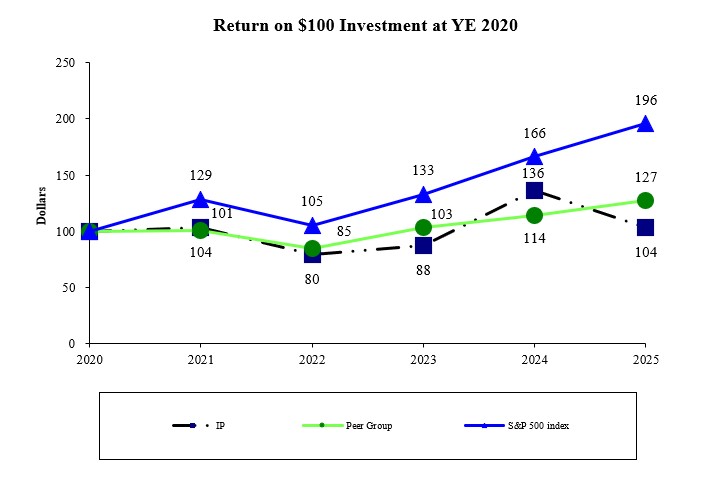
1)The companies included in the Peer Group are Klabin S.A., Mondi Group, Packaging Corporation of America and Stora Enso Group.
2)Returns are calculated in $USD.
The following discussion and analysis of our financial condition and results of operations should be read in
conjunction with our consolidated financial statements and related notes included in “Item 8. Financial Statements
and Supplementary Data” of this Annual Report on Form 10-K. In addition to historical consolidated financial
information, the following discussion contains forward-looking statements that reflect our plans, estimates, and
beliefs that involve significant risks and uncertainties. Our actual results could differ materially from those discussed
in the forward-looking statements. Factors that could cause or contribute to those differences include those
discussed below and elsewhere in this Annual Report on Form 10-K, particularly in Item 1A “Risk Factors” and
“Forward-Looking Statements.”
The following generally discusses 2025 and 2024 items and year-to-year comparisons between 2025 and 2024.
Discussion of historical items in 2023, and year-to-year comparisons between 2024 and 2023, can be found in our
Annual Report on Form 10-K for the fiscal year ended December 31, 2024, filed with the SEC on February 21,
2025, under Part II, Item 7, Management’s Discussion and Analysis of Financial Condition and Results of
Operations.
37
2025 Financial Summary
•Net sales of $23.63 billion
•Loss from continuing operations of $(2.84) billion includes the following:
◦$2.47 billion pre-tax non-cash goodwill impairment charge
◦$958 million non-cash accelerated depreciation associated with asset rationalization decisions
◦$626 million of restructuring charges
•Adjusted EBITDA (non-GAAP) from continuing operations of $2.98 billion (1)
•Cash provided by operating activities of $1.70 billion
•Free cash flow (non-GAAP) of $(159) million (1)
(1) See "Non-GAAP Financial Measures" for a list of our non-GAAP financial measures and reconciliations to the
most directly comparable GAAP measures.
Overview
Throughout 2025, we continued to execute a multi‑year transformation designed to simplify our portfolio, sharpen
our regional focus and improve underlying earnings power. The Company undertook significant strategic and
operational changes driven largely by our 80/20 performance system, the integration of DS Smith and the
divestiture of our Global Cellulose Fibers ("GCF") business.
The Company acquired DS Smith in early 2025 for an enterprise value of approximately $9.9 billion. The acquisition
expanded our geographic reach across both the North America and EMEA regions, enabling advantaged cost
positions, superior customer experiences and improved supply positions. Integration progressed rapidly during
2025, with teams applying the 80/20 performance system across both regions to streamline combined operations,
optimize production footprints, and realize supply chain and commercial synergies. By year‑end, we had executed
approximately $710 million of full run‑rate cost‑out actions, including synergy benefits attributable to the DS Smith
combination.
In North America, we continued to leverage 80/20 to simplify our business operations and focus our resources to
accelerate growth. In our packaging business, we exited non-strategic export and specialty markets and rationalized
higher cost capacity to better align with profitable customer demand. We achieved approximately $510 million of
run-rate cost savings in 2025 with the closures of several mills and plants, allowing us to increase investment in our
remaining assets. We also entered into a definitive agreement to divest our GCF business, positioning the company
as a pure play leading sustainable packaging solutions company.
Parallel with our efforts in North America, the Company advanced its integration and transformation strategy in
EMEA, where it launched the 80/20 performance system with approximately $200 million of run-rate cost-out
actions and synergy benefits actioned in 2025. Early adoption from teams across the regions has supported a
smooth rollout as the Company positions the EMEA business for its next phase of operational focus and regional
alignment.
In the first quarter of 2026, we completed the sale of our GCF business to American Industrial Partners for $1.5
billion. We intend to use proceeds from the transaction to support strategic reinvestment in our packaging business,
reduce debt to improve our credit profile and preserve financial flexibility and maintenance of a strong investment-
grade credit rating.
On January 29, 2026, the Company announced plans to separate into two independent, publicly traded companies:
International Paper will be comprised of its current business in North America including both legacy IP and DS
Smith assets, and the EMEA packaging business will be comprised of both legacy DS Smith and IP assets in
EMEA. The separation is expected to be structured as a spinoff of the EMEA business to shareholders, with
International Paper retaining a meaningful ownership stake. The transaction is expected to be completed within 12
to 15 months, subject to customary approvals, including final approval by IP’s Board of Directors, filing and
effectiveness of registration statement with the U.S. SEC and publication of prospectus approved by the U.K.
Financial Conduct Authority. No assurance can be provided regarding the ultimate timing or structure of the
proposed separation or its eventual completion.
The Company expects that creating two regionally focused businesses will allow each to tailor strategies to their
distinct markets, enhance management focus, and support long-term value creation. In 2026, the Company expects
38
to continue advancing its transformation strategy through the planned strategic separation, targeted investment
agendas, and continued operational improvements across its regional platforms. This strategic action represents the
next phase of our transformation and is designed to advance long‑term value creation for customers and
shareholders. Following the separation, International Paper plans to intensify its focus on its North American
operations, with an emphasis on targeted capital allocation, investments in productivity and innovation, and
disciplined strategic acquisitions.
As previously disclosed, IP intends to retain a meaningful ownership stake in the EMEA packaging business, which
is expected to be listed on both London Stock Exchange and the New York Stock Exchange. For additional
information about the separation, including process steps and anticipated impacts, please see Note 22 Subsequent
Events of Item 8. Financial Statements and Supplementary Data and Part I, Item 1A. Risk Factors - Risks Related
to the Separation.
Market Conditions
Throughout 2025, the Company operated in challenging demand environments across both North America and
EMEA. In North America, market demand was weaker than expected throughout most of the year as economic
uncertainty from tariffs, slower housing starts, weaker consumer sentiment and lower industrial production
negatively impacted box demand. Although industry growth was subdued throughout 2025, we grew above market
in the second half of the year as we gained commercial momentum through our focused customer service and
reliability efforts. In EMEA, overall demand remained relatively soft throughout 2025 as macroeconomic uncertainty
and volatility persisted, influenced by trade uncertainty, geopolitical tensions in the Middle East and the Russia-
Ukraine conflict.
39
Non-GAAP Financial Measures
The non-GAAP financial measures presented in this Form 10-K as referenced below have limitations as analytical
tools and should not be considered in isolation or as a substitute for an analysis of our results calculated in
accordance with GAAP. In addition, because not all companies utilize identical calculations, the Company's
presentation of non-GAAP measures in this Form 10-K may not be comparable to similarly titled measures
disclosed by other companies, including companies in the same industry as the Company. Users are cautioned not
to place undue reliance on any non-GAAP financial measures presented in this Form 10-K.
Below are the Company’s key non‑GAAP financial measures and their definitions:
Adjusted operating earnings (loss) and adjusted operating earnings (loss) per share are defined as earnings
(loss) from continuing operations (a GAAP measure) excluding net special items and non-operating pension
expense (income). Earnings (loss) from continuing operations and diluted earnings (loss) from continuing operations
per share are the most directly comparable GAAP measures. The Company calculates adjusted operating earnings
(loss) by excluding the after-tax effect of non-operating pension expense (income) and net special items, as
described in greater detail below, from earnings (loss) from continuing operations reported under GAAP. Adjusted
operating earnings (loss) per share is calculated by dividing adjusted operating earnings (loss) by diluted average
shares of common stock outstanding. Management uses these non-GAAP financial measures to focus on ongoing
operations and believes that such non-GAAP financial measures are useful to investors in assessing the operational
performance of the Company and enabling investors to perform meaningful comparisons of past and present
consolidated operating results from continuing operations. The Company believes that using these non-GAAP
financial measures, along with the most directly comparable GAAP measures, provides for a more complete
analysis of the Company's results of operations.
Adjusted EBITDA from continuing operations is defined as earnings (loss) from continuing operations before
income taxes and equity earnings (loss), interest expense, net, net special items, non-operating pension expense
(income) and depreciation and amortization. Earnings (loss) from continuing operations before income taxes and
equity earnings (loss) is the most directly comparable GAAP measure. Beginning in 2025, management is also
using this measure to focus on on-going operations and believes this measure is useful to investors. This change
reflects investor feedback and management's view that Adjusted EBITDA from continuing operations provides a
meaningful measure of the operating performance of the Company and helps enable investors to perform
meaningful comparisons of past and present consolidated operating results from continuing operations.
Free cash flow is defined as cash provided by (used for) operations less capital expenditures, and the most directly
comparable GAAP measure is cash provided by (used for) operations. Management utilizes this measure in
connection with managing our business and believes that free cash flow is useful to investors as a liquidity measure
because it measures the amount of cash generated that is available, after reinvesting in the business, to maintain a
strong balance sheet, pay dividends, repurchase stock, service debt and make investments for future growth. It
should not be inferred that the entire free cash flow amount is available for discretionary expenditures.
Operational income tax provision and operational effective income tax rate are calculated by adjusting the
earnings (loss) from continuing operations before income taxes and equity earnings (loss), income tax provision
(benefit) and rate to exclude net special items and non-operating pension expense (income). The most directly
comparable GAAP measures are the reported income tax provision and effective income tax rate, respectively.
Management believes that this presentation provides useful information to investors by providing a meaningful
comparison of the income tax rate between past and present periods.
40
Below are reconciliations of the non‑GAAP financial measures noted above to their most directly
comparable GAAP measures:
Non-operating pension expense (income) represents amortization of prior service cost, amortization of actuarial
gains/losses, expected return on assets and interest cost. The Company excludes these amounts from our adjusted
operating earnings (loss) as the Company does not believe these items reflect ongoing operations. These particular
pension cost elements are not directly attributable to current employee service. The Company includes service cost
in our non-GAAP measure as it is directly attributable to employee service, and the corresponding employees’ other
compensation elements, in connection with ongoing operations.
See Effects of Special Items Expense (Income) for additional detail regarding the net special items expense
(income) referenced in the tables below.
Reconciliation of Earnings (loss) from continuing operations to Adjusted operating earnings (loss)
In millions | 2025 | 2024 |
Earnings (Loss) from Continuing Operations | $(2,838) | $725 |
Add back - Non-operating pension expense (income) | (12) | (42) |
Add back - Net special items expense (income) | 3,237 | 235 |
Income tax effect - Non-operating pension and special items (a) | (487) | (447) |
Adjusted Operating Earnings (Loss) | $(100) | $471 |
(a) For the year ended December 31, 2025, this amount includes tax benefits of $271 million related to the EMEA goodwill impairment and $62
million related to capital losses associated with the announced agreement to sell our GCF business. This amount also includes tax expense of $3
million on the non-operating pension income and a tax benefit of $157 million associated with other special items. For the year ended December
31, 2024, this amount includes a tax benefit of $416 million related to internal legal entity restructuring. This amount also includes tax expense of
$10 million on the non-operating pension income and a tax benefit of $41 million associated with other special items.
Reconciliation of Earnings (loss) from continuing operations to Adjusted operating earnings (loss) on a per
share basis
2025 | 2024 | |
Diluted Earnings (Loss) Per Share from Continuing Operations | $(5.61) | $2.05 |
Add back - Non-operating pension expense (income) per share | (0.02) | (0.12) |
Add back - Net special items expense (income) per share | 6.40 | 0.66 |
Income tax effect per share - Non-operating pension and special items | (0.97) | (1.26) |
Adjusted Operating Earnings (Loss) Per Share | $(0.20) | $1.33 |
Reconciliation of Earnings (loss) from continuing operations to Adjusted EBITDA from continuing
operations
In millions | 2025 | 2024 | ||
Earnings (Loss) from Continuing Operations | $(2,838) | $725 | ||
Add back: Income tax provision (benefit) | (533) | (361) | ||
Less: Equity earnings (loss), net of taxes | (3) | (5) | ||
Earnings (Loss) from Continuing Operations Before Income Taxes and Equity Earnings (Loss) | (3,368) | 369 | ||
Interest expense, net | 372 | 214 | ||
Special items | 3,237 | 245 | ||
Non-operating pension expense (income) | (12) | (42) | ||
Depreciation and amortization | 2,747 | 850 | ||
Adjusted EBITDA from Continuing Operations | $2,976 | $1,636 |
41
Reconciliation of Cash provided by operations to Free cash flow
In millions | 2025 | 2024 |
Cash provided by operations | $1,698 | $1,678 |
Adjustments: | ||
Capital expenditures | (1,857) | (921) |
Free Cash Flow | $(159) | $757 |
Reconciliation of Income tax provision (benefit) to Operational tax provision (benefit) and the reported
effective income tax rate to the operational effective tax rate
In millions | 2025 | 2024 | ||
Provision (Benefit) | Rate | Provision (Benefit) | Rate | |
Income tax provision (benefit) and reported effective income tax rate | $(533) | 16% | $(361) | (98)% |
Income tax effect - non-operating pension (income) expense and special items | 487 | 447 | ||
Operational Tax Provision (Benefit) and Operational Effective Tax Rate | $(46) | 32% | $86 | 15% |
Effects of Net Special Items Expense (Income)
Pre-tax special items included in continuing operations totaling $3.24 billion and $235 million were recorded in 2025
and 2024, respectively. Details of these charges were as follows:
Special Items | ||||
In millions | 2025 | 2024 | ||
PS EMEA goodwill impairment | $2,467 | (a) | $— | |
Severance and other costs | 626 | (b) | 104 | (b) |
DS Smith combination costs | 237 | (c) | 86 | (c) |
Net (gains) losses on sales and impairments of businesses | (25) | (d) | — | |
Net (gains) losses on sales and impairments of assets | (70) | (e) | (59) | (e) |
Environmental remediation adjustments | 2 | (f) | 60 | (f) |
Strategic advisory fees | — | 37 | (c) | |
Third-party warehouse fire | — | 13 | (g) | |
Italy antitrust | — | (6) | (h) | |
Legal reserve adjustments | — | 10 | (i) | |
Interest related to settlement of tax audits | — | (10) | (j) | |
Total Pre-Tax Special Items | $3,237 | $235 |
(a) Non-cash goodwill impairment related to the Company's PS EMEA business segment recorded in impairment of goodwill.
(b) Severance and other costs associated with the Company's 80/20 approach which includes the realignment of resources and mill strategic
actions recorded primarily in restructuring and other charges, net.
(c) Transaction related costs that the Company believes are not reflective of the Company's underlying operations. 2025 includes $29 million
recorded in cost of products sold, $158 million recorded in selling and administrative expenses and $50 million recorded in taxes other than
payroll and income taxes. 2024 includes $123 million recorded in selling and administrative expenses.
(d) Includes a charge related to the sale of the Company's kraft paper bag business and a net gain related to the sale of five European box plants
in Mortagne, Saint-Amand and Cabourg (France), Ovar (Portugal) and Bilbao (Spain) to satisfy regulatory commitments in connection with the
DS Smith combination.
(e) Includes gains on assets sales related to our permanently closed Courtland, Alabama paper mill and Orange, Texas containerboard mill and
charges associated with the sale of the Company's aircraft and other assets.
(f) Environmental remediation adjustments associated with remediation work at sites that have been closed/divested that the Company believes
are not reflective of the Company's underlying operations recorded in cost of products sold.
(g) The Company's cost for third-party damages associated with a warehouse fire in Morocco recorded in cost of products sold.
(h) Settlement associated with an Italian antitrust matter initially recorded as a special item in 2019 recorded in cost of products sold.
(i) Legal reserve adjustment associated with a previously discontinued business recorded in cost of products sold.
(j) Interest income on tax overpayments in prior years associated with the settlement of certain tax audits recorded in interest expense, net.
42
The following summarizes our results from operations for the year ended December 31, 2025 compared with the
year ended December 31, 2024:
In millions | 2025 | 2024 | Change | |||
Net sales | $23,634 | $15,835 | $7,799 | |||
Cost of products sold | 16,637 | 11,397 | 5,240 | |||
Selling and administrative expenses | 2,050 | 1,703 | 347 | |||
Depreciation and amortization | 2,747 | 851 | 1,896 | |||
Distribution expenses | 2,000 | 1,180 | 820 | |||
Taxes other than payroll and income taxes | 210 | 119 | 91 | |||
Restructuring charges, net (a) | 626 | 103 | ||||
Impairment of goodwill (a) | 2,467 | — | ||||
Net (gains) losses on sales and impairments of businesses (a) | (25) | — | ||||
Net (gains) losses on sales and impairments of assets (a) | (70) | (59) | ||||
Interest expense, net | 372 | 214 | 158 | |||
Non-operating pension (income) expense | (12) | (42) | ||||
Earnings from continuing operations before income taxes and equity earnings (loss) | (3,368) | 369 | ||||
Income tax provision (benefit) | (533) | (361) | ||||
Equity earnings (loss), net of taxes | (3) | (5) | ||||
Earnings (loss) from continuing operations | (2,838) | 725 | ||||
Discontinued operations, net of taxes | (678) | (168) | ||||
Net earnings (loss) | $(3,516) | $557 |
TWELVE MONTHS ENDED DECEMBER 31, 2025 COMPARED TO THE TWELVE MONTHS ENDED DECEMBER 31, 2024
The following is a discussion of International Paper’s consolidated results of operations for the year ended
December 31, 2025, and the major factors affecting these results compared to 2024.
Refer to the Effects of Net Special Items Expense (Income) section for details of net special items expense (income)
discussed below.
Net sales
Compared to the year ended December 31, 2024, net sales for the year ended December 31, 2025 increased by
$7.8 billion. DS Smith accounted for $7.8 billion of net sales in 2025. For IP legacy, the increase of $46 million was
driven by higher sales prices partially offset by lower sales volumes. Additional details on net sales are provided in
Cost of products sold
Compared to the year ended December 31, 2024, cost of products sold for the year ended December 31, 2025
increased by $5.2 billion. DS Smith accounted for $5.8 billion of total cost of products sold in 2025 and net special
items charges of $31 million were included in 2025 compared to $77 million in 2024. For IP legacy, cost of products
sold was impacted by lower raw materials and operating materials of $542 million, partially offset by increases in
fuel and utility expenses of $111 million.
Selling and administrative expenses
Compared to the year ended December 31, 2024, selling and administrative expenses for the year ended
December 31, 2025 increased by $347 million. DS Smith accounted for $442 million of total selling and
administrative expenses in 2025 and net special items charges of $158 million were included in 2025 compared to
$123 million in 2024. For IP legacy, selling and administrative expenses were impacted by decreases in incentive
compensation of $148 million and increases in other costs of $21 million.
43
Depreciation and amortization
Compared to the year ended December 31, 2024, depreciation and amortization for the year ended December 31,
2025 increased by $1.9 billion. DS Smith accounted for $1.3 billion of depreciation and amortization in 2025,
including $403 million of accelerated depreciation associated with mill and other strategic actions. For IP legacy, the
increase compared to 2024 was due to an increase of $553 million in accelerated depreciation related to mill and
other strategic actions in 2025.
Distribution expenses
Compared to the year ended December 31, 2024, distribution expenses for the year ended December 31, 2025
increased by $820 million. DS Smith accounted for $858 million of distribution expenses in 2025. For IP legacy,
distribution expenses were impacted by lower freight costs and lower sales volumes compared to 2024.
Taxes other than payroll and income taxes
Compared to the year ended December 31, 2024, taxes other than payroll and income taxes for the year ended
December 31, 2025 increased by $91 million. DS Smith accounted for $33 million of taxes other than payroll and
income taxes in 2025. Net special items charges of $50 million were included in taxes other than payroll and income
taxes in 2025. For IP legacy, taxes other than payroll and income taxes were impacted by higher real estate taxes
compared to 2024.
Interest expense, net
Compared to the year ended December 31, 2024, interest expense, net for the year ended December 31, 2025
increased by $158 million. DS Smith accounted for $160 million of interest expense, net in 2025 and net special
items income of $10 million was included in interest expense, net in 2024. For IP legacy, interest expense, net was
impacted by higher interest income.
Income tax provision (benefit)
A net income tax benefit from continuing operations of $533 million was recorded for 2025 and the reported effective
income tax rate was 16%. This includes a tax benefit of $271 million related to the EMEA goodwill impairment and a
tax benefit of $62 million related to capital losses associated with the announced agreement to sell our GCF
business, which closed in January 2026. Excluding these items, a $157 million net tax benefit for other special items
and $3 million tax expense related to non-operating pension income, the operational tax provision (benefit) (non-
GAAP) for 2025 was $46 million, or 32% of pre-tax earnings before equity earnings.
A net income tax benefit from continuing operations of $361 million was recorded for 2024 and the reported effective
income tax rate was (98)%. This includes a tax benefit of $416 million related to internal legal entity restructuring.
Excluding these items, a $41 million net tax benefit for other special items and $10 million tax expense related to
non-operating pension income, the operational tax provision (non-GAAP) for 2024 was $86 million, or 15% of pre-
tax earnings before equity earnings.
Compared to the year ended December 31, 2024, the operational effective tax rate increased by 17% in 2025. DS
Smith accounted for a significant increase in the foreign taxes driving up the operational effective tax rate in the
year.
Refer to "Non-GAAP Financial Measures" for a reconciliation of the net income tax provision (benefit) (GAAP) to the
operational income tax provision (benefit) (non-GAAP) and the reported effective income tax rate (GAAP) to the
operational effective income tax rate (non-GAAP).
Discontinued operations, net of taxes
On August 21, 2025, the Company announced that it had reached a definitive agreement with American Industrial
Partners ("AIP") to sell its GCF business. All current and historical operating results of the GCF business are
presented as Discontinued Operations, net of taxes, in the consolidated statements of operations. All current and
historical assets and liabilities of the GCF business are classified as Assets held for sale and Long-Term Assets
Held For Sale and Liabilities held for sale and Long-Term Liabilities Held For Sale in the accompanying consolidated
balance sheets. See Note 8 - Divestiture of Item 8. Financial Statements and Supplementary Data for further
44
details.
Discontinued operations, net of taxes for 2025 and 2024 includes the operating earnings of the GCF business.
Discontinued operations, net of taxes also includes the following charges (benefits):
In millions | 2025 | 2024 |
Net loss on impairment of the GCF business | $1,070 | $— |
Global Cellulose Fibers transaction costs | 52 | 5 |
Severance and other costs (benefits) | (8) | 123 |
Total | $1,114 | $128 |
The Company currently operates in two segments: Packaging Solutions North America ("PS NA") and Packaging
Solutions EMEA ("PS EMEA"). These segments are organized by geography and align with the Company's internal
management structure. All segments are differentiated on a common product, common customer basis consistent
with the business segmentation generally used in the forest products industry. See Note 21 - Financial Information
by Business Segment of Item 8. Financial Statements and Supplementary Data for further details regarding the
Company's business segments.
The majority of our business is focused on creating fiber-based packaging that protects and promotes goods,
enables worldwide commerce and helps keep consumers safe. We meet our customers’ most challenging sales,
shipping, storage and display requirements with sustainable solutions. Our U.S. production capacity was
approximately 11 million tons annually as of December 31, 2025.
Containerboard includes linerboard, medium, whitetop, recycled linerboard, recycled medium and saturating kraft.
Approximately 75% of our production is converted into corrugated packaging and other packaging by our 170 North
American corrugated packaging plants. Additionally, we recycle approximately one million tons of OCC and mixed
and white paper through our 15 U.S. recycling plants. Our corrugated packaging plants are supported by regional
design centers, which offer total packaging solutions and supply chain initiatives. In EMEA, our operations include
14 containerboard mills, 148 corrugated packaging plants and 20 recycling plants.
The following tables present net sales and business segment operating profit (loss), which is the Company's
measure of segment profitability and is defined as earnings (loss) before income taxes and equity earnings (losses),
including the impact of less than wholly owned subsidiaries and excluding interest expense, net, corporate
expenses, net, net special items and non-operating pension expense. Business segment operating profit (loss) is a
measure reported to our management for purposes of making decisions about allocating resources to our business
segments and assessing the performance of our business segments and is presented in our financial statement
footnotes in accordance with ASC 280 - "Segment Reporting." For additional information regarding business
segment operating profit (loss), including a description of the manner in which business segment operating profit
(loss) is calculated, see Note 21 - Financial Information by Business Segment of Item 8. Financial Statements and
Demand for our products is closely correlated with non-durable industrial goods production, as well as with demand
for e-commerce, processed foods, poultry, meat and agricultural products. In addition to prices and volumes, major
factors affecting profitability are raw material and energy costs, freight costs, mill outage costs, manufacturing
efficiency and product mix.
PS NA
In millions | 2025 | 2024 |
Sales | $15,175 | $14,293 |
Business Segment Operating Profit (Loss) | $572 | $891 |
PS NA 2025 results include sales of $611 million and business segment operating profit (loss) of $(346) million for
the DS Smith business. For legacy IP PS NA, sales increased in 2025 compared with 2024, driven by higher sales
45
prices, partially offset by lower volumes reflecting the impact of our box go-to-market strategy and mill strategic
actions. Cost of products sold decreased by $241 million and was impacted by lower volumes, lower planned
maintenance downtime costs and lower input costs, partially offset by higher operating costs. Operating costs were
higher primarily due to increased costs on materials and services and increased spending on maintenance and
reliability, partially offset by lower economic downtime. Input costs were lower, driven by lower recovered fiber and
wood costs, partially offset by higher energy and chemical costs. Selling and administrative expenses were $52
million lower due to lower incentive compensation expense. Distribution costs were $37 million lower driven by
lower sales volumes. Depreciation and amortization expense was $564 million higher, driven by accelerated
depreciation associated with our mill and other strategic actions.
Looking ahead to the first quarter of 2026, compared with the fourth quarter of 2025, sales volumes for corrugated
boxes are expected to be lower due to seasonality and the exit of non-strategic markets. Operating costs are
expected to be flat. Planned maintenance outage costs are expected to be higher due to the timing of planned
outages. Operating and input costs are expected to be relatively flat.
PS EMEA
In millions | 2025 | 2024 |
Sales | $8,451 | $1,355 |
Business Segment Operating Profit (Loss) | $(236) | $60 |
PS EMEA 2025 results include sales of $7.2 billion and business segment operating profit (loss) of $(321) million for
the DS Smith business. For legacy IP PS EMEA, sales were lower in 2025 compared with 2024, reflecting lower
volumes in a soft demand environment and an unfavorable product mix. Cost of products sold decreased $54
million and was impacted by lower volumes, lower operating costs and lower input costs, primarily for energy costs.
Selling and administrative expenses were $12 million lower driven by incentive compensation expense. Distribution
expense was $25 million lower driven by lower sales volumes.
Entering the first quarter of 2026, compared with the fourth quarter of 2025, sales volumes are expected to be
higher due to known customer wins. Average sales margins are expected to be higher, reflecting a favorable
product mix. Operating costs are expected to be higher primarily driven by the timing of energy subsidies and
increased volumes. Planned maintenance outage costs are expected to be lower due to the timing of planned
outages. Input costs are expected to be higher primarily driven by elevated energy costs.
OVERVIEW
A major factor in International Paper’s liquidity and capital resource planning is generation of operating cash flow,
which is highly sensitive to changes in the pricing and demand for our major products. While changes in key
operating cash costs, such as raw material, energy, mill outage and distribution, have an effect on operating cash
generation, we believe our focus on commercial and operational excellence, as well as our ability to tightly manage
costs and working capital has improved our cash flow generation over an operating cycle.
Use of cash during 2025 was primarily focused on working capital requirements, capital spending into the business
for growth including mill and plant improvements, equipment and new greenfield investments and returning cash to
shareholders through dividends.
CASH PROVIDED BY OPERATING ACTIVITIES
Cash provided by operations, including discontinued operations, totaled $1.7 billion in both 2025 and 2024. Cash
used by working capital components (accounts receivable, contract assets and inventory less accounts payable and
accrued liabilities, interest payable and other) totaled $834 million in 2025, compared with cash used by working
capital components of $10 million in 2024. The change in cash provided by operations in 2025 compared to the
2024 period was primarily due to significant payments made in 2025 that impacted operating cash flow, including
DS Smith transaction costs and severance payments, as well as incentive compensation and other benefit
payments.
46
INVESTMENT ACTIVITIES
Cash used for investment activities, including discontinued operations, totaled $1.0 billion in 2025 compared with
$808 million in 2024. The increase in cash used for investment activities in 2025 compared to 2024 is mainly due to
higher capital expenditures of $936 million, offset by an increase in proceeds from sale of fixed assets of $127
million, proceeds from divestitures, net of transaction costs of $141 million and net cash acquired from acquisitions
of $414 million.
Including discontinued operations, capital expenditures were $1.9 billion in 2025, or 64% of depreciation and
amortization, compared with $921 million in 2024, or 71% of depreciation and amortization. Capital spending as a
percentage of depreciation and amortization, including discontinued operations, was impacted by accelerated
depreciation of $958 million and $233 million for the years ended December 31, 2025 and December 31, 2024,
respectively, related to mill strategic actions and other 80/20 actions.
The following table shows capital expenditures by business segment for the years ended December 31, 2025 and
2024:
In millions | 2025 | 2024 |
Packaging Solutions North America | $1,115 | $710 |
Packaging Solutions EMEA | 573 | 53 |
Subtotal | 1,688 | 763 |
Corporate and other (a) | 169 | 158 |
Capital Expenditures | $1,857 | $921 |
(a) Includes capital expenditures related to Corporate and GCF.
Acquisitions
See Note 7 Acquisitions of Item 8. Financial Statements and Supplementary Data for a discussion of the Company's
acquisitions.
FINANCING ACTIVITIES
Financing activities during 2025 included debt issuances of $409 million and reductions of $255 million for a net
increase of $154 million. Financing activities during 2024 included debt issuances of $102 million and reductions of
$141 million.
There were no early debt extinguishments during the years ended December 31, 2025 and December 31, 2024.
Other financing activities during 2025 included the net issuance of approximately 3.7 million shares of treasury
stock, while repurchases of common stock and payments of restricted stock withholding taxes totaled $65 million.
During 2025, no shares of common stock were repurchased under the Company's share repurchase program.
Through December 31, 2025, the Company had repurchased 119.8 million shares at an average price of $46.23, for
a total of approximately $5.5 billion, since the repurchase program began in September 2013. The Company paid
cash dividends totaling $977 million during 2025.
Other financing activities during 2024 included the net issuance of approximately 2.0 million shares of treasury
stock. Repurchases of common stock and payments of restricted stock withholding taxes totaled $23 million. During
2024, no shares of common stock were repurchased under the Company's share repurchase program. Through
December 31, 2024, the Company has repurchased 119.8 million shares at an average price of $46.23, for a total of
approximately $5.5 billion, since the repurchase program began in September 2013. The Company paid cash
dividends totaling $643 million during 2024.
Interest Rate Swaps
Our policy is to manage interest cost using a mixture of fixed-rate and variable-rate debt. To manage this risk,
International Paper utilizes interest rate swaps to change the mix of fixed and variable rate debt. During 2020,
International Paper terminated its interest rate swaps with a notional amount of $700 million and maturities ranging
from 2024 to 2026 with an approximate fair value of $85 million. Subsequent to the termination of the interest rate
swaps, the fair value basis adjustment is amortized to earnings as interest income over the same period as a debt
47
premium on the previously hedged debt. The Company had no outstanding interest rate swaps for the years ended
December 31, 2025 and 2024.
Variable Interest Entities
Information concerning variable interest entities is set forth in Note 15 Variable Interest Entities of Item 8. Financial
LIQUIDITY AND CAPITAL RESOURCES OUTLOOK FOR 2026
We intend to continue making choices for the use of cash that are consistent with our capital allocation framework to
drive long-term value creation. These include maintaining a strong balance sheet and investment grade credit
rating, and creating value with a continued focus on cost reduction and making organic investments to maintain our
world-class system and strengthen our businesses.
On January 23, 2026, the Company completed the previously announced sale of its GCF business to AIP for $1.5
billion, including the issuance of preferred stock with an aggregate initial liquidation preference of $190 million. The
Company plans to use a portion of the proceeds from the sale of the GCF business to pay down existing debt.
As of December 31, 2025, approximately $2.96 billion remain authorized for repurchase under our share
repurchase program, which has no expiration date. We may repurchase shares under such authorization in open
market transactions (including block trades), privately negotiated transactions or otherwise, subject to prevailing
market conditions, our liquidity requirements, applicable securities laws requirements and other factors. In addition,
we have paid regular quarterly cash dividends and expect to continue to pay regular quarterly cash dividends in the
foreseeable future. Each quarterly dividend is subject to review and approval by our Board of Directors.
Long-Term Debt
The following summarizes certain material provisions of our long-term debt facilities and current obligations. The
following description is only a summary, does not purport to be complete and is qualified in its entirety by reference
to the documents governing such indebtedness. For additional information regarding the Company’s credit
agreements, outstanding and assumed indebtedness, see Note 16 Debt and Lines of Credit of Item 8. Financial
At December 31, 2025, International Paper’s U.S. dollar denominated credit facilities totaled $1.9 billion, comprised
of a $1.4 billion contractually committed bank credit agreement and up to $500 million available under its
receivables securitization program. Management believes these credit agreements provide sufficient liquidity to
manage operating cash flow variability during the current economic cycle. The credit agreements generally provide
for interest rates at a floating rate index plus a pre-determined margin tied to International Paper’s credit rating. At
December 31, 2025, the Company had no borrowings outstanding under the $1.4 billion credit agreement or the
$500 million receivables securitization program. The Company’s credit agreements contain no restrictive covenants
other than the financial covenants as described in Note 16 - Debt and Lines of Credit of Item 8. Financial
Statements and Supplementary Data, and the borrowings under the receivables securitization program being limited
by eligible receivables. The Company was in compliance with all its debt covenants at December 31, 2025 and
within the thresholds stipulated. The financial covenants do not restrict any borrowings under the credit agreements.
Commercial Paper
In addition to the $1.9 billion capacity under the Company's credit agreements, International Paper has a
commercial paper program with a borrowing capacity of $1.0 billion supported by its $1.4 billion credit agreement.
Under the terms of the Company's commercial paper program, individual maturities on borrowings may vary, but not
exceed one year from the date of issue. Interest bearing notes may be issued either as fixed or floating rate notes.
The Company had no borrowings outstanding as of December 31, 2025 and December 31, 2024 under this
program.
Assumed Debt
In 2025, International Paper assumed foreign denominated debt of DS Smith in various currencies.
48
Euro Medium Term Notes
Our subsidiary DS Smith initiated consent solicitations with the holders of several series of its outstanding euro- and
sterling denominated notes to approve certain amendments to the notes’ terms and related trust deeds (the “Euro
Medium Term Notes”). The amendments were designed to align DS Smith’s reporting and covenant framework with
that of International Paper following the acquisition, and to provide greater flexibility for the reorganization of DS
Smith’s subsidiaries. As part of the solicitation process, International Paper agreed to provide guarantees of DS
Smith’s obligations under each series of the Euro Medium Term Notes. These amendments and guarantees were
implemented in March 2025 through supplemental trust deeds. All principal amounts of the affected Euro Medium
Term Notes remain outstanding.
Credit and Bank Facilities
The Company amended and restated its £1.25 billion multi-currency credit facility agreement, its €200 million credit
facility and €60 million committed bank facility. The amendments (i) replaced the Company's standalone financial
reporting requirements with International Paper’s financial information; (ii) aligned the facility's financial covenant
with those in International Paper’s existing credit facilities; and (iii) updated certain events of default and
undertakings to reflect International Paper's financing framework and to provide additional flexibility for potential
subsidiary reorganization within the International Paper group.
The £1.25 billion multi-currency credit facility allows for British pound sterling, euro and U.S. dollar-denominated
borrowings at floating rates plus a pre-determined margin, with borrowings generally denominated to match the
Company's cashflows. At December 31, 2025, the Company had €975 million and £10 million (approximately $1.2
billion) borrowings outstanding under the credit facility. The Company’s credit facility agreement is not subject to any
restrictive covenants other than that International Paper must comply with the same negative covenants as per its
existing credit facilities. IP was in compliance with all its debt covenants at December 31, 2025, and was well below
the thresholds stipulated under the covenants as defined in the credit facility agreement. Further the financial
covenants do not restrict any borrowings under the £1.25 billion credit facility agreement.
The €200 million credit facility agreement provides for interest rates at a fixed rate for each facility. At December 31,
2025, the Company had €163 million (approximately $191 million) borrowings outstanding under the credit facility
agreement.
The credit facility agreements do not impose restrictive covenants other than requiring International Paper to comply
with the same negative covenants applicable to its existing credit facilities. IP was in compliance with all applicable
covenants as of December 31, 2025, and remained well within the thresholds. The financial covenants do not
restrict the Company’s ability to borrow under the credit facility agreement.
The €60 million committed bank facility, maturing in 2026, allows for British pound sterling, euro and US dollar-
denominated borrowings. At December 31, 2025, there were no borrowings outstanding under this agreement. The
Company has a £50 million uncommitted bank facility. At December 31, 2025, the Company had €55 million
(approximately $65 million) borrowings outstanding under this agreement.
During the year ended December 31, 2025, the Company had debt reductions of $255 million in 2025, related
primarily to $26 million of capital leases, $27 million of environmental development bonds ("EDB"), $95 million of
industrial development bonds ("IDB") and $61 million of bonds. In addition, during the year ended December 31,
2025, the Company also had debt issuances of $165 million of industrial development bonds. The Company also
borrowed $244 million under its foreign denominated credit facilities during 2025.
Capital Expenditures
We increased capital spending in 2025 as the Company accelerated several multi-year investments to support our
80/20 approach, enhance mill productivity, expand capacity in key growth markets, and modernize equipment to
improve safety, reliability and energy efficiency. In North America, these 2025 authorizations include investment of
$250 million to convert a machine at the Riverdale mill in Selma, Alabama to produce containerboard and
construction of a new state-of-the-art sustainable packaging box plant in Waterloo, Iowa.
Capital expenditures for 2026 are planned at approximately $1.95 billion to $2.05 billion, or about 98% to 103% of
depreciation and amortization, reflecting continued execution of these strategic projects. The timing and scope of
planned investments will depend on operational needs and the availability of operating cash flows, and certain
projects may be deferred if cash generation or market conditions weaken.
49
International Paper expects to be able to meet projected capital expenditures, service existing debt, meet working
capital and dividend requirements and make common stock and/or debt repurchases for the next 12 months and for
the foreseeable future thereafter with current cash balances and cash from operations, supplemented as required
by its existing credit facilities. The Company will continue to rely on debt and capital markets for the majority of any
necessary long-term funding not provided by operating cash flows. Funding decisions will be guided by our capital
structure planning objectives. The primary goals of the Company’s capital structure planning are to maximize
financial flexibility and maintain appropriate levels of liquidity to meet our needs while managing balance sheet debt
and interest expense. We have repurchased, and may continue to repurchase, our common stock (under our
existing share repurchase program) and debt (including through open market purchases, privately negotiated
transactions or otherwise) to the extent consistent with this capital structure planning, and subject to prevailing
market conditions, our liquidity requirements, applicable securities laws requirements and other factors. The
majority of International Paper’s debt is accessed through global public capital markets where we have a wide base
of investors.
Maintaining an investment grade credit rating is an important element of International Paper’s financing strategy. At
December 31, 2025, the Company held long-term credit ratings of BBB (stable outlook) and Baa2 (stable outlook)
by S&P and Moody’s, respectively.
Contractual obligations for future payments under existing debt and lease commitments and purchase obligations at
December 31, 2025, were as follows:
In millions | 2026 | 2027 | 2028 | 2029 | 2030 | Thereafter |
Debt maturities (a) | $992 | $2,584 | $739 | $381 | $807 | $4,328 |
Operating lease obligations | 245 | 190 | 124 | 72 | 46 | 100 |
Purchase obligations (b) | 3,018 | 661 | 432 | 311 | 263 | 1,150 |
Total (c) | $4,255 | $3,435 | $1,295 | $764 | $1,116 | $5,578 |
(a)Includes financing lease obligations.
(b)Includes fiber supply and other service and supply agreements.
(c)The table above does not reflect: (i) approximately $344 million of unrecognized tax benefits due to the uncertainty regarding the timing
and amount of payment; (ii) $37 million of Deemed Repatriation Transition Tax under the 2017 Tax Cuts and Jobs Act, which will be
settled in 2026; and (iii) $487 million deferred tax liability related to the Temple-Inland timber monetization, which will be settled with the
maturity of the notes in 2027.
We consider the undistributed earnings of our foreign subsidiaries as of December 31, 2025, to be permanently
reinvested and, accordingly, no U.S. income taxes have been provided thereon (see Note 13 Income Taxes of Item
8. Financial Statements and Supplementary Data). We do not anticipate the need to repatriate funds to the United
States to satisfy domestic liquidity needs arising in the ordinary course of business, including liquidity needs
associated with our domestic debt service requirements.
Pension Obligations and Funding
At December 31, 2025, the projected benefit obligation for the Company’s defined benefit plans determined under
U.S. GAAP was approximately $144 million lower than the fair value of plan assets. Plans that are subject to
minimum funding requirements had plan assets of $486 million higher than the projected benefit obligation. Under
current IRS funding rules, the calculation of minimum funding requirements differs from the calculation of the
present value of plan benefits (the "projected benefit obligation") for accounting purposes. Funding contributions
depend on the funding methods selected by the Company. The selected methods allow for the smoothing of asset
values and interest rates used to measure the funding obligations. The Company continually reassesses the
amount and timing of any discretionary contributions and elected not to make any voluntary contributions in 2023,
2024 or 2025. At this time, we do not expect to have any required contributions to our plans in 2026, although the
Company may elect to make future voluntary contributions. The timing and amount of future contributions, which
could be material, will depend on a number of factors, including the actual earnings and changes in values of plan
assets and changes in interest rates.
The preparation of financial statements in conformity with U.S. GAAP requires International Paper to establish
accounting policies and to make estimates that affect both the amounts and timing of the recording of assets,
50
liabilities, revenues and expenses. Some of these estimates require subjective judgments about matters that are
inherently uncertain.
Accounting policies whose application has had or is reasonably likely to have a material impact on the reported
results of operations and financial position of International Paper, and that can require a significant level of
estimation or uncertainty by management that affect their application, include the accounting for impairment of long-
lived assets and goodwill, pensions, income taxes and business combinations. Management has discussed the
selection of critical accounting policies and the effect of significant estimates with the Audit and Finance Committee
of the Company’s Board of Directors and with its independent registered public accounting firm.
IMPAIRMENT OF LONG-LIVED ASSETS AND GOODWILL
Long-lived assets are reviewed for impairment upon the occurrence of events or changes in circumstances that
indicate that the carrying value of the assets may not be recoverable. A recoverability test is performed by
comparing the undiscounted cash flows to the carrying value of the assets. If the carrying amount is less than the
undiscounted cash flows, the fair value of the assets is compared to the carrying value to determine if they are
impaired. An impairment of a long-lived asset exists when the asset’s carrying amount exceeds its fair value.
In conjunction with the previous announcement and subsequent sale of the Global Cellulose Fibers business to AIP
for $1.5 billion, the Company evaluated the long-lived assets for impairment. As a result, the Company recorded a
net pre-tax charge of $1.07 billion ($805 million after taxes) for the year ended December 31, 2025 due to the
difference between the sales price less estimated selling costs and the carrying value. This non-cash charge is
included in Discontinued Operations, net of taxes in the accompanying consolidated statements of operations.
We perform an annual goodwill impairment as of October 1. Additionally, interim assessments of possible
impairments of goodwill are also made when events or changes in circumstances indicate that the carrying value of
the asset may not be recoverable through future operations. A goodwill impairment exists when the carrying amount
of goodwill exceeds its fair value.
ASU 2011-08, "Intangibles - Goodwill and Other," allows entities testing goodwill for impairment the option of
performing a qualitative assessment before performing the quantitative goodwill impairment test. If a qualitative
assessment is performed, an entity is not required to perform the quantitative goodwill impairment test unless the
entity determines that, based on that qualitative assessment, it is more likely than not that its fair value is less than
its carrying value.
The January 31, 2025 acquisition of DS Smith added approximately $4.3 billion of goodwill, of which $3.4 billion was
allocated to the PS EMEA reporting unit and $0.9 billion was related to the PS NA reporting unit.
The Company completed its annual goodwill impairment testing for the PS NA and PS EMEA reporting units as of
October 1, 2025. Based on this assessment, no impairment was identified for either reporting unit.
Later in the fourth quarter of 2025, the Company, as part of its annual strategic review, identified a triggering event
driven by its updated strategic plan impacted by macroeconomic and industry outlooks, as well as the Company’s
evaluation of a potential separation into two independent, publicly traded companies. In response, the Company
performed a quantitative goodwill impairment test for the PS NA and PS EMEA reporting units, comparing each
reporting unit’s carrying value to its estimated fair value.
Estimated fair values were determined using discounted future cash flows and market multiples, which use inputs
that are classified within Level 2 and Level 3 of the fair value hierarchy. The discounted cash flow approach requires
significant management judgments, including assumptions related to forecasts of future revenues, operating
margins, and discount rates. The market‑multiple approach under the guideline public company method similarly
requires significant assumptions regarding adjusted EBITDA multiples.
As of December 31, 2025, the quantitative impairment test concluded that the carrying amount of the PS EMEA
reporting unit exceeded its estimated fair value. As a result, the Company recorded a goodwill impairment charge of
approximately $2.47 billion, which is reflected in Impairment of goodwill in the accompanying consolidated
statement of operations. After the impairment charge the carrying value of the PS EMEA reporting unit approximates
fair value. The estimated fair value of the PS EMEA reporting unit is sensitive to the underlying assumptions and a
51
material change in any one, or combination of assumptions, could result in material future goodwill impairment. The
carrying amount of the PS NA reporting unit did not exceed its estimated fair value, and no impairment was
recorded for that reporting unit.
PENSION BENEFIT OBLIGATIONS
The calculation of the pension benefit obligation and corresponding expense amounts are determined annually, with
involvement of International Paper’s consulting actuary, and are dependent upon various assumptions including the
expected long-term rate of return on plan assets, discount rates, projected future compensation increases and
mortality rates.
The calculations of pension benefit obligations and expense require decisions about a number of key assumptions
that can significantly affect liability and expense amounts, including the expected long-term rate of return on plan
assets and the discount rate used to calculate plan liabilities.
Benefit obligations and fair values of plan assets as of December 31, 2025, for International Paper’s pension plan
were as follows:
In millions | Benefit Obligation | Fair Value of Plan Assets |
U.S. qualified pension | $8,116 | $8,482 |
U.S. nonqualified pension | 218 | — |
Non-U.S. pension | 1,116 | 1,112 |
The table below shows the discount rate used by International Paper to calculate U.S. pension obligations for the
years shown:
2025 | 2024 | 2023 | |
U.S. Discount rate | 5.53% | 5.68% | 5.10% |
Non-U.S. Discount rate | 5.11%-5.16% | 4.99% | 5.88% |
International Paper determines the actuarial assumptions to calculate liability information as of December 31 each
year or more frequently if required and pension expense for the following year. International Paper consults with our
third-party actuary in determining these actuarial assumptions. The expected long-term rate of return on plan assets
is based on projected rates of return for current asset classes in the plan’s investment portfolio. The discount rate
assumption was determined based on a hypothetical settlement portfolio selected from a universe of high-quality
corporate bonds.
The expected long-term rate of return on U.S. pension plan assets used to determine net periodic cost for the year
ended December 31, 2025 was 7.00%.
Decreasing the expected long-term rate of return on U.S. plan assets by an additional 0.25% would increase 2026
pension expense by approximately $21 million, while a decrease of 0.25% in the discount rate would increase
pension expense by approximately $13 million.
Actual rates of return earned on U.S. pension plan assets for each of the last 10 years were:
Year | Return | Year | Return |
2025 | 11.8% | 2020 | 24.7% |
2024 | (0.1)% | 2019 | 23.9% |
2023 | 7.3% | 2018 | (3.0)% |
2022 | (22.0)% | 2017 | 19.3% |
2021 | 7.7% | 2016 | 7.1% |
ASC 715, “Compensation – Retirement Benefits,” provides for delayed recognition of actuarial gains and losses,
including amounts arising from changes in the estimated projected plan benefit obligation due to changes in the
assumed discount rate, differences between the actual and expected return on plan assets, and other assumption
changes. These net gains and losses are recognized in pension expense prospectively over a period that
52
approximates the average remaining service period of active employees expected to receive benefits under the
plans to the extent that they are not offset by gains and losses in subsequent years.
The increase in 2025 pension expense primarily reflects lower asset returns, higher interest cost due to a higher
discount rate, and the impact of curtailment and settlement losses.
Assuming that discount rates, expected long-term returns on plan assets and rates of future compensation
increases remain the same as of December 31, 2025, projected future net periodic pension plan expense (income)
would be as follows:
In millions | 2027 | 2026 |
Pension expense (income) | ||
U.S. plans | $(27) | $(14) |
Non-U.S. plans | (6) | (6) |
Net (income) expense | $(33) | $(20) |
The Company estimates that it will record net pension income of approximately $14 million for its U.S. defined
benefit plans in 2026, compared to expense of $42 million in 2025.
The market value of plan assets for International Paper’s U.S. qualified pension plan at December 31, 2025 totaled
approximately $8.5 billion, consisting of approximately 64% hedging assets and 36% return seeking assets. The
Company’s funding policy for its qualified pension plan is to contribute amounts sufficient to meet legal funding
requirements, plus any additional amounts that the Company may determine to be appropriate considering the
funded status of the plan, tax deductibility, the cash flows generated by the Company, and other factors. The
Company continually reassesses the amount and timing of any discretionary contributions and could elect to make
voluntary contributions in the future. There were no required contributions to the U.S. qualified plan in 2025. The
nonqualified defined benefit plans are funded to the extent of benefit payments, which totaled $49 million for the
year ended December 31, 2025.
INCOME TAXES
International Paper records its global tax provision based on the respective tax rules and regulations for the
jurisdictions in which it operates. Where the Company believes that a tax position is supportable for income tax
purposes, the item is included in its income tax returns. Where treatment of a position is uncertain, liabilities are
recorded based upon the Company’s evaluation of the “more likely than not” outcome considering technical merits
of the position based on specific tax regulations and facts of each matter. Changes to recorded liabilities are only
made when an identifiable event occurs that changes the likely outcome, such as settlement with the relevant tax
authority, the expiration of statutes of limitation for the subject tax year, change in tax laws, or recent court cases
that are relevant to the matter. Accrued interest related to these uncertain tax positions is recorded in our
consolidated statement of operations in Interest expense, net. The Company's uncertain tax positions were $384
million and $204 million at December 31, 2025 and 2024, respectively.
Valuation allowances are recorded to reduce deferred tax assets when it is more likely than not that a tax benefit will
not be realized. Significant judgment is required in assessing the need for and magnitude of appropriate valuation
allowances against deferred tax assets. This assessment is completed by tax jurisdiction and relies on both positive
and negative evidence available, with significant weight placed on recent financial results. Cumulative reported pre-
tax income is considered objectively verifiable positive evidence of our ability to generate positive pre-tax income in
the future. In accordance with GAAP, when there is a recent history of pre-tax losses, there is little or no weight
placed on forecasts for purposes of assessing the recoverability of our deferred tax assets. When necessary, we
use systematic and logical methods to estimate when deferred tax liabilities will reverse and generate taxable
income and when deferred tax assets will reverse and generate tax deductions. Assumptions, judgment, and the
use of estimates are required when scheduling the reversal of deferred tax assets and liabilities, and the exercise is
inherently complex and subjective. The realization of these assets is dependent on generating future taxable
income, as well as successful implementation of various tax planning strategies. The Company's valuation
allowance was $1.5 billion and $1.2 billion at December 31, 2025 and 2024, respectively.
While International Paper believes that these judgments and estimates are appropriate and reasonable under the
circumstances, actual resolution of these matters may differ from recorded estimated amounts.
53
BUSINESS COMBINATIONS
We account for acquisitions under ASC 805, Business Combinations, which requires allocating the purchase price
to the fair values of assets acquired and liabilities assumed as of the acquisition date. This process involves
significant estimates and assumptions, particularly for property, plant and equipment and identifiable intangible
assets such as customer relationships and lists, trade names, and technology. Key inputs include forecasted cash
flows, discount rates, market data, and other valuation factors. These estimates are inherently judgmental and
subject to change as additional information becomes available during the measurement period (up to 12 months
after closing).
On January 31, 2025, we completed the combination with DS Smith for $9.9 billion. The purchase price allocation
resulted in goodwill for the excess of purchase price over the fair value of net assets acquired. The fair value
assigned to the assets and liabilities acquired above were measured using Level 2 and Level 3 inputs. The
estimated fair value of inventory was determined using the Comparative Sales and Replacement Cost methods.
Fair value estimates related to the trade name and patents identified intangible assets were determined using the
Relief from Royalty method. The fair value estimates related to customer relationships and lists identified intangible
assets were determined using the Multi-Period Excess Earnings method. The plants, properties and equipment,
specifically the machinery and equipment and buildings and improvements, were valued using either the indirect or
direct methods of the Cost Approach, while the land was valued using the Sales Comparison Approach. We have
finalized the fair values of property, plant and equipment, intangible assets, and certain tax-related items, with
assistance from third-party valuation specialists. See Note 1 and Note 7 of Item 8. Financial Statements and
Supplementary Data for additional details.
Information concerning certain legal proceedings involving the Company is set forth in Item 8. Financial Statements
and Supplementary Data, which is incorporated by reference herein. Except as set forth in Note 14 Commitments
and Contingent Liabilities, the Company is not subject to any administrative or judicial proceeding arising under any
federal, state or local provisions that have been enacted or adopted regulating the discharge of materials into the
environment or primarily for the purpose of protecting the environment that is likely to result in monetary sanctions
of $1 million or more.
See Note 2 Recent Accounting Developments of Item 8. Financial Statements and Supplementary Data for a
discussion of new accounting pronouncements.
Inflationary increases in certain input costs, such as energy, wood fiber and chemical costs, can impact the
Company’s operating results as can general inflationary conditions, including labor market conditions, economic
activity, consumer behavior, and supply shortages and disruptions. During 2025, inflationary pressures stabilized
and moderated over the year and did not have a significant impact on our operating results. The Company's
operating results are more strongly influenced by economic supply and demand factors in specific markets due to
the impact on sales prices and volumes and exchange rate fluctuations when compared to inflationary factors.
International Paper has operations in a number of countries. Its operations in those countries also export to, and
compete with imports from other regions. As such, currency movements can have a number of direct and indirect
impacts on the Company’s financial statements. Direct impacts include the translation of international operations’
local currency financial statements into U.S. dollars and the remeasurement impact associated with non-functional
currency financial assets and liabilities. Indirect impacts include the change in competitiveness of imports into, and
exports out of, the United States (and the impact on local currency pricing of products that are traded
internationally). In general, a weaker U.S. dollar and stronger local currency is beneficial to International Paper. The
currencies that have the most impact are the euro and pound sterling.
54
We use financial instruments, including fixed and variable rate debt, to finance operations, for capital spending
programs and for general corporate purposes. Additionally, financial instruments, including various derivative
contracts, are used to hedge exposures to interest rate, commodity and foreign currency risks. We do not use
financial instruments for trading purposes. Information related to International Paper’s debt obligations is included in
The fair value of our debt and financial instruments varies due to changes in market interest and foreign currency
rates and commodity prices since the inception of the related instruments. We assess this market risk utilizing a
sensitivity analysis. The sensitivity analysis measures the potential loss in earnings, fair values and cash flows
based on a hypothetical 10% change (increase and decrease) in interest and currency rates and commodity prices.
INTEREST RATE RISK
Our exposure to market risk for changes in interest rates relates primarily to short- and long-term debt obligations
and investments in marketable securities. We invest in investment‑grade securities issued by financial institutions
and in AAA‑rated money market mutual funds, while limiting our exposure to any one issuer or fund. Our
investments in marketable securities at December 31, 2025 and 2024 are stated at cost, which approximates
market due to their short-term nature. At December 31, 2025, our interest rate risk exposure related to these
investments was not material.
We issue fixed and floating rate debt in a proportion that management deems appropriate based on current and
projected market conditions. Derivative instruments, such as interest rate swaps, may be used to execute this
strategy. At December 31, 2025 and 2024, the fair value of the net liability of financial instruments with exposure to
interest rate risk was approximately $7.1 billion and $4.0 billion, respectively. The potential increase in fair value
resulting from a 10% adverse shift in quoted interest rates would have been approximately $895 million and $206
million at December 31, 2025 and 2024, respectively.
COMMODITY PRICE RISK
The objective of our commodity exposure management is to minimize volatility in earnings due to large fluctuations
in the price of commodities. Commodity swap or forward purchase contracts may be used to manage risks
associated with market fluctuations in energy prices. At December 31, 2025 and 2024, the net fair value of these
contracts was $21 million liability and $3 million asset. The potential loss in fair value from a 10% adverse change in
quoted commodity prices for these contracts would have been approximately $40 million and $2 million at
December 31, 2025 and 2024, respectively.
FOREIGN CURRENCY RISK
International Paper transacts business in many currencies and is also subject to currency exchange rate risk
through investments and businesses owned and operated in foreign countries. The currencies that have the most
impact are the euro and pound sterling. Our objective in managing the associated foreign currency risks is to
minimize the effect of adverse exchange rate fluctuations on our after-tax cash flows as well as financial statement
impact. We address these risks on as needed basis by entering into cross-currency interest rate swaps, foreign
exchange contracts, or foreign currency denominated debt designated as net investment hedges.
At December 31, 2025 and 2024, the net fair value of foreign currency derivative instruments was immaterial. The
potential loss in fair value for such financial instruments from a 10% adverse change in quoted foreign currency
exchange rates was also immaterial.
See the preceding discussion regarding market risk.
55
REPORT OF MANAGEMENT ON:
Financial Statements
The management of International Paper Company is responsible for the preparation of the consolidated financial
statements in this Annual Report on Form 10-K. The consolidated financial statements have been prepared using
accounting principles generally accepted in the United States of America considered appropriate in the
circumstances to present fairly the Company’s consolidated financial position, results of operations and cash flows
on a consistent basis. Management has also prepared the other information in this Annual Report on Form 10-K and
is responsible for its accuracy and consistency with the consolidated financial statements.
As can be expected in a complex and dynamic business environment, some financial statement amounts are based
on estimates and judgments. Even though estimates and judgments are used, measures have been taken to
provide reasonable assurance of the integrity and reliability of the financial information contained in this Annual
Report on Form 10-K. We have formed a Disclosure Committee to oversee this process.
The accompanying consolidated financial statements have been audited by the independent registered public
accounting firm Deloitte & Touche LLP (PCAOB ID No. 34 ). During its audits, Deloitte & Touche LLP was given
unrestricted access to all financial records and related data, including minutes of all meetings of shareholders and
the Board of Directors and all committees of the Board of Directors. Management believes that all representations
made to the independent auditors during their audits were valid and appropriate.
Internal Control Over Financial Reporting
The management of International Paper Company is also responsible for establishing and maintaining adequate
internal control over financial reporting (as defined in Rules (13a-15(e) and 15d-15(e) under the Exchange Act).
ICFR is the process designed by, or under the supervision of, our principal executive officer and principal financial
officer, and effected by our Board of Directors, management and other personnel to provide reasonable assurance
regarding the reliability of financial reporting and the preparation of financial statements for external purposes. All
internal control systems have inherent limitations, including the possibility of circumvention and overriding of
controls, and therefore can provide only reasonable assurance of achieving the designed control objectives. The
Company’s internal control system is supported by written policies and procedures, contains self-monitoring
mechanisms, and is audited by our internal audit function. Appropriate actions are taken by management to correct
deficiencies as they are identified. Our procedures for financial reporting include the active involvement of senior
management, our Audit and Finance Committee and our staff of highly qualified financial and legal professionals.
The Company has assessed the effectiveness of its internal control over financial reporting as of December 31,
2025. In making this assessment, it used the criteria described in “Internal Control – Integrated Framework (2013)”
issued by the Committee of Sponsoring Organizations of the Treadway Commission ("COSO"). Based on this
assessment, management believes that, as of December 31, 2025, the Company’s internal control over financial
reporting was effective.
In accordance with SEC guidance, management's assessment of the effectiveness of the Company’s internal
control over financial reporting as of December 31, 2025 excluded DS Smith, which was acquired by the Company
during the last fiscal year on January 31, 2025. DS Smith constituted approximately 43% of the Company’s total
assets as of December 31, 2025 and approximately 33% of the Company’s total net sales for the year ended
December 31, 2025, respectively.
The Company’s independent registered public accounting firm, Deloitte & Touche LLP, has issued its report on the
effectiveness of the Company’s internal control over financial reporting.
Internal Control Environment And Board Of Directors Oversight
Our internal control environment includes an enterprise-wide attitude of integrity and control consciousness that
establishes a positive “tone at the top.” This is exemplified by our ethics program that includes long-standing
56
principles and policies on ethical business conduct that require employees to maintain the highest ethical and legal
standards in the conduct of International Paper business, which have been distributed to all employees. The
Company provides a toll-free telephone helpline whereby any employee may anonymously report suspected
violations of law or International Paper’s policy; and maintains an office of ethics and business practice. The internal
control system further includes careful selection and training of supervisory and management personnel,
appropriate delegation of authority and division of responsibility, dissemination of accounting and business policies
throughout International Paper, and an extensive program of internal audits with management follow-up.
The Board of Directors, assisted by the Audit and Finance Committee, monitors the integrity of the Company’s
financial statements and financial reporting procedures, the performance of the Company’s internal audit function
and independent auditors, and other matters set forth in its charter. The Audit and Finance Committee, which
consists of independent directors, meets regularly with representatives of management, and with the independent
auditors and the Internal Auditor, with and without management representatives in attendance, to review their
activities. The Audit and Finance Committee Charter takes into account the New York Stock Exchange rules relating
to audit committees and the SEC rules and regulations promulgated as a result of the Sarbanes-Oxley Act of 2002.
The Audit and Finance Committee has reviewed and discussed the consolidated financial statements for the year
ended December 31, 2025, including critical accounting policies and significant management judgments, with
management and the independent auditors. The Audit and Finance Committee’s report recommending the inclusion
of such financial statements in this Annual Report on Form 10-K will be set forth in our Proxy Statement.

ANDREW K. SILVERNAIL
CHAIRMAN AND CHIEF EXECUTIVE OFFICER
LANCE T. LOEFFLER
SENIOR VICE PRESIDENT AND CHIEF FINANCIAL OFFICER
57
To the shareholders and the Board of Directors of International Paper Company:
Opinion on the Financial Statements
We have audited the accompanying consolidated balance sheets of International Paper Company and subsidiaries
(the "Company") as of December 31, 2025 and 2024, the related consolidated statements of operations,
comprehensive income (loss), changes in equity, and cash flows for each of the three years in the period ended
December 31, 2025, and the related notes (collectively referred to as the "financial statements"). In our opinion, the
financial statements present fairly, in all material respects, the financial position of the Company as of December 31,
2025 and 2024, and the results of its operations and its cash flows for each of the three years in the period ended
December 31, 2025, in conformity with accounting principles generally accepted in the United States of America.
We have also audited, in accordance with the standards of the Public Company Accounting Oversight Board (United
States) (PCAOB), the Company's internal control over financial reporting as of December 31, 2025, based on
criteria established in Internal Control — Integrated Framework (2013) issued by the Committee of Sponsoring
Organizations of the Treadway Commission and our report dated February 27, 2026, expressed an unqualified
opinion on the Company's internal control over financial reporting.
Basis for Opinion
These financial statements are the responsibility of the Company's management. Our responsibility is to express an
opinion on the Company's financial statements based on our audits. We are a public accounting firm registered with
the PCAOB and are required to be independent with respect to the Company in accordance with the U.S. federal
securities laws and the applicable rules and regulations of the Securities and Exchange Commission and the
PCAOB.
We conducted our audits in accordance with the standards of the PCAOB. Those standards require that we plan
and perform the audit to obtain reasonable assurance about whether the financial statements are free of material
misstatement, whether due to error or fraud. Our audits included performing procedures to assess the risks of
material misstatement of the financial statements, whether due to error or fraud, and performing procedures that
respond to those risks. Such procedures included examining, on a test basis, evidence regarding the amounts and
disclosures in the financial statements. Our audits also included evaluating the accounting principles used and
significant estimates made by management, as well as evaluating the overall presentation of the financial
statements. We believe that our audits provide a reasonable basis for our opinion.
Critical Audit Matters
The critical audit matters communicated below are matters arising from the current-period audit of the financial
statements that were communicated or required to be communicated to the Audit and Finance Committee and that
(1) relate to accounts or disclosures that are material to the financial statements and (2) involved our especially
challenging, subjective, or complex judgments. The communication of critical audit matters does not alter in any way
our opinion on the financial statements, taken as a whole, and we are not, by communicating the critical audit
matters below, providing separate opinions on the critical audit matters or on the accounts or disclosures to which
they relate.
Retirement Plans — Fair value of other investments — Refer to Note 19 to the financial statements
Critical Audit Matter Description
As of December 31, 2025, the Company’s US Pension Plan held approximately $2.2 billion in investments whose
reported value is determined based on net asset value (“NAV”). The strategic asset allocation policy prescribed by
the Company’s US Pension Plan includes permissible investments in certain hedge funds, private equity funds, and
real estate funds whose reported values are determined based on the estimated NAV of each investment.
These NAVs are generally determined by the US Pension Plan’s third-party administrators or fund managers and
are subject to review and oversight by management of the Company and its third-party investment advisors.
58
Given a lack of a readily determinable value of these investments and the subjective nature of the valuation
methodologies and unobservable inputs used in these methodologies, auditing the NAV associated with these
investments requires a high degree of auditor judgment and an increased extent of effort.
How the Critical Audit Matter Was Addressed in the Audit
Our audit procedures related to the determination of NAV associated with the Company’s US Pension Plan’s
investments in hedge funds, private equity funds, and real estate funds included the following, among others:
•We tested the effectiveness of controls over the Company’s determination and evaluation of NAV, including
those related to the reliability of NAVs reported by third-party administrators and fund managers.
•We inquired of management and the investment advisors regarding changes to the investment portfolio and
investment strategies.
•We obtained a confirmation from the third-party custodian as of December 31, 2025 of all individual
investments held in trust for the US Pension Plan to confirm the existence of each individual asset held in
trust.
•For selected investment funds with a fiscal year end of December 31, we performed a retrospective review
in which we compared the estimated fair value recorded by the Company in the December 31, 2024
financial statements, to the actual fair value of the fund (using the per-share NAV disclosed in the fund’s
subsequently issued audited financial statements), to evaluate the appropriateness of management’s
estimation process.
•We rolled forward the valuation from selected funds’ most recently audited financial statements to
December 31, 2025. This roll forward procedure included consideration of the Company’s transactions in
the fund during the period, as well as an estimate of the funds’ returns based on an appropriate,
independently obtained benchmark or index. We then compared our independent fund valuation estimate to
the December 31, 2025, balance recorded by the Company. For certain selected funds, our roll forward
procedures included alternative procedures, such as inspecting trust statements for observable transactions
near year-end to compare to the estimated fair value.
•For certain investments, we inquired of management to understand year-over-year changes in the fund
manager’s estimate of NAV and compared the fund’s return on investment to other available qualitative and
quantitative information.
Goodwill – Packaging Solutions EMEA – Refer to Notes 1 and 12 to the financial statements
Critical Audit Matter Description
The Company’s evaluation of goodwill for impairment involves the comparison of the fair value of each reporting unit
to its carrying value annually or whenever events or changes in circumstances indicate that an evaluation should be
completed. The Company estimates the fair value of its reporting units using income and market approaches. The
estimate of the fair value using the income approach requires management to make significant estimates and
assumptions related to forecasts of future revenues and operating margins, and discount rates. The determination
of the fair value using the market approach requires management to make significant assumptions related to
earnings before interest, taxes, depreciation, and amortization ("EBITDA") multiples for guideline public companies.
Changes to the assumptions and estimates may result in a significantly different estimate of the fair value of the
reporting units, which could result in a different assessment of the recoverability of goodwill or the impairment
amount of goodwill.
During the fourth quarter of 2025, the Company identified a triggering event as part of its annual strategic review,
driven by updated macroeconomic and industry outlooks, as well as the Company's evaluation of a potential
separation into two independent, publicly traded companies. We identified the assessment of goodwill for
impairment for Packaging Solutions EMEA (“PS EMEA”) during the fourth quarter as a critical audit matter because
of the significant estimates and assumptions management made to estimate the fair value of the reporting unit, and
59
the sensitivity of the estimate to changes in the assumptions, specifically the forecasts of future revenues and
operating margins, and the discount rate used in the income approach; and the selection of EBITDA multiples of
guideline public companies in the market approach. This required a high degree of auditor judgment and an
increased extent of effort, including the need to involve our fair value specialists, when performing audit procedures
to evaluate the reasonableness of management’s estimates and assumptions.
How the Critical Audit Matter Was Addressed in the Audit
Our audit procedures related to forecasts of future revenues and operating margins, and the selection of the
discount rate, and EBITDA multiples of guideline public companies for the PS EMEA reporting unit, included the
following, among others:
•We tested the effectiveness of controls over management's goodwill impairment evaluation, including those
over the determination of the fair value of the PS EMEA reporting unit, such as controls related to
management's forecasts of future revenues and operating margins and selection of the discount rate and
EBITDA multiples of guideline public companies.
•We evaluated the reasonableness of management’s forecasts of future revenues and operating margins of
PS EMEA by comparing the forecasts to (1) forecasted information in industry reports, market data, and
guideline public company information, (2) internal communications to management and the board of
directors, and (3) external communications made by management to analysts and investors.
•With the assistance of our fair value specialists, we evaluated the reasonableness of the selection of the
discount rate and EBITDA multiples of guideline public companies, by:
▪Testing the source information underlying the determination of the discount rate, testing the
mathematical accuracy of the calculation, and developing a range of independent estimates and
comparing those to the discount rate selected by management.
▪Comparing the reporting unit's growth and profitability to the guideline public companies selected,
testing the source information underlying the determination of the EBITDA multiples, developing a
range of independent estimates and comparing those to the EBITDA multiples selected by
management, and testing the mathematical accuracy of the calculation.
Business Combinations – Acquisition of DS Smith – Valuation of Customer Relationships and Lists – Refer
to Note 1 and Note 7 to the financial statements
Critical Audit Matter Description
The Company completed the acquisition of DS Smith for $9.9 billion on January 31, 2025. The Company allocates
the total consideration of the assets acquired and liabilities assumed based on their estimated fair value as of the
business combination date. The identifiable intangible assets acquired in connection with the acquisition of DS
Smith included customer relationships and lists of $3.4 billion. Management estimated the fair value of the customer
relationships and lists intangible asset using the multi-period excess earnings method, which is a specific
discounted cash flow method. The fair value determination of the customer relationships and lists required
management to make significant estimates and assumptions related to forecasts of future revenues and operating
margins, and selection of the customer attrition rate and discount rate.
We identified the customer relationships and lists intangible asset as a critical audit matter because there was a
high degree of auditor judgment and extent of effort involved in applying audit procedures and evaluating the
significant assumptions related to forecasts of future revenues and operating margins, and the selection of customer
attrition rate and discount rate, including the need to involve our fair value specialists.
60
How the Critical Audit Matter Was Addressed in the Audit
Our audit procedures related to the forecasts of future revenues and operating margins, and the selection of the
customer attrition rate and discount rate for the customer relationships and lists intangible asset included the
following, among others:
•We tested the effectiveness of controls over the fair value of the customer relationships and lists intangible
asset, including management's controls over the forecasts of future revenues and operating margins, and
selection of the customer attrition rate and discount rate.
•We evaluated the reasonableness of management’s forecasts of future revenues and operating margins by
comparing the projections to forecasted information in industry reports and companies in its peer group.
•With the assistance of our fair value specialists, we evaluated the reasonableness of the (1) mathematical
accuracy of the valuation for customer relationships and lists intangible asset, and (2) the following
significant valuation assumptions:
▪Customer attrition rate by testing the source information underlying the determination of the rate
and testing the mathematical accuracy of the calculations.
▪Discount rate by developing a range of independent estimates and comparing those to the discount
rate selected by management.
/s/ Deloitte & Touche LLP
Memphis, Tennessee
February 27, 2026
We have served as the Company's auditor since 2002.
To the shareholders and the Board of Directors of International Paper Company:
Opinion on Internal Control over Financial Reporting
We have audited the internal control over financial reporting of International Paper Company and subsidiaries (the
“Company”) as of December 31, 2025, based on criteria established in Internal Control — Integrated Framework
(2013) issued by the Committee of Sponsoring Organizations of the Treadway Commission (COSO). In our opinion,
the Company maintained, in all material respects, effective internal control over financial reporting as of
December 31, 2025, based on criteria established in Internal Control — Integrated Framework (2013) issued by
COSO.
We have also audited, in accordance with the standards of the Public Company Accounting Oversight Board (United
States) (PCAOB), the consolidated financial statements as of and for the year ended December 31, 2025, of the
Company and our report dated February 27, 2026, expressed an unqualified opinion on those financial statements.
As described in the Report of Management on Internal Control over Financial Reporting, management excluded
from its assessment the internal control over financial reporting at DS Smith, which was acquired on January 31,
2025, and whose financial statements constitute 43% of total assets and 33% of total net sales of the consolidated
financial statement amounts as of and for the year ended December 31, 2025. Accordingly, our audit did not include
the internal control over financial reporting at DS Smith.
Basis for Opinion
The Company’s management is responsible for maintaining effective internal control over financial reporting and for
its assessment of the effectiveness of internal control over financial reporting, included in the accompanying Report
61
of Management on Internal Control over Financial Reporting. Our responsibility is to express an opinion on the
Company’s internal control over financial reporting based on our audit. We are a public accounting firm registered
with the PCAOB and are required to be independent with respect to the Company in accordance with the U.S.
federal securities laws and the applicable rules and regulations of the Securities and Exchange Commission and the
PCAOB.
We conducted our audit in accordance with the standards of the PCAOB. Those standards require that we plan and
perform the audit to obtain reasonable assurance about whether effective internal control over financial reporting
was maintained in all material respects. Our audit included obtaining an understanding of internal control over
financial reporting, assessing the risk that a material weakness exists, testing and evaluating the design and
operating effectiveness of internal control based on the assessed risk, and performing such other procedures as we
considered necessary in the circumstances. We believe that our audit provides a reasonable basis for our opinion.
Definition and Limitations of Internal Control over Financial Reporting
A company’s internal control over financial reporting is a process designed to provide reasonable assurance
regarding the reliability of financial reporting and the preparation of financial statements for external purposes in
accordance with generally accepted accounting principles. A company’s internal control over financial reporting
includes those policies and procedures that (1) pertain to the maintenance of records that, in reasonable detail,
accurately and fairly reflect the transactions and dispositions of the assets of the company; (2) provide reasonable
assurance that transactions are recorded as necessary to permit preparation of financial statements in accordance
with generally accepted accounting principles, and that receipts and expenditures of the company are being made
only in accordance with authorizations of management and directors of the company; and (3) provide reasonable
assurance regarding prevention or timely detection of unauthorized acquisition, use, or disposition of the company’s
assets that could have a material effect on the financial statements.
Because of its inherent limitations, internal control over financial reporting may not prevent or detect misstatements.
Also, projections of any evaluation of effectiveness to future periods are subject to the risk that controls may
become inadequate because of changes in conditions, or that the degree of compliance with the policies or
procedures may deteriorate.
/s/ Deloitte & Touche LLP
February 27, 2026
62
In millions, except per share amounts, for the years ended December 31 | 2025 | 2024 | 2023 |
NET SALES | $ | $ | $ |
COSTS AND EXPENSES | |||
Cost of products sold | |||
Selling and administrative expenses | |||
Depreciation and amortization | |||
Distribution expenses | |||
Taxes other than payroll and income taxes | |||
Restructuring charges, net | |||
Impairment of goodwill | |||
Net (gains) losses on sales and impairments of businesses | ( | ||
Net (gains) losses on sales and impairments of assets | ( | ( | |
Interest expense, net | |||
Non-operating pension (income) expense | ( | ( | |
EARNINGS (LOSS) FROM CONTINUING OPERATIONS BEFORE INCOME TAXES AND EQUITY EARNINGS (LOSSES) | ( | ||
Income tax provision (benefit) | ( | ( | |
Equity earnings (loss), net of taxes | ( | ( | ( |
EARNINGS (LOSS) FROM CONTINUING OPERATIONS | ( | ||
Discontinued operations, net of taxes | ( | ( | ( |
NET EARNINGS (LOSS) | ( | ||
BASIC EARNINGS (LOSS) PER SHARE | |||
Earnings (loss) from continuing operations | $( | $ | $ |
Discontinued operations | ( | ( | ( |
Net earnings (loss) | $( | $ | $ |
DILUTED EARNINGS (LOSS) PER SHARE | |||
Earnings (loss) from continuing operations | $( | $ | $ |
Discontinued operations | ( | ( | ( |
Net earnings (loss) | $( | $ | $ |
The accompanying notes are an integral part of these financial statements.
63
In millions for the years ended December 31 | 2025 | 2024 | 2023 |
NET EARNINGS (LOSS) | $( | $ | $ |
OTHER COMPREHENSIVE INCOME (LOSS), NET OF TAX | |||
Amortization of pension and postretirement prior service costs and net loss: | |||
U.S. plans (less tax of $ | |||
Non-U.S. plans (less tax of $ | ( | ||
Pension and postretirement liability adjustments: | |||
U.S. plans (less tax of $ | ( | ( | |
Non-U.S. plans (less tax of $( | ( | ( | |
Change in cumulative foreign currency translation adjustment (less tax of $ | ( | ||
Net gains/(losses) on cash flow hedging derivatives: | |||
Net gains/(losses) on cash flow hedging derivatives (less tax of $ | ( | ||
Reclassification adjustment for (gains) losses included in net earnings (losses) (less tax of $ $ | |||
TOTAL OTHER COMPREHENSIVE INCOME (LOSS), NET OF TAX | ( | ||
COMPREHENSIVE INCOME (LOSS) | $( | $ | $ |
The accompanying notes are an integral part of these financial statements.
64
In millions, except per share amounts, at December 31 | 2025 | 2024 |
ASSETS | ||
Current Assets | ||
Cash and temporary investments | $ | $ |
Accounts and notes receivable (less allowances of $ | ||
Contract assets | ||
Assets held for sale | ||
Inventories | ||
Other current assets | ||
Total Current Assets | ||
Plants, Properties and Equipment, net | ||
Goodwill | ||
Intangibles, net | ||
Long-Term Financial Assets of Variable Interest Entities (Note 15) | ||
Right of Use Assets | ||
Overfunded Pension Plan Assets | ||
Long-Term Assets Held For Sale | ||
Deferred Charges and Other Assets | ||
TOTAL ASSETS | $ | $ |
LIABILITIES AND EQUITY | ||
Current Liabilities | ||
Notes payable and current maturities of long-term debt | $ | $ |
Accounts payable | ||
Accrued payroll and benefits | ||
Liabilities held for sale | ||
Other current liabilities | ||
Total Current Liabilities | ||
Long-Term Debt | ||
Deferred Income Taxes | ||
Long-Term Nonrecourse Financial Liabilities of Variable Interest Entities (Note 15) | ||
Long-Term Lease Obligations | ||
Underfunded Pension Benefit Obligations | ||
Postretirement and Postemployment Benefit Obligation | ||
Long-Term Liabilities Held For Sale | ||
Other Liabilities | ||
Commitments and Contingent Liabilities (Note 14) | ||
Equity | ||
Common stock $ | ||
Paid-in capital | ||
Retained earnings | ||
Accumulated other comprehensive loss | ( | ( |
Less: Common stock held in treasury, at cost, 2025 – | ||
Total Equity | ||
TOTAL LIABILITIES AND EQUITY | $ | $ |
The accompanying notes are an integral part of these financial statements.
65
In millions for the years ended December 31 | 2025 | 2024 | 2023 |
OPERATING ACTIVITIES | |||
Net earnings (loss) | $( | $ | $ |
Depreciation and amortization | |||
Deferred income tax provision (benefit), net | ( | ( | ( |
Restructuring charges, net | |||
Impairment of goodwill | |||
Net (gains) losses on sales and impairments of businesses | |||
Net (gains) losses on sales and impairments of assets | ( | ( | |
Net (gains) losses on sales and impairments of equity method investments | |||
Periodic pension (income) expense, net | |||
Equity method dividends received | |||
Other, net | ( | ( | |
Changes in operating assets and liabilities | |||
Accounts and notes receivable | |||
Contract assets | ( | ||
Inventories | |||
Accounts payable and other liabilities | ( | ( | ( |
Interest payable | ( | ||
Other | ( | ||
CASH PROVIDED BY (USED FOR) OPERATING ACTIVITIES | |||
INVESTMENT ACTIVITIES | |||
Capital expenditures | ( | ( | ( |
Acquisitions, net of cash acquired | |||
Proceeds from divestitures, net of transaction costs | |||
Proceeds from sales of equity method investments, net of transaction costs | |||
Proceeds from sale of fixed assets | |||
Proceeds from insurance recoveries | |||
Other | ( | ( | |
CASH PROVIDED BY (USED FOR) INVESTMENT ACTIVITIES | ( | ( | ( |
FINANCING ACTIVITIES | |||
Issuance of debt | |||
Reduction of debt | ( | ( | ( |
Change in book overdrafts | ( | ( | |
Repurchases of common stock and payments of restricted stock tax withholding | ( | ( | ( |
Dividends paid | ( | ( | ( |
Other | ( | ( | ( |
CASH PROVIDED BY (USED FOR) FINANCING ACTIVITIES | ( | ( | ( |
Effect of Exchange Rate Changes on Cash | ( | ||
Change in Cash and Temporary Investments | ( | ||
Cash and Temporary Investments | |||
Beginning of the period | |||
End of the period | $ | $ | $ |
The accompanying notes are an integral part of these financial statements.
66
In millions | Common Stock Issued | Paid-in Capital | Retained Earnings | Accumulated Other Comprehensive Income (Loss) | Common Stock Held In Treasury, At Cost | Total Equity |
BALANCE, JANUARY 1, 2023 | $ | $ | $ | $( | $ | $ |
Issuance of stock for various plans, net | — | — | — | ( | ||
Repurchase of stock | — | — | — | — | ( | |
Dividends ($ | — | — | ( | — | — | ( |
Comprehensive income (loss) | — | — | — | |||
BALANCE, DECEMBER 31, 2023 | ( | |||||
Issuance of stock for various plans, net | — | — | — | ( | ||
Repurchase of stock | — | — | — | — | ( | |
Dividends ($ | — | — | ( | — | — | ( |
Comprehensive income (loss) | — | — | ( | — | ||
BALANCE, DECEMBER 31, 2024 | ( | |||||
Issuance of stock for various plans, net | — | ( | — | — | ( | |
Issuance of stock for DS Smith acquisition | — | — | — | |||
Repurchase of stock | — | — | — | — | ( | |
Dividends ($ | — | — | ( | — | — | ( |
Comprehensive income (loss) | — | — | ( | — | ( | |
BALANCE, DECEMBER 31, 2025 | $ | $ | $ | $( | $ | $ |
The accompanying notes are an integral part of these financial statements.
67
NATURE OF BUSINESS
International Paper (the "Company") is a global producer of renewable fiber-based packaging products with primary
markets and manufacturing operations in North America and Europe and additional markets and manufacturing
operations in Latin America and North Africa. Substantially all of our businesses have experienced, and are likely to
continue to experience, cycles relating to available industry capacity and general economic conditions.
These consolidated financial statements have been prepared in conformity with accounting principles generally
accepted in the United States that require the use of management’s estimates. Actual results could differ from
management’s estimates. Certain amounts from prior year have been reclassified to conform with the current year
As a result of the acquisition of DS Smith, the Chief Operating Decision Maker (CODM) began reviewing and
managing the Company’s financial results and operations under a revised structure that reflects the scope of the
Company’s continuing operations: Packaging Solutions North America (PS NA) and Packaging Solutions EMEA (PS
EMEA). The PS EMEA segment includes the Company's legacy EMEA Industrial Packaging business and the
EMEA DS Smith business. As such, amounts related to the Company's legacy EMEA Industrial Packaging business
have been recast out of the Industrial Packaging segment into the new PS EMEA segment for all prior periods. The
North America DS Smith business has been included in the PS NA segment. Amounts related to the Company's
See Note 7 for further details regarding the DS Smith acquisition and Note 21 for further details regarding business
segments.
Global Cellulose Fibers Discontinued Operations
Following the announcement on August 21, 2025 of a definitive agreement to sell the Global Cellulose Fibers (GCF)
business, the GCF business is no longer a reportable segment and all current and historical operating results of the
GCF business are presented as Discontinued Operations, net of taxes, in the consolidated statements of
operations. All current and historical assets and liabilities of the Global Cellulose Fibers business are classified as
Assets held for sale and Long-Term Assets Held For Sale and Liabilities held for sale and Long-Term Liabilities Held
For Sale in the accompanying consolidated balance sheets. See Note 8 for further details regarding the Global
Cellulose Fibers business and discontinued operations.
A discontinued operation may include a component or a group of components of the Company's operations. A
disposal of a component or a group of components is reported in discontinued operations if the disposal represents
a strategic shift that has or will have a major effect on the Company's operations and financial results when the
following occurs: (1) a component (or group of components) meets the criteria to be classified as held for sale; (2)
the component or group of components is disposed of by sale; or (3) the component or group of components is
disposed of other than by sale (for example, by abandonment or in a distribution to owners in a spin-off). For any
component classified as held for sale or disposed of by sale or other than by sale, qualifying for presentation as a
discontinued operation, the Company reports the results of operations of the discontinued operations (including any
gain or loss recognized on the disposal or loss recognized on classification as held for sale of a discontinued
operation), less applicable income taxes (benefit), as a separate component in the consolidated statements of
operations for current and all prior periods presented. The Company also reports assets and liabilities associated
with discontinued operations as separate line items on the consolidated balance sheets. The Company recorded
discontinued operations for the years ended December 31, 2025, 2024 and 2023 in connection with the sale of its
Global Cellulose Fibers business and for the year ended December 31, 2023 in connection with the sale of its equity
68
The consolidated financial statements include the accounts of International Paper and subsidiaries for which we
have a controlling financial interest, including variable interest entities for which we are the primary beneficiary. All
significant intercompany balances and transactions are eliminated.
The equity method of accounting is applied for investments when the Company has significant influence over the
investee’s operations, or when the investee is structured with separate capital accounts. Our material equity method
OTHER-THAN-TEMPORARY IMPAIRMENT
The Company evaluates our equity method investments for other-than-temporary impairment ("OTTI") when
circumstances indicate the investment may be impaired. When a decline in fair value is deemed to be an OTTI, an
impairment is recognized to the extent that the fair value is less than the carrying value of the investment. We
consider various factors in determining whether a loss in value of an investment is other than temporary including:
the length of time and the extent to which the fair value has been below cost, the financial condition of the investee,
and our intent and ability to retain the investment for a period of time sufficient to allow for recovery of value.
Management makes certain judgments and estimates in its assessment including but not limited to: identifying if
circumstances indicate a decline in value is other than temporary, expectations about operations, as well as
industry, financial, regulatory and market factors.
The Company allocates the total consideration of the assets acquired and liabilities assumed based on their
estimated fair value as of the business combination date. In developing estimates of fair values for long-lived
assets, including identifiable intangible assets, the Company utilizes a variety of inputs including forecasted cash
flows, anticipated growth rates, discount rates, customer attrition rates, estimated replacement costs and
depreciation and obsolescence factors. Determining the fair value for specifically identified intangible assets such as
customer relationships and lists and developed technology involves judgment. We may refine our estimates and
make adjustments to the assets acquired and liabilities assumed over a measurement period, not to exceed one
year. Upon the conclusion of the measurement period or the final determination of the values of assets acquired and
liabilities assumed, whichever comes first, any subsequent adjustments are charged to the consolidated statements
of operations. Subsequent actual results of the underlying business activity supporting the specifically identified
intangible assets could change, requiring us to record impairment charges or adjust their economic lives in future
For operations to be closed or restructured, a liability and related expense is recorded when a present obligation
exists and the amount of the obligation can be reasonably estimated. For termination costs associated with
employees covered by a written or substantive plan, a liability is recorded when it is probable that employees will be
entitled to benefits and the amount can be reasonably estimated. For termination costs associated with employees
not covered by a written and broadly communicated policy covering involuntary termination benefits (severance
plan), a liability is recorded for costs to terminate employees (one-time termination benefits) when the termination
plan has been approved and committed to by management, the employees to be terminated have been identified,
the termination plan benefit terms are communicated, the employees identified in the plan have been notified and
actions required to complete the plan indicate that it is unlikely that significant changes to the plan will be made or
that the plan will be withdrawn. The timing and amount of an accrual is dependent upon the type of benefits granted,
the timing of communication and other provisions that may be provided in the benefit plan. The accounting for each
Generally, the Company recognizes revenue on a point-in-time basis when the Company transfers control of the
goods to the customer. For customized goods where the Company has a legally enforceable right to payment for
the goods, the Company recognizes revenue over time, which generally is, as the goods are produced.
69
The Company’s revenue is primarily derived from fixed consideration; however, we do have contract terms that give
rise to variable consideration, primarily volume rebates, early payment discounts and other customer refunds. The
Company estimates its volume rebates at the individual customer level based on the most likely amount method
outlined in ASC 606 "Revenue from Contracts with Customers". The Company estimates early payment discounts
and other customer refunds based on the historical experience across the Company's portfolio of customers to
record reductions in revenue that is consistent with the expected value method outlined in ASC 606. Management
has concluded that these methods result in the best estimate of the consideration the Company will be entitled to
from its customers.
The Company has elected to present all sales taxes on a net basis, account for shipping and handling activities as
fulfillment activities, recognize the incremental costs of obtaining a contract as expense when incurred if the
amortization period of the asset the Company would recognize is one year or less, and not record interest income or
interest expense when the difference in timing of control or transfer and customer payment is one year or less. See
Note 3 for further details.
Temporary investments with an original maturity of three months or less and money market funds with greater than
three-month maturities but with the right to redeem without notice are treated as cash equivalents and are stated at
Inventories include all costs directly associated with manufacturing products: materials, labor, and manufacturing
overhead. In the United States, costs of raw materials and finished paper products are generally determined using
the last-in, first-out method. These inventories are measured at the lower of cost or market. Other inventories are
valued using the first-in, first-out or average cost methods. These inventories are measured at the lower of cost or
Operating lease right of use ("ROU") assets and liabilities are recognized at the commencement date of the lease
based on the present value of lease payments over the lease term. The Company's leases may include options to
extend or terminate the lease. These options to extend are included in the lease term when it is reasonably certain
that we will exercise that option. Some leases have variable payments, however, because they are not based on an
index or rate, they are not included in the ROU assets and liabilities. Variable payments for real estate leases
primarily relate to common area maintenance, insurance, taxes and utilities. Variable payments for equipment,
vehicles, and leases within supply agreements primarily relate to usage, repairs and maintenance. As the implicit
rate is not readily determinable for most of the Company's leases, the Company applies a portfolio approach using
an estimated incremental borrowing rate to determine the initial present value of lease payments over the lease
terms on a collateralized basis over a similar term, which is based on market and company specific information. We
use the unsecured borrowing rate and risk-adjust that rate to approximate a collateralized rate, and apply the rate
based on the currency of the lease, which is updated on a quarterly basis for measurement of new lease liabilities.
Leases having a lease term of twelve months or less are not recorded on the balance sheet and the related lease
expense is recognized on a straight-line basis over the term of the lease. In addition, the Company has applied the
practical expedient to account for the lease and non-lease components as a single lease component for all of the
Plants, properties and equipment, net are stated at cost, less accumulated depreciation. Expenditures for
betterments are capitalized, whereas normal repairs and maintenance are expensed as incurred. Depreciation for
the majority of paper mills, as well as other plants and equipment, is calculated using the straight‑line method and
depreciation for certain paper mills is based on the units‑of‑production method. If a decision is made to abandon
plants, properties or equipment before the end of its useful life, depreciation expense is revised to reflect the
70
Annual evaluation for possible goodwill impairment is performed as of the beginning of the fourth quarter of each
year, with additional interim evaluation performed when management believes that it is more likely than not, that
events or circumstances have occurred that would result in the impairment of a reporting unit’s goodwill.
The Company has the option to evaluate goodwill for impairment by first performing a qualitative assessment of
events and circumstances to determine whether it is more likely than not that the fair value of a reporting unit is less
than its carrying amount. If, after assessing the totality of events or circumstances, the Company determines that it
is not more likely than not that the fair value of a reporting unit is less than its carrying amounts, then the
quantitative goodwill impairment test is not required to be performed. If the Company determines that it is more
likely than not that the fair value of a reporting unit is less than its carrying amount, or if the Company does not elect
the option to perform an initial qualitative assessment, the Company is required to perform the quantitative goodwill
impairment test. In performing this evaluation, the Company estimates the fair value of its reporting unit using a
weighted approach based on discounted future cash flows and market multiples. The determination of fair value
using the discounted cash flow approach requires management to make significant estimates and assumptions
related to forecasts of future revenues, operating margins and discount rates. The determination of fair value using
market multiples requires management to make significant assumptions related to adjusted earnings before interest,
taxes, depreciation, and amortization ("EBITDA") multiples. For reporting units whose carrying amount is in excess
of their estimated fair value, the reporting unit will record an impairment charge by the amount that the carrying
amount exceeds the reporting unit's fair value, not to exceed the total amount of goodwill allocated to the reporting
Long-lived assets are reviewed for impairment upon the occurrence of events or changes in circumstances that
indicate that the carrying value of the assets may not be recoverable. A recoverability test is performed by
comparing the undiscounted cash flows to carrying value of the assets. The inputs related to the undiscounted cash
flows requires judgments as to whether assets are held and used or held for sale, the weighting of operational
alternatives being considered by management and estimates of the amount and timing of expected future cash
flows from the use of the long-lived assets generated by their use. If the carrying amount is less than the
undiscounted cash flows, the fair value of the assets is compared to the carrying value to determine if they are
impaired. We estimate fair value using discounted cash flows and other valuation techniques as needed. Impaired
International Paper uses the asset and liability method of accounting for income taxes whereby deferred income
taxes are recorded for the future tax consequences attributable to differences between the financial statement and
tax bases of assets and liabilities. Deferred tax assets and liabilities are measured using enacted tax rates expected
to apply to taxable income in the years in which those temporary differences are expected to be recovered or
settled. Deferred tax assets and liabilities are remeasured to reflect new tax rates in the periods rate changes are
enacted.
International Paper records its global tax provision based on the respective tax rules and regulations for the
jurisdictions in which it operates. Where the Company believes that a tax position is supportable for income tax
purposes, the item is included in its income tax returns. Where treatment of a position is uncertain, liabilities are
recorded based upon the Company’s evaluation of the “more likely than not” outcome considering technical merits
of the position based on specific tax regulations and facts of each matter. Changes to recorded liabilities are only
made when an identifiable event occurs that changes the likely outcome, such as settlement with the relevant tax
authority, the expiration of statutes of limitation for the subject tax year, change in tax laws, or recent court cases
that are relevant to the matter. Accrued interest related to these uncertain tax positions is recorded in our
consolidated statements of operations in Interest expense, net.
The judgments and estimates made by the Company are based on management’s evaluation of the technical merits
of a matter, assisted as necessary by consultation with outside consultants, historical experience and other
assumptions that management believes are appropriate and reasonable under current circumstances. Actual
resolution of these matters may differ from recorded estimated amounts, resulting in adjustments that could
71
Valuation allowances are recorded to reduce deferred tax assets when it is more likely than not that a tax benefit will
not be realized. Significant judgment is required in assessing the need for and magnitude of appropriate valuation
allowances against deferred tax assets. This assessment is completed by tax jurisdiction and relies on both positive
and negative evidence available, with significant weight placed on recent financial results. Cumulative reported pre-
tax income is considered objectively verifiable positive evidence of our ability to generate positive pre-tax income in
the future. In accordance with GAAP, when there is a recent history of pre-tax losses, there is little or no weight
placed on forecasts for purposes of assessing the recoverability of our deferred tax assets. When necessary, we
use systematic and logical methods to estimate when deferred tax liabilities will reverse and generate taxable
income and when deferred tax assets will reverse and generate tax deductions. Assumptions, judgment, and the
use of estimates are required when scheduling the reversal of deferred tax assets and liabilities, and the exercise is
inherently complex and subjective. The realization of these assets is dependent on generating future taxable
income, as well as successful implementation of various tax planning strategies.
International Paper uses the flow-through method to account for investment tax credits earned on eligible open-loop
biomass facilities and combined heat and power system expenditures. Under this method, the investment tax
credits are recognized as a reduction to income tax expense in the year they are earned rather than a reduction in
the asset basis.
Costs associated with environmental remediation obligations are accrued when such costs are probable and
reasonably estimable. Such accruals are adjusted as further information develops or circumstances change. See
Note 14 for further details.
The Company and its subsidiaries are exposed to certain risks relating to its ongoing financial arrangements. The
Company uses derivative financial instruments, primarily commodity swaps and forward contracts, to manage
currency and commodity risks associated with the Company’s underlying business activities and the financing of
these activities. As a matter of policy, we do not use financial instruments for speculative purposes.
ASC 815 requires entities to recognize all derivative instruments as either assets or liabilities in the statement of
financial position at fair value. The accounting for changes in the fair value (i.e., gains or losses) of a derivative
instrument depends on whether it has been designated and qualifies as part of a hedge accounting relationship and,
further, on the type of hedge accounting relationship. The cash flows related to derivatives and hedges are
classified in the same category as the underlying transaction.
For those derivative or nonderivative instruments that are designated and qualify as hedging instruments under ASC
815, a company must designate the hedging instrument, based upon the exposure being hedged, as a fair value
hedge, cash flow hedge, or a net investment hedge.
Gains or losses on cash flow hedges are deferred as a component of AOCL and are reclassified into earnings at the
time the hedged item affects earnings, presented in the same income statement line item as the underlying hedged
item (i.e., in “cost of products sold” when the hedged transactions are commodity cash flows associated with energy
purchases to facilitate operations). If it becomes probable that a forecasted transaction will not occur, previously
deferred gains and losses related to those forecasted transactions would be recognized in earnings in the current
period.
Gains and losses on net investment hedges are recorded in the cumulative translation adjustment component of
AOCL, offsetting the translation adjustment of the net investment being hedged. Any deferred gains or losses
previously recorded in the cumulative translation adjustment component of AOCL will remain in AOCL until the
hedged net investment is sold or substantially liquidated, at which time the cumulative deferred gains or losses are
reclassified into earnings as a component of gain or loss on the sale of the hedged net investment.
To qualify for hedge accounting, a specified level of hedge effectiveness between the hedging instrument and the
item being hedged must be achieved at inception and maintained throughout the hedged period. We formally
document our risk management objectives, our strategies for undertaking the hedge transactions, the nature of and
relationships between the hedging instruments and hedged items, and the method for assessing hedge
effectiveness. Additionally, for qualified hedges of forecasted transactions, we specifically identify the significant
72
characteristics and expected terms of the forecasted transactions. Our designated derivative contracts include
commodity swap contracts and forward contracts. Commodity swap contracts effectively modify the Company’s
exposure to changes in natural gas and electricity prices by allowing the Company to purchase energy on a fixed-
rate basis. Forward contracts effectively modify the Company’s exposure to fluctuations in the cost of carbon credits
by allowing the Company to purchase carbon credits on a fixed-rate basis. These agreements involve the receipt of
floating-rate amounts in exchange for fixed-rate amounts over the life of the agreements. See Note 17 for further
details.
Balance sheets of non-U.S. dollar functional currency entities are translated into U.S. dollars at year-end exchange
rates, while statements of operations are translated at average rates. Adjustments resulting from financial statement
translations are included as cumulative translation adjustments in Accumulated other comprehensive income (loss).
The guidance for fair value measurements and disclosures sets out a fair value hierarchy that groups fair value
measurement inputs into the following three classifications:
Level 1: Quoted market prices in active markets for identical assets or liabilities.
Level 2: Observable market-based inputs other than quoted prices included within Level 1 that are observable for
the asset or liability, either directly or indirectly.
Level 3: Unobservable inputs for the asset or liability reflecting the reporting entity’s own assumptions or external
inputs from inactive markets.
Transfers between levels are recognized at the end of the reporting period.
Other than as described below, no new accounting pronouncement issued or effective during the fiscal year has had
or is expected to have a material impact on the consolidated financial statements.
Income Taxes
In December 2023, the FASB issued ASU 2023-09, "Income Taxes (Topic 740): Improvements to Income Tax
Disclosures." This guidance requires companies to enhance income tax disclosures, particularly around rate
reconciliations and income taxes paid information. This guidance is effective for annual reporting periods beginning
after December 15, 2024. The Company adopted this guidance on a prospective basis effective January 1, 2025 -
RECENTLY ISSUED ACCOUNTING PRONOUNCEMENTS NOT YET ADOPTED
Government Grants
In December 2025, the FASB issued ASU 2025-10, "Government Grants (Topic 832): Accounting for Government
Grants Received by Business Entities." This guidance establishes accounting for government grants received by a
business including guidance for grants related to assets and grants related to income. This guidance is effective for
annual reporting periods beginning after December 15, 2028 and interim periods within that fiscal year. Early
adoption is permitted. The Company is currently evaluating the provisions of this guidance.
Derivatives and Hedging
In November 2025, the FASB issued ASU 2025-09, "Derivatives and Hedging (Topic 815): Hedge Accounting
Improvements." This guidance includes changes to more closely align hedge accounting with the economics of an
entity's risk management activities. This guidance is effective for annual reporting periods beginning after December
73
15, 2026 and interim periods within that fiscal year. Early adoption is permitted. The Company is currently
evaluating the provisions of this guidance.
Intangible Assets
In September 2025, the FASB issued ASU 2025-06, "Intangibles - Goodwill and Other - Internal-Use Software
(Subtopic 350-40): Targeted Improvements to the Accounting for Internal-Use Software." This guidance provides
criteria that must be met for entities to capitalize software development costs and factors to consider if there is
significant uncertainty associated with the development activities of the software. This guidance is effective for
annual reporting periods beginning after December 15, 2027 and interim periods within that fiscal year. Early
adoption is permitted. The Company is currently evaluating the provisions of this guidance.
Disaggregation of Income Statement Expenses
In November 2024, the FASB issued ASU 2024-03, "Income Statement - Reporting Comprehensive Income -
Expense Disaggregation Disclosures (Subtopic 220-40)." This guidance requires companies to provide more
detailed information of certain income statement expenses within the footnotes to the financial statements. This
guidance is effective for annual reporting periods beginning after December 15, 2026 and interim periods within
fiscal years beginning after December 15, 2027. Early adoption is permitted. The Company is currently evaluating
the provisions of this guidance.
DISAGGREGATED REVENUE
2025 | ||||||||
Reportable Segments | Packaging Solutions North America | Packaging Solutions EMEA | Corporate & Intersegment | Total | ||||
Primary Geographical Markets (a) | ||||||||
United States | $ | $ | $ | $ | ||||
EMEA | ||||||||
Pacific Rim and Asia | ||||||||
Americas, other than U.S. | ||||||||
Total | $ | $ | $ | $ | ||||
(a) Net sales are attributed to countries based on the location of the reportable segment making the sale.
2024 | ||||||||
Reportable Segments | Packaging Solutions North America | Packaging Solutions EMEA | Corporate & Intersegment | Total | ||||
Primary Geographical Markets (a) | ||||||||
United States | $ | $ | $ | $ | ||||
EMEA | ||||||||
Pacific Rim and Asia | ||||||||
Americas, other than U.S. | ||||||||
Total | $ | $ | $ | $ | ||||
(a) Net sales are attributed to countries based on the location of the reportable segment making the sale.
74
2023 | ||||||||
Reportable Segments | Packaging Solutions North America | Packaging Solutions EMEA | Corporate & Intersegment | Total | ||||
Primary Geographical Markets (a) | ||||||||
United States | $ | $ | $ | $ | ||||
EMEA | ||||||||
Pacific Rim and Asia | ||||||||
Americas, other than U.S. | ||||||||
Total | $ | $ | $ | $ | ||||
(a) Net sales are attributed to countries based on the location of the reportable segment making the sale.
REVENUE CONTRACT BALANCES
A contract asset is created when the Company recognizes revenue on its customized products prior to having an
unconditional right to payment from the customer, which generally does not occur until title and risk of loss passes
to the customer.
A contract liability is created when customers prepay for goods prior to the Company transferring those goods to the
customer. The contract liability is reduced once control of the goods is transferred to the customer. The majority of
our customer prepayments are received during the fourth quarter each year for goods that will be transferred to
customers over the following twelve months. Contract liabilities of $18 million and $30 million are included in Other
current liabilities in the accompanying consolidated balance sheet as of December 31, 2025 and 2024, respectively.
The difference between the opening and closing balances of the Company's contract assets and contract liabilities
primarily results from the difference between the price and quantity at comparable points in time for goods which we
have an unconditional right to payment or receive prepayment from the customer, respectively.
PERFORMANCE OBLIGATIONS AND SIGNIFICANT JUDGMENTS
International Paper's principal business is to manufacture and sell fiber-based packaging goods. As a general rule,
none of our businesses provide equipment installation or other ancillary services outside of producing and shipping
packaging products to customers.
The nature of the Company's contracts can vary based on the business, customer type and region; however, in all
instances it is International Paper's customary business practice to receive a valid order from the customer, in which
each parties' rights and related payment terms are clearly identifiable.
Contracts or purchase orders with customers could include a single type of product or it could include multiple
types/grades of products. Regardless, the contracted price with the customer is agreed to at the individual product
level outlined in the customer contracts or purchase orders. The Company does not bundle prices; however, we do
negotiate with customers on pricing and rebates for the same products based on a variety of factors (e.g. level of
contractual volume, geographical location, etc.).
Management has concluded that the prices negotiated with each individual customer are representative of the
stand-alone selling price of the product.
75
Basic earnings per share is computed by dividing earnings by the weighted average number of common shares
outstanding. Diluted earnings (loss) per share is computed assuming that all potentially dilutive securities were
converted into common shares.
There are no adjustments required to be made to net income for purposes of computing basic and diluted earnings
(loss) per share.
operations and diluted earnings (loss) per share from continuing operations is as follows:
In millions, except per share amounts | 2025 | 2024 | 2023 | ||
Earnings (loss) from continuing operations | $( | $ | $ | ||
Weighted average common shares outstanding | |||||
Effect of dilutive securities (a) | |||||
Restricted performance share plan | |||||
Weighted average common shares outstanding – assuming dilution | |||||
Basic earnings (loss) per share from continuing operations | $( | $ | $ | ||
Diluted earnings (loss) per share from continuing operations | $( | $ | $ |
(a) 4.5 million of securities were anti-dilutive for 2025 and were not included in the table.
the consolidated financial statements for the years ended December 31:
In millions | 2025 | 2024 | 2023 |
Defined Benefit Pension and Postretirement Adjustments | |||
Balance at beginning of period | $( | $( | $( |
Other comprehensive income (loss) before reclassifications | ( | ( | |
Amounts reclassified from accumulated other comprehensive loss | |||
Balance at end of period | ( | ( | ( |
Change in Cumulative Foreign Currency Translation Adjustments | |||
Balance at beginning of period | ( | ( | ( |
Other comprehensive income (loss) before reclassifications | ( | ( | |
Amounts reclassified from accumulated other comprehensive loss | |||
Balance at end of period | ( | ( | |
Net Gains and Losses on Cash Flow Hedging Derivatives | |||
Balance at beginning of period | ( | ( | ( |
Other comprehensive income (loss) before reclassifications | ( | ||
Amounts reclassified from accumulated other comprehensive loss | |||
Balance at end of period | ( | ( | ( |
Total Accumulated Other Comprehensive Income (Loss) at End of Period | $( | $( | $( |
76
Amount Reclassified from Accumulated Other Comprehensive Loss | Location of Amount Reclassified from AOCL | ||||
2025 | 2024 | 2023 | |||
In millions | |||||
Defined benefit pension and postretirement items: | |||||
Prior-service costs | $( | $( | $( | (a) | Non-operating pension expense |
Actuarial gains/(losses) | ( | ( | ( | (a) | Non-operating pension expense |
Total pre-tax amount | ( | ( | ( | ||
Tax (expense)/benefit | |||||
Net of tax | ( | ( | ( | ||
Change in cumulative foreign currency translation adjustments: | |||||
Business divestiture | ( | (b) | Discontinued Operations, net of taxes | ||
Tax (expense)/benefit | |||||
Net of tax | ( | ||||
Net gains and losses on cash flow hedging derivatives: | |||||
Cash flow hedges- interest rate contracts | ( | Interest expense, net | |||
Cash flow hedges- commodity contracts | ( | Cost of products sold | |||
Total pre-tax amount | ( | ||||
Tax (expense)/benefit | |||||
Net of tax | ( | ||||
Total reclassifications for the period, net of tax | $( | $( | $( | ||
(a) These accumulated other comprehensive income (loss) components are included in the computation of net periodic pension cost (see Note
19 - Retirement and Postretirement Plans for additional details).
2025: During 2025, restructuring and other charges, net, totaling $626 million before taxes were recorded. The
charges included:
In millions | 2025 | |
Red River mill closure costs (a) | $ | |
Savannah mill closure costs (b) | ||
Riceboro mill closure costs (c) | ||
Resource and asset realignment - PS EMEA (d) | ||
Resource realignment - PS NA (e) | ||
Total | $ |
(a) Includes severance charges of $18 million, the majority of which have been paid, inventory charges of $26 million and other charges of $40
million for the year ended December 31, 2025. Inventory charges of $19 million are recorded in Inventories, severance charges of $5 million are
recorded in Accrued payroll and benefits and other costs of $32 million are recorded in Other current liabilities and Other Liabilities in the
accompanying consolidated balance sheet as of December 31, 2025.
(b) Includes severance charges of $30 million, inventory charges of $38 million and other charges of $57 million for the year ended December 31,
2025. Severance charges of $12 million are recorded in Accrued payroll and benefits, $33 million of inventory charges are recorded in Inventories
and other costs of $56 million are recorded in Other current liabilities and Other Liabilities in the accompanying consolidated balance sheet as of
December 31, 2025. The remaining severance charges will be paid in 2026.
(c) Includes severance charges of $12 million, the majority of which have been paid, inventory charges of $29 million and other charges of $55
million for the year ended December 31, 2025. Severance charges of $4 million are recorded in Accrued payroll and benefits, inventory charges
of $25 million are recorded in Inventories and other costs of $16 million are recorded in Other current liabilities and Other Liabilities in the
accompanying consolidated balance sheet as of December 31, 2025.
77
(d) Includes costs of $262 million for the year ended December 31, 2025 for PS EMEA. Severance charges of $137 million are recorded in
Accrued payroll and benefits and other costs of $83 million are recorded in Other current liabilities and Other Liabilities in the accompanying
consolidated balance sheet as of December 31, 2025. The severance charges are expected to be paid within the next twelve months.
(e) Includes costs of $59 million for the year ended December 31, 2025 for PS NA. Severance charges of $47 million are recorded in Accrued
payroll and benefits in the accompanying consolidated balance sheet as of December 31, 2025. The severance charges are expected to be paid
within the next twelve months.
2024: During 2024, restructuring and other charges, net, totaling $103 million before taxes were recorded. The
charges included:
In millions | 2024 | |
80/20 approach (a) | $ |
(a) Severance and other costs related to the resource realignment component of our 80/20 approach. The severance charges are recorded in
Accrued payroll and benefits and Other Liabilities in the accompanying consolidated balance sheet. The majority of these charges were paid
in 2025.
2023: During 2023, restructuring and other charges, net, totaling $65 million before taxes were recorded. The
charges included:
In millions | 2023 | |
Orange, Texas mill closure costs (a) | $ | |
Building a Better IP (b) | ( | |
Total | $ |
(a) Includes $25 million of severance charges, $30 million of inventory charges and $26 million of other costs associated with the closure of our
containerboard mill in Orange, Texas. The majority of the severance charges were paid in 2024.
(b) Revision of severance estimates related to our Building a Better IP initiative.
On January 31, 2025, the Company completed its acquisition of the entire issued and to be issued share capital of
DS Smith, a leading provider of sustainable paper-based packaging solutions across Europe and North America.
This acquisition combines two complementary businesses to create a global leader in sustainable packaging
solutions with industry leading positions in two geographies, Europe and North America. The acquisition is expected
to enhance the efficiency of the Company's core operations in North America with the integration of DS Smith’s
complementary U.S. business and strengthen the Company's capabilities to advance its strategy to be a truly global
sustainable packaging solutions leader.
Upon closing, IP issued 0.1285 shares for each DS Smith share, resulting in the issuance of 178,126,631 new
shares of IP common stock ("New Company Common Stock"). As a result of the share issuance, the holders of the
New Company Common Stock own approximately 34.1 % of the Company's outstanding share capital. Based on the
issuance of 178,126,631 new shares and the closing price of 55.63 on the close of January 31, 2025, the total
purchase consideration for the completed acquisition was approximately $9.9 billion. Acquisition-related costs were
$96 million and $86 million for the years ended December 31, 2025 and December 31, 2024, respectively, and were
recorded in Selling and administrative expenses and Taxes other than payroll and income taxes in the
accompanying consolidated statements of operations. On February 4, 2025, the Company began trading the New
Company Common Stock and continues to be listed on the New York Stock Exchange under the trading symbol "IP"
and via a secondary listing on the London Stock Exchange under the trading symbol "IPC." The headquarters of the
combined company is based in Memphis, Tennessee, and the EMEA headquarters has been established at DS
Smith's existing main office in London.
The Company is accounting for the acquisition under ASC 805, "Business Combinations" and the results of
operations have been included in International Paper's financial statements beginning with the date of acquisition.
78
In millions | Preliminary | Adjustments (a) | Final |
Cash and temporary investments | $ | $— | $ |
Accounts and notes receivable | ( | ||
Contract assets | |||
Inventories | ( | ||
Other current assets | |||
Plants, properties and equipment | |||
Intangibles | ( | ||
Goodwill | |||
Overfunded pension plan assets | — | ||
Right of use assets | |||
Deferred charges and other assets | |||
Total assets acquired | |||
Notes payable and current maturities of long- term debt | |||
Accounts payable | |||
Accrued payroll and benefits | ( | ||
Other current liabilities | |||
Long-term debt | ( | ||
Deferred income taxes | ( | ||
Underfunded pension benefit obligation | ( | ||
Long-term lease obligations | |||
Other liabilities | |||
Total liabilities assumed | |||
Net assets acquired | $ | $ | $ |
(a) Revisions to the preliminary purchase price allocation were made as the Company refined its initial estimates within the adjustment period.
These adjustments were not driven by events or changes that occurred after the acquisition date.
The fair value assigned to the assets and liabilities acquired above were measured using Level 2 and Level 3
inputs, which are further defined in Note 1. The estimated fair value of inventory was determined using the
Comparative Sales and Replacement Cost methods. Fair value estimates related to the trade name and patents
identified intangible assets were determined using the Relief from Royalty method. The fair value estimates related
to customer relationships and lists identified intangible assets were determined using the Multi-Period Excess
Earnings method. The plants, properties and equipment, specifically the machinery and equipment and buildings
and improvements, were valued using either the indirect or direct methods of the Cost Approach, while the land was
valued using the Sales Comparison Approach. The allocation of the consideration transferred to the assets acquired
and liabilities assumed has been finalized. Goodwill is not deductible for local income tax purposes and is primarily
related to the value of new customers through expansion opportunities not reflected in the fair value of the existing
customers relationships and the value of the intellectual property beyond selected life for trade names.
Since acquisition, Net sales of $7.9 billion and Net earnings (loss) of $(3.5 ) billion have been included in the
Company's consolidated statement of operations for the year ended December 31, 2025.
79
In millions | Estimated Fair Value | Average Useful Life |
Customer relationships and lists | $ | |
Tradenames | ||
Software (a) | ||
Other (b) | ||
Total | $ |
(a) Of this balance, $57 million has been placed in service and $33 million is in development.
(b) Includes $10 million of intangible assets with indefinite lives.
on January 1, 2024:
Year Ended | ||
In millions | 2025 (Unaudited) | 2024 (Unaudited) |
Net Sales | $ | $ |
Net Earnings (Loss) | ( | |
The unaudited pro forma information for the twelve months ended December 31, 2025 includes additional
amortization expense on identifiable intangible assets of $16 million and additional depreciation expense on
identifiable fixed assets of $28 million and excludes the write-off of the estimated fair value of inventory of $30
million and the non-recurring integration costs associated with the acquisition of $113 million.
The unaudited pro forma information for the twelve months ended December 31, 2024 includes additional
amortization expense on identifiable intangible assets of $192 million, additional depreciation expense on
identifiable fixed assets of $336 million, incremental expense of $30 million associated with the write-off of the
estimated fair value of inventory and non-recurring integration costs associated with the acquisition of $113 million.
The unaudited pro forma consolidated financial information was prepared for comparative purposes only and
includes certain adjustments, as noted above. The adjustments are estimates based on currently available
information and actual amounts may have differed materially from these estimates. They do not reflect the effect of
costs or synergies that would have been expected to result from the integration of the acquisition. The pro forma
information does not purport to represent International Paper's actual results of operations as if the transaction
described above would have occurred as of January 1, 2024, nor is it necessarily an indicator of future results.
In connection with the DS Smith acquisition, the European Commission issued its Phase I clearance of the business
combination between International Paper and DS Smith on January 31, 2025, with the condition that International
Paper commit to divest five European plants in Mortagne, Saint-Amand, and Cabourg (France), Ovar (Portugal) and
Bilbao (Spain). On June 30, 2025, the Company completed the sale of these locations to Palm Group of Germany
for €125 million (approximately $147 million at the June 30, 2025 exchange rate) in cash. In conjunction with the
completed sale, the Company recorded a net gain of $46 million for the year ended December 31, 2025, which is
included in Net (gains) losses on sales and impairments of businesses in the accompanying consolidated statement
of operations.
On January 23, 2026, the Company completed the previously announced sale of its Global Cellulose Fibers
business to AIP for $1.5 billion, including the issuance of preferred stock with an aggregate initial liquidation
preference of $190 million. The fair value of the preferred stock is estimated using an income approach, which is
classified as Level 2 within the fair value hierarchy. The fair value is calculated as the probability-weighted present
value over all future modelled payoffs.
In conjunction with this previous announcement and subsequent sale, the Company recorded a net pre-tax charge
of $1.07 billion ($805 million after taxes) for the year ended December 31, 2025 related to the impairment of the
80
Global Cellulose Fibers business. This non-cash charge is included in Discontinued Operations, net of taxes in the
accompanying consolidated statements of operations.
All current and historical operating results of the Global Cellulose Fibers business are presented as Discontinued
Operations, net of taxes, in the consolidated statements of operations. All current and historical assets and liabilities
of the Global Cellulose Fibers business are classified as Assets held for sale and Long-Term Assets Held For Sale
and Liabilities held for sale and Long-Term Liabilities Held For Sale in the accompanying consolidated balance
sheets.
Equity Earnings reconciled to Discontinued Operations, net of taxes, related to the Global Cellulose Fibers business
for all current and prior periods presented in the consolidated statements of operations:
Twelve Months Ended December 31, | |||
In millions | 2025 | 2024 | 2023 |
Net Sales | $ | $ | $ |
Costs and Expenses | |||
Cost of products sold | |||
Selling and administrative expenses | |||
Depreciation and amortization | |||
Distribution expenses | |||
Taxes other than payroll and income taxes | |||
Restructuring charges, net | ( | ||
Net loss on impairment of business | |||
Interest expense, net | ( | ( | |
Earnings (Loss) Before Income Taxes and Equity Earnings (Loss) | ( | ( | ( |
Income tax provision (benefit) | ( | ( | ( |
Discontinued Operations, Net of Taxes | $( | $( | $( |
reconciled to Assets held for sale and Liabilities held for sale as of December 31, 2025 in the accompanying
consolidated balance sheet:
81
In millions | December 31, 2025 |
Cash and temporary investments | $ |
Accounts and notes receivable, net | |
Contract assets | |
Inventories | |
Other current assets | |
Plants, Properties and Equipment | |
Right of Use Assets | |
Deferred Charges and Other Assets | |
Impairment Charge | ( |
Assets held for sale | |
Notes payable and current maturities of long-term debt | |
Accounts payable | |
Accrued payroll and benefits | |
Other current liabilities | |
Long-Term Debt | |
Deferred Income Taxes | |
Long-Term Lease Obligations | |
Other Liabilities | |
Liabilities held for sale | $ |
The impairment charge represents the adjustment to reduce the carrying value of the disposal group to the fair
value of the disposal group, defined as the sale price less estimated selling costs, which are Level 2 inputs.
reconciled to Assets held for sale, Long-Term Assets Held For Sale, Liabilities held for sale and Long-Term
Liabilities Held For Sale as of December 31, 2024 in the accompanying consolidated balance sheet:
In millions | December 31, 2024 |
Cash and temporary investments | $ |
Accounts and notes receivable, net | |
Contract assets | |
Inventories | |
Other current assets | |
Assets held for sale | |
Plants, Properties and Equipment | |
Right of Use Assets | |
Deferred Charges and Other Assets | |
Long-Term Assets Held For Sale | |
Notes payable and current maturities of long-term debt | |
Accounts payable | |
Accrued payroll and benefits | |
Other current liabilities | |
Liabilities held for sale | |
Long-Term Debt | |
Deferred Income Taxes | |
Long-Term Lease Obligations | |
Other Liabilities | |
Long-Term Liabilities Held For Sale | $ |
82
activities related to the Global Cellulose Fibers business and included in the consolidated statements of cash flows:
In millions for the years ended December 31 | 2025 | 2024 | 2023 |
Cash Provided By (Used For) Operating Activities | $ | $ | $ |
Cash Provided By (Used For) Investment Activities | ( | ( | ( |
TEMPORARY INVESTMENTS
Temporary investments totaled $477 million and $892 million at December 31, 2025 and 2024, respectively.
ACCOUNTS AND NOTES RECEIVABLE
In millions at December 31 | 2025 | 2024 |
Accounts and notes receivable: | ||
Trade (less allowances of $ | $ | $ |
Other | ||
Total | $ | $ |
As a result of the DS Smith acquisition, IP has a trade receivable factoring program that allows the Company to sell
trade receivables without recourse.
INVENTORIES
In millions at December 31 | 2025 | 2024 |
Raw materials | $ | $ |
Finished packaging products | ||
Operating supplies | ||
Other | ||
Inventories | $ | $ |
The last-in, first-out inventory method is used to value most of International Paper’s U.S. inventories. Approximately
inventory reserve was $327 million and $272 million at December 31, 2025 and 2024, respectively.
PLANTS, PROPERTIES AND EQUIPMENT
In millions at December 31 | 2025 | 2024 |
Packaging facilities | $ | $ |
Other properties and equipment | ||
Gross cost | ||
Less: Accumulated depreciation | ||
Plants, properties and equipment, net | $ | $ |
Non-cash additions to plants, properties and equipment included within accounts payable were $240 million, $94
million and $132 million at December 31, 2025, 2024 and 2023, respectively.
Annual straight-line depreciable lives generally are, for buildings - 20 to 40 years, and for machinery and equipment
- 3 to 20 years. Depreciation expense was $2.5 billion, $831 million and $1.1 billion for the years ended
December 31, 2025, 2024 and 2023, respectively. Depreciation expense for the years ended December 31, 2025,
2024 and 2023 includes $958 million, $11 million and $347 million, respectively, of accelerated depreciation related
to mill and plant closures and other 80/20 actions. Cost of products sold excludes depreciation and amortization
expense.
83
ACCOUNTS PAYABLE
Under a supplier finance program, International Paper agrees to pay the relevant banks the stated amount of
confirmed invoices from its designated suppliers on the original maturity dates of the invoices. International Paper or
the relevant banks may terminate the agreement on notice periods from 28 to 90 days. The supplier invoices that
have been confirmed as valid under the program require payment in full on the due date with no terms exceeding
180 days. The accounts payable balance included $368 million and $90 million of supplier finance program liabilities
as of December 31, 2025 and 2024, respectively.
December 31, 2025 and 2024:
In millions | |
Confirmed obligations outstanding at December 31, 2023 | $ |
Invoiced confirmed during the year | |
Confirmed invoices paid during the year | ( |
Confirmed obligations outstanding at December 31, 2024 | |
Assumed as part of DS Acquisition | |
Invoiced confirmed during the year | |
Confirmed invoices paid during the year | ( |
Confirmed obligations outstanding at December 31, 2025 | $ |
INTEREST
Interest payments of $550 million, $437 million and $459 million were made during the years ended December 31,
2025, 2024 and 2023, respectively.
In millions | 2025 | 2024 | 2023 |
Interest expense | $ | $ | $ |
Interest income | |||
Capitalized interest costs |
ASSET RETIREMENT OBLIGATIONS
At December 31, 2025 and 2024, we had recorded liabilities of $193 million and $88 million, respectively, related to
asset retirement obligations.
In connection with potential future closures or redesigns of certain production facilities, it is possible that the
Company may be required to take steps to remove certain materials from these facilities. Applicable regulations and
standards provide that the removal of certain materials would only be required if the facility were to be demolished
or underwent major renovations. At this time, any such obligations have an indeterminate settlement date, and the
Company believes that adequate information does not exist to apply an expected-present-value technique to
estimate any such potential obligations. Accordingly, the Company does not record a liability for such remediation
until a decision is made that allows reasonable estimation of the timing of such remediation.
International Paper leases various real estate, including certain operating facilities, warehouses, office space and
land. The Company also leases material handling equipment, vehicles, and certain other equipment. The
Company's leases have remaining lease terms of up to 28 years.
84
In millions | 2025 | 2024 | 2023 |
Operating lease costs, net | $ | $ | $ |
Variable lease costs | |||
Short-term lease costs, net | |||
Finance lease cost | |||
Amortization of lease assets | |||
Interest on lease liabilities | |||
Total lease cost, net | $ | $ | $ |
In millions | Classification | 2025 | 2024 |
Assets | |||
Operating lease assets | Right of use assets | $ | $ |
Finance lease assets | Plants, properties and equipment, net (a) | ||
Total leased assets | $ | $ | |
Liabilities | |||
Current | |||
Operating | Other current liabilities | $ | $ |
Finance | Notes payable and current maturities of long-term debt | ||
Noncurrent | |||
Operating | Long-term lease obligations | ||
Finance | Long-term debt | ||
Total lease liabilities | $ | $ |
(a) Finance leases are recorded net of accumulated amortization of $69 million and $59 million at December 31, 2025 and 2024, respectively.
In millions | 2025 | 2024 |
Weighted average remaining lease term (years) | ||
Operating leases | ||
Finance leases | ||
Weighted average discount rate | ||
Operating leases | ||
Finance leases |
In millions | 2025 | 2024 | 2023 |
Cash paid for amounts included in the measurement of lease liabilities | |||
Operating cash flows related to operating leases | $ | $ | $ |
Operating cash flows related to financing leases | |||
Financing cash flows related to finance leases | |||
Right of use assets obtained in exchange for lease liabilities | |||
Operating leases | |||
Finance leases |
85
In millions | Operating Leases | Financing Leases | Total |
2026 | $ | $ | $ |
2027 | |||
2028 | |||
2029 | |||
2030 | |||
Thereafter | |||
Total lease payments | |||
Less imputed interest | |||
Present value of lease liabilities | $ | $ | $ |
The Company accounted for the following investment under the equity method of accounting.
ILIM S.A. ("Ilim")
On September 18, 2023, pursuant to a previously announced agreement, the Company completed the sale of its
and its subsidiaries including Ilim Group, to its joint venture partners for $484 million in cash. The Company also
completed the sale of all of its Ilim Group shares (constituting a 2.39 % stake) for $24 million, and divested other
non-material residual interests associated with Ilim, to its joint venture partners. Following the completed sales, the
Company no longer has an interest in Ilim or any of its subsidiaries. Additionally, we incurred transaction fees of $36
million in the third quarter of 2023 in connection with the sale of our investment.
The Company reclassified currency translation adjustments in AOCL of $517 million to the investment at the
completion of the transaction.
All historical results of the Ilim investment are presented as Discontinued Operations, net of taxes in the
consolidated statement of operations.
Discontinued Operations and Dividends related to the sale of our equity interest in Ilim:
In millions | Equity Earnings | Impairment Charges | Tax Expense (Benefit) | Discontinued Operations, net of taxes (a) | Dividends | ||||
Year Ended December 31, 2023 | $ | $ | $( | $( | $ |
(a)Discontinued operations, net of taxes is Equity Earnings less Impairment Charges and Tax Expense (Benefit).
The Company's remaining equity method investments are not material.
GOODWILL
the years ended December 31, 2025 and 2024:
86
In millions | Packaging Solutions North America | Packaging Solutions EMEA | Total | ||
Balance as of December 31, 2023 | |||||
Goodwill | $ | $ | $ | ||
Accumulated impairment losses | ( | ( | ( | ||
Currency translation | ( | ( | |||
Balance as of December 31, 2024 | |||||
Goodwill | |||||
Accumulated impairment losses | ( | ( | ( | ||
Goodwill additions (a) | |||||
Goodwill reductions (b) | ( | ( | |||
Currency translation | ( | ||||
Balance as of December 31, 2025 | |||||
Goodwill | |||||
Accumulated impairment losses | ( | ( | ( | ||
Total | $ | $ | $ |
(b) Reflects PS EMEA Impairment losses and PS NA write-offs of previously impaired goodwill of $237 million and accumulated
impairment losses of $(237 ) million.
The Company completed its annual goodwill impairment testing for the Packaging Solutions North America (PS NA)
and Packaging Solutions EMEA (PS EMEA) reporting units as of October 1, 2025. Based on this assessment, no
impairment was identified for either reporting unit.
During the fourth quarter of 2025, the Company identified a triggering event as part of its annual strategic review,
driven by updated macroeconomic and industry outlooks, as well as the Company’s evaluation of a potential
separation into two independent, publicly traded companies. In response, the Company performed a quantitative
goodwill impairment test for the PS NA and PS EMEA reporting units, comparing each reporting unit’s carrying value
to its estimated fair value.
Estimated fair values were determined using discounted future cash flows and market multiples, which use inputs
that are classified within Level 2 and Level 3 of the fair value hierarchy. The discounted cash flow approach requires
significant management judgments, including assumptions related to forecasts of future revenues, operating
margins and discount rates. The market‑multiple approach similarly requires significant assumptions regarding
adjusted EBITDA multiples.
The quantitative impairment test concluded that the carrying amount of the PS EMEA reporting unit exceeded its
estimated fair value. As a result, the Company recorded a goodwill impairment charge of approximately
$2.47 billion, which is reflected in Impairment of goodwill in the accompanying consolidated statement of operations.
The carrying amount of the PS NA reporting unit did not exceed its estimated fair value, and no impairment was
recorded for that reporting unit.
87
OTHER INTANGIBLES
balance sheets and comprised the following:
2025 | 2024 | ||||||
In millions at December 31 | Gross Carrying Amount | Accumulated Amortization | Net Intangible Assets | Gross Carrying Amount | Accumulated Amortization | Net Intangible Assets | |
Customer relationships and lists | $ | $ | $ | $ | $ | $ | |
Trade names | |||||||
Software | (a) | ||||||
Other | |||||||
Total | $ | $ | $ | $ | $ | $ | |
(a) Of this balance, $76 million has been placed in service and $27 million is in development.
In millions | 2025 | 2024 | 2023 |
Amortization expense related to intangible assets | $ | $ | $ |
years is as follows:
In millions | Amortization Expense | |
2026 | $ | |
2027 | ||
2028 | ||
2029 | ||
2030 | ||
Thereafter | ||
Total | $ |
earnings by taxing jurisdiction were as follows:
In millions | 2025 | 2024 | 2023 |
Earnings (loss) | |||
U.S. | $( | $ | $ |
Non-U.S. | ( | ||
Earnings (loss) from continuing operations before income taxes and equity earnings (losses) | $( | $ | $ |
jurisdiction was as follows:
88
In millions | 2025 | 2024 | 2023 |
Current tax provision (benefit) | |||
U.S. federal | $( | $( | $ |
U.S. state and local | |||
Non-U.S. | |||
$ | $( | $ | |
Deferred tax provision (benefit) | |||
U.S. federal | $( | $( | $( |
U.S. state and local | ( | ( | |
Non-U.S. | ( | ( | |
$( | $( | $( | |
Income tax provision (benefit) | $( | $( | $ |
The Company’s deferred income tax provision (benefit) includes a $(1 ) million benefit, a $1 million expense and a
$(6 ) million benefit for 2025, 2024 and 2023, respectively, for the effect of various changes in non-U.S. and U.S.
state tax rates.
In 2025, International Paper made income tax payments (net of refunds) of $161 million, consisting of $39 million of
U.S. Federal tax payments, $13 million of U.S. state and local income tax payments and $109 million of non-U.S.
tax payments. Of these amounts, income taxes paid (net of refunds) exceeded 5 percent of total income taxes paid
(net of refunds) in the following jurisdictions:
In millions | Income Tax Payments (Net of Refunds) |
Germany | $ |
Ireland | |
Italy | |
Mexico | |
Morocco | |
Spain |
The Company made income tax payments, net of refunds, of $394 million and $340 million in 2024 and 2023,
respectively.
89
consolidated income tax provision and reported effective tax rate in 2025:
In millions | 2025 | Effective Income Tax Rate % |
Earnings (loss) from continuing operations before income taxes and equity earnings | $( | n/a |
Statutory U.S. income tax rate | n/a | |
Tax expense (benefit) using statutory U.S. income tax rate | ( | |
State and local income taxes, net of federal income tax effect (a) | ( | |
Foreign tax effects: | ||
Luxembourg: | ||
NOL Expiration | ( | |
Non-Deductible Expenses | ( | |
Valuation Allowance | ( | |
Other | ||
Subtotal Luxembourg | ( | |
Portugal: | ||
Other | ( | |
Subtotal Portugal | ( | |
United Kingdom: | ||
Impact of rate differential on non-U.S. permanent differences and earnings | ( | |
Non-Deductible Expenses | ( | |
Non-Taxable Income | ( | |
Other Permanent Differences | ||
Other | ||
Subtotal United Kingdom | ( | |
Other Foreign Jurisdictions | ( | |
Total Foreign Tax Effects | ( | |
Effect of cross-border tax laws: | ||
Outside basis difference | ( | |
U.S. tax on non-U.S. earnings (GILTI and Subpart F) | ||
Total Effect of Cross-Border Tax Laws | ( | |
Tax credits | ( | |
Valuation allowances | ( | |
Nontaxable or nondeductible items | ( | |
Worldwide changes in unrecognized tax benefits | ( | |
Other | ( | |
Income tax provision (benefit) | $( |
(a) State taxes in California, Georgia, Illinois, Louisiana, Mississippi, New Jersey, Tennessee, and Wisconsin made up the majority (greater than
50%) of the tax effect in this category.
90
The following table reconciles income tax expense using the statutory U.S. Federal income tax rate to the
consolidated income tax provision and reported effective tax rate in 2024 and 2023:
In millions | 2024 | 2023 |
Earnings (loss) from continuing operations before income taxes and equity earnings | $ | $ |
Statutory U.S. income tax rate | ||
Tax expense (benefit) using statutory U.S. income tax rate | ||
State and local income taxes | ( | |
Impact of rate differential on non-U.S. permanent differences and earnings | ( | ( |
Non-taxable income | ( | ( |
Non-deductible business expenses | ||
Non-deductible compensation | ||
Tax audits | ( | |
Foreign derived intangible income deduction | ||
US tax on non-U.S. earnings (GILTI and Subpart F) | ( | |
Foreign tax credits | ||
General business and other tax credits | ( | ( |
Tax expense (benefit) on equity earnings | ( | ( |
Legal entity restructuring expense (benefit) | ( | |
Other, net | ||
Income tax provision (benefit) | $( | $ |
Effective income tax rate | ( |
December 31, 2025 and 2024, were as follows:
In millions | 2025 | 2024 |
Deferred income tax assets: | ||
Postretirement benefit accruals | $ | $ |
Pension obligations | ||
Tax credits | ||
Net operating and capital loss carryforwards | ||
Compensation reserves | ||
Lease obligations | ||
Environmental reserves | ||
Investments | ||
Research and development expenditures | ||
Outside basis difference | ||
Other | ||
Gross deferred income tax assets | $ | $ |
Less: valuation allowance (a) | ( | ( |
Net deferred income tax asset | $ | $ |
Deferred income tax liabilities: | ||
Intangibles | $( | $( |
Right of use assets | ( | ( |
Pension obligations | ( | |
Plants, properties and equipment | ( | ( |
Forestlands, related installment sales, and investment in subsidiary | ( | ( |
Gross deferred income tax liabilities | $( | $( |
Net deferred income tax liability (b) | $( | $( |
(a) The net change in the total valuation allowance for the years ended December 31, 2025 and 2024 was an increase of $334 million and an
increase of $353 million, respectively.
91
(b)The net deferred income tax liability for the years ended December 31, 2025 and 2024 includes net deferred tax liability of $42 million and
Deferred income tax assets and liabilities are recorded in the accompanying consolidated balance sheets under the
captions Deferred charges and other assets and Deferred income taxes, respectively. The $487 million of deferred
tax liabilities for forestlands, related installment sales, and investment in subsidiary is attributable to a 2007 Temple-
During 2025, the Company incurred a $2.47 billion impairment charge related to the PS EMEA business segment.
The impairment charge results in a deferred tax asset related to the investment in its PS EMEA subsidiaries. The
Company intends to realize a portion of this deferred tax asset in 2026 for which a capital loss will be recognized for
U.S. federal and state income tax purposes. A valuation allowance is recognized on the deferred tax asset to the
extent the capital loss exceeds anticipated future capital gains. This results in the recognition of a net tax benefit of
$271 million.
During 2024, the Company completed an internal legal entity restructuring for which a capital loss was recognized
for U.S. federal and state income tax purposes resulting in a tax benefit of $401 million. The Company intends to
carry back a portion of the loss to prior years and has set up a receivable in the amount of $265 million. The
remaining capital loss will be carried forward to offset future capital gains, and, as such, the Company recorded a
deferred tax asset in the amount of $136 million for the year ended December 31, 2025.
accompanying consolidated balance sheet for the years ended December 31, 2025, 2024 and 2023 is as follows:
In millions | 2025 | 2024 | 2023 |
Balance at January 1 | $( | $( | $( |
Assumed as part of DS Smith acquisition | ( | ||
(Additions) reductions for tax positions related to current year | ( | ( | ( |
(Additions) for tax positions related to prior years | ( | ( | ( |
Reductions for tax positions related to prior years | |||
Settlements | |||
Expiration of statutes of limitations | |||
Currency translation adjustment | ( | ( | |
Balance at December 31 | $( | $( | $( |
If the Company were to prevail on the unrecognized tax benefits recorded, substantially all of the balances at
December 31, 2025, 2024 and 2023 would benefit the effective tax rate.
The Company accrues interest on unrecognized tax benefits as a component of interest expense. Penalties, if
incurred, are recognized as a component of income tax expense. The Company had approximately $92 million and
$50 million accrued for the payment of estimated interest and penalties associated with unrecognized tax benefits at
December 31, 2025 and 2024, respectively.
The Company is currently subject to audits in the United States and other taxing jurisdictions around the world.
Generally, tax years 2012 through 2024 remain open and subject to examination by the relevant tax authorities. The
Company frequently faces challenges regarding the amount of taxes due. These challenges include positions taken
by the Company related to the timing, nature, and amount of deductions and the allocation of income among
various tax jurisdictions.
On September 3, 2024, the Company received the Unagreed Revenue Agent Report from the Internal Revenue
Service relating to investment tax credits for the 2017-2019 years that currently are under examination. The
estimated net incremental tax liability associated with the proposed adjustments would be approximately $50
million. The Company disagrees with the proposed adjustments and initiated the administrative appeals process on
October 30, 2024 with the filing of our Protest of the proposed adjustments. An unfavorable resolution in the
administrative appeals process or future tax litigation could result in cash tax payments and could adversely impact
the effective tax rate.
92
On July 4, 2025, the United States enacted the One Big Beautiful Bill Act (“OBBBA”). The OBBBA made significant
tax law changes, including the extension of certain provisions of the 2017 Tax Cuts and Jobs Act, modifications to
the U.S. international tax framework and the reinstatement of favorable treatment for certain business-related
deductions. The tax provisions of the OBBBA have staggered effective dates beginning in 2025 and extending
through 2027. The OBBBA did not have a material impact on the Company’s income tax provision or effective tax
rate for the year ended December 31, 2025.
The Company provides for foreign withholding taxes and any applicable U.S. state income taxes on earnings
intended to be repatriated from non-U.S. subsidiaries, which we believe will be limited in the future to each year's
current earnings. No provision for these taxes on undistributed earnings of non-U.S. subsidiaries as of
December 31, 2025 has been made, as these earnings are considered indefinitely invested. Determination of the
amount of taxes that might be paid on these undistributed earnings if eventually remitted in a taxable manner is not
practicable.
If management decided to monetize the Company’s foreign investments, we would recognize the tax cost related to
the excess of the book value over the tax basis of those investments. This would include foreign withholding taxes
and any applicable U.S. Federal and state income taxes. Determination of the tax cost that would be incurred upon
monetization of the Company’s foreign investments is not practicable; however, we do not believe it would be
material.
capital loss carryforwards:
In millions | 2025 Through 2034 | 2035 Through 2044 | Indefinite | Total |
U.S. federal and non-U.S. NOLs | $ | $ | $ | $ |
State taxing jurisdiction NOLs (a) | ||||
U.S. federal NOL | ||||
U.S. federal, non-U.S. and state tax credit carryforwards (a) | ||||
U.S. federal and state capital loss carryforwards (a) | ||||
Total | $ | $ | $ | $ |
Less: valuation allowance (a) | ( | ( | ( | ( |
Total, net | $ | $ | $ | $ |
(a) State amounts are presented net of federal benefit.
General
The Company is involved in various inquiries, administrative proceedings and litigation relating to environmental and
safety matters, personal injury, product liability, labor and employment, contracts, sales of property, intellectual
property, tax, and other matters, that arise in the normal course of business. These matters may raise difficult and
complicated legal issues and may be subject to many uncertainties and complexities. Moreover, some of these
matters allege substantial or indeterminate monetary damages.
International Paper reviews inquiries, administrative proceedings and litigation, including with respect to
environmental matters, on an ongoing basis and establishes an estimated liability for specific legal proceedings and
other loss contingencies when it determines that the likelihood of an unfavorable outcome is probable, and the
amount of the loss can be reasonably estimated. In addition, if the likelihood of an unfavorable outcome with respect
to material loss contingencies is reasonably possible and International Paper is able to determine an estimate of the
possible loss or range of loss, whether in excess of a related accrued liability of where there is no accrued liability,
International Paper will disclose the estimate of the possible loss or range of loss. When no amount in a range of
loss is more likely than any other amount in the range, the low end of the range is used as the estimate of the
possible loss. International Paper’s assessment of whether a loss is probable is based on management’s
assessment of the ultimate outcome of the matter.
93
Assessments of lawsuits and claims and the estimates reflected herein, are subject to significant judgments about
future events, rely heavily on estimates and assumptions, and are otherwise subject to significant known and
unknown uncertainties. The matters underlying such estimates may change from time to time and actual losses may
vary significantly from current estimates. Additionally, the estimated liability for loss contingencies does not include
matters or losses that are not reasonably estimable and probable.
Based on information currently known to International Paper, management believes that loss contingencies arising
from pending matters, including the matters described herein, will not have a material adverse effect on the
consolidated financial position or liquidity of the Company. However, in light of the inherent uncertainties involved in
such matters, some of which are beyond the Company's control, and the large or indeterminate damages sought in
some of these matters, a future adverse ruling, settlement, unfavorable development, or increase in accruals with
respect to these matters could result in future charges that could be materially adverse to the Company's results of
operations or cash flows in any particular reporting period.
Environmental
The Company has been named as a potentially responsible party ("PRP") in environmental remediation actions
under various U.S. federal and state laws, including the Comprehensive Environmental Response, Compensation
and Liability Act of 1980, as amended ("CERCLA"). Many involve cleanup of hazardous substances at large
commercial landfills that received waste from multiple sources. Liability for CERCLA cleanups is typically allocated
among the PRPs. There are other remediation costs typically associated with the cleanup of hazardous substances
at the Company’s current, closed and formerly-owned facilities, and recorded as liabilities in the consolidated
balance sheets.
Remediation costs are recorded in the consolidated financial statements when they become probable and
reasonably estimable. Reserve amounts may decline as remediation spending occurs. International Paper’s
estimated probable liability for these environmental matters, totaled approximately $270 million and $279 million in
the aggregate as of December 31, 2025 and December 31, 2024, respectively.
Cass Lake: One matter involves a closed wood-treatment facility located in Cass Lake, Minnesota . The Company
is performing remedial action ("RA") and continues to cooperate with the U.S. Environmental Protection Agency
(“EPA”) on the remaining remediation goals. The estimated liability for the Cass Lake superfund site was $47 million
and $48 million as of December 31, 2025 and December 31, 2024, respectively.
Kalamazoo River: The Company is a PRP for the Allied Paper, Inc./Portage Creek/Kalamazoo River Superfund
Site in Michigan, related to polychlorinated biphenyls contamination linked in part to a paper mill formerly owned by
St. Regis Paper Company ("St. Regis"), to which the Company is a successor.
•Operable Unit 5, Area 1 (“OU5”): In 2016, the EPA issued a special notice letter and a unilateral
administrative order ("UAO") directing PRPs to perform the remedy and seeking $37 million in
reimbursement costs. The Company continues to comply with the UAO while preserving defenses.
•Operable Unit 1 ("OU1"): The EPA issued a Record of Decision (“ROD”) in 2016 and initiated RA activities in
2021. The Company received a UAO in 2022 and began performing the RA in 2023. Reserves of $27
million were established in 2022, increased by $27 million in 2024, and increased by $7 million in 2025 to
account for the reasonably estimable costs for the next phases of the RA.
The total combined reserve for liabilities for OU5, Area 1 and OU1 was $20 million and $29 million as of
December 31, 2025 and December 31, 2024, respectively.
The Company, along with NCR Corporation and Weyerhauser, was named as a defendant by Georgia-Pacific
Consumer Products LP, Fort James Corporation and Georgia Pacific LLC (collectively, "GP") in a contribution and
cost recovery action for alleged pollution at the site related to the Company's potential CERCLA liability. The lawsuit
seeks contribution under CERCLA for approximately $79 million in past cleanup costs and unspecified future
remediation costs. Although a district court initially fixed the past cost amount at approximately $50 million (plus
interest to be determined) with 15 % of those past costs allocated to the Company, the Sixth Circuit Court of Appeals
(the "Sixth Circuit") ultimately found the lawsuit was time-barred. GP attempted further appeals, but the U.S.
Supreme Court declined review. GP later sought a ruling that all parties were jointly and severally liable for future
94
costs. The District Court agreed, but on appeal the Sixth Circuit vacated that decision as well. The U.S. Supreme
Court denied GP’s petition for certiorari in October 2025, making the Sixth Circuit’s ruling final.
Harris County: International Paper and McGinnis Industrial Maintenance Corporation ("MIMC"), a subsidiary of
Waste Management, Inc. ("WMI"), are PRPs at the San Jacinto River Waste Pits Superfund Site in Harris County,
Texas. The PRPs actively participate in activities at the site and share costs.
The Company initially reserved $65 million for estimated remediation costs: (a) $10 million for the southern
impoundment; and (b) $55 million for the northern impoundment. The reserve represented the Company's 50 %
share of our estimate of the low end of the range of probable remediation costs. Reserves increased from
2020-2025 as completion of engineering estimates and higher than expected southern impoundment waste
volumes increased projected costs. The Company substantially completed the RA for the southern impoundment in
2024.
With respect to the northern impoundment, design revisions in 2024 and 2025 resulted in an increase to the reserve
of $27 million. The total estimated liability for the southern and northern impoundment was $97 million and $98
million as of December 31, 2025 and December 31, 2024, respectively. The current reserve primarily reflects the
Company’s 50 % share of our estimate of the low end of the range of probable costs for the northern impoundment.
Additional losses in excess of our recorded liability are possible due to uncertainties in future cost, timing and the
development of additional site technical data pertaining to geotechnical, hydrological and other environmental
conditions.
Versailles Pond: The Company is a responsible party for the investigation and remediation of Versailles Pond, a
57-acre dammed river impoundment in Sprague, Connecticut contaminated with polychlorinated biphenyls, mercury,
and metals.. A preliminary remediation plan was developed in 2023 and a $30 million reserve established.
Negotiations with state and federal governmental officials about scope and timing of the remediation are ongoing.
The total estimated liability for Versailles Pond was $29 million and $30 million as of December 31, 2025 and
December 31, 2024, respectively.
Asbestos-Related Matters
We have been named as a defendant in various asbestos-related personal injury litigation, in both U.S. state and
federal court, primarily in relation to the prior operations of certain companies previously acquired by the Company.
The Company's total recorded liability with respect to pending and future asbestos-related claims was $103 million
and $100 million net of insurance recoveries as of December 31, 2025 and December 31, 2024, respectively. While
it is reasonably possible that the Company may incur losses in excess of its recorded liability with respect to
asbestos-related matters, we are unable to estimate any loss or range of loss in excess of such liability, and do not
believe additional material losses are probable.
Antitrust
On July 29, 2025, 12 containerboard producers, including International Paper, were named as defendants in a
purported class action complaint that alleges a civil violation of Sections 1 and 3 of the Sherman Act. The suit is
captioned Artuso Pastry Foods Corp v. Packaging Corp. of America (N.D. Ill.). The complaint alleges that the
defendants, beginning in November 1, 2020 through the time of filing, conspired to fix, raise, maintain, and/or
stabilize prices of containerboard products and finished packaging products made from containerboard. The alleged
class is formed from persons who purchased containerboard products directly from one or more defendants for use
or delivery in the United States during the period November 1, 2020 to the present. The complaint seeks to recover
an unspecified amount of treble damages, injunctive relief, attorneys’ fees and actual damages on behalf of the
purported class.
Given the early stage of the claim and our intention to defend robustly against such claim, it is too early to predict or
reasonably estimate the overall outcome or ultimate potential liability (if any) that might be incurred. There can be
no guarantee that the aggregate of possible damages could not have a material impact on our financial condition.
In March 2017, the Italian Competition Authority ("ICA") commenced an investigation into the Italian packaging
industry to determine whether producers of corrugated sheets and boxes violated the applicable European
competition law. In April 2019, the ICA concluded its investigation and issued initial findings alleging that over 30
95
producers, including International Paper's Italian packaging subsidiary ("IP Italy") and certain subsidiaries of DS
Smith operating in Italy ("DS Smith Italy"), improperly coordinated the production and sale of corrugated sheets and
boxes. In August 2019, the ICA issued its decision and assessed IP Italy a fine of €29 million (approximately $31
million at the then-current exchange rates) for participation in the boxes coordination, which was recorded in the
third quarter of 2019. Following a series of appeals by IP Italy to the Italian Council of State, IP Italy's fine was
reduced by €6 million (approximately $6 million). As of December 31, 2025, after giving effect to this development,
the Company did not have any remaining liability related to IP Italy's fine. IP Italy has further appealed the most
recent decision (in July 2024) seeking further reduction. DS Smith Italy was also subject to the ICA decision but not
fined, given its position as leniency applicant. IP Italy, DS Smith Italy, and other producers also have been named in
lawsuits, and we have received other claims, by a number of customers for damages associated with the alleged
anticompetitive conduct. Given the early stages of these claims and the intention of the Company to defend robustly
against such claims, it is too early to predict the overall outcome and ultimate potential liability (if any) that might be
incurred in connection therewith, and there can be no guarantee that the aggregate of possible damages against IP
Italy and DS Smith Italy could not, together, have a material impact on the Company’s financial condition.
Guarantees
In connection with sales of businesses, property, equipment, forestlands and other assets, International Paper
commonly makes representations and warranties relating to such businesses or assets, and may agree to
indemnify buyers with respect to tax and environmental liabilities, breaches of representations and warranties, and
other matters. Where liabilities for such matters are determined to be probable and reasonably estimable, accrued
liabilities are recorded at the time of sale as a cost of the transaction.
Brazil Goodwill Tax Matter: The Brazilian Federal Revenue Service has challenged the deductibility of goodwill
amortization generated in a 2007 acquisition by Sylvamo do Brasil Ltda. ("Sylvamo Brazil"), which was a wholly
owned subsidiary of the Company until the October 1, 2021 spin-off of the Printing Papers business, after which it
became a subsidiary of Sylvamo Corporation ("Sylvamo"). Sylvamo Brazil received assessments for the tax years
2007-2015 totaling approximately $106 million (adjusted for variation in currency exchange rates) in tax, plus
interest, penalties and fees. The interest, penalties and fees currently total approximately $288 million (adjusted for
variation in currency exchange rates). Accordingly, the assessments currently total approximately $394 million
(adjusted for variation in currency exchange rates). After an initial favorable ruling challenging the basis for these
assessments, Sylvamo Brazil received subsequent unfavorable decisions from the Brazilian Administrative Council
of Tax Appeals. Sylvamo Brazil appealed these decisions. On October 11, 2024, the federal regional court issued a
ruling favorable to Sylvamo Brazil in the first stage of judicial review on the assessments for tax years 2007 and
2008-2012, comprising approximately $250 million of the total $394 million as of December 31, 2025. On December
18, 2024, the Brazilian Federal Revenue Service appealed this ruling. This tax litigation matter may take many
years to resolve. Sylvamo Brazil and International Paper believe the transaction underlying these assessments was
appropriately evaluated, and that Sylvamo Brazil's tax position should be sustained, based on Brazilian tax law.
This matter pertains to a business that was conveyed to Sylvamo on October 1, 2021, as part of our spin-off
transaction. Pursuant to the terms of the tax matters agreement entered into between the Company and Sylvamo,
the Company will pay 60 % and Sylvamo will pay 40 %, on up to $300 million of any assessment related to this
matter, and the Company will pay all amounts of the assessment over $300 million. Under the terms of the tax
matters agreement, decisions concerning the conduct of the litigation related to this matter, including strategy,
settlement, pursuit and abandonment, will be made by the Company. Sylvamo thus has no control over any decision
related to this ongoing litigation. The Company intends to vigorously defend this historical tax position against the
current assessments and any similar assessments that may be issued for tax years subsequent to 2015. The
Brazilian government may enact a tax amnesty program that would allow Sylvamo Brazil to resolve this dispute for
less than the assessed amount. As of October 1, 2021, in connection with the recording of the distribution of assets
and liabilities resulting from the spin-off transaction, the Company established a liability representing the initial fair
value of the contingent liability under the tax matters agreement. The contingent liability was determined in
accordance with ASC 460 "Guarantees" based on the probability weighting of various possible outcomes. The initial
fair value estimate and recorded liability as of December 31, 2021 was $48 million and remains this amount at
December 31, 2025. This liability will not be increased in subsequent periods unless facts and circumstances
change such that an amount greater than the initial recognized liability becomes probable and estimable.
96
In connection with the acquisition of Temple-Inland in February 2012, two special purpose entities became wholly-
owned subsidiaries of International Paper. The use of the two wholly-owned special purpose entities discussed
below preserved the tax deferral that resulted from the 2007 Temple-Inland timberlands sales. As of December 31,
2025, this deferred tax liability was $487 million, which will be settled with the maturity of the notes in 2027.
In October 2007, Temple-Inland sold 1.55 million acres of timberland for $2.4 billion. The total consideration
consisted almost entirely of notes due in 2027 issued by the buyer of the timberland, which Temple-Inland
contributed to two wholly-owned, bankruptcy-remote special purpose entities. The notes are shown in Long-term
financial assets of variable interest entities in the accompanying consolidated balance sheet and are supported by
$2.4 billion of irrevocable letters of credit issued by three banks, which are required to maintain minimum credit
ratings on their long-term debt.
In December 2007, Temple-Inland's two wholly-owned special purpose entities borrowed $2.1 billion which is shown
in Long-term nonrecourse financial liabilities of variable interest entities. The loans are repayable in 2027 and are
secured by the $2.4 billion of notes and the irrevocable letters of credit securing the notes, and are nonrecourse to
us. The loan agreements provide that if a credit rating of any of the banks issuing the letters of credit is downgraded
below the specified threshold, the letters of credit issued by that bank must be replaced within 30 days with letters of
credit from another qualifying financial institution.
As of both December 31, 2025 and 2024, the fair value of the notes receivable was $2.3
December 31, 2025 and 2024, the fair value of this debt was $2.1
classified as Level 2 within the fair value hierarchy.
In millions | 2025 | 2024 | 2023 |
Revenue (a) | $ | $ | $ |
Expense (b) | |||
Cash receipts (c) | |||
Cash payments (d) |
(a)The revenue is included in Interest expense, net, in the accompanying consolidated statements of operations and includes approximately
$19
accounting adjustment on the Financial assets of variable interest entities.
(b) The expense is included in Interest expense, net, in the accompanying consolidated statements of operations and includes approximately
$7
accounting adjustment on the Long-term nonrecourse financial liabilities of variable interest entities.
(c) The cash receipts are interest received on the Financial assets of special purpose entities.
(d) The cash payments are interest paid on Nonrecourse financial liabilities of special purpose entities.
The borrowing capacity of the Company's commercial paper program is $1.0 billion supported by its $1.4 billion
credit agreement. Under the terms of this program, individual maturities on borrowings may vary, but not exceed
one year from the date of issue. Interest bearing notes may be issued either as fixed or floating rate notes. The
Company had no
At December 31, 2025, the Company's credit facilities totaled $1.9 billion, excluding the DS Smith credit facilities
discussed below. The credit facilities generally provide for interest rates at a floating rate index plus a pre-
determined margin dependent upon International Paper's credit rating. The credit facilities include a $1.4 billion
contractually committed bank facility with a maturity date of June 2028. The liquidity facilities also include up to $500
million of uncommitted financings based on eligible receivables balances under a receivable securitization program
that expires in June 2026. As of December 31, 2025 and December 31, 2024, the Company had no
outstanding under the program.
97
In millions | December 31, 2025 | ||
Credit Facilities | Borrowing Currency | USD Equivalent Capacity | USD Equivalent Outstanding |
EUR | $ | $ | |
Floating rate instruments: | |||
Committed bank facility maturing May 2027 | GBP, EUR, USD | ||
Uncommitted facility | GBP, EUR, USD | ||
Committed bank facility maturing December 2026 | GBP, EUR, USD | ||
Total | $ | $ | |
Following the DS Smith acquisition, International Paper assumed foreign denominated debt of DS Smith in various
currencies with an approximated value of $3.6 billion. In March 2025, the Company amended and restated DS
Smith's credit facility agreements and entered into agreements to guarantee the outstanding notes of DS Smith.
In millions at December 31 | 2025 | 2024 |
$ | $ | |
Floating rate notes – due 2027 – 2030 (a) | ||
Environmental and industrial development bonds – due 2025 – 2031 (b) | ||
Floating rate term loan - due 2028 | ||
Foreign denominated credit facilities | ||
Total principal | ||
Capitalized leases | ||
Premiums, discounts, and debt issuance costs | ( | ( |
Terminated interest rate swaps | ||
Other | ||
Total (c) | ||
Less: current maturities | ||
Long-term debt | $ | $ |
(a)The weighted average interest rate on these notes was 4.0 % in 2025 and 4.6 % in 2024.
(b)The weighted average interest rate on these bonds was 3.7 % in 2025 and 2.8 % in 2024.
(c)The fair market value was approximately $9.6 billion at December 31, 2025 and $5.2 billion at December 31, 2024. Debt fair value
measurements use Level 2 inputs.
98
At December 31, 2025, contractual obligations for future payments of debt maturities (including finance lease
liabilities disclosed in Note 10 - Leases and excluding the timber monetization structures disclosed in Note 15 -
Variable Interest Entities) by calendar year were as follows over the next five years: 2026 – $992 million; 2027 –
$2.6 billion; 2028 – $739 million; 2029 – $381 million; and 2030 – $807 million.
The Company’s financial covenants require the maintenance of a minimum net worth, as defined in our debt
agreements, of $9.0 billion and a total debt-to-capital ratio of less than 60 %. Net worth is defined as the sum of
common stock, paid-in capital and retained earnings, less treasury stock plus any cumulative goodwill impairment
charges. The calculation also excludes accumulated other comprehensive income/(loss) and both the current and
long-term Nonrecourse Financial Liabilities of Variable Interest Entities. The total debt-to-capital ratio is defined as
total debt divided by the sum of total debt plus net worth. As of December 31, 2025, we were in compliance with our
debt covenants.
As a multinational company, International Paper is exposed to market risks, such as changes in interest rates,
currency exchange rates and commodity prices.
International Paper periodically uses derivatives and other financial instruments to hedge exposures to interest rate,
commodity and currency risks. International Paper does not hold or issue financial instruments for trading purposes.
For hedges that meet the hedge accounting criteria at inception, International Paper formally designates and
documents the instrument as a fair value hedge, a cash flow hedge or a net investment hedge of a specific
underlying exposure.
Commodity Risk Management
The Company has entered into commodity swap and commodity forward contracts which have been designated as
cash flow hedges of commodity price risk associated with forecasted purchases and sales of various commodities
used in the Company’s operations. These commodity contracts are used to manage exposure to changes in natural
gas, electricity, and carbon credit prices. Individual commodity contracts are entered into up to three years prior to
the occurrence of the hedged transactions.
Foreign Currency Risk Management
The Company and its subsidiaries periodically use non-derivative, foreign currency denominated loans to hedge the
Company’s foreign currency exposure related to the translation of its net investment in foreign subsidiaries. Certain
of these loans are designated as net investment hedges.
The component of the gains and losses on our net investment in these designated foreign operations, driven by
changes in foreign exchange rates, are economically offset by remeasurements of our foreign-currency
denominated debt.
In millions | December 31, 2025 | December 31, 2024 | |
Electricity contracts (MWh) | |||
Natural gas contracts (MWh) | |||
Carbon credit contracts (tons) | |||
External debt (EUR) | € | € |
99
Gain (Loss) Recognized in AOCL on Derivatives | ||||
Twelve Months Ended December 31, | ||||
In millions | 2025 | 2024 | ||
Derivatives in Cash Flow Hedging Relationships: | ||||
Commodity contracts | $( | $ | ||
Derivatives in Net Investment Hedging Relationships: | ||||
External debt | $( | $ | ||
Based on our valuation at December 31, 2025, and assuming market rates remain constant through contract
maturities, we expect transfers to earnings of the existing gain or losses reported in AOCL on cash flow hedges
during the next 12 months to correspond with the current assets and liabilities portion of the derivative as disclosed
below.
used in hedging transactions were as follows:
Gain (Loss) Reclassified from AOCL Into Earnings (Loss) | Location of Gain (Loss) Reclassified from AOCL | ||||
Twelve Months Ended December 31, | |||||
In millions | 2025 | 2024 | |||
Derivatives in Cash Flow Hedging Relationships: | |||||
Commodity contracts | $( | $ | Cost of products sold | ||
Interest rate contract | ( | Interest expense, net | |||
Total | $( | $ | |||
Gain (Loss) Recognized in Earnings (Loss) | Location of Gain (Loss) In Statement of Operations | ||||
Twelve Months Ended December 31, | |||||
In millions | 2025 | 2024 | |||
Derivatives in Cash Flow Hedging Relationships: | |||||
Commodity contracts | $( | $ | Cost of products sold | ||
Derivatives Not Designated as Hedging Instruments: | |||||
Commodity contracts | ( | Cost of products sold | |||
Total | $( | $( | |||
Fair Value Measurements
The Company uses the discounted cash flow valuation methodology for measuring the fair value of any financial
assets or liabilities. Transfers between levels, if any, are recognized at the end of the reporting period. International
Paper’s derivatives are classified as Level 2 within the fair value hierarchy. Fair value hierarchies are further defined
Assets | Liabilities | ||||||
In millions | December 31, 2025 | December 31, 2024 | December 31, 2025 | December 31, 2024 | |||
Derivatives designated as hedging instruments | |||||||
Commodity contracts – cash flow | $ | $ | $ | $ | |||
Derivatives not designated as hedging instruments | |||||||
Commodity contracts | |||||||
Total derivatives | $ | (a) | $ | (b) | $ | (c) | $ |
(a)Includes $47 million recorded in Other current assets and $22 million recorded in Deferred charges and other assets in the
accompanying consolidated balance sheet.
100
(b)Includes $3 million recorded in Other current assets in the accompanying consolidated balance sheet.
(c)Includes $73 million recorded in Other current liabilities and $17 million recorded in Other liabilities in the accompanying consolidated
balance sheet.
The above contracts are subject to enforceable master netting arrangements that provide rights of offset with each
counterparty when amounts are payable on the same date in the same currency or in the case of certain specified
defaults. Management has made an accounting policy election to not offset the fair value of recognized derivative
assets and derivative liabilities in the balance sheet. The amounts owed to the counterparties and owed to the
Company are considered immaterial with respect to each counterparty and in the aggregate with all counterparties.
Credit-Risk-Related Contingent Features
International Paper evaluates credit risk by monitoring its exposure with each counterparty to ensure that exposure
stays within acceptable policy limits. Credit risk is also mitigated by contractual provisions with the majority of our
banks. Certain of the contracts include a credit support annex that requires the posting of collateral by the
counterparty or International Paper based on each party’s rating and level of exposure. Based on the Company’s
current credit rating, the collateral threshold is generally $15 million. The commodity swap and commodity forward
contracts entered into by the Company do not contain collateral posting requirements.
If the lower of the Company’s credit rating by Moody’s or S&P were to drop below investment grade, the Company
would be required to post collateral for all of its derivatives in a net liability position, although no derivatives would
terminate. There were no derivative instruments containing credit-risk-related contingent features in a net liability
position as of December 31, 2025. The Company was not required to post any collateral as of December 31, 2025.
The authorized capital stock at both December 31, 2025 and 2024, consisted of 990,850,000
stock, $1 400,000 4 100
share); and 8,750,000 1
more series by the Board of Directors without further shareholder action.
2023:
Common Stock | ||
In thousands | Issued | Treasury |
Balance at January 1, 2023 | ||
Issuance of stock for various plans, net | ( | |
Repurchase of stock | ||
Balance at December 31, 2023 | ||
Issuance of stock for various plans, net | ( | |
Repurchase of stock | ||
Balance at December 31, 2024 | ||
Issuance of stock for various plans, net | ( | |
Issuance of stock for DS Smith acquisition | ||
Repurchase of stock | ||
Balance at December 31, 2025 | ||
International Paper sponsors and maintains the Retirement Plan of International Paper Company (the "Pension
Plan"), a tax-qualified defined benefit pension plan that provides retirement benefits to certain employees.
The Pension Plan provides defined pension benefits based on years of credited service and either final average
earnings (salaried employees and hourly employees receiving salaried benefits), hourly job rates or specified
benefit rates (hourly and union employees).
101
In connection with our acquisition, International Paper acquired the existing DS Smith Group Pension Scheme (the
"Group Scheme"), a U.K. funded defined benefit plan providing pension benefits and lump sum benefits to members
and dependents. The Group Scheme closed to new entrants and future accruals as of April 30, 2011. International
Paper also acquired various non-U.S. retirement benefit arrangements as part of the acquisition, some of which are
considered to be defined benefit pension plans for accounting purposes.
The Company also has two unfunded nonqualified defined benefit pension plans: the Pension Restoration Plan that
provides retirement benefits based on eligible compensation in excess of limits set by the Internal Revenue Service,
and the Unfunded Supplemental Retirement Plan for Senior Managers ("SERP"), which is an alternative retirement
plan for salaried employees who are senior vice presidents and above or who are designated by the chief executive
officer as participants. These nonqualified plans are only funded to the extent of benefits paid, which totaled $49
million, $23 million and $22 million in 2025, 2024 and 2023, respectively, and which are expected to be $20 million
in 2026.
Effective January 1, 2019, the Company froze participation, including credited service and compensation, for
salaried employees under the Pension Plan, the Pension Restoration Plan and the SERP. This change does not
affect benefits accrued through December 31, 2018. For service after December 31, 2018, employees affected by
the freeze receive a Company contribution to their individual Retirement Savings Account as described later in this
Many non-U.S. employees are covered by various retirement benefit arrangements, some of which are considered
to be defined benefit pension plans for accounting purposes.
OBLIGATIONS AND FUNDED STATUS
funded status.
102
2025 | 2024 | |||
In millions | U.S. Plans | Non- U.S. Plans | U.S. Plans | Non- U.S. Plans |
Change in projected benefit obligation: | ||||
Benefit obligation, January 1 | $ | $ | $ | $ |
Service cost | ||||
Interest cost | ||||
Actuarial loss (gain) | ( | ( | ||
Plan amendments | ||||
Participant Contributions | ||||
Acquisitions | ||||
Divestitures | ( | |||
Curtailments | ( | ( | ||
Settlements | ( | ( | ( | |
Benefits paid | ( | ( | ( | ( |
Special termination benefits | ||||
Effect of foreign currency exchange rate movements | ( | |||
Benefit obligation, December 31 | $ | $ | $ | $ |
Change in plan assets: | ||||
Fair value of plan assets, January 1 | $ | $ | $ | $ |
Actual return on plan assets | ( | |||
Company contributions | ||||
Benefits paid | ( | ( | ( | ( |
Settlements | ( | ( | ( | |
Acquisitions | ||||
Transfer Payments | ( | |||
Effect of foreign currency exchange rate movements | ( | |||
Fair value of plan assets, December 31 | $ | $ | $ | $ |
Funded status, December 31 | $ | $( | $( | $( |
Amounts recognized in the consolidated balance sheets: | ||||
Overfunded pension plan assets | $ | $ | $ | $ |
Underfunded pension benefit obligation - current (a) | ( | ( | ( | ( |
Underfunded pension benefit obligation - non-current | ( | ( | ( | ( |
$ | $( | $( | $( | |
Amounts recognized in accumulated other comprehensive income (loss) under ASC 715 (pre-tax): | ||||
Prior service cost (credit) | $ | $ | $ | $ |
Net actuarial loss (gain) | ( | ( | ||
$ | $( | $ | $( |
The non-current asset for the qualified plan is included in the accompanying consolidated balance sheets under
Overfunded Pension Plan Assets. The non-current portion of the liability is included with the pension liability under
Underfunded Pension Benefit Obligation.
The largest contributor to the actuarial loss affecting the benefit obligation was the decrease in the discount rate
from 5.68 % at December 31, 2024 to 5.53 % at December 31, 2025.
U.S. and non-U.S. plans during the years ended 2025, 2024 and 2023:
103
2025 | 2024 | 2023 | ||||
In millions | U.S. Plans | Non- U.S. Plans | U.S. Plans | Non- U.S. Plans | U.S. Plans | Non- U.S. Plans |
Current year actuarial (gain) loss | $( | $ | $ | $ | $ | $( |
Amortization of actuarial (gain) loss | ( | ( | ( | |||
Current year prior service cost | ||||||
Amortization of prior service cost | ( | ( | ( | |||
Settlements | ( | |||||
Curtailments | ( | |||||
Effect of foreign currency exchange rate movements | ( | |||||
$( | $ | $ | $ | $ | $( | |
The portion of the change in the funded status that was recognized in net periodic benefit cost and OCI for the U.S.
plans was $(254 ) million, $32 million and $197 million in 2025, 2024 and 2023, respectively. The portion of the
change in funded status for the non-U.S. plans was $1 million, $11 million and $2 million in 2025, 2024 and 2023,
respectively.
The accumulated benefit obligation at both December 31, 2025 and 2024 was $8.3
benefit plans and $1.1 billion and $46 million at December 31, 2025 and 2024, respectively, for our non-U.S. defined
benefit plans.
plan assets at December 31, 2025 and 2024:
2025 | 2024 | |||
In millions | U.S. Plans | Non-U.S. Plans | U.S. Plans | Non-U.S. Plans |
Projected benefit obligation | $ | $ | $ | $ |
Accumulated benefit obligation | ||||
Fair value of plan assets | ||||
ASC 715, “Compensation – Retirement Benefits” provides for delayed recognition of actuarial gains and losses,
including amounts arising from changes in the estimated projected plan benefit obligation due to changes in the
assumed discount rate, differences between the actual and expected return on plan assets and other assumption
changes. These net gains and losses are recognized prospectively over a period that approximates the average
remaining service period of active employees expected to receive benefits under the plans to the extent that they
are not offset by gains in subsequent years.
NET PERIODIC PENSION EXPENSE
Service cost is the actuarial present value of benefits attributed by the plans’ benefit formula to services rendered by
employees during the year. Interest cost represents the increase in the projected benefit obligation, which is a
discounted amount, due to the passage of time. The expected return on plan assets reflects the computed amount
of current-year earnings from the investment of plan assets using an estimated long-term rate of return.
following:
104
2025 | 2024 | 2023 | ||||
In millions | U.S. Plans | Non- U.S. Plans | U.S. Plans | Non- U.S. Plans | U.S. Plans | Non- U.S. Plans |
Service cost | $ | $ | $ | $ | $ | $ |
Interest cost | ||||||
Expected return on plan assets | ( | ( | ( | ( | ( | |
Actuarial loss (gain) | ( | |||||
Amortization of prior service cost | ||||||
Curtailment | ( | |||||
Settlement loss | ||||||
Special termination benefits | ||||||
Net periodic pension (income) expense | $ | $( | $ | $ | $ | $ |
The components of net periodic pension expense other than the Service cost component are included in Non-
operating pension (income) expense in the Consolidated Statements of Operations.
The increase in 2025 pension expense primarily reflects lower asset returns, higher interest cost due to a higher
discount rate, and the impact of curtailment and settlement losses.
ASSUMPTIONS
International Paper evaluates its actuarial assumptions annually as of December 31 (the measurement date) and
considers changes in these long-term factors based upon market conditions and the requirements for employers’
accounting for pensions. These assumptions are used to calculate benefit obligations as of December 31 of the
current year and pension expense to be recorded in the following year (i.e., the discount rate used to determine the
benefit obligation as of December 31, 2025 is also the discount rate used to determine net pension expense for the
2026 year).
defined benefit plans are presented in the following table:
2025 | 2024 | 2023 | ||||
U.S. Plans | Non- U.S. Plans | U.S. Plans | Non- U.S. Plans | U.S. Plans | Non- U.S. Plans | |
Actuarial assumptions used to determine benefit obligations as of December 31: | ||||||
Discount rate (b) | ||||||
Rate of compensation increase (c) | ||||||
Actuarial assumptions used to determine net periodic pension cost for years ended December 31: | ||||||
Discount rate (a) | ||||||
Expected long-term rate of return on plan assets | ||||||
Rate of compensation increase | ||||||
(a) Nonqualified benefit cost reflects 5.68 % for the period January 1, 2025 to March 31, 2025 and 5.52 % for the period April 1, 2025 to
December 31, 2025.
(b) The discount rate assumption reflects a rate of 5.11 % applied to the non-U.S. Plans and the 5.16 % applied to the Group Scheme.
(c)The rate of compensation increase reflects a rate of 2.90 % applied to the Group Scheme and the 3.39 % applied to the non-U.S. Plans.
The expected long-term rate of return on plan assets is based on projected rates of return for current asset classes
in the plan’s investment portfolio. Projected rates of return are developed through an asset/liability study in which
projected returns for each of the plan’s asset classes are determined after analyzing historical experience and future
expectations of returns and volatility of the various asset classes.
105
Based on the target asset allocation for each asset class, the overall expected rate of return for the portfolio is
developed considering the effects of active portfolio management and expenses paid from plan assets. The
discount rate assumption was determined from a universe of high-quality corporate bonds. A settlement portfolio is
selected and matched to the present value of the plan’s projected benefit payments. To calculate pension expense
for 2026, the Company will use an expected long-term rate of return on plan assets of 7.00 % for the Retirement
Plan of International Paper, a discount rate of 5.53 % and an assumed rate of compensation increase of 3.00 %. The
Company estimates that it will record net pension expense (income) of approximately $(14 ) million for its U.S.
defined benefit plans in 2026, compared to expense of $42 million in 2025. To calculate pension expense for 2026,
the Company will use an expected long-term rate of return on plan assets of 6.53 % for the Group Scheme, a
discount rate of 5.16 % and an assumed rate of compensation increase of 2.90 %. The Company estimates that it will
record net pension income of approximately $(19 ) million for the Group Scheme benefit plans in 2026, compared to
income of $(16 ) million in 2025.
For non-U.S. pension plans, assumptions reflect economic assumptions applicable to each country.
above assumptions:
In millions | 2026 |
Expense (Income): | |
Discount rate | $ |
Expected long-term rate of return on plan assets |
PLAN ASSETS
International Paper’s Board of Directors has appointed a Fiduciary Review Committee that is responsible for
fiduciary oversight of the U.S. Pension Plan, approving investment policy and reviewing the management and
control of plan assets. Pension Plan assets are invested to maximize returns within prudent levels of risk.
The Pension Plan maintains a strategic asset allocation policy that designates target allocations by asset class.
Investments are diversified across classes and within each class to minimize the risk of large losses. Derivatives,
including swaps, forward and futures contracts, may be used as asset class substitutes or for hedging or other risk
management purposes. Periodic reviews are made of investment policy objectives and investment manager
performance.
The Group Scheme has appointed a Board of Trustees responsible for the oversight of the Scheme, preparing the
Statement of Investment Principles, and preparing, maintaining and revising a Schedule of Contributions. The
investment strategy of the Scheme is designed to protect the security of members' accrued rights, limit volatility in
the contribution rate, and to manage risk in a controlled fashion to achieve incremental excess return. The Group
Scheme has established a strategic objective and investment benchmark, along with a long-term de-risking
framework. Pension plan assets acquired as part of the DS Smith acquisition outside of the Group Scheme are not
material.
allocations were as follows:
Asset Class | 2025 | 2024 | Target Allocations |
Hedging assets | |||
Return seeking assets (a) | |||
Total |
(a) Return seeking assets include Real Estate (8 % for 2025 and 8 % for 2024) and Private Equity (6 % and 7 % for 2025 and 2024, respectively).
106
The Group Scheme allocations by type of fund at December 31, 2025 and target allocations were as follows:
Asset Class | 2025 | Target Allocations |
Hedging Assets | ||
Return Seeking Assets | ||
Total |
shown below. Hedge funds disclosed in the following table are allocated to hedging assets for target allocation
purposes.
Fair Value Measurement at December 31, 2025 | ||||
U.S. Plan - Asset Class | Total | Quoted Prices in Active Markets For Identical Assets (Level 1) | Significant Observable Inputs (Level 2) | Significant Unobservable Inputs (Level 3) |
In millions | ||||
Equities | $ | $ | $ | $ |
Fixed income | ||||
Derivatives | ||||
Cash and cash equivalents | ||||
Other investments: | ||||
Hedge funds | ||||
Private equity | ||||
Real estate funds | ||||
Total Investments | $ | $ | $ | $ |
Fair Value Measurement at December 31, 2025 | ||||
Group Scheme - Asset Class | Total | Quoted Prices in Active Markets For Identical Assets (Level 1) | Significant Observable Inputs (Level 2) | Significant Unobservable Inputs (Level 3) |
In millions | ||||
Fixed income | $ | $ | $ | $ |
Cash and cash equivalents | ||||
Other investments: | ||||
Private fixed income | ||||
Total Investments | $ | $ | $ | $ |
107
Fair Value Measurement at December 31, 2024 | ||||
U.S. Plan - Asset Class | Total | Quoted Prices in Active Markets For Identical Assets (Level 1) | Significant Observable Inputs (Level 2) | Significant Unobservable Inputs (Level 3) |
In millions | ||||
Equities | $ | $ | $ | $ |
Fixed income | ||||
Derivatives | ||||
Cash and cash equivalents | ( | ( | ||
Other investments: | ||||
Hedge funds | ||||
Private equity | ||||
Real estate funds | ||||
Total Investments | $ | $ | $ | $ |
In accordance with accounting standards, certain investments that are measured at NAV are not classified in the fair
value hierarchy.
Other Investments at December 31, 2025 | ||||
U.S. Plan Investment | Fair Value | Unfunded Commitments | Redemption Frequency | Remediation Notice Period |
In millions | ||||
Hedge funds | $ | $ | Quarterly to Semi-Annually | |
Private equity | (a) | None | ||
Real estate funds | Quarterly | |||
Total | $ | $ | ||
(a) A private equity fund investment ("partnership interest") is contractually locked up for the life of the private equity fund by the partnership
agreement. Limited partners do not have the option to redeem partnership interests.
Other Investments at December 31, 2025 | ||||
Group Scheme Investment | Fair Value | Unfunded Commitments | Redemption Frequency | Remediation Notice Period |
In millions | ||||
Private fixed income | $ | $ | (a) | None |
(a) Private fixed income involves lending money directly to companies or projects outside public markets, offering customized, non-traded debt
with potentially higher yields. Private fixed income includes private placements, direct loans, and infrastructure financing, acting as a middle
ground between traditional bank loans and public bonds.
Other Investments at December 31, 2024 | ||||
Investment | Fair Value | Unfunded Commitments | Redemption Frequency | Remediation Notice Period |
In millions | ||||
Hedge funds | $ | $ | Quarterly to Semi- Annually | |
Private equity | (a) | None | ||
Real estate funds | Quarterly | |||
Total | $ | $ | ||
(a) A private equity fund investment ("partnership interest") is contractually locked up for the life of the private equity fund by the partnership
Equity securities consist primarily of publicly traded U.S. companies and international companies. Publicly traded
equities are valued at the closing prices reported in the active market in which the individual securities are traded.
108
Fixed income consists of government securities, mortgage-backed securities, corporate bonds, common collective
funds and other fixed income investments. Government securities are valued by third-party pricing sources.
Mortgage-backed security holdings consist primarily of agency-rated holdings. The fair value estimates for mortgage
securities are calculated by third-party pricing sources chosen by the custodian’s price matrix. Corporate bonds are
valued using either the yields currently available on comparable securities of issuers with similar credit ratings or
using a discounted cash flow approach that utilizes observable inputs, such as current yields of similar instruments,
but includes adjustments for certain risks that may not be observable, such as credit and liquidity risks. Common
collective funds are valued at the net asset value per share multiplied by the number of shares held as of the
measurement date.
Derivative investments such as futures, forward contracts, options and swaps are used to help manage risks.
Derivatives are generally employed as asset class substitutes (such as when employed in a portable alpha
strategy), for managing asset/liability mismatches, or bona fide hedging or other appropriate risk management
purposes. Derivative instruments are generally valued by the investment managers or in certain instances by third-
party pricing sources.
Derivatives at December 31, 2025 | |||
In millions | Gross Asset | Gross Liability | Total |
Collateral | $ | $( | $ |
Credit Default Swap | |||
Interest Rate Swap | |||
Bond/Equity Swap | |||
Total | $ | $( | $ |
Derivatives at December 31, 2024 | |||
In millions | Gross Asset | Gross Liability | Total |
Collateral | $ | $( | $ |
Credit Default Swap | |||
Interest Rate Swap | |||
Bond/Equity Swap | ( | ( | |
Total | $ | $( | $ |
Hedge funds are investment structures for managing private, loosely-regulated investment pools that can pursue a
diverse array of investment strategies with a wide range of different securities and derivative instruments. These
investments are made through funds-of-funds (commingled, multi-manager fund structures) and through direct
investments in individual hedge funds. Hedge funds are primarily valued by each fund’s third-party administrator
based upon the valuation of the underlying securities and instruments and primarily by applying a market or income
valuation methodology as appropriate depending on the specific type of security or instrument held. Funds-of-funds
are valued based upon the net asset values of the underlying investments in hedge funds.
Private equity consists of interests in partnerships that invest in U.S. and non-U.S. debt and equity securities.
Partnership interests are valued using the most recent general partner statement of fair value, updated for any
subsequent partnership interest cash flows.
Real estate funds include commercial properties, land and timberland, and generally include, but are not limited to,
retail, office, industrial, multifamily and hotel properties. Real estate fund values are primarily reported by the fund
manager and are based on valuation of the underlying investments which include inputs such as cost, discounted
cash flows, independent appraisals and market-based comparable data.
December 31, 2025:
109
Fair Value Measurements Using Significant Unobservable Inputs (Level 3)
In millions | Other fixed income | Derivatives | Total |
Beginning balance at December 31, 2023 | $ | $ | $ |
Actual return on plan assets: | |||
Relating to assets still held at the reporting date | ( | ( | |
Relating to assets sold during the period | |||
Purchases, sales and settlements | ( | ( | |
Transfers in and/or out of Level 3 | |||
Ending balance at December 31, 2024 | $ | $ | $ |
Actual return on plan assets: | |||
Relating to assets still held at the reporting date | $ | $ | $ |
Relating to assets sold during the period | |||
Purchases, sales and settlements | ( | ( | |
Transfers in and/or out of Level 3 | |||
Ending balance at December 31, 2025 | $ | $ | $ |
FUNDING AND CASH FLOWS
The Company’s funding policy for the Pension Plan is to contribute amounts sufficient to meet legal funding
requirements, plus any additional amounts that the Company may determine to be appropriate considering the
funded status of the plans, tax deductibility, cash flow generated by the Company, and other factors. The Company
continually reassesses the amount and timing of any discretionary contributions. No voluntary contributions were
made in 2025, 2024 or 2023. Generally, International Paper’s non-U.S. pension plans are funded using the
projected benefit as a target, except in certain countries where funding of benefit plans is not required.
follows:
In millions | |
2026 | $ |
2027 | |
2028 | |
2029 | |
2030 | |
2031-2035 |
OTHER U.S. PLANS
International Paper sponsors the International Paper Company Salaried Savings Plan and the International Paper
Company Hourly Savings Plan, both of which are tax-qualified defined contribution 401(k) savings plans.
Substantially all U.S. salaried and certain hourly employees are eligible to participate and may make elective
deferrals to such plans to save for retirement. International Paper makes matching contributions to participant
accounts on a specified percentage of employee deferrals as determined by the provisions of each plan. The
Company makes Retirement Savings Account contributions equal to a percentage of an eligible employee’s pay.
Beginning in 2019, as a result of the freeze for salaried employees under the Pension Plan, all salaried employees
are eligible for the contribution to the Retirement Savings Account.
The Company also sponsors the International Paper Company Deferred Compensation Savings Plan, which is an
unfunded nonqualified defined contribution plan. This plan permits eligible employees to continue to make deferrals
and receive company matching contributions (and Retirement Savings Account contributions) when their
contributions to the International Paper Salaried Savings Plan are stopped due to limitations under U.S. tax law.
Participant deferrals and Company contributions are not invested in a separate trust, but are paid directly from
International Paper’s general assets at the time benefits become due and payable. Company contributions to the
110
plans totaled approximately $178 million, $177 million and $160 million for the plan years ended in 2025, 2024 and
2023, respectively.
POSTRETIREMENT BENEFITS
International Paper provides certain retiree health care and life insurance benefits covering certain salaried and
On February 13, 2024, the Company's Board of Directors, upon recommendation of the Management Development
and Compensation Committee (the "MDCC"), authorized adoption of a 2024 Long-Term Incentive Compensation
Plan (the "2024 LTICP") to replace the 2009 Amended and Restated Incentive Compensation Plan (the "2009
Plan"). The 2024 LTICP became effective following approval by shareholders at the May 13, 2024 annual meeting
and replaced the 2009 Plan. The 2024 LTICP authorized up to 9,250,000 shares of our Class A common stock, par
value $1.00 per share, available for future grants in the form of restricted stock, restricted or deferred stock units,
performance awards payable in cash or stock upon the attainment of specified performance goals, dividend
equivalents, options, stock appreciation rights, other stock-based awards and cash-based awards at the discretion
of the Committee. Shares for which payment is in cash, including the shares withheld to cover associate payroll
taxes, as well as shares that expire, terminate, or are canceled or forfeited, may be awarded or granted again under
the LTICP. The LTICP is administered by the Committee.
Additionally, non-employee members of our Board of Directors receive grants of restricted stock for RSUs, under
the Company's Restricted Stock and Deferred Compensation Plan for Non-Employee Directors, a subplan of the
2024 LTICP.
Performance Stock Units
PSU awards are earned over a three-year period based on the achievement of pre-established performance goals.
The 2023-2025 and 2024-2026 Awards are weighted at 50 % Return on Invested Capital ("ROIC") and 50 % relative
Total Shareholder Return ("TSR") for all participants. The 2025-2027 Awards are weighted 100 % relative TSR for all
participants. The ROIC component of the PSU awards is valued at the 20-trading day average closing price
immediately prior to the grant date. As the ROIC component contains a performance condition, compensation
expense, net of estimated forfeitures, is recorded over the requisite service period based on the most probable
number of awards expected to vest. The TSR component of the PSU awards is valued using the same methodology
as the RSUs but then adjusted using a factor derived from a Monte Carlo simulation as the TSR component
contains a market condition. The Monte Carlo simulation estimates the fair value of the TSR component based on
the expected term of the award, a risk-free rate, expected dividends, and the expected volatility for the Company
and its competitors. The expected term is estimated based on the vesting period of the awards, the risk-free rate is
based on the yield on U.S. Treasury securities matching the vesting period, and the volatility is based on the
Company’s historical volatility over the expected term. PSUs are payable in cash or shares at the Company's
discretion.
Restricted Stock Units
Time-based RSU awards granted under the LTIP are expected to vest in three equal installments commencing on
February 1st following the first anniversary of the grant date over a 3-year service period, subject to forfeiture and
transfer restrictions. RSUs are payable in cash or shares at the Company’s discretion.
Generally, the requisite service period is the vesting period. In the case of retirement (eligibility for which is based on
the associate's age and years of service as provided in the relevant award agreement), awards vest pro-rata based
on length of service during the award period, subject to continued employment and paid upon termination.
Dividend equivalents are generally accrued on PSUs and RSUs outstanding as of the record date. These dividend
equivalents are paid only on PSUs and RSUs that ultimately vest.
RSU’s granted to non-employee directors vest annually and are restricted through January 1 following the year in
which the non-employee director terminates service as a non-employee director. RSUs awarded to non-employee
directors settle in cash.
111
Restricted Stock
Restricted stock granted to non-employee directors vests annually following the one-year period beginning on the
date of the Annual Meeting of Shareowners and ending on the last business day immediately preceding the next
Annual Meeting of Shareowners. Restricted stock awarded to non-employee directors settle in shares.
component of the LTIP plan:
Twelve Months Ended December 31, 2025 | |
Expected volatility | |
Risk-free interest rate |
Share/Units | Weighted Average Grant Date Fair Value | |
Outstanding at December 31, 2022 | $ | |
Granted - LTIP PSU | ||
Granted - LTIP RSU | ||
Shares issued - LTIP PSU | ( | |
Shares issued - LTIP RSU | ( | |
Forfeited | ( | |
Outstanding at December 31, 2023 | ||
Granted - LTIP PSU | ||
Granted - LTIP RSU | ||
Shares issued - LTIP PSU | ( | |
Shares issued - LTIP RSU | ( | |
Shares issued - LTIP RSU | ( | |
Forfeited | ( | |
Outstanding at December 31, 2024 | ||
Granted - LTIP PSU | ||
Granted - LTIP RSU | ||
Shares issued - LTIP PSU | ( | |
Shares issued - LTIP RSU | ( | |
Forfeited | ( | |
Outstanding at December 31, 2025 | $ |
112
RECOGNITION AWARD PROGRAM
The Recognition Award Program ("RA Program") is time-based and designed for recruitment, retention and special
recognition purposes. It provides for awards of RSUs to key employees.
Shares | Weighted Average Grant Date Fair Value | |
Outstanding at December 31, 2022 | $ | |
Granted | ||
Shares issued | ( | |
Forfeited | ( | |
Outstanding at December 31, 2023 | ||
Granted | ||
Shares issued | ( | |
Forfeited | ( | |
Outstanding at December 31, 2024 | ||
Granted | ||
Shares issued | ( | |
Forfeited | ( | |
Outstanding at December 31, 2025 | $ |
At December 31, 2025, 2024 and 2023 a total of 7.1 million, 9.1 million and 5.5 million shares, respectively, were
available for grant under the LTICP.
In millions | 2025 | 2024 | 2023 |
Total stock-based compensation expense (included in selling and administrative expense) | $ | $ | $ |
Income tax benefits related to stock-based compensation |
At December 31, 2025, $70 million of compensation cost, net of estimated forfeitures, related to unvested restricted
stock unit awards, performance stock unit awards and restricted stock attributable to future performance had not yet
been recognized. This amount will be recognized in expense over a weighted-average period of 1.5 years.
On January 23, 2026, the Company completed the previously announced sale of its Global Cellulose Fibers
business to AIP. As a result of the sale, the Global Cellulose Fibers business is no longer a reportable segment and
all current and historical operating results of the Global Cellulose Fibers business are presented as Discontinued
Operations, net of taxes, in the consolidated statements of operations. All current and historical assets and liabilities
of the Global Cellulose Fibers business are classified as Assets held for sale and Long-Term Assets Held For Sale
and Liabilities held for sale and Long-Term Liabilities Held For Sale in the accompanying consolidated balance
sheets. See Note 8 - Divestiture for further details regarding the Global Cellulose Fibers business and discontinued
operations.
As a result of the acquisition of DS Smith, the Chief Operating Decision Maker (CODM) began reviewing and
managing the Company’s financial results and operations under a revised structure that reflects the scope of the
Company’s continuing operations: Packaging Solutions North America (PS NA) and Packaging Solutions EMEA (PS
EMEA). The PS EMEA segment includes the Company's legacy EMEA Industrial Packaging business and the
EMEA DS Smith business. As such, amounts related to the Company's legacy EMEA Industrial Packaging business
have been recast out of the Industrial Packaging segment into the new PS EMEA segment for all prior periods. The
North America DS Smith business has been included in the PS NA segment. Amounts related to the Company's
113
legacy North America Industrial Packaging business have been reported in the PS NA segment for all prior periods.
PS NA and PS EMEA are primarily focused on producing fiber-based packaging. We produce linerboard, medium,
whitetop, recycled linerboard, recycled medium and saturating kraft of which a majority of our production is
converted into corrugated packaging and other packaging. The revenue for our PS NA and PS EMEA segments are
derived from selling these products to our customers.
The CODM assesses performance for these segments and decides how to allocate resources based on business
segment operating profit, which is defined as earnings (loss) before income taxes and equity earnings (losses),
including the impact of less than wholly owned subsidiaries and excluding interest expense, net, corporate
expenses, net, net special items and non-operating pension expense. Business segment operating profits (losses)
are also used by International Paper's CODM to measure the earnings performance of its businesses and to focus
on on-going operations.
INFORMATION BY BUSINESS SEGMENT
segment’s profit or loss for the years ended December 31, 2025, 2024 and 2023. The table also reconciles these
amounts to Earnings (loss) from continuing operations before income taxes and equity earnings (losses).
2025:
In millions | Packaging Solutions North America | Packaging Solutions EMEA | Total | ||
Net sales from external customers | $ | $ | $ | ||
Intersegment sales | |||||
Other external sales | |||||
Elimination of intersegment sales | ( | ||||
Total net sales | |||||
Less: | |||||
Cost of products sold | |||||
Selling and administrative expenses | |||||
Depreciation and amortization | |||||
Distribution expenses | |||||
Other segment items (a) | |||||
Business Segment Operating Profit (Losses) | ( | ||||
Interest Expense, net | |||||
Adjustment for less than wholly owned subsidiaries (b) | ( | ||||
Corporate expenses, net | |||||
Net special items (i) | |||||
Non-operating pension (income) expense | ( | ||||
Earnings (loss) from continuing operations before income taxes and equity earnings (losses) | $( |
(i) Includes a charge of $2.47 billion for the impairment of goodwill related to our PS EMEA business, $237 million for transaction and other costs
related to the DS Smith acquisition, a charge of $84 million for severance and other costs related to the closure of our Red River containerboard
mill, a net gain of $46 million related to the sale of EMEA plants, a net gain of $94 million related to the sale of fixed assets primarily associated
with permanently closed mills, a charge of $125 million for costs related to the closure of our Savannah containerboard mill, a charge of $96
million for costs related to the closure of our Riceboro containerboard mill, charges of $321 million for restructuring charges related to resource
and asset realignment and a net charge of $47 million for other items.
114
2024:
In millions | Packaging Solutions North America | Packaging Solutions EMEA | Total | ||
Net sales from external customers | $ | $ | $ | ||
Intersegment sales | |||||
Other external sales | |||||
Elimination of intersegment sales | ( | ||||
Total net sales | |||||
Less: | |||||
Cost of products sold | |||||
Selling and administrative expenses | |||||
Depreciation and amortization | |||||
Distribution expenses | |||||
Other segment items (a) | |||||
Business Segment Operating Profit (Losses) | |||||
Interest Expense, net | |||||
Adjustment for less than wholly owned subsidiaries (b) | ( | ||||
Corporate expenses, net | |||||
Net special items (i) | |||||
Non-operating pension (income) expense | ( | ||||
Earnings (loss) from continuing operations before income taxes and equity earnings (losses) | $ |
(i) Includes a charge of $86 million for transaction and other costs related to the DS Smith acquisition, a charge of $104 million for severance and
other costs related to mill closures and other 80/20 actions, charges of $60 million for environmental reserve adjustments, a gain of $54 million
related to the sale of a building at our Orange, Texas containerboard mill, $37 million for strategic advisory fees and a net charge of $12 million
for other items.
115
2023:
In millions | Packaging Solutions North America | Packaging Solutions EMEA | Total | ||
Net sales from external customers | $ | $ | $ | ||
Intersegment sales | |||||
Other external sales | |||||
Elimination of intersegment sales | ( | ||||
Total net sales | |||||
Less: | |||||
Cost of products sold | |||||
Selling and administrative expenses | |||||
Depreciation and amortization | |||||
Distribution expenses | |||||
Other segment items (a) | |||||
Business Segment Operating Profit (Losses) | |||||
Interest Expense, net | |||||
Adjustment for less than wholly owned subsidiaries (b) | ( | ||||
Corporate expenses, net | |||||
Net special items (i) | |||||
Non-operating pension (income) expense | |||||
Earnings (loss) from continuing operations before income taxes and equity earnings (losses) | $ |
(i) Includes $81 million for severance and other costs associated with our mill strategic actions, charges of $36 million for environmental reserve
In millions | 2025 | 2024 | |
Packaging Solutions North America | $ | $ | |
Packaging Solutions EMEA | |||
Corporate and other (c) | |||
Assets | $ | $ |
In millions | 2025 | 2024 | 2023 | ||
Packaging Solutions North America | $ | $ | $ | ||
Packaging Solutions EMEA | |||||
Subtotal | |||||
Corporate and other (d) | |||||
Capital Expenditures | $ | $ | $ |
116
INFORMATION BY GEOGRAPHIC AREA
In millions | 2025 | 2024 | 2023 | ||
United States (f) | $ | $ | $ | ||
EMEA | |||||
Pacific Rim and Asia | |||||
Americas, other than U.S. | |||||
Net Sales | $ | $ | $ |
In millions | 2025 | 2024 | |
United States | $ | $ | |
EMEA | |||
Americas, other than U.S. | |||
Long-Lived Assets | $ | $ |
(a)Other segment items includes Taxes other than payroll.
(b)Operating profits for industry segments include each segment’s percentage share of the profits of subsidiaries included in that segment
that are less than wholly-owned. The pre-tax earnings for these subsidiaries is added here to present consolidated earnings from
continuing operations before income taxes and equity earnings.
(c)Includes Corporate assets and held for sale assets related to the GCF business.
(d)Includes capital expenditures related to Corporate and the GCF business.
(e)Net sales are attributed to countries based on the location of the seller.
(f)Export sales to unaffiliated customers were $965 million in 2025, $1.1 billion in 2024 and $919 million in 2023.
On January 29, 2026, the Company announced a plan to create two independent, publicly traded companies
through the separation of its PS NA and PS EMEA businesses. The PS NA business will be comprised of the
Company's current business in North America, including both legacy IP and DS Smith assets, and the PS EMEA
business will be comprised of both legacy DS Smith and IP assets in EMEA. The separation is expected to be
structured as a spin-off of the PS EMEA businesses to shareholders and is expected to be completed in 12 -15
months, subject to the satisfaction of certain customary conditions. No assurance can be provided regarding the
117
In millions, except per share amounts and stock prices | 1st Quarter | 2nd Quarter | 3rd Quarter | 4th Quarter | Year | |||||
2025 | ||||||||||
Net sales | $ | $ | $ | $ | $ | |||||
Earnings (loss) from continuing operations before income taxes and equity earnings (losses) | ( | (a) | (a) | ( | (a) | ( | (a) | ( | (a) | |
Discontinued operations, net of taxes | (b) | (b) | ( | (b) | ( | (b) | ( | (b) | ||
Net earnings (loss) | ( | (a-c) | (a-c) | ( | (a-c) | ( | (a-c) | ( | (a-c) | |
Basic earnings (loss) per share: | ||||||||||
Earnings (loss) from continuing operations | $( | $ | $( | $( | $( | |||||
Discontinued operations | ( | ( | ( | |||||||
Net earnings (loss) | ( | ( | ( | ( | ||||||
Diluted earnings (loss) per share: | ||||||||||
Earnings (loss) from continuing operations | ( | ( | ( | ( | ||||||
Discontinued operations | ( | ( | ( | |||||||
Net earnings (loss) | ( | ( | ( | ( | ||||||
Dividends per share of common stock | ||||||||||
2024 | ||||||||||
Net sales | $ | $ | $ | $ | $ | |||||
Earnings (loss) from continuing operations before income taxes and equity earnings (losses) | (d) | (d) | (d) | (d) | (d) | |||||
Discontinued operations, net of taxes | ( | (e) | (e) | (e) | ( | (e) | ( | (e) | ||
Net earnings (loss) | (d-f) | (d-f) | (d-f) | ( | (d-f) | (d-f) | ||||
Basic earnings (loss) per share: | ||||||||||
Earnings (loss) from continuing operations | $ | $ | $ | $ | $ | |||||
Discontinued operations | ( | ( | ( | |||||||
Net earnings (loss) | ( | |||||||||
Diluted earnings (loss) per share: | ||||||||||
Earnings (loss) from continuing operations | ||||||||||
Discontinued operations | ( | ( | ( | |||||||
Net earnings (loss) | ( | |||||||||
Dividends per share of common stock |
Note: International Paper's common shares are listed on the New York Stock Exchange (IP) and London Stock Exchange (IPC).
Note: Since basic and diluted earnings per share are computed independently for each period and category, full year per share amounts may not
equal the sum of the four quarters. In addition, the unaudited selected consolidated financial data are derived from our audited consolidated
financial statements and have been revised to reflect discontinued operations.
118
Footnotes to Interim Financial Results
(a) Includes the following pre-tax charges (gains):
2025 | |||||||||
In millions | Q1 | Q2 | Q3 | Q4 | Year | ||||
DS Smith combination costs (benefits) | $ | $ | $( | $ | $ | ||||
Severance and other costs | |||||||||
Net (gain) losses on sales and impairments of businesses | ( | ( | |||||||
Net (gain) losses on sale and impairments of fixed assets | ( | ( | ( | ||||||
Environmental remediation reserve adjustments | ( | ||||||||
PS EMEA goodwill impairment | |||||||||
Non-operating pension (income) expense | ( | ( | ( | ( | |||||
Total | $ | $ | $ | $ | $ | ||||
(b) Includes the operating earnings of the Global Cellulose Fibers business for the full year. Also includes the following charges (gains):
2025 | |||||||||
In millions | Q1 | Q2 | Q3 | Q4 | Year | ||||
Global Cellulose Fibers transaction costs | $ | $ | $ | $ | $ | ||||
Net loss on impairment of business | |||||||||
Severance and other costs (benefits) | ( | ( | ( | ||||||
Total | $ | $ | $ | $ | $ | ||||
(c) Includes the following tax expenses (benefits):
2025 | |||||||||
In millions | Q1 | Q2 | Q3 | Q4 | Year | ||||
Tax benefit related to capital losses | $ | $ | $( | $ | $( | ||||
Tax benefit related to PS EMEA goodwill impairment | ( | ( | |||||||
Tax impact of other special items | ( | ( | ( | ( | |||||
Tax impact of non-operating pension (income) expense | ( | ||||||||
Total | $( | $ | $( | $( | $( | ||||
(d) Includes the following pre-tax charges (gains):
2024 | |||||||||
In millions | Q1 | Q2 | Q3 | Q4 | Year | ||||
DS Smith combination costs (benefits) | $ | $ | $ | $ | $ | ||||
Severance and other costs | |||||||||
Legal reserve adjustments | |||||||||
Net (gain) losses on sale and impairments of fixed assets | ( | ( | ( | ||||||
Interest related to settlement of tax audits | ( | ( | |||||||
Strategic advisory fees | |||||||||
Environmental remediation adjustments | |||||||||
Third party warehouse fire | |||||||||
Italy antitrust | ( | ( | |||||||
Non-operating pension (income) expense | ( | ( | ( | ( | ( | ||||
Total | $ | $ | $ | $ | $ | ||||
119
(e) Includes the operating earnings of the Global Cellulose Fibers business for the full year. Also includes the following charges (gains):
2024 | |||||||||
In millions | Q1 | Q2 | Q3 | Q4 | Year | ||||
Global Cellulose Fibers transaction costs | $ | $ | $ | $ | $ | ||||
Severance and other costs (benefits) | |||||||||
Total | $ | $ | $ | $ | $ | ||||
(f) Includes the following tax expenses (benefits):
2024 | |||||||||
In millions | Q1 | Q2 | Q3 | Q4 | Year | ||||
Tax benefit related to legal entity restructuring | $ | $( | $( | $ | $( | ||||
Tax impact of other special items | ( | ( | ( | ( | ( | ||||
Tax impact of non-operating pension (income) expense | |||||||||
Total | $ | $( | $( | $( | $( | ||||
120
None.
As of December 31, 2025, an evaluation was carried out under the supervision and with the participation of the
Company’s management, including our principal executive officer and principal financial officer, of the effectiveness
of our disclosure controls and procedures (as that term is defined in Rule 13a-15(f) and 15d-15(f) of the Exchange
Act). Based upon this evaluation, our principal financial officer and principal executive officer have concluded that
the Company’s disclosure controls and procedures were effective as of December 31, 2025.
In accordance with SEC guidance, management's assessment of the effectiveness of the Company’s internal
control over financial reporting as of December 31, 2025, excluded DS Smith, which was acquired by the Company
on January 31, 2025. The total assets and total net sales of DS Smith excluded from management’s assessment of
internal control over financial reporting constituted approximately 43% of the Company’s total assets as of
December 31, 2025 and approximately 33% of the Company’s total net sales for the year ended December 31,
2025, respectively.
CHANGES IN INTERNAL CONTROL OVER FINANCIAL REPORTING
On January 31, 2025, the Company acquired DS Smith. The Company is currently in the process of incorporating
the internal controls and procedures for DS Smith into the Company’s Internal Controls over Financial Reporting
("ICFR"). At the time of the acquisition, DS Smith was not subject to Securities and Exchange Commission (“SEC”)
requirements under Section 404 of the Sarbanes Oxley Act.
Through AICPA audits performed as part of the preparation of the acquisition proxy statement, the independent
auditors identified material weaknesses in DS Smith’s ICFR environment including Information Technology General
Controls (“ITGCs”) in fiscal years ending April 30, 2022, 2023, and 2024. As noted above, Company management
did not include DS Smith in its assessment of internal control over financial reporting as of December 31, 2025.
Management continues to evaluate the ITGC deficiencies within the acquired DS Smith IT landscape and the
implications to our internal control environment. There were no material errors in the financial results or balances
identified and there was no change in previously released financial results required as a result of any identified
control deficiencies.
Management has initiated a redesign of ITGCs across DS Smith systems, including enhancing governance over
user access and system changes, by implementing additional controls where historically absent, and by delivering
training across DS Smith to further educate and upskill control and process owners. Management intends to
implement the redesigned control framework in 2026.
Except as noted above, there have been no other changes in our ICFR during the quarter ended December 31,
2025, that have materially affected, or are reasonably likely to materially affect, our ICFR.
See Item 8. Financial Statements and Supplementary Data of this Form 10-K for management's annual report on
our internal control over financial reporting and the attestation report of our independent public accounting firm.
(a) Not applicable.
(b) During the quarter ended December 31, 2025, no director or Section 16 officer adopted terminated
10b5-1 trading arrangements or non-Rule 10b5-1 trading arrangements, as defined in Item 408 of Regulation S-K.
121
None.
Information concerning our directors is hereby incorporated by reference to our definitive proxy statement for the
Annual Meeting of Shareowners (the "Proxy Statement") to be held in May 2026 that will be filed with the U.S.
Securities and Exchange Commission ("SEC") within 120 days of the close of our fiscal year. The Audit and Finance
Committee of the Board of Directors has at least one member who is a financial expert, as that term is defined in
Item 401(d)(5) of Regulation S-K. Further information concerning the composition of the Audit and Finance
Committee is hereby incorporated by reference to the Proxy Statement. Information with respect to our executive
officers is set forth in Part I, Item 1 of this Form 10-K under the caption, “Information About Our Executive Officers.”
Executive officers of International Paper are elected to hold office until the next annual meeting of the Board of
Directors following the annual meeting of shareholders and, until the election of successors, subject to removal by
the Board.
The Company’s Code of Conduct (the "Code") is applicable to all employees of the Company, including the CEO
and senior financial officers, as well as the Board of Directors. We disclose any amendments to our Code and any
waivers from a provision of our Code granted to our directors, CEO and senior financial officers on our website
within four business days following such amendment or waiver. To date, no waivers of the Code have been granted.
We have adopted an Insider Trading Policy applicable to our directors, officers, and employees, and have
implemented processes for the Company, that we believe are reasonably designed to promote compliance with
insider trading laws, rules, and regulations, the UK Market Abuse Regulation, and the NYSE listing standards.
Our Insider Trading Policy prohibits our employees and related persons and entities from trading in securities of
International Paper and other companies while in possession of material, non-public information. Our Insider
Trading Policy also prohibits our employees from disclosing material, non-public information regarding International
Paper, or any other publicly traded company, to others who may trade on the basis of that information. In addition,
with regard to the Company’s trading in its own securities, it is the Company’s policy to comply with the federal
securities laws and the applicable exchange listing requirements. A copy of our Insider Trading Policy is filed as
Exhibit 19 to this Form 10-K.
We make our Corporate Governance Guidelines, our Code, our Insider Trading Policy, our Compensation Clawback
Policy, and the Charters of our Audit and Finance Committee, MDCC, Governance Committee and PPE Committee
available free of charge on our website (www.internationalpaper.com), and in print to any shareholder who requests
them. Our Corporate Governance Statement as required under the FCA's Disclosure Guidance and Transparency
Rule ("DTR") 7.2.2 is available on the Governance page of the Investors tab of our website at
www.internationalpaper.com under Governance Documents. In addition, requests for printed copies may be directed
to:
International Paper Company
Attn: Mr. Joseph R. Saab, Corporate Secretary
6400 Poplar Avenue
Memphis, TN 38197
Information with respect to compliance with Section 16(a) of the Exchange Act and our corporate governance is
hereby incorporated by reference to our Proxy Statement.
Information with respect to the compensation of executives and directors of the Company is hereby incorporated by
reference to our definitive proxy statement that will be filed with the SEC within 120 days of the close of our fiscal
year.
122
A description of the security ownership of certain beneficial owners and management and equity compensation plan
information is hereby incorporated by reference to our definitive proxy statement that will be filed with the SEC
within 120 days of the close of our fiscal year.
A description of applicable information with respect to certain relationships and related transactions and director
independence matters, is hereby incorporated by reference to our definitive proxy statement that will be filed with
the SEC within 120 days of the close of our fiscal year.
Information with respect to fees paid to, and services rendered by, our independent registered public accounting
firm, and our policies and procedures for pre-approving those services, is hereby incorporated by reference to our
definitive proxy statement that will be filed with the SEC within 120 days of the close of our fiscal year.
(2)Financial Statement Schedules – The following additional financial data should be read in conjunction with the
consolidated financial statements in Item 8. Financial Statements and Supplementary Data. Schedules not
included with this additional financial data have been omitted because they are not applicable, or the required
information is shown in the consolidated financial statements or the notes thereto.
123
2025, 2024 and 2023
2 | Plan of acquisition, reorganization, arrangement, liquidation or succession |
(2.1) | |
(2.2) | |
(2.3) | |
(2.4) |
3 | Articles of Incorporation and Bylaws |
(3.1) | |
(3.2) | |
4 | Instruments defining the rights of securities holders, including indentures |
(4.1) | |
(4.2) | |
(4.3) | |
(4.4) | |
(4.5) | |
(4.6) | |
(4.7) | |
(4.8) | |
(4.10) | In accordance with Item 601 (b)(4)(iii)(A) of Regulation S-K, certain instruments respecting long-term debt of the Company have been omitted but will be furnished to the SEC upon request. |
(4.11) |
124
10 | Material contracts |
(10.1) | |
(10.1.i)* | |
(10.2)* | |
(10.2.i)* | |
(10.2.ii)* | |
(10.3.) | |
(10.3.i) | |
(10.3.ii)* | |
(10.3.iii)* | |
(10.4) | |
(10.4.i) | |
(10.4.i(a)) | |
(10.4.ii) | |
(10.4.ii(a)) | |
(10.5) | |
(10.5.i) | |
(10.6) | |
(10.7) | |
125
(10.7.i) | |
(10.7.ii) | |
(10.7.iii) | |
(10.7.iv) | |
(10.7.v) | |
(10.7.v(a)) | |
(10.7.v(b)) | |
(10.7.v(c)) | |
(10.8) | |
(10.8.i) | |
(10.8.ii) | |
(10.9) | |
(10.9.i) | |
(10.9.ii) | |
(10.9.iii) |
126
(10.9.iv) | |
(10.9.v) | |
(10.9.vi) | |
(10.9.vii) | |
(10.9.viii) | |
(10.9.xi) | |
(10.10) | |
(10.10.i) | |
(10.10.ii) | |
(10.10.iii) | |
(10.10.iv) | |
(10.10.v) | |
(10.10.vi) | |
(10.10.vii) | |
(10.10.viii) | |
(10.10.xi) | |
127
(10.11) | |
(10.11.i) | |
(10.12) | |
(10.13) | |
(10.14)* | |
(10.14.i) | |
(10.14.ii) | |
(10.14.iii) | |
(10.15) | |
(10.16) | |
(10.17) | |
(10.18) | |
(10.19) | |
(10.20) | |
(10.21) |
128
(10.21.i) | |
(10.21.ii) | |
(10.21.iii) | |
(10.22) | |
(10.23) | |
(10.24) | |
19 | Insider trading policies and procedures |
(19) | |
21 | Subsidiaries of the registrant |
(21)* | |
23 | Consents of experts and counsel |
(23.i) | |
24 | Power of attorney |
(24) | |
31 | Rule 13a-14(a)/15d-14(a) Certifications |
(31.1) | |
(31.2) | |
32 | Section 1350 Certifications |
(32) | |
97 | Policy relating to recovery of erroneously awarded compensation |
(97) | |
99 | Additional Exhibits |
129
(101.INS) | XBRL Instance Document - the instance document does not appear in the Interactive Data File because its XBRL tags are embedded within the inline XBRL document. * |
(101.SCH) | XBRL Taxonomy Extension Schema * |
(101.CAL) | XBRL Taxonomy Extension Calculation Linkbase * |
(101.DEF) | XBRL Taxonomy Extension Definition Linkbase * |
(101.LAB) | XBRL Taxonomy Extension Label Linkbase * |
(101.PRE) | XBRL Extension Presentation Linkbase * |
(104) | Cover Page Interactive Data File (formatted as Inline XBRL, and contained in Exhibit 101. * |
+ Management contract or compensatory plan or arrangement.
* Filed herewith
** Furnished herewith
† Confidential treatment has been granted for certain information pursuant to Rule 24b-2 under the Securities Act of 1934, as amended.
None.
130
Pursuant to the requirements of Section 13 or 15(d) of the Securities Exchange Act of 1934, the Registrant has duly
caused this report to be signed on its behalf by the undersigned, thereunto duly authorized.
INTERNATIONAL PAPER COMPANY
By: | /S/ JOSEPH R. SAAB | February 27, 2026 | |
Joseph R. Saab | |||
Senior Vice President, General Counsel and Corporate Secretary |
POWER OF ATTORNEY
KNOW ALL MEN BY THESE PRESENTS, that each person whose signature appears below constitutes and
appoints Lance T. Loeffler, Joseph R. Saab and Amanda M. Jenkins as his or her true and lawful attorney-in-fact
and agent, acting alone, with full power of substitution and resubstitution for him or her and in his or her name, place
and stead, in any and all capacities, to sign any or all amendments to this annual report on Form 10-K, and to file
the same, with all exhibits thereto and other documents in connection therewith, with the U.S. Securities and
Exchange Commission, granting unto said attorney-in-fact full power and authority to do and perform each and
every act and thing requisite or necessary to be done, hereby ratifying and confirming all that said attorney-in-fact
and agent, or his or her substitute or substitutes, may lawfully do or cause to be done by virtue hereof.
Pursuant to the requirements of the Securities Exchange Act of 1934, as amended, this report has been signed
below by the following persons on behalf of the registrant and in the capacities and on the dates indicated:
Signature | Title | Date | ||
/S/ ANDREW K. SILVERNAIL | Chairman of the Board & Chief Executive Officer and Director | February 27, 2026 | ||
Andrew K. Silvernail | ||||
/S/ JAMIE A. BEGGS | Director | February 27, 2026 | ||
Jamie A. Beggs | ||||
/S/ CHRISTOPHER M. CONNOR | Director | February 27, 2026 | ||
Christopher M. Connor | ||||
/S/ AHMET C. DORDUNCU | Director | February 27, 2026 | ||
Ahmet C. Dorduncu | ||||
/S/ ANDERS GUSTAFSSON | Director | February 27, 2026 | ||
Anders Gustafsson | ||||
/S/ JACQUELINE C. HINMAN | Director | February 27, 2026 | ||
Jacqueline C. Hinman |
131
/s/ CLINTON A. LEWIS, JR. | Director | February 27, 2026 | ||
Clinton A. Lewis, Jr. | ||||
/S/ DAVID A. ROBBIE | Director | February 27, 2026 | ||
David A. Robbie | ||||
/s/ KATHRYN D. SULLIVAN | Director | February 27, 2026 | ||
Kathryn D. Sullivan | ||||
/s/ SCOTT A. TOZIER | Director | February 27, 2026 | ||
Scott A. Tozier | ||||
/s/ ANTON V. VINCENT | Director | February 27, 2026 | ||
Anton V. Vincent | ||||
/S/ LANCE T. LOEFFLER | Senior Vice President and Chief Financial Officer | February 27, 2026 | ||
Lance T. Loeffler | ||||
/S/ HOLLY G. GOUGHNOUR | Vice President and Chief Accounting Officer | February 27, 2026 | ||
Holly G. Goughnour |
A-1
2025 LISTING OF FACILITIES
(all facilities are owned except noted otherwise)
PACKAGING SOLUTIONS NORTH AMERICA | Ontario, California | Fridley, Minnesota | ||
Salinas, California | Minneapolis, Minnesota, leased | |||
Containerboard | Sanger, California | Shakopee, Minnesota | ||
U.S.: | Santa Fe Springs, California (2 locations) | White Bear Lake, Minnesota | ||
Pine Hill, Alabama | Tracy, California | Houston, Mississippi | ||
Prattville, Alabama | Golden, Colorado | Jackson, Mississippi | ||
Selma, Alabama (Riverdale Mill) | Wheat Ridge, Colorado | Magnolia, Mississippi, leased | ||
Cantonment, Florida (Pensacola Mill) | Putnam, Connecticut | Olive Branch, Mississippi | ||
Riceboro, Georgia (1) | Orlando, Florida | Fenton, Missouri | ||
Rome, Georgia | Plant City, Florida | Kansas City, Missouri | ||
Savannah, Georgia (1) | Tampa, Florida, leased | Maryland Heights, Missouri | ||
Cayuga, Indiana | Columbus, Georgia | North Kansas City, Missouri, leased | ||
Cedar Rapids, Iowa | Forest Park, Georgia | St. Joseph, Missouri | ||
Henderson, Kentucky | Griffin, Georgia | St. Louis, Missouri (2) | ||
Maysville, Kentucky | Lithonia, Georgia | Omaha, Nebraska | ||
Bogalusa, Louisiana | Savannah, Georgia (1) | McCarran, Nevada | ||
Campti, Louisiana (1) | Tucker, Georgia | Barrington, New Jersey | ||
Mansfield, Louisiana | Aurora, Illinois (3 locations), 1 leased | Bellmawr, New Jersey | ||
Vicksburg, Mississippi | Bedford Park, Illinois | Milltown, New Jersey, leased | ||
Valliant, Oklahoma | Belleville, Illinois | Spotswood, New Jersey | ||
Springfield, Oregon | Carol Stream, Illinois | Thorofare, New Jersey | ||
Reading, Pennsylvania | Des Plaines, Illinois | Vineland, New Jersey | ||
Lincoln, Illinois | Binghamton, New York | |||
International: | Montgomery, Illinois | Buffalo, New York | ||
Veracruz, Mexico (2) | Northlake, Illinois | Rochester, New York | ||
Butler, Indiana | Scotia, New York | |||
Corrugated Packaging | Crawfordsville, Indiana | Utica, New York | ||
U.S.: | Fort Wayne, Indiana | Asheboro, North Carolina | ||
Bay Minette, Alabama | Indianapolis, Indiana (3 locations) | Charlotte, North Carolina (2 locations), 1 leased | ||
Decatur, Alabama | Lebanon, Indiana | Greensboro, North Carolina | ||
Dothan, Alabama leased | Saint Anthony, Indiana | Holly Springs, North Carolina | ||
Huntsville, Alabama | Tipton, Indiana | Lumberton, North Carolina | ||
Conway, Arkansas | Cedar Rapids, Iowa | Manson, North Carolina | ||
Fort Smith, Arkansas (2 locations) | Waterloo, Iowa | Newton, North Carolina | ||
Russellville, Arkansas (2 locations) | Garden City, Kansas | Byesville, Ohio | ||
Tolleson, Arizona | Bowling Green, Kentucky | Delaware, Ohio | ||
Yuma, Arizona | Lexington, Kentucky | Eaton, Ohio | ||
Anaheim, California | Louisville, Kentucky (1) | Madison, Ohio | ||
Buena Park, California, leased (2) | Walton, Kentucky | Marion, Ohio (1) | ||
Camarillo, California | Bogalusa, Louisiana | Marysville, Ohio leased | ||
Carson, California | Lafayette, Louisiana | Middletown, Ohio | ||
Cerritos, California, leased | Shreveport, Louisiana | Mt. Vernon, Ohio | ||
Compton, California (1) | Springhill, Louisiana | Newark, Ohio | ||
Elk Grove, California | Auburn, Maine | Streetsboro, Ohio | ||
Exeter, California | Cambridge, Maryland | Wooster, Ohio | ||
Gilroy, California (2 locations) | Three Rivers, Michigan | Oklahoma City, Oklahoma | ||
Los Angeles, California (1) | Arden Hills, Minnesota | Beaverton, Oregon | ||
Modesto, California | Austin, Minnesota | Hillsboro, Oregon |
A-2
Portland, Oregon | Recycling | Corrugated Packaging | ||
Salem, Oregon, leased | U.S.: | Kalsdorf, Austria | ||
Atglen, Pennsylvania | Phoenix, Arizona (2) | Margarethen, Austria | ||
Biglerville, Pennsylvania (2 locations) | Fremont, California | Buggenhout, Belgium | ||
Eighty-four, Pennsylvania | Norwalk, California | Gent, Belgium | ||
Hazleton, Pennsylvania (1) | West Sacramento, California | Harelbeke, Belgium, leased | ||
Kennett Square, Pennsylvania | Itasca, Illinois | Vogosca, Bosnia, leased | ||
Lancaster, Pennsylvania | Des Moines, Iowa | Pazardzhik, Bulgaria | ||
Mount Carmel, Pennsylvania | Wichita, Kansas (2) | Belisce, Croatia | ||
New Castle, Pennsylvania | Roseville, Minnesota | Koprivnica, Croatia | ||
Reading, Pennsylvania | Omaha, Nebraska | Boletice, Czech Republic | ||
Columbia, South Carolina | Charlotte, North Carolina | Jihlava, Czech Republic, leased | ||
Georgetown, South Carolina | Beaverton, Oregon | Jilove, Czech Republic | ||
Laurens, South Carolina | Springfield, Oregon, leased | Grenaa, Denmark | ||
Lexington, South Carolina | Reading, Pennsylvania | Taulov, Denmark | ||
Ashland City, Tennessee, leased | Carrollton, Texas | Vejle, Denmark | ||
Elizabethton, Tennessee, leased | Salt Lake City, Utah | Tallinn, Estonia | ||
Greeneville, Tennessee | Richmond, Virginia | Tampere, Finland, leased | ||
Morristown, Tennessee | Kent, Washington | Atlantique, France | ||
Murfreesboro, Tennessee | Bretagne, France | |||
Amarillo, Texas | International: | Cabourg, France (2) | ||
Carrollton, Texas (2 locations) | Monterrey, Mexico, leased (2) | Chalon, France | ||
Edinburg, Texas (1) | Xalapa, Veracruz, Mexico, leased (2) | Contoire Hamel, France | ||
El Paso, Texas | Durtal, France | |||
Ft. Worth, Texas, leased | Espaly, France | |||
Grand Prairie, Texas | Bags | Fegersheim, France | ||
Hidalgo, Texas | U.S.: | Gasny, France | ||
McAllen, Texas | Buena Park, California (2) | Kaypac, France | ||
San Antonio, Texas | Beaverton, Oregon (2) | Kunheim, France | ||
Sealy, Texas | Grand Prairie, Texas (2) | Mehun, France | ||
Waxahachie, Texas | Meyzieux, France | |||
Lynchburg, Virginia | Mortagne, France (2) | |||
Petersburg, Virginia | PACKAGING SOLUTIONS EMEA | Neuville, France | ||
Richmond, Virginia | Rives, France | |||
Roanoke, Virginia | Containerboard | Rochechouart, France | ||
Winchester, Virginia | Belisce, Croatia (1) | Rouen, France | ||
Moses Lake, Washington | Rouen, France | Saint Amand, France (2) | ||
Olympia, Washington | Kaysersberg, France | Saint Just, France | ||
Yakima, Washington | Coullons, France (1) | Savoie, France | ||
Fond du Lac, Wisconsin | Contoire Hamel, France | Sud Est, France | ||
Manitowoc, Wisconsin | Aschaffenburg, Germany | Sud Ouest, France | ||
Witzenhausen, Germany | Toury, France | |||
International: | Lucca, Italy | Toutembal, France | ||
Rancagua, Chile | Kenitra, Morocco | Velin, France | ||
Apodaco (Monterrey), Mexico, leased | Viana, Poland | Vervins, France | ||
Juarez, Mexico (2 locations), leased | Zarnesti, Romania | Arenshausen, Germany | ||
Los Mochis, Mexico | Madrid, Spain | Arnstadt, Germany | ||
Puebla, Mexico, leased | Alcolea, Spain | Donauwoerth, Germany, leased | ||
Reynosa, Mexico | Dueñas, Spain | Endingen, Germany, leased | ||
San Jose Iturbide, Mexico | Kemsley, United Kingdom | Erlensee, Germany | ||
Santa Catarina, Mexico | Fulda, Germany | |||
Silao, Mexico | Hamburg, Germany, leased | |||
Toluca, Mexico | Hövelhof, Germany | |||
Zapopan, Mexico | Lahnau, Germany |
A-3
Mannheim, Germany | Timisoara, Romania | Recycling | ||
Minden, Germany | Krusevac, Serbia | Koprivnica, Croatia, leased | ||
Nördlingen, Germany | Valjevo, Serbia | Kutina, Croatia, leased | ||
Paderborn, Germany, leased | Martin, Slovakia | Novi Dori, Croatia, leased | ||
Polkenberg, Germany | Brestanica, Slovenia | Osijek, Croatia, leased | ||
Traunreut, Germany, leased | Logatec, Slovenia | Rijeka, Croatia, leased | ||
Wolfsgruen, Germany | Rakek, Slovenia | S. Brod, Croatia, leased | ||
Ierapetra, Greece | Alcolea, Spain | Split, Croatia, leased | ||
Korinthos, Greece | Andopack, Spain | Zadar, Croatia, leased | ||
Thessaloniki, Greece | Barcelona, Spain | Ancona/Marina, Italy, leased | ||
Fuzesabony, Hungary | Bilbao, Spain (2) | Casarile, Italy, leased | ||
Gyor, Hungary | Cartogal, Spain | Turin, Italy, leased | ||
Nagykata, Hungary | Cartón Lucena, Spain | Figueria, Portugal, leased | ||
Agugliano, Italy | Dicesa, Spain | Porto, Portugal, leased | ||
Arcore, Italy | Dueñas, Spain | Cluj, Romania leased | ||
Bellusco, Italy | Galicia, Spain | Stefanesti, Romania, leased | ||
Brescello, Italy | Gandia, Spain | Timisoara, Romania | ||
Busto, Italy | Grinon, Spain | Belgrade, Serbia, leased | ||
Casarile, Italy | Las Palmas, Spain | Central Spain, Spain | ||
Castelfranco Emilia, Italy | Madrid, Spain (2 locations) | Madrid, Spain, leased | ||
Catania, Italy | Montblanc, Spain | Kemsley, United Kingdom | ||
Cornuda, Italy | Pamplona, Spain | |||
Ferrara, Italy, leased | Penedes, Spain | |||
Lari, Italy | Tavernes de la Valldigna, Spain | GLOBAL CELLULOSE FIBERS | ||
Marlia, Italy | Tenerife, Spain | |||
Pessione, Italy | Torrelavit, Spain | Pulp | ||
Pomezia, Italy | Valls, Spain | U.S.: | ||
Porcari, Italy | Mariestad, Sweden | Flint River, Georgia | ||
Quargnento, Italy | Värnamo, Sweden | Port Wentworth, Georgia | ||
Rosa, Italy | Oftringen, Switzerland | Columbus, Mississippi (2 locations) | ||
San Felice, Italy | Belper, United Kingdom | New Bern, North Carolina | ||
Vigasio, Italy | Blunham, United Kingdom | Riegelwood, North Carolina | ||
Vilnius, Lithuania, leased | Burscough, United Kingdom, leased | Franklin, Virginia | ||
Agadir, Morocco | Claycross, United Kingdom (1) | |||
Casablanca, Morocco | Crumlin, United Kingdom | |||
Tangier, Morocco | Devizes, United Kingdom | International: | ||
Almelo, Netherlands | Ely, United Kingdom | Grande Prairie, Alberta, Canada | ||
Barneveld, Netherlands | Featherstone, United Kingdom | Gdansk, Poland | ||
Eerbeek, Netherlands | Fordham, United Kingdom | |||
Loven, Netherlands | Hinckley, United Kingdom | DISTRIBUTION | ||
Tilburg, Netherlands | Kettering, United Kingdom | |||
Skopje, North Macedonia | Launceston, United Kingdom | International: | ||
Belchatow, Poland | Livingston, United Kingdom | Guangzhou, China, leased | ||
Kielce, Poland (2 locations) | Lockerbie, United Kingdom | Hong Kong, China, leased (1) | ||
Kutno, Poland | Louth, United Kingdom | Shanghai, China, leased | ||
Olawa, Poland | Newcastle, United Kingdom (1) | Japan, leased | ||
Albarraque, Portugal | Plymouth, United Kingdom (1) | Korea, leased (1) | ||
Carregal do Sal, Portugal | Redditch, United Kingdom, leased | Singapore, leased | ||
Gopaca - Porto, Portugal | Sheerness, United Kingdom (1) | |||
Guilhabreu, Portugal | Wellingborough, United Kingdom (1) | (1) Closed in 2025 | ||
Leiria, Portugal | (2) Sold in 2025 | |||
Ovar, Portugal (2) | ||||
Ghimbav, Romania |