insp-20260205
0001609550False12/3100016095502026-02-052026-02-05


UNITED STATES
SECURITIES AND EXCHANGE COMMISSION
Washington, D.C. 20549
_________________________
FORM 8-K
_________________________
CURRENT REPORT

Pursuant to Section 13 or 15(d) of the Securities Exchange Act of 1934

Date of report (Date of earliest event reported): February 5, 2026
_________________________
INSPIRE MEDICAL SYSTEMS, INC.
(Exact name of registrant as specified in its charter)
_________________________
Delaware001-3846826-1377674
(State or other jurisdiction of incorporation)(Commission File Number)(I.R.S. Employer Identification No.)
5500 Wayzata Blvd., Suite 1600
Golden Valley, Minnesota 55416
(Address of principal executive offices) (Zip Code)

(844) 672-4357
(Registrant’s telephone number, including area code)

N/A
(Former name or former address, if changed since last report)

Check the appropriate box below if the Form 8-K filing is intended to simultaneously satisfy the filing obligation of the registrant under any of the following provisions:

    Written communications pursuant to Rule 425 under the Securities Act (17 CFR 230.425)

    Soliciting material pursuant to Rule 14a-12 under the Exchange Act (17 CFR 240.14a-12)

    Pre-commencement communications pursuant to Rule 14d-2(b) under the Exchange Act (17 CFR 240.14d-2(b))

     Pre-commencement communications pursuant to Rule 13e-4(c) under the Exchange Act (17 CFR 240.13e-4(c))

Securities registered pursuant to Section 12(b) of the Act:
Title of each classTrading Symbol(s)Name of each exchange on which registered
Common Stock, $0.001 par value per shareINSPNew York Stock Exchange

Indicate by check mark whether the registrant is an emerging growth company as defined in Rule 405 of the Securities Act of 1933 (§230.405 of this chapter) or Rule 12b-2 of the Securities Exchange Act of 1934 (§240.12b-2 of this chapter).

Emerging growth company

If an emerging growth company, indicate by check mark if the registrant has elected not to use the extended transition
period for complying with any new or revised financial accounting standards provided pursuant to Section 13(a) of the Exchange Act.


Item 2.02.    Results of Operations and Financial Condition.

On February 11, 2026, Inspire Medical Systems, Inc. (the “Company”) issued a press release announcing its financial results for the quarter and full year ended December 31, 2025. The full text of the press release is furnished as Exhibit 99.1 to this Current Report on Form 8-K and is incorporated herein by reference.
The information in this Item 2.02 of this Current Report on Form 8-K (and in the press release attached as Exhibit 99.1 hereto) shall not be deemed “filed” for purposes of Section 18 of the Securities Exchange Act of 1934, as amended (the “Exchange Act”), or otherwise subject to the liabilities of that Section, nor shall it be deemed to be incorporated by reference into any filing of the Company under the Securities Act of 1933, as amended, or the Exchange Act, except as expressly set forth by specific reference in such filing.

Item 5.03    Amendments to Articles of Incorporation or Bylaws; Change in Fiscal Year.

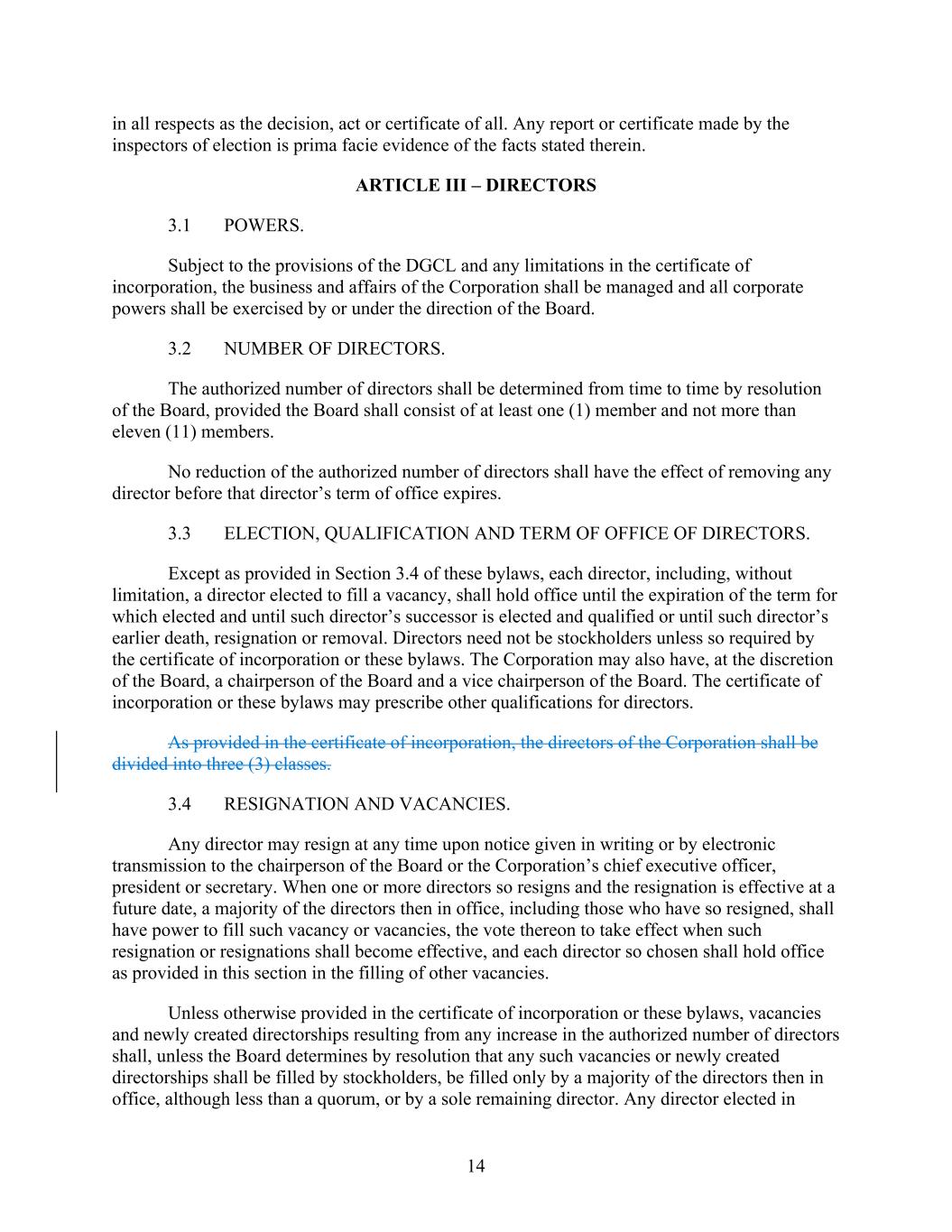
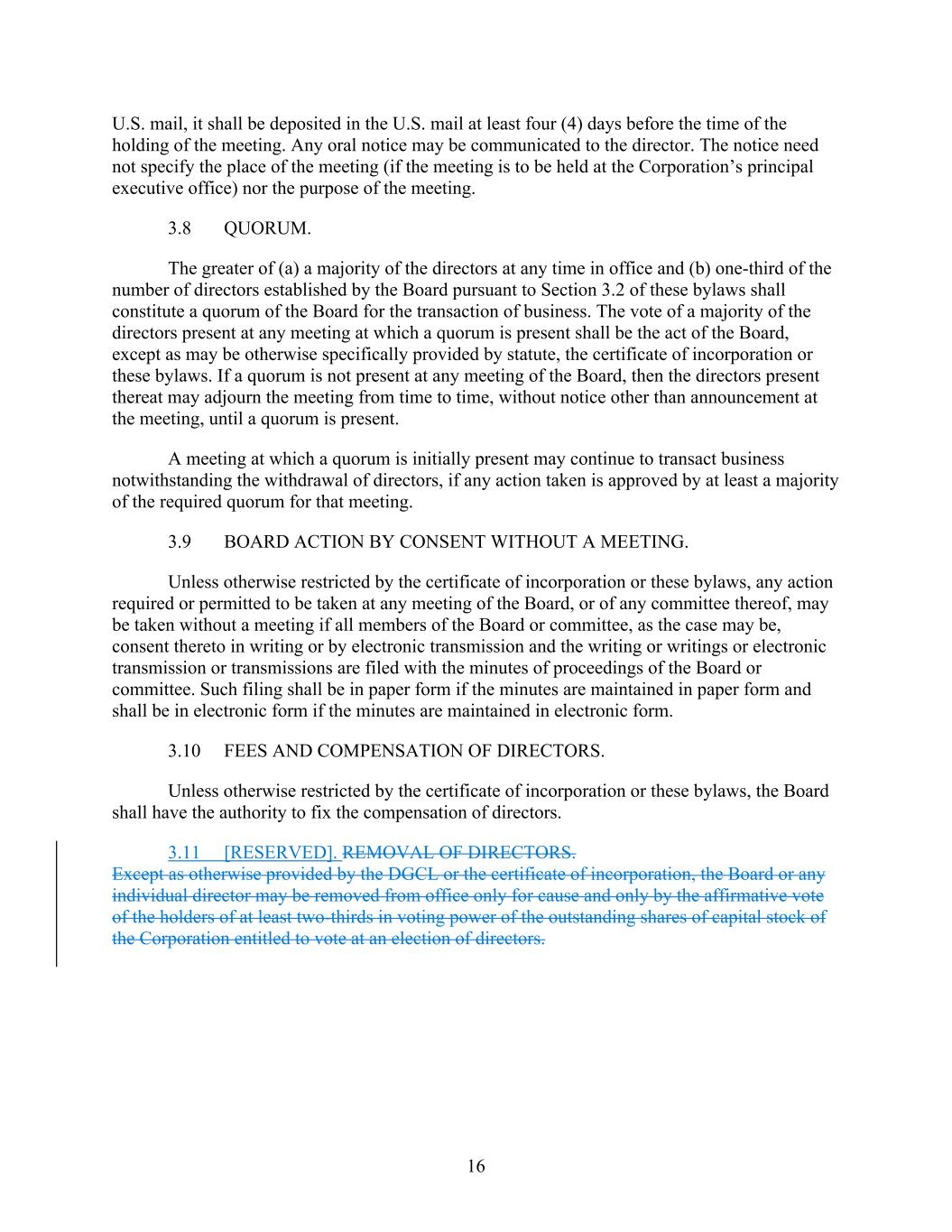
The Company intends to put forth a proposal at the Company’s annual meeting of stockholders to be held in 2026 (the “2026 Annual Meeting”) to amend its Seventh Amended and Restated Certificate of Incorporation in order to declassify its Board of Directors (the “Board”) and provide for the annual election of directors following a phase-in period (the “Proposed Charter Amendment”). In connection with the Proposed Charter Amendment, on February 5, 2026, the Board approved the Amended and Restated Bylaws of the Company (the “Amended Bylaws”), subject to and effective upon the approval of the Proposed Charter Amendment by the stockholders at the Company’s 2026 Annual Meeting. The Amended Bylaws would remove the provision providing that directors may be removed only for cause. Instead, removals would be governed by the Proposed Charter Amendment which would follow applicable Delaware General Corporation Law.

The Amended Bylaws, along with a copy marked to show the changes from the Company’s Amended and Restated Bylaws as in effect prior to the Amended Bylaws, are filed herewith as Exhibits 3.1 and 3.2, respectively. The above description of the changes contained in the Amended Bylaws is qualified by reference to the full text of the Amended Bylaws, which are incorporated herein by reference.

Item 7.01.    Regulation FD Disclosure.

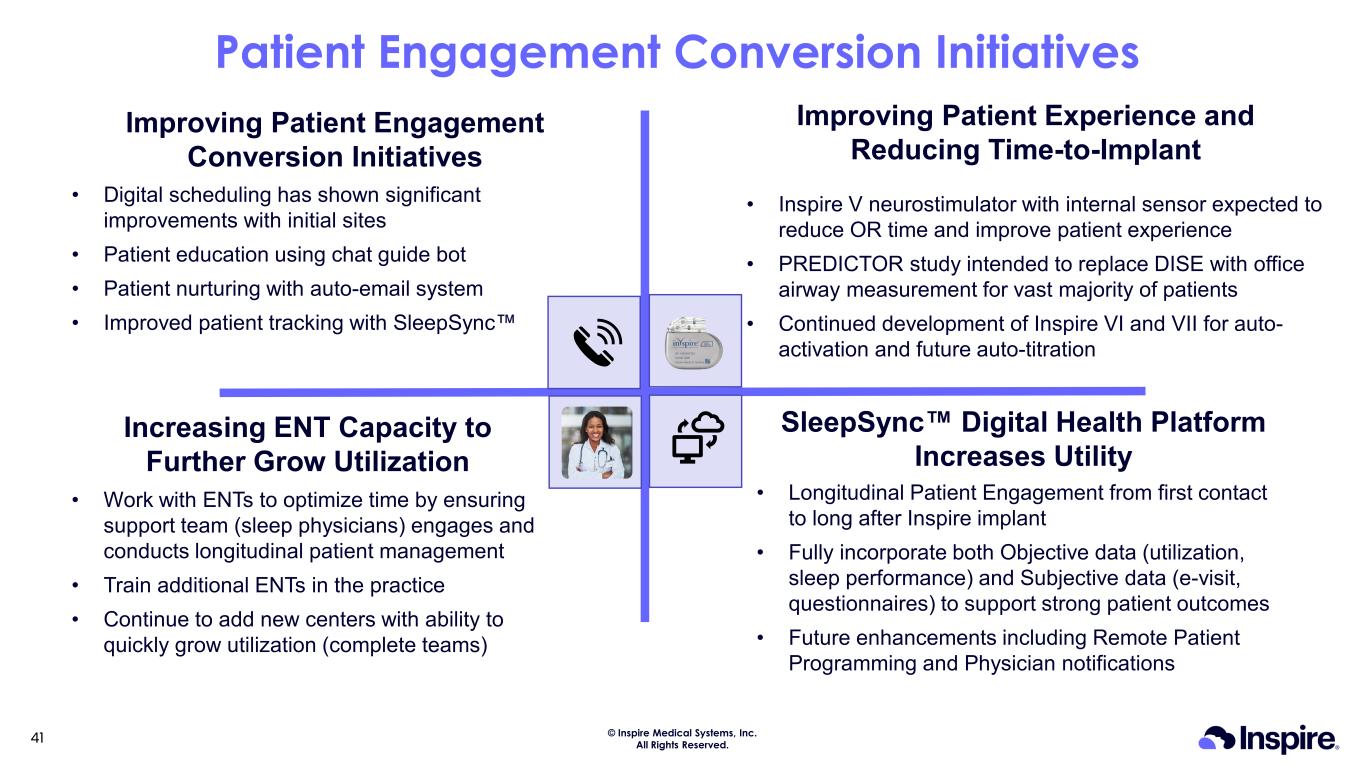
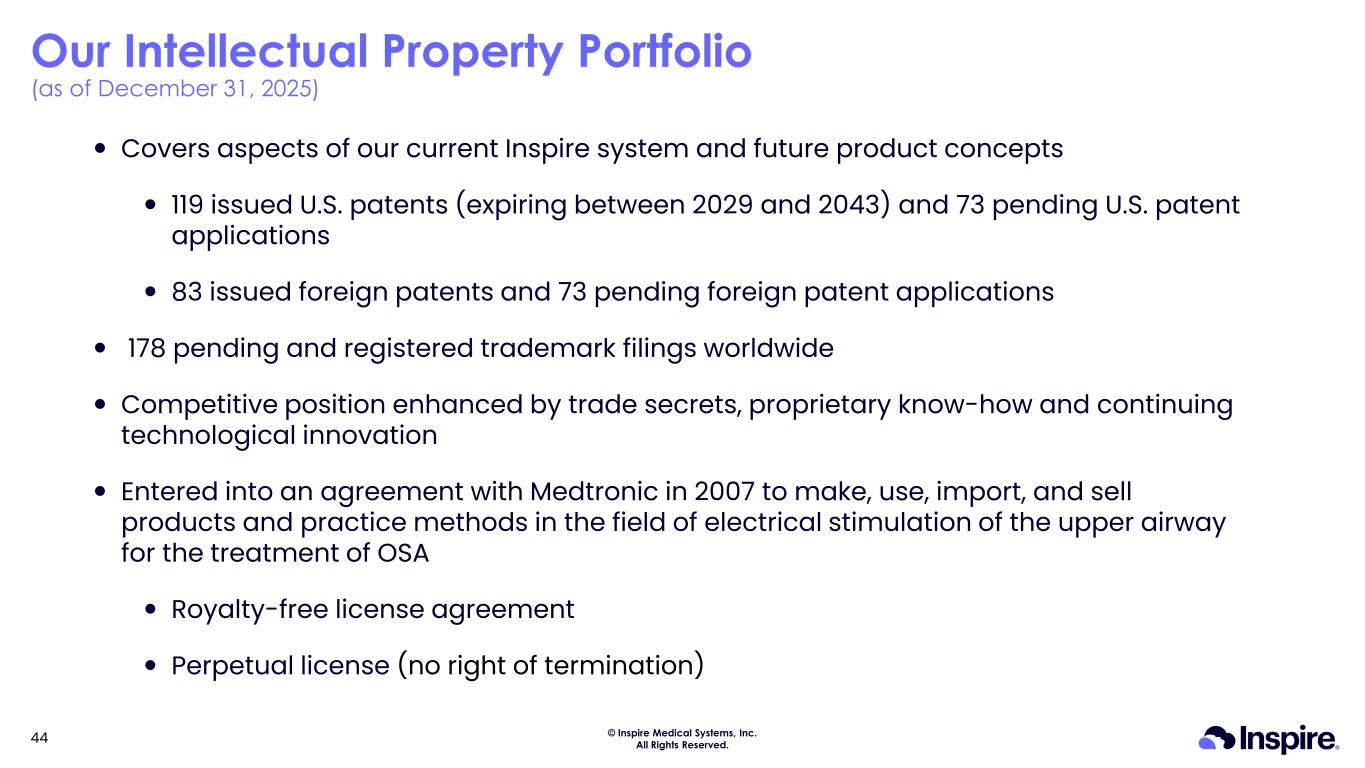
In February and March of 2026, the Company will be participating in various meetings with investors and analysts, and a copy of the Company’s presentation materials being used at these meetings is furnished as Exhibit 99.2 hereto and is incorporated herein by reference. These presentation materials are also available on the Investor Relations page of the Company’s website at https://investors.inspiresleep.com.
The information in this Item 7.01 of this Current Report on Form 8-K (and in the presentation attached as Exhibit 99.2 hereto) shall not be deemed “filed” for purposes of Section 18 of the Exchange Act, or otherwise subject to the liabilities of that Section, nor shall it be deemed to be incorporated by reference into any filing of the Company under the Securities Act of 1933, as amended, or the Exchange Act, except as expressly set forth by specific reference in such filing.
Item 9.01.    Financial Statements and Exhibits.

(d) Exhibits

Exhibit No.Description
3.1
3.2
99.1
99.2
104Cover Page Interactive Data File - the cover page XBRL tags are embedded within the Inline XBRL document.
2


SIGNATURES

Pursuant to the requirements of the Securities Exchange Act of 1934, the registrant has duly caused this report to be signed on its behalf by the undersigned hereunto duly authorized.

INSPIRE MEDICAL SYSTEMS, INC.
Date:February 11, 2026By:/s/ Bryan K. Phillips
Bryan K. Phillips
Sr. Vice President, General Counsel and Secretary

3
Exhibit 3.1 AMENDED AND RESTATED BYLAWS OF INSPIRE MEDICAL SYSTEMS, INC. (a Delaware corporation)
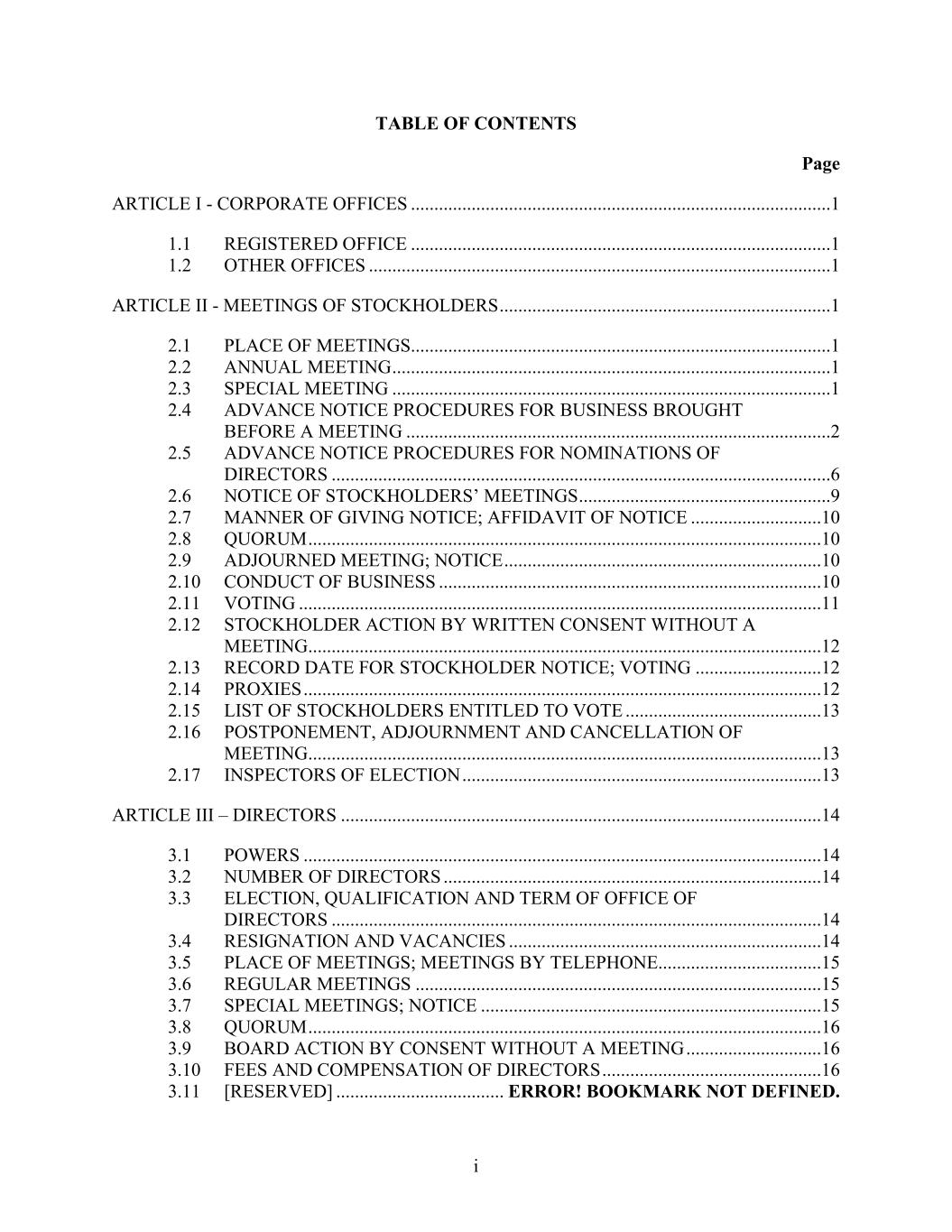

 
i TABLE OF CONTENTS Page ARTICLE I - CORPORATE OFFICES ..........................................................................................1 1.1 REGISTERED OFFICE ..........................................................................................1 1.2 OTHER OFFICES ...................................................................................................1 ARTICLE II - MEETINGS OF STOCKHOLDERS .......................................................................1 2.1 PLACE OF MEETINGS..........................................................................................1 2.2 ANNUAL MEETING ..............................................................................................1 2.3 SPECIAL MEETING ..............................................................................................1 2.4 ADVANCE NOTICE PROCEDURES FOR BUSINESS BROUGHT BEFORE A MEETING ...........................................................................................2 2.5 ADVANCE NOTICE PROCEDURES FOR NOMINATIONS OF DIRECTORS ...........................................................................................................6 2.6 NOTICE OF STOCKHOLDERS’ MEETINGS ......................................................9 2.7 MANNER OF GIVING NOTICE; AFFIDAVIT OF NOTICE ............................10 2.8 QUORUM ..............................................................................................................10 2.9 ADJOURNED MEETING; NOTICE ....................................................................10 2.10 CONDUCT OF BUSINESS ..................................................................................10 2.11 VOTING ................................................................................................................11 2.12 STOCKHOLDER ACTION BY WRITTEN CONSENT WITHOUT A MEETING..............................................................................................................12 2.13 RECORD DATE FOR STOCKHOLDER NOTICE; VOTING ...........................12 2.14 PROXIES ...............................................................................................................12 2.15 LIST OF STOCKHOLDERS ENTITLED TO VOTE ..........................................13 2.16 POSTPONEMENT, ADJOURNMENT AND CANCELLATION OF MEETING..............................................................................................................13 2.17 INSPECTORS OF ELECTION .............................................................................13 ARTICLE III – DIRECTORS .......................................................................................................14 3.1 POWERS ...............................................................................................................14 3.2 NUMBER OF DIRECTORS .................................................................................14 3.3 ELECTION, QUALIFICATION AND TERM OF OFFICE OF DIRECTORS .........................................................................................................14 3.4 RESIGNATION AND VACANCIES ...................................................................14 3.5 PLACE OF MEETINGS; MEETINGS BY TELEPHONE...................................15 3.6 REGULAR MEETINGS .......................................................................................15 3.7 SPECIAL MEETINGS; NOTICE .........................................................................15 3.8 QUORUM ..............................................................................................................16 3.9 BOARD ACTION BY CONSENT WITHOUT A MEETING .............................16 3.10 FEES AND COMPENSATION OF DIRECTORS ...............................................16 3.11 [RESERVED] .................................... ERROR! BOOKMARK NOT DEFINED.

 
ii ARTICLE IV - COMMITTEES ....................................................................................................16 4.1 COMMITTEES OF DIRECTORS ........................................................................16 4.2 COMMITTEE MINUTES .....................................................................................17 4.3 MEETINGS AND ACTION OF COMMITTEES ................................................17 ARTICLE V - OFFICERS .............................................................................................................18 5.1 OFFICERS .............................................................................................................18 5.2 APPOINTMENT OF OFFICERS..........................................................................18 5.3 SUBORDINATE OFFICERS ................................................................................18 5.4 REMOVAL AND RESIGNATION OF OFFICERS ............................................18 5.5 VACANCIES IN OFFICES ..................................................................................18 5.6 REPRESENTATION OF SHARES OF OTHER ENTITIES ...............................19 5.7 AUTHORITY AND DUTIES OF OFFICERS......................................................19 ARTICLE VI - RECORDS AND REPORTS ...............................................................................19 6.1 MAINTENANCE OF RECORDS .........................................................................19 ARTICLE VII - GENERAL MATTERS ......................................................................................19 7.1 EXECUTION OF CORPORATE CONTRACTS AND INSTRUMENTS ..........19 7.2 STOCK CERTIFICATES; PARTLY PAID SHARES .........................................19 7.3 MULTIPLES CLASSES OR SERIES OF STOCK ..............................................20 7.4 LOST CERTIFICATES .........................................................................................20 7.5 CONSTRUCTION; DEFINITIONS ......................................................................21 7.6 DIVIDENDS ..........................................................................................................21 7.7 FISCAL YEAR ......................................................................................................21 7.8 SEAL......................................................................................................................21 7.9 TRANSFER OF STOCK .......................................................................................21 7.10 STOCK TRANSFER AGREEMENTS .................................................................22 7.11 REGISTERED STOCKHOLDERS.......................................................................22 7.12 WAIVER OF NOTICE ..........................................................................................22 ARTICLE VIII - NOTICE BY ELECTRONIC TRANSMISSION ..............................................22 8.1 NOTICE BY ELECTRONIC TRANSMISSION ..................................................22 8.2 DEFINITION OF ELECTRONIC TRANSMISSION ..........................................23 ARTICLE IX - INDEMNIFICATION AND ADVANCEMENT.................................................23 9.1 INDEMNIFICATION OF DIRECTORS AND OFFICERS .................................23 9.2 INDEMNIFICATION OF OTHERS .....................................................................24 9.3 PREPAYMENT OF EXPENSES ..........................................................................24 9.4 DETERMINATION; CLAIM ...............................................................................24 9.5 NON-EXCLUSIVITY OF RIGHTS......................................................................24 9.6 INSURANCE .........................................................................................................25


 
iii 9.7 OTHER INDEMNIFICATION .............................................................................25 9.8 CONTINUATION OF INDEMNIFICATION ......................................................25 9.9 AMENDMENT OR REPEAL ...............................................................................25 ARTICLE X - AMENDMENTS. ..................................................................................................26

 
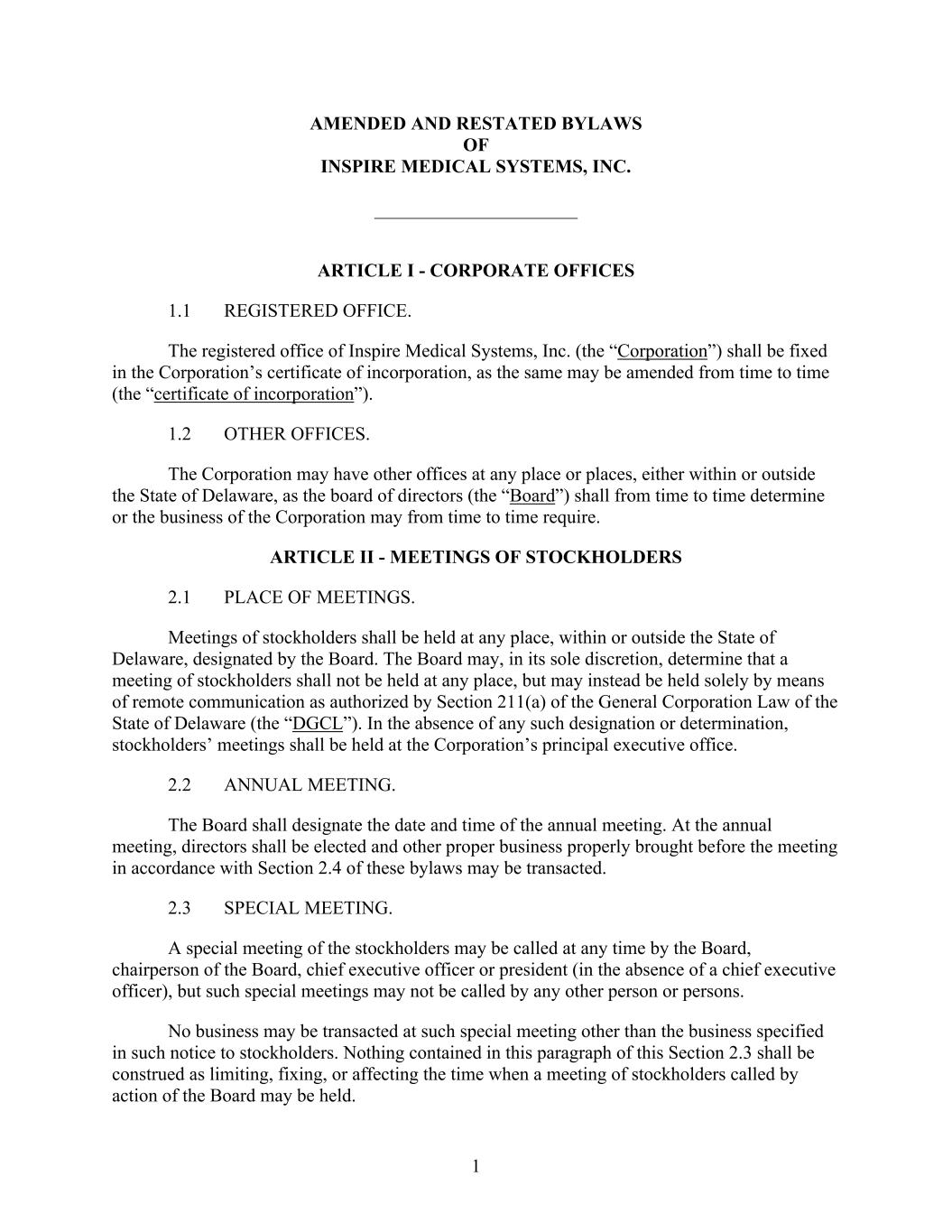
1 AMENDED AND RESTATED BYLAWS OF INSPIRE MEDICAL SYSTEMS, INC. ARTICLE I - CORPORATE OFFICES REGISTERED OFFICE. The registered office of Inspire Medical Systems, Inc. (the “Corporation”) shall be fixed in the Corporation’s certificate of incorporation, as the same may be amended from time to time (the “certificate of incorporation”). OTHER OFFICES. The Corporation may have other offices at any place or places, either within or outside the State of Delaware, as the board of directors (the “Board”) shall from time to time determine or the business of the Corporation may from time to time require. ARTICLE II - MEETINGS OF STOCKHOLDERS PLACE OF MEETINGS. Meetings of stockholders shall be held at any place, within or outside the State of Delaware, designated by the Board. The Board may, in its sole discretion, determine that a meeting of stockholders shall not be held at any place, but may instead be held solely by means of remote communication as authorized by Section 211(a) of the General Corporation Law of the State of Delaware (the “DGCL”). In the absence of any such designation or determination, stockholders’ meetings shall be held at the Corporation’s principal executive office. ANNUAL MEETING. The Board shall designate the date and time of the annual meeting. At the annual meeting, directors shall be elected and other proper business properly brought before the meeting in accordance with Section 2.4 of these bylaws may be transacted. SPECIAL MEETING. A special meeting of the stockholders may be called at any time by the Board, chairperson of the Board, chief executive officer or president (in the absence of a chief executive officer), but such special meetings may not be called by any other person or persons. No business may be transacted at such special meeting other than the business specified in such notice to stockholders. Nothing contained in this paragraph of this Section 2.3 shall be construed as limiting, fixing, or affecting the time when a meeting of stockholders called by action of the Board may be held.

 
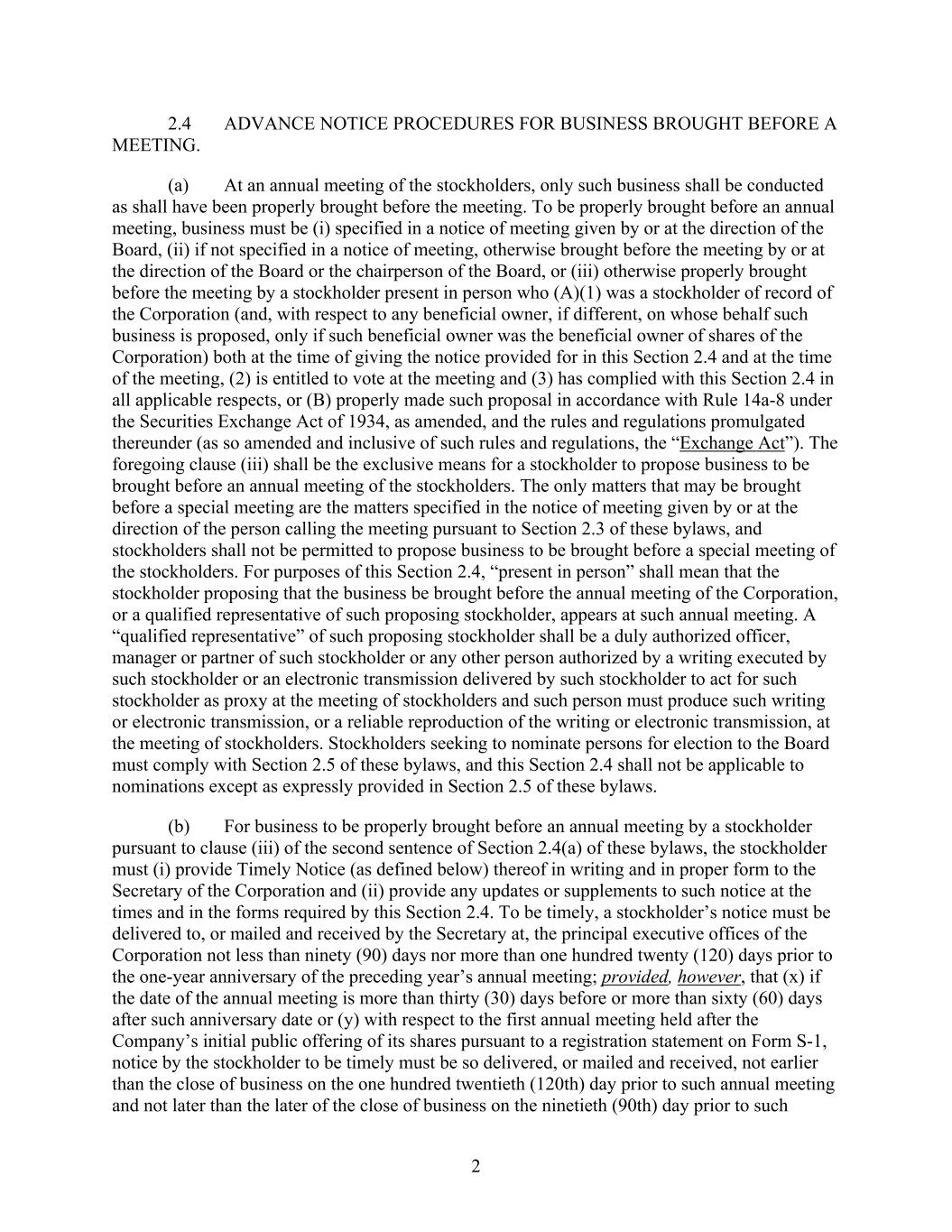
2 ADVANCE NOTICE PROCEDURES FOR BUSINESS BROUGHT BEFORE A MEETING. (a) At an annual meeting of the stockholders, only such business shall be conducted as shall have been properly brought before the meeting. To be properly brought before an annual meeting, business must be (i) specified in a notice of meeting given by or at the direction of the Board, (ii) if not specified in a notice of meeting, otherwise brought before the meeting by or at the direction of the Board or the chairperson of the Board, or (iii) otherwise properly brought before the meeting by a stockholder present in person who (A)(1) was a stockholder of record of the Corporation (and, with respect to any beneficial owner, if different, on whose behalf such business is proposed, only if such beneficial owner was the beneficial owner of shares of the Corporation) both at the time of giving the notice provided for in this Section 2.4 and at the time of the meeting, (2) is entitled to vote at the meeting and (3) has complied with this Section 2.4 in all applicable respects, or (B) properly made such proposal in accordance with Rule 14a-8 under the Securities Exchange Act of 1934, as amended, and the rules and regulations promulgated thereunder (as so amended and inclusive of such rules and regulations, the “Exchange Act”). The foregoing clause (iii) shall be the exclusive means for a stockholder to propose business to be brought before an annual meeting of the stockholders. The only matters that may be brought before a special meeting are the matters specified in the notice of meeting given by or at the direction of the person calling the meeting pursuant to Section 2.3 of these bylaws, and stockholders shall not be permitted to propose business to be brought before a special meeting of the stockholders. For purposes of this Section 2.4, “present in person” shall mean that the stockholder proposing that the business be brought before the annual meeting of the Corporation, or a qualified representative of such proposing stockholder, appears at such annual meeting. A “qualified representative” of such proposing stockholder shall be a duly authorized officer, manager or partner of such stockholder or any other person authorized by a writing executed by such stockholder or an electronic transmission delivered by such stockholder to act for such stockholder as proxy at the meeting of stockholders and such person must produce such writing or electronic transmission, or a reliable reproduction of the writing or electronic transmission, at the meeting of stockholders. Stockholders seeking to nominate persons for election to the Board must comply with Section 2.5 of these bylaws, and this Section 2.4 shall not be applicable to nominations except as expressly provided in Section 2.5 of these bylaws. (b) For business to be properly brought before an annual meeting by a stockholder pursuant to clause (iii) of the second sentence of Section 2.4(a) of these bylaws, the stockholder must (i) provide Timely Notice (as defined below) thereof in writing and in proper form to the Secretary of the Corporation and (ii) provide any updates or supplements to such notice at the times and in the forms required by this Section 2.4. To be timely, a stockholder’s notice must be delivered to, or mailed and received by the Secretary at, the principal executive offices of the Corporation not less than ninety (90) days nor more than one hundred twenty (120) days prior to the one-year anniversary of the preceding year’s annual meeting; provided, however, that (x) if the date of the annual meeting is more than thirty (30) days before or more than sixty (60) days after such anniversary date or (y) with respect to the first annual meeting held after the Company’s initial public offering of its shares pursuant to a registration statement on Form S-1, notice by the stockholder to be timely must be so delivered, or mailed and received, not earlier than the close of business on the one hundred twentieth (120th) day prior to such annual meeting and not later than the later of the close of business on the ninetieth (90th) day prior to such

 
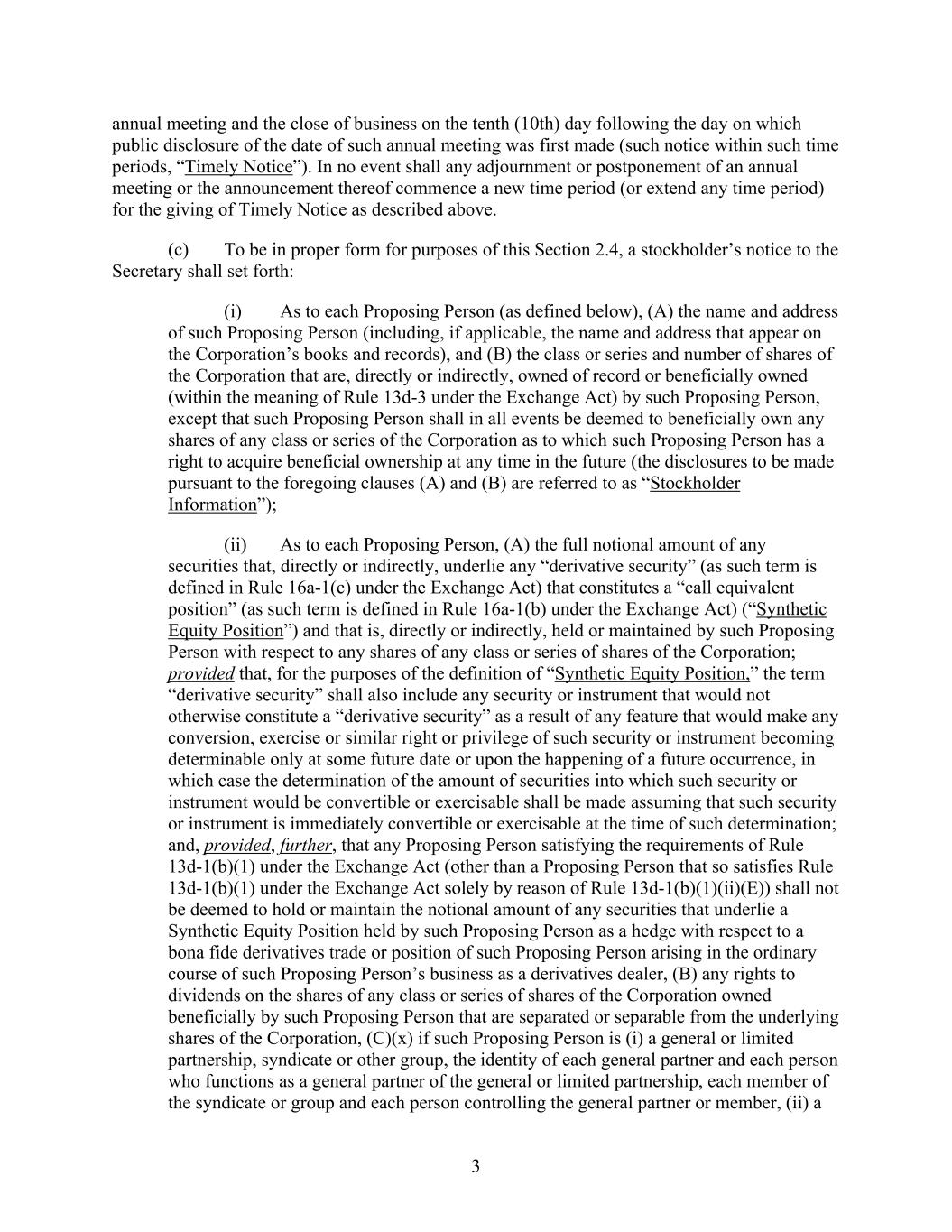
3 annual meeting and the close of business on the tenth (10th) day following the day on which public disclosure of the date of such annual meeting was first made (such notice within such time periods, “Timely Notice”). In no event shall any adjournment or postponement of an annual meeting or the announcement thereof commence a new time period (or extend any time period) for the giving of Timely Notice as described above. (c) To be in proper form for purposes of this Section 2.4, a stockholder’s notice to the Secretary shall set forth: (i) As to each Proposing Person (as defined below), (A) the name and address of such Proposing Person (including, if applicable, the name and address that appear on the Corporation’s books and records), and (B) the class or series and number of shares of the Corporation that are, directly or indirectly, owned of record or beneficially owned (within the meaning of Rule 13d-3 under the Exchange Act) by such Proposing Person, except that such Proposing Person shall in all events be deemed to beneficially own any shares of any class or series of the Corporation as to which such Proposing Person has a right to acquire beneficial ownership at any time in the future (the disclosures to be made pursuant to the foregoing clauses (A) and (B) are referred to as “Stockholder Information”); (ii) As to each Proposing Person, (A) the full notional amount of any securities that, directly or indirectly, underlie any “derivative security” (as such term is defined in Rule 16a-1(c) under the Exchange Act) that constitutes a “call equivalent position” (as such term is defined in Rule 16a-1(b) under the Exchange Act) (“Synthetic Equity Position”) and that is, directly or indirectly, held or maintained by such Proposing Person with respect to any shares of any class or series of shares of the Corporation; provided that, for the purposes of the definition of “Synthetic Equity Position,” the term “derivative security” shall also include any security or instrument that would not otherwise constitute a “derivative security” as a result of any feature that would make any conversion, exercise or similar right or privilege of such security or instrument becoming determinable only at some future date or upon the happening of a future occurrence, in which case the determination of the amount of securities into which such security or instrument would be convertible or exercisable shall be made assuming that such security or instrument is immediately convertible or exercisable at the time of such determination; and, provided, further, that any Proposing Person satisfying the requirements of Rule 13d-1(b)(1) under the Exchange Act (other than a Proposing Person that so satisfies Rule 13d-1(b)(1) under the Exchange Act solely by reason of Rule 13d-1(b)(1)(ii)(E)) shall not be deemed to hold or maintain the notional amount of any securities that underlie a Synthetic Equity Position held by such Proposing Person as a hedge with respect to a bona fide derivatives trade or position of such Proposing Person arising in the ordinary course of such Proposing Person’s business as a derivatives dealer, (B) any rights to dividends on the shares of any class or series of shares of the Corporation owned beneficially by such Proposing Person that are separated or separable from the underlying shares of the Corporation, (C)(x) if such Proposing Person is (i) a general or limited partnership, syndicate or other group, the identity of each general partner and each person who functions as a general partner of the general or limited partnership, each member of the syndicate or group and each person controlling the general partner or member, (ii) a

 
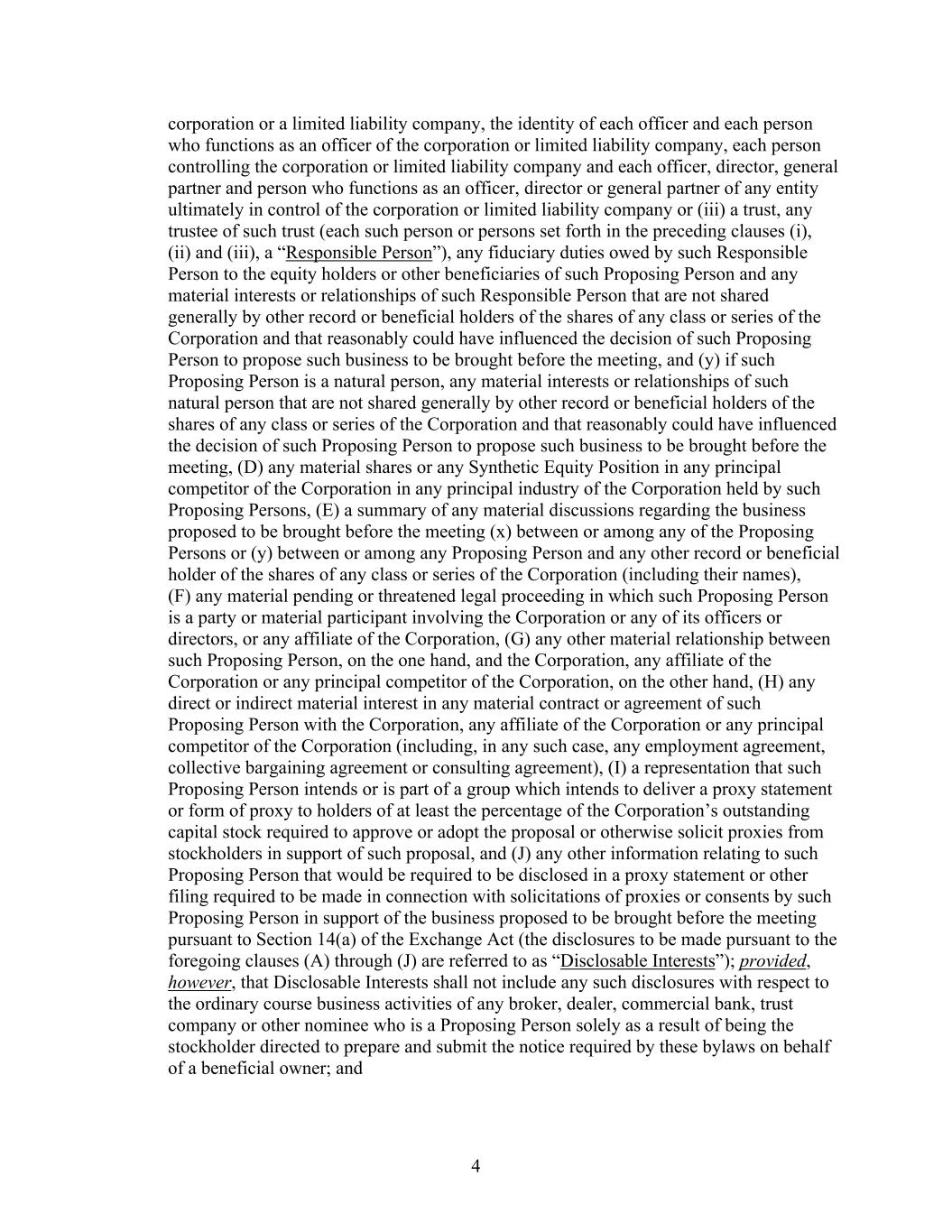
4 corporation or a limited liability company, the identity of each officer and each person who functions as an officer of the corporation or limited liability company, each person controlling the corporation or limited liability company and each officer, director, general partner and person who functions as an officer, director or general partner of any entity ultimately in control of the corporation or limited liability company or (iii) a trust, any trustee of such trust (each such person or persons set forth in the preceding clauses (i), (ii) and (iii), a “Responsible Person”), any fiduciary duties owed by such Responsible Person to the equity holders or other beneficiaries of such Proposing Person and any material interests or relationships of such Responsible Person that are not shared generally by other record or beneficial holders of the shares of any class or series of the Corporation and that reasonably could have influenced the decision of such Proposing Person to propose such business to be brought before the meeting, and (y) if such Proposing Person is a natural person, any material interests or relationships of such natural person that are not shared generally by other record or beneficial holders of the shares of any class or series of the Corporation and that reasonably could have influenced the decision of such Proposing Person to propose such business to be brought before the meeting, (D) any material shares or any Synthetic Equity Position in any principal competitor of the Corporation in any principal industry of the Corporation held by such Proposing Persons, (E) a summary of any material discussions regarding the business proposed to be brought before the meeting (x) between or among any of the Proposing Persons or (y) between or among any Proposing Person and any other record or beneficial holder of the shares of any class or series of the Corporation (including their names), (F) any material pending or threatened legal proceeding in which such Proposing Person is a party or material participant involving the Corporation or any of its officers or directors, or any affiliate of the Corporation, (G) any other material relationship between such Proposing Person, on the one hand, and the Corporation, any affiliate of the Corporation or any principal competitor of the Corporation, on the other hand, (H) any direct or indirect material interest in any material contract or agreement of such Proposing Person with the Corporation, any affiliate of the Corporation or any principal competitor of the Corporation (including, in any such case, any employment agreement, collective bargaining agreement or consulting agreement), (I) a representation that such Proposing Person intends or is part of a group which intends to deliver a proxy statement or form of proxy to holders of at least the percentage of the Corporation’s outstanding capital stock required to approve or adopt the proposal or otherwise solicit proxies from stockholders in support of such proposal, and (J) any other information relating to such Proposing Person that would be required to be disclosed in a proxy statement or other filing required to be made in connection with solicitations of proxies or consents by such Proposing Person in support of the business proposed to be brought before the meeting pursuant to Section 14(a) of the Exchange Act (the disclosures to be made pursuant to the foregoing clauses (A) through (J) are referred to as “Disclosable Interests”); provided, however, that Disclosable Interests shall not include any such disclosures with respect to the ordinary course business activities of any broker, dealer, commercial bank, trust company or other nominee who is a Proposing Person solely as a result of being the stockholder directed to prepare and submit the notice required by these bylaws on behalf of a beneficial owner; and

 
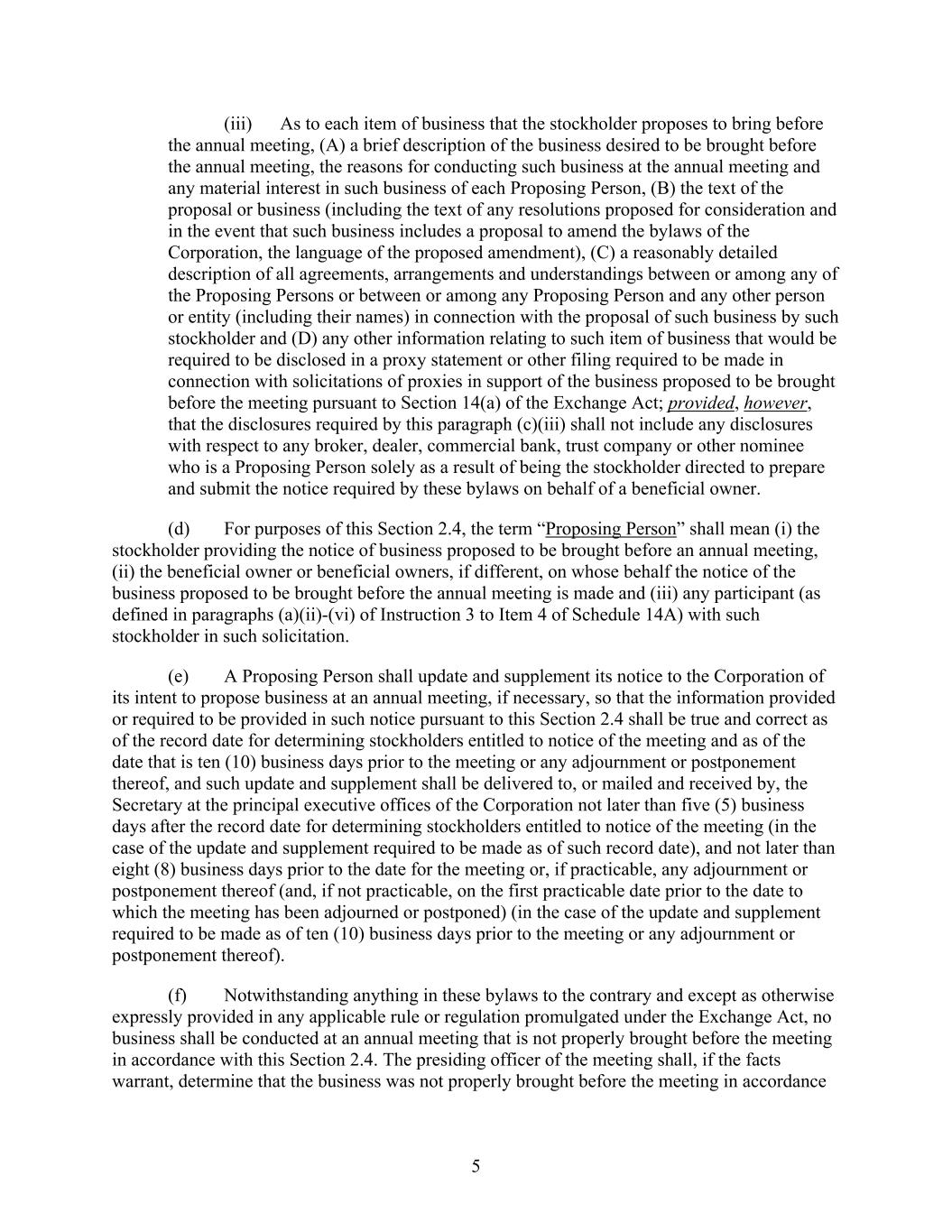
5 (iii) As to each item of business that the stockholder proposes to bring before the annual meeting, (A) a brief description of the business desired to be brought before the annual meeting, the reasons for conducting such business at the annual meeting and any material interest in such business of each Proposing Person, (B) the text of the proposal or business (including the text of any resolutions proposed for consideration and in the event that such business includes a proposal to amend the bylaws of the Corporation, the language of the proposed amendment), (C) a reasonably detailed description of all agreements, arrangements and understandings between or among any of the Proposing Persons or between or among any Proposing Person and any other person or entity (including their names) in connection with the proposal of such business by such stockholder and (D) any other information relating to such item of business that would be required to be disclosed in a proxy statement or other filing required to be made in connection with solicitations of proxies in support of the business proposed to be brought before the meeting pursuant to Section 14(a) of the Exchange Act; provided, however, that the disclosures required by this paragraph (c)(iii) shall not include any disclosures with respect to any broker, dealer, commercial bank, trust company or other nominee who is a Proposing Person solely as a result of being the stockholder directed to prepare and submit the notice required by these bylaws on behalf of a beneficial owner. (d) For purposes of this Section 2.4, the term “Proposing Person” shall mean (i) the stockholder providing the notice of business proposed to be brought before an annual meeting, (ii) the beneficial owner or beneficial owners, if different, on whose behalf the notice of the business proposed to be brought before the annual meeting is made and (iii) any participant (as defined in paragraphs (a)(ii)-(vi) of Instruction 3 to Item 4 of Schedule 14A) with such stockholder in such solicitation. (e) A Proposing Person shall update and supplement its notice to the Corporation of its intent to propose business at an annual meeting, if necessary, so that the information provided or required to be provided in such notice pursuant to this Section 2.4 shall be true and correct as of the record date for determining stockholders entitled to notice of the meeting and as of the date that is ten (10) business days prior to the meeting or any adjournment or postponement thereof, and such update and supplement shall be delivered to, or mailed and received by, the Secretary at the principal executive offices of the Corporation not later than five (5) business days after the record date for determining stockholders entitled to notice of the meeting (in the case of the update and supplement required to be made as of such record date), and not later than eight (8) business days prior to the date for the meeting or, if practicable, any adjournment or postponement thereof (and, if not practicable, on the first practicable date prior to the date to which the meeting has been adjourned or postponed) (in the case of the update and supplement required to be made as of ten (10) business days prior to the meeting or any adjournment or postponement thereof). (f) Notwithstanding anything in these bylaws to the contrary and except as otherwise expressly provided in any applicable rule or regulation promulgated under the Exchange Act, no business shall be conducted at an annual meeting that is not properly brought before the meeting in accordance with this Section 2.4. The presiding officer of the meeting shall, if the facts warrant, determine that the business was not properly brought before the meeting in accordance

 
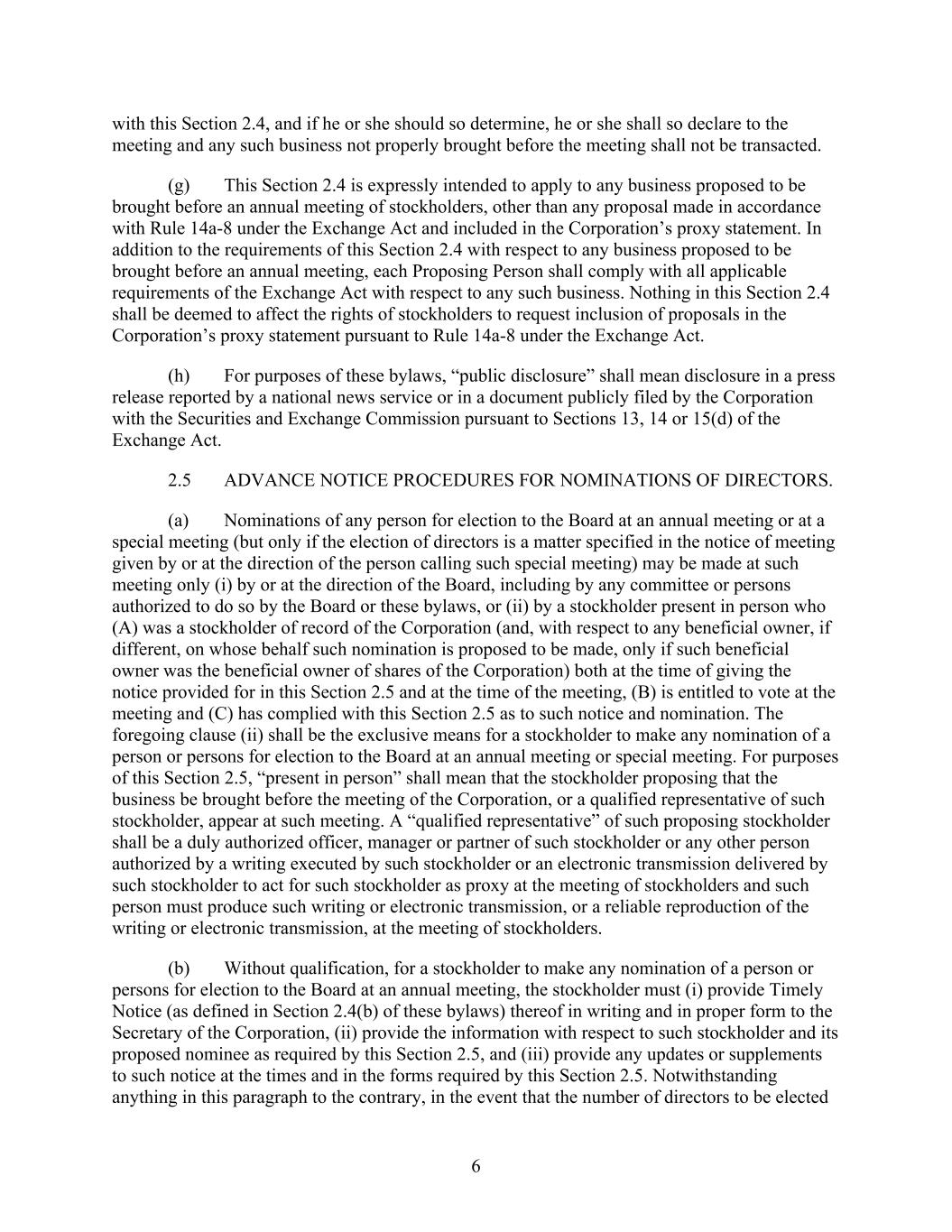
6 with this Section 2.4, and if he or she should so determine, he or she shall so declare to the meeting and any such business not properly brought before the meeting shall not be transacted. (g) This Section 2.4 is expressly intended to apply to any business proposed to be brought before an annual meeting of stockholders, other than any proposal made in accordance with Rule 14a-8 under the Exchange Act and included in the Corporation’s proxy statement. In addition to the requirements of this Section 2.4 with respect to any business proposed to be brought before an annual meeting, each Proposing Person shall comply with all applicable requirements of the Exchange Act with respect to any such business. Nothing in this Section 2.4 shall be deemed to affect the rights of stockholders to request inclusion of proposals in the Corporation’s proxy statement pursuant to Rule 14a-8 under the Exchange Act. (h) For purposes of these bylaws, “public disclosure” shall mean disclosure in a press release reported by a national news service or in a document publicly filed by the Corporation with the Securities and Exchange Commission pursuant to Sections 13, 14 or 15(d) of the Exchange Act. ADVANCE NOTICE PROCEDURES FOR NOMINATIONS OF DIRECTORS. (a) Nominations of any person for election to the Board at an annual meeting or at a special meeting (but only if the election of directors is a matter specified in the notice of meeting given by or at the direction of the person calling such special meeting) may be made at such meeting only (i) by or at the direction of the Board, including by any committee or persons authorized to do so by the Board or these bylaws, or (ii) by a stockholder present in person who (A) was a stockholder of record of the Corporation (and, with respect to any beneficial owner, if different, on whose behalf such nomination is proposed to be made, only if such beneficial owner was the beneficial owner of shares of the Corporation) both at the time of giving the notice provided for in this Section 2.5 and at the time of the meeting, (B) is entitled to vote at the meeting and (C) has complied with this Section 2.5 as to such notice and nomination. The foregoing clause (ii) shall be the exclusive means for a stockholder to make any nomination of a person or persons for election to the Board at an annual meeting or special meeting. For purposes of this Section 2.5, “present in person” shall mean that the stockholder proposing that the business be brought before the meeting of the Corporation, or a qualified representative of such stockholder, appear at such meeting. A “qualified representative” of such proposing stockholder shall be a duly authorized officer, manager or partner of such stockholder or any other person authorized by a writing executed by such stockholder or an electronic transmission delivered by such stockholder to act for such stockholder as proxy at the meeting of stockholders and such person must produce such writing or electronic transmission, or a reliable reproduction of the writing or electronic transmission, at the meeting of stockholders. (b) Without qualification, for a stockholder to make any nomination of a person or persons for election to the Board at an annual meeting, the stockholder must (i) provide Timely Notice (as defined in Section 2.4(b) of these bylaws) thereof in writing and in proper form to the Secretary of the Corporation, (ii) provide the information with respect to such stockholder and its proposed nominee as required by this Section 2.5, and (iii) provide any updates or supplements to such notice at the times and in the forms required by this Section 2.5. Notwithstanding anything in this paragraph to the contrary, in the event that the number of directors to be elected

 
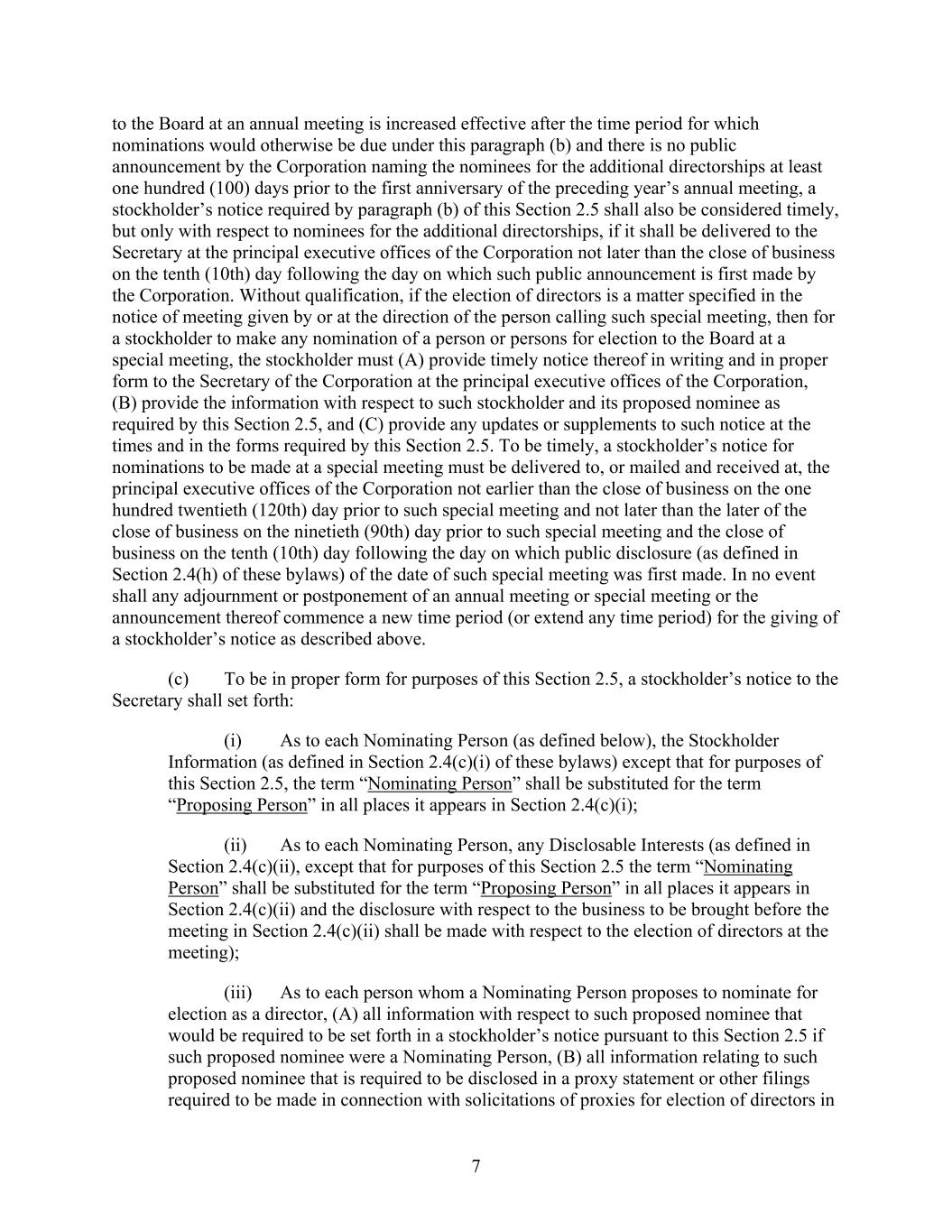
7 to the Board at an annual meeting is increased effective after the time period for which nominations would otherwise be due under this paragraph (b) and there is no public announcement by the Corporation naming the nominees for the additional directorships at least one hundred (100) days prior to the first anniversary of the preceding year’s annual meeting, a stockholder’s notice required by paragraph (b) of this Section 2.5 shall also be considered timely, but only with respect to nominees for the additional directorships, if it shall be delivered to the Secretary at the principal executive offices of the Corporation not later than the close of business on the tenth (10th) day following the day on which such public announcement is first made by the Corporation. Without qualification, if the election of directors is a matter specified in the notice of meeting given by or at the direction of the person calling such special meeting, then for a stockholder to make any nomination of a person or persons for election to the Board at a special meeting, the stockholder must (A) provide timely notice thereof in writing and in proper form to the Secretary of the Corporation at the principal executive offices of the Corporation, (B) provide the information with respect to such stockholder and its proposed nominee as required by this Section 2.5, and (C) provide any updates or supplements to such notice at the times and in the forms required by this Section 2.5. To be timely, a stockholder’s notice for nominations to be made at a special meeting must be delivered to, or mailed and received at, the principal executive offices of the Corporation not earlier than the close of business on the one hundred twentieth (120th) day prior to such special meeting and not later than the later of the close of business on the ninetieth (90th) day prior to such special meeting and the close of business on the tenth (10th) day following the day on which public disclosure (as defined in Section 2.4(h) of these bylaws) of the date of such special meeting was first made. In no event shall any adjournment or postponement of an annual meeting or special meeting or the announcement thereof commence a new time period (or extend any time period) for the giving of a stockholder’s notice as described above. (c) To be in proper form for purposes of this Section 2.5, a stockholder’s notice to the Secretary shall set forth: (i) As to each Nominating Person (as defined below), the Stockholder Information (as defined in Section 2.4(c)(i) of these bylaws) except that for purposes of this Section 2.5, the term “Nominating Person” shall be substituted for the term “Proposing Person” in all places it appears in Section 2.4(c)(i); (ii) As to each Nominating Person, any Disclosable Interests (as defined in Section 2.4(c)(ii), except that for purposes of this Section 2.5 the term “Nominating Person” shall be substituted for the term “Proposing Person” in all places it appears in Section 2.4(c)(ii) and the disclosure with respect to the business to be brought before the meeting in Section 2.4(c)(ii) shall be made with respect to the election of directors at the meeting); (iii) As to each person whom a Nominating Person proposes to nominate for election as a director, (A) all information with respect to such proposed nominee that would be required to be set forth in a stockholder’s notice pursuant to this Section 2.5 if such proposed nominee were a Nominating Person, (B) all information relating to such proposed nominee that is required to be disclosed in a proxy statement or other filings required to be made in connection with solicitations of proxies for election of directors in

 
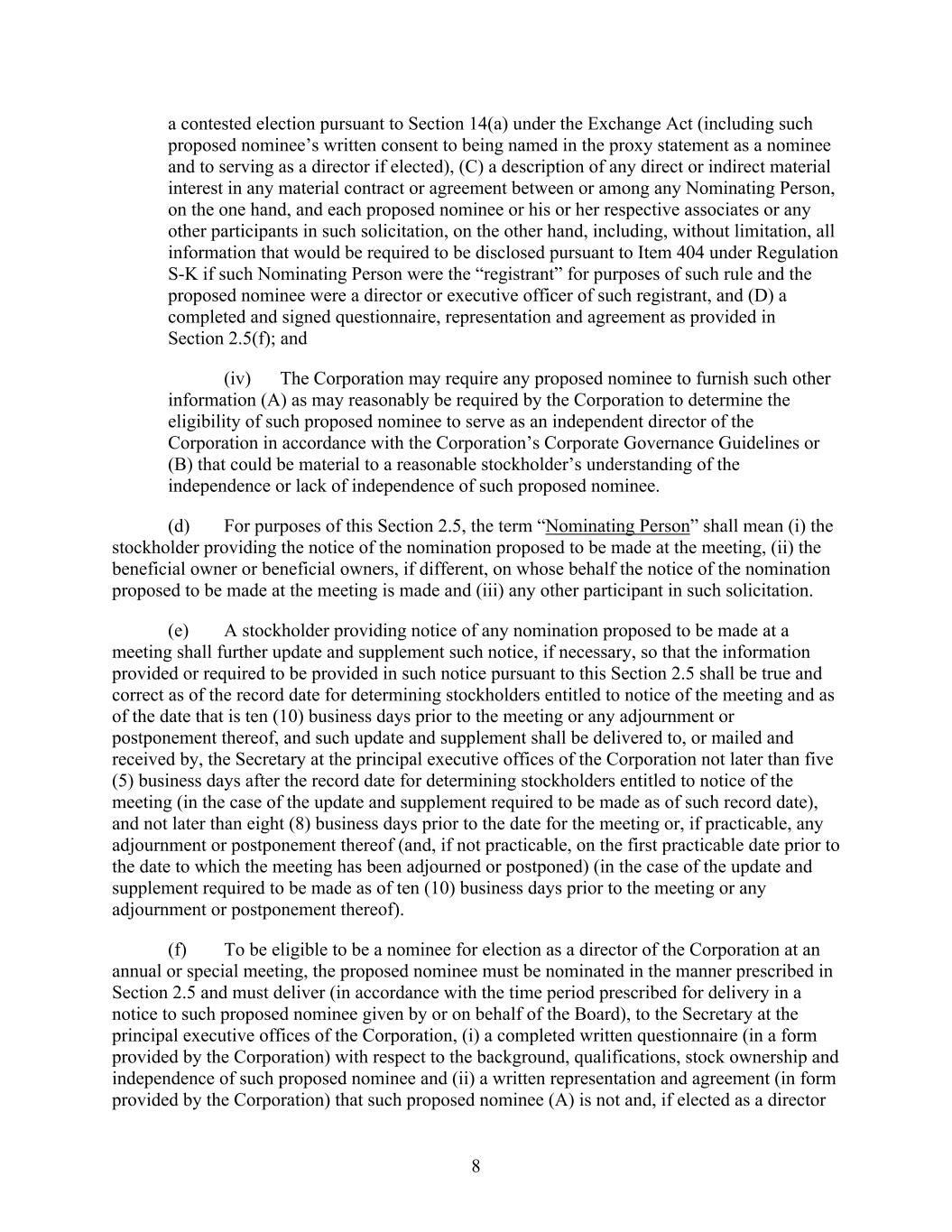
8 a contested election pursuant to Section 14(a) under the Exchange Act (including such proposed nominee’s written consent to being named in the proxy statement as a nominee and to serving as a director if elected), (C) a description of any direct or indirect material interest in any material contract or agreement between or among any Nominating Person, on the one hand, and each proposed nominee or his or her respective associates or any other participants in such solicitation, on the other hand, including, without limitation, all information that would be required to be disclosed pursuant to Item 404 under Regulation S-K if such Nominating Person were the “registrant” for purposes of such rule and the proposed nominee were a director or executive officer of such registrant, and (D) a completed and signed questionnaire, representation and agreement as provided in Section 2.5(f); and (iv) The Corporation may require any proposed nominee to furnish such other information (A) as may reasonably be required by the Corporation to determine the eligibility of such proposed nominee to serve as an independent director of the Corporation in accordance with the Corporation’s Corporate Governance Guidelines or (B) that could be material to a reasonable stockholder’s understanding of the independence or lack of independence of such proposed nominee. (d) For purposes of this Section 2.5, the term “Nominating Person” shall mean (i) the stockholder providing the notice of the nomination proposed to be made at the meeting, (ii) the beneficial owner or beneficial owners, if different, on whose behalf the notice of the nomination proposed to be made at the meeting is made and (iii) any other participant in such solicitation. (e) A stockholder providing notice of any nomination proposed to be made at a meeting shall further update and supplement such notice, if necessary, so that the information provided or required to be provided in such notice pursuant to this Section 2.5 shall be true and correct as of the record date for determining stockholders entitled to notice of the meeting and as of the date that is ten (10) business days prior to the meeting or any adjournment or postponement thereof, and such update and supplement shall be delivered to, or mailed and received by, the Secretary at the principal executive offices of the Corporation not later than five (5) business days after the record date for determining stockholders entitled to notice of the meeting (in the case of the update and supplement required to be made as of such record date), and not later than eight (8) business days prior to the date for the meeting or, if practicable, any adjournment or postponement thereof (and, if not practicable, on the first practicable date prior to the date to which the meeting has been adjourned or postponed) (in the case of the update and supplement required to be made as of ten (10) business days prior to the meeting or any adjournment or postponement thereof). (f) To be eligible to be a nominee for election as a director of the Corporation at an annual or special meeting, the proposed nominee must be nominated in the manner prescribed in Section 2.5 and must deliver (in accordance with the time period prescribed for delivery in a notice to such proposed nominee given by or on behalf of the Board), to the Secretary at the principal executive offices of the Corporation, (i) a completed written questionnaire (in a form provided by the Corporation) with respect to the background, qualifications, stock ownership and independence of such proposed nominee and (ii) a written representation and agreement (in form provided by the Corporation) that such proposed nominee (A) is not and, if elected as a director

 
9 during his or her term of office, will not become a party to (1) any agreement, arrangement or understanding with, and has not given and will not give any commitment or assurance to, any person or entity as to how such proposed nominee, if elected as a director of the Corporation, will act or vote on any issue or question (a “Voting Commitment”) that has not been disclosed to the Corporation or (2) any Voting Commitment that could limit or interfere with such proposed nominee’s ability to comply, if elected as a director of the Corporation, with such proposed nominee’s fiduciary duties under applicable law, (B) is not, and will not become a party to, any agreement, arrangement or understanding with any person or entity other than the Corporation with respect to any direct or indirect compensation or reimbursement for service as a director and (C) if elected as a director of the Corporation, will comply with all applicable corporate governance, conflict of interest, confidentiality, stock ownership and trading and other policies and guidelines of the Corporation applicable to directors and in effect during such person’s term in office as a director (and, if requested by any proposed nominee, the Secretary of the Corporation shall provide to such proposed nominee all such policies and guidelines then in effect). (g) In addition to the requirements of this Section 2.5 with respect to any nomination proposed to be made at a meeting, each Nominating Person shall comply with all applicable requirements of the Exchange Act with respect to any such nominations. (h) No proposed nominee shall be eligible for nomination as a director of the Corporation unless such proposed nominee and the Nominating Person seeking to place such proposed nominee’s name in nomination have complied with this Section 2.5, as applicable. The presiding officer at the meeting shall, if the facts warrant, determine that a nomination was not properly made in accordance with this Section 2.5, and if he or she should so determine, he or she shall so declare such determination to the meeting, the defective nomination shall be disregarded and any ballots cast for the proposed nominee in question (but in the case of any form of ballot listing other qualified nominees, only the ballots case for the nominee in question) shall be void and of no force or effect. NOTICE OF STOCKHOLDERS’ MEETINGS. Unless otherwise provided by law, the certificate of incorporation or these bylaws, the notice of any meeting of stockholders shall be given in accordance with either Section 2.7 or Section 8.1 of these bylaws not less than ten (10) nor more than sixty (60) days before the date of the meeting to each stockholder entitled to vote at such meeting as of the record date for determining the stockholders entitled to notice of the meeting. The notice shall specify the place, if any, date and hour of the meeting, the record date for determining the stockholders entitled to vote at the meeting (if such date is different from the record date for stockholders entitled to notice of the meeting), the means of remote communication, if any, by which stockholders and proxy holders may be deemed to be present in person and vote at such meeting, and, in the case of a special meeting, the purpose or purposes for which the meeting is called.

 
10 MANNER OF GIVING NOTICE; AFFIDAVIT OF NOTICE. Notice of any meeting of stockholders shall be deemed given: (a) if mailed, when deposited in the United States mail, postage prepaid, directed to the stockholder at such stockholder’s address as it appears on the Corporation’s records; or (b) if electronically transmitted, as provided in Section 8.1 of these bylaws. An affidavit of the secretary or an assistant secretary of the Corporation or of the transfer agent or any other agent of the Corporation that the notice has been given by mail or by a form of electronic transmission, as applicable, shall, in the absence of fraud, be prima facie evidence of the facts stated therein. QUORUM. Unless otherwise provided by law, the certificate of incorporation or these bylaws, the holders of a majority in voting power of the capital stock issued and outstanding and entitled to vote, present in person, or by remote communication, if applicable, or represented by proxy, shall constitute a quorum for the transaction of business at all meetings of the stockholders. A quorum, once established at a meeting, shall not be broken by the withdrawal of enough votes to leave less than a quorum. If, however, a quorum is not present or represented at any meeting of the stockholders, then either (a) the chairperson of the meeting or (b) a majority in voting power of the stockholders entitled to vote thereon, present in person, or by remote communication, if applicable, or represented by proxy, shall have power to adjourn the meeting from time to time in the manner provided in Section 2.9 of these bylaws until a quorum is present or represented. At such adjourned meeting at which a quorum is present or represented, any business may be transacted that might have been transacted at the meeting as originally noticed. ADJOURNED MEETING; NOTICE. When a meeting is adjourned to another time or place, unless these bylaws otherwise require, notice need not be given of the adjourned meeting if the time and place, if any, thereof, and the means of remote communications, if any, by which stockholders and proxy holders may be deemed to be present in person and vote at such adjourned meeting are announced at the meeting at which the adjournment is taken. At the adjourned meeting, the Corporation may transact any business which might have been transacted at the original meeting. If the adjournment is for more than thirty (30) days, or if after the adjournment a new record date for determining the stockholders entitled to vote is fixed for the adjourned meeting, a notice of the adjourned meeting shall be given to each stockholder of record entitled to vote at the adjourned meeting as of the record date for determining the stockholders entitled to notice of the adjourned meeting. CONDUCT OF BUSINESS. The date and time of the opening and the closing of the polls for each matter upon which the stockholders will vote at a meeting shall be announced at the meeting by the person presiding over the meeting. The Board may adopt by resolution such rules and regulations for the conduct

 
11 of the meeting of stockholders as it shall deem appropriate. Except to the extent inconsistent with such rules and regulations as adopted by the Board, the person presiding over any meeting of stockholders shall have the right and authority to convene and (for any or no reason) to recess and/or adjourn the meeting, to prescribe such rules, regulations and procedures (which need not be in writing) and to do all such acts as, in the judgment of such presiding person, are appropriate for the proper conduct of the meeting. Such rules, regulations or procedures, whether adopted by the Board or prescribed by the presiding person of the meeting, may include, without limitation, the following: (a) the establishment of an agenda or order of business for the meeting; (b) rules and procedures for maintaining order at the meeting and the safety of those present (including, without limitation, rules and procedures for removal of disruptive persons from the meeting); (c) limitations on attendance at or participation in the meeting to stockholders entitled to vote at the meeting, their duly authorized and constituted proxies or such other persons as the presiding person of the meeting shall determine; (d) restrictions on entry to the meeting after the time fixed for the commencement thereof; and (e) limitations on the time allotted to questions or comments by participants. The presiding person at any meeting of stockholders, in addition to making any other determinations that may be appropriate to the conduct of the meeting (including, without limitation, determinations with respect to the administration and/or interpretation of any of the rules, regulations or procedures of the meeting, whether adopted by the Board or prescribed by the person presiding over the meeting), shall, if the facts warrant, determine and declare to the meeting that a matter or business was not properly brought before the meeting and if such presiding person should so determine, such presiding person shall so declare to the meeting and any such matter or business not properly brought before the meeting shall not be transacted or considered. Unless and to the extent determined by the Board or the person presiding over the meeting, meetings of stockholders shall not be required to be held in accordance with the rules of parliamentary procedure. VOTING. The stockholders entitled to vote at any meeting of stockholders shall be determined in accordance with the provisions of Section 2.13 of these bylaws, subject to Section 217 (relating to voting rights of fiduciaries, pledgors and joint owners of stock) and Section 218 (relating to voting trusts and other voting agreements) of the DGCL. Except as may be otherwise provided in the certificate of incorporation or these bylaws, each stockholder shall be entitled to one (1) vote for each share of capital stock held by such stockholder. At all duly called or convened meetings of stockholders, at which a quorum is present, for the election of directors, a plurality of the votes cast shall be sufficient to elect a director. All other elections and questions presented to the stockholders at a duly called or convened meeting, at which a quorum is present, shall, unless a different or minimum vote is required by the certificate of incorporation, these bylaws, the rules or regulations of any stock exchange applicable to the Corporation, or any law or regulation applicable to the Corporation or its securities, in which case such different or minimum vote shall be the applicable vote on the matter, be decided by the affirmative vote of the holders of a majority in voting power of the

 
12 votes cast affirmatively or negatively (excluding abstentions) at the meeting by the holders entitled to vote thereon. STOCKHOLDER ACTION BY WRITTEN CONSENT WITHOUT A MEETING. Any action required or permitted to be taken by the stockholders of the Corporation must be effected at a duly called annual or special meeting of stockholders of the Corporation and may not be effected by any consent in writing by such stockholders. RECORD DATE FOR STOCKHOLDER NOTICE; VOTING. In order that the Corporation may determine the stockholders entitled to notice of any meeting of stockholders or any adjournment thereof, the Board may fix a record date, which record date shall not precede the date upon which the resolution fixing the record date is adopted by the Board, and which record date shall, unless otherwise required by law, not be more than sixty (60) nor less than ten (10) days before the date of such meeting. If the Board so fixes a date, such date shall also be the record date for determining the stockholders entitled to vote at such meeting unless the Board determines, at the time it fixes such record date, that a later date on or before the date of the meeting shall be the date for making such determination. If no record date is fixed by the Board, the record date for determining stockholders entitled to notice of or to vote at a meeting of stockholders shall be at the close of business on the day next preceding the day on which notice is given, or, if notice is waived, at the close of business on the day next preceding the day on which the meeting is held. A determination of stockholders of record entitled to notice of or to vote at a meeting of stockholders shall apply to any adjournment of the meeting; provided, however, that the Board may fix a new record date for determination of stockholders entitled to vote at the adjourned meeting, and in such case shall also fix as the record date for stockholders entitled to notice of such adjourned meeting the same or an earlier date as that fixed for determination of stockholders entitled to vote in accordance herewith at the adjourned meeting. In order that the Corporation may determine the stockholders entitled to receive payment of any dividend or other distribution or allotment of any rights, or entitled to exercise any rights in respect of any change, conversion or exchange of stock or for the purpose of any other lawful action, the Board may fix a record date, which shall not be more than sixty (60) days prior to such other action. If no such record date is fixed, the record date for determining stockholders for any such purpose shall be at the close of business on the day on which the Board adopts the resolution relating thereto. PROXIES. Each stockholder entitled to vote at a meeting of stockholders may authorize another person or persons to act for such stockholder by proxy, but no such proxy shall be voted or acted upon after three (3) years from its date, unless the proxy provides for a longer period. The revocability of a proxy that states on its face that it is irrevocable shall be governed by the provisions of Section 212 of the DGCL. A proxy may be in the form of a telegram, cablegram or other means of electronic transmission which sets forth or is submitted with information from

 
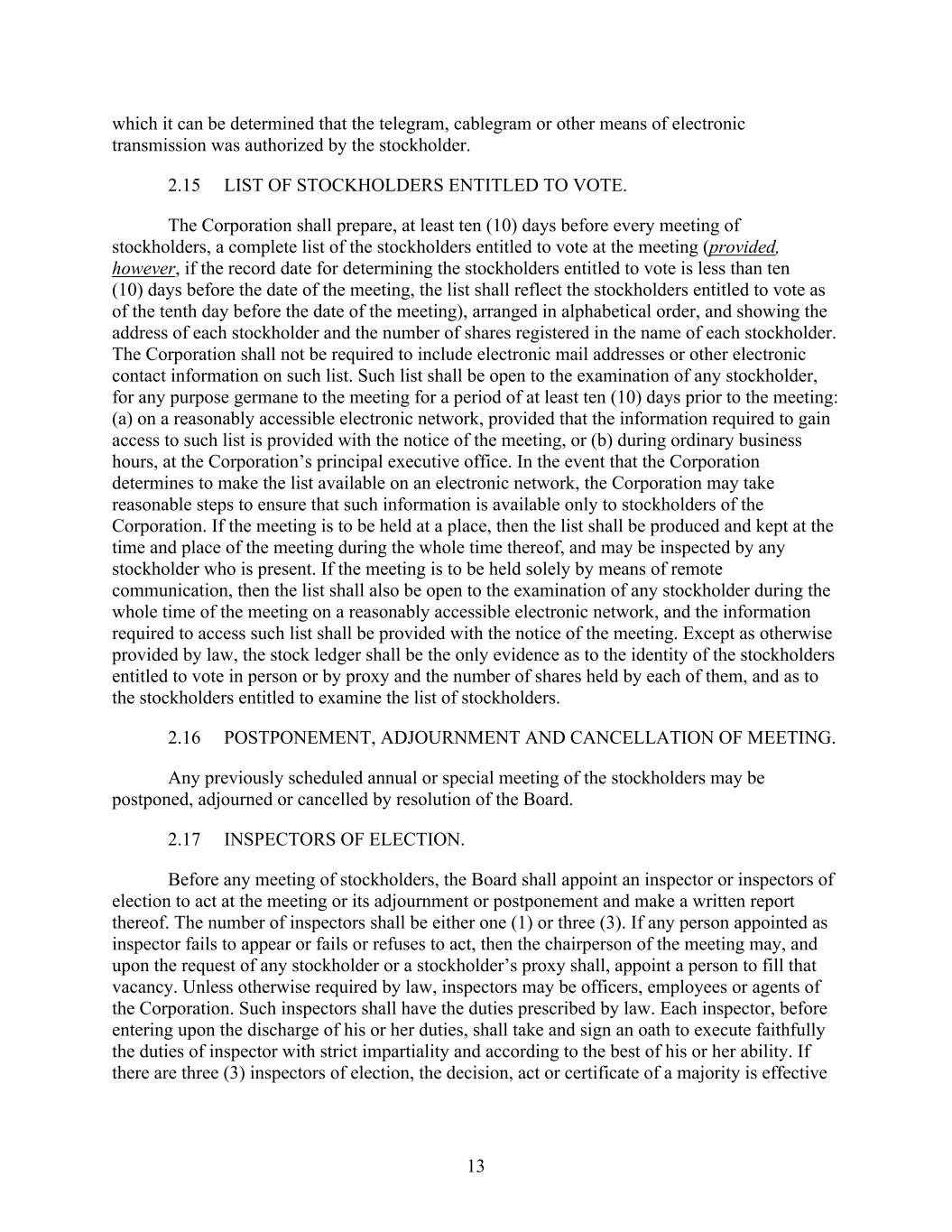
13 which it can be determined that the telegram, cablegram or other means of electronic transmission was authorized by the stockholder. LIST OF STOCKHOLDERS ENTITLED TO VOTE. The Corporation shall prepare, at least ten (10) days before every meeting of stockholders, a complete list of the stockholders entitled to vote at the meeting (provided, however, if the record date for determining the stockholders entitled to vote is less than ten (10) days before the date of the meeting, the list shall reflect the stockholders entitled to vote as of the tenth day before the date of the meeting), arranged in alphabetical order, and showing the address of each stockholder and the number of shares registered in the name of each stockholder. The Corporation shall not be required to include electronic mail addresses or other electronic contact information on such list. Such list shall be open to the examination of any stockholder, for any purpose germane to the meeting for a period of at least ten (10) days prior to the meeting: (a) on a reasonably accessible electronic network, provided that the information required to gain access to such list is provided with the notice of the meeting, or (b) during ordinary business hours, at the Corporation’s principal executive office. In the event that the Corporation determines to make the list available on an electronic network, the Corporation may take reasonable steps to ensure that such information is available only to stockholders of the Corporation. If the meeting is to be held at a place, then the list shall be produced and kept at the time and place of the meeting during the whole time thereof, and may be inspected by any stockholder who is present. If the meeting is to be held solely by means of remote communication, then the list shall also be open to the examination of any stockholder during the whole time of the meeting on a reasonably accessible electronic network, and the information required to access such list shall be provided with the notice of the meeting. Except as otherwise provided by law, the stock ledger shall be the only evidence as to the identity of the stockholders entitled to vote in person or by proxy and the number of shares held by each of them, and as to the stockholders entitled to examine the list of stockholders. POSTPONEMENT, ADJOURNMENT AND CANCELLATION OF MEETING. Any previously scheduled annual or special meeting of the stockholders may be postponed, adjourned or cancelled by resolution of the Board. INSPECTORS OF ELECTION. Before any meeting of stockholders, the Board shall appoint an inspector or inspectors of election to act at the meeting or its adjournment or postponement and make a written report thereof. The number of inspectors shall be either one (1) or three (3). If any person appointed as inspector fails to appear or fails or refuses to act, then the chairperson of the meeting may, and upon the request of any stockholder or a stockholder’s proxy shall, appoint a person to fill that vacancy. Unless otherwise required by law, inspectors may be officers, employees or agents of the Corporation. Such inspectors shall have the duties prescribed by law. Each inspector, before entering upon the discharge of his or her duties, shall take and sign an oath to execute faithfully the duties of inspector with strict impartiality and according to the best of his or her ability. If there are three (3) inspectors of election, the decision, act or certificate of a majority is effective

 
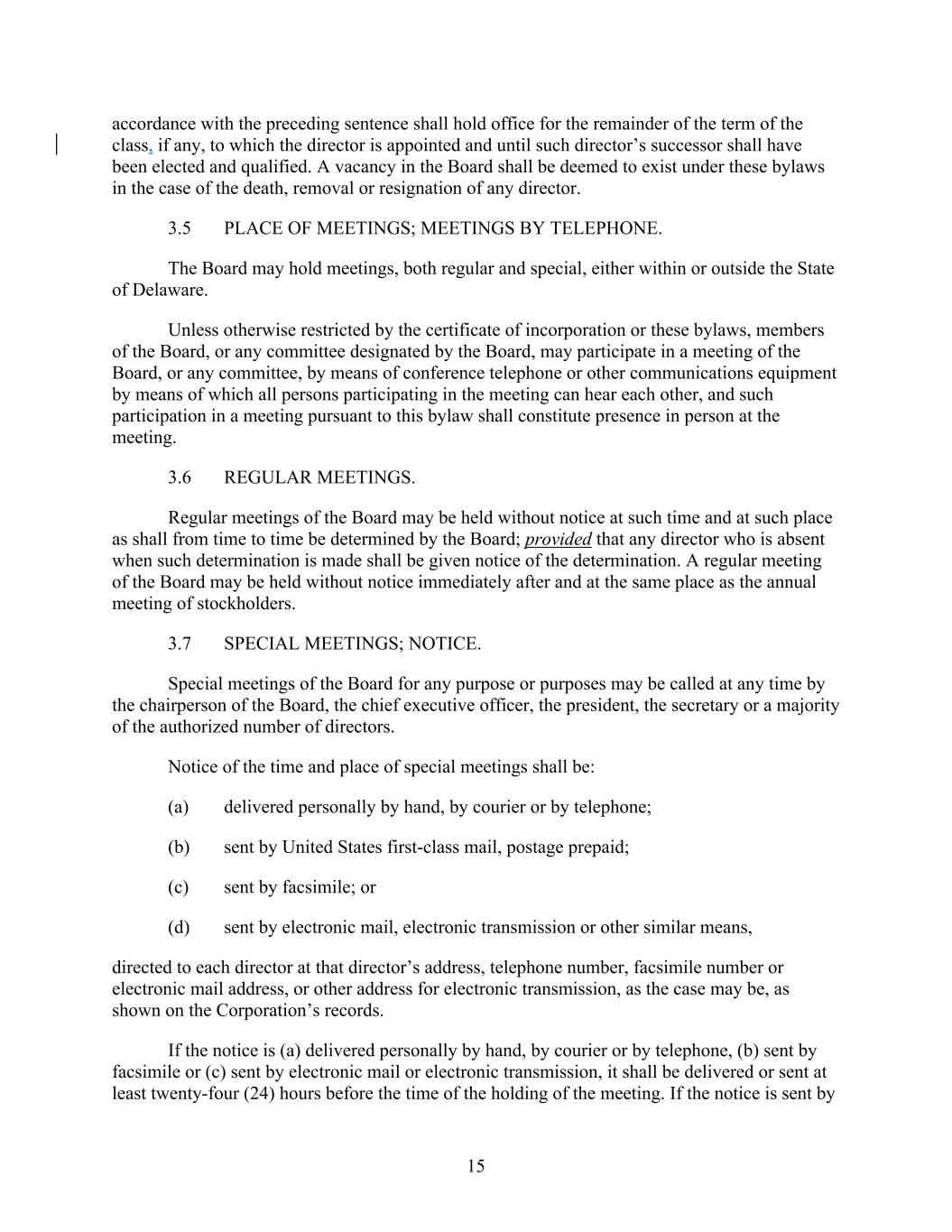
14 in all respects as the decision, act or certificate of all. Any report or certificate made by the inspectors of election is prima facie evidence of the facts stated therein. ARTICLE III – DIRECTORS POWERS. Subject to the provisions of the DGCL and any limitations in the certificate of incorporation, the business and affairs of the Corporation shall be managed and all corporate powers shall be exercised by or under the direction of the Board. NUMBER OF DIRECTORS. The authorized number of directors shall be determined from time to time by resolution of the Board, provided the Board shall consist of at least one (1) member and not more than eleven (11) members. No reduction of the authorized number of directors shall have the effect of removing any director before that director’s term of office expires. ELECTION, QUALIFICATION AND TERM OF OFFICE OF DIRECTORS. Except as provided in Section 3.4 of these bylaws, each director, including, without limitation, a director elected to fill a vacancy, shall hold office until the expiration of the term for which elected and until such director’s successor is elected and qualified or until such director’s earlier death, resignation or removal. Directors need not be stockholders unless so required by the certificate of incorporation or these bylaws. The Corporation may also have, at the discretion of the Board, a chairperson of the Board and a vice chairperson of the Board. The certificate of incorporation or these bylaws may prescribe other qualifications for directors. RESIGNATION AND VACANCIES. Any director may resign at any time upon notice given in writing or by electronic transmission to the chairperson of the Board or the Corporation’s chief executive officer, president or secretary. When one or more directors so resigns and the resignation is effective at a future date, a majority of the directors then in office, including those who have so resigned, shall have power to fill such vacancy or vacancies, the vote thereon to take effect when such resignation or resignations shall become effective, and each director so chosen shall hold office as provided in this section in the filling of other vacancies. Unless otherwise provided in the certificate of incorporation or these bylaws, vacancies and newly created directorships resulting from any increase in the authorized number of directors shall, unless the Board determines by resolution that any such vacancies or newly created directorships shall be filled by stockholders, be filled only by a majority of the directors then in office, although less than a quorum, or by a sole remaining director. Any director elected in accordance with the preceding sentence shall hold office for the remainder of the term of the class, if any, to which the director is appointed and until such director’s successor shall have

 
15 been elected and qualified. A vacancy in the Board shall be deemed to exist under these bylaws in the case of the death, removal or resignation of any director. PLACE OF MEETINGS; MEETINGS BY TELEPHONE. The Board may hold meetings, both regular and special, either within or outside the State of Delaware. Unless otherwise restricted by the certificate of incorporation or these bylaws, members of the Board, or any committee designated by the Board, may participate in a meeting of the Board, or any committee, by means of conference telephone or other communications equipment by means of which all persons participating in the meeting can hear each other, and such participation in a meeting pursuant to this bylaw shall constitute presence in person at the meeting. REGULAR MEETINGS. Regular meetings of the Board may be held without notice at such time and at such place as shall from time to time be determined by the Board; provided that any director who is absent when such determination is made shall be given notice of the determination. A regular meeting of the Board may be held without notice immediately after and at the same place as the annual meeting of stockholders. SPECIAL MEETINGS; NOTICE. Special meetings of the Board for any purpose or purposes may be called at any time by the chairperson of the Board, the chief executive officer, the president, the secretary or a majority of the authorized number of directors. Notice of the time and place of special meetings shall be: (a) delivered personally by hand, by courier or by telephone; (b) sent by United States first-class mail, postage prepaid; (c) sent by facsimile; or (d) sent by electronic mail, electronic transmission or other similar means, directed to each director at that director’s address, telephone number, facsimile number or electronic mail address, or other address for electronic transmission, as the case may be, as shown on the Corporation’s records. If the notice is (a) delivered personally by hand, by courier or by telephone, (b) sent by facsimile or (c) sent by electronic mail or electronic transmission, it shall be delivered or sent at least twenty-four (24) hours before the time of the holding of the meeting. If the notice is sent by U.S. mail, it shall be deposited in the U.S. mail at least four (4) days before the time of the holding of the meeting. Any oral notice may be communicated to the director. The notice need

 
16 not specify the place of the meeting (if the meeting is to be held at the Corporation’s principal executive office) nor the purpose of the meeting. QUORUM. The greater of (a) a majority of the directors at any time in office and (b) one-third of the number of directors established by the Board pursuant to Section 3.2 of these bylaws shall constitute a quorum of the Board for the transaction of business. The vote of a majority of the directors present at any meeting at which a quorum is present shall be the act of the Board, except as may be otherwise specifically provided by statute, the certificate of incorporation or these bylaws. If a quorum is not present at any meeting of the Board, then the directors present thereat may adjourn the meeting from time to time, without notice other than announcement at the meeting, until a quorum is present. A meeting at which a quorum is initially present may continue to transact business notwithstanding the withdrawal of directors, if any action taken is approved by at least a majority of the required quorum for that meeting. BOARD ACTION BY CONSENT WITHOUT A MEETING. Unless otherwise restricted by the certificate of incorporation or these bylaws, any action required or permitted to be taken at any meeting of the Board, or of any committee thereof, may be taken without a meeting if all members of the Board or committee, as the case may be, consent thereto in writing or by electronic transmission and the writing or writings or electronic transmission or transmissions are filed with the minutes of proceedings of the Board or committee. Such filing shall be in paper form if the minutes are maintained in paper form and shall be in electronic form if the minutes are maintained in electronic form. FEES AND COMPENSATION OF DIRECTORS. Unless otherwise restricted by the certificate of incorporation or these bylaws, the Board shall have the authority to fix the compensation of directors. [RESERVED]. ARTICLE IV - COMMITTEES COMMITTEES OF DIRECTORS. The Board may designate one (1) or more committees, each committee to consist of one (1) or more of the directors of the Corporation. The Board may designate one (1) or more directors as alternate members of any committee, who may replace any absent or disqualified member at any meeting of the committee. In the absence or disqualification of a member of a committee, the member or members thereof present at any meeting and not disqualified from voting, whether or not such member or members constitute a quorum, may unanimously appoint another member of the Board to act at the meeting in the place of any such absent or disqualified member. Any such committee, to the extent provided in the resolution of the Board or in these

 
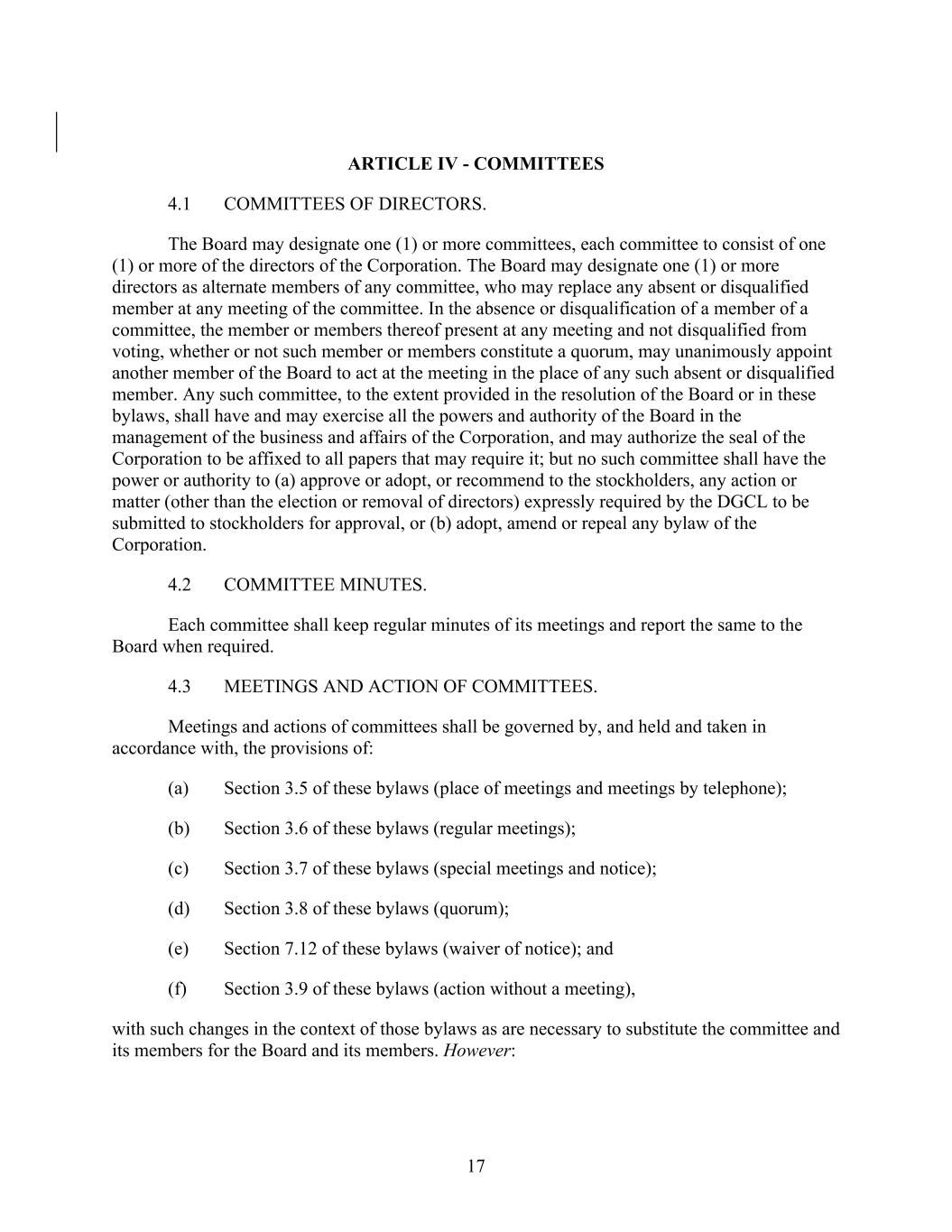
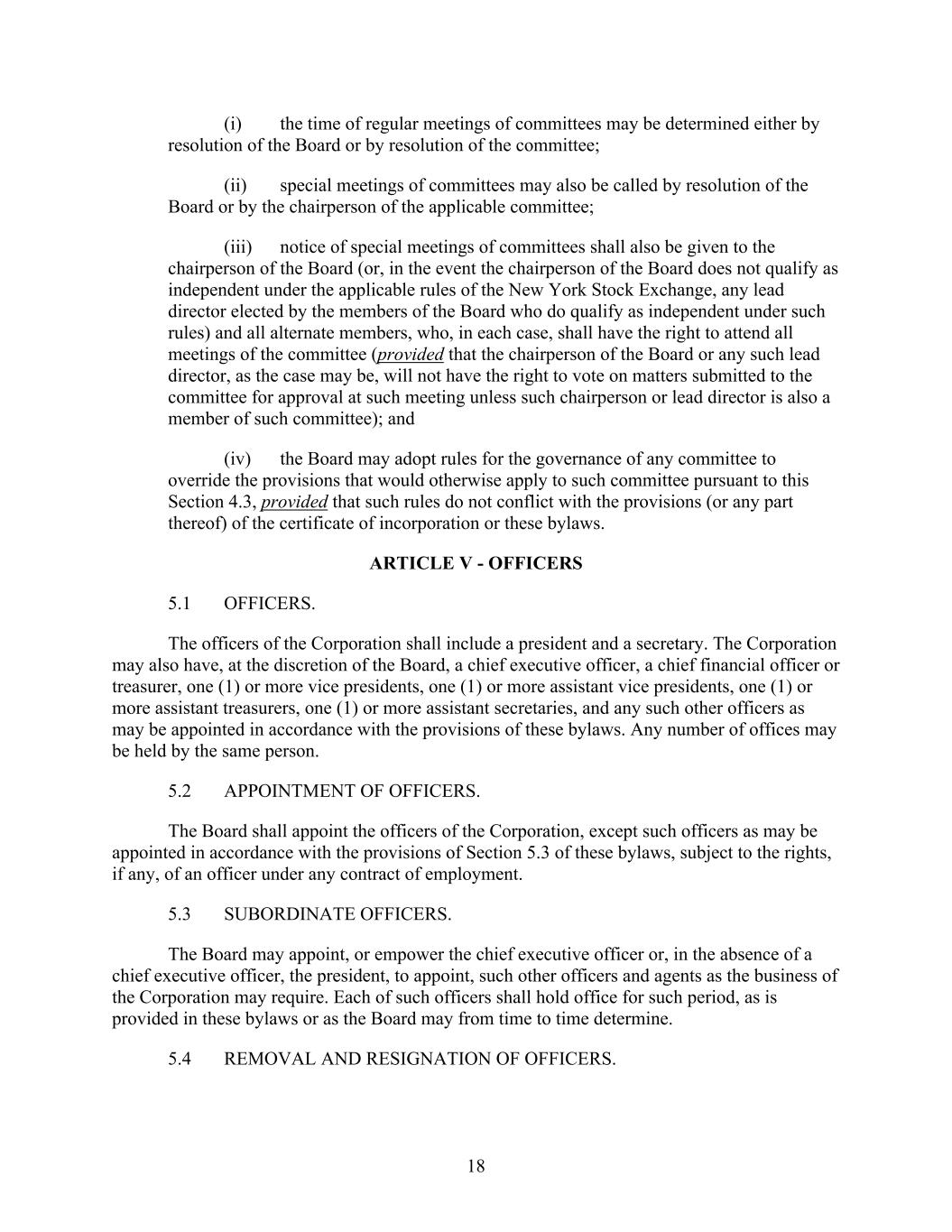
17 bylaws, shall have and may exercise all the powers and authority of the Board in the management of the business and affairs of the Corporation, and may authorize the seal of the Corporation to be affixed to all papers that may require it; but no such committee shall have the power or authority to (a) approve or adopt, or recommend to the stockholders, any action or matter (other than the election or removal of directors) expressly required by the DGCL to be submitted to stockholders for approval, or (b) adopt, amend or repeal any bylaw of the Corporation. COMMITTEE MINUTES. Each committee shall keep regular minutes of its meetings and report the same to the Board when required. MEETINGS AND ACTION OF COMMITTEES. Meetings and actions of committees shall be governed by, and held and taken in accordance with, the provisions of: (a) Section 3.5 of these bylaws (place of meetings and meetings by telephone); (b) Section 3.6 of these bylaws (regular meetings); (c) Section 3.7 of these bylaws (special meetings and notice); (d) Section 3.8 of these bylaws (quorum); (e) Section 7.12 of these bylaws (waiver of notice); and (f) Section 3.9 of these bylaws (action without a meeting), with such changes in the context of those bylaws as are necessary to substitute the committee and its members for the Board and its members. However: (i) the time of regular meetings of committees may be determined either by resolution of the Board or by resolution of the committee; (ii) special meetings of committees may also be called by resolution of the Board or by the chairperson of the applicable committee; (iii) notice of special meetings of committees shall also be given to the chairperson of the Board (or, in the event the chairperson of the Board does not qualify as independent under the applicable rules of the New York Stock Exchange, any lead director elected by the members of the Board who do qualify as independent under such rules) and all alternate members, who, in each case, shall have the right to attend all meetings of the committee (provided that the chairperson of the Board or any such lead director, as the case may be, will not have the right to vote on matters submitted to the committee for approval at such meeting unless such chairperson or lead director is also a member of such committee); and

 
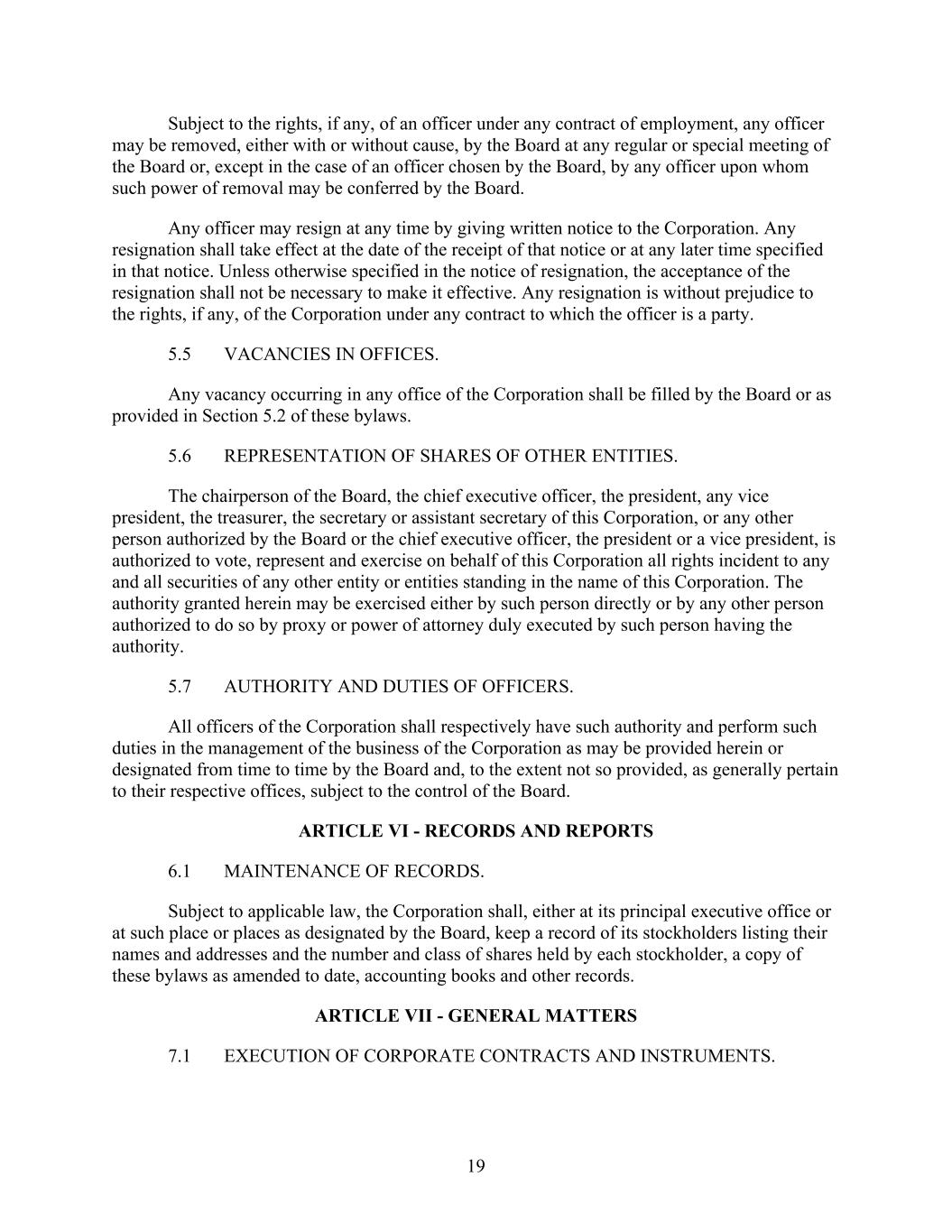
18 (iv) the Board may adopt rules for the governance of any committee to override the provisions that would otherwise apply to such committee pursuant to this Section 4.3, provided that such rules do not conflict with the provisions (or any part thereof) of the certificate of incorporation or these bylaws. ARTICLE V - OFFICERS OFFICERS. The officers of the Corporation shall include a president and a secretary. The Corporation may also have, at the discretion of the Board, a chief executive officer, a chief financial officer or treasurer, one (1) or more vice presidents, one (1) or more assistant vice presidents, one (1) or more assistant treasurers, one (1) or more assistant secretaries, and any such other officers as may be appointed in accordance with the provisions of these bylaws. Any number of offices may be held by the same person. APPOINTMENT OF OFFICERS. The Board shall appoint the officers of the Corporation, except such officers as may be appointed in accordance with the provisions of Section 5.3 of these bylaws, subject to the rights, if any, of an officer under any contract of employment. SUBORDINATE OFFICERS. The Board may appoint, or empower the chief executive officer or, in the absence of a chief executive officer, the president, to appoint, such other officers and agents as the business of the Corporation may require. Each of such officers shall hold office for such period, as is provided in these bylaws or as the Board may from time to time determine. REMOVAL AND RESIGNATION OF OFFICERS. Subject to the rights, if any, of an officer under any contract of employment, any officer may be removed, either with or without cause, by the Board at any regular or special meeting of the Board or, except in the case of an officer chosen by the Board, by any officer upon whom such power of removal may be conferred by the Board. Any officer may resign at any time by giving written notice to the Corporation. Any resignation shall take effect at the date of the receipt of that notice or at any later time specified in that notice. Unless otherwise specified in the notice of resignation, the acceptance of the resignation shall not be necessary to make it effective. Any resignation is without prejudice to the rights, if any, of the Corporation under any contract to which the officer is a party. VACANCIES IN OFFICES. Any vacancy occurring in any office of the Corporation shall be filled by the Board or as provided in Section 5.2 of these bylaws.

 
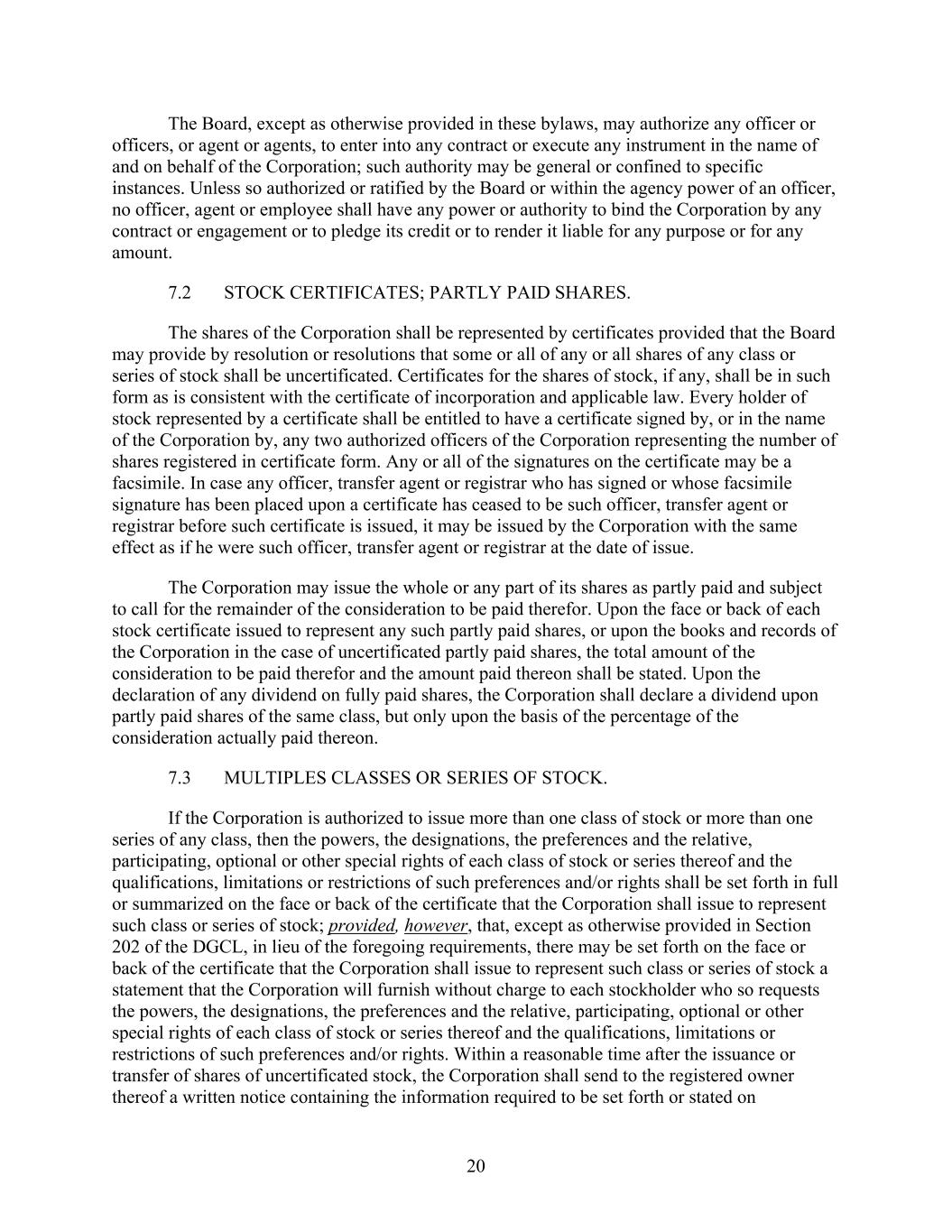
19 REPRESENTATION OF SHARES OF OTHER ENTITIES. The chairperson of the Board, the chief executive officer, the president, any vice president, the treasurer, the secretary or assistant secretary of this Corporation, or any other person authorized by the Board or the chief executive officer, the president or a vice president, is authorized to vote, represent and exercise on behalf of this Corporation all rights incident to any and all securities of any other entity or entities standing in the name of this Corporation. The authority granted herein may be exercised either by such person directly or by any other person authorized to do so by proxy or power of attorney duly executed by such person having the authority. AUTHORITY AND DUTIES OF OFFICERS. All officers of the Corporation shall respectively have such authority and perform such duties in the management of the business of the Corporation as may be provided herein or designated from time to time by the Board and, to the extent not so provided, as generally pertain to their respective offices, subject to the control of the Board. ARTICLE VI - RECORDS AND REPORTS MAINTENANCE OF RECORDS. Subject to applicable law, the Corporation shall, either at its principal executive office or at such place or places as designated by the Board, keep a record of its stockholders listing their names and addresses and the number and class of shares held by each stockholder, a copy of these bylaws as amended to date, accounting books and other records. ARTICLE VII - GENERAL MATTERS EXECUTION OF CORPORATE CONTRACTS AND INSTRUMENTS. The Board, except as otherwise provided in these bylaws, may authorize any officer or officers, or agent or agents, to enter into any contract or execute any instrument in the name of and on behalf of the Corporation; such authority may be general or confined to specific instances. Unless so authorized or ratified by the Board or within the agency power of an officer, no officer, agent or employee shall have any power or authority to bind the Corporation by any contract or engagement or to pledge its credit or to render it liable for any purpose or for any amount. STOCK CERTIFICATES; PARTLY PAID SHARES. The shares of the Corporation shall be represented by certificates provided that the Board may provide by resolution or resolutions that some or all of any or all shares of any class or series of stock shall be uncertificated. Certificates for the shares of stock, if any, shall be in such form as is consistent with the certificate of incorporation and applicable law. Every holder of stock represented by a certificate shall be entitled to have a certificate signed by, or in the name of the Corporation by, any two authorized officers of the Corporation representing the number of shares registered in certificate form. Any or all of the signatures on the certificate may be a

 
20 facsimile. In case any officer, transfer agent or registrar who has signed or whose facsimile signature has been placed upon a certificate has ceased to be such officer, transfer agent or registrar before such certificate is issued, it may be issued by the Corporation with the same effect as if he were such officer, transfer agent or registrar at the date of issue. The Corporation may issue the whole or any part of its shares as partly paid and subject to call for the remainder of the consideration to be paid therefor. Upon the face or back of each stock certificate issued to represent any such partly paid shares, or upon the books and records of the Corporation in the case of uncertificated partly paid shares, the total amount of the consideration to be paid therefor and the amount paid thereon shall be stated. Upon the declaration of any dividend on fully paid shares, the Corporation shall declare a dividend upon partly paid shares of the same class, but only upon the basis of the percentage of the consideration actually paid thereon. MULTIPLES CLASSES OR SERIES OF STOCK. If the Corporation is authorized to issue more than one class of stock or more than one series of any class, then the powers, the designations, the preferences and the relative, participating, optional or other special rights of each class of stock or series thereof and the qualifications, limitations or restrictions of such preferences and/or rights shall be set forth in full or summarized on the face or back of the certificate that the Corporation shall issue to represent such class or series of stock; provided, however, that, except as otherwise provided in Section 202 of the DGCL, in lieu of the foregoing requirements, there may be set forth on the face or back of the certificate that the Corporation shall issue to represent such class or series of stock a statement that the Corporation will furnish without charge to each stockholder who so requests the powers, the designations, the preferences and the relative, participating, optional or other special rights of each class of stock or series thereof and the qualifications, limitations or restrictions of such preferences and/or rights. Within a reasonable time after the issuance or transfer of shares of uncertificated stock, the Corporation shall send to the registered owner thereof a written notice containing the information required to be set forth or stated on certificates pursuant to the DGCL or a statement that the Corporation will furnish without charge to each stockholder who so requests the powers, designations, preferences and relative participating, optional or other special rights of each class of stock or series thereof and the qualifications, limitations or restrictions of such preferences and/or rights. LOST CERTIFICATES. Except as provided in this Section 7.4, no new certificates for shares shall be issued to replace a previously issued certificate unless the latter is surrendered to the Corporation in accordance with applicable law. The Corporation may issue a new certificate of stock or uncertificated shares in the place of any certificate theretofore issued by it, alleged to have been lost, stolen or destroyed, and the Corporation may require the owner of the lost, stolen or destroyed certificate, or such owner’s legal representative, to give the Corporation a bond sufficient to indemnify it against any claim that may be made against it on account of the alleged loss, theft or destruction of any such certificate or the issuance of such new certificate or uncertificated shares.

 
21 CONSTRUCTION; DEFINITIONS. Unless the context requires otherwise, the general provisions, rules of construction and definitions in the DGCL shall govern the construction of these bylaws. Without limiting the generality of this provision, the singular number includes the plural, the plural number includes the singular, and the term “person” includes both a corporation and a natural person. DIVIDENDS. The Board, subject to any restrictions contained in either (a) the DGCL or (b) the certificate of incorporation, may declare and pay dividends upon the shares of its capital stock. Dividends may be paid in cash, in property or in shares of the Corporation’s capital stock. The Board may set apart out of any of the funds of the Corporation available for dividends a reserve or reserves for any proper purpose and may abolish any such reserve. Such purposes shall include but not be limited to equalizing dividends, repairing or maintaining any property of the Corporation, and meeting contingencies. FISCAL YEAR. The fiscal year of the Corporation shall be fixed by resolution of the Board and may be changed by the Board. SEAL. The Corporation may adopt a corporate seal, which shall be adopted and which may be altered by the Board. The Corporation may use the corporate seal by causing it or a facsimile thereof to be impressed or affixed or in any other manner reproduced. TRANSFER OF STOCK. Shares of the Corporation shall be transferable in the manner prescribed by law and in these bylaws. Shares of stock of the Corporation shall be transferred on the books of the Corporation only by the holder of record thereof or by such holder’s attorney duly authorized in writing, upon surrender to the Corporation of the certificate or certificates representing such shares endorsed by the appropriate person or persons (or by delivery of duly executed instructions with respect to uncertificated shares), with such evidence of the authenticity of such endorsement or execution, transfer, authorization and other matters as the Corporation may reasonably require, and accompanied by all necessary stock transfer stamps. To the fullest extent permitted by law, no transfer of stock shall be valid as against the Corporation for any purpose until it shall have been entered in the stock records of the Corporation by an entry showing the names of the persons from and to whom it was transferred.

 
22 STOCK TRANSFER AGREEMENTS. The Corporation shall have power to enter into and perform any agreement with any number of stockholders of any one or more classes of stock of the Corporation to restrict the transfer of shares of stock of the Corporation of any one or more classes owned by such stockholders in any manner not prohibited by the DGCL. REGISTERED STOCKHOLDERS. The Corporation, to the fullest extent permitted by law,: (a) shall be entitled to recognize the exclusive right of a person registered on its books as the owner of shares to receive dividends and to vote as such owner; (b) shall be entitled to hold liable for calls and assessments the person registered on its books as the owner of shares; and (c) shall not be bound to recognize any equitable or other claim to or interest in such share or shares on the part of another person, whether or not it shall have express or other notice thereof, except as otherwise provided by the laws of the State of Delaware. WAIVER OF NOTICE. Whenever notice is required to be given under any provision of the DGCL, the certificate of incorporation or these bylaws, a written waiver, signed by the person entitled to notice, or a waiver by electronic transmission by the person entitled to notice, whether before or after the time of the event for which notice is to be given, shall be deemed equivalent to notice. Attendance of a person at a meeting shall constitute a waiver of notice of such meeting, except when the person attends a meeting for the express purpose of objecting at the beginning of the meeting, to the transaction of any business because the meeting is not lawfully called or convened. Neither the business to be transacted at, nor the purpose of, any regular or special meeting of the stockholders need be specified in any written waiver of notice or any waiver by electronic transmission unless so required by the certificate of incorporation or these bylaws. ARTICLE VIII - NOTICE BY ELECTRONIC TRANSMISSION NOTICE BY ELECTRONIC TRANSMISSION. Without limiting the manner by which notice otherwise may be given effectively to stockholders pursuant to the DGCL, the certificate of incorporation or these bylaws, any notice to stockholders given by the Corporation under any provision of the DGCL, the certificate of incorporation or these bylaws shall be effective if given by a form of electronic transmission consented to by the stockholder to whom the notice is given. Any such consent shall be revocable by the stockholder by written notice to the Corporation. Any such consent shall be deemed revoked if: (a) the Corporation is unable to deliver by electronic transmission two (2) consecutive notices given by the Corporation in accordance with such consent; and

 
23 (b) such inability becomes known to the secretary or an assistant secretary of the Corporation or to the transfer agent, or other person responsible for the giving of notice. However, the inadvertent failure to treat such inability as a revocation shall not invalidate any meeting or other action. Any notice given pursuant to the preceding paragraph shall be deemed given: (a) if by facsimile telecommunication, when directed to a number at which the stockholder has consented to receive notice; (b) if by electronic mail, when directed to an electronic mail address at which the stockholder has consented to receive notice; (c) if by a posting on an electronic network together with separate notice to the stockholder of such specific posting, upon the later of (i) such posting and (ii) the giving of such separate notice; and (d) if by any other form of electronic transmission, when directed to the stockholder. An affidavit of the secretary or an assistant secretary of the Corporation or of the transfer agent or other agent of the Corporation that the notice has been given by a form of electronic transmission shall, in the absence of fraud, be prima facie evidence of the facts stated therein. DEFINITION OF ELECTRONIC TRANSMISSION. For the purposes of these bylaws, an “electronic transmission” means any form of communication, not directly involving the physical transmission of paper, including the use of, or participation in, one or more electronic networks or databases (including one or more distributed electronic networks or databases), that creates a record that may be retained, retrieved and reviewed by a recipient thereof, and that may be directly reproduced in paper form by such a recipient through an automated process. ARTICLE IX - INDEMNIFICATION AND ADVANCEMENT INDEMNIFICATION OF DIRECTORS AND OFFICERS. The Corporation shall indemnify and hold harmless, to the fullest extent permitted by the DGCL as it presently exists or may hereafter be amended, any director or officer of the Corporation who was or is made or is threatened to be made a party or is otherwise involved in any action, suit or proceeding, whether civil, criminal, administrative or investigative (a “Proceeding”) by reason of the fact that he or she, or a person for whom he or she is the legal representative, is or was a director or officer of the Corporation or, while serving as a director or officer of the Corporation, is or was serving at the request of the Corporation as a director, officer, employee or agent of another corporation or of a partnership, joint venture, trust, enterprise or non-profit entity, including service with respect to employee benefit plans, against all liability and loss suffered and expenses (including attorneys’ fees) reasonably incurred by such person in connection with any such Proceeding. Notwithstanding the preceding sentence,

 
24 except as otherwise provided in Section 9.4, the Corporation shall be required to indemnify a person in connection with a Proceeding initiated by such person only if the Proceeding was authorized in the specific case by the Board. INDEMNIFICATION OF OTHERS. The Corporation shall have the power to indemnify and hold harmless, to the fullest extent permitted by applicable law as it presently exists or may hereafter be amended, any employee or agent of the Corporation who was or is made or is threatened to be made a party or is otherwise involved in any Proceeding by reason of the fact that he or she, or a person for whom he or she is the legal representative, is or was an employee or agent of the Corporation or is or was serving at the request of the Corporation as a director, officer, employee or agent of another corporation or of a partnership, joint venture, trust, enterprise or non-profit entity, including service with respect to employee benefit plans, against all liability and loss suffered and expenses reasonably incurred by such person in connection with any such Proceeding. PREPAYMENT OF EXPENSES. The Corporation shall to the fullest extent not prohibited by applicable law pay the expenses (including attorneys’ fees) incurred by any officer or director of the Corporation, and may pay the expenses incurred by any employee or agent of the Corporation, in defending any Proceeding in advance of its final disposition; provided, however, that, to the extent required by law, such payment of expenses in advance of the final disposition of the Proceeding shall be made only upon receipt of an undertaking by the person to repay all amounts advanced if it should be ultimately determined that the person is not entitled to be indemnified under this Article IX or otherwise. DETERMINATION; CLAIM. If a claim for indemnification (following the final disposition of such Proceeding) under this Article IX is not paid in full within sixty (60) days, or a claim for advancement of expenses under this Article IX is not paid in full within thirty (30) days, after a written claim therefor has been received by the Corporation the claimant may thereafter (but not before) file suit to recover the unpaid amount of such claim and, if successful in whole or in part, shall be entitled to be paid the expense of prosecuting such claim to the fullest extent permitted by law. In any such action the Corporation shall have the burden of proving that the claimant was not entitled to the requested indemnification or payment of expenses under applicable law. NON-EXCLUSIVITY OF RIGHTS. The rights conferred on any person by this Article IX shall not be exclusive of any other rights which such person may have or hereafter acquire under any statute, provision of the Certificate of Incorporation, these bylaws, agreement, vote of stockholders or disinterested directors or otherwise.

 
25 INSURANCE. The Corporation may purchase and maintain insurance on behalf of any person who is or was a director, officer, employee or agent of the Corporation, or is or was serving at the request of the Corporation as a director, officer, employee or agent of another corporation, partnership, joint venture, trust enterprise or non-profit entity against any liability asserted against him or her and incurred by him or her in any such capacity, or arising out of his or her status as such, whether or not the Corporation would have the power to indemnify him or her against such liability under the provisions of the DGCL. OTHER INDEMNIFICATION. The Corporation’s obligation, if any, to indemnify or advance expenses to any person who was or is serving at its request as a director, officer, employee or agent of another corporation, partnership, joint venture, trust, enterprise or non-profit entity shall be reduced by any amount such person may collect as indemnification or advancement of expenses from such other corporation, partnership, joint venture, trust, enterprise or non-profit enterprise. CONTINUATION OF INDEMNIFICATION. The rights to indemnification and to prepayment of expenses provided by, or granted pursuant to, this Article IX shall continue notwithstanding that the person has ceased to be a director or officer of the Corporation and shall inure to the benefit of the estate, heirs, executors, administrators, legatees and distributees of such person. AMENDMENT OR REPEAL. The provisions of this Article IX shall constitute a contract between the Corporation, on the one hand, and, on the other hand, each individual who serves or has served as a director or officer of the Corporation (whether before or after the adoption of these bylaws), in consideration of such person’s performance of such services, and pursuant to this Article IX the Corporation intends to be legally bound to each such current or former director or officer of the Corporation. With respect to current and former directors and officers of the Corporation, the rights conferred under this Article IX are present contractual rights and such rights are fully vested, and shall be deemed to have vested fully, immediately upon adoption of theses bylaws. With respect to any directors or officers of the Corporation who commence service following adoption of these bylaws, the rights conferred under this provision shall be present contractual rights and such rights shall fully vest, and be deemed to have vested fully, immediately upon such director or officer commencing service as a director or officer of the Corporation. Any repeal or modification of the foregoing provisions of this Article IX shall not adversely affect any right or protection (i) hereunder of any person in respect of any act or omission occurring prior to the time of such repeal or modification or (ii) under any agreement providing for indemnification or advancement of expenses to an officer or director of the Corporation in effect prior to the time of such repeal or modification.

 
26 ARTICLE X - AMENDMENTS. Subject to the limitations set forth in Section 9.9 of these bylaws or the provisions of the certificate of incorporation, the Board is expressly empowered to adopt, amend or repeal the bylaws of the Corporation. The stockholders also shall have power to adopt, amend or repeal the bylaws of the Corporation; provided, however, that, in addition to any vote of the holders of any class or series of stock of the Corporation required by law or by the certificate of incorporation, such action by stockholders shall require the affirmative vote of the holders of at least two-thirds in voting power of the outstanding shares of capital stock of the Corporation entitled to vote at an election of directors, voting together as a single class.
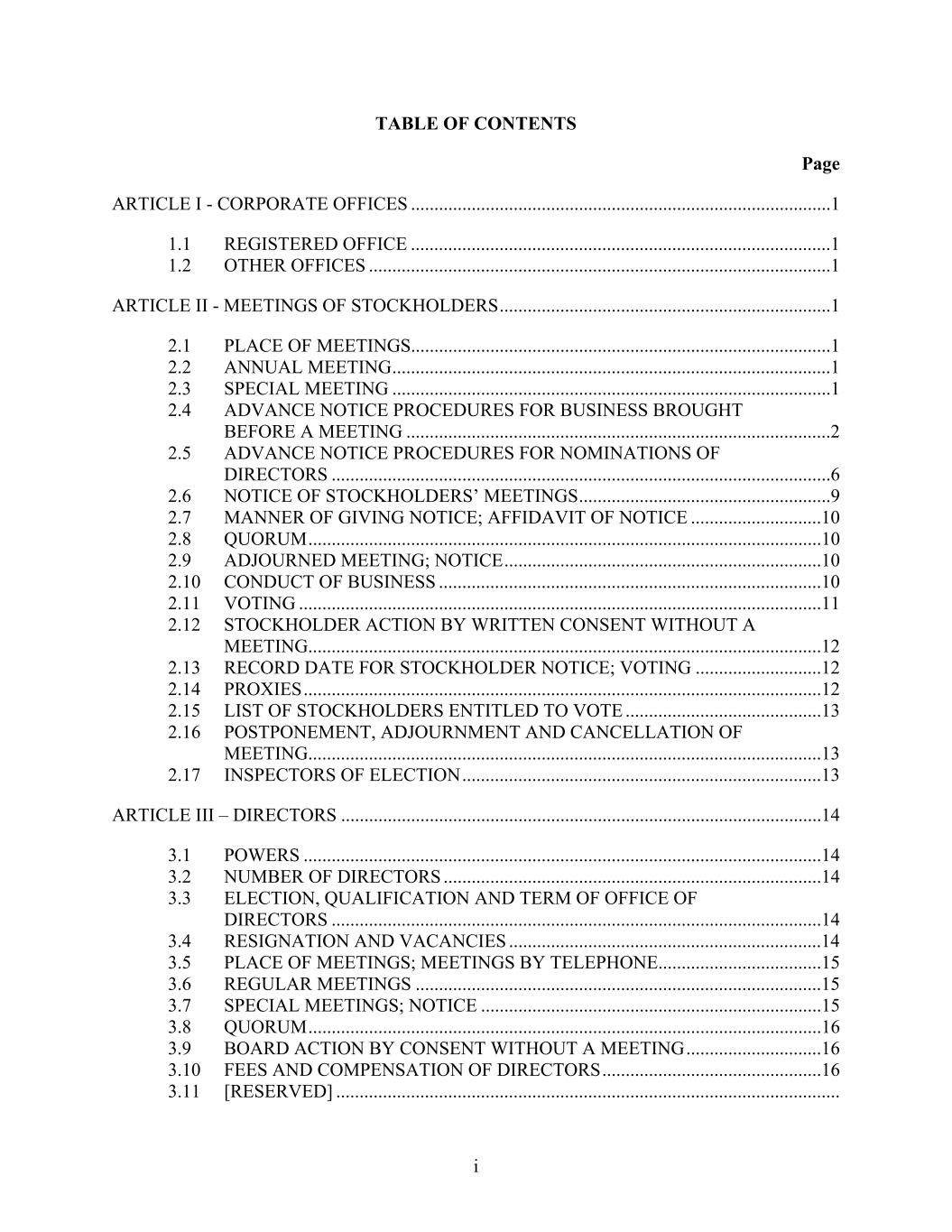
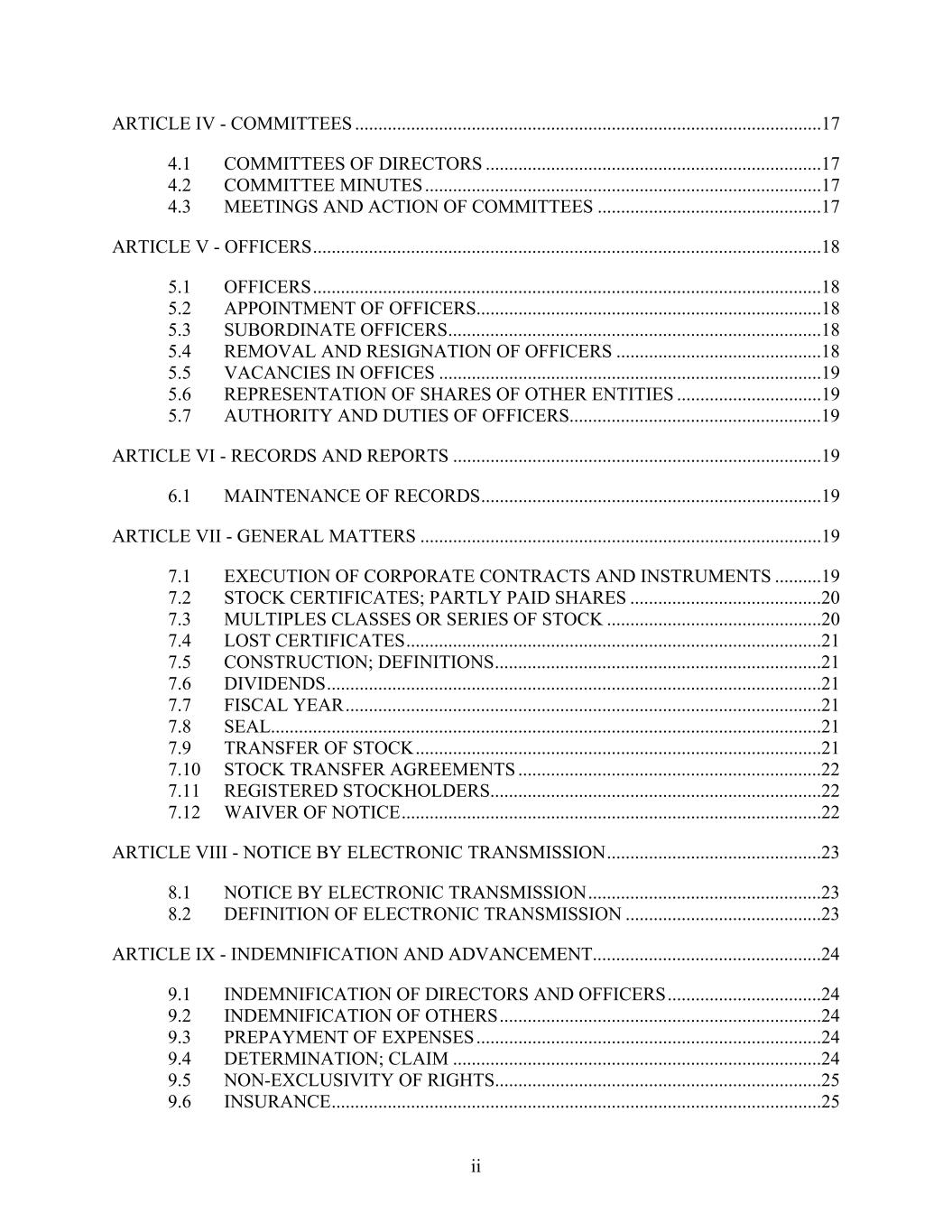
 
AMENDED AND RESTATED BYLAWS OF INSPIRE MEDICAL SYSTEMS, INC. (a Delaware corporation)


i TABLE OF CONTENTS Page ARTICLE I - CORPORATE OFFICES ..........................................................................................1 1.1 REGISTERED OFFICE ..........................................................................................1 1.2 OTHER OFFICES ...................................................................................................1 ARTICLE II - MEETINGS OF STOCKHOLDERS .......................................................................1 2.1 PLACE OF MEETINGS..........................................................................................1 2.2 ANNUAL MEETING ..............................................................................................1 2.3 SPECIAL MEETING ..............................................................................................1 2.4 ADVANCE NOTICE PROCEDURES FOR BUSINESS BROUGHT BEFORE A MEETING ...........................................................................................2 2.5 ADVANCE NOTICE PROCEDURES FOR NOMINATIONS OF DIRECTORS ...........................................................................................................6 2.6 NOTICE OF STOCKHOLDERS’ MEETINGS ......................................................9 2.7 MANNER OF GIVING NOTICE; AFFIDAVIT OF NOTICE ............................10 2.8 QUORUM ..............................................................................................................10 2.9 ADJOURNED MEETING; NOTICE ....................................................................10 2.10 CONDUCT OF BUSINESS ..................................................................................10 2.11 VOTING ................................................................................................................11 2.12 STOCKHOLDER ACTION BY WRITTEN CONSENT WITHOUT A MEETING..............................................................................................................12 2.13 RECORD DATE FOR STOCKHOLDER NOTICE; VOTING ...........................12 2.14 PROXIES ...............................................................................................................12 2.15 LIST OF STOCKHOLDERS ENTITLED TO VOTE ..........................................13 2.16 POSTPONEMENT, ADJOURNMENT AND CANCELLATION OF MEETING..............................................................................................................13 2.17 INSPECTORS OF ELECTION .............................................................................13 ARTICLE III – DIRECTORS .......................................................................................................14 3.1 POWERS ...............................................................................................................14 3.2 NUMBER OF DIRECTORS .................................................................................14 3.3 ELECTION, QUALIFICATION AND TERM OF OFFICE OF DIRECTORS .........................................................................................................14 3.4 RESIGNATION AND VACANCIES ...................................................................14 3.5 PLACE OF MEETINGS; MEETINGS BY TELEPHONE...................................15 3.6 REGULAR MEETINGS .......................................................................................15 3.7 SPECIAL MEETINGS; NOTICE .........................................................................15 3.8 QUORUM ..............................................................................................................16 3.9 BOARD ACTION BY CONSENT WITHOUT A MEETING .............................16 3.10 FEES AND COMPENSATION OF DIRECTORS ...............................................16 3.11 [RESERVED] ............................................................................................................


ii ARTICLE IV - COMMITTEES ....................................................................................................17 4.1 COMMITTEES OF DIRECTORS ........................................................................17 4.2 COMMITTEE MINUTES .....................................................................................17 4.3 MEETINGS AND ACTION OF COMMITTEES ................................................17 ARTICLE V - OFFICERS .............................................................................................................18 5.1 OFFICERS .............................................................................................................18 5.2 APPOINTMENT OF OFFICERS..........................................................................18 5.3 SUBORDINATE OFFICERS ................................................................................18 5.4 REMOVAL AND RESIGNATION OF OFFICERS ............................................18 5.5 VACANCIES IN OFFICES ..................................................................................19 5.6 REPRESENTATION OF SHARES OF OTHER ENTITIES ...............................19 5.7 AUTHORITY AND DUTIES OF OFFICERS......................................................19 ARTICLE VI - RECORDS AND REPORTS ...............................................................................19 6.1 MAINTENANCE OF RECORDS .........................................................................19 ARTICLE VII - GENERAL MATTERS ......................................................................................19 7.1 EXECUTION OF CORPORATE CONTRACTS AND INSTRUMENTS ..........19 7.2 STOCK CERTIFICATES; PARTLY PAID SHARES .........................................20 7.3 MULTIPLES CLASSES OR SERIES OF STOCK ..............................................20 7.4 LOST CERTIFICATES .........................................................................................21 7.5 CONSTRUCTION; DEFINITIONS ......................................................................21 7.6 DIVIDENDS ..........................................................................................................21 7.7 FISCAL YEAR ......................................................................................................21 7.8 SEAL......................................................................................................................21 7.9 TRANSFER OF STOCK .......................................................................................21 7.10 STOCK TRANSFER AGREEMENTS .................................................................22 7.11 REGISTERED STOCKHOLDERS.......................................................................22 7.12 WAIVER OF NOTICE ..........................................................................................22 ARTICLE VIII - NOTICE BY ELECTRONIC TRANSMISSION ..............................................23 8.1 NOTICE BY ELECTRONIC TRANSMISSION ..................................................23 8.2 DEFINITION OF ELECTRONIC TRANSMISSION ..........................................23 ARTICLE IX - INDEMNIFICATION AND ADVANCEMENT.................................................24 9.1 INDEMNIFICATION OF DIRECTORS AND OFFICERS .................................24 9.2 INDEMNIFICATION OF OTHERS .....................................................................24 9.3 PREPAYMENT OF EXPENSES ..........................................................................24 9.4 DETERMINATION; CLAIM ...............................................................................24 9.5 NON-EXCLUSIVITY OF RIGHTS ......................................................................25 9.6 INSURANCE .........................................................................................................25


iii 9.7 OTHER INDEMNIFICATION .............................................................................25 9.8 CONTINUATION OF INDEMNIFICATION ......................................................25 9.9 AMENDMENT OR REPEAL ...............................................................................25 ARTICLE X - AMENDMENTS. ..................................................................................................26


1 AMENDED AND RESTATED BYLAWS OF INSPIRE MEDICAL SYSTEMS, INC. ARTICLE I - CORPORATE OFFICES 1.1 REGISTERED OFFICE. The registered office of Inspire Medical Systems, Inc. (the “Corporation”) shall be fixed in the Corporation’s certificate of incorporation, as the same may be amended from time to time (the “certificate of incorporation”). 1.2 OTHER OFFICES. The Corporation may have other offices at any place or places, either within or outside the State of Delaware, as the board of directors (the “Board”) shall from time to time determine or the business of the Corporation may from time to time require. ARTICLE II - MEETINGS OF STOCKHOLDERS 2.1 PLACE OF MEETINGS. Meetings of stockholders shall be held at any place, within or outside the State of Delaware, designated by the Board. The Board may, in its sole discretion, determine that a meeting of stockholders shall not be held at any place, but may instead be held solely by means of remote communication as authorized by Section 211(a) of the General Corporation Law of the State of Delaware (the “DGCL”). In the absence of any such designation or determination, stockholders’ meetings shall be held at the Corporation’s principal executive office. 2.2 ANNUAL MEETING. The Board shall designate the date and time of the annual meeting. At the annual meeting, directors shall be elected and other proper business properly brought before the meeting in accordance with Section 2.4 of these bylaws may be transacted. 2.3 SPECIAL MEETING. A special meeting of the stockholders may be called at any time by the Board, chairperson of the Board, chief executive officer or president (in the absence of a chief executive officer), but such special meetings may not be called by any other person or persons. No business may be transacted at such special meeting other than the business specified in such notice to stockholders. Nothing contained in this paragraph of this Section 2.3 shall be construed as limiting, fixing, or affecting the time when a meeting of stockholders called by action of the Board may be held.


2 2.4 ADVANCE NOTICE PROCEDURES FOR BUSINESS BROUGHT BEFORE A MEETING. (a) At an annual meeting of the stockholders, only such business shall be conducted as shall have been properly brought before the meeting. To be properly brought before an annual meeting, business must be (i) specified in a notice of meeting given by or at the direction of the Board, (ii) if not specified in a notice of meeting, otherwise brought before the meeting by or at the direction of the Board or the chairperson of the Board, or (iii) otherwise properly brought before the meeting by a stockholder present in person who (A)(1) was a stockholder of record of the Corporation (and, with respect to any beneficial owner, if different, on whose behalf such business is proposed, only if such beneficial owner was the beneficial owner of shares of the Corporation) both at the time of giving the notice provided for in this Section 2.4 and at the time of the meeting, (2) is entitled to vote at the meeting and (3) has complied with this Section 2.4 in all applicable respects, or (B) properly made such proposal in accordance with Rule 14a-8 under the Securities Exchange Act of 1934, as amended, and the rules and regulations promulgated thereunder (as so amended and inclusive of such rules and regulations, the “Exchange Act”). The foregoing clause (iii) shall be the exclusive means for a stockholder to propose business to be brought before an annual meeting of the stockholders. The only matters that may be brought before a special meeting are the matters specified in the notice of meeting given by or at the direction of the person calling the meeting pursuant to Section 2.3 of these bylaws, and stockholders shall not be permitted to propose business to be brought before a special meeting of the stockholders. For purposes of this Section 2.4, “present in person” shall mean that the stockholder proposing that the business be brought before the annual meeting of the Corporation, or a qualified representative of such proposing stockholder, appears at such annual meeting. A “qualified representative” of such proposing stockholder shall be a duly authorized officer, manager or partner of such stockholder or any other person authorized by a writing executed by such stockholder or an electronic transmission delivered by such stockholder to act for such stockholder as proxy at the meeting of stockholders and such person must produce such writing or electronic transmission, or a reliable reproduction of the writing or electronic transmission, at the meeting of stockholders. Stockholders seeking to nominate persons for election to the Board must comply with Section 2.5 of these bylaws, and this Section 2.4 shall not be applicable to nominations except as expressly provided in Section 2.5 of these bylaws. (b) For business to be properly brought before an annual meeting by a stockholder pursuant to clause (iii) of the second sentence of Section 2.4(a) of these bylaws, the stockholder must (i) provide Timely Notice (as defined below) thereof in writing and in proper form to the Secretary of the Corporation and (ii) provide any updates or supplements to such notice at the times and in the forms required by this Section 2.4. To be timely, a stockholder’s notice must be delivered to, or mailed and received by the Secretary at, the principal executive offices of the Corporation not less than ninety (90) days nor more than one hundred twenty (120) days prior to the one-year anniversary of the preceding year’s annual meeting; provided, however, that (x) if the date of the annual meeting is more than thirty (30) days before or more than sixty (60) days after such anniversary date or (y) with respect to the first annual meeting held after the Company’s initial public offering of its shares pursuant to a registration statement on Form S-1, notice by the stockholder to be timely must be so delivered, or mailed and received, not earlier than the close of business on the one hundred twentieth (120th) day prior to such annual meeting and not later than the later of the close of business on the ninetieth (90th) day prior to such


3 annual meeting and the close of business on the tenth (10th) day following the day on which public disclosure of the date of such annual meeting was first made (such notice within such time periods, “Timely Notice”). In no event shall any adjournment or postponement of an annual meeting or the announcement thereof commence a new time period (or extend any time period) for the giving of Timely Notice as described above. (c) To be in proper form for purposes of this Section 2.4, a stockholder’s notice to the Secretary shall set forth: (i) As to each Proposing Person (as defined below), (A) the name and address of such Proposing Person (including, if applicable, the name and address that appear on the Corporation’s books and records), and (B) the class or series and number of shares of the Corporation that are, directly or indirectly, owned of record or beneficially owned (within the meaning of Rule 13d-3 under the Exchange Act) by such Proposing Person, except that such Proposing Person shall in all events be deemed to beneficially own any shares of any class or series of the Corporation as to which such Proposing Person has a right to acquire beneficial ownership at any time in the future (the disclosures to be made pursuant to the foregoing clauses (A) and (B) are referred to as “Stockholder Information”); (ii) As to each Proposing Person, (A) the full notional amount of any securities that, directly or indirectly, underlie any “derivative security” (as such term is defined in Rule 16a-1(c) under the Exchange Act) that constitutes a “call equivalent position” (as such term is defined in Rule 16a-1(b) under the Exchange Act) (“Synthetic Equity Position”) and that is, directly or indirectly, held or maintained by such Proposing Person with respect to any shares of any class or series of shares of the Corporation; provided that, for the purposes of the definition of “Synthetic Equity Position,” the term “derivative security” shall also include any security or instrument that would not otherwise constitute a “derivative security” as a result of any feature that would make any conversion, exercise or similar right or privilege of such security or instrument becoming determinable only at some future date or upon the happening of a future occurrence, in which case the determination of the amount of securities into which such security or instrument would be convertible or exercisable shall be made assuming that such security or instrument is immediately convertible or exercisable at the time of such determination; and, provided, further, that any Proposing Person satisfying the requirements of Rule 13d-1(b)(1) under the Exchange Act (other than a Proposing Person that so satisfies Rule 13d-1(b)(1) under the Exchange Act solely by reason of Rule 13d-1(b)(1)(ii)(E)) shall not be deemed to hold or maintain the notional amount of any securities that underlie a Synthetic Equity Position held by such Proposing Person as a hedge with respect to a bona fide derivatives trade or position of such Proposing Person arising in the ordinary course of such Proposing Person’s business as a derivatives dealer, (B) any rights to dividends on the shares of any class or series of shares of the Corporation owned beneficially by such Proposing Person that are separated or separable from the underlying shares of the Corporation, (C)(x) if such Proposing Person is (i) a general or limited partnership, syndicate or other group, the identity of each general partner and each person who functions as a general partner of the general or limited partnership, each member of the syndicate or group and each person controlling the general partner or member, (ii) a


4 corporation or a limited liability company, the identity of each officer and each person who functions as an officer of the corporation or limited liability company, each person controlling the corporation or limited liability company and each officer, director, general partner and person who functions as an officer, director or general partner of any entity ultimately in control of the corporation or limited liability company or (iii) a trust, any trustee of such trust (each such person or persons set forth in the preceding clauses (i), (ii) and (iii), a “Responsible Person”), any fiduciary duties owed by such Responsible Person to the equity holders or other beneficiaries of such Proposing Person and any material interests or relationships of such Responsible Person that are not shared generally by other record or beneficial holders of the shares of any class or series of the Corporation and that reasonably could have influenced the decision of such Proposing Person to propose such business to be brought before the meeting, and (y) if such Proposing Person is a natural person, any material interests or relationships of such natural person that are not shared generally by other record or beneficial holders of the shares of any class or series of the Corporation and that reasonably could have influenced the decision of such Proposing Person to propose such business to be brought before the meeting, (D) any material shares or any Synthetic Equity Position in any principal competitor of the Corporation in any principal industry of the Corporation held by such Proposing Persons, (E) a summary of any material discussions regarding the business proposed to be brought before the meeting (x) between or among any of the Proposing Persons or (y) between or among any Proposing Person and any other record or beneficial holder of the shares of any class or series of the Corporation (including their names), (F) any material pending or threatened legal proceeding in which such Proposing Person is a party or material participant involving the Corporation or any of its officers or directors, or any affiliate of the Corporation, (G) any other material relationship between such Proposing Person, on the one hand, and the Corporation, any affiliate of the Corporation or any principal competitor of the Corporation, on the other hand, (H) any direct or indirect material interest in any material contract or agreement of such Proposing Person with the Corporation, any affiliate of the Corporation or any principal competitor of the Corporation (including, in any such case, any employment agreement, collective bargaining agreement or consulting agreement), (I) a representation that such Proposing Person intends or is part of a group which intends to deliver a proxy statement or form of proxy to holders of at least the percentage of the Corporation’s outstanding capital stock required to approve or adopt the proposal or otherwise solicit proxies from stockholders in support of such proposal, and (J) any other information relating to such Proposing Person that would be required to be disclosed in a proxy statement or other filing required to be made in connection with solicitations of proxies or consents by such Proposing Person in support of the business proposed to be brought before the meeting pursuant to Section 14(a) of the Exchange Act (the disclosures to be made pursuant to the foregoing clauses (A) through (J) are referred to as “Disclosable Interests”); provided, however, that Disclosable Interests shall not include any such disclosures with respect to the ordinary course business activities of any broker, dealer, commercial bank, trust company or other nominee who is a Proposing Person solely as a result of being the stockholder directed to prepare and submit the notice required by these bylaws on behalf of a beneficial owner; and


5 (iii) As to each item of business that the stockholder proposes to bring before the annual meeting, (A) a brief description of the business desired to be brought before the annual meeting, the reasons for conducting such business at the annual meeting and any material interest in such business of each Proposing Person, (B) the text of the proposal or business (including the text of any resolutions proposed for consideration and in the event that such business includes a proposal to amend the bylaws of the Corporation, the language of the proposed amendment), (C) a reasonably detailed description of all agreements, arrangements and understandings between or among any of the Proposing Persons or between or among any Proposing Person and any other person or entity (including their names) in connection with the proposal of such business by such stockholder and (D) any other information relating to such item of business that would be required to be disclosed in a proxy statement or other filing required to be made in connection with solicitations of proxies in support of the business proposed to be brought before the meeting pursuant to Section 14(a) of the Exchange Act; provided, however, that the disclosures required by this paragraph (c)(iii) shall not include any disclosures with respect to any broker, dealer, commercial bank, trust company or other nominee who is a Proposing Person solely as a result of being the stockholder directed to prepare and submit the notice required by these bylaws on behalf of a beneficial owner. (d) For purposes of this Section 2.4, the term “Proposing Person” shall mean (i) the stockholder providing the notice of business proposed to be brought before an annual meeting, (ii) the beneficial owner or beneficial owners, if different, on whose behalf the notice of the business proposed to be brought before the annual meeting is made and (iii) any participant (as defined in paragraphs (a)(ii)-(vi) of Instruction 3 to Item 4 of Schedule 14A) with such stockholder in such solicitation. (e) A Proposing Person shall update and supplement its notice to the Corporation of its intent to propose business at an annual meeting, if necessary, so that the information provided or required to be provided in such notice pursuant to this Section 2.4 shall be true and correct as of the record date for determining stockholders entitled to notice of the meeting and as of the date that is ten (10) business days prior to the meeting or any adjournment or postponement thereof, and such update and supplement shall be delivered to, or mailed and received by, the Secretary at the principal executive offices of the Corporation not later than five (5) business days after the record date for determining stockholders entitled to notice of the meeting (in the case of the update and supplement required to be made as of such record date), and not later than eight (8) business days prior to the date for the meeting or, if practicable, any adjournment or postponement thereof (and, if not practicable, on the first practicable date prior to the date to which the meeting has been adjourned or postponed) (in the case of the update and supplement required to be made as of ten (10) business days prior to the meeting or any adjournment or postponement thereof). (f) Notwithstanding anything in these bylaws to the contrary and except as otherwise expressly provided in any applicable rule or regulation promulgated under the Exchange Act, no business shall be conducted at an annual meeting that is not properly brought before the meeting in accordance with this Section 2.4. The presiding officer of the meeting shall, if the facts warrant, determine that the business was not properly brought before the meeting in accordance


6 with this Section 2.4, and if he or she should so determine, he or she shall so declare to the meeting and any such business not properly brought before the meeting shall not be transacted. (g) This Section 2.4 is expressly intended to apply to any business proposed to be brought before an annual meeting of stockholders, other than any proposal made in accordance with Rule 14a-8 under the Exchange Act and included in the Corporation’s proxy statement. In addition to the requirements of this Section 2.4 with respect to any business proposed to be brought before an annual meeting, each Proposing Person shall comply with all applicable requirements of the Exchange Act with respect to any such business. Nothing in this Section 2.4 shall be deemed to affect the rights of stockholders to request inclusion of proposals in the Corporation’s proxy statement pursuant to Rule 14a-8 under the Exchange Act. (h) For purposes of these bylaws, “public disclosure” shall mean disclosure in a press release reported by a national news service or in a document publicly filed by the Corporation with the Securities and Exchange Commission pursuant to Sections 13, 14 or 15(d) of the Exchange Act. 2.5 ADVANCE NOTICE PROCEDURES FOR NOMINATIONS OF DIRECTORS. (a) Nominations of any person for election to the Board at an annual meeting or at a special meeting (but only if the election of directors is a matter specified in the notice of meeting given by or at the direction of the person calling such special meeting) may be made at such meeting only (i) by or at the direction of the Board, including by any committee or persons authorized to do so by the Board or these bylaws, or (ii) by a stockholder present in person who (A) was a stockholder of record of the Corporation (and, with respect to any beneficial owner, if different, on whose behalf such nomination is proposed to be made, only if such beneficial owner was the beneficial owner of shares of the Corporation) both at the time of giving the notice provided for in this Section 2.5 and at the time of the meeting, (B) is entitled to vote at the meeting and (C) has complied with this Section 2.5 as to such notice and nomination. The foregoing clause (ii) shall be the exclusive means for a stockholder to make any nomination of a person or persons for election to the Board at an annual meeting or special meeting. For purposes of this Section 2.5, “present in person” shall mean that the stockholder proposing that the business be brought before the meeting of the Corporation, or a qualified representative of such stockholder, appear at such meeting. A “qualified representative” of such proposing stockholder shall be a duly authorized officer, manager or partner of such stockholder or any other person authorized by a writing executed by such stockholder or an electronic transmission delivered by such stockholder to act for such stockholder as proxy at the meeting of stockholders and such person must produce such writing or electronic transmission, or a reliable reproduction of the writing or electronic transmission, at the meeting of stockholders. (b) Without qualification, for a stockholder to make any nomination of a person or persons for election to the Board at an annual meeting, the stockholder must (i) provide Timely Notice (as defined in Section 2.4(b) of these bylaws) thereof in writing and in proper form to the Secretary of the Corporation, (ii) provide the information with respect to such stockholder and its proposed nominee as required by this Section 2.5, and (iii) provide any updates or supplements to such notice at the times and in the forms required by this Section 2.5. Notwithstanding anything in this paragraph to the contrary, in the event that the number of directors to be elected


7 to the Board at an annual meeting is increased effective after the time period for which nominations would otherwise be due under this paragraph (b) and there is no public announcement by the Corporation naming the nominees for the additional directorships at least one hundred (100) days prior to the first anniversary of the preceding year’s annual meeting, a stockholder’s notice required by paragraph (b) of this Section 2.5 shall also be considered timely, but only with respect to nominees for the additional directorships, if it shall be delivered to the Secretary at the principal executive offices of the Corporation not later than the close of business on the tenth (10th) day following the day on which such public announcement is first made by the Corporation. Without qualification, if the election of directors is a matter specified in the notice of meeting given by or at the direction of the person calling such special meeting, then for a stockholder to make any nomination of a person or persons for election to the Board at a special meeting, the stockholder must (A) provide timely notice thereof in writing and in proper form to the Secretary of the Corporation at the principal executive offices of the Corporation, (B) provide the information with respect to such stockholder and its proposed nominee as required by this Section 2.5, and (C) provide any updates or supplements to such notice at the times and in the forms required by this Section 2.5. To be timely, a stockholder’s notice for nominations to be made at a special meeting must be delivered to, or mailed and received at, the principal executive offices of the Corporation not earlier than the close of business on the one hundred twentieth (120th) day prior to such special meeting and not later than the later of the close of business on the ninetieth (90th) day prior to such special meeting and the close of business on the tenth (10th) day following the day on which public disclosure (as defined in Section 2.4(h) of these bylaws) of the date of such special meeting was first made. In no event shall any adjournment or postponement of an annual meeting or special meeting or the announcement thereof commence a new time period (or extend any time period) for the giving of a stockholder’s notice as described above. (c) To be in proper form for purposes of this Section 2.5, a stockholder’s notice to the Secretary shall set forth: (i) As to each Nominating Person (as defined below), the Stockholder Information (as defined in Section 2.4(c)(i) of these bylaws) except that for purposes of this Section 2.5, the term “Nominating Person” shall be substituted for the term “Proposing Person” in all places it appears in Section 2.4(c)(i); (ii) As to each Nominating Person, any Disclosable Interests (as defined in Section 2.4(c)(ii), except that for purposes of this Section 2.5 the term “Nominating Person” shall be substituted for the term “Proposing Person” in all places it appears in Section 2.4(c)(ii) and the disclosure with respect to the business to be brought before the meeting in Section 2.4(c)(ii) shall be made with respect to the election of directors at the meeting); (iii) As to each person whom a Nominating Person proposes to nominate for election as a director, (A) all information with respect to such proposed nominee that would be required to be set forth in a stockholder’s notice pursuant to this Section 2.5 if such proposed nominee were a Nominating Person, (B) all information relating to such proposed nominee that is required to be disclosed in a proxy statement or other filings required to be made in connection with solicitations of proxies for election of directors in


8 a contested election pursuant to Section 14(a) under the Exchange Act (including such proposed nominee’s written consent to being named in the proxy statement as a nominee and to serving as a director if elected), (C) a description of any direct or indirect material interest in any material contract or agreement between or among any Nominating Person, on the one hand, and each proposed nominee or his or her respective associates or any other participants in such solicitation, on the other hand, including, without limitation, all information that would be required to be disclosed pursuant to Item 404 under Regulation S-K if such Nominating Person were the “registrant” for purposes of such rule and the proposed nominee were a director or executive officer of such registrant, and (D) a completed and signed questionnaire, representation and agreement as provided in Section 2.5(f); and (iv) The Corporation may require any proposed nominee to furnish such other information (A) as may reasonably be required by the Corporation to determine the eligibility of such proposed nominee to serve as an independent director of the Corporation in accordance with the Corporation’s Corporate Governance Guidelines or (B) that could be material to a reasonable stockholder’s understanding of the independence or lack of independence of such proposed nominee. (d) For purposes of this Section 2.5, the term “Nominating Person” shall mean (i) the stockholder providing the notice of the nomination proposed to be made at the meeting, (ii) the beneficial owner or beneficial owners, if different, on whose behalf the notice of the nomination proposed to be made at the meeting is made and (iii) any other participant in such solicitation. (e) A stockholder providing notice of any nomination proposed to be made at a meeting shall further update and supplement such notice, if necessary, so that the information provided or required to be provided in such notice pursuant to this Section 2.5 shall be true and correct as of the record date for determining stockholders entitled to notice of the meeting and as of the date that is ten (10) business days prior to the meeting or any adjournment or postponement thereof, and such update and supplement shall be delivered to, or mailed and received by, the Secretary at the principal executive offices of the Corporation not later than five (5) business days after the record date for determining stockholders entitled to notice of the meeting (in the case of the update and supplement required to be made as of such record date), and not later than eight (8) business days prior to the date for the meeting or, if practicable, any adjournment or postponement thereof (and, if not practicable, on the first practicable date prior to the date to which the meeting has been adjourned or postponed) (in the case of the update and supplement required to be made as of ten (10) business days prior to the meeting or any adjournment or postponement thereof). (f) To be eligible to be a nominee for election as a director of the Corporation at an annual or special meeting, the proposed nominee must be nominated in the manner prescribed in Section 2.5 and must deliver (in accordance with the time period prescribed for delivery in a notice to such proposed nominee given by or on behalf of the Board), to the Secretary at the principal executive offices of the Corporation, (i) a completed written questionnaire (in a form provided by the Corporation) with respect to the background, qualifications, stock ownership and independence of such proposed nominee and (ii) a written representation and agreement (in form provided by the Corporation) that such proposed nominee (A) is not and, if elected as a director


9 during his or her term of office, will not become a party to (1) any agreement, arrangement or understanding with, and has not given and will not give any commitment or assurance to, any person or entity as to how such proposed nominee, if elected as a director of the Corporation, will act or vote on any issue or question (a “Voting Commitment”) that has not been disclosed to the Corporation or (2) any Voting Commitment that could limit or interfere with such proposed nominee’s ability to comply, if elected as a director of the Corporation, with such proposed nominee’s fiduciary duties under applicable law, (B) is not, and will not become a party to, any agreement, arrangement or understanding with any person or entity other than the Corporation with respect to any direct or indirect compensation or reimbursement for service as a director and (C) if elected as a director of the Corporation, will comply with all applicable corporate governance, conflict of interest, confidentiality, stock ownership and trading and other policies and guidelines of the Corporation applicable to directors and in effect during such person’s term in office as a director (and, if requested by any proposed nominee, the Secretary of the Corporation shall provide to such proposed nominee all such policies and guidelines then in effect). (g) In addition to the requirements of this Section 2.5 with respect to any nomination proposed to be made at a meeting, each Nominating Person shall comply with all applicable requirements of the Exchange Act with respect to any such nominations. (h) No proposed nominee shall be eligible for nomination as a director of the Corporation unless such proposed nominee and the Nominating Person seeking to place such proposed nominee’s name in nomination have complied with this Section 2.5, as applicable. The presiding officer at the meeting shall, if the facts warrant, determine that a nomination was not properly made in accordance with this Section 2.5, and if he or she should so determine, he or she shall so declare such determination to the meeting, the defective nomination shall be disregarded and any ballots cast for the proposed nominee in question (but in the case of any form of ballot listing other qualified nominees, only the ballots case for the nominee in question) shall be void and of no force or effect. 2.6 NOTICE OF STOCKHOLDERS’ MEETINGS. Unless otherwise provided by law, the certificate of incorporation or these bylaws, the notice of any meeting of stockholders shall be given in accordance with either Section 2.7 or Section 8.1 of these bylaws not less than ten (10) nor more than sixty (60) days before the date of the meeting to each stockholder entitled to vote at such meeting as of the record date for determining the stockholders entitled to notice of the meeting. The notice shall specify the place, if any, date and hour of the meeting, the record date for determining the stockholders entitled to vote at the meeting (if such date is different from the record date for stockholders entitled to notice of the meeting), the means of remote communication, if any, by which stockholders and proxy holders may be deemed to be present in person and vote at such meeting, and, in the case of a special meeting, the purpose or purposes for which the meeting is called.


10 2.7 MANNER OF GIVING NOTICE; AFFIDAVIT OF NOTICE. Notice of any meeting of stockholders shall be deemed given: (a) if mailed, when deposited in the United States mail, postage prepaid, directed to the stockholder at such stockholder’s address as it appears on the Corporation’s records; or (b) if electronically transmitted, as provided in Section 8.1 of these bylaws. An affidavit of the secretary or an assistant secretary of the Corporation or of the transfer agent or any other agent of the Corporation that the notice has been given by mail or by a form of electronic transmission, as applicable, shall, in the absence of fraud, be prima facie evidence of the facts stated therein. 2.8 QUORUM. Unless otherwise provided by law, the certificate of incorporation or these bylaws, the holders of a majority in voting power of the capital stock issued and outstanding and entitled to vote, present in person, or by remote communication, if applicable, or represented by proxy, shall constitute a quorum for the transaction of business at all meetings of the stockholders. A quorum, once established at a meeting, shall not be broken by the withdrawal of enough votes to leave less than a quorum. If, however, a quorum is not present or represented at any meeting of the stockholders, then either (a) the chairperson of the meeting or (b) a majority in voting power of the stockholders entitled to vote thereon, present in person, or by remote communication, if applicable, or represented by proxy, shall have power to adjourn the meeting from time to time in the manner provided in Section 2.9 of these bylaws until a quorum is present or represented. At such adjourned meeting at which a quorum is present or represented, any business may be transacted that might have been transacted at the meeting as originally noticed. 2.9 ADJOURNED MEETING; NOTICE. When a meeting is adjourned to another time or place, unless these bylaws otherwise require, notice need not be given of the adjourned meeting if the time and place, if any, thereof, and the means of remote communications, if any, by which stockholders and proxy holders may be deemed to be present in person and vote at such adjourned meeting are announced at the meeting at which the adjournment is taken. At the adjourned meeting, the Corporation may transact any business which might have been transacted at the original meeting. If the adjournment is for more than thirty (30) days, or if after the adjournment a new record date for determining the stockholders entitled to vote is fixed for the adjourned meeting, a notice of the adjourned meeting shall be given to each stockholder of record entitled to vote at the adjourned meeting as of the record date for determining the stockholders entitled to notice of the adjourned meeting. 2.10 CONDUCT OF BUSINESS. The date and time of the opening and the closing of the polls for each matter upon which the stockholders will vote at a meeting shall be announced at the meeting by the person presiding over the meeting. The Board may adopt by resolution such rules and regulations for the conduct


11 of the meeting of stockholders as it shall deem appropriate. Except to the extent inconsistent with such rules and regulations as adopted by the Board, the person presiding over any meeting of stockholders shall have the right and authority to convene and (for any or no reason) to recess and/or adjourn the meeting, to prescribe such rules, regulations and procedures (which need not be in writing) and to do all such acts as, in the judgment of such presiding person, are appropriate for the proper conduct of the meeting. Such rules, regulations or procedures, whether adopted by the Board or prescribed by the presiding person of the meeting, may include, without limitation, the following: (a) the establishment of an agenda or order of business for the meeting; (b) rules and procedures for maintaining order at the meeting and the safety of those present (including, without limitation, rules and procedures for removal of disruptive persons from the meeting); (c) limitations on attendance at or participation in the meeting to stockholders entitled to vote at the meeting, their duly authorized and constituted proxies or such other persons as the presiding person of the meeting shall determine; (d) restrictions on entry to the meeting after the time fixed for the commencement thereof; and (e) limitations on the time allotted to questions or comments by participants. The presiding person at any meeting of stockholders, in addition to making any other determinations that may be appropriate to the conduct of the meeting (including, without limitation, determinations with respect to the administration and/or interpretation of any of the rules, regulations or procedures of the meeting, whether adopted by the Board or prescribed by the person presiding over the meeting), shall, if the facts warrant, determine and declare to the meeting that a matter or business was not properly brought before the meeting and if such presiding person should so determine, such presiding person shall so declare to the meeting and any such matter or business not properly brought before the meeting shall not be transacted or considered. Unless and to the extent determined by the Board or the person presiding over the meeting, meetings of stockholders shall not be required to be held in accordance with the rules of parliamentary procedure. 2.11 VOTING. The stockholders entitled to vote at any meeting of stockholders shall be determined in accordance with the provisions of Section 2.13 of these bylaws, subject to Section 217 (relating to voting rights of fiduciaries, pledgors and joint owners of stock) and Section 218 (relating to voting trusts and other voting agreements) of the DGCL. Except as may be otherwise provided in the certificate of incorporation or these bylaws, each stockholder shall be entitled to one (1) vote for each share of capital stock held by such stockholder. At all duly called or convened meetings of stockholders, at which a quorum is present, for the election of directors, a plurality of the votes cast shall be sufficient to elect a director. All other elections and questions presented to the stockholders at a duly called or convened meeting, at which a quorum is present, shall, unless a different or minimum vote is required by the certificate of incorporation, these bylaws, the rules or regulations of any stock exchange applicable to the Corporation, or any law or regulation applicable to the Corporation or its securities, in which case such different or minimum vote shall be the applicable vote on the matter, be decided by the affirmative vote of the holders of a majority in voting power of the


12 votes cast affirmatively or negatively (excluding abstentions) at the meeting by the holders entitled to vote thereon. 2.12 STOCKHOLDER ACTION BY WRITTEN CONSENT WITHOUT A MEETING. Any action required or permitted to be taken by the stockholders of the Corporation must be effected at a duly called annual or special meeting of stockholders of the Corporation and may not be effected by any consent in writing by such stockholders. 2.13 RECORD DATE FOR STOCKHOLDER NOTICE; VOTING. In order that the Corporation may determine the stockholders entitled to notice of any meeting of stockholders or any adjournment thereof, the Board may fix a record date, which record date shall not precede the date upon which the resolution fixing the record date is adopted by the Board, and which record date shall, unless otherwise required by law, not be more than sixty (60) nor less than ten (10) days before the date of such meeting. If the Board so fixes a date, such date shall also be the record date for determining the stockholders entitled to vote at such meeting unless the Board determines, at the time it fixes such record date, that a later date on or before the date of the meeting shall be the date for making such determination. If no record date is fixed by the Board, the record date for determining stockholders entitled to notice of or to vote at a meeting of stockholders shall be at the close of business on the day next preceding the day on which notice is given, or, if notice is waived, at the close of business on the day next preceding the day on which the meeting is held. A determination of stockholders of record entitled to notice of or to vote at a meeting of stockholders shall apply to any adjournment of the meeting; provided, however, that the Board may fix a new record date for determination of stockholders entitled to vote at the adjourned meeting, and in such case shall also fix as the record date for stockholders entitled to notice of such adjourned meeting the same or an earlier date as that fixed for determination of stockholders entitled to vote in accordance herewith at the adjourned meeting. In order that the Corporation may determine the stockholders entitled to receive payment of any dividend or other distribution or allotment of any rights, or entitled to exercise any rights in respect of any change, conversion or exchange of stock or for the purpose of any other lawful action, the Board may fix a record date, which shall not be more than sixty (60) days prior to such other action. If no such record date is fixed, the record date for determining stockholders for any such purpose shall be at the close of business on the day on which the Board adopts the resolution relating thereto. 2.14 PROXIES. Each stockholder entitled to vote at a meeting of stockholders may authorize another person or persons to act for such stockholder by proxy, but no such proxy shall be voted or acted upon after three (3) years from its date, unless the proxy provides for a longer period. The revocability of a proxy that states on its face that it is irrevocable shall be governed by the provisions of Section 212 of the DGCL. A proxy may be in the form of a telegram, cablegram or other means of electronic transmission which sets forth or is submitted with information from


13 which it can be determined that the telegram, cablegram or other means of electronic transmission was authorized by the stockholder. 2.15 LIST OF STOCKHOLDERS ENTITLED TO VOTE. The Corporation shall prepare, at least ten (10) days before every meeting of stockholders, a complete list of the stockholders entitled to vote at the meeting (provided, however, if the record date for determining the stockholders entitled to vote is less than ten (10) days before the date of the meeting, the list shall reflect the stockholders entitled to vote as of the tenth day before the date of the meeting), arranged in alphabetical order, and showing the address of each stockholder and the number of shares registered in the name of each stockholder. The Corporation shall not be required to include electronic mail addresses or other electronic contact information on such list. Such list shall be open to the examination of any stockholder, for any purpose germane to the meeting for a period of at least ten (10) days prior to the meeting: (a) on a reasonably accessible electronic network, provided that the information required to gain access to such list is provided with the notice of the meeting, or (b) during ordinary business hours, at the Corporation’s principal executive office. In the event that the Corporation determines to make the list available on an electronic network, the Corporation may take reasonable steps to ensure that such information is available only to stockholders of the Corporation. If the meeting is to be held at a place, then the list shall be produced and kept at the time and place of the meeting during the whole time thereof, and may be inspected by any stockholder who is present. If the meeting is to be held solely by means of remote communication, then the list shall also be open to the examination of any stockholder during the whole time of the meeting on a reasonably accessible electronic network, and the information required to access such list shall be provided with the notice of the meeting. Except as otherwise provided by law, the stock ledger shall be the only evidence as to the identity of the stockholders entitled to vote in person or by proxy and the number of shares held by each of them, and as to the stockholders entitled to examine the list of stockholders. 2.16 POSTPONEMENT, ADJOURNMENT AND CANCELLATION OF MEETING. Any previously scheduled annual or special meeting of the stockholders may be postponed, adjourned or cancelled by resolution of the Board. 2.17 INSPECTORS OF ELECTION. Before any meeting of stockholders, the Board shall appoint an inspector or inspectors of election to act at the meeting or its adjournment or postponement and make a written report thereof. The number of inspectors shall be either one (1) or three (3). If any person appointed as inspector fails to appear or fails or refuses to act, then the chairperson of the meeting may, and upon the request of any stockholder or a stockholder’s proxy shall, appoint a person to fill that vacancy. Unless otherwise required by law, inspectors may be officers, employees or agents of the Corporation. Such inspectors shall have the duties prescribed by law. Each inspector, before entering upon the discharge of his or her duties, shall take and sign an oath to execute faithfully the duties of inspector with strict impartiality and according to the best of his or her ability. If there are three (3) inspectors of election, the decision, act or certificate of a majority is effective


14 in all respects as the decision, act or certificate of all. Any report or certificate made by the inspectors of election is prima facie evidence of the facts stated therein. ARTICLE III – DIRECTORS 3.1 POWERS. Subject to the provisions of the DGCL and any limitations in the certificate of incorporation, the business and affairs of the Corporation shall be managed and all corporate powers shall be exercised by or under the direction of the Board. 3.2 NUMBER OF DIRECTORS. The authorized number of directors shall be determined from time to time by resolution of the Board, provided the Board shall consist of at least one (1) member and not more than eleven (11) members. No reduction of the authorized number of directors shall have the effect of removing any director before that director’s term of office expires. 3.3 ELECTION, QUALIFICATION AND TERM OF OFFICE OF DIRECTORS. Except as provided in Section 3.4 of these bylaws, each director, including, without limitation, a director elected to fill a vacancy, shall hold office until the expiration of the term for which elected and until such director’s successor is elected and qualified or until such director’s earlier death, resignation or removal. Directors need not be stockholders unless so required by the certificate of incorporation or these bylaws. The Corporation may also have, at the discretion of the Board, a chairperson of the Board and a vice chairperson of the Board. The certificate of incorporation or these bylaws may prescribe other qualifications for directors. As provided in the certificate of incorporation, the directors of the Corporation shall be divided into three (3) classes. 3.4 RESIGNATION AND VACANCIES. Any director may resign at any time upon notice given in writing or by electronic transmission to the chairperson of the Board or the Corporation’s chief executive officer, president or secretary. When one or more directors so resigns and the resignation is effective at a future date, a majority of the directors then in office, including those who have so resigned, shall have power to fill such vacancy or vacancies, the vote thereon to take effect when such resignation or resignations shall become effective, and each director so chosen shall hold office as provided in this section in the filling of other vacancies. Unless otherwise provided in the certificate of incorporation or these bylaws, vacancies and newly created directorships resulting from any increase in the authorized number of directors shall, unless the Board determines by resolution that any such vacancies or newly created directorships shall be filled by stockholders, be filled only by a majority of the directors then in office, although less than a quorum, or by a sole remaining director. Any director elected in


15 accordance with the preceding sentence shall hold office for the remainder of the term of the class, if any, to which the director is appointed and until such director’s successor shall have been elected and qualified. A vacancy in the Board shall be deemed to exist under these bylaws in the case of the death, removal or resignation of any director. 3.5 PLACE OF MEETINGS; MEETINGS BY TELEPHONE. The Board may hold meetings, both regular and special, either within or outside the State of Delaware. Unless otherwise restricted by the certificate of incorporation or these bylaws, members of the Board, or any committee designated by the Board, may participate in a meeting of the Board, or any committee, by means of conference telephone or other communications equipment by means of which all persons participating in the meeting can hear each other, and such participation in a meeting pursuant to this bylaw shall constitute presence in person at the meeting. 3.6 REGULAR MEETINGS. Regular meetings of the Board may be held without notice at such time and at such place as shall from time to time be determined by the Board; provided that any director who is absent when such determination is made shall be given notice of the determination. A regular meeting of the Board may be held without notice immediately after and at the same place as the annual meeting of stockholders. 3.7 SPECIAL MEETINGS; NOTICE. Special meetings of the Board for any purpose or purposes may be called at any time by the chairperson of the Board, the chief executive officer, the president, the secretary or a majority of the authorized number of directors. Notice of the time and place of special meetings shall be: (a) delivered personally by hand, by courier or by telephone; (b) sent by United States first-class mail, postage prepaid; (c) sent by facsimile; or (d) sent by electronic mail, electronic transmission or other similar means, directed to each director at that director’s address, telephone number, facsimile number or electronic mail address, or other address for electronic transmission, as the case may be, as shown on the Corporation’s records. If the notice is (a) delivered personally by hand, by courier or by telephone, (b) sent by facsimile or (c) sent by electronic mail or electronic transmission, it shall be delivered or sent at least twenty-four (24) hours before the time of the holding of the meeting. If the notice is sent by


16 U.S. mail, it shall be deposited in the U.S. mail at least four (4) days before the time of the holding of the meeting. Any oral notice may be communicated to the director. The notice need not specify the place of the meeting (if the meeting is to be held at the Corporation’s principal executive office) nor the purpose of the meeting. 3.8 QUORUM. The greater of (a) a majority of the directors at any time in office and (b) one-third of the number of directors established by the Board pursuant to Section 3.2 of these bylaws shall constitute a quorum of the Board for the transaction of business. The vote of a majority of the directors present at any meeting at which a quorum is present shall be the act of the Board, except as may be otherwise specifically provided by statute, the certificate of incorporation or these bylaws. If a quorum is not present at any meeting of the Board, then the directors present thereat may adjourn the meeting from time to time, without notice other than announcement at the meeting, until a quorum is present. A meeting at which a quorum is initially present may continue to transact business notwithstanding the withdrawal of directors, if any action taken is approved by at least a majority of the required quorum for that meeting. 3.9 BOARD ACTION BY CONSENT WITHOUT A MEETING. Unless otherwise restricted by the certificate of incorporation or these bylaws, any action required or permitted to be taken at any meeting of the Board, or of any committee thereof, may be taken without a meeting if all members of the Board or committee, as the case may be, consent thereto in writing or by electronic transmission and the writing or writings or electronic transmission or transmissions are filed with the minutes of proceedings of the Board or committee. Such filing shall be in paper form if the minutes are maintained in paper form and shall be in electronic form if the minutes are maintained in electronic form. 3.10 FEES AND COMPENSATION OF DIRECTORS. Unless otherwise restricted by the certificate of incorporation or these bylaws, the Board shall have the authority to fix the compensation of directors. 3.11 [RESERVED]. REMOVAL OF DIRECTORS. Except as otherwise provided by the DGCL or the certificate of incorporation, the Board or any individual director may be removed from office only for cause and only by the affirmative vote of the holders of at least two-thirds in voting power of the outstanding shares of capital stock of the Corporation entitled to vote at an election of directors.


17 ARTICLE IV - COMMITTEES 4.1 COMMITTEES OF DIRECTORS. The Board may designate one (1) or more committees, each committee to consist of one (1) or more of the directors of the Corporation. The Board may designate one (1) or more directors as alternate members of any committee, who may replace any absent or disqualified member at any meeting of the committee. In the absence or disqualification of a member of a committee, the member or members thereof present at any meeting and not disqualified from voting, whether or not such member or members constitute a quorum, may unanimously appoint another member of the Board to act at the meeting in the place of any such absent or disqualified member. Any such committee, to the extent provided in the resolution of the Board or in these bylaws, shall have and may exercise all the powers and authority of the Board in the management of the business and affairs of the Corporation, and may authorize the seal of the Corporation to be affixed to all papers that may require it; but no such committee shall have the power or authority to (a) approve or adopt, or recommend to the stockholders, any action or matter (other than the election or removal of directors) expressly required by the DGCL to be submitted to stockholders for approval, or (b) adopt, amend or repeal any bylaw of the Corporation. 4.2 COMMITTEE MINUTES. Each committee shall keep regular minutes of its meetings and report the same to the Board when required. 4.3 MEETINGS AND ACTION OF COMMITTEES. Meetings and actions of committees shall be governed by, and held and taken in accordance with, the provisions of: (a) Section 3.5 of these bylaws (place of meetings and meetings by telephone); (b) Section 3.6 of these bylaws (regular meetings); (c) Section 3.7 of these bylaws (special meetings and notice); (d) Section 3.8 of these bylaws (quorum); (e) Section 7.12 of these bylaws (waiver of notice); and (f) Section 3.9 of these bylaws (action without a meeting), with such changes in the context of those bylaws as are necessary to substitute the committee and its members for the Board and its members. However:


18 (i) the time of regular meetings of committees may be determined either by resolution of the Board or by resolution of the committee; (ii) special meetings of committees may also be called by resolution of the Board or by the chairperson of the applicable committee; (iii) notice of special meetings of committees shall also be given to the chairperson of the Board (or, in the event the chairperson of the Board does not qualify as independent under the applicable rules of the New York Stock Exchange, any lead director elected by the members of the Board who do qualify as independent under such rules) and all alternate members, who, in each case, shall have the right to attend all meetings of the committee (provided that the chairperson of the Board or any such lead director, as the case may be, will not have the right to vote on matters submitted to the committee for approval at such meeting unless such chairperson or lead director is also a member of such committee); and (iv) the Board may adopt rules for the governance of any committee to override the provisions that would otherwise apply to such committee pursuant to this Section 4.3, provided that such rules do not conflict with the provisions (or any part thereof) of the certificate of incorporation or these bylaws. ARTICLE V - OFFICERS 5.1 OFFICERS. The officers of the Corporation shall include a president and a secretary. The Corporation may also have, at the discretion of the Board, a chief executive officer, a chief financial officer or treasurer, one (1) or more vice presidents, one (1) or more assistant vice presidents, one (1) or more assistant treasurers, one (1) or more assistant secretaries, and any such other officers as may be appointed in accordance with the provisions of these bylaws. Any number of offices may be held by the same person. 5.2 APPOINTMENT OF OFFICERS. The Board shall appoint the officers of the Corporation, except such officers as may be appointed in accordance with the provisions of Section 5.3 of these bylaws, subject to the rights, if any, of an officer under any contract of employment. 5.3 SUBORDINATE OFFICERS. The Board may appoint, or empower the chief executive officer or, in the absence of a chief executive officer, the president, to appoint, such other officers and agents as the business of the Corporation may require. Each of such officers shall hold office for such period, as is provided in these bylaws or as the Board may from time to time determine. 5.4 REMOVAL AND RESIGNATION OF OFFICERS.


19 Subject to the rights, if any, of an officer under any contract of employment, any officer may be removed, either with or without cause, by the Board at any regular or special meeting of the Board or, except in the case of an officer chosen by the Board, by any officer upon whom such power of removal may be conferred by the Board. Any officer may resign at any time by giving written notice to the Corporation. Any resignation shall take effect at the date of the receipt of that notice or at any later time specified in that notice. Unless otherwise specified in the notice of resignation, the acceptance of the resignation shall not be necessary to make it effective. Any resignation is without prejudice to the rights, if any, of the Corporation under any contract to which the officer is a party. 5.5 VACANCIES IN OFFICES. Any vacancy occurring in any office of the Corporation shall be filled by the Board or as provided in Section 5.2 of these bylaws. 5.6 REPRESENTATION OF SHARES OF OTHER ENTITIES. The chairperson of the Board, the chief executive officer, the president, any vice president, the treasurer, the secretary or assistant secretary of this Corporation, or any other person authorized by the Board or the chief executive officer, the president or a vice president, is authorized to vote, represent and exercise on behalf of this Corporation all rights incident to any and all securities of any other entity or entities standing in the name of this Corporation. The authority granted herein may be exercised either by such person directly or by any other person authorized to do so by proxy or power of attorney duly executed by such person having the authority. 5.7 AUTHORITY AND DUTIES OF OFFICERS. All officers of the Corporation shall respectively have such authority and perform such duties in the management of the business of the Corporation as may be provided herein or designated from time to time by the Board and, to the extent not so provided, as generally pertain to their respective offices, subject to the control of the Board. ARTICLE VI - RECORDS AND REPORTS 6.1 MAINTENANCE OF RECORDS. Subject to applicable law, the Corporation shall, either at its principal executive office or at such place or places as designated by the Board, keep a record of its stockholders listing their names and addresses and the number and class of shares held by each stockholder, a copy of these bylaws as amended to date, accounting books and other records. ARTICLE VII - GENERAL MATTERS 7.1 EXECUTION OF CORPORATE CONTRACTS AND INSTRUMENTS.


20 The Board, except as otherwise provided in these bylaws, may authorize any officer or officers, or agent or agents, to enter into any contract or execute any instrument in the name of and on behalf of the Corporation; such authority may be general or confined to specific instances. Unless so authorized or ratified by the Board or within the agency power of an officer, no officer, agent or employee shall have any power or authority to bind the Corporation by any contract or engagement or to pledge its credit or to render it liable for any purpose or for any amount. 7.2 STOCK CERTIFICATES; PARTLY PAID SHARES. The shares of the Corporation shall be represented by certificates provided that the Board may provide by resolution or resolutions that some or all of any or all shares of any class or series of stock shall be uncertificated. Certificates for the shares of stock, if any, shall be in such form as is consistent with the certificate of incorporation and applicable law. Every holder of stock represented by a certificate shall be entitled to have a certificate signed by, or in the name of the Corporation by, any two authorized officers of the Corporation representing the number of shares registered in certificate form. Any or all of the signatures on the certificate may be a facsimile. In case any officer, transfer agent or registrar who has signed or whose facsimile signature has been placed upon a certificate has ceased to be such officer, transfer agent or registrar before such certificate is issued, it may be issued by the Corporation with the same effect as if he were such officer, transfer agent or registrar at the date of issue. The Corporation may issue the whole or any part of its shares as partly paid and subject to call for the remainder of the consideration to be paid therefor. Upon the face or back of each stock certificate issued to represent any such partly paid shares, or upon the books and records of the Corporation in the case of uncertificated partly paid shares, the total amount of the consideration to be paid therefor and the amount paid thereon shall be stated. Upon the declaration of any dividend on fully paid shares, the Corporation shall declare a dividend upon partly paid shares of the same class, but only upon the basis of the percentage of the consideration actually paid thereon. 7.3 MULTIPLES CLASSES OR SERIES OF STOCK. If the Corporation is authorized to issue more than one class of stock or more than one series of any class, then the powers, the designations, the preferences and the relative, participating, optional or other special rights of each class of stock or series thereof and the qualifications, limitations or restrictions of such preferences and/or rights shall be set forth in full or summarized on the face or back of the certificate that the Corporation shall issue to represent such class or series of stock; provided, however, that, except as otherwise provided in Section 202 of the DGCL, in lieu of the foregoing requirements, there may be set forth on the face or back of the certificate that the Corporation shall issue to represent such class or series of stock a statement that the Corporation will furnish without charge to each stockholder who so requests the powers, the designations, the preferences and the relative, participating, optional or other special rights of each class of stock or series thereof and the qualifications, limitations or restrictions of such preferences and/or rights. Within a reasonable time after the issuance or transfer of shares of uncertificated stock, the Corporation shall send to the registered owner thereof a written notice containing the information required to be set forth or stated on


21 certificates pursuant to the DGCL or a statement that the Corporation will furnish without charge to each stockholder who so requests the powers, designations, preferences and relative participating, optional or other special rights of each class of stock or series thereof and the qualifications, limitations or restrictions of such preferences and/or rights. 7.4 LOST CERTIFICATES. Except as provided in this Section 7.4, no new certificates for shares shall be issued to replace a previously issued certificate unless the latter is surrendered to the Corporation in accordance with applicable law. The Corporation may issue a new certificate of stock or uncertificated shares in the place of any certificate theretofore issued by it, alleged to have been lost, stolen or destroyed, and the Corporation may require the owner of the lost, stolen or destroyed certificate, or such owner’s legal representative, to give the Corporation a bond sufficient to indemnify it against any claim that may be made against it on account of the alleged loss, theft or destruction of any such certificate or the issuance of such new certificate or uncertificated shares. 7.5 CONSTRUCTION; DEFINITIONS. Unless the context requires otherwise, the general provisions, rules of construction and definitions in the DGCL shall govern the construction of these bylaws. Without limiting the generality of this provision, the singular number includes the plural, the plural number includes the singular, and the term “person” includes both a corporation and a natural person. 7.6 DIVIDENDS. The Board, subject to any restrictions contained in either (a) the DGCL or (b) the certificate of incorporation, may declare and pay dividends upon the shares of its capital stock. Dividends may be paid in cash, in property or in shares of the Corporation’s capital stock. The Board may set apart out of any of the funds of the Corporation available for dividends a reserve or reserves for any proper purpose and may abolish any such reserve. Such purposes shall include but not be limited to equalizing dividends, repairing or maintaining any property of the Corporation, and meeting contingencies. 7.7 FISCAL YEAR. The fiscal year of the Corporation shall be fixed by resolution of the Board and may be changed by the Board. 7.8 SEAL. The Corporation may adopt a corporate seal, which shall be adopted and which may be altered by the Board. The Corporation may use the corporate seal by causing it or a facsimile thereof to be impressed or affixed or in any other manner reproduced. 7.9 TRANSFER OF STOCK.


22 Shares of the Corporation shall be transferable in the manner prescribed by law and in these bylaws. Shares of stock of the Corporation shall be transferred on the books of the Corporation only by the holder of record thereof or by such holder’s attorney duly authorized in writing, upon surrender to the Corporation of the certificate or certificates representing such shares endorsed by the appropriate person or persons (or by delivery of duly executed instructions with respect to uncertificated shares), with such evidence of the authenticity of such endorsement or execution, transfer, authorization and other matters as the Corporation may reasonably require, and accompanied by all necessary stock transfer stamps. To the fullest extent permitted by law, no transfer of stock shall be valid as against the Corporation for any purpose until it shall have been entered in the stock records of the Corporation by an entry showing the names of the persons from and to whom it was transferred. 7.10 STOCK TRANSFER AGREEMENTS. The Corporation shall have power to enter into and perform any agreement with any number of stockholders of any one or more classes of stock of the Corporation to restrict the transfer of shares of stock of the Corporation of any one or more classes owned by such stockholders in any manner not prohibited by the DGCL. 7.11 REGISTERED STOCKHOLDERS. The Corporation, to the fullest extent permitted by law,: (a) shall be entitled to recognize the exclusive right of a person registered on its books as the owner of shares to receive dividends and to vote as such owner; (b) shall be entitled to hold liable for calls and assessments the person registered on its books as the owner of shares; and (c) shall not be bound to recognize any equitable or other claim to or interest in such share or shares on the part of another person, whether or not it shall have express or other notice thereof, except as otherwise provided by the laws of the State of Delaware. 7.12 WAIVER OF NOTICE. Whenever notice is required to be given under any provision of the DGCL, the certificate of incorporation or these bylaws, a written waiver, signed by the person entitled to notice, or a waiver by electronic transmission by the person entitled to notice, whether before or after the time of the event for which notice is to be given, shall be deemed equivalent to notice. Attendance of a person at a meeting shall constitute a waiver of notice of such meeting, except when the person attends a meeting for the express purpose of objecting at the beginning of the meeting, to the transaction of any business because the meeting is not lawfully called or convened. Neither the business to be transacted at, nor the purpose of, any regular or special meeting of the stockholders need be specified in any written waiver of notice or any waiver by electronic transmission unless so required by the certificate of incorporation or these bylaws.


23 ARTICLE VIII - NOTICE BY ELECTRONIC TRANSMISSION 8.1 NOTICE BY ELECTRONIC TRANSMISSION. Without limiting the manner by which notice otherwise may be given effectively to stockholders pursuant to the DGCL, the certificate of incorporation or these bylaws, any notice to stockholders given by the Corporation under any provision of the DGCL, the certificate of incorporation or these bylaws shall be effective if given by a form of electronic transmission consented to by the stockholder to whom the notice is given. Any such consent shall be revocable by the stockholder by written notice to the Corporation. Any such consent shall be deemed revoked if: (a) the Corporation is unable to deliver by electronic transmission two (2) consecutive notices given by the Corporation in accordance with such consent; and (b) such inability becomes known to the secretary or an assistant secretary of the Corporation or to the transfer agent, or other person responsible for the giving of notice. However, the inadvertent failure to treat such inability as a revocation shall not invalidate any meeting or other action. Any notice given pursuant to the preceding paragraph shall be deemed given: (a) if by facsimile telecommunication, when directed to a number at which the stockholder has consented to receive notice; (b) if by electronic mail, when directed to an electronic mail address at which the stockholder has consented to receive notice; (c) if by a posting on an electronic network together with separate notice to the stockholder of such specific posting, upon the later of (i) such posting and (ii) the giving of such separate notice; and (d) if by any other form of electronic transmission, when directed to the stockholder. An affidavit of the secretary or an assistant secretary of the Corporation or of the transfer agent or other agent of the Corporation that the notice has been given by a form of electronic transmission shall, in the absence of fraud, be prima facie evidence of the facts stated therein. 8.2 DEFINITION OF ELECTRONIC TRANSMISSION. For the purposes of these bylaws, an “electronic transmission” means any form of communication, not directly involving the physical transmission of paper, including the use of, or participation in, one or more electronic networks or databases (including one or more distributed electronic networks or databases), that creates a record that may be retained, retrieved and reviewed by a recipient thereof, and that may be directly reproduced in paper form by such a recipient through an automated process.


24 ARTICLE IX - INDEMNIFICATION AND ADVANCEMENT 9.1 INDEMNIFICATION OF DIRECTORS AND OFFICERS. The Corporation shall indemnify and hold harmless, to the fullest extent permitted by the DGCL as it presently exists or may hereafter be amended, any director or officer of the Corporation who was or is made or is threatened to be made a party or is otherwise involved in any action, suit or proceeding, whether civil, criminal, administrative or investigative (a “Proceeding”) by reason of the fact that he or she, or a person for whom he or she is the legal representative, is or was a director or officer of the Corporation or, while serving as a director or officer of the Corporation, is or was serving at the request of the Corporation as a director, officer, employee or agent of another corporation or of a partnership, joint venture, trust, enterprise or non-profit entity, including service with respect to employee benefit plans, against all liability and loss suffered and expenses (including attorneys’ fees) reasonably incurred by such person in connection with any such Proceeding. Notwithstanding the preceding sentence, except as otherwise provided in Section 9.4, the Corporation shall be required to indemnify a person in connection with a Proceeding initiated by such person only if the Proceeding was authorized in the specific case by the Board. 9.2 INDEMNIFICATION OF OTHERS. The Corporation shall have the power to indemnify and hold harmless, to the fullest extent permitted by applicable law as it presently exists or may hereafter be amended, any employee or agent of the Corporation who was or is made or is threatened to be made a party or is otherwise involved in any Proceeding by reason of the fact that he or she, or a person for whom he or she is the legal representative, is or was an employee or agent of the Corporation or is or was serving at the request of the Corporation as a director, officer, employee or agent of another corporation or of a partnership, joint venture, trust, enterprise or non-profit entity, including service with respect to employee benefit plans, against all liability and loss suffered and expenses reasonably incurred by such person in connection with any such Proceeding. 9.3 PREPAYMENT OF EXPENSES. The Corporation shall to the fullest extent not prohibited by applicable law pay the expenses (including attorneys’ fees) incurred by any officer or director of the Corporation, and may pay the expenses incurred by any employee or agent of the Corporation, in defending any Proceeding in advance of its final disposition; provided, however, that, to the extent required by law, such payment of expenses in advance of the final disposition of the Proceeding shall be made only upon receipt of an undertaking by the person to repay all amounts advanced if it should be ultimately determined that the person is not entitled to be indemnified under this Article IX or otherwise. 9.4 DETERMINATION; CLAIM. If a claim for indemnification (following the final disposition of such Proceeding) under this Article IX is not paid in full within sixty (60) days, or a claim for advancement of expenses under this Article IX is not paid in full within thirty (30) days, after a written claim therefor has been received by the Corporation the claimant may thereafter (but not before) file suit to recover


25 the unpaid amount of such claim and, if successful in whole or in part, shall be entitled to be paid the expense of prosecuting such claim to the fullest extent permitted by law. In any such action the Corporation shall have the burden of proving that the claimant was not entitled to the requested indemnification or payment of expenses under applicable law. 9.5 NON-EXCLUSIVITY OF RIGHTS. The rights conferred on any person by this Article IX shall not be exclusive of any other rights which such person may have or hereafter acquire under any statute, provision of the Certificate of Incorporation, these bylaws, agreement, vote of stockholders or disinterested directors or otherwise. 9.6 INSURANCE. The Corporation may purchase and maintain insurance on behalf of any person who is or was a director, officer, employee or agent of the Corporation, or is or was serving at the request of the Corporation as a director, officer, employee or agent of another corporation, partnership, joint venture, trust enterprise or non-profit entity against any liability asserted against him or her and incurred by him or her in any such capacity, or arising out of his or her status as such, whether or not the Corporation would have the power to indemnify him or her against such liability under the provisions of the DGCL. 9.7 OTHER INDEMNIFICATION. The Corporation’s obligation, if any, to indemnify or advance expenses to any person who was or is serving at its request as a director, officer, employee or agent of another corporation, partnership, joint venture, trust, enterprise or non-profit entity shall be reduced by any amount such person may collect as indemnification or advancement of expenses from such other corporation, partnership, joint venture, trust, enterprise or non-profit enterprise. 9.8 CONTINUATION OF INDEMNIFICATION. The rights to indemnification and to prepayment of expenses provided by, or granted pursuant to, this Article IX shall continue notwithstanding that the person has ceased to be a director or officer of the Corporation and shall inure to the benefit of the estate, heirs, executors, administrators, legatees and distributees of such person. 9.9 AMENDMENT OR REPEAL. The provisions of this Article IX shall constitute a contract between the Corporation, on the one hand, and, on the other hand, each individual who serves or has served as a director or officer of the Corporation (whether before or after the adoption of these bylaws), in consideration of such person’s performance of such services, and pursuant to this Article IX the Corporation intends to be legally bound to each such current or former director or officer of the Corporation. With respect to current and former directors and officers of the Corporation, the rights conferred under this Article IX are present contractual rights and such rights are fully vested, and shall be deemed to have vested fully, immediately upon adoption of theses bylaws. With respect to any directors or officers of the Corporation who commence service following


26 adoption of these bylaws, the rights conferred under this provision shall be present contractual rights and such rights shall fully vest, and be deemed to have vested fully, immediately upon such director or officer commencing service as a director or officer of the Corporation. Any repeal or modification of the foregoing provisions of this Article IX shall not adversely affect any right or protection (i) hereunder of any person in respect of any act or omission occurring prior to the time of such repeal or modification or (ii) under any agreement providing for indemnification or advancement of expenses to an officer or director of the Corporation in effect prior to the time of such repeal or modification. ARTICLE X - AMENDMENTS. Subject to the limitations set forth in Section 9.9 of these bylaws or the provisions of the certificate of incorporation, the Board is expressly empowered to adopt, amend or repeal the bylaws of the Corporation. The stockholders also shall have power to adopt, amend or repeal the bylaws of the Corporation; provided, however, that, in addition to any vote of the holders of any class or series of stock of the Corporation required by law or by the certificate of incorporation, such action by stockholders shall require the affirmative vote of the holders of at least two-thirds in voting power of the outstanding shares of capital stock of the Corporation entitled to vote at an election of directors, voting together as a single class.



Exhibit 99.1
imagea.jpg
Inspire Medical Systems, Inc. Announces Fourth Quarter and
Full Year 2025 Financial Results

Launch of Inspire V system complete with strong revenue and profitability performance in the fourth quarter and FDA approval for 3.0T MRI compatibility

Fourth quarter revenue growth of 12% and full year revenue growth of 14%
Fourth quarter net income per diluted share of $4.66; adjusted net income per diluted share of $1.65
Full year net income per diluted share of $4.89; adjusted net income per diluted share of $2.42
Operating cash flow of $52.5 million in the fourth quarter with full year operating cash flow of $117.0 million

MINNEAPOLIS, Minnesota - February 11, 2026 - Inspire Medical Systems, Inc. (NYSE: INSP) (Inspire), a medical technology company focused on the development and commercialization of innovative, minimally invasive solutions for patients with obstructive sleep apnea, today reported financial results for the quarter and year ended December 31, 2025.

“We are very excited with the strong finish to 2025. The team made excellent progress with the Inspire V launch, with clinical insights from the early phase of commercial adoption continuing to validate positive patient outcomes and improvements in therapy delivery,” said Tim Herbert, Chairman and CEO of Inspire Medical Systems. “Despite the dynamic reimbursement landscape, our strong fourth quarter execution positions us well as we enter 2026.”

“In the last week, we received clarification regarding the coding that should be used for the Inspire V procedure. Currently, healthcare centers and physicians should bill the most recent healthcare policies, be it a Medicare Administrative Contractor (MACs) or a commercial payor, and based on this clarification, we believe the code will transition to CPT code 64582 for the Inspire V procedure, including the use of a -52 modifier,” continued Mr. Herbert. “While we are disappointed with this result, this clarification provides direction for us going forward, and we will work with payers, including the MACs, government agencies, commercial payers and physician societies to attempt to minimize the impact to the physician fee from this change. Additionally, we are seeking a long-term solution, namely the creation of a separate CPT code that would support appropriate reimbursement for the Inspire V procedure. We remain focused on our commitment to put the patient first and deliver strong patient outcomes. We believe we have a differentiated product, a strong team and that we can drive long-term profitable growth and shareholder value.”
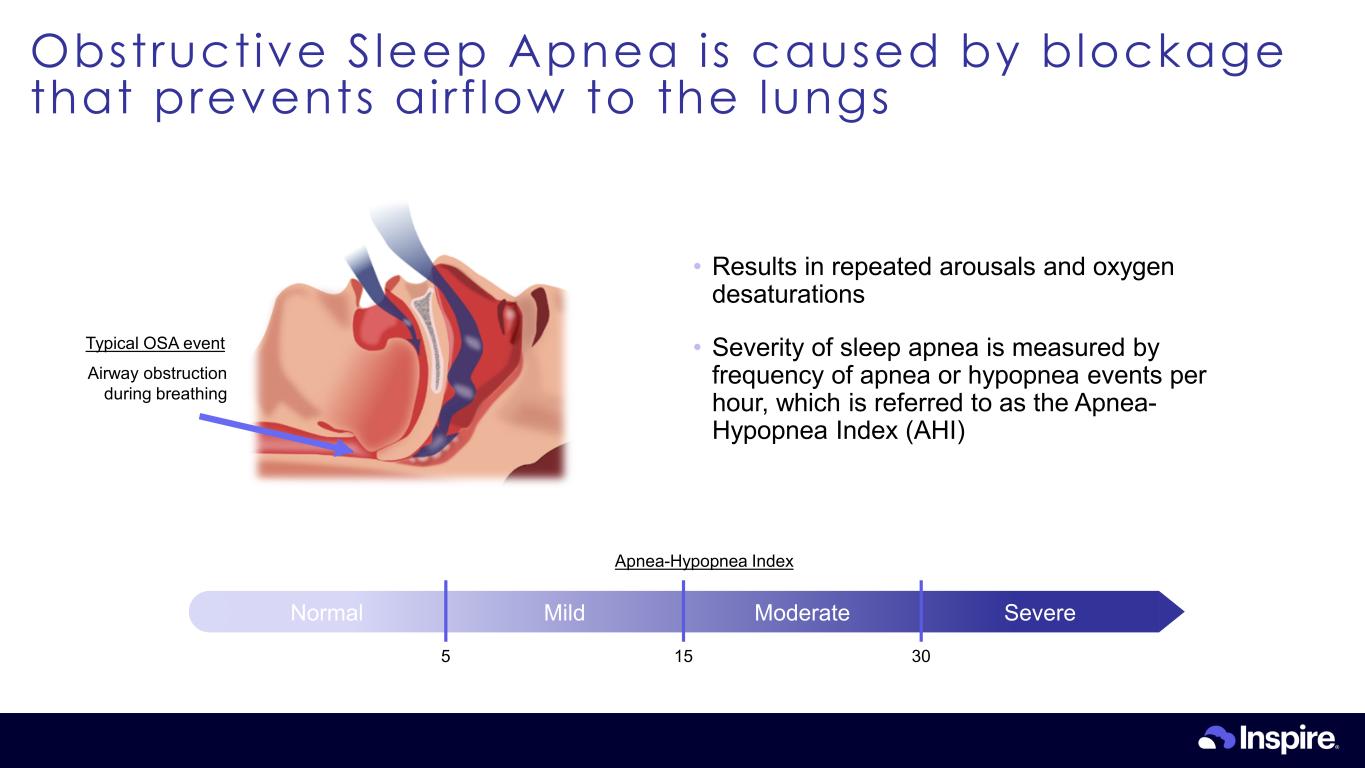
Fourth Quarter 2025 Financial Results (Fourth Quarter 2025 compared to Fourth Quarter 2024)

Revenue increased 12% to $269.1 million primarily driven by growth at existing centers and new center additions.

Gross margin increased 160 bps to 86.6% primarily due to increased sales volume as well as increased sales mix of the Inspire V system.

Operating expenses increased 9%, or $15.0 million, to $186.9 million primarily driven by higher investments in patient marketing and education expenses, partially offset by lower R&D expenses.

Operating income increased $14.2 million to $46.1 million, and operating margin was 17.1%. Adjusted operating income was $47.1 million, and adjusted operating margin was 17.5%.


Income tax was a benefit of $85.8 million, primarily driven by the release of the valuation allowance against net deferred tax assets.

Net income was $136.1 million and adjusted net income was $48.1 million.

Net income per diluted share was $4.66 and adjusted net income per diluted share was $1.65.

Adjusted EBITDA increased $16.6 million to $79.3 million.

Full Year 2025 Financial Results (Full Year 2025 compared to Full Year 2024)

Revenue increased 14% to $912.0 million primarily driven by growth at existing centers and new center additions.

Gross margin increased 70 bps to 85.4% primarily driven by increased sales volume as well as increased sales mix of the Inspire V system.

Operating expenses increased $84.1 million to $727.8 million primarily driven by investments to build our commercial infrastructure, increased patient marketing and medical education expenses.

Operating income increased $14.9 million to $51.0 million, and operating margin was 5.6%. Adjusted operating income was $66.2 million, and adjusted operating margin was 7.3%.

Income tax was a benefit of $79.7 million, primarily driven by the release of the valuation allowance against net deferred tax assets allowance in the fourth quarter of 2025.

Net income was $145.4 million and adjusted net income was $72.1 million.

Net income per diluted share was $4.89 and adjusted net income per diluted share was $2.42.

Adjusted EBITDA increased $42.8 million to $200.6 million.

Financial Condition

Fourth quarter operating cash flow of $52.5 million and full year operating cash flow of $117.0 million.

Share repurchases of $50 million in the fourth quarter, bringing the full year total to $175 million.

As of December 31, 2025, cash, cash equivalents, and investments decreased $111.9 million to $404.6 million as compared to December 31, 2024.

Full Year 2026 Outlook

The Company is revising its previously announced revenue outlook to be in the range of $950 million to $1.0 billion, which represents expected annual growth of 4% to 10%. This widened and revised range reflects the estimated impact on the first quarter for coding uncertainty as well as the range of outcomes that exist by moving to CPT code 64582 with the –52 modifier and related physician reimbursement rates.

Additionally, the Company expects annual adjusted operating margin in the range of 6% to 8%, net income per diluted share in the range of $1.23 to $1.81 and adjusted net income per diluted share in the range of $1.85 to $2.35.

The Company’s outlook assumes an effective tax rate of approximately 44% to 49% and an adjusted effective tax rate of 26% to 28%, estimated weighted average diluted shares outstanding of approximately 29.4 million and capital expenditures between $45 million to $50 million.

Webcast and Conference Call


The Company will host a conference call after market close today, Wednesday, February 11, 2026, at 5:00 p.m. Eastern Time to discuss these results and answer questions.

To access the conference call, please preregister on
https://register.vevent.com/register/BI7cf46340089b42e6982e8a18b19d4126. Registrants will receive confirmation with dial-in details.

A live webcast of the event can be accessed on https://edge.media-server.com/mmc/p/m3be3sbt/. A replay of the webcast will be available on https://investors.inspiresleep.com starting approximately two hours after the event and archived on the site for two weeks.

About Inspire Medical Systems

Inspire Medical Systems is a medical technology company focused on the development and commercialization of innovative, minimally invasive solutions for patients with obstructive sleep apnea. Inspire’s proprietary Inspire therapy is the first FDA, EU MDR, and PDMA-approved neurostimulation technology that provides a safe and effective treatment for moderate to severe obstructive sleep apnea.

For additional information about Inspire, please visit www.inspiresleep.com.

Use of Non-GAAP Financial Measures

This press release includes non-GAAP financial measures, including without limitation, adjusted operating income, adjusted operating margin, adjusted income before income taxes, adjusted income tax expense, adjusted effective tax rate, adjusted net income, adjusted net income per diluted share ("EPS"), adjusted EBITDA, and adjusted EBITDA margin, which differ from financial measures calculated in accordance with U.S. generally accepted accounting principles (“GAAP”).

We define Adjusted operating income as operating income or loss adjusted for items that are not indicative of our ongoing operations. Operating income is the most directly comparable GAAP financial measure to adjusted operating income. We define adjusted operating margin in this release as adjusted operating income divided by revenue. Operating margin is the most directly comparable GAAP financial measure to adjusted operating margin. Adjusted income before income taxes is defined as income before income taxes, adjusted for items that are not indicative of our ongoing operations. Income before income taxes is the most directly comparable GAAP financial measure. Adjusted income tax expense is defined as income tax expense, adjusted for items that are not indicative of our ongoing operations. Adjusted effective tax rate is adjusted income tax expense divided by adjusted income before income taxes. Income tax expense is the most directly comparable GAAP financial measure. Adjusted net income is defined as net income or loss, adjusted for items that are not indicative of our ongoing operations. Net income is the most directly comparable GAAP financial measure to adjusted net income. Adjusted net income per diluted share is calculated as adjusted net income divided by the dilutive weighted average shares outstanding. Net income per diluted share is the most directly comparable GAAP financial measure to adjusted net income per diluted share. We define adjusted EBITDA as net income or loss, less interest income, plus interest expense, plus income tax expense, plus depreciation and amortization, plus stock-based compensation expense, less non-operating income, adjusted for items that are not indicative of our ongoing operations. Net income is the most directly comparable GAAP financial measure to adjusted EBITDA. We define adjusted EBITDA margin in this release as adjusted EBITDA divided by revenue. Net income margin is the most directly comparable GAAP measure to adjusted EBITDA margin.] Reconciliations of these non-GAAP financial measures to their most directly comparable GAAP measures are included in this press release.

These non-GAAP financial measures are presented because we believe they are useful indicators of our operating performance and facilitate a more meaningful trend analysis without the distortion of various adjustment items. Management uses these measures principally as measures of our underlying operating performance, trends and for planning purposes, including the preparation of our annual operating plan and financial projections. We believe these measures are useful to investors as supplemental information and because they are frequently used by analysts, investors and other interested parties to evaluate companies in our industry. We also believe these non-GAAP financial measures are useful to our management and investors as a measure of comparative operating performance from period to period.


These non-GAAP financial measures should not be considered as an alternative to, or superior to, the most directly comparable GAAP financial measures, as measures of financial performance or cash flows from operations, as a measure of liquidity, or any other performance measure derived in accordance with GAAP, and they should not be construed to imply that our future results will be unaffected by unusual or non-recurring items. In addition, Adjusted EBITDA is not intended to be a measure of cash flow for management’s discretionary use, as it does not reflect certain cash requirements such as tax payments, capital expenditures and certain other cash costs that may recur in the future. Adjusted EBITDA contains certain other limitations, including the failure to reflect our cash expenditures, cash requirements for working capital needs and cash costs to replace assets being depreciated and amortized. In evaluating our non-GAAP financial measures, you should be aware that in the future we may incur expenses that are the same as or similar to some of the adjustments in this presentation. Our presentation of non-GAAP financial measures should not be construed to imply that our future results will be unaffected by any such adjustments. Management compensates for these limitations by primarily relying on our GAAP results in addition to using non-GAAP financial measures on a supplemental basis. These measures and their definitions are discussed in more detail below and our definition of these non-GAAP financial measures is not necessarily comparable to other similarly titled captions of other companies due to different methods of calculation.

Forward Looking Statements

This press release contains forward-looking statements within the meaning of the Private Securities Litigation Reform Act of 1995. All statements other than statements of historical facts are forward-looking statements, including, without limitation, statements regarding potential impacts to our business associated with Inspire V reimbursement, our plans to obtain a long-term solution that would support appropriate reimbursement for Inspire V, and our expectations regarding our full year 2026 financial outlook (including without limitation expectations for the impacts of coding uncertainty and the range of outcomes from applying a CPT code 64582 with a modifier and other aspects to reimbursement, revenue, expected growth, adjusted operating margin, net income per diluted share, adjusted net income per diluted share, effective tax rate, adjusted effective tax rate, weighted average diluted shares outstanding and capital expenditures). In some cases, you can identify forward-looking statements by terms such as ‘‘may,’’ ‘‘will,’’ ‘‘should,’’ ‘‘expect,’’ ‘‘plan,’’ ‘‘anticipate,’’ ‘‘could,’’ “future,” “outlook,” “guidance,” ‘‘intend,’’ ‘‘target,’’ ‘‘project,’’ ‘‘contemplate,’’ ‘‘believe,’’ ‘‘estimate,’’ ‘‘predict,’’ ‘‘potential,’’ ‘‘continue,’’ or the negative of these terms or other similar expressions, although not all forward-looking statements contain these words.

These forward-looking statements are based on management’s current expectations and involve known and unknown risks and uncertainties that may cause our actual results, performance, or achievements to be materially different from any future results, performance, or achievements expressed or implied by the forward-looking statements. Such risks and uncertainties include, among others: there may be uncertainty in, or changes to, billing codes to be used for our Inspire therapy, which could impact reimbursement rates and physician usage; our financial results may fluctuate significantly and may not fully reflect the underlying performance of our business; our history of operating losses and dependency on our Inspire therapy for revenues; commercial success and market acceptance of our Inspire therapy; our ability to achieve and maintain adequate and clear levels of coverage or reimbursement for our Inspire therapy or any future products we may seek to commercialize; competitive companies, technologies and pharmaceuticals in our industry; our involvement in current or future legal disputes or regulatory proceedings; our ability to expand our indications and develop and commercialize additional products and enhancements to our Inspire therapy; future results of operations, financial position, research and development costs, capital requirements and our needs for additional financing; our ability to accurately forecast customer demand for our Inspire therapy and manage our inventory; our dependence on third-party suppliers, vendors, and contract manufacturers; consolidation in the healthcare industry; our ability to expand, manage and maintain our direct sales and marketing organization, and to market and sell our Inspire therapy in markets outside of the U.S.; our ability to manage our growth; our ability to hire and retain our senior management and other highly qualified personnel; risk related to product liability claims and warranty claims; our ability to address quality issues that may arise with our Inspire therapy; our ability to successfully integrate any acquired business, products, or technologies; changes in global macroeconomic trends; our business model and strategic plans for products, technologies and business, including our implementation thereof; the impact of glucagon-like peptide 1 class of drugs on demand for our Inspire therapy; risks related to information technology and cybersecurity; our ability to commercialize or obtain regulatory approvals for our Inspire therapy, or the effect of delays in commercializing or obtaining regulatory approvals; and FDA or other U.S. or foreign regulatory actions affecting us or the healthcare industry generally.

Other important factors that could cause actual results, performance or achievements to differ materially from those contemplated in this press release can be found under the captions “Risk Factors” and "Management's Discussion


and Analysis of Financial Condition and Results of Operations“ in our Annual Report on Form 10-K for the fiscal year ended December 31, 2024, as updated in our Quarterly Report on Form 10-Q for the quarter ended September 30, 2025 and as will be further updated in our Annual Report on Form 10-K for the fiscal year ended December 31, 2025, as such factors may be updated from time to time in our other filings with the SEC, which are accessible on the SEC’s website at www.sec.gov and the Investors page of our website at www.inspiresleep.com. These and other important factors could cause actual results to differ materially from those indicated by the forward-looking statements made in this press release. Any such forward-looking statements represent management’s estimates as of the date of this press release. While we may elect to update such forward-looking statements at some point in the future, unless required by applicable law, we disclaim any obligation to do so, even if subsequent events cause our views to change. Thus, one should not assume that our silence over time means that actual events are bearing out as expressed or implied in such forward-looking statements. These forward-looking statements should not be relied upon as representing our views as of any date after the date of this press release.

Investor & Media Contact
Ezgi Yagci
Vice President, Investor Relations
[email protected]
617-549-2443


Inspire Medical Systems, Inc.
Consolidated Statements of Operations and Comprehensive Income (unaudited)
(in thousands, except share and per share amounts)

Three Months Ended December 31,Year Ended
December 31,
2025202420252024
Revenue$269,077 $239,718 $911,981 $802,804 
Cost of goods sold36,071 35,988 133,225 122,986 
Gross profit233,006 203,730 778,756 679,818 
Operating expenses:
Research and development24,942 30,336 103,165 114,128 
Selling, general and administrative161,953 141,510 624,637 529,607 
Total operating expenses186,895 171,846 727,802 643,735 
Operating income46,111 31,884 50,954 36,083 
Other (income) expense:
Interest and dividend income(4,000)(5,552)(17,536)(23,247)
Interest expense122 22 137 22 
Other expense (income), net(330)778 2,656 855 
Total other income(4,208)(4,752)(14,743)(22,370)
Income before income taxes50,319 36,636 65,697 58,453 
Income tax (benefit) expense(85,771)1,412 (79,725)4,944 
Net income136,090 35,224 145,422 53,509 
Other comprehensive income (loss):
Foreign currency translation loss(128)(151)(296)(65)
Unrealized (loss) gain on investments(47)(1,013)224 (199)
Total comprehensive income$135,915 $34,060 $145,350 $53,245 
Basic net income per share$4.70 $1.18 $4.95 $1.80 
Diluted net income per share$4.66 $1.15 $4.89 $1.75 
Basic weighted average shares outstanding28,942,778 29,827,947 29,368,892 29,763,395 
Diluted weighted average shares outstanding29,218,09930,751,33829,757,036 30,543,274 


Inspire Medical Systems, Inc.
Consolidated Balance Sheets (unaudited)
(in thousands, except share and per share amounts)
December 31,
20252024
Assets
Current assets:
Cash and cash equivalents$104,813 $150,150 
Investments, short-term203,455 295,396 
Accounts receivable, net of allowance for credit losses of
    $1,080 and $880, respectively
119,692 93,068 
Inventories, net145,293 80,118 
Prepaid expenses and other current assets10,399 12,074 
Total current assets583,652 630,806 
Investments, long-term96,330 70,995 
Property and equipment, net97,872 71,925 
Operating lease right-of-use assets23,532 23,314 
Deferred tax assets88,667 13 
Other non-current assets17,264 11,330 
Total assets$907,317 $808,383 
Liabilities and stockholders' equity
Current liabilities:
Accounts payable$36,565 $38,687 
Accrued expenses59,490 49,814 
Total current liabilities96,055 88,501 
Operating lease liabilities, non-current portion29,998 30,039 
Other non-current liabilities104 148 
Total liabilities126,157 118,688 
Stockholders' equity
Preferred Stock, $0.001 par value, 10,000,000 shares authorized;
  no shares issued and outstanding
— — 
Common Stock, $0.001 par value, 200,000,000 shares authorized;
  28,579,015 and 29,740,176 shares issued and outstanding at
  December 31, 2025 and 2024, respectively
29 30 
Additional paid-in capital927,159 981,043 
Accumulated other comprehensive income464 536 
Accumulated deficit(146,492)(291,914)
Total stockholders' equity781,160 689,695 
Total liabilities and stockholders' equity$907,317 $808,383 


Inspire Medical Systems, Inc.
Reconciliation of Non-GAAP Financial Measures (unaudited)
(in thousands, except share and per share amounts)

Reconciliation of GAAP Net Income (Loss) to Non-GAAP Adjusted Net Income
Three Months EndedYear Ended
March 31,June 30,September 30,December 31,December 31,
20252025202520252025
Net income (loss)$2,992 $(3,592)$9,932 $136,090 $145,422 
Stock-based compensation expense(1)
— 8,385 — — 8,385 
Legal fees(2)
— 1,305 969 770 3,044 
Asset impairment charge(3)
— 4,046 — — 4,046 
Release of valuation allowance(4)
— — — (88,751)(88,751)
Adjusted net income$2,992 $10,144 $10,901 $48,109 $72,146 

(1) Represents accelerated stock-based compensation expense for certain employees who are retirement eligible in accordance with the implementation of changes to the treatment of equity awards under the Inspire Medical Systems, Inc. 2018 Incentive Award Plan upon the holder's death, disability, or retirement.
(2) These costs represent legal-related expenses related to (a) a civil investigative demand from the Department of Justice, (b) a patent infringement suit that we filed against Nyxoah S.A. and its wholly-owned subsidiary, Nyxoah, Inc. ("Nyxoah"), and (c) a patent infringement suit brought against us by Nyxoah. These costs do not reflect costs associated with our normal ongoing operations.
(3) Represents a non-cash impairment of a strategic investment, which does not reflect costs associated with our ongoing operations, and was recorded in other expense (income), net in the consolidated statements of operations and comprehensive income (loss).
(4) Non-recurring income tax benefit of the release of the valuation allowance against net deferred tax assets.

Reconciliation of GAAP Net Income (Loss) per Diluted Share to Non-GAAP Adjusted Net Income Per Diluted Share
Three Months EndedYear Ended
March 31,June 30,September 30,December 31,December 31,
20252025202520252025
Net income (loss) per diluted share$0.10 $(0.12)$0.34 $4.66 $4.89 
Stock-based compensation expense(1)
— 0.28 — — 0.28 
Legal fees(2)
— 0.04 0.03 0.03 0.10 
Asset impairment charge(3)
— 0.14 — — 0.14 
Release of valuation allowance(4)
— — — (3.04)(2.99)
Adjusted net income per diluted share$0.10 $0.34 $0.37 $1.65 $2.42 

(1) Represents accelerated stock-based compensation expense for certain employees who are retirement eligible in accordance with the implementation of changes to the treatment of equity awards under the Inspire Medical Systems, Inc. 2018 Incentive Award Plan upon the holder's death, disability, or retirement.
(2) These costs represent legal-related expenses related to (a) a civil investigative demand from the Department of Justice, (b) a patent infringement suit that we filed against Nyxoah S.A. and its wholly-owned subsidiary, Nyxoah, Inc. ("Nyxoah"), and (c) a patent infringement suit brought against us by Nyxoah. These costs do not reflect costs associated with our normal ongoing operations.
(3) Represents a non-cash impairment of a strategic investment, which does not reflect costs associated with our ongoing operations, and was recorded in other expense (income), net in the consolidated statements of operations and comprehensive income (loss).
(4) Non-recurring income tax benefit of the release of the valuation allowance against net deferred tax assets.


Reconciliation of GAAP Net Income (Loss) to Non-GAAP Adjusted EBITDA
Three Months EndedYear Ended
March 31,June 30,September 30,December 31,December 31,
20252025202520252025
Net income (loss)$2,992 $(3,592)$9,932 $136,090 $145,422 
Interest and dividend income(5,066)(4,486)(3,984)(4,000)(17,536)
Interest expense— 11 122 137 
Income tax expense (benefit)1,167 1,260 3,619 (85,771)(79,725)
Depreciation and amortization3,044 3,414 3,677 3,822 13,957 
EBITDA2,137 (3,400)13,255 50,263 62,255 
Stock-based compensation expense(1)
31,056 41,724 29,468 28,011 130,259 
Legal fees(2)
— 1,736 1,289 1,025 4,050 
Asset impairment charge(3)
— 4,046 — — 4,046 
Adjusted EBITDA$33,193 $44,106 $44,012 $79,299 $200,610 

(1) Total stock-based compensation expense.
(2) These costs represent legal-related expenses related to (a) a civil investigative demand from the Department of Justice, (b) a patent infringement suit that we filed against Nyxoah S.A. and its wholly-owned subsidiary, Nyxoah, Inc. ("Nyxoah"), and (c) a patent infringement suit brought against us by Nyxoah. These costs do not reflect costs associated with our normal ongoing operations.
(3) Represents a non-cash impairment of a strategic investment, which does not reflect costs associated with our ongoing operations, and was recorded in other expense (income), net in the consolidated statements of operations and comprehensive income (loss).
Reconciliation of GAAP Net Income (Loss) Margin to Non-GAAP Adjusted EBITDA Margin
Three Months EndedYear Ended
March 31,June 30,September 30,December 31,December 31,
20252025202520252025
Net income (loss) margin(1)
1.5 %(1.7)%4.5 %50.7 %16.0 %
Interest and dividend income(2.5)%(2.1)%(1.8)%(1.5)%(1.9)%
Interest expense— %— %— %— %— %
Income tax expense (benefit)0.6 %0.6 %1.6 %(31.9)%(8.7)%
Depreciation and amortization1.5 %1.6 %1.6 %1.4 %1.5 %
Stock-based compensation expense(2)
15.4 %19.2 %13.1 %10.4 %14.3 %
Legal fees(3)
— %0.8 %0.6 %0.4 %0.4 %
Asset impairment charge(4)
— %1.9 %— %— %0.4 %
Adjusted EBITDA margin(5)
16.5 %20.3 %19.6 %29.5 %22.0 %

(1) Net income margin is calculated as net income divided by total revenue.
(2) Total stock-based compensation expense.
(3) These costs represent legal-related expenses related to (a) a civil investigative demand from the Department of Justice, (b) a patent infringement suit that we filed against Nyxoah S.A. and its wholly-owned subsidiary, Nyxoah, Inc. ("Nyxoah"), and (c) a patent infringement suit brought against us by Nyxoah. These costs do not reflect costs associated with our normal ongoing operations.
(4) Represents a non-cash impairment of a strategic investment, which does not reflect costs associated with our ongoing operations, and was recorded in other expense (income), net in the consolidated statements of operations and comprehensive income (loss).
(5) Adjusted EBITDA margin is calculated as Adjusted EBITDA divided by total revenue.


Reconciliation of GAAP Operating Income (Loss) to Non-GAAP Adjusted Operating Income (Loss)
Three Months EndedYear Ended
March 31,June 30,September 30,December 31,December 31,
20252025202520252025
Operating (loss) income$(1,485)$(3,316)$9,644 $46,111 $50,954 
Stock-based compensation expense(1)
— 11,155 — — 11,155 
Legal fees(2)
— 1,736 1,289 1,025 4,050 
Adjusted operating (loss) income$(1,485)$9,575 $10,933 $47,136 $66,159 

(1) Represents accelerated stock-based compensation expense for certain employees who are retirement eligible in accordance with the implementation of changes to the treatment of equity awards under the Inspire Medical Systems, Inc. 2018 Incentive Award Plan upon the holder's death, disability, or retirement.
(2) These costs represent legal-related expenses related to (a) a civil investigative demand from the Department of Justice, (b) a patent infringement suit that we filed against Nyxoah S.A. and its wholly-owned subsidiary, Nyxoah, Inc. ("Nyxoah"), and (c) a patent infringement suit brought against us by Nyxoah. These costs do not reflect costs associated with our normal ongoing operations.

Reconciliation of GAAP Operating Margin to Non-GAAP Adjusted Operating Margin
Three Months EndedYear Ended
March 31,June 30,September 30,December 31,December 31,
20252025202520252025
Operating margin(1)
(0.7)%(1.5)%4.3 %17.1 %5.6 %
Stock-based compensation expense(2)
— %5.1 %— %— %1.3 %
Legal fees(3)
— %0.8 %0.6 %0.4 %0.4 %
Adjusted operating margin(4)
(0.7)%4.4 %4.9 %17.5 %7.3 %
(1) Operating margin is calculated as operating income (loss) divided by total revenue.
(2) Represents accelerated stock-based compensation expense for certain employees who are retirement eligible in accordance with the implementation of changes to the treatment of equity awards under the Inspire Medical Systems, Inc. 2018 Incentive Award Plan upon the holder's death, disability, or retirement.
(3) These costs represent legal-related expenses related to (a) a civil investigative demand from the Department of Justice, (b) a patent infringement suit that we filed against Nyxoah S.A. and its wholly-owned subsidiary, Nyxoah, Inc. ("Nyxoah"), and (c) a patent infringement suit brought against us by Nyxoah. These costs do not reflect costs associated with our normal ongoing operations.
(4) Adjusted operating margin is calculated as adjusted operating margin divided by total revenue.

Reconciliation of GAAP Income Before Income Taxes to Non-GAAP Adjusted Income Before Income Taxes
Three Months EndedYear Ended
March 31,June 30,September 30,December 31,December 31,
20252025202520252025
Income (loss) before income taxes$4,159 $(2,332)$13,551 $50,319 $65,697 
Stock-based compensation expense(1)
— 11,155 — — 11,155 
Legal fees(2)
— 1,736 1,289 1,025 4,050 
Asset impairment charge(3)
— 4,046 — — 4,046 
Adjusted income before income taxes4,159 $14,605 $14,840 $51,344 $84,948 


(1) Represents accelerated stock-based compensation expense for certain employees who are retirement eligible in accordance with the implementation of changes to the treatment of equity awards under the Inspire Medical Systems, Inc. 2018 Incentive Award Plan upon the holder's death, disability, or retirement.
(2) These costs represent legal-related expenses related to (a) a civil investigative demand from the Department of Justice, (b) a patent infringement suit that we filed against Nyxoah S.A. and its wholly-owned subsidiary, Nyxoah, Inc. ("Nyxoah"), and (c) a patent infringement suit brought against us by Nyxoah. These costs do not reflect costs associated with our normal ongoing operations.
(3) Represents a non-cash impairment of a strategic investment, which does not reflect costs associated with our ongoing operations, and was recorded in other expense (income), net in the consolidated statements of operations and comprehensive income (loss).

Reconciliation of GAAP Income Tax Expense (Benefit) to Non-GAAP Adjusted Income Tax Expense
Three Months EndedYear Ended
March 31,June 30,September 30,December 31,December 31,
20252025202520252025
Income tax expense (benefit)$1,167 $1,260 $3,619 $(85,771)$(79,725)
Stock-based compensation expense— 2,770 — — 2,770 
Legal fees— 431 320 255 1,006 
Release of valuation allowance(1)
— — — 88,751 88,751 
Adjusted income tax expense$1,167 $4,461 $3,939 $3,235 $12,802 
(1) Non-recurring income tax benefit of the release of the valuation allowance against net deferred tax assets.

Reconciliation of GAAP Effective Tax Rate to Non-GAAP Adjusted Effective Tax Rate
Three Months EndedYear Ended
March 31,June 30,September 30,December 31,December 31,
20252025202520252025
Effective tax rate(1)
28.1 %(54.0)%26.7 %(170.5)%(121.4)%
Stock-based compensation expense— %73.1 %— %— %4.2 %
Legal fees— %11.4 %(0.2)%0.5 %1.5 %
Release of valuation allowance(2)
— %— %— %176.3 %130.8 %
Adjusted effective tax rate(3)
28.1 %30.5 %26.5 %6.3 %15.1 %

(1) Effective tax rate is calculated by dividing income tax expense (benefit) by income before income taxes.
(2) Non-recurring income tax benefit of the release of the valuation allowance against net deferred tax assets.
(3) Adjusted effective tax rate is calculated by dividing adjusted income tax expense by adjusted income before income taxes.


Full Year 2026 Outlook
Reconciliation of Full Year 2026 Outlook of Estimated Net Income per Diluted Share
to Adjusted Net Income per Diluted Share
Outlook Full Year 2026Tax Rate Outlook Full Year 2026
Low RangeHigh RangeLow RangeHigh Range
Net income per diluted share$1.23
$1.8149.0%
44.0%
Legal fees(1)
0.12
0.08(1.0)%
(1.0)%
Tax impact of stock-based compensation(2)
0.50
0.46(20.0)%
(17.0)%
Adjusted net income per diluted share$1.85
$2.3528.0%
26.0%

(1) These costs represent legal-related expenses related to (a) a civil investigative demand from the Department of Justice, (b) a patent infringement suit that we filed against Nyxoah S.A. and its wholly-owned subsidiary, Nyxoah, Inc. ("Nyxoah"), and (c) a patent infringement suit brought against us by Nyxoah. These costs do not reflect costs associated with our normal ongoing operations.
(2) Represents the estimated tax impact of permanent differences that arise between the expense recognized for financial reporting of stock-based compensation awards and the tax deduction the Company receives (tax windfall or shortfall). Accounting standards codification guidance requires that any excess or deficient tax deduction for stock-based compensation be immediately recorded within income tax expense. These amounts represent the estimated discrete tax impact for stock-based compensation during the period presented.


Inspire Medical Systems, Inc. February 2026 NYSE: INSP


© Inspire Medical Systems, Inc. All Rights Reserved. Disclaimer This presentation contains forward-looking statements within the meaning of the Private Securities Litigation Reform Act of 1995. All statements other than statements of historical facts are forward-looking statements, including, without limitation, statements regarding potential impacts to our business associated with Inspire V reimbursement, our plans to obtain a long-term solution that would support appropriate reimbursement for Inspire V, and our expectations regarding our full year 2026 financial outlook (including without limitation expectations for the impacts of coding uncertainty and the range of outcomes from applying a CPT code 64582 with a modifier and other aspects to reimbursement, revenue, expected growth, adjusted operating margin, net income per diluted share, adjusted net income per diluted share, effective tax rate, adjusted effective tax rate, weighted average diluted shares outstanding and capital expenditures). In some cases, you can identify forward-looking statements by terms such as ‘‘may,’’ ‘‘will,’’ ‘‘should,’’ ‘‘expect,’’ ‘‘plan,’’ ‘‘anticipate,’’ ‘‘could,’’ “future,” “outlook,” “guidance,” ‘‘intend,’’ ‘‘target,’’ ‘‘project,’’ ‘‘contemplate,’’ ‘‘believe,’’ ‘‘estimate,’’ ‘‘predict,’’ ‘‘potential,’’ ‘‘continue,’’ or the negative of these terms or other similar expressions, although not all forward-looking statements contain these words. These forward-looking statements are based on management’s current expectations and involve known and unknown risks and uncertainties that may cause our actual results, performance, or achievements to be materially different from any future results, performance, or achievements expressed or implied by the forward-looking statements. Such risks and uncertainties include, among others: there may be uncertainty in, or changes to, billing codes to be used for our Inspire therapy, which could impact reimbursement rates and physician usage; our financial results may fluctuate significantly and may not fully reflect the underlying performance of our business; our history of operating losses and dependency on our Inspire therapy for revenues; commercial success and market acceptance of our Inspire therapy; our ability to achieve and maintain adequate and clear levels of coverage or reimbursement for our Inspire therapy or any future products we may seek to commercialize; competitive companies, technologies and pharmaceuticals in our industry; our involvement in current or future legal disputes or regulatory proceedings; our ability to expand our indications and develop and commercialize additional products and enhancements to our Inspire therapy; future results of operations, financial position, research and development costs, capital requirements and our needs for additional financing; our ability to accurately forecast customer demand for our Inspire therapy and manage our inventory; our dependence on third-party suppliers, vendors, and contract manufacturers; consolidation in the healthcare industry; our ability to expand, manage and maintain our direct sales and marketing organization, and to market and sell our Inspire therapy in markets outside of the U.S.; our ability to manage our growth; our ability to hire and retain our senior management and other highly qualified personnel; risk related to product liability claims and warranty claims; our ability to address quality issues that may arise with our Inspire therapy; our ability to successfully integrate any acquired business, products, or technologies; changes in global macroeconomic trends; our business model and strategic plans for products, technologies and business, including our implementation thereof; the impact of glucagon-like peptide 1 class of drugs on demand for our Inspire therapy; risks related to information technology and cybersecurity; our ability to commercialize or obtain regulatory approvals for our Inspire therapy, or the effect of delays in commercializing or obtaining regulatory approvals; and FDA or other U.S. or foreign regulatory actions affecting us or the healthcare industry generally. Other important factors that could cause actual results, performance or achievements to differ materially from those contemplated in this presentation can be found under the captions “Risk Factors” and "Management's Discussion and Analysis of Financial Condition and Results of Operations“ in our Annual Report on Form 10-K for the fiscal year ended December 31, 2024, as updated in our Quarterly Report on Form 10-Q for the quarter ended September 30, 2025 and as will be further updated in our Annual Report on Form 10-K for the fiscal year ended December 31, 2025, as such factors may be updated from time to time in our other filings with the SEC, which are accessible on the SEC’s website at www.sec.gov and the Investors page of our website at www.inspiresleep.com. These and other important factors could cause actual results to differ materially from those indicated by the forward-looking statements made in this presentation. Any such forward-looking statements represent management’s estimates as of the date of this presentation. While we may elect to update such forward-looking statements at some point in the future, unless required by applicable law, we disclaim any obligation to do so, even if subsequent events cause our views to change. Thus, one should not assume that our silence over time means that actual events are bearing out as expressed or implied in such forward-looking statements. These forward-looking statements should not be relied upon as representing our views as of any date after the date of this presentation. This presentation contains trademarks, trade names and service marks of other companies, which are the property of their respective owners. We do not intend our use or display of other parties' trademarks, trade names or service marks to imply, and such use or display should not be construed to imply, a relationship with, or endorsement or sponsorship of us by, these other parties. 2


© Inspire Medical Systems, Inc. All Rights Reserved. Use of Non-GAAP Measures This presentation includes non-GAAP financial measures. Reconciliations of such non-GAAP financial measures to the most directly comparable GAAP financial measure have been provided along with the presentation. These non-GAAP financial measures are presented because we believe they are useful indicators of our operating performance and facilitate a more meaningful trend analysis without the distortion of various adjustment items. Management uses these measures principally as measures of our underlying operating performance, trends and for planning purposes, including the preparation of our annual operating plan and financial projections. We believe these measures are useful to investors as supplemental information and because they are frequently used by analysts, investors and other interested parties to evaluate companies in our industry. We also believe these non-GAAP financial measures are useful to our management and investors as a measure of comparative operating performance from period to period. These non-GAAP financial measures should not be considered as an alternative to, or superior to, the most directly comparable GAAP financial measures, as measures of financial performance or cash flows from operations, as a measure of liquidity, or any other performance measure derived in accordance with GAAP, and they should not be construed to imply that our future results will be unaffected by unusual or non-recurring items. In evaluating our non-GAAP financial measures, you should be aware that in the future we may incur expenses that are the same as or similar to some of the adjustments in this presentation. Our presentation of non-GAAP financial measures should not be construed to imply that our future results will be unaffected by any such adjustments. Management compensates for these limitations by primarily relying on our GAAP results in addition to using non-GAAP financial measures on a supplemental basis. These measures and their definitions are discussed in more detail in the presentation, and our definition of these non-GAAP financial measures is not necessarily comparable to other similarly titled captions of other companies due to different methods of calculating. 3


enhancing patient lives through sleep innovation I t a l l s tarts and ends wi th our mission We are a medical technology company committed to


© Inspire Medical Systems, Inc. All Rights Reserved. Company Overview The first and only … 5 >385 PUBLICATIONS Compelling body of evidence >300 MILLION U.S. COVERED LIVES Established reimbursement in all 50 states >1,300 EMPLOYEES Led by a proven management team >$900 MILLION REVENUE IN 2025 With 50% five-year CAGR >125,000 INSPIRE PATIENTS Significant first-mover advantage >$10 BILLION Underpenetrated U.S. market Innovative, closed-loop, neurostimulation technology for Obstructive Sleep Apnea (OSA)


From our entrepreneurial beginnings, and with a focus on delivering life-changing outcomes, we’ve been enhancing the lives of patients for over 18 years… >125,000 Patients receiving Inspire >$900M Revenue >1,500 Implanters Founded 2007 IPO 2018 Today 4,000 Patients receiving Inspire $50M Revenue 200 Implanters With new innovations on the horizon and a big blue ocean of opportunity in front of us! … and we are still just getting started


First Mover. Market Disruptor. Innovation Leader. 125K pat ient s w i th Insp i re Proving out our care pathways and therapy optimization Cl in ica l ev idence >350 publications portraying a compelling body of evidence >$900M revenue in 2025 With 50% five-year CAGR, continuing our strong performance Next -gen neuros t imu lator >20 years in pursuing perfection of our technology Broad payor coverage Reimbursement in all 50 states with >300 million US covered lives >$10B domest ic market With less than 5% penetration we have plenty of room for growth


Obstructive Sleep Apnea is caused by blockage that prevents airf low to the lungs 8 Airway obstruction during breathing Typical OSA event • Results in repeated arousals and oxygen desaturations • Severity of sleep apnea is measured by frequency of apnea or hypopnea events per hour, which is referred to as the Apnea- Hypopnea Index (AHI) Normal Mild Moderate Severe 5 15 30 Apnea-Hypopnea Index


OSA is a chronic disease that is often untreated and proven to be l inked to ser ious health r isks 9 Exacerbated Health Risks • High risk patients: obese, male or of advanced age • Common first indicator: heavy snoring • Other indicators: • Lack of energy • Headaches • Depression • Nighttime gasping • Dry mouth • Memory or concentration problems • Excessive daytime sleepiness 2x The risk for stroke1 2x The risk for sudden cardiac death2 57% Increased risk for recurrence of Atrial Fibrillation after ablation4 5x The risk for cardiovascular mortality3 Years of Follow-up % S ur vi vi ng Increased Risk of Mortality 5 Typical Patient Profile 1. Redline et al, The Sleep Heart Health Study. Am J Res and Crit Care Med 2010. 2. Gami et al, J Am Coll Cardiol 2013. 3. Young et al, J Sleep 2008. 4. Li et al, Europace 2014. 5. Prospective Study of Obstructive Sleep Apnea and Incident Coronary Heart Disease and Heart Failure from SHHS and Wisconsin Sleep Cohort Study.


Current treatment options, such as CPAP and invasive surgeries, have s ignif icant l imitations 10 InaUvulopalatopharyngoplasty (UPPP) Maxillomandibular Advancement (MMA) • Several variations of sleep surgery • Success rates vary widely (30% - 60%)1 • Irreversible anatomy alteration • Inpatient surgery with extended recovery …with surgical alternatives for treatmentCPAP is the first-line therapy… Drivers of Non-Compliance • Demonstrated improvements in disease severity and long- term gold standard therapy • Major limitation as a therapeutic option is primarily due to low patient compliance (~35%–65%) • Mask Discomfort • Mask Leakage • Pressure Intolerance • Skin Irritation • Nasal Congestion • Nasal Drying • Nosebleeds • Claustrophobia • Lack of Intimacy 1. Shah, Janki, et al; American Journal of Otolaryngology (2018). Uvulopalatopharyngoplasty vs. CN XII stimulation for treatment of obstructive sleep apnea: A single institution experience.


CPAP prescriptions annually ~2,000,000 CPAP non-compliant ~700,000 Inspire eligible ~500,000 Adults with moderate to severe OSA ~23,000,000 >$10B opportuni ty The domestic OSA market is huge… Internal estimates


Inspire Therapy is an Innovative and Proven Solution for Patients with OSA Inspire Therapy Utilizes a Proprietary closed-loop Sensing Algorithm to Modulate Therapy Delivery Inspire V Solution 2  Typically a 30-45 minute outpatient procedure  Requires only two small incisions  Patients usually recover quickly and resume normal activities within a few days 31 Neurostimulator houses the electronics, sensing and battery power for the device Patient Remote facilitates patient control of therapy Stimulation lead delivers electrical stimulation to the hypoglossal nerve Stimulation Lead Neurostimulator Inspire V Neurostimulator Patient Remote


The Inspire Patient Journey is a mult i-specialty care continuum Quality Patient Flow Care Pathway Capacity Strong Clinical Outcomes Sleep Test (in-lab or home) Activation Procedure DISE & Insurance Strong Patient Outcomes Patient Awareness, Referral or Appointment Request Screening Appointment Efficacy Check Monitoring & Clinic Adjustments 1 2 3


- 20,000 40,000 60,000 80,000 100,000 120,000 2014 2015 2016 2017 2018 2019 2020 2021 2022 2023 2024 2025 Total implants New implants Minutes between implants Our global impact continues to cl imb >125K Patients receiving Inspire therapy to date A patient receives Inspire therapy on average every ~15 minutes ≈100 hours ≈5 hours ≈15 mins


Continuous Data Collection & Outcomes Monitor ing 15 AHI = Apnea Hypopnea Index ESS = Epworth Sleepiness Scale Post Market Surveillance Data Real World Data Proactive Data Reactive Data Data Analysis for Signals US Centers EU Centers (Belgium, Germany, Netherlands, Switzerland • Collection of real-world, international outcomes data • Eligibility – ALL patients receiving Inspire therapy • ADHERE Registry - 5,000 enrollments at 61 medical centers • Transition to ADHERE 2.0 as part of Inspire SleepSync in the U.S.


16Inspire Patient Experience Report and Internal Data 90% 91% 92% 93% 94% 95% 96% 97% 98% 99% 100% 0 6 12 18 24 30 36 42 48 54 60 66 72 78 84 90 Cu m ul at iv e Su rv iv al P er ce nt ag e Months After Implant Inspire Global System Survivability to Revision by Implant Year 2018 2020 2019 20212022 2023 2024 2025 90% 91% 92% 93% 94% 95% 96% 97% 98% 99% 100% 0 6 12 18 24 30 36 42 48 54 60 66 72 78 84 90 Cu m ul at iv e Su rv iv al P er ce nt ag e Months After Implant Inspire Global System Survivability to Explant by Implant Year 2018 2020 2019 2021 2022 2023 2024 2025 2025 data is partial year 2025 data is partial year Continued Improvement in System Safety and Rel iabi l i ty


How does Inspire compare against your previous experience with CPAP? 91% Say Inspire is better I would recommend Inspire to a friend or family member. 93% Agree or strongly agree Overall, how satisfied are you with Inspire? 90% Satisfied or very satisfied Given the chance, I would choose to receive Inspire again. 92% Agree or strongly agree Inspire patients experience a significant reduction in the severity of their OSA 33.0 10.2 Baseline (n=1,963) 12-mo All Night Study (n=890) Median AHI (events/hr) Inspire patients report less sleepiness and demonstrate increased therapy adherence 11.0 6.0 Baseline (n=1,712) 12-mo Visit (n=994) Median ESS Hours of nightly use at 12-months (n=913) 5.7 hours Inspire patients report having a positive patient experience and enhanced quality of life Strong Patient Outcomes Inspire Patient Experience Report, 2024


Compared to CPAP, Inspi re has been Demonstrated to be Better at Improving OSA Symptoms, Potent ia l ly wi th Greater Therapy Adherence 18 Therapy Adherence1 4.0 5.0 Usage/Night (hours) Sleepiness Reduction1 3.9 8.0 ESS reduction (points) 2 p = 0.042 p = 0.087 CPAP CPAP UAS (Inspire) UAS (Inspire) 1. Heiser, Sleep & Breathing 2022 Comparison between baseline and 12-month follow-up between matched cohorts 2. Epsworth Sleepiness Scale


Current Sensor Inspire V Sensor Performance Therapy Evolution Built-in • Multiple electrodes capability • Enables new stim targets and sensing features Flexible Software Platform • Downloadable features for clinical studies and field upgrades • Future features could include posture-responsive therapy, auto start/pause, AHI detection State of the Art Technology • Allows stim of multiple targets • Multiple Sensing Modes Proven Cybersecurity Consistent Long Battery Life of 11 Years on Average SleepSync Connectivity • Support for future remote programming • Remote software updates for all components Inspire V: Reduced implant time, improved therapy performance, fewer revisions & future innovation


Therapy Evolution Built In • Multiple electrodes capability • Enables new stimulation targets and sensing features Flexible Software Platform • Downloadable features for clinical studies and field upgrades • Future features include posture-responsive therapy, auto start/pause, AHI detection State of the Art Technology • Allows stimulation of multiple targets • Multiple sensing modes Continuing to evolve with future innovation in mind


• 100% of implants completed successfully • 20% reduction in surgical time • Therapy Adherence of 5.9±1.2 hours/night • No serious device or intraoperative adverse events • Wound dehiscence (resolved) in two patients post-op are only serious adverse events and patients provided antibiotics and events resolved within two weeks Inspire V Clinical Study conducted in Singapore with 44 patients *Inclusive of previous Inspire generations (data collected during the Wear Study) **Inspire V was found to be non-inferior to Inspire IV (retrospective control from Wear study); superiority was subsequently tested No device setting changes were made during the Inspire V IPOP measurement PSGs *Total of n=43; One patient was early exit (refused further study visits) and scored as a non-responder; compared to 66% at 12M in STAR **6M PSGs were conducted at 1 therapeutic amplitude throughout the entire night; no changes were made to device settings** All-night AHI** Stimulation delivered when the airway is most vulnerable to collapse which is during the inspiratory phase Response Rate (Sher20): 79.5%1 Sensing with Inspire V is SUPERIOR to Inspire IV**


Inspire V Limited Market Release conducted with 101 patients at 11 U.S. Centers Tracking data and currently 49 patients with AHI data collected to date at 6-months • 100% successful implants for all 101 patients • 100% of patients continue on therapy • No serious adverse events • 5 non-serious adverse events • Neuropraxia – resolved before activation(2) • Mild marginal mandibular weakness(1) • Mild ear pain(1) • Incision swelling/tenderness(1) • Average amplitude 1.5v • Average adherence @ 6 months • 6.3 Hours per night • 80% nights used • Patients utilizing new features • Small Step Size – 26%​ • Start Impulse – 17%​ • Ramp – 26%


Dynamic patient engagement + Efficient care coordination Expanding sleep clinician confidence & capacity enabling more patients to benefit from Inspire therapy In 2025, broadly adopted at Inspire centers in the U.S. Remote patient management Patient Inspire App Clinician SleepSync Web Portal • Find a doctor • Customized education • Track therapy & sleep quality • Virtual check-ins • Ease Prior Authorization process • Access therapy quality measures • Manage patients by exception • Grow confidence & productivity • Support sleep practice efficiency • Symptom relief • Adherence • Disease burden (future) • Remote adjustments (future) SleepSync Digital Health Platform


© Inspire Medical Systems, Inc. All Rights Reserved. $82 $115 $233 $408 $625 $803 $912 0.0 100.0 200.0 300.0 400.0 500.0 600.0 700.0 800.0 900.0 1,000.0 2019 2020 2021 2022 2023 2024 2025 24 Annual Revenue and Gross Margin ($ in Mil l ions) Annual Gross Margin 83.4% 84.7% 85.7% 83.8% 84.5% 84.7% 85.4% 2026 Guidance: • FY2026 revenue range of $950M-$1.0B, representing 4%-10% growth over FY2025 • FY2026 Adjusted operating income margin between 6%-8% • FY2026 Adjusted EPS $1.85-$2.35


© Inspire Medical Systems, Inc. All Rights Reserved.25 Recent Business Highlights • Made steady progress on the full launch of the Inspire V system in the U.S. • Presented Inspire V safety and efficacy data at AAO-HNS / ISSS meetings Continued Commercial Expansion Financial Performance • Generated $269.1 million of revenue in the fourth quarter, a 12% increase over the same quarter last year • Achieved gross margin of 86.6% in the fourth quarter • Reported net income per diluted share of $4.66 in the fourth quarter or $1.65 adjusted • Generated $53 million in operating cash flow for the fourth quarter; $117 million full year • Completed $175 million in share repurchase in 2025


© Inspire Medical Systems, Inc. All Rights Reserved. Our Growth Strategy 26 1 Through planned and controlled market expansion and robust physician training Ensure Strong Clinical Outcomes 2 By enhancing interconnectivity, simplifying the care pathway, and closely tracking outcomes Improve the Customer Experience 3 Amongst patients, ENT/Sleep physicians, and general practitioners Promote Widespread Consumer Awareness 4 Commensurate with new center additions and leveraging consumer outreach programs Drive Continued Commercial Scale 5 Driving breakthrough technology innovation and expanded indications Invest in Research & Development 6 Further penetrating existing markets and entering into new geographical locations Facilitate International Market Expansion


Inspire Way We are a medical technology company committed to enhancing patient lives through sleep innovation “Put the patient first and you will never lose your way.” Demonstrate Operational Excellence Drive Therapy Adoption Strengthen Organizational Culture Focused on Outcomes. Fueled by Innovation. Grounded in Integrity. Committed to Compliance. Leading with Respect. Positively Persistent.


No mask. No hose. Just sleep. INSPIRE CONFIDENTIAL. Inspire is a public company and has an Insider Trading Policy. The content in this deck is not to be shared with anybody outside of Inspire Medical Systems, Inc. It is for internal review and discussion only www.inspiresleep.com ®


© Inspire Medical Systems, Inc. All Rights Reserved. Appendix 29


© Inspire Medical Systems, Inc. All Rights Reserved. Consolidated Statements of Operations & Comprehensive Income (Unaudited)(In thousands, except share and per share amounts) 30


© Inspire Medical Systems, Inc. All Rights Reserved. Condensed Consolidated Balance Sheets (Unaudited)(In thousands) 31


© Inspire Medical Systems, Inc. All Rights Reserved. Reconciliation of GAAP Net Income (Loss) to Non-GAAP Adjusted Net Income (Unaudited)(In thousands) 32


© Inspire Medical Systems, Inc. All Rights Reserved. Reconciliation of GAAP Net Income (Loss) per Diluted Share to Non-GAAP Adjusted Net Income per Diluted Share (Unaudited) 33


© Inspire Medical Systems, Inc. All Rights Reserved. Reconciliation of GAAP Operating Income (Loss) to Non- GAAP Adjusted Operating Income (Loss) (Unaudited)(In thousands) 34


© Inspire Medical Systems, Inc. All Rights Reserved. Reconciliation of GAAP Operating Margin to Non-GAAP Adjusted Operating Margin (Unaudited) 35


$40 $53 $62 $78 $69 $91 $109 $138 $128 $151 $153 $193 $164 $196 $203 $240 $201 $217 $225 $269 1Q21 2Q21 3Q21 4Q21 1Q22 2Q22 3Q22 4Q22 1Q23 2Q23 3Q23 4Q23 1Q24 2Q24 Q324 Q424 Q125 Q225 Q325 Q425 36 Quarterly Revenue ($ in Millions) %YoY Revenue Growth 72% 73% 77% 76% 84% 65% 40% 40% 28% 30% 33% 25% 23% 11% 10% 12%


© Inspire Medical Systems, Inc. All Rights Reserved. Company Overview Our History and Key Milestones 37 20222016 20202007 2014 2018 20232017 20212011 • Inspire is founded after being spun out of Medtronic • Initiated Phase III pivotal STAR trial • STAR results published in the New England Journal of Medicine; received PMA approval from the FDA • 1,000th implant milestone • Launched Inspire IV neurostimulator in U.S.; 2,000th implant • Inspire IV CE mark; 5-year STAR results publication; IPO on NYSE • Medicare coverage in all 50 states; Inspire Sleep app released; 10,000th implant • FDA approved 2-incision approach and Bluetooth® remote; 20,000th implant • First implants in Japan, Singapore, and the U.K.; FDA approved full-body MRI compatibility • Expanded AHI, BMI, and pediatric Down syndrome indications; 60,000th implant; revenues of $625M 2010 • Inspire II CE mark received in Europe 2024 • Inspire V approval from the FDA; EU MDR approval; French reimbursement; 90,000th implant 2025 • 100,000th implant; Inspire V U.S. launch


Proven management team that is grounded in integrity, fueled by innovation, and devoted to delivering on the promise of our mission Randy Ban Executive Vice President, Patient Access & Therapy Development Joined 2009 Bryan Phillips SVP, General Counsel & Chief Compliance Officer Joined 2021 Tim Herbert Chair, President & Chief Executive Officer Joined 2007 Ezgi Yagci Vice President, Investor Relations Joined 2022 Matt Osberg Chief Financial Officer Joined 2026 John Rondoni Chief Product & Innovation Officer Joined 2008 Carlton Weatherby Chief Strategy & Growth Officer Joined 2023 Jason Kelly Chief Manufacturing & Quality Officer Joined 2025 Melissa Mann Chief People Officer Joined 2024


© Inspire Medical Systems, Inc. All Rights Reserved. Supporting Patients on their Path to Inspire Implant Fine- tune ActivationInspire Advisor Care Program (ACP) DISE/ Prior Authorization Patient education using the InspireSleep.com website Community health talks Physician Consultations Awareness with direct-to- consumer outreach programs Life with Inspire – Patient management with SleepSync Time from ACP contact to implant can be as much as six months 39


© Inspire Medical Systems, Inc. All Rights Reserved. Inspire Patient THE PATIENT JOURNEY Awareness Education Consultation Implant Life w/ Inspire Confirm Sleep Study Fine- tuneActivationImplantPrior AuthDISE Conduct Online Search Attend Appt. Schedule an Appt. with IS Dr. Obtain Updated Sleep Study Request an Appt. Do I Qualify Lead Register for CHT Visit IS.com Ask their Dr. about Inspire See an Inspire Ad C h a l l e n g e s What is the biggest pain point for patients? S U P P O R T What key investments and programs is Inspire investing in to support patients? • Patients need sufficient information to feel prepared to take the next step with Inspire • There are limited ways to engage with Inspire for support and education • It is difficult to schedule an appointment • Sleep Studies can take months for patients to get • Time for scheduling DISE • Time for scheduling implant • Patients need support through the therapy optimization process • Lead capture + scoring • Lead nurturing via email, text, phone • Request a call for nights/weekends • Updated website content for patients • Chatbot improvements with two-way text messaging • Digital scheduling through ACP • Ognomy, Lofta, EnsoData, Rest Assured • Increase ENT capacity to grow number of Inspire procedures • Expect Inspire V to reduce OR time • Expect PREDICTOR to replace DISE for many patients • SleepSync Digital Health Platform to support patient from contact to post-implant sleep management 40


© Inspire Medical Systems, Inc. All Rights Reserved. Patient Engagement Conversion Initiatives Improving Patient Engagement Conversion Initiatives Increasing ENT Capacity to Further Grow Utilization SleepSync Digital Health Platform Increases Utility • Digital scheduling has shown significant improvements with initial sites • Patient education using chat guide bot • Patient nurturing with auto-email system • Improved patient tracking with SleepSync • Work with ENTs to optimize time by ensuring support team (sleep physicians) engages and conducts longitudinal patient management • Train additional ENTs in the practice • Continue to add new centers with ability to quickly grow utilization (complete teams) • Longitudinal Patient Engagement from first contact to long after Inspire implant • Fully incorporate both Objective data (utilization, sleep performance) and Subjective data (e-visit, questionnaires) to support strong patient outcomes • Future enhancements including Remote Patient Programming and Physician notifications Improving Patient Experience and Reducing Time-to-Implant • Inspire V neurostimulator with internal sensor expected to reduce OR time and improve patient experience • PREDICTOR study intended to replace DISE with office airway measurement for vast majority of patients • Continued development of Inspire VI and VII for auto- activation and future auto-titration 41


Health Economics: Untreated OSA Cost Burden • Untreated OSA patients had ~$20,000 higher total annual Medicare costs • CPAP intolerant patients had higher Medicare utilization than PAP tolerant ALASKA-Study – non-adherent patients have greater chance of mortality (n>176,000)2 PAP non- adherent PAP adherent96% 98% 100% Su rv iv al Pr ob ab ili ty Conclusions: • Prioritize PAP intolerant to therapy, especially those with CV disease • Addressing PAP intolerance improves mortality1. Wickwire JCSM 2020; Wickwire Sleep Breathing 2022 2. Pepin, ERS 2021 Conference Growing evidence that CPAP intolerance is linked to higher healthcare costs1 94% 42


Sustainability at Inspire Committed to improving the economic, social, and environmental impacts that our business has on the communities in which we operate, as well as our customers, business partners, suppliers, employees, and stockholders. E N V I R O N M E N TA L We work to operate our business responsibly and reduce our impact on the environment wherever feasible. • Our Board and executive officers are responsible for oversight, identification, and communication of climate-related risks and opportunities. • We are focused on building out foundational programmatic elements and oversight that enable meaningful future reductions in our environmental impact. S O C I A L Product safety and quality are of the utmost importance at Inspire. We also pride ourselves on our innovative and collaborative work environment, which we believe has driven our success and which we seek to uphold through an inclusive workforce, generous compensation and benefits, open communication, a focus on employee health, well- being and engagement, and robust training and development programs. • Our company’s success is built on our enduring commitment to product quality and patient outcomes. • InspireGives is our community outreach program and the foundation of our charitable giving and volunteer efforts. • We aim to foster a culture of continuous learning with significant investments in our people through programs focused on leadership and professional development. G O V E R N A N C E We strive to maintain strong governance practices and high standards of ethics, compliance, and accountability designed to provide long-term value creation opportunities. • Our governance practices include regular consideration and assessment of our governance structure, board and committee function, and board and management succession. • Our strong and diverse Board collectively possesses a range of qualifications, skills, and experiences that align with our long-term strategy and business needs. • Sustainability matters are overseen by our Board, executive leadership, and cross- functional team.


© Inspire Medical Systems, Inc. All Rights Reserved. Our Intellectual Property Portfolio (as of December 31, 2025)  Covers aspects of our current Inspire system and future product concepts  119 issued U.S. patents (expiring between 2029 and 2043) and 73 pending U.S. patent applications  83 issued foreign patents and 73 pending foreign patent applications  178 pending and registered trademark filings worldwide  Competitive position enhanced by trade secrets, proprietary know-how and continuing technological innovation  Entered into an agreement with Medtronic in 2007 to make, use, import, and sell products and practice methods in the field of electrical stimulation of the upper airway for the treatment of OSA  Royalty-free license agreement  Perpetual license (no right of termination) 44