8-K
INTEL CORP false 0000050863 0000050863 2022-02-17 2022-02-17
UNITED STATES
SECURITIES AND EXCHANGE COMMISSION
Washington, D.C. 20549
FORM 8-K
CURRENT REPORT
Pursuant to Section 13 or 15(d) of
the Securities Exchange Act of 1934
Date of Report (Date of earliest event reported): February 17, 2022

INTEL CORPORATION
(Exact name of registrant as specified in its charter)
|
|
|
|
|
| Delaware |
|
000-06217 |
|
94-1672743 |
| (State or Other Jurisdiction of Incorporation) |
|
(Commission File Number) |
|
(IRS Employer Identification No.) |
|
|
|
| 2200 Mission College Blvd., Santa Clara, California |
|
95054-1549 |
| (Address of principal executive offices) |
|
(Zip Code) |
Registrant’s telephone number, including area code: (408) 765-8080
|
| Not Applicable |
| (Former name or former address, if changed since last report) |
Check the appropriate box below if the Form 8-K filing is intended to simultaneously satisfy the filing obligation of the registrant under any of the following provisions:
| ☐ |
|
Written communications pursuant to Rule 425 under the Securities Act (17 CFR 230.425) |
| ☐ |
|
Soliciting material pursuant to Rule 14a-12 under the Exchange Act (17 CFR 240.14a-12) |
| ☐ |
|
Pre-commencement communications pursuant to Rule 14d-2(b) under the Exchange Act (17 CFR 240.14d-2(b)) |
| ☐ |
|
Pre-commencement communications pursuant to Rule 13e-4(c) under the Exchange Act (17 CFR 240.13e-4(c)) |
Securities registered pursuant to Section 12(b) of the Act:
|
|
|
|
|
| Title of each class |
|
Trading Symbol(s) |
|
Name of each exchange on which registered |
| Common stock, $0.001 par value |
|
INTC |
|
Nasdaq Global Select Market |
Indicate by check mark whether the registrant is an emerging growth company as defined in Rule 405 of the Securities Act of 1933 (§230.405 of this chapter) or Rule 12b-2 of the Securities Exchange Act of 1934 (§240.12b-2 of this chapter).
Emerging growth company ☐
If an emerging growth company, indicate by check mark if the registrant has elected not to use the extended transition period for complying with any new or revised financial accounting standards provided pursuant to Section 13(a) of the Exchange Act. ☐
| Item 7.01 |
Regulation FD Disclosure. |
On February 17, 2022, Intel Corporation (“Intel”) presented business and financial information to institutional investors, analysts, members of the press and the general public at its previously announced 2022 Investor Meeting (the “Investor Meeting”). Attached hereto as exhibits and incorporated by reference herein are the Investor Meeting presentations made during the publicly available webcast keynote session by: (1) Pat Gelsinger, Chief Executive Officer; (2) Sandra Rivera, Executive Vice President, General Manager of the Datacenter and AI Group; (3) Michelle Johnston Holthaus, Executive Vice President, General Manager of the Client Computing Group, and Jim Johnson, Senior Vice President, Interim General Manager of the Client Computing Group; and (4) David Zinsner, Executive Vice President, Chief Financial Officer, respectively.
During the course of the Investor Meeting, Intel’s executives discussed the company’s corporate strategy, advancing Moore’s law, financial performance and guidance, and business updates. The presentations include forward-looking statements and accompanying Risk Factors. These presentations are among the several presentations made by Intel executives at the Investor Meeting, each of which may be found at intc.com.
On February 17, 2022, Intel also issued a press release discussing the Investor Meeting and providing its full-year financial guidance for 2022 and long-term growth strategy and guidance.
The information in Item 7.01 of this report and the exhibits attached hereto are furnished and shall not be treated as filed for purposes of the Securities Exchange Act of 1934, as amended.
| Item 9.01 |
Financial Statements and Exhibits. |
(d) Exhibits.
The following exhibits are provided as part of this report:
|
|
|
| Exhibit |
|
Description |
|
|
| 99.1 |
|
Press release titled “Intel Highlights 2022 and Long-Term Growth Strategy at Investor Meeting 2022,” issued by Intel on February 17, 2022 |
|
|
| 99.2 |
|
Investor Meeting Presentation by Pat Gelsinger, dated February 17, 2022 |
|
|
| 99.3 |
|
Investor Meeting Presentation by Sandra Rivera, dated February 17, 2022 |
|
|
| 99.4 |
|
Investor Meeting Presentation by Michelle Johnston Holthaus and Jim Johnson, dated February 17, 2022 |
|
|
| 99.5 |
|
Investor Meeting Presentation by David Zinsner, dated February 17, 2022 |
|
|
| 104 |
|
Cover Page Interactive Data File, formatted in Inline XBRL and included as Exhibit 101 |
SIGNATURES
Pursuant to the requirements of the Securities Exchange Act of 1934, the Registrant has duly caused this report to be signed on its behalf by the undersigned hereunto duly authorized.
|
|
|
|
|
|
|
|
|
INTEL CORPORATION |
|
|
|
|
(Registrant) |
|
|
|
| Date: February 17, 2022 |
|
|
|
/s/ Susie Giordano |
|
|
|
|
Susie Giordano |
|
|
|
|
Interim General Counsel, Corporate Vice President and Corporate Secretary |
Exhibit 99.1
|
|
|
|
|
|

|
|
Intel Corporation
2200 Mission College Blvd. Santa Clara, CA 95054-1549 |
|

|
Intel Highlights 2022 and Long-Term Growth Strategy at Investor Meeting
Intel details plans to lead in traditional markets, disrupt high-growth emerging markets.
SAN FRANCISCO, Feb. 17, 2022 – Intel today hosted its 2022 Investor Meeting and outlined key elements of the company’s strategy and path to
long-term growth during an era of unprecedented demand for semiconductors. The event included a series of announcements at both a corporate and individual business unit level, including more details of the company’s Smart Capital strategy,
product roadmaps across its new reporting segments and key execution milestones.
“The continued proliferation of technology is driving
sustained, long-term demand for semiconductors, creating a $1 trillion market opportunity by 2030,” said Pat Gelsinger, Intel chief executive officer. “With that opportunity in mind, today we outlined our strategy and roadmap for
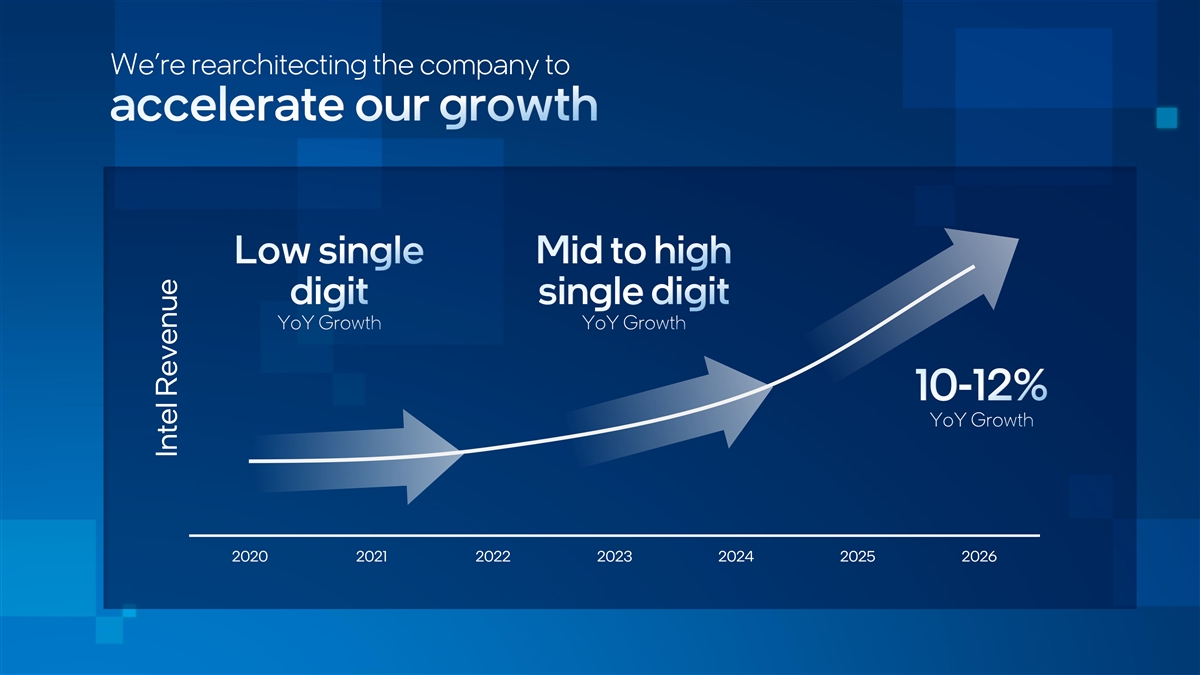
accelerating to 10%-12% year-over-year revenue growth by 2026 by doubling down on innovation, driving even deeper collaboration with our customers and partners, and leveraging our core strengths to successfully grow traditional markets and disrupt
new ones. Our goals are ambitious, but I’m confident we have the right strategy and right team to achieve them and to deliver long-term value for our shareholders.”
Full-Year 2022 Outlook
At today’s event, Intel
provided its outlook for the full-year 2022. For 2022, Intel expects revenue of $76 billion; non-GAAP gross margin of 52%; non-GAAP EPS of $3.50; and net capital expenditures of approximately $27 billion. Adjusted free cash flow is expected to
be negative $1 billion to $2 billion as the company ramps its investments to accelerate long-term growth.
The company’s guidance includes both GAAP
and non-GAAP estimates. Full reconciliations between these GAAP and non-GAAP measures are included below.
|
|
|
|
|
|
|
|
|
| Full-Year 2022 |
|
GAAP |
|
|
Non-GAAP |
|
| Revenue |
|
|
$76.0 billion |
|
|
|
$76.0 billion |
^ |
| Gross margin |
|
|
49.6 |
% |
|
|
52 |
% |
| Earnings per share |
|
|
$3.55 |
|
|
|
$3.50 |
|
| Net capital spending1 |
|
|
$27.0 billion |
|
|
|
$27.0 billion |
^ |
| Adjusted free cash flow |
|
|
N/A |
|
|
|
($1-2 billion |
) |
Long-Term Profitable Growth
Longer term, Intel expects year-over-year revenue growth moving to the mid- to high-single digits in 2023 and 2024, with year-over-year growth ramping to
10%-12% by 2026.
“We expect to deliver the growth targets outlined today through our reinvigorated focus on large and growing markets, investments in
our technology roadmap, and disciplined fiscal approach,” said David Zinsner, Intel chief financial officer. “At the same time, we will combine financial discipline with a steady focus on revenue growth, gross margin expansion and strong
cash flow. This approach gives us confidence in our ability to execute our plan and deliver compelling shareholder returns.”
As Intel’s
investments begin to deliver faster growth, gross margins are expected to expand from the 51%-53% range over the next three years to 54%-58% in 2025 and 2026. In addition to faster revenue growth, the company sees several opportunities to
expand gross margin by 2025. These include executing the company’s investments to deliver five nodes in four years to regain technology leadership, better sales mix of leadership products and scaling of higher-growth emerging businesses. Intel
also intends to maintain strong cost discipline to identify further cost efficiencies to drive gross margin expansion and deliver leadership products with best-in-class cost.
|
|
|
| Investment Phase Model 2023-2024 |
|
Non-GAAP |
| Revenue growth YoY |
|
Mid-to-High single digits^ |
| Gross margin |
|
51-53% |
| Operating expense2 |
|
28-30% |
| Net capital intensity3 |
|
~35% |
| Adjusted free cash flow2 |
|
~neutral |
|
|
| Long-Term Model 2025-2026 |
|
Non-GAAP |
| Revenue growth YoY |
|
10-12%^ |
| Gross margin |
|
54-58% |
| Operating expense2 |
|
25-27% |
| Net capital intensity3 |
|
~25% |
| Adjusted free cash flow2 |
|
~20% |
Intel’s Smart Capital Strategy
Underpinning Intel’s long-term growth plan is its Smart Capital strategy, which aims to help fund growth while creating flexibility and delivering higher
returns on investments. Under the Smart Capital strategy, Intel intends to employ a disciplined approach to its investments and leverage government incentives, customer participation and other creative partnerships as offsets to capital
spending. This will allow the company to adjust quickly to opportunities in the market and gain share while managing its margin structure and capital spending. Key elements of Smart Capital include:
| |
• |
|
Smart Capacity Investments: Intel is aggressively building out “shells,” which are the smaller
portion of the overall cost of a fab but have the longest lead time. Having available shell space gives the company flexibility in how and when it brings additional capacity online based on milestone triggers such as product readiness, market
conditions and customer commitments. |
| |
• |
|
Government Incentives: Intel is continuing to partner with governments in the U.S. and Europe to advance
incentives for domestic manufacturing capacity for leading-edge semiconductors, as it builds advanced fabs that secure domestic supply and provide opportunities for bolstering economic growth in local communities. |
| |
• |
|
Customer Commitments: Intel Foundry Services is working closely with potential customers, and some have
indicated willingness to make advance payments to secure capacity. This provides Intel with the advantage of committed volume, de-risking investments while providing capacity corridors for our foundry customers. |
| |
• |
|
Infrastructure Agreements: Intel is also exploring innovative ways to optimize its investments in new fab
projects. Today Intel announced a memorandum of understanding (MOU) with Brookfield Asset Management (Brookfield), one of the largest global investors in real assets, whereby Intel and Brookfield will explore project finance options to help fund new
Intel manufacturing sites and certain related renewable power opportunities. This would increase Intel capital flexibility and help accelerate Intel’s manufacturing build-out. This is a creative, first-of-a-kind model for the industry that will
allow Intel to fully leverage a premier financial institution to scale its capacity in a capital-efficient manner. The agreement also shows how government incentives can help to increase private capital for semiconductor manufacturing expansion.
|
| |
• |
|
External Foundries: Finally, Intel intends to make effective use of external foundries, leveraging some of
their unique capabilities to help deliver leadership products. |
Together, Intel’s Smart Capital actions provide flexibility, reduce
its overall gross capital needs and act as a tailwind to gross margin.
Plans to Lead in Traditional Markets and Disrupt High-Growth Emerging Markets
Intel today provided substantial updates across its six distinct but complementary business units that enable the company to capture growth in both
its large traditional markets and high-growth emerging markets. This includes planned growth in the client,
— more —
data center, network and edge markets based on increasingly competitive roadmaps, and the ability to disrupt important emerging markets with focused investments in accelerated compute and
graphics, foundry, mobility and auto. In the auto market, the company remains on track to take Mobileye public in the U.S. in mid-2022 via an initial public offering, where Intel will remain the majority owner of Mobileye. This structure gives
Intel multiple engines for growth and an inherent flexibility in how it invests. Intel’s new reporting segments, which will be presented beginning with its first-quarter 2022 results, will also provide shareholders with more transparency,
giving them direct visibility into the company’s progress in each area.
More information about these updates can be found in the Intel Investor
Meeting press kit on intel.com, including:
| |
• |
|
A fact sheet on Intel’s six business units and recent momentum |
| |
• |
|
A news release on Intel’s Xeon roadmap |
| |
• |
|
A series of papers authored by Intel leadership on topics including the state of the semiconductor
industry, the future of Moore’s Law, and Intel’s software, edge and AI strategies |
A replay of the livestream of the mainstage
sessions at Intel’s 2022 Investor Meeting can be found on the Intel Investor Meeting press kit, along with recordings of the morning business sessions and copies of all of the presentations.
About Intel
Intel (Nasdaq: INTC) is an industry leader,
creating world-changing technology that enables global progress and enriches lives. Inspired by Moore’s Law, we continuously work to advance the design and manufacturing of semiconductors to help address our customers’ greatest challenges.
By embedding intelligence in the cloud, network, edge and every kind of computing device, we unleash the potential of data to transform business and society for the better. To learn more about Intel’s innovations, go to
newsroom.intel.com and intel.com.
| ^ |
No adjustment on a non-GAAP basis |
| 1 |
Net capital spending reflects capital expenditures, less proceeds from capital grants received
|
| 2 |
Measured as a percentage of revenue |
| 3 |
Net capital intensity reflects capital expenditures, less proceeds from capital grants received, measured as a
percentage of revenue |
Forward-Looking Statements
Statements in this release that refer to outlook, plans, and expectations are forward-looking statements that involve a number of risks and uncertainties.
Words such as “anticipates,” “expects,” “intends,” “goals,” “plans,” “guide,” “believes,” “seeks,” “estimates,” “continues,” “committed,”
“on-track,” “ramp,” “momentum,” “roadmap,” “schedule,” “potential,” “next gen,” “may,” “will,” “would,” “should,” “could,”
“accelerate,” “cadence,” “deliver,” “path,” “progress,” “forecast,” “likely,” “future,” “strategy,” “pipeline,” and “positioned,” and
variations of such words and similar expressions are intended to identify such forward-looking statements. Statements that refer to or are based on estimates, forecasts, projections, uncertain events or assumptions, including statements relating to
Intel’s strategy and its anticipated benefits; Intel’s process and packaging technology roadmap and schedules; innovation cadence; manufacturing
expansion, financing and investment plans, including Intel’s planned Ohio investments; the benefits of the memorandum of understanding with Brookfield; the timing and conditions of such
transactions; pending or future transactions; the proposed Mobileye initial public offering (IPO); total addressable market (TAM) and market opportunity; supply expectations, including regarding industry shortages; business plans; financial
projections and expectations; future economic conditions; future legislation; future impacts of the COVID-19 pandemic; future technology, services, and products and the expected benefits and availability of such technologies, services, and products,
including PowerVia and RibbonEFT technologies, future process nodes, and other technologies and products; product and manufacturing plans, goals, timelines, ramps, progress, and future product and process leadership and performance; future capital
offsets; future use of EUV and other manufacturing tools and technologies; product and manufacturing and design goals and progress; internal manufacturing volumes; future external foundry business; future manufacturing capacity; plans and goals
related to Intel’s foundry business; investment returns and benefits; government incentives; benefits related to Intel’s foundry business; foundry service offerings, including intellectual property offerings; market opportunity;
expectations regarding customers, including designs, wins, orders, and partnerships; projections regarding competitors; ESG goals; and anticipated trends in our businesses or the markets relevant to them, including with respect to future demand,
market share, technology trends, and industry growth, also identify forward-looking statements. All forward-looking statements included in this release are based on management’s expectations as of the date of this release and, except as
required by law, Intel disclaims any obligation to update these forward-looking statements to reflect future events or circumstances. Forward-looking statements involve many risks and uncertainties that could cause actual results to differ
materially from those expressed or implied in such statements. Intel presently considers the following to be among the important factors that can cause actual results to differ materially from the company’s expectations.
| |
• |
|
Demand for Intel’s products is highly variable and can differ from expectations due to factors including
changes in business and economic conditions; customer confidence or income levels, and the levels of customer capital spending; the introduction, availability, and market acceptance of Intel’s products, products used together with Intel
products, and competitors’ products; competitive and pricing pressures, including actions taken by competitors; supply constraints and other disruptions affecting customers; changes in customer order patterns and order cancellations; changes in
customer needs and emerging technology trends; and changes in the level of inventory and computing capacity at customers. |
| |
• |
|
Intel’s results can vary significantly from expectations based on capacity utilization; variations in
inventory valuation, including variations related to the timing of qualifying products for sale; changes in revenue levels; segment product mix; the timing and execution of the manufacturing ramp and associated costs; excess or obsolete inventory;
changes in unit costs; defects or disruptions in the supply of materials or resources, including as a result of ongoing industry shortages of components and substrates; product manufacturing quality/yields; and changes in capital requirements and
investment plans. Variations in results can also be caused by the timing of Intel product introductions and related expenses, including marketing programs, and Intel’s ability to respond quickly to technological developments and to introduce
new products or incorporate new features into existing products, as well as decisions to exit product lines or businesses, which can result in restructuring and asset impairment charges. |
| |
• |
|
Intel’s results can be affected by adverse economic, social, political, regulatory, and
physical/infrastructure conditions in countries where Intel, its customers or its suppliers operate, including recession or slowing growth, military conflict and other security risks, natural disasters, infrastructure disruptions, health concerns
(including the COVID-19 pandemic), inflation, fluctuations in currency exchange rates, sanctions and tariffs, political disputes, changes in government grants and incentives, and continuing uncertainty regarding social, political, immigration, and
tax and trade policies in the U.S. and abroad. Results can also be affected by the formal or informal imposition by countries of new or revised export and/or import and doing-business regulations, including changes or uncertainty related to the U.S.
government entity list and changes in the ability to obtain export licenses, which can be changed without prior notice. |
| |
• |
|
The COVID-19 pandemic has previously adversely affected significant portions of Intel’s business and could
have a material adverse effect on Intel’s financial condition and results of operations. The pandemic has resulted in authorities imposing numerous measures to try to contain the virus,
|
| |
including vaccine requirements. These measures have impacted and may further impact our workforce and operations, the operations of our customers, and those of our respective suppliers and
partners. Restrictions on our manufacturing or support operations or workforce, similar limitations for our suppliers, and transportation restrictions or disruptions can impact our ability to meet customer demand and could have a material adverse
effect on us. Disruptions in our customers’ operations and supply chains, may adversely affect our results of operations. The pandemic has caused us to modify our business practices. There is no certainty that such measures will be sufficient
to mitigate the risks posed by the virus, and illness and workforce disruptions could lead to unavailability of our key personnel and harm our ability to perform critical functions. The pandemic has significantly increased economic and demand
uncertainty. Demand for our products could be materially harmed in the future. The pandemic could lead to increased disruption and volatility in capital markets and credit markets, which could adversely affect our liquidity and capital resources.
The degree to which COVID-19 impacts our results will depend on future developments, which are highly uncertain. The impact of the pandemic can also exacerbate other risks discussed in this section. |
| |
• |
|
Intel operates in highly competitive industries and its operations have high costs that are either fixed or
difficult to reduce in the short term. In addition, we have entered new areas and introduced adjacent products, such as our intention to become a major provider of foundry services, and we face new sources of competition and uncertain market demand
or acceptance of our offerings with respect to these new areas and products, and they do not always grow as projected. |
| |
• |
|
Intel’s expected tax rate is based on current tax law, including current interpretations of the Tax Cuts and
Jobs Act of 2017 (TCJA), and current expected income and can be affected by changes in interpretations of TCJA and other laws; changes in the volume and mix of profits earned and location of assets across jurisdictions with varying tax rates;
changes in the estimates of credits, benefits, and deductions; the resolution of issues arising from tax audits with various tax authorities, including payment of interest and penalties; and the ability to realize deferred tax assets.
|
| |
• |
|
Intel’s results can be affected by gains or losses from equity securities and interest and other, which can
vary depending on gains or losses on the change in fair value, sale, exchange, or impairments of equity and debt investments, interest rates, cash balances, and changes in fair value of derivative instruments. |
| |
• |
|
Product defects or errata (deviations from published specifications) can adversely impact our expenses, revenues,
and reputation. |
| |
• |
|
We or third parties regularly identify security vulnerabilities with respect to our processors and other products
as well as the operating systems and workloads running on them. Security vulnerabilities and any limitations of, or adverse effects resulting from, mitigation techniques can adversely affect our results of operations, financial condition, customer
relationships, prospects, and reputation in a number of ways, any of which may be material, including incurring significant costs related to developing and deploying updates and mitigations, writing down inventory value, a reduction in the
competitiveness of our products, defending against product claims and litigation, responding to regulatory inquiries or actions, paying damages, addressing customer satisfaction considerations, or taking other remedial steps with respect to third
parties. Adverse publicity about security vulnerabilities or mitigations could damage our reputation with customers or users and reduce demand for our products and services. |
| |
• |
|
Cybersecurity incidents, whether or not successful, can affect Intel’s results by causing us to incur
significant costs or disrupting our operations or those of our customers and suppliers, and can result in reputational harm. |
| |
• |
|
Intel’s results can be affected by litigation or regulatory matters involving intellectual property,
stockholder, consumer, antitrust, commercial, disclosure, and other issues, as well as by the impact and timing of settlements and dispute resolutions. For example, in the first quarter of 2021, Intel accrued a $2.2 billion charge related to
litigation involving VLSI Technology LLC (VLSI). An unfavorable ruling can include monetary damages or an injunction prohibiting us from manufacturing or selling one or more products, precluding particular business practices, impacting our ability
to design products, or requiring other remedies such as compulsory licensing of intellectual property. |
| |
• |
|
Intel’s results can be affected by the impact and timing of closing of acquisitions, divestitures, and other
significant transactions. In addition, these transactions do not always achieve our financial or strategic objectives and can disrupt our ongoing business and adversely impact our results of operations. The memorandum of understanding between Intel
and Brookfield is preliminary and non-binding; the parties may not agree on final terms, and the closing of any transactions involving Brookfield may be delayed or may not occur. The expected financial or other benefits of any transaction between
the parties may not be realized. The proposed Mobileye IPO may not be completed in our expected timeframe, or at all, due to factors that include adverse changes in economic or market conditions or in our business; delays in regulatory, stock
exchange, or other approvals; loss of key employees, and changes in our business strategy. |
| |
• |
|
The amount, timing, and execution of Intel’s stock repurchase program fluctuate based on Intel’s
priorities for the use of cash for other purposes—such as investing in our business, including operational and capital spending, acquisitions, and returning cash to our stockholders as dividend payments. |
Detailed information regarding these and other factors that could affect Intel’s business and results is included in Intel’s SEC filings, including
the company’s most recent reports on Forms 10-K and 10-Q, particularly the “Risk Factors” sections of those reports. Copies of these filings may be obtained by visiting our Investor Relations website at www.intc.com or the SEC’s
website at www.sec.gov.
© Intel Corporation. Intel, the Intel logo and other Intel marks are trademarks of Intel Corporation or its subsidiaries.
Other names and brands may be claimed as the property of others.
Intel Corporation
Explanation of Non-GAAP Measures
In addition to disclosing the 2022 financial outlook in accordance with US GAAP, this document contains references to the non-GAAP financial measures
below. We believe these non-GAAP financial measures provide investors with useful supplemental information about our operating performance, enable comparison of financial trends and results between periods where certain items may vary independent of
business performance, and allow for greater transparency with respect to key metrics used by management in operating our business and measuring our performance. Certain of these non-GAAP financial measures are used in our performance-based RSUs and
our annual cash bonus plan.
Certain 2022 figures and long-term outlook ranges are provided on a non-GAAP basis. We are unable to provide a full
reconciliation of these measures to the corresponding GAAP measures without unreasonable efforts, as the amount and timing of related adjustments on a long-term basis are subject to considerable uncertainty, depend on various factors, and could be
material to our results computed in accordance with GAAP. We believe such a reconciliation would also imply a degree of precision that is inappropriate for these forward-looking measures.
Our non-GAAP financial measures reflect adjustments based on one or more of the following items, as well as the related income tax effects where applicable.
Income tax effects have been calculated using an appropriate tax rate for each adjustment. These non-GAAP financial measures should not be considered a substitute for, or superior to,
financial measures calculated in accordance with US GAAP, and the financial outlooks calculated in accordance with US GAAP and reconciliations from these outlooks should be carefully
evaluated.
|
|
|
|
|
Non-GAAP
adjustment or measure |
|
Definition |
|
Usefulness to management and investors |
| Acquisition-related adjustments |
|
Amortization of acquisition-related intangible assets consists of amortization of intangible assets such as developed technology, brands, and customer
relationships acquired in connection with business combinations. Charges related to the amortization of these intangibles are recorded within both cost of sales and MG&A in our US GAAP financial statements. Amortization charges are recorded over
the estimated useful life of the related acquired intangible asset, and thus are generally recorded over multiple years. |
|
We exclude amortization charges for our acquisition-related intangible assets for purposes of calculating certain non-GAAP measures because
these charges are inconsistent in size and are significantly impacted by the timing and valuation of our acquisitions. These adjustments facilitate a useful evaluation of our current operating performance and comparison to our past operating
performance and provide investors with additional means to evaluate cost and expense trends. |
| |
|
|
| Restructuring and other charges |
|
Restructuring charges are costs associated with a formal restructuring plan and are primarily related to employee severance and benefit arrangements. Other
charges include asset impairments, pension charges, and costs associated with restructuring activity. |
|
We exclude restructuring and other charges, including any adjustments to charges recorded in prior periods, for purposes of calculating
certain non-GAAP measures because these costs do not reflect our core operating performance. These adjustments facilitate a useful evaluation of our core operating performance and comparisons to past operating results and provide investors with
additional means to evaluate expense trends. |
| |
|
|
| Share-based compensation |
|
Share-based compensation consists of charges related to our employee equity incentive plans. |
|
We exclude charges related to share-based compensation for purposes of calculating certain non-GAAP measures because we believe these
adjustments provide better comparability to peer company results and because these charges are not viewed by management as part of our core operating performance. We believe these adjustments provide investors with a useful view, through the eyes of
management, of the company’s core business model, how management currently evaluates core operational performance, and additional means to evaluate expense trends, including in comparison to other peer companies. |
|
|
|
|
|
Non-GAAP
adjustment or measure |
|
Definition |
|
Usefulness to management and investors |
| (Gains) losses from divestiture |
|
Gains or losses are recognized at the close of a divestiture, or over a specified deferral period when deferred consideration is received at the time of closing. Based on our ongoing
obligation under the NAND wafer manufacturing and sale agreement entered into in connection with the first closing of the sale of our NAND memory business on December 29, 2021, a portion of the initial closing consideration will be deferred and
recognized between first and second closing. |
|
We exclude gains or losses resulting from divestitures for purposes of calculating certain non-GAAP measures because they do not reflect our
current operating performance. These adjustments facilitate a useful evaluation of our current operating performance and comparisons to past operating results. |
| |
|
|
| (Gains) losses on equity investments, net |
|
(Gains) losses on equity investments, net consists of ongoing mark-to-market adjustments on marketable equity securities, observable price adjustments on non-marketable equity securities,
impairment charges, and sale of equity investments and other. |
|
We exclude these non-operating earnings for better comparability between periods. The exclusion reflects how management evaluates the core
operations of the business. |
| |
|
|
| Adjusted Free cash flow |
|
We reference a non-GAAP financial measure of adjusted free cash flow, which is used by management when assessing our sources of liquidity, capital resources, and quality of earnings. Adjusted
free cash flow is operating cash flow adjusted to exclude 1) additions to property, plant and equipment, net of proceeds from capital grants received, and 2) payments on finance leases. |
|
This non-GAAP financial measure is helpful in understanding our capital requirements and provides an additional means to evaluate the cash
flow trends of our business. |
Intel Corporation
Supplemental Reconciliations of GAAP Outlook to Non-GAAP Outlook
Set forth below are reconciliations of the non-GAAP financial measure to the most directly comparable U.S. GAAP financial measure. These non-GAAP financial
measures should not be considered a substitute for, or superior to, financial measures calculated in accordance with U.S. GAAP, and the financial outlook prepared in accordance with U.S. GAAP and the reconciliations from this 2022 Full-Year Outlook
should be carefully evaluated.
Please refer to “Explanation of Non-GAAP Measures” in this document for a detailed explanation of
the adjustments made to the comparable U.S. GAAP measures, the ways management uses the non-GAAP measures, and the reasons why management believes the non-GAAP measures provide useful information for investors.
|
|
|
|
|
| |
|
Full-Year 2022
Outlook |
|
| |
|
Approximately |
|
| GAAP gross margin |
|
|
49.6 |
% |
| Amortization of acquisition-related intangible assets |
|
|
1.7 |
% |
| Share-based compensation |
|
|
0.7 |
% |
|
|
|
|
|
| Non-GAAP gross margin |
|
|
52.0 |
% |
|
|
|
|
|
| GAAP earnings per share—diluted |
|
|
$3.55 |
|
| Acquisition-related adjustments |
|
|
0.36 |
|
| Restructuring and other charges |
|
|
0.01 |
|
| Share-based compensation |
|
|
0.81 |
|
| (Gains) losses from divestiture |
|
|
(0.28 |
) |
| (Gains) losses on equity investments, net |
|
|
(1.23 |
) |
| Income tax effects |
|
|
0.289 |
|
|
|
|
|
|
| Non-GAAP earnings per share—diluted |
|
|
$3.50 |
|
|
|
|
|
|
|
|
|
|
|
| (In Billions) |
|
Full-Year 2022
Outlook |
|
| GAAP cash from operations |
|
|
$26.8 |
|
| Net additions to property, plant, and equipment |
|
|
(27.0 |
) |
| Payments on finance leases |
|
|
(1.3 |
) |
|
|
|
|
|
| Adjusted free cash flow |
|
|
$(1.5) |
|
|
|
|
|
|
Exhibit 99.2 Future node performance and other metrics, including power
and density, are projections and are inherently uncertain and, in the case of other industry nodes, are derived from or estimated based on publicly available information. Intel’s node numbers do not represent the actual dimension of any
physical feature on a transistor or structure. They also do not pinpoint a specific level of improvement in performance, power or area, and the magnitude of a decrease from one node number to the next is not necessarily proportionate to the level of
improvement in one or more metrics. Historically, new Intel node numbers were based solely on improvements in area/density; now, node numbers generally reflect a holistic assessment of improvement across metrics and can be based on improvement in
one or more of performance, power, area, or other important factors, or a combination, and will not necessarily be based on area/density improvement alone. Non-GAAP Financial Measures. This presentation contains non-GAAP financial measures. Intel
gross margin and earnings per share, as well as Intel revenue for fiscal years 2021 and earlier, are presented on a non-GAAP basis unless otherwise indicated. This presentation also includes a non-GAAP free cash flow (FCF) measure. The appendix to
these materials available at www.intc.com provides a reconciliation of these measures to the most directly comparable GAAP financial measure. The non-GAAP financial measures disclosed by Intel should not be considered a substitute for, or superior
to, the financial measures prepared in accordance with GAAP. Forward-Looking Statements. Statements in this presentation that refer to business outlook, plans, and expectations are forward-looking statements that involve risks and uncertainties.
Words such as anticipate, expect, intend, goal, plans, believe, seek, estimate, continue,“ “committed,” “on-track,” ”positioned,” “ramp,” “momentum,” “roadmap,”
“path,” “pipeline,” “progress,” “schedule,” “forecast,” “likely,” “guide,” “potential,” “next gen,” “future,” may, will,
“would,” should, “could,” strategy, accelerate, cadence, deliver, and variations of such words and similar expressions are intended to identify such forward-looking statements. Statements that refer to or are based on
estimates, forecasts, projections, uncertain events, or assumptions also identify forward-looking statements. Forward-looking statements in this presentation include: statements relating to Intel’s strategy and its anticipated benefits;
Intel's process and packaging technology roadmap and schedules; innovation cadence; business plans; financial projections and expectations; total addressable market (TAM) and market opportunity; manufacturing expansion, financing, and investment
plans; future manufacturing capacity; future technology, services, and products and the expected benefits and availability of such technologies, services, and products, including PowerVia and RibbonFET technologies, future process nodes, and other
technologies and products; product and manufacturing plans, goals, timelines, ramps, progress, and future product and process leadership and performance; future economic conditions; future impacts of the COVID-19 pandemic; plans and goals related to
Intel’s foundry business; future legislation; future capital offsets; pending or future transactions; the proposed Mobileye IPO; the memorandum of understanding with Brookfield; supply expectations including regarding industry shortages;
future external foundry usage; future use of EUV and other manufacturing tools and technologies; expectations regarding customers, including designs, wins, orders, and partnerships; projections regarding competitors; ESG goals; and anticipated
trends in our businesses or the markets relevant to them, including future demand, market share, industry growth, and technology trends, also identify forward-looking statements. Such statements involve many risks and uncertainties that could cause
actual results to differ materially from those expressed or implied in these forward-looking statements. Important factors that could cause actual results to differ materially are set forth in Intel's earnings release dated January 26, 2022, which
is included as an exhibit to Intel’s Form 8-K furnished to the SEC on such date, and in Intel's SEC filings, including the company's most recent reports on Forms 10-K and 10-Q. Copies of Intel’s SEC filings may be obtained by visiting
our Investor Relations website at www.intc.com or the SEC's website at www.sec.gov. All information in this presentation reflects management’s views as of February 17, 2022, unless an earlier date is indicated. Intel does not undertake, and
expressly disclaims any duty, to update any statement made in this presentation, whether as a result of new information, new developments or otherwise, except to the extent that disclosure may be required by law. Intel technologies may require
enabled hardware, software or service activation. No product or component can be absolutely secure. Your costs and results may vary. Product and process performance varies by use, configuration and other factors. Learn more at
www.Intel.com/PerformanceIndex and www.Intel.com/ProcessInnovation. Future product and process performance and other metrics are projections and are inherently uncertain. © Intel Corporation. Intel, the Intel logo, and other Intel marks are
trademarks of Intel Corporation or its subsidiaries. Other names and brands may be claimed as the property of others.
Investor Meeting 2022
Investor Meeting 2022 CEO, Intel
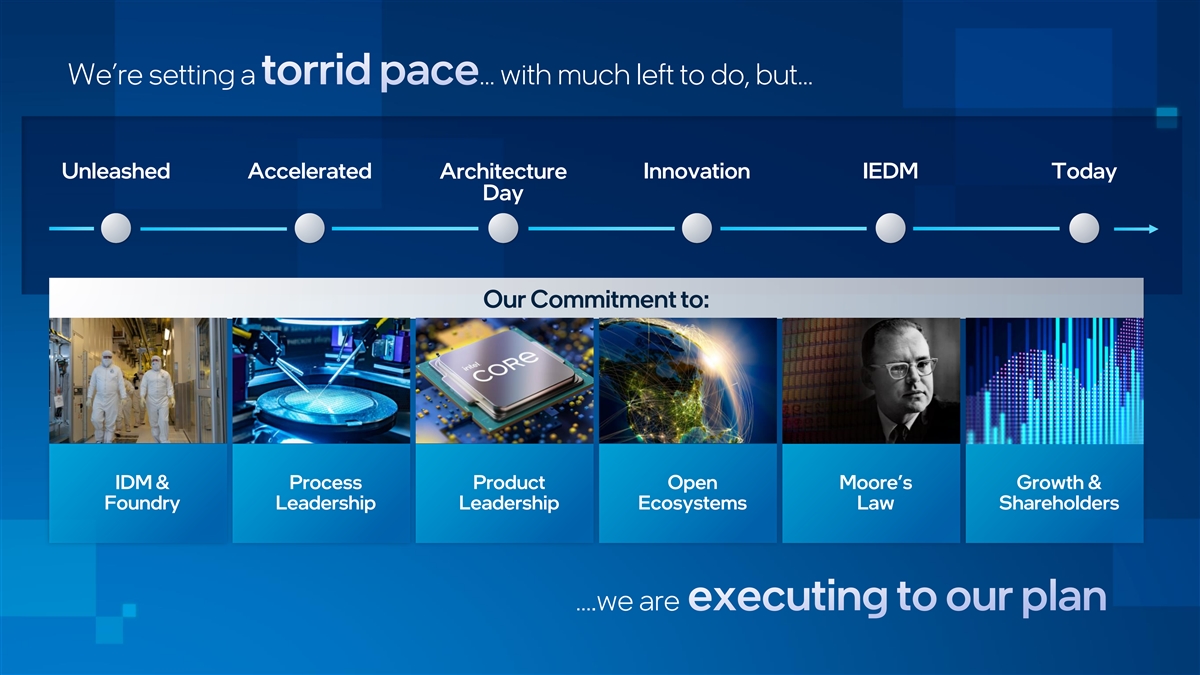
We’re setting a … with much left to do, but… Unleashed
Accelerated Architecture Innovation IEDM Today Day Our Commitment to: IDM & Process Product Open Moore’s Growth & Foundry Leadership Leadership Ecosystems Law Shareholders ….we are
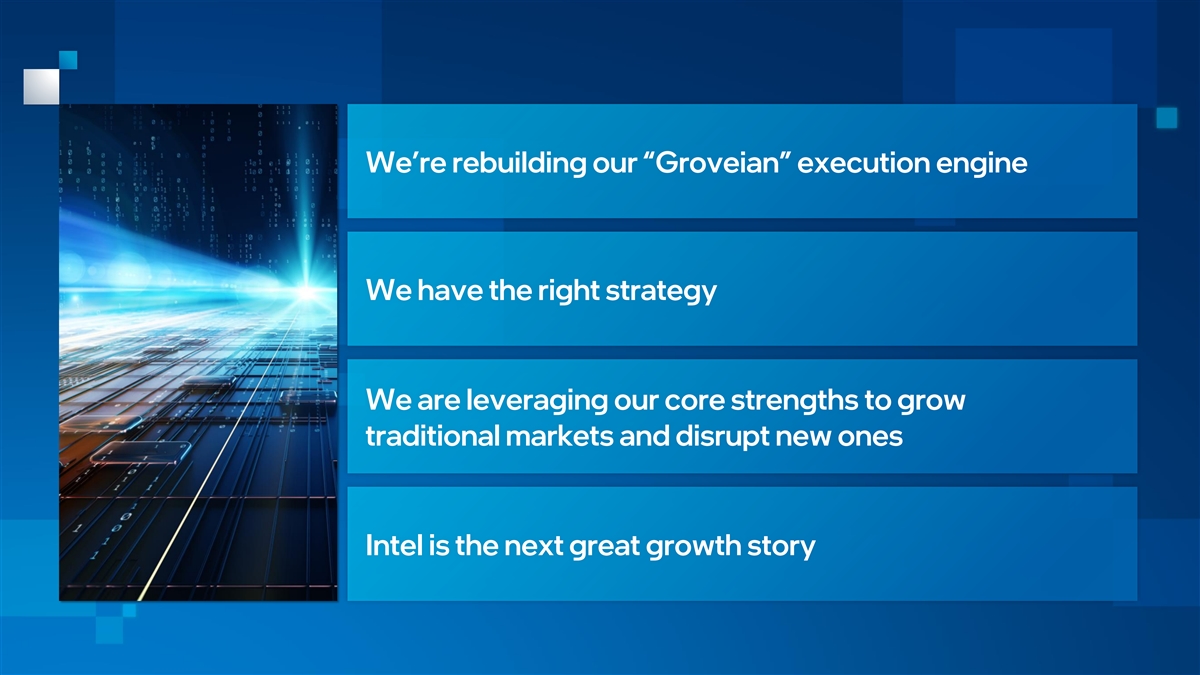
We’re rebuilding our “Groveian” execution engine We
have the right strategy We are leveraging our core strengths to grow traditional markets and disrupt new ones Intel is the next great growth story
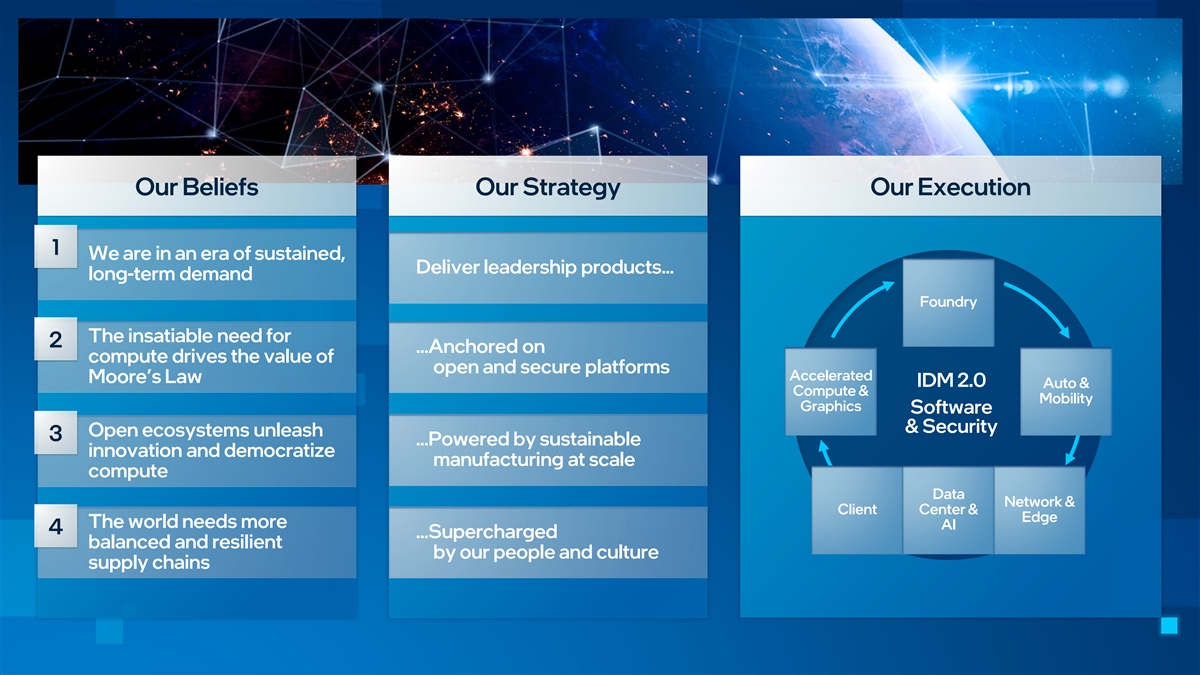
Our Beliefs Our Strategy Our Execution 1 We are in an era of sustained,
Deliver leadership products… long-term demand Foundry The insatiable need for 2 …Anchored on compute drives the value of open and secure platforms Accelerated Moore’s Law IDM 2.0 Auto & Compute & Mobility Graphics Software
& Security Open ecosystems unleash 3 …Powered by sustainable innovation and democratize manufacturing at scale compute Data Network & Client Center & Edge The world needs more AI 4 …Supercharged balanced and resilient by our
people and culture supply chains
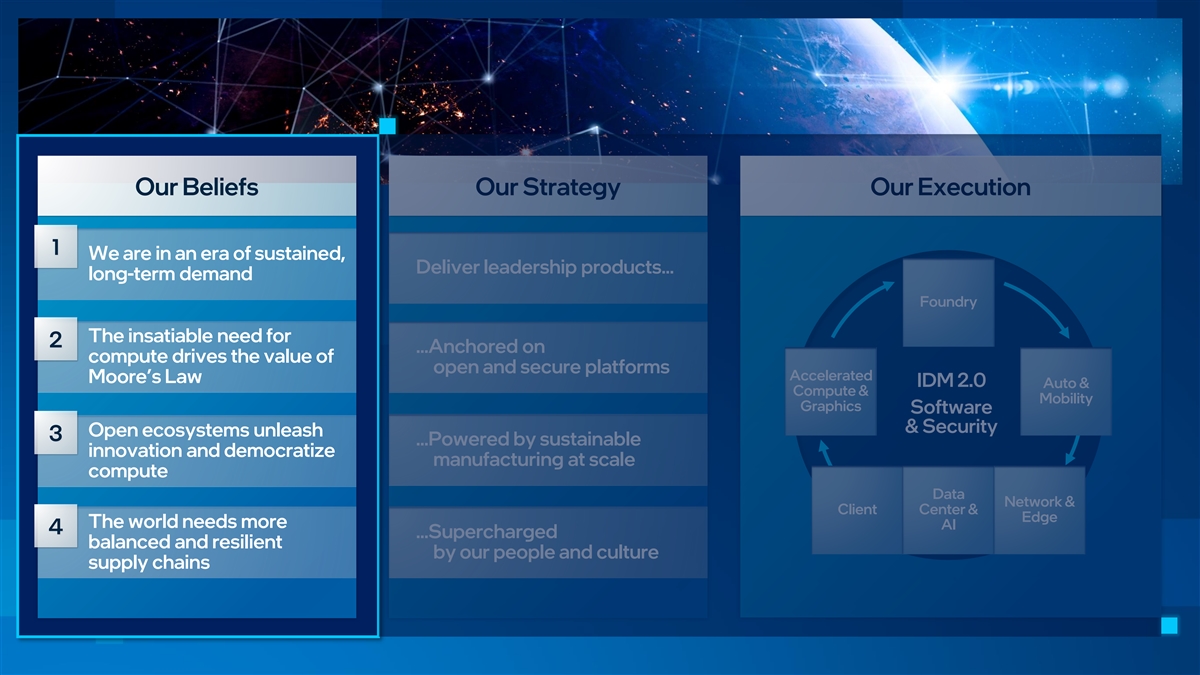
Our Beliefs Our Strategy Our Execution 1 We are in an era of sustained,
Deliver leadership products… long-term demand Foundry The insatiable need for 2 …Anchored on compute drives the value of open and secure platforms Accelerated Moore’s Law IDM 2.0 Auto & Compute & Mobility Graphics Software
& Security Open ecosystems unleash 3 …Powered by sustainable innovation and democratize manufacturing at scale compute Data Network & Client Center & Edge The world needs more AI 4 …Supercharged balanced and resilient by our
people and culture supply chains
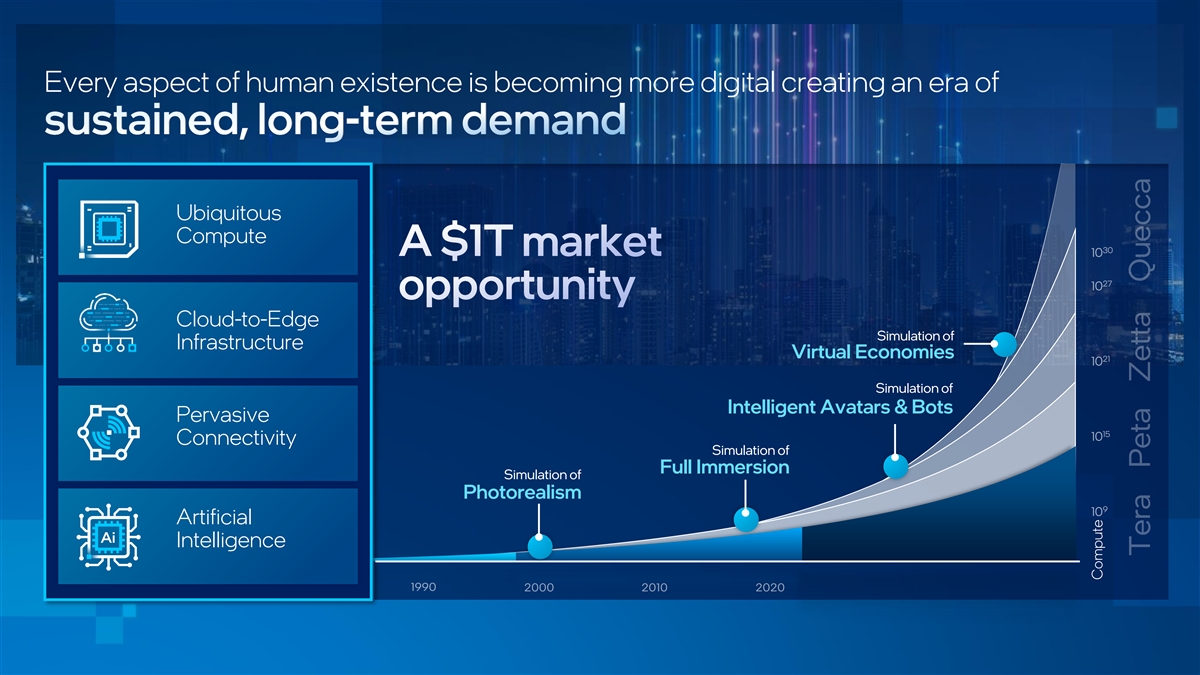
Every aspect of human existence is becoming more digital creating an era
of Ubiquitous Compute Cloud-to-Edge Simulation of Infrastructure Virtual Economies Simulation of Intelligent Avatars & Bots Pervasive Connectivity Simulation of Full Immersion Simulation of Photorealism Artificial Intelligence Compute
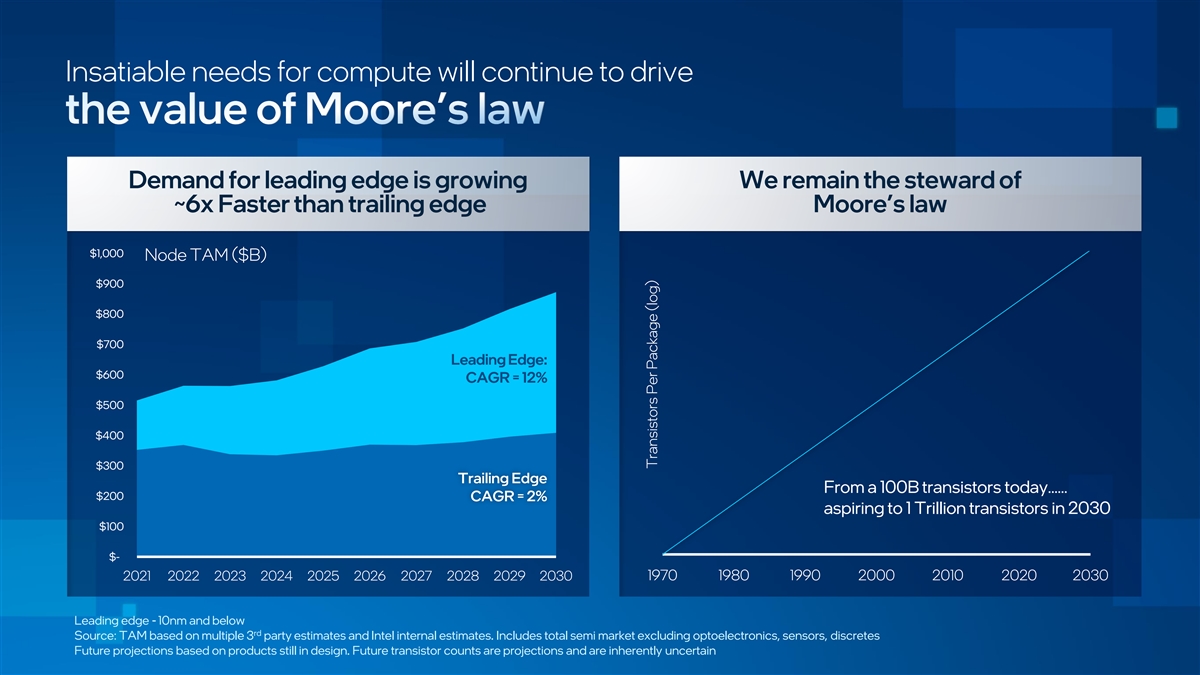
Insatiable needs for compute will continue to drive Demand for leading
edge is growing We remain the steward of ~6x Faster than trailing edge Moore’s law $1,000 Node TAM ($B) $900 $800 $700 Leading Edge: $600 CAGR = 12% $500 $400 $300 Trailing Edge From a 100B transistors today…… $200 CAGR = 2%
aspiring to 1 Trillion transistors in 2030 $100 $- 1970 1980 1990 2000 2010 2020 2030 2021 2022 2023 2024 2025 2026 2027 2028 2029 2030 Leading edge - 10nm and below rd Source: TAM based on multiple 3 party estimates and Intel internal estimates.
Includes total semi market excluding optoelectronics, sensors, discretes Future projections based on products still in design. Future transistor counts are projections and are inherently uncertain Transistors Per Package (log)
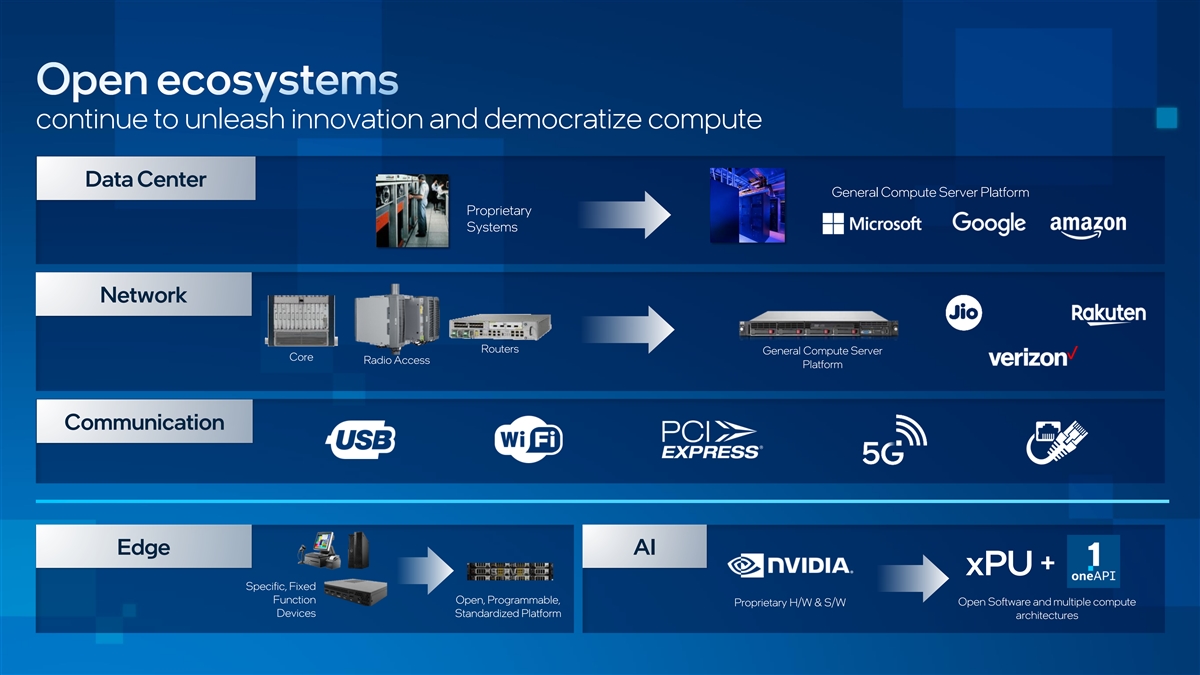
continue to unleash innovation and democratize compute Data Center
General Compute Server Platform Proprietary Systems Network Routers General Compute Server Core Radio Access Platform Communication Edge AI xPU + Specific, Fixed Function Open, Programmable, Proprietary H/W & S/W Open Software and multiple
compute Devices Standardized Platform architectures
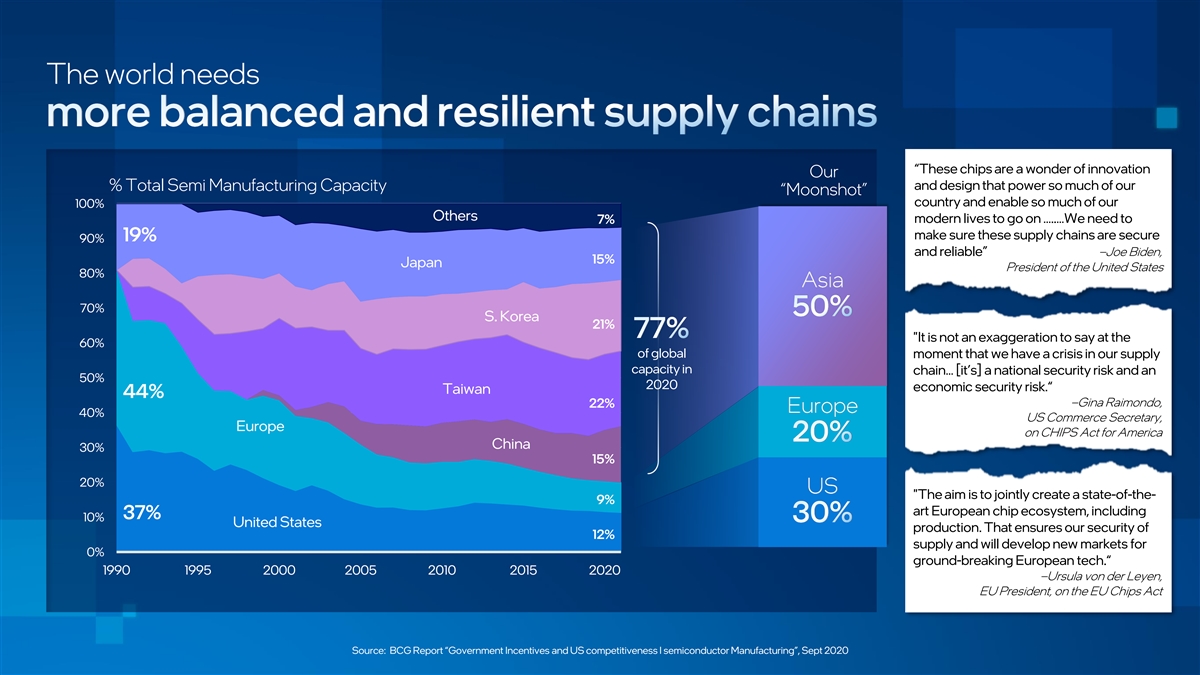
The world needs “These chips are a wonder of innovation Our and
design that power so much of our % Total Semi Manufacturing Capacity “Moonshot” country and enable so much of our 100% 3% Others 7% modern lives to go on …..…We need to make sure these supply chains are secure 19% 90% and
reliable” –Joe Biden, 17% 15% Japan President of the United States 80% Asia 70% 13% S. Korea 21% It is not an exaggeration to say at the 60% of global moment that we have a crisis in our supply 22% capacity in chain… [it’s] a
national security risk and an 50% 2020 economic security risk.“ Taiwan 44% –Gina Raimondo, 22% Europe 40% US Commerce Secretary, Europe on CHIPS Act for America China 30% 24% 15% 20% US The aim is to jointly create a state-of-the- 9% art
European chip ecosystem, including 37% 10% 19% United States production. That ensures our security of 12% supply and will develop new markets for 0% ground-breaking European tech.“ 1990 1995 2000 2005 2010 2015 2020 –Ursula von der
Leyen, EU President, on the EU Chips Act Source: BCG Report “Government Incentives and US competitiveness I semiconductor Manufacturing”, Sept 2020
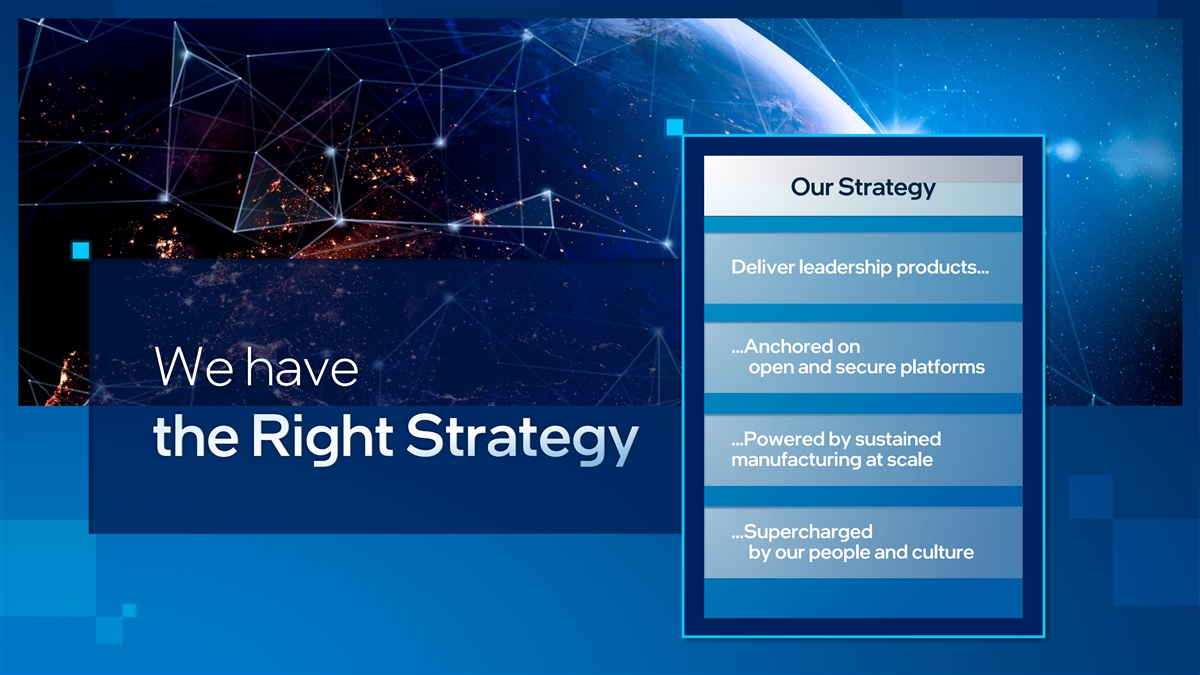
Our Strategy Deliver leadership products… …Anchored on open
and secure platforms We have …Powered by sustained manufacturing at scale …Supercharged by our people and culture
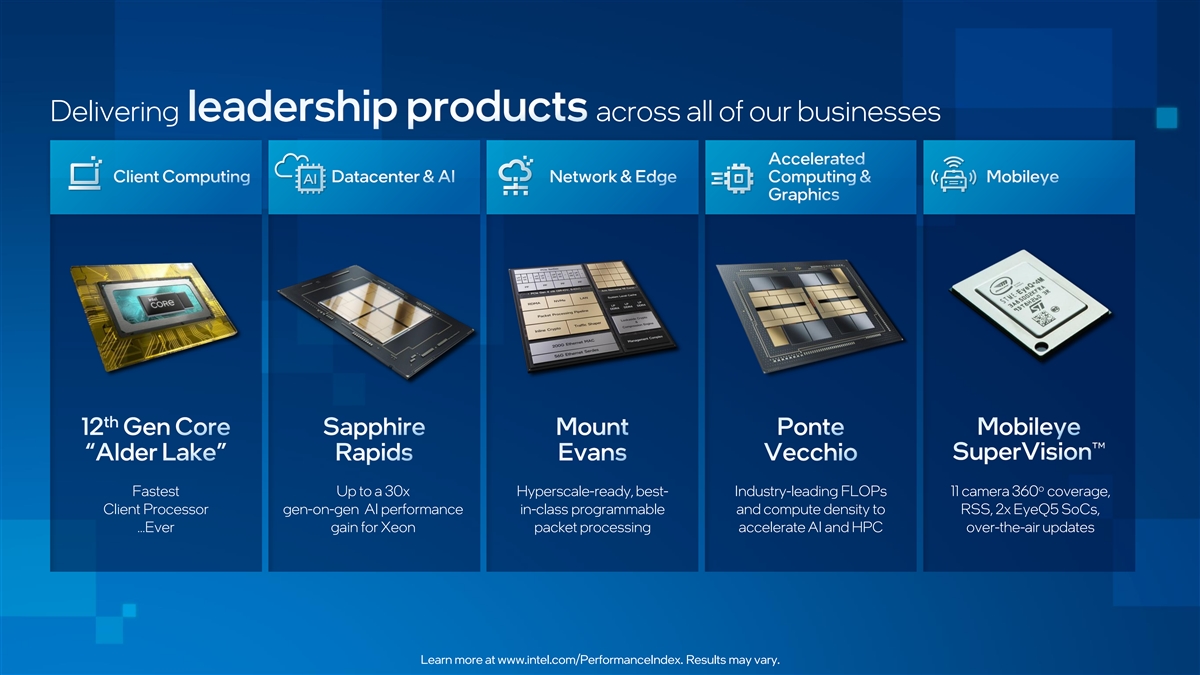
Delivering across all of our businesses o Fastest Up to a 30x
Hyperscale-ready, best- Industry-leading FLOPs 11 camera 360 coverage, Client Processor gen-on-gen AI performance in-class programmable and compute density to RSS, 2x EyeQ5 SoCs, …Ever gain for Xeon packet processing accelerate AI and HPC
over-the-air updates Learn more at www.intel.com/PerformanceIndex. Results may vary.
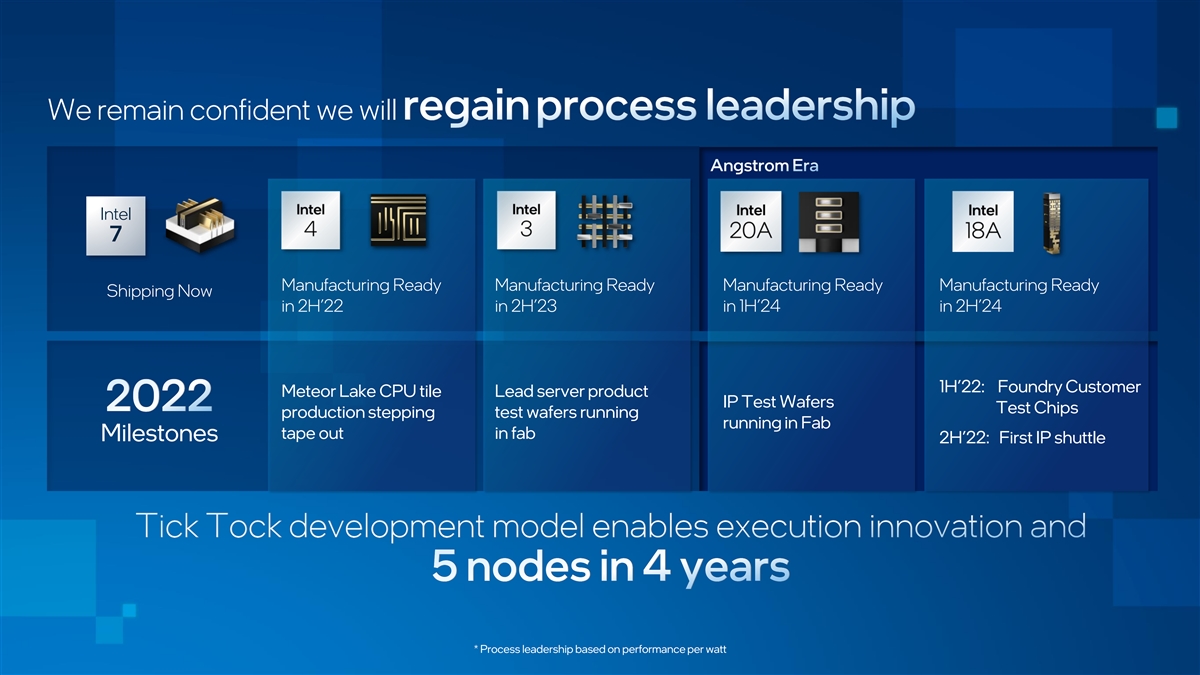
We remain confident we will Intel 7 Manufacturing Ready Manufacturing
Ready Manufacturing Ready Manufacturing Ready Shipping Now in 2H’22 in 2H’23 in 1H’24 in 2H’24 1H’22: Foundry Customer Meteor Lake CPU tile Lead server product IP Test Wafers Test Chips production stepping test wafers
running running in Fab tape out in fab Milestones 2H’22: First IP shuttle * Process leadership based on performance per watt
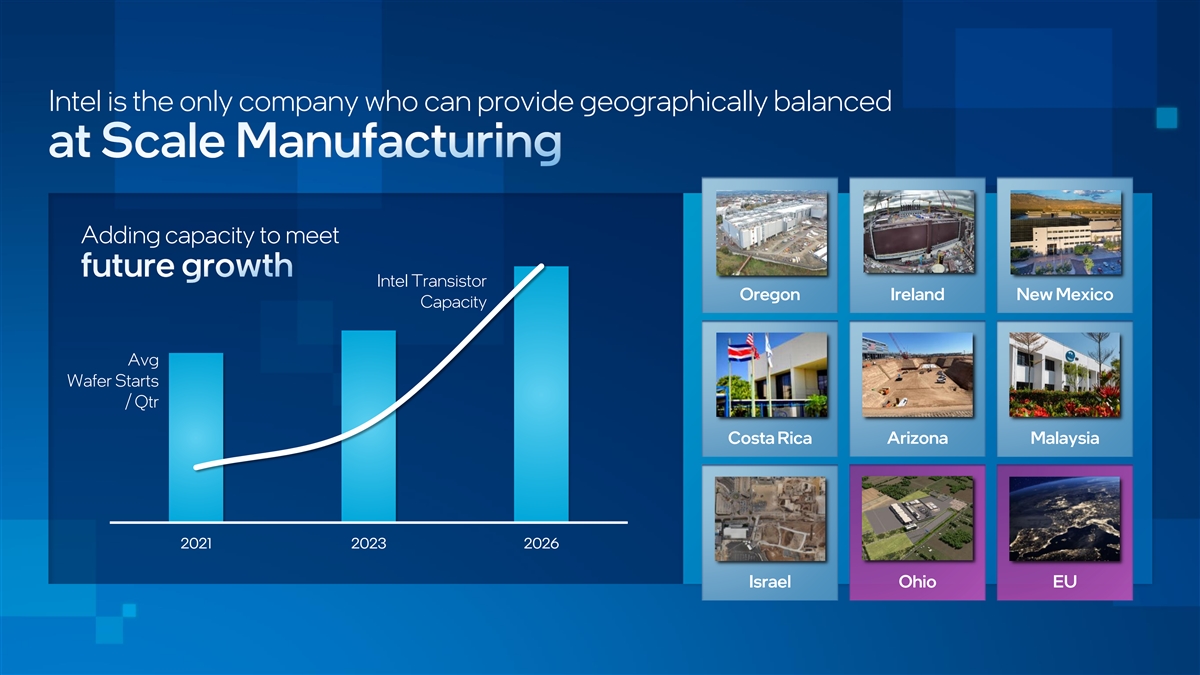
Intel is the only company who can provide geographically balanced
Adding capacity to meet Intel Transistor Oregon Ireland New Mexico Capacity Avg Wafer Starts / Qtr Costa Rica Arizona Malaysia 2021 2023 2026 Israel Ohio EU
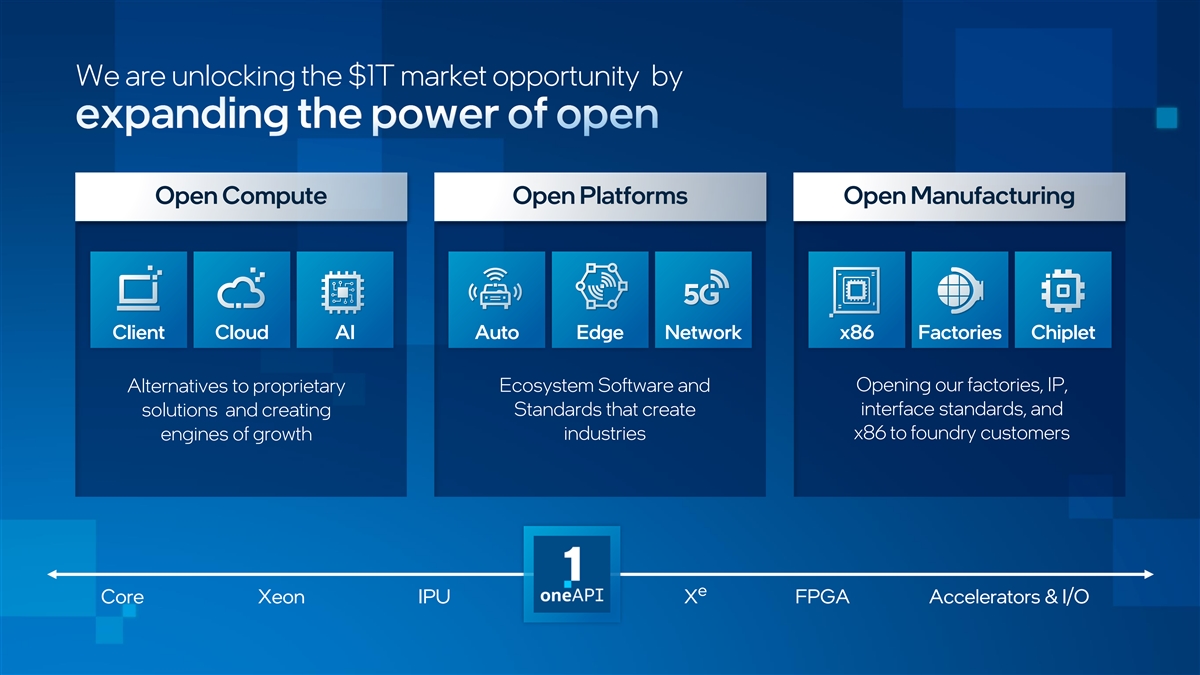
We are unlocking the $1T market opportunity by Open Compute Open
Platforms Open Manufacturing Client Cloud AI Auto Edge Network x86 Factories Chiplet Opening our factories, IP, Alternatives to proprietary Ecosystem Software and interface standards, and solutions and creating Standards that create engines of
growth industries x86 to foundry customers e Core Xeon IPU X FPGA Accelerators & I/O
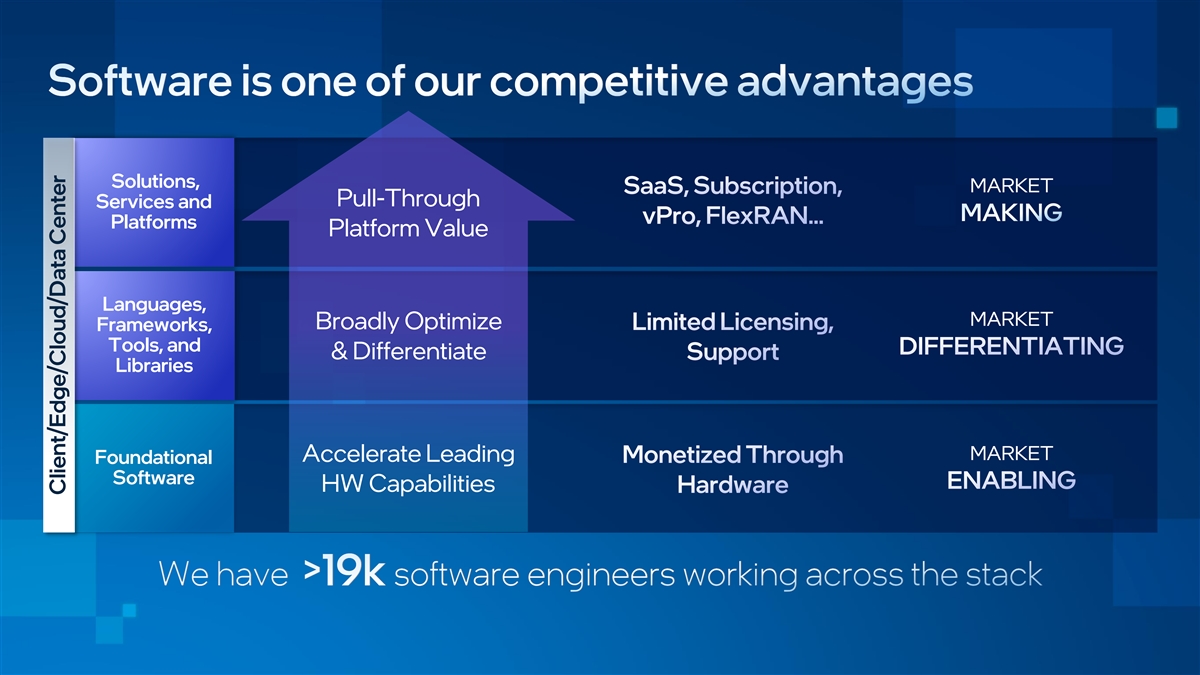
Solutions, MARKET Pull-Through Services and Platforms Platform Value
Languages, MARKET Broadly Optimize Frameworks, Tools, and & Differentiate Libraries MARKET Accelerate Leading Foundational Software HW Capabilities Client/Edge/Cloud/Data Center
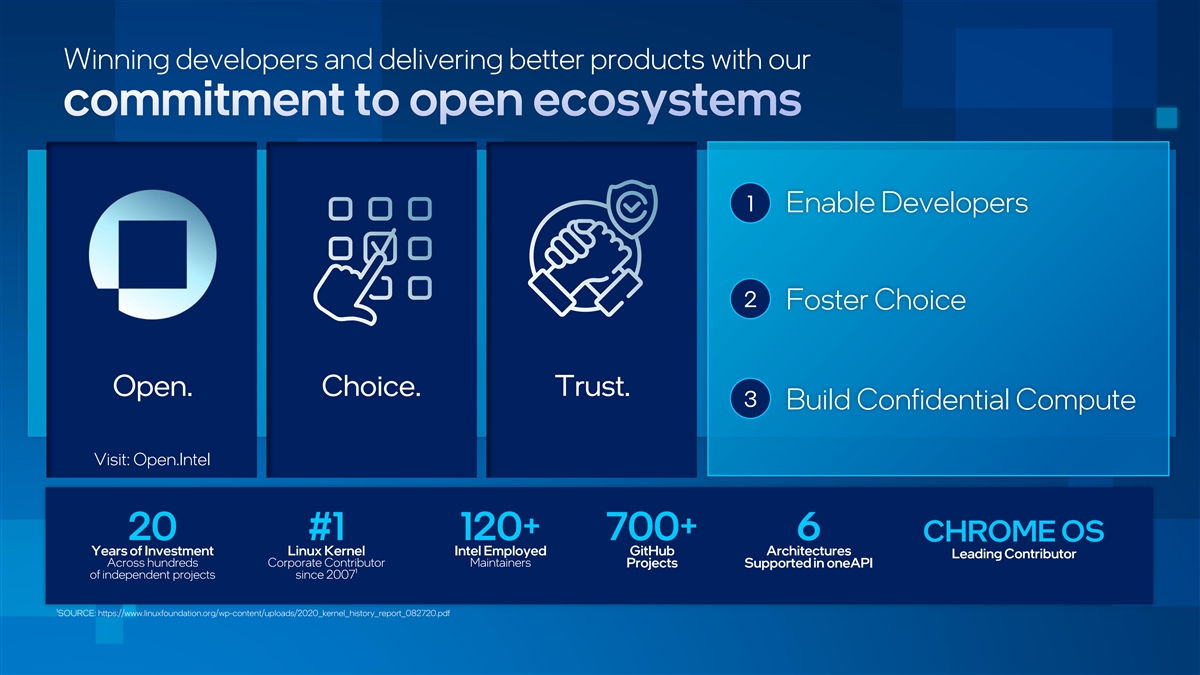
Winning developers and delivering better products with our 1 Enable
Developers 2 Foster Choice Open. Choice. Trust. 3 Build Confidential Compute Visit: Open.Intel 20 #1 120+ 700+ 6 CHROME OS Years of Investment Linux Kernel Intel Employed GitHub Architectures Leading Contributor Across hundreds Corporate Contributor
Maintainers Projects Supported in oneAPI of independent projects since 2007¹ ¹SOURCE: https://www.linuxfoundation.org/wp-content/uploads/2020_kernel_history_report_082720.pdf
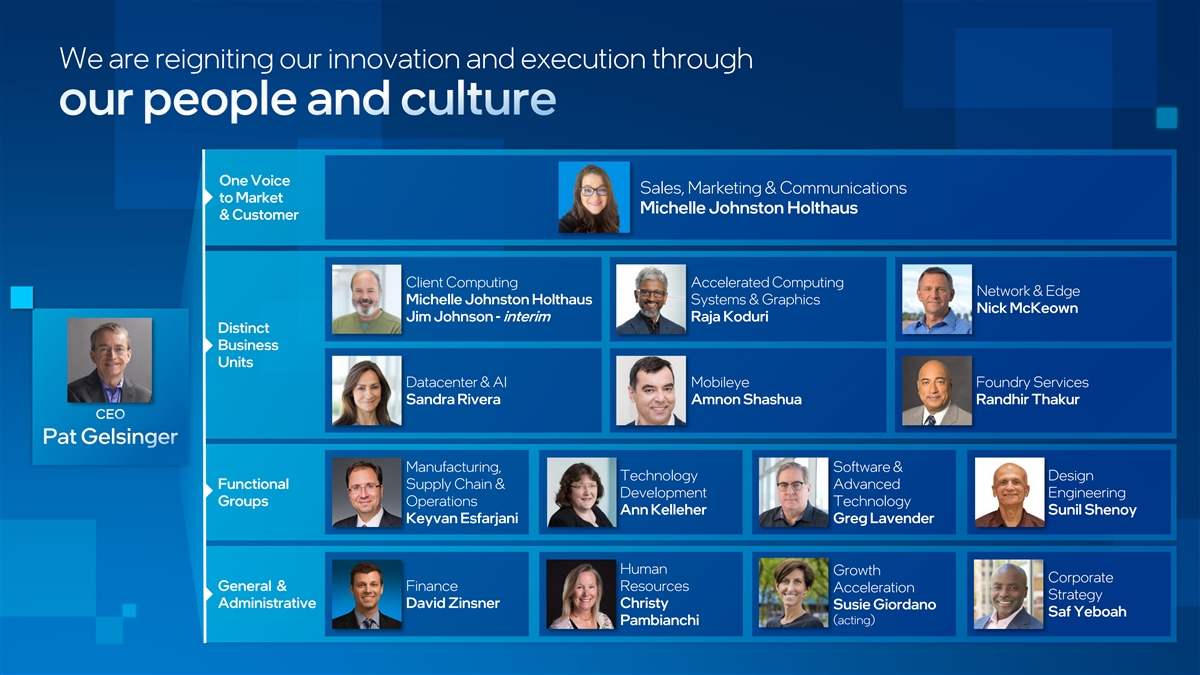
We are reigniting our innovation and execution through One Voice Sales,
Marketing & Communications to Market Michelle Johnston Holthaus & Customer Client Computing Accelerated Computing Network & Edge Michelle Johnston Holthaus Systems & Graphics Nick McKeown Jim Johnson - interim Raja Koduri Distinct
Business Units Datacenter & AI Mobileye Foundry Services Sandra Rivera Amnon Shashua Randhir Thakur Manufacturing, Software & Technology Design Functional Supply Chain & Advanced Development Engineering Groups Operations Technology Ann
Kelleher Sunil Shenoy Keyvan Esfarjani Greg Lavender Human Growth Corporate General & Finance Resources Acceleration Strategy Administrative David Zinsner Christy Susie Giordano Saf Yeboah Pambianchi (acting)
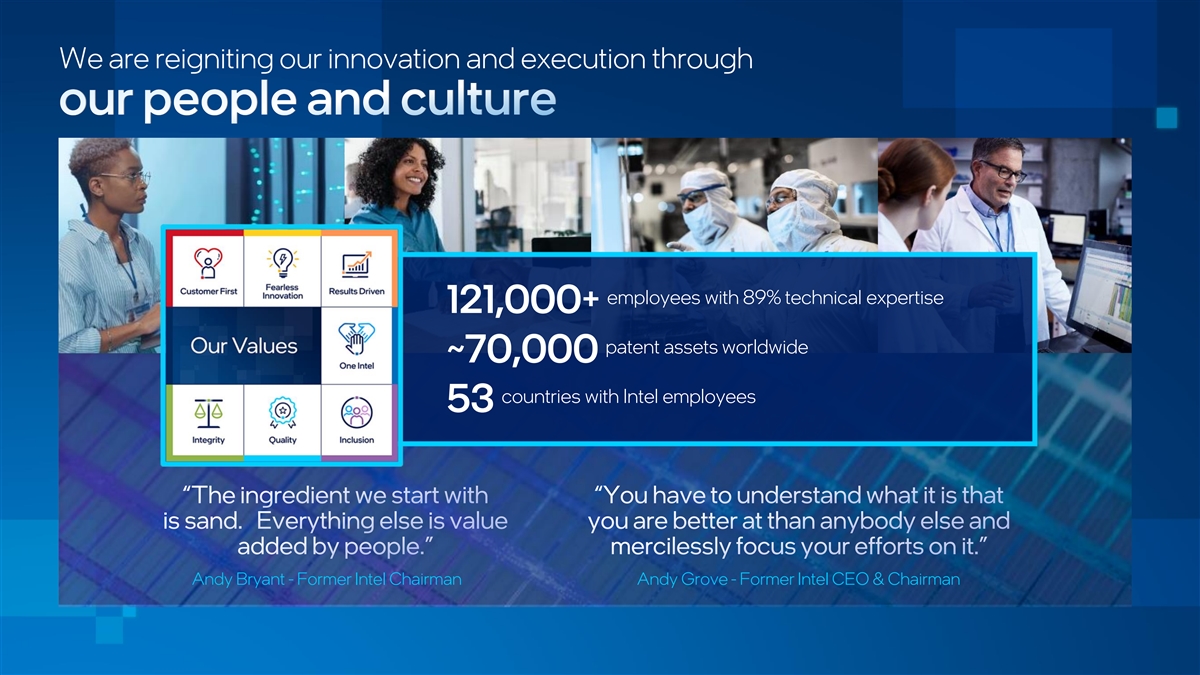
We are reigniting our innovation and execution through employees with
89% technical expertise 121,000+ patent assets worldwide ~70,000 countries with Intel employees 53 Andy Bryant - Former Intel Chairman Andy Grove - Former Intel CEO & Chairman
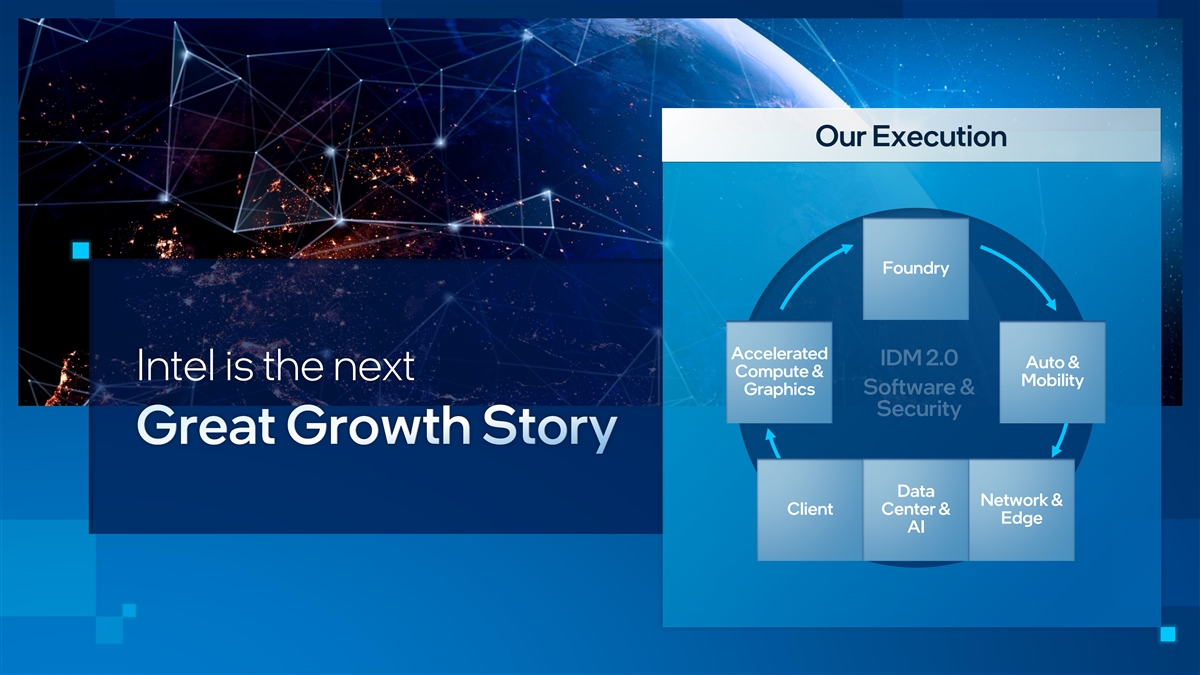
Our Execution Foundry Accelerated Auto & Compute & Intel is the
next Mobility Graphics Data Network & Client Center & Edge AI
We’re rearchitecting the company to 2020 2021 2022 2023 2024 2025
2026 Intel Revenue
With a growing market and leadership products we are CCG 2021 2022 2023
2024 2021 2026 Open Ecosystem 2021 segmentation data is preliminary and unaudited, and subject to change; final data to be provided in Intel’s future SEC filings. Revenue
P-Core E-Core New dual track roadmap with differentiated features DCAI
2021 2022 2023 2024 Ice Lake Sapphire Emerald Granite Rapids Rapids Rapids Sierra 2021 2023 2026 Forest 2021 segmentation data is preliminary and unaudited, and subject to change; final data to be provided in Intel’s future SEC filings.
Revenue
NEX was created to deliver a fully programable NEX Cloud Core Network
Devices & Data Center Network Edge Things 2021 2026 Intel® Intelligent Fabric Cloud-Native Network Edge Inference FlexRAN Open Standards and Developer Tools 2021 segmentation data is preliminary and unaudited, and subject to change; final
data to be provided in Intel’s future SEC filings. *FPGA product revenue is included in DCAI segment Revenue
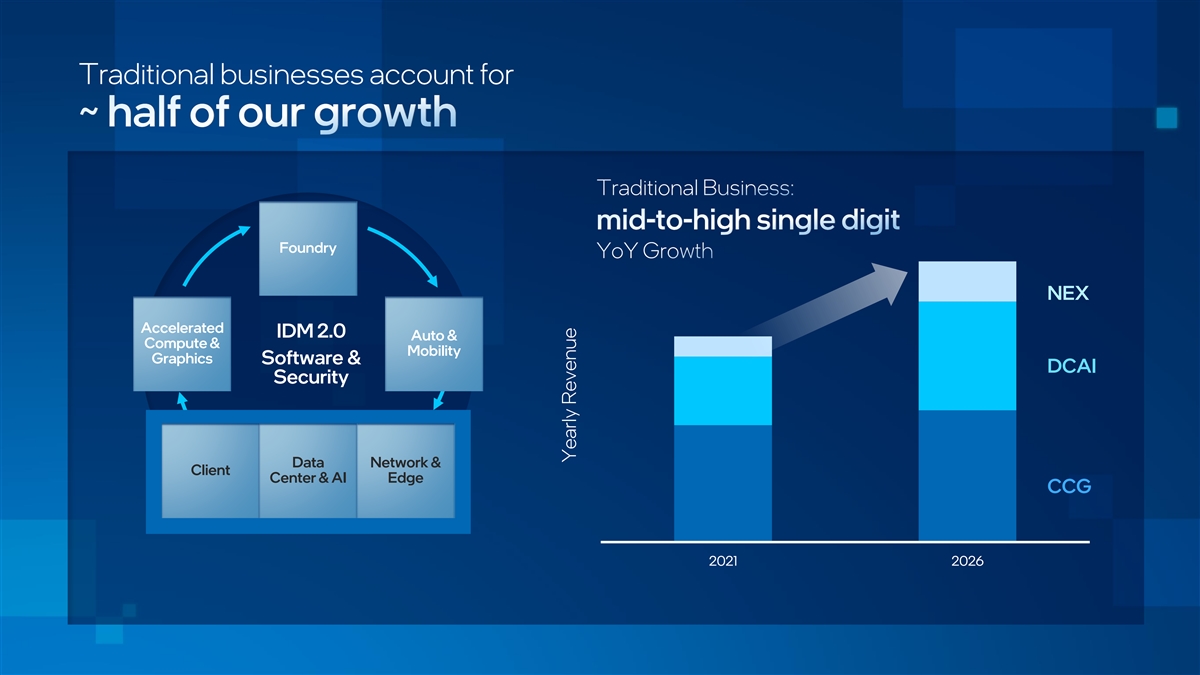
Traditional businesses account for Foundry NEX Accelerated IDM 2.0 Auto
& Compute & Mobility Graphics Software & DCAI Security Data Network & Client Center & AI Edge CCG 2021 2026 Yearly Revenue
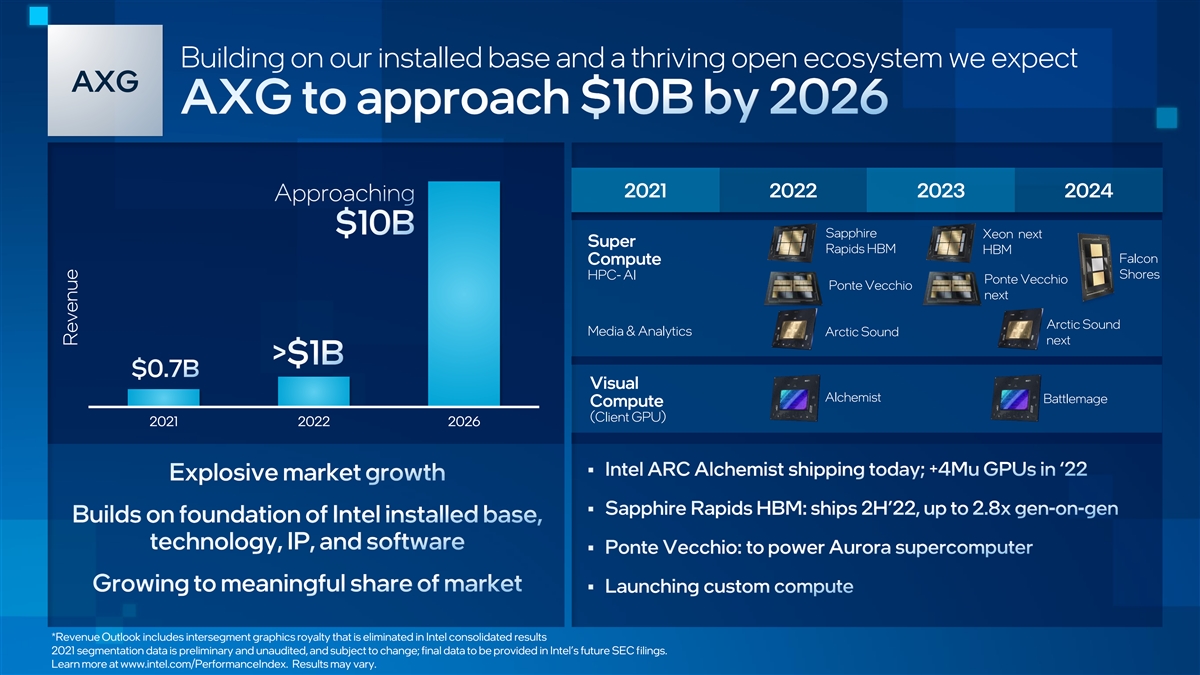
Building on our installed base and a thriving open ecosystem we expect
AXG 2021 2022 2023 2024 Sapphire Xeon next Super Rapids HBM HBM Falcon Compute Shores HPC- AI Ponte Vecchio Ponte Vecchio next Arctic Sound Media & Analytics Arctic Sound next Visual Alchemist Battlemage Compute (Client GPU) 2021 2022 2026
*Revenue Outlook includes intersegment graphics royalty that is eliminated in Intel consolidated results 2021 segmentation data is preliminary and unaudited, and subject to change; final data to be provided in Intel’s future SEC filings. Learn
more at www.intel.com/PerformanceIndex. Results may vary. Revenue
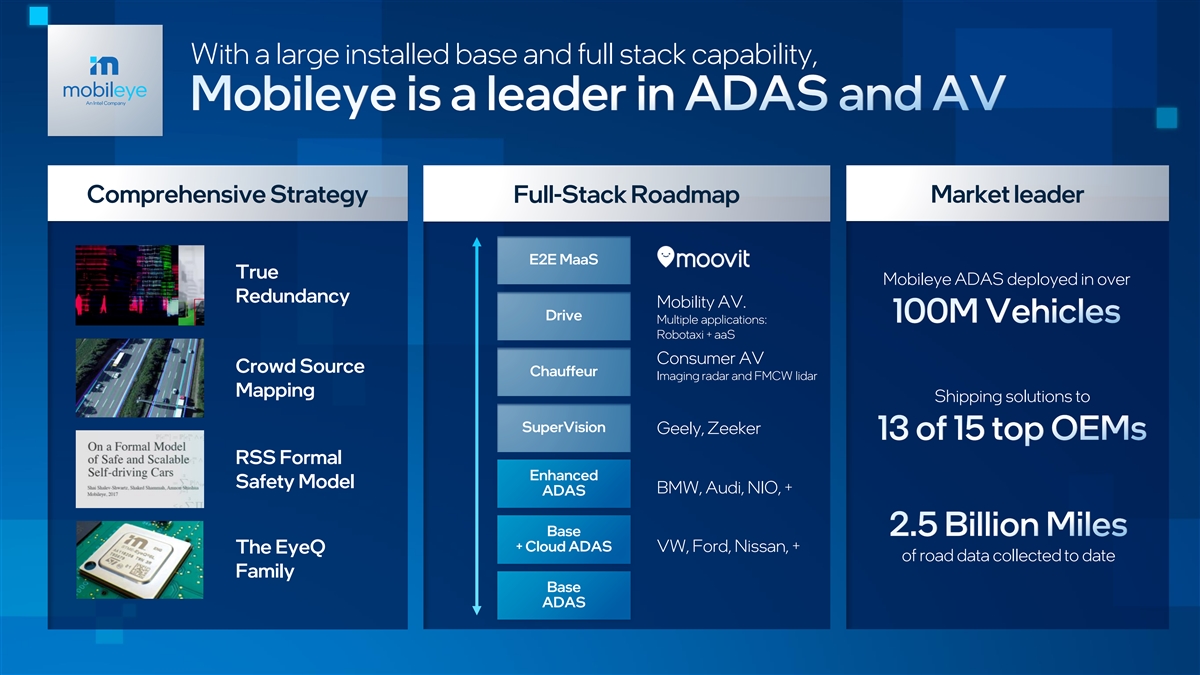
With a large installed base and full stack capability, Comprehensive
Strategy Full-Stack Roadmap Market leader E2E MaaS True Mobileye ADAS deployed in over Redundancy Mobility AV. Drive Multiple applications: Robotaxi + aaS Consumer AV Crowd Source Chauffeur Imaging radar and FMCW lidar Mapping Shipping solutions to
SuperVision Geely, Zeeker RSS Formal Enhanced Safety Model BMW, Audi, NIO, + ADAS Base + Cloud ADAS VW, Ford, Nissan, + The EyeQ of road data collected to date Family Base ADAS
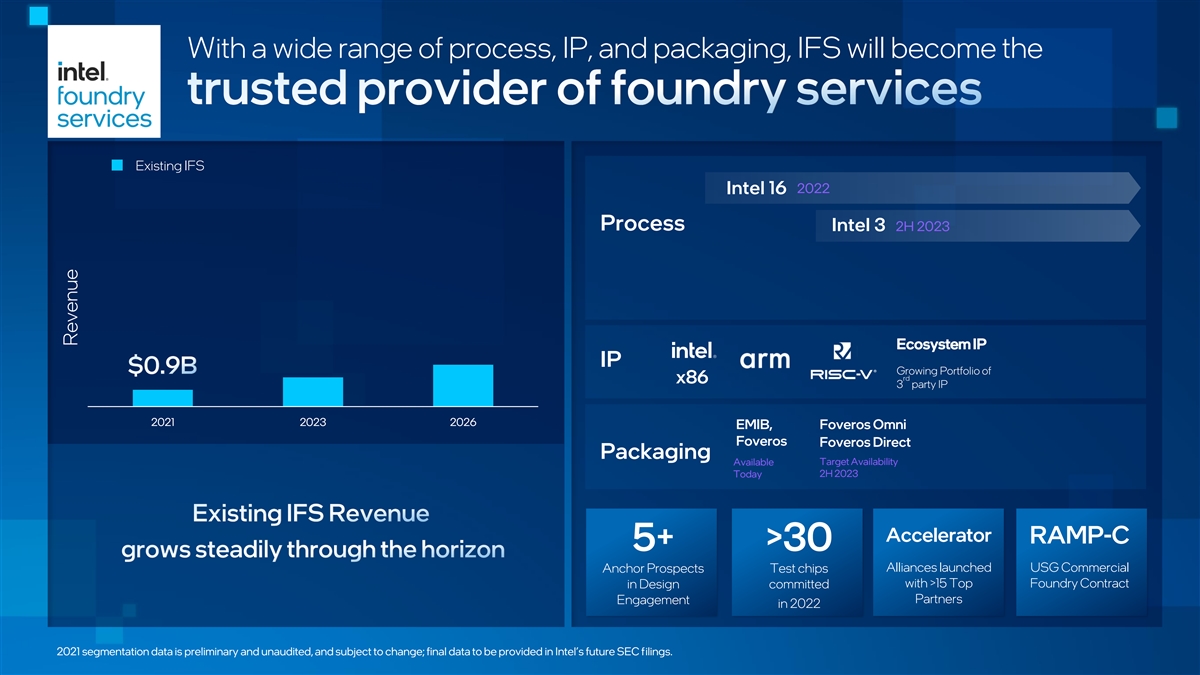
With a wide range of process, IP, and packaging, IFS will become the
Existing IFS 2022 Intel 16 Process Intel 3 2H 2023 Ecosystem IP IP Growing Portfolio of rd x86 3 party IP 2021 2023 2026 EMIB, Foveros Omni Foveros Foveros Direct Packaging Available Target Availability Today 2H 2023 Accelerator RAMP-C 5+ >30
Anchor Prospects Test chips Alliances launched USG Commercial with >15 Top Foundry Contract in Design committed Engagement Partners in 2022 2021 segmentation data is preliminary and unaudited, and subject to change; final data to be provided in
Intel’s future SEC filings. Revenue
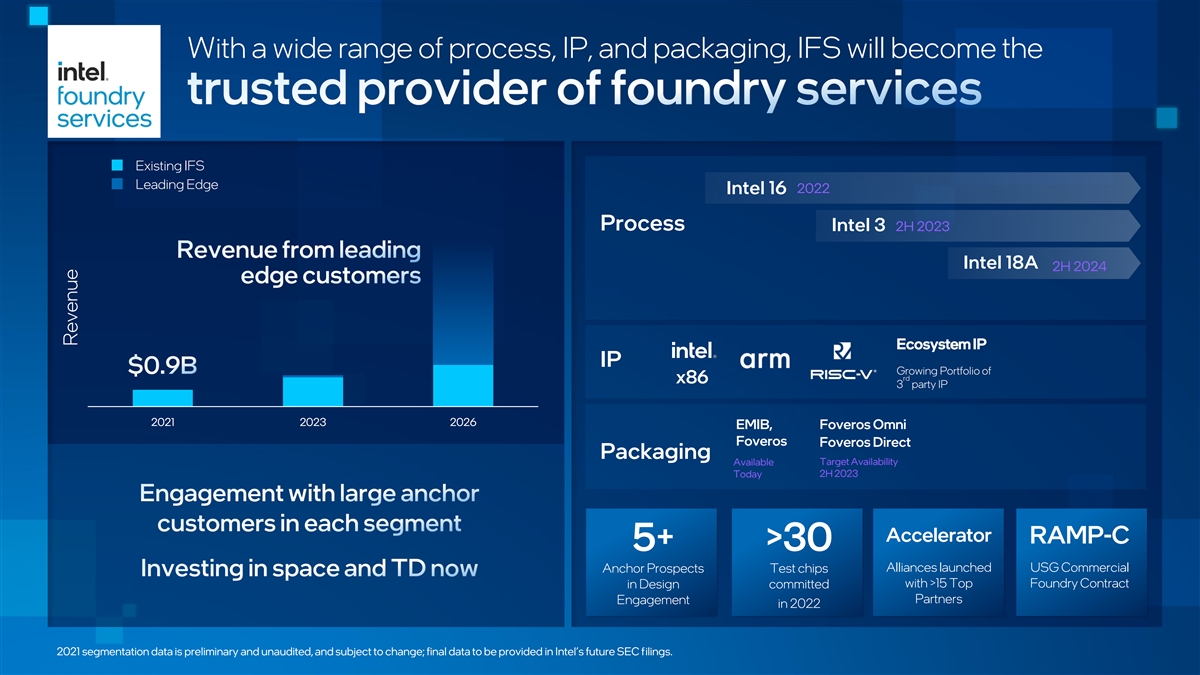
With a wide range of process, IP, and packaging, IFS will become the
Existing IFS Leading Edge 2022 Intel 16 Process Intel 3 2H 2023 Intel 18A 2H 2024 Ecosystem IP IP Growing Portfolio of rd x86 3 party IP 2021 2023 2026 EMIB, Foveros Omni Foveros Foveros Direct Packaging Available Target Availability Today 2H 2023
Accelerator RAMP-C 5+ >30 Anchor Prospects Test chips Alliances launched USG Commercial with >15 Top Foundry Contract in Design committed Engagement Partners in 2022 2021 segmentation data is preliminary and unaudited, and subject to change;
final data to be provided in Intel’s future SEC filings. Revenue
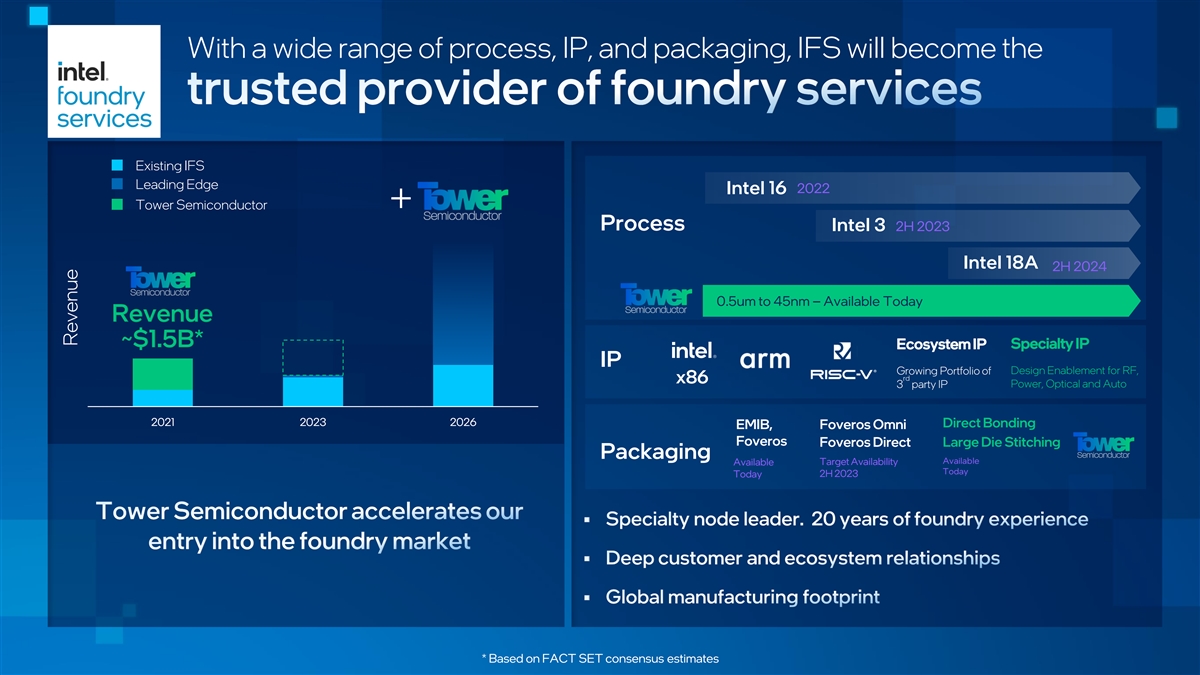
With a wide range of process, IP, and packaging, IFS will become the
Existing IFS Leading Edge 2022 Intel 16 Tower Semiconductor Process Intel 3 2H 2023 Intel 18A 2H 2024 0.5um to 45nm – Available Today Revenue ~$1.5B* Ecosystem IP Specialty IP IP Design Enablement for RF, Growing Portfolio of rd x86 Power,
Optical and Auto 3 party IP 2021 2023 2026 Direct Bonding EMIB, Foveros Omni Foveros Foveros Direct Large Die Stitching Packaging Available Available Target Availability Today Today 2H 2023 * Based on FACT SET consensus estimates Revenue
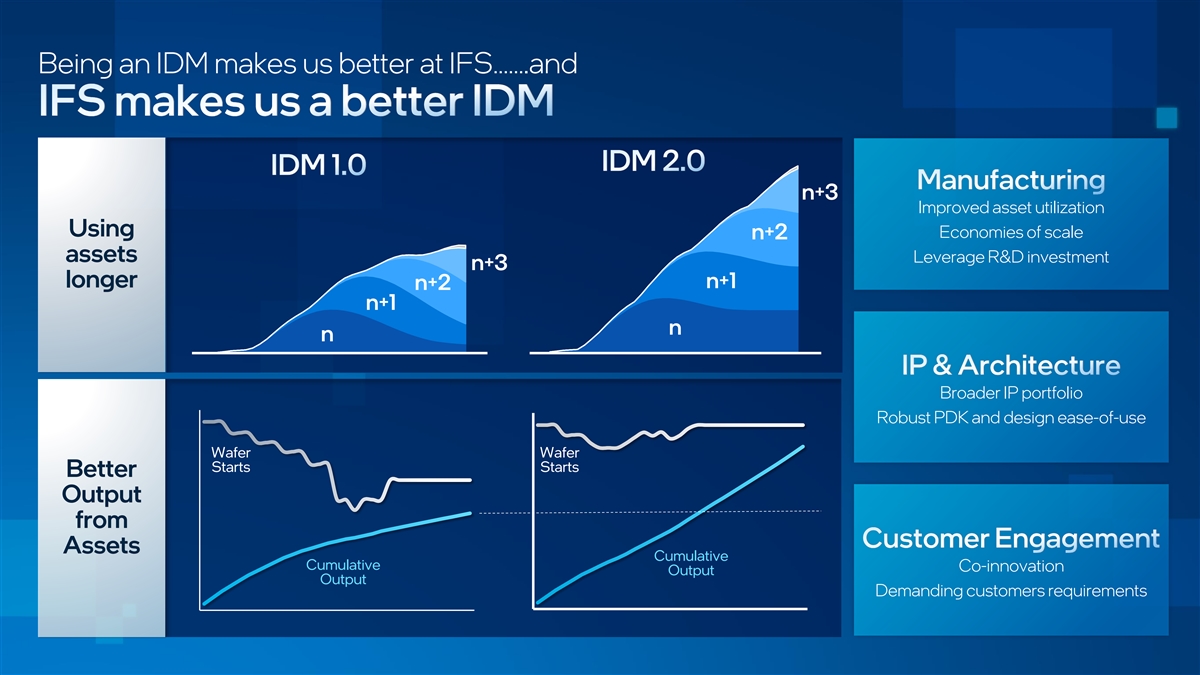
Being an IDM makes us better at IFS…….and n+3 Improved
asset utilization Using Economies of scale n+2 assets Leverage R&D investment n+3 longer n+1 n+2 n+1 n n Broader IP portfolio Robust PDK and design ease-of-use Wafer Wafer Starts Starts Better Output from Assets Cumulative Cumulative
Co-innovation Output Output Demanding customers requirements
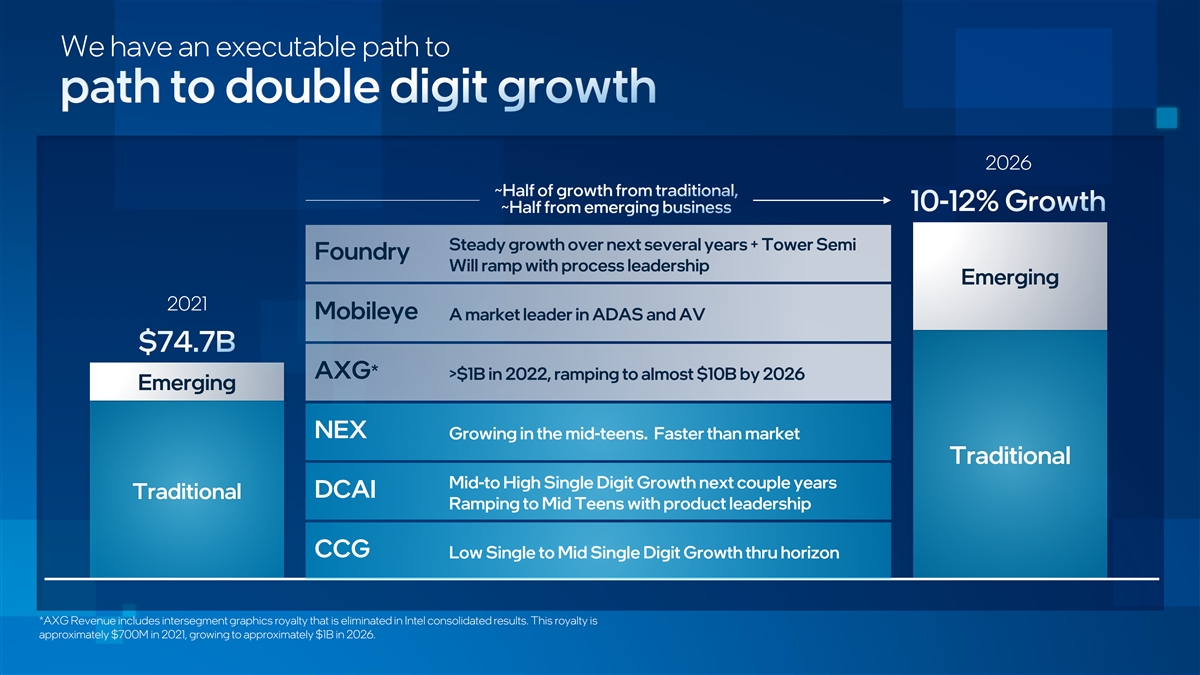
We have an executable path to 2026 Steady growth over next several
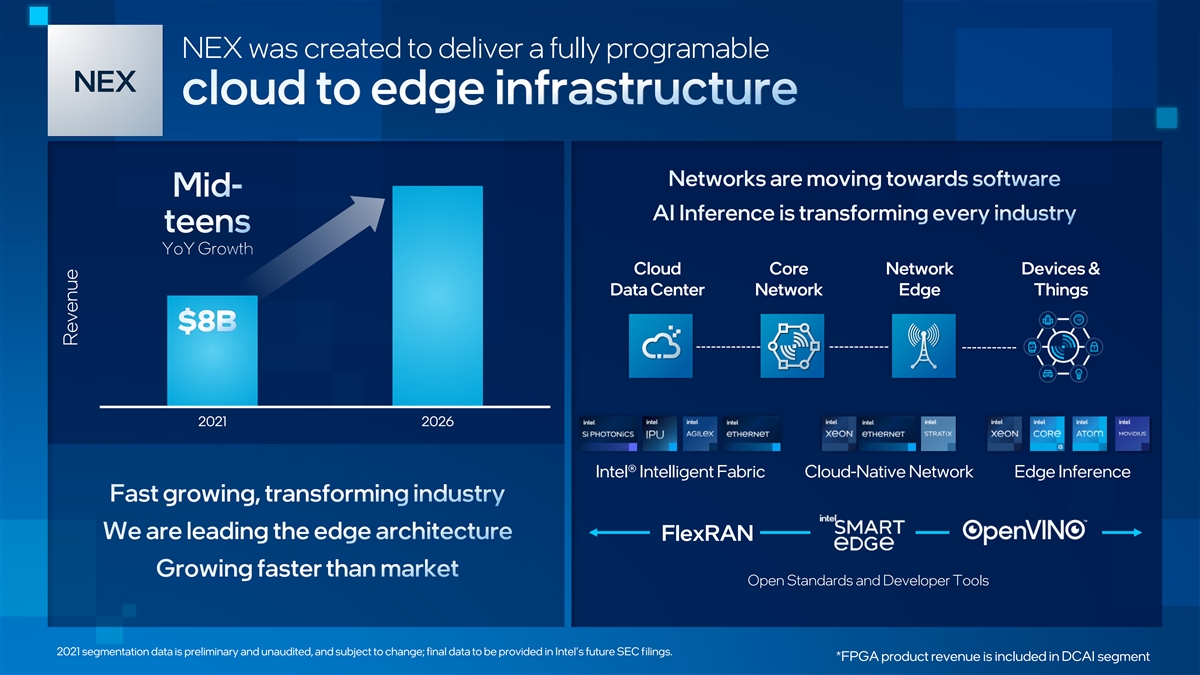
years + Tower Semi Foundry Will ramp with process leadership Emerging 2021 Mobileye A market leader in ADAS and AV AXG* >$1B in 2022, ramping to almost $10B by 2026 Emerging NEX Growing in the mid-teens. Faster than market Traditional Mid-to High
Single Digit Growth next couple years DCAI Traditional Ramping to Mid Teens with product leadership CCG Low Single to Mid Single Digit Growth thru horizon *AXG Revenue includes intersegment graphics royalty that is eliminated in Intel consolidated
results. This royalty is approximately $700M in 2021, growing to approximately $1B in 2026.
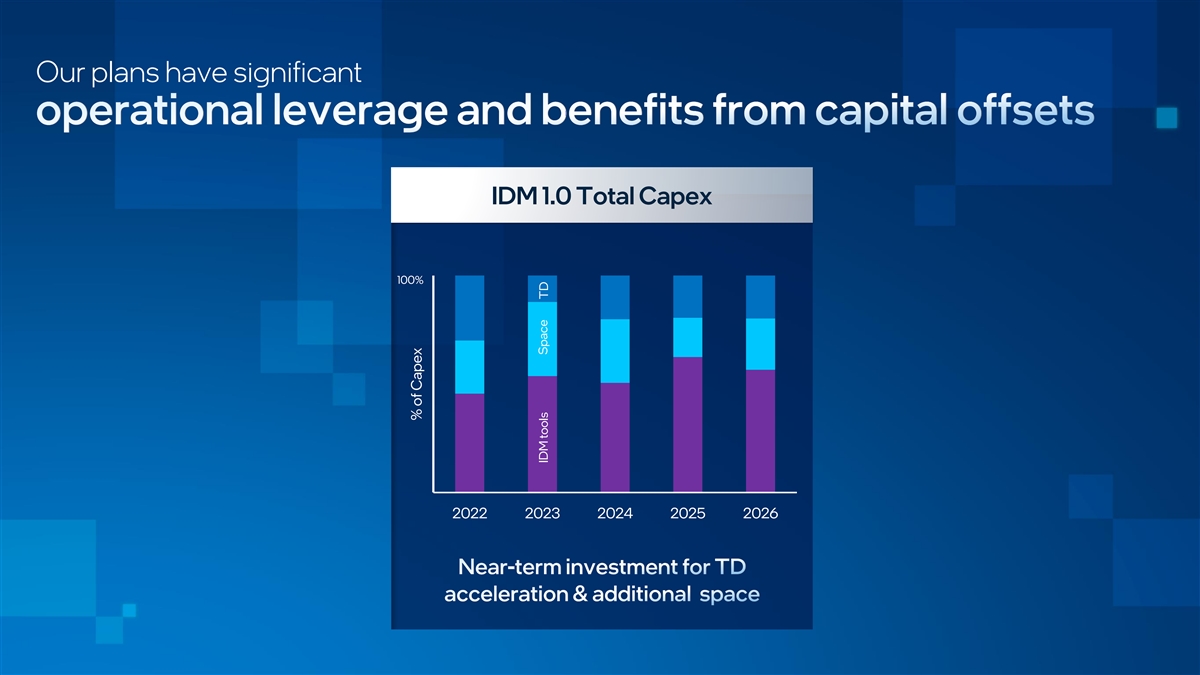
Our plans have significant IDM 1.0 Total Capex 100% 2022 2023 2024 2025
2026 % of Capex IDM tools Space TD
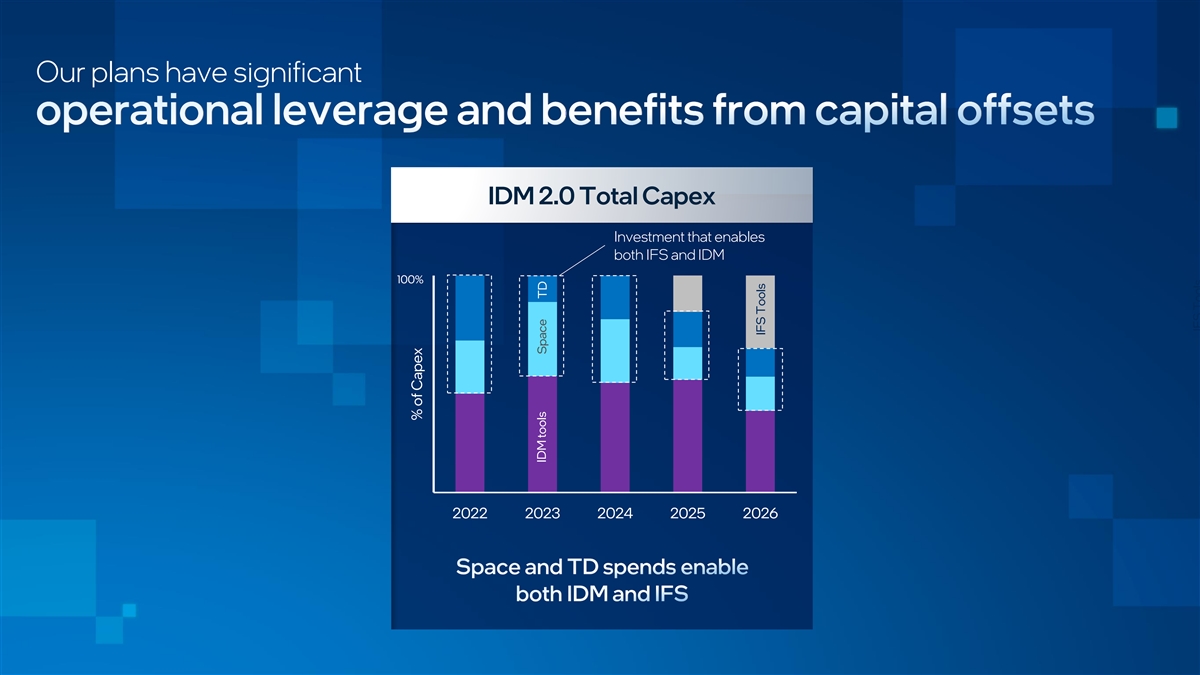
Our plans have significant IDM 2.0 Total Capex Investment that enables
both IFS and IDM 100% 2022 2023 2024 2025 2026 % of Capex IDM tools Space TD IFS Tools IFS Tools
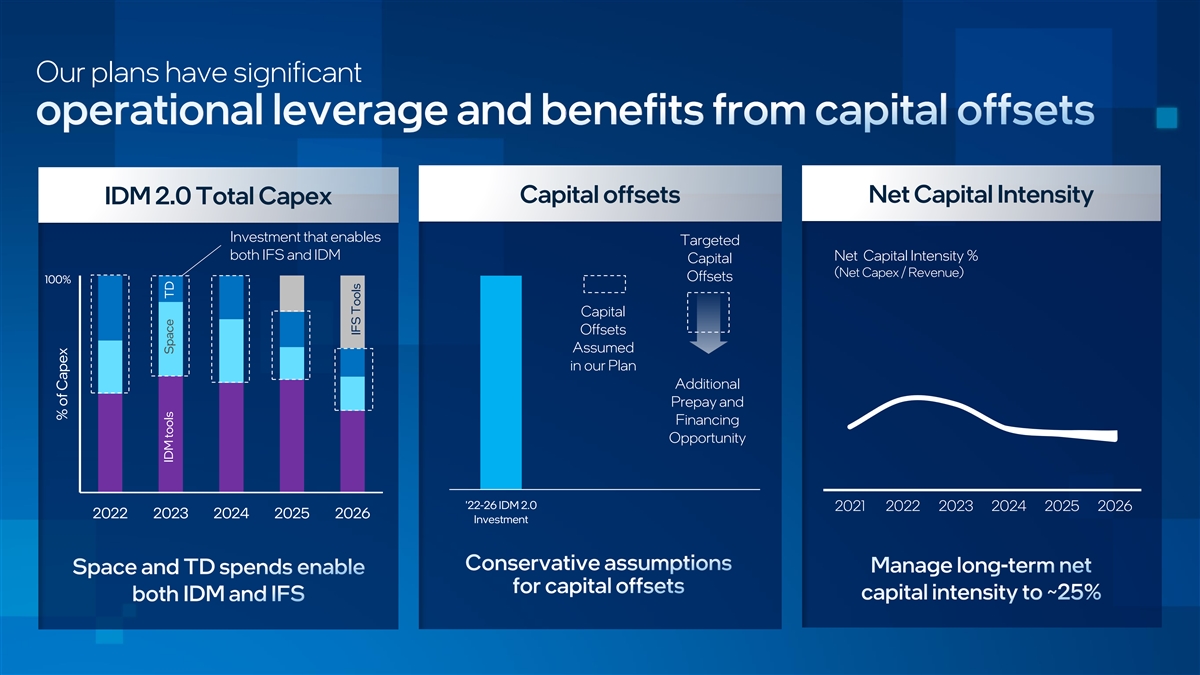
Our plans have significant Capital offsets Net Capital Intensity IDM
2.0 Total Capex Investment that enables Targeted both IFS and IDM Net Capital Intensity % Capital (Net Capex / Revenue) Offsets 100% Capital Offsets Assumed in our Plan Additional Prepay and Financing Opportunity '22-26 IDM 2.0 2021 2022 2023 2024
2025 2026 2022 2023 2024 2025 2026 Investment % of Capex IDM tools Space TD IFS Tools
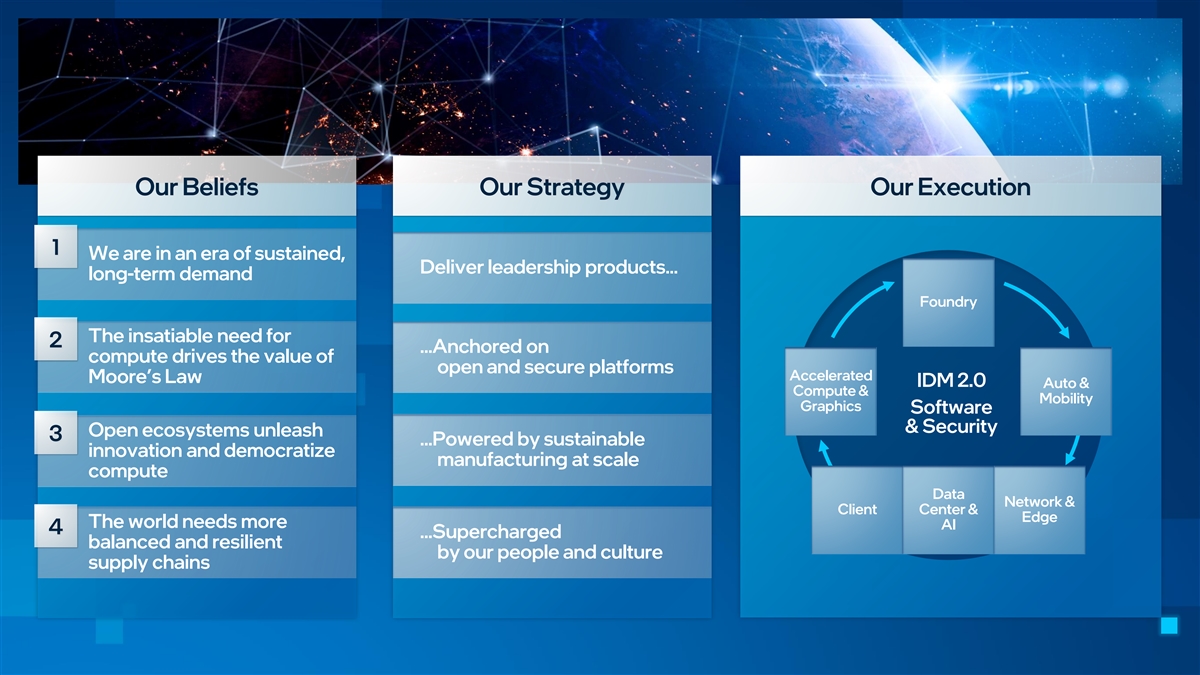
Our Beliefs Our Strategy Our Execution 1 We are in an era of sustained,
Deliver leadership products… long-term demand Foundry The insatiable need for 2 …Anchored on compute drives the value of open and secure platforms Accelerated Moore’s Law IDM 2.0 Auto & Compute & Mobility Graphics Software
& Security Open ecosystems unleash 3 …Powered by sustainable innovation and democratize manufacturing at scale compute Data Network & Client Center & Edge The world needs more AI 4 …Supercharged balanced and resilient by our
people and culture supply chains
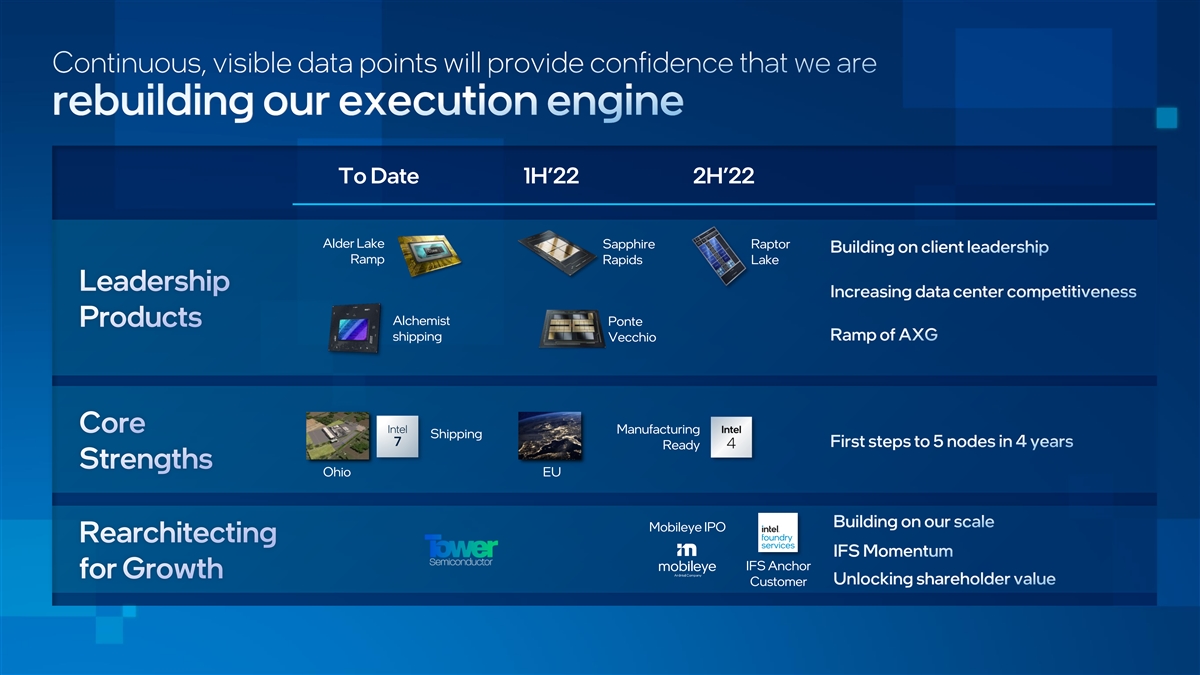
To Date 1H’22 2H’22 Alder Lake Sapphire Raptor Ramp Rapids
Lake Alchemist Ponte shipping Vecchio Intel Manufacturing Shipping 7 Ready Ohio EU Mobileye IPO IFS Anchor Customer
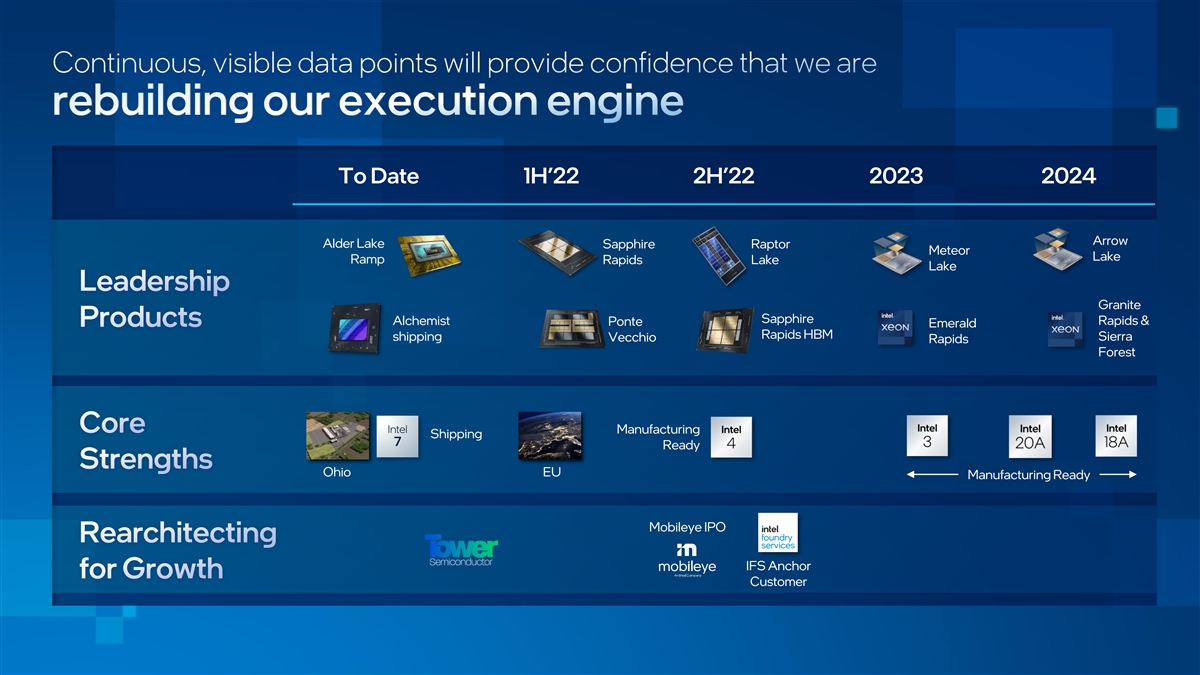
To Date 1H’22 2H’22 2023 2024 Arrow Alder Lake Sapphire
Raptor Meteor Lake Ramp Rapids Lake Lake Granite Sapphire Alchemist Rapids & Ponte Emerald Rapids HBM shipping Vecchio Sierra Rapids Forest Intel Manufacturing Shipping 7 Ready Ohio EU Manufacturing Ready Mobileye IPO IFS Anchor
Customer
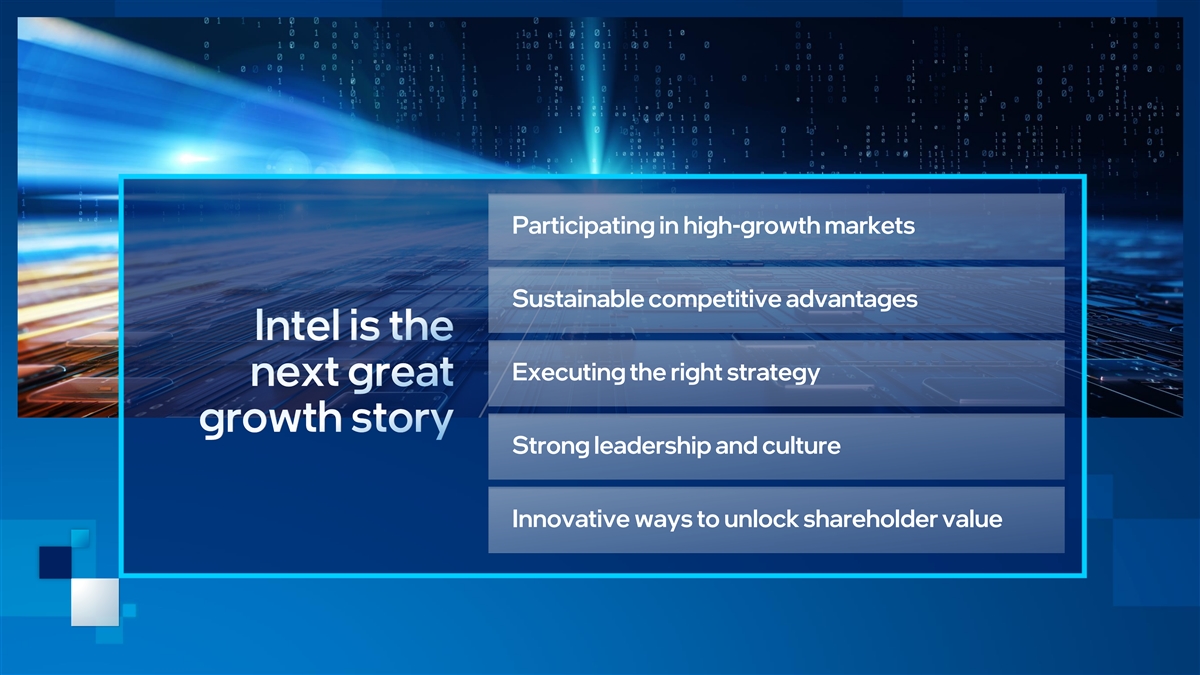
Participating in high-growth markets Sustainable competitive advantages
Executing the right strategy Strong leadership and culture Innovative ways to unlock shareholder value
Exhibit 99.3 Future node performance and other metrics, including power
and density, are projections and are inherently uncertain and, in the case of other industry nodes, are derived from or estimated based on publicly available information. Intel’s node numbers do not represent the actual dimension of any
physical feature on a transistor or structure. They also do not pinpoint a specific level of improvement in performance, power or area, and the magnitude of a decrease from one node number to the next is not necessarily proportionate to the level of
improvement in one or more metrics. Historically, new Intel node numbers were based solely on improvements in area/density; now, node numbers generally reflect a holistic assessment of improvement across metrics and can be based on improvement in
one or more of performance, power, area, or other important factors, or a combination, and will not necessarily be based on area/density improvement alone. Non-GAAP Financial Measures. This presentation contains non-GAAP financial measures. Intel
gross margin and earnings per share, as well as Intel revenue for fiscal years 2021 and earlier, are presented on a non-GAAP basis unless otherwise indicated. This presentation also includes a non-GAAP free cash flow (FCF) measure. The appendix to
these materials available at www.intc.com provides a reconciliation of these measures to the most directly comparable GAAP financial measure. The non-GAAP financial measures disclosed by Intel should not be considered a substitute for, or superior
to, the financial measures prepared in accordance with GAAP. Forward-Looking Statements. Statements in this presentation that refer to business outlook, plans, and expectations are forward-looking statements that involve risks and uncertainties.
Words such as anticipate, expect, intend, goal, plans, believe, seek, estimate, continue,“ “committed,” “on-track,” ”positioned,” “ramp,” “momentum,” “roadmap,”
“path,” “pipeline,” “progress,” “schedule,” “forecast,” “likely,” “guide,” “potential,” “next gen,” “future,” may, will,
“would,” should, “could,” strategy, accelerate, cadence, deliver, and variations of such words and similar expressions are intended to identify such forward-looking statements. Statements that refer to or are based on
estimates, forecasts, projections, uncertain events, or assumptions also identify forward-looking statements. Forward-looking statements in this presentation include: statements relating to Intel’s strategy and its anticipated benefits;
Intel's process and packaging technology roadmap and schedules; innovation cadence; business plans; financial projections and expectations; total addressable market (TAM) and market opportunity; manufacturing expansion, financing, and investment
plans; future manufacturing capacity; future technology, services, and products and the expected benefits and availability of such technologies, services, and products, including PowerVia and RibbonFET technologies, future process nodes, and other
technologies and products; product and manufacturing plans, goals, timelines, ramps, progress, and future product and process leadership and performance; future economic conditions; future impacts of the COVID-19 pandemic; plans and goals related to
Intel’s foundry business; future legislation; future capital offsets; pending or future transactions; the proposed Mobileye IPO; the memorandum of understanding with Brookfield; supply expectations including regarding industry shortages;
future external foundry usage; future use of EUV and other manufacturing tools and technologies; expectations regarding customers, including designs, wins, orders, and partnerships; projections regarding competitors; ESG goals; and anticipated
trends in our businesses or the markets relevant to them, including future demand, market share, industry growth, and technology trends, also identify forward-looking statements. Such statements involve many risks and uncertainties that could cause
actual results to differ materially from those expressed or implied in these forward-looking statements. Important factors that could cause actual results to differ materially are set forth in Intel's earnings release dated January 26, 2022, which
is included as an exhibit to Intel’s Form 8-K furnished to the SEC on such date, and in Intel's SEC filings, including the company's most recent reports on Forms 10-K and 10-Q. Copies of Intel’s SEC filings may be obtained by visiting
our Investor Relations website at www.intc.com or the SEC's website at www.sec.gov. All information in this presentation reflects management’s views as of February 17, 2022, unless an earlier date is indicated. Intel does not undertake, and
expressly disclaims any duty, to update any statement made in this presentation, whether as a result of new information, new developments or otherwise, except to the extent that disclosure may be required by law. Intel technologies may require
enabled hardware, software or service activation. No product or component can be absolutely secure. Your costs and results may vary. Product and process performance varies by use, configuration and other factors. Learn more at
www.Intel.com/PerformanceIndex and www.Intel.com/ProcessInnovation. Future product and process performance and other metrics are projections and are inherently uncertain. © Intel Corporation. Intel, the Intel logo, and other Intel marks are
trademarks of Intel Corporation or its subsidiaries. Other names and brands may be claimed as the property of others.
Investor Meeting 2022
Investor Meeting 2022 Executive Vice President General Manager,
Datacenter & AI Group
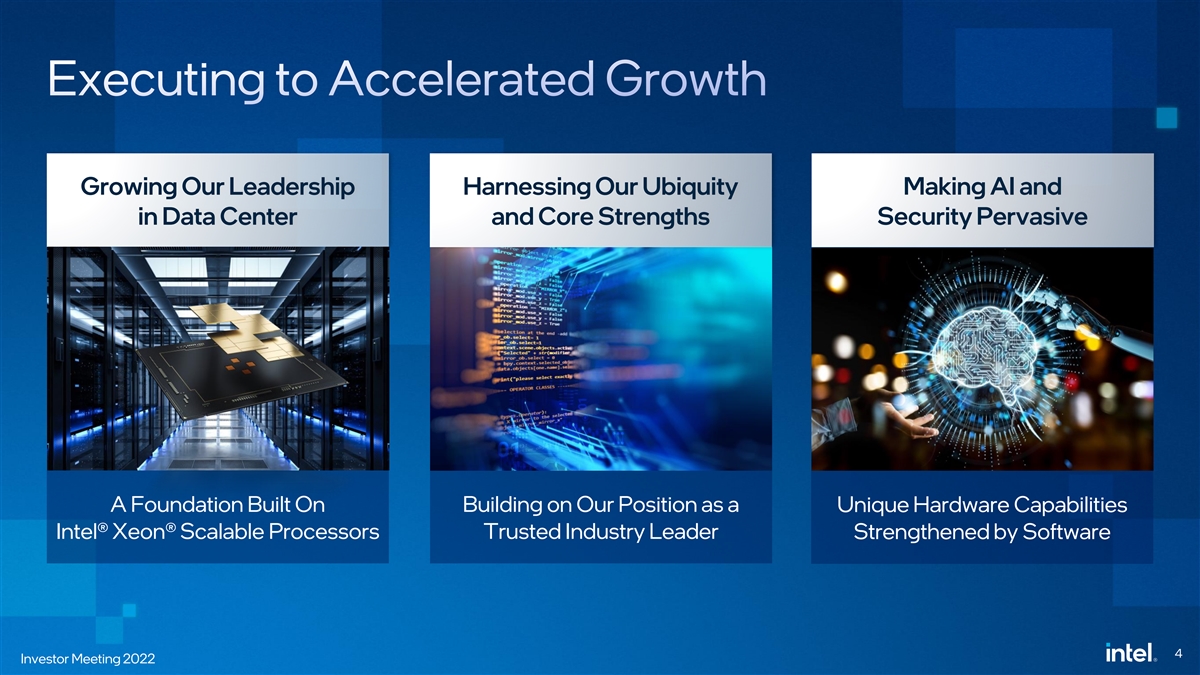
Growing Our Leadership Harnessing Our Ubiquity Making AI and in Data
Center and Core Strengths Security Pervasive A Foundation Built On Building on Our Position as a Unique Hardware Capabilities Intel® Xeon® Scalable Processors Trusted Industry Leader Strengthened by Software 4 Investor Meeting
2022
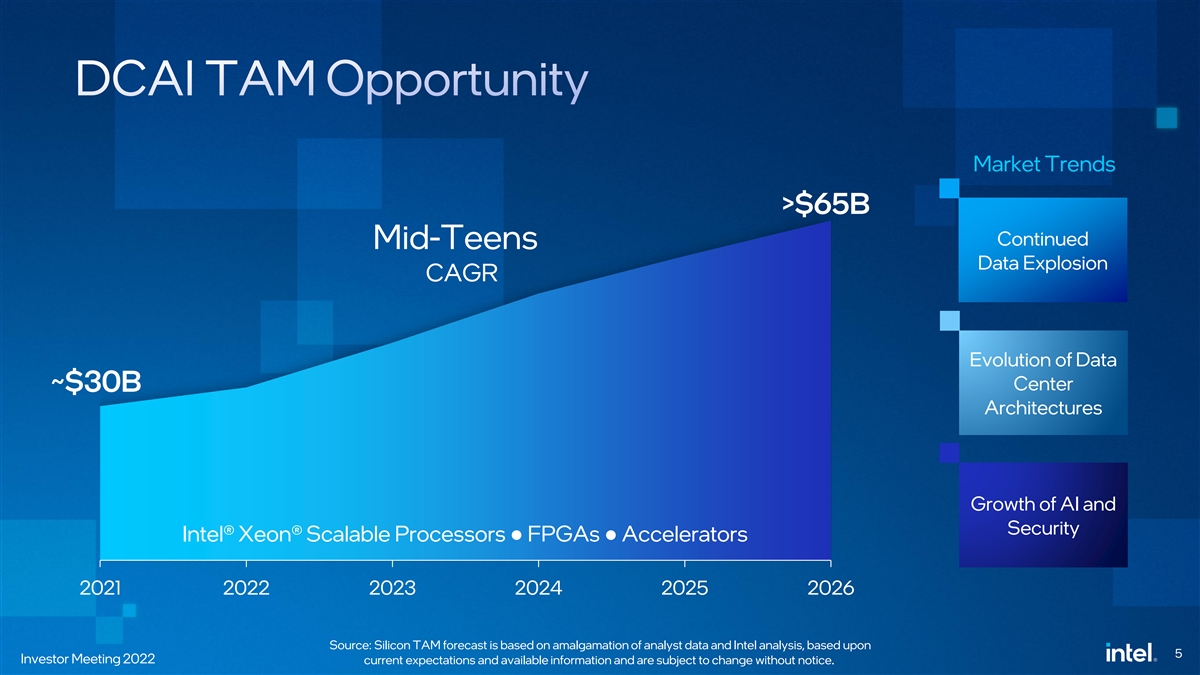
Market Trends >$65B Continued Mid-Teens Data Explosion CAGR Evolution
of Data Center ~$30B Architectures Growth of AI and Security Intel® Xeon® Scalable Processors ● FPGAs ● Accelerators 2021 2022 2023 2024 2025 2026 Source: Silicon TAM forecast is based on amalgamation of analyst data and Intel
analysis, based upon 5 Investor Meeting 2022 current expectations and available information and are subject to change without notice.
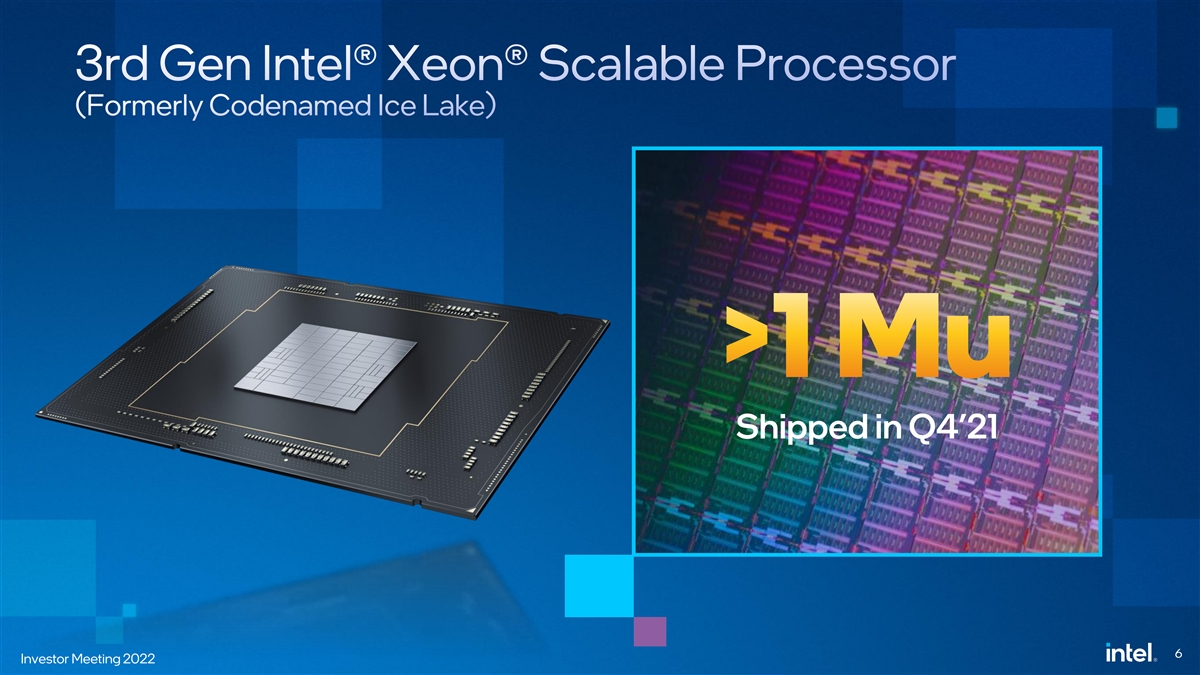
Shipped in Q4’21 6 Investor Meeting 2022
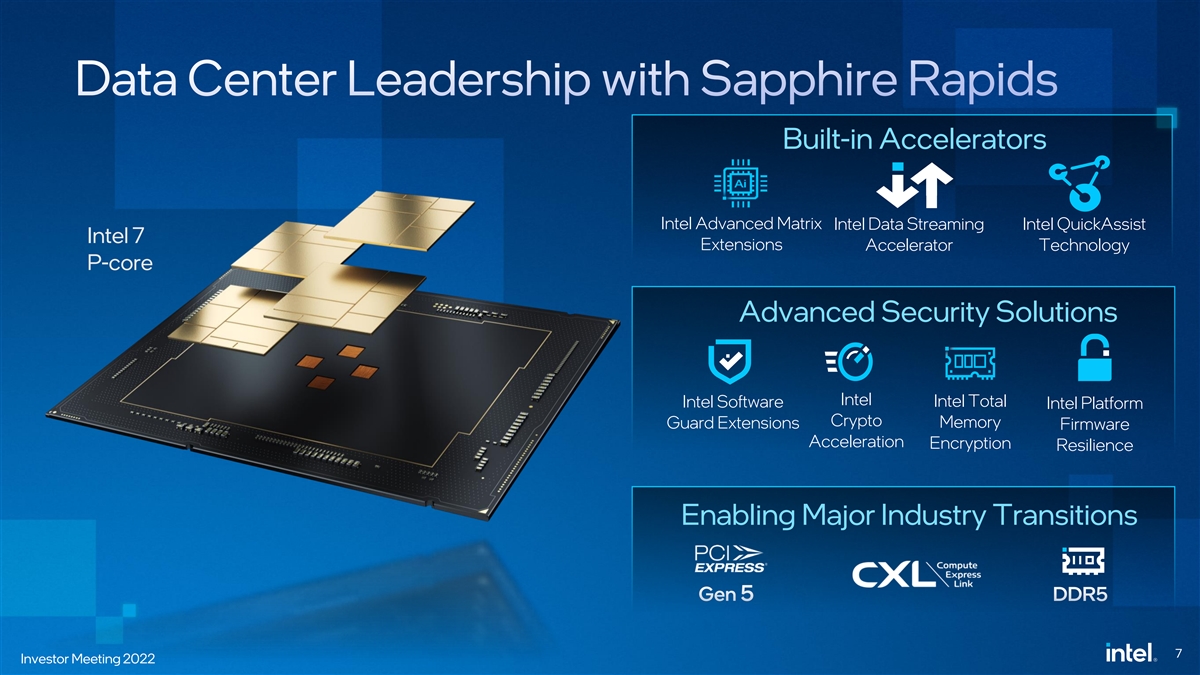
Built-in Accelerators Intel Advanced Matrix Intel Data Streaming Intel
QuickAssist Intel 7 Extensions Accelerator Technology P-core Advanced Security Solutions Intel Intel Software Intel Total Intel Platform Crypto Memory Guard Extensions Firmware Acceleration Encryption Resilience Enabling Major Industry Transitions 7
Investor Meeting 2022
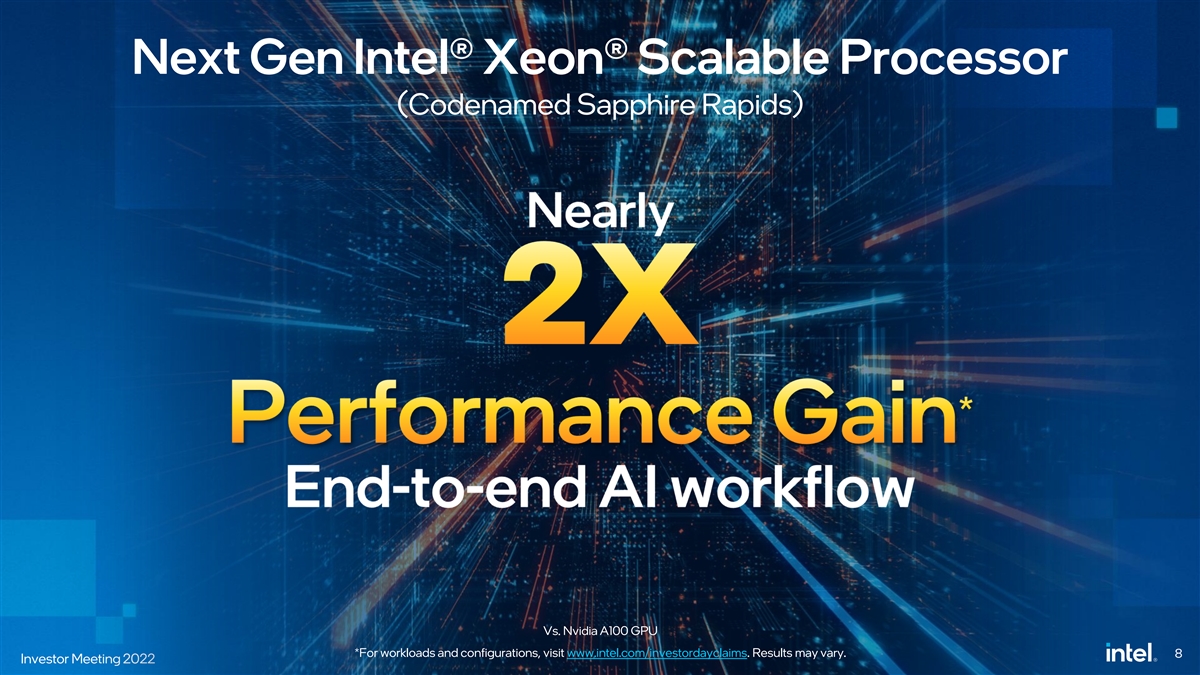
Next Gen Intel® Xeon® Scalable Processor (Codenamed Sapphire
Rapids) Vs. Nvidia A100 GPU *For workloads and configurations, visit www.intel.com/investordayclaims. Results may vary. 8 Investor Meeting 2022
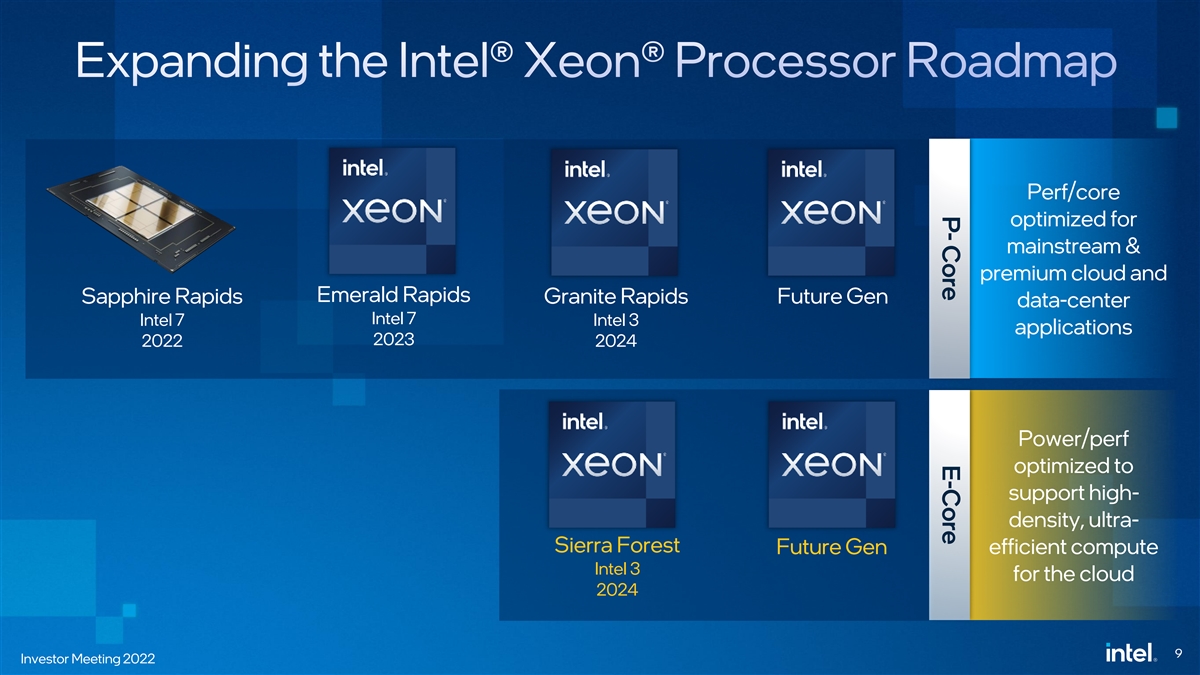
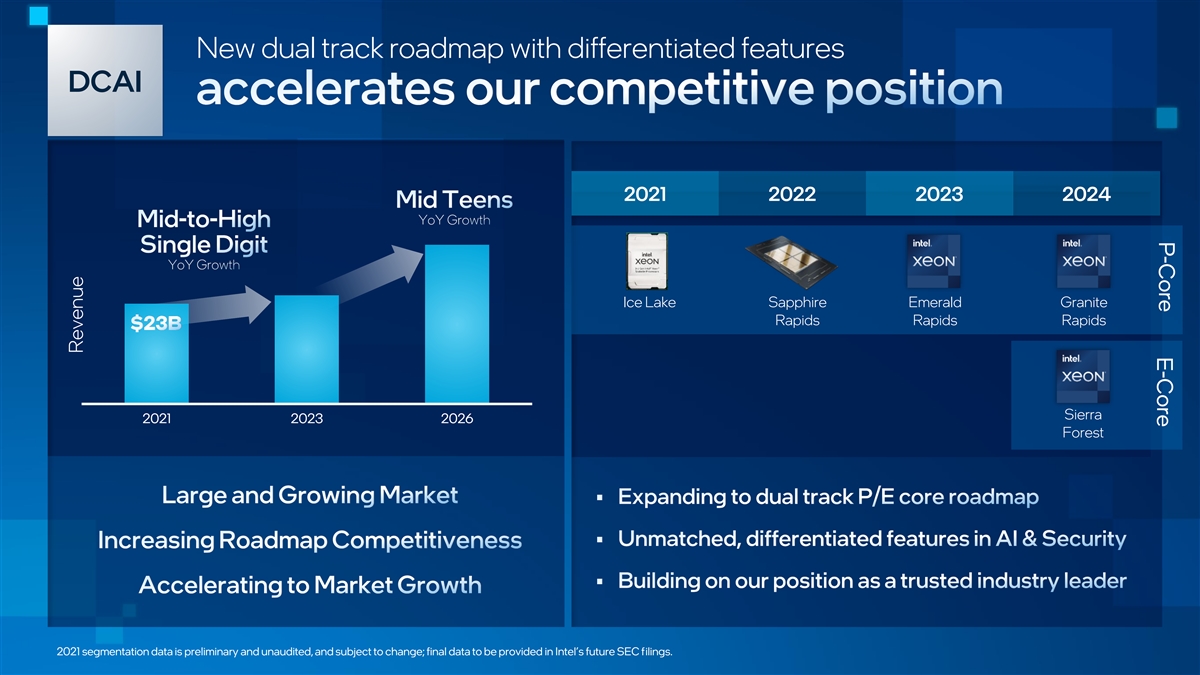
P- Core E-Core Perf/core optimized for mainstream & premium cloud
and Emerald Rapids Sapphire Rapids Granite Rapids Future Gen data-center Intel 7 Intel 7 Intel 3 applications 2023 2022 2024 Power/perf optimized to support high- density, ultra- Sierra Forest efficient compute Future Gen Intel 3 for the cloud 2024
9 Investor Meeting 2022
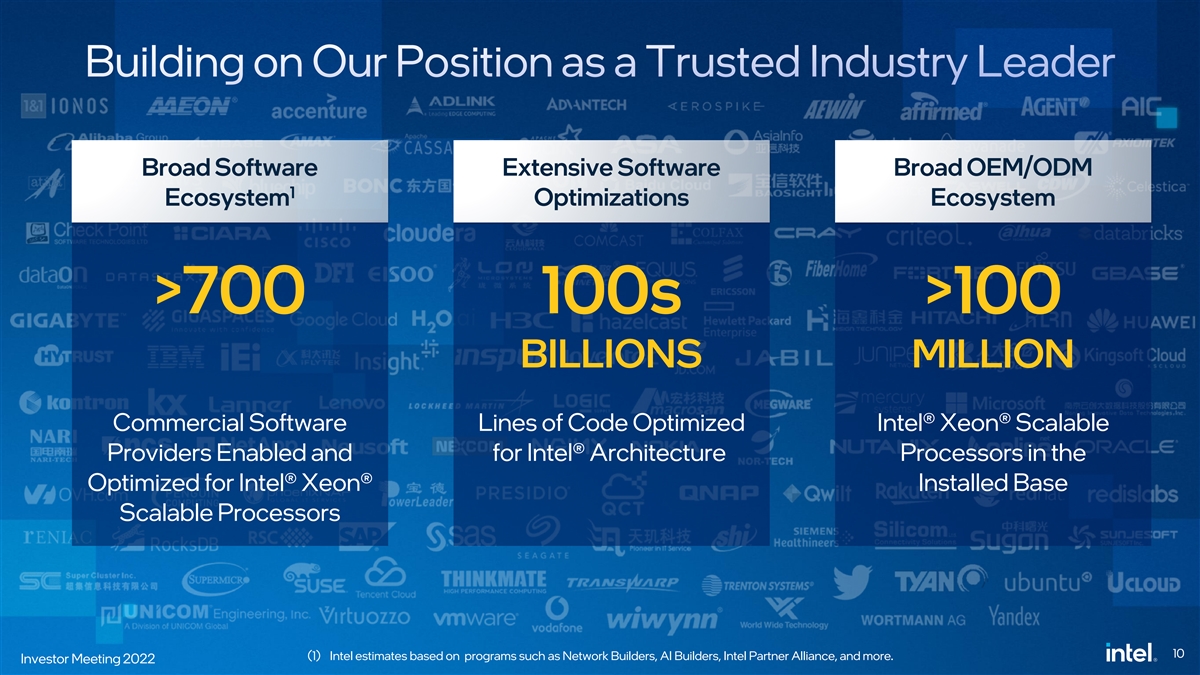
Broad Software Extensive Software Broad OEM/ODM 1 Ecosystem
Optimizations Ecosystem >700 100s >100 BILLIONS MILLION Commercial Software Lines of Code Optimized Intel® Xeon® Scalable Providers Enabled and for Intel® Architecture Processors in the Optimized for Intel® Xeon®
Installed Base Scalable Processors 10 (1) Intel estimates based on programs such as Network Builders, AI Builders, Intel Partner Alliance, and more. Investor Meeting 2022
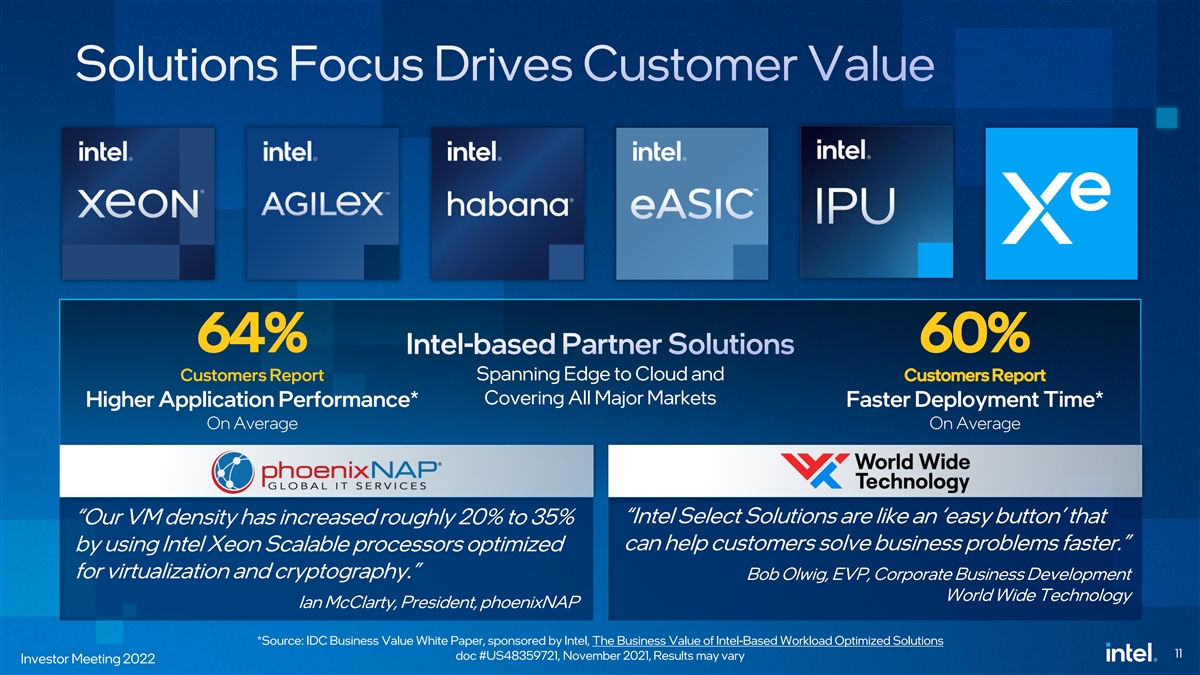
64% 60% Spanning Edge to Cloud and Customers Report Customers Report
Covering All Major Markets Higher Application Performance* Faster Deployment Time* On Average On Average “Intel Select Solutions are like an ‘easy button’ that “Our VM density has increased roughly 20% to 35% can help
customers solve business problems faster.” by using Intel Xeon Scalable processors optimized for virtualization and cryptography.” Bob Olwig, EVP, Corporate Business Development World Wide Technology Ian McClarty, President, phoenixNAP
*Source: IDC Business Value White Paper, sponsored by Intel, The Business Value of Intel-Based Workload Optimized Solutions 11 doc #US48359721, November 2021, Results may vary Investor Meeting 2022
12 Investor Meeting 2022
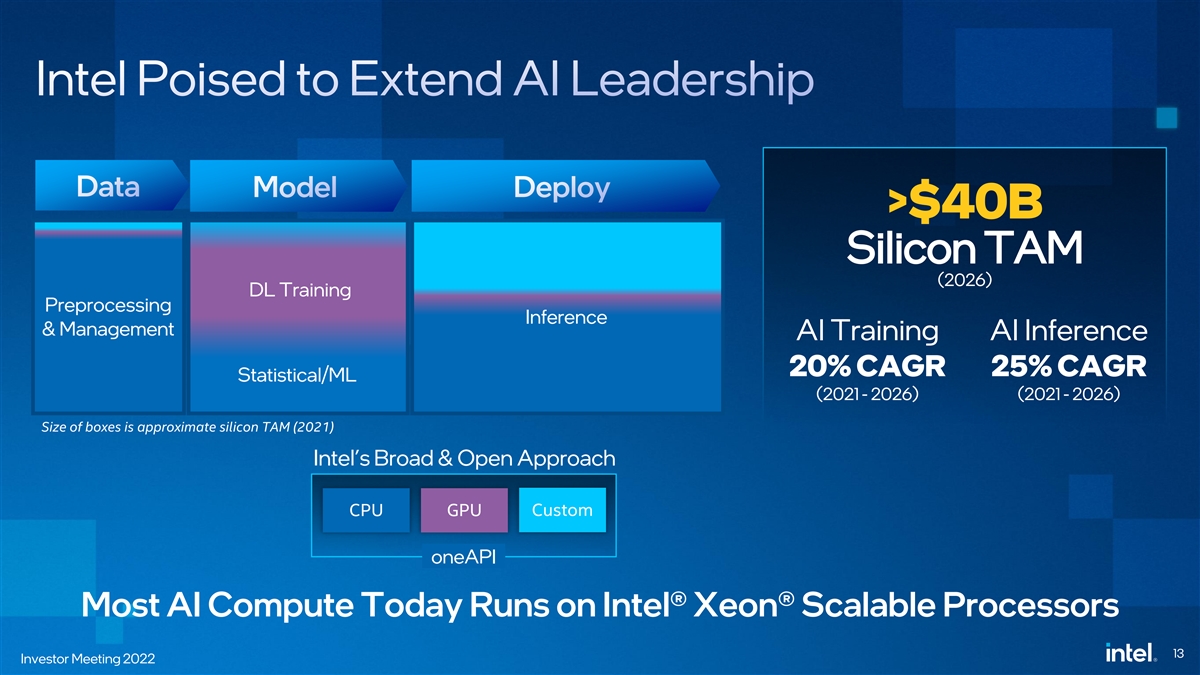
>$40B Silicon TAM (2026) DL Training Preprocessing Inference &
Management AI Training AI Inference 20% CAGR 25% CAGR Statistical/ML (2021 - 2026) (2021 - 2026) Size of boxes is approximate silicon TAM (2021) Intel’s Broad & Open Approach CPU GPU Custom oneAPI Most AI Compute Today Runs on Intel®
Xeon® Scalable Processors 13 Investor Meeting 2022
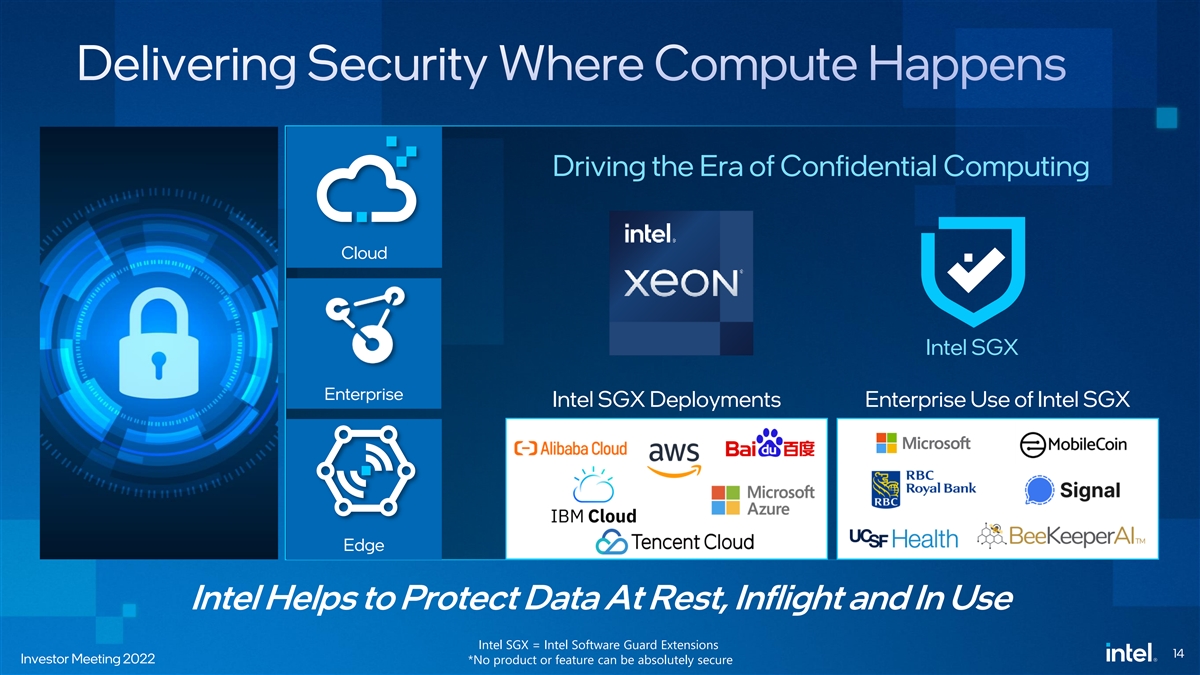
Driving the Era of Confidential Computing Cloud Intel SGX Enterprise
Intel SGX Deployments Enterprise Use of Intel SGX Edge Intel Helps to Protect Data At Rest, Inflight and In Use Intel SGX = Intel Software Guard Extensions 14 Investor Meeting 2022 *No product or feature can be absolutely secure
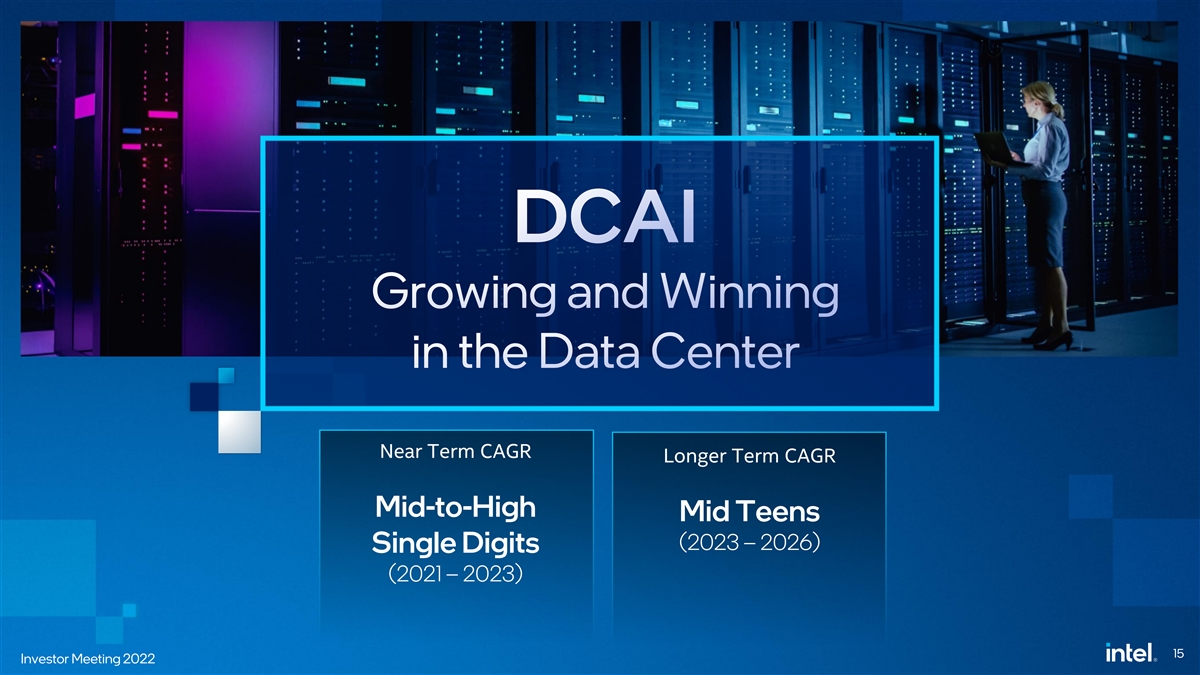
Near Term CAGR Longer Term CAGR Mid-to-High Mid Teens (2023 –
2026) Single Digits (2021 – 2023) 15 Investor Meeting 2022
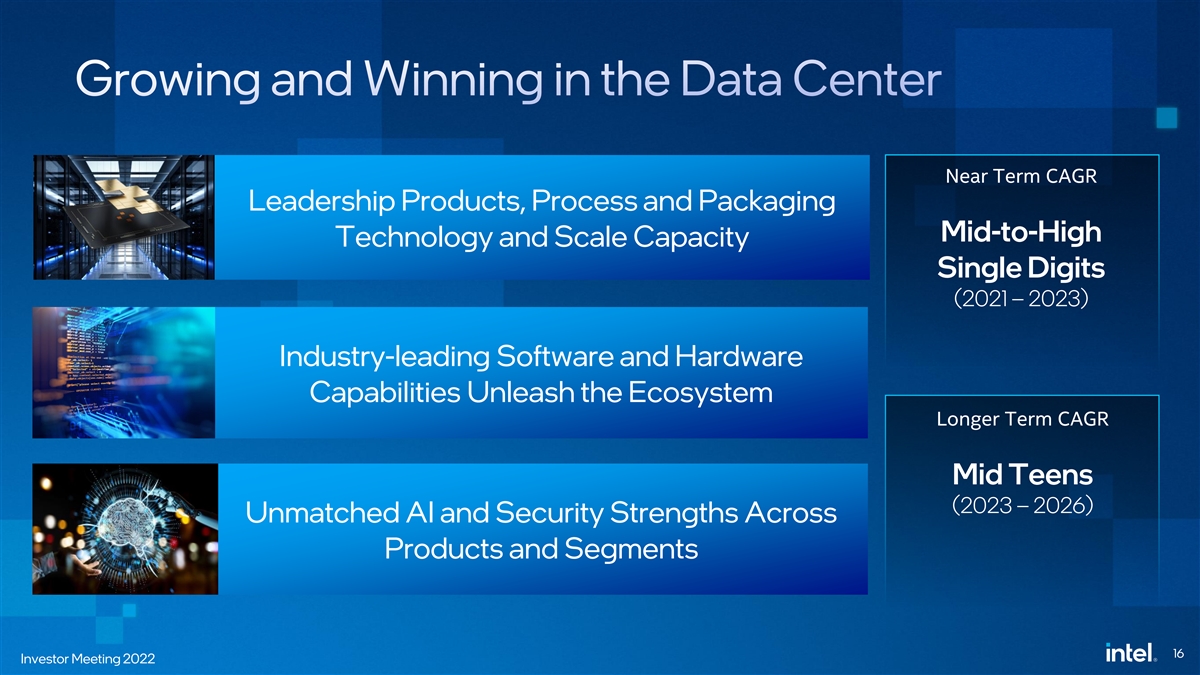
Near Term CAGR Leadership Products, Process and Packaging Mid-to-High
Technology and Scale Capacity Single Digits (2021 – 2023) Industry-leading Software and Hardware Capabilities Unleash the Ecosystem Longer Term CAGR Mid Teens (2023 – 2026) Unmatched AI and Security Strengths Across Products and Segments
16 Investor Meeting 2022
Exhibit 99.4 Future node performance and other metrics, including power
and density, are projections and are inherently uncertain and, in the case of other industry nodes, are derived from or estimated based on publicly available information. Intel’s node numbers do not represent the actual dimension of any
physical feature on a transistor or structure. They also do not pinpoint a specific level of improvement in performance, power or area, and the magnitude of a decrease from one node number to the next is not necessarily proportionate to the level of
improvement in one or more metrics. Historically, new Intel node numbers were based solely on improvements in area/density; now, node numbers generally reflect a holistic assessment of improvement across metrics and can be based on improvement in
one or more of performance, power, area, or other important factors, or a combination, and will not necessarily be based on area/density improvement alone. Non-GAAP Financial Measures. This presentation contains non-GAAP financial measures. Intel
gross margin and earnings per share, as well as Intel revenue for fiscal years 2021 and earlier, are presented on a non-GAAP basis unless otherwise indicated. This presentation also includes a non-GAAP free cash flow (FCF) measure. The appendix to
these materials available at www.intc.com provides a reconciliation of these measures to the most directly comparable GAAP financial measure. The non-GAAP financial measures disclosed by Intel should not be considered a substitute for, or superior
to, the financial measures prepared in accordance with GAAP. Forward-Looking Statements. Statements in this presentation that refer to business outlook, plans, and expectations are forward-looking statements that involve risks and uncertainties.
Words such as anticipate, expect, intend, goal, plans, believe, seek, estimate, continue,“ “committed,” “on-track,” ”positioned,” “ramp,” “momentum,” “roadmap,”
“path,” “pipeline,” “progress,” “schedule,” “forecast,” “likely,” “guide,” “potential,” “next gen,” “future,” may, will,
“would,” should, “could,” strategy, accelerate, cadence, deliver, and variations of such words and similar expressions are intended to identify such forward-looking statements. Statements that refer to or are based on
estimates, forecasts, projections, uncertain events, or assumptions also identify forward-looking statements. Forward-looking statements in this presentation include: statements relating to Intel’s strategy and its anticipated benefits;
Intel's process and packaging technology roadmap and schedules; innovation cadence; business plans; financial projections and expectations; total addressable market (TAM) and market opportunity; manufacturing expansion, financing, and investment
plans; future manufacturing capacity; future technology, services, and products and the expected benefits and availability of such technologies, services, and products, including PowerVia and RibbonFET technologies, future process nodes, and other
technologies and products; product and manufacturing plans, goals, timelines, ramps, progress, and future product and process leadership and performance; future economic conditions; future impacts of the COVID-19 pandemic; plans and goals related to
Intel’s foundry business; future legislation; future capital offsets; pending or future transactions; the proposed Mobileye IPO; the memorandum of understanding with Brookfield; supply expectations including regarding industry shortages;
future external foundry usage; future use of EUV and other manufacturing tools and technologies; expectations regarding customers, including designs, wins, orders, and partnerships; projections regarding competitors; ESG goals; and anticipated
trends in our businesses or the markets relevant to them, including future demand, market share, industry growth, and technology trends, also identify forward-looking statements. Such statements involve many risks and uncertainties that could cause
actual results to differ materially from those expressed or implied in these forward-looking statements. Important factors that could cause actual results to differ materially are set forth in Intel's earnings release dated January 26, 2022, which
is included as an exhibit to Intel’s Form 8-K furnished to the SEC on such date, and in Intel's SEC filings, including the company's most recent reports on Forms 10-K and 10-Q. Copies of Intel’s SEC filings may be obtained by visiting
our Investor Relations website at www.intc.com or the SEC's website at www.sec.gov. All information in this presentation reflects management’s views as of February 17, 2022, unless an earlier date is indicated. Intel does not undertake, and
expressly disclaims any duty, to update any statement made in this presentation, whether as a result of new information, new developments or otherwise, except to the extent that disclosure may be required by law. Intel technologies may require
enabled hardware, software or service activation. No product or component can be absolutely secure. Your costs and results may vary. Product and process performance varies by use, configuration and other factors. Learn more at
www.Intel.com/PerformanceIndex and www.Intel.com/ProcessInnovation. Future product and process performance and other metrics are projections and are inherently uncertain. © Intel Corporation. Intel, the Intel logo, and other Intel marks are
trademarks of Intel Corporation or its subsidiaries. Other names and brands may be claimed as the property of others.
Investor Meeting 2022
Investor Meeting 2022 Executive Vice President General Manager, Client
Computing Group
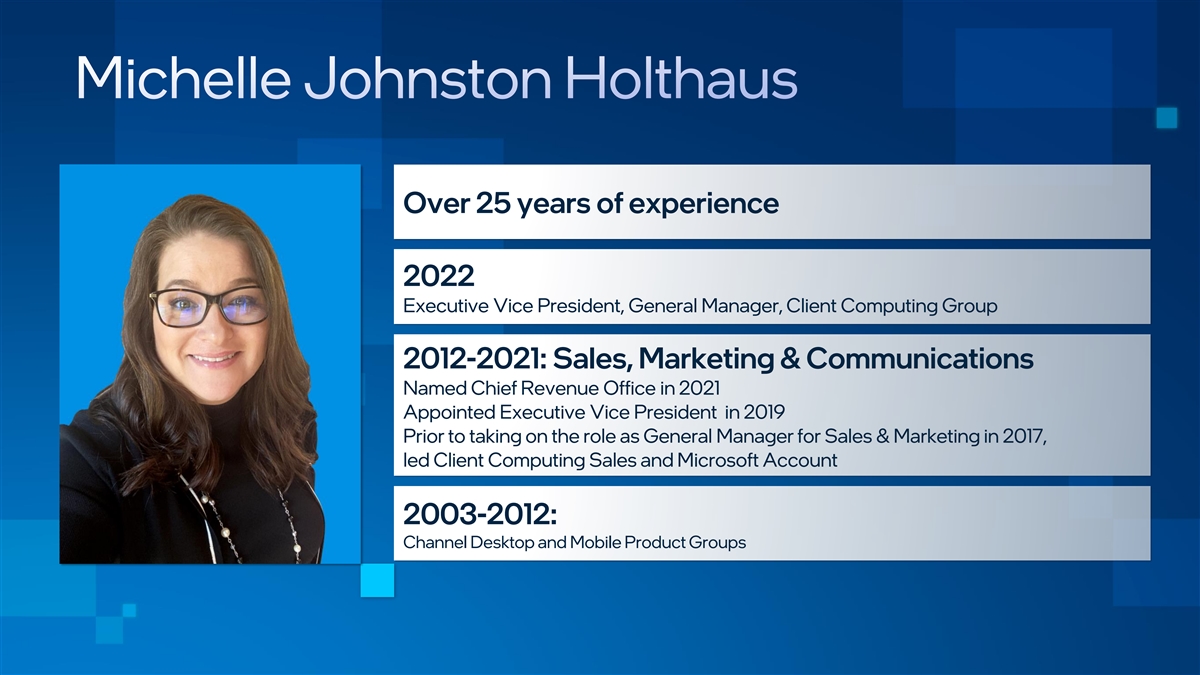
Over 25 years of experience 2022 Executive Vice President, General
Manager, Client Computing Group 2012-2021: Sales, Marketing & Communications Named Chief Revenue Office in 2021 Appointed Executive Vice President in 2019 Prior to taking on the role as General Manager for Sales & Marketing in 2017, led
Client Computing Sales and Microsoft Account 2003-2012: Channel Desktop and Mobile Product Groups
Investor Meeting 2022 Senior Vice President and Interim General
Manager
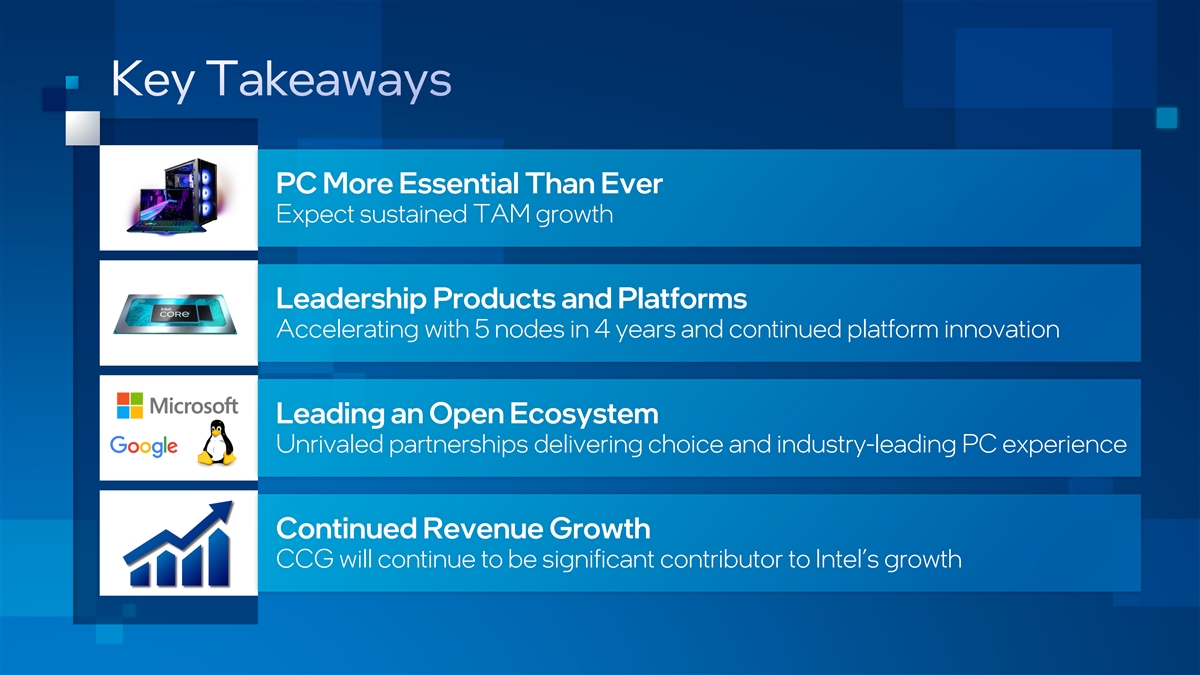
PC More Essential Than Ever Expect sustained TAM growth Leadership
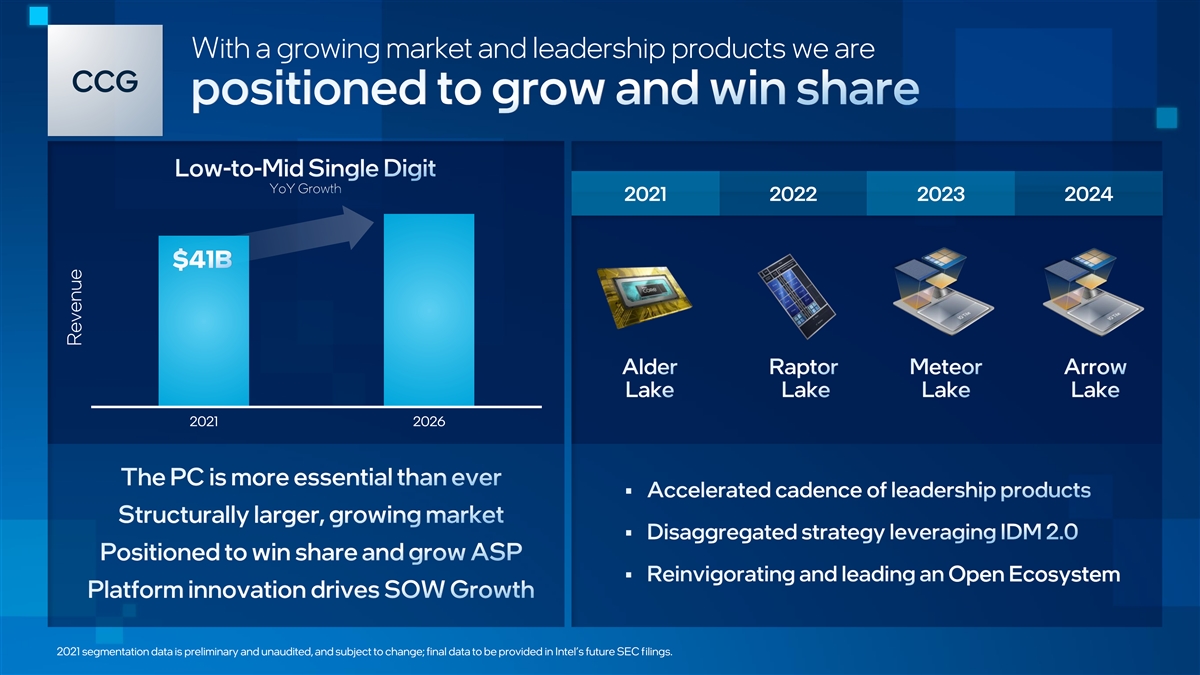
Products and Platforms Accelerating with 5 nodes in 4 years and continued platform innovation Leading an Open Ecosystem Unrivaled partnerships delivering choice and industry-leading PC experience Continued Revenue Growth CCG will continue to be
significant contributor to Intel’s growth
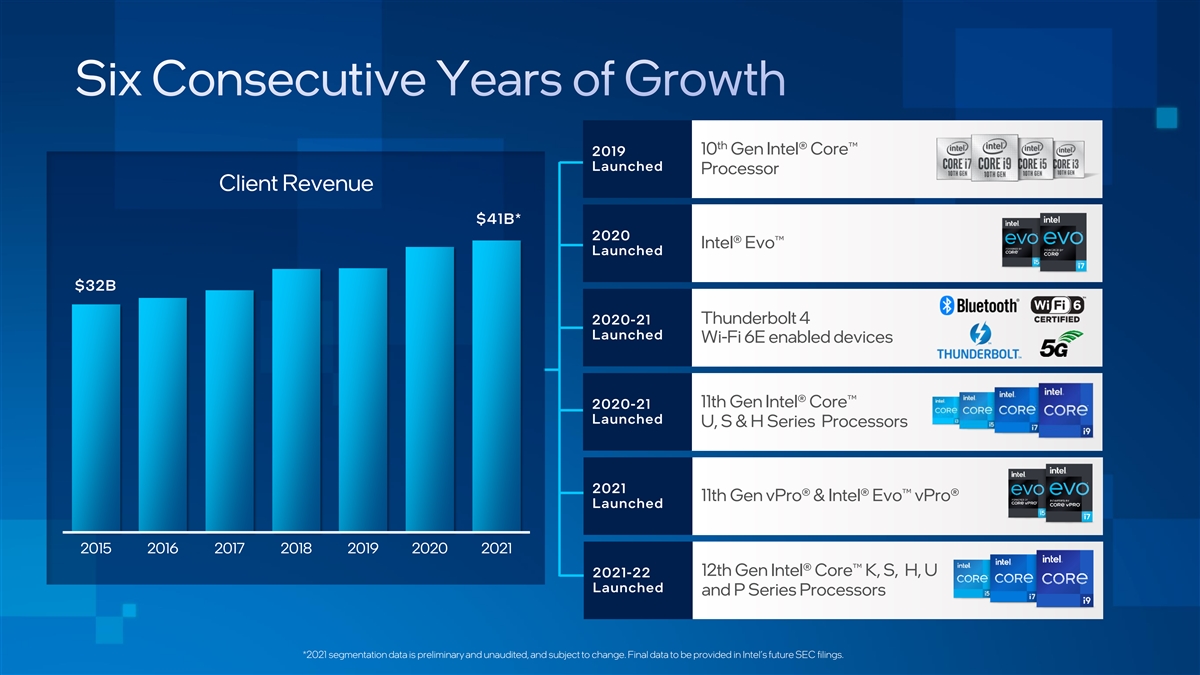
th 10 Gen Intel® Core™ 2 019 La unched Processor Client
Revenue $41B* 2 02 0 Intel® Evo™ La unched $32B 2020 Thunderbolt 4 2 02 0-21 La unched Wi-Fi 6E enabled devices 11th Gen Intel® Core™ 2 02 0-21 La unched U, S & H Series Processors 2 02 1 11th Gen vPro® &
Intel® Evo™ vPro® La unched 2015 2016 2017 2018 2019 2020 2021 12th Gen Intel® Core™ K, S, H, U 2 02 1-22 La unched and P Series Processors *2021 segmentation data is preliminary and unaudited, and subject to change. Final
data to be provided in Intel’s future SEC filings.
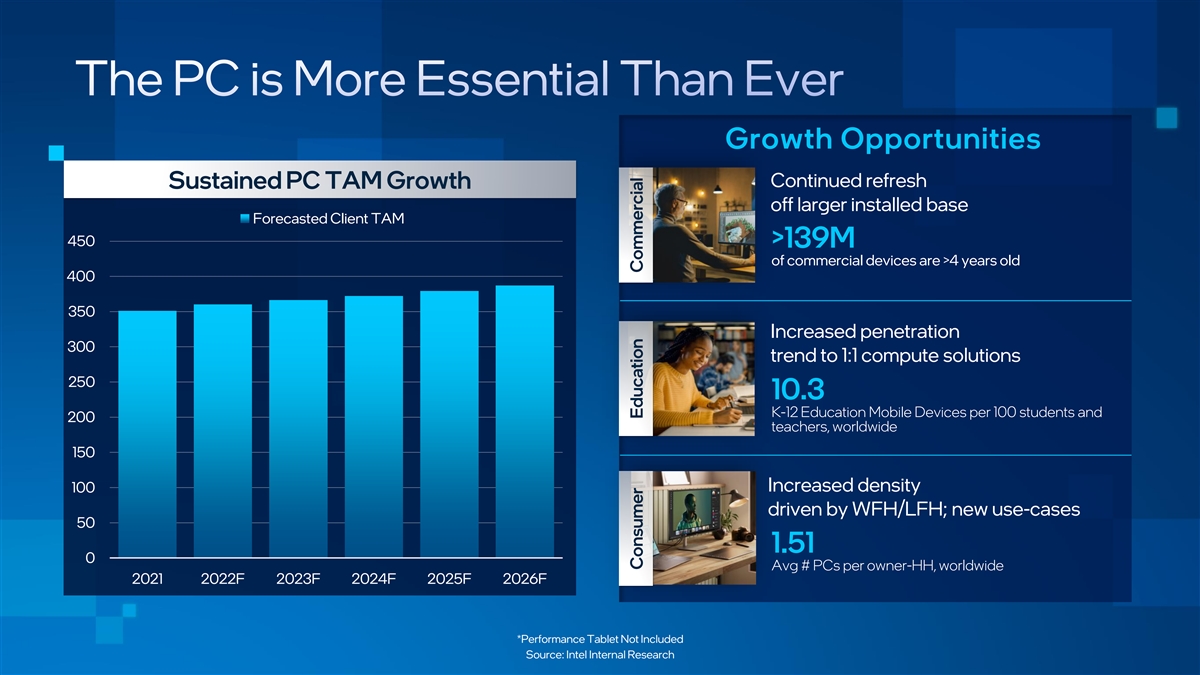
Growth Opportunities Continued refresh Sustained PC TAM Growth off
larger installed base Forecasted Client TAM 450 >139M of commercial devices are >4 years old 400 350 Increased penetration 300 trend to 1:1 compute solutions 250 10.3 K-12 Education Mobile Devices per 100 students and 200 teachers, worldwide
150 Increased density 100 driven by WFH/LFH; new use-cases 50 1.51 0 Avg # PCs per owner-HH, worldwide 2021 2022F 2023F 2024F 2025F 2026F *Performance Tablet Not Included Source: Intel Internal Research Consumer Education Commercial
Investor Meeting 2022 Executive Vice President & Chief Product
Officer, Microsoft
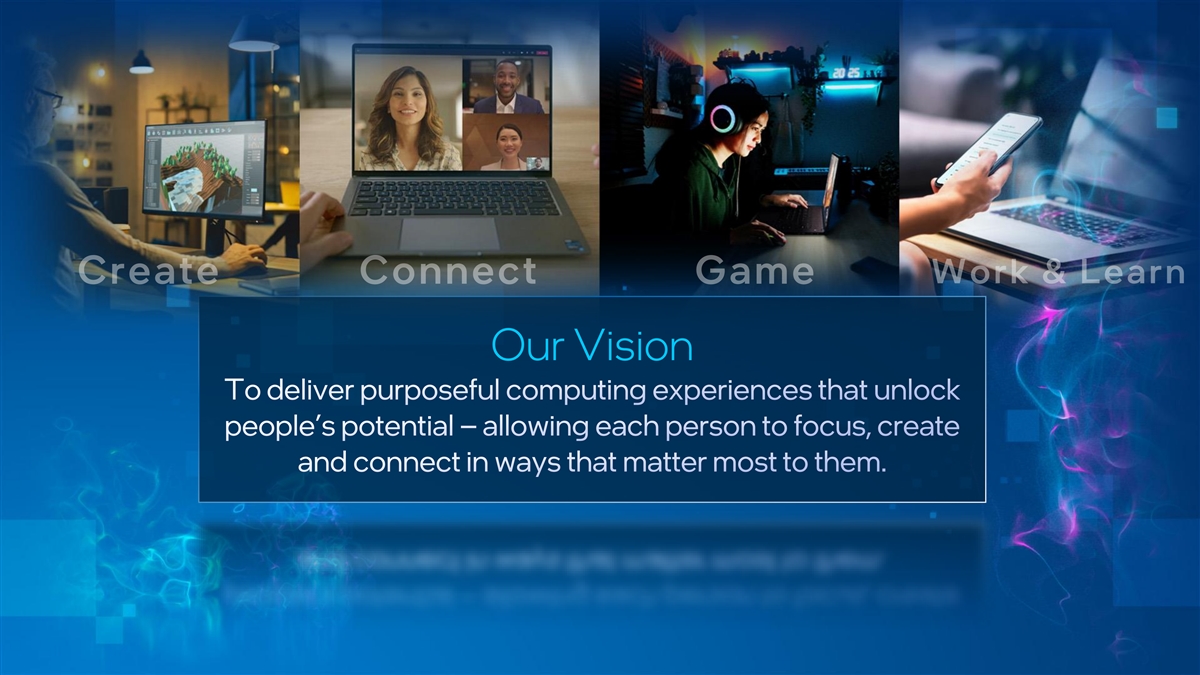
Our Vision
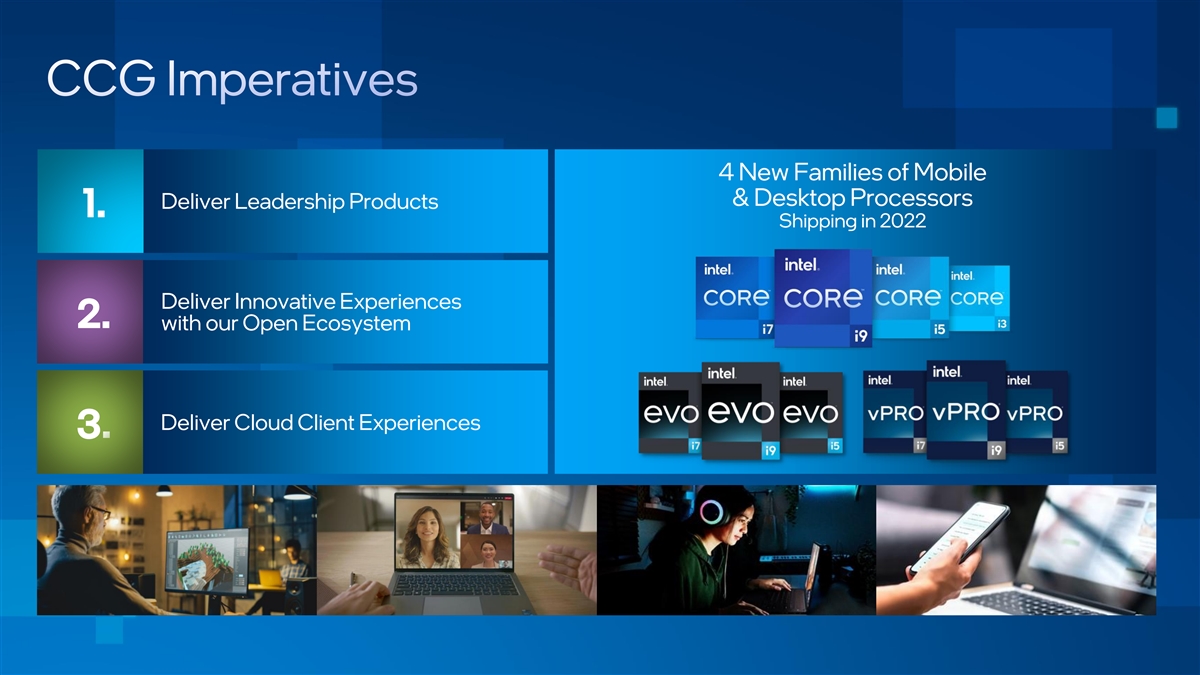
4 New Families of Mobile & Desktop Processors Deliver Leadership
Products 1. Shipping in 2022 Deliver Innovative Experiences 2. with our Open Ecosystem Deliver Cloud Client Experiences 3
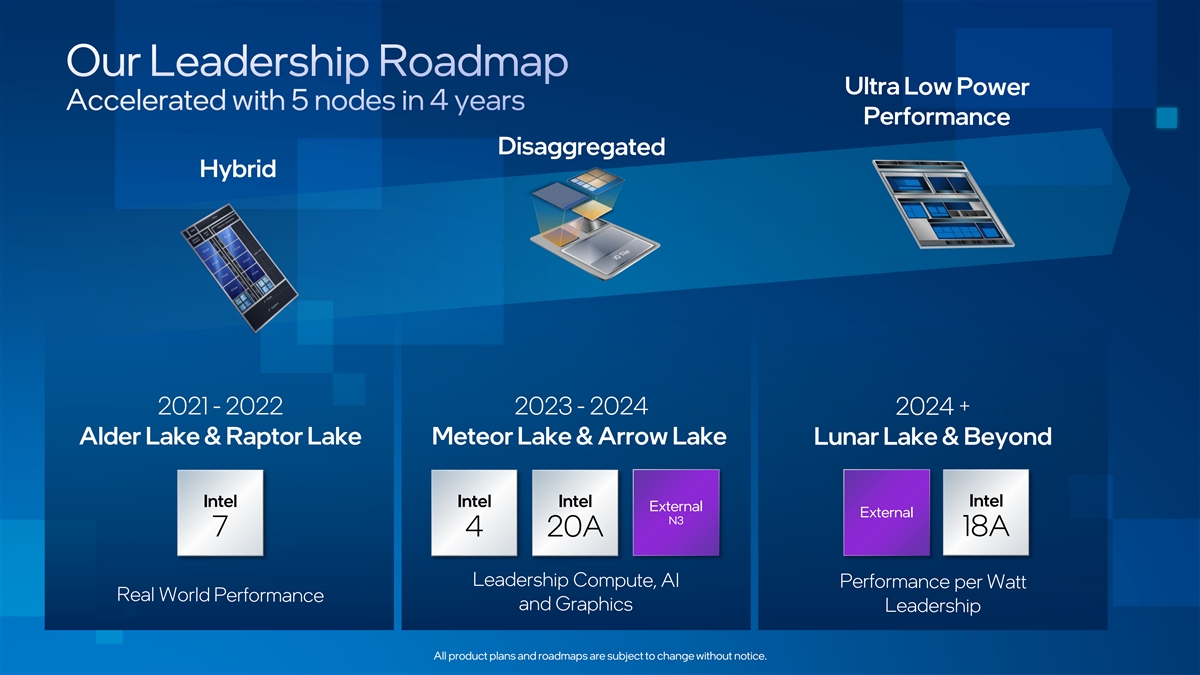
Hybrid 2021 - 2022 2023 - 2024 2024 + Alder Lake & Raptor Lake
Meteor Lake & Arrow Lake Lunar Lake & Beyond Intel Intel Intel Intel External External N3 7 4 20A 18A All product plans and roadmaps are subject to change without notice.
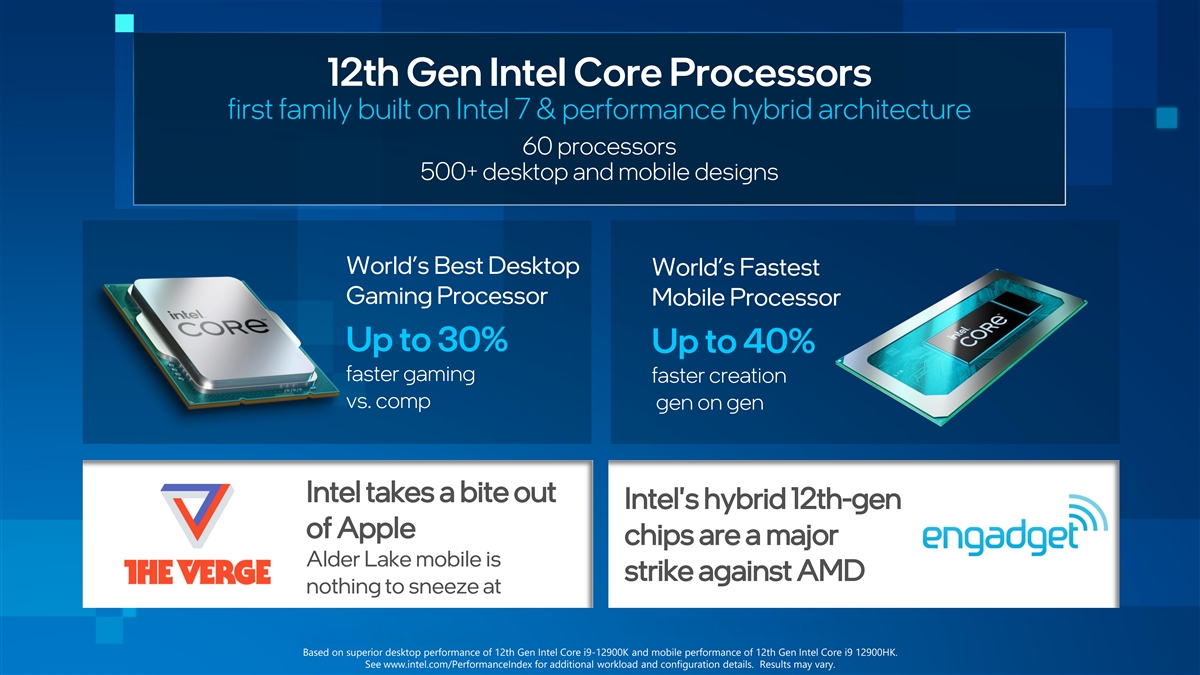
12th Gen Intel Core Processors first family built on Intel 7 &
performance hybrid architecture 60 processors 500+ desktop and mobile designs World’s Best Desktop World’s Fastest Gaming Processor Mobile Processor Up to 30% Up to 40% faster gaming faster creation vs. comp gen on gen Intel takes a bite
out Intel's hybrid 12th-gen of Apple chips are a major Alder Lake mobile is strike against AMD nothing to sneeze at Based on superior desktop performance of 12th Gen Intel Core i9-12900K and mobile performance of 12th Gen Intel Core i9 12900HK. See
www.intel.com/PerformanceIndex for additional workload and configuration details. Results may vary.
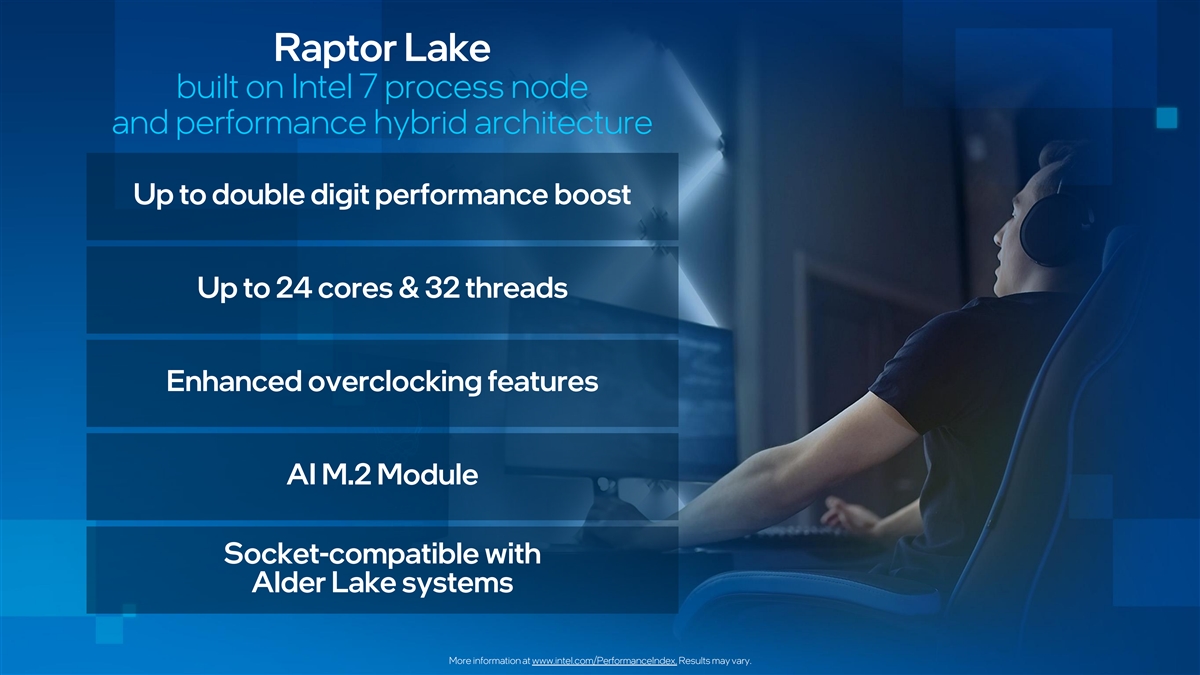
Raptor Lake built on Intel 7 process node and performance hybrid
architecture Up to double digit performance boost Up to 24 cores & 32 threads Enhanced overclocking features AI M.2 Module Socket-compatible with Alder Lake systems More information at www.intel.com/PerformanceIndex. Results may vary.
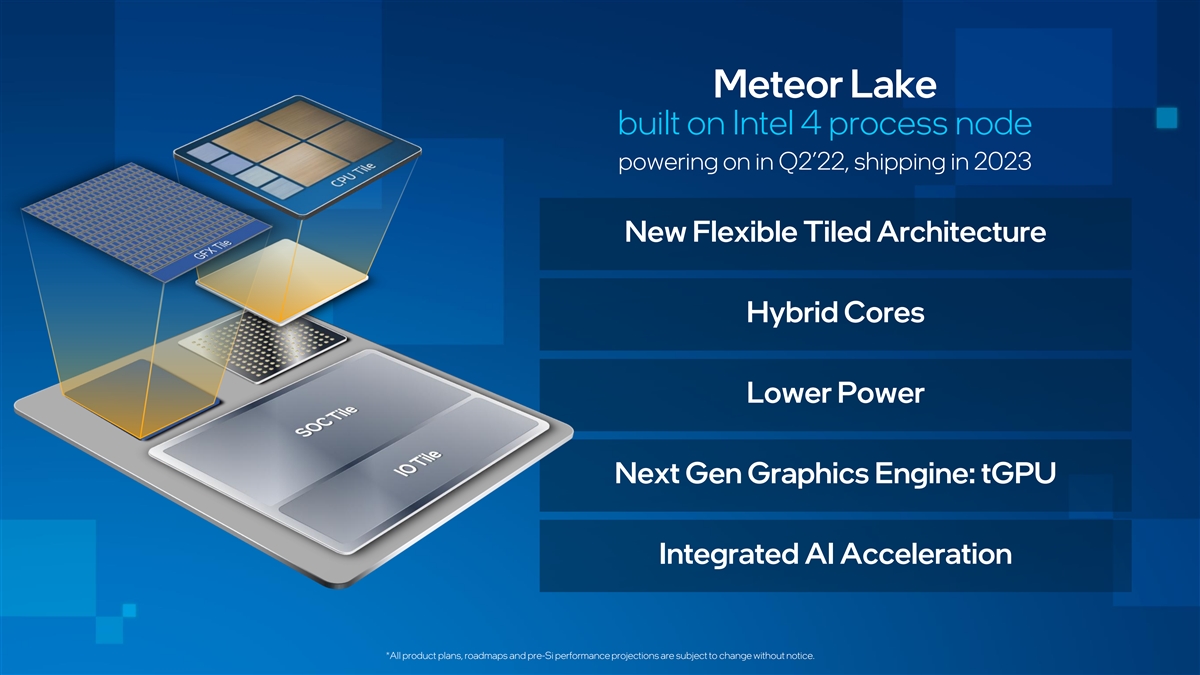
Meteor Lake built on Intel 4 process node powering on in Q2’22,
shipping in 2023 New Flexible Tiled Architecture Hybrid Cores Lower Power Next Gen Graphics Engine: tGPU Integrated AI Acceleration *All product plans, roadmaps and pre-Si performance projections are subject to change without notice.
Investor Meeting 2022 Vice President and General Manager, ChromeOS,
Google
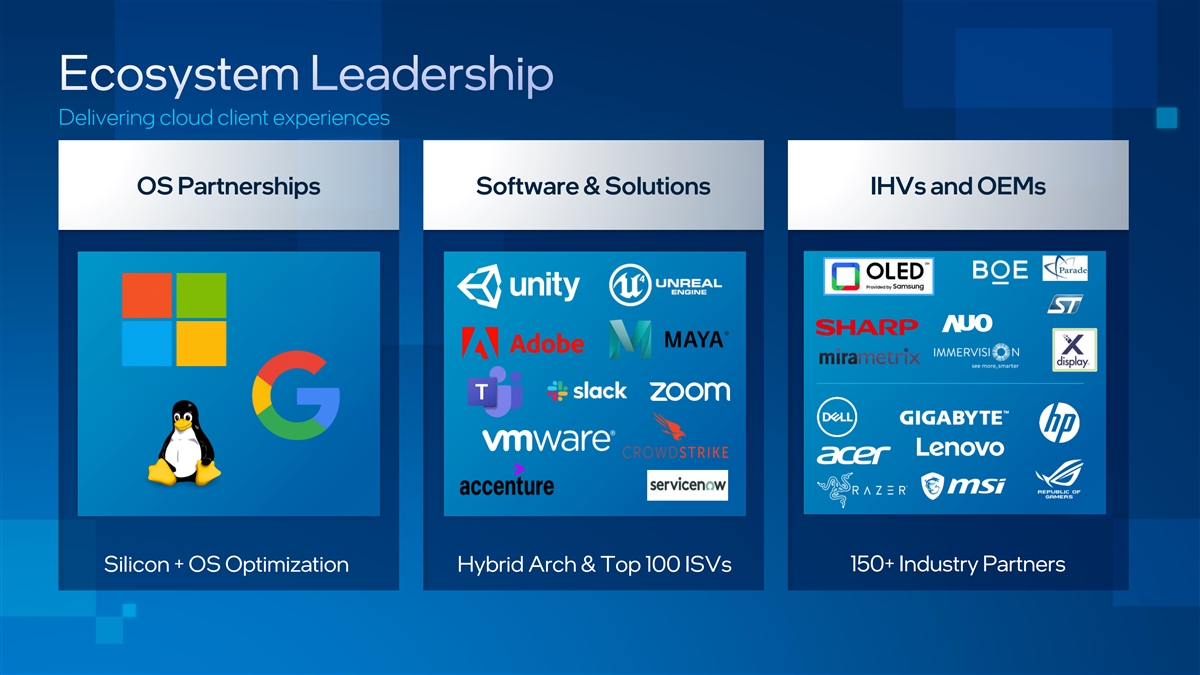
Delivering cloud client experiences OS Partnerships Software &
Solutions IHVs and OEMs 150+ Industry Partners Silicon + OS Optimization Hybrid Arch & Top 100 ISVs
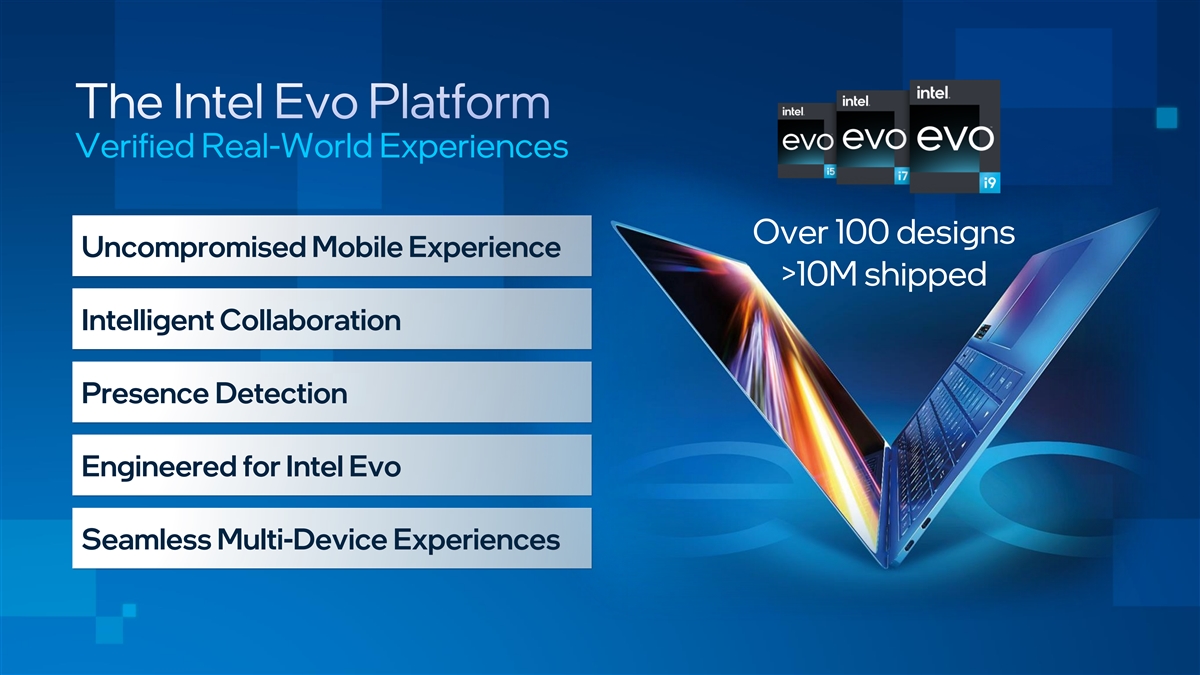
Verified Real-World Experiences Over 100 designs Uncompromised Mobile
Experience >10M shipped Intelligent Collaboration Presence Detection Engineered for Intel Evo Seamless Multi-Device Experiences
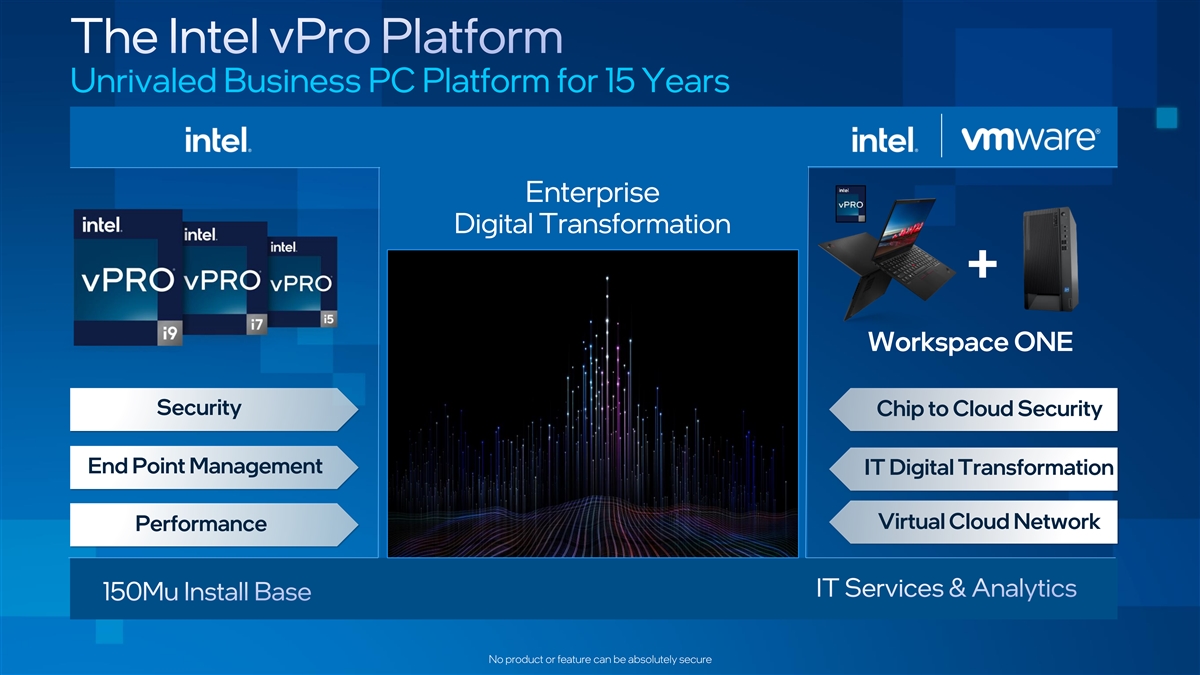
Unrivaled Business PC Platform for 15 Years Enterprise Digital
Transformation + Workspace ONE Security Chip to Cloud Security End Point Management IT Digital Transformation Virtual Cloud Network Performance No product or feature can be absolutely secure
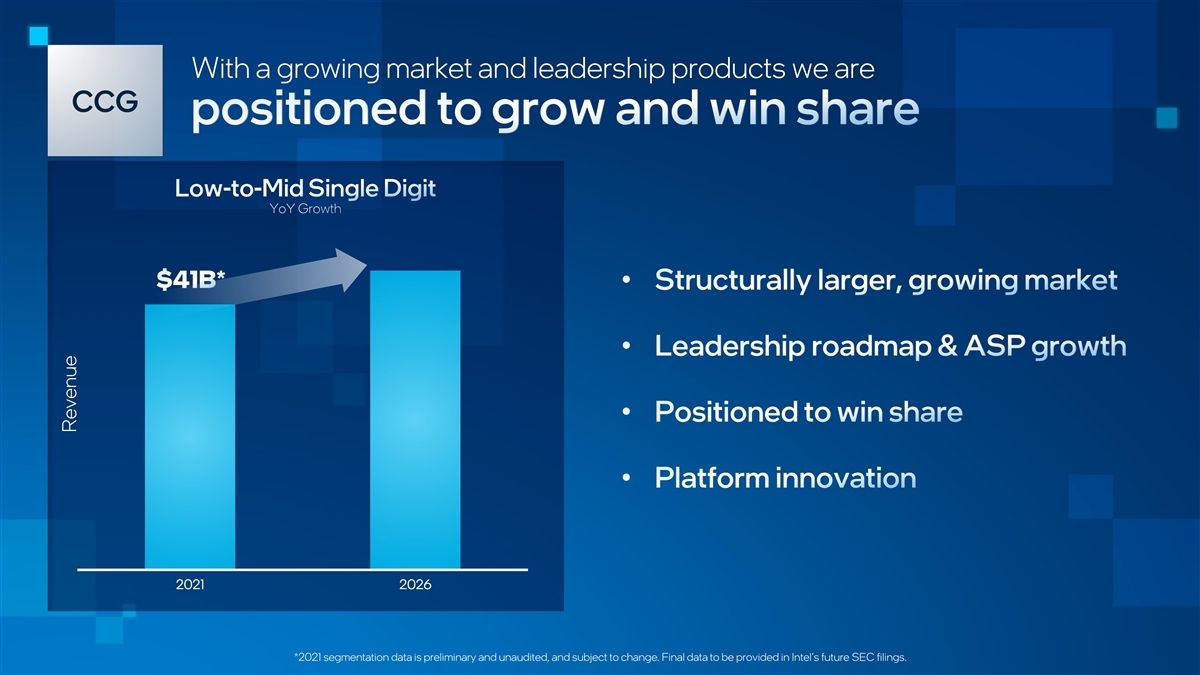
With a growing market and leadership products we are CCG 2021 2026
*2021 segmentation data is preliminary and unaudited, and subject to change. Final data to be provided in Intel’s future SEC filings. Revenue
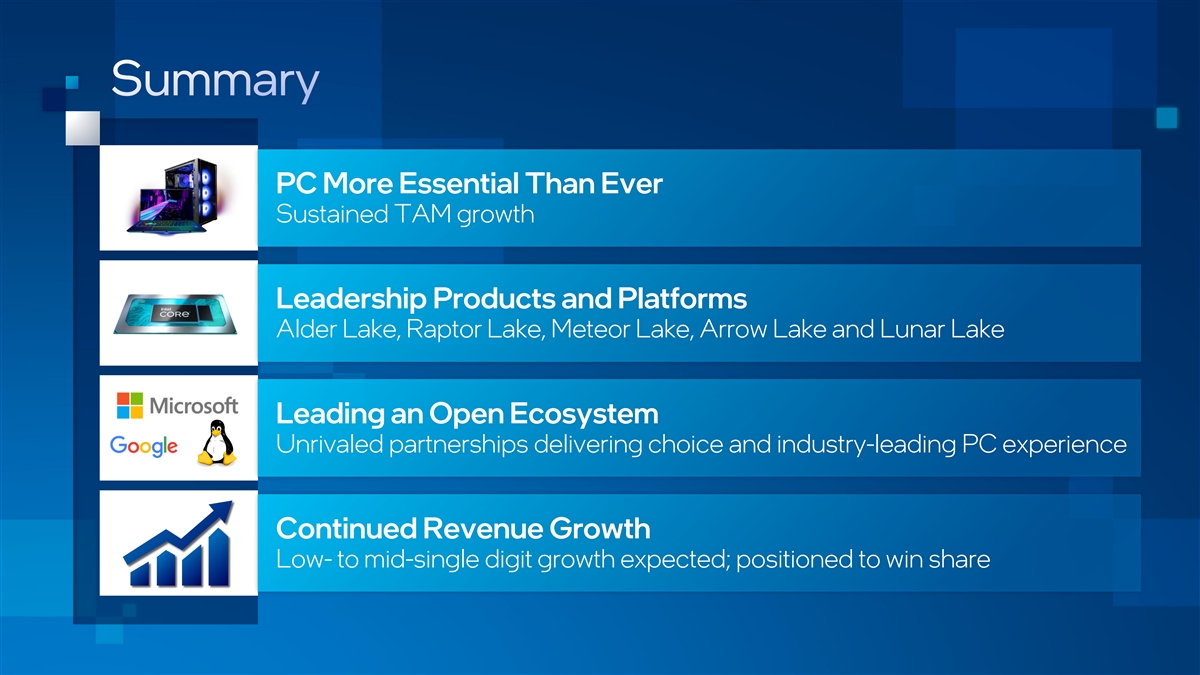
PC More Essential Than Ever Sustained TAM growth Leadership Products
and Platforms Alder Lake, Raptor Lake, Meteor Lake, Arrow Lake and Lunar Lake Leading an Open Ecosystem Unrivaled partnerships delivering choice and industry-leading PC experience Continued Revenue Growth Low- to mid-single digit growth expected;
positioned to win share
Exhibit 99.5 Future node performance and other metrics, including power
and density, are projections and are inherently uncertain and, in the case of other industry nodes, are derived from or estimated based on publicly available information. Intel’s node numbers do not represent the actual dimension of any
physical feature on a transistor or structure. They also do not pinpoint a specific level of improvement in performance, power or area, and the magnitude of a decrease from one node number to the next is not necessarily proportionate to the level of
improvement in one or more metrics. Historically, new Intel node numbers were based solely on improvements in area/density; now, node numbers generally reflect a holistic assessment of improvement across metrics and can be based on improvement in
one or more of performance, power, area, or other important factors, or a combination, and will not necessarily be based on area/density improvement alone. Non-GAAP Financial Measures. This presentation contains non-GAAP financial measures. Intel
gross margin and earnings per share, as well as Intel revenue for fiscal years 2021 and earlier, are presented on a non-GAAP basis unless otherwise indicated. This presentation also includes a non-GAAP free cash flow (FCF) measure. The appendix to
these materials available at www.intc.com provides a reconciliation of these measures to the most directly comparable GAAP financial measure. The non-GAAP financial measures disclosed by Intel should not be considered a substitute for, or superior
to, the financial measures prepared in accordance with GAAP. Forward-Looking Statements. Statements in this presentation that refer to business outlook, plans, and expectations are forward-looking statements that involve risks and uncertainties.
Words such as anticipate, expect, intend, goal, plans, believe, seek, estimate, continue,“ “committed,” “on-track,” ”positioned,” “ramp,” “momentum,” “roadmap,”
“path,” “pipeline,” “progress,” “schedule,” “forecast,” “likely,” “guide,” “potential,” “next gen,” “future,” may, will,
“would,” should, “could,” strategy, accelerate, cadence, deliver, and variations of such words and similar expressions are intended to identify such forward-looking statements. Statements that refer to or are based on
estimates, forecasts, projections, uncertain events, or assumptions also identify forward-looking statements. Forward-looking statements in this presentation include: statements relating to Intel’s strategy and its anticipated benefits;
Intel's process and packaging technology roadmap and schedules; innovation cadence; business plans; financial projections and expectations; total addressable market (TAM) and market opportunity; manufacturing expansion, financing, and investment
plans; future manufacturing capacity; future technology, services, and products and the expected benefits and availability of such technologies, services, and products, including PowerVia and RibbonFET technologies, future process nodes, and other
technologies and products; product and manufacturing plans, goals, timelines, ramps, progress, and future product and process leadership and performance; future economic conditions; future impacts of the COVID-19 pandemic; plans and goals related to
Intel’s foundry business; future legislation; future capital offsets; pending or future transactions; the proposed Mobileye IPO; the memorandum of understanding with Brookfield; supply expectations including regarding industry shortages;
future external foundry usage; future use of EUV and other manufacturing tools and technologies; expectations regarding customers, including designs, wins, orders, and partnerships; projections regarding competitors; ESG goals; and anticipated
trends in our businesses or the markets relevant to them, including future demand, market share, industry growth, and technology trends, also identify forward-looking statements. Such statements involve many risks and uncertainties that could cause
actual results to differ materially from those expressed or implied in these forward-looking statements. Important factors that could cause actual results to differ materially are set forth in Intel's earnings release dated January 26, 2022, which
is included as an exhibit to Intel’s Form 8-K furnished to the SEC on such date, and in Intel's SEC filings, including the company's most recent reports on Forms 10-K and 10-Q. Copies of Intel’s SEC filings may be obtained by visiting
our Investor Relations website at www.intc.com or the SEC's website at www.sec.gov. All information in this presentation reflects management’s views as of February 17, 2022, unless an earlier date is indicated. Intel does not undertake, and
expressly disclaims any duty, to update any statement made in this presentation, whether as a result of new information, new developments or otherwise, except to the extent that disclosure may be required by law. Intel technologies may require
enabled hardware, software or service activation. No product or component can be absolutely secure. Your costs and results may vary. Product and process performance varies by use, configuration and other factors. Learn more at
www.Intel.com/PerformanceIndex and www.Intel.com/ProcessInnovation. Future product and process performance and other metrics are projections and are inherently uncertain. © Intel Corporation. Intel, the Intel logo, and other Intel marks are
trademarks of Intel Corporation or its subsidiaries. Other names and brands may be claimed as the property of others.
Investor Meeting 2022
Investor Meeting 2022 CFO, Intel
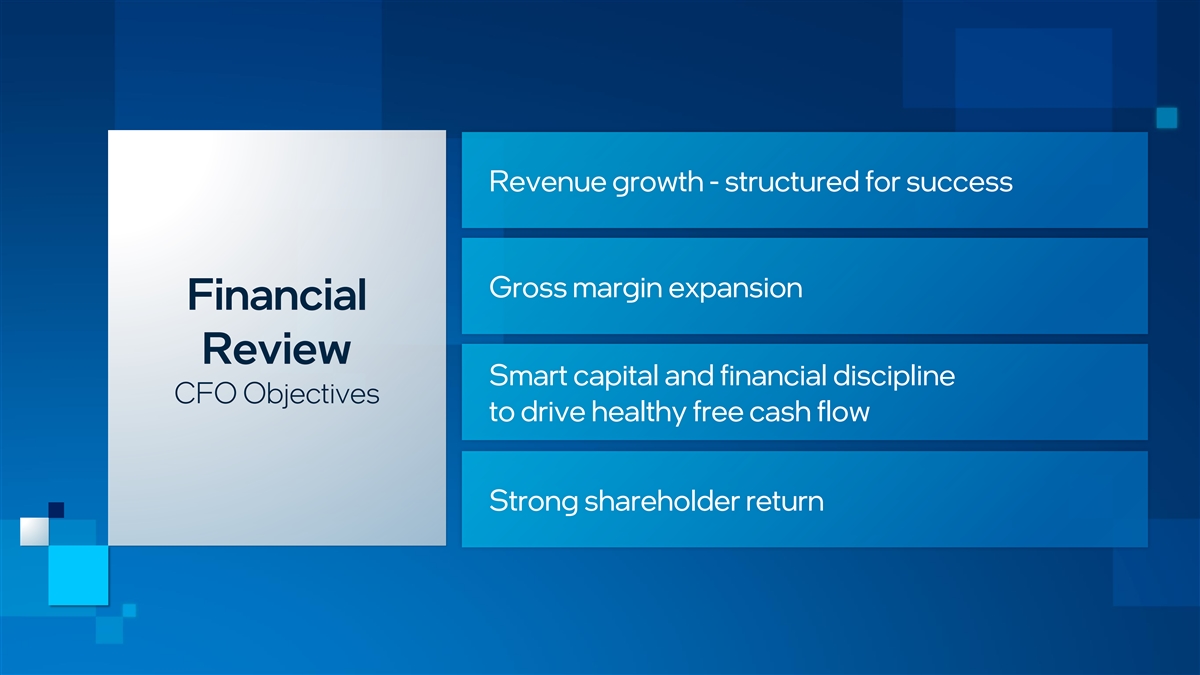
Revenue growth - structured for success Gross margin expansion Financial
Review Smart capital and financial discipline CFO Objectives to drive healthy free cash flow Strong shareholder return
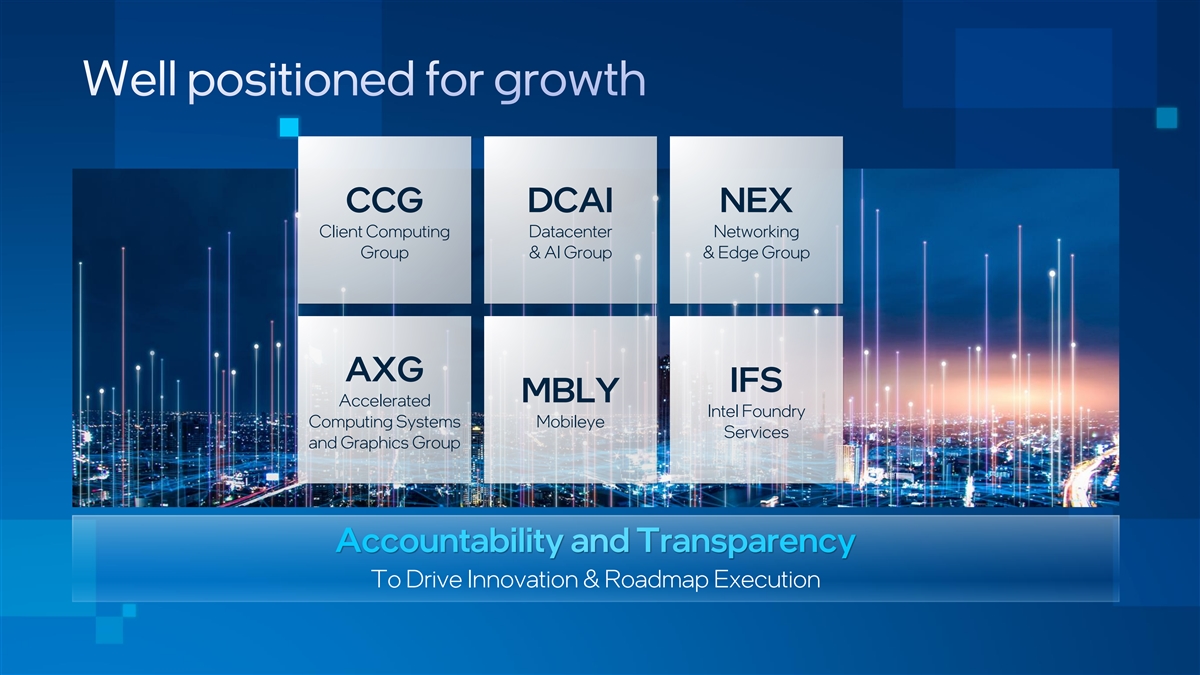
CCG DCAI NEX Client Computing Datacenter Networking Group & AI Group
& Edge Group AXG IFS MBLY Accelerated Intel Foundry Computing Systems Mobileye Services and Graphics Group To Drive Innovation & Roadmap Execution
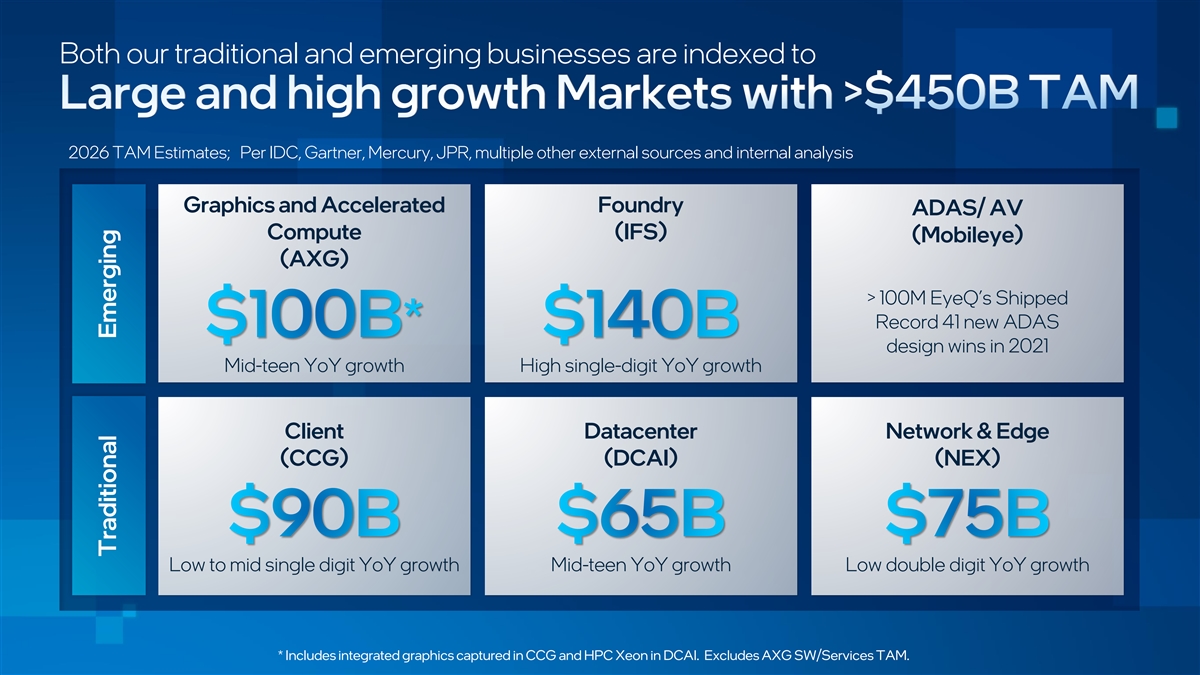
Both our traditional and emerging businesses are indexed to 2026 TAM
Estimates; Per IDC, Gartner, Mercury, JPR, multiple other external sources and internal analysis Graphics and Accelerated Foundry ADAS/ AV Compute (IFS) (Mobileye) (AXG) > 100M EyeQ’s Shipped Record 41 new ADAS design wins in 2021 Mid-teen
YoY growth High single-digit YoY growth Client Datacenter Network & Edge (CCG) (DCAI) (NEX) Low to mid single digit YoY growth Mid-teen YoY growth Low double digit YoY growth * Includes integrated graphics captured in CCG and HPC Xeon in DCAI.
Excludes AXG SW/Services TAM. Traditional Emerging
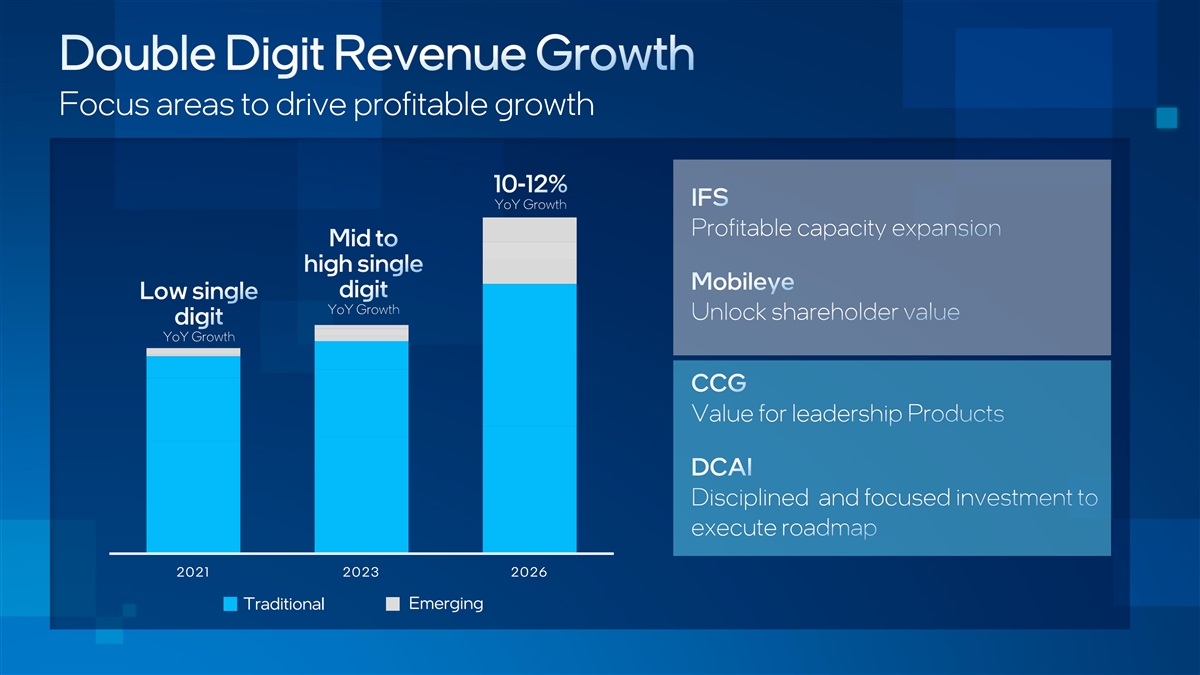
Focus areas to drive profitable growth 2 0 2 1 2 0 2 3 2 0 2 6 Emerging
Traditional
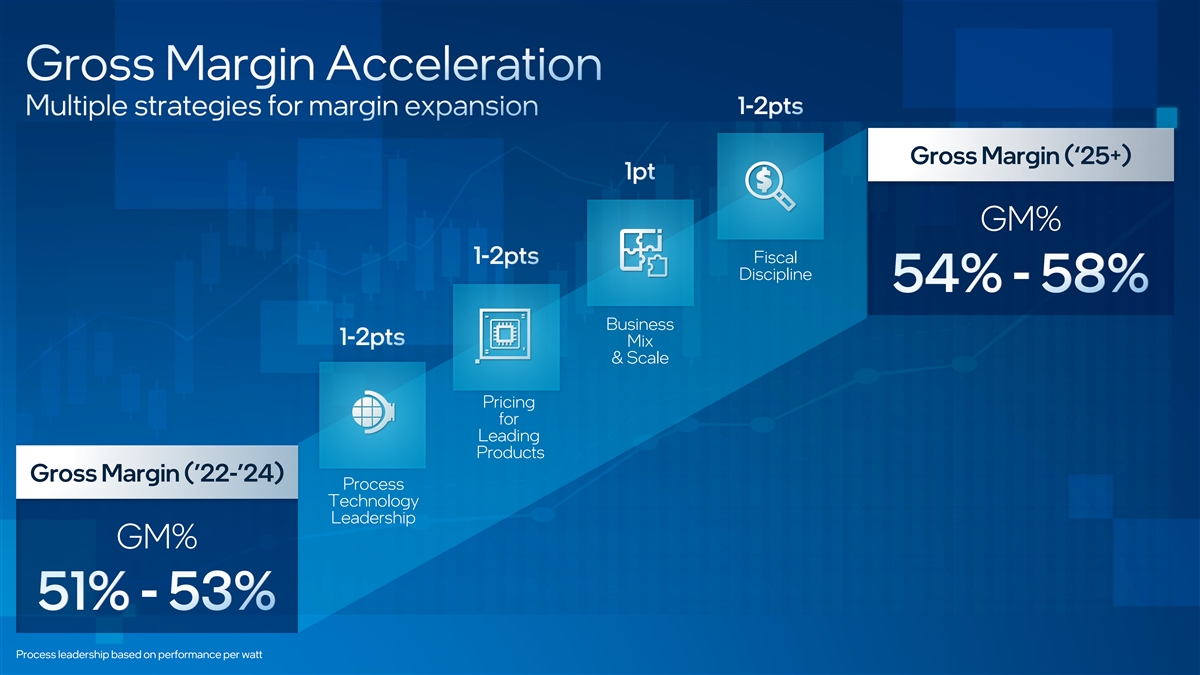
Gross Margin (‘25+) GM% Fiscal Discipline Business Mix & Scale
Pricing for Leading Products Gross Margin (’22-’24) Process Technology Leadership GM% Process leadership based on performance per watt
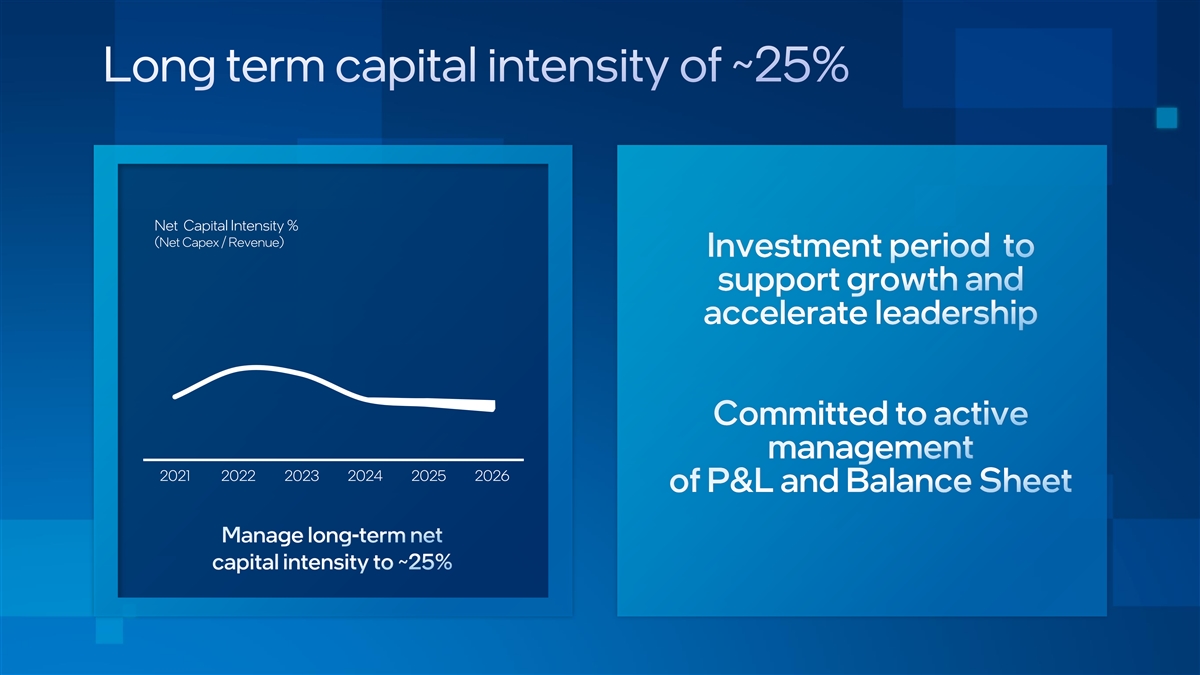
Net Capital Intensity % (Net Capex / Revenue) 2021 2022 2023 2024 2025
2026
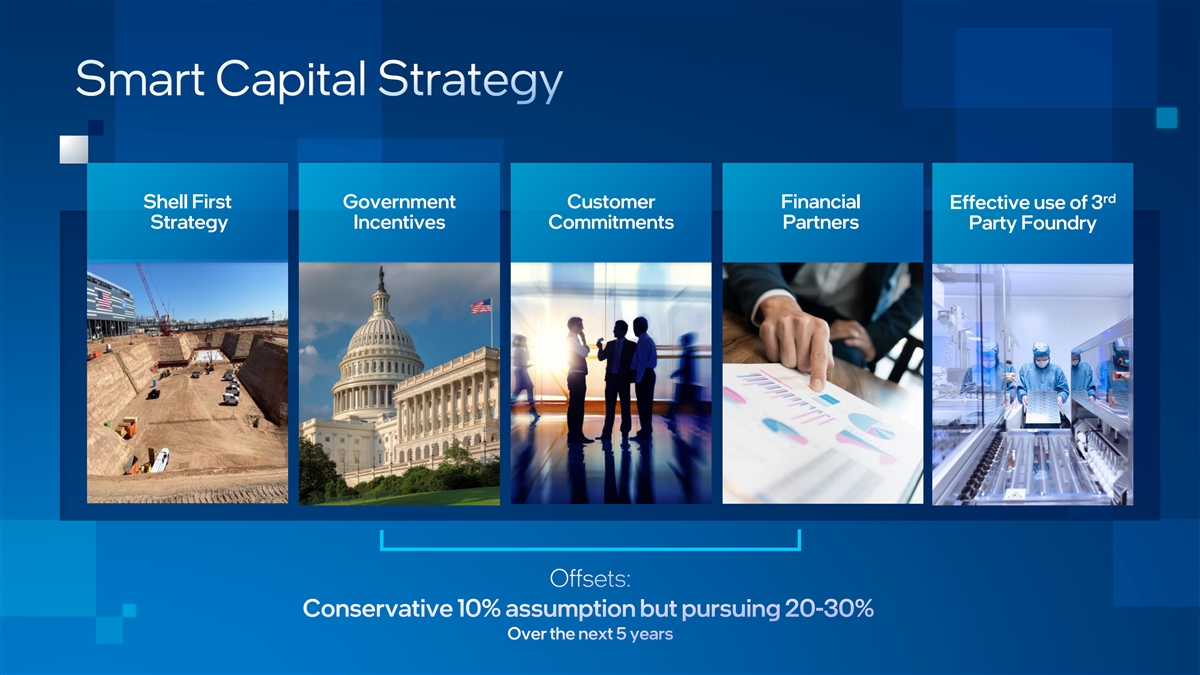
rd Shell First Government Customer Financial Effective use of 3
Strategy Incentives Commitments Partners Party Foundry
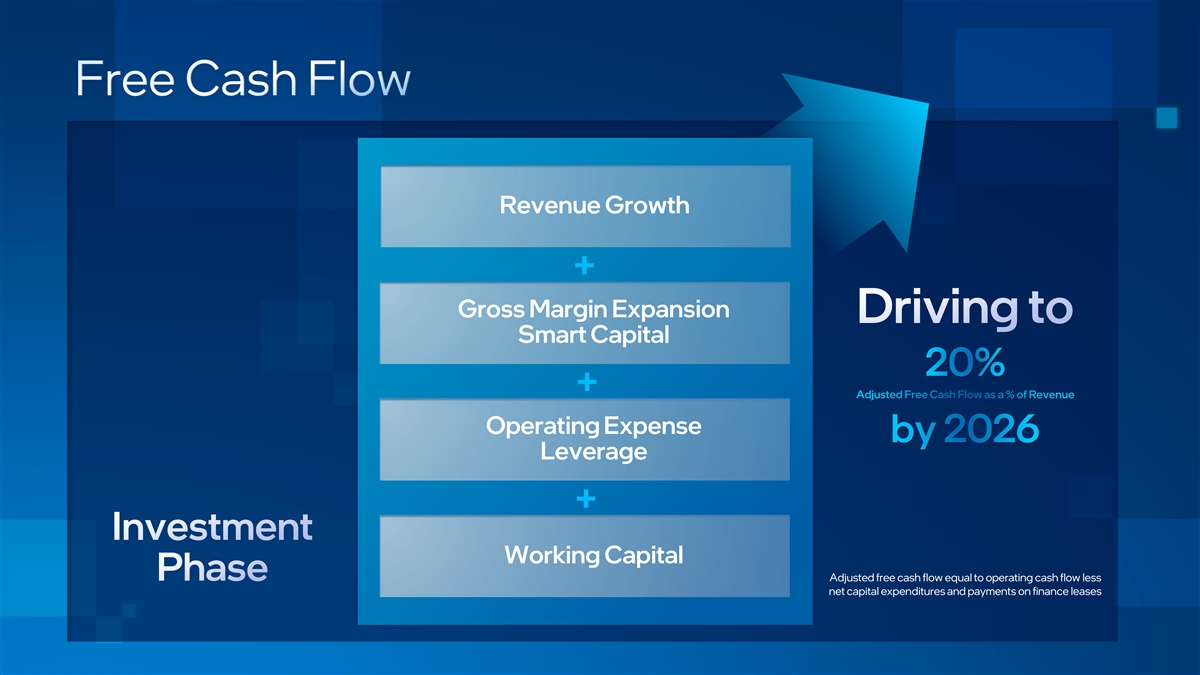
Revenue Growth + Gross Margin Expansion Smart Capital + Operating
Expense Leverage + Working Capital Adjusted free cash flow equal to operating cash flow less net capital expenditures and payments on finance leases
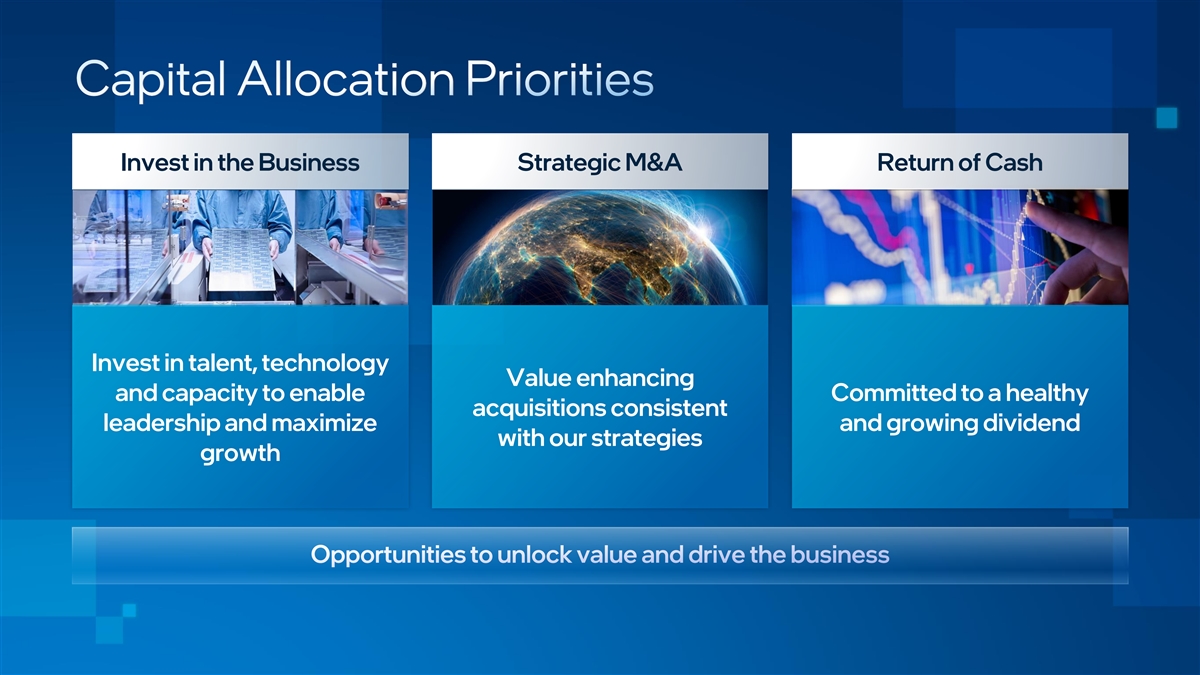
Invest in the Business Strategic M&A Return of Cash Invest in
talent, technology Value enhancing and capacity to enable Committed to a healthy acquisitions consistent leadership and maximize and growing dividend with our strategies growth
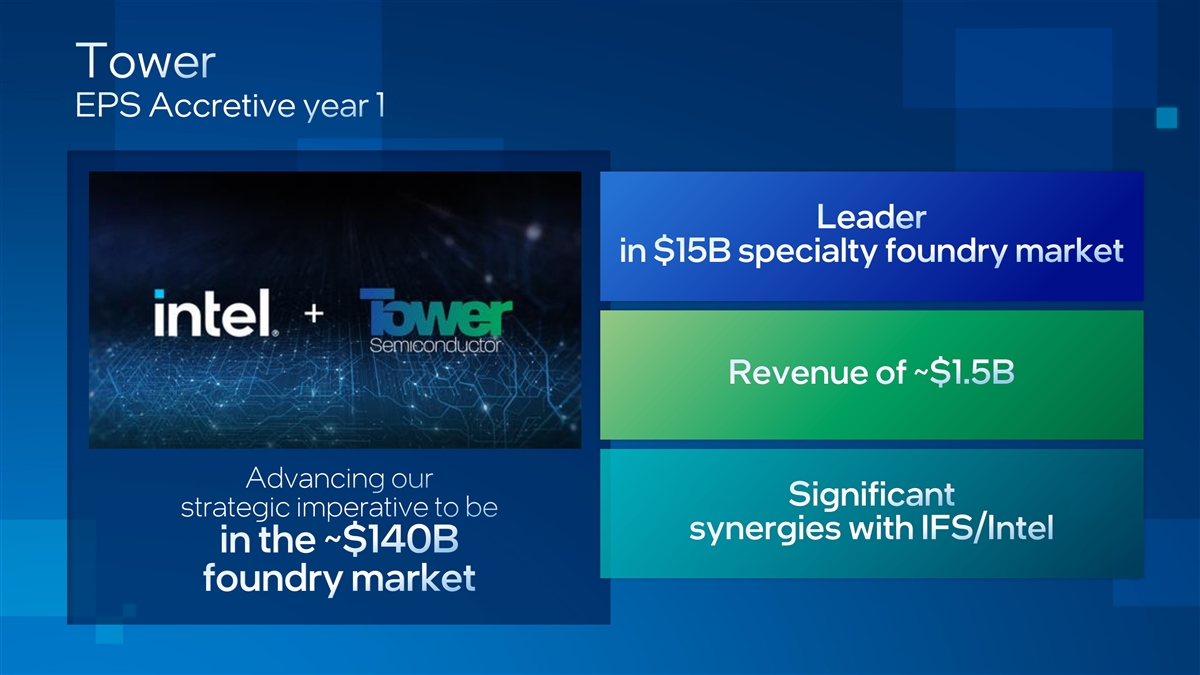
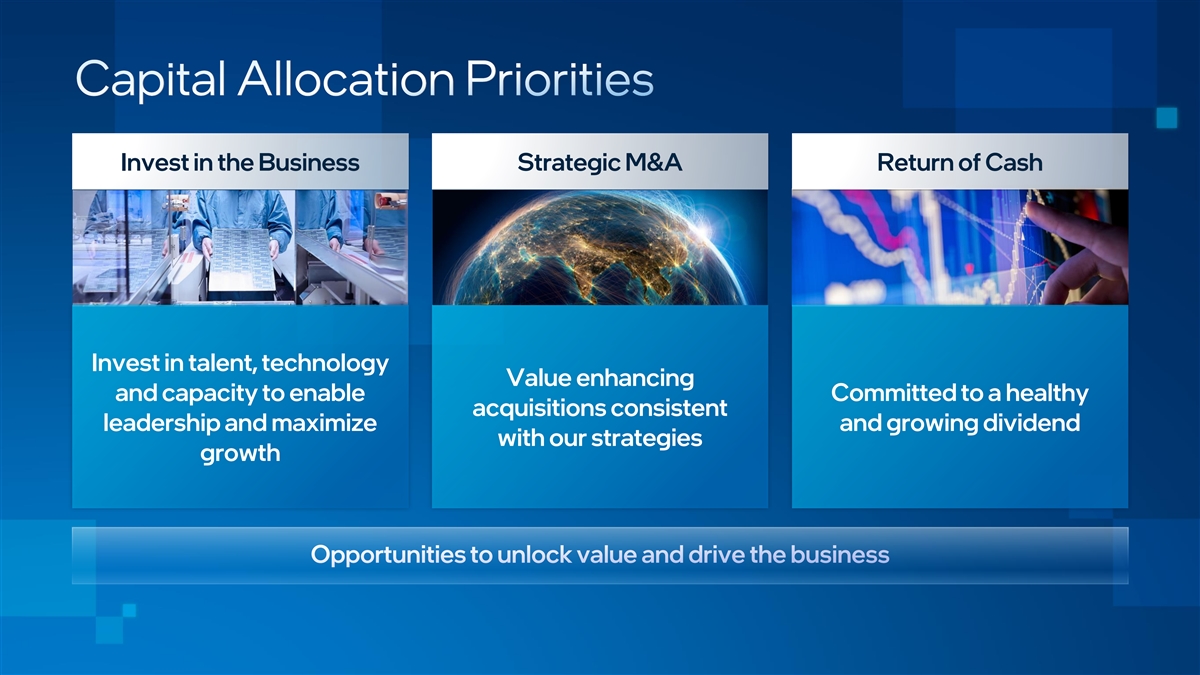
Invest in the Business Strategic M&A Return of Cash Invest in
talent, technology Value enhancing and capacity to enable Committed to a healthy acquisitions consistent leadership and maximize and growing dividend with our strategies growth
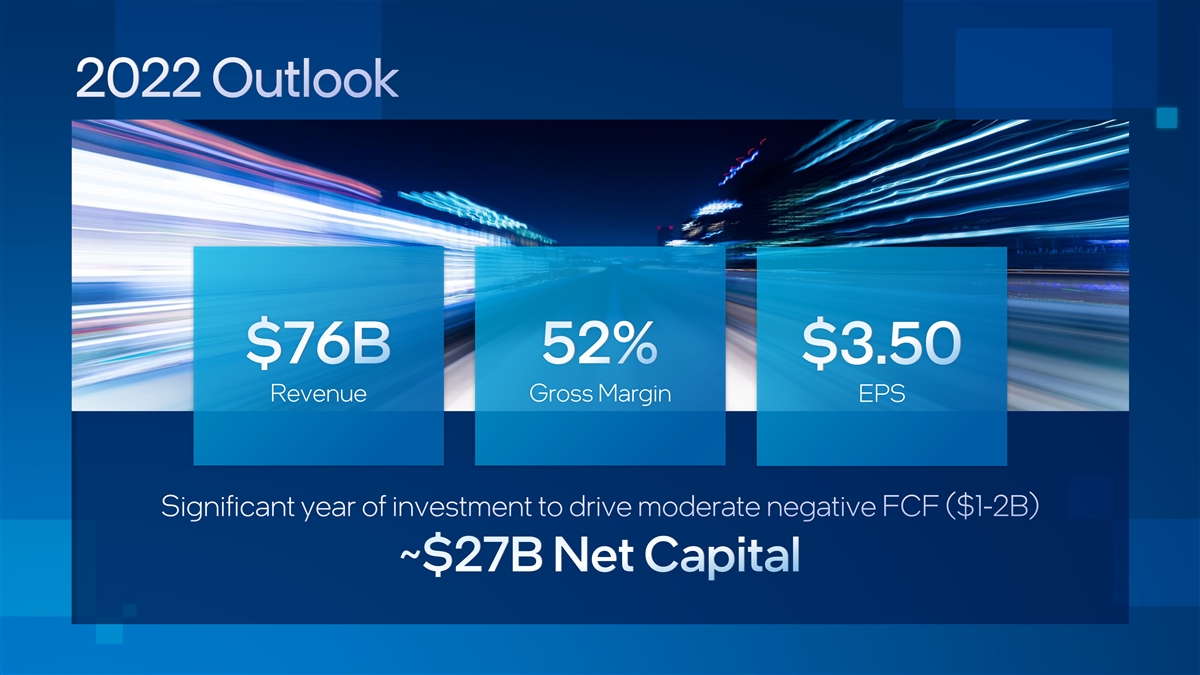
Revenue Gross Margin EPS
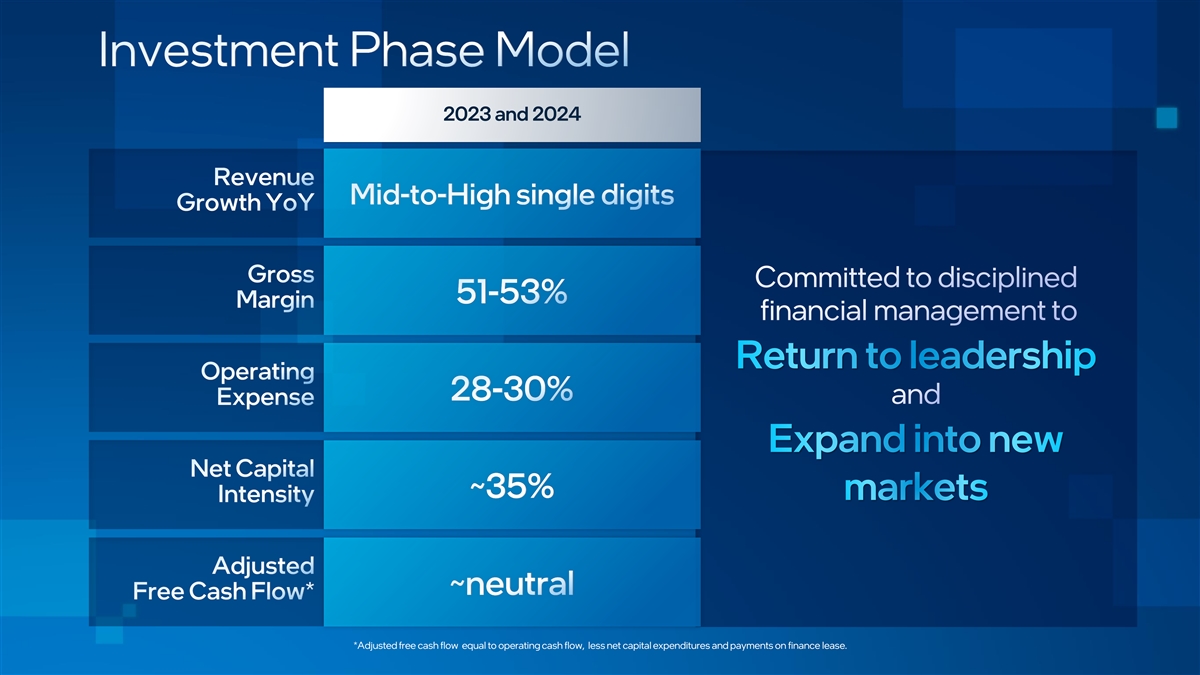
2023 and 2024 ~35% *Adjusted free cash flow equal to operating cash
flow, less net capital expenditures and payments on finance lease.
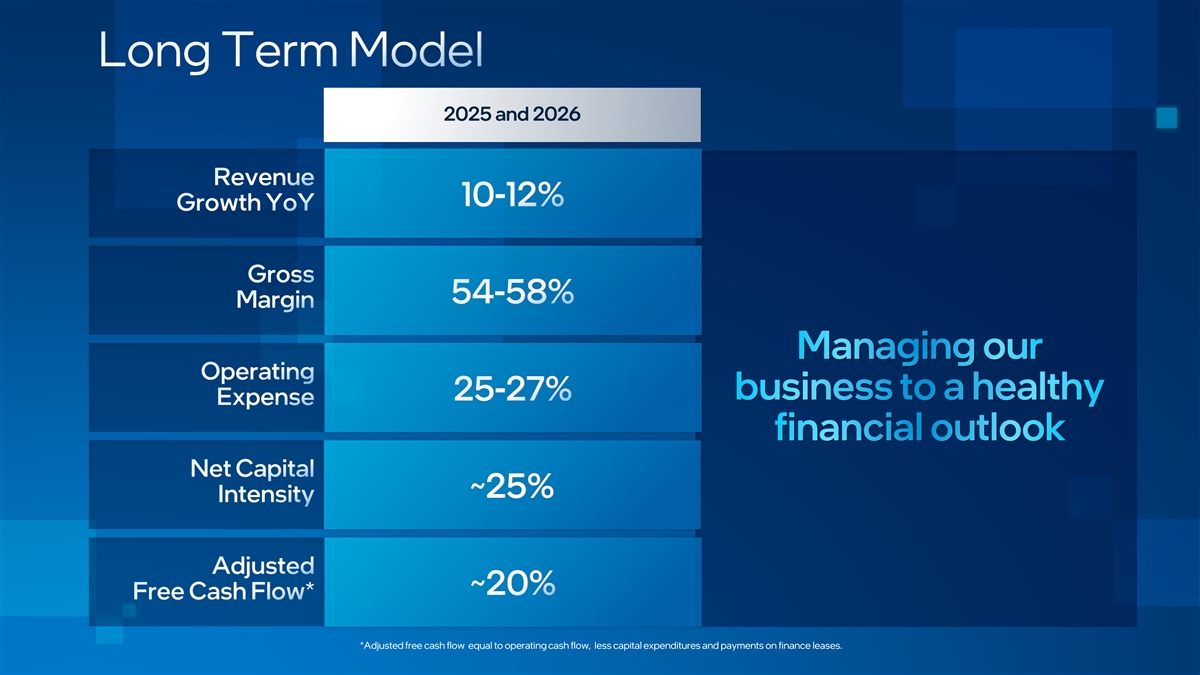
2025 and 2026 ~25% *Adjusted free cash flow equal to operating cash
flow, less capital expenditures and payments on finance leases.
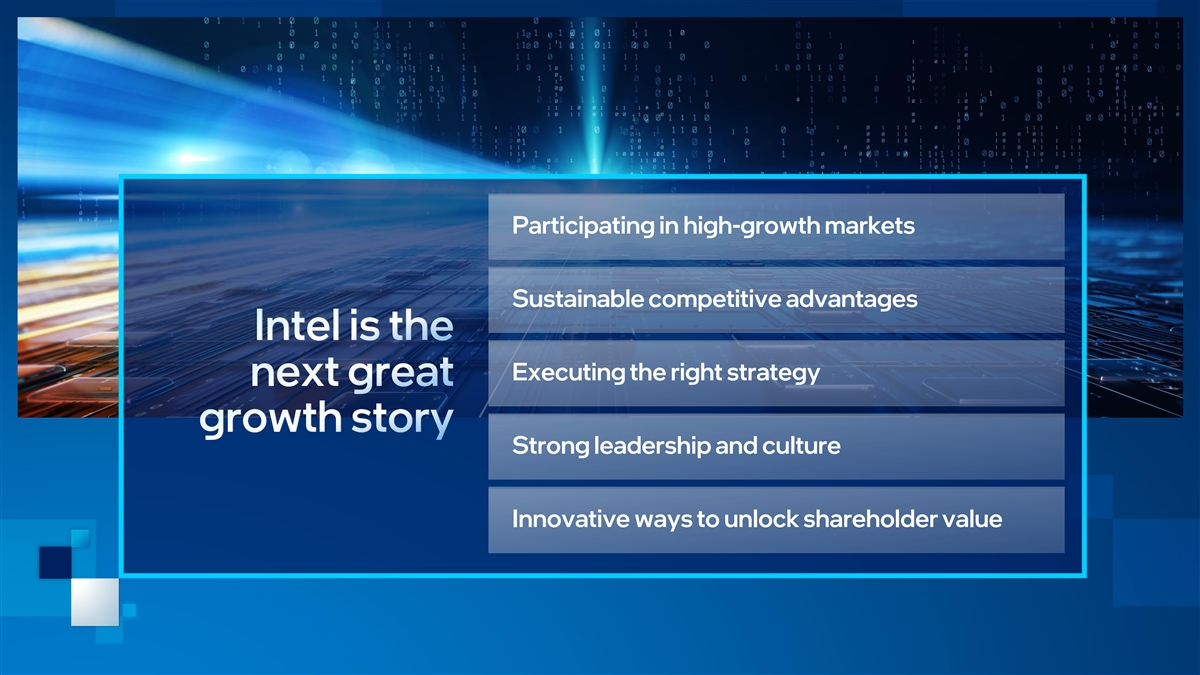
Participating in high-growth markets Sustainable competitive advantages
Executing the right strategy Strong leadership and culture Innovative ways to unlock shareholder value