Exhibit 99.1
Biotech Showcase 2023 San Francisco,
CA January 11, 2003
Liposomal Drug Delivery to Mucosal
Surfaces1
Disclaimers
The information
in this presentation is being provided so you can familiarize yourself with Lipella Pharmaceuticals Inc. (together with its subsidiaries,
“Lipella” the “Company,” “we,” “us,” or “our”) during this informational
meeting. We request that you keep any information we provide at this meeting confidential and that you do not disclose any of
the information to any other parties without the Company’s prior express written permission. Although the Company believes
the information contained herein is accurate in all material respects, the Company does not make any representation or warranty,
either express or implied, as to the accuracy, completeness or reliability of the information contained in this presentation.
Forward-Looking Statements
The presentation
includes certain “forward-looking statements.” All statements, other than statements of historical fact, included
in this presentation regarding, among other things, our strategy, future operations, financial position, anticipated dividends,
projected costs, prospects, pipeline and opportunities, sources of growth, successful implementation of our proprietary technology,
plans and objectives are forward-looking statements. Forward-looking statements can be identified by words such as “may,”
“will,” “could,” “continue,” “would,” “should,” “potential,”
“target,” “goal,” “anticipates,” “intends,” “plans,” “seeks,”
“believes,” “estimates,” “predicts,” “expects,” “projects” and similar
references to future periods. Forward-looking statements are based on our current expectations and assumptions regarding future
events and financial trends that we believe may affect our financial condition, results of operations, business strategy, short-
and long-term business operations and objectives, and financial needs. Because forward-looking statements relate to the future,
they are subject to inherent uncertainties, risks and changes in circumstances that are difficult to predict. Our actual results
may differ materially from those contemplated by the forward-looking statements. We caution you, therefore, against relying on
any of these forward-looking statements. They are neither statements of historical fact nor guarantees or assurances of future
performance. There are risks, uncertainties and other factors, both known and unknown, that could cause actual results to differ
materially from those in the forward-looking statements which include, but are not limited to, regional, national or global political,
economic, business, competitive, market and regulatory conditions, and other factors. Any forward-looking statement made by us
is based upon the reasonable judgment of our management at the time such statement is made and speaks only as of the date on which
it is made. Factors or events that could cause our actual results to differ may emerge from time to time, and it is not possible
for us to predict all of them. We undertake no obligation to update any forward-looking statement, whether as a result of new
information, future developments or otherwise, except as may be required by applicable law.
Nothing contained
herein is, or shall be relied upon as, a promise or representation as to the past or future. The Company expressly disclaims any
and all liability relating to or resulting from the use of this presentation. In addition, the information contained in this presentation
is as of the date hereof, and the Company has no obligation to update such information, including in the event that such information
becomes inaccurate. You should not construe the contents of this presentation or other information we provide at this meeting
as legal, tax, accounting or investment advice or a recommendation. You should consult your own counsel and tax and financial
advisors as to legal and related matters concerning the matters described herein.
2
Executive Summary
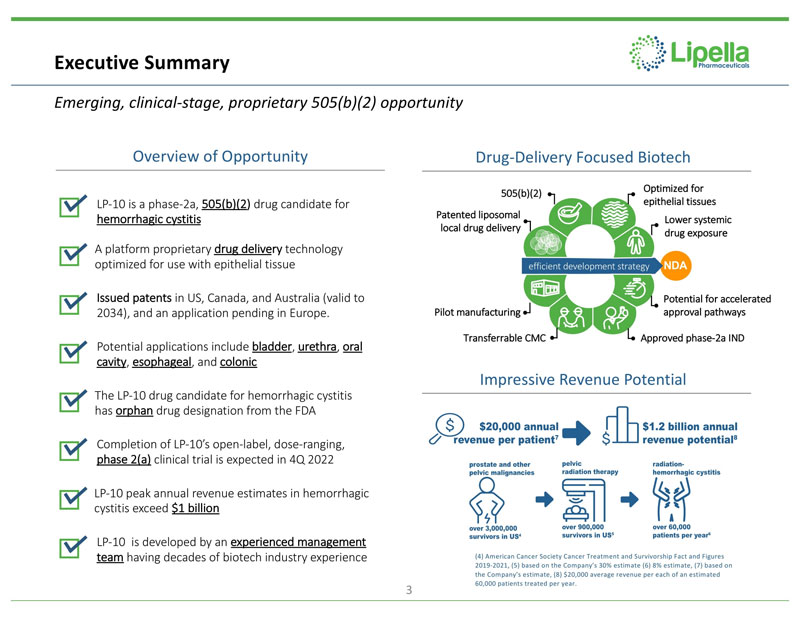
Emerging, clinical-stage, proprietary
505(b)(2) opportunity
Overview of Opportunity Drug-Delivery
Focused Biotech
505(b)(2) Optimized for
LP-10 is a phase-2a, 505(b)(2) drug
candidate for epithelial tissues
hemorrhagic cystitis Patented
liposomal Lower systemic local drug delivery drug exposure
A platform proprietary drug delivery
technology optimized for use with epithelial tissue efficient development strategy NDA
Issued patents in US, Canada, and
Australia (valid to Potential for accelerated 2034), and an application pending in Europe. Pilot manufacturing approval
pathways
Transferrable CMC Approved phase-2a
IND
Potential applications include bladder,
urethra, oral cavity, esophageal, and colonic
Impressive Revenue Potential
The LP-10 drug candidate for hemorrhagic
cystitis has orphan drug designation from the FDA
$20,000 annual $1.2 billion
annual
Completion of LP-10’s open-label,
dose-ranging, revenue per patient7 revenue potential8 phase 2(a) clinical trial is expected
in 4Q 2022 prostate and other pelvic radiation-
pelvic malignancies radiation
therapy hemorrhagic cystitis
LP-10 peak annual revenue estimates
in hemorrhagic cystitis exceed $1 billion
over
3,000,000 over 900,000 over 60,000 LP-10 is developed by an experienced management survivors in US4 survivors
in US5 patients per year6 team having decades of biotech industry experience (4) American Cancer
Society Cancer Treatment and Survivorship Fact and Figures 2019-2021, (5) based on the Company’s 30% estimate (6) 8% estimate,
(7) based on the Company’s estimate, (8) $20,000 average revenue per each of an estimated
| 3 | 60,000 patients treated per year. |
Company History
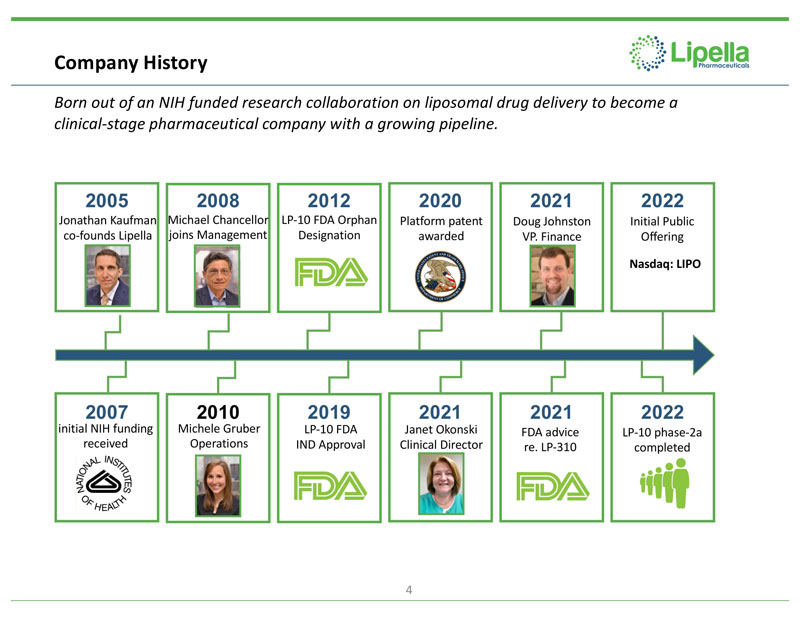
Born out of an NIH funded research
collaboration on liposomal drug delivery to become a clinical-stage pharmaceutical company with a growing pipeline.
2005 2008 2012 2020 2021 2022
Jonathan Kaufman Michael Chancellor
LP-10 FDA Orphan Platform patent Doug Johnston Initial Public co-founds Lipella joins Management Designation awarded VP.
Finance Offering
Nasdaq: LIPO
2007 2010 2019 2021 2021 2022
initial NIH funding Michele Gruber
LP-10 FDA Janet Okonski FDA advice LP-10 phase-2a received Operations IND Approval Clinical Director re.
LP-310 completed
4
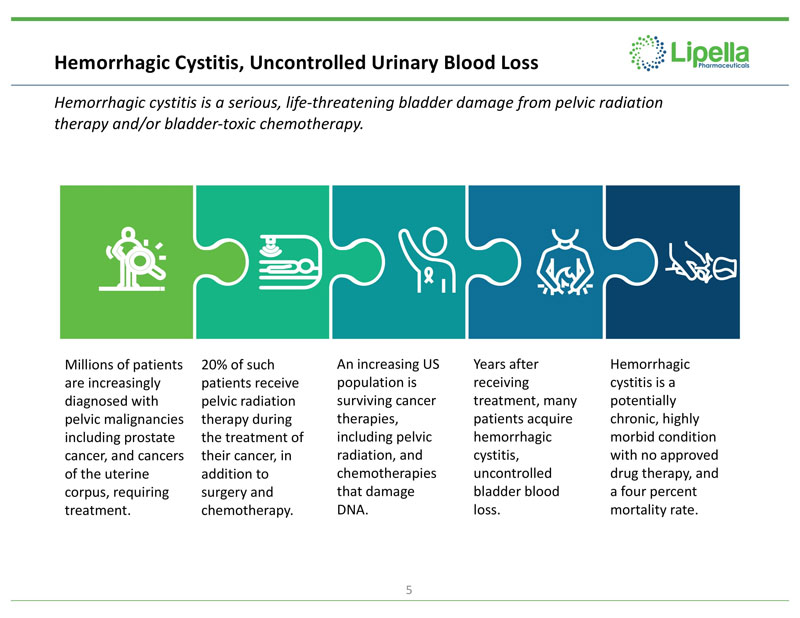
Hemorrhagic Cystitis, Uncontrolled
Urinary Blood Loss
Hemorrhagic cystitis is a serious,
life-threatening bladder damage from pelvic radiation therapy and/or bladder-toxic chemotherapy.
Millions of patients 20% of such
An increasing US Years after Hemorrhagic are increasingly patients receive population is receiving cystitis
is a diagnosed with pelvic radiation surviving cancer treatment, many potentially pelvic malignancies therapy
during therapies, patients acquire chronic, highly including prostate the treatment of including pelvic hemorrhagic
morbid condition cancer, and cancers their cancer, in radiation, and cystitis, with no approved of the uterine
addition to chemotherapies uncontrolled drug therapy, and corpus, requiring surgery and that damage bladder
blood a four percent treatment. chemotherapy. DNA. loss. mortality rate.
5
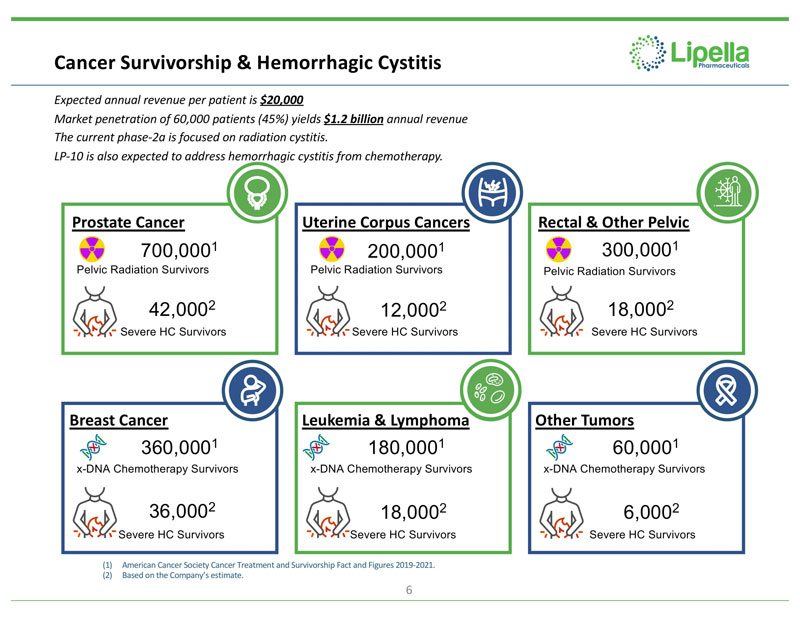
Cancer Survivorship & Hemorrhagic
Cystitis
Expected annual revenue per patient
is $20,000
Market penetration of 60,000 patients
(45%) yields $1.2 billion annual revenue The current phase-2a is focused on radiation cystitis. LP-10 is also expected
to address hemorrhagic cystitis from chemotherapy.
Prostate Cancer Uterine Corpus
Cancers Rectal & Other Pelvic
700,0001 200,0001 300,0001
Pelvic Radiation Survivors Pelvic
Radiation Survivors Pelvic Radiation Survivors
42,0002 12,0002 18,0002
Severe HC Survivors Severe HC
Survivors Severe HC Survivors
Breast Cancer Leukemia &
Lymphoma Other Tumors
360,0001 180,0001 60,0001
x-DNA Chemotherapy Survivors x-DNA
Chemotherapy Survivors x-DNA Chemotherapy Survivors
36,0002 18,0002 6,0002
Severe HC Survivors Severe HC
Survivors Severe HC Survivors
(1) American Cancer Society Cancer
Treatment and Survivorship Fact and Figures 2019-2021. (2) Based on the Company’s estimate.
6
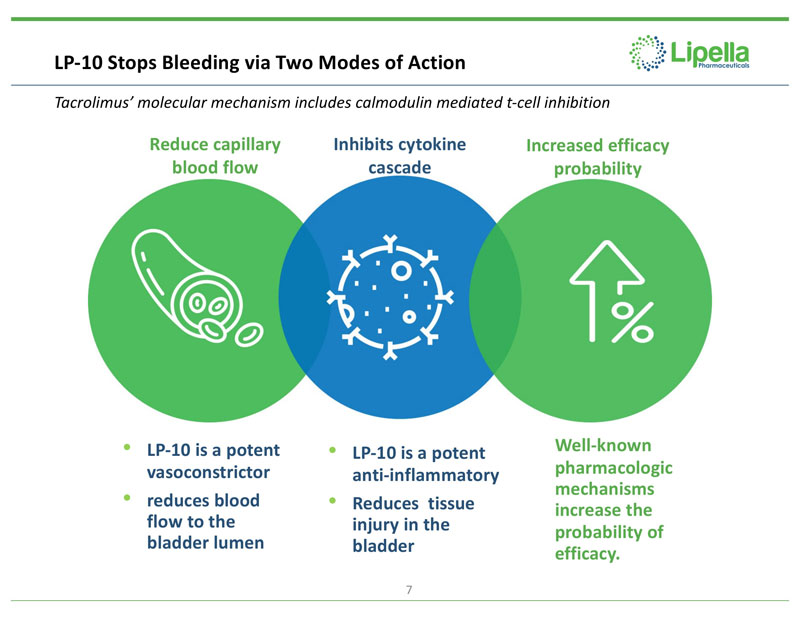
LP-10 Stops Bleeding via Two Modes
of Action
Tacrolimus’ molecular mechanism
includes calmodulin mediated t-cell inhibition
Reduce capillary Inhibits
cytokine Increased efficacy blood flow cascade probability
• LP-10
is a potent • LP-10 is a potent Well-known vasoconstrictor anti-inflammatory pharmacologic mechanisms
• reduces blood • Reduces tissue increase the flow to the injury in the probability of bladder
lumen bladder efficacy.
7
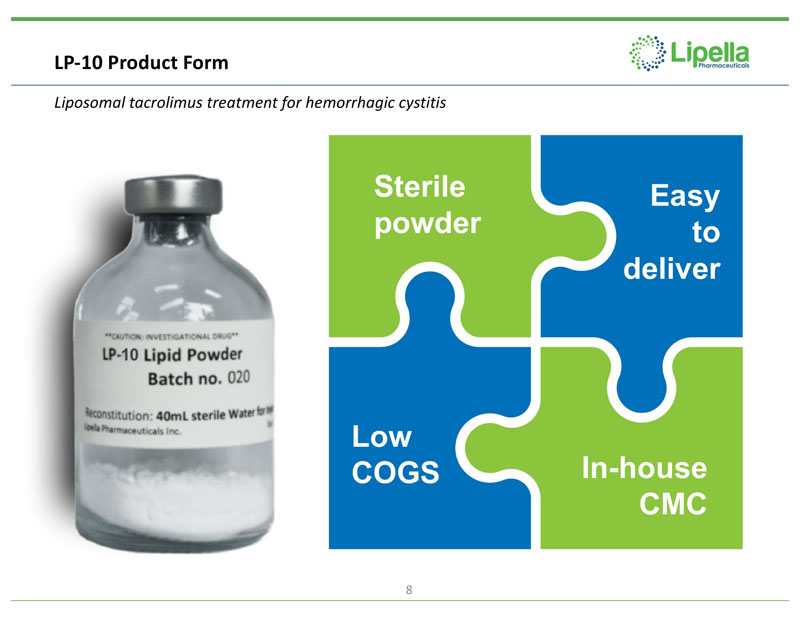
LP-10 Product Form
Liposomal tacrolimus treatment
for hemorrhagic cystitis
Sterile Easy
powder to deliver
Low
COGS In-house CMC
8
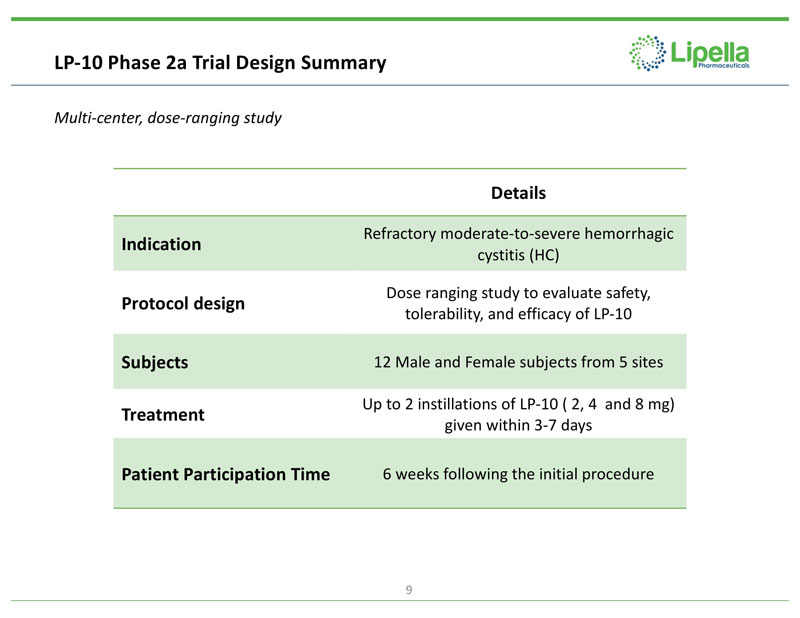
LP-10 Phase 2a Trial Design Summary
Multi-center, dose-ranging study
Details
Refractory moderate-to-severe hemorrhagic
Indication
cystitis (HC)
Dose ranging study to evaluate safety,
Protocol design
tolerability, and efficacy of LP-10
Subjects 12 Male and Female
subjects from 5 sites Up to 2 instillations of LP-10 ( 2, 4 and 8 mg)
Treatment
given within 3-7 days
Patient Participation Time 6
weeks following the initial procedure
9
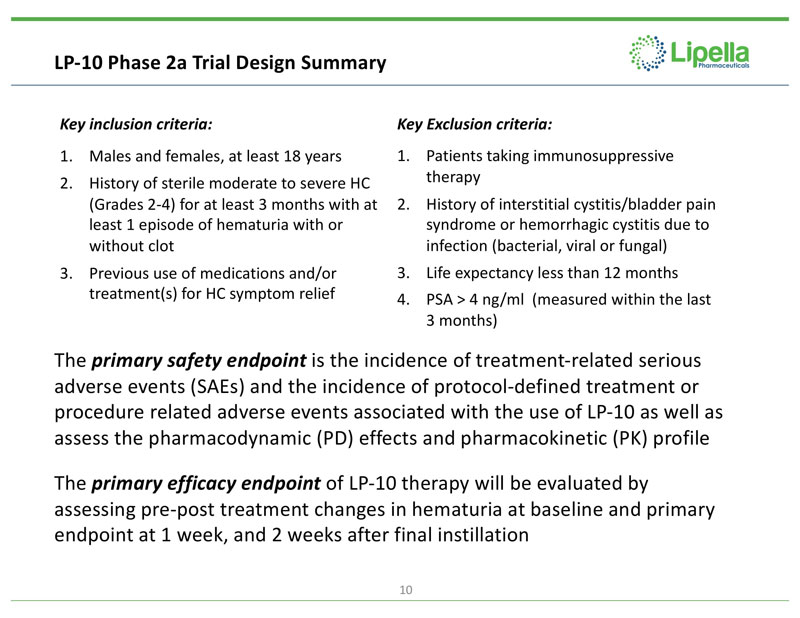
LP-10 Phase 2a Trial Design Summary
Key inclusion criteria: Key
Exclusion criteria:
| 1. | Males and females, at least 18 years 1. Patients taking immunosuppressive |
| 2. | History of sterile moderate to severe HC therapy |
(Grades 2-4)
for at least 3 months with at 2. History of interstitial cystitis/bladder pain least 1 episode of hematuria with or syndrome
or hemorrhagic cystitis due to without clot infection (bacterial, viral or fungal)
| 3. | Previous use of medications and/or 3. Life expectancy less than 12 months treatment(s) for HC symptom relief 4. PSA > 4 ng/ml (measured within the last |
3 months)
The primary safety endpoint
is the incidence of treatment-related serious adverse events (SAEs) and the incidence of protocol-defined treatment or
procedure related adverse events associated with the use of LP-10 as well as assess the pharmacodynamic (PD) effects and pharmacokinetic
(PK) profile The primary efficacy endpoint of LP-10 therapy will be evaluated by assessing pre-post treatment changes
in hematuria at baseline and primary endpoint at 1 week, and 2 weeks after final instillation
10
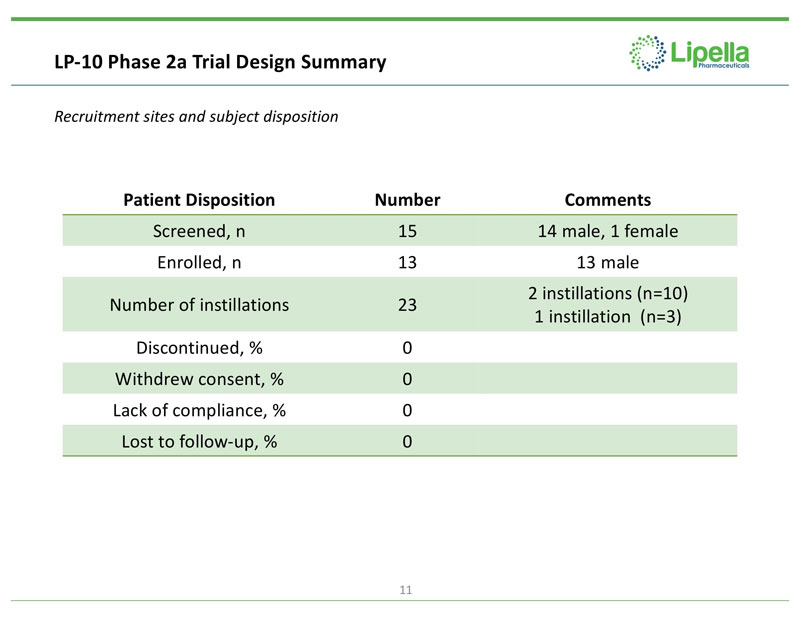
LP-10 Phase 2a Trial Design Summary
Recruitment sites and subject
disposition
Patient Disposition Number Comments
Screened,
n 15 14 male, 1 female Enrolled, n 13 13 male 2 instillations (n=10) Number of instillations 23 1 instillation
(n=3) Discontinued, % 0 Withdrew consent, % 0 Lack of compliance, % 0 Lost to follow-up, % 0
11
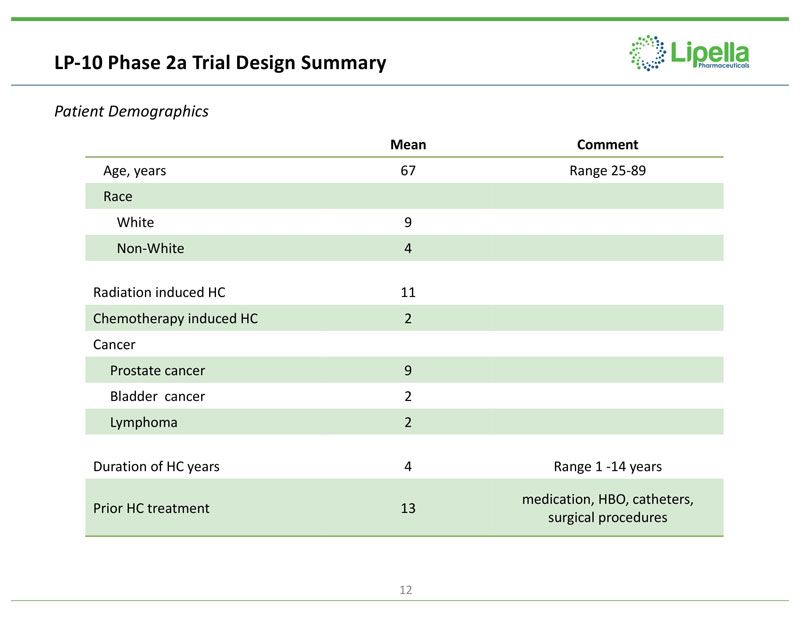
LP-10 Phase 2a Trial Design Summary
Patient Demographics
Mean Comment
Age, years 67 Range
25-89 Race White 9 Non-White 4
Radiation induced
HC 11 Chemotherapy induced HC 2 Cancer Prostate cancer 9 Bladder cancer 2 Lymphoma 2
Duration of HC
years 4 Range 1 -14 years medication, HBO, catheters, Prior HC treatment 13 surgical procedures
12
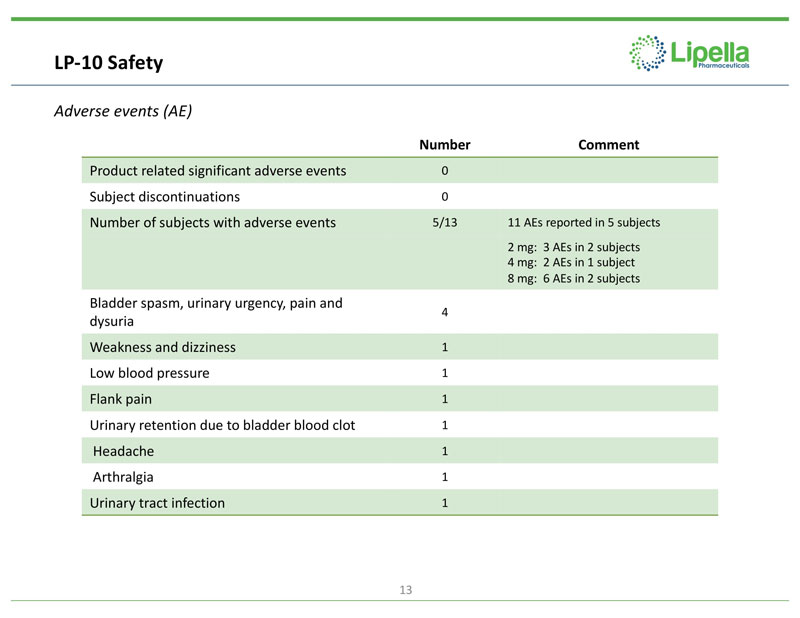
LP-10 Safety
Adverse events (AE)
Number Comment
Product related significant adverse
events 0 Subject discontinuations 0
Number of subjects with adverse events 5/13 11
AEs reported in 5 subjects
2 mg: 3 AEs
in 2 subjects 4 mg: 2 AEs in 1 subject 8 mg: 6 AEs in 2 subjects
Bladder spasm, urinary urgency, pain
and
4
dysuria
Weakness and
dizziness 1 Low blood pressure 1 Flank pain 1 Urinary retention due to bladder blood clot 1 Headache 1 Arthralgia 1
Urinary tract infection 1
13
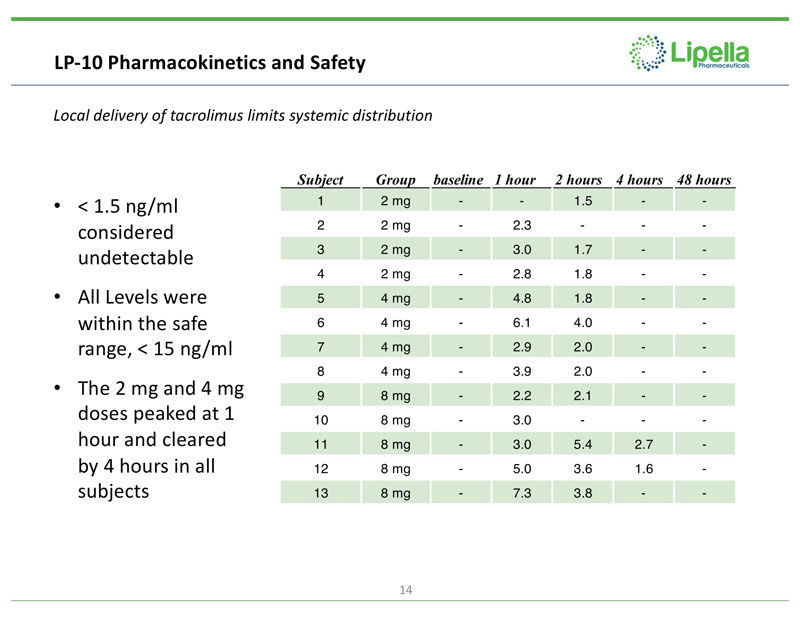
LP-10 Pharmacokinetics and Safety
Local delivery of tacrolimus limits
systemic distribution
Subject Group baseline 1
hour 2 hours 4 hours 48 hours
• <
1.5 ng/ml 1 2 mg - - 1.5 - -
considered 2 2 mg - 2.3 - - -undetectable 3 2
mg - 3.0 1.7 - -
4 2 mg - 2.8 1.8 - -
• All
Levels were 5 4 mg - 4.8 1.8 - -within the safe 6 4 mg - 6.1 4.0 - -range, < 15
ng/ml 7 4 mg - 2.9 2.0 - -
8 4 mg - 3.9 2.0 - -
| • | The 2 mg and 4 mg |
9 8 mg - 2.2 2.1 - -
doses peaked
at 1 10 8 mg - 3.0 - - -hour and cleared 11 8 mg - 3.0 5.4 2.7 -by 4 hours in all
12 8 mg - 5.0 3.6 1.6 -
subjects 13 8 mg - 7.3 3.8 - -
14
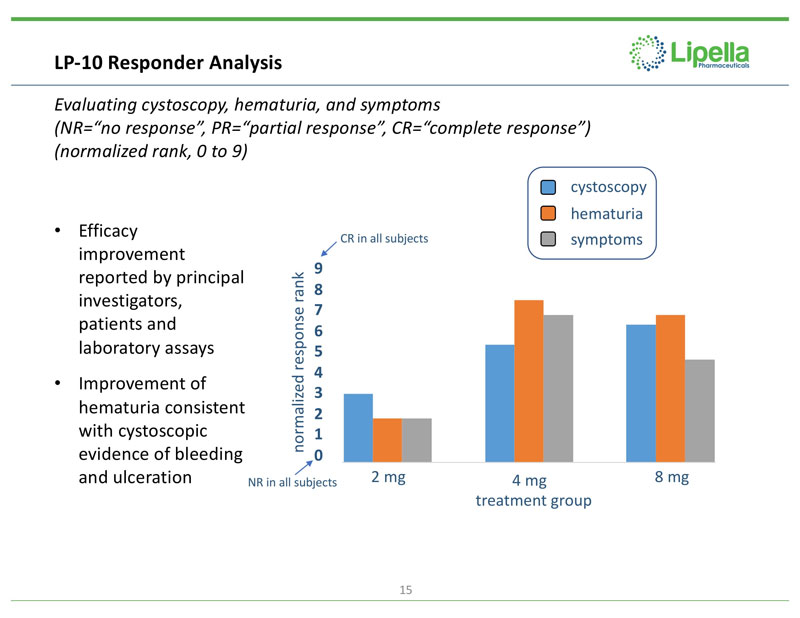
LP-10 Responder Analysis
Evaluating cystoscopy, hematuria,
and symptoms
(NR=“no response”,
PR=“partial response”, CR=“complete response”) (normalized rank, 0 to 9)
cystoscopy hematuria
| • | Efficacy CR in all subjects symptoms |
improvement reported by principal
9
8
investigators,
7 patients and 6 laboratory assays 5
4
| • | Improvement of 3 hematuria consistent 2 |
with cystoscopic normalized response
rank 1
evidence of bleeding 0
and ulceration NR in all subjects 2
mg 4 mg 8 mg
treatment group
15
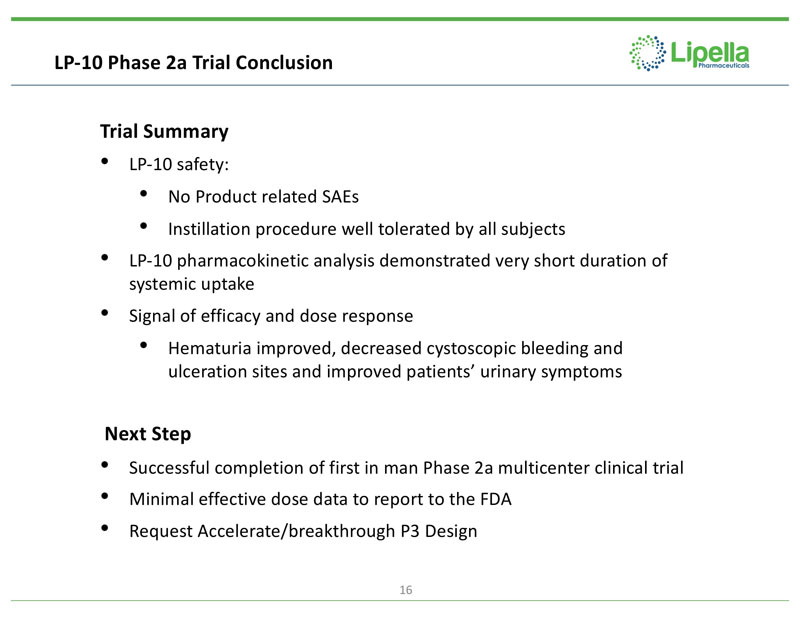
LP-10 Phase 2a Trial Conclusion
Trial Summary
| • | LP-10 safety: |
| • | No Product related SAEs |
| • | Instillation procedure well tolerated by all subjects |
| • | LP-10 pharmacokinetic analysis demonstrated very short duration of systemic uptake |
| • | Signal of efficacy and dose response |
| • | Hematuria improved, decreased cystoscopic bleeding and ulceration sites and improved patients’ urinary symptoms |
Next Step
| • | Successful completion of first in man Phase 2a multicenter clinical trial |
| • | Minimal effective dose data to report to the FDA |
| • | Request Accelerate/breakthrough P3 Design |
16
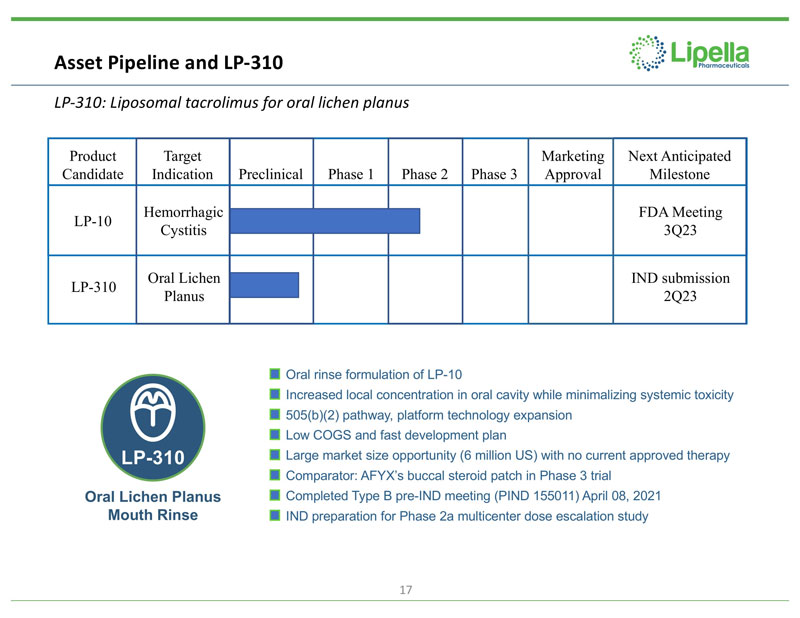
Asset Pipeline and LP-310
LP-310: Liposomal tacrolimus for
oral lichen planus
Product Target Marketing Next
Anticipated Candidate Indication Preclinical Phase 1 Phase 2 Phase 3 Approval Milestone
Hemorrhagic FDA
Meeting LP-10 Cystitis 3Q23
Oral
Lichen IND submission LP-310 Planus 2Q23
Oral rinse formulation of LP-10
Increased
local concentration in oral cavity while minimalizing systemic toxicity 505(b)(2) pathway, platform technology expansion Low COGS
and fast development plan LP-310 Large market size opportunity (6 million US) with no current approved therapy Comparator:
AFYX’s buccal steroid patch in Phase 3 trial Oral Lichen Planus Completed Type B pre-IND meeting (PIND 155011)
April 08, 2021 Mouth Rinse IND preparation for Phase 2a multicenter dose escalation study
17
Liposomal Drug Delivery to Mucosal
Surfaces
18
Lipella
Pharmaceuticals Inc. 7800 Susquehanna Street, Suite 505 Pittsburgh, PA 15208 412-894-1853 www.lipella.com
19