DigiA Energy Technology Co., Ltd.
Financial Statement Auditor's Report
Republic of China Year 113 and Year 112
Auditor's Report
To DigiA Energy Technology Co., Ltd.:
Audit Opinion
We have audited the balance sheets of DigiA Energy Technology Co., Ltd. as of December 31, 2024 (Year 113) and December 31, 2023 (Year 112), and the comprehensive income statements, statements of changes in equity, cash flow statements, and notes to the financial statements (including summaries of significant accounting policies) for the periods from January 1 to December 31 for both Year 113 and Year 112.
In our opinion, the aforementioned financial statements present fairly, in all material respects, the financial position of DigiA Energy Technology Co., Ltd. as of December 31, 2024 (Year 113) and December 31, 2023 (Year 112), and its financial performance and cash flows for the periods from January 1 to December 31 for both Year 113 and Year 112, in accordance with the Regulations Governing the Preparation of Financial Reports by Securities Issuers, International Financial Reporting Standards, International Accounting Standards, interpretations, and interpretation announcements endorsed and issued by the Financial Supervisory Commission.
Basis for Audit Opinion
We conducted our audits in accordance with the Regulations Governing Auditing and Attestation of Financial Statements by Certified Public Accountants and generally accepted auditing standards. Our responsibilities under those standards are further described in the "Auditor's Responsibilities for the Audit of the Financial Statements" section of our report.
Responsibilities of Management and Those Charged with Governance for the Financial Statements
Management is responsible for the preparation and fair presentation of the financial statements in accordance with the Regulations Governing the Preparation of Financial Reports by Securities Issuers, International Financial Reporting Standards, International Accounting Standards, interpretations, and interpretation announcements endorsed and issued by the Financial Supervisory Commission, and for such internal control as management determines is necessary to enable the preparation of financial statements that are free from material misstatement, whether due to fraud or error.
In preparing the financial statements, management is responsible for assessing DigiA Energy Technology Co., Ltd.'s ability to continue as a going concern, disclosing, as applicable, matters related to going concern and using the going concern basis of accounting unless management either intends to liquidate DigiA Energy Technology Co., Ltd. or to cease operations, or has no realistic alternative but to do so.
Those charged with governance (including the Audit Committee) are responsible for overseeing DigiA Energy Technology Co., Ltd.'s financial reporting process.
Auditor's Responsibilities for the Audit of the Financial Statements
Our objectives are to obtain reasonable assurance about whether the financial statements as a whole are free from material misstatement, whether due to fraud or error, and to issue an auditor's report that includes
1
our opinion. Reasonable assurance is a high level of assurance, but is not a guarantee that an audit conducted in accordance with auditing standards will always detect a material misstatement when it exists. Misstatements can arise from fraud or error and are considered material if, individually or in the aggregate, they could reasonably be expected to influence the economic decisions of users taken on the basis of these financial statements.
As part of an audit in accordance with auditing standards, we exercise professional judgment and maintain professional skepticism throughout the audit. We also:
1.Identify and assess the risks of material misstatement of the financial statements, whether due to fraud or error, design and perform audit procedures responsive to those risks, and obtain audit evidence that is sufficient and appropriate to provide a basis for our opinion. The risk of not detecting a material misstatement resulting from fraud is higher than for one resulting from error, as fraud may involve collusion, forgery, intentional omissions, misrepresentations, or the override of internal control.
2.Obtain an understanding of internal control relevant to the audit in order to design audit procedures that are appropriate in the circumstances.
3.Evaluate the appropriateness of accounting policies used and the reasonableness of accounting estimates and related disclosures made by management.
4.Conclude on the appropriateness of management's use of the going concern basis of accounting and, based on the audit evidence obtained, whether a material uncertainty exists related to events or conditions that may cast significant doubt on DigiA Energy Technology Co., Ltd.'s ability to continue as a going concern. If we conclude that a material uncertainty exists, we are required to draw attention in our auditor's report to the related disclosures in the financial statements or, if such disclosures are inadequate, to modify our opinion. Our conclusions are based on the audit evidence obtained up to the date of our auditor's report. However, future events or conditions may cause DigiA Energy Technology Co., Ltd. to cease to continue as a going concern.
5.Evaluate the overall presentation, structure and content of the financial statements, including the disclosures, and whether the financial statements represent the underlying transactions and events in a manner that achieves fair presentation.
We communicate with those charged with governance regarding, among other matters, the planned scope and timing of the audit and significant audit findings, including any significant deficiencies in internal control that we identify during our audit.
2
DIJIYA ENERGY SAVING TECHNOLOGY INC.
Financial Statements
December 31, 2024 and 2023
3
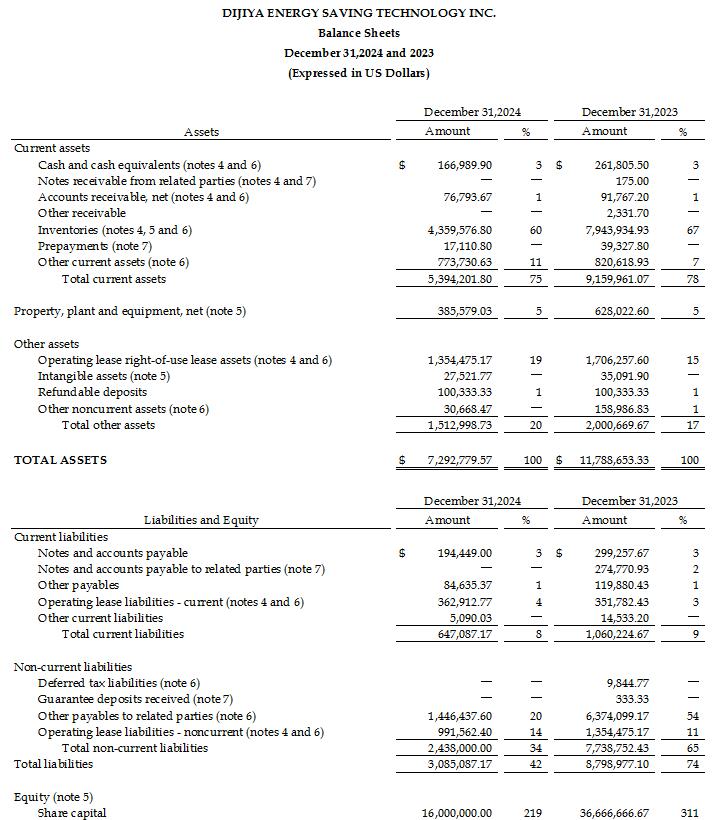

President Financial Manager

4
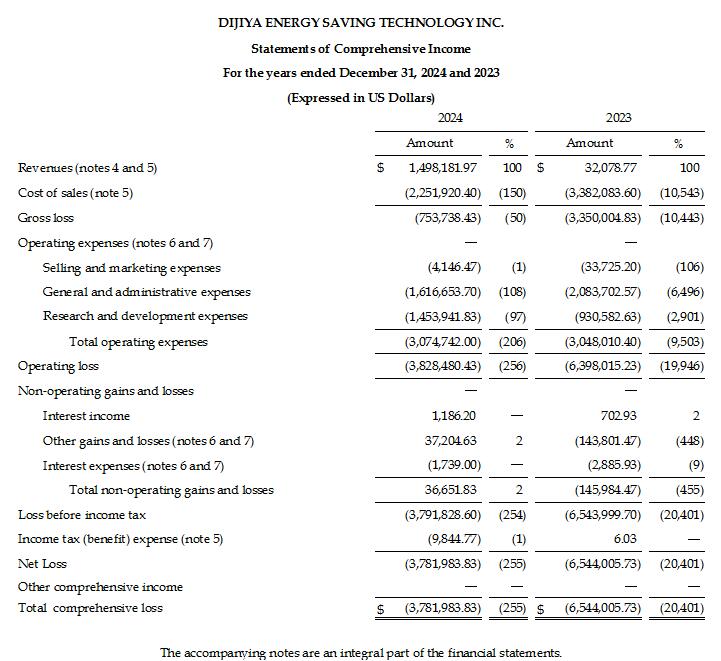
President Financial Manager
5
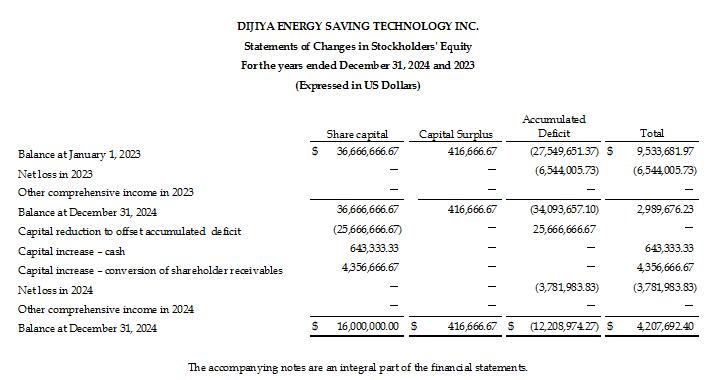
President Financial Manager
6
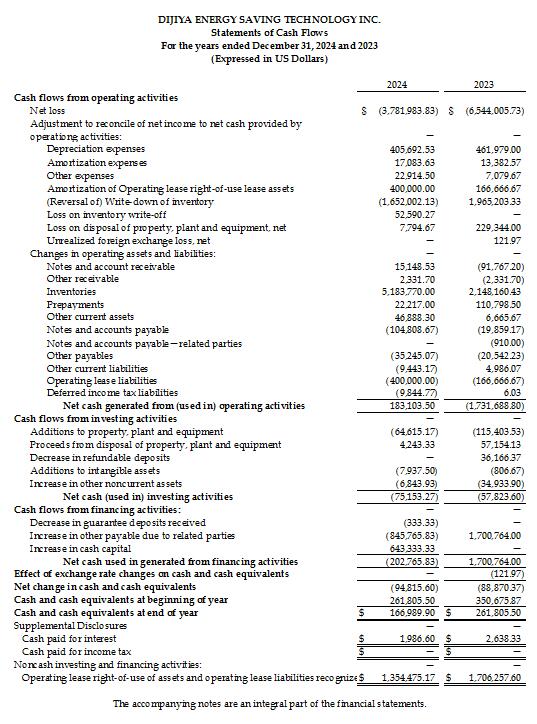 President Financial Manager
7
DIJIYA ENERGY SAVING TECHNOLOGY INC.
NOTES TO FINANCIAL STATEMENTS
December 31, 2024 and 2023
(Amounts Expressed in New Taiwan Dollars unless otherwise stated)
1.Organization and activities
DIJIYA ENERGY SAVING TECHNOLOGY INC. (the “Company”) was incorporated as a company limited by shares under the provision of the Company Law of the Republic of China (ROC) on August 20, 2009. As of December 31, 2024 and 2023, the number of employees of the Company were approximately 19 and 32 employees.
The principal activities of the Company are the manufacturing and sale of
LiFePO4 Battery Cell & Power Battery Packs.
2.The date of authorization for issuance of the financial statements and procedures for authorization
These financial statements were authorised for issuance by the Board of Directors on May 9, 2025.
3.Recent Accounting Pronouncements
In December 2023, the FASB issued ASU 2023-09 on Improvements to Income Tax Disclosures that require greater disaggregation of income tax disclosures to the income rate tax rate reconciliation and income taxes paid. The Updates are effective for annual periods beginning after December 15, 2024. The Company will adopt and apply the guidance in fiscal year 2025. There is no material impact expected to our results of operations, cash flows and financial condition at the time of adoption, however the Company is still assessing the disclosure impact.
4.Summary of significant accounting policies
The principal accounting policies applied in the preparation of these financial statements are set out below.
8
These policies have been consistently applied to all reporting periods, unless otherwise stated.
(1) Basis of preparation
The financial statements and accompanying notes of the Company have been prepared in conformity with accounting principles generally accepted in the United States of America (“US GAAP”).
(2) Foreign currency
The functional currency of the Company is determined by the primary economic environment in which the Company operates.
The financial statements are presented in New Taiwan dollars, which is the Company’s functional currency.
A.Foreign currency transactions are translated into the functional currency using spot exchange rate at the dates of the transactions.
B.Monetary items denominated in foreign currencies are translated at the closing rate at the balance sheet date. Exchange differences arising upon translation at the balance sheet date are recognised in profit or loss.
C.Non-monetary items denominated in foreign currencies held at fair value through profit or loss are translated at closing rate at the balance sheet date; their translation differences are recognised in profit or loss.
Non-monetary items denominated in foreign currencies held at fair value through other comprehensive income are translated at the closing rate at the balance sheet date; their translation differences are recognised in other comprehensive income.
Non-monetary items denominated in foreign currencies that are measured at cost are translated using the historical exchange rates at the dates of the transactions.
D.All foreign exchange gains and losses are presented in the statement of comprehensive income within ‘other gains and losses.’
(3) Going Concern Consideration
For the year ended December 31, 2024, the Company had a net loss of $113,459,515 and accumulated deficit $336,269,228, which is greater than 50% of share capital. These conditions raise substantial doubt about the Company’s ability to continue
9
as a going concern. Therefore, the Company may be unable to realize its assets and discharge its liabilities in normal course of business.
The borrowings of the Company as of December 31, 2024 were from the related parties, which will not repayable within the next 12 months and are subject to renewal. Management is confident that these borrowings can be renewed upon expiration.
Management believes that there is sufficient working capital to sustain operations longer than twelve months.
(4) Classification of current and non-current items
A.Assets that meet one of the following criteria are classified as current assets; otherwise they are classified as non-current assets:
(a)Assets that are expected to be realised, or are intended to be sold or consumed within the normal operating cycle;
(b) Assets held mainly for trading purposes;
(c)Assets that are expected to be realised within twelve months from the balance sheet date;
(d)Cash or cash equivalents, excluding cash and cash equivalents that are restricted from being exchanged, used to settle liabilities for at least twelve months after the balance sheet date or restricted by other factors.
B.Liabilities that meet one of the following criteria are classified as current liabilities; otherwise they are classified as non-current liabilities:
(a)Liabilities that are expected to be settled within the normal operating cycle;
(b) Liabilities held mainly from trading activities;
(c) Liabilities that are to be settled within twelve months after the balance sheet date;
(d)Liabilities for which the repayment date cannot be deferred unconditionally for at least twelve months after the balance sheet date.
(5) Cash and Cash equivalents
Cash equivalents refer to short-term, highly liquid time deposits or investments that are readily convertible to known amounts of cash and which are subject to an insignificant risk of changes in value.
10
(6) Accounts and other receivables and allowance for credit losses
Accounts receivable are stated at historical cost less allowance for doubtful accounts. On a periodic basis, management evaluates its accounts receivable and determines whether to provide an allowance for credit losses in accordance with the Financial Accounting Standards Board’s (“FASB”) Accounting Standards Codification (“ASC”) Topic 326, credit losses based on a past history of write-offs, collections, current credit conditions, current economic conditions, reasonable and supportable forecasts of future economic conditions. The evaluation is performed on a collective basis where similar characteristics exist, primarily based on similar services or products offerings. We adopted the standard effective January 1, 2023. The impact of the adoption was not considered material to the financial statements and primarily resulted in new/enhanced disclosures only. A receivable is considered past due if the Company has not received payments based on agreed-upon terms. The Company generally does not require any security or collateral to support its receivables.
(7) Inventories
At the end of year, inventories are evaluated at the lower of cost or net realizable value. The individual item approach is used in the comparison of cost and market, except where it may be appropriate to group similar or related items. The calculation of net realizable value should be based on the estimated selling price in the normal course of business, net of estimated costs of completion and estimated selling expenses. A provision is made for obsolete or slow-moving items and is charged against current cost of sales.
(8) Property, plant and equipment
A.Property, plant and equipment are initially recorded at cost. Borrowing costs incurred during the construction period are capitalised.
B.In case of replacement of one part of the property, plant and equipment, the new part is capitalised to the extent that it is probable that future economic benefits associated with the item will flow to the Company, and the carrying amount of the part replaced is derecognised. All other repairs and maintenance are charged to profit or loss when incurred.
C.Property, plant and equipment are measured at cost model subsequently. Land is not depreciated. Other property, plant and equipment are depreciated using
11
the straight-line method over their estimated useful lives. Each part of an item of property, plant and equipment with a cost that is significant in relation to the total cost of the item is depreciated separately, unless it is impracticable. The estimated useful lives of property, plant and equipment are as follows:
Machinery | 5-8 years |
Transportation equipment | 5 years |
Operation facilities | 3-5 years |
Other equipment | 2-5 years |
(9) Intangible assets
Intangible assets are measured at cost, less accumulated amortization and any accumulated impairment losses.
Amortization is calculated over the cost of the asset, less its residual value, and is recognized in profit or loss on a straight-line basis over the estimated useful lives of intangible assets from the date that they are available-for-use.
The estimated useful lives for the current and comparative periods are as follows:
(i)Patent1-20 years
(ii)Trademark 2.5-10 years
When intangible assets are revaluated in accordance with laws and regulations,. Uu nrealized gains (losses) on revaluation are recognized in other comprehensive income and are accumulated in unrealized revaluation surplus within equity. Unrealized revaluation surplus within equity is reclassified as gains or losses upon the disposal of the asset.
(10) Impairment of non-financial assets
Management evaluates the Company’s long‑lived assets, excluding goodwill, that consist of property, plant and equipment and intangible assets, for indicators of possible impairment when events or changes in circumstances indicate the carrying amount of an asset may not be recoverable. Impairment exists if the carrying amounts of such assets exceed the estimates of future net undiscounted cash flows expected to be generated by such assets. Should impairment exist, the impairment loss would be measured based on the excess carrying amount of the asset over the estimated fair value of the asset. Fair value is determined through various valuation techniques, including discounted cash flow models, quoted market values and third
12
‑party independent appraisers, as considered necessary.
(11) Employee benefits
A.Short-term employee benefits
Short-term employee benefits are measured at the undiscounted amount of the benefits expected to be paid and are recognised as expenses in the period in which the employees render service.
B.The amount that the Company shall appropriate in a designated pension account according to law is recognised as pension expenses on an accrual basis.
(12) Revenue recognition
The Company accounts for revenue in accordance with Financial Accounting Standards Board (“FASB”) Accounting Standard Codification (“ASC”) Topic 606, Revenue from Contracts with Customers (“ASC Topic 606”). The standard did not affect the Company’s financial position, or cash flows. There were no changes to the timing of revenue recognition as a result of the adoption.
The Company recognizes revenue in accordance with ASC Topic 606, Revenue from Contracts with Customers, which provided a five-step model for recognizing revenue from contracts with customers as follows:
nIdentify the contract with a customer.
nIdentify the performance obligations in the contract.
nDetermine the transaction price.
nAllocate the transaction price to the performance obligations in the contract
nRecognize revenue when or as performance obligations are satisfied.
(13) Lease
Leases are classified at lease commencement date as either a finance lease or an operating lease. A lease is a finance lease if it meets any of the following criteria: (a) the lease transfers ownership of the underlying asset to the lessee by the end of the lease term, (b) the lease grants the lessee an option to purchase the underlying asset that the lessee is reasonably certain to exercise, (c) the lease term is for the major part of the remaining economic life of the underlying asset, (d) the present value of the sum of the lease payments and any residual value guaranteed by the lessee that is not already reflected in the lease payments equals or
13
exceeds substantially all of the fair value of the underlying asset or (e) the underlying asset is of such a specialized nature that it is expected to have no alternative use to the lessor at the end of the lease term. When none of the foregoing criteria is met, the lease shall be classified as an operating lease.
For a lessee, a lease is recognized as a right-of-use asset with a corresponding liability at lease commencement date. The lease liability is calculated at the present value of the lease payments not yet paid by using the lease term and discount rate determined at lease commencement. The right-of-use asset is calculated as the lease liability, increased by any initial direct costs, and prepaid lease payments, reduced by any lease incentives received before lease commencement.
The right-of-use asset itself is amortized on a straight-line basis unless another systematic method better reflects how the underlying asset will be used by and benefits the lessee over the lease term.
(14) Income tax
A.The tax expense for the period comprises current and deferred tax. Tax is recognised in profit or loss, except to the extent that it relates to items recognised in other comprehensive income or items recognised directly in equity, in which cases the tax is recognised in other comprehensive income or equity.
B.The current income tax liabilities are calculated based on the tax rate enacted at the balance sheet date.
C.Deferred tax is recognised, using the balance sheet liability method, on temporary differences arising between the tax bases of assets and liabilities and their carrying amounts in the balance sheet. Deferred tax is determined using tax rates (and laws) that have been enacted by the balance sheet date and are expected to apply when the related deferred tax asset is realised or the deferred tax liability is settled.
D.Deferred tax asset are recorded net of a valuation allowance when, based on the weight of available evidence, it is more likely than not that all or some portion of the recorded deferred tax balances will not be realized in future periods. Decrease to the valuation allowance are recorded as reductions to the Companys's provision for income taxes and increases to the valuation allowance result in addintional provision for income taxes.
14
E.A deferred tax asset is recognised for the carryforward of unused tax credits resulting from unused taxable loss, acquisitions of equipment or technology, research and development expenditures and equity investments to the extent that it is possible that future taxable profit will be available against which the unused tax credits can be utilised.
5.Critical estimates and key sources of assumption uncertainty
The preparation of these financial statements requires management to make critical assumptions and estimates concerning future events based on the conditions existing at the balance sheet date. Assumptions and estimates may differ from the actual results and are continually evaluated and adjusted based on historical experience and other factors. Such assumptions and estimates have a significant risk of causing a material adjustment to the carrying amounts of assets and liabilities within the next financial year; and the related information is addressed below:
(1) Impairment assessment of tangible and intangible assets
The Company assesses impairment based on its subjective judgement and determines the separate cash flows of a specific group of assets, useful lives of assets and the future possible income and expenses arising from the assets depending on how assets are utilised and industrial characteristics. Any changes of economic circumstances or estimates due to the change of Company strategy might cause material impairment on assets in the future.
(2) Realisability of deferred tax assets
Deferred tax assets are recognised only to the extent that it is probable that future taxable profit will be available against which the deductible temporary differences can be utilised. Assessment of the realisability of deferred tax assets involves critical accounting judgements and estimates of the management, including the assumptions of expected future sales revenue growth rate and profit rate, available tax credits, tax planning, etc. Any variations in global economic environment, industrial environment, and laws and regulations might cause material adjustments to deferred tax assets.
(3) Evaluation of inventories
As inventories are stated at the lower of cost and net realisable value, the Company must determine the net realisable value of inventories on balance sheet date using judgements and estimates. Due to the rapid technology innovation, the Company
15
evaluates the amounts of normal inventory consumption, obsolete inventories or inventories without market selling value on balance sheet date, and writes down the cost of inventories to the net realisable value. Such an evaluation of inventories is principally based on the demand for the products within the specified period in the future. Therefore, there might be material changes to the evaluation.
6.The contents of statements of major accounting items
(1)Cash and Cash Equivalents
|
| 2024.12.31 |
| 2023.12.31 |
| ||
Cash on hand |
| $ | 2666.667 |
| $ | 5578.1 |
|
Saving account |
|
| 164323.2 |
|
| 256227.4 |
|
Total |
| $ | 166989.9 |
| $ | 261805.5 |
|
The Company has not pledged its cash and cash equivalents as collateral.
(2)Account Receivable and Other Receivable
|
| 2024.12.31 |
| 2023.12.31 |
| ||
Accounts receivable |
| $ | 76793.67 |
| $ | 91767.2 |
|
Less: allowance for credit losses |
|
| - |
|
| - |
|
Net amount |
| $ | 76793.67 |
| $ | 91767.2 |
|
|
| 2024.12.31 |
| 2023.12.31 |
| ||
Other receivable |
| $ | 287390.9
|
| $ | 289722.6
|
|
Less: allowance for credit losses |
|
| (287390.9
| ) |
| ($287,390.90 | ) |
Net amount |
| $ | - |
| $ | 2331.7
|
|
Movements on allowance for uncollectible accounts are as follows:
|
| 2024 |
| 2023 |
| ||
Accounts receivable |
|
|
|
|
|
|
|
Balance at January 1 |
| $ | - |
| $ | - |
|
Less: amounts written off |
|
| - |
|
| - |
|
Balance at December 31 |
| $ | - |
| $ | - |
|
|
|
|
|
|
|
|
|
Other receivable |
|
|
|
|
|
|
|
16
Balance at January 1 |
| $ | 287390.9
|
| $ | 287390.9
|
|
Less: amounts written off |
|
| - |
|
| - |
|
Balance at December 31 |
| $ | 287390.9
|
| $ | 287390.9
|
|
(3)Inventories
A. Details of inventories are as follows:
|
| 2024.12.31 |
| 2023.12.31 |
| ||
Raw materials |
| $ | 388517.87 |
| $ | 516513.50 |
|
Working in process |
|
| 3569298.17 |
|
| 12091724.37 |
|
Finished goods |
|
| 372048.53 |
|
| 383555.20 |
|
Merchandise inventories |
|
| 29712.23 |
|
| 64724.70 |
|
Totals |
| $ | 4359576.80
|
| $ | 7943934.93
|
|
Pledge |
| None |
| None |
| ||
B. In 2024 and 2023, cost of sales consisted of the following related gains or losses:
|
| 2024 |
| 2023 |
| ||
Cost of goods sold |
| $ | 3851332.27
|
| $ | 1416880.23 |
|
(Reversal of) Write-down of inventory |
|
| (1652002.1
| ) |
| 1965203.33 |
|
Other operating costs |
|
| - |
|
| 0.03 |
|
Loss on inventory write-off |
|
| 52590.27 |
|
| - |
|
Total |
| $ | 2251920.40 |
| $ | 3382083.60
|
|
(4)Other Current Assets
|
| 2024.12.31 |
| 2023.12.31 |
| ||
VAT credit carried forward |
| $ | 773399.13 |
| $ | 820286.43 |
|
Other |
|
| 331.50 |
|
| 332.50 |
|
Total |
| $ | 773730.63 |
| $ | 820618.93 |
|
17
(5)Property, Plant and Equipment
|
| 2024 | ||||||||||||||
|
| Opening Balance |
| Additions |
| Disposals |
| Reclassifi- -cation |
| Ending Balance | ||||||
Original cost |
|
|
|
|
|
|
|
|
|
|
|
|
|
|
| |
Machienry equipment |
| $ | 4846971.90 |
| $ | 78103.47 |
| $ | ($ 251,104.83 | ) | $ | - |
| $ | 4673970.53 | |
Transportation equipment |
|
| 138882.47 |
|
| 9523.80 |
|
| - |
|
| - |
|
| 148406.27 | |
Operation facilities |
|
| 76424.83 |
|
|
|
|
| ($ 83.33 | ) |
| - |
|
| 76341.50 | |
Other equipment |
|
| 443845.17 |
|
| 87659.70 |
|
| - |
|
| - |
|
| 531504.87 | |
Subtotal |
|
| 5506124.37 |
|
| 175286.97 |
|
| ($ 251,188.17 | ) |
| - |
|
| 5430223.17 | |
Accumulated depreciation |
|
|
|
|
|
|
|
|
|
|
|
| ||||
Machienry equipment |
|
| 4321908.67 |
|
| 353967.27 |
|
| ($ 239,066.83 | ) |
| - |
|
| 4436809.10 | |
Transportation equipment |
|
| 138882.47 |
|
| 158.73 |
|
| - |
|
| - |
|
| 139041.20 | |
Operation facilities |
|
| 74851.50 |
|
| 320.00 |
|
| ($ 83.33 | ) |
| - |
|
| 75088.17 | |
Other equipment |
|
| 342459.13 |
|
| 51246.53 |
|
| - |
|
| - |
|
| 393705.67 | |
Subtotal |
|
| 4878101.77 |
|
| 405692.53 |
|
| ($ 239,150.17 | ) |
| - |
|
| 5044644.13 | |
Net amount |
| $ | 628022.60 |
| $ | (230405.6 | ) | $ | ($ 12,038.00 | ) | $ | - |
| $ | 385579.03 | |
18
A.As of December31, 2024 and 2023, no property, plant and equipment were pledged to others.
B.No interest was capitalized on the property, plant and equipment for the years ended December 31, 2024 and 2023.
(6)Pension plans
The Company has established a funded defined contribution pension plan (the “Plan”) under the Labor Pension Act. Under the Plan, the Company contributed monthly an amount based on 6% of the employees’ monthly salaries and wages to the employees’ individual pension accounts at the Bureau of Labor Insurance. The benefits accrued are portable when the employment is terminated. The pension cost under the defined contribution plan for the years ended December 31, 2024 and 2023 were $644,197 and $983,008 respectively.
19
(7)Equity
A.Common stock
|
| 2024.12.31 |
| 2023.12.31 |
| ||
Numbers of shares authorized (in thousands shares) |
|
| 5000.00 |
|
| 5000.00 |
|
Authorized capital |
| $ | 50000000.00 |
| $ | 50000000.00 |
|
Number of shares issued (in thousands shares) |
|
| 1600.00 |
|
| 3666.67 |
|
Paid-in capital |
| $ | 16000000.00 |
| $ | 36666666.67 |
|
(a)Fully paid ordinary shares, which have a par value of NT$10, carry one vote per share and carry a right to dividends.
(b)On June 28, 2024, the shareholders' meeting of the Company resolved to reduce capital to offset accumulated deficits. The capital reduction amounted to NT$770,000,000, representing 77,000,000 shares, which corresponds to a reduction ratio of 70%. The statutory registration procedures for the capital reduction were completed on October 15, 2024.
(c) On June 28, 2024, the Board of Directors of the Company resolved to conduct a capital increase in the amount of NT$150,000,000, comprising 15,000,000 shares with a par value of NT$10 per share. Of this amount, NT$19,300,000 was raised through cash capital injection, while the remaining NT$130,700,000 was converted from existing shareholder receivables. The statutory registration procedures for the cash capital increase were completed on October 15, 2024.
B.Capital surplus
|
| 2024.12.31 |
| 2023.12.31 |
| ||
Issuance of ordinary shares |
| $ | 416666.67
|
| $ | 416666.67
|
|
The excess of capital surplus over the par value of stock issued (including the issuance of ordinary shares in excess of par value, conversion premium of corporate bonds, etc.) may be used to make up losses. It may be used to pay cash dividends or capitalize as equity when the Company has no losses, provided that the capitalization is limited to a certain percentage of the paid-in capital each year.
C.Legal reserve
The ROC Company Act stipulates that companies must retain at least 10% of their annual earnings, as defined in the Act, until such retention equals the Company’s paid-in capital. This retention is accounted for as a legal reserve account upon approval at
20
the shareholders’ meeting. Legal reserve may be used to offset a deficit. When a company does not have accumulated deficits, it may distribute its legal reserve by issuing new shares or cash. However, the distributable amount should be limited to the amount that exceeds 25 percent of the paid-in capital.
D.Retained earnings and dividend policy
According to the Articles of Incorporation of the Company, a ratio of profit of the current year distributable, after covering accumulated losses, shall be distributed as employees’ compensation. The ratio shall not be lower than 1% for employees’ compensation.
According to the Company’s articles of incorporation, 10% of annual net earnings (net of income taxes and losses from prior years) is to be set aside as a legal reserve until the balance of legal reserve is equal to the Company’s capital stock. After the above appropriations, the board of directors may propose a distribution plan for the remaining earnings upon approval by the shareholders.
(8)Operating revenues
|
| 2024 |
| 2023 |
| ||
Sales of goods |
| $ | 1498181.97
|
| $ | 32078.77
|
|
(9)Income Tax
A.Income tax recognized in profit or loss:
|
| 2024 |
| 2023 |
| ||
Current income tax expense |
| $ | - |
| $ | - |
|
Deferred income tax revenue |
|
| (9844.76 | ) |
| 6.03 |
|
Income tax (benefit) expense |
| $ | (9844.76 | ) | $ | 6.03 |
|
21
B.A reconciliation of income tax expense and accounting profit is as follows:
|
| 2024 |
| 2023 |
| ||
Loss before tax |
| $ | (3791828.6 | ) | $ | (6474469.47
| ) |
Income tax expense at the statutory rate (20%) |
|
| (758365.7 | ) |
| (1294893.87
| ) |
Nondeductible expenses in determining taxable income |
|
| 10518.03 |
|
| 2189.13 |
|
Unrecognized as the impact of deferred income tax assets |
|
| 747823.27 |
|
| 1292710.77 |
|
Adjustments to deferred income tax expenses in previous years in this year |
|
| (9820.37
| ) |
| - |
|
Income tax (benefit) expense |
| $ | (9844.77 | ) | $ | 6.03 |
|
C.As of December 31, 2024 and 2023, deferred tax assets and liabilities were as follows:
|
| 2024.12.31 |
| 2023.12.31 |
| ||
Deferred tax liabilities |
|
|
|
|
|
|
|
Unrealised foreign exchange gains |
| $ | - |
| $ | 9844.77 |
|
D.Loss carryforwards as of December 31, 2024 comprised:
Unused Amount |
|
| Expiration Year |
|
| |
$ | 3119020.30 |
|
| 114 |
|
|
| 3400301.77 |
|
| 115 |
|
|
| 4433967.33 |
|
| 116 |
|
|
| 11162627.70 |
|
| 117 |
|
|
| 5593834.20 |
|
| 118 |
|
|
| 2340298.43 |
|
| 119 |
|
|
| 1981024.10 |
|
| 120 |
|
|
| 2811770.93 |
|
| 121 |
|
|
| 4498350.57 |
|
| 122 |
|
|
| 5391118.50 |
|
| 123 |
|
|
$ | 44732313.83 |
|
|
|
|
|
E.The Company’s income tax returns for all the fiscal years up to 2023 have been assessed and approved by the R.O.C. Tax Authorities.
22
(10)Lease
A.Operating lease ROU assets
|
| 2024.12.31 |
| 2023.12.31 |
| ||
Carrying amounts |
|
|
|
|
| ||
Operating lease ROU assets |
| $ | 1354475.17
|
| $ | 1706257.60
|
|
Weighted-average remaing |
|
|
|
|
| ||
lease term |
| 43 months |
| 55 months |
| ||
Weighted-average discount rate |
| 3.119% |
| 3.119% |
| ||
B.Operating Lease Labilities
|
| 2024.12.31 |
| 2023.12.31 |
| ||
Carrying amounts |
|
|
|
|
| ||
Current |
| $ | 3629127.67 |
| $ | 3517824.33 |
|
Non-current |
| $ | 9915624.00 |
| $ | 13544751.67 |
|
C.Subleases under operating lease arrangement
As of December 31, 2024, the total future minimum sublease payments expected to be received under non-cancellable subleases are $80,000.
(11)Financial cost
|
| 2024 |
| 2023 |
| ||
Interest on loans from related parties |
| $ | 1739.00
|
| $ | 2885.93
|
|
(12)Other gains or loss
|
| 2024 |
| 2023 |
| ||
Foreign exchange gain (loss), net |
| $ | 2895.27 |
| $ | 200.67 |
|
Rental income |
|
| 1333.33 |
|
| 2000.00 |
|
Other income |
|
| 39814.37 |
|
| 83341.87 |
|
Loss on disposal of property, plant and equipment |
|
| (7794.67 | ) |
| (229344.00 | ) |
Total |
| $ | 36248.30 |
| $ | (143801.47 143801.47
| ) |
23
(13)Expenses by nature
Employee benefit expenses, depreciation and amortization are summarized as follows:
|
| 2024 |
| 2023 | |||||||||||||||
Operating cost |
| Operating Expenses |
| Total |
| Operating cost |
| Operating Expenses |
| Total |
| ||||||||
Employee benefit expenses |
|
|
|
|
|
|
|
|
|
|
| ||||||||
Salaries |
| $ | - |
| $ | 498866.83 |
| $ | 498866.83 |
| $ | 19978.27 |
| $ | 568546.1 |
| $ | 588524.40 |
|
Insurance |
|
| - |
|
| 45736.50 |
|
| 45736.50 |
|
| 3195.43 |
|
| 63158.77 |
|
| 66354.20 |
|
Pension |
|
| - |
|
| 21473.23 |
|
| 21473.23 |
|
| 1724.03 |
|
| 31042.9 |
|
| 32766.93 |
|
Others |
|
| - |
|
| 21980.10 |
|
| 21980.10 |
|
| 1054.67 |
|
| 40061.83 |
|
| 41116.50 |
|
|
| $ | - |
| $ | 588725.40 |
| $ | 588725.40 |
| $ | 25952.40 |
| $ | 702809.6 |
| $ | 728762.03 |
|
Depreciation |
| $ | - |
| $ | 405692.53 |
| $ | 405692.53 |
| $ | 41553.03 |
| $ | 420426 |
| $ | 461979.00 |
|
Amortization |
| $ | - |
| $ | 17083.63 |
| $ | 17083.63 |
| $ | - |
| $ | 13382.57 |
| $ | 13382.57 |
|
7.Related parties transactions
(1) Name of related parties and the relationship with the Company
Note 1: Jordan Green suspended its business in 2024.
Note 2: The dissolution and deregistration of Hrev was completed on December 30, 2024.
24
(2) Significant transactions and balances with related parties
A.Others transactions
i.Rental revenue
|
| 2024 |
| 2023 |
| ||
Laing Ban |
| $ | 1,333 |
| $ | 2,000 |
|
ii.Loans from related parties of the Company in 2024 and 2023 are as follows (part of other noncurrent liabilities):
|
| 2024 | 2023 | |||||||||
|
| Highest Balance |
| Ending Balance |
| Highest Balance |
| Ending Balance | ||||
Huang, Kuo-Chin |
| $ | 6937432.5
|
| $ | 1446437.6
|
| $ | 6374099 |
| $ | 6374099
|
Please refer to Note 5(11) for detailed information on interest expenses incurred from the aforementioned loans.
iii.The amounts of the Company's sales and its outstanding balance are as follows:
|
| 2024.12.31 |
| 2023.12.31 |
| ||
Notes receivable-related parties |
|
|
|
|
| ||
Laing Ban |
| $ | - |
| $ | 175
|
|
iv.The amounts of the Company's purchase and its outstanding balance are as follows:
|
| 2024.12.31 |
| 2023.12.31 |
| ||
Accounts payable to related parties |
|
|
|
|
| ||
Jordan Green |
| $ | - |
| $ | 274770.93
|
|
Name |
| 2024.12.31 |
| 2023.12.31 |
| ||
Laing Ban |
| $ | - |
| $ | 333. 33
|
|
25
ii.Prepayment for goods
Name |
| 2024 |
| 2023 |
| ||
Hrev |
| $ | - |
| $ | 17666.66
|
|
8.Assets pledged as collateral or for security: None.
9.Significant contingent liabilities and unrecognized commitments: None.
10.Losses on catastrophic disasters: None.
11.Significant subsequent event: None.
12.Others: None.
President Financial Manager
26