luv-20250311
0000092380false00000923802025-03-112025-03-110000092380exch:XNYS2025-03-112025-03-11

UNITED STATES
SECURITIES AND EXCHANGE COMMISSION
Washington, D.C. 20549

FORM 8-K

CURRENT REPORT

Pursuant to Section 13 or 15(d) of The Securities Exchange Act of 1934

Date of Report (Date of earliest event reported): March 11, 2025
southwestimage.jpg
SOUTHWEST AIRLINES CO.
(Exact name of registrant as specified in its charter)

Texas1-725974-1563240
(State or other jurisdiction(Commission(I.R.S. Employer
of incorporation)File Number)Identification No.)
P. O. Box 36611
Dallas,Texas75235-1611
(Address of principal executive offices)(Zip Code)

Registrant's telephone number, including area code:   (214) 792-4000


Not Applicable
Former name or former address, if changed since last report

Check the appropriate box below if the Form 8-K filing is intended to simultaneously satisfy the
filing obligation of the registrant under any of the following provisions:

    Written communications pursuant to Rule 425 under the Securities Act
(17 CFR 230.425)
    Soliciting material pursuant to Rule 14a-12 under the Exchange Act (17
CFR 240.14a-12)
    Pre-commencement communications pursuant to Rule 14d-2(b) under the
Exchange Act (17 CFR 240.14d-2(b))
    Pre-commencement communications pursuant to Rule 13e-4(c) under the
Exchange Act (17 CFR 240.13e-4(c))

Securities registered pursuant to Section 12(b) of the Act:
Title of each classTrading SymbolName of each exchange on which registered
Common Stock ($1.00 par value)LUVNew York Stock Exchange
Indicate by check mark whether the registrant is an emerging growth company as defined in Rule 405 of the Securities Act of 1933 (17 CFR 230.405) or Rule 12b-2 of the Securities Exchange Act of 1934 (17 CFR 240.12b-2).

Emerging growth company    

If an emerging growth company, indicate by check mark if the registrant has elected not to use the extended transition period for complying with any new or revised financial accounting standards provided pursuant to Section 13(a) of the Exchange Act.    ☐


Item 7.01    Regulation FD Disclosure.
Southwest Airlines Co. (the "Company") is providing updated guidance regarding selected financial trends. The Company's President, Chief Executive Officer, & Vice Chairman of the Board of Directors, Bob Jordan, will be presenting at the J.P. Morgan Industrials Conference today, March 11, 2025, at 11:15 a.m. Eastern Standard Time. A live webcast of the Company's 2025 J.P. Morgan Industrials Conference presentation is available on the Company's website at www.southwestairlinesinvestorrelations.com, in the Events and Presentations section under Upcoming Events. Likewise, a replay of the webcast will be made available following the conclusion of the live event. The slides used in conjunction with today's presentation are furnished herein as Exhibit 99.1 and are incorporated by reference into this Item 7.01.

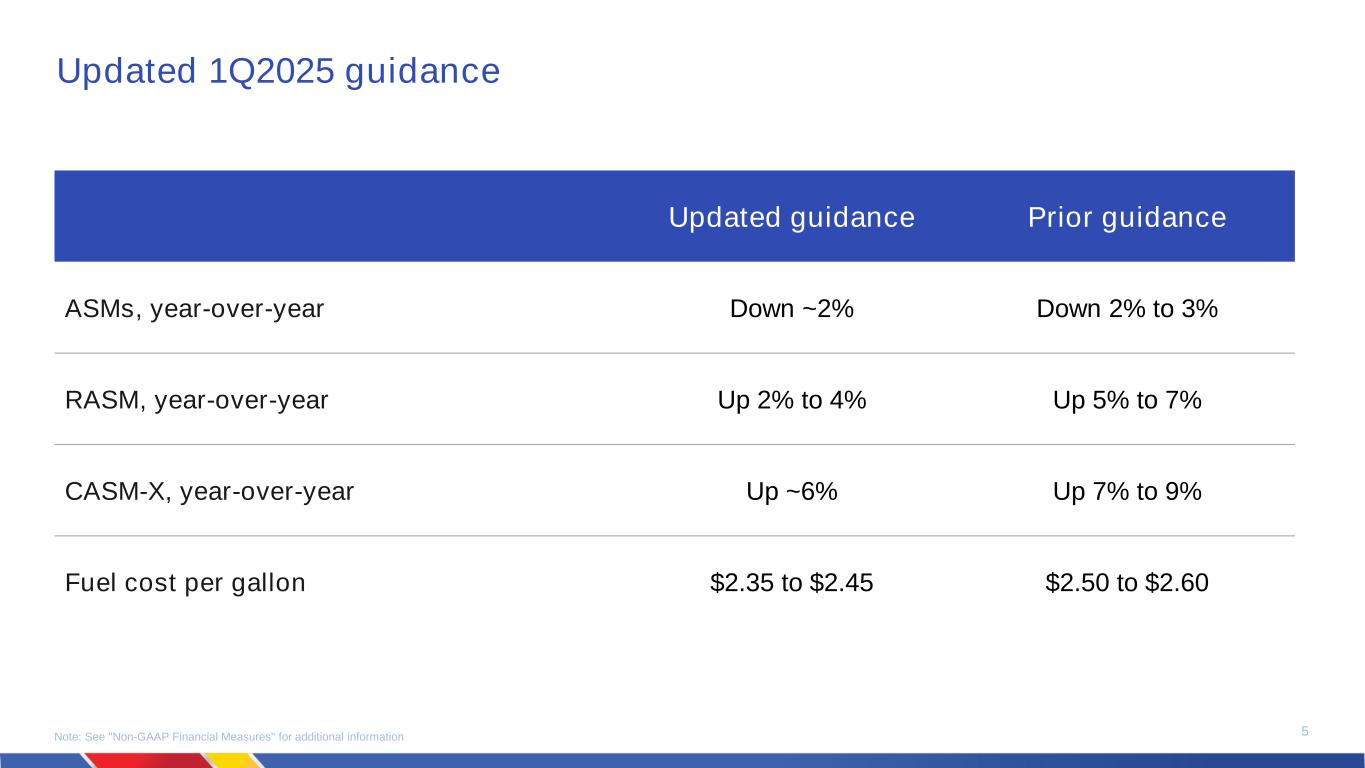
The following table presents updated selected financial guidance for first quarter 2025. These projections are based on current booking trends and the Company's current outlook, and actual results could differ materially.
1Q2025 estimationPrevious estimation
RASM (a), year-over-yearUp 2% to 4%Up 5% to 7%
ASMs (b), year-over-yearDown ~2%Down 2% to 3%
Fuel cost per gallon1 (c)
$2.35 to $2.45$2.50 to $2.60
Fuel hedging premium expense per gallon$0.07No change
Fuel hedging cash settlement gains per gallon$—No change
ASMs per gallon (fuel efficiency)82 to 8381 to 83
CASM-X (d), year-over-year2
Up ~6%Up 7% to 9%
Scheduled debt repayments (millions)~$5No change
Interest expense (millions)~$45No change
(a) Operating revenue per available seat mile ("RASM" or "unit revenues").
(b) Available seat miles ("ASMs" or "capacity"). The Company continues to expect second quarter 2025 capacity to increase in the range of 1 percent to 2 percent, year-over-year.
(c) Based on the Company's existing fuel derivative contracts and market prices as of March 4, 2025.
(d) Operating expenses per available seat mile, excluding fuel and oil expense, special items, and profit sharing ("CASM-X").

The Company now expects first quarter 2025 RASM to increase in the range of 2 percent to 4 percent on capacity down approximately 2 percent, both on a year-over-year basis. Compared with the Company's previous estimation, roughly a point of the lower unit revenue guide is primarily due to higher-than-expected completion factor, less government travel, and a greater impact from the California wildfires than originally estimated. The remainder of the decrease is primarily attributable to softness in bookings and demand trends as the macro environment has weakened.

The Company now expects first quarter 2025 CASM-X to increase approximately 6 percent, compared with its previous estimate to increase in the range of 7 percent to 9 percent, both year-over-year, primarily due to


increased capacity and lower than expected salary, wages, and benefits, maintenance, and other expenses—part of which was a shift to later in the year. The Company remains focused on driving efficiencies to offset overall inflationary cost pressures and achieve its cost initiative.

On March 11, 2025, the Company issued a press release in connection with its J.P. Morgan Industrials Conference presentation. The press release is furnished herewith as Exhibit 99.2 and is incorporated by reference into this Item 7.01. The information furnished in this Item 7.01, including Exhibits 99.1 and 99.2, shall not be deemed "filed" for purposes of Section 18 of the Securities Exchange Act of 1934, as amended, or otherwise subject to the liabilities of that section, nor shall such information be deemed incorporated by reference in any filing under the Securities Act of 1933, as amended, regardless of any general incorporation language in such filing, except as shall be expressly set forth by specific reference in such filing.

1Economic fuel cost per gallon (“Fuel cost per gallon”) includes fuel taxes, fuel hedging premium expense of $0.07 per gallon, and no cash settlements from fuel derivative contracts. Fuel cost per gallon projections do not reflect the potential impact of special items because the Company cannot reliably predict or estimate the hedge accounting impact associated with the volatility of the energy markets, or the impact to its financial statements in future periods. Accordingly, the Company believes a reconciliation of non-GAAP financial measures to the equivalent GAAP financial measures for projected results is not meaningful or available without unreasonable effort.
2Projections do not reflect the potential impact of fuel and oil expense, special items, and profit sharing because the Company cannot reliably predict or estimate those items or expenses or their impact to its financial statements in future periods, especially considering the significant volatility of the fuel and oil expense line item. Accordingly, the Company believes a reconciliation of non-GAAP financial measures to the equivalent GAAP financial measures for these projected results is not meaningful or available without unreasonable effort.

Item 9.01    Financial Statements and Exhibits.
(d) Exhibits:
99.1 Southwest Airlines 2025 J.P. Morgan Industrials Conference Presentation
99.2 Accompanying press release
104 Cover Page Interactive Data File (embedded within the Inline XBRL document).


Cautionary Statement Regarding Forward-Looking Statements
This Current Report on Form 8-K contains forward-looking statements within the meaning of Section 27A of the Securities Act of 1933, as amended, and Section 21E of the Securities Exchange Act of 1934, as amended. Specific forward-looking statements include, without limitation, statements related to (i) the Company's financial outlook, goals, plans, expectations, and projected results of operations, including factors and assumptions underlying the Company's expectations and projections; (ii) the Company’s plans and expectations with respect to capacity, including factors and assumptions underlying the Company’s plans and expectations; (iii) the Company's expectations with respect to its fuel costs, premium expenses, hedging gains, fuel efficiency, and the Company's related management of risks associated with changing jet fuel prices, including factors underlying the Company's expectations; (iv) the Company’s plans and expectations related to repayment of debt and interest expense; (v) the Company’s expectations regarding demand for travel; and (vi) the Company’s focus areas and initiatives. These forward-looking statements are based on the Company's current estimates, intentions, beliefs, expectations, goals, strategies, and projections for the future and are not guarantees of future performance. Forward-looking statements involve risks, uncertainties, assumptions, and other factors that are difficult to predict and that could cause actual results to vary materially from those expressed in or indicated by them. Factors include, among others, (i) the impact of fears or actual outbreaks of diseases, extreme or severe weather and natural disasters, actions of competitors, consumer perception, economic conditions, banking conditions, fears or actual acts of terrorism or war, sociodemographic trends, and other factors beyond the Company's control, on consumer behavior and the Company's results of operations and business decisions, plans, strategies, and results; (ii) the Company's ability to timely and effectively implement, transition, and maintain the necessary information technology systems and infrastructure to support its operations and initiatives; (iii) the impact of fuel price changes, fuel price volatility, volatility of commodities used by the Company for hedging jet fuel, and any changes to the Company's fuel hedging strategies and positions, on the Company's business plans and results of operations; (iv) the Company's dependence on Boeing and Boeing suppliers with respect to the Company's aircraft deliveries, fleet and capacity plans, operations, maintenance, strategies, and goals; (v) the Company's dependence on other third parties, in particular with respect to its technology plans, fuel supply, maintenance, Global Distribution Systems, and the impact on the Company's operations and results of operations of any third party delays or non-performance; (vi) the impact of governmental regulations and other governmental actions on the Company's business plans, results, and operations; (vii) the impact of labor matters on the Company's business decisions, plans, strategies, and results; (viii) the Company’s ability to timely and effectively prioritize its initiatives and focus areas and related expenditures; (ix) the Company's dependence on its workforce, including its ability to employ and retain sufficient numbers of qualified Employees to effectively and efficiently maintain its operations; (x) the cost and effects of the actions of activist shareholders; and (xi) other factors, as described in the Company's filings with the Securities and Exchange Commission, including the detailed factors discussed under the heading "Risk Factors" in the Company's Annual Report on Form 10- K for the fiscal year ended December 31, 2024. Caution should be taken not to place undue reliance on the Company’s forward-looking statements, which represent the Company’s views only as of the date this report is filed. The Company undertakes no obligation to update publicly or revise any forward-looking statement, whether as a result of new information, future events, or otherwise.


SIGNATURES

Pursuant to the requirements of the Securities Exchange Act of 1934, the registrant has duly caused this report to be signed on its behalf by the undersigned hereunto duly authorized.
SOUTHWEST AIRLINES CO.
March 11, 2025By:/s/ Tom Doxey
Tom Doxey
Executive Vice President & Chief Financial Officer
(Principal Financial Officer)


J.P. Morgan Conference March 11, 2025


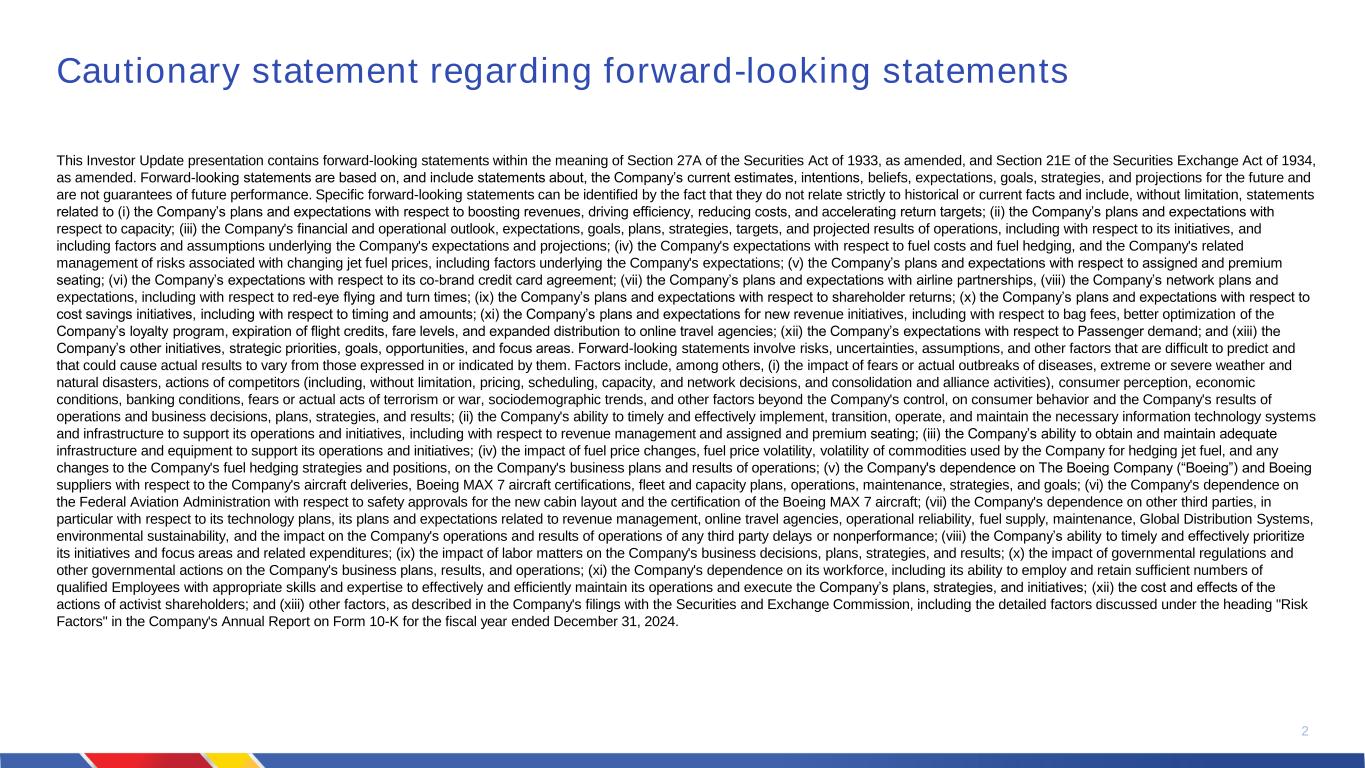
2 Cautionary statement regarding forward-looking statements This Investor Update presentation contains forward-looking statements within the meaning of Section 27A of the Securities Act of 1933, as amended, and Section 21E of the Securities Exchange Act of 1934, as amended. Forward-looking statements are based on, and include statements about, the Company’s current estimates, intentions, beliefs, expectations, goals, strategies, and projections for the future and are not guarantees of future performance. Specific forward-looking statements can be identified by the fact that they do not relate strictly to historical or current facts and include, without limitation, statements related to (i) the Company’s plans and expectations with respect to boosting revenues, driving efficiency, reducing costs, and accelerating return targets; (ii) the Company’s plans and expectations with respect to capacity; (iii) the Company's financial and operational outlook, expectations, goals, plans, strategies, targets, and projected results of operations, including with respect to its initiatives, and including factors and assumptions underlying the Company's expectations and projections; (iv) the Company's expectations with respect to fuel costs and fuel hedging, and the Company's related management of risks associated with changing jet fuel prices, including factors underlying the Company's expectations; (v) the Company’s plans and expectations with respect to assigned and premium seating; (vi) the Company’s expectations with respect to its co-brand credit card agreement; (vii) the Company’s plans and expectations with airline partnerships, (viii) the Company’s network plans and expectations, including with respect to red-eye flying and turn times; (ix) the Company’s plans and expectations with respect to shareholder returns; (x) the Company’s plans and expectations with respect to cost savings initiatives, including with respect to timing and amounts; (xi) the Company’s plans and expectations for new revenue initiatives, including with respect to bag fees, better optimization of the Company’s loyalty program, expiration of flight credits, fare levels, and expanded distribution to online travel agencies; (xii) the Company’s expectations with respect to Passenger demand; and (xiii) the Company’s other initiatives, strategic priorities, goals, opportunities, and focus areas. Forward-looking statements involve risks, uncertainties, assumptions, and other factors that are difficult to predict and that could cause actual results to vary from those expressed in or indicated by them. Factors include, among others, (i) the impact of fears or actual outbreaks of diseases, extreme or severe weather and natural disasters, actions of competitors (including, without limitation, pricing, scheduling, capacity, and network decisions, and consolidation and alliance activities), consumer perception, economic conditions, banking conditions, fears or actual acts of terrorism or war, sociodemographic trends, and other factors beyond the Company's control, on consumer behavior and the Company's results of operations and business decisions, plans, strategies, and results; (ii) the Company's ability to timely and effectively implement, transition, operate, and maintain the necessary information technology systems and infrastructure to support its operations and initiatives, including with respect to revenue management and assigned and premium seating; (iii) the Company’s ability to obtain and maintain adequate infrastructure and equipment to support its operations and initiatives; (iv) the impact of fuel price changes, fuel price volatility, volatility of commodities used by the Company for hedging jet fuel, and any changes to the Company's fuel hedging strategies and positions, on the Company's business plans and results of operations; (v) the Company's dependence on The Boeing Company (“Boeing”) and Boeing suppliers with respect to the Company's aircraft deliveries, Boeing MAX 7 aircraft certifications, fleet and capacity plans, operations, maintenance, strategies, and goals; (vi) the Company's dependence on the Federal Aviation Administration with respect to safety approvals for the new cabin layout and the certification of the Boeing MAX 7 aircraft; (vii) the Company's dependence on other third parties, in particular with respect to its technology plans, its plans and expectations related to revenue management, online travel agencies, operational reliability, fuel supply, maintenance, Global Distribution Systems, environmental sustainability, and the impact on the Company's operations and results of operations of any third party delays or nonperformance; (viii) the Company’s ability to timely and effectively prioritize its initiatives and focus areas and related expenditures; (ix) the impact of labor matters on the Company's business decisions, plans, strategies, and results; (x) the impact of governmental regulations and other governmental actions on the Company's business plans, results, and operations; (xi) the Company's dependence on its workforce, including its ability to employ and retain sufficient numbers of qualified Employees with appropriate skills and expertise to effectively and efficiently maintain its operations and execute the Company’s plans, strategies, and initiatives; (xii) the cost and effects of the actions of activist shareholders; and (xiii) other factors, as described in the Company's filings with the Securities and Exchange Commission, including the detailed factors discussed under the heading "Risk Factors" in the Company's Annual Report on Form 10-K for the fiscal year ended December 31, 2024.


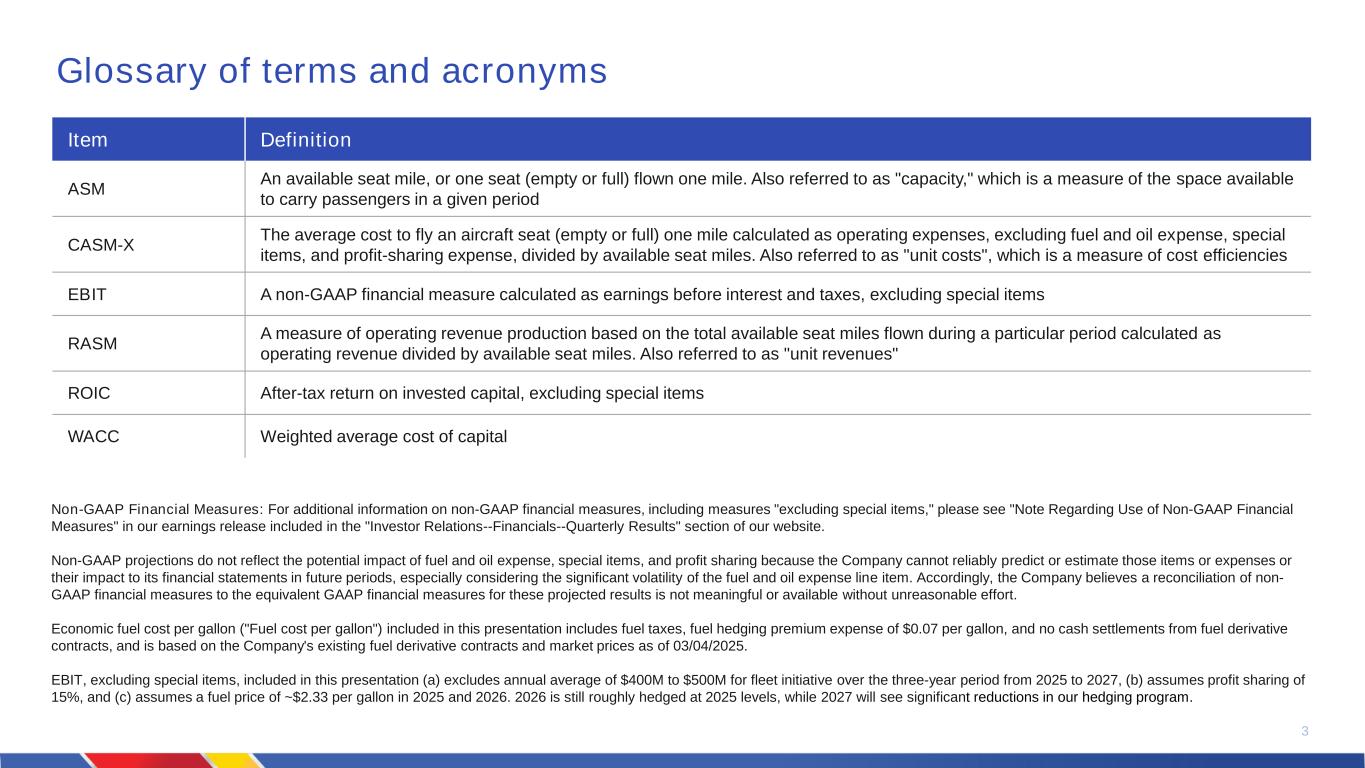
3 Glossary of terms and acronyms Item Definition ASM An available seat mile, or one seat (empty or full) flown one mile. Also referred to as "capacity," which is a measure of the space available to carry passengers in a given period CASM-X The average cost to fly an aircraft seat (empty or full) one mile calculated as operating expenses, excluding fuel and oil expense, special items, and profit-sharing expense, divided by available seat miles. Also referred to as "unit costs", which is a measure of cost efficiencies EBIT A non-GAAP financial measure calculated as earnings before interest and taxes, excluding special items RASM A measure of operating revenue production based on the total available seat miles flown during a particular period calculated as operating revenue divided by available seat miles. Also referred to as "unit revenues" ROIC After-tax return on invested capital, excluding special items WACC Weighted average cost of capital Non-GAAP Financial Measures: For additional information on non-GAAP financial measures, including measures "excluding special items," please see "Note Regarding Use of Non-GAAP Financial Measures" in our earnings release included in the "Investor Relations--Financials--Quarterly Results" section of our website. Non-GAAP projections do not reflect the potential impact of fuel and oil expense, special items, and profit sharing because the Company cannot reliably predict or estimate those items or expenses or their impact to its financial statements in future periods, especially considering the significant volatility of the fuel and oil expense line item. Accordingly, the Company believes a reconciliation of non- GAAP financial measures to the equivalent GAAP financial measures for these projected results is not meaningful or available without unreasonable effort. Economic fuel cost per gallon ("Fuel cost per gallon") included in this presentation includes fuel taxes, fuel hedging premium expense of $0.07 per gallon, and no cash settlements from fuel derivative contracts, and is based on the Company's existing fuel derivative contracts and market prices as of 03/04/2025. EBIT, excluding special items, included in this presentation (a) excludes annual average of $400M to $500M for fleet initiative over the three-year period from 2025 to 2027, (b) assumes profit sharing of 15%, and (c) assumes a fuel price of ~$2.33 per gallon in 2025 and 2026. 2026 is still roughly hedged at 2025 levels, while 2027 will see significant reductions in our hedging program.


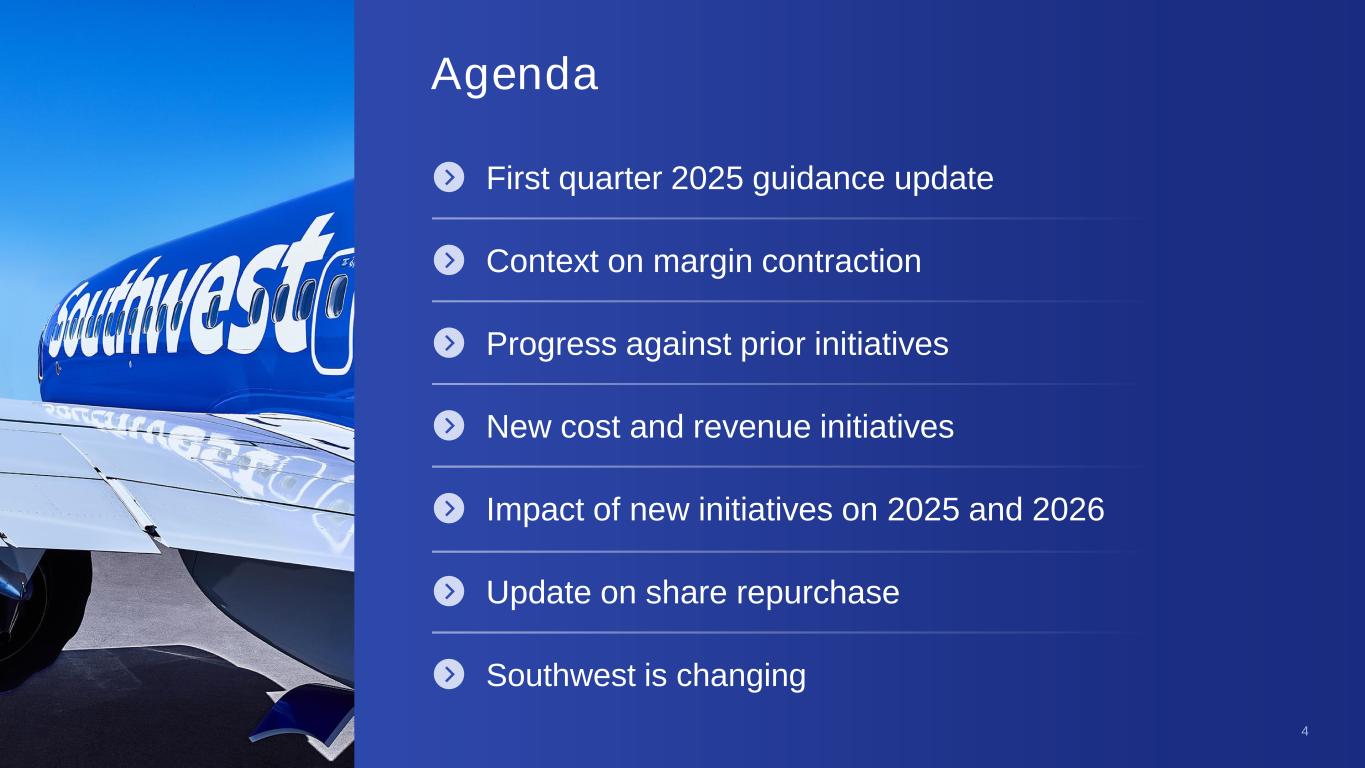
Agenda First quarter 2025 guidance update Context on margin contraction Progress against prior initiatives New cost and revenue initiatives Impact of new initiatives on 2025 and 2026 Update on share repurchase Southwest is changing 4


5 Updated guidance Prior guidance ASMs, year-over-year Down ~2% Down 2% to 3% RASM, year-over-year Up 2% to 4% Up 5% to 7% CASM-X, year-over-year Up ~6% Up 7% to 9% Fuel cost per gallon $2.35 to $2.45 $2.50 to $2.60 Updated 1Q2025 guidance Note: See "Non-GAAP Financial Measures" for additional information


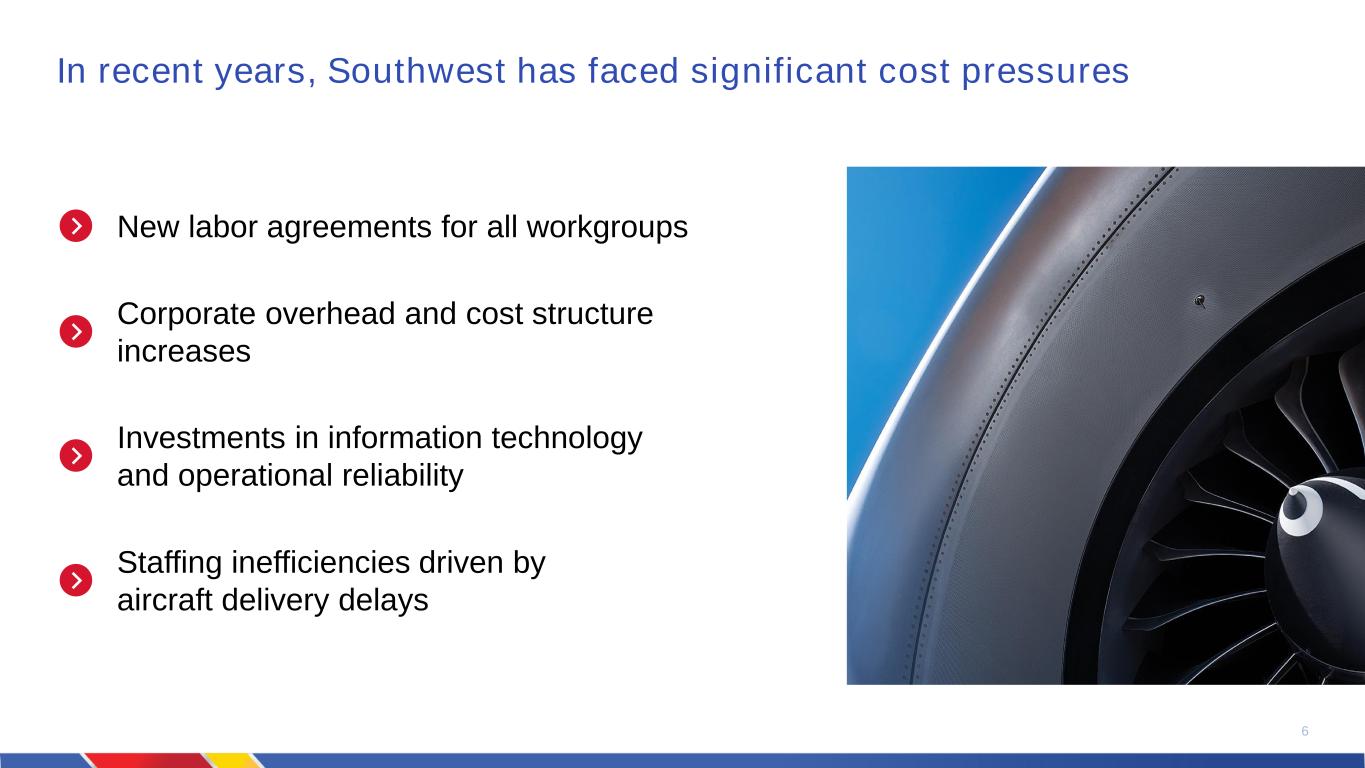
6 In recent years, Southwest has faced significant cost pressures New labor agreements for all workgroups Corporate overhead and cost structure increases Investments in information technology and operational reliability Staffing inefficiencies driven by aircraft delivery delays


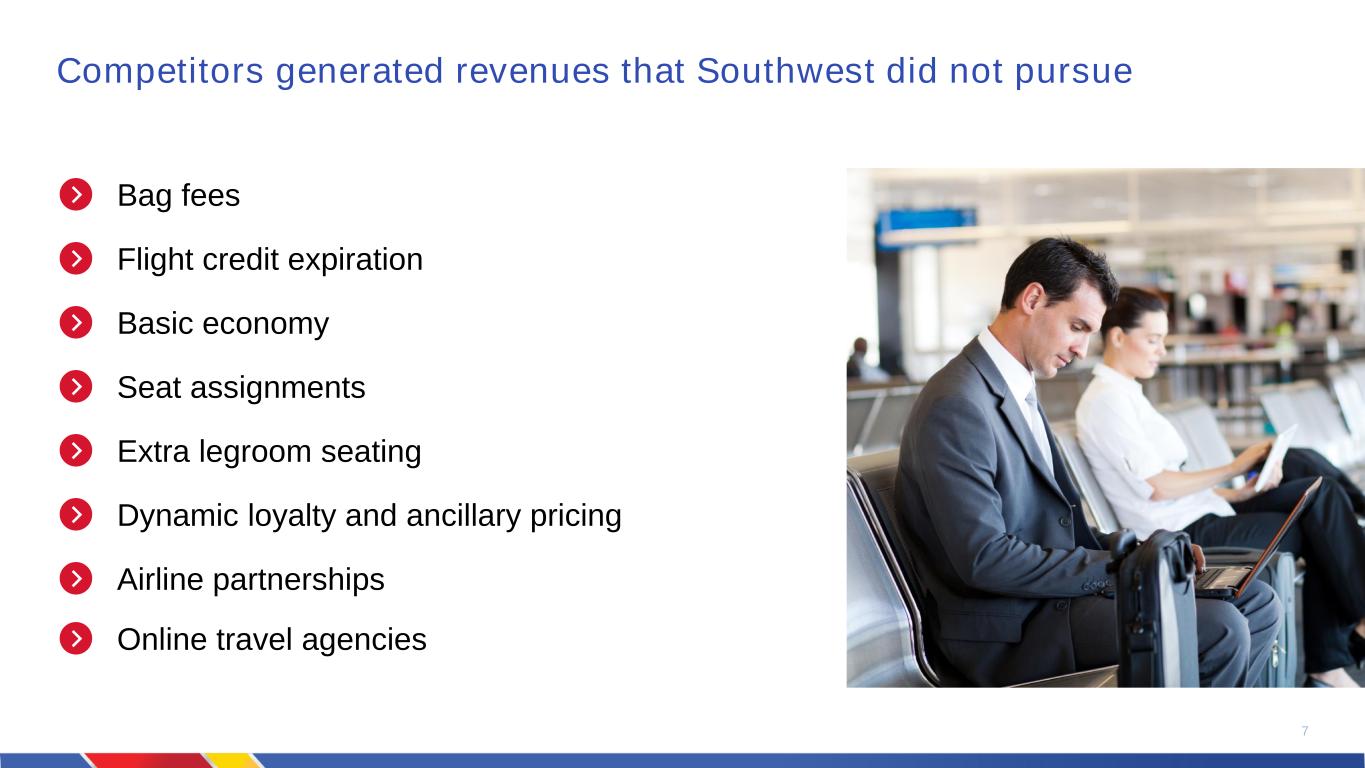
7 Bag fees Flight credit expiration Basic economy Seat assignments Extra legroom seating Dynamic loyalty and ancillary pricing Airline partnerships Online travel agencies Competitors generated revenues that Southwest did not pursue


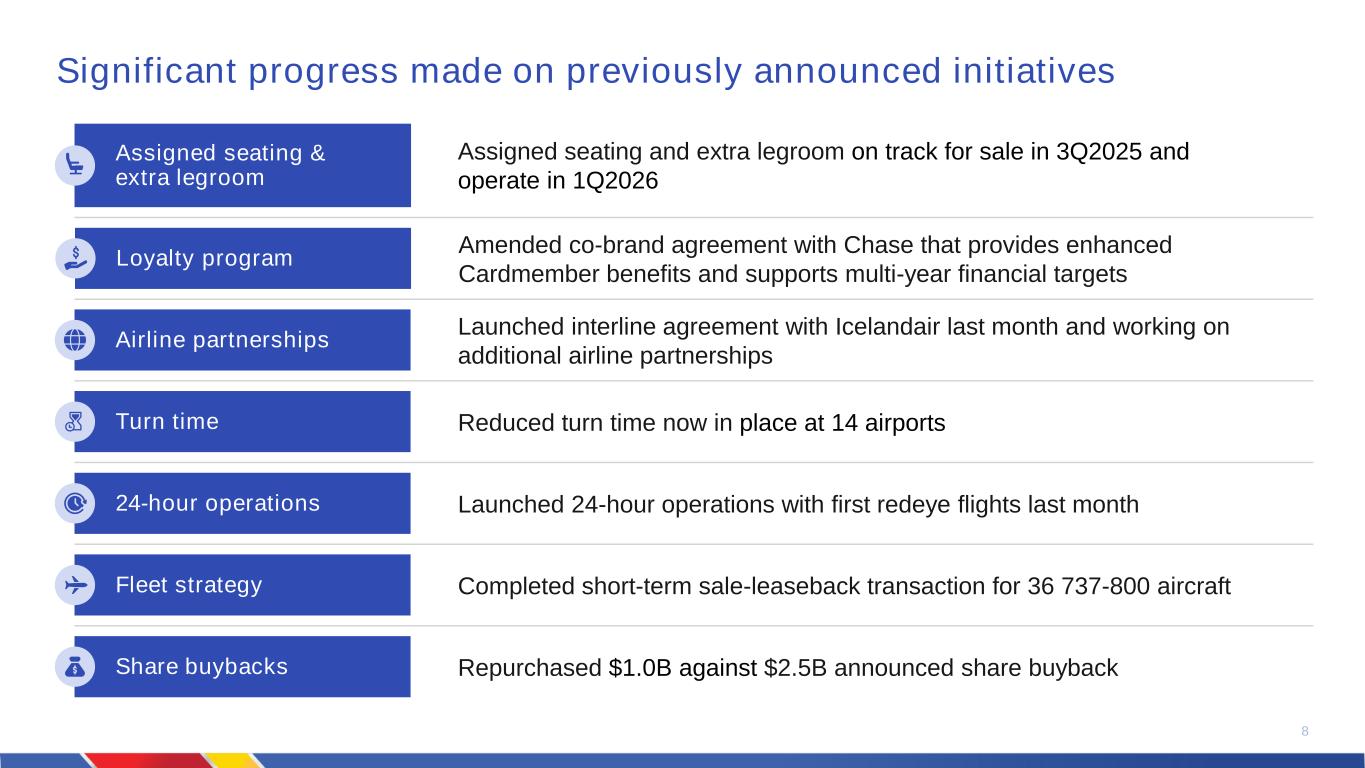
8 Significant progress made on previously announced initiatives Assigned seating & extra legroom Assigned seating and extra legroom on track for sale in 3Q2025 and operate in 1Q2026 Loyalty program Amended co-brand agreement with Chase that provides enhanced Cardmember benefits and supports multi-year financial targets Airline partnerships Launched interline agreement with Icelandair last month and working on additional airline partnerships Turn time Reduced turn time now in place at 14 airports Launched 24-hour operations with first redeye flights last month24-hour operations Fleet strategy Completed short-term sale-leaseback transaction for 36 737-800 aircraft Share buybacks Repurchased $1.0B against $2.5B announced share buyback


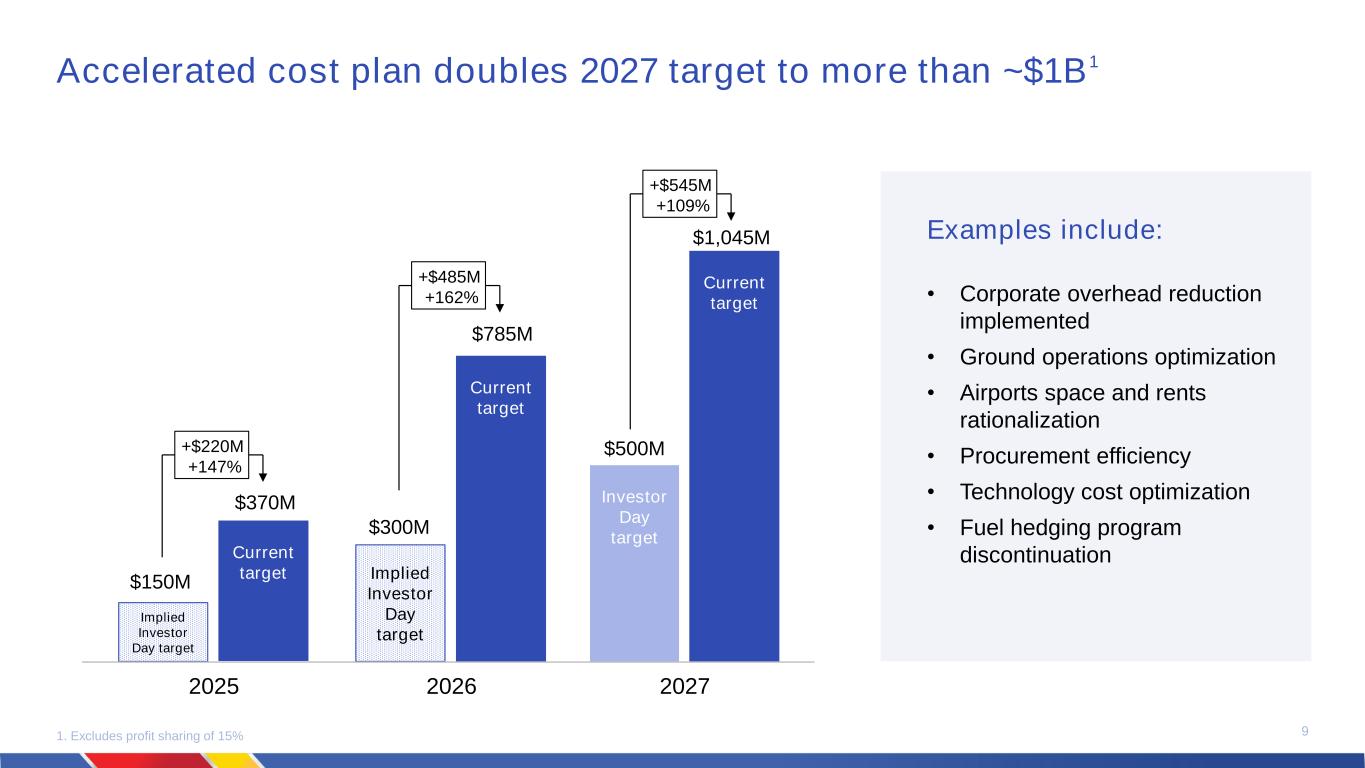
Accelerated cost plan doubles 2027 target to more than ~$1B1 1. Excludes profit sharing of 15% Current target 2025 $150M Current target 2026 $785M Current target Investor Day target $500M 2027 $1,045M +$545M +109% Examples include: • Corporate overhead reduction implemented • Ground operations optimization • Airports space and rents rationalization • Procurement efficiency • Technology cost optimization • Fuel hedging program discontinuation Implied Investor Day target Implied Investor Day target $370M $300M +$220M +147% +$485M +162% 9


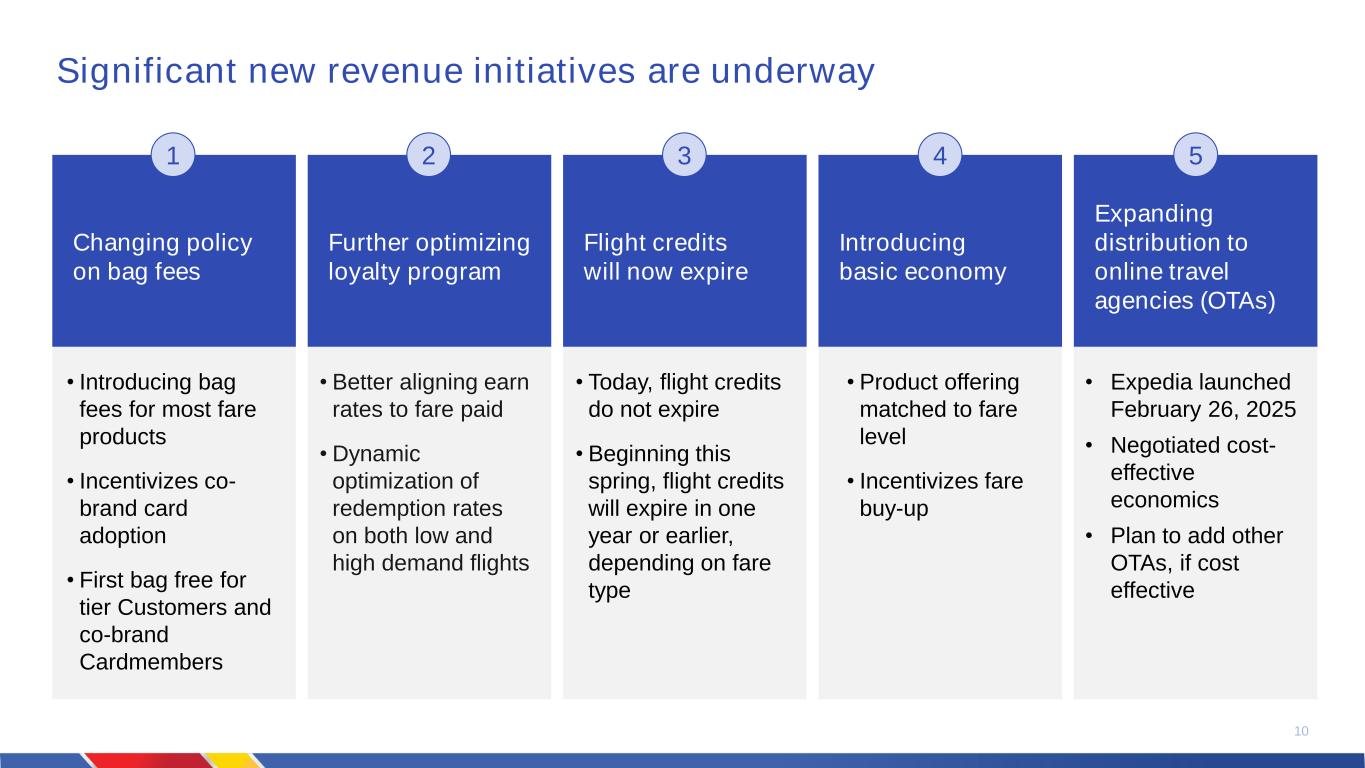
Significant new revenue initiatives are underway • Introducing bag fees for most fare products • Incentivizes co- brand card adoption • First bag free for tier Customers and co-brand Cardmembers Changing policy on bag fees • Better aligning earn rates to fare paid • Dynamic optimization of redemption rates on both low and high demand flights Further optimizing loyalty program • Today, flight credits do not expire • Beginning this spring, flight credits will expire in one year or earlier, depending on fare type Flight credits will now expire Introducing basic economy • Product offering matched to fare level • Incentivizes fare buy-up • Expedia launched February 26, 2025 • Negotiated cost- effective economics • Plan to add other OTAs, if cost effective Expanding distribution to online travel agencies (OTAs) 1 2 4 53 10


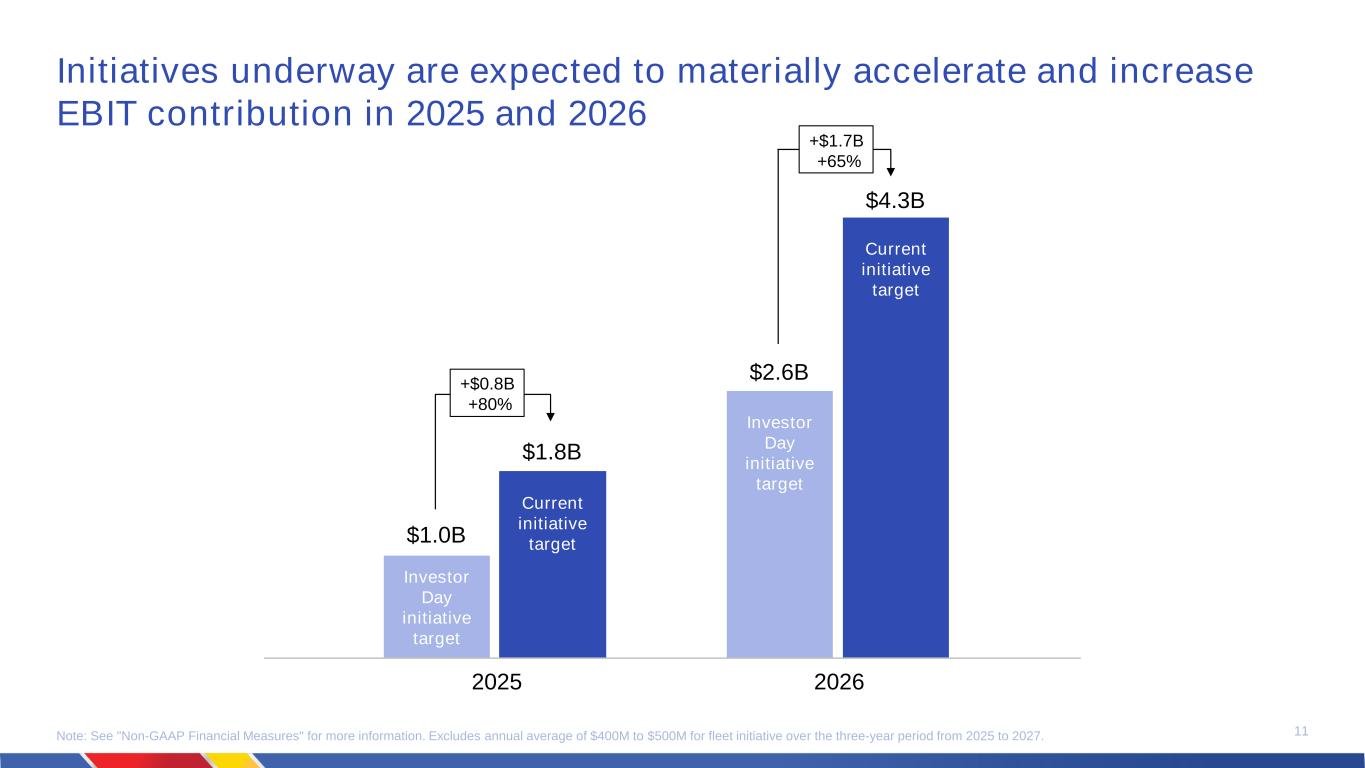
Investor Day initiative target 11 Initiatives underway are expected to materially accelerate and increase EBIT contribution in 2025 and 2026 $1.8B $4.3B Current initiative target Investor Day initiative target Current initiative target$1.0B $2.6B 2025 2026 +$0.8B +80% +$1.7B +65% Note: See "Non-GAAP Financial Measures" for more information. Excludes annual average of $400M to $500M for fleet initiative over the three-year period from 2025 to 2027.


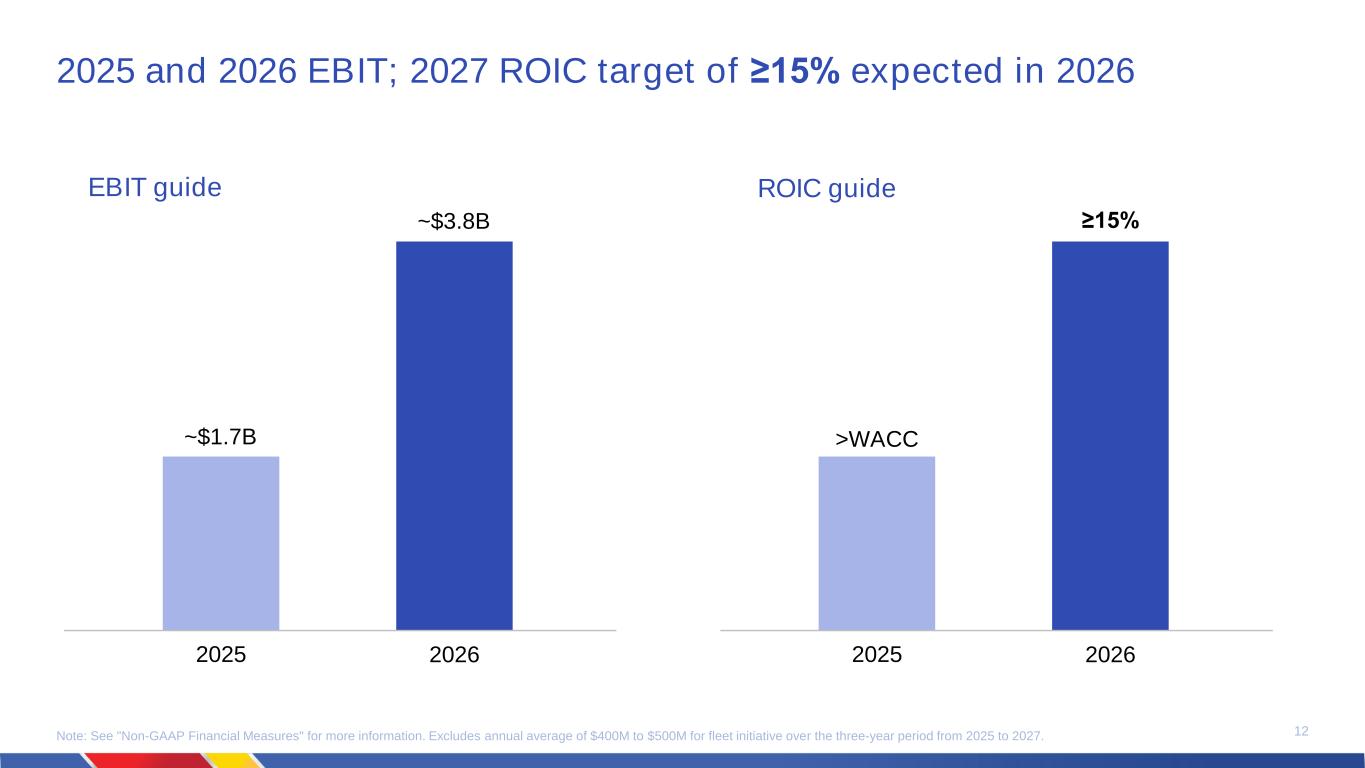
ROIC guideEBIT guide 12 2025 and 2026 EBIT; 2027 ROIC target of ≥15% expected in 2026 ~$1.7B 2025 ~$3.8B 2026 >WACC 2025 ≥15% 2026 Note: See "Non-GAAP Financial Measures" for more information. Excludes annual average of $400M to $500M for fleet initiative over the three-year period from 2025 to 2027.


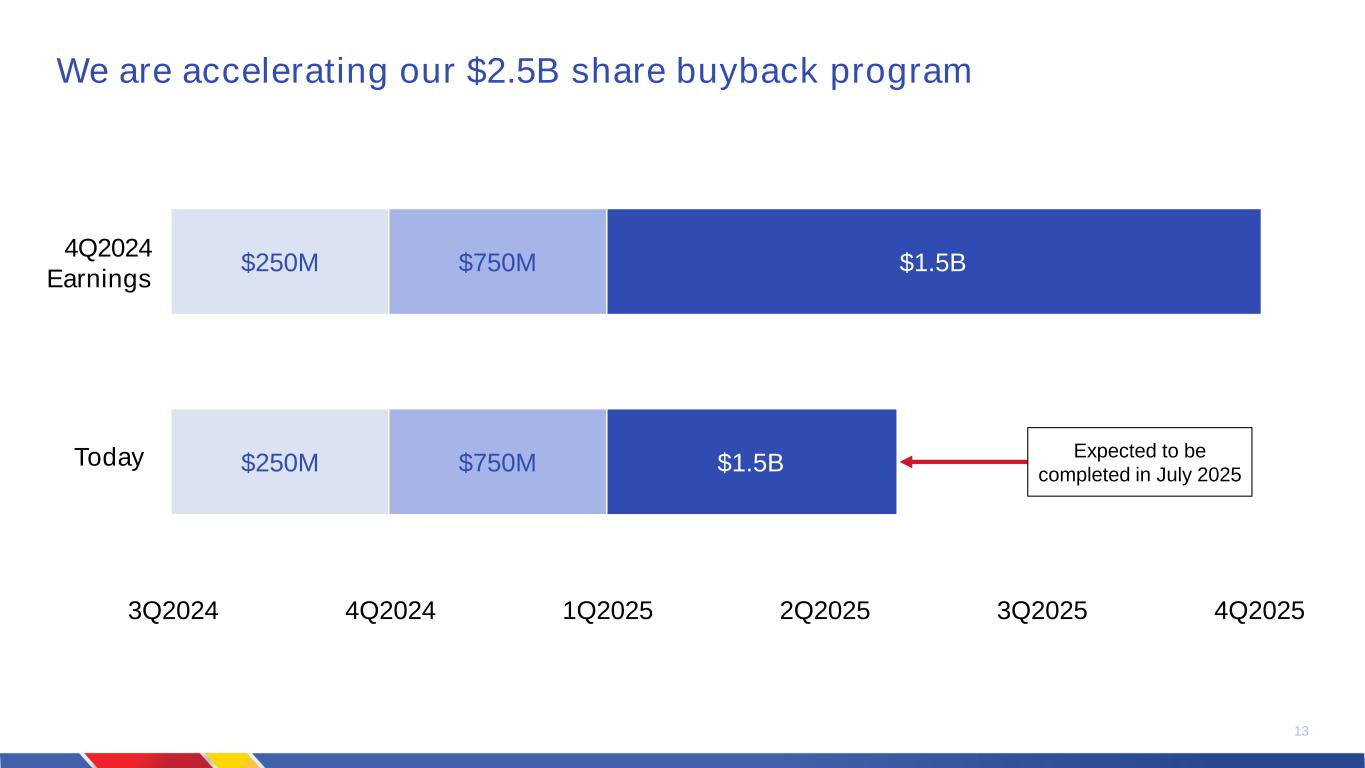
13 We are accelerating our $2.5B share buyback program 3Q2024 4Q2024 1Q2025 2Q2025 3Q2025 4Q2025 $250M $750M $1.5B $250M $750M $1.5B 4Q2024 Earnings Today Expected to be completed in July 2025


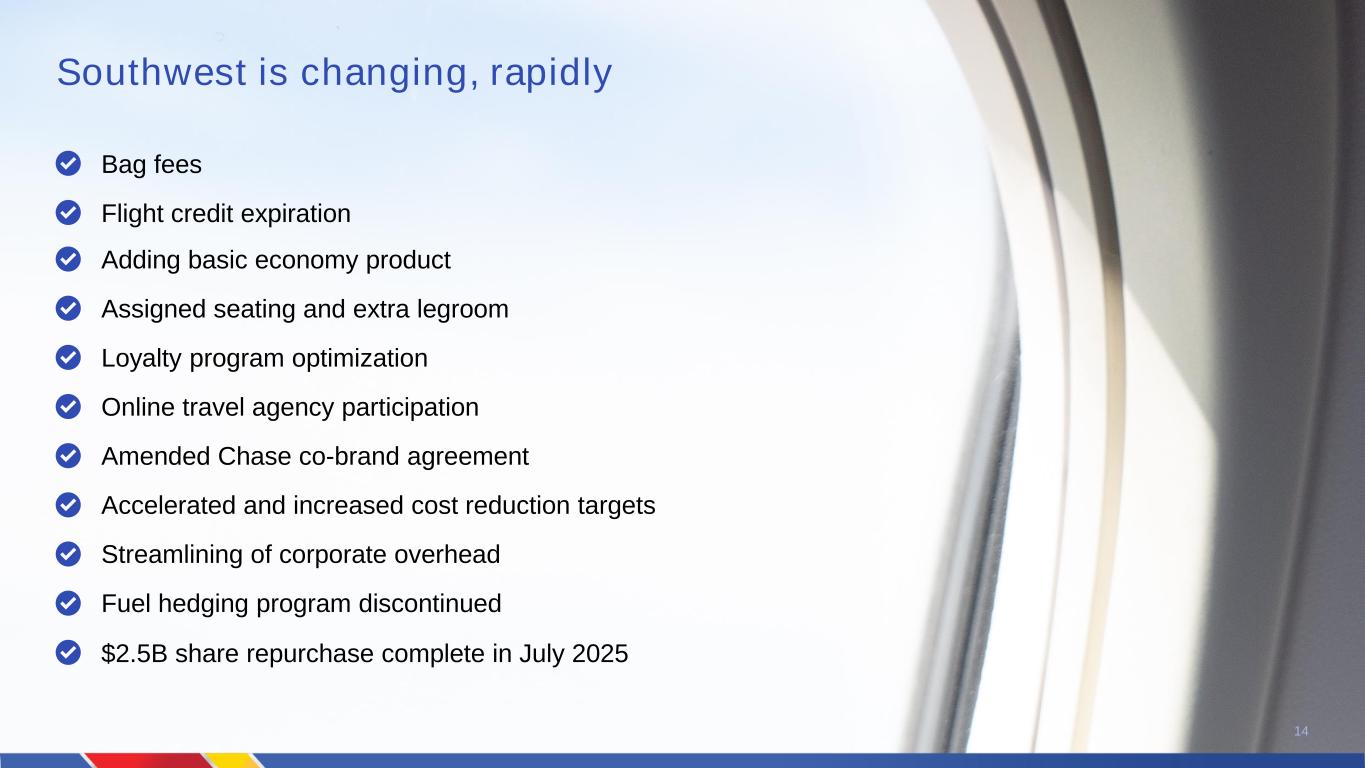
Southwest is changing, rapidly Flight credit expiration Assigned seating and extra legroom Loyalty program optimization Online travel agency participation Amended Chase co-brand agreement Accelerated and increased cost reduction targets Streamlining of corporate overhead Fuel hedging program discontinued $2.5B share repurchase complete in July 2025 Bag fees Adding basic economy product 14


SOUTHWEST AIRLINES OUTLINES CHANGES TO DRIVE REVENUE GROWTH AND REWARD ITS MOST LOYAL CUSTOMERS DALLAS—March 11, 2025—Southwest Airlines Co. (NYSE: LUV) is evolving rapidly, implementing new initiatives that support business objectives and create choice for current and future Customers of America’s largest domestic carrier.1 Initiatives announced today will reward the airline’s most loyal Customers and give all Customers more options for a broader range of travel experiences. “We have tremendous opportunity to meet current and future Customer needs, attract new Customer segments we don’t compete for today, and return to the levels of profitability that both we and our Shareholders expect,” said Bob Jordan, President, Chief Executive Officer, & Vice Chairman of the Board of Directors at Southwest Airlines. “We will do all this while remaining focused on what’s made us strong—our People and the authentic, friendly, and award-winning Customer Service only they can provide.” The initiatives announced today include the following: • Southwest® will continue to offer two free checked bags to Rapid Rewards® A-List Preferred Members and Customers traveling on Business Select® fares, and one free checked bag to A-List Members and other select Customers. Southwest will credit one checked bag for Rapid Rewards Credit Cardmembers. Customers who do not qualify for these free bag options will be charged for their first and second checked bags (weight and size limitations apply). Changes will apply to flights booked on or after May 28, 2025.2 • The carrier recently adjusted the number of Rapid Rewards points Customers earn on qualifying flights. Customers now earn more points on Business Select fares while earning less on Wanna Get Away® and Wanna Get Away Plus® fares. Southwest Rapid News Release


2 Rewards, the carrier’s loyalty program, will also introduce variable redemption rates across higher-demand and lower-demand flights. • These strategic moves, aimed to deepen and reward loyalty between Southwest and its most engaged Customers, create new opportunities to reach consumers who value fare above everything else. To align with these changes, Southwest will introduce a new, Basic fare on our lowest priced tickets purchased on or after May 28, 2025, in advance of offering assigned seating and extra legroom options. • Southwest continues to widen its distribution channels to reach new Customers, with flights and fare products now available to book through online travel agency Expedia, beginning last month. • Flight credits issued for tickets purchased on or after May 28, 2025 will expire one year or earlier from the date of ticketing, depending on the fare type purchased.3 These changes add to the initiatives already underway at Southwest, including the forthcoming implementation of assigned seating and extra legroom options and an initial industry-standard airline partnership with Icelandair that began on February 13, the same day the carrier’s first- ever scheduled overnight redeye flights launched. As Southwest looks to provide a great travel experience for its Customers, the airline continues to focus on operational excellence. Today, Southwest leads the industry in ontime performance for 2025 and has operated 98.3 percent of its published flight schedule without cancellations—a year-over-year improvement.4 Southwest Airlines remains committed to its core tenets—amazing People who deliver great Hospitality to all Southwest Customers, a strong network with the most nonstop flights within the U.S.5, and a loyalty program that gives real value to Rapid Rewards Members. 1. U.S. Dept. of Transportation quarterly Airline Origin & Destination Survey since Q1 2021 2. Southwest’s checked bag weight and size limitations will continue to apply 3. Travel credits will expire one year from ticketing date for all fares except Basic, which will expire six months from ticketing date 4. Operational data as of February 28, 2025, as reported to the U.S. Department of Transportation 5. Cirium data June 2025 schedules of U.S. domestic air carriers


3 Cautionary Statement Regarding Forward-Looking Statements This news release contains forward-looking statements within the meaning of Section 27A of the Securities Act of 1933, as amended, and Section 21E of the Securities Exchange Act of 1934, as amended. Specific forward-looking statements include, without limitation, statements related to (i) the Company's financial and operational outlook, expectations, goals, plans, targets, and projected results of operations, and including factors and assumptions underlying the Company's expectations and projections; and (ii) the Company’s initiatives, business objectives, strategic priorities, goals, opportunities, and focus areas. These forward-looking statements are based on the Company's current estimates, intentions, beliefs, expectations, goals, strategies, and projections for the future and are not guarantees of future performance. Forward-looking statements involve risks, uncertainties, assumptions, and other factors that are difficult to predict and that could cause actual results to vary materially from those expressed in or indicated by them. Factors include, among others, (i) the impact of fears or actual outbreaks of diseases, extreme or severe weather and natural disasters, actions of competitors (including, without limitation, pricing, scheduling, capacity, and network decisions, and consolidation and alliance activities), consumer perception, economic conditions, banking conditions, fears or actual acts of terrorism or war, sociodemographic trends, and other factors beyond the Company's control, on consumer behavior and the Company's results of operations and business decisions, plans, strategies, and results; (ii) the Company's ability to timely and effectively implement, transition, operate, and maintain the necessary information technology systems and infrastructure to support its operations and initiatives, including with respect to revenue management and assigned and premium seating; (iii) the Company's ability to obtain and maintain adequate infrastructure and equipment to support its operations and initiatives; (iv) the impact of fuel price changes, fuel price volatility, volatility of commodities used by the Company for hedging jet fuel, and any changes to the Company's fuel hedging strategies and positions, on the Company's business plans and results of operations; (v) the Company's dependence on The Boeing Company ("Boeing") and Boeing suppliers with respect to the Company's aircraft deliveries, Boeing MAX 7 aircraft certifications, fleet and capacity plans, operations, maintenance, strategies, and goals; (vi) the Company's dependence on the Federal Aviation Administration with respect to safety approvals for the new cabin layout and the certification of the Boeing MAX 7 aircraft; (vii) the Company's dependence on other third parties, in particular with respect to its technology plans, its plans and expectations related to revenue management, online travel agencies, operational reliability, fuel supply, maintenance, Global Distribution Systems, and the impact on the Company's operations and results of operations of any third party delays or nonperformance; (viii) the Company's ability to timely and effectively prioritize its initiatives and focus areas and related expenditures; (ix) the impact of labor matters on the Company's business decisions, plans, strategies, and results; (x) the impact of governmental regulations and other governmental actions on the Company's business plans, results, and operations; (xi) the Company's dependence on its workforce, including its ability to employ and retain sufficient numbers of qualified Employees with appropriate skills and expertise to effectively and efficiently maintain its operations and execute the Company's plans, strategies, and initiatives; (xii) the cost and effects of the actions of activist shareholders; and (xiii) other factors, as described in the Company's filings with the Securities and


4 Exchange Commission, including the detailed factors discussed under the heading "Risk Factors" in the Company's Annual Report on Form 10-K for the fiscal year ended December 31, 2024. ABOUT SOUTHWEST AIRLINES CO. Southwest Airlines Co. operates one of the world's most admired and awarded airlines, offering its one-of-a-kind value and Hospitality at 117 airports across 11 countries. Southwest took flight in 1971 to democratize the sky through friendly, reliable, and low-cost air travel and now carries more air travelers flying nonstop within the United States than any other airline1. By empowering its more than 72,0002 People to deliver unparalleled Hospitality, the maverick airline cherishes a passionate loyalty among more than 140 million Customers carried in 2024. Southwest leverages a unique legacy and mission to serve communities around the world including harnessing the power of its People and Purpose to put communities at the Heart of its success. Learn more by visiting Southwest.com/citizenship. 1. Based on U.S. Dept. of Transportation quarterly Airline Origin & Destination Survey since Q1 2021 2. Fulltime-equivalent active Employees as of Dec. 31, 2024 Media Contacts:  Visit the Southwest Newsroom at swamedia.com for multimedia assets and other Company news.      Media Relations Team: 214-792-4847, option 1     # # #