UNITED STATES
SECURITIES AND EXCHANGE COMMISSION
Washington, D.C. 20549
____________________________
FORM 10-K
____________________________
or
Commission File No. 001-12257
____________________________
(Exact name of registrant as specified in its charter)
____________________________
| (State or other jurisdiction of incorporation or organization) | (I.R.S. Employer Identification No.) | |||||||
| (Address of principal executive offices) | (Zip Code) | |||||||
Registrant’s telephone number, including area code: (323 ) 937-1060
____________________________
Securities registered pursuant to Section 12(b) of the Act:
| Title of Each Class | Trading Symbol(s) | Name of Each Exchange on Which Registered | ||||||
| Common Stock | MCY | New York Stock Exchange Texas | ||||||
Securities registered pursuant to Section 12(g) of the Act:
None
____________________________
Indicate by check mark if the registrant is a well-known seasoned issuer, as defined in Rule 405 of the Securities Act. Yes ☒ No ☐
Indicate by check mark if the registrant is not required to file reports pursuant to Section 13 or Section 15(d) of the Act. Yes ☐ No ☒
Indicate by check mark whether the registrant (1) has filed all reports required to be filed by Section 13 or 15(d) of the Securities Exchange Act of 1934 during the preceding 12 months (or for such shorter period that the registrant was required to file such reports), and (2) has been subject to such filing requirements for the past 90 days. Yes ☒ No ☐
Indicate by check mark whether the registrant has submitted electronically every Interactive Data File required to be submitted pursuant to Rule 405 of Regulation S-T (§232.405 of this chapter) during the preceding 12 months (or for such shorter period that the registrant was required to submit such files). Yes ☒ No ☐
Indicate by check mark whether the registrant is a large accelerated filer, an accelerated filer, a non-accelerated filer, a smaller reporting company, or an emerging growth company. See the definitions of "large accelerated filer," "accelerated filer," "smaller reporting company," and "emerging growth company" in Rule 12b-2 of the Exchange Act.
| ☒ | Accelerated filer | ☐ | ||||||||||||
| Non-accelerated filer | ☐ | Smaller reporting company | ||||||||||||
| Emerging growth company | ||||||||||||||
If an emerging growth company, indicate by check mark if the registrant has elected not to use the extended transition period for complying with any new or revised financial accounting standards provided pursuant to Section 13(a) of the Exchange Act. ☐
Indicate by check mark whether the registrant has filed a report on and attestation to its management’s assessment of the effectiveness of its internal control over financial reporting under Section 404(b) of the Sarbanes-Oxley Act (15 U.S.C. 7262(b)) by the registered public accounting firm that prepared or issued its audit report. ☒
If securities are registered pursuant to Section 12(b) of the Act, indicate by check mark whether the financial statements of the registrant included in the filing reflect the correction of an error to previously issued financial statements. ☐
Indicate by check mark whether any of those error corrections are restatements that required a recovery analysis of incentive-based compensation received by any of the registrant’s executive officers during the relevant recovery period pursuant to §240.10D-1(b). ☐
Indicate by check mark whether the registrant is a shell company (as defined in Rule 12b-2 of the Act). Yes ☐ No ☒
The aggregate market value of the registrant’s common equity held by non-affiliates of the registrant at June 30, 2025 was $1,789,234,305 (which represents 26,570,156 shares of common equity held by non-affiliates multiplied by $67.34, the closing sales price on the New York Stock Exchange for such date, as reported by the Wall Street Journal).
At February 12, 2026, the registrant had issued and outstanding an aggregate of 55,388,627 shares of its Common Stock.
____________________________
Documents Incorporated by Reference
Certain information from the registrant’s definitive proxy statement for the 2026 Annual Meeting of Shareholders is incorporated herein by reference into Part III hereof.
MERCURY GENERAL CORPORATION
INDEX TO FORM 10-K
| Page | ||||||||
| Item 1 | ||||||||
| Item 1A | ||||||||
| Item 1B | ||||||||
| Item 1C | ||||||||
| Item 2 | ||||||||
| Item 3 | ||||||||
| Item 4 | ||||||||
| Item 5 | ||||||||
| Item 6 | ||||||||
| Item 7 | ||||||||
| Item 7A | ||||||||
| Item 8 | ||||||||
| Item 9 | ||||||||
| Item 9A | ||||||||
| Item 9B | ||||||||
| Item 9C | ||||||||
| Item 10 | ||||||||
| Item 11 | ||||||||
| Item 12 | ||||||||
| Item 13 | ||||||||
| Item 14 | ||||||||
| Item 15 | ||||||||
| Item 16 | ||||||||
S-1 | ||||||||
PART I
Item 1.Business
General
Mercury General Corporation ("Mercury General") and its subsidiaries (referred to herein collectively as the "Company") are primarily engaged in writing personal automobile insurance through 12 insurance subsidiaries (referred to herein collectively as the "Insurance Companies") in 11 states, principally California. The Company also writes homeowners, commercial automobile, commercial property, mechanical protection, and umbrella insurance. The Company's insurance policies are mostly sold through independent agents who receive a commission for selling policies. The Company believes that it has thorough underwriting and claims handling processes that, together with its agent relationships, provide the Company with competitive advantages.
The direct premiums written for the years ended December 31, 2025, 2024 and 2023 by state and line of insurance business were:
Year Ended December 31, 2025
(Dollars in thousands)
| Private Passenger Automobile | Homeowners | Commercial Automobile | Other Lines (2) | Total | |||||||||||||||||||||||||||||||
| California | $ | 3,082,828 | $ | 1,170,943 | $ | 299,586 | $ | 356,431 | $ | 4,909,788 | 82.1 | % | |||||||||||||||||||||||
| Texas | 122,638 | 214,498 | 57,696 | 6,628 | 401,460 | 6.7 | % | ||||||||||||||||||||||||||||
Other states (1) | 385,749 | 245,479 | 30,098 | 9,963 | 671,289 | 11.2 | % | ||||||||||||||||||||||||||||
| Total | $ | 3,591,215 | $ | 1,630,920 | $ | 387,380 | $ | 373,022 | $ | 5,982,537 | 100.0 | % | |||||||||||||||||||||||
| 60.0 | % | 27.3 | % | 6.5 | % | 6.2 | % | 100.0 | % | ||||||||||||||||||||||||||
Year Ended December 31, 2024
(Dollars in thousands)
| Private Passenger Automobile | Homeowners | Commercial Automobile | Other Lines (2) | Total | |||||||||||||||||||||||||||||||
| California | $ | 2,845,294 | $ | 970,054 | $ | 280,987 | $ | 334,293 | $ | 4,430,628 | 80.5 | % | |||||||||||||||||||||||
| Texas | 127,808 | 190,928 | 62,788 | 6,824 | 388,348 | 7.1 | % | ||||||||||||||||||||||||||||
Other states (1) | 422,722 | 206,315 | 43,219 | 9,603 | 681,859 | 12.4 | % | ||||||||||||||||||||||||||||
| Total | $ | 3,395,824 | $ | 1,367,297 | $ | 386,994 | $ | 350,720 | $ | 5,500,835 | 100.0 | % | |||||||||||||||||||||||
| 61.7 | % | 24.9 | % | 7.0 | % | 6.4 | % | 100.0 | % | ||||||||||||||||||||||||||
Year Ended December 31, 2023
(Dollars in thousands)
| Private Passenger Automobile | Homeowners | Commercial Automobile | Other Lines (2) | Total | |||||||||||||||||||||||||||||||
| California | $ | 2,317,678 | $ | 813,056 | $ | 246,253 | $ | 235,735 | $ | 3,612,722 | 79.3 | % | |||||||||||||||||||||||
| Texas | 123,390 | 147,854 | 53,430 | 5,592 | $ | 330,266 | 7.2 | % | |||||||||||||||||||||||||||
Other states (1) | 400,714 | 158,094 | 46,538 | 10,154 | 615,500 | 13.5 | % | ||||||||||||||||||||||||||||
| Total | $ | 2,841,782 | $ | 1,119,004 | $ | 346,221 | $ | 251,481 | $ | 4,558,488 | 100.0 | % | |||||||||||||||||||||||
| 62.4 | % | 24.5 | % | 7.6 | % | 5.5 | % | 100.0 | % | ||||||||||||||||||||||||||
_____________
(1) No individual state accounted for more than 5% of total direct premiums written.
(2) No individual line of insurance business accounted for more than 5% of total direct premiums written.
The Company offers the following types of automobile coverage: collision, property damage, bodily injury ("BI"), comprehensive, personal injury protection ("PIP"), underinsured and uninsured motorist, and other hazards.
1
The Company offers the following types of homeowners coverage: dwelling, liability, personal property, and other coverages.
The following table presents the Company's published maximum limits of coverage:
| Insurance type | Published maximum limits of coverage | ||||
| Private Passenger Automobile - bodily injury (BI) | $500,000 per person; $500,000 per accident (1) | ||||
| Private Passenger Automobile (combined policy limits) | $500,000 per accident | ||||
| Private Passenger Automobile - property damage | $250,000 per accident (1) | ||||
| Commercial Automobile (combined policy limits) | $1,000,000 per accident | ||||
| Homeowner property | no maximum (2) (3) | ||||
| Homeowner liability | $1,000,000 (3) | ||||
| Commercial property | no maximum (2) | ||||
| Umbrella liability | $5,000,000 (4) | ||||
________
(1) The majority of the Company’s automobile policies have coverage limits that are equal to or less than $100,000 per person and $300,000 per accident for BI and $50,000 per accident for property damage.
(2) The Company has a per-risk reinsurance treaty covering losses of $7.5 million in excess of $7.5 million, and facultative reinsurance coverage for losses above $15 million subject to some coverage limitations for certain commercial property policies with multiple structures.
(3) The majority of the Company’s homeowners policies have liability coverage limits of $300,000 or less, a replacement value of $750,000 or less, and a total insured value of $2,000,000 or less.
(4) The majority of the Company’s umbrella policies have coverage limits of $1,000,000. The commercial umbrella liability is 100% reinsured.
The principal executive offices of Mercury General are located in Los Angeles, California. The home office of the Insurance Companies and the information technology center are located in Brea, California. The Company maintains branch offices in a number of locations in California; Clearwater, Florida; Kennesaw, Georgia; Lake Forest, Illinois; Las Vegas, Nevada; Bridgewater, New Jersey; Melville, New York; Oklahoma City, Oklahoma; Austin, Texas; and Shanghai, China.
Human Capital
The Company had approximately 4,300 employees at December 31, 2025. The Company's employees are critical to its continued success, and it focuses significant attention on attracting and retaining talented and motivated individuals. The Company pays its employees fairly and competitively and offers a wide range of benefits. The Company benchmarks and sets pay ranges based on market data and considers additional factors in compliance with applicable federal and other laws and regulations. Individual goals are set annually for each employee, and attainment of those goals is an element of the employee’s performance assessment. The Company regularly reviews its compensation practices, both in terms of its overall workforce and individual employees, to ensure its pay is fair, equitable and in compliance with applicable federal and other laws and regulations. In addition, the Company reviews its staffing levels periodically to ensure they are aligned with its business needs.
The Company also reviews employee engagement and satisfaction surveys to monitor employee morale and receive feedback on a variety of issues, in order to improve the employee experience and identify opportunities to continually strengthen its culture. The Company devotes extensive resources to employee training and development, including tuition assistance for career-enhancing academic and professional programs. The Company recognizes that its success is based on the talents and dedication of those it employs, and it is highly invested in their success.
The Company is committed to drawing from the largest pools of talent to help find the best people for the Company. All of the Company's employees are expected to exhibit and promote honest, ethical and respectful conduct in the workplace, must adhere to a code of conduct that sets standards for appropriate behavior, and are required to take annual training on preventing, identifying, reporting and stopping any type of unlawful discrimination.
The Company sponsors a wellness program designed to enhance physical, financial and mental well-being for all of its employees, and encourages healthy behaviors through regular communications, educational sessions, voluntary progress tracking, wellness challenges, and other incentives. The vast majority of the Company's employees currently work from home as a result of the "Mercury's My Workplace" policy that allows most of its employees to work from anywhere in the United
2
States of America. In addition, Mercury's technology subsidiary, Mercury Shanghai, has approximately 80 employees working at a leased office space in Shanghai, China.
Available Information
The Company’s website address is www.mercuryinsurance.com. The Company's website address is not intended to function as a hyperlink and the information contained on the Company’s website is not, and should not be considered part of, and is not incorporated by reference into, this Annual Report on Form 10-K. The Company makes available on its website its Annual Reports on Form 10-K, Quarterly Reports on Form 10-Q, Current Reports on Form 8-K, Proxy Statements, and amendments to such periodic reports and proxy statements (the "SEC Reports") filed with or furnished to the Securities and Exchange Commission (the "SEC") pursuant to Section 13(a) or 15(d) of the Securities Exchange Act of 1934, as amended, as soon as reasonably practicable after each SEC Report is filed with or furnished to the SEC. In addition, copies of the SEC Reports are available, without charge, upon written request to the Company’s Chief Financial Officer, Mercury General Corporation, 4484 Wilshire Boulevard, Los Angeles, California 90010. The SEC maintains a website at www.sec.gov that contains the SEC Reports that the Company has filed or furnished electronically with the SEC.
Organization
Mercury General, an insurance holding company, is the parent of Mercury Casualty Company, a California automobile insurer founded in 1961 by George Joseph, the Company’s Chairman of the Board of Directors.
Mercury General conducts its business through the following subsidiaries:
| Insurance Companies | Formed or Acquired | A.M. Best Rating | Primary States | |||||||||||||||||
Mercury Casualty Company ("MCC")(1) | 1961 | A | CA, AZ, NV, NY, VA | |||||||||||||||||
Mercury Insurance Company ("MIC")(1) | 1972 | A | CA | |||||||||||||||||
California Automobile Insurance Company ("CAIC")(1) | 1975 | A | CA | |||||||||||||||||
California General Underwriters Insurance Company, Inc. ("CGU")(1) | 1985 | A | CA | |||||||||||||||||
| Mercury Insurance Company of Illinois | 1989 | A | IL, NJ | |||||||||||||||||
| Mercury Insurance Company of Georgia | 1989 | A | GA | |||||||||||||||||
| Mercury Indemnity Company of Georgia | 1991 | A | GA | |||||||||||||||||
| American Mercury Insurance Company | 1996 | A | OK, CA, TX, VA | |||||||||||||||||
Mercury Insurance Company of Texas(2) | 1996 | A | TX | |||||||||||||||||
| Mercury County Mutual Insurance Company | 2000 | A | TX | |||||||||||||||||
| Mercury Indemnity Company of America | 2001 | A | FL, NJ | |||||||||||||||||
Orion Indemnity Company ("OIC")(1) | 2015 | A | CA | |||||||||||||||||
| Non-Insurance Companies | Formed or Acquired | Purpose | ||||||||||||
| Mercury Select Management Company, Inc. | 1997 | Third party administrator for Mechanical Protection service contracts | ||||||||||||
| Mercury Insurance Services LLC | 2000 | Management services to subsidiaries | ||||||||||||
| AIS Management LLC | 2009 | Parent company of AIS and PoliSeek | ||||||||||||
| Auto Insurance Specialists LLC ("AIS") | 2009 | Insurance agency | ||||||||||||
| PoliSeek AIS Insurance Solutions, Inc. ("PoliSeek") | 2009 | Insurance agency | ||||||||||||
| Animas Funding LLC | 2013 | Special purpose investment vehicle | ||||||||||||
| Fannette Funding LLC | 2014 | Special purpose investment vehicle | ||||||||||||
| Mercury Plus Insurance Services LLC | 2018 | Insurance agency | ||||||||||||
| Mercury Information Technology Services LLC | 2023 | Parent company of Mercury Shanghai | ||||||||||||
| Mercury (Shanghai) Information Technology Services Co., Ltd. ("Mercury Shanghai") | 2024 | Software development and related technical services to other subsidiaries | ||||||||||||
| Upper Animas Holdings LLC | 2024 | Special purpose investment vehicle | ||||||||||||
_____________
(1)The term "California Companies" refers to MCC, MIC, CAIC, CGU, and OIC.
3
(2)Effective August 13, 2025, American Mercury Lloyds Insurance Company was converted from a Lloyd's plan to a stock company and changed the company name to Mercury Insurance Company of Texas.
Production and Servicing of Business
The Company sells its policies through a network of approximately 8,510 independent agents, its 100% owned insurance agencies, AIS and PoliSeek, and directly through internet sales portals. Approximately 2,670, 1,140, and 1,910 of the independent agents are located in California, Florida, and Texas, respectively. The independent agents and agencies are independent contractors selected and contracted by the Company and generally also represent competing insurance companies. Certain of these independent agencies are under the common ownership of a parent company; however, they each operate autonomously with their own contractual agreements with the Company and hence are accounted for as separate independent agencies. Excluding AIS and PoliSeek, independent agents and agencies collectively accounted for approximately 88% of the Company's direct premiums written in 2025 and no single independent agent or agency accounted for more than 3.0% of the Company’s direct premiums written during any of the last three years. AIS and PoliSeek represented the Company as independent agencies prior to their acquisition in 2009, and continue to act as independent agencies selling policies for a number of other insurance companies. Policies sold directly through the internet sales portals are assigned to and serviced by the Company's agents and agencies, including AIS and PoliSeek. In 2025, the Company invested in and expanded its independent agent network through various distribution partnerships.
The Company believes that it compensates its agents above the industry average. Net commissions incurred in 2025 were approximately 15% of net premiums written.
The Company’s advertising budget is allocated among television, radio, newspaper, internet, and direct mailing media with the intent to provide the best coverage available within targeted media markets. While the majority of these advertising costs are borne by the Company, a portion of these costs are reimbursed by the Company’s independent agents based upon the number of account leads generated by the advertising. The Company believes that its advertising program is important to generate leads and create brand awareness. In 2025, the Company incurred approximately $32 million in net advertising expense.
Underwriting
The Company sets its own automobile insurance premium rates, subject to rating regulations issued by the Department of Insurance or similar governmental agency of each state in which it is licensed to operate ("DOI"). Each state has different rate approval requirements. See "Regulation—Department of Insurance Oversight."
The Company offers standard, non-standard, and preferred private passenger automobile insurance in 11 states. The Company also offers homeowners insurance in 10 states, commercial automobile insurance in 4 states, and mechanical protection insurance in most states.
In California, "good drivers," as defined by the California Insurance Code, accounted for approximately 85% of the Company's California voluntary private passenger automobile policies-in-force at December 31, 2025, while higher risk categories accounted for approximately 15%. The Company's private passenger automobile renewal rate in California (the rate of acceptance of offers to renew) averaged approximately 99%, 99%, and 95% in 2025, 2024, and 2023, respectively.
Claims
The Company conducts the majority of claims processing without the assistance of outside adjusters. The claims staff administers all claims and manages all legal and adjustment aspects of claims processing.
Loss and Loss Adjustment Expense Reserves ("Loss Reserves") and Reserve Development
The Company maintains loss reserves for both reported and unreported claims. Loss reserves for reported claims are estimated based upon a case-by-case evaluation of the type of claim involved and the expected development of such claims. Loss reserves for unreported claims are determined on the basis of historical information by line of insurance business. Inflation is reflected in the reserving process through analysis of cost trends and review of historical reserve settlement.
The Company’s ultimate liability may be greater or less than management estimates of reported loss reserves. The Company does not discount to a present value that portion of loss reserves expected to be paid in future periods. However, the Company is required to discount loss reserves for federal income tax purposes.
4
The following table provides a reconciliation of beginning and ending estimated reserve balances for the years indicated:
RECONCILIATION OF NET LOSS AND LOSS ADJUSTMENT EXPENSE RESERVES
| Year Ended December 31, | |||||||||||||||||
| 2025 | 2024 | 2023 | |||||||||||||||
| (Amounts in thousands) | |||||||||||||||||
Gross reserves at January 1(1) | $ | 3,152,031 | $ | 2,785,702 | $ | 2,584,910 | |||||||||||
| Reinsurance recoverables on unpaid losses | (28,645) | (32,148) | (25,323) | ||||||||||||||
Net reserves at January 1(1) | 3,123,386 | 2,753,554 | 2,559,587 | ||||||||||||||
| Incurred losses and loss adjustment expenses related to: | |||||||||||||||||
| Current year | 4,055,014 | 3,659,724 | 3,553,801 | ||||||||||||||
| Prior years | (91,983) | 24,787 | (35,948) | ||||||||||||||
| Total incurred losses and loss adjustment expenses | 3,963,031 | 3,684,511 | 3,517,853 | ||||||||||||||
| Loss and loss adjustment expense payments related to: | |||||||||||||||||
| Current year | 2,060,739 | 1,963,076 | 2,080,690 | ||||||||||||||
| Prior years | 1,426,348 | 1,351,603 | 1,243,196 | ||||||||||||||
| Total payments | 3,487,087 | 3,314,679 | 3,323,886 | ||||||||||||||
Net reserves at December 31(1) | 3,599,330 | 3,123,386 | 2,753,554 | ||||||||||||||
| Reinsurance recoverables on unpaid losses | 34,008 | 28,645 | 32,148 | ||||||||||||||
Gross reserves at December 31(1) | $ | 3,633,338 | $ | 3,152,031 | $ | 2,785,702 | |||||||||||
_____________
(1)Under statutory accounting principles ("SAP"), reserves are stated net of reinsurance recoverables on unpaid losses whereas under U.S. generally accepted accounting principles ("GAAP"), reserves are stated gross of reinsurance recoverables on unpaid losses.
The severe inflationary trend of 2022 continued into 2023, but moderated as the year progressed. During 2024 and 2025, the inflation rate continued to be moderate for automobile parts and labor but it was at an elevated level for bodily injury costs.
The decrease in the provision for insured events of prior years in 2025 of approximately $92.0 million primarily resulted from lower than estimated losses and loss adjustment expenses in the automobile and homeowners lines of insurance business, including favorable development on the prior years' catastrophe losses. The increase in the provision for insured events of prior years in 2024 of approximately $24.8 million primarily resulted from higher than estimated losses and loss adjustment expenses in the commercial automobile and commercial property lines of insurance business, partially offset by favorable reserve development in the private passenger automobile line of insurance business. The decrease in the provision for insured events of prior years in 2023 of approximately $35.9 million primarily resulted from lower than estimated losses and loss adjustment expenses in the private passenger automobile and homeowners lines of insurance business, partially offset by unfavorable reserve development in the commercial property line of insurance business.
The Company recorded catastrophe losses net of reinsurance of approximately $508 million, $277 million, and $239 million in 2025, 2024, and 2023, respectively. Catastrophe losses incurred in 2025 was reduced by approximately $586 million of subrogation recorded on the Palisades and Eaton wildfires. See Note 12. Loss and Loss Adjustment Expense Reserves, of the Notes to Consolidated Financial Statements in "Item 8. Financial Statements and Supplementary Data" for additional information. The majority of 2025 catastrophe losses resulted from the Palisades and Eaton wildfires in California and severe storms in Texas, Oklahoma and California. The majority of 2024 catastrophe losses resulted from tornadoes, hailstorms and convective storms in Texas and Oklahoma, winter storms, rainstorms and wildfires in California, and the impact of Hurricane Helene in Florida and Georgia. The majority of 2023 catastrophe losses resulted from rainstorms and hail in Texas and Oklahoma, winter storms and rainstorms in California, and the impact of Tropical Storm Hilary in California. The Company experienced favorable development of approximately $23 million, unfavorable development of approximately $9 million, and favorable development of approximately $8 million on prior years' catastrophe losses in 2025, 2024, and 2023, respectively.
Statutory Accounting Principles
The Company’s results are reported in accordance with GAAP, which differ in some respects from amounts reported under SAP prescribed by insurance regulatory authorities. Some of the significant differences under GAAP are described below:
5
•Policy acquisition costs such as commissions, premium taxes, and other costs that vary with and are primarily related to the successful acquisition of new and renewal insurance contracts, are capitalized and amortized on a pro rata basis over the period in which the related premiums are earned, whereas under SAP, these costs are expensed as incurred.
•Certain assets are included in the consolidated balance sheets, whereas under SAP, such assets are designated as "nonadmitted assets," and charged directly against statutory surplus. These assets consist primarily of premium receivables that are outstanding for more than 90 days, deferred tax assets that do not meet statutory requirements for recognition, furniture, equipment, leasehold improvements, capitalized software, and prepaid expenses.
•Amounts related to ceded reinsurance are shown gross as prepaid reinsurance premiums and reinsurance recoverables, whereas under SAP, these amounts are netted against unearned premium reserves and loss and loss adjustment expense reserves.
•Fixed-maturity securities are reported at fair value, whereas under SAP, these securities are reported at amortized cost, or the lower of amortized cost, or fair value, depending on the specific type of security.
•Equity securities are marked to market through the consolidated statements of operations, whereas under SAP, these securities are marked to market through unrealized gains and losses in surplus.
•Goodwill is reported as the excess of cost of an acquired entity over the fair value of the underlying net assets and assessed periodically for impairment. Intangible assets are amortized over their useful lives. Under SAP, goodwill is reported as the excess of cost of an acquired entity over the statutory book value and amortized over 10 years. Its carrying value is limited to 10% of adjusted surplus. Under SAP, intangible assets are not recognized.
•The differing treatment of income and expense items results in a corresponding difference in federal income tax expense. Changes in deferred income taxes are reflected as an item of income tax benefit or expense, whereas under SAP, changes in deferred income taxes are recorded directly to statutory surplus as regards policyholders. Admittance testing under SAP may result in a charge to unassigned surplus for non-admitted portions of deferred tax assets. Under GAAP, a valuation allowance may be recorded against the deferred tax assets and reflected as an expense.
•Certain assessments paid to regulatory agencies that are recoverable from policyholders in future periods are expensed, whereas under SAP, these assessments are recorded as receivables.
Operating Ratios (SAP basis)
Loss and Expense Ratios
Loss and expense ratios are used to evaluate the underwriting experience of property and casualty insurance companies. Under SAP, losses and loss adjustment expenses are stated as a percentage of premiums earned because losses occur over the life of a policy, while underwriting expenses are stated as a percentage of premiums written rather than premiums earned because most underwriting expenses are incurred when policies are written and are not spread over the policy period. The statutory underwriting profit margin is the extent to which the combined loss and expense ratios are less than 100%.
The following table presents, on a statutory basis, the Insurance Companies’ loss, expense and combined ratios, and the private passenger automobile industry combined ratio. The Insurance Companies’ ratios (Company-wide) include lines of insurance business other than private passenger automobile that accounted for approximately 40.0% of direct premiums written in 2025; hence, the Company believes its combined ratio (for private passenger automobile only) is more comparable to the industry ratios.
| Year Ended December 31, | ||||||||||||||||||||||||||||||||
| 2025 | 2024 | 2023 | 2022 | 2021 | ||||||||||||||||||||||||||||
| Loss ratio (Company-wide) | 72.0 | % | 72.6 | % | 82.3 | % | 85.1 | % | 73.8 | % | ||||||||||||||||||||||
| Expense ratio (Company-wide) | 24.5 | % | 23.5 | % | 23.5 | % | 24.4 | % | 24.9 | % | ||||||||||||||||||||||
| Combined ratio (Company-wide) | 96.5 | % | 96.1 | % | 105.8 | % | 109.5 | % | 98.7 | % | ||||||||||||||||||||||
| Combined ratio (Company's private passenger automobile only) | 89.5 | % | 93.1 | % | 103.0 | % | 110.3 | % | 96.0 | % | ||||||||||||||||||||||
Industry combined ratio (all writers)(1) | N/A | 94.8 | % | 104.6 | % | 111.7 | % | 100.7 | % | |||||||||||||||||||||||
Industry combined ratio (excluding direct writers)(1) | N/A | 93.9 | % | 102.2 | % | 104.6 | % | 99.4 | % | |||||||||||||||||||||||
____________
(1)Source: A.M. Best, Aggregates & Averages (2021 through 2024), for all property and casualty insurance companies (private passenger automobile line only, after policyholder dividends).
6
Premiums to Surplus Ratio
The following table presents the Insurance Companies’ statutory ratios of net premiums written to policyholders’ surplus. Guidelines established by the National Association of Insurance Commissioners (the "NAIC") suggest that this ratio should be no greater than 3 to 1.
| Year Ended December 31, | |||||||||||||||||||||||||||||
| 2025 | 2024 | 2023 | 2022 | 2021 | |||||||||||||||||||||||||
| (Amounts in thousands, except ratios) | |||||||||||||||||||||||||||||
| Net premiums written | $ | 5,721,778 | $ | 5,378,310 | $ | 4,464,199 | $ | 3,978,017 | $ | 3,855,369 | |||||||||||||||||||
| Policyholders’ surplus | $ | 2,392,286 | $ | 2,030,460 | $ | 1,667,187 | $ | 1,502,424 | $ | 1,827,210 | |||||||||||||||||||
| Ratio | 2.4 to 1 | 2.7 to 1 | 2.7 to 1 | 2.7 to 1 | 2.1 to 1 | ||||||||||||||||||||||||
Investments
The Company’s investments are directed by the Chief Investment Officer under the supervision of the Investment Committee of the Board of Directors. The Company’s investment strategy emphasizes safety of principal and consistent income generation, within a total return framework. The investment strategy has historically focused on maximizing after-tax yield with a primary emphasis on maintaining a well diversified, investment grade, fixed income portfolio to support the underlying liabilities and achieve a return on capital and profitable growth. The Company believes that investment yield is maximized by selecting assets that perform favorably on a long-term basis and by disposing of certain assets to enhance after-tax yield and minimize the potential effect of downgrades and defaults. The Company believes that this strategy maintains the optimal investment performance necessary to sustain investment income over time. The Company’s portfolio management approach utilizes a market risk and asset allocation strategy as the primary basis for the allocation of interest sensitive, liquid and credit assets as well as for monitoring credit exposure and diversification requirements. Within the ranges set by the asset allocation strategy, tactical investment decisions are made in consideration of prevailing market conditions.
Tax considerations are important in portfolio management. The Company closely monitors the timing and recognition of capital gains and losses to maximize the realization of any deferred tax assets arising from capital losses. The Company had no capital loss carryforward at December 31, 2025.
Investment Portfolio
The following table presents the composition of the Company’s total investment portfolio:
| December 31, | |||||||||||||||||||||||||||||||||||
| 2025 | 2024 | 2023 | |||||||||||||||||||||||||||||||||
Cost(1) | Fair Value | Cost(1) | Fair Value | Cost(1) | Fair Value | ||||||||||||||||||||||||||||||
| (Amounts in thousands) | |||||||||||||||||||||||||||||||||||
| Taxable bonds | $ | 2,582,848 | $ | 2,560,651 | $ | 2,759,532 | $ | 2,704,046 | $ | 2,102,740 | $ | 2,031,594 | |||||||||||||||||||||||
Tax-exempt state and municipal bonds | 2,866,878 | 2,869,600 | 2,222,926 | 2,209,332 | 2,292,243 | 2,287,742 | |||||||||||||||||||||||||||||
| Total fixed maturities | 5,449,726 | 5,430,251 | 4,982,458 | 4,913,378 | 4,394,983 | 4,319,336 | |||||||||||||||||||||||||||||
Equity securities | 728,460 | 812,787 | 795,068 | 879,175 | 654,939 | 730,693 | |||||||||||||||||||||||||||||
| Short-term investments | 336,978 | 336,992 | 283,792 | 283,817 | 179,375 | 178,491 | |||||||||||||||||||||||||||||
| Total investments | $ | 6,515,164 | $ | 6,580,030 | $ | 6,061,318 | $ | 6,076,370 | $ | 5,229,297 | $ | 5,228,520 | |||||||||||||||||||||||
__________
(1)Fixed maturities and short-term bonds at amortized cost; equities and other short-term investments at cost.
The Company applies the fair value option to all fixed maturity and equity securities and short-term investments at the time the eligible item is first recognized. For more detailed discussion on the Company's investment portfolio, including credit ratings, see "Liquidity and Capital Resources—C. Invested Assets" in "Item 7. Management’s Discussion and Analysis of Financial Condition and Results of Operations" and Note 3. Investments, of the Notes to Consolidated Financial Statements in "Item 8. Financial Statements and Supplementary Data."
7
Investment Results
The following table presents the investment results of the Company for the most recent five years:
| Year Ended December 31, | |||||||||||||||||||||||||||||
| 2025 | 2024 | 2023 | 2022 | 2021 | |||||||||||||||||||||||||
| (Dollars in thousands) | |||||||||||||||||||||||||||||
Average invested assets at cost(1) (2) | $ | 5,968,575 | $ | 5,683,973 | $ | 5,096,428 | $ | 4,902,755 | $ | 4,681,462 | |||||||||||||||||||
Net investment income(3)(4) | |||||||||||||||||||||||||||||
| Before income taxes | $ | 328,701 | $ | 279,989 | $ | 234,630 | $ | 168,356 | $ | 129,727 | |||||||||||||||||||
| After income taxes | $ | 276,214 | $ | 235,419 | $ | 200,209 | $ | 146,204 | $ | 115,216 | |||||||||||||||||||
Average annual yield on investments(3)(4) | |||||||||||||||||||||||||||||
| Before income taxes | 4.7 | % | 4.5 | % | 4.3 | % | 3.4 | % | 2.8 | % | |||||||||||||||||||
| After income taxes | 4.0 | % | 3.8 | % | 3.7 | % | 3.0 | % | 2.5 | % | |||||||||||||||||||
| Net realized investment gains (losses) after income taxes | $ | 103,781 | $ | 70,050 | $ | 79,801 | $ | (385,583) | $ | 88,210 | |||||||||||||||||||
__________
(1)Fixed maturities and short-term bonds at amortized cost; equities and other short-term investments at cost. Average invested assets at cost are based on the monthly amortized cost of the invested assets for each period.
(2)At December 31, 2025, fixed maturity securities with call features totaled $4.4 billion at fair value and amortized cost.
(3)Net investment income includes approximately $50.7 million, $25.5 million, and $14.5 million of interest income earned on cash (approximately $40.1 million, $20.2 million, and $11.5 million after tax) for the years ended December 31, 2025, 2024, and 2023, respectively. Average annual yield on investments does not include interest income earned on cash. No interest income was earned on cash in 2021.
(4)Net investment income before and after income taxes for 2025 increased compared to 2024, primarily due to higher average invested assets and cash combined with higher average yield. Average annual yield on investments before and after income taxes for 2025 increased compared to 2024, primarily due to the maturity and replacement of lower yielding investments purchased when market interest rates were lower with higher yielding investments, combined with the higher average yield on investments purchased in 2025 using cash generated from operations compared to the average yield on overall investments in 2024.
Competitive Conditions
The Company operates in the highly competitive property and casualty insurance industry subject to competition on pricing, claims handling, consumer recognition, coverage offered and product features, customer service, and geographic coverage. Some of the Company’s competitors are larger and well-capitalized national companies that sell directly to consumers or have broad distribution networks of employed or captive agents.
Reputation for customer service and price are the principal means by which the Company competes with other insurers. In addition, the marketing efforts of independent agents can provide a competitive advantage. Based on the most recent regularly published statistical compilations of premiums written in 2024, the Company was the eighth largest writer of private passenger automobile insurance in California and the fifteenth largest in the United States.
The property and casualty insurance industry is highly cyclical, with alternating hard and soft market conditions. The Company has historically seen premium growth during hard market conditions. The Company believes that the automobile insurance market in most states went through a transitional period from hard to softening market conditions during 2025 as many insurance carriers experienced improved profitability and increased competition, with inflation easing and rates stabilizing.
Reinsurance
For California homeowners policies, the Company has reduced its catastrophe exposure from earthquakes by placing earthquake risks directly with the California Earthquake Authority ("CEA"). However, the Company continues to have catastrophe exposure to fires following an earthquake. For more detailed discussion, see "Regulation—Insurance Assessments" below.
The Company is the assuming reinsurer under a Catastrophe Portfolio Participation Reinsurance Contract ("Contract") effective through December 31, 2028. The Company reimburses a group of affiliates of a ceding company for a proportional share of a portfolio of catastrophe losses based on the premiums ceded to the Company under the Contract, to the extent the
8
actual loss ratio exceeds the threshold loss ratio of 73.5%. The total assumed premium under the Contract is approximately $15 million for each of the 12 month periods ending December 31, 2023 through 2028. The total possible amount of losses for the Company under the Contract is approximately $30.0 million for each of the 12 month periods ending December 31, 2023 through 2028. The Company recognized approximately $1 million, $2 million, and $10 million in incurred losses under the Contract for the 12 months ended December 31, 2025, 2024, and 2023, respectively.
The Company is the assuming reinsurer under a Property Quota Share Reinsurance Contract ("Quota Share Contract") effective through December 31, 2026 and reimburses ceding companies for a proportional share of losses based on the premiums ceded to the Company under the Quota Share Contract. The total annual assumed premium under the Quota Share Contract is approximately $17 million and $11 million for the 12 months ending December 31, 2026 and 2025, respectively. The total annual possible amount of losses for the Company under the Quota Share Contract is approximately $60 million and $32 million for the 12 months ending December 31, 2026 and 2025, respectively. The Company recognized approximately $8 million in incurred losses for the 12 months ended December 31, 2025. The Quota Share Contract commenced on January 1, 2025.
The Company is the assuming reinsurer under a Catastrophe Quota Share Reinsurance Agreement ("Quota Share Agreement") effective through December 31, 2026. The Company reimburses ceding companies for a proportional share of losses based on the premiums ceded to the Company under the Quota Share Agreement. The total assumed premium under the Quota Share Agreement is approximately $5 million for the 12 months ending December 31, 2026. The total possible amount of losses for the Company under the Quota Share Agreement is approximately $12 million for the 12 months ending December 31, 2026. The Quota Share Agreement commenced on January 1, 2026.
The Company is the ceding party to a Catastrophe Reinsurance Treaty ("Treaty") covering a wide range of perils that is effective through June 30, 2026. For the 12 months ending June 30, 2026 and 2025, the Treaty provides $2,140 million and $1,290 million of coverage, respectively, on a per occurrence basis after covered catastrophe losses exceed the Company retention limit of $200 million and $150 million, respectively. The Treaty ending June 30, 2026 and 2025 each excludes coverage for any Florida business and for California earthquake losses on fixed property policies such as homeowners, but does cover losses from fires following an earthquake with certain exceptions as shown below. The Treaty ending June 30, 2026 and 2025 each includes additional restrictions as noted below.
Coverage on individual catastrophes provided for the 12 months ending June 30, 2026 under the Treaty is presented below in various layers:
| Catastrophe Losses and LAE | |||||||||||||||||
| In Excess of | Up to | Percentage of Coverage | |||||||||||||||
| (Amounts in millions) | |||||||||||||||||
| Retained | $ | — | $ | 200 | — | % | |||||||||||
Layer of Coverage (1) | 200 | 300 | 90.0 | ||||||||||||||
Layer of Coverage (2) | 300 | 1,000 | 100.0 | ||||||||||||||
Layer of Coverage (3) (4) (5) | 1,000 | 1,600 | 100.0 | ||||||||||||||
Layer of Coverage (6) | 1,600 | 1,750 | 100.0 | ||||||||||||||
Layer of Coverage (2) | 1,750 | 2,350 | 100.0 | ||||||||||||||
__________
(1) 10% of this layer is not subject to reinstatement. The percent of coverage of 90% noted for this layer is for the first catastrophe event. In the event of the second catastrophe, the percent of coverage for this layer is 80%.
(2) Layer of Coverage represents multiple actual treaty layers that are grouped for presentation purposes.
(3) Approximately 16.5% of this layer excludes losses from fires following an earthquake.
(4) Approximately 1.1% of this layer excludes losses from fires following an earthquake and from tropical cyclones.
(5) Approximately 9.3% of this layer has a maximum contribution limit to ultimate net loss from all losses in Texas of $425 million.
(6) The coverage of this layer is provided by a catastrophe bond that is in effect from July 15, 2025 through July 14, 2028. This layer covers only California wildfires and fires following an earthquake in California, and is not subject to reinstatement.
9
Coverage on individual catastrophes provided for the 12 months ended June 30, 2025 under the Treaty is presented below in various layers:
| Catastrophe Losses and LAE | |||||||||||||||||
| In Excess of | Up to | Percentage of Coverage | |||||||||||||||
| (Amounts in millions) | |||||||||||||||||
| Retained | $ | — | $ | 150 | — | % | |||||||||||
Layer of Coverage (1) | 150 | 650 | 100.0 | ||||||||||||||
Layer of Coverage (1) (2) (3) (4) | 650 | 1,300 | 100.0 | ||||||||||||||
| Layer of Coverage | 1,300 | 1,440 | 100.0 | ||||||||||||||
__________
(1) Layer of Coverage represents multiple actual treaty layers that are grouped for presentation purposes.
(2) Approximately 10% of this layer covers California, Arizona, Nevada and Texas only, and has a maximum contribution limit to ultimate net loss from all losses in Texas of $425 million.
(3) Approximately 14% of this layer excludes losses from named storms.
(4) Approximately 8% of this layer covers only California wildfires and fires following an earthquake in California, and is not subject to reinstatement.
The table below presents the combined total reinsurance premiums under the Treaty (annual premiums and reinstatement premiums) for the 12 months ending June 30, 2026 and 2025, respectively:
| Treaty | Annual Premium (1) | Reinstatement Premium (2) | Total Combined Premium (2) | |||||||||||||||||
| (Amounts in millions) | ||||||||||||||||||||
For the 12 months ending June 30, 2026 | $ | 237 | $ | — | $ | 237 | ||||||||||||||
For the 12 months ended June 30, 2025 | $ | 105 | $ | 101 | $ | 206 | ||||||||||||||
__________
(1) The increase in the annual premium is primarily due to higher reinsurance coverage and rates, growth in the covered book of business, and an evolving view of risk by the reinsurers.
(2) The reinstatement premium and the total combined premium for the treaty period ending June 30, 2026 are projected amounts to be paid based on the latest information available. The reinstatement premium and the total combined premium for the treaty period ended June 30, 2025 are based on actual amounts paid.
The Treaty ending June 30, 2026 and 2025 each provides for one full reinstatement of coverage limits except for certain layers of coverage noted in the tables above. Reinstatement premiums are based on the amount of reinsurance benefits used by the Company at 100% of the annual premium rate, with the exception of the reinstatement restrictions noted in the tables above, up to the maximum reinstatement premium of approximately $221 million and $101 million if the full amount of benefit is used for the 12 months ending June 30, 2026 and 2025, respectively.
The total amount of reinstatement premiums is recorded as ceded reinstatement premiums written at the time of the catastrophe event based on the total amount of reinsurance benefits expected to be used for the event, and such reinstatement premiums are recognized ratably over the remaining term of the Treaty as ceded reinstatement premiums earned.
The catastrophe events that occurred in 2025 caused approximately $1,830 million in losses and loss adjustment expenses net of subrogation to the Company before reinsurance, resulting primarily from the Palisades and Eaton wildfires in California and severe storms in Texas, Oklahoma and California. Catastrophe losses incurred for the year ended December 31, 2025 was reduced by approximately $586 million of subrogation recorded on the Palisades and Eaton wildfires. All of the reinsurance benefits available for the 12 months ending June 30, 2025 under the Treaty, approximately $1,290 million, were used for losses from the Palisades and Eaton wildfires in the first quarter of 2025, and limits totaling $1,238 million were reinstated. See Note 12. Loss and Loss Adjustment Expense Reserves, of the Notes to Consolidated Financial Statements in "Item 8. Financial Statements and Supplementary Data" for additional information. None of the 2025 catastrophe events, other than the Palisades and Eaton wildfires, individually resulted in losses in excess of the Company's per-occurrence retention limit of $200 million and $150 million under the Treaty for the 12 months ending June 30, 2026 and 2025, respectively.
The catastrophe events that occurred in 2024 caused approximately $244 million in losses to the Company before reinsurance as of December 31, 2025, resulting primarily from tornadoes, hailstorms and convective storms in Texas and
10
Oklahoma, winter storms, rainstorms and wildfires in California, and the impact of Hurricane Helene in Florida and Georgia. No reinsurance benefits were available under the Treaty for these losses as none of the 2024 catastrophe events individually resulted in losses in excess of the Company’s per-occurrence retention limit of $150 million and $100 million under the Treaty for the 12 months ending June 30, 2025 and 2024, respectively.
The Company carries a commercial umbrella reinsurance treaty and a per-risk property reinsurance treaty, and seeks facultative arrangements for large property risks. In addition, the Company has other reinsurance in force that is not material to the consolidated financial statements. If any reinsurers are unable to perform their obligations under a reinsurance treaty, the Company will be required, as primary insurer, to discharge all obligations to its policyholders in their entirety.
Regulation
The Insurance Companies are subject to significant regulation and supervision by insurance departments of the jurisdictions in which they are domiciled or licensed to operate business.
Department of Insurance Oversight
The powers of the DOI in each state primarily include the prior approval of insurance rates and rating factors and the establishment of capital and surplus requirements, solvency standards, restrictions on dividend payments and transactions with affiliates. DOI regulations and supervision are designed principally to benefit policyholders rather than shareholders.
California Proposition 103 (the "Proposition") requires that property and casualty insurance rates be approved by the California DOI prior to their use and that no rate be approved which is excessive, inadequate, unfairly discriminatory, or otherwise in violation of the provisions of the Proposition. The Proposition specifies four statutory factors required to be applied in "decreasing order of importance" in determining rates for private passenger automobile insurance: (1) the insured’s driving safety record, (2) the number of miles the insured drives annually, (3) the number of years of driving experience of the insured and (4) whatever optional factors are determined by the California DOI to have a substantial relationship to risk of loss and are adopted by regulation. The statute further provides that insurers are required to give at least a 20% discount to "good drivers," as defined, from rates that would otherwise be charged to such drivers and that no insurer may refuse to insure a "good driver." The Company’s rate plan operates under these rating factor regulations.
Insurance rates in California, Georgia, New York, New Jersey, and Nevada require prior approval from the state DOI, while insurance rates in Illinois, Texas, Virginia, Oklahoma, and Arizona must only be filed with the respective DOI before they are implemented. Florida has a modified version of use and file laws. Insurance laws and regulations in all states in which the Company operates provide that rates must not be excessive, inadequate, or unfairly discriminatory.
The DOI in each state in which the Company operates is responsible for conducting periodic financial and market conduct examinations of the Insurance Companies in their states. Market conduct examinations typically review compliance with insurance statutes and regulations with respect to rating, underwriting, claims handling, billing, and other practices. For more detailed information on the Company’s current financial and market conduct examinations, see "Liquidity and Capital Resources—F. Regulatory Capital Requirements" in "Item 7. Management’s Discussion and Analysis of Financial Condition and Results of Operations."
For a discussion of current regulatory matters in California, see "Regulatory and Legal Matters" in "Item 7. Management’s Discussion and Analysis of Financial Condition and Results of Operations" and Note 18. Commitments and Contingencies, of the Notes to Consolidated Financial Statements in "Item 8. Financial Statements and Supplementary Data."
The operations of the Company are dependent on the laws of the states in which it does business and changes in those laws can materially affect the revenue and expenses of the Company. The Company retains its own legislative advocates in California. The Company made direct financial contributions of approximately $38,000 and $0 to officeholders and candidates in 2025 and 2024, respectively. The Company believes in supporting the political process and intends to continue to make such contributions in amounts which it determines to be appropriate.
The Insurance Companies must comply with minimum capital requirements under applicable state laws and regulations. The risk-based capital ("RBC") formula is used by insurance regulators to monitor capital and surplus levels. It was designed to capture the widely varying elements of risks undertaken by writers of different lines of insurance business having differing risk characteristics, as well as writers of similar lines where differences in risk may be related to corporate structure, investment policies, reinsurance arrangements, and a number of other factors. The Company periodically monitors the RBC level of each of the Insurance Companies. As of December 31, 2025, 2024 and 2023, each of the Insurance Companies exceeded the minimum required RBC level. For more detailed information, see "Liquidity and Capital Resources—F. Regulatory Capital
11
Requirements" in "Item 7. Management’s Discussion and Analysis of Financial Condition and Results of Operations."
Own Risk and Solvency Assessment
Insurance companies are required to file an Own Risk and Solvency Assessment ("ORSA") with the insurance regulators in their domiciliary states. The ORSA is required to cover, among many items, a company’s risk management policies, the material risks to which the company is exposed, how the company measures, monitors, manages and mitigates material risks, and how much economic and regulatory capital is needed to continue to operate in a strong and healthy manner. The ORSA is intended to be used by state insurance regulators to evaluate the risk exposure and quality of the risk management processes within insurance companies to assist in conducting risk-focused financial examinations and for determining the overall financial condition of insurance companies. The Company filed its most recent ORSA Summary Report with the California DOI in November 2025. Compliance with the ORSA requirements did not have a material impact on the Company's consolidated financial statements.
Insurance Assessments
The California Insurance Guarantee Association ("CIGA") was created to pay claims on behalf of insolvent property and casualty insurers. Each year, these claims are estimated by CIGA and the Company is assessed for its pro-rata share based on prior year California premiums written in the particular line. These assessments are currently limited to 2% of premiums written in the preceding year and are recouped through a mandated surcharge to policyholders in the year after the assessment. There were no CIGA assessments in 2025.
The CEA is a quasi-governmental organization that was established to provide a market for earthquake coverage to California homeowners. The Company places all new and renewal earthquake coverage offered with its homeowner policy directly with the CEA. The Company receives a small fee for placing business with the CEA, which is recorded as other revenue in the consolidated statements of operations. Upon the occurrence of a major seismic event, the CEA has the ability to assess participating companies for losses. These assessments are made after CEA capital has been expended and are based upon each company’s participation percentage multiplied by the amount of the total assessment. Based upon the most recent information provided by the CEA, the Company’s maximum total exposure to CEA assessments at April 30, 2025, the most recent date at which information was available, was $89.3 million. There were no assessments made in 2025.
The Insurance Companies in other states are also subject to the provisions of similar insurance guaranty associations. There were no material assessments during 2025 in other states that cannot be recouped through a premium tax credit or a surcharge to policyholders.
In addition, the Company is a member of the California FAIR Plan, the state's fire insurer of last resort. The FAIR Plan assessed the Company $50 million to strengthen the FAIR Plan's capital position following the Palisades and Eaton wildfires in the first quarter of 2025. See Note 12. Loss and Loss Adjustment Expense Reserves, of the Notes to Consolidated Financial Statements in "Item 8. Financial Statements and Supplementary Data" for additional information.
Holding Company Act
The California Companies are subject to California DOI regulation pursuant to the provisions of the California Insurance Holding Company System Regulatory Act (the "Holding Company Act"). The California DOI may examine the affairs of each of the California Companies at any time. The Holding Company Act requires disclosure of any material transactions among affiliates within a holding company system. Some transactions require advance notice and may not be made if the California DOI disapproves the transaction within 30 days after notice. Such transactions include, but are not limited to, extraordinary dividends; management agreements, service contracts, and cost-sharing arrangements, and modifications thereto; all guarantees that are not quantifiable, or, if quantifiable, exceed the lesser of one-half of 1% of admitted assets or 10% of policyholders’ surplus as of the preceding December 31; derivative transactions or series of derivative transactions; reinsurance agreements or modifications thereto in which the reinsurance premium or a change in the insurer’s liabilities equals or exceeds 5% of the policyholders’ surplus as of the preceding December 31; sales, purchases, exchanges, loans, and extensions of credit; and investments, in the net aggregate, involving more than the lesser of 3% of the respective California Companies’ admitted assets or 25% of statutory surplus as regards policyholders as of the preceding December 31. An extraordinary dividend is a dividend which, together with other dividends or distributions made within the preceding 12 months, exceeds the greater of 10% of the insurance company’s statutory policyholders’ surplus as of the preceding December 31 or the insurance company’s statutory net income for the preceding calendar year. The Holding Company Act also requires filing of an annual enterprise risk report identifying the material risks within the insurance holding company system.
California-domiciled insurance companies are also required to notify the California DOI of any dividend after
12
declaration, but prior to payment. There are similar limitations imposed by other states on the Insurance Companies’ ability to pay dividends. As of December 31, 2025, the Insurance Companies are permitted to pay in 2026, without obtaining DOI approval for extraordinary dividends, $448 million in dividends to Mercury General, of which $422 million may be paid by the California Companies.
The Holding Company Act also provides that the acquisition or change of "control" of a California domiciled insurance company or of any person who controls such an insurance company cannot be consummated without the prior approval of the California DOI. In general, a presumption of "control" arises from the ownership of voting securities and securities that are convertible into voting securities, which in the aggregate constitute 10% or more of the voting securities of a California insurance company or of a person that controls a California insurance company, such as Mercury General. A person seeking to acquire "control," directly or indirectly, of the Company must generally file with the California DOI an application for change of control containing certain information required by statute and published regulations and provide a copy of the application to the Company. The Holding Company Act also effectively restricts the Company from consummating certain reorganizations or mergers without prior regulatory approval.
Each of the Insurance Companies is subject to holding company regulations in the state in which it is domiciled. These provisions are substantially similar to those of the Holding Company Act.
Information about the Company's Executive Officers
The following table presents certain information concerning the executive officers of the Company as of February 12, 2026:
| Name | Age | Position | ||||||||||||
| George Joseph | 104 | Chairman of the Board | ||||||||||||
| Gabriel Tirador | 61 | Chief Executive Officer | ||||||||||||
| Victor G. Joseph | 39 | President and Chief Operating Officer | ||||||||||||
| Theodore R. Stalick | 62 | Senior Vice President and Chief Financial Officer | ||||||||||||
| Kelly Butler | 43 | Vice President and Chief Underwriting Officer | ||||||||||||
| Jenny D. Chan | 52 | Vice President and Chief Human Resources Officer | ||||||||||||
| Nick Colby | 41 | Vice President and Chief Sales Officer | ||||||||||||
| Katie Gibbs | 36 | Vice President and Chief Experience Officer | ||||||||||||
| Christopher Graves | 60 | Vice President and Chief Investment Officer | ||||||||||||
| Wei Pang | 49 | Vice President and Chief Technology Officer | ||||||||||||
| Randall R. Petro | 62 | Vice President and Chief Claims Officer | ||||||||||||
| Mark Ribisi | 63 | President and Chief Executive Officer of AIS Management LLC | ||||||||||||
| Jeffrey M. Schroeder | 49 | Vice President and Chief Product Officer | ||||||||||||
| Erik Thompson | 57 | Vice President and Chief Marketing Officer | ||||||||||||
| Charles Toney | 64 | Vice President and Chief Actuary | ||||||||||||
| Judy A. Walters | 79 | Vice President, Corporate Affairs and Secretary | ||||||||||||
| Simon Zhang | 49 | Vice President and Chief Data & Analytics Officer | ||||||||||||
Mr. George Joseph, Chairman of the Board of Directors, has served in this capacity since 1961. He held the position of Chief Executive Officer of the Company for 45 years from 1961 through 2006. Mr. Joseph has more than 60 years’ experience in the property and casualty insurance business.
Mr. Tirador, Chief Executive Officer, served as the Company’s assistant controller from 1994 to 1996. In 1997 and 1998, he served as the Vice President and Controller of the Automobile Club of Southern California. He rejoined the Company in 1998 as Vice President and Chief Financial Officer. He was appointed President and Chief Operating Officer in October 2001 and Chief Executive Officer in 2007. Mr. Tirador has over 30 years' experience in the property and casualty insurance industry and is an inactive Certified Public Accountant.
Mr. Victor Joseph, President and Chief Operating Officer, has been employed by the Company in various capacities since 2009, and was appointed Vice President and Chief Underwriting Officer in July 2017, Executive Vice President and Chief
13
Operating Officer in January 2022, and President and Chief Operating Officer in January 2024. Mr. Victor Joseph is Mr. George Joseph’s son.
Mr. Stalick, Senior Vice President and Chief Financial Officer, joined the Company as Corporate Controller in 1997. He was appointed Chief Accounting Officer in October 2000 and Vice President and Chief Financial Officer in 2001. In July 2013, he was named Senior Vice President and Chief Financial Officer. Mr. Stalick is a Certified Public Accountant.
Ms. Butler, Vice President and Chief Underwriting Officer, joined the Company as a Casualty Claims Adjuster in 2004 and worked in various capacities including as Director of Personal Property Underwriting. Ms. Butler was appointed Vice President and Chief Underwriting Officer in January 2022.
Ms. Chan, Vice President and Chief Human Resources Officer, joined the Company in 2026. Prior to joining the Company, she served as the Chief People Officer at Arctera from 2024 to 2025. Prior to 2024, she held multiple senior leadership roles at Accenture, including Chief Human Resources Officer for a division and Global Head of Health and Well-Being.
Mr. Colby, Vice President and Chief Sales Officer, joined the Company in 2025. Prior to joining the Company, he served as Commercial Lines Director of Distribution and Sales/Marketing Process Leader for Progressive Insurance from 2018 to 2025. Mr. Colby has over 15 years of experience in sales and marketing.
Ms. Gibbs, Vice President and Chief Experience Officer, joined the Company in 2022. Prior to joining the Company, she served as Vice President, Product Development for Kemper Insurance from 2019 to 2022. Prior to 2019, she held various leadership positions in Product and Corporate Strategy at American Family Insurance and its subsidiaries.
Mr. Graves, Vice President and Chief Investment Officer, has been employed by the Company in the investment department since 1986. Mr. Graves was appointed Chief Investment Officer in 1998, and named Vice President in 2001.
Mr. Pang, Vice President and Chief Technology Officer, joined the Company in 2023. Prior to joining the Company, he served as Chief Technology Officer for Appen from 2018 to 2023 and Chief Data Officer for Ctrip from 2017 to 2018. Prior to 2017, he held various leadership positions at eBay and IBM.
Mr. Petro, Vice President and Chief Claims Officer, has been employed by the Company in the Claims Department since 1987. Mr. Petro was appointed Vice President in March 2014, and named Chief Claims Officer in March 2015.
Mr. Ribisi, President and Chief Executive Officer of AIS Management LLC, joined the Company in 2009 as President and Chief Executive Officer of AIS Management LLC, a significant subsidiary of the Company. Prior to joining the Company, he served as Vice President and Chief Operating Officer for Aon’s Personal Lines Division from 2002 to 2009. Mr. Ribisi has over 35 years' experience in the property and casualty insurance industry and is a Certified Insurance Counselor.
Mr. Schroeder, Vice President and Chief Product Officer, has been employed by the Company since 2010. Prior to his appointment as Vice President and Chief Product Officer, he served as President and Chief Operating Officer of OIC. Prior to joining the Company, Mr. Schroeder was a Product Manager at 21st Insurance Company.
Mr. Thompson, Vice President, Chief Marketing Officer, joined the Company as Director of Advertising in 2005, and was appointed Vice President, Advertising and Public Relations in October 2017. Prior to joining the Company, Mr. Thompson held various leadership positions in advertising, marketing, and public relations at several organizations, including Universal Studios, Inc., Turner, and Columbia TriStar Television.
Mr. Toney, Vice President and Chief Actuary, joined the Company in 1984 as a programmer/analyst. In 1994, he earned his Fellowship in the Casualty Actuarial Society and was appointed to his current position. In 2011, he became a board member of the Personal Insurance Federation of California. Mr. Toney is Mr. George Joseph’s nephew.
Ms. Walters, Vice President, Corporate Affairs and Secretary, has been employed by the Company since 1967, and has served as its Secretary since 1982. Ms. Walters was named Vice President, Corporate Affairs in 1998.
Mr. Zhang, Vice President and Chief Data & Analytics Officer, joined the Company in 2023. Prior to joining the Company, he co-founded a data analytics company, GrowingIO and worked there for 8 years. He served as Senior Director of Business Analytics for LinkedIn from 2010 to 2015. Mr. Zhang has over 20 years of experience in the data analytics and data science fields.
14
Item 1A.Risk Factors
The Company’s business involves various risks and uncertainties in addition to the normal risks of business, some of which are discussed in this section. It should be noted that the Company’s business and that of other insurers may be adversely affected by a downturn in general economic conditions and other forces beyond the Company’s control. In addition, other risks and uncertainties not presently known or that the Company currently believes to be immaterial may also adversely affect the Company’s business. Any such risks or uncertainties, or any of the following risks or uncertainties, that develop into actual events could result in a material and adverse effect on the Company’s business, financial condition, results of operations, or liquidity.
The information discussed below should be considered carefully with the other information contained in this Annual Report on Form 10-K and the other documents and materials filed by the Company with the SEC, as well as news releases and other information publicly disseminated by the Company from time to time.
Risks Related to the Company’s Business
The Company remains highly dependent upon California to produce revenues and operating profits.
For the year ended December 31, 2025, the Company generated approximately 85% of its direct automobile insurance premiums written in California. The Company’s financial results are subject to prevailing regulatory, legal, economic, demographic, competitive, and other conditions in the states in which the Company operates and changes in any of these conditions could negatively impact the Company’s results of operations.
Mercury General is a holding company that relies on regulated subsidiaries for cash flows to satisfy its obligations.
As a holding company, Mercury General maintains no operations that generate cash flows sufficient to pay operating expenses, shareholders’ dividends, or principal or interest on its indebtedness. Consequently, Mercury General relies on the ability of the Insurance Companies, particularly the California Companies, to pay dividends for Mercury General to meet its obligations. The ability of the Insurance Companies to pay dividends is regulated by state insurance laws, which limit the amount of, and in certain circumstances may prohibit the payment of, cash dividends. Generally, these insurance regulations permit the payment of dividends only out of earned surplus in any year which, together with other dividends or distributions made within the preceding 12 months, do not exceed the greater of 10% of statutory surplus as of the end of the preceding year or the net income for the preceding year, with larger dividends payable only after receipt of prior regulatory approval. The inability of the Insurance Companies to pay dividends in an amount sufficient to enable the Company to meet its cash requirements at the holding company level could have a material adverse effect on the Company’s results of operations, financial condition, and its ability to pay dividends to its shareholders.
The Insurance Companies are subject to minimum capital and surplus requirements, and any failure to meet these requirements could subject the Insurance Companies to regulatory action.
The Insurance Companies are subject to risk-based capital standards and other minimum capital and surplus requirements imposed under the applicable laws of their states of domicile. The risk-based capital standards, based upon the Risk-Based Capital Model Act adopted by the NAIC, require the Insurance Companies to report their results of RBC calculations to state departments of insurance and the NAIC. If any of the Insurance Companies fails to meet these standards and requirements, the DOI regulating such subsidiary may require specified actions by the subsidiary.
The Company’s success depends on its ability to accurately underwrite risks and to charge adequate premiums to policyholders.
The Company’s financial condition, results of operations, and liquidity depend on its ability to underwrite and set premiums accurately for the risks it assumes. Premium rate adequacy is necessary to generate sufficient premium to offset losses, loss adjustment expenses, and underwriting expenses and to earn a profit. In order to price its products accurately, the Company must collect and properly analyze a substantial volume of data; develop, test, and apply appropriate rating formulae; closely monitor and timely recognize changes in trends; and project both severity and frequency of losses with reasonable accuracy. The Company’s ability to undertake these efforts successfully, and as a result, price accurately, is subject to a number of risks and uncertainties, including but not limited to:
•availability of sufficient reliable data;
•incorrect or incomplete analysis of available data;
•uncertainties inherent in estimates and assumptions, generally;
15
•selection and application of appropriate rating formulae or other pricing methodologies;
•successful innovation of new pricing strategies;
•recognition of changes in trends and in the projected severity and frequency of losses;
•the Company’s ability to forecast renewals of existing policies accurately;
•unanticipated court decisions, legislation or regulatory action;
•ongoing changes in the Company’s claim settlement practices;
•changes in operating expenses;
•changing driving patterns;
•extra-contractual liability arising from bad faith claims;
•catastrophes, including those which may be related to climate change;
•unexpected medical inflation; and
•unanticipated inflation in automobile repair costs, automobile parts prices, and used car prices.
Such risks and uncertainties may result in the Company’s pricing being based on outdated, inadequate or inaccurate data, or inappropriate analyses, assumptions or methodologies, and may cause the Company to estimate incorrectly future changes in the frequency or severity of claims. As a result, the Company could underprice risks, which would negatively affect the Company’s margins, or it could overprice risks, which could reduce the Company’s volume and competitiveness. In either event, the Company’s financial condition, results of operations, and liquidity could be materially and adversely affected.
The Company’s insurance rates are subject to approval by the departments of insurance in most of the states in which the Company operates, and to political influences.
In five of the states in which it operates, including California, the Company must obtain the DOI’s prior approval of insurance rates charged to its customers, including any increases in those rates. If the Company is unable to receive approval of the rate changes it requests, or if such approval is delayed, the Company’s ability to operate its business in a profitable manner may be limited and its financial condition, results of operations, and liquidity may be adversely affected. Additionally, in California, the law allows for consumer groups to intervene in rate filings, which frequently causes delays in rate approvals and implementation of rate changes and can impact the rate that is ultimately approved.
From time to time, the automobile insurance industry comes under pressure from state regulators, legislators, and special interest groups to reduce, freeze, or set rates at levels that do not correspond with underlying costs, in the opinion of the Company’s management. The homeowners insurance business faces similar pressure, particularly as regulators in catastrophe-prone states seek an acceptable methodology to price for catastrophe exposure. In addition, various insurance underwriting and pricing criteria regularly come under attack by regulators, legislators, and special interest groups. The result could be legislation, regulations, or new interpretations of existing regulations that adversely affect the Company’s business, financial condition, and results of operations.
The effects of emerging claim and coverage issues on the Company’s business are uncertain and may have an adverse effect on the Company’s business.
As industry practices and legal, judicial, social, and other environmental conditions change, unexpected and unintended issues related to claims and coverage may emerge. These issues may adversely affect the Company’s business by either extending coverage beyond its underwriting intent or by increasing the number or size of claims. In some instances, these changes may not become apparent until sometime after the Company has issued insurance policies that are affected by the changes. As a result, the full extent of liability under the Company’s insurance policies may not be known for many years after a policy is issued.
Loss of, or significant restriction on, the use of credit scoring in the pricing and underwriting of personal lines products could reduce the Company’s future profitability.
The Company uses credit scoring as a factor in pricing and underwriting decisions where allowed by state law. Some consumer groups and regulators have questioned whether the use of credit scoring unfairly discriminates against some groups of people and are seeking to prohibit or restrict the use of credit scoring in underwriting and pricing. Laws or regulations that significantly curtail or regulate the use of credit scoring, if enacted in a large number of states in which the Company operates,
16
could negatively impact the Company’s future results of operations.
If the Company cannot maintain its A.M. Best ratings, it may not be able to maintain premium volume in its insurance operations sufficient to attain the Company’s financial performance goals.
The Company’s ability to retain its existing business or to attract new business in its Insurance Companies is affected by its rating by A.M. Best. A.M. Best currently rates all of the Insurance Companies as A (Excellent). On February 20, 2025, A.M. Best affirmed the Financial Strength Rating ("FSR") of A (Excellent) and revised the outlook from Stable to Negative for the Company's Insurance Companies. The Company believes that if it is unable to maintain its A.M. Best ratings within the A ratings range, it may face greater challenges to grow its premium volume sufficiently to attain its financial performance goals, which may adversely affect the Company’s business, financial condition, and results of operations.
The Company may require additional capital in the future, which may not be available or may only be available on unfavorable terms.
The Company’s future capital requirements, including to fund future growth opportunities, depend on many factors, including its ability to underwrite new business successfully, its ability to establish premium rates and reserves at levels sufficient to cover losses, the success of its expansion plans, the performance of its investment portfolio and its ability to obtain financing. The Company may seek to obtain financing through equity or debt issuances, or sales of all or a portion of its investment portfolio or other assets. The Company’s ability to obtain financing also depends on economic conditions affecting financial markets and financial strength and claims-paying ability ratings, which are assigned based upon an evaluation of the Company’s ability to meet its financial obligations. The Company’s current financial strength rating with Fitch and Moody's is A- with Stable outlook and A3 with Negative outlook, respectively. If the Company were to seek financing through the capital markets in the future, there can be no assurance that the Company would obtain favorable ratings from rating agencies. Any equity or debt financing, if available at all, may not be available on terms that are favorable to the Company. In the case of equity financing, the Company’s shareholders could experience dilution. In addition, such securities may have rights, preferences, and privileges that are senior to those of the Company’s current shareholders. If the Company cannot obtain adequate capital on favorable terms or at all, its business, financial condition, and results of operations could be adversely affected.
Changes in market interest rates, defaults on securities and tax considerations may have an adverse effect on the Company’s investment portfolio, which may adversely affect the Company’s financial results.
The Company’s financial results are affected, in part, by the performance of its investment portfolio. The Company’s investment portfolio contains interest rate sensitive-investments, such as municipal and corporate bonds. Increases in market interest rates may have an adverse impact on the value of the investment portfolio by decreasing the value of fixed income securities. Declining market interest rates could have an adverse impact on the Company’s investment income as it invests positive cash flows from operations and as it reinvests proceeds from maturing and called investments in new investments that could yield lower rates than the Company’s investments have historically generated. Defaults in the Company’s investment portfolio may produce operating losses and negatively impact the Company’s results of operations.
Interest rates are highly sensitive to many factors, including governmental monetary policies, domestic and international economic and political conditions, and other factors beyond the Company’s control. Although the Company takes measures to manage the risks of investing in a changing interest rate environment, it may not be able to mitigate interest rate sensitivity effectively. The Company’s mitigation efforts include maintaining a high quality portfolio and managing the duration of the portfolio to reduce the effect of interest rate changes. Despite its mitigation efforts, a significant change in interest rates could have a material adverse effect on the Company’s financial condition and results of operations. Although the Company monitors the timing and recognition of capital gains and losses in an effort to maximize the realization of deferred tax assets arising from capital losses, no guaranty can be provided that such monitoring or the Company's tax strategies will be effective.
The Company’s valuation of financial instruments may include methodologies, estimates, and assumptions that are subject to differing interpretations and could result in changes to valuations that may materially adversely affect the Company’s financial condition or results of operations.
The Company employs a fair value hierarchy that prioritizes the inputs to valuation techniques used to measure fair value. The fair value of a financial instrument is the amount that would be received to sell an asset or paid to transfer a liability in an orderly transaction between market participants at the measurement date using the exit price. Accordingly, when market observable data are not readily available, the Company’s own assumptions are set to reflect those that market participants would be presumed to use in pricing the asset or liability at the measurement date. Assets and liabilities recorded on the consolidated balance sheets at fair value are categorized based on the level of judgment associated with the inputs used to measure their fair
17
value and the level of market price observability.
During periods of market disruption, including periods of significantly changing interest rates, rapidly widening credit spreads, inactivity or illiquidity, it may be difficult to value certain of the Company’s securities if trading becomes less frequent and/or market data become less observable. There may be certain asset classes in historically active markets with significant observable data that become illiquid due to changes in the financial environment. In such cases, the valuations associated with such securities may rely more on management's judgment and include inputs and assumptions that are less observable or require greater estimation as well as valuation methods that are more sophisticated or require greater estimation. The valuations generated by such methods may be different from the value at which the investments ultimately may be sold. Further, rapidly changing and unprecedented credit and equity market conditions could materially impact the valuation of securities as reported within the Company’s consolidated financial statements, and the period-to-period changes in value could vary significantly. Decreases in value may have a material adverse effect on the Company’s financial condition or results of operations.
Changes in the financial strength ratings of financial guaranty insurers issuing policies on bonds held in the Company’s investment portfolio may have an adverse effect on the Company’s investment results.
In an effort to enhance the bond rating applicable to certain bond issues, some bond issuers purchase municipal bond insurance policies from private insurers. The insurance generally guarantees the payment of principal and interest on a bond issue if the issuer defaults. By purchasing the insurance, the financial strength ratings applicable to the bonds are based on the credit worthiness of the insurer as well as the underlying credit of the bond issuer. These financial guaranty insurers are subject to DOI oversight. As the financial strength ratings of these insurers are reduced, the ratings of the insured bond issues correspondingly decrease. Although the Company has determined that the financial strength ratings of the underlying bond issues in its investment portfolio are within the Company’s investment policy without the enhancement provided by the insurance policies, any further downgrades in the financial strength ratings of these insurance companies or any defaults on the insurance policies written by these insurance companies may reduce the fair value of the underlying bond issues and the Company’s investment portfolio or may reduce the investment results generated by the Company’s investment portfolio, which could have a material adverse effect on the Company’s financial condition, results of operations, and liquidity.
Deterioration of the municipal bond market in general or of specific municipal bonds held by the Company may result in a material adverse effect on the Company’s financial condition, results of operations, and liquidity.
At December 31, 2025, approximately 44% of the Company’s total investment portfolio at fair value and approximately 53% of its total fixed maturity securities at fair value were invested in tax-exempt municipal bonds. With such a large percentage of the Company’s investment portfolio invested in municipal bonds, the performance of the Company’s investment portfolio, including the cash flows generated by the investment portfolio, is significantly dependent on the performance of municipal bonds. If the value of municipal bond markets in general or any of the Company’s municipal bond holdings deteriorates, the performance of the Company’s investment portfolio, financial condition, results of operations, and liquidity may be materially and adversely affected.
If the Company’s loss reserves are inadequate, its business and financial position could be harmed.
The process of establishing property and liability loss reserves is inherently uncertain due to a number of factors, including underwriting quality, the frequency and amount of covered losses, variations in claims settlement practices, the costs and uncertainty of litigation, and expanding theories of liability. While the Company believes that its actuarial techniques and databases are sufficient to estimate loss reserves, the Company’s approach may prove to be inadequate. If any of these contingencies, many of which are beyond the Company’s control, results in loss reserves that are not sufficient to cover its actual losses, the Company’s financial condition, results of operations, and liquidity may be materially and adversely affected.
There is uncertainty involved in the availability of reinsurance and the collectability of reinsurance recoverable.
The Company reinsures a portion of its potential losses on the policies it issues to mitigate the volatility of the losses on its financial condition and results of operations. The availability and cost of reinsurance is subject to market conditions, which are outside of the Company’s control. From time to time, market conditions have limited, and in some cases, prevented insurers from obtaining the types and amounts of reinsurance that they consider adequate for their business needs. As a result, the Company may not be able to successfully purchase reinsurance and transfer a portion of the Company’s risk through reinsurance arrangements. In addition, as is customary, the Company initially pays all claims and seeks to recover the reinsured losses from its reinsurers. Although the Company reports as assets the amount of claims paid which the Company expects to recover from reinsurers, no assurance can be given that the Company will be able to collect from its reinsurers. If the amounts actually recoverable under the Company’s reinsurance treaties are ultimately determined to be less than the amount it has reported as recoverable, the Company may incur a loss during the period in which that determination is made.
18
There is uncertainty involved in the collectability of subrogation recoverable.
The Company actively pursues subrogation against responsible third parties after paying covered claims to its policyholders. When catastrophe events occur, the total potential amount of subrogation recoverable from third parties can be significant due to the large losses resulting from the catastrophes. When the Company is presented with the right opportunity to sell its subrogation rights, the Company may sell such rights to third party investors or financial institutions. Alternatively, the Company may choose to seek subrogation recovery through litigation and/or negotiation with the parties involved. Although the amount of subrogation recoverable from third parties is recorded as an offset against loss and loss adjustment expense reserves, no assurance can be given that the Company will be able to collect the recoverable amount from third parties through litigation and/or negotiation. In addition, the Company may not be able to find suitable buyers for its subrogation rights or sell such rights for a price equal to or higher than the amount that the Company recorded as subrogation recoverable. If the amount actually recoverable is ultimately determined to be less than the amount the Company has recorded as subrogation recoverable, the Company may incur a significant loss during the period in which that determination is made, which could have a material and adverse impact on the Company’s financial condition and results of operations. See Note 12. Loss and Loss Adjustment Expense Reserves, of the Notes to Consolidated Financial Statements in "Item 8. Financial Statements and Supplementary Data" for discussion of significant amounts of subrogation recoverable resulting from the Palisades and Eaton wildfires that occurred in January 2025.
The failure of any loss limitation methods employed by the Company could have a material adverse effect on its financial condition or results of operations.
Various provisions of the Company’s policies, such as limitations or exclusions from coverage which are intended to limit the Company’s risks, may not be enforceable in the manner the Company intends. In addition, the Company’s policies contain conditions requiring the prompt reporting of claims and the Company’s right to decline coverage in the event of a violation of that condition. While the Company’s insurance product exclusions and limitations reduce the Company’s loss exposure and help eliminate known exposures to certain risks, it is possible that a court or regulatory authority could nullify or void an exclusion or legislation could be enacted modifying or barring the use of such endorsements and limitations in a way that would adversely affect the Company’s loss experience, which could have a material adverse effect on its financial condition or results of operations.
The Company’s business is vulnerable to significant catastrophic property loss, which could have an adverse effect on its financial condition and results of operations.
The Company faces a significant risk of loss in the ordinary course of its business for property damage resulting from natural disasters, man-made catastrophes and other catastrophic events, particularly hurricanes, earthquakes, hail storms, explosions, tropical storms, rain storms, fires, mudslides, sinkholes, war, acts of terrorism, severe weather and other natural and man-made disasters. Such events typically increase the frequency and severity of automobile and other property claims. Because catastrophic loss events are by their nature unpredictable, historical results of operations may not be indicative of future results of operations, and the occurrence of claims from catastrophic events may result in substantial volatility in the Company’s financial condition and results of operations from period to period. Although the Company attempts to manage its exposure to such events, the occurrence of one or more major catastrophes in any given period could have a material and adverse impact on the Company’s financial condition and results of operations and could result in substantial outflows of cash as losses are paid. See Note 12. Loss and Loss Adjustment Expense Reserves, of the Notes to Consolidated Financial Statements in "Item 8. Financial Statements and Supplementary Data" for discussion of significant catastrophe losses related to the Palisades and Eaton wildfires that occurred in January 2025.
The Company depends on independent agents who may discontinue sales of its policies at any time.
The Company sells its insurance policies primarily through a network of approximately 8,510 independent agents. The Company must compete with other insurance carriers for these agents’ business. Some competitors offer a larger variety of products, lower prices for insurance coverage, higher commissions, or more attractive non-cash incentives. To maintain its relationship with these independent agents, the Company must pay competitive commissions, be able to respond to their needs quickly and adequately, and create a consistently high level of customer satisfaction. If these independent agents find it preferable to do business with the Company’s competitors, it would be difficult to renew the Company’s existing business or attract new business. State regulations may also limit the manner in which the Company’s producers are compensated or incentivized. Such developments could negatively impact the Company’s relationship with these parties and ultimately reduce revenues.
The Company’s expansion plans may adversely affect its future profitability.
The Company intends to continue to expand its operations in several of the states in which the Company has operations
19
and may expand into states in which it has not yet begun operations. The intended expansion will necessitate increased expenditures. The Company intends to fund these expenditures out of cash flows from operations. The expansion may not occur, or if it does occur, may not be successful in providing increased revenues or profitability. If the Company’s cash flows from operations are insufficient to cover the costs of the expansion, or if the expansion does not provide the benefits anticipated, the Company’s financial condition, results of operations, and ability to grow its business may be harmed.
Any inability of the Company to realize its deferred tax assets, if and when they arise, may have a material adverse effect on the Company’s financial condition and results of operations.
The Company recognizes deferred tax assets and liabilities for the future tax consequences related to differences between the financial statement carrying amounts of existing assets and liabilities and their respective tax bases, and for tax credits. The Company evaluates its deferred tax assets for recoverability based on available evidence, including assumptions about future profitability and capital gain generation. Although management believes that it is more likely than not that the deferred tax assets will be realized, some or all of the Company’s deferred tax assets could expire unused if the Company is unable to generate taxable income of an appropriate character and in a sufficient amount to utilize these tax benefits in the future. Any determination that the Company would not be able to realize all or a portion of its deferred tax assets in the future would result in a charge to earnings in the period in which the determination is made. This charge could have a material adverse effect on the Company’s results of operations and financial condition. In addition, the assumptions used to make this determination are subject to change from period to period based on changes in tax laws or variances between the Company’s projected operating performance and actual results. As a result, significant management judgment is required in assessing the possible need for a deferred tax asset valuation allowance. The changes in the estimates and assumptions used in such assessments and decisions can materially affect the Company’s results of operations and financial condition.
The carrying value of the Company’s goodwill and other intangible assets could be subject to an impairment write-down.
At December 31, 2025, the Company’s consolidated balance sheet reflected approximately $43 million of goodwill and $7 million of other intangible assets. The Company evaluates whether events or circumstances have occurred that suggest that the fair values of its goodwill and other intangible assets are below their respective carrying values. The determination that the fair values of the Company’s goodwill and other intangible assets are less than their carrying values may result in an impairment write-down. An impairment write-down would be reflected as expense and could have a material adverse effect on the Company’s results of operations during the period in which it recognizes the expense. In the future, the Company may incur impairment charges related to goodwill and other intangible assets already recorded or arising out of future acquisitions.
Uncertain economic conditions may negatively affect the Company’s business and operating results.
Uncertain economic conditions could adversely affect the Company in the form of consumer behavior and pressure on its investment portfolio. Consumer behavior could include policy cancellations, modifications, or non-renewals, which may reduce cash flows from operations and investments, may harm the Company’s financial position, and may reduce the Insurance Companies’ statutory surplus. Uncertain economic conditions also may impair the ability of the Company’s customers to pay premiums as they become due, and as a result, the Company’s bad debt reserves and write-offs could increase. It is also possible that claims fraud may increase. The Company’s investment portfolios could be adversely affected as a result of financial and business conditions affecting the issuers of the securities in the Company’s investment portfolio. In addition, declines in the Company’s profitability could result in a charge to earnings for the impairment of goodwill, which would not affect the Company’s cash flows but could decrease its earnings, and could adversely affect its stock price.
The Company may be adversely affected if economic conditions result in either inflation or deflation. In an inflationary environment, established reserves may become inadequate and increase the Company’s loss ratio, and market interest rates may rise and reduce the value of the Company’s fixed maturity portfolio. The departments of insurance may not approve premium rate increases in time for the Company to adequately mitigate inflated loss costs. In a deflationary environment, some fixed maturity issuers may have difficulty meeting their debt service obligations and thereby reduce the value of the Company’s fixed maturity portfolio; equity investments may decrease in value; and policyholders may experience difficulties paying their premiums to the Company, which could adversely affect premium revenue.
Risks Related to the Company’s Industry
The private passenger automobile insurance industry is highly competitive, and the Company may not be able to compete effectively against larger or better-capitalized companies.
The Company competes with many property and casualty insurance companies selling private passenger automobile
20
insurance in the states in which the Company operates. Many of these competitors are better capitalized than the Company, have higher A.M. Best ratings, and have a larger market share in the states in which the Company operates. The superior capitalization of the competitors may enable them to offer lower rates, to withstand larger losses, and to more effectively take advantage of new marketing opportunities. The Company’s competition may also become increasingly better capitalized in the future as the traditional barriers between insurance companies and banks and other financial institutions erode and as the property and casualty industry continues to consolidate. The Company’s ability to compete against these larger, better-capitalized competitors depends on its ability to deliver superior service and its strong relationships with independent agents.
The Company may undertake strategic marketing and operating initiatives to improve its competitive position and drive growth. If the Company is unable to successfully implement new strategic initiatives or if the Company’s marketing campaigns do not attract new customers, the Company’s competitive position may be harmed, which could adversely affect the Company’s business and results of operations. Additionally, in the event of a failure of any competitor, the Company and other insurance companies would likely be required by state law to absorb the losses of the failed insurer and would be faced with an unexpected surge in new business from the failed insurer’s former policyholders.
The Company may be adversely affected by changes in the private passenger automobile insurance industry.
Approximately 60% of the Company’s direct premiums written for the year ended December 31, 2025 were generated from private passenger automobile insurance policies. Adverse developments in the market for personal automobile insurance or the personal automobile insurance industry in general, whether related to changes in competition, pricing or regulations, could cause the Company’s results of operations to suffer. The property-casualty insurance industry is also exposed to the risks of severe weather conditions, such as rainstorms, snowstorms, hail and ice storms, hurricanes, tornadoes, wild fires, sinkholes, earthquakes and, to a lesser degree, explosions, terrorist attacks, and riots. The automobile insurance business is also affected by cost trends that impact profitability. Factors which negatively affect cost trends include inflation in automobile repair costs, automobile parts costs, new and used car valuations, medical costs, and changes in non-economic costs due to changes in the legal and regulatory environments. In addition, the advent of driverless cars and usage-based insurance could materially alter the way that automobile insurance is marketed, priced, and underwritten.
The Company cannot predict the impact that changing climate conditions, including legal, regulatory and social responses thereto, may have on its business.
Various scientists, environmentalists, international organizations, regulators and other commentators believe that global climate change has added, and will continue to add, to the unpredictability, frequency and severity of natural disasters (including, but not limited to, hurricanes, tornadoes, freezes, droughts, other storms and fires) in certain parts of the world. In response, a number of legal and regulatory measures and social initiatives have been introduced in an effort to reduce greenhouse gas and other carbon emissions that may be chief contributors to global climate change. The Company cannot predict the impact that changing climate conditions, if any, will have on its business or its customers, although the impact on the Company's results of operations or financial condition of incurred losses related to natural disasters that may result from changing climate conditions is mitigated to the extent its reinsurance programs provide coverage for such losses. See "Reinsurance" in "Item 1. Business" for information regarding the Company's reinsurance programs. It is also possible that the legal, regulatory and social responses to climate change could have a negative effect on the Company’s results of operations or financial condition.
Changes in federal or state tax laws could adversely affect the Company’s business, financial condition, results of operations, and liquidity.
The Company’s financial condition, results of operations, and liquidity are dependent in part on tax policy implemented at the federal and/or state level. For example, a significant portion of the Company’s investment portfolio consists of municipal securities that receive beneficial tax treatment under applicable federal tax law. The Company’s results are also subject to federal and state tax rules applicable to dividends received from its subsidiaries and its equity holdings. Additionally, changes in tax laws could have an adverse effect on deferred tax assets and liabilities included in the Company’s consolidated balance sheets and results of operations. The Company cannot predict whether any tax legislation will be enacted in the near future or whether any such changes to existing federal or state tax law would have a material adverse effect on the Company's financial condition and results of operations.
The insurance industry is subject to extensive regulation, which may affect the Company’s ability to execute its business plan and grow its business.
The Company is subject to extensive regulation and supervision by government agencies in each of the states in which its Insurance Companies are domiciled, sell insurance products, issue policies, or manage claims. Some states impose restrictions
21
or require prior regulatory approval of specific corporate actions, which may adversely affect the Company’s ability to operate, innovate, obtain necessary rate adjustments in a timely manner or grow its business profitably. These regulations provide safeguards for policyholders and are not intended to protect the interests of shareholders. The Company’s ability to comply with these laws and regulations, and to obtain necessary regulatory action in a timely manner is, and will continue to be, critical to its success. Some of these regulations include:
Required Licensing. The Company operates under licenses issued by the DOI in the states in which the Company sells insurance. If a regulatory authority denies or delays granting a new license, the Company’s ability to enter that market quickly or offer new insurance products in that market may be substantially impaired. In addition, if the DOI in any state in which the Company currently operates suspends, non-renews, or revokes an existing license, the Company would not be able to offer affected products in that state.
Transactions Between Insurance Companies and Their Affiliates. Transactions between the Insurance Companies and their affiliates (including the Company) generally must be disclosed to state regulators, and prior approval of the applicable regulator is required before any material or extraordinary transaction may be consummated. State regulators may refuse to approve or delay approval of some transactions, which may adversely affect the Company’s ability to innovate or operate efficiently.
Regulation of Insurance Rates and Approval of Policy Forms. The insurance laws of most states in which the Company conducts business require insurance companies to file insurance rate schedules and insurance policy forms for review and approval. If, as permitted in some states, the Company begins using new rates before they are approved, it may be required to issue refunds or credits to the Company’s policyholders if the new rates are ultimately deemed excessive or unfair and disapproved by the applicable state regulator. In other states, prior approval of rate changes is required and there may be long delays in the approval process or the rates may not be approved. Accordingly, the Company’s ability to respond to market developments or increased costs in that state can be adversely affected.
Restrictions on Cancellation, Non-Renewal or Withdrawal. Most of the states in which the Company operates have laws and regulations that limit its ability to exit a market, or reduce risk by cancellation or non-renewal of individual policies. For example, these states may, for public policy reasons, limit an insurer’s ability to cancel and non-renew private passenger automobile or homeowners insurance policies. They may also prohibit the Company from withdrawing one or more lines of insurance business from the state unless prior approval is received from the state DOI. In some states, the regulations restricting withdrawal extend to significant reductions in the amount of insurance written, not only to a complete withdrawal. Laws and regulations that limit the Company’s ability to cancel and non-renew policies in some states or locations and that subject withdrawal plans to prior approval requirements may restrict the Company’s ability to control its risk exposure or exit unprofitable markets, which may harm its business and results of operations.
Other Regulations. The Company must also comply with regulations involving, among other matters:
•the use of non-public consumer information and related privacy issues;
•the use of credit history in underwriting and rating;
•limitations on the ability to charge policy fees;
•limitations on types and amounts of investments;
•the payment of dividends;
•the acquisition or disposition of an insurance company or of any company controlling an insurance company;
•involuntary assignments of high-risk policies, participation in reinsurance facilities and underwriting associations, assessments and other governmental charges;
•reporting with respect to financial condition;
•periodic financial and market conduct examinations performed by state insurance department examiners; and
•the other regulations discussed in this Annual Report on Form 10-K.
The failure to comply with these laws and regulations may also result in regulatory actions, fines and penalties, and in extreme cases, revocation of the Company’s ability to do business in that jurisdiction. In addition, the Company may face individual and class action lawsuits by insured and other parties for alleged violations of certain of these laws or regulations.
In addition, from time to time, the Company may support or oppose legislation or other amendments to insurance
22
regulations in California or other states in which it operates. Consequently, the Company may receive negative publicity related to its support or opposition of legislative or regulatory changes that may have a material adverse effect on the Company’s financial condition, results of operations, and liquidity.
Regulation may become more restrictive in the future, which may adversely affect the Company’s business, financial condition, and results of operations.
No assurance can be given that states will not make existing insurance-related laws and regulations more restrictive in the future or enact new restrictive laws. New or more restrictive regulation in any state in which the Company conducts business could make it more expensive for it to continue to conduct business in these states, restrict the premiums the Company is able to charge or otherwise change the way the Company does business. In such events, the Company may seek to reduce its writings in or to withdraw entirely from these states. In addition, from time to time, the United States Congress and certain federal agencies investigate the current condition of the insurance industry to determine whether federal regulation is necessary. The Company cannot predict whether and to what extent new laws and regulations that would affect its business will be adopted, the timing of any such adoption and what effects, if any, they may have on the Company’s business, financial condition, and results of operations.
Assessments and other surcharges for guaranty funds, second-injury funds, catastrophe funds, and other mandatory pooling arrangements may reduce the Company’s profitability.
Virtually all states require insurers licensed to do business in their state to bear a portion of the loss suffered by some insured parties as the result of impaired or insolvent insurance companies. Many states also have laws that established second-injury funds to provide compensation to injured employees for aggravation of a prior condition or injury which are funded by either assessments based on paid losses or premium surcharge mechanisms. In addition, as a condition to the ability to conduct business in various states, the Insurance Companies must participate in mandatory property and casualty shared-market mechanisms or pooling arrangements, which provide various types of insurance coverage to individuals or other entities that otherwise are unable to purchase that coverage from private insurers. The effect of these assessments and mandatory shared-market mechanisms or changes in them could reduce the Company’s profitability in any given period or limit its ability to grow its business.
The insurance industry faces litigation risks, which, if resolved unfavorably, could result in substantial penalties and/or monetary damages, including punitive damages. In addition, insurance companies incur material expenses defending litigation and their results of operations or financial condition could be adversely affected if they fail to accurately project litigation expenses.
Insurance companies are subject to a variety of legal actions including breach of contract claims, tort claims, fraud and misrepresentation claims, employee benefit claims, and wage and hour claims. In addition, insurance companies incur and likely will continue to incur potential liability for claims related to the insurance industry in general and to the Company’s business in particular, such as those related to allegations for failure to pay claims, termination or non-renewal of coverage, interpretation of policy language, policy sales practices, reinsurance matters, and other similar matters. Such actions can also include allegations of fraud, misrepresentation, and unfair or improper business practices and can include claims for punitive damages.
Court decisions and legislative activity may increase exposures for any of the types of claims insurance companies face. There is a risk that insurance companies could incur substantial legal fees and expenses in any of the actions companies defend in excess of amounts budgeted for defense.
The Company and the Insurance Companies are named as defendants in a number of lawsuits. Those that management believes could have a material effect on the Company's consolidated financial statements are described more fully in "Overview—B. Regulatory and Legal Matters" in "Item 7. Management’s Discussion and Analysis of Financial Condition and Results of Operations" and Note 18. Commitments and Contingencies, of the Notes to Consolidated Financial Statements in "Item 8. Financial Statements and Supplementary Data." Litigation, by its very nature, is unpredictable and the outcome of these cases is uncertain. The precise nature of the relief that may be sought or granted in any lawsuit is uncertain and may negatively impact the manner in which the Company conducts its business, which could materially increase the Company’s legal expenses and negatively impact the results of operations. In addition, potential litigation involving new claim, coverage, and business practice issues could adversely affect the Company’s business by changing the way policies are priced, extending coverage beyond its underwriting intent, or increasing the size of claims.
23
Risks Related to Technology and Cybersecurity
The Company relies on its information technology systems, and those of its service providers, to manage many aspects of its business, and any failure of these systems to function properly or any interruption in their operation could result in a material adverse effect on the Company’s business, financial condition, and results of operations.
The Company depends on the accuracy, reliability, and proper functioning of its information technology systems, networks and online sites, including systems maintained by third-party vendors with which we do business (collectively, “IT Systems”). The Company relies on these IT Systems to effectively manage many aspects of its business, including underwriting, policy acquisition, claims processing and handling, accounting, reserving and actuarial processes and policies, and to maintain its policyholder data. We and our providers face various and evolving cybersecurity risks that threaten the confidentiality, integrity and availability of our IT Systems and data, including personal information, that we process. These risks include the risk of a cyber incident, which has generally increased as the number, intensity and sophistication of attempted attacks by threat actors have increased globally, especially given the use of more advanced hacking tools and techniques and the use of artificial intelligence, including by computer hackers, state-sponsored actors, information service interruptions and cyber terrorists, opportunistic hackers and hacktivists, as well as through diverse attack vectors, such as social engineering/phishing, malware (including ransomware), malfeasance by insiders, human or technological error, and as a result of bugs, misconfigurations or exploited vulnerabilities in software or hardware. Techniques used in cyber incidents evolve frequently, may originate from less regulated and remote areas of the world and be difficult to detect and may not be recognized until launched against a target. Accordingly, we may be unable to anticipate these techniques or to implement adequate security barriers or other preventative measures, making it impossible for us to entirely eliminate this risk.
Like many companies, we have been, and expect to continue to be, the target of cyber incidents. While these incidents have not had a material impact to date, as our reliance on technology increases, so do the risks of a security incident. For example, unauthorized parties, whether within or outside the Company, may disrupt or gain access to our IT Systems, or those of third parties with whom we do business, through human error, misfeasance, fraud, trickery, or other forms of deceit, including break-ins, use of stolen credentials, social engineering, phishing, computer viruses or other malicious codes, and similar means of unauthorized and destructive tampering. Though we have adopted cybersecurity measures, such measures cannot provide absolute security, and there can be no assurance that our cybersecurity risk management program and processes, including our policies, controls or procedures, will be fully complied with or effective in protecting our systems and information.
The failure of hardware or software that supports the Company’s information technology systems, the loss of data contained in the systems, or any delay or failure in the full deployment of the Company’s information technology systems could disrupt its business and could result in decreased premiums, increased overhead costs, and inaccurate reporting, all of which could have a material adverse effect on the Company’s business, financial condition, and results of operations.
In addition, despite system redundancy, the implementation of security measures, and the existence of a disaster recovery plan for the Company’s information technology systems, these systems are vulnerable to damage or interruption from:
•earthquake, fire, flood and other natural disasters;
•terrorist attacks and attacks by computer viruses, hackers, phishing, ransomware, or other exploits;
•power loss in areas not covered by backup power generators;
•unauthorized access; and
•computer systems, internet, telecommunications or data network failure.
An actual or perceived IT System failure, accident, or security breach could result in a material disruption to the Company’s business and result in the theft, misuse, loss, corruption or improper use or disclosure of data, including personal information or confidential business information. In addition, substantial costs may be incurred to remedy the damages caused by these disruptions. Following implementation of IT Systems, the Company may from time to time install new or upgraded business management systems. To the extent that a critical system fails or is not properly implemented and the failure cannot be corrected in a timely manner, the Company may experience disruptions to the business that could have a material adverse effect on the Company’s results of operations. This could result in government investigations, lawsuits (including class actions), enforcement actions and other legal and financial liability, and/or loss of confidence in the availability and security of our products and services, all of which could seriously harm our reputation and brand and impair our ability to attract and retain clients. Cyberattacks could also compromise our own trade secrets and other sensitive information and result in such information being disclosed to others and becoming less valuable, which could negatively affect our business. Although the Company seeks to mitigate the impact and severity of potential cyber threats through cyber insurance coverage, not every risk
24
or liability can be insured, and for risks that are insurable, the policy limits and terms of coverage reasonably obtainable in the market may not be sufficient to cover all actual losses or liabilities incurred. In addition, disputes with insurance carriers, including over policy terms, reservation of rights, applicability of coverage (including exclusions), compliance with provisions (including notice) and/or insolvency of insurance carriers, may significantly affect the amount or timing of recovery.
Cybersecurity risks and the failure to maintain the confidentiality, integrity, and availability of internal or policyholder systems and data could result in damages to the Company’s reputation and/or subject it to expenses, fines or lawsuits.
The Company collects and retains large volumes of internal and policyholder data, including personally identifiable information, for business purposes including underwriting, claims and billing purposes, and relies upon the various information technology systems that enter, process, summarize and report such data. The Company also maintains personally identifiable information about its employees. The confidentiality and protection of the Company’s policyholder, employee and Company data are critical to the Company’s business. The Company’s policyholders and employees have a high expectation that the Company will adequately protect their personal information. As such, we are subject to various federal, state and local laws, regulations and industry standards. The regulatory environment, as well as the requirements imposed by the payment card industry and insurance regulators, governing information, security and privacy laws is increasingly demanding and continues to evolve, resulting in a patchwork of legislation that can be subject to differing interpretation. Maintaining compliance with applicable information security and privacy regulations may increase the Company’s operating costs and adversely impact its ability to market products and services to its policyholders. Any failure or perceived failure by us to comply with laws, regulations, policies or regulatory guidance relating to privacy or data security may result in governmental investigations and enforcement actions, litigation, fines and penalties or adverse publicity, and could cause our customers and consumers to lose trust in us, which could have an adverse effect on our reputation and business.
General Risk Factors
The Company is controlled by a small number of shareholders who will be able to exert significant influence over matters requiring shareholder approval, including change of control transactions.
George Joseph and Gloria Joseph collectively own more than 50% of the Company’s common stock. Accordingly, George Joseph and Gloria Joseph have the ability to exert significant influence on the actions the Company may take in the future, including change of control transactions. From time to time, certain institutional investors also each own over 5% of the Company's common stock. This concentration of ownership may conflict with the interests of the Company’s other shareholders and lenders.
Future equity or debt financing may affect the market price of the Company’s common stock and rights of the current shareholders, and the future exercise of options and granting of shares will result in dilution in the investment of the Company’s shareholders.
The Company may raise capital in the future through the issuance and sale of its common stock or debt securities. The Company cannot predict what effect, if any, such future financing will have on the market price of its common stock. Sales of substantial amounts of its common stock in the public market or issuance of substantial amounts of debt securities could adversely affect the market price of the Company’s outstanding common stock, and may make it more difficult for shareholders to sell common stock at a time and price that the shareholder deems appropriate. Furthermore, holders of some of the Company's securities may have rights, preferences, and privileges that are senior to those of the Company’s current shareholders. In addition, the Company has issued and may issue options to purchase shares of its common stock as well as restricted stock units ("RSUs") to incentivize its executives and key employees. In the event that any options to purchase common stock are exercised or any shares of common stock are issued when the RSUs vest, shareholders will suffer dilution in their investment.
Applicable insurance laws may make it difficult to effect a change of control of the Company or the sale of any of its Insurance Companies.
Before a person can acquire control of a U.S. insurance company or any holding company of a U.S. insurance company, prior written approval must be obtained from the DOI of the state where the insurer is domiciled. Prior to granting approval of an application to acquire control of the insurer or holding company, the state DOI will consider a number of factors relating to the acquirer and the transaction. These laws and regulations may discourage potential acquisition proposals and may delay, deter or prevent a change of control of the Company or the sale by the Company of any of its Insurance Companies, including transactions that some or all of the Company’s shareholders might consider to be desirable.
25
Although the Company has consistently paid cash dividends in the past, it may not be able to pay or increase cash dividends in the future.
The Company has consistently paid cash dividends since the public offering of its common stock in November 1985 and has consistently increased the dividend per share until 2022. As a result of challenging business conditions, the Company reduced the dividend per share during 2022 for the first time since 1985. Future cash dividends will depend upon a variety of factors, including the Company’s profitability, financial condition, capital needs, future prospects, and other factors deemed relevant by the Board of Directors. The Company’s ability to pay dividends or increase the dividend per share may also be limited by the ability of the Insurance Companies to make distributions to the Company, which may be restricted by financial, regulatory or tax constraints, and by the terms of the Company’s debt instruments. In addition, there can be no assurance that the Company will pay dividends or increase the dividend per share even if the necessary financial and regulatory conditions are met and if sufficient cash is available for distribution.
Changes in accounting standards issued by the Financial Accounting Standards Board (the "FASB") or other standard-setting bodies may adversely affect the Company’s consolidated financial statements.
The Company’s consolidated financial statements are subject to the application of GAAP, which is periodically revised and/or expanded. Accordingly, the Company is required to adopt new or revised accounting standards from time to time issued by recognized authoritative bodies, including the FASB. It is possible that future changes the Company is required to adopt could change the current accounting treatment that the Company applies to its consolidated financial statements and that such changes could have a material adverse effect on the Company’s financial condition and results of operations.
The Company’s disclosure controls and procedures may not prevent or detect acts of fraud.
The Company’s disclosure controls and procedures are designed to reasonably assure that information required to be disclosed in reports filed or submitted under the Securities Exchange Act of 1934, as amended, is accumulated and communicated to management and is recorded, processed, summarized and reported within the time periods specified in the SEC’s rules and forms. The Company’s management, including its Chief Executive Officer and Chief Financial Officer, believe that any disclosure controls and procedures or internal controls and procedures, no matter how well conceived and operated, can provide only reasonable, not absolute, assurance that the objectives of the control system are met. Because of the inherent limitations in all control systems, the Company cannot provide absolute assurance that all control issues and instances of fraud, if any, within the Company have been prevented or detected. These inherent limitations include the realities that judgments in decision-making can be faulty, and that breakdowns can occur because of a simple error or mistake. Additionally, controls can be circumvented by the individual acts of some persons, by collusion of two or more people, or by an unauthorized override of the controls. The design of any system of controls also is based in part upon certain assumptions about the likelihood of future events, and the Company cannot assure that any design will succeed in achieving its stated goals under all potential future conditions. Accordingly, because of the inherent limitations in a cost effective control system, misstatements due to error or fraud may occur and not be detected.
Failure to maintain an effective system of internal control over financial reporting may have an adverse effect on the Company’s stock price.
The Company is required to include in its Annual Report on Form 10-K a report by its management regarding the effectiveness of the Company’s internal control over financial reporting, which includes, among other things, an assessment of the effectiveness of the Company’s internal control over financial reporting as of the end of its fiscal year, including a statement as to whether or not the Company’s internal control over financial reporting is effective. This assessment must include disclosure of any material weaknesses in the Company’s internal control over financial reporting identified by management. Areas of the Company’s internal control over financial reporting may require improvement from time to time. If management is unable to assert that the Company’s internal control over financial reporting is effective now or in any future period, or if the Company’s independent auditors are unable to express an opinion on the effectiveness of those internal controls, investors may lose confidence in the accuracy and completeness of the Company’s financial reports, which could have an adverse effect on the Company’s stock price.
The ability of the Company to attract, develop and retain talented employees, managers and executives, and to maintain appropriate staffing levels, is critical to the Company’s success.
The Company is constantly hiring and training new employees and seeking to retain current employees. An inability to attract, retain and motivate the necessary employees for the operation and expansion of the Company’s business could hinder its ability to conduct its business activities successfully, develop new products and attract customers.
26
The Company’s success also depends upon the continued contributions of its executive officers, both individually and as a group. The Company’s future performance will be substantially dependent on its ability to retain and motivate its management team. The loss of the services of any of the Company’s executive officers could prevent the Company from successfully implementing its business strategy, which could have a material adverse effect on the Company’s business, financial condition, and results of operations.
Pandemics, epidemics, widespread health emergencies, or outbreaks of infectious diseases could disrupt the Company's business and adversely affect its results of operations and financial condition.
The Company's operations may be subject to disruptions due to the occurrence of public health emergencies, such as the COVID-19 pandemic, or other similar unexpected events, some of which may be intensified by the effects of a government response to such an event. In March 2020, the outbreak of COVID-19 was recognized as a pandemic by the World Health Organization and shortly thereafter, the President of the United States declared a National Emergency. The COVID-19 pandemic has caused significant economic and financial turmoil both in the United States and globally.
High inflation levels could have adverse consequences for the Company, the insurance industry and the U.S. economy generally.
The U.S. economy experienced elevated levels of inflation in 2022. Although the inflation moderated in 2023 through 2025, it has created a heightened level of risk for the Company, the insurance industry and the U.S. economy generally. Rising inflation may impact the reliability of the Company's loss reserve estimates and its ability to accurately price insurance products, and may create additional volatility in the fair value of its investments. Additionally, regulatory agencies, such as various state Departments of Insurance, the U.S. government and Federal Reserve may be slow to approve rate changes or adopt measures to attempt to control inflation during the highly inflationary periods, which could adversely affect the Company's ability to generate profits and cash flow. Continuing significant inflation could have a prolonged effect on the U.S. economy and could in turn increase the Company's operating and loss costs due to higher labor and materials costs, and may negatively affect its business, financial condition and results of operations.
The Company's business, financial condition and results of operations could be adversely affected by geopolitical conflicts and related disruptions in the global economy, including the imposition of tariffs.
The escalation of geopolitical conflicts and tensions in various parts of the world, including increased trade barriers or restrictions on global trade, could result in, among other things, heightened cybersecurity threats, prolonged supply chain disruptions, protracted or increased inflation, lower consumer demand, fluctuations in interest rates, and increased volatility in financial markets, which could adversely affect the Company's business, financial condition and results of operations.
Effective February 4, 2025, the United States announced additional tariffs for goods imported into the United States from Mexico, Canada, and China, which was followed by a series of other tariff-related announcements by the United States and other countries. Although the Company cannot predict what additional actions may ultimately be taken by the United States or other governments with respect to tariffs or trade relations, such actions could increase the Company's loss costs due to higher repair and replacement costs for insured properties and cause a decline in the value of its investment portfolio due to disruptions in financial markets, which could adversely affect the Company's business, financial condition and results of operations.
Item 1B.Unresolved Staff Comments
None.
Item 1C.Cybersecurity
Risk Management and Strategy
A.Processes for Assessing, Identifying, and Managing Material Risks from Cybersecurity Threats
The Company has developed and implemented a cybersecurity risk management program designed to protect the confidentiality, integrity, and availability of its critical systems and information. The Company's cybersecurity risk management is integrated into and embedded in its overall enterprise risk management framework, and shares common methodologies, reporting channels and governance processes that apply across the enterprise risk management program to other legal, compliance, strategic, operational, and financial risk areas.
The Enterprise Risk Management Committee oversees cybersecurity risks Company-wide while the Company’s Chief Technology Officer (“CTO”), a member of the Enterprise Risk Management Committee, oversees the Information Security
27
business unit's cybersecurity management programs and activities. The Company’s cybersecurity risk management program includes the following key elements:
•formal cybersecurity risk assessment designed to help identify material cybersecurity risks to the Company’s critical systems, information, services, and its broader enterprise information technology environment led by the Company's Information Security business unit and reported to its Enterprise Risk Management Committee;
•a team comprised of information security, information technology, infrastructure, and compliance personnel responsible for directing the Company’s cybersecurity risk assessment and security processes and its cybersecurity incident response;
•third-party cybersecurity service provider, as needed, to conduct independent review and testing of the Company's cybersecurity risks and report to the Company;
•systems for protecting information technology systems and monitoring for suspicious events, such as threat protection, firewall and anti-virus software;
•cybersecurity awareness and prevention training for all employees;
•a Security Incident Response Plan designed to respond to cybersecurity incidents, which is regularly tested;
•a Vendor Risk Management Process for vetting third party service providers with access to the Company’s information technology systems.
The Information Security business unit regularly evaluates the Company's cybersecurity risk profile and reports to the Board of Directors (the “Board”). In the event that a significant cybersecurity incident is identified, the Company engages a third-party cybersecurity incident response consultant, as needed, to provide an independent evaluation of the incident.
B.Oversight of Cybersecurity Risks Associated with Third Party Service Providers
C.Impact of Cybersecurity Threats on Business Strategy and Results of Operations
Governance
A.Board of Directors' Oversight of Risks from Cybersecurity Threats
B.Management’s Role in Assessing and Managing Material Risks from Cybersecurity Threats
The Company's Information Security business unit primarily manages the day-to-day operations of monitoring cybersecurity risks to the Company's information systems, takes prevention, detection, and remediation measures for cybersecurity incidents, makes initial assessment of reported cybersecurity incidents, and reports such incidents to the
28
Company's CEO, Chief Operating Officer (“COO”), CTO, Board and Enterprise Risk Management Committee as well as certain regulatory bodies , as needed. The following five management personnel are primarily responsible for assessing and managing the Company's material risks from cybersecurity threats:
•Gabriel Tirador, Chief Executive Officer: The Company’s CEO, along with its COO , oversees the Technology team who monitors the Company’s information technology systems for suspicious events. The Company’s CEO reports to the Board regarding cybersecurity incidents and issues. The Company’s CEO, COO and CTO oversee the use of third-party cybersecurity consultants by the Information Security business unit to engage in periodic evaluations. Mr. Tirador has over 30 years' experience in the property and casualty insurance industry and in the Company and is an inactive Certified Public Accountant. As CEO of the Company, he has overseen its Technology business unit for over 20 years, among other business units.
•Victor Joseph, President and Chief Operating Officer: The Company’s President and COO oversees the technology team who monitors the Company’s information technology systems for suspicious events. Mr. Joseph has overseen the technology team since 2022. Mr. Joseph has been employed by the Company in various capacities since 2009, and was appointed Executive Vice President and COO in January 2022 and President and COO in January 2024.
•Theodore R. Stalick, Senior Vice President and Chief Financial Officer: The Company’s CFO oversees its enterprise risk management program which, among others, includes oversight of cybersecurity risk management and serves as Chairperson of the Company's Enterprise Risk Management Committee. Mr. Stalick has been the Company's CFO since 2001. Mr. Stalick is a Certified Public Accountant and has a Bachelors Degree in Business Administration, Accounting and Finance concentration, and an MBA, Business Analytics concentration.
•Wilson Pang, Vice President and Chief Technology Officer: The Company’s CTO regularly provides the Board with updates on cybersecurity risk management or significant reported cybersecurity incidents. The Company’s CTO works with the Company’s CEO, COO and Head of Information Security to determine the severity of cybersecurity incidents. The Company’s CTO also works with its Head of Information Security to direct action in the event of a severe cybersecurity incident. Mr. Pang has over 20 years’ experience in the technology industry. He has served in Chief Technology Officer and Chief Data Officer roles in several public companies and has deep expertise in technology, data, and artificial intelligence. He has a Master’s and a Bachelor’s Degree in electrical engineering.
•Dustin Howard, Head of Information Security: The Company’s Head of Information Security supervises efforts to prevent, detect, mitigate, and remediate cybersecurity risks and incidents through various means, which include briefings from internal security personnel; threat intelligence and other information obtained from governmental, public or private sources, including external cybersecurity service providers; and alerts and reports produced by security tools deployed in the information technology environment. The Company’s Head of Information Security also oversees the creation of remediation action plans with the affected business units. Mr. Howard has over 30 years’ experience managing various aspects of information technology, and has extensive expertise in information security, compliance, and information technology infrastructure and service delivery. He has served in Head of Information Security, Chief Information Officer and Vice President roles in several public companies and has maintained Certified Information Systems Security Professional (“CISSP”) certification since 2001. He has a Bachelor’s Degree in Business Administration and a Master’s Degree in Information Systems.
29
Item 2.Properties
The Company owns the following buildings which support all business segments. Space not used by the Company may be leased to independent third party tenants.
| Location | Purpose | Size in Square Feet | Percent Leased to Third Parties at December 31, 2025 | |||||||||||||||||
| Brea, CA | Home office and I.T. facilities | 80,000 | — | % | ||||||||||||||||
| Los Angeles, CA | Executive offices | 41,000 | 5 | % | ||||||||||||||||
The Company leases additional office space for operations. In addition, the Company owns 5.9 acres of land in Rancho Cucamonga, California. The Company’s properties are well maintained, adequately meet its needs, and are being utilized for their intended purposes.
Office location is not crucial to the Company’s operations. Most of its workforce works from home as a result of the "Mercury's My Workplace" policy that allows most of its employees to work from anywhere in the U.S.
Item 3.Legal Proceedings
The Company is, from time to time, named as a defendant in various lawsuits or regulatory actions incidental to its insurance business. The majority of lawsuits brought against the Company relate to insurance claims that arise in the normal course of business and are reserved for through the reserving process. For a discussion of the Company’s reserving methods, see "Overview-C. Critical Accounting Estimates" in "Item 7. Management’s Discussion and Analysis of Financial Condition and Results of Operations" and Note 1. Summary of Significant Accounting Policies, of the Notes to Consolidated Financial Statements in "Item 8. Financial Statements and Supplementary Data."
The Company also establishes accruals for estimated liabilities for non-insurance claims related lawsuits, regulatory actions, and other contingencies when the Company believes a loss is probable and is able to estimate its potential exposure. For loss contingencies believed to be reasonably possible, the Company also discloses the nature of the loss contingency and an estimate of the possible loss, range of loss, or a statement that such an estimate cannot be made. In addition, the Company accrues for anticipated legal defense costs associated with such lawsuits and regulatory actions. While actual losses may differ from the amounts recorded and the ultimate outcome of the Company’s pending actions is generally not yet determinable, the Company does not believe that the ultimate resolution of currently pending legal or regulatory proceedings, either individually or in the aggregate, will have a material adverse effect on its financial condition or cash flows.
In all cases, the Company vigorously defends itself unless a reasonable settlement appears appropriate. For a discussion of legal matters, see "Overview—B. Regulatory and Legal Matters" in "Item 7. Management’s Discussion and Analysis of Financial Condition and Results of Operations" and Note 18. Commitments and Contingencies, of the Notes to Consolidated Financial Statements in "Item 8. Financial Statements and Supplementary Data," which is incorporated herein by reference.
There are no environmental proceedings arising under federal, state, or local laws or regulations to be discussed.
Item 4.Mine Safety Disclosures
Not applicable.
30
PART II
Item 5. Market for Registrant’s Common Equity, Related Stockholder Matters and Issuer Purchases of Equity Securities
Market Information
The shares of the Company's common stock are listed and traded on the New York Stock Exchange and the New York Stock Exchange Texas (trading symbol: MCY).
The closing price of the Company’s common stock on February 12, 2026 was $94.76.
Holders
As of February 12, 2026, there were approximately 133 holders of record of the Company’s common stock.
Dividends
For financial statement purposes, the Company records dividends on the declaration date. The continued payment and amount of cash dividends will depend upon the Company’s operating results, overall financial condition, capital requirements, and general business conditions.
Holding Company Act
Pursuant to the Holding Company Act, California-domiciled insurance companies are required to notify the California DOI of any dividend after declaration, but prior to payment. There are similar limitations imposed by other states on the Insurance Companies’ ability to pay dividends. As of December 31, 2025, the Insurance Companies are permitted to pay in 2026, without obtaining DOI approval for extraordinary dividends, $448 million in dividends to Mercury General, of which $422 million may be paid by the California Companies.
For a discussion of certain restrictions on the payment of dividends to Mercury General by some of its insurance subsidiaries, see Note 13. Dividends, of the Notes to Consolidated Financial Statements in "Item 8. Financial Statements and Supplementary Data."
31
Performance Graph
The following graph compares the cumulative total shareholder returns on the Company’s common stock (trading symbol: MCY) with the cumulative total returns on the Standard and Poor’s 500 Composite Stock Price Index ("S&P 500 Index") and the Company’s industry peer group (S&P 500 Property & Casualty Insurance Index) over the last five years. The graph assumes an investment of $100 on December 31, 2020 in each of the Company’s Common Stock, the S&P 500 Index and the industry peer group and the reinvestment of all dividends.
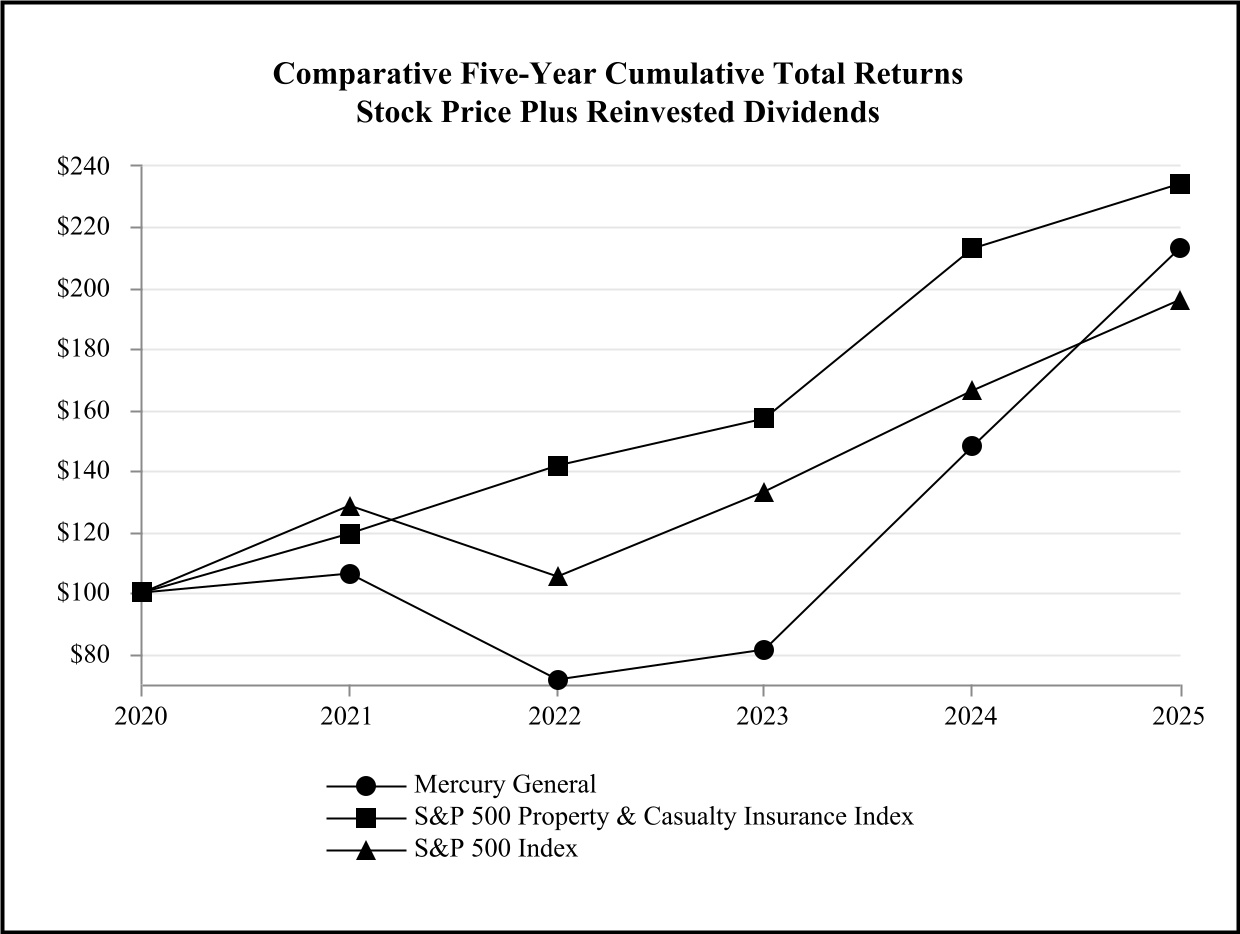
| 2020 | 2021 | 2022 | 2023 | 2024 | 2025 | ||||||||||||||||||||||||||||||
| Mercury General | $ | 100.00 | $ | 106.18 | $ | 71.54 | $ | 81.22 | $ | 148.04 | $ | 213.25 | |||||||||||||||||||||||
| S&P 500 Property & Casualty Insurance Index | 100.00 | 119.28 | 141.79 | 157.12 | 212.86 | 234.32 | |||||||||||||||||||||||||||||
| S&P 500 Index | 100.00 | 128.71 | 105.40 | 133.10 | 166.40 | 196.16 | |||||||||||||||||||||||||||||
Recent Sales of Unregistered Securities
None.
Share Repurchases
The Company does not currently have any share repurchases authorized by the Board. The Company has not repurchased any of its Common Stock since 2000.
Item 6.Reserved
32
Item 7.Management’s Discussion and Analysis of Financial Condition and Results of Operations
Forward-looking Statements
The Private Securities Litigation Reform Act of 1995 provides a “safe harbor” for certain forward-looking statements. Certain statements contained in this report are forward-looking statements based on the Company’s current expectations and beliefs concerning future developments and their potential effects on the Company. There can be no assurance that future developments affecting the Company will be those anticipated by the Company. Actual results may differ from those projected in the forward-looking statements. These forward-looking statements involve significant risks and uncertainties (some of which are beyond the control of the Company) and are subject to change based upon various factors, including but not limited to the following risks and uncertainties: changes in the demand for the Company’s insurance products, inflation and general economic conditions, including general market risks associated with the Company’s investment portfolio; the accuracy and adequacy of the Company’s pricing methodologies; catastrophes in the markets served by the Company; uncertainties related to estimates, assumptions and projections generally; the possibility that actual loss experience may vary adversely from the actuarial estimates made to determine the Company’s loss reserves in general, including subrogation recovery estimates; the Company’s ability to obtain and the timing of the approval of premium rate changes for insurance policies issued in states where the Company operates; legislation adverse to the automobile insurance industry or business generally that may be enacted in the states where the Company operates; the Company’s success in managing its business in non-California states; the presence of competitors with greater financial resources and the impact of competitive pricing and marketing efforts; the Company's ability to successfully allocate the resources used in the states with reduced or exited operations to its operations in other states; changes in driving patterns and loss trends; acts of war and terrorist activities; effects of changing climate conditions; pandemics, epidemics, widespread health emergencies, or outbreaks of infectious diseases; court decisions and trends in litigation and health care and auto repair costs; changes in global trade policies, including trade barriers or restrictions; and legal, cybersecurity, regulatory and litigation risks.
From time to time, forward-looking statements are also included in the Company’s quarterly reports on Form 10-Q and current reports on Form 8-K, in press releases, in presentations, on its web site, and in other materials released to the public. Investors are cautioned not to place undue reliance on any forward-looking statements, which speak only as of the date of this Annual Report on Form 10-K or, in the case of any document the Company incorporates by reference, any other report filed with the SEC or any other public statement made by the Company, the date of the document, report or statement. The Company undertakes no obligation to publicly update any forward-looking statements, whether as a result of new information or future events or otherwise.
OVERVIEW
A. General
The operating results of property and casualty insurance companies are subject to significant quarter-to-quarter and year-to-year fluctuations due to the effect of competition on pricing, the frequency and severity of losses, the effect of weather and natural disasters on losses, general economic conditions, the general regulatory environment in states in which an insurer operates, state regulation of insurance including premium rates, changes in fair value of investments, and other factors such as changes in tax laws. The property and casualty insurance industry has been highly cyclical, with periods of high premium rates and shortages of underwriting capacity followed by periods of severe price competition and excess capacity. These cycles can have a significant impact on the Company’s ability to grow and retain business.
The Company is headquartered in Los Angeles, California and writes primarily personal automobile lines of business selling policies through a network of independent agents, 100% owned insurance agents and direct channels, in 11 states: Arizona, California, Florida, Georgia, Illinois, Nevada, New Jersey, New York, Oklahoma, Texas, and Virginia. The Company also offers homeowners, commercial automobile, commercial property, mechanical protection, fire, and umbrella insurance. Private passenger automobile lines of insurance business accounted for approximately 60% of the $6.0 billion of the Company’s direct premiums written in 2025, and approximately 86% of the private passenger automobile premiums were written in California.
This section discusses some of the relevant factors that management considers in evaluating the Company’s performance, prospects, and risks. It is not all-inclusive and is meant to be read in conjunction with the entirety of management’s discussion and analysis, the Company’s consolidated financial statements and notes thereto, and all other items contained within this Annual Report on Form 10-K.
33
2025 Financial Performance Summary
The Company’s net income for the year ended December 31, 2025 was $541.1 million, or $9.77 per diluted share, compared to $468.0 million, or $8.45 per diluted share, for the same period in 2024. Included in net income was $328.7 million of pre-tax net investment income that was generated during 2025 on a portfolio of $6.6 billion, at fair value, at December 31, 2025, compared to $280.0 million of pre-tax net investment income that was generated during 2024 on a portfolio of $6.1 billion, at fair value, at December 31, 2024. Also included in net income were pre-tax net realized investment gains of $131.4 million and $88.7 million in 2025 and 2024, respectively, and pre-tax catastrophe losses, net of reinsurance and reinstatement premiums earned, of approximately $608.6 million and $277.0 million in 2025 and 2024, respectively. The Company’s operating results and growth have allowed it to consistently generate positive cash flow from operations, which was approximately $1,087 million and $1,037 million in 2025 and 2024, respectively.
The Company continued its marketing efforts to enhance name recognition and lead generation in 2025, and increased the spending for advertising and marketing. The Company believes that its marketing efforts and broad independent agent distribution network, combined with its ability to maintain relatively low prices and a strong reputation, make its insurance products competitive in California and in other states.
The Company believes its thorough underwriting process gives it an advantage over its competitors. The Company’s agent relationships and underwriting and claims processes are its most important competitive advantages.
Economic and Industry Wide Factors
•Regulatory Uncertainty—The insurance industry is subject to strict state regulation and oversight and is governed by the laws of each state in which each insurance company operates. State regulators generally have substantial power and authority over insurance companies including, in some states, approving rate changes and rating factors, restricting cancellation and non-renewal of insurance policies, and establishing minimum capital and surplus requirements. In many states, insurance commissioners may emphasize different agendas or interpret existing regulations differently than previous commissioners. There is no certainty that current or future regulations and the interpretation of those regulations by insurance commissioners and the courts will not have an adverse impact on the Company.
•Cost Uncertainty—Because insurance companies pay claims after premiums are collected, the ultimate cost of an insurance policy is not known until well after the policy revenues are earned. Consequently, significant assumptions are made when establishing insurance rates and loss reserves. While insurance companies use sophisticated models and experienced actuaries to assist in setting rates and establishing loss reserves, there can be no assurance that current rates or current reserve estimates will be adequate. Furthermore, there can be no assurance that insurance regulators will approve rate increases when the Company’s actuarial analyses indicate that they are needed.
•Economic Conditions—The Company’s financial condition, results of operations, and liquidity may be negatively impacted by global, national and local economic conditions, such as recessions, increased levels of unemployment, inflation, and large fluctuations in interest rates. Further, volatility in global capital markets could adversely affect the Company’s investment portfolio. The Company is not able to predict the timing and effect of these factors, or their duration and severity.
•Inflation—The largest cost component for automobile insurers is losses, which include medical, replacement automobile parts, and labor costs. There can be significant variation in the overall increases in medical cost inflation, and it is often years after the respective fiscal period ends before sufficient claims have closed for the inflation rate to be known with a reasonable degree of certainty. Therefore, it can be difficult to establish reserves and set premium rates, particularly when actual inflation rates may be higher or lower than anticipated.
•Loss Frequency—Another component of overall loss costs is loss frequency, which is the number of claims per risk insured. Loss frequency trends are affected by many factors such as fuel prices, the economy, the prevalence of distracted driving, and collision avoidance and other technology in vehicles.
•Underwriting Cycle and Competition—The property and casualty insurance industry is highly cyclical, with alternating hard and soft market conditions. The Company believes that the automobile insurance market in most states went through a transitional period from hard to softening market conditions during 2025 as many insurance carriers experienced improved profitability and increased competition, with inflation easing and rates stabilizing.
Technology
The Company has invested in improvements to automation, customer and agent experience, internal process efficiencies,
34
and cybersecurity protections in 2025. In 2026, the Company expects to continue to invest in customer and agent experience, automation, cybersecurity, and in the decommissioning of legacy systems.
B. Regulatory and Legal Matters
The process for implementing rate changes varies by state. For more detailed information related to insurance rate approval, see "Item 1. Business—Regulation."
In late 2024, as part of the California insurance commissioner’s “Sustainable Insurance Strategy,” the California DOI issued two regulations that may impact how insurers price and write certain of their California property insurance policies: one allowing insurers to incorporate catastrophe modeling into rate-making with a requirement for them to align their share of insured properties in distressed wildfire-prone areas of the state to at least 85% of their state-wide market share, which may be increased by 5% per year, if necessary, until that level is reached; and the other allowing insurers to incorporate reinsurance costs into rate-making for certain specific catastrophe perils and wildfire exposures when meeting the same requirement governing the use of catastrophe modeling. The California insurance commissioner has also implemented changes to the California FAIR Plan, expanding coverage offerings and changing the assessment and recoupment processes in order to enhance market stability: the FAIR Plan’s member insurers may now request the California insurance commissioner’s prior approval to collect temporary supplemental fees from their own policyholders in order to recoup up to 50% of amounts assessed up to $1 billion in aggregate assessments in the industry and 100% of all amounts assessed over that $1 billion threshold for each of personal and commercial lines of insurance business, and 100% of all amounts assessed over $2 billion in aggregate assessments in the industry for the combined personal and commercial lines of insurance business. In December 2025, the California DOI approved the Company's rate application, which incorporates catastrophe modeling and reinsurance costs into its ratemaking in accordance with the new regulations. The Company will adhere to the market-share requirements when the new rating plan is effective in July 2026.
During the first quarter of 2025, the Company was assessed $50 million by the California FAIR Plan to strengthen the FAIR Plan's capital position following the significant losses resulting from the Palisades and Eaton wildfires in January 2025. The Company has received approval from the California DOI to recoup $25 million through temporary supplemental fees from its policyholders, as allowed under the changes to the California FAIR Plan described above.
During 2025, the Company implemented rate changes in 11 states. The following are recent rate increases approved by the California DOI for lines of insurance business that accounted for 5% or more of the Company's total net premiums earned in 2025:
•In January 2024, the California DOI approved a 22.5% rate increase for MIC and a 3.8% rate increase for CAIC on the private passenger automobile line of insurance business. These rate increases became effective in February 2024. The private passenger automobile line of insurance business of MIC and CAIC represented approximately 49% and 6%, respectively, of the Company's total net premiums earned in 2025.
•In March 2024, the California DOI approved a 6.99% rate increase on the California homeowners line of insurance business. This rate increase became effective in May 2024. In January 2025, the California DOI approved a 12% rate increase on the California homeowners line of insurance business. This rate increase became effective in March 2025. In addition, in December 2025, the California DOI approved a 6.9% rate increase on the California homeowners line of insurance business. This rate increase is expected to become effective in July 2026. The California homeowners line of insurance business represented approximately 15% of the Company's total net premiums earned in 2025.
•In April 2024, the California DOI approved a 14.9% rate increase on the California commercial automobile line of insurance business. This rate increase became effective in July 2024. In December 2024, the California DOI approved a 15.6% rate increase on the California commercial automobile line of insurance business. This rate increase became effective in February 2025. In addition, in August 2025, the California DOI approved a 9.6% rate increase on the California commercial automobile line of insurance business. This rate increase became effective in November 2025. The California commercial automobile line of insurance business represented approximately 5% of the Company's total net premiums earned in 2025.
The Company is, from time to time, named as a defendant in various lawsuits or regulatory actions incidental to its insurance business. The majority of lawsuits brought against the Company relate to insurance claims that arise in the normal course of business and are reserved for through the reserving process. For a discussion of the Company’s reserving methods, see "Critical Accounting Estimates" below and Note 1. Summary of Significant Accounting Policies of the Notes to Consolidated Financial Statements in "Item 8. Financial Statements and Supplementary Data."
The Company also establishes accruals for estimated liabilities for non-insurance claims related lawsuits, regulatory
35
actions, and other contingencies when the Company believes a loss is probable and is able to estimate its potential exposure. For material loss contingencies believed to be reasonably possible, the Company also discloses the nature of the loss contingency and an estimate of the possible loss, range of loss, or a statement that such an estimate cannot be made. In addition, the Company accrues for anticipated legal defense costs associated with such lawsuits and regulatory actions. While actual losses may differ from the amounts recorded and the ultimate outcome of the Company’s pending actions is generally not yet determinable, the Company does not believe that the ultimate resolution of currently pending legal or regulatory proceedings, either individually or in the aggregate, will have a material adverse effect on its financial condition or cash flows.
For a discussion of additional regulatory and legal matters, see Note 18. Commitments and Contingencies of the Notes to Consolidated Financial Statements in "Item 8. Financial Statements and Supplementary Data." In all cases, the Company vigorously defends itself unless a reasonable settlement appears appropriate.
C. Critical Accounting Estimates
Loss and Loss Adjustment Expense Reserves ("Loss Reserves")
Preparation of the Company’s consolidated financial statements requires management’s judgment and estimates. The most significant is the estimate of loss reserves. Estimating loss reserves is a difficult process as many factors can ultimately affect the final settlement of a claim and, therefore, the loss reserve that is required. A key assumption in estimating loss reserves is the degree to which the historical data used to analyze reserves will be predictive of ultimate claim costs on incurred claims. Changes in the regulatory and legal environments, results of litigation, medical costs, the cost of repair materials, and labor rates, among other factors, can impact this assumption. In addition, time can be a critical part of reserving determinations since the longer the span between the incidence of a loss and the payment or settlement of a claim, the more variable the ultimate settlement amount could be. Accordingly, short-tail liability claims, such as property damage claims, tend to be more reasonably predictable than long-tail liability claims.
The Company calculates a loss reserve point estimate rather than a range. There is inherent uncertainty with estimates and this is particularly true with loss reserve estimates. This uncertainty comes from many factors which may include changes in claims reporting and settlement patterns, changes in the regulatory and legal environments, uncertainty over inflation rates, and uncertainty for unknown items. The Company does not make specific provisions for these uncertainties, rather it considers them in establishing its loss reserve by looking at historical patterns and trends and projecting these out to current loss reserves. The underlying factors and assumptions that serve as the basis for preparing the loss reserve estimate include paid and incurred loss development factors, expected average costs per claim, inflation trends, expected loss ratios, industry data, and other relevant information such as subrogation recoverable.
The Company also engages independent actuarial consultants to review the Company’s loss reserves and to provide the annual actuarial opinions required under state statutory accounting requirements. The Company analyzes loss reserves quarterly primarily using the incurred loss method, paid loss method, and average severity method coupled with the claim count development method, as described below. When deciding among methods to use, the Company evaluates the credibility of each method based on the maturity of the data available and the claims settlement practices for each particular line of insurance business or coverage within a line of insurance business. The Company may also evaluate qualitative factors such as known changes in laws or legal rulings that could affect claims handling or other external environmental factors or internal factors that could affect the settlement of claims. When establishing the loss reserve, the Company generally analyzes the results from all of the methods used rather than relying on a single method. While these methods are designed to determine the ultimate losses on claims under the Company’s policies, there is inherent uncertainty in all actuarial models since they use historical data to project outcomes. The Company believes that the techniques it uses provide a reasonable basis in estimating loss reserves.
•The incurred loss method analyzes historical incurred case loss (case reserves plus paid losses) development to estimate ultimate losses. The Company applies development factors against current case incurred losses by accident period to calculate ultimate expected losses. The Company believes that the incurred loss method provides a reasonable basis for evaluating ultimate losses, particularly in the Company’s larger, more established lines of insurance business which have a long operating history.
•The paid loss method analyzes historical payment patterns to estimate the amount of losses yet to be paid.
•The average severity method analyzes historical loss payments and/or incurred losses divided by closed claims and/or total claims to calculate an estimated average cost per claim. From this, the expected ultimate average cost per claim can be estimated. The average severity method coupled with the claim count development method provides meaningful information regarding inflation and frequency trends that the Company believes is useful in establishing loss reserves. The claim count development method analyzes historical claim count development to estimate future
36
incurred claim count development for current claims. The Company applies these development factors against current claim counts by accident period to calculate ultimate expected claim counts.
The Company analyzes catastrophe losses separately from non-catastrophe losses. The Company classifies certain losses as catastrophe losses based on catastrophe events designated by Property Claim Services, a unit of Insurance Services Office, Inc. For catastrophe losses, the Company generally determines claim counts based on claims reported and development expectations from previous catastrophes and applies an average expected loss per claim based on loss reserves established by adjusters and average losses on previous similar catastrophes.
For catastrophe losses that are considered “total losses” where the entire dwelling was destroyed, the Company primarily estimates losses based on the expected amounts to be paid out on the policy limits. Homeowners policies have multiple coverages, including dwelling, additional replacement costs, additional living expenses, and personal property, and on a typical total loss, many, but not all, of the various coverage limits are exhausted. It can take up to five years or longer for total loss claims to close, and the Company will reevaluate its total loss estimates periodically based on many factors, including estimated costs to rebuild if a decision was made to rebuild, actual rebuilding costs incurred, estimated time to rebuild, value of personal belongings destroyed, expected duration for the homeowner to be displaced, and demand surge.
In addition, subrogation may play an important role in the catastrophe loss estimate. For additional discussion on subrogation, see disclosures on the Palisades and Eaton wildfires in Note 12. Loss and Loss Adjustment Expense Reserves, of the Notes to Consolidated Financial Statements in "Item 8. Financial Statements and Supplementary Data."
There are many factors that can cause variability between the ultimate expected loss and the actual developed loss. While there are certainly other factors, the Company believes that the following four items tend to create the most variability between expected losses and actual losses.
(1) Inflation
For the Company’s California automobile lines of insurance business, total reserves excluding salvage and subrogation are comprised of the following:
•BI reserves—approximately 75% of total reserves
•Material damage ("MD") reserves, including collision and comprehensive property damage—approximately 5% of total reserves
•Loss adjustment expense reserves—approximately 20% of total reserves.
Loss development on MD reserves is generally insignificant because MD claims are generally settled in a shorter period than BI claims. The majority of the loss adjustment expense reserves are estimated costs to defend BI claims, which tend to require longer periods of time to settle as compared to MD claims.
BI loss reserves are generally the most difficult to estimate because they take longer to close than other coverages. BI coverage in the Company’s policies includes injuries sustained by any person other than the insured, except in the case of uninsured or underinsured motorist BI coverage, which covers damages to the insured for BI caused by uninsured or underinsured motorists. BI payments are primarily for medical costs and general damages.
The following table presents the typical cumulative closure patterns of BI claims in the Company's California personal automobile insurance coverage:
| % of Total | |||||||||||
| Claims Closed | Dollars Paid | ||||||||||
| BI claims closed in the accident year reported | 39% | 12% | |||||||||
| BI claims closed one year after the accident year reported | 79% | 54% | |||||||||
| BI claims closed two years after the accident year reported | 93% | 79% | |||||||||
| BI claims closed three years after the accident year reported | 97% | 89% | |||||||||
BI claims closed in the accident year reported are generally the smaller and less complex claims that settle for approximately $11,000 to $12,000 on average, whereas the total average settlement, once all claims are closed for a particular
37
accident year, is approximately $29,000 to $40,000. The Company creates incurred and paid loss triangles to estimate ultimate losses utilizing historical payment and reserving patterns and evaluates the results of this analysis against its frequency and severity analysis to establish BI loss reserves. The Company adjusts development factors to account for inflation trends it sees in loss severity. As a larger proportion of claims from an accident year are settled, there emerges a higher degree of certainty for the loss reserves established for that accident year. At December 31, 2025, the accident years that are most likely to develop are the 2023 through 2025 accident years; however, it is possible that older accident years could develop as well.
In 2022, excessive inflation led to significant increases in loss severities related to vehicle repairs and bodily injuries. The severe inflationary trend continued into 2023, but moderated as the year progressed. During 2024 and 2025, the inflation rate continued to be moderate for automobile parts and labor but it was at an elevated level for bodily injury costs. In general, the Company expects that historical claims trends will continue with costs tending to increase, which is generally consistent with historical data, and therefore the Company believes that it is reasonable to expect inflation to continue. Many potential factors can affect the BI inflation rate, including changes in claims handling process, changes in statutes and regulations, the number of litigated files, increased use of medical procedures such as MRIs and epidural injections, general economic factors, timeliness of claims adjudication, vehicle safety, weather patterns, changes in the relative percentages of single- and multi-car accidents, social inflation, and gasoline prices, among other factors; however, the magnitude of the impact of such factors on the inflation rate is unknown.
The Company believes that it is reasonably possible that the California automobile BI severity could vary from recorded amounts by as much as 12%, 8% and 6% for 2025, 2024 and 2023 accident years, respectively; however, the variation could be more or less than these amounts.
During the years 2021 through 2025, the changes in the loss severity amounts for the three preceding accident years from the prior year amounts (BI severity variance from prior year) have ranged as follows:
| High | Low | ||||||||||
| Immediate preceding accident year | 7.9% | (1.6)% | |||||||||
| Second preceding accident year | 5.4% | (1.0)% | |||||||||
| Third preceding accident year | 3.6% | (2.6)% | |||||||||
The following table presents the effects on the California automobile BI loss reserves for the 2025, 2024 and 2023 accident years based on possible variations in the severity recorded; however, the actual variations could be more or less than these amounts:
California Automobile Bodily Injury Inflation Reserve Sensitivity Analysis
| Accident Year | Number of Claims Expected | Actual Recorded Severity at 12/31/2025 | Implied Inflation Rate Recorded (1) | (A) Pro-forma severity if actual severity is lower by 12% for 2025, 8% for 2024, and 6% for 2023 | (B) Pro-forma severity if actual severity is higher by 12% for 2025, 8% for 2024, and 6% for 2023 | Favorable loss development if actual severity is less than recorded (Column A) | Unfavorable loss development if actual severity is more than recorded (Column B) | |||||||||||||||||||||||||||||||||||||
| 2025 | 21,556 | $ | 39,826 | 17.8 | % | $ | 35,047 | $ | 44,605 | $ | 103,016,000 | $ | (103,016,000) | |||||||||||||||||||||||||||||||
| 2024 | 21,143 | $ | 33,813 | 14.6 | % | $ | 31,108 | $ | 36,518 | $ | 57,192,000 | $ | (57,192,000) | |||||||||||||||||||||||||||||||
| 2023 | 21,308 | $ | 29,496 | 13.5 | % | $ | 27,726 | $ | 31,266 | $ | 37,715,000 | $ | (37,715,000) | |||||||||||||||||||||||||||||||
| 2022 | 21,284 | $ | 25,987 | — | — | — | — | — | ||||||||||||||||||||||||||||||||||||
| Total Loss Development—Favorable (Unfavorable) | $ | 197,923,000 | $ | (197,923,000) | ||||||||||||||||||||||||||||||||||||||||
___________
(1) Implied inflation rate is calculated by dividing the difference between the current and prior year actual recorded severity by the prior year actual recorded severity. The Company believes that severity increases are caused by litigation, medical costs, inflation, and increased utilization of medical procedures.
(2) Claim Count Development
The Company generally estimates ultimate claim counts for an accident period based on development of claim counts in prior accident periods. Typically, almost every claim is reported within one year following the end of an accident year and at that point the Company has a high degree of certainty as to the ultimate claim count. There are many factors that can affect the number of claims reported after an accident period ends. These factors include changes in weather patterns, a change in the number of litigated files, the number of automobiles insured, and whether the last day of the accident period falls on a weekday
38
or a weekend. However, the Company is unable to determine which, if any, of the factors actually impact the number of claims reported and, if so, by what magnitude.
At December 31, 2025, there were 19,506 California automobile BI claims reported for the 2025 accident year and the Company estimates that these are expected to ultimately grow by approximately 10.5%. The Company believes that while actual development in recent years has ranged approximately from 3% to 12%, it is reasonable to expect that the range of the development could be as great as between 0% and 15%. However, actual development may be more or less than the expected range.
The following table presents the effects on loss development of different claim counts within the broader possible range at December 31, 2025:
California Automobile Bodily Injury Claim Count Reserve Sensitivity Analysis
2025 Accident Year | Claims Reported | Amount Recorded at 12/31/2025 at Approximately 10.5% Claim Count Development | Total Expected Amount If Claim Count Development is 0% | Total Expected Amount If Claim Count Development is 15% | |||||||||||||||||||
| Claim count | 19,506 | 21,556 | 19,506 | 22,432 | |||||||||||||||||||
| Approximate average cost per claim | Not meaningful | $ | 39,826 | $ | 39,826 | $ | 39,826 | ||||||||||||||||
| Total dollars | Not meaningful | $ | 858,489,000 | $ | 776,846,000 | $ | 893,377,000 | ||||||||||||||||
| Total Loss Development—Favorable (Unfavorable) | $ | 81,643,000 | $ | (34,888,000) | |||||||||||||||||||
(3) Unexpected Losses
Unexpected losses are generally not provided for in the current loss reserve because they are not known or expected or differ materially from reasonable loss development expectations, and therefore they tend to be unquantifiable. Once known or otherwise quantifiable, the Company establishes a provision for the losses, but it is not possible to provide any meaningful sensitivity analysis as to the potential size of any unexpected losses. These losses can be caused by many factors, including unexpected legal interpretations of coverage, ineffective claims handling, regulations extending claims reporting periods, assumption of unexpected or unknown risks, adverse court decisions as well as many unknown factors.
Unexpected losses are fairly infrequent but can have a large impact on the Company’s losses. To mitigate this risk, the Company has established claims handling and review procedures. However, it is still possible that these procedures will not prove entirely effective, and the Company may have material unexpected losses in future periods. It is also possible that the Company has not identified and established a sufficient loss reserve for all material unexpected losses, even though a comprehensive claims file review was undertaken. The Company may experience additional development on these loss reserves.
(4) Palisades and Eaton Wildfires
The Palisades and Eaton wildfire losses and loss adjustment expenses (discussed in detail in Note 12. Loss and Loss Adjustment Expense Reserves, of the Notes to Consolidated Financial Statements in "Item 8. Financial Statements and Supplementary Data") have the potential to cause significant reserve variability primarily due to: 1) the large size of losses and loss adjustment expenses from those catastrophes totaling approximately $2.2 billion before subrogation and reinsurance; 2) the estimate for subrogation recoverable on the Eaton fire of approximately $538 million; and 3) changes in loss estimates provided by the FAIR Plan (the Company's share of the FAIR Plan losses from the Palisades and Eaton wildfires is recorded as part of the Company's losses and loss adjustment expenses from those catastrophes). The Company has made adjustments to the ultimate net losses and loss adjustment expenses from the Palisades and Eaton wildfires in each of the four quarters of 2025, based on updated information available at each measurement date. The total ultimate net losses and loss adjustment expenses recognized for the Palisades and Eaton wildfires were approximately $380.4 million, $381.0 million, $359.0 million, and $414.0 million at December 31, September 30, June 30, and March 31 of 2025, respectively.
Discussion of Losses and Loss Reserves and Prior Period Loss Development
At December 31, 2025 and 2024, the Company recorded its point estimate of approximately $3.63 billion and $3.15 billion ($3.60 billion and $3.12 billion, net of reinsurance), respectively, in loss and loss adjustment expense reserves, which included approximately $2.12 billion and $1.92 billion ($2.12 billion and $1.92 billion, net of reinsurance), respectively, of incurred-but-not-reported liabilities ("IBNR"). IBNR includes estimates, based upon past experience, of ultimate developed
39
costs, which may differ from case estimates, unreported claims that occurred on or prior to December 31, 2025 and 2024, and estimated future payments for reopened claims. Management believes that the liability for losses and loss adjustment expenses is adequate to cover the ultimate net cost of losses and loss adjustment expenses incurred to date; however, since the provisions are necessarily based upon estimates, the ultimate liability may be more or less than such provisions.
The Company evaluates its loss reserves quarterly. When management determines that the estimated ultimate claim cost requires a decrease for previously reported accident years, favorable development occurs and a reduction in losses and loss adjustment expenses is reported in the current period. If the estimated ultimate claim cost requires an increase for previously reported accident years, unfavorable development occurs and an increase in losses and loss adjustment expenses is reported in the current period. For 2025, the Company reported favorable development of approximately $92 million on the 2024 and prior accident years’ loss and loss adjustment expense reserves. The favorable development in 2025 was primarily attributable to lower than estimated losses and loss adjustment expenses in the automobile and homeowners lines of insurance business, including favorable development on the prior years' catastrophe losses.
The Company recorded catastrophe losses of approximately $508 million net of reinsurance in 2025. Catastrophe losses incurred in 2025 was reduced by approximately $586 million of subrogation recorded on the Palisades and Eaton wildfires. The majority of the 2025 catastrophe losses resulted from the Palisades and Eaton wildfires in California and severe storms in Texas, Oklahoma and California. In addition, the Company experienced favorable development of approximately $23 million on prior years' catastrophe losses in 2025.
RESULTS OF OPERATIONS
Year Ended December 31, 2025 Compared to Year Ended December 31, 2024
Revenues
Net premiums earned and net premiums written in 2025 increased 8.5% and 6.4%, respectively, from 2024. The increases in net premiums earned and net premiums written were primarily due to rate increases in the California automobile and homeowners lines of insurance business combined with increases in the number of policies written in the California private passenger automobile and homeowners lines of insurance business, partially offset by increases in ceded premiums earned and ceded premiums written, respectively.
Net premiums earned included ceded premiums earned of $287.0 million and $136.7 million in 2025 and 2024, respectively. Net premiums written included ceded premiums written of $287.0 million and $138.0 million in 2025 and 2024, respectively. The increases in ceded premiums earned and ceded premiums written resulted mostly from reinstatement premiums earned and written of $101 million for use of reinsurance benefits associated with the Palisades and Eaton wildfires as well as higher reinsurance coverage and rates and growth in the covered book of business.
Net premiums earned, a GAAP measure, represents the portion of net premiums written that is recognized as revenue in the financial statements for the periods presented, earned on a pro-rata basis over the term of the policies. Net premiums written is a non-GAAP financial measure which represents the premiums charged on policies issued during a fiscal period less any applicable reinsurance. Net premiums written is a statutory measure designed to determine production levels.
The following is a reconciliation of total net premiums earned to net premiums written:
| Year Ended December 31, | |||||||||||
| 2025 | 2024 | ||||||||||
| (Amounts in thousands) | |||||||||||
| Net premiums earned | $ | 5,505,613 | $ | 5,075,456 | |||||||
| Change in net unearned premiums | 216,165 | 302,854 | |||||||||
| Net premiums written | $ | 5,721,778 | $ | 5,378,310 | |||||||
40
Expenses
Loss and expense ratios are used to interpret the underwriting experience of property and casualty insurance companies. The following table presents the Insurance Companies’ loss, expense, and combined ratios determined in accordance with GAAP:
| Year Ended December 31, | |||||||||||
| 2025 | 2024 | ||||||||||
| Loss ratio | 72.0 | % | 72.6 | % | |||||||
| Expense ratio | 24.3 | % | 23.4 | % | |||||||
Combined ratio | 96.3 | % | 96.0 | % | |||||||
Loss ratio is calculated by dividing losses and loss adjustment expenses by net premiums earned. The Company’s loss ratio was affected by favorable development of approximately $92 million and unfavorable development of approximately $25 million on prior accident years’ loss and loss adjustment expense reserves for the years ended December 31, 2025 and 2024, respectively. The favorable development in 2025 was primarily attributable to lower than estimated losses and loss adjustment expenses in the automobile and homeowners lines of insurance business, including favorable development on the prior years' catastrophe losses. The unfavorable development in 2024 was primarily attributable to higher than estimated losses and loss adjustment expenses in the commercial automobile and commercial property lines of insurance business, partially offset by favorable reserve development in the private passenger automobile line of insurance business.
The 2025 loss ratio was negatively impacted by a total of approximately $531 million of catastrophe losses, excluding favorable development of approximately $23 million on prior years' catastrophe losses, primarily due to the Palisades and Eaton wildfires in California and severe storms in Texas, Oklahoma and California. Catastrophe losses incurred in 2025 was reduced by approximately $586 million of subrogation recorded on the Palisades and Eaton wildfires. For additional discussion on subrogation, see disclosures on the Palisades and Eaton wildfires in Note 12. Loss and Loss Adjustment Expense Reserves, of the Notes to Consolidated Financial Statements in "Item 8. Financial Statements and Supplementary Data." The 2024 loss ratio was negatively impacted by a total of approximately $268 million of catastrophe losses, excluding unfavorable development of approximately $9 million on prior years' catastrophe losses, primarily due to tornadoes, hailstorms and convective storms in Texas and Oklahoma, winter storms, rainstorms and wildfires in California, and the impact of Hurricane Helene in Florida and Georgia.
Excluding the effect of estimated prior accident years’ loss development and catastrophe losses, the loss ratio was 64.0% and 66.8% for the years ended December 31, 2025 and 2024, respectively. The decrease in the loss ratio was primarily due to rate increases in the California automobile and homeowners lines of insurance business and a decrease in loss frequency in the California private passenger automobile line of insurance business, partially offset by an increase in loss severity in the California private passenger automobile line of insurance business and an increase in ceded premiums earned due to reinstatement premiums resulting from the Palisades and Eaton wildfires.
Expense ratio is calculated by dividing the sum of policy acquisition costs and other operating expenses by net premiums earned. The expense ratio for 2025 increased compared to 2024, largely due to increases in expenses for profitability-related accruals and advertising, as well as an increase in ceded premiums earned due to reinstatement premiums resulting from the Palisades and Eaton wildfires, partially offset by the rate increases discussed above.
Combined ratio is equal to loss ratio plus expense ratio and is the key measure of underwriting performance traditionally used in the property and casualty insurance industry. A combined ratio under 100% generally reflects profitable underwriting results; a combined ratio over 100% generally reflects unprofitable underwriting results.
Income tax expense was $122.6 million and $106.9 million for the years ended December 31, 2025 and 2024, respectively. The increase in income tax expense was mainly due to an increase in pre-tax income.
The Company’s effective income tax rate can be affected by several factors. These generally include large changes in fully-taxable income including net realized investment gains or losses, tax-exempt investment income, nondeductible expenses, and periodically, non-routine tax items such as adjustments to unrecognized tax benefits related to tax uncertainties. Income tax expense of $122.6 million on pre-tax income of $663.6 million, including tax-exempt investment income of $99.2 million, resulted in an effective tax rate of 18.5%, below the statutory tax rate of 21%, for 2025, and income tax expense of $106.9 million on pre-tax income of $574.9 million, including tax-exempt investment income of $83.3 million, resulted in an effective tax rate of 18.6% for 2024.
41
Investments
The following table presents the investment results of the Company:
| Year Ended December 31, | |||||||||||
| 2025 | 2024 | ||||||||||
| (Amounts in thousands) | |||||||||||
Average invested assets at cost (1) | $ | 5,968,575 | $ | 5,683,973 | |||||||
Net investment income (2)(3) | |||||||||||
| Before income taxes | $ | 328,701 | $ | 279,989 | |||||||
| After income taxes | $ | 276,214 | $ | 235,419 | |||||||
Average annual yield on investments (2) | |||||||||||
| Before income taxes | 4.7 | % | 4.5 | % | |||||||
| After income taxes | 4.0 | % | 3.8 | % | |||||||
| Net realized investment gains | $ | 131,368 | $ | 88,671 | |||||||
__________
(1)Fixed maturities and short-term bonds at amortized cost; equities and other short-term investments at cost. Average invested assets at cost are based on the monthly amortized cost of the invested assets for each period.
(2)Net investment income includes approximately $50.7 million and $25.5 million of interest income earned on cash (approximately $40.1 million and $20.2 million after tax) for the years ended December 31, 2025 and 2024, respectively. Average annual yield on investments does not include interest income earned on cash.
(3)Net investment income before and after income taxes increased, primarily due to higher average invested assets and cash combined with higher average yield. Average annual yield on investments before and after income taxes increased, primarily due to the maturity and replacement of lower yielding investments purchased when market interest rates were lower with higher yielding investments, combined with the higher average yield on investments purchased in 2025 using cash generated from operations compared to the average yield on overall investments in 2024.
The following tables present the components of net realized investment gains (losses) included in net income:
| Year Ended December 31, 2025 | |||||||||||||||||
| Gains (Losses) Recognized in Net Income | |||||||||||||||||
| Sales | Changes in fair value | Total | |||||||||||||||
| (Amounts in thousands) | |||||||||||||||||
Net realized investment gains (losses): | |||||||||||||||||
Fixed maturity securities (1)(2)(4) | $ | (17,105) | $ | 49,606 | $ | 32,501 | |||||||||||
Equity securities (1)(3)(4) | 90,792 | 221 | 91,013 | ||||||||||||||
Short-term investments (1) | — | (11) | (11) | ||||||||||||||
Note receivable (1) | — | 182 | 182 | ||||||||||||||
| Options sold | 7,922 | (239) | 7,683 | ||||||||||||||
| Total | $ | 81,609 | $ | 49,759 | $ | 131,368 | |||||||||||
42
| Year Ended December 31, 2024 | |||||||||||||||||
| Gains (Losses) Recognized in Net Income | |||||||||||||||||
| Sales | Changes in fair value | Total | |||||||||||||||
| (Amounts in thousands) | |||||||||||||||||
| Net realized investment gains (losses): | |||||||||||||||||
Fixed maturity securities (1)(2) | $ | (2,745) | $ | 6,566 | $ | 3,821 | |||||||||||
Equity securities (1)(3) | 63,070 | 8,352 | 71,422 | ||||||||||||||
Short-term investments (1) | (714) | 909 | 195 | ||||||||||||||
Notes receivable (1) | — | (162) | (162) | ||||||||||||||
| Options sold | 12,781 | 614 | 13,395 | ||||||||||||||
| Total | $ | 72,392 | $ | 16,279 | $ | 88,671 | |||||||||||
__________
(1)The changes in fair value of the investment portfolio and notes receivable resulted from the application of the fair value option.
(2)The increases in fair value of fixed maturity securities in 2025 and 2024 resulted primarily from decreases in certain market interest rates associated with the Company's fixed maturity securities.
(3)The increases in fair value of equity securities in 2025 and 2024 resulted primarily from the overall improvement in equity markets.
(4)The gains and losses on sales for the year ended December 31, 2025 primarily relate to the sale of low-yielding stocks and bonds in January 2025 to generate ample liquidity following the Palisades and Eaton wildfires.
Net Income (Loss)
| Year Ended December 31, | |||||||||||
| 2025 | 2024 | ||||||||||
| (Amounts in thousands, except per share data) | |||||||||||
| Net income | $ | 541,094 | $ | 467,953 | |||||||
| Basic average shares outstanding | 55,389 | 55,373 | |||||||||
| Diluted average shares outstanding | 55,389 | 55,377 | |||||||||
| Basic Per Share Data: | |||||||||||
| Net income | $ | 9.77 | $ | 8.45 | |||||||
| Net realized investment gains, net of tax | $ | 1.87 | $ | 1.27 | |||||||
| Diluted Per Share Data: | |||||||||||
| Net income | $ | 9.77 | $ | 8.45 | |||||||
| Net realized investment gains, net of tax | $ | 1.87 | $ | 1.26 | |||||||
Year Ended December 31, 2024 Compared to Year Ended December 31, 2023
See "Item 7. Management's Discussion and Analysis of Financial Condition and Results of Operations" of the Company's Form 10-K for the year ended December 31, 2024 for a discussion of changes in its results of operations from the year ended December 31, 2023 to the year ended December 31, 2024.
LIQUIDITY AND CAPITAL RESOURCES
A. General
The Company is largely dependent upon dividends received from its insurance subsidiaries in the current and prior years to pay debt service costs and to make distributions to its shareholders. Under current insurance law, the Insurance Companies are entitled to pay ordinary dividends of approximately $448 million in 2026 to Mercury General. As of December 31, 2025, Mercury General had approximately $114 million in investments and cash that could be utilized to satisfy its direct holding company obligations.
43
The principal sources of funds for the Insurance Companies are premiums, sales and maturity of invested assets, and dividend and interest income from invested assets. The principal uses of funds for the Insurance Companies are the payment of claims and related expenses, operating expenses, dividends to Mercury General, and the purchase of investments.
B. Cash Flows
The Company has generated positive cash flow from operations in each full year since the public offering of its common stock in November 1985. The Company does not attempt to match the duration and timing of asset maturities with those of liabilities; rather, it manages its portfolio with a view towards maximizing total return with an emphasis on after-tax income. With combined cash and short-term investments of $1,652.6 million at December 31, 2025 as well as $50 million of undrawn credit in its unsecured credit facility, the Company believes its cash flow from operations is adequate to satisfy its future liquidity requirements without the forced sale of investments. Investment maturities are also available to meet the Company’s liquidity needs. However, the Company operates in a rapidly evolving and often unpredictable business environment that may change the timing or amount of expected future cash receipts and expenditures. Accordingly, there can be no assurance that the Company’s sources of funds will be sufficient to meet its liquidity needs or that the Company will not be required to raise additional funds to meet those needs or for future business expansion, through the sale of equity or debt securities or from credit facilities with lending institutions.
Net cash provided by operating activities for the year ended December 31, 2025 was $1,087.2 million, an increase of $50.1 million compared to the year ended December 31, 2024. The increase was primarily due to increases in reinsurance and subrogation recoveries, premium collections and investment income received, partially offset by increases in payments for losses and loss adjustment expenses and commissions and other acquisition costs. The Company utilized the cash provided by operating activities during the year ended December 31, 2025 primarily for the net purchases of investment securities and payment of dividends to its shareholders, with the remaining invested in cash accounts for future liquidity needs, including additional payment for losses from the Palisades and Eaton wildfires. The average annual net cash provided by operating activities for the past 10 years was approximately $557 million, and cash generated from operations was sufficient to meet the liquidity needs over this period.
The following table presents the estimated fair value of fixed maturity securities at December 31, 2025 by contractual maturity in the next five years.
| Fixed Maturity Securities | |||||
| (Amounts in thousands) | |||||
| Due in one year or less | $ | 298,705 | |||
| Due after one year through two years | 215,514 | ||||
| Due after two years through three years | 159,061 | ||||
| Due after three years through four years | 237,111 | ||||
| Due after four years through five years | 154,669 | ||||
| $ | 1,065,060 | ||||
See "D. Debt" below for cash flow related to outstanding debt.
C. Invested Assets
Portfolio Composition
An important component of the Company’s financial results is the return on its investment portfolio. The Company’s investment strategy emphasizes safety of principal and consistent income generation, within a total return framework. The investment strategy has historically focused on maximizing after-tax yield with a primary emphasis on maintaining a well-diversified, investment grade, fixed income portfolio to support the underlying liabilities and achieve return on capital and profitable growth. The Company believes that investment yield is maximized by selecting assets that perform favorably on a long-term basis and by disposing of certain assets to enhance after-tax yield and minimize the potential effect of downgrades and defaults. The Company believes that this strategy enables the optimal investment performance necessary to sustain investment income over time. The Company’s portfolio management approach utilizes a market risk and consistent asset allocation strategy as the primary basis for the allocation of interest sensitive, liquid and credit assets as well as for determining overall below investment grade exposure and diversification requirements. Within the ranges set by the asset allocation strategy, tactical investment decisions are made in consideration of prevailing market conditions.
44
The following table presents the composition of the total investment portfolio of the Company at December 31, 2025:
Cost(1) | Fair Value | ||||||||||
| (Amounts in thousands) | |||||||||||
| Fixed maturity securities: | |||||||||||
| U.S. government bonds | $ | 21,436 | $ | 21,546 | |||||||
| Municipal securities | 3,533,295 | 3,538,473 | |||||||||
| Mortgage-backed securities | 303,314 | 297,381 | |||||||||
| Corporate securities | 747,723 | 751,602 | |||||||||
| Collateralized loan obligations | 733,034 | 722,794 | |||||||||
| Other asset-backed securities | 110,924 | 98,455 | |||||||||
| 5,449,726 | 5,430,251 | ||||||||||
| Equity securities: | |||||||||||
| Common stock | 557,738 | 679,594 | |||||||||
| Non-redeemable preferred stock | 52,206 | 38,761 | |||||||||
Private equity funds measured at net asset value (2) | 118,516 | 94,432 | |||||||||
| 728,460 | 812,787 | ||||||||||
| Short-term investments | 336,978 | 336,992 | |||||||||
| Total investments | $ | 6,515,164 | $ | 6,580,030 | |||||||
__________
(1)Fixed maturities and short-term bonds at amortized cost and equities and other short-term investments at cost.
(2)The fair value is measured using the net asset value practical expedient. See Note 4. Fair Value Measurements, of the Notes to Consolidated Financial Statements in "Item 8. Financial Statements and Supplementary Data" for additional information.
At December 31, 2025, 43.6% of the Company’s total investment portfolio at fair value and 52.8% of its total fixed maturity investments at fair value were invested in tax-exempt state and municipal bonds. Equity holdings consist of non-redeemable preferred stocks, dividend-bearing common stocks on which dividend income is partially tax-sheltered by the 50% corporate dividend received deduction, and private equity funds. At December 31, 2025, 89.9% of short-term investments consisted of highly rated short-duration securities redeemable on a daily or weekly basis.
Fixed Maturity Securities and Short-Term Investments
Fixed maturity securities include debt securities, which may have fixed or variable principal payment schedules, may be held for indefinite periods of time, and may be used as a part of the Company’s asset/liability strategy or sold in response to changes in interest rates, anticipated prepayments, risk/reward characteristics, liquidity needs, tax planning considerations, or other economic factors. Short-term investments include money market accounts, options, and short-term bonds that are highly rated short duration securities and redeemable within one year.
A primary exposure for the fixed maturity securities is interest rate risk. The longer the duration, the more sensitive the asset is to market interest rate fluctuations. As assets with longer maturity dates tend to produce higher current yields, the Company’s historical investment philosophy has resulted in a portfolio with a moderate duration. The Company's portfolio is heavily weighted in investment grade tax-exempt municipal bonds. Fixed maturity securities purchased by the Company typically have call options attached, which further reduce the duration of the asset as interest rates decline. The holdings, that are heavily weighted with high coupon issues, are expected to be called prior to maturity. Modified duration measures the length of time it takes, on average, to receive the present value of all the cash flows produced by a bond, including reinvestment of interest. As it measures four factors (maturity, coupon rate, yield and call terms) which determine sensitivity to changes in interest rates, modified duration is considered a better indicator of price volatility than simple maturity alone.
45
The following table presents the maturities and durations of the Company's fixed maturity securities:
| December 31, 2025 | December 31, 2024 | ||||||||||
| (in years) | |||||||||||
| Fixed Maturity Securities | |||||||||||
| Nominal average maturity: | |||||||||||
| excluding short-term investments | 14.7 | 11.7 | |||||||||
| including short-term investments | 13.8 | 11.1 | |||||||||
| Call-adjusted average maturities: | |||||||||||
| excluding short-term investments | 4.8 | 4.2 | |||||||||
| including short-term investments | 4.5 | 4.0 | |||||||||
| Modified duration reflecting anticipated early calls: | |||||||||||
| excluding short-term investments | 4.6 | 3.6 | |||||||||
| including short-term investments | 4.4 | 3.4 | |||||||||
Another exposure related to the fixed maturity securities is credit risk, which is managed by maintaining a weighted-average portfolio credit quality rating of A+, at fair value at December 31, 2025, consistent with the average rating at December 31, 2024. The Company’s municipal bond holdings, of which 81.1% were tax exempt, represented 65.2% of its fixed maturity portfolio at December 31, 2025, at fair value, and were broadly diversified geographically.
To calculate the weighted-average credit quality ratings as disclosed throughout this Annual Report on Form 10-K, individual securities were weighted based on fair value and a credit quality numeric score that was assigned to each security’s average of ratings assigned by nationally recognized securities rating organizations.
Taxable holdings consist principally of investment grade issues. At December 31, 2025, fixed maturity holdings rated below investment grade and non-rated bonds totaled $10.1 million and $50.6 million, respectively, at fair value, and represented 0.2% and 0.9%, respectively, of total fixed maturity securities. The majority of non-rated issues are a result of municipalities pre-funding and collateralizing those issues with U.S. government securities with an implicit AAA equivalent credit risk. At December 31, 2024, fixed maturity holdings rated below investment grade and non-rated bonds totaled $6.2 million and $62.3 million, respectively, at fair value, and represented 0.1% and 1.3%, respectively, of total fixed maturity securities.
During 2025, approximately 92.3% of the Company's fixed maturity securities at fair value experienced no changes in their overall credit ratings, and approximately 5.9% and 1.8% experienced upgrades and downgrades, respectively.
46
The following table presents the credit quality ratings of the Company’s fixed maturity securities by security type at fair value:
| December 31, 2025 | ||||||||||||||||||||||||||||||||||||||
| Security Type | AAA(1) | AA(1) | A(1) | BBB(1) | Non-Rated/Other (1) | Total Fair Value(1) | ||||||||||||||||||||||||||||||||
| (Dollars in thousands) | ||||||||||||||||||||||||||||||||||||||
| U.S. government bonds: | ||||||||||||||||||||||||||||||||||||||
| Treasuries | $ | 21,546 | $ | — | $ | — | $ | — | $ | — | $ | 21,546 | ||||||||||||||||||||||||||
| Total | 21,546 | — | — | — | — | 21,546 | ||||||||||||||||||||||||||||||||
| 100.0 | % | — | % | — | % | — | % | — | % | 100.0 | % | |||||||||||||||||||||||||||
| Municipal securities: | ||||||||||||||||||||||||||||||||||||||
| Insured | 57,310 | 267,446 | 96,453 | 34,588 | 1,001 | 456,798 | ||||||||||||||||||||||||||||||||
| Uninsured | 192,656 | 1,418,858 | 1,332,526 | 126,798 | 10,837 | 3,081,675 | ||||||||||||||||||||||||||||||||
| Total | 249,966 | 1,686,304 | 1,428,979 | 161,386 | 11,838 | 3,538,473 | ||||||||||||||||||||||||||||||||
| 7.1 | % | 47.6 | % | 40.4 | % | 4.6 | % | 0.3 | % | 100.0 | % | |||||||||||||||||||||||||||
| Mortgage-backed securities: | ||||||||||||||||||||||||||||||||||||||
| Commercial | 10,959 | — | — | 220 | — | 11,179 | ||||||||||||||||||||||||||||||||
| Agencies | — | 69,089 | — | — | — | 69,089 | ||||||||||||||||||||||||||||||||
| Non-agencies: | ||||||||||||||||||||||||||||||||||||||
| Prime | 102,479 | 113,396 | — | — | 277 | 216,152 | ||||||||||||||||||||||||||||||||
| Alt-A | — | 386 | 85 | — | 490 | 961 | ||||||||||||||||||||||||||||||||
| Total | 113,438 | 182,871 | 85 | 220 | 767 | 297,381 | ||||||||||||||||||||||||||||||||
| 38.1 | % | 61.5 | % | — | % | 0.1 | % | 0.3 | % | 100.0 | % | |||||||||||||||||||||||||||
| Corporate securities: | ||||||||||||||||||||||||||||||||||||||
| Basic Materials | — | — | — | 4,557 | — | 4,557 | ||||||||||||||||||||||||||||||||
| Communications | — | — | — | 3,773 | — | 3,773 | ||||||||||||||||||||||||||||||||
| Consumer, cyclical | — | 1,994 | 30,040 | 17,197 | — | 49,231 | ||||||||||||||||||||||||||||||||
| Consumer, non-cyclical | — | 15,156 | 78,970 | 8,176 | — | 102,302 | ||||||||||||||||||||||||||||||||
| Energy | — | 6,481 | — | 43,040 | — | 49,521 | ||||||||||||||||||||||||||||||||
| Financial | — | 70,960 | 365,111 | 32,897 | 9,525 | 478,493 | ||||||||||||||||||||||||||||||||
| Industrial | — | 15,000 | 10,829 | 16,842 | — | 42,671 | ||||||||||||||||||||||||||||||||
| Technology | — | — | 1,797 | — | — | 1,797 | ||||||||||||||||||||||||||||||||
| Utilities | — | — | 3,251 | 16,006 | — | 19,257 | ||||||||||||||||||||||||||||||||
| Total | — | 109,591 | 489,998 | 142,488 | 9,525 | 751,602 | ||||||||||||||||||||||||||||||||
| — | % | 14.6 | % | 65.1 | % | 19.0 | % | 1.3 | % | 100.0 | % | |||||||||||||||||||||||||||
| Collateralized loan obligations: | ||||||||||||||||||||||||||||||||||||||
| Corporate | 158,344 | 166,551 | 359,304 | — | 38,595 | 722,794 | ||||||||||||||||||||||||||||||||
| Total | 158,344 | 166,551 | 359,304 | — | 38,595 | 722,794 | ||||||||||||||||||||||||||||||||
| 21.9 | % | 23.0 | % | 49.8 | % | — | % | 5.3 | % | 100.0 | % | |||||||||||||||||||||||||||
| Other asset-backed securities | — | 2,329 | 64,009 | 32,117 | — | 98,455 | ||||||||||||||||||||||||||||||||
| — | % | 2.4 | % | 65.0 | % | 32.6 | % | — | % | 100.0 | % | |||||||||||||||||||||||||||
| Total | $ | 543,294 | $ | 2,147,646 | $ | 2,342,375 | $ | 336,211 | $ | 60,725 | $ | 5,430,251 | ||||||||||||||||||||||||||
| 10.0 | % | 39.5 | % | 43.2 | % | 6.2 | % | 1.1 | % | 100.0 | % | |||||||||||||||||||||||||||
(1)Intermediate ratings are included at each level (e.g., AA includes AA+, AA and AA-).
U.S. Government Bonds
The Company had $21.5 million and $93.8 million, or 0.4% and 1.9% of its fixed maturity portfolio, at fair value, in U.S. government bonds at December 31, 2025 and 2024, respectively. Moody's and Fitch ratings for U.S. government-issued debt
47
were Aa1 and AA+, respectively, at December 31, 2025, and Aaa and AA+, respectively, at December 31, 2024. The Company understands that market participants continue to use rates of return on U.S. government debt as a risk-free rate and have continued to invest in U.S. Treasury securities. The modified duration of the U.S. government bonds portfolio reflecting anticipated early calls was 2.9 years and 1.3 years at December 31, 2025 and 2024, respectively.
Municipal Securities
The Company had $3.54 billion and $2.99 billion, or 65.2% and 60.8% of its fixed maturity securities portfolio, at fair value, in municipal securities at December 31, 2025 and 2024, respectively. At December 31, 2025 and December 31, 2024, the weighted-average rating of the Company’s total municipal securities was AA- and A+, respectively. 18.9% and 26.0% of the Company's municipal securities, at fair value, were subject to federal taxes at December 31, 2025 and 2024, respectively. The modified duration of the municipal securities portfolio reflecting anticipated early calls was 4.9 years and 3.6 years at December 31, 2025 and 2024, respectively.
At December 31, 2025 and 2024, respectively, $456.8 million and $492.7 million, respectively, of the Company's municipal securities, at fair value, were insured. The Company considers the strength of the underlying credit as a buffer against potential market value declines which may result from future rating downgrades of the bond insurers. In addition, the Company has a long-term time horizon for its municipal bond holdings, which generally allows it to recover the full principal amounts upon maturity and avoid forced sales prior to maturity of bonds that have declined in market value due to the bond insurers’ rating downgrades. Based on the uncertainty surrounding the financial condition of these insurers, it is possible that there will be future downgrades to below investment grade ratings by the rating agencies in the future, and such downgrades could impact the estimated fair value of municipal bonds.
Mortgage-Backed Securities
At December 31, 2025 and 2024, respectively, the mortgage-backed securities portfolio of $297.4 million and $259.4 million, or 5.5% and 5.3% of the Company's fixed maturity securities portfolio, at fair value, was categorized as loans to "prime" residential and commercial real estate borrowers. The Company had holdings of $11.2 million and $16.0 million, at fair value, in commercial mortgage-backed securities at December 31, 2025 and 2024, respectively.
The weighted-average rating of the entire mortgage backed securities portfolio was AA+ at December 31, 2025 and 2024. The modified duration of the mortgage-backed securities portfolio reflecting anticipated early calls was 3.4 years and 4.9 years at December 31, 2025 and 2024, respectively.
Corporate Securities
At December 31, 2025 and 2024, respectively, the company had corporate securities of $751.6 million and $841.7 million, or 13.8% and 17.1% of its fixed maturity securities portfolio, at fair value. The weighted-average rating was A at December 31, 2025 and 2024. The modified duration reflecting anticipated early calls was 2.9 years and 3.0 years at December 31, 2025 and 2024, respectively.
Collateralized Loan Obligations
At December 31, 2025 and 2024, respectively, the Company had collateralized loan obligations of $722.8 million and $626.3 million, or 13.3% and 12.7% of its fixed maturity securities portfolio, at fair value. The weighted-average rating was AA- at December 31, 2025 and 2024. The modified duration reflecting anticipated early calls was 5.9 years and 4.9 years at December 31, 2025 and 2024, respectively.
Other Asset-Backed Securities
The Company had other asset-backed securities of $98.5 million and $105.1 million, which represented 1.8% and 2.1% of its fixed maturity securities portfolio, at fair value, at December 31, 2025 and 2024, respectively. The weighted-average rating was A- at December 31, 2025 and 2024. The modified duration reflecting anticipated early calls was 0.9 years and 1.4 years at December 31, 2025 and 2024, respectively.
Equity Securities
Equity holdings of $812.8 million and $879.2 million, at fair value, as of December 31, 2025 and 2024, respectively, consisted of non-redeemable preferred stocks, common stocks on which dividend income is partially tax-sheltered by the 50% corporate dividend received deduction, and private equity funds. The net gains due to changes in fair value of the Company’s
48
equity portfolio were $0.2 million and $8.4 million in 2025 and 2024, respectively. The primary cause for the increases in fair value of the Company's equity securities in 2025 and 2024 was the overall improvement in equity markets.
The Company’s common stock allocation is intended to enhance the return of and provide diversification for the total portfolio. At December 31, 2025, 12.4% of the total investment portfolio, at fair value, was held in equity securities, compared to 14.5% at December 31, 2024.
The following table presents the equity security portfolio by industry sector at December 31, 2025 and 2024:
| December 31, | |||||||||||||||||||||||
| 2025 | 2024 | ||||||||||||||||||||||
| Cost | Fair Value | Cost | Fair Value | ||||||||||||||||||||
| (Amounts in thousands) | |||||||||||||||||||||||
| Equity securities: | |||||||||||||||||||||||
| Basic materials | $ | 33,994 | $ | 39,963 | $ | 37,257 | $ | 28,814 | |||||||||||||||
| Communications | 30,043 | 29,712 | 39,463 | 43,801 | |||||||||||||||||||
| Consumer, cyclical | 12,940 | 19,744 | 36,810 | 41,510 | |||||||||||||||||||
| Consumer, non-cyclical | 42,133 | 58,242 | 62,377 | 71,520 | |||||||||||||||||||
| Energy | 47,756 | 53,170 | 114,379 | 120,619 | |||||||||||||||||||
| Financial | 101,345 | 95,420 | 100,075 | 97,470 | |||||||||||||||||||
| Funds | 149,085 | 140,318 | 133,934 | 128,541 | |||||||||||||||||||
| Industrial | 49,975 | 76,526 | 49,442 | 75,748 | |||||||||||||||||||
| Technology | 80,094 | 113,892 | 103,828 | 147,102 | |||||||||||||||||||
| Utilities | 181,095 | 185,800 | 117,503 | 124,050 | |||||||||||||||||||
| $ | 728,460 | $ | 812,787 | $ | 795,068 | $ | 879,175 | ||||||||||||||||
D. Debt
The Company's debt consists of the following:
| December 31, | ||||||||||||||||||||||||||||||||
| Lender | Interest Rate | Expiration | 2025 | 2024 | ||||||||||||||||||||||||||||
| (Amounts in thousands) | ||||||||||||||||||||||||||||||||
Senior unsecured notes(1) | Publicly traded | 4.40% | March 15, 2027 | $ | 375,000 | $ | 375,000 | |||||||||||||||||||||||||
Unsecured credit facility(2) | Bank of America, Wells Fargo Bank, BMO Bank, and U.S. Bank | Term SOFR plus 112.5-150.0 basis points | November 18, 2027 | 200,000 | 200,000 | |||||||||||||||||||||||||||
| Total principal amount | 575,000 | 575,000 | ||||||||||||||||||||||||||||||
Less unamortized discount and debt issuance costs(3) | 473 | 872 | ||||||||||||||||||||||||||||||
| Total | $ | 574,527 | $ | 574,128 | ||||||||||||||||||||||||||||
__________
(1) On March 8, 2017, the Company completed a public debt offering issuing $375 million of senior notes. The notes are unsecured senior obligations of the Company, with a 4.4% annual coupon payable on March 15 and September 15 of each year commencing September 15, 2017. These notes mature on March 15, 2027. The Company used the proceeds from the notes to pay off amounts outstanding under the existing loan and credit facilities and for general corporate purposes. The Company incurred debt issuance costs of approximately $3.4 million, inclusive of underwriters' fees. The notes were issued at a slight discount of 99.847% of par, resulting in the effective annualized interest rate, including debt issuance costs, of approximately 4.45%.
(2) On March 31, 2021, the Company entered into an unsecured $75 million five-year revolving credit facility. On November 18, 2022, the Company entered into the First Amendment to this credit facility. The First Amendment extended the maturity date of the loan to November 16, 2026 from March 31, 2026 with possible further extension if certain conditions are met, increased the aggregate commitments by all the lenders to $200 million from $75 million, and replaced the LIBOR with the term SOFR. On November 30, 2023, the Company entered into the Second Amendment to this credit facility, which further increased the aggregate commitments by all the lenders to $250 million from $200 million. On November 22, 2024, the Company entered into the Third Amendment to this credit facility, which extended and fixed the maturity
49
date of the loan to November 18, 2027. The interest rates on borrowings under the credit facility are based on the Company's debt to total capital ratio and range from Term SOFR plus 112.5 basis points when the ratio is under 20% to Term SOFR plus 150.0 basis points when the ratio is greater than or equal to 30%. Commitment fees for the undrawn portions of the credit facility range from 12.5 basis points when the ratio is under 20% to 22.5 basis points when the ratio is greater than or equal to 30%. The debt to total capital ratio is expressed as a percentage of (a) consolidated debt to (b) consolidated shareholders' equity plus consolidated debt. The Company's debt to total capital ratio was 19.2% at December 31, 2025, resulting in a 12.5 basis point commitment fee on any undrawn portion of the credit facility. As of February 17, 2026, a total of $200 million was drawn under this facility on a three-month revolving basis at an annual interest rate of approximately 5.09%, with $50 million available to be drawn. The Company contributed $150 million of the total amount drawn to the surplus of its consolidated insurance subsidiaries in 2023, and used the remainder for general corporate purposes.
(3) The unamortized discount and debt issuance costs are associated with the publicly traded $375 million senior unsecured notes. These are amortized to interest expense over the life of the notes, and the unamortized balance is presented in the Company's consolidated balance sheets as a direct deduction from the carrying amount of the debt. The unamortized debt issuance cost of approximately $0.4 million associated with the $250 million unsecured revolving credit facility maturing on November 18, 2027 is included in other assets in the Company's consolidated balance sheets and amortized to interest expense over the term of the credit facility.
The Company was in compliance with all of its financial covenants pertaining to minimum statutory surplus, debt to total capital ratio, and RBC ratio under the unsecured credit facility at December 31, 2025.
For a further discussion, see Note 8. Notes Payable, of the Notes to Consolidated Financial Statements in "Item 8. Financial Statements and Supplementary Data."
E. Uses of Capital
Dividends
Cash returned to shareholders through dividends was approximately $70.3 million in each of 2025, 2024 and 2023. On February 13, 2026, the Board of Directors declared a $0.3175 quarterly dividend per share payable on March 26, 2026 to shareholders of record on March 12, 2026, with an expected payout of approximately $18 million. The Company currently expects quarterly dividends to continue in future periods, although the declaration and amount of any future cash dividends are at the discretion and subject to the approval of its Board of Directors. The decisions of the Company's Board of Directors regarding the amount and payment of dividends will depend on many factors, such as its financial condition, results of operations, capital requirements, business conditions, debt service obligations, industry practice, legal requirements, regulatory constraints, and other factors that its Board of Directors may deem relevant. The Company expects to fund its future dividend payments primarily with a combination of cash expected to be generated from future operations and cash and short-term investments on hand.
For a further discussion, see Note 13. Dividends, of the Notes to Consolidated Financial Statements in "Item 8. Financial Statements and Supplementary Data."
Capital Expenditures
The Company's capital expenditures were approximately $58.4 million, $46.1 million and $36.8 million for 2025, 2024 and 2023, respectively, and they were primarily related to improving the Company's information technology infrastructure. The Company expects the capital spending for 2026, primarily for continued investments in its technology assets, to be somewhat larger than that for 2025. The Company expects to fund its 2026 capital expenditures primarily with a combination of cash expected to be generated from future operations and cash and short-term investments on hand.
50
Contractual Obligations
The Company’s material cash requirements include the following contractual obligations at December 31, 2025:
| Contractual Obligations | Payments Due By Period | ||||||||||||||||||||||||||||||||||||||||
| Total | 2026 | 2027 | 2028 | 2029 | 2030 | Thereafter | |||||||||||||||||||||||||||||||||||
| (Amounts in thousands) | |||||||||||||||||||||||||||||||||||||||||
Debt (including interest)(1) | $ | 619,007 | $ | 26,680 | $ | 592,327 | $ | — | $ | — | $ | — | $ | — | |||||||||||||||||||||||||||
Lease obligations(2) | 22,880 | 8,356 | 5,826 | 4,144 | 2,570 | 548 | 1,436 | ||||||||||||||||||||||||||||||||||
Loss and loss adjustment expense reserves(3) | 3,633,338 | 2,026,083 | 741,296 | 334,367 | 211,019 | 113,727 | 206,846 | ||||||||||||||||||||||||||||||||||
| Total contractual obligations | $ | 4,275,225 | $ | 2,061,119 | $ | 1,339,449 | $ | 338,511 | $ | 213,589 | $ | 114,275 | $ | 208,282 | |||||||||||||||||||||||||||
__________
(1)The Company’s debt contains various terms, conditions and covenants which, if violated by the Company, would result in a default and could result in the acceleration of the Company’s payment obligations. Amounts differ from the balances presented on the consolidated balance sheet as of December 31, 2025 because the debt amounts above include interest and exclude the discount and issuance costs of the debt.
(2)The Company is obligated under various non-cancellable lease agreements providing for office space, automobiles, office equipment, and electronic data processing equipment that expire at various dates through the year 2036. Lease obligations include $8.1 million in lease commitments that have not yet commenced as of December 31, 2025. See Note 7. Leases, of the Notes to Consolidated Financial Statements in "Item 8. Financial Statements and Supplementary Data" for additional information on lease obligations.
(3)Loss and loss adjustment expense reserves represents an estimate of amounts necessary to settle all outstanding claims, including IBNR as of December 31, 2025. The Company has estimated the timing of these payments based on its historical experience and expectation of future payment patterns. However, the timing of these payments may vary significantly from the amounts shown above. The ultimate cost of losses may vary materially from recorded amounts which are the Company’s best estimates. For more detailed information on the Company's historical loss experience and payment patterns, see "Overview—C. Critical Accounting Estimates" in "Item 7. Management's Discussion and Analysis of Financial Condition and Results of Operations," as well as Note 12. Loss and Loss Adjustment Expense Reserves, of the Notes to Consolidated Financial Statements in "Item 8. Financial Statements and Supplementary Data."
The Company expects to meet these contractual obligations primarily with a combination of cash expected to be generated from future operations and cash and short-term investments on hand, except for the payment of the principal of the debt, which is expected to be made with a future borrowing.
F. Regulatory Capital Requirements
The Insurance Companies must comply with minimum capital requirements under applicable state laws and regulations. The RBC formula is used by insurance regulators to monitor capital and surplus levels. It was designed to capture the widely varying elements of risks undertaken by writers of different lines of insurance business having differing risk characteristics, as well as writers of similar lines where differences in risk may be related to corporate structure, investment policies, reinsurance arrangements, and a number of other factors. The Company periodically monitors the RBC level of each of the Insurance Companies. As of December 31, 2025, 2024 and 2023, each of the Insurance Companies exceeded the minimum required RBC level, as determined by the NAIC and adopted by the state insurance regulators. None of the Insurance Companies’ RBC ratios were less than 350% of the authorized control level RBC as of December 31, 2025, 2024 and 2023. Generally, an RBC ratio of 200% or less would require some form of regulatory or company action.
Among other considerations, industry and regulatory guidelines suggest that the ratio of a property and casualty insurer’s annual net premiums written to statutory policyholders’ surplus should not exceed 3.0 to 1. Based on the combined surplus of all the Insurance Companies of $2.39 billion at December 31, 2025 and net premiums written in 2025 of $5.7 billion, the ratio of premiums written to surplus was 2.39 to 1.
Insurance companies are required to file an Own Risk and Solvency Assessment ("ORSA") with the insurance regulators in their domiciliary states. The ORSA is required to cover, among many items, a company’s risk management policies, the material risks to which the company is exposed, how the company measures, monitors, manages and mitigates material risks, and how much economic and regulatory capital is needed to continue to operate in a strong and healthy manner. The ORSA is intended to be used by state insurance regulators to evaluate the risk exposure and quality of the risk management processes
51
within insurance companies to assist in conducting risk-focused financial examinations and for determining the overall financial condition of insurance companies. The Company filed its most recent ORSA Summary Report with the California DOI in November 2025. Compliance with the ORSA requirements did not have a material impact on the Company's consolidated financial statements.
The DOI in each state in which the Company operates is responsible for conducting periodic financial and market conduct examinations of the Insurance Companies in their states. Market conduct examinations typically review compliance with insurance statutes and regulations with respect to rating, underwriting, claims handling, billing, and other practices.
The following table presents a summary of recent examinations:
| State | Exam Type | Period Under Review | Status | |||||||||||||||||
| TX | Market Conduct | 2022 | Final examination reports were issued in the first half of 2025. | |||||||||||||||||
During the course of and at the conclusion of the examinations, the examining DOI generally reports findings to the Company. No material findings have been communicated to the Company in the Texas market conduct examination reports noted above.
52
Item 7A. Quantitative and Qualitative Disclosures about Market Risks
The Company is subject to various market risk exposures primarily due to its investing and borrowing activities. Primary market risk exposures are changes in interest rates, equity prices, and credit risk. Adverse changes to these rates and prices may occur due to changes in the liquidity of a market, or to changes in market perceptions of creditworthiness and risk tolerance. The following disclosure reflects estimates of future performance and economic conditions. Actual results may differ.
Overview
The Company’s investment policies define the overall framework for managing market and investment risks, including accountability and controls over risk management activities, and specify the investment limits and strategies that are appropriate given the liquidity, surplus, product profile, and regulatory requirements of the Company's subsidiaries. Executive oversight of investment activities is conducted primarily through the Company’s investment committee. The Company’s investment committee focuses on strategies to enhance after-tax yields, mitigate market risks, and optimize capital to improve profitability and returns.
The Company manages exposures to market risk through the use of asset allocation, duration, and credit ratings. Asset allocation limits place restrictions on the total amount of funds that may be invested within an asset class. Duration limits on the fixed maturity securities portfolio place restrictions on the amount of interest rate risk that may be taken. Comprehensive day-to-day management of market risk within defined tolerance ranges occurs as portfolio managers buy and sell within their respective markets based upon the acceptable boundaries established by investment policies.
Credit Risk
Credit risk results from uncertainty in a counterparty’s ability to meet its obligations. Credit risk is managed by maintaining a high credit quality fixed maturity securities portfolio. As of December 31, 2025, the estimated weighted-average credit quality rating of the fixed maturity securities portfolio was A+, at fair value, consistent with the average rating at December 31, 2024.
The following table presents municipal securities by state in descending order of holdings at fair value at December 31, 2025:
| States | Fair Value | Average Rating | ||||||||||||
| (Amounts in thousands) | ||||||||||||||
| Florida | $ | 395,322 | A+ | |||||||||||
| California | 337,542 | AA- | ||||||||||||
| Texas | 326,942 | AA | ||||||||||||
| New York | 271,853 | AA | ||||||||||||
| Pennsylvania | 242,251 | A+ | ||||||||||||
| Other states | 1,964,563 | AA- | ||||||||||||
| Total | $ | 3,538,473 | ||||||||||||
At December 31, 2025, the municipal securities portfolio was broadly diversified among the states and the largest holdings were in populous states such as Florida and California. These holdings were further diversified primarily among cities, counties, schools, public works, hospitals, and state general obligations. The Company seeks to minimize overall credit risk and ensure diversification by limiting exposure to any particular issuer.
Taxable fixed maturity securities represented 47.2% of the Company’s fixed maturity portfolio at December 31, 2025. 0.01% of the Company’s taxable fixed maturity securities, representing 0.01% of its total fixed maturity portfolio, were rated below investment grade at December 31, 2025. Below investment grade issues are considered "watch list" items by the Company, and their status is evaluated within the context of the Company’s overall portfolio and its investment policy on an aggregate risk management basis, as well as their ability to recover their investment on an individual issue basis.
Equity Price Risk
Equity price risk is the risk that the Company will incur losses due to adverse changes in the equity markets.
At December 31, 2025, the Company’s primary objective for common equity investments was current income. The fair value of the equity investments consisted of $679.6 million in common stocks, $38.8 million in non-redeemable preferred stocks, and $94.4 million in private equity funds. Common stocks are typically valued for future economic prospects as
53
perceived by the market.
Common stocks represented 10.3% of total investments at fair value at December 31, 2025. Beta is a measure of a security’s systematic (non-diversifiable) risk, which is measured as the percentage change in an individual security’s return for a 1% change in the return of the market.
Based on hypothetical reductions in the overall value of the stock market, the following table illustrates estimated reductions in the overall value of the Company’s common stock portfolio at December 31, 2025 and 2024:
| December 31, | ||||||||||||||
| 2025 | 2024 | |||||||||||||
| (Amounts in thousands, except Average Beta) | ||||||||||||||
| Average Beta | 0.84 | 0.90 | ||||||||||||
| Hypothetical reduction of 25% in the overall value of the stock market | $ | 142,205 | $ | 166,252 | ||||||||||
| Hypothetical reduction of 50% in the overall value of the stock market | $ | 284,410 | $ | 332,504 | ||||||||||
Interest Rate Risk
Interest rate risk is the risk that the Company will incur a loss due to adverse changes in interest rates relative to the interest rate characteristics of interest bearing assets and liabilities. The Company faces interest rate risk, as it invests a substantial amount of funds in interest sensitive assets and issues interest sensitive liabilities. Interest rate risk includes risks related to changes in U.S. Treasury yields and other key benchmarks, as well as changes in interest rates resulting from widening credit spreads and credit exposure to collateralized securities.
The fixed maturity portfolio at December 31, 2025, which represented 82.5% of total investments at December 31, 2025, at fair value, is subject to interest rate risk. As market interest rates decrease, the value of the portfolio increases and vice versa. A common measure of the interest sensitivity of fixed maturity assets is modified duration, a calculation that utilizes maturity, coupon rate, yield and call terms to calculate an average age to receive the present value of all the cash flows produced by such assets, including reinvestment of interest. The longer the duration, the more sensitive the asset is to market interest rate fluctuations.
The Company has historically invested in fixed maturity securities with a goal of maximizing after-tax yields and holding assets to the maturity or call date. Since assets with longer maturities tend to produce higher current yields, the Company’s historical investment philosophy resulted in a portfolio with a moderate duration. Fixed maturity securities purchased by the Company typically have call options attached, which further reduce the duration of the asset as interest rates decline. The modified duration of the overall fixed maturity securities portfolio reflecting anticipated early calls was 4.4 years at December 31, 2025.
If interest rates were to rise by 100 and 200 basis points, the Company estimates that the fair value of its fixed maturity securities portfolio at December 31, 2025 would decrease by $251.0 million and $502.1 million, respectively. Conversely, if interest rates were to decrease, the fair value of the Company’s fixed maturity securities portfolio would rise, and it may cause a higher number of the Company’s fixed maturity securities to be called away. The proceeds from the called fixed maturity securities would likely be reinvested at lower yields, which would result in lower overall investment income for the Company.
54
Item 8.Financial Statements and Supplementary Data
INDEX TO CONSOLIDATED FINANCIAL STATEMENTS
| Page | |||||
Reports of Independent Registered Public Accounting Firm (KPMG LLP, Los Angeles, CA, Auditor Firm ID: | |||||
| Consolidated Financial Statements: | |||||
55
REPORT OF INDEPENDENT REGISTERED PUBLIC ACCOUNTING FIRM
To the Shareholders and Board of Directors
Mercury General Corporation:
Opinion on the Consolidated Financial Statements
We have audited the accompanying consolidated balance sheets of Mercury General Corporation and subsidiaries (the Company) as of December 31, 2025 and 2024, the related consolidated statements of operations, shareholders’ equity, and cash flows for each of the years in the three-year period ended December 31, 2025, and the related notes and financial statement schedules I, II, and IV (collectively, the consolidated financial statements). In our opinion, the consolidated financial statements present fairly, in all material respects, the financial position of the Company as of December 31, 2025 and 2024, and the results of its operations and its cash flows for each of the years in the three-year period ended December 31, 2025, in conformity with U.S. generally accepted accounting principles.
We also have audited, in accordance with the standards of the Public Company Accounting Oversight Board (United States) (PCAOB), the Company’s internal control over financial reporting as of December 31, 2025, based on criteria established in Internal Control – Integrated Framework (2013) issued by the Committee of Sponsoring Organizations of the Treadway Commission, and our report dated February 17, 2026 expressed an unqualified opinion on the effectiveness of the Company’s internal control over financial reporting.
Basis for Opinion
These consolidated financial statements are the responsibility of the Company’s management. Our responsibility is to express an opinion on these consolidated financial statements based on our audits. We are a public accounting firm registered with the PCAOB and are required to be independent with respect to the Company in accordance with the U.S. federal securities laws and the applicable rules and regulations of the Securities and Exchange Commission and the PCAOB.
We conducted our audits in accordance with the standards of the PCAOB. Those standards require that we plan and perform the audit to obtain reasonable assurance about whether the consolidated financial statements are free of material misstatement, whether due to error or fraud. Our audits included performing procedures to assess the risks of material misstatement of the consolidated financial statements, whether due to error or fraud, and performing procedures that respond to those risks. Such procedures included examining, on a test basis, evidence regarding the amounts and disclosures in the consolidated financial statements. Our audits also included evaluating the accounting principles used and significant estimates made by management, as well as evaluating the overall presentation of the consolidated financial statements. We believe that our audits provide a reasonable basis for our opinion.
Critical Audit Matter
The critical audit matter communicated below is a matter arising from the current period audit of the consolidated financial statements that was communicated or required to be communicated to the audit committee and that: (1) relates to accounts or disclosures that are material to the consolidated financial statements and (2) involved our especially challenging, subjective, or complex judgments. The communication of critical audit matters does not alter in any way our opinion on the consolidated financial statements, taken as a whole, and we are not, by communicating the critical audit matter below, providing separate opinion on the critical audit matter or on the accounts or disclosures to which it relates.
Loss and loss adjustment expense reserves
As discussed in Notes 1 and 12 to the consolidated financial statements, the Company estimates loss and loss adjustment expense reserves (loss reserves) to cover incurred losses and loss adjustment expenses. Specifically, loss reserves are established based on the Company’s assessment of claims pending and the development of prior years’ loss liabilities. As of December 31, 2025, the loss and loss adjustment expense reserve balance was $3.63 billion, which included catastrophe losses.
We identified the evaluation of loss reserves, excluding catastrophe losses, as a critical audit matter. Subjective auditor judgment was required to assess the Company’s selected methods and assumptions, such as paid and incurred loss development factors, used to estimate loss reserves. Specialized actuarial skills and knowledge were needed to evaluate the Company’s actuarial methodologies and the estimate of future claims payment and reporting patterns based on observed historical patterns.
The following are the primary procedures we performed to address this critical audit matter. We evaluated the design and tested the operating effectiveness of certain internal controls related to the Company’s reserving process. This
56
included controls related to the selection of methods and assumptions used in the estimate of loss reserves. We also involved actuarial professionals with specialized skills and knowledge, who assisted in:
• assessing the Company’s methodology for estimating loss reserves by comparing it to generally accepted actuarial methods
• evaluating the Company’s estimates for certain lines of business by performing independent analyses of loss reserves using the Company’s underlying historical claims data
• developing a range of reserves for certain lines of business based on actuarial methodologies and comparing to the Company’s recorded loss reserves for those lines of business
• evaluating the year-over-year movements of the Company’s recorded loss reserves within the developed range of reserves.
/s/ KPMG LLP
We have served as the Company’s auditor since 1963.
February 17, 2026
57
REPORT OF INDEPENDENT REGISTERED PUBLIC ACCOUNTING FIRM
To the Shareholders and Board of Directors
Mercury General Corporation:
Opinion on Internal Control Over Financial Reporting
We have audited Mercury General Corporation and subsidiaries' (the Company) internal control over financial reporting as of December 31, 2025, based on criteria established in Internal Control – Integrated Framework (2013) issued by the Committee of Sponsoring Organizations of the Treadway Commission. In our opinion, the Company maintained, in all material respects, effective internal control over financial reporting as of December 31, 2025, based on criteria established in Internal Control – Integrated Framework (2013) issued by the Committee of Sponsoring Organizations of the Treadway Commission.
We also have audited, in accordance with the standards of the Public Company Accounting Oversight Board (United States) (PCAOB), the consolidated balance sheets of the Company as of December 31, 2025 and 2024, the related consolidated statements of operations, shareholders’ equity, and cash flows for each of the years in the three-year period ended December 31, 2025, and the related notes and financial statement schedules I, II and IV (collectively, the consolidated financial statements), and our report dated February 17, 2026 expressed an unqualified opinion on those consolidated financial statements.
Basis for Opinion
The Company’s management is responsible for maintaining effective internal control over financial reporting and for its assessment of the effectiveness of internal control over financial reporting, included in the accompanying Management’s Report on Internal Control Over Financial Reporting. Our responsibility is to express an opinion on the Company’s internal control over financial reporting based on our audit. We are a public accounting firm registered with the PCAOB and are required to be independent with respect to the Company in accordance with the U.S. federal securities laws and the applicable rules and regulations of the Securities and Exchange Commission and the PCAOB.
We conducted our audit in accordance with the standards of the PCAOB. Those standards require that we plan and perform the audit to obtain reasonable assurance about whether effective internal control over financial reporting was maintained in all material respects. Our audit of internal control over financial reporting included obtaining an understanding of internal control over financial reporting, assessing the risk that a material weakness exists, and testing and evaluating the design and operating effectiveness of internal control based on the assessed risk. Our audit also included performing such other procedures as we considered necessary in the circumstances. We believe that our audit provides a reasonable basis for our opinion.
Definition and Limitations of Internal Control Over Financial Reporting
A company’s internal control over financial reporting is a process designed to provide reasonable assurance regarding the reliability of financial reporting and the preparation of financial statements for external purposes in accordance with generally accepted accounting principles. A company’s internal control over financial reporting includes those policies and procedures that (1) pertain to the maintenance of records that, in reasonable detail, accurately and fairly reflect the transactions and dispositions of the assets of the company; (2) provide reasonable assurance that transactions are recorded as necessary to permit preparation of financial statements in accordance with generally accepted accounting principles, and that receipts and expenditures of the company are being made only in accordance with authorizations of management and directors of the company; and (3) provide reasonable assurance regarding prevention or timely detection of unauthorized acquisition, use, or disposition of the company’s assets that could have a material effect on the financial statements.
Because of its inherent limitations, internal control over financial reporting may not prevent or detect misstatements. Also, projections of any evaluation of effectiveness to future periods are subject to the risk that controls may become inadequate because of changes in conditions, or that the degree of compliance with the policies or procedures may deteriorate.
/s/ KPMG LLP
Los Angeles, California
February 17, 2026
58
MERCURY GENERAL CORPORATION AND SUBSIDIARIES
CONSOLIDATED BALANCE SHEETS
(in thousands)
| December 31, | |||||||||||
| 2025 | 2024 | ||||||||||
| ASSETS | |||||||||||
| Investments, at fair value: | |||||||||||
Fixed maturity securities (amortized cost $ | $ | $ | |||||||||
Equity securities (cost $ | |||||||||||
Short-term investments (cost $ | |||||||||||
| Total investments | |||||||||||
| Cash | |||||||||||
| Receivables: | |||||||||||
| Premiums | |||||||||||
| Allowance for credit losses on premiums receivable | ( | ( | |||||||||
| Premiums receivable, net of allowance for credit losses | |||||||||||
| Accrued investment income | |||||||||||
| Other | |||||||||||
| Total receivables | |||||||||||
Reinsurance recoverables (net of allowance for credit losses $ | |||||||||||
| Deferred policy acquisition costs | |||||||||||
| Fixed assets, net | |||||||||||
| Operating lease right-of-use assets | |||||||||||
| Deferred income taxes | |||||||||||
| Goodwill | |||||||||||
| Other intangible assets, net | |||||||||||
| Other assets | |||||||||||
| Total assets | $ | $ | |||||||||
| LIABILITIES AND SHAREHOLDERS’ EQUITY | |||||||||||
| Loss and loss adjustment expense reserves | $ | $ | |||||||||
| Unearned premiums | |||||||||||
| Notes payable | |||||||||||
| Accounts payable and accrued expenses | |||||||||||
| Operating lease liabilities | |||||||||||
| Current income taxes | |||||||||||
| Other liabilities | |||||||||||
| Total liabilities | |||||||||||
| Commitments and contingencies | |||||||||||
| Shareholders’ equity: | |||||||||||
| Common stock without par value or stated value: | |||||||||||
Authorized | |||||||||||
| Retained earnings | |||||||||||
| Total shareholders’ equity | |||||||||||
| Total liabilities and shareholders’ equity | $ | $ | |||||||||
See accompanying Notes to Consolidated Financial Statements.
59
MERCURY GENERAL CORPORATION AND SUBSIDIARIES
CONSOLIDATED STATEMENTS OF OPERATIONS
(in thousands, except per share data)
| Year Ended December 31, | |||||||||||||||||
| 2025 | 2024 | 2023 | |||||||||||||||
| Revenues: | |||||||||||||||||
| Net premiums earned | $ | $ | $ | ||||||||||||||
| Net investment income | |||||||||||||||||
| Net realized investment gains | |||||||||||||||||
| Other | |||||||||||||||||
| Total revenues | |||||||||||||||||
| Expenses: | |||||||||||||||||
| Losses and loss adjustment expenses | |||||||||||||||||
| Policy acquisition costs | |||||||||||||||||
| Other operating expenses | |||||||||||||||||
| Interest | |||||||||||||||||
| Total expenses | |||||||||||||||||
| Income before income taxes | |||||||||||||||||
Income tax expense | |||||||||||||||||
| Net income | $ | $ | $ | ||||||||||||||
| Net income per share: | |||||||||||||||||
| Basic | $ | $ | $ | ||||||||||||||
| Diluted | $ | $ | $ | ||||||||||||||
See accompanying Notes to Consolidated Financial Statements.
60
MERCURY GENERAL CORPORATION AND SUBSIDIARIES
CONSOLIDATED STATEMENTS OF SHAREHOLDERS’ EQUITY
(in thousands)
| Year Ended December 31, | |||||||||||||||||
| 2025 | 2024 | 2023 | |||||||||||||||
| Common stock, beginning of year | $ | $ | $ | ||||||||||||||
| Proceeds from stock options exercised | |||||||||||||||||
| Common stock, end of year | |||||||||||||||||
| Retained earnings, beginning of year | |||||||||||||||||
| Net income | |||||||||||||||||
| Dividends paid to shareholders | ( | ( | ( | ||||||||||||||
| Retained earnings, end of year | |||||||||||||||||
| Total shareholders’ equity, end of year | $ | $ | $ | ||||||||||||||
See accompanying Notes to Consolidated Financial Statements.
61
MERCURY GENERAL CORPORATION AND SUBSIDIARIES
CONSOLIDATED STATEMENTS OF CASH FLOWS
(in thousands)
| Year Ended December 31, | |||||||||||||||||
| 2025 | 2024 | 2023 | |||||||||||||||
| CASH FLOWS FROM OPERATING ACTIVITIES | |||||||||||||||||
| Net income | $ | $ | $ | ||||||||||||||
| Adjustments to reconcile net income to net cash provided by operating activities: | |||||||||||||||||
| Depreciation and amortization | |||||||||||||||||
| Net realized investment gains | ( | ( | ( | ||||||||||||||
| Net gains on sales of fixed assets | ( | ( | ( | ||||||||||||||
| Loss on property held for sale | |||||||||||||||||
| Increase in premiums receivable | ( | ( | ( | ||||||||||||||
| (Increase) decrease in reinsurance recoverables | ( | ( | |||||||||||||||
| Changes in current and deferred income taxes | |||||||||||||||||
| Increase in deferred policy acquisition costs | ( | ( | ( | ||||||||||||||
| Increase in loss and loss adjustment expense reserves | |||||||||||||||||
| Increase in unearned premiums | |||||||||||||||||
| Increase in accounts payable and accrued expenses | |||||||||||||||||
| Other, net | ( | ( | |||||||||||||||
| Net cash provided by operating activities | |||||||||||||||||
| CASH FLOWS FROM INVESTING ACTIVITIES | |||||||||||||||||
| Fixed maturity securities available for sale in nature: | |||||||||||||||||
| Purchases | ( | ( | ( | ||||||||||||||
| Sales | |||||||||||||||||
| Calls or maturities | |||||||||||||||||
| Equity securities available for sale in nature: | |||||||||||||||||
| Purchases | ( | ( | ( | ||||||||||||||
| Sales | |||||||||||||||||
| Calls | |||||||||||||||||
| Changes in securities payable and receivable | ( | ||||||||||||||||
| Increase in short-term investments | ( | ( | ( | ||||||||||||||
| Purchases of fixed assets | ( | ( | ( | ||||||||||||||
| Sales of fixed assets | |||||||||||||||||
| Other, net | |||||||||||||||||
| Net cash used in investing activities | ( | ( | ( | ||||||||||||||
| CASH FLOWS FROM FINANCING ACTIVITIES | |||||||||||||||||
| Dividends paid to shareholders | ( | ( | ( | ||||||||||||||
| Proceeds from stock options exercised | |||||||||||||||||
| Payments on finance lease obligations | ( | ( | ( | ||||||||||||||
| Proceeds from bank loan | |||||||||||||||||
| Net cash (used in) provided by financing activities | ( | ( | |||||||||||||||
| Net increase in cash | |||||||||||||||||
| Cash: | |||||||||||||||||
| Beginning of year | |||||||||||||||||
| End of year | $ | $ | $ | ||||||||||||||
| SUPPLEMENTAL CASH FLOW DISCLOSURE | |||||||||||||||||
| Interest paid | $ | $ | $ | ||||||||||||||
| Income taxes paid (refunded), net | |||||||||||||||||
| U.S. federal | $ | $ | $ | ( | |||||||||||||
| U.S. state and local | |||||||||||||||||
| California | |||||||||||||||||
| Other | ( | ||||||||||||||||
| ( | |||||||||||||||||
| Foreign | |||||||||||||||||
| Total income taxes paid (refunded), net | $ | $ | $ | ( | |||||||||||||
See accompanying Notes to Consolidated Financial Statements.
62
MERCURY GENERAL CORPORATION AND SUBSIDIARIES
NOTES TO CONSOLIDATED FINANCIAL STATEMENTS
1. Summary of Significant Accounting Policies
General
Mercury General Corporation ("Mercury General") and its subsidiaries (referred to herein collectively as the "Company") are primarily engaged in writing personal automobile insurance through 12 Insurance Companies in 11 states, principally California. The Company also writes homeowners, commercial automobile, commercial property, mechanical protection, fire, and umbrella insurance. The private passenger automobile line of insurance business accounted for more than 60 86 %, 84 %, and 82 % of the private passenger automobile premiums were written in California in 2025, 2024, and 2023, respectively. Premiums written represents the premiums charged on policies issued during a fiscal period, which is a statutory measure designed to determine production levels.
Consolidation and Basis of Presentation
The consolidated financial statements include the accounts of Mercury General Corporation and its subsidiaries:
| Insurance Companies | ||||||||
| Mercury Casualty Company ("MCC") | American Mercury Insurance Company | |||||||
| Mercury Insurance Company ("MIC") | Mercury Insurance Company of Texas(1) | |||||||
| California Automobile Insurance Company ("CAIC") | Mercury County Mutual Insurance Company(2) | |||||||
| California General Underwriters Insurance Company, Inc. | Mercury Indemnity Company of America | |||||||
| Mercury Insurance Company of Illinois | Orion Indemnity Company | |||||||
| Mercury Insurance Company of Georgia | Mercury Indemnity Company of Georgia | |||||||
| Non-Insurance Companies | ||||||||
| Mercury Select Management Company, Inc. | AIS Management LLC | |||||||
| Mercury Insurance Services LLC | Auto Insurance Specialists LLC | |||||||
Animas Funding LLC(3) | PoliSeek AIS Insurance Solutions, Inc. | |||||||
Fannette Funding LLC(3) | Mercury Plus Insurance Services LLC | |||||||
Upper Animas Holdings LLC(3) | Mercury Information Technology Services LLC(4) | |||||||
Mercury (Shanghai) Information Technology Services Co., Ltd. ("Mercury Shanghai")(5) | ||||||||
__________
(1)Effective August 13, 2025, American Mercury Lloyds Insurance Company was converted from a Lloyd's plan to a stock company and changed the company name to Mercury Insurance Company of Texas.
(2)Mercury County Mutual Insurance Company is not owned but is controlled by the Company through a management contract.
(3)Special purpose investment vehicle.
(4)Parent company of Mercury Shanghai.
(5)Mercury Shanghai provides software development and related technical services to the Company's subsidiaries.
The consolidated financial statements have been prepared in conformity with U.S. generally accepted accounting principles ("GAAP"), which differ in some respects from those filed in reports to insurance regulatory authorities. All intercompany transactions and balances have been eliminated.
Certain prior period amounts have been reclassified to conform with the current period presentation.
The Company did not
Use of Estimates
The preparation of financial statements in conformity with GAAP requires management to make estimates and
63
assumptions that affect the reported amounts of assets and liabilities, disclosures of contingent assets and liabilities at the date of the financial statements, and the reported amounts of revenue and expenses during the reporting period. These estimates require the Company to apply complex assumptions and judgments, and often the Company must make estimates about effects of matters that are inherently uncertain and will likely change in subsequent periods. The most significant assumptions in the preparation of these consolidated financial statements relate to reserves for losses and loss adjustment expenses. Actual results could differ from those estimates.
Investments and Other Financial Instruments
Financial instruments recorded in the consolidated balance sheets include investments, notes receivable, other receivables, accounts payable, options sold, and notes payable. The Company’s investments include securities issued by the U.S. government and its agencies, securities issued by states and municipal governments and agencies, certain corporate and other debt securities, equity securities, and exchange traded funds.
The Company applies the fair value option to all fixed maturity and equity securities and short-term investments at the time an eligible item is first recognized. The primary reasons for electing the fair value option were simplification and cost benefit considerations as well as the expansion of the use of fair value measurement by the Company consistent with the long-term measurement objectives of the Financial Accounting Standards Board (the "FASB") for accounting for financial instruments. Gains and losses due to changes in fair value for items measured at fair value pursuant to application of the fair value option are included in net realized investment gains in the Company's consolidated statements of operations, while interest and dividend income on investment holdings are recognized on an accrual basis on each measurement date and are included in net investment income in the Company's consolidated statements of operations. The Company’s fixed maturity and equity securities are classified as “trading” and carried at fair value as required when applying the fair value option. The majority of equity holdings, including non-redeemable preferred stocks, are actively traded on national exchanges or trading markets, and are valued at the last transaction price on the balance sheet date.
The fair value of a financial instrument is the price that would be received to sell an asset or paid to transfer a liability in an orderly transaction between market participants at the measurement date. Due to their short-term maturity, the carrying values of other receivables and accounts payable approximate their fair values. 98.6 % of the fair value of the Company's investments at December 31, 2025 is based on observable market prices, observable pricing parameters, or is derived from such prices or parameters. The availability of observable market prices and pricing parameters can vary by financial instrument. Observable market prices and pricing parameters of a financial instrument, or a related financial instrument, are used to derive a price without requiring significant judgment.
The Company may hold or acquire financial instruments that lack observable market prices or pricing parameters because they are less actively traded currently or in future periods. The fair value of such instruments is determined using techniques appropriate for each particular financial instrument. These techniques may involve some degree of judgment. The price transparency of the particular financial instrument will determine the degree of judgment involved in determining the fair value of the Company’s financial instruments. Price transparency is affected by a wide variety of factors, including the type of financial instrument, whether it is a new financial instrument and not yet established in the marketplace, and the characteristics particular to the transaction. Financial instruments for which actively quoted prices or pricing parameters are available or for which fair value is derived from actively quoted prices or pricing parameters will generally have a higher degree of price transparency. By contrast, financial instruments that are thinly traded or not quoted will generally have diminished price transparency. Even in normally active markets, the price transparency for actively quoted financial instruments may be reduced during periods of market dislocation. Alternatively, in thinly quoted markets, the participation of market makers willing to purchase and sell a financial instrument provides a source of transparency for products that otherwise are not actively quoted. For a further discussion, see Note 4. Fair Value Measurements.
Fixed maturity securities include debt securities, which may have fixed or variable principal payment schedules, may be held for indefinite periods of time, and may be used as a part of the Company’s asset/liability strategy or sold in response to changes in interest rates, anticipated prepayments, risk/reward characteristics, liquidity needs, tax planning considerations, or other economic factors. Premiums and discounts on fixed maturities are amortized using first call date and are adjusted for anticipated prepayments. Premiums and discounts on mortgage-backed securities are adjusted for anticipated prepayment using the retrospective method, with the exception of some beneficial interests in securitized financial assets, which are accounted for using the prospective method.
Equity securities consist of non-redeemable preferred stocks, common stocks on which dividend income is partially tax-sheltered by the 50 % corporate dividend received deduction, and private equity funds.
64
Short-term investments include money market accounts, options, and short-term bonds that are highly rated short duration securities and redeemable within one year.
In the normal course of investing activities, the Company either forms or enters into relationships with variable interest entities ("VIEs"). A VIE is an entity that either has investors that lack certain essential characteristics of a controlling financial interest, such as simple majority kick-out rights, or lacks sufficient funds to finance its own activities without financial support provided by other entities. The Company performs ongoing qualitative assessments of the VIEs to determine whether the Company has a controlling financial interest in the VIE and therefore is the primary beneficiary. The Company is deemed to have a controlling financial interest when it has both the ability to direct the activities that most significantly impact the economic performance of the VIE and the obligation to absorb losses or right to receive benefits from the VIE that could potentially be significant to the VIE. Based on the Company's assessment, if it determines it is the primary beneficiary, the Company consolidates the VIE in its consolidated financial statements.
From time to time, the Company forms special purpose investment vehicles to facilitate its investment activities involving derivative instruments such as total return swaps, or limited partnerships such as private equity funds. These special purpose investment vehicles are consolidated VIEs as the Company has determined it is the primary beneficiary of such VIEs. Creditors have no recourse against the Company in the event of default by these VIEs. The Company had no implied or unfunded commitments to these VIEs at December 31, 2025 and 2024. The Company's financial or other support provided to these VIEs and its loss exposure are limited to its collateral and original investment.
Securities on Deposit
As required by statute, the Company’s insurance subsidiaries have securities deposited with the departments of insurance or similar governmental agencies in the states in which they are licensed to operate ("DOI") with fair values totaling approximately $16 million and $15 million at December 31, 2025 and 2024, respectively.
Deferred Policy Acquisition Costs
Deferred policy acquisition costs consist of commissions paid to outside agents, premium taxes, salaries, and certain other underwriting costs that are incremental or directly related to the successful acquisition of new and renewal insurance contracts and are amortized over the life of the related policy in proportion to premiums earned. Deferred policy acquisition costs are limited to the amount that will remain after deducting from unearned premiums and anticipated investment income, the estimated losses and loss adjustment expenses, and the servicing costs that will be incurred as premiums are earned. The Company’s deferred policy acquisition costs are further limited by excluding those costs not directly related to the successful acquisition of insurance contracts. The Company does not defer advertising expenditures but expenses them as incurred.
The table below presents a summary of deferred policy acquisition cost amortization and net advertising expense:
| Year Ended December 31, | |||||||||||||||||
| 2025 | 2024 | 2023 | |||||||||||||||
| (Amounts in millions) | |||||||||||||||||
Deferred policy acquisition cost amortization | $ | $ | $ | ||||||||||||||
Net advertising expense | |||||||||||||||||
Fixed Assets
Fixed assets are stated at historical cost less accumulated depreciation and amortization. A fixed asset classified as held for sale is measured at the lower of its carrying amount or fair value less cost to sell, and is presented separately from other fixed assets. The useful life for buildings is 40 years. Furniture, equipment, and purchased software are depreciated on a combination of straight-line and accelerated methods over 3 to 7 years. The Company has capitalized certain consulting costs, payroll, and payroll-related costs for employees related to computer software developed for internal use, which are amortized
65
on a straight-line method over the estimated useful life of the software, generally not exceeding 7 years. In accordance with applicable accounting standards, capitalization ceases no later than the point at which a computer software project is substantially complete and ready for its intended use. Leasehold improvements are amortized over the shorter of the useful life of the assets or the life of the associated lease.
Goodwill and Other Intangible Assets
Goodwill and other intangible assets arise as a result of business acquisitions and consist of the excess of the cost of the acquisitions over the tangible and intangible assets acquired and liabilities assumed and identifiable intangible assets acquired. Identifiable intangible assets consist of the value of customer relationships, trade names, software and technology, and favorable leases, which are all subject to amortization, and an insurance license which is not subject to amortization.
Premium Revenue Recognition
Losses and Loss Adjustment Expenses
Unpaid losses and loss adjustment expenses are determined in amounts estimated to cover incurred losses and loss adjustment expenses and established based upon the Company’s assessment of claims pending and the development of prior years’ loss liabilities. These amounts include liabilities based upon individual case estimates for reported losses and loss adjustment expenses and estimates of such amounts that are incurred but not reported. Changes in the estimated liability are charged or credited to operations as the losses and loss adjustment expenses are re-estimated. The liability is stated net of anticipated salvage and subrogation recoveries, and gross of reinsurance recoverables on unpaid losses.
Estimating loss reserves is a difficult process as many factors can ultimately affect the final settlement of a claim and, therefore, the loss reserve that is required. A key assumption in estimating loss reserves is the degree to which the historical data used to analyze reserves will be predictive of ultimate claim costs on incurred claims. Changes in the regulatory and legal environments, results of litigation, medical costs, the cost of repair materials, and labor rates, among other factors, can impact this assumption. In addition, time can be a critical part of reserving determinations since the longer the span between the incidence of a loss and the payment or settlement of a claim, the more variable the ultimate settlement amount could be. Accordingly, short-tail claims, such as property damage claims, tend to be more reasonably predictable than long-tail liability claims, such as those involving the Company’s bodily injury ("BI") coverages. Management believes that the liability for losses and loss adjustment expenses is adequate to cover the ultimate net cost of losses and loss adjustment expenses
66
incurred to date. However, since the provisions for loss reserves are necessarily based upon estimates, the ultimate liability may be more or less than such provisions.
The Company analyzes loss reserves quarterly primarily using the incurred loss method, paid loss method, and average severity method coupled with the claim count development method, as described below. When deciding among methods to use, the Company evaluates the credibility of each method based on the maturity of the data available and the claims settlement practices for each particular line of insurance business or coverage within a line of insurance business. The Company may also evaluate qualitative factors such as known changes in laws or legal ruling that could affect claims handling or other external environmental factors or internal factors that could affect the settlement of claims. When establishing the loss reserve, the Company will generally analyze the results from all of the methods used rather than relying on a single method. While these methods are designed to determine the ultimate losses on claims under the Company’s policies, there is inherent uncertainty in all actuarial models since they use historical data to project outcomes. The Company believes that the techniques it uses provide a reasonable basis in estimating loss reserves.
•The incurred loss method analyzes historical incurred case loss (case reserves plus paid losses) development to estimate ultimate losses. The Company applies development factors against current case incurred losses by accident period to calculate ultimate expected losses. The Company believes that the incurred loss method provides a reasonable basis for evaluating ultimate losses, particularly in the Company’s larger, more established lines of insurance business which have a long operating history.
•The paid loss method analyzes historical payment patterns to estimate the amount of losses yet to be paid.
•The average severity method analyzes historical loss payments and/or incurred losses divided by closed claims and/or total claims to calculate an estimated average cost per claim. From this, the expected ultimate average cost per claim can be estimated. The average severity method coupled with the claim count development method provides meaningful information regarding inflation and frequency trends that the Company believes is useful in establishing loss reserves. The claim count development method analyzes historical claim count development to estimate future incurred claim count development for current claims. The Company applies these development factors against current claim counts by accident period to calculate ultimate expected claim counts.
The Company analyzes catastrophe losses separately from non-catastrophe losses. The Company classifies certain losses as catastrophe losses based on catastrophe events designated by Property Claim Services, a unit of Insurance Services Office, Inc. For catastrophe losses, the Company generally determines claim counts based on claims reported and development expectations from previous catastrophes and applies an average expected loss per claim based on loss reserves established by adjusters and average losses on previous similar catastrophes.
For catastrophe losses that are considered “total losses” where the entire dwelling was destroyed, the Company primarily estimates losses based on the expected amounts to be paid out on the policy limits. Homeowners policies have multiple coverages, including dwelling, additional replacement costs, additional living expenses, and personal property, and on a typical total loss, many, but not all, of the various coverage limits are exhausted. It can take up to five years or longer for total loss claims to close, and the Company will reevaluate its total loss estimates periodically based on many factors, including estimated costs to rebuild if a decision was made to rebuild, actual rebuilding costs incurred, estimated time to rebuild, value of personal belongings destroyed, expected duration for the homeowner to be displaced, and demand surge.
Derivative Financial Instruments
Earnings (Loss) Per Share
67
Income Taxes
Deferred tax assets and liabilities are recognized for the estimated future tax consequences attributable to differences between the financial reporting basis and the respective tax basis of the Company’s assets and liabilities, and expected benefits of utilizing net operating loss, capital loss, and tax-credit carryforwards. The Company assesses the likelihood that its deferred tax assets will be realized and, to the extent management does not believe these assets are more likely than not to be realized, a valuation allowance is established. Deferred tax assets and liabilities are measured using enacted tax rates expected to apply to taxable income in the years in which those temporary differences are expected to be recovered or settled. The effect on deferred tax assets and liabilities of a change in tax rates or laws is recognized in earnings in the period that includes the enactment date.
The Company’s deferred income taxes usually include a combination of ordinary and capital deferred tax benefits and expenses. At December 31, 2025, the Company’s deferred income taxes were in a net asset position mainly due to deferred tax assets generated by unearned premiums and loss reserve discounting. These deferred tax assets were substantially offset by deferred tax liabilities resulting from deferred policy acquisition costs. In assessing the Company's ability to realize deferred tax assets, management considers whether it is more likely than not that some portion or all of the deferred tax assets will not be realized, and to the extent management does not believe these assets are more likely than not to be realized, a valuation allowance is established. The ultimate realization of deferred tax assets is dependent upon generating sufficient taxable income of the appropriate character within the carryback and carryforward periods available under the tax law. Management considers the reversal of deferred tax liabilities, projected future taxable income of an appropriate nature, and tax-planning strategies in making this assessment.
On July 4, 2025, the President of the United States signed into law the One Big Beautiful Bill Act (“OBBBA”) which includes significant amendments to the Internal Revenue Code. The OBBBA makes permanent the immediate expensing of domestic research and experimental expenditures and provides a transition rule permitting the accelerated recovery of the unamortized balance of previously capitalized research and experimental costs. The Company’s consolidated financial statements for the year ended December 31, 2025 incorporated an estimate of additional current tax benefits related to the immediate expensing of 2025 domestic research and experimental expenditures and previously unamortized amounts. The change in tax law resulted in reclassifications between current and deferred taxes, with no material impact to combined total tax expense.
Management’s recoverability assessment of the Company’s deferred tax assets which are ordinary in character takes into consideration the Company’s strong history of generating ordinary taxable income and a reasonable expectation that it will continue to generate ordinary taxable income in the future. The Company also has various deferred tax liabilities that represent sources of future ordinary taxable income. Management’s recoverability assessment with regard to its capital deferred tax assets is based on estimates of anticipated capital gains, tax-planning strategies available to generate future taxable capital gains, and the Company's capacity to absorb capital losses carried back to prior years, each of which would contribute to the realization of deferred tax benefits. The Company has significant unrealized gains in its investment portfolio that could be realized through asset dispositions, at management’s discretion. In addition, the Company expects to hold certain debt securities, which are currently in loss positions, to recovery or maturity. Management believes unrealized losses related to these debt securities, which represent a portion of the unrealized loss positions at December 31, 2025, are fully realizable at maturity. Management believes its long-term time horizon for holding these securities allows it to avoid any forced sales prior to maturity. Further, the Company has the capability to generate additional realized capital gains by entering into sale-leaseback transactions using one or more of its appreciated real estate holdings. The realized gains on the real estate holdings could be used to realize both ordinary and capital deferred tax assets. The Company also has the capacity to recoup capital deferred tax assets through tax capital loss carryback claims for taxes paid within permitted carryback periods.
The Company has the capability to implement tax planning strategies and it has a steady history of generating positive cash flows from operations and believes that its liquidity needs can be met in future periods without the forced sale of its investments. This capability assists management in controlling the timing and amount of realized losses generated during future periods. By prudent utilization of some or all of these strategies, management has the intent and believes that it has the ability to generate capital gains and minimize tax losses in a manner sufficient to avoid losing the benefits of its deferred tax assets. Management will continue to assess the need for a valuation allowance on a quarterly basis. Although realization is not assured, management believes it is more likely than not that the Company’s deferred tax assets will be realized.
Contingent Liabilities
The Company has known, and may have unknown, potential liabilities which include claims, assessments, lawsuits, or regulatory fines and penalties relating to the Company’s business. The Company continually evaluates these potential liabilities and accrues for them and/or discloses them in the notes to the consolidated financial statements where required. In addition, the Company accrues for anticipated legal defense costs associated with lawsuits, claims or regulatory actions. The Company does
68
Reinsurance
Liabilities for unearned premiums and unpaid losses are stated in the accompanying consolidated financial statements before deductions for ceded reinsurance. Unpaid losses and unearned premiums that are ceded to reinsurers are carried in reinsurance recoverables and other assets, respectively, in the Company's consolidated balance sheets. Reinsurance recoverables on unpaid losses are estimated based upon assumptions consistent with those used in establishing the liabilities related to the underlying contracts. Most of the Company's reinsurance premiums are recognized ratably over the contract period to the extent coverage remains available. Net premiums earned and losses and loss adjustment expenses are stated net of deductions for ceded reinsurance.
The Company is the assuming reinsurer under a Catastrophe Portfolio Participation Reinsurance Contract ("Contract") effective through December 31, 2028. The Company reimburses up to approximately $30 million in annual losses for a proportional share of a portfolio of catastrophe losses under the Contract, to the extent the actual loss ratio exceeds the threshold loss ratio of 73.5 %.
The Company is the assuming reinsurer under a Property Quota Share Reinsurance Contract ("Quota Share Contract") effective through December 31, 2026. The Company reimburses up to approximately $60 million in annual losses for a proportional share of losses based on the premiums ceded to the Company under the Quota Share Contract.
The Company is the assuming reinsurer under a Catastrophe Quota Share Reinsurance Agreement ("Quota Share Agreement") effective through December 31, 2026. The Company reimburses up to approximately $12 million in annual losses for a proportional share of losses based on the premiums ceded to the Company under the Quota Share Agreement.
The Company is party to a Catastrophe Reinsurance Treaty ("Treaty") covering a wide range of perils that is effective through June 30, 2026. The Treaty provides $2,140 million of coverage on a per occurrence basis after covered catastrophe losses exceed the $200 million Company retention limit. The Treaty specifically excludes coverage for any Florida business and for California earthquake losses on fixed property policies, such as homeowners, but does cover losses from fires following an earthquake with certain exceptions. The Treaty provides for one full reinstatement of coverage limits with certain exceptions, and includes some additional minor territorial and coverage restrictions.
| Year Ended December 31, | |||||||||||||||||
| 2025 | 2024 | 2023 | |||||||||||||||
| (Amounts in thousands) | |||||||||||||||||
| Premiums Written | |||||||||||||||||
| Direct | $ | $ | $ | ||||||||||||||
| Ceded | ( | ( | ( | ||||||||||||||
| Assumed | |||||||||||||||||
| Net | $ | $ | $ | ||||||||||||||
| Premiums Earned | |||||||||||||||||
| Direct | $ | $ | $ | ||||||||||||||
| Ceded | ( | ( | ( | ||||||||||||||
| Assumed | |||||||||||||||||
| Net | $ | $ | $ | ||||||||||||||
The Company recognized ceded premiums earned of approximately $287 million, $137 million, and $109 million in 2025, 2024, and 2023, respectively, which are included in net premiums earned in its consolidated statements of operations, and ceded losses and loss adjustment expenses of approximately $1,300 million, $(3 ) million, and $10 million in 2025, 2024, and 2023, respectively, which are included in losses and loss adjustment expenses in its consolidated statements of operations. The comparatively large ceded premiums earned in 2025 is largely due to reinstatement premiums recorded for use of reinsurance benefits associated with the Palisades and Eaton wildfires that occurred in the first quarter of 2025. The large ceded losses and loss adjustment expenses in 2025 is due to losses from the Palisades and Eaton wildfires. The negative ceded losses and loss
69
adjustment expenses in 2024 is primarily the result of favorable development on certain of prior years' catastrophe losses that had previously been ceded to the Company's reinsurers.
The Insurance Companies, as primary insurers, are required to pay losses to the extent reinsurers are unable to discharge their obligations under the reinsurance agreements.
Share-Based Compensation
Revenue from Contracts with Customers
The Company's revenue from contracts with customers that are in scope of Topic 606 represents the commission income that the Company's 100% owned insurance agencies, Auto Insurance Specialists LLC ("AIS") and PoliSeek AIS Insurance Solutions, Inc. ("Poliseek"), earned from third-party insurers. The Company's commission income from third-party insurers was approximately $29.6 million, $25.2 million and $20.8 million, with related expenses of approximately $15.2 million, $13.4 million and $11.4 million, for the years ended December 31, 2025, 2024 and 2023, respectively. Due to the immateriality of the Company's commission income and its related expenses to the overall consolidated financial statements, the commission income, net of related expenses, is included in other revenues in the Company's consolidated statements of operations, and in other income of the Property and Casualty business segment in the Company's segment reporting in accordance with Topic 280, Segment Reporting (see Note 19. Segment Information).
AIS and PoliSeek are primarily engaged in the marketing and sales of insurance policies in private passenger automobile, commercial automobile and homeowners lines of business. Their revenues primarily consist of commission income received from property and casualty insurers. The primary performance obligation of AIS and Poliseek in return for the commission income from the insurers is to complete the sale of the policy and deliver the control of the policy to the insurer prior to the policy effective date. The total revenue from the sale of a policy is recognized when the sale is complete and the policy is effective as all the material aspects of the performance obligation are satisfied and the insurer is deemed to obtain control of the insurance policy at that time. The commission income is constrained such that the revenue is recognized only to the extent that the commission income received is not likely to be returned to the insurers due to policy cancellations. Any commission income not received when the sale is complete is recognized as commission income receivable, which is included in other receivables in the Company's consolidated balance sheets. Commission income receivable at December 31, 2025 and 2024 was approximately $2.0 million and $1.7 million, respectively.
As of December 31, 2025 and 2024, the Company had no no
Allowance for Credit Losses
Financial Instruments - Credit Losses (Topic 326) uses the "expected loss" methodology for recognizing credit losses for financial assets that are not accounted for at fair value through net income. The Company's investment portfolio, excluding accrued investment income, was not affected by Topic 326 as it applies the fair value option to all of its investments. The estimated allowance amounts for credit losses at December 31, 2025 and December 31, 2024 primarily related to premiums receivable.
70
Premiums Receivable
The majority of the Company's premiums receivable are short-term in nature and are due within a year, consistent with the policy term of its insurance policies sold. Generally, premiums are collected prior to providing risk coverage, minimizing the Company's exposure to credit risk. The Company monitors the credit risk associated with premiums receivable, taking into consideration the fact that credit risk is reduced by the Company's right to offset unearned premiums against premiums receivable. The Company has established an allowance for uncollectible premiums receivable related to credit risk, and the estimated allowance is reviewed quarterly and adjusted as appropriate based on evaluations of balances due from insureds, management’s experience, historical data, current economic conditions, and reasonable and supportable forecasts of future economic conditions that affect the collectibility of the reported amounts. In estimating an allowance for uncollectible premiums receivable, the Company assesses customer balances and write-offs by state, line of business, and the year the premiums were written. The estimated allowance is based on historical write-off percentages adjusted for the effects of current trends and reasonable and supportable forecasts, as well as expected recoveries of amounts written off.
Evaluating the current trends or economic conditions that impact the Company's ability to collect premiums receivable and projecting those into the remaining life of premiums receivable in order to develop a reasonable and supportable forecast of the ultimate collectibility involve significant judgment and assumptions about future economic conditions. The Company monitors the overall credit risk of premiums receivable by regularly reviewing macroeconomic indicators such as trends in unemployment, inflation and interest rates, regulatory developments such as restrictions on cancellation of policies for nonpayment of premiums, and insurance policy specific indicators such as trends in policy cancellations.
The following table presents a summary of changes in allowance for credit losses on premiums receivable:
| Year Ended December 31, | ||||||||||||||||||||
| 2025 | 2024 | 2023 | ||||||||||||||||||
| (Amounts in thousands) | ||||||||||||||||||||
| Beginning balance | $ | $ | $ | |||||||||||||||||
| Provision during the period for expected credit losses | ||||||||||||||||||||
| Write-off amounts during the period | ( | ( | ( | |||||||||||||||||
| Recoveries during the period of amounts previously written off | ||||||||||||||||||||
| Ending balance | $ | $ | $ | |||||||||||||||||
Reinsurance Recoverables
Reinsurance recoverables are balances due to the Company from its reinsurers for paid and unpaid losses and loss adjustment expenses. A credit exposure exists with respect to these balances to the extent that any reinsurer is unable to meet its obligations. The Company has established an allowance for uncollectible reinsurance recoverables related to credit risk, and changes in the allowance are presented as a component of losses and loss adjustment expenses in the Company's consolidated statements of operations. The Company reviews the allowance quarterly and adjusts it as necessary to reflect changes in estimates of uncollectible balances. The Company evaluates the financial condition of its reinsurers and monitors concentration risk to minimize its exposure to significant losses from individual reinsurers. The Company attempts to mitigate its credit risk related to reinsurance by entering into reinsurance arrangements with reinsurers that have high credit ratings and by obtaining collateral as necessary. The primary method of obtaining collateral is through letters of credit. Generally, the Company uses a default analysis to estimate uncollectible reinsurance recoverables. The primary components of the default analysis are reinsurance recoverable balances by reinsurer, net of collateral and any liabilities held by the Company subject to a right of offset, and future default factors used to estimate the probability that the reinsurer may be unable to meet its future obligations in full. The determination of the future default factor is based on a historical default factor published by a major rating agency applicable to the particular financial strength rating class.
71
The following table presents a summary of changes in allowance for credit losses on reinsurance recoverables:
| Year Ended December 31, | ||||||||||||||||||||
| 2025 | 2024 | 2023 | ||||||||||||||||||
| (Amounts in thousands) | ||||||||||||||||||||
| Beginning balance | $ | $ | $ | |||||||||||||||||
| Provision during the period for expected credit losses | ( | |||||||||||||||||||
| Write-off amounts during the period | ||||||||||||||||||||
| Recoveries during the period of amounts previously written off | ||||||||||||||||||||
| Ending balance | $ | $ | $ | |||||||||||||||||
Accrued Interest Receivables
The Company made certain accounting policy elections for its accrued interest receivables on the adoption date of Topic 326 as allowed: a) an election to present accrued interest receivable balances separately from the associated financial assets on the balance sheet, and b) an election not to measure an allowance for credit losses on accrued interest receivable amounts and instead write off uncollectible accrued interest amounts in a timely manner by reversing interest income.
Recently Issued Accounting Standards
In September 2025, the Financial Accounting Standards Board ("FASB") issued Accounting Standards Update (“ASU”) 2025-06, "Intangibles—Goodwill and Other—Internal-Use Software (Subtopic 350-40)—Targeted Improvements to the Accounting for Internal-Use Software." ASU 2025-06 is intended to improve the operability of Subtopic 350-40 by removing all references to software development project stages so that the guidance is neutral to different software development methods. An entity is required to start capitalizing software costs when both of the following occur: (1) management has authorized and committed to funding the software project, and (2) it is probable that the project will be completed and the software will be used to perform the function intended. Furthermore, ASU 2025-06 supersedes the website development costs guidance and incorporates the recognition requirements for website-specific development costs from Subtopic 350-50 into Subtopic 350-40. ASU 2025-06 is effective for annual and interim reporting periods beginning after December 15, 2027. Early adoption is permitted. The Company is currently evaluating the impact of this standard on its consolidated financial statements and related disclosures.
In July 2025, the FASB issued ASU 2025-05, "Financial Instruments—Credit Losses (Topic 326)—Measurement of Credit Losses for Accounts Receivable and Contract Assets." ASU 2025-05 is related to the estimation of expected credit losses for current accounts receivable and current contract assets that arise from transactions accounted for under Topic 606. It allows all entities to elect a practical expedient that assumes current conditions as of the balance sheet date do not change for the remaining life of the asset. The update also allows for an accounting policy election, which is not applicable to public business entities. Entities are required to disclose whether they have elected to use the practical expedient and, if applicable, the accounting policy election. ASU 2025-05 is effective for annual and interim reporting periods beginning after December 15, 2025 and is to be applied on a prospective basis. Early adoption is permitted. The Company does not expect this standard to have a material impact on its consolidated financial statements other than additional disclosures.
In November 2024, the Financial Accounting Standards Board ("FASB") issued ASU 2024-03, "Income Statement-Reporting Comprehensive Income-Expense Disaggregation Disclosures (Subtopic 220-40)—Disaggregation of Income Statement Expenses." ASU 2024-03 is intended to improve financial reporting by requiring that public business entities disclose additional information about specific expense categories in the notes to financial statements at interim and annual reporting periods. Although the amendments in ASU 2024-03 do not change or remove current expense disclosure requirements, they
72
affect where this information appears in the notes to financial statements because entities are required to include certain current disclosures in the same tabular format disclosure as the other disaggregation requirements in the amendments. ASU 2024-03 is effective for annual reporting periods beginning after December 15, 2026 and interim reporting periods beginning after December 15, 2027. The Company is evaluating the presentational effect that ASU 2024-03 will have on its notes to consolidated financial statements.
2. Financial Instruments
Financial instruments recorded in the consolidated balance sheets include investments, notes receivable, other receivables, options sold, accounts payable, and notes payable. Due to their short-term maturity, the carrying values of other receivables and accounts payable approximate their fair values. All investments are carried at fair value in the consolidated balance sheets.
The following table presents the fair values of financial instruments:
| December 31, | |||||||||||
| 2025 | 2024 | ||||||||||
| (Amounts in thousands) | |||||||||||
| Assets | |||||||||||
| Investments | $ | $ | |||||||||
| Notes receivable | |||||||||||
| Liabilities | |||||||||||
| Options sold | |||||||||||
| Notes payable | |||||||||||
Investments
The Company applies the fair value option to all fixed maturity and equity securities and short-term investments at the time an eligible item is first recognized. The cost of investments sold is determined on a first-in and first-out method, and realized and unrealized gains and losses are included in net realized investment gains in the Company's consolidated statements of operations. See Note 3. Investments for additional information.
Notes Receivable
In September 2024, the Company completed the sale of an office building located in Brea, California for a total sale price of $31.5 million. $21.4 million of the total sale price was received in the form of a promissory note. The note receivable was secured by the property sold, and bore interest at an annual rate of 7.0 %. The term of the note receivable was four years and interest was paid in quarterly installments. The Company received the full principal payment of the note receivable and accrued interest in September 2025.
In March 2023, the Company completed the sale of an office building located in Clearwater, Florida, for a total sale price of approximately $19.6 million. $9.8 million of the total sale price was received in the form of a promissory note. The note receivable is secured by the property sold, and bears interest at an annual rate of 7.0 %. The term of the note receivable is four years and interest is paid in monthly installments.
Interest earned on the notes receivable is recognized in other revenues in the Company's consolidated statements of operations. The Company elected to apply the fair value option to the notes receivable at the time they were first recognized. The fair values of the notes receivable are included in other assets in the Company's consolidated balance sheets, while the changes in fair value of the notes receivable are included in net realized investment gains or losses in the Company's consolidated statements of operations.
Options Sold
The Company writes covered call options through listed and over-the-counter exchanges. When the Company writes an option, an amount equal to the premium received by the Company is recorded as a liability and is subsequently adjusted to the current fair value of the option written. Premiums received from writing options that expire unexercised are treated by the Company as realized gains from investments on the expiration date. If a call option is exercised, the premium is added to the proceeds from the sale of the underlying security in determining whether the Company has realized a gain or loss. The
73
Company, as writer of an option, bears the market risk of an unfavorable change in the price of the security underlying the written option. Liabilities for covered call options are included in other liabilities in the Company's consolidated balance sheets.
Notes Payable
The fair values of the Company’s publicly traded $375 200
For additional disclosures regarding methods and assumptions used in estimating fair values, see Note 4. Fair Value Measurements.
3. Investments
The following table presents gains (losses) due to changes in fair value of investments that are measured at fair value:
| Year Ended December 31, | |||||||||||||||||
| 2025 | 2024 | 2023 | |||||||||||||||
| (Amounts in thousands) | |||||||||||||||||
| Fixed maturity securities | $ | $ | $ | ||||||||||||||
| Equity securities | |||||||||||||||||
| Short-term investments | ( | ||||||||||||||||
| Total gains | $ | $ | $ | ||||||||||||||
The following table presents gross gains (losses) realized on the sales of investments:
| Year Ended December 31, | |||||||||||||||||||||||||||||||||||||||||||||||||||||
| 2025 | 2024 | 2023 | |||||||||||||||||||||||||||||||||||||||||||||||||||
| (Amounts in thousands) | |||||||||||||||||||||||||||||||||||||||||||||||||||||
| Gross Realized Gains | Gross Realized Losses | Net | Gross Realized Gains | Gross Realized Losses | Net | Gross Realized Gains | Gross Realized Losses | Net | |||||||||||||||||||||||||||||||||||||||||||||
| Fixed maturity securities | $ | $ | ( | $ | ( | $ | $ | ( | $ | ( | $ | $ | ( | $ | ( | ||||||||||||||||||||||||||||||||||||||
| Equity securities | ( | ( | ( | ( | |||||||||||||||||||||||||||||||||||||||||||||||||
| Short-term investments | ( | ( | ( | ( | |||||||||||||||||||||||||||||||||||||||||||||||||
Contractual Maturity
At December 31, 2025, fixed maturity holdings rated below investment grade and non-rated comprised 0.9 % of total investments at fair value. Additionally, the Company owns securities that are credit enhanced by financial guarantors that are subject to uncertainty related to market perception of the guarantors’ ability to perform. Determining the estimated fair value of municipal bonds could become more difficult should markets for these securities become illiquid.
The following table presents the estimated fair values of the Company's fixed maturity securities at December 31, 2025 by contractual maturity. Expected maturities will differ from contractual maturities because borrowers may have the right to call or prepay obligations with or without call or prepayment penalties.
| Estimated Fair Value | |||||
| (Amounts in thousands) | |||||
| Fixed maturity securities: | |||||
| Due in one year or less | $ | ||||
| Due after one year through five years | |||||
| Due after five years through ten years | |||||
| Due after ten years | |||||
| Total | $ | ||||
74
Investment Income
The following table presents a summary of net investment income:
| Year Ended December 31, | |||||||||||||||||
| 2025 | 2024 | 2023 | |||||||||||||||
| (Amounts in thousands) | |||||||||||||||||
| Fixed maturity securities | $ | $ | $ | ||||||||||||||
| Equity securities | |||||||||||||||||
| Cash and Short-term investments | |||||||||||||||||
| Total investment income | $ | $ | $ | ||||||||||||||
| Less: investment expense | ( | ( | ( | ||||||||||||||
| Net investment income | $ | $ | $ | ||||||||||||||
4. Fair Value Measurements
The Company employs a fair value hierarchy that prioritizes the inputs to valuation techniques used to measure fair value. The fair value of a financial instrument is the amount that would be received to sell an asset or paid to transfer a liability in an orderly transaction between market participants at the measurement date using the exit price. Accordingly, when market observable data are not readily available, the Company’s own assumptions are set to reflect those that market participants would be presumed to use in pricing the asset or liability at the measurement date. Assets and liabilities recorded at fair value on the consolidated balance sheets are categorized based on the level of judgment associated with inputs used to measure their fair value and the level of market price observability, as follows:
| Level 1 | Unadjusted quoted prices are available in active markets for identical assets or liabilities as of the reporting date. | ||||
| Level 2 | Pricing inputs are other than quoted prices in active markets, which are based on the following: | ||||
| a. Quoted prices for similar assets or liabilities in active markets; | |||||
| b. Quoted prices for identical or similar assets or liabilities in non-active markets; or | |||||
| c. Either directly or indirectly observable inputs as of the reporting date. | |||||
| Level 3 | Pricing inputs are unobservable and significant to the overall fair value measurement, and the determination of fair value requires significant management judgment or estimation. | ||||
In certain cases, inputs used to measure fair value may fall into different levels of the fair value hierarchy. In such cases, the level in the fair value hierarchy within which the fair value measurement in its entirety falls has been determined based on the lowest level input that is significant to the fair value measurement in its entirety. Thus, a Level 3 fair value measurement may include inputs that are observable (Level 1 or Level 2) and unobservable (Level 3). The Company’s assessment of the significance of a particular input to the fair value measurement in its entirety requires judgment and consideration of factors specific to the asset or liability.
The Company uses prices and inputs that are current as of the measurement date, including during periods of market disruption. In periods of market disruption, the ability to observe prices and inputs may be reduced for many instruments. This condition could cause an instrument to be reclassified from Level 1 to Level 2, or from Level 2 to Level 3. The Company recognizes transfers between levels at either the actual date of the event or a change in circumstances that caused the transfer.
Summary of Significant Valuation Techniques for Financial Assets and Financial Liabilities
The Company’s fair value measurements are based on the market approach, which utilizes market transaction data for the same or similar instruments. The Company obtained unadjusted fair values on 98.6 % of its investment portfolio from an independent pricing service at December 31, 2025.
Level 1 measurements—Fair values of financial assets and financial liabilities are obtained from an independent pricing service, and are based on unadjusted quoted prices for identical assets or liabilities in active markets. Additional pricing services and closing exchange values are used as a comparison to ensure that reasonable fair values are used in pricing the investment portfolio.
U.S. government bonds/Short-term bonds: Valued using unadjusted quoted market prices for identical assets in active markets.
Common stock: Comprised of actively traded, exchange listed U.S. and international equity securities and valued based on
75
unadjusted quoted prices for identical assets in active markets.
Money market instruments: Valued based on unadjusted quoted prices for identical assets in active markets.
Options sold: Comprised of free-standing exchange listed derivatives that are actively traded and valued based on quoted prices for identical instruments in active markets.
Level 2 measurements—Fair values of financial assets and financial liabilities are obtained from an independent pricing service or outside brokers, and are based on prices for similar assets or liabilities in active markets or valuation models whose inputs are observable, directly or indirectly, for substantially the full term of the asset or liability. Additional pricing services are used as a comparison to ensure reliable fair values are used in pricing the investment portfolio.
Municipal securities: Valued based on models or matrices using inputs such as quoted prices for identical or similar assets in active markets.
Mortgage-backed securities: Comprised of securities that are collateralized by residential and commercial mortgage loans and valued based on models or matrices using multiple observable inputs, such as benchmark yields, reported trades and broker/dealer quotes, for identical or similar assets in active markets. The Company had holdings of $11.2 million and $16.0 million in commercial mortgage-backed securities at December 31, 2025 and 2024, respectively.
Corporate securities/Short-term bonds: Valued based on a multi-dimensional model using multiple observable inputs, such as benchmark yields, reported trades, broker/dealer quotes and issue spreads, for identical or similar assets in active markets.
Non-redeemable preferred stock: Valued based on observable inputs, such as underlying and common stock of same issuer and appropriate spread over a comparable U.S. Treasury security, for identical or similar assets in active markets.
Collateralized loan obligations ("CLOs"): Valued based on underlying debt instruments and the appropriate benchmark spread for similar assets in active markets.
Other asset-backed securities: Comprised of securities that are collateralized by non-mortgage assets, such as automobile loans, valued based on models or matrices using multiple observable inputs, such as benchmark yields, reported trades and broker/dealer quotes, for identical or similar assets in active markets.
Notes receivable: Valued based on observable inputs, such as benchmark yields, and considering any premium or discount for the differential between the stated interest rate and market interest rates, based on quoted market prices of similar instruments.
Level 3 measurements—Fair values of financial assets are based on inputs that are both unobservable and significant to the overall fair value measurement, including any items in which the evaluated prices obtained elsewhere were deemed to be of a distressed trading level. At December 31, 2025 and 2024, the Company did not have any financial assets or financial liabilities based on Level 3 measurements.
Fair value measurement using NAV practical expedient - The fair values of the Company's investment in private equity funds measured at net asset value are determined using net asset value ("NAV") as advised by the external fund managers and the third party administrators. The NAV of the Company's limited partnership or limited liability company interest in such a fund is based on the manager's and the administrator's valuation of the underlying holdings in accordance with the fund's governing documents and GAAP. In accordance with applicable accounting guidance, private equity funds measured at fair value using the NAV practical expedient are not classified in the fair value hierarchy. At December 31, 2025, the Company had capital invested in four such funds: the strategy of three such funds with a combined fair value of approximately $87.1 million at December 31, 2025 is to provide current income to investors by investing mainly in secured loans, CLOs or CLO issuers, and equity interests in vehicles established to purchase and warehouse loans; and the strategy of the other such fund with a fair value of approximately $7.4 million at December 31, 2025 is to achieve long-term capital appreciation through privately-negotiated venture capital investments in seed- and early-stage portfolio companies with technology-enabled business models. The Company had approximately $4 million in unfunded commitments at December 31, 2025 with respect to the private equity funds measured at NAV. The underlying assets of the funds are expected to be liquidated over the period of approximately one year to seven years from December 31, 2025. In addition, the Company does not have the ability to redeem or withdraw from the funds, or to sell, assign, pledge or transfer its investment, without the consent from the General Partner or Managers of each fund, but will receive distributions based on the liquidation of the underlying assets and the interest proceeds from the underlying assets.
The Company’s financial instruments at fair value are reflected in the consolidated balance sheets on a trade-date basis. Related unrealized gains or losses are recognized in net realized investment gains or losses in the consolidated statements of
76
operations. Fair value measurements are not adjusted for transaction costs.
The following tables present information about the Company’s assets and liabilities measured at fair value on a recurring basis, and indicate the fair value hierarchy of the valuation techniques utilized by the Company to determine such fair values:
| December 31, 2025 | |||||||||||||||||||||||
| Level 1 | Level 2 | Level 3 | Total | ||||||||||||||||||||
| (Amounts in thousands) | |||||||||||||||||||||||
| Assets | |||||||||||||||||||||||
| Fixed maturity securities: | |||||||||||||||||||||||
| U.S. government bonds | $ | $ | $ | $ | |||||||||||||||||||
| Municipal securities | |||||||||||||||||||||||
| Mortgage-backed securities | |||||||||||||||||||||||
| Corporate securities | |||||||||||||||||||||||
| Collateralized loan obligations | |||||||||||||||||||||||
| Other asset-backed securities | |||||||||||||||||||||||
| Total fixed maturity securities | |||||||||||||||||||||||
| Equity securities: | |||||||||||||||||||||||
| Common stock | |||||||||||||||||||||||
| Non-redeemable preferred stock | |||||||||||||||||||||||
Private equity funds measured at net asset value (1) | |||||||||||||||||||||||
| Total equity securities | |||||||||||||||||||||||
| Short-term investments: | |||||||||||||||||||||||
| Short-term bonds | |||||||||||||||||||||||
| Money market instruments | |||||||||||||||||||||||
| Other | |||||||||||||||||||||||
| Total short-term investments | |||||||||||||||||||||||
| Other assets: | |||||||||||||||||||||||
| Note receivable | |||||||||||||||||||||||
| Total assets at fair value | $ | $ | $ | $ | |||||||||||||||||||
| Liabilities | |||||||||||||||||||||||
| Other liabilities: | |||||||||||||||||||||||
| Options sold | |||||||||||||||||||||||
| Total liabilities at fair value | $ | $ | $ | $ | |||||||||||||||||||
77
| December 31, 2024 | |||||||||||||||||||||||
| Level 1 | Level 2 | Level 3 | Total | ||||||||||||||||||||
| (Amounts in thousands) | |||||||||||||||||||||||
| Assets | |||||||||||||||||||||||
| Fixed maturity securities: | |||||||||||||||||||||||
| U.S. government bonds and agencies | $ | $ | $ | $ | |||||||||||||||||||
| Municipal securities | |||||||||||||||||||||||
| Mortgage-backed securities | |||||||||||||||||||||||
| Corporate securities | |||||||||||||||||||||||
| Collateralized debt obligations | |||||||||||||||||||||||
| Other asset-backed securities | |||||||||||||||||||||||
| Total fixed maturity securities | |||||||||||||||||||||||
| Equity securities: | |||||||||||||||||||||||
| Common stock | |||||||||||||||||||||||
| Non-redeemable preferred stock | |||||||||||||||||||||||
Private equity funds measured at net asset value (1) | |||||||||||||||||||||||
| Total equity securities | |||||||||||||||||||||||
| Short-term investments: | |||||||||||||||||||||||
| Short-term bonds | |||||||||||||||||||||||
| Money market instruments | |||||||||||||||||||||||
| Other | |||||||||||||||||||||||
| Total short-term investments | |||||||||||||||||||||||
| Other assets: | |||||||||||||||||||||||
| Notes receivable | $ | $ | $ | $ | |||||||||||||||||||
| Total assets at fair value | $ | $ | $ | $ | |||||||||||||||||||
| Liabilities | |||||||||||||||||||||||
| Other liabilities: | |||||||||||||||||||||||
| Options sold | |||||||||||||||||||||||
| Total liabilities at fair value | $ | $ | $ | $ | |||||||||||||||||||
__________
(1) The fair value is measured using the NAV practical expedient; therefore, it is not categorized within the fair value hierarchy. The fair value amount is presented in this table to permit reconciliation of the fair value hierarchy to the amounts presented in the Company's consolidated balance sheets.
There were no
At December 31, 2025 and 2024, there were no
Financial Instruments Disclosed, But Not Carried, at Fair Value
The following tables present the carrying value and fair value of the Company’s financial instruments disclosed, but not carried, at fair value, and the level within the fair value hierarchy at which such instruments are categorized:
| December 31, 2025 | |||||||||||||||||||||||||||||
| Carrying Value | Fair Value | Level 1 | Level 2 | Level 3 | |||||||||||||||||||||||||
| (Amounts in thousands) | |||||||||||||||||||||||||||||
| Liabilities | |||||||||||||||||||||||||||||
| Notes payable: | |||||||||||||||||||||||||||||
| Unsecured notes | $ | $ | $ | $ | $ | ||||||||||||||||||||||||
| Unsecured credit facility | |||||||||||||||||||||||||||||
| Total | $ | $ | $ | $ | $ | ||||||||||||||||||||||||
78
| December 31, 2024 | |||||||||||||||||||||||||||||
| Carrying Value | Fair Value | Level 1 | Level 2 | Level 3 | |||||||||||||||||||||||||
| (Amounts in thousands) | |||||||||||||||||||||||||||||
| Liabilities | |||||||||||||||||||||||||||||
| Notes payable: | |||||||||||||||||||||||||||||
| Unsecured notes | $ | $ | $ | $ | $ | ||||||||||||||||||||||||
| Unsecured credit facility | |||||||||||||||||||||||||||||
| Total | $ | $ | $ | $ | $ | ||||||||||||||||||||||||
Unsecured Notes
The fair value of the Company’s publicly traded $375
Unsecured Credit Facility
5. Fixed Assets
The following table presents the components of fixed assets:
| December 31, | |||||||||||
| 2025 | 2024 | ||||||||||
| (Amounts in thousands) | |||||||||||
| Land | $ | $ | |||||||||
| Buildings and improvements | |||||||||||
| Furniture and equipment | |||||||||||
| Capitalized software | |||||||||||
| Leasehold improvements | |||||||||||
| Less: accumulated depreciation and amortization | ( | ( | |||||||||
| Fixed assets, net | $ | $ | |||||||||
Depreciation expense, including amortization of leasehold improvements, was $49.6 million, $37.4 million, and $33.8 million for 2025, 2024, and 2023, respectively.
An office building located in Oklahoma City, Oklahoma was classified as a property held for sale at April 30, 2024, and a loss of $1.0 million was recognized as a result of the held-for-sale classification. The Company completed the sale of this property in September 2024 for a total sale price of $3.6 million, and recognized an additional loss of $0.1 million at closing of the sale. Losses recognized at the held-for-sale classification and closing of the sale are included in other revenues in the Company's consolidated statement of operations for the year ended December 31, 2024.
The Company completed the sale of another office building located in Brea, California in September 2024 for a total sale price of $31.5 million, and recognized a gain of $20.3 million associated with the sale, which is included in other revenues in the Company's consolidated statement of operations for the year ended December 31, 2024. $21.4 million of the total sale price was received in the form of a promissory note. $9.3 million of the total sale price, after settlement of selling expenses and outstanding amounts due on the property, was received in cash. Only the cash received on the sale of the property is included in the Company's consolidated statement of cash flows for the year ended December 31, 2024. The note receivable was secured by the property sold and bore interest at an annual rate of 7.0 %. The term of the note receivable was 4 years and interest was paid in quarterly installments. The Company received the full principal payment of the note receivable and accrued interest in September 2025.
An office building located in Folsom, California was classified as a property held for sale at June 30, 2024, and a loss of
79
$5.4 million recognized as a result of the held-for-sale classification is included in other revenues in the Company's consolidated statement of operations for the year ended December 31, 2024. The Company completed the sale of this property in May 2025 for a total sale price of $13.0 million, and recognized a gain of $2.7 million at closing of the sale, which is included in other revenues in the Company's consolidated statement of operations for the year ended December 31, 2025.
6. Deferred Policy Acquisition Costs
Deferred policy acquisition costs were as follows:
| December 31, | |||||||||||||||||
| 2025 | 2024 | 2023 | |||||||||||||||
| (Amounts in thousands) | |||||||||||||||||
| Balance, beginning of year | $ | $ | $ | ||||||||||||||
| Policy acquisition costs deferred | |||||||||||||||||
| Amortization | ( | ( | ( | ||||||||||||||
| Balance, end of year | $ | $ | $ | ||||||||||||||
7. Leases
The Company has operating leases for office space for insurance operations and administrative functions, automobiles for certain employees and general uses, and office equipment such as printers and computers. In addition, the Company has finance leases for electronic data processing ("EDP") equipment. As of December 31, 2025, the Company's leases had remaining terms ranging from less than one year to approximately eleven years . These leases may contain provisions for periodic adjustments to rates and charges applicable under such lease agreements. These rates and charges also may vary with the Company's level of use. Certain of these leases include one or more options to renew or early terminate, and the exercise of these options is at the Company's sole discretion. Certain leases also include options to purchase the leased property. The Company's lease agreements do not contain any residual value guarantees.
The Company determines if an arrangement is a lease at inception. Right-of-use ("ROU") assets represent the Company's right to use an underlying asset for the lease term and lease liabilities represent its obligation to make lease payments arising from the lease. Lease assets and liabilities are recognized at the lease commencement date based on the estimated present value of lease payments over the lease term.
The Company uses its estimated incremental borrowing rate for leases for office space, office equipment and EDP equipment, which is derived from information available at the lease commencement date, in determining the present value of lease payments, as the rate implicit in the lease is not readily available for such leases. The Company gives consideration to its recent debt issuances as well as publicly available data for instruments with similar characteristics when calculating its incremental borrowing rates. For automobile leases, the Company uses the rate implicit in the lease at the lease commencement date in determining the present value of lease payments, as the readily-determinable implicit rate is provided in such leases.
The Company's lease terms include options to extend or terminate the lease when it is reasonably certain that it will exercise that option. The Company does not use the short-term lease exemption practical expedient and records all leases on the balance sheets, including leases with a term of twelve months or less. The Company accounts for the lease and non-lease components as a single lease component for leases for office space, automobiles, and office equipment, while it accounts for the lease components separately from the non-lease components for EDP equipment leases.
80
The components of lease cost along with its classification on the Company's consolidated statements of operations were as follows:
| Year Ended December 31, | ||||||||||||||||||||||||||
| Lease Cost | Classification | 2025 | 2024 | 2023 | ||||||||||||||||||||||
| (Amounts in thousands) | ||||||||||||||||||||||||||
Operating lease cost (1) | Other operating expenses | $ | $ | $ | ||||||||||||||||||||||
| Finance lease cost: | ||||||||||||||||||||||||||
| Amortization of assets | Other operating expenses | |||||||||||||||||||||||||
| Interest on lease liabilities | Interest expense | |||||||||||||||||||||||||
Variable lease cost (1) | Other operating expenses | |||||||||||||||||||||||||
Sublease income (2) | Other revenue | ( | ( | ( | ||||||||||||||||||||||
| Net lease cost | $ | $ | $ | |||||||||||||||||||||||
__________
(1) Includes short-term leases, which are immaterial.
(2) The Company subleased certain leased office space to third parties in 2025, 2024 and 2023.
The components of lease assets and liabilities along with their classification on the Company's consolidated balance sheets were as follows:
| December 31, | ||||||||||||||||||||
| Lease Assets and Liabilities | Classification | 2025 | 2024 | |||||||||||||||||
| (Amounts in thousands) | ||||||||||||||||||||
| Operating lease assets | Operating lease right-of-use assets | $ | $ | |||||||||||||||||
| Operating lease liabilities | Operating lease liabilities | |||||||||||||||||||
| Finance lease assets | ||||||||||||||||||||
| Finance lease liabilities | ||||||||||||||||||||
Weighted-average lease term and discount rate were as follows:
| December 31, | ||||||||||||||
| 2025 | 2024 | |||||||||||||
| Weighted-average remaining lease term (in years): | ||||||||||||||
| Operating leases | ||||||||||||||
| Finance leases | ||||||||||||||
| Weighted-average discount rate: | ||||||||||||||
| Operating leases | % | % | ||||||||||||
Finance leases | % | % | ||||||||||||
Supplemental cash flow and other information related to leases was as follows:
| Year Ended December 31, | ||||||||||||||||||||
| 2025 | 2024 | 2023 | ||||||||||||||||||
| (Amounts in thousands) | ||||||||||||||||||||
| Cash paid for amounts included in the measurement of lease liabilities: | ||||||||||||||||||||
| Operating cash flows from operating leases | $ | $ | $ | |||||||||||||||||
| Operating cash flows from finance leases | ||||||||||||||||||||
| Financing cash flows from finance leases | ||||||||||||||||||||
| ROU assets obtained in exchange for lease liabilities: | ||||||||||||||||||||
| Operating leases | ||||||||||||||||||||
| Finance leases | ||||||||||||||||||||
81
Maturities of lease liabilities as of December 31, 2025 were as follows:
| Year | Operating Leases | Finance Leases | ||||||||||||
| (Amounts in thousands) | ||||||||||||||
| 2026 | $ | $ | ||||||||||||
| 2027 | ||||||||||||||
| 2028 | ||||||||||||||
| 2029 | ||||||||||||||
| 2030 | ||||||||||||||
| 2031 and thereafter | $ | $ | ||||||||||||
| Total lease payments | $ | $ | ||||||||||||
| Less: Imputed interest | ||||||||||||||
| Total lease obligations | $ | $ | ||||||||||||
As of December 31, 2025, the Company had additional lease commitments that have not yet commenced of approximately $8 million with each lease term of approximately to eleven years . These leases will commence in 2026.
8. Notes Payable
The following table presents information about the Company's notes payable:
| December 31, | ||||||||||||||||||||||||||||||||
| Lender | Interest Rate | Expiration | 2025 | 2024 | ||||||||||||||||||||||||||||
| (Amounts in thousands) | ||||||||||||||||||||||||||||||||
Senior unsecured notes(1) | Publicly traded | March 15, 2027 | $ | $ | ||||||||||||||||||||||||||||
Unsecured credit facility(2) | Bank of America, Wells Fargo Bank, BMO Bank, and U.S. Bank | Term SOFR plus | November 18, 2027 | |||||||||||||||||||||||||||||
| Total principal amount | ||||||||||||||||||||||||||||||||
Less unamortized discount and debt issuance costs(3) | ||||||||||||||||||||||||||||||||
| Total | $ | $ | ||||||||||||||||||||||||||||||
__________
(1)On March 8, 2017, the Company completed a public debt offering issuing $375 million of senior notes. The notes are unsecured senior obligations of the Company, with a 4.4 % annual coupon payable on March 15 and September 15 of each year commencing September 15, 2017. These notes mature on March 15, 2027. The Company used the proceeds from the notes to pay off amounts outstanding under the existing loan and credit facilities and for general corporate purposes. The Company incurred debt issuance costs of approximately $3.4 million, inclusive of underwriters' fees. The notes were issued at a slight discount of 99.847 % of par, resulting in the effective annualized interest rate, including debt issuance costs, of approximately 4.45 %.
(2)On March 31, 2021, the Company entered into an unsecured $75 million five-year revolving credit facility. On November 18, 2022, the Company entered into the First Amendment to this credit facility. The First Amendment extended the maturity date of the loan to November 16, 2026 from March 31, 2026 with possible further extension if certain conditions are met, increased the aggregate commitments by all the lenders to $200 million from $75 million, and replaced the LIBOR with the term SOFR. On November 30, 2023, the Company entered into the Second Amendment to this credit facility, which further increased the aggregate commitments by all the lenders to $250 million from $200 million. On November 22, 2024, the Company entered into the Third Amendment to this credit facility, which extended and fixed the maturity date of the loan to November 18, 2027. The interest rates on borrowings under the credit facility are based on the Company's debt to total capital ratio and range from Term SOFR plus 112.5 basis points when the ratio is under 20 % to Term SOFR plus 150.0 basis points when the ratio is greater than or equal to 30 %. Commitment fees for the undrawn portions of the credit facility range from 12.5 basis points when the ratio is under 20 % to 22.5 basis points when the ratio is greater than or equal to 30 %. The debt to total capital ratio is expressed as a percentage of (a) consolidated debt to (b) consolidated shareholders' equity plus consolidated debt. The Company's debt to total capital ratio was 19.2 % at December 31, 2025, resulting in a 12.5 basis point commitment fee on any undrawn portion of the credit facility. As of February 17, 2026, a total of $200 million was drawn under this facility on a three-month revolving
82
basis at an annual interest rate of approximately 5.09 %, with $50 million available to be drawn. The Company contributed $150 million of the total amount drawn to the surplus of its consolidated insurance subsidiaries in 2023, and used the remainder for general corporate purposes.
The Company was in compliance with all of its financial covenants pertaining to minimum statutory surplus, debt to total capital ratio, and risk based capital ("RBC") ratio under the unsecured credit facility at December 31, 2025.
Debt maturities for each of the next five years and thereafter as of December 31, 2025 are as follows:
| Maturity | Amounts | |||||||
| (in thousands) | ||||||||
| 2026 | $ | |||||||
| 2027 | ||||||||
| 2028 | ||||||||
| 2029 | ||||||||
| 2030 | ||||||||
| Thereafter | ||||||||
| Total | $ | |||||||
9. Derivative Financial Instruments
The Company is exposed to certain risks relating to its ongoing business operations. The primary risks managed by using derivative instruments are equity price risk and interest rate risk. Equity contracts (options sold) on various equity securities are intended to manage the price risk associated with forecasted purchases or sales of such securities. From time to time, the Company also enters into derivative contracts to enhance returns on its investment portfolio.
The following tables present the location and amounts of derivative fair values in the consolidated balance sheets and derivative gains in the consolidated statements of operations:
| Liability Derivatives | |||||||||||
| December 31, 2025 | December 31, 2024 | ||||||||||
| (Amounts in thousands) | |||||||||||
| Options sold - Other liabilities | $ | $ | |||||||||
| Total derivatives | $ | $ | |||||||||
| Gains Recognized in Net Income | |||||||||||||||||
| Year Ended December 31, | |||||||||||||||||
| 2025 | 2024 | 2023 | |||||||||||||||
| (Amounts in thousands) | |||||||||||||||||
| $ | $ | $ | |||||||||||||||
| Total | $ | $ | $ | ||||||||||||||
Most options sold consist of covered calls. The Company writes covered calls on underlying equity positions held as an enhanced income strategy that is permitted for the Company’s insurance subsidiaries under statutory regulations. The Company manages the risk associated with covered calls through strict capital limitations and asset diversification throughout various industries. For additional disclosures regarding equity contracts, see Note 4. Fair Value Measurements for additional disclosures regarding options sold.
83
10. Goodwill and Other Intangible Assets
Goodwill
There were no No No
Other Intangible Assets
The following table presents the components of other intangible assets:
| Gross Carrying Amount | Accumulated Amortization | Net Carrying Amount | Useful Lives | ||||||||||||||||||||
| (Amounts in thousands) | (in years) | ||||||||||||||||||||||
| As of December 31, 2025 | |||||||||||||||||||||||
| Customer relationships | $ | $ | ( | $ | |||||||||||||||||||
| Trade names | ( | ||||||||||||||||||||||
| Technology | ( | ||||||||||||||||||||||
| Insurance license | Indefinite | ||||||||||||||||||||||
| Total intangible assets, net | $ | $ | ( | $ | |||||||||||||||||||
| As of December 31, 2024 | |||||||||||||||||||||||
| Customer relationships | $ | $ | ( | $ | |||||||||||||||||||
| Trade names | ( | ||||||||||||||||||||||
| Technology | ( | ||||||||||||||||||||||
| Insurance license | Indefinite | ||||||||||||||||||||||
| Total intangible assets, net | $ | $ | ( | $ | |||||||||||||||||||
Other intangible assets are reviewed annually for impairment and more frequently if potential impairment indicators exist. No
Other intangible assets with definite useful lives are amortized on a straight-line basis over their useful lives. Other intangible assets amortization expense was $0.9
The following table presents the estimated future amortization expense related to other intangible assets as of December 31, 2025:
| Year Ending December 31, | Amortization Expense | ||||
| (Amounts in thousands) | |||||
| 2026 | $ | ||||
| 2027 | |||||
| 2028 | |||||
| 2029 | |||||
| 2030 | |||||
| Thereafter | |||||
| Total | $ | ||||
84
11. Income Taxes
Income tax provision
The Company's income before provision for income taxes consisted of the following:
| Year Ended December 31, | |||||||||||||||||
| 2025 | 2024 | 2023 | |||||||||||||||
| (Amounts in thousands) | |||||||||||||||||
| Domestic | $ | $ | $ | ||||||||||||||
| Foreign | |||||||||||||||||
| Income before provision for income taxes | $ | $ | $ | ||||||||||||||
The Company and its subsidiaries file a consolidated federal income tax return. The income tax expense (benefit) consisted of the following components:
| Year Ended December 31, | |||||||||||||||||
| 2025 | 2024 | 2023 | |||||||||||||||
| (Amounts in thousands) | |||||||||||||||||
| Federal | |||||||||||||||||
| Current | $ | $ | $ | ( | |||||||||||||
| Deferred | ( | ||||||||||||||||
| $ | $ | $ | |||||||||||||||
| State | |||||||||||||||||
| Current | $ | $ | ( | $ | ( | ||||||||||||
| Deferred | ( | ||||||||||||||||
| $ | $ | $ | ( | ||||||||||||||
| Foreign | |||||||||||||||||
| Current | $ | $ | $ | ||||||||||||||
| Deferred | ( | ||||||||||||||||
| $ | $ | $ | |||||||||||||||
| Total | |||||||||||||||||
| Current | $ | $ | $ | ( | |||||||||||||
| Deferred | ( | ||||||||||||||||
| Total | $ | $ | $ | ||||||||||||||
In computing taxable income, property and casualty insurers reduce underwriting income by losses and loss adjustment expenses incurred. The amount of the deduction for losses incurred associated with unpaid losses is discounted at the interest rates and for the loss payment patterns prescribed by the U.S. Treasury.
85
The following table presents a reconciliation of the tax expense based on the statutory rate of 21% to the Company's actual tax expense in the consolidated statements of operations for 2025, 2024 and 2023 :
| Year Ended December 31, | ||||||||||||||||||||||||||
| 2025 | 2024 | 2023 | ||||||||||||||||||||||||
| (Amounts in thousands) | ||||||||||||||||||||||||||
| Computed tax expense at 21% | $ | % | $ | % | $ | % | ||||||||||||||||||||
State and local income tax, net of federal income tax effect (1) | % | % | ( | ( | % | |||||||||||||||||||||
| Foreign tax effect | ( | % | ( | % | % | |||||||||||||||||||||
| Effect of changes in tax laws or rates enacted in current year | % | % | % | |||||||||||||||||||||||
| Effect of cross-border tax laws | % | % | % | |||||||||||||||||||||||
| Tax credits | ( | ( | % | ( | ( | % | ( | ( | % | |||||||||||||||||
| Changes in valuation allowance | % | % | % | |||||||||||||||||||||||
| Nontaxable or nondeductible Items | ||||||||||||||||||||||||||
| Tax-exempt interest income | ( | ( | % | ( | ( | % | ( | ( | % | |||||||||||||||||
| Dividends received deduction | ( | ( | % | ( | ( | % | ( | ( | % | |||||||||||||||||
| Nondeductible expenses | % | % | % | |||||||||||||||||||||||
| Change in unrecognized tax benefits | % | ( | ( | % | ( | ( | % | |||||||||||||||||||
| Other, net | ( | % | ( | % | ( | ( | % | |||||||||||||||||||
| Income tax expense | $ | % | $ | % | $ | % | ||||||||||||||||||||
__________
(1)State taxes in California made up the majority (more than 50%) of the tax effect in this category.
Deferred Income Taxes
Deferred tax assets and liabilities are recognized for the estimated future tax consequences attributable to differences between the financial reporting basis and the respective tax basis of the Company’s assets and liabilities, and expected benefits of utilizing net operating loss, capital loss, and tax-credit carryforwards. The ultimate realization of deferred tax assets is dependent upon generating sufficient taxable income of the appropriate character within the carryback and carryforward periods available under the tax law. Management considers the reversal of deferred tax liabilities, projected future taxable income of an appropriate nature, and tax-planning strategies in making this assessment. The Company believes that through the use of prudent tax planning strategies and the generation of capital gains, sufficient income will be realized in order to maximize the full benefits of its deferred tax assets.
86
The following table presents the significant components of the Company’s net deferred tax assets and liabilities:
| December 31, | |||||||||||
| 2025 | 2024 | ||||||||||
| (Amounts in thousands) | |||||||||||
| Deferred tax assets: | |||||||||||
| 20% of net unearned premiums | $ | $ | |||||||||
| Discounting of loss reserves and salvage and subrogation recoverable for tax purposes | |||||||||||
| Expense accruals | |||||||||||
| Other deferred tax assets | |||||||||||
| Total gross deferred tax assets | |||||||||||
| Deferred tax liabilities: | |||||||||||
| Deferred policy acquisition costs | ( | ( | |||||||||
| Tax liability on net unrealized gain on securities carried at fair value | ( | ( | |||||||||
| Tax depreciation in excess of book depreciation | ( | ( | |||||||||
| Undistributed earnings of insurance subsidiaries | ( | ( | |||||||||
| Tax amortization in excess of book amortization | ( | ( | |||||||||
| Other deferred tax liabilities | ( | ( | |||||||||
| Total gross deferred tax liabilities | ( | ( | |||||||||
| Net deferred tax assets | $ | $ | |||||||||
The Company had federal net operating loss carryforwards of approximately $1.4 million and $1.6 million at December 31, 2025 and 2024, respectively. $1.4 million of the total federal net operating loss carryforward will begin to expire in 2029.
Uncertainty in Income Taxes
The Company recognizes tax benefits related to positions taken, or expected to be taken, on its tax returns, only if the positions are "more-likely-than-not" sustainable. Once this threshold has been met, the Company’s measurement of its expected tax benefits is recognized in its financial statements.
The Company and its subsidiaries file income tax returns with the Internal Revenue Service and the taxing authorities of various states. Tax years that remain subject to examination by major taxing jurisdictions are 2022 through 2024 for federal taxes and 2021 through 2024 for state taxes.
The following table presents a reconciliation of the beginning and ending balances of unrecognized tax benefits:
| December 31, | |||||||||||
| 2025 | 2024 | ||||||||||
| (Amounts in thousands) | |||||||||||
| Balance at January 1 | $ | $ | |||||||||
| Additions (reductions) based on tax positions related to: | |||||||||||
| Current year | |||||||||||
Prior years (1) | ( | ||||||||||
| Balance at December 31 | $ | $ | |||||||||
(1)The decrease in unrecognized tax benefits for the 12 months ended December 31, 2024 primarily resulted from the payment of the assessed amount related to a California Franchise Tax Board audit for tax year 2011 to resolve outstanding issues.
The Company recognizes interest and penalties related to unrecognized tax benefits as a part of income taxes. The Company recognized an accrued net benefit related to interest and penalties of approximately $2.1 million, and $1.2 million for the years ended December 31, 2024 and 2023, respectively. The Company carried an accrued interest and penalty balance of
87
approximately $0.4
12. Loss and Loss Adjustment Expense Reserves
The following table presents the activity in loss and loss adjustment expense reserves:
| Year Ended December 31, | |||||||||||||||||
| 2025 | 2024 | 2023 | |||||||||||||||
| (Amounts in thousands) | |||||||||||||||||
| Gross reserves at January 1 | $ | $ | $ | ||||||||||||||
| Reinsurance recoverables on unpaid losses | ( | ( | ( | ||||||||||||||
| Net reserves at January 1 | |||||||||||||||||
| Incurred losses and loss adjustment expenses related to: | |||||||||||||||||
| Current year | |||||||||||||||||
| Prior years | ( | ( | |||||||||||||||
| Total incurred losses and loss adjustment expenses | |||||||||||||||||
| Loss and loss adjustment expense payments related to: | |||||||||||||||||
| Current year | |||||||||||||||||
| Prior years | |||||||||||||||||
| Total payments | |||||||||||||||||
| Net reserves at December 31 | |||||||||||||||||
| Reinsurance recoverables on unpaid losses | |||||||||||||||||
| Gross reserves at December 31 | $ | $ | $ | ||||||||||||||
The severe inflationary trend of 2022 continued into 2023, but moderated as the year progressed. During 2024 and 2025, the inflation rate continued to be moderate for automobile parts and labor but it was at an elevated level for bodily injury costs.
The decrease in the provision for insured events of prior years in 2025 of approximately $92.0 million primarily resulted from favorable development of approximately $59 million in private passenger and commercial automobile insurance (see the corresponding development table below), favorable development of approximately $29 million in homeowners insurance (see the corresponding development table below), and unfavorable development of approximately $4 million in commercial property insurance (see the corresponding development table below). The remaining net favorable development of approximately $8 million relates to other smaller lines of insurance business as well as unallocated loss adjustment expenses.
The increase in the provision for insured events of prior years in 2024 of approximately $24.8 million primarily resulted from unfavorable development of approximately $13 million in private passenger and commercial automobile insurance (see the corresponding development table below), favorable development of approximately $5 million in homeowners insurance (see the corresponding development table below), and unfavorable development of approximately $15 million in commercial property insurance (see the corresponding development table below). The remaining net unfavorable development of approximately $2 million relates to other smaller lines of insurance business as well as unallocated loss adjustment expenses.
The decrease in the provision for insured events of prior years in 2023 of approximately $35.9 million primarily resulted from lower than estimated losses and loss adjustment expenses in the private passenger automobile and homeowners lines of insurance business, partially offset by unfavorable reserve development in the commercial property line of insurance business.
The Company recorded catastrophe losses net of reinsurance of approximately $508 million, $277 million, and $239 million in 2025, 2024, and 2023, respectively. Catastrophe losses incurred in 2025 was reduced by approximately $586 million of subrogation recorded on the Palisades and Eaton wildfires. The majority of 2025 catastrophe losses resulted from the Palisades and Eaton wildfires in California and severe storms in Texas, Oklahoma and California. The majority of 2024 catastrophe losses resulted from tornadoes, hailstorms and convective storms in Texas and Oklahoma, winter storms, rainstorms and wildfires in California, and the impact of Hurricane Helene in Florida and Georgia. The majority of 2023 catastrophe losses resulted from rainstorms and hail in Texas and Oklahoma, winter storms and rainstorms in California, and the impact of Tropical Storm Hilary in California. The Company experienced favorable development of approximately $23 million, unfavorable development of approximately $9 million, and favorable development of approximately $8 million on prior years' catastrophe losses in 2025, 2024, and 2023, respectively.
88
In January 2025, extreme wind-driven wildfires caused widespread damage across parts of Southern California, primarily in the communities of Pacific Palisades and Altadena. The two largest of these Southern California wildfires are known as the Palisades and Eaton wildfires. The Company recorded net catastrophe losses and loss adjustment expenses before taxes from the Palisades and Eaton wildfires of approximately $380 million in its consolidated statement of operations for the year ended December 31, 2025. The following table presents the components of net losses and loss adjustment expenses from the Palisades and Eaton wildfires as of December 31, 2025.
| For the Twelve Months Ended December 31, 2025 | |||||
| (Amounts in thousands) | |||||
| Gross losses and loss adjustment expenses | $ | ||||
Subrogation recoverable - Eaton fire (1) *** | ( | ||||
Subrogation recovered and recoverable - Palisades fire (2) *** | ( | ||||
Reinsurance recovered and recoverable (3) | ( | ||||
| Net catastrophe losses and loss adjustment expenses on Eaton and Palisades fires before FAIR Plan | $ | ||||
Company's share of FAIR Plan losses and loss adjustment expenses (4) | $ | ||||
Recoupable portion of FAIR Plan losses and loss adjustment expenses (5) | ( | ||||
| Net FAIR Plan losses and loss adjustment expenses | $ | ||||
| Net losses and loss adjustment expenses on Eaton and Palisades fires | $ | ||||
(1) The Company is actively pursuing subrogation against Southern California Edison ("SCE") on the Eaton fire. The Company recorded approximately $538 million in estimated subrogation recoveries, or approximately 55 % of its estimated ultimate losses on the Eaton fire, as an offset against loss and loss adjustment expense reserves in its consolidated balance sheet at December 31, 2025, and thereby reduced losses and loss adjustment expenses by the same amount in its consolidated statement of operations for the year ended December 31, 2025. Although SCE has not admitted that its equipment caused the Eaton fire, significant evidence indicates that SCE's equipment was the cause of the Eaton fire. In addition, SCE has disclosed that it is probable that SCE will incur material losses from the Eaton fire and entered into a negotiated agreement without litigation with one insurance company to pay 52 % of the losses incurred. For utility-caused California wildfires occurring since 2017 through 2024 where SCE and other utility companies settled the subrogation claims without admitting fault, such companies have paid out average amounts equal to over 60 % of the losses incurred with a range as low as 55 % to over 70 %. The Company believes that SCE has the wherewithal to settle the subrogation claims on the Eaton fire in a similar range of settlement amounts as on the recent past wildfires. SCE also has access to the California Wildfire Fund (the "Fund") that provides additional funding to reimburse member utilities to pay wildfire claims; furthermore, SCE has stated that the administrator of the Fund has confirmed that the Eaton fire is a covered wildfire for purposes of accessing the Fund. Based on the grounds described above as well as management's estimates and assumptions derived from industry experience, including recent market interest in the acquisition of the Company's subrogation rights on the Eaton fire, the Company believes $538 million is a reasonable estimate of probable recovery on the Eaton fire.
(2) In June 2025, the Company sold its subrogation rights on the Palisades fire to a third party for a guaranteed percentage of losses incurred plus a share in the amount recovered above a certain threshold (“Upside Recovery’). The recovery amount from the guaranteed percentage of losses is approximately $48 million, with $30.6 million received as of December 31, 2025. The remaining balance of approximately $17.4 million at December 31, 2025 will be settled each quarter based on the amount of claims payments the Company makes subsequent to the previous settlement date. The Company recorded the total sale price of approximately $48 million as an offset against losses and loss adjustment expenses in its consolidated statement of operations for the year ended December 31, 2025. The Company did not record an amount for the potential Upside Recovery.
(3) The Company’s catastrophe reinsurance program for the treaty year ended June 30, 2025 provides approximately $1,290 million of limits on a per occurrence basis after covered catastrophe losses exceed the Company’s retention of $150 million. It also allows the Company to consider catastrophe events that occur within a 150-mile radius as a single occurrence or separate occurrences for reinsurance purposes. The Company treated the Palisades and Eaton wildfires as one event for reinsurance purposes exhausting the full $1,290 million of limits. The $1,290 million of limits used for the Palisades and Eaton wildfires was reduced by $6.5 million for ineligible parametric coverage. The Company also utilized $10 million from a separate property excess of loss reinsurance treaty making the total reinsurance used for the Palisades and Eaton wildfires approximately $1,294 million.
(4) The Company is a member of the California FAIR Plan, the state's fire insurer of last resort. To the extent the FAIR Plan
89
has losses exceeding its capital and reinsurance coverage, the FAIR Plan can assess its member companies for the shortfall based on each company’s California market share. The FAIR Plan had significant losses from the Palisades and Eaton wildfires, and the Company's share of the FAIR Plan losses from the Palisades and Eaton wildfires was approximately $93 million (an amount based on information provided to the Company directly from the FAIR Plan), which was recorded as part of the Company's losses and loss adjustment expenses from the Palisades and Eaton wildfires in its consolidated statement of operations for the year ended December 31, 2025.
(5) The FAIR Plan assessed the Company $50 million to strengthen the FAIR Plan's capital position following the Palisades and Eaton wildfires in the first quarter of 2025. The California DOI allows for recoupment of 50 % or $25 million of the $50 million assessment via a temporary surcharge to the Company's policyholders. The Company has received approval from the California DOI to recoup the $25 million, which partially offset the Company's share of the FAIR Plan's losses of $93 million. Accordingly, the Company recorded a net loss of approximately $68 million for its share of the FAIR Plan's losses from the Palisades and Eaton wildfires in its consolidated statement of operations for the year ended December 31, 2025.
*** Accounting Standards Codification (“ASC”) 944-40-30-2 through 3 and Statement of Statutory Accounting Principles (“SSAP”) No. 55 paragraph 15 require salvage and subrogation recoverables to be deducted from the liability for unpaid claims; therefore, loss and loss adjustment expense reserves on the Company's consolidated balance sheets is shown net of estimated salvage and subrogation recoverables, and losses and loss adjustment expenses on its consolidated statements of operations is shown net of salvage and subrogation. The Company applies this accounting method for salvage and subrogation in a consistent manner for both GAAP and statutory reporting purposes.
As of December 31, 2025, the Company has paid out approximately $1,478 million for losses and loss adjustment expenses related to the Palisades and Eaton wildfires. The Company has received 100 % of the reinsurance recoverable amounts billed to its reinsurers through December 31, 2025.
The Company exhausted the catastrophe reinsurance limits for the treaty year ended June 30, 2025 on the Palisades and Eaton wildfires, which triggered a full reinstatement of the limits with payment of $101 million of reinstatement premiums. The reinstatement premiums paid were recorded as reductions to the Company’s net premiums earned and written for the year ended December 31, 2025.
90
The following is information about incurred and paid claims development as of December 31, 2025, net of reinsurance, as well as cumulative claim frequency and the total of incurred-but-not-reported liabilities plus expected development on reported claims included within the net incurred claims amounts for the three major categories of our product lines: private passenger and commercial automobile lines of insurance business, homeowners line of insurance business, and commercial property line of insurance business. As the information presented is for these three major categories of product lines only, the total incurred and paid claims development shown below does not correspond to the aggregate development presented in the table above, which is for all product lines and includes unallocated claims adjustment expenses. The cumulative number of reported claims represents open claims, claims closed with payment, and claims closed without payment. It does not include an estimated amount for unreported claims. The number of claims is measured by claim event (such as a car accident or storm damage) and an individual claim event may result in more than one reported claim. The Company considers a claim that does not result in a liability as a claim closed without payment.
The information about incurred and paid claims development for the years ended December 31, 2016 to 2024 is presented as unaudited supplementary information.
| Incurred Losses and Allocated Loss Adjustment Expenses, Net of Reinsurance (Private Passenger and Commercial Automobile Insurance) | As of December 31, 2025 | |||||||||||||||||||||||||||||||||||||||||||||||||||||||||||||||||||||||||
| Total of Incurred But Not Reported Liabilities Plus Expected Development on Reported Claims | Cumulative Number of Reported Claims | |||||||||||||||||||||||||||||||||||||||||||||||||||||||||||||||||||||||||
| Accident Year | For the Years Ended December 31, | |||||||||||||||||||||||||||||||||||||||||||||||||||||||||||||||||||||||||
2016(1) | 2017(1) | 2018(1) | 2019(1) | 2020(1) | 2021(1) | 2022(1) | 2023(1) | 2024(1) | 2025 | |||||||||||||||||||||||||||||||||||||||||||||||||||||||||||||||||
| (Amounts in thousands) | (Amounts in thousands) | |||||||||||||||||||||||||||||||||||||||||||||||||||||||||||||||||||||||||
| 2016 | $ | $ | $ | $ | $ | $ | $ | $ | $ | $ | $ | |||||||||||||||||||||||||||||||||||||||||||||||||||||||||||||||
| 2017 | ||||||||||||||||||||||||||||||||||||||||||||||||||||||||||||||||||||||||||
| 2018 | ||||||||||||||||||||||||||||||||||||||||||||||||||||||||||||||||||||||||||
| 2019 | ||||||||||||||||||||||||||||||||||||||||||||||||||||||||||||||||||||||||||
| 2020 | ||||||||||||||||||||||||||||||||||||||||||||||||||||||||||||||||||||||||||
| 2021 | ||||||||||||||||||||||||||||||||||||||||||||||||||||||||||||||||||||||||||
| 2022 | ||||||||||||||||||||||||||||||||||||||||||||||||||||||||||||||||||||||||||
| 2023 | ||||||||||||||||||||||||||||||||||||||||||||||||||||||||||||||||||||||||||
| 2024 | ||||||||||||||||||||||||||||||||||||||||||||||||||||||||||||||||||||||||||
| 2025 | ||||||||||||||||||||||||||||||||||||||||||||||||||||||||||||||||||||||||||
| Total | $ | |||||||||||||||||||||||||||||||||||||||||||||||||||||||||||||||||||||||||
__________
(1) The information for the years 2016 to 2024 is presented as unaudited supplemental information.
| Cumulative Paid Losses and Allocated Loss Adjustment Expenses, Net of Reinsurance (Private Passenger and Commercial Automobile Insurance) | ||||||||||||||||||||||||||||||||||||||||||||||||||||||||||||||
| For the Years Ended December 31, | ||||||||||||||||||||||||||||||||||||||||||||||||||||||||||||||
| Accident Year | 2016(1) | 2017(1) | 2018(1) | 2019(1) | 2020(1) | 2021(1) | 2022(1) | 2023(1) | 2024(1) | 2025 | ||||||||||||||||||||||||||||||||||||||||||||||||||||
| (Amounts in thousands) | ||||||||||||||||||||||||||||||||||||||||||||||||||||||||||||||
| 2016 | $ | $ | $ | $ | $ | $ | $ | $ | $ | $ | ||||||||||||||||||||||||||||||||||||||||||||||||||||
| 2017 | ||||||||||||||||||||||||||||||||||||||||||||||||||||||||||||||
| 2018 | ||||||||||||||||||||||||||||||||||||||||||||||||||||||||||||||
| 2019 | ||||||||||||||||||||||||||||||||||||||||||||||||||||||||||||||
| 2020 | ||||||||||||||||||||||||||||||||||||||||||||||||||||||||||||||
| 2021 | ||||||||||||||||||||||||||||||||||||||||||||||||||||||||||||||
| 2022 | ||||||||||||||||||||||||||||||||||||||||||||||||||||||||||||||
| 2023 | ||||||||||||||||||||||||||||||||||||||||||||||||||||||||||||||
| 2024 | ||||||||||||||||||||||||||||||||||||||||||||||||||||||||||||||
| 2025 | ||||||||||||||||||||||||||||||||||||||||||||||||||||||||||||||
| Total | $ | |||||||||||||||||||||||||||||||||||||||||||||||||||||||||||||
All outstanding liabilities before 2016, net of reinsurance | ||||||||||||||||||||||||||||||||||||||||||||||||||||||||||||||
| Loss and allocated loss adjustment expense reserves, net of reinsurance | $ | |||||||||||||||||||||||||||||||||||||||||||||||||||||||||||||
__________
(1) The information for the years 2016 to 2024 is presented as unaudited supplemental information.
91
| Incurred Losses and Allocated Loss Adjustment Expenses, Net of Reinsurance (Homeowners Insurance) | As of December 31, 2025 | |||||||||||||||||||||||||||||||||||||||||||||||||||||||||||||||||||||||||
| Total of Incurred But Not Reported Liabilities Plus Expected Development on Reported Claims | Cumulative Number of Reported Claims | |||||||||||||||||||||||||||||||||||||||||||||||||||||||||||||||||||||||||
| Accident Year | For the Years Ended December 31, | |||||||||||||||||||||||||||||||||||||||||||||||||||||||||||||||||||||||||
2016(1) | 2017(1) | 2018(1) | 2019(1) | 2020(1) | 2021(1) | 2022(1) | 2023(1) | 2024(1) | 2025 | |||||||||||||||||||||||||||||||||||||||||||||||||||||||||||||||||
| (Amounts in thousands) | (Amounts in thousands) | |||||||||||||||||||||||||||||||||||||||||||||||||||||||||||||||||||||||||
| 2016 | $ | $ | $ | $ | $ | $ | $ | $ | $ | $ | $ | |||||||||||||||||||||||||||||||||||||||||||||||||||||||||||||||
| 2017 | ||||||||||||||||||||||||||||||||||||||||||||||||||||||||||||||||||||||||||
| 2018 | ||||||||||||||||||||||||||||||||||||||||||||||||||||||||||||||||||||||||||
| 2019 | ||||||||||||||||||||||||||||||||||||||||||||||||||||||||||||||||||||||||||
| 2020 | ||||||||||||||||||||||||||||||||||||||||||||||||||||||||||||||||||||||||||
| 2021 | ||||||||||||||||||||||||||||||||||||||||||||||||||||||||||||||||||||||||||
| 2022 | ||||||||||||||||||||||||||||||||||||||||||||||||||||||||||||||||||||||||||
| 2023 | ||||||||||||||||||||||||||||||||||||||||||||||||||||||||||||||||||||||||||
| 2024 | ||||||||||||||||||||||||||||||||||||||||||||||||||||||||||||||||||||||||||
| 2025 | ||||||||||||||||||||||||||||||||||||||||||||||||||||||||||||||||||||||||||
| Total | $ | |||||||||||||||||||||||||||||||||||||||||||||||||||||||||||||||||||||||||
__________
(1) The information for the years 2016 to 2024 is presented as unaudited supplemental information.
| Cumulative Paid Losses and Allocated Loss Adjustment Expenses, Net of Reinsurance (Homeowners Insurance) | ||||||||||||||||||||||||||||||||||||||||||||||||||||||||||||||
| For the Years Ended December 31, | ||||||||||||||||||||||||||||||||||||||||||||||||||||||||||||||
| Accident Year | 2016(1) | 2017(1) | 2018(1) | 2019(1) | 2020(1) | 2021(1) | 2022(1) | 2023(1) | 2024(1) | 2025 | ||||||||||||||||||||||||||||||||||||||||||||||||||||
| (Amounts in thousands) | ||||||||||||||||||||||||||||||||||||||||||||||||||||||||||||||
| 2016 | $ | $ | $ | $ | $ | $ | $ | $ | $ | $ | ||||||||||||||||||||||||||||||||||||||||||||||||||||
| 2017 | ||||||||||||||||||||||||||||||||||||||||||||||||||||||||||||||
| 2018 | ||||||||||||||||||||||||||||||||||||||||||||||||||||||||||||||
| 2019 | ||||||||||||||||||||||||||||||||||||||||||||||||||||||||||||||
| 2020 | ||||||||||||||||||||||||||||||||||||||||||||||||||||||||||||||
| 2021 | ||||||||||||||||||||||||||||||||||||||||||||||||||||||||||||||
| 2022 | ||||||||||||||||||||||||||||||||||||||||||||||||||||||||||||||
| 2023 | ||||||||||||||||||||||||||||||||||||||||||||||||||||||||||||||
| 2024 | ||||||||||||||||||||||||||||||||||||||||||||||||||||||||||||||
| 2025 | ||||||||||||||||||||||||||||||||||||||||||||||||||||||||||||||
| Total | $ | |||||||||||||||||||||||||||||||||||||||||||||||||||||||||||||
All outstanding liabilities before 2016, net of reinsurance | ||||||||||||||||||||||||||||||||||||||||||||||||||||||||||||||
| Loss and allocated loss adjustment expense reserves, net of reinsurance | $ | |||||||||||||||||||||||||||||||||||||||||||||||||||||||||||||
__________
(1) The information for the years 2016 to 2024 is presented as unaudited supplemental information.
92
| Incurred Losses and Allocated Loss Adjustment Expenses, Net of Reinsurance (Commercial Property Insurance) | As of December 31, 2025 | |||||||||||||||||||||||||||||||||||||||||||||||||||||||||||||||||||||||||
| Total of Incurred But Not Reported Liabilities Plus Expected Development on Reported Claims | Cumulative Number of Reported Claims | |||||||||||||||||||||||||||||||||||||||||||||||||||||||||||||||||||||||||
| Accident Year | For the Years Ended December 31, | |||||||||||||||||||||||||||||||||||||||||||||||||||||||||||||||||||||||||
2016(1) | 2017(1) | 2018(1) | 2019(1) | 2020(1) | 2021(1) | 2022(1) | 2023(1) | 2024(1) | 2025 | |||||||||||||||||||||||||||||||||||||||||||||||||||||||||||||||||
| (Amounts in thousands) | (Amounts in thousands) | |||||||||||||||||||||||||||||||||||||||||||||||||||||||||||||||||||||||||
| 2016 | $ | $ | $ | $ | $ | $ | $ | $ | $ | $ | $ | |||||||||||||||||||||||||||||||||||||||||||||||||||||||||||||||
| 2017 | ||||||||||||||||||||||||||||||||||||||||||||||||||||||||||||||||||||||||||
| 2018 | ||||||||||||||||||||||||||||||||||||||||||||||||||||||||||||||||||||||||||
| 2019 | ||||||||||||||||||||||||||||||||||||||||||||||||||||||||||||||||||||||||||
| 2020 | ||||||||||||||||||||||||||||||||||||||||||||||||||||||||||||||||||||||||||
| 2021 | ||||||||||||||||||||||||||||||||||||||||||||||||||||||||||||||||||||||||||
| 2022 | ||||||||||||||||||||||||||||||||||||||||||||||||||||||||||||||||||||||||||
| 2023 | ||||||||||||||||||||||||||||||||||||||||||||||||||||||||||||||||||||||||||
| 2024 | ||||||||||||||||||||||||||||||||||||||||||||||||||||||||||||||||||||||||||
| 2025 | ||||||||||||||||||||||||||||||||||||||||||||||||||||||||||||||||||||||||||
| Total | $ | |||||||||||||||||||||||||||||||||||||||||||||||||||||||||||||||||||||||||
__________
(1) The information for the years 2016 to 2024 is presented as unaudited supplemental information.
| Cumulative Paid Losses and Allocated Loss Adjustment Expenses, Net of Reinsurance (Commercial Property Insurance) | ||||||||||||||||||||||||||||||||||||||||||||||||||||||||||||||
| For the Years Ended December 31, | ||||||||||||||||||||||||||||||||||||||||||||||||||||||||||||||
| Accident Year | 2016(1) | 2017(1) | 2018(1) | 2019(1) | 2020(1) | 2021(1) | 2022(1) | 2023(1) | 2024(1) | 2025 | ||||||||||||||||||||||||||||||||||||||||||||||||||||
| (Amounts in thousands) | ||||||||||||||||||||||||||||||||||||||||||||||||||||||||||||||
| 2016 | $ | $ | $ | $ | $ | $ | $ | $ | $ | $ | ||||||||||||||||||||||||||||||||||||||||||||||||||||
| 2017 | ||||||||||||||||||||||||||||||||||||||||||||||||||||||||||||||
| 2018 | ||||||||||||||||||||||||||||||||||||||||||||||||||||||||||||||
| 2019 | ||||||||||||||||||||||||||||||||||||||||||||||||||||||||||||||
| 2020 | ||||||||||||||||||||||||||||||||||||||||||||||||||||||||||||||
| 2021 | ||||||||||||||||||||||||||||||||||||||||||||||||||||||||||||||
| 2022 | ||||||||||||||||||||||||||||||||||||||||||||||||||||||||||||||
| 2023 | ||||||||||||||||||||||||||||||||||||||||||||||||||||||||||||||
| 2024 | ||||||||||||||||||||||||||||||||||||||||||||||||||||||||||||||
| 2025 | ||||||||||||||||||||||||||||||||||||||||||||||||||||||||||||||
| Total | $ | |||||||||||||||||||||||||||||||||||||||||||||||||||||||||||||
All outstanding liabilities before 2016, net of reinsurance | ||||||||||||||||||||||||||||||||||||||||||||||||||||||||||||||
| Loss and allocated loss adjustment expense reserves, net of reinsurance | $ | |||||||||||||||||||||||||||||||||||||||||||||||||||||||||||||
__________
(1) The information for the years 2016 to 2024 is presented as unaudited supplemental information.
The following is unaudited supplementary information about average historical claims duration as of December 31, 2025.
| Average Annual Percentage Payout of Incurred Claims by Age, Net of Reinsurance | ||||||||||||||||||||||||||||||||||||||||||||||||||||||||||||||
| Years | 1 | 2 | 3 | 4 | 5 | 6 | 7 | 8 | 9 | 10 | ||||||||||||||||||||||||||||||||||||||||||||||||||||
| Private Passenger and Commercial Automobile insurance | % | % | % | % | % | % | % | % | % | % | ||||||||||||||||||||||||||||||||||||||||||||||||||||
| Average Annual Percentage Payout of Incurred Claims by Age, Net of Reinsurance | ||||||||||||||||||||||||||||||||||||||||||||||||||||||||||||||
| Years | 1 | 2 | 3 | 4 | 5 | 6 | 7 | 8 | 9 | 10 | ||||||||||||||||||||||||||||||||||||||||||||||||||||
| Homeowners insurance | % | % | % | % | % | % | % | % | % | % | ||||||||||||||||||||||||||||||||||||||||||||||||||||
93
| Average Annual Percentage Payout of Incurred Claims by Age, Net of Reinsurance | ||||||||||||||||||||||||||||||||||||||||||||||||||||||||||||||
| Years | 1 | 2 | 3 | 4 | 5 | 6 | 7 | 8 | 9 | 10 | ||||||||||||||||||||||||||||||||||||||||||||||||||||
| Commercial Property insurance | % | % | % | % | % | % | % | % | % | % | ||||||||||||||||||||||||||||||||||||||||||||||||||||
The reconciliation of the net incurred and paid claims development tables to the liability for claims and claim adjustment expenses in the consolidated balance sheet is as follows:
Reconciliation of the Disclosure of Incurred and Paid Claims Development
to the Loss and Loss Adjustment Expense Reserves
| December 31, 2025 | ||||||||
| (Amounts in thousands) | ||||||||
| Net outstanding liabilities | ||||||||
| Private Passenger and Commercial Automobile insurance | $ | |||||||
| Homeowners insurance | ||||||||
| Commercial Property insurance | ||||||||
| Other short-duration insurance lines | ||||||||
| Loss and loss adjustment expense reserves, net of reinsurance recoverables on unpaid losses | ||||||||
| Reinsurance recoverables on unpaid losses | ||||||||
| Private Passenger and Commercial Automobile insurance | ||||||||
| Homeowners insurance | ||||||||
| Commercial Property insurance | ||||||||
| Other short-duration insurance lines | ||||||||
| Total reinsurance recoverables on unpaid losses | ||||||||
| Insurance lines other than short-duration | ||||||||
| Unallocated claims adjustment expenses | ||||||||
| Total gross loss and loss adjustment expense reserves | $ | |||||||
13. Dividends
The following table presents shareholder dividends paid:
| Year Ended December 31, | |||||||||||||||||
| 2025 | 2024 | 2023 | |||||||||||||||
| (Amounts in thousands, except per share data) | |||||||||||||||||
| Total paid | $ | $ | $ | ||||||||||||||
| Per share paid | $ | $ | $ | ||||||||||||||
The Insurance Companies are subject to the financial capacity guidelines established by their domiciliary states. The payment of dividends from statutory unassigned surplus of the Insurance Companies is restricted, subject to certain statutory limitations. As of December 31, 2025, the insurance subsidiaries of the Company are permitted to pay approximately $448 million in dividends in 2026 to Mercury General without the prior approval of the DOI of domiciliary states. The above statutory regulations may have the effect of indirectly limiting the ability of the Company to pay shareholder dividends. During 2025, 2024, and 2023, the Insurance Companies paid Mercury General ordinary dividends of $150 million, $100 million, and $0 , respectively.
On February 13, 2026, the Board of Directors declared a $0.3175 quarterly dividend payable on March 26, 2026 to shareholders of record on March 12, 2026.
14. Statutory Balances and Accounting Practices
The Insurance Companies prepare their statutory-basis financial statements in conformity with accounting practices
94
prescribed or permitted by the insurance departments of their domiciliary states. Prescribed statutory accounting practices primarily include those published as statements of statutory accounting principles by the National Association of Insurance Commissioners (the "NAIC"), as well as state laws, regulations, and general administrative rules. Permitted statutory accounting practices encompass all accounting practices not so prescribed. As of December 31, 2025, there were no material permitted statutory accounting practices utilized by the Insurance Companies.
The following table presents the statutory net income, and statutory capital and surplus of the Insurance Companies, as reported to regulatory authorities:
| Year Ended December 31, | |||||||||||||||||
| 2025 | 2024 | 2023 | |||||||||||||||
| (Amounts in thousands) | |||||||||||||||||
Statutory net income (loss) (1) | $ | $ | $ | ( | |||||||||||||
| Statutory capital and surplus | $ | $ | $ | ||||||||||||||
__________
(1)Statutory net income (loss) reflects differences from GAAP net income (loss), including changes in the fair value of the investment portfolio as a result of the application of the fair value option.
15. Profit Sharing Plan and Annual Cash Bonuses
The Company’s employees are eligible to become members of the Profit Sharing Plan (the "Plan"). The Company, at the option of the Board of Directors, may make annual contributions to the Plan, and the contributions are not to exceed the greater of the Company’s net income for the plan year or its retained earnings at that date. In addition, the annual contributions may not exceed an amount equal to 15 % of the compensation paid or accrued during the year to all participants under the Plan. No contributions were made in the past three years.
The Plan includes an option for employees to make salary deferrals under Section 401(k) of the Internal Revenue Code. Matching contributions, at a rate set by the Board of Directors, totaled approximately $13.0 million, $12.5 million, and $11.1 million for 2025, 2024, and 2023, respectively.
The Plan also includes an employee stock ownership plan that covers substantially all employees. The Board of Directors authorizes the Plan to purchase the Company’s common stock in the open market for allocation to the Plan participants. No purchases were made during the past three years.
16. Share-Based Compensation
In February 2015, the Company adopted the 2015 Incentive Award Plan (the "2015 Plan"). A maximum of 4,900,000 shares of common stock were authorized for issuance under the 2015 Plan. No share-based compensation awards have been granted since March 2018 under the 2015 Plan, which expired in January 2025.
In February 2024, the Board adopted the 2024 Long-Term Incentive Plan (the “LTIP”) to provide certain key employees with the right to receive cash awards providing an opportunity to participate in the appreciation of the Company’s value and in order to retain these key employees and reward them for contributing to the success of the Company. Participants in the LTIP
95
may be granted a number of notional interests, or phantom stock units ("PSUs"). Each PSU represents the right to receive payment of the value of a share of the Company’s common stock upon vesting. PSUs may be granted subject to vesting conditions, which may include service-based and/or performance-based vesting conditions tied to corporate and/or individual achievement objectives. An employee must remain employed through the date of payment of an award to be eligible for any payout under the LTIP. These PSUs are settled in cash upon vesting and accounted for as liability-based awards.
The following table presents a summary of cash received, compensation costs recognized and excess tax benefit, related to the Company's share-based awards:
| Year Ended December 31, | ||||||||||||||||||||
| 2025 | 2024 | 2023 | ||||||||||||||||||
| (Amounts in thousands) | ||||||||||||||||||||
| Cash received from stock option exercises | $ | $ | $ | |||||||||||||||||
| Compensation cost, all share-based awards | ||||||||||||||||||||
| Excess tax benefit, all share-based awards | ( | |||||||||||||||||||
Stock Option Awards
In February 2018, the Compensation Committee of the Company's Board of Directors awarded a total of 80,000 stock options to four senior executives under the 2015 Plan, which vested over the four-year requisite service period, except for 10,000 of these stock options that were forfeited. The fair values of these stock options were estimated on the date of grant using a closed-form option valuation model (Black-Scholes).
The following table provides the assumptions used in the calculation of grant-date fair values of these stock options based on the Black-Scholes option pricing model:
| Weighted-average grant-date fair value | $ | ||||
| Expected volatility | % | ||||
| Risk-free interest rate | % | ||||
| Expected dividend yield | % | ||||
| Expected term in months | |||||
The aggregate intrinsic value of stock options exercised (the difference between the Company’s closing stock price and the stock option exercise price, multiplied by the number of in-the-money stock options) was $557,910 for 2024. There were no no
Performance-based PSUs
The Company, at its discretion, grants a "target" number of performance-based PSUs to certain executive officers and other key employees of the Company. The payout value of the performance-based PSUs granted under the LTIP will be determined based on the achievement of specific, pre-established corporate performance objectives, and in part on individual performance, during the applicable three-year performance period (the "Performance Cycle"). The maximum payout level for the performance-based PSUs is 150 % of the “target” award.
These performance-based PSUs vest at the end of the Performance Cycle beginning with the year of the grant, and then only if, and to the extent that, the Company’s performance during the Performance Cycle achieves the threshold established by the Compensation Committee of the Board. Each annual performance result is determined based on the average of the Company’s annual market share growth and its annual combined ratio. The vested number of performance-based PSUs for each grantee is based on the average of the Company's three annual performance results combined with the individual's performance during the Performance Cycle. The cash payout amount for each unit of the vested performance-based PSUs is equal to the average closing price per share of the Company’s common stock for the five calendar days preceding the determination of the final number of vested PSUs for each grantee at the end of the Performance Cycle for the 2024 grants, and the average closing price per share of the Company’s common stock for the 30 trading days following the Company’s public release of its financial results for the final calendar year in the Performance Cycle for the 2025 grants.
Liabilities for the expected cash payout and associated compensation expenses are recognized based on management’s
96
best estimate of the number of the performance-based PSUs expected to be vested resulting from the probable outcome of the performance-based vesting conditions, combined with the market price of the Company's common stock at the end of each reporting period. If the performance-based vesting conditions are not expected to be met for the Performance Cycle, no compensation cost will be recognized and any recognized compensation cost will be reversed.
The following table presents the summary of the performance-based PSU grants as of December 31, 2025:
| Grant year | 2025 | 2024 | ||||||
| Three-year performance period ending December 31, | 2027 | 2026 | ||||||
| Vesting shares, target (net of forfeited) | ||||||||
| Vesting shares, maximum (net of forfeited) | ||||||||
The following table presents a summary of performance-based PSU awards activity, based on target vesting, during the years indicated:
| Year Ended December 31, | ||||||||||||||||||||||||||
| 2025 | 2024 | |||||||||||||||||||||||||
| Shares | Weighted- Average Fair Value per Share | Shares | Weighted- Average Fair Value per Share | |||||||||||||||||||||||
| Outstanding at January 1 | $ | $ | ||||||||||||||||||||||||
| Granted | ||||||||||||||||||||||||||
| Vested | ||||||||||||||||||||||||||
| Forfeited/Canceled | ( | ( | ||||||||||||||||||||||||
| Expired | ||||||||||||||||||||||||||
| Outstanding at December 31 | ||||||||||||||||||||||||||
Restricted PSUs
The Company, from time to time, grants restricted PSUs to certain key employees, typically to retain such key employees. The restricted PSUs vest in three equal annual installments on each of the first three anniversaries of the grant date. The payout value of the restricted PSUs granted under the LTIP will be determined based on the closing price per share of the Company's common stock at each vesting date. The vested amount of the restricted PSUs is paid at the end of each annual vesting period.
The following table presents a summary of restricted PSU awards activity during the years indicated:
| Year Ended December 31, | ||||||||||||||||||||||||||
| 2025 | 2024 | |||||||||||||||||||||||||
| Shares | Weighted- Average Fair Value per Share | Shares | Weighted- Average Fair Value per Share | |||||||||||||||||||||||
| Outstanding at January 1 | $ | $ | ||||||||||||||||||||||||
| Granted | ||||||||||||||||||||||||||
| Vested | ( | |||||||||||||||||||||||||
| Forfeited/Canceled | ( | ( | ||||||||||||||||||||||||
| Expired | ||||||||||||||||||||||||||
| Outstanding at December 31 | ||||||||||||||||||||||||||
97
17. Earnings (Loss) Per Share
The following table presents a reconciliation of the numerators and denominators of the basic and diluted earnings per share calculations:
| Year Ended December 31, | |||||||||||||||||||||||||||||||||||||||||||||||||||||
| 2025 | 2024 | 2023 | |||||||||||||||||||||||||||||||||||||||||||||||||||
| Net Income (Numerator) | Weighted Average Shares (Denominator) | Per-Share Amount | Net Income (Numerator) | Weighted Average Shares (Denominator) | Per-Share Amount | Net Income (Numerator) | Weighted Average Shares (Denominator) | Per-Share Amount | |||||||||||||||||||||||||||||||||||||||||||||
| (Amounts and numbers in thousands, except per-share data) | |||||||||||||||||||||||||||||||||||||||||||||||||||||
| Basic EPS | |||||||||||||||||||||||||||||||||||||||||||||||||||||
| Income available to common stockholders | $ | $ | $ | $ | $ | $ | |||||||||||||||||||||||||||||||||||||||||||||||
| Effect of dilutive securities: | |||||||||||||||||||||||||||||||||||||||||||||||||||||
| Options | |||||||||||||||||||||||||||||||||||||||||||||||||||||
| Diluted EPS | |||||||||||||||||||||||||||||||||||||||||||||||||||||
| Income available to common stockholders after assumed conversions | $ | $ | $ | $ | $ | $ | |||||||||||||||||||||||||||||||||||||||||||||||
18. Commitments and Contingencies
Leases
The Company is obligated under various non-cancellable lease agreements providing for office space, automobiles, office equipment, and EDP equipment that expire at various dates through the year 2036. See Note 7. Leases for additional information on leases and future lease payments as of December 31, 2025.
California Earthquake Authority ("CEA")
The CEA is a quasi-governmental organization that was established to provide a market for earthquake coverage to California homeowners. The Company places all new and renewal earthquake coverage offered with its homeowners policies directly with the CEA. The Company receives a small fee for placing business with the CEA, which is recorded as other income in the consolidated statements of operations. Upon the occurrence of a major seismic event, the CEA has the ability to assess participating companies for losses. These assessments are made after CEA capital has been expended and are based upon each company’s participation percentage multiplied by the amount of the total assessment. Based upon the most recent information provided by the CEA, the Company’s maximum total exposure to CEA assessments at April 30, 2025, the most recent date at which information was available, was approximately $89.3 million. There were no assessments made in 2025.
Regulatory and Legal Matters
On September 10, 2021, the California DOI served the Company a Notice of Non-Compliance ("NNC"), alleging violations in connection with its 2014 Rating & Underwriting Examination Report, which was adopted by the California DOI in 2019. The NNC itemized alleged violations, many of which management believed were corrected or otherwise resolved during the course of the examination, and sought penalties. The Company participated in lengthy and detailed discussions with the California DOI after the adoption of the examination report, in an attempt to address the issues deemed unresolved by the California DOI, and took several additional corrective actions approved by the California DOI. On August 1, 2022, the California DOI publicly announced its intention to pursue an administrative action against the Company with respect to certain outstanding issues. The Company filed a written response to the NNC on September 29, 2022, along with written discovery requests. The response, consisting of a notice of defense, a motion to strike, and a motion to dismiss, challenged the NNC on procedural and substantive grounds. On November 9, 2022, the California DOI served objections and non-substantive responses to the Company's discovery requests. On November 14, 2023, the California DOI granted Consumer Watchdog's petition to intervene in the NNC, although the Company did not agree to allow its involvement in the mediation, which took place on March 4, 2024. The parties did not resolve the case at the mediation, but continued settlement discussions.
98
On February 24, 2025, the Company and the California DOI entered into a stipulated settlement agreement and consent order (the "Consent Order"), which resolved contested issues in the NNC. Pursuant to the Consent Order and without admitting liability, wrongdoing or violation of law with respect to the allegations contained in the NNC, the Company agreed to make the changes to its practices and procedures that were agreed to by both parties, including where appropriate (i) the refund of premium, (ii) modification of rating and underwriting rules, and (iii) development of new forms, practices and procedures. Under the Consent Order, the Company agreed to pay $5 million in refunds to its impacted policyholders by August 23, 2025. The Consent Order also provides for a contingent future penalty of $1.5 million that will be deemed void if the Company provides proof of timely refunds of the aforementioned $5 million and complies with the aforementioned changes to its practices and procedures as outlined in the Consent Order. All of the refunds have been issued, and the Company expects to fully comply with the terms of the Consent Order.
The Company is, from time to time, named as a defendant in various lawsuits or regulatory actions incidental to its insurance business. The majority of lawsuits brought against the Company relate to insurance claims that arise in the normal course of business and are reserved for through the reserving process. For a discussion of the Company’s reserving methods, see Note 1. Summary of Significant Accounting Policies.
The Company also establishes accruals for estimated liabilities for non-insurance claims related lawsuits, regulatory actions, and other contingencies when the Company believes a loss is probable and is able to estimate its potential exposure. For loss contingencies believed to be reasonably possible, the Company also discloses the nature of the loss contingency and an estimate of the possible loss, range of loss, or a statement that such an estimate cannot be made. In addition, the Company accrues for anticipated legal defense costs associated with such lawsuits and regulatory actions. While actual losses may differ from the amounts recorded and the ultimate outcome of the Company’s pending actions is generally not yet determinable, the Company does not believe that the ultimate resolution of currently pending legal or regulatory proceedings, either individually or in the aggregate, will have a material adverse effect on its financial condition or cash flows.
19. Segment Information
The Company is primarily engaged in writing personal automobile insurance and provides related property and casualty insurance products to its customers through 12 subsidiaries in 11 states, principally in California. The Company has one reportable business segment - the Property and Casualty business segment.
The Company’s Chief Operating Decision Maker ("CODM") consists of chairman of the board of directors and chief executive officer. The CODM reviews operating results based on pre-tax underwriting results which is calculated as net premiums earned less (a) losses and loss adjustment expenses and (b) underwriting expenses (policy acquisition costs and other operating expenses). The CODM evaluates operating results by line of insurance business that is further segregated by state to obtain a more disaggregated view of the Company’s operations. These operating results provide the CODM with significant information in making key operating decisions that include making price adjustments, hiring additional resources, and redeploying resources to a different line of insurance business or a different state. The lines of insurance business largely consist of private passenger automobile insurance, homeowners insurance, commercial automobile insurance, commercial property insurance, and automobile mechanical protection warranties.
The Company manages its business operations under one reportable business segment and one non-reportable business segment based on lines of insurance business. In identifying its reportable and non-reportable business segments, the Company considered the financial information provided to its CODM. After considering various factors, including the development and utilization of financial data provided to the CODM, the Company concluded that identifying its operating segments by line of insurance business was consistent with the objectives of ASC 280-10. Certain operating segments have been aggregated based on similar characteristics, including the nature of products and services provided, the method used to deliver those products and services, types of customers, and the nature of the regulatory environment, to arrive at the Company’s reportable business segment (Property and Casualty Lines) and its non-reportable business segment (Other Lines).
Expenses are allocated based on certain assumptions that are primarily related to premiums and losses. The Company’s net investment income, net realized investment gains (losses), other income, and interest expense are excluded in evaluating pre-tax underwriting profit. The Company does not allocate its assets, including investments, or income taxes in evaluating pre-tax underwriting profit.
Property and Casualty Lines
The Property and Casualty Lines business segment offers several insurance products to the Company’s individual
99
customers and small business customers. The major insurance products (lines of insurance business) are: private passenger automobile, which is the Company’s primary business, and related insurance products such as homeowners, commercial automobile and commercial property. These insurance products are primarily sold to the Company’s individual customers and small business customers, which increases retention of the Company’s private passenger automobile client base. The insurance products comprising the Property and Casualty business segment are sold through the same distribution channels, mainly through independent and 100% owned insurance agents, and go through a similar underwriting process.
Other Lines
The Other Lines business segment represents an operating segment that does not meet the quantitative thresholds required to be considered a reportable segment. This operating segment offers automobile mechanical protection warranties which are primarily sold through automobile dealerships and credit unions.
The following table presents operating results by reportable segment for the years ended:
| Year Ended December 31, | |||||||||||||||||||||||||||||||||||||||||||||||||||||
| 2025 | 2024 | 2023 | |||||||||||||||||||||||||||||||||||||||||||||||||||
| Property & Casualty | Other | Total | Property & Casualty | Other | Total | Property & Casualty | Other | Total | |||||||||||||||||||||||||||||||||||||||||||||
| (Amounts in millions) | |||||||||||||||||||||||||||||||||||||||||||||||||||||
| Net premiums earned | $ | $ | $ | $ | $ | $ | $ | $ | $ | ||||||||||||||||||||||||||||||||||||||||||||
| Less: | |||||||||||||||||||||||||||||||||||||||||||||||||||||
| Losses | |||||||||||||||||||||||||||||||||||||||||||||||||||||
| Loss adjustment expenses | |||||||||||||||||||||||||||||||||||||||||||||||||||||
| Losses and loss adjustment expenses | |||||||||||||||||||||||||||||||||||||||||||||||||||||
| Policy acquisition costs | |||||||||||||||||||||||||||||||||||||||||||||||||||||
| Other operating expenses | |||||||||||||||||||||||||||||||||||||||||||||||||||||
| Underwriting gain (loss) | ( | ( | ( | ( | ( | ||||||||||||||||||||||||||||||||||||||||||||||||
| Investment income | |||||||||||||||||||||||||||||||||||||||||||||||||||||
| Net realized investment gains | |||||||||||||||||||||||||||||||||||||||||||||||||||||
| Other income | |||||||||||||||||||||||||||||||||||||||||||||||||||||
| Interest expense | ( | ( | ( | ||||||||||||||||||||||||||||||||||||||||||||||||||
| Pre-tax income | $ | $ | $ | ||||||||||||||||||||||||||||||||||||||||||||||||||
| Net income | $ | $ | $ | ||||||||||||||||||||||||||||||||||||||||||||||||||
100
The following table presents the Company’s net premiums earned and direct premiums written by line of insurance business for the years ended:
| Year Ended December 31, | |||||||||||||||||||||||||||||||||||||||||||||||||||||
| 2025 | 2024 | 2023 | |||||||||||||||||||||||||||||||||||||||||||||||||||
| Property & Casualty | Other | Total | Property & Casualty | Other | Total | Property & Casualty | Other | Total | |||||||||||||||||||||||||||||||||||||||||||||
| (Amounts in millions) | |||||||||||||||||||||||||||||||||||||||||||||||||||||
| Private passenger automobile | $ | $ | $ | $ | $ | $ | $ | $ | $ | ||||||||||||||||||||||||||||||||||||||||||||
| Homeowners | |||||||||||||||||||||||||||||||||||||||||||||||||||||
| Commercial automobile | |||||||||||||||||||||||||||||||||||||||||||||||||||||
| Other | |||||||||||||||||||||||||||||||||||||||||||||||||||||
| Net premiums earned | $ | $ | $ | $ | $ | $ | $ | $ | $ | ||||||||||||||||||||||||||||||||||||||||||||
| Private passenger automobile | $ | $ | $ | $ | $ | $ | $ | $ | $ | ||||||||||||||||||||||||||||||||||||||||||||
| Homeowners | |||||||||||||||||||||||||||||||||||||||||||||||||||||
| Commercial automobile | |||||||||||||||||||||||||||||||||||||||||||||||||||||
| Other | |||||||||||||||||||||||||||||||||||||||||||||||||||||
| Direct premiums written | $ | $ | $ | $ | $ | $ | $ | $ | $ | ||||||||||||||||||||||||||||||||||||||||||||
101
Item 9.Changes in and Disagreements With Accountants on Accounting and Financial Disclosure
None
Item 9A.Controls and Procedures
Evaluation of Disclosure Controls and Procedures
The Company maintains disclosure controls and procedures designed to ensure that information required to be disclosed in the Company’s reports filed under the Securities Exchange Act of 1934, as amended, is recorded, processed, summarized, and reported within the time periods specified in the Securities and Exchange Commission rules and forms, and that such information is accumulated and communicated to the Company’s management, including its Chief Executive Officer and Chief Financial Officer, as appropriate, to allow for timely decisions regarding required disclosure. In designing and evaluating the disclosure controls and procedures, management recognizes that any controls and procedures, no matter how well designed and operated, can provide only reasonable assurance of achieving the desired control objectives, and management necessarily was required to apply its judgment in evaluating the cost benefit relationship of possible controls and procedures.
As required by Securities and Exchange Commission Rule 13a-15(b), the Company carried out an evaluation, under the supervision and with the participation of the Company’s management, including its Chief Executive Officer and Chief Financial Officer, of the effectiveness of the design and operation of the Company’s disclosure controls and procedures as of the end of the period covered by this Annual Report on Form 10-K. Based on the foregoing, the Company’s Chief Executive Officer and Chief Financial Officer concluded that the Company’s disclosure controls and procedures were effective at the reasonable assurance level.
Management’s Report on Internal Control Over Financial Reporting
The management of the Company is responsible for establishing and maintaining adequate internal control over financial reporting. The Company’s internal control system was designed to provide reasonable assurance to the Company’s management and Board of Directors regarding the preparation and fair presentation of published financial statements.
All internal control systems, no matter how well designed, have inherent limitations. Therefore, even those systems determined to be effective can provide only reasonable assurance with respect to financial statement preparation and presentation.
The Company’s management assessed the effectiveness of the Company’s internal control over financial reporting as of December 31, 2025. In making this assessment, it used the criteria set forth by the Committee of Sponsoring Organizations of the Treadway Commission (COSO) in Internal Control—Integrated Framework (2013). Based upon its assessment, the Company’s management believes that, as of December 31, 2025, the Company’s internal control over financial reporting is effective based on these criteria.
KPMG LLP, the independent registered public accounting firm that audited the consolidated financial statements included in this 2025 Annual Report on Form 10-K, has issued an audit report on the effectiveness of the Company’s internal control over financial reporting as of December 31, 2025, which is included herein.
Changes in Internal Control over Financial Reporting
There has been no change in the Company’s internal control over financial reporting during the Company’s most recent fiscal quarter that has materially affected, or is reasonably likely to materially affect, the Company’s internal control over financial reporting. The Company’s process for evaluating controls and procedures is continuous and encompasses constant improvement of the design and effectiveness of established controls and procedures and the remediation of any deficiencies which may be identified during this process.
Item 9B.Other Information
Rule 10b5-1 and Non-Rule 10b5-1 Trading Arrangements
During the three months ended December 31, 2025, no director or officer of the Company adopted terminated
Item 9C. Disclosure Regarding Foreign Jurisdictions that Prevent Inspections
Not applicable
102
PART III
Item 10.Directors, Executive Officers, and Corporate Governance
Item 11.Executive Compensation
Item 12.Security Ownership of Certain Beneficial Owners and Management and Related Stockholder Matters
Item 13.Certain Relationships and Related Transactions, and Director Independence
Item 14.Principal Accounting Fees and Services
Information regarding executive officers of the Company is included in Part I. For other information called for by Items 10, 11, 12, 13 and 14, reference is made to the Company’s definitive proxy statement for its Annual Meeting of Shareholders, which will be filed with the SEC within 120 days after December 31, 2025 and which is incorporated herein by reference.
103
PART IV
Item 15.Exhibits and Financial Statement Schedules
The following documents are filed as a part of this report:
1. Financial Statements: The Consolidated Financial Statements for the year ended December 31, 2025 are contained herein as listed in the Index to Consolidated Financial Statements on page 55.
2. Financial Statement Schedules:
Report of Independent Registered Public Accounting Firm
Schedule I—Summary of Investments—Other than Investments in Related Parties
Schedule II—Condensed Financial Information of Registrant
Schedule IV—Reinsurance
All other schedules are omitted as the required information is inapplicable or the information is presented in the Consolidated Financial Statements or Notes thereto.
3. Exhibits
| Form 10-K Exhibit No. | Description of Exhibit | If Incorporated by Reference, Documents with Which Exhibit was Previously Filed with the SEC | ||||||
| 3.1 | ||||||||
| 3.2 | ||||||||
| 3.3 | ||||||||
| 3.4 | ||||||||
| 3.5 | ||||||||
| 4.1 | Shareholders’ Agreement dated as of October 7, 1985 among the Company, George Joseph and Gloria Joseph. | This document was filed as an exhibit to Registrant’s Registration Statement on Form S-1, File No. 33-899, and is incorporated herein by this reference. (Not available on the SEC website. Filed prior to the SEC Edgar filing mandate). | ||||||
| 4.2 | ||||||||
| 4.3 | ||||||||
| 4.4 | ||||||||
| 10.1* | Filed herewith. | |||||||
104
| 10.2 | ||||||||
| 10.3 | ||||||||
| 10.4 | ||||||||
| 10.5 | ||||||||
| 10.6 | ||||||||
| 10.7 | ||||||||
| 10.8 | ||||||||
| 10.9 | ||||||||
| 10.10 | Filed herewith. | |||||||
| 10.11* | ||||||||
| 10.12* | ||||||||
| 10.13* | ||||||||
| 10.14 | ||||||||
| 10.15 | ||||||||
| 10.16 | ||||||||
| 10.17 | ||||||||
105
| 19.1 | ||||||||
| 21.1 | Filed herewith. | |||||||
| 23.1 | Filed herewith. | |||||||
| 31.1 | Filed herewith. | |||||||
| 31.2 | Filed herewith. | |||||||
| 32.1 | Filed herewith. | |||||||
| 32.2 | Filed herewith. | |||||||
| 97.1 | ||||||||
| 101.INS | XBRL Instance Document-the instance document does not appear in the Interactive Data File because its XBRL tags are embedded within the Inline XBRL document. | |||||||
| 101.SCH | XBRL Taxonomy Extension Schema Document. | |||||||
| 101.CAL | XBRL Taxonomy Extension Calculation Linkbase Document. | |||||||
| 101.DEF | XBRL Taxonomy Extension Definition Linkbase Document. | |||||||
| 101.LAB | XBRL Taxonomy Extension Label Linkbase Document. | |||||||
| 101.PRE | XBRL Taxonomy Extension Presentation Linkbase Document. | |||||||
| 104 | Cover Page Interactive Data File (formatted as Inline XBRL and contained in Exhibit 101). | |||||||
| * | Denotes management contract or compensatory plan or arrangement. | |||||||
Item 16. Form 10-K Summary
None
106
SIGNATURES
Pursuant to the requirements of Section 13 or 15(d) of the Securities Exchange Act of 1934, the Registrant has duly caused this report to be signed on its behalf by the undersigned, thereunto duly authorized.
| MERCURY GENERAL CORPORATION | |||||
| BY | /S/ GABRIEL TIRADOR | ||||
| Gabriel Tirador | |||||
| Chief Executive Officer | |||||
February 17, 2026
Pursuant to the requirements of the Securities Exchange Act of 1934, this report has been signed below by the following persons on behalf of the Registrant and in the capacities and on the dates indicated.
| Signature | Title | Date | |||||||||||||||
/S/ GEORGE JOSEPH George Joseph | Chairman of the Board | February 17, 2026 | |||||||||||||||
/S/ GABRIEL TIRADOR Gabriel Tirador | Chief Executive Officer and Director (Principal Executive Officer) | February 17, 2026 | |||||||||||||||
/S/ VICTOR G. JOSEPH Victor G. Joseph | President and Chief Operating Officer and Director | February 17, 2026 | |||||||||||||||
/S/ THEODORE R. STALICK Theodore R. Stalick | Senior Vice President and Chief Financial Officer (Principal Financial Officer and Principal Accounting Officer) | February 17, 2026 | |||||||||||||||
/S/ GEORGE G. BRAUNEGG George G. Braunegg | Director | February 17, 2026 | |||||||||||||||
/S/ RAMONA L. CAPPELLO Ramona L. Cappello | Director | February 17, 2026 | |||||||||||||||
/S/ JAMES G. ELLIS James G. Ellis | Director | February 17, 2026 | |||||||||||||||
/S/ VICKY WAI YEE JOSEPH Vicky Wai Yee Joseph | Director | February 17, 2026 | |||||||||||||||
/S/ JOSHUA E. LITTLE Joshua E. Little | Director | February 17, 2026 | |||||||||||||||
/S/ MARTHA E. MARCON Martha E. Marcon | Director | February 17, 2026 | |||||||||||||||
107
SCHEDULE I
MERCURY GENERAL CORPORATION AND SUBSIDIARIES
SUMMARY OF INVESTMENTS
OTHER THAN INVESTMENTS IN RELATED PARTIES
DECEMBER 31, 2025
| Type of Investment | Cost | Fair Value | Amounts in the Balance Sheet | ||||||||||||||
| (Amounts in thousands) | |||||||||||||||||
| Fixed maturity securities: | |||||||||||||||||
| U.S. government bonds | $ | $ | $ | ||||||||||||||
| Municipal securities | |||||||||||||||||
| Mortgage-backed securities | |||||||||||||||||
| Corporate securities | |||||||||||||||||
| Collateralized loan obligations | |||||||||||||||||
| Other asset-backed securities | |||||||||||||||||
| Total fixed maturity securities | |||||||||||||||||
| Equity securities: | |||||||||||||||||
| Common stock | |||||||||||||||||
| Non-redeemable preferred stock | |||||||||||||||||
Private equity funds measured at net asset value (1) | |||||||||||||||||
| Total equity securities | |||||||||||||||||
| Short-term investments | |||||||||||||||||
| Total investments | $ | $ | $ | ||||||||||||||
__________
(1)The fair value is measured using the NAV practical expedient. See Note 4. Fair Value Measurements of the Notes to Consolidated Financial Statements for additional information.
See accompanying Report of Independent Registered Public Accounting Firm
S-1
SCHEDULE I, Continued
MERCURY GENERAL CORPORATION AND SUBSIDIARIES
SUMMARY OF INVESTMENTS
OTHER THAN INVESTMENTS IN RELATED PARTIES
DECEMBER 31, 2024
| Type of Investment | Cost | Fair Value | Amounts in the Balance Sheet | ||||||||||||||
| (Amounts in thousands) | |||||||||||||||||
| Fixed maturity securities: | |||||||||||||||||
| U.S. government bonds | $ | $ | $ | ||||||||||||||
| Municipal securities | |||||||||||||||||
| Mortgage-backed securities | |||||||||||||||||
| Corporate securities | |||||||||||||||||
| Collateralized loan obligations | |||||||||||||||||
| Other asset-backed securities | |||||||||||||||||
| Total fixed maturity securities | |||||||||||||||||
| Equity securities: | |||||||||||||||||
| Common stock | |||||||||||||||||
| Non-redeemable preferred stock | |||||||||||||||||
Private equity funds measured at net asset value (1) | |||||||||||||||||
| Total equity securities | |||||||||||||||||
| Short-term investments | |||||||||||||||||
| Total investments | $ | $ | $ | ||||||||||||||
__________
(1)The fair value is measured using the NAV practical expedient. See Note 4. Fair Value Measurements of the Notes to Consolidated Financial Statements for additional information.
See accompanying Report of Independent Registered Public Accounting Firm
S-2
SCHEDULE II
MERCURY GENERAL CORPORATION
CONDENSED FINANCIAL INFORMATION OF REGISTRANT
BALANCE SHEETS
| December 31, | |||||||||||
| 2025 | 2024 | ||||||||||
| (Amounts in thousands) | |||||||||||
| ASSETS | |||||||||||
| Investments, at fair value: | |||||||||||
Equity securities (cost $ | $ | $ | |||||||||
Short-term investments (cost $ | |||||||||||
| Investment in subsidiaries | |||||||||||
| Total investments | |||||||||||
| Cash | |||||||||||
| Accrued investment income | |||||||||||
| Amounts receivable from affiliates | |||||||||||
| Income tax receivable from affiliates | |||||||||||
| Other assets | |||||||||||
| Total assets | $ | $ | |||||||||
| LIABILITIES AND SHAREHOLDERS’ EQUITY | |||||||||||
| Notes payable | $ | $ | |||||||||
| Accounts payable and accrued expenses | |||||||||||
| Amounts payable to affiliates | |||||||||||
| Income tax payable to affiliates | |||||||||||
| Current income taxes | |||||||||||
| Deferred income taxes | |||||||||||
| Other liabilities | |||||||||||
| Total liabilities | |||||||||||
| Commitments and contingencies | |||||||||||
| Shareholders’ equity: | |||||||||||
| Common stock | |||||||||||
| Retained earnings | |||||||||||
| Total shareholders’ equity | |||||||||||
| Total liabilities and shareholders’ equity | $ | $ | |||||||||
See accompanying notes to condensed financial information.
See accompanying Report of Independent Registered Public Accounting Firm
S-3
SCHEDULE II, Continued
MERCURY GENERAL CORPORATION
CONDENSED FINANCIAL INFORMATION OF REGISTRANT
STATEMENTS OF OPERATIONS
| Year Ended December 31, | |||||||||||||||||
| 2025 | 2024 | 2023 | |||||||||||||||
| (Amounts in thousands) | |||||||||||||||||
| Revenues: | |||||||||||||||||
| Net investment income | $ | $ | $ | ||||||||||||||
| Net realized investment gains | |||||||||||||||||
| Total revenues | |||||||||||||||||
| Expenses: | |||||||||||||||||
| Other operating expenses | |||||||||||||||||
| Interest | |||||||||||||||||
| Total expenses | |||||||||||||||||
| Loss before income taxes and equity in net income of subsidiaries | ( | ( | ( | ||||||||||||||
| Income tax benefit | ( | ( | ( | ||||||||||||||
| Loss before equity in net income of subsidiaries | ( | ( | ( | ||||||||||||||
| Equity in net income of subsidiaries | |||||||||||||||||
| Net income | $ | $ | $ | ||||||||||||||
See accompanying notes to condensed financial information.
See accompanying Report of Independent Registered Public Accounting Firm
S-4
SCHEDULE II, Continued
MERCURY GENERAL CORPORATION
CONDENSED FINANCIAL INFORMATION OF REGISTRANT
STATEMENTS OF CASH FLOWS
| Year Ended December 31, | |||||||||||||||||
| 2025 | 2024 | 2023 | |||||||||||||||
| (Amounts in thousands) | |||||||||||||||||
| Cash flows from operating activities: | |||||||||||||||||
| Net cash used in by operating activities | $ | ( | $ | ( | $ | ( | |||||||||||
| Cash flows from investing activities: | |||||||||||||||||
| Capital contribution to subsidiaries | ( | ( | |||||||||||||||
| Distributions received from special purpose entities | |||||||||||||||||
| Dividends received from subsidiaries | |||||||||||||||||
| Fixed maturity securities available for sale in nature | |||||||||||||||||
| Sales | |||||||||||||||||
| Calls or maturities | |||||||||||||||||
| Equity securities available for sale in nature | |||||||||||||||||
| Purchases | ( | ( | |||||||||||||||
| Sales | |||||||||||||||||
| (Increase) decrease in short-term investments | ( | ||||||||||||||||
| Other, net | |||||||||||||||||
| Net cash provided by (used in) investing activities | ( | ||||||||||||||||
| Cash flows from financing activities: | |||||||||||||||||
| Dividends paid to shareholders | ( | ( | ( | ||||||||||||||
| Proceeds from stock options exercised | |||||||||||||||||
| Proceeds from bank loan | |||||||||||||||||
| Net cash (used in) provided by financing activities | ( | ( | |||||||||||||||
| Net increase (decrease) in cash | ( | ||||||||||||||||
| Cash: | |||||||||||||||||
| Beginning of year | |||||||||||||||||
| End of year | $ | $ | $ | ||||||||||||||
| SUPPLEMENTAL CASH FLOW DISCLOSURE | |||||||||||||||||
| Interest paid | $ | $ | $ | ||||||||||||||
| Income taxes (refunded) paid, net | |||||||||||||||||
| U.S. federal | $ | ( | $ | ( | $ | ||||||||||||
| U.S. state and local | |||||||||||||||||
| California | |||||||||||||||||
| Other | |||||||||||||||||
| Foreign | |||||||||||||||||
| Total income taxes (refunded) paid, net | $ | ( | $ | ( | $ | ||||||||||||
See accompanying notes to condensed financial information.
See accompanying Report of Independent Registered Public Accounting Firm
S-5
MERCURY GENERAL CORPORATION
CONDENSED FINANCIAL INFORMATION OF REGISTRANT
NOTES TO CONDENSED FINANCIAL INFORMATION
The accompanying condensed financial information should be read in conjunction with the Consolidated Financial Statements and Notes to Consolidated Financial Statements included in this report.
Distributions received from Special Purpose Investment Vehicles
From time to time, the Company forms special purpose investment vehicles to facilitate its investment activities involving derivative instruments such as total return swaps, or limited partnerships such as private equity funds. At December 31, 2025, the Company had three such special purpose investment vehicles: Fannette Funding LLC, Animas Funding LLC, and Upper Animas Holdings LLC. These special purpose investment vehicles are consolidated into the Company. Creditors have no recourse against the Company in the event of default by these special purpose investment vehicles. The Company had no implied or unfunded commitments to these entities at December 31, 2025 and 2024. The Company's financial or other support provided to these entities and its loss exposure are limited to its collateral and original investment. Mercury General received distributions of $0.0 million, $0.3 million, and $6.2 million in 2025, 2024, and 2023, respectively, from these special purpose investment vehicles.
Dividends received from Subsidiaries
Dividends of $150 million, $100 million and $0 were received by Mercury General from its 100% owned insurance subsidiaries in 2025, 2024 and 2023, respectively, and were recorded as a reduction to investment in subsidiaries.
Capitalization of Insurance Subsidiaries
Mercury General made capital contributions to its insurance subsidiaries of $0 , $0.2 million and $150.0 million in 2025, 2024 and 2023, respectively. Mercury General did not receive any capital distribution from its insurance subsidiaries in 2025, 2024 and 2023.
Notes Payable
On March 8, 2017, Mercury General completed a public debt offering issuing $375 million of senior notes. The notes are unsecured senior obligations of Mercury General, with a 4.4 % annual coupon payable on March 15 and September 15 of each year commencing September 15, 2017. These notes mature on March 15, 2027. The Company used the proceeds from the notes to pay off amounts outstanding under the existing loan and credit facilities and for general corporate purposes. Mercury General incurred debt issuance costs of approximately $3.4 million, inclusive of underwriters' fees. The notes were issued at a slight discount of 99.847 % of par, resulting in the effective annualized interest rate, including debt issuance costs, of approximately 4.45 %.
On March 31, 2021, the Company entered into an unsecured $75 million five-year revolving credit facility. On November 18, 2022, the Company entered into the First Amendment to this credit facility. The First Amendment extended the maturity date of the loan to November 16, 2026 from March 31, 2026 with possible further extension if certain conditions are met, increased the aggregate commitments by all the lenders to $200 million from $75 million, and replaced the LIBOR with the term SOFR. On November 30, 2023, the Company entered into the Second Amendment to this credit facility, which further increased the aggregate commitments by all the lenders to $250 million from $200 million. On November 22, 2024, the Company entered into the Third Amendment to this credit facility, which extended and fixed the maturity date of the loan to November 18, 2027. The interest rates on borrowings under the credit facility are based on the Company's debt to total capital ratio and range from Term SOFR plus 112.5 basis points when the ratio is under 20 % to Term SOFR plus 150.0 basis points when the ratio is greater than or equal to 30 %. Commitment fees for the undrawn portions of the credit facility range from 12.5 basis points when the ratio is under 20 % to 22.5 basis points when the ratio is greater than or equal to 30 %. The debt to total capital ratio is expressed as a percentage of (a) consolidated debt to (b) consolidated shareholders' equity plus consolidated debt. The Company's debt to total capital ratio was 19.2 % at December 31, 2025, resulting in a 12.5 basis point commitment fee on any undrawn portion of the credit facility. As of February 17, 2026, a total of $200 million was drawn under this facility on a three-month revolving basis at an annual interest rate of approximately 5.09 %, with $50 million available to be drawn. The Company contributed $150 million of the total amount drawn to the surplus of its consolidated insurance subsidiaries in 2023, and used the remainder for general corporate purposes.
See accompanying Report of Independent Registered Public Accounting Firm
S-6
Federal Income Taxes
The Company files a consolidated federal income tax return for the following entities:
| Mercury Casualty Company | Mercury Select Management Company, Inc. | |||||||
| Mercury Insurance Company | Mercury Insurance Services LLC | |||||||
| California Automobile Insurance Company | AIS Management LLC | |||||||
| California General Underwriters Insurance Company, Inc. | Auto Insurance Specialists LLC | |||||||
| Mercury Insurance Company of Illinois | PoliSeek AIS Insurance Solutions, Inc. | |||||||
| Mercury Insurance Company of Georgia | Animas Funding LLC | |||||||
| Mercury Indemnity Company of Georgia | Fannette Funding LLC | |||||||
| American Mercury Insurance Company | Mercury Plus Insurance Services LLC | |||||||
| Mercury Insurance Company of Texas | Mercury Information Technology Services LLC | |||||||
| Orion Indemnity Company | Upper Animas Holdings LLC | |||||||
| Mercury County Mutual Insurance Company | ||||||||
| Mercury Indemnity Company of America | ||||||||
The method of allocation between the companies is subject to an agreement approved by the Board of Directors. Allocation is based upon separate return calculations with current credit for net losses incurred by the insurance subsidiaries to the extent it can be used in the current consolidated return.
See accompanying Report of Independent Registered Public Accounting Firm
S-7
SCHEDULE IV
MERCURY GENERAL CORPORATION AND SUBSIDIARIES
REINSURANCE
THREE YEARS ENDED DECEMBER 31,
Property and Liability Insurance Earned Premiums
| 2025 | 2024 | 2023 | |||||||||||||||
| (Amounts in thousands) | |||||||||||||||||
| Direct amounts | $ | $ | $ | ||||||||||||||
| Ceded to other companies | ( | ( | ( | ||||||||||||||
| Assumed | |||||||||||||||||
| Net amounts | $ | $ | $ | ||||||||||||||
See accompanying Report of Independent Registered Public Accounting Firm
S-8