UNITED STATES
SECURITIES AND EXCHANGE COMMISSION
Washington, D.C. 20549
___________

FORM 8-K

CURRENT REPORT
Pursuant to Section 13 or 15(d) of the Securities Exchange Act of 1934

Date of report: May 12, 2020
Date of earliest event reported: May 7, 2020
___________

MAXIMUS, INC.
(Exact name of registrant as specified in its charter)

Virginia
(State or other jurisdiction
of incorporation)

1-12997
(Commission
File Number)
54‑1000588
(I.R.S. Employer
Identification No.)

1891 Metro Center Drive,
Reston, Virginia
(Address of principal executive offices)
20190-5207
(Zip Code)

Registrant’s telephone number, including area code: (703) 251-8500

Not Applicable
(Former name or former address, if changed since last report)

Check the appropriate box below if the Form 8-K filing is intended to simultaneously satisfy the filing obligation of the registrant under any of the following provisions:

o Written communications pursuant to Rule 425 under the Securities Act (17 CFR 230.425)

o Soliciting material pursuant to Rule 14a-12 under the Exchange Act (17 CFR 240.14a-12)

o Pre-commencement communications pursuant to Rule 14d-2(b) under the Exchange Act (17 CFR 240.14d-2(b))

o Pre-commencement communications pursuant to Rule 13e-4(c) under the Exchange Act (17 CFR 240.13e-4(c))

Indicate by check mark whether the registrant is an emerging growth company as defined in Rule 405 of the Securities Act of 1933 (§230.405 of this chapter) or Rule 12b-2 of the Securities Exchange Act of 1934 (§240.12b-2 of this chapter).

Emerging growth company    o

If an emerging growth company, indicate by check mark if the registrant has elected not to use the extended transition period for complying with any new or revised financial accounting standards provided pursuant to Section 13(a) of the Exchange Act. o

Securities registered pursuant to Section 12(b) of the Act:
Title of each class
Trading Symbol(s)
Name of each exchange on which registered
Common Stock, no par value
MMS
New York Stock Exchange


Item 2.02 Results of Operations and Financial Condition.
 
On May 7, 2020, the Company issued a press release announcing its financial results for the quarter ended March 31, 2020. The full text of the press release is furnished as Exhibit 99.1 to this Current Report on Form 8-K and incorporated by reference into this Item 2.02.

On May 7, 2020, the Company held a conference call with respect to these financial results. The conference call was open to the public. The transcript and slide presentation that accompanied the call are furnished as Exhibit 99.2 and Exhibit 99.3 to this Current Report on Form 8-K and incorporated by reference into this Item 2.02.


Item 9.01 Financial Statements and Exhibits.

(d)  Exhibits. The following exhibits are being furnished pursuant to Item 2.02 above.
  
Exhibit No.Description
  
Press release dated May 7, 2020
Conference call transcript for Earnings Call - May 7, 2020
Conference call slide presentation for Earnings Call - May 7, 2020


SIGNATURES

Pursuant to the requirements of the Securities Exchange Act of 1934, the registrant has duly caused this report to be signed on its behalf by the undersigned hereunto duly authorized.


MAXIMUS, Inc.
Date: May 12, 2020By:/s/ David R. Francis
David R. Francis
General Counsel and Secretary


logo-tabxnewsxheaderjp.jpg

FOR IMMEDIATE RELEASECONTACT:Lisa Miles 703.251.8637
[email protected]
Date: May 7, 2020

MAXIMUS Reports Fiscal Year 2020 Second Quarter Results
- Company Revises Guidance and Provides COVID-19 Updates -

(RESTON, Va. - May 7, 2020) - MAXIMUS (NYSE: MMS), a leading provider of government services worldwide, reported financial results for the three and six months ended March 31, 2020.

Highlights for the second quarter of fiscal year 2020 include:

The Company thanked the entire MAXIMUS team who are working tirelessly to protect employees and ensure continued support of citizens during the pandemic

Many core programs that MAXIMUS operates remain “essential,” and the Company successfully and systematically implemented safe working practices and work-from-home arrangements

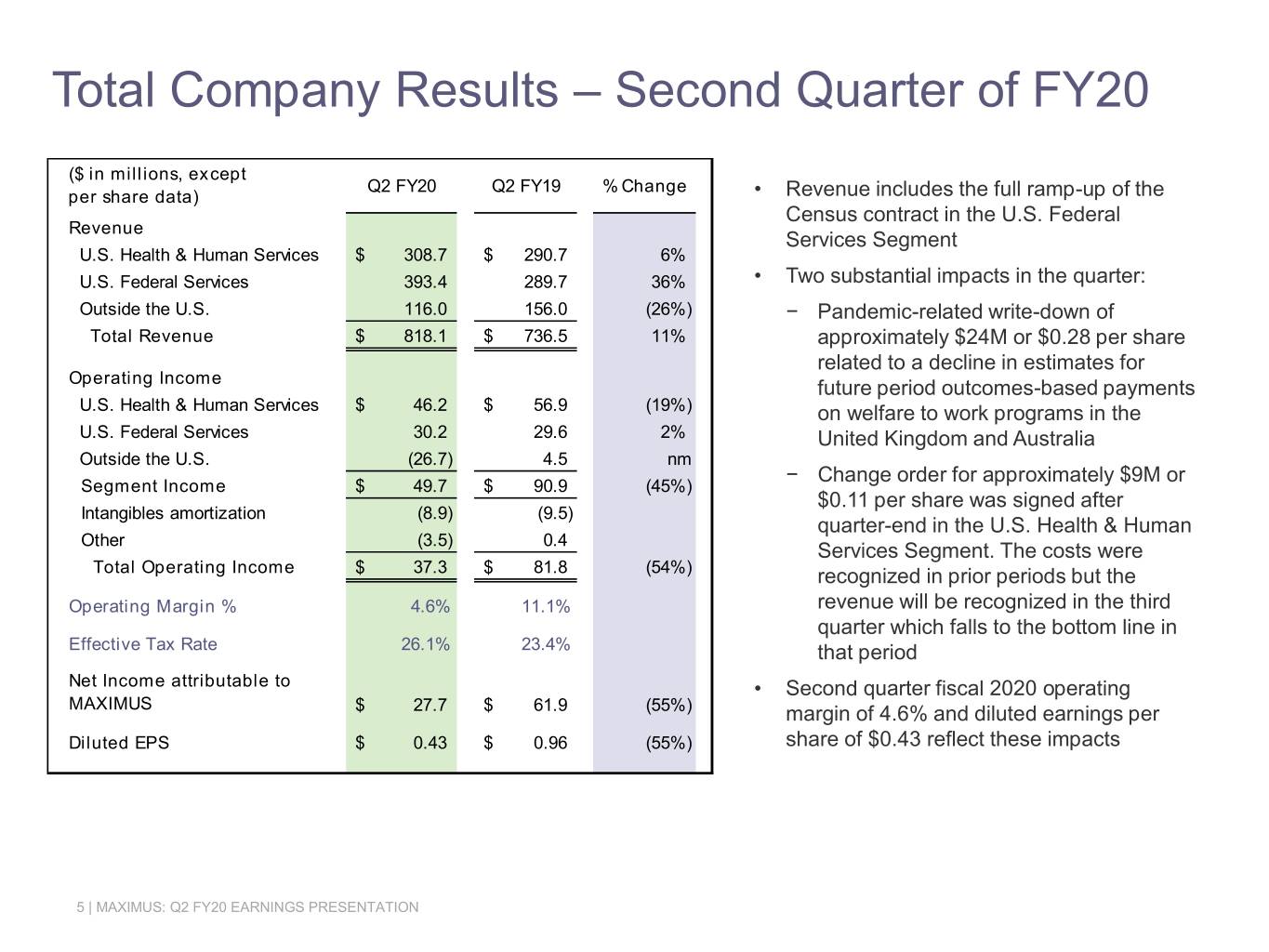
Second quarter revenue increased to $818.1 million driven primarily by the Census contract in the U.S. Federal Services segment. Diluted earnings per share were $0.43 and significantly impacted by COVID-19 and timing of a change order

The U.S. Health & Human Services and U.S. Federal Services Segments delivered 6.2% and 6.7% organic revenue growth, respectively, over the prior year period, excluding the acquisition of the federal citizen engagement centers business of which the Census contract is a part of

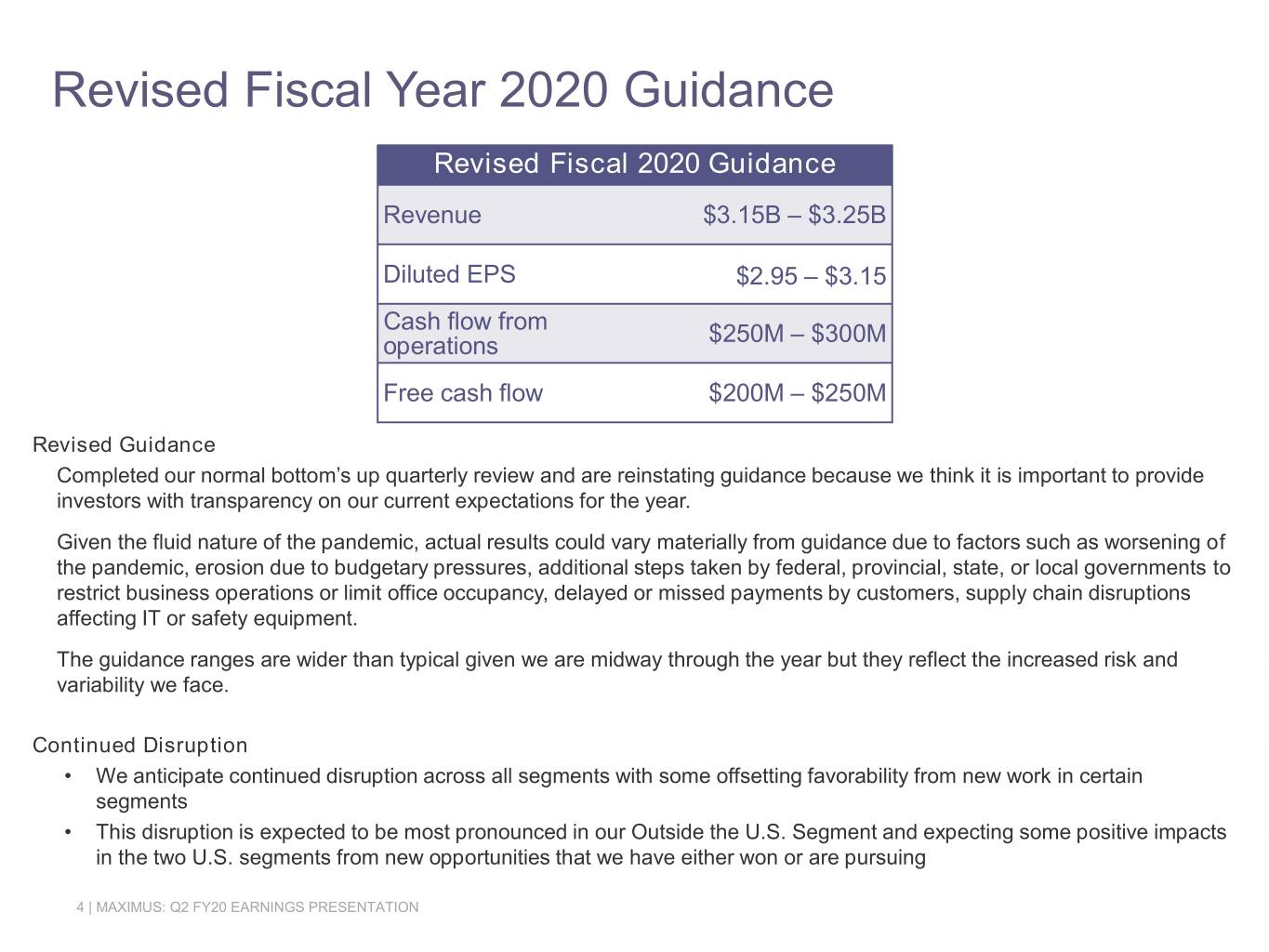
Reinstated guidance for fiscal 2020 with revenue expected to range between $3.15 billion and $3.25 billion and diluted earnings per share to range between $2.95 and $3.15

A quarterly cash dividend of $0.28 for each share of our common stock outstanding

COVID-19 Status Update
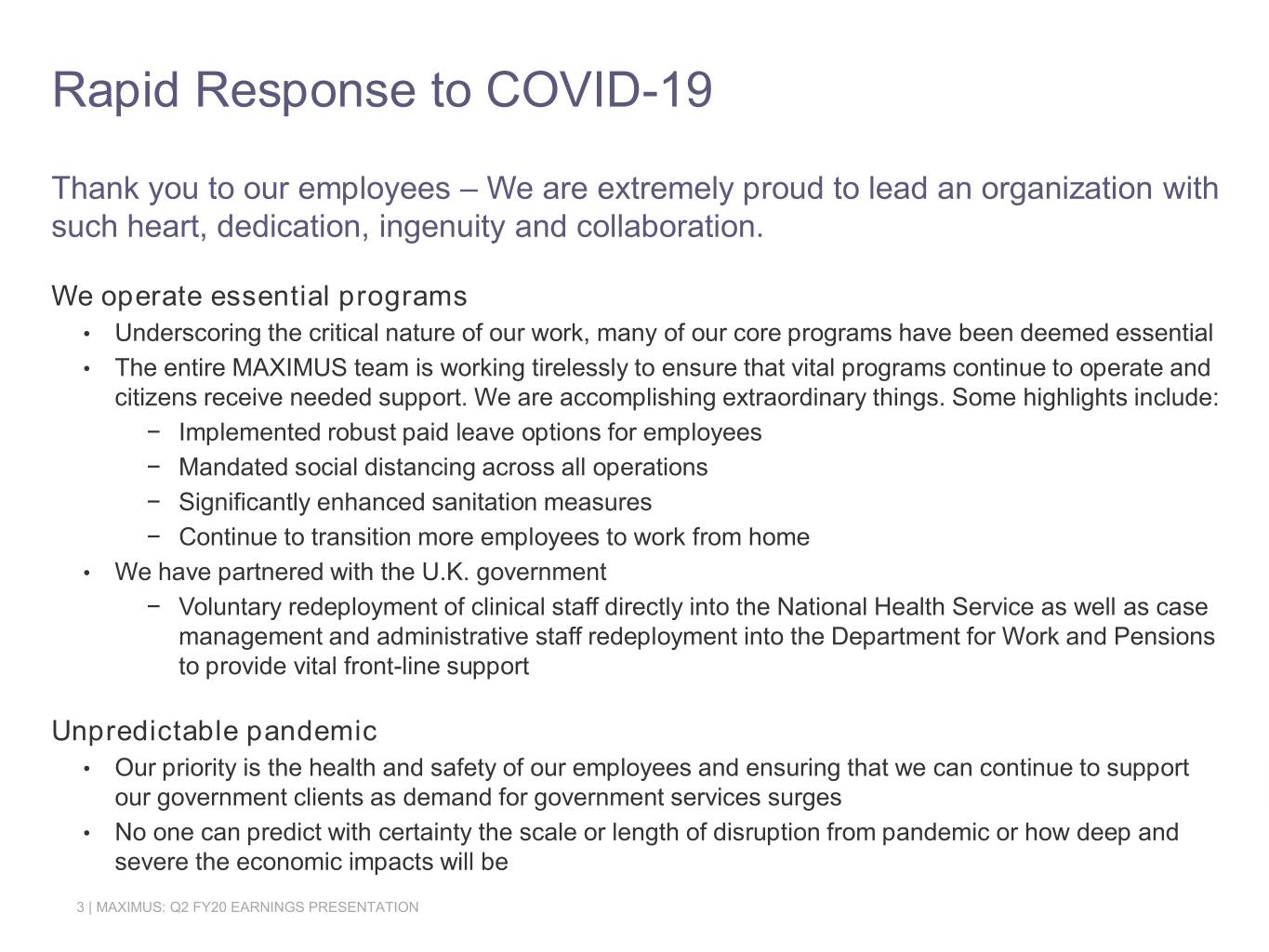
In responding to the COVID-19 pandemic, the Company's priority is protecting the health and safety of our employees and ensuring government clients receive continued support. Many of the programs the Company operates have been deemed "essential" and this underscores the importance of operational continuity for vital healthcare and safety-net programs that vulnerable individuals and families increasingly rely upon during this period.

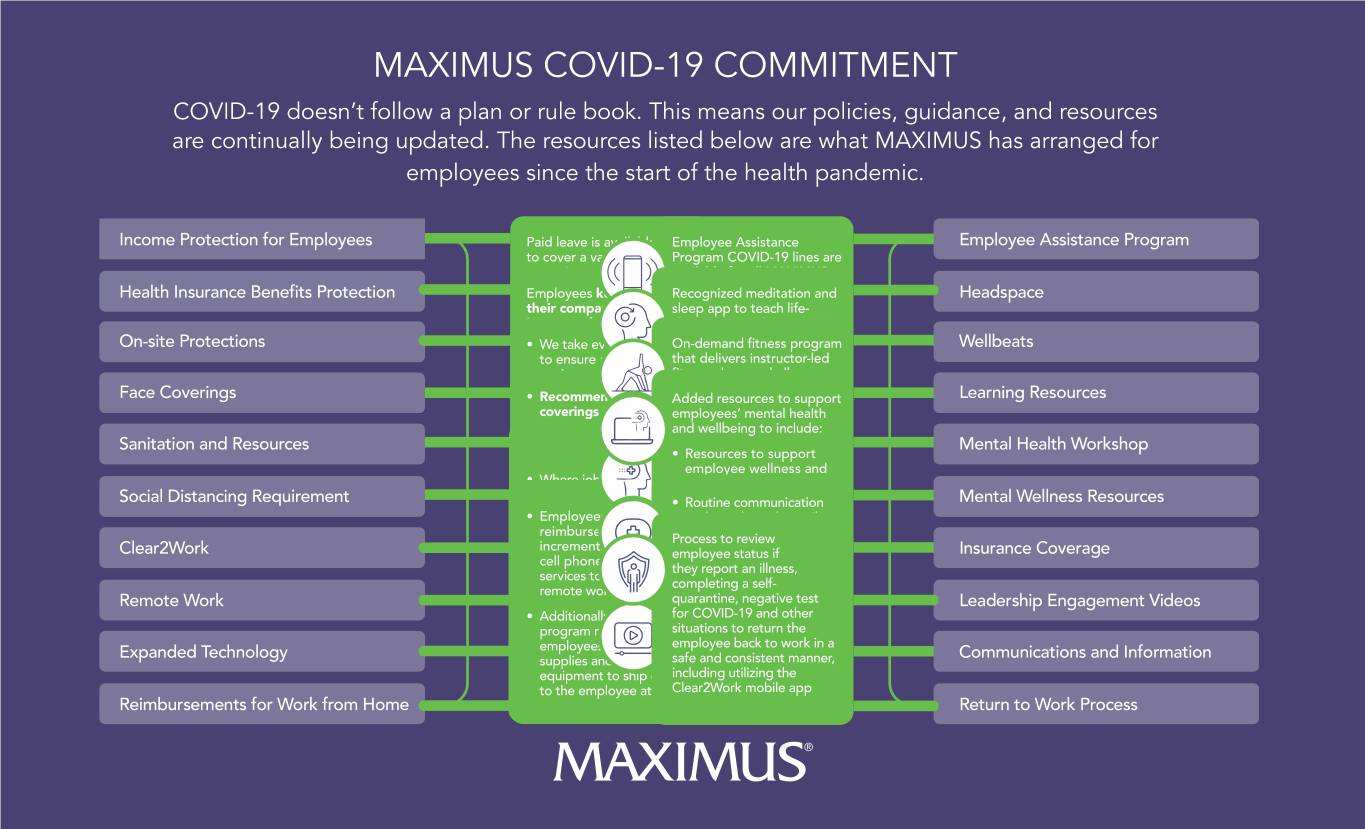
Immediately, leadership focused the Company’s resources and expertise on addressing the most urgent challenges posed. MAXIMUS implemented enhanced paid leave options for COVID-related absences for U.S. employees, increased onsite protections such as mandated social distancing and face coverings, and increased frequency of sanitization. The Company continues to work diligently with clients and operational teams to enable employees to work from home to the fullest extent possible despite shortages in the IT supply chain.



q2fy19earningsimage11.jpg
All best practices were adopted and are in accordance with recommendations and guidelines from the Centers for Disease Control and Prevention (CDC), the Environmental Protection Agency (EPA), and the Occupational Safety and Health Administration (OSHA).

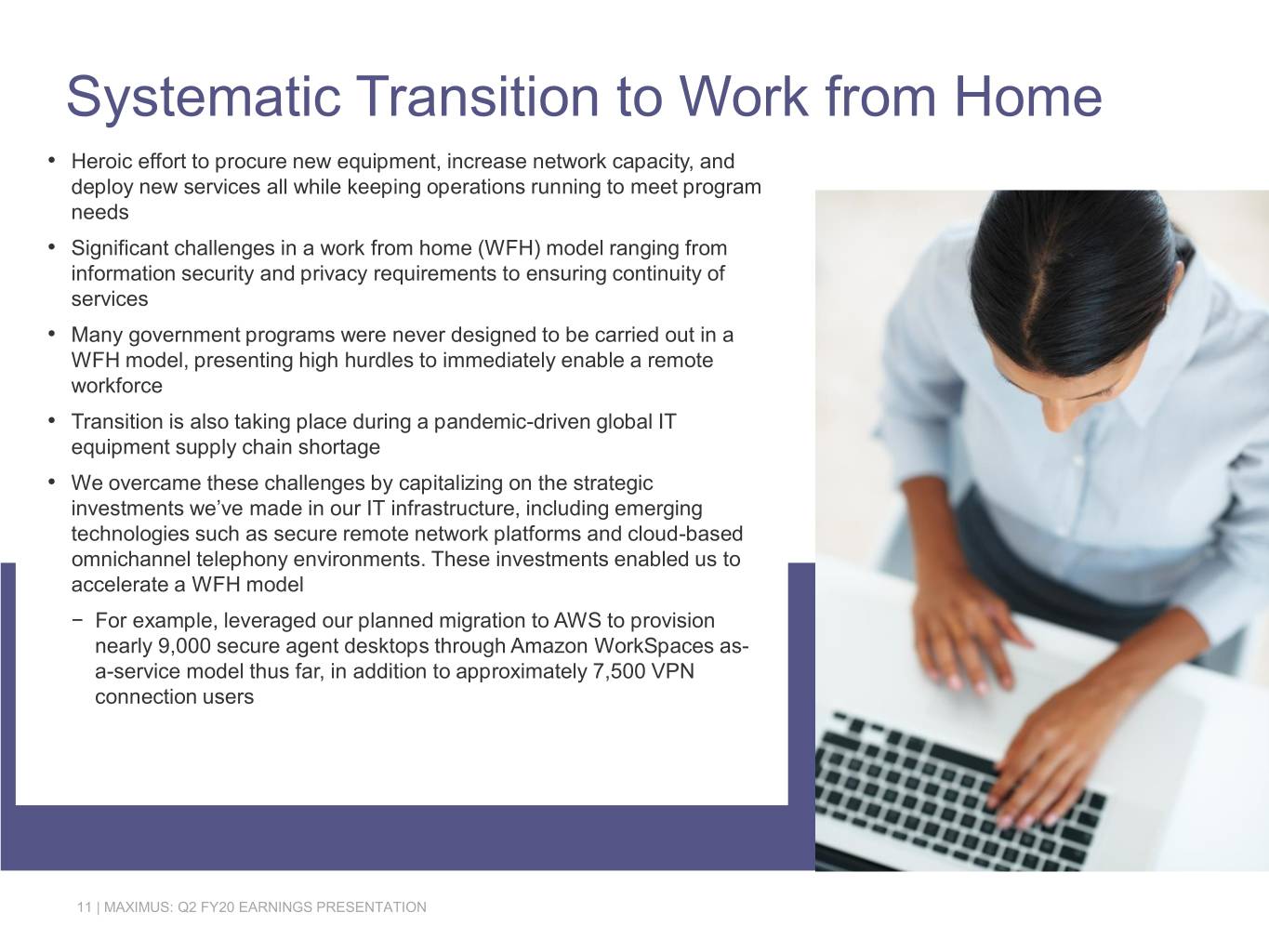
"We are steadfastly committed to protecting employees while still providing access to vital government health and safety-net programs for people who rely on these programs," shared Bruce Caswell, President and Chief Executive Officer. "One of the most important actions we have taken is the rapid and ongoing transition of employees into a remote work environment. This has been an heroic effort in procuring new equipment, increasing network capacity, and deploying new services all while keeping critical operations running to meet program objectives and citizen needs. Our ability to transition more employees to remote work is constrained by the speed of the IT supply chain for equipment."

Second Quarter Results
For the second quarter of fiscal 2020, revenue increased to $818.1 million as compared to $736.5 million reported for the same period last year.

For the second quarter of fiscal 2020, operating income totaled $37.3 million, yielding an operating margin of 4.6%. This compares to 11.1% for the same period last year.

For the second quarter of fiscal 2020, net income attributable to MAXIMUS totaled $27.7 million, or $0.43 of diluted earnings per share. This compares to the second quarter of fiscal 2019 diluted earnings per share of $0.96.

The Company experienced two significant impacts to revenue and profit in the second quarter of fiscal 2020:

A COVID-19 pandemic related write-down of approximately $24 million or $0.28 of diluted earnings per share related to a decline in estimates for future period outcomes-based payments on welfare to work programs in the United Kingdom and Australia.

A change order for approximately $9 million or $0.11 of diluted earnings per share was signed after March 31, 2020, in the U.S. Health & Human Services segment. Related costs were recognized prior to March 31, 2020, but the revenue will be recognized in the third quarter of fiscal 2020, falling to the bottom line.

U.S. Health & Human Services Segment
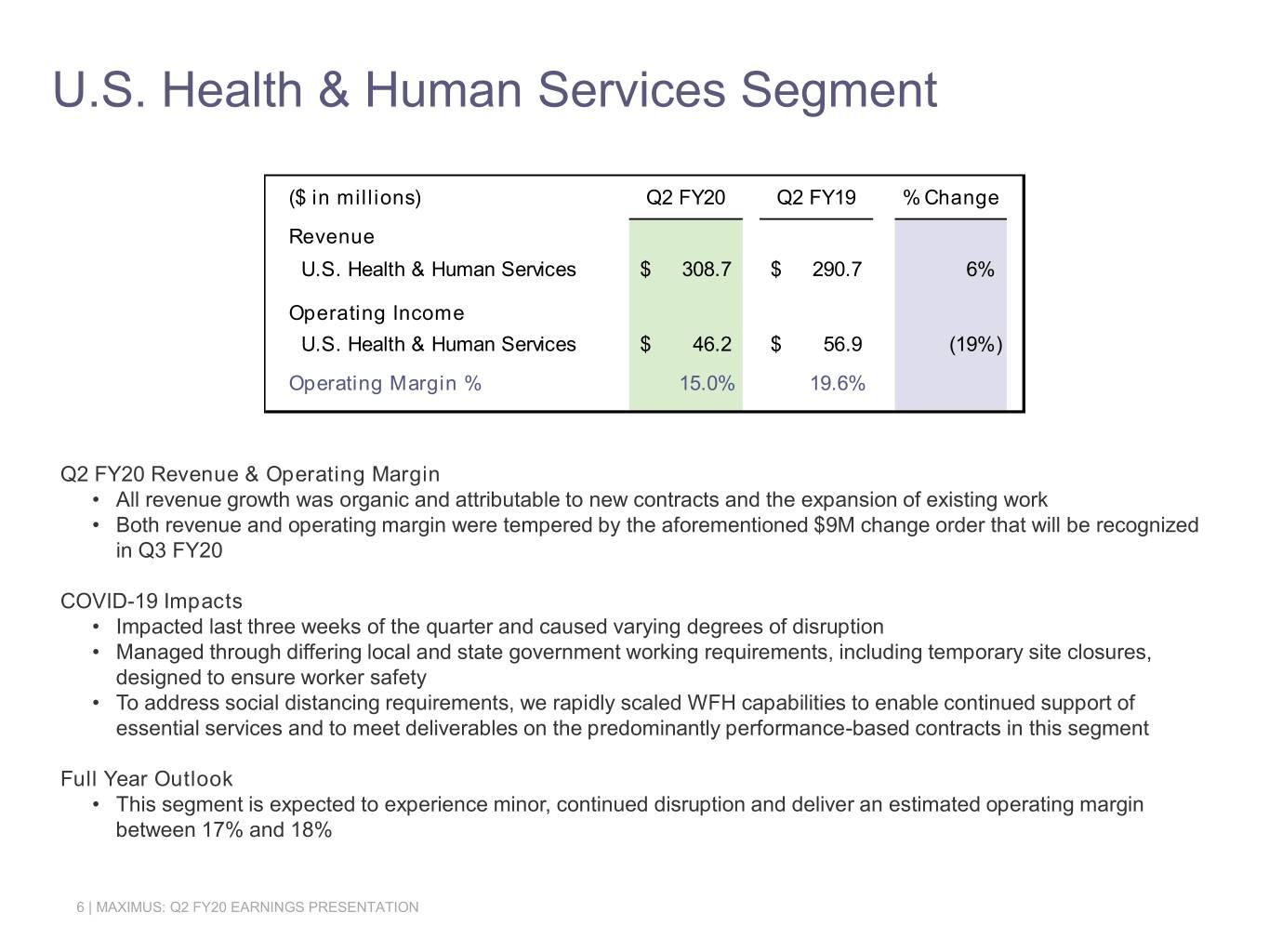
Revenue in the U.S. Health & Human Services Segment for the second quarter of fiscal 2020 increased 6.2% to $308.7 million compared to $290.7 million reported for the same period last year. All growth in this segment was organic and attributable to new contracts and the expansion of existing work.

Operating margin for the second quarter of fiscal 2020 was 15.0% compared to 19.6% reported for the prior-year period. The aforementioned timing related change order negatively impacted operating margin in this segment.

The U.S. Health & Human Services Segment will continue to experience minor disruption and is expected to deliver an operating margin between 17% and 18% for the full year.


q2fy19earningsimage11.jpg
U.S. Federal Services Segment
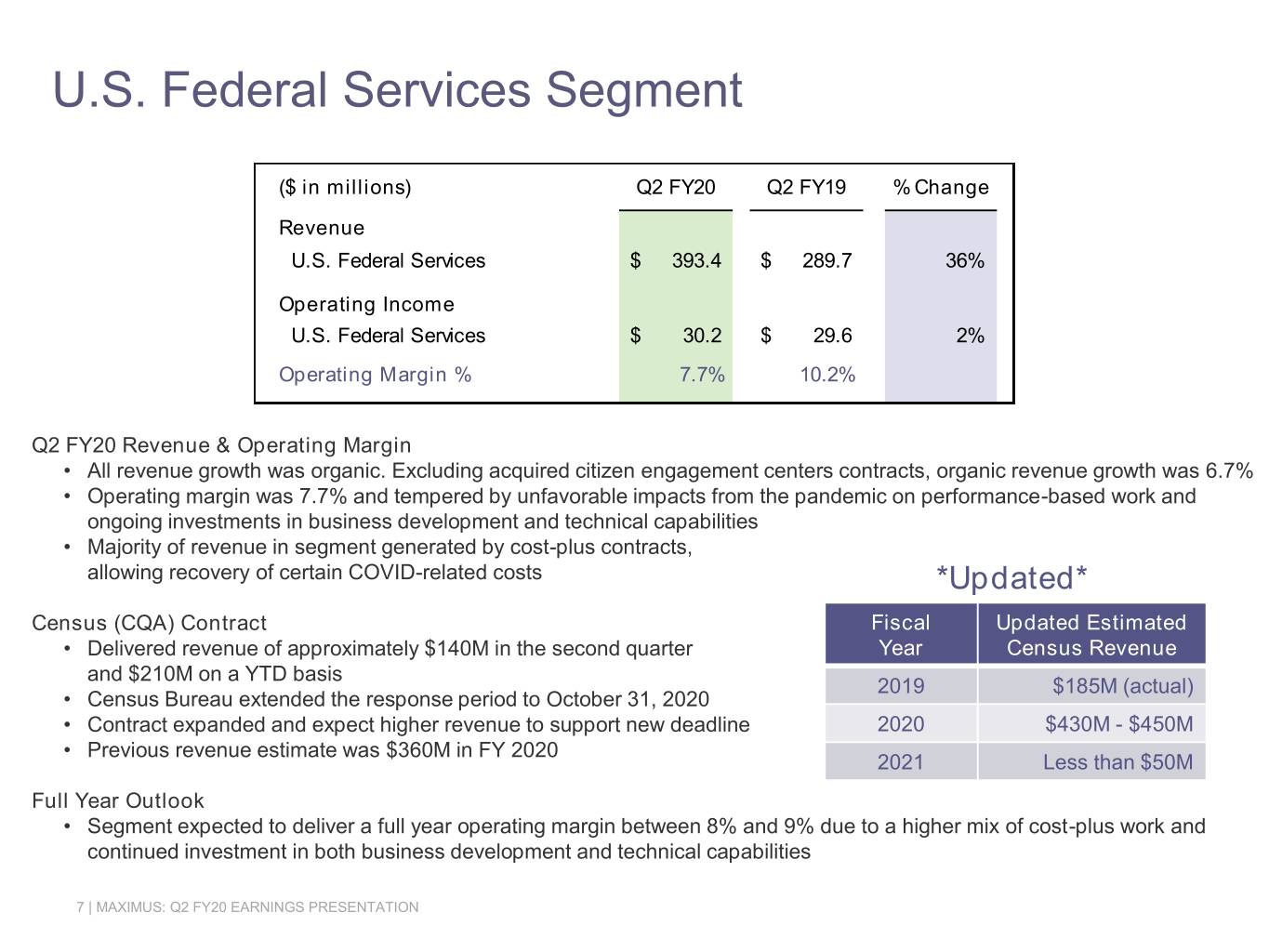
U.S. Federal Services Segment revenue for the second quarter of fiscal 2020 increased to $393.4 million compared to $289.7 million reported for the same period last year. All revenue growth in this segment was organic but excluding the acquired citizen engagement center business, organic revenue growth was 6.7%. As expected, the acquired Census contract continued its ramp to peak activity levels.

Operating margin for the second quarter of fiscal 2020 was 7.7% compared to 10.2% reported for the prior-year period and was tempered by a slight impact from the COVID-19 pandemic on performance-based work, and ongoing investments in business development and technological capabilities. Revenue throughout fiscal 2020 will continue to be weighted more heavily towards cost-plus contracts which offers less risk at a lower margin.

The U.S. Federal Services Segment is expected to deliver an operating margin between 8% and 9% for the full year resulting from a slightly greater mix of cost-plus work than previously anticipated.

Outside the U.S. Segment
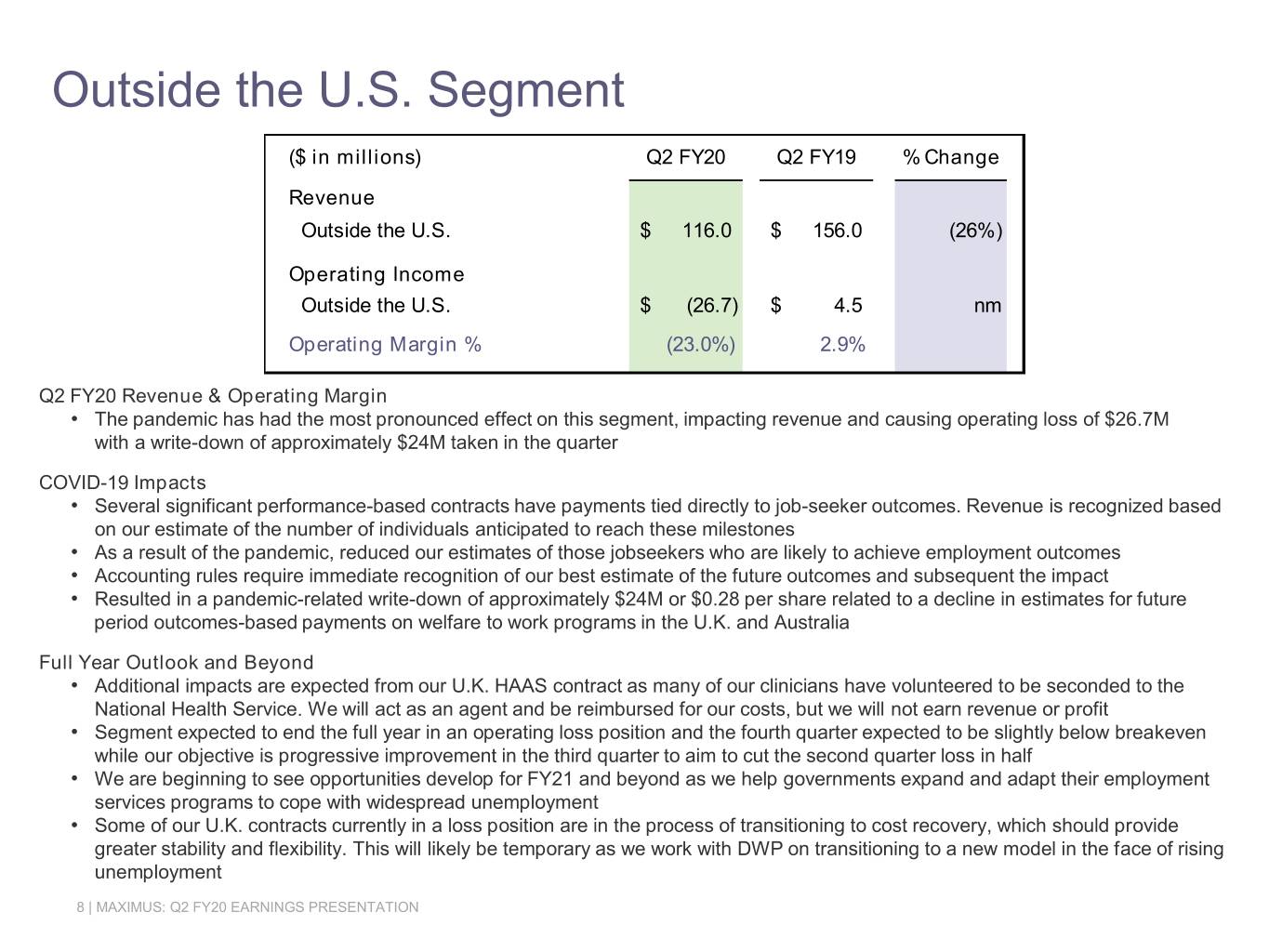
Outside the U.S. Segment revenue for the second quarter of fiscal 2020 decreased 26% (24% on a constant currency basis) to $116.0 million compared to $156.0 million reported for the same period last year. Operating loss for the second quarter of fiscal 2020 was $26.7 million compared to an operating profit of $4.5 million and an operating margin of 2.9% reported for the prior-year period.

This segment experienced a significant COVID-19 pandemic related write-down of approximately $24 million or $0.28 diluted earnings per share. The Segment has several performance based employment services contracts where payments are tied to job seeker outcomes with the objective to achieve long-term employment. The write down is attributable to a decline in the estimates for future outcome based milestones for program participants in the Australia and the United Kingdom. The Company is required to record the best estimate of the future outcomes, including impacts of such re-estimates immediately.

Outside the U.S. Segment is expected to end the full year in an operating loss position with the second half of the fiscal year progressively improving.

Sales and Pipeline
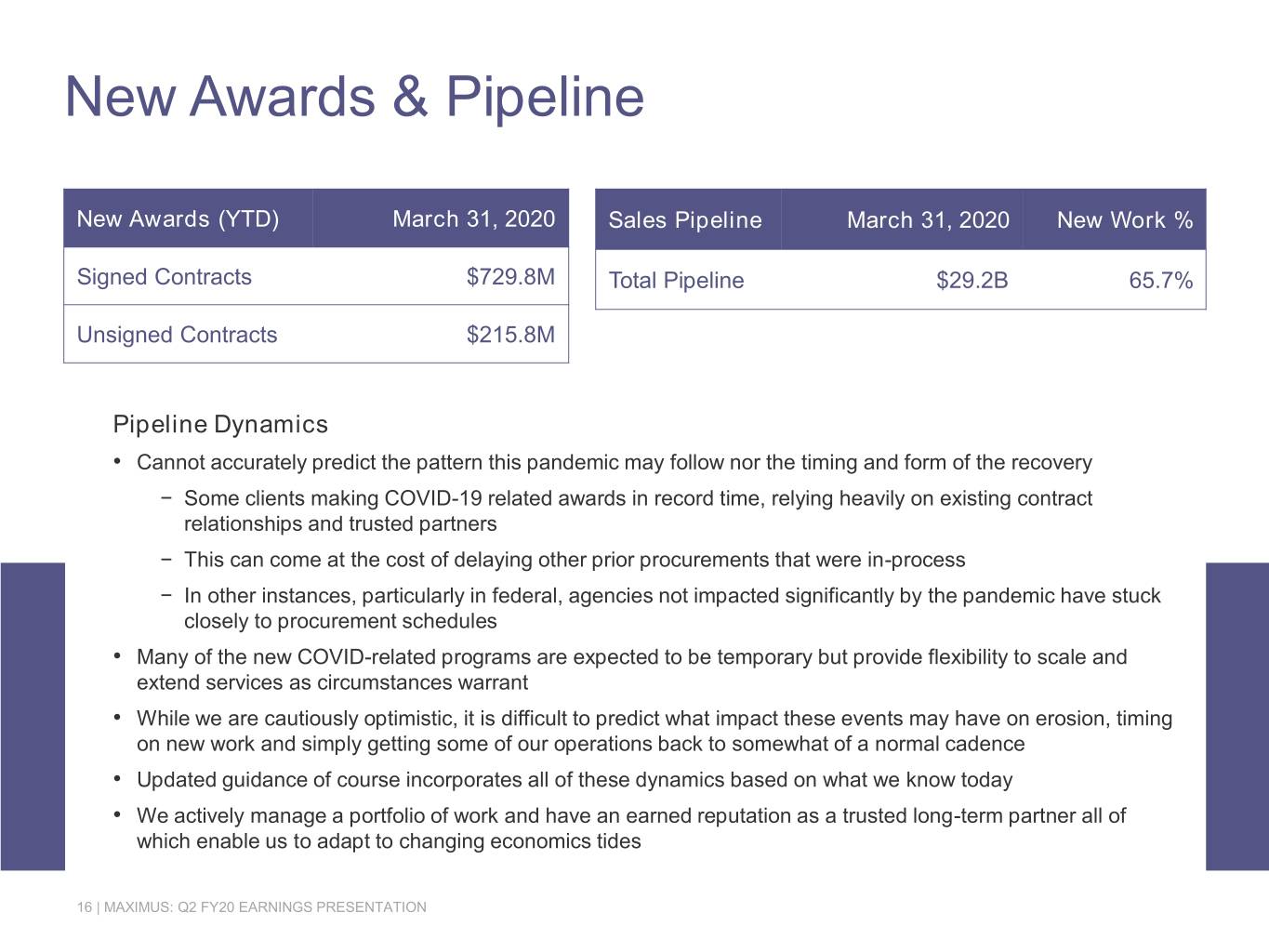
Year-to-date signed contract awards at March 31, 2020, totaled $729.8 million and contracts pending (awarded but unsigned) totaled $215.8 million. These awards reflect total contract value.
The sales pipeline at March 31, 2020, was $29.2 billion (comprised of approximately $2.8 billion in proposals pending, $2.0 billion in proposals in preparation and $24.4 billion in opportunities tracking).

Mr. Caswell continued, "The pipeline dynamics are unique since much has changed since the March 31 quarter end. Clients are making awards in record time for certain work, relying heavily on existing contract vehicles and existing partnerships which we have benefited from. However, in some cases this has caused previously planned procurements to be delayed. This is a fluid situation that is changing daily where we anticipate both positive and negative impacts. Our revised guidance for fiscal 2020 incorporates these considerations."


q2fy19earningsimage11.jpg
Balance Sheet and Cash Flows
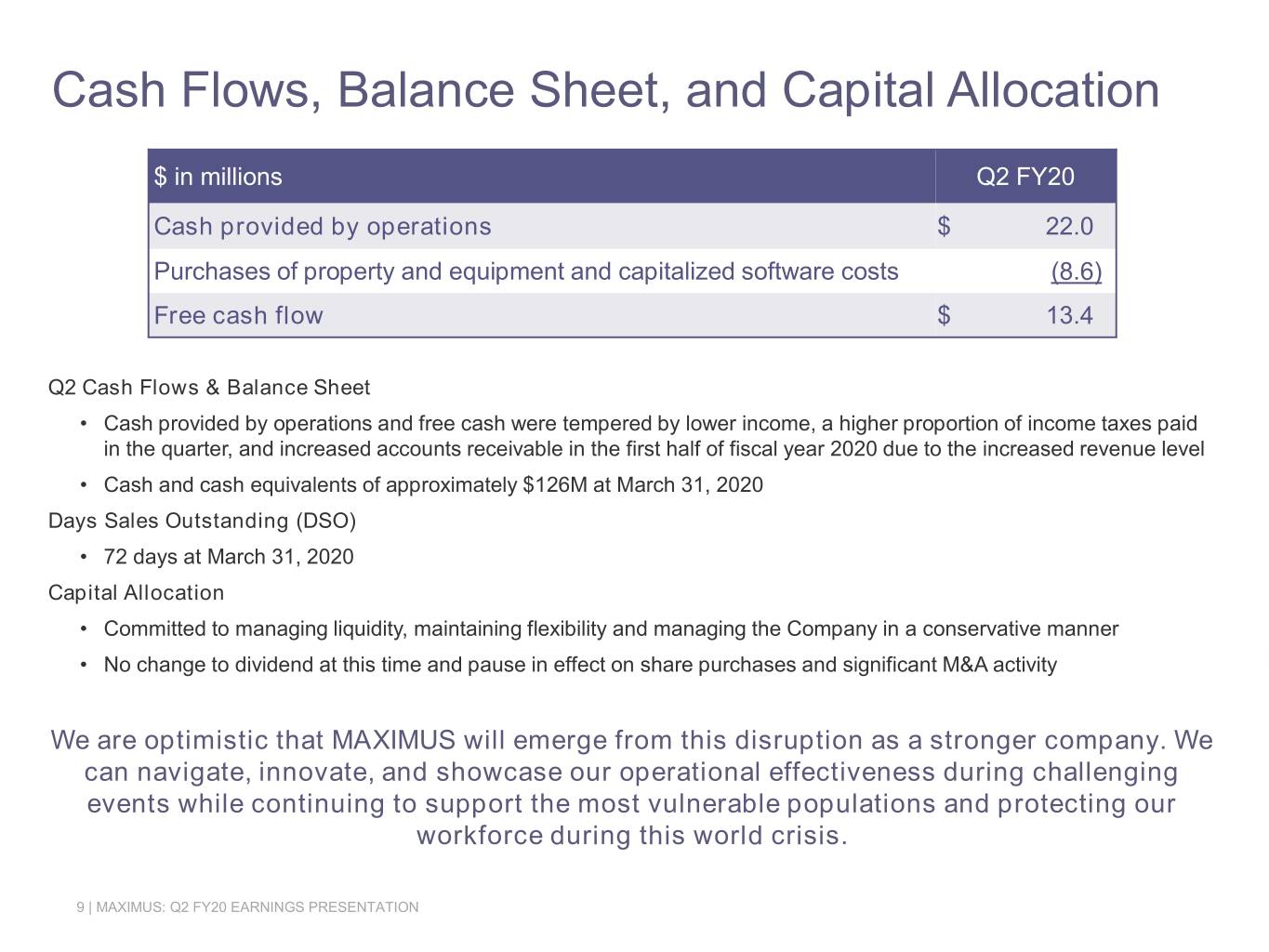
Cash and cash equivalents at March 31, 2020, totaled $126.3 million and excludes $12.5 million of restricted cash included in the Consolidated Statement of Cash Flows. Borrowings on the Company's credit facility totaled $150.0 million at the end of the second quarter, leaving $250.0 million of available capacity.

For the six months ended March 31, 2020, cash from operations totaled $109.3 million, with free cash flow of $90.2 million. At March 31, 2020, days sales outstanding (DSO) were 72 days.

During the second quarter, MAXIMUS purchased approximately 2.74 million shares of MAXIMUS common stock under a 10b-5(1) plan that was instituted in February and completed in March for a total cost of $165.1 million for an average price of $60.19.
On April 3, 2020, our Board of Directors declared a quarterly cash dividend of $0.28 for each share of our common stock outstanding. The dividend is payable on May 29, 2020, to shareholders of record on May 15, 2020.
Richard J. Nadeau, Chief Financial Officer, commented, "During periods of uncertainty, we believe now more than ever the strength of our balance sheet sets us apart to support our government clients, their citizens and safeguard our employees. Maintaining and carefully managing liquidity is critical. As a result, following the conclusion of our 10b-5(1) plan in March, we decided to halt all share buybacks in the near-term."
Outlook
MAXIMUS is reinstating guidance following suspension of guidance on March 25, 2020. The Company is providing wider ranges for the midpoint of the year which are intended to reflect the increased risk and variability for the remainder of the year.
MAXIMUS anticipates fiscal 2020 revenue will range between $3.15 and $3.25 billion and diluted earnings per share will range between $2.95 and $3.15 per share. Cash flows from operations are expected to range between $250 and $300 million and free cash flow between $200 and $250 million.

Caswell added, "We remain cautiously optimistic as the demand environment is increasing. We believe we are forging a new path forward to reshape the delivery of government services for decades to come. The pandemic offers us a unique opportunity to test and learn how to operate new models with the full support of our clients. We can trial new ways of serving and engaging citizens, who now more than ever, need vital services."

The Company notes that actual results could vary materially from this guidance due to numerous factors including those noted below.


Conference Call and Webcast Information
MAXIMUS will host a conference call this morning, May 7, 2020, at 9:00 a.m. (ET).

The call is open to the public and is available by webcast or phone:
Domestic: 833.513.0569
International: +1.236.714.2193
Conference ID number: 3239007

For those unable to listen to the live call, a recording of the webcast will be available on investor.maximus.com.


q2fy19earningsimage11.jpg
About MAXIMUS
Since 1975, MAXIMUS has operated under its founding mission of Helping Government Serve the People®, enabling citizens around the globe to successfully engage with their governments at all levels and across a variety of health and human services programs. MAXIMUS delivers innovative business process management and technology solutions that contribute to improved outcomes for citizens and higher levels of productivity, accuracy, accountability and efficiency of government-sponsored programs. With more than 35,000 employees worldwide, MAXIMUS is a proud partner to government agencies in the United States, Australia, Canada, Italy, Saudi Arabia, Singapore and the United Kingdom. For more information, visit maximus.com.

Non-GAAP Measures
This release refers to non-GAAP financial measures, including free cash flow, constant currency, and days sales outstanding.

We have provided a reconciliation of free cash flow to cash flows from operations.

A description of these non-GAAP measures, the reasons why we use and present them and details as to how they are calculated are included in our Annual Report on Form 10-K.

The presentation of these non-GAAP numbers is not meant to be considered in isolation, nor as alternatives to cash flows from operations, revenue growth or net income as measures of performance. These non-GAAP financial measures, as determined and presented by us, may not be comparable to related or similarly titled measures presented by other companies.

Statements that are not historical facts, including statements about the Company’s confidence and strategies and the Company’s expectations about revenues, results of operations, profitability, future contracts, market opportunities, market demand, or acceptance of the Company’s products are forward-looking statements that involve risks and uncertainties such as those related to impact of the COVID-19 pandemic including but not limited to:
Worsening of the COVID-19 pandemic
Erosion as a result of budgetary constraints
Delayed or cancelled procurements
Additional steps taken by governments to restrict business operations or limit office occupancy
Delayed or missed payments by customers
Supply chain disruptions affecting necessary IT or safety equipment
These risks could cause the Company’s actual results to differ materially from those indicated by such forward-looking statements. A summary of risk factors can be found in Exhibit 99.1 to the Company’s most recent Annual Report filed with the Securities and Exchange Commission, found on maximus.com.


q2fy19earningsimage11.jpg
MAXIMUS, Inc.
CONSOLIDATED STATEMENTS OF OPERATIONS
(Amounts in thousands, except per share data)
(Unaudited)

Three Months Ended March 31,Six Months Ended March 31,
2020201920202019
Revenue$818,135  $736,520  $1,636,364  $1,401,139  
Cost of revenue665,037  567,098  1,307,816  1,072,452  
Gross profit153,098  169,422  328,548  328,687  
Selling, general and administrative expenses106,853  78,102  194,080  157,773  
Amortization of intangible assets8,934  9,519  18,022  14,977  
Operating income37,311  81,801  116,446  155,937  
Interest expense465  1,569  949  2,194  
Other income, net573  447  1,292  2,492  
Income before income taxes37,419  80,679  116,789  156,235  
Provision for income taxes9,769  18,913  30,405  38,746  
Net income27,650  61,766  86,384  117,489  
Loss attributable to noncontrolling interests—  (158) —  (348) 
Net income attributable to MAXIMUS$27,650  $61,924  $86,384  $117,837  
Basic earnings per share$0.43  $0.96  $1.34  $1.82  
Diluted earnings per share$0.43  $0.96  $1.34  $1.82  
Dividends paid per share$0.28  $0.25  $0.56  $0.50  
Weighted average shares outstanding:
Basic63,934  64,369  64,264  64,600  
Diluted64,125  64,643  64,446  64,817  


q2fy19earningsimage11.jpg
MAXIMUS, Inc.
CONSOLIDATED BALANCE SHEETS
(Amounts in thousands)
March 31, 2020September 30, 2019
(unaudited)   
ASSETS      
Current assets:      
Cash and cash equivalents$126,257  $105,565  
Accounts receivable — billed and billable, net of reserves of $12,054 and $5,382529,928  476,690  
Accounts receivable — unbilled120,159  123,884  
Income taxes receivable33,852  20,805  
Prepaid expenses and other current assets53,257  62,481  
Total current assets863,453  789,425  
Property and equipment, net80,843  99,589  
Capitalized software, net33,746  32,369  
Operating lease right-of-use assets179,701  —  
Goodwill585,772  584,469  
Intangible assets, net161,091  179,250  
Deferred contract costs, net19,278  18,921  
Deferred compensation plan assets28,016  32,908  
Deferred income taxes186  186  
Other assets8,320  8,615  
Total assets$1,960,406  $1,745,732  
LIABILITIES AND SHAREHOLDERS’ EQUITY      
Current liabilities:      
Accounts payable and accrued liabilities$191,505  $177,786  
Accrued compensation and benefits98,882  106,789  
Deferred revenue46,206  43,344  
Income taxes payable758  13,952  
Current portion of long-term debt and other borrowings9,352  9,658  
Operating lease liabilities78,656  —  
Other liabilities12,973  12,709  
Total current liabilities438,332  364,238  
Deferred revenue, less current portion34,142  32,341  
Deferred income taxes49,421  46,560  
Long-term debt, less current portion150,155  231  
Deferred compensation plan liabilities, less current portion30,431  34,079  
Operating lease liabilities, less current portion109,339  —  
Other liabilities10,118  20,082  
Total liabilities821,938  497,531  
Shareholders’ equity:      
Common stock, no par value; 100,000 shares authorized; 61,313 and 63,979 shares issued and outstanding at March 31, 2020, and September 30, 2019, at stated amount, respectively511,023  498,433  
Accumulated other comprehensive loss(50,116) (45,380) 
Retained earnings677,561  794,739  
Total MAXIMUS shareholders' equity1,138,468  1,247,792  
Noncontrolling interests—  409  
Total equity1,138,468  1,248,201  
Total liabilities and equity$1,960,406  $1,745,732  


q2fy19earningsimage11.jpg
MAXIMUS, Inc.
CONSOLIDATED STATEMENTS OF CASH FLOWS
(Amounts in thousands)
(Unaudited)
Three Months Ended March 31,Six Months Ended
March 31,
2020201920202019
Cash flows from operations:      
Net income$27,650  $61,766  $86,384  $117,489  
Adjustments to reconcile net income to cash flows from operations:      
Depreciation and amortization of property, equipment and capitalized software15,900  11,176  31,218  22,407  
Amortization of intangible assets8,934  9,519  18,022  14,977  
Deferred income taxes2,616  1,253  3,038  17,764  
Stock compensation expense6,403  4,933  11,800  9,904  
Change in assets and liabilities net of effects of business combinations:   
Accounts receivable — billed and billable(21,854) (2,830) (52,870) (72,720) 
Accounts receivable — unbilled276  (11,009) 2,289  9,189  
Prepaid expenses and other current assets199  573  4,262  (5,118) 
Deferred contract costs(1,345) (3,658) (497) (5,415) 
Accounts payable and accrued liabilities19,919  15,516  22,322  42,080  
Accrued compensation and benefits(3,003) (7,820) 3,839  (7,443) 
Deferred revenue6,645  4,807  5,300  4,435  
Income taxes(41,690) (12,648) (27,706) (16,496) 
Operating lease right-of-use assets and liabilities1,788  —  166  —  
Other assets and liabilities(433) (3,707) 1,705  (3,842) 
Cash flows from operations22,005  67,871  109,272  127,211  
Cash flows from investing activities:      
Purchases of property and equipment and capitalized software costs(8,635) (8,568) (19,122) (18,541) 
Acquisitions of businesses, net of cash acquired(2,551) —  (2,551) (421,809) 
Maturities of short-term investments—  —  —  19,996  
Other73  237  98  284  
Cash used in investing activities(11,113) (8,331) (21,575) (420,070) 
Cash flows from financing activities:      
Cash dividends paid to MAXIMUS shareholders(17,900) (15,950) (35,813) (31,983) 
Purchases of MAXIMUS common stock(165,061) (5,084) (166,959) (46,068) 
Tax withholding related to RSU vesting—  —  (10,614) (8,915) 
Borrowings under credit facility and other loan agreements258,296  124,948  341,715  320,048  
Repayment of credit facility and other long-term debt(104,955) (171,506) (191,256) (241,539) 
Other(159) —  (652) (133) 
Cash used in financing activities(29,779) (67,592) (63,579) (8,590) 
Effect of exchange rate changes on cash and cash equivalents(3,320) 436  (1,868) (632) 
Net increase/(decrease) in cash, cash equivalents and restricted cash(22,207) (7,616) 22,250  (302,081) 
Cash, cash equivalents and restricted cash, beginning of period160,949  62,094  116,492  356,559  
Cash, cash equivalents and restricted cash, end of period$138,742  $54,478  $138,742  $54,478  


q2fy19earningsimage11.jpg
MAXIMUS, Inc.
SEGMENT INFORMATION
(Amounts in thousands)
(Unaudited)
Three Months Ended March 31,Six Months Ended March 31,
2020% (1)2019% (1)2020% (1)2019% (1)
Revenue:
U.S. Health & Human Services$308,698  $290,737  $620,979  $584,950  
U.S. Federal Services393,391  289,736  759,962  506,723  
Outside the U.S.116,046  156,047  255,423  309,466  
Total$818,135  $736,520  $1,636,364  $1,401,139  
Gross Profit:
U.S. Health & Human Services85,454  27.7 %$86,260  29.7 %$175,044  28.2 %$174,291  29.8 %
U.S. Federal Services76,958  19.6 %60,696  20.9 %147,779  19.4 %108,681  21.4 %
Outside the U.S.(9,314) (8.0)%22,466  14.4 %5,725  2.2 %45,715  14.8 %
Total$153,098  18.7 %$169,422  23.0 %$328,548  20.1 %$328,687  23.5 %
Selling, general, and administrative expense:
U.S. Health & Human Services39,239  12.7 %$29,400  10.1 %$70,637  11.4 %$61,539  10.5 %
U.S. Federal Services46,726  11.9 %31,104  10.7 %85,965  11.3 %57,736  11.4 %
Outside the U.S.17,404  15.0 %17,992  11.5 %33,457  13.1 %36,800  11.9 %
Other (2) 3,484  NM  (394) NM  4,021  NM  1,698  NM  
Total$106,853  13.1 %$78,102  10.6 %$194,080  11.9 %$157,773  11.3 %
Operating income:
U.S. Health & Human Services46,215  15.0 %$56,860  19.6 %$104,407  16.8 %$112,752  19.3 %
U.S. Federal Services30,232  7.7 %29,592  10.2 %61,814  8.1 %50,945  10.1 %
Outside the U.S.(26,718) (23.0)%4,474  2.9 %(27,732) (10.9)%8,915  2.9 %
Amortization of intangible assets(8,934) NM  (9,519) NM  (18,022) NM  (14,977) NM  
Other (2) (3,484) NM  394  NM  (4,021) NM  (1,698) NM  
Total$37,311  4.6 %$81,801  11.1 %$116,446  7.1 %$155,937  11.1 %

(1) Percentage of respective segment revenue. Percentages not considered meaningful are marked “NM.”

(2) Other selling, general and administrative expenses includes credits and costs that are not allocated to a particular segment, including the
costs for actual and potential acquisitions of other businesses.


q2fy19earningsimage11.jpg
MAXIMUS, Inc.
FREE CASH FLOW
(Non-GAAP measure)
(Amounts in thousands)
(Unaudited)

 Three Months Ended March 31,Six Months Ended March 31,
2020201920202019
Cash flows from operations$22,005  $67,871  $109,272  $127,211  
Purchases of property and equipment and capitalized software costs(8,635) (8,568) (19,122) (18,541) 
Capital expenditure as a result of acquisition (1)—  4,542  
Free cash flow$13,370  $59,303  $90,150  $113,212  

(1)  Purchases of property and equipment and capitalized software costs included $4.5 million in one-time payments to cover software
licenses required for employees joining us through the citizen engagement centers acquisition in November 2018.


-XXX-
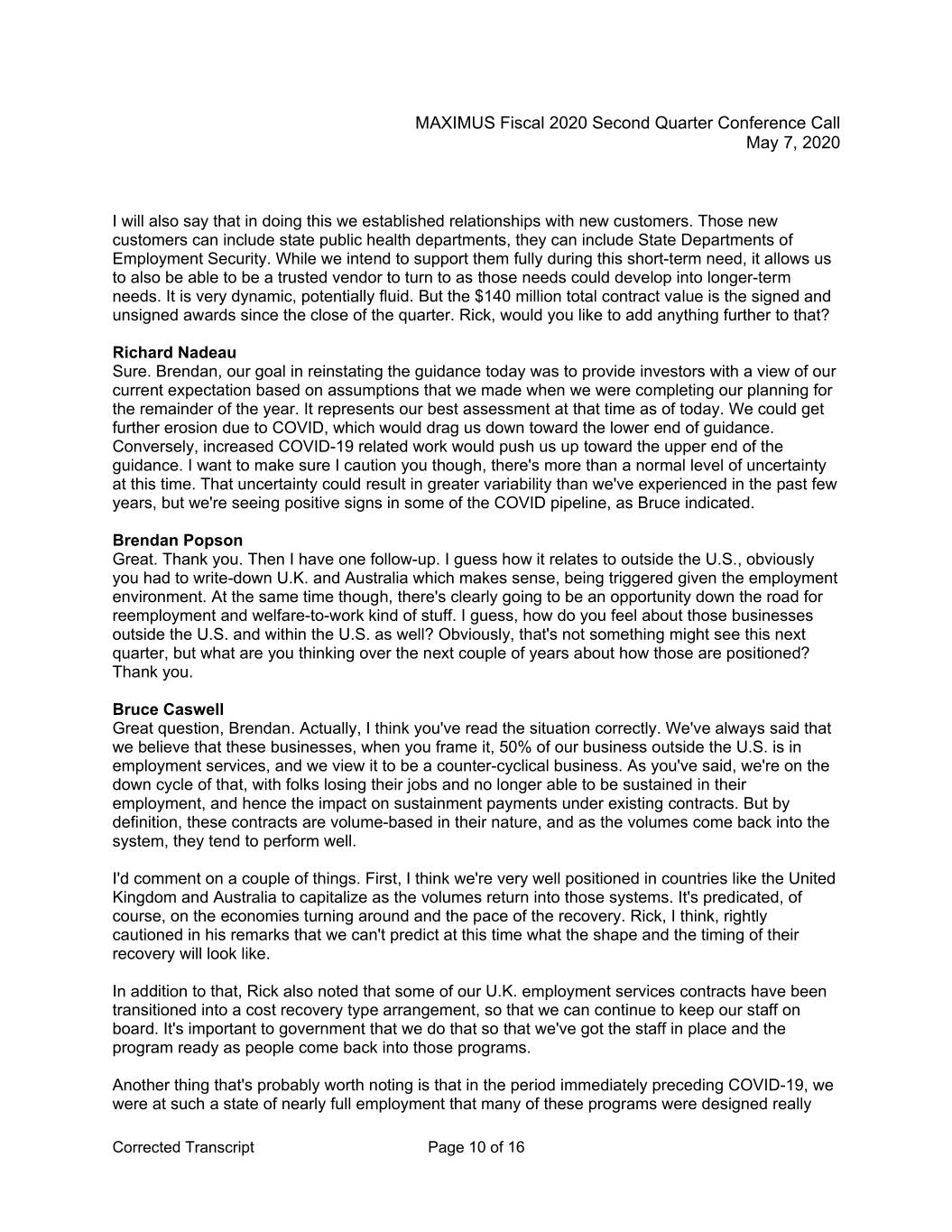
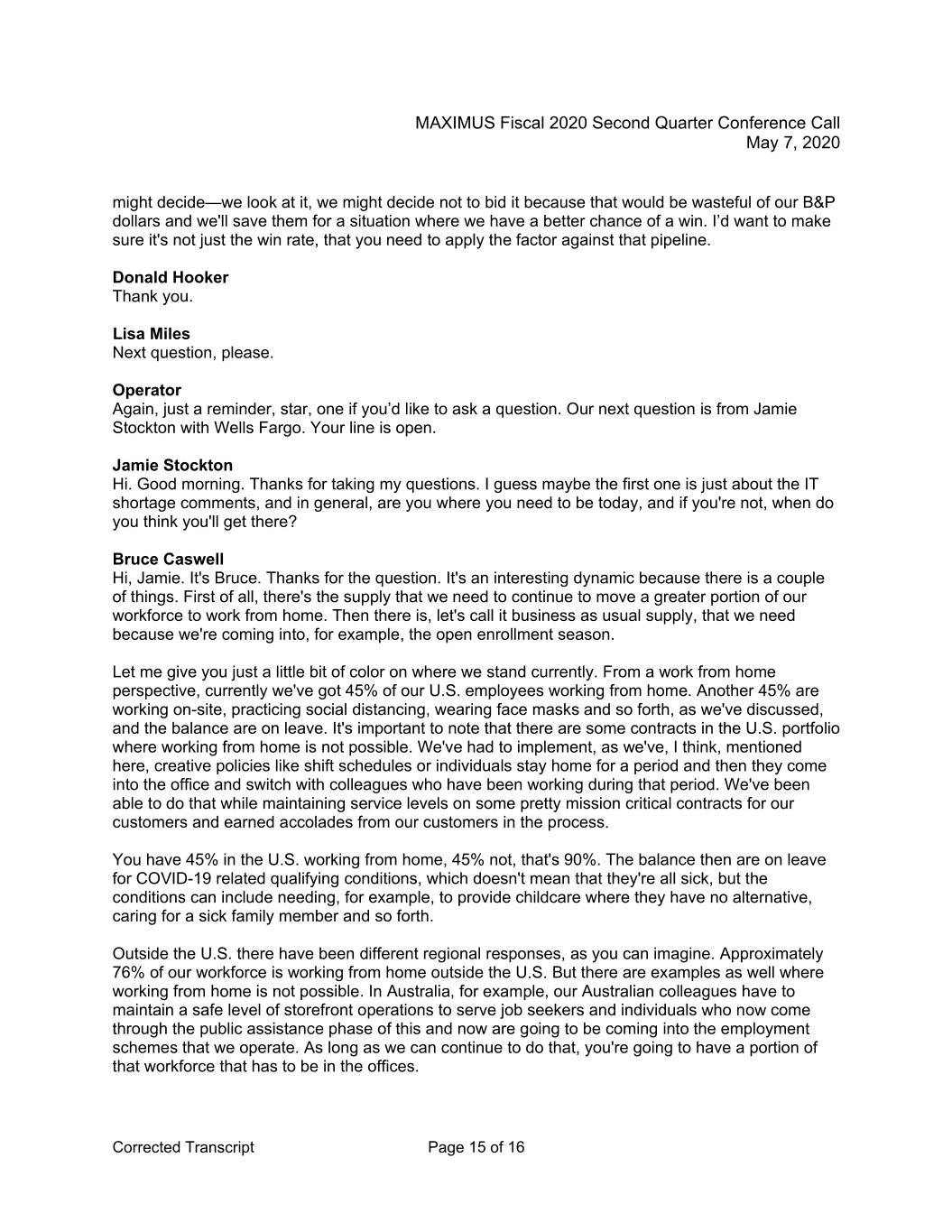
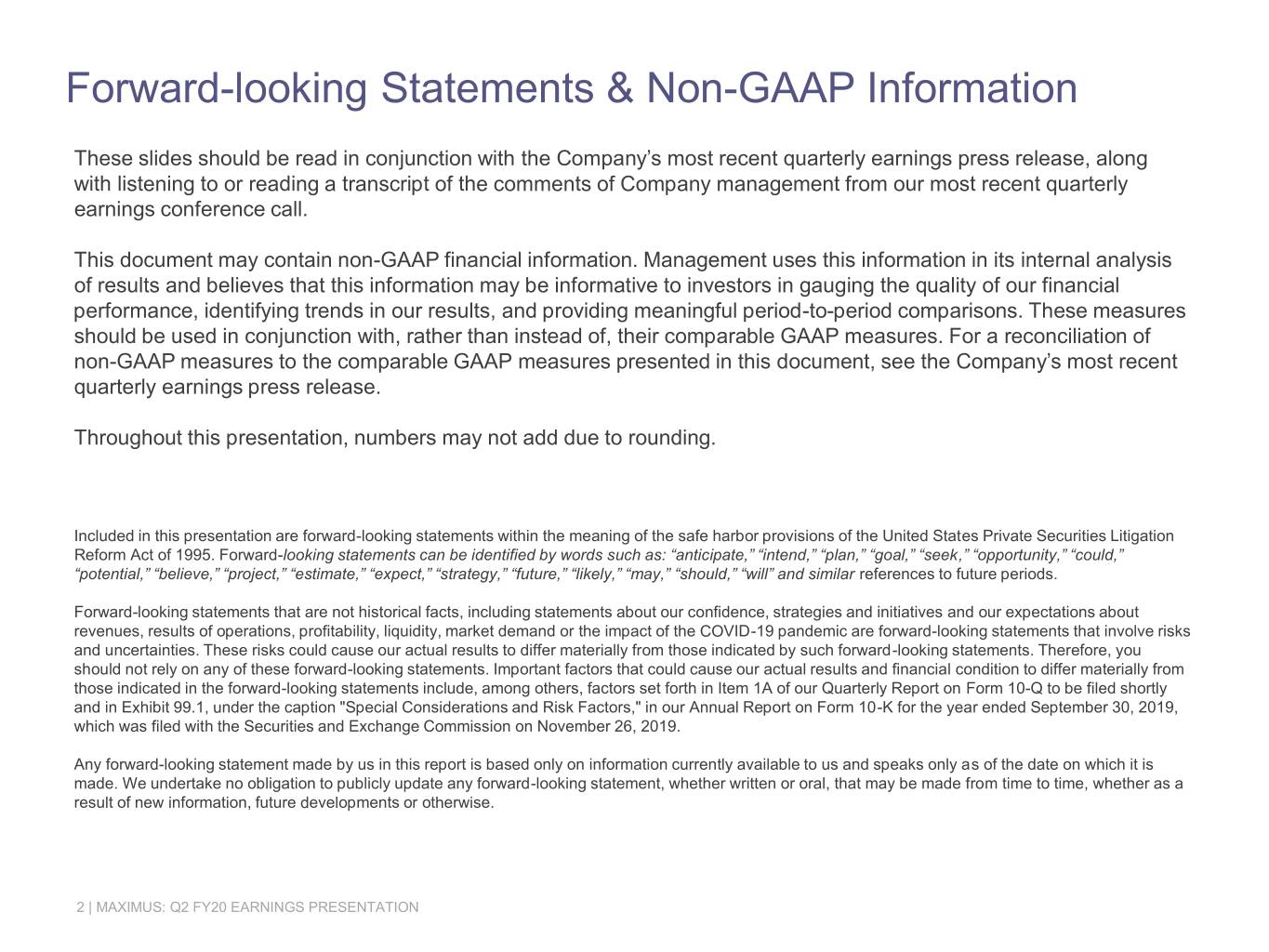
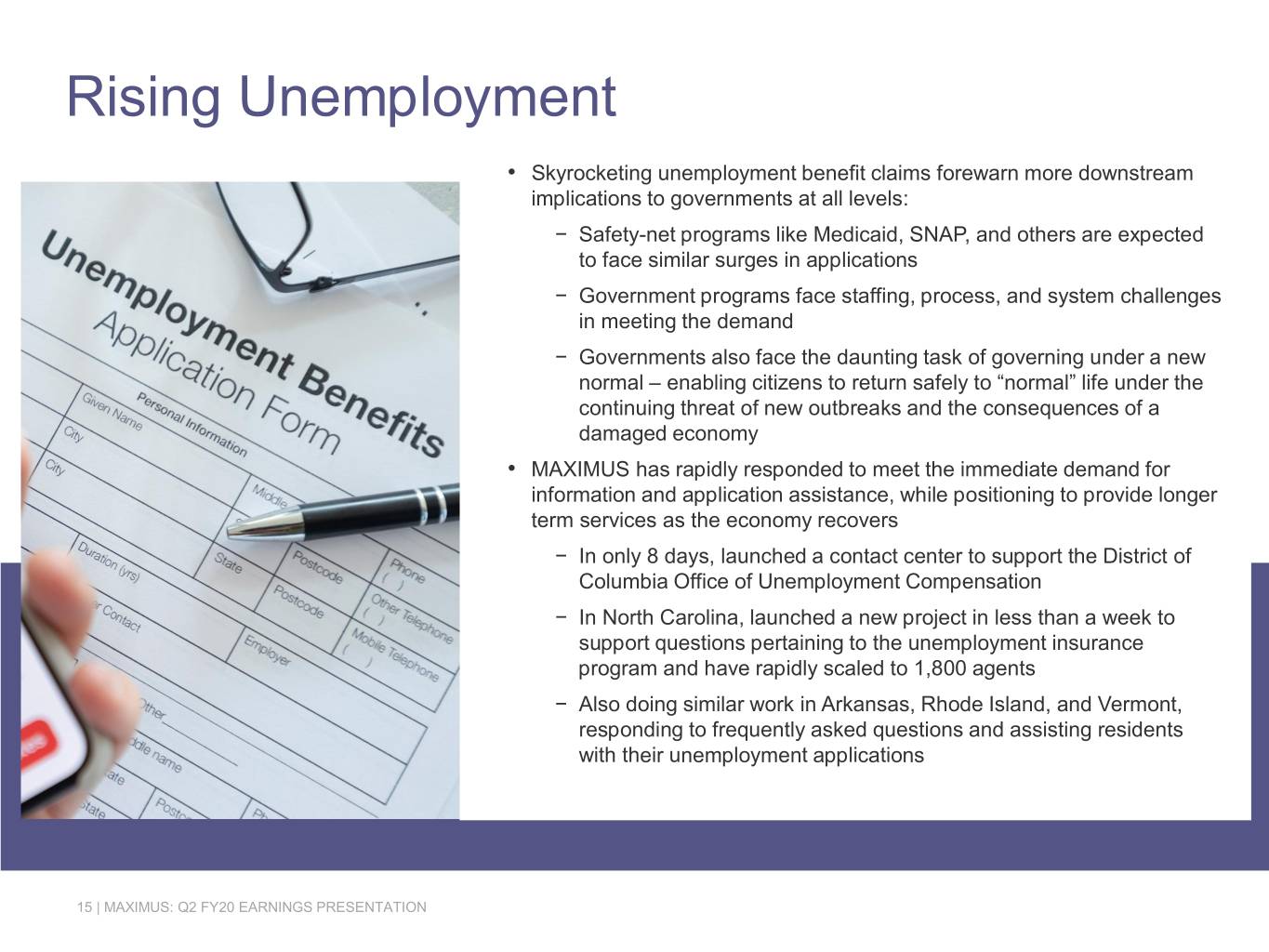
MAXIMUS Fiscal 2020 Second Quarter Conference Call May 7, 2020   Operator Ladies and gentlemen, thank you for standing by. Welcome to the Q2 Fiscal Year ’20 Maximus Earnings Conference Call. At this time, participants are in a listen-only mode. After the speakers’ presentation, there will be a question-and-answer session. To ask a question during the session, you’ll need to press star, then one on your telephone. If you require any further assistance, please press star, zero. I would now like to hand the conference over to your speaker today, Lisa Miles, Senior Vice President of Investor Relations. Thank you. Please go ahead. Lisa Miles Good morning and thank you for joining us today. With me is Bruce Caswell, President and Chief Executive Officer, and Rick Nadeau, Chief Financial Officer. I would like to highlight that a presentation is available on the Investor Relations page of maximus.com if you would like to follow along with today's prepared remarks. I would like to remind everyone that a number of statements being made today will be forward- looking in nature. Please remember that such statements are only predictions. Actual events and results may differ materially as a result of the risks we face, including those discussed in Exhibit 99.1 of our SEC filings. We encourage you to review the information contained in our earnings release today and our most recent forms 10-Q and 10-K filed with the SEC. The Company does not assume any obligation to revise or update these forward-looking statements to reflect subsequent events or circumstances except as required by law. Today's presentation may contain non-GAAP financial information. Management uses this information in its internal analysis of results, and we believe this information may be informative to investors in gauging the quality of our financial performance, identifying trends in our results, and providing meaningful period-to-period comparisons. For a reconciliation of the non-GAAP measures presented in this document, please see the Company's most recent quarterly earnings press release. With that, I'll hand the call over to Rick. Rick Nadeau Thank you, Lisa. First, let me say that since the COVID-19 pandemic, Bruce and I have never been prouder to lead an organization with such heart, dedication, ingenuity, and collaboration at all levels. Underscoring the critical nature of our work, many of our core program operations in the United States and abroad have been deemed essential to ensure that vital government programs continue to operate and citizens continue to receive critical assistance at a time when the need for healthcare and safety-net programs is rising. The entire Maximus team has met this challenge and work tirelessly to ensure that we continue to support citizens during this unprecedented health pandemic. Our employees are accomplishing extraordinary things during the COVID-19 pandemic. Bruce will discuss in greater detail, but I would like to highlight some important accomplishments. First and foremost, we implemented robust pay leave options to ensure the safety and well-being of those employees who experienced COVID-19 related absence. We mandated social distancing across all Corrected Transcript  Page 1 of 16  


MAXIMUS Fiscal 2020 Second Quarter Conference Call May 7, 2020   operations, significantly enhanced our sanitation measures, and most importantly, we continued to transition more employees to work from home. Outside the United States, we have partnered with government in the United Kingdom to redeploy some of our healthcare professionals directly into the National Health Service, as well as case management and administrative staff into the department for work and pensions to provide vital frontline support. Our priority has been the health and safety of our employees and ensuring that we can continue to support our government clients in whatever model that takes, as demand for government services surges. No one can predict with certainty the scale or length of disruption from the COVID-19 pandemic, or how deep and severe the economic impacts will be. We completed our normal bottoms-up quarterly review in April and are reinstating guidance for fiscal 2020. We think it is important to give our investors a sense of our current expectations for the fiscal year. Please note, however, that our actual results could vary from the guidance due to numerous factors, including a worsening of the pandemic, erosion due to budgetary pressures, additional steps taken by federal, provincial, state or local governments to restrict business operations or limit office occupancy, delayed or missed payments by customers, or supply chain disruptions affecting IT or safety equipment. The ranges we have used are wider than typical at the midpoint of the year and reflect the increased risk and variability we face. It is possible that actual results could vary materially from our current expectations. We anticipate that fiscal 2020 revenue will range between $3.15 billion to $3.25 billion and diluted earnings per share to range between $2.95 and $3.15 per share. Cash from operations is now expected to range between $250 million and $300 million and free cash flow between $200 million and $250 million. While we feel comfortable with this cash flow range, I will point out that delays and collections of receivables can cause significant variations at year-end. For the remainder of the fiscal year, we anticipate continued disruption across all segments with some offsetting favorability from new work. This disruption is expected to be most pronounced in our outside the U.S. segment. We expect some positive impacts in the two U.S. segments from opportunities that in some cases we have won and in other cases are pursuing. Bruce will provide more detail in his remarks. Let me touch on second quarter results., COVID-19 impacts, as well as the challenges and opportunities that lay ahead. Revenue for the second quarter of fiscal 2020 totaled $818.1 million, which included the full ramp-up of the census contract in the U.S. Federal Services segment. Total Company operating margin was 4.6% and diluted earnings per share were $0.43, reflecting two substantial impacts in the quarter. First, we had a pandemic related write-down of approximately $24 million or $0.28 per share related to the decline in estimates for future period outcomes-based payments on welfare to work programs in the United Kingdom and Australia. Second, a change order for approximately $9 million or $0.11 per share was signed after quarter- end in the U.S. health and human services segment. The related costs were incurred in the first two quarters of fiscal 2020, but the revenue will be recognized in the third quarter which falls to the bottom line in that period. Corrected Transcript  Page 2 of 16  


MAXIMUS Fiscal 2020 Second Quarter Conference Call May 7, 2020   I will now review the segments. Second quarter revenue for the U.S. Health and Human Services segment increased 6.2% over the prior year and all growth was organic, resulting from now contracts and the expansion of existing work. Both revenue and the 15.0% operating margin were tempered largely by the change order previously discussed. The COVID-19 pandemic impacted the last three weeks of March 2020. Disruption to our U.S. Health and Human Services business has varied as local and state governments imposed different working requirements, designed to ensure worker safety, leading us to, in some cases, manage through temporary site closures. To address social distancing requirements in our call centers, our work-from-home capabilities were scaled at a rapid pace to enable continued support of essential services and to meet deliverables on the predominantly performance-based contracts in this segment. Our current assumptions indicate economics for this segment will continue to experience minor disruption and we expect an operating margin between 17% and 18% for the full year. Looking ahead, not only have the Maximus operational teams been able to manage core operations in an ever-evolving environment, they have also taken on new work associated with unemployment insurance and a variety of COVID-related work. Further, the business development teams have launched rapid action plans to help states address needs, resources, and gaps with support services. Revenue for the second quarter of fiscal 2020 in the U.S. Federal Services segment increased to $393.4 million. All growth in this segment was organic. Excluding the citizen engagement centers contracts, organic growth was 6.7% driven by new work and growth on existing contracts. The operating margin for this segment in the second quarter of fiscal 2020 was 7.7% which was tempered by unfavorable impacts from the COVID-19 pandemic on performance-based work and ongoing investments in business development. The majority of revenue in this segment is generated by cost-plus contracts which means that we can recover certain COVID-related costs, such as increased facility cleaning incurred on these contracts. The census contract is now approaching its peak level of operations and delivered approximately $140 million of revenue in the second quarter, yielding year-to-date revenue of approximately $210 million. The teams have continued to solve unique challenges for our clients and our census contract is no exception. We implemented operational changes to ensure that our support is available to citizens so that they can complete their census questionnaires, and we will continue providing assistance through the Census Bureau’s extended response period which now ends October 31. As a result, our contract has expanded to support the new deadline and we now estimate that the census contract will deliver between $430 million and $450 million for the full year. This is an increase from our previously expected revenue of $360 million in fiscal 2020 from this contract. The economics of this segment are largely intact through fiscal 2020. The U.S. Federal Services segment is estimated to deliver a full-year operating margin between 8% and 9%, resulting from a slightly greater mix of cost-plus work than previously anticipated, as well as our continued investment in both business development and technical capability. The COVID-19 pandemic has had the most pronounced effect on our outside the U.S. segment. Second quarter revenue was $116.0 million, and the segment had a loss of $26.7 million. As a reminder, this segment has several significant performance-based contracts, where payments were tied directly to job seeker outcomes with the primary goal of placing individuals into long-term Corrected Transcript  Page 3 of 16  


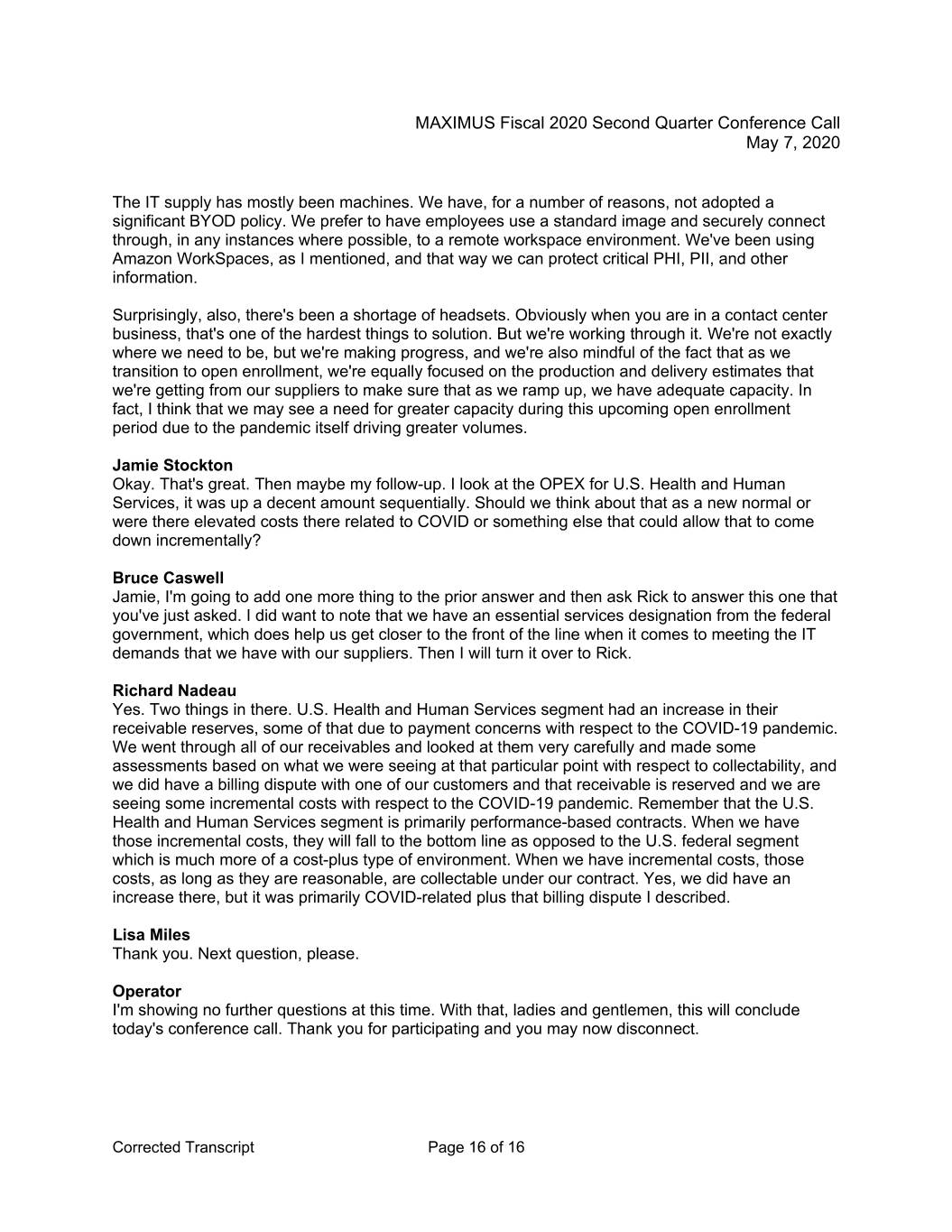
MAXIMUS Fiscal 2020 Second Quarter Conference Call May 7, 2020   sustained employment to achieve economic independence. Revenue is recognized based on our estimate of the number of individuals who we anticipate reaching these milestones. As a result of the pandemic, we reduced our estimates of those job seekers who were likely to achieve employment outcomes. The accounting rules require us to record our best estimate of the future outcomes and therefore the impact of those re-estimates, immediately. This resulted in a pandemic-related write-down of approximately $24 million or $0.28 per share, related to a decline in estimates for future period outcomes-based payments on welfare-to-work programs in the United Kingdom and Australia. Although we are continuing to serve as participants in these programs where we can, many participants have underlying health conditions which require them to self-isolate at home and the pool of available employment opportunities is currently significantly lower than before. The remainder of fiscal 2020 is expected to experience impacts from the COVID-19 pandemic related to our HAAS contract in the U.K. While our face-to-face assessments work is currently suspended, we are working to introduce telephone assessments and continuing to process paper- based assessments. We are proud to partner with government to be a part of the solution to this worldwide health crisis. In the last few weeks, many of our healthcare professionals have volunteered to be seconded to the National Health Service. We will act in an agency capacity for those employees on secondment and will receive reimbursement of most of our costs, but we will not earn revenue or profit. This segment is expected to end the full year in an operating loss position. To give you more color, we expect the fourth quarter for this segment to come in a little below breakeven. Our objective is for progressive improvement in the third quarter with an aim to cut the second quarter loss in half. Looking ahead, we are starting to see new opportunities develop to address the significant impact of the pandemic on global labor markets. In fiscal 2021 and beyond, we anticipate we will see an expanded need for our services, as we help our governments expand and adapt their employments programs to cope with widespread unemployment. In the U.K., we are in the process of transitioning some of our outcomes-based employment services contracts that are currently in a loss position to cost recovery contracts, which should provide considerably more stability and flexibility. We expect these contract changes will be temporary as we work with the Department on transitioning to a new model with rising unemployment. Turning to the balance sheet, we finished the second quarter with cash and cash equivalents of approximately $126 million. Cash provided by operations was $22 million, free cash flow was $13.4 million in the quarter. Second quarter cash provided by operations was tempered by a combination of lower income and a higher proportion of income taxes paid in the quarter order, and accounts receivable grew in the first half of the fiscal year 2020 due to increased revenue levels. DSOs were 72 days. We are continuing to monitor collections closely and I would like to point out that one day of DSO is roughly $9 million of receivables, which directly impacts estimated cash provided by operations and free cash flow. We entered the COVID-19 pandemic with a strong balance sheet and a resolve to manage liquidity and maintain flexibility. While we face uncertainties, including state budgetary pressures, payments to date from our customers have continued without disruption. Our historical experience during economic downturns is that our designation as an essential service provider in the United States puts us in a favorable position in working with our clients on invoicing and payments. Corrected Transcript  Page 4 of 16  


MAXIMUS Fiscal 2020 Second Quarter Conference Call May 7, 2020   However, we recognize that our customers are experiencing significant disruption to their tax receipts. We will continue to manage the Company in a conservative manner. Going forward, the Management team and the Board of Directors intend to take a prudent and constructive approach to cash deployment over the coming months. Currently, we do not anticipate a disruption to our future quarterly cash dividends. Our quarterly 10B51 share purchase plan expired naturally in March when the cap embedded in the program was met. We have paused share purchases and significant M&A activity until we see an easing of the uncertainties resulting from the COVID-19 pandemic. We continue to work on smaller tuck-in transactions that will support future organic growth in a meaningful way. Bruce and I are optimistic that Maximus will emerge from this disruption as a stronger company. We have been able to demonstrate that we can navigate, innovate, and showcase our operational effectiveness during challenging events while continuing to support the most vulnerable populations and protecting our work force during this world crisis. We believe that our efforts over the past two months have further cemented our position as trusted, reliable partner that brings scale, talent and real business solutions to bear. With that, I will hand the call over to Bruce. Bruce Caswell Thank you, Rick, and good morning, everyone. Like Rick, I could not be more proud of our employees' efforts during these unprecedented times. COVID-19 is a global pandemic that impacts all of us. We're working around the clock to ensure we protect our employees while still serving government and the vulnerable populations who rely on health and human services programs we operate, a demand which is only increasing under the impacts of this pandemic. In mid-March, we rapidly developed a response to fast moving COVID-19 challenges and implemented new policies, emphasizing paid sick leave, social distancing, and significantly enhanced cleaning regiments to keep our employees safe and healthy. The slide in my presentation illustrates many of the protections and resources we have provided. I'll touch on some of the most salient actions taken in my remarks. If you hover over each box, additional details will be highlighted for each initiative. As part of our efforts, we're following the more restricted recommendations outlined in the federal Families First Coronavirus Response Act. In some cases, we’re exceeding that. While the Act does not apply to Maximus because we have more than 500 employees, we felt it provided a good benchmark for supporting and safeguarding our employees. Our income continuity plans are fully funded by Maximus and cover a variety of scenarios, including quarantine, childcare, government-mandated restrictions, office closure, and employees who are in high-risk categories. Under these leave options, an employee's health insurance is also protected. We are not requiring them to take their accrued paid time off, or PTO, in order to access these leave options. We also realize that employees' stress and anxiety is heightened during this time. Balancing the strains of normal life during the crisis has been difficult for us all. Consistent, frequent and transparent communications to our staff remain vital. To further support our team members, we’ve launched topical videos from our Chief Medical Officer, mental health seminars, virtual development and training classes, as well as wellness apps, such as Headspace and Wellbeats. Moving on to the next slide. One of the most impressive things we've done is the systematic and ongoing transition of employees to work from home. This has been a heroic effort in procuring new Corrected Transcript  Page 5 of 16  


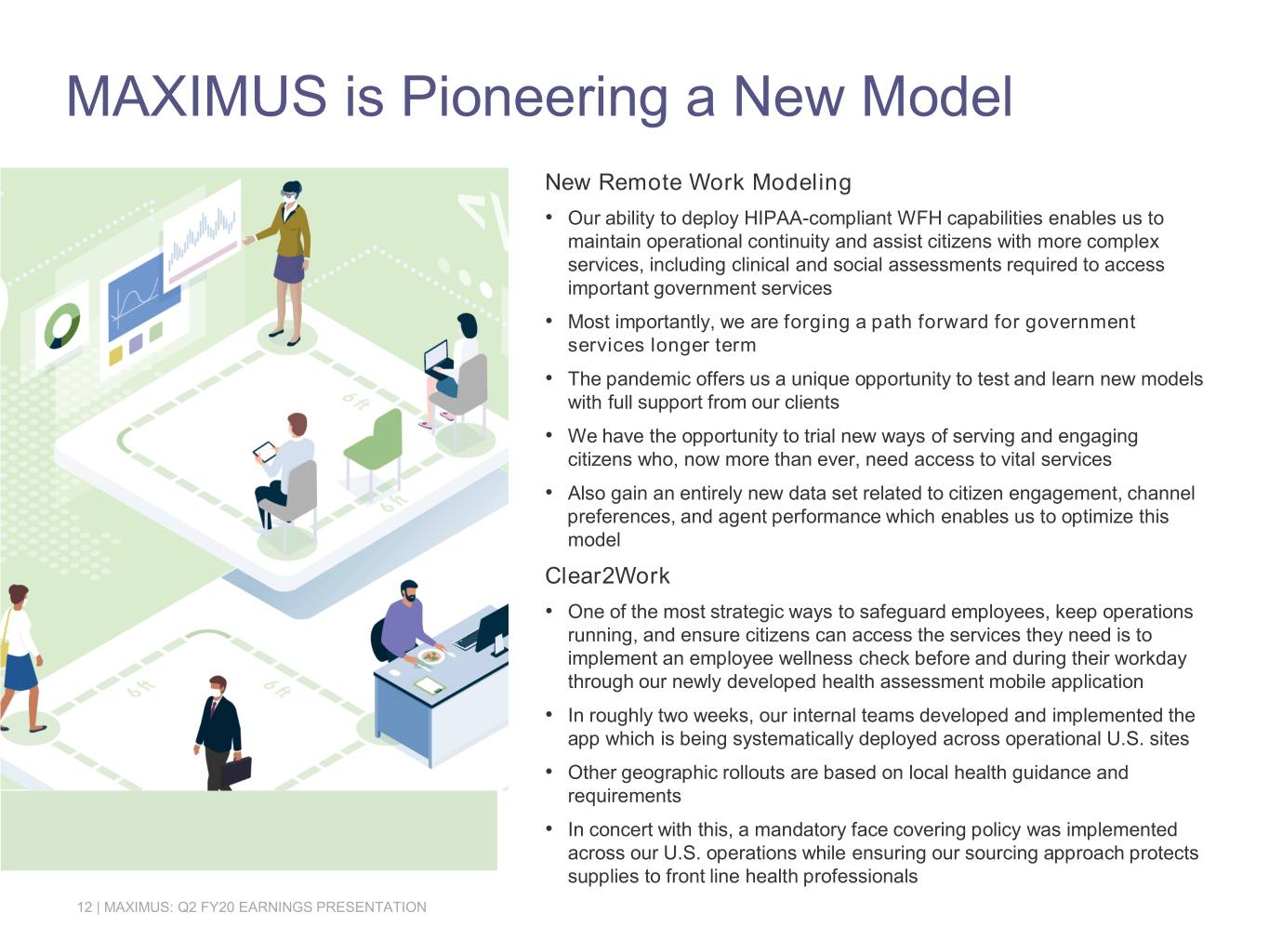
MAXIMUS Fiscal 2020 Second Quarter Conference Call May 7, 2020   equipment, increasing network capacity, and deploying new services, all while keeping operations running to meet program needs. There are significant IT challenges in transitioning to a work from home model, ranging from information security and privacy requirements, to ensuring continuity of services. Many government programs were never designed to be carried out in a remote environment, presenting high hurdles to immediately enable a remote workforce. This transition is also taking place during a pandemic-driven global IT equipment supply chain shortage. Equipment such as laptops and headsets are imperative for our customer service representatives to effectively serve citizens. But we've been working diligently with suppliers and have made great progress. Maximus has also been able to overcome these challenges by capitalizing on the strategic investments we've made in our IT infrastructure, including emerging technologies such as secure remote network platforms and cloud-based omnichannel telephony environments. For example, we leveraged our planned migration to Amazon Web Services, or AWS, to provision nearly 9,000 secure agent desktops through the Amazon WorkSpaces as a service model, thus far, in addition to approximately 7,500 VPN connection users. Our ability to deploy HIPAA-compliant work from home capabilities enables us to maintain operational continuity and assist program participants remotely for more complex services, including clinical and social assessments required to access important government benefits and services. Most importantly, we believe we're forging a path forward for government services longer term. The pandemic offers us a unique opportunity to test and learn new models with full support from our clients. It gives us the opportunity to trial new ways of serving and engaging citizens, who, now more than ever, need access to vital services. We also gain an entirely new dataset related to citizen engagement, channel preferences and agent performance, which enables us to optimize this model. This also allows us long-term to evaluate the optimal environment for each individual employee. While not every employee is best matched to a remote work environment, the results of early pilots indicate no statistically significant reduction in agent performance on the contracts being measured. This type of robust data will be meaningful in solutioning new delivery methods. As we move into the next phase of this pandemic, we believe one of the most important ways to safeguard employees, keep operations running, and ensure citizens can access the services they need is to implement an employee wellness check before and during their workday. Our digital team developed a health assessment mobile application called Clear to Work. An employee will use the app before coming to work each day. The app takes them through a series of questions, including a self-administered temperature check. The app either clears an employee to come to work or instructs them to stay at home that day. If the employee is cleared, they’re given a time-limited digital credential to show when they arrive at work and then complete a second temperature check during their day. The app was developed and implemented in roughly two weeks and is being systematically deployed across operational sites in the United States. We will review other geographic rollouts based on local health guidance requirements. In concert with this, we’ve also implemented a mandatory face covering policy across our U.S. operations while ensuring our sourcing approach protects supplies to frontline health professionals. While we've talked about the operational disruptions and how we're tackling those, I've been pleased at how our teams have responded to the calls for support from our clients as they rapidly design and procure solutions to address the pandemic. Our ability to quickly pivot has underscored the resilience of our business model and our position as a trusted partner to governments worldwide. Over the last four weeks, we've been helping our clients solve real challenges of rising caseloads Corrected Transcript  Page 6 of 16  


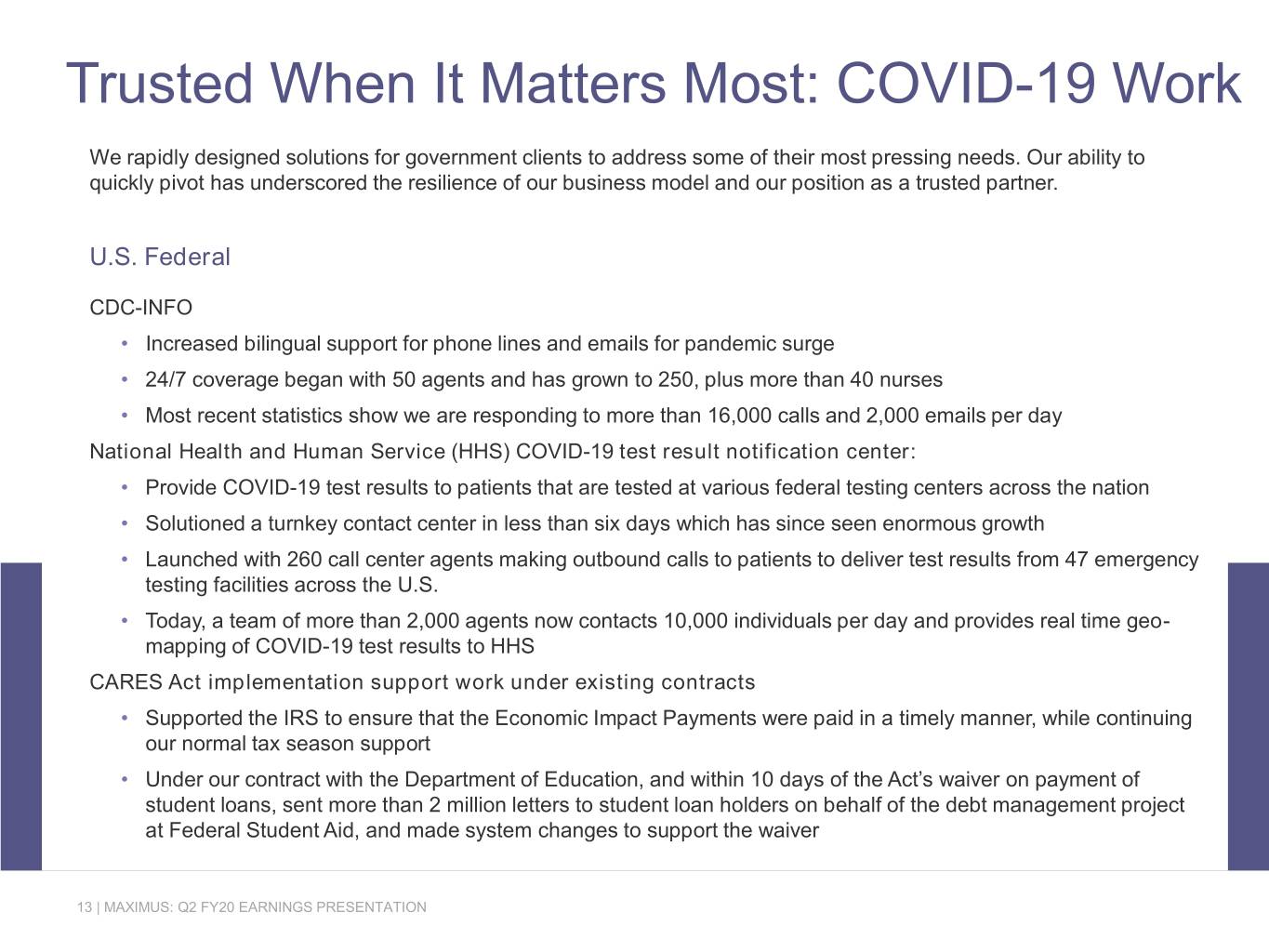
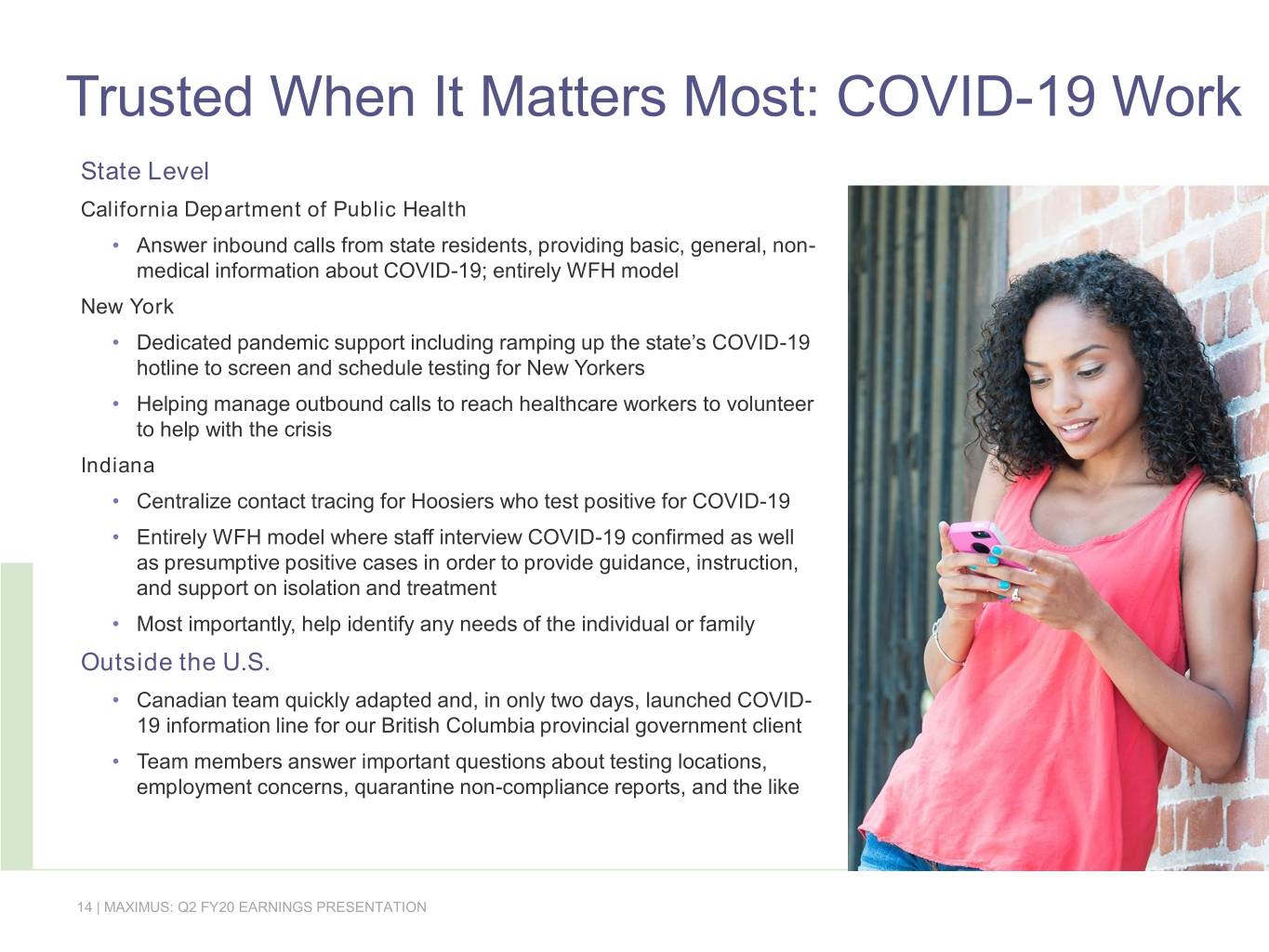
MAXIMUS Fiscal 2020 Second Quarter Conference Call May 7, 2020   and reduced resources. To this end, we've won a number of COVID-related contracts, as well as new work associated with rising unemployment. Let’s start with our federal team. As you may recall, Maximus was already supporting the CDC's information line. At the beginning of the pandemic, the CDC requested that Maximus provide bilingual support for COVID-19 phone lines and e-mails. This 24/7 coverage began with 50 agents and has grown to 250, plus more than 40 nurses. Our most recent statistics show that we’re responding to more than 16,000 calls and 2,000 e-mails per day. We were also selected to deliver the federal health and human services community-based testing centers, or results center. Under this contract, Maximus provides COVID-19 test results to patients that are tested at various federal testing centers across the nation. Our team did an astounding job in solutioning a turnkey contact center in less than six days which has since seen enormous growth. The contract launched with 260 call center agents making outbound calls to patients to deliver test results from 47 emergency testing facilities across the U.S. Today, a team of more than 2,000 agents now contacts 10,000 individuals per day and provides real-time geo-mapping of COVID-19 test results to the U.S. Department of Health and Human Services. Maximus has played a critical role in supporting federal agencies following the CARES Act implementation. Firstly, Maximus supported the IRS to ensure that the economic impact payments were paid in a timely manner, while continuing our normal tax season support. Secondly, as you may be aware, Maximus operates the debt management project at Federal Student Aid. The Act temporarily waived payment on student loans during the pandemic. Within 10 days of this waiver, Maximus sent more than 2 million letters to student loan holders and made system changes to support the waivers. On the state level, we've partnered with the California Department of Public Health to answer phone calls from state residents and provide basic general non-medical information about COVID-19. We’re in the process of working to potentially expand our offerings to include digital channels such as webchat to further engage and support California residents. Importantly, this project is using an entirely work-from-home model, protecting our staff and helping employ residents who may have experienced job loss during the crisis. Since mid-April, Maximus has been providing New York state with dedicated COVID-19 support, including ramping up the states’ COVID-19 hotline to screen and schedule tests for New Yorkers, as well as helping the state manage outbound calls to reach healthcare workers to volunteer to help with the COVID-19 crisis. Our call center representatives have managed to successfully connect more than 30,000 New Yorkers to critical COVID-19 testing resources and obtained more than 14,500 responses from healthcare workers through surveys. Just last week, we won our first state contract in Indiana to centralize contact tracing for Hoosiers who test positive for COVID-19. We’ll hire and train an estimated 500 people under the supervision of Indiana State Department of Health epidemiologists. The remote call center is anticipated to be operational by May 11 and will support individuals at least through the end of the year, if not longer, dependent upon the pandemic needs of the state and its citizens. Our Canadian team also quickly adapted and in only two days launched a COVID-19 information line for our British Columbia provincial government client. Those team members answer important questions about testing locations, employment concerns, quarantine non-compliance reports, and the like. Corrected Transcript  Page 7 of 16  


MAXIMUS Fiscal 2020 Second Quarter Conference Call May 7, 2020   Across the globe, unemployment benefit claims have skyrocketed. As of May 1, more than 30 million people in the United States filed claims triggered by the COVID-19 pandemic. This forewarns of more downstream implications to governments at all levels. Safety-net programs like Medicaid, SNAP, and others are expected to face similar surges in applications. Government programs face staffing, process, and system challenges in meeting the demand. Governments also face the daunting task of governing under a new normal, enabling citizens to return safely to normal life under the continuing threat of new outbreaks and the consequences of a damaged economy. Maximus has rapidly responded to meet the immediate demand for information and application assistance while positioning to provide longer-term services as the economy recovers. Let me give you a few examples of new work with compressed timescales that we have met with our response. In only eight days, we launched a contact center to support the District of Columbia Office of Unemployment Compensation. In North Carolina, we launched a new project to support questions pertaining to the unemployment insurance program. This was done in less than a week to support the Division of Economic Security and has rapidly scaled to 18,000 agents. We're also doing similar work in Arkansas, Rhode Island, and Vermont, responding to frequently asked questions and assisting residents with their unemployment applications. Across the country, other team members continue to support our health and human services clients, ensuring vitally important services are delivered to the public. Moving on to new awards and pipeline. Our reported numbers reflect the status as of March 31, and much has changed since then. Before I address some of these dynamics, I'll briefly cover the awards in the pipeline at March 31. For the second quarter of fiscal year 2020, signed awards were $729.8 million of total contract value at March 31. Further, at March 31, there were another $215.8 million worth of contracts that had been awarded but not yet signed. Let's turn our attention to our pipeline of addressable sales opportunities. Our total contract value pipeline at March 31 was $29.2 billion compared to $30.6 billion reported in the first quarter of FY20. Of our total pipeline of sales opportunities, 65.7% represents new work. In regards to pipeline dynamics, we cannot accurately predict the pattern this pandemic may follow, nor the timing and form of the recovery. Certain clients impacted by COVID-19 are making awards in record time and relying heavily on existing contract relationships and trusted partners like Maximus. This comes, in some cases, at the cost of delaying other prior procurements that were in process. In other instances, particularly in federal, agencies not impacted significantly by the pandemic have stuck closely to procurement schedules. Therefore, it's important to put all of this in context. While we're excited about the new work, many of the new COVID-related programs are expected to be temporary but provide flexibility to scale and extend services as circumstances warrant. We also must be mindful that many of our government clients will likely face budgetary pressures as a result of a pandemic-driven economic recession. While we’re cautiously optimistic, it's difficult to predict what impact these events may have on erosion, timing on new work, and simply getting some of our operations back to somewhat of a normal cadence. The updated guidance, of course, incorporates all of these dynamics based on what we know today. We actively manage a portfolio of work and have earned a reputation as a trusted, long-term partner, all of which enables us to adapt to changing economic times. Corrected Transcript  Page 8 of 16  


MAXIMUS Fiscal 2020 Second Quarter Conference Call May 7, 2020   I've been inspired by the dedication, selflessness, and resilience seen across our business in recent weeks. The resilience of our business funnel has also been impressive, and of our employees, even more so. As Rick mentioned, one of the most inspiring stories comes from our colleagues in the United Kingdom, where we're in the process of deploying nearly a thousand volunteer doctors, nurses, and other clinicians to the NHS to provide vital support on the frontline. Dr. Paul Williams, Division President of Maximus U.K., volunteered to serve along with our team members. In addition, non-clinical colleagues are preparing for redeployment in support of the national effort. This represents the true heart of Maximus and our more than 35,0000 employees around the world. It has been remarkable to witness how our colleagues are coming together to support the global effort against this pandemic. The safety and wellbeing of our employees will continue to remain our top priority. Governments are also planning for the time when, as we emerge from this crisis, our core capabilities in finding jobs for the unemployed, ensuring access to healthcare, and administering critical safety-net programs will be needed more than ever. The world will be a different place, for sure, but so will the need for services and how they’re delivered. The work we've done in helping clients innovate, scale, and still meet citizens' needs will be a game changer. New opportunities will also emerge and we are well-positioned to respond. With that, we'll open up the line for Q&A. Operator. Operator Thank you. As a reminder, to ask a question, you’ll need to press star, one on your telephone, and to withdraw your question, press the pound or hash key. Please limit yourself to one initial question, with one follow-up. Our first question is from Charles Strauzer with CJS Securities. Your line is open. Brendan Popson Good morning, guys. This is Brendan on for Charlie. I wanted to ask, you've had a lot of great color on what's going on with COVID-19, not only affecting operations but also opportunities as well. Just wondering, is there any way you can quantify the benefit from it in this quarter you just reported? Then anyway you can talk about how it affects your guidance that you've reinstated, and could you quantify that? Bruce Caswell Hey, Brendan, it's Bruce. Good morning and thanks for the question. I'll begin and then I'll turn it over to Rick to answer the second part of your question. I can share with you that, as of two days ago, we've added approximately $140 million of signed and unsigned awards for COVID-19-related work across all three of our business segments. We gave a little bit of color on that in the call by talking about some of the work, for example, that we picked up in Canada and of course in the Federal segment and in the U.S. Health and Human Services segment, particularly as it relates to the contact tracing work and unemployment insurance work. That's all subsequent to the March 31 reporting period. We view the work to be generally short-term in nature, and at the same time, because it's such a fluid environment, I literally need to say, as of two days ago, because we're very active in terms of inbound proposal activity and procurement activities as states continue to work to put the programs in place that they need to return to normal and address these immediate needs. Corrected Transcript  Page 9 of 16  


MAXIMUS Fiscal 2020 Second Quarter Conference Call May 7, 2020   I will also say that in doing this we established relationships with new customers. Those new customers can include state public health departments, they can include State Departments of Employment Security. While we intend to support them fully during this short-term need, it allows us to also be able to be a trusted vendor to turn to as those needs could develop into longer-term needs. It is very dynamic, potentially fluid. But the $140 million total contract value is the signed and unsigned awards since the close of the quarter. Rick, would you like to add anything further to that? Richard Nadeau Sure. Brendan, our goal in reinstating the guidance today was to provide investors with a view of our current expectation based on assumptions that we made when we were completing our planning for the remainder of the year. It represents our best assessment at that time as of today. We could get further erosion due to COVID, which would drag us down toward the lower end of guidance. Conversely, increased COVID-19 related work would push us up toward the upper end of the guidance. I want to make sure I caution you though, there's more than a normal level of uncertainty at this time. That uncertainty could result in greater variability than we've experienced in the past few years, but we're seeing positive signs in some of the COVID pipeline, as Bruce indicated. Brendan Popson Great. Thank you. Then I have one follow-up. I guess how it relates to outside the U.S., obviously you had to write-down U.K. and Australia which makes sense, being triggered given the employment environment. At the same time though, there's clearly going to be an opportunity down the road for reemployment and welfare-to-work kind of stuff. I guess, how do you feel about those businesses outside the U.S. and within the U.S. as well? Obviously, that's not something might see this next quarter, but what are you thinking over the next couple of years about how those are positioned? Thank you. Bruce Caswell Great question, Brendan. Actually, I think you've read the situation correctly. We've always said that we believe that these businesses, when you frame it, 50% of our business outside the U.S. is in employment services, and we view it to be a counter-cyclical business. As you've said, we're on the down cycle of that, with folks losing their jobs and no longer able to be sustained in their employment, and hence the impact on sustainment payments under existing contracts. But by definition, these contracts are volume-based in their nature, and as the volumes come back into the system, they tend to perform well. I'd comment on a couple of things. First, I think we're very well positioned in countries like the United Kingdom and Australia to capitalize as the volumes return into those systems. It's predicated, of course, on the economies turning around and the pace of the recovery. Rick, I think, rightly cautioned in his remarks that we can't predict at this time what the shape and the timing of their recovery will look like. In addition to that, Rick also noted that some of our U.K. employment services contracts have been transitioned into a cost recovery type arrangement, so that we can continue to keep our staff on board. It's important to government that we do that so that we've got the staff in place and the program ready as people come back into those programs. Another thing that's probably worth noting is that in the period immediately preceding COVID-19, we were at such a state of nearly full employment that many of these programs were designed really Corrected Transcript  Page 10 of 16  


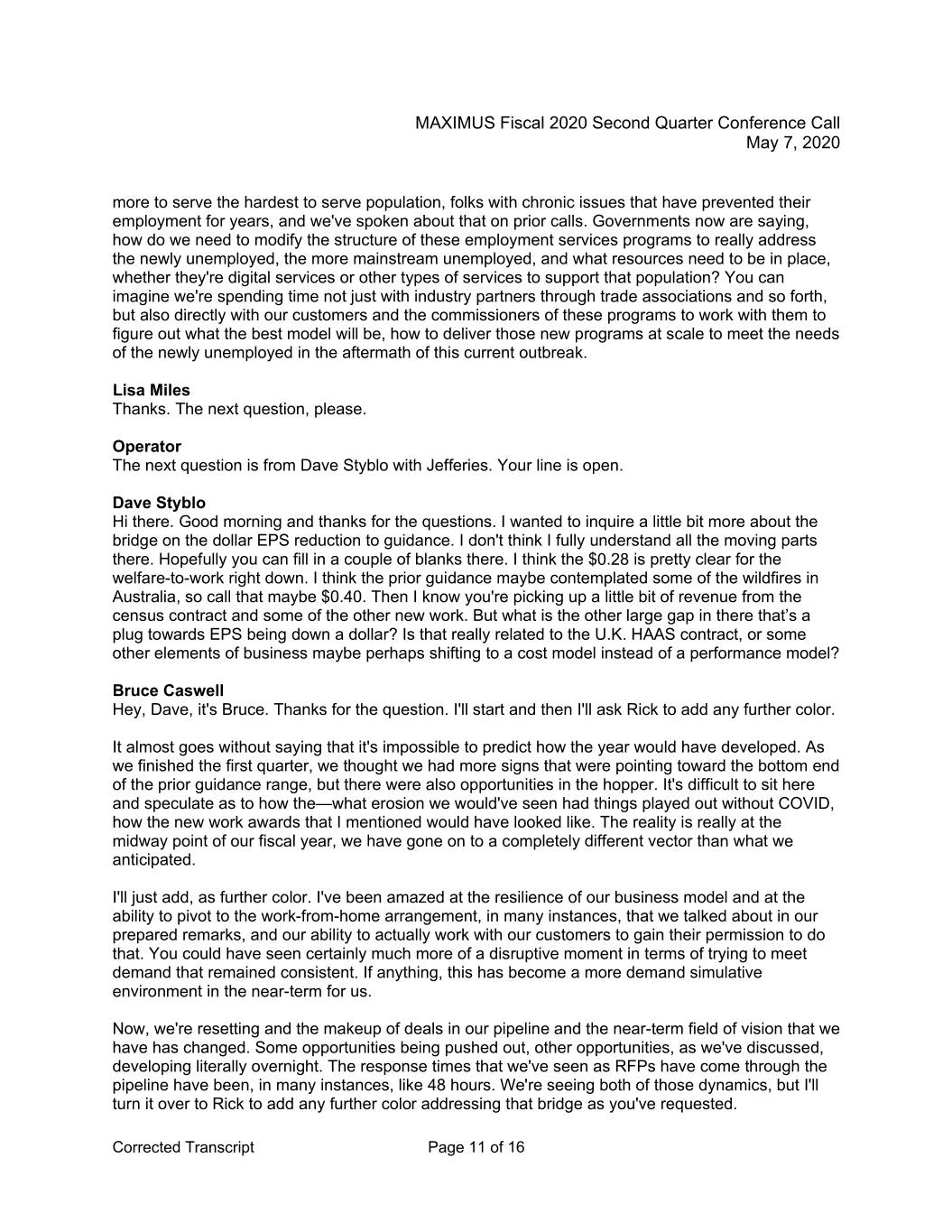
MAXIMUS Fiscal 2020 Second Quarter Conference Call May 7, 2020   more to serve the hardest to serve population, folks with chronic issues that have prevented their employment for years, and we've spoken about that on prior calls. Governments now are saying, how do we need to modify the structure of these employment services programs to really address the newly unemployed, the more mainstream unemployed, and what resources need to be in place, whether they're digital services or other types of services to support that population? You can imagine we're spending time not just with industry partners through trade associations and so forth, but also directly with our customers and the commissioners of these programs to work with them to figure out what the best model will be, how to deliver those new programs at scale to meet the needs of the newly unemployed in the aftermath of this current outbreak. Lisa Miles Thanks. The next question, please. Operator The next question is from Dave Styblo with Jefferies. Your line is open. Dave Styblo Hi there. Good morning and thanks for the questions. I wanted to inquire a little bit more about the bridge on the dollar EPS reduction to guidance. I don't think I fully understand all the moving parts there. Hopefully you can fill in a couple of blanks there. I think the $0.28 is pretty clear for the welfare-to-work right down. I think the prior guidance maybe contemplated some of the wildfires in Australia, so call that maybe $0.40. Then I know you're picking up a little bit of revenue from the census contract and some of the other new work. But what is the other large gap in there that’s a plug towards EPS being down a dollar? Is that really related to the U.K. HAAS contract, or some other elements of business maybe perhaps shifting to a cost model instead of a performance model? Bruce Caswell Hey, Dave, it's Bruce. Thanks for the question. I'll start and then I'll ask Rick to add any further color. It almost goes without saying that it's impossible to predict how the year would have developed. As we finished the first quarter, we thought we had more signs that were pointing toward the bottom end of the prior guidance range, but there were also opportunities in the hopper. It's difficult to sit here and speculate as to how the—what erosion we would've seen had things played out without COVID, how the new work awards that I mentioned would have looked like. The reality is really at the midway point of our fiscal year, we have gone on to a completely different vector than what we anticipated. I'll just add, as further color. I've been amazed at the resilience of our business model and at the ability to pivot to the work-from-home arrangement, in many instances, that we talked about in our prepared remarks, and our ability to actually work with our customers to gain their permission to do that. You could have seen certainly much more of a disruptive moment in terms of trying to meet demand that remained consistent. If anything, this has become a more demand simulative environment in the near-term for us. Now, we're resetting and the makeup of deals in our pipeline and the near-term field of vision that we have has changed. Some opportunities being pushed out, other opportunities, as we've discussed, developing literally overnight. The response times that we've seen as RFPs have come through the pipeline have been, in many instances, like 48 hours. We're seeing both of those dynamics, but I'll turn it over to Rick to add any further color addressing that bridge as you've requested. Corrected Transcript  Page 11 of 16  


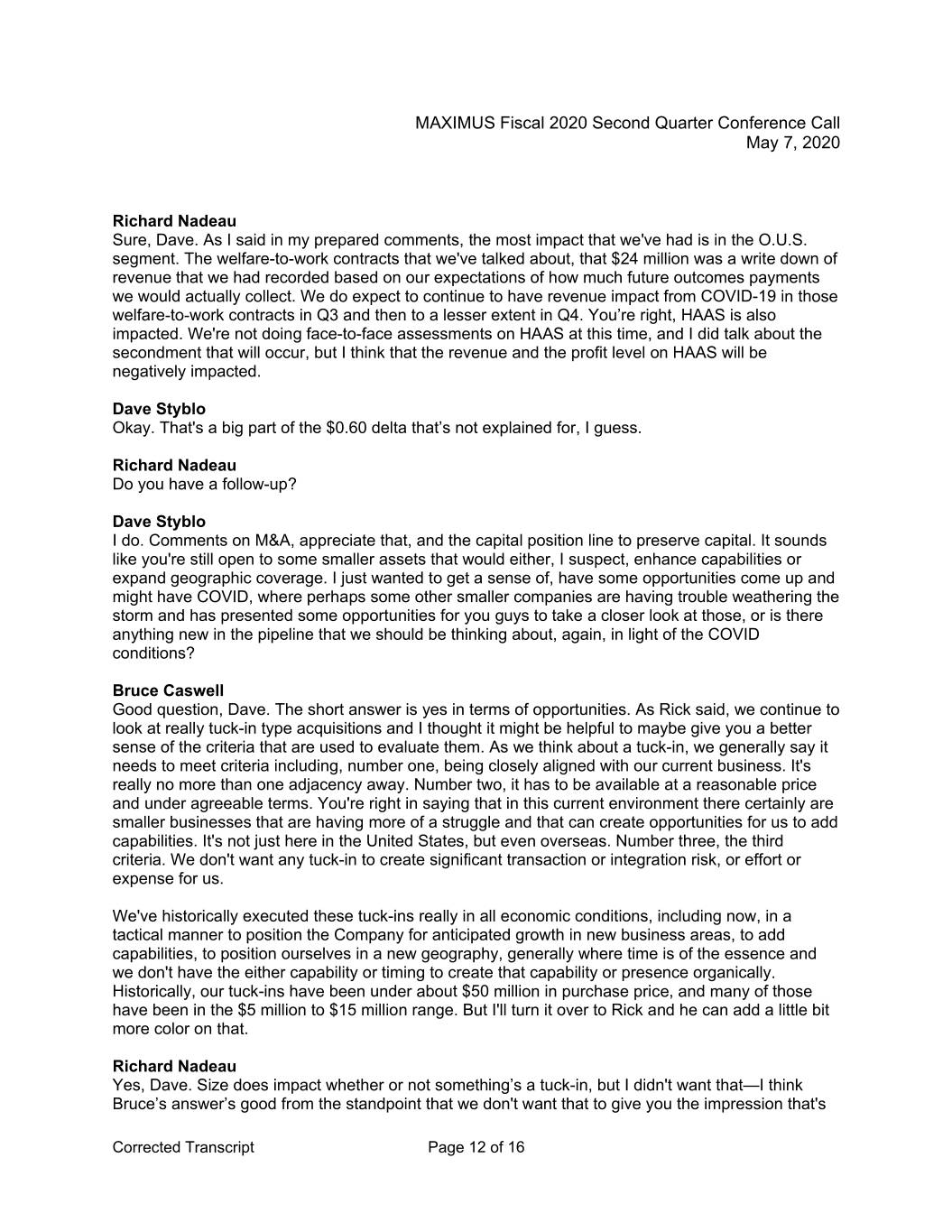
MAXIMUS Fiscal 2020 Second Quarter Conference Call May 7, 2020   Richard Nadeau Sure, Dave. As I said in my prepared comments, the most impact that we've had is in the O.U.S. segment. The welfare-to-work contracts that we've talked about, that $24 million was a write down of revenue that we had recorded based on our expectations of how much future outcomes payments we would actually collect. We do expect to continue to have revenue impact from COVID-19 in those welfare-to-work contracts in Q3 and then to a lesser extent in Q4. You’re right, HAAS is also impacted. We're not doing face-to-face assessments on HAAS at this time, and I did talk about the secondment that will occur, but I think that the revenue and the profit level on HAAS will be negatively impacted. Dave Styblo Okay. That's a big part of the $0.60 delta that’s not explained for, I guess. Richard Nadeau Do you have a follow-up? Dave Styblo I do. Comments on M&A, appreciate that, and the capital position line to preserve capital. It sounds like you're still open to some smaller assets that would either, I suspect, enhance capabilities or expand geographic coverage. I just wanted to get a sense of, have some opportunities come up and might have COVID, where perhaps some other smaller companies are having trouble weathering the storm and has presented some opportunities for you guys to take a closer look at those, or is there anything new in the pipeline that we should be thinking about, again, in light of the COVID conditions? Bruce Caswell Good question, Dave. The short answer is yes in terms of opportunities. As Rick said, we continue to look at really tuck-in type acquisitions and I thought it might be helpful to maybe give you a better sense of the criteria that are used to evaluate them. As we think about a tuck-in, we generally say it needs to meet criteria including, number one, being closely aligned with our current business. It's really no more than one adjacency away. Number two, it has to be available at a reasonable price and under agreeable terms. You're right in saying that in this current environment there certainly are smaller businesses that are having more of a struggle and that can create opportunities for us to add capabilities. It's not just here in the United States, but even overseas. Number three, the third criteria. We don't want any tuck-in to create significant transaction or integration risk, or effort or expense for us. We've historically executed these tuck-ins really in all economic conditions, including now, in a tactical manner to position the Company for anticipated growth in new business areas, to add capabilities, to position ourselves in a new geography, generally where time is of the essence and we don't have the either capability or timing to create that capability or presence organically. Historically, our tuck-ins have been under about $50 million in purchase price, and many of those have been in the $5 million to $15 million range. But I'll turn it over to Rick and he can add a little bit more color on that. Richard Nadeau Yes, Dave. Size does impact whether or not something’s a tuck-in, but I didn't want that—I think Bruce’s answer’s good from the standpoint that we don't want that to give you the impression that's Corrected Transcript  Page 12 of 16  


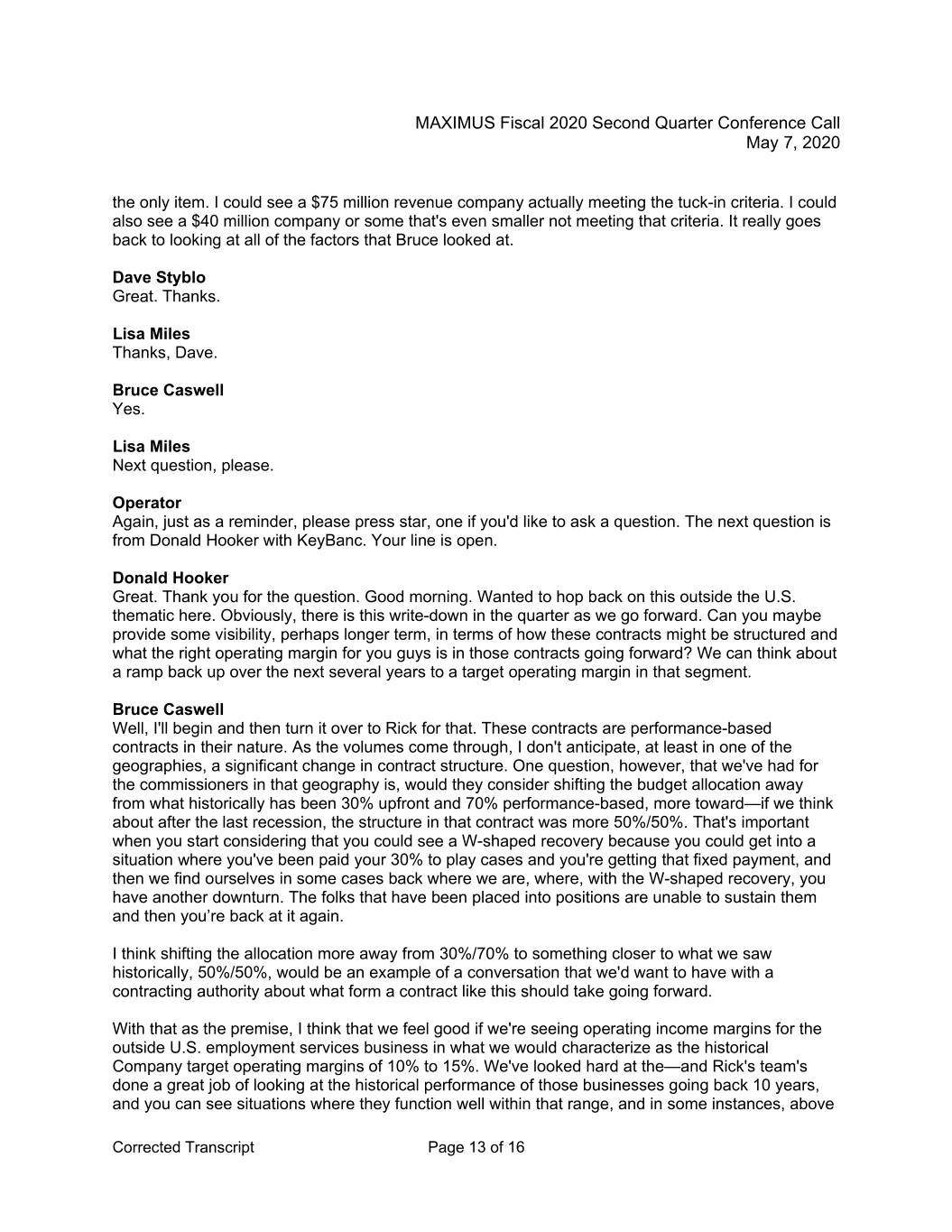
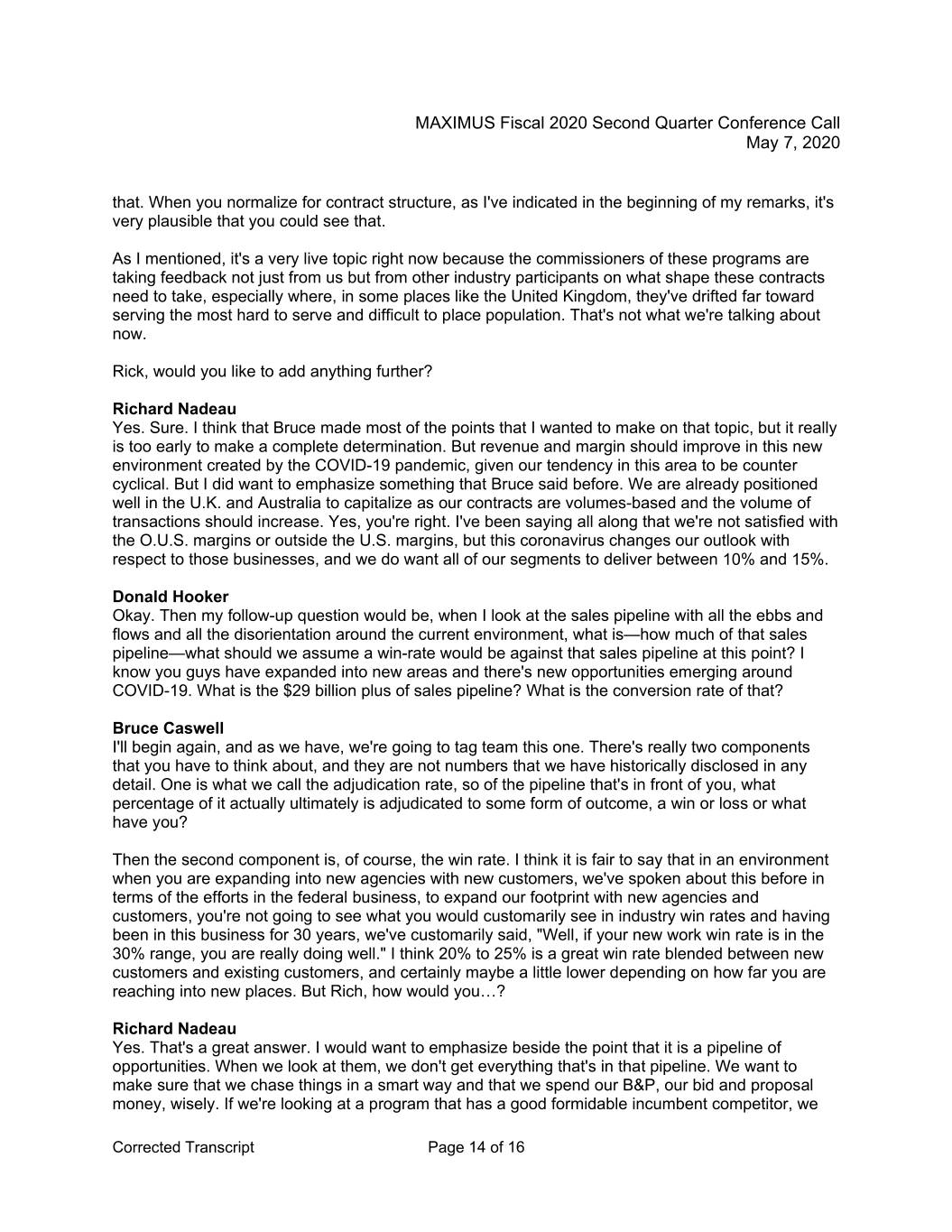
MAXIMUS Fiscal 2020 Second Quarter Conference Call May 7, 2020   the only item. I could see a $75 million revenue company actually meeting the tuck-in criteria. I could also see a $40 million company or some that's even smaller not meeting that criteria. It really goes back to looking at all of the factors that Bruce looked at. Dave Styblo Great. Thanks. Lisa Miles Thanks, Dave. Bruce Caswell Yes. Lisa Miles Next question, please. Operator Again, just as a reminder, please press star, one if you'd like to ask a question. The next question is from Donald Hooker with KeyBanc. Your line is open. Donald Hooker Great. Thank you for the question. Good morning. Wanted to hop back on this outside the U.S. thematic here. Obviously, there is this write-down in the quarter as we go forward. Can you maybe provide some visibility, perhaps longer term, in terms of how these contracts might be structured and what the right operating margin for you guys is in those contracts going forward? We can think about a ramp back up over the next several years to a target operating margin in that segment. Bruce Caswell Well, I'll begin and then turn it over to Rick for that. These contracts are performance-based contracts in their nature. As the volumes come through, I don't anticipate, at least in one of the geographies, a significant change in contract structure. One question, however, that we've had for the commissioners in that geography is, would they consider shifting the budget allocation away from what historically has been 30% upfront and 70% performance-based, more toward—if we think about after the last recession, the structure in that contract was more 50%/50%. That's important when you start considering that you could see a W-shaped recovery because you could get into a situation where you've been paid your 30% to play cases and you're getting that fixed payment, and then we find ourselves in some cases back where we are, where, with the W-shaped recovery, you have another downturn. The folks that have been placed into positions are unable to sustain them and then you’re back at it again. I think shifting the allocation more away from 30%/70% to something closer to what we saw historically, 50%/50%, would be an example of a conversation that we'd want to have with a contracting authority about what form a contract like this should take going forward. With that as the premise, I think that we feel good if we're seeing operating income margins for the outside U.S. employment services business in what we would characterize as the historical Company target operating margins of 10% to 15%. We've looked hard at the—and Rick's team's done a great job of looking at the historical performance of those businesses going back 10 years, and you can see situations where they function well within that range, and in some instances, above Corrected Transcript  Page 13 of 16  


MAXIMUS Fiscal 2020 Second Quarter Conference Call May 7, 2020   that. When you normalize for contract structure, as I've indicated in the beginning of my remarks, it's very plausible that you could see that. As I mentioned, it's a very live topic right now because the commissioners of these programs are taking feedback not just from us but from other industry participants on what shape these contracts need to take, especially where, in some places like the United Kingdom, they've drifted far toward serving the most hard to serve and difficult to place population. That's not what we're talking about now. Rick, would you like to add anything further? Richard Nadeau Yes. Sure. I think that Bruce made most of the points that I wanted to make on that topic, but it really is too early to make a complete determination. But revenue and margin should improve in this new environment created by the COVID-19 pandemic, given our tendency in this area to be counter cyclical. But I did want to emphasize something that Bruce said before. We are already positioned well in the U.K. and Australia to capitalize as our contracts are volumes-based and the volume of transactions should increase. Yes, you're right. I've been saying all along that we're not satisfied with the O.U.S. margins or outside the U.S. margins, but this coronavirus changes our outlook with respect to those businesses, and we do want all of our segments to deliver between 10% and 15%. Donald Hooker Okay. Then my follow-up question would be, when I look at the sales pipeline with all the ebbs and flows and all the disorientation around the current environment, what is—how much of that sales pipeline—what should we assume a win-rate would be against that sales pipeline at this point? I know you guys have expanded into new areas and there's new opportunities emerging around COVID-19. What is the $29 billion plus of sales pipeline? What is the conversion rate of that? Bruce Caswell I'll begin again, and as we have, we're going to tag team this one. There's really two components that you have to think about, and they are not numbers that we have historically disclosed in any detail. One is what we call the adjudication rate, so of the pipeline that's in front of you, what percentage of it actually ultimately is adjudicated to some form of outcome, a win or loss or what have you? Then the second component is, of course, the win rate. I think it is fair to say that in an environment when you are expanding into new agencies with new customers, we've spoken about this before in terms of the efforts in the federal business, to expand our footprint with new agencies and customers, you're not going to see what you would customarily see in industry win rates and having been in this business for 30 years, we've customarily said, "Well, if your new work win rate is in the 30% range, you are really doing well." I think 20% to 25% is a great win rate blended between new customers and existing customers, and certainly maybe a little lower depending on how far you are reaching into new places. But Rich, how would you…? Richard Nadeau Yes. That's a great answer. I would want to emphasize beside the point that it is a pipeline of opportunities. When we look at them, we don't get everything that's in that pipeline. We want to make sure that we chase things in a smart way and that we spend our B&P, our bid and proposal money, wisely. If we're looking at a program that has a good formidable incumbent competitor, we Corrected Transcript  Page 14 of 16  


MAXIMUS Fiscal 2020 Second Quarter Conference Call May 7, 2020   might decide—we look at it, we might decide not to bid it because that would be wasteful of our B&P dollars and we'll save them for a situation where we have a better chance of a win. I’d want to make sure it's not just the win rate, that you need to apply the factor against that pipeline. Donald Hooker Thank you. Lisa Miles Next question, please. Operator Again, just a reminder, star, one if you’d like to ask a question. Our next question is from Jamie Stockton with Wells Fargo. Your line is open. Jamie Stockton Hi. Good morning. Thanks for taking my questions. I guess maybe the first one is just about the IT shortage comments, and in general, are you where you need to be today, and if you're not, when do you think you'll get there? Bruce Caswell Hi, Jamie. It's Bruce. Thanks for the question. It's an interesting dynamic because there is a couple of things. First of all, there's the supply that we need to continue to move a greater portion of our workforce to work from home. Then there is, let's call it business as usual supply, that we need because we're coming into, for example, the open enrollment season. Let me give you just a little bit of color on where we stand currently. From a work from home perspective, currently we've got 45% of our U.S. employees working from home. Another 45% are working on-site, practicing social distancing, wearing face masks and so forth, as we've discussed, and the balance are on leave. It's important to note that there are some contracts in the U.S. portfolio where working from home is not possible. We've had to implement, as we've, I think, mentioned here, creative policies like shift schedules or individuals stay home for a period and then they come into the office and switch with colleagues who have been working during that period. We've been able to do that while maintaining service levels on some pretty mission critical contracts for our customers and earned accolades from our customers in the process. You have 45% in the U.S. working from home, 45% not, that's 90%. The balance then are on leave for COVID-19 related qualifying conditions, which doesn't mean that they're all sick, but the conditions can include needing, for example, to provide childcare where they have no alternative, caring for a sick family member and so forth. Outside the U.S. there have been different regional responses, as you can imagine. Approximately 76% of our workforce is working from home outside the U.S. But there are examples as well where working from home is not possible. In Australia, for example, our Australian colleagues have to maintain a safe level of storefront operations to serve job seekers and individuals who now come through the public assistance phase of this and now are going to be coming into the employment schemes that we operate. As long as we can continue to do that, you're going to have a portion of that workforce that has to be in the offices. Corrected Transcript  Page 15 of 16  


MAXIMUS Fiscal 2020 Second Quarter Conference Call May 7, 2020   The IT supply has mostly been machines. We have, for a number of reasons, not adopted a significant BYOD policy. We prefer to have employees use a standard image and securely connect through, in any instances where possible, to a remote workspace environment. We've been using Amazon WorkSpaces, as I mentioned, and that way we can protect critical PHI, PII, and other information. Surprisingly, also, there's been a shortage of headsets. Obviously when you are in a contact center business, that's one of the hardest things to solution. But we're working through it. We're not exactly where we need to be, but we're making progress, and we're also mindful of the fact that as we transition to open enrollment, we're equally focused on the production and delivery estimates that we're getting from our suppliers to make sure that as we ramp up, we have adequate capacity. In fact, I think that we may see a need for greater capacity during this upcoming open enrollment period due to the pandemic itself driving greater volumes. Jamie Stockton Okay. That's great. Then maybe my follow-up. I look at the OPEX for U.S. Health and Human Services, it was up a decent amount sequentially. Should we think about that as a new normal or were there elevated costs there related to COVID or something else that could allow that to come down incrementally? Bruce Caswell Jamie, I'm going to add one more thing to the prior answer and then ask Rick to answer this one that you've just asked. I did want to note that we have an essential services designation from the federal government, which does help us get closer to the front of the line when it comes to meeting the IT demands that we have with our suppliers. Then I will turn it over to Rick. Richard Nadeau Yes. Two things in there. U.S. Health and Human Services segment had an increase in their receivable reserves, some of that due to payment concerns with respect to the COVID-19 pandemic. We went through all of our receivables and looked at them very carefully and made some assessments based on what we were seeing at that particular point with respect to collectability, and we did have a billing dispute with one of our customers and that receivable is reserved and we are seeing some incremental costs with respect to the COVID-19 pandemic. Remember that the U.S. Health and Human Services segment is primarily performance-based contracts. When we have those incremental costs, they will fall to the bottom line as opposed to the U.S. federal segment which is much more of a cost-plus type of environment. When we have incremental costs, those costs, as long as they are reasonable, are collectable under our contract. Yes, we did have an increase there, but it was primarily COVID-related plus that billing dispute I described. Lisa Miles Thank you. Next question, please. Operator I'm showing no further questions at this time. With that, ladies and gentlemen, this will conclude today's conference call. Thank you for participating and you may now disconnect. Corrected Transcript  Page 16 of 16  


Fiscal 2020 Second Quarter Earnings Call Rick Nadeau Chief Financial Officer May 7, 2020 1 | MAXIMUS: Q2 FY20 EARNINGS PRESENTATION


Forward-looking Statements & Non-GAAP Information These slides should be read in conjunction with the Company’s most recent quarterly earnings press release, along with listening to or reading a transcript of the comments of Company management from our most recent quarterly earnings conference call. This document may contain non-GAAP financial information. Management uses this information in its internal analysis of results and believes that this information may be informative to investors in gauging the quality of our financial performance, identifying trends in our results, and providing meaningful period-to-period comparisons. These measures should be used in conjunction with, rather than instead of, their comparable GAAP measures. For a reconciliation of non-GAAP measures to the comparable GAAP measures presented in this document, see the Company’s most recent quarterly earnings press release. Throughout this presentation, numbers may not add due to rounding. Included in this presentation are forward-looking statements within the meaning of the safe harbor provisions of the United States Private Securities Litigation Reform Act of 1995. Forward-looking statements can be identified by words such as: “anticipate,” “intend,” “plan,” “goal,” “seek,” “opportunity,” “could,” “potential,” “believe,” “project,” “estimate,” “expect,” “strategy,” “future,” “likely,” “may,” “should,” “will” and similar references to future periods. Forward-looking statements that are not historical facts, including statements about our confidence, strategies and initiatives and our expectations about revenues, results of operations, profitability, liquidity, market demand or the impact of the COVID-19 pandemic are forward-looking statements that involve risks and uncertainties. These risks could cause our actual results to differ materially from those indicated by such forward-looking statements. Therefore, you should not rely on any of these forward-looking statements. Important factors that could cause our actual results and financial condition to differ materially from those indicated in the forward-looking statements include, among others, factors set forth in Item 1A of our Quarterly Report on Form 10-Q to be filed shortly and in Exhibit 99.1, under the caption "Special Considerations and Risk Factors," in our Annual Report on Form 10-K for the year ended September 30, 2019, which was filed with the Securities and Exchange Commission on November 26, 2019. Any forward-looking statement made by us in this report is based only on information currently available to us and speaks only as of the date on which it is made. We undertake no obligation to publicly update any forward-looking statement, whether written or oral, that may be made from time to time, whether as a result of new information, future developments or otherwise. 2 | MAXIMUS: Q2 FY20 EARNINGS PRESENTATION


Rapid Response to COVID-19 Thank you to our employees – We are extremely proud to lead an organization with such heart, dedication, ingenuity and collaboration. We operate essential programs • Underscoring the critical nature of our work, many of our core programs have been deemed essential • The entire MAXIMUS team is working tirelessly to ensure that vital programs continue to operate and citizens receive needed support. We are accomplishing extraordinary things. Some highlights include: − Implemented robust paid leave options for employees − Mandated social distancing across all operations − Significantly enhanced sanitation measures − Continue to transition more employees to work from home • We have partnered with the U.K. government − Voluntary redeployment of clinical staff directly into the National Health Service as well as case management and administrative staff redeployment into the Department for Work and Pensions to provide vital front-line support Unpredictable pandemic • Our priority is the health and safety of our employees and ensuring that we can continue to support our government clients as demand for government services surges • No one can predict with certainty the scale or length of disruption from pandemic or how deep and severe the economic impacts will be 3 | MAXIMUS: Q2 FY20 EARNINGS PRESENTATION


Revised Fiscal Year 2020 Guidance Revised Fiscal 2020 Guidance Revenue $3.15B – $3.25B Diluted EPS $2.95 – $3.15 Cash flow from operations $250M – $300M Free cash flow $200M – $250M Revised Guidance Completed our normal bottom’s up quarterly review and are reinstating guidance because we think it is important to provide investors with transparency on our current expectations for the year. Given the fluid nature of the pandemic, actual results could vary materially from guidance due to factors such as worsening of the pandemic, erosion due to budgetary pressures, additional steps taken by federal, provincial, state, or local governments to restrict business operations or limit office occupancy, delayed or missed payments by customers, supply chain disruptions affecting IT or safety equipment. The guidance ranges are wider than typical given we are midway through the year but they reflect the increased risk and variability we face. Continued Disruption • We anticipate continued disruption across all segments with some offsetting favorability from new work in certain segments • This disruption is expected to be most pronounced in our Outside the U.S. Segment and expecting some positive impacts in the two U.S. segments from new opportunities that we have either won or are pursuing 4 | MAXIMUS: Q2 FY20 EARNINGS PRESENTATION


Total Company Results – Second Quarter of FY20 ($ in millions, except Q2 FY20 Q2 FY19 % Change per share data) • Revenue includes the full ramp-up of the Census contract in the U.S. Federal Revenue Services Segment U.S. Health & Human Services $ 308.7 $ 290.7 6% U.S. Federal Services 393.4 289.7 36% • Two substantial impacts in the quarter: Outside the U.S. 116.0 156.0 (26%) − Pandemic-related write-down of Total Revenue $ 818.1 $ 736.5 11% approximately $24M or $0.28 per share related to a decline in estimates for Operating Income future period outcomes-based payments U.S. Health & Human Services $ 46.2 $ 56.9 (19%) on welfare to work programs in the U.S. Federal Services 30.2 29.6 2% United Kingdom and Australia Outside the U.S. (26.7) 4.5 nm − Change order for approximately $9M or Segment Income $ 49.7 $ 90.9 (45%) $0.11 per share was signed after Intangibles amortization (8.9) (9.5) quarter-end in the U.S. Health & Human Other (3.5) 0.4 Services Segment. The costs were Total Operating Income $ 37.3 $ 81.8 (54%) recognized in prior periods but the Operating Margin % 4.6% 11.1% revenue will be recognized in the third quarter which falls to the bottom line in Effective Tax Rate 26.1% 23.4% that period Net Income attributable to • Second quarter fiscal 2020 operating MAXIMUS $ 27.7 $ 61.9 (55%) margin of 4.6% and diluted earnings per Diluted EPS $ 0.43 $ 0.96 (55%) share of $0.43 reflect these impacts 5 | MAXIMUS: Q2 FY20 EARNINGS PRESENTATION


U.S. Health & Human Services Segment ($ in millions) Q2 FY20 Q2 FY19 % Change Revenue U.S. Health & Human Services $ 308.7 $ 290.7 6% Operating Income U.S. Health & Human Services $ 46.2 $ 56.9 (19%) Operating Margin % 15.0% 19.6% Q2 FY20 Revenue & Operating Margin • All revenue growth was organic and attributable to new contracts and the expansion of existing work • Both revenue and operating margin were tempered by the aforementioned $9M change order that will be recognized in Q3 FY20 COVID-19 Impacts • Impacted last three weeks of the quarter and caused varying degrees of disruption • Managed through differing local and state government working requirements, including temporary site closures, designed to ensure worker safety • To address social distancing requirements, we rapidly scaled WFH capabilities to enable continued support of essential services and to meet deliverables on the predominantly performance-based contracts in this segment Full Year Outlook • This segment is expected to experience minor, continued disruption and deliver an estimated operating margin between 17% and 18% 6 | MAXIMUS: Q2 FY20 EARNINGS PRESENTATION


U.S. Federal Services Segment ($ in millions) Q2 FY20 Q2 FY19 % Change Revenue U.S. Federal Services $ 393.4 $ 289.7 36% Operating Income U.S. Federal Services $ 30.2 $ 29.6 2% Operating Margin % 7.7% 10.2% Q2 FY20 Revenue & Operating Margin • All revenue growth was organic. Excluding acquired citizen engagement centers contracts, organic revenue growth was 6.7% • Operating margin was 7.7% and tempered by unfavorable impacts from the pandemic on performance-based work and ongoing investments in business development and technical capabilities • Majority of revenue in segment generated by cost-plus contracts, allowing recovery of certain COVID-related costs *Updated* Census (CQA) Contract Fiscal Updated Estimated • Delivered revenue of approximately $140M in the second quarter Year Census Revenue and $210M on a YTD basis 2019 $185M (actual) • Census Bureau extended the response period to October 31, 2020 • Contract expanded and expect higher revenue to support new deadline 2020 $430M - $450M • Previous revenue estimate was $360M in FY 2020 2021 Less than $50M Full Year Outlook • Segment expected to deliver a full year operating margin between 8% and 9% due to a higher mix of cost-plus work and continued investment in both business development and technical capabilities 7 | MAXIMUS: Q2 FY20 EARNINGS PRESENTATION


Outside the U.S. Segment ($ in millions) Q2 FY20 Q2 FY19 % Change Revenue Outside the U.S. $ 116.0 $ 156.0 (26%) Operating Income Outside the U.S. $ (26.7) $ 4.5 nm Operating Margin % (23.0%) 2.9% Q2 FY20 Revenue & Operating Margin • The pandemic has had the most pronounced effect on this segment, impacting revenue and causing operating loss of $26.7M with a write-down of approximately $24M taken in the quarter COVID-19 Impacts • Several significant performance-based contracts have payments tied directly to job-seeker outcomes. Revenue is recognized based on our estimate of the number of individuals anticipated to reach these milestones • As a result of the pandemic, reduced our estimates of those jobseekers who are likely to achieve employment outcomes • Accounting rules require immediate recognition of our best estimate of the future outcomes and subsequent the impact • Resulted in a pandemic-related write-down of approximately $24M or $0.28 per share related to a decline in estimates for future period outcomes-based payments on welfare to work programs in the U.K. and Australia Full Year Outlook and Beyond • Additional impacts are expected from our U.K. HAAS contract as many of our clinicians have volunteered to be seconded to the National Health Service. We will act as an agent and be reimbursed for our costs, but we will not earn revenue or profit • Segment expected to end the full year in an operating loss position and the fourth quarter expected to be slightly below breakeven while our objective is progressive improvement in the third quarter to aim to cut the second quarter loss in half • We are beginning to see opportunities develop for FY21 and beyond as we help governments expand and adapt their employment services programs to cope with widespread unemployment • Some of our U.K. contracts currently in a loss position are in the process of transitioning to cost recovery, which should provide greater stability and flexibility. This will likely be temporary as we work with DWP on transitioning to a new model in the face of rising unemployment 8 | MAXIMUS: Q2 FY20 EARNINGS PRESENTATION


Cash Flows, Balance Sheet, and Capital Allocation $ in millions Q2 FY20 Cash provided by operations $ 22.0 Purchases of property and equipment and capitalized software costs (8.6) Free cash flow $ 13.4 Q2 Cash Flows & Balance Sheet • Cash provided by operations and free cash were tempered by lower income, a higher proportion of income taxes paid in the quarter, and increased accounts receivable in the first half of fiscal year 2020 due to the increased revenue level • Cash and cash equivalents of approximately $126M at March 31, 2020 Days Sales Outstanding (DSO) • 72 days at March 31, 2020 Capital Allocation • Committed to managing liquidity, maintaining flexibility and managing the Company in a conservative manner • No change to dividend at this time and pause in effect on share purchases and significant M&A activity We are optimistic that MAXIMUS will emerge from this disruption as a stronger company. We can navigate, innovate, and showcase our operational effectiveness during challenging events while continuing to support the most vulnerable populations and protecting our workforce during this world crisis. 9 | MAXIMUS: Q2 FY20 EARNINGS PRESENTATION


Fiscal 2020 Second Quarter Earnings Call Bruce Caswell President & Chief Executive Officer May 7, 2020 10 | MAXIMUS: Q2 FY20 EARNINGS PRESENTATION


MAXIMUS COVID-19 COMMITMENT COVID-19 doesn’t follow a plan or rule book. This means our policies, guidance, and resources are continually being updated. The resources listed below are what MAXIMUS has arranged for employees since the start of the health pandemic. We appreciate our employees for their continued commitment to serve the nation’s most vulnerable citizens during this difficult time. Their health and safety are our top priority.


Systematic Transition to Work from Home • Heroic effort to procure new equipment, increase network capacity, and deploy new services all while keeping operations running to meet program needs • Significant challenges in a work from home (WFH) model ranging from information security and privacy requirements to ensuring continuity of services • Many government programs were never designed to be carried out in a WFH model, presenting high hurdles to immediately enable a remote workforce • Transition is also taking place during a pandemic-driven global IT equipment supply chain shortage • We overcame these challenges by capitalizing on the strategic investments we’ve made in our IT infrastructure, including emerging technologies such as secure remote network platforms and cloud-based omnichannel telephony environments. These investments enabled us to accelerate a WFH model − For example, leveraged our planned migration to AWS to provision nearly 9,000 secure agent desktops through Amazon WorkSpaces as- a-service model thus far, in addition to approximately 7,500 VPN connection users 11 | MAXIMUS: Q2 FY20 EARNINGS PRESENTATION


MAXIMUS is Pioneering a New Model New Remote Work Modeling • Our ability to deploy HIPAA-compliant WFH capabilities enables us to maintain operational continuity and assist citizens with more complex services, including clinical and social assessments required to access important government services • Most importantly, we are forging a path forward for government services longer term • The pandemic offers us a unique opportunity to test and learn new models with full support from our clients • We have the opportunity to trial new ways of serving and engaging citizens who, now more than ever, need access to vital services • Also gain an entirely new data set related to citizen engagement, channel preferences, and agent performance which enables us to optimize this model Clear2Work • One of the most strategic ways to safeguard employees, keep operations running, and ensure citizens can access the services they need is to implement an employee wellness check before and during their workday through our newly developed health assessment mobile application • In roughly two weeks, our internal teams developed and implemented the app which is being systematically deployed across operational U.S. sites • Other geographic rollouts are based on local health guidance and requirements • In concert with this, a mandatory face covering policy was implemented across our U.S. operations while ensuring our sourcing approach protects supplies to front line health professionals 12 | MAXIMUS: Q2 FY20 EARNINGS PRESENTATION


Trusted When It Matters Most: COVID-19 Work We rapidly designed solutions for government clients to address some of their most pressing needs. Our ability to quickly pivot has underscored the resilience of our business model and our position as a trusted partner. U.S. Federal CDC-INFO • Increased bilingual support for phone lines and emails for pandemic surge • 24/7 coverage began with 50 agents and has grown to 250, plus more than 40 nurses • Most recent statistics show we are responding to more than 16,000 calls and 2,000 emails per day National Health and Human Service (HHS) COVID-19 test result notification center: • Provide COVID-19 test results to patients that are tested at various federal testing centers across the nation • Solutioned a turnkey contact center in less than six days which has since seen enormous growth • Launched with 260 call center agents making outbound calls to patients to deliver test results from 47 emergency testing facilities across the U.S. • Today, a team of more than 2,000 agents now contacts 10,000 individuals per day and provides real time geo- mapping of COVID-19 test results to HHS CARES Act implementation support work under existing contracts • Supported the IRS to ensure that the Economic Impact Payments were paid in a timely manner, while continuing our normal tax season support • Under our contract with the Department of Education, and within 10 days of the Act’s waiver on payment of student loans, sent more than 2 million letters to student loan holders on behalf of the debt management project at Federal Student Aid, and made system changes to support the waiver 13 | MAXIMUS: Q2 FY20 EARNINGS PRESENTATION


Trusted When It Matters Most: COVID-19 Work State Level California Department of Public Health • Answer inbound calls from state residents, providing basic, general, non- medical information about COVID-19; entirely WFH model New York • Dedicated pandemic support including ramping up the state’s COVID-19 hotline to screen and schedule testing for New Yorkers • Helping manage outbound calls to reach healthcare workers to volunteer to help with the crisis Indiana • Centralize contact tracing for Hoosiers who test positive for COVID-19 • Entirely WFH model where staff interview COVID-19 confirmed as well as presumptive positive cases in order to provide guidance, instruction, and support on isolation and treatment • Most importantly, help identify any needs of the individual or family Outside the U.S. • Canadian team quickly adapted and, in only two days, launched COVID- 19 information line for our British Columbia provincial government client • Team members answer important questions about testing locations, employment concerns, quarantine non-compliance reports, and the like 14 | MAXIMUS: Q2 FY20 EARNINGS PRESENTATION


Rising Unemployment • Skyrocketing unemployment benefit claims forewarn more downstream implications to governments at all levels: − Safety-net programs like Medicaid, SNAP, and others are expected to face similar surges in applications − Government programs face staffing, process, and system challenges in meeting the demand − Governments also face the daunting task of governing under a new normal – enabling citizens to return safely to “normal” life under the continuing threat of new outbreaks and the consequences of a damaged economy • MAXIMUS has rapidly responded to meet the immediate demand for information and application assistance, while positioning to provide longer term services as the economy recovers − In only 8 days, launched a contact center to support the District of Columbia Office of Unemployment Compensation − In North Carolina, launched a new project in less than a week to support questions pertaining to the unemployment insurance program and have rapidly scaled to 1,800 agents − Also doing similar work in Arkansas, Rhode Island, and Vermont, responding to frequently asked questions and assisting residents with their unemployment applications 15 | MAXIMUS: Q2 FY20 EARNINGS PRESENTATION


New Awards & Pipeline New Awards (YTD) March 31, 2020 Sales Pipeline March 31, 2020 New Work % Signed Contracts $729.8M Total Pipeline $29.2B 65.7% Unsigned Contracts $215.8M Pipeline Dynamics • Cannot accurately predict the pattern this pandemic may follow nor the timing and form of the recovery − Some clients making COVID-19 related awards in record time, relying heavily on existing contract relationships and trusted partners − This can come at the cost of delaying other prior procurements that were in-process − In other instances, particularly in federal, agencies not impacted significantly by the pandemic have stuck closely to procurement schedules • Many of the new COVID-related programs are expected to be temporary but provide flexibility to scale and extend services as circumstances warrant • While we are cautiously optimistic, it is difficult to predict what impact these events may have on erosion, timing on new work and simply getting some of our operations back to somewhat of a normal cadence • Updated guidance of course incorporates all of these dynamics based on what we know today • We actively manage a portfolio of work and have an earned reputation as a trusted long-term partner all of which enable us to adapt to changing economics tides 16 | MAXIMUS: Q2 FY20 EARNINGS PRESENTATION


Conclusion • The safety and wellbeing of our employees will continue to remain our top priority • Inspired by the dedication, selflessness, and resilience seen across our business • One of the most inspiring stories comes from our colleagues in the United Kingdom where we are in the process of deploying nearly a thousand volunteer doctors, nurses, and other clinicians to the NHS to provide vital support on the front line • Governments are also planning for the time when, as we emerge from this crisis, our core capabilities in finding jobs for the unemployed, ensuring access to healthcare, and administering critical safety-net programs will be needed more than ever • The work we’ve done in helping clients innovate, scale, and still meet citizens’ needs will be a game changer • New opportunities will also emerge – and we are well-positioned to respond 17 | MAXIMUS: Q2 FY20 EARNINGS PRESENTATION