mms-20210208
0001032220FALSE00010322202021-02-082021-02-08


UNITED STATES
SECURITIES AND EXCHANGE COMMISSION
Washington, D.C. 20549
___________

FORM 8-K

CURRENT REPORT
Pursuant to Section 13 or 15(d) of the Securities Exchange Act of 1934

Date of report: February 8, 2021

Date of earliest event reported: February 4, 2021
___________

Maximus, Inc.
(Exact name of registrant as specified in its charter)

Virginia
(State or other jurisdiction
of incorporation)

1-12997
(Commission
File Number)
54-1000588
(I.R.S. Employer
Identification No.)

1891 Metro Center Drive,
Reston, Virginia
(Address of principal executive offices)
20190-5207
(Zip Code)

Registrant’s telephone number, including area code: (703251-8500

Not Applicable
(Former name or former address, if changed since last report)

Check the appropriate box below if the Form 8-K filing is intended to simultaneously satisfy the filing obligation of the registrant under any of the following provisions:

    Written communications pursuant to Rule 425 under the Securities Act (17 CFR 230.425)

    Soliciting material pursuant to Rule 14a-12 under the Exchange Act (17 CFR 240.14a-12)

    Pre-commencement communications pursuant to Rule 14d-2(b) under the Exchange Act (17 CFR 240.14d-2(b))

    Pre-commencement communications pursuant to Rule 13e-4(c) under the Exchange Act (17 CFR 240.13e-4(c))

Securities registered pursuant to Section 12(b) of the Act:
Title of each class
Trading Symbol(s)
Name of each exchange on which registered
Common Stock, no par value
MMS
New York Stock Exchange

Indicate by check mark whether the registrant is an emerging growth company as defined in Rule 405 of the Securities Act of 1933 (§230.405 of this chapter) or Rule 12b-2 of the Securities Exchange Act of 1934 (§240.12b-2 of this chapter).

Emerging growth company   

If an emerging growth company, indicate by check mark if the registrant has elected not to use the extended transition period for complying with any new or revised financial accounting standards provided pursuant to Section 13(a) of the Exchange Act. ☐


Item 2.02    Results of Operations and Financial Condition.
 
On February 4, 2021, the Company issued a press release announcing its financial results for the quarter ended December 31, 2020. The full text of the press release is furnished as Exhibit 99.1 to this Current Report on Form 8-K and incorporated by reference into this Item 2.02.

On February 4, 2021, the Company held a conference call with respect to these financial results. The conference call was open to the public. The transcript and slide presentation that accompanied the call are furnished as Exhibit 99.2 and Exhibit 99.3 to this Current Report on Form 8-K and incorporated by reference into this Item 2.02.


Item 9.01    Financial Statements and Exhibits.

(d)     Exhibits. The following exhibits are being furnished pursuant to Item 2.02 above.
  
Exhibit No.Description
  
Press release dated February 4, 2021
Conference call transcript for Earnings Call - February 4, 2021
Conference call slide presentation for Earnings Call - February 4, 2021


SIGNATURES

Pursuant to the requirements of the Securities Exchange Act of 1934, the registrant has duly caused this report to be signed on its behalf by the undersigned hereunto duly authorized.


Maximus, Inc.
Date: February 8, 2021By:/s/ David R. Francis
David R. Francis
General Counsel and Secretary


logo-tabxnewsxheader_jpg1a.jpg

FOR IMMEDIATE RELEASECONTACT:Lisa Miles 703.251.8637
[email protected]
Date: February 4, 2021

Maximus Reports Fiscal Year 2021 First Quarter Results
- Company Raises Fiscal 2021 Guidance due to COVID-Response Work -

(RESTON, Va. - February 4, 2021) - Maximus (NYSE: MMS), a leading provider of government services worldwide, reported financial results for the three months ended December 31, 2020.

Highlights for the first quarter of fiscal 2021 include:

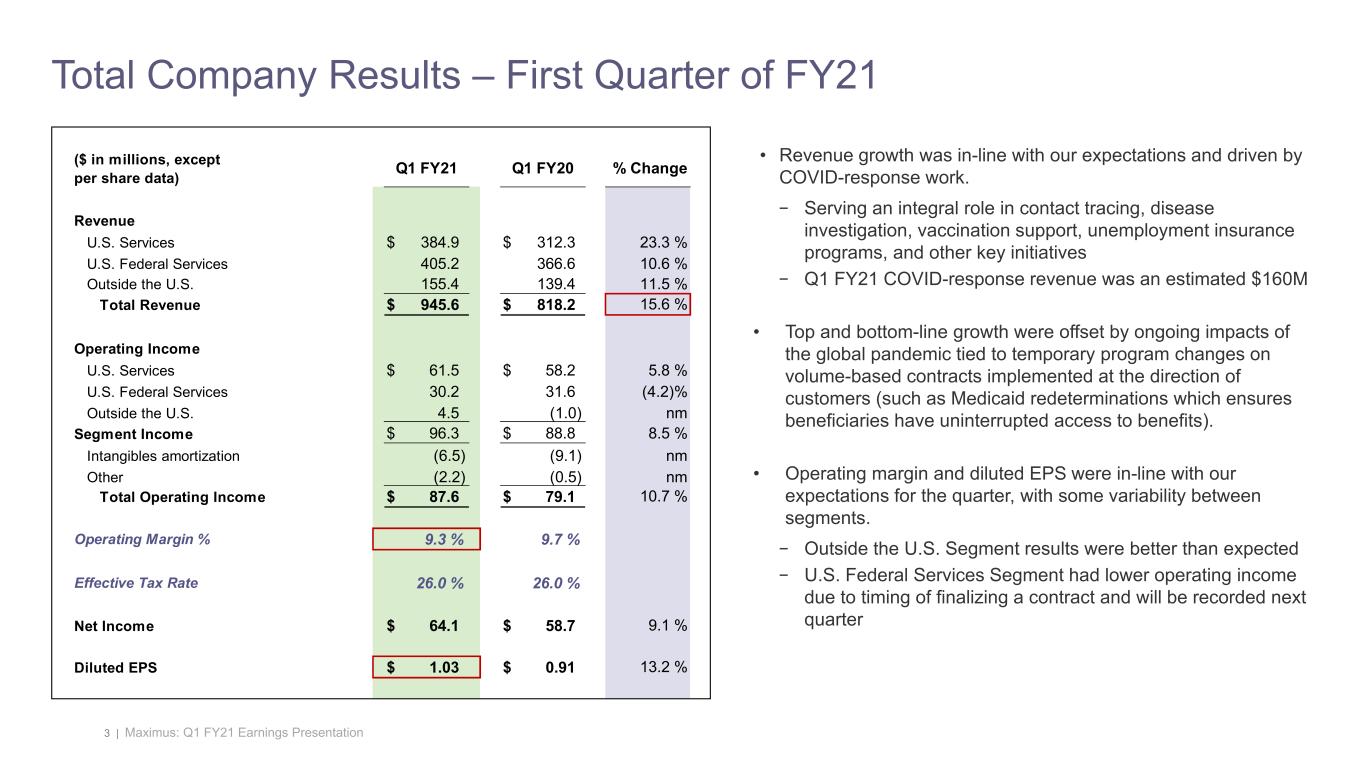
Revenue increased 15.6% to $945.6 million as compared to $818.2 million reported for the prior-year period, driven by new COVID-response work such as contact tracing, disease investigation, vaccination support, unemployment insurance program support, and other key initiatives.

Operating income margin was 9.3% and diluted earnings per share were $1.03. The Company continues to face unfavorable headwinds related to temporary changes on mature core programs resulting from the pandemic and offsetting the growth from new work.

Results for the quarter were ahead of consensus estimates, and in line with the Company's expectations, which put the Company on solid footing for the remainder of the year. As a result, the outlook for fiscal 2021 has improved, driven by recent awards, scope increases, and contract extensions. The Company is raising revenue and earnings guidance for fiscal 2021 with revenue expected to range between $3.400 billion and $3.525 billion and diluted earnings per share to range between $3.55 and $3.75 per share.

A quarterly cash dividend of $0.28 for each share of our common stock outstanding payable on February 26, 2021, to shareholders of record on February 12, 2021.

"Maximus is at the forefront of providing government much needed support in their efforts to control the spread and address the challenges of the global pandemic," shared Bruce Caswell, President and Chief Executive Officer. "Recently, we expanded our pandemic-response work with new contracts supporting vaccination administration efforts. We are proud that our customers rely on our proven agility and scalability in providing effective business process services under compressed timelines. As the new administration launches many initiatives, Maximus is uniquely positioned to further leverage our core capabilities in response to President Biden's commitment to public health, social welfare, and affordable healthcare. The ongoing value of partners like Maximus was evidenced over the last year through our ability to maintain continuity of vital programs, while also supporting new economic relief and public health initiatives to ensure that individuals and families continue to have access to needed services."

First Quarter Results
For the first quarter of fiscal 2021, revenue increased 15.6% to $945.6 million as compared to $818.2 million reported for the prior-year period driven by COVID-response work including contact tracing, disease investigation, vaccination support, unemployment insurance program support, and other key initiatives. Organic growth excluding the effects of currency for the first quarter of fiscal 2021 was 14.6%. COVID-response work contributed approximately $160 million in revenue for the period.


q2fy19earnings_image11a.jpg
As expected, revenue and earnings growth were offset by the ongoing impacts of the global pandemic tied to program changes on volume-based contracts which have been implemented at the direction of customers.

For the first quarter of fiscal 2021, operating income totaled $87.6 million, yielding an operating margin of 9.3%. This compares to 9.7% for the prior-year period. Results were in line with the Company's expectations but with some variability between the segments.

U.S. Services Segment
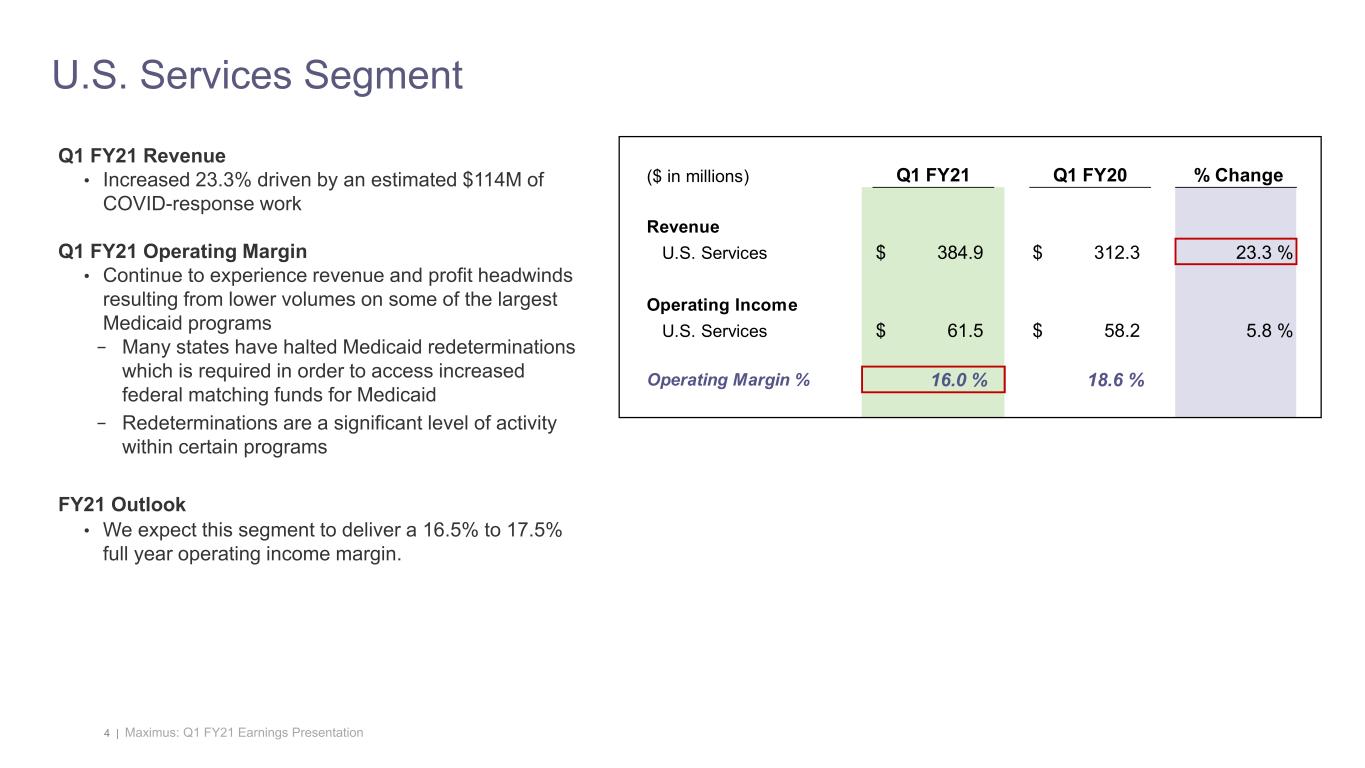
Revenue in the U.S. Services Segment for the first quarter of fiscal 2021 increased 23.3% to $384.9 million compared to $312.3 million reported for the prior-year period. An estimated $114 million of COVID-response work contributed to the segment's revenue.

Operating margin for the first quarter of fiscal 2021 was 16.0% compared to 18.6% reported for the prior-year period. As expected, margins were depressed by temporary program changes and lower revenue and profit from performance-based contracts as a result of the global pandemic.

There continues to be a significant revenue and profit headwind resulting from lower volumes on some of the Company's largest state Medicaid programs. State customers must adhere to certain conditions as they continue utilizing enhanced U.S. Federal matching funds for Medicaid. This includes pausing Medicaid redeterminations to ensure beneficiaries have continued access to vital healthcare services during the global public health crisis. Redeterminations are a significant level of activity within certain Medicaid programs.

U.S. Federal Services Segment
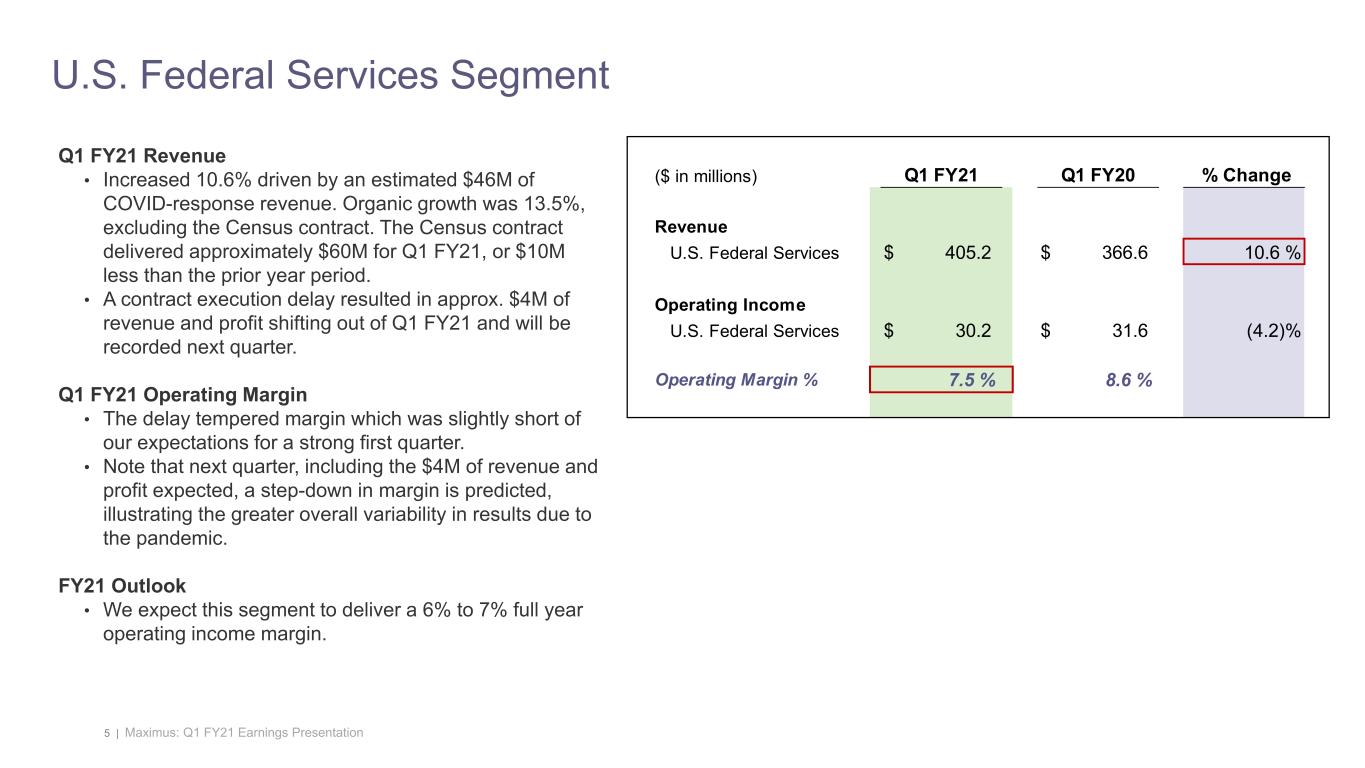
U.S. Federal Services Segment revenue for the first quarter of fiscal 2021 increased to $405.2 million compared to $366.6 million reported for the prior-year period. The Census contract contributed $60 million in the period compared to $70 million in the prior year period. Excluding the Census contract, organic growth for this segment was 13.5% and driven principally by an estimated $46 million of revenue from COVID-response work.

Due to a delay in executing a contract, approximately $4 million of revenue and profit was not recognized in the first quarter. Subsequent to December 31, 2020, the Company finalized the contract and will record revenue and profit in the second quarter of fiscal 2021.

As a result, operating margin for the first quarter of fiscal 2021 was 7.5% compared to 8.6% reported for the prior-year period, coming in slightly lower than the Company's expectations.

We continue to expect the segment to deliver operating margins in the range of 6% to 7% for fiscal 2021. Operating margin for the segment's second quarter of fiscal 2021 (including the $4 million of revenue and profit benefit) is expected to step down. The segment has been able to successfully backfill some of the temporary shortfalls created by reduced volumes, revenue, and profit from accretive, performance-based contracts with COVID-response work.

Outside the U.S. Segment
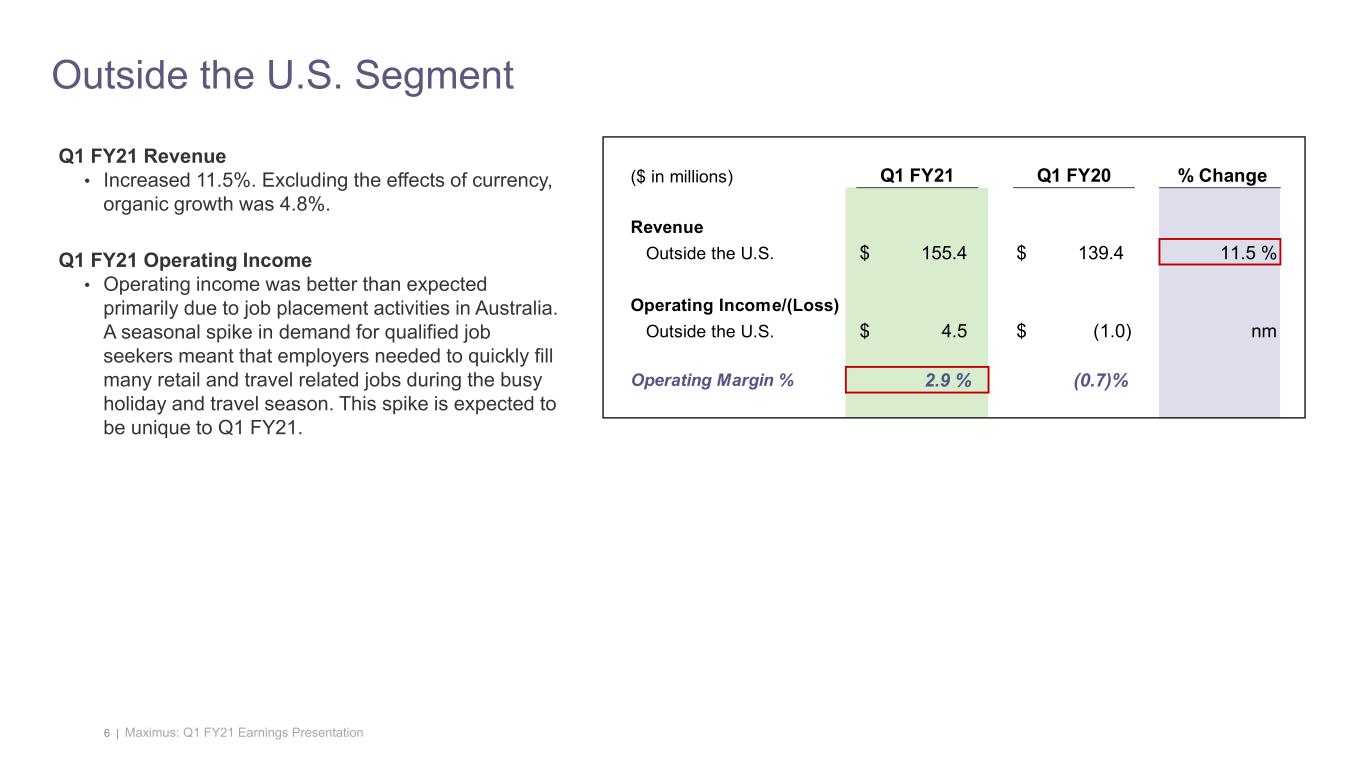
Outside the U.S. Segment revenue for the first quarter of fiscal 2021 increased 11.5% to $155.4 million compared to $139.4 million reported for the prior-year period. Organic growth excluding the effects of currency was 4.8%.

Operating income for the first quarter of fiscal 2021 was $4.5 million which yielded an operating margin of 2.9%. This compares to an operating loss of $1.0 million and an operating loss percentage of 0.7% reported for the prior-year period. The result was better than expected and primarily due to job placement activities in


q2fy19earnings_image11a.jpg
Australia driven by a seasonal spike in demand for qualified job seekers during the holiday season. The Company views this seasonal spike as unique to the first quarter in fiscal 2021.

Nevertheless, the Company is experiencing strong demand for employment services across all international operations. Volumes on current programs, most notably Australia, are expected to drive strong revenue growth in the second half of fiscal 2021. Expected new work in the segment will supplement this growth but this work will incur losses during the ramp up phase, with profit improvement as these new programs mature.

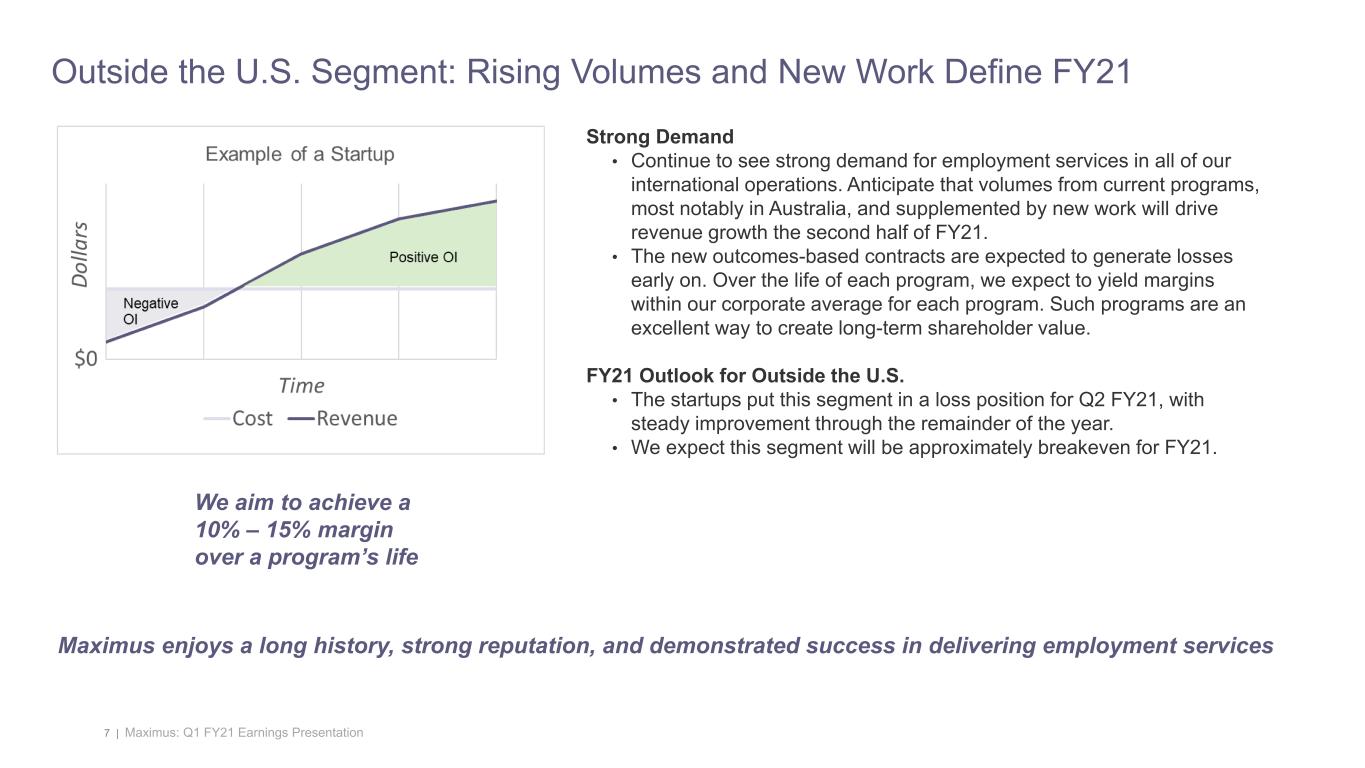
While the additional new employment services work will have a negative profit impact in the early stages, the new work is expected to yield solid operating margins over the life of each program. The Company expects these start-up programs will put the segment in a loss position in the second quarter, with steady improvement through the remainder of the year. The segment is expected to be approximately breakeven on an operating income basis for fiscal 2021.

Maximus enjoys a long history, strong reputation, and demonstrated success in delivering employment services. The investment is anticipated to position the segment for favorable economics over the life of the contracts, outweighing the temporary adverse impact in profit for the remainder of fiscal 2021.

Sales and Pipeline
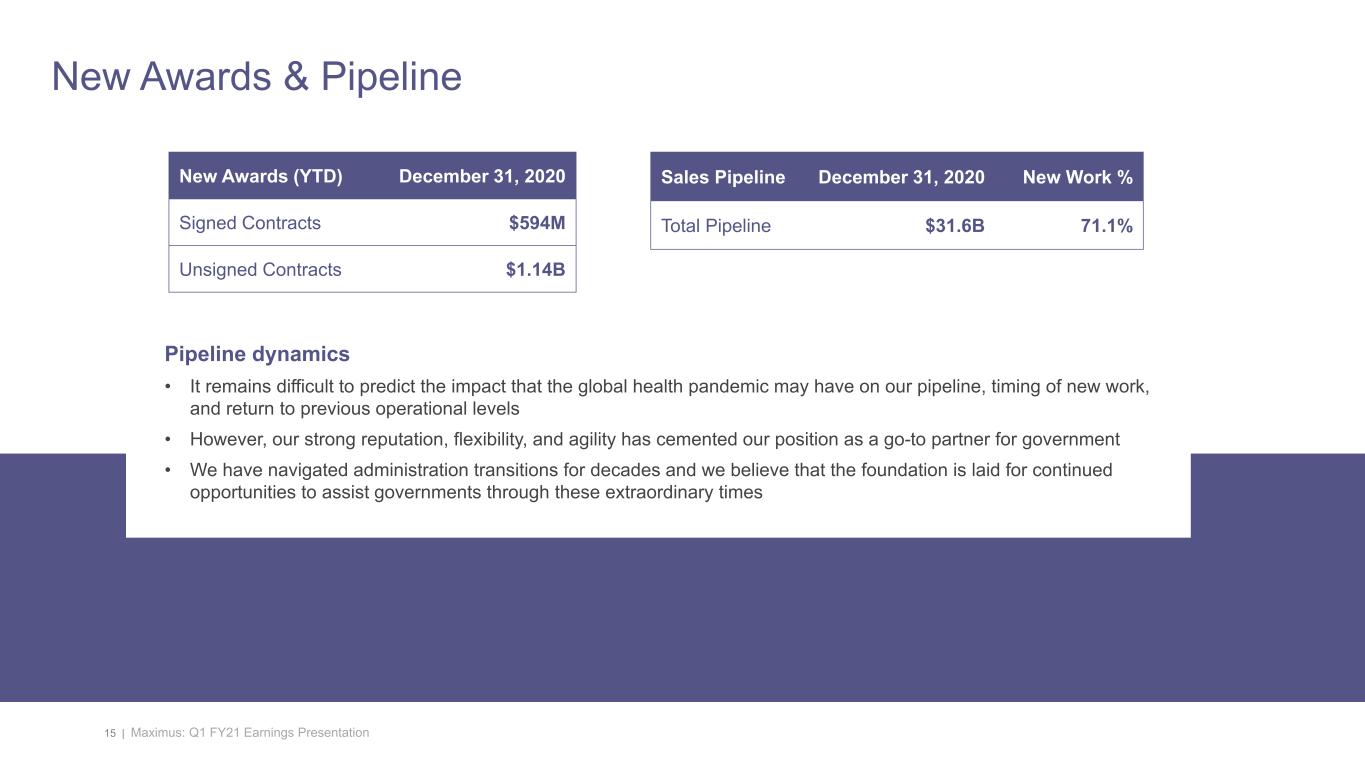
Year-to-date signed contract awards at December 31, 2020, totaled $594 million and contracts pending (awarded but unsigned) totaled $1.1 billion. These awards reflect total contract value.
The sales pipeline at December 31, 2020, was $31.6 billion (comprised of approximately $3.6 billion in proposals pending, $1.4 billion in proposals in preparation, and $26.7 billion in opportunities tracking).

Mr. Caswell continued, "I'm pleased that our new work pipeline continues to be strong, representing about 71% of the total pipeline. We have good opportunities across all three segments. For the COVID-response work, it's remarkable how quickly this work is being bid. Often, it enters our pipeline and then quickly exits as it becomes awarded."

Balance Sheet and Cash Flows
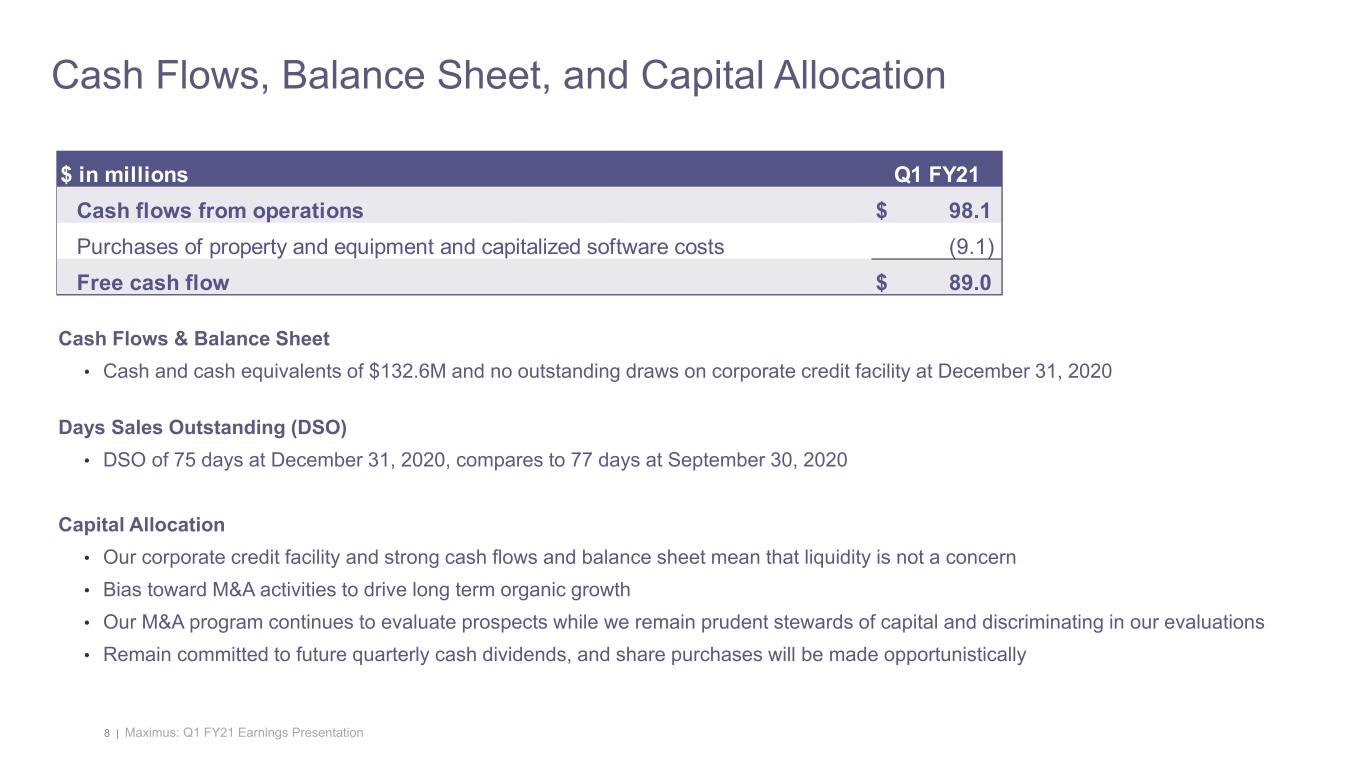
Cash and cash equivalents at December 31, 2020, totaled $132.6 million. There were no outstanding draws on the Company's corporate credit facility at the end of the first quarter of fiscal 2021.

For the three months ended December 31, 2020, cash from operations totaled $98.1 million and free cash flow was $89.0 million. Days sales outstanding (DSO) were 75 days at December 31, 2020 compared to 77 days at September 30, 2020.

On January 8, 2021, our Board of Directors declared a quarterly cash dividend of $0.28 for each share of our common stock outstanding. The dividend is payable on February 26, 2021, to shareholders of record on February 12, 2021.

Increased Outlook
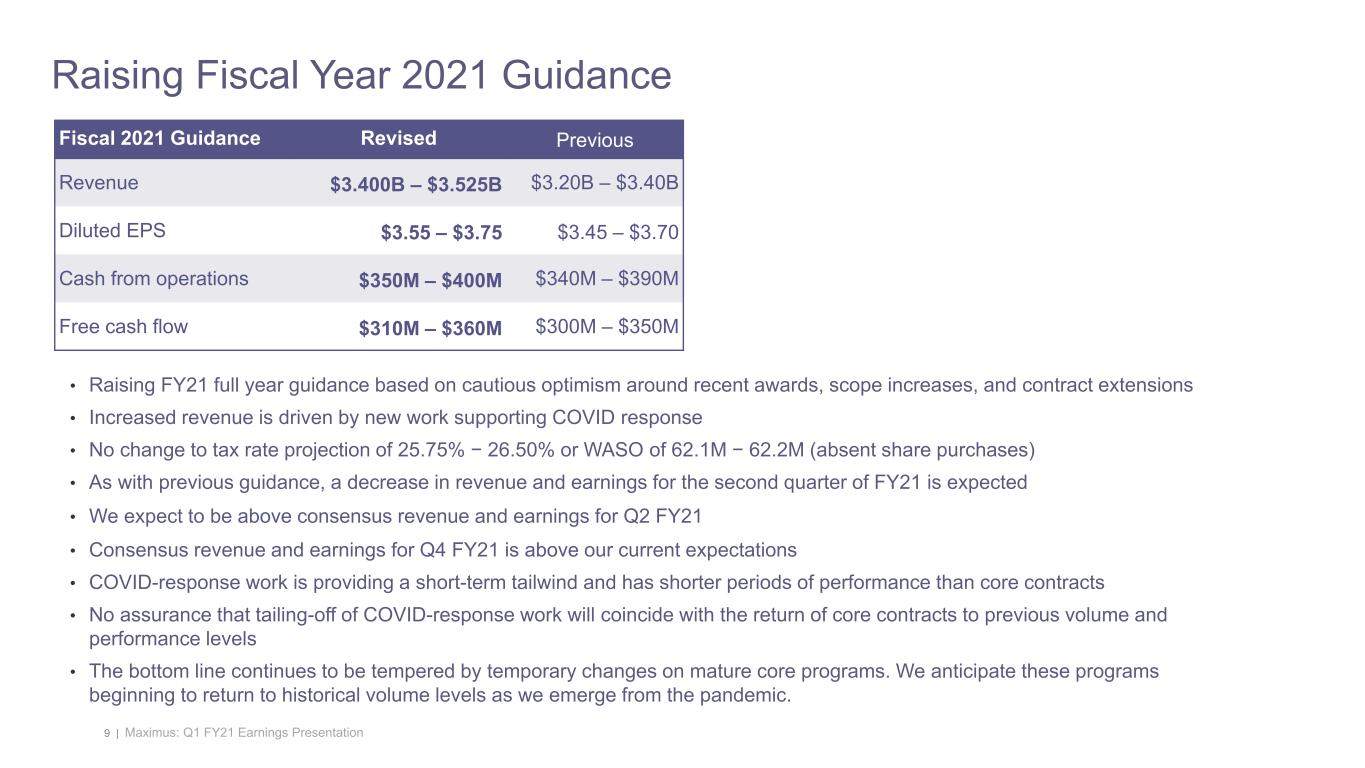
Maximus is increasing revenue, earnings, and cash flow guidance for fiscal 2021 following recent awards, scope increases, and contract extensions related to COVID-response work. The Company anticipates fiscal 2021 revenue will range between $3.400 billion and $3.525 billion and diluted earnings per share will range between $3.55 and $3.75 per share.


q2fy19earnings_image11a.jpg
Cash from operations are expected to range between $350 million and $400 million and free cash flow between $310 million and $360 million. Expectations for fiscal 2021 effective tax rate and weighted average shares remain unchanged from the November 19, 2020, earnings call.
The COVID-response work is providing a positive tailwind but it has shorter periods of performance than core contracts. As previously discussed, there is no assurance that the conclusion of positive impacts from COVID-response work will coincide with the return of core contracts to previous volume and performance levels.
Earnings continue to be impacted by unfavorable headwinds related to the pandemic and the temporary changes on mature core programs. The result has been a reduction in accretive revenue which continues to temper operating income margins and diluted earnings per share. The Company anticipates that as the world emerges from the pandemic, many of these programs will begin to return to historical volume levels.
Mr. Caswell added, "Maximus is well positioned to be a transformative partner for government. We offer scalable, cost-effective, and operationally efficient services for a wide range of government programs. We believe our portfolio mix of core business, near adjacencies, and new growth platforms will allow us to achieve a healthy growth trajectory for years to come. Our ability to quickly respond to unprecedented customer demand in the wake of the global health crisis further cements our unparalleled position as the partner of choice for critical government services delivery."
Conference Call and Webcast Information
Maximus will host a conference call this morning, February 4, 2021, at 9:00 a.m. (ET).

The call is open to the public and available by webcast or by phone at:
877.407.8289 (Domestic) / +1.201.689.8341 (International)

For those unable to listen to the live call, a recording of the webcast will be available on investor.maximus.com.

About Maximus
Since 1975, Maximus has operated under its founding mission of Helping Government Serve the People®, enabling citizens around the globe to successfully engage with their governments at all levels and across a variety of health and human services programs. Maximus delivers innovative business process management and technology solutions that contribute to improved outcomes for citizens and higher levels of productivity, accuracy, accountability, and efficiency of government-sponsored programs. With more than 34,000 employees worldwide, Maximus is a proud partner to government agencies in the United States, Australia, Canada, Italy, Saudi Arabia, Singapore, South Korea, Sweden, and the United Kingdom. For more information, visit maximus.com.


q2fy19earnings_image11a.jpg
Non-GAAP Measures
This release refers to non-GAAP measures and other indicators, including organic growth, free cash flow, and days sales outstanding.

A description of these non-GAAP measures, the reasons why we use and present them, and details as to how they are calculated are included in our Annual Report on Form 10-K.

The presentation of these non-GAAP numbers is not meant to be considered in isolation, nor as alternatives to cash flows from operations, revenue growth, or net income as measures of performance. These non-GAAP financial measures, as determined and presented by us, may not be comparable to related or similarly titled measures presented by other companies.

Statements that are not historical facts, including statements about the Company’s confidence and strategies, and the Company’s expectations about revenues, results of operations, profitability, future contracts, market opportunities, market demand, or acceptance of the Company’s products are forward-looking statements that involve risks and uncertainties such as those related to the impact of the pandemic including but not limited to:
The ultimate duration of the pandemic
The threat of further negative pandemic-related impacts
Delays in our core programs returning to normal volumes and operations
The potential impacts resulting from budget challenges with our government clients
The possibility of delayed or missed payments by customers
The potential for further supply chain disruptions impacting IT or safety equipment
The impact of further legislation and government policies on the programs we operate

These risks could cause the Company’s actual results to differ materially from those indicated by such forward-looking statements. A summary of risk factors can be found in Item 1A, "Risk Factors" in our Annual Report on Form 10-K for the year ended September 30, 2020, which was filed with the Securities and Exchange Commission on November 19, 2020 and found on maximus.com.


q2fy19earnings_image11a.jpg
Maximus, Inc.
CONSOLIDATED STATEMENTS OF OPERATIONS
(Amounts in thousands, except per share data)
(Unaudited)

Three Months Ended December 31,
20202019
Revenue$945,554 $818,229 
Cost of revenue739,499 642,779 
Gross profit206,055 175,450 
Selling, general and administrative expenses111,967 87,227 
Amortization of intangible assets6,516 9,088 
Operating income87,572 79,135 
Interest expense206 484 
Other (expense)/income, net(775)719 
Income before income taxes86,591 79,370 
Provision for income taxes22,514 20,636 
Net income$64,077 $58,734 
Basic earnings per share$1.03 $0.91 
Diluted earnings per share$1.03 $0.91 
Dividends paid per share$0.28 $0.28 
Weighted average shares outstanding:
Basic62,038 64,597 
Diluted62,135 64,758 


q2fy19earnings_image11a.jpg
Maximus, Inc.
CONSOLIDATED BALANCE SHEETS
(Amounts in thousands)
December 31, 2020September 30, 2020
(unaudited) 
ASSETS  
Current assets: 
Cash and cash equivalents$132,597 $71,737 
Accounts receivable — billed and billable, net of allowance of $6,579 and $6,051662,059 622,871 
Accounts receivable — unbilled120,764 163,332 
Income taxes receivable2,472 2,075 
Prepaid expenses and other current assets68,935 72,543 
Total current assets986,827 932,558 
Property and equipment, net62,548 66,721 
Capitalized software, net40,434 38,033 
Operating lease right-of-use assets165,448 177,159 
Goodwill595,927 593,129 
Intangible assets, net140,484 145,893 
Deferred contract costs, net21,294 20,891 
Deferred compensation plan assets42,350 36,819 
Deferred income taxes222 1,915 
Other assets10,699 11,584 
Total assets$2,066,233 $2,024,702 
LIABILITIES AND SHAREHOLDERS’ EQUITY 
Current liabilities: 
Accounts payable and accrued liabilities$266,038 $253,338 
Accrued compensation and benefits93,443 137,101 
Deferred revenue58,307 51,655 
Income taxes payable22,685 5,377 
Current portion of long-term debt and other borrowings14,159 10,878 
Operating lease liabilities72,482 80,748 
Other current liabilities20,286 22,071 
Total current liabilities547,400 561,168 
Deferred revenue, less current portion27,428 27,311 
Deferred income taxes24,417 24,737 
Long-term debt, less current portion18,481 18,017 
Deferred compensation plan liabilities, less current portion45,304 38,654 
Operating lease liabilities, less current portion95,678 104,011 
Other liabilities9,214 8,985 
Total liabilities767,922 782,883 
Shareholders’ equity: 
Common stock, no par value; 100,000 shares authorized; 61,452 and 61,504 shares issued and outstanding at December 31, 2020, and September 30, 2020, respectively520,357 513,959 
Accumulated other comprehensive loss(35,715)(42,638)
Retained earnings813,669 770,498 
Total shareholders' equity1,298,311 1,241,819 
Total liabilities and shareholders' equity$2,066,233 $2,024,702 


q2fy19earnings_image11a.jpg
Maximus, Inc.
CONSOLIDATED STATEMENTS OF CASH FLOWS
(Amounts in thousands)
(Unaudited)
Three Months Ended
December 31,
20202019
Cash flows from operations:  
Net income$64,077 $58,734 
Adjustments to reconcile net income to cash flows from operations:  
Depreciation and amortization of property, equipment and capitalized software11,817 15,318 
Amortization of intangible assets6,516 9,088 
Deferred income taxes1,298 422 
Stock compensation expense6,062 5,397 
Change in assets and liabilities, net of effects of business combinations 
Accounts receivable — billed and billable(35,729)(31,016)
Accounts receivable — unbilled43,538 2,013 
Prepaid expenses and other current assets4,893 4,063 
Deferred contract costs(205)848 
Accounts payable and accrued liabilities11,199 2,403 
Accrued compensation and benefits(35,682)6,842 
Deferred revenue5,757 (1,345)
Income taxes16,947 13,984 
Operating lease right-of-use assets and liabilities(4,927)(1,622)
Other assets and liabilities2,554 2,138 
Cash flows from operations98,115 87,267 
Cash flows from investing activities:  
Purchases of property and equipment and capitalized software costs(9,094)(10,487)
Other(159)25 
Cash used in investing activities(9,253)(10,462)
Cash flows from financing activities:  
Cash dividends paid to Maximus shareholders(17,207)(17,913)
Purchases of Maximus common stock(3,363)(1,898)
Tax withholding related to RSU vesting(9,818)(10,614)
Borrowings of debt147,852 83,419 
Repayment of debt(146,188)(86,301)
Other(2,763)(493)
Cash used in financing activities(31,487)(33,800)
Effect of exchange rate changes on cash, cash equivalents, and restricted cash3,882 1,452 
Net increase in cash, cash equivalents, and restricted cash61,257 44,457 
Cash, cash equivalents, and restricted cash, beginning of period88,561 116,492 
Cash, cash equivalents, and restricted cash, end of period$149,818 $160,949 


q2fy19earnings_image11a.jpg
Maximus, Inc.
SEGMENT INFORMATION
(Amounts in thousands)
(Unaudited)
Three Months Ended December 31,
2020% (1)2019% (1)
Revenue:
U.S. Services$384,934 $312,281 
U.S. Federal Services405,245 366,571 
Outside the U.S.155,375 139,377 
Total$945,554 $818,229 
Gross Profit:
U.S. Services$99,002 25.7 %$89,590 28.7 %
U.S. Federal Services82,496 20.4 %70,821 19.3 %
Outside the U.S.24,557 15.8 %15,039 10.8 %
Total$206,055 21.8 %$175,450 21.4 %
Selling, general, and administrative expense:
U.S. Services$37,456 9.7 %$31,398 10.1 %
U.S. Federal Services52,252 12.9 %39,239 10.7 %
Outside the U.S.20,032 12.9 %16,053 11.5 %
Other (2) 2,227 NM537 NM
Total$111,967 11.8 %$87,227 10.7 %
Operating income:
U.S. Services$61,546 16.0 %$58,192 18.6 %
U.S. Federal Services30,244 7.5 %31,582 8.6 %
Outside the U.S.4,525 2.9 %(1,014)(0.7)%
Amortization of intangible assets(6,516)NM(9,088)NM
Acquisition-related expenses(1,873)NM— NM
Other (2) (354)NM(537)NM
Total$87,572 9.3 %$79,135 9.7 %

(1)    Percentage of respective segment revenue. Percentages not considered meaningful are marked “NM.”

(2)    Other selling, general, and administrative expenses includes credits and costs that are not allocated to a particular segment.


q2fy19earnings_image11a.jpg
Maximus, Inc.
FREE CASH FLOW
(Non-GAAP measure)
(Amounts in thousands)
(Unaudited)

 Three Months Ended December 31,
20202019
Cash flows from operations$98,115 $87,267 
Purchases of property and equipment and capitalized software costs(9,094)(10,487)
Free cash flow $89,021 $76,780 


-XXX-

Maximus Fiscal 2021 First Quarter Earnings Call February 4, 2021 Page 1 of 15 Operator Greetings, and welcome to the Maximus fiscal 2021 first-quarter conference call. At this time, all participants are in a listen-only mode. A brief question-and-answer session will follow the formal presentation. If anyone should require operator assistance during the conference, please press "*" "0" on your telephone keypad. As a reminder, this conference is being recorded. It is now my pleasure to introduce your host Lisa Miles, Senior Vice President of Investor Relations for Maximus. Thank you, Ms. Miles. You may begin. Lisa Miles Good morning and thank you for joining us today. With me is Bruce Caswell, President and Chief Executive Officer, and Rick Nadeau, Chief Financial Officer. I’d like to remind everyone that a number of statements being made today will be forward-looking in nature. Please remember that such statements are only predictions. Actual events and results may differ materially as a result of the risks we face, including those discussed in Item 1A of our Annual Report on Form 10-K. We encourage you to review the information contained in our earnings release today and our most recent Forms 10-Q and 10-K filed with the SEC. The company does not assume any obligation to revise or update these forward-looking statements to reflect subsequent events or circumstances, except as required by law. Today’s presentation may contain non-GAAP financial information. Management uses this information in its internal analysis of results and believes this information may be informative to investors in gauging the quality of our financial performance, identifying trends in our results, and providing meaningful period-to-period comparisons. For a reconciliation of the non-GAAP measures presented in this document, please see the company’s most recent quarterly earnings press release. And with that, I’ll hand the call over to Rick. Rick Nadeau Thank you, Lisa. This morning, Maximus reported revenue for the first quarter of fiscal 2021, which increased 15.6% to $945.6 million. Revenue for the first quarter was in line with our expectations. Our revenue growth was principally driven by new work related to the COVID pandemic response, where Maximus continues to play an integral role in contact tracing, disease investigation, vaccination support, unemployment insurance programs, and other key initiatives. For the first quarter of fiscal 2021, our COVID response work contributed approximately $160 million in revenue. As expected, top and bottom-line growth were offset by ongoing


Maximus Fiscal 2021 First Quarter Earnings Call February 4, 2021 Page 2 of 15 impacts of the global pandemic tied to program changes on volume-based contracts that were implemented at the direction of our customers. As we discussed last quarter, these changes, including halting Medicaid redeterminations in the United States, are designed to ensure that beneficiaries have uninterrupted access to vital government benefits during this global health crisis. Total company operating margin was 9.3% for the first quarter of fiscal 2021. Diluted earnings per share were $1.03 per share. Both operating margin and earnings were in line with our expectations with some variability by segment. Our operations outside the United States delivered results favorable to our expectations, which offset lower operating income from the U.S. Federal Segment due to the timing of finalizing a contract, which will now be recorded in the second quarter. Let me review segment financial results in our typical order starting with U.S. services. First- quarter revenue in the U.S. Services Segment increased 23.3% to $384.9 million. While revenue growth was driven by an estimated $114 million of COVID response work, the operating margin was depressed by temporary program changes and lower revenue from performance-based contracts as a result of the global pandemic. Operating margin for the U.S. Services Segment was 16% for the first quarter. As discussed last quarter, we continue to experience a significant revenue and profit headwind resulting from lower volumes on some of our largest Medicaid programs. As a reminder, many state customers are currently utilizing enhanced U.S. federal matching funds for Medicaid. However, they must adhere to certain conditions, including a pause in Medicaid redeterminations to ensure beneficiaries have continued access to vital healthcare services during the global public health crisis. Those redeterminations are a significant level of activity within certain programs we operate. Our full-year expectations for the U.S. Services Segment remain unchanged with a 16.5% to 17.5% full-year margin predicted. Revenue for the first quarter of fiscal 2021 for the U.S. Federal Services Segment increased 10.6% to $405.2 million. The census contract contributed $60 million, which was $10 million less than the prior year. Excluding the census contract, organic growth for this segment was 13.5% and driven principally by an estimated $46 million of revenue from COVID response work as we continue to provide needed support to government in responding to the pandemic. This includes work with the IRS supporting the CARES Act, which as a reminder, is the first time the IRS has used contracted agents on this large of a scale. The U.S. Federal Services Segment had approximately $4 million of revenue and profit shift out of the first quarter due to a delay in executing a contract. It has been signed, and we will record the benefit in the second quarter of fiscal 2021.


Maximus Fiscal 2021 First Quarter Earnings Call February 4, 2021 Page 3 of 15 The operating margin was 7.5%, which was slightly short of our expectations for a strong first quarter in this segment. Our full-year expectations for the U.S. Federal Services Segment remained the same with a 6% to 7% full-year margin predicted. Looking to the second quarter, including the aforementioned $4 million of revenue and profit we will recognize, the segment's margin is expected to step down. This illustrates how we continue to have more overall variability in results due to the pandemic. We are pleased to have secured COVID response work to backfill some of the temporary shortfalls created by reduced volumes, revenue, and profit from accretive performance-based contracts. Revenue for the first quarter of fiscal 2021 for the Outside the U.S. Segment increased 11.5% to $155.4 million. Organic growth excluding the effects of currency was 4.8%. Operating income for the segment in the first quarter of fiscal 2021 was positive $4.5 million for an operating margin of 2.9%. The better than expected result for the quarter was primarily due to job placement activities in Australia, driven by a seasonal spike in demand for qualified job seekers. As Australia started to emerge from the pandemic during our first quarter, employers needed to quickly fill many retail and travel-related jobs during the busy holiday and travel season. The Australian team did an extraordinary job in successfully managing this influx of demand, but we view this seasonal spike as unique to the first quarter of fiscal 2021. We continue to see strong demand for employment services in all of our international operations. We have had positive developments since our last earnings call related to increasing demand and rising volumes for employment services. We anticipate that volumes from current programs, most notably in Australia and supplemented by new work, will drive revenue growth in the second half of fiscal 2021. It is important to note that the new work consists of outcomes-based arrangements for employment services. They are designed to ensure that contractors can be held accountable and incentivized to achieve the job placement and retention outcomes that matter to government. This new employment services work drives our revenue estimates upward, but these programs are expected to generate losses in their early stages. However, we target operating margins within our desired corporate average over the life of such programs. We presently estimate that these startups will put the Outside the U.S. Segment in a loss position in the second quarter with steady improvement through the remainder of the year. We now expect that the segment will be approximately breakeven for fiscal 2021. Maximus enjoys a long history, strong reputation, and demonstrated success in delivering employment services. We believe the investment required will position us for favorable economics over the life of the contracts, which outweighs the temporary adverse impact in profit for the remainder of


Maximus Fiscal 2021 First Quarter Earnings Call February 4, 2021 Page 4 of 15 fiscal 2021. We believe such programs are a good avenue to create substantial long-term shareholder value. Let me turn to cash flow items and the balance sheet. We had no draws on our corporate credit facility at December 31, 2020, and $132.6 million of cash and cash equivalents. Cash from operations and free cash flow of $98.1 million and $89 million respectively were strong and contributed to our already strong balance sheet. DSO was 75 days at December 31, 2020, compared to 77 days at September 30, 2020. Let me touch briefly on capital allocation. While we generally operate under an essential provider designation, we remain aware of budget pressures impacting our customers. However, with our corporate credit facility and the aforementioned strong cash flows and balance sheet, liquidity is not a concern. We continue to have a bias toward M&A as a means to drive long-term organic growth. Our M&A program continues to evaluate prospects while we remain prudent stewards of capital and selective in our evaluations. Our strong balance sheet and good cash from operations provides us good access to capital to fund acquisitions. We remain committed to future quarterly cash dividends and share purchases will continue to be made opportunistically. While it is still early in the year, recent awards, scope increases, and contract extensions have provided us with cautious optimism as we consider our full-year guidance. As a result of these positive developments, we are raising our full-year guidance for fiscal 2021. For the full year, we expect revenue will now range between $3.4 billion and $3.525 billion for fiscal 2021, driven by new work in support of government’s ongoing response to COVID. Additionally, we expect diluted earnings per share will range between $3.55 and $3.75 for fiscal 2021. Our fiscal 2021 cash from operations are projected to now be between $350 million and $400 million and free cash flow between $310 million and $360 million. Our expectations for our effective income tax rate is between 25.75% and 26.5% and for weighted average shares to be between 62.1 million and 62.2 million. As we have long said, we often experience fluctuations in our quarterly financial results, which has only been exacerbated by the pandemic. However, the management team aims to provide as much transparency into our work as reasonably possible. So based on what we know today, we still expect a decrease in revenue and earnings for the second quarter of fiscal 2021 compared to the first quarter. Current second-quarter consensus estimates show revenue of $773 million and diluted earnings per share of $0.73. At the present time, we expect to be above consensus revenue and earnings estimates for the second quarter. Consequently, fourth-quarter consensus revenue of $875 million and diluted earnings per share of $1.02 are above our current expectations.


Maximus Fiscal 2021 First Quarter Earnings Call February 4, 2021 Page 5 of 15 While the new COVID response work is providing a short-term positive tailwind, it has shorter periods of performance than our core contracts. As we have cautioned previously, there is no assurance that the tailing off of the positive impacts of the COVID response work will coincide with the return of our core contracts to previous volume and performance levels. Our bottom line continues to be somewhat tempered by unfavorable headwinds related to the pandemic and the temporary changes on mature core programs, most notably in the United States and United Kingdom. The result has been a reduction in accretive revenue, which continues to temper operating income margins and diluted earnings per share. We anticipate that as we emerge from the pandemic, many of these programs will begin to return to historical volume levels. Factors, such as the end of the Public Health Emergency Declaration in the United States and when we resume face-to-face assessments in the United Kingdom, are particularly important to the pattern of expected recovery. The effects of budget challenges, further relief packages, and other changes in policies or legislation are some, but not necessarily all, factors that can impact our assumptions for fiscal 2021 and beyond. I would like to end by saying that Bruce and I are proud of the team at Maximus for remaining on track to deliver solid performance this fiscal year. Following the outbreak of COVID, there were many unknowns that we had to work through. Unknowns remain and we are not free from the impacts of the pandemic, but we have a solid footing, which gave us the confidence to raise guidance. And with that, I will turn the call over to Bruce. Bruce Caswell Thank you, Rick, and good morning, everyone. Last month, Maximus announced the planned retirement of our friend and trusted colleague, Rick Nadeau. While we still have a few more earnings calls before his departure. I wanted to say that it has been an absolute privilege to work alongside Rick for these many years. And I wanted to thank him for his endless commitment and invaluable contributions during his time at Maximus. David Mutryn, Senior Vice President of Finance, will assume the role of CFO effective December 1, 2021. I look forward to working with both Rick and David over the next nine months as we continue to execute our corporate strategy. With the election of President Biden, we’re cautiously optimistic regarding the stated policy initiatives from the administration and the potential favorable tailwinds that may be created for companies like Maximus. The administration has already taken actions to increase access to affordable insurance for Americans through the Affordable Care Act and Medicaid.


Maximus Fiscal 2021 First Quarter Earnings Call February 4, 2021 Page 6 of 15 Over the course of the administration, we will likely see a meaningful increase in funding for social welfare programs, and of course, public health programs. Improving access to affordable healthcare is a top priority of the Biden administration. And the President has advocated building upon the Affordable Care Act, among other measures, to broaden coverage options for Americans. Additionally, as we navigate through the pandemic, we believe we will see further policy initiatives that strengthen the public health infrastructure and a corresponding effort to more broadly support vulnerable populations. President Biden has already expressed intent to tackle these challenges, and indeed many of his early executive orders look to expand the public health workforce to provide vital services to individuals. Our results this morning illustrate that Maximus is well-positioned to help government add capacity and address critical public health needs now and into the future. While it’s still early days in the Biden administration, we’re cautiously optimistic that the areas we have seen emphasized thus far will be reflected in subsequent budget and legislative priorities that set the stage for capitalizing on opportunities to partner with government in helping to achieve their policy initiatives. Our COVID response work is a prime example of the demonstrated value of our services and the relationships we’ve developed with our clients. In a time of unprecedented challenges, we are grateful to have earned the opportunity to provide needed assistance. These contracts have served as a revenue driver, offsetting some of the unfavorable impacts on operations that are experiencing a pandemic-related temporary slowdown or pause. Initially, our COVID works centered around more immediate pandemic-driven needs, such as contact tracing, disease investigation, and unemployment insurance programs. Our work has expanded as government demand has increased into new areas. We launched efforts to support states in responding to public questions about vaccination registration, scheduling, and administration quickly, efficiently, and equitably. We have hired several thousand employees to support these state and local efforts. At the federal level, as you know, we also operate the CDC helpline known as CDC info. We recently added another 150 individuals as we scale up our operations yet again to answer questions regarding vaccinations. Supporting several states and the CDC, we are the most experienced government partner in the market to provide vaccine administration citizen services. Additionally, our U.S. Federal Services Segment scaled up to 3,200 agents from 1,500 to support the IRS with the next round of the economic incentive payments. Further, in order to improve the user experience and drive efficiency, we implemented our interactive virtual agent system in response to the increased demand.


Maximus Fiscal 2021 First Quarter Earnings Call February 4, 2021 Page 7 of 15 As Rick noted, we’re also experiencing increased demand for our employment support services around the globe. The economic impacts of the global pandemic have left many unemployed and in need of vital support in finding work. It’s important to remember that the pace at which different countries are emerging from the pandemic varies widely. Some countries have progressed further in managing the spread of the pandemic and are now turning their attention to tackling the many residual challenges, including the economy and unemployment. Maximus has a proven track record in delivering employment services and an earned reputation as a trusted long-term partner who delivers outcomes that matter. Our continued investments support our position as a partner of choice over the long-term, outweighing any temporary and short-term profit impacts in fiscal year 2021. While the COVID work itself is comparatively short- term in nature, crisis support itself has a longer trajectory. While this pandemic was certainly unprecedented this is not our first nor our last call to action in a time of public health or economic crisis. We will continue to be there to support our clients and citizens in times of need with critical services and solutions. Our work is portable, adaptable from agency to agency and department to department, whether it’s the IRS, CDC, FEMA, state health departments, or others around the world. We adapt from crisis to crisis, whether a global health pandemic, a natural disaster, or economic challenges. Along with the launch of Maximus Public Health, we view our capabilities in contingency planning for our government customers and the rapid implementation of citizen assistance services as a core competency and elemental to the long-term relationships that underpin our business. Looking outside of the pandemic, I’ve previously talked about our solutions that are authorized under the federal risk and authorization management program or FedRAMP. Our FedRAMP certifications meet the most stringent security requirements of federal agencies, as we aim to deliver innovative and cost-effective cloud-based solutions that support mission objectives and provide the highest quality citizen services, thereby transforming the user experience. We fielded a survey of government technology leaders across federal, state, and local agencies to gain insights about where agencies are in their cloud adoption journey and how they perceive the use of FedRAMP-authorized cloud solutions to support their modernization and transformation initiatives. The vast majority of respondents recognized benefits from moving to a FedRAMP-authorized solution beyond adhering to mandates. This survey further affirmed our solid positioning to provide a range of FedRAMP secure cloud solutions, as well as our clients' demand for this service.


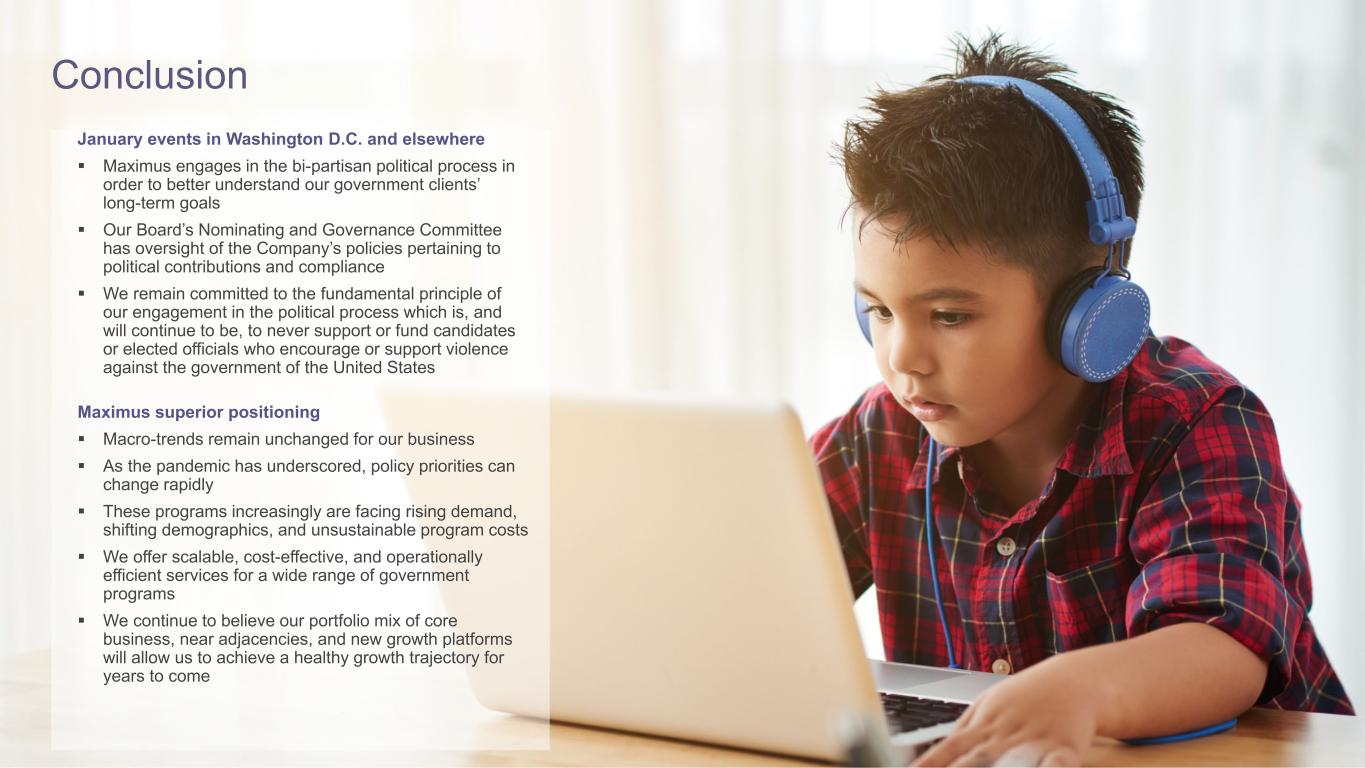
Maximus Fiscal 2021 First Quarter Earnings Call February 4, 2021 Page 8 of 15 I will now turn to new awards and pipeline as of December 31. For the first quarter of fiscal 2021, signed awards were $594 million of total contract value at December 31. Further, at December 31, there were another $1.14 billion worth of contracts that had been awarded, but not yet signed. Let’s turn our attention to our pipeline of addressable sales opportunities. Our total contract value pipeline at December 31 was $31.6 billion compared to $33.0 billion reported in the fourth quarter of fiscal 2020. Of our total pipeline and sales opportunities, 71.1% represents new work. I want to reiterate the continued difficulty in predicting the impact that the global health pandemic may have on our pipeline, timing of new work, and return to previous operational levels. However, our strong reputation, flexibility, and agility has cemented our position as a go-to partner for government. We have navigated administration transitions for decades, and we firmly believe that the foundation is laid for continued opportunities to assist governments through these extraordinary times. I wanted to wrap up my comments today, reflecting on the events and protests that occurred in January at the U.S. Capitol in Washington, D.C., and in other areas of the country. Like many of you, I was shocked and saddened by these events. Maximus engages in the bi-partisan political process in order to better understand our government clients’ long-term goals. Our Board’s Nominating and Governance Committee has oversight of the company’s policies pertaining to political contributions and compliance. We remain committed to the fundamental principle of our engagement in the political process, which is, and will continue to be, to never support or fund candidates or elected officials who encourage or support violence against the government of the United States. And one final note, before we open it up for questions, the macro trends for our business remain unchanged. As the pandemic has underscored, governments around the world need better solutions to deliver on policy priorities that can change rapidly. Social welfare programs that reflect long-term societal commitments and priorities increasingly face rising demand, shifting demographics, and unsustainable program costs. Maximus is well-positioned to address these challenges and be a transformative partner. We offer scalable, cost-effective, and operationally efficient services for a wide range of government programs. We continue to believe our portfolio mix of core business, near adjacencies, and new growth platforms will allow us to achieve a healthy growth trajectory for years to come. And with that, we will open the line for Q&A. Operator?


Maximus Fiscal 2021 First Quarter Earnings Call February 4, 2021 Page 9 of 15 Operator Thank you. We will now be conducting a question and answer session. If you would like to ask a question, please press "*" "1" on your telephone keypad. A confirmation tone will indicate that your line is in the question queue. You may press "*" "2" if you would like to remove your question from the queue. We ask that you limit your follow-up questions to one so that others may have an opportunity to ask questions. You may re-enter the queue by pressing "*" "1". For participants using speaker equipment, it may be necessary to pick up your handset before pressing the "*" keys. One moment please, while we poll for questions. Thank you. Our first question is from Brendan Popson with CJS Securities. Please proceed with your question. Brendan Popson Good morning. I just want to ask real quick on the draft is out on the CCO that it started the draft RFP for 1-800-Medicare and just any surprises there or any thoughts on that? Bruce Caswell Hey, Brendan. It’s Bruce. Good morning and thanks for the question. Yes, we’re pleased to see that that procurement is progressing and really first schedule and to see the RFP. And I would just offer you two notes. One is the scope of services that are collected in the RFP is consistent with the current scope of services and work that we do for CMS. And secondly, it remains a single award procurement, which we think is a reflection of the comfort that CMS has had in administrating the contract with a single vendor and their intent to do so going forward. Any other questions? Brendan Popson Great. Thank you. Yes, just a follow-up. You talked about some in the prepared comments with the new administration coming in but could you provide any detail, you know, any more color or detail on the impact of recent executive orders from the new administration and any new opportunities or even just expanded opportunities on what you currently do? Bruce Caswell Sure, Brendan. Let me give you a little more color. Interestingly, there was an executive order that obviously was created very early in the process here to reopen healthcare.gov on for what’s known as a special enrollment period or SEP, and that will take place between February 15 and May 15. As you likely know, individuals can already purchase policies at healthcare.gov outside of the open enrollment period when they have certain qualifying life events, but this special enrollment period is adjacent now to a just-ended open enrollment period and it seeks to provide access to individuals who would otherwise not qualify with qualifying life events during this time.


Maximus Fiscal 2021 First Quarter Earnings Call February 4, 2021 Page 10 of 15 Because of its proximity to the recently ended open enrollment period, the pool of potential enrollees is likely smaller than if it were to have occurred later. However, that means it’ll be – really, the uptake will be a function of outreach and advertising and awareness efforts. And we note that HHS is committing $50 million to such efforts. As I was reading a bit more about this, the Kaiser Family Foundation estimates that nearly nine million of the remaining uninsured Americans could qualify for free or subsidized coverage under this special enrollment period, and there’s an additional six million that could qualify for unsubsidized coverage. So again, marketing and advertising is going to be critical. From a state perspective, state-based marketplaces, and I make this note because, as you’re aware, we have the privilege of providing call center support for the federal marketplace and the states that remain on that also for a number of state customers. States are encouraged but not required to offer similar special enrollment periods, and many are going ahead and doing that. So what does it mean for Maximus? We think that given all of these dynamics, the guidance range that we’ve established that Rick spoke to in his prepared remarks likely covers the potential tailwinds that could be created from the executive orders. And obviously, the effects of efforts to increase marketing and advertising and so forth will go well beyond the May end date of this special enrollment period and likely would manifest themselves in higher volumes of enrollment in the next open enrollment period in the fall. Hope that helps. Brendan Popson Okay, great. Thank you for the detail. Appreciate it. Lisa Miles Thanks, Brendan. Next question, please. Operator Our next question is with Richard Close from Canaccord Genuity. Please proceed with your question. Richard Close Great. Can you hear me, okay, first of all? Bruce Caswell Just fine Richard. Hope you’re doing well. Richard Close I am. Thank you. Rick, congratulations. Looking forward to the next couple of quarters with you or three quarters, but congratulations on the retirement.


Maximus Fiscal 2021 First Quarter Earnings Call February 4, 2021 Page 11 of 15 Rick Nadeau Thank you. Richard Close So Rick, first just a quick housekeeping, and I appreciate the information with respect to the census and COVID, but the 13.5% organic growth in federal, unless I’m doing the math wrong, if I backed out the $60 million per census this year and the $70 million for last year I’m getting like a 16.4% organic growth number, not taking into account the COVID. But am I missing something there? Is there an acquisition or something else that you’re backing out to get to the 13.5%? Rick Nadeau Yes. A good question. Yes, we’re backing out the effects of that CQA contract. That’s about 4.4%. The organic growth from other contracts is 12.5%. And the disposal of the businesses is 0.4%. So, all of that together is a 16.5% change. Richard Close Okay. Rick Nadeau And Richard, we’re going to file our Form 10-Q right after this call, and those calculations are in the MD&A. We actually roll forward from the—, and we do it by segment, we do a roll-forward of the three months revenue ended December 31, 2019, to three months ended December 31, 2020. And we’ll show you the effect of the CQA contract, which I think you’re basically right. It was 60 70 so about a reduction of $9.6 million and then the amount of the disposal of the business, that’s a business that we had a potential conflict of interest or a perceived conflict of interest with other work that we were bidding and we were asked to dispose of it, with the rest of it being organic. Richard Close Okay, great. I just figured there were some other moving parts in there. I wanted to talk a little bit about the redeterminations; obviously, Secretary Azar extended the public emergency, I think into April, I’m not sure the specific date there, but then there was also speculation from the Biden administration, I think there was a letter sent to some individuals about maybe extending the public health emergency through 2021. So I’m curious your thoughts on redeterminations, whether if the emergency does get extended are there opportunities that the states, they’re getting the FMAP funding, but is there opportunities where redeterminations begin, or would they be extended all the way into 2022?


Maximus Fiscal 2021 First Quarter Earnings Call February 4, 2021 Page 12 of 15 Bruce Caswell So, Richard, I’m going to pick that up in just a second, but first, I wanted to return to Rick so he could clarify something from your prior question and then we'll answer that. Rick Nadeau Yeah, Richard, I think I read the percentage from the wrong column. I read the revenue correctly, but what it is, we went from 366,571 of revenue to 405,245 for 2020. CQA contract did go down $9.6 million, and the disposal went down $1.1 million. That gives you an organic growth of 49.4%. That’s 13.5%, $49.4 million. So that gives you 13.5%. So that's a clarification of that. I’m sorry. I was reading the gross profit. I read you the correct numbers on the dollars and I read the percentages from the gross profit. My apologies. Richard Close No problem, thank you. Rick Nadeau Maybe it's time for me to retire, Richard. Maybe I’m getting a little too old for this. I don’t know. Richard Close Pull that forward. Bruce Caswell The wisdom is priceless. So, let me go to the public health emergency. You’re absolutely right. Acting Secretary of Health and Human Services Norris Cochran sent a letter to governors on January 22, and it’s easy to find, and I’ll quote from it saying to assure you of our commitment to the ongoing response, we’ve determined that the public health emergency will likely remain in place through the entirety of 2021. When a decision is made to terminate the declaration or let it expire, HHS provides states a 60- day notice prior to termination. So based on that, it seems like the handwritings on the wall; at the same time, as you know, we need to continue to work with our customers to get their guidance too because, on the one hand, this would lead to further likely, further suspension of certain work such as eligibility redeterminations and so forth. But on the other hand, the prolonged conditions that would, unfortunately, cause the sustainment of the public health emergency, thereby enabling states to qualify, as you’ve also noted for the 6.2% enhanced FMAP, would suggest that at least certain COVID-related response work would continue well through the end of the current fiscal year. So given all of these considerations, when Rick and I looked at our guidance range, we felt that it’s wide enough to accommodate multiple scenarios, and a public health emergency to be clear


Maximus Fiscal 2021 First Quarter Earnings Call February 4, 2021 Page 13 of 15 remaining in place for the entirety of fiscal year 2021 would likely result with us being a bit more in the middle of the fairway. So we always say it’s kind of hard to predict COVID work, and interestingly, some of the temporary headwinds and program changes that we’ve seen relate to the public health emergency, for example, the pause and redeterminations is clearly linked to the maintenance of effort requirement for Medicaid to ensure individuals remain enrolled and that’s a qualification requirement for the enhanced funding. So unlikely, right that states would unless they’re willing to give up that enhanced funding begin redeterminations or other kind of program administrative actions prematurely. However, there are other programs that we administer, for example, the debt management program for federal student aid or outside the U.S. the HAAS program that aren’t linked to this public health emergency. So our guidance kind of accommodates all of those. The last thing I’d say is that the Secretary retains a great deal of discretion, not just in the declaration of the public health emergency and when it’s over, but also discretion to selectively modify the terms of it to reflect conditions and policy priorities as they evolve. So all I can tell you right now is that we feel the guidance range we provided is—accommodates the variability, and we’ll take guidance from our customers and respond to the conditions that they dictate for the administration of the programs. Richard Close Okay. Thank you. I appreciate everything you’re doing for the states and federal government during this time. Thanks. Bruce Caswell You bet. Thank you. Lisa Miles Thanks, Richard. Next question, please. Operator As a reminder, if you would like to ask a question please press "*" "1" on your telephone keypad. Our next question is from Donald Hooker with KeyBanc Capital Markets. Please proceed with your question. Donald Hooker Thank you. Good morning, everyone. So I was curious on your Slide 7 you guys commented and highlight that you think you can get to kind of a 10% to 15% operating margin, which is obviously a ton of upside in that Out of the U.S. Segment. Can you time scope that a bit? Just remind us kind of when would that margin potentially be achieved?


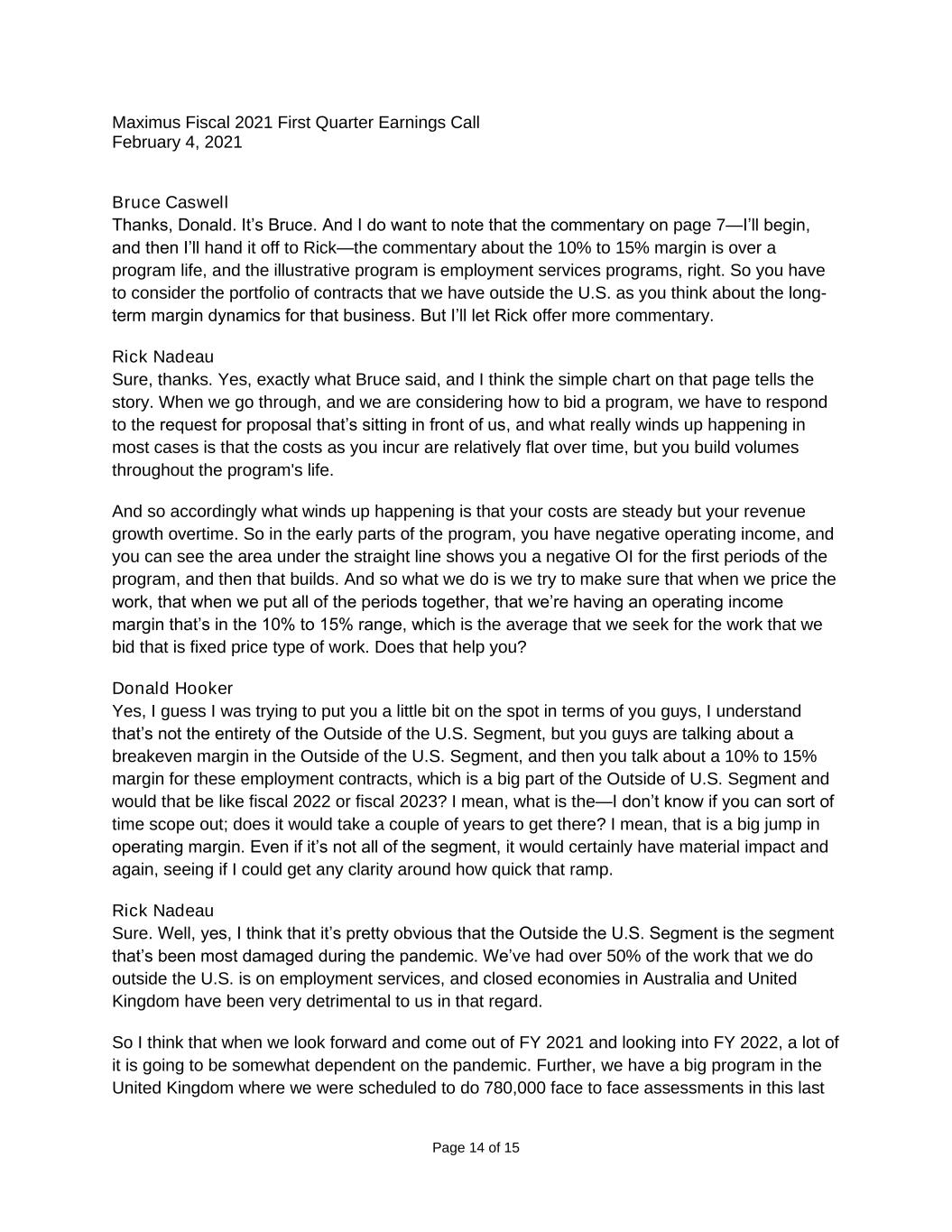
Maximus Fiscal 2021 First Quarter Earnings Call February 4, 2021 Page 14 of 15 Bruce Caswell Thanks, Donald. It’s Bruce. And I do want to note that the commentary on page 7—I’ll begin, and then I’ll hand it off to Rick—the commentary about the 10% to 15% margin is over a program life, and the illustrative program is employment services programs, right. So you have to consider the portfolio of contracts that we have outside the U.S. as you think about the long- term margin dynamics for that business. But I’ll let Rick offer more commentary. Rick Nadeau Sure, thanks. Yes, exactly what Bruce said, and I think the simple chart on that page tells the story. When we go through, and we are considering how to bid a program, we have to respond to the request for proposal that’s sitting in front of us, and what really winds up happening in most cases is that the costs as you incur are relatively flat over time, but you build volumes throughout the program's life. And so accordingly what winds up happening is that your costs are steady but your revenue growth overtime. So in the early parts of the program, you have negative operating income, and you can see the area under the straight line shows you a negative OI for the first periods of the program, and then that builds. And so what we do is we try to make sure that when we price the work, that when we put all of the periods together, that we’re having an operating income margin that’s in the 10% to 15% range, which is the average that we seek for the work that we bid that is fixed price type of work. Does that help you? Donald Hooker Yes, I guess I was trying to put you a little bit on the spot in terms of you guys, I understand that’s not the entirety of the Outside of the U.S. Segment, but you guys are talking about a breakeven margin in the Outside of the U.S. Segment, and then you talk about a 10% to 15% margin for these employment contracts, which is a big part of the Outside of U.S. Segment and would that be like fiscal 2022 or fiscal 2023? I mean, what is the—I don’t know if you can sort of time scope out; does it would take a couple of years to get there? I mean, that is a big jump in operating margin. Even if it’s not all of the segment, it would certainly have material impact and again, seeing if I could get any clarity around how quick that ramp. Rick Nadeau Sure. Well, yes, I think that it’s pretty obvious that the Outside the U.S. Segment is the segment that’s been most damaged during the pandemic. We’ve had over 50% of the work that we do outside the U.S. is on employment services, and closed economies in Australia and United Kingdom have been very detrimental to us in that regard. So I think that when we look forward and come out of FY 2021 and looking into FY 2022, a lot of it is going to be somewhat dependent on the pandemic. Further, we have a big program in the United Kingdom where we were scheduled to do 780,000 face to face assessments in this last


Maximus Fiscal 2021 First Quarter Earnings Call February 4, 2021 Page 15 of 15 contract period, and we’re doing none. You know that cost contract is profitable, but not at the level that we would have projected if we were doing those face to face assessments. So I think that the return to open economies in Australia and the United Kingdom some of the new geographies that we’re working on with employment services, a return to normality in United Kingdom allowing us to do those face to face assessments and those new contracts that we talked about are all tailwinds that ought to be able to allow us to improve the operating margin outside the U.S. over time. I can’t sit here today and promise you what that’s going to be in FY 22, but it will be an improving OI margin profile over time. Donald Hooker Okay. I’m not sure if I get to—that's my follow-up or not, but maybe I’ll— Bruce Caswell Yes, go ahead follow-up with one really quick one. Donald Hooker You guys detailed the census revenues in the fiscal first quarter the December quarter. Can you remind us, and I apologize that I missed it what would that ramp down to in the March, June, and September quarters so we can sort of set expectations? Rick Nadeau Yes. That program is very close to being over. It’s in a heavy wind-down period. I think you’re going to see less than $10 million of revenue going forward from January 1, 2021, forward. Donald Hooker Thank you. Thank you. Good luck with your... Rick Nadeau Thank you. Lisa Miles Thanks, Donald. Next question, please. Operator As a reminder, if you would like to ask a question, please press "*" "1" on your telephone keypad. We have reached the end of our question-and-answer session and are out of time for today’s call. Maximus thanks you for your time and participation. You may disconnect your lines at this time.


1 | Maximus: Q3 FY20 Earnings Presentation Rick Nadeau Chief Financial Officer Fiscal 2021 First Quarter Earnings Call February 4, 2021


2 | Maximus: Q1 FY21 Earnings Presentation These slides should be read in conjunction with the Company’s most recent quarterly earnings press release, along with listening to or reading a transcript of the comments of Company management from our most recent quarterly earnings conference call. This document may contain non-GAAP financial information. Management uses this information in its internal analysis of results and believes that this information may be informative to investors in gauging the quality of our financial performance, identifying trends in our results, and providing meaningful period- to-period comparisons. These measures should be used in conjunction with, rather than instead of, their comparable GAAP measures. For a reconciliation of non-GAAP measures to the comparable GAAP measures presented in this document, see the Company’s most recent quarterly earnings press release. Throughout this presentation, numbers may not add due to rounding. Included in this presentation are forward-looking statements within the meaning of the safe harbor provisions of the United States Private Securities Litigation Reform Act of 1995. Forward-looking statements can be identified by words such as: “anticipate,” “intend,” “plan,” “goal,” “seek,” “opportunity,” “could,” “potential,” “believe,” “project,” “estimate,” “expect,” “strategy,” “future,” “likely,” “may,” “should,” “will” and similar references to future periods. Forward-looking statements that are not historical facts, including statements about our confidence, strategies and initiatives and our expectations about revenues, results of operations, profitability, liquidity, market demand or the impact of the pandemic are forward-looking statements that involve risks and uncertainties such as those related to impact of the pandemic including but not limited to: • The ultimate duration of the pandemic • The threat of further negative pandemic-related impacts • Delays in our core programs returning to normal volumes and operations • The potential impacts resulting from budget challenges with our government clients • The possibility of delayed or missed payments by customers • The potential for further supply chain disruptions impacting IT or safety equipment • The impact of further legislation and government policies on the programs we operate These risks could cause our actual results to differ materially from those indicated by such forward-looking statements. Therefore, you should not rely on any of these forward-looking statements. Important factors that could cause our actual results and financial condition to differ materially from those indicated in the forward-looking statements include, among others, factors set forth in Item 1A, "Risk Factors" in our Annual Report on Form 10-K for the year ended September 30, 2020, which was filed with the Securities and Exchange Commission on November 19, 2020 and found on maximus.com. Any forward-looking statement made by us in this report is based only on information currently available to us and speaks only as of the date on which it is made. We undertake no obligation to publicly update any forward-looking statement, whether written or oral, that may be made from time to time, whether as a result of new information, future developments or otherwise. Forward-looking Statements & Non-GAAP Information


3 | Maximus: Q1 FY21 Earnings Presentation Total Company Results – First Quarter of FY21 • Revenue growth was in-line with our expectations and driven by COVID-response work. − Serving an integral role in contact tracing, disease investigation, vaccination support, unemployment insurance programs, and other key initiatives − Q1 FY21 COVID-response revenue was an estimated $160M • Top and bottom-line growth were offset by ongoing impacts of the global pandemic tied to temporary program changes on volume-based contracts implemented at the direction of customers (such as Medicaid redeterminations which ensures beneficiaries have uninterrupted access to benefits). • Operating margin and diluted EPS were in-line with our expectations for the quarter, with some variability between segments. − Outside the U.S. Segment results were better than expected − U.S. Federal Services Segment had lower operating income due to timing of finalizing a contract and will be recorded next quarter ($ in millions, except per share data) Q1 FY21 Q1 FY20 % Change Revenue U.S. Services $ 384.9 $ 312.3 23.3 % U.S. Federal Services 405.2 366.6 10.6 % Outside the U.S. 155.4 139.4 11.5 % Total Revenue $ 945.6 $ 818.2 15.6 % Operating Income U.S. Services $ 61.5 $ 58.2 5.8 % U.S. Federal Services 30.2 31.6 (4.2)% Outside the U.S. 4.5 (1.0) nm Segment Income $ 96.3 $ 88.8 8.5 % Intangibles amortization (6.5) (9.1) nm Other (2.2) (0.5) nm Total Operating Income $ 87.6 $ 79.1 10.7 % Operating Margin % 9.3 % 9.7 % Effective Tax Rate 26.0 % 26.0 % Net Income $ 64.1 $ 58.7 9.1 % Diluted EPS $ 1.03 $ 0.91 13.2 %


4 | Maximus: Q1 FY21 Earnings Presentation Q1 FY21 Revenue • Increased 23.3% driven by an estimated $114M of COVID-response work Q1 FY21 Operating Margin • Continue to experience revenue and profit headwinds resulting from lower volumes on some of the largest Medicaid programs − Many states have halted Medicaid redeterminations which is required in order to access increased federal matching funds for Medicaid − Redeterminations are a significant level of activity within certain programs FY21 Outlook • We expect this segment to deliver a 16.5% to 17.5% full year operating income margin. U.S. Services Segment ($ in millions) Q1 FY21 Q1 FY20 % Change Revenue U.S. Services $ 384.9 $ 312.3 23.3 % Operating Income U.S. Services $ 61.5 $ 58.2 5.8 % Operating Margin % 16.0 % 18.6 %


5 | Maximus: Q1 FY21 Earnings Presentation U.S. Federal Services Segment Q1 FY21 Revenue • Increased 10.6% driven by an estimated $46M of COVID-response revenue. Organic growth was 13.5%, excluding the Census contract. The Census contract delivered approximately $60M for Q1 FY21, or $10M less than the prior year period. • A contract execution delay resulted in approx. $4M of revenue and profit shifting out of Q1 FY21 and will be recorded next quarter. Q1 FY21 Operating Margin • The delay tempered margin which was slightly short of our expectations for a strong first quarter. • Note that next quarter, including the $4M of revenue and profit expected, a step-down in margin is predicted, illustrating the greater overall variability in results due to the pandemic. FY21 Outlook • We expect this segment to deliver a 6% to 7% full year operating income margin. ($ in millions) Q1 FY21 Q1 FY20 % Change Revenue U.S. Federal Services $ 405.2 $ 366.6 10.6 % Operating Income U.S. Federal Services $ 30.2 $ 31.6 (4.2)% Operating Margin % 7.5 % 8.6 %


6 | Maximus: Q1 FY21 Earnings Presentation Outside the U.S. Segment Q1 FY21 Revenue • Increased 11.5%. Excluding the effects of currency, organic growth was 4.8%. Q1 FY21 Operating Income • Operating income was better than expected primarily due to job placement activities in Australia. A seasonal spike in demand for qualified job seekers meant that employers needed to quickly fill many retail and travel related jobs during the busy holiday and travel season. This spike is expected to be unique to Q1 FY21. ($ in millions) Q1 FY21 Q1 FY20 % Change Revenue Outside the U.S. $ 155.4 $ 139.4 11.5 % Operating Income/(Loss) Outside the U.S. $ 4.5 $ (1.0) nm Operating Margin % 2.9 % (0.7)%


7 | Maximus: Q1 FY21 Earnings Presentation Outside the U.S. Segment: Rising Volumes and New Work Define FY21 Strong Demand • Continue to see strong demand for employment services in all of our international operations. Anticipate that volumes from current programs, most notably in Australia, and supplemented by new work will drive revenue growth the second half of FY21. • The new outcomes-based contracts are expected to generate losses early on. Over the life of each program, we expect to yield margins within our corporate average for each program. Such programs are an excellent way to create long-term shareholder value. FY21 Outlook for Outside the U.S. • The startups put this segment in a loss position for Q2 FY21, with steady improvement through the remainder of the year. • We expect this segment will be approximately breakeven for FY21. Maximus enjoys a long history, strong reputation, and demonstrated success in delivering employment services We aim to achieve a 10% – 15% margin over a program’s life


8 | Maximus: Q1 FY21 Earnings Presentation Cash Flows & Balance Sheet • Cash and cash equivalents of $132.6M and no outstanding draws on corporate credit facility at December 31, 2020 Days Sales Outstanding (DSO) • DSO of 75 days at December 31, 2020, compares to 77 days at September 30, 2020 Capital Allocation • Our corporate credit facility and strong cash flows and balance sheet mean that liquidity is not a concern • Bias toward M&A activities to drive long term organic growth • Our M&A program continues to evaluate prospects while we remain prudent stewards of capital and discriminating in our evaluations • Remain committed to future quarterly cash dividends, and share purchases will be made opportunistically Cash Flows, Balance Sheet, and Capital Allocation $ in millions Q1 FY21 Cash flows from operations $ 98.1 Purchases of property and equipment and capitalized software costs (9.1) Free cash flow $ 89.0


9 | Maximus: Q1 FY21 Earnings Presentation Raising Fiscal Year 2021 Guidance Fiscal 2021 Guidance Revised Previous Revenue $3.400B – $3.525B $3.20B – $3.40B Diluted EPS $3.55 – $3.75 $3.45 – $3.70 Cash from operations $350M – $400M $340M – $390M Free cash flow $310M – $360M $300M – $350M • Raising FY21 full year guidance based on cautious optimism around recent awards, scope increases, and contract extensions • Increased revenue is driven by new work supporting COVID response • No change to tax rate projection of 25.75% − 26.50% or WASO of 62.1M − 62.2M (absent share purchases) • As with previous guidance, a decrease in revenue and earnings for the second quarter of FY21 is expected • We expect to be above consensus revenue and earnings for Q2 FY21 • Consensus revenue and earnings for Q4 FY21 is above our current expectations • COVID-response work is providing a short-term tailwind and has shorter periods of performance than core contracts • No assurance that tailing-off of COVID-response work will coincide with the return of core contracts to previous volume and performance levels • The bottom line continues to be tempered by temporary changes on mature core programs. We anticipate these programs beginning to return to historical volume levels as we emerge from the pandemic.


10 | Maximus: Q1 FY21 Earnings Presentation Bruce Caswell President & Chief Executive Officer Fiscal 2021 First Quarter Earnings Call February 4, 2021


11 | Maximus: Q1 FY21 Earnings Presentation U.S. 2021 Presidential Transition Anticipated implications • While it is still early days in the Biden Administration, we are cautiously optimistic regarding the stated policy initiatives and the potential favorable tailwinds that may be created for companies like Maximus. • We will likely see a meaningful increase in funding for social welfare programs and public health programs. Executive action already taken to increase access to affordable insurance through ACA and Medicaid. • As we navigate the pandemic, expect further policy initiatives to strengthen the public health infrastructure. • Our results illustrate that Maximus is well positioned to help government add capacity and address critical public health needs now and into the future.


12 | Maximus: Q1 FY21 Earnings Presentation COVID-Response Work • A prime example of the demonstrated value of our services and the relationships we have developed with our clients • These contracts are a revenue driver, offsetting unfavorable impacts on operations that are experiencing a pandemic- related temporary pause • Initial COVID work centered around more immediate pandemic-driven needs such as contact tracing, disease investigation, and unemployment insurance programs • Our work expanded as demand increased into new areas such as supporting states in responding to public questions about vaccination registration, scheduling, and administration — quickly, efficiently, and equitably • We also operate the CDC help line, known as CDC Info, and have scaled up operations to answer vaccination questions • Additionally, we ramped-up staffing and operations to support the IRS with the next round of the Economic Incentive Payments; implemented our interactive virtual agent system to improve user experience and drive efficiency in response to the surging demand


13 | Maximus: Q1 FY21 Earnings Presentation Increasing Demand and Adaptability Rising unemployment and rising caseloads • Increasing demand for employment support services around the globe • The pace at which different countries emerge from the pandemic varies widely with some countries having progressed further in managing the spread of the pandemic and now able to turn their attention to tackling residual challenges such as the economy and unemployment • We have a proven track record in delivering employment services and an earned reputation as a trusted long-term partner who delivers outcomes that matter • Our continued investments support our position as a partner of choice over the long-term, outweighing any temporary and short-term profit impacts in FY21 Longer-term trajectory • While the COVID work itself is comparatively short-term in nature, crisis support itself has a longer trajectory • Our work is portable — adaptable from agency to agency, and department to department, whether that is the IRS, CDC, FEMA, state health departments, or others around the world • We will continue to be there to support our clients in times of need, adapting from crisis to crisis, whether a global health pandemic, a natural disaster, or economic challenges • We view our capabilities in contingency planning for our government customers and the rapid implementation of citizen assistance services as a core competency and elemental to the long-term relationships that underpin our business


14 | Maximus: Q1 FY21 Earnings Presentation FedRAMP certifications • Our FedRAMP certifications meet the most stringent security requirements of federal agencies as we aim to deliver innovative and cost-effective cloud-based solutions that support mission objectives and provide the highest quality citizen services, thereby transforming the user experience Surveying government technology leaders • We fielded a survey of government technology leaders across federal, state, and local agencies to gain insights about where agencies are in their cloud adoption journey, and how they perceive and use FedRAMP-authorized cloud solutions to support their modernization and transformation initiatives • The vast majority of respondents recognized benefits from moving to a FedRAMP-authorized solution, beyond adhering to mandate • This survey further affirmed our solid positioning to provide a range of FedRAMP secure cloud solutions, as well as our clients’ demand for this service Cloud Solutions


15 | Maximus: Q1 FY21 Earnings Presentation Sales Pipeline December 31, 2020 New Work % Total Pipeline $31.6B 71.1% New Awards (YTD) December 31, 2020 Signed Contracts $594M Unsigned Contracts $1.14B New Awards & Pipeline Pipeline dynamics • It remains difficult to predict the impact that the global health pandemic may have on our pipeline, timing of new work, and return to previous operational levels • However, our strong reputation, flexibility, and agility has cemented our position as a go-to partner for government • We have navigated administration transitions for decades and we believe that the foundation is laid for continued opportunities to assist governments through these extraordinary times


16 | Maximus: Q1 FY21 Earnings Presentation Conclusion January events in Washington D.C. and elsewhere  Maximus engages in the bi-partisan political process in order to better understand our government clients’ long-term goals  Our Board’s Nominating and Governance Committee has oversight of the Company’s policies pertaining to political contributions and compliance  We remain committed to the fundamental principle of our engagement in the political process which is, and will continue to be, to never support or fund candidates or elected officials who encourage or support violence against the government of the United States Maximus superior positioning  Macro-trends remain unchanged for our business  As the pandemic has underscored, policy priorities can change rapidly  These programs increasingly are facing rising demand, shifting demographics, and unsustainable program costs  We offer scalable, cost-effective, and operationally efficient services for a wide range of government programs  We continue to believe our portfolio mix of core business, near adjacencies, and new growth platforms will allow us to achieve a healthy growth trajectory for years to come