mms-20230503
0001032220FALSE00010322202023-05-032023-05-03

UNITED STATES
SECURITIES AND EXCHANGE COMMISSION
Washington, D.C. 20549

FORM 8-K
CURRENT REPORT PURSUANT TO SECTION 13 OR 15(d)
OF THE SECURITIES EXCHANGE ACT OF 1934
Date of Report (Date of earliest event reported): May 3, 2023

Maximus, Inc.
(Exact name of registrant as specified in its charter)
Virginia1-1299754-1000588
(State or other jurisdiction of incorporation)
 (Commission File Number)
(I.R.S. Employer Identification No.)
1600 Tysons BoulevardMcLean,VA22102
(Address of principal executive offices)
(Zip Code)
Registrant's telephone number, including the area code(703)251-8500
No Change
(Former name or former address, if changed since last report)

Check the appropriate box below if the Form 8-K filing is intended to simultaneously satisfy the filing obligation of the registrant under any of the following provisions:
    Written communications pursuant to Rule 425 under the Securities Act (17 CFR 230.425)
    Soliciting material pursuant to Rule 14a-12 under the Exchange Act (17 CFR 240.14a-12)
    Pre-commencement communications pursuant to Rule 14d-2(b) under the Exchange Act (17 CFR 240.14d-2(b))
    Pre-commencement communications pursuant to Rule 13e-4(c) under the Exchange Act (17 CFR 240.13e-4(c))

Securities registered pursuant to Section 12(b) of the Act:
Title of each classTrading Symbol(s)Name of each exchange on which registered
Common Stock, no par valueMMSNew York Stock Exchange
Indicate by check mark whether the registrant is an emerging growth company as defined in Rule 405 of the Securities Act of 1933 (§230.405 of this chapter) or Rule 12b-2 of the Securities Exchange Act of 1934 (§240.12b-2 of this chapter).
Emerging growth company
If an emerging growth company, indicate by check mark if the registrant has elected not to use the extended transition period for complying with any new or revised financial accounting standards provided pursuant to Section 13(a) of the Exchange Act. ☐


Item 2.02    Results of Operations and Financial Condition.
 
On May 3, 2023, the Company issued a press release announcing its financial results for the quarter ended March 31, 2023. The full text of the press release is furnished as Exhibit 99.1 to this Current Report on Form 8-K and incorporated by reference into this Item 2.02.

On May 4, 2023, the Company held a conference call with respect to these financial results. The conference call was open to the public. The transcript and slide presentation that accompanied the call are furnished as Exhibit 99.2 and Exhibit 99.3, respectively, to this Current Report on Form 8-K and incorporated by reference into this Item 2.02.


Item 9.01    Financial Statements and Exhibits.

(d)     Exhibits. The following exhibits are being furnished pursuant to Item 2.02 above.
  
Exhibit No.Description
  
Press release dated May 3, 2023
Conference call transcript for Earnings Call - May 4, 2023
Conference call slide presentation for Earnings Call - May 4, 2023

1


SIGNATURES

Pursuant to the requirements of the Securities Exchange Act of 1934, the registrant has duly caused this report to be signed on its behalf by the undersigned hereunto duly authorized.

Maximus, Inc.
(Registrant)
Date: May 8, 2023/s/ David R. Francis
David R. Francis
General Counsel and Secretary


2
FOR IMMEDIATE RELEASECONTACT:James Francis, VP - IR
Jessica Batt, VP - IR & ESG
Date: May 3, 2023[email protected]

Maximus Reports Fiscal Year 2023 Second Quarter Results
Company reaffirms guidance in strengthened financial position following significant debt reduction
(Tysons, Va. - May 3, 2023) - Maximus (NYSE: MMS), a leading provider of government services worldwide, reported financial results for the three and six months ended March 31, 2023.
Highlights for the second quarter of fiscal year 2023 include:
Revenue increased 2.5% to $1.21 billion, compared to $1.18 billion for the prior year period. Organic growth was 3.9% and driven by new or expanded programs in the U.S. segments.
Diluted earnings per share were $0.52, and adjusted diluted earnings per share were $0.80.
Record cash flows with cash provided by operating activities totaling $309.7 million and free cash flow of $291.6 million, enabling $275 million of debt reduction.
The company is maintaining revenue and earnings guidance for fiscal year 2023, with revenue expected to range between $4.85 billion and $5.0 billion and adjusted diluted earnings per share between $4.00 and $4.30 per share.
A quarterly cash dividend of $0.28 per share is payable on May 31, 2023, to shareholders of record on May 15, 2023.
"Our second quarter results demonstrated solid execution, and we are entering the second half of fiscal year 2023 with excellent visibility into the key drivers to achieve our full-year financial targets," said Bruce Caswell, President and Chief Executive Officer. "In the quarter, we de-levered our debt position by a full half-turn which was driven by record cash flows. We continue to focus on optimizing our portfolio with the divestiture of two small businesses in the Outside the U.S. segment, which were not core to our strategy and did not meet our financial objectives."

Caswell continued, "Last quarter, we noted good line of sight to key operating assumptions, most notably around Medicaid redeterminations and volume growth in our Federal clinical services business driven by PACT Act legislation. I'm pleased that our outlook has proven durable as we are reaffirming fiscal year 2023 guidance and remain confident in our capability to execute in a superior manner in support of our customers’ essential programs."
Second Quarter Results
Revenue for the second quarter of fiscal year 2023 increased 2.5% to $1.21 billion, compared to $1.18 billion for the prior year period. Organic growth was 3.9% driven by new or expanded programs in the U.S. segments.
For the second quarter of fiscal year 2023, operating margin was 5.2% and the adjusted operating margin was 7.1%. This compares to margins of 6.4% and 8.3%, respectively, for the prior year period. Diluted earnings per share were $0.52 and adjusted diluted earnings per share were $0.80. This compares to $0.80 and $1.07, respectively, for the prior-year period.
An operating loss in the Outside the U.S. segment and lower-than-expected U.S. Federal Services segment profitability tempered second quarter fiscal year 2023 results. Two small businesses in the Outside the U.S. segment, which contributed to the operating loss, were divested in the quarter resulting in an approximately one-cent reduction to diluted earnings per share for the second quarter of fiscal year 2023.
Additionally, the prior year period contained profitable short-term COVID response work in the U.S. segments and had less interest expense due to a more favorable rate environment.
U.S. Federal Services Segment
U.S. Federal Services Segment revenue for the second quarter of fiscal year 2023 increased 1.9% to $584.1 million, compared to $573.3 million reported for the prior year period. All growth was organic and driven primarily by volume
1

growth on the Veterans Affairs Medical Disability Exams (MDE) contracts, which comprise the Veterans Evaluations Services (VES) business.
The segment operating margin for the second quarter of fiscal year 2023 was 8.2%, compared to 8.1% reported for the prior year, and slightly lower than company expectations. While MDE contract volumes increased across the quarter, total volumes were slightly lower than forecasted, and higher costs were incurred for training of VES staff to yield full productivity. Strong line of sight remains on the volume forecast, and the full-year fiscal 2023 margin for the U.S. Federal Services Segment is still expected to range between 10% and 11%.
U.S. Services Segment
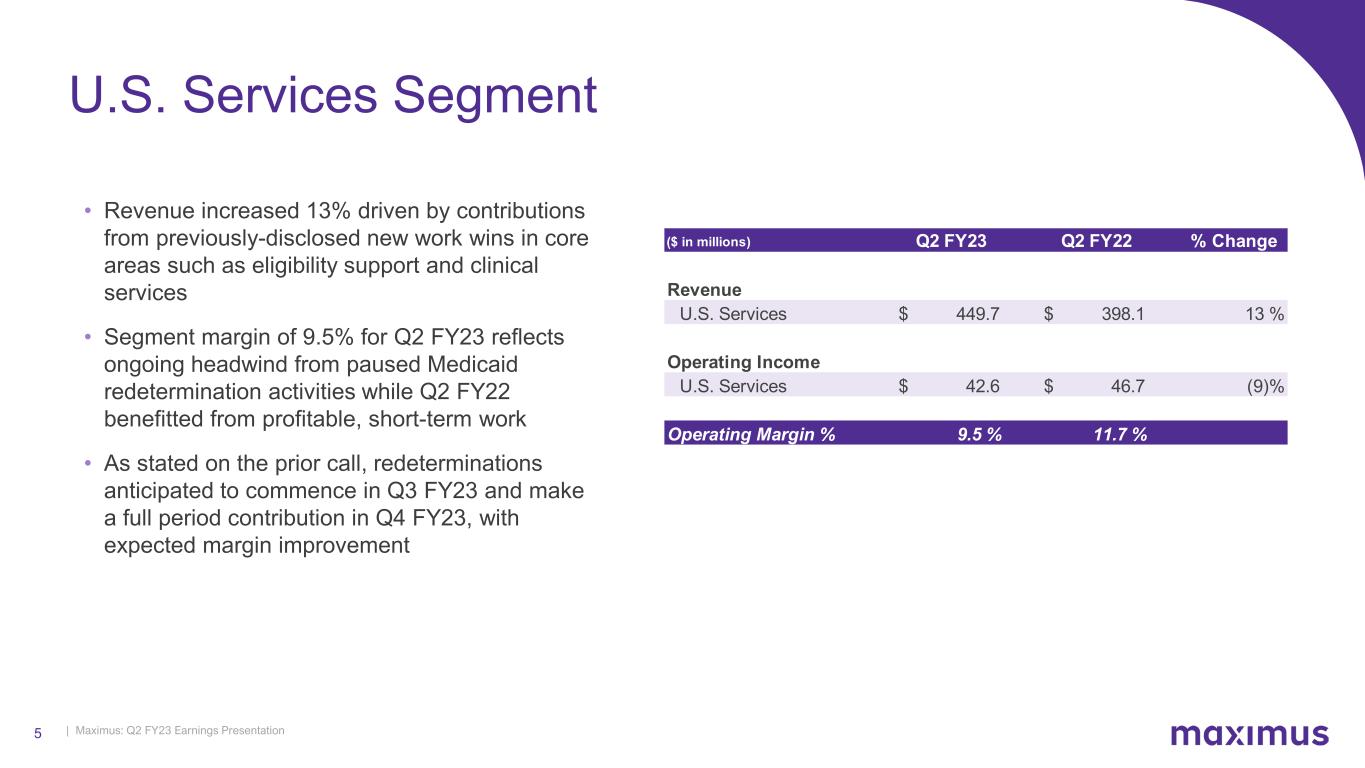
U.S. Services Segment revenue for the second quarter of fiscal year 2023 increased 13.0% to $449.7 million, compared to $398.1 million reported in the prior year period. All growth was organic and driven by previously disclosed new work in the core business areas of eligibility support and clinical services.
The segment operating margin for the second quarter of fiscal year 2023 was 9.5%, compared to 11.7% reported for the prior year period that contained profitable, short-term work. The segment's profitability remained impacted by the paused Medicaid redeterminations, which are scheduled to restart in the third quarter. The full-year fiscal 2023 margin for the U.S. Services Segment is still expected to range between 9% and 11% with a lift to profitability expected in the fourth quarter reflecting an expected full-period contribution from redeterminations.
Outside the U.S. Segment
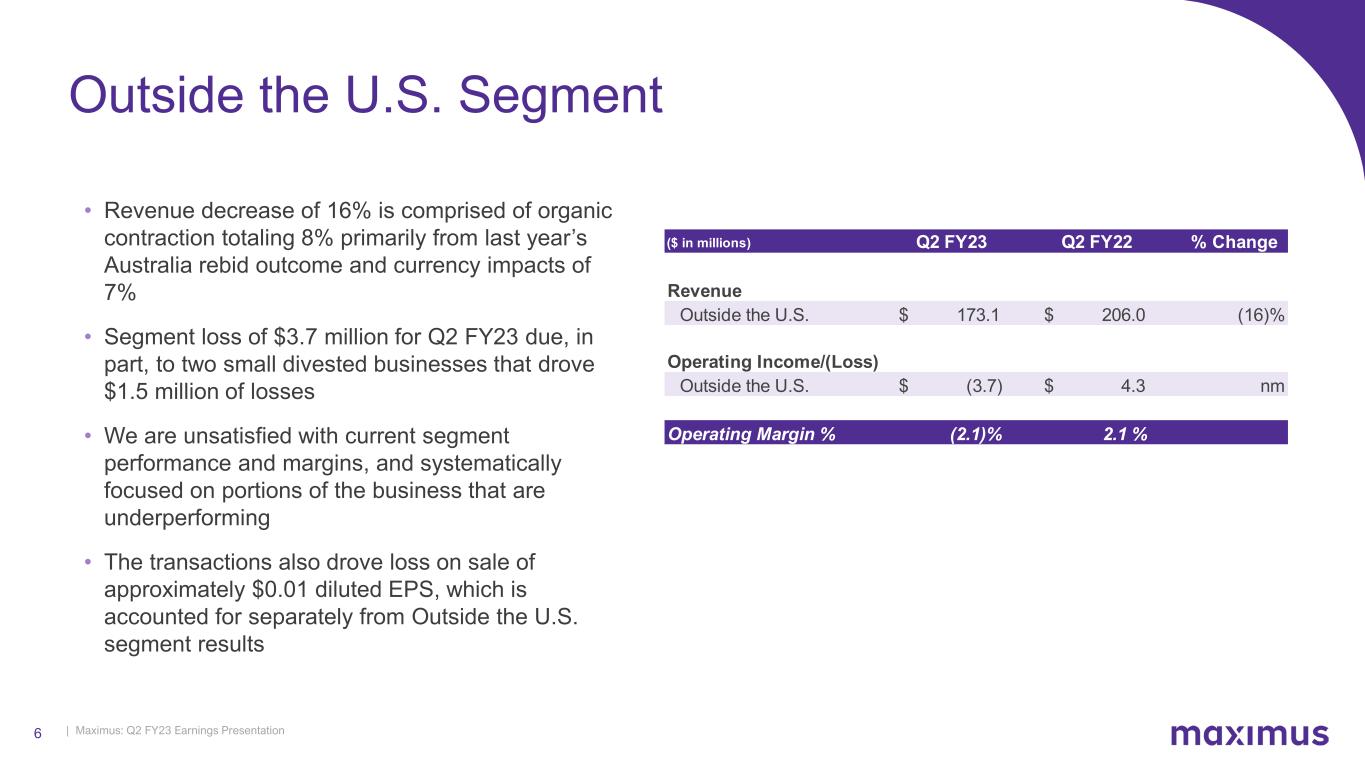
Outside the U.S. Segment revenue for the second quarter of fiscal year 2023 decreased 16.0% to $173.1 million, compared to $206.0 million reported in the prior year period. Organic revenue contracted 8% due primarily to lower revenue in Australia following last year's rebid outcome and currency was a 7% headwind.
The segment realized an operating loss of $3.7 million for the second quarter of fiscal year 2023, compared to an operating profit of $4.3 million in the prior year period. The company is focused on portions of the segment that are underperforming. Two small businesses, a commercial division within the United Kingdom and the employment services business in Sweden, were divested, which had combined operating losses in the quarter of $1.5 million.
Sales and Pipeline
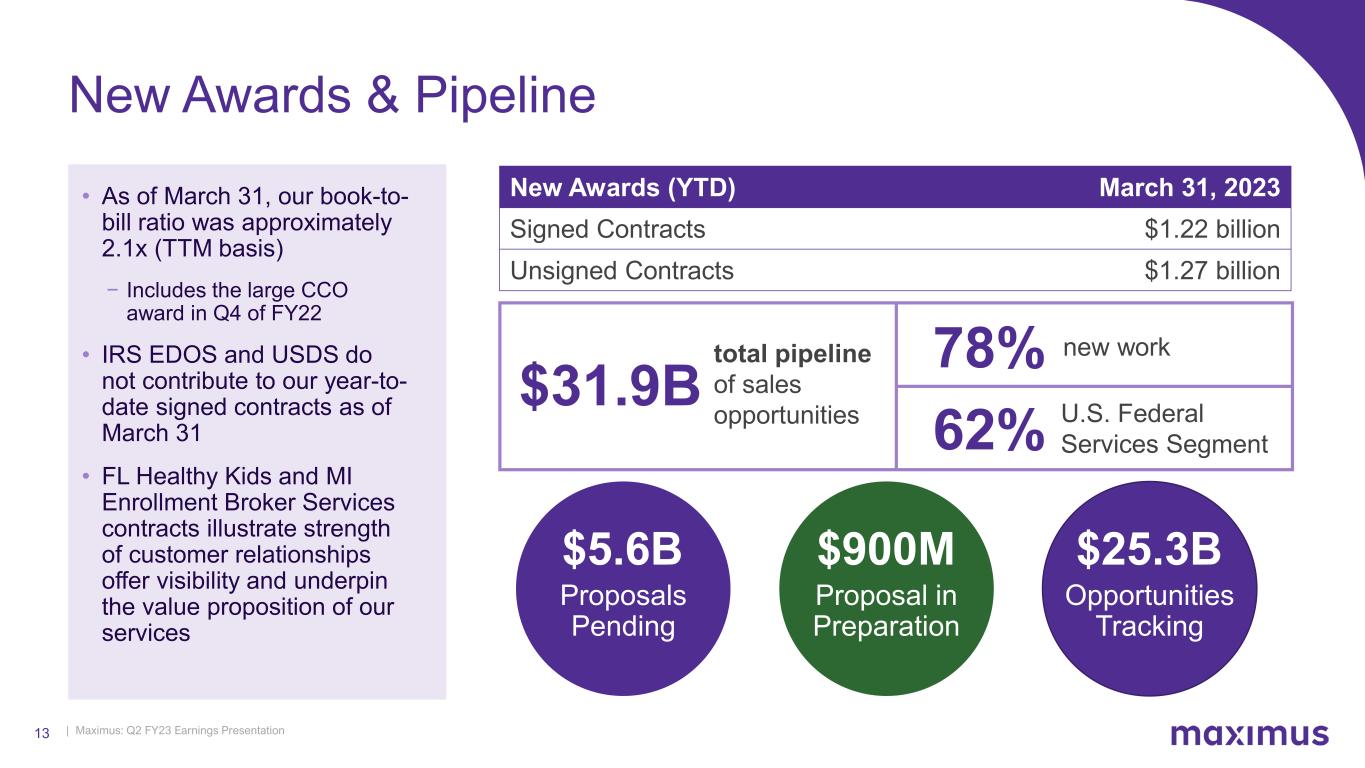
Year-to-date signed contract awards at March 31, 2023, totaled $1.22 billion and contracts pending (awarded but unsigned) totaled $1.27 billion. The book-to-bill ratio at March 31, 2023, was 2.1x calculated on a trailing twelve-month basis.
The sales pipeline at March 31, 2023, totaled $31.9 billion, comprised of approximately $5.6 billion in proposals pending, $0.94 billion in proposals in preparation, and $25.3 billion in opportunities tracking. New work opportunities represent approximately 78% of the total sales pipeline.
Balance Sheet and Cash Flows
At March 31, 2023, cash and cash equivalents totaled $56.3 million, and gross debt was $1.30 billion. The ratio of debt, net of allowed cash, to EBITDA for the quarter ended March 31, 2023, as calculated in accordance with the company's credit agreement, was 2.5x assisted by $275 million of debt reduction in the quarter. This compares to 3.0x at December 31, 2022.
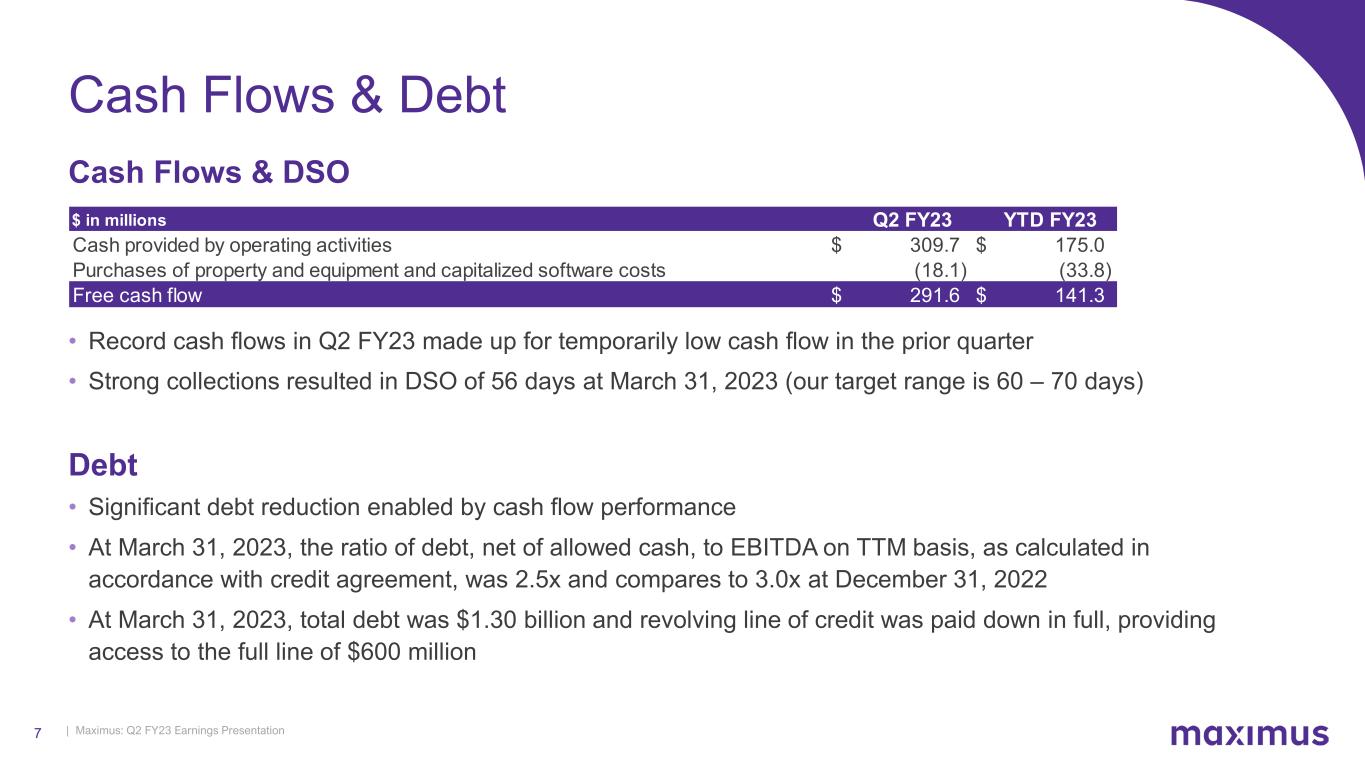
For the second quarter of fiscal year 2023, cash provided by operating activities totaled $309.7 million and free cash flow was $291.6 million. The record quarterly cash flows made up for the temporarily low cash flows in the first quarter of fiscal year 2023. DSO was 56 days as of March 31, 2023. Going forward, the company expects to be in the target range of 60 to 70 days.
On April 6, 2023, our Board of Directors declared a quarterly cash dividend of $0.28 for each share of our common stock outstanding. The dividend is payable on May 31, 2023, to shareholders of record on May 15, 2023.
2

Reaffirming FY23 Guidance
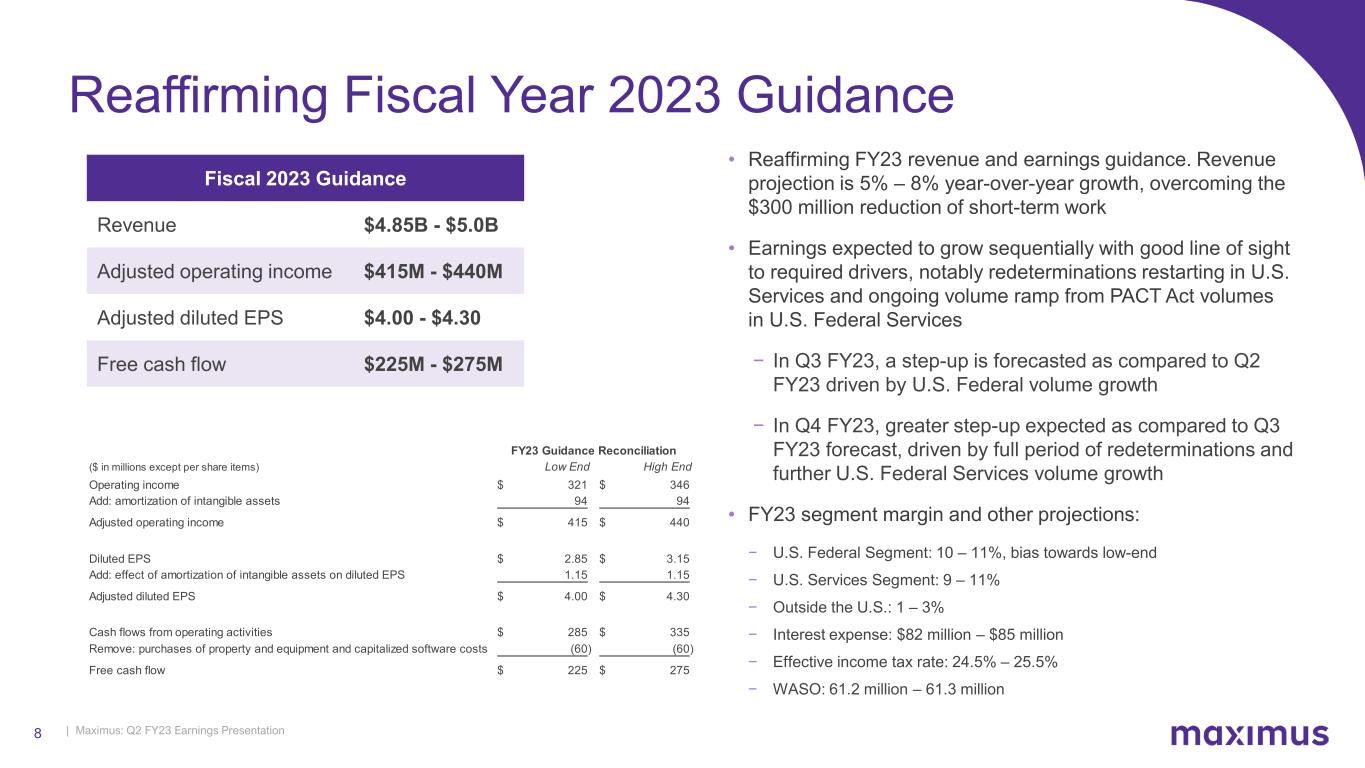
Maximus is reaffirming fiscal year 2023 guidance from the prior quarter. Revenue is expected to range between $4.85 billion and $5.0 billion, and adjusted operating income is expected to range between $415 million and $440 million, which excludes an estimated $94 million of expense for amortization of intangible assets. Adjusted diluted earnings per share is expected to range between $4.00 and $4.30 per share and free cash flow is expected to range between $225 million and $275 million.
The company's guidance still assumes that redetermination activities in the U.S. Services Segment phase in during the third quarter, making a full period contribution in the fourth quarter of fiscal year 2023, and volumes continue to ramp on the MDE contracts in the VES business related to the PACT Act in U.S. Federal Services.
The company forecasts a slight reduction to interest expense, now ranging between $82 million and $85 million, an effective income tax rate between 24.5% and 25.5%, and weighted average shares outstanding between 61.2 million and 61.3 million shares for fiscal year 2023.
Conference Call and Webcast Information
Maximus will host a conference call tomorrow, May 4, 2023, at 9:00 a.m. ET. Shareholders are invited to submit questions for management’s consideration by emailing [email protected] up to one hour prior to the call.
The call is open to the public and available by webcast or by phone at:
877.407.8289 (Domestic) / +1.201.689.8341 (International)
For those unable to listen to the live call, a recording of the webcast will be available on investor.maximus.com.
About Maximus
As a leading strategic partner to governments across the globe, Maximus helps improve the delivery of public services amid complex technology, health, economic, environmental, and social challenges. With a deep understanding of program service delivery, acute insights that achieve operational excellence, and an extensive awareness of the needs of the people being served, our employees advance the critical missions of our partners. Maximus delivers innovative business process management, impactful consulting services, and technology solutions that provide improved outcomes for the public and higher levels of productivity and efficiency of government-sponsored programs. For more information, visit maximus.com.
Non-GAAP Measures and Risk Factors
This release refers to non-GAAP measures and other indicators, including organic growth, free cash flow, operating income and EPS adjusted for amortization of intangible assets, EBITDA, and other non-GAAP measures.
A description of these non-GAAP measures, the reasons why we use and present them, and details as to how they are calculated are included in our earnings presentation and forthcoming Form 10-Q.
The presentation of these non-GAAP numbers is not meant to be considered in isolation, nor as alternatives to cash flows from operations, revenue growth, or net income as measures of performance. These non-GAAP financial measures, as determined and presented by us, may not be comparable to related or similarly titled measures presented by other companies.
Statements that are not historical facts, including statements about the company’s confidence and strategies, and the company’s expectations about revenues, results of operations, profitability, future contracts, market opportunities, market demand, or acceptance of the company’s products are forward-looking statements that involve risks and uncertainties.
These risks could cause the company’s actual results to differ materially from those indicated by such forward-looking statements. A summary of risk factors can be found in Item 1A, "Risk Factors" in our Annual Report on Form 10-K for the year ended September 30, 2022, which was filed with the Securities and Exchange Commission (SEC) on November 22, 2022. The Company's SEC reports are accessible on maximus.com.
3

Maximus, Inc.
Consolidated Statements of Operations
(Unaudited)

 For the Three Months EndedFor the Six Months Ended
 March 31, 2023March 31, 2022March 31, 2023March 31, 2022
(in thousands, except per share amounts)
Revenue$1,206,852 $1,177,326 $2,456,098 $2,328,202 
Cost of revenue978,249 948,875 1,982,748 1,871,596 
Gross profit228,603 228,451 473,350 456,606 
Selling, general, and administrative expenses142,448 130,307 288,900 254,528 
Amortization of intangible assets23,650 22,856 47,168 45,261 
Operating income62,505 75,288 137,282 156,817 
Interest expense20,999 9,438 42,605 19,076 
Other income/(expense), net818 715 1,084 404 
Income before income taxes42,324 66,565 95,761 138,145 
Provision for income taxes10,536 16,469 23,978 34,719 
Net income$31,788 $50,096 $71,783 $103,426 
Earnings per share:
Basic$0.52 $0.81 $1.17 $1.66 
Diluted$0.52 $0.80 $1.17 $1.66 
Weighted average shares outstanding:
Basic61,120 62,227 61,119 62,256 
Diluted61,383 62,381 61,265 62,409 
Dividends declared per share$0.28 $0.28 $0.56 $0.56 


4

Maximus, Inc.
Consolidated Balance Sheets
March 31, 2023September 30, 2022
(unaudited)
(in thousands)
Assets:
Cash and cash equivalents$56,344 $40,658 
Accounts receivable, net742,387 807,110 
Income taxes receivable12,156 2,158 
Prepaid expenses and other current assets141,017 182,387 
Total current assets951,904 1,032,313 
Property and equipment, net46,915 52,258 
Capitalized software, net71,393 58,740 
Operating lease right-of-use assets162,633 132,885 
Goodwill1,780,200 1,779,415 
Intangible assets, net751,194 804,904 
Deferred contract costs, net47,498 47,732 
Deferred compensation plan assets42,049 37,050 
Deferred income taxes5,865 4,970 
Other assets39,205 42,447 
Total assets$3,898,856 $3,992,714 
Liabilities and Shareholders' Equity:
Liabilities:
Accounts payable and accrued liabilities$259,463 $264,553 
Accrued compensation and benefits156,990 178,199 
Deferred revenue, current portion66,796 87,146 
Income taxes payable4,482 718 
Long-term debt, current portion84,490 63,458 
Operating lease liabilities, current portion55,928 63,999 
Other current liabilities53,026 116,374 
Total current liabilities681,175 774,447 
Deferred revenue, non-current portion25,776 21,414 
Deferred income taxes201,079 206,099 
Long-term debt, non-current portion1,205,028 1,292,483 
Deferred compensation plan liabilities, non-current portion43,706 40,210 
Operating lease liabilities, non-current portion121,957 86,175 
Other liabilities18,413 22,515 
Total liabilities2,297,134 2,443,343 
Shareholders' equity:
Common stock, no par value; 100,000 shares authorized; 60,784 and 60,774 shares issued and outstanding as of March 31, 2023, and September 30, 2022, respectively (shares in thousands)572,632 557,978 
Accumulated other comprehensive loss(33,303)(33,961)
Retained earnings1,062,393 1,025,354 
Total shareholders' equity1,601,722 1,549,371 
Total liabilities and shareholders' equity$3,898,856 $3,992,714 
5

Maximus, Inc.
Consolidated Statements of Cash Flows
(Unaudited)
For the Three Months EndedFor the Six Months Ended
March 31, 2023March 31, 2022March 31, 2023March 31, 2022
(in thousands)
Cash flows from operating activities:
Net income$31,788 $50,096 $71,783 $103,426 
Adjustments to reconcile net income to cash flows from operations:
Depreciation and amortization of property, equipment, and capitalized software14,041 9,834 26,321 21,199 
Amortization of intangible assets23,650 22,856 47,168 45,261 
Amortization of debt issuance costs and debt discount601 648 1,635 1,297 
Deferred income taxes(37)(3,089)(1,368)(3,318)
Stock compensation expense9,540 6,804 13,943 15,052 
Loss on sale of businesses883 — 883 — 
Change in assets and liabilities, net of effects of business combinations and disposals:
Accounts receivable263,278 (34,950)62,529 (49,064)
Prepaid expenses and other current assets2,788 14,884 13,412 9,769 
Deferred contract costs1,596 380 583 (6,431)
Accounts payable and accrued liabilities(10,003)29,405 (6,361)(3,047)
Accrued compensation and benefits39,049 28,024 (14,222)(28,281)
Deferred revenue(33,111)12,544 (18,347)18,473 
Income taxes(16,043)(23,836)(6,578)(13,515)
Operating lease right-of-use assets and liabilities(1,124)5,077 (2,072)(1,293)
Other assets and liabilities(17,200)(3,899)(14,272)2,331 
Net cash provided by operating activities309,696 114,778 175,037 111,859 
Cash flows from investing activities:
Purchases of property and equipment and capitalized software(18,054)(16,571)(33,751)(22,898)
Acquisitions of businesses, net of cash acquired— (4)— (4)
Proceeds from sale of businesses9,124 — 9,124 — 
Net cash used in investing activities(8,930)(16,575)(24,627)(22,902)
Cash flows from financing activities:
Cash dividends paid to Maximus shareholders(17,016)(17,312)(34,033)(34,659)
Purchases of Maximus common stock— (24,464)— (25,843)
Tax withholding related to RSU vesting— — (8,475)(9,673)
Payments for contingent consideration(2,626)— (4,041)— 
Proceeds from borrowings193,696 140,000 462,398 240,000 
Principal payments for debt(469,105)(287,023)(530,460)(303,708)
Restricted cash movements(47,587)— (57,060)— 
Net cash used in financing activities(342,638)(188,799)(171,671)(133,883)
Effect of exchange rate changes on cash, cash equivalents, and restricted cash765 (48)3,186 324 
Net change in cash, cash equivalents, and restricted cash(41,107)(90,644)(18,075)(44,602)
Cash, cash equivalents and restricted cash, beginning of period159,827 202,612 136,795 156,570 
Cash, cash equivalents and restricted cash, end of period$118,720 $111,968 $118,720 $111,968 
6

Maximus, Inc.
Consolidated Results of Operations by Segment
(Unaudited)
 For the Three Months EndedFor the Six Months Ended
March 31, 2023March 31, 2022March 31, 2023March 31, 2022
Amount% (1)Amount% (1)Amount% (1)Amount% (1)
(dollars in thousands)
Revenue:
U.S. Federal Services$584,075 $573,288 $1,202,242 $1,155,159 
U.S. Services449,703 398,077 889,181 784,494 
Outside the U.S.173,074 205,961 364,675 388,549 
Revenue$1,206,852 $1,177,326 $2,456,098 $2,328,202 
Gross profit:
U.S. Federal Services$122,874 21.0 %$115,153 20.1 %$245,568 20.4 %$241,729 20.9 %
U.S. Services86,016 19.1 %84,971 21.3 %169,614 19.1 %174,670 22.3 %
Outside the U.S.19,713 11.4 %28,327 13.8 %58,168 16.0 %40,207 10.3 %
Gross profit$228,603 18.9 %$228,451 19.4 %$473,350 19.3 %$456,606 19.6 %
Selling, general, and administrative expenses:
U.S. Federal Services$75,050 12.8 %$68,949 12.0 %$146,699 12.2 %$133,874 11.6 %
U.S. Services43,415 9.7 %38,273 9.6 %89,257 10.0 %73,375 9.4 %
Outside the U.S.23,425 13.5 %24,011 11.7 %51,814 14.2 %45,351 11.7 %
Loss on sale of businesses (2)883 NM— NM883 NM— NM
Other (3)(325)NM(926)NM247 NM1,928 NM
Selling, general, and administrative expenses$142,448 11.8 %$130,307 11.1 %$288,900 11.8 %$254,528 10.9 %
Operating income/(loss):
U.S. Federal Services$47,824 8.2 %$46,204 8.1 %$98,869 8.2 %$107,855 9.3 %
U.S. Services42,601 9.5 %46,698 11.7 %80,357 9.0 %101,295 12.9 %
Outside the U.S.(3,712)(2.1)%4,316 2.1 %6,354 1.7 %(5,144)(1.3)%
Amortization of intangible assets(23,650)NM(22,856)NM(47,168)NM(45,261)NM
Loss on sale of businesses (2)(883)NM— NM(883)NM— NM
Other (3)325 NM926 NM(247)NM(1,928)NM
Operating income$62,505 5.2 %$75,288 6.4 %$137,282 5.6 %$156,817 6.7 %
        
(1)Percentage of respective segment revenue. Percentages not considered meaningful are marked "NM."
(2)During the second quarter of fiscal year 2023, we sold a small commercial practice in the United Kingdom and our employment operations business in Sweden, both subsidiaries within our Outside the U.S. Segment, resulting in a loss.
(3)Other includes credits and costs that are not allocated to a particular segment.
7

Maximus, Inc.
Consolidated Free Cash Flows - Non-GAAP
(Unaudited)
For the Three Months EndedFor the Six Months Ended
March 31, 2023March 31, 2022March 31, 2023March 31, 2022
(in thousands)
Net cash provided by operating activities$309,696 $114,778 $175,037 $111,859 
Purchases of property and equipment and capitalized software(18,054)(16,571)(33,751)(22,898)
Free cash flow$291,642 $98,207 $141,286 $88,961 


Maximus, Inc.
Non-GAAP Adjusted Results Excluding Amortization of Intangible Assets
(Unaudited)
For the Three Months EndedFor the Six Months Ended
March 31, 2023March 31, 2022March 31, 2023March 31, 2022
(dollars in thousands, except per share data)
Operating income$62,505 $75,288 $137,282 $156,817 
Add back: Amortization of intangible assets23,650 22,856 47,168 45,261 
Adjusted operating income excluding amortization of intangible assets (Non-GAAP)$86,155 $98,144 $184,450 $202,078 
Adjusted operating income margin excluding amortization of intangible assets (Non-GAAP)7.1 %8.3 %7.5 %8.7 %
Net income$31,788 $50,096 $71,783 $103,426 
Add back: Amortization of intangible assets, net of tax17,446 16,884 34,806 33,414 
Adjusted net income excluding amortization of intangible assets (Non-GAAP)$49,234 $66,980 $106,589 $136,840 
Diluted earnings per share$0.52 $0.80 $1.17 $1.66 
Add back: Effect of amortization of intangible assets on diluted earnings per share0.28 0.27 0.57 0.53 
Adjusted diluted earnings per share excluding amortization of intangible assets (Non-GAAP)$0.80 $1.07 $1.74 $2.19 
8
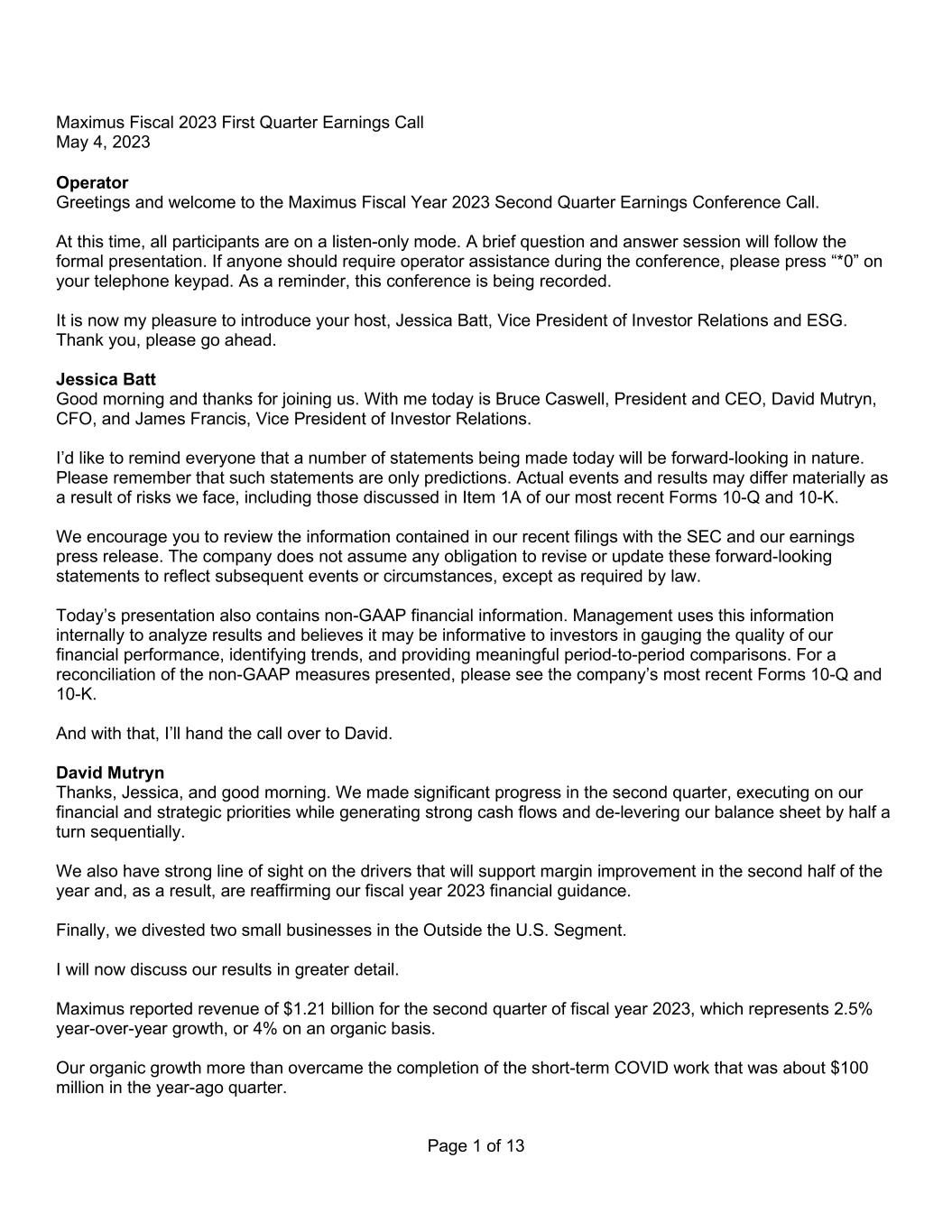
Maximus Fiscal 2023 First Quarter Earnings Call May 4, 2023 Page 1 of 13 Operator Greetings and welcome to the Maximus Fiscal Year 2023 Second Quarter Earnings Conference Call. At this time, all participants are on a listen-only mode. A brief question and answer session will follow the formal presentation. If anyone should require operator assistance during the conference, please press “*0” on your telephone keypad. As a reminder, this conference is being recorded. It is now my pleasure to introduce your host, Jessica Batt, Vice President of Investor Relations and ESG. Thank you, please go ahead. Jessica Batt Good morning and thanks for joining us. With me today is Bruce Caswell, President and CEO, David Mutryn, CFO, and James Francis, Vice President of Investor Relations. I’d like to remind everyone that a number of statements being made today will be forward-looking in nature. Please remember that such statements are only predictions. Actual events and results may differ materially as a result of risks we face, including those discussed in Item 1A of our most recent Forms 10-Q and 10-K. We encourage you to review the information contained in our recent filings with the SEC and our earnings press release. The company does not assume any obligation to revise or update these forward-looking statements to reflect subsequent events or circumstances, except as required by law. Today’s presentation also contains non-GAAP financial information. Management uses this information internally to analyze results and believes it may be informative to investors in gauging the quality of our financial performance, identifying trends, and providing meaningful period-to-period comparisons. For a reconciliation of the non-GAAP measures presented, please see the company’s most recent Forms 10-Q and 10-K. And with that, I’ll hand the call over to David. David Mutryn Thanks, Jessica, and good morning. We made significant progress in the second quarter, executing on our financial and strategic priorities while generating strong cash flows and de-levering our balance sheet by half a turn sequentially. We also have strong line of sight on the drivers that will support margin improvement in the second half of the year and, as a result, are reaffirming our fiscal year 2023 financial guidance. Finally, we divested two small businesses in the Outside the U.S. Segment. I will now discuss our results in greater detail. Maximus reported revenue of $1.21 billion for the second quarter of fiscal year 2023, which represents 2.5% year-over-year growth, or 4% on an organic basis. Our organic growth more than overcame the completion of the short-term COVID work that was about $100 million in the year-ago quarter.


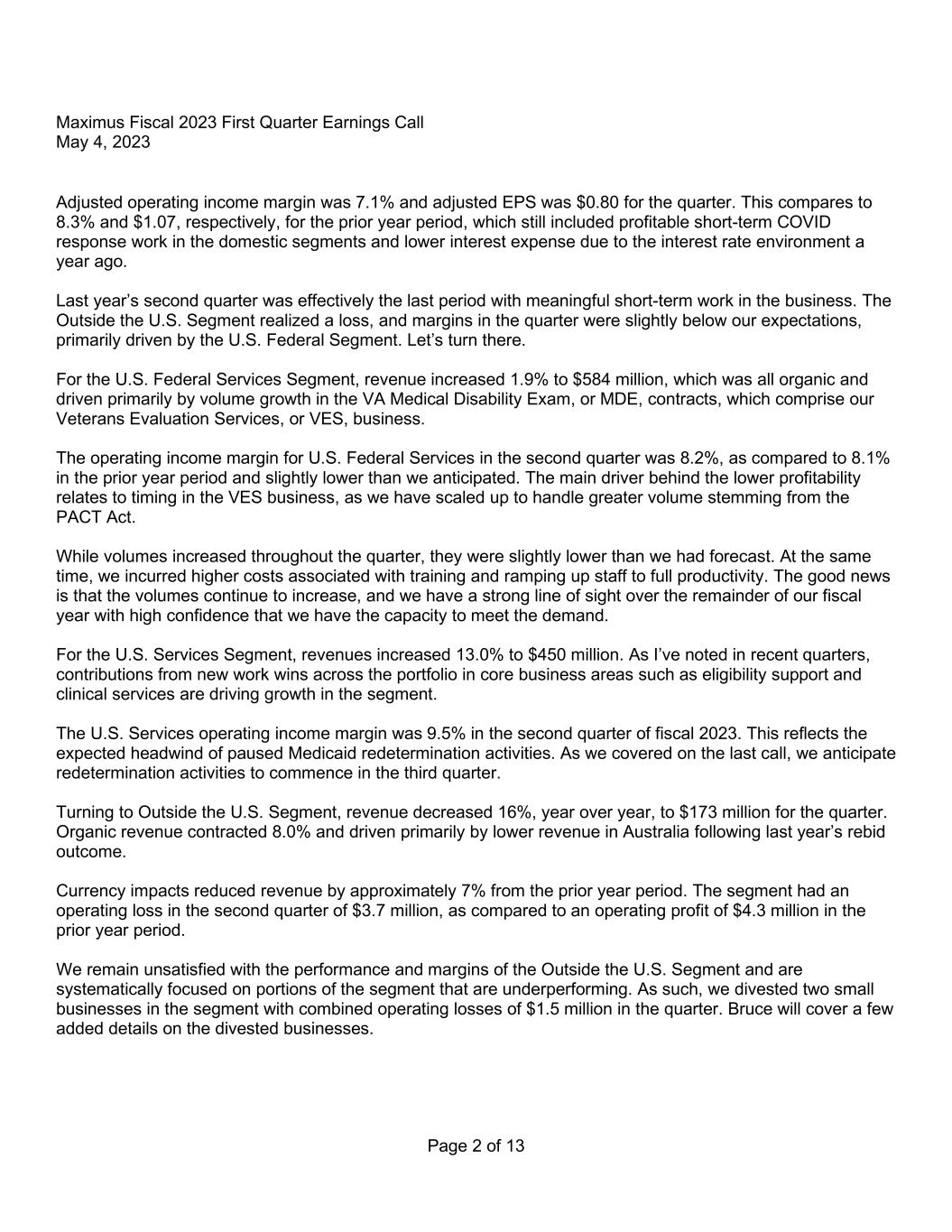
Maximus Fiscal 2023 First Quarter Earnings Call May 4, 2023 Page 2 of 13 Adjusted operating income margin was 7.1% and adjusted EPS was $0.80 for the quarter. This compares to 8.3% and $1.07, respectively, for the prior year period, which still included profitable short-term COVID response work in the domestic segments and lower interest expense due to the interest rate environment a year ago. Last year’s second quarter was effectively the last period with meaningful short-term work in the business. The Outside the U.S. Segment realized a loss, and margins in the quarter were slightly below our expectations, primarily driven by the U.S. Federal Segment. Let’s turn there. For the U.S. Federal Services Segment, revenue increased 1.9% to $584 million, which was all organic and driven primarily by volume growth in the VA Medical Disability Exam, or MDE, contracts, which comprise our Veterans Evaluation Services, or VES, business. The operating income margin for U.S. Federal Services in the second quarter was 8.2%, as compared to 8.1% in the prior year period and slightly lower than we anticipated. The main driver behind the lower profitability relates to timing in the VES business, as we have scaled up to handle greater volume stemming from the PACT Act. While volumes increased throughout the quarter, they were slightly lower than we had forecast. At the same time, we incurred higher costs associated with training and ramping up staff to full productivity. The good news is that the volumes continue to increase, and we have a strong line of sight over the remainder of our fiscal year with high confidence that we have the capacity to meet the demand. For the U.S. Services Segment, revenues increased 13.0% to $450 million. As I’ve noted in recent quarters, contributions from new work wins across the portfolio in core business areas such as eligibility support and clinical services are driving growth in the segment. The U.S. Services operating income margin was 9.5% in the second quarter of fiscal 2023. This reflects the expected headwind of paused Medicaid redetermination activities. As we covered on the last call, we anticipate redetermination activities to commence in the third quarter. Turning to Outside the U.S. Segment, revenue decreased 16%, year over year, to $173 million for the quarter. Organic revenue contracted 8.0% and driven primarily by lower revenue in Australia following last year’s rebid outcome. Currency impacts reduced revenue by approximately 7% from the prior year period. The segment had an operating loss in the second quarter of $3.7 million, as compared to an operating profit of $4.3 million in the prior year period. We remain unsatisfied with the performance and margins of the Outside the U.S. Segment and are systematically focused on portions of the segment that are underperforming. As such, we divested two small businesses in the segment with combined operating losses of $1.5 million in the quarter. Bruce will cover a few added details on the divested businesses.


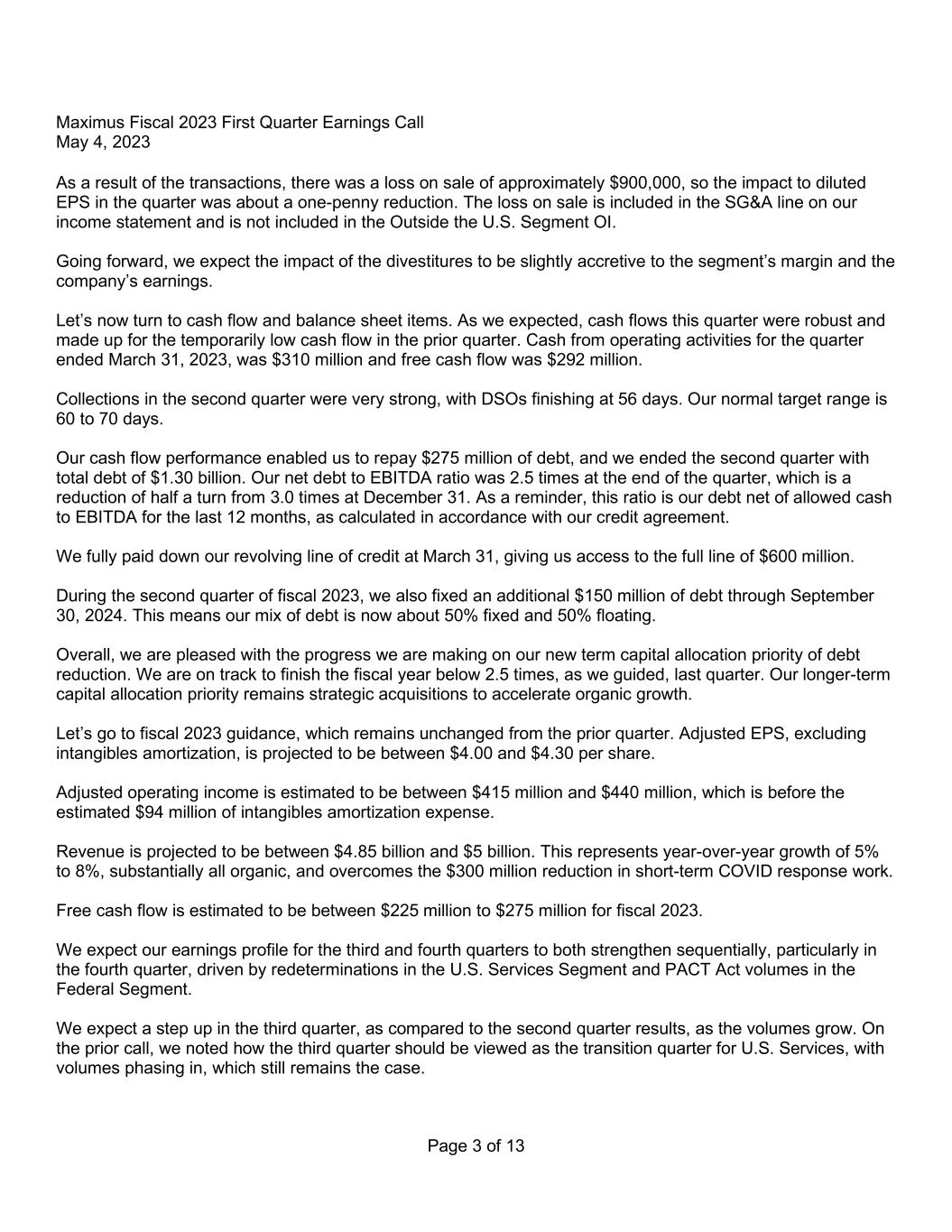
Maximus Fiscal 2023 First Quarter Earnings Call May 4, 2023 Page 3 of 13 As a result of the transactions, there was a loss on sale of approximately $900,000, so the impact to diluted EPS in the quarter was about a one-penny reduction. The loss on sale is included in the SG&A line on our income statement and is not included in the Outside the U.S. Segment OI. Going forward, we expect the impact of the divestitures to be slightly accretive to the segment’s margin and the company’s earnings. Let’s now turn to cash flow and balance sheet items. As we expected, cash flows this quarter were robust and made up for the temporarily low cash flow in the prior quarter. Cash from operating activities for the quarter ended March 31, 2023, was $310 million and free cash flow was $292 million. Collections in the second quarter were very strong, with DSOs finishing at 56 days. Our normal target range is 60 to 70 days. Our cash flow performance enabled us to repay $275 million of debt, and we ended the second quarter with total debt of $1.30 billion. Our net debt to EBITDA ratio was 2.5 times at the end of the quarter, which is a reduction of half a turn from 3.0 times at December 31. As a reminder, this ratio is our debt net of allowed cash to EBITDA for the last 12 months, as calculated in accordance with our credit agreement. We fully paid down our revolving line of credit at March 31, giving us access to the full line of $600 million. During the second quarter of fiscal 2023, we also fixed an additional $150 million of debt through September 30, 2024. This means our mix of debt is now about 50% fixed and 50% floating. Overall, we are pleased with the progress we are making on our new term capital allocation priority of debt reduction. We are on track to finish the fiscal year below 2.5 times, as we guided, last quarter. Our longer-term capital allocation priority remains strategic acquisitions to accelerate organic growth. Let’s go to fiscal 2023 guidance, which remains unchanged from the prior quarter. Adjusted EPS, excluding intangibles amortization, is projected to be between $4.00 and $4.30 per share. Adjusted operating income is estimated to be between $415 million and $440 million, which is before the estimated $94 million of intangibles amortization expense. Revenue is projected to be between $4.85 billion and $5 billion. This represents year-over-year growth of 5% to 8%, substantially all organic, and overcomes the $300 million reduction in short-term COVID response work. Free cash flow is estimated to be between $225 million to $275 million for fiscal 2023. We expect our earnings profile for the third and fourth quarters to both strengthen sequentially, particularly in the fourth quarter, driven by redeterminations in the U.S. Services Segment and PACT Act volumes in the Federal Segment. We expect a step up in the third quarter, as compared to the second quarter results, as the volumes grow. On the prior call, we noted how the third quarter should be viewed as the transition quarter for U.S. Services, with volumes phasing in, which still remains the case.


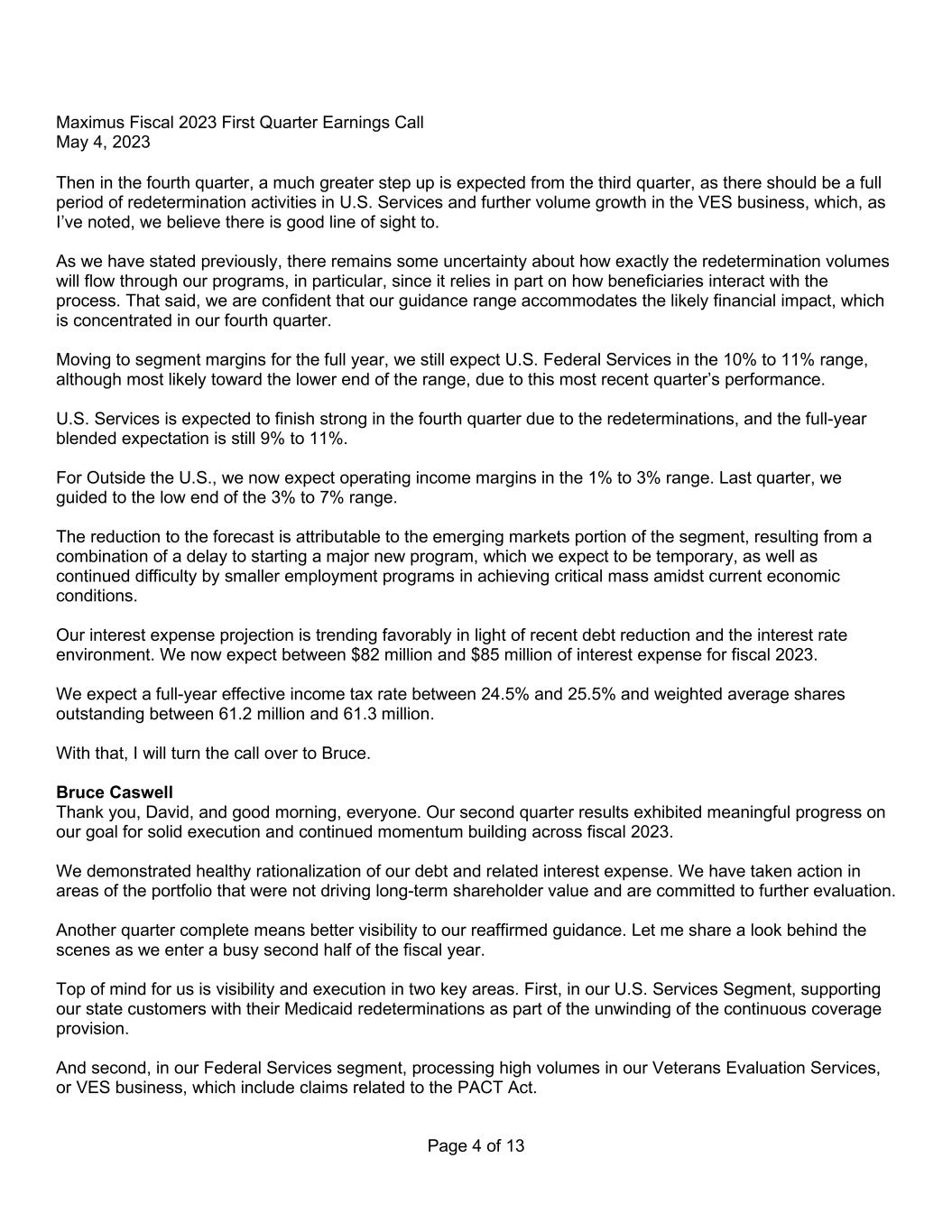
Maximus Fiscal 2023 First Quarter Earnings Call May 4, 2023 Page 4 of 13 Then in the fourth quarter, a much greater step up is expected from the third quarter, as there should be a full period of redetermination activities in U.S. Services and further volume growth in the VES business, which, as I’ve noted, we believe there is good line of sight to. As we have stated previously, there remains some uncertainty about how exactly the redetermination volumes will flow through our programs, in particular, since it relies in part on how beneficiaries interact with the process. That said, we are confident that our guidance range accommodates the likely financial impact, which is concentrated in our fourth quarter. Moving to segment margins for the full year, we still expect U.S. Federal Services in the 10% to 11% range, although most likely toward the lower end of the range, due to this most recent quarter’s performance. U.S. Services is expected to finish strong in the fourth quarter due to the redeterminations, and the full-year blended expectation is still 9% to 11%. For Outside the U.S., we now expect operating income margins in the 1% to 3% range. Last quarter, we guided to the low end of the 3% to 7% range. The reduction to the forecast is attributable to the emerging markets portion of the segment, resulting from a combination of a delay to starting a major new program, which we expect to be temporary, as well as continued difficulty by smaller employment programs in achieving critical mass amidst current economic conditions. Our interest expense projection is trending favorably in light of recent debt reduction and the interest rate environment. We now expect between $82 million and $85 million of interest expense for fiscal 2023. We expect a full-year effective income tax rate between 24.5% and 25.5% and weighted average shares outstanding between 61.2 million and 61.3 million. With that, I will turn the call over to Bruce. Bruce Caswell Thank you, David, and good morning, everyone. Our second quarter results exhibited meaningful progress on our goal for solid execution and continued momentum building across fiscal 2023. We demonstrated healthy rationalization of our debt and related interest expense. We have taken action in areas of the portfolio that were not driving long-term shareholder value and are committed to further evaluation. Another quarter complete means better visibility to our reaffirmed guidance. Let me share a look behind the scenes as we enter a busy second half of the fiscal year. Top of mind for us is visibility and execution in two key areas. First, in our U.S. Services Segment, supporting our state customers with their Medicaid redeterminations as part of the unwinding of the continuous coverage provision. And second, in our Federal Services segment, processing high volumes in our Veterans Evaluation Services, or VES business, which include claims related to the PACT Act.


Maximus Fiscal 2023 First Quarter Earnings Call May 4, 2023 Page 5 of 13 On the redetermination front, the key assumptions that we discussed last quarter remain well intact. That is, we anticipate some states with larger populations, which include our current customers, spreading the work out over the allowable period, meaning there is more than a year in which Maximus will be supporting our state customers in working through this renewal workload. As a result, we anticipate an increase in volumes in our third quarter, meaning we should have full period contribution and be at run rate in our fourth quarter. I’m pleased that we recently added several modestly sized programs to support either existing customers with new eligibility work under which redeterminations fall, or new customers who are seeking assistance during the unwind phase. In addition, we are well positioned to provide assistance to other states later this summer and fall, who may find themselves in need of our expertise and ability to scale staff and processing quickly once they get into their redetermination work. Turning to the VES business, we are seeing an increase in volumes, both related to current inventory and new PACT Act cases, as the VA and affiliated organizations continue to publicize these expanded benefits and process initial claims. As David noted, the actual volumes we saw were slightly below our forecast for the second quarter as awareness builds and its VA and its partners, like Maximus, become more familiar with these claims. Nevertheless, we’ve invested in ramping up new staff to full productivity, as this is the first quarter in which PACT Act volumes have begun to flow and is not indicative of expectations for the rest of the year. In fact, our analysis of building claim inventories, coupled with our planned capacity, provides us with a high degree of confidence in our outlook for the second half of FY23. As we’ve stated on prior calls, the increased volumes from the PACT Act are anticipated to ramp over the remainder of FY23 and be sustained well into FY24 as we work through initial claims. It’s worth noting for exams in general, whether they are PACT Act or non-PACT Act, there is a recurring element driven by veterans’ medical conditions evolving over time. The benefits for which veterans qualify are tied to severity of their condition and corresponding disability rating, meaning a change in one’s condition can result in either the VA or the veteran requesting a re-examination. As David mentioned, during the quarter, we divested two small businesses in the Outside the U.S. Segment as we continue to optimize our portfolio, where possible. The first was a commercial division within the United Kingdom. The second was our employment services business in Sweden. For both, we determined that they were non-core to our strategy and not meeting our financial objectives.


Maximus Fiscal 2023 First Quarter Earnings Call May 4, 2023 Page 6 of 13 We routinely evaluate our portfolio of businesses in this way and will continue to do so, particularly in light of the segment’s performance this second quarter. Together, the annual revenue run rate is about $40 million. Going forward, we expect the transactions to be slightly accretive to our earnings. The financial impact, especially given the partial year, is not large enough to affect our guidance. I will now provide an update to the IRS Enterprise Development Operations Services, or EDOS, procurement, which had been under protest and is now resolved. We have secured our place on the multiple award blanket purchase agreement, worth up to $2.6 billion, over seven years, for the resulting task orders, which are expected to contribute in our fiscal year 2024 and beyond. The resolution removes uncertainty around the timing of future task orders. This is a core win in our strategic focus area of Technology Modernization and builds on our relationship with the IRS as a trusted partner. We are proud to be supporting the long-term modernization and transformation of the IRS’s technology infrastructure. Remaining in Federal, we also recently received good news for our Aidvantage business, which is aligned with our strategic focus of Customer Services, Digitally Enabled. We were just awarded a position on the successor contract vehicle known as Unified Servicing and Data Solution, or USDS, which supports our work serving student loan borrowers over the next decade and is expected to commence when the current contract concludes on December 31, 2023. The new IDIQ under the Federal Student Aid Office, or FSA, within the Department of Education spans a ten- year period, including options, and has an awarded potential value of $16 billion. We estimate more than a $2 billion realizable value for Maximus, based on Aidvantage’s projected run rate, going into the new contract. The FSA has made it clear their goal is to continue to enhance the borrower experience, to improve performance, transparency, and accountability. As a conflict-free, experienced, and trusted operator, Maximus offers the FSA a borrower-first mentality and the added agility of our technology capabilities to improve the borrower experience. We’ve been successfully operating under performance-related service level agreement metrics, which have been added to the current contracts, and we look forward to bringing innovation and borrower focus to FSA for the decade to come. To that point, we have also been entrusted with more borrower accounts, which now total over 9 million borrowers, or about a quarter of the approximately 39 million Department of Education borrower accounts, which is up from 5.8 million borrowers at the time of contract novation in October of 2021. A quick reminder that return to repayment is scheduled to begin the earlier of 60 days after the debt relief litigation is resolved in the Supreme Court, or 60 days after June 30, 2023. Debt relief would decrease our revenue, while return to repayment increases our revenue on our existing contract. As we have said before, these potential outcomes are accommodated in our FY23 guidance.


Maximus Fiscal 2023 First Quarter Earnings Call May 4, 2023 Page 7 of 13 I will now turn to award metrics and pipeline as of March 31. For the second quarter of fiscal 2023, signed awards totaled $1.22 billion of total contract value. Further, at March 31, there were $1.27 billion worth of contracts that had been awarded but not yet signed. These awards translate into a book-to-bill of approximately 2.1 times for the trailing 12-month period, which, as a reminder, includes our large CCO award in Q4 of the last fiscal year. I’ll offer a few comments on our awards that came in during the second quarter, which contributed to our $1.22 billion year-to-date booked awards. We have not included any value for the new IRS EDOS BPA. The subsequent task orders carry the value potential of $2.6 billion across the awardees, meaning contributions to our signed awards would occur as task orders are executed. Also, the new IDIQ for USDS was awarded subsequent to quarter close. Finally, I’d like to highlight two contracts worth nearly a half a billion dollars that contributed to our solid bookings this second quarter, and illustrate the strength of our customer relationships. First is a re-compete win on our Florida Healthy Kids contract worth $332 million over 12 years, including option periods. This contract provides a variety of services, including eligibility and enrollment for the state’s CHIP program, known as Healthy Kids. Last year, we announced an extension on this program through March of 2025. So, the period of performance for this win begins in April of 2025 and carries us through the year 2037 with options. This is a prime example of how we can secure long-term contracts that offer excellent revenue and margin visibility. The second award is a two-year extension on our Michigan Enrollment Broker Services contract worth $124 million. Our relationship with this customer, the Michigan Department of Health and Human Services, goes back to 1997, which underpins the long-term value proposition of the services we provide. Let’s turn our attention to our pipeline of opportunities. Our pipeline at March 31 was $31.9 billion, compared to $30.5 billion reported in the first quarter of fiscal 2023. The March 31 pipeline is comprised of approximately $5.6 billion in proposals pending, $900 million in proposals in preparation, and $25.3 billion in opportunities tracking. Of our total pipeline of sales opportunities, 78% represents new work. Additionally, 62% of the $31.9 billion total pipeline is attributable to our U.S. Federal Services Segment. With the meaningful progress achieved in the second quarter behind us, our priorities for the remainder of fiscal 2023 are clear, specifically, execution on ramping volumes in our core Medicaid eligibility and veterans assessments markets, continued focus on underperforming businesses, and disciplined capital allocation. Over the broader horizon, I’m very pleased with the combination of re-compete awards and new work awards that bolster our future and enable us to deliver reliable mid-single-digit organic growth. Multiple multibillion-dollar awards in the Federal Segments solidify our reputation as a proven large-scale partner to the federal government in delivering mission-critical citizen services.


Maximus Fiscal 2023 First Quarter Earnings Call May 4, 2023 Page 8 of 13 Finally, in addition to our near-term focus on execution, the management team is optimizing our organizational model and processes to support our three-to-five-year strategy and, for that matter, the company longer-term. Our activities will bring greater use of technology and innovation in our operations, create greater value for our customers and underpin our operating income margin commitments we made last May on Investor Day. And with that, we’ll open the line for Q&A. Operator? Operator Thank you. We will now be conducting a question and answer session, and I will turn the call over to Mr. Francis. James Francis Good morning and thanks for joining us. Let’s first go to the line of Charlie Strauzer with CJS Securities, please. Good morning, Charlie. Charlie Strauzer Good morning. Thanks for taking my questions. Do you think that talk about if we could starting off with the redetermination restart. I’ve read somewhere that there have been five states that have already kind of started doing some work there and wanted to see what you’ve gleaned from that, so far, and are other states on the runway that you’ve heard, as well? Bruce Caswell Sure, Charlie. Good morning, it’s Bruce. I hope you’re doing well. I’ll start and then ask David to, as we often do, to add some further color commentary. So, to give you a sense of kind of where the various states are in the unwinding process, you’re absolutely correct. Five states completed their first cohort of activity in April; 14 states will then complete their first cohort or batch of renewal processing in May. And then, we really get what we would have referred to as directly the bolus of states, 20 states, in June, followed by 12 more states in July. And those 12 states in July is important to our--the larger states like California, New York, and Texas. So, it’s that dynamic that has fed into why we are now characterizing fiscal Q3 as a transition quarter for us for the redetermination activity. It’s important also to note that we have more visibility now than we did last quarter and a more refined profile, as we transition into Q3 and execute. The step up from Q3 to Q4 is more pronounced than we previously expected, as a consequence of this. It’s still early days, as I noted in my remarks. And I think it’s a fair point that some have made that there could be states along the way that encounter backlogs or feel like they need to pick up the pace of processing, before the enhanced federal funding of 6.2% expires at the end of the calendar year.


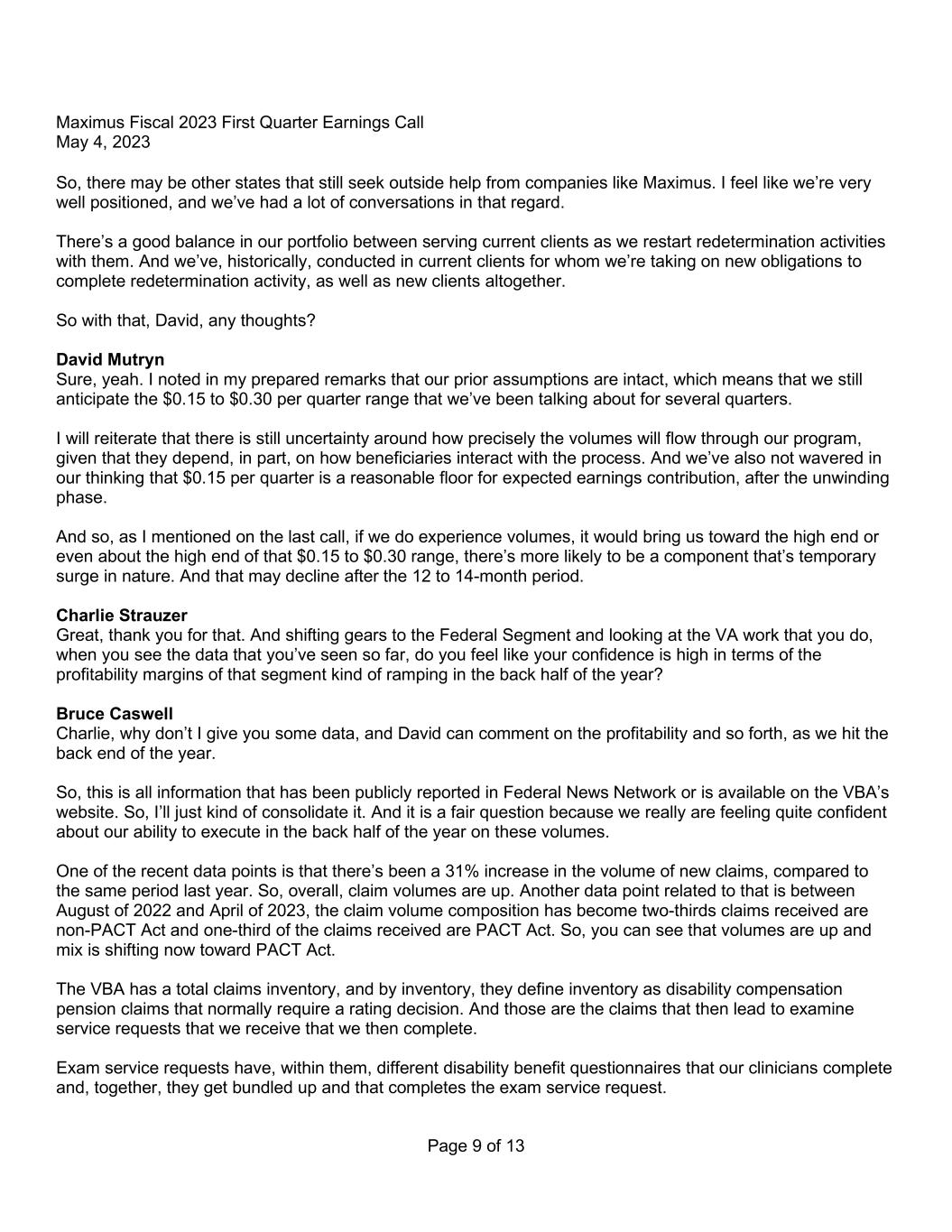
Maximus Fiscal 2023 First Quarter Earnings Call May 4, 2023 Page 9 of 13 So, there may be other states that still seek outside help from companies like Maximus. I feel like we’re very well positioned, and we’ve had a lot of conversations in that regard. There’s a good balance in our portfolio between serving current clients as we restart redetermination activities with them. And we’ve, historically, conducted in current clients for whom we’re taking on new obligations to complete redetermination activity, as well as new clients altogether. So with that, David, any thoughts? David Mutryn Sure, yeah. I noted in my prepared remarks that our prior assumptions are intact, which means that we still anticipate the $0.15 to $0.30 per quarter range that we’ve been talking about for several quarters. I will reiterate that there is still uncertainty around how precisely the volumes will flow through our program, given that they depend, in part, on how beneficiaries interact with the process. And we’ve also not wavered in our thinking that $0.15 per quarter is a reasonable floor for expected earnings contribution, after the unwinding phase. And so, as I mentioned on the last call, if we do experience volumes, it would bring us toward the high end or even about the high end of that $0.15 to $0.30 range, there’s more likely to be a component that’s temporary surge in nature. And that may decline after the 12 to 14-month period. Charlie Strauzer Great, thank you for that. And shifting gears to the Federal Segment and looking at the VA work that you do, when you see the data that you’ve seen so far, do you feel like your confidence is high in terms of the profitability margins of that segment kind of ramping in the back half of the year? Bruce Caswell Charlie, why don’t I give you some data, and David can comment on the profitability and so forth, as we hit the back end of the year. So, this is all information that has been publicly reported in Federal News Network or is available on the VBA’s website. So, I’ll just kind of consolidate it. And it is a fair question because we really are feeling quite confident about our ability to execute in the back half of the year on these volumes. One of the recent data points is that there’s been a 31% increase in the volume of new claims, compared to the same period last year. So, overall, claim volumes are up. Another data point related to that is between August of 2022 and April of 2023, the claim volume composition has become two-thirds claims received are non-PACT Act and one-third of the claims received are PACT Act. So, you can see that volumes are up and mix is shifting now toward PACT Act. The VBA has a total claims inventory, and by inventory, they define inventory as disability compensation pension claims that normally require a rating decision. And those are the claims that then lead to examine service requests that we receive that we then complete. Exam service requests have, within them, different disability benefit questionnaires that our clinicians complete and, together, they get bundled up and that completes the exam service request.


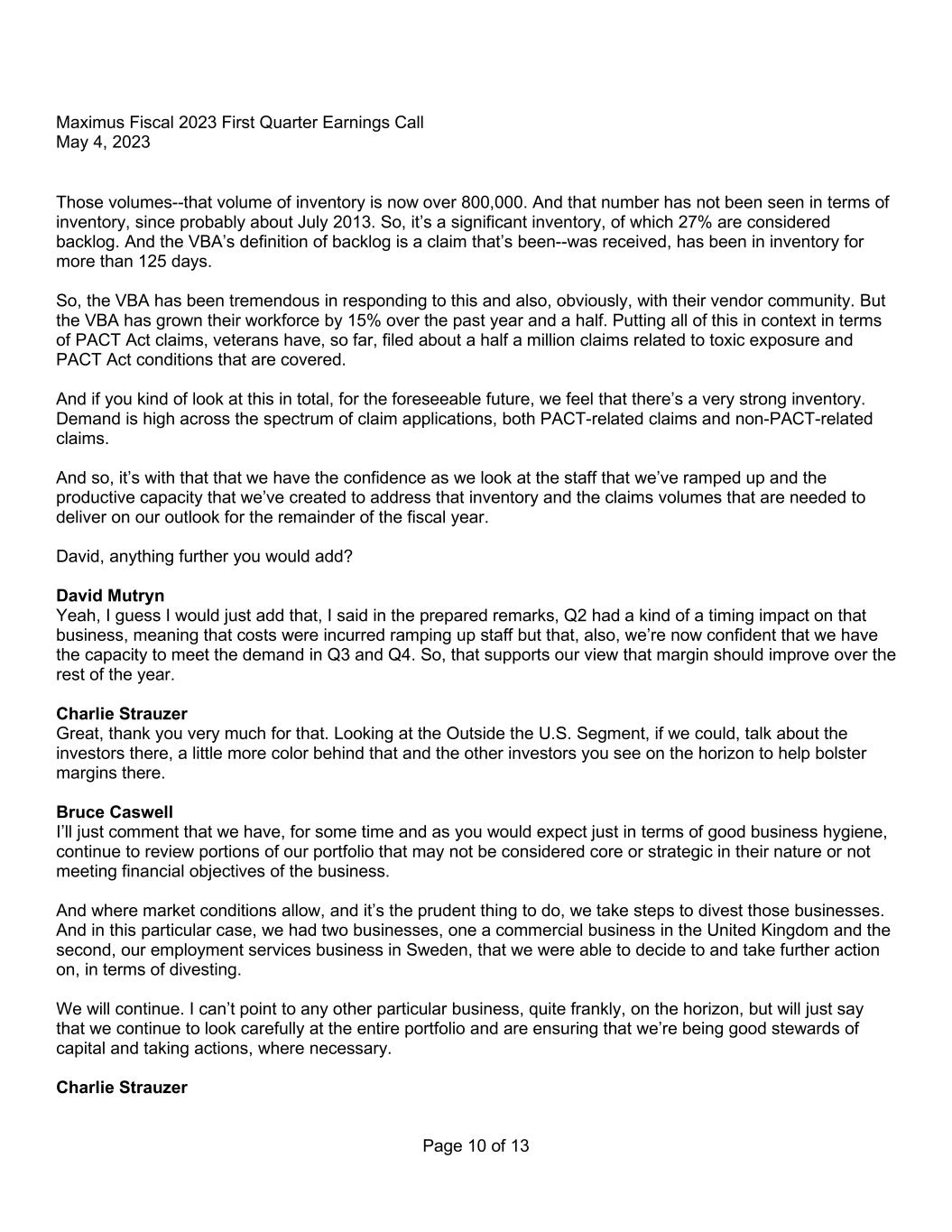
Maximus Fiscal 2023 First Quarter Earnings Call May 4, 2023 Page 10 of 13 Those volumes--that volume of inventory is now over 800,000. And that number has not been seen in terms of inventory, since probably about July 2013. So, it’s a significant inventory, of which 27% are considered backlog. And the VBA’s definition of backlog is a claim that’s been--was received, has been in inventory for more than 125 days. So, the VBA has been tremendous in responding to this and also, obviously, with their vendor community. But the VBA has grown their workforce by 15% over the past year and a half. Putting all of this in context in terms of PACT Act claims, veterans have, so far, filed about a half a million claims related to toxic exposure and PACT Act conditions that are covered. And if you kind of look at this in total, for the foreseeable future, we feel that there’s a very strong inventory. Demand is high across the spectrum of claim applications, both PACT-related claims and non-PACT-related claims. And so, it’s with that that we have the confidence as we look at the staff that we’ve ramped up and the productive capacity that we’ve created to address that inventory and the claims volumes that are needed to deliver on our outlook for the remainder of the fiscal year. David, anything further you would add? David Mutryn Yeah, I guess I would just add that, I said in the prepared remarks, Q2 had a kind of a timing impact on that business, meaning that costs were incurred ramping up staff but that, also, we’re now confident that we have the capacity to meet the demand in Q3 and Q4. So, that supports our view that margin should improve over the rest of the year. Charlie Strauzer Great, thank you very much for that. Looking at the Outside the U.S. Segment, if we could, talk about the investors there, a little more color behind that and the other investors you see on the horizon to help bolster margins there. Bruce Caswell I’ll just comment that we have, for some time and as you would expect just in terms of good business hygiene, continue to review portions of our portfolio that may not be considered core or strategic in their nature or not meeting financial objectives of the business. And where market conditions allow, and it’s the prudent thing to do, we take steps to divest those businesses. And in this particular case, we had two businesses, one a commercial business in the United Kingdom and the second, our employment services business in Sweden, that we were able to decide to and take further action on, in terms of divesting. We will continue. I can’t point to any other particular business, quite frankly, on the horizon, but will just say that we continue to look carefully at the entire portfolio and are ensuring that we’re being good stewards of capital and taking actions, where necessary. Charlie Strauzer


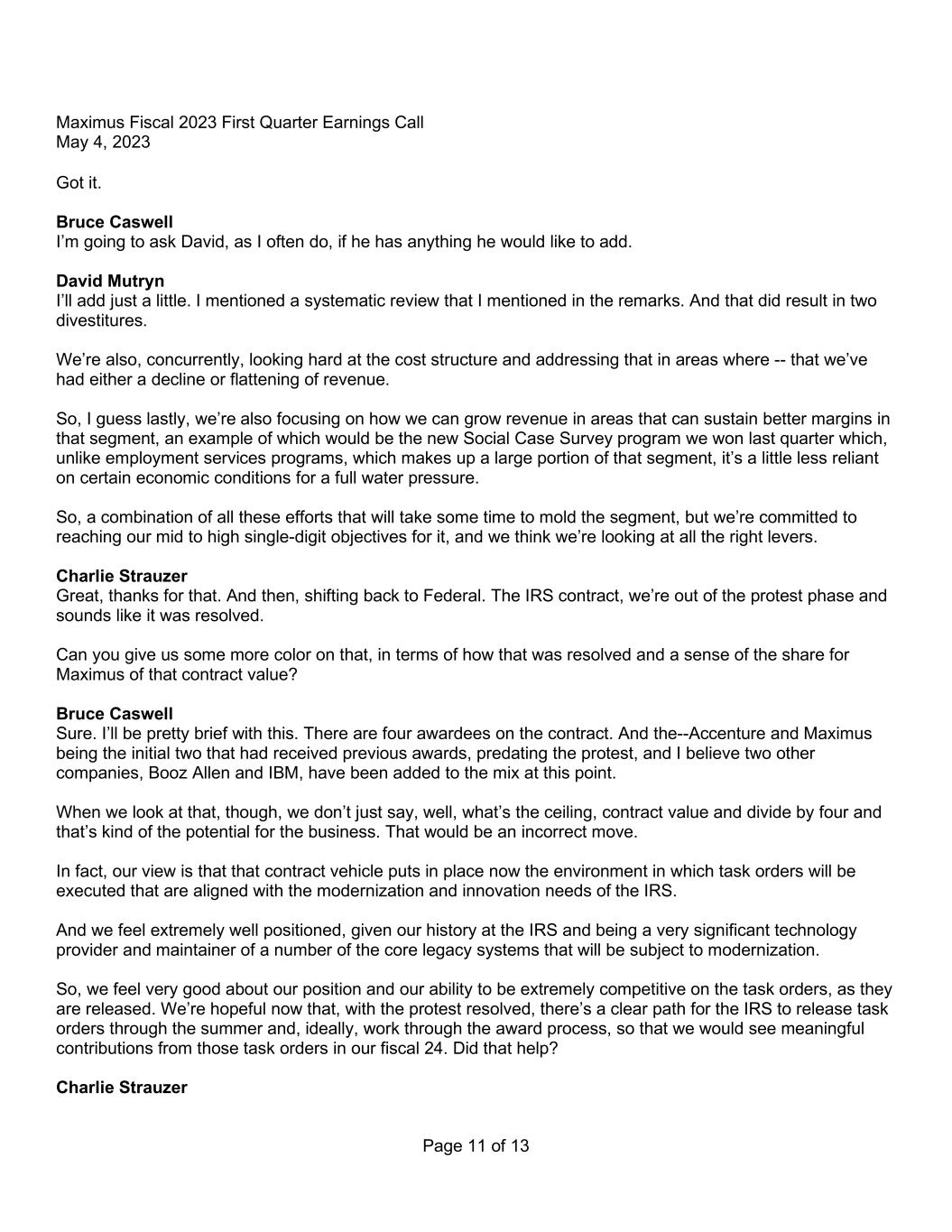
Maximus Fiscal 2023 First Quarter Earnings Call May 4, 2023 Page 11 of 13 Got it. Bruce Caswell I’m going to ask David, as I often do, if he has anything he would like to add. David Mutryn I’ll add just a little. I mentioned a systematic review that I mentioned in the remarks. And that did result in two divestitures. We’re also, concurrently, looking hard at the cost structure and addressing that in areas where -- that we’ve had either a decline or flattening of revenue. So, I guess lastly, we’re also focusing on how we can grow revenue in areas that can sustain better margins in that segment, an example of which would be the new Social Case Survey program we won last quarter which, unlike employment services programs, which makes up a large portion of that segment, it’s a little less reliant on certain economic conditions for a full water pressure. So, a combination of all these efforts that will take some time to mold the segment, but we’re committed to reaching our mid to high single-digit objectives for it, and we think we’re looking at all the right levers. Charlie Strauzer Great, thanks for that. And then, shifting back to Federal. The IRS contract, we’re out of the protest phase and sounds like it was resolved. Can you give us some more color on that, in terms of how that was resolved and a sense of the share for Maximus of that contract value? Bruce Caswell Sure. I’ll be pretty brief with this. There are four awardees on the contract. And the--Accenture and Maximus being the initial two that had received previous awards, predating the protest, and I believe two other companies, Booz Allen and IBM, have been added to the mix at this point. When we look at that, though, we don’t just say, well, what’s the ceiling, contract value and divide by four and that’s kind of the potential for the business. That would be an incorrect move. In fact, our view is that that contract vehicle puts in place now the environment in which task orders will be executed that are aligned with the modernization and innovation needs of the IRS. And we feel extremely well positioned, given our history at the IRS and being a very significant technology provider and maintainer of a number of the core legacy systems that will be subject to modernization. So, we feel very good about our position and our ability to be extremely competitive on the task orders, as they are released. We’re hopeful now that, with the protest resolved, there’s a clear path for the IRS to release task orders through the summer and, ideally, work through the award process, so that we would see meaningful contributions from those task orders in our fiscal 24. Did that help? Charlie Strauzer


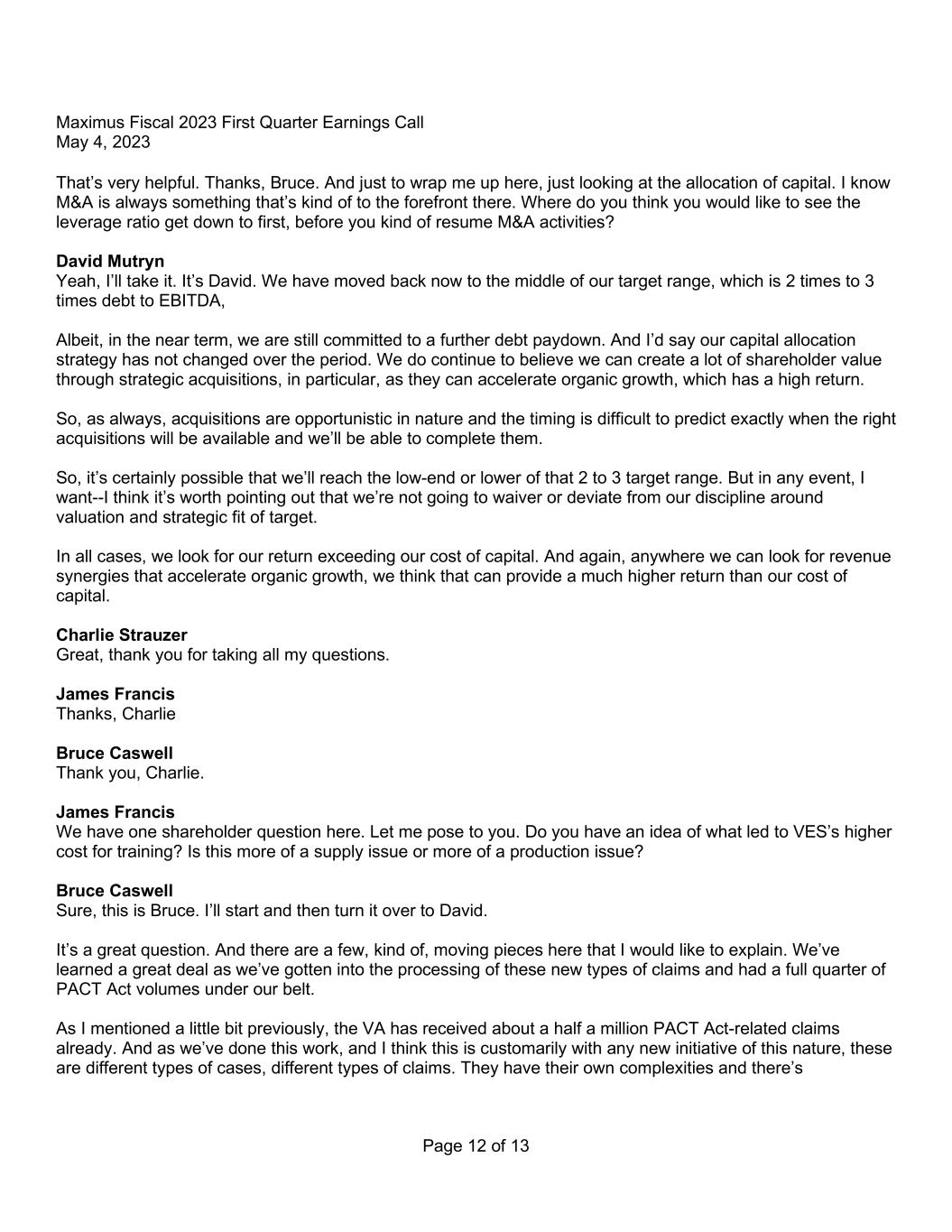
Maximus Fiscal 2023 First Quarter Earnings Call May 4, 2023 Page 12 of 13 That’s very helpful. Thanks, Bruce. And just to wrap me up here, just looking at the allocation of capital. I know M&A is always something that’s kind of to the forefront there. Where do you think you would like to see the leverage ratio get down to first, before you kind of resume M&A activities? David Mutryn Yeah, I’ll take it. It’s David. We have moved back now to the middle of our target range, which is 2 times to 3 times debt to EBITDA, Albeit, in the near term, we are still committed to a further debt paydown. And I’d say our capital allocation strategy has not changed over the period. We do continue to believe we can create a lot of shareholder value through strategic acquisitions, in particular, as they can accelerate organic growth, which has a high return. So, as always, acquisitions are opportunistic in nature and the timing is difficult to predict exactly when the right acquisitions will be available and we’ll be able to complete them. So, it’s certainly possible that we’ll reach the low-end or lower of that 2 to 3 target range. But in any event, I want--I think it’s worth pointing out that we’re not going to waiver or deviate from our discipline around valuation and strategic fit of target. In all cases, we look for our return exceeding our cost of capital. And again, anywhere we can look for revenue synergies that accelerate organic growth, we think that can provide a much higher return than our cost of capital. Charlie Strauzer Great, thank you for taking all my questions. James Francis Thanks, Charlie Bruce Caswell Thank you, Charlie. James Francis We have one shareholder question here. Let me pose to you. Do you have an idea of what led to VES’s higher cost for training? Is this more of a supply issue or more of a production issue? Bruce Caswell Sure, this is Bruce. I’ll start and then turn it over to David. It’s a great question. And there are a few, kind of, moving pieces here that I would like to explain. We’ve learned a great deal as we’ve gotten into the processing of these new types of claims and had a full quarter of PACT Act volumes under our belt. As I mentioned a little bit previously, the VA has received about a half a million PACT Act-related claims already. And as we’ve done this work, and I think this is customarily with any new initiative of this nature, these are different types of cases, different types of claims. They have their own complexities and there’s


Maximus Fiscal 2023 First Quarter Earnings Call May 4, 2023 Page 13 of 13 correspondingly a ramp-up or a learning curve for both organizations, for the vendor supporting the VA and for the VA, itself. So, in this early period of transition, we’re both in the process of formalizing our procedures and ensuring that we have kind of a grooved swing, if you will, for handling these types of cases. It’s not uncommon for new claim types of this nature for there to be a back-and-forth between the vendor and the VA to clarify issues, address questions, and so forth. And another interesting data point is the VBA has reported recently that the average number of days to process from start to finish, a PACT Act-related claim, is about 156 and a half days, as a data point. In the second quarter, another one of the elements in the moving parts here was the utilization of our staff was a bit below our potential. We had more stuff completing training and, therefore, fewer in production, which led to more overtime, and then what had been anticipated for the fully productive staff that we already had. And as I noted in my remarks, the demand is building at an increasing rate. And so, since late FY 22, you’ll recall that we’ve been making investments and lining up the business to meet the anticipated demand, and we’re very confident in our ability to have the productive capacity in place required to achieve our forecast. With that, David, anything further to add? David Mutryn Yeah, just to lay on to Bruce’s remarks, while revenue was a bit lower than we had forecast in the quarter, the bottom line impact was amplified, due to the higher cost, as you mentioned, with the ramping up of staff to meet our expectations for Q3 and Q4. James Francis That’s great. That concludes the question and answer session. Thanks for joining us today. Operator, back to you. Operator Ladies and gentlemen, thank you for your participation and interest in Maximus. You may disconnect your lines and log off the webcast at this time, and enjoy the rest of your day.


| Maximus: Q2 FY23 Earnings Presentation1 May 4, 2023 Fiscal 2023 Second Quarter Earnings Call David Mutryn Chief Financial Officer


| Maximus: Q2 FY23 Earnings Presentation2 These slides should be read in conjunction with the Company’s most recent quarterly earnings press release, along with listening to or reading a transcript of the comments of Company management from our most recent quarterly earnings conference call. This document may contain non-GAAP financial information. Management uses this information in its internal analysis of results and believes that this information may be informative to investors in gauging the quality of our financial performance, identifying trends in our results, and providing meaningful period-to-period comparisons. These measures should be used in conjunction with, rather than instead of, their comparable GAAP measures. For a reconciliation of non-GAAP measures to the comparable GAAP measures presented in this document, see the Company’s most recent quarterly earnings press release. Included in this presentation are forward-looking statements within the meaning of the safe harbor provisions of the United States Private Securities Litigation Reform Act of 1995. Forward-looking statements can be identified by words such as: "anticipate," "intend," "plan," "goal," "seek," "opportunity," "could," "potential," "believe," "project," "estimate," "expect," "forecast," "strategy," "future," "likely," "may," "should," "will," and similar references to future periods. Forward-looking statements that are not historical facts, including statements about our confidence, strategies and initiatives and our expectations about revenues, results of operations, profitability, liquidity, market demand or the impact of the pandemic are forward-looking statements that involve risks and uncertainties such as those related to the impact of the pandemic and our recently-completed acquisitions. These risks could cause the Company’s actual results to differ materially from those indicated by such forward-looking statements. A summary of risk factors can be found in Item 1A, "Risk Factors" in our Annual Report on Form 10-K for the year ended September 30, 2022, which was filed with the Securities and Exchange Commission (SEC) on November 22, 2022. Any forward-looking statement made by us in this report is based only on information currently available to us and speaks only as of the date on which it is made. We undertake no obligation to publicly update any forward-looking statement, whether written or oral, that may be made from time to time, whether as a result of new information, future developments or otherwise. Throughout this presentation, numbers may not add due to rounding. Forward-looking Statements & Non-GAAP Information


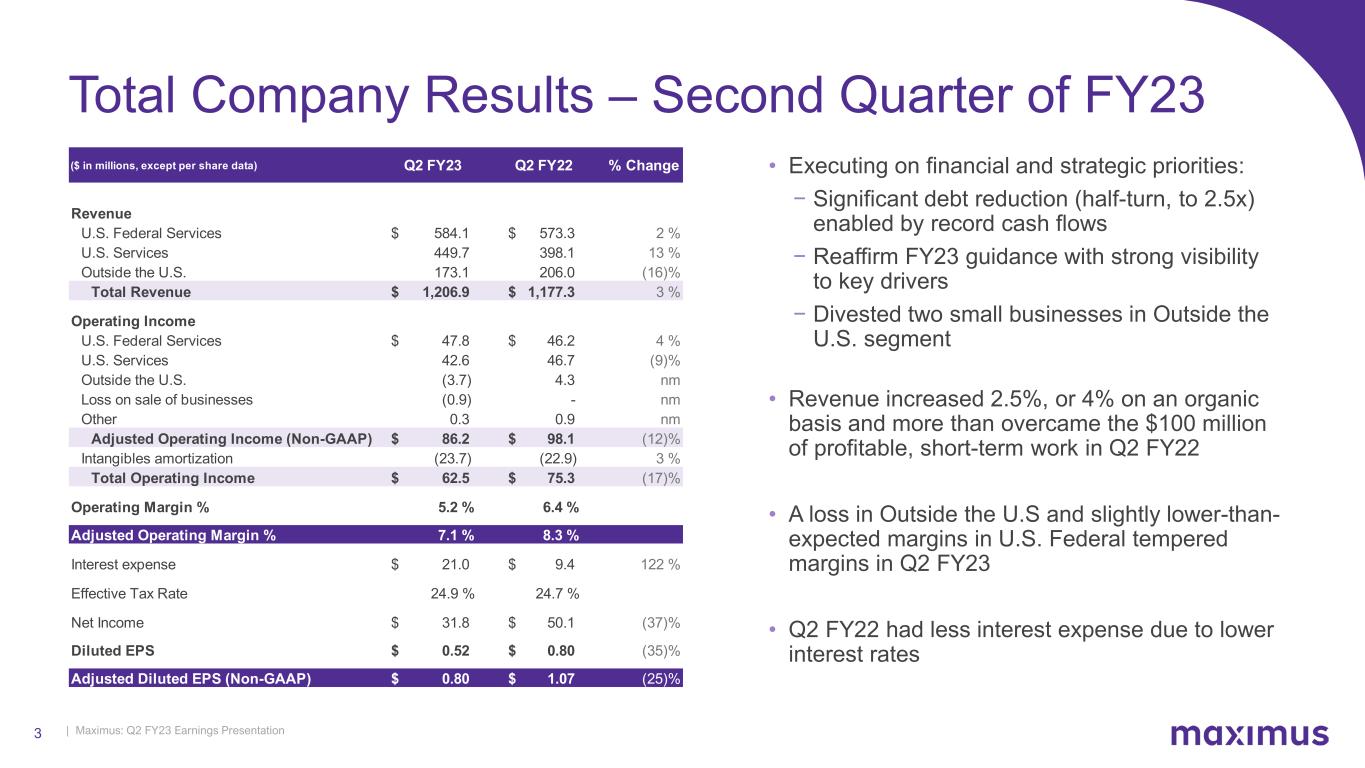
| Maximus: Q2 FY23 Earnings Presentation3 • Executing on financial and strategic priorities: − Significant debt reduction (half-turn, to 2.5x) enabled by record cash flows − Reaffirm FY23 guidance with strong visibility to key drivers − Divested two small businesses in Outside the U.S. segment • Revenue increased 2.5%, or 4% on an organic basis and more than overcame the $100 million of profitable, short-term work in Q2 FY22 • A loss in Outside the U.S and slightly lower-than- expected margins in U.S. Federal tempered margins in Q2 FY23 • Q2 FY22 had less interest expense due to lower interest rates Total Company Results – Second Quarter of FY23 ($ in millions, except per share data) Q2 FY23 Q2 FY22 % Change Revenue U.S. Federal Services $ 584.1 $ 573.3 2 % U.S. Services 449.7 398.1 13 % Outside the U.S. 173.1 206.0 (16)% Total Revenue $ 1,206.9 $ 1,177.3 3 % Operating Income U.S. Federal Services $ 47.8 $ 46.2 4 % U.S. Services 42.6 46.7 (9)% Outside the U.S. (3.7) 4.3 nm Loss on sale of businesses (0.9) - nm Other 0.3 0.9 nm Adjusted Operating Income (Non-GAAP) $ 86.2 $ 98.1 (12)% Intangibles amortization (23.7) (22.9) 3 % Total Operating Income $ 62.5 $ 75.3 (17)% Operating Margin % 5.2 % 6.4 % Adjusted Operating Margin % 7.1 % 8.3 % Interest expense $ 21.0 $ 9.4 122 % Effective Tax Rate 24.9 % 24.7 % Net Income $ 31.8 $ 50.1 (37)% Diluted EPS $ 0.52 $ 0.80 (35)% Adjusted Diluted EPS (Non-GAAP) $ 0.80 $ 1.07 (25)%


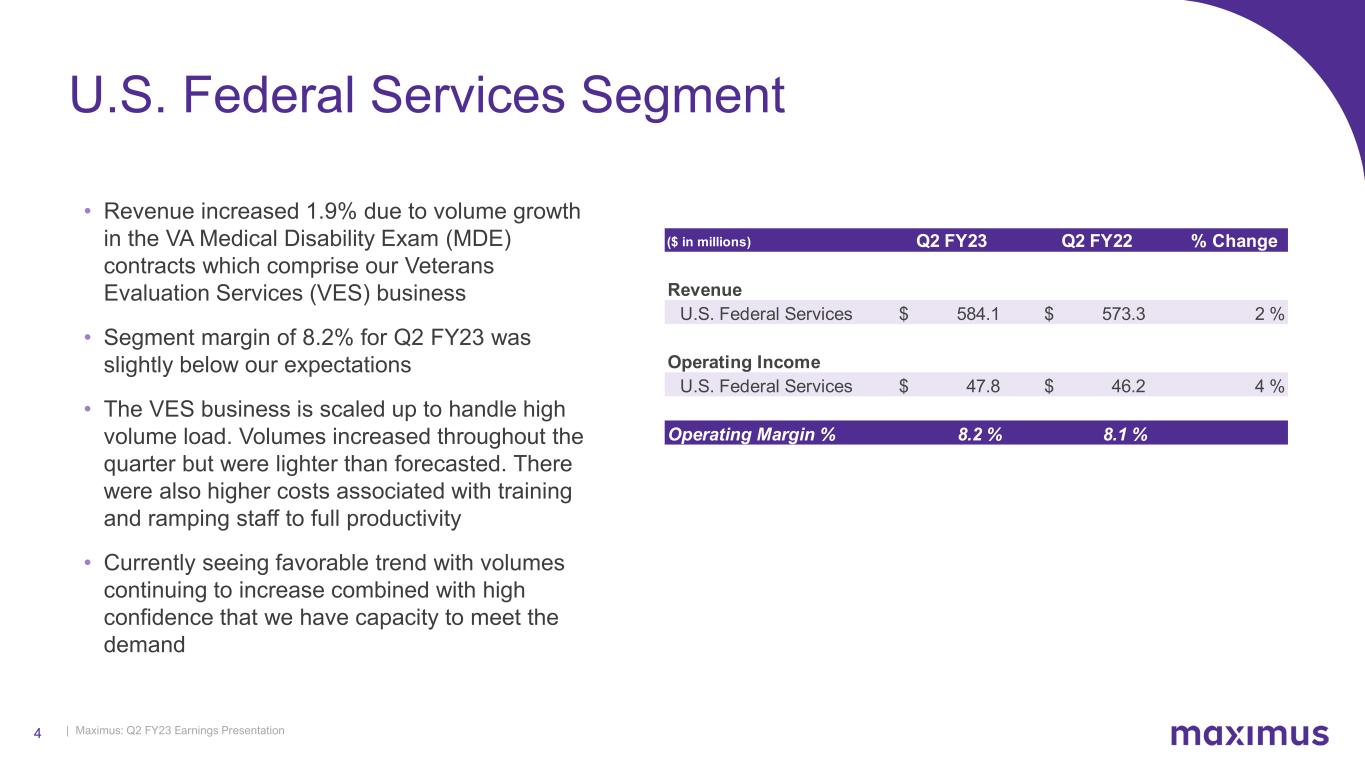
| Maximus: Q2 FY23 Earnings Presentation4 U.S. Federal Services Segment • Revenue increased 1.9% due to volume growth in the VA Medical Disability Exam (MDE) contracts which comprise our Veterans Evaluation Services (VES) business • Segment margin of 8.2% for Q2 FY23 was slightly below our expectations • The VES business is scaled up to handle high volume load. Volumes increased throughout the quarter but were lighter than forecasted. There were also higher costs associated with training and ramping staff to full productivity • Currently seeing favorable trend with volumes continuing to increase combined with high confidence that we have capacity to meet the demand ($ in millions) Q2 FY23 Q2 FY22 % Change Revenue U.S. Federal Services $ 584.1 $ 573.3 2 % Operating Income U.S. Federal Services $ 47.8 $ 46.2 4 % Operating Margin % 8.2 % 8.1 %


| Maximus: Q2 FY23 Earnings Presentation5 • Revenue increased 13% driven by contributions from previously-disclosed new work wins in core areas such as eligibility support and clinical services • Segment margin of 9.5% for Q2 FY23 reflects ongoing headwind from paused Medicaid redetermination activities while Q2 FY22 benefitted from profitable, short-term work • As stated on the prior call, redeterminations anticipated to commence in Q3 FY23 and make a full period contribution in Q4 FY23, with expected margin improvement U.S. Services Segment ($ in millions) Q2 FY23 Q2 FY22 % Change Revenue U.S. Services $ 449.7 $ 398.1 13 % Operating Income U.S. Services $ 42.6 $ 46.7 (9)% Operating Margin % 9.5 % 11.7 %


| Maximus: Q2 FY23 Earnings Presentation6 • Revenue decrease of 16% is comprised of organic contraction totaling 8% primarily from last year’s Australia rebid outcome and currency impacts of 7% • Segment loss of $3.7 million for Q2 FY23 due, in part, to two small divested businesses that drove $1.5 million of losses • We are unsatisfied with current segment performance and margins, and systematically focused on portions of the business that are underperforming • The transactions also drove loss on sale of approximately $0.01 diluted EPS, which is accounted for separately from Outside the U.S. segment results Outside the U.S. Segment ($ in millions) Q2 FY23 Q2 FY22 % Change Revenue Outside the U.S. $ 173.1 $ 206.0 (16)% Operating Income/(Loss) Outside the U.S. $ (3.7) $ 4.3 nm Operating Margin % (2.1)% 2.1 %


| Maximus: Q2 FY23 Earnings Presentation7 Cash Flows & Debt Cash Flows & DSO • Record cash flows in Q2 FY23 made up for temporarily low cash flow in the prior quarter • Strong collections resulted in DSO of 56 days at March 31, 2023 (our target range is 60 – 70 days) Debt • Significant debt reduction enabled by cash flow performance • At March 31, 2023, the ratio of debt, net of allowed cash, to EBITDA on TTM basis, as calculated in accordance with credit agreement, was 2.5x and compares to 3.0x at December 31, 2022 • At March 31, 2023, total debt was $1.30 billion and revolving line of credit was paid down in full, providing access to the full line of $600 million $ in millions Q2 FY23 YTD FY23 Cash provided by operating activities $ 309.7 $ 175.0 Purchases of property and equipment and capitalized software costs (18.1) (33.8) Free cash flow $ 291.6 $ 141.3


| Maximus: Q2 FY23 Earnings Presentation8 Reaffirming Fiscal Year 2023 Guidance Fiscal 2023 Guidance Revenue $4.85B - $5.0B Adjusted operating income $415M - $440M Adjusted diluted EPS $4.00 - $4.30 Free cash flow $225M - $275M • Reaffirming FY23 revenue and earnings guidance. Revenue projection is 5% – 8% year-over-year growth, overcoming the $300 million reduction of short-term work • Earnings expected to grow sequentially with good line of sight to required drivers, notably redeterminations restarting in U.S. Services and ongoing volume ramp from PACT Act volumes in U.S. Federal Services − In Q3 FY23, a step-up is forecasted as compared to Q2 FY23 driven by U.S. Federal volume growth − In Q4 FY23, greater step-up expected as compared to Q3 FY23 forecast, driven by full period of redeterminations and further U.S. Federal Services volume growth • FY23 segment margin and other projections: − U.S. Federal Segment: 10 – 11%, bias towards low-end − U.S. Services Segment: 9 – 11% − Outside the U.S.: 1 – 3% − Interest expense: $82 million – $85 million − Effective income tax rate: 24.5% – 25.5% − WASO: 61.2 million – 61.3 million ($ in millions except per share items) Low End High End Operating income 321$ 346$ Add: amortization of intangible assets 94 94 Adjusted operating income 415$ 440$ Diluted EPS 2.85$ 3.15$ Add: effect of amortization of intangible assets on diluted EPS 1.15 1.15 Adjusted diluted EPS 4.00$ 4.30$ Cash flows from operating activities 285$ 335$ Remove: purchases of property and equipment and capitalized software costs (60) (60) Free cash flow 225$ 275$ FY23 Guidance Reconciliation


| Maximus: Q2 FY23 Earnings Presentation9 May 4, 2023 Fiscal 2023 Second Quarter Earnings Call Bruce Caswell President & Chief Executive Officer


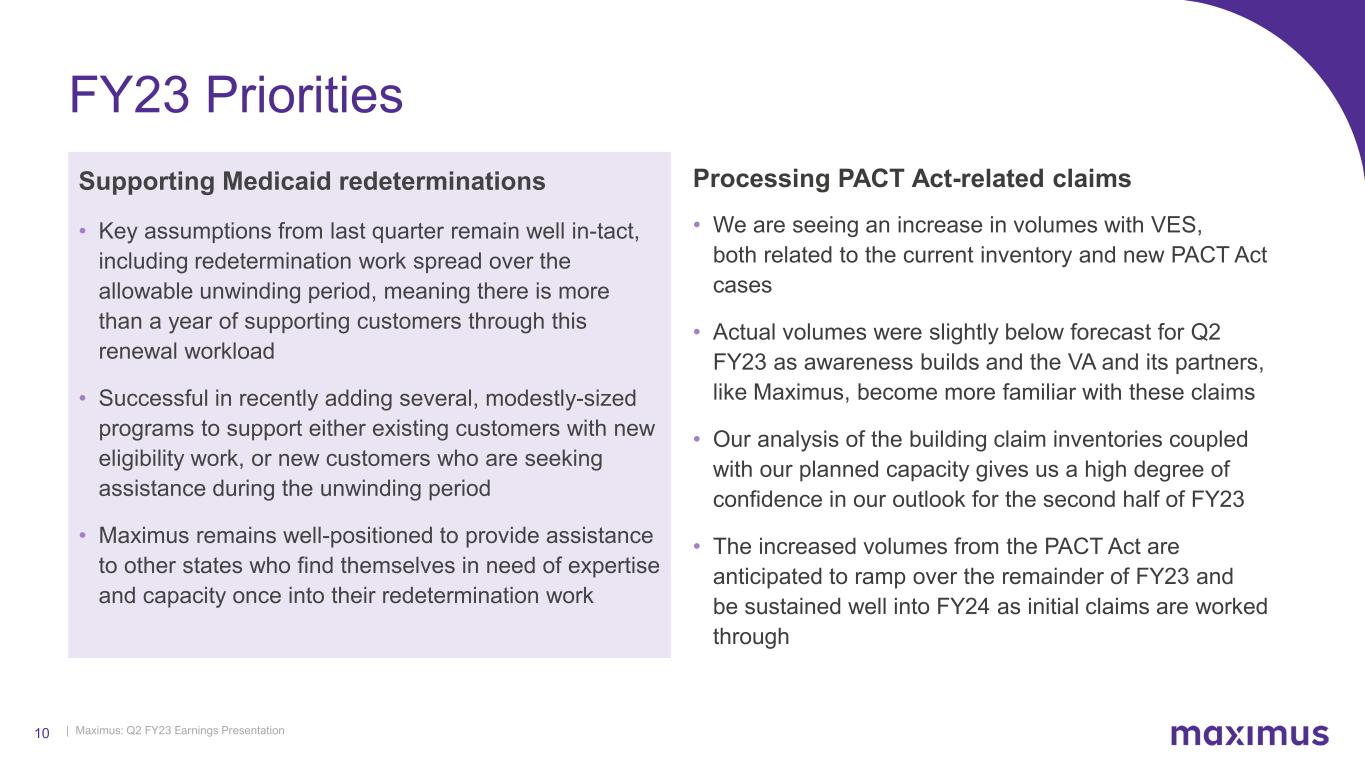
| Maximus: Q2 FY23 Earnings Presentation10 Processing PACT Act-related claims • We are seeing an increase in volumes with VES, both related to the current inventory and new PACT Act cases • Actual volumes were slightly below forecast for Q2 FY23 as awareness builds and the VA and its partners, like Maximus, become more familiar with these claims • Our analysis of the building claim inventories coupled with our planned capacity gives us a high degree of confidence in our outlook for the second half of FY23 • The increased volumes from the PACT Act are anticipated to ramp over the remainder of FY23 and be sustained well into FY24 as initial claims are worked through Supporting Medicaid redeterminations • Key assumptions from last quarter remain well in-tact, including redetermination work spread over the allowable unwinding period, meaning there is more than a year of supporting customers through this renewal workload • Successful in recently adding several, modestly-sized programs to support either existing customers with new eligibility work, or new customers who are seeking assistance during the unwinding period • Maximus remains well-positioned to provide assistance to other states who find themselves in need of expertise and capacity once into their redetermination work FY23 Priorities


| Maximus: Q2 FY23 Earnings Presentation11 • During the second quarter, we divested two small businesses in the Outside the U.S. Segment: a commercial division within the U.K. and the employment services business in Sweden Optimizing the Business • Both businesses were non-core to our three-to-five- year strategy and not meeting financial objectives • We routinely evaluate our portfolio of businesses in this way and will continue to do so, particularly in light of the Outside the U.S.’s performance this second quarter • Together, the annual revenue run rate for both divested businesses is ~$40 million • The financial effect, especially given the partial year, is not large enough to affect our guidance


| Maximus: Q2 FY23 Earnings Presentation12 Executing on Our Strategy Technology Modernization • Secured our place on the IRS Enterprise Development, Operations Services (EDOS) procurement following resolution of protest • The Blanket Purchase Agreement is worth up to $2.6 billion over 7 years for the resulting task orders which are expected in our fiscal year 2024 and beyond • We are proud to be supporting the long-term modernization and transformation of the IRS’s technology infrastructure Customer Services, Digitally Enabled • Aidvantage business awarded a position on Unified Servicing and Data Solutions (USDS), supporting student loan servicing work over the next decade • The new IDIQ under the Federal Student Aid (FSA) office spans 10 years including options and has awarded, potential value of $16 billion; more than $2 billion is the estimated, realizable value • Maximus offers the FSA a borrower-first servicing mentality and added agility of technology capabilities to improve the borrower experience • Now entrusted with over 9 million borrower accounts, or more than a quarter of the approximately 39 million Department of Education borrower accounts, which is up from the 5.8 million at the time of contract novation in October 2021


| Maximus: Q2 FY23 Earnings Presentation13 New Awards (YTD) March 31, 2023 Signed Contracts $1.22 billion Unsigned Contracts $1.27 billion Proposal in Preparation Opportunities Tracking New Awards & Pipeline • As of March 31, our book-to- bill ratio was approximately 2.1x (TTM basis) − Includes the large CCO award in Q4 of FY22 • IRS EDOS and USDS do not contribute to our year-to- date signed contracts as of March 31 • FL Healthy Kids and MI Enrollment Broker Services contracts illustrate strength of customer relationships offer visibility and underpin the value proposition of our services Proposals Pending $5.6B $900M $25.3B $31.9B total pipeline of sales opportunities 78% new work 62% U.S. Federal Services Segment


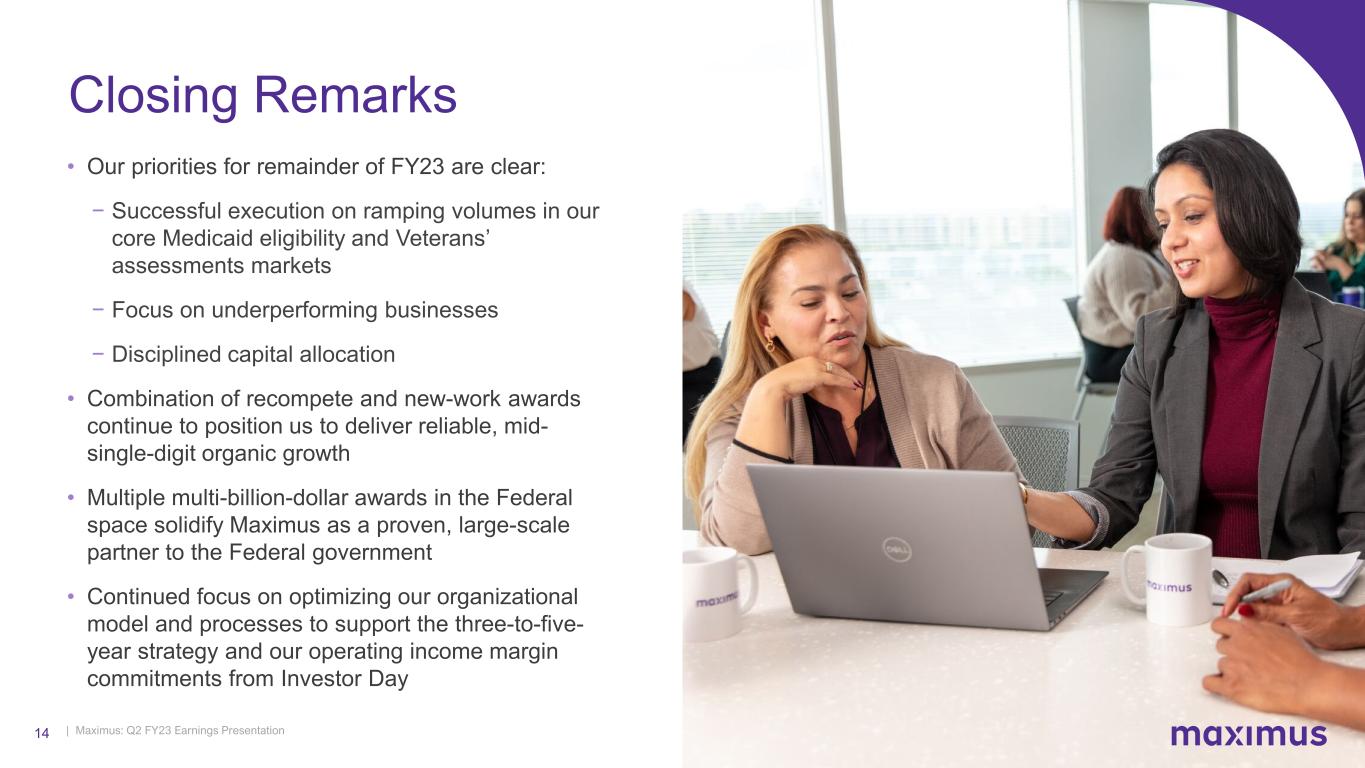
| Maximus: Q2 FY23 Earnings Presentation14 Closing Remarks • Our priorities for remainder of FY23 are clear: − Successful execution on ramping volumes in our core Medicaid eligibility and Veterans’ assessments markets − Focus on underperforming businesses − Disciplined capital allocation • Combination of recompete and new-work awards continue to position us to deliver reliable, mid- single-digit organic growth • Multiple multi-billion-dollar awards in the Federal space solidify Maximus as a proven, large-scale partner to the Federal government • Continued focus on optimizing our organizational model and processes to support the three-to-five- year strategy and our operating income margin commitments from Investor Day


| Maximus: Q2 FY23 Earnings Presentation15