UNITED STATES
SECURITIES AND EXCHANGE COMMISSION
Washington, D.C. 20549
FORM 20-F
OR
For the fiscal year ended December 31 , 2025
OR
OR
Commission file number 001-35788
(Exact name of Registrant as specified in its charter)
N/A
(Translation of Registrant’s name into English)
(Jurisdiction of incorporation or organization)
(Address of principal executive offices)
(Name, Telephone, E-mail and/or Facsimile number and Address of Company Contact Person)
Securities registered or to be registered pursuant to Section 12(b) of the Act:
Title of each class | Trading Symbol(s) | Name of each exchange on which registered |
Securities registered or to be registered pursuant to Section 12(g) of the Act:
None
Securities for which there is reporting obligation pursuant to Section 15(d) of the Act:
None
Indicate the number of outstanding shares of the issuer’s classes of capital or common stock as of the close of the period covered by the annual report:
Ordinary Shares
Indicate by check mark if the registrant is a well-known seasoned issuer, as defined in Rule 405 of the Securities Act.
If this report is an annual or transition report, indicate by check mark if the registrant is not required to file reports pursuant to Section 13 or 15(d) of the Securities
Exchange Act of 1934.
Yes ☐ No ☒
Indicate by check mark whether the registrant (1) has filed all reports required to be filed by Section 13 or 15(d) of the Securities Exchange Act of 1934 during the
preceding 12 months (or for such shorter period that the registrant was required to file such reports), and (2) has been subject to such filing requirements for the past 90 days.
Indicate by check mark whether the registrant has submitted electronically every Interactive Data File required to be submitted pursuant to Rule 405 of Regulation S‐T
(§232.405 of this chapter) during the preceding 12 months (or for such shorter period that the registrant was required to submit such files).
Indicate by check mark whether the registrant is a large accelerated filer, an accelerated filer, a non-accelerated filer, or an emerging growth company. See definition of
“large accelerated filer," "accelerated filer," and "emerging growth company” in Rule 12b-2 of the Exchange Act.
If an emerging growth company that prepares its financial statements in accordance with U.S. GAAP, indicate by check mark if the registrant has elected not to use the
extended transition period for complying with any new or revised financial accounting standards† provided pursuant to Section 13(a) of the Exchange
Act. ☐
† The term “new or revised financial accounting standard” refers to any update issued by the Financial Accounting Standards Board to its Accounting Standards Codification after
April 5, 2012.
Indicate by check mark whether the registrant has filed a report on and attestation to its management’s assessment of the effectiveness of its internal control over
financial reporting under Section 404(b) of the Sarbanes-Oxley Act (15 U.S.C. 7262(b)) by the registered public accounting firm that prepared or issued its audit report. ☒
If securities are registered pursuant to Section 12(b) of the Act, indicate by check mark whether the financial statements of the registrant included in the filing reflect
the correction of an error to previously issued financial statements. ☐
Indicate by check mark whether any of those error corrections are restatements that required a recovery analysis of incentive-based compensation received by any of
the registrant’s executive officers during the relevant recovery period pursuant to §240.10D-1(b).☐
Indicate by check mark which basis of accounting the registrant has used to prepare the financial statements included in this filing:
U.S. GAAP ☐ International Financial Reporting Standards as issued by the International Accounting Standards
Board ☒ Other ☐
If “Other” has been checked in response to the previous question, indicate by check mark which financial statement item the registrant has elected to follow.
Item 17 ☐ Item 18 ☐
If this is an annual report, indicate by check mark whether the registrant is a shell company (as defined in Rule 12b-2 of the Exchange Act).
Yes ☐ No ☒
Table of contents
Management report | Page |
Introduction | |
Company overview | |
History and development of the Company | |
Cautionary statement regarding forward-looking statements | |
Key transactions and events in 2025 | |
Sustainable development highlights | |
Risk factors and control | |
Business overview | |
Business strategy | |
Research and development | |
Products | |
Sustainable development | |
Raw materials and energy | |
Sales and marketing | |
Intellectual property | |
Government regulations | |
Organizational structure | |
Properties and capital expenditures | |
Property, plant and equipment | |
Capital expenditures | |
Mineral reserves and resources | |
Operating and financial review | |
Key factors affecting results of operations | |
Operating results | |
Liquidity and capital resources | |
Disclosures about market risk | |
Outlook | |
Management and employees | |
Directors and senior management | |
Compensation | |
Employees | |
Corporate governance | |
Insider Dealing Regulations | |
Shareholders and markets | |
Major shareholders | |
Related party transactions | |
Markets | |
New York Registry Shares | |
Dividend distributions | |
Purchases of equity securities by the issuer and affiliated purchasers | |
Share capital | |
Additional information | Page |
Memorandum and Articles of Association | |
Material contracts | |
Exchange controls and other limitations affecting security holders | |
Taxation | |
Evaluation of disclosure controls and procedures | |
Management’s report on internal control over financial reporting | |
Report of Independent Registered Public Accounting Firm | |
Principal accountant fees and services | |
Glossary - definitions, terminology and principal subsidiaries | |
Exhibits | |
Signatures | |
Consolidated financial statements | |
Report of Independent Registered Public Accounting Firm ( | |
Consolidated statements of operations | |
Consolidated statements of other comprehensive income | |
Consolidated statements of financial position | |
Consolidated statements of changes in equity | |
Consolidated statements of cash flows | |
Summary of notes to consolidated financial statements | |
Form 20-F Cross Reference Guide
Item | Form 20-F Caption | Reference in current report | Page |
Glossary - definitions, terminology and principal subsidiaries | |||
Cautionary statement regarding forward-looking statements | Cautionary statement regarding forward-looking statements | ||
Part I | |||
Item 1. | Identity of Directors, Senior Management and Advisers | Not applicable | |
Item 2. | Offers Statistics and Expected Timetable | Not applicable | |
Item 3. | Key Information | ||
A. | [Reserved] | Not applicable | |
B. | Capitalization and indebtedness | Not applicable | |
C. | Reasons for the offer and use of proceeds | Not applicable | |
Risk Factors and Control | |||
Item 4. | Information on the Company | ||
History and development of the Company, Key transactions and events in 2025, Recent developments, Sustainable development highlights, Capital expenditures, Raw materials, Sources and uses of cash, Note 2 to the consolidated financial statements | |||
Company overview, Key transactions and events in 2025, Risk management process, Business overview - Business strategy, Sustainable development, Markets, Research and development, Products, Sales and marketing, Purchasing, Intellectual property, Government regulations, Mineral reserves and resources, Raw materials, Note 2 to the consolidated financial statements | |||
Organizational structure | |||
Property, plant and equipment, Capital expenditures, Mineral reserves and resources | |||
Item 4A. | Unresolved staff comments | None | |
Item 5. | Operating and Financial Review and Prospects | ||
Key factors affecting results of operations, Operating results, "Operating and financial review—Operating results" in the annual report on Form 20-F for the year ended December 31, 2024 | |||
Liquidity and capital resources, “Operating and financial review—Liquidity and capital resources—Sources and uses of cash" in the annual report on Form 20-F for the year ended December 31, 2024 | |||
C. | Research and development, patents and licenses, etc. | Research and development | |
Outlook, Key factors affecting results of operations | |||
E. | Critical Accounting Estimates | Critical accounting policies and use of judgments and estimates | |
Item 6. | Directors, Senior Management and Employees | ||
Directors and senior management | |||
Compensation | |||
Corporate governance, Directors and senior management | |||
Employees | |||
Management share ownership, Compensation | |||
F. | Disclosure of a registrant’s action to recover erroneously awarded compensation. | Not applicable | |
Item 7. | Major Shareholders and Related Party Transactions | ||
Major shareholders | |||
Related party transactions | |||
C. | Interest of experts and counsel | Not applicable | |
Item 8. | Financial Information | ||
A. | Consolidated statements and other financial information | Consolidated financial statements as of and for the year ended December 31, 2025, Export sales, Legal proceedings, Other information - Capital return policy | |
B. | Significant changes | Recent developments, Operating and financial review | |
Item 9. | The Offer and Listing | ||
A. | Offer and listing details | Markets | |
B. | Plan of distribution | Not applicable | |
C. | Markets | Markets | |
D. | Selling shareholders | Not applicable | |
E. | Dilution | Not applicable | |
F. | Expenses of the issue | Not applicable | |
Item 10. | Additional Information | ||
Share capital | |||
Memorandum and Articles of Association | |||
Material contracts | |||
Exchange controls and other limitations affecting security holders | |||
Taxation | |||
F. | Dividends and paying agents | Paying agents, Earnings distribution | |
G. | Statements by experts | Reserves and Resources (iron ore and coal) and Exhibits 15.1, 15.2, 15.3, 15.4, 15.5, 15.6, 15.7, 15.8, 15.9 and 15.10 | |
H. | Documents on display | History and development of the Company | |
I. | Subsidiary information | Not applicable | |
J. | Annual Report to Security Holders | Not applicable | |
Item 11. | Disclosures about market risk, Note 6 to consolidated financial statements | ||
Item 12. | Description of Securities Other Than Equity Securities | ||
A. | Debt Securities | Not applicable | |
B. | Warrants and Rights | Not applicable | |
C. | Other Securities | Not applicable | |
New York Registry Shares | |||
Part II | |||
Item 13. | Defaults, Dividend Arrearages and Delinquencies | None | |
Item 14. | Material Modifications to the Rights of Security Holders and Use of Proceeds | None | |
Item 15. | Controls and Procedures | Evaluation of disclosure controls and procedures, Management’s report on internal control over financial reporting and Internal control procedures, Report of Independent Registered Public Accounting Firm | |
Item 16A. | Audit committee financial expert | Corporate governance | |
Item 16B. | Code of Ethics | Corporate governance — Code of Business Conduct | |
Item 16C. | Principal accountant fees and services | ||
Item 16D. | Exemptions from the Listing Standards for Audit Committees | None | |
Item 16E. | Purchases of equity securities by the issuer and affiliated purchasers | ||
Item 16F. | Change in Registrant’s Certifying Accountant | Not applicable | |
Item 16G. | Corporate Governance | Corporate governance | |
Item 16H. | Mine Safety Disclosure | Not applicable | |
Item 16I. | Disclosure Regarding Foreign Jurisdictions that Prevent Inspections | Not applicable | |
Item 16J. | Insider Trading Policies | Corporate governance —Insider Dealing Regulations, Exhibit 11.1 | |
Item 16K | Cybersecurity | Risk Factors and Control — Cybersecurity | |
Part III | |||
Item 17. | Financial statements | Consolidated financial statements | |
Item 18. | Financial statements | Consolidated financial statements | |
Item 19. | Exhibits | Exhibits |
3
Management report |
INTRODUCTION
Company overview
ArcelorMittal is one of the world’s leading integrated steel and
mining companies. ArcelorMittal is the largest steel producer in
Europe and among the largest in the Americas, and a growing
presence in Asia including India through its joint venture AMNS
India.
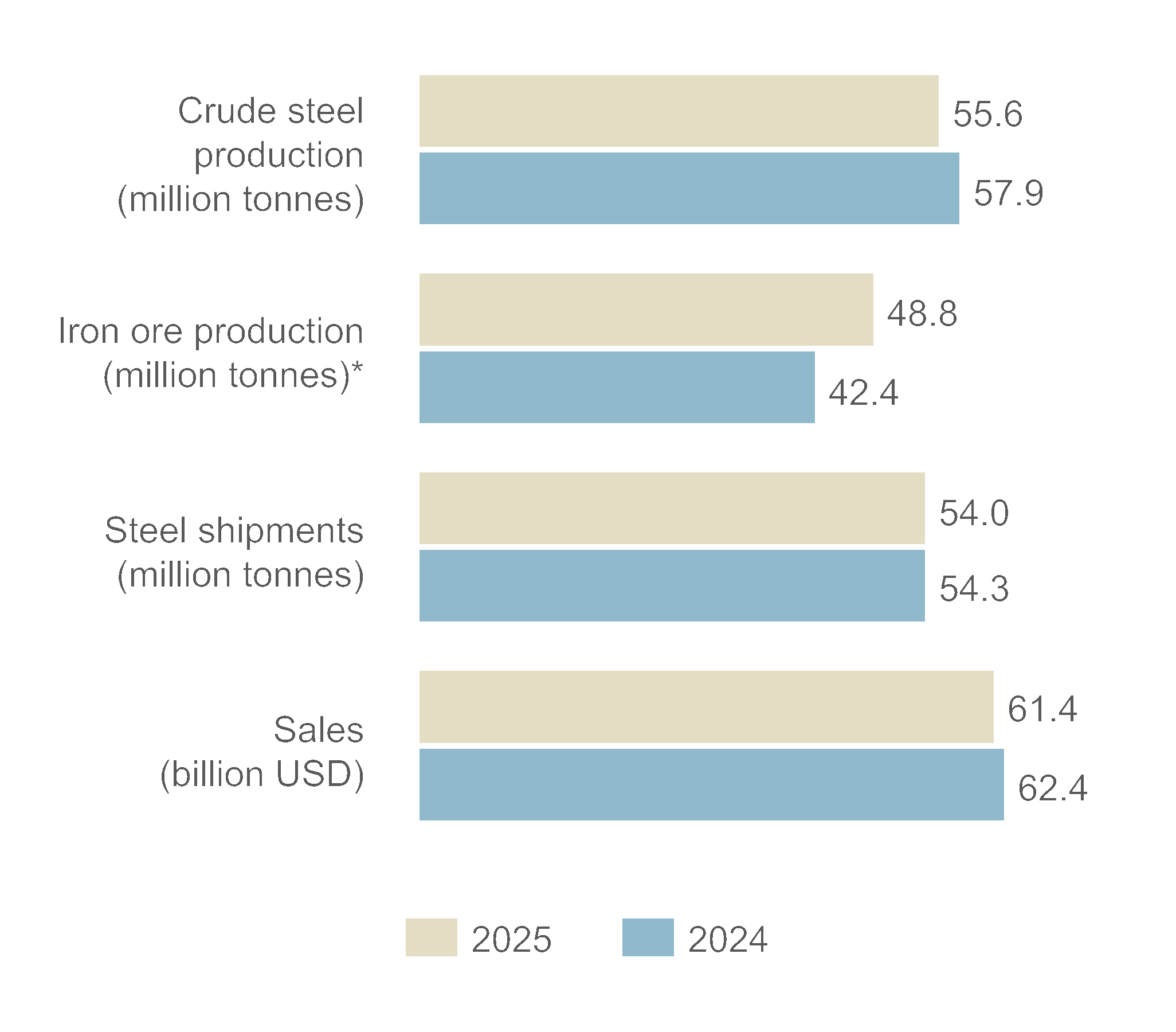
*Iron ore production includes production from ArcelorMittal Mining Canada G.P.
and ArcelorMittal Infrastructure G.P. ("AMMC"), ArcelorMittal Liberia and captive
mines.
ArcelorMittal has steel-making operations in 14 countries,
including 34 integrated and mini-mill steel-making facilities. As
of December 31, 2025, ArcelorMittal had approximately
125,554 employees.
ArcelorMittal produces a broad range of high-quality finished
and semi-finished steel products ("semis"). Specifically,
ArcelorMittal produces flat products, including sheet and plate,
and long products, including bars, rods and structural shapes.
It also produces pipes and tubes for various applications.
ArcelorMittal sells its products primarily in local markets and to
a diverse range of customers in approximately 126 countries,
including the automotive, appliance, engineering, construction
and machinery industries. ArcelorMittal’s mining operations
produce various types of mining products including iron ore
lump, fines, concentrate, pellets and sinter feed.
As a global steel producer, the Company is able to meet the
needs of different markets. Steel consumption and product
requirements clearly differ between developed markets and
developing markets. Steel consumption in developed
economies is weighted towards flat products and a higher
value-added mix, while developing markets utilize a higher
proportion of long products and commodity grades. To meet
these diverse needs, the Company maintains a high degree of
product diversification and seeks opportunities to increase the
proportion of higher value-added products in its product mix.
History and development of the Company
ArcelorMittal results from the merger in 2007 of its predecessor
companies Mittal Steel Company N.V. and Arcelor, each of
which had grown through acquisitions over many years. Since
its creation ArcelorMittal has experienced periods of external
growth as well as consolidation and deleveraging (including
through divestment).
ArcelorMittal's success is built on its core values of safety,
sustainability, quality and leadership and the entrepreneurial
boldness that has empowered its emergence as the first truly
global steel and mining company.
ArcelorMittal's strategy is to leverage four distinctive attributes
that will enable it to capture leading positions in the most
attractive areas of the steel industry’s value chain, from mining
at one end to distribution and first-stage processing at the
other: global scale and scope; superior technical capabilities; a
diverse portfolio of steel and related businesses, one of which
is mining; and financial capabilities. The Company’s strategy is
further detailed under “Business overview—Business strategy”.
ArcelorMittal’s steel-making operations have a high degree of
geographic diversification. In 2025, approximately 40%
of its crude steel was produced in the Americas, approximately
53% was produced in Europe and approximately 7% was
produced in other countries, such as South Africa and Ukraine.
In addition, ArcelorMittal’s sales of steel products are spread
over both developed and developing markets, which have
different consumption characteristics. ArcelorMittal’s mining
operations, including captive mines are present in North
America, South America, Africa and Europe. Captive mines are
integrated into the Company's global steel-making facilities.
Other information
ArcelorMittal is a public limited liability company (société
anonyme) that was incorporated for an unlimited period under
the laws of the Grand Duchy of Luxembourg on June 8, 2001.
ArcelorMittal is registered at the R.C.S. Luxembourg under
number B 82.454. The mailing address and telephone number
of ArcelorMittal’s registered office are:
ArcelorMittal
24-26, Boulevard d’Avranches
L-1160 Luxembourg,
Grand Duchy of Luxembourg
Telephone: +352 4792-1
ArcelorMittal’s agent for U.S. federal securities law purposes is:
4
Management report |
ArcelorMittal Sales & Administration LLC
833 W. Lincoln Highway, Suite 200E,
Schererville, IN 46375
Telephone: +219 256 7303
Internet site
ArcelorMittal maintains an Internet site at
www.arcelormittal.com. Information contained on or otherwise
accessible through this Internet site is not a part of this annual
report. All references in this annual report to this Internet site
and to any other Internet sites (other than to specific
documents furnished to or filed with the SEC and specifically
incorporated by reference herein) are inactive textual
references and are for information only. The SEC maintains an
internet site that contains reports, proxy and information
statements, and other information regarding issuers that file
electronically with the SEC at www.sec.gov.
ArcelorMittal produces a range of publications to inform its
shareholders. These documents are available in various
formats: they can be viewed online or downloaded. Please
refer to www.arcelormittal.com, where they can be located
within the Investors menu under Financial Reports, or within
the Corporate Library. Any request for documents may be sent
to: [email protected] or ArcelorMittal’s
registered office.
Sustainable development
ArcelorMittal's sustainable development information is detailed
in its Sustainability Report, which is expected to be published
during the second quarter of 2026. It will be available within the
Corporate Library on www.arcelormittal.com. For further
information, please refer to the section "Sustainable
Development".
ArcelorMittal as parent company of the ArcelorMittal group
ArcelorMittal, incorporated under the laws of Luxembourg, is
the parent company of the ArcelorMittal group and is expected
to continue this role during the coming years. The Company
has no branch offices.
Listings
ArcelorMittal’s shares (also referred to as "ordinary shares" or
"common shares" throughout this report) are traded on several
exchanges: New York (MT), Amsterdam (MT), Paris (MT),
Luxembourg (MT) and on the Spanish Stock Exchanges of
Barcelona, Bilbao, Madrid and Valencia (MTS). Its primary
stock exchange regulator is the Luxembourg CSSF
("Commission de Surveillance du Secteur Financier").
ArcelorMittal’s CSSF issuer number is E-0001.
Indices
ArcelorMittal is a member of approximately 105 indices
including: STOXX Europe 600, S&P Europe 350, CAC40,
Bloomberg Europe 600 Price Return Index and Euronext 100
Index. Recognized for its commitments to sustainable
development, ArcelorMittal is also included in the MSCI Europe
and World ESG Enhanced Focus Climate Transition
Benchmark Indices.
Share price performance
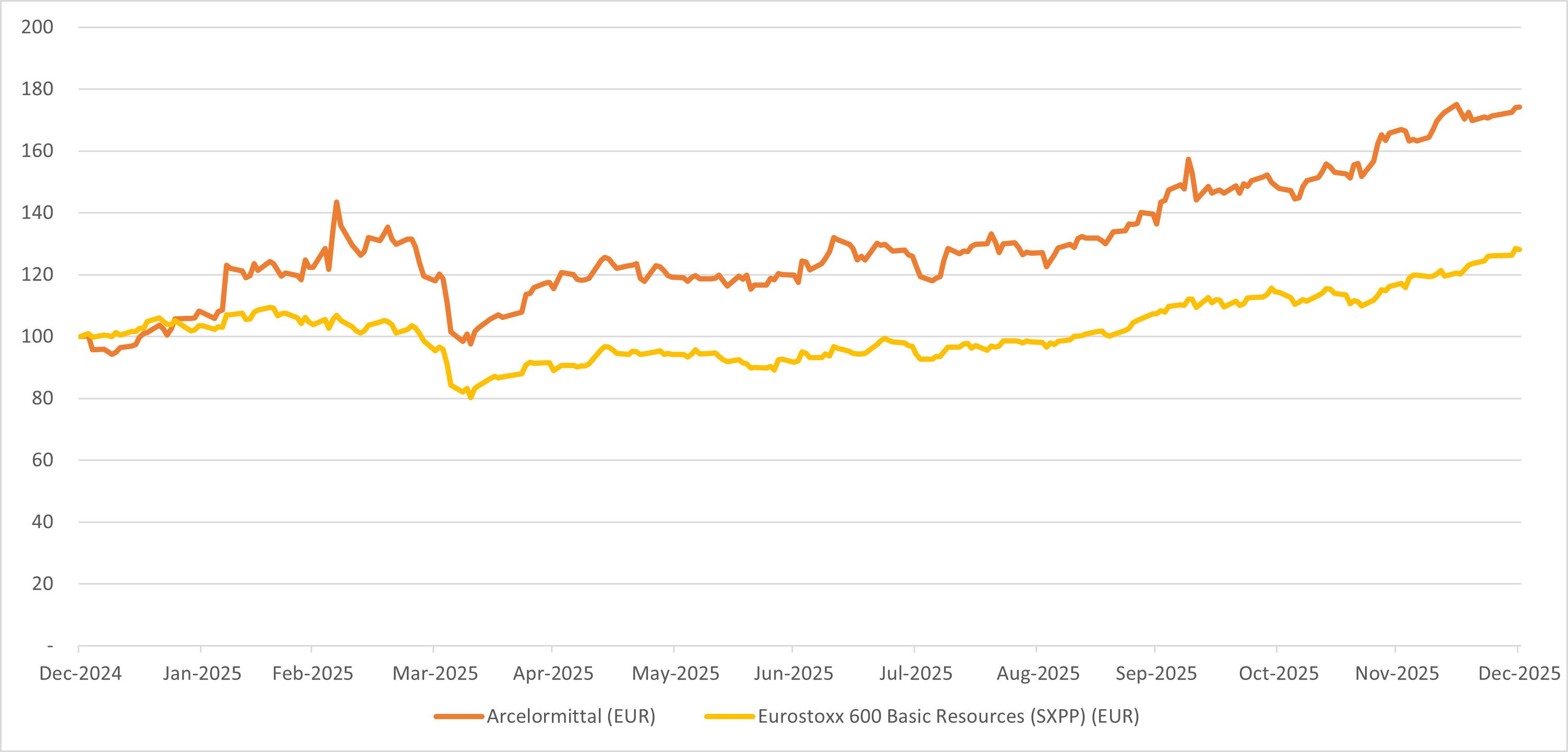
During 2025, the price of ArcelorMittal shares increased significantly by 97% in dollar terms compared to 2024 year on year; the chart
below shows a comparison between the performance of ArcelorMittal’s shares and the Eurostoxx600 Basic Resource (SXPP).
5
Management report |
Capital return policy
On May 6, 2025, at the annual general meeting of
shareholders ("AGM"), the shareholders approved the dividend
of $0.55 per share proposed by the Board of Directors. The
dividend amounted to $421 million and payment included two
installments. The first installment of $210 million was paid on
June 11, 2025, and the second installment of $211 million was
paid on December 3, 2025.
In accordance with its capital return policy, the Company
expects to pay a base annual dividend (to be progressively
increased over time). In addition, a minimum of 50% of the
amount of free cash flow (calculated as net cash provided by
operating activities less purchases of property, plant and
equipment and intangibles ("capital expenditures") less
dividends paid to non-controlling shareholders) remaining after
paying the base annual dividend is allocated to a share
buyback program. If the ratio of net debt to EBITDA is greater
than 1.5x, then ArcelorMittal will not carry out any share
buyback.
On April 1, 2025, ArcelorMittal completed the 85 million share
buyback program announced on May 5, 2023 under the
authorization given by the annual general meeting of
shareholders of May 2, 2023 and continued under the April 30,
2024 annual general meeting of shareholders authorization. On
April 7, 2025, ArcelorMittal announced the commencement of a
new share buyback program (the "Program") with share
repurchases to be conducted in tranches that may be
announced through May 2030. Repurchases under the first
tranche of the Program, which is for up to 10 million shares
commenced immediately, under the authorization given by the
annual general meeting of shareholders of April 30, 2024 and
subsequently under the authorization given by the annual
general meeting of shareholders held on May 6, 2025. The
actual amount of shares to be repurchased in various tranches
pursuant to the Program will depend on the level of post-
dividend free cash flow generated over the period (the
Company’s defined policy is to return a minimum of 50% of
post-dividend annual free cash flow), the continued
authorization by shareholders and market conditions. The
shares acquired under the Program are intended primarily to
reduce ArcelorMittal’s share capital, to meet ArcelorMittal’s
obligations arising from employee share programs and/or to
meet such other purposes as announced at the time of each
tranche.
Including the $11.1 billion of shares repurchased under
previous and current share buyback programs from 2020 to
2024 and $0.3 billion from shares repurchased during 2025,
the Company returned in total $14.4 billion to shareholders
under the above-mentioned capital return policy. Also, see
"Operating and financial review—Earnings distribution".
Additional buybacks under the current share buyback program
will be allocated to the 2026 capital return. At December 31,
2025, ArcelorMittal had repurchased 2 million shares
representing 20% of the current share buyback program for a
total value of $58 million. For further information on buybacks,
see "Purchases of equity securities by the issuer and affiliated
purchasers".
In February 2026, the Board of Directors recommended an
increase of the base annual dividend to $0.60/share (from
$0.55/share paid in 2025) to be paid in four equal installments
in March, June, September and December, subject to the
approval of shareholders at the annual general meeting of
shareholders in May 2026 and taking into account that the first
quarter dividend payment in March 2026 shall be an interim
dividend.
Investor relations
ArcelorMittal has a dedicated investor relations team at the
disposal of analysts and investors. By implementing high
standards of financial information disclosure and providing
clear, regular, transparent and even-handed information to all
its shareholders, ArcelorMittal aims to be the first choice for
investors in the sector.
To meet this objective and provide information to fit the needs
of all parties, ArcelorMittal implements an active and broad
investor communications policy: conference calls, road shows
with the financial community, regular participation at investor
conferences, plant visits and meetings with individual investors.
ArcelorMittal’s senior management plans to meet investors and
shareholder associations in such events throughout 2026.
Investors may use the following e-mails or contact numbers to
reach the investor relations team:
+44 207 543 1128 | |
+33 1 7192 1026 |
Sustainable responsible investors
The Investor Relations team is also a source of information for
the growing sustainable responsible investment community.
The team organizes special events on ArcelorMittal’s corporate
responsibility strategy and answers all requests for information
sent to the Group at [email protected] or
may be contacted at +44 7861 397 073.
Financial calendar
The schedule is available on ArcelorMittal’s website
www.arcelormittal.com under Investors, Financial calendar.
Financial results*: | |
Results for the first quarter of 2026 | April 30, 2026 |
Results for the second quarter of 2026 and half year 2026 | July 30, 2026 |
Results for the third quarter of 2026 | November 5, 2026 |
Meeting of shareholders: | |
Annual general meeting of shareholders | May 5, 2026 |
6
Management report |
* Earnings results are issued before the opening of the stock exchanges on
which ArcelorMittal is listed.
Cautionary Statement Regarding Forward-Looking Statements
This annual report contains forward-looking statements based
on estimates and assumptions. This annual report contains
forward-looking statements within the meaning of the Private
Securities Litigation Reform Act of 1995. Forward-looking
statements include, among other things, statements
concerning the business, future financial condition, results of
operations and prospects of ArcelorMittal, including its
subsidiaries. These statements usually contain the words
“believes”, “plans”, “expects”, “anticipates”, “intends”,
“estimates”, "targets" or other similar expressions. For each of
these statements, you should be aware that forward-looking
statements involve known and unknown risks and
uncertainties. Although it is believed that the expectations
reflected in these forward-looking statements are reasonable,
there is no assurance that the actual results or developments
anticipated will be realized or, even if realized, that they will
have the expected effects on the business, financial condition,
results of operations or prospects of ArcelorMittal.
These forward-looking statements speak only as of the date on
which the statements were made, and no obligation has been
undertaken to publicly update or revise any forward-looking
statements made in this annual report or elsewhere as a result
of new information, future events or otherwise, except as
required by securities and other applicable laws and
regulations. A detailed discussion of principal risks and
uncertainties which may cause actual results and events to
differ materially from such forward-looking statements is
included in the section titled "Introduction—Risk Factors and
Control—Risk factors”.
All information that is not historical in nature and disclosed
under “Operating and financial review” is deemed to be a
forward-looking statement.
Market information
This annual report includes industry data and projections about
the Company’s markets obtained from industry surveys, market
research, publicly available information, and industry
publications. Statements on ArcelorMittal’s competitive position
contained in this annual report are based primarily on public
sources including, but not limited to, published information from
the Company's competitors. Industry publications generally
state that the information they contain has been obtained from
sources believed to be reliable but that the accuracy and
completeness of such information are not guaranteed and that
the projections they contain are based on a number of
significant assumptions. The Company has not independently
verified this data or determined the reasonableness of such
assumptions. In addition, in many cases the Company has
made statements in this annual report regarding its industry
and its position in the industry based on internal surveys,
industry forecasts, market research, as well as the Company’s
experience. While these statements are believed to be reliable,
they have not been independently verified.
Financial information
This annual report contains the audited consolidated financial
statements of ArcelorMittal and its consolidated subsidiaries,
including the consolidated statements of financial position as of
December 31, 2025 and 2024, and the consolidated
statements of operations, other comprehensive income,
changes in equity and cash flows for each of the years ended
December 31, 2025, 2024 and 2023. ArcelorMittal’s
consolidated financial statements were prepared in accordance
with International Financial Reporting Standards (“IFRS”) as
issued by the International Accounting Standards Board
(“IASB”).
The financial information and certain other information
presented in a number of tables in this annual report have
been rounded to the nearest whole number or the nearest
decimal. Therefore, the sum of the numbers in a column may
not conform exactly to the total figure given for that column. In
addition, certain percentages presented in the tables in this
annual report reflect calculations based upon the underlying
information prior to rounding and, accordingly, may not conform
exactly to the percentages that would be derived if the relevant
calculations were based on the rounded numbers. This annual
report includes net debt, operating working capital and gearing,
which are non-GAAP financial measures. ArcelorMittal believes
net debt, operating working capital and gearing to be relevant
to enhance the understanding of its financial position and
provides additional information to investors and management
with respect to the Company’s operating cash flows, capital
structure and credit assessment. In addition, it refers to free
cash flow and EBITDA in its capital return policy, which will be
used to determine if the base dividend will be paid as well as in
certain incentive plans. For these purposes, EBITDA is defined
as operating income plus depreciation, impairment expenses,
special items and income (loss) from associates, joint ventures,
and other investments (excluding impairments). “Special items"
relate to events or charges that the Company does not
consider to be part of the normal income generating potential
of the business. Items may qualify as “special” although they
may have occurred in prior years or are likely to recur in
following years. Non-GAAP financial measures should be read
in conjunction with and not as an alternative for, ArcelorMittal’s
financial information prepared in accordance with IFRS. Such
non-GAAP measures may not be comparable to similarly titled
measures applied by other companies.
7
Management report |
Key transactions and events in 2025
During 2025, ArcelorMittal completed several acquisitions,
capital market, share buyback transactions and divestment
processes. Please refer to notes 2.2.4, 2.3, 6.1.2 and 11.1 to
the consolidated financial statements for further details.
•On March 3, 2025, ArcelorMittal announced the
appointment of Jorge Luiz Ribeiro de Oliveira, Vice
President of ArcelorMittal and CEO of ArcelorMittal South
America Flat Products, as Executive Vice President and
an Executive Officer of ArcelorMittal as well as President
of ArcelorMittal Brasil effective April 1, 2025, to succeed
Jefferson de Paula who retired effective April 1, 2025.
•On June 18, 2025, in accordance with the definitive Equity
Purchase Agreement (the "EPA") signed between
ArcelorMittal and Nippon Steel Corporation ("NSC") on
October 11, 2024, the Company confirmed that it had
completed the acquisition of NSC’s 50% equity stake in
AMNS Calvert, with ArcelorMittal already holding the
balance. The facility, subsequently renamed ArcelorMittal
Calvert, was originally acquired by ArcelorMittal and NSC
in 2014 from ThyssenKrupp for total consideration of $1.55
billion. The operation was originally built at a cost of
approximately $5 billion. It commenced operations in 2010
and has a flat rolled steel capacity of 5.3 million metric
tonnes, annually. It is one of the most advanced steel
finishing facilities in North America. In addition, a new
seven-year domestic slab supply agreement with NSC has
commenced, averaging 750,000 metric tonnes per year,
ensuring a significant portion of the slab requirements are
melted and poured in the United States. The feasibility of a
steelmaking expansion at the site, which would further
strengthen its U.S. domestic production capability, is being
assessed. The new steelmaking facility, integrated with
ArcelorMittal’s HBI facility in Texas, will enable
ArcelorMittal Calvert to supply automotive customers with
lower CO2 embodied steel, melted and poured in the
United States. In accordance with the terms of the EPA,
ArcelorMittal paid $1 consideration for the shares of NS
Kote Inc., which holds 50% of the equity interest of AMNS
Calvert, in addition to cash and loans receivable of
approximately $0.9 billion.
•On September 1, 2025, ArcelorMittal South Africa
announced the commencement of the Long Steel
Business ("Longs Business") wind down implementation
plan ahead of the end of the six-month deferral period
ending on September 30, 2025. Continuation of operations
during this period had been enabled by a facility provided
by the Industrial Development Corporation of South Africa
SOC Limited in the amount of ZAR 1.7 billion ($95 million)
but efforts to secure funding to operate the Longs
Business beyond September 30, 2025 have failed. The
wind down was completed by the end of January 2026.
•On October 30, 2025, following merger control clearance
and the fulfillment of all conditions precedent, ArcelorMittal
completed the sale of its operations in Bosnia and
Herzegovina, ArcelorMittal Zenica, an integrated steel
plant, and ArcelorMittal Prijedor, an iron ore mining
business which supplies the Zenica plant, to Pavgord
Group. The Company recorded non-cash loss on disposal
of approximately $0.2 billion (including foreign exchange
losses recorded in equity since the date of acquisition).
Recent developments
•On January 29, 2026, ArcelorMittal confirmed that it had
been served by the Extraordinary Commissioners of
Acciaierie d'Italia S.p.A. ("ADI") with a writ of summons to
appear before the Court of Milan. ADI operates the Italian
steel plants owned and formerly managed by Ilva S.p.A.
(‘Ilva’) (which is also in Extraordinary Administration).
Since 2021, ADI’s holding company, Acciaierie d'Italia
Holding S.p.A. ("ADIH"), has been operated under joint
and equal control with Invitalia, an entity wholly controlled
by the Italian Ministry of Economy and Finance and
appointed by the Italian Government to implement a
public-private partnership with ArcelorMittal aimed at
relaunching and acquiring Ilva’s business. The claim
alleges that ADI was mismanaged and that value was
intentionally transferred from ADI to ArcelorMittal (causing
ADI to become insolvent). The action is brought against
multiple parties - including ArcelorMittal, together with all
individuals who have served on the board of directors of
ADI. It seeks damages valued at €7.0 billion, with an
alternative valuation of €3.65 billion. ArcelorMittal is also
involved in several Italian judicial appeals relating to the
placement of ADI and ADIH in insolvency and under
extraordinary administration. ArcelorMittal will defend its
position vigorously. Moreover, in June 2025, ArcelorMittal
initiated an international arbitration against the Republic of
Italy for unlawful expropriation and discriminatory
treatment in relation to its investments in ADI, claiming
damages in excess of €1.8 billion.
•On January 30, 2026, the Government of the Republic of
Liberia and ArcelorMittal announced that they have signed
an amendment to the existing Mineral Development
Agreement ("MDA"), which was ratified on January 29,
2026 via the Liberian legislative process, extending the
duration of the agreement to 2050, with a right to renew for
a further 25 years. See “Properties and Capital
Expenditures—Mineral reserves and resources—Mining”.
The agreement solidifies ArcelorMittal’s long-term mining
expansion and commitment to Liberia and provides for the
Government’s desire to make the Tokadeh to Buchanan
8
Management report |
rail corridor accessible to multiple users. The Company is
undertaking feasibility studies for further expansion
beyond 20 million tonnes per annum. The railway capacity
is being expanded so it can transport up to 30 million
tonnes annually. This railway capacity will be reserved for
ArcelorMittal’s use. Under the terms of the agreement
ArcelorMittal will pay $200 million to the Government of
Liberia for certain rights it acquires, namely the mining
rights extension and reserved access to railroad capacity
the Company is investing in.
•Subsequent to the announcement of its 2025-2030 share
buyback program (the ‘2025 buyback program’), together
with an initial tranche of share repurchases, on April 7,
2025, ArcelorMittal and the Significant Shareholder have
entered into a share repurchase agreement on March 5,
2026. Under this agreement, the Significant Shareholder
has agreed to sell, on each trading day on which
ArcelorMittal purchases shares under the 2025 buyback
program, an equivalent number of shares in the proportion
of the Significant Shareholder’s (44.6% at February 28,
2026) of outstanding shares of ArcelorMittal. Shares
repurchased from the Significant Shareholder will count
towards repurchases made under the 2025 buyback
program and will be made at the same weighted average
price as the ArcelorMittal Shares purchased under the
2025 buyback program on the relevant trading day in the
open market. The Significant Shareholder may terminate
this agreement at any time after the completion of the
buybacks under the initial tranche. The effect of the share
repurchase agreement is to maintain the Significant
Shareholder’s percentage of voting rights in ArcelorMittal’s
issued share capital (net of treasury shares) resulting from
purchases made under the Program. As a reminder, the
2006 Memorandum of Understanding entered into in
connection with the merger of Mittal Steel and Arcelor
includes a standstill that sets a 45% limit on the Significant
Shareholder’s ownership of the Company’s issued shares
(subject to certain limited exceptions). This share
repurchase agreement ensures that the Significant
Shareholder’s voting rights will not passively exceed the
45% threshold, thereby preserving a robust free float. See
"Shareholders and Markets—Purchases of equity
securities by the issuer and affiliated purchasers" and
“Additional information—Material contracts—Memorandum
of Understanding”.
Sustainable development highlights
•On February 6, 2025, ArcelorMittal announced that it is
proceeding with plans to construct an advanced
manufacturing facility in Calvert, Alabama that could
deliver up to 150,000 tonnes of domestic production
capacity of non-grain-oriented electrical steel ("NOES")
annually, depending on the product mix. NOES plays a
crucial role in the performance and efficiency of electric
motors used to power battery electric vehicles, plug in
hybrid electric vehicles and hybrid vehicles as well as
other specialized commercial, industrial, and power
generation applications. Given the nature of the US auto
market (larger vehicles, full-size pickups, SUVs) there is
rapidly growing demand for the most sophisticated NOES
for which there is limited US domestic supply capabilities.
Plans at ArcelorMittal Calvert include an annealing pickling
line, cold-rolling mill, annealing coating line, packaging and
slitter line, and ancillary equipment needed for operations.
The planned investment is expected to create up to 1,300
jobs during the construction phase and more than 200
permanent positions to support the plant’s ongoing
operations. Estimated net capital expenditure is $1.3
billion (net of $0.3 billion of currently planned federal, state
and local support). The plant is anticipated to commence
production in the second half of 2027.
•On May 8, 2025, ArcelorMittal announced that its largest
renewable energy venture, a 975 MW solar and wind
project located in Andhra Pradesh, southern India, has
recently started providing clean electricity to AMNS India,
ArcelorMittal’s 60/40 Indian steelmaking joint venture with
Nippon Steel. The $0.7 billion project – developed,
constructed and commissioned by AM Green Energy, a
wholly owned ArcelorMittal subsidiary - is expected to
reduce AMNS India’s carbon emissions by 1.5 million
tonnes per year, supporting AMNS India’s target to reduce
the carbon intensity of the steel it produces by 20% by
2030 (against a 2021 baseline).
•On May 15, 2025, ArcelorMittal confirmed its intention to
invest €1.2 billion in a first EAF in Dunkirk to decarbonize.
This, together with the recent investments announced
(€254 million in Dunkirk and €53 million in Fos) and the
new electric steels production unit under construction in
Mardyck, which is set to complete by end of this year
(€500 million investment), totals €2 billion of investment
and demonstrates ArcelorMittal’s intention to maintain a
thriving and sustainable steel-making business in France.
•On June 19, 2025, ArcelorMittal announced that it cannot
proceed with its previously announced direct reduced iron
("DRI") and EAF plans for the decarbonization of its flat
steelmaking sites in Bremen and Eisenhüttenstadt. As the
contract with the Federal government of Germany, for €1.3
billion of financial assistance required construction on the
DRI-EAF project to commence by June 2025, the
Company has been obliged to formally notify the
government that it cannot proceed with these investments,
given the realities of the market and the economics of low-
carbon emissions steelmaking. In line with the Company’s
9
Management report |
intention to take a phased approach to its decarbonization
in Europe, the next step in Bremen and Eisenhüttenstadt
will focus on detailed planning for the construction of
EAFs, to be ready for a scenario in which there is a strong
business case for EAF-based production in these sites.
•On December 22, 2025, ArcelorMittal announced three
new renewable energy projects in India totaling 1GW of
nominal solar and wind capacity. Upon completion the
projects will double ArcelorMittal’s renewable energy
capacity in India to 2GW and increase the Company’s total
global renewable energy capacity to 3.3GW. Total capital
expenditure for the three projects is anticipated to be $0.9
billion and the power generated will be supplied to AMNS
India, ArcelorMittal’s 60/40 Indian steelmaking joint
venture with NSC.
Recent developments
•On February 10, 2026, ArcelorMittal announced the
construction of an EAF at its steelmaking site in Dunkirk –
a strategic €1.3 billion investment which marks a major
step in the decarbonization of ArcelorMittal’s steel
production in France. The start‑up of this 2-million-tonne
EAF is scheduled for 2029. It is expected to produce steel
with three times less CO2 compared with a blast furnace
(0.6 tonne CO2 per tonne of steel in the EAF based on a
mix of scrap, HBI/DRI and hot metal). Its funding will be
supported by Energy Efficiency Certificates ("CEE"), a
regulatory mechanism that promotes energy savings and
CO₂ reduction. The amount of support will represent 50%
of the €1.3 billion investment.
Risk Factors and Control
Risk factors
ArcelorMittal’s business, financial condition, results of
operations, reputation or prospects could be materially and
adversely affected by one or more of the risks and
uncertainties described below.
I. Risks related to the global economy and the mining and steel
industry
Prolonged low steel and (to a lesser extent) iron ore
prices, low steel demand and/or steel/iron ore oversupply
would have an adverse effect on ArcelorMittal’s results of
operations, cash flows and financial position.
ArcelorMittal’s profitability is highly sensitive to volatile steel
and iron ore prices. Steel price movements directly affect
margins, while iron ore price changes influence both ore
revenues and steel pricing, with timing lags that can compress
margins. Contract structures have, and in the future may,
extend the impact of declining steel prices beyond movements
in spot markets.
Prices for both commodities are driven by supply–demand
conditions and inventory cycles, which in turn depend on
trends in cyclical end‑use sectors (particularly the automotive
industry) and broader macroeconomic factors such as
geopolitical tensions (including conflicts, such as the ongoing
military conflicts in the Middle East), trade policies, monetary
policy shifts, and disruptive events. Economic downturns have
historically resulted in lower steel demand and prices, reduced
operating income, and lower operating cash flows.
Persistent global overcapacity—particularly in long products—
continues to pressure the industry. The imbalance is amplified
during periods of economic weakness, contributing to weaker
demand, increased exports, and lower prices (regionally and/or
globally). China’s reduced steel demand since the second
quarter of 2024 has not been matched by equivalent
production cuts, leading to increased Chinese exports into
global markets, including the Company’s core regions, thereby
depressing prices and increasing inventories. See also “—
Unfair trade practices, import tariffs and/or barriers to free trade
could negatively affect steel prices and ArcelorMittal’s results of
operations in various markets.”
Inventory cycles also influence apparent demand and pricing.
Distributors often accumulate steel during low‑price periods
and later destock, delaying the effect of rising demand on
prices. Conversely, expectations of lower prices can lead
customers to reduce purchases and destocking, adding
downward pressure. In 2025, demand remained subdued with
limited restocking. In 2026, global ASC growth is expected to
improve gradually. Demand is supported by fading uncertainty,
increased fiscal spending (such as in the U.S., Germany and
China), and lagged positive impact from lower interest rates,
absent any renewed tariff shocks. Therefore, renewed tariff
shocks would very likely negatively affect demand.
Oversupply in the iron ore market has previously depressed
prices, which may recur if global economic conditions
deteriorate, Chinese demand weakens further, new mining
capacity increases supply, or steel demand declines.
Prolonged periods of low steel and iron ore prices, or sustained
oversupply in key markets, would materially and adversely
affect ArcelorMittal’s results, cash flows, and financial
condition.
Volatility in the prices and supply of raw materials and
energy or mismatches between steel prices and raw
material prices could adversely affect ArcelorMittal’s
results of operations, cash flows and financial position.
ArcelorMittal’s profitability depends on reliable and
competitively priced supplies of raw materials and energy,
while the prices of both have been highly volatile. Steel
production requires significant volumes of iron ore, coking coal,
coke and energy. Although the Company sourced 72% of its
10
Management report |
iron ore internally from its mining operations in 2025, it remains
exposed to supply and price volatility for third‑party purchases.
Ongoing industry decarbonization may further increase or
destabilize costs, particularly for energy, CO₂ and scrap. See
“Business overview—Products—Mining products”, “Business
overview—Raw materials and energy” and “Operating and
financial review—Key factors affecting results of operations—
Raw materials”.
Energy and transportation are also major input costs. Prices for
electricity, natural gas, industrial gases, diesel and transport
services are sensitive to supply–demand conditions and
geopolitical conflicts. While some supply contracts are
long‑term, ArcelorMittal has experienced and remains exposed
to significant price fluctuations and potential curtailments
during peak usage periods, as well as supply disruptions, in
particular due to geopolitical disruptions. Such events can
result (and have in the past resulted) in sharp and prolonged
increased and volatile energy and transportation costs
(including recently due to the escalating military conflicts in the
Middle East), reductions in steel demand from affected
customers, and production cuts.
Steel and raw material prices do not always move in tandem,
particularly in Europe and North America. Sudden spikes in raw
material or energy costs can create negative price‑cost effects,
which are considered structural in the industry. See “Operating
and financial review—Key factors affecting results of
operations”. Compressed steel spreads have, in the past, led
the Company to reduce or idle production at certain facilities.
These actions do not eliminate all operating costs, can result in
increased expenses to resume production and may affect the
long‑term condition of idled assets.
Unfair trade practices, import tariffs and/or barriers to free
trade could negatively affect steel prices and
ArcelorMittal’s results of operations in various markets.
ArcelorMittal is exposed to the effects of dumping and other
unfair trade practices, as well as to government subsidies that
support steel producers in certain countries, particularly those
with centrally controlled economies such as China. Periods of
weak global steel demand heighten the risk of increased
volumes of unfairly traded imports into ArcelorMittal’s key
markets—Europe, North America and Brazil—placing
downward pressure on prices and demand for its products.
The Company is also vulnerable to import tariffs, trade barriers,
protectionist measures and major trade disputes given its
global footprint. These risks have in part been realized and
continue to increase since 2025 following actions by countries
including the United States, Brazil, Turkey and India. For
example, the U.S. Section 232 measures have imposed a 50%
tariff on all steel imports as from June 2025; additional tariffs
have been applied to products containing significant steel
content, such as automobiles; and additional tariffs have at
times been suggested by the U.S. administration. Export sales
to the U.S. amounted to $6.9 billion in 2025 compared to $6.7
billion in 2024. Retaliatory measures have also been
announced by China, Canada and the European Union. As in
2018, Section 232 measures have negatively affected the
Company’s North America segment through their impact on
costs and Canadian and Mexican pricing and have also
negatively impacted the exports of the Brazil segment. Trade
policy uncertainty has further weighed on economic activity and
demand. The potential effects of additional tariffs or prolonged
trade tensions on global growth, steel demand, steel and iron
ore prices, and input costs remain unclear.
In addition, certain ArcelorMittal operations are respondents in
anti‑dumping and countervailing duty cases, and the
Company’s exports have been—and may continue to be—
subject to such duties or other trade restrictions.
See also "Government regulations—Foreign trade".
Russia’s invasion of Ukraine, international reaction to it (in
particular in the form of sanctions) and any regional or
global escalation of the conflict, could adversely affect the
Company’s business, results of operations and financial
condition.
The Company has significant operations in Ukraine, consisting
of a steel plant and (captive) mines. See "Properties and
capital expenditures—Property, plant and equipment—Others".
ArcelorMittal Kryvyi Rih ("AMKR") has been operating its open
pit mines and steel facilities at various levels of under-capacity
since 2022 due to various difficulties (including at 73% and
35% capacity, respectively, in 2025). The Company cannot
predict the duration of the idling or of lower production as it will
depend on the remaining course of the conflict and the
establishment of safe and stable operating and logistical
conditions thereafter, as well as potential repairs of any
damages sustained. The Russian army has also blocked ports
in Odessa, complicating and increasing the cost of exports
(including steel and iron ore) from Ukraine. The ongoing
conflict, its impact on demand, logistics (with respect to both
supply and delivery) and costs and any resulting further
reduced production, sales and income at its Ukrainian
operations have caused the Company to record impairment
charges (and may be required to record additional charges in
the future). For further information on these risks, see notes 1.3
and 5.3 to the consolidated financial statements.
The imposition of extensive sanctions on Russia by the EU, the
U.S., the UK and other countries could affect the Company’s
sourcing of raw materials from sanctioned countries. Any
business conducted in Russia and with Russian counterparties
also carries the risk of non-compliance with economic
sanctions (and the attendant financial and reputational adverse
consequences), despite best efforts to comply. In addition,
sanctions may remain in place beyond the duration of any
11
Management report |
military conflict and have a long-lasting impact on the region
and could adversely impact the Company’s results of
operations and financial condition. More generally the conflict
could have a further material adverse effect on the overall
macroeconomic environment, including as a result of any
substantial military escalation at a regional or global level (see
“—Volatility in the prices and supply of raw materials and
energy or mismatches between steel prices and raw material
prices could adversely affect ArcelorMittal’s results of
operations, cash flows and financial position”).
Competition from other materials and alternative steel-
based technologies could reduce market prices and
demand for steel products and thereby reduce
ArcelorMittal’s cash flows and profitability.
In many of its applications, steel competes with other materials
that may be used as substitutes, such as aluminum, concrete,
composites, glass, plastic and wood. In particular, as a result of
increasingly stringent regulatory requirements, as well as
developments in alternative materials, designers, engineers
and industrial manufacturers, especially those in the
automotive industry, have increased their use of lighter weight
and alternative materials, such as aluminum and plastics.
A loss of market share to substitute materials, increased
government regulatory initiatives favoring the use of alternative
materials, as well as the development of additional new
substitutes for steel products could significantly reduce market
prices and demand for steel products and thereby reduce
ArcelorMittal’s cash flows and profitability.
New technologies such as carbon free steelmaking could also
result in a loss of market share if competitors develop and
deploy this kind of technology before, or more effectively than
ArcelorMittal. In addition, to the extent regulatory requirements
and/or customer demand for low carbon or carbon neutral steel
increase, competition with respect to low CO2 steel
technologies may become more significant, leading to
substantial input cost increases, due to the need to accelerate
investments in new production methods, equipment and
facilities.
II. Risks related to sustainability
The Group’s announced carbon‑intensity reduction targets
are contingent on supportive economics enabled by policy
and market conditions, including competitive energy
prices, timely availability of cost‑competitive clean energy,
permitting and infrastructure delivery, effective trade and
carbon‑leakage tools, and the emergence of lead markets
for low‑carbon steel at scale. Future developments may
affect such assumptions, and this may render the
achievement of ArcelorMittal’s targets more difficult, or
even impossible, to achieve for cost or other reasons.
The Company’s decarbonization strategy includes the objective
of net zero by 2050. The Company's medium‑term objective
and associated decarbonization capital expenditures are
currently under review to reflect technology readiness levels,
supportive cost and availability of clean energy, associated
infrastructure build‑out, and permitting timelines. ArcelorMittal's
ability to achieve its objectives depends on numerous factors
and assumptions, including cost‑competitive clean energy
supply, practical sequencing of asset technology conversions,
the maturity and availability of shared infrastructure, demand
signals (e.g., contracts‑for‑difference, lead‑market
procurement), and fair competition instruments at the border.
The development and deployment of low‑emissions
technologies depends on supportive economics enabled by
coherent policy and market conditions—including predictable
carbon‑cost signals where applicable, competitive energy
pricing, and robust demand for low‑carbon‑emissions steel to
secure a genuine level playing field. For example, in June
2025, the Company announced that it was unable to proceed
with its previously announced plans for the decarbonization of
certain German flat‑steelmaking sites due to market and
energy economics, including weak demand, high levels of
imports, high power costs, the lack of viability of green
hydrogen at scale, and the non‑competitiveness of natural‑gas
DRI as an interim solution. The Company indicated a phased
approach prioritizing planning for EAFs, subject to supportive
economics. While the EU remains the most advanced region in
combining a domestic emission trading system ("EU‑ETS")
with a Carbon Border Adjustment Mechanism ("CBAM"), the
Company continues to seek supportive policies to address
carbon leakage and circumvention and to maintain fair
competition. CBAM entered its definitive regime on January 1,
2026 (following the 2023–2025 transitional phase). The
Commission’s December 2025 package operationalized the
regime and proposed scope extensions to steel‑intensive
downstream goods and stronger anti‑circumvention rules; the
timelines and content of these proposed extensions remain
subject to the ordinary legislative procedure. This may not be
sufficient to address issues related to downstream imports
containing high‑carbon‑emissions steel. The EU has also
proposed a new Tariff Rate Quota ("TRQ") system, which
would complement any CBAM obligations. Any future
international arrangement could affect the implementation or
effectiveness of CBAM.
In addition, ArcelorMittal’s targets have been supported by the
expectation that public funding and supportive policy would
complement private investment during the transition. Although
funding from certain governments has been approved, such
support is subject to changes in government and policy and
may ultimately not be achieved. The Company’s principal
decarbonization risk relates to European market economics,
while policy developments in other jurisdictions (e.g., U.S.
legislative and executive actions in 2025 affecting clean‑energy
12
Management report |
tax credits and eligibility) also introduce uncertainty for
counterparties and supply chains.
A lack of governmental and societal support could make the
Company’s targets more costly, more difficult, or even
impossible to achieve. If the Company is unable to make the
necessary investments to decarbonize and reach its targets
due to the design of governmental policy in Europe or other
jurisdictions where it operates, this could negatively affect its
competitiveness, profitability, cash flows, financing costs,
results of operations, and financial condition, as well as harm
its reputation. Similarly, pursuing decarbonization investments
that are not economically competitive could have comparable
effects on the Company’s market position and profitability.
Laws and regulations restricting emissions of greenhouse
gases could force ArcelorMittal to incur increased capital
and operating costs and could have a material adverse
effect on ArcelorMittal’s results of operations, financial
condition and reputation.
The integrated steel process involves significant carbon
footprint. Compliance with new and more stringent
environmental obligations relating to greenhouse gases
("GHG") emissions, including as part of the EU’s “Fit for 55”
package, may require additional capital expenditures or
modifications in operating practices. See “Business Overview
—Government regulations—Environmental laws and
regulations".
The new laws are interconnected, and they combine: tightening
and extending the existing EU-ETS; increased use of
renewable energy; greater energy efficiency; a faster roll-out of
low emission transport modes and the infrastructure and fuels
to support them; an alignment of taxation policies with the
European Green Deal objectives; the CBAM to prevent carbon
leakage; and tools to preserve and grow natural carbon sinks.
From 2026 onward, EU operations face higher carbon‑cost
exposure as free allocations begin to phase out through 2034
and CBAM enters its definitive regime (following the 2023–
2025 transitional phase). Phase IV (2021–2030) is in force;
EUA prices have been volatile and remain above pre‑2020
levels, with uncertainty about future trajectories. The
progressive phase‑out of free allocations (2026–2034) will
increase the Company's net requirements to purchase
emission allowances for installations in sectors within the
scope of the EU-ETS and thereby raising exposure to carbon
costs, while CBAM obligations ramp up in parallel for imports.
As a result, the Company will be subject to additional
carbon‑cost exposure arising from allowance purchases and
interactions between the EU-ETS and CBAM. Additionally, the
effectiveness and design of CBAM remain subject to
uncertainty, including due to potential circumvention through
resource shuffling, the extent to which costs may be absorbed
(rather than passed through) and the lack of an export solution
and have been recognized in Commission reviews and industry
analyses; proposed anti‑circumvention measures and
extensions of CBAM to certain downstream products. Although
CBAM became financially binding for imports made from
January 1, 2026, the timing of certificate sales, surrender
obligations and pricing—linked to EU-ETS auction prices—may
affect cash flows and lead to administrative burdens.
Similar regulations have been implemented to date in several
jurisdictions, and additional measures may well be enacted in
the future in other jurisdictions. Whether in the form of a
national or international cap-and-trade emissions permit
system, a carbon tax or acquisition of emission rights at market
prices, emissions controls, reporting requirements, or other
regulatory initiatives, such environmental regulations could
have a negative effect on ArcelorMittal’s production levels,
results of operations, cash flows and credit ratings. These
regulations could also negatively affect the Company’s
suppliers and customers, which could translate into higher
costs and lower sales.
Furthermore, many developing nations have not yet instituted
significant GHG regulations, and the Paris Agreement
specifically recognizes that GHG emissions will peak later in
developing countries. As the Intended Nationally Determined
Contributions (“INDC”) for developing nations under the Paris
Agreement may be less stringent than for developed nations in
light of different national circumstances, ArcelorMittal may be at
a competitive disadvantage relative to steelmakers having
more or all of their production in developing countries.
Depending on the extent of the difference between the
requirements in developed regions (such as Europe) and
developing regions (such as China), this competitive
disadvantage could be severe and has resulted, and in the
future may result, in production cuts due to relatively higher
carbon costs rendering production structurally unprofitable.
See "Properties and capital expenditures—Property, plant and
equipment” for further information regarding production levels
by segment.
In addition, the Company is exposed to the risk of frameworks
and regulations being adopted that are ill‑adapted to steel
industry dynamics. For example, the most established
framework for carbon pricing and emissions trading schemes is
currently the EU‑ETS discussed above. As indicated above,
while a CBAM has been adopted to limit competitive distortions
from the ETS, its effectiveness will depend on the robustness
of anti‑circumvention provisions, the treatment of exports, and
demand‑side instruments that create lead markets.
Furthermore, in December 2025, the Council and Parliament
reached a provisional agreement to amend the European
Climate Law, introducing a binding intermediate 2040 target of
a 90% reduction in net GHG emissions compared to 1990,
implying future reviews of the post‑2030 policy architecture and
13
Management report |
EU‑ETS cap. On February 10, 2026, Parliament backed a
political agreement with the Council on this topic.
For further information on environmental laws and regulations
and how they affect the Company’s operations, see “Business
overview—Government regulations—Environmental laws and
regulations” and note 9.1 to the consolidated financial
statements.
ArcelorMittal is subject to strict environmental, health and
safety laws and regulations that could give rise to a
significant increase in costs and liabilities.
ArcelorMittal is subject to a broad range of environmental,
health and safety (“EHS”) laws and regulations in each of the
jurisdictions in which it operates. These laws and regulations
impose increasingly stringent standards regarding health and
safety, air emissions, discharges of wastewater, emission or
discharge of pollutants, the use, handling and transportation of
hazardous, toxic or dangerous materials, waste disposal
practices and the remediation of environmental contamination,
and permit requirements, among other things. The costs of
complying with, and the imposition of liabilities pursuant to
these laws and regulations can be significant, including to
comply with new and more stringent obligations, and may
require additional capital expenditures or modifications in
operating practices, including in connection with any corrective
actions. Failure to comply or to take corrective action can result
in civil and or criminal penalties being imposed, the revocation
or suspension of permits, requirements to curtail or suspend
operations, substantial fines or sanctions, enforcement actions,
natural resource damages claims, cleanup and closure costs,
and lawsuits by third parties.
Despite ArcelorMittal’s efforts to comply with EHS laws and
regulations, and monitor and reduce accidents at its facilities,
health, safety and environmental incidents or accidents,
including those involving serious injury or death, have occurred
and may in the future occur. Such accidents could include (and
in certain instances have included) explosions or gas leaks,
fires or collapses in underground mining operations, crushing
incidents, vehicular accidents, falls while working at heights,
and other accidents involving mobile equipment, or exposure to
radioactive or other potentially hazardous, toxic or dangerous
materials, which have had, and could in the future have,
significant adverse consequences for the Company’s workers
and facilities, as well as the environment. For example, each
year the Company’s operations have suffered several fatal
accidents.
Certain of these incidents may result in costs and liabilities and
negatively impact the Company’s reputation or the operations
of the affected facilities. Such accidents could lead to
production stoppages, loss of personnel, loss of key assets, or
put at risk the Company’s employees (and those of sub-
contractors and suppliers) or persons living near affected sites.
In addition, any gap between community and worker
expectations and ArcelorMittal’s EHS perceived performance,
as a result of any accidents, safety incidents or even the
perception of potential safety or environmental issues, may
negatively impact community relations, labor relations,
customer relations and the Company’s reputation and result in
disruptions to the Company’s operations. ArcelorMittal’s
operations may also be located in areas where individuals or
communities could regard its activities as having a detrimental
effect on their natural environment and conditions of life, and
actions taken by such individuals or communities in response
to such concerns could compromise ArcelorMittal’s profitability
or, in extreme cases, the viability of an operation or the
development of new activities in the relevant region or country.
ArcelorMittal also incurs costs and liabilities associated with the
assessment and remediation of contaminated sites, and in its
mining activities, those resulting from tailings and sludge
disposal, effluent management, and rehabilitation of land
disturbed during mining processes. In addition to the impact on
current facilities and operations, environmental remediation
obligations can give rise to substantial liabilities in respect of
divested assets and past activities. This may also be the case
for acquisitions when liabilities for past acts or omissions are
not adequately reflected in the terms and price of the
acquisition. ArcelorMittal could become subject to further
remediation obligations in the future, as additional
contamination is discovered or clean-up standards become
more stringent.
In addition, if sustainability information disclosed in accordance
with regulatory requirements (such as under the Corporate
Sustainability Reporting Directive, Taxonomy Regulation or
California’s climate disclosure laws) or otherwise results in
financial institutions or other stakeholders (including the public)
viewing investments in steel and mining as undesirable, it may
become more difficult and/or more expensive for the Company
to obtain financing. While the Company has taken significant
steps and continues to adapt its operations in light of climate
change and the need for sustainability, such steps may not be
in line with future frameworks or regulations or market views of
investment suitability. Moreover, the Company may in the
future face increasing shareholder activism and/or litigation in
relation to sustainability matters.
For further information, see “Business overview—Sustainable
development—Health and safety” and “Business overview—
Government regulations—Environmental laws and regulations”
and note 9.1 to the consolidated financial statements.
14
Management report |
III. Risks related to ArcelorMittal's operations
ArcelorMittal could experience labor disputes that could
have an adverse effect on its operations and financial
results.
A majority of ArcelorMittal's employees and contractors are
represented by labor unions and covered by collective
bargaining or similar agreements, which are subject to periodic
renegotiation. Strikes and work stoppages have occurred, and
are likely to occur in the future, at various ArcelorMittal facilities
prior to or during negotiations preceding new collective
bargaining agreements, during wage and benefits negotiations
or during other periods for other reasons, in particular in
connection with any announced intentions to adapt its footprint.
Strikes or work stoppages, particularly when prolonged, could
disrupt ArcelorMittal’s operations and relationships with its
customers, as well as limit its ability to rationalize operations
and reduce labor costs in certain markets, resulting in an
adverse effect on its operations and financial results.
Disruptions to ArcelorMittal’s manufacturing processes
and mining operations caused for example by equipment
failures, natural disasters, accidents, explosions,
epidemics or pandemics, geopolitical conflicts or extreme
weather events could adversely affect its operations,
customer service levels and financial results and liabilities
Steel manufacturing processes are dependent on critical steel-
making equipment, such as furnaces, continuous casters,
rolling mills and electrical equipment (such as transformers),
and such equipment may incur downtime as a result of
unanticipated failures or other events, such as fires,
explosions, furnace breakdowns or as a result of natural
disasters, accidents, epidemics or pandemics or severe
weather conditions. ArcelorMittal’s manufacturing plants and
mines have experienced, and may in the future experience,
plant shutdowns or periods of reduced production as a result of
such events.
ArcelorMittal’s mining operations, in particular, are subject to
the hazards and risks usually associated with the exploration,
development and production of natural resources through
either open-pit or underground mining operations, any of which
could result in production shortfalls or damage to persons or
property, delay production, increase production costs and
result in death or injury to persons, damage to property and
liability for ArcelorMittal, some or all of which may not be
covered by insurance, as well as substantially harm
ArcelorMittal’s reputation, both as a Company focused on
ensuring the health and safety of its employees and more
generally. Certain of these incidents have resulted or may
result in fatalities, production stoppages, governmental
investigations or proceedings and/or in costs and liabilities and
negatively impact the Company’s reputation or the operations
of the affected facilities. Such hazardous incidents could also
lead to loss of key personnel, loss of key assets, or health and
safety risks for ArcelorMittal's employees (and those of sub-
contractors and suppliers) or persons living near affected sites.
See also “—ArcelorMittal is subject to strict environmental,
health and safety laws and regulations that could give rise to a
significant increase in costs and liabilities”. Conflicts may also
cause interruptions to operations; see “—Russia’s invasion of
Ukraine, international reaction to it (in particular in the form of
sanctions) and any regional or global escalation of the conflict,
could adversely affect the Company’s business, results of
operations and financial condition”.
In addition, natural disasters and severe weather conditions
have led, and could in the future lead, to significant damage at
ArcelorMittal’s production facilities and general infrastructure or
cause shutdowns, including due to earthquakes, tsunamis,
tornados, hurricanes and bush fires. More generally, changing
weather patterns and climatic conditions in recent years,
possibly due to climate change, have added to the
unpredictability and frequency of natural disasters.
Severe weather conditions can also affect ArcelorMittal’s
operations in particular due to the long supply chain for certain
of its operations and the location of certain operations in areas
subject to harsh winter conditions (i.e., Canada) or areas that
are susceptible to droughts (i.e., South Africa, Mexico and
Brazil). Water in particular is crucial to the steelmaking
process, and the risk that the authorities may restrict licenses
to withdraw water as a result of chronic drought could increase
operating costs and reduce production capacity. Flooding has
also affected ArcelorMittal’s operations, impacting shipment
volumes due to handling and logistic constraints. Damage to
ArcelorMittal production facilities due to natural disasters and
severe weather conditions could, to the extent that lost
production cannot be compensated for by unaffected facilities,
adversely affect its business, results of operations or financial
condition. More generally, these severe weather conditions
could increase in frequency and severity due to climate
change.
ArcelorMittal’s reserve and resource estimates may
materially differ from mineral quantities that it may be able
to actually recover; ArcelorMittal’s estimates of mine life
may prove inaccurate; and changes in iron ore prices,
operating and capital costs and other assumptions used
to calculate these estimates may render certain reserves
and resources uneconomical to mine.
There is a degree of uncertainty attributable to the estimation
of mineral reserves and resources. Until mineral reserves and
resources are actually mined and processed, the quantity of
metal and grades must be considered as estimates only and
no assurance can be given that the indicated levels of metals
will be produced.
The estimation of mineral reserves and resources is a
subjective process that is partially dependent upon the
15
Management report |
judgment of the qualified persons preparing such estimates.
The process relies on the quantity and quality of available data
and is based on knowledge, mining experience, statistical
analysis of drilling and sampling results and industry practices.
Valid estimates made at a given time may significantly change
when new information becomes available.
ArcelorMittal periodically updates its mineral reserve and
resources estimates based on the conclusions of the relevant
qualified persons with respect to new data generated from
exploratory and infill drilling campaigns, results from technical
studies and the experience acquired during the operation of the
mine and metallurgical processing, as well as changes to the
assumptions used to calculate these estimates. Additional data
generated may not be consistent with the data on which
previous mineral resources and mineral reserves were based.
Therefore, estimates may change from period to period or may
need to be revised, and there can be no assurance that the
mineral resources or mineral reserves in this report will be
recovered at the grade, quality or quantities presented.
As a result, there can be uncertainty in the assumptions used
that may materially impact and result in significant changes to
the Company’s current estimates. The assumptions that can
fluctuate may include, but are not limited to: market prices
including long-term forecasts; operating and capital costs;
changes to estimation input parameters and techniques; and
changes to cut-off grades, mining, and metallurgical recovery
rates and, with respect to mineral resources, further
engineering, legal and economic feasibility that would allow for
the conversion to mineral reserves. These changes may also
render some or all of ArcelorMittal's current proven and
probable mineral reserves and measured and indicated mineral
resources uneconomic to exploit and may ultimately result in a
reduction of mineral reserves and resources. In addition, no
assurance can be given that mineral resources (in particular
inferred mineral resources, which are subject to a greater
amount of uncertainty as to their existence and their economic
and legal feasibility) will be upgraded to a higher category or
that any of the mineral resources not already classified as
mineral reserves will be reclassified as mineral reserves.
If a project proves not to be economically feasible by the time
ArcelorMittal is able to exploit it, ArcelorMittal may incur
substantial losses and be obliged to recognize impairments. In
addition, potential changes or complications involving
metallurgical and other technological processes that arise
during the life of a project may result in delays and cost
overruns that may render the project not economically feasible.
In addition, ArcelorMittal faces rising extraction costs over time
as reserves deplete.
ArcelorMittal’s reputation and business could be
materially harmed as a result of data breaches, data theft,
unauthorized access or suspected or successful hacking.
ArcelorMittal’s operations depend on the secure and reliable
performance of its information technology systems.
ArcelorMittal, has experienced, and continues to experience,
increasing intrusion attempts on its computer networks through
sophisticated and targeted phishing, ransomware and virus
attacks, some of which have resulted, and may in the future
result, in breaches of its information technology security. See
"—Cybersecurity".
Adverse consequences of technological advances like Industry
4.0, Cloud Computing, Internet of Things, GenAi and
Blockchain may continue to increase threats or cause damage
to ArcelorMittal, for example by impacting shop-floor systems
supporting production and maintenance and thereby forcing
plant operations to revert to manual mode with loss of
production, resulting in new risks to ArcelorMittal’s operations
and systems. Because the techniques used to obtain
unauthorized access, disable or degrade service or sabotage
systems change frequently and often are not recognized until
launched against a target, the Company may be unable to
anticipate these techniques or to implement in a timely manner
effective and efficient countermeasures. Although ArcelorMittal
performs annual cyber maturity assessments in many of its
business units, which are supplemented by in-depth cyber
audits and penetration testing exercises performed by
ArcelorMittal Global Assurance, the risk of significant data
breaches, data theft, unauthorized access, successful hacking,
or third-party compromise cannot be eliminated. There may
also be an increased risk of cybersecurity breaches due to
ongoing geopolitical tensions involving Russia or China. See
also "—Cybersecurity".
If unauthorized parties attempt or manage to bring down the
Company’s website or force access into its information
technology systems, they may be able to misappropriate
personal and confidential information, cause interruptions in
the Company’s operations, damage its computers or process
control systems or otherwise damage its reputation and
business. Any compromise of the security of the Company’s
information technology systems or those of its suppliers or
service providers could impact the Company’s ability to
maintain operations, disrupt the provision of services, result in
a loss of confidence in the Company’s security measures,
subject it to litigation, civil or criminal penalties, regulatory
actions (e.g., under the EU’s General Data Protection
Regulation) or adverse publicity, any of which could adversely
affect its financial condition and results of operations.
IV. Risks related to ArcelorMittal’s acquisitions and investments
ArcelorMittal has grown through acquisitions and may
continue to do so. Failure to manage external growth and
difficulties completing planned acquisitions or integrating
16
Management report |
acquired companies could harm ArcelorMittal’s future
results of operations, financial condition and prospects.
The Company has made several large acquisitions in recent
years. To the extent ArcelorMittal continues to pursue
significant acquisitions, the associated financing may
(depending on the structure) result in increased debt, leverage
and gearing. Acquisitions also entail increased operating costs,
as well as greater allocation of management resources away
from daily operations. Managing acquisitions requires the
continued development of ArcelorMittal’s financial and
management information control systems, the integration of
acquired assets with existing operations, the adoption of
manufacturing best practices, handling any labor disruptions
that may arise, attracting and retaining qualified management
and personnel as well as the continued training and
supervision of such personnel, and the ability to manage the
risks and liabilities associated with the acquired businesses.
Acquisitions also have resulted, and may in the future result, in
subsequent disputes or financial liabilities, including in respect
of put options granted to selling shareholders over a retained
minority stake. See note 9.3 to the consolidated financial
statements for further information. In addition, acquisitions may
entail future capital expenditures, either as a condition or in
order to realize synergies, operational efficiencies or strategic
benefits. Such capital expenditure may not provide the
anticipated return on investment. More generally, failure to
manage acquisitions could have a material adverse effect on
ArcelorMittal’s business, financial condition, results of
operations or prospects.
ArcelorMittal is currently and in the future may be subject
to legal proceedings or other proceedings, which could
negatively affect the Company’s profitability and cash
flows in a particular period.
ArcelorMittal’s profitability or cash flows in a particular period
could be affected by adverse rulings in current and future legal
proceedings against the Company, which may be long and
protracted, entail substantial legal expenses, involve significant
management time and result in substantial provisions or losses
being recorded. See "—Key transactions and events in 2025—
Recent developments" and note 9.3 to the consolidated
financial statements.
ArcelorMittal’s strategic growth, maintenance and
decarbonization projects are subject to financing,
execution and completion risks.
The Company has announced a number of strategic growth
and decarbonization projects, which are capital intensive, and
also regularly invests in significant maintenance capital
expenditures. See “Properties and capital expenditures—
Property, plant and equipment—Investments in joint ventures”
and “Properties and capital expenditures—Capital
expenditures”. The cost or time to complete any of these
projects may prove to be greater than originally anticipated.
Timely completion in accordance with budgeted amounts and
successful operation may be affected by factors beyond the
control of ArcelorMittal. These factors include receiving
financing on reasonable terms, obtaining or renewing required
regulatory approvals and licenses, securing and maintaining
adequate property rights to land and mineral resources, local
opposition to land acquisition or project development, stability
and economic viability of applicable regulatory framework,
managing relationships with or obtaining consents from other
shareholders, revision of economic viability projections,
demand for the Company’s products, local environmental or
health-related conditions, and general economic conditions.
Any of these factors may cause the Company to delay, modify
or forego some or all aspects of its development projects. For
investment projects that the Company expects to fund primarily
through internal sources, these sources may prove insufficient
depending on the amount of internally generated cash flows
and other uses of cash, and the Company may need to choose
between incurring external financing or foregoing the
investment. The Company cannot guarantee that it will be able
to execute its greenfield, brownfield or other investment
projects, and to the extent that they proceed, that it will be able
to complete them on schedule, within budget, or achieve the
volumes, revenues or anticipated return on its investment.
Conversely, should the Company decide to postpone or cancel
development projects, it could incur various negative
consequences such as litigation or impairment charges, as well
as loss of anticipated strategic benefits.
ArcelorMittal faces risks associated with its investments in
joint ventures and associates.
ArcelorMittal holds numerous joint venture and associate
investments with a total carrying amount of $10.4 billion as of
December 31, 2025. See “Properties and capital expenditures
—Property, plant and equipment—Investments in joint
ventures” and note 2.4 to the consolidated financial
statements. These investments expose the Company to
several risks.
First, joint ventures and associates inherently involve shared
control or significant influence rather than full control, creating
risks of deadlock, slower decision‑making and challenges in
executing strategy. Where partners manage operations, there
is also a risk that their practices may not fully align with
ArcelorMittal’s standards, including controls, health, safety,
environmental and community requirements, which could lead
to higher costs, including for remediation measures, reduced
output or operational incidents affecting results and reputation.
Second, joint ventures may require significant financial support.
Although they are responsible for their own debt, ArcelorMittal
has guaranteed certain obligations (see note 9.4). If a joint
venture faces financial difficulties, the Company may be
required to make substantial cash contributions, extend loans
17
Management report |
or honor guarantees, and may also face losses on its
investment.
Financial exposure is particularly high for strategic joint
ventures undergoing expansion and development. AMNS India
is in particular pursuing large‑scale growth initiatives that may
not materialize as planned or may require
higher‑than‑expected capital. It has also undertaken recent
acquisitions financed through its own cash and existing
facilities (including shareholder‑guaranteed financings), and
future acquisitions are expected to follow a similar approach.
Its announced $7.7 billion capital expenditure program may
also face cost overruns. These risks are compounded by the
need for alignment between joint venture partners.
ArcelorMittal’s joint venture and associate investments have
resulted—and may continue to result—in impairments; for
example, the Company recorded a $1.4 billion impairment on
its investment in ADI in 2023.
V. Risks related to ArcelorMittal’s financial position and
organizational structure
Changes in assumptions underlying the carrying value of
certain assets, including as a result of adverse market
conditions, could result in the impairment of such assets,
including intangible assets such as goodwill.
At each reporting date, in accordance with the Company’s
accounting policy described in note 5.3 to the consolidated
financial statements, ArcelorMittal reviews the carrying
amounts of its tangible and intangible assets (goodwill is
reviewed annually or whenever changes in circumstances
indicate that the carrying amount may not be recoverable) to
determine whether there is any indication that the carrying
amount of those assets may not be recoverable through
continuing use. If any such indication exists, the recoverable
amount of the asset (or cash-generating unit) is reviewed in
order to determine the amount of the impairment, if any.
If certain of management’s estimates change during a given
period, such as the discount rate, capital expenditures,
expected changes to average selling prices, growth rates,
shipments and direct costs, the estimate of the recoverable
amount of goodwill or the asset could fall significantly and
result in impairment. The Company has recorded significant
impairment charges over the years, including recently. While
impairment does not affect reported cash flows, decreases of
the estimated recoverable amount and the related non-cash
charge in the consolidated statements of operations have had
and could have a material adverse effect on ArcelorMittal’s
results of operations. Substantial amounts of goodwill and
tangible and intangible assets remain recorded on the
Company’s consolidated statement of financial position. As of
December 31, 2025, the Company’s balance sheet included
$4.3 billion of goodwill.
More generally, no assurance can be given as to the absence
of significant further impairment losses in future periods,
particularly if market conditions deteriorate. In particular,
changes in key assumptions used in the Group’s impairment
tests, due to market conditions, regulations (including
environmental and carbon emission regulations) or other
reasons (for example, assumptions regarding decarbonization
costs) may result in additional impairment losses being
recognized in the future. As disclosed in note 5.3 to the
consolidated financial statements, reasonably possible
changes in key assumptions could cause an impairment loss to
be recognized in respect of the AMKR and Brazil. For further
information on these risks and uncertainties in assumptions,
see also note 1.3 to the consolidated financial statements.
ArcelorMittal’s indebtedness could have an adverse
impact on its results of operations and financial position,
and the market’s perception of ArcelorMittal’s leverage or
of certain financial transactions may affect the price of its
securities.
As of December 31, 2025, ArcelorMittal had total debt
outstanding of $13.4 billion, $5.5 billion of cash and cash
equivalents and restricted cash, and $5.5 billion available to be
drawn under existing credit facilities. The Company also relies
on its true sale of receivables programs ($5.0 billion of trade
receivables sold at December 31, 2025), as a way to manage
its working capital cycle. A substantial increase in indebtedness
could contribute to the Company’s vulnerability to adverse
economic and competitive pressures in its industry, limit
flexibility in planning for, or reacting to, changes in its business
and industry; limit its ability to borrow additional funds on terms
that are acceptable to the Company or at all. More generally, a
deterioration of market conditions may impact ArcelorMittal’s
ability to refinance its indebtedness on acceptable conditions or
at all. In addition, credit rating agencies could downgrade
ArcelorMittal’s ratings either due to factors specific to
ArcelorMittal, a prolonged cyclical downturn in the steel
industry and mining industries, macroeconomic trends (such as
global or regional recessions or economic shocks) or trends in
credit and capital markets more generally. The margin under
ArcelorMittal’s principal credit facilities and certain of its
outstanding bonds is subject to adjustment in the event of a
change in its long-term credit ratings, and downgrades that
occurred in the past resulted in increased interest expense.
Restrictive covenants in ArcelorMittal’s debt instruments
(current or future) may limit ArcelorMittal’s operating and
financial flexibility. Failure to comply with any covenant would
enable the lenders to accelerate ArcelorMittal’s repayment
obligations. In addition, the mere market perception of a
potential event of default could have a negative impact on
ArcelorMittal’s ability to refinance its indebtedness on
acceptable conditions.
18
Management report |
In addition to the foregoing specific risks relating to
ArcelorMittal’s indebtedness, the prices of its securities may be
affected by the markets’ perception of its leverage or any
potential financial transactions, such as equity offerings, which
may be implemented to increase financial flexibility.
ArcelorMittal’s ability to fully utilize its recognized
deferred tax assets depends on its profitability and future
cash flows.
At December 31, 2025 and 2024, ArcelorMittal had $8.9 billion
recorded as deferred tax assets on its consolidated statement
of financial position. The deferred tax assets can be utilized
only if, and only to the extent that, ArcelorMittal’s operating
subsidiaries generate adequate levels of taxable income in
future periods to offset the tax loss carry forwards and reverse
the temporary differences prior to expiration. At December 31,
2025, the amount of future income required to recover
ArcelorMittal’s deferred tax assets of $8.9 billion was at least
$38.9 billion at certain operating subsidiaries.
ArcelorMittal’s ability to generate taxable income is subject to
general economic, financial, competitive, legislative, regulatory
and other factors that are beyond its control. If ArcelorMittal
generates lower taxable income than the amount it has
assumed in determining its deferred tax assets, then the value
of deferred tax assets will be reduced. In addition, assumptions
regarding the future recoverability of deferred tax assets
depend on management’s estimates of future taxable income
in accordance with the tax laws applicable to ArcelorMittal’s
subsidiaries in the countries in which they operate. If in the
course of its assessments management determines that the
carrying amount of any of its deferred tax assets may not be
recoverable pursuant to such prevailing tax laws, the
recoverable amount of such deferred tax assets may be
impaired.
Underfunding of pension and other post-retirement benefit
plans at some of ArcelorMittal’s operating subsidiaries
could require the Company to make substantial cash
contributions to pension plans or to pay for employee
healthcare, which may reduce the cash available for
ArcelorMittal’s business.
ArcelorMittal’s principal operating subsidiaries in Brazil,
Canada, Europe and South Africa provide defined benefit
pension and other post-retirement benefit plans to their
employees. Some of these plans are currently underfunded,
see note 8.2 to the consolidated financial statements for the
total value of plan assets and any deficit.
ArcelorMittal’s funding obligations depend upon future asset
performance, which is tied to equity and debt markets to a
substantial extent, the level of interest rates used to discount
future liabilities, actuarial assumptions and experience, benefit
plan changes and government regulation. Because of the large
number of variables that determine pension funding
requirements, which are difficult to predict, as well as any
legislative action, future cash funding requirements for
ArcelorMittal’s pension plans and other post-employment
benefit plans could be significantly higher than current
estimates. Increases in the general life expectancy assumption
have contributed to increases in the defined benefit obligation.
In these circumstances, funding requirements could have a
material adverse effect on ArcelorMittal’s business, financial
condition, results of operations or prospects.
ArcelorMittal’s results of operations could be affected by
fluctuations in foreign exchange rates, particularly the
euro to U.S. dollar exchange rate, as well as by exchange
controls imposed by governmental authorities in the
countries where it operates.
ArcelorMittal operates and sells products globally and as a
result, its business, financial condition, results of operations or
prospects could be adversely affected by fluctuations in
exchange rates. A substantial portion of ArcelorMittal’s assets,
liabilities, operating costs, sales and earnings are denominated
in currencies other than the U.S. dollar (ArcelorMittal’s
reporting currency). Accordingly, its results of operations are
subject to translation risk (i.e., the U.S. dollar value of revenue
and profits generated in other currencies and its debt
denominated in other currencies), including, as has been
recently occurred, due to the reclassification of the cumulative
foreign exchange translation reserve upon a disposal of a
subsidiary, and transaction risk (i.e., a mismatch between the
currency of costs and revenue).
Moreover, ArcelorMittal operates in several countries whose
currencies are, or have in the past been, subject to limitations
imposed by those countries’ central banks, or which have
experienced sudden and significant devaluations. In emerging
countries where ArcelorMittal has operations and/or generates
substantial revenue, such as Argentina, Brazil, India, South
Africa, Venezuela and Ukraine, the risk of significant currency
devaluation is high.
Currency devaluations, the imposition of new exchange
controls or other similar restrictions on currency convertibility,
or the tightening of existing controls in the countries in which
ArcelorMittal operates could adversely affect its business,
financial condition, results of operations or prospects.
The Significant Shareholder could exercise significant
influence over the outcome of shareholder votes.
At December 31, 2025, HSBC Trustee (C.I.) Limited, as trustee
of a fully discretionary trust (referred to as the "Significant
Shareholder"), beneficially owned (within the meaning of Rule
13d-3 under the Securities Exchange Act of 1934, as
amended) ordinary shares amounting to 340,088,546 in the
aggregate (when aggregated with ordinary shares of
ArcelorMittal held directly by Mr. Lakshmi N. Mittal and Mrs.
Usha Mittal), representing 44.68% of ArcelorMittal’s then
19
Management report |
outstanding shares. As a result, the Significant Shareholder
could exercise significant influence over the decisions adopted
at the ArcelorMittal general meetings of shareholders, including
matters involving mergers or other business combinations, the
acquisition or disposition of assets, issuances of equity and
obtaining funding through debt. The Significant Shareholder
could also exercise significant influence over a change of
control of ArcelorMittal. Mr. Lakshmi N. Mittal and Mrs. Usha
Mittal are discretionary beneficiaries of the trust. For further
information on the Company’s major shareholders, see
“Shareholders and markets—Major shareholders”.
VI. Legal and regulatory risks
The income tax liability of ArcelorMittal may substantially
increase if the tax laws and regulations in countries in
which it operates change or become subject to adverse
interpretations or inconsistent enforcement.
Taxes payable by companies in many of the countries in which
ArcelorMittal operates are substantial and include value-added
tax, excise duties, profit taxes, payroll-related taxes, property
taxes, mining taxes and other taxes. Tax laws and regulations
in some of these countries may be subject to frequent change,
varying interpretation and inconsistent enforcement. Ineffective
tax collection systems and national or local government budget
requirements may increase the likelihood of the imposition of
arbitrary or onerous taxes and penalties, which could have a
material adverse effect on ArcelorMittal’s financial condition
and results of operations. In addition to the usual tax burden
imposed on taxpayers, these conditions create uncertainty as
to the tax implications of various business decisions. This
uncertainty could expose ArcelorMittal to significant fines and
penalties and to enforcement measures despite its best efforts
at compliance, and could result in a greater than expected tax
burden. See note 10 to the consolidated financial statements.
It is possible that tax authorities in the countries in which
ArcelorMittal operates will introduce additional revenue raising
measures. The introduction of any such provisions or
modification of tax rates, tax laws, treaties in an adverse
manner may affect the overall tax efficiency of ArcelorMittal
and may result in significant additional taxes becoming payable
and adversely effect on the Company’s financial condition,
results of operations, cash flows, liquidity and ability to pay
dividends.
ArcelorMittal is subject to economic policy, military,
political, social and legal risks and uncertainties
particularly in the markets (including emerging ones) in
which it operates or proposes to operate, and these
uncertainties may have a material adverse effect on
ArcelorMittal’s business, financial condition, results of
operations or prospects.
ArcelorMittal operates in numerous emerging markets, where
economic modernization and infrastructure improvements are
assumed in its business strategy but cannot be assured.
Several of these markets continue to face difficult operating
conditions and remain vulnerable to economic crises triggered
by political or external shocks, which can amplify structural
imbalances. Recent crises in countries such as Argentina and
Turkey have negatively affected ArcelorMittal’s key markets in
Brazil and the EU. Any slowdown in economic development or
insufficient investment in critical infrastructure—such as
reliable electricity and natural gas networks—could disrupt
production and adversely affect the Company’s business,
financial condition and results.
Many jurisdictions where ArcelorMittal operates are undergoing
political transitions or face ongoing instability. These
environments may experience slow reform progress, shifts
between political systems, and episodes of civil unrest or
armed conflict. In some regions, such as Michoacán, Sinaloa
and Sonora in Mexico, operations are also exposed to acute
drug‑related violence. Additionally, military conflicts, including
in Ukraine, may directly or indirectly affect operations or
impede the Company’s ability to conduct business in affected
countries or neighboring countries or have other consequences
that could result in prolonged disruptions and volatility in the
Company’s business.
Legal systems in several emerging markets may have weaker
judicial independence, less robust property-rights protection
and limited mechanisms for enforcing court judgments or
arbitral awards. Assets in certain jurisdictions may be subject to
expropriation risks, as illustrated by Venezuela’s history of
selective nationalizations. While ArcelorMittal views emerging
markets as key long-term growth drivers and expects to direct
significant near‑term capital expenditure to them, legal and
institutional constraints could materially hinder the execution of
its growth plans and ongoing operations.
ArcelorMittal is subject to an extensive, complex and
evolving regulatory framework which may expose it and
its subsidiaries, joint ventures and associates to
investigations by governmental authorities, litigation and
fines, in relation, among other things, to antitrust and
compliance matters. The resolution of such matters could
negatively affect the Company’s strategy, operations,
profitability and cash flows in a particular period or harm
its reputation.
ArcelorMittal’s business encompasses multiple jurisdictions
and complex regulatory frameworks, including in relation to
antitrust, and economic sanctions, anti-corruption and anti-
money laundering matters. Laws and regulations in these
areas are complex and constantly evolving and enforcement of
them continues to increase. ArcelorMittal may as a result
become subject to increasing limitations on its business
activities and to the risk of fines or other sanctions for non-
compliance. From time to time, the Company is subject to
20
Management report |
review by authorities that monitor market power in any of the
markets in which it operates. To the extent that ArcelorMittal is
deemed by relevant authorities to exhibit significant market
power, it can be subject to various regulatory obligations and
restrictions, such as disposing of assets or granting access to
its operations to third parties or being prevented from
completing acquisitions, which could thereby adversely affect
its results of operations and profitability. As a result of its
position in the steel industry and its historical growth through
acquisitions, ArcelorMittal could be subject to governmental
investigations and lawsuits by private parties based on antitrust
laws. These could require significant expenditures and result in
liabilities or governmental orders that could have a material
adverse effect on ArcelorMittal’s business, operating results,
financial condition and prospects. An adverse ruling in such
type of proceedings could subject ArcelorMittal to substantial
administrative penalties and/or civil damages. No assurance
can be given that the Company will not be identified as having
significant market power in any relevant markets in the future
and that it will not be subject to additional regulatory
requirements.
ArcelorMittal’s governance and compliance processes, which
include the review of internal controls over financial reporting
as well as a Code of Business Conduct and other rules and
protocols for the conduct of business, may not prevent
breaches of laws and regulations or internal policies relating to
compliance matters at ArcelorMittal or its subsidiaries, as well
as to instances of non-compliant behavior by its employees,
contractors or other agents. Moreover, while ArcelorMittal’s
management concluded that the material weaknesses
identified in 2023 had been remediated as of December 31,
2024, any new material weakness in internal control over
financial reporting could reduce confidence in the Company's
published information, impact access to capital markets or the
trading price of its securities. The risk of non-compliance is
also present at ArcelorMittal’s joint ventures and associates
where ArcelorMittal has a non-controlling stake and does not
control governance practices or accounting and reporting
procedures.
Furthermore, ArcelorMittal is subject to evolving laws,
regulations, policies, and international accords relating to
matters beyond its core operations, including environmental
sustainability, climate change, human capital, and employment
matters. Some of these have recently come under increasing
scrutiny. For example, the U.S. administration has targeted
diversity, equity and inclusion (“DEI”) initiatives and
investigated certain private entities with respect to DEI
initiatives, including publicly traded companies. If ArcelorMittal
does not successfully manage expectations across varied
stakeholder interests, it could erode stakeholder trust and
impact its reputation. Such scrutiny could also expose
ArcelorMittal to the risk of litigation, investigations and
enforcement actions or challenges, including by U.S. federal or
state authorities, or result in reputational harm.
Unfavorable outcomes in current and potential future litigation
and investigations relating to antitrust and compliance matters
could reduce ArcelorMittal’s liquidity and negatively affect its
profitability, cash flows, results of operations and financial
condition, as well as harm its reputation.
U.S. investors may have difficulty enforcing civil liabilities
against ArcelorMittal and its directors and senior
management.
ArcelorMittal is incorporated under the laws of the Grand
Duchy of Luxembourg with its principal executive offices and
corporate headquarters in Luxembourg. The majority of
ArcelorMittal’s directors and senior management are residents
of jurisdictions outside of the United States. The majority of
ArcelorMittal’s assets and the assets of these persons are
located outside the United States. As a result, U.S. investors
may find it difficult to effect service of process within the United
States upon ArcelorMittal or these persons or to enforce
outside the United States judgments obtained against
ArcelorMittal or these persons in U.S. courts, including actions
predicated upon the civil liability provisions of the U.S. federal
securities laws. Likewise, it may also be difficult for an investor
to enforce in U.S. courts judgments obtained against
ArcelorMittal or these persons in courts in jurisdictions outside
the United States, including actions predicated upon the civil
liability provisions of the U.S. federal securities laws. It may
also be difficult for a U.S. investor to bring an original action in
a Luxembourg court predicated upon the civil liability provisions
of the U.S. federal securities laws against ArcelorMittal’s
directors and senior management and non-U.S. experts named
in this annual report.
Risk management process
Management is responsible for internal control in the Company
and has implemented on an ongoing basis a robust short,
medium and long-term risk – including environmental, social
and governance ("ESG")-related risks – management and
control system, which is designed to ensure its business is
focused on achieving its objectives and that significant risks
are identified and mitigated. The system is also designed to
ensure compliance with relevant laws and regulations.
The Company’s risk management and internal control system
is designed to determine risks in relation to the achievement of
business objectives and appropriate risk responses. The
establishment and maintenance of a risk identification and
management process is the responsibility of site/segment/
corporate function management. Risks are owned and
monitored by management. Risk officers designated by
management facilitate the conversations and help monitor the
action plans. Critical risks are escalated through existing
reporting lines. Critical risk decisions are not dissociated from
21
Management report |
the other decisions. Risks are analyzed by building models and
developing scenarios to understand potential financial impacts.
Short-term risks (within a 12-month time frame) are identified
through a bottom-up process by respective management
teams. Business segments and corporate functions consolidate
the identified risks and report the top ones as part of the
periodic reporting to key internal stakeholders. The Company
uses a risk management framework based on a blend of a
COSO (the Committee of Sponsoring Organizations of the
Treadway Commission) 2013, ISO 31000 and an in-house
model. Sites assess risks, including ESG and climate-related
risks, by assigning them a probability of occurrence, potential
financial impact and/or non-financial consequences. Global
trends, and the risks and opportunities identified as arising
from them, are used to inform the Company’s strategic outlook
and planning.
Based on management reviews, reviews of the design and
implementation of the Company’s risk management approach
and business and functional risk committees, management
provides an assessment each year, as required by law, of the
effectiveness of the Company’s risk management process.
It should be noted, however, that the above does not imply that
these systems and procedures provide certainty as to the
realization of operational and financial business objectives, nor
can they prevent all misstatements, inaccuracies, errors, fraud
and non-compliance with rules and regulations.
The Audit & Risk Committee assists the Board of Directors with
the oversight of risks to which the ArcelorMittal Group is
exposed and in the monitoring and review of the risk-
management framework and process.
The Global Assurance Department facilitates the risk
management process and provides support enabling business
as well as corporate functions to identify these risks and
opportunities to the business based on social, environmental,
regulatory, workforce, stakeholder, resource, technological and
other trends, and specify mitigation actions. A consolidated
report is shared on a half-yearly basis with the key
stakeholders.
With respect to climate, the work is coordinated by
ArcelorMittal’s executive officer for corporate business
optimization in consultation with segment CEOs; discussed on
a regular basis by the Group Management Committee; and
overseen by the Executive Office, which provides leadership
and guidance. The Company’s climate strategy financial risks
are brought to the attention of the Group Management
Committee and where financially significant at group level, are
addressed at the Corporate Finance and Tax Committee.
Central to the Company's approach is its work to advocate for
policy support strategy to ensure that ArcelorMittal can respond
to rising carbon prices with viable investments in
decarbonization technologies. At the same time, all of
ArcelorMittal's business segments are required to prepare
carbon emission reduction plans to reach net zero by 2050 as
part of the annual planning cycle.
With respect to security, the Company has put in place means
to ensure the security of its people, assets and intellectual
property by supporting business units on security governance,
security risk management, operational security, strategy and
continuous improvement. It develops and promotes security
policies, procedures, tools and processes to support security
process owners with identifying and assessing security risks,
related to people, assets and intellectual property. It also
identifies gaps, and implements appropriate leading practice
security controls to promote more secure and resilient business
environments.
As regards risks relating to the security of information systems,
ArcelorMittal has developed governance and security rules
which describe the recommended organization, infrastructure
and operating procedures. These provisions are applied across
the Company under the responsibility of the business
segments. The Group Chief Information Security Office defines
cyber security policies available and applicable for all
segments/units globally and develops general directives in
cyber security reflecting mission, goals and values of
ArcelorMittal. The cyber security policy focuses on protecting
information systems against disclosure to unauthorized users
(confidentiality), improper modification (integrity) and non-
access when required (availability). In addition, cyber maturity
assessments are performed annually in many business units
and supplemented by in-depth cyber audits and penetration
testing exercises performed by the Global Assurance
Department. For more detailed information regarding the
Company's cybersecurity risk management and strategy, see
"Cybersecurity" below.
Regarding risks relating to changes in the regulatory
environment and business ethics, the Legal, Compliance &
Company Secretary Department ("LCCSD") reporting to the
Chief Financial Officer establishes the Company's legal policy.
It provides effective advice to assist in identification and
monitoring of legal, regulatory and governance risks. The
LCCSD is supported by regional and segment general
counsels located across the business, who are further
supported by unit or country general counsels. The
Compliance structure is headed by Group Compliance and the
Data Protection Officer who report to the Group General
Counsel. The Group Compliance and Data Protection Officer is
supported by a Corporate Compliance team and a Group-wide
compliance network.
Internal control procedures
ArcelorMittal's internal control framework is based on the
COSO 2013. It includes the following five components: control
22
Management report |
environment, risk assessment, control activity, information and
communication and monitoring activities.
ArcelorMittal's internal controls aim to provide reasonable
assurance but not absolute assurance because of the inherent
limitations around effectiveness and efficiency of business
operations, reliability of financial information, compliance with
laws and regulations and compliance with policies and
procedures. The organization of ArcelorMittal's internal control
is aligned with group organization following which corporate
functions, business segments and operational entities are
directly accountable for establishing and maintaining effective
and adequate internal controls and procedures that conform to
the regulatory framework. The principles of control fit into the
framework of the rules of corporate governance. In particular,
these rules task the Audit & Risk Committee with monitoring
the effectiveness of the internal control and risk management
systems and of the internal audit, particularly as regards the
procedures for preparing and dealing with accounting, financial
and non-financial reporting.
Control environment
ArcelorMittal's control environment is primarily based on its
Code of Business Conduct and supported by a comprehensive
framework of policies and procedures in areas such as human
rights, anti-corruption and insider dealing. These documents
reflect the principles and concepts of the UN Global Compact,
the OECD Guidelines on Multinational Enterprises and UN
Sustainable Development Goal 16: peace, justice and strong
institutions. The Company’s Code of Business Conduct defines
what acting with integrity means in practice. It applies to all
directors, officers and employees of ArcelorMittal worldwide. To
maintain knowledge about the Code of Business Conduct and
other aspects of compliance, employees take part in training
programs based on a matrix system covering economic
sanctions, prevention of corruption, insider dealing regulation,
fraud awareness and prevention, anti-trust issues, human
rights, data protection and the Code of Business Conduct
every three years.
The Board of Directors, with the support of its Committees,
ensures that internal control functions operate properly. The
Audit & Risk Committee monitors the effectiveness of internal
control and risk management systems implemented by the
Board of Directors and management. As part of its role to foster
open communication, the Audit & Risk Committee meets at
least annually with management, the head of Global Assurance
and the Company’s independent accountants in separate
executive sessions to discuss any matters that the Audit & Risk
Committee or each of these persons believe should be
discussed privately. Management's responsibility is to ensure
that the organizational structure plans, executes, controls and
periodically assesses the Company's activities. It regularly
reviews the relevance of the organizational structures so as to
be in a position to adapt them swiftly to changes in the
activities and in the environment in which they are carried out.
The business segments' and operational entities' management
are responsible for the internal control and risk management
system within their scope of responsibility.
ArcelorMittal has defined responsibilities that cover the three
dimensions of internal control: operational management, which
is responsible for implementing internal control, support
functions such as Finance, Legal, Treasury, Human
Resources, Health & Safety and Sustainability & Environment
which prescribe the internal control systems, verify their
implementation and effectiveness and assist operational
employees, and Global Assurance who, through their audit
reports, provide recommendations to improve the effectiveness
of the systems.
Following a risk-based approach, business processes and/or
management systems may be the subject of an internal audit
performed by the Global Assurance Department reporting to
both the Audit & Risk Committee Chair and the Group
Executive Chairman in accordance with the international
framework of the internal audit and its Code of Ethics. The
audit plan, which is risk based, is submitted annually to the
Audit & Risk Committee. The Global Assurance Department
presents its results to the management of operational entities
and business segments and reports to the Audit & Risk
Committee, Executive Office and Group CFO.
The design and effectiveness of the key operational, financial
and information technology controls related to internal control
over financial reporting, are regularly examined and assessed
in compliance with the Sarbanes-Oxley Act.
Cybersecurity
The Group Chief Information Security Officer and Head of
Cyber Risk follow the Group risk management program as
defined by the Global Assurance Enterprise Risk function in the
management of risks relating to the security of information
systems. For further information on the Global Assurance
team, see “Corporate governance—Sustainability committee—
Global Assurance”. The Group CISO is an experienced
information technology and operation technology executive. He
is a leading international chief information officer with proven
expertise in cyber security, digital transformation, IT integration
and business enablement. He joined ArcelorMittal in 2024 from
a leading transportation / logistics company where he served
as their IT senior vice president and international CIO from
2017. He holds an MBA in international management from the
Thunderbird School of Global Management, Glendale, Arizona,
USA, and a Bachelor of Engineering in electronics and
communication from the National Institute of Technology,
Trichy, India.
23
Management report |
risk report to the Group Finance Risk Committee, headed by
the Group CFO, based on risks identified at the segment level,
which in turn reports to and assists the Board of Directors in
fulfilling its oversight responsibilities with respect to legal and
identified in the report are considered potential risks that may
affect all functions and departments across the Group.
The office of the CISO has identified the following key risk
areas:
1.Cyber attacks related to extortion, state sponsored actors,
espionage or external threats resulting in financial loss;
2.Data breaches from exfiltration of Personal Data (PII) or
Intellectual Property (IP) resulting in financial loss;
3.Cyber fraud from external or internal actors;
4.Disruption of operations resulting from cyber-related
outages;
5.Impacts on the business resulting from third party or supply
chain cyber incidents;
6.Inability to recover from or restore services in timely manner
(business resilience);
7.Inability to identify, detect or prevent spread of attacks
across the Company (defensibility);
8.Regulatory fines, penalties or lawsuits due to
misrepresentation of material incidents, poor cyber practices,
or inadequate protection or usage of artificial intelligence
(“AI”) technologies; and
9.Negative company reputation resulting from a loss of
confidence with investors and partners due to poor cyber
assessments.
As part of the risk management process, the Group’s local IT
teams, segment CIOs and segment CISOs also identify local
cyber risks and report to the Group Finance Risk Committee.
The office of the CISO defines policies and procedures related
to cyber and information security as well as to the permissible
and secure uses of cloud, operational technology (“OT”) and
the internet of things ("IoT") within the Company. ArcelorMittal
follows the National Institute of Standards and Technology
Cybersecurity Framework ("NIST CSF"). The Group’s
cybersecurity policies and standards focus on protecting
information systems against disclosure to unauthorized users
(confidentiality), improper modification (integrity) and non-
access when required (availability). These polices are
implemented across the Group and the standards are tracked
and reported on a quarterly basis. Additionally, the Company
has in place a global incident and crisis process with special
procedures for ransomware and data privacy (e.g., to increase
protection and address breaches). Most Group entities
undergo periodic security penetration testing exercises led by
the Group CIO/ CISO team or external third parties throughout
the year. Global Assurance as part of risk based approach also
conducts penetration tests independently.
the implementation and operationalization of its cybersecurity
policies, cyber defense strategies and general cyber risk
management, including specialist assessors, security
consultants, IT auditors, forensic analysts, malware analysts
providers that handle Company data or otherwise have access
to ArcelorMittal’s network and systems are required to
complete a rigorous risk assessment program in an online
platform, which includes checks for data and cloud security,
access, incident reporting and physical protection in
accordance with the NIST CSF as well as applicable Company
cybersecurity policies.
In addition, Cyber Maturity Assessments are performed
annually by an external consultant across many entities and
segments for both IT and OT, as well as the Group Cyber
Governance and Technology program. Assessments are
interview and evidence-based exercises focusing on many key
cyber processes, such as Vulnerability and Incident
Management, Patching and Change Management, Malware
Protection, Network Monitoring, Business Continuity and
Disaster Recovery, and Software Security. Additionally, Global
Assurance, as part of its risk based approach, performs cyber
audits and penetration tests (as part of the annual plan).
ArcelorMittal has been a long-standing customer of the BitSight
risk rating service and has defined specific target levels and
KPIs for cybersecurity in the BitSight platform. These risk
measures are monitored daily and reported quarterly to the
Data Protection Committee, led by the Group Data Protection
Officer with representation from Group Compliance, Group HR
and the Group CISO. BitSight also reports ArcelorMittal’s risk
profile to Glass-Lewis for purposes of investor reporting.
The office of the CISO has put in place an extensive online
dashboard and reporting process that tracks various metrics
related to cybersecurity risks across various operating units.
Such measures include:
1.BitSight External Cyber Ratings and Risk Factors
2.Cyber Awareness Education and Training
3.Phishing Exercises and Success Rates
4.Third Party Vendor Assessment Risk levels
5.Obsolescence Level
6.Endpoint Detection and Response ("EDR") and Network
Detection and Response ("NDR") effectiveness
7.Active Directory Security Posture
24
Management report |
8.Cloud Security Posture
9.Breach Detection effectiveness
10.Incident Response effectiveness
Cybersecurity Related Events in 2025
In 2025, ArcelorMittal did not experience any cyber-attacks,
cybersecurity threats or other information security incidents
that materially affected or were reasonably likely to materially
affect the Company’s business strategy, results of operations
or financial condition. See "Introduction—Risk Factors and
Control—Risk factors—ArcelorMittal’s reputation and business
could be materially harmed as a result of data breaches, data
theft, unauthorized access or suspected or successful
hacking”.
Governance
ArcelorMittal has implemented a distributed organizational
model. At the Group level, the Group CISO defines the global
cybersecurity strategy and roadmap.
the ArcelorMittal Security Incident Classification and Escalation
Procedures as well as the ArcelorMittal Cyber Crisis
Management Procedures (collectively, the “Cybersecurity
Policy and Procedures”). The Cybersecurity Policy and
Procedures define the core principles of security risk
management and the procedures for security management,
including the roles and responsibilities of key personnel,
strategy and measures to cope with information security
breaches and related communication procedures.
Every cybersecurity occurrence or threat that rises to a specific
level defined in the Cybersecurity Procedures is reviewed in
the various security councils set out below and communicated
to the appropriate committees as defined in the Cybersecurity
Procedures. Any such cyber incident is promptly reported by
the Group CISO to (a) the Global Ransomware Crisis
Committee and (b) the Group CFO and Disclosure Committee
for decision-making regarding external communication to
cyber risks and incidents via the Audit & Risk Committee and
approves proposals or modifications to the Cybersecurity
Procedures. The Audit & Risk Committee relies on information
provided from Global Assurance, to which the Group CFO
provides information about risks. The Group CFO provides
information to both the Audit & Risk Committee and the Group
CEO.
Group CISO:
•the Group Chief Information Officer (“CIO”) Council (headed
by the Group CISO and made up of segment CIOs and
other specialists) leads and manages the different business
segments, which are responsible for the implementation
and management of security controls, processes and
technology within their respective business segments.
•the Group Chief Information Security (“CISO”) Council
(headed by the Group CISO and consisting of security
officers from core segments CIOs, and Global Assurance)
is responsible for decision-making relating to all security
topics, defining roadmaps and execution of strategies and
protection within their respective segments.
•the Global Ransomware Crisis Committee made up of
various heads of leadership functions such as Legal, IT,
Treasury, Communication, Investor Relations and Global
Assurance, with the assistance of a third-party service
provider acting as the Company’s ransomware negotiator
and advising partner, is responsible for advancing and
implementing the decision-making processes in the event of
a ransomware outbreak across the Company and any
demands for ransom payments.
•the Data Protection Committee consisting of Group
Compliance, Group HR and Group CISO, and led by the
Group’s Data Privacy Officer, meets quarterly to review any
incidents or risks involving data privacy matters, and its
BUSINESS OVERVIEW
Business strategy
ArcelorMittal's strategy is designed to maintain its position as
one of the world’s leading integrated steel and mining company
for the long-term, enabling it to deliver value to shareholders
and all stakeholders through the cycle in a rapidly changing
world, where material demand is expected to continue to rise
but an increasingly sustainable and circular economy are
required. ArcelorMittal is an established metals & mining
industry leader, with a unique offering of global scale, product
diversity and supply chain integration, backed by continuous
innovation and a strong balance sheet. With an established
track record of consistent free cash flow generation, access to
higher growth markets, and a commitment to low-carbon steel
making toward net zero by 2050, ArcelorMittal is well
positioned to deliver long term sustainable value to
stakeholders.
Having seen the value in creating the only truly global steel and
mining champion, ArcelorMittal seeks to maintain a leading
position in attractive product-market segments worldwide
through active portfolio management. It operates through all
parts of the steel value chain, wherever the Company sees
opportunities to create value. This includes the mining of raw
materials through to downstream transformation and
distribution activities, especially where these provide synergies
25
Management report |
to ArcelorMittal's core activities in steel. The Company sees the
value of being present in both developed markets, with higher
per capita steel demand and sophisticated, high-value product
offerings, and developing markets, which offer strong long-term
growth potential.
Its large and global asset base provides ArcelorMittal a unique
opportunity to benchmark and leverage scale and scope to
maintain world-class operations that produce a wide range of
steels for the mobility, construction, infrastructure, industrial
and energy sectors. The Company's research and
development team is relentlessly pushing both process and
product innovation frontiers, inventing smarter steels to further
enhance its product and service offerings to meet evolving
needs of ArcelorMittal's customers. Embracing digitalization
across all its functions is enabling the Company not only to
release value through efficiencies but to also transform the way
it operates and in some cases change the very value chain
itself. And taking advantage of steel’s unique ability to be
completely reusable and recyclable, ArcelorMittal is developing
innovative processes that use less energy, emit less carbon,
and reduce costs.
Maintaining a strong balance sheet provides the financial
flexibility critical to ongoing investment in ArcelorMittal's
existing asset base as well as enabling it to take advantage of
opportunities to transform for the future, ensuring long-term
sustainability and consistent shareholder returns.
The Company's ability to successfully execute this strategy is
down to its people. Recognizing its unique organizational DNA,
ArcelorMittal works to maintain the entrepreneurial spirit and
passion for excellence that supported its growth and is key to
its future success. And wherever ArcelorMittal is in the world,
the safety and wellbeing of its people is always its first priority.
Three themes
Steel. ArcelorMittal looks to expand its leadership role in
attractive markets and segments by leveraging the Company’s
technical capabilities and its global scale and scope. These are
critical differentiators for sophisticated customers that value the
distinctive technical and service capabilities the Company
offers. Such customers are typically found in the automotive,
energy, infrastructure and a number of smaller markets where
ArcelorMittal is a market leader. In addition, the Company is
present in, and will further develop, attractive steel businesses
that benefit from favorable market structures or geographies. In
developing attractive steel businesses, ArcelorMittal’s goal is to
be the supplier of choice by anticipating customers’
requirements and exceeding their expectations. It will invest to
develop and grow these businesses and enhance its ability to
serve its customers. Given the volatile nature of the industry,
these investments will be highly disciplined, leveraging
advanced project management capabilities, balancing financial
and sustainable considerations with targeted strategic
opportunities. Commodity steel markets will inevitably remain
an important part of ArcelorMittal’s steel portfolio. Here, a lean
cost structure should limit the downside in weak markets while
allowing the Company to capture the upside in strong markets.
Finally, ArcelorMittal is developing a strategic response to the
challenges and opportunities posed by decarbonization, which
it believes will fundamentally change the market structure of
the steel industry.
Mining. ArcelorMittal is working to continue to create value
from its world-class mining business. Mining forms part of the
steel value chain but typically enjoys a number of structural
advantages, such as a steeper cost curve. The Company's
strategy is to create value from its most significant assets,
through selective expansion and de-bottlenecking, by
controlling cost and capital expenditure, and by supplying
products that are highly valued by steel producers.
ArcelorMittal's financial capability has allowed it to continue to
invest in key mining assets (in particular AMMC as well as
ArcelorMittal Liberia and Serra Azul), while the diversity of its
steel and mining portfolio facilitates the ability of the mining
business to optimize the value of its products in the
steelmaking process. The Company's mining business aspires
to be the supplier of choice for a balanced mix of both internal
and external customers, while at the same time providing a
natural hedge against market volatility for its steel operations.
The mining business should also support the decarbonization
of the steel footprint through optimization of mining product mix
by supplying raw materials needed for the low emissions
footprints.
All operations. ArcelorMittal strives to achieve best-in-class
competitiveness. Operational excellence, including health and
safety, the number one priority, is at the core of the Company's
strategy in both steel and mining. The Company steadily
optimizes its asset base to ensure it is achieving high operating
rates with its best assets. Its technical capabilities and the
diversity of its portfolio of businesses underpin a strong
commitment to institutional learning and continuous
improvement through measures such as benchmarking and
best-practice sharing. Innovation in products and processes
also plays an important role while supporting overall
competitiveness. In addition, ArcelorMittal continues to
optimize its decarbonization pathway to ensure that the
Company remains competitive and achieves an appropriate
return on the required investment.
Five key strategic enablers
Critical to implementing this strategy are five key enablers:
A clear license to operate. Many of ArcelorMittal's businesses
are located in regions that are in the early stages of economic
development. Practically all are resource-intensive. The
Company recognizes that it has an obligation to act responsibly
26
Management report |
towards all stakeholders. ArcelorMittal's commitment to
sustainability and safety is outlined below. See "Business
overview—Sustainable development". Sustainability and safety
are core values that underline ArcelorMittal's efforts to be both
the world’s safest steel and mining company and a responsible
environmental steward.
A strong balance sheet. The Company maintains a strong
balance sheet with credit metrics consistent with an investment
grade credit rating. This provides a strong foundation for its
balanced capital allocation: to invest in organic growth,
consistently reward shareholders, and maintain the flexibility,
on a selective basis, to pursue acquisitive growth opportunities.
A decentralized organizational structure. ArcelorMittal's
scale and scope are defining characteristics that give it a
competitive advantage. They also introduce complexity and the
risks of inefficiency, bureaucracy and diffuse accountability. To
manage these risks, the Company favors a structure in which
the responsibility for profit and loss is focused on business
units aligned with markets.
Active portfolio management. Throughout the Company's
history, it has sought to grow and strengthen the business
through acquisitions. That remains the case. The acquisition of
existing assets and businesses is typically seen as a more
attractive growth path than greenfield investment. The
Company is, however, also willing to dispose of businesses
that cannot meet its performance standards or that have more
value to others.
The best talent. ArcelorMittal's success will depend on the
quality of its people, and its ability to engage, motivate and
reward them. As detailed below, the Company is committed to
investing in its people and ensuring a strong leadership
pipeline. See "Management and Employees—Employees—
Employee development". It will continue to improve its
processes to attract, develop and retain the best talent.
ArcelorMittal's ability to execute its strategy is supported by
several enduring competitive strengths:
Market leader in steel. ArcelorMittal had annual achievable
production capacity of approximately 74.6 million tonnes of
crude steel for the year ended December 31, 2025 (76.7 million
tonnes in 2024). Steel shipments for the year ended December
31, 2025 totaled 54.0 million tonnes (54.3 million tonnes in
2024). ArcelorMittal has significant operations in many
countries which are described in "Properties and capital
expenditures". In addition, many of ArcelorMittal’s operating
units including through its joint ventures have access to
developing markets that are expected to experience, over time,
above-average growth in steel consumption (such as Central
and Eastern Europe, South America, India, Africa and
Southeast Asia).
The Company sells its products in local markets and through a
centralized marketing organization to customers in
approximately 126 countries. ArcelorMittal’s diversified product
offering, together with its distribution network and research and
development (“R&D”) programs, enable it to build strong
relationships with customers, which include many of the world’s
major automobile and appliance manufacturers. The Company
is a strategic partner to many major original equipment
manufacturers (“OEMs”) and has the capability to build long-
term contractual relationships with them based on early vendor
involvement, contributions to global OEM platforms and
common value-creation programs.
A world-class mining business. ArcelorMittal has a global
portfolio of 8 operating units with mines in operation and
development and is among the largest iron ore producers in
the world. In 2025, ArcelorMittal sourced a large portion of its
raw materials from its own mines and facilities including leases.
The table below reflects ArcelorMittal's self-sufficiency through
its mining operations in 2025.
Millions of metric tonnes | Consumption | Sourced from own mines/ facilities2 | Self- sufficiency % | ||||
Iron ore | 69.3 | 49.9 | 72% | ||||
PCI & coal1 | 26.3 | — | —% | ||||
Coke | 15.8 | 14.4 | 91% | ||||
Scrap & DRI | 24.8 | 13.6 | 55% |
1.Includes coal only for the steelmaking process and excludes steam coal for
power generation. ArcelorMittal's consumption of PCI and coal was 6.1 million
tonnes (6.3 million tonnes in 2024) and 20.3 million tonnes (21.3 million
tonnes in 2024), respectively, for the year ended December 31, 2025.
2.Assumes 100% consumption of ArcelorMittal's iron ore and coal shipments.
The Company has iron ore mining activities in Brazil, Canada,
Liberia, Mexico, Ukraine, South Africa and through its joint
venture in India and associate in Canada (Baffinland). As of
December 31, 2025, ArcelorMittal’s iron ore reserves (including
reserves at mines where ArcelorMittal owns less than 100%,
based on ArcelorMittal's ownership percentage even if
ArcelorMittal is entitled to mine all the reserves, and including
reserves for which use is restricted) were estimated at 3,728
million tonnes run of mine. See “Properties and capital
expenditures—Mineral reserves and resources” for a detailed
list of the entities with mineral reserves and resources and
ownership structure. The Company’s long-life iron ore reserves
and resources provide a measure of security of supply and an
important natural hedge against raw material volatility and
global supply constraints. The seaborne iron ore mining
business is managed as a separate segment which enhances
ArcelorMittal’s ability to optimize capital allocation.
27
Management report |
ArcelorMittal’s facilities have good access to shipping facilities,
including through ArcelorMittal’s own, or partially owned, 18
deep-water port facilities and linked railway sidings.
Market-leading automotive steel business. ArcelorMittal has
a leading market share (approximately 16% of the worldwide
market) in automotive, and is a leader in the fast-growing
advanced high-strength steels ("AHSS") segment, specifically
for flat products. ArcelorMittal is the first steel company in the
world to embed its own engineers within an automotive
customer to provide engineering support. The Company begins
working with OEMs as early as five years before a vehicle
reaches the showroom, to provide generic steel solutions, co-
engineering and help with the industrialization of the project.
These relationships are founded on the Company’s continuing
investment in R&D and its ability to provide well-engineered
solutions that help make vehicles lighter, safer and more fuel-
efficient.
ArcelorMittal has continued to extend the S-in Motion® catalog
according to the automotive market trends. The S-in Motion®
battery electric vehicles ("BEV") catalog of steel solutions has
been adapted to include specific products for BEV's including
new designs focused on battery protection. Advanced and
especially ultra-high strength steels, innovative press hardened
steels, and laser welded blanks are especially highlighted as
key solutions for optimal performance (passenger safety/
lightweighting) and battery protection. The growth of various
types of electric vehicles is expected to impact design and
manufacturing leading to demand for different materials and
steel grades, and more AHSS for battery protection. For
instance, both the battery box and body structure have to
protect the battery in the event of a crash.
In 2025, in a rapidly evolving automotive industry, flexibility is a
core component. ArcelorMittal's Multi Part Integration® (MPI)
program maximizes automotive manufacturers’ abilities to
adapt through the power of less: less parts, less processes,
less floor space, less time, less materials, less CO₂ and less
assembly costs to harness the strength of steel. MPI uses
ArcelorMittal's press-hardened steels (PHS) and patented
laser-welding technology to streamline manufacturing and
reduce assembly complexity by maximizing part integration.
This modular solution can be applied across all powertrains
and can be used to simplify the design and production of the
battery pack, chassis, and body-in-white applications for e-
mobility and micro-mobility.
In the automotive industry, ArcelorMittal mainly supplies the
geographic markets where its production facilities are located,
which are Europe, North and South America, South Africa,
India through its joint venture AMNS India, and China through
Valin ArcelorMittal Automotive Steel Co., Ltd (“VAMA”), a joint
venture with Hunan Valin. VAMA’s product mix is oriented
toward higher value products and mainly toward the OEMs to
which the Company sells tailored solutions based on its
products. With sales and service offices worldwide and
production facilities in North and South America, South Africa,
Europe, India and China, ArcelorMittal believes that it is
uniquely positioned to supply global automotive customers with
the same products worldwide. The Company has multiple joint
ventures and has also developed a global downstream network
of partners through its distribution solutions activities. This
provides the Company with a proximity advantage in virtually
all regions where its global customers are present.
Sustainability (with focus on CO2 emission reduction in the
supply chain) has become a key requirement in the automotive
industry linked to the importance of sustainability in the holistic
electrical vehicle market. Since 2021, ArcelorMittal has
launched two solutions under the XCarb® brand: XCarb® steel
certificates and XCarb® recycled and renewably produced,
which were well received in automotive industry and markets
upon their launch in Europe and North America, exhibiting
potential for reduction in CO2 emissions. ArcelorMittal also
combines manufacturing simplification and sustainability with
the development in Europe of the XCarb® Door Ring.
For further details on the new products under development,
see "Business overview—Research and development”.
Diversified and efficient producer. As a global steel
manufacturer with a leading position in many markets,
ArcelorMittal benefits from scale and production cost
efficiencies in various markets and a measure of protection
against the cyclicality of the steel industry and raw materials
prices.
•Diversified production process. In 2025, approximately
41.2 million tonnes of crude steel were produced through
the basic oxygen furnace ("BOF") and approximately 14.4
million tonnes through the EAF process. This provides
ArcelorMittal with greater flexibility in its raw material and
energy use, and increased ability to meet varying
customer requirements in the markets it serves.
•Product and geographic diversification. By operating a
portfolio of assets diversified across product segments and
geographic areas, ArcelorMittal benefits not only from the
ability to focus on the most attractive market segments
globally but also from a number of natural hedges. As a
global steel producer with a broad range of high-quality
finished and semi-finished steel products, ArcelorMittal is
able to meet the needs of diverse markets. Steel
consumption and product requirements vary between
mature economy markets and developing economy
markets. Steel consumption in mature economies is
largely from flat products and a higher value-added mix,
while developing markets utilize a higher proportion of long
28
Management report |
products and commodity grades. As developing
economies mature and markets evolve, local customers
are expected to require increasingly advanced steel
products. To meet these diverse needs, ArcelorMittal
maintains a high degree of product diversification and
seeks opportunities to increase the proportion of its
product mix consisting of higher value-added products.
•Upstream integration. ArcelorMittal believes that its own
raw material production provides it with a competitive
advantage over time. Additionally, ArcelorMittal benefits
from the ability to optimize its steel-making facilities’
efficient use of raw materials, its global procurement
strategy and the implementation of Company-wide
knowledge management practices with respect to raw
materials. Certain of the Company’s operating units also
have access to infrastructure, such as deep-water port
facilities, railway sidings and engineering workshops that
lower transportation and logistics costs.
•Downstream integration. ArcelorMittal’s downstream
integration, primarily through its Europe segment for
distribution solutions, enables it to provide customized
steel solutions to its customers more effectively. The
Company’s downstream assets have cut-to-length, slitting
and other processing facilities, which provide value
additions and help it to maximize operational efficiencies.
Dynamic responses to market challenges and
opportunities. ArcelorMittal’s management team has a strong
track record and extensive experience in the steel and mining
industries.
In 2024, the Company completed the previously announced
three-year $1.5 billion value plan ($1.4 billion scope adjusted
for the sale of ArcelorMittal Temirtau operations on December
7, 2023) focused on creating value through well-defined
commercial and operational initiatives. The actions taken
during this period yielded cumulative benefits of $1.4 billion
(approximately 100% of the scope adjusted target). These
included $0.4 billion of commercial initiatives, $0.7 billion of
variable costs savings and $0.2 billion of logistic and other
improvements.
Proven expertise in acquisitions
ArcelorMittal’s management team has proven expertise in
successfully acquiring and subsequently integrating operations.
The Company takes a disciplined approach to investing and
uses teams with diverse areas of expertise from different
business units across the Company to evaluate opportunities,
conduct due diligence and monitor integration and post-
acquisition performance. The Company introduces focused
capital expenditure programs, implements Company-wide best
practices, balances working capital, ensures adequate
management resources and introduces safety and
environmental improvements at acquired facilities. ArcelorMittal
believes that these operating and financial measures have
improved the operating performance and the quality of steel
produced at such facilities.
In recent years, the Company has focused on portfolio
optimization, including assets disposals (such as its steel and
mining operations in Kazakhstan in 2023 and in Bosnia and
Herzegovina in 2025) and strategic M&A activity including the
acquisition of the flat products facility ArcelorMittal Pecém in
Brazil in 2023 and in 2024 a 28% stake in Vallourec, which
presents a compelling opportunity to increase the Company’s
exposure to the attractive, downstream, value-added tubular
market, as well as several steel recycling and construction
businesses in the Sustainable Solutions segment. In 2025,
ArcelorMittal acquired control of the former joint ventures
ArcelorMittal Tailored Blanks Americas (supplying light-
weighting solutions to the automotive industry), Tuper (a
Brazilian pipe manufacturer) and AMNS Calvert in Alabama
(U.S.), one of the most advanced steel finishing facilities in
North America (see also "Introduction— Key transactions and
events in 2025").
Sustainable development
ArcelorMittal is committed to the industry’s efforts to
decarbonize and to being part of the solution to the world
reaching net-zero by 2050. As innovation is central to the
Company's success given the onus it places on research and
development with the goal of ensuring ArcelorMittal is at the
forefront of the evolution of steelmaking processes and
products, the Company has developed a flexible yet
comprehensive approach to advancing low-emissions
steelmaking technologies with the potential to enable low- and
near-zero emissions steelmaking.
Markets
As shown by the following graph, ArcelorMittal has a diversified
portfolio of steel and mining products to meet a wide range of
customer needs across many steel-consuming sectors,
including automotive, appliance, engineering, construction,
energy and machinery and via distributors.
29
Management report |
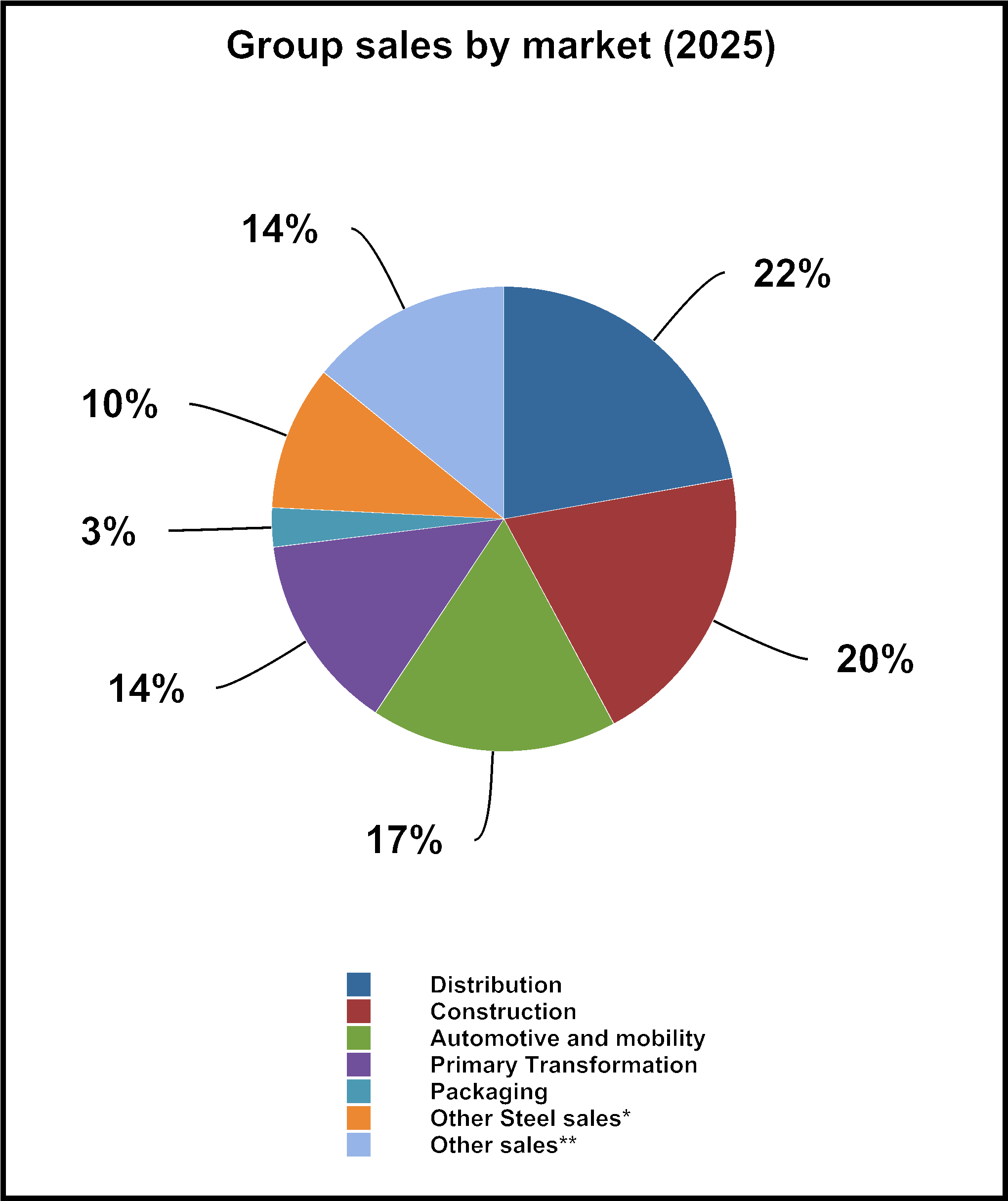
* Other steel sales mainly represent metal processing, machinery, electrical
equipment and domestic appliances
**Other sales mainly represent mining, chemicals & water, slag, waste, sale of
energy and shipping
For the construction market, which represented 20% of the
Company's revenue in 2025, ArcelorMittal offers the most
complete range of grades and specifications of structural steel,
façade, ceiling and floor systems, sheet piles solutions for
foundations and underground car park systems, steel plumbing
solutions and a complete portfolio of reinforcement products.
This includes rebar developed specifically for areas with high
seismic activity, and steel fibers for tunnelling and other
infrastructure projects.
Automotive and mobility, which represented 17% of the
Company's revenue in 2025, offers a complete range of flat
high strength steel products:
•Drawing steels provide a range of non-alloyed mild steels
designed for deep and extra-deep drawing applications.
•High-yield high strength steels ("HSS") allow complex parts
to be formed for both visible and non-visible parts.
•First Generation AHSS offer carmakers their first chance to
make significant weight reductions to their vehicles. Third
Generation AHSS steels have been specifically developed
for OEMs who utilize cold stamping and forming
technologies. These grades are particularly suitable for
automotive safety, enhancing crash resistance.
•Martensitic steels are particularly useful in anti-intrusion
applications where they contribute to light-weighting while
enhancing safety.
•Press hardenable steels ("PHS") offer ultra high strength and
the ability to form complex shapes. This makes them ideal
for hot stamping processes and enables OEMs to achieve
excellent weight reductions across the vehicle.
•ArcelorMittal’s iCARe® range of electrical steels for e-
mobility enables OEMs to design compact, light-weight,
efficient and power-dense traction motors with unmatched
range; iCARe® steels also help to light-weight the motors
and electrical systems in conventional internal combustion
engine (ICE) vehicles.
ArcelorMittal's mobility market also includes maritime transport
(all varieties of ships, including general cargo carriers,
container ships, cruise ships and large tankers that carry
liquefied natural gas) and rail transport (railway tracks and
trains).
In the energy market, ArcelorMittal is a leading supplier of
specialist steels to the wind energy industry, supplying heavy
plates and coils for towers, reinforcing bars and ballast for
foundations, and supplying electrical steels for generators. For
solar energy, the Company provides the high-performance
steels, coatings and structural solutions that the latest
generation of solar photovoltaic and solar thermal installations
are built from. Although the renewable energy revolution is
underway, the world will still rely on traditional fossil fuels such
as oil and gas during a transitional phase. ArcelorMittal
supplies the steels for onshore and offshore platforms, liquified
natural gas ships, pipelines, refineries, and fuel storage. Steel
plates are also a core component for pressure vessels and
many other major structural applications in power generation
and petrochemical processing.
In addition, ArcelorMittal offers an extensive range of products
serving all parts of the packaging industry. This includes tin or
chromium plated steel with a wide range of mechanical
properties, and a variety of coating options.
Research and development
The Company’s Global Research and Development ("R&D" or
"Global R&D") division provides the technical foundation for the
sustainability and commercial success of the Company by
stimulating innovative thinking and the continuous
improvement of products and processes.
The Company operates 14 research sites in 9 countries around
the world. In 2025, ArcelorMittal’s R&D expense was $335
million (compared to $285 million and $299 million in 2024 and
30
Management report |
2023, respectively). In addition, the Company capitalized $41
million of research and development expenses in 2025
(compared to $29 million in 2024 and $26 million in 2023).
In 2025, R&D launched 19 new products and solutions to
accelerate sustainable lifestyles, and 22 products and solutions
to support sustainable construction, infrastructure and energy
generation.
Among its R&D initiatives, in 2025, the Company undertook a
total of 213 Life Cycle Assessment ("LCA") studies related to
steel products and the processes used to produce them, all
guided by the relevant standards.
In the Company's S-in Motion® catalog, the PHS family has
been enriched with Usibor® 2000 enhanced, best-in-class
material for car bodies with regards to safety and lightweight.
AHSS products are among the most affordable solutions on the
market for both passengers and battery protection.
Driven by the growth of the Electric Vehicle market, numerous
electrical steels are under development for implementation in
new models in the coming 5 years; among them 420Save
27-14 has reached commercial stage.
For public transportation, the reduction of CO2 emissions in rail
production is expected in 2026, with R&D providing strong
support throughout 2025 to anticipate the transition from BF-
BOF to EAF routes. ArcelorMittal is fully involved in the
development of solutions dedicated to the Global Energy
Transition. In the renewable energy area, Magnelis® long
lasting coating combined with Hyper® high strength steels
have become a material of choice for light weight solar
mounting systems. Heavy coating weight up to 800g/m² and
Hyper® grades up to 700MPa yield strength were introduced to
the market in 2025 for customer testing. Additionally, the
Company is working on the development of solutions suitable
for the hydrogen economy, electricity grids, carbon capture,
storage and use, and bioenergy.
The production of a complete range of low-CO2 steels allows
for a reduction in carbon footprint by up to 65%. 10 new
XCarb® Recycled and Renewably Produced ("RRP") products
have been commercialized in 2025 for the Automotive, Energy
and Construction markets. A new route has been developed at
European plants in Hamburg and Gijón to produce tire-cord
with 50-100% scrap to answer customers’ specifications for
sustainable steel solutions. For all of these products,
Environmental Product Declarations ("EPD") and Product
Carbon Footprint ("PCF") certificates have been released.
XCarb® RRP steels (flat, long, tubular, profiles, sandwich
panels) have been incorporated into Steligence® building
concepts. Steligence® is the holistic platform for
environmentally friendly and cost-effective steel solutions for
circular use (design for re-use), resilience with respect to
exceptional events (floods and storms), as well as solutions for
thermal retrofit or solar energy harvesting. Helioroof®, a
building integrated PhotoVoltaic sandwich panel solution has
reached commercial stage. First pilot buildings are under
construction.
In construction and infrastructure, R&D pursued the
development of new sections and sheet piles products at the
Belval, Rodange and Differdange plants in Luxembourg, taking
full advantage of digital and AI solutions to predict product
quality and mechanical properties, optimize production flows,
facilitate rolling operations, and monitor non-quality.
In process research, the focus remained on innovations in the
following domains:
By-products and circular economy.
The Company is advancing its circularity goals through
innovative models, cutting-edge methods, and collaborative
partnerships.
In 2025, R&D developed models to predict by-product quality
"ByP" in new steelmaking routes under different operational
conditions and steel grades. In 2026, as part of ArcelorMittal’s
European decarbonization program, a new EAF will begin
operating in Gijón, Spain. These models forecast ByP qualities,
enabling effective by-product management for this new asset.
Other circular economy efforts which continued in 2025 involve
using mining tailings as secondary raw materials, either by
creating marketable products or by reusing them internally and
in construction.
Progress against air pollution.
In 2025, R&D continued to develop scientific models and
advanced AI algorithms to quantify dust emissions, including
diffuse sources.
ArcelorMittal also has research activities focused on innovative
de-dusting and gas cleaning technologies (Nitrogen Oxides
(“NOx”), and Sulphur Oxides ("SOx")). In 2025, R&D tests
proved significant multipollutant emissions reduction at a semi-
industrial scale.
Progress in water management.
ArcelorMittal is actively seeking solutions to address water
vulnerability in certain regions. In 2025, the R&D team
commissioned a sophisticated pilot plant in Tubarão, Brazil,
equipped with solar-powered sensors designed to monitor
fundamental water quality parameters. The pilot project
produced encouraging results during its testing phase
throughout the year.
R&D continues supporting ArcelorMittal’s three
decarbonization routes:
The Company’s Volteron™ iron electrolysis project
successfully operated the 1:1 vertical cell pilot, and John
Cockerill, its partner in this initiative, has completed the
31
Management report |
engineering design for a full-scale industrial plant, thereby
demonstrating the technology’s techno-economic feasibility.
Regarding the EAF route, the Company's new EAF and scrap
expert control systems are running pilots in Differdange and
Sestao, respectively. First trials with cold agglomeration
products in Contrecoeur's and Acindar's DRI plants were
conducted, with promising results in both cases.
In 2025, the R&D team, along with the Group's CTO team,
validated the techno-economic feasibility of Green Blast
Furnace Top Gas Recycling which uses oxygen for a pilot blast
furnace in Germany, one of the initiatives in decarbonization of
the blast furnace route.
In 2025, ArcelorMittal continued deploying advanced models to
improve the energy efficiency of reheating furnaces. These
solutions have been industrialized across 23 furnaces in 19
plants, delivering meaningful reductions in energy consumption
and supporting the Company's decarbonization objective.
Building on this success, an upgraded model with online
integration was implemented in 14 furnaces, combining energy
efficiency with productivity gains and helping to relieve
bottlenecks, achieving up to 7% higher output in some cases.
Additionally, an advanced mathematical model was
implemented to optimize internal gas management. This
innovation reduces reliance on natural gas and maximizes the
use of coke oven gas, contributing to lower emissions and
improved operational efficiency.
Process research and development for products differentiation:
In electrical steels, R&D has continued the development of
electrical steel plants, with good progress made in the
technology used to remove silica from pickling liquor and to
improve surface quality and flatness. R&D also supported new
investments in Mardyck (France) and Calvert (U.S.).
Mining Process Improvement:
The Mining segment and Global R&D are investing in
decarbonizing pellet production by lowering curing
temperatures and adjusting binders, which will reduce CO2
emissions. Additionally, Global R&D is developing a real-time
surveillance platform to monitor and manage safety at all
ArcelorMittal's tailings facilities globally. R&D is also working on
the reduction of the energy spent on beneficiation of iron ore, a
key lever for cost reduction and more sustainable mining.
Digital
In 2025, Global R&D, Group CTO and Flat Brazil Operations
received an important external recognition “Manufacturing
Leadership Award” with an internally developed AI solution
which supported ArcelorMittal Vega in their expansion case.
In 2025, ArcelorMittal spearheaded a strategic initiative called
Accelerate Digital Innovation or ADII and aimed at accelerating
the adoption of AI and digital solutions across production
facilities. As part of this effort, six plants have been carefully
selected to represent diverse geographies and production lines
(both flat and long products) to be digitally accelerated.
Efforts have continued to be made on a range of additional
projects, such as:
•Internally developed predictive maintenance platform
successfully deployed in major plants to monitor critical
equipment.
•Robotics has been an important focus point for the
development of new applications aiming to increase the
safety and efficiency of the Company's operations.
•The Company's significantly mature AI-based product
development platform allows speeding up the development
of several families of products and providing solutions to
develop new products with high added value. In the frame of
the transition to EAF production, AI is already guiding
industrial trials, while improving the Company's metallurgical
knowledge and in-house developed models.
•More traditional and globally deployed advanced process
models are being reworked, incorporating new AI algorithms.
•Several of the Company's expansion plans are thoroughly
modelled in advance combining AI and mathematical
optimization techniques to a very high level of sophistication,
allowing for the accuracy of the representation of the new
investment under many different business scenarios.
Products
Product overview
Information regarding segment sales by geographic area and
sales by type of products can be found in note 3 to
ArcelorMittal’s consolidated financial statements.
ArcelorMittal has a high degree of product diversification
relative to other steel companies. Its plants manufacture a
broad range of finished and semi-finished steel products with
different specifications, including many complex and highly
technical and sophisticated products that it sells to demanding
customers for use in high-end applications.
ArcelorMittal’s principal steel products include:
•semi-finished flat products such as slabs;
•finished flat products such as plates, hot- and cold-rolled
coils and sheets, hot-dipped and electro-galvanized coils and
sheets, tinplate and color coated coils and sheets;
•semi-finished long products such as blooms and billets;
•finished long products such as bars, wire-rods, structural
sections, rails, sheet piles and wire-products; and
•seamless and welded pipes and tubes.
ArcelorMittal’s main mining products include iron ore lump,
fines, concentrate, pellets and sinter feed.
32
Management report |
Steel-making process
Historically, primary steel producers have been divided into
“integrated” and “mini-mill” producers. Over the past few
decades, a third type of steel producer has emerged that
combines the strengths of both the integrated and the mini-mill
processes. These producers are referred to as “integrated
mini-mill producers”.
Integrated steel-making
In integrated steel production, coal is converted to coke in a
coke oven, and then combined in a blast furnace with iron ore
and fluxes to produce hot metal. This is then combined with
scrap in a converter, which is also referred to as BOF, to
produce raw or liquid steel. Once produced, the liquid steel is
metallurgically refined and then transported to a continuous
caster for casting into a slab, bloom or billet or cast directly as
ingots. The cast steel is then further shaped or rolled into its
final form. Various finishing or coating processes may follow
this casting and rolling. Recent modernization efforts by
integrated steel producers have focused on cutting costs
through eliminating unnecessary production steps, reducing
manning levels through automation, and decreasing waste
generation. Integrated mills are substantially dependent upon
iron ore and coking coal which, due to supply and demand
imbalances, shortening of contract durations and the linkage
between contract prices and spot prices, have been
characterized by price volatility in recent years.
Mini-mills
A mini-mill employs an EAF to directly melt scrap and/or scrap
substitutes such as direct reduced iron, thus entirely replacing
all of the steps up to and including the energy-intensive blast
furnace. A mini-mill incorporates the melt shop, ladle
metallurgical station, casting, and rolling into a unified
continuous flow. The quality of steel produced by mini-mills is
primarily limited by the quality of the metallic raw materials
used in liquid steel-making, which in turn is affected by the
limited availability of high-quality scrap or virgin ore-based
metallics for use in the EAFs. Mini-mills are substantially
dependent on scrap, which has been characterized by price
volatility in recent years, and the cost of electricity.
Integrated mini-mills
Integrated mini-mills are mini-mills that produce their own
metallic raw materials consisting of high-quality scrap
substitutes, such as DRI. Unlike most mini-mills, integrated
mini-mills are able to produce steel with the quality of an
integrated producer, since scrap substitutes, such as DRI, are
derived from virgin iron ore, which has fewer impurities. The
internal production of scrap substitutes as the primary metallic
feedstock provides integrated mini-mills with a competitive
advantage over traditional scrap-based mini-mills by insulating
the integrated mini-mills from their dependence on scrap,
which continues to be subject to price volatility. The internal
production of metallic feedstock also enables integrated mini-
mills to reduce handling and transportation costs. The high
percentage use of scrap substitutes such as DRI also allows
the integrated mini-mills to take advantage of periods of low
scrap prices by procuring a wide variety of lower-cost scrap
grades, which can be blended with the higher-purity DRI
charge. Integrated mini-mills are substantially dependent upon
iron ore which has been characterized by price volatility in
recent years (as described for integrated steel production
above). In addition, because the production of direct reduced
iron involves the use of significant amounts of natural gas,
integrated mini-mills are more sensitive to the price of natural
gas also than are mini-mills using scrap.
Key steel products
Steel-makers primarily produce two types of steel products: flat
products and long products. Flat products, such as sheet or
plate, are produced from slabs. Long products, such as bars,
rods and structural shapes, are rolled from blooms and/or
billets.
Flat products
Slab. A slab is a semi-finished steel product obtained by the
continuous casting of steel or rolling ingots on a rolling mill and
cutting them into various lengths. A slab has a rectangular
cross-section and is used as a starting material in the
production process of other flat products (e.g., hot-rolled sheet,
plates). Slabs are typically between 200 millimeters and 250
millimeters thick.
Hot-rolled sheet. Hot-rolled sheet is minimally processed steel
that is used in the manufacture of various non-surface critical
applications, such as automobile suspension arms, frames,
wheels, and other unexposed parts in auto and truck bodies,
agricultural equipment, construction products, machinery,
tubing, pipe and guard rails. All flat-rolled steel sheet is initially
hot-rolled, a process that consists of passing a cast slab
through a multi-stand rolling mill to reduce its thickness to
typically between 2 millimeters and 25 millimeters, depending
on the final product. Flat-rolled steel sheet that has been
wound is referred to as “coiled”. Alternatively, hot-rolled sheet
can be produced using the thin slab casting and rolling
process, where the hot-rolled sheet thickness produced can be
less than one millimeter. This process is generally used in a flat
products mini-mill, but some integrated examples exist as well.
Cold-rolled sheet. Cold-rolled sheet is hot-rolled sheet that has
been further processed through a pickle line, which is an acid
bath that removes scaling from steel’s surface, and then
successively passed through a rolling mill without reheating
until the desired gauge, or thickness, and other physical
properties have been achieved. Cold-rolling reduces gauge
and hardens the steel and, when further processed through an
annealing furnace and a temper mill, improves uniformity,
33
Management report |
ductility and formability. Cold-rolling can also impart various
surface finishes and textures. Cold-rolled steel is used in
applications that demand higher surface quality or finish, such
as exposed automobile and appliance panels. As a result, the
prices of cold-rolled sheet are higher than the prices of hot-
rolled sheet. Typically, cold-rolled sheet is coated or painted
prior to sale to an end-user.
Coated sheet. Coated sheet is generally cold-rolled steel that
has been coated with zinc, aluminum or a combination thereof
to render it corrosion-resistant and to improve its paintability.
Hot-dipped galvanized, electro-galvanized and aluminized
products are types of coated sheet and in recent times hot
dipped coatings composed of zinc, magnesium and aluminum
have grown in popularity. These are also the highest value-
added sheet products because they require the greatest
degree of processing and tend to have the strictest quality
requirements. Coated sheet is used for many applications,
often where exposed to the elements, such as automobile
exteriors, major household appliances, roofing and siding,
heating and air conditioning equipment, air ducts and switch
boxes, external structural applications as well as in certain
packaging applications, such as food containers.
Plates. Plates are produced by hot-rolling either reheated slabs
or ingots. The principal end uses for plates include various
structural products such as for bridge construction, storage
vessels, tanks, shipbuilding, line pipe, industrial machinery and
equipment.
Tinplate. Tinplate is a light-gauge, cold-rolled, low-carbon steel
usually coated with a micro-thin layer of tin. Tinplate is usually
between 0.14 millimeters and 0.84 millimeters thick and offers
particular advantages for packaging, such as strength,
workability, corrosion resistance, weldability and ease in
decoration. Food and general line steel containers are made
from tinplate.
Electrical steels. There are two principal types of electrical
steel: non-grain oriented fully processed steels and non-grain
oriented semi-processed steels. Non-grain oriented fully
processed steels are iron-silicon alloys with varying silicon
contents and have similar magnetic properties in all directions
in the plane of the sheet. They are principally used for motors,
generators, alternators, ballasts, small transformers and a
variety of other electromagnetic applications. A wide range of
products, including a newly developed thin gauge material for
high frequency applications, are available. Non-grain oriented
semi-processed steels are largely non-silicon alloys sold in the
not finally annealed condition to enhance punchability. Low
power loss and good permeability properties are developed
after final annealing of the laminations.
Long products
Billets/Blooms. Billets and blooms are semi-finished steel
products. Billets generally have square cross-sections up to
180 millimeters by 180 millimeters, and blooms generally have
square or rectangular cross-sections greater than 180
millimeters by 180 millimeters. These products are either
continuously cast or rolled from ingots and are used for further
processing by rolling to produce finished products like bars,
wire rod and sections.
Bars. Bars are long steel products that are rolled from billets.
Merchant bar and reinforcing bar (rebar) are two common
categories of bars. Merchant bars include rounds, flats, angles,
squares, and channels that are used by fabricators to
manufacture a wide variety of products such as furniture, stair
railings, and farm equipment. Rebar is used to strengthen
concrete in highways, bridges and buildings.
Special bar quality (“SBQ”) steel. SBQ steel is the highest
quality steel long product and is typically used in safety-critical
applications by manufacturers of engineered products. SBQ
steel must meet specific applications’ needs for strength,
toughness, fatigue life and other engineering parameters. SBQ
steel is the only bar product that typically requires customer
qualification and is generally sold under contract to long-term
customers. End-markets are principally the automotive, heavy
truck and agricultural sectors, and products made with SBQ
steel include axles, crankshafts, transmission gears, bearings
and seamless tubes.
Wire rods. Wire rod is ring-shaped coiled steel with diameters
ranging from 5.5 to 42 millimeters. Wire rod is used in the
automotive, construction, welding and engineering sectors.
Wire products. Wire products include a broad range of
products produced by cold reducing wire rod through a series
of dies to improve surface finish, dimensional accuracy and
physical properties. Wire products are used in a variety of
applications such as fasteners, springs, concrete wire,
electrical conductors and structural cables.
Structural sections. Structural sections or shapes are the
general terms for rolled flanged shapes with at least one
dimension of their cross-section of 80 millimeters or greater.
They are produced in a rolling mill from reheated blooms or
billets. Structural sections include wide-flange beams, bearing
piles, channels, angles and tees. They are used mainly in the
construction industry and in many other structural applications.
Rails. Rails are hot-rolled from a reheated bloom. They are
used mainly for railway rails but they also have many industrial
applications, including rails for construction cranes.
Seamless tubes. Seamless tubes have outer dimensions of
approximately 25 millimeters to 508 millimeters. They are
34
Management report |
produced by piercing solid steel cylinders in a forging operation
in which the metal is worked from both the inside and outside.
The final product is a tube with uniform properties from the
surface through the wall and from one end to the other.
Steel sheet piles. Steel sheet piles are hot rolled products used
in civil engineering for permanent and temporary retaining
structures. Main applications are the construction of quay
walls, jetties, breakwaters, locks and dams, river
reinforcements and channel embankments, as well as bridge
abutments and underpasses. Temporary structures like river
cofferdams are made with steel sheet piles. A special
combination of H beams and steel sheet piles are sometimes
used for the construction of large container terminals and
similar port structures.
Welded pipes and tubes. Welded pipes and tubes are
manufactured from steel sheet that is bent into a cylinder and
welded either longitudinally or helically.
Mining products
ArcelorMittal’s mining products correspond to iron ore which is
also one of the main raw materials for steel operations (see "—
Raw materials and energy—Iron ore").
ArcelorMittal’s mining operations produce a diversified range of
iron ore products, including sinter feed fines, concentrates, BF
and DR pellets, supplying both internal steelmaking and
external markets. Production has expanded in recent years,
with notable growth in Liberia and high-grade iron ore output in
Canada that is increasingly suited to direct reduction
applications. ArcelorMittal’s extensive iron ore reserves and
global footprint support both current steel production and
evolving feedstock needs in the context of decarbonization.
Sustainable development
Governance structure
The Company’s governance structure is based around the
following supervisory bodies:
The three Board of Directors Committees: Audit and Risk
Committee; Appointments, Remuneration and Corporate
Governance Committee ("ARCG Committee") and the
Sustainability Committee.
Management Committees and Panels: Management
Committee, Corporate Finance and Tax Committee ("CFTC"),
Investment Allocation Committee ("IAC"), Global Health and
Safety Council, Climate Change Panel, Sustainable
Development Panel, and Equality Panel.
The Board of Directors Committees
For information regarding the structure and responsibilities of
the Audit and Risk Committee, ARCG Committee and the
Sustainability Committee, please refer to "Management and
employees—Corporate governance—Board of Directors
committees".
Management Committees and Panels
Management Committee ("MC")
The MC plays an important role in debating and developing the
Company's policies and strategy and brings to the table
representatives from all major segments, regions and functions
to discuss relevant items for the entire Company.
Corporate Finance and Tax Committee ("CFTC")
The CFTC defines the principles for ArcelorMittal’s finance
community and presents and supports financial and business
solutions for the Group by providing the expertise, excellence
in execution and stability for the continuous, sustainable and
competitive development of the Group including assessment of
financial risks related to the Company's climate strategy while
developing and promoting its people. The responsibilities of the
CFTC extend across all finance and tax activities in the Group,
covering treasury, funding, taxation, accounting and
performance management, Sarbanes-Oxley compliance and
insurance. They are not limited to corporate level activities
only. The CFTC is chaired by the CFO and EVP, Mr. Genuino
Christino, and has main responsibilities covering treasury,
funding, taxation, accounting and performance management,
SOX and insurance.
Investment Allocations Committee ("IAC")
The IAC authorizes large capital expenditure projects, including
those designed to deliver safety and environmental
improvements, carbon reductions, and reviews the carbon
footprint impact of all proposals. The IAC is chaired by Mr.
Aditya Mittal, CEO of ArcelorMittal.
Global Health and Safety Council
The Global Health and Safety Council, which includes Health &
Safety ("H&S") managers from across the Company, ensures
best practices are shared across the Company. See —Health
and Safety.
Climate Change Panel ("CCP")
CCP consists of senior managers from relevant corporate
functions and key operations across the Group. It guides
engagement and advocacy with external stakeholders on
climate change and decarbonization and supports the business
in understanding the risks and opportunities associated with
the transition to a low carbon economy.
Sustainable Development Panel ("SDP")
SDP consists of senior managers from relevant corporate
functions and key operations. It discusses, coordinates and
guides engagement on issues related to material
environmental and social issues, stakeholder engagement,
35
Management report |
compliance and performance on environmental (non-climate),
human rights and social performance issues.
Materiality
The starting point for the Company’s sustainability reporting
and planning is to assess sustainability issues that are most
material in their impacts for external and internal stakeholders,
against the issues seen by the Company as having the most
actual or potential impact on its business and value, as well as
material sustainability topics from a financial perspective. This
assessment allows the Company to identify which issues to
prioritize and address. It also provides the basis for the
Company's sustainability planning and programs including
investment decisions, and serves as a benchmark to assess
progress.
The Company's most material sustainability topics are:
•Safety
•Climate
•People (including equal opportunities and non-
discrimination)
•Air, water, land, biodiversity and ecosystems
•Communities
•Value chains that the Company's stakeholders trust
•The value of ArcelorMittal's products to the circular
economy
•Business conduct
Reporting
The Company is committed to reporting on its governance,
strategy, risks and performance relating to each of its material
issues in its key publications including Annual reports and
Sustainability Reports.
In 2025, the Company published its Sustainability Report
adhering to the requirements of the EU Non-Financial
Reporting Directive (NFRD), reflecting the guiding principles of
international organizations and frameworks such as IFRS,
Global Reporting Initiative ("GRI"), Sustainability Accounting
Standards Board ("SASB"), the United Nations Global
Compact ("UNGC"), and the United Nations Sustainable
Development Goals ("UN SDGs").
In 2025, alongside making disclosures to the Carbon
Disclosure Project ("CDP") on climate change and water, and
conducting numerous customer surveys and investor
engagement, the Company published several country-specific
sustainability reports as required by its subsidiaries operating
in various jurisdictions.
The Company also released its Report on Payments to
Governments in Respect of Extractive Activities for the year
ended December 31, 2024.
The Company publishes a special disclosure report in
compliance with the US Dodd Frank Act Section 1502 and has
been complying with the reporting requirements of the EU's
conflict minerals regulation.
Health and Safety
ArcelorMittal’s operations are subject to a broad range of laws
and regulations relating to the protection of human health and
safety ("H&S").
Health and safety governance
ArcelorMittal has a clear and strong H&S management system
(SMS), which includes the H&S policy, standards e.g. Fatality
Prevention Standards (FPS), guidance, training and life-saving
golden rules. These provide a minimum baseline for the
business units / segments to build upon with site specific plans,
and are aimed at reducing, on a continuing basis, the severity
and frequency of serious injuries and fatalities. Key elements of
the policy include:
•All fatalities and work-related illness can and must be
prevented; H&S always comes first in all decisions and
actions at all levels of ArcelorMittal;
•Enhanced emphasis on management’s role while
recognizing and reinforcing that all employees need to be
actively involved in H&S management, making it clear that
working safely is a condition of employment for everyone at
ArcelorMittal;
•Explicitly stating that everyone is empowered to act and
pause activities if they see a situation which they deem to be
a potential risk;
•Stressing the need to report and analyze all incidents, so
that employees and management from across the Company
can learn from them; and
•Highlighting the role effective management systems and
sharing of best practices has in driving continuous
improvements.
The Group’s safety policies and standards are developed by
the corporate H&S team, which monitors safety performance
KPIs across all sites and segments. In addition, the Global
Health and Safety Council (GHSC), which includes H&S
managers from across the Company, ensures best practices
are shared across the Group.
The CEOs of the business units are accountable for
establishing and maintaining the safety culture, effectively
implementing the SMS in their operations, and delivering
strong safety performance within their perimeter of
responsibility. This includes developing site-specific
improvement plans.
The business unit CEOs and segments are supported by a
three-lines assurance model which was enhanced in 2025 (see
36
Management report |
Governance and Assurance section below). The findings will
be shared with the Board Audit and Risk Committee.
The Board Sustainability Committee (SC) discusses safety on
a quarterly basis, with additional safety focused meetings
scheduled between regular meetings as required.
Executive Compensation
The executive short-term incentive plan for 2025 was linked to
the Recordable Injury Rate ("RIR") which is a change to the
proactive Potential Serious Injuries and Fatalities ("PSIF") used
in 2024. This change was made as the proactive PSIFs had
reached a maximum level at many of the Company's entities
and as such, ArcelorMittal wanted to move forward with a KPI
that would continue to incentivize improvement. The target has
been set at 93% of the previous year’s recordable injury rate.
In addition, there is a fatality frequency rate circuit breaker. For
the Executive Office, this is already at nil and for the rest of the
Group it is set at 0.006 in 2025 and nil in 2026. The proportion
of bonuses linked to this scheme to safety is 15%.
Safety performance also represents 20% award vesting for the
Executive Office long-term incentive plan and 15% for the
Executive Officers plan, increased from 10% in 2024 to
reinforce the focus on safety across the Company. The Fatality
Frequency Rate ("FFR") is the KPI used for the long-term
incentive. For 2025 grants, the long-term incentive for the
Executive Office and Executive Officers is based on achieving
an FFR of zero.
Three-year safety transformation program
The Company completed the first year of its three-year safety
transformation program, which supports ArcelorMittal’s journey
to be a zero fatality and serious injury company. In 2025, the
Company focused on setting the foundations for change across
the whole Group. During years two and three, these changes
will be embedded to ensure consistency, discipline and results
in every region supporting the Company to reach and sustain
world class levels of safety performance.
Roadmaps have been set at both the corporate and site level
that are based on five dimensions: Governance and
assurance; leadership competencies; occupational risk
management; process safety management and alignment of
support functions. Progress in 2025 has been measured
against all these dimensions. Key highlights include:
Governance and assurance
The H&S assurance model has been strengthened, with three
lines of assurance across all business units/segments/
corporate functions, to provide more comprehensive oversight.
It will provide a structured approach to verify that the Company
is promoting a proactive and interdependent safety culture and
is managing safety through a risk reduction management
system. Line 1 assurance will be under the responsibility of the
site/unit management. Line 2 assurance will be at the level of
the segment management and corporate functions (Group
H&S and CTO). Line 3 assurance, which provides assurance
on safety processes, will be embedded in the Global
Assurance function (an independent assurance function). The
findings will be shared with the Board Audit and Risk
Committee.
In addition, a new tool has been adopted globally to track the
level 2 audits and to ensure consistent audit methodology
across the Group. 50 level 2 audits have been completed in
2025 with level 3 audits also now underway.
Leadership competencies
To support leaders with the right skills, a new safety leadership
competency model has been developed which highlights
minimum expectations on the safety-specific knowledge, skills
and behaviors required for different roles. In 2026, all leaders
will be assessed against this competency model, and any
identified gaps will be supported through dedicated training and
development actions.
An enhanced safety leadership training was rolled out to senior
management, providing a strong foundation for the Company
to strengthen the ‘one safety culture’ across the Group. More
than 80 senior leaders took part in the year long program,
covering key safety leadership skills including effective
communication. Curated trainings based on the new safety
leadership competency model are being developed and will be
made available on the Company's global learning platform,
accessible to everyone.
Occupational risk management
To strengthen the identification and understanding of
operational risk exposure, the Company has provided clear
guidance for sites including on hazard identification, risk
assessment and control, amongst other areas. These
requirements bring together best practices from the
organization and outline how to manage risk in a consistent
way. These steps are supporting the Company in building a
more consistent, preventative and risk-informed culture across
the Group.
Furthermore, all sites are reporting the status of their FPS on
an ongoing basis in line with the role out of any updates (all
FPS will be updated by 2026). As the FPS are updated,
minimum critical controls are being embedded into the
requirements and supporting guidance is providing support to
ensure consistent adherence around the Group.
Process Safety Management
The new Process Safety Management Framework (PSM) was
launched in 2025. 12 pilots have commenced covering a range
of different assets (coke plant, DRI module, steel plant, pellet
plant, sinter plant and electric arc furnace) and across many
geographies (Europe, North America, Brazil and India). The
37
Management report |
aim of these pilots is to implement best-in-class PSM which will
be shared and rolled out across all assets across the Group.
Integrating H&S elements into support business processes
In 2025, H&S has been strengthened across the Company’s
human resources processes and practices from the hiring
process to career path guidelines. In addition to the new Safety
Leadership competency model, the global resourcing policy,
guidance on job descriptions and behavioral interviews have
been updated to incorporate key requirements on safety. H&S
has also been strongly integrated into the Company's
performance management guidelines. Furthermore to support
consequence management, ‘Just and Fair Culture’ framework
has been rolled out across the Group which sets a consistent
approach across the Group and implementation is being
tracked and audited as part of the enhanced 3 lines of
assurance.
Embedding contractors
Contractors are being fully embedded into ArcelorMittal’s safety
management processes across the Group. As such, the
Company has been rolling out its Life Saving Golden Rules
Certification to contractors and has implemented a tighter
contractor sanction policy – contractor evaluation will be
considered in the overall contractor evaluation at the Group
level and used for determining future awards of work to
contractors.
Furthermore, to improve contractors' safety management, a
new fatality prevention standard for contractors has been
drafted to be launched across the Group in early 2026 and all
segments will need to complete a full self-assessment by the
end of 2026. The monitoring and assessment of contractors
will be captured across all 3 lines of assurance. The aim of the
Contractors' Safety Management Standard is to ensure a
shared understanding of responsibilities and consistent
application of best practices.
Performance in 2025
In 2025, in the first year of ArcelorMittal's three-year safety
transformation program, there has been strong engagement
across the Group on safety which is evident across all key
safety KPIs. There was a significant reduction in the FFR to
0.014x in 2025 (from 0.035x in 2024), the RIR reduced by
~20% to 3.85 (from 4.80x in 2024) and there was an
improvement in the Lost Time Injury Frequency Rate ("LTIFR")
rate to 0.65x in 2025 (compared with 0.70x in 2024).
However, there is much more to be done on safety to meet the
Company’s target of zero fatalities and serious injuries. In
2025, there were six fatalities in five events, of which two were
ArcelorMittal employees and four were contractors. Thorough
investigations were conducted to determine the circumstances
surrounding these incidents with the learnings being used to
strengthen the Company’s engineering controls, FPSs and are
being embedded into the segment specific roadmaps. The
Company remains steadfast in its commitment to building a
workplace where every individual returns home safely.
Safety is one of the Company’s core values. Each business
unit has a tailored safety roadmap that details the steps
needed to support a reduction in variability in the safety
performance. The Company is clear on what it needs to do to
build on this first year and to demonstrate continued progress.
For the year ended December 311 | LTIFR 2025 | LTIFR 2024 | Fatalities 2025 | Fatalities 20242 | FFR 2025 | FFR 20242 | RIR 2025 | RIR 2024 |
North America | 0.18 | 0.27 | 1 | 1 | 0.018 | 0.019 | 2.22 | 3.34 |
Brazil | 0.29 | 0.21 | 1 | 3 | 0.009 | 0.028 | 3.26 | 3.79 |
Europe | 1.34 | 1.34 | 1 | 4 | 0.009 | 0.036 | 5.94 | 7.65 |
Sustainable Solutions | 1.27 | 1.01 | 2 | 2 | 0.062 | 0.059 | 6.58 | 7.17 |
Mining | 0.20 | 0.18 | — | 1 | 0.000 | 0.036 | 1.98 | 2.31 |
Others | 0.49 | 0.81 | 1 | 3 | 0.014 | 0.041 | 2.74 | 2.83 |
TOTAL | 0.65 | 0.70 | 6 | 14 | 0.014 | 0.035 | 3.85 | 4.80 |
1.Information is reported on a provisional basis at reporting date and may be revised retrospectively following a comprehensive review that extends beyond the publication of
the annual report. All data is based on ArcelorMittal Group (excluding joint ventures and associates) and includes acquisitions and disposals as from and until their date of
acquisition and disposal, respectively.
2.The 2024 fatality figure in Brazil has been revised retrospectively as a result of an injury that occurred in 2024 but was later determined fatal.
Climate change
The Company continues to make progress towards its ambition
to reach net zero by 2050, reducing its historical absolute
Scope 1 and 2 emissions from 188 million tonnes CO2e in
2018 to 98.3 million tonnes CO2e in 2025 (47% reduction)
while managing climate-related transition and physical risk.
The Company is well positioned given existing capabilities in
EAF steelmaking and low-carbon emission metallics to provide
access to low-carbon intensity steel products to its customers.
ArcelorMittal’s progress and activities related to
decarbonization have been across three key areas:
•Fostering the development of a supportive environment for
decarbonization in Europe;
•Disciplined, competitive decarbonization capital expenditure;
and
38
Management report |
•Enabling and investing in the energy transition.
Fostering the development of a supportive environment for
decarbonization in Europe
The Company announced in November 2024 that it was unable
to take a final investment decision constructing new DRI-EAF
assets in Europe given European policy, energy and market
conditions. Since then, the Company has been encouraged by
the effort that the European Commission ("EC") has taken to
understand the challenges it is facing. On March 19, 2025, the
EC published its Steel and Metals Action plan, designed to
strengthen the European steel and metal sector’s
competitiveness and safeguard its future. It outlined the
European Commission’s intention to:
•Address unfair trade by introducing effective protection
measures beyond June 30, 2026, when the safeguards
expire;
•Prevent carbon leakage through amendments to the CBAM;
•Lower energy prices for energy intensive industrials like
steel; and
•De-risk decarbonization projects through lead markets and
public support.
The EC has taken decisive action on these measures and, on
October 7, 2025, presented a new Tariff Rate Quota ("TRQ")
mechanism to protect the steel industry from global
overcapacity. It is intended to support the European steel
industry in raising capacity utilization toward healthy levels of
80–85% (up from the current 65% reported by Eurofer),
improving profitability and enabling investment with greater
confidence. It is now imperative that this is implemented.
On December 17, 2025, the EC also provided an update on the
CBAM announcing proposed measures to close loopholes to
prevent circumvention and strengthen the efficacy of the
mechanism. Together, the new TRQ mechanism and an
effective CBAM will provide the foundation for ArcelorMittal’s
European business to earn its cost of capital. See
"Government regulations—Foreign trade".
Beyond ensuring fair competition, it will also be essential to
create lead markets and stimulate demand for low-carbon
emission steel, for example through public procurement and
the introduction of sustainability criteria in downstream sectors
such as automotive, construction, white goods, clean energy
and infrastructure. This should be complemented by the
progressive enforcement of content requirements in steel-
intensive products and the development of a carbon-intensity
label for steel based on a sliding-scale approach to give the
market clear, comparable information. For example, the Low
Emission Steel Standard ("LESS") is a voluntary standard
which represents almost 45% of steel production in Europe.
ArcelorMittal entities in Belgium, France, Luxembourg, Spain
and Germany are all members of the LESS.
In addition, of critical importance is visibility of industry access
to competitive clean energy.
Important steps have been taken by the EC but it is now
imperative that they are implemented as swiftly as possible.
ArcelorMittal will continue to advocate for the enabling
conditions required to support a viable transition of the steel
sector.
Disciplined, competitive decarbonization capital expenditure
Advancing decarbonization across the Company's
operations.
The policy context shapes ArcelorMittal’s phased approach to
decarbonization, beginning with the construction of state-of-
the-art EAFs, which in 2025 represented 26% of total crude
steel production, up from 19% in 2018. The Company is
investing in EAFs and expects to have 3.4 million tonnes of
additional EAF capacity by the end of 2026, providing Group
capacity of 30 million tonnes. This capacity is based on two
projects in Spain (Gijón and Sestao) and the new EAF in the
U.S. (Calvert) which was commissioned and is ramping up
production.
Gijón, Spain
ArcelorMittal continues with the construction of an EAF for long
products at its Gijón plant, which is expected to produce its first
heat in the first quarter of 2026. This investment of €213 million
will be the first major EAF project to be implemented within the
Company’s decarbonization program in Europe and will
constitute the first step towards low-carbon emissions
steelmaking in Asturias.
Sestao, Spain
Sestao is in an advantageous position as one of the only
producers in Europe capable of producing low-carbon emission
flat steel via the EAF route today. There has been good
progress with the Company's efforts to increase production to
1.6 million tonnes by 2026 at the plant in Sestao which has two
EAFs. Once complete, much of this production will be XCarb®
RRP low-carbon emissions steel.
Sestao is also Europe’s first Compact Strip Production ("CSP")
mill line that combines continuous casting, heating and rolling
of slabs, and the plant can produce steel from melting start to
coiling finish in approximately three hours. This type of plant
benefits from energy saving compared to conventional
production, due to its simplified and shortened production cycle
minimizing reheating needs.
ArcelorMittal Calvert, USA
In 2025, ArcelorMittal completed the acquisition of the
remaining 50% of AMNS Calvert, one of the most advanced
steel finishing facilities in North America, from NSC. The
39
Management report |
Calvert site is complemented by a new state-of-the-art 1.5
million tonnes EAF which produced its first slabs in June 2025
and the facility is ramping up production. The new steelmaking
facility, integrated with ArcelorMittal’s HBI facility in Texas, will
enable Calvert to supply automotive customers with lower CO2
embodied steel, melted and poured in the United States. See
"Properties and capital expenditures—Capital expenditures".
Dunkirk, France
In February 2026, the Company confirmed the construction of
a 2-million-tonne EAF in Dunkirk, with a strategic investment of
approximately €1.3 billion. Its start‑up is scheduled for 2029
and it will produce steel with three times less CO2 compared
with a blast furnace. See "Introduction—Sustainable
development highlights—Recent developments". To support
the operation of the EAF, the Company has also signed a new
agreement in December 2025 with EDF to secure a long-term
supply of low-carbon electricity for its French sites, which
provides visibility on the energy costs.
Despite this progress, as disclosed in the 2024 Sustainability
Report published in April 2025, the Company still faces
significant challenges in meeting its 2030 carbon emissions
intensity target. The low-carbon iron-making technologies
required to meet that target, including green hydrogen,
biomass and CCS, are still in the process of becoming mature,
scalable and cost-competitive, and are only expected to be
viable at scale after 2030.
Optimizing asset portfolio for a low-carbon future
Asset optimization across the Group – divesting carbon
intensive assets such as Ilva (Italy), Kazakhstan, Bosnia (see
below) and closed/idled inefficient capacity (e.g. Poland BF) -
has also helped create a leaner, lower carbon and more
competitively positioned portfolio.
On October 30, 2025, following merger control clearance and
the fulfillment of all conditions precedent, ArcelorMittal
completed the sale of its operations in Bosnia and
Herzegovina, which included an integrated steel plant
operating well above the Company’s average emissions
intensity. See "Introduction—Key transactions and events in
2025".
This asset optimization strategy is not positioned as an
emission-reduction measure in itself, but as a disciplined
portfolio decision that supports the long-term transition of the
business. ArcelorMittal has reduced its CO2e intensity by 4.1%
in 2025 (vs 2018).
Reducing operational vulnerability to climate hazards
In 2024, the Company completed an asset-level screening to
assess exposure to climate hazards including flooding,
extreme precipitation, heat, cold, fire, drought, wind, and hail,
using a third-party climate data analytics tool. Building on this
foundation, in 2025 the Company developed a climate
adaptation toolkit to help sites carry out in-depth risk
assessments tailored to their local conditions, operational
characteristics, growth plans, workforce and community
context, and environmental management needs. The toolkit
includes a climate-risk assessment tool to identify material
risks at the process level, along with an adaptation plan
workbook to guide the design of mitigation measures,
implementation planning, and ongoing monitoring and
evaluation. It was piloted at one site in 2025, and will be rolled
out across the remaining sites starting in 2026, accompanied
by capacity-building activities to support effective adoption.
Investing in the energy transition
ArcelorMittal has continued to invest in the energy transition
and to develop innovative products that accelerate
decarbonization across industries, supporting stakeholders in
reducing emissions and enhancing the competitiveness of low-
carbon value chains across the following areas:
Scaling renewable energy for ArcelorMittal’s operations
and its value chain
As mentioned above, ArcelorMittal’s investments are guided by
the objective of ensuring a viable, long-term transition of its
operations and value chain, with capital allocated in areas
where decarbonization is technically feasible, economically
justified and aligned with future market requirements.
ArcelorMittal’s investments in renewables provide the
Company with non-cyclical operating income with low
maintenance capital expenditure requirements and a
consistent cash flow.
In 2025, ArcelorMittal continued to develop a portfolio of high-
quality renewable energy assets, delivering attractive returns
on investment. The Company has 1.6GW of renewable
capacity (equity share) already commissioned including mainly
India (1GW), Brazil (0.6GW), and Argentina (0.1GW). A further
1.2GW is under development and will be commissioned by
2028, including projects in India (1GW), Brazil (0.1GW) and
Argentina (0.1GW). See also "Properties and capital
expenditures—Capital expenditures".
Electrical steels offering for the e-mobility, renewable
energy and digital future
Electrical steels are essential for both the low-carbon and
digital transitions. They are used in electric motors, generators,
transformers, and other equipment that enable electrified
transport, renewable energy generation, power grids, and data
infrastructure. As demand for these applications grows, so
does the need for high-performance electrical steels.
ArcelorMittal is expanding its capacity to meet this demand in
sectors such as e-mobility, renewable energy (including hydro
and wind), and emerging areas like data centers.
ArcelorMittal, with French government support, is establishing
a new electrical steels production unit at its Mardyck, site near
40
Management report |
Dunkirk, adding new electrical steel production lines (see
"Properties and capital expenditures—Capital expenditures").
Together with the Saint-Chély-d’Apcher site in southern
France, this expansion will triple the Company’s annual
electrical steel production capacity to 280,000 tonnes.
Simultaneously, a dedicated management team for European
electrical steel operations has also been established to
improve responsiveness and efficiency.
In 2025, ArcelorMittal also announced plans for a new NOES
manufacturing facility in Alabama, U.S, see "Properties and
capital expenditures—Capital expenditures". The project is
expected to create up to 1,300 jobs during construction and
more than 200 permanent positions once operational. In total,
ArcelorMittal is investing in 0.4 million tonnes of NOES in the
U.S. and EU by 2028.
Advancing low-carbon building solutions
Meeting climate goals will require new materials and design
approaches that lower embodied carbon, improve thermal
performance and enable the integration of renewable energy in
the built environment. Innovation in products is therefore
relevant to support the decarbonization of homes, commercial
spaces and industrial facilities.
Recently, ArcelorMittal Construction renamed to ArcelorMittal
Building Solutions, reflecting its role as a full-spectrum partner
providing not only products, but complete systems, expertise,
and innovation throughout the building life cycle, supporting
more sustainable, future-ready construction practices.
One example of such solutions are the Company’s insulated
materials, which are designed to deliver high thermal efficiency.
Their combination of structural rigidity, mechanical
performance and low weight makes sandwich panels a cost-
efficient option for applications such as roofing and façades,
helping customers in various sectors to reduce energy
consumption.
In 2025, ArcelorMittal Building Solutions officially inaugurated
its Helioroof® production line in Contrisson, France, marking a
major milestone in sustainable building innovation. This next-
generation roofing solution seamlessly combines steel panels,
thermal insulation, and solar cells into a single, ready-to-install
module delivering exceptional energy performance with a lower
weight and significantly reduced carbon footprint compared to
traditional roofing with separate solar panels.
These actions illustrate the progress the Company has made in
capturing business opportunities linked to the low-carbon
transition.
Climate governance and risk management
ArcelorMittal’s Board oversees climate-related issues through a
governance structure that includes a Board-level Sustainability
Committee and an executive-level Climate Change Panel. The
Board approves related policies and incentive structures, while
accountability for implementation and compliance with local
requirements sits with local CEOs.
The Board has also linked executive remuneration to progress
on climate objectives. Since 2021, the long-term incentive
plans have included ESG criteria, including climate action.
Performance share units (PSUs) are partly contingent on
achieving the Company’s CO₂ emissions target by the end of
the vesting period, representing 10% of the performance
criteria for the Executive Office (and the CFO in 2025) and 5%
of the performance criteria for other Executive Officers.
The IAC evaluates the carbon impacts of major projects, as a
part of their review process, to ensure that economic and
environmental considerations are balanced in investment
decisions. The IAC assesses both financial returns and
alignment with climate targets, ensuring that investments
support the Company’s long-term growth while managing
transition risks and meeting its decarbonization strategy.
Carbon performance (based on 2025 data)
In 2025, the adjusted Group CO₂e intensity KPI increased
slightly by 1.1% compared to 2024. This was primarily due to
crude steel production declining more sharply than emissions,
particularly in the integrated route where a significant
proportion of emissions is fixed and does not decrease in line
with output. Temporary increases in emissions from purchased
electricity, together with changes in the site mix within the
portfolio (i.e. which sites were operating and their production
levels), also contributed to the higher intensity. As a result,
emissions per tonne of steel increased, even though absolute
CO₂ emissions decreased year-on-year by 3.1%.
The Company also reports 2018 data adjusted for structural
changes to its portfolio to enable like-for-like comparison over
time. On this basis, CO₂e intensity has decreased by 4.1%
since 2018, from 1.86 tCO₂e/tcs to 1.79 tCO₂e/tcs. Adjusted
absolute emissions corresponding to the Company’s global KPI
(Scope 1 and 2, steel and mining) have decreased by 27%
compared with 2018.
The following indicators are used to measure and monitor
ArcelorMittal's decarbonization progress:
41
Management report |
Metric | Unit | Scope + perimeter | 2018 (Baseline) | 2024 | 2025 | 2018-2025 Reduction |
Adjusted absolute CO2e footprint1 | Million tonnes | ArcelorMittal Scope 1+2 | 135.5 | 101.4 | 98.3 | 27.0% |
Adjusted absolute CO2e footprint1 | Million tonnes | Europe Scope 1+2 | 65.3 | 50.0 | 47.2 | 28.0% |
Adjusted Group CO2e intensity KPI1 (steel and mining) | tCO2e/tcs | ArcelorMittal Scope 1+2 | 1.86 | 1.77 | 1.79 | 4.1% |
Adjusted Europe CO2e intensity KPI1 (steel) | tCO2e/tcs | Europe Scope 1+2 | 1.69 | 1.61 | 1.63 | 3.2% |
CO2e intensity steel only2 | tCO2e/tcs | Steel Scope 1+2+limited Scope 3 | 2.09 | 1.87 | 1.86 | 10.8% |
Adjusted CO2e intensity1,2 steel only | tCO2e/tcs | Steel Scope 1+2+limited Scope 3 | 1.96 | 1.87 | 1.86 | 4.9% |
1.Prior period figures have been retrospectively adjusted for structural changes to the ArcelorMittal portfolio in 2025 to enable a like for like annual comparison.
2.This indicator includes limited upstream Scope 3 emissions from purchased goods that a steelmaker would normally be expected to produce, such as coke, slabs, burnt
lime in order to maintain a consistent system boundary and so a like for like comparison.
Tailings management
The Company has implemented a comprehensive tailings
management framework based on the leading industry
guidelines from the Mining Association of Canada (MAC), the
Canadian Dam Association (CDA), and the Global Industry
Standard for Tailings Management (GISTM). The Company’s
aim is to ensure that all its Tailings Storage Facilities (TSFs)
are structurally sound and safe, supported by independent
audits and reviews.
The Company manages 26 TSFs, categorized as:
•Active: 16
•Dormant: 2
•Care & Maintenance: 4
•Closure: 1
•Construction: 3
A strong governance framework and three-level assurance
process, including internal and external audits, is in place. In
2025, the Company conducted a full third-party GISTM audit
and completed a significant set of quantitative risk
assessments as part of the ongoing risk management strategy.
Tailings specialists are embedded within operations, and all
TSFs have emergency response plans activated by a Trigger
Action Response Plan (TARP). The Company has been
reviewing these emergency response plans across all sites to
ensure they are aligned with the international best practice
standards.
This work is supported by a continuous improvement program
that promotes reduced moisture disposal methodologies (e.g.
high-density thickened tailings or filtered tailings where
appropriate) and leverages proven new technologies to monitor
facilities globally in real-time. The Company has also upgraded
its internal monitoring infrastructure, deploying iSMART, a new
cloud-based TSF data monitoring system. This GIS monitoring
platform integrates all safety data, including information from
on-site instruments (such as piezometers and inclinometers
that measure deformation) and remote monitoring technologies
like InSAR satellite monitoring. This service provides a
predictive view by taking monthly, high-precision photos to
track movement in millimeter increments over time, allowing
the Company to detect very small changes and upward/
downward trends.
The Company is assessing all mining operations for transition
in line with these principles and developing customized design
solutions for non-conventional tailings system management.
Tailings thickening steps have been implemented in the
Company’s assets in Mexico, and reduced moisture disposal
methodologies are in use in Brazil, Canada, and Mexico. The
Company’s operation Peña Colorada, Mexico, commissioned a
dry stack facility during 2024, and further studies are ongoing
across a range of operations on how tailings can be
dewatered.
Risk assessments were undertaken on all ArcelorMittal’s TSFs
during 2021 and 2022, from which the Company implemented
a range of priority action plans and developed a risk reduction
program, including operational and monitoring improvements. A
follow up risk assessment process commenced during 2024.
A major milestone achievement in 2025 was the completion of
the check dam at ArcelorMittal Serra Azul TSF in Brazil and the
commencement of its decommissioning, a process planned to
take several years.
Stakeholder engagement is an important part of the
Company’s tailings management approach, aligning directly
with GISTM Principle 1 (Affected Communities). The Company
is committed to establishing and maintaining open, transparent,
and effective communication channels with all affected
communities, local authorities, and other stakeholders. This
includes timely disclosure of relevant, accessible, and
understandable information, and fulfilling the GISTM
requirement for a Participating Stakeholder process. The
Company adheres to its Stakeholder Engagement Procedure,
which formalizes this commitment and guides engagement
activities. The Company is also developing comprehensive
best practice guidance for resettlement to ensure any
necessary land access or community relocation is conducted
42
Management report |
fairly, respectfully, and in a manner that improves livelihoods,
prioritizing the rights and well-being of those affected.
The Company is also a member of AMIRA, a global research
group, and has been working with them on projects, including
the identification of liquefaction triggers.
Raw materials and energy
ArcelorMittal’s mining and raw materials supply strategy
consists of:
•Acquiring and expanding production of raw materials, in
particular iron ore but as well some other specific products
such as refractory, while keeping the cost under control;
•Exploiting its global purchasing reach, pursuing the lowest
unit price available based on the principles of total cost of
ownership and value-in-use through aggregated purchasing,
supply chain and consumption optimization; and
•Leveraging local and low cost advantages on a global scale.
ArcelorMittal’s priority is to optimize output and production from
its existing sources focused mainly on iron ore.
Iron ore
ArcelorMittal sources significant portions of its iron ore needs
from its own mines in Ukraine, Canada, Mexico, Liberia and
Brazil. Several of ArcelorMittal’s steel plants also have in place
off-take arrangements with suppliers located near its
production facilities.
For further information on Mining segment iron ore production,
see “Operating and financial review—Operating results”. For
further information on each of ArcelorMittal’s principal iron ore
mining operations including total mining production of iron ore,
see “Properties and capital expenditures—Property, plant and
equipment” and "Properties and capital expenditures— Mineral
reserves and resources".
ArcelorMittal is also a party to contracts with other mining
companies that provide long-term, stable sources of raw
materials. The Company has multi-year iron ore supply
contracts with Vale to cover its requirements for the EU units,
worldwide direct reduction units and for ArcelorMittal Brasil.
ArcelorMittal's principal international iron ore suppliers include
Vale in Brazil, Luossavaara-Kirunavaara AB in Sweden,
Baffinland Iron Mines Corporation ("BIM") in Canada, IOC (Rio
Tinto Ltd.) in Canada, Samarco in Brazil, Anglo-American
(Minas Rio in Brazil), and Metinvest in Ukraine.
ArcelorMittal believes that its portfolio of mining assets and
long-term supply contracts can play an important role in
preventing disruptions in the production process. (see
“Operating and financial review—Key factors affecting results
of operations—Raw materials”).
Coal
ArcelorMittal’s principal coal suppliers include the BHP Billiton
Mitsubishi Alliance (“BMA”), Stanmore, Peabody, and Glencore
in Australia, Alpha, CORE and Warrior in the United States,
and JSW in Poland.
Metallics (scrap)
ArcelorMittal procures the majority of its scrap requirements
locally and regionally. Certain plants supplement this by
importing EU‑origin scrap, typically transported by ship to
optimize sourcing. Scrap is generally purchased on the spot
market on a weekly or monthly basis or through short‑term
contracts.
Alloys
ArcelorMittal purchases its requirements of bulk and noble
alloys from a number of global, regional and local suppliers on
contracts that are linked to generally-accepted indices or
negotiated on a quarterly basis.
Base metals
The majority of the Company’s base metal needs, including
zinc, tin, aluminum and nickel are purchased under annual
volume contracts. Pricing is based on the market-accepted
indices. Material is sourced from both local and global
producers.
Electricity
ArcelorMittal generally procures its electricity through tariff-
based systems in regulated areas such as parts of the United
States and South Africa, through direct access to markets in
most of its European mills or through bilateral contracts
elsewhere. The duration of these contracts varies significantly
depending on the area and type of arrangement.
For integrated steel mills, plant off-gases from various process
steps are utilized to generate a significant portion of the plant’s
electricity requirements and lower the purchase volumes from
the grid. This is either produced by the plant itself or with a
partner in the form of a co-generation contract.
Natural gas
ArcelorMittal procures much of its natural gas requirements for
its Canadian and Mexican operations from the natural gas spot
market or through short-term contracts entered into with local
suppliers, with prices fixed either by contract or tariff-based
spot market prices. For its European and Ukrainian operations,
with a contractual mix of “all-in” bilateral supply and direct
access to the market, ArcelorMittal sources its natural gas
requirements with European short term/spot-indexed supply
contracts. The remainder of ArcelorMittal’s natural gas
consumption is generally sourced from regulated markets.
43
Management report |
Industrial gases
Most of ArcelorMittal’s industrial gas requirements are
produced and supplied under long-term contracts with various
suppliers in different geographical regions.
Coke
ArcelorMittal has its own coke-making facilities at most of its
integrated mill sites, including in Canada, Brazil, Spain, France,
Germany, Belgium, Poland, South Africa, and Ukraine. While
ArcelorMittal meets most of its own coke requirements, certain
of ArcelorMittal’s operating subsidiaries purchase coke mainly
from seaborne market from Indonesia, Colombia, Japan,
Australia, and China and certain of its subsidiaries occasionally
also sell excess coke at market prices to third parties.
Shipping
ArcelorMittal Shipping ("AM Shipping") provides ocean
transportation solutions to ArcelorMittal’s manufacturing
subsidiaries and affiliates. AM Shipping determines cost-
efficient and timely approaches for the transport of raw
materials, such as iron ore, coal, coke and scrap, and semi-
finished and finished products. AM Shipping is also responsible
for providing shipping services to the Company’s sales
organizations. It provides complete logistics solutions from
plants to customer locations using various modes of transport.
In 2025, AM Shipping arranged transportation for
approximately 51.41 million tonnes of raw materials and about
7.12 million tonnes of finished products. The key objectives of
AM Shipping are to ensure cost-effective and timely shipping
services to all units. AM Shipping also acts as the coordinator
for Global Chartering Ltd., the Company's joint venture with
DryLog Ltd., a Monaco based shipping company.
Sales and marketing
In 2025, ArcelorMittal sold 54.0 million tonnes of steel products.
Sales
The majority of steel sales from ArcelorMittal are destined for
domestic markets. For these domestic markets, sales are
usually approached as a decentralized activity that is managed
either at the business unit or at the production unit level. For
certain specific markets, such as automotive, there is a global
approach offering similar products manufactured in different
production units around the world. In instances where
production facilities are in relatively close proximity to one
another, and where the market requirements are similar, the
sales function is aggregated to serve a number of production
units. In the EU and in South America, ArcelorMittal owns a
large number of service and distribution centers. Depending on
the level of complexity of the product, or the level of service
required by the customer, the service center operations form
an integral part of the supply chain to ArcelorMittal’s
customers. Distribution centers provide access to
ArcelorMittal’s products to smaller customers that cannot or do
not want to buy directly from the operating facility.
The Group prefers to sell exports through its international
network of sales agencies to ensure that all ArcelorMittal
products are presented to the market in a cost-efficient and
coordinated manner.
Sales are executed at the local level, but are conducted in
accordance with the Group’s sales and marketing and code of
conduct policies.
For some global industries with customers in more than one of
the geographical areas that ArcelorMittal serves, the Company
has established customized sales and service functions. This is
particularly the case for the automotive industry. Sales through
this channel are coordinated at the Group level with respect to
contract, price and payment conditions.
Marketing
Marketing follows the sales activity very closely and is by
preference executed at the local level. In practice, this leads to
a focus on regional marketing competencies, particularly where
there are similarities among regional markets in close
geographical proximity. Local marketing provides guidance to
sales on forecasting and pricing. At the global level, the
objective is to share marketing intelligence with a view towards
identifying new opportunities, either in new products or
applications, new product requirements or new geographical
demand. Where a new product application is involved, the in-
house research and development unit of ArcelorMittal is
involved in developing the appropriate products.
An important part of the marketing function at ArcelorMittal is to
develop short-range outlooks that provide future perspectives
on the state of market demand and supply. These outlooks are
shared with the sales team in the process of finalizing the sales
strategy for the immediate future and with senior management
when market conditions call for production adjustments.
Globally, sales and marketing activities are coordinated to
ensure a harmonized approach to the market. The objective is
to provide similar service experiences to all customers of
ArcelorMittal in each market.
Purchasing
ArcelorMittal has implemented a global procurement process
for its major procurement requirements, including raw
materials, capital expenditure items, energy and shipping.
ArcelorMittal’s centralized procurement teams also provide
services such as optimization of contracts and the supply base,
logistics and optimizing different qualities of materials suitable
for different plants and low cost sourcing.
By engaging in these processes, ArcelorMittal seeks to benefit
from economies of scale in a number of ways, including by
establishing long-term relationships with suppliers that
44
Management report |
sometimes allow for advantageous input pricing, pooling its
knowledge of the market fundamentals and drivers for inputs
and deploying specialized technical knowledge. This enables
ArcelorMittal to achieve a balanced supply portfolio in terms of
diversification of sourcing risk in conjunction with the ability to
benefit from a number of its own raw materials sources.
ArcelorMittal has institutionalized the “total cost of ownership”
methodology as its way of conducting its procurement activities
across the Group. This methodology focuses on the total cost
of ownership for decision making, with the goal of lowering the
total cost of production through minimization of waste,
improved input material recovery rates and higher rates of
recycling.
Sustainability principles are embedded into ArcelorMittal
general procurement conditions, purchasing contracts, in the
onboarding process and supplier performance management in
the area of safety, health, environment, human rights and
employee relations.
Intellectual property
ArcelorMittal owns and maintains a patent portfolio covering
processes and steel products, including uses and applications
that it creates, develops and implements in territories
throughout the world. Such patents and inventions primarily
relate to steel solutions with new or enhanced properties, as
well as new technologies that generate greater cost-
efficiencies.
ArcelorMittal also owns trademarks, both registered and
unregistered, relating to the names and logos of its companies
and the brands of its products. ArcelorMittal has policies and
systems in place to monitor and protect the confidentiality of its
know-how and proprietary information. The Company applies a
general policy for patenting selected new inventions, and its
committees organize an annual patent portfolio screening by
individuals from the Company’s R&D and business sectors in
order to optimize the global efficiency of the Company’s patent
portfolio. The Company’s patent portfolio includes more than
16,000 patents and patent applications, mostly recent and
medium-term, for more than 1,015 patent families, with 128
inventions newly-protected in 2025. Because of this constant
innovation, the Company does not expect the lapse of patents
that protect older technology to materially affect medium term
revenue.
In addition to its patent portfolio, ArcelorMittal is constantly
developing technical know-how and other unpatented
proprietary information related to design, production process,
decarbonization solutions for steel production and use of high
quality steel products, leading to development of new
applications or to improvement of steel solutions proposed to
its customers, such as the ones aiming at weight reduction for
vehicles. ArcelorMittal has also been granted licenses for
technologies developed by third parties in order to allow it to
propose comprehensive steel solutions to customers.
ArcelorMittal is not aware of any pending lawsuits alleging
infringement of others’ intellectual property rights that could
materially harm its business.
Government regulations
ArcelorMittal’s operations are subject to various regulatory
regimes in the regions in which it conducts its operations. The
following is an overview of the principal features of the
Company's regulatory regimes, as of December 31, 2025, that
affect or are likely to significantly affect the Company's
operations.
See also “Introduction—Risk factors and Control”, "Business
Overview—Sustainable Development—Health and Safety" and
note 9.3 to the consolidated financial statements.
Environmental laws and regulations
ArcelorMittal’s operations are subject to a broad range of laws,
directives and regulations relating to air emissions, surface and
groundwater protection, wastewater storage, treatment and
discharges, the use and handling of hazardous or toxic
materials, waste management, recycling, treatment and
disposal practices, the remediation of environmental
contamination, the protection of soil, biodiversity and
ecosystems or rehabilitation (including in mining).
As environmental laws and regulations in the European Union
(“EU”) stemming from the Green Deal and other jurisdictions
continue to become more stringent, ArcelorMittal expects to
spend substantial resources, including operating and capital
expenditures, to achieve or maintain ongoing compliance.
Further details regarding specific environmental proceedings
involving ArcelorMittal, including provisions to cover
environmental remedial activities and liabilities,
decommissioning and asset retirement obligations are
described in note 9.1 to ArcelorMittal’s consolidated financial
statements.
Globally, the regulatory backdrop to environmental compliance
in industry is developing rapidly and becoming more stringent,
in conjunction with more extensive disclosure requirements,
notably through the roll-out of the Corporate Sustainability
Reporting Directive ("CSRD") reporting and preparation for
Task Force on Nature-related Financial Disclosure ("TNFD").
Environmental impacts such as that of air emissions are
coming under greater scrutiny as evidenced by the updated air
quality guidelines issued by the World Health Organization
("WHO") in September 2021. These guidelines have
contributed to the recent adoption of the Air Quality Directive
(Directive (EU) 2024/2881), alongside the updated Best
Available Techniques Reference Document ("BREF") for the
Ferrous Metals Processing Industry, among others. These
changes will result in stricter environmental norms concerning
45
Management report |
pollution (emissions to air, water and land), broader impacts on
natural environments, habitats and biodiversity, and energy
efficiency and resource efficiency, as well as promoting more
sustainable industrial production (part of the European
Commission’s Green Deal for a climate-neutral continent) and
increased transparency of information available to public.
EU
The revised Industrial Emission Directive (Directive 2024/1785
or “IED 2.0”) entered into force in August 2024 with an overall
aim to minimize the impact of pollution on people’s health and
the environment by reducing harmful industrial and intensive
livestock emissions across the EU. The IED 2.0 imposes
stricter rules for defining emission limit values and in respect of
permit requirements as well as tighter compliance and control
rules with additional enforcement provisions. The operators of
industrial installations will need to develop transformation plans
to achieve the EU's 2050 zero pollution, circular economy, and
decarbonization goals. The revised directive focuses on
resource use performance levels, as well as lower chemical
pollution through requirements for a reduced use of toxic
chemicals. The Directive has to be transposed into national
laws by July 1, 2026. Furthermore, the new EU Industrial
Emissions Portal Regulation (EU) 2024/1244 which replaces
the European Pollutant Release and Transfer Register
Regulation ("E-PRTR") entered into force in May 2024. This
revision enhances public access to information related to
industrial emissions. Between 2026 and 2027, the European
Commission ("EC") will work on implementing rules, with the
first report under the revised directive (describing releases and
resource use in 2027) scheduled for publication in 2028.
With regard to water policy, in June 2025, the European Water
Resilience Strategy was presented by the EC, paving the way
for a water-smart Europe for people, the economy and the
ecosystems, containing concrete actions up to 2030 to make
Europe water resilient. In relation to these, the effective
implementation of the relevant provisions of the Water
Framework Directive will be stress-tested in 2026, in particular
concerning permitting. The EC will also intensify the dialogue
with stakeholders and Member States facing specific
challenges in the implementation of the Water Framework
Directive.
On December 10, 2025, the EC presented a simplification
package so-called "Environment Omnibus" with the aim to
remove unnecessary administrative obligations and reduce
complexity in the fields among others of industrial emissions,
circular economy and environmental assessments.
As part of this package, the EC is proposing a Regulation to
speed up environmental assessments, ensuring a common,
coherent and simplified umbrella for faster and efficient
procedures, assessing impacts on the environment, including
impacts by development projects on habitats, birds and water,
as well as human health. The proposed changes aim at
reducing the administrative burden for businesses, while
keeping the EU's ambitious objectives to protect the
environment and human health.
Furthermore, the Soil Monitoring Law, which entered into force
on December 16, 2025, aims to address key soil threats in the
EU, including the contamination and loss of soil biodiversity. It
applies to all the soil types in the EU and will require Member
States to monitor and assess soil health addressing the
identification of contaminated sites as well in EU. Member
States have a three-year deadline from its entry into force to
transpose the new rules into national law.
In the context of supply chain, the German Supply Chain Due
Diligence Act 2022 ("Lieferkettensorgfaltspflichtengesetz"),
which came into force in January 2023, provides a legal
framework for fulfilling human rights due diligence obligations
and requires that German companies undertake due diligence
in their supply chains and motivate their contract partners
abroad to protect internationally recognized human rights and
environmental standards.
In 2025, the EU introduced a series of political and legislative
adjustments affecting corporate sustainability obligations, most
notably under the CSRD and the Corporate Sustainability Due
Diligence Directive ("CSDDD" or "CS3D"). CSRD, which
significantly expands mandatory sustainability reporting for
large EU and non-EU companies operating in the EU, became
subject to an omnibus simplification process in 2025 that raised
the size thresholds for companies in scope, postponed certain
reporting deadlines, and simplified or deferred several sector-
specific and data-intensive European Sustainability Reporting
Standards.The postponement of reporting deadlines was
introduced by the Stop-the-Clock Directive, while the deferral of
the requirement to report on certain data-points was introduced
by the Quick Fix Delegated Act. Both instruments are now in
force. These changes are intended to reduce short-term
administrative burdens while preserving the Directive’s central
architecture of double materiality, mandatory assurance and
ESRS-based disclosure. The omnibus simplification efforts
included parallel negotiations on CSDDD, which resulted in the
postponement of transposition and application deadlines
through the Stop-the-Clock Directive and in a provisional
political compromise that increases company-size thresholds,
establishes risk-base due diligence, narrows the due-diligence
duty primarily to direct business partners, and provides
Member States with additional flexibility for transposition.
Importantly, the previously proposed obligation to adopt and
implement binding climate transition plans under CSDDD was
removed, while climate-transition-related requirements under
CSRD are oriented toward enhanced disclosure rather than
enforceable implementation. While these changes moderate
the pace and breadth of compliance, they maintain the EU’s
overall direction of travel toward enhanced sustainability
46
Management report |
transparency and responsible business conduct, with further
EC guidance in 2026 expected to shape practical
implementation. The changes were published in the official
journal of the EU on February 26, 2026, and will enter into
force 20 days after its publication.
On July 14, 2021, the European Commission adopted the Fit
for 55 Package with a view to adapting climate and energy
legislation to the 2030 ambition set by the European Climate
Law. The EU also committed internationally to its 55%
reduction target. Most of the initiatives of the Fit for 55 Package
have been adopted as of December 31, 2024, amending
several pieces of legislation that were already applicable to
ArcelorMittal, such as the EU-ETS, the Renewable Energy
Directive (“RED”) and the Energy Efficiency Directive (“EED”)
as well as introducing CBAM. CBAM is a tool to put an
equivalent price to that faced by domestic production on the
carbon emitted during the production of certain goods that are
imported into the EU. The CBAM established a transition
period from October 1, 2023, to December 31, 2025, during
which there was no financial obligation besides the possibility
of penalties being imposed for failures to report. There are
some implementation rules stemming from the ETS and CBAM
that are still currently under preparation.
In addition, the Energy Taxation Directive (“ETD”) was
expected to be revised in 2025 but the Council and EU
Member States failed to reach an agreement on a number of
key provisions.
ArcelorMittal’s activities in the 27 member states of the EU are
subject to the EU-ETS, which was launched in 2005 pursuant
to European Directive 2003/87/EC, relating to GHG emissions.
The EU-ETS is based on a cap-and-trade principle, setting a
cap on GHG emissions from covered installations that is then
reduced over time. Within this cap, companies receive
emission allowances which they can sell to or buy from one
another as needed. The limit on the total number of allowances
available ensures that they have a value. In order to achieve
the EU 2030 55% reduction ambition, the ETS requires sectors
under ETS to reduce their emissions by 62%. As required by
the EU Climate Law, the Commission has begun to define a
Europe-wide 2040 target. In February 2024, the Commission
presented its assessment for a 2040 climate target for the EU,
recommending reducing the EU’s net GHG emissions by 90%
by 2040 relative to 1990. In December 2025, the European
Parliament and the Council reached a provisional agreement
on the 2040 target:
•90% GHG emissions reduction by 2040, with a
contribution of up to 5% from "high-quality" international
credits starting in 2036;
•ETS2 delayed by one year to 2028;
•biennial review clause for the 2040 target, with possible
adjustments; and
•possibility to compensate for hard-to-abate ETS emissions
through domestic removals.
Adoption is expected by the first quarter of 2026. The review of
the ETS will follow to reflect the adopted 2040 target.
The implementation rules for the second trading period of
Phase IV (2026-2030) will further reduce current benchmark
values, although the adopted approach will prevent a large
disruptive decrease of the hot metal benchmark. Still, the
resulting shortage in free allocation levels would put the
European steel industry at a significant disadvantage versus
global competition (see note 9.1 to the consolidated financial
statements). To prevent such disadvantages, CBAM has been
established for a limited number of sectors, including steel, with
a transitional period that started in October 2023 and ran until
the end of December 2025, with the initiation of CBAM financial
liability in 2026. In the case of the steel sector, only direct
emissions will be covered, allowing access to indirect cost
compensation. However, the EC announced a report to follow
in 2027 with evaluation of ways to extend the scope further to
indirect emissions. On the other hand, free allocation to
covered sectors will be progressively phased out as follows:
2026: 97.5%, 2027: 95%, 2028: 90%, 2029: 77.5%, 2030:
51.5%, 2031: 39%, 2032: 26.5%, 2033: 14%, and 0% as from
2034. The agreement does not include a solution for exports.
In December 2025, the EC published a proposal for a
Regulation establishing the Temporary Decarbonization Fund,
aimed at providing a transitory financial support in the period
2028-2029 to address the remaining risk of carbon leakage in
the years 2026-2027 associated exports. A more lasting
solution will be discussed in the context of the upcoming ETS
review.
On February 26, 2025, the Commission put forward the
‘Omnibus’ package, aiming to simplify existing legislation in the
fields of sustainability and investment, respectively. The CBAM
part of this simplification package was adopted in October
2025 where a key element of the package is an exemption
threshold of 50 tonnes for CBAM goods. Companies importing
less than 50 tonnes of goods subject to CBAM annually will be
exempt from CBAM obligations. This measure is expected to
exempt approximately 182,000 importers, mostly SMEs and
individuals, while still covering over 99% of emissions in scope.
Other provisions such as the compliance calendar, use of
default values, hedging obligation and calculation of certificate
prices were also modified. Several implementing acts to
supplement the CBAM regulation are still under development,
while some were adopted by the end of 2025.
Moreover, the revised Renewable Energy Directive (“REDIII”)
was adopted in November 2023, increasing the current EU-
level target of at least 32% of renewable energy sources in the
47
Management report |
overall energy mix to at least 42.5% by 2030. Member States
must also collectively endeavor to increase the share of energy
from renewable sources in the EU’s gross final consumption of
energy in 2030 to 45%. The REDIII aims to deploy renewables
across all sectors, particularly in sectors where progress in
integrating renewables had been slower.
Additionally, the revised EED raised the EU energy efficiency
target, making it binding for EU countries to collectively ensure
an additional 11.7% reduction in energy consumption by 2030
compared to the 2020 reference scenario projections.
Furthermore, the revised Land Use, Land Use Change and
Forestry Regulation (“LULUCF”) sets a target for net GHG
removals at 310 million tonnes of CO2 equivalent as a sum of
the values of the GHG net emissions and removals by Member
States in 2030. The LULUCF sector is connected to all
ecosystems and economic activities that rely on the land and
the services it provides, thus directly impacting ArcelorMittal’s
sites.
Furthermore, the Eco-design for Sustainable Product
Regulation (“ESPR”) is a cornerstone in the European Green
Deal for more environmentally sustainable and circular
products. The new regulation acts as a framework and
complements existing product regulation. The regulation is
implemented following a work-plan through secondary
legislation by Delegated Acts. The ESPR framework will make
"Digital Product Passports" mandatory and must ensure that
relevant environmental information is transferred along the
supply chain on a need-to-know basis.
Under the ESPR umbrella, the Construction Products
Regulation ("CPR") was revised in 2025, and the End-of-Life
Vehicles ("ELV") rules will shift to a regulation in 2026. Both will
strengthen sustainability, recyclability or recycled-content
requirements, including steel products serving these markets.
Under the Industrial Decarbonization Accelerator Act ("IDAA"),
the EU will introduce a voluntary low‑carbon label initially for
steel. This label will indicate the carbon intensity of industrial
products based on ETS and CBAM methodology, enabling
manufacturers to differentiate on environmental performance
and potentially command a “green premium” in markets. The
formal legislative proposal for IDAA, including a voluntary
low‑carbon label covering steel is scheduled for the first quarter
of 2026.
Environmental requirements impacting industrial operations are
also becoming more stringent in various other jurisdictions.
Argentina
Argentina's goal is to achieve carbon neutrality by 2050, and it
has defined its NDCs for 2030, reinforcing them through its
participation in COP 30. The country submitted its third NDC,
updating its emissions target for the 2030-2035 period and
committing to not exceeding 375 MtCO₂e. This renewal was
also accompanied by the Third National Communication on
Adaptation to Climate Change, a detailed report on
vulnerabilities and adaptation measures in the face of climate
change.
Additionally, the Renewable Energy Law set mandatory
national targets for electricity consumption from renewable
energy sources: 8% in 2018; 12% in 2019/20; 16% in 2021/22;
18% in 2023/24; and 20% in 2025. All energy-intensive
industries must contribute to these mandatory national targets,
but no significant impact on the Company is expected. Acindar
has outlined its renewable energy business plan, and the
targets are being met through renewable energy supply
agreements between Acindar and PCR (PO Bicentenario - Luz
de tres Picos) / GEAR.
Brazil
In 2025, Brazil introduced several major federal and state
regulations. At the federal level, Law No. 15,269/2025
modernized the electricity sector with measures to improve
energy security, reduce tariffs, and provide tax incentives. The
General Environmental Licensing Law (Law No. 15,190/2025),
effective in 2026, streamlined and standardized environmental
licensing. Decree No. 12,481/2025 established the National
Maritime Policy, and Portaria GM/MMA No. 1,332/2025 set
guidelines for regulatory impact analysis within the Ministry of
the Environment.
States also issued key regulations. Espírito Santo implemented
new air‑quality standards (Decree No. 6,076-R/25). Minas
Gerais updated rules on environmental fine conversion
(Decree No. 48,994/2025). Rio de Janeiro’s INEA established
new procedures for managing contaminated areas (Resolução
INEA No. 327/2025). Santa Catarina published rules on the
use of industrial waste and strengthened auditing and licensing
procedures. São Paulo updated solid‑waste control
requirements (CETESB DD No. 20/C and 77/C) and clarified
administrative sanctions under the Public Procurement Law
(Resolução SEMIL No. 01/2025).
Paraná introduced incentives for industrial decarbonization
(Law No. 22,624/2025) and detailed state environmental
licensing rules through multiple normative instructions.
Canada
In Canada, AMMC received the renewed de‑pollution
attestations, pending since 2019, for the Mont-Wright and Fire
Lake facilities in 2025, introducing stricter standards and
requiring several additional studies. The Pellet Plant’s
attestation remains pending; however, its existing industrial
permit from April 8, 2015, continues to apply until the provincial
authority issues the renewal. These permits establish targets
for water, air, soil, and waste management, as well as the
monitoring and reporting frequencies and requirements for
each target.
48
Management report |
Furthermore, the Contrecoeur West depollution attestation was
scheduled to be renewed in 2023; the renewal application was
filed in June 2023, and is awaiting further input from the
Government. The Contrecoeur East depollution attestation is
scheduled to be renewed in 2026, the application was
submitted in October 2025. Also, starting January 1, 2024,
royalty rates are payable for contaminated soils for landfilling
(CAD$10/t - indexed to CAD $11.33/t as of January 1, 2025) or
treating (CAD$5/t).
At the national level, the Environment and Climate Change
Canada (“ECCC”), a department of the Government of
Canada, updated the Base-Level Industrial Emissions
Requirements (“BLIERs”) under the federal Air Quality
Management System, resulting in the need for substantial
investments to comply with emission regulations. Provincial
regulations in Ontario and Quebec will also require additional
emissions reductions.
The ECCC, the Iron Ore Company of Canada, and AMMC
have entered into an environmental performance agreement
effective from January 5, 2018 until June 1, 2026. The
agreement is designed to facilitate the implementation of
BLIERs developed for the iron ore pellet sector. Specifically, it
outlines the composition, timelines, and objectives of the NOx
Working Group. The agreement aims to ensure compliance
with BLIERs limits for Particulate Matter ("PM") 2.5 and SO2
while also overseeing the implementation of the approach to
studying NOx.
In Ontario, the BLIER requires all coke plants in the province to
install coke oven gas desulphurization in order to meet SO2
limits by the end of December 2025. In 2023, ArcelorMittal
Dofasco received an exemption from the ECCC due to its
ongoing decarbonization efforts. Currently, on a plant-wide
basis, ArcelorMittal Dofasco’s facility is meeting its BLIERs
objective.
In Canada, carbon pricing regulations have become
increasingly stringent. For example, the Order Amending
Schedule 3 to the GHG Pollution Pricing Act: Statutory Orders
and Regulation (“SOR”)/2022-210 introduces amendments to
set the royalty amounts per tonne of GHG emitted for the years
2023 to 2030.
As from January 1, 2022, ArcelorMittal Dofasco and Ontario
industries have been regulated on carbon pricing under the
Ontario Emissions Performance Standards (“EPS”),
transitioning out of the Federal output-based pricing system
(“OBPS”). The Federal government intends to ensure
provincial GHG programs are rigorous enough to meet Federal
carbon reduction targets (40 - 45% lower than in 2005 by
2030).
In March 2023, the Federal government updated the federal
benchmark. Ontario subsequently published changes to the
EPS carbon tax program for 2023 and 2030, which includes (i)
changes to carbon pricing from CAD$50/t CO2e to CAD$65/t in
2023 and increasing CAD$15/t annually up to CAD$170/t
CO2e by 2030, and (ii) changes to the stringency factors:
-2.4% in 2023 and -1.5% annually from 2024 to 2030.
As part of the Ontario EPS program, the Ontario provincial
authority signaled a recognition of the significant transformation
in the steel sector for those large steel producers expected to
make the transition to clean steel production in the coming
years. In consideration of the changes at these facilities,
stringency factors would be set equal to one for the transition
period up to 2030; thus, exemptions will be considered for first
movers in the steel sector. Final details have been provided
and the Director's official issuance notice for the amendments
were issued in the second quarter of 2024.
The development of an approach to address facility-specific
emissions targets for the innovative DRI facilities has been
completed, often based on three years of performance
following the start-up of a facility. Detailed discussions
concluded in 2023, and the final Director’s order was issued in
the first quarter of 2024. The proposed approach to address
ArcelorMittal Dofasco’s decarbonization program during the
transformation periods has also been developed. Compliance
of Director's order is to be achieved by reducing GHGs as well
as additional first-mover considerations by the regulator.
In Quebec, the 2030 Plan for a Green Economy sets a 37.5%
GHG emission reduction target by 2030 compared with 1990
levels, with the goal that Quebec reaches carbon neutrality by
2050. Separate consultations by the government of Quebec
are underway with large GHG emitters regarding the cap-and-
trade program regulation for the second and subsequent
compliance periods from 2021 to 2030. Quebec completed the
consultations for the 2021 to 2023 compliance period. For the
period 2024 to 2030, negotiations are still in progress to
minimize the financial impact of regulatory changes on
ArcelorMittal’s operating subsidiaries in Canada.
As part of Canada’s climate plan to reduce emissions and
accelerate the use of clean technologies and fuels, in June
2022, the final Clean Fuel Regulations (“CFR”) under the
Canadian Environmental Protection Act 1999 (“CEPA”) were
registered, bringing the 2017 Clean Fuel Standard (“CFS”) into
law. It came into force upon registration, except for two
sections repealing the pre-existing Renewable Fuels
Regulations (“RFRs”), which will come into force on September
30, 2024. The CFS establishes lifecycle carbon intensity
requirements separately for liquid, gaseous, and solid fuels that
are used in transportation, industry, and buildings. This
performance-based approach, intended to incentivize
innovation, development, and use of a broad range of lower-
carbon fuels, alternative energy sources, and technologies,
only requires liquid fuel (e.g., gasoline, diesel, home heating
49
Management report |
oil) suppliers to reduce the carbon intensity of their fuels.
Gaseous and solid fossil fuels have been eliminated from the
scope. The regulations will increase production costs for
primary suppliers, which would increase prices for liquid fuel
consumers.
Liberia
In Liberia, AML significantly expanded its iron ore operations,
driven by the commissioning of a major ore concentrator in
Tokadeh and a large-scale Phase II expansion aimed at
increasing annual production capacity from 5 million to up to 20
million tonnes. These developments positioned Liberia as one
of ArcelorMittal’s top global investment priorities, with
substantial infrastructure upgrades in rail and port facilities,
local hiring, and community development commitments.
AML operates under Liberia’s MDA framework and is subject to
the Minerals and Mining Law (2000), related mining
regulations, the Environmental Protection and Management
Law, and oversight by the Ministry of Mines & Energy (MME),
Environmental Protection Agency (EPA), National Bureau of
Concession (NBC), among other governmental branches.
Continuing discussions and amendments to the MDA in 2025
included negotiations on user‑operator railway frameworks,
fiscal terms, and compliance obligations. An amendment to the
MDA was ratified on January 29, 2026, see "Introduction—Key
transactions and events in 2025—Recent developments".
Essentially, Government regulation could materially affect
AML’s business, particularly through: (i) the Senate
investigations and compliance reviews, and (ii) the proposed
amendments that could alter rail access, investment
conditions, and operational obligations.
These regulatory shifts have direct implications for AML’s
logistics operations and long-term investment strategies.
Amongst the key environmental matters in 2025 included: (a)
Environmental compliance disputes, with some legislators
claiming AML proceeded without proper impact assessments -
claims later disproven by the Liberian EPA ‑ verified ESIA
reports and renewed permits covering mining areas and the
Port of Buchanan; (b) EPA investigations, included a formal
probe into an October 2025 sediment‑runoff incident at the
Yuelliton mining area that allegedly affected nearby waterways
and farmlands -this incident triggered regulatory scrutiny and
potential corrective actions-; and (c) public environmental
concerns, including reports of pollution impacts on local rivers
and calls for stricter oversight of waste management and water
protection measures.
Mexico
In March 2022, Mexico published a new standard on
wastewater discharges, reducing the maximum permissible
limits and introducing new parameters for quarterly monitoring
and reporting to the National Water Commission
(“CONAGUA”). ArcelorMittal internally defined a preliminary
action plan to enhance wastewater quality discharges in line
with the requirement of the standard through operational
controls. In April 2023, with prior authorization from
CONAGUA, ArcelorMittal submitted an action plan outlining
milestones to bring wastewater discharge in compliance with
the new standard. This program is scheduled to conclude in
February 2027, with progress reports required to update on the
program’s milestones.
Additionally, due to the recent reform of the National Mining
Regulation ("NMR"), several significant changes have been
made, mostly related to environmental, water and waste
management. With respect to water, the changes primarily
relate to water access by the population (in preference to
industrial use of water), which may have an impact on the
ability to use water for iron ore transportation. Several
constitutional claims against the NMR were submitted
(including claims by ArcelorMittal Mexico). The final rulings are
expected to be resolved by the district courts in 2026, since the
Supreme Court already issued a precedent in favor of the
enforcement of the NMR. As part of these ongoing trends in
water management, ArcelorMittal Mexico joined the initiative of
a National Agreement on Water and signed the agreement on
November 14, 2024, voluntarily assigning 56.5% of its
concessioned volume to the National Water Commission for
2025.
To fulfil its commitments under the Paris Agreement, the
federal government of Mexico has published rules and
principles for an ETS applicable to entities generating more
than 100,000 tonnes of CO2 per year. Since 2020, a pilot of the
ETS has been implemented by ArcelorMittal México Long and
Flat Segments and Services areas (“SERSIINSA”), along with
other relevant companies. This pilot stage is still in progress,
and it is expected that new rules for the operational stage will
potentially be issued by the first quarter 2026. During the pilot
stage, ArcelorMittal México consistently adhered to the
environmental authority's ("SEMARNAT") emission calculation
and reporting criteria for the ETS. ArcelorMittal's CO2
emissions reports have consistently showed zero deficits.
Despite the initial plan for the operational stage to start in 2023,
In January 2024, SEMARNAT presented a proposal of the
operating rules of the ETS with new growth factors and
reduction factors for the mechanism to assign free emission
allowances for all participants sectors. The authority has not
officially defined operational stage rules, but an unofficial final
proposal is expected soon.
In addition, since 2023, there has been a very marked trend by
state governments in Mexico to implement green taxes on CO2
emissions, which caused an additional tax impact on different
sectors that participate in other federal government schemes
(e.g., ETS). Working groups have been formed within several
trade associations and business chambers to promote
50
Management report |
initiatives that minimize the economic impacts on the industrial
sector.
On December 26, 2025, SEMARNAT, through the National
Forestry Commission, issued a resolution establishing
reference costs for environmental compensation for land-use
changes in forest areas. This reform will impact new mining
projects requiring land-use changes in areas designated for
forestry, as it significantly increases the environmental
compensation amounts payable. The increase may exceed
500% compared to the previous 2023 regulation. The
applicable amounts will depend on the surface area, type of
vegetation, and environmental conditions of the project site.
India
ArcelorMittal commissioned a 1GW solar and wind power
project in 2025 which is governed by a wide range of ESG, and
activity‑based regulations—including key environmental laws
such as the Environment Protection Act, 1986; social and labor
laws; governance requirements under the Companies Act; and
several activity‑based regulations covering noise, hazardous
waste, air and water pollution, battery handling, and biomedical
waste—collectively ensuring compliant and responsible project
operations.
South Africa
Proposed amendments to the Carbon Tax Act issued on
November 17, 2025 through the TLAB ease the previously
planned reduction of tax‑free allowances in response to
stakeholder concerns about the rapid carbon‑tax escalation.
The proposal increases the offsets allowance by 5% and
extends the carbon‑budget allowance to December 2025. It
also introduces a penalty rate of R640/tCO₂e for emissions
exceeding the allocated carbon budget, which will only apply
once the National GHG Carbon Budget and Mitigation Plan
Regulations are finalized. AMSA is engaging with the DFFE to
secure a realistic carbon‑budget intensity, noting that an overly
strict budget could lead to significant penalties. AMSA also
stresses the need to maintain tax‑free allowances until
decarbonization becomes technically and financially viable,
especially for hard‑to‑abate processes. Non‑compliance with
mitigation‑plan obligations may also result in fines or
imprisonment.
The Draft Sectoral Emission Targets ("SETs") issued in April
2024 remain subject to cabinet approval and are expected to
be released for public consultation in early 2026.
On October 29, 2025, the National Treasury published a
consultation document on developing South Africa’s
carbon‑credit market, proposing reforms to modernize the
Carbon Offset Administration System and attract investment in
low‑carbon projects. AMSA supports establishing a credible,
internationally aligned secondary carbon‑credit market and
underscores the need for a coherent, integrated policy
framework that avoids overregulation and excessive burdens
on industry.
Ukraine
Ukraine continues to advance its environmental and
climate‑policy framework. The State Environmental Policy
Strategy up to 2030 and the 2023–2025 Action Plan set
stronger pollution‑reduction and resource‑efficiency targets,
supported by an updated Nationally Determined Contribution
("NDC") requiring reduced GHG emissions by 2030. The Law
on the National Pollutant Release and Transfer Register
("N‑PRTR") Law, effective since October 2023, enhances
transparency on industrial pollution but poses no new financial
risks, as reporting has already been in place for two years.
From September 1, 2025, the list of regulated pollutants was
expanded to include additional chemical substances and, for
the first time, physical and biological factors such as noise,
vibration, and radiation.
The Integrated Prevention and Control of Industrial Pollution
("IPPC") Law, adopted in July 2024 and effective August 8,
2025, introduces an integrated permitting system and requires
new installations to obtain permits immediately, while existing
installations have four years to comply. Procedures for
developing BAT conclusions and issuing integrated permits
were adopted in 2025, though BAT itself has not yet been
approved. BAT requirements for existing sites will apply no
earlier than four years after martial law ends, giving companies
a 4 to 11‑year window to comply, with investment needs to be
defined in the next three years.
Environmental monitoring reforms adopted in 2023 will take
effect six months after martial law ends, establishing a
nationwide monitoring system. In 2025, operators with
integrated permits were obligated to install automated systems
transmitting real‑time emissions data to authorities.
Ukraine is also preparing for a national ETS. The 2024 Climate
Policy Law and the Climate Law (October 2024) set
climate‑governance structures and a 2050 climate‑neutrality
goal. Action plans adopted in 2025 outline steps for MRV
implementation and ETS development.
Alignment with EU chemical standards is progressing through
technical regulations based on CLP and REACH (approved in
2024), with phased implementation and extended
pre‑registration deadlines set by the Government in December
2025. Companies are developing required documentation,
classifying chemical hazards, and conducting pre‑registration.
Wastewater regulation continues under the 2023 law aligned
with EU Directive 91/271/EEC, implemented via a three‑year
action plan. Broader waste‑management reform began in 2022
with the Waste Management Law, requiring EIAs and permits
for waste treatment and hazardous‑waste licensing. New
procedures for issuing waste‑treatment permits were adopted
51
Management report |
in 2023 and updated in 2024, with further 2025 bylaws
governing facility operations and environmental monitoring—
many effective only after martial law ends. Work is underway to
align waste practices at the Steel and Coke Plants with current
requirements, although rules for mining‑waste management
remain incomplete.
United States
ArcelorMittal’s operating subsidiaries in the United States are
subject to numerous and evolving environmental laws and
regulations including, at the federal level, the Clean Air Act (the
“CAA”), the Clean Water Act (the “CWA”), the Resource
Conservation and Recovery Act (“RCRA”), the Comprehensive
Environmental Response, Compensation and Liability Act
(“CERCLA”), the Oil Pollution Act of 1990 (“OPA”), the Safe
Drinking Water Act and the Toxic Substances Control Act, as
well as applicable state and local environmental requirements.
As discussed further below, these laws and regulations
concern the generation, storage, transportation, disposal,
emission or discharge of pollutants, contaminants and
hazardous substances into the environment, the reporting of
such matters, and the general protection of public health and
safety, natural resources, wildlife and the environment.
Inspections by, and claims for alleged violations can be brought
by, among others, the U.S. Environmental Protection Agency
(the “U.S EPA”), state agencies, and in certain instances local
governments and private parties, and can result in penalties,
damages, injunctive relief, the obligation to take corrective
action (such as incur the cost of cleanups) or to make
investments (including capital and operating expenditures to
detect and/or control air emissions or in relation to water
treatment), and/or limitations or prohibitions on certain of the
Company’s current or planned activities, any of which could be
substantial.
The CAA imposes stringent limits on air emissions with a
federally mandated operating permit program and, among
other things, regulates hazardous air pollutants through the
development and promulgation of National Emission Standards
for Hazardous Air Pollutants (“NESHAP”) and Maximum
Achievable Control Technology (“MACT”) standards. The CAA
also requires the U.S. EPA to develop and implement National
Ambient Air Quality Standards (“NAAQS”) for criteria pollutants,
which include particulate matter (PM) - consisting of PM10 and
PM2.5, lead, carbon monoxide, nitrogen dioxide, sulfur dioxide
and ozone. The CAA and analogous state and local laws
require certain of the Company’s facilities to obtain and
maintain air permits in order to operate. Air permits can impose
new or expanded obligations to limit or prevent current or
future emissions and to add costly pollution control equipment.
For example, ArcelorMittal’s subsidiary in Texas was required
to make investments to comply with 2023 amendments to the
NAAQS PM standards.
The U.S EPA has recently made changes or considered
changes to several rules that impact or may impact the
Company’s operations.
New source performance standards for EAFs and argon-
oxygen decarburization vessels ("AOD") were finalized through
an interim final rule in 2024, lowering several emission limits
that could affect future EAF construction but do not affect
Calvert’s phase I and phase II EAF, which were permitted in
2021.
Further, in March 2025, the U.S EPA announced, as part of its
plan for significant deregulatory action, that it will reconsider
multiple NESHAPs (affecting, among other industrial sectors,
integrated iron and steel manufacturing) and NAAQS criteria
(and specifically the PM2.5 standards, which impact
manufacturing) as well as ending the “Good Neighbor
Plan” (which replaced several pending or disapproved State
Implementation Plans (“SIPs”)) for Regional Ozone Transport
for the 2015 Ozone National Ambient Air Quality Standard and
affects, among other things, the regulation of boilers and
reheat furnaces for the iron and steel industry) and instead
work with states on SIPs to improve air quality. In November
2025, the U.S. EPA requested the D.C. Circuit vacate the 2024
PM standards, which would put the 2020 rule back in place
(which had retained prior standards without revision). In
January 2026, the U.S. EPA announced a proposal to approve
eight states’ SIPs pertaining to the 2015 eight-hour ozone
NAAQS. If finalized, those states would no longer need another
Good Neighbor Plan and could implement the remainder of
their SIPs. The U.S. EPA is also conducting an entirely new
review of the 2020 ozone NAAQS (which had been lowered to
70 parts per billion) after facing court challenges by several
states and non-governmental organizations.
Although a reduction in regulations impacting operations in the
U.S. may be possible at the federal level in the short-term, with
changing administrations and increased regulation by certain
states, there is no guarantee that the regulation of air
emissions in the United States will not increase over time.
The U.S. EPA has issued regulations on Per- and
Polyfluoroalkyl Substances (“PFAS”) under several
environmental statutes and continues to introduce additional
regulations. The Company is currently replacing one source of
PFAS onsite at Calvert, and does not knowingly introduce
PFAS in its manufacturing processes, but will continue to
review new regulations related to PFAS and their potential
impact to the Company.
RCRA governs the handling, recycling and disposal of solid
and hazardous wastes and hazardous secondary materials
and management of active hazardous waste facilities. Certain
of the Company’s facilities generate wastes and secondary
materials subject to regulation under RCRA. Some of these
materials, for example EAF dust, may be categorized as
52
Management report |
hazardous waste, requiring special handling for disposal or for
the recovery of metallics. Pursuant to Subtitle C and Subtitle D
of RCRA, the U.S. EPA and authorized state or local
environmental agencies may conduct inspections to identify
alleged violations or areas where there may have been
unauthorized disposal of waste or releases of solid or
hazardous constituents into the environment and require the
facilities to pay penalties and/or take corrective action to
address any such disposal or releases.
Under CERCLA, and other analogous federal statutes such as
OPA (which applies to releases of petroleum), current and
former site owners and operators, and other potentially
responsible parties (including generators, arrangers and
transporters of hazardous substances), may be liable for the
remediation of hazardous substances, regardless of fault or the
legality of the original disposal activity. Many states have
statutes and regulations similar to CERCLA and OPA that can
also impose liability for releases of hazardous substances. The
Company is not presently considered a major contributor to
any major cleanups under CERCLA.
The CWA and similar state and local laws apply to aspects of
the Company’s operations and impose permitting requirements
such as monitoring and reporting, as well as regulatory
restrictions and obligations related to the discharge of
wastewater, storm water, and dredged or fill material into
jurisdictional waters. These regulations can result in
remediation obligations, including wetland remediation.
The adoption of more stringent regulatory requirements or
changes to current standards, laws or regulations could have
significant financial implications on operations. The Company
continues to carefully monitor all developments in this area and
to proactively engage with regulators as appropriate to define
its regulatory obligations.
ArcelorMittal closely monitors local, national, and international
negotiations, and regulatory and legislative developments, and
endeavors to reduce its emissions where appropriate.
Foreign trade
ArcelorMittal operates manufacturing facilities in many
countries and sells its products worldwide. In 2025, several
countries and regions, among others the U.S., Canada, the
EU, Mexico, and Turkey, either continued or initiated
investigations into whether to impose or maintain trade
remedies (usually in the form of anti-dumping or safeguard
measures) in response to injury, or the threat thereof, caused
by increasing steel imports originating from various steel
producing countries.
Global
Under both international agreements and the domestic trade
laws of most countries, trade remedies are available to protect
domestic industries from injury, or the threat of injury, caused
by imports that are either dumped or subsidized. While the
specific procedures and standards for imposing such measures
vary among jurisdictions, most are based on common
principles established under the World Trade Organization
(“WTO”) agreements. In the last year, however, certain
jurisdictions - most notably the European Union - have begun
to develop additional trade measures compatible with the WTO
yet outside the traditional instruments, aimed at addressing
persistent global overcapacity and unfair trade market
distortions that could not be adequately covered by
conventional measures.
Dumping occurs when a product is exported at a price lower
than the comparable price of the like product in the ordinary
course of trade in the exporter's domestic market, or where
such a comparison is not possible, at a price below a
constructed normal value, which generally reflects the full cost
of production (including selling, general and administrative
expenses) plus a reasonable margin for profit. Subsidization
arises where a government or public body provides a financial
contribution, income or price support that confers a benefit on
the recipient; examples include direct grants, loans on below-
market terms, or tax incentives.
Where investigations establish the existence of injurious
dumping or subsidization, the remedies typically available
include:
•Anti-dumping duties, imposed to offset the margin of
dumping found to cause material injury;
•Countervailing duties or, in some cases, suspension
agreements, imposed to neutralize the amount of subsidy
causing injury; and
•Safeguard measures, applied on a global basis to a
particular product, regardless of its country of origin, where
increased imports cause or threaten serious injury to a
domestic industry.
Under WTO rules, all Members are required to review anti-
dumping and countervailing duty measures at least every five
years. Safeguard measures applied for a duration exceeding
three years must undergo a mid-term review, and the total
period of application of a safeguard measure shall not exceed
eight years.
In a number of markets in which ArcelorMittal has
manufacturing operations, the Company may benefit from
trade actions implemented to address market distortions
consistent with WTO regulations, such as the examples
mentioned above. In other situations, certain of ArcelorMittal's
operations may be named as respondents in anti-dumping and
countervailing duty investigations, and the Company's exported
products may be subject to anti-dumping or countervailing
duties, or other trade restrictions.
53
Management report |
United States
Tariffs: For the financial years ended December 31, 2023 and
2024, a tariff of 25% applied under Section 232 of the Trade
Expansion Act (“Section 232”) to steel products imported from
all countries to United States with the exception of:
•Exemptions for imports from Australia, Canada and
Ukraine, Mexican steel products melted and poured in
North America;
•Annual quotas for imports from Argentina, Brazil and
South Korea;
•A tariff rate quota for steel imports from the EU with the
annual import volume set at 3.3 million tonnes and
allocated by product category and on an EU member state
basis and a tariff of 25% for imports above such volume;
and
•Tariff rate quotas for imports from the UK and Japan.
With regard to China, in addition to the above 25% steel tariffs
under Section 232, in September 2024, in response to an
investigation of China’s unfair trade practices, the U.S.
increased tariffs on imports of Chinese steel from 7.5% to 25%,
under Section 301 of the Trade Expansion Act (“Section 301”).
This tariff under Section 301 is in addition to applicable tariffs
under Section 232 and existing anti-dumping and
countervailing duties described below.
Effective March 12, 2025, the U.S. reinstated the 25% tariffs on
all steel and aluminum imports under Section 232, revoking
previously negotiated country-specific exemptions and quota
arrangements. Subsequently, on June 4, 2025, the U.S.
administration doubled these duties to 50% for all countries
except the UK which remains subject to a 25% tariff on steel
and aluminum products. Later actions were taken, and are
ongoing, to expand Section 232 coverage to include a wide
range of steel and aluminum derivative products, such as
household appliances and fabricated components, where the
steel/aluminum content is subject to the tariff.
Anti-dumping: In 2022, the U.S. completed reviews of anti-
dumping and countervailing duty measures in place on
corrosion-resistant, cold-rolled, and hot-rolled steel, and cut-to-
length steel plate, continuing most duties for another five years.
In January 2023, the U.S. initiated an anti-dumping
investigation regarding tin mill products from eight countries,
including Canada. ArcelorMittal Dofasco was named as a
respondent in the case. In February 2024, a final decision
confirmed that no measures will be imposed on any of the
targeted eight countries.
In September 2024, companies in the U.S. industry filed an
anti-dumping duty petition on imports of corrosion-resistant
steel products (“CORE”) from ten countries and a
countervailing duty petition against CORE from four countries.
Canada and Mexico were included in both petitions. In the third
quarter of 2025, the U.S. Department of Commerce and the
U.S. International Trade Commission issued final affirmative
determinations against all named countries, resulting in the
imposition of anti-dumping and countervailing duties. These
duties will remain in effect for at least five years, pending the
first sunset review.
European Union
Tariffs: In February 2019, the EU Commission imposed
definitive safeguard measures on imports of 26 steel product
categories. These measures took the form of TRQs designed
to prevent serious injury to the EU steel industry from a surge
in imports, emphasized even further by the U.S Section 232
tariffs. The TRQs were allocated both on a country-specific
basis, reflecting each exporting country's average import
volumes into the EU during the three years prior to 2018, while
a residual global quota was made available to other exporting
countries without individual allocations.
Imports exceeding the applicable TRQ levels are subject to a
25% duty, with certain developing countries exempted if their
import share for a given product remains below 3%. The
measures also provided for annual increases (liberalization) to
be compatible with WTO law. Because of the quota design,
some exporters have tended to front-load their exports to fully
utilize national quotas early in the period and then access the
residual quotas in later quarters, ensuring maximum use of the
available volumes.
Effective April 1, 2022, all Russian and Belarusian quota
volumes were redistributed across other country-specific
quotas and the residual quota based on 2021 imports. The
redistribution followed the EU's introduction of import bans on a
broad range of Russian and Belarusian steel products. The
bans and quotas also cover semi-finished steel ("slabs") which
are, however, subject to a gradually phased quota regime until
September 30, 2028. Imports of pig iron and direct reduced
iron from Russia were banned from January 1, 2026 following
a quota reduction period.
Since their implementation in 2019, the European Commission
has carried out four reviews of the safeguard measures, in
2021, 2022, 2023, in the first half of 2024 and more recently in
April 2025 with the safeguard measures currently extended
until June 30, 2026.
In March 2025, the European Commission unveiled its
European Steel and Metals Action Plan, outlining the short-
and medium-term work program aimed at enhancing the
competitiveness of the European steel and metal industries.
The plan announced the European Commission's intention to
introduce a highly effective trade measure to fight against
global overcapacities.
54
Management report |
Following the launch of the plan, effective from April 2025, the
European Commission tightened the steel safeguard measure
to shield the EU steel industry from surging imports.
Furthermore, on October 7, 2025, the European Commission
proposed a new regulation addressing the negative effects of
global overcapacity in the EU steel sector ("new trade
measure") and aimed at reinforcing protection against
overcapacity and unfair trade practices. The proposal includes
a significant reduction of the overall tariff-free import quota to
18.3 million tonnes, approximately 47% lower than 2024 levels
in line with 2013 import market shares, and a doubling of tariffs
on import exceeding these quotas to 50%. The proposal also
introduced a "melt and pour" origin requirement to ensure that
only steel genuinely produced within qualifying countries
benefits from the quotas, thereby limiting circumvention
through minimal third-country processing.
The measure would apply to all countries except for Norway,
Iceland and Liechtenstein, and the Company expects it to enter
into force between April and July 2026, depending on the pace
of the EU legislative process. While the proposal is consistent
with WTO obligations, it goes beyond the standard trade
instruments such as anti-dumping, countervailing and
safeguard measures, reflecting the EU's broader strategy to
align trade policy with industrial and decarbonization objectives
while fighting the rising global overcapacity.
In addition to duties related to trade measures, the CBAM
commenced from January 1, 2026 after a transitional period of
two years. From this point onward, financial obligations apply,
meaning importers must purchase and surrender CBAM
certificates corresponding to the verified embedded emissions
of imported goods. The number of certificates required is
calculated based on product-specific emission values, using
either actual emissions data provided by producers or default
values set by the European Union when reliable data is
unavailable, often differentiated by country of origin. Certificate
prices are aligned with the weekly average price of allowances
under the EU Emissions Trading System. The first surrender of
CBAM certificates and related payments take place in 2027,
covering emissions embedded in imports during the 2026
calendar year. In December 2025, the European Commission
also proposed expanding the scope to include steel-intensive
downstream products, signaling a gradual broadening of the
mechanism.
Anti-dumping: In 2025, the EU Commission adopted new anti-
dumping measures on imports of hot-rolled flat ("HRF")
products from Japan, Vietnam, and Egypt imposing duties
ranging from 7% to 32%, on tinplate from China and
provisional anti-dumping measures for high pressure seamless
steel cylinders from China. Anti-dumping measures on organic
coated steel imported from China were confirmed. Additionally,
on September 18, 2025, the Commission officially initiated a
new investigation into imports of cold-rolled flat ("CRF") steel
products from India, Japan, Taiwan, Turkey and Vietnam. A
number of AD measures in force are currently being reviewed,
such as steel road wheels imported from China, and different
stainless steel cold and hot rolled products from India,
Indonesia, China and Taiwan. The EU Commission is also now
aiming at expanding the level of protection to the whole value
chain, with new investigations being launched to finished or
semi-finished steel products, for instance a case initiated in
December 2025 on welding wire imported from China.
Canada
In Canada, as a result of the opening of a safeguard
investigation on certain flat and long products, provisional
measures were put in place on October 25, 2018 in the form of
quotas and a 25% tariff on steel imports. Final safeguard
measures were subsequently implemented in relation to plate
and stainless wire, but not on rebar, hot rolled, pre-paint, wire
rod and energy tubular.
For flat-rolled products, twelve cold-rolled and corrosion-
resistant anti-dumping and countervailing duty measures were
extended for hot-rolled from China, Brazil, Ukraine and India
under a five-year review (HRSS), while Ukraine was removed
from the measures. In September 2024, six cold-rolled anti-
dumping and subsidy measures (CSR) were continued for
another five years, and in November 2024, Canada continued
four corrosion-resistant anti-dumping measures (COR) for
another five years. In December 2024, the Canadian
Government self-initiated a new corrosion-resistant and anti-
dumping measure (COR3) against Turkey (Borcelik), with a
final no-dumping decision in July 2025. In September 2025,
Canada initiated a sunset review on the COR2 corrosion-
resistant anti-dumping case against two countries, with a
decision due in July 2026.
For long-products, nineteen rebar anti-dumping and
countervailing duty measures were implemented between 2015
to 2021 (RB1-RB4), with ten measures continued in two
separate five-year reviews in 2020 (RB1) and 2022 (RB2). In
May 2024, a new rebar anti-dumping case (RB5) was initiated
against three countries, and implemented in January 2025. A
new wire rod anti-dumping case against three countries (WR)
was initiated in March 2024 and implemented in October 2024.
A new wire anti-dumping case against ten countries was
initiated in April 2025, and implemented in January 2026.
In trade policy, to align with the U.S. Section 301 duties on
Chinese unfair trade practices, the Canadian government
implemented a Section 53 surtax of 100% on Chinese electric
vehicles, effective October 1, 2024, and 25% Section 53 surtax
on Chinese steel ad aluminum, effective October 22, 2024. In
February 2024, the Canadian government announced
implementation of a "Country of Melted and Poured" steel
import monitoring system, with mandatory reporting effective
55
Management report |
November 2024. In July 2025, the Canadian government then
implemented a Section 53 surtax 25% on all steel and
aluminum imports melted and poured in China. These surtaxes
are in addition to any duties or tariffs applicable to Chinese
steel and aluminum.
The Canadian government implemented a steel Tariff-Rate
Quota (TRQ) system in June 2025, and revised it in August
2025 and December 2025. It currently applies to 23 product
categories, with an annual quota of 75% of 2024 volumes for
free trade agreement (FTA) countries (not including US or
Mexico), and 20% quota for non-FTA countries. The above
quota surtax is 50%.
In response to the US 232 steel tariffs vs Canada, Canada
applied 25% retaliatory steel surtaxes against the US in March
2025, followed in April by a remission for steel used in
manufacturing or processing, which has been extended from
October 16, 2025 to December 16, 2025 and then to January
31, 2026, when it expired, and was replaced by a new
remission covering US steel for use in auto, auto parts and
aerospace.
Effective December 26, 2025, the Canadian government
implemented a 25% surtax on imports of steel derivatives from
all countries, with the surtax applied to the full value of product.
With respect to government procurement, the Canadian
Federal Government announced a "Buy Canada" steel policy in
December 2025, covering federal procurement, federal
infrastructure funding programs, grants and contribution
agreements.
In November 2025, the Canadian government announced a 1
year rail support program that, beginning spring 2026, will
reduce rail freight costs by up to 50% for steel and lumber
companies that ship their products across Provinces. The
intent of this program is to reduce transportation costs and
boost competitiveness for sectors like steel, to better compete
with offshore imports, particularly into Western Canada, where
domestic rail costs are significant.
Key currency regulations and exchange controls
As a holding company, ArcelorMittal is dependent on the
industrial franchise fees from, earnings and cash flows of, and
dividends and distributions from, its operating subsidiaries to
pay expenses, meet its debt service obligations, pay any cash
dividends or distributions on its ordinary shares or conduct
share buy-backs. Significant cash or cash equivalent balances
may be held from time to time at subsidiaries where
repatriation of funds may be affected by tax and foreign
exchange policies, including in Argentina, Brazil, China, South
Africa, India and Ukraine. Such policies are briefly summarized
below; however, none of these are currently significant in the
context of ArcelorMittal’s overall liquidity.
Argentina
The Argentinian foreign exchange market is regulated by the
Argentine Central Bank ("BCRA"), which has introduced
measures affecting the foreign exchange market since 2018 in
an effort to improve macroeconomic conditions and bring
stability to the country. In December 2023, the government
devalued the Argentine peso ("ARS") against the U.S. dollar to
establish an official exchange rate of around 800 pesos per
U.S. dollar and after that, since April 2025, Argentina started to
operate under a currency tolerance band regime from
USDARS 1,000 to USDARS 1,400, requiring the BCRA to
intervene as the regime includes a 1% monthly increase on
both sides of the band. Starting in 2025, certain payments were
allowed under the additional condition that they are linked to
annual results and audited financial statements. This change
aimed to balance the need to preserve international reserves
with the goal of attracting foreign investment.
Brazil
The Central Bank of Brazil ("BCB") operates, consistent with
the inflation targeting rate, a free floating foreign exchange
regime that aims to reduce excessive volatility, although
intervention has become more regular in recent years. The
BCB regulates all currency inflows and outflows in Brazil, and
the country's foreign exchange regime does not permit free
convertibility of the currency. Nevertheless, the BCB does not
directly determine the exchange rate. The Brazilian Real is fully
deliverable onshore (i.e., physical settlement of the designated
currency at maturity), but is non-deliverable offshore. As a
result, foreign currency transactions must be executed with an
institution authorized by the BCB to carry out such
transactions, which is responsible for ensuring compliance with
the local foreign exchange regulation. With proper
documentation, the repatriation of registered invested capital
and remittance of profits do not require prior approval from the
BCB. Profits can be freely remitted as dividends or as interest
on capital to foreign shareholders or portfolio investors. From
January 1, 2026, dividends paid or credited to non-resident
investors are subject to a 10% withholding income tax, in
accordance with legislative amendments enacted in November
2025.
China
China’s foreign exchange regime has undergone significant
liberalization in recent years. The People’s Bank of China
("PBOC") maintains the Chinese renminbi in a managed float
with reference to a basket of currencies. The CNY, which refers
to the Chinese renminbi on the onshore market, is partially
convertible and has a non-deliverable offshore market. CNY
foreign currency spot transactions under $50,000 per year do
not require supporting documents. All onshore transactions
involving foreign exchange are strictly controlled by the State
Administration of Foreign Exchange. The foreign currency
exchange fixing rate is announced every morning at 9:15
56
Management report |
Beijing time, and the interbank market is only allowed to trade
within 2% of the fixing rate for onshore CNY versus U.S. dollar.
Since 2021, repatriating capital or profits out of China includes
increased layers of inspection and security from the
government. The PBOC has decided to increase the amount of
foreign-currency deposits that financial institutions need to hold
as reserves, as from June 2021, in order to curb sell-offs of
foreign currencies after the renminbi's value climbed to a
record high. The CNH, which is the Chinese renminbi traded
offshore, became deliverable in Hong Kong in July 2010. The
CNH can generally be transferred freely between offshore
accounts and interaction with the onshore market is growing,
although transfers of CNH from Hong Kong to onshore China
are subject to regulations and approval by the PBOC.
India
The Reserve Bank of India ("RBI") maintains the Indian rupee
(“INR”) in a managed floating regime. The INR is partially
convertible and has a non-deliverable offshore market.
Onshore deliverable forwards are also available out to 10
years. The most common and liquid tenor in the forwards
market is one year or less. The RBI monitors the value of the
INR against the REER (Real Effective Exchange Rate). The
INR exchange rate is determined in the interbank foreign
exchange market. The INR is convertible for exports and
imports of goods and services as well as unilateral transfers,
including repatriating profits from foreign-funded companies, as
well as for daily recurring transactions in the ordinary course of
business. However, the INR is restricted on capital accounts
(purchase and sale transactions of foreign assets and
liabilities) and there are specific transactions that have to be
authorized by the RBI or other relevant government
departments for routine capital account transactions, e.g.
foreign currency borrowings under the approval route or foreign
direct investments that are not permitted under the automatic
route. A daily benchmark fixing is published by the Financial
Benchmark of India Limited for INR against U.S. dollar, EUR,
JPY and GBP. Other capital account transactions - such as
foreign direct investment, external commercial borrowings,
issuances of foreign-currency bonds, and overseas securities
or equity investments - are permitted in India, but only in
accordance with the specific limits, conditions, and approval
from local applicable regulation. India’s UFCE (Unhedged
Foreign Currency Exposure) regulations require banks to
measure and penalize borrowers’ unhedged foreign-currency
positions through higher provisioning and capital charges,
pushing corporates to reduce foreign exchange risk. As a
result, companies face incentives to adopt documented
financial or natural hedges to avoid increased borrowing costs
and meet banks’ stricter UFCE-monitoring requirements.
South Africa
The South African Reserve Bank ("SARB") operates a
managed floating exchange rate system. The South African
rand (“ZAR”) is deliverable and largely convertible, and the
SARB is gradually relaxing exchange rate controls. The
currency is deliverable and traded out to 10 years, although
liquidity is highest in tenors of two years or less. Since January
1, 2014, companies may apply for approval to establish a
holding company to hold their offshore investments. Subject to
certain conditions, listed companies may place ZAR 5 billion
per year with such holding companies, which can be
transferred offshore without exchange control approval, and
unlisted companies may transfer ZAR 3 billion per year. All
funds transferred into or out of South Africa must be declared
to the SARB. Active currency hedging with maturity of more
than 12 months requires documentary evidence of firm and
ascertainable commitment. In most cases, there are no
restrictions on capital inflows. However, all incoming loans are
subject to the SARB’s approval and institutions’ overseas
investments are restricted to 45% of retail assets for retirement
funds and long-term insurers.
Ukraine
The National Bank of Ukraine ("NBU") is responsible for the
country’s monetary policy. Due to the ongoing war with Russia
since February 2022, on shore liquidity on Ukrainian Hryvnya
has been significantly reduced, leading to the NBU
implementing strong regulation to control foreign exchange
transactions. From 2024, NBU has introduced important
updates to its foreign exchange regulations. NBU is easing
foreign exchange restrictions to support small businesses and
Ukrainians abroad, with no significant effect on the exchange
rate or international reserves. Among those, businesses will be
able to repatriate dividends accrued since January 2023
without an end date, still subject to an overall per-month limit
equivalent to EUR 1 million and resident customers will be
allowed to buy foreign exchange from banks by making forward
transactions. In September 2025, NBU authorized postal
operators and international carriers to make cross-border
transfers to pay U.S. customs duties where the final recipients
are the U.S. customs or tax authorities. These measures aim to
maintain economic stability, support business operations, and
effectively manage foreign currency reserves.
Disclosure pursuant to Section 219 of the Iran Threat
Reduction & Syria Human Rights Act (ITRA) regarding
ArcelorMittal’s business with customers in Iran
Section 219 of the Iran Threat Reduction and Syria Human
Rights Act of 2012 added Section 13(r) to the U.S. Securities
Exchange Act of 1934, as amended (the Exchange Act).
Section 13(r) requires an issuer to disclose in its annual reports
whether it or any of its affiliates knowingly engaged in certain
activities, transactions or dealings relating to Iran or with
certain designated natural persons or entities involved in
terrorism or the proliferation of weapons of mass destruction.
Disclosure is required even where the activities, transactions or
dealings are conducted outside the United States by non-
57
Management report |
US persons in compliance with applicable law, and whether or
not the activities are sanctionable under U.S. law.
In 2025, neither ArcelorMittal nor any of its affiliates engaged in
activities, transactions or dealings with Iran or such designated
natural persons or entities requiring disclosure under Section
13(r).
ArcelorMittal continues to monitor developments in this area, in
particular the status of U.S. sanctions and EU sanctions, and
the expansion of the EU Blocking Regulation (Council
Regulation (EC) 2271/96), including sanctions with respect to
other countries such as China, Russia and Venezuela.
ArcelorMittal carefully monitors political risk and sanctions
exposure and has procedures and systems in place intended
to manage those risks.
However, ArcelorMittal’s business is subject to an extensive,
complex and evolving regulatory framework. It is possible that
ArcelorMittal may face conflicting obligations or risks under
U.S. direct and secondary sanctions and the EU Blocking
Regulation, or other conflicting instruments. Despite its
governance, compliance policies and procedures and
continuous efforts to comply with all applicable sanctions
regimes, its systems and procedures may not always prevent
the occurrence of violations which may lead to regulatory
penalties or cause reputational harm to operating subsidiaries,
joint ventures or associates. See “Introduction—Risk Factors
and Control.”
58
Management report |
Organizational structure
ArcelorMittal is a holding company with no business operations of its own. All of ArcelorMittal’s significant operating subsidiaries are indirectly owned by ArcelorMittal through
intermediate holding companies. The following chart represents the operational structure of the Company, including ArcelorMittal’s significant operating subsidiaries or business
divisions and not its legal or ownership structure.
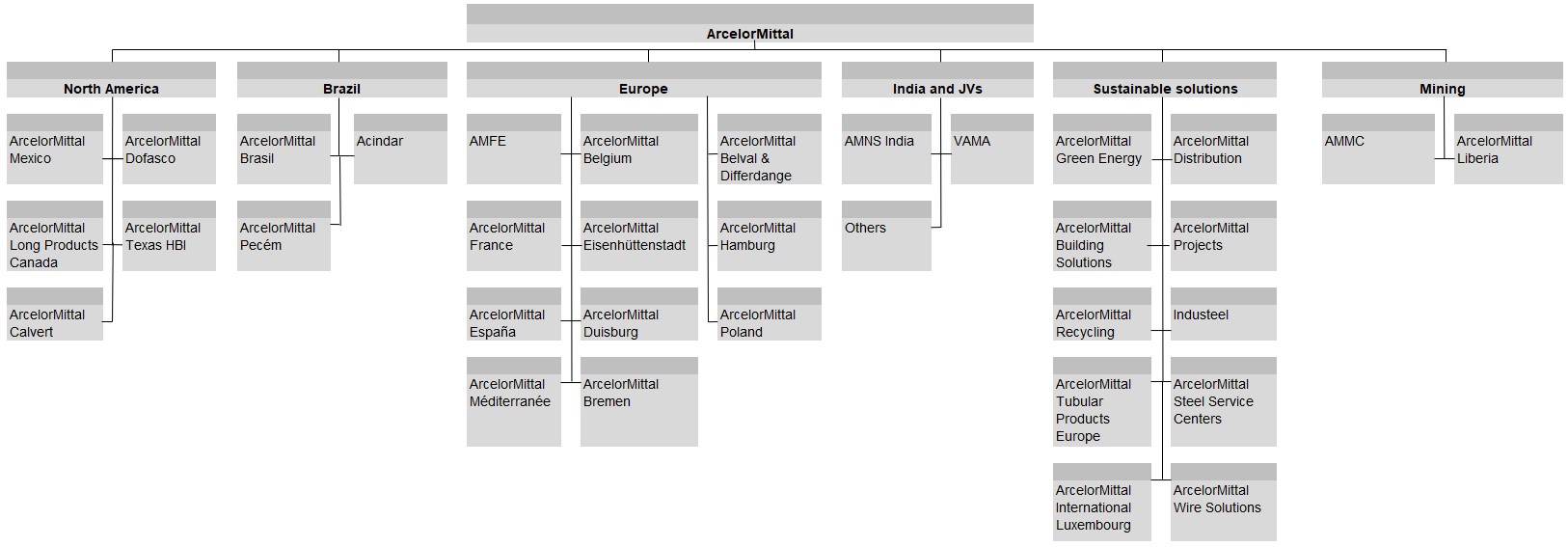
59
Management report |
Please refer to the "Glossary—definitions, terminology and
principal subsidiaries" for a listing of the Company’s principal
subsidiaries, including country of incorporation. Please refer to
note 2.2.1 of the consolidated financial statements for the
ownership percentages of these subsidiaries. Unless otherwise
stated, the subsidiaries as listed have share capital consisting
solely of ordinary shares, which are held directly or indirectly by
the Company, and the voting rights held by the Company are
proportional to its ownership interests.
Investments in joint ventures
ArcelorMittal has investments in joint ventures accounted for
under the equity method as detailed in note 2.4 to
ArcelorMittal’s consolidated financial statements. See section
“Properties and Capital Expenditures—Property, plant and
equipment—Investments in joint ventures” for further details.
Reportable segments
ArcelorMittal reports its business in the following six reportable
segments corresponding to continuing activities: North
America, Brazil, Europe, India and joint ventures ("JVs"),
Sustainable Solutions and Mining. The Company's operations
in South Africa and Ukraine are included in Others.
North America produces flat, long and tubular products. Flat
products include slabs, hot rolled coil, cold rolled coil, coated
steel products and plate and are sold primarily to customers in
the following sectors: automotive, energy, construction,
packaging and appliances and via distributors and processors.
Flat product facilities are located at three integrated and mini-
mill sites located in three countries. Long products include wire
rod, sections, rebar, billets, blooms and wire drawing. Long
production facilities are located at two integrated and mini-mill
sites located in two countries. In 2025, shipments from North
America totaled 10.3 million tonnes (10.1 million tonnes in
2024). The raw material supply of the North America
operations includes sourcing from iron ore captive mines in
Mexico to supply the steel facilities.
Brazil produces flat, long and tubular products. Flat products
include slabs, hot rolled coil, cold rolled coil and coated steel.
Flat product facilities are located at two integrated sites in one
country. Long products comprise sections, wire rod, bar and
rebars, billets and wire drawing. These products are sold
primarily to customers in the construction, power generation
and agribusiness sectors, as well as in the automotive and
household appliances industries. Long production facilities are
located at six integrated and mini-mill sites located in two
countries. In 2025, shipments from Brazil totaled 13.9 million
tonnes (14.1 million tonnes in 2024). The raw material supply
of the Brazil operations includes sourcing from captive iron ore
mines in Brazil.
Europe produces flat and long products. Flat products include
hot rolled coil, cold rolled coil, coated products, tinplate, plate
and slab. These products are sold primarily to customers in the
automotive, general industry and packaging sectors. Flat
product facilities are located at eight integrated and mini-mill
sites located in five countries. Long products include sections,
wire rod, rebar, billets, blooms and wire drawing. Long product
facilities are located at eight integrated and mini-mill sites in
five countries. In 2025, shipments from Europe totaled 28.4
million tonnes (28.7 million tonnes in 2024). The raw material
supply of Europe operations included sourcing from iron ore
captive mines in Bosnia & Herzegovina until their sale in
October 2025.
India and JVs includes all of the Company's interests in joint
ventures, associates and other investments. The Company
believes India is a high growth vector, with its JV assets well-
positioned to grow with the domestic market.
Sustainable Solutions is composed of a number of niche
capital-light businesses that play an important role in
supporting climate action (including renewables, special
projects and construction business) and which ArcelorMittal
believes have high growth potential. It is also an in-house
trading and distribution arm of ArcelorMittal which primarily
provides distribution of long and flat products as well as value-
added and customized steel solutions through further steel
processing to meet specific customer requirements. It is a
growth vector of the Company and represents more than 300
commercial and production sites across more than 60
countries.
Mining comprises the Company's seaborne iron ore mining
operations in Canada and Liberia. It provides the Company's
steel operations with high quality and low-cost iron ore
reserves and also sells mineral products to third parties. In
2025, iron ore production in the Mining segment totaled
approximately 35.3 million tonnes (27.9 million tonnes in 2024).
ArcelorMittal’s captive mines, whose production is mainly
consumed by their respective steel segments, form part of
such segments and are therefore not included in the Mining
segment.
PROPERTIES AND CAPITAL EXPENDITURES
Property, plant and equipment
ArcelorMittal has steel production facilities, as well as iron ore
mining operations, in North and South America, Europe, Asia
and Africa.
All of ArcelorMittal's operating subsidiaries are substantially
owned by ArcelorMittal through intermediate holding
companies, and are grouped into the five reportable segments
and Others as described above (excluding India and JVs).
Unless otherwise stated, ArcelorMittal owns all of the assets
described in this section. Regarding ArcelorMittal's iron ore
captive and seaborne mines, see "—Mineral reserves and
60
Management report |
resources" below, where information is provided in accordance
with SEC Regulation S-K, Subpart 1300 (“S-K 1300”).
For further information on environmental issues that may affect
ArcelorMittal’s utilization of its assets, see “Business overview
—Government regulations” and notes 1.2 and 9.1 to
ArcelorMittal’s consolidated financial statements.
Steel production facilities of ArcelorMittal
The following table provides an overview by type of steel
facility of the principal production units of ArcelorMittal’s
operations. The facilities included in the tables are listed from
upstream to downstream in the steel-making process.
Facility | Number of Facilities | Capacity (in million tonnes per year)1 | Production in 2025 (in million tonnes)2 | ||
Coke Oven Battery | 32 | 19.0 | 15.7 | ||
Sinter Plant | 16 | 61.8 | 40.5 | ||
Blast Furnace | 30 | 57.9 | 39.8 | ||
Basic Oxygen Furnace (including Tandem Furnace) | 38 | 63.8 | 44.8 | ||
DRI/HBI Plant | 10 | 9.7 | 6.0 | ||
Electric Arc Furnace | 27 | 24.0 | 14.6 | ||
Continuous Caster— Slabs | 27 | 58.9 | 39.2 | ||
Hot Rolling Mill | 14 | 54.5 | 34.2 | ||
Pickling Line | 20 | 22.9 | 10.2 | ||
Tandem Mill | 24 | 28.6 | 17.6 | ||
Annealing Line (continuous / batch) | 24 | 10.7 | 5.0 | ||
Skin Pass Mill | 15 | 9.0 | 3.6 | ||
Plate Mill | 5 | 1.7 | 0.7 | ||
Continuous Caster— Bloom / Billet | 27 | 26.4 | 15.9 | ||
Breakdown Mill (Blooming / Slabbing Mill) | 1 | 6.0 | 0.4 | ||
Billet Rolling Mill | 2 | 1.1 | 0.6 | ||
Section Mill | 18 | 10.8 | 5.1 | ||
Bar Mill | 16 | 7.1 | 4.7 | ||
Wire Rod Mill | 14 | 9.5 | 5.4 | ||
Hot Dip Galvanizing Line | 42 | 17.4 | 13.5 | ||
Electro Galvanizing Line | 6 | 1.5 | 0.7 | ||
Tinplate Mill | 9 | 2.1 | 1.0 | ||
Color Coating Line | 15 | 2.5 | 1.5 | ||
Seamless Pipes | 2 | 0.2 | 0.1 | ||
Welded Pipes | 80 | 2.7 | 0.8 |
1.Reflects design capacity and does not take into account other constraints in
the production process (such as, upstream and downstream bottlenecks and
product mix changes). As a result, in some cases, design capacity may be
different from the current achievable capacity.
2.Production facility details include the production numbers for each step in the
steel-making process. Output from one step in the process is used as input
in the next step in the process. Therefore, the sum of the production
numbers does not equal the quantity of sellable finished steel products.
Crude steel production by process in 2025 (in million tonnes) | ||||
Segment | BOF | EAF | Total | Achievable Capacity |
North America | 2.6 | 5.2 | 7.8 | 12.5 |
Brazil | 10.9 | 3.4 | 14.3 | 16.4 |
Europe | 23.7 | 5.5 | 29.2 | 39.5 |
Sustainable Solutions and Others | 4.0 | 0.3 | 4.3 | 6.2 |
Total | 41.2 | 14.4 | 55.6 | 74.6 |
Facilities | ||
Segment | Blast furnaces | EAF |
North America | 3 | 9 |
Brazil | 7 | 7 |
Europe | 14 | 8 |
Sustainable Solutions | — | 3 |
Others | 6 | — |
Total | 30 | 27 |
61
Management report |
North America | Crude Steel | |||||||
Unit | Country | Locations | Production in 2025 (in million tonnes per year)1 | Type of plant | Products | |||
ArcelorMittal Dofasco | Canada | Hamilton | 3.0 | Integrated, Mini-mill | Flat | |||
ArcelorMittal Texas HBI | USA | Corpus Christi (TX) | n/a | Iron-Making | Hot briquetted iron | |||
ArcelorMittal Mexico | Mexico | Lázaro Cárdenas, Celaya | 2.9 | Mini-mill, Integrated, and Downstream | Flat, Long/ Bar, Wire Rod | |||
ArcelorMittal Long Products Canada | Canada | Contrecoeur East, West | 1.8 | Mini-mill | Long/ Wire Rod, Bars, Slabs | |||
ArcelorMittal Tubular Products | Canada,USA, Mexico | Brampton, London, Woodstock, Hamilton, Shelby², Marion,Monterrey | n/a | Downstream | Pipes and Tubes | |||
ArcelorMittal Calvert | USA | Calvert, AL | 0.1 | Mini-mill and Downstream | Flat | |||
ArcelorMittal Tailored Blanks Americas | Canada, USA, Mexico | Woodstock, Detroit (MI), Silao | n/a | Downstream | Laser Welded Blanks |
1.n/a = not applicable (no crude steel production).
ArcelorMittal Dofasco
ArcelorMittal Dofasco (“Dofasco”) is Canada’s largest
manufacturer of flat rolled steels. Dofasco’s steel-making plant
uses both integrated and EAF-based steelmaking processes
and supplies the automotive, construction, packaging,
manufacturing, pipe and tube and steel distribution markets.
ArcelorMittal Texas HBI
ArcelorMittal Texas HBI is one of the largest of its kind in the
world and produces Hot Briquetted Iron ("HBI"), a high quality
feedstock made through the direct reduction of iron ore which
is used to produce high-quality steel grades in an EAF, but it
can also be used in blast furnaces, resulting in lower coke
consumption.
ArcelorMittal Mexico
ArcelorMittal Mexico operates an integrated route and EAF
route using DRI. Its flat products supply specialized steel
applications in the automotive, line pipe manufacturing,
shipbuilding and appliance industries. Its long products serve
the construction and drawing industry.
For details on ArcelorMittal Mexico mining assets production
and other related information, see "—Mineral reserves and
resources".
AMLPC
AMLPC is the largest mini-mill in Canada and has the flexibility
to use either DRI or scrap, depending on their respective
economics. AMLPC's products are primarily sold in Canada
and the U.S. and principally serves the automotive, appliance,
transportation, machinery and construction industries. It also
produces slabs that are used within ArcelorMittal.
ArcelorMittal Calvert
In June 2025, ArcelorMittal acquired control of ArcelorMittal
Calvert, its former joint venture with NSC (see note 2.2.4 to the
consolidated financial statements). ArcelorMittal Calvert has a
hot strip mill with 5.3 million tonnes capacity, pickling and cold
rolling facilities with 3.6 million tonnes capacity and finishing
facilities with a total capacity of 2.1 million tonnes. Slabs for
Calvert's operations are sourced from ArcelorMittal plants in
Brazil and Mexico and from former ArcelorMittal USA (the five-
year agreement for 1.5 million tonnes annually entered into
with Calvert on December 9, 2020 following the divestment to
Cleveland-Cliffs terminated on December 9, 2025). The
acquisition also includes a new seven-year domestic slab
supply agreement with NSC averaging 750,000 tonnes per
year. Calvert serves the automotive, construction, pipe and
tube, service center and appliance/ HVAC industries.
Calvert has completed the construction of an on-site
steelmaking facility with a 1.5 million tonnes capacity EAF,
designed to produce slabs for the existing operations and
replace part of the purchased slabs. The facility produced its
first heat in June 2025. See "—Capital expenditures".
On February 6, 2025, ArcelorMittal announced a project to
construct an advanced manufacturing facility for non-grain
oriented electrical steel (NOES) in Calvert, Alabama. See
"Introduction—Sustainable development highlights".
ArcelorMittal Tailored Blanks Americas ("AMTBA")
In April 2025, ArcelorMittal acquired control of AMTBA, a
former joint venture in which it increased its interest from 80%
to 90%. AMTBA manufactures light-weighting solutions for the
automotive industry.
62
Management report |
BRAZIL | Crude Steel | |||||||||
Unit | Country | Locations | Production in 2025 (in million tonnes per year) 1 | Type of plant | Products | |||||
Sol | Brazil | Vitoria | n/a | Coke-Making | Coke | |||||
ArcelorMittal Tubarão | Brazil | Vitoria | 6.8 | Integrated | Flat | |||||
ArcelorMittal Vega | Brazil | São Francisco do Sul | n/a | Downstream | Flat | |||||
ArcelorMittal Brasil | Brazil | João Monlevade | 1.1 | Integrated | Long/ Wire Rod | |||||
ArcelorMittal Brasil | Brazil | Juiz de Fora, Piracicaba | 1.9 | Mini-mill | Long/ Bar, Wire Rod | |||||
ArcelorMittal Brasil | Brazil | Barra Mansa, Resende | 0.9 | Mini-mill | Long/Rebar, Wire rod, Bars, Sections, Wires | |||||
ArcelorMittal Pecém | Brazil | Pecém | 3.0 | Integrated | Flat | |||||
Acindar | Argentina | Villa Constitucion | 0.6 | Mini-mill | Long/ Wire Rod, Bar | |||||
ArcelorMittal Costa Rica | Costa Rica | Costa Rica | n/a | Downstream | Long/ Wire Rod | |||||
Industrias Unicon | Venezuela | Barquisimeto, Matanzas, La Victoria | n/a | Downstream | Pipes and Tubes |
1.n/a = not applicable (no crude steel production).
ArcelorMittal Brasil
ArcelorMittal Brasil's flat products serve customers in the
automotive, appliances, construction and distribution
segments.
A project is under development to construct a new high value
added finishing line (cold rolling mill) and a continuous coating
line at Tubarão facility. The project is undergoing internal
approvals, and ArcelorMittal Brasil is currently moving forward
with detailed engineering (full feasibility study). In May 2025,
ArcelorMittal acquired full control of the Brazilian pipe producer
Tuper, a former joint venture in which it held a 40% interest, to
strengthen its tubular business in Latin America. In November
2025, ArcelorMittal acquired Tekno, a pioneer in the
implementation of coil coating in Brazil. The Pecém facility was
acquired by ArcelorMittal in 2023 and has access via
conveyors to the port of Pecém, a large-scale deepwater port
located 10 kilometers from the plant.
ArcelorMittal Brasil’s long products are used in the civil
construction, industrial manufacturing, agricultural and
distribution sectors. An extensive distribution network operates
across the country selling to retail customers. In addition, Belgo
Bekaert Arames Ltda manufactures wire products for
agricultural and industrial end-users, and Belgo-Mineira
Bekaert Artefatos de Arame Ltda. produces steel cords used in
the tire industry. ArcelorMittal Brasil also owns forests, and its
subsidiary ArcelorMittal Bioflorestas produces charcoal from
eucalyptus forestry operations that is used to fuel its furnaces
in Juiz de Fora and to exchange for pig iron with local
producers.
The investment in a new sections mill at Barra Mansa was
completed in the second half of 2025. See "—Capital
expenditures".
For details on Brazil mining assets, production and other
related information, see "—Mineral reserves and resources".
Acindar
Acindar is the largest long steel producer in Argentina. It
manufactures and distributes products to meet the needs of the
construction, industrial and agricultural sectors. It has an in-
house distribution network that serves end-users across
Argentina.
63
Management report |
EUROPE | Crude Steel | |||||||||
Unit | Country | Locations | Production in 2025 (in million tonnes per year) 1 | Type of plant | Products | |||||
ArcelorMittal Bremen | Germany | Bremen, Bottrop | 2.9 | Integrated | Flat, Coke | |||||
ArcelorMittal Eisenhüttenstadt | Germany | Eisenhüttenstadt | 1.8 | Integrated | Flat | |||||
ArcelorMittal Belgium | Belgium | Ghent, Geel, Genk, Liège | 5.4 | Integrated and Downstream | Flat | |||||
ArcelorMittal France | France | Dunkirk, Mardyck, Montataire, Desvres, Florange, Mouzon, Basse- Indre | 4.2 | Integrated and Downstream | Flat | |||||
ArcelorMittal Méditerranée 2,3 | France | Fos-sur-Mer, Saint-Chély | 1.6 | Integrated and Downstream | Flat | |||||
ArcelorMittal España4 | Spain | Avilés, Gijón, Etxebarri, Lesaka, Sagunto | 3.3 | Integrated and Downstream | Flat, Long/ Rails, Wire Rod, Plates | |||||
ArcelorMittal Avellino & Canossa | Italy | Avellino | n/a | Downstream | Flat | |||||
ArcelorMittal Poland⁵ | Poland | Kraków, Swietochlowice, Dabrowa Gornicza, Chorzow, Sosnowiec, Zdzieszowice | 3.2 | Integrated and Downstream | Flat, Coke, Long/ Sections, Wire Rod, Sheet Piles, Rails | |||||
ArcelorMittal Sestao | Spain | Bilbao | 0.6 | Mini-mill | Flat | |||||
ArcelorMittal Belval & Differdange | Luxembourg | Esch-Belval, Differdange, Rodange | 1.8 | Mini-mill | Long/ Sheet Piles, Rails, Sections & Special Sections | |||||
ArcelorMittal Olaberria-Bergara | Spain | Olaberría, Bergara | 1.1 | Mini-mill | Long/ Sections | |||||
ArcelorMittal Gandrange | France | Gandrange | n/a | Downstream | Long/ Wire Rod, Bars | |||||
ArcelorMittal Warszawa | Poland | Warsaw | 0.5 | Mini-mill | Long/ Bars | |||||
ArcelorMittal Hamburg | Germany | Hamburg | 0.7 | Mini-mill | Long/ Wire Rods | |||||
ArcelorMittal Duisburg | Germany | Ruhrort, Hochfeld | 0.9 | Mini-mill | Long/ Billets, Wire Rod | |||||
Sonasid | Morocco | Nador, Jorf Lasfar | 0.8 | Mini-mill | Long/ Wire Rod, Bars, Rebars in Coil | |||||
ArcelorMittal Zenica⁶ | Bosnia and Herzegovina | Zenica | 0.4 | Mini mill/Integrated | Long/Wire Rod,Bars |
1.n/a = Not applicable (no crude steel production).
2.Blast furnace #1 at Fos-sur-Mer was idled in September 2023 due to low market demand. It remained idle during 2024 and 2025. Blast Furnace #1 is expected to restart
in the second quarter of 2026. Following a fire outbreak at the Fos-sur-Mer site on October 8, 2025, the steel shop was temporarily shut down; production resumed in
December 2025.
3.Coke oven battery 2 has been hot idled and temporarily closed in 2025.
4.Following an incident in late September 2025, Blast Furnace B at the Gijón plant was taken offline and shutdown procedures were subsequently initiated.
5.Due to deteriorating market conditions, blast furnace no. 3 has been temporarily idled in Dąbrowa Górnicza since July 2025.
6.ArcelorMittal Zenica was divested in the fourth quarter of 2025. See "Introduction—Key Transactions and events in 2025".
ArcelorMittal Bremen
ArcelorMittal Bremen produces and sells a wide range of flat
products, which includes sales to the automotive and primary
transformation sectors.
ArcelorMittal Eisenhüttenstadt
ArcelorMittal Eisenhüttenstadt produces and sells a wide range
of flat steel products to automotive, distribution, metal
processing, construction and appliances industry customers in
Germany, Central, and Eastern Europe.
ArcelorMittal Belgium
ArcelorMittal Belgium includes the ArcelorMittal Ghent
integrated site and the finishing facilities of ArcelorMittal Liège.
Its products are mainly used in the automotive industry and in
household appliances, tubes, containers, radiators and
construction.
ArcelorMittal has finalized the construction of two industrial
scale plants at its site in Ghent in connection with the Carbalyst
and Torero projects, which are leveraging breakthrough smart
carbon technologies to enable the use of circular carbon.
Technical ramp-up of the facility is in progress.
In April 2025, ArcelorMittal Belgium's offer was accepted to
acquire the Flémalle production facilities in Wallonia following
the bankruptcy of the Belgian branch of Liberty Galati.
ArcelorMittal France
Certain of ArcelorMittal France’s steel products are designed
for the automotive market while other products are designed
for the consumer goods and appliances market as well as
packaging market.
ArcelorMittal France is building a new production unit for
electrical steels at its Mardyck site, which is expected to
produce its first coils in 2026. See "—Capital expenditures".
64
Management report |
ArcelorMittal France has also decided to construct a 2 million
tonne EAF in Dunkirk, see "Introduction—Sustainable
development highlights—Recent developments".
ArcelorMittal Méditerranée
ArcelorMittal Méditerranée's steel plant in Fos-sur-Mer
produces coils to be made into wheels, pipes for energy
transport and coils for finishing facilities for exposed and non-
exposed parts of car bodies, as well as for the construction,
home appliance, packaging, pipe and tube, engine and office
material industries. The Saint-Chély d’Apcher plant produces
electrical steel mainly for electrical motors.
ArcelorMittal España
ArcelorMittal España's two main facilities of Avilés and Gijón
operate as a single integrated steel plant. The facilities are also
connected by rail to the region’s two main ports, Avilés and
Gijón. Raw materials are received at the port of Gijón, where
they are unloaded at a dedicated dry-bulk terminal, which is
linked to steel-making facilities by conveyor belt. A variety of
products are shipped through the Avilés port facilities to other
units of the Group and to ArcelorMittal España’s customers.
The Company is in the process of constructing a new 1 million
tonne EAF for long products at the Gijón site. See “Business
overview—Sustainable development—Climate change".
ArcelorMittal Poland
ArcelorMittal Poland is the largest steel producer in Poland
ArcelorMittal Poland’s Zdzieszowice coke plant with five coke
oven batteries produces and supplies coke to ArcelorMittal
subsidiaries and third parties.
ArcelorMittal Poland produces a wide range of flat and long
steel products mainly sold in the domestic market. ArcelorMittal
Poland’s principal customers are in the construction,
engineering, transport, mining and automotive industries.
ArcelorMittal Belval & Differdange
ArcelorMittal is investing at its Belval site €67 million in the
construction of a new EAF which is scheduled to be
commissioned in the first half of 2026 and will offer improved
energy efficiency and increase steel production capacity in
Luxembourg by almost 15%, reaching 2.5 million tonnes of
steel per year.
ArcelorMittal Olaberria-Bergara
The Olaberría facility's products are sold to the local
construction market as well as to export markets, while the
Bergara facility’s products are sold primarily to the local
European construction market.
ArcelorMittal Hamburg
ArcelorMittal Hamburg operates Europe’s only DRI-EAF plant
and its products are mainly sold in the European market,
primarily to automotive and engineering customers.
Sustainable Solutions | Crude Steel | |||||||||
Unit | Main countries of presence | Main locations | Production in 2025 (in million tonnes per year) 1 | Type of plant | Products | |||||
Industeel | France, Belgium | Charleroi, Le Creusot, Chateauneuf, Saint-Chamond, Dunkirk | 0.3 | Mini-mill and Downstream | Flat (complete range of high-quality steel grades) | |||||
Building Solutions | France, Germany, Spain, Italy, Slovakia, Poland, India,Brazil | Contrisson, Haironville, Trier, Reichshof, Zaragosa, Cervera, Abruzzo, Senica, Swietochlowice,Mangaon, Toboado,Araquari,Lorena | n/a | Downstream | Steel building solutions (including insulation, sandwich panels, profiles and turnkey pre-fabrication solutions) | |||||
Projects | UAE, Netherlands, USA, Brazil, China, Egypt | Hamriyah, Jebel Ali, Heijningen, Hoogeveen, Serra, Changzhou, Badr City | n/a | Downstream | Customized steel solutions for complex projects in civil infrastructure and energy | |||||
Service Centers and Distribution | France, Germany, Belgium, UK, Spain, Poland, Luxembourg | Neuwied, Geel, Krakow, Bytom, Differdange | n/a | Downstream | Tailor-made solutions of flat steel processed products. Sales entities serving small customers with wide range of steel products | |||||
Tubular Products | Romania, Czech Republic, Germany, France, Spain | Roman, Karvina, Altensteig- Walddorf, Hautmont, Chevillon, Vitry, Lexy, Rettel, Vincey, Legutiano, Zalain-Lesaka, Berrioplano | n/a | Downstream | Pipes and Tubes | |||||
Recycling | Germany, Netherlands, United Kingdom | Eppingen, Frankfurt, Sennfeld, Almelo, Beverwijk, Aberdeen | n/a | Downstream | Scrap collection and recycling | |||||
AM Green Energy | India | Andhra Pradesh | n/a | Renewable energy | Solar and wind power | |||||
Wire Solutions 2 | France, Luxembourg, Poland, United Kingdom | Bissen, Bourg en Bresse, Revigny, Marnaval, Perigueux, Sycow | n/a | Downstream | Wire products | |||||
1.n/a = not applicable (no crude steel production).
65
Management report |
2.Wire Solutions, previously reported under Europe segment, was transferred to the Sustainable Solutions in the second half of 2025.
Renewables
AM Green Energy's renewable energy project was
commissioned in the second quarter of 2025. See “Business
overview—Sustainable development—Climate change" and
"—Capital expenditures".
Recycling
Recycling plays an increasingly important role in
decarbonization. ArcelorMittal is investing and developing its
scrap recycling and collection capabilities (with combined
collection capacity of approximately 1 million tonnes).
Mining
ArcelorMittal’s Mining segment has iron ore production facilities in Canada and Liberia. For information regarding ArcelorMittal's Mining
segment see "—Mineral reserves and resources".
Others | Crude Steel | |||||||||
Unit | Country | Locations | Production in 2025 (in million tonnes per year) | Type of plant | Products | |||||
AMKR1 | Ukraine | Kryvyi Rih | 1.7 | Integrated | Long | |||||
ArcelorMittal South Africa2 | South Africa | Vanderbijlpark, Newcastle | 2.3 | Integrated Mini-mill Downstream | Flat, Long, Pipes and Tubes |
1. AMKR is currently operating its open pit mining and steel facilities at 73% and 35%, respectively.
2.Coke oven batteries 8 and 9 were closed in September 2025 upon reaching end of life, and Kiln 3 and 4 lines were closed in 2025 in Vanderbijlpark. Operations at the
Newcastle facility were definitively stopped in the fourth quarter of 2025.
ArcelorMittal South Africa
ArcelorMittal South Africa ("AMSA") is one of the largest steel
producers in Africa and is listed on the JSE Limited in South
Africa. In 2025, 80% of its products were sold in the South
African domestic market, while Africa is its largest export
market. It also sells into Europe and sells minor tonnage into
the Americas and Asia. On September 1, 2025, AMSA
announced the commencement of the Long Steel Business
wind down and placed accordingly the Newcastle blast furnace
into temporary care and maintenance. The wind down was
completed by the end of January 2026. See “Introduction—Key
transactions and events in 2025".
ArcelorMittal Kryvyi Rih
AMKR’s long product range are sold to a range of industries,
such as the hardware, construction, re-rolling and fabrication
industries. The markets for its products include Ukraine,
Europe, North Africa, Middle East, North America and China. In
addition, AMKR includes an export sales network which
supplies a complete range of steel products not only from
Kryvyi Rih but also from other plants of the Group to customers
outside of their respective home markets.
For details on AMSA and AMKR mining assets, see "—Mineral
reserves and resources".
Investments in joint ventures | ||||||||||
Unit | Country | Locations | Capacity in 2025 (in million tonnes per year) | Type of plant | Products | |||||
AMNS India | India | Hazira, Gujarat | 8.8 1 | Integrated | Flat | |||||
VAMA | China | Loudi, Hunan | 2.0 2 | Steel processing | Automotive steel finishing |
1.Crude steel capacity.
2.Cold rolled coils, aluminized coils, hot dip galvanized coils production capacity.
AMNS India
AMNS India is an integrated flat carbon steel manufacturer -
from iron ore to ready-to-market products with achievable
crude steel capacity of 8.8 million tonnes per annum. Its
manufacturing facilities comprise iron making, steelmaking and
downstream facilities spread across India.
In 2019, ArcelorMittal and Nippon Steel Corporation ("NSC"),
Japan’s largest steel producer and the third largest steel
producer in the world, created a joint venture to own and
operate AMNS India with ArcelorMittal holding a 60% interest
and NSC holding 40%. Through the agreement, both
66
Management report |
ArcelorMittal and NSC are guaranteed equal board
representation and participation in all significant financial and
operating decisions.
AMNS India’s main steel manufacturing facility is located at
Hazira, Gujarat in western India. It also has:
•two iron ore beneficiation plants close to the mines in
Kirandul and Dabuna, with slurry pipelines that then
transport the beneficiated iron ore slurry to the pellet plants
in the Kirandul-Vizag and Dabuna-Paradeep systems;
•downstream facilities in Pune, Khopoli and Gandhidham; and
•six service centers in the industrial clusters of Hazira, Indore,
Bahadurgarh, Chennai, Kolkata and Pune. It has a complete
range of flat rolled steel products, including value added
products, and significant iron ore pellet capacity with two
main pellet plant systems in Kirandul-Vizag and Dabuna-
Paradeep, which have the potential for expansion. Its
facilities are located close to ports with deep draft for
movement of raw materials and finished goods.
In terms of iron ore pellet capacity, the Kirandul-Vizag system
has 8 million tonnes of annual pellet capacity; and the Dabuna-
Paradeep system has 12 million tonnes of annual pellet
capacity.
AMNS India completed the acquisition of the portfolio of
strategic infrastructure assets from Essar Group. The
remaining assets which were pending due to regulatory
approvals have been acquired during 2024 and include a 16
million-tonne per annum all-weather, deep draft terminal at
Visakhapatnam, Andhra Pradesh (along with an integrated
conveyor connected to AMNS India’s iron ore pellet plant in the
port city) and a 100-kilometer Gandhar - Hazira transmission
line, connecting AMNS India’s steelmaking complex with the
central electricity grid.
AMNS India intends to further debottleneck existing operations
(steel shop and rolling parts) in the medium term. The first
phase of expansion represents capital expenditures of
approximately $7.7 billion ($0.8 billion for debottlenecking, $0.2
billion for operational readiness, $1.0 billion for downstream
projects and $5.7 billion for upstream projects) and started in
October 2022. It aims to increase production at the Hazira
facility to 15 million tonnes of rolled products by the second
half of 2026. Following the construction of two blast furnaces,
the capacity increase of the existing blast furnace 1 went from
2.2 to 2.8 million tonnes per annum, and it also includes a cold
rolling mill 2 complex and galvanizing and annealing line, steel
shop, hot strip mill and ancillary equipment (including coke,
sinter, networks, power, gas, oxygen plant, etc.) and raw
material handling. Continuous galvanizing line (CGL) No. 4
was commissioned in December 2023 and enabled AMNS
India to launch the Magnelis product for the growing renewable
energy sector. CGL No. 3 has been commissioned in July 2025
to produce highest strength steel for the automotive sector.
Plans are under development to expand the production
capacity by establishing a greenfield integrated steel plant with
an 8.2 million tonnes annual capacity at Rajayapeta in Andhra
Pradesh, a strategically significant project. This facility will play
a critical role in advancing AMNS India’s objective of scaling its
total steelmaking capacity to 40 million tonnes per annum. See
"—Capital expenditures".
For details on Indian mines production and other information,
see " —Mineral reserves and resources".
AMNS Calvert
On June 18, 2025, ArcelorMittal acquired control of AMNS
Calvert, a former joint venture with NSC. See "—North
America" and note 2.2.4 to the consolidated financial
statements.
VAMA
Valin ArcelorMittal Automotive Steel (“VAMA”) is a joint venture
between ArcelorMittal and Hunan ValinSteel Co., Ltd which
produces steel (1.5 million tonne capacity) for high-end
applications in the automotive industry. VAMA supplies
international automakers and first-tier suppliers as well as
Chinese car manufacturers and their supplier networks. It is
well positioned to take advantage of the growing electric
vehicle market In February 2021 a project was launched to
increase its capacity by 40% to 2 million tonnes with self-
funded expansion involving capital expenditures of $195
million. The capital expenditures related to new continuous hot
galvanizing line ("CGL") capacity of 450 thousand tonnes per
year to reach 1.6 million tonnes per year in CGL/CAL
combined capacity and 2.0 million tonnes per year in pickling
line and tandem cold mill ("PLTCM"). The project has been
operating at full capacity since July 2023.
Ventos de Santo Antonio
On May 5, 2023, ArcelorMittal Brasil formed the joint venture
Ventos de Santo Antonio Comercializadora de Energia S.A.
("VdSA") with Casa dos Ventos, one of Brazil’s largest
developers and producers of renewable energy projects, to
develop a 554 MW wind power project aiming to secure and
decarbonize a considerable proportion of the Company's
wholly-owned subsidiary ArcelorMittal Brasil’s future electricity
needs in the central region of Bahia in north-east Brazil. The
wind project was fully completed in October 2025. ArcelorMittal
Brasil holds a 55% stake in the joint venture, with Casa dos
Ventos holding the remaining 45%. The $0.8 billion project
aims to secure and decarbonize a considerable proportion of
ArcelorMittal Brasil’s future electricity needs and is estimated to
provide 38% of ArcelorMittal’s Brasil’s total electricity needs in
2030, pursuant to a 20-year power purchase agreement to be
entered into with the joint venture for the supply of electricity.
67
Management report |
VdSA is equity accounted and ArcelorMittal’s total equity
investment will be $0.15 billion.
In August 2024, ArcelorMittal Brasil also signed contracts with
Casa dos Ventos and Atlas Renewable Energy for the
development of two joint ventures for solar energy projects with
a combined capacity of 465 MW, equivalent to approximately
14% of its current electricity requirements in Brazil. Solar
project with Atlas reached the commercial operating date in
October 2025, while Solar project with Casa dos Ventos is
expected to complete first quarter of 2026. See "Introduction—
Sustainable development highlights".
NEMM
On October 16, 2024, in the framework of their New Energy
Magnetic Material ("NEMM") project, ArcelorMittal and China
Oriental formed two joint ventures with equal ownership to be
engaged principally in the production and sale of electrical
steel grade hot-rolled coil substrates and cold-rolled non-
oriented or oriented electrical steel for the Chinese automotive
market. The project envisages the construction of an upstream
plant and a downstream plant with production commencing in
2027.
See note 2.4.1 to the consolidated financial statements for
further information on investments in joint ventures.
Capital expenditures
The Company’s capital expenditures were $4.3 billion, $4.4 billion and $4.6 billion for the years ended December 31, 2025, 2024 and
2023, respectively. The following table summarizes the Company’s principal growth and optimization projects involving significant
capital expenditures that are currently ongoing. In 2026, capital expenditures are expected to be in the range of $4.5 to 5.0 billion, of
which $1.4 to $1.6 billion is expected as strategic growth capital expenditure, $0.3 billion on projects related to decarbonization and
$2.8 to $3.1 billion on maintenance and other ongoing capital expenditures. ArcelorMittal expects to fund these capital expenditures
primarily through internal sources. See “Operating and financial review—Liquidity and capital resources—Sources and uses of cash—
Net cash used in investing activities” and note 3.1 to the consolidated financial statements for further information, including capital
expenditures by segment.
Completed Projects | |||||||||
Segment | Site / Unit | Capacity / particulars | Key date / Forecast completion | Note # | |||||
Sustainable Solutions | Andhra Pradesh (India) | Renewable energy project: 1GW of nominal capacity solar and wind power | Second quarter 2025 | a | |||||
Mining | Liberia mine | Iron ore expansion to 20 million tonnes per year; blending a portion of the new concentrate with crushed ore product to produce a sinter feed blend (>62% Fe) | Commissioning underway | b | |||||
North America | Calvert | New 1.5 million tonnes EAF and caster | Commissioned | c | |||||
Brazil | Serra Azul mine | Facilities to produce 4.5 million tonnes per year DRI quality pellet feed by exploiting compact itabirite iron ore | Commissioning underway | d | |||||
Brazil | Barra Mansa | Increase capacity of HAV bars and sections by 0.4 million tonnes per year | Commissioning underway | e | |||||
68
Management report |
Ongoing Projects* | |||||||||
Segment | Site / Unit | Capacity / particulars | Key date / Forecast completion | Note # | |||||
Europe | Mardyck (France) | Facilities to produce 155 thousand tonnes per year non-grain oriented electrical steels ("NOES") (of which 125 thousand tonnes per year for auto applications), reversing mill ("REV") and annealing and pickling line ("APL"). | Second half 2026 for REV and first half 2027 for APL | f | |||||
North America | Las Truchas mine (Mexico) | Revamping project with 1 million tonnes per year pellet feed capacity increase (to 2.3 million tonnes per year) with DRI concentrate grade capability | First half 2027 | g | |||||
North America | Calvert | Advanced manufacturing facility for NOES with a capacity of up to 150 thousand tonnes per year, essential for EV production and other commercial / industrial applications. The project consists of APL, reversing cold mill ("RCM") and annealing and varnishing ("ACL"). | Second half 2027 | h | |||||
Sustainable Solutions | Gujarat (India) | Hybrid renewable energy project comprising 300 megawatts of alternating current ("MWac") solar capacity, approximately 250 MW of wind capacity, and a 300 MWh Battery Energy Storage System ("BESS") | First half 2028 | i | |||||
Sustainable Solutions | Rajasthan (India) | Large-scale renewable energy investment involving the development of a 400 MWac (560 megawatts peak) solar power plant, integrated with a 500 MWh BESS, located in Bikaner, Rajasthan, India | First half 2028 | j | |||||
Joint Ventures | |||||||||
AMNS India | Hazira (Gujarat) | Debottlenecking existing assets; medium-term Phase 1 plans are to expand and grow in Hazira to approximately 15 million tonnes per year; ongoing downstream projects; additional greenfield opportunities under development | Second half 2026 | k | |||||
*Ongoing projects refer to projects for which construction has begun (excluding various projects that are under development).
a.A $0.7 billion investment in the 1 GW renewable energy project launched in 2022 by ArcelorMittal. The project integrates solar and wind power generation, coupled with
energy storage solution through a co-located pumped hydro storage plant, which helps to overcome the intermittent nature of wind and solar power generation. The
project is owned and funded by ArcelorMittal. AMNS India entered into a 25 year off-take agreement with ArcelorMittal to purchase renewable electricity annually from the
project, resulting in over 20% of the electricity requirement at AMNS India’s Hazira plant coming from renewable sources, reducing carbon emissions by approximately 1.5
million tonnes per year. 100% of the solar modules and the wind turbines were installed in the first half of 2025, and the full capacity was commissioned by the end of the
third quarter of 2025.
b.ArcelorMittal Liberia has been operating at 5 million tonnes per annum of direct shipping ore ("DSO") since 2011 (Phase 1) and restarted construction of a concentrator
and associated infrastructure (Phase 2). An opportunity to increase rail and port shipment capacity to 20 million tonnes per annum led to a revised project capital
expenditure of $1.8 billion (previously $1.4 billion), reflecting a multiple product approach (sinter feed and concentrate) following revised mining plan and additional
investment in material handling, port infrastructure, covered stockpile and power supply. The revised scope allows for an additional 5 million tonnes per annum of blended
product, bringing total shipment capacity to 20 million tonnes per annum (previously 15 million tonnes per annum). By blending a portion of the new concentrate with
crushed ore product, a sinter feed blend (>62% Fe) can be produced, increasing Liberia’s marketable production. Of the targeted 20 million tonnes, 75% or 15 million
tonnes of sinter feed is to be made up of a blend of concentrate and crushed ore, and remaining 25% or 5 million tonnes is to be high-grade concentrate. Commissioning
is progressing, and full project completion and production from all lines are expected by the first half of 2026. Approximately 10 million tonnes of shipment were reached in
2025, with a 20 million tonnes shipment target in 2026. In addition, a phased plan to expand capacity up to 30 million tonnes per annum, including DRI-quality
concentrate, is under study.
c.ArcelorMittal Calvert is investing in a new 1.5 million tonnes EAF and caster. The facility is currently in the hot commissioning phase with the first heat produced on June
14, 2025. The new EAF project with investment over $1 billion, integrated with ArcelorMittal’s HBI facility in Texas, will enable Calvert to supply automotive customers with
lower CO2 embodied steel, melted and poured in the U.S. The new EAF has a strong product mix of advanced steel grades, including Exposed, Dual Phase ("DP"),
Multiphase ("MP"), Third Generation (Gen-3) steels, and PHS namely Usibor®. Option to add an additional 1.5 million tonnes EAF at lower capital expenditure intensity is
being studied.
d.The Serra Azul project's current investment forecast is approximately $0.5 billion. The DRI quality pellet feed is expected to primarily supply ArcelorMittal Mexico steel
operations. All assembly activities were completed in the third quarter of 2025. Hot commissioning reached 90% completion by December 2025 and the pellet feed DRI
product has already met the required quality specifications, and the first vessel is expected in 2026.
e.Approximately $0.3 billion investment in the Barra Mansa (Brazil) sections mill aims to expand domestic market share and profitability with higher added value ("HAV")
products like merchant and special bars. Commissioning started in October 2025, and the project has transitioned into the ramp-up phase, which is currently in progress
alongside ongoing testing.
f.ArcelorMittal, with French government support, is establishing a new electrical steels production unit at Mardyck, complementing its Saint-Chély d’Apcher plant. The first
phase of the project consisting of annealing and varnishing line (“ACL”) was completed and is undergoing commissioning. Due to the brownfield nature of this project,
unforeseen challenges and complexity in civil works and erection activities,, the project cost has been revised to $0.8 billion. This has caused delays in the second phase
which consists of REV and APL and is now expected to be commissioned in the second half of 2026 and first half of 2027 (previously scheduled for the second half of
2025 and second half of 2026), respectively. Following a reassessment of the product portfolio, the production volume of non-grain oriented electrical steels was revised
to 155 thousand tonnes per year (previously reported as 170 thousand tonnes per year).
g.The approximately $0.2 billion investment project in Las Truchas will enable concentrate production to the blast furnace route (2.0 million tonnes per year) and DRI route
(0.3 million tonnes per year) for a total of 2.3 million tonnes per year. The primary target is to supply ArcelorMittal Mexico steel operations with high quality feed. Due to
69
Management report |
delays in obtaining environmental permits, amplified by the strike and the illegal blockade of the mine in the second and third quarters of 2024 as well as unforeseen
challenges, production is now expected to start in the first half of 2027 (previously scheduled for the second half of 2026). The refurbishment of two clarifiers is essentially
complete and ready for equipment installation. Piling work for the main mill building is completed. Construction work will commence in early 2026.
h.ArcelorMittal Calvert is investing in an advanced manufacturing facility in Calvert, Alabama that could deliver up to 150,000 tons of domestic production capacity of NOES
annually, depending on the product mix. The project includes an annealing pickling line, cold-rolling mill, annealing coating line, packaging and slitter line, and ancillary
equipment needed for operations. The facility would be situated near existing Calvert operations. As the project progresses, estimated net capital expenditure has
increased to $1.3 billion (previously reported as $0.9 billion), net of $0.3 billion of currently planned federal, state and local support, due to tariffs, additional work required
and an increase in labor cost and prices. The plant is anticipated to commence production in the second half of 2027.
i.An investment of approximately $0.5 billion in a 550 MWac solar–wind hybrid renewable energy project (comprising 300 MWac of solar capacity and approximately 250
MW of wind capacity) and a planned 300 MWh BESS, located in Gujarat, India. Wind portfolio contracts are currently in progress, with land included under the OEM
contracts. The project is expected to deliver approximately 150 MW of round-the-clock renewable power to AMNS India, reducing carbon emissions by approximately 0.9
million tonnes of CO₂ per year for AMNS Indian. Completion date of the project is expected in the first half of 2028.
j.An investment of approximately $0.3 billion for a renewable energy project consisting of 400 MWac solar power plant, integrated with a 500 MWh BESS, located in
Bikaner, Rajasthan, India. Construction commenced in the second quarter of 2025, with completion targeted for the first half of 2028. The project is designed to supply
approximately 190 MW during solar hours and 125 MW during evening peak hours. The project is expected to deliver electricity to AMNS India, reducing its carbon
emissions by approximately 0.65 million tonnes of CO₂ per year. Orders have been placed for the power evacuation scope, and Requests for Proposal for solar modules
have been launched in the market.
k.AMNS India medium-term plans are to expand and grow initially to approximately 15 million tonnes of rolled products by the second half of 2026 in Hazira (phase 1)
including automotive downstream and enhancements to iron ore operations, with estimated capital expenditure of approximately $7.7 billion ($0.8 billion for
debottlenecking, $0.2 billion for operational readiness, $1.0 billion for downstream projects and $5.7 billion for upstream project). As part of phase 1, a Continuous
Galvanizing Steel line ("CGL3") capable of producing AHSS for automotive sector was successfully commissioned in July 2025. Further capacity expansion is underway
at Hazira, Studies for options to further expand capacity at Hazira, while plans are under development for an 8.2 million tonnes greenfield integrated steel plant on the
East Coast in Rajayyapeta, Andhra Pradesh as part of AMNS India’s broader growth strategy aimed at increasing its total steelmaking capacity to 40 million tonnes per
annum.
In addition, in 2025, the Company approved 14 multi-year
projects with identified environmental benefits and involving
capital expenditures of $150 million and 29 multi-year projects
with identified energy benefits and involving capital expenditure
of $1,163 million (including new renewable energy projects in
India). The latter also includes 10 multi-year projects
specifically targeted to decarbonization involving capital
expenditures of $138 million. Capital expenditures related to
decarbonization initiatives amounted to $0.3 billion for the year
ended December 31, 2025 and are expected to remain stable
at $0.3 billion in 2026, with main spend focusing on the
finalization of engineering studies on new EAF facilities in
Europe (flat products) and the launch of the EAF project in
Dunkirk, the completion of the EAF project in Gijón (long
products) and the capacity expansion in Sestao (flat products),
as well as the DR pellet project in AMMC. ArcelorMittal's joint
ventures have also announced significant capital expenditure
projects. See "—Investments in joint ventures".
Mineral reserves and resources
ArcelorMittal has iron ore production facilities in North America
(Canada and Mexico), South America (Brazil), Europe
(Ukraine), Africa (Liberia), and in India through its joint venture
AMNS India. ArcelorMittal also operated iron ore and coal
production facilities in Kazakhstan, which were sold on
December 7, 2023, and iron ore production facilities in Bosnia,
which were sold on October 30, 2025. See note 2.3 to the
consolidated financial statements for further information.
Following the sale of the Kazakhstan operations, there was no
coal production in 2025 or 2024, while coal production for 2023
was 2.0 million tonnes. The Company has two categories of
mining operations, namely captive mines and seaborne
oriented operations. Captive mines whose production is mainly
consumed by their respective steel segments form part of such
segments. The seaborne iron ore mining operations at AMMC
and AML correspond to the Mining segment.
ArcelorMittal considers its iron ore mining operations in the
aggregate to be material to its business.
70
Management report |
The following tables provide an overview of ArcelorMittal’s principal mining operations. The production of Run of Mine ("ROM") iron ore
and coal is that which is attributable to ArcelorMittal based on ArcelorMittal's ownership interest in the mining operations. All production
figures below are stated as wet tonnages.
Operations/Projects | Segment | % of Ownership Interest | Type of Ownership Interest | In Operation Since | ||||
Iron Ore | ||||||||
Mexico (Excluding Peña Colorada) | North America | 100.0 | subsidiary | 1976 | ||||
Peña Colorada - Mexico | North America | 50.0 | joint operation | 1974 | ||||
Brazil | Brazil | 100.0 | subsidiary | 1944 | ||||
Bosnia | Europe | 51.0 | subsidiary | 2008 | ||||
AMKR Open Pit | Others | 95.1 | subsidiary | 1959 | ||||
AMKR Underground | Others | 95.1 | subsidiary | 1933 | ||||
AML | Mining | 85.0 | subsidiary | 2011 | ||||
AMMC | Mining | 85.0 | subsidiary | 1976 | ||||
Vallourec Pau Branco mine | Not Consolidated | 27.8 | associate | 1980 | ||||
India | Not Consolidated | 60.0 | joint venture | 1961 | ||||
Baffinland | Not Consolidated | 25.2 | associate | 2014 | ||||
2023 aggregate ROM iron ore production, millions of tonnes1 | 98.4 | |||||||
2024 aggregate ROM iron ore production, millions of tonnes2 | 100.7 | |||||||
2025 aggregate ROM iron ore production, millions of tonnes3 | 112.3 | |||||||
Coal | ||||||||
Karaganda - Kazakhstan | 100.0 | subsidiary | 1956 | |||||
2023 aggregate ROM coal production, millions of tonnes1 | 5.8 | |||||||
1.Total ROM iron ore and coal production in 2023 includes Kazakhstan iron ore and coal mining operations, which were sold on December 7, 2023. Iron ore and coal
production is included in the table through the transaction closing date.
2.Total ROM iron ore production in 2024 does not include Vallourec Pau Branco mine.
3.Total ROM iron ore in 2025 includes Bosnia iron ore operations, which were sold on October 30, 2025 and excludes Vallourec Pau Branco mine. Iron ore production for
Bosnia is included in the table through the transaction closing date.
71
Management report |
% of Ownership Interest | 2025 | 2024 | 2023 | ||||||||
ROM Millions of Tonnes | Product Millions of Tonnes | ROM Millions of Tonnes | Product Millions of Tonnes | ROM Millions of Tonnes | Product Millions of Tonnes | ||||||
Pena Colorada - Mexico | 50.0 | 13.7 | 3.5 | 7.9 | 2.7 | 12.8 | 4.1 | ||||
At ownership interest | 6.9 | 1.8 | 3.9 | 1.4 | 6.4 | 2.1 | |||||
ArcelorMittal Mexico1 | 100.0 | 2.7 | 1.0 | 4.6 | 1.2 | 4.4 | 2.1 | ||||
North America | 16.4 | 4.5 | 12.5 | 3.9 | 17.2 | 6.2 | |||||
At ownership interest | 9.6 | 2.8 | 8.5 | 2.6 | 10.8 | 4.2 | |||||
Andrade | 100.0 | 2.7 | 2.0 | 2.4 | 1.8 | 2.4 | 2.0 | ||||
Serra Azul | 100.0 | 3.4 | 0.3 | 5.1 | 1.1 | 2.7 | 1.5 | ||||
Brazil | 6.1 | 2.3 | 7.5 | 2.9 | 5.1 | 3.5 | |||||
ArcelorMittal Prijedor 2 | 51.0 | 1.3 | 0.8 | 1.4 | 1.0 | 1.7 | 1.2 | ||||
At ownership interest | 0.7 | 0.4 | 0.7 | 0.5 | 0.9 | 0.6 | |||||
AMKR Open Pit | 95.1 | 18.4 | 7.6 | 19.0 | 7.8 | 11.1 | 4.6 | ||||
At ownership interest | 17.5 | 7.2 | 18.1 | 7.4 | 10.6 | 4.4 | |||||
AMKR Underground | 95.1 | 0.0 | 0.0 | 0.2 | 0.2 | 0.3 | 0.3 | ||||
At ownership interest | 0.0 | 0.0 | 0.2 | 0.2 | 0.3 | 0.3 | |||||
ArcelorMittal Temirtau Open Pit3 | 100.0 | 0.0 | 0.0 | 0.0 | 0.0 | 2.2 | 1.4 | ||||
ArcelorMittal Temirtau Underground3 | 100.0 | 0.0 | 0.0 | 0.0 | 0.0 | 1.6 | 1.0 | ||||
Others | 18.4 | 7.6 | 19.2 | 8.0 | 15.2 | 7.3 | |||||
At ownership interest | 17.5 | 7.2 | 18.3 | 7.6 | 14.7 | 7.1 | |||||
AMMC - Canada4 | 85.0 | 71.7 | 25.6 | 63.8 | 24.2 | 65.3 | 22.4 | ||||
At ownership interest | 60.9 | 21.8 | 54.3 | 20.5 | 55.5 | 19.0 | |||||
AML - Liberia5 | 85.0 | 11.5 | 9.7 | 3.2 | 3.8 | 3.9 | 3.6 | ||||
At ownership interest | 9.8 | 8.2 | 2.7 | 3.2 | 3.3 | 3.0 | |||||
Mining | 83.2 | 35.3 | 67.0 | 28.0 | 69.2 | 26.0 | |||||
At ownership interest | 70.7 | 30.0 | 57.0 | 23.7 | 58.8 | 22.0 | |||||
AMNS India | 60.0 | 11.0 | 9.7 | 11.7 | 9.8 | 10.8 | 10.7 | ||||
At ownership interest | 6.6 | 5.8 | 7.0 | 5.9 | 6.5 | 6.4 | |||||
Baffinland | 25.23 | 4.2 | 4.4 | 6.6 | 5.8 | 6.2 | 5.6 | ||||
At ownership interest | 1.1 | 1.1 | 1.7 | 1.5 | 1.6 | 1.4 | |||||
Vallourec Pau Branco mine6 | 27.8 | 5.4 | 7.1 | ||||||||
At ownership interest | 0.5 | 0.0 | |||||||||
1.ArcelorMittal Mexico’s 2025 production data reflects output from the Las Truchas deposit only. In previous years, the figures also included production from the San Jose
and El Vulcan deposits, which were depleted in 2024 and 2019, respectively.
2.The total production related to ArcelorMittal Prijedor is included in the table through the closing date of the sale of the facility on October 30, 2025.
3.Total production related to ArcelorMittal Temirtau is included in the table through the transaction closing date of the sale of the facility on December 7, 2023.
4.AMMC is structured in two partnerships ArcelorMittal Mining Canada G.P. and ArcelorMittal Infrastructure Canada G.P., which are both held at 85% by ArcelorMittal with a
15% non-controlling interest held by 9404-5515 Québec Inc., a consortium constituted of POSCO, South Korean Steel Company and China Steel Corporation, among
others.
5.ArcelorMittal’s ownership of AML is 85%, with the remaining 15% owned by the Liberia Government.
6.Vallourec reports its production in its own filings (ROM data is not published), which were not available when the 2024 Annual report was prepared. ArcelorMittal
completed the acquisition of a 28.4% equity stake in Vallourec in August 2024 (27.8% as of December 31, 2025). As a result, the ownership‑based production is not
reported for 2023, and the 2024 production figures reflect only the data for the fourth quarter. Similarly, production data for 2025 is unavailable at the date of filing of this
Annual Report..
72
Management report |
Summary of ArcelorMittal’s Mining Operations
ArcelorMittal's production stage iron ore mining operations include AMMC and AML in the Mining segment. They also include the
production stage captive mines of the North America and Brazil segments, Ukraine, as well as the exploration stage captive mine of
AMSA. ArcelorMittal has either 100%, equal or majority interest in these mining operations. In addition, the Company owns a 60%
interest in the AMNS India joint venture and a 25.23% interest in the associate Baffinland. On August 6, 2024, the Company acquired a
28.4% interest (27.8% at December 31, 2025) in the associate Vallourec that owns and operates the Pau Branco mine in Brazil.
ArcelorMittal's mining operations included full ownership of the captive iron ore and coal mines in Kazakhstan until the sale of
ArcelorMittal Temirtau in December 2023. ArcelorMittal Prijedor (Bosnia) was the only captive mining operation within the Europe
segment; it was sold in October 2025.
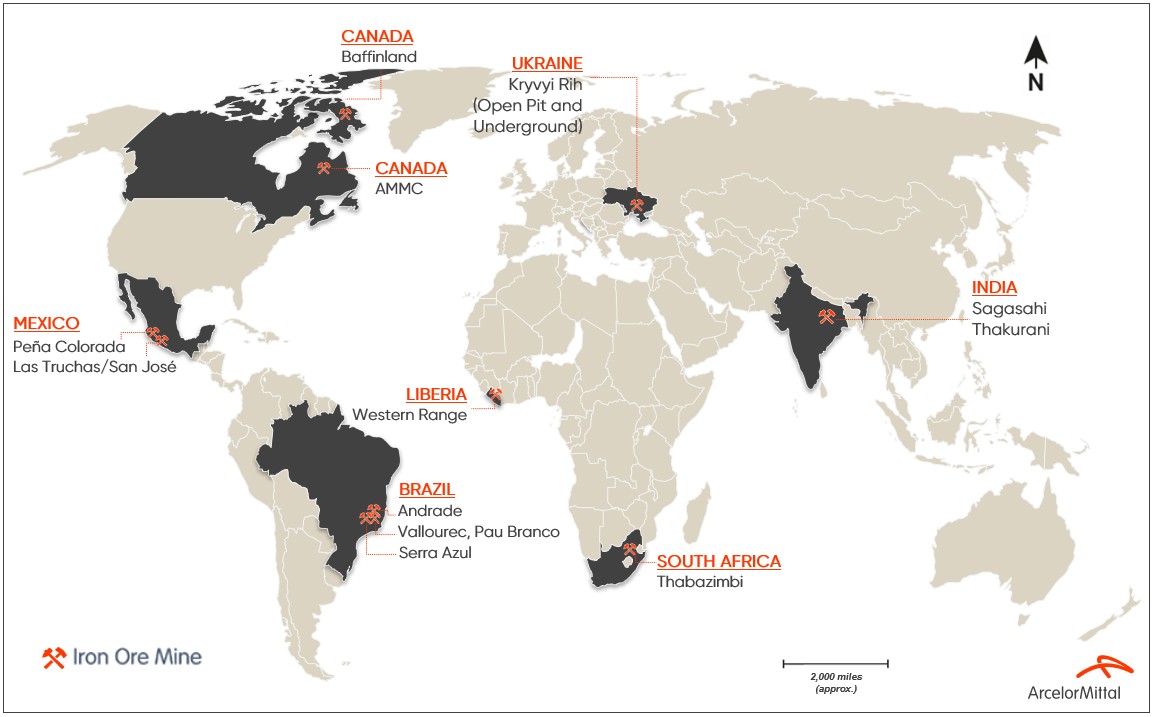
73
Management report |
North America
ArcelorMittal Mexico Mining Assets
ArcelorMittal Mexico operates two iron ore mines in production stage in Mexico, the Las Truchas mines and the Peña Colorada mine
through a joint operation with Ternium. The San José mines stopped production in 2024 due to reserve depletion.
Mine and mine type | Operator | Title, mineral rights, leases or options and acreage | Geographical location | Permit conditions | Product and geology | Processing plants and other available facilities |
Peña Colorada - open pit, production stage | Peña Colorada | 4,301 hectares of surface rights and mineral rights over 39,978 hectares across 20 concessions | 60 kilometers to the north- east of the port city of Manzanillo (Minatitlán province) in the north- western part of the State of Colima | 30-year renewable concessions granted by the Mexican federal government; expiration dates range from 2043 to 20621 | Products - Concentrates and pellets. Geology - •complex polyphase iron ore deposit, •Iron mineralization consists of banded to massive concentrations of magnetite within breccia zones and results from several magmatic, metamorphic and hydrothermal mineralization stages with associated skarns, dykes and late faults sectioning the entire deposit. | Concentrating facility and a two- line pelletizing facility. The beneficiation plant and the pelletizing plant are located at the mine and in Manzanillo, respectively. Major processing facilities include a primary crusher, a dry cobbing plant, two autogenous mills, three horizontal and two vertical ball mills, and several stages of magnetic separation. The concentrate is sent as a pulp through a pipeline from the mineral processing plant to the pelletizing facilities. The magnetite concentrate and pellets are transported from Manzanillo to ArcelorMittal Mexico, as well as to Ternium’s steel plants, by ship and by rail. |
Las Truchas - open pit, production stage | ArcelorMittal Mexico | 53,812 hectares of mineral rights, of which 4,261 support the Las Truchas operations in Mexico2 | 27 kilometers north-west of the town of Lázaro Cárdenas in the State of Michoacán | 50-year renewable concessions granted by the Mexican federal government; expiration dates range from 2044 to 2053 | Product - Concentrates Geology •consist of massive concentrations of magnetite of irregular morphology, mainly occurring along a geological trend, about 7 kilometers long and about 2 kilometers wide. •classified as hydrothermal deposits, which may have originated from late-stage plutonic activity injecting through older sedimentary rocks and mineralization occurs in disseminated and irregular massive concentrations of magnetite within metamorphic rocks and skarns. The mineralization also occurs as fillings of faults, breccia zones, and fractures. | The concentration plant includes two primary crushers, two secondary crushers and three tertiary crushers, two ball mills, two bar mills, and two wet magnetic separation circuits. The concentrated ore is pumped from the mine site through a 26- kilometer slurry pipeline to the steel plant facility in Lázaro Cárdenas.3 |
1.The applicability of a new regulation from 2023 has reduced the concession period from 50 to 30 year does not apply retroactively and does not affect Peña Colorada’s
existing concessions.
2.There is an ongoing land dispute that may have a potential impact on surface rights for the Las Truchas operations (including a potential loss of 1,000 ha).
3.ArcelorMittal Mexico launched a project to increase pellet feed production to 2.3 million tonnes per annum and improve concentrate grade in Las Truchas; see "—Capital
expenditures".
74
Management report |
Brazil
Mine and mine type | Operator | Title, mineral rights, leases or options and acreage | Geographical location | Permit conditions | Product and geology | Processing plants and other available facilities |
Andrade - open pit, production stage | ArcelorMittal Brasil | Mineral rights: 2,885 hectares Land lease: 3,347 hectares | Located in the north-eastern part of the Iron Quadrangle, 5 kilometers from the town of João Monlevade and 80 kilometers east of Belo Horizonte in the Brazilian state of Minas Gerais | Mining legislation in Brazil does not predetermine the duration of mineral rights and as such, these rights are considered valid to the point of mine exhaustion.1 | Products - Concentrates Geology •base stratigraphic section consists of quartzites and sericite-quartzites of the Moeda formation, followed by schists of the Batatal formation, both forming the Caraça group. •Mineral bodies are part of the overlying Cauê formation, which represents the base of the Itabira Group. The Caraça and Itabira groups compose the base of the Paleoproterozoic Minas Supergroup. The Cauê formation rocks are covered by dolomites and marbles, and sometimes weathered phylites and schists, belonging to the Gandarela formation. | Mine includes crushing and screening facility, as well as a concentration plant used to improve the quality of the sinter feed to the Monlevade plant. The concentrated iron ore product is transported to the Monlevade steel plant through a private railway line. |
Serra Azul - open pit, production stage | ArcelorMittal Brasil | Mineral rights: 375 hectares Surface rights: 288 hectares | Located approximately 70 kilometers southwest of Belo Horizonte in the Brazilian state of Minas Gerais. | Mining legislation in Brazil does not predetermine the duration of mineral rights and as such these rights are considered valid to the point of mine exhaustion. | Products - Iron ore Geology •Located in the western part of the Iron Quadrangle, in the iron rich Cauê Formation of the Itabira Group. The mineralization occurs as friable, semi- compact and compact itabirites and banded hematite-silica rocks, with varying degrees of weathering and oxidation. •Serra Azul mines and processes friable, compact and semi-compact itabirites. | Serra Azul operates a processing plant consisting of a crushing facility and a three-line concentration facility, including screening, magnetic separation, spirals separators and jigging. Iron ore product is transported by truck to two railway terminals located 35 and 50 kilometers from the mine site for distribution to local purchasers of sinter feed or for export through third-party port facilities located in the Rio de Janeiro State. |
1. In 2022, the resource model of Andrade was updated, resulting in a new pit optimization and mine schedule, with updated Life of Mine schedule for the Itabirite and
Hematite ores. The new life of mine extends to 2077, with average annual ROM capacity of 1.8 million tonnes.
Serra Azul Mine
In 2021, an updated resource model was generated,
incorporating the results of a 1,508 meter drilling program
completed in late 2020. The drilling program targeted further
definition of the friable itabirite (“IF”) ore bodies, and the
updated model has been used to reassess the mine life for the
current IF phase of the Serra Azul Mine. This resulted in a
revised life of mine for the IF phase, with mining operations
extended until the end of the first quarter of 2025. After
finalizing the IF phase, the mine stopped its production until the
compact itabirite (“IC”) and semi-compact itabirite (“ISC”)
processing plant operations started again in the fourth quarter
of 2025.
Following the integration of the Serra Azul Mine into
ArcelorMittal Brasil in 2020, an expansion project for the Serra
Azul Mine was approved, extending the mine's life until 2056.
The project considers producing 4.5 million tonnes per annum
of DRI quality pellet feed by processing IC and ISC material.
The IC and ISC processing plant operations started in the
fourth quarter of 2025. (see also “—Capital expenditures”).
In February 2019, the Company decided to implement the
evacuation plan for its dormant Serra Azul tailing dam after an
updated stability report raised precautionary concerns following
incidents in Brazil mining sector. Downstream communities
were evacuated to allow further testing and the implementation
of additional safety measures. The Company entered into an
agreement with Federal and State Public Prosecutors and
affected families to provide temporary assistance and establish
the technical requirements to restore safety standards. This
agreement was extended in February 2020, and negotiations
continued in 2021, resulting in a Complementary Agreement
Term defining new compensation guidelines for impacts
caused by the preventive evacuation. Additionally, a new
Complementary Agreement covering the governance and
responsibilities to implement all reparation measures chosen
by the community was initiated in 2023 and finalized in 2025.
As of December 31, 2025, the Company had completed 942
indemnification agreements with affected families. The
agreement also requires the construction of a check dam,
which was finished in August 2025, and deconstruction of the
tailing dam by 2032.
75
Management report |
Europe
ArcelorMittal Prijedor was a captive mine and supplied all of its iron ore production to the ArcelorMittal Zenica steel plant, until both the
mine and steel plant were sold in October 2025.
Mine and mine type | Operator | Title, mineral rights, leases or options and acreage | Geographical location | Permit conditions | Product and geology | Processing plants and other available facilities |
Omarska - open pit1, production stage | ArcelorMittal Prijedor | 1,946 hectares of land and mineral rights | 25 kilometers south-east of the town of Prijedor, Bosnia & Herzegovina | Current concession was signed in 2018 for a period of 6 years and the renewal process is ongoing as of the date of this annual report.1 | Products - Ore Geology •Buvac deposit is located within Carboniferous clastic (shale and sandstones) and carbonate (limestone, dolomite, and ankerite) sequences, with massive siderite-limonite mineralization forming an integral part of the formation. •Iron ore is predominantly limonite-goethite with associated quartz, carbonates, and silicates of the illite type. The limonite-goethite mineralization was formed during the oxidization of the upper parts of the primary siderite bodies. •Ore body is asymmetrical, lens-shape and elongated in a northeast - southwest direction, dipping at about 8° toward the north-east from the surface to a depth of 210 meters. The deposit is approximately 1.5 kilometer long and 1.0 kilometer wide. | After a primary stage of crushing within the pit, the ore is transported to a processing plant via a conveyor. The processing plant on site performs crushing, screening, gravity separation, magnetic separation and filtration. |
Ljubija mine - open pit2 in stand-by phase | ArcelorMittal Prijedor | 739 hectares of land and mineral rights | 20 kilometers south-west of the town of Prijedor, Bosnia & Herzegovina | Current concession was signed in 2022 for a period of 6 years, with an option to renew upon the expiry, in accordance with updated life of mine. | Products - Ore Geology - Deposit is located within Carboniferous and Permian-Triassic formation rocks, which are partly covered by thin Quaternary rocks. The ore within these formations is primarily composed of siderite and ankerite with secondary limonite iron facies. | Ore is only crushed and screened. |
1.ArcelorMittal Prijedor was the registered holder of the mining rights at the Omarska mine exploitation field. Land tenure and mineral rights issued are indefinite and were
considered to be of sufficient duration to enable all reported mineral reserves on the properties to be mined in accordance with life of mine production schedules.
2.In 2022, ArcelorMittal Prijedor acquired additional mining and land rights and started iron ore mining on a trial basis at Ljubija Mine. ArcelorMittal Prijedor was founded in
2004 (at the time LNM Holdings) with the Company having 51% controlling interest and local mining company Iron Ore Mine Ljubija owning the remaining 49% stake.
76
Management report |
Others
Iron ore mining operations forming part of Others include AMKR open pit and underground mines in Ukraine and Thabazimbi mine in South Africa.
Mine and mine type | Operator | Title, mineral rights, leases or options and acreage | Geographical location | Permit conditions | Product and geology | Processing plants and other available facilities |
Ukraine - two open pit mines (Novokryvorizke and Valyavkinske deposits) and one underground mine1 (Kirova deposit), all mines are at production stage | AMKR | Surface operations: 775 hectares of mineral rights and 4,827 hectares of surface rights Underground mine: 57.9 hectares of mineral rights and 160 hectares of surface rights | Located within the southern part of the Krivorozhsky iron-ore basin, within the borders of the city of Kryvyi Rih, 150 kilometers southwest of Dnipro, Ukraine | Subsoil use permits for the underground mine were renewed in 2021 for the next 20 years, and mineral rights for surface pits are due to expire in 2038, while the land lease agreements are valid until 2060 for open pit mines and 2061 for underground mine. | Products - Concentrates 2 Geology •Iron mineralization at Novokryvorizke and Valyavkinske deposits is hosted by early Proterozoic rocks containing multiple altered ferruginous quartzite strata with shale layers. •Major iron ore bearing units in the open pit mines have a carbonate-silicate-magnetite composition. In addition, oxidized, iron-rich quartzite is mined simultaneously with primary ore and is stored separately for possible future processing. •Only the magnetite mineralization is included in the 2025 open pit iron ore reserve estimates. The high- grade iron ore of the Kirova deposit is hosted by a ferruginous quartzite with martite and jaspilite. | •Concentrating facility and crushing facility to produce final product. •Iron ore extracted from the open pits is crushed at the mine site through primary crushing, loaded on a rail-loading facility and transported to the concentrator. •Concentration facility includes crushing, grinding, classification, magnetic separation and filtering. •The iron ore is extracted from the underground mine by a modified sub- level caving method and is crushed and screened at surface into lump and sinter ore, before being transported by rail to the AMKR steel plant. |
South Africa - Thabazimbi mine, exploration stage | ArcelorMittal South Africa (AMSA)3 | Surface rights: 10,952.8 hectares Mineral rights: 8,662.3 hectares | Located in the Limpopo Province in north-east part of South Africa, approximately 200 km north-west of Pretoria | Mineral and surface rights are valid until 2039 | The Vanderbijl iron ore deposit at Thabazimbi is located on the northern margin of the Transvaal sub-basin. The Transvaal Supergroup was deposited in an open marine sedimentary basin developed on the Kaapvaal Craton within fluvial, deltaic to marine depositional environments. The iron ore deposits are developed at or close to the transitional contact zone of the combined footwall dolomites and upper transitional shale beds (including the overlying an approximately 15 meter thick chert-rich shale layer) of the Malmani Subgroup and the overlying BIFs of the Penge Formation. | Open pit operations at Thabazimbi ceased in 2016, and the mine is currently only engaged in the rehandling of iron ore from stockpiles of ROM material from historical production. |
1.The mine is 95.1% owned by ArcelorMittal and is integrated into the ArcelorMittal Kryvyi Rih steel business as a captive mine. ArcelorMittal acquired the operations in
2005. Operations began at the Kryvyi Rih open pit mines in 1959 and at the Kryvyi Rih underground mine in 1933.
2.As a result of the ongoing war in Ukraine, iron ore production was planned according to the consumption at AMKR steel plant and logistics availability. In 2025 and 2024,
open pit iron ore production was at approximately 73% of its maximum capacity. Mining at open pit continued without stoppages in 2025. The underground mine was
mostly idle in 2025 due to lower demand for sintered ore. Iron ore production at the underground mine in 2025 was approximately 3% of maximum capacity (as compared
to 26% in 2024).
3.The mine is 100% owned by ArcelorMittal South Africa and open pit operations ceased in 2016.
77
Management report |
Mining
Iron ore mining operations forming part of the Mining segment include AMMC in Canada and AML in Liberia.
Mine and mine type | Operator | Title, mineral rights, leases or options and acreage | Geographical location | Permit conditions | Product and geology | Processing plants and other available facilities |
AMMC - 3 deposits - Mont- Wright, Fire Lake (both open pit and production stage) and Mont-Reed1 (exploration stage) | AMMC | 34,601 hectares of mineral rights across six mining leases, five patented parcels and 623 map designated claims | Located in Québec, Canada, Mont-Wright is located near Fermont, and Fire Lake is located 85 kilometers south- east of Fermont. The Mont-Reed deposit is located approximately 130 kilometers southwest of Mont-Wright 2 | No expiration dates or lease fees for patented parcels but active leases are valid for a period of ten years. All current leases expire between 2026 and 2033 and can be renewed as needed, with reports on material moved disclosed to the government on a yearly basis. | Products - Concentrates and pellets Geology •Lake Superior–type banded iron formations, the metamorphic equivalent to other iron formations within the Labrador Trough iron district. Mont-Wright and Fire Lake are hematite-rich deposits. Mont- Reed has a greater ratio of magnetite. | •Ore processing plant located on-site at Mont-Wright, as well as a pelletizing plant located at the Port-Cartier port. •Ore from Mont-Wright and Fire Lake is processed at the Mont-Wright processing plant, with material from Fire Lake brought in by train. •Feed ore material is fed through the crusher and concentrated in the processing plant using a gravity separation method. •Concentrate is shipped to Port-Cartier, Québec, Canada, via private railroad, to the pelletizing facilities and port operations. |
AML - open pit3, production stage | ArcelorMittal Liberia | Per MDA, approximately 51,342 hectares within which AML has the rights to explore or mine iron ore | Mt. Tokadeh, Mt. Gangra and Mt Yuelliton deposits ("Western Range Project") in northern Liberia, located approximately 300 kilometers northeast of Monrovia | •The MDA is valid until 2050. •Class A mining license for the Mt. Tokadeh, Mt. Gangra and Mt Yuelliton deposits and two Mineral Exploration Licenses4 | Products - direct shipping ore ("DSO"), and sinter feed Geology •Nimba range consists of itabirites in a 250 to 450- meter-thick recrystallized iron formation. •Although the iron deposits at Mt. Tokadeh, Mt. Gangra and Mt Yuelliton fit the general definition of itabirite as laminated metamorphosed oxide-facies iron formation, they are of lower iron grade than the ore previously mined at the Nimba deposit. •Tropical weathering effects have caused the decomposition of the rock forming minerals resulting in enrichment in the iron content. | The materials-handling operation consists of stockyards at both the mine and port areas, which are linked by a 250- kilometer single track railway running from Mt. Tokadeh to the port of Buchanan. The facilities at the port consist of tail pulley platforms, a conveyor system, a quayside including bays for iron ore storage, a fuel quayside jetty, an equipment workshop, and the final product storage. |
1.The mines at Mont-Wright and Fire Lake are operated by AMMC and are both open-pit producing mines, consolidated in one production schedule and life of mine
supporting the AMMC property's disclosed mineral reserves. The deposit at Mont-Reed is currently in an exploration stage.
2.Headquarters of the mines are based in Greater Montreal. Fermont, the town site built to support the mining operations, is located 16 kilometers east of the Mont-Wright
mining complex and is connected by Highway 389 to Baie-Comeau, which is 570 kilometers away. The Mont-Wright and Fire Lake mines are located approximately 400
kilometers north of the city of Port-Cartier and approximately 1,000 kilometers north-east of Montreal.
3.The construction of the mine commenced in 1960 by a group of Swedish companies, which ultimately became the Liberian American-Swedish Minerals Company
(“LAMCO”), and production commenced at the Nimba deposit in 1963. After LAMCO ceased production in 1992, AML signed a Mineral Development Agreement ("MDA") in
2005 with the Liberian Government. On December 28, 2006, AML signed the First Amendment to the MDA with the Liberian Government. On January 23, 2013, the parties
signed the Second Amendment to the MDA. The Government of the Republic of Liberia and ArcelorMittal have signed a new amendment to the existing MDA, ratified on
January 29, 2026 and extending the duration of the agreement to 2050, with a right to renew for an additional term of 25 years. See "Introduction—Key transactions and
events in 2025—Recent developments".
4.In addition to the rights to explore and mine iron ore, the Liberian Government has granted the right to develop, use, operate and maintain the Buchanan to Yekepa railroad
and the Buchanan port with certain conditions, along with an area at Buchanan for township and industrial facilities for material handling and workshops.
AML
In 2013, AML began construction of a Phase 2 project targeting
the production of 15 million tonnes per annum of iron ore
concentrate. This project was, subsequently suspended due to
the onset of Ebola in West Africa and the declaration of force
majeure declaration by the onsite contracting companies. AML
finalized an updated feasibility study during 2019-2020,
integrating enhanced processing technologies and transitioning
from wet tailings disposal to dry stack tailings. The Phase 2
expansion includes a concentrator designed to produce up to
15 million tonnes per annum of iron ore concentrate, together
with significant investments in rail infrastructure between
Tokadeh and Buchanan, upgrades to existing port
78
Management report |
infrastructure including the construction of an additional berth
at the port of Buchanan, and other supporting infrastructure,
including two power plants.
AML achieved record iron ore production and shipments in
2025, delivering 10 million tonnes, supported by operational
improvements and the ongoing ramp-up of the Phase 2
expansion. As the expansion progresses, iron ore shipments
are expected to increase toward approximately 20 million
tonnes per annum in 2026, reflecting the continued ramp-up of
the Phase 2 expansion and concentrator operations toward
their respective design capacities. The Company intends to
sustain higher production and shipment levels, subject to
operating performance, ore availability, and market conditions.
In parallel studies are underway to evaluate options to expand
the resource base supporting crushed blend ore, optimize
mass recovery through the potential inclusion of regrinding and
flotation circuits for the tailings, and increase concentrator
capacity.
The concentrator expansion represents a brownfield
development and is currently in the commissioning and ramp-
up phase. First iron ore concentrate was produced during
commissioning activities in the fourth quarter of 2024, and
production continues as additional concentrator lines are
commissioned toward their design capacity. The Company is
undertaking feasibility studies for further expansion of its iron
ore asset beyond the current Phase 2 capacity of 20 million
tonnes per annum. The revised feasibility study will also
contemplate a future change to the processing infrastructure to
enable the production of high-quality concentrate from the
magnetite dominant fresh ores (Phase 3). See also
"Introduction—Key transactions and events in 2025—Recent
developments" and "—Capital expenditures".
Joint Ventures and Associates
AMNS India, a 60/40 joint venture between ArcelorMittal and NSC, has two production stage open pit mining operations in Odisha,
India. AMNS India holds a further three composite licenses in India, two in the State of Chhattisgarh and one in Maharashtra, these are
exploration target stage prospects that are being evaluated.
Mine and mine type | Operator | Title, mineral rights, leases or options and acreage | Geographical location | Permit conditions | Product and geology | Processing plants and other available facilities |
Thakurani Mine - open pit1, at production stage | AMNS India | Surface and mineral rights over 228 hectares | Located 320 kilometers to the north of the Odisha's capital Bhubaneswar and 4 kilometers east of the town of Barbil | Permit in place for 5.5 million tonnes per annum of ore production 2 | Products - Iron ore Geology •Lies in the south-eastern part of the Singhbhum-Keonjhar-Bonai iron ore belt, a narrow NNE-SSW directional trending folded syncline that runs through northern Odisha and southern Jharkhand, India. •The enriched sequence is a traditional Banded Iron Formation that has been subject to significant weathering that has enriched the iron ore deposits. •Ore is generally of the friable hematite type; however, more competent hematite ores and friable goethite ores are also present. | Mining operation at Thakurani is being carried out by conventional mining methods using excavators and trucks for ore transportation to a mobile crushing facility. Ore is crushed and screened on site before being transported by road to the Dabuna beneficiation plant located approximately 40 kilometers to the south. Beneficiated material is then transported by slurry pipeline to the pelletizing plant at Paradip, located on the coast of Bay of Bengal. |
Ghoraburhani – Sagasahi mine - open pit3, at production stage | AMNS India | Surface and mineral rights over 139 hectares | Located in the Sundargarh district of Odisha, state of India | Mining lease deed was granted in 2021, for a period of 50 years and permits production of up to 7.16 million tonnes per annum of ore primarily for captive usage | Products - Iron ore Geology •Lies in the south- western part of the Singhbhum-Keonjhar-Bonai iron ore belt. •The enriched sequence is a traditional Banded Iron Formation that has been subject to significant weathering and deformation that has enriched the iron ore deposits. •Ore is generally of lateritic iron ore/hard laminated ore on the top followed by soft laminated ore and friable hematite with intercalations of friable shaly ore and limonitic ore are also present. | Conventional mining methods, using excavators and trucks for ore transportation to a mobile screening & crushing facility, where ore is crushed and screened on site before being transported by road to the Dabuna beneficiation plant located approximately 28 kilometers to the south-east. Beneficiated material is then transported by 253 kilometers slurry pipeline to the pelletizing plant at Paradip. |
1.The operation and mining rights to the Thakurani operations were obtained by AMNS India in February 2020 through the Indian Government Mining Block auction scheme.
The Thakurani mine has been operated since 1961 and has both mature mining pits and undeveloped resource areas. AMNS India commenced mining operations in 2020,
following the demobilization of the previous claim holder, Kaypee Enterprises.
79
Management report |
2.The ramp-up to a capacity of 5 million tonnes per annum was completed in 2021. The mining lease deed was granted in 2020 for a period of 50 years. Until June 2021, all
production from the mine had to be consumed by specified AMNS India end use plants, after which up to 25% of production may be sold to a third party. The permitted
production rate was increased to 7.99 million tonnes per year from 2023 after a submission approved by the Indian Bureau of Mines in late 2020.
3.The operation and mining rights to the Ghoraburhani – Sagasahi operations were obtained through the AMNS India takeover of Essar Steel India Limited (ESIL) in
December 2019. Mining commenced in 2021.
Baffinland
ArcelorMittal has a non-controlling interest at the associate Baffinland iron ore mine.
Mine and mine type | Operator | Title, mineral rights, leases or options and acreage | Geographical location | Permit conditions | Product and geology | Processing plants and other available facilities |
Mary River mine - open pit1, at production stage | Baffinland Iron Mines Corporation | Total mineral tenures cover an area of approximately 257,267 hectares ("ha"): mineral leases 37,814 ha mineral claims 212,843 ha exploration areas 6,610 ha | Located within the Arctic Circle on north Baffin Island, in the Qikiqtani Region of Nunavut, Canada, approximately 1,000 kilometers northwest of Iqaluit, the capital of Nunavut | The current renewal term expires August 26, 2034 at which point they will be renewed for a subsequent 21-year term pursuant to Section 62 of the Nunavut Mining Regulations | Products - Iron ore 2 Geology •Comprises five high grade deposits and six prospects, which represent high grade examples of Algoma-type iron formation consisting of magnetite, hematite and specular hematite mineralization. •The project began commercial production on Deposit No. 1 in 2014. | •Two main operating locations – the mine site at Mary River and Milne Port, located approximately 86 kilometers north-west of the mine site. •Mary River mine is self- sustaining and is equipped with an airstrip and aerodrome. It is a conventional open pit truck and shovel operation. •Ore is delivered to crushers before the crushed product is transported via the Tote road to Milne Port. •Milne Port has been fully developed to accommodate a 5 million-tonne ore stockpile, an ore dock, maintenance facility, and associated infrastructure for the operation of the port facilities. |
1.In March 2011, ArcelorMittal acquired 70% of the Mary River mine project, with Nunavut Iron Ore Inc. (“NIO”), an affiliate of The Energy and Minerals Group (“EMG”),
owning the remaining 30%. In February 2013, ArcelorMittal and NIO entered into a joint arrangement and equalized their shareholdings at 50/50. Subsequently, following
equity funding commitments and conversion of preferred shares into equity, both exercised by NIO only, ArcelorMittal’s share over time decreased to 25.23% as of
December 31, 2020. In September 2020, the corporate structure was reorganized whereby NIO became the sole parent company of Baffinland, while ArcelorMittal together
with EMG became shareholders of NIO. Following this reorganization, ArcelorMittal retained its participation in the project and as of December 31, 2025, holds a 25.23%
interest in NIO.
2.Baffinland can only ship during the open water season (typically July to October), but may conduct haulage of ore to the port throughout the year.
Baffinland
In 2023 and 2024, Baffinland operated within an approved
Early Revenue Phase, which permitted up to 6.0 million tonnes
per annum to be hauled to and shipped from Milne Port. The
current permitting limit on trucking and shipping is 4.2 million
tonnes per annum.
Baffinland had approved a project involving the construction of
a railway to replace the existing truck-haul operation for the
transport of iron ore from Mary River to Milne Inlet, as well as
the expansion of mining, crushing and screening operations
and port ship loading capacity (the "Northern Rail Expansion").
On May 13, 2022, the Nunavut Impact Review Board (“NIRB”)
formally recommended that Baffinland’s proposed Northern
Rail Expansion not move forward at this time, citing potential
environmental impact concerns on the local wildlife and culture,
among other things. On November 16, 2022, the Minister of
Northern Affairs accepted the NIRB's recommendation and
rejected Northern Rail Expansion. Beginning in 2023,
Baffinland’s expansion activities and related capital
expenditures have been primarily directed toward expanding
the mining and processing operations at the Mary River mine
site and connecting the mine site south to the Steensby port
(for which it has already obtained the major permits) (the
“Steensby Expansion”). Baffinland continues to advance the
financing plans for the Steensby Expansion and expects the
overall financing process to conclude in the first half of 2026.
80
Management report |
Vallourec Mineração Pau Branco Mine
In August 2024, ArcelorMittal completed the acquisition of a 28.4% equity stake (27.8% at December 31, 2025) in the associate
Vallourec.
Mine and mine type | Operator | Title, mineral rights, leases or options and acreage | Geographical location | Permit conditions | Product and geology | Processing plants and other available facilities |
Pau Branco mine - open pit, exploration stage | Vallourec Tubos do Brasil SA (VBR) | See below. | Located in the city of Brumadinho in the State of Minas Gerais, Brazil, 30 kilometers south of Belo Horizonte. | See below. | Products - Iron ore Geology - Consists of hematite rich itabirite ore that is part of the iron formations within the Minas Supergroup, Quadrilátero Ferifero (Iron Quadrangle), Brazil. | •Mine concentrates and enriches the mined hematite ore via jigs, spirals and magnetic separators to a +60% Fe hematite product that it supplies to blast furnaces and the pellet plant of Vallourec's affiliates located at Jeceaba in Minas Gerais. •Jeceaba steel mill site is located 120 kilometers south of Belo Horizonte and consists of a premium rolling mill; a steel mill (with a blast furnace and electrical furnace), which supplies steel bars for production at the Jeceaba and Barreiro plants; a pellet unit that produces pellets used by the Jeceaba blast furnaces and the local Brazilian market; and finishing lines. •The Barreiro site is an integrated unit that combines production and hot rolling equipment for the tube finishing lines. •Beyond supplying Vallourec's own steel-making operation, the majority of the mine's iron ore production is also sold to external customers. |
Vallourec extracts iron ore at its Vallourec Tubos do Brasil SA
(VBR) Pau Branco open pit mine and these operations and
structures are duly licensed. VBR's Mining Unit (formerly
Vallourec Mineração Ltda.) has been extracting iron ore at its
Pau Branco open pit mine since the early 1980s. The mining
operations were temporarily suspended in January 2022 due to
flooding and damage to the Cachoeirinha waste pile. However,
operations were partially restarted in May 2022. Vallourec
requested the state mining and environmental authorities to
release the pile fully in the fourth quarter of 2022. In May 2023,
the Pau Branco iron ore mine resumed production levels after
receiving permits to operate the Cachoeirinha waste pile.
The Pau Branco mine is classified as an “exploration stage
property”, as that term is defined under S-K 1300, because no
proven or probable mineral reserves have been determined in
accordance with S-K 1300. As a result and even though the
Pau Branco mine has produced iron ore historically and is
expected to continue such production, the mine will remain
classified as an “exploration stage property”, as that term is
defined under S-K 1300, until such time as proven or probable
mineral reserves have been determined and disclosed in
accordance with S-K 1300. ArcelorMittal cannot guarantee that
proven or probable mineral reserves will be determined and
disclosed in accordance with S-K 1300 for the Pau Branco
mine.
Estimates of Iron Ore Mineral Reserves and Mineral
Resources
For the meanings of certain technical terms used in this annual
report, see “Glossary - definitions, terminology and principal
subsidiaries”.
The estimates of mineral resources and mineral reserves at the
Company’s mines and projects and the estimates of the mine
life included in this report have been prepared by qualified
persons, in accordance with the guidelines for mining property
disclosure requirements in accordance with S-K 1300.
Qualified persons are either employees of ArcelorMittal or third
parties or employees of a third party who are not affiliates of
ArcelorMittal, and neither such third parties or their employers
has an ownership, royalty or other interest in the property for
which they have estimated mineral reserves or mineral
resources. No qualified persons have been employed on a
contingent basis. For additional information about the qualified
persons identified below, please see the exhibits to this annual
report.
Only measured and indicated mineral resources, where the
level of geological certainty associated was sufficient to allow a
qualified person to apply modifying factors in sufficient detail to
support mine planning and evaluation of the economic viability
of the deposit, were converted to proven or probable mineral
81
Management report |
reserves for each of the mineral properties under the summary
disclosure.
The 2025 mineral resource and mineral reserve estimates at
the AMMC mining property have been prepared by qualified
persons who are employees of ArcelorMittal.
The 2025 mineral resource and reserve estimates for the Las
Truchas mine (consolidated as Mexico, excluding Peña
Colorada in the tables below) were prepared by qualified
persons of SLR Consulting (Canada) Ltd. Mineral resource and
reserve estimates for the Peña Colorada mine have been
prepared by qualified persons who are employees of Peña
Colorada.
The 2025 mineral resource and reserve estimates for the
Andrade and Serra Azul mines (consolidated as Brazil in the
tables below) were prepared by qualified persons who are
employees of ArcelorMittal.
The mineral resource and reserve estimates for the AMKR
(Ukraine) open pit and underground operations as of
December 31, 2025 were prepared by a qualified person of
LLC "KAI" with the support of the AMKR team.
For 2025, mineral resource and reserve estimates for the
Thakurani and Ghoraburhani – Sagasahi mines (India in the
tables below) were prepared by qualified persons of DMT
Consulting Private Limited.
AML's 2025 mineral resources and mineral reserves were
estimated by qualified persons who are employees of
ArcelorMittal.
In 2025, a qualified person of SLR Consulting (Canada) Ltd
updated the mineral resources estimate for the Vanderbijl pit at
Thabazimbi (South Africa in tables below). Estimates of mineral
reserves are not reported in 2025 for AMSA's iron ore
operation Thabazimbi.
The mineral resources and reserves for the Mary River Mine
(Baffinland in the tables below) as of December 31, 2025 were
calculated by annual depletion method by qualified persons
who are employees of Baffinland Iron Mines based on the
original estimates of a qualified person of SLR Consulting
(Canada) Ltd.
The point of reference of reporting all of ArcelorMittal's mineral
resources and reserves in the tables below is in situ for
resources and the point of delivery of the ROM material to the
processing plant for reserves. All material is reported on a wet
basis and grades on a dry basis. The effective date for
reporting of all mineral resources and reserves is December
31, 2025.
For each of the mining operations under the summary
disclosure, economic viability of the declared mineral reserves
has been determined by the qualified persons using a
discounted cash flow analysis, demonstrating that extraction of
the mineral reserve is economically viable under reasonable
investment and market assumptions. The estimated mine life
reported in this table corresponds to the duration of the
production schedule of each operation based on the 2025
year-end iron ore reserve estimates only. The production varies
for each operation during the mine life and as a result the mine
life is not the total reserve tonnage divided by the 2025
production. Mine life of each operation is derived from the life
of mine plans and corresponds to the duration of the mine
production scheduled from mineral reserve estimates only. The
demonstration of economic viability is established through the
application of a life of mine plan for each operation or project
providing a positive net present value on a cash-forward
looking basis, considering the entire value chain. Economic
viability is demonstrated using forecasts of operating and
capital costs based on historical performance, with forward
adjustments based on planned process improvements,
changes in production volumes and in fixed and variable
proportions of costs, and forecasted fluctuations in costs of raw
material, supplies, energy and wages. Mineral reserve
estimates are updated annually in order to reflect new
geological information and current mine plan and business
strategies. The Company’s reserve estimates are of in-place
material after adjustments for mining depletion and mining
losses and recoveries, with no adjustments made for metal
losses due to processing. For a description of risks relating to
reserves and reserve estimates, see “Introduction—Risk
Factors and Control—Risk factors—Risks related to
ArcelorMittal’s operations".
The reported iron ore reserves contained in this report do not
exceed the quantities that the Company estimates could be
extracted economically if future prices were at similar levels to
the average contracted price for the three years ended
December 31, 2025. The Company establishes optimum
design and future operating cut-off grade based on its forecast
of commodity prices, adjusted for local market conditions,
freight, inland logistics costs, and final product value in use
premiums/penalties, and operating and sustaining capital
costs. The cut-off grade varies from operation to operation and
during the life of each operation in order to optimize cash flow,
return on investments and the sustainability of the mining
operations. Such sustainability in turn depends on expected
future operating and capital costs. Estimates of reserves and
resources can vary from year to year due to the revision of
mine plans in response to market and operational conditions, in
particular market price. See “Introduction—Risk Factors and
Control—Risk factors—Risks related to ArcelorMittal’s
operations—ArcelorMittal’s reserve and resource estimates
may materially differ from mineral quantities that it may be able
to actually recover; ArcelorMittal’s estimates of mine life may
prove inaccurate; changes in iron ore prices, operating and
82
Management report |
capital costs and other assumptions used to calculate these
estimates may render certain reserves and resources
uneconomical to mine.”
To ensure that mineral resource estimates for all mines satisfy
the requirements for reasonable prospects for economic
extraction ("RPEE") requirement, reasonable technical and
economic factors were considered by qualified persons in the
process of derivation of the ultimate mineral resource pit shells
or underground constraining wireframes and other spatial
controls used to constrain the mineralization. Factors used are
current, considered to be reasonably developed, and are
based on generally accepted industry practice and experience.
Tonnage and grade estimates are reported as ‘Run of Mine’.
Tonnage is reported on a wet metric basis. Metallurgical
recoveries are accounted for in the concentrate tonnes
calculation based on historical processing data and are
variable as a function of head grade.
ArcelorMittal owns less than 100% of certain mining
operations; mineral reserve and mineral resource estimates
have been adjusted to reflect ownership interests and therefore
reflect the portion of total estimated mineral reserves and
resources of each mine attributable to ArcelorMittal as per the
Company’s ownership interest in each mine at December 31,
2025.
The classification of the iron ore reserve estimates as proven
or probable reflects the variability in the mineralization at the
selected cut-off grade, the mining selectivity and the production
rate and ability of the operation to blend the different ore types
that may occur within each deposit.
The following table summarizes ArcelorMittal’s mineral reserve
estimates as of December 31, 2025 in the aggregate, and by
commodity and country and for certain individual properties
(each property containing 10% or more of ArcelorMittal’s
combined mineral reserves and certain properties containing
less). Mineral reserve quantities are rounded to million tonnes.
Unless indicated otherwise below, for the purpose of
determining iron ore mineral reserves, ArcelorMittal has used a
long-term iron ore reference price of $80 per tonne for 62% Fe
fines, based on supply/demand fundamentals and industry cost
curve adjusted upwards or downwards for mine specific factors
and further adjusted for grade, logistics, and other adjustments.
Iron Ore | % of Ownership Interest11 | Proven Mineral Reserves | Probable Mineral Reserves | Total Mineral Reserves | |||||||
Millions of Tonnes | % Fe 1 | Millions of Tonnes | % Fe 1 | Millions of Tonnes | % Fe 1 | ||||||
Canada | 1,607 | 30.9 | 201 | 42.2 | 1,808 | 32.2 | |||||
AMMC2 | 85.0 | 1,519 | 29.0 | 125 | 28.9 | 1,644 | 29.0 | ||||
Baffinland3 | 25.2 | 88 | 64.3 | 76 | 63.8 | 164 | 64.1 | ||||
Mexico | 74 | 23.7 | 124 | 23.3 | 198 | 23.5 | |||||
Mexico (Excluding Peña Colorada)4 | 100.0 | 21 | 32.4 | 61 | 27.6 | 82 | 28.9 | ||||
Peña Colorada - Mexico5 | 50.0 | 53 | 20.3 | 63 | 19.2 | 116 | 19.7 | ||||
Brazil6 | 100.0 | 170 | 46.1 | 256 | 37.5 | 426 | 41.0 | ||||
Ukraine | 57 | 35.2 | 417 | 34.1 | 474 | 34.2 | |||||
Ukraine Open Pit7 | 95.1 | 53 | 34.0 | 407 | 33.6 | 460 | 33.6 | ||||
Ukraine Underground8 | 95.1 | 4 | 52.6 | 10 | 55.0 | 14 | 54.3 | ||||
South Africa | 100.0 | — | — | — | — | — | — | ||||
Liberia9 | 85.0 | 80 | 48.9 | 676 | 41.6 | 756 | 42.4 | ||||
India10 | 60.0 | — | — | 66 | 62.4 | 66 | 62.4 | ||||
Total Iron Ore | 1,988 | 32.8 | 1,740 | 38.8 | 3,728 | 35.6 | |||||
1.Unless stated otherwise, % Fe represents total Fe content for all sites except Peña Colorada where it represents magnetic Fe content only.
2.Mineral reserves for AMMC are estimated at a cut-off grade of 15% and a mass recovery of 32.3%, for a life of mine of 26 years.
3.Mineral reserves for Baffinland are estimated based on a long-term iron ore price of $102.8 per tonne for 62% Fe fines CFR North China, at a cut-off grade of 55% and a
mass recovery of 100%, for a life of mine of 22 years.
4.Mineral reserves for Las Truchas are estimated at a cut-off grade of 10% Fe magnetic. The Fe recovery of Fe magnetic is 90%, for a life of mine of 12 years. There are
currently on-going land disputes on parts of the property, having potential impact of surface right for the Las Truchas operations. The affected Mineral Reserves represent
37% of the total estimated Mineral Reserves and were downgraded from Proven Mineral Reserves to Probable Mineral Reserves where applicable.
5.Mineral reserves for Peña Colorada are estimated at the cut-off grade of 10% Fe magnetic. The average Fe recovery for the mineral reserves is 71.2% based on Fet
metallurgical recovery, for the life of mine of 16 years.
6.Mineral reserves for Serra Azul are estimated at 29% Fe cut-off grade and a mass recovery of 44%, for a life of mine of 31 years. Mineral reserves for Andrade are
reported at a cut-off grade of 20% Fe and 77.3% mass recovery at average, for a life of mine of 45 years.
7.Mineral reserve for Ukraine Open Pit is estimated at an average mass recovery of 38.9%. Cut-off grade applied at Novokryvorizke and Valyavkinske deposit is 12% Fe
and 16% Fe, respectively. Life of mine considered for the two pits combined is 20 years.
83
Management report |
8.Mineral reserve for Ukraine Underground mine is estimated based on a price of $59.8 per tonne of product calculated based on assumptions of a non-marketable material
supplied to its integrated steel plant, at cut-off grade of 51.6% Fe and a mass recovery of 100%, for a life of mine of 20 years.
9.Mineral reserves for Liberia are estimated at a cut-off grade of 40% Fe, with an average mass recovery of 56.9% for the oxide and transitional material, and at a 30% Fe
cut-off grade and a mass recovery of 43.2% for all fresh material, for a life of mine of 30 years.
10.Mineral reserves for Thakurani and Ghoraburhani – Sagasahi are estimated using a long-term iron ore price of $42 per tonne based on IBM (Indian Bureau of Mines) ten
years forecasted price; Mineral reserves for Thakuranii are estimated at 55% Fe cut-off grade and a mass recovery of 95%, for the 9-year life of mine. Mineral reserves for
Ghoraburhani – Sagasahi are estimated at 55% Fe cut-off grade and a mass recovery of 88.49%, for the 11-year life of mine.
11.As per S-K 1300, reported mineral reserves as of December 31, 2025 reflect ArcelorMittal's ownership interest at each individual business unit.
The following table summarizes ArcelorMittal’s mineral
resource estimates as of December 31, 2025 in the aggregate,
and by commodity and country and for certain individual
properties (each property containing 10% or more of
ArcelorMittal’s combined measured and indicated mineral
resources and certain properties containing less). Mineral
resource quantities are rounded to million tonnes. The reported
mineral resources reflect ArcelorMittal's ownership interest at
each individual business unit and are reported, exclusive of
mineral reserves, on a wet basis. Mineral resource quantities
are rounded to million tonnes. Iron ore mineral resources are
estimated based on the same long-term price forecast used for
reserves, adjusted based on the applicable revenue factor and
adjusted upwards or downwards for mine specific factors and
further adjusted for grade, logistics, likely mining dimensions,
location and other modifying factors with the assumed and
justifiable technical and economic conditions to show
reasonable prospects for economic extraction.
Iron Ore | % of Ownership Interest12 | Measured Mineral Resources | Indicated Mineral Resources | Measured & Indicated Mineral Resources | Inferred Mineral Resources | |||||||||
Millions of Tonnes | % Fe 1 | Millions of Tonnes | % Fe1 | Millions of Tonnes | % Fe1 | Millions of Tonnes | % Fe1 | |||||||
Canada | 1,636 | 27.1 | 1,640 | 29.0 | 3,276 | 28.1 | 1,877 | 29.0 | ||||||
AMMC2 | 85.0 | 1,636 | 27.1 | 1,637 | 28.9 | 3,273 | 28.0 | 1,794 | 27.4 | |||||
Baffinland3 | 25.2 | — | 62.1 | 3 | 63.0 | 3 | 62.9 | 83 | 64.3 | |||||
Mexico | 29 | 26.4 | 95 | 28.2 | 124 | 27.8 | 12 | 29.4 | ||||||
Mexico (Excluding Peña Colorada)4 | 100.0 | 12 | 29.6 | 59 | 32.6 | 71 | 32.1 | 11 | 30.3 | |||||
Peña Colorada - Mexico5 | 50.0 | 17 | 24.2 | 36 | 20.9 | 53 | 22.0 | 1 | 19.3 | |||||
Brazil6 | 100.0 | 88 | 51.3 | 184 | 48.2 | 272 | 49.2 | 104 | 40.3 | |||||
Ukraine | 79 | 33.1 | 401 | 34.6 | 480 | 34.3 | 38 | 52.9 | ||||||
Ukraine Open Pit7 | 95.1 | 77 | 32.5 | 387 | 33.8 | 464 | 33.6 | 6 | 36.8 | |||||
Ukraine Underground8 | 95.1 | 2 | 56.6 | 14 | 56.6 | 16 | 56.6 | 32 | 55.9 | |||||
South Africa9 | 100.0 | — | — | 89 | 52.0 | 62 | 52.0 | 71 | 50.0 | |||||
Liberia10 | 85.0 | — | 43.2 | 1,064 | 38.2 | 1,064 | 38.2 | 715 | 37.8 | |||||
India11 | 60.0 | — | — | 48 | 56.6 | 48 | 56.6 | 63 | 61.7 | |||||
Total Iron Ore | 1,832 | 28.5 | 3,521 | 34.3 | 5,327 | 32.3 | 2,880 | 33.2 | ||||||
1.Unless stated otherwise, % Fe represents total Fe content for all sites except Peña Colorada where it represents magnetic Fe content only.
2.Mineral resources for AMMC are estimated at a cut-off grade of 15% Fe for Mont-Wright and Fire Lake; a cut-off of 15% WREC was applied for Mont-Reed.
3.Mineral resources for Baffinland are estimated at a cut-off grade of 55% and a mass recovery of 100%.
4.Mineral resources for Las Truchas are estimated at a cut-off grade of 10% Fe magnetic and Fe recovery of 90%.
5.Mineral resources for Peña Colorada are estimated at a cut-off grade of 10% Fe magnetic.
6.Mineral resources for Serra Azul are estimated at 29% Fe cut-off grade, and mineral resources for Andrade are reported at a cut-off grade of 20% Fe.
7.Mineral resources for Ukraine Open Pit are estimated at a cut-off grade at Novokryvorizke and Valyavkinske deposit of 12% Fe and 16% Fe, respectively.
8.Mineral resources for Ukraine Underground mine are estimated based on assumptions of a non-marketable material supplied to its integrated steel plant, at a cut-off
grade of 51.6% Fe and a mass recovery of 100%.
9.Mineral resources for Thabazimbi are estimated at a 40% Fe cut-off grade and metallurgical recovery of 60%.
10.Mineral resources for Liberia are estimated at a cut-off grade of 40% Fe, with an average mass recovery of 56.9% for the oxide and transitional material, and at a 30% Fe
cut-off grade and mass recovery of 43.2% for all fresh material.
11.Mineral resources for Thakurani mine and Ghoraburhani – Sagasahi mine are estimated at a 45% Fe cut-off grade and a mass recovery of 95% and 88.49%, respectively.
12.As per S-K 1300, reported mineral resources as of December 31, 2025 reflect ArcelorMittal's ownership interest at each individual business unit.
Cautionary note concerning mineral reserve and mineral
resource estimates: With regard to ArcelorMittal’s reported
resources, investors are cautioned not to assume that any or
all of ArcelorMittal’s mineral deposits that constitute either
‘measured mineral resources’, ‘indicated mineral resources’ or
‘inferred mineral resources’ (estimated in accordance with S-K
84
Management report |
1300) will ever be converted into mineral reserves. There is a
reasonable level of uncertainty as to the existence of ‘inferred
mineral resources’ and their economic and legal feasibility, and
it should not be assumed that any or all of an ‘inferred mineral
resource’ will be upgraded to a higher category.
Internal Controls
ArcelorMittal mining and exploration properties employ robust
quality control and quality assurance processes and
procedures to ensure the validity and integrity of data utilized in
the estimation of mineral resources and mineral reserves.
ArcelorMittal has developed an Orebody Knowledge and
Management Framework, comprising a comprehensive set of
internal guidelines and management standards that govern the
resource and mining activities conducted at its properties. The
framework and its associated documents describe the systems
and processes to be developed and implemented at
ArcelorMittal properties to effectively manage activities and
data for the estimation and mining of its mineral resources and
reserves. This framework and its associated documents are
compiled and managed by a centralized corporate team of
experienced and qualified technical experts and are reviewed
and updated on a regular basis.
To increase rigor over internal controls and ensure the integrity
of its reported mineral resource and mineral reserve
disclosures, ArcelorMittal implements Quartex's (former K2fly)
Mineral Resource Governance and Model Manager platforms
globally. This has enabled enhanced control over the
consolidation of the Company’s mineral resource and reserves
disclosures. The Quartex solutions were deployed in 2024 after
a successful implementation and configuration into the
ArcelorMittal global mining portfolio and are being used in
conjunction with Regulation SK-1300 reporting.
Databases are compiled and managed by experienced
personnel engaged directly by the operating entities and
business units, following documented procedures. Sample data
derived from activities such as, but not limited to, exploration
drilling and field sampling, is subject to thorough sample
security and integrity protocols, field and laboratory quality
assurance and quality control processes, and data validation
procedures.
Field quality control processes and procedures will vary based
on the specific nature of the drilling or sampling program, but
will nominally include the use of duplicate samples, blank
control samples and certified reference materials. Samples
processed and analyzed at internal and external laboratories
are subject to additional laboratory quality control processes
including, but not limited to, duplicate samples and certified
reference materials. Data verification workflows are employed
for each program to ensure the quality and integrity of all data
incorporated into the databases.
Historical data is subject to rigorous verification processes prior
to inclusion in resource estimation databases. These
procedures can include, but are not limited to, external
database validation by independent parties, internal database
audits, and spatial and statistical analyses. Where historical
data cannot be verified to the satisfaction of the relevant
qualified person, it is excluded from the databases used in the
estimation processes.
Where applicable, all mineral resource and mineral reserve
estimates are reconciled against mine production data and
operational results. Geological interpretations and estimation
parameters are updated, and modifying factors, cost and price
assumptions are validated and adjusted.
There are inherent risks associated with all mineral resource
and mineral reserve estimations. See "Introduction—Risk
Factors and Control—Risk factors—Risks related to
ArcelorMittal's operations".
OPERATING AND FINANCIAL REVIEW
Key factors affecting results of operations
Overview
The steel industry, and the iron ore and coal mining industries,
which provide its principal raw materials, have historically been
highly cyclical. They are significantly affected by general
economic conditions, consumption trends as well as by
worldwide production capacity and fluctuations in international
steel trade and tariffs. This is due to the cyclical nature of the
automotive, construction, machinery and equipment and
transportation industries that are the principal consumers of
steel.
In 2022, the global economy was adversely affected by supply
chain issues, high inflation, consequential tightening of
monetary policy and Russia’s invasion of Ukraine (itself
aggravating inflationary pressures, particularly in the energy
sector). All these shocks weighed on growth in ArcelorMittal’s
core developed markets (EU, U.S.), with a negative impact on
steel demand and pricing. During 2023 and 2024, the lagged
impact of monetary tightening and weak real steel demand
weighed on prices in the core developed markets, negatively
impacting ArcelorMittal’s profitability. In 2025, heightened
uncertainty, particularly trade-related, negatively impacted the
global economy. However, despite subdued growth in real steel
demand in core developed markets, steel prices were
supported by improved trade protection – most notably in the
U.S., followed by the EU toward the end of the year.
The European market significantly impacts the Company's
prospects, and economic growth has been lackluster in 2023
and 2024, with industrial recession leading to continued
contraction in manufacturing output. In 2025, there was limited
improvement as economic growth remained sluggish, with
85
Management report |
industrial activity stagnating at weak levels. European industrial
sectors were negatively impacted not only by heightened
uncertainty but also weakening exports, particularly in the
automotive sectors due to specific U.S. section 232 tariffs.
While increased fiscal spending in Germany over the next 5
years targeting infrastructure is supportive of steel demand,
implementation delays meant there was limited impact in 2025.
Despite the subdued demand environment, higher imports in
the fourth quarter ahead of CBAM and trade tool
implementation led to some restocking. Over medium term,
higher fiscal spending from Germany, particularly on
infrastructure and to lesser extent, defence spending and data
center expansion, is expected to support steel demand.
In the U.S., average effective tariffs rose to approximately 15%
by the end of 2025, from only 2% in 2024. However, the
inflationary impact of tariffs was contained (due to front-loading
activity and re-routing), and the Federal Reserve resumed
cutting interest rates in September 2025. Economic growth was
supported by resilient domestic consumption and strong high-
tech investment, which offset some negative impacts from
heightened uncertainty. While manufacturing output remained
resilient due to the delayed tariff impact on demand, higher-for-
longer interest rates and elevated uncertainty negatively
impacted the construction sector, particularly real estate,
partially offset by stronger infrastructure activity. Combined with
stronger activity in the energy sector, steel demand for long
steel products including pipe and tubes outperformed flat steel
products. Resilient demand, alongside section 232 tariffs of
50% that significantly reduced imports, supported strong prices
in the U.S.
The Company has significant sales in emerging markets.
Demand in some markets, such as Brazil, rebounded during
2024 to well above pre-pandemic levels. However, inflation has
accelerated in these markets, driven by resilient domestic
demand and looser fiscal policy. In 2025, with inflation in Brazil
at 5% and above the target range (1.5% to 4.5%), interest
rates were raised sharply during the first half of 2025 and kept
at elevated levels for the remainder of 2025. Higher interest
rates negatively impacted economic activity, leading to limited
growth in steel demand in Brazil. In addition, Chinese imports
into Brazil surged over 2025 due to insufficient trade protection
putting downward pressure on pricing, and the Section 232
measures have negatively affected Brazil through their impact
on price realization, which has negatively impacted exports of
Brazil.
Another important market for the Company is India, where
steel demand has grown strongly by approximately 10% on
average since 2022. In 2025, while steel demand growth
slowed slightly due to more stringent fiscal deficit targets
constraining government spending on infrastructure projects,
the steel demand environment remained robust. In the medium
term, India is expected to continue to show healthy growth in
steel demand, supported by strong domestic factors such as
population growth.
Historically, demand dynamics in China have also substantially
affected the global steel business, mainly due to significant
changes in net steel exports. Continued weakness in Chinese
steel demand, coupled with relatively ample domestic supply,
has seen net Chinese crude flat steel exports increase from 3.4
million tonnes per month during 2022, to 5.2 million per month
during 2023, 6.1 million tonnes per month during the first half of
2024 and reaching record highs of 6.6 million tonnes per month
during the second half of 2024. In 2025, Chinese steel demand
remained weak as the property correction continued, though
weaker real estate sector's steel demand was partially offset by
infrastructure spending and resilient manufacturing sectors.
Despite higher U.S. section 232 tariffs, these sectors benefitted
from front-loading of ex-China demand and export re-routing.
As a result, despite lower steel production as reported by the
National Bureau of Statistics ("NBS"), net Chinese crude flat
steel exports remained high, averaging approximately 6.3
million tonnes per month during 2025. While the 2026 outlook
for domestic demand remains largely dependent on the timing
and scale of the government stimulus to support growth,
Chinese overcapacity and the need to export is expected to
persist across most industries. Moreover, the Company
continues to expect Chinese steel demand to decline in the
medium-term, as infrastructure spending has been front-loaded
and real estate demand is expected to weaken structurally due
to lower levels of rural-to-urban migration. If the expected
decline in demand does not coincide with renewed capacity
closures, this could result in steel exports from China
remaining at or above current peak levels and have a negative
impact on global steel prices and spreads.
Unlike many commodities, steel is not completely fungible due
to wide differences in its shape, chemical composition, quality,
specifications and application, all of which affect sales prices.
Accordingly, there is still limited exchange trading and uniform
pricing of steel, whereas there is increased trading of steel raw
materials, particularly iron ore. Commodity spot prices can
vary, which causes sales prices from exports to fluctuate as a
function of the worldwide balance of supply and demand at the
time sales are made.
ArcelorMittal’s sales are made based on shorter-term purchase
orders as well as some longer-term contracts to certain
industrial customers, particularly in the automotive industry.
Steel price surcharges are often implemented on steel sold
pursuant to long-term contracts to recover increases in input
costs. However, longer term contracts with low steel prices will
not reflect increases in spot steel prices that occur after
contract negotiation; similarly low contract prices (if contract
pricing is renegotiated when steel prices are low, for example,
steel contracts that reset annually) will continue to affect results
even as spot steel prices increase. Spot market steel, iron ore
86
Management report |
and coal prices and short-term contracts are more driven by
market conditions.
One of the principal factors affecting the Company’s operating
profitability is the relationship between raw material prices and
steel selling prices. Profitability depends in part on the extent to
which steel selling prices exceed raw material prices, and
specifically the extent to which changes in raw material prices
are passed through to customers in steel selling prices.
Complicating factors include the extent of the time lag between
(a) the raw material price change and the steel selling price
change and (b) the date of the raw material purchase and of
the actual sale of the steel product in which the raw material
was used (average cost basis). In recent periods, steel selling
prices have not always been correlated with changes in raw
material prices, although steel selling prices may also be
impacted quickly due in part to the tendency of distributors to
increase purchases of steel products early in a rising cycle of
raw material prices and to hold back from purchasing as raw
material prices decline. With respect to (b), as average cost
basis is used to determine the cost of the raw materials
incorporated, inventories must first be worked through before a
decrease in raw material prices translates into decreased
operating costs. In some of ArcelorMittal’s segments, in
particular Europe and North America, there are several months
between raw material purchases and sales of steel products
incorporating those materials. Although this lag has been
reduced in recent years by changes to the timing of pricing
adjustments in iron ore contracts, it cannot be eliminated and
exposes these segments’ margins to changes in steel selling
prices in the interim (known as a “price-cost squeeze”). This
lag can result in inventory write‑downs, as seen in 2022 when
steel prices fell sharply. In addition, steel prices can decline
more quickly than raw material costs, a pattern observed
multiple times in the past. In 2022, steel spreads—particularly
in Europe—were compressed by elevated energy prices,
especially for gas, and by destocking among stockists and
end‑users in the second half of the year, which reduced the
Company’s deliveries and profitability.
The fourth quarter of 2022 marked the peak of the destocking
cycle, with inventory levels across ArcelorMittal’s key markets
falling to low levels. As destocking eased in the first quarter of
2023, apparent demand recovered from the fourth‑quarter
lows, supporting a rebound in steel prices and spreads.
However, as economic growth weakened across the
Company’s core developed markets—due to the lagged effects
of interest‑rate increases—elevated steel prices and spreads
unwound during the second and third quarters of 2023. This
pressured results in the third and fourth quarters of 2023, given
the significant lag between transactions and deliveries,
particularly for flat products. Prices and spreads in the
Company’s core markets remained relatively weak through
2024 as apparent demand stabilized at historically low levels in
both Europe and the United States. In 2025, however, despite
a subdued demand environment, prices and spreads in the
Company's core markets were supported by trade protection,
especially in the U.S.
Volatility on steel margins aside, the results of the Company’s
Mining segment (which sells externally as well as internally)
are directly impacted by iron ore prices. See "—Raw materials
—Iron ore". The Company believes current prices are
unsustainable over the medium term, if as expected, Chinese
steel demand weakens further, which would lead to further falls
in iron ore prices and negatively impact ArcelorMittal’s
revenues and profitability. See also “Introduction—Risk Factors
and Control—Risk factors—Risks related to the global
economy and the mining and steel industry—Prolonged low
steel and (to a lesser extent) iron ore prices, low steel demand
and/or steel/iron ore oversupply would have an adverse effect
on ArcelorMittal’s results of operations, cash flows and financial
position.”
Economic environment
Over the last several years, the global economy has
undergone several negative shocks, starting from the
COVID-19 disruption in 2020-21, followed by subsequent high
inflation and elevated interest rates environment in 2022-23,
particularly in developed economies. In 2024, the global
economy started to stabilize, with GDP growth holding steady
at 2.8% as disinflation continued, allowing major central banks
to start cutting interest rates. In 2025, despite higher trade
barriers and significant policy uncertainty, particularly from U.S.
tariff policy, the global economy has been resilient and GDP
growth is estimated at 2.9% year-on-year. Front-loading of
goods production and trade ahead of the introduction of higher
tariff rates, in addition to trade rerouting, was a key supporting
factor in the early part of the year. Easier global financial
conditions as most central banks continue to cut interest rates,
in addition to supportive fiscal spending in major economy such
as the U.S. and Germany, real income growth, and strong AI-
related investments in some countries, particularly the United
States, are all providing broader support for demand. These
factors offset headwinds stemming from the gradual
implementation of new trade policy barriers, still-elevated policy
uncertainty, and declining residential investment.
Despite a period of high inflation and high interest rates, U.S.
GDP growth was resilient at 2.9% in 2023 and 2.8% in 2024,
as loose fiscal spending supported both household
consumption and public investment. In 2025, the U.S. tariffs
and policy implementation led to heightened uncertainty,
particularly during the first half of 2025 when the U.S.
“Liberation” tariff was announced in April. However, the actual
impact of the tariffs was more contained due to front-loading
and rerouting of imports, as well as successful bilateral
negotiations during the second half of the year that rolled back
87
Management report |
some tariffs. The direct economic impact of tariffs on inflation
has been limited, partly due to front-loaded demand and
restrained price pass-through to consumers. However, initial
concerns about the potential impacts of tariffs on inflation led
the U.S. Federal Reserve to keep interest rates at elevated
levels (4.25%-4.5%) until it resumed cutting rates in the fourth
quarter of 2025. Higher-for-longer interest rates, together with
prolonged uncertainty, negatively affected private investment
by prompting businesses to adopt a "wait-and-see" until there
is more clarity for capital deployment. An exception has been
strong growth in AI-driven investments. Overall, GDP growth is
estimated to have slowed to around 2% in 2025. With the
average effective U.S. tariff rising to 14% by end of 2025 from
2% in 2024, the impact of tariffs is likely to continue in 2026.
Since the Russian invasion of Ukraine in 2022, EU economies
have stagnated at weak levels due to high inflation which led to
increased interest rates in 2023 and 2024, negatively impacted
household consumption and investment. From 3.6% in 2022,
GDP growth slowed to 0.5% in 2023 and 1% in 2024. High
interest rates and prices, particularly energy prices, affected
European industrial sectors more severely than other parts of
the economy, causing major export-oriented economies such
as Germany to experience GDP contraction in both 2023 and
2024. In 2025, growth remained lackluster with only marginal
improvement, as industrial activity continued to stagnate at
weak levels and U.S. tariffs, policy uncertainty, and a stronger
euro negatively impacted exports and investment. To support
growth, the European Central bank ("ECB") continued cutting
interest rates to 2.15%. Although Germany's fiscal spending
plan for 2025-29 is substantial, implementation bottlenecks
have delayed the positive impact of fiscal easing, which is
focused on infrastructure. As a result, GDP growth in 2025 is
estimated to have remained subdued at around 1.5%.
China’s economy has remained resilient despite the ongoing
property sector downturn since 2022, as government fiscal
spending has supported domestic investment, coupled with
strong exports, which have been the main growth driver.
Lackluster domestic consumption, combined with excess
manufacturing capacity, resulted in very low inflation in 2023
and 2024. From 3% growth in 2022, GDP growth remained
steady at 5.4% in 2023 and 5% in 2024. In 2025, despite
higher US tariffs on Chinese export, exports have remained
resilient due to trade-flow rerouting. Meanwhile, domestic
weakness in the real estate sector persists, with residential
sales and starts remained sluggish and at low levels. The
Chinese government has continued with fiscal support, mainly
by boosting infrastructure investment, with a smaller share
directed toward household consumption via government
subsidies. While low inflation prompted the government’s anti-
involution campaign to curb overcapacity during the second
half of 2025, weak domestic demand has kept inflation muted.
As a result, the dual trend of stronger manufacturing and
infrastructure activity offsetting real estate weakness continued
in 2025, further bifurcating the economy. With growth engines
remaining centered around investment and export, similar to
the last 2 years, GDP growth in 2025 is expected to remain
stable at around 5%.
In Brazil, after growing around 3% annually over the last 3
years, economic activity started to slow in 2025, particularly
during the second half of the year. This was due to the Central
Bank tightening monetary policy amid persistently high
inflation, raising the key policy rate to 15% in July 2025 and
keeping it steady during the second half (up from 11.25% in
November 2024). Both retail sales and industrial production
stagnated, while investment was negatively impacted by high
interest rates. As a result, GDP growth slowed to 2.6% in 2025.
In contrast, India continues to experience robust growth, and
GDP is expected to grow by 7.7% in 2025, following 6.7% in
2024. Private consumption remained the main growth driver, in
addition to strong public investment focused on infrastructure
spending. With inflation contained at around 2%, interest rates
were cut throughout the year, declining to 5.5% from 6.75% at
the end of 2024. Coupled with lower interest rates supporting
investment, GDP growth is expected to remain robust in 2026.
After global apparent steel consumption (“ASC”) increased by
over 3% in 2021 as the global economy rebounded post-
pandemic, ASC declined by over 2% in 2022 due to weaker
demand from China caused by COVID-19 restrictions, as well
as weaker ex-China ASC due to a destocking cycle. Global
ASC was broadly stable in 2023 and 2024, as the continued
decline in China ASC, caused by the property correction, was
offset by further ASC growth in ex-China. In 2025, the dynamic
between China and ex-China remained. China ASC is
estimated to have declined by approximately 2% year-on-year,
driven by continued contraction in real estate steel demand,
only partially offset by infrastructure and manufacturing activity
supported largely by exports. Meanwhile, ex-China ASC growth
is estimated approximately at 1.5% year-on-year in 2025.
Growth in ex‑China continued to be supported by developing
markets, also estimated at roughly 1.5% year‑on‑year in 2025,
particularly India, where ASC growth is estimated at 8%
year‑on‑year. By contrast, after declining since 2022, steel
demand in developed markets started to stabilize, with ASC
estimated to be only slightly weaker than in 2024, as weaker
ASC in “Developed Asia” (including in particular Japan, South
Korea and Taiwan) was offset by ASC growth in the U.S. and,
to a lesser extent, the EU. Overall, with weaker China demand
offset by growth in ex-China, global ASC is estimated to have
remained broadly stable in 2025. In 2026, in the absence of
renewed shocks from tariffs or conflicts, global ASC growth is
expected to improve gradually, as demand is supported by
fading uncertainty, increased fiscal spending (such as U.S.,
Germany and China) and lagged positive impact from lower
interest rates.
88
Management report |
Source: GDP and industrial production data and estimates sourced from Oxford
Economics Jan 19, 2026. ASC data for U.S. from American Iron and Steel
Institute (AISI) to Nov 2025, estimates for Dec 2025. ASC data for Brazil from
Brazilian Steel Institute to Dec 2025. ASC data for EU27 from Eurofer to Nov
2025, estimates for Dec 2025. ASC data for India from Joint Plant Committee
(Indian government primary agency, under Ministry of Steel) to Nov 2025,
estimate for Dec 2025. All estimates are internal ArcelorMittal estimates.
Steel production
After global production declined to 1.88 billion tonnes in 2022
as compared to 2021, production was broadly stable in 2023.
In 2024, production declined marginally by approximate 1%
year-on-year, largely driven by lower production in China. Ex-
China production was more stable, as stronger production in
developing markets ex-China offset weaker production in
developed markets. See “Introduction—Risk Factors and
Control—Risk factors—Risks related to ArcelorMittal's
operations—Disruptions to ArcelorMittal’s manufacturing
processes and mining operations caused for example by
equipment failures, natural disasters, accidents, explosions,
epidemics or pandemics, geopolitical conflicts or extreme
weather events could adversely affect its operations, customer
service levels and financial results and liabilities”.
This trend continued in 2025. Overall, global steel production in
2025 declined by approximately 2% year-on-year. This largely
reflects the reportedly lower steel production in China, where
official NBS data publication indicated a decline of
approximately 4.5% year-on-year, reflecting weaker domestic
demand as the property-sector correction since 2022
continues, leading to significant Chinese steel exports.
Meanwhile, world ex-China steel production increased
marginally by almost 1% year-on-year, despite stronger steel
production in developing ex-China where outputs rose by 3%,
including an approximate 11% increase in India. Growth in
developing ex-China steel production was partially offset by
weaker production in developed markets, where production
declined by 2% year-on-year. This was driven largely by
continued production declines in Developed Asia
(approximately 4.5%) due to weak domestic steel demand in
Japan and South Korea, as well as high export volumes from
China. Meanwhile, production in the Company’s major
markets, the EU and the U.S., was broadly stable year-on-year,
as lower production in the EU (approximately 2% year-on-year
decline) was offset by higher production in the U.S. (about 3%
year-on-year increase)
Source: Steel production data are compiled using World Steel data for 70
countries for which monthly data is available (which together account for 98% of
World production). 70 countries Include: Austria, Belgium, Bulgaria, Croatia,
Czechia, Finland, France, Germany, Greece, Italy, Luxembourg, Netherlands,
Poland, Portugal, Romania, Slovakia, Slovenia, Spain, Sweden, Macedonia,
Norway, Serbia, Türkiye, United Kingdom, Bahrain, Iran, Iraq, Jordan, Kuwait,
Oman, Qatar, Saudi Arabia, United Arab Emirates, Yemen, Canada, Cuba, El
Salvador, Guatemala, Mexico, United States, Belarus, Kazakhstan, Russia,
Ukraine, Argentina, Brazil, Chile, Colombia, Ecuador, Paraguay, Peru, Uruguay,
Venezuela, Algeria, Egypt, Libya, Morocco, South Africa, Tunisia, Australia,
China, India, Japan, Mongolia, New Zealand, Pakistan, South Korea, Taiwan
(China), Thailand, Viet Nam. Production data is available through December
2025, with some World Steel annual estimates for missing countries.
Trade and import competition
Europe
There has been a trend of imports growing more strongly than
domestic demand in the EU since 2012. In 2022, import
penetration was at 20%, with the Russian invasion of Ukraine
in February triggering an energy crisis in Europe, causing both
ASC and imports to decline sharply during the second half of
2022. In 2023, import penetration declined to 19% as imports
contracted more than ASC due to subdued demand
environment, before rebounding to 20% in 2024 as imports
rose despite relatively weaker ASC growth. In 2025, while
imports were relatively subdued during the first half of the year,
front-loading ahead of the CBAM and trade tools
implementation led to an uptick in imports during the second
half of the year. Coupled with still weak growth in ASC, import
penetration rose to approximately 21% in 2025.
Source: Eurostat imports and Eurofer ASC data to November 2025, internal
Company estimates for December 2025. All historical data now refers to EU27
after UK left the European Union.
United States
After increasing in 2022 and pushing import penetration above
23%, steel imports declined more sharply than ASC in 2023,
resulting in import penetration falling to approximately 21%. In
2024, as imports broadly stabilized while ASC (mainly long
products, pipes and tubes) continued to decline slightly, import
penetration rose marginally to 22%. In 2025, with the 25% tariff
on steel products starting in March 2025 and increasing to 50%
from June 2025, imports fell sharply—by approximately 18%
year‑on‑year. Meanwhile, ASC grew, largely driven by long
products, pipes and tubes, offsetting weaker demand in flat
products. As a result, import penetration declined to
approximately 18%.
Source: American Iron and Steel Association total/regional imports data and ASC
data to November 2025, internal Company estimate for December 2025
China
In 2022, Chinese finished steel exports were broadly stable at
67.4 million tonnes, compared with the previous year. As
demand in China began to weaken due to the property
downturn, and with a significant price gap between domestic
and export markets, Chinese finished steel exports increased
sharply in 2023, reaching 91.2 million tonnes. With domestic
demand remaining weak, this trend continued in 2024 and
2025, with finished steel exports rising to 111 million tonnes in
2024 and 119 million tonnes in 2025. While most Chinese
exports are directed to regions that are not core to the
Company’s business—largely due to trade protection
measures—Chinese exports continue to negatively affect the
Company both directly and indirectly. See “Business overview
—Government regulations—Foreign trade” and “Introduction—
Risk Factors and Control—Risk factors—Risks related to the
89
Management report |
global economy and the mining and steel industry—Unfair
trade practices, import tariffs and/or barriers to free trade could
negatively affect steel prices and ArcelorMittal’s results of
operations in various markets.”
Source: General Administration of Customs of the People's Republic of
China.Trade data available to December 2025.
Steel prices
In relation to flat products, European hot rolled coil ("HRC")
prices (both Northern and Southern), U.S. domestic Midwest
HRC prices and Chinese HRC prices, VAT excluded, over the
2023-2025 period generally reflected an overall downward
trend. Price movements remained largely stagnant throughout
2025 except in the U.S., where prices improved in 2025 as
compared to 2024, mostly driven by import tariffs imposed by
Trump administration. Likewise, in relation to long products,
European medium and rebar prices and Turkish rebar prices
experienced a similar trend over those periods. Movements in
these prices over those periods have been driven by a number
of factors affecting demand and supply in such markets,
including the effects of the ongoing war in Ukraine, inflation,
recessionary concerns, supply chain constraints and labor
shortages that weakened manufacturing and demand in certain
industries, import levels and domestic mill outages (e.g., for
maintenance or otherwise) and import tariffs.
Flat products | ||||
Source: S&P Global Commodity Insights (Platts) | Northern Europe | Southern Europe | United States | China |
Spot HRC average price per tonne | Spot HRC average price per tonne | Spot HRC average price per tonne | Spot HRC average price per tonne, VAT excluded | |
Q1 2023 | € 786 | € 767 | $1,021 | $551 |
Q2 2023 | € 764 | € 737 | $1,161 | $499 |
Q3 2023 | € 649 | € 636 | $867 | $482 |
Q4 2023 | € 650 | € 639 | $1,010 | $485 |
Q1 2024 | € 719 | € 706 | $1,041 | $492 |
Q2 2024 | € 633 | € 625 | $858 | $475 |
Q3 2024 | € 598 | € 597 | $751 | $416 |
Q4 2024 | € 556 | € 551 | $774 | $434 |
Q1 2025 | € 601 | € 596 | $899 | $420 |
Q2 2025 | € 625 | € 604 | $981 | $400 |
Q3 2025 | € 563 | € 539 | $922 | $421 |
Q4 2025 | € 602 | € 588 | $947 | $412 |
Long products | |||
Source: S&P Global Commodity Insights (Platts) | Europe medium sections | Europe rebar | Turkish rebar |
Spot average price per tonne | Spot average price per tonne | Spot FOB average price per tonne | |
Q1 2023 | € 964 | € 722 | $708 |
Q2 2023 | € 889 | € 649 | $637 |
Q3 2023 | € 805 | € 577 | $569 |
Q4 2023 | € 766 | € 606 | $574 |
Q1 2024 | € 772 | € 633 | $602 |
Q2 2024 | € 753 | € 610 | $582 |
Q3 2024 | € 768 | € 615 | $576 |
Q4 2024 | € 770 | € 595 | $580 |
Q1 2025 | € 793 | € 602 | $562 |
Q2 2025 | € 789 | € 622 | $548 |
Q3 2025 | € 757 | € 606 | $537 |
Q4 2025 | € 743 | € 582 | $552 |
Raw materials
The primary raw material inputs for a steelmaker are iron ore,
coking coal, solid fuels, metallics (e.g., scrap), alloys,
electricity, natural gas and base metals. ArcelorMittal is
exposed to price volatility in each of these raw materials with
respect to its purchases in the spot market and under its long-
term supply contracts. In the longer term, demand for raw
materials is expected to continue to correlate closely with the
steel market, with prices fluctuating according to supply and
demand dynamics. Since most of the minerals used in the
steelmaking process are finite resources, their prices may also
rise in response to any perceived scarcity of remaining
accessible supplies, combined with the evolution of the pipeline
of new exploration projects to replace depleted resources.
As for pricing mechanisms, quarterly and monthly pricing
systems are the main type of contract pricing mechanisms, but
spot purchases have gained a greater share, in particular since
2020, as steelmakers have developed strategies to benefit
from increasing spot market liquidity and volatility. Pricing is
generally linked to market price indexes and uses a variety of
mechanisms, including current spot prices and average prices
over specified periods. Therefore, there may not be a direct
correlation between market reference prices and actual selling
prices in various regions at a given time.
Iron ore
In 2023, iron ore market reference prices averaged $119.54/t,
relatively stable compared to an average of $120.03/t in 2022.
The first quarter of 2023 began with an increase in reference
prices mainly driven by prevailing bolstered sentiment on scrap
of COVID control in China, which was later counteracted by the
disappointing actual economy recovery, largely dragged by its
real estate woes and sliding exports. By the end of 2023, iron
ore market reference prices increased to $141.92/t on
December 27, a record high for the period dating back to June
90
Management report |
9, 2022, driven by lower port inventory, stimulus anticipation
and strong demand outlook for Chinese economy in the first
quarter of 2024, following the deposits rate cut by Chinese
commercial banks on December 22, 2023.
In 2024, iron ore market reference prices dropped to an
average of $109.46/t, down by $10.08/t compared to an
average of $119.54/t in 2023. Prices fell for the first three
quarters of 2024 due to persistently sluggish demand amid
economic weakness generally and a real estate slowdown
specifically, but recovered slightly in the fourth quarter of 2024
on boosted sentiment from stimulus policies.
In 2025, iron ore market reference prices dropped to an
average of $101.87/t, down by $7.59/t compared to an average
of $109.46/t in 2024. Prices fell for the first two quarters of
2025 weighted by lower Chinese steel demand amid U.S.
President's Trump's "Liberation Day" tariffs, steel anti-dumping
actions from Vietnam and South Korea, and surging seaborne
supply. Prices recovered in the third and fourth quarters arising
from “anti-involution” policy-driven sentiment, major
infrastructure announcements (such as the CNY 1.2 trillion
Yarlung Tsangpo dam), ongoing concern on mid-grade supply
with the CMRG-BHP negotiation, record high imports amid firm
pig iron output despite weak downstream steel demand and
rising inventories.
Coking coal
Coking coal prices in 2023 averaged $295.97/t as compared to
$364.22/t in 2022. Although coking coal prices decreased
slightly in 2023, they still remained at a historic high at year
end. Supply disruption in Australia, caused by the wet season,
port maintenance, higher vessel queues, and lower production
from BHP, South 32, and Anglo due to longwall issues, coupled
with strong demand from India and China, kept the prices at an
elevated level. In the Chinese market, continuous mine
accidents and safety checks resulted in increased domestic
coking coal prices.
In 2024, coking coal prices averaged $241.32/t as compared to
$295.97/t in 2023, driven by weak global steel demand amid
increased supply due to eased weather-related disruptions
starting in the third quarter of 2024, despite the fire accident in
Anglo’s Grosvenor mine at the end of June 2024. China
reduced its coal imports from seaborne Australian supply as
Australian prices lost competitiveness compared to falling
Chinese domestic coking coal prices and Indian demand was
muted due to weakening margins of steel mills. China and
India account for almost 40% of global demand for seaborne
supply, and these two countries are the main participants in the
global spot market.
In 2025, coking coal prices averaged $189.92/t, down by
$51.40/t compared to an average of $241.32/t in 2024. Prices
remained stagnant for the first three quarters of 2025 mainly
due to weak demand from China despite supply disruptions at
key mines (Moranbah North, Appin, Oaky Creek). China resold
cargos in the second and third quarters as domestic prices hit
the lowest since mid-2020. Prices recovered in the fourth
quarter to $200.67/t with rising Chinese domestic prices after
an “anti-involution” campaign announced in early July, and
return in Indian demand amid tight seaborne spot availability.
ArcelorMittal has continued to leverage its iron ore and coking
coal supply chain and diversified supply portfolio as well as the
flexibility provided by contractual terms to mitigate regional
supply disruptions and also mitigate part of the market price
volatility.
Iron ore | Coking coal | |
Source: Fastmarkets | Reference average price per tonne (Delivered to China, Metal Bulletin index, 62% Fe) | Reference average price per tonne (premium hard coking coal FOB Australia index) |
Q1 2023 | 125.28 | 342.52 |
Q2 2023 | 110.43 | 240.93 |
Q3 2023 | 114.00 | 264.37 |
Q4 2023 | 128.25 | 335.07 |
Q1 2024 | 123.58 | 308.76 |
Q2 2024 | 111.80 | 243.83 |
Q3 2024 | 99.75 | 211.44 |
Q4 2024 | 103.40 | 203.96 |
Q1 2025 | 103.45 | 186.56 |
Q2 2025 | 97.18 | 186.76 |
Q3 2025 | 101.65 | 185.69 |
Q4 2025 | 105.16 | 200.67 |
Scrap
The Company refers to the German suppliers’ index Delivered
at Place as its market reference.
The average index price for 2025 was €313/t as compared to
€359/t in 2024, a €46/t or 12.8% decrease compared to 2024.
The average price in 2023 was €365/t.
Turkey remains the main scrap buying country in the
international market.
Scrap Index HMS 1&2 CFR Turkey, North Europe origin,
averaged at $345/t in 2025, with the yearly high at $371/t in
March and the yearly low in September at $334/t. Scrap Index
HMS 1&2 CFR Turkey, North Europe origin, averaged at $377/t
in 2024 with the yearly high in January 2024 at $414/t and
yearly low at $341/t in December 2024.
In 2025, average European domestic scrap prices of grade E3
were at $353/t. In 2024, the average European domestic scrap
prices of grade E3 were at $389/t.
In the domestic U.S. market, No. 1 busheling index delivered
Midwest increased from an average of $486/t in 2024 to $502/t
in 2025. On the export market, HMS export FOB New York
91
Management report |
average prices for 2025 were at $317/t, a decrease of $31/t
compared to 2024.
Ferro alloys and base metals
Ferro alloys
The underlying price driver for manganese alloys is ordinarily
the price of manganese ore, which was at the level of $4.52
per dry metric tonne unit (“dmt”) (for 44% lump ore) on Cost,
Insurance and Freight (“CIF”) China for 2025, representing a
18.3% decrease from $5.53/dmt in 2024 ($5.22/dmt in 2023).
Manganese ore prices decreased in 2025 as compared to
2024 on the back of subdued worldwide demand for
manganese alloys and increased supply of manganese ore.
High carbon ferro manganese prices decreased by 4.9% from
$1,292/t in 2024 to $1,229/t in 2025 ($1,244/t in 2023), silicon
manganese decreased by 5.2% from $1,336/t in 2024 to
$1,266/t in 2025 ($1,266/t in 2023) and medium carbon ferro
manganese prices decreased only slightly from $1,790/t in
2024 to $1,785/t in 2025 ($1,832/t in 2023). Demand for
manganese alloys remained weak throughout 2025, however,
the safeguard measures adopted by the EU led to an increase
in EU manganese alloys prices towards the end of 2025.
Base metals
Base metals used by ArcelorMittal are zinc, tin and aluminum
for coating, aluminum for deoxidization of liquid steel and nickel
for producing stainless or special steels. ArcelorMittal partially
hedges its exposure to its base metal inputs in accordance with
its risk management policies.
The average price of zinc for 2025 was $2,867/t, representing
a 3.2% increase as compared to the 2024 average price of
$2,777/t (the 2023 average was $2,649/t).
The average price of tin for 2025 was $34,112/t, 13.0% higher
than the 2024 average of $30,191/t (the 2023 average was
$25,895/t).
The average price of aluminum for 2025 was $2,630/t,
representing a 8.7% increase compared to the 2024 average of
$2,419/t (the 2023 average was $2,252/t).
The average price of nickel for 2025 was $15,160/t,
representing a 9.8% decrease compared to the 2024 average
of $16,812/t (the 2023 average was $21,474/t).
Energy market and CO2
Solid fuels, electricity and natural gas are some of the primary
energy inputs for a steelmaker. ArcelorMittal is exposed to
price volatility in each of these energy types with respect to its
purchases in the spot market and under its long-term supply
contracts.
Oil
A combination of geopolitical tensions and macroeconomic
conditions has amplified price volatility of brent crude oil from
2023 to 2025, including the war in Ukraine, conflicts and
political risks in key regions such as the Middle East,
Venezuela and Russia, production decisions by the
Organization of Petroleum Exporting Countries (“OPEC”) and
other producing nations, embargoes on Russian oil, U.S. trade
tariffs, monetary policy actions (including by the U.S. Federal
Reserve), and overall weak global oil demand and strong
supply capabilities have contributed to a downward price trend.
Brent crude oil price averaged $68.23 per barrel ("bbl") in 2025
as compared to $79.86/bbl in 2024 ($82.15/bbl in 2023). In the
first half of 2025, brent crude oil price averaged $70.84/bbl, a
$12.55/bbl decrease as compared to $83.39/bbl in the first half
of 2024. In the second half of 2025, the price averaged at
$65.62/bbl, a $10.74/bbl decrease as compared to $76.36/bbl
in the second half of 2024.
CO2
The average price for one tonne of CO2 emitted in 2025
increased by 12.6% from €66.5 per tonne of carbon dioxide
equivalent ("tCO2e") in 2024 to €74.9/tCO2e in 2025. The
average price for one tonne of CO2 emitted in 2024 decreased
by 21.9% compared to the previous year.
Variations in the price per tonne of carbon dioxide equivalent is
driven by a number of factors, including expectations of tighter
future supply, driven by anticipated reductions in the emissions
cap, declining free allocation, and signals from EU
policymakers regarding more ambitious climate and emissions-
reduction targets, along with compliance buying, temperatures
and natural gas prices and storage levels (impacting level of
power generation from coal power plants).
Launched in 2005, the EU-ETS is currently in its fourth phase,
stretching from January 2021 to December 2030. On June 22,
2022, the European Parliament agreed on its position
regarding the EU-ETS reform (main elements: 2030 emission
reduction target, CBAM and end of free allocation).
Because the integrated steel process leads to substantial CO2
emissions, costs related to European Union Allowances
("EUAs") and the fluctuations in EUA prices can significantly
affect the Company’s costs of production. The Company
recognized a CO2 emission obligation provision of $506 million
at December 31, 2025 with respect to its shortfall. See note 9
to the consolidated financial statements. The Company also
uses derivative financial instruments to manage its exposure to
fluctuations in prices of emission rights allowances from time to
time. See note 6 to the consolidated financial statements for
further information.
92
Management report |
The following table shows quarterly average prices of oil and
CO2 for the past three years:
Commodities | ||
Source: Thomson Reuters | Brent crude oil spot average price $ per barrel | European Union allowance average price € per ton of CO2e |
Q1 2023 | 82.10 | 89.92 |
Q2 2023 | 77.73 | 88.57 |
Q3 2023 | 85.92 | 85.69 |
Q4 2023 | 82.85 | 76.85 |
Q1 2024 | 81.76 | 61.67 |
Q2 2024 | 85.03 | 69.65 |
Q3 2024 | 78.71 | 68.36 |
Q4 2024 | 74.01 | 66.38 |
Q1 2025 | 74.98 | 75.17 |
Q2 2025 | 66.71 | 69.95 |
Q3 2025 | 68.17 | 72.99 |
Q4 2025 | 63.08 | 81.50 |
Natural gas
In Europe, the overall spot price (or TTF) average for natural
gas in 2025 was €36.29/MWh, a 4.0% increase in comparison
to previous year. In 2024 natural gas prices averaged at €34.9/
MWh, a 15% decrease in comparison to 2023. TTF prices over
the 2023-2025 period have been impacted by several factors,
including the crisis in Ukraine and other geopolitical tensions
and conflicts (e.g., in the Middle East), US tariff
implementations, imports of liquefied natural gas ("LNG") (e.g.,
from the U.S.), temperatures, maintenance of pipelines,
inventory levels, coal & CO2 prices, and poor performance of
wind power generation, especially in the first half of 2025.
Russian transit gas into Europe ceased at the end of 2024,
which had an impact on 2025. Hedge fund speculative
activities on TTF also grew significantly over the past two
years, leading to higher volatility.
In the U.S., Henry Hub (“HH”, the main gas hub in Louisiana)
prices in 2025 increased to an average of $3.6/MMBtu, a 50%
year-on-year increase, amid gas demand growth, including
domestic consumption and LNG exports, outpaced supply
increases, leading to a tightening market and the drawing down
of natural gas storage inventories. In 2025, the United States
cemented its position as the world's largest LNG exporter,
shipping a record estimated 111 million metric tonnes of the
fuel (a 24% increase from 2024). In 2024, prices had dropped
to an average of $2.4/MMBtu, a 11.1% year-on-year decrease
as compared to $2.7/MMBtu in 2023. HH prices over the
2023-2025 period have been impacted by several factors,
including disruptions in gas production (e.g., from severe
weather events like freeze-offs or fires), increased LNG
production capacity, demand for LNG exports (including from
Europe), inventory levels, and temperatures.
In 2025, the Japan Korea Marker ("JKM", the LNG benchmark
price assessment for spot physical cargoes delivered ex-ship
into Japan, South Korea, China and Taiwan) average price
increased to $12.2/MMBtu, a 2.5% increase year-on-year. In
2024, the JKM average price had dropped to $11.9/MMBtu, a
17% decrease compared to 2023. JKM prices over the
2023-2025 period have been impacted by several factors,
including the crisis in Ukraine and other geopolitical tensions
(e.g., Middle East), temperatures, ability to switch to oil and
domestic gas consumption, the revival of nuclear-powered
electricity generation in Japan and Korea, adverse weather
events (e.g., cyclones), and reduced Australian LNG output
due to outages. Subdued Chinese LNG demand was the main
driver of the JKM price decline over the last 12 months.
The following table shows quarterly average spot prices of
natural gas for the past three years:
Natural gas | EEX PEGAS | Reuters | Reuters |
Period | TTF Spot average price € per MWh | Henry Hub Spot average price $ per MMBtu | JKM Spot average price $ per MMBtu |
Q1 2023 | 53.31 | 2.74 | 18.07 |
Q2 2023 | 35.29 | 2.33 | 11.08 |
Q3 2023 | 33.49 | 2.66 | 12.59 |
Q4 2023 | 41.01 | 2.92 | 15.82 |
Q1 2024 | 27.50 | 2.10 | 9.42 |
Q2 2024 | 31.82 | 2.32 | 11.10 |
Q3 2024 | 35.65 | 2.23 | 13.00 |
Q4 2024 | 43.30 | 2.98 | 13.91 |
Q1 2025 | 46.87 | 3.87 | 14.01 |
Q2 2025 | 35.66 | 3.51 | 12.36 |
Q3 2025 | 32.53 | 3.07 | 11.83 |
Q4 2025 | 30.11 | 4.04 | 10.85 |
Electricity - Europe
Due to the regional nature of electricity markets, prices follow
mainly local drivers (i.e., energy mix of the respective country,
power generation from renewables such as nuclear, country
specific energy policies, etc.), as well as temperatures and
natural gas prices (positively correlated).
In 2023, power prices mainly followed the same trend as
natural gas prices. Day-ahead power prices in North-West
Europe remained elevated and volatile, reflecting continued
gas-linked price formation despite improving supply
fundamentals. Increasing renewable generation led to more
frequent low-price and negative-price hours, though fossil fuels
still set marginal prices during periods of low wind and solar
output.
In 2024, European power demand remained at the lower end
of the 7-year range due to mild weather and availability of
power generation from renewables. Wholesale day-ahead
93
Management report |
prices declined across North-West Europe, driven by lower gas
prices and higher availability of renewable and nuclear
generation. Price volatility persisted, with a rising number of
negative-price hours as renewable output increasingly
exceeded demand during off-peak periods.
In 2025, aligned with historical trends, power prices were
greatly affected by natural gas and CO2 prices, and the
marginal cost of power generation from gas power plants
became the key indicator for electricity prices. Prices also
shaped by stable underlying demand, similar to 2024 levels,
and high levels of renewable generation. Overall, prices in
Germany remained significantly higher than France due to its
dependency on thermal generation units, while France relies
on cheaper and robust nuclear fleet. For Belgium, Germany
and France power prices acted as a floor and ceiling
throughout the year.
The following table shows quarterly average spot prices of
electricity in Germany, France and Belgium for the past three
years:
Electricity | |||
Source: EEX | Germany Baseload spot average price € per MWh | France Baseload spot average price € per MWh | Belgium Baseload spot average price € per MWh |
Q1 2023 | 115.80 | 130.33 | 127.40 |
Q2 2023 | 92.29 | 91.58 | 92.81 |
Q3 2023 | 90.78 | 85.71 | 87.14 |
Q4 2023 | 82.27 | 81.22 | 82.36 |
Q1 2024 | 67.67 | 62.94 | 67.20 |
Q2 2024 | 71.76 | 29.83 | 54.09 |
Q3 2024 | 75.99 | 51.14 | 62.20 |
Q4 2024 | 102.65 | 86.77 | 97.23 |
Q1 2025 | 111.89 | 99.84 | 110.01 |
Q2 2025 | 69.73 | 33.95 | 66.53 |
Q3 2025 | 82.76 | 49.23 | 71.97 |
Q4 2025 | 93.19 | 61.83 | 82.19 |
Ocean freight
Transportation costs, particularly shipping, constitute a
principal input cost. Shipping freight rates vary depending on
several factors, such as demand (including from China),
positional tonnage deficits relative to demand in both the
Atlantic and Pacific basins, weather conditions, water levels in
the Panama Canal, geopolitical developments affecting Red
Sea routing, energy transition and fleet growth. Heading into
2026, average rates are expected to remain sensitive to
geopolitical risks, decarbonization related uncertainties, trade
and tariff developments and the impact of longer tonne-mile
trade patterns.
The Baltic Dry Index (“BDI”) (an index of average prices paid
for transport of dry bulk materials) average was at 1,681 points
in 2025 compared to 1,755 points in 2024. The Capesize index
decreased by 5.7% year-on-year to an average of $21,297/day
in 2025 compared to $22,593/day in 2024. The Panamax index
decreased by 5.2% to an average of $13,361/day in 2025 as
compared to $14,099/day in 2024. In 2025, the Supramax
index decreased to an average of $12,241/day as compared to
$13,601/day in 2024, a 10% decrease.
The BDI average was at 1,755 points in 2024 compared to
1,378 points in 2023. The Capesize sub-index (cargoes of
about 150,000 tonnes) increased by 37.8% year-on-year to an
average of $22,592/day in 2024 compared to $16,389/day in
2023. The Panamax sub-index (cargoes of about 65-80,000
tonnes) increased by 9.7% to an average of $14,099/day in
2024 as compared to $12,854/day in 2023. In 2024, the
Supramax sub-index (cargoes of about 48-65,000 tonnes)
increased to an average of $13,600/day as compared to
$11,240/day in 2023, a 21% increase.
Sources: Baltic Index, Clarksons Platou
Impact of exchange rate movements
Because a substantial portion of ArcelorMittal’s assets,
liabilities, sales and earnings are denominated in currencies
other than the U.S. dollar (its reporting currency), ArcelorMittal
has exposure to fluctuations in the values of these currencies
relative to the U.S. dollar. These currency fluctuations,
especially the fluctuation of the U.S. dollar relative to the euro,
as well as fluctuations in the currencies of the other countries
in which ArcelorMittal has significant operations and sales, can
have a material impact on its results of operations. For
example, ArcelorMittal’s subsidiaries may purchase raw
materials, including iron ore and coking coal, in U.S. dollars,
but may sell finished steel products in other currencies.
Consequently, an appreciation of the U.S. dollar will increase
the cost of raw materials; thereby having a negative impact on
the Company’s operating margins, unless the Company is able
to pass along the higher cost in the form of higher selling
prices. In order to minimize its currency exposure, ArcelorMittal
enters into hedging transactions to lock-in a set exchange rate,
as per its risk management policies.
Since April 1, 2018, the Company has designated a portfolio of
euro denominated debt (€4.0 billion as of December 31, 2025)
as a hedge of certain euro denominated investments (€8.5
billion as of December 31, 2025) in order to mitigate the foreign
currency risk arising from certain euro denominated
subsidiaries net assets. The risk arises from the fluctuation in
spot exchange rates between the euro and U.S. dollar, which
causes the amount of the net investments to vary. See also
note 6.3 to the consolidated financial statements. As a result of
the hedge designation, foreign exchange gains and losses
related to the portfolio of euro denominated debt are
recognized in other comprehensive income.
94
Management report |
As of December 31, 2025, the Company is mainly subject to
foreign exchange exposure relating to the euro, Brazilian real,
Canadian dollar, Indian rupee, South African rand, Mexican
peso, Polish zloty, Argentinian peso and Ukrainian hryvnia
against the U.S. dollar resulting from its payables, receivables
or foreign operations denominated in such currencies.
Critical accounting policies and use of judgments and
estimates
Management’s discussion and analysis of ArcelorMittal’s
operational results and financial condition is based on
ArcelorMittal’s consolidated financial statements, which have
been prepared in accordance with IFRS. The preparation of
financial statements in conformity with IFRS recognition and
measurement principles and, in particular, making the critical
accounting judgments highlighted below require the use of
estimates and assumptions that affect the reported amounts of
assets, liabilities, revenues and expenses. Management
reviews its estimates on an ongoing basis using currently
available information. Changes in facts and circumstances or
obtaining new information or more experience may result in
revised estimates, and actual results could differ from those
estimates.
An overview of ArcelorMittal's critical accounting policies under
which significant judgments, estimates and assumptions are
made may be found in note 1.3 to the consolidated financial
statements.
Legal proceedings
ArcelorMittal is currently and may in the future be involved in
litigation, arbitration or other legal proceedings. Provisions
related to legal and arbitration proceedings are recorded in
accordance with the accounting policies described in note 9.1
to ArcelorMittal’s consolidated financial statements. Please
refer to note 9.3 for a description of contingencies, including
legal proceedings.
Operating results
The following discussion and analysis should be read in
conjunction with ArcelorMittal’s consolidated financial
statements included in this annual report. The below provides a
discussion and analysis comparing the years ended December
31, 2025 and 2024. For the discussion and analysis of the
results of operations comparing the years ended December 31,
2024 and 2023, see "Operating and Financial Review—
Operating Results" in the Annual Report for the year ended
December 31, 2024.
ArcelorMittal reports its operations in six reportable segments:
North America, Brazil, Europe, India and JVs, Sustainable
Solutions and Mining, with the remainder of its operations in
“Others”. The key performance indicators that ArcelorMittal’s
management uses to analyze operations are sales, average
steel selling prices, crude steel production, steel shipments,
iron ore production and operating income. Management’s
analysis of liquidity and capital resources is driven by net cash
flow from operations and capital expenditures.
Years ended December 31, 2025, and 2024
Sales, operating income, crude steel production, steel
shipments, average steel selling prices and iron ore
production
The following tables provide a summary of ArcelorMittal’s
performance by reportable segment for the years ended
December 31, 2025, and 2024:
(in $ millions) | Sales for the year ended December 31,1 | |||||
Segment | 2025 | 2024 | change | % change | ||
North America | 12,335 | 11,896 | 439 | 3.7% | ||
Brazil | 11,172 | 12,401 | (1,229) | (9.9)% | ||
Europe | 28,793 | 29,952 | (1,159) | (3.9)% | ||
Sustainable Solutions | 10,501 | 10,722 | (221) | (2.1)% | ||
Mining | 3,232 | 2,663 | 569 | 21.4% | ||
Others and eliminations2 | (4,681) | (5,193) | 512 | 9.9% | ||
Total | 61,352 | 62,441 | (1,089) | (1.7)% | ||
(in $ millions) | Operating income (loss) for the year ended December 31,1 | |||||
Segment | 2025 | 2024 | change | % change | ||
North America | 2,205 | 1,310 | 895 | 68.3% | ||
Brazil | 608 | 1,399 | (791) | (56.5)% | ||
Europe | 522 | 386 | 136 | 35.2% | ||
Sustainable Solutions | 142 | 57 | 85 | 149.1% | ||
Mining | 789 | 770 | 19 | 2.5% | ||
Others and eliminations2 | (638) | (612) | (26) | 9.6% | ||
Total | 3,628 | 3,310 | 318 | 9.6% | ||
1.Amounts are prior to inter-segment eliminations (except for total) and sales
include non-steel sales.
2.Others include primarily holding and services companies and the Company's
operations in Ukraine and South Africa. Others also include all other
operational and non-operational items which are not segmented, such as
corporate and shared services, financial activities, and shipping and logistics.
Performance for the year ended December 31, | ||||
2025 | 2024 | change | % change | |
Steel shipments (million tonnes) | 54.0 | 54.3 | (0.3) | (0.6)% |
Iron ore production (million tonnes) | 48.8 | 42.4 | 6.4 | 15.1% |
Average steel selling price ($/ tonne) | 898 | 919 | (21) | (2.3)% |
Average steel selling prices decreased by 2.3% in 2025 as
compared to 2024 in line with international steel selling prices.
ArcelorMittal had sales of $61.4 billion in 2025, representing an
1.7% decrease from sales of $62.4 billion in 2024, primarily
95
Management report |
due to a 2.3% reduction in average steel selling prices while
steel shipments remained relatively stable.
Export sales
Because the Group's customers and operations are mainly
based outside its home country of Luxembourg, all of its sales
are considered to be export sales. Annual sales to a single
individual customer did not exceed 5% of sales in any of the
periods presented.
Cost of sales
Cost of sales consists primarily of purchases of raw materials
necessary for steel-making (iron ore, coke and coking coal,
scrap and alloys), energy, repair and maintenance costs, as
well as direct labor costs, depreciation and impairment. Cost of
sales in 2025 included $0.2 billion impairment charges of
property, plant and equipment mainly related to the divestment
of the Company's steel and mining operations in Bosnia (see
note 5.3 to the consolidated financial statements). Cost of
sales in 2025 also included $0.4 billion expense for the final
settlement of the purchase price of Votorantim's long business
in Brazil, $133 million of restructuring costs in the Europe and
Sustainable Solutions segments and $61 million residual loss
on the sale of ArcelorMittal Zenica and Prijedor (Bosnia). Cost
of sales in 2024 included $116 million impairment charges of
property, plant and equipment, of which $37 million related to
the announced wind down of the Longs Business in
ArcelorMittal South Africa, $43 million relating to write off of
certain civil works following the termination of the Monlevade
expansion project in Brazil and $36 million in connection with
the closure of the Kraków coke plant in Poland. Cost of sales in
2024 also included $216 million of restructuring charges,
including $74 million relating to the Europe segment, $79
million relating to Sustainable Solutions and $63 million related
to the announced wind down of the Longs Business in
ArcelorMittal South Africa.
Depreciation in 2025 was $2.9 billion, higher as compared to
$2.6 billion in 2024 reflecting the capitalization of new assets
coming online including Liberia iron ore, India (renewables)
and Brazil (Vega and Serra Azul expansion).
Selling, general and administrative expenses
Selling, general and administrative expenses ("SG&A") were
$2.6 billion in 2025 as compared to $2.5 billion in 2024. SG&A
as a percentage of sales marginally increased in 2025 (4.2%)
as compared to 2024 (4.0)%.
Operating income
ArcelorMittal’s $3.6 billion operating income in 2025 was higher
as compared to $3.3 billion in 2024 mainly due to $1.9 billion
gain upon acquisition of the remaining 50% equity stake in
AMNS Calvert, partly offset by $0.4 billion expense for the final
settlement of the purchase price of Votorantim's long business
in Brazil. Operating income in 2025 was also impacted by
improved performance in Europe, supported by a positive
price-cost effect and contributions from project ramp-ups,
notably India renewables and Liberia phase 2, partly offset by
weaker results in North America (impacted by Section 232
tariffs and unplanned maintenance in Mexico) and lower
contribution from the Brazil segment due to weaker prices.
Operating income in 2024 was negatively impacted by the
illegal blockade of Mexico operations.
North America | ||||||
Performance for the year ended December 31, | ||||||
(in millions of USD unless otherwise shown) | 2025 | 2024 | change | % change | ||
Sales | 12,335 | 11,896 | 439 | 3.7% | ||
Depreciation | (677) | (509) | (168) | 33.0% | ||
Operating income | 2,205 | 1,310 | 895 | 68.3% | ||
Crude steel production (thousand tonnes) | 7,755 | 7,538 | 217 | 2.9% | ||
Flat product shipments | 8,378 | 8,022 | 356 | 4.4% | ||
Long product shipments | 2,378 | 2,486 | (108) | (4.3)% | ||
Others and eliminations | (473) | (445) | (28) | 6.3% | ||
Total steel shipments (thousand tonnes) * | 10,283 | 10,063 | 220 | 2.2% | ||
Average steel selling price (USD/tonne) | 1,014 | 985 | 29 | 2.9% | ||
*Include slabs sourced by North America from Group subsidiaries (primarily
Brazil) and sold to the AMNS Calvert joint venture (until June 18, 2025) which
are then eliminated on consolidation. These shipments varied between
periods due to slab sourcing mix and timing of vessels in a period. 826,000
tonnes in 2025 (until June 18, 2025) and 1,867,000 tonnes in 2024.
Crude steel production increased 2.9% in 2025 as compared to
2024. Crude steel production and steel shipments were
impacted by the blast furnace shutdown for preventive
maintenance in the Long products business in Mexico during
the second half of 2025 prior to its restart in late January 2026.
The Flat products business in Mexico was also impacted by an
unplanned outage at the Lázaro Cárdenas DRI plant during the
third quarter of 2025. In 2024, crude steel production and steel
shipments were impacted by the illegal blockade of Mexico's
steel plant in Lázaro Cárdenas and at Las Truchas mine from
May 2024 to July 2024 (and following which production only
fully recovered in the first quarter of 2025 with an estimated
impact of approximately 800,000 tonnes of forgone steel
production). Sales increased by 3.7% primarily due to the
consolidation of AMTBA and AMNS Calvert from April 1, 2025
and June 18, 2025, respectively (see note 2.2.4 to the
consolidated financial statements), and 2.9% higher average
steel selling prices. Operating income of $2.2 billion in 2025
included $1.9 billion gain upon acquisition of the remaining
50% equity stake in AMNS Calvert. Excluding this gain,
underlying operating performance declined primarily due to the
additional costs imposed on the business by U.S. section 232
tariffs (initially set at 25% effective March 12, 2025 and further
increased to 50% from June 4, 2025 onwards), the impact of
unplanned maintenance and blast furnace shutdown in Mexico,
offset in part by the non-recurrence of higher costs related to
the illegal blockade in Mexico that impacted 2024.
96
Management report |
Brazil | ||||||
Performance for the year ended December 31, | ||||||
(in millions of USD unless otherwise shown) | 2025 | 2024 | change | % change | ||
Sales | 11,172 | 12,401 | (1,229) | (9.9)% | ||
Depreciation | (379) | (361) | (18) | 5.0% | ||
Operating income | 608 | 1,399 | (791) | (56.5)% | ||
Crude steel production (thousand tonnes) | 14,350 | 14,540 | (190) | (1.3)% | ||
Flat product shipments | 9,264 | 9,409 | (145) | (1.5)% | ||
Long product shipments | 4,744 | 4,732 | 12 | 0.3% | ||
Others and eliminations | (59) | (59) | — | —% | ||
Total steel shipments (thousand tonnes) | 13,949 | 14,082 | (133) | (0.9)% | ||
Average steel selling price (USD/tonne) | 736 | 816 | (80) | (9.8)% | ||
While crude steel production remained largely stable in 2025
as compared to 2024, sales decreased by 9.9% primarily due
to lower average steel selling prices and to a lower extent due
to lower steel shipments (primarily lower exports impacted by
weaker market conditions). In 2025, both domestic and export
prices declines with slab prices in particular impacted by the
removal of U.S. quotas in March 2025. Operating income
decreased in 2025 as compared to 2024 primarily due to lower
average steel selling prices. Operating income in 2025 was
also negatively impacted by $0.4 billion expense for final
settlement of the purchase price of Votorantim's long business
in Brazil as compared to a $43 million impairment charge in
2024 relating to the write off of civil works following the
termination of the Monlevade expansion project in Brazil.
Europe | ||||||
Performance for the year ended December 31, | ||||||
(in millions of USD unless otherwise shown) | 2025 | 2024 | change | % change | ||
Sales | 28,793 | 29,952 | 3 1 6 9 5 | (1,159) | (3.9)% | |
Depreciation | (1,114) | (1,128) | - 1 0 9 8 | 14 | (1.2)% | |
Impairment | (226) | (36) | 0 | (190) | 527.8% | |
Operating income | 522 | 386 | 8 7 9 | 136 | 35.2% | |
Crude steel production (thousand tonnes) | 29,166 | 31,211 | 2 8 4 4 5 | (2,045) | (6.6)% | |
Flat product shipments | 20,473 | 20,489 | 1 9 5 7 0 | (16) | (0.1)% | |
Long product shipments | 7,950 | 8,183 | 8 0 0 1 | (233) | (2.8)% | |
Others and eliminations | (15) | (13) | - 1 2 | (2) | 15.4% | |
Total steel shipments (thousand tonnes) | 28,408 | 28,659 | 2 7 5 5 9 | (251) | (0.9)% | |
Average steel selling price (USD/tonne) | 894 | 910 | 9 9 5 | (16) | (1.8)% | |
Crude steel production decreased by 6.6% in 2025 as
compared to 2024, primarily due to the planned reline of blast
furnace #4 in Dunkirk, required maintenance of assets
particularly during the fourth quarter of 2025 and the sale of the
Bosnian operations. Sales decreased by 3.9% primarily due to
a 1.8% decrease in average steel selling prices and 0.9%
lower steel shipments. Operating income increased by 35.2%
primarily due to a positive price-cost effect, offset in part by
lower steel shipments, $0.2 billion impairment charge related to
the divestment of the Company's steel and mining operations
in Bosnia and $0.1 billion restructuring costs.
Operating income in 2024 was negatively impacted by $36
million impairment charges of property, plant and equipment
and $74 million restructuring charges in connection with the
closure of the Kraków coke plant in Poland.
India and JVs | ||||
Performance for the year ended December 31, | ||||
(in millions of USD unless otherwise shown) | 2025 | 2024 | change | % change |
Income from investments in associates, joint ventures and other investments | 635 | 779 | (144) | (18.5)% |
Income from India and JVs decreased by 18.5% mainly due to
lower contribution from AMNS India partly offset by incremental
contribution from Vallourec which was acquired in August 2024.
ArcelorMittal has investments in various joint ventures and
associates. Following the consolidation of ArcelorMittal Calvert
(on June 18, 2025, the Company acquired the remaining 50%
interest in AMNS Calvert, see "Introduction—Key transactions
and events in 2025" and note 2.2.4 to the consolidated
financial statements), ArcelorMittal considers the AMNS India
joint venture to be of particular strategic importance, warranting
more detailed disclosures to improve the understanding of its
operational performance and value to the Company.
AMNS India | ||||
Performance for the year ended December 31, | ||||
(in millions of USD unless otherwise shown) | 2025 | 2024 | change | % change |
Crude steel production (100% basis) (thousand tonnes) | 7,219 | 7,544 | (325) | (4.5)% |
Steel shipments (100% basis) (thousand tonnes) | 7,863 | 7,933 | (70) | (0.9)% |
Sales (100% basis) | 6,026 | 6,515 | (489) | (7.5)% |
During 2025, AMNS India experienced a decline in steel
shipments (in part impacted by planned maintenance but also
unfavorable market conditions during the first half of 2025).
Sales decreased by 7.5% primarily due to the lower average
steel selling prices and lower shipments as explained above.
Sustainable Solutions | ||||||
Performance for the year ended December 31, | ||||||
(in millions of USD unless otherwise shown) | 2025 | 2024 | change | % change | ||
Sales | 10,501 | 10,722 | (221) | (2.1)% | ||
Depreciation | (235) | (178) | (57) | 32.0% | ||
Impairment | (17) | — | (17) | (100.0)% | ||
Operating income | 142 | 57 | 85 | 149.1% | ||
Sales decreased by 2.1% in 2025 as compared to 2024
primarily due to lower activity levels and prices. Operating
income increased by 149.1% primarily due to ramp-up of the
renewable energy project in India, partly offset by $28 million
97
Management report |
restructuring charges. Operating income in 2024 was also
negatively impacted by $79 million primarily related to
restructuring charges.
Mining | ||||
Performance for the year ended December 31, | ||||
(in millions of USD unless otherwise shown) | 2025 | 2024 | change | % change |
Sales | 3,232 | 2,663 | 569 | 21.4% |
Depreciation | (316) | (263) | (53) | 20.2% |
Operating income | 789 | 770 | 19 | 2.5% |
Iron ore production (million tonnes) | 35.3 | 27.9 | 7.4 | 26.5% |
Iron ore shipments (million tonnes) | 36.3 | 26.4 | 9.9 | 37.5% |
Note | For the year ended December 31, | ||||
Iron ore production (million metric tonnes) | 1 | Type | Product | 2025 | 2024 |
AMMC | Open pit | Concentrate, lump, fines and pellets | 25.6 | 24.2 | |
AML | Open pit / Underground | Fines | 9.7 | 3.7 | |
Total iron ore production | 35.3 | 27.9 | |||
1.Total of all finished production of fines, concentrate, pellets and lumps.
Iron ore production and shipments increased by 26.5% and
37.5%, respectively, mainly driven by higher volumes at AML
supported by operational improvements and the ongoing ramp-
up of Phase 2 capacity expansion. The operation is
progressing toward 20 million tonnes of annual capacity, with
shipments expected to exceed 18 million tonnes by end of
2026 as sinter‑feed output increases and the concentrator
continues to ramps up, supporting improved price realization.
Iron ore production in 2024 was negatively impacted by rail
disruptions at AMMC due to wildfires near Port Cartier in late
June 2024 and by rail accidents at AML in the first quarter of
2024. Sales and operating income increased in 2025 as
compared to 2024 by 21.4% and 2.5%, respectively, primarily
due to higher iron ore shipments, partly offset by lower iron ore
reference prices (net of lower freight costs) and higher
depreciation resulting from phase 2 expansion in Liberia.
Sales of $1,365 million and iron ore shipments of 13.7 million
tonnes to external customers in 2025 increased by 39% and
47%, respectively, compared to $982 million and 9.3 million
tonnes in 2024, mainly due to higher volumes at AML as
explained above.
The average reference iron ore price was $101.9 per tonne in
2025 as compared to $109.6 per tonne in 2024 (delivered to
China, normalized to Qingdao and 62% Fe US $ per tonne,
Metal Bulletin). However, there may not be a direct correlation
between reference prices and actual selling prices in various
regions at a given time. See also quarterly reference prices in
"Raw materials" above.
Financing costs-net
Performance for the year ended December 31, | ||||
(in $ millions) | 2025 | 2024 | change | % change |
Net interest expense1 | (296) | (110) | (186) | 169% |
Foreign exchange gains / (losses) | 256 | (565) | 821 | 145% |
Other net financing costs2 | (669) | (499) | (170) | 34% |
Financing costs - net | (709) | (1,174) | 465 | (40)% |
1.interest expense less interest income.
2.includes bank fees, interest on pension obligations and other long-term
liabilities, revaluation of derivative instruments and expenses related to true
sale of receivables.
The increase in net interest expense in 2025 is primarily due to
higher average gross debt levels and lower interest income.
Foreign exchange gain in 2025 is mainly related to the
depreciation of the U.S. dollar against the euro and the
Brazilian real (as compared to foreign exchange losses due to
the appreciation of the U.S. dollar against most currencies in
2024). In 2025, other net financing costs included a $101
million charge related to the extension of the term of the
mandatory convertible bond (see note 11.2 to the consolidated
financial statements). In 2024, other financing costs included a
$83 million expense relating to the fair value at acquisition date
of the forward in connection with the Vallourec acquisition.
Income tax expense (benefit)
ArcelorMittal recorded an income tax expense of $0.4 billion for
2025 as compared to $1.5 billion for 2024. The decrease in tax
expense reflects lower operating income with a smaller share
of earnings generated in higher‑tax jurisdictions such as
Canada. In addition, exceptional items, such as bargain
purchase in North America segment, had minimal tax impact.
The decrease includes a $82 million decrease in deferred tax
assets and resulting deferred tax expense related to the
reduction of the statutory tax rate in Luxembourg effective
January 1, 2025 from 24.94% to 23.87%. Income tax expense
included also in 2024 a $0.2 billion provision relating to
expected resolution of the tax disputes in the North America
segment. See note 10.1 to the consolidated financial
statements.
ArcelorMittal’s consolidated income tax expense (benefit) is
affected by the income tax laws and regulations in effect in the
various countries in which it operates and the pre-tax results of
its subsidiaries in each of these countries, which can change
from year to year. ArcelorMittal operates in jurisdictions, mainly
in Eastern Europe and Asia, which have a structurally lower
corporate income tax rate than the statutory tax rate as
enacted in Luxembourg (23.87%), as well as in jurisdictions,
mainly in Brazil and Mexico, which have a structurally higher
corporate income tax rate. The statutory income tax expense
(benefit) and the statutory income tax rates of the countries
98
Management report |
that most significantly resulted in the tax expense (benefit) at
statutory rate for each of the years ended December 31, 2025
and 2024 are as set forth below:
2025 | 2024 | ||||||
Statutory income tax | Statutory income tax rate* | Statutory income tax | Statutory income tax rate* | ||||
Argentina | 3 | 35.00% | (39) | 35.00% | |||
Belgium | (5) | 25.00% | (27) | 25.00% | |||
Brazil | (163) | 34.00% | 173 | 34.00% | |||
Canada | 171 | 25.90% | 488 | 25.90% | |||
France | (60) | 25.82% | (197) | 25.82% | |||
Germany | (134) | 25.00% | (197) | 30.30% | |||
Italy | (3) | 24.00% | (18) | 24.00% | |||
Liberia | (32) | 25.00% | (42) | 25.00% | |||
Luxembourg | 1,234 | 23.87% | 556 | 23.87% | |||
Mexico | (206) | 30.00% | 49 | 30.00% | |||
The Netherlands | (26) | 25.80% | (19) | 25.80% | |||
Poland | (37) | 19.00% | (71) | 19.00% | |||
South Africa | (37) | 27.00% | (86) | 27.00% | |||
Spain | (5) | 25.00% | (8) | 25.00% | |||
Ukraine | (39) | 18.00% | (39) | 18.00% | |||
United States | 36 | 21.00% | 68 | 21.00% | |||
Others | (20) | (9) | |||||
Total | 677 | 582 | |||||
*The statutory tax rates are the (future) rates enacted or substantively enacted by
the end of the respective period.
Non-controlling interests
Net income attributable to non-controlling interests was $91
million and $41 million for 2025 and 2024, respectively. Net
income attributable to non-controlling interests for the year
ended December 31, 2025 and 2024 primarily relates to the
non-controlling shareholders’ share of net income recorded in
AMMC and Belgo Bekaert Arames in Brazil.
Net income attributable to equity holders of the parent
ArcelorMittal’s net income attributable to equity holders of the
parent was $3.2 billion and $1.3 billion for 2025 and 2024,
respectively. ArcelorMittal's basic earnings per common share
was $4.13 and $1.70 in 2025 and 2024, respectively.
Liquidity and capital resources
ArcelorMittal’s principal sources of liquidity are cash generated
from its operations and its credit facilities at the corporate level.
Impact of organizational structure
Because ArcelorMittal is a holding company, it is dependent
upon the earnings and cash flows of, as well as dividends and
distributions from, its operating subsidiaries to pay expenses
and meet its debt service obligations. Cash and cash
equivalents are primarily centralized at the parent level and are
managed by ArcelorMittal Treasury SNC, although from time to
time cash or cash equivalent balances may be held at the
Company’s international subsidiaries or its holding companies.
Some of these operating subsidiaries have debt outstanding or
are subject to acquisition agreements that impose restrictions
on such operating subsidiaries’ ability to pay dividends, but
such restrictions are not significant in the context of
ArcelorMittal’s overall liquidity. Repatriation of funds from
operating subsidiaries may also be affected by tax and foreign
exchange policies in place from time to time in the various
countries where the Company operates, though none of these
policies is currently significant in the context of ArcelorMittal’s
overall liquidity.
In management’s opinion, ArcelorMittal’s credit facilities and
working capital are adequate for its present requirements.
ArcelorMittal had available borrowing capacity of $5.5 billion
under its $5.5 billion revolving credit facility as of December 31,
2025 and 2024 (see below—Credit facilities). For information
regarding the currencies of cash and cash equivalents and
restricted cash, see note 6.1.4 to the consolidated financial
statements.
Credit facilities
ArcelorMittal’s principal credit facilities are described below, for
further information on its existing credit facilities and several
debt financing and repayment transactions completed during
2025, please refer to note 6 to the consolidated financial
statements.
On May 29, 2024, ArcelorMittal signed an agreement for a $5.5
billion revolving credit facility (the "Facility"). This Facility
incorporates a single tranche of $5.5 billion maturing on May
29, 2029, with two one-year extension options at the lenders’
discretion (i.e. the options to extend are to be exercised before
the dates that are respectively one and two years after the
signing date of the agreement). On April 30, 2025, ArcelorMittal
exercised the option to extend the Facility's maturity by one
year to May 29, 2030. The Facility may be used for general
corporate purposes and was fully available as of December 31,
2025. The Facility contains restrictive covenants, which among
other things, limit encumbrances on the assets of ArcelorMittal
and its subsidiaries, the ability of ArcelorMittal’s subsidiaries to
incur debt and the ability of ArcelorMittal and its subsidiaries to
dispose of assets in certain circumstances. The Company
makes drawdowns from and repayments on the Facility in the
framework of its cash management.
In addition, ArcelorMittal has a $445 million revolving multi-
currency letter of credit facility (the “Letter of Credit Facility”)
maturing on July 31, 2027, with two one-year extension
options. The Letter of Credit Facility is used by the Company
and its subsidiaries for the issuance of letters of credit and
other instruments. The terms of the letters of credit and other
instruments contain certain restrictions as to duration.
99
Management report |
The margin applicable to ArcelorMittal’s principal credit facilities
(the Facility and certain other credit facilities) and the coupons
on certain of its outstanding bonds are subject to adjustment in
the event of a change in its long-term credit ratings. On June 9,
2025, Standard & Poor's upgraded ArcelorMittal's credit rating
from 'BBB-' to 'BBB' on improved business and assigned a
'Stable' outlook. On December 4, 2025, Moody’s upgraded
ArcelorMittal’s credit rating from ‘Baa3’ to ‘Baa2’ on
strengthening its business profile, including a structural
improvement in margins and a reduction in earnings volatility
and assigned a ‘Stable’ outlook. See "Introduction—Risk
Factors and Control—Risk factors—Risks related to
ArcelorMittal's financial position and organizational structure—
ArcelorMittal's indebtedness could have an adverse impact on
its results of operations and financial position, and the market's
perception of ArcelorMittal's leverage or of certain financial
transactions may affect its share price."
Indebtedness
Most of the external debt is borrowed by the parent company
on an unsecured basis and bears interest at varying levels
based on a combination of fixed and variable interest rates.
Total debt as of December 31, 2025 increased to $13.4 billion
as compared to $11.6 billion as of December 31, 2024. See "—
Sources and uses of cash—Net cash used in financing
activities" and note 6.3 to the consolidated financial
statements.
Net Debt1 | ||||
December 31 | ||||
in $ billions | 2025 | 2024 | change | |
Long-term debt | 10.7 | 8.8 | 1.9 | |
Short-term debt and current portion of long-term debt | 2.7 | 2.8 | (0.1) | |
Total Debt (A) | 13.4 | 11.6 | 1.8 | |
Cash and cash equivalents2 (B) | 5.5 | 6.5 | (1.0) | |
Net Debt (A) - (B) = (C) | 7.9 | 5.1 | 2.8 | |
Total Equity (D) | 56.5 | 51.3 | 5.2 | |
Gearing3 (C)/(D) | 14.0% | 9.9% | 4.1% | |
1.defined as long-term debt, net of current portion plus short-term debt and
current portion of long-term debt less cash and cash equivalents, restricted
cash and cash and cash equivalents held as part of assets held for sale.
2.including restricted cash of $84 million and $84 million at December 31, 2025
and December 31, 2024, respectively. Restricted cash included $67 million
and $68 million relating to various environmental obligations, true sales of
receivables programs and letter of credits issued in ArcelorMittal South Africa
as of December 31, 2025 and December 31, 2024, respectively.
3.defined as net debt divided by total equity.
The increase in net debt in 2025 reflects the consolidation of
debt resulting from several acquisitions for $1.9 billion,
including mainly ArcelorMittal Calvert for $1.2 billion, $0.3
billion share buy backs and $0.4 billion dividend payments to
ArcelorMittal shareholders, partly offset by $4.8 billion net cash
provided by operating activities less $4.3 billion capital
expenditures. Non-compliance with the covenants in the
Company’s borrowing agreements entitles the lenders under
such facilities to accelerate the Company’s repayment
obligations. The Company was in compliance with the material
financial covenants in the agreements related to all of its
borrowings as of December 31, 2025. ArcelorMittal’s debt
facilities have provisions whereby the acceleration of the debt
of another borrower within the ArcelorMittal group could, under
certain circumstances, lead to acceleration under such
facilities.
The following table summarizes the repayment schedule of
ArcelorMittal’s outstanding indebtedness, which includes short-
term and long-term debt, as of December 31, 2025.
Repayment amounts per year (in billions of $) | ||||||
Type of indebtedness as of December 31, 2025 | 2026 | 2027 | 2028 | 2029 | 2030 and beyond | Total |
Bonds | 1.1 | 1.2 | 0.6 | 0.5 | 4.5 | 7.9 |
Commercial paper | 0.9 | — | — | — | — | 0.9 |
Lease liabilities and other loans | 0.7 | 0.4 | 0.8 | 0.3 | 2.4 | 4.6 |
Total gross debt | 2.7 | 1.6 | 1.4 | 0.8 | 6.9 | 13.4 |
The average debt maturity of the Company was 7.7 years as of
December 31, 2025, as compared to 6.7 years as of December
31, 2024.
Further information regarding ArcelorMittal’s outstanding short-
term and long-term indebtedness as of December 31, 2025,
including the breakdown between fixed rate and variable rate
debt, is set forth in note 6 to the consolidated financial
statements. Further information regarding ArcelorMittal’s use of
financial instruments for hedging purposes is set forth in note 6
to the consolidated financial statements.
The Company expects to service its cash requirements in the
near and medium-term with net cash provided by operating
activities. In the future, the Company may enter into additional
financing facilities if required.
Mandatory convertible bond
On March 14, 2023, the Company through its wholly-owned
subsidiary Hera Ermac made an early repayment of 226,666 of
the 666,666 outstanding unsecured and unsubordinated bonds
mandatorily convertible into preferred shares of such
subsidiary for a total cash consideration of $340 million. See
notes 11.2 to the consolidated financial statements. On
December 19, 2025, the Company extended the conversion
date of its bonds mandatorily convertible into preferred shares
to January 28, 2028.
Trade receivables
ArcelorMittal has established a number of programs for sales
without recourse of trade accounts receivable to various
financial institutions (referred to as true sale of receivables
100
Management report |
(“TSR”)). As of December 31, 2025, the total amount of trade
accounts receivables sold amounted to $5.0 billion. Through
the TSR programs, certain operating subsidiaries of
ArcelorMittal surrender the control, risks and benefits
associated with the accounts receivable sold; therefore, the
amount of receivables sold is recorded as a sale of financial
assets and the balances are removed from the consolidated
statements of financial position at the moment of sale.
Trade payables
As part of the Company’s ongoing efforts to improve its
working capital position, it continually engages with its
customers and suppliers with the aim of improving overall
terms, including pricing, quality, just in time delivery, discounts
and payment terms. Trade accounts payable have maturities
from 15 to 180 days depending on the type of material, the
geographic area in which the purchase transaction occurs and
the various contractual agreements. The Company’s average
outstanding number of trade payable days amounted to 82
over the last 5 years. The ability of suppliers to provide
payment terms may be dependent on their ability to obtain
funding for their own working capital needs and or their ability
to early discount their receivables at their own discretion (the
Company estimates that about $2.3 billion of trade payables
were subject to early discount by its suppliers in 2025 as
compared to $2.8 billion in 2024). Given the nature and large
diversification of its supplier base the Company does not
expect any material impact to its own liquidity position as a
result of suppliers not having access to liquidity. As of
December 31, 2025, a 5-day reduction in trade payable days
would result in a trade payables decrease by $640 million.
Commitments, obligations and other arrangements
The Company's cash requirements in the near and medium
term are primarily driven by the current commitments,
obligations and other arrangements in place as of December
31, 2025. ArcelorMittal has various purchase commitments for
materials, supplies and capital expenditure incidental to the
ordinary course of business. As of December 31, 2025,
ArcelorMittal had various outstanding obligations mostly related
to:
•Guarantees, pledges and other collateral related to
financial debt and credit lines given on behalf of third
parties and joint ventures,
•Capital expenditure commitments mainly related to
commitments associated with investments in expansion
and improvement projects by various subsidiaries, and
•Other commitments comprising mainly commitments
incurred for gas supply to electricity suppliers.
These commitments, obligations and other arrangements will
become due in 2026 and beyond. These various purchase
commitments and long-term obligations will have an effect on
ArcelorMittal’s future liquidity and capital resources. For further
details on commitments and obligations, please refer to
note 9.4 to the consolidated financial statements. ArcelorMittal
also has various environmental commitments and asset
retirement obligations as of December 31, 2025. For further
details on environmental commitments and asset retirement
obligations, please refer to note 9.1 to the consolidated
financial statements.
As of December 31, 2025, ArcelorMittal had guarantees of $1.2
billion and $5.4 billion of debt of its subsidiaries and joint
ventures, respectively, as compared to $375 and $6.3 billion as
of December 31, 2024, respectively. Guarantees of
indebtedness of joint ventures at December 31, 2025 included
$4.4 billion issued on behalf of AMNS India. The guarantee
relates to $10.1 billion credit facilities with a syndicate of
Japanese banks in connection with the acquisition of AMNS
India and the expansion of AMNS India’s steelmaking capacity
at its Hazira plant. The obligations under the term loan
agreements are both guaranteed by ArcelorMittal and NSC in
proportion to their interests in the joint venture, 60% and 40%.
See also note 9.4 to the consolidated financial statements for a
description of guarantees by ArcelorMittal for joint ventures.
Earnings distribution
ArcelorMittal held 13.9 million shares in treasury as of
December 31, 2025, as compared to 84.3 million shares as of
December 31, 2024. As of December 31, 2025, the number of
shares held by the Company in treasury represented 1.79% of
the Company’s total issued share capital. On November 20,
2025, ArcelorMittal cancelled 77,809,772 treasury shares to
keep the number of treasury shares within appropriate levels.
Following this cancellation, the aggregate number of shares
issued and fully paid up decreased from 852,809,772 to
775,000,000.
On February 6, 2025, ArcelorMittal announced that the Board
had recommended to increase the annual base dividend to
shareholders to $0.55/share, which was approved on May 6,
2025 at the annual general meeting of shareholders. The
dividend amounted to $421 million. In addition, during 2025,
ArcelorMittal repurchased 6.8 million shares under the share
buy-back program previously announced on May 5, 2023 (this
program was completed on April 1, 2025) and 2 million shares
under the new share buy-back program announced on April 7,
2025. For further information on buy-backs, see "Shareholders
and Markets—Purchases of equity securities by the issuer and
affiliated purchasers".
On February 5, 2026, ArcelorMittal announced that the Board
of Directors recommended an increase of the base annual
dividend to $0.60/share in 2026, subject to the approval of
shareholders at the annual general meeting of shareholders in
101
Management report |
May 2026. See "Introduction—History and development of the
Company—Other information—Capital return policy".
Pension/OPEB liabilities
The defined benefit liabilities for employee benefits increased
to $2.5 billion at December 31, 2025 from $2.3 billion at
December 31, 2024. For additional information with respect to
the Company’s pension plan and OPEB liabilities, including a
breakdown by region and by type of plan, see note 8.2 to the
consolidated financial statements.
Sources and uses of cash
Years ended December 31, 2025, and 2024
The below provides a discussion and analysis comparing the
years ended December 31, 2025 and 2024. For the discussion
and analysis comparing sources and uses of cash in the years
ended December 31, 2024 and 2023, see “Operating and
financial review—Liquidity and capital resources—Sources and
uses of cash" in the annual report for the year ended
December 31, 2024.
The following table presents a summary of cash flow of
ArcelorMittal:
Summary of Cash Flows | For the year ended December 31, | |||
(in $ millions) | 2025 | 2024 | change | % change |
Net cash provided by operating activities | 4,808 | 4,852 | (44) | (0.9)% |
Net cash used in investing activities | (4,551) | (4,987) | 436 | (8.7)% |
Net cash used in financing activities | (1,766) | (680) | (1,086) | 159.7% |
Net cash provided by operating activities
Net cash provided by operating activities was relatively stable
at $4.8 billion in 2025 as compared to $4.9 billion in 2024. Net
cash provided by operating activities in 2025 included an
operating working capital release of $0.5 billion, including a
$0.8 billion and $0.6 billion inflow from inventories and trade
accounts receivable, respectively, partially offset by a $0.9
billion outflow for trade accounts payable, as compared to a
marginal operating working capital release of $0.1 billion in
2024, composed of a $0.2 billion and $0.1 billion inflow from
inventories and trade accounts payable, respectively, partially
offset by a $0.2 billion outflow for trade accounts receivable.
Net cash used in investing activities
Net cash used in investing activities was $4.6 billion in 2025 as
compared to $5.0 billion in 2024. Purchases of property, plant
and equipment and intangibles ("capital expenditures") slightly
decreased in 2025 to $4.3 billion as compared to $4.4 billion in
2024 at the lower end of the initial guidance (range between
$4.5 billion to $5.0 billion). Capital expenditures included $1.1
billion and $1.3 billion of strategic growth capital expenditures
for 2025 and 2024, respectively, and $0.3 billion of
decarbonization capital expenditures for 2025 and 2024. See
“Properties and capital expenditures—Capital expenditures”
and "—Outlook" below.
In 2025, ArcelorMittal’s major capital expenditures relating to
strategic projects included Liberia expansion project, EAF and
electrical steels facility at ArcelorMittal Calvert and Mardyck
electrical steels (France) for 42%, 22% and 13% of the total
amount, respectively. They also included Serra Azul mine
direct reduction pellet feed plant and Barra Mansa section mill
(Brazil) and Las Truchas mines (Mexico) revamping and
capacity increase. In 2024, ArcelorMittal’s major capital
expenditures relating to strategic projects included Liberia
expansion project, renewable energy project in India and
Mardyck electrical steels (France) for 41%, 14% and 14% of
the total amount, respectively. They also included ArcelorMittal
Vega Do Sul expansion, Serra Azul mine direct reduction pellet
feed plant and Barra Mansa section mill (Brazil) and Las
Truchas mines (Mexico) revamping and capacity increase.
ArcelorMittal’s major capital expenditures in 2023 included the
following projects: ArcelorMittal Vega Do Sul expansion, Serra
Azul mine direct reduction pellet feed plant, ArcelorMittal
Liberia mine phase 2 premium product expansion, Andra
Pradesh (India) renewable energy project, Barra Mansa
section mill, Mardyck (France) new electrical steels production
facilities, Las Truchas mines (Mexico) revamping and capacity
increase, Monlevade sinter plant, blast furnace and melt shop
(now cancelled). See also “Properties and capital expenditures
—Capital expenditures”.
Net cash used in investing activities in 2025 included also $263
million cash inflow related to the cash of AMNS Calvert at
acquisition date, $301 million inflow as final settlement with
respect to the loan related to the sale of Kazakhstan operations
in 2023, partly offset by $104 million and $167 million net cash
outflow in connection with the acquisitions of Tekno and Tuper,
respectively, $202 million related to the settlement of the
Votorantim put option liability and $206 million equity
investment in the NEMM joint venture. See note 2.2.4 and
2.4.1 to the consolidated financial statements.
Net cash used in investing activities in 2024 included $1,048
million cash outflow for the acquisition of a 28.4% interest in
the associate Vallourec, $201 million for the acquisition of
Italpannelli Spain and Italy in the Sustainable Solutions
segment and $120 million initial equity contribution into a new
joint venture. Net cash used in other investing activities in 2024
also included $227 million net proceeds from the sale of the
Company's remaining 4% stake in Ereĝli Demir ve Çelik
Fabrikalari T.A.S. (“Erdemir”) and $111 million inflow in relation
to the first installment of an intra-group loan in connection with
the sale of ArcelorMittal Temirtau.
102
Management report |
Net cash used in financing activities
Net cash used in financing activities was $1.8 billion in 2025,
as compared to $0.7 billion in 2024.
In 2025, net cash used in financing activities was driven by
several repayments including €750 million ($869 million) and
$184 million Fixed Rate Notes due 2025 repaid at maturity,
€659 million ($752 million) Schuldschein loans, $350 million
working‑capital facility at ArcelorMittal Calvert, $225 million
short‑term receivable facility at ArcelorMittal Calvert. Net cash
used in financing activities also included $262 million for share
buybacks. These outflows were partly offset by the proceeds
from the issuance of €650 million ($754 million) of Fixed Rate
Notes due 2030, €700 million ($799 million) from new
Schuldschein issuances, and JPY 70.5 billion ($447 million)
loan offerings issued on the Japanese Samurai loan market.
In 2024, net cash used in financing activities included primarily
$1,038 million net inflow (from the issuance of €500 million
Fixed Rate Notes due 2028 and €500 million Fixed Rate Notes
due 2031) and $987 million net inflow from the issuance of
$500 million Fixed Rate Notes due 2034 and $500 million
Fixed Rate Notes due 2054. It included also the repayment at
maturity of the Company's €1.0 billion Fixed Rate Notes due
2024 for the outstanding amount of $579 million (€529 million).
In addition, net cash used in financing activities for the year
ended December 31, 2024 included $1,300 million outflow
relating to share buybacks, $580 million in dividend payments
(see below) and $203 million for lease payments, partly offset
by $172 million cash inflow from capital increase in Finocas
subscribed by the Flemish government. For further details
related to capital markets, liability management transactions
and debt repayments in 2024, see note 6.1.2 to the
consolidated financial statements.
In 2025, dividend payments totaled $542 million including $421
million to ArcelorMittal shareholders and $121 million to
non‑controlling shareholders in subsidiaries, while in 2024,
dividend payments totaled $580 million, including $393 million
to ArcelorMittal shareholders and $187 million to
non‑controlling shareholders in subsidiaries.
Equity
Equity attributable to the equity holders of the parent increased
to $54.5 billion as of December 31, 2025 from $49.2 billion as
of December 31, 2024 primarily due to $3.0 billion foreign
exchange gains resulting from the depreciation of the U.S.
dollar against other currencies and net income attributable to
the equity holders of the parent of $3.2 billion party offset by a
$0.3 billion decrease due to share buyback programs and $0.4
billion dividend payments. See note 11 to ArcelorMittal’s
consolidated financial statements for the year ended
December 31, 2025.
Disclosures about market risk
ArcelorMittal is exposed to a number of different market risks
arising from its normal business activities. Market risk is the
possibility that changes in raw materials prices, foreign
currency exchange rates, interest rates, base metal prices
(zinc, nickel, aluminum and tin) and energy prices (oil, natural
gas and power) will adversely affect the value of ArcelorMittal’s
financial assets, liabilities or expected future cash flows.
The fair value information presented below is based on the
information available to management as of the date of the
consolidated statements of financial position. Although
ArcelorMittal is not aware of any factors that would significantly
affect the estimated fair value amounts, such amounts have
not been comprehensively revalued for purposes of this annual
report since that date, and therefore, the current estimates of
fair value may differ significantly from the amounts presented.
The estimated fair values of certain financial instruments have
been determined using available market information or other
valuation methodologies that require considerable judgment in
interpreting market data and developing estimates.
See note 6 to ArcelorMittal’s consolidated financial statements
for quantitative information about risks relating to financial
instruments, including financial instruments entered into
pursuant to the Company’s risk management policies.
Risk management
ArcelorMittal has implemented strict policies and procedures to
manage and monitor financial market risks. Organizationally,
supervisory functions are separated from operational functions,
with proper segregation of duties. Financial market activities
are overseen by the CEO and CFO, the Corporate Finance
and Tax Committee and the Executive Office.
All financial market risks are managed in accordance with the
Treasury and Financial Risk Management Policy. These risks
are managed centrally through Group Treasury by a group
specializing in foreign exchange, interest rate, commodity,
internal and external funding and cash and liquidity
management.
All financial market hedges are governed by ArcelorMittal’s
Treasury and Financial Risk Management Policy, which
includes a delegated authority and approval framework, sets
the boundaries for all hedge activities and dictates the required
approvals for all Treasury activities. Hedging activity and limits
are monitored on an ongoing basis. ArcelorMittal enters into
transactions with numerous counterparties, mainly banks and
financial institutions, as well as brokers, major energy
producers and consumers.
As part of its financial risk management activities, ArcelorMittal
uses derivative instruments to manage its exposure to changes
in interest rates, foreign exchange rates and commodities
103
Management report |
prices. These instruments are principally interest rate, currency
and commodity swaps, spots and forwards. ArcelorMittal may
also use futures and options contracts.
Counterparty risk
ArcelorMittal has established detailed counterparty limits to
mitigate the risk of default by its counterparties. The limits
restrict the exposure ArcelorMittal may have to any single
counterparty. Counterparty limits are calculated taking into
account a range of factors that govern the approval of all
counterparties. The factors include an assessment of the
counterparty’s financial soundness and its ratings by the major
rating agencies, which must be of a high quality. Counterparty
limits are monitored on a periodic basis.
All counterparties and their respective limits require the prior
approval of the Corporate Finance and Tax Committee.
Standard agreements, such as those published by the
International Swaps and Derivatives Association, Inc. (ISDA)
are negotiated with all ArcelorMittal trading counterparties.
Currency exposure
ArcelorMittal seeks to manage each of its entities’ exposure to
its operating currency. For currency exposure generated by
activities, the conversion and hedging of revenues and costs in
foreign currencies is typically performed using currency
transactions on the spot market and forward market. For some
of its business segments, ArcelorMittal hedges future cash
flows.
Because a substantial portion of ArcelorMittal’s assets,
liabilities, sales and earnings are denominated in currencies
other than the U.S. dollar (its reporting currency), ArcelorMittal
has exposure to fluctuations in the values of these currencies
relative to the U.S. dollar. These currency fluctuations,
especially the fluctuation of the value of the U.S. dollar relative
to the euro, the Canadian dollar, Brazilian real, South African
rand, Argentine peso, Indian rupee, Polish zloty and Ukrainian
hryvnia, as well as fluctuations in the currencies of the other
countries in which ArcelorMittal has significant operations and/
or sales, could have a material impact on its results of
operations.
ArcelorMittal faces transaction risk, where its businesses
generate sales in one currency but incur costs relating to that
revenue in a different currency. For example, ArcelorMittal’s
subsidiaries may purchase raw materials, including iron ore
and coking coal, in U.S. dollar, but may sell finished steel
products in other currencies. Consequently, an appreciation of
the U.S. dollar will increase the cost of raw materials, thereby
negatively impacting the Company’s operating margins, unless
the Company is able to pass along the higher cost in the form
of higher selling prices.
ArcelorMittal faces foreign currency translation risk, which
arises when ArcelorMittal translates the financial statements of
its subsidiaries, denominated in currencies other than the U.S.
dollar for inclusion in ArcelorMittal’s consolidated financial
statements.
The tables below illustrate the impact of a 10% increase or
decrease between the foreign currencies with the highest
impact on net debt translation and the U.S. dollar as of
December 31, 2025 and December 31, 2024. A positive sign
means an increase in the net debt.
Currency | Impact on net debt translation of a 10% appreciation of the U.S. dollar against the currency | Impact on net debt translation of a 10% depreciation of the U.S. dollar against the currency | ||
In 2025 | in $ equivalent (in millions) | in $ equivalent (in millions) | ||
Argentine peso | 43 | (43) | ||
Euro | (271) | 271 | ||
Indian rupee | (5) | 5 | ||
Japanese yen | (45) | 45 | ||
Polish zloty | (22) | 22 | ||
South African rand | (11) | 11 | ||
Others | 9 | (9) |
Currency | Impact on net debt translation of a 10% appreciation of the U.S. dollar against the currency | Impact on net debt translation of a 10% depreciation of the U.S. dollar against the currency | ||
In 2024 | in $ equivalent (in millions) | in $ equivalent (in millions) | ||
Argentine peso | 49 | (49) | ||
Brazilian real | 13 | (13) | ||
Euro | (111) | 111 | ||
Indian rupee | (10) | 10 | ||
Moroccan dirham | 7 | (7) | ||
Polish zloty | 2 | (2) | ||
Others | (3) | 3 |
Derivative instruments
ArcelorMittal uses derivative instruments to manage its
exposure to movements in interest rates, foreign exchange
rates and commodity prices. Changes in the fair value of
derivative instruments are recognized in the consolidated
statements of operations or in equity according to nature and
effectiveness of the hedge.
Derivatives used are non-exchange-traded derivatives such as
over-the-counter swaps, options and forward contracts.
104
Management report |
For the Company’s tabular presentation of information related
to its market risk sensitive instruments, please see note 6 to
the consolidated financial statements.
Interest rate sensitivity
Cash balances, which are primarily composed of euros and
U.S. dollar, are managed according to the short-term (up to
one year) guidelines established by senior management on the
basis of a daily interest rate benchmark, primarily through
short-term currency swaps, without modifying the currency
exposure.
Interest rate risk on debt
ArcelorMittal’s policy consists of incurring debt at fixed and
floating interest rates, primarily in U.S. dollar and euros
according to general corporate needs. Interest rate and
currency swaps are utilized to manage the currency and/or
interest rate exposure of the debt.
For the Company’s tabular presentation of the fair values of its
short and long term debt, please see note 6 to the consolidated
financial statements.
Commodity price risk
ArcelorMittal utilizes a number of exchange-traded
commodities in the steel-making process. In certain instances,
ArcelorMittal is the leading consumer worldwide of certain
commodities. In some businesses and in certain situations,
ArcelorMittal is able to pass this exposure on to its customers.
The residual exposures are managed as appropriate.
Financial instruments related to commodities (base metals,
energy, freight and emission rights) are utilized to manage
ArcelorMittal’s exposure to price fluctuations.
Hedges in the form of swaps and options are utilized to
manage the exposure to commodity price fluctuations.
In case of natural gas, ArcelorMittal has a portfolio of
steelmaking assets with approximately 74% of steel being
produced through the BF-BOF route which means resulting by-
product gases are recycled and utilized as a substitute for
natural gas covering a large part of the Company's needs.
Overall, the Company has a policy of hedging a portion of its
natural gas requirements with other strategic long term hedges
in place.
With respect to emission rights, in 2025, the Company has
fulfilled its shortfall requirements through the utilization of some
of its hedges and through some spot purchases by strategically
buying certificates in a planned manner.
For the Company’s tabular presentation of information related
to its market risk sensitive instruments, please see note 6 to
the consolidated financial statements.
In respect of non-exchange traded commodities, ArcelorMittal
is exposed to volatility in the prices of raw materials such as
iron ore (which is generally correlated with steel prices with a
time lag) and coking coal. This exposure is almost entirely
managed through long-term contracts, however some hedging
of iron ore exposures is made through derivative contracts. For
a more detailed discussion of ArcelorMittal’s iron ore and
coking coal purchases, see “Operating and financial review —
Key factors affecting results of operations—Raw materials”.
Outlook
Subject to macroeconomic uncertainties, the Company expects
world ex-China apparent steel demand to grow by 2% in 2026.
The Company forecasts steel production and shipments to
increase across all regions in 2026 compared to 2025,
supported by operational improvements and the impact of
trade protections. In Europe in particular, ArcelorMittal expects
to benefit as domestic mills progressively regain market share
from imports, with the combined effect of CBAM and the new
TRQ mechanism strengthening through the year.
ArcelorMittal’s global asset base positions the Company to
capture medium‑ and long‑term growth in steel demand, driven
by investments in the energy transition, new infrastructure and
mobility systems, defence security and data‑center capacity.
The Company's capital expenditures in 2026 are projected to
be within the range of $4.5 billion to $5.0 billion (of which $1.4
billion to $1.8 billion is related to strategic growth capital
expenditure and approximately $0.3 billion on projects related
to decarbonization). Depreciation in 2026 is estimated at
approximately $3.0 billion.
All information that is not historical in nature and disclosed
under “Operating and financial review”, and in particular in this
Outlook section, is deemed to be a forward-looking statement.
A detailed discussion of principal risks and uncertainties which
may cause actual results and events to differ materially from
such forward-looking statements is included in the section
“Introduction—Risk Factors and Control—Risk factors”.
105
Management report |
MANAGEMENT AND EMPLOYEES
Directors and senior management
Board of Directors
ArcelorMittal places a strong emphasis on corporate
governance. The Board of Directors is composed of nine
directors, of which six are independent directors. Mrs. Karyn
Ovelmen is the Lead Independent Director. The Board of
Directors has three committees: The Audit & Risk Committee,
the Appointment, Remuneration and Corporate Governance
Committee ("ARCG Committee") and the Sustainability
Committee. The ARCG Committee and the Audit & Risk
Committee are comprised exclusively of independent directors.
There are two independent directors on the Sustainability
Committee.
The annual general meeting of shareholders on May 6, 2025
acknowledged the expiration of the terms of office of Ms.
Vanisha Mittal Bhatia and Mr. Karel de Gucht, and the
shareholders subsequently re-elected Ms. Vanisha Mittal
Bhatia and Mr. Karel de Gucht for a new term of three years
each. The retirement of Tye Burt in 2024 left a vacancy on the
Board, which the Company continues to work to fill.
As part of its assessment of the Company’s leadership
structure, the ARCG Committee reviewed the key duties and
responsibilities of the Company’s Executive Chairman and its
Lead Independent Director as follows:
Executive Chairman | Lead Independent Director |
* Chairs the Board of Directors' and shareholders' meetings | * Provides independent leadership to the Board of Directors |
* Works with the Lead Independent Director to set agenda for the Board of Directors and reviews the schedule of the meetings | * Presides at executive sessions of independent directors |
* Serves as a public face of the Board of Directors and of the Company | * Advises the Executive Chairman of any decisions reached and suggestions made at the executive sessions, as appropriate |
* Serves as a resource for the Board of Directors | * Coordinates the activities of the other independent directors |
* Guides discussions at the Board of Directors meetings and encourages directors to express their positions | * Oversees Board of Directors' governance processes, including succession planning and other governance-related matters |
* Communicates significant business developments and time-sensitive matters to the Board of Directors | * Liaison between the Executive Chairman and the other independent directors |
* Is responsible for managing day-to-day business and affairs of the Company | * Calls meetings of the independent directors when necessary and appropriate |
* Interacts with the CEO within the Executive Office of the Company and frequently meets stakeholders and provides feedback to the Board of Directors | * Leads the Board of Directors’ self-evaluation process and such other duties as are assigned from time to time by the Board of Directors |
The members of the Board of Directors are set out below. Henk Scheffer is the Company Secretary and, accordingly, acts as secretary
of the Board of Directors.
Name | Age5 | Date of joining the Board6 | End of Term | Position within ArcelorMittal5 | ||||
Lakshmi N. Mittal | 75 | May 1997 | May 2026 | Executive Chairman of the Board of Directors | ||||
Aditya Mittal8 | 49 | June 2020 | May 2026 | Director and Chief Executive Officer | ||||
Vanisha Mittal Bhatia7 | 45 | December 2004 | May 2028 | Director | ||||
Michel Wurth3 | 71 | May 2014 | May 2026 | Director | ||||
Karyn Ovelmen1, 2, 4 | 62 | May 2015 | May 2027 | Lead Independent Director | ||||
Karel de Gucht1, 4 | 71 | May 2016 | May 2028 | Director | ||||
Etienne Schneider1, 2, 3, 4 | 54 | June 2020 | May 2026 | Director | ||||
Clarissa Lins2, 3, 4 | 58 | June 2021 | May 2027 | Director | ||||
Patricia Barbizet1, 4 | 70 | May 2023 | May 2026 | Director |
1.Member of the Audit & Risk Committee.
2.Member of the ARCG Committee.
3.Member of the Sustainability Committee.
4.Non-executive and independent director.
5.Age and position as of December 31, 2025.
6.Date of joining the Board of ArcelorMittal or, if prior to 2006, its predecessor Mittal Steel
Company NV.
7.Ms. Vanisha Mittal Bhatia is the daughter of Mr. Lakshmi N. Mittal and sister of Mr. Aditya
Mittal.
8.Mr. Aditya Mittal is the son of Mr. Lakshmi N. Mittal and brother of Ms. Vanisha Mittal
Bhatia.
106
Management report |
 | Lakshmi N. Mittal Executive Chairman |
75 years old Nationality: Indian Date of first election: May 1997 Term start date: May 2023 Term end date: May 2026 | Expertise and experience Lakshmi N. Mittal is the Executive Chairman of ArcelorMittal since February 2021. He was previously the Chairman and Chief Executive Officer of ArcelorMittal. He is a renowned global businessman who serves on the boards of various companies and advisory councils. He is an active philanthropist engaged in the fields of education and child health. Mr. Mittal was born in Sadulpur in Rajasthan in 1950. He graduated from St Xavier’s College in Kolkata, where he received a Bachelor of Commerce degree. He has received numerous awards for his contribution to the steel industry over the years and in April 2018, Mr. Mittal was awarded by the American Iron and Steel Institute with the Gary medal award recognizing his great contribution to the steel industry. He is widely recognized for successfully integrating many company acquisitions in North America, South America, Europe, South Africa and the CIS. Mr. Mittal is Chairman of the board of Aperam, a member of the board of Goldman Sachs and a member of the board of Cleveland Clinic. He previously sat on the board of Airbus N.V. He is a member of the World Economic Forum’s International Business Council, the World Steel Association’s Executive Committee and the Indian School of Business. Mr. Mittal is the father of Aditya Mittal (who is Chief Executive Officer and a non- independent Director of ArcelorMittal and Aperam) and Vanisha Mittal Bhatia (who is a non-independent Director of ArcelorMittal). Mr. Mittal is married to Mrs. Usha Mittal. Mr. Mittal is a citizen of India. |
 | Aditya Mittal Chief Executive Officer ("CEO") |
49 years old Nationality: Indian Date of first election: June 2020 Term start date: May 2023 Term end date: May 2026 | Expertise and experience Aditya Mittal is the Chief Executive Officer since February 2021 and has been a Director since 2020. He led the formation of ArcelorMittal in 2006, and has held various senior leadership roles, including managerial oversight of the Group’s flat carbon steel businesses in the Americas and Europe, in addition to his role as CFO of ArcelorMittal until February 2021. He is an active philanthropist with a particular interest in child health. Together with his wife Megha, he is a significant supporter of the Great Ormond Street Children’s Hospital in London, having funded the Mittal Children’s Medical Centre, and in India, the couple works closely with UNICEF, having funded the first ever country-wide survey into child nutrition, the results of which are being used by the Government of India to inform relevant policy. Aditya Mittal is the Alternate Governor and Managing Partner of the Boston Celtics and serves as a member of the Executive Committee for the Boston Children’s Hospital. He also serves on the boards of ArcelorMittal, Aperam, Iconiq Capital, and is the Chairman of AMNS India. He is an alumnus of the World Economic Forum Young Global Leader’s program and a member of Harvard University’s Global Advisory Council. He holds a bachelor’s degree in economics with concentrations in Strategic Management and Corporate Finance from the Wharton School in Pennsylvania, United States. He is the son of Mr. Lakshmi N. Mittal and brother of Ms. Vanisha Mittal Bhatia. Mr. Aditya Mittal is a citizen of India. |
107
Management report |
 | Vanisha Mittal Bhatia Non-independent Director |
45 years old Nationality: Indian Date of first election: December 2004 Term start date: May 2022 Term end date: May 2028 | Expertise and experience Vanisha Mittal Bhatia is a non-independent Director of ArcelorMittal. She was appointed as a member of the Board of Directors of LNM Holdings in June 2004. Mrs. Vanisha Mittal Bhatia was appointed to Mittal Steel’s Board of Directors in December 2004, where she worked in the Procurement department leading various initiatives including "total cost of ownership program". She joined Aperam in April 2011 and since has held the position of Chief Strategy Officer. She has a Bachelor of Sciences from the European Business School. Mrs. Vanisha Mittal Bhatia is the daughter of Mr. Lakshmi N. Mittal and the sister of Mr. Aditya Mittal. Mrs. Vanisha Mittal Bhatia is a citizen of India. |
 | Michel Wurth Non-independent Director |
71 years old Nationality: Luxembourgish Date of first election: May 2014 Term start date: May 2023 Term end date: May 2026 | Expertise and experience Michel Wurth is a non-independent Director of ArcelorMittal and a member of the Sustainability Committee. He joined Arbed in 1979 and held a variety of functions before joining the Arbed Group Management Board and becoming its chief financial officer in 1996. The merger of Aceralia, Arbed and Usinor, leading to the creation of Arcelor in 2002, led to Mr. Wurth’s appointment as Senior Executive Vice President and Chief Financial Officer of Arcelor. He became a member of ArcelorMittal’s Group Management Board in 2006, responsible for Flat Carbon Europe, Global R&D, Distribution Solutions and Long Carbon Worldwide. Michel Wurth retired from the GMB in April 2014 and was elected to ArcelorMittal’s board of directors in May 2014. He holds a Law degree from the University of Grenoble, France, and a degree in Political Science from the Institut d’Études Politiques de Grenoble as well as a Master’s of Economics from the London School of Economics, UK. Mr. Wurth is also doctor of laws honoris causa of the Sacred Heart University, Luxembourg. Mr. Wurth is Chairman of ArcelorMittal Luxembourg S.A. (a wholly owned subsidiary of ArcelorMittal) as well as Vice Chairman of the supervisory board of Dillinger Hütte AG and Dillinger Hütte Saarstahl AG (associates of ArcelorMittal). Mr. Wurth is a Board member of Orion Engineered Carbon S.A., a global company active in the black carbon industry, listed on NASDAQ. Mr. Wurth served as Chairman of the Luxembourg Chamber of Commerce between May 2004 and May 2019 and is a member of the Council of the Central Bank of Luxembourg. He is also non-executive Chairman of BIP Investment Partners S.A. and BIP Capital Partners S.A., and non-executive Board member of Brasserie Nationale. BIP Investment Partners and BIP Capital Partners S.A. are Luxembourg based companies organized as investment funds investing in small and mid-cap private equity and Brasserie Nationale is a privately owned brewery based in Luxembourg. Mr. Wurth is vice-chairman of the Luxembourg Red Cross. Mr. Wurth is a citizen of Luxembourg. |
108
Management report |
 | Karyn Ovelmen Non-executive and independent Director |
62 years old Nationality: USA Date of first election: May 2015 Term start date: June 2021 Term end date: May 2027 | Expertise and experience Karyn Ovelmen is Lead Independent Director of ArcelorMittal as well as the Chairwoman of the ARCG Committee and a member of the Audit & Risk Committee. From May 2023 to July 2025, she was Chief Financial Officer at Newmont, a company listed on the New York Stock Exchange. From November 2020 to July 2025, Mrs. Ovelmen served as a board member and on the Audit Committee of the Hess Corporation. From January 2019 to December 2019, she was the Gas Power Transformation Leader for the General Electric Company. Prior to that, Mrs. Ovelmen served as Executive Vice President and Chief Financial Officer of Flowserve, a position that she held from June 2015 to February 2017. She also previously served as Chief Financial Officer and Executive Vice President of LyondellBasell Industries NV from 2011 to May 2015, as Executive Vice President and Chief Financial Officer of Petroplus Holdings AG from May 2006 to September 2010 and as Executive Vice President and Chief Financial Officer of Argus Services Corporation from 2005 to 2006. Prior to that, Mrs. Ovelmen was Vice President of External Reporting and Investor Relations at Premcor Refining Group Inc. She also spent 12 years with PricewaterhouseCoopers, primarily serving energy industry accounts. Mrs. Ovelmen was a member of the Gates Industrial Corporation plc. Board of Directors as a non-executive director, sitting on their Audit Committee from December 2017 to March 2019. Mrs. Ovelmen holds a Bachelor of Arts degree from the University of Connecticut, USA, and is a Certified Public Accountant ("CPA"). Mrs. Ovelmen is a citizen of the United States of America. |
 | Karel de Gucht Non-executive and independent Director |
71 years old Nationality: Belgian Date of first election: May 2016 Term start date: May 2022 Term end date: May 2028 | Expertise and experience Karel de Gucht is a non-executive and independent Director and a member of the Audit & Risk Committee. Mr. De Gucht is a Belgian Minister of State. He was the European Commissioner for Trade in the second Barroso Commission from 2010 to 2014 and for Development and Humanitarian Aid in the first Barroso Commission from 2009 to 2010. Previously, Mr. De Gucht served as Belgium's Minister of Foreign Affairs from 2004 to 2009 and Vice Prime Minister of Belgium from 2008 to 2009. In addition, in 2006, he was the Chairman in Office of the Organization for Security and Cooperation in Europe (OSCE) and Member of the Security Council of the United Nations from 2007 to 2008. Since 1991, Mr. De Gucht has been a Professor of Law at the VUB (the Dutch-speaking Free University Brussels). He is currently a member of the European Advisory Board of CVC Capital Partners, a member of the board of directors of the listed company Proximus NV and the president of the Brussels School of Governance at the VUB (Free University Brussel), a leading learning and research institute. Karel De Gucht is a member of the Board of Directors of nv EnergyVision, a non-listed company active in renewables. In the course of 2021, Mr. De Gucht was nominated Chairman of the Board of YOUSTON NV, a non-listed Belgian company specialized in archiving, digitalization and processing. Mr. De Gucht holds a Master of Law degree from the VUB and is a Belgian citizen. |
109
Management report |
 | Etienne Schneider Non-executive and independent Director |
54 years old Nationality: Luxembourgish Date of first election: June 2020 Term start date: May 2023 Term end date: May 2026 | Expertise and experience Etienne Schneider is a non-executive and independent Director and a member of the Audit & Risk Committee, the ARCG Committee and the Sustainability Committee. Mr. Schneider joined the government of Luxembourg in 2012 as Minister of the Economy and Foreign Trade before being appointed Deputy Prime Minister, Minister of the Economy, Minister of Internal Security and Minister of Defense in 2013. In 2018, Mr. Schneider became Deputy Prime Minister, Minister of the Economy and Minister of Health and in February 2020 retired from politics. He previously filled several positions as a senior civil servant, such as a research assistant at the European Parliament in Brussels, economist for the LSAP parliamentary group in the Chamber of Deputies and project leader with NATO in Brussels. He also served as a government advisor responsible for various Directorates. Mr. Schneider became a member of the executive board of several companies, such as the Société électrique de l’Our (SEO), Enovos International SA, Enovos Deutschland AG and the National Credit and Investment Company (SNCI). Upon being appointed minister in 2012, he resigned from all of these positions. Since 2020, Mr. Schneider is a member of the board of Sofidra which is the Luxembourg holding of the international dredging company Jan de Nul. In 2021, Mr. Schneider became president of the board of LuxTP, a Luxembourgish affiliate of the Belgian construction company Besix Group in which he has held a position as an independent board member since 2020. Mr. Schneider is also a board member of NorthStar, a space non-listed start-up company based in Luxembourg, and an investor and board member of AM 4 AM, a non-listed start-up company dedicated to the development of new materials, also based in Luxembourg. He is a board member at Quantumrock Securization Sàrl, an unregulated securitization undertaking based in Luxembourg. Mr. Schneider was a member of the board of a non-listed Luxemburgish company Mikro Kapital until October 2024. Mr. Schneider holds a degree from the Institut Catholique des Hautes Etudes Commerciales (ICHEC) in Brussels and from Greenwich University in London in commercial and financial sciences. Mr. Schneider is a citizen of Luxembourg. |
 | Clarissa Lins Non-executive and independent Director |
58 years old Nationality: Brazilian Date of first election: June 2021 Term start date: June 2021 Term end date: May 2027 | Expertise and experience Clarissa Lins is a non-executive and independent Director of ArcelorMittal as well as the Chairwoman of the Sustainability Committee. Mrs. Lins is a senior executive with consolidated experience in strategy, sustainability, and corporate governance. With a distinguished education background in economics, she worked on relevant projects in the public sector at the beginning of her career - she was part of Brazil’s Ministry of Finance team that produced the economic stabilization program known as the Real Plan in 1994, under President Cardoso. She also served as an Advisor to the President of Brazil’s BNDES Development Bank, participating in the structuring of the country’s large-scale privatization projects from 1995 to 1999. She was head of Corporate Strategy at Petrobras from 1999 to 2002, when the state-owned oil and gas company shifted its strategy and improved its corporate governance practices while doing an IPO at the NYSE. Mrs. Lins moved her focus more specifically towards sustainability in 2004, when she joined the FBDS Fundação Brasileira para o Desenvolvimento Sustentável (Brazilian Foundation for Sustainable Development). In 2013, she founded the consultancy Catavento, advising corporations in the areas of strategy and sustainability. Mrs. Lins was the President of the Brazilian Institute of Petroleum and Gas (IBP) from November 2019 until March 2021, after serving as Executive Director for more than three years. She has served on Boards of leading companies operating in Brazil, including the Board of Directors of Votorantim Cimentos and Vibra Energia (listed on the Brazilian stock exchange). She is also a member of Suzano's Sustainability Committee (the world’s largest producer of market pulp) and a member of the Board of Directors of Isa Energia, a leading company in the energy transmission sector in Brazil. Other companies in which she has held relevant board committee positions include Shell, Vale and Petrobras. Mrs. Lins is a citizen of Brazil. |
110
Management report |
 | Patricia Barbizet Non-executive and independent Director |
70 years old Nationality: French Date of first election: May 2023 Term start date: May 2023 Term end date: May 2026 | Expertise and experience Mrs. Patricia Barbizet is a non-executive and independent Director and Chairwoman of the Audit & Risk Committee. Mrs. Barbizet is Chief Executive Officer of Temaris & Associés, lead independent director of Pernod Ricard (listed company). In addition, she is chairwoman of AFEP (Association française des entreprises privées) and a member of the Board of Directors of CMA CGM. She started her career as International Treasurer in Renault Véhicules Industriels, and then as Chief Financial Officer of Renault Crédit International. In 1989, Mrs. Barbizet joined the Groupe Pinault as Chief Financial Officer. She was Chief Executive Officer of Artémis, the investment company of the Pinault family, from 1992 to 2018. Mrs. Barbizet was Chief Executive Officer and chairwoman of Christie’s International from 2014 to 2016, served as a qualified independent member on the boards of PSA Peugeot-Citroen, Air France-KLM, Groupe Bouygues, FNAC-DARTY, AXA, Total, as well as chairwoman of the Investment Committee of the “Fond Stratégique d’Investissement” from 2008 until 2013, and chairwoman of the "Comité de surveillance des investissements d'avenir" of the Secrétariat Général pour l'Investissement (SGPI) until 2023. Mrs. Barbizet graduated from the École Supérieure de Commerce de Paris (ESCP Business School). Mrs. Barbizet is a citizen of France. |
Senior management
As of December 31, 2025, ArcelorMittal’s senior management
was comprised of the Executive Office supported by nine other
Executive Officers. ArcelorMittal’s Executive Office was
comprised of the Executive Chairman, Mr. Lakshmi N. Mittal
and the CEO, Mr. Aditya Mittal. Together, the Executive
Officers are responsible for the implementation of the
Company strategy, overall management of the business and all
operational decisions.
Name | Age | Position | ||
Lakshmi N. Mittal1 | 75 | Executive Chairman of ArcelorMittal | ||
Aditya Mittal1 | 49 | Chief Executive Officer of ArcelorMittal | ||
Genuino Christino1 | 54 | Chief Financial Officer of ArcelorMittal | ||
Kleber Silva1 | 62 | Executive Vice President, CEO ArcelorMittal Mining | ||
Jorge Luiz Ribeiro De Oliveira1 | 60 | Executive Vice President, CEO ArcelorMittal Flat South America | ||
Geert Van Poelvoorde1 | 60 | Executive Vice President, CEO ArcelorMittal Europe | ||
John Brett1 | 60 | Executive Vice President, CEO ArcelorMittal North America | ||
Bradley Davey1 | 61 | Executive Vice President and Head of Corporate Business Optimization | ||
Vijay Goyal1 | 54 | Executive Vice President, CEO of Ukraine, Development Initiatives and Europe and Middle East JVs | ||
Dilip Oommen1 | 67 | Executive Vice President, CEO AMNS India | ||
Stephanie Werner-Dietz1 | 53 | Executive Vice President, Head of Human Resources |
1.Age and position as of December 31, 2025.
Lakshmi N. Mittal (See “—Board of Directors”).
Aditya Mittal (See "—Board of Directors").
111
Management report |
 | Genuino M. Christino Member of the Group management committee, Chief Financial Officer. |
54 years old Nationality: Brazilian | Expertise and experience Genuino M. Christino is the Group Chief Financial Officer and Executive Vice President of ArcelorMittal since February 2021. He is a member of the Group management committee since 2016. Prior to Mr. Christino’s appointment as Chief Financial Officer, he was the Group Head of Finance since 2016. As Chief Financial Officer, Mr. Christino is responsible for all of the Company’s financial functions, including treasury, corporate finance, accounting, performance management, insurance and investor relations. In addition, Mr. Christino oversees the Group's Merger & Acquisitions, Legal and IT activities and is a member of the Company’s Investment Allocation Committee. Mr. Christino also heads the Company’s Corporate Finance and Tax Committee where all key financial transactions of the Group are reviewed and approved. Since August 2024, Mr. Christino is a member of the Board of Directors of Vallourec, in which ArcelorMittal has acquired a 28% equity stake. Prior to joining ArcelorMittal in 2003, Mr. Christino had spent ten years at KPMG in Brazil and in the United Kingdom, as an auditor and a consultant. Mr. Christino holds a bachelor’s degree in accounting and business administration from the Universidade Paulista in São Paolo, Brazil and has also completed an Executive MBA Program from the Dom Cabral Foundation in Belo Horizonte, Brazil. Mr. Christino is a citizen of Brazil. |
 | Kleber Silva Member of the Group management committee, CEO of ArcelorMittal Mining. |
62 years old Nationality: Brazilian and British | Expertise and experience Kleber Silva is a member of the Group management committee, Executive Vice President and the Chief Executive Officer of ArcelorMittal Mining. He rejoined ArcelorMittal in April 2024. Before rejoining ArcelorMittal, Mr. Silva served as the Deputy Chief Executive Officer and Chief Operating Officer of Eramet since 2017, where he oversaw global mining and metallurgical operations across various commodities, including manganese, nickel, zircon, titanium, mineral sands, manganese alloys and lithium. With over 37 years in the mining and metals industry, Mr. Silva began his career in 1988 at MBR and Vale, where he took on various senior operational responsibilities in Brazil. He also gained international experience at Québec Cartier Mining Company in Canada (later known as ArcelorMittal Mines Canada). After joining ArcelorMittal in 2006 as Vice President overseeing mining operations, he advanced to Head of Iron Ore Operations and Chief Technology Officer for Iron Ore Mines in 2008. In May 2012, he was promoted to Executive Vice President and Head of Iron Ore of ArcelorMittal. He brings a proven track record of accomplishments in safety, value creation, growth, turnaround strategies, and operational excellence. Mr. Silva holds a Master’s degree from École Nationale Supérieure des Mines de Paris, France, and is a qualified mining engineer from Escola de Minas da Universidade Federal de Ouro Preto (UFOP), Brazil. Mr. Silva is a citizen of both Brazil and the United Kingdom. |
112
Management report |
 | Jorge Luiz Ribeiro De Oliveira Member of the Group management committee, President of ArcelorMittal Brasil and CEO of ArcelorMittal Flat South America. |
60 years old Nationality: Brazilian | Expertise and experience Jorge Luiz Ribeiro De Oliveira is a member of the Group Management Committee, Executive Vice President, President of ArcelorMittal Brasil, and Chief Executive Officer of ArcelorMittal Flat South America. He began his career with ArcelorMittal Tubarão in 1987 as a trainee engineer and was appointed as Section Manager of the blast furnaces in January 1989, he. He subsequently advanced to Production Planning & Scheduling Manager in April 2001, and in December 2002, became Manager of the blast furnaces and sinter areas. In June 2008, Mr. Ribeiro De Oliveira was promoted to General Manager, assuming responsibility for iron making and the energy department, a position he held until 2010. He then served as General Manager for steelmaking and the hot strip mill department. In 2011, he temporarily left the Company, returning in July 2014 as Chief Operations Officer of Flat Carbon South America. In 2019, he relocated to the United States to serve as Chief Executive Officer of ArcelorMittal Calvert in Alabama. He has held his current role as Chief Executive Officer of ArcelorMittal Flat South America since October 2021 and was additionally appointed President of ArcelorMittal Brasil in 2025. Mr. Ribeiro De Oliveira holds a degree in metallurgical engineering from the Universidade Federal Fluminense in Brazil. He has also completed several executive development programs, including the Executive STC at the Kellogg School of Management in the United States and the PGA program conducted in partnership with Fundação Dom Cabral and INSEAD in France. He is a citizen of Brazil. |
 | Geert Van Poelvoorde Member of the Group management committee. CEO ArcelorMittal Europe |
60 years old Nationality: Belgian | Expertise and experience Geert Van Poelvoorde is a member of the Group management committee, Executive Vice President and Chief Executive Officer of ArcelorMittal Europe. He started his career in 1989 as a project engineer at the Sidmar Ghent hot strip mill, where he held several senior positions in the automation and process computer department. He moved to Stahlwerke Bremen in 1995 as senior project manager. Between 1998 and 2002, he headed a number of departments, and in 2003, he was appointed director of Stahlwerke Bremen, responsible for operations and engineering. In 2005, Mr. Van Poelvoorde returned to ArcelorMittal Ghent to take up the position of Chief Operating Officer. In 2008, he became CEO of ArcelorMittal Ghent with direct responsibility for primary operations. He was appointed CEO of the Business Division North within Flat Carbon Europe in 2009. In January 2014, he was appointed CEO of Flat Carbon Europe and Purchasing and in February 2021, he became CEO of ArcelorMittal Europe. Since November 2015, he is a member of the executive committee of Eurofer (as president between 2015 and the end of 2022), the European steel federation and is serving on several boards. He graduated from the University of Ghent with a degree in civil engineering and electronics. Mr. Van Poelvoorde is a citizen of Belgium. |
 | John Brett Member of the Group management committee, Chief Executive Officer of ArcelorMittal North America. |
60 years old Nationality: USA | Expertise and experience John Brett is a member of the Group management committee, Executive Vice President and the Chief Executive Officer of ArcelorMittal North America. He joined the Group at former Inland Steel in 1988 as an associate accountant, and progressed to become a manager specializing in financial analysis and systems in 1997. In 1998, Mr. Brett took on the role of controller for Ispat Inland Steel and in 2005, he was promoted to Vice President, Finance and Planning and Controller for Mittal Steel USA. In 2012, Mr. Brett was appointed Executive Vice president Finance, Planning and Procurement for ArcelorMittal USA. Prior to becoming CEO of ArcelorMittal North America in January 2021, Mr. Brett was CEO of ArcelorMittal USA. Mr. Brett holds an MBA from the University of Chicago and is a graduate in economics from DePauw University. Mr. Brett is a citizen of the United States of America. |
113
Management report |
 | Bradley Davey Member of the Group management committee, Head of Corporate Business Optimization. |
61 years old Nationality: Canadian | Expertise and experience Bradley Davey is a member of the Group management committee, Executive Vice President and Head of Corporate Business Optimization. He joined Dofasco in 1986 as a project engineer in the central maintenance department, joined assigned maintenance in 1989, and then the hot strip mill ("HSM") in 1990. He held various positions in the HSM before becoming a Business Unit Manager in 1996. He gained international manufacturing experience through this role by leading two separate multi-year technical exchanges and through leading Dofasco’s HSM modernization project. In 2002, he changed careers to marketing as a Manager of Strategic Marketing, led Dofasco’s marketing process redesign project before becoming General Manager of Marketing in 2005, then Director of Industry Sales in 2007, and then Vice President Commercial in 2008. In 2014, he became Chief Marketing Officer ("CMO") North America Automotive, then became CMO North America Flat Rolled later in 2014. In 2016, he became CMO of Global Automotive along with CMO North America. In 2018, Mr. Davey became CEO of ArcelorMittal North America and held this position until his nomination to Head of Corporate Business Optimization in early April 2021. Currently based in Canada, Mr. Davey has responsibility for Global Automotive, R&D, CTO, Corporate Health and Safety, Commercial Coordination, Corporate Capital Goods Procurement, Capital Projects, Corporate Communications and Corporate Responsibility, Global Automotive, JVs in China and India, Tailored Blanks Americas, and is Vice Chairman of the Investment Allocation Committee. Mr. Davey holds a mechanical engineering degree from McMaster University, Canada. Mr. Davey is a citizen of Canada. |
 | Vijay Goyal Member of the Group management committee, CEO of Ukraine, Development Initiatives and Europe and Middle East JVs |
54 years old Nationality: Indian | Expertise and experience Vijay Goyal is a member of the Group management committee, Executive Vice President and is regional Chief Executive Officer of Ukraine, Development Initiatives and Europe and Middle East joint ventures. His responsibilities encompass Ukraine operations, key development initiatives such as Global Capability Centre in India branded as ArcelorMittal Global Businesses and Technologies (“GBT”), European real estate and the new headquarters project in Luxembourg and oversight of joint ventures across the Europe and Middle East region. He has been a member of the Group management committee since October 2016 and was nominated executive officer in February 2022. Mr. Goyal joined Mittal Steel in 1999, working in various positions in the finance function. In 2007, he became Chief Financial Officer and Head of Strategy for Long Carbon Europe, followed by his appointment as Chief Financial Officer and Head of Central Supply Chain for Flat Carbon Europe in 2008. From 2014 to 2016, Mr. Goyal was Chief Financial Officer of ArcelorMittal Europe and additionally in charge of legal, IT and Shared Service Centre Europe, before being appointed Chief Executive Officer of ArcelorMittal Downstream Solutions and member of the Group management committee. In 2019, he led several strategic projects, most notably the acquisition of Essar Steel India in partnership with Nippon Steel, resulting in the creation of ArcelorMittal Nippon Steel (AM/NS) India. He was subsequently appointed Chief Executive Officer of ArcelorMittal CIS in January 2020. Mr. Goyal graduated from St Xavier’s College, Calcutta. He is a chartered accountant and cost and works accountant from respective institutes in India. Before joining ArcelorMittal, he worked as an internal auditor at ITC Limited, India. In 2021, he was recognized with the “Global Achiever” award by The Institute of Chartered Accountants of India. He has also completed executive education programs at the Wharton and Stanford Business Schools. Mr. Goyal is a citizen of India. |
114
Management report |
 | Dilip Oommen Member of the Group management committee, Chief Executive Officer of AMNS India. |
67 years old Nationality: Indian | Expertise and experience Dilip Oommen is a member of the Group management committee. He was appointed CEO of AMNS India in December 2019 after the acquisition of Essar Steel India (ESIL). He has more than 40 years of experience in the steel industry. Mr. Oommen joined ESIL in 2003 as chief operating officer, before moving to senior leadership positions within the company. He was appointed Managing director and Chief Executive Officer of ESIL in 2019. Prior to joining ESIL, Mr. Oommen had worked in various leadership roles in Hadeed (SABIC), both in Long and Flat Product divisions. In 2020, Mr. Oommen was elected President of the Indian Steel Association, the industry body that represents major public and private sector steel companies in India. He has also served in the past as Co-Chair of the Federation of Indian Chambers of Commerce & Industry’s ("FICCI") Steel Committee, one of several industry leadership roles he has taken on during his career. He is also a member of the Advisory Committee of the Steel Ministry of India. Mr. Oommen is a metallurgical engineer from the Indian Institute of Technology, Kharagpur. He has attended several management and technical programs across the globe. Mr. Oommen is a citizen of India. |
 | Stephanie Werner-Dietz Member of the Group management committee. Head of Human Resources |
53 years old Nationality: German | Expertise and experience Stephanie Werner-Dietz is a member of the Group management committee, Executive Vice President and Head of Human Resources. She was appointed Head of Human Resources in September 2022. She joined ArcelorMittal with a long ranging HR experience of almost 25 years at Nokia, which she joined in 1998. Throughout her career, Mrs. Werner-Dietz has held different HR leadership positions in various countries. She held multiple HR business partner and expert roles across the company, and she was Chief People Officer of Nokia, based in Finland from January 2020 until her arrival at ArcelorMittal. Mrs. Werner-Dietz is a graduate in applied business languages (Chinese) and international business studies from the University of Applied Sciences of Bremen, Germany. Mrs. Werner-Dietz is a citizen of Germany. |
115
Management report |
Compensation
Content | |
Annual statement from the Chairman of ARCG Committee | |
Board of Directors | |
Remuneration at a glance - senior management | Overview of the Company's remuneration policy and rationale of each performance metric |
Remuneration at a glance - 2025 pay outcomes | Comparison of pay outcomes 2025 vs. 2024 vs. 2023 vs. 2022 vs. 2021 Explanation of results for 2024 short-term incentives paid in 2025 |
Remuneration | |
Remuneration strategy | Explanation of what informs the ARCG's decision on pay |
Remuneration policy | Explanation of policies applied to senior management |
Remuneration mix | Overview of the remuneration mix for senior management |
2025 Total remuneration | Overview of 2025 outcomes |
Short-term incentives | Description of short-term incentives plan ("STI") |
ArcelorMittal Equity Incentive Plan | Description of long-term incentive plan ("LTIP" or "LTI"s) |
Other benefits | Description of other benefits |
Clawback | Explanation of Company’s clawback policy (Exhibit 97.1) |
Abbreviations | |
EBITDA | Operating income plus depreciation, impairment expenses, special items and income (loss) from associates, joint ventures and other investments (excluding impairments) |
FCF | Free cash flow |
STI | Short-term incentives |
LTI/LTIP | Long-term incentives (plans) |
EPS | Earnings per share |
ESG | Environment, social and governance |
PSU | Performance share units |
RSU | Restricted share units |
ROCE | Return on capital employed |
TSR | Total shareholder return |
116
Management report |
Annual statement from the Chairwoman of ARCG Committee
Dear Shareholders,
As Chairwoman of the Appointments, Remuneration &
Corporate Governance Committee (“ARCG”), I am pleased to
provide shareholders with a summary of the Committee’s key
activities during 2025, together with an outlook for the year
ahead.
Safety
Safety remains a central priority across the Company, reflected
in the work of the ARCG Committee, supported by the
Sustainability Committee and, this year, the Audit and Risk
Committee. As part of the continued enhancement of the
Company’s health and safety assurance model, the third line of
assurance has been embedded within the Global Assurance
function, providing independent oversight. The resulting
findings are reviewed by the Audit and Risk Committee and
shared with the ARCG Committee.
2025 marked the first year of the Company’s three‑year
transformation program, during which the focus was on
establishing the foundations necessary to progress toward a
zero‑fatality, zero‑serious‑injury workplace. In alignment with
this ambition, the executive short‑term incentive plan has been
revised to link performance to the RIR, replacing the proactive
PSIF metric used in 2024. As PSIF performance had reached
maximum levels in many entities, the shift to RIR ensures
continued emphasis on measurable improvement.
The ARCG Committee also approved an increase in the
weighting of safety performance within the long‑term Executive
Office incentive plan, raising it from 10% in 2024 to 20%,
underscoring the critical importance of safety across the
organization.
People strategy, remuneration and nomination
In 2025, the ARCG Committee focused on strengthening the
remuneration architecture and succession planning.
Throughout the year, Committee members actively engaged
with shareholders on AGM proposals, with particular emphasis
on the governance and remuneration matters they raised. The
Committee welcomed the constructive feedback provided.
ArcelorMittal has made progress on improving the
representation of women in leadership and this in turn
reinforced the Company’s decision to remove the diversity
metric from the group LTIP—a decision also endorsed by the
ARCG Committee. This adjustment enables the Company to
strengthen the emphasis on safety within the LTIP, reflecting
the level of focus required across the organization.
Succession planning remained a central focus for the ARCG
Committee, both at Board level and across leadership teams
within each segment. For the Board, the Committee evaluates
candidates against defined requirements and qualifications,
ensuring an appropriate balance of individual profiles,
competencies and geographical representation that reflects the
Company’s footprint across Europe, Asia, North America and
South America. Increasingly, specific industry experience,
strong financial expertise and a deep understanding of
sustainability are regarded as essential attributes. We will
nominate a suitable candidate for election to the Board of
Directors at the next General Meeting of shareholders in May
2026.
In parallel, the Committee continued to monitor succession
pipelines within each segment, with particular attention to
leadership depth, capability development and readiness to
support the Company’s long‑term strategy.
Climate and sustainability
ArcelorMittal continues to actively support the energy transition
through investments in renewables, state-of-the-art electric arc
furnaces, low carbon building solutions and electrical steels.
On decarbonization, the Company has been clear that to make
progress with decarbonization projects in Europe, it needs a
business case that ensures these projects are sustainable over
the long-term. There are four elements to this – effective trade
protection, a CBAM that avoids carbon leakage, access to
competitively priced clean energy and market demand for low
carbon steel. The European Commission’s proposal on the new
trade tool and proposed revisions to the CBAM have been
encouraging; the Group now awaits completion of the
legislative process.
Where compelling business cases exist, however, the transition
to electric arc furnace production continues. A new 1.1 million
tonne EAF is scheduled for commissioning in 2026 in Gijón,
Spain, and the ramp‑up of production from two EAFs in Sestao,
Spain to 1.6 million tonnes is underway. Together, these
projects will materially strengthen the Company’s ability to meet
growing demand for low‑carbon steel and further expand its
market‑leading XCarb® offering.
Going forward
As the Company enters the second year of its three‑year safety
transformation program, safety will remain a central focus for
the ARCG Committee. ArcelorMittal will continue to monitor
progress closely to ensure the foundations established in 2025
translate into sustained improvement across all operations.
Looking ahead, the Committee will maintain its disciplined
oversight of remuneration, governance and succession
priorities, ensuring that the Company’s leadership and reward
frameworks continue to evolve in step with its strategic
ambitions.
On behalf of the Committee, I thank you for your continued
commitment and support for ArcelorMittal.
Yours Sincerely,
Karyn Ovelmen
117
Management report |
Board of Directors
Directors’ fees
The ARCG Committee of the Board of Directors prepares
proposals on the remuneration to be paid annually to the
members of the Board of Directors.
At the May 6, 2025 annual general meeting of shareholders,
the shareholders approved the annual remuneration for non-
executive directors for the 2024 financial year, based on the
following annual fees (euro denominated amounts are
translated into U.S. dollar as of December 31, 2024):
•Basic director’s remuneration: €169,952 ($176,563);
•Lead Independent Director’s remuneration: €239,709
($249,034);
•Additional remuneration for the Chair of the Audit &
Risk Committee: €32,976 ($34,258);
•Additional remuneration for the other Audit & Risk
Committee members: €20,293 ($21,082);
•Additional remuneration for the Chairs of the other
committees: €19,024 ($19,765); and
•Additional remuneration for the members of the other
committees: €12,683 ($13,176).
The total annual remuneration (euro denominated amounts are translated into U.S. dollar at the prevailing closing rate) of the members
of the Board of Directors for their service for the last five financial years was as follows:
Year ended December 31, | |||||
(Amounts in $ thousands except Long-term incentives information) | 2025 | 2024 | 2023 | 2022 | 2021 |
Base salary1 | 3,655 | 3,371 | 3,214 | 3,199 | 3,483 |
Director fees | 1,678 | 1,442 | 1,658 | 1,676 | 1,784 |
Short-term performance-related bonus1 | 5,549 | — | — | 6,388 | 5,134 |
Long-term incentives 1, 2 | 159,927 | 241,856 | 141,973 | 141,564 | 109,143 |
1Includes Executive Chairman and CEO. Slight differences between the years are possible, due to foreign currency effects. The Executive Chairman and the CEO
voluntarily renounced their 2023 and 2022 Performance Bonus ($2.8 million and $2.7 million for the Executive Chairman and $3.1 million and $3 million for the CEO)
(which would otherwise have been paid in 2024 and 2023, respectively) due to the high number of fatalities. The long-term incentives number corresponds to the number
of units granted.
2See “Management and employees—Compensation—Remuneration—ArcelorMittal Equity Incentive Plan.”
The annual remuneration (euro denominated amounts are translated into U.S. dollar at the prevailing closing rate) for the last five
financial years to the current and former members of the Board of Directors for services in all capacities in the years in which they were
Directors was as follows:
Year ended December 31, | ||||||
(Amounts in $ thousands) | 20251 | 20241 | 20231 | 20221 | 20211 | |
Lakshmi N. Mittal | 1,731 | 1,580 | 1,536 | 1,529 | 1,700 | |
Aditya Mittal | 1,924 | 1,791 | 1,678 | 1,670 | 1,783 | |
Vanisha Mittal Bhatia | 200 | 164 | 175 | 169 | 176 | |
Suzanne P. Nimocks | — | — | — | 76 | 189 | |
Bruno Lafont | — | — | 96 | 277 | 302 | |
Tye Burt | — | 63 | 201 | 194 | 194 | |
Karyn Ovelmen | 333 | 274 | 269 | 201 | 221 | |
Michel Wurth | 215 | 177 | 188 | 181 | 181 | |
Karel de Gucht | 224 | 184 | 196 | 189 | 208 | |
Etienne Schneider | 243 | 200 | 196 | 189 | 197 | |
Clarissa Lins | 237 | 195 | 207 | 200 | 116 | |
Patricia Barbizet | 226 | 185 | 130 | — | — | |
Total | 5,333 | 4,813 | 4,872 | 4,875 | 5,267 | |
1.Remuneration for non-executive Directors with respect to 2025 will be paid in 2026 subject to Board of Directors proposal and to the shareholder approval at the annual
general meeting to be held on May 5, 2026. Remuneration for non-executive Directors with respect to 2024, 2023, 2022 and 2021 was paid in 2025, 2024, 2023 and
2022, respectively, following the shareholder approval at the annual general meetings held on May 6, 2025, on April 30, 2024, May 2, 2023 and on May 4, 2022,
respectively. Slight differences between the years are possible, due to foreign currency effects.
118
Management report |
Except for the Executive Chairman and the CEO, members of the Board of Directors have not received any remuneration from any
subsidiary of the Group in 2025.
The annual base salary for the last five financial years on a full-time equivalent basis of employees of ArcelorMittal S.A. was as follows:
(Amounts in $ thousands) | 20251 | 2024 | 2023 | 2022 | 2021 |
Average base salary | 604 | 550 | 502 | 446 | 446 |
1.The annual base salary is calculated for approximately 11 employees with a labor contract with ArcelorMittal S.A (not including any employees employed by other entities
within the Group).
ArcelorMittal has performed a benchmarking on remuneration
with its selected peers and fixed the remuneration of the
employees and Directors based on the outcome of that
exercise.
The policy of the Company is not to grant any share-based
remuneration to members of the Board of Directors who are
not executives of the Company. As of December 31, 2025,
ArcelorMittal did not have any loans or advances outstanding
to members of its Board of Directors and ArcelorMittal had not
given any guarantees in favor of any member of its Board of
Directors. None of the members of the Board of Directors,
other than the CEO, benefit from an ArcelorMittal pension plan.
Short-term incentives paid to executive directors were as
follows for the last five financial years:
Short-term Incentives | ||||||
2025 | 2024 | 2023 | 2022 | 2021 | ||
Lakshmi N. Mittal | 2,652 | — | — | 3,053 | 2,908 | |
Aditya Mittal | 2,897 | — | — | 3,335 | 2,226 | |
The following tables provide a summary of the PSUs granted
(long-term incentives) to the executive directors on the Board
of Directors, as of December 31, 2025. There were no
outstanding stock options as of December 31, 2025.
PSUs granted in 2025 | PSUs granted in 2024 | PSUs granted in 2023 | PSUs granted in 2022 | PSUs granted in 2021 | |
Lakshmi N. Mittal | 77,184 | 112,635 | 67,857 | 67,662 | 52,166 |
Aditya Mittal | 82,743 | 129,221 | 74,116 | 73,902 | 56,977 |
Term (in years) | 3 | 3 | 3 | 3 | 3 |
Vesting date1 | January 1, 2029 | January 1, 2028 | January 1, 2027 | January 1, 2026 | January 1, 2025 |
1.See “—Remuneration—LTIP", for vesting conditions.
119
Management report |
Remuneration at a glance - senior management
The following table provides a brief overview of the Company’s remuneration policy for senior management. Additional information is
provided below.
ArcelorMittal's Remuneration Policy | ||||
Remuneration | Period | Strategy | Characteristic | |
Salary | 2025 | Recruitment and retention | l | Reviewed annually by the ARCG Committee considering market data |
l | Increases based on the Company performance and individual performance | |||
STI | 2025 | Delivery of strategic priorities and financial success | l | Maximum STI award of 360% of base salary for the Executive Chairman, and the CEO and in general 240% of base salary for other Executive Officers (depending on the region) |
l | 100% STI paid in cash | |||
l | ArcelorMittal's first priority Health and Safety is part of the STI | |||
l | Over performance towards competition | |||
LTIP | 2026-2028 | Encourages long term shareholder return | l | PSUs granted with a face value of 180% of base salary for the Executive Chairman and CEO and 110% for the CFO PSUs / RSUs granted with a face value of 110%-180% of base salary as a guideline for other Executive Officers depending on the region |
l | Shares vest after a three-year performance period for PSUs and after a three-year period for RSUs | |||
l | Performance related vesting and/or employment related vesting | |||
Key Performance Metrics from 2025 | |||
Metrics | Scheme | Rationale | |
EBITDA | STI | l | Demonstrates growth and operational performance of the underlying businesses |
FCF | STI | ||
Gap to competition | STI | l | Outperform peers |
Health & Safety | STI / LTIP | l | Employee health and safety is a core value for the Company |
ESG | LTIP | l | Improve health & safety outcome, achieve decarbonization targets |
EPS | LTIP | l | Links reward to delivery of underlying equity returns to shareholders |
ROCE | LTIP | l | Critical factor for long-term success and sustainability of the Company |
TSR | LTIP | l | Creates a direct link between executive pay and shareholder value |
l | Comparison with a peer group of companies | ||
Remuneration at a glance - 2025 Pay outcomes
The following graphics present in thousands of U.S. dollars the compensation paid to the Executive Chairman (CEO until February 11,
2021) in 2025, 2024, 2023, 2022 and 2021 and to the CEO (President and CFO until February 11, 2021) in 2025, 2024, 2023 and 2022.
Amounts presented for the CFO and other Executive Officers relate to the former President and CFO (Aditya Mittal) and other
Executive Officers until February 11, 2021 and to the CFO and other Executive Officers thereafter. Information with respect to total
remuneration paid is provided under “—Remuneration—2025 Total remuneration” below.
120
Management report |
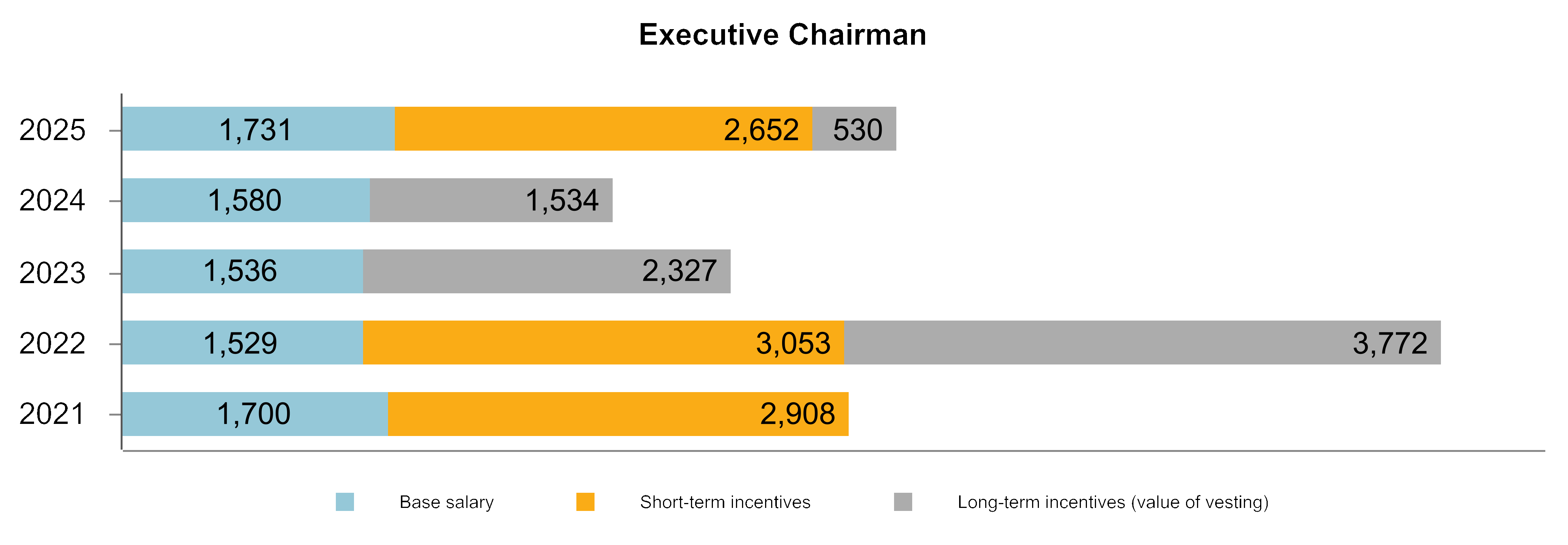
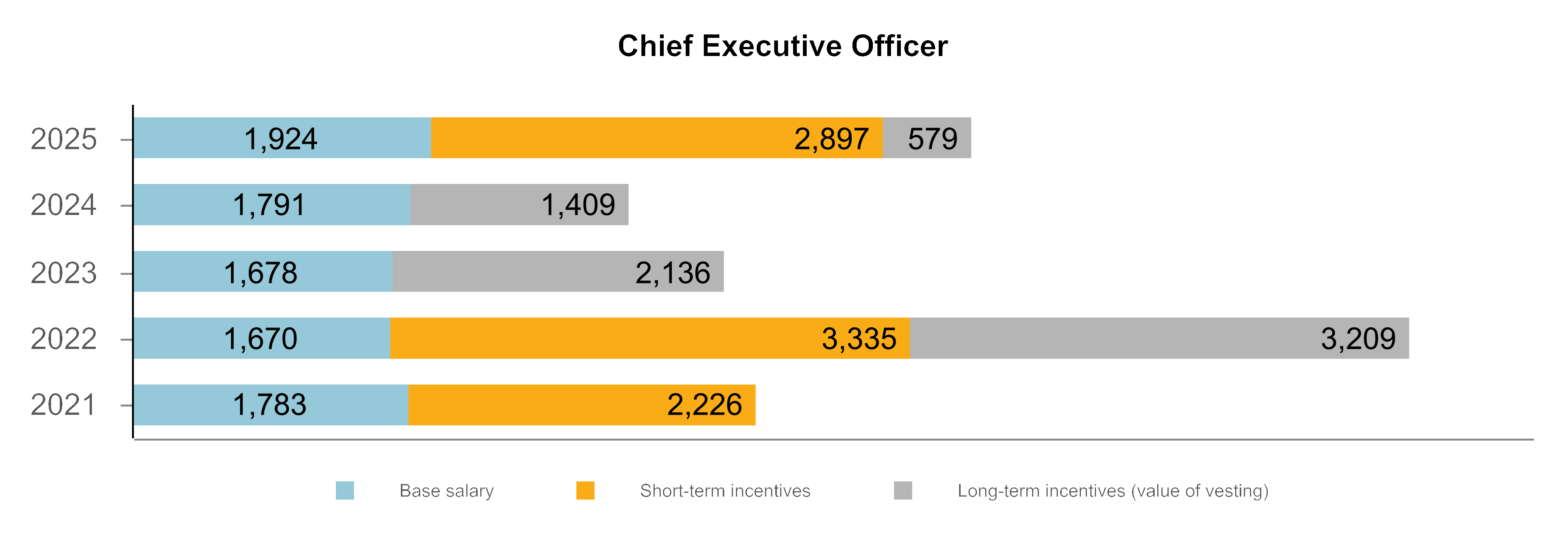
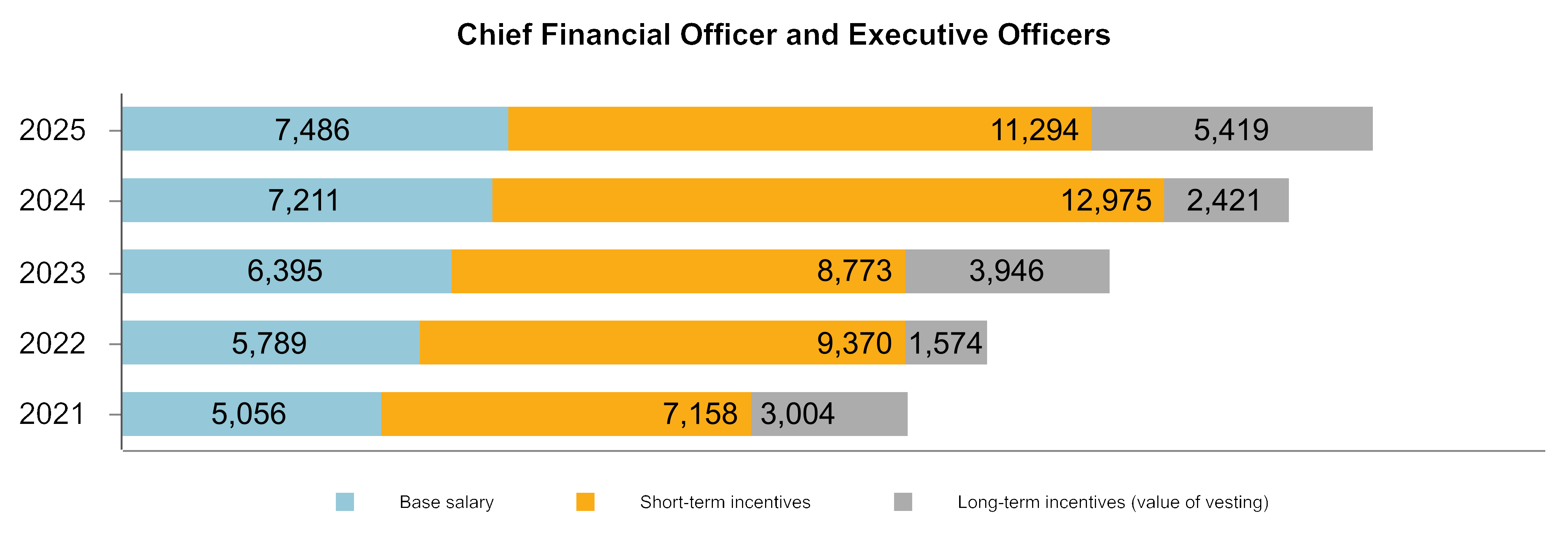
121
Management report |
2024 short-term incentives paid in 2025
Business Units | Executive | Realization as % of business target |
Executive Office* | Lakshmi N. Mittal Aditya Mittal | 116% |
Mining | Kleber Silva | 115% |
North America* | John Brett | 135% |
Corporate* | Genuino Christino | 116% |
Corporate* | Bradley Davey | 116% |
Corporate* | Stephanie Werner-Dietz | 116% |
UDJ* | Vijay Goyal | 80% |
AMNS India* | Dilip Oommen | 60% |
Europe* | Geert van Poelvoorde | 96% |
Long Carbon South America | Jefferson de Paula | 170% |
Note: Individual performance not included in the percent of realization. Jorge Ribeiro de Oliveira received his Short Term Incentive before being nominated Executive Officer,
the realization as % of business target was 134%.
*Health & Safety part of the bonus was nil due to the number of fatalities.
Long-term incentives vesting in 2025
Executive office
In 2025, the following long-term incentives vested:
Vehicle | Date of vesting | Date of grant | Number of PSUs granted to Executive office | Number of shares acquired by Executive office* |
PSUs | January 1, 2025 | December 16, 2021 | 109,143 | 34,107 |
*Includes 16,302 shares issued to the Executive Chairman and 17,805 shares issued to the CEO.
CFO and Other Executive Officers
In 2025, the following long-term incentives vested:
Vehicle | Date of vesting | Date of grant | Number of PSUs and RSUs granted to CFO and other Executive officers | Number of shares acquired by CFO and other Executive officers |
PSUs | January 1, 2025 | December 16, 2021 | 89,800 | 85,719 |
RSU* | December 13, 2025 | December 13, 2022 | 59,900 | 59,900 |
*Jefferson de Paula had a partial vesting as per plan rules at the time of retirement which is not included in those numbers as he was already retired.
Remuneration
Remuneration strategy
The ARCG Committee assists the Board of Directors to
maintain a formal and transparent procedure for setting policy
on senior management's remuneration and to determine an
appropriate remuneration package for senior management.
The ARCG Committee should ensure that remuneration
arrangements support the strategic aims of the business and
enable the recruitment, motivation and retention of senior
executives while complying with applicable rules and
regulations.
Board oversight
To this end, the Board of Directors has established the ARCG
Committee to assist it in making decisions affecting employee
remuneration. All members of the ARCG Committee are
required to be independent under the Company’s corporate
governance guidelines, the New York Stock Exchange
("NYSE") standards and the 10 Principles of Corporate
Governance of the Luxembourg Stock Exchange.
The members are appointed by the Board of Directors each
year after the annual general meeting of shareholders. The
122
Management report |
members have relevant expertise or experience relating to the
purposes of the ARCG Committee. The ARCG Committee
makes decisions by a simple majority with no member having a
casting vote and is chaired by Ms. Karyn Ovelmen, Lead
Independent Director.
Appointments, remuneration and corporate governance
committee
One of the tasks of the ARCG Committee is to assist the Board
of Directors by providing recommendations specifically related
to remuneration and compensation. This includes:
•reviewing and approving corporate and personal
goals and objectives relevant to the compensation of
the members of the Executive Office, Executive
Officers and senior management as deemed
appropriate by the committee, and evaluating their
performance in light of these goals and objectives.
•making recommendations to the Board of Directors
regarding trends in Board remuneration and incentive
compensation plans.
•recommending the Company’s framework of
remuneration for the members of the Executive Office,
Executive Officers and other senior executives as
determined by the committee. In making these
recommendations, the committee may consider
factors that it deems necessary, including a member’s
total cost of employment (factoring in equity/long term
incentives, any perquisites and benefits in kind and
pension contributions).
•approving a report on executive remuneration to be
included in the Company's annual report.
•reviewing the analysis of proxy advisory firms in the
context of corporate governance compensation.
Individual remuneration is discussed by the ARCG Committee
without the person concerned being present. The ARCG
Committee Chair presents the decisions and findings to the
Board of Directors after each ARCG Committee meeting.
See also "Corporate governance—Board of Directors
committees"' for further details and additional responsibilities of
the ARCG Committee.
Remuneration policy
The ARCG Committee has set policies applied to senior
management on base salary, short-term incentives and long-
term incentives. According to the Shareholders Right Directive
II, which was transposed into Luxembourg law in August 1,
2019, the remuneration policies must be approved at the
Annual General Meeting of shareholders at least every 4 years
and whenever there is a material change. The Company
submits the remuneration report for the prior year for
shareholder approval at each AGM.
Scope
ArcelorMittal’s remuneration philosophy and framework apply
to the following groups of senior management:
•the Executive Chairman and the CEO; and
•the CFO and other Executive Officers.
The remuneration philosophy and governing principles also
apply, with certain limitations, to a wider group of employees
including Executive Vice Presidents, Vice Presidents, General
Managers and Managers.
Remuneration philosophy
ArcelorMittal’s remuneration philosophy for its senior
management is based on the following principles:
•provide total remuneration competitive with executive
remuneration levels of peers of similar size, scope
and industry:
–Korn Ferry (KF) and WillisTowersWatson (WTW)
provide benchmarking services to ArcelorMittal for
all Management Committee members, an average
between KF and WTW data is performed;
–For the Steel division: Large industry - industrial
segment including metals, chemicals, mining,
transport, energy & utilities, upper revenues range;
–For the Mining division: Large companies with a
significant mining divisions or companies similar to
ArcelorMittal Mining division;
–Data are linked to each local market.
•encourage and reward performance that will lead to
long-term enhancement of shareholder value; and
•promote internal pay equity by providing base pay and
total remuneration levels that reflect the role, job size
and responsibility as well as the performance and
effectiveness of the individual.
Remuneration framework
The ARCG Committee develops proposals for senior
management remuneration annually for the Board of Directors'
consideration. Such proposals include the following
components:
•fixed annual salary;
•short-term incentives (i.e., performance-based
bonus); and
•long-term incentives (i.e., RSUs and/or PSUs).
123
Management report |
The Company does not have any deferred compensation plans
for senior management, including the Executive Chairman and
CEO.
The following table provides an overview of the remuneration policy applied by the ARCG:
Remuneration component and link to strategy | Operational and performance framework | Opportunity |
Fixed annual salary Competitive base salary to attract and retain high- quality and experienced senior executives | * Base salary levels are reviewed annually with effect from April 1 (except promotion) compared to the market to ensure that ArcelorMittal remains competitive with market median base pay levels * Reviews are based on market information obtained but not led by benchmarking to comparable roles, changes in responsibility and general economic conditions | The ARCG does not set a maximum salary, instead when determining any salary increases it takes into account a number of reference points including salary increases across the Company |
Benefits Competitive level to ensure coverage of the executives | * May include costs of health insurance, death and disability insurances, company car, tax return preparation, etc. * Relocation benefits may be provided where a change of location is made at Company’s request | The cost to the Company of providing benefits can change from year to year. The level of benefit provided is intended to remain competitive |
Pension Competitive level of post- employment benefit to attract and retain executives | * Local benchmark of pension contributions for comparable roles | |
Short term incentives (STI) Motivate the senior executives to achieve stretch performance on strategic priorities | * Scorecard is set at the commencement of each financial year * Measures and relative weights are chosen by the ARCG Committee to drive overall performance for the coming year * STI calculations for each executive reflect the performance of ArcelorMittal and /or the performance of the relevant business units, the achievement of specific objectives of the department and the individual executive’s overall performance * No STI is paid for a business performance below threshold 80% for each criteria; 100% STI payout for business performance achieved at 100% for each criteria; 150% STI payout for business performance achieved at 120% ; 200% STI payout for business performance achieve at 140% or above for each criteria | Range for Executive Chairman and CEO: 0 to 360% with a target at 120% of base salary Range for CFO and Executive Officers: 0 to 240% with a target at 80% (generally) of base salary in general (will depend on the region) |
LTIP Sustain shareholder wealth creation in excess of performance of a peer group and incentivize executives to achieve strategy | Executive Office and CFO1 LTIP * The vesting is subject to a relative TSR (Total Shareholder Return) and to a relative EPS compared to a peer group and to ESG targets over a three year- period *The peer group is determined by the ARCG Committee * No vesting will occur below the weighted average of the peer group or the target for ESG * Performance is determined by the ARCG Committee Executive Officers LTIP *The vesting is subject to two or three measures depending on the business units or group, ROCE, TSR vs. weighted average of the peer group and ESG *Vesting will occur if the performance is reached *Performance is determined by the ARCG Committee | Maximum value at grant: 180% of base salary for Executive Chairman and CEO and 110% of base salary for the CFO Guideline: 110%-180% of base salary for other Executive Officers depending on region |
1.Starting 2025.
Remuneration mix
The total remuneration target of the Executive Chairman, CEO
and CFO is structured to attract and retain executives; the
amount of the remuneration received is dependent on the
achievement of superior business and individual performance
and on generating sustained shareholder value from relative
performance.
The following remuneration charts, which illustrate the various
elements of the Executive Chairman, CEO, CFO and the other
Executive Officers' compensation, show the amounts for 2025
as a percentage of base salary. For each of the charts below,
the columns on the left, middle and on the right, respectively,
reflect the breakdown of compensation if targets are not met,
met and at maximum.
124
Management report |
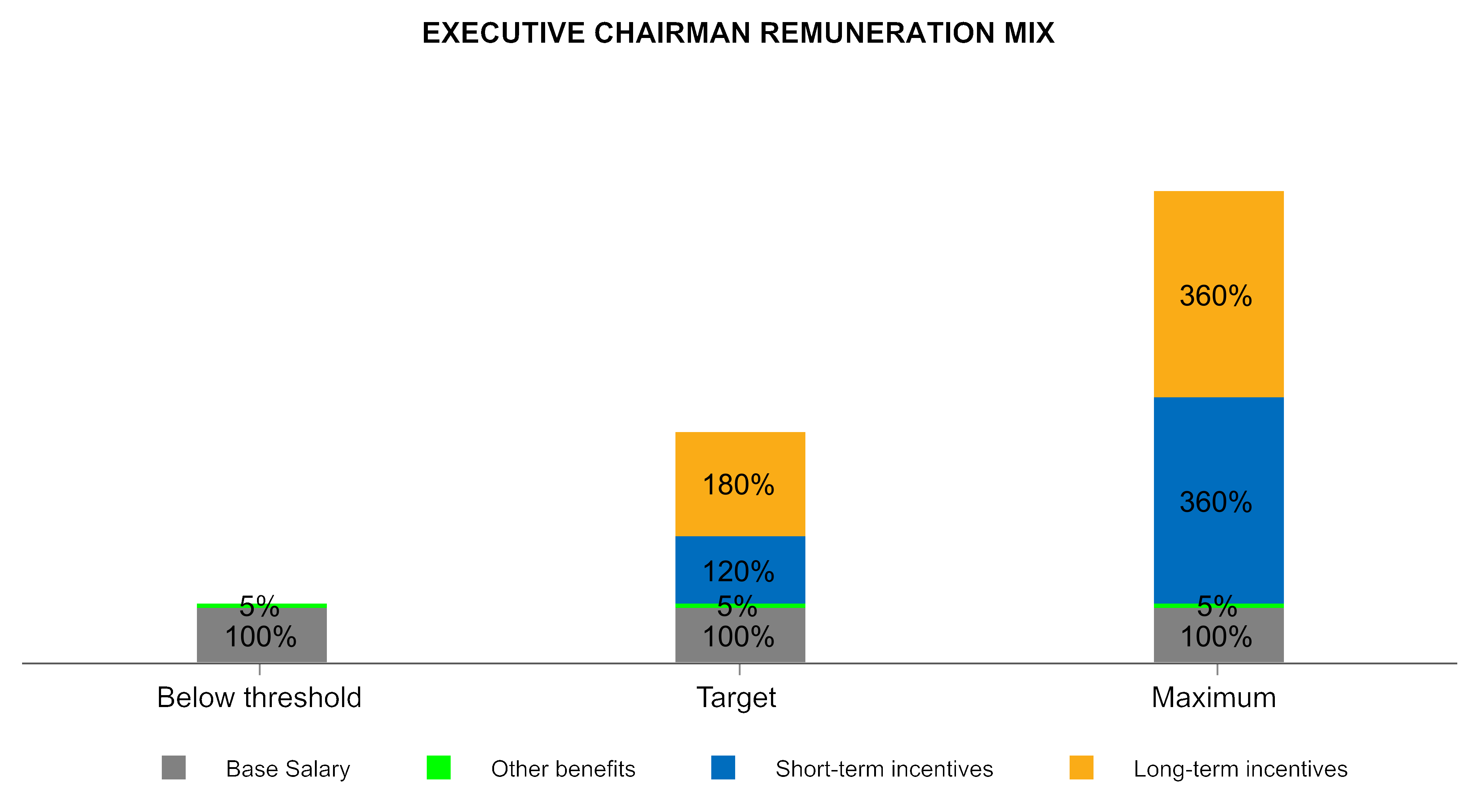
Note: no pension contribution
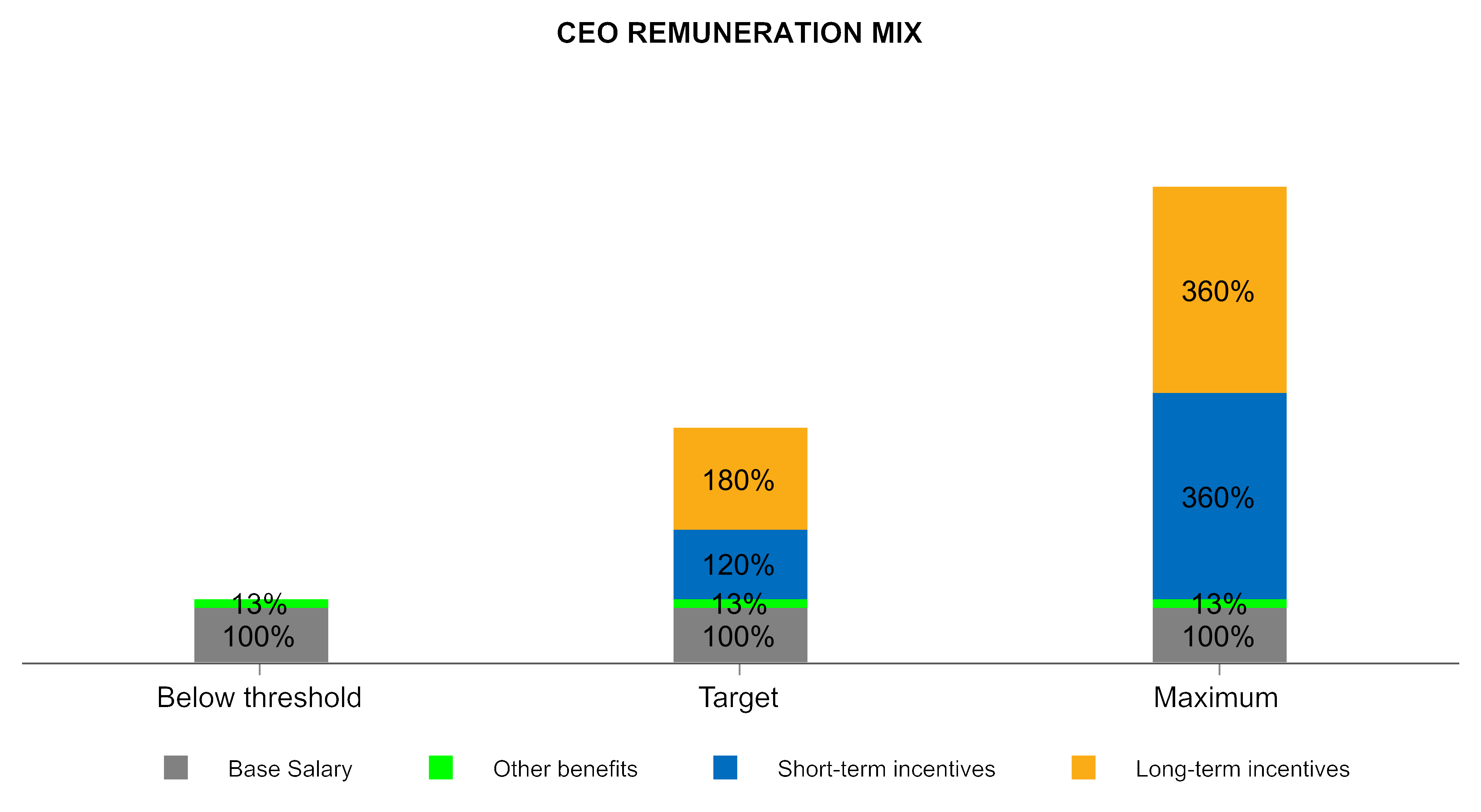
125
Management report |
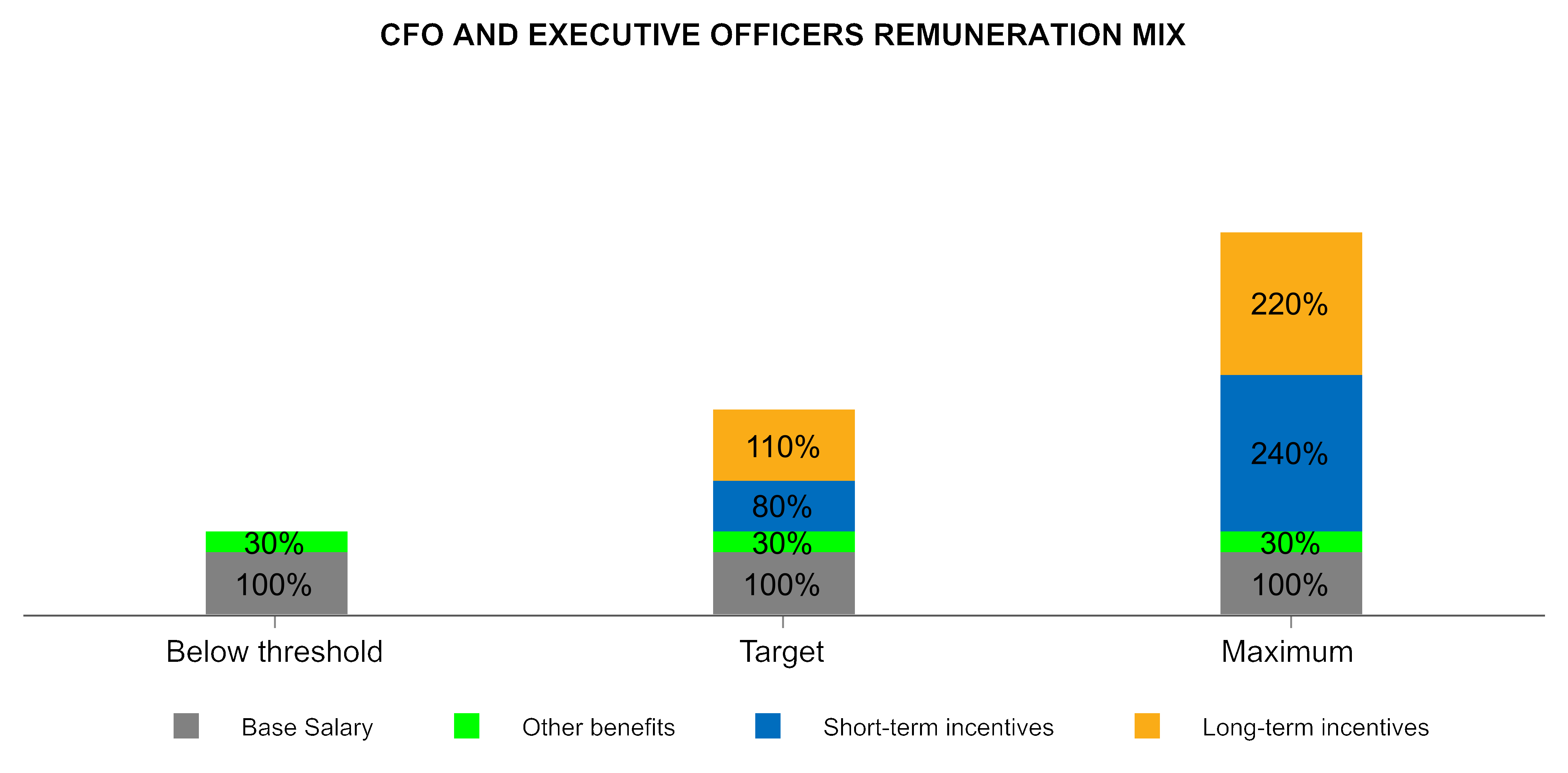
Note: Other benefits, as shown above, do not include international mobility incentives that may be provided.
2025 Total remuneration
The total remuneration paid in 2025 to members of
ArcelorMittal’s senior management listed in “Management and
employees—Directors and senior management” (including Mr.
Lakshmi N. Mittal in his capacity as Executive Chairman and
Mr. Aditya Mittal as CEO) was $12 million in base salary and
other benefits paid in cash (such as health, other insurances,
lunch allowances, financial services, gasoline and car
allowance) and $17 million in short-term performance-related
variable remuneration consisting of a short-term incentive
linked to the Company’s 2024 results and retention bonus.
During 2025, approximately $1.6 million was paid or accrued
by ArcelorMittal to provide pension benefits to senior
management (other than Mr. Lakshmi N. Mittal).
No loans or advances to ArcelorMittal’s senior management
were made during 2025, and no such loans or advances were
outstanding as of December 31, 2025.
The following table shows the remuneration received by the
Executive Chairman, CEO, CFO and the other Executive
Officers as determined by the ARCG Committee in relation to
the five most recent financial years including all remuneration
components:
126
Management report |
Executive Chairman5 | CEO | Chief Financial Officer and Executive Officers 6,7 | ||||||||||||||
(Amounts in $ thousands except for Long-term incentives) | 2025 | 2024 | 2023 | 2022 | 2021 | 2025 | 2024 | 2023 | 2022 | 2021 | 2025 | 2024 | 2023 | 2022 | 2021 | |
Base salary1 | 1,731 | 1,580 | 1,536 | 1,529 | 1,700 | 1,924 | 1,791 | 1,678 | 1,670 | 1,783 | 7,486 | 7,211 | 6,395 | 5,790 | 5,056 | |
Pension benefits | — | — | — | — | — | 192 | 179 | 168 | 167 | 178 | 1,454 | 1,235 | 1,041 | 1,066 | 1,348 | |
Other benefits2 | 98 | 90 | 80 | 72 | 66 | 55 | 43 | 44 | 39 | 38 | 784 | 865 | 674 | 599 | 237 | |
Short-term incentives3 | 2,652 | — | — | 3,053 | 2,908 | 2,897 | — | — | 3,335 | 2,226 | 11,294 | 12,975 | 8,773 | 9,370 | 7,158 | |
Long-term incentives | '- fair value in $ thousands4 | 3,114 | 2,518 | 1,391 | 1,520 | 1,419 | 3,338 | 2,888 | 1,519 | 1,661 | 1,550 | 9,721 | 9,001 | 6,544 | 3,838 | 4,396 |
- number of share units | 77,184 | 112,635 | 67,857 | 67,662 | 52,166 | 82,743 | 129,221 | 74,116 | 73,902 | 56,977 | 233,150 | 372,500 | 287,900 | 155,400 | 146,600 | |
1.After the salary decrease applied in 2020, the base salaries of the CEO and President and Chief Financial Officer were set back to the original amounts in 2021. In 2025, a
salary increase of 5.9% including the promotions was applied.
2.Other benefits comprise benefits paid in cash such as lunch allowances, financial services, gasoline and car allowances. Health insurance and other insurances are also
included.
3.Short-term incentives are either performance-based or retention bonus and are fully paid in cash. The short-term incentive for a given year relates to the Company’s results in
the previous year.
4.Fair value determined at the grant date is recorded as an expense using the straight line method over the vesting period and adjusted for the effect of non-market based vesting
conditions.
5.Amounts presented reflect the compensation as CEO until February 11, 2021 and as Executive Chairman thereafter.
6.Brian Aranha was included until March 31, 2021. Simon Wandke was included until September 30, 2021. Jefferson de Paula was included until March 31, 2025. New executive
officers were included as of their respective nomination date.
7.For the Chief Financial Officer and Executive Officers, the number of share units granted in 2025 includes 194,550 PSUs and 38,600 RSUs.
Short-term incentives
Targets associated with ArcelorMittal’s 2025 Annual
Performance Bonus Plan were aligned with the Companies’
strategic objectives of improving health and safety performance
and overall business performance and competitiveness.
For the Executive Chairman and the CEO, the 2025 annual
performance bonus formula is based on the achievement of the
following performance targets:
•EBITDA targets at Group level: 40% (acts as circuit breaker
for financial measures EBITDA and FCF);
•FCF targets at Group level: 25%;
•Gap to competition targets at Group level: 20%; and
•Health and safety performance targets at Group level: 15%.
The target for Health & Safety is to reduce the recordable
injury rate. To emphasize this priority, the fatality frequency
rate acts as a circuit breaker for the Health & Safety
component. The circuit breaker is set at a fatality frequency
rate of nil.
For the Executive Chairman and CEO, 100% achievement of
the agreed performance targets results in an annual
performance bonus which equals 120% of base salary.
For the CFO and other Executive Officers, the 2025 annual
performance bonus formula was tailored for their respective
positions and is generally based on the following performance
targets:
•EBITDA targets at Group, segment or Business unit level
(acts as circuit breaker for financial measures EBITDA and
FCF);
•FCF targets at Group, segment or Business unit level;
•Gap to competition targets at Group level, segment or
Business unit level;
•Health and safety performance targets at Group, Segment or
Business unit level (fatalities act as circuit breaker for this
component). The target for Health & Safety is to reduce the
recordable injury rate. The circuit breaker is set at a facility
frequency rate of 0.006 for 2025 and nil for 2026.
For the CFO and other Executive Officers, 100% achievement
of the agreed performance targets results in an annual
performance bonus which equals 80% of base salary in
general (depends on the region).
For the calculation of the annual performance bonus, the
achievement level of every performance target is calculated
separately, and these are added up.
Individual performance and assessment ratings define the
individual annual performance bonus multiplier that will be
applied to the annual performance bonus calculated based on
actual performance against the performance measures. Those
individuals who consistently perform at expected levels will
have an individual multiplier of 1. For outstanding performers,
an individual multiplier of up to 1.5 may cause the annual
performance bonus pay-out to be higher than 200% of the
target annual performance bonus, up to 360% of the target
127
Management report |
annual performance bonus being the absolute maximum for
the Executive Chairman and the CEO. Similarly, a reduction
factor will be applied for those at the lower end.
In exceptional circumstances, the ARCG Committee can
exercise discretion in the final determination of the annual
performance bonus.
The achievement level of performance for the annual
performance bonus for the Executive Chairman, the CEO, the
CFO and the other Executive Officers is summarized as
follows:
Functional level | Target achievement threshold @ 80% | Target achievement @ 100% | Target achievement @ 120% | Target achievement ≥ ceiling @ 140% | |||
Executive Chairman and CEO | 60% of base pay | 120% of base pay | 180% of base pay | 240% of base pay | |||
CFO and Executive Officers (in general, depending on the region) | 40% of base pay | 80% of base pay | 120% of base pay | 160% of base pay |
LTIP
The Executive Office benefits from a LTIP which grants PSUs
to the Executive office members (and the CFO starting 2025).
The PSUs vest based on performance targets linked to EPS
and TSR. Performance criteria also include ESG indicators
(see below).
ArcelorMittal also operates a long-term incentive plan ("the
ArcelorMittal Equity Incentive Plan") to incentivize shareholder
wealth creation in excess of performance of a peer group and
incentivize executives to achieve strategy. The ArcelorMittal
Equity Incentive Plan is intended to align the interests of the
Company’s shareholders and eligible employees by allowing
them to participate in the success of the Company. The
ArcelorMittal Equity Incentive Plan provides for the grant of
RSUs and PSUs to eligible employees of the Company
(including the CFO prior to 2025 and the Executive Officers)
and is designed to incentivize employees, improve the
Company’s long-term performance and retain key employees.
The maximum number of PSUs and RSUs available for grant
during any given year is subject to the prior approval of the
Company’s shareholders at the annual general meeting. The
2022, 2023, 2024 and 2025 Caps for the number of PSUs/
RSUs that may be allocated to the Executive Office plan and
other retention and performance based grants were approved
at the annual general meetings on May 4, 2022, May 2, 2023,
April 30, 2024 and May 6,2025, respectively, at a maximum of
3,500,000 shares, 3,500,000 shares, 5,500,000 shares and
6,000,000 shares, respectively.
RSUs granted under the ArcelorMittal Equity Incentive Plan are
designed to provide a retention incentive to beneficiaries.
RSUs are subject to “cliff vesting” after 3 years with 100% of
the grant vesting on the third anniversary of the grant
contingent upon the continued active employment of the
beneficiary within the Company.
PSU awards in connection with the ArcelorMittal Equity
Incentive Plan are subject to the fulfillment of performance
criteria such as ROCE, TSR and gap to competition (until
2022).
Since 2021, the performance criteria for the PSUs for the
Executive Office plan and the ArcelorMittal Equity Incentive
Plan include an ESG criteria comprised of a health & safety, a
climate action and, until 2024, a diversity & inclusion ("D&I")
target. For health & safety, the target was to halve the fatality
frequency rate versus a defined baseline (the baseline is the
adjusted average frequency rate over 5 years before the grant)
and is aligned to the level of circuit breaker applied in STI since
2024. For D&I, the target up to this point was to reduce the gap
between the Company's 2030 target of having 25% women in
management and 2020 baseline. Good progress has been
made in strengthening the number of women in leadership, and
given the critical importance of rapidly improving safety results
across the Company, ArcelorMittal increased the safety
component. For climate, the CO2 emission target has been set
to be reached by the end of the vesting period.
128
Management report |
On December 5, 2025, the Company issued the 2025 grant whose conditions were as follows:
Executive Office and CFO | Executive Officers other than CFO | ||||||||||||
2025 Grant | l | PSUs with a three-year performance period | l | PSUs with a three-year performance period | |||||||||
l | Value at grant 180% of base salary for the Executive Chairman and the CEO and 110% for the CFO | ||||||||||||
l | Vesting conditions: | l | Vesting conditions: | ||||||||||
Target | Stretch | Ceiling | Threshold | Target | Stretch | Ceiling | |||||||
TSR vs. peer group (50%) / EPS vs. peer group (20%) | 100% vs. weighted average | 120% vs. weighted average | ≥140% vs. weighted average | TSR vs. peer group (40%) | 80% rolling average | 100% rolling average | 120% rolling average | ≥140% rolling average | |||||
Vesting percentage | 100% | 150% | 200% | Vesting percentage | 50% | 100% | 150% | 200% | |||||
ROCE (40%) | 6% | 9% | 12% | 14% | |||||||||
ESG (30%): H&S 20%, Climate action 10% | 100% of target | 120% of target | ≥140% of target | Vesting percentage | 50% | 100% | 150% | 200% | |||||
Vesting percentage | 100% | 150% | 200% | ESG (20%): H&S 15%, Climate action 5% | 80% weighted average | 100% of target | 120% of target | 140% of target | |||||
Vesting percentage | 50% | 100% | 150% | 200% | |||||||||
l | RSUs with a three-year vesting period | ||||||||||||
See note 8.3 to the consolidated financial statements for a
summary of outstanding plans as of December 31, 2025
including the 2025 grant and for further details.
Other benefits
In addition to the remuneration described above, other benefits
may be provided to senior management and, in certain cases,
other employees. These other benefits can include insurance,
housing (in cases of international transfers), car allowances
and tax assistance.
SOX 304 and clawback policy
Under Section 304 of the Sarbanes-Oxley Act, the SEC may
seek to recover remuneration from the CEO and CFO of the
Company in the event that it is required to restate accounting
information due to any material misstatement thereof or as a
result of misconduct in respect of a financial reporting
requirement under the U.S. securities laws (the “SOX
Clawback”).
Under the SOX Clawback, the CEO and the CFO may have to
reimburse ArcelorMittal for any short-term incentive or other
incentive-based or equity-based remuneration received during
the 12-month period following the first public issuance or filing
with the SEC (whichever occurs first) of the relevant filing, and
any profits realized from the sale of ArcelorMittal securities
during that 12-month period.
In October 2022, the SEC adopted final rules implementing the
Dodd-Frank requirement for issuers to recover incentive-based
compensation erroneously paid to current and former executive
officers due to an accounting restatement. These clawback
rules required listing exchanges, such as the NYSE, to adopt
clawback standards as from the fourth quarter of 2023, with
issuers required to implement and disclose “no fault” clawback
policies that meet strict recovery standards for restatements,
within 60 days thereafter.
The Board of Directors, through its ARCG Committee, adopted
its own clawback policy in 2012, which was updated in 2023
(the "Clawback Policy"), to reflect the Company’s structural
changes and comply with the new rules.
The Clawback Policy applies to all Executive Officers and
covers cash short-term incentives and any other incentive-
based or equity-based remuneration, as well as profits from the
sale of the Company’s securities ("Covered Compensation")
received during the three completed fiscal years of the
Company immediately preceding a Restatement Date (as
defined in the policy) and any transition period (that results
from a change in the Company’s fiscal year) of less than nine
months within or immediately following those three completed
fiscal years. Compensation is deemed to be received in the
Company’s fiscal period during which the Financial Reporting
Measure specified in the Incentive-based Compensation award
is attained (capitalized terms as defined in the policy).
Under the Clawback Policy, ArcelorMittal will recover
reasonably promptly erroneously paid Covered Compensation
in the event it is required to prepare an accounting restatement
due to the material non-compliance of ArcelorMittal with any
financial reporting requirement under the U.S. securities laws,
including any required accounting restatement to correct an
error in a previously issued financial statement that is material
to the previously issued financial statement, or that would
result in a material misstatement if the error were corrected in
the current period or left uncorrected in the current period.
129
Management report |
Employees
As of December 31, 2025, ArcelorMittal employed
approximately 125,554 full time equivalent ("FTE") employees
directly, as well as a large number of contractors. The
Company recruits, hires, promotes and retains employees
based on merit and demonstrated skills.
The table below sets forth the number of FTE employees
respectively by segment as of the end of each of the past three
years.
As of December 31, | |||
Segment | 2025 | 2024 | 2023 |
North America | 16,083 | 13,861 | 14,418 |
Brazil | 25,014 | 22,624 | 22,042 |
Europe | 43,878 | 48,544 | 49,959 |
Sustainable Solutions | 13,149 | 12,843 | 12,194 |
Mining | 5,918 | 4,758 | 4,473 |
Others | 21,512 | 22,786 | 23,670 |
Total | 125,554 | 125,416 | 126,756 |
The people strategy
To meet the evolving needs of its people and address the
challenges of a shifting skills economy, technological
advancements, and generational transitions, ArcelorMittal
remains committed to delivering its people strategy, launched
in 2022. The strategy is built around ArcelorMittal's
fundamental purpose to create smarter steels for people and
planet. This strategy seeks to boost talent and continuously
foster a safety-first, people-driven culture that ensures
sustainable performance and enables the Company to deliver
on its purpose.
Employee development
Attracting, developing and retaining the right people continues
to be a strategic priority for ArcelorMittal in sustaining a high-
performing organization.
With strong competition for the best talent, ArcelorMittal is
committed to ensuring the Company is an aspirational
workplace—one where employees feel safe, respected and
valued. This also means building a culture that constantly
keeps employees engaged, motivated, and eager to learn and
excel.
Employee development, which includes succession planning
and the development of early career talents plays a crucial role
in building a high-performing organization. The Company
strives to provide employees with broad career opportunities,
supported by continuous training and ongoing initiatives to
develop both technical and behavioral skills. A dedicated
process helps identify high potential employees ("HiPos") and
manage the succession of key roles.
In 2025, the Company continued its efforts to develop
employees' skills and accelerate their readiness to take on
increased responsibilities. A strong focus was placed on having
the right people in the right roles at the right time,
strengthening key succession plans, and preparing future
leaders. Efforts also included anticipating and filling vacancies;
building a robust and qualified leadership pipeline; encouraging
individual and sustained performance; and fostering talent
retention through recognition, empowerment, and meaningful
work.
To further support career growth, ArcelorMittal continued its
communications initiatives to increase the visibility of global
career opportunities, ensuring employees are aware of
potential paths for advancement within the organization.
The Company continued to enhance the quality of its
succession planning, ensuring better process execution and
stronger alignment between potential successors and their
career aspirations.
In 2025, the Company continued to experience high virtual
learning engagement at ArcelorMittal University ("AMU"),
further expanding its global community. Employees across the
Group invested an average of 5.9 hours each to online learning
with around 140,000 active learners logging around 930,000
hours.
The Company continued offering world-class leadership
programs through AMU. In 2025, the Company partnered with
best-in-class educational institutions to enhance the
educational experience to the highest level for its leaders.
Delivered in a blended format—combining face-to-face (where
possible) with digital sessions—these programs support the
development of talent and future leaders. In 2025, 769
employees graduated from 33 leadership programs throughout
the year.
'Thrive' program, which was introduced in 2024 in North
America, Brazil, and Europe to help employees accelerate their
career growth, has been a key vehicle in promoting mobility-
based development. The program matches individuals with
suitable roles and career opportunities based on their
preferences, skills and qualifications.
ArcelorMittal's Group Mentoring Program also remained a vital
resource, offering employees an opportunity to engage in a
structured mentoring relationship with an experienced leader.
In 2025, more than 1,024 mentorship hours were invested as
part of the program with 190 active mentor-mentee pairs as of
December 31, 2025.
The Company also piloted various AI-enabled tools and
solutions in areas such as knowledge transfer and coaching,
aiming to accelerate employee development and support more
effective succession planning, ultimately strengthening talent
retention and organizational performance.
130
Management report |
In order to ensure readiness and to enable full utilization of AI
and related tools, over 74,000 employees, including all leaders,
were enrolled in AI-readiness trainings with different modules.
Speak Up +, the global employee survey
For the past few years, ArcelorMittal's Speak Up + survey has
been the Group’s flagship employee engagement tool. It
gathers insights from professionals and leadership on their
experience working at ArcelorMittal, what the Company does
well and areas for improvement.
In 2025, ArcelorMittal continued to listen to employees' voices
through these surveys, which serve as the ongoing vehicle to
help the Company’s leaders stay attuned to the organization in
a rapidly changing environment. The goal is to track
engagement levels across the Group, understand employees'
aspirations, and empower leaders to address potential issues
proactively.
The outcome from each Speak Up + survey is compared to
internal benchmarks over time and external industry peers.
This enables leaders to identify strengths, detect risks—such
as attrition—and take actions to enhance employee
engagement.
Based on survey outcomes, concrete actions are continuously
developed and implemented to address employee concerns
and drive engagement.
Embedding Health & Safety (H&S)
In line with the H&S strategy and as an essential element of
the Corporate H&S roadmap, the Company dedicated efforts to
embedding H&S considerations into HR policies and
processes, thereby achieving a strong integration of H&S
across all phases of the employee lifecycle.
The Joint Global H&S Committee, established under the
agreement signed in 2008 between the Company and trade
unions, is composed of 16 representatives from management
and the unions and aims to identify areas for improvement and
harmonize safety performance across the Group. The Joint
Global H&S Committee deals with issues related to H&S and
does not act as a negotiation committee on behalf of unions or
management. One of its primary priorities is centered around
overseeing deployment and monitoring the compliance of local
joint H&S panels. This involves developing guidelines for
progress, conducting site visits to assess implementation, and
offering suggestions for improvement. Additionally, the Joint
Global H&S Committee provides recommendations on
transversal and global topics to enhance overall safety
measures.
In 2025, virtual meetings and one in-person meeting were held
to review the H&S Committee's effectiveness and the members
conducted two site visits to ensure progress and compliance
on the ground. The Company continues to strengthen safety
mindset and behaviors to support the Journey to Zero and
strengthen a unified "One Safety Culture." This is achieved by
reinforcing existing training such as Take Care and introducing
the dSS+ led area of Transformation initiative. In 2025, a newly
designed Safety Leadership Program was launched for senior
management, covering all regions and business segments.
Additionally, safety is being further integrated into the
employee lifecycle: H&S principles are now embedded across
HR processes and practices, from recruitment to career
planning and development. See “Business overview—
Sustainable development—Health and Safety".
Equal opportunity and non-discrimination
ArcelorMittal values bringing together fresh perspectives and
experiences to the business as part of its ambition to be an
employer of choice. The Company is present in over 60
countries and has employees from different countries and
backgrounds. In 2022, the Company defined a clear roadmap
to ensure equal opportunity and non-discrimination.
Subsequently, a strategic framework was launched in 2024,
which includes best practices as a reference guide for all
segments and plants to achieve equality for all employees.
The Company continuously reviews and updates its people-
related policies and practices to ensure they remain relevant,
effective, and compliant across the regions in which the
Company operates. These policies are designed to deliver
positive and consistent outcomes for all the stakeholders,
including employees.
During the year, the Company reviewed its Diversity &
Inclusion Policy, placing greater emphasis on non-
discrimination, and merit-based opportunity across the
workforce. As a result, the policy evolved into the Equal
Opportunity and Non-Discrimination Policy, which is scheduled
for launch in 2026.
In 2025, women held 20.5% of management positions across
the Group based on merit, compared to 19% in 2024.
As of December 31, 2025, women held four of the nine
positions on the Board of Directors.
Collective Labor Agreements ("CLAs")
In multiple regions globally, ArcelorMittal employees are
represented by trade unions and the Company actively
engages in collective bargaining agreements with employee
organizations at specific locations. The description below
provides an overview of the current status of specific
agreement and relationships.
The Company is committed to open, respectful and transparent
social dialogue at all of its operations, to maintain strong
employee relations, and to provide a safe, healthy and quality
working life for all its workers. ArcelorMittal is respecting its
commitment to social dialogue and all entities have regular
discussions and negotiations on salary policy with their
respective unions.
131
Management report |
In 2025, several entities and employees in several countries
negotiated new or the renewal of CLAs.
Employees of ArcelorMittal's North America segment continued
to work under collective agreements that remain valid. As of
December 31, 2025, the segment had 22 collective labor
agreements in place, covering 45% of the workforce of the
segment. Segment management maintained good social
dialogue with all unions and non-represented employees,
fostering constructive relationships and ongoing
communication.
In South America, most of the employees are covered by
CLAs. However, Costa Rica has no trade union representation.
Brazil experienced elevated inflation in 2025, and CLA
negotiations are expected to align wage adjustments with
inflation. Argentina's inflation dropped significantly, but wage
agreements remained below inflation.
In Europe, four meetings were conducted in 2025 to inform the
European Works Council ("EWC") representatives about the
H&S and business performance and outlook regarding the
Company's European operations. In parallel to these meetings,
a consultation process was carried out regarding a business
transformation project of the support functions.
In France, a one-year salary agreement for 2025 was signed in
December 2024, covering all the legal entities. In June 2025,
ArcelorMittal France announced a restructuring plan and
started negotiations with unions. In November 2025, both
parties reached to an agreement on a workforce reduction
plan. All employees in France are covered by CLAs.
In Luxembourg, the meeting between the government, the
trade unions and the Company confirmed that the Company
complied with its commitments of investments based on the
LUX2025 agreement (job retention plan ending December 31,
2025). Discussions for the next LUX2030 agreement have also
started.
In Germany, the collective agreement, renewed in October
2024, will remain valid until December 31, 2026. It provided for
a 5.5% salary increase effective January 1, 2025, followed by
an additional increase of approximately 1.75% effective
January 1, 2026.
In 2025, at ArcelorMittal Poland, a successful negotiation of the
CLA was achieved with trade unions. The management also
invited trade union representatives to the Supervisory Board,
promoting transparency and inclusive decision-making. About
99% of employees are covered by the CLA, with only top
executives excluded.
In Spain, a temporary layoff plan was agreed upon in late 2024
due to market conditions and extended through 2025. A
framework agreement for labor relations was signed with most
unions and all local CLAs were finalized and implemented in
2025, covering about 100% of the workforce. Additionally, in
compliance with recently introduced legal requirements, an
equality and non-discrimination plan for the entire group in
Spain and a disaster prevention protocol defining response
action plans, have been agreed and signed with the unions.
In 2025, the situation in Ukraine continued to be difficult in
terms of personnel due to the war with Russia. The martial law
imposed by the country's government since February 2022,
which, among other things, limits the labor rights of employees
and trade unions (such as the right to strike; the right to
vacation, etc.) remains in force. In 2025, more than 3,900 of
AMKR’s employees were mobilized and more than 330 were
deceased, captured or missed in action. The facility continued
to experience a significant outflow of personnel, mainly men,
due to mobilization. As a consequence, it launched recruitment
campaigns to attract women and young people. Despite
operating at 30-50% of production capacity, AMKR maintained
work positions and wages for its 17,500 workers avoiding
layoffs.
In South Africa, approximately 70% of the workforce is covered
by a CLA/bargaining council agreement concluded between
management and the recognized trade unions i.e. NUMSA and
Solidarity trade unions. The CLA will expire in March 2026.
Annual wage negotiations to amend wages and conditions of
employment will take place from February 1, 2026 to March 31,
2026.The Longs business wind-down at the Newcastle facility
commenced at the end of the third quarter of 2025 with all
plants systematically and safely placed in a care and
maintenance state. The final activities underway included safe
wind-down of utilities and coke making plants with the last
group of affected employees exiting end of January 2026.
Throughout 2025, ArcelorMittal's operations in the Mining
segment maintained a productive engagement with the trade
unions and communities where they operate. 78% and 83% of
the workforce is unionized in ArcelorMittal's operations in
Canada and Liberia, respectively. Labor agreements were
successfully concluded in Canada for five years and in Liberia,
for three years without any industrial actions.
Corporate governance
This section describes the corporate governance practices of
ArcelorMittal for the year ended December 31, 2025.
Board of Directors and senior management
ArcelorMittal is governed by a Board of Directors and managed
by the senior management. As described in "—Directors and
senior management" above, ArcelorMittal’s senior
management is comprised of the Executive Office - comprising
the Executive Chairman, Mr. Lakshmi N. Mittal and the CEO,
Mr. Aditya Mittal. The Executive Office is supported by a team
of nine other Executive Officers, who together encompass the
132
Management report |
key regions and corporate functions. As of December 31, 2025,
the average age and serving period of board members is 62
years and 11 years, respectively.
A number of corporate governance provisions in the Articles of
Association of ArcelorMittal reflect provisions of the
Memorandum of Understanding signed on June 25, 2006 (prior
to Mittal Steel Company N.V.’s merger with Arcelor), amended
in April 2008 and which mostly expired on August 1, 2009. For
more information about the Memorandum of Understanding,
see “Additional information—Material contracts—Memorandum
of Understanding”.
ArcelorMittal fully complies with the 10 Principles of Corporate
Governance of the Luxembourg Stock Exchange. This is
explained in more detail in “—Other corporate governance
practices” below. ArcelorMittal also complies with the New York
Stock Exchange Listed Company Manual as applicable to
foreign private issuers. There are no significant differences
between the corporate governance practices of ArcelorMittal
and those required of a U.S. domestic issuer under the Listed
Company Manual of the New York Stock Exchange.
Board of Directors
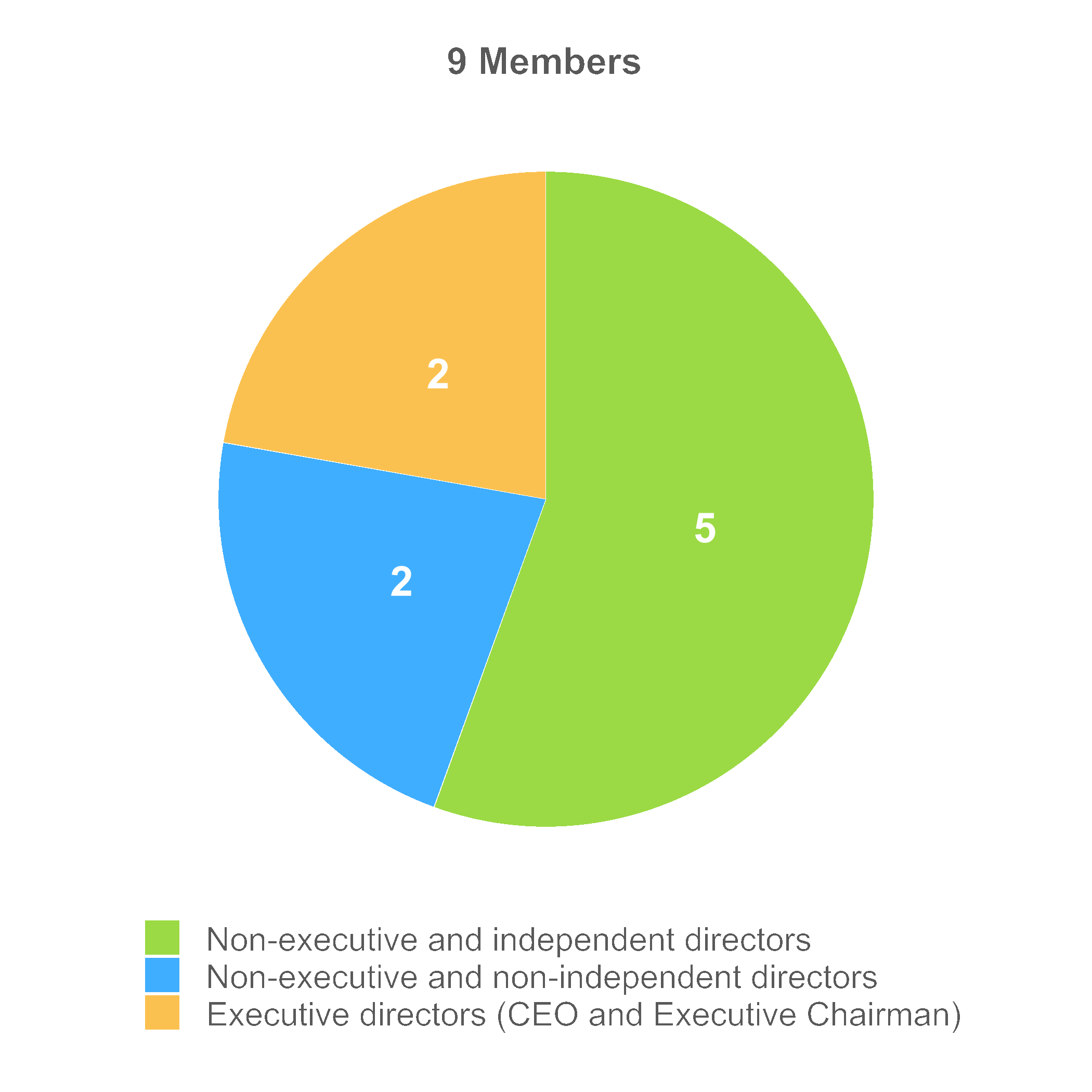
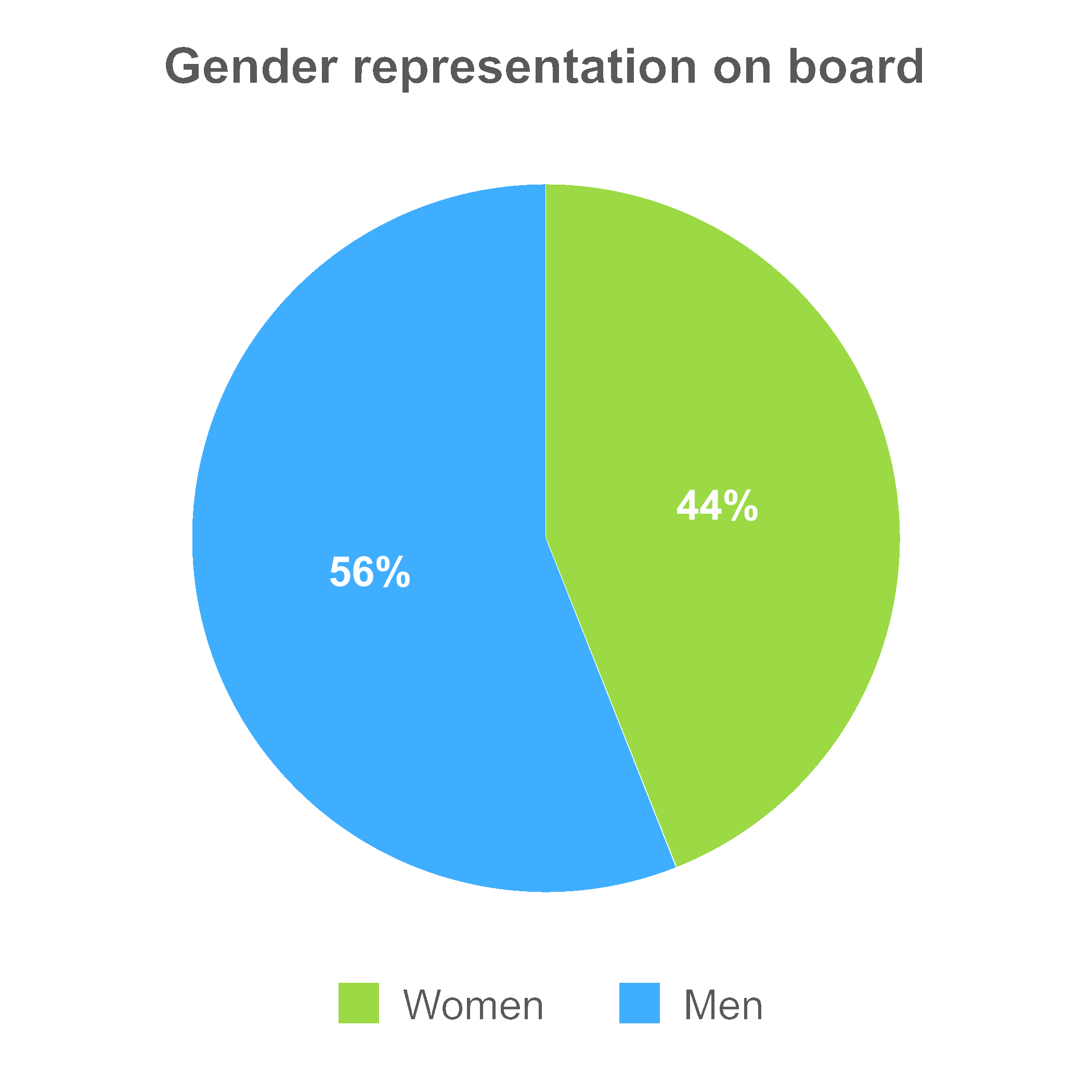
The Board of Directors is in charge of the overall governance
and direction of ArcelorMittal. It is responsible for the
performance of all acts of administration necessary or useful in
furtherance of the corporate purpose of ArcelorMittal, except
for matters reserved by Luxembourg law or the Articles of
Association to the general meeting of shareholders. The
Articles of Association provide that the Board of Directors is
composed of a minimum of 3 and a maximum of 18 members.
The Articles of Association provide that directors are elected
and removed by the general meeting of shareholders by a
simple majority of votes cast. Other than as set out in the
Company’s Articles of Association, no shareholder has any
specific right to nominate, elect or remove directors. Directors
are elected by the general meeting of shareholders for three-
year terms. In the event that a vacancy arises on the Board of
Directors for any reason, the remaining members of the Board
of Directors may by a simple majority elect a new director to
temporarily fulfill the duties attaching to the vacant post until
the next general meeting of the shareholders.
For further information on the composition of the Board of
Directors, including the expiration of each Director’s term and
the period during which each Director has served, see section
"—Directors and senior management " above.
Mr. Lakshmi N. Mittal was elected Chairman of the Board of
Directors on May 13, 2008. Mr. Lakshmi N. Mittal was also
ArcelorMittal’s CEO until February 11, 2021. Mr. Lakshmi N.
Mittal was re-elected to the Board of Directors for a three-year
133
Management report |
term at the annual general meeting of shareholders on May 2,
2023.
A director is considered “independent” if:
(a)he or she is independent within the meaning of the New
York Stock Exchange Listed Company Manual, as
applicable to foreign private issuers,
(b)he or she is unaffiliated with any shareholder owning or
controlling more than two percent of the total issued share
capital of ArcelorMittal, and
(c)the Board of Directors makes an affirmative determination
to this effect.
For these purposes, a person is deemed affiliated to a
shareholder if he or she is an executive officer, a director who
also is an employee, a general partner, a managing member or
a controlling shareholder of such shareholder. The 10
Principles of Governance of the Luxembourg Stock Exchange,
which constitute ArcelorMittal's domestic corporate governance
code, require ArcelorMittal to define the independence criteria
that apply to its directors, which are described in article 8.1 of
its Articles of Association.
Specific characteristics of the director role
Required share ownership Lead Independent Director - minimum of 6,000 ordinary shares Non-executive directors - minimum of 4,000 ordinary shares | Maximum 12 year service (independent directors) | May not serve on the boards of directors of more than four publicly listed companies (non- executive directors) | Required to sign the Company’s Code of Business Conduct and confirm their adherence annually |
The Company’s Articles of Association do not require directors
to be shareholders of the Company. The Board of Directors
nevertheless adopted a share ownership policy on October 30,
2012, that was amended on November 7, 2017, considering
that it is in the best interests of all shareholders for all non-
executive directors to acquire and hold a minimum number of
ArcelorMittal ordinary shares in order to better align their long-
term interests with those of ArcelorMittal’s shareholders. The
Board of Directors believes that this share ownership policy will
result in a meaningful holding of ArcelorMittal shares by each
non-executive director, while at the same time taking into
account the fact that the share ownership requirement should
not be excessive in order not to unnecessarily limit the pool of
available candidates for appointment to the Board of Directors.
Directors must hold their shares directly or indirectly, and as
sole or joint beneficiary owner (e.g., with a spouse or minor
children), at the latest within three years of his or her election
to the Board of Directors. Each director will hold the shares
acquired on the basis of this policy for so long as he or she
serves on the Board of Directors. Directors purchasing shares
in compliance with this policy must comply with the
ArcelorMittal Insider Dealing Regulations and, in particular,
refrain from trading during any restricted period, including any
such period that may apply immediately after the Director’s
departure from the Board of Directors for any reason.
On October 30, 2012, the Board of Directors also adopted a
policy that places limitations on the terms of independent
directors as well as the number of directorships that directors
may hold in order to align the Company’s corporate
governance practices with best practices in this area (as
highlighted in the table above). Nevertheless, the Board of
Directors may, by way of exception to this rule, make an
affirmative determination, on a case-by-case basis, that a
Director may continue to serve beyond the 12-year rule if the
Board of Directors considers it to be in the best interest of the
Company based on the contribution of the Director involved
taking into consideration the balance between the knowledge,
skills, experience of the director and the need for renewal of
the Board.
As membership of the Board of Directors represents a
significant time commitment, the policy requires both executive
and non-executive directors to devote sufficient time to the
discharge of their duties as a Director of ArcelorMittal. Directors
are therefore required to consult with the Chairman and the
Lead Independent Director before accepting any additional
commitment that could conflict with or impact the time they can
devote to their role as a Director of ArcelorMittal. A non-
executive Director’s service on the board of directors of any
subsidiary or affiliate of ArcelorMittal or of any non-publicly
listed company is not taken into account for purposes of
complying with the service limitation.
Although non-executive directors of ArcelorMittal who change
their principal occupation or business association are not
necessarily required to leave the Board of Directors, the policy
requires each non-executive director, in such circumstances, to
promptly inform the Board of Directors of the action he or she
134
Management report |
is contemplating. Should the Board of Directors determine that
the contemplated action would generate a conflict of interest,
such non-executive director would be asked to tender his or
her resignation to the Chairman of the Board of Directors, who
would decide to accept the resignation or not.
None of the members of the Board of Directors, including the
executive directors, have entered into service contracts with
ArcelorMittal or any of its subsidiaries that provide for any form
of remuneration or for benefits upon the termination of their
term. All non-executive Directors of the Company signed the
Company’s Appointment Letter, which confirms the conditions
of their appointment by the General Meeting of the
Shareholders including compliance with certain non-compete
provisions, the 10 Principles of Corporate Governance of the
Luxembourg Stock Exchange and the Company’s Code of
Business Conduct.
The remuneration of the members of the Board of Directors is
determined on a yearly basis by the annual general meeting of
shareholders.
Share transactions by management
In compliance with laws prohibiting insider dealing, the Board
of Directors of ArcelorMittal has adopted insider dealing
regulations, which apply throughout the ArcelorMittal group.
These regulations are designed to ensure that insider
information is treated appropriately within the Company and
avoid insider dealing and market manipulation. Any breach of
the rules set out in this procedure may lead to criminal or civil
charges against the individuals involved, as well as disciplinary
action by the Company.
Operation
General
The Board of Directors and the Board committees may engage
the services of external experts or advisers as well as take all
actions necessary or useful to implement the Company’s
corporate purpose. The Board of Directors (including its three
committees) has its own budget, which covers functioning
costs such as external consultants, continuing education
activities for directors and travel expenses.
Meetings
The Board of Directors meets when convened by the Chairman
of the Board or any two members of the Board of Directors.
The Board of Directors holds physical meetings at least on a
quarterly basis as five regular meetings are scheduled per
year. The Board of Directors holds additional meetings if and
when circumstances require, in person or by teleconference
and can take decisions by written circulation, provided that all
members of the Board of Directors agree.
In 2025, the Board of Directors held 6 meetings with 100% of
the average attendance rate.
6 meetings (2025) | 100% Average attendance rate |
In order for a meeting of the Board of Directors to be validly
held, a majority of the directors must be present or
represented, including at least a majority of the independent
directors. In the absence of the Chairman, the Board of
Directors will appoint a chairman by majority vote for the
meeting in question. The Chairman may decide not to
participate in a Board of Directors’ meeting, provided he has
given a proxy to one of the directors who will be present at the
meeting. For any meeting of the Board of Directors, a director
may designate another director to represent him or her and
vote in his or her name, provided that the director so
designated may not represent more than one of his or her
colleagues at any time.
Each director has one vote and none of the directors, including
the Chairman, has a casting vote. Decisions of the Board of
Directors are made by a majority of the directors present and
represented at a validly constituted meeting, except for the
decisions of the Board of Directors relating to the issue of any
financial instruments carrying or potentially carrying a right to
equity pursuant to the authorization conferred by article 5.5 of
the Articles of Association, which shall be taken by a majority of
two-thirds of the directors present or represented at a validly
constituted meeting.
Lead Independent Director
Mrs. Karyn Ovelmen was elected by the Board of Directors as
ArcelorMittal's Lead Independent Director at the board meeting
held on May 2, 2023.
The agenda of each meeting of the Board of Directors is
decided jointly by the Chairman of the Board of Directors and
the Lead Independent Director.
Separate meetings of independent directors
The independent members of the Board of Directors may
schedule meetings outside the presence of non-independent
directors. Systematic executive sessions take place at the end
of each committee and of each board meeting. 18 meetings of
the independent directors outside the presence of
management were held in 2025.
Annual self-evaluation
The Board of Directors decided in 2008 to start conducting an
annual self-evaluation of its functioning in order to identify
potential areas for improvement. The first self-evaluation
process was carried out in early 2009. The self-evaluation
process includes structured interviews between the Lead
135
Management report |
Independent Director and each director and covers the overall
performance of the Board of Directors, its relations with senior
management, the performance of individual directors, and the
performance of the committees. The process is supported by
the Company Secretary under the supervision of the Chairman
and the Lead Independent Director. The findings of the self-
evaluation process are examined by the ARCG Committee and
presented with recommendations from the ARCG Committee to
the Board of Directors for adoption and implementation.
Suggestions for improvement of the Board of Directors’
process based on the prior year’s performance and functioning
are implemented during the following year.
The 2025 Board of Directors’ self-evaluation was completed by
the Board on January 27, 2026. The Board of Directors was of
the opinion that it and the management had cooperated
successfully during 2025. Strong focus has continued to be
given on health and safety, on environmental matters, on
Board succession planning as well as on the operations in
India and Europe. The Board of Directors reviewed the
practical implementation of the governance structure and
considered it was working well. The Board set new priorities for
discussion and review and identified a number of priority topics
for 2026.
The Board of Directors believes that its members have the
appropriate range of skills, knowledge and experience, as well
as the degree of perspectives, experiences and background
necessary to enable it to effectively govern the business. The
Board of Directors composition is reviewed on a regular basis
and additional skills and experience are actively searched for in
line with the expected development of ArcelorMittal’s business
as and when appropriate.
136
Management report |
Required skills, experience and other personal characteristics
ArcelorMittal Board Skills Matrix | |||||||||||
Director Qualifications | Competencies and relevance to ArcelorMittal | Lakshmi N. Mittal | Aditya Mittal | Vanisha Mittal Bhatia | Karyn Ovelmen | Michel Wurth | Clarissa Lins | Karel de Gucht | Etienne Schneider | Patricia Barbizet | TOTAL |
Individuals who have achieved prominence in their fields | Current CEO/Former CEO Experience serving as a CEO or other prominent leader provides unique perspectives to help the Board independently oversee ArcelorMittal's CEO and management and increases understanding and appreciation of the many facets of modern international organizations, including strategic planning, financial reporting and compliance, and risk oversight. | x | x | x | 3 | ||||||
Experience and demonstrated expertise in managing large relatively complex organizations, such as CEOs of a significant company or organization with global responsibilities | Large or complex Organizations/Global Business/Industrial Operations Experience Experience leading a large organization or global business provides practical insights on the challenges and opportunities complex businesses encounter in diverse business environments, economic conditions and cultures; having experience with industrial operations assists in understanding the issues that may face ArcelorMittal in its worldwide activities, including maintenance needs, labor relations and regulatory requirements. | x | x | x | x | x | x | x | x | x | 9 |
Government/Regulatory/Public Policy Experience Experience in government and regulatory affairs is helpful as the steel industry is heavily regulated in countries around the world and changes in public policy could affect ArcelorMittal's business. | x | x | x | x | x | 5 | |||||
Financial or other risk management expertise | Financial Experience An understanding of the reporting responsibilities of public companies and the issues commonly faced by public companies is important in navigating governance issues as they apply to ArcelorMittal. | x | x | x | x | x | 5 | ||||
Risk Management Experience Experience in effectively identifying, prioritizing and managing a broad spectrum of risks can help the Board in assessing, anticipating and overseeing the Company's management of the risks faced by its various businesses. | x | x | x | x | x | x | 6 | ||||
Experience in managing ESG risks and opportunities including emerging ESG regulations, reporting standards and human rights policies and procedures | Safety, Human Rights & Environment | x | x | x | x | x | x | 6 | |||
Climate Change and Decarbonization | x | x | x | x | x | 5 | |||||
Mergers and Acquisitions | Mergers, acquisitions, disposals, joint ventures, private equity and investment experience | x | x | x | x | x | x | 6 | |||
Experience on one or more boards of significant public organizations | Public Company Board An understanding of the reporting responsibilities of public companies and the issues commonly faced by public companies is important in navigating governance issues as they apply to ArcelorMittal. | x | x | x | x | x | x | x | x | x | 9 |
Industry experience | Industry/Commodity/Cyclical Business experience Understanding the unique challenges of a cyclical or commodity business provides useful insights in assessing business strategies, challenges and opportunities. | x | x | x | x | x | x | x | x | 8 | |
Relevant country/regional expertise | Knowledge of the countries in the regions of strategic importance to the Group | x | x | x | x | x | x | x | x | x | 9 |
137
Management report |
Diverse skills, perspectives, knowledge, backgrounds and
experience are required in order to effectively govern a global
business the size of the Company’s operations. The Board of
Directors and its committees are therefore required to ensure
that the Board has the right balance of skills, experience,
independence and knowledge necessary to perform its role in
accordance with the highest standards of governance.
The Company’s directors must demonstrate unquestioned
honesty and integrity, preparedness to question, challenge and
critique constructively, and a willingness to understand and
commit to the highest standards of governance. They must be
committed to the collective decision-making process of the
Board of Directors and must be able to debate issues openly
and constructively, and question or challenge the opinions of
others. Directors must also commit themselves to remain
actively involved in Board decisions and apply strategic thought
to matters at issue. They must be clear communicators and
good listeners who actively contribute to the Board in a
collegial manner. Each director must also ensure that no
decision or action is taken that places his or her interests
before the interests of the business. Each director has an
obligation to protect and advance the interests of the Company
and must refrain from any conduct that would harm it.
In order to govern effectively, non-executive directors must
have a clear understanding of the Company’s strategy, and a
thorough knowledge of the ArcelorMittal group and the
industries in which it operates. Non-executive directors must be
sufficiently familiar with the Company’s core business to
effectively contribute to the development of strategy and
monitor performance.
With specific regard to the non-executive directors of the
Company, the composition of the group of non-executive
directors should be such that the combination of experience,
knowledge and independence of its members allows the Board
to fulfill its obligations towards the Company and other
stakeholders in the best possible manner.
The ARCG Committee ensures that the Board of Directors is
comprised of high-caliber individuals whose background, skills,
experience and personal characteristics enhance the overall
profile of the Board and meets its needs by nominating high
quality candidates for election to the Board by the general
meeting of shareholders.
Board profile
The key skills and experience of the directors, and the extent to
which they are represented on the Board of Directors and its
committees, are set out below. In summary, the non-executive
directors contribute:
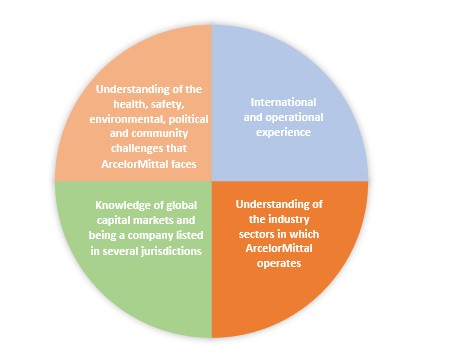
Renewal
The Board of Directors plans for its own succession, with the
assistance of the ARCG Committee. In doing this, the Board of
Directors:
•considers the skills, backgrounds, knowledge, and
experience necessary to allow it to meet the corporate
purpose;
•assesses the skills, backgrounds, knowledge and
experiences currently represented;
•identifies any inadequate representation of those attributes
and agrees the process necessary to ensure a candidate
is selected who brings them to the Board of Directors; and
•reviews how Board performance might be enhanced, both
at an individual director level and for the Board as a whole.
The Board believes that orderly succession and renewal is
achieved through careful planning and by continuously
reviewing the composition of the Board.
When considering new appointments to the Board, the ARCG
Committee oversees the preparation of a position specification
that is provided to an independent recruitment firm retained to
conduct a global search, taking into account, among other
factors, geographic location, nationality and gender. In addition
to the specific skills, knowledge and experience required of the
candidate, the specification contains the criteria set out in the
ArcelorMittal Board profile.
Director induction, training and development
The Board considers that the development of the directors’
knowledge of the Company, the steel-making and mining
industries, and the markets in which the Company operates is
an ongoing process. To further bolster the skills and knowledge
138
Management report |
of directors, the Company set up a continuous development
program in 2009.
Upon his or her election, each new non-executive director
undertakes an induction program specifically tailored to his or
her needs and includes ArcelorMittal’s long-term vision
centered on the concept of “Safe Sustainable Steel”.
The Board’s development activities include the provision of
regular updates to directors on each of the Company’s
products and markets. Non-executive directors may also
participate in training programs designed to maximize the
effectiveness of the directors throughout their tenure and link in
with their individual performance evaluations. The training and
development program may cover not only matters of a
business nature, but also matters falling into the environmental,
social and governance area.
Structured opportunities are provided to build knowledge
through initiatives such as visits to plants and mine sites and
business briefings provided at Board meetings. Non-executive
directors also build their Company and industry knowledge
through the involvement of the Executive Office and other
senior employees in Board meetings. Business briefings, site
visits and development sessions underpin and support the
Board’s work in monitoring and overseeing progress towards
the corporate purpose of creating long-term shareholder value
through the development of the ArcelorMittal business in steel
and mining. The Company therefore continuously builds
directors’ knowledge to ensure that the Board remains up-to-
date with developments within the Company’s segments, as
well as developments in the markets in which the Company
operates.
During the year 2025, non-executive directors participated in
the following activities:
•comprehensive business briefings delivered in 2025
provided directors with an enhanced understanding of the
Company’s activities, operating environment, key
challenges, and strategic priorities across all segments,
with presentations led by senior executives, including
members of the Executive Office.
•in‑depth updates covering health and safety processes,
fatality prevention, environmental and climate‑related
matters, major acquisitions, as well as cybersecurity, risk
management, corporate responsibility, carbon‑reduction
strategy in steelmaking, and the Company’s capital
allocation strategy.
Business briefings took place at Board and committee
meetings:
•briefing meetings with the Company executives in charge
of specific business segments or markets;
•site visits of directors to plants and R&D centers; and
•development sessions on specific topics of relevance,
such as health and safety, commodity markets, HR,
investor relations, accounting, the world economy,
changes in corporate governance standards, directors’
duties and shareholder feedback.
The ARCG Committee oversees director training and
development. This approach allows induction and learning
opportunities to be tailored to the directors’ committee
memberships, as well as the Board of Directors' specific areas
of focus. In addition, this approach ensures a coordinated
process in relation to succession planning, Board renewal,
training, development and committee composition, all of which
are relevant to the ARCG Committee’s role in securing the
supply of talent to the Board.
Board of Directors committees
The Board of Directors has three committees:
•the Audit & Risk Committee,
•the ARCG Committee, and
•the Sustainability Committee.
Audit & Risk Committee
4 members (100% independent) | 6 meetings (2025) |
In 2025, 6 meetings of the Audit & Risk Committee were held
with an attendance rate of 100%.
The primary function of the Audit & Risk Committee is to assist
the Board in fulfilling its oversight responsibilities by reviewing:
•the integrity of the financial reports and other financial
information provided by the Company to any governmental
body or the public;
•the Company’s compliance with legal and regulatory
requirements;
•the registered public accounting firm’s (Independent
Auditor) qualifications and independence;
•the Company’s system of internal control regarding
finance, accounting, legal compliance, ethics and risk
management that management and the Board have
established;
•the Company’s auditing, accounting and financial reporting
processes generally;
•the identification and management of risks to which the
ArcelorMittal group is exposed; and
139
Management report |
•conducting investigations into any matters, including
whistleblower complaints, within its scope of responsibility
and obtaining advice from outside legal, accounting, or
other advisers, as necessary, to perform its duties and
responsibilities.
The Audit & Risk Committee must be composed solely of
independent members of the Board of Directors. The members
are appointed by the Board of Directors each year after the
annual general meeting of shareholders. The Audit & Risk
Committee is comprised of four members, all of whom must be
independent under the Company’s corporate governance
guidelines, the NYSE standards as applicable to foreign private
issuers and the 10 Principles of Corporate Governance of the
Luxembourg Stock Exchange. The Audit & Risk Committee
makes decisions by a simple majority with no member having a
casting vote.
At least one member must qualify as an "audit committee
financial expert” as defined by the SEC and determined by the
Board.
At least one member must qualify as an Audit & Risk
Committee “risk management expert” having experience in
identifying, assessing, and managing risk exposures of large,
complex companies.
The Audit & Risk Committee currently consists of 4 members:
Mrs. Karyn Ovelmen, Mrs. Patricia Barbizet, Mr. Karel de
Gucht and Mr. Etienne Schneider, each of whom is an
independent Director according to the NYSE standards and the
10 Principles of Corporate Governance of the Luxembourg
Stock Exchange. The Chairwoman of the Audit & Risk
Committee is Mrs. Patricia Barbizet who is an “audit
committee financial expert” as defined by the SEC. Please see
“—–Directors and senior management—–Board of Directors”
above for Mrs. Barbizet's experience.
According to its charter, the Audit & Risk Committee is required
to meet at least four times a year. The Audit & Risk Committee
performs an annual self-evaluation and completed its 2025
self-evaluation on January 27, 2026. The charter of the Audit &
Risk Committee is available from ArcelorMittal upon request.
Appointments, Remuneration and Corporate Governance
Committee
3 members (100% independent) | 7 meetings (2025) |
In 2025, 7 meetings of the ARCG Committee were held, with
an attendance rate of 100%.
The ARCG Committee is comprised of three directors, each of
whom is independent under the New York Stock Exchange
standards as applicable to foreign private issuers and the 10
Principles of Corporate Governance of the Luxembourg Stock
Exchange.
The members are appointed by the Board of Directors each
year after the annual general meeting of shareholders. The
ARCG Committee makes decisions by a simple majority with
no member having a casting vote.
The primary function of the ARCG Committee is to assist the
Board of Directors of ArcelorMittal by:
•reviewing and approving corporate and personal goals and
objectives relevant to the compensation of members of the
Executive Office, executive officers and senior
management and evaluating their performance
considering these goals and objectives;
•making recommendations to the Board of Directors on the
Company's framework of remuneration for the members of
the Executive Office and executive officers and such other
senior executives as the ARCG Committee may
determine;
•approving any contract of employment or related contract
with members of the Executive Office and executive
officers;
•determining the terms of any compensation package in the
event of early termination of the employment contract of
any members of the Executive Office and of the executive
officers;
•making recommendations to the Board of Directors
regarding the content of the Company's annual report to
shareholders or any regulatory filings that relates to
compensation matters (including ArcelorMittal's policy on
the compensation of members of the Executive Office and
executive officers, individual remuneration details and
other terms and conditions);
•carrying out an annual performance self-evaluation and a
review of the charter of the ARCG Committee including
additions to the function of the Committee, as may be
necessary due to changed circumstances or laws or
regulations;
•evaluating and proposing improvements for the induction
program for newly appointed members of the Board of
Directors;
•reviewing and, where necessary, proposing changes to the
chairmanship or membership of any Board committee;
•making recommendations to the Board of Directors with
respect to trends in Board of Directors' remuneration,
140
Management report |
incentive compensation plans and equity-based incentive
plans;
•producing a report on executive compensation to be
included in ArcelorMittal`s annual report;
•identifying candidates qualified to serve as member of the
Board of Directors as per the selection criteria and as
members of the Executive Office, executive officers and
senior managers;
•recommending candidates to the Board of Directors for
appointment by the general meeting of shareholders or, to
the extent permitted by law, for appointment by the Board
of Directors to fulfill interim Board vacancies;
•developing, monitoring and reviewing corporate
governance principles applicable to ArcelorMittal;
•facilitating the evaluation that the Board of Directors will
make on the topics covered by ARCG Committee;
•assessing the independence of the members of the Board
of Directors on an annual basis;
•reviewing the succession planning and the executive
development program for the Executive Office and
executive officers;
•reviewing relevant Policies and Procedures relating to
Compliance and Corporate Governance, as needed;
•reviewing employee surveys, as available; and
•reviewing the analysis of proxy advisory firms in the
context of corporate governance compensation.
The ARCG Committee’s principal criteria in determining the
compensation of executives is to encourage and reward
performance that will lead to long-term enhancement of
shareholder value. The ARCG Committee may seek the advice
of outside experts.
The three members of the ARCG Committee are Mrs. Karyn
Ovelmen, Mrs. Clarissa Lins and Mr. Etienne Schneider, each
of whom is independent in accordance with the NYSE
standards applicable to foreign private issuers and the 10
Principles of Corporate Governance of the Luxembourg Stock
Exchange. The Chairwoman of the ARCG Committee is Mrs.
Karyn Ovelmen.
The ARCG Committee is required to meet at least three times
a year. The ARCG Committee performs an annual self-
evaluation and completed its 2025 self-evaluation on January
27, 2026. The charter of the ARCG Committee is available
from ArcelorMittal upon request.
Succession management
Succession management at ArcelorMittal is a systematic,
structured process for identifying and preparing employees
with potential to fill key organizational positions, should the
position become vacant. This process applies to all
ArcelorMittal key positions up to and including the Executive
Office. Succession management aims to ensure the continued
effective performance of the organization by providing for the
availability of experienced and capable employees who are
prepared to assume these roles as they become available. For
each position, candidates are identified based on performance,
potential and an assessment of leadership capabilities and
their “years to readiness”. Development needs linked to the
succession plans are discussed, after which “Personal
Development Plans” are put in place, to accelerate
development and prepare candidates. Regular reviews of
succession plans are conducted at different levels of the
organization to ensure that they are accurate and up to date,
leading to at least once a year formal review by the Executive
Office, of all key positions. Succession management is a
necessary process to reduce risk of vacant positions or skill
gap transitions, create a pipeline of future leaders, ensure
smooth business continuity and improve employee motivation
and engagement. This process has been in place for several
years and reinforced, widened and made more systematic in all
regions of the organization. The responsibility to review and
approve succession plans and contingency plans at the highest
level rests with the Board’s ARCG Committee.
Sustainability Committee
3 members (67% independent) | 5 meetings (2025) |
In 2025, 5 meetings of Sustainability Committee were held,
with an attendance rate of 100%.
The Sustainability Committee ("SC") is comprised of three
members, of whom two are independent under the NYSE
standard as applicable to foreign private issuers and 10
Principles of Corporate Governance of the Luxembourg Stock
Exchange. The SC makes decisions by simple majority with no
member having a casting vote.
The primary function of the SC is to assist the Board of
Directors on the following areas:
•review Group level frameworks, policies, standards and
guidelines in sustainability matters;
•review and approve the identification of material
sustainability impacts, risks and opportunities and the
corresponding controls and governance processes to
manage those;
141
Management report |
•review the Company's sustainable development plan and
targets and associated management systems and ensure
the Group is well positioned to meet the evolving
expectations of stakeholders, including investors,
customers, regulators, employees, and communities;
•review the effectiveness of the process for assessing and
managing catastrophic risks;
•coordinate the SC’s impact, risk and opportunity
management work with the Audit and Risk Committee, in
relation to reporting to the Board of Directors;
•review the findings of important climate action reports and
the management response;
•support and provide guidance to management in
developing and updating policies and procedures relating
to employee health & safety, environment, climate change,
social and supply chain and other material sustainability
topics;
•review and approve processes to establish effectiveness
of policies, actions, metrics and targets related to
sustainability material risks, impacts and opportunities;
•monitor any current, pending or threatened legal actions
with respect to health and safety, climate change,
environment, social and supply chain and other relevant
sustainability issues;
•review and approve a report on sustainable development
plan;
•review and recommend to the Board of Directors on the
adequacy of the reporting on sustainability opportunities,
risks, impacts and issues in the annual report,
Sustainability Report, and other relevant public
documents;
•make recommendations to the Board of Directors with
respect to trends in results and programs in all covered
areas;
•make recommendations on material sustainability impacts,
risks and opportunities when overseeing strategy and
decisions on major transactions;
•ensure that the SC Chair (or in her absence, an alternative
member) attends the Company’s annual general meeting
to answer questions concerning sustainability matters and
their development and/or implementation; and
•oversee any investigation and/or undertake any thorough
analysis which is within its scope.
The three members of the SC are Mrs. Clarissa Lins, Mr.
Etienne Schneider and Mr. Michel Wurth. Mrs. Lins and Mr.
Schneider are independent in accordance with the Company’s
corporate governance guidelines, the NYSE standards
applicable to foreign private issuers and the 10 Principles of
Corporate Governance of the Luxembourg Stock Exchange.
The Chairwoman of the SC is Mrs. Lins.
The members have relevant expertise or experience relating to
the objective of the SC. The responsible senior managers
pertaining to their respective areas of responsibility - health
and safety, environment, climate change, for community
relations - are permanent invitees to the meetings of the SC.
The Chairman of the SC makes a verbal report of the SC’s
decisions and findings to the Board of Directors after each SC
meeting.
Other corporate governance practices
ArcelorMittal is committed to adhering to best practices in
terms of corporate governance in its dealings with
shareholders and aims to ensure good corporate governance
by applying rules on transparency, quality of reporting and the
balance of powers. ArcelorMittal continually monitors U.S., EU
and Luxembourg legal requirements and best practices in
order to make adjustments to its corporate governance controls
and procedures when necessary, as evidenced by the policies
adopted by the Board of Directors in 2012.
ArcelorMittal complies with the 10 Principles of Corporate
Governance of the Luxembourg Stock Exchange in all
respects.
Ethics and conflicts of interest
Ethics and conflicts of interest are governed by ArcelorMittal’s
Code of Business Conduct, which establishes the standards for
ethical behavior that are to be followed by all employees and
directors of ArcelorMittal in the exercise of their duties,
including the Company's CEO and CFO. Each employee of
ArcelorMittal is required to sign and acknowledge the Code of
Conduct upon joining the Company. This also applies to the
members of the Board of Directors of ArcelorMittal, who signed
the Company’s Appointment Letter in which they
acknowledged their duties and obligations. Any new member of
the Board of Directors must sign and acknowledge the Code of
Conduct upon appointment.
Employees must always act in the best interests of
ArcelorMittal and must avoid any situation in which their
personal interests conflict, or could conflict, with their
obligations to ArcelorMittal. Employees are prohibited from
acquiring any financial or other interest in any business or
participating in any activity that could deprive ArcelorMittal of
the time or the attention needed to devote to the performance
of their duties. Any behavior that deviates from the Code of
Business Conduct is to be reported to the employee’s
supervisor, a member of the management, the head of the
legal department or the head of the Global Assurance
department.
142
Management report |
Code of Business Conduct
Conduct training is offered throughout ArcelorMittal on a
regular basis in the form of face-to-face trainings, webinars and
online trainings. Employees are periodically trained about the
Code of Business Conduct in each location where ArcelorMittal
has operations. The Code of Business Conduct is available in
the “Corporate Governance-Compliance and Policies-Code of
Business Conduct” section of ArcelorMittal’s website at
www.arcelormittal.com and has been disseminated through
Company-wide communications.
In addition to the Code of Business Conduct, ArcelorMittal has
developed a Human Rights Policy (available in the “Corporate
Governance-Compliance and Policies-Human Rights Policy”
section of ArcelorMittal’s website at www.arcelormittal.com)
and a number of other compliance policies in more specific
areas, such as antitrust, anti-corruption, economic sanctions,
insider dealing and data protection. In all these areas,
specifically targeted groups of employees are required to
undergo specialized compliance training. Furthermore,
ArcelorMittal’s compliance program also includes a quarterly
compliance certification process covering all business
segments and entailing reporting to the Audit & Risk
Committee.
ArcelorMittal intends to disclose any amendment to or waiver
from the Code of Business Conduct applicable to any of
ArcelorMittal’s directors, its CEO, CFO or any other person
who is an Executive Officer of ArcelorMittal on ArcelorMittal’s
website at www.arcelormittal.com.
Process for Handling Complaints on Accounting Matters
As part of the procedures of the Board of Directors for handling
complaints or concerns about accounting, internal controls and
auditing issues, ArcelorMittal’s Anti-Fraud Policy and Code of
Business Conduct encourage all employees to bring such
issues to the Audit & Risk Committee’s attention on a
confidential basis. In accordance with ArcelorMittal’s Anti-Fraud
and Whistleblower Policy, concerns with regard to possible
fraud or irregularities in accounting, auditing or banking matters
or bribery within ArcelorMittal or any of its subsidiaries or other
controlled entities may also be communicated through the
“Corporate Governance—Whistleblower” section of the
ArcelorMittal website at www.arcelormittal.com, where the
Code of Business Conduct is also available in each of the main
working languages used within the Group. In recent years,
ArcelorMittal has implemented local whistleblowing facilities, as
needed.
Global Assurance
ArcelorMittal has a Global Assurance function that, through its
Head of Global Assurance, reports to the Audit & Risk
Committee. The function is staffed by full-time professional
staff located within each of the principal operating subsidiaries
and at the corporate level. Recommendations and matters
relating to internal control and processes are made by the
Global Assurance function and their implementation is regularly
reviewed by the Audit & Risk Committee.
Independent auditors
The appointment and determination of fees of the independent
auditors is the direct responsibility of the Audit & Risk
Committee. The Audit & Risk Committee is further responsible
for obtaining, at least once each year, a written statement from
the independent auditors that their independence has not been
impaired. The Audit & Risk Committee has also obtained a
confirmation from ArcelorMittal’s principal independent auditors
to the effect that none of its former employees are in a position
within ArcelorMittal that may impair the principal auditors’
independence.
Insider Dealing Regulations
ArcelorMittal has adopted insider trading policies and
procedures (“Insider Dealing Regulations” or "IDR") governing
the purchase, sale and other dispositions of its securities by
directors, senior management and employees that are
reasonably designed to promote compliance with insider
trading laws, rules and regulations and listing standards
applicable to the Company. IDR are updated when necessary
(most recently in 2023) and training is conducted throughout
the Group. The IDR’s most recent version was updated in light
of the Market Abuse Regulation. The IDR are available on
ArcelorMittal’s website, www.arcelormittal.com and are
attached as Exhibit 11.1 to this annual report.
The IDR apply to the worldwide operations of ArcelorMittal. The
compliance and data protection officer of ArcelorMittal is also
the IDR compliance officer and answers questions that
members of senior management, the Board of Directors or
employees may have about the IDR’s interpretation. The IDR
compliance officer maintains a list of insiders as required by
Regulation No 596/2014 of the European Parliament and the
Council dated April 16, 2014 on market abuse or “MAR” and
the Commission Implementing Regulation 2016/347 of 10
March 2016 laying down technical standards with regard to the
precise format of insider lists and for updating insider lists in
accordance with MAR. The IDR compliance officer may assist
senior executives and directors with the filing of notices
required by Luxembourg law to be filed with the Luxembourg
financial regulator, Commission de Surveillance du Secteur
Financier (“CSSF”). Furthermore, the IDR compliance officer
has the power to conduct investigations in connection with the
application and enforcement of the IDR, in which any employee
or member of senior management or of the Board of Directors
is required to cooperate.
Selected new employees of ArcelorMittal are required to
participate in a training course about the IDR upon joining
143
Management report |
ArcelorMittal and every three years thereafter. The individuals
who must participate in the IDR training include the members
of senior management, employees who work in finance, legal,
sales, mergers and acquisitions and other areas that the
Company may determine from time to time. In addition,
ArcelorMittal’s Code of Business Conduct contains a section
on “Preventing Insider Dealing” that emphasizes the prohibition
to trade on the basis of inside information. An online interactive
training tool based on the IDR is currently deployed across the
group through ArcelorMittal’s intranet, with the aim to enhance
the staff’s awareness of the risks of sanctions applicable to
insider dealing. The importance of the IDR is again reiterated in
the Group's internal Group Policies and Procedures Manual.
SHAREHOLDERS AND MARKETS
Major shareholders
The following table sets out information as of December 31,
2025 with respect to the beneficial ownership of ArcelorMittal
ordinary shares by each person who is known to be the
beneficial owner of more than 5% of the shares and all
directors and senior management as a group.
ArcelorMittal Ordinary Shares | |||
Number | % | ||
Significant Shareholder1 | 340,088,546 | 43.88% | |
Treasury Shares2 | 13,874,181 | 1.79% | |
Other Public Shareholders | 421,037,273 | 54.33% | |
Total | 775,000,000 | 100.00% | |
Of which: Directors and Senior Management3 | 498,798 | 0.07% | |
Significant Shareholder voting rights (outstanding shares) | 44.68% | ||
1For purposes of this table, ordinary shares owned directly by Mr. Lakshmi N.
Mittal and his wife, Mrs. Usha Mittal, are aggregated with those ordinary
shares beneficially owned by the Significant Shareholder. At December 31,
2025, Mr. Lakshmi Mittal and his wife, Mrs. Usha Mittal, had direct ownership
of ArcelorMittal ordinary shares and beneficial ownership (within the meaning
set forth in Rule 13d-3 of the Exchange Act), through the Significant
Shareholder, of the outstanding equity of two holding companies that own
ArcelorMittal ordinary shares—Nuavam Investments S.à. r.l. (“Nuavam”) and
Lumen Investments S.à r.l. (“Lumen”). Nuavam, a limited liability company
organized under the laws of Luxembourg, was the owner of 63,658,348
ArcelorMittal ordinary shares. Lumen, a limited liability company organized
under the laws of Luxembourg, was the owner of 275,840,595 ArcelorMittal
ordinary shares. Mr. Lakshmi N. Mittal was the direct owner of 564,103
ArcelorMittal ordinary shares. Mrs. Mittal was the direct owner of 25,500
ArcelorMittal ordinary shares. Mr. Lakshmi N. Mittal, Mrs. Mittal and the
Significant Shareholder shared beneficial ownership of 100% of the
outstanding equity of each of Nuavam and Lumen (within the meaning set
forth in Rule 13d-3 of the Exchange Act). Accordingly, Mr. Lakshmi N. Mittal
was the beneficial owner of 340,063,046 ArcelorMittal ordinary shares, Mrs.
Mittal was the beneficial owner of 339,524,443 ordinary shares, and the
Significant Shareholder (when aggregated with ordinary shares of
ArcelorMittal held directly by Mr. and Mrs. Mittal) was the beneficial owner of
340,088,546 ordinary shares. As of December 31, 2025, 2024 and 2023, the
Significant Shareholder (together with Mr. Lakshmi N. Mittal and Mrs. Mittal)
held 43.88%, 39.88% and 39.87% of the Company’s ordinary shares
respectively.
2Represents ArcelorMittal ordinary shares repurchased pursuant to share
repurchase programs, fractional shares returned in various transactions, and
the use of treasury shares in various transactions.
3Includes shares beneficially owned by directors and members of senior
management listed in section "Management and employees—Directors and
senior management" of this annual report; excludes shares beneficially owned
by Mr. Lakshmi N. Mittal. Note that ordinary shares included in this item are
included in “Other Public Shareholders” above.
Aditya Mittal is the direct owner of 369,874 ArcelorMittal
ordinary shares, representing less than 0.1% of the
ArcelorMittal ordinary shares outstanding, in addition to which
he holds PSUs, see "Management and employees—
Compensation". As the vesting of PSUs is dependent on the
Company's performance criteria not fully within the control of
the PSU holder, Aditya Mittal does not beneficially own
ArcelorMittal ordinary shares by virtue of his ownership of the
PSUs. Aditya Mittal is the son of Mr. Lakshmi N. Mittal and Mrs.
Mittal and is CEO and non-independent director of
ArcelorMittal. Vanisha Mittal Bhatia is the direct owner of 8,500
ArcelorMittal ordinary shares, representing less than 0.1% of
the ArcelorMittal ordinary shares outstanding. Vanisha Mittal
Bhatia is the daughter of Mr. Lakshmi N. Mittal and Mrs. Mittal
and a member of the Company’s Board of Directors.
The ArcelorMittal ordinary shares may be held in registered
form on the Company’s register only. Registered shares are
fully fungible and may consist of:
a.ArcelorMittal Registry Shares, which are registered
directly on ArcelorMittal’s Luxembourg shareholder
register,
b.shares traded on Euronext Amsterdam, Euronext Paris,
the regulated market of the Luxembourg Stock Exchange
and the Spanish Stock Exchanges, which are held in
Euroclear, or
c.shares traded on the NYSE, the ("New York Registry
Shares"), which are registered (including in the name of
the nominee of DTC) in a New York Share Register kept
on behalf of ArcelorMittal by Citibank N.A., its New York
transfer agent.
On April 25, 2023, BlackRock, Inc. provided a notification to the
Company stating that it beneficially owned 5% of ArcelorMittal’s
issued shares as of April 21, 2023. On June 12, 2024,
BlackRock, Inc. provided notifications to the Company stating
that it beneficially owned 4.99% of ArcelorMittal’s issued
shares as of June 10, 2024.
These notifications (other than the Schedule 13G filings) are
available in the Luxembourg Stock Exchange’s OAM electronic
database on www.bourse.lu and on the Company’s website
corporate.arcelormittal.com under “Investors - Corporate
Governance - Shareholding structure”. The notifications were
144
Management report |
published in reference to the Luxembourg law and the Grand
Ducal regulation of January 11, 2008, on transparency
requirements for issuers of securities ("Transparency Law") in
view of a shareholding notification going above or below the
5% voting rights threshold. The Schedule 13G filings are
available on the website of the U.S. Securities and Exchange
Commission (www.sec.gov).
Under Luxembourg law, the ownership of registered shares is
evidenced by the inscription of the name of the shareholder,
the number of shares held by such shareholder and the
amount paid up on each share in the shareholder register of
ArcelorMittal.
At December 31, 2025, 2,369 shareholders other than the
Significant Shareholder, holding an aggregate of 15,431,711
ArcelorMittal ordinary shares, were registered in ArcelorMittal’s
shareholder register, representing approximately 1.99% of the
ordinary shares issued (including treasury shares).
At December 31, 2025, there were 130 registered shareholders
holding an aggregate of 47,569,865 New York Registry Shares,
representing approximately 6.14% of the ordinary shares
issued (including treasury shares). ArcelorMittal’s knowledge of
the number of New York Registry Shares held by U.S. holders
is based solely on the records of its New York transfer agent
regarding registered ArcelorMittal ordinary shares.
At December 31, 2025, 383,138,557 ArcelorMittal ordinary
shares were held through the Euroclear/Iberclear clearing
system in The Netherlands, France, Luxembourg and Spain,
representing approximately 49.44% of the ordinary shares
issued (including treasury shares).
Voting rights
Each share entitles the holder to one vote at the general
meeting of shareholders, and no shareholder benefits from
special voting rights. For more information relating to
ArcelorMittal shares, see “Additional information—
Memorandum and Articles of Association—Voting and
information rights”.
Management share ownership
As of December 31, 2025, the aggregate beneficial share
ownership of ArcelorMittal directors and senior management
(18 individuals) totaled 498,798 ArcelorMittal shares (excluding
shares beneficially owned by the Significant Shareholder and
Mr. Lakshmi N. Mittal) representing 0.07% of the total issued
share capital of ArcelorMittal. Other than Mr. Lakshmi N. Mittal,
each director and member of senior management beneficially
owns less than 1% of ArcelorMittal’s shares. See "—Major
shareholders” for the beneficial share ownership of the
Significant Shareholder, Mr. Lakshmi Mittal, Mr. Aditya Mittal
and Ms. Vanisha Mittal Bhatia.
In accordance with the Luxembourg Stock Exchange’s 10
Principles of Corporate Governance, independent non-
executive members of ArcelorMittal's Board of Directors do not
receive share options, RSUs or PSUs, and the policy of the
Company is not to grant any share-based remuneration to
members of the Board of Directors who are not executives of
the Company.
See “Management and employees—Compensation” for a
description of options, RSUs and PSUs held by members of
ArcelorMittal’s senior management, including the Executive
Chairman and CEO.
The following tables summarize outstanding PSUs and RSUs granted to the members of the Executive Office and Executive Officers of
ArcelorMittal for the last five years as of December 31, 2025.
PSUs granted in 2025 | PSUs granted in 2024 | PSUs granted in 2023 | PSUs granted in 2022 | |
Executive Office | 159,927 | 241,856 | 141,973 | 141,564 |
Term (in years) | 3 | 3 | 3 | 3 |
Vesting date1 | January 1, 2029 | January 1, 2028 | January 1, 2027 | January 1, 2026 |
1See “Management and employees—Compensation—Remuneration—LTIP”, for vesting conditions.
RSUs granted in December 2025 | PSUs granted in December 2025 | RSUs granted in December 2024 | PSUs granted in December 2024 | RSUs granted in December 2023 | PSUs granted in December 2023 | RSUs granted in December 2022 | PSUs granted in December 2022 | |
CFO and Other Executive Officers | 38,600 | 194,550 | 70,400 | 302,100 | 54,800 | 233,100 | 41,500 | 113,900 |
Term (in years) | 3 | 3 | 3 | 3 | 3 | 3 | 3 | 3 |
Vesting date1 | December 5, 2028 | January 1, 2029 | December 5, 2027 | January 1, 2028 | December 8, 2026 | January 1, 2027 | December 13, 2025 | January 1, 2026 |
1See note 8.3 to the consolidated financial statements, for vesting conditions.
145
Management report |
See note 8.3 of the consolidated financial statements for a
description of ArcelorMittal’s equity-settled share-based
payments to certain employees, including RSUs and PSUs.
Related party transactions
ArcelorMittal engages in certain commercial and financial
transactions with related parties, including associates and joint
ventures of ArcelorMittal. Please refer to note 12 to the
consolidated financial statements. Further information related
to required disclosure of related party transactions under the
Shareholders’ Rights Law of August 1, 2019 implementing the
European Union's Shareholders' Rights Directive in
Luxembourg (the "Shareholders' Rights Law") is included in
“Additional information—Memorandum and Articles of
Association—Voting and information rights”.
Shareholder’s Agreement
Mr. Lakshmi Mittal and ArcelorMittal are parties to a
shareholder and registration rights agreement (the
“Shareholder’s Agreement”) dated August 13, 1997. Pursuant
to the Shareholder’s Agreement and subject to the terms and
conditions thereof, ArcelorMittal shall, upon the request of
certain holders of restricted ArcelorMittal shares, use its
reasonable efforts to register under the Securities Act of 1933,
as amended, the sale of ArcelorMittal shares intended to be
sold by those holders. By its terms, the Shareholder’s
Agreement may not be amended, other than for manifest error,
except by approval of a majority of ArcelorMittal’s shareholders
(other than the Significant Shareholder and certain permitted
transferees) at a general shareholders’ meeting.
Memorandum of Understanding
The Memorandum of Understanding entered into in connection
with the Mittal Steel acquisition of Arcelor, certain provisions of
which expired in August 2009 and August 2011, is described
under “Additional information—Material contracts—
Memorandum of Understanding”.
Share repurchase agreement
On March 5, 2026, ArcelorMittal and the Significant
Shareholder have entered into a share repurchase agreement
see "Introduction—Key transactions and events in 2025—
Recent developments".
Agreements with Aperam SA post-Stainless Steel Spin-Off
In connection with the spin-off of its stainless steel division into
a separately focused company, Aperam SA (“Aperam”), which
was completed on January 25, 2011, ArcelorMittal entered into
several agreements with Aperam and/ or certain Aperam
subsidiaries which are still in force: a purchasing services
agreement for negotiation services from ArcelorMittal
Purchasing (the “Purchasing Services Agreement”) as well as
certain commitments regarding cost-sharing in Brazil and
certain other ancillary arrangements governing the relationship
between Aperam and ArcelorMittal following the spin-off, as
well as certain agreements relating to financing.
The parties agreed to renew a limited number of services
where expertise and bargaining power created value for each
party. ArcelorMittal will continue to provide in 2026 (similar to
2025) certain services relating to areas including environmental
and technical support.
In the area of research and development at the time of the
spin-off, Aperam entered into a framework agreement with
ArcelorMittal in 2011, and as amended in 2015 to establish a
structure for future cooperation in relation to certain ongoing or
new research and development programs. Currently, few but
valuable research and development supports are implemented
through this agreement. New exchanges about breakthrough
technologies or possible technical developments or projects
interesting both companies were launched between 2021 and
2025 and are still ongoing or are considered in the future.
In Europe, Aperam purchased most of its electricity and natural
gas through energy supply contracts put in place for the period
2014-2020 through ArcelorMittal Energy SCA, subsequently
renewed in 2022 and 2023 under similar terms and conditions.
Electricity and natural gas supplies continued in 2024 under
the new contracts reflecting supply practices throughout 2024
and 2025; these contracts were signed in December 2024,
effective from January 1, 2024 till December 31, 2025. Other
supply contracts for gas and power concluded in 2024 have
been mutually extended reflecting supply practices throughout
2025.
Regarding procurement, Aperam still relies on ArcelorMittal
Europe S.A. for supplies and services in relation to the
negotiation of certain contracts with global or large regional
suppliers. The Purchasing Services Agreement entered into on
January 25, 2011 has been renewed and remains in force in
relation to the following key categories: operating materials
(only hot strip mill), refractory materials, spare parts, sea
freight, logistics, industrial products and support services
(excluding industrial services). The Purchasing Services
Agreement also permits Aperam to avail itself of the services
and expertise of ArcelorMittal for certain capital expenditures.
Another commercial agreement in place between Aperam and
ArcelorMittal Sourcing has been effective since January 2020
for the sale of electrodes. Two specific IT service agreements
are also in place with Aperam for the use in Europe and Brazil
of Asset Reliability Maintenance Program ("ARMP") and for the
use of the global wide area network (WAN).
Purchasing activities will continue to be provided to Aperam
pursuant to existing contracts with ArcelorMittal entities that it
has specifically elected to assume. In addition, since 2011, a
services agreement has been concluded between ArcelorMittal
146
Management report |
Shared Service Center Europe Sp z.o.o. Sp.k. and Aperam for
accounting services.
In connection with the spin-off, management also renegotiated
an existing Brazilian cost-sharing agreement between
ArcelorMittal Brasil and Aperam Inox América do Sul S.A.,
Aperam Inox Serviços Brasil Ltda., Aperam Inox Tubos Brasil
Ltda. and Aperam Bioenergia Ltda. pursuant to which,
ArcelorMittal Brasil continued to perform purchasing for the
benefit of these Aperam’s Brazilian subsidiaries, with costs
being shared on the basis of cost allocation parameters agreed
between the parties on a yearly basis.
In addition, ArcelorMittal Brasil, ArcelorMittal Bioflorestas, a
wholly owned subsidiary of ArcelorMittal Brasil, and Aperam
Bioenergia established a transaction for the purchase of wood
and supply of charcoal through the execution of three
agreements in December 2025. These agreements cover: (i)
wood‑cutting services provided by Aperam Bioenergia to
ArcelorMittal Bioflorestas for standing timber, with the services
contract running until October 2026; (ii) the sale of the
harvested wood by ArcelorMittal Bioflorestas to Aperam
Bioenergia, covered by a wood supply contract valid until June
2027; and (iii) the subsequent supply of a proportional volume
of charcoal from Aperam Bioenergia to ArcelorMittal Brasil, with
the charcoal contract running until August 2028.
Headquarters
ArcelorMittal Kirchberg Real Estate S.à r.l, Kennedy 2020 SAS,
and Aperam Real Estate S.à r.l executed a land use right
agreement with Fonds Kirchberg on March 7, 2019, regarding
a new headquarter office project in the Kirchberg (the “K
Building”) district of Luxembourg city, Luxembourg. This
agreement was subsequently amended on December 20,
2022. Following the execution of a share purchase agreement
on October 12, 2022, Aperam divested its shares in Aperam
Real Estate S.à r.l to Kennedy 2020 SAS, a fully owned
subsidiary of ArcelorMittal. Consequently, Aperam Real Estate
S.à r.l became a wholly owned subsidiary of ArcelorMittal and
was formally renamed K22 S.à r.l on December 8, 2022.
On August 1, 2025, Kennedy 2020 SAS and Aperam entered
into a share purchase agreement according to which Kennedy
2020 SAS has irrevocably committed to sell and transfer all the
shares in K22 S.à r.l to Aperam, and Aperam has committed to
acquire said shares. Pursuant to the terms and conditions of
the share purchase agreement, following the completion of
certain conditions, with the transfer of K22 S.à r.l shares,
Aperam will own 5.4% in the K Building.
Markets
ArcelorMittal shares are listed and traded (through a single
order book) on the Euronext European markets (Paris and
Amsterdam) (symbol “MT”), are admitted to trading on the
Luxembourg Stock Exchange’s regulated market and listed on
the Official List of the Luxembourg Stock Exchange (symbol
“MT”) and are listed and traded on the Spanish Stock
Exchanges (symbol “MTS”). In the United States, ArcelorMittal
shares are listed and traded on the NYSE (symbol “MT”).
Paying agents
The paying agent for shareholders who hold shares listed on
the NYSE is Citibank and the paying agent for shareholders
who hold shares listed on Euronext Amsterdam, Euronext
Paris, and Luxembourg Stock Exchange is ABN AMRO.
New York Registry Shares
The Company does not have any American Depositary
Receipts. As described under “Additional information—
Memorandum and Articles of Association—Form and transfer
of shares”, the Company maintains a New York share register
with Citibank, N.A. for its shares that trade on the NYSE. As of
December 31, 2025, 47,569,865 shares (or approximately
6.14% of ArcelorMittal’s total issued shares) were ArcelorMittal
New York Registry Shares. Holders of ArcelorMittal New York
Registry Shares do not pay fees to Citibank as a general
matter, but do incur costs of up to $5 per 100 shares for
transactions that require canceling or issuing New York
Registry Shares, such as cross-border trades where New York
Registry Shares are cancelled in exchange for shares held in
ArcelorMittal’s European registers, or vice-versa. Subject to
certain conditions, Citibank reimburses the Company on an
annual basis for expenses incurred by the Company in relation
to the ongoing maintenance of the New York share facility (e.g.,
investor relations expenses, NYSE listing fees, etc.). In 2025,
Citibank paid the Company $313,669 in respect of
reimbursements of expenses incurred by the Company in
2025.
Dividend distributions
Based on Luxembourg law and its Articles of Association,
ArcelorMittal allocates at least five percent of its net profits to
the creation of a reserve. This allocation ceases to be
compulsory when the reserve reaches ten percent (10%) of its
issued share capital, and becomes compulsory once again
when the reserve falls below that percentage. Under
Luxembourg law, the amount of any dividends paid to
shareholders may not exceed the amount of the profits at the
end of the last financial year plus any profits carried forward
and any amounts drawn from reserves that are available for
that purpose, less any losses carried forward and sums to be
placed in reserve in accordance with Luxembourg law or the
Articles of Association. A company may not pay dividends to
shareholders when, on the closing date of the last financial
year, the net assets are, or following the payment of such
dividend would become, lower than the amount of the
subscribed capital plus the reserves that may not be distributed
by law or by virtue of the articles of association. ArcelorMittal’s
147
Management report |
Articles of Association provide that the portion of annual net
profit that remains unreserved is allocated as follows by the
general meeting of shareholders upon the proposal of the
Board of Directors:
•a global amount is allocated to the Board of Directors by
way of directors’ fees (“tantièmes”). This amount may not
be less than €1,000,000. In the event that the profits are
insufficient, the amount of €1,000,000 shall be imputed in
whole or in part to charges. The distribution of this amount
among the members of the Board of Directors shall be
effected in accordance with the Board of Directors’ rules of
procedure; and
•the balance is distributed as dividends to the shareholders
or placed in the reserves or carried forward.
Interim dividends may be distributed under the conditions set
forth in Luxembourg law by decision of the Board of Directors.
No interest is paid on dividends declared but not paid which
are held by the Company on behalf of shareholders.
Following the achievement of the Group's net debt target, in
February 2021, the Board approved a new capital return policy.
See under "Introduction—History and development of the
Company—Other information—Capital return policy".
In February 2023, the Board of Directors recommended an
increase of the base annual dividend from $0.38/share to
$0.44/share, which was approved on May 2, 2023 at the
annual general meeting of shareholders. The dividend
amounted to $369 million.
In February 2024, the Board of Directors recommended an
increase of the base annual dividend to $0.50/share (from
$0.44/share paid in 2023), which was approved on April 30,
2024 at the annual general meeting of shareholders. The
dividend amounted to $393 million.
In February 2025, the Board of Directors recommended an
increase of the base annual dividend to $0.55/share (from
$0.50/share paid in 2024), which was approved on May 6,
2025 at the annual general meeting of shareholders. The
dividend amounted to $421 million.
In February 2026, the Board of Directors recommended an
increase of the base annual dividend $0.60/share (from 0.55/
share paid in 2025), subject to the approval of shareholders at
the annual general meeting of shareholders in May 2026.
Purchases of equity securities by the issuer and affiliated
purchasers
On April 2, 2025, ArcelorMittal announced that the completion
of 85 million shares buyback program announced on May 5,
2023 ("2023 buyback program") pursuant to the authorization
by the annual general meeting of shareholders held on May 2,
2023 and continued pursuant to the authorization by the annual
general meeting of shareholders held on April 30, 2024.
On April 7, 2025, ArcelorMittal announced the commencement
of a new share buyback program ("2025 buyback program")
with share repurchases to be conducted in tranches that may
be announced through May 2030. Repurchases under the first
tranche of the 2025 buyback program, which is for up to 10
million shares commenced immediately, pursuant to the
authorization by the annual general meeting of shareholders
held on April 30, 2024 and subsequently under the
authorization by the annual general meeting of shareholders
held on May 6, 2025. At December 31, 2025, ArcelorMittal had
repurchased 2 million shares for a total value of €51 million
($58 million) at an average price per share of €25.74 ($29.25).
The actual amount of shares to be repurchased in various
tranches pursuant to the 2025 buyback program will depend on
the level of post-dividend free cash flow generated over the
period (the Company’s defined policy is to return a minimum of
50% of post-dividend annual free cash flow), the continued
authorization by shareholders and market conditions. The
shares acquired under the 2025 buyback program are intended
to reduce ArcelorMittal’s share capital; to meet ArcelorMittal’s
obligations arising from employee share programs; to meet
ArcelorMittal’s obligations exchangeable into equity securities;
and/or to meet such other purposes as announced at the time
of each tranche.
See “Introduction—History and development of the Company—
Other information”.
On March 5, 2026, ArcelorMittal and the Significant
Shareholder have entered into a share repurchase agreement,
see "Introduction—Key transactions and events in 2025—
Recent developments".
As described in “Memorandum and Articles of Association”, the
maximum number of shares that may be acquired does not in
any event exceed 10% of the Company’s issued share capital.
The maximum number of own shares that the Company may
hold at any time directly or indirectly may not have the effect of
reducing its net assets (“actif net”) below the amount
mentioned in paragraphs 1 and 2 of Article 461-272-1 of the
Law.
148
Management report |
Program1 | 2025 | Total Number of Shares Purchased | Average Price Paid Per Share | Total Number of Shares Purchased as Part of Publicly Announced Plan or Program | Maximum Number of Shares that may yet be purchased under the Plans or Programs (see above explanations) |
2023 buyback program | January 1 - January 31 | — | — | — | 6,791,559 |
2023 buyback program | February 1 - February 28 | — | — | — | 6,791,559 |
2023 buyback program | March 1 - March 31 | 5,984,000 | $30.18 | 5,984,000 | 807,559 |
2023 buyback program | April 1 - April 30 | 807,559 | $29.07 | 807,559 | — |
2025 buyback program | April 1 - April 30 | 235,128 | $23.63 | 235,128 | 9,764,872 |
2025 buyback program | May 1 - May 31 | 792,934 | $29.66 | 792,934 | 8,971,938 |
2025 buyback program | June 1 - June 30 | 971,938 | $30.28 | 971,938 | 8,000,000 |
2025 buyback program | July 1 - July 31 | — | — | — | 8,000,000 |
2025 buyback program | August 1 - August 31 | — | — | — | 8,000,000 |
2025 buyback program | September 1 - September 30 | — | — | — | 8,000,000 |
2025 buyback program | October 1 - October 31 | — | — | — | 8,000,000 |
2025 buyback program | November 1 - November 30 | — | — | — | 8,000,000 |
2025 buyback program | December 1 - December 31 | — | — | — | 8,000,000 |
1.Commencement of 2023 buyback program was announced on May 5, 2023 for up to 85 million shares and the completion was announced on April 2, 2025.
Commencement of 2025 buyback program was announced on April 7, 2025 for up to 10 million shares. The actual amount of shares to be repurchased will depend on
the level of post-dividend free cash flow generated over the period. See “Introduction—History and development of the Company—Other information”. As of December
31, 2025, the 2025 buyback program was not yet completed.
149
Management report |
Share capital
As of December 31, 2025, the Company’s issued share capital
amounted to $275 million, represented by 775,000,000
ordinary shares without nominal value ($303 million
represented by 852,809,772 ordinary shares without nominal
value at December 31, 2024 and 2023).
On November 20, 2025, ArcelorMittal cancelled 77,809,772
treasury shares to keep the number of treasury shares within
appropriate levels. Following this cancellation, the aggregate
number of shares issued and fully paid up decreased from
852,809,772 to 775,000,000.
Out of the total of 775,000,000 shares in issue, 13,874,181
shares were held in treasury by ArcelorMittal at December 31,
2025, representing 1.79% of its issued share capital. In
addition, due to the cancellation of treasury shares, the
Company's authorized share capital decreased from $395
million represented by 1,111,418,599 to $367 million
represented by 1,033,608,827 ordinary shares without nominal
value as of December 31, 2025. See note 11.1 to the
consolidated financial statements.
Over the years, ArcelorMittal has issued equity-settled share-
based payments to certain employees, including stock options,
restricted share units and performance share units. See note
8.3 to the consolidated financial statements.
ADDITIONAL INFORMATION
Memorandum and Articles of Association
Below is a summary of ArcelorMittal’s Articles of Association
and certain legal provisions and internal policies applicable to
ArcelorMittal. The full text of the Company’s Articles of
Association is also available on www.arcelormittal.com under
“Investors-Corporate Governance-Current Articles of
Association”.
Corporate purpose
Article 3 of the Articles of Association provides that the
corporate purpose of ArcelorMittal is the manufacture,
processing and marketing of steel, steel products and all other
metallurgical products, as well as all products and materials
used in their manufacture, their processing and their marketing,
and all industrial and commercial activities connected directly
or indirectly with those objects, including mining and research
activities and the creation, acquisition, holding, exploitation and
sale of patents, licenses, know-how and, more generally,
intellectual and industrial property rights.
The Company may realize its corporate purpose either directly
or through the creation of companies, the acquisition, holding
or acquisition of interests in any companies or partnerships,
membership in any associations, consortia and joint ventures.
In general, the Company’s corporate purpose comprises the
participation, in any form whatsoever, in companies and
partnerships and the acquisition by purchase, subscription or in
any other manner as well as the transfer by sale, exchange or
in any other manner of shares, bonds, debt securities, warrants
and other securities and instruments of any kind.
It may grant assistance to any affiliated company and take any
measure for the control and supervision of such companies.
It may carry out any commercial, financial or industrial
operation or transaction which it considers to be directly or
indirectly necessary or useful in order to achieve or further its
corporate purpose.
Form and transfer of shares
The shares of ArcelorMittal are issued in registered form only
and are freely transferable. There are no restrictions on the
rights of Luxembourg or non-Luxembourg residents to own
ArcelorMittal shares.
In accordance with Luxembourg law, the ownership of
registered shares is evidenced by the inscription of the name of
the shareholder and the number of shares held by such
shareholder in the shareholders’ register. Each transfer of
shares is made by a written declaration of transfer recorded in
the shareholders’ register of ArcelorMittal, dated and signed by
the transferor and the transferee or by their duly appointed
agent. ArcelorMittal may accept and enter into its shareholders’
register any transfer based on an agreement between the
transferor and the transferee provided a true and complete
copy of such agreement is provided to ArcelorMittal.
The Articles of Association provide that shares may be held
through a securities settlement (clearing) system or a
professional depositary of securities. Shares held in this
manner have the same rights and obligations as the registered
shares. Shares held through a securities settlement system or
a professional depositary of securities may be transferred in
accordance with customary procedures for the transfer of
securities in book-entry form.
The ArcelorMittal ordinary shares may be held in registered
form on the Company’s register only. Registered shares are
fully fungible and may consist of:
aArcelorMittal Registry Shares, which are registered
directly on ArcelorMittal’s Luxembourg shareholders'
register,
bshares traded on Euronext Amsterdam, Euronext Paris,
the regulated market of the Luxembourg Stock Exchange
and the Spanish Stock Exchanges, which are held in
Euroclear, or
150
Management report |
cshares traded on the NYSE (the "New York Registry
Shares"), which are registered (including in the name of
the nominee of DTC) in a New York Share Register kept
on behalf of ArcelorMittal by Citibank, N.A., its New York
transfer agent.
ABN AMRO assists the Company with certain administrative
tasks relating to the day-to-day administrative management of
the shareholders' register. The Company maintains a New York
shareholders' register with Citibank, N.A. (located at 388
Greenwich Street, New York, New York 10013) for its New York
Registry Shares that trade on the NYSE with underlying
positions held in Euroclear. As of December 31, 2025,
47,569,865 shares (or approximately 6.14% of ArcelorMittal's
total issued shares) were New York Registry Shares.
The law of April 6, 2013 concerning dematerialized securities
allows Luxembourg issuers to opt for the full dematerialization
of shares. The EGM of ArcelorMittal shareholders held on May
10, 2017 authorized and empowered the Board of Directors to
give effect to such dematerialization and to determine its
effective date, following which new shares in the Company
may only be issued in dematerialized form (the “Effective
Date”). Notice of the compulsory dematerialization will be given
in accordance with Article 6.9 (i) of the Articles of Association.
As from the Effective Date, shareholders would be required to
hold their shares in a securities account at a bank or other
financial intermediary, which would in turn hold the shares via
an account with a securities depository such as Clearstream or
Euroclear. Dematerialized securities would be solely
represented by account entries with the securities depositary
and would therefore exist only in electronic form. It would then
no longer be possible for shareholders to hold shares through
a direct, nominative registration in the Company’s register of
shareholders as is currently the case. As of December 31,
2025, notice of the Effective Date has not been given.
Issuance of shares
The issuance of shares by ArcelorMittal requires either an
amendment of the Articles of Association approved by an EGM
or a decision of the Board of Directors that is within the limits of
the authorized share capital set out in the Articles of
Association. In the latter case, the Board of Directors may
determine the conditions for the issuance of shares, including
the consideration (cash or in kind) payable for such shares.
The EGM may not validly deliberate unless at least half of the
share capital is present or represented upon the first call. If the
quorum is not met, the meeting may be reconvened as
described in “General meeting of shareholders” below. The
second meeting will be held regardless of the proportion of
share capital represented. At both meetings, resolutions, with
respect to the capital increase (or decrease), in order to be
adopted, must be carried by at least two-thirds of the votes
cast.
Preemptive rights
Unless limited or canceled by the Board of Directors pursuant
to a power granted by an extraordinary general meeting of
shareholders or by an EGM, holders of ArcelorMittal shares
have a pro rata preemptive right to subscribe for newly issued
shares, except for shares issued for consideration other than
cash (i.e., in kind).
Repurchase of shares
ArcelorMittal is prohibited by Luxembourg law from subscribing
for its own shares. ArcelorMittal may, however, repurchase its
own shares or have another person repurchase shares on its
behalf, subject to certain conditions, including:
•a prior authorization of the general meeting of
shareholders setting out the terms and conditions of the
proposed repurchase, including the maximum number of
shares to be repurchased, the duration of the period for
which the authorization is given (which may not exceed
five years) and the minimum and maximum
consideration per share;
•the repurchase may not reduce the net assets of
ArcelorMittal on a non-consolidated basis to a level
below the aggregate of the issued share capital and the
reserves that ArcelorMittal must maintain pursuant to
Luxembourg law or its Articles of Association;
•only fully paid-up shares may be repurchased. At
December 31, 2025, all of ArcelorMittal’s issued ordinary
shares were fully paid-up; and
•the acquisition offer is made on the same terms and
conditions to all the shareholders who are in the same
position, it being noted however that listed companies
may repurchase their own shares on the stock
exchange without an acquisition offer having to be made
to the shareholders.
In addition, Luxembourg law allows the Board of Directors to
approve the repurchase of ArcelorMittal shares without the
prior approval of the general meeting of shareholders if
necessary to prevent serious and imminent harm to
ArcelorMittal. In such a case, the next general meeting of
shareholders must be informed by the Board of Directors of the
reasons for and the purpose of the acquisitions made, the
number and nominal values, or in the absence thereof, the
accounting par value of the shares acquired, the proportion of
the issued share capital that they represent, and the
consideration paid for them.
The annual general meeting of shareholders held on May 6,
2025 (the “2025 AGM”) decided to authorize, effective
151
Management report |
immediately after the 2025 AGM, the Board of Directors, with
the option to delegate to the corporate bodies of the other
companies in the ArcelorMittal group in accordance with the
Luxembourg law of August 10, 1915 on commercial
companies, as amended (the “Law”), to acquire and sell shares
in the Company in accordance with the Law and any other
applicable laws and regulations, including but not limited to
entering into off-market and over-the-counter transactions and
to acquire shares in the Company through derivative financial
instruments as well as to enter into cash-settled derivative
financial instruments to mitigate the volatility in the share prices
paid to acquire shares in the Company (the "Authorization").
Any acquisitions, disposals, exchanges, contributions or
transfers of shares by the Company or other companies in the
ArcelorMittal group must be in accordance with Regulation
(EU) No. 596/2014 of the European Parliament and of the
Council of April 16, 2014 on market abuse (the "MAR
Regulation"), as amended from time to time and most recently
by the EU Listing Act (Regulation (EU) 2024/2809) formally
adopted on October 23, 2024 and partially in force since
December 4, 2024, Commission Delegated Regulation (EU)
No. 2016/1052 of March 8, 2016 with regard to regulatory
technical standards for the conditions applicable to buy-back
programs and stabilization measures and Luxembourg law of
December 23, 2016 on market abuse implementing the MAR
Regulation.
Such transactions may be carried out at any time, including
during a tender offer period, subject to applicable laws and
regulations including Section 10(b) and Section 9(a)(2) of the
Securities Exchange Act of 1934, as amended (the “Exchange
Act”), and Rule 10b-5 promulgated under the Exchange Act.
The Authorization is valid until the end of the annual general
meeting of shareholders to be held in 2028 (the "2028 AGM")
or until the date of its renewal by a resolution of the general
meeting of shareholders if such renewal date is prior to the
expiration of the 2028 AGM.
The Company may not repurchase shares amounting to more
than 10% of its issued share capital (at the date of the 2025
AGM being 85,280,977 shares). The maximum number of own
shares that the Company may hold at any time directly or
indirectly may not have the effect of reducing its net assets
(“actif net”) below the amount mentioned in paragraphs 1 and 2
of Article 461-2 of the Law. The purchase price per share to be
paid shall not exceed 110% of the average of the final listing
prices of the 30 trading days preceding the three trading days
prior to each date of repurchase, and shall not be less than one
euro cent. The final listing prices are those on the NYSE,
Euronext markets on which the Company's shares are listed or
the Luxembourg Stock Exchange, depending on the market on
which the purchases are made. For off-market transactions,
the maximum purchase price shall be 110% of the reference
price on the NYSE (in case of purchase in USD) or the
Euronext markets (in case of purchase in EUR) on which the
Company's shares are listed. The reference price will be
deemed to be the average of the final listing prices per share
on these markets during 30 consecutive days on which these
markets are open for trading preceding the three trading days
prior to the date of purchase. For the avoidance of doubt, price
restrictions set out in the immediately preceding paragraphs do
not apply to cash-settled derivative financial instruments
entered into to mitigate volatility in the per share prices paid to
acquire shares in the Company. In the event of a share capital
increase by incorporation of reserves or issue premiums and
the free allotment of shares as well as in the event of the
division or regrouping of the shares, the purchase price
indicated above shall be adjusted by a multiplying coefficient
equal to the ratio between the number of shares comprising the
issued share capital prior to the transaction and such number
following the transaction.
Capital reduction
The Articles of Association provide that the issued share capital
of ArcelorMittal may be reduced subject to the approval of at
least two-thirds of the votes cast at an extraordinary general
meeting of shareholders where, at first call, at least 50% of the
issued share capital is required to be represented, with no
quorum being required at a reconvened meeting.
The extraordinary general meeting of shareholders held on
May 2, 2023 decided to authorize the Board of Directors, for a
period of three years (i) to cancel all the shares repurchased by
the Company under its share buyback programs up to a
maximum of 88 million shares and to consequently reduce the
issued share capital of the Company and the authorized share
capital of the Company by an amount corresponding to the
product of the number of treasury shares cancelled multiplied
by thirty-six U.S. dollar cents (USD 0.36), being the par value
of the shares in the Company - and (ii) to consequentially
amend articles 5.1 and 5.2 of the articles of association of the
Company to reflect the above cancellations and reductions of
the issued and authorized share capital of the Company, (iii) to
reduce or cancel the relevant reserves constituted under
applicable law in relation thereto and (iv) to instruct and
delegate power to and authorize the Board of Directors or its
delegate(s) to implement the cancellation of the number of
treasury shares determined by the Board of Directors and the
corresponding reduction of share capital and related matters in
one or more installments as deemed fit by the Board of
Directors, to cause the share capital reductions and
cancellations of the treasury shares and the consequential
amendment of the Articles to be recorded by way of one or
more notarial deeds, and generally to take any steps, actions
152
Management report |
or formalities as appropriate or useful to implement this
decision of the extraordinary general meeting.
Please refer to the section on “Shareholder and markets—
Share capital” for the details on the latest share capital
reductions.
General meeting of shareholders
The shareholders’ rights law of May 24, 2011, which
transposes into Luxembourg law Directive 2007/36/EC of the
European Parliament and of the Council of July 11, 2007 (on
the exercise of certain rights of shareholders in listed
companies) as amended (the “Shareholders' Rights Law”)
includes provisions relating to general meetings of
shareholders, as discussed below.
General meetings of shareholders are convened by the
publication of a notice at least 30 days before the meeting date
in a Luxembourg newspaper, via the online platform called
Recueil électronique des sociétés et associations (“RESA”),
and by way of press release sent to the major news agencies.
Ordinary general meetings are not subject to any minimum
shareholder participation level. Extraordinary general meetings,
however, are subject to a minimum quorum of 50% of the
share capital. In the event the 50% quorum is not met upon the
first call, the meeting may be reconvened by way of convening
notice published in the same manner as the first notice, at least
17 days before the meeting date. No quorum is required upon
the second call.
Shareholders whose share ownership is directly registered in
the shareholders’ register of the Company must receive the
convening notice by regular mail, unless they have accepted to
receive it through other means (i.e., electronically). In addition,
all materials relating to a general meeting of shareholders must
be made available on the website of ArcelorMittal from the first
date of publication of the convening notice.
The Shareholders’ Rights Law abolished the blocking period
and introduced the record date system into Luxembourg law.
As set out in the Articles of Association, the record date
applicable to ArcelorMittal is the 14th day at midnight before
the general meeting date. Only the votes of shareholders who
are shareholders of the Company on the record date will be
taken into account, regardless of whether they remain
shareholders on the general meeting date. Shareholders who
intend to participate in the general meeting must notify the
Company at the latest on the date indicated in the convening
notice of their intention to participate (by proxy or in person).
Ordinary general meetings of shareholders.
At an ordinary general meeting of shareholders there is no
quorum requirement and resolutions are adopted by a simple
majority, irrespective of the number of shares represented.
Ordinary general meetings deliberate on any matter that does
not require the convening of an extraordinary general meeting.
The Articles of Association provide that the annual general
meeting of shareholders is held each year within six months
from the end of the previous financial year at the Company’s
registered office or at any other place in the Grand Duchy of
Luxembourg as determined by the Board of Directors and
indicated in the convening notice.
Extraordinary general meetings of shareholders.
An extraordinary general meeting must be convened to
deliberate on the following types of matters:
•an increase or decrease of the authorized or issued share
capital,
•a limitation or exclusion of existing shareholders’
preemptive rights,
•the acquisition by any person of 25% or more of the issued
share capital of ArcelorMittal,
•approving a merger or similar transaction such as a spin-
off, and
•any transaction or matter requiring an amendment of the
Articles of Association.
The extraordinary general meeting must reach a quorum of
shares present or represented at the meeting of 50% of the
share capital in order to validly deliberate. If this quorum is not
reached, the meeting may be reconvened and the second
meeting will not be subject to any quorum requirement. In order
to be adopted by the extraordinary general meeting (on the first
or the second call), any resolution submitted must be approved
by at least two-thirds of the votes cast (see “—Amendment of
the Articles of Association”). Votes cast do not include votes
attaching to shares with respect to which the shareholder has
not taken part in the vote, has abstained or has returned a
blank or invalid vote.
In addition, Luxembourg law requires the Board of Directors to
convene a general meeting of shareholders if shareholders
representing in the aggregate 10% of the issued share capital
so require in writing with an indication of the requested agenda.
In this case, the general meeting of shareholders must be held
within one month of the request. If the requested general
meeting of shareholders is not so convened, the relevant
shareholder or group of shareholders may petition the
competent court in Luxembourg to have a court appointee
convene the general meeting.
Shareholder participation at general meetings
The Board of Directors may decide to arrange for shareholders
to be able to participate in the general meeting by electronic
means by way, among others, of (i) real-time transmission to
153
Management report |
the public of the general meeting, (ii) two-way communication
enabling shareholders to address the general meeting from a
remote location, or (iii) a mechanism allowing duly identified
shareholders to cast their votes before or during the general
meeting without the need for them to appoint a proxyholder
who would be physically present at the meeting.
A shareholder may act at any general meeting of shareholders
by appointing another person (who need not be a shareholder)
as his or her attorney by means of a written proxy using the
form made available on the website of the Company. The
completed and signed proxy must be sent to the Company in
accordance with the instructions set out in the convening
notice.
The Board of Directors may also decide to allow shareholders
to vote by correspondence by means of a form providing for a
positive or negative vote or an abstention on each agenda
item. The conditions for voting by correspondence are set out
in the Articles of Association and in the convening notice.
Shareholders representing in the aggregate 5% of the issued
share capital may also request that additional items be added
to the agenda of a general meeting and may draft alternative
resolutions to be submitted to the general meeting regarding
existing agenda items. The request must be made in writing
and sent either to the electronic address or to the Company’s
postal address set out in the convening notice.
The Shareholders’ Rights Law provides that a company’s
articles of association may allow shareholders to ask questions
prior to the general meeting which will be answered by
management during the general meeting’s questions and
answers session prior to the vote on the agenda items.
Although the Articles of Association do not specifically address
this point, shareholders may ask questions in writing ahead of
a general meeting, which are taken into account in preparing
the general meetings' questions and answers session. With
regard to the May 6, 2025 general meeting, shareholders could
also send questions to the Company in advance by writing to a
dedicated e-mail address indicated in the convening notice.
The Company on a best efforts basis provided responses to
the questions during the general meeting Q&A session.
Identification of shareholders
Pursuant to the Shareholders’ Rights Law, listed companies
have the ability to identify their shareholders and ultimately
improve communication between them and their shareholders.
Intermediaries, including those in third countries, are required
to provide the Company with information to enable the
identification of shareholders. Intermediaries that are covered
by the Shareholders' Rights Law are investment firms, credit
institutions and central securities depositories which provide
share safekeeping or administration of securities accounts or
maintenance services to shareholders or other persons. Third
country in-scope intermediaries are those which provide these
services to shareholders or other intermediaries with respect to
shares in the Company and are located outside of the
European Union.
Voting and information rights
There are no restrictions on the rights of Luxembourg or non-
Luxembourg residents to vote ArcelorMittal shares. Each share
entitles the shareholder to attend a general meeting of
shareholders in person or by proxy, to address the general
meeting of shareholders and to vote. Each share entitles the
holder to one vote at the general meeting of shareholders.
There is no minimum shareholding (beyond owning a single
share or representing the owner of a single share) required to
be able to attend or vote at a general meeting of shareholders.
Directors of ArcelorMittal are elected for a period terminating
(except in the event of the replacement of a member of the
board of directors during his or her mandate) at the third
annual general meeting following the date of their appointment
The voting and information rights of ArcelorMittal’s
shareholders have been further expanded since the entry into
force of the Shareholders’ Rights Law.
Election and removal of directors
Members of the Board of Directors are elected by simple
majority of the represented shareholders at the annual general
meeting of shareholders or at any other general meeting of
shareholders for a period ending (except in the event of the
replacement of a member of the Board of Directors during his
or her mandate) at the third annual general meeting following
the date of their appointment. The directors of ArcelorMittal are
elected for three-year terms in staggered intervals. Any director
may be removed with or without cause by a simple majority
vote at any general meeting of shareholders.
(a) A director’s power to vote on a proposal, arrangement or
contract in which the director is materially interested;
If a Director has directly or indirectly a financial interest in a
transaction that is submitted to the Board of Directors for
approval and this interest conflicts with that of ArcelorMittal
(other than transactions which are ordinary business
operations and are entered into under normal conditions), the
Director must advise the Board of Directors of the existence
and nature of the conflict and cause a record of his or her
statement to be included in the minutes of the meeting. In
addition, the Director may not take part in the discussions on
and may not vote on the relevant transaction and he or she
shall not be counted for the purposes of whether the quorum is
present, in which case the Board of Directors may validly
deliberate if at least the majority of the non-conflicted directors
are present or represented. At the next general meeting of
shareholders of ArcelorMittal before any other resolution is put
154
Management report |
to a vote, a special report will be made by the Board of
Directors to the shareholders' meeting on any such transaction.
If a material transaction with a related party involves a Director,
that Director may not participate in the approval of such
transaction.
(b) The directors’ power, in the absence of an independent
quorum, to vote compensation to themselves or any members
of their body;
The remuneration of the Directors is determined each year by
the annual general meeting of shareholders subject to Article
17 of the Articles of Association. The annual shareholders
meeting of the Company decides on the directors’
remuneration. The Executive Chairman is not remunerated for
his membership on the Board of Directors. The remuneration of
the Executive Chairman is determined by the Board’s ARCG
Committee, which consists solely of independent directors. For
more information, see “Management and employees—
Compensation”.
Pursuant to the Shareholders’ Rights Law, the shareholders
must be informed in detail of the remuneration of the members
of the Company's Board of Directors and its CEO and the
company's remuneration policy. Companies must prepare a
management remuneration policy describing all components,
criteria, methods and modalities applied to determine the fixed
and variable remuneration of such persons. Such remuneration
policy must contribute to the Company's business strategy and
long-term interests. It must be resubmitted to an advisory vote
at the general meeting of shareholders for approval each time
there is a significant change thereto and at least every four
years. In addition, companies must prepare a remuneration
report for the annual general meeting on the remuneration and
benefits granted to directors, and such remuneration report is
required to be submitted for an advisory vote at the general
meeting of shareholders each year.
(c) Borrowing powers exercisable by the directors and how
such borrowing powers can be varied;
Any transaction between ArcelorMittal or a subsidiary of
ArcelorMittal and a Director (or an affiliate of a Director) must
be conducted on arm’s length terms and, if material, must
obtain the approval of the Independent Directors.
(d) Retirement or non-retirement of directors under an age limit
requirement;
There is no age limit requirement for the retirement or non-
retirement of directors. However, on October 30, 2012, the
Board of Directors adopted a policy that places limitations on
the terms of independent directors as well as the number of
directorships Directors may hold in order to align the
Company’s corporate governance practices with best practices
in this area. The policy provides that an independent director
may not serve on the Board of Directors for more than 12
consecutive years, although the Board of Directors may make
an affirmative determination that he or she may continue to
serve beyond the 12-year rule where the Board of Directors
considers it to be in the best interest of the Company based on
the contribution of the Director involved and the balance
between the knowledge, skills, experience and need for
renewal of the Board.
(e) Number of shares, if any, required for director’s
qualification.
Article 8.2 of the Articles of Association states that the
members of the Board of Directors do not have to be
shareholders in the Company. However, on October 30, 2012,
the Board of Directors introduced a policy, which was amended
on November 7, 2017 and requires members of the Board of
Directors to hold 4,000 shares in the Company (6,000 for the
Lead Independent Director). For more information, see
“Management and employees—Corporate governance—
Specific characteristics of the director role”.
ArcelorMittal’s Articles of Association provide that the
Significant Shareholder is entitled to nominate a number of
candidates for election by the shareholders to the Board of
Directors in proportion to its shareholding. The Significant
Shareholder has not exercised this right to date.
Amendment of the Articles of Association
Any amendments to the Articles of Association must be
approved by an extraordinary general meeting of shareholders
held in the presence of a Luxembourg notary, followed by the
publications required by Luxembourg law.
In order to be adopted, amendments of the Articles of
Association relating to the size and the requisite minimum
number of independent and non-executive directors of the
Board of Directors, the composition of the Audit & Risk
Committee, and the nomination rights to the Board of Directors
of the Significant Shareholder require a majority of votes
representing two-thirds of the voting rights attached to the
shares in ArcelorMittal. The same majority rule applies to
amendments of the provisions of the Articles of Association that
set out the foregoing rule.
Annual accounts
Each year before submission to the annual ordinary general
meeting of shareholders, the Board of Directors approves the
stand-alone audited financial statements for ArcelorMittal, the
parent company of the ArcelorMittal group as well as the
consolidated financial statements of the ArcelorMittal group,
each of which are prepared in accordance with IFRS. The
Board of Directors also approves the management reports on
each of the stand-alone audited financial statements and the
consolidated financial statements. In respect of each of these
155
Management report |
sets of accounts a report must be issued by the independent
auditors.
The stand-alone audited financial statements, the consolidated
financial statements, the management reports and the auditor’s
reports will be available on request from the Company and on
the Company’s website from the date of publication of the
convening notice for the annual ordinary general meeting of
shareholders.
Following their approval by the annual ordinary general
meeting of shareholders, the stand-alone audited financial
statements and the consolidated financial statements are filed
with the Luxembourg Register of Commerce and Companies.
Dividends
Except for shares held in treasury by the Company, each
ArcelorMittal share is entitled to participate equally in dividends
if and when they are declared out of funds legally available for
such purposes. The Articles of Association provide that the
annual ordinary general meeting of shareholders may declare
a dividend and that the Board of Directors may declare interim
dividends within the limits set by Luxembourg law.
Declared and unpaid dividends held by ArcelorMittal for the
account of its shareholders do not bear interest. Under
Luxembourg law, claims for dividends lapse in favor of
ArcelorMittal five years after the date on which the dividends
have been declared.
Merger and division
A merger whereby the Luxembourg company being acquired
transfers to an existing or newly incorporated Luxembourg
company all of its assets and liabilities in exchange for the
issuance to the shareholders of the company being acquired of
shares in the acquiring company, and a division whereby a
company (the company being divided) transfers all its assets
and liabilities to two or more existing or newly incorporated
companies in exchange for the issuance of shares in the
beneficiary companies to the shareholders of the company
being divided or to such company, and certain similar
restructurings must be approved by an extraordinary general
meeting of shareholders of the relevant companies held in the
presence of a notary. These transactions require the approval
of at least two-thirds of the votes cast at a general meeting of
shareholders of each of the companies where at least 50% of
the share capital is represented upon first call, with no such
quorum being required at a reconvened meeting.
Liquidation
In the event of the liquidation, dissolution or winding-up of
ArcelorMittal, the assets remaining after allowing for the
payment of all liabilities will be paid out to the shareholders pro
rata to their respective shareholdings. The decision to liquidate,
dissolve or wind-up the Company requires the approval of at
least two-thirds of the votes cast at a general meeting of
shareholders where at first call at least 50% of the share
capital is represented, with no quorum being required at a
reconvened meeting. Irrespective of whether the liquidation is
subject to a vote at the first or a subsequent extraordinary
general meeting of shareholders, it requires the approval of at
least two-thirds of the votes cast at the extraordinary general
meeting of shareholders.
Mandatory bid—squeeze-out right—sell-out right
Mandatory bid. The Luxembourg law of May 19, 2006
implementing Directive 2004/25/EC of the European
Parliament and the Council of April 21, 2004 on takeover bids,
as amended from time to time (the “Takeover Law”), provides
that, if a person acting alone or in concert acquires securities of
ArcelorMittal which, when added to any existing holdings of
ArcelorMittal securities, gives such person voting rights
representing at least one third of all of the voting rights
attached to the issued shares in ArcelorMittal, this person is
obliged to make an offer for the remaining shares in
ArcelorMittal. In a mandatory bid situation, the “fair price” is in
principle considered to be the highest price paid by the offeror
or a person acting in concert with the offeror for the securities
during the 12-month period preceding the mandatory bid.
ArcelorMittal’s Articles of Association provide that any person
who acquires shares giving them 25% or more of the total
voting rights of ArcelorMittal must make or cause to be made,
in each country where ArcelorMittal’s securities are admitted to
trading on a regulated or other market and in each of the
countries in which ArcelorMittal has made a public offering of
its shares, an unconditional public offer to acquire for cash all
outstanding shares and securities giving access to shares,
linked to the share capital or whose rights are dependent on
the profits of ArcelorMittal. The price offered must be fair and
equitable and must be justified by a report drawn up by a
leading international financial institution nominated by the
Company.
Squeeze-out right. The Takeover Law provides that, when an
offer (mandatory or voluntary) is made to all of the holders of
voting securities of ArcelorMittal and if after such offer the
offeror holds at least 95% of the securities carrying voting
rights and 95% of the voting rights, the offeror may require the
holders of the remaining securities to sell those securities (of
the same class) to the offeror. The price offered for such
securities must be a fair price. The price offered in a voluntary
offer would be presumed a fair price in the squeeze-out
proceedings if the offeror acquired at least 90% of
ArcelorMittal's shares carrying voting rights that were the
subject of the offer. The price paid in a mandatory offer is
presumed a fair price. The consideration paid in the squeeze-
out proceedings must take the same form as the consideration
156
Management report |
offered in the offer or consist solely of cash. Moreover, an all-
cash option must be offered to the remaining ArcelorMittal
shareholders. Finally, the right to initiate squeeze-out
proceedings must be exercised within three months following
the expiration of the offer.
Sell-out right. The Takeover Law provides that, when an offer
(mandatory or voluntary) is made to all of the holders of voting
securities of ArcelorMittal and if after such offer the offeror
holds securities carrying more than 90% of the voting rights,
the remaining security holders may require that the offeror
purchase the remaining securities of the same class. The price
offered in a voluntary offer would be presumed “fair” in the sell-
out proceedings if the offeror acquired at least 90% of the
ArcelorMittal shares carrying voting rights and which were the
subject of the offer. The price paid in a mandatory offer is
presumed to be a fair price. The consideration paid in the sell-
out proceedings must take the same form as the consideration
offered in the offer or consist solely of cash. Moreover, an all-
cash option must be offered to the remaining ArcelorMittal
shareholders. Finally, the right to initiate sell-out proceedings
must be exercised within three months following the expiration
of the offer.
Disclosure of significant ownership in ArcelorMittal shares
Holders of ArcelorMittal shares and derivatives or other
financial instruments linked to ArcelorMittal shares may be
subject to the notification obligations of the Luxembourg law of
January 11, 2008, as amended, on transparency requirements
regarding information about issuers whose securities are
admitted to trading on a regulated market (the “Transparency
Law”). The following description summarizes these obligations.
ArcelorMittal shareholders are advised to consult with their own
legal advisers to determine whether the notification obligations
apply to them.
The Transparency Law provides that, if a person acquires or
disposes of a shareholding in ArcelorMittal, and if following the
acquisition or disposal the proportion of voting rights held by
the person reaches, exceeds or falls below one of the
thresholds of 5%, 10%, 15%, 20%, 25%, one-third, 50% or
two-thirds of the total voting rights existing when the situation
giving rise to a declaration occurs, the relevant person must
simultaneously notify ArcelorMittal and the CSSF (the
Luxembourg securities regulator) of the proportion of voting
rights held by it further to such event within four Luxembourg
Stock Exchange trading days of the day of execution of the
transaction triggering the threshold crossing.
A person must also notify ArcelorMittal of the proportion of his
or her voting rights if that proportion reaches, exceeds or falls
below the above-mentioned thresholds as a result of events
changing the breakdown of voting rights.
The above notification obligations also apply to persons who
directly or indirectly hold financial instruments linked to
ArcelorMittal shares. Pursuant to article 12 a. of the
Transparency Law, persons who hold ArcelorMittal's shares
and financial instruments linked to ArcelorMittal's shares must
aggregate their holding.
ArcelorMittal’s Articles of Association also provide that the
above disclosure obligations also apply to:
•any acquisition or disposal of shares resulting in the
threshold of 2.5% of voting rights in ArcelorMittal being
reached or crossed upwards or downwards,
•any acquisition or disposal of shares resulting in the
threshold of 3.0% of voting rights in ArcelorMittal being
reached or crossed upwards or downwards, and
•with respect to any shareholder holding at least 3.0% of
the voting rights in ArcelorMittal, to any acquisition or
disposal of shares resulting in successive thresholds of
1.0% of voting rights being reached or crossed upwards or
downwards.
Pursuant to the Articles of Association, any person who
acquires shares giving him or her 5% or more or a multiple of
5% or more of the voting rights must inform ArcelorMittal within
10 Luxembourg Stock Exchange trading days following the
date on which the threshold was reached or crossed by
registered letter with return receipt requested as to whether he
or she intends to acquire or dispose of shares in ArcelorMittal
within the next 12 months or intends to seek to obtain control
over ArcelorMittal or to appoint a member to ArcelorMittal’s
Board of Directors.
The sanction of suspension of voting rights automatically
applies, subject to limited exceptions set out in the
Transparency Law, to any shareholder (or group of
shareholders) who has (or have) reached or crossed the
thresholds set out in article 7 of the Articles of Association and
articles 8 to 15 of the Transparency Law but have not notified
the Company accordingly. The sanction of suspension of voting
rights will apply until such time as the notification has been
properly made by the relevant shareholder(s).
For the purposes of calculating the percentage of a
shareholder’s voting rights in ArcelorMittal, the following are
taken into account:
•voting rights held by a third party with whom that person or
entity has concluded an agreement and which obliges them
to adopt, by concerted exercise of the voting rights they hold,
a lasting common policy towards ArcelorMittal;
•voting rights held by a third party under an agreement
concluded with that person or entity providing for the
157
Management report |
temporary transfer for consideration of the voting rights in
question;
•voting rights attaching to shares pledged as collateral with
that person or entity, provided the person or entity controls
the voting rights and declares its intention to exercise them;
•voting rights attaching to shares in which a person or entity
holds a life interest;
•voting rights which are held or may be exercised within the
meaning of the four foregoing points by an undertaking
controlled by that person or entity;
•voting rights attaching to shares deposited with that person
or entity which the person or entity may exercise at its
discretion in the absence of specific instructions from the
shareholders;
•voting rights held by a third party in its own name on behalf
of that person or entity; and
•voting rights which that person or entity may exercise as a
proxy where the person or entity may exercise the voting
rights in its sole discretion.
In addition, the Articles of Association provide that, for the
purposes of calculating a person’s voting rights in ArcelorMittal,
the voting rights attached to shares underlying any other
financial instruments owned by that person (such as
convertible notes) must be taken into account for purposes of
the calculation described above.
Disclosure of insider dealing transactions
Members of the Board of Directors and the members of the
Executive Office, Executive Officers and other executives
fulfilling senior management responsibilities within ArcelorMittal
and falling within the definition of “Persons Discharging Senior
Managerial Responsibilities” set out below and persons closely
associated with them must disclose to the CSSF and to
ArcelorMittal all transactions relating to shares or debt
instruments of ArcelorMittal or derivatives or other financial
instruments linked to any shares or debt instruments of
ArcelorMittal (together the “Financial Instruments”) conducted
by them or for their account. Such notifications shall be made
promptly and not later than three business days after the date
of the transaction.
“Persons Discharging Senior Managerial Responsibilities”
within ArcelorMittal are the members of the Board of Directors,
and the Executive Office, the Executive Officers, and other
executives occupying a high level management position with
regular access to non-public material information relating,
directly or indirectly, to ArcelorMittal and have the authority to
make management decisions about the future development of
the Company and its business strategy (see “Management and
employees— Directors and senior management" for a
description of senior management). Persons closely associated
with them include their respective family members and legal
entities managed, controlled, or benefiting "Persons
Discharging Senior Managerial Responsibilities".
Both information on trading in Financial Instruments by
“Persons Discharging Senior Managerial Responsibilities” and
ArcelorMittal’s Insider Dealing Regulations are available on
www.arcelormittal.com under “Investors—Corporate
Governance—Share Transactions by Management”. For more
information, see “Management and employees—Directors and
senior management”. In 2025, thirteen notifications were
received by ArcelorMittal from such persons and filed with the
CSSF.
Related Party Transactions
The Shareholders’ Rights Law provides that a company is now
required to publicly disclose material transactions (excluding
"transactions taking place as part of the company's ordinary
activity and concluded under normal market conditions") with
related parties no later than at the time of conclusion of the
transaction. The same requirement applies to material
transactions concluded between related parties of a company
and subsidiaries of such company. The Board of Directors
must approve material transactions of the Company with
related parties. A transaction with a related party is material if
(i) its publication and divulgation may have a significant impact
on the economic decisions of shareholders and (ii) it may
create a risk for the company and its shareholders which are
not related parties, including minority shareholders. In the
determination of whether a transaction is material both the
nature of the transaction and the position of the related party
must be taken into account.
Publication of regulated information
Since January 2009, disclosure to the public of “regulated
information” (within the meaning of the Luxembourg
Transparency Law) concerning ArcelorMittal has been made by
publishing the information through the centralized regulated
information filing and storage system managed by the
Luxembourg Stock Exchange and accessible in English and
French on www.luxse.com, in addition to the publication by
ArcelorMittal of the information by way of press release. All
news and press releases issued by the Company are available
on www.arcelormittal.com in the “News and Media” section.
Limitation of directors’ liability/indemnification of Directors and
the members of the Executive Office
The Articles of Association provide that ArcelorMittal will, to the
broadest extent permitted by Luxembourg law, indemnify every
director and member of the Executive Office as well as every
former director or member of the Executive Office for fees,
158
Management report |
costs and expenses reasonably incurred in the defense or
resolution (including a settlement) of all legal actions or
proceedings, whether civil, criminal or administrative, he or she
has been involved in his or her role as former or current
director or member of the Executive Office.
The right to indemnification does not exist in the case of gross
negligence, fraud, fraudulent inducement, dishonesty or for a
criminal offense, or if it is ultimately determined that the director
or members of the Executive Office has not acted honestly, in
good faith and with the reasonable belief that he or she was
acting in the best interests of ArcelorMittal.
The Company also maintains liability insurance for its directors
and officers, including insurance against liabilities arising under
the U.S. Securities Act of 1933, as amended, and the U.S.
Securities Exchange Act of 1934, as amended.
Material contracts
The following are material contracts, not entered into in the
ordinary course of business, to which ArcelorMittal has been a
party during the past two years.
ArcelorMittal Equity Incentive Plan, Performance Share Unit
Plan and Special Grant
For a description of such plans, please refer to “Management
and employees—Compensation.”
Memorandum of Understanding
Mr. Lakshmi Mittal, Mrs. Usha Mittal, Lumen Investments S.à
r.l., Nuavam Investments S.à r.l. (together, the “MoU Group”)
and the Company are parties to a Memorandum of
Understanding (“MoU”), dated June 25, 2006, to combine Mittal
Steel and Arcelor in order to create the world’s leading steel
company. (Lumen Investments S.à r.l. and Nuavam
Investments S.à r.l. became parties following the assumption of
the obligations of original parties to the MoU that have since
ceased to hold Company shares). In April 2008, the Board of
Directors approved resolutions amending certain provisions of
the MoU in order to adapt it to the Company’s needs in the
post-merger and post-integration phase, as described under
“Management and employees—Corporate governance—
Operation—Lead Independent Director”.
On the basis of the MoU, Arcelor’s Board of Directors
recommended Mittal Steel’s offer for Arcelor, and the parties to
the MoU agreed to certain corporate governance and other
matters relating to the combined ArcelorMittal group. Certain
provisions of the MoU relating to corporate governance were
incorporated into the Articles of Association of ArcelorMittal at
the extraordinary general meeting of the shareholders on
November 5, 2007.
Certain additional provisions of the MoU expired effective
August 1, 2009 and on August 1, 2011. ArcelorMittal’s
corporate governance rules will continue to reflect, subject to
those provisions of the MoU that have been incorporated into
the Articles of Association, the best standards of corporate
governance for comparable companies and to conform with the
corporate governance aspects of the NYSE listing standards
applicable to non-U.S. companies and Ten Principles of
Corporate Governance of the Luxembourg Stock Exchange.
The following summarizes the main provisions of the MoU that
remain in effect or were in effect in 2025.
Standstill
The MoU Group agreed not to acquire, directly or indirectly,
ownership or control of an amount of shares in the capital stock
of the Company exceeding the percentage of shares in the
Company that it will own or control following completion of the
Offer (as defined in the MoU) for Arcelor and any subsequent
offer or compulsory buy-out, except with the prior written
consent of a majority of the independent directors on the
Company’s Board of Directors. Any shares acquired in violation
of this restriction will be deprived of voting rights and shall be
promptly sold by the MoU Group. Notwithstanding the above, if
(and whenever) the MoU Group holds, directly and indirectly,
less than 45% of the then-issued Company shares, the MoU
Group may purchase (in the open market or otherwise)
Company shares up to such 45% limit. In addition, the MoU
Group is also permitted to own and vote shares in excess of
the threshold mentioned in the immediately preceding
paragraph or the 45% limit mentioned above, if such ownership
results from (1) subscription for shares or rights in proportion to
its existing shareholding in the Company where other
shareholders have not exercised the entirety of their rights or
(2) any passive crossing of this threshold resulting from a
reduction of the number of Company shares (e.g., through self-
tender offers or share buy-backs) if, in respect of (2) only, the
decisions to implement such measures were taken at a
shareholders’ meeting in which the MoU Group did not vote or
by the Company’s Board of Directors with a majority of
independent directors voting in favor.
Once the MoU Group exceeds the threshold mentioned in the
first paragraph of this “Standstill” subsection or the 45% limit,
as the case may be, as a consequence of any corporate event
set forth in (1) or (2) above, it shall not be permitted to increase
the percentage of shares it owns or controls in any way except
as a result of subsequent occurrences of the corporate events
described in (1) or (2) above, or with the prior written consent
of a majority of the independent directors on the Company’s
Board of Directors.
If subsequently the MoU Group sells down below the threshold
mentioned in the first paragraph of this “Standstill” subsection
or the 45% limit, as the case may be, it shall not be permitted
to exceed the threshold mentioned in the first paragraph of this
“Standstill” subsection or the 45% limit, as the case may be,
other than as a result of any corporate event set out in (1) or
159
Management report |
(2) above or with the prior written consent of a majority of the
independent directors.
Finally, the MoU Group is permitted to own and vote shares in
excess of the threshold mentioned in the first paragraph of this
“Standstill” subsection or the 45% limit mentioned above if it
acquires the excess shares in the context of a takeover bid by
a third party and (1) a majority of the independent directors of
the Company’s Board of Directors consents in writing to such
acquisition by the MoU Group or (2) the MoU Group acquires
such shares in an offer for all of the shares of the Company.
Non-compete
For so long as the MoU Group holds and controls at least 15%
of the outstanding shares of the Company or has
representatives on the Company’s Board of Directors or
Executive Office, the MoU Group and its affiliates will not be
permitted to invest in, or carry on, any business competing with
the Company, except for PT ISPAT Indo.
Exchange controls and other limitations affecting security
holders
There are no legislative or other legal provisions currently in
force in Luxembourg or arising under ArcelorMittal’s Articles of
Association that restrict the payment of dividends to holders of
ArcelorMittal shares not resident in Luxembourg, except for
regulations restricting the remittance of dividends and other
payments in compliance with United Nations and EU sanctions.
There are no limitations, either under the laws of Luxembourg
or in the Articles of Association, on the right of non-
Luxembourg nationals to hold or vote ArcelorMittal shares.
Luxembourg takeover law disclosure
The following disclosure is provided based on article 11 of the
Luxembourg law of May 19, 2006 transposing Directive
2004/25/EC of the European Parliament and the Council of
April 21, 2004 on takeover bids (the “Takeover Law”). The
Articles of Association are available on www.arcelormittal.com,
under Investors, Corporate Governance, Current Articles of
Association.
With regard to articles 11(1)(a) and (c) of the Takeover Law, the
Company has issued a single category of shares (ordinary
shares), and the Company’s shareholding structure showing
each shareholder owning 5% or more of the Company’s share
capital is available elsewhere in this report and on
www.arcelormittal.com under Investors, Corporate
Governance, Shareholding Structure, where the shareholding
structure chart is updated monthly.
With regard to article 11(1)(b) of the Takeover Law, the ordinary
shares issued by the Company are listed on various stock
exchanges including NYSE and are freely transferable.
With regard to article 11(1)(d) of the Takeover Law, each
ordinary share of the Company gives right to one vote, as set
out in article 13.6 of the Articles of Association, and there are
no special control rights attaching to the shares. Article 8 of the
Articles of Association provides that the Mittal Shareholder (Mr
Lakshmi N. Mittal, Mrs Usha Mittal or any of their heirs or
successors acting directly or indirectly and/or the trust or trusts
of which Mr. Lakshmi N. Mittal, Mrs. Usha Mittal and/or their
heirs or successors are the beneficiaries, hold or control
ArcelorMittal shares or any other entity controlled, directly or
indirectly, by either of them) may, at its discretion, exercise the
right of proportional representation and nominate candidates
for appointment to the Board of Directors (defined as “Mittal
Shareholder Nominees”). The Mittal Shareholder has not, to
date, exercised that right.
Articles 11(1)(e) and (f) of the Takeover Law are not applicable
to the Company. However, the sanction of suspension of voting
rights automatically applies, subject to limited exceptions set
out in the Transparency Law (as defined above), to any
shareholder (or group of shareholders) who has crossed the
thresholds set out in article 7 of the Articles of Association and
articles 8 to 15 of the Transparency Law but have not notified
the Company accordingly. The sanction of suspension of voting
rights will apply until such time as the notification has been
properly made by the relevant shareholder(s).
Article 11(1)(g) of the Takeover Law is not applicable to the
Company.
With regard to article 11(1)(h) of the Takeover Law, the Articles
of Association provide that the directors are elected at the
annual general meeting of shareholders or at any other general
meeting of shareholders for a period terminating (except in the
event of the replacement of a member of the board of directors
during her or his mandate) at the third annual general meeting
following the date of their appointment. The rules governing
amendments to the Articles of Association are described
elsewhere in this report and are set out in article 19 of the
Articles of Association.
With regard to article 11(1)(i) of the Takeover Law, the 2025
AGM granted the Board of Directors a new share buy-back
authorization, whereby the Board of Directors may authorize
the acquisition or sale of Company shares including, but not
limited to, entering into off-market and over-the-counter
transactions and the acquisition of shares through derivative
financial instruments, as well as to enter into cash-settled
derivative financial instruments to mitigate the volatility in the
share price paid to acquire shares in the Company. Any
acquisitions, disposals, exchanges, contributions or transfers of
shares by the Company or other companies in the ArcelorMittal
group must be in accordance with the Luxembourg law of
December 23, 2016 on market abuse, Regulation (EU) No.
596/2014 of the European Parliament and of the Council of
April 16, 2014 on market abuse and Commission Delegated
160
Management report |
Regulation (EU) No. 2016/1052 of March 8, 2016 with regard
to regulatory technical standards for the conditions applicable
to buy-back programs and stabilization measures and may be
carried out by all means, on or off-market, including by a public
offer to buy-back shares, or by the use of derivatives or option
strategies. The fraction of the capital acquired or transferred in
the form of a block of shares may amount to the entire
program. Such transactions may be carried out at any time,
including during a tender offer period, in accordance with
applicable laws and regulations, including Section 10(b) and
Section 9(a)(2) of the Securities Exchange Act of 1934, as
amended (the “Exchange Act”), and Rule 10b-5 promulgated
under the Exchange Act. The authorization is valid until the
2028 AGM, or until the date of its renewal by a resolution of the
general meeting of shareholders if such renewal date is prior to
the 2028 AGM. Details relating to the repurchase of shares, as
approved by the 2025 AGM can be found under "—
Memorandum and Articles of Association—Issuance and
Repurchase of shares".
Articles 11(1)(j) and (k) of the Takeover Law are not applicable
to the Company.
Taxation
United States taxation
The following discussion is a summary of the material U.S.
federal income tax consequences that are likely to be relevant
to U.S. Holders (as defined below) in respect of the ownership
and disposition of ArcelorMittal common shares (hereinafter the
“ArcelorMittal shares”) that are held as capital assets (such as
for investment purposes). This summary does not purport to
address all material tax consequences that may be relevant to
a particular U.S. Holder. This summary also does not take into
account the specific circumstances of particular investors,
some of which (such as tax-exempt entities, banks, insurance
companies, broker-dealers, traders in securities that elect to
use a mark-to-market method of accounting for their securities
holdings, regulated investment companies, real estate
investment trusts, partnerships and other pass-through entities,
investors liable for any U.S. alternative minimum tax, investors
that own or are treated as owning 10% or more of the total
combined voting power or value of ArcelorMittal’s shares,
investors that hold ArcelorMittal shares as part of a straddle,
hedge, conversion, constructive sale or other integrated
transaction, and U.S. Holders whose functional currency is not
the U.S. dollar) may be subject to special tax rules. This
summary is based on the U.S. Internal Revenue Code of 1986,
as amended (the “Code”), the Treasury regulations issued
thereunder, judicial decisions, and published rulings and
administrative pronouncements of the U.S. Internal Revenue
Service (“IRS”), all as in effect on the date hereof, and the
income tax treaty between the United States and Luxembourg
dated April 3, 1996 (as amended by any subsequent protocols)
(the “Treaty”). Those authorities are subject to change
(possibly with retroactive effect) or to differing interpretations.
This summary does not address any aspects of U.S. federal
tax law other than income taxation, or any state, local, or non-
U.S. tax considerations that may be applicable to investors, or
the Medicare contribution tax applicable to net investment
income of certain non-corporate U.S. Holders. Investors are
urged to consult their tax advisors regarding the U.S. federal,
state, local and other tax consequences of acquiring, owning
and disposing of ArcelorMittal shares.
For purposes of this discussion, a “U.S. Holder” is a beneficial
owner of ArcelorMittal shares that is, for U.S. federal income
tax purposes:
•an individual citizen or resident of the United States;
•a corporation (or other entity taxable as a corporation for
U.S. federal income tax purposes) organized in or under the
laws of the United States, any state thereof, or the District of
Columbia; or
•any other person that is subject to U.S. federal income tax
on a net income basis in respect of the ArcelorMittal shares.
The U.S. federal income tax consequences of a partner in a
partnership holding ArcelorMittal shares generally will depend
on the status of the partner and the activities of the partnership.
The Company recommends that partners in such a partnership
consult their own tax advisors.
Except where specifically described below, this discussion
assumes that ArcelorMittal is not a passive foreign investment
company (“PFIC”) for U.S. federal income tax purposes. See
“—Passive foreign investment company ("PFIC") status”.
(a) Taxation of distributions
Cash distributions made by ArcelorMittal in respect of
ArcelorMittal shares will constitute a taxable dividend when
such distribution is actually or constructively received, to the
extent such distribution is paid out of the current or
accumulated earnings and profits of ArcelorMittal (as
determined under U.S. federal income tax principles). The
amount of any distribution will include the amount of any
applicable Luxembourg withholding tax. To the extent the
amount of any distribution received by a U.S. Holder in respect
of ArcelorMittal shares exceeds the current or accumulated
earnings and profits of ArcelorMittal, the distribution (1) will be
treated as a non-taxable return of the U.S. Holder’s adjusted
tax basis in those ArcelorMittal shares and (2) thereafter will be
treated as U.S.-source capital gain. Because ArcelorMittal does
not maintain calculations of earnings and profits under U.S.
federal income tax principles, it is expected that distributions
generally will be reported to U.S. Holders as dividends.
Distributions of additional ArcelorMittal shares that are made to
161
Management report |
U.S. Holders with respect to their ArcelorMittal shares, and that
are part of a pro rata distribution to all ArcelorMittal
shareholders, generally will not be subject to U.S. federal
income tax unless the U.S. Holder has the right to receive cash
or property instead, in which case the U.S. Holder will be
treated as if it received cash equal to the fair market value of
the distribution.
The U.S. dollar amount of a taxable dividend generally will be
included in the gross income of a U.S. Holder as ordinary
income derived from sources outside the United States for U.S.
foreign tax credit purposes and generally will be passive
category income for purposes of the foreign tax credit
limitation. Dividends paid in euro will be included in a U.S.
Holder’s income in a U.S. dollar amount calculated by
reference to the exchange rate in effect on the date the
dividend is received; a recipient of such dividends that converts
such euro to dollars upon receipt generally should not be
required to recognize foreign currency gain or loss in respect of
the dividend income. Dividends paid by ArcelorMittal will not be
eligible for the dividends-received deduction generally allowed
to U.S. corporations in respect of dividends received from U.S.
corporations.
Taxable dividends received by certain non-corporate U.S.
Holders (including individuals) with respect to the ArcelorMittal
shares will be subject to U.S. federal income taxation at rates
that are lower than the rates applicable to ordinary income if
the dividends represent “qualified dividend income”. Subject to
certain exceptions for short-term or hedged positions,
dividends paid on the ArcelorMittal shares will be treated as
qualified dividend income if (i) the ArcelorMittal shares are
readily tradable on an established securities market in the
United States (such as the New York Stock Exchange) and (ii)
ArcelorMittal is not a Passive foreign investment company
("PFIC") in the year in which the dividend was paid or in the
year prior thereto. As discussed further below, ArcelorMittal
believes that it was not a PFIC for U.S. federal income tax
purposes with respect to its 2024 and 2025 taxable years, and
ArcelorMittal does not expect to be a PFIC for its 2026 taxable
year. See “—Passive foreign investment company ("PFIC")
status”.
U.S. Holders of ArcelorMittal shares should consult their own
tax advisors regarding the availability of the reduced rate of
U.S. federal income tax on dividends in light of their own
particular circumstances.
Subject to generally applicable limitations and conditions,
Luxembourg dividend withholding tax paid at the appropriate
rate applicable to the U.S. Holder may be eligible for a credit
against such U.S. Holder’s U.S. federal income tax liability.
These generally applicable limitations and conditions include
requirements adopted by the IRS in regulations promulgated in
December 2021, and any Luxembourg tax will need to satisfy
these requirements in order to be eligible to be a creditable tax
for a U.S. Holder. In the case of a U.S. Holder that either (i) is
eligible for, and properly elects, the benefits of the Treaty, or (ii)
consistently elects to apply a modified version of these rules
under temporary guidance issued by the IRS and complies with
specific requirements set forth in such guidance, the
Luxembourg tax on dividends will be treated as meeting the
new requirements and therefore as a creditable tax. In the case
of all other U.S. Holders, the application of these requirements
to the Luxembourg tax on dividends is uncertain, and we have
not determined whether these requirements have been met. If
the Luxembourg dividend tax is not a creditable tax for a U.S.
Holder or the U.S. Holder does not elect to claim a foreign tax
credit for any foreign income taxes paid or accrued in the same
taxable year, the U.S. Holder may be able to deduct the
Luxembourg tax in computing such U.S. Holder’s taxable
income for U.S. federal income tax purposes. The temporary
guidance discussed above also indicates that the Treasury and
the IRS are considering proposing amendments to the
December 2021 regulations and that the temporary guidance
can be relied upon until additional guidance is issued that
withdraws or modifies the temporary guidance. The rules with
respect to foreign tax credits are complex and involve the
application of rules that depend on a U.S. Holder’s particular
circumstances. Accordingly, U.S. Holders are urged to consult
their tax advisors regarding the availability of the foreign tax
credit under their particular circumstances.
(b) Taxation of sales, exchanges, or other dispositions of
ArcelorMittal shares
Sales or other taxable dispositions by U.S. Holders of
ArcelorMittal shares generally will give rise to gain or loss
equal to the difference between the amount realized on the
disposition and the U.S. Holder’s tax basis in such ArcelorMittal
shares, as determined in U.S. dollars. A U.S. Holder generally
will have an initial tax basis in each ArcelorMittal share equal to
its U.S. dollar cost to the U.S. Holder.
In general, gain or loss recognized on the sale or exchange of
ArcelorMittal shares will be capital gain or loss and, if the U.S.
Holder’s holding period for such ArcelorMittal shares exceeds
one year, will be long-term capital gain or loss. Certain U.S.
Holders, including individuals, are eligible for preferential rates
of U.S. federal income tax in respect of long-term capital gains.
The deduction of capital losses against ordinary income is
subject to limitations under the Code.
Passive foreign investment company (“PFIC”) status
Special U.S. federal income tax rules apply to investors owning
stock of a PFIC. ArcelorMittal believes that it was not a PFIC
for U.S. federal income tax purposes with respect to its 2024
and 2025 taxable years, and ArcelorMittal does not expect to
162
Management report |
be a PFIC for its 2026 taxable year. This conclusion is based
upon an annual analysis of its financial position and an
interpretation of the PFIC provisions that ArcelorMittal believes
is correct. No assurances can be made, however, that the
applicable tax law or relevant factual circumstances will not
change in a manner that affects the determination of
ArcelorMittal’s PFIC status. If, contrary to the foregoing,
ArcelorMittal were classified as a PFIC, a U.S. Holder would be
subject to a special tax at ordinary income tax rates on “excess
distributions” (generally, any distributions that you receive in a
taxable year that are greater than 125 percent of the average
annual distributions that the U.S. Holder has received in the
preceding three taxable years, or the U.S. Holder’s holding
period, if shorter), and gain that that the U.S. Holder
recognizes on the sale of the holder’s shares. Under these
rules (a) the excess distribution or gain will be allocated,
ratably over the U.S. Holder’s holding period, (b) the amount
allocated to the current taxable year and any taxable year prior
to the first taxable year in which we are a PFIC will be taxed as
ordinary income, and (c) the amount allocated to each of the
other taxable years will be subject to tax at the highest rate of
tax in effect for the applicable class of taxpayer for that year,
and an interest charge for the deemed deferral benefit will be
imposed with respect to the resulting tax attributable to each
such other taxable year. If ArcelorMittal were a PFIC and its
shares constitute “marketable stock”, a U.S. Holder may elect
to instead be taxed annually on a mark-to-market basis with
respect to its ArcelorMittal shares and generally would not be
subject to the PFIC rules described above. U.S. Holders should
consult their tax advisors regarding the application of the PFIC
rules to ArcelorMittal including the availability and
consequences of a mark-to-market election with respect to
their shares of ArcelorMittal.
Foreign Financial Asset Reporting
Certain U.S. Holders that own “specified foreign financial
assets” with an aggregate value in excess of U.S.$50,000 on
the last day of the taxable year or U.S.$75,000 at any time
during the taxable year are generally required to file an
information statement along with their tax returns, currently on
Form 8938, with respect to such assets. “Specified foreign
financial assets” include any financial accounts held at a non-
U.S. financial institution, as well as securities issued by a non-
U.S. issuer that are not held in accounts maintained by
financial institutions. The understatement of income attributable
to “specified foreign financial assets” in excess of U.S.$5,000
extends the statute of limitations with respect to the tax return
to six years after the return was filed. U.S. Holders who fail to
report the required information could be subject to substantial
penalties. U.S. Holders are encouraged to consult with their
own tax advisers regarding the possible application of these
rules, including the application of the rules to their particular
circumstances.
Backup withholding and information reporting
The payment of proceeds received upon the sale, exchange or
redemption of ArcelorMittal shares by U.S. Holders within the
United States (or through certain U.S.-related financial
intermediaries), and dividends on ArcelorMittal shares paid to
U.S. Holders in the United States (or through certain U.S.-
related financial intermediaries), will be subject to information
reporting and may be subject to backup withholding unless the
U.S. Holder (1) is an exempt recipient, and establishes that
exemption if required or (2) in the case of backup withholding,
provides an IRS Form W-9 (or an acceptable substitute form)
that contains the U.S. Holder’s taxpayer identification number
and that certifies that no loss of exemption from backup
withholding has occurred.
Backup withholding is not an additional tax. The amount of
backup withholding imposed on a payment to a U.S. Holder will
be allowed as a credit against the holder’s U.S. federal income
tax liability, if any, or as a refund, so long as the required
information is properly furnished to the IRS. Holders that are
not "U.S. persons" (as defined in the Code) may need to
comply with certification procedures to establish their non-U.S.
status in order to establish an exemption from information
reporting and backup withholding.
THE SUMMARY OF U.S. FEDERAL INCOME TAX
CONSEQUENCES SET OUT ABOVE IS INTENDED FOR
GENERAL INFORMATION PURPOSES ONLY. EACH
INVESTOR IN ARCELORMITTAL ORDINARY SHARES IS
URGED TO CONSULT ITS OWN TAX ADVISOR WITH
RESPECT TO THE PARTICULAR TAX CONSEQUENCES OF
THE ACQUISITION, OWNERSHIP AND DISPOSITION OF
ARCELORMITTAL SHARES BASED ON THE INVESTOR’S
PARTICULAR CIRCUMSTANCES.
Luxembourg taxation
The following is a summary addressing certain material
Luxembourg tax consequences that are likely to be relevant to
holders of shares in respect of the ownership and disposition of
shares in ArcelorMittal.
This summary does not purport to address all material tax
considerations that may be relevant to a holder or prospective
holder of ArcelorMittal shares. This summary also does not
take into account the specific circumstances of particular
investors some of which may be subject to special tax rules,
including dealers in securities, financial institutions, insurance
companies, investment funds.
This summary is based on the laws, regulations and applicable
tax treaties as in effect on the date hereof in Luxembourg, all of
which are subject to change, possibly with retroactive effect.
Holders of ArcelorMittal shares should consult their own tax
advisers as to the particular tax consequences, under the tax
163
Management report |
laws of the country of which they are residents for tax purposes
of the ownership or disposition of ArcelorMittal shares.
This summary does not address the terms of employee stock
options or other incentive plans implemented by ArcelorMittal
and its subsidiaries and does not purport to provide the holders
of stock subscription options or other comparable instruments
(including shares acquired under employee share ownership
programs) with a description of the possible tax and social
security implications for them, nor to determine under which
conditions these options or other instruments are or may
become exercisable. These holders are therefore urged to
consult their own tax advisers as to the potential tax and social
security implications of an exercise of their options or other
instruments.
As used herein, a “Luxembourg individual” means an individual
resident in Luxembourg who is subject to personal income tax
(impôt sur le revenu) on his or her worldwide income from
Luxembourg or foreign sources, and a “Luxembourg company”
means a company or another entity resident in Luxembourg
subject to corporate income tax (impôt sur le revenu des
collectivités) on its worldwide income from Luxembourg or
foreign sources. For the purposes of this summary,
Luxembourg individuals and Luxembourg companies are
collectively referred to as “Luxembourg Holders”. A “non-
Luxembourg Holder” means any investor in ArcelorMittal
shares other than a Luxembourg Holder.
(a) Luxembourg withholding tax on dividends paid on
ArcelorMittal shares
Dividends distributed by ArcelorMittal will in principle be subject
to Luxembourg withholding tax at the rate of 15%.
Luxembourg resident corporate holders
Dividend withholding tax exemption applies on dividends paid
by ArcelorMittal to a Luxembourg company (that is, a fully
taxable entity within the meaning of Article 159 of the
Luxembourg Income Tax Law) holding shares (or a
Luxembourg permanent establishment/representative of a
qualifying foreign entity to which the shares are attributable),
which meets the qualifying participation test (that is, a
shareholding in ArcelorMittal of at least 10% or having an
acquisition cost of at least EUR 1.2 million held or committed to
be held for a minimum one year holding period) under the
conditions of Article 147 of the Luxembourg Income Tax Law).
If such exemption from dividend withholding tax does not apply,
a Luxembourg company may be entitled to a tax credit.
Luxembourg resident individual holders
Luxembourg withholding tax on dividends paid by ArcelorMittal
to a Luxembourg resident individual holder may entitle such
Luxembourg Holder to a tax credit for the tax withheld.
Non-Luxembourg Holders
Non-Luxembourg Holders of ArcelorMittal shares who have
held a shareholding in ArcelorMittal representing at least 10%
of ArcelorMittal’s share capital (or shares with an acquisition
cost of at least EUR 1.2 million) for an uninterrupted period of
at least 12 months (or where held for a shorter period, where
the holder takes the commitment to hold the qualifying
shareholding for such period - in practice, the Luxembourg tax
authorities will levy the withholding tax and reimburse it when
the 12-month period is actually met) may benefit from an
exemption from the dividend withholding tax if they are: (i)
entities which fall within the scope of Article 2 of the European
Council Directive 2011/96/EU, as amended (the “EU Parent-
Subsidiary Directive”) and which are not excluded to benefit
from the EU Parent-Subsidiary Directive under its mandatory
general anti-avoidance rule (“GAAR”) in each case as
implemented in Luxembourg, or (ii) corporates (organismes à
caractère collectif) subject to a tax comparable to Luxembourg
corporate income tax and which are resident of a country
having concluded a double tax avoidance treaty with
Luxembourg, or (iii) corporates (sociétés de capitaux) subject
to a tax comparable to Luxembourg corporate income tax and
which are resident in a State being part of the European
Economic Area (EEA) other than a Member State of the
European Union, or (iv) corporates (sociétés de capitaux)
resident in Switzerland subject to corporate income tax in
Switzerland without benefiting from an exemption.
Non-Luxembourg Holders of ArcelorMittal shares who are tax
resident in a country having a double tax avoidance treaty with
Luxembourg may claim for a reduced withholding tax rate or a
withholding tax relief under the conditions and subject to the
limitations set forth in the relevant treaty.
(b) Luxembourg income tax on dividends paid on
ArcelorMittal shares and capital gains
Luxembourg resident individual holders
For Luxembourg individuals, income in the form of dividends or
capital gains derived from ArcelorMittal shares will normally be
subject to individual income tax at the applicable progressive
rate with a current top effective marginal rate of 45.78%
including the unemployment fund contribution at the maximum
rate of 9%. Such dividends may benefit from the 50%
exemption set forth in Article 115(15a) of the Luxembourg
Income Tax Law, subject to fulfillment of the conditions set out
therein. Capital gains will only be taxable if they are realized on
a sale of ArcelorMittal shares, which takes place within the first
six months following their acquisition, or if the relevant holder
(alone or together with his/her spouse or registered partner and
his/her underage children), directly or indirectly, holds or has
held more than 10% of the ArcelorMittal shares at any time
during the past five years.
164
Management report |
Luxembourg resident corporate holders
For Luxembourg companies, which do not benefit from a
special tax regime, income in the form of dividends or capital
gains derived from ArcelorMittal shares will be subject to
corporate income tax and municipal business tax. The
combined rate for these two taxes (including an unemployment
fund contribution of 7%) for Luxembourg companies with
registered office in Luxembourg City is 23.87% in 2025 and
2026. Such dividends may benefit either from the 50%
exemption set forth in Article 115(15a) of the Luxembourg
Income Tax Law or from the full exemption set forth in Article
166 of the Luxembourg Income Tax Law, subject in each case
to fulfillment of the respective conditions set out therein.
Luxembourg tax authorities in the Circular 168 quarter/1 of 9
June 2023 clarifies that a Luxembourg Reverse Hybrid entity
cannot benefit from the participation exemption of article 166 of
the Luxembourg Income Tax Law. Capital gains realized on the
sale of ArcelorMittal shares may benefit from the full exemption
provided for by the Grand Ducal Decree of December 21,
2001, as amended, subject to fulfillment of the conditions set
out therein.
Non-Luxembourg Holders
An individual or corporate non-Luxembourg Holder of
ArcelorMittal shares who/which realizes a gain on disposal
thereof (and who/which does not have a permanent
establishment in Luxembourg to which the ArcelorMittal shares
would be attributable) will only be subject to Luxembourg
taxation on capital gains arising upon disposal of such shares if
such holder has (if an individual, alone or together with his or
her spouse or registered partner and underage children)
directly or indirectly held more than 10% of the capital of
ArcelorMittal, at any time during the past five years, and either
(1) such holder has been a resident of Luxembourg for tax
purposes for at least 15 years and has become a non-resident
within the last five years preceding the realization of the gain,
subject to any applicable tax treaty, or (2) the disposal of
ArcelorMittal shares occurs within six months from their
acquisition, subject to any applicable tax treaty.
A corporate non-Luxembourg Holder, which has a permanent
establishment or a permanent representative in Luxembourg to
which ArcelorMittal shares would be attributable, will bear
corporate income tax and municipal business tax on dividends
received and/or a gain realized on a disposal of such shares
under the same conditions as are applicable to a Luxembourg
resident corporate holder, as described above.
(c) Other taxes
Net wealth tax
Luxembourg net wealth tax will not be levied on a Luxembourg
Holder unless:
•the Luxembourg Holder is a legal entity subject to net
wealth tax in Luxembourg; or
•ArcelorMittal shares are attributable to an enterprise
or part thereof which is carried on through a
permanent establishment or a permanent
representative in Luxembourg of a non-resident
corporate entity.
Net wealth tax is levied annually at a digressive rate depending
on the amount of the net wealth of the above holders, as
determined for net wealth tax purposes (i.e. 0.5% on an
amount up to EUR 500 million and 0.05% on the amount of
taxable net wealth exceeding EUR 500 million).
ArcelorMittal shares may be exempt from net wealth tax
subject to the conditions set forth by Article 60 of the Law of
October 16, 1934 on the valuation of assets
(Bewertungsgesetz), as amended.
Estate and gift tax
Luxembourg inheritance tax may be levied on the transfer of
ArcelorMittal shares upon the death of a Luxembourg
individual. No Luxembourg inheritance tax is, however, levied
on the transfer of the ArcelorMittal shares upon the death of a
holder in cases where the deceased was not a resident of
Luxembourg for inheritance tax purposes.
Luxembourg gift tax will be levied in the event that a gift of
ArcelorMittal shares is made pursuant to a notarial deed signed
before a Luxembourg notary.
Other Luxembourg tax considerations
No registration tax will be payable by a holder of shares upon
the issue, subscription or acquisition of shares in ArcelorMittal
or upon the disposal of shares by sale or exchange.
Evaluation of disclosure controls and procedures
Disclosure controls and procedures
Management maintains disclosure controls and procedures
that are designed to ensure that information required to be
disclosed in the Company’s reports under the Securities
Exchange Act of 1934, as amended (the “Exchange Act”) is
recorded, processed, summarized and reported within time
periods specified in the SEC’s rules and forms, and that such
information is accumulated and communicated to
management, including the Chief Executive Officer and Chief
Financial Officer, as appropriate, to allow timely decisions
regarding required disclosure. ArcelorMittal’s disclosure
controls and procedures are designed to provide reasonable
assurance of achieving their objectives.
There are inherent limitations to the effectiveness of any
system of disclosure controls and procedures, including the
possibility of human error and the circumvention or overriding
of the controls and procedures. Accordingly, even effective
165
Management report |
disclosure controls and procedures can only provide
reasonable assurance of achieving their control objectives.
Management, under the supervision and with the participation
of its Chief Executive Officer and Chief Financial Officer,
carried out an evaluation of the effectiveness of the design and
operation of the Company’s disclosure controls and procedures
(as defined in Exchange Act Rule 13a-15(e)) as of December
31, 2025. Based upon that evaluation, the Company’s Chief
Executive Officer and Chief Financial Officer concluded that, as
of December 31, 2025, the Company’s disclosure controls and
procedures were effective.
Management’s report on internal control over financial
reporting
Management is responsible for establishing and maintaining
adequate internal control over financial reporting as defined in
Rule 13a-15(f) of the Exchange Act. Internal control over
financial reporting is a process designed to provide reasonable
assurance regarding the reliability of financial reporting and the
preparation of financial statements for external purposes in
accordance with generally accepted accounting principles.
Because of its inherent limitations, internal control over
financial reporting may not prevent or detect misstatements.
Also, projections of any evaluation of effectiveness to future
periods are subject to the risk that controls may become
inadequate because of changes in conditions, or that the
degree of compliance with the policies and procedures may
deteriorate.
Management assessed the effectiveness of internal control
over financial reporting as of December 31, 2025 based upon
the framework in Internal Control—Integrated Framework
(2013) issued by the Committee of Sponsoring Organizations
of the Treadway Commission (“COSO”). Management’s
assessment of the effectiveness of internal controls over
financial reporting excludes the evaluation of the internal
controls over financial reporting for acquired entities. As of
December 31, 2025, the most significant acquisition, AMNS
Calvert which was acquired on June 18, 2025, represented 5%
of Company’s total assets and 4% of the Company’s sales.
This entity is not expected to materially affect the Company’s
internal control over financial reporting.
The Company expects the internal control systems of these
entities to be fully implemented during the year 2026.
Based on this assessment, management concluded that
ArcelorMittal’s internal control over financial reporting was
effective as of December 31, 2025.
The effectiveness of management’s internal control over
financial reporting as of December 31, 2025 has been audited
by the Company’s independent registered public accounting
firm, Ernst & Young S.A., and their report as of March 6, 2026
below expresses an unqualified opinion on the Company’s
internal control over financial reporting.
Changes in Internal Control over Financial Reporting
There have been no changes in the Company’s internal control
over financial reporting that occurred during the year ended
December 31, 2025 that have materially affected or are
reasonably likely to materially affect the Company’s internal
control over financial reporting.
166

Report of Independent Registered Public Accounting Firm
To the Shareholders and the Board of Directors of ArcelorMittal
Opinion on Internal Control Over Financial Reporting
We have audited ArcelorMittal and subsidiaries’ internal control over financial reporting as of December 31, 2025, based on criteria established in Internal Control
—Integrated Framework issued by the Committee of Sponsoring Organizations of the Treadway Commission (2013 framework) (the COSO criteria). In our opinion,
ArcelorMittal and subsidiaries (the Company) maintained, in all material respects, effective internal control over financial reporting as of December 31, 2025, based
on the COSO criteria.
As indicated in the accompanying Management’s report on internal control over financial reporting, management’s assessment of and conclusion on the
effectiveness of internal control over financial reporting did not include the internal controls of AMNS Calvert which is included in the 2025 consolidated financial
statements of the Company and constituted 5% of total assets as of December 31, 2025 and 4% of sales for the year then ended. Our audit of internal control over
financial reporting of the Company also did not include an evaluation of the internal control over financial reporting of AMNS Calvert.
We also have audited, in accordance with the standards of the Public Company Accounting Oversight Board (United States) (PCAOB), the consolidated
statements of financial position as of December 31, 2025 and 2024, the related consolidated statements of operations, other comprehensive income, changes in
equity and cash flows for each of the three years in the period ended December 31, 2025, and the related notes and our report dated March 6, 2026 expressed an
unqualified opinion thereon.
Basis for Opinion
The Company’s management is responsible for maintaining effective internal control over financial reporting and for its assessment of the effectiveness of internal
control over financial reporting included in the accompanying Management’s report on internal control over financial reporting. Our responsibility is to express an
opinion on the Company’s internal control over financial reporting based on our audit. We are a public accounting firm registered with the PCAOB and are required
to be independent with respect to the Company in accordance with the U.S. federal securities laws and the applicable rules and regulations of the Securities and
Exchange Commission and the PCAOB.
We conducted our audit in accordance with the standards of the PCAOB. Those standards require that we plan and perform the audit to obtain reasonable
assurance about whether effective internal control over financial reporting was maintained in all material respects.
Our audit included obtaining an understanding of internal control over financial reporting, assessing the risk that a material weakness exists, testing and evaluating
the design and operating effectiveness of internal control based on the assessed risk, and performing such other procedures as we considered necessary in the
circumstances. We believe that our audit provides a reasonable basis for our opinion.
Definition and Limitations of Internal Control Over Financial Reporting
A company’s internal control over financial reporting is a process designed to provide reasonable assurance regarding the reliability of financial reporting and the
preparation of financial statements for external purposes in accordance with generally accepted accounting principles. A company’s internal control over financial
reporting includes those policies and procedures that (1) pertain to the maintenance of records that, in reasonable detail, accurately and fairly reflect the
transactions and dispositions of the assets of the company; (2) provide reasonable assurance that transactions are recorded as necessary to permit preparation of
financial statements in accordance with generally accepted accounting principles, and that receipts and expenditures of the company are being made only in
accordance with authorizations of management and directors of the company; and (3) provide reasonable assurance regarding prevention or timely detection of
unauthorized acquisition, use, or disposition of the company’s assets that could have a material effect on the financial statements.
Because of its inherent limitations, internal control over financial reporting may not prevent or detect misstatements. Also, projections of any evaluation of
effectiveness to future periods are subject to the risk that controls may become inadequate because of changes in conditions, or that the degree of compliance
with the policies or procedures may deteriorate.
/s/ Ernst & Young
Société anonyme
Cabinet de révision agréé
Luxembourg, Grand Duchy of Luxembourg
March 6, 2026
A member firm of Ernst & Young Global limited
167
Management report |
Principal accountant fees and services
Ernst & Young S.A. acted as the principal independent
registered public accounting firm for ArcelorMittal for the fiscal
years ended December 31, 2025 and for the fiscal year ended
December 31, 2024. Set forth below is a breakdown of fees for
services rendered by the auditor in 2025 and 2024.
Audit Fees. Audit fees for the audits of financial statements in
2025 and 2024 were $29.0 million and $26.0 million,
respectively, and for regulatory filings $0.1 million and $0.1
million in 2025 and 2024, respectively.
Audit-Related Fees. Audit-related fees in 2025 and 2024 were
$1.4 million and $0.7 million, respectively. Audit-related fees
include fees for agreed upon procedures for various
transactions or reports.
Tax Fees. Fees relating to tax planning, advice and compliance
in 2025 and 2024 were $0.4 million and $0.6 million,
respectively.
All Other Fees. Fees in 2025 and 2024 for all other services
were $0.4 million and $0.1 million, respectively. All other fees
relate to services not included in the first three categories.
The Audit & Risk Committee has reviewed and approved all of
the audit, audit-related, tax and other services provided by the
principal independent registered public accounting firm in 2025
and 2024 within its scope, prior to commencement of the
engagements. None of the services provided in 2025 or 2024
were approved under the de minimis exception allowed under
the Exchange Act.
The Audit & Risk Committee pre-approves all permissible non-
audit service engagements rendered by the principal
independent registered public accounting firm. The Audit &
Risk Committee has delegated pre-approval powers on a case-
by-case basis to the Audit & Risk Committee Chairwoman, for
instances where the Committee is not in session and the
preapproved services are reviewed in the subsequent
Committee meeting.
168
Management report |
Glossary - definitions, terminology and principal subsidiaries
Definitions and terminology
Unless indicated otherwise, or the context otherwise requires, references herein to “ArcelorMittal”, “we”, “us”, “our”, “ArcelorMittal
Group”, “Group” and the “Company” or similar terms are to ArcelorMittal S.A. consolidated with its subsidiaries. References to
“ArcelorMittal S.A.”, “ArcelorMittal parent” or “parent of ArcelorMittal” are to ArcelorMittal S.A., formerly known as Mittal Steel Company
N.V. (“Mittal Steel”), having its registered office at 24-26, Boulevard d’Avranches, L-1160 Luxembourg, Grand Duchy of Luxembourg.
ArcelorMittal’s principal operating subsidiaries, categorized by reporting segment and location, are listed below.
For the purposes of this annual report, the names of the following ArcelorMittal subsidiaries as abbreviated below are used where
applicable.
Name of Subsidiary | Abbreviation | Country | ||
North America | ||||
ArcelorMittal Calvert LLC | ArcelorMittal Calvert | United States of America | ||
ArcelorMittal Dofasco G.P. | ArcelorMittal Dofasco | Canada | ||
ArcelorMittal Long Products Canada G.P. | ArcelorMittal Long Products Canada | Canada | ||
ArcelorMittal México S.A. de C.V. | ArcelorMittal Mexico | Mexico | ||
ArcelorMittal Texas HBI LLC | ArcelorMittal Texas HBI | United States of America | ||
Brazil and neighboring countries ("Brazil") | ||||
Acindar Industria Argentina de Aceros S.A. | Acindar | Argentina | ||
ArcelorMittal Brasil S.A. | ArcelorMittal Brasil | Brazil | ||
ArcelorMittal Pecém S.A. | ArcelorMittal Pecém | Brazil | ||
Europe | ||||
ArcelorMittal Belgium N.V. | ArcelorMittal Belgium | Belgium | ||
ArcelorMittal Belval & Differdange S.A. | ArcelorMittal Belval & Differdange | Luxembourg | ||
ArcelorMittal Bremen GmbH | ArcelorMittal Bremen | Germany | ||
ArcelorMittal Duisburg GmbH | ArcelorMittal Duisburg | Germany | ||
ArcelorMittal Eisenhüttenstadt GmbH | ArcelorMittal Eisenhüttenstadt | Germany | ||
ArcelorMittal España S.A. | ArcelorMittal España | Spain | ||
ArcelorMittal Flat Europe S.A. | AMFE | Luxembourg | ||
ArcelorMittal France S.A.S. | ArcelorMittal France | France | ||
ArcelorMittal Hamburg GmbH | ArcelorMittal Hamburg | Germany | ||
ArcelorMittal Méditerranée S.A.S. | ArcelorMittal Méditerranée | France | ||
ArcelorMittal Poland S.A. | ArcelorMittal Poland | Poland | ||
Sustainable solutions | ||||
AM Green Energy Private Limited | ArcelorMittal Green Energy | India | ||
ArcelorMittal International Luxembourg S.A. | ArcelorMittal International Luxembourg | Luxembourg | ||
Mining | ||||
ArcelorMittal Liberia Holdings Ltd.1 | ArcelorMittal Liberia | Liberia | ||
ArcelorMittal Mining Canada G.P. and ArcelorMittal Infrastructure Canada G.P. | ArcelorMittal Mines and Infrastructure Canada ("AMMC") | Canada | ||
Others | ||||
ArcelorMittal South Africa Ltd. | ArcelorMittal South Africa | South Africa | ||
PJSC ArcelorMittal Kryvyi Rih | ArcelorMittal Kryvyi Rih | Ukraine |
1.ArcelorMittal Liberia Holdings Ltd. with operations in Liberia is incorporated in Cyprus.
169
Management report |
In addition, unless indicated otherwise, or the context otherwise requires, references in this annual report to abbreviations or terms
shown below have the following definitions:
ARS | Argentine Peso, the official currency of Argentina |
Articles of Association | the amended and restated articles of association of ArcelorMittal, dated November 20, 2025 filed as Exhibit 1.1 hereto. |
AUD$ or AUD | Australian dollars, the official currency of Australia |
Brownfield project | the expansion of an existing operation |
BOF | Basic Oxygen Furnace, also known as Basic Oxygen Steelmaking (BOS), is a method of primary steelmaking that involves blowing oxygen through molten pig iron to reduce its carbon content and convert it into low-carbon steel. |
C$ or CAD | Canadian dollars, the official currency of Canada |
CIS | the countries of the Commonwealth of Independent States |
CNY | Chinese yuan, the official currency of China |
Coking coal | coal that, by virtue of its coking properties, is used in the manufacture of coke, which is used in the steelmaking process |
Crude steel | the first solid steel product upon solidification of liquid steel, including ingots from conventional mills and semis (e.g., slab, billet and blooms) from continuous casters |
Downstream | finishing operations: flat products - the process after the production of hot-rolled coil/plates, and long products - the process after the production of blooms/billets (including production of bars, wire rods, SBQ, etc.) |
DMTU or dmtu | dry metric tonne unit |
DRI | direct reduced iron, a metallic iron formed by removing oxygen from iron ore without the formation of, or passage through, a smelting phase. DRI can be used as feedstock for steel production |
EAF | Electric arc furnaces are used to produce steel from scrap melted using electricity, in contrast to the cast iron sector (blast furnace – converter) where it is produced from iron ore. |
Energy coal | coal used as a fuel source in electrical power generation, cement manufacture and various industrial applications. Energy coal may also be referred to as steam or thermal coal |
Euro, euros, EUR or € | the official currency of the European Union (“EU”) member states participating in the European Monetary Union |
Executive Office | the Executive Chairman, Mr. Lakshmi N. Mittal and Chief Executive Officer, Mr. Aditya Mittal |
Executive Officers | those executives of the Company who are supporting the Executive Office and jointly with the Executive Office represent the senior management of the Company |
GMB | the Group Management Board, the former senior management body which was replaced by the CEO Office subsequently renamed Executive Office. The Executive Office, supported by nine Executive Officers, makes up the Company’s senior management |
Greenfield project | the development of a new project |
Green steel | steel products subject to auditor verified certification of the CO2 savings achieved |
Indicated mineral resource | is that part of a mineral resource for which quantity and grade or quality are estimated on the basis of adequate geological evidence and sampling. The level of geological certainty associated with an indicated mineral resource is sufficient to allow a qualified person to apply modifying factors in sufficient detail to support mine planning and evaluation of the economic viability of the deposit. Because an indicated mineral resource has a lower level of confidence than the level of confidence of a measured mineral resource, an indicated mineral resource may only be converted to a probable mineral reserve. |
Inferred mineral resource | is that part of a mineral resource for which quantity and grade or quality are estimated on the basis of limited geological evidence and sampling. The level of geological uncertainty associated with an inferred mineral resource is too high to apply relevant technical and economic factors likely to influence the prospects of economic extraction in a manner useful for evaluation of economic viability. Because an inferred mineral resource has the lowest level of geological confidence of all mineral resources, which prevents the application of the modifying factors in a manner useful for evaluation of economic viability, an inferred mineral resource may not be considered when assessing the economic viability of a mining project, and may not be converted to a mineral reserve. |
INR | Indian rupee, the official currency of India |
Iron pellets | agglomerated ultra-fine iron ore particles of a size and quality suitable for use in steel- making processes |
Kilometers | measures of distance are stated in kilometers, each of which equals approximately 0.62 miles, or 1000 in meters, each of which equals approximately 3.28 feet |
KZT | the Kazakhstani tenge, the official currency of Kazakhstan |
LTIFR | Lost Time Injury Frequency Rate ("LTIFR") defined as Lost Time Injuries ("LTI") per 1,000,000 worked hours (own personnel and contractors); a LTI is an incident that causes an injury that prevents the person from returning to his/her next scheduled shift or work period |
170
Management report |
Measured mineral resource | is that part of a mineral resource for which quantity and grade or quality are estimated on the basis of conclusive geological evidence and sampling. The level of geological certainty associated with a measured mineral resource is sufficient to allow a qualified person to apply modifying factors, in sufficient detail to support detailed mine planning and final evaluation of the economic viability of the deposit. Because a measured mineral resource has a higher level of confidence than the level of confidence of either an indicated mineral resource or an inferred mineral resource, a measured mineral resource may be converted to a proven mineral reserve or to a probable mineral reserve. |
Metallurgical coal | a broader term than coking coal that includes all coals used in steelmaking, such as coal used for the pulverized coal injection (“PCI”) process |
Metric Tonnes or MT | metric tonnes and are used in measurements involving steel products, as well as crude steel, iron ore, iron ore pellets, DRI, hot metal, coke, coal, pig iron and scrap (a metric tonne is equal to 1,000 kilograms or 2,204.62 pounds) |
Mineral reserve | is an estimate of tonnage and grade or quality of indicated and measured mineral resources that, in the opinion of the qualified person, can be the basis of an economically viable project. More specifically, it is the economically mineable part of a measured or indicated mineral resource, which includes diluting materials and allowances for losses that may occur when the material is mined or extracted. |
Mineral resource | is a concentration or occurrence of material of economic interest in or on the Earth's crust in such form, grade or quality, and quantity that there are reasonable prospects for economic extraction. A mineral resource is a reasonable estimate of mineralization, taking into account relevant factors such as cut-off grade, likely mining dimensions, location or continuity, that, with the assumed and justifiable technical and economic conditions, is likely to, in whole or in part, become economically extractable. It is not merely an inventory of all mineralization drilled or sampled. |
PLN | Polish złoty, the official currency of Poland |
Probable mineral reserve | is the economically mineable part of an indicated and, in some cases, a measured mineral resource. |
Production capacity | the annual production capacity of plant and equipment based on existing technical parameters as estimated by management |
Proven mineral reserve | is the economically mineable part of a measured mineral resource and can only result from conversion of a measured mineral resource. |
Ps or MXN | the Mexican peso, the official currency of the United Mexican States |
Real, reais or R$ | Brazilian reais, the official currency of Brazil |
ROM | run of mine - mined iron ore or coal to be fed to a preparation and/or concentration process |
Sales | include shipping and handling fees and costs billed to a customer in a sales transaction |
SBQ | special bar quality steel, a high-quality long product |
Significant Shareholder | HSBC Trustee (C.I.) Limited as trustee of a fully discretionary trust of which Mr. Lakshmi N. Mittal and Mrs. Usha Mittal are beneficiaries |
Sinter | a metallic input used in the blast furnace steel-making process, which aggregates fines, binder and other materials into a coherent mass by heating without melting |
Spanish Stock Exchanges | the stock exchanges of Madrid, Barcelona, Bilbao and Valencia |
Steel products | finished and semi-finished steel products, and exclude raw materials (including those described under “upstream” below), direct reduced iron (“DRI”), hot metal, coke, etc. |
Tons, net tons or ST | short tons are used in measurements involving steel products as well as crude steel, iron ore, iron ore pellets, DRI, hot metal, coke, coal, pig iron and scrap (a short ton is equal to 907.2 kilograms or 2,000 pounds) |
UAH | Ukrainian hryvnia, the official currency of Ukraine |
Upstream | operations that precede downstream steel- making, coking coal, coke, sinter, DRI, blast furnace, BOF, EAF, casters & hot rolling/plate mill |
US$, $, dollars, USD or U.S. dollar | United States dollar, the official currency of the United States |
Wet recoverable | a quantity of iron ore or coal recovered after the material from the mine has gone through a preparation and/or concentration process excluding drying |
ZAR | South African rand, the official currency of the Republic of South Africa |
171
Exhibits
EXHIBIT INDEX
Exhibit | Description |
Number | |
1.1 | Amended and Restated Articles of Association of ArcelorMittal dated November 20, 2025 available at Exhibit 1.1. |
2.1 | The total amount of long-term debt securities authorized under any instrument does not exceed 10% of the total assets of ArcelorMittal and its subsidiaries on a consolidated basis. ArcelorMittal hereby agrees to furnish to the SEC, upon its request, a copy of any instrument defining the rights of holders of long-term debt of ArcelorMittal or of its subsidiaries for which consolidated or unconsolidated financial statements are required to be filed. |
2.2 | Description of ArcelorMittal securities registered pursuant to Section 12 of the Securities Exchange Act of 1934 (filed as Exhibit 2.2) |
4.1* | Shareholder’s agreement dated as of August 13, 1997 among Ispat International N.V., LNM Holdings S.L. (renamed Ispat International Investments S.L.) and Mr. Lakshmi N. Mittal (filed as Exhibit 4.3 to Mittal Steel Company N.V.’s annual report on Form 20-F for the year ended December 31, 2004 (File No. 001-14666), and incorporated by reference herein) and available at: https:// |
4.2* | Memorandum of Understanding dated June 25, 2006 among Arcelor, Mittal Steel Company N.V. and Mr. and Mrs. Lakshmi N. Mittal (filed as Exhibit 99.1 to Mittal Steel Company N.V.’s report on Form 6-K (File No. 001-14666) filed with the Commission on June 29, 2006, and incorporated by reference herein) and available at: https://www.sec.gov/Archives/edgar/ |
4.3* | Supplemental Terms for 2018-2019 to the GMB PSU Plan effective May 9, 2018 (filed as Exhibit 4.13 to the annual report on Form 20-F filed on February 25, 2019) and available at https://www.sec.gov/Archives/edgar/data/1243429/000124342919000005/ |
4.4* | Supplemental Terms for 2018-2019 to the ArcelorMittal Equity Incentive Plan effective May 9, 2018 (filed as Exhibit 4.14 to the annual report on Form 20-F filed on February 25, 2019) and available at https://www.sec.gov/Archives/edgar/ |
4.5* | Supplemental Terms for 2019-2020 Group Management Board Performance Share Units Plan effective December 12, 2019 (filed as Exhibit 4.14 to the annual report on Form 20-F filed on March 3, 2020) and available at https://www.sec.gov/Archives/edgar/ |
4.6* | Supplemental Terms for 2019-2020 Performance Share Units effective December 12, 2019 (filed as Exhibit 4.15 to the annual report on Form 20-F filed on March 3, 2020) and available at https://www.sec.gov/Archives/edgar/ |
4.7* | Supplemental Terms for 2020-2021 Group Management Board Performance Share Units Plan effective December 12, 2020 (filed as Exhibit 4.13 to the annual report on Form 20-F filed on March 8, 2021) and available at https://www.sec.gov/Archives/edgar/ |
4.8* | Supplemental Terms for 2020-2021 Restricted Share Units and Performance Share Units effective December 12, 2020 (filed as Exhibit 4.14 to the annual report on Form 20-F filed on March 8, 2021) and available at https://www.sec.gov/Archives/edgar/ |
4.9* | Supplemental Terms for 2021-2022 Group Management Board Performance Share Units Plan effective June 8, 2021 (filed as Exhibit 4.13 to the annual report on Form 20-F filed on March 11, 2022) and available at https://www.sec.gov/Archives/edgar/ |
4.10* | Supplemental Terms for 2021-2022 Restricted Share Units and Performance Share Units effective June 8, 2021 (filed as Exhibit 4.14 to the annual report on Form 20-F filed on March 11, 2022) and available at https://www.sec.gov/Archives/edgar/ |
4.11* | ArcelorMittal Equity Incentive Plan effective June 8, 2021 (filed as Exhibit 4.15 to the annual report on Form 20-F filed on March 11, 2022) and available at https://www.sec.gov/Archives/edgar/data/1243429/000124342922000009/a2021exhibit415.htm. |
4.12* | Supplemental Terms for 2022-2023 Group Management Board Performance Share Unit Plan effective May 04, 2022 (filed as Exhibit 4.13 to the annual report on Form 20-F filed on March 8, 2023) and available at https://www.sec.gov/Archives/edgar/ |
4.13* | Supplemental Terms for 2022-2023 Restricted Share Units and Performance Share Units effective May 04, 2022 (filed as Exhibit 4.14 to the annual report on Form 20-F filed on March 8, 2023) and available at https://www.sec.gov/Archives/edgar/ |
4.14* | Supplemental Terms for 2023-2024 Restricted Share Units and Performance Share Units effective May 02, 2023 (filed as Exhibit 4.15 to the annual report on Form 20-F filed on February 28, 2024) and available at https://www.sec.gov/Archives/edgar/ |
4.15* | Supplemental Terms for 2024-2025 Restricted Share Units and Performance Share Units effective April 30, 2024 (filed as Exhibit 4.15 to the annual report on Form 20-F filed on March 10, 2025) and available at https://www.sec.gov/Archives/edgar/ |
4.16* | Supplemental Terms for 2024-2025 Executive Office Performance Share Units Plan effective April 30, 2024 (filed as Exhibit 4.16 to the annual report on Form 20-F filed on March 10, 2025) and available at https://www.sec.gov/Archives/edgar/ |
4.17 | Amendment of eligible participants to the Executive Office Performance Share Units Plan effective May 06, 2025 and filed as |
172
4.18 | Supplemental Terms for 2025-2026 Restricted Share Units and Performance Share Units effective May 06, 2025 and filed as |
4.19 | |
8.1 | List of Principal Subsidiaries available at Exhibit 8.1. |
11.1* | Insider Dealing Regulations (filed as Exhibit 11.1 to the annual report on Form 20-F filed on March 10, 2025) and available at |
12.1 | Certifications of ArcelorMittal’s Chief Executive Officer and Chief Financial Officer pursuant to Rule 13a-14(a) under the Exchange Act and available at Exhibit 12.1. |
13.1 | Certifications of ArcelorMittal’s Chief Executive Officer and Chief Financial Officer pursuant to Rule 13a-14(b) under the Exchange Act and Section 1350 of Chapter 63 of Title 18 of the United States Code and available at Exhibit 13.1. |
15.1 | Consent of Ernst & Young S.A. available and at Exhibit 15.1. |
15.2 | Mining consents for ArcelorMittal Mining Canada G.P. and available at Exhibit 15.2 |
15.3 | Mining consents for Baffinland and available at Exhibit 15.3 |
15.4 | Mining consents for Brazil and available at Exhibit 15.4 |
15.5 | Mining consents for India and available at Exhibit 15.5 |
15.6 | Mining consents for Liberia and available at Exhibit 15.6 |
15.7 | Mining consent for Mexico (excluding Peña Colorada) and available at Exhibit 15.7 |
15.8 | Mining consent for Peña Colorada and available at Exhibit 15.8 |
15.9 | Mining consent for South Africa and available at Exhibit 15.9 |
15.10 | Mining consents for Ukraine iron ore operations and available at Exhibit 15.10 |
97.1* | Compensation recovery policy (filed as Exhibit 97.1 to the annual report on Form 20-F filed on February 28, 2024) and available at |
101.INS | XBRL Instance Document - the instance document does not appear in the Interactive Data File because its XBRL tags are embedded within the Inline XBRL document. |
101.SCH | XBRL Taxonomy Extension Schema Document |
101.CAL | Inline XBRL Taxonomy Extension Calculation Linkbase Document |
101.DEF | Inline XBRL Taxonomy Extension Definition Linkbase Document |
101.LAB | Inline XBRL Taxonomy Extension Label Linkbase Document |
101.PRE | Inline XBRL Taxonomy Extension Presentation Linkbase Document |
104 | Cover Page Interactive Data File (embedded within the Inline XBRL document and contained in Exhibit 101) |
*Previously filed
173
SIGNATURES
The registrant hereby certifies that it meets all of the requirements for filing on Form 20-F and that it has duly caused and authorized the
undersigned to sign this annual report on its behalf.
ARCELORMITTAL |
/s/ Henk Scheffer |
Henk Scheffer |
Company Secretary |
Date: March 6, 2026
175A member firm of Ernst & Young Global limited
REPORT OF INDEPENDENT REGISTERED PUBLIC ACCOUNTING FIRM
To the Shareholders and the Board of Directors of ArcelorMittal
Opinion on the Financial Statements
We have audited the accompanying consolidated statements of financial position of ArcelorMittal and subsidiaries (the
Company) as of December 31, 2025 and 2024, the related consolidated statements of operations, other comprehensive
income, changes in equity and cash flows for each of the three years in the period ended December 31, 2025, and the
related notes (collectively referred to as the "consolidated financial statements"). In our opinion, the consolidated financial
statements present fairly, in all material respects, the financial position of the Company at December 31, 2025 and 2024,
and the results of its operations and its cash flows for each of the three years in the period ended December 31, 2025, in
conformity with IFRS Accounting Standards as issued by the International Accounting Standards Board.
We also have audited, in accordance with the standards of the Public Company Accounting Oversight Board (United
States) (PCAOB), the Company’s internal control over financial reporting as of December 31, 2025, based on criteria
established in Internal Control — Integrated Framework issued by the Committee of Sponsoring Organizations of the
Treadway Commission (“2013 framework”) and our report dated March 6, 2026 expressed an unqualified opinion thereon.
Basis for Opinion
These financial statements are the responsibility of the Company’s management. Our responsibility is to express an
opinion on the Company’s financial statements based on our audits. We are a public accounting firm registered with the
PCAOB and are required to be independent with respect to the Company in accordance with the U.S. federal securities
laws and the applicable rules and regulations of the Securities and Exchange Commission and the PCAOB.
We conducted our audits in accordance with the standards of the PCAOB. Those standards require that we plan and
perform the audit to obtain reasonable assurance about whether the financial statements are free of material
misstatement, whether due to error or fraud. Our audits included performing procedures to assess the risks of material
misstatement of the financial statements, whether due to error or fraud, and performing procedures that respond to those
risks. Such procedures included examining, on a test basis, evidence regarding the amounts and disclosures in the
financial statements. Our audits also included evaluating the accounting principles used and significant estimates made by
management, as well as evaluating the overall presentation of the financial statements. We believe that our audits provide
a reasonable basis for our opinion.
Critical Audit Matters
The critical audit matters communicated below are matters arising from the current period audit of the financial statements
that were communicated or required to be communicated to the audit committee and that: (1) relate to accounts or
disclosures that are material to the financial statements and (2) involved our especially challenging, subjective or complex
judgments. The communication of critical audit matters does not alter in any way our opinion on the consolidated financial
statements, taken as a whole, and we are not, by communicating the critical audit matters below, providing separate
opinions on the critical audit matters or on the accounts or disclosures to which they relate.
176A member firm of Ernst & Young Global limited
Impairment of Goodwill, Intangible Assets and Property, Plant and Equipment
Description of the Matter | The goodwill, intangible assets and property, plant and equipment (“PP&E”) balances of the Company as of December 31, 2025, were $4,266 million, $986 million and $41,041 million, respectively. As described in Note 5.3 to the consolidated financial statements, the Company assesses goodwill for impairment at the group of cash‑generating units (“GCGU”) level and intangible assets and PP&E at the cash-generating unit (“CGU”) level. These assessments require management to estimate recoverable amounts using discounted cash‑flow models that are sensitive to key assumptions, including projected shipment volumes, selling prices, variable costs and the discount rates. Auditing the Company’s estimated recoverable amounts of the relevant GCGUs and CGUs was complex and required a high degree of auditor judgement, due to the nature of the significant assumptions, which are forward-looking and could be affected by future regulatory, economic and market conditions. |
How We Addressed the Matter in Our Audit | We obtained an understanding, evaluated the design and tested the operating effectiveness of controls over the Company’s impairment process, including controls over the development and approval of key assumptions used in the discounted cash‑flow models. To test the recoverable amount of the Company’s goodwill, intangible assets and PP&E, our audit procedures included, among others, evaluating management’s ability to reasonably estimate future cash flows by comparing historical forecasts to actual results. We evaluated the reasonableness of projected shipment volumes, selling prices and variable costs, by comparing them, where possible, to current external market data and/or industry trends. We involved our valuation specialists to assist in testing the discount rates, by comparing underlying data to external sources, evaluating the components and developing an independent range for comparison. |
Recognition of Deferred Tax Assets (“DTAs”) relating to ArcelorMittal S.A. Tax Integration
Description of the Matter | The DTA balance of the Company as of December 31, 2025, was $8,860 million, of which $8.4 billion is related to the ArcelorMittal S.A. tax integration. As described in Note 10.4 to the consolidated financial statements, ArcelorMittal S.A. tax integration recorded DTAs primarily related to tax losses and other tax benefits carried forward. Under current tax law in Luxembourg, tax losses accumulated before January 1, 2017, do not expire and are recoverable against future taxable income. The assessment of the likelihood of future taxable income being available, and specifically the length of the forecast period utilized, requires significant management judgment. Auditing the recognition of ArcelorMittal S.A. tax integration’s DTA balance is subjective, because the estimation requires significant judgment, including the availability of future taxable income against which tax deductions represented by the DTA can be offset, particularly where the DTA is supported by the expectation of future taxable income arising beyond the Company’s financial planning horizon. |
How We Addressed the Matter in Our Audit | We obtained an understanding, evaluated the design and tested the operating effectiveness of controls over the Company’s assessment of the recognition of ArcelorMittal S.A. tax integration’s deferred tax assets, including controls over management’s review of the significant assumptions used in estimating the projections of future taxable income, including the length of the forecast periods. To test the recoverability of DTAs, our audit procedures included, among others, comparing the projections of future taxable income with the actual results of prior periods and, separately, against other forecasted financial information prepared by the Company, such as that used in estimating the recoverable amounts of the relevant GCGUs and CGUs as described in the ‘Impairment of Goodwill, Intangible Assets and Property, Plant and Equipment’ critical audit matter above. We assessed the Company’s evaluation of the length of the forecast periods to utilize the DTA by independently developing a reasonable range of point estimates and comparing them to management’s estimate. Additionally, we tested the completeness and accuracy of the existing intragroup loan and external debt agreements used by management to forecast financial income, the primary input to future taxable income, and we performed sensitivity analyses over this forecast. |
177A member firm of Ernst & Young Global limited
Business Combination - AMNS Calvert
Description of the Matter | In 2025, the Company acquired the 50% interest it did not own in AMNS Calvert (“Calvert”) for cash consideration of $1. As a result of this transaction, the Company obtained control and recognized a $1,736 million gain on a bargain purchase. Prior to the acquisition, Calvert was jointly controlled by ArcelorMittal and Nippon Steel Corporation. As described in Note 2.2.4 to the consolidated financial statements, the transaction was accounted for as a business combination, which requires assets acquired and liabilities assumed to be measured at their acquisition date fair values, which were primarily based on Calvert enterprise value. The calculation of Calvert enterprise value required management to estimate discounted cash‑flows that are sensitive to key assumptions, including selling prices, which drive forecasted revenue, and cost of consumed slabs, which, together with revenue, drives forecasted EBITDA margin, and the discount rate. Auditing the Company's accounting for this acquisition was complex and required a high degree of auditor judgment, because the key assumptions in the calculation of Calvert enterprise value are forward-looking and could be affected by future regulatory, economic and market conditions. Furthermore, changes in the assumptions directly impacted the amount of the gain on a bargain purchase. |
How We Addressed the Matter in Our Audit | We obtained an understanding, evaluated the design and tested the operating effectiveness of controls over the Company’s business combination process, including controls over the development and approval of the significant assumptions used in the discounted cash‑flow models used to determine the enterprise value. To test the estimated Calvert enterprise value, among other procedures, we evaluated management’s revenue and EBITDA margin forecasts, used in the discounted cash-flows, by comparing them to historical results of Calvert’s business and to other companies within the same industry. Other procedures we performed over management’s revenue and EBITDA margin assumptions, included comparing, where possible, forecasted selling prices and the cost of consumed slabs, to current external market data and/or industry trends. We involved our valuation specialists, to assist in evaluating the Company’s valuation model and testing the discount rate by comparing underlying data to external sources, evaluating its components and developing an independent range for comparison. |
/s/ Ernst & Young
Société anonyme
Cabinet de révision agréé
We have served as the Company’s auditor since 2022.
March 6, 2026
178
Consolidated financial statements |
ArcelorMittal and Subsidiaries |
Consolidated Statements of Operations |
(millions of U.S. dollar, except share and per share data) |
Year ended December 31, | |||||||
Notes | 2025 | 2024 | 2023 | ||||
Sales | 4.1 and 12.1 | ||||||
(including 2023, respectively) | |||||||
Cost of sales | 4.2 and 12.2 | ||||||
(including and 2023, respectively) | |||||||
Gross margin | |||||||
Selling, general and administrative expenses | |||||||
Acquisition gain of Calvert | 2.2.4 | ||||||
Operating income | |||||||
Income from investments in associates, joint ventures and other investments | 2.6 | ||||||
Impairment of investments in associates, joint ventures and other investments | 2.6 | ( | ( | ||||
Financing costs - net | 6.2 | ( | ( | ( | |||
Income before taxes | |||||||
Income tax expense | 10.1 | ||||||
Net income (including non-controlling interests) | |||||||
Net income attributable to equity holders of the parent | |||||||
Net income attributable to non-controlling interests | |||||||
Net income (including non-controlling interests) | |||||||
Year ended December 31, | |||||||
2025 | 2024 | 2023 | |||||
Earnings per common share (in U.S. dollar) | |||||||
Basic | |||||||
Diluted | |||||||
Weighted average common shares outstanding (in millions) | 11.3 | ||||||
Basic | |||||||
Diluted | |||||||
The accompanying notes are an integral part of these consolidated financial statements.
179
Consolidated financial statements |
ArcelorMittal and Subsidiaries |
Consolidated Statements of Other Comprehensive Income |
(millions of U.S. dollar, except share and per share data) |
Year ended December 31, | |||||||||||
2025 | 2024 | 2023 | |||||||||
Net income (including non-controlling interests) | |||||||||||
Items that can be recycled to the consolidated statements of operations | |||||||||||
Derivative financial instruments: | |||||||||||
Gain (loss) arising during the period | ( | ( | |||||||||
Reclassification adjustments for loss (gain) included in the consolidated statements of operations and financial position (basis adjustments) | ( | ( | |||||||||
( | ( | ( | |||||||||
Exchange differences arising on translation of foreign operations: | |||||||||||
Gain (loss) arising during the period | ( | ||||||||||
Reclassification adjustments for loss included in the consolidated statements of operations | |||||||||||
( | |||||||||||
Share of other comprehensive income related to associates and joint ventures | |||||||||||
Gain (loss) arising during the period | ( | ( | |||||||||
Reclassification adjustments for gain included in the consolidated statements of operations and financial position (basis adjustments) | ( | ( | ( | ||||||||
( | ( | ( | |||||||||
Income tax (expense) benefit related to components of other comprehensive income that can be recycled to the consolidated statements of operations | ( | ||||||||||
Items that cannot be recycled to the consolidated statements of operations | |||||||||||
Investments in equity instruments at FVOCI: | |||||||||||
Gain (loss) arising during the period | ( | ||||||||||
Share of other comprehensive gain (loss) related to associates and joint ventures | |||||||||||
( | |||||||||||
Employee benefits - Recognized actuarial gain (loss) | ( | ||||||||||
Share of other comprehensive income (expense) related to associates and joint ventures | ( | ||||||||||
( | |||||||||||
Income tax (expense) benefit related to components of other comprehensive income (loss) that cannot be recycled to the consolidated statements of operations | ( | ( | |||||||||
Total other comprehensive income (loss) | ( | ||||||||||
Total other comprehensive income (loss) attributable to: | |||||||||||
Equity holders of the parent | ( | ||||||||||
Non-controlling interests | ( | ||||||||||
Total other comprehensive income (loss) | ( | ||||||||||
Total comprehensive income (loss) | ( | ||||||||||
Total comprehensive income attributable to: | |||||||||||
Equity holders of the parent | ( | ||||||||||
Non-controlling interests | ( | ||||||||||
Total comprehensive income (loss) | ( | ||||||||||
The accompanying notes are an integral part of these consolidated financial statements.
180
Consolidated financial statements |
ArcelorMittal and Subsidiaries |
Consolidated Statements of Financial Position |
(millions of U.S. dollar, except share and per share data) |
December 31, | |||||
Notes | 2025 | 2024 | |||
ASSETS | |||||
Current assets: | |||||
Cash and cash equivalents | 6.1.3 | ||||
Restricted cash | 6.1.3 | ||||
Trade accounts receivable and other (including 2025 and 2024, respectively) | 4.3 and 12.1 | ||||
Inventories | 4.4 | ||||
Prepaid expenses and other current assets | 4.5 | ||||
Assets held for sale | 2.3 | ||||
Total current assets | |||||
Non-current assets: | |||||
Goodwill and intangible assets | 5.1 and 5.3 | ||||
Property, plant and equipment and biological assets | 5.2, 5.3 and 7 | ||||
Investments in associates and joint ventures | 2.4 | ||||
Other investments | 2.5 | ||||
Deferred tax assets | 10.4 | ||||
Other assets | 4.6 | ||||
Total non-current assets | |||||
Total assets | |||||
LIABILITIES AND EQUITY | |||||
Current liabilities: | |||||
Short-term debt and current portion of long-term debt | 6.1.2.1 and 7 | ||||
Trade accounts payable and other (including and 2024, respectively) | 4.7 and 12.2 | ||||
Short-term provisions | 9.1 | ||||
Accrued expenses and other liabilities | 4.8 | ||||
Income tax liabilities | |||||
Liabilities held for sale | 2.3 | ||||
Total current liabilities | |||||
Non-current liabilities: | |||||
Long-term debt, net of current portion | 6.1.2.2 and 7 | ||||
Deferred tax liabilities | 10.4 | ||||
Deferred employee benefits | 8.2 | ||||
Long-term provisions | 9.1 | ||||
Other long-term obligations | 9.2 | ||||
Total non-current liabilities | |||||
Total liabilities | |||||
Contingencies and commitments | 9.3 and 9.4 | ||||
Equity: | 11 | ||||
Common shares (no par value, and December 31, 2025 and 2024, respectively) | |||||
Treasury shares ( respectively, at cost) | ( | ( | |||
Additional paid-in capital | |||||
Retained earnings | |||||
Reserves | ( | ( | |||
Equity attributable to the equity holders of the parent | |||||
Non-controlling interests | |||||
Total equity | |||||
Total liabilities and equity | |||||
The accompanying notes are an integral part of these consolidated financial statements.
181
Consolidated financial statements |
ArcelorMittal and Subsidiaries |
Consolidated Statements of Changes in Equity |
(millions of U.S. dollar, except share and per share data) |
Reserves | |||||||||||||||||||||||||
Items that can be recycled to the Consolidated Statements of Operations | Items that cannot be recycled to the Consolidated Statements of Operations | ||||||||||||||||||||||||
Shares1 | Share Capital | Treasury Shares | Mandatorily Convertible Notes | Additional Paid-in Capital | Retained Earnings | Foreign Currency Translation Adjustments | Unrealized Gains (Losses) on Derivative Financial Instruments relating to CFH | Unrealized Gains (Losses) on Investments in Equity Instruments at FVOCI | Recognized actuarial (losses) gains | Equity attributable to the equity holders of the parent | Non- controlling interests | Total Equity | |||||||||||||
Balance at December 31, 2022 | ( | ( | ( | ||||||||||||||||||||||
Net income (including non-controlling interests) | — | — | — | — | — | — | — | — | — | ||||||||||||||||
Other comprehensive income (loss) | — | — | — | — | — | — | ( | ( | ( | ||||||||||||||||
Total comprehensive income (loss) | — | — | — | — | — | ( | ( | ( | |||||||||||||||||
Cancellation of shares (note 11.1) | — | ( | — | ( | — | — | — | — | — | — | — | ||||||||||||||
Conversion of mandatorily convertible notes (note 11.2) | — | ( | ( | — | — | — | — | — | — | ||||||||||||||||
Recognition of share-based payments (note 8.3) | — | — | ( | — | — | — | — | — | — | ||||||||||||||||
Share buyback (note 11.1) | ( | — | ( | — | — | — | — | — | — | — | ( | — | ( | ||||||||||||
Dividend (notes 11.4 and 11.5) | — | — | — | — | — | ( | — | — | — | — | ( | ( | ( | ||||||||||||
Disposal of Erdemir shares | — | — | — | — | — | — | — | ( | — | — | — | ||||||||||||||
Early redemption of mandatory convertible bonds (note 11.2) | — | — | — | — | — | ( | — | — | — | — | ( | ( | ( | ||||||||||||
Mandatorily convertible bond extension (note 11.2) | — | — | — | — | — | — | — | — | — | — | — | ( | ( | ||||||||||||
Capital increase ArcelorMittal Liberia (note 11.5.1) | — | — | — | — | — | ( | — | — | — | — | ( | ||||||||||||||
Other movements | — | — | — | — | — | ( | — | — | — | — | ( | ( | |||||||||||||
Balance at December 31, 2023 | ( | ( | ( | ( | |||||||||||||||||||||
Net income (including non-controlling interests) | — | — | — | — | — | — | — | — | — | ||||||||||||||||
Other comprehensive (loss) income | — | — | — | — | — | — | ( | ( | ( | ( | ( | ||||||||||||||
Total comprehensive (loss) income | — | — | — | — | — | ( | ( | ( | ( | ( | |||||||||||||||
Recognition of share-based payments (note 8.3) | — | — | — | — | — | — | — | — | |||||||||||||||||
Share buyback (note 11.1) | ( | — | ( | — | — | — | — | — | — | — | ( | — | ( | ||||||||||||
Dividend (notes 11.4 and 11.5) | — | — | — | — | — | ( | — | — | — | — | ( | ( | ( | ||||||||||||
Disposal of Erdemir shares | — | — | — | — | — | — | — | ( | — | — | — | ||||||||||||||
Increase in non-controlling interests in Finocas NV (note 11.5.2) | — | — | — | — | — | — | — | — | — | — | — | ||||||||||||||
Capital increase ArcelorMittal Liberia (note 11.5.1) | — | — | — | — | — | ( | — | — | — | — | ( | ||||||||||||||
Other movements | — | — | — | — | — | ( | — | — | — | — | ( | ( | ( | ||||||||||||
Balance at December 31, 2024 | ( | ( | ( | ( | |||||||||||||||||||||
Net income (including non-controlling interests) | — | — | — | — | — | — | — | — | — | ||||||||||||||||
Other comprehensive income (loss) | — | — | — | — | — | — | ( | ( | |||||||||||||||||
Total comprehensive income (loss) | — | — | — | — | — | ( | ( | ||||||||||||||||||
Cancellation of shares (note 11.1) | — | ( | — | ( | — | — | — | — | — | — | — | ||||||||||||||
Recognition of share-based payments (note 8.3) | — | — | — | — | — | — | — | — | |||||||||||||||||
Share buyback (note 11.1) | ( | — | ( | — | — | — | — | — | — | — | ( | — | ( | ||||||||||||
Dividend (notes 11.4 and 11.5) | — | — | — | — | — | ( | — | — | — | — | ( | ( | ( | ||||||||||||
Capital decrease in Arceo (note 11.5.2) | — | — | — | — | — | — | — | — | — | ( | ( | ||||||||||||||
Acquisition of AMTBA (note 2.2.4) | — | — | — | — | — | ( | — | — | — | — | ( | ( | |||||||||||||
Disposal of Arcelor Mittal Zenica and Prijedor (note 2.3) | — | — | — | — | — | — | — | — | — | — | — | ( | ( | ||||||||||||
Capital increase ArcelorMittal Liberia (note 11.5.1) | — | — | — | — | — | ( | — | — | — | — | ( | ||||||||||||||
Mandatory convertible bonds extension (note 11.2) | — | — | — | — | — | — | — | — | — | — | — | ||||||||||||||
Other movements | — | — | — | — | — | ( | — | — | — | — | ( | ( | ( | ||||||||||||
Balance at December 31, 2025 | ( | ( | ( | ( | |||||||||||||||||||||
1. Amounts are in millions of shares (treasury shares are excluded).
The accompanying notes are an integral part of these consolidated financial statements.
182
Consolidated financial statements |
ArcelorMittal and Subsidiaries |
Consolidated Statements of Cash Flows |
(millions of U.S. dollar, except share and per share data) |
Year ended December 31, | |||||||
Notes | 2025 | 2024 | 2023 | ||||
Operating activities: | |||||||
Net income (including non-controlling interests) | |||||||
Adjustments to reconcile net income to net cash provided by operations: | |||||||
Depreciation and amortization | 5.1 and 5.2 | ||||||
Impairment charges | 5.3 and 2.3 | ||||||
Acquisition gain of Calvert | 2.2.4 | ( | |||||
Interest expense | 6.2 | ||||||
Interest income | 6.2 | ( | ( | ( | |||
Income tax expense | 10.1 | ||||||
Net loss on disposal of subsidiaries | 2.3 | ||||||
Income from investments in associates, joint ventures and other investments | 2.6 | ( | ( | ( | |||
Impairment on investments in associates, joint ventures and other investments | 2.6 | ||||||
Provision on pensions and other post-employment benefits | 8.2 | ||||||
Unrealized foreign exchange effects | |||||||
Votorantim settlement expense | 9.3 | ||||||
Write-downs of inventories to net realizable value, provisions and other non-cash operating expenses net | 4.4 | ( | |||||
Changes in assets and liabilities that provided (required) cash, net of acquisitions and disposals: | |||||||
Trade accounts receivable and other | 4.1 | ( | |||||
Inventories | 4.4 | ||||||
Trade accounts payable and other | 4.7 | ( | ( | ||||
VAT and other amounts (paid) received to/from public authorities | ( | ||||||
Other working capital and provisions movements | ( | ( | |||||
Interest paid | ( | ( | ( | ||||
Interest received | |||||||
Income taxes paid | ( | ( | ( | ||||
Dividends received from associates, joint ventures and other investments | |||||||
Cash contributions to plan assets and benefits paid for pensions and other post-employment benefits | 8.2 | ( | ( | ( | |||
Net cash provided by operating activities | |||||||
Investing activities: | |||||||
Purchase of property, plant and equipment and intangibles | ( | ( | ( | ||||
Disposals of net assets of subsidiaries, net of cash disposed of and 2023, respectively | 2.3 | ( | |||||
Acquisitions of net assets of subsidiaries, net of cash acquired of and 2023, respectively | 2.2.4 | ( | ( | ||||
Disposals of property, plant and equipment and intangibles | 5.1 and 5.2 | ||||||
Acquisition of and capital increase in associates and joint ventures | 2.4 | ( | ( | ( | |||
Settlement of Votorantim put option liability | 9.3 | ( | |||||
Proceeds from repayment of a loan in connection with the sale of ArcelorMittal Temirtau | 2.3 | ||||||
(Acquisitions) disposals of financial assets | 2.5 | ( | |||||
Other investing activities net | ( | ( | ( | ||||
Net cash used in investing activities | ( | ( | ( | ||||
Financing activities: | |||||||
Payments from mandatorily convertible subordinated notes/ mandatorily convertible bonds | 11.2 | ( | |||||
Transactions with non-controlling interests | 11.5.2 | ( | |||||
Proceeds from short-term debt | 6.1.3 | ||||||
Proceeds from long-term debt | 6.1.3 | ||||||
Payments of short-term debt | 6.1.3 | ( | ( | ( | |||
Payments of long-term debt | 6.1.3 | ( | ( | ( | |||
Share buyback | 11.1 | ( | ( | ( | |||
Dividends paid (includes 2025, 2024 and 2023, respectively) | ( | ( | ( | ||||
Payment of principal portion of lease liabilities and other financing activities | 6.1.3 | ( | ( | ( | |||
Net cash used in financing activities | ( | ( | ( | ||||
Net (decrease) in cash and cash equivalents | ( | ( | ( | ||||
Effect of exchange rate changes on cash | ( | ||||||
Cash and cash equivalents: | |||||||
At the beginning of the year | |||||||
Reclassification of the period-end cash and cash equivalents to held for sale | 2.3 | ( | |||||
At the end of the year | |||||||
The accompanying notes are an integral part of these consolidated financial statements.
183
Consolidated financial statements |
(millions of U.S. dollar, except share and per share data) |
SUMMARY OF NOTES TO CONSOLIDATED FINANCIAL STATEMENTS
NOTE 1: ACCOUNTING PRINCIPLES | |
1.1 | Basis of presentation |
1.2 | Climate change disclosures |
1.3 | Use of judgment and estimates |
1.4 | Accounting standards applied |
NOTE 2: SCOPE OF CONSOLIDATION | |
2.1 | Basis of consolidation |
2.2 | Investments in subsidiaries |
2.3 | Divestments and assets held for sale |
2.4 | Investments in associates and joint arrangements |
2.5 | Other investments |
2.6 | Income (loss) from investments in associates, joint ventures and other investments |
NOTE 3: SEGMENT REPORTING | |
3.1 | Reportable segments |
3.2 | Geographical information |
3.3 | Sales by type of products |
3.4 | Disaggregated revenue |
NOTE 4: OPERATING DATA | |
4.1 | Revenue |
4.2 | Cost of sales |
4.3 | Trade accounts receivable and other |
4.4 | Inventories |
4.5 | Prepaid expenses and other current assets |
4.6 | Other assets |
4.7 | Trade accounts payable and other |
4.8 | Accrued expenses and other liabilities |
NOTE 5: GOODWILL, INTANGIBLE AND TANGIBLE ASSETS | |
5.1 | Goodwill and intangible assets |
5.2 | Property, plant and equipment and biological assets |
5.3 | Impairment of intangible assets, including goodwill, and tangible assets |
NOTE 6: FINANCING AND FINANCIAL INSTRUMENTS | |
6.1 | Financial assets and liabilities |
6.2 | Financing costs - net |
6.3 | Risk management policy |
NOTE 7: LEASES | |
NOTE 8: PERSONNEL EXPENSES AND DEFERRED EMPLOYEE BENEFITS | |
8.1 | Employees and key management personnel |
8.2 | Deferred employee benefits |
8.3 | Share-based payments |
NOTE 9: PROVISIONS, CONTINGENCIES AND COMMITMENTS | |
9.1 | Provisions |
9.2 | Other long-term obligations |
9.3 | Contingent liabilities |
9.4 | Commitments |
184
Consolidated financial statements |
(millions of U.S. dollar, except share and per share data) |
NOTE 10: INCOME TAXES | |
10.1 | Income tax expense |
10.2 | Income tax recorded directly in equity and/or other comprehensive income |
10.3 | Uncertain tax positions |
10.4 | Deferred tax assets and liabilities |
10.5 | Tax losses, tax credits and other tax benefits carried forward |
NOTE 11: EQUITY | |
11.1 | Share details |
11.2 | Equity instruments and hybrid instruments |
11.3 | Earnings per common share |
11.4 | Dividends |
11.5 | Non-controlling interests |
NOTE 12: RELATED PARTIES | |
12.1 | Sales and trade receivables |
12.2 | Purchases and trade payables |
12.3 | Other transactions with related parties |
185
Consolidated financial statements |
(millions of U.S. dollar, except share and per share data) |
ArcelorMittal (“ArcelorMittal” or the “Company”), together with
its subsidiaries, owns and operates steel manufacturing and
mining facilities in Europe, North and South America, Asia and
Africa. Collectively, these subsidiaries and facilities are referred
to in the consolidated financial statements as the “operating
subsidiaries”. These consolidated financial statements were
authorized for issuance on March 6, 2026 by the Company’s
The consolidated financial statements have been prepared on
a historical cost basis, except for equity instruments and
certain trade receivables at fair value through other
comprehensive income ("FVOCI"), financial assets at fair value
through profit or loss ("FVTPL"), derivative financial
instruments and biological assets, which are measured at fair
value less cost to sell, inventories, which are measured at the
lower of net realizable value or cost, and the financial
statements of the Company’s Venezuelan tubular production
facilities Industrias Unicon CA (“Unicon”) and the Company's
Argentinian operation Acindar Industria Argentina de Aceros
S.A. ("Acindar"), for which hyperinflationary accounting is
applied (see note 2.2.2). The consolidated financial statements
have been prepared in accordance with International Financial
Reporting Standards (“IFRS”) Accounting Standards as issued
by the International Accounting Standards Board (“IASB”) and
are presented in U.S. dollar with all amounts rounded to the
nearest million, except for share and per share data.
The Company continues to develop its assessment of the
potential impacts of climate change and the transition to a low
carbon economy and has considered such impacts when
preparing its consolidated financial statements. ArcelorMittal's
decarbonization strategy aims to be net zero by 2050. The low-
carbon iron-making technologies such as green hydrogen,
biomass and carbon capture and storage ("CCS"), are still in
the process of becoming mature, scalable and cost-
competitive, and are accordingly only expected to be viable at
scale after 2030. The Company's more current progress and
activities related to decarbonization include fostering the
development of a supportive environment for decarbonization
in Europe, disciplined, competitive decarbonization capital
expenditures and investing in the energy transition. The
Company has been encouraged by different steps taken
recently by the European Commission ("EC") to enable
decarbonization investments with greater confidence. The EC
published in March 2025 its Steel and Metals Action plan,
designed to strengthen the European steel and metal sector’s
competitiveness and safeguard its future. The action plan
addresses unfair trade by introducing effective protection
measures beyond June 30, 2026, when the safeguards expire,
prevents carbon leakage through amendments to the Carbon
Border Adjustment Mechanism ("CBAM"), lowers energy prices
for energy intensive industrials like steel and de-risks
decarbonization projects through lead markets and public
support. The EC has taken decisive action on these measures
and, in October 2025, presented a new trade tool to protect the
steel industry from global overcapacity. In December 2025, the
EC also provided an update on the CBAM announcing
proposed measures to close loopholes to prevent
circumvention and strengthen the efficacy of the mechanism.
Beyond ensuring fair competition, it will also be essential to
create lead markets and stimulate demand for low-carbon
emission steel, for example through public procurement and
the introduction of sustainability criteria in downstream sectors
such as automotive, construction, white goods, clean energy
and infrastructure.
The above-mentioned measures have structurally reset the
outlook for the European steel industry. ArcelorMittal started
the construction of an EAF for long products at its Gijón plant,
which is expected to produce its first heat in the first quarter of
2026. This investment of €213 will be the first major EAF
project to be implemented within the Company’s
decarbonization program in Europe and will constitute the first
step towards low-carbon emissions steelmaking in Asturias.
There has also been good progress with the Company's efforts
to increase production to 1.6 million tonnes by 2026 at its flat
products plant in Sestao where it has two EAFs and where
much of this production will be low-carbon emissions steel. In
addition, the Company's confirmation in February 2026 of the
construction of a 2 -million-tonne EAF in Dunkirk with start-up
scheduled in 2029 and investment of €1.3 billion marked a
major step in the decarbonization of ArcelorMittal’s steel
production in France. In the U.S., the new state-of-the-art 1.5
million tonnes EAF at ArcelorMittal Calvert produced its first
slabs in June 2025 and the facility is ramping up production.
The new steelmaking facility, integrated with ArcelorMittal’s HBI
facility in Texas, will enable Calvert to supply automotive
customers with lower CO2 embodied steel.
In terms of energy transitioning, the Company continues to look
for more and varied opportunities in the renewables sector to
provide sufficient access to clean energy at affordable prices,
purchase renewable energy certificates and make more use of
direct power purchase agreements with suppliers from
renewables projects. ArcelorMittal and Greenko Group, India's
leading energy transition company, launched in 2022 a ‘round
the clock’ renewable energy project with 1 GW nominal capacity
combining solar and wind power generation, coupled with
energy storage solution through a co-located pumped hydro
storage plant, which helps to overcome the intermittent nature
of wind and solar power generation. The project, owned and
funded by ArcelorMittal, provides for uninterrupted renewable
power to be supplied annually to AMNS India (ArcelorMittal’s
186
Consolidated financial statements |
(millions of U.S. dollar, except share and per share data) |
joint venture company in India) through a 25 -year off-take
agreement with ArcelorMittal to purchase renewable electricity
annually from the project and reducing carbon emissions by
approximately 1.5 million tonnes per year. All solar modules
and wind turbines were installed in the first half of 2025, and
the full capacity was commissioned by the end of the third
quarter of 2025. ArcelorMittal also launched three additional
renewable energy projects in India totaling 1 GW of nominal
solar and wind capacity.
The Company is also developing renewable energy projects in
Brazil and Argentina in joint venture partnerships. Combined,
the Company's Indian, Brazilian and Argentinian projects will
provide a total of 3.3 GW (2.8 GW on an equity share basis) of
electrical power generation when all projects are operational in
2028.
Considering the risks related to climate change and the
Company's net zero commitment, ArcelorMittal provides
explicit information in the notes to these consolidated financial
statements regarding how climate change affects the
Company's financial information. The Company presents below
the references to the various notes where issues associated
with climate change are addressed:
Topic | Note | Content |
Estimate and judgment | Note 1.3 Use of judgment and estimates | Judgments and estimates made in assessing the impact of climate change and the transition to a low carbon economy: estimates of future cash flow projections for impairment of non-financial assets, decommissioning costs, renewable power purchase agreements |
Sustainable investment | •Note 2.2.4 Acquisitions •Note 2.4.1 Joint ventures •Note 2.5 Other investments •Note 5.2 Property, plant and equipment and biological assets •Note 9.4 Commitments | Investments in renewable energy projects, scrap metal recycling businesses and breakthrough technologies through ArcelorMittal XCarb® Innovation Fund, renewable power purchase agreements |
Measurement of non- financial assets | Note 5.1 Goodwill and intangible assets | Recognition and measurement of emission rights |
Note 5.2 Property, plant and equipment and biological assets | Capital expenditures relating to decarbonization | |
Note 5.3 Impairment of intangible assets, including goodwill, and tangible assets | Inclusion of climate-related risks in the assumptions for impairment testing | |
Provisions | Note 9.1 Provisions | Recognition of emission obligations |
Share-based payments | Note 8.3 Share-based payments | Description of equity incentive plans requiring achievement of specific climate- related targets |
The preparation of consolidated financial statements in
conformity with IFRS recognition and measurement principles
and, in particular, making the critical accounting judgments
requires the use of estimates and assumptions that affect the
reported amounts of assets, liabilities, revenues and expenses.
Management reviews its estimates on an ongoing basis using
currently available information. Changes in facts and
circumstances or obtaining new information or more experience
may result in revised estimates, and actual results could differ
from those estimates.
Company’s critical accounting policies under which significant
judgments, estimates and assumptions are made. It should be
read in conjunction with the notes mentioned in the summary:
Deferred tax assets (note 10.4): The Company assesses the
recoverability of deferred tax assets based on future taxable
income projections, which are inherently uncertain and may be
subject to changes over time. Judgment is required to assess
the impact of such changes on the measurement of these
assets and the time frame for their utilization. In addition, the
Company applies judgment to recognize income tax liabilities
when they are probable and can be reasonably estimated
depending on the interpretation, which may be uncertain, of
applicable tax laws and regulations. ArcelorMittal periodically
reviews its estimates to reflect changes in facts and
circumstances.
Provisions for pensions and other post-employment benefits
(note 8.2): Benefit obligations and plan assets can be subject to
significant volatility, in particular due to changes in market
conditions and actuarial assumptions. Such assumptions differ
by plan, take local conditions into account and include discount
rates, expected rates of compensation increases, health care
cost trend rates, mortality and retirement rates. They are
determined following a formal process involving the Company's
expertise and independent actuaries. Assumptions are reviewed
187
Consolidated financial statements |
(millions of U.S. dollar, except share and per share data) |
annually and adjusted following actuarial and experience
changes.
Provisions (note 9): Provisions, which result from legal or
constructive obligations arising as a result of past events, are
recognized based on the Company's, and in certain instances,
third-party's best estimate of costs when the obligation arises.
They are reviewed periodically to take into consideration
changes in laws and regulations and underlying facts and
circumstances.
Impairment of tangible and intangible assets, including goodwill
and impairment reversal (note 5.3): In order to assess the
recoverable amount of tangible assets, intangible assets and
goodwill, the Company mainly determines their value in use on
the basis of the present value of cash flow projections. The
estimates, judgments and assumptions applied for the value in
use calculations relate primarily to growth rates, expected
changes to average selling prices, shipments and direct costs.
Assumptions for average selling prices and shipments are
based on historical experience and expectations of future
changes in the market. When determining value in use,
management also applies judgment when assessing whether
cash flows expected to arise to achieve sustainability and
decarbonization targets are deemed to maintain the same level
of economic benefits or whether they improve or enhance the
asset's performance (see also below judgments and estimates
made in assessing the impact of climate change and the
transition to a low carbon economy). Discount rates are
reviewed annually.
Impairment of associates and joint ventures (note 2.6):
Whenever there is an indication of impairment related to
investments accounted for under the equity method, the
Company performs an impairment test based, amongst others,
on an estimate of its share in the present value of the projected
future cash flows expected to be generated by operations of
associates and joint ventures and, similarly to impairment
testing of tangible and intangible assets, including goodwill, the
estimates, judgments and assumptions applied for the value in
use calculations relate primarily to growth rates, expected
changes to average selling prices, shipments and direct costs.
Assumptions for average selling prices and shipments are
based on historical experience and expectations of future
changes in the market.
Business combinations (note 2.2.3): Assets acquired and
liabilities assumed as part of a business combination are
recorded at their acquisition-date fair values. Similarly,
consideration including consideration receivable and contingent
consideration is measured at fair value. In connection with each
of its acquisitions, the Company undertakes a process to identify
all assets and liabilities acquired, including intangible assets.
Determining the fair value of identifiable assets and liabilities
requires the use of valuation techniques which may include
judgment and estimates and which may affect the allocation of
the amount of consideration paid to the assets and liabilities
acquired and goodwill or gain from a bargain purchase recorded
as part of the business combination. Estimated fair values are
based on information available at acquisition date and on
expectations and assumptions that have been deemed
reasonable by management. There are several methods that
can be used to determine the fair value of assets acquired and
liabilities assumed. The "income approach" is based on the
forecast of the expected future cash flows adjusted to present
value by applying an appropriate discount rate that reflects the
risk factors associated with the cash flow streams. Some of the
more significant estimates and assumptions inherent in the
income method or other methods include the amount and timing
of projected future cash flows; the discount rate selected to
measure the risks inherent in the future cash flows (weighted
average cost of capital); the assessment of the asset's life cycle
and the competitive trends impacting the asset, including
consideration of any technical, legal, regulatory or economic
barriers to entry. The "cost approach" estimates the value of an
asset based on the current cost to reproduce or replace the
asset. Replacement cost is determined based on market data
subsequently adjusted for physical, functional and economic
obsolescence. The most common purchase accounting
adjustments relate to the following assets and liabilities:
•The fair value of identifiable intangible assets (generally
patents, customer relationships, technology, brand or
favorable contracts) is estimated based on the above-
mentioned income approach;
•Property, plant and equipment is recorded at market value,
or, if not available, depreciated replacement cost;
•The fair value of pension and other post-employment
benefits is determined separately for each plan using
actuarial assumptions valid as of the acquisition date
relating to the population of employees involved and the fair
value of plan assets.
•Inventories are estimated based on expected selling prices
at the date of acquisition reduced by an estimate of selling
expenses and a normal profit margin.
•Adjustments to deferred tax assets and liabilities of the
acquiree are recorded to reflect the deferred tax effects of
the fair value adjustments relating to identifiable assets and
liabilities other than goodwill.
Determining the estimated residual useful lives of tangible and
intangible assets acquired requires judgment and certain
intangible assets may be considered to have indefinite useful
lives.
188
Consolidated financial statements |
(millions of U.S. dollar, except share and per share data) |
Derivative financial instruments (note 6.1.5) and financial
amounts receivable (note 4.5 and 4.6): Certain of the
Company's financial instruments are classified as Level 3 as
they include unobservable inputs.
Mineral reserve and resource estimates (note 5.2): Proven iron
ore reserves are those quantities whose recoverability can be
determined with reasonable certainty from a given date forward
and under existing government regulations, economic and
operating conditions; probable reserves have a lower degree of
assurance but high enough to assume continuity between points
of observation. Mineral resource estimates constitute the part of
a mineral deposit that have the potential to be economically and
legally extracted or produced at the time of the resource
determination. The potential for economic viability is established
through qualitative evaluation of relevant technical and
economic factors likely to influence the prospect of economic
extraction. A measured mineral resource is that part of a mineral
resource for which quantity, grade or quality, densities, shape,
and physical characteristics are so well established that they
can be estimated with confidence sufficient to allow the
appropriate application of technical and economic parameters,
to support production planning and evaluation of the economic
viability of the deposit. The estimate is based on detailed and
reliable exploration, sampling and testing information gathered
through appropriate techniques from locations such as outcrops,
trenches, pits, workings and drill holes that are spaced closely
enough to confirm both geological and grade continuity. An
indicated mineral resource is that part of a mineral resource for
which quantity, grade or quality, densities, shape and physical
characteristics, can be estimated with a level of confidence
sufficient to allow the appropriate application of technical and
economic parameters, to support mine planning and evaluation
of the economic viability of the deposit. The estimate is based
on detailed and reliable exploration sampling and testing
information gathered through appropriate techniques from
locations such as outcrops, trenches, pits, workings and drill
holes that are spaced closely enough for geological and grade
continuity to be reasonably assumed. An inferred mineral
resource is that part of a mineral resource for which quantity and
grade or quality can be estimated on the basis of geological
evidence and limited sampling, and reasonably assumed but not
verified geological and grade continuity. The estimate is based
on limited information and sampling gathered through
appropriate techniques from locations such as outcrops,
trenches, pits, workings and drill holes. Estimates of mineral
reserves and resources and the estimates of mine life have
been prepared by ArcelorMittal experienced engineers and
geologists and detailed independent verifications of the methods
and procedures are conducted on a regular basis by external
consultants. Reserves and resources are updated annually and
calculated using a reference price duly adjusted for quality, ore
content, logistics and other considerations. In order to estimate
reserves and resources, estimates are required for a range of
geological, technical and economic factors, including quantities,
grades, production techniques, recovery rates, production costs,
transport costs, commodity demand, commodity prices and
exchange rates. Estimating the quantity and/or grade of
reserves and resources requires the size, shape and depth of
ore bodies to be determined by analyzing geological data such
as drilling samples. This process may require complex and
difficult geological judgments to interpret the data. Because the
economic assumptions used to estimate reserves and resources
change from period to period, and because additional geological
data is generated during the course of operations, estimates of
reserves and resources may change from period to period.
Judgments and estimates made in assessing the impact of
climate change and the transition to a low carbon economy
Assumptions in respect of climate change and the transition to a
low carbon economy may impact the Company’s significant
judgments and key estimates and result in material changes to
financial results and the carrying values of certain assets and
liabilities in future reporting periods. The main judgments and
estimates made by ArcelorMittal when preparing the 2025
consolidated financial statements with respect to the expected
effects of climate change and the transition to a low carbon
economy are described below.
•Impairment of tangible and intangible assets, including
goodwill: Value in use calculations for operations which
apply the BF-BOF route include the impact of
decarbonization at the level of cash flow projections when
decarbonization is necessary to maintain the level of
economic benefits expected to arise from the assets in their
current condition considering the legal obligation of net zero
for such operations. Accordingly the Company developed
assumptions in determining related capital expenditures
which reflect announced commitments and initiatives in
place, costs associated with operating the new technologies
which are expected to be deployed in the short to medium
term, commodity prices and carbon emission costs on the
basis of historical experience and expectations of future
changes. This requires to assess the future development in
supply, technology change, production changes and other
important factors. For other operations, discount rates are
increased to include a risk premium relative to the future
estimated decarbonization cost. Due to economic
developments, uncertainties over the pace of transition to
low-emission technologies, political and environmental
actions that will be taken to meet the carbon reduction
goals, regulatory changes and emissions activity arising
from climate-related matters, the Company’s assumptions
used in the recoverable amount calculations, such as
capital expenditure, carbon emission costs, level of public
funding and other assumptions are inherently uncertain,
189
Consolidated financial statements |
(millions of U.S. dollar, except share and per share data) |
which could result in significant changes to value in use
calculations in future periods and affect impairment
assessments.
•Decommissioning costs: Over the next ten years, the
retirement of certain above-mentioned assets in the context
of the transition to low-carbon steelmaking infrastructures
may lead to certain decommissioning costs. The Company
considered such costs in its value in use calculations but it
has not recognized decommissioning provisions related to
decarbonization as the obligating event has not occurred
yet. Decommissioning cost estimates are based on the
known regulatory and external environment. These cost
estimates may change in the future including as a result of
the transition to a lower carbon economy.
•Renewable power purchase agreements: The Company
enters into power purchase agreements ("PPAs"), which
provide for the physical delivery of renewable energy and
enable ArcelorMittal to reduce its indirect emissions (Scope
2) related to energy purchases. The Company analyzes the
accounting treatment for such contracts based on their
relevant terms. When they do not comply either with the
requirements of IFRS 10 for the existence of control or
IFRS 11 for joint control over a company or regarding the
existence of joint operation over an asset, IFRS 16 for the
recognition of a lease, or with the definition of a derivative
under IFRS 9, they are accounted for as an executory
contract on the basis of the own use exemption when the
relevant conditions are met (see note 9.4). Virtual PPAs
including a cash settlement based on the difference
between the contract price and the market price are
recognized as financial instruments in accordance with
IFRS 9.
Situation in Ukraine and collateral consequences
The Company's operations in Ukraine consist of a steel plant,
which produced 1.7 million tonnes of steel (mainly billets,
rebars, wire rods, light sections and merchant bars) in 2025 (1.6
million tonnes in 2024), and captive mines that produced 7.6
million tonnes of iron ore in 2025 (7.8 million tonnes in 2024);
the related carrying amount of property, plant and equipment
remained unchanged at 0.7 billion on the Company’s statement
of financial position at December 31, 2025 as compared to
December 31, 2024. In 2025, the Company’s Ukrainian
operations (and in particular its Kryvyi Rih steel plant) recorded
generating 1.7 billion of sales (1.6 billion in 2024) including 0.5
billion of sales (0.5 billion in 2024) to customers located in
Ukraine.
Since the war outbreak in February 2022, ArcelorMittal Kryvyi
Rih ("AMKR") has reduced steel and mining production levels
and experienced a combination of periods of suspension and
ramp up of activity. In July 2023, AMKR completed the
construction of a new pumping station and 5 kilometers pipeline
to supply water to the city and to ensure full coverage of its
production needs following the destruction of the Nova
Kakhovka reservoir's dam. AMKR is currently operating its open
pit mining and steel facilities at 73 % and 35 %, respectively.
ArcelorMittal continued to exercise control over its Ukrainian
operations and key production assets have not been seriously
damaged at the date of this report. In addition, despite the lower
level of activity, none of the assets are held for sale or were
discontinued.
In the context of the annual impairment test of intangible assets,
including goodwill and tangible assets, the Company applied in
its value in use calculation separate discount rates over the
discrete projections period, including a higher country risk
premium for the cash flow projections until the end of 2026 and
a return to a pre-war country risk premium after 2026 and for the
terminal value calculation as value in use is sensitive to a
difference in country risk for different periods. It concluded that
the recoverable amount remains in excess of the carrying
amount. Conversely, if the ongoing conflict between Russia and
Ukraine persists, it could continue to have a material effect on
the overall macroeconomic environment potentially affecting
steel and iron ore demand and prices as well as energy costs. It
could also result in further reduced production, sales and
income with respect to the Company's Ukrainian operations thus
increasing the risk that the Company may need to record an
additional impairment charge with respect to such operations in
the future.
In 2025, heightened uncertainty, particularly trade-related,
negatively impacted the global economy. U.S. tariff policy
uncertainty impacted the global economy and steel market, with
frequent changes in the timing and the extent of such tariffs
adding downside risk to steel demand due to its negative impact
on business investment. However, despite subdued growth in
real steel demand in core developed markets, steel prices were
supported by improved trade protection, most notably in the
U.S., followed by the EU toward the end of the year. As of
October 1, 2025, when goodwill was tested for impairment,
discount rates applied for value in use calculations included
lower country risk premiums, in particular in Ukraine, as risk-free
rates increased while governmental bond yields remained
relatively stable as compared to October 1, 2024. The Company
expects demand to increase in 2026 subject to macroeconomic
uncertainties. The Company's European steel shipments are
expected to increase as domestic mills begin to recapture
market share from imports reflecting the combined effect of
strengthen progressively over the course of the year.
190
Consolidated financial statements |
(millions of U.S. dollar, except share and per share data) |
1.4 Accounting standards applied
interpretations applicable from January 1, 2025
On January 1, 2025, the Company adopted 'Lack of
Exchangeability (Amendments to IAS 21)' as published by the
IASB on August 15, 2023 and that contains guidance to specify
when a currency is exchangeable and how to determine the
exchange rate when a currency is not exchangeable. The
amendments also require the disclosure of additional
information when a currency is not exchangeable. The
adoption of this amendment did not have a material impact to
the Company's consolidated financial statements.
1.4.2 New IFRS standards, amendments and interpretations
applicable from 2026 onward
On May 30, 2024, the IASB issued 'Amendments to the
Classification and Measurement of Financial Instruments
(Amendments to IFRS 9 and IFRS 7)' to address matters
identified during the post-implementation review of the
classification and measurement requirements of IFRS 9
'Financial Instruments'. The amendments relate to
derecognition of a financial liability settled through electronic
transfer, classification of financial assets and disclosures. The
amendments are effective for reporting periods beginning on or
after January 1, 2026. Earlier application of either all the
amendments at the same time or only the amendments to the
classification of financial assets is permitted.
On July 18, 2024, the IASB issued 'Annual Improvements—
Volume 11' including minor amendments of IFRS 1 'First-time
Adoption of International Financial Reporting Standards', IFRS
7 'Financial Instruments: Disclosures', IFRS 9 'Financial
Instruments', IFRS 10 'Consolidated Financial Statements' and
IAS 7 'Statement of Cash Flows'. Annual Improvements—
Volume 11 are effective for reporting periods beginning on or
after January 1, 2026. Earlier application is permitted.
On December 18, 2024, the IASB issued 'Contracts
Referencing Nature-dependent Electricity – Amendments to
IFRS 9 and IFRS 7', which amend the own-use requirements in
IFRS 9 to include the factors an entity is required to consider
for contracts to buy and take delivery of renewable electricity
for which the source of production of the electricity is nature-
dependent. The hedge accounting requirements in IFRS 9 are
also amended to permit an entity using a contract for nature-
dependent renewable electricity with specified characteristics
as a hedging instrument to designate a variable volume of
forecast electricity transactions as the hedged item if specified
criteria are met and to measure the hedged item using the
same volume assumptions as those used for the hedging
instrument. The amendments are effective for annual reporting
periods beginning on or after January 1, 2026. Early
application is permitted.
On April 9, 2024, the IASB published IFRS 18 'Presentation
and Disclosure in Financial Statements' which includes
requirements for all entities applying IFRS for the presentation
and disclosure of information in financial statements. The
objective of IFRS 18 is to set out requirements for the
presentation and disclosure of information in general purpose
financial statements (financial statements) to help ensure they
provide relevant information that faithfully represents an entity’s
assets, liabilities, equity, income and expenses. Retrospective
application of the standard is mandatory for annual reporting
periods starting from January 1, 2027 onwards but earlier
application is permitted.
With respect to IFRS 18, the Company revised its chart of
accounts in order to apply starting 2025 the new categories of
the consolidated statements of operations introduced by the
standard in parallel with the current reporting framework. While
IFRS 18 does not modify the recognition and measurement
rules for assets, liabilities, income and expenses, it will modify
the presentation of the Company's consolidated statements of
operations mainly with respect to foreign exchange gains and
losses, which are allocated to the operating, investing and
financing categories and interest income, which will be
allocated to the investing category. IFRS 18 will also modify the
consolidated statements of cash flows mainly in connection
with interest and dividend received and interest paid, which will
be transferred from operating activities to investing activities
and financing activities, respectively. The Company is still
assessing the impact of IFRS 18 on its management-defined
performance measures.
On November 13, 2025, the IASB published amendments to
IAS 21 'The Effects of Changes in Foreign Exchange Rates'
which clarify how companies should translate financial
statements from a non-hyperinflationary currency into a
hyperinflationary one. The aim of these narrow-scope
amendments is to improve the usefulness of the resulting
information in a cost-effective manner. Amendments to IAS 21
are effective for reporting periods beginning on or after January
1, 2027. Earlier application is permitted.
On August 21, 2025, the IASB published amendments to IFRS
19 'Subsidiaries without Public Accountability: Disclosures'
which provide reduced disclosure requirements for new and
amended IFRS Accounting Standards issued between
February 2021 and May 2024. Amendments to IFRS 19 are
effective for reporting periods beginning on or after January 1,
2027. Earlier application is permitted.
On May 9, 2024, the IASB published IFRS 19 'Subsidiaries
without Public Accountability: Disclosures' which specifies
reduced disclosure requirements that an eligible entity is
permitted to apply instead of the disclosure requirements in
other IFRS Accounting Standards. IFRS 19 is effective for
191
Consolidated financial statements |
(millions of U.S. dollar, except share and per share data) |
reporting periods beginning on or after January 1, 2027. Earlier
application is permitted.
Except for the adoption of IFRS 18, ArcelorMittal does not
expect that the adoption of the above-mentioned standards
and amendments will have a material impact to its consolidated
financial statements. The Company does not plan to early
adopt any standards or amendments.
The consolidated financial statements include the accounts of
the Company, its subsidiaries and its interests in associated
companies and joint arrangements. Subsidiaries are
consolidated from the date the Company obtains control
(ordinarily the date of acquisition) until the date control ceases.
The Company controls an entity when the Company is
exposed to or has rights to variable returns from its
involvement with the entity and has the ability to affect those
the ability to exercise significant influence on the financial and
operating policy decisions, which it does not control. Generally,
significant influence is presumed to exist when the Company
holds more than 20% of the voting rights. Joint arrangements,
which include joint ventures and joint operations, are those
over whose activities the Company has joint control, typically
under a contractual arrangement. In joint ventures,
ArcelorMittal exercises joint control and has rights to the net
assets of the arrangement. The investment is accounted for
under the equity method and therefore recognized at cost at
the date of acquisition and subsequently adjusted for
ArcelorMittal’s share in undistributed earnings or losses since
acquisition, less any impairment incurred. Any excess of the
cost of the acquisition over the Company’s share of the net fair
value of the identifiable assets, liabilities, and contingent
liabilities of the associate or joint venture recognized at the
date of acquisition is considered as goodwill. The goodwill, if
any, is included in the carrying amount of the investment and is
evaluated for impairment as part of the investment. The
consolidated statements of operations include the Company’s
share of the profit or loss of associates and joint ventures from
the date that significant influence or joint control commences
until the date significant influence or joint control ceases and
any impairment losses. Adjustments to the carrying amount
may also be necessary for changes in the Company’s
proportionate interest in the investee arising from changes in
the investee’s equity that have not been recognized in the
investee’s profit or loss. The Company’s share of those
changes is recognized directly in the relevant reserve within
equity.
The Company assesses the recoverability of its investments
accounted for under the equity method whenever there is an
indication of impairment. In determining the value in use of its
investments, the Company estimates its share in the present
value of the projected future cash flows expected to be
generated by operations of associates and joint ventures (see
also note 2.6).
For investments in joint operations, in which ArcelorMittal
exercises joint control and has rights to the assets and
obligations for the liabilities relating to the arrangement, the
Company recognizes its assets, liabilities and transactions,
its operating subsidiaries do not have the ability to exercise
significant influence, are accounted for as investments in equity
instruments at FVOCI with any resulting gain or loss, net of
related tax effect, recognized in the consolidated statements of
other comprehensive income ("OCI"). All fair value movements
for investments in equity instruments at FVOCI, including the
difference between the acquisition cost and the current fair
value, are recorded in OCI and are not reclassified to the
consolidated statements of operations. Realized gains and
losses from the sale of investments in equity instruments at
FVOCI are reclassified from OCI to retained earnings within
While there are certain limitations on the Company’s operating
and financial flexibility arising from the restrictive and financial
covenants of one of the Company’s credit facilities described in
note 6.1.2, there are no significant restrictions resulting from
borrowing agreements or regulatory requirements on the ability
of consolidated subsidiaries, associates and jointly controlled
entities to transfer funds to the parent in the form of cash
dividends to pay commitments as they come due.
expenses and dividends, are eliminated in the consolidated
financial statements. Gains and losses resulting from
intercompany transactions are also eliminated.
Non-controlling interests represent the portion of profit or loss
and net assets not held by the Company and are presented
separately in the consolidated statements of operations, in the
consolidated statements of other comprehensive income and
within equity in the consolidated statements of financial
192
Consolidated financial statements |
(millions of U.S. dollar, except share and per share data) |
2.2 Investments in subsidiaries
The table below provides a list of the Company’s principal operating subsidiaries at December 31, 2025. Unless otherwise stated, the
subsidiaries listed below have share capital consisting solely of ordinary shares or voting interests in the case of partnerships, which are
held directly or indirectly by the Company and the proportion of ownership interests held equals to the voting rights held by the
Company. The country of incorporation corresponds to their principal place of operations.
Name of Subsidiary | Country | % of Ownership | ||
North America | ||||
ArcelorMittal Dofasco G.P. | Canada | |||
ArcelorMittal México S.A. de C.V. | Mexico | |||
ArcelorMittal Long Products Canada G.P. | Canada | |||
ArcelorMittal Calvert LLC4 | United States | |||
ArcelorMittal Texas HBI LLC | United States | |||
Brazil and neighboring countries ("Brazil") | ||||
ArcelorMittal Brasil S.A.5 | Brazil | |||
Acindar Industria Argentina de Aceros S.A. ("Acindar") | Argentina | |||
ArcelorMittal Pecém S.A. | Brazil | |||
Europe | ||||
ArcelorMittal France S.A.S. | France | |||
ArcelorMittal Belgium N.V. | Belgium | |||
ArcelorMittal España S.A. | Spain | |||
ArcelorMittal Flat Europe S.A. | Luxembourg | |||
ArcelorMittal Poland S.A. | Poland | |||
ArcelorMittal Eisenhüttenstadt GmbH | Germany | |||
ArcelorMittal Bremen GmbH | Germany | |||
ArcelorMittal Méditerranée S.A.S. | France | |||
ArcelorMittal Belval & Differdange S.A. | Luxembourg | |||
ArcelorMittal Hamburg GmbH | Germany | |||
ArcelorMittal Duisburg GmbH | Germany | |||
Sustainable Solutions | ||||
ArcelorMittal International Luxembourg S.A. | Luxembourg | |||
AM Green Energy Private Limited 1 | India | |||
Mining | ||||
ArcelorMittal Mining Canada G.P. and ArcelorMittal Infrastructure Canada G.P. ("AMMC") | Canada | |||
ArcelorMittal Liberia Holdings Ltd.2 ("AML") | Liberia | |||
Others | ||||
ArcelorMittal South Africa Ltd.3 ("AMSA") | South Africa | |||
PJSC ArcelorMittal Kryvyi Rih ("AMKR") | Ukraine |
1.Rights to variable returns are 100 %.
2.ArcelorMittal Liberia Holdings Ltd. is incorporated in Cyprus.
3.Voting rights are 53.05 %.
4.On June 18, 2025, ArcelorMittal acquired control of ArcelorMittal Calvert LLC see note 2.2.4.
5.On July 31, 2025, the Company acquired the 2.92 % interest held by Votorantim S.A. following the settlement of the dispute, see note 9.3.
foreign currency
The functional currency of ArcelorMittal S.A. is the U.S. dollar.
The functional currency of each of the principal operating
subsidiaries is the local currency, except for ArcelorMittal
México, AMMC, AML, ArcelorMittal International Luxembourg,
whose functional currency is the U.S. dollar and ArcelorMittal
Poland, whose functional currency is the euro.
Transactions in currencies other than the functional currency of
a subsidiary are recorded at the rates of exchange prevailing at
the date of the transaction. Monetary assets and liabilities in
currencies other than the functional currency are remeasured
at the rates of exchange prevailing on the date of the
193
Consolidated financial statements |
(millions of U.S. dollar, except share and per share data) |
consolidated statements of financial position and the related
translation gains and losses are reported within financing costs
in the consolidated statements of operations. Non-monetary
items that are carried at cost are translated using the rate of
exchange prevailing at the date of the transaction. Non-
monetary items that are carried at fair value are translated
using the exchange rate prevailing when the fair value was
determined and the related translation gains and losses are
reported in the consolidated statements of comprehensive
income.
Upon consolidation, the results of operations of ArcelorMittal’s
subsidiaries, associates and joint arrangements whose
functional currency is other than the U.S. dollar are translated
into U.S. dollar at the monthly average exchange rates and
assets and liabilities are translated at the year-end exchange
rates. Translation adjustments are recognized directly in other
comprehensive income and are included in net income
(including non-controlling interests) only upon sale or
liquidation of the underlying foreign subsidiary, associate or
Since July 1, 2018, Argentina has been considered a highly
inflationary country and therefore the financial statements of
the Company's long production facilities Acindar Industria
Argentina de Aceros S.A. ("Acindar") in Argentina, using a
historical cost approach, are adjusted prospectively to reflect
the changes in the general purchasing power of the local
currency before being translated into U.S. dollar at the year-
end exchange rate. The Company used an estimated general
price index (Consumer Price Index "IPC") which changed by
2025, 2024 and 2023, respectively, for this purpose. As a result
of the inflation-related adjustments on non-monetary items,
losses of 67 , 291 and 105 were recognized in net financing
costs for the year ended December 31, 2025, 2024 and 2023,
respectively.
Business combinations are accounted for using the acquisition
method as of the acquisition date, which is the date on which
control is transferred to ArcelorMittal. The Company controls an
entity when it is exposed to or has rights to variable returns
from its involvement with the entity and has the ability to affect
those returns through its power over the entity.
The Company measures goodwill at the acquisition date as the
total of the fair value of consideration transferred, plus the
proportionate amount of any non-controlling interest, plus the
fair value of any previously held equity interest in the acquiree,
if any, less the net recognized amount (generally at fair value)
of the identifiable assets acquired and liabilities assumed.
In a business combination in which the fair value of the
identifiable net assets acquired exceeds the cost of the
acquired business, the Company reassesses the fair value of
the assets acquired and liabilities assumed. If, after
reassessment, ArcelorMittal’s interest in the net fair value of
the acquiree’s identifiable assets, liabilities and contingent
liabilities exceeds the cost of the business combination, the
excess (bargain purchase) is recognized immediately as
operating income in the consolidated statements of operations.
Any contingent consideration payable is recognized at fair
value at the acquisition date and any costs directly attributable
On December 12, 2025, ArcelorMittal acquired the remaining
Energy ("Atlas") to operate a 265MW capacity solar energy
project in Minas Gerais, Brazil. Total consideration was 47
(including 23 cash outflow net of 15 cash acquired and 9
deferred consideration). The acquisition-date fair value of
identifiable assets and liabilities has been measured on a
provisional basis at December 31, 2025. The Company
remeasured its previously held 50 % equity interest in Atlas at
its acquisition-date fair value and recognized the resulting 11
gain in income from investments in associates, joint ventures
and other investments. Atlas is part of the Brazil reportable
segment. Revenue and net loss since acquisition date were 1
and 1 , respectively.
On November 3, 2025, following the signature of a share
purchase agreement dated July 25, 2025 and completion of
conditions precedent including approval by the Brazilian
antitrust authority (CADE), ArcelorMittal acquired a 89.69 %
interest in Tekno S.A. - Indústria e Comércio ("Tekno"), a
pioneer in the implementation of coil coating in Brazil. On
December 3, 2025, ArcelorMittal started a process to acquire
the remaining shares through a mandatory public tender offer
which is expected to complete on April 1, 2026 and as a result
of which the Company intends to delist Tekno from the
Brazilian Stock Exchange. Total consideration was 133
(including 104 cash outflow net of 16 cash acquired and 13
contingent deferred consideration for acquisition of non-
controlling interests). As part of the transaction, the Company
also acquired a 49 % interest leading to control of Perfilor S.A.
Construções Indústria e Comércio ("Perfilor"), a joint venture in
which it already held a 51 % stake. The Company remeasured
its previously held equity interest in Perfilor at its 23
acquisition-date fair value and recognized the resulting 11 gain
in income from investments in associates, joint ventures and
other investments. The acquisition-date fair value of of
identifiable assets and liabilities has been measured on a
provisional basis at December 31, 2025. Tekno is part of the
194
Consolidated financial statements |
(millions of U.S. dollar, except share and per share data) |
Brazil reportable segment. Revenue and net income since
acquisition date were 14 and 1 , respectively.
On June 18, 2025, pursuant to an equity purchase agreement
dated October 11, 2024 between ArcelorMittal and Nippon
Steel Corporation ("NSC") with respect to their joint venture
AMNS Calvert (subsequently renamed ArcelorMittal Calvert
LLC "Calvert"), in connection with the proposed acquisition of
U.S. Steel by NSC with respect to an agreement dated
December 18, 2023 and approved by the U.S. administration
on June 13, 2025, ArcelorMittal acquired control of Calvert
following the acquisition of NSC's 50 % stake. The flat steel
processing facility based in Calvert, Alabama (United States)
has a hot strip mill, pickling and cold rolling facilities and
finishing facilities with 5.3 , 3.6 and 2.1 million tonnes capacity,
respectively. Calvert serves the automotive, construction, pipe
and tube, service center and appliances for the heating,
ventilation & air conditioning industries. The slabs for Calvert's
operations are sourced from ArcelorMittal plants in Brazil and
Mexico and from Cleveland-Cliffs for 1.5 million tonnes
annually, which following a notice to terminate the agreement
issued in December 2024 expired at the end of the initial five-
a new seven-year domestic slab supply agreement with NSC
averaging 750,000 tonnes per year. Calvert also completed the
investment in an on-site steelmaking facility through a 1.5
million tonnes capacity EAF (producing slabs for the existing
operations and replacing part of the purchased slabs).
Construction commenced in March 2021 after obtaining all
environmental permits and the facility is currently in the hot
commissioning phase with the first heat produced on June 14,
2025. The cash consideration paid by the Company to acquire
NS Kote Inc., which holds the 50 % interest in Calvert (in
addition to 638 cash injected by NSC to repay debt of Calvert
outstanding at acquisition date and 248 shareholder loan
forgiven by NSC) was 1 U.S. dollar (cash acquired of 263 ).
Settlement of preexisting relationships amounted to 574
(including mainly 248 shareholder loan, 106 trade payables,
ArcelorMittal incurred 2 acquisition-related costs recognized in
selling, general and administrative expenses. The Company
remeasured its previously held 50 % equity interest in Calvert at
its acquisition-date fair value and recognized the resulting 13
gain in income from investments in associates, joint ventures
and other investments. The acquisition-date fair value of
identifiable assets and liabilities has been measured on a
provisional basis at December 31, 2025. The fair value of
acquired receivables was 472 . The aggregate acquisition gain
recognized in operating income was 1,858 including 1,736
bargain purchase gain resulting from the specific context of the
sale by NSC of its interest in Calvert required in connection
with NSC's acquisition of U.S. Steel and 122 gain on
settlement of pre-existing relationships. Calvert is part of the
North America reportable segment. Revenue and net income
since acquisition date were 2,599 and 7 , respectively.
On May 5, 2025, following approval by the Brazilian antitrust
authority CADE on April 4, 2025, ArcelorMittal acquired control
of the Brazilian pipe producer Tuper S.A. ("Tuper"), a joint
venture in which it already held a 40 % interest. Tuper is one of
the largest steel processing companies in Latin America
serving the oil and gas, civil construction, infrastructure,
industrial and automotive markets. The acquisition of the 60 %
interest in Tuper involved a 83 cash-settled capital increase of
the joint venture subscribed by ArcelorMittal on April 25, 2025
pursuant to which ArcelorMittal's interest increased from 40 %
to 54.7 % and a 155 total consideration (84 cash outflow net of
cash acquired of 62 and outstanding loan of 9 ) for the
acquisition of the remaining 45.3 % interest providing control.
Net settlement of preexisting relationships amounted to 52 .
The Company remeasured its previously held equity interest in
Tuper at its acquisition-date fair value and recognized the
resulting 35 gain in income from joint ventures, associates and
other investments. The measurement of the acquisition-date
fair value of identifiable assets and liabilities has been
completed at December 31, 2025. Tuper is part of the Brazil
reportable segment. Current assets include 55 trade
receivables. ArcelorMittal recognized 169 goodwill. Goodwill is
deductible for tax purposes. Revenue and net income since
acquisition date were 220 and 24 , respectively.
On April 1, 2025, ArcelorMittal increased its interest in the joint
venture ArcelorMittal Tailored Blanks Americas ("AMTBA") from
amendments of the shareholders' agreement. AMTBA
manufactures light-weighting solutions for the automotive
industry through laser welding and has facilities across
Canada, the United States and Mexico. Total consideration
was 31 (5 cash outflow net of cash acquired of 13 and
outstanding loan of 13 ). ArcelorMittal granted a put option
exercisable between January 1, 2030 and December 31, 2033
to the non-controlling interest and recognized accordingly a 31
financial liability at amortized cost measured at the present
value of the redemption amount. The Company remeasured its
previously held 80 % equity interest in AMTBA at its acquisition-
date fair value and recognized the resulting 145 gain in income
from investments in associates, joint ventures and other
investments.The Company completed its measurement of the
acquisition-date fair value of the identifiable assets and
liabilities of AMTBA. Current assets include 51 trade
receivables. ArcelorMittal recognized 97 goodwill. Goodwill is
not deductible for tax purposes. AMTBA is part of the North
America reportable segment. Revenue and net loss since
acquisition date were 285 and 13 , respectively.
Revenue and net income attributable to the equity holders of
the parent of the Company for twelve months ended December
195
Consolidated financial statements |
(millions of U.S. dollar, except share and per share data) |
31, 2025 were 63,992 and 3,308 , respectively, as though
ArcelorMittal had completed the acquisitions of Calvert,
AMTBA, Tekno, Atlas and Tuper as of January 1, 2025.
On May 31, 2024, ArcelorMittal completed the acquisition of
Italpannelli SRL in Italy and Italpannelli Iberica in Spain
("Italpannelli"). Italpannelli is a manufacturer of lightweight
insulation panels for roofs and façades. It operates two
production plants across Europe, in Zaragoza (Spain) and
Abruzzo (Italy). The acquisition adds considerable strategic
value to ArcelorMittal Construction’s business within the
Sustainable Solutions reportable segment in terms of growth,
enhanced geographic market offering, product capabilities and
synergies as a result of which, following the completion of
measurement of the acquisition-date fair value of the
identifiable assets and liabilities, the Company recognized 85
goodwill. Goodwill is not deductible for income tax purposes.
The total cash consideration paid was €268 million (201 net of
cash acquired of 88 ).
On June 20, 2024, the Company acquired from Euler Hermes
Reinsurance AG the reinsurance company Euler Hermes Re
for €134 million (144 ). Net cash inflow was 17 considering 161
cash acquired. The Company concluded that the acquisition of
Euler Hermes RE was not a business combination as the
transaction did not include the acquisition of any strategic,
operational and resource management processes.
On March 9, 2023, following receipt of customary regulatory
approvals, ArcelorMittal completed the acquisition of
Companhia Siderúrgica do Pecém, a steel facility in the state
of Ceará with three -million tonne capacity blast furnace
subsequently renamed ArcelorMittal Pecém, for total cash
consideration of 2,193 . The Company recognized acquisition-
related costs of 4 in selling, general and administrative
expenses. Acquired current assets and other liabilities include
respectively, which were settled after acquisition date. The
Company presented these settlements as non-cash
transactions in the consolidated statements of cash flows. It
recognized also 3,123 (including trade receivables of 60 ),
and intangible assets, respectively. Following the completion of
the measurement of the acquisition-date fair value of the
identifiable assets and liabilities of ArcelorMittal Pecém, the
Company recognized 164 goodwill resulting from operational
and financial synergies. ArcelorMittal Pecém is part of the
Brazil reportable segment.
During the first half of 2023, the Company also completed two
acquisitions relating to the Sustainable Solutions reportable
segment ("Sustainable Solutions acquisitions"). On January 3,
2023, ArcelorMittal completed the acquisition of Riwald
Recycling, a state-of-the-art ferrous scrap metal recycling
business based in the Netherlands. The acquisition is part of
ArcelorMittal's strategy of increasing the use of scrap steel to
lower CO2 emissions from steelmaking in both the EAF and
BF-BOF routes. On March 10, 2023, the Company also
completed the acquisition of the German insulation panel
manufacturer Italpannelli Germany (subsequently renamed
Trier Insulated Panels), which will complement the existing
geographic presence and strengthen the product portfolio of
ArcelorMittal Sustainable Solutions' construction business. The
total cash consideration paid for the Sustainable Solutions
acquisitions was €144 million (152 net of cash acquired of 4 )
including debt assumed of 15 . Following the completion of the
measurement of the acquisition-date fair value of the
identifiable assets and liabilities of the Sustainable Solutions
acquisitions, the Company recognized 57 goodwill, which was
primarily attributable to the expected synergies and other
benefits from combining the activities of the Sustainable
Solutions acquisitions with those of the Company. Goodwill is
not deductible for income tax purposes.
196
Consolidated financial statements |
(millions of U.S. dollar, except share and per share data) |
2025 | 2024 | 2023 | ||||||
Calvert1 | Tekno | Atlas | AMTBA | Tuper | Italpannelli | ArcelorMittal Pecém | Sustainable Solutions acquisitions | |
Current assets | ||||||||
Property, plant and equipment | ||||||||
Intangible assets | — | — | — | |||||
Other non-current assets | — | — | ||||||
Total assets | ||||||||
Deferred tax liabilities | — | — | — | — | ||||
Other liabilities | ||||||||
Total liabilities | ||||||||
Net assets acquired | ||||||||
Consideration paid, net of cash acquired (received) | ( | |||||||
Deferred consideration | — | — | — | — | — | — | ||
Settlement of preexisting relationships | — | — | — | |||||
Settlement of outstanding receivable | — | — | — | — | — | — | ||
Fair value of previously held interest | — | |||||||
Fair value of other investment previously held | — | — | — | — | — | — | — | |
Non-controlling interests | — | — | — | — | — | — | — | |
Debt assumed | — | — | — | — | — | — | ( | |
Goodwill/(bargain purchase gain) | ( | |||||||
1.638 cash injected by NSC and debt repaid through such proceeds are presented net in the above table. The corresponding cash inflow and outflow are also presented net
in the investing activities in the consolidated statements of cash flows in 2025.
held for sale are measured at the lower of carrying amount and
fair value less costs to sell. Assets and disposal groups are
classified as held for sale if their carrying amount will be
recovered through a sale transaction rather than through
continuing use. The non-current asset, or disposal group, is
classified as held for sale only when the sale is highly probable
and is available for immediate sale in its present condition and
is marketed for sale at a price that is reasonable in relation to
its current fair value. Assets held for sale are presented
separately in the consolidated statements of financial position
and are not depreciated. Gains (losses) on disposal of
subsidiaries are recognized in cost of sales, whereas gains
(losses) on disposal of investments accounted for under the
equity method are recognized in income (loss) from
investments in associates, joint ventures and other
investments.
An operation is classified as discontinued when it represents a
separate major line of business or geographical area of
operations that either has been disposed of or is classified as
held for sale. Discontinued operations are reported on a single
line in the Company's consolidated statements of operations. It
reflects the after-tax net income from discontinued operations
until the date of disposal and the gains or losses net of taxes
realized on the disposals of these operations. In addition, cash
flows generated by the discontinued operations are reported on
a separate line in the consolidated statement of cash flows for
the relevant periods.
On October 30, 2025, following the signature of a sale and
purchase agreement on June 20, 2025, ArcelorMittal
completed for nil consideration the sale of its operations in
Bosnia and Herzegovina, ArcelorMittal Zenica, an integrated
steel plant, and ArcelorMittal Prijedor, an iron ore mining
business which supplies the Zenica plant ("AMZ" in aggregate),
to Pavgord Group. The facilities were part of the Europe
reportable segment. As a result of loss of control, the Company
derecognized assets and liabilities of 131 and 83 , respectively.
Upon initial measurement of the recoverable amount based on
sales proceeds, the Company recognized a 205 impairment
loss including 194 recognized in cost of sales (relating to
property, plant and equipment for 143 and current assets for
associates, joint ventures and other investments with respect
to a joint venture of ArcelorMittal Zenica. The loss on disposal
amounted to 61 including 43 reclassification of foreign
exchange translation losses from other comprehensive income
to cost of sales in the consolidated statements of operations.
197
Consolidated financial statements |
(millions of U.S. dollar, except share and per share data) |
In addition, during 2025, the Company also initiated and
partially completed the sale of two tubular products facilities
ArcelorMittal Tubular Products Iasi ("AMTPI") and ArcelorMittal
Tubular Products Roman ("AMTPR") both located in Romania
and which were part of the Sustainable Solutions reportable
segment. On December 12, 2025, the Company completed the
sale of AMTPI. At December 31, 2025, the carrying amount of
AMTPR was classified as held for sale as the sale process was
still ongoing.
AMTPR classified as held for sale at December 31, 2025.
December 31, 2025 | ||
AMTPR | ||
Current Assets: | ||
Cash and cash equivalents | ||
Trade accounts receivable, prepaid expenses and other current assets | ||
Inventories | ||
Total Current Assets | ||
Non-current Assets: | ||
Property, plant and equipment | ||
Total Non-current Assets | ||
Total Assets | ||
Current Liabilities: | ||
Trade accounts payables, accrued expenses and other liabilities | ||
Total Current Liabilities | ||
Total Liabilities |
On December 7, 2023, ArcelorMittal completed the sale of
ArcelorMittal Temirtau, its steel and mining operations in
Kazakhstan, to Qazaqstan Investment Corporation ("QIC"), a
state-controlled direct investment fund. Under the terms of the
transaction, on closing ArcelorMittal received consideration of
for net assets and a further 250 as repayment of outstanding
intra-group receivables. ArcelorMittal also received an
additional sovereign-fund guaranteed payment of 450 as
repayment of an intra-group loan. All ArcelorMittal Temirtau
assets were transferred on an ‘as is’ operational basis,
meaning QIC assumed control and accountability for
ArcelorMittal Temirtau’s operations. As a result of loss of
control, the Company derecognized assets and liabilities of
of sales a 732 impairment loss of property, plant and
equipment upon measuring the recoverable amount based on
sales proceeds (see note 5.3). The Company also recognized
in cost of sales a 194 impairment loss of goodwill following the
allocation to the disposal group of a portion of the former ACIS
segment goodwill in proportion of the consideration received to
the total recoverable amount of the former ACIS operations. In
addition, it reclassified 1,469 of foreign exchange translation
losses from other comprehensive income to cost of sales in the
consolidated statements of operations.
completed in 2025 and 2023 (there were no divestments in
2024):
2025 | 2023 | |||
AMZ | AMTPI | ArcelorMittal Temirtau | ||
Cash and cash equivalents | ||||
Other current assets | ||||
Property, plant and equipment | ||||
Other assets | ||||
Total assets | ||||
Current liabilities | ||||
Other long-term liabilities | ||||
Total liabilities | ||||
Total net assets | ( | |||
Non-controlling interests | ||||
Total net assets disposed of | ( | |||
Goodwill allocation | ( | |||
Consideration | ||||
Reclassification of foreign exchange and other | ( | ( | ( | |
Gain (loss) on disposal | ( | ( | ( | |
accounted for under the equity method were as follows:
December 31, | |||
Category | 2025 | 2024 | |
Joint ventures | |||
Associates | |||
Individually immaterial joint ventures and associates1 | |||
Total | |||
1.Individually immaterial joint ventures and associates represent in aggregate
less than 20
associates at December 31, 2025 and 2024, and none of them have a
198
Consolidated financial statements |
(millions of U.S. dollar, except share and per share data) |
material joint ventures, as well as the income statement of the Company’s material joint ventures:
December 31, 2025 | ||||||||||||||
Joint Ventures | AMNS India | NEMM | VAMA | Borçelik | Al Jubail | VdSA | Total | |||||||
Financial statements reporting date | December 31, 2025 | December 31, 2025 | December 31, 2025 | December 31, 2025 | December 31, 2025 | December 31, 2025 | ||||||||
Place of incorporation and operation 1 | India | China | China | Turkey | Saudi Arabia | Brazil | ||||||||
Principal Activity | Integrated flat steel producer 4,5 | Production and sale of electrical steel 6 | Automotive steel finishing | Manufacturi ng and sale of steel 2,3 | Production and sale of seamless line pipes and tubes | Renewable energy production and supply | ||||||||
Ownership and voting rights at December 31, 2025 | ||||||||||||||
Current assets | ||||||||||||||
of which cash, cash equivalents and restricted cash | ||||||||||||||
Non-current assets | ||||||||||||||
Current liabilities | ||||||||||||||
of which trade and other payables and provisions | ||||||||||||||
Non-current liabilities | ||||||||||||||
of which trade and other payables, provisions and deferred tax liability | ||||||||||||||
Non-controlling interest | ||||||||||||||
Net assets attributable to equity holders of the parent | ||||||||||||||
Company's share of net assets | ||||||||||||||
Adjustments for differences in accounting policies and other | ( | |||||||||||||
Carrying amount in the statements of financial position | ||||||||||||||
Revenue | ||||||||||||||
Depreciation and amortization | ( | ( | ( | ( | ( | ( | ( | |||||||
Interest income | ||||||||||||||
Interest expense | ( | ( | ( | ( | ( | ( | ||||||||
Income tax benefit (expense) | ( | ( | ( | ( | ( | |||||||||
Income (loss) from continuing operations | ( | |||||||||||||
Other comprehensive income (loss) | ( | ( | ( | |||||||||||
Total comprehensive income (loss) | ( | ( | ( | |||||||||||
Cash dividends received by the Company | ||||||||||||||
1.The country of incorporation corresponds to the country of operation.
2.Ownership interest in Borçelik was 45.33 % and 50.00 % based on issued shares and outstanding shares, respectively, at December 31, 2025; voting interest was 48.01
at December 31, 2025.
3.Adjustment in Borçelik relates primarily to differences in accounting policies regarding revaluation of fixed assets.
4.Adjustments in AMNS India correspond primarily to transaction costs incurred to set up the joint venture and the fair value of the guarantee of the joint venture's debt (see
note 9.4).
5.Includes AMNS Luxembourg, AMNS India (including infrastructure assets) and intermediate holding entities.
6.The joint venture had no operations in 2025. The carrying amount at December 31, 2025 included 326 cash contributions and 287 liability (including a non-current portion
of 163 see note 9.2) corresponding to the net present value of future equity increases for which the Company has a present obligation.
199
Consolidated financial statements |
(millions of U.S. dollar, except share and per share data) |
December 31, 2024 | ||||||||||||||||||
Joint Ventures | AMNS India | Calvert | NEMM | VAMA | Tameh | Borçelik | Al Jubail | VdSA | Total | |||||||||
Financial statements reporting date | December 31, 2024 | December 31, 2024 | December 31, 2024 | December 31, 2024 | December 31, 2024 | December 31, 2024 | December 31, 2024 | December 31, 2024 | ||||||||||
Place of incorporation and operation 1 | India | United States | China | China | Poland | Turkey | Saudi Arabia | Brazil | ||||||||||
Principal Activity | Integrated flat steel producer 4,5 | Automotive steel finishing 6 | Production and sale of electrical steel 7 | Automotive steel finishing | Energy production and supply | Manufacturing and sale of steel 2,3 | Production and sale of seamless line pipes and tubes | Renewable energy production and supply | ||||||||||
Ownership and voting rights at December 31, 2024 | ||||||||||||||||||
Current assets | ||||||||||||||||||
of which cash, cash equivalents and restricted cash | ||||||||||||||||||
Non-current assets | ||||||||||||||||||
Current liabilities | ||||||||||||||||||
of which trade and other payables and provisions | ||||||||||||||||||
Non-current liabilities | ||||||||||||||||||
of which trade and other payables, provisions and deferred tax liability | ||||||||||||||||||
Non-controlling interest | ||||||||||||||||||
Net assets attributable to equity holders of the parent | ||||||||||||||||||
Company's share of net assets | ||||||||||||||||||
Adjustments for differences in accounting policies and other | ( | ( | ||||||||||||||||
Carrying amount in the statements of financial position | ||||||||||||||||||
Revenue | ||||||||||||||||||
Depreciation and amortization | ( | ( | ( | ( | ( | ( | ( | |||||||||||
Interest income | ||||||||||||||||||
Interest expense | ( | ( | ( | ( | ( | ( | ( | |||||||||||
Income tax benefit (expense) | ( | ( | ( | ( | ||||||||||||||
Income (loss) from continuing operations | ( | ( | ||||||||||||||||
Other comprehensive income (loss) | ( | ( | ( | ( | ||||||||||||||
Total comprehensive income (loss) | ( | ( | ( | |||||||||||||||
Cash dividends received by the Company | ||||||||||||||||||
1.The country of incorporation corresponds to the country of operation.
2.Ownership interest in Borçelik was 45.33 % and 50.00 % based on issued shares and outstanding shares, respectively, at December 31, 2024; voting interest was 48.01
at December 31, 2024.
3.Adjustment in Borçelik relates primarily to differences in accounting policies regarding revaluation of fixed assets.
4.Adjustments in AMNS India correspond primarily to transaction costs incurred to set up the joint venture and the fair value of the guarantee of the joint venture's debt (see
note 9.4).
5.Includes AMNS Luxembourg, AMNS India (including infrastructure assets) and intermediate holding entities.
200
Consolidated financial statements |
(millions of U.S. dollar, except share and per share data) |
6.Adjustments in Calvert primarily relate to differences in accounting policies regarding inventory valuation.
7.The joint venture was incorporated and had no operations in 2024. The initial carrying amount of 566 corresponds to a 120 cash contribution and 446 liability (including a
non-current portion of 222 see note 9.2) corresponding to the net present value of future equity increases for which the Company has a present obligation.
December 31, 2023 | ||||||||||||||||
Joint Ventures | AMNS India | Calvert | VAMA | Tameh | Borçelik | Al Jubail | VdSA | Total | ||||||||
Place of incorporation and operation 1 | India | United States | China | Poland | Turkey | Saudi Arabia | Brazil | |||||||||
Principal Activity | Integrated flat steel producer 4,5 | Automotive steel finishing 6 | Automotive steel finishing | Energy production and supply | Manufacturing and sale of steel 2,3 | Production and sale of seamless line pipes and tubes | Renewable energy production and supply | |||||||||
Ownership and voting rights at December 31, 2023 | ||||||||||||||||
Current assets | ||||||||||||||||
of which cash, cash equivalents and restricted cash | ||||||||||||||||
Non-current assets | ||||||||||||||||
Current liabilities | ||||||||||||||||
of which trade and other payables and provisions | ||||||||||||||||
Non-current liabilities | ||||||||||||||||
of which trade and other payables and provisions | ||||||||||||||||
Non-controlling interest | ||||||||||||||||
Net assets attributable to equity holders of the parent | ||||||||||||||||
Company's share of net assets | ||||||||||||||||
Adjustments for differences in accounting policies and other | ( | ( | ( | |||||||||||||
Carrying amount in the statements of financial position | ||||||||||||||||
Revenue | ||||||||||||||||
Depreciation and amortization | ( | ( | ( | ( | ( | ( | ( | |||||||||
Interest income | ||||||||||||||||
Interest expense | ( | ( | ( | ( | ( | ( | ( | |||||||||
Income tax benefit (expense) | ( | ( | ( | ( | ( | |||||||||||
Income (loss) from continuing operations | ||||||||||||||||
Other comprehensive income (loss) | ( | ( | ( | ( | ( | |||||||||||
Total comprehensive income (loss) | ( | |||||||||||||||
Cash dividends received by the Company | ||||||||||||||||
1.The country of incorporation corresponds to the country of operation except for Tameh whose country of operation is also the Czech Republic.
2.Ownership interest in Borçelik was 45.33 % and 50.00 % based on issued shares and outstanding shares, respectively, at December 31, 2023; voting interest was 48.01
at December 31, 2023.
3.Adjustment in Borçelik relates primarily to differences in accounting policies regarding revaluation of fixed assets.
4.Adjustments in AMNS India correspond primarily to transaction costs incurred to set up the joint venture and the fair value of the guarantee of the joint venture's debt (see
note 9.4).
5.Includes AMNS Luxembourg, AMNS India and intermediate holding entities.
6.Adjustments in Calvert primarily relate to differences in accounting policies regarding inventory valuation.
201
Consolidated financial statements |
(millions of U.S. dollar, except share and per share data) |
AMNS India
AMNS India is an integrated flat carbon steel manufacturer -
from iron ore to ready-to-market products with an achievable
crude steel capacity of 8.8 million tonnes per annum. Its
manufacturing facilities comprise iron making, steelmaking and
downstream facilities spread across India.
In 2019, ArcelorMittal and Nippon Steel Corporation ("NSC"),
Japan’s largest steel producer, created a joint venture to own
and operate AMNS India with ArcelorMittal holding a 60 %
interest and NSC holding 40 %. Through the agreement, both
ArcelorMittal and NSC are guaranteed equal board
representation and participation in all significant financial and
operating decisions. The Company has therefore determined
that it does not control the entity, even though it holds 60 % of
the voting rights. AMNS Luxembourg Holding S.A. ("AMNS
Luxembourg") is the parent company of the joint venture.
ArcelorMittal's 60 % interest is accounted for under the equity
method.
AMNS India’s main steel manufacturing facility is located at
Hazira, Gujarat in western India. It also has:
–two iron ore beneficiation plants close to the mines in
Kirandul and Dabuna, with slurry pipelines that then
transport the beneficiated iron ore slurry to the pellet plants
in the Kirandul-Vizag and Dabuna-Paradeep systems;
–downstream facilities in Pune, Khopoli and Gandhidham; and
–six service centers in the industrial clusters of Hazira, Indore,
Bahadurgarh, Chennai, Kolkata and Pune. It has a complete
range of flat rolled steel products, including value added
products, and significant iron ore pellet capacity with two
main pellet plant systems in Kirandul-Vizag and Dabuna-
Paradeep, which have the potential for expansion. Its
facilities are located close to ports with deep draft for
movement of raw materials and finished goods.
In terms of iron ore pellet capacity, the Kirandul-Vizag system
has 8 million tonnes of annual pellet capacity; and the Dabuna-
Paradeep system has 12 million tonnes of annual pellet
capacity.
AMNS India completed the acquisition of the portfolio of
strategic infrastructure assets from Essar Group. The
remaining assets which were pending due to regulatory
approvals have been acquired during 2024 and include a 16
million-tonne per annum all-weather, deep draft terminal at
Visakhapatnam, Andhra Pradesh (along with an integrated
conveyor connected to AMNS India’s iron ore pellet plant in the
port city) and a 100 -kilometer Gandhar - Hazira transmission
line, connecting AMNS India’s steelmaking complex with the
central electricity grid.
AMNS India intends to further debottleneck existing operations
(steel shop and rolling parts) in the medium term. The first
phase of expansion represents capital expenditures of
approximately 7.7 billion (0.8 billion for debottlenecking, 1.0
billion for downstream projects, 5.7 billion for upstream projects
and 0.2 billion for operational readiness) and started in October
2022. It aims to increase production at the Hazira facility to 15
million tonnes of rolled products by the second half of 2026.
Plans are under development to expand the production
capacity by establishing a greenfield integrated steel plant with
an 8.2 million tonnes annual capacity at Rajayapeta in Andhra
Pradesh, a strategically significant project. This facility will play
a critical role in advancing AMNS India’s objective of scaling its
total steelmaking capacity to 40 million tonnes per annum.
On March 16, 2020 and March 30, 2023, AMNS Luxembourg
entered into 5.1 billion and 5 billion ten-year term loan
agreements, respectively, with various Japanese banks. The
proceeds of the loan agreements, which are guaranteed by
ArcelorMittal and NSC in proportion to their respective interests
in the joint venture, are used for the purposes of expansion
financing. The 5 billion ten-year term loan consists of 3
tranches to be disbursed by April 30, 2026 at the request of
AMNS Luxembourg.
In terms of iron ore mining assets, AMNS India operates the
Thakurani mine in the Keonjhar district of Odisha and the
Ghoraburhani-Sagasahi mine in the Sudargarh district of
Odisha.
VAMA
Valin ArcelorMittal Automotive Steel (“VAMA”) is a joint venture
between ArcelorMittal and Hunan Valin which produces steel
for high-end applications in the automobile industry. VAMA
supplies international automakers and first-tier suppliers as
well as Chinese car manufacturers and their supplier networks.
In April 2023 VAMA announced the start of production for its
second continuous galvanization line with an annual capacity
of 450,000 tonnes, bringing its total capacity to 2 millions
tonnes per year.
Calvert
AMNS Calvert was a joint venture between the Company and
NSC until June 18, 2025, when ArcelorMittal acquired control
(see note 2.2.4).
NEMM
On October 16, 2024, in the framework of their New Energy
Magnetic Material ("NEMM") project, ArcelorMittal and China
Oriental formed two joint ventures with equal ownership to be
engaged principally in the production and sale of electrical
steel grade hot-rolled coil substrates and cold-rolled non-
oriented or oriented electrical steel for the Chinese automotive
202
Consolidated financial statements |
(millions of U.S. dollar, except share and per share data) |
market. The project envisages the construction of an upstream
plant and a downstream plant with production commencing in
2027.
VdSA
On May 5, 2023, following approval by the Brazilian antitrust
authority CADE on April 13, 2023, ArcelorMittal formed the joint
venture Ventos de Santo Antônio Comercializadora de Energia
S.A. ("VdSA") with Casa dos Ventos, one of Brazil’s largest
developers and producers of renewable energy projects,
developing a 554 MW wind power project, with ArcelorMittal
holding a 55 % stake and Casa dos Ventos holding the
remaining 45 %. The project Ventos de Santo Antonio aims to
secure and decarbonize a considerable proportion of the
Company's wholly-owned subsidiary ArcelorMittal Brazil’s
future electricity needs through a 20 years power purchasing
power agreement starting on January 1, 2026. Through the
agreement, both ArcelorMittal and Casa dos Ventos are
guaranteed equal board representation and participation in all
significant financial and operating decisions. The Company has
therefore determined that VdSA is a joint venture subject to
joint control as it does not control the entity, even though it
holds a 55 % interest. The Company accounted for its
investment in VdSA under the equity method.
Tameh
Tameh Holding sp. z o.o. ("Tameh") is a joint venture between
ArcelorMittal and Tauron Polska Energia S. A. ("Tauron")
including three energy production facilities located in Poland.
Tameh’s objective is to ensure energy supply to the Company’s
steel plants in Poland as well as the utilization of steel plant
gases for energy production processes.
Following the occurrence of a deadlock situation, both Tauron
and ArcelorMittal had the ability to exercise a put option right,
allowing each partner to sell its shares to the other one. As per
the shareholders' agreement, the declaration of acceptance of
an offer that is submitted first shall prevail. ArcelorMittal
successfully served its declaration on Tauron on January 2,
2024. Tauron challenged this assertion and in October 2024,
ArcelorMittal was served with a request for arbitration filed by
Tauron (see note 9.3). In 2025 the Company recognized a 81
impairment loss (see note 2.6) and accordingly discloses the
joint venture with other investments not individually material
(see note 2.4.3).
Borçelik
Borçelik Çelik Sanayii Ticaret Anonim Şirketi ("Borçelik"),
incorporated and located in Turkey, is a joint venture between
ArcelorMittal and Borusan Holding involved in the
manufacturing and sale of cold-rolled and galvanized flat steel
products.
Al Jubail
ArcelorMittal Tubular Products Al Jubail ("Al Jubail") is a state
of the art seamless tube mill in Saudi Arabia designed and built
to serve the fast growing energy producing markets of Saudi
Arabia, the Middle East, North Africa and beyond.
Acciaierie d'Italia
On February 20, 2024, the Italian Government issued a decree
placing Acciaierie d’Italia in extraordinary administration
subsequent to the request of Invitalia, thereby passing control
of the company from its shareholders, ArcelorMittal and
Invitalia, to government appointed commissioners. On January
26, 2026, ArcelorMittal was served by the Extraordinary
Commissioners of Acciaierie d'Italia S.p.A. in Extraordinary
Administration, the company operating the Italian steel plants
owned and formerly managed by Ilva S.p.A. in Extraordinary
Administration with a writ of summons to appear before the
Court of Milan. ArcelorMittal categorically rejects any and all
allegations set out in the claim and will defend its position
vigorously before all the competent venues.
203
Consolidated financial statements |
(millions of U.S. dollar, except share and per share data) |
associates, as well as the income statement of the Company’s material associates:
December 31, 2025 | ||||||||||||
Associates | Vallourec | China Oriental | DHS Group | Gonvarri Steel Industries | Baffinland 6 | Total | ||||||
Financial statements reporting date | September 30, 2025 | June 30, 2025 | September 30, 2025 | September 30, 2025 | December 31, 2025 | |||||||
Place of incorporation and operation1 | France | Bermuda | Germany | Spain | Canada | |||||||
Principal Activity | Tubular solutions2 | Iron and steel manufacturing | Steel manufacturing 3 | Steel manufacturing 4 | Extraction of iron ore 5 | |||||||
Ownership and voting rights at December 31, 2025 | ||||||||||||
Current assets | ||||||||||||
Non-current assets | ||||||||||||
Current liabilities | ||||||||||||
Non-current liabilities | ||||||||||||
Non-controlling interests | ||||||||||||
Net assets attributable to equity holders of the parent | ||||||||||||
Company's share of net assets | ||||||||||||
Adjustments for differences in accounting policies and other | ( | ( | ( | |||||||||
Other adjustments | ( | |||||||||||
Carrying amount in the statements of financial position | ||||||||||||
Revenue | ||||||||||||
Income / (loss) from continuing operations | ( | |||||||||||
Other comprehensive income | ( | ( | ( | ( | ||||||||
Total comprehensive income (loss) | ( | |||||||||||
Cash dividends received by the Company | ||||||||||||
1.The country of incorporation corresponds to the country of operation except for China Oriental, whose country of operation is China, and Vallourec, whose operations are
global.
2.Adjustments in Vallourec relate to fair value adjustment of property, plant and equipment, intangible asset and goodwill.
3.The amount for DHS Group includes an adjustment to align the German GAAP financial information with the Company’s accounting policies and is mainly linked to
property, plant and equipment, inventory and pension. Other adjustment include the Company's impairment loss with respect to its investment in DHS Group.
4.Adjustments in Gonvarri Steel Industries primarily relate to differences in accounting policies regarding revaluation of fixed assets.
5.Adjustments in Baffinland primarily relate to differences in accounting policies regarding recognized goodwill. In September 2020, following a legal reorganization that was
not a business combination for the Company, its share of fair value remeasurement of 1.5 billion was not recognized in the carrying amount of Baffinland.
6.Following a legal reorganization in September 2020, the Company holds an indirect interest in Baffinland through Nunavut Iron Ore Inc.
204
Consolidated financial statements |
(millions of U.S. dollar, except share and per share data) |
December 31, 2024 | ||||||||||||
Associates | Vallourec | China Oriental | DHS Group | Gonvarri Steel Industries | Baffinland 6 | Total | ||||||
Financial statements reporting date | September 30, 2024 | June 30, 2024 | September 30, 2024 | September 30, 2024 | December 31, 2024 | |||||||
Place of incorporation and operation1 | France | Bermuda | Germany | Spain | Canada | |||||||
Principal Activity | Tubular solutions2 | Iron and steel manufacturing | Steel manufacturing 3 | Steel manufacturing 4 | Extraction of iron ore 5 | |||||||
Ownership and voting rights at December 31, 2024 | ||||||||||||
Current assets | ||||||||||||
Non-current assets | ||||||||||||
Current liabilities | ||||||||||||
Non-current liabilities | ||||||||||||
Non-controlling interests | ||||||||||||
Net assets attributable to equity holders of the parent | ||||||||||||
Company's share of net assets | ||||||||||||
Adjustments for differences in accounting policies and other | ( | ( | ( | |||||||||
Other adjustments | ( | |||||||||||
Carrying amount in the statements of financial position | ||||||||||||
Revenue | ||||||||||||
Income / (loss) from continuing operations | ( | |||||||||||
Other comprehensive income | ( | ( | ( | ( | ||||||||
Total comprehensive income (loss) | ( | |||||||||||
Cash dividends received by the Company | ||||||||||||
1.The country of incorporation corresponds to the country of operation except for China Oriental, whose country of operation is China, and Vallourec, whose operations are
global.
2.Adjustments in Vallourec relate to provisional fair value adjustments of property, plant and equipment and goodwill.
3.The amount for DHS Group includes an adjustment to align the German GAAP financial information with the Company’s accounting policies and is mainly linked to
property, plant and equipment, inventory and pension. Other adjustment include the Company's impairment loss with respect to its investment in DHS Group.
4.Adjustments in Gonvarri Steel Industries primarily relate to differences in accounting policies regarding revaluation of fixed assets.
5.Adjustments in Baffinland primarily relate to differences in accounting policies regarding recognized goodwill. In September 2020, following a legal reorganization that was
not a business combination for the Company, its share of fair value remeasurement of 1.5 billion was not recognized in the carrying amount of Baffinland.
6.Following a legal reorganization in September 2020, the Company holds an indirect interest in Baffinland through Nunavut Iron Ore Inc.
205
Consolidated financial statements |
(millions of U.S. dollar, except share and per share data) |
December 31, 2023 | ||||||||||
Associates | China Oriental | DHS Group | Gonvarri Steel Industries | Baffinland 6 | Total | |||||
Financial statements reporting date | June 30, 2023 | September 30, 2023 | September 30, 2023 | December 31, 2023 | ||||||
Place of incorporation and operation1 | Bermuda | Germany | Spain | Canada | ||||||
Principal Activity | Iron and steel manufacturing | Steel manufacturing 3 | Steel manufacturing 4 | Extraction of iron ore 5 | ||||||
Ownership and voting rights at December 31, 2023 | ||||||||||
Current assets | ||||||||||
Non-current assets | ||||||||||
Current liabilities | ||||||||||
Non-current liabilities | ||||||||||
Non-controlling interests | ||||||||||
Net assets attributable to equity holders of the parent | ||||||||||
Company's share of net assets | ||||||||||
Adjustments for differences in accounting policies and other | ( | ( | ( | |||||||
Other adjustments2 | ( | ( | ||||||||
Carrying amount in the statements of financial position | ||||||||||
Revenue | ||||||||||
Income / (loss) from continuing operations | ( | |||||||||
Other comprehensive income | ( | ( | ( | |||||||
Total comprehensive income (loss) | ( | |||||||||
Cash dividends received by the Company | ||||||||||
1.The country of incorporation corresponds to the country of operation except for China Oriental whose country of operation is China.
2.Other adjustments correspond to the difference between the carrying amount at December 31, 2023 and the net assets situation corresponding to the latest financial
statements ArcelorMittal is permitted to disclose translated with closing rates as of the reporting dates described in the table above.
3.The amount for DHS Group includes an adjustment to align the German GAAP financial information with the Company’s accounting policies and is mainly linked to
property, plant and equipment, inventory and pension.
4.Adjustments in Gonvarri Steel Industries primarily relate to differences in accounting policies regarding revaluation of fixed assets.
5.Adjustments in Baffinland primarily relate to differences in accounting policies regarding recognized goodwill. In September 2020, following a legal reorganization that was
not a business combination for the Company, its share of fair value remeasurement of 1.5 billion was not recognized in the carrying amount of Baffinland.
Vallourec
On August 6, 2024, ArcelorMittal completed the acquisition of
31, 2025) voting rights in Vallourec, for €14.64 per share from
funds managed by Apollo Global Management, Inc. for total
€960 million (1,048 ) cash consideration. Vallourec's Board of
Directors includes eleven members, out of which two are
appointed by ArcelorMittal, whose Chief Executive Officer also
acts as an observer of the Board. ArcelorMittal concluded that it
exercises significant influence in Vallourec and accordingly it
accounts for its investment under the equity method. In addition,
as the share purchase agreement includes a forward
component qualifying as a financial instrument as a result of the
purchase price being fixed ahead of the closing date,
ArcelorMittal recognized a 83 decrease in acquisition cost to
reflect the fair value of the forward at acquisition date (see note
6.2). Having carried out a successful restructuring in recent
years, Vallourec presents a compelling opportunity to increase
ArcelorMittal’s exposure to the attractive, downstream, value-
added tubular market. It is a global leader in premium tubular
solutions for energy markets and demanding industrial
applications, offering innovative, safe and competitive products
for sectors including energy, automotive and construction. 85 %
of Vallourec’s 2.2 million tonnes of annual rolling capacity is
focused around low-carbon, integrated production hubs in the
U.S. and Brazil, both of which are important strategic markets
for ArcelorMittal. The fair value of ArcelorMittal's investment was
price.
206
Consolidated financial statements |
(millions of U.S. dollar, except share and per share data) |
China Oriental
China Oriental Group Company Limited (“China Oriental”) is a
Chinese integrated iron and steel company listed on the Hong
Kong Stock Exchange (“HKEx”). The China Oriental Group has
manufacturing plants in Hebei Province and Guangdong
Province of the People’s Republic of China (the “PRC”) and
sells mainly to customers located in the PRC. The China
Oriental Group also carries out property development business
which is mainly in the PRC.
DHS Group
DHS - Dillinger Hütte Saarstahl AG (“DHS Group”),
incorporated and located in Germany, is a leading producer of
heavy steel plates, cast slag pots and semi-finished products,
such as pressings, pressure vessel heads and shell sections in
Europe. The DHS Group also includes a further rolling mill
operated by Dillinger France in Dunkirk (France).
Gonvarri Steel Industries
Holding Gonvarri SL (“Gonvarri Steel Industries”) is dedicated
to the processing of steel. The entity is a European leader in
steel service centers and renewable energy components, with
strong presence in Europe and Latin America.
Baffinland
Baffinland Iron Mines Corporation ("Baffinland") owns the Mary
River project, which has direct shipping, high grade iron ore on
Baffin Island in Nunavut (Canada).
individually material
The Company has interests in a number of other joint ventures
and associates, none of which are regarded as individually
material. The following table summarizes the financial
information of all individually immaterial joint ventures and
associates that are accounted for using the equity method:
December 31, 2025 | December 31, 2024 | |||||||||||
Associates | Joint Ventures | Total | Associates | Joint Ventures | Total | |||||||
Carrying amount of interests in associates and joint ventures | ||||||||||||
Share of: | ||||||||||||
Income from continuing operations | ||||||||||||
Other comprehensive income (loss) | ||||||||||||
Total comprehensive income (loss) | ||||||||||||
Peña Colorada
Peña Colorada is an iron ore mine located in Mexico in which
ArcelorMittal holds a 50.00
an open pit mine as well as concentrating facility and two-line
pelletizing facility. Peña Colorada is part of the North America
instruments for which the Company does not have significant
influence. The Company irrevocably elected to present the
changes in fair value of such equity instruments, which are not
held for trading, in other comprehensive income, because
these investments are held as long-term strategic investments
December 31, | |||
2025 | 2024 | ||
ArcelorMittal XCarb® | |||
Stalprodukt S.A. | |||
Others | |||
Investments in equity instruments at FVOCI | |||
The Company’s significant investments in equity instruments at
FVOCI at December 31, 2025 and 2024 were the following:
ArcelorMittal’s XCarb® innovation fund
ArcelorMittal has launched an innovation fund which invests up
to 100 annually in groundbreaking companies developing
pioneering or breakthrough technologies which will accelerate
the steel industry's transition to carbon neutral steelmaking.
Since the launch of the XCarb® innovation fund in March 2021,
ArcelorMittal has invested 219 , including 19 and 11 in 2025
and 2024, respectively, in equity instruments at FVOCI.
207
Consolidated financial statements |
(millions of U.S. dollar, except share and per share data) |
Unrealized (losses) recognized in other comprehensive income
were (3 ) and (13 ) for the year ended December 31, 2025 and
2024, respectively.
Stalprodukt S.A.
Stalprodukt S.A. is a leading manufacturer and exporter of
highly processed steel products based in Poland. Unrealized
gains (losses) recognized in other comprehensive income
were 2 and (3 ) for the year ended December 31, 2025 and
2024, respectively.
ventures and other investments
and other investments consisted of the following:
Year ended December 31, | |||||
2025 | 2024 | 2023 | |||
Share in net earnings of equity-accounted companies | |||||
Impairment charges | ( | ( | |||
Dividend income | |||||
Total | ( | ||||
Impairment of associates and joint ventures
In 2025, impairment of investments in associates, joint
ventures and other investments included mainly 81 impairment
loss following a review of the recoverable amount of Tameh
based on a value in use calculation (see note 2.4.1) and 11
relating to a joint venture of ArcelorMittal Zenica (see note 2.3).
In the fourth quarter of 2023, Acciaierie d'Italia's financial
condition has deteriorated due in particular to the continued
high cost of energy and the repeal of relief measures for
energy-intensive companies. It has been experiencing liquidity
issues, which have resulted in conflicts with suppliers.
ArcelorMittal, the Italian Government and Invitalia discussed
the terms and conditions of a possible support to Acciaierie
d'Italia to address its short-term cash needs and the funding
requirements to enable it to complete the acquisition of Ilva’s
business units but the parties were not able to reach
agreement on how to address Acciaierie d'Italia’s funding
needs. As of December 31, 2023 the Company assessed the
above facts as indicators of impairment with respect to its
investment, further confirmed by the extraordinary
administration of Acciaierie d'Italia effective February 20, 2024
(see note 2.4.1), and performed accordingly a value in use
calculation resulting in a 1,405 impairment loss.
The Company is not aware of any material contingent liabilities
related to associates and joint ventures for which it is severally
liable for all or part of the liabilities of the associates, nor are
there any contingent liabilities incurred jointly with other
investors. See note 9.4 for disclosure of commitments related
segments, which are components engaged in business
activities from which they may earn revenues and incur
expenses (including revenues and expenses relating to
transactions with other components of the Company), for which
discrete financial information is available and whose operating
results are evaluated regularly by the CODM to make decisions
about resources to be allocated to the segment and assess its
performance. Segment performance is measured based on
income from investments in associates, joint ventures and
other investments for India and JVs and operating income for
the other operating segments. The Company CODM is the
Executive Office comprising the Executive Chairman, Mr.
Lakshmi N. Mittal and the CEO, Mr. Aditya Mittal.
ArcelorMittal's operating segments include the attributable
goodwill, intangible assets, property, plant and equipment, and
certain equity method investments. They do not include cash
and short-term deposits, short-term investments, tax assets
and other current financial assets. Attributable liabilities are
also those resulting from the normal activities of the segment,
excluding tax liabilities and indebtedness but including post
retirement obligations where directly attributable to the
segment. The treasury function is managed centrally for the
Company and is not directly attributable to individual operating
segments or geographical areas.
ArcelorMittal’s segments are structured as follows:
•North America represents the flat, long and tubular
facilities of the Company located in Canada, Mexico and
the United States. North America produces hot briquetted
iron and flat products such as slabs, hot-rolled coil, cold-
rolled coil, coated steel and plate. These products are sold
primarily to customers in the following sectors: automotive,
energy, construction, packaging and appliances and via
distributors or processors. North America also produces
long products such as wire rod, sections, rebar, billets,
blooms and wire drawing, and tubular products. The raw
material supply of the North America operations includes
sourcing from iron ore captive mines in Mexico to supply
the steel facilities.
•Brazil includes the flat operations of Brazil, the long and
tubular operations of Brazil and neighboring countries
including Argentina, Costa Rica and Venezuela. Flat
products include slabs, hot-rolled coil, cold-rolled coil and
coated steel. These products are sold primarily to
208
Consolidated financial statements |
(millions of U.S. dollar, except share and per share data) |
customers in the construction, power generation and
agribusiness sectors, as well as in the automotive and
household appliances industries. Long products consist of
wire rod, sections, bar and rebar, billets, blooms and wire
drawing. The raw material supply of the Brazil operations
includes sourcing from iron ore captive mines in Brazil.
•Europe is the largest flat steel producer in Europe, with
operations that range from Spain in the west to Romania
in the east, and covering the flat carbon steel product
portfolio in all major countries and markets. Europe
produces hot-rolled coil, cold-rolled coil, coated products,
tinplate, plate and slab. These products are sold primarily
to customers in the automotive, general and packaging
sectors. Europe also produces long products consisting of
sections, wire rod, rebar, billets, blooms and wire drawing,
and tubular products. The raw material supply of Europe
operations included sourcing from iron ore captive mines
in Bosnia & Herzegovina (until their sale on October 30,
2025).
•India and JVs includes all of the Company's interests in
joint ventures, associates and other investments. India is a
high growth vector of the Company, with its assets well-
positioned to grow with the domestic market.
•Sustainable Solutions is focused on growing niche
businesses providing vital added-value support to growing
sustainable related applications from a low-carbon, capital
light asset base. These businesses include: a)
Construction solutions: product offerings include sandwich
panels (e.g., insulation), profiles and turnkey pre-
fabrication solutions to assist building in smarter ways and
reduce the carbon footprint of buildings; b) Projects:
product range includes plates, pipes & tubes, wire ropes,
reinforced steels, providing high-quality & sustainable steel
solutions for energy projects and supporting offshore wind,
energy transition and onshore construction; c) Industeel:
EAF based capacity for high quality steel grades designed
to meet demanding customer specifications (e.g., XCarb®
for wind turbines) and supplying a wide range of industries
(energy, chemicals, mechanical engineering, machinery,
infrastructure, defense & security); d) Renewables:
investments in renewable energy projects; e) Metallics:
investment and development of the Company’s scrap
recycling and collection capabilities; f) Distribution &
service centers: European services processor including
slitting, cut-to-length, multi blanking, and press blanking
and operating through an extensive network.
•Mining segment comprises the mines owned by
ArcelorMittal in Canada and Liberia. It provides the
Company's steel operations with high quality and low-cost
iron ore reserves and also sells mineral products to third
209
Consolidated financial statements |
(millions of U.S. dollar, except share and per share data) |
North America | Brazil | Europe | India and JVs | Sustainable solutions | Mining | Others 1 | Elimination | Total | |||||||||
Year ended December 31, 2025 | |||||||||||||||||
Sales to external customers | — | — | |||||||||||||||
Intersegment sales 2 | — | ( | — | ||||||||||||||
Operating income (loss)3 | — | ( | ( | ||||||||||||||
Depreciation and amortization | ( | ( | ( | — | ( | ( | ( | ( | |||||||||
Income from investments in associates, joint ventures and other investments | — | — | — | — | — | — | — | ||||||||||
Impairment 4 | ( | — | ( | ( | |||||||||||||
Capital expenditures | — | ( | |||||||||||||||
Year ended December 31, 2024 | |||||||||||||||||
Sales to external customers | — | — | |||||||||||||||
Intersegment sales 2 | — | ( | — | ||||||||||||||
Operating income (loss) | — | ( | |||||||||||||||
Depreciation and amortization | ( | ( | ( | — | ( | ( | ( | ( | |||||||||
Income from investments in associates, joint ventures and other investments | — | — | — | — | — | — | — | ||||||||||
Impairment | ( | ( | — | ( | ( | ||||||||||||
Capital expenditures | — | ( | |||||||||||||||
Year ended December 31, 2023 | |||||||||||||||||
Sales to external customers | — | — | |||||||||||||||
Intersegment sales2 | — | ( | — | ||||||||||||||
Operating income (loss) | — | ( | |||||||||||||||
Depreciation and amortization | ( | ( | ( | — | ( | ( | ( | ( | |||||||||
Income from investments in associates, joint ventures and other investments | — | — | — | — | — | — | — | ||||||||||
Impairment | — | ( | ( | ||||||||||||||
Capital expenditures | — | ( |
1.Others mainly include holdings and services companies and the Company's operations in Ukraine and South Africa (and in Kazakhstan for the year ended December 31,
2023). Others also include all other operational and non-operational items which are not segmented, such as corporate and shared services, financial activities, and
shipping and logistics.
2.Transactions between segments are reported on the same basis of accounting as transactions with third parties.
3.Includes for North America 1,858 acquisition gain of Calvert. See note 2.2.4.
4.Including 153 related to property, plant and equipment (see note 5.3) and 51 related to current assets (see note 2.3).
210
Consolidated financial statements |
(millions of U.S. dollar, except share and per share data) |
(including non-controlling interests) is as follows:
Year ended December 31, | |||||
2025 | 2024 | 2023 | |||
Operating income | |||||
Income from investments in associates and joint ventures | |||||
Impairments of equity method investments | ( | ( | |||
Financing costs - net | ( | ( | ( | ||
Income before taxes | |||||
Income tax expense | |||||
Net income (including non- controlling interests) | |||||
The Company does not regularly provide a measure of total
assets and liabilities for each reportable segment to the
Geographical information, by country or region, is separately
disclosed and represents ArcelorMittal’s most significant
regional markets. Attributed assets are operational assets
employed in each region and include items such as pension
balances that are specific to a country. Unless otherwise stated
in the table heading as a segment disclosure, these
disclosures are specific to the country or region stated. They
do not include goodwill, deferred tax assets, other investments
or receivables and other non-current financial assets. Attributed
liabilities are those arising within each region, excluding
indebtedness.
Sales (by destination)
Year ended December 31, | |||||
2025 | 2024 | 2023 | |||
Americas | |||||
United States1 | |||||
Brazil | |||||
Canada | |||||
Mexico | |||||
Argentina | |||||
Others | |||||
Total Americas | |||||
Europe | |||||
Germany | |||||
Poland | |||||
France | |||||
Spain | |||||
Italy | |||||
Czech Republic | |||||
Turkey | |||||
United Kingdom | |||||
Belgium | |||||
Netherlands | |||||
Russia | |||||
Romania | |||||
Ukraine | |||||
Others | |||||
Total Europe | |||||
Asia & Africa | |||||
South Africa | |||||
Morocco | |||||
Rest of Africa | |||||
China | |||||
Kazakhstan2 | |||||
South Korea | |||||
India | |||||
Rest of Asia | |||||
Total Asia & Africa | |||||
Total | |||||
1.Increase in revenue in the United States in 2025 results from acquisitions
completed during 2025 (see note 2.2.4).
2.On December 7, 2023, the Company completed the divestment of
ArcelorMittal Temirtau. Sales of ArcelorMittal Temirtau were consolidated
until that date see note 2.3.
Revenues from external customers attributed to the country of
domicile (Luxembourg) were 123 , 108 and 128 for the years
ended December 31, 2025, 2024 and 2023, respectively.
211
Consolidated financial statements |
(millions of U.S. dollar, except share and per share data) |
Non-current assets1 per significant country:
December 31, | |||
2025 | 2024 | ||
Americas | |||
Canada | |||
Brazil2 | |||
Mexico | |||
United States2 | |||
Argentina | |||
Others | |||
Total Americas | |||
Europe | |||
France | |||
Belgium | |||
Germany | |||
Poland | |||
Spain | |||
Luxembourg | |||
Ukraine | |||
Bosnia and Herzegovina | |||
Italy | |||
Others | |||
Total Europe | |||
Asia & Africa | |||
Liberia | |||
India | |||
South Africa | |||
Morocco | |||
Others | |||
Total Asia & Africa | |||
Unallocated assets | |||
Total | |||
1.Non-current assets do not include goodwill, deferred tax assets,
investments in associates and joint ventures, other investments and other
non-current financial assets (as they are not allocated to the individual
countries). Such assets are presented under the caption “Unallocated
assets”.
2.Increase in non-current assets in Brazil and United States at December 31,
2025 includes the impact from acquisitions completed during 2025 (see
product type. In addition to steel produced by the Company,
amounts include material purchased for additional
transformation and sold through distribution services. Mining
products relate to the Company's own production. Others
mainly include non-steel and by-products sales, manufactured
and specialty steel products sales, shipping and other services.
Year ended December 31, | |||||
2025 | 2024 | 2023 | |||
Flat products | |||||
Long products | |||||
Tubular products | |||||
Mining products | |||||
Others | |||||
Total | |||||
212
Consolidated financial statements |
(millions of U.S. dollar, except share and per share data) |
Disaggregated revenue
Year ended December 31, 2025 | North America | Brazil | Europe | Sustainable solutions | Mining | Others | Total | ||||||
Steel sales | |||||||||||||
Non-steel sales 1 | |||||||||||||
By-product sales 2 | |||||||||||||
Other sales 3 | |||||||||||||
Total |
Year ended December 31, 2024 | North America | Brazil | Europe | Sustainable solutions | Mining | Others | Total | ||||||
Steel sales | |||||||||||||
Non-steel sales 1 | |||||||||||||
By-product sales 2 | |||||||||||||
Other sales 3 | |||||||||||||
Total |
Year ended December 31, 2023 | North America | Brazil | Europe | Sustainable solutions | Mining | Others | Total | ||||||
Steel sales | |||||||||||||
Non-steel sales 1 | |||||||||||||
By-product sales 2 | |||||||||||||
Other sales 3 | |||||||||||||
Total |
1.Non-steel sales mainly relate to iron ore, coal, scrap and electricity.
2.By-product sales mainly relate to slag, waste and coke by-products.
3.Other sales are mainly comprised of shipping and other services.
performance obligation to transfer primarily steel and mining
products under arrangements in which the transfer of control of
the products and the fulfillment of the Company’s performance
obligation occur at the same time. Revenue from the sale of
goods is recognized when the Company has transferred
control of the goods to the buyer and the buyer obtains the
benefits from the goods, the potential cash flows and the
amount of revenue (the transaction price) can be measured
reliably, and it is probable that the Company will collect the
consideration to which it is entitled to in exchange for the
goods.
Whether the customer has obtained control over the asset
depends on when the goods are made available to the carrier
or the buyer takes possession of the goods, depending on the
delivery terms. For the Company’s steel producing operations,
generally the criteria to recognize revenue has been met when
its products are delivered to its customers or to a carrier who
will transport the goods to its customers, this is the point in time
when the Company has completed its performance obligations.
Revenue is measured at the transaction price of the
consideration received or receivable, the amount the Company
expects to be entitled to.
Additionally, the Company identifies when goods have left its
premises, not when the customer receives the goods.
Therefore, the Company estimates, based on its historical
experience, the amount of goods in-transit when the transfer of
control occurs at the destination and defers the revenue
recognition.
The Company’s products must meet customer specifications. A
certain portion of the Company’s products are returned or have
claims filed against the sale because the products contained
quality defects or other problems. Claims may be either of the
following:
213
Consolidated financial statements |
(millions of U.S. dollar, except share and per share data) |
–Product Rejection - Product shipped and billed to an
end customer that did not meet previously agreed
customer specifications. Claims typically result from
physical defects in the goods, goods shipped to the
wrong location, goods produced with incorrect
specifications and goods shipped outside acceptable
time parameters.
–Consequential Damages - Damages reported by the
customer not directly related to the value of the
rejected goods (for example: customer processing
cost or mill down time, sampling, storage, sorting,
administrative cost, replacement cost, etc.).
The Company estimates the variable consideration for such
claims using the expected value method and reduces the
amount of revenue recognized.
Warranties:
The warranties and claims arise when the product fails on the
criteria mentioned above. Sales-related warranties associated
with the goods cannot be purchased separately and they serve
as an assurance that the products sold comply with agreed
specifications. Accordingly, the Company accounts for
warranties in accordance with IAS 37 "Provisions, Contingent
Liabilities and Contingent Assets" (see note 9).
Periodically, the Company enters into volume or other rebate
programs where once a certain volume or other conditions are
met, it refunds the customer some portion of the amounts
previously billed or paid. For such arrangements, the Company
only recognizes revenue for the amounts it ultimately expects
to realize from the customer. The Company estimates the
variable consideration for these programs using the most likely
amount method or the expected value method, whichever
approach best predicts the amount of the consideration based
on the terms of the contract and available information and
updates its estimates each reporting period.
The Company’s payment terms range from 30 to 90 days from
date of delivery, depending on the market and product sold.
The Company received 365 and 505 as of December 31, 2025,
and 2024, respectively, as advances from its customers which
are classified as unsatisfied performance obligations and
recognized as liabilities in line with IFRS 15. The Company
expects 100 % of these unsatisfied performance obligations as
of December 31, 2025 to be recognized as revenue during
2026 as the Company’s contracts have an original expected
duration of one year or less.
Company's trade receivable and other for the years ended
December 31, 2025, 2024 and 2023.
Year ended December 31, | |||||
2025 | 2024 | 2023 | |||
Trade accounts receivable and other - opening balance | |||||
Performance obligations satisfied | |||||
Payments received | ( | ( | ( | ||
Impairment of receivables (net of write backs and utilization) | ( | ( | ( | ||
Recognition (derecognition) of receivables related to business combination and divestments 1 | |||||
Foreign exchange and others | ( | ||||
Trade accounts receivable and other - closing balance | |||||
1.Includes, in 2025, trade receivables recognized in connection with the
acquisitions of Calvert, Tuper, Tekno and AMTBA (see note 2.2.4) partly
offset by the derecognition of receivables following the divestments of AMZ
and AMTPI (see note 2.3). 2024 consists of receivables recognized in
connection with the acquisition of Italpannelli SRL. 2023 mainly included
receivables recognized in connection with the acquisition of ArcelorMittal
Pecém (see note 2.2.4) and receivables from ArcelorMittal Temirtau
recognized upon disposal partially offset by the derecognition of
ArcelorMittal Temirtau's receivables following its deconsolidation (see note
2.3).
Year ended December 31, | |||||
2025 | 2024 | 2023 | |||
Materials | |||||
Labor costs | |||||
Logistic expenses | |||||
Depreciation and amortization | |||||
Impairment charges (note 3.1) | |||||
Foreign exchange translation losses upon disposal of Kazakhstan operations (note 2.3) | |||||
Other | |||||
Total | |||||
transaction price and do not carry any interest. ArcelorMittal
maintains an allowance for lifetime expected credit loss at an
amount that it considers to be a reliable estimate of expected
credit losses resulting from the inability of its customers to
make required payments. In judging the adequacy of the
allowance for expected credit losses, ArcelorMittal considers
multiple factors including historical bad debt experience, the
current and forward looking economic environment and the
aging of the receivables. Recoveries of trade receivables
previously reserved in the allowance for expected credit losses
214
Consolidated financial statements |
(millions of U.S. dollar, except share and per share data) |
are recognized as gains in selling, general and administrative
expenses.
ArcelorMittal’s policy is to record an allowance for expected
lifetime credit losses and a charge in selling, general and
administrative expense when a specific account is deemed
uncollectible. The Company concluded that a trade receivable
is in default when it is overdue by more than 180 days. Based
on historical experience and analysis, the Company concluded
that there is a risk of default as such receivables are generally
not recoverable and therefore provided for, unless the
collectability can be clearly demonstrated. Uninsured trade
receivables and the associated allowance are written off when
ArcelorMittal has exhausted its recovery efforts and
enforcement options. ArcelorMittal continuously considered the
impacts on the current economic environment in its risk of
default assessment for receivables outstanding less than 180
days. Receivables aged 31 days or older and uninsured trade
receivables remain consistent with historical levels and the
Company did not identify any expected increased risk of
Trade accounts receivable and allowance for lifetime expected
credit losses
December 31, | |||
2025 | 2024 | ||
Gross amount | |||
Allowance for lifetime expected credit losses | ( | ( | |
Total | |||
The carrying amount of the trade accounts receivable and
other approximates their fair value. Before granting credit to
any new customer, ArcelorMittal uses an internally developed
credit scoring system to assess the potential customer’s credit
quality and to define credit limits by customer. For all significant
customers, the credit terms must be approved by the credit
committees of each reportable segment. Limits and scoring
attributed to customers are reviewed periodically. There are no
customers who represent more than 5% of the total balance of
trade accounts receivable.
Exposure to credit risk by reportable segment
receivable by reportable segment and others is as follows:
December 31, | |||
2025 | 2024 | ||
North America | |||
Brazil | |||
Europe | |||
Sustainable Solutions | |||
Mining | |||
Others | |||
Total | |||
December 31, | December 31, | ||||||||||
2025 | 2024 | ||||||||||
Gross | Allowance | Total | Gross | Allowance | Total | ||||||
Not past due | ( | ( | |||||||||
Overdue 1-30 days | ( | ( | |||||||||
Overdue 31-60 days | ( | ||||||||||
Overdue 61-90 days | ( | ||||||||||
Overdue 91-180 days | ( | ( | |||||||||
More than 180 days | ( | ( | |||||||||
Total | ( | ( | |||||||||
215
Consolidated financial statements |
(millions of U.S. dollar, except share and per share data) |
The movements in the allowance are calculated based on
lifetime expected credit loss model for 2025, 2024 and 2023.
the periods presented are as follows:
Year ended December 31, | |||||
2025 | 2024 | 2023 | |||
Allowance - opening balance | |||||
Additions | |||||
Write backs / utilization | ( | ( | ( | ||
Foreign exchange and others | ( | ||||
Allowance - closing balance | |||||
The Company has established a number of programs for sales
without recourse of trade accounts receivable to various
financial institutions (referred to as true sale of receivables
“TSR”). Through the TSR programs, certain operating
subsidiaries of ArcelorMittal surrender the control, risks and
benefits associated with the accounts receivable sold;
therefore, the amount of receivables sold is recorded as a sale
of financial assets and the balances are derecognized from the
consolidated statements of financial position at the moment of
sale. The Company classifies trade receivables subject to TSR
as financial assets that are held to collect or to sell and
recognizes them at FVOCI (see note 6). The fair value
measurement is determined based on the invoice amount net
of TSR expense payable, a Level 3 unobservable input. The
TSR expense is insignificant due to the rate applicable and the
short timeframe between the time of sale and the invoice due
date. Any loss allowance for these trade receivables is
recognized in OCI. As of December 31, 2025 and 2024, the
total amount of trade accounts receivables sold amounted to
value. Cost is determined using the average cost method.
Costs of production in process and finished goods include the
purchase costs of raw materials and conversion costs such as
direct labor and an allocation of fixed and variable production
overheads. Raw materials and spare parts are valued at cost,
inclusive of freight, shipping, handling as well as any other
costs incurred in bringing the inventories to their present
location and condition. Interest charges, if any, on purchases
have been recorded as financing costs. Costs incurred when
production levels are abnormally low are capitalized as
inventories based on normal capacity with the remaining costs
incurred recorded as a component of cost of sales in the
consolidated statements of operations.
Net realizable value represents the estimated selling price at
which the inventories can be realized in the normal course of
business after allowing for the cost of conversion from their
existing state to a finished condition and for the cost of
marketing, selling, and distribution. Net realizable value is
estimated based on the most reliable evidence available at the
time the estimates were made of being the amount that the
inventory is expected to realize, taking into account the
purpose for which the inventory is held.
Previous write-downs are reversed in case the circumstances
that previously caused inventories to be written down below
of cost over net realizable value and obsolescence of 1,180
and 1,370 as of December 31, 2025 and 2024, respectively,
are comprised of the following:
December 31, | |||
2025 | 2024 | ||
Finished products | |||
Production in process | |||
Raw materials | |||
Manufacturing supplies, spare parts and other 1 | |||
Total | |||
1.Including spare parts of 2.1 billion and 1.7 billion, and manufacturing and
other supplies of 0.6 billion and 0.5 billion as of December 31, 2025 and
Year ended December 31, | |||||
2025 | 2024 | 2023 | |||
Inventory write-downs - opening balance | |||||
Additions 1 | |||||
Deductions / Releases 2 | ( | ( | ( | ||
Foreign exchange and others | ( | ( | |||
Inventory write-downs - closing balance | |||||
1.Additions refer to write-downs of inventories excluding those utilized or
written back during the same financial year.
2.Deductions/releases correspond to write-backs and utilization related to the
prior periods.
216
Consolidated financial statements |
(millions of U.S. dollar, except share and per share data) |
December 31, | |||
2025 | 2024 | ||
VAT receivables | |||
Prepaid expenses and non-trade receivables | |||
Financial amounts receivable2 | |||
Income tax receivable | |||
Receivables from public authorities | |||
Receivables from sale of intangible, tangible and financial assets | |||
Derivative financial instruments (notes 6.1 and 6.3) | |||
CO2 emission rights | |||
Other1 | |||
Total | |||
1.Other included mainly advances to employees, accrued interest and other
miscellaneous receivables.
2.Includes nil and 98 of outstanding receivables in connection with the sale of
ArcelorMittal Temirtau, at December 31, 2025 and 2024, respectively (see
note 2.3).
December 31, | |||
2025 | 2024 | ||
Derivative financial instruments (notes 6.1 and 6.3) | |||
Financial amounts receivable2 | |||
Long-term VAT receivables | |||
Cash guarantees and deposits | |||
Receivables from public authorities | |||
Accrued interest | |||
Receivables from sale of intangible, tangible and financial assets | |||
Income tax receivable | |||
Other1 | |||
Total | |||
1.Other mainly includes assets in pension funds and other amounts receivable.
2.Includes nil and 197 of outstanding receivables in connection with the sale of
ArcelorMittal Temirtau, at December 31, 2025 and 2024, respectively (see
note 2.3).
have been acquired in the ordinary course of business from
suppliers. Trade accounts payable have maturities from 15 to
area in which the purchase transaction occurs and the various
contractual agreements. The carrying value of trade accounts
payable approximates fair value. The Company’s average
outstanding number of trade payable days amounted to 82
over the last 5 years.
Certain contractual arrangements with the longest maturities
enable suppliers, at their own discretion, to early discount their
receivables due from the Company to obtain funding for their
own working capital needs. The Company has determined that
such arrangements did neither lead to the extinguishment of
the liability against the supplier nor resulted in significant
modifications of amounts payable and applicable terms and
conditions. Accordingly, in the consolidated statement of
financial position the corresponding payables remain classified
as trade accounts payables until they are settled at their
agreed due dates, and the corresponding cash outflows are
classified as part of the operating activities in the consolidated
As of December 31, 2025, the Company estimates that about
above-mentioned contractual arrangements as compared to
amounts of trade payables were early discounted by its
suppliers in 2025 and 2024.
following:
December 31, | |||
2025 | 2024 | ||
Accrued payroll and employee related expenses | |||
Accrued interest and other payables | |||
Payable from acquisition of intangible, tangible & financial assets | |||
Other amounts due to public authorities | |||
Derivative financial instruments (notes 6.1 and 6.3) | |||
Unearned revenue and accrued payables | |||
Total | |||
summarized as follows:
December 31, | |||
2025 | 2024 | ||
Goodwill on acquisitions | |||
Concessions, patents and licenses | |||
Customer relationships and trade marks | |||
Emission rights | |||
Other | |||
Total | |||
217
Consolidated financial statements |
(millions of U.S. dollar, except share and per share data) |
Goodwill arising on an acquisition is recognized as previously
described within the business combinations section in note
2.2.3. Goodwill is allocated to those groups of cash-generating
units ("GCGUs") that are expected to benefit from the business
combination in which the goodwill arose and in all cases is at
the operating segment level, which represents the lowest level
at which goodwill is monitored for internal management
purposes except for goodwill allocated to AMKR cash-
generating unit ("CGU") in Ukraine and AMSA GCGU in South
Africa (see below).
Company’s operating segments and certain other CGUs and
GCGUs is as follows:
December 31, 2024 | Acquisitions1 | Foreign exchange differences and other movements | December 31, 2025 | |
North America | ||||
Brazil | ||||
Europe | ||||
Sustainable Solutions | ||||
Others2 | ( | |||
Total |
1.See note 2.2.4
2.Includes the CGU AMKR and the GCGU AMSA
the expected future economic benefits attributable to the
assets will accrue to the Company and the cost can be reliably
measured. Intangible assets acquired separately by
ArcelorMittal are initially recorded at cost and those acquired in
a business combination are initially recorded at fair value at the
date of the business combination. These primarily include
customer relationships and trade marks as well as emission
rights, and the cost of technology and licenses purchased from
third parties and operating authorizations granted by
governments or other public bodies (concessions). Intangible
assets are amortized on a straight-line basis over their
estimated economic useful lives, which typically do not exceed
statements of operations as part of cost of sales.
ArcelorMittal’s industrial sites which are regulated by the
European Directive 2003/87/EC of October 13, 2003 on carbon
dioxide (“CO2”) emission rights, effective as of January 1, 2005,
are located primarily in Belgium, France, Germany,
Luxembourg, Poland and Spain. In Ontario, Canada,
ArcelorMittal's operations have been subject to output based
pricing system regulations since January 1, 2019 but effective
January 1, 2022, they are regulated on carbon pricing under
the Ontario Emissions Performance System (“OEPS”). In
South Africa, a CO2 tax system was introduced in 2019.
Emission rights allocated to the Company on a no-charge basis
pursuant to the annual national allocation plan are recorded at
218
Consolidated financial statements |
(millions of U.S. dollar, except share and per share data) |
Concessions, patents and licenses | Customer relationships and trade marks | Other1 | Total | ||||
Cost | |||||||
At December 31, 2023 | |||||||
Acquisitions | |||||||
Acquisitions through business combinations (note 2.2.4) | |||||||
Disposals | ( | ( | |||||
Foreign exchange differences | ( | ( | ( | ( | |||
Transfers and other movements | ( | ( | |||||
Fully amortized intangible assets | ( | ( | ( | ( | |||
At December 31, 2024 | |||||||
Acquisitions | |||||||
Acquisitions through business combination (note 2.2.4) | |||||||
Foreign exchange differences | |||||||
Transfers and other movements | ( | ( | ( | ||||
At December 31, 2025 | |||||||
Accumulated amortization and impairment losses | |||||||
At December 31, 2023 | |||||||
Amortization charge | |||||||
Foreign exchange differences | ( | ( | ( | ( | |||
Transfers and other movements | |||||||
Fully amortized intangible assets | ( | ( | ( | ( | |||
At December 31, 2024 | |||||||
Amortization charge | |||||||
Impairment charge (note 5.3) | |||||||
Foreign exchange differences | |||||||
Transfers and other movements | ( | ( | ( | ||||
At December 31, 2025 | |||||||
Carrying amount | |||||||
At December 31, 2024 | |||||||
At December 31, 2025 |
Disposal of other intangible assets resulted in a nil and 190
gain in 2025 and 2024, respectively.
Research and development costs not meeting the criteria for
capitalization are expensed as incurred. These costs amounted
to 335 , 285 and 299 for the years ended December 31, 2025,
2024 and 2023, respectively and were recognized in selling,
accumulated depreciation and impairment. Cost includes all
related costs directly attributable to the acquisition or
construction of the asset. Except for land and assets used in
mining activities, property, plant and equipment is depreciated
using the straight-line method over the useful lives of the
related assets as presented in the table below.
Asset Category | Useful Life Range | |
Land | Not depreciated | |
Buildings | ||
Property plant & equipment | ||
Auxiliary facilities | ||
Other facilities |
The Company’s annual review of useful lives leverages on the
experience gained from an in-depth review performed every
five years, any significant change in the expected pattern of
consumption embodied in the asset, and the specialized
knowledge of ArcelorMittal’s network of chief technical officers.
The chief technical officer network includes engineers with
facility-specific expertise related to plant and equipment used
219
Consolidated financial statements |
(millions of U.S. dollar, except share and per share data) |
in the principal production units of the Company’s operations.
The most recent in-depth review took place in 2024, during
which the Company performed a review, which was finalized
early 2025, of the useful lives of its fixed assets and
determined there were no material changes to the useful lives
of property, plant and equipment. In performing this review, the
Company gathered and evaluated data, including
commissioning dates, designed capacities, maintenance
records and programs, and asset performance history, among
other attributes. In accordance with IAS 16, Property, Plant and
Equipment, the Company considered this information at the
level of components significant in relation to the total cost of
the item of plant and equipment. Other factors the Company
considered in its determination of useful lives included the
expected use of the assets, technical or commercial
obsolescence, and operational factors. In addition, the
Company considered the accumulated technical experience
and knowledge sharing programs that allowed for the
exchange of best practices within the chief technical officer
network and the deployment of these practices across the
Company’s principal production units.
Major improvements, which add to productive capacity or
extend the life of an asset, are capitalized, while repairs and
maintenance are expensed as incurred. Where a tangible fixed
asset comprises major components having different useful
lives, these components are accounted for as separate items.
Property, plant and equipment under construction is recorded
as construction in progress until it is ready for its intended use;
thereafter it is transferred to the related class of property, plant
and equipment and depreciated over its estimated useful life.
Interest incurred during construction is capitalized if the
borrowing cost is directly attributable to the construction. Gains
and losses on retirement or disposal of assets are recognized
in cost of sales.
The residual values and useful lives of property, plant and
equipment are reviewed at each reporting date and adjusted if
expectations differ from previous estimates. Depreciation
methods applied to property, plant and equipment are reviewed
at each reporting date and changed if there has been a
significant change in the expected pattern of consumption of
the future economic benefits embodied in the asset.
Mining assets comprise:
•Mineral rights acquired;
•Capitalized developmental stripping (as described
below in “—Stripping and overburden removal costs”).
Property, plant and equipment used in mining activities is
depreciated over its useful life or over the remaining life of the
mine, if shorter, and if there is no alternative use. For the
majority of assets used in mining activities, the economic
benefits from the asset are consumed in a pattern which is
linked to the production level and accordingly, assets used in
mining activities are primarily depreciated on a units-of-
production basis. A unit-of-production is based on the available
estimate of proven and probable reserves.
Capitalization of pre-production expenditures ceases when the
mining property is capable of commercial production as it is
intended by management. General administration costs that
are not directly attributable to a specific exploration area are
charged to the consolidated statements of operations.
Mineral Reserves and resources
Mineral Reserves are estimates of the amount of product that
can be economically and legally extracted from the Company’s
properties. Furthermore, mineral resource estimates constitute
the part of a mineral deposit that have the potential to be
economically and legally extracted or produced at the time of
the resource determination. In order to estimate mineral
reserves, estimates are required for a range of geological,
technical and economic factors, including quantities, grades,
production techniques, recovery rates, production costs,
transport costs, commodity demand, commodity prices and
exchange rates. The potential for economic viability and
estimate of mineral resources is established through high level
and conceptual engineering studies.
Estimating the quantity and/or grade of mineral reserves
requires the size, shape and depth of ore bodies to be
determined by analyzing geological data such as drilling
samples. This process may require complex and difficult
geological judgments to interpret the data. The estimation of
mineral resource is based on detailed and reliable exploration,
sampling and testing information gathered through appropriate
techniques from locations such as outcrops, trenches, pits,
workings and drill holes that are spaced closely enough to
confirm both geological and grade continuity.
Because the economic assumptions used to estimate mineral
reserves and mineral resources change from period to period,
and because additional geological data is generated during the
course of operations, estimates of mineral reserves and
mineral resources may change from period to period. Changes
in reported mineral reserves and mineral resources may affect
the Company’s financial results and financial position in a
number of ways, including the following:
•Asset carrying amounts may be affected due to
changes in estimated future cash flows.
•Depreciation, depletion and amortization charged in
the consolidated statements of operations may
change where such charges are determined by the
220
Consolidated financial statements |
(millions of U.S. dollar, except share and per share data) |
units of production basis, or where the useful
economic lives of assets change.
•Overburden removal costs recognized in the
consolidated statements of financial position or
charged to the consolidated statements of operations
may change due to changes in stripping ratios or the
units of production basis of depreciation.
•Decommissioning, site restoration and environmental
provisions may change where changes in estimated
reserves affect expectations about the timing or cost
of these activities.
Stripping and overburden removal costs
In open pit and underground mining operations, it is often
necessary to remove overburden and other waste materials to
access the deposit from which minerals can be extracted. This
process is referred to as stripping. Stripping costs can be
incurred before the mining production commences
(“developmental stripping”) or during the production stage
(“production stripping”).
A mine can operate several open pits that are regarded as
separate operations for the purpose of mine planning and
production. In this case, stripping costs are accounted for
separately, by reference to the ore extracted from each
separate pit. If, however, the pits are highly integrated for the
purpose of mine planning and production, stripping costs are
aggregated.
The determination of whether multiple pit mines are considered
separate or integrated operations depends on each mine’s
specific circumstances. The following factors would point
towards the stripping costs for the individual pits being
accounted for separately:
•If mining of the second and subsequent pits is
conducted consecutively with that of the first pit,
rather than concurrently.
•If separate investment decisions are made to develop
each pit, rather than a single investment decision
being made at the outset.
•If the pits are operated as separate units in terms of
mine planning and the sequencing of overburden and
ore mining, rather than as an integrated unit.
•If expenditures for additional infrastructure to support
the second and subsequent pits are relatively large.
•If the pits extract ore from separate and distinct ore
bodies, rather than from a single ore body.
The relative importance of each factor is considered by local
management to determine whether the stripping costs should
be attributed to the individual pit or to the combined output from
several pits.
Developmental stripping costs contribute to the future
economic benefits of mining operations when the production
begins and so are capitalized as tangible assets (construction
in progress), whereas production stripping is a part of on-going
activities and commences when the production stage of mining
operations begins and continues throughout the life of a mine.
Capitalization of developmental stripping costs ends when the
commercial production of the minerals commences.
Production stripping costs are incurred to extract the ore in the
form of inventories and/or to improve access to an additional
component of an ore body or deeper levels of material.
Production stripping costs are accounted for as inventories to
the extent the benefit from production stripping activity is
realized in the form of inventories. Production stripping costs
are recognized as a non-current asset (“stripping activity
assets”) to the extent it is probable that future economic benefit
in terms of improved access to ore will flow to the Company,
the components of the ore body for which access has been
improved can be identified and the costs relating to the
stripping activity associated with that component can be
measured reliably.
All stripping costs assets (either stripping activity assets or
capitalized developmental stripping costs) are presented within
a specific “mining assets” class of property, plant and
equipment and then depreciated on a units-of-production basis.
Exploration and evaluation expenditure
Exploration and evaluation activities involve the search for iron
ore and coal resources, the determination of technical
feasibility and the assessment of commercial viability of an
identified resource. Exploration and evaluation activities
include:
•researching and analyzing historical exploration data;
•conducting topographical, geological, geochemical
and geophysical studies;
•carrying out exploratory drilling, trenching and
sampling activities;
•drilling, trenching and sampling activities to determine
the quantity and grade of the deposit;
•examining and testing extraction methods and
metallurgical or treatment processes; and
221
Consolidated financial statements |
(millions of U.S. dollar, except share and per share data) |
•detailed economic feasibility evaluations to determine
whether development of the reserves is commercially
justified and to plan methods for mine development.
Exploration and evaluation expenditure is charged to the
consolidated statements of operations as incurred except in the
following circumstances, in which case the expenditure is
capitalized: (i) the exploration and evaluation activity is within
an area of interest which was previously acquired in a business
combination and measured at fair value on acquisition; or (ii)
when management has a high degree of confidence in the
project’s economic viability and it is probable that future
economic benefits will flow to the Company.
Capitalized exploration and evaluation expenditures are
generally recorded as a component of property, plant and
equipment at cost less impairment charges, unless their nature
requires them to be recorded as an intangible asset. As the
asset is not available for use, it is not depreciated and all
capitalized exploration and evaluation expenditure is monitored
for indications of impairment. To the extent that capitalized
expenditure is not expected to be recovered, it is recognized as
an expense in the consolidated statements of operations.
Cash flows associated with exploration and evaluation
expenditure are classified as operating activities when they are
related to expenses or as an investing activity when they are
related to a capitalized asset in the consolidated statements of
cash flows.
Development expenditure
Development is the establishment of access to the mineral
reserve and other preparations for commercial production.
Development activities often continue during production and
include:
•sinking shafts and underground drifts (often called
mine development);
•making permanent excavations;
•developing passageways and rooms or galleries;
•building roads and tunnels; and
•advance removal of overburden and waste rock.
Development (or construction) also includes the installation of
infrastructure (e.g., roads, utilities and housing), machinery,
equipment and facilities.
When reserves are determined and development is approved,
expenditures capitalized as exploration and evaluation are
reclassified as construction in progress and are reported as a
component of property, plant and equipment. All subsequent
development expenditures are capitalized and classified as
construction in progress. On completion of development, all
assets included in construction in progress are individually
reclassified to the appropriate category of property, plant and
Biological assets are part of the Brazil operating segment and
consist of eucalyptus forests located in the Brazilian state of
Minas Gerais exclusively from renewable plantations and
intended for the production of charcoal to be utilized as fuel
and a source of carbon in the direct reduction process of pig
iron production in some of the Company’s blast furnaces in
Brazil.
Biological assets are measured at their fair value, net of
estimated costs to sell at the time of harvest. The fair value
(Level 3 in the fair value hierarchy) is determined based on the
discounted cash flow method, taking into consideration the
cubic volume of wood, segregated by plantation year, and the
equivalent sales value of standing trees. The average sales
price was estimated based on domestic market prices. In
determining the fair value of biological assets, a discounted
Borrowing costs directly attributable to the acquisition, construction or production of a qualifying asset are part of the cost of the asset
until such assets are commissioned. If the project is subject to a specific funding, the capitalization of borrowing costs is based on the
borrowing rate. If the project is financed by the Company's debt, the capitalization of borrowing costs is based on the weighted average
borrowing cost for the period.
222
Consolidated financial statements |
(millions of U.S. dollar, except share and per share data) |
Land, buildings and Improvements | Machinery, equipment and other2 | Construction in progress | Right-of-use assets | Mining Assets | Total | ||||||
Cost | |||||||||||
At December 31, 2023 | |||||||||||
Additions | |||||||||||
Acquisitions through business combinations (note 2.2.4) | |||||||||||
Foreign exchange differences | ( | ( | ( | ( | ( | ( | |||||
Disposals | ( | ( | ( | ( | |||||||
Other movements 1 | ( | ( | |||||||||
At December 31, 2024 | |||||||||||
Additions | |||||||||||
Acquisitions through business combinations (note 2.2.4) | |||||||||||
Foreign exchange differences | |||||||||||
Disposals | ( | ( | ( | ||||||||
Divestments (note 2.3) | ( | ( | ( | ( | |||||||
Transfer to assets held for sale (note 2.3) | ( | ( | ( | ( | |||||||
Other movements 1 | ( | ( | ( | ||||||||
At December 31, 2025 | |||||||||||
Accumulated depreciation and impairment | |||||||||||
At December 31, 2023 | |||||||||||
Depreciation charge for the year | |||||||||||
Impairment (note 5.3) | |||||||||||
Disposals | ( | ( | ( | ||||||||
Foreign exchange differences | ( | ( | ( | ( | ( | ( | |||||
Other movements 1 | ( | ( | ( | ||||||||
At December 31, 2024 | |||||||||||
Depreciation charge for the year | |||||||||||
Impairment (note 5.3) | |||||||||||
Disposals | ( | ( | ( | ||||||||
Foreign exchange differences | |||||||||||
Divestments (note 2.3) | ( | ( | ( | ( | |||||||
Transfer to assets held for sale (note 2.3) | ( | ( | ( | ( | |||||||
Other movements 1 | ( | ( | ( | ( | ( | ( | |||||
At December 31, 2025 | |||||||||||
Carrying amount | |||||||||||
At December 31, 2024 | |||||||||||
At December 31, 2025 | |||||||||||
1.Other movements predominantly represent transfers from construction in progress to other categories and retirement of fully depreciated assets and capitalization of
borrowing costs.
2.Machinery, equipment and other include biological assets of 140 and 74 as of December 31, 2025 and 2024, respectively, and bearer plants of 62 and 47 as of
December 31, 2025 and 2024, respectively.
223
Consolidated financial statements |
(millions of U.S. dollar, except share and per share data) |
In 2025 and 2024, capital expenditures relating to
decarbonization projects amounted to 0.3
and related mainly to the Europe reportable segment.
Assets pledged as security
See note 9.4 for information about assets pledged as security
by the Company.
Capital commitments
See note 9.4 for information about contractual commitments for
acquisition of property, plant and equipment by the Company.
Other information
The carrying amount of temporarily idle property, plant and
equipment at December 31, 2025 and 2024 was 302 and 286
including mainly 47 and 30 in Brazil, 176 and 164 in the Europe
segment and 74 and 87 in Others, respectively.
The carrying amount of property, plant and equipment retired
from active use and not classified as held for sale was 3 and 1
at December 31, 2025 and 2024, respectively. Such assets are
carried at their recoverable amount.
For each of the years ended December 31, 2025 and 2024, the
Company capitalized 0.2
a 5.1
tangible assets
Year ended December 31, | ||||||
Type of asset | 2025 | 2024 | 2023 | |||
Goodwill | ||||||
Intangible assets | ||||||
Tangible assets | ||||||
Total | ||||||
Impairment test of goodwill
Goodwill is tested for impairment annually, as of October 1 or
whenever changes in circumstances indicate that the carrying
amount may not be recoverable at the level of the CGU (in the
case of AMKR) or GCGU which corresponds either to AMSA or
the operating segments representing the lowest level at which
goodwill is monitored for internal management purposes.
Whenever the CGUs comprising the operating segments or
AMSA are tested for impairment at the same time as goodwill,
the cash-generating units are tested first and any impairment of
the assets is recorded prior to the testing of goodwill.
The recoverable amounts of the GCGUs are mainly
determined based on their value in use. The value in use of
each GCGU is determined by estimating future cash flows. The
2025 impairment test of goodwill did not include the GCGU
corresponding to the Mining segment as goodwill allocated to
this GCGU was fully impaired in 2015. The key assumptions
for the value in use calculations are primarily the discount
rates, growth rates, expected changes to average selling
prices, shipments and direct costs during the period.
Assumptions for average selling prices and shipments are
based on historical experience and expectations of future
changes in the market. In addition, with respect to raw material
price assumptions, the Company applied a range of $80 per
tonne to $97 per tonne for iron ore ($80 per tonne to $98 per
tonne in 2024) and $183 per tonne to $210 per tonne ($190 per
tonne to $210 per tonne in 2024) for coking coal. Cash flow
forecasts adjusted for the risks specific to the tested assets are
derived from the most recent financial plans approved by
management for the next 5 years. Beyond the specifically
forecasted period, the Company extrapolates cash flows for the
remaining years based on an estimated growth rate of 2 %.
This rate does not exceed the average long-term growth rate
for the relevant markets.
The Company considered its exposure to certain climate-
related risks which could affect its estimates of future cash flow
projections applied for the determination of the recoverable
amount of its GCGUs and CGUs. With the switch to electric
vehicles and the move to wind and solar power generation, the
Company sees also additional opportunities as customers
deepen their understanding of embedded and lifecycle
emissions of the materials where steel compares favorably.
The Company is committed to achieve group-wide net zero by
2050. These announced goals will require significant long-term
investments which require global level playing field, access to
abundant and affordable clean energy, facilitating necessary
energy infrastructure, access to sustainable finance for low-
emissions steelmaking and accelerated transition to a circular
economy. In addition, the Company considered whether there
was a net zero legal obligation in the jurisdictions in which it
operates and in such cases ArcelorMittal concluded that future
decarbonization capital expenditures are necessary to maintain
the level of economic benefits expected to arise from the
assets in their current condition and should therefore be
included in the Company’s assumptions for cash flow
projections to determine the recoverable amount of the
respective GCGUs and CGUs. At the same time, the Company
is engaged in developing in the near to medium term a range
of innovative low-emission technologies for the transition to
decarbonized steel and required investments are considered in
the Company's future cash flow projections. ArcelorMittal
acknowledges that CGUs and GCGUs applying the BF-BOF
route in jurisdictions not yet subject to a net zero legal
obligation will apply decarbonization at a lower pace, as a
224
Consolidated financial statements |
(millions of U.S. dollar, except share and per share data) |
result of which the future estimated decarbonization cost for
such operations is reflected through an additional risk premium
embedded in discount rates until they are able to accelerate
their decarbonization strategy to meet the 2050 net zero
objective and a legal obligation arises in the relevant
jurisdiction.
ArcelorMittal's most substantial climate-related policy risk is the
EU Emissions Trading scheme ("'EU-ETS"), which applies to
all its European plants. The risk concerns the Company's
primary steelmaking plants which are exposed to this
regulation. In addition, on January 1, 2026, the carbon border
adjustment mechanism (“CBAM”) entered into force. The EU-
ETS and CBAM regulations will impact the carbon emissions
allowances from the second trading period of Phase IV
(2026-2030) onwards as they will be gradually phased out
(2.5 % by 2026, 5 % by 2027, 10 % by 2028, 22.5 % by 2029,
and 100 % by 2034). The Company’s assumptions for future
cash flows include an estimate for costs that the Company
expects to incur to acquire emission allowances, which
primarily impacts the flat steel operations in the EU. The
assumption for carbon emission cost is based on historical
experience, implementation of decarbonization strategies to
mitigate or otherwise offset such future costs and information
available of future regulatory or operational changes. With
respect to the EU-ETS scheme, the assumption for carbon
emission cost includes also the gradual phasing out of free
emission allowances and the forecast market price of emission
rights, for which the Company considered in its five-year cash
flow projections internal estimates of 77 €/t, 80 €/t, 80 €/t, 85 €/t
and 100 €/t for 2026, 2027, 2028, 2029 and 2030, respectively.
The assumptions used in the value in use calculations are
inherently uncertain and require management judgment as
described in note 1.3. The Company's process includes
specific consideration given to the most recent short, medium
and long-term price forecasts and discount rates consistent
with external information, expected production and shipment
volumes and updated development plans, operating costs and
capital expenditure plans. In 2025, heightened uncertainty,
particularly trade-related, negatively impacted the global
economy and steel market. However, despite subdued growth
in real steel demand in core developed markets, steel prices
were supported by improved trade protection, most notably in
the U.S., followed by the EU toward the end of the year. The
Company forecasts steel demand to increase in 2026 subject
to macroeconomic uncertainties and improved outlook in
Europe in connection with the combined effect of CBAM and
tariff rate quota mechanism strengthening throughout the year.
Management estimates discount rates using pre-tax rates that
reflect current market rates for investments of similar risk. The
rate for each CGU, including beta, cost of debt and capital
structure was estimated from the weighted average cost of
capital of producers, which operate a portfolio of assets similar
to those of the Company’s assets and CGU specific country
risk premiums were applied. The weighted average pre-tax
discount rates used in connection with the historical goodwill
impairment testing in 2025 and 2024 are set forth below:
North America | Brazil | Europe | Sustainable Solutions | AMSA | AMKR1 | |||||||
GCGU weighted average pre-tax discount rate used in 2025 (in %) | ||||||||||||
GCGU weighted average pre-tax discount rate used in 2024 (in %) | ||||||||||||
1 Rates for AMKR are blended and include distinct country risk premiums reflecting differentiated pre-war and post-war conditions. | ||||||||||||
Once recognized, impairment losses for goodwill are not reversed.
There were no
and October 1, 2024. The total value in use calculated for all GCGUs increased overall in 2025 as compared to 2024 primarily as a
result of higher cash flow projections in Europe due to above-mentioned improved outlook following CBAM and tariff rate quota
implementation.
225
Consolidated financial statements |
(millions of U.S. dollar, except share and per share data) |
In validating the value in use determined for the GCGUs, the
Company performed a sensitivity analysis of key assumptions
used in the discounted cash-flow model (such as discount
rates, average selling prices and shipments) and believes that
reasonably possible changes in key assumptions could cause
an impairment loss to be recognized in respect of AMKR and
the Brazil segment.
The Brazil segment includes the flat operations of Brazil, the
long and tubular operations of Brazil and neighboring countries
including Argentina, Costa Rica and Venezuela. The raw
material supply of the Brazil operations includes sourcing from
iron ore captive mines in Brazil. Sales are mainly domestic with
some export sales primarily related to flat products. The AMKR
CGU consists of a long steel plant (see also note 1.3) serving
mainly the domestic market and includes captive iron ore
mines. The Brazil segment and AMKR operations are exposed
to international steel prices which are volatile reflecting the
cyclical nature of the global steel industry, developments in
particular steel consuming industries and macroeconomic
trends in the respective domestic markets. The Company
believes that sales volumes, prices and discount rates are the
key assumptions most sensitive to change. The Brazil segment
value in use model anticipate higher steel shipments in 2026
(15.4 million tonnes) as compared to 2025 (13.9 million tonnes)
followed by a subsequent overall upward trend. Average selling
prices are expected to remain relatively stable between the
beginning and the end of the 5-year forecast period with some
intermediate volatility. The AMKR model anticipates slightly
higher sales volumes in 2026 (1.7 million tonnes) as compared
to 2025 (1.5 million tonnes) and a further subsequent increase
in 2027 to a stable level. Average selling prices are expected to
decrease marginally over time.
The following changes in key assumptions in projected
earnings in every year of the initial 5-year period and perpetuity
of the Brazil segment and AMKR operations, assuming
unchanged values for the other assumptions, would cause the
recoverable amount to equal the carrying amount:
AMKR | Brazil | |
Excess of recoverable amount over carrying amount | ||
Increase in pre-tax discount rate (change in basis points) | ||
Decrease in average selling price (change in %)1 | ||
Decrease in shipments (change in %) |
1.excluding effect on raw material cost
Impairment test of property, plant and equipment and
intangibles (excluding goodwill)
amounts of its intangible assets (excluding goodwill) and
tangible assets to determine whether there is any indication
that the carrying amount of those assets may not be
recoverable through continuing use, or that a reversal of
previous periods' impairment charges may be required. If any
such indication exists, the recoverable amount of the asset (or
CGU) is reviewed in order to determine the amount of the
impairment (or reversal of prior periods' impairment charges), if
any. The recoverable amount is the higher of its fair value less
cost of disposal and its value in use.
In estimating its value in use, the estimated future cash flows
are discounted to their present value using a pre-tax discount
rate that reflects current market assessments of the time value
of money and the risks specific to the asset (or cash-
generating unit). For an asset that does not generate cash
inflows largely independent of those from other assets, the
recoverable amount is determined for the CGU to which the
asset belongs. The CGU is the smallest identifiable group of
assets corresponding to operating units that generate cash
inflows. If the recoverable amount of an asset (or CGU) is
estimated to be less than its carrying amount, an impairment
loss is recognized. An impairment loss is recognized as an
expense immediately as part of cost of sales (see note 4.2) in
the consolidated statements of operations.
In the case of permanently idled assets, the impairment is
measured at the individual asset level. Otherwise, the
Company’s assets are measured for impairment at the CGU
level. In certain instances, the CGU is an integrated
manufacturing facility which may also be an operating
subsidiary. Further, a manufacturing facility may be operated in
concert with another facility with neither facility generating cash
inflows that are largely independent from the cash inflows of
the other. In this instance, the two facilities are combined for
purposes of testing for impairment. As of December 31, 2025
and December 31, 2024, the Company determined it has 46
and 45 cash-generating units, respectively.
An impairment loss, related to intangible assets other than
goodwill and tangible assets recognized in prior years is
reversed if, and only if, there has been a change in the
estimates used to determine the asset’s recoverable amount
since the last impairment loss was recognized. However, the
increased carrying amount of an asset due to a reversal of an
impairment loss will not exceed the carrying amount that would
have been determined (net of amortization or depreciation) had
no impairment loss been recognized for the asset in prior
years. A reversal of an impairment loss is recognized
immediately as part of operating income in the consolidated
226
Consolidated financial statements |
(millions of U.S. dollar, except share and per share data) |
Impairment charges and reversals relating to property, plant
and equipment and intangibles (excluding goodwill) were as
follows for the years ended December 31, 2025, 2024 and
2023:
2025
In 2025, the Company recognized a 143 impairment charge of
property, plant and equipment in the context of the
measurement of the recoverable amount of the Company's
steel and mining operations in Bosnia (ArcelorMittal Zenica and
ArcelorMittal Prijedor) at fair value less cost of disposal
following their classification as held for sale prior to their
disposal on October 30, 2025 (see note 2.3).
2024
In 2024, the Company recognized a 37 impairment charge of
property, plant and equipment with respect to its Longs
Business in South Africa. The wind-down, which was
announced initially on January 6, 2025, was finally postponed
to September 1, 2025 ahead of the end of a six-month deferral
period ending on September 30, 2025. Continuation of
operations during this period had been enabled by a facility
provided by the Industrial Development Corporation of South
Africa SOC Limited.
ArcelorMittal also recognized a 43 impairment charge of
property, plant and equipment for assets measured at fair value
less cost of disposal following the termination of the Monlevade
expansion project in Brazil.
In addition, the Company recognized a 36 impairment charge
of property, plant and equipment in connection with the
definitive closure of the Kraków coke plant in Poland which was
announced on July 19, 2024.
The Company reviewed impairment reversal indicators on
assets previously impaired. It concluded that there was a
significant change with a positive effect resulting in an
impairment reversal indicator with respect to its iron ore
expansion project in Liberia, which was restarted in 2021 and
for which the first concentrate was produced in the fourth
quarter of 2024 with full 20 million tonnes capacity expected by
the end of 2025. The Company performed a value in use
calculation as well as a sensitivity analysis and, in addition to
the fact that the project was not yet fully operational, it
concluded that no impairment reversal should be recognized in
relation to the 1,426 impairment charge of property, plant and
equipment and intangible assets recognized in 2015. The
Company did not identify an indicator of impairment reversal
for any other assets. The following changes in key
assumptions in projected earnings of AML throughout the life of
mine, assuming unchanged values for the other assumptions,
would cause the recoverable amount to equal the carrying
amount at December 31, 2024:
AML | |
Excess of recoverable amount over carrying amount | |
Increase in pre-tax discount rate (change in basis points) | |
Decrease in average selling price (change in %) | |
Decrease in shipments (change in %) |
2023
In 2023, ArcelorMittal recognized a 732 impairment charge
related to property, plant and equipment with respect to the
sale on December 7, 2023 of its Kazakhstan operations in the
former ACIS segment to Qazaqstan Investment Corporation, a
state-controlled direct investment fund. The impairment loss
resulted from the adjustment of the carrying amount of the
disposal group to the net sales proceeds of 278 (see note 2.3).
On November 28, 2023, AMSA announced that it contemplates
the wind down of its Longs Business subject to a due diligence
and a consultative process involving key customers, suppliers,
organized labour, and other stakeholders. The Company
assessed the recoverable amount of its Longs Business in
South Africa based on a value in use calculation and
recognized accordingly a 112 impairment charge of property,
plant and equipment.
Cash Generating Unit | Region | Recoverable Amount (Value in Use) | Total Impairment Recorded | 2023 Pre-Tax Discount Rate | 2022 Pre-Tax Discount Rate | Carrying Amount of property, plant and equipment as of December 31, 2023 | |||||||
Long Products South Africa | South Africa |
227
Consolidated financial statements |
(millions of U.S. dollar, except share and per share data) |
Financial assets and liabilities mainly comprise:
•gross debt (see note 6.1.2)
•cash and cash equivalents, restricted cash and reconciliations of cash flows (see note 6.1.3)
•net debt (see note 6.1.4)
•derivative financial instruments (see note 6.1.5)
The estimated fair values of certain financial instruments have been determined using available market information or other valuation
methodologies that require judgment in interpreting market data and developing estimates. The following table summarizes assets and
liabilities based on their categories at December 31, 2025:
228
Consolidated financial statements |
(millions of U.S. dollar, except share and per share data) |
December 31, 2025 | |||||||||||
Carrying amount in the consolidated statements of financial position | Non- financial assets and liabilities | Assets / Liabilities at amortized cost | Fair value recognized in profit or loss | Fair value recognized in OCI | Derivatives | ||||||
ASSETS | |||||||||||
Current assets: | |||||||||||
Cash and cash equivalents | |||||||||||
Restricted cash | |||||||||||
Trade accounts receivable and other | |||||||||||
Inventories | |||||||||||
Prepaid expenses and other current assets | |||||||||||
Assets held for sale | |||||||||||
Total current assets | |||||||||||
Non-current assets: | |||||||||||
Goodwill and intangible assets | |||||||||||
Property, plant and equipment and biological assets | |||||||||||
Investments in associates and joint ventures | |||||||||||
Other investments | |||||||||||
Deferred tax assets | |||||||||||
Other assets | |||||||||||
Total non-current assets | |||||||||||
Total assets | |||||||||||
LIABILITIES AND EQUITY | |||||||||||
Current liabilities: | |||||||||||
Short-term debt and current portion of long-term debt | — | ||||||||||
Trade accounts payable and other | — | ||||||||||
Short-term provisions | — | ||||||||||
Accrued expenses and other liabilities | — | ||||||||||
Income tax liabilities | — | ||||||||||
Liabilities held for sale | — | ||||||||||
Total current liabilities | — | ||||||||||
Non-current liabilities: | |||||||||||
Long-term debt, net of current portion | — | ||||||||||
Deferred tax liabilities | — | ||||||||||
Deferred employee benefits | — | ||||||||||
Long-term provisions | — | ||||||||||
Other long-term obligations | — | ||||||||||
Total non-current liabilities | — | ||||||||||
Equity: | |||||||||||
Equity attributable to the equity holders of the parent | — | — | — | — | |||||||
Non-controlling interests | — | — | — | — | |||||||
Total equity | — | — | — | — | |||||||
Total liabilities and equity | — | — | |||||||||
229
Consolidated financial statements |
(millions of U.S. dollar, except share and per share data) |
December 31, 2024 | |||||||||||
Carrying amount in the consolidated statements of financial position | Non-financial assets and liabilities | Assets / Liabilities at amortized cost | Fair value recognized in profit or loss | Fair value recognized in OCI | Derivatives | ||||||
ASSETS | |||||||||||
Current assets: | |||||||||||
Cash and cash equivalents | |||||||||||
Restricted cash | |||||||||||
Trade accounts receivable and other | |||||||||||
Inventories | |||||||||||
Prepaid expenses and other current assets | |||||||||||
Total current assets | |||||||||||
Non-current assets: | |||||||||||
Goodwill and intangible assets | |||||||||||
Property, plant and equipment and biological assets | |||||||||||
Investments in associates and joint ventures | |||||||||||
Other investments | |||||||||||
Deferred tax assets | |||||||||||
Other assets | |||||||||||
Total non-current assets | |||||||||||
Total assets | |||||||||||
LIABILITIES AND EQUITY | |||||||||||
Current liabilities: | |||||||||||
Short-term debt and current portion of long-term debt | — | ||||||||||
Trade accounts payable and other | — | ||||||||||
Short-term provisions | — | ||||||||||
Accrued expenses and other liabilities | — | ||||||||||
Income tax liabilities | — | ||||||||||
Total current liabilities | — | ||||||||||
Non-current liabilities: | |||||||||||
Long-term debt, net of current portion | — | ||||||||||
Deferred tax liabilities | — | ||||||||||
Deferred employee benefits | — | ||||||||||
Long-term provisions | — | ||||||||||
Other long-term obligations | — | ||||||||||
Total non-current liabilities | — | ||||||||||
Equity: | |||||||||||
Equity attributable to the equity holders of the parent | — | — | — | — | |||||||
Non-controlling interests | — | — | — | — | |||||||
Total equity | — | — | — | — | |||||||
Total liabilities and equity | — | — | |||||||||
230
Consolidated financial statements |
(millions of U.S. dollar, except share and per share data) |
assets and liabilities at their fair value. Assets and liabilities
carried or measured at fair value have been classified into
three levels based upon a fair value hierarchy that reflects the
significance of the inputs used in making the measurements.
The levels are as follows:
Level 1: Quoted prices in active markets for identical assets or
liabilities that the entity can access at the measurement date;
Level 2: Significant inputs other than within Level 1 that are
observable for the asset or liability, either directly (i.e.: as
prices) or indirectly (i.e.: derived from prices);
Level 3: Inputs for the assets or liabilities that are not based on
observable market data and require management assumptions
certain financial assets and financial liabilities at their fair value
on recurring basis.
As of December 31, 2025 | ||||||||
Level 1 | Level 2 | Level 3 | Total | |||||
Assets at fair value: | ||||||||
Investments in equity instruments at FVOCI | ||||||||
Trade accounts receivable and other subject to TSR programs* | ||||||||
Derivative financial current assets | ||||||||
Derivative financial non-current assets | ||||||||
Total assets at fair value | ||||||||
Liabilities at fair value: | ||||||||
Derivative financial current liabilities | ||||||||
Derivative financial non-current liabilities | ||||||||
Total liabilities at fair value |
*The fair value of TSR program receivables equals carrying amount due to the short time frame between the initial recognition and time of sale.
As of December 31, 2024 | ||||||||
Level 1 | Level 2 | Level 3 | Total | |||||
Assets at fair value: | ||||||||
Investments in equity instruments at FVOCI | ||||||||
Trade accounts receivable and other subject to TSR programs* | ||||||||
Derivative financial current assets | ||||||||
Derivative financial non-current assets | ||||||||
Total assets at fair value | ||||||||
Liabilities at fair value: | ||||||||
Derivative financial current liabilities | ||||||||
Derivative financial non-current liabilities | ||||||||
Total liabilities at fair value |
*The fair value of TSR program receivables equals carrying amount due to the short time frame between the initial recognition and time of sale.
231
Consolidated financial statements |
(millions of U.S. dollar, except share and per share data) |
1 refer to listed securities quoted in active markets (see note
2.5). A quoted market price in an active market provides the
most reliable evidence of fair value and is used without
adjustment to measure fair value whenever available, with
limited exceptions. The total fair value is either the price of the
most recent trade at the time of the market close or the official
close price as defined by the stock exchange on which the
asset is most actively traded on the last trading day of the
period, multiplied by the number of units held without
consideration of transaction costs.
Derivative financial assets and liabilities classified as Level 2
refer to instruments to hedge fluctuations in interest rates,
foreign exchange rates, raw materials (base metals), freight,
energy and emission rights, see note 6.1.5 for further
information.
Derivative financial assets and liabilities classified as Level 3
6.1.2.1 Short-term debt
December 31, | |||
2025 | 2024 | ||
Short-term bank loans and other credit facilities including commercial paper 1 | |||
Current portion of long-term debt | |||
Lease obligations2 | |||
Total | |||
1.The weighted average interest rate on short-term borrowings outstanding was 3.8 % and 5.0 % as of December 31, 2025 and 2024, respectively.
2.See note 7.
Short-term bank loans and other credit facilities include short-term loans, overdrafts and commercial paper.
ArcelorMittal has entered into certain short-term committed bilateral credit facilities renewable on an annual basis. As of December 31,
2025, facilities totaling approximately 0.5 billion, remained fully available.
Commercial paper
The Company has a commercial paper program enabling borrowings of up to €1.5 billion. As of December 31, 2025 and 2024, the
outstanding amount was 879 and 745 , respectively.
232
Consolidated financial statements |
(millions of U.S. dollar, except share and per share data) |
6.1.2.2 Long-term debt
December 31, | |||||||||
2025 | 2024 | ||||||||
Year of maturity | Type of Interest | Interest rate1 | Carrying amount at amortized cost | ||||||
Corporate | |||||||||
2029 | Floating | — | |||||||
2025 | Fixed | ||||||||
€ | 2025 | Fixed | |||||||
2026 | Fixed | ||||||||
€ | 2026 | Fixed | |||||||
2027 | Fixed | ||||||||
€ | 2028 | Fixed | |||||||
2029 | Fixed | ||||||||
€ | 2030 | Fixed | |||||||
€ | 2031 | Fixed | |||||||
2032 | Fixed | ||||||||
2034 | Fixed | ||||||||
2039 | Fixed | ||||||||
2041 | Fixed | ||||||||
2054 | Fixed | ||||||||
EIB loan | 2025 | Fixed | |||||||
EIB loan | 2032 | Floating | |||||||
Schuldschein loans | 2027 | Fixed | |||||||
Schuldschein loans | 2028-2030 | Floating | |||||||
Samurai loan | 2028-2030 | Floating | |||||||
Other loans | 2028 - 2035 | Floating | |||||||
Total Corporate | |||||||||
Subsidiaries | |||||||||
Other loans | |||||||||
Total | |||||||||
Less current portion of long-term debt | ( | ( | |||||||
Total long-term debt (excluding lease obligations) | |||||||||
Long-term lease obligations2 | |||||||||
Total long-term debt, net of current portion | |||||||||
1.Rates applicable to balances outstanding at December 31, 2025. For debt that has been redeemed in its entirety during 2025, the interest rates refer to the rates at
repayment date.
2.Net of current portion of 214 and 182 as of December 31, 2025 and 2024, respectively. See note 7.
Corporate
On May 29, 2024, ArcelorMittal signed an agreement for a 5.5
billion revolving credit facility (the "Facility"). This Facility
replaced the 5.5 billion revolving credit facility dated December
19, 2018, which was amended and extended on April 27, 2021.
The agreement incorporated a single tranche of 5.5 billion
maturing on May 29, 2029, with two one-year extension
options. On April 30, 2025, ArcelorMittal exercised the option to
extend the Facility's maturity by one year to May 29, 2030. The
Facility contains restrictive covenants, which among other
things, limit encumbrances on the assets of ArcelorMittal and
its subsidiaries, the ability of ArcelorMittal’s subsidiaries to
incur debt and the ability of ArcelorMittal and its subsidiaries to
dispose of assets in certain circumstances. The margin
233
Consolidated financial statements |
(millions of U.S. dollar, except share and per share data) |
applicable to ArcelorMittal’s principal credit facilities (the
Facility and certain other credit facilities) and the coupons on
certain of its outstanding bonds are subject to adjustment in the
event of certain changes in its long-term credit ratings. On
June 9, 2025, Standard & Poor's upgraded ArcelorMittal's
credit rating from 'BBB-' to 'BBB' on improved business and
assigned a 'Stable' outlook. On December 4, 2025, Moody's
upgraded ArcelorMittal's credit rating from 'Baa3' to 'Baa2' on
strengthening of its business profile, including a structural
improvement in margins and a reduction in earnings volatility;
and assigned a 'Stable' outlook. The Facility may be used for
general corporate purposes and was fully available as of
December 31, 2025.
The Company makes drawdowns from and repayments on this
Facility in the framework of its cash management.
On September 30, 2010, ArcelorMittal entered into 500
revolving multi-currency letter of credit facility (the "Letter of
Credit Facility"). The Letter of Credit Facility is used by the
Company and its subsidiaries for the issuance of letters of
credit and other instruments. The terms of the letters of credit
and other instruments contain certain restrictions as to
duration. The Letter of Credit facility, whose amount and
maturity have been revised from time to time, amounted to 395
prior to refinancing through a 445 Letter of Credit Facility
entered into on July 31, 2024, with maturity extended from July
31, 2024 to July 31, 2027 and with two extension options for
accordion clause which allows the Company to invite lenders to
increase their commitments up to 595 in aggregate. On March
18, 2025, the Company exercised the option to extend the
maturity by one year to July 31, 2028. On July 28, 2025 the
Company exercised the accordion clause to increase the total
amount of the Letter of Credit Facility by 55 to 500 .
Bonds
On June 1, 2025, at maturity, ArcelorMittal fully repaid the
outstanding 184 of its 500 Fixed Rate Notes due 2025.
On September 30, 2025, ArcelorMittal issued €650 million
(754 ) of 3.25 % Notes due on September 30, 2030. The Notes
were issued under ArcelorMittal's €10 billion wholesale Euro
Medium Term Notes Program and the use of proceeds of the
issuance was general corporate purposes.
On November 19, 2025, at maturity, ArcelorMittal fully repaid
the outstanding €750 million (869 ) of its €750 million Fixed
Rate Notes due 2025.
The margin applicable to ArcelorMittal’s principal credit facilities
facilities) and the coupons on certain of its outstanding bonds
are subject to adjustment in the event of a change in its long-
term credit ratings.
bonds impacted by changes in the long-term credit rating:
Initial value | Nominal amount of outstanding value | Date of issuance | Repayment date | Interest rate1 | Issued at | ||||||
Mar 11, 2019 | Mar 11, 2026 | ||||||||||
€ | € | Sep 26, 2022 | Sep 28, 2026 | ||||||||
Nov 29, 2022 | Nov 29, 2027 | ||||||||||
€ | € | Dec 13, 2024 | Dec 13, 2028 | ||||||||
Jul 16, 2019 | Jul 16, 2029 | ||||||||||
€ | € | Sep 30, 2025 | Sep 30, 2030 | ||||||||
€ | € | Dec 13, 2024 | Dec 13, 2031 | ||||||||
Nov 29, 2022 | Nov 29, 2032 | ||||||||||
Jun 17, 2024 | Jun 17, 2034 | ||||||||||
Oct 8, 2009 | Oct 15, 2039 | ||||||||||
Aug 5, 2010 | Oct 15, 2039 | ||||||||||
Mar 7, 2011 | Mar 1, 2041 | ||||||||||
Jun 17, 2024 | Jun 17, 2054 |
1.Rate applicable at December 31, 2025.
234
Consolidated financial statements |
(millions of U.S. dollar, except share and per share data) |
European Investment Bank (“EIB”) Loan
On December 19, 2025, ArcelorMittal signed a €400 million
loan agreement with the European Investment Bank ("EIB") for
funding of research, development and innovation projects in
Europe over the period of 2025-2028. As of December 31,
2025, the facility was fully available. On January 30, 2026, the
full amount was drawn down.
On June 2, 2021, ArcelorMittal signed a €280 million loan
agreement with the EIB for funding of research, development
and innovation projects in Europe over the period of
2021-2023. This operation benefits from a guarantee from the
European Union under the European Fund for Strategic
Investments. On March 16, 2022 ArcelorMittal draw down the
facility in full. As of December 31, 2025, €228 million (267 ) was
outstanding.
On December 16, 2016, ArcelorMittal signed a €350 million
finance contract with the EIB in order to finance European
research, development and innovation projects over the period
2017-2020 within the European Union, mainly in France,
Belgium, Spain, Poland and Luxembourg. This funding benefits
from a guarantee from the European Union under the
European Fund for Strategic Investments. As of December 31,
2025, the debt was reimbursed in full.
On November 21, 2025, ArcelorMittal completed the offering of
a JPY 37.5 billion and a JPY 33 billion variable rate loans on
the Japanese Samurai loan market. The proceeds of these
loans were used for general corporate purposes. As of
December 31, 2025, a total of JPY 70.5 billion (450 ) was
outstanding.
On June 24, 2025, ArcelorMittal completed the offering of a
€310 million, a €80 million and a €310 million variable rate
loans in the German Schuldschein market. The proceeds of
these loans were used for general corporate purposes. As of
December 31, 2025, €700 million (819 ) was outstanding.
On May 4, 2022, ArcelorMittal completed the offering of a
€346.5 million variable rate loan, a €24.5 million fixed rate loan,
a €263 million variable rate loan and a €66 million fixed rate
loan in the German Schuldschein market. On May 6, 2022, the
Company further completed the offering of a €25 million
variable rate loan. The proceeds of these issuances were used
for general corporate purposes. On May 13, 2025, at maturity,
ArcelorMittal fully repaid €371 million (419 ). On November 13,
2025, ArcelorMittal prepaid €263 million (304 ) and €25 million
(29 ) variable rate loans. As of December 31, 2025, €66 million
(77 ) was outstanding.
On December 21, 2018, the Company entered into a facility
agreement with a group of lenders for €235 million to finance
the construction of a new hot strip mill in Mexico. This facility
became effective upon issuance of a guarantee by the
Oesterreichische Kontrollbank AG in March 2019. The last
installment under this agreement is due December 28, 2029.
The outstanding amount in total as of December 31, 2025 was
€78 million (92 ).
Other corporate loans relate to various debt with banks and
public institutions.
Americas
In June and December 2024, the Industrial Development
Authority of Mobile County issued tax-exempt bonds of 378
and 480 , respectively, with a final maturity of June 1, 2054, and
December 1, 2054, respectively, with Calvert. The bond
proceeds support the construction and equipping of solid waste
disposal infrastructure and related industrial facilities, including
a melt shop in Calvert, Alabama. As of December 31, 2025,
Europe, Asia and Africa
On December 15, 2022, AMKR entered into a 100 loan
agreement with EBRD for working capital purposes. As of
December 31, 2025, the facility was fully reimbursed.
On November 17, 2023, AMKR entered into a 150 loan
agreement with EBRD for working capital purposes. 80 were
committed and fully drawn as of December 31, 2025.
On December 5, 2025, ArcelorMittal signed a 200 refinancing
facility with EBRD. The purpose of the facility is to re-finance
the existing facilities signed in 2022 and 2023. The new facility
is composed of two tranches, 100 committed and 100
uncommitted, to be committed by EBRD upon AMKR’s request.
As of December 31, 2025, 100 was drawn under the
agreement.
On May 25, 2017, ArcelorMittal South Africa signed a ZAR4.5
billion revolving borrowing base finance facility whose maturity
was extended over time to September 7, 2026. Any borrowings
under the facility are secured by certain eligible inventory and
receivables, as well as certain other working capital and related
assets of ArcelorMittal South Africa. The facility is used for
general corporate purposes. The facility is not guaranteed by
ArcelorMittal. On September 16, 2025, ArcelorMittal South
Africa agreed with the lenders to extend further the maturity to
March 8, 2027 and to reduce the maximum amount to ZAR4
billion. On December 30, 2025, ArcelorMittal South Africa and
its lenders agreed to further reduce the facility maximum
amount to ZAR3 billion. As of December 31, 2025, ZAR2.9
billion (175 ) was drawn. The borrowing base facility at
ArcelorMittal South Africa remains subject to a financial
covenant as of December 31, 2025. Non-compliance with the
235
Consolidated financial statements |
(millions of U.S. dollar, except share and per share data) |
covenant would entitle the lenders under such facility to
accelerate repayment obligations.
On December 28, 2023, and on March 4, 2024, AM Green
Energy signed two INR7.5
development of its renewable energy project. As of December
31, 2025, INR15 billion (167 ) was outstanding.
Other loans in subsidiaries
Other loans in subsidiaries mainly relate to loans contracted by
ArcelorMittal subsidiaries with different counterparties.
Hedge of net investments
As of April 1, 2018, the Company designated a portfolio of euro
denominated debt (€3,978 million and €4,142 million as of
December 31, 2025 and 2024, respectively) as a hedge of
certain euro denominated investments (€8,516 million and
€8,208 million as of December 31, 2025 and 2024,
respectively) in order to mitigate the foreign currency risk
arising from certain euro denominated subsidiaries' net assets.
The risk arises from the fluctuation in spot exchange rates
between the U.S. dollar and euro, which causes the amount of
the net investments to vary. The hedged risk in the hedge of
net investments is a risk of a weakening euro against the U.S.
dollar that will result in a reduction in the carrying amount of the
Company's net investments in the subsidiaries subject to the
hedge. The euro denominated debt is designated as a hedging
instrument for the change in the value of the net investments
that is attributable to changes in the euro/U.S. dollar spot rate.
To assess the hedge effectiveness, the Company determines
the economic relationship between the hedging instrument and
the hedged item by comparing changes in the carrying amount
of the debt portfolio that are attributable to a change in the spot
rate with changes in the net investments in the foreign
operations due to movements in the spot rate.
As of December 31, 2025 and 2024, the Company recognized
respectively, arising on the translation of the euro denominated
debt designated as a hedge of the euro denominated net
investments in foreign operations in other comprehensive
income within the foreign exchange translation reserve.
Maturity profile
term debt, long-term debt and long-term lease obligations,
including their current portion are as follows:
Year of maturity | Amount | |
2026 | ||
2027 | ||
2028 | ||
2029 | ||
2030 | ||
Subsequent years | ||
Total |
Fair value
estimate its debt at fair value. Fair value measurement has
been classified into three levels based upon a fair value
hierarchy that reflects the significance of the inputs used in
making the measurements.
As of December 31, 2025 | Carrying amount | Fair Value | |||||||
Level 1 | Level 2 | Level 3 | Total | ||||||
Instruments payable bearing interest at fixed rates (excluding long and short-term lease liabilities) | |||||||||
Instruments payable bearing interest at variable rates (excluding long and short-term lease liabilities) | |||||||||
Total long-term debt, including current portion | |||||||||
Short term bank loans and other credit facilities including commercial paper | |||||||||
As of December 31, 2024 | Carrying amount | Fair Value | |||||||
Level 1 | Level 2 | Level 3 | Total | ||||||
Instruments payable bearing interest at fixed rates (excluding long and short-term lease liabilities) | |||||||||
Instruments payable bearing interest at variable rates (excluding long and short-term lease liabilities) | |||||||||
Total long-term debt, including current portion | |||||||||
Short term bank loans and other credit facilities including commercial paper | |||||||||
236
Consolidated financial statements |
(millions of U.S. dollar, except share and per share data) |
Instruments payable classified as Level 1 refer to the
Company’s listed bonds quoted in active markets. The total fair
value is the official closing price as defined by the exchange on
which the instrument is most actively traded on the last trading
day of the period, multiplied by the number of units held without
consideration of transaction costs.
Instruments payable classified as Level 2 refer to all debt
instruments not classified as Level 1. The fair value of the debt
is based on estimated future cash flows converted into U.S.
dollar at the forward rate and discounted using current U.S.
dollar zero coupon rates and ArcelorMittal’s credit spread
quotations for the relevant maturities. There were no
instruments payable classified as Level 3.
reconciliations of cash flows
highly liquid investments that are readily convertible to cash
with original maturities of three months or less at the time of
purchase and are carried at cost plus accrued interest, which
approximates fair value.
Cash and cash equivalents are primarily centralized at the
parent level and are managed by ArcelorMittal Treasury SNC,
although from time to time cash or cash equivalent balances
may be held at the Company’s international subsidiaries or its
holding companies. Some of these operating subsidiaries have
debt outstanding or are subject to acquisition agreements that
impose restrictions on such operating subsidiaries’ ability to
pay dividends, but such restrictions are not significant in the
context of ArcelorMittal’s overall liquidity. Repatriation of funds
from operating subsidiaries may also be affected by tax and
foreign exchange policies in place from time to time in the
various countries where the Company operates, though none
of these policies are currently significant in the context of
December 31, | |||
2025 | 2024 | ||
Cash at bank | |||
Term deposits | |||
Money market funds1 | |||
Total | |||
1Money market funds are highly liquid investments with a maturity of 3
readily available to the Company, mainly related to insurance
deposits, cash accounts in connection with environmental
obligations and true sale of receivables programs, as well as
various other deposits or required balance obligations related
Restricted cash of 84 and 84 as of December 31, 2025 and
December 31, 2024, respectively, included 67 and 68 relating
to various environmental obligations, true sales of receivables
programs and letters of credit issued at ArcelorMittal South
Africa as of December 31, 2025 and December 31, 2024,
respectively. It also included 13 and 13 in connection with the
mandatory convertible bonds as of December 31, 2025 and
December 31, 2024, respectively (see note 11.2).
Changes in restricted cash are included within investing
activities in the consolidated statements of cash flows.
arising from financing activities, including both cash and non-
cash changes. Liabilities arising from financing activities are
those for which cash flows were, or future cash flows will be
classified in the Company's consolidated statements of cash
flows from financing activities.
237
Consolidated financial statements |
(millions of U.S. dollar, except share and per share data) |
Long-term debt, net of current portion | Short-term debt and current portion of long term debt | ||
Balance as of December 31, 2023 (note 6.1.2) | |||
Proceeds from long-term debt | — | ||
Payments of long-term debt | ( | — | |
Amortized cost | |||
Proceeds from short-term debt | — | ||
Payments of short-term debt | — | ( | |
Current portion of long-term debt | ( | ||
Payments of principal portion of lease liabilities (note 7) 1 | ( | ( | |
Additions to lease liabilities (notes 5.2 and 7) | |||
Unrealized foreign exchange effects and other movements | ( | ( | |
Balance as of December 31, 2024 (note 6.1.2) | |||
Proceeds from long-term debt | — | ||
Payments of long-term debt | ( | — | |
Amortized cost | |||
Proceeds from short-term debt | — | ||
Payments of short-term debt | — | ( | |
Current portion of long-term debt | ( | ||
Payments of principal portion of lease liabilities (note 7) 1 | ( | ( | |
Additions to lease liabilities (notes 5.2 and 7) | |||
Debt acquired through business combinations | |||
Unrealized foreign exchange effects and other movements | |||
Balance as of December 31, 2025 (note 6.1.2) |
1.Cash payments decreasing the outstanding liability relating to leases are classified under payments of principal portion of lease liabilities and other financing activities in
by original currency translated into USD at December 31, 2025 and December 31, 2024:
At December 31, 2025 | Total | EUR | USD | ARS | BRL | INR | JPY | Other | ||||||
Short-term debt and current portion of long-term debt | ||||||||||||||
Long-term debt, net of current portion | ||||||||||||||
Cash and cash equivalents and restricted cash 1 | ( | ( | ( | ( | ( | ( | ( | |||||||
Net debt | ( | ( |
At December 31, 2024 | Total | EUR | USD | ARS | BRL | INR | JPY | Other | ||||||
Short-term debt and current portion of long-term debt | ||||||||||||||
Long-term debt, net of current portion | ||||||||||||||
Cash and cash equivalents and restricted cash | ( | ( | ( | ( | ( | ( | ( | |||||||
Net debt | ( | ( |
1.Includes 3 cash held for sale see note 2.3.
238
Consolidated financial statements |
(millions of U.S. dollar, except share and per share data) |
its exposure to fluctuations in interest rates, exchange rates,
raw material prices, freight, energy and emission rights
allowances arising from operating, financing and investing
activities. Derivative financial instruments are classified as
current or non-current assets or liabilities based on their
maturity dates and are accounted for at the trade date.
Embedded derivatives are separated from the host contract
and accounted for separately if they are not closely related to
the host contract. The Company measures all derivative
financial instruments based on fair values derived from market
prices of the instruments or from option pricing models, as
appropriate. Gains or losses arising from changes in fair value
of derivatives are recognized in the consolidated statements of
operations, except for derivatives that are designated and
qualify for cash flow or net investment hedge accounting.
Changes in the fair value of a derivative that is designated and
qualifies as a cash flow hedge are recorded in other
comprehensive income. Amounts deferred in equity are
recorded in the consolidated statements of operations in the
periods when the hedged item is recognized in the
consolidated statements of operations and within the same line
item (see note 6.3 Cash flow hedges).
The Company formally assesses, both at the hedge’s inception
and on an ongoing basis, whether the derivatives that are used
in hedging transactions are effective in offsetting changes in
fair values or cash flows of hedged items. When a hedging
instrument is sold, terminated, expired or exercised, the
accumulated gain or loss on the hedging instrument is
maintained in equity until the forecasted transaction occurs. If
the hedged transaction is no longer probable, the cumulative
gain or loss, which had been recognized in equity, is reported
immediately in the consolidated statements of operations.
Foreign currency differences arising on the translation of a
financial liability designated as a hedge of a net investment in a
foreign operation are recognized directly as a separate
component of equity, to the extent that the hedge is effective.
To the extent that the hedge is ineffective, such differences are
recognized in the consolidated statements of operations (see
note 6.3 Net investment hedge).
The Company manages the counter-party risk associated with
its instruments by centralizing its commitments and by applying
procedures which specify, for each type of transaction and
underlying position, risk limits and/or the characteristics of the
counter-party. The Company does not generally grant to or
require guarantees from its counterparties for the risks
incurred. Allowing for exceptions, the Company’s
counterparties are part of its financial partners and the related
market transactions are governed by framework agreements
(mainly International Swaps and Derivatives Association
agreements which allow netting only in case of counterparty
default). Accordingly, derivative assets and derivative liabilities
239
Consolidated financial statements |
(millions of U.S. dollar, except share and per share data) |
Derivative financial instruments classified as Level 2:
December 31, 2025 | |||||||||
Assets | Liabilities | ||||||||
Notional Amount | Fair Value | Notional Amount | Fair Value | ||||||
Interest rate instruments | |||||||||
Other interest rate instruments | |||||||||
Total interest rate instruments | |||||||||
Foreign exchange rate instruments | |||||||||
Forward purchase contracts | ( | ||||||||
Forward sale contracts | ( | ||||||||
Currency swaps sales | ( | ||||||||
Currency swaps purchases | ( | ||||||||
Exchange option purchases | ( | ||||||||
Exchange options sales | ( | ||||||||
Total foreign exchange rate instruments | ( | ||||||||
Raw materials (base metals), freight, energy, emission rights | |||||||||
Term contracts sales | ( | ||||||||
Term contracts purchases | ( | ||||||||
Options sales/purchases | ( | ||||||||
Total raw materials (base metals), freight, energy, emission rights | ( | ||||||||
Total | ( | ||||||||
December 31, | |||
2025 | 2024 | ||
Base metals | ( | ||
Freight | |||
Energy (oil, gas, electricity) | ( | ||
Emission rights | |||
Total | ( | ||
Derivative assets associated with raw materials, energy, freight and emission rights | |||
Derivative liabilities associated with raw materials, energy, freight and emission rights | ( | ( | |
Total | ( | ||
240
Consolidated financial statements |
(millions of U.S. dollar, except share and per share data) |
December 31, 2024 | |||||||
Assets | Liabilities | ||||||
Notional Amount | Fair Value | Notional Amount | Fair Value | ||||
Interest rate instruments | |||||||
Other interest rate instruments | |||||||
Total interest rate instruments | |||||||
Foreign exchange rate instruments | |||||||
Forward purchase contracts | ( | ||||||
Forward sale contracts | ( | ||||||
Currency swaps sales | ( | ||||||
Currency swaps purchases | ( | ||||||
Exchange option purchases | |||||||
Exchange options sales | ( | ||||||
Total foreign exchange rate instruments | ( | ||||||
Raw materials (base metals), freight, energy, emission rights | |||||||
Term contracts sales | ( | ||||||
Term contracts purchases | ( | ||||||
Option sales/purchases | |||||||
Total raw materials (base metals), freight, energy, emission rights | ( | ||||||
Total | ( | ||||||
Derivative instruments classified as Level 2 of the fair value
hierarchy refer to instruments whose fair value is determined
using valuation techniques that rely on inputs other than
quoted prices included in Level 1 that are observable either
directly or indirectly. The total fair value is based on the price a
dealer would pay or receive for the security or similar
securities, adjusted for any terms specific to that asset or
liability. Market inputs are obtained from well-established and
recognized vendors of market data and the fair value is
calculated using standard industry models based on significant
observable market inputs such as foreign exchange rates,
commodity prices, swap rates and interest rates and based on
principles such as discounting future cash flows to present
value. Such instruments are used to hedge fluctuations in
interest rates, foreign exchange rates, raw materials (base
metals), freight, energy and emission rights. They include also
certain of the Company's power purchase agreements not
subject to own use exemption.
Derivative instruments classified as Level 3 are those
instruments whose fair value is determined using valuation
techniques that incorporate significant unobservable inputs
which reflect the Company's own views about the assumptions
market participant would use in pricing the asset or liability. The
fair valuation of Level 3 derivative instruments is established at
each reporting date and compared to the prior period.
ArcelorMittal’s valuation policies for Level 3 derivatives are an
integral part of its internal control procedures and have been
reviewed and approved according to the Company’s principles
for establishing such procedures. In particular, such
procedures address the accuracy and reliability of input data,
the accuracy of the valuation model and the knowledge of the
staff performing the valuations.
Electricity option
ArcelorMittal and an electricity supplier entered into a multi-
buyer power supply contract on the French market. Other
clients of this contract are committed to purchase electricity
from the supplier with opt-out rights to be exercised in 2029 for
2030-2034 delivery period. The opt-out rights for 2025-2029
delivery period expired unexercised in 2024. The Company is
committed to acquire up to 51 % of the opt-out volumes.
The fair value of the option classified as Level 3 is based on
the Black-Scholes formula model. Observable input data used
in the valuation include euro zero coupon yield curve and
electricity forward prices for tenors quoted by the European
Energy Exchange (EEX). A 10
electricity forward prices would result in a 12 % decrease and
December 31, 2025.
241
Consolidated financial statements |
(millions of U.S. dollar, except share and per share data) |
value of the financial instrument classified as Level 3:
Electricity option | ||
Balance as of December 31, 2023 | ( | |
Change in fair value | ||
Balance as of December 31, 2024 | ( | |
Change in fair value | ( | |
Balance as of December 31, 2025 | ( |
The fair value movement relating to the Level 3 derivative
instrument is recognized in financing costs-net in the
consolidated statements of operations.
and cash equivalents and restricted cash (see note 6.1.3),
certain trade and certain other receivables (see note 4.3, 4.5
and 4.6), investments in equity instruments at FVOCI (see note
2.5), trade payables and certain other liabilities (see notes 4.7
and 4.8). These instruments are recognized initially at fair
value when the Company becomes a party to the contractual
provisions of the instrument. Non-derivative financial assets
are derecognized if the Company’s contractual rights to the
cash flows from the financial instruments expire or if the
Company transfers the financial instruments to another party
without retaining control of substantially all risks and rewards of
the instruments. Non-derivative financial liabilities are
derecognized when they are extinguished (i.e. when the
obligation specified in the contract is discharged, canceled or
Impairment of financial assets
credit loss ("ECL") model is required. The ECL model requires
the Group to account for expected credit losses and changes in
those ECL at each reporting date to reflect changes in credit
risk since initial recognition of the financial assets. In particular,
the Company measures the loss allowance for a financial
instrument at an amount equal to the lifetime ECL if the credit
risk on that financial instrument has increased significantly
since initial recognition. Receivables aged 31 days or older and
uninsured trade receivables remain consistent with historical
levels and the Company did not identify any expected
increased risk of default (note 4.3).
Investments in equity instruments at FVOCI are exempt from
the impairment test because the fair value of the investment is
recorded in OCI and not reclassified to profit and loss.
Financial assets are tested for ECLs annually or whenever
changes in circumstances indicate that there is a change in
credit risk. Any ECL is recognized in the consolidated
statements of operations. An ECL related to financial assets is
reversed if and to the extent there has been a change in the
factors used to determine the recoverable amount. The loss is
reversed only to the extent that the asset’s carrying amount
does not exceed the carrying amount that would have been
determined if no ECL had been recognized. Reversals of ECLs
are recognized in net income, except for investments in equity
instruments at FVOCI, in which all fair value movements are
recognized in OCI.
6.2 Financing costs - net
December 31, 2025, 2024 and 2023 are as follows:
Year ended December 31, | |||||
2025 | 2024 | 2023 | |||
Interest expense | ( | ( | ( | ||
Interest income | |||||
Accretion of defined benefit obligations and other long term liabilities | ( | ( | ( | ||
Net foreign exchange gain/ (loss) | ( | ( | |||
Other1 | ( | ( | ( | ||
Total | ( | ( | ( | ||
1.Other mainly included expenses related to TSR programs and bank fees. In
2025 and 2023, Other included 101 and 66 , respectively, relating to the term
extension of mandatorily convertible bonds (see note 11.2). In 2024, Other
included also 83 expense relating to the fair value at acquisition date of the
The Company is exposed to a variety of financial risks arising
from ordinary business exposure such as interest rate risk,
foreign exchange risk, liquidity risk and risks in fluctuations in
prices of raw materials, freight, energy and CO2 emissions
rights. The Company actively monitors and seeks to reduce
volatility of these exposures through a diversity of financial
instruments, where considered appropriate. The Company has
formalized how it manages these risks within the Treasury and
Financial Risk Management Policy, which has been approved
by Management.
Capital management
The Company's objective when managing capital is to
safeguard continuity, maintain a strong credit rating and
healthy capital ratios to support its business and provide
adequate return to shareholders through continuing growth.
The Company sets the amount of capital required on the basis
of annual business and long-term operating plans which
include capital and other strategic investments. The funding
242
Consolidated financial statements |
(millions of U.S. dollar, except share and per share data) |
requirement is met through a combination of equity, bonds and
other long-term and short-term borrowings.
The Company monitors capital using a gearing ratio, being the
ratio of net debt as a percentage of total equity.
December 31, | |||
2025 | 2024 | ||
Total equity | |||
Net debt | |||
Gearing | |||
6.3.1 Market risks
Market risks result from the exposure to possible market price
movements and their impact on future financial
performance.They include interest rate risk, foreign exchange
risk and price risk for emission rights and raw materials
(including iron ore and base metals such as zinc, nickel,
aluminum and tin), freight and energy, either through the
purchase of raw materials and through sales contracts.
Interest rate risk
The Company is exposed to interest rate risk on short-term and
long-term floating rate instruments and on refinancing of fixed
rate debt. The Company's policy is to maintain a balance of
fixed and floating interest rate borrowings, which is adjusted
depending on the prevailing market interest rates and outlook.
As at December 31, 2025, the long-term debt was comprised
of 79 % fixed rate debt and 21 % variable rate debt (note 6.1.2).
The Company may utilize certain instruments to manage
interest rate risks. Interest rate instruments allow the Company
to borrow long-term at fixed or variable rates, and to swap the
rate of this debt either at inception or during the lifetime of the
borrowing. The Company and its counterparties exchange, at
predefined intervals, the difference between the agreed fixed
rate and the variable rate, calculated on the basis of the
notional amount of the swap. Similarly, swaps may be used for
the exchange of variable rates against other variable rates.
Foreign exchange rate risk
The Company is exposed to changes in values arising from
foreign exchange rate fluctuations generated by its operating
activities. Because a substantial portion of ArcelorMittal’s
assets, liabilities, sales and earnings are denominated in
currencies other than the U.S. dollar (its reporting currency),
ArcelorMittal has an exposure to fluctuations and depreciation
in the values of these currencies relative to the U.S. dollar.
These currency fluctuations, especially the fluctuation of the
value of the U.S. dollar relative to the euro, the Canadian
dollar, Brazilian real, Polish Zloty, South African rand, Mexican
peso and Ukrainian hryvnia, as well as fluctuations in the other
countries’ currencies in which ArcelorMittal has significant
operations and/or sales, could have a material impact on its
financial position, cash flows and results of operations.
ArcelorMittal faces transaction risk, where its businesses
generate sales in one currency but incur costs relating to that
revenue in a different currency. For example, ArcelorMittal’s
subsidiaries may purchase raw materials, including iron ore
and coking coal, in U.S. dollar, but may sell finished steel
products in other currencies. Consequently, an appreciation of
the U.S. dollar will increase the cost of raw materials; thereby
having a negative impact on the Company’s operating margins,
unless the Company is able to pass along the higher cost in
the form of higher selling prices.
Following its Treasury and Financial Risk Management Policy,
the Company hedges a portion of its net exposure to foreign
exchange rates through forwards, options and swaps.
ArcelorMittal also faces foreign currency translation risk, which
arises when ArcelorMittal translates the statements of
operations of its subsidiaries, its corporate net debt (note 6.1.4)
and other items denominated in currencies other than the U.S.
dollar, for inclusion in the consolidated financial statements.
The Company manages translation risk arising from its
investments in subsidiaries by monitoring the currency mix of
the consolidated statements of financial position. The
Company may enter into derivative transactions to hedge the
residual exposure (see “Net investment hedge”).
The Company also uses derivative instruments at the
corporate level to hedge debt recorded in foreign currency
other than the functional currency or the balance sheet risk
associated with certain monetary assets denominated in a
foreign currency other than the functional currency.
Foreign currency sensitivity analysis
As of December 31, 2025, the Company is mainly subject to
foreign exchange exposure relating to the euro, Brazilian real,
Canadian dollar, South African rand, Mexican peso, Polish
zloty, Argentine peso and Ukrainian hryvnia against the U.S.
dollar resulting from its trade payables and receivables. The
structure of trade receivables and trade payables by original
currency translated in USD is as follows as of December 31,
2025:
243
Consolidated financial statements |
(millions of U.S. dollar, except share and per share data) |
December 31, 2025 | |||
Trade receivables | Trade payables | ||
USD | |||
EUR | |||
BRL | |||
PLN | |||
MAD | |||
ZAR | |||
CAD | |||
ARS | |||
UAH | |||
GBP | |||
MXN | |||
Other | |||
Total | |||
the effects on its trade receivables and trade payables of a
currencies and the U.S. dollar.
10% increase | 10% decrease | ||||||
Trade receivables | Trade payables | Trade receivables | Trade payables | ||||
EUR | ( | ( | |||||
BRL | ( | ( | |||||
PLN | ( | ( | |||||
MAD | ( | ( | |||||
ZAR | ( | ( | |||||
CAD | ( | ( | |||||
ARS | ( | ( | |||||
UAH | ( | ( | |||||
GBP | ( | ( | |||||
MXN | ( | ( | |||||
The use of a 10 % sensitivity rate is used when reporting
foreign currency exposure internally to key management
personnel and represents management’s assessment of the
reasonably possible change in foreign exchange rates. The
sensitivity analysis includes trade receivables and trade
payables denominated in a currency other than the U.S. dollar
and adjusts their translation at the period end for a 10 %
change in foreign currency rates. For trade receivables, a
positive number indicates an income and a negative number
an expense. For trade payables, a positive number indicates
an expense and a negative number an income.
Commodity price risk and emission rights
ArcelorMittal consumes large amounts of raw materials (the
prices of which are related to the London Metals Exchange
price index, the Steel Index and Platts Index), ocean freight
(the price of which is related to a Baltic Exchange Index), and
energy (the prices of which are mainly related to the New York
Mercantile Exchange energy index (NYMEX) and the EEX
power indexes). As a general matter, ArcelorMittal is exposed
to price volatility with respect to its purchases in the spot
market, its long-term supply contracts and trading activities. In
accordance with its risk management policy, ArcelorMittal
hedges a part of its exposure related to raw materials
procurement.
Pursuant to the application of the European Directive 2003/87/
EC of October 13, 2003, as amended by the European
Directive 2009/29/EC of April 23, 2009, establishing a scheme
for emission allowance trading, the Company enters into
certain types of derivatives (mainly forward transactions and
options) in order to implement its management policy for
associated risks. As of December 31, 2025 and 2024, the
Company had a net nil notional position with a net nil fair
value and a net notional position of (2 ) with a net nil fair value,
respectively.
6.3.2 Liquidity Risk
Liquidity risk is the risk that the Company may encounter
difficulties in meeting its obligations associated with financial
liabilities that are settled by delivering cash. ArcelorMittal
Treasury is responsible for the Company's funding and liquidity
management. ArcelorMittal’s principal sources of liquidity are
cash generated from its operations, its credit lines at the
corporate level and various working capital credit lines at the
level of its operating subsidiaries. The Company actively
manages its liquidity. Following the Company's Treasury and
Financial Risk Management Policy, the levels of cash, credit
lines and debt are closely monitored and appropriate actions
are taken in order to comply with the covenant ratios, leverage,
fixed/floating ratios, maturity profile and currency mix.
The contractual maturities of the below financial liabilities
include estimated loan repayments, interest payments and
settlement of derivatives, excluding any impact of netting
agreements. The cash flows are calculated based on market
data as of December 31, 2025, and as such are sensitive to
movements in mainly foreign exchange rates and interest
rates. The cash flows are non-discounted, except for derivative
financial liabilities where the cash flows equal their fair values.
244
Consolidated financial statements |
(millions of U.S. dollar, except share and per share data) |
December 31, 2025 | |||||||||||
Carrying amount | Contractual Cash Flow | 2026 | 2027 | from 2028 to 2030 | After 2030 | ||||||
Non-derivative financial liabilities | |||||||||||
Bonds | ( | ( | ( | ( | ( | ( | |||||
Loans over 100 | ( | ( | ( | ( | ( | ( | |||||
Trade and other payables | ( | ( | ( | ||||||||
Other loans and leases | ( | ( | ( | ( | ( | ( | |||||
Total | ( | ( | ( | ( | ( | ( | |||||
Derivative financial liabilities | |||||||||||
Foreign exchange contracts | ( | ( | ( | ( | ( | ( | |||||
Commodity contracts1 | ( | ( | ( | ( | ( | ( | |||||
Total | ( | ( | ( | ( | ( | ( | |||||
1.Commodity contracts include base metals, freight, energy and emission rights.
December 31, 2024 | |||||||||||
Carrying amount | Contractual Cash Flow | 2025 | 2026 | from 2027 to 2029 | After 2029 | ||||||
Non-derivative financial liabilities | |||||||||||
Bonds | ( | ( | ( | ( | ( | ( | |||||
Loans over 100 | ( | ( | ( | ( | ( | ( | |||||
Trade and other payables | ( | ( | ( | ||||||||
Other loans and leases | ( | ( | ( | ( | ( | ( | |||||
Total | ( | ( | ( | ( | ( | ( | |||||
Derivative financial liabilities | |||||||||||
Foreign exchange contracts | ( | ( | ( | ( | ( | ( | |||||
Commodity contracts1 | ( | ( | ( | ( | ( | ||||||
Total | ( | ( | ( | ( | ( | ( | |||||
6.3.3 Credit risk
The Company’s treasury department monitors various market
data regarding the credit standings and overall reliability of the
financial institutions for all countries where the Company’s
subsidiaries operate. The choice of the financial institution for
the financial transactions must be approved by the treasury
department. Credit risk related to customers, customer credit
terms and receivables are discussed in note 4.3.
6.3.4 Hedge accounting policy
The Company determines the economic relationship between
the hedged item and the hedging instrument by analyzing the
critical terms of the hedge relationship. In case critical terms do
not match and fair value changes in the hedging instrument
cannot be expected to perfectly offset changes in the fair value
of the hedged item, further qualitative analysis may be
performed. Such analysis serves to establish whether the
economic relationship is sufficiently strong to comply with the
Company’s risk management policies.
The hedge ratio is set out in the Company's risk management
strategy and may be individually tailored for each hedging
program in the risk management objective. Hedge ratios below
100% would usually be applied on hedging of forecast
exposures with the hedge ratio typically reducing where there
is uncertainty due to long hedging tenors or volatility in the
underlying exposure.
The most frequent sources of hedge ineffectiveness relate to
changes in the hedged item (such as maturity, volume and
pricing indices), basis spread and significant changes in the
credit risk. Such sources are analyzed at hedge initiation and
monitored throughout the life of a hedge.
245
Consolidated financial statements |
(millions of U.S. dollar, except share and per share data) |
Cash flow hedges
December 31, 2025 | |||||||||||
Assets/ (liabilities) | (Outflows)/inflows | ||||||||||
Fair value | 3 months and less | 3-6 months | 6-12 months | 2027 | After 2027 | ||||||
Foreign exchange contracts | ( | ( | |||||||||
Commodities | ( | ( | ( | ( | |||||||
Emission rights | |||||||||||
Total | ( | ( | ( | ( | |||||||
December 31, 2024 | |||||||||||
Assets/ (liabilities) | (Outflows)/inflows | ||||||||||
Fair value | 3 months and less | 3-6 months | 6-12 months | 2026 | After 2026 | ||||||
Foreign exchange contracts | ( | ( | ( | ( | ( | ( | |||||
Commodities | ( | ||||||||||
Emission rights | |||||||||||
Total | ( | ( | ( | ( | ( | ||||||
Associated gains or losses that were recognized in other comprehensive income are reclassified to the consolidated statements of
operations in the same period during which the hedged forecasted cash flow affects the consolidated statements of operations. The
following table presents the periods in which the realized and unrealized gains or losses on derivatives designated as cash flows
hedges recognized in other comprehensive income, net of tax, are expected to impact the consolidated statements of operations:
December 31, 2025 | |||||||||||
Cash flow hedge reserve1 | (Expense)/income | ||||||||||
Carrying amount | 3 months and less | 3-6 months | 6-12 months | 2027 | After 2027 | ||||||
Foreign exchange contracts | ( | ( | ( | ( | |||||||
Commodity contracts | ( | ( | |||||||||
Emission rights | |||||||||||
Total | ( | ||||||||||
1.The cash flow hedge reserve balance as of December 31, 2025 includes 185 deferred gains for the Company's share of such reserves at its equity method investments,
which are not included in the table above (365 as of December 31, 2024).
December 31, 2024 | |||||||||||
Cash flow hedge reserve1 | (Expense)/income | ||||||||||
Carrying amount | 3 months and less | 3-6 months | 6-12 months | 2026 | After 2026 | ||||||
Foreign exchange contracts | ( | ( | ( | ( | ( | ( | |||||
Commodity contracts | |||||||||||
Emission rights | |||||||||||
Total | |||||||||||
1.The cash flow hedge reserve balance as of December 31, 2024 includes 365 deferred gains for the Company's share of such reserves at its equity method investments,
which are not included in the table above (417 as of December 31, 2023).
246
Consolidated financial statements |
(millions of U.S. dollar, except share and per share data) |
of comprehensive income and statement of changes in equity.
December 31, 2025 | |||||||
Hedging Instruments | Nominal amount of the hedging instrument | Assets carrying amount | Liabilities carrying amount | Line item in the statement of financial position where the hedging instrument is located | |||
Cash flow hedges | |||||||
Foreign exchange risk - Option/forward/swap contracts | ( | Prepaid expenses and other current assets/Accrued expenses and other liabilities | |||||
Foreign exchange risk - Option/forward/swap contracts | ( | Other assets/Other long-term obligations | |||||
Price risk - Commodities Options/forwards | ( | Prepaid expenses and other current assets/Accrued expenses and other liabilities | |||||
Price risk - Commodities Options/forwards | ( | Other assets/Other long-term obligations | |||||
Price risk - Emission rights forwards | Prepaid expenses and other current assets/Accrued expenses and other liabilities | ||||||
Total | ( | ||||||
Current derivative assets classified as cash flow hedge | |||||||
Other current derivative assets | |||||||
Total current derivative assets (note 4.5) | |||||||
Non-current derivative assets classified as cash flow hedge | |||||||
Other non-current derivative assets | |||||||
Total non-current derivative assets (note 4.6) | |||||||
Current derivative liabilities classified as cash flow hedge | ( | ||||||
Other current derivative liabilities | ( | ||||||
Total current derivative liabilities (note 4.8) | ( | ||||||
Non-current derivative liabilities classified as cash flow hedge | ( | ||||||
Other non-current derivative liabilities | ( | ||||||
Total non-current derivative liabilities (note 9.2) | ( | ||||||
December 31, 2025 | |||||||||
Hedging Instruments | Cash flow hedge reserve at December 31, 2024 | Hedging gains or losses of the reporting period that were recognized in OCI | Gains or losses reclassification adjustment and hedge ineffectiveness | Basis adjustment | Line item in the statement of comprehensive income that includes the reclassification adjustment and hedge ineffectiveness | Cash flow hedge reserve1 at December 31, 2025 | |||
Cash flow hedges | |||||||||
Foreign exchange risk - Option/Forward contracts | ( | ( | Sales | ( | |||||
Price risk - Commodities Option/Forward contracts | ( | ( | Sales, Cost of sales | ||||||
Price risk - Emission rights forwards | ( | Cost of sales | |||||||
Total | ( | ( | |||||||
1.The cash flow hedge reserve balance as of December 31, 2025 also included 185 deferred gains for the Company's share of such reserves at its equity method
investments, which are not disclosed above.
247
Consolidated financial statements |
(millions of U.S. dollar, except share and per share data) |
.
December 31, 2024 | |||||||
Hedging Instruments | Nominal amount of the hedging instrument | Assets carrying amount | Liabilities carrying amount | Line item in the statement of financial position where the hedging instrument is located | |||
Cash flow hedges | |||||||
Foreign exchange risk - Option/ forward/swap contracts | ( | Prepaid expenses and other current assets/Accrued expenses and other liabilities | |||||
Foreign exchange risk - Option/ forward/swap contracts | ( | Other assets/Other long-term obligations | |||||
Price risk - Commodities Options/ forwards | ( | Prepaid expenses and other current assets/Accrued expenses and other liabilities | |||||
Price risk - Commodities Options/ forwards | ( | Other assets/Other long-term obligations | |||||
Price risk - Emission rights forwards | Prepaid expenses and other current assets/Accrued expenses and other liabilities | ||||||
Total | ( | ||||||
Current derivative assets classified as cash flow hedge | |||||||
Other current derivative assets | |||||||
Total current derivative assets (note 4.5) | |||||||
Non-current derivative assets classified as cash flow hedge | |||||||
Other non-current derivative assets | |||||||
Total non-current derivative assets (note 4.6) | |||||||
Current derivative liabilities classified as cash flow hedge | ( | ||||||
Other current derivative liabilities | ( | ||||||
Total current derivative liabilities (note 4.8) | ( | ||||||
Non-current derivative liabilities classified as cash flow hedge | ( | ||||||
Other non-current derivative liabilities | ( | ||||||
Total non-current derivative liabilities (note 9.2) | ( | ||||||
December 31, 2024 | |||||||||||
Hedging Instruments | Cash flow hedge reserve at December 31, 2023 | Hedging gains or losses of the reporting period that were recognized in OCI | Gains or losses reclassification adjustment and hedge ineffectiveness | Basis adjustment | Line item in the statement of comprehensive income that includes the reclassification adjustment and hedge ineffectiveness | Cash flow hedge reserve1 at December 31, 2024 | |||||
Cash flow hedges | |||||||||||
Foreign exchange risk - Option/ Forward contracts | ( | ( | ( | Sales | ( | ||||||
Price risk - Commodities Option/ Forward contracts | ( | ( | Sales, Cost of sales | ||||||||
Price risk - Emission rights forwards | ( | ( | Cost of sales | ||||||||
Total | ( | ( | |||||||||
1.The cash flow hedge reserve balance as of December 31, 2024 also included 365 deferred gains for the Company's share of such reserves at its equity method
investments, which are not disclosed above.
248
Consolidated financial statements |
(millions of U.S. dollar, except share and per share data) |
Net investment hedge
The Company designated a portfolio of euro denominated debt
as a hedge of certain euro denominated investments (see also
note 6.1.2.2.)
The Company has periodically hedged a part of its euro
denominated net investments via euro/U.S. dollar cross
currency swaps ("CCS"). These CCS, some of which have
been unwound, were designated as net investment hedges.
The hedging instrument is categorized as Level 2.
will be recycled to the consolidation statements of operations
when the hedged assets are disposed of.
December 31, 2025 | |||||||
Date traded | Date maturity /unwound | Notional | OCI gross | Deferred tax | OCI net of deferred tax | ||
December, 2014 | January, 2016 | ( | |||||
May, 2015 | March, 2020 | ( | |||||
May, 2015 | July, 2019 | ( | ( | ||||
March, 2018 | June, 2018 | ( | |||||
April, 2019 | November, 2019 | ( | |||||
July, 2025 | January, 2026 | ( | ( | ||||
Total | ( | ||||||
December 31, 2025 | |||||||||||||
Hedging Instruments | Nominal amount of the hedging instrument | Assets carrying amount | Liabilities carrying amount | Line item in the statement of financial position where the hedging instrument is located | Change in value used for calculating hedge ineffectiveness for 2024 | Line item in the statement of comprehensive income that includes the recognized hedge ineffectiveness | Foreign currency translation reserve | ||||||
Net investment hedges | |||||||||||||
Foreign exchange risk - Cross Currency Swap | Accrued expenses and other liabilities | N/a | |||||||||||
Foreign exchange risk - EUR debt | Short-term debt and current portion of long- term debt; long- term debt, net of current portion | N/a | |||||||||||
Total | |||||||||||||
December 31, 2024 | |||||||||||||
Hedging Instruments | Nominal amount of the hedging instrument | Assets carrying amount | Liabilities carrying amount | Line item in the statement of financial position where the hedging instrument is located | Change in value used for calculating hedge ineffectiveness for 2023 | Line item in the statement of comprehensive income that includes the recognized hedge ineffectiveness | Foreign currency translation reserve | ||||||
Net investment hedges | |||||||||||||
Foreign exchange risk - Cross Currency Swap | N/a | N/a | |||||||||||
Foreign exchange risk - EUR debt | Short-term debt and current portion of long-term debt; long-term debt, net of current portion | N/a | |||||||||||
Total | |||||||||||||
249
Consolidated financial statements |
(millions of U.S. dollar, except share and per share data) |
6.3.5 Sensitivity analysis
Foreign currency sensitivity
The following tables demonstrate the Company’s derivative
financial instruments' sensitivity to a 10 % strengthening and a
against the relevant currencies, with all other variables held
constant. A positive number indicates an increase in profit or
loss and other equity, where a negative number indicates a
decrease in profit or loss and other equity.
The sensitivity analysis includes the Company’s complete
portfolio of foreign currency derivatives outstanding.
December 31, 2025 | |||
Income (loss) | Other Equity | ||
10% strengthening in U.S. dollar | |||
10% strengthening in Euro | |||
10% weakening in U.S. dollar | ( | ( | |
10% weakening in Euro | ( | ||
December 31, 2024 | |||
Income (loss) | Other Equity | ||
10% strengthening in U.S. dollar | ( | ( | |
10% strengthening in Euro | |||
10% weakening in U.S. dollar | |||
10% weakening in Euro | ( | ||
Cash flow sensitivity analysis for variable rate instruments
The following tables detail the Company’s variable interest rate
instruments’ sensitivity. A change of 100
interest rates during the period would have increased
(decreased) profit or loss by the amounts presented below.
This analysis assumes that all other variables, in particular
foreign currency rates, remain constant.
December 31, 2025 | |||
Floating portion of net debt1 | Interest Rate Swaps/ Forward Rate Agreements | ||
( | ( | ||
December 31, 2024 | |||
Floating portion of net debt1 | Interest Rate Swaps/ Forward Rate Agreements | ||
( | ( | ||
1.See note 6.1.4 for a description of net debt (including fixed and floating
portion).
Base metals, energy, freight, emissions rights
increase and decrease in the price of the relevant base metals,
energy, freight and emissions rights. The sensitivity analysis
includes only outstanding, un-matured derivative instruments
either held for trading at fair value through the consolidated
statements of operations or designated in hedge accounting
relationships.
December 31, 2025 | |||
Income (loss) | Other Equity Cash Flow Hedging Reserves | ||
'+ | |||
Base Metals | |||
Iron Ore | |||
Freight | |||
Emission rights | |||
Energy | ( | ||
'- | |||
Base Metals | ( | ( | |
Iron Ore | ( | ||
Freight | ( | ||
Emission rights | |||
Energy | ( | ||
December 31, 2024 | |||
Income (loss) | Other Equity Cash Flow Hedging Reserves | ||
'+ | |||
Base Metals | |||
Iron Ore | |||
Freight | |||
Emission rights | |||
Energy | ( | ||
'- | |||
Base Metals | ( | ( | |
Iron Ore | ( | ||
Freight | ( | ||
Emission rights | |||
Energy | ( | ||
250
Consolidated financial statements |
(millions of U.S. dollar, except share and per share data) |
a lease at inception of the contract. A contract is or contains a
lease if the contract conveys the right to control the use of an
identified asset for a period of time in exchange for
consideration.
The Company recognizes a right-of-use asset and a lease
liability at the commencement date, except for short-term
leases of twelve months or less and leases for which the
underlying asset is of low value, which are expensed in the
consolidated statement of operations on a straight-line basis
over the lease term.
The lease liability is initially measured at the present value of
the lease payments that are not paid at the commencement
date, discounted using the interest rate implicit in the lease, or,
if not readily determinable, the incremental borrowing rate
specific to the country, term and currency of the contract.
Lease payments can include fixed payments, variable
payments that depend on an index or rate known at the
commencement date, as well as any extension or purchase
options, if the Company is reasonably certain to exercise these
options. The lease liability is subsequently measured at
amortized cost using the effective interest method and
remeasured with a corresponding adjustment to the related
right-of-use asset when there is a change in future lease
payments in case of renegotiation, changes of an index or rate
or in case of reassessments of options.
The right-of-use asset comprises, at inception, the initial lease
liability, any initial direct costs and, when applicable, the
obligations to refurbish the asset, less any incentives granted
by the lessors. The right-of-use asset is subsequently
depreciated on a straight-line basis to the earlier end of its
estimated useful life or the end of the lease term or to the end
of the estimated useful life of the underlying asset, if the lease
transfers the ownership of the underlying asset to the
Company at the end of the lease term or if the cost of the right-
of-use asset reflects that the lessee will exercise a purchase
option. Right-of-use assets are also subject to testing for
impairment if there is an indicator that they may be impaired.
Variable lease payments not included in the measurement of
the lease liabilities are expensed to the consolidated statement
of operations in the period in which the events or conditions
which trigger those payments occur.
In the statement of financial position, right-of-use assets and
lease liabilities are classified, respectively, as part of property,
As at December 31, | ||||
2025 | 2024 | |||
Lease liabilities | ||||
Right of-use assets: | ||||
Land, buildings and improvements | ||||
Machinery, equipment and others | ||||
Total right-of-use assets | ||||
Year ended December 31, | ||||
2025 | 2024 | |||
Depreciation and impairment charges: | ||||
Land, buildings and improvements | ||||
Machinery, equipment and others | ||||
Total depreciation and impairment charges | ||||
Other lease related expenses: | ||||
Interest expense on lease liabilities | ||||
Expenses of short-term leases | ||||
Expenses of leases of low-value assets | ||||
Expenses related to variable lease payments not included in the measurement of lease liabilities | ||||
Additions to right-of-use assets | ||||
Lease payments recorded as reduction of lease liabilities and cash outflow from financing activities | ||||
251
Consolidated financial statements |
(millions of U.S. dollar, except share and per share data) |
The Company's lease contracts relate to a variety of assets used in its operational and administrative activities through several units,
such as land, buildings, vehicles, industrial machinery, logistic and commercial facilities and power generation facilities. There are no
sale and lease back transactions and no restrictions or covenants are imposed by the Company's current effective lease contracts.
December 31, 2025 | |||||
1 year or less | 2-3 years | 4-5 years | Greater than 5 years | TOTAL | |
Lease liabilities (undiscounted) | |||||
December 31, 2024 | |||||
1 year or less | 2-3 years | 4-5 years | Greater than 5 years | TOTAL | |
Lease liabilities (undiscounted) | |||||
Expenses for variable lease payments relate to rental fees that vary based on the actual level of activities or performance of the
underlying leased assets such as a percentage of sales of the Company's goods through certain leased commercial warehouses and
fixed rental fees per actual unit of output produced or transported by the leased assets.
lease payments, which are not reflected in the measurement of lease liabilities as of December 31, 2025 and December 31, 2024, is as
follows:
December 31, 2025 | |||||
1 year or less | 2-3 years | 4-5 years | Greater than 5 years | TOTAL | |
Potential variable lease payments |
December 31, 2024 | |||||
1 year or less | 2-3 years | 4-5 years | Greater than 5 years | TOTAL | |
Potential variable lease payments |
Also, some of the Company's lease contracts have extension and/or termination options as well as residual value guarantees whose
amounts are not reflected in the measurement of the lease liabilities as of December 31, 2025 and December 31, 2024. The potential
addition/(reduction) in future cash outflows to which the Company is exposed in case such options are exercised or the guarantees
required are as shown in the table below:
December 31, 2025 | |||||
1 year or less | 2-3 years | 4-5 years | Greater than 5 years | TOTAL | |
Potential extension options | |||||
Potential termination options | ( | ( | |||
Potential residual value guarantees | |||||
December 31, 2024 | |||||
1 year or less | 2-3 years | 4-5 years | Greater than 5 years | TOTAL | |
Potential extension options | |||||
Potential termination options | ( | ( | |||
Potential residual value guarantees | |||||
252
Consolidated financial statements |
(millions of U.S. dollar, except share and per share data) |
Undiscounted amounts related to lease contracts not yet commenced and therefore not included in the recognized lease liabilities as of
December 31, 2025 and December 31, 2024, to which the Company is committed are described below:
December 31, 2025 | |||||
1 year or less | 2-3 years | 4-5 years | Greater than 5 years | TOTAL | |
Leases not yet commenced | |||||
December 31, 2024 | |||||
1 year or less | 2-3 years | 4-5 years | Greater than 5 years | TOTAL | |
Leases not yet commenced | |||||
There were neither income from subleasing right-of-use assets
nor gains or losses from sales and leaseback for the years
ended December 31, 2025 and December 31, 2024.
approximately 126,000 , 125,000 and 127,000 employees,
respectively, and the total annual compensation of
ArcelorMittal’s employees in 2025, 2024 and 2023 was as
follows:
Year ended December 31, | |||||
Employee Information | 2025 | 2024 | 2023 | ||
Wages and salaries | |||||
Defined benefits cost (see note 8.2) | |||||
Other staff expenses | |||||
Total | |||||
management personnel, including its Board of Directors, in
2025, 2024 and 2023 was as follows:
Year ended December 31, | |||||
2025 | 2024 | 2023 | |||
Base salary and directors fees | |||||
Short-term performance- related bonus | |||||
Post-employment benefits | |||||
Fair value of long-term incentives | |||||
The fair value of the shares allocated based on Restricted
Share Unit (“RSU”) and Performance Share Unit (“PSU”) plans
to ArcelorMittal’s key management personnel was recorded as
an expense in the consolidated statements of operations over
the relevant vesting periods.
As of December 31, 2025, 2024 and 2023, ArcelorMittal did not
have any outstanding loans or advances to members of its
Board of Directors or key management personnel, and, as of
December 31, 2025, 2024 and 2023, ArcelorMittal had not
given any guarantees for the benefit of any member of its
pension plans for their employees. Also, some of the operating
subsidiaries offer other post-employment benefits, that are
principally post-retirement healthcare plans. These benefits are
broken down into defined contribution plans and defined
benefit plans.
Defined contribution plans are those plans where ArcelorMittal
pays fixed or determinable contributions to external insurance
or funds for certain employees. Contributions are paid in return
for services rendered by the employees during the period.
Contributions are expensed as incurred consistent with the
recognition of wages and salaries.
Defined benefit ("DB") plans are those plans that provide
guaranteed benefits to certain employees, either by way of
contractual obligations or through a collective agreement. For
defined benefit plans, the cost of providing benefits is
determined using the projected unit credit method, with
actuarial valuations being carried out each fiscal year.
The retirement benefit obligation recognized in the
consolidated statements of financial position represents the
present value of the defined benefit obligation less the fair
value of plan assets. The impact arising from the
remeasurement of the benefit obligation and plan assets due to
experience and changes in actuarial assumptions are charged
or credited to other comprehensive income in the period in
which they arise. Any assets resulting from this calculation are
limited to the present value of available refunds and reductions
in future contributions to the plan.
Current service cost, which is the increase of the present value
of the defined benefit obligation resulting from the employee
253
Consolidated financial statements |
(millions of U.S. dollar, except share and per share data) |
service in the current period, is recorded as an expense as part
of cost of sales and selling, general and administrative
expenses in the consolidated statements of operations. The
net interest cost, which is the change during the period in the
net defined benefit liability or asset that arises from the
passage of time, is recognized as part of net financing costs in
the consolidated statements of operations.
The Company recognizes gains and losses on the settlement
of a defined benefit plan when the settlement occurs. The gain
or loss on settlement comprises any resulting change in the fair
value of plan assets and any change in the present value of the
defined benefit obligation. Past service cost is the change in
the present value of the defined benefit obligation resulting
from a plan amendment or a curtailment. Past service cost is
recognized immediately in the consolidated statements of
operations in the period in which it arises.
Termination plans are those plans that primarily correspond to
terminating an employee’s contract usually following the
decision of the employee before the normal retirement date.
Liabilities for termination plans are recognized when the
affected employees have formally been informed and when
amounts owed have been determined using an appropriate
actuarial calculation. Liabilities relating to long-term termination
plans (like early retirement plans) are calculated annually
based on the number of employees that have taken or
contractually agreed to take early retirement and are
discounted using an interest rate that corresponds to that of
high-quality bonds that have maturity dates similar to the terms
of the Company’s early retirement obligations. Provisions for
social plans are recorded in connection with voluntary
separation plans. Voluntary retirement plans primarily
correspond to the practical implementation of social plans or
are linked to collective agreements signed with certain
categories of employees. The Company recognizes a liability
and expense when it can no longer withdraw the offer or, if
earlier, when it has a detailed formal plan which has been
communicated to employees or their representatives.
Other long-term employee benefits include various plans that
depend on the length of service, such as long service and
sabbatical awards, disability benefits and long-term
compensated absences such as sick leave. The amount
recognized as a liability is the present value of benefit
obligations at the consolidated statements of financial position
date, and all changes in the provision (including actuarial gains
and losses or past service costs) are recognized in the
consolidated statements of operations in the period in which
they arise.
The expense associated with the above pension plans and
post-employment benefits, as well as the carrying amount of
the related liability/asset on the consolidated statements of
financial position are based on several assumptions and
factors such as discount rates, expected rate of compensation
increase, healthcare cost trend rates, mortality rates and
retirement rates.
•Discount rates – The present value of the defined benefit
obligation is determined by discounting the estimated future
cash outflows using interest rates of high-quality corporate
bonds that are denominated in the currency in which the
benefit will be paid. In countries where there is no deep
market in such bonds, the market rates on government
bonds are used. Nominal interest rates vary worldwide due
to exchange rates and local inflation rates.
•Rate of compensation increase – The rate of compensation
increase reflects actual experience and the Company’s long-
term outlook, including contractually agreed wage rate
increases for represented hourly employees.
•Healthcare cost trend rate – The healthcare cost trend rate is
based on historical retiree cost data, near-term healthcare
outlook, including appropriate cost control measures
implemented by the Company, and industry benchmarks and
surveys.
•Mortality and retirement rates – Mortality and retirement
rates are based on actual and projected plan experience.
Statements of Financial Position
post-employment benefits, are as follows:
December 31, | |||
2025 | 2024 | ||
Pension plan benefits | |||
Other post-employment benefits and other long-term employee benefits ("OPEB") | |||
Termination benefits | |||
Defined benefit liabilities | |||
Provisions for social plans (non-current) | |||
Total | |||
This note, including the table above, discloses the following
benefit categories:
•pension plan benefits are pension plans and lump sum
benefits that are classified under post-employment benefits
as required by IAS 19 which are not mandatory by law;
•other post-employment and other long-term employee
benefits ("OPEB") includes all other post-employment
benefits as defined in IAS 19 (e.g. lump sum benefits which
are mandatory by law, medical insurance and life insurance)
254
Consolidated financial statements |
(millions of U.S. dollar, except share and per share data) |
together with all other long-term employee benefits as
defined in IAS 19;
•termination benefits, which relate to provisions for long term
termination benefits as defined in IAS 19 (e.g. early
retirement benefits). The provisions for termination benefits
relate to European countries (Belgium and Germany); and
•provisions for social plans (non-current) which relate to
provisions for social plans in restructuring provisions as
required by IAS 37.
Pension plans
This section includes post-employment benefits that are
pension plan and lump sum benefits which are not mandatory
by law. A summary of the significant defined benefit pension
plans is as follows:
Canada
The primary pension plans are those of ArcelorMittal Dofasco,
AMMC and ArcelorMittal Long Products Canada.
The ArcelorMittal Dofasco pension plan is a hybrid plan
providing the benefits of both a defined benefit and defined
contribution pension plan. The defined contribution component
is financed by both employer and employee contributions. The
employer’s defined contribution is based on a percentage of
company profits. The defined benefit pension plan was closed
for new hires on December 31, 2010 and replaced by a new
defined contribution pension plan with contributions related to
age, service and earnings.
At the end of 2012, ArcelorMittal Dofasco froze and capped
benefits for the majority of its hourly and salaried employees
who were still accruing service under the defined benefit plan
and began transitioning these employees to the new defined
contribution pension plan for future pension benefits.
In 2023 and 2024, ArcelorMittal Dofasco entered into buy-in
transactions for a portion of its fully funded pension plans
representing 352 and 356 obligations, respectively.
In 2025, ArcelorMittal Dofasco entered into buy-out
transactions for a portion of its fully funded pension plans
representing 126 obligations.
The AMMC defined benefit plan provides salary related benefit
for non-union employees and a flat dollar pension depending
on an employee’s length of service for union employees. This
plan was closed for new non-union hires on December 31,
2009 and replaced by a defined contribution pension plan with
contributions related to age and service. Unionized employees
of AMMC have the choice, after their first year of employment,
to remain in the defined benefit plan or to transfer to the
unionized employees’ defined contribution plan. Effective
January 1, 2015, AMMC implemented a plan to transition its
non-union employees who were still benefiting under the
defined benefit plan to a defined contribution pension plan. The
transition period was completed as of January 1, 2025.
In 2023 and 2025, AMMC entered into a buy-in transactions for
a portion of its fully funded pension plans representing a 171
aggregate obligation.
ArcelorMittal Long Products Canada sponsors several defined
benefit and defined contribution pension plans for its various
groups of employees, with most defined benefit plans closed to
new entrants several years ago. The primary defined benefit
pension plan sponsored by ArcelorMittal Long Products
Canada provides certain unionized employees with a flat dollar
pension depending on an employee’s length of service.
ArcelorMittal Long Products Canada continued to operate
under a six-year collective labor agreement ("CLA") renewed
on August 1, 2020 with its Contrecoeur-West union group. Its
defined benefit plan was closed to new hires and a new
defined contribution type arrangement was established for new
hires. A six-year labor agreement was renewed on February 1,
2022 and it covers Contrecoeur East and Longueuil facilities;
its defined benefit pension plan is offered for all employees
including new hires.
Brazil
The primary defined benefit plans, financed through trust
funds, have been closed to new entrants. Brazilian entities
have all established defined contribution plans that are
financed by employer and employee contributions.
Europe
Certain European operating subsidiaries maintain primarily
unfunded defined benefit pension plans for a certain number of
employees. Benefits are based on such employees’ length of
service and applicable pension table under the terms of
individual agreements. Some of these unfunded plans have
been closed to new entrants and replaced by defined
contribution pension plans for active members financed by
employer and employee contributions.
As from December 2015 new Belgian legislation modifies the
minimum guaranteed rates of return applicable to Belgian
defined contribution plans. For insured plans, the rates of
contributions will continue to apply to the accumulated
pre-2016 contributions. For contributions paid as from January
1, 2016, a new variable minimum guaranteed rate of return
applies. From 2016 through 2024, the minimum guaranteed
rate of return was 1.75 %. For new contributions as from
January 1, 2025, the minimum guaranteed rate of return is
fixed at 2.50 %. Due to the statutory minimum guaranteed
255
Consolidated financial statements |
(millions of U.S. dollar, except share and per share data) |
return, Belgian defined contribution plans do not meet the
definition of defined contribution plans under IFRS. Therefore,
the Belgian defined contribution plans are classified as defined
benefit plans.
In 2024, ArcelorMittal Bremen and the works council reached
an agreement regarding the restructuring of pension plans with
a recognition of plan amendment gain of 44 in cost of sales.
Others
A very limited number of defined benefit plans are in place in
other countries (such as Mexico, Morocco, Ukraine and the
United States of America).
The majority of the funded defined benefit pension plans
described earlier provide benefit payments from trustee-
administered funds. ArcelorMittal also sponsors a number of
unfunded plans where the Company meets the benefit
payment obligation as it falls due. Plan assets held in trusts are
legally separated from the Company and are governed by local
regulations and practice in each country, as is the nature of the
relationship between the Company and the governing bodies
and their composition. In general terms, governing bodies are
required by law to act in the best interest of the plan members
and are responsible for certain tasks related to the plan (e.g.
setting the plan's investment policy).
In case of the funded pension plans, the investment positions
are generally managed within an asset-liability matching
("ALM") framework that has been developed to achieve long-
term investments that are in line with the obligations of the
pension plans.
A long-term investment strategy has been set for ArcelorMittal’s
major funded pension plans, with its asset allocation
comprising of a mixture of equity securities, fixed income
securities, real estate and other appropriate assets. This
recognizes that different asset classes are likely to produce
different long-term returns and some asset classes may be
more volatile than others. The long-term investment strategy
ensures, in particular, that investments are adequately
diversified.
256
Consolidated financial statements |
(millions of U.S. dollar, except share and per share data) |
financial position.
Year ended December 31, 2025 | |||||||||
Total | Canada | Brazil | Europe | Others | |||||
Change in benefit obligation | |||||||||
Benefit obligation at beginning of the period | |||||||||
Current service cost | |||||||||
Interest cost on DBO | |||||||||
Past service cost - Plan amendments | |||||||||
Past service cost - Settlements | ( | ( | ( | ||||||
Plan participants’ contribution | |||||||||
Actuarial (gain) loss | ( | ( | ( | ||||||
Demographic assumptions | |||||||||
Financial assumptions | ( | ( | ( | ||||||
Experience adjustment | |||||||||
Benefits paid | ( | ( | ( | ( | ( | ||||
Foreign currency exchange rate differences and other movements | |||||||||
Benefit obligation at end of the period | |||||||||
Change in plan assets | |||||||||
Fair value of plan assets at beginning of the period | |||||||||
Interest income on plan assets | |||||||||
Return on plan assets (lower)/ higher than discount rate | ( | ( | |||||||
Employer contribution | |||||||||
Plan participants’ contribution | |||||||||
Past service cost - Settlements | ( | ( | |||||||
Benefits paid | ( | ( | ( | ( | ( | ||||
Foreign currency exchange rate differences and other movements | |||||||||
Fair value of plan assets at end of the period | |||||||||
Present value of the wholly or partly funded obligation | ( | ( | ( | ( | ( | ||||
Fair value of plan assets | |||||||||
Net present value of the wholly or partly funded obligation | ( | ( | ( | ( | |||||
Present value of the unfunded obligation | ( | ( | ( | ( | |||||
Prepaid due to unrecoverable surpluses | ( | ( | ( | ( | |||||
Net amount recognized | ( | ( | ( | ( | |||||
Net assets related to funded obligations | |||||||||
Recognized liabilities | ( | ( | ( | ( | ( | ||||
Change in unrecoverable surplus | |||||||||
Unrecoverable surplus at beginning of the period | ( | ( | ( | ( | |||||
Interest cost on unrecoverable surplus | ( | ( | |||||||
Change in unrecoverable surplus in excess of interest | ( | ( | |||||||
Exchange rates changes | ( | ( | ( | ||||||
Unrecoverable surplus at end of the period | ( | ( | ( | ( | |||||
257
Consolidated financial statements |
(millions of U.S. dollar, except share and per share data) |
Year ended December 31, 2024 | |||||||||
Total | Canada | Brazil | Europe | Others | |||||
Change in benefit obligation | |||||||||
Benefit obligation at beginning of the period | |||||||||
Current service cost | |||||||||
Interest cost on DBO | |||||||||
Past service cost - Plan amendments | ( | ( | |||||||
Past service cost - Curtailments | ( | ( | |||||||
Past service cost - Settlements | ( | ( | ( | ||||||
Plan participants’ contribution | |||||||||
Actuarial (gain) loss | ( | ( | ( | ( | |||||
Demographic assumptions | |||||||||
Financial assumptions | ( | ( | ( | ( | |||||
Experience adjustment | ( | ( | ( | ||||||
Benefits paid | ( | ( | ( | ( | ( | ||||
Foreign currency exchange rate differences and other movements | ( | ( | ( | ( | ( | ||||
Benefit obligation at end of the period | |||||||||
Change in plan assets | |||||||||
Fair value of plan assets at beginning of the period | |||||||||
Interest income on plan assets | |||||||||
Return on plan assets higher/ (lower) than discount rate | ( | ||||||||
Employer contribution | |||||||||
Plan participants’ contribution | |||||||||
Past service cost - Settlements | ( | ( | |||||||
Benefits paid | ( | ( | ( | ( | ( | ||||
Foreign currency exchange rate differences and other movements | ( | ( | ( | ( | |||||
Fair value of plan assets at end of the period | |||||||||
Present value of the wholly or partly funded obligation | ( | ( | ( | ( | ( | ||||
Fair value of plan assets | |||||||||
Net present value of the wholly or partly funded obligation | ( | ( | ( | ( | |||||
Present value of the unfunded obligation | ( | ( | ( | ( | |||||
Prepaid due to unrecoverable surpluses | ( | ( | ( | ( | |||||
Net amount recognized | ( | ( | ( | ( | |||||
Net assets related to funded obligations | |||||||||
Recognized liabilities | ( | ( | ( | ( | ( | ||||
Change in unrecoverable surplus | |||||||||
Unrecoverable surplus at beginning of the period | ( | ( | ( | ( | |||||
Interest cost on unrecoverable surplus | ( | ( | |||||||
Change in unrecoverable surplus in excess of interest | ( | ( | |||||||
Exchange rates changes | |||||||||
Unrecoverable surplus at end of the period | ( | ( | ( | ( | |||||
258
Consolidated financial statements |
(millions of U.S. dollar, except share and per share data) |
Year ended December 31, 2025 | |||||||||
Net periodic pension cost (income) | Total | Canada | Brazil | Europe | Others | ||||
Current service cost | |||||||||
Past service cost - Plan amendments | |||||||||
Past service cost - Settlements | ( | ( | ( | ||||||
Net interest cost | |||||||||
Total | |||||||||
Year ended December 31, 2024 | |||||||||
Net periodic pension cost (income) | Total | Canada | Brazil | Europe | Others | ||||
Current service cost | |||||||||
Past service cost - Plan amendments | ( | ( | |||||||
Past service cost - Curtailments | ( | ( | |||||||
Past service cost - Settlements | ( | ( | |||||||
Net interest cost | |||||||||
Total | |||||||||
Year ended December 31, 2023 | |||||||||
Net periodic pension cost (income) | Total | Canada | Brazil | Europe | Others | ||||
Current service cost | |||||||||
Past service cost - Plan amendments | |||||||||
Past service cost - Curtailments | ( | ( | |||||||
Net interest cost | |||||||||
Total | |||||||||
Other post-employment benefits and other long-term employee
benefits ("OPEB")
This section includes post-employment employees benefits
that are not disclosed above (i.e. includes lump sum benefits
which are mandatory by law, medical insurance and life
insurance). In addition, this section includes all other long-term
employee benefits.
ArcelorMittal’s principal operating subsidiaries in Canada,
Europe and certain other countries, provide other post-
employment benefits and other long-term employee benefits,
including medical benefits and life insurance benefits, work
medals and retirement indemnity plans, to employees and
retirees.
259
Consolidated financial statements |
(millions of U.S. dollar, except share and per share data) |
Year ended December 31, 2025 | |||||||
Total | Canada | Europe | Others | ||||
Change in benefit obligation | |||||||
Benefit obligation at beginning of the period | |||||||
Current service cost | |||||||
Interest cost on DBO | |||||||
Past service cost - Plan amendments | ( | ( | |||||
Past service cost - Curtailments | ( | ( | ( | ||||
Actuarial (gain) loss | ( | ( | ( | ||||
Demographic assumptions | ( | ( | ( | ||||
Financial assumptions | ( | ( | ( | ||||
Experience adjustment | ( | ||||||
Benefits paid | ( | ( | ( | ( | |||
Foreign currency exchange rate differences and other movements | |||||||
Benefit obligation at end of the period | |||||||
Change in plan assets | |||||||
Fair value of plan assets at beginning of the period | |||||||
Fair value of plan assets at end of the period | |||||||
Present value of the wholly or partly funded obligation | ( | ( | |||||
Fair value of plan assets | |||||||
Net present value of the wholly or partly funded obligation | ( | ( | |||||
Present value of the unfunded obligation | ( | ( | ( | ( | |||
Net amount recognized | ( | ( | ( | ( | |||
260
Consolidated financial statements |
(millions of U.S. dollar, except share and per share data) |
Year ended December 31, 2024 | |||||||
Total | Canada | Europe | Others | ||||
Change in benefit obligation | |||||||
Benefit obligation at beginning of the period | |||||||
Current service cost | |||||||
Interest cost on DBO | |||||||
Past service cost - Plan amendments | ( | ( | ( | ||||
Past service cost - Curtailments | ( | ( | |||||
Actuarial (gain) loss | ( | ||||||
Demographic assumptions | |||||||
Financial assumptions | ( | ( | |||||
Experience adjustment | ( | ( | ( | ||||
Benefits paid | ( | ( | ( | ( | |||
Foreign currency exchange rate differences and other movements | ( | ( | ( | ( | |||
Benefit obligation at end of the period | |||||||
Change in plan assets | |||||||
Fair value of plan assets at beginning of the period | |||||||
Fair value of plan assets at end of the period | |||||||
Present value of the wholly or partly funded obligation | ( | ( | |||||
Fair value of plan assets | |||||||
Net present value of the wholly or partly funded obligation | ( | ( | |||||
Present value of the unfunded obligation | ( | ( | ( | ( | |||
Net amount recognized | ( | ( | ( | ( | |||
261
Consolidated financial statements |
(millions of U.S. dollar, except share and per share data) |
Year ended December 31, 2025 | |||||||
Components of net periodic OPEB cost (income) | Total | Canada | Europe | Others | |||
Current service cost | |||||||
Past service cost - Plan amendments | ( | ( | |||||
Past service cost - Curtailments | ( | ( | ( | ||||
Net interest cost | |||||||
Actuarial gain recognized during the year | ( | ( | |||||
Total | |||||||
Year ended December 31, 2024 | |||||||
Components of net periodic OPEB cost (income) | Total | Canada | Europe | Others | |||
Current service cost | |||||||
Past service cost - Plan amendments | ( | ( | ( | ||||
Past service cost - Curtailments | ( | ( | |||||
Net interest cost | |||||||
Actuarial gain recognized during the year | ( | ( | |||||
Total | |||||||
Year ended December 31, 2023 | |||||||
Components of net periodic OPEB cost (income) | Total | Canada | Europe | Others | |||
Current service cost | |||||||
Past service cost - Plan amendments | ( | ||||||
Net interest cost | |||||||
Actuarial loss recognized during the year | |||||||
Total | |||||||
Year ended December 31, | |||||
2025 | 2024 | 2023 | |||
Net periodic pension cost | |||||
Net periodic OPEB cost | |||||
Total | |||||
Cost of sales | |||||
Selling, general and administrative expenses | |||||
Financing costs - net | |||||
Total | |||||
262
Consolidated financial statements |
(millions of U.S. dollar, except share and per share data) |
Plan Assets
December 31, 2025 | |||||||
Canada | Brazil | Europe | |||||
Equity Securities | |||||||
- Asset classes that have a quoted market price in an active market | |||||||
- Asset classes that do not have a quoted market price in an active market | |||||||
Fixed Income Securities (including cash) | |||||||
- Asset classes that have a quoted market price in an active market | |||||||
- Asset classes that do not have a quoted market price in an active market | |||||||
Real Estate | |||||||
- Asset classes that have a quoted market price in an active market | |||||||
- Asset classes that do not have a quoted market price in an active market | |||||||
Other | |||||||
- Asset classes that have a quoted market price in an active market | ' 1 | ||||||
- Asset classes that do not have a quoted market price in an active market | |||||||
Total | |||||||
December 31, 2024 | |||||||
Canada | Brazil | Europe | |||||
Equity Securities | |||||||
- Asset classes that have a quoted market price in an active market | |||||||
- Asset classes that do not have a quoted market price in an active market | |||||||
Fixed Income Securities (including cash) | |||||||
- Asset classes that have a quoted market price in an active market | |||||||
- Asset classes that do not have a quoted market price in an active market | |||||||
Real Estate | |||||||
- Asset classes that have a quoted market price in an active market | |||||||
- Asset classes that do not have a quoted market price in an active market | |||||||
Other | |||||||
- Asset classes that have a quoted market price in an active market | ' 1 | ||||||
- Asset classes that do not have a quoted market price in an active market | |||||||
Total | |||||||
1.The percentage consists primarily of assets from insurance contracts in Belgium and Canada.
These assets do not include direct investments in ArcelorMittal stock or ArcelorMittal bonds. They may include ArcelorMittal shares or
bonds held by mutual fund investments. The invested assets produced a 166 and 235 actual return in 2025 and 2024, respectively.
The Finance and Retirement Committees of the Boards of Directors for the respective operating subsidiaries have general supervisory
authority over the respective trust funds. These committees usually establish, monitor and review asset allocation targets for the
respective funds. Asset managers are permitted some flexibility to vary the asset allocation from the long-term investment strategy
within agreed upon control ranges. The established targets observed as of December 31, 2025 are as described below:
263
Consolidated financial statements |
(millions of U.S. dollar, except share and per share data) |
December 31, 2025 | |||||||
Canada | Brazil | Europe | |||||
Equity Securities | |||||||
Fixed Income Securities (including cash) | |||||||
Real Estate | '1 | ||||||
Other' | |||||||
Total | |||||||
1.The percentage consists primarily of assets from insurance contracts in Belgium and Canada.
Pension Plans | Other Post-employment Benefits | ||||||||||
2025 | 2024 | 2023 | 2025 | 2024 | 2023 | ||||||
Discount rate | |||||||||||
Range | |||||||||||
Weighted average | |||||||||||
Rate of compensation increase | |||||||||||
Range | |||||||||||
Weighted average | |||||||||||
Other Post-employment Benefits | |||||
2025 | 2024 | 2023 | |||
Healthcare cost trend rate assumed | |||||
Range | |||||
Weighted average | |||||
Cash contributions and maturity profile of the plans
In 2026, the Company expects its cash contributions to amount
to 215 for pension plans, 69 for other post-employment
benefits plans and 92 for defined contribution plans. In 2025
and 2024, cash contributions to defined contributions plans
were 123 and 107 , respectively.
At December 31, 2025 and December 31, 2024, the weighted
average duration of liabilities related to pension and other post-
employment benefits plans remained unchanged at 10 years
and 11 years, respectively.
Risks associated with defined benefit plans
Through its defined benefit pension plans and OPEB plans,
ArcelorMittal is exposed to a number of risks, the most
significant of which are detailed below:
Changes in bond yields
An increase in corporate bond yields will decrease plan
liabilities, however it will decrease simultaneously the value of
the plans’ bond holdings.
Asset volatility
The plan liabilities are calculated using a discount rate set with
reference to corporate bond yields; if plan assets underperform
this yield, this will create a deficit. In most countries with funded
plans, plan assets hold a significant portion of equities, which
are expected to outperform corporate bonds in the long-term
but contribute to volatility and risk in the short-term. As the
plans mature, ArcelorMittal intends to reduce the level of
investment risk by investing more in assets that better match
the liabilities. However, ArcelorMittal believes that due to the
long-term nature of the plan liabilities, a level of continuing
equity investment is an appropriate element of a long-term
strategy to manage the plans efficiently.
Life expectancy
Most plans provide benefits for the life of the covered
members, so increases in life expectancy will result in an
increase in the plans’ benefit obligations.
Assumptions regarding future mortality rates have been set
considering published statistics and, where possible,
ArcelorMittal’s own experience.
264
Consolidated financial statements |
(millions of U.S. dollar, except share and per share data) |
The current longevity at retirement underlying the values of the
defined benefit obligation was approximately 23 years.
Healthcare cost trend rate
The majority of the OPEB plans’ benefit obligations are linked
to the change in the cost of various health care components.
Future healthcare cost will vary based on several factors
including price inflation, utilization rate, technology advances,
cost shifting and cost containing mechanisms. A higher
healthcare cost trend would lead to higher OPEB plan benefit
obligations.
Sensitivity analysis
plans (as of December 31, 2025, the defined benefit obligation for pension plans was 4,822 ):
Effect on 2026 Pre-Tax Pension Expense (sum of service cost and interest cost) | Effect on December 31, 2025 DBO | ||
Change in assumption | |||
( | |||
( | |||
( | ( | ||
The following table illustrates the sensitivity to a change of the significant actuarial assumptions related to ArcelorMittal’s OPEB plans
(as of December 31, 2025 the defined benefit obligation for post-employment benefit plans was 932 ):
Effect on 2026 Pre-Tax OPEB Expense (sum of service cost and interest cost) | Effect on December 31, 2025 DBO | ||
Change in assumption | |||
( | |||
( | |||
( | ( | ||
The above sensitivities reflect the effect of changing one
assumption at a time. Actual economic factors and conditions
often affect multiple assumptions simultaneously, and the
effects of changes in key assumptions are not necessarily
linear.
certain employees which are RSUs and PSUs. Equity-settled
share-based payments are measured at fair value (excluding
the effect of non market-based vesting conditions) at the grant
date. The fair value determined at the grant date of the equity-
settled share-based payments is expensed on a graded
vesting basis over the vesting period, based on the Company’s
estimate of the shares that will eventually vest and adjusted for
the effect of non market-based vesting conditions. Where the
fair value calculation requires modeling of the Company’s
performance against other market index, fair value is measured
using the Monte Carlo pricing model to estimate the forecasted
target performance goal for the company and its peer
companies. The expected life used in the model has been
adjusted, based on management’s best estimate, for the
effects of non-transferability, exercise restrictions and
behavioral considerations. In addition, the expected annualized
volatility has been set by reference to the implied volatility of
options available on ArcelorMittal shares in the open market,
as well as, historical patterns of volatility. The fair value
determined at the grant date of the equity-settled share-based
payments is expensed on a straight line method over the
265
Consolidated financial statements |
(millions of U.S. dollar, except share and per share data) |
Long-term incentive plan
The Executive Office, comprised of the Executive Chairman
and the CEO, benefits from a long-term incentive plan which
grants PSUs to the Executive office members (and the CFO
starting 2025). The PSUs vest based on performance targets
linked to earnings per share ("EPS") and total shareholders
return ("TSR"). Performance targets also include a set of three
weighted environmental, social and governance ("ESG")
indicators representing 30 % award vesting including health &
safety, climate action and diversity & inclusion ("D&I") (until
2024). For health & safety (20 % award vesting), the target is to
halve the fatality frequency rate versus a defined baseline (the
baseline is the adjusted average frequency rate over five years
before the grant). For D&I, the target was to reduce the gap
between the Company's 2030 target of having 25 % women in
management and 2020 baseline. For climate (10 % award
vesting), the CO2 emission target has been set to be reached
by the end of the vesting period.
ArcelorMittal also operates a long-term incentive plan ("the
ArcelorMittal Equity Incentive Plan") to incentivize shareholder
wealth creation in excess of performance of a peer group and
incentivize executives to achieve strategy. The ArcelorMittal
Equity Incentive Plan is intended to align the interests of the
Company’s shareholders and eligible employees by allowing
them to participate in the success of the Company. The
ArcelorMittal Equity Incentive Plan provides for the grant of
RSUs and PSUs to eligible employees of the Company
(including Executive Officers and the CFO prior to 2025) and is
designed to incentivize employees, improve the Company’s
long-term performance and retain key employees.
The grant of PSUs under the ArcelorMittal Equity Incentive
Plan aims to serve as an effective performance-enhancing
scheme based on the employee’s contribution to the eligible
achievement of the Company’s strategy. Awards in connection
with PSUs are subject to the fulfillment of cumulative
performance criteria over a three-year period from the date of
the PSU grant such as return on capital employed ("ROCE"),
TSR and gap to competition (until 2022). Similarly to the
Executive Office plan, the ArcelorMittal Equity Incentive Plan
also includes performance criteria related to ESG indicators
representing 20 % award vesting including health & safety and
climate action (15 % and 5 % award vesting, respectively) and
diversity & inclusion ("D&I") (until 2024). Employees eligible to
receive PSUs are a sub-set of the group of employees eligible
to receive RSUs.
RSUs granted under the ArcelorMittal Equity Incentive Plan are
designed to provide a retention incentive to eligible employees.
RSUs are subject to “cliff vesting” after 3 years, with 100 % of
the grant vesting on the third anniversary of the grant
contingent upon the continued active employment of the
eligible employee within the Company.
The maximum number of PSUs and RSUs available for grant
during any given year is subject to the prior approval of the
Company’s shareholders at the AGM. The 2022, 2023, 2024
and 2025 Caps for the number of PSUs/RSUs that may be
allocated to the Executive Office and other retention and
performance based grants below the Executive Office level,
were approved at the AGMs on May 4, 2022, May 2, 2023,
April 30, 2024 and May 6, 2025, respectively, at a maximum of
266
Consolidated financial statements |
(millions of U.S. dollar, except share and per share data) |
Executive Office and CFO | Executive Officers other than CFO | ||||||||||||
2025 Grant | l | PSUs with a three-year performance period | l | PSUs with a three-year performance period | |||||||||
l | Value at grant and the CEO and | ||||||||||||
l | Vesting conditions: | l | Vesting conditions: | ||||||||||
Target | Stretch | Ceiling | Threshold | Target | Stretch | Ceiling | |||||||
TSR vs. peer group ( group ( | weighted average | weighted average | ≥ weighted average | TSR vs. peer group ( | rolling average | rolling average | rolling average | ≥ rolling average | |||||
Vesting percentage | Vesting percentage | ||||||||||||
ROCE ( | |||||||||||||
ESG ( and Climate action | target | target | ≥ target | Vesting percentage | |||||||||
Vesting percentage | ESG ( and Climate action | weighted average | target | target | target | ||||||||
Vesting percentage | |||||||||||||
l | RSUs with a three-year vesting period | ||||||||||||
Awards made in previous financial years which have not yet reached the end of the vesting period
ArcelorMittal's Equity Incentive Plan for senior management including Executive Officers follows the Company's strategy. In addition to
the 2025 grant, the summary of outstanding plans as of December 31, 2025 is as follows:
Executive Office | Executive Officers | |||||||||
2022 Grant | l | PSUs with a three-year performance period | l | PSUs with a three-year performance period | ||||||
l | Value at grant the CEO | |||||||||
l | Vesting conditions: | l | Vesting conditions: | |||||||
Threshold | Target | Target | Stretch | |||||||
TSR vs. peer group ( vs. peer group ( | weighted average | ≥ weighted average | TSR vs. peer group ( | weighted average | ≥ weighted average | |||||
Vesting percentage | Vesting percentage | |||||||||
Gap to competition ( | ||||||||||
ESG ( action | Vesting percentage | |||||||||
ESG ( Climate action | ||||||||||
Vesting percentage | Vesting percentage | |||||||||
l | RSUs with a three-year vesting period | |||||||||
267
Consolidated financial statements |
(millions of U.S. dollar, except share and per share data) |
Executive Office | Executive Officers | ||||||||||
2023 Grant | l | PSUs with a three-year performance period | l | PSUs with a three-year performance period | |||||||
l | Value at grant Chairman and the CEO | ||||||||||
l | Vesting conditions: | l | Vesting conditions: | ||||||||
Target | Stretch | Threshold | Target | Stretch | |||||||
TSR vs. peer group ( vs. peer group ( | weighted average | ≥ weighted average | TSR vs. peer group ( | — | weighted average | ≥ weighted average | |||||
Vesting percentage | Vesting percentage | — | |||||||||
ROCE ( | 2/3 of target | target | 4/3 of target | ||||||||
ESG ( action | target | target | Vesting percentage | ||||||||
ESG ( action | — | target | target | ||||||||
Vesting percentage | Vesting percentage | — | |||||||||
l | RSUs with a three-year vesting period | ||||||||||
Executive Office | Executive Officers | ||||||||||
2024 Grant | l | PSUs with a three-year performance period | l | PSUs with a three-year performance period | |||||||
l | Value at grant Chairman and the CEO | ||||||||||
l | Vesting conditions: | l | Vesting conditions: | ||||||||
Target | Stretch | Ceiling | Threshold | Target | Stretch | Ceiling | |||||
TSR vs. peer group ( group ( | weighted average | weighted average | ≥ weighted average | TSR vs. peer group ( | rolling average | rolling average | rolling average | ≥ rolling average | |||
Vesting percentage | Vesting percentage | ||||||||||
ROCE ( | 2/3 of target | target | 4/3 of target | target | |||||||
ESG ( | target | target | ≥ target | Vesting percentage | |||||||
ESG ( action | weighted average | target | target | target | |||||||
Vesting percentage | Vesting percentage | ||||||||||
l | RSUs with a three-year vesting period | ||||||||||
268
Consolidated financial statements |
(millions of U.S. dollar, except share and per share data) |
At Grant date | Number of PSUs/RSUs issued as of December 31, 2025 | |||||||||||||||
Grant date | Type of plan | Number of PSUs/RSUs | Number of beneficiaries | Maturity | Fair value per PSU/ RSU | PSUs/ RSUs outstanding | PSUs/ RSUs forfeited | PSUs/ RSUs vested | ||||||||
December 5, 2025 | RSU | December 5, 2028 | ||||||||||||||
December 5, 2025 | PSU / Executive Office | * 1 | January 1, 2029 | |||||||||||||
December 5, 2024 | RSU | December 5, 2027 | ||||||||||||||
December 5, 2024 | PSU / Executive Office | * 1 | January 1, 2028 | |||||||||||||
December 8, 2023 | RSU | December 8, 2026 | ||||||||||||||
December 8, 2023 | PSU / Executive Office | * 1 | January 1, 2027 | |||||||||||||
December 13, 2022 | PSU / Executive Office | * 1 | January 1, 2026 | |||||||||||||
Total | $ $ | |||||||||||||||
1.The CFO is included in the Executive Office plan starting 2025.
The compensation expense recognized for PSUs and RSUs was 56 , 37 and 39 for the years ended December 31, 2025, 2024 and
2023, respectively.
RSUs | PSUs and Executive Office | ||||||
Number of RSUs | Fair value per RSU | Number of PSUs | Fair value per PSU | ||||
Outstanding, December 31, 2022 | |||||||
Granted | |||||||
Exited | ( | ( | |||||
Forfeited | ( | ( | |||||
Outstanding, December 31, 2023 | |||||||
Granted | |||||||
Exited | ( | ( | |||||
Forfeited | ( | ( | |||||
Outstanding, December 31, 2024 | |||||||
Granted 1 | |||||||
Exited | ( | ( | |||||
Forfeited | ( | ( | |||||
Outstanding, December 31, 2025 | |||||||
1.Including 3,070 over-performance shares granted for the targets achievement of the PSU grant of December 16, 2021.
COMMITMENTS
losses that have been incurred when it has a present legal or
constructive obligation as a result of past events, it is probable
that the Company will be required to settle the obligation and a
reliable estimate of the amount of the obligation can be made.
If the effect of the time value of money is material, provisions
are discounted using a current pre-tax rate that reflects, where
appropriate, the risks specific to the liability. Where discounting
is used, the increase in the provision due to the passage of
269
Consolidated financial statements |
(millions of U.S. dollar, except share and per share data) |
time is recognized as a financing cost. Future operating
expenses or losses are excluded from recognition as
provisions as they do not meet the definition of a liability.
Contingent assets and contingent liabilities are excluded from
recognition in the consolidated statements of financial position.
Provisions for onerous contracts are recorded in the
consolidated statements of operations when it becomes known
that the unavoidable costs of meeting the obligations under the
contract exceed the economic benefits expected to be
received. Assets dedicated to the onerous contracts are tested
for impairment before recognizing a separate provision for the
onerous contract.
Provisions for restructuring are recognized when and only
when a detailed formal plan exists and a valid expectation in
those affected by the restructuring has been raised, by starting
to implement the plan or announcing its main features.
ArcelorMittal records asset retirement obligations (“ARO”)
initially at the fair value of the legal or constructive obligation in
the period in which it is incurred and capitalizes the ARO by
increasing the carrying amount of the related non-current
asset. The fair value of the obligation is determined as the
discounted value of the expected future cash flows. The liability
is accreted to its present value through net financing cost and
the capitalized cost is depreciated in accordance with the
Company’s depreciation policies for property, plant and
equipment. Subsequently, when reliably measurable, ARO is
recorded on the consolidated statements of financial position
increasing the cost of the asset and the fair value of the related
obligation. Foreign exchange gains or losses on AROs
denominated in foreign currencies are recorded in the
consolidated statements of operations.
ArcelorMittal is subject to changing and increasingly stringent
environmental laws and regulations concerning air emissions,
water discharges and waste disposal, as well as certain
remediation activities that involve the clean-up of soil and
groundwater. ArcelorMittal is currently engaged in the
investigation and remediation of environmental contamination
at a number of its facilities. Most of these are legacy
obligations arising from acquisitions.
Environmental costs that relate to current operations or to an
existing condition caused by past operations, and which do not
contribute to future revenue generation or cost reduction, are
expensed. Liabilities are recorded when environmental
assessments and/or remedial efforts are probable and the cost
can be reliably estimated based on ongoing engineering
studies, discussions with the environmental authorities and
other assumptions relevant to the nature and extent of the
remediation that may be required. The ultimate cost to
ArcelorMittal is dependent upon factors beyond its control such
as the scope and methodology of the remedial action
requirements to be established by environmental and public
health authorities, new laws or government regulations, rapidly
changing technology and the outcome of any potential related
litigation. Environmental liabilities are discounted if the
aggregate amount of the obligation and the amount and timing
of the cash payments are fixed or reliably determinable.
The estimates of loss contingencies for environmental matters
and other contingencies are based on various judgments and
assumptions including the likelihood, nature, magnitude and
timing of assessment, remediation and/or monitoring activities
and the probable cost of these activities. In some cases,
judgments and assumptions are made relating to the obligation
or willingness and ability of third parties to bear a proportionate
or allocated share of cost of these activities, including third
parties who sold assets to ArcelorMittal or purchased assets
from it subject to environmental liabilities. ArcelorMittal also
considers, among other things, the activity to date at particular
sites, information obtained through consultation with applicable
regulatory authorities and third-party consultants and
contractors and its historical experience with other
circumstances judged to be comparable. Due to the numerous
variables associated with these judgments and assumptions,
and the effects of changes in governmental regulation and
environmental technologies, both the precision and reliability of
the resulting estimates of the related contingencies are subject
to substantial uncertainties. As estimated costs to remediate
change, the Company will reduce or increase the recorded
liabilities through write backs or additional provisions in the
consolidated statements of operations. ArcelorMittal does not
expect these environmental issues to affect the utilization of its
plants, now or in the future.
ArcelorMittal is currently and may in the future be involved in
litigation, arbitration or other legal proceedings. Provisions
related to legal and arbitration proceedings are recorded in
accordance with the principles described above.
Most of these claims involve highly complex issues. Often
these issues are subject to substantial uncertainties and,
therefore, the probability of loss and an estimation of damages
are difficult to ascertain. Consequently, ArcelorMittal may be
unable to make a reliable estimate of the expected financial
effect that will result from ultimate resolution of the proceeding.
In those cases, ArcelorMittal has disclosed information with
respect to the nature of the contingency. ArcelorMittal has not
accrued a provision for the potential outcome of these cases.
For cases in which the Company was able to make a reliable
estimate of the expected loss or range of probable loss and
has accrued a provision for such loss, it believes that
publication of this information on a case-by-case basis would
seriously prejudice the Company’s position in the ongoing legal
270
Consolidated financial statements |
(millions of U.S. dollar, except share and per share data) |
proceedings or in any related settlement discussions.
Accordingly, in these cases, the Company has disclosed
information with respect to the nature of the contingency, but
has not disclosed its estimate of the range of potential loss.
In the cases in which quantifiable fines and penalties have
been assessed, the Company has indicated the amount of
such fine or penalty or the amount of provision accrued that is
the estimate of the probable loss.
These assessments can involve a series of complex judgments
about future events and can rely heavily on estimates and
assumptions. The assessments are based on estimates and
assumptions that have been deemed reasonable by
management. The Company believes that the aggregate
provisions recorded for the above matters are adequate based
upon currently available information. However, given the
inherent uncertainties related to these cases and in estimating
contingent liabilities, the Company could, in the future, incur
judgments that have a material adverse effect on its results of
operations in any particular period. The Company considers it
highly unlikely, however, that any such judgments could have a
Balance at December 31, 2024 | Additions1 | Deductions/ Payments | Effects of foreign exchange and other movements | Balance at December 31, 2025 | |||||
Environmental | ( | ||||||||
Emission obligations | ( | ||||||||
Asset retirement obligations | ( | ||||||||
Site restoration | ( | ||||||||
Staff related obligations | ( | ||||||||
Voluntary separation plans | ( | ||||||||
Litigation and other (see note 9.3) | ( | ||||||||
Tax claims | ( | ||||||||
Other legal claims | ( | ||||||||
Commercial agreements and onerous contracts | ( | ||||||||
Other | ( | ||||||||
( | |||||||||
Short-term provisions | |||||||||
Long-term provisions | |||||||||
271
Consolidated financial statements |
(millions of U.S. dollar, except share and per share data) |
Balance at December 31, 2023 | Additions1 | Deductions/ Payments | Effects of foreign exchange and other movements | Balance at December 31, 2024 | |||||
Environmental | ( | ( | |||||||
Emission obligations | ( | ( | |||||||
Asset retirement obligations | ( | ( | |||||||
Site restoration | ( | ( | |||||||
Staff related obligations | ( | ( | |||||||
Voluntary separation plans | ( | ||||||||
Litigation and other (see note 9.3) | ( | ( | |||||||
Tax claims | ( | ( | |||||||
Other legal claims | ( | ( | |||||||
Commercial agreements and onerous contracts | ( | ( | |||||||
Other | ( | ( | |||||||
( | ( | ||||||||
Short-term provisions | |||||||||
Long-term provisions | |||||||||
There are uncertainties regarding the timing and amount of the
provisions above. Changes in underlying facts and
circumstances for each provision could result in differences in
the amounts provided for and the actual outflows. In general,
provisions are presented on a non-discounted basis due to the
uncertainties regarding the timing or the short period of their
expected consumption.
Environmental provisions have been estimated based on
internal and third-party estimates of contamination, available
remediation technology, and environmental regulations.
Estimates are subject to revision as further information
develops or circumstances change.
Provisions for emission obligations are recognized to cover the
shortage between the Company's CO2 emissions and the
allowances granted, based on the market value of the CO2
allowances as of the reporting date or purchase price of the
acquired CO2 emission rights. The Company uses derivative
financial instruments and spot purchases to manage its
exposure to fluctuations in prices of emission rights
allowances. See note 6.3 for the details of the cash flow
hedging in place for emission rights, note 4.5 for CO2 emission
rights held as current assets and note 5.1 for CO2 emission
rights held as Intangible non-current assets. The Company
also receives indirect compensation through rebates on its
energy tariffs.
Provisions for site restoration are related to costs in connection
with the dismantling of site facilities, mainly in France, of which
respect to the dismantling of the Florange liquid phase.
Provisions for staff related obligations primarily concern Brazil
and are related to various employees’ compensation. In 2025,
the increase is largely relating to Sindimetal union case on
overtime payments amounting to 74 , see also note 9.3.
Provisions for voluntary separation plans primarily relate to
plans in France, Spain, South Africa and Germany, which are
expected to be settled within one year. In 2025, the increase in
provisions for voluntary separation plans includes 55 in Europe
and 20 with respect to the Sustainable Solutions reportable
segment.
Provisions for litigation include losses relating to present legal
obligations that are considered to be probable, see also note
9.3.
In 2025 and 2024 provisions for commercial agreements and
onerous contracts were primarily linked to onerous contracts in
Spain.
272
Consolidated financial statements |
(millions of U.S. dollar, except share and per share data) |
Other provisions of 72 and 73 at December 31, 2025 and 2024,
respectively, are related to the Complementary Agreement
Term signed in 2021 between ArcelorMittal Brazil, the Federal
and State Prosecutor Offices and the Commission representing
affected people, which includes precautionary evacuation of
the communities close to the Serra Azul dam, as well as the
commitment to implement action plans to ensure the stability,
security and decommissioning of the tailing dam. Other
provisions also comprise technical warranties and guarantees.
Environmental Liabilities
ArcelorMittal’s operations are subject to a broad range of laws
and regulations relating to the protection of human health and
the environment at its multiple locations and operating
subsidiaries. As of December 31, 2025, excluding asset
retirement obligations, ArcelorMittal had established provisions
of 553 for environmental remedial activities and liabilities. The
provisions for all operations by geographic area included
mainly 380 in Europe, 95 in South Africa and 74 in Canada.
Europe
Environmental provisions for ArcelorMittal’s operations in
Europe are mainly related to the investigation and remediation
of environmental contamination at current and former operating
sites in Poland (128 ), Luxembourg (80 ), France (62 ), Belgium
(60 ) and Germany (40 ). This investigation and remediation
work relates to various matters such as decontamination of
water discharges, waste disposal, cleaning water ponds and
remediation activities that involve the clean-up of soil and
groundwater. These provisions also relate to human health
protection measures such as fire prevention and additional
contamination prevention measures to comply with local health
and safety regulations.
In Belgium, environmental provisions mainly relate to legal site
remediation obligations linked to the closure of the primary
installations at the Liège site of ArcelorMittal Belgium. The
provisions also include the external recovery and disposal of
waste, residues or by-products that cannot be recovered
internally at the ArcelorMittal Ghent and Liège sites and the
removal and disposal of material containing asbestos.
On April 30, 2024, ArcelorMittal completed the sale and
transfer of certain environmental obligations related to several
industrial wastelands including the Chertal site, blast furnaces
B and 6 and the coke plant in Liège (Belgium) to different
private investors and the Walloon Region. Accordingly, the
Company derecognized 148 .
In Luxembourg, environmental provisions relate to the post-
closure monitoring and remediation of former production sites,
waste disposal areas, slag deposits and mining sites.
In France, environmental provisions principally relate to the
remediation of former sites, including several coke plants and
the remediation and improvement of storage of residues and
secondary materials, treatment of slag dumps, disposal of
waste at different ponds and landfills, removal of asbestos from
the installations and mandatory financial guarantees to cover
risks of major accident hazard or for gasholders and waste
storage. Most of the provision relates to the stocking areas at
the Dunkirk site, the mothballing of the liquid phase in
Florange, including study and surveillance of soil and water to
prevent environmental damage, and the treatment and
elimination of waste.
In Poland, environmental provisions include 122 for cleaning
and remediation costs following the closure of primary facilities
in Kraków, including coke plant and land remediation of post-
industrial areas in Ruszca (district of Kraków).
In Germany, the 40 environmental provision essentially relates
to ArcelorMittal Bremen’s post-closure obligations at the
Prosper coke plant in Bottrop mainly established for soil
remediation, groundwater treatment and monitoring.
South Africa
AMSA's environmental provisions include 26 related to the
decommissioned Pretoria Works site in a state of care and
maintenance with ongoing rehabilitation and 14 related to the
Newcastle Works site mainly with respect to air quality
improvements, waste site remediation and storm water
management. AMSA's environmental provisions also include
mine, and 17 related to the flat steel operations of the
Vanderbijlpark Works site.
Canada
In Canada, ArcelorMittal Dofasco has a 28 environmental
provision for the expected cost of remediating toxic sediment
located at the East Boatslip site.
Asset retirement obligations
Asset retirement obligations ("AROs") arise from legal
requirements and represent management’s best estimate of
the present value of the costs that will be required to retire
plant and equipment or to restore a site at the end of its useful
life, mainly in connection with mining operations. As of
December 31, 2025, ArcelorMittal had established provisions
for AROs of 501 , including mainly 144 for Brazil, 141 for
Canada, 86 for Mexico, 53 for Ukraine and 52 for Germany, As
of December 31, 2025, AROs related to mining activities and
total undiscounted amount of site restoration obligations
amounted to 444 and 1,309 respectively.
AROs in Brazil relate to the decommissioning of the Serra Azul
mine, including the decharacterization of the tailing dam. In
273
Consolidated financial statements |
(millions of U.S. dollar, except share and per share data) |
addition, the Company has legal obligations to clean and
restore the mining areas of Serra Azul and Andrade, both
located in the State of Minas Gerais.
AROs in Canada relate to site restoration and dismantling of
the facilities near the mining sites in Mont-Wright and Fire
Lake, and the accumulation area of mineral substances at the
facility of Port-Cartier in Quebec, upon closure of the mines
pursuant to the restoring plan of the mines. In addition,
Dofasco has legal obligations for the former Sherman Mine site
near Temagami, Ontario.
AROs in Mexico relate to the restoration costs of the Las
Truchas, El Volcan, San Jose and the joint operation Peña
Colorada iron ore mines.
AROs in Ukraine are legal obligations for site rehabilitation at
the iron ore mining site in Kryvyi Rih, upon closure of the mine
pursuant to its restoration plan.
In Germany, AROs principally relate to the Hamburg site, which
operates on leased land with the contractual obligation to
remove all buildings and other facilities upon the termination of
the lease, and to the Prosper coke plant in Bottrop for filling the
basin, restoring the layer and stabilizing the shoreline at the
harbor.
Balance at December 31, | |||
2025 | 2024 | ||
Derivative financial instruments (notes 6.1 and 6.3) | |||
Payable from acquisition of financial assets | |||
Unfavorable contracts | |||
Income tax payable | |||
Put option liability ArcelorMittal Texas HBI (note 11.5.2) | |||
Put option liability Sonasid (note 11.5.2) | |||
Other | |||
Total | |||
As of December 31, 2025, payable from acquisition of financial
assets included 210 (in addition to 112 classified as accrued
expenses and other liabilities see note 4.8) relating to the
settlement of a valuation dispute in Brazil in connection with
Votorantim acquisition (see note 9.3). It included also at
December 31, 2025 and 2024 163 and 222 , respectively,
relating to outstanding equity contributions for joint ventures (in
addition to 124 and 224 , respectively, classified as accrued
expenses and other liabilities see note 4.8). Additionally, as of
December 31, 2025 and 2024, 28 and 39 respectively, were
related to AMNS India's debt guarantee (see note 9.4).
Unfavorable contracts of 151 and 156 as of December 31,
2025 and 2024, respectively, mainly related to ArcelorMittal
Pecém (see note 2.2.4) and ArcelorMittal Brasil.
As of December 31, 2025, the income tax payable mainly
related to income tax contingencies (in majority unasserted
claims).
Tax Claims
ArcelorMittal is a party to various tax claims. As of
December 31, 2025, ArcelorMittal had recorded 242 short-term
and long-term liabilities related to income tax contingencies
and 177 aggregate provisions for non-income tax claims for
which it considers the risk of loss to be probable. Set out below
is a summary description of the tax claims (i) for which
ArcelorMittal had recorded a provision as of December 31,
2025, (ii) that constitute a contingent liability, (iii) that were
resolved in 2025 or (iv) that were resolved and had a financial
impact in 2024 or 2023, in each case involving amounts
deemed material by ArcelorMittal. The Company is vigorously
defending against the pending claims discussed below. Claims
that previously were disclosed may no longer be described
because of rulings in the case, changes in ArcelorMittal’s
business or other developments rendering them, in
ArcelorMittal’s judgment, no longer material. These include the
claims disclosed in the previous year for which ArcelorMittal no
longer expects to report on their status, absent a change in
ArcelorMittal’s judgment of their materiality.
Brazil
In 2011, ArcelorMittal Brasil received a tax assessment for
corporate income tax (known as IRPJ) and social contributions
on net profits (known as CSL) in relation to (i) the amortization
of goodwill on the acquisition of Mendes Júnior Siderurgia (for
the 2006 and 2007 fiscal years), (ii) the amortization of goodwill
arising from the mandatory tender offer ("MTO") made by
ArcelorMittal (ex-Mittal Steel N.V.) to minority shareholders of
Arcelor Brasil in connection with the two-step merger of Arcelor
and Mittal Steel N.V. (for the 2007 tax year), (iii) expenses
related to pre-export financing used to finance the MTO, which
were deemed by the tax authorities to be unnecessary for
ArcelorMittal Brasil since the expenses were incurred to buy
shares of its own company and (iv) CSL over profits of
controlled companies in Argentina and Costa Rica. In January
2025, ArcelorMittal Brasil was formally notified of the decision
(issued in April 2024) that annulled 78 % of the tax assessment,
and the Federal Revenue Service has already partially written
off 339 that was annulled. The outstanding claim value
amounts to 88 , and ArcelorMittal has filed a suit to cancel the
remaining amount of the tax assessment.
274
Consolidated financial statements |
(millions of U.S. dollar, except share and per share data) |
In April 2016, ArcelorMittal Brasil received a tax assessment in
relation to (i) the amortization of goodwill resulting from the
MTO made by ArcelorMittal (ex-Mittal Steel N.V.) to the
minority shareholders of Arcelor Brasil in connection with the
two-step merger of Arcelor and Mittal Steel N.V. in 2007 and (ii)
the amortization of goodwill resulting from ArcelorMittal Brasil’s
acquisition of CST in 2008. While the assessment, if upheld,
would not result in a cash payment as ArcelorMittal Brasil did
not have any tax liability for the fiscal years in question (2011
and 2012), it would result in a 52 financial impact arising from a
write off of 'net operating loss carry forward' with respect to the
2011-2012 tax year. ArcelorMittal Brasil appealed against the
unfavorable decision on the lower instances of the assessment
in the third instance of the administrative tribunal in November
2019. In November 2024, ArcelorMittal Brasil was formally
notified of the administrative court's decision (issued in April
2024) in the Company's favor in respect of approximately 64 %
of the claim. The outstanding claim value is 21 .
In December 2018, ArcelorMittal Brasil received a tax
assessment of 112 , which could have an additional 18 financial
impact arising from a write-off of 'net operating loss carry
forward' with respect to the 2013-2014 tax years, principally in
relation to the amortization of goodwill resulting from the MTO
made by ArcelorMittal (ex-Mittal Steel N.V.) to the minority
shareholders of Arcelor Brasil in connection with the two-step
merger of Arcelor and Mittal Steel N.V. in 2007. After lower
court decisions and appeals in November 2022, the second
instance of the administrative tribunal cancelled the tax
assessment. In January 2023, the Federal Revenue Service
filed an appeal to the third instance of the administrative
tribunal. In May 2024, the administrative tribunal ruled
substantially in ArcelorMittal Brasil's favor, reducing the
contingency amount to 26 and the financial impact from net
operating loss to approximately 7 .
Following the closure of the administrative proceedings in
relation to the April 2016 and December 2018 tax assessments
described above, ArcelorMittal Brasil filed a judicial lawsuit (in
March 2025) challenging the outstanding claim amounts under
both of these tax assessments.
In December 2020, ArcelorMittal Brasil received a tax
assessment of 45 with respect to the 2015-2016 tax years,
related to the amortization of goodwill resulting from the MTO
made by ArcelorMittal (ex-Mittal Steel N.V.) to the minority
shareholders of Arcelor Brasil in connection with the two-step
merger of Arcelor and Mittal Steel N.V. in 2007. ArcelorMittal
Brasil filed its defense in the first instance of the administrative
tribunal in January 2021 which issued an unfavorable decision
in August 2021. ArcelorMittal Brasil filed an appeal to the
second instance of the administrative tribunal in September
2021. In February 2025, the second instance of the
administrative tribunal ruled unfavorably to the company.
ArcelorMittal Brasil filed an appeal with the third administrative
instance in August 2025.
In May 2014, ArcelorMittal Comercializadora de Energia
received a tax assessment from the state of Minas Gerais
alleging that the Company did not correctly calculate tax credits
on interstate sales of electricity from February 2012 to
December 2013. The amount claimed totals 20 . Following the
conclusion of this proceeding at the administrative level, the
Company received the tax enforcement notice in December
2015 and filed its defense in February 2016. In April 2016,
ArcelorMittal Comercializadora de Energia received an
additional tax assessment in the amount, of 38 , after taking
account of a reduction of fines mentioned below regarding the
same matter, for infractions which allegedly occurred during the
2014 to 2015 period, and filed its defense in May 2016.
Following appeal, the Company received a notice from the tax
authority in November 2017 that reduced the fees in the
second case by 12 , due to retrospective application of a new
law. In addition, in February 2019, a reduction of the fine by 7
was finalized in the first case due to the retrospective
application of a new law. In October 2024, the first case was
dismissed unfavorably to ArcelorMittal Brasil, validating the tax
assessment and in November 2024, ArcelorMittal Brasil filed a
motion for clarification that was dismissed in May 2025 by the
first instance. ArcelorMittal Brasil filed an appeal to the Minas
Gerais State Court and is awaiting judgment. In the second
case, in July 2024, a favorable decision was granted by the
first instance, cancelling the tax assessment, but, as only one
of the tax infractions was analyzed, both parties filed a motion
for clarification. In October 2024, the State's motion for
clarification was granted by the first judicial instance,
confirming the tax assessment, and only removing the
collection of the fines that exceeds 100 % of the tax value, for
each penalty. In November 2024, ArcelorMittal Brasil filed a
new appeal (motion for clarification) which was dismissed in
May 2025 by the first judicial instance. In May 2025,
ArcelorMittal Brasil filed an appeal to the Minas Gerais State
Court and is awaiting judgment. In January 2026, the company
requested the retroactive application of a new law that limited
the penalty to 50 % of the tax due. Therefore, the contingency
was reduced by 41 . The total remaining amount for both cases
is 58 .
In 2016, ArcelorMittal Brasil received three tax assessments
from the state of Santa Catarina in the amount of 129 alleging
that it had used improper methods to calculate the amount of
its ICMS credits. In the Administrative instance, all cases were
unfavorably closed in November 2020, and ArcelorMittal Brasil,
in 2021, filed a lawsuit to challenge the assessments. The case
is currently pending at the first judicial instance.
In January 2019, ArcelorMittal Sul Fluminense (which merged
into ArcelorMittal Brasil in July 2019) filed a challenge against
275
Consolidated financial statements |
(millions of U.S. dollar, except share and per share data) |
the ICMS (VAT) charged by Rio de Janeiro State on interstate
acquisition of electricity power. The company claims the
acquisition of electricity to be used in the industrial process is
not taxable. Alternatively, the company claims that, if taxed, the
acquisition of electricity should be subject to an 18 % rate, and
not 28 % as intended by the State. The amount of the ICMS
(VAT) discussed is being monthly deposited in court. In July
2024, the court of first instance ruled a partially favorable
decision, reducing the ICMS/VAT rate from 28 % to 18 %.
However, the decision was unfavorable to the company's
position that ICMS does not apply to interstate acquisitions of
electrical energy for industrialization purposes. ArcelorMittal
Brasil filed a motion for clarification and in September 2024,
the motion for clarification was dismissed. In October 2024,
ArcelorMittal Brasil filed an appeal to the State Court of Rio de
Janeiro. In May 2025, the State Court dismissed ArcelorMittal
Brasil's appeal, maintaining the partially favorable decision
issued by the court of first instance. Subsequently, ArcelorMittal
Brasil filed two consecutive motions for clarification which were
dismissed by the State Court in 2025. As a result, ArcelorMittal
Brasil filed an appeal to the Superior Court of Justice and the
Supreme Federal Court, which is currently pending. The total
amount of the outstanding claim is 79 .
From March 2022 to December 2025, ArcelorMittal Brasil
received 20 tax assessments totaling 66 relating to ICMS (VAT)
credits. Cases 1 to 10 (total value of 25 ) are under judicial
review following the conclusion of the administrative phase,
which also resulted in unfavorable decisions; these cases are
awaiting the evidentiary phase before proceeding to judgment.
Cases 11 to 13 (total value of 5 ) received unfavorable
administrative decisions, and appeals have been filed, which
are pending judgment. Cases 14 to 20 (total value of 36 ) have
had administrative defenses submitted and are currently
awaiting judgment.
In January 2023, ArcelorMittal Brasil received a tax
assessment from the Federal Revenue Service in an amount of
COFINS credits used by the Company in 2018. The dispute
relates to various types of credits such as credits recognized in
Court processes (exclusion of ICMS from the PIS and COFINS
calculation base, PIS/COFINS credits in the Manaus Free
Trade Zone), expenses related to the acquisition of scrap
(including freight), expenses related to port handling, and
expenses for freight for finished products. ArcelorMittal Brasil
filed an administrative defense in February 2023. In November
2023, ArcelorMittal Brasil was notified of the unfavorable
decision and filed an appeal in December 2023. In August
2024, the second instance of the Administrative Court ruled in
favor of the company, annulling the first instance decision, and
ordered a new judgment. In December 2025, the company was
notified of the new first instance administrative decision in the
new trial (ordered by the second instance), which dismissed
the company's defense. ArcelorMittal Brasil intends to file a
new appeal with the second instance of Administrative Court.
In January 2023, ArcelorMittal Brasil received a tax
assessment in an amount of 17 for a 50 % fine for alleged non-
payment of the monthly estimate of CIT related to fiscal year
2018. The Federal Revenue accuses the Company of undue
offsetting of CIT credits paid in Venezuela from 2010 to 2014
when calculating the monthly IRC estimate for 2018. In
February 2023, ArcelorMittal Brasil filed its defense. In
September 2023, the first instance of the Administrative Court
ruled against the Company and ArcelorMittal Brasil filed an
appeal. On September 11, 2024, the second instance of the
Tax Administrative Court (CARF) began the trial of the
Company's appeal. In November 2023, ArcelorMittal Brasil
received a new tax assessment of 63 . The Federal Revenue
accuses the Company of allegedly undue offsetting of CIT
credits paid in Venezuela from 2010 to 2014 and offset by
ArcelorMittal Brasil in 2018. In December 2023, the Company
filed an administrative defense. In June 2024, the first instance
of the Administrative Court decided unfavorably to the appeal
filed by the Company. In July 2024, the company filed an
appeal. In July 2025, the hearing for the first case (18 ) took
place, where the second instance of the Administrative Court
ruled unfavorably against the company. In September 2025,
ArcelorMittal Brasil filed a motion for clarification against the
decision with the second instance of the Administrative Court
which issued an unfavorable decision against the company in
October 2025. The tax assessment’s remaining amount of 63
remains under discussion. In January 2026, the motion for
clarification was judged unfavorably to the Company. The
Company filed an appeal to the third instance of the
Administrative Court.
In August 2024, ArcelorMittal Brasil received a new tax
assessment related to PIS and COFINS credits for the period
2019-2020 (first case). Due to this new tax assessment, the
Federal Union also issued 10 decisions that did not approve or
only partially approved PIS/COFINS credits used during the
same period to offset debts, creating 10 more cases. The total
value claimed in these 11 cases is 107 . In September 2024,
ArcelorMittal Brasil filed an administrative defense for 9 out of
the 11 cases. For other 2 cases, AM Brasil was notified in April
2024 and filed an administrative defense in May 2024. In
August 2024, a new decision was issued regarding the third
case, reviewing the previous disallowance, and approving an
additional part of the offsetting. AM Brasil presented a further
defense in September 2024. In December 2025, ArcelorMittal
Brasil's defense for the first case (92 ) was partially upheld in
the administrative instance, cancelling tax assessments for
certain expenses. The formal publishing of decision is awaited.
In December 2024, ArcelorMittal Brasil received a new tax
276
Consolidated financial statements |
(millions of U.S. dollar, except share and per share data) |
assessment in the amount of 64 charging corporate income tax
(IRPJ and CSLL) related to the taxation of controlled foreign
companies (CFC taxation), questioning (i) the taxation of
Venezuela’s results (UNKI and UNICON), as well as their
consolidation in ArcelorMittal Brasil’s CIT tax base; and (ii)
ArcelorMittal Brasil’s right to offset on a monthly basis or at the
end of the fiscal year – tax credits paid in Argentina by VSA’s
subsidiaries (related to previous years). ArcelorMittal Brasil
filed its defense in January 2025. In September 2025,
ArcelorMittal Brasil was notified of a partially favorable ruling in
the first administrative instance, reducing the tax assessment
by 7 . ArcelorMittal Brasil intends to file an appeal to the second
administrative instance to discuss the remaining amount.
Mexico
In 2015, the Mexican Tax Administration Service issued a tax
assessment to ArcelorMittal Mexico, with respect to 2008,
principally due to improper interest deductions relating to
certain loans, and unpaid corporate income tax for interest
payments that the tax authority categorized as dividends.
ArcelorMittal Mexico's complaint for annulment before a
Federal Administrative and Tax Court is pending. The amount
of the tax assessment as of December 31, 2025 is 275 .
In October 2018, the Mexican Tax Administration Service
issued a tax assessment to ArcelorMittal Las Truchas, with
respect to 2013 due to: (i) improper interest deductions relating
to certain loans (ii) non-deduction of advanced rent payments
and (iii) non-deduction of rolling roll expenses. In November
2018, ArcelorMittal Las Truchas filed an administrative appeal
before the Administrative Authority on Federal Tax Matters,
which was rejected in June 2019 and is being appealed.
Therefore, in August 2019, ArcelorMittal Las Truchas filed an
annulment complaint before a Federal Administrative and Tax
Court. In June 2023, the Federal Administrative and Tax Court
ruled against the annulment claim. In July 2023, ArcelorMittal
Las Truchas filed an appeal before the Court of Appeal. On
April 30, 2025, ArcelorMittal Las Truchas withdrew its appeal
from the Court and agreed to pay 75 , which included reduction
of penalties and interest, as prescribed on the local regulations.
On February 24, 2023, the Tax Administration Service notified
ArcelorMittal Las Truchas of a tax assessment, with respect to
2014. In April 2023, ArcelorMittal Las Truchas filed an
administrative appeal in respect of this assessment before the
Tax Administrative Service. The amount of the tax assessment
as of December 31, 2025 is 95 .
A tax assessment in the amount of 221 was issued by the
Mexican Tax Authorities to ArcelorMittal Las Truchas in
September 2024. The tax authority is disputing deductions
relating to back-to-back loan interest, forex losses and Net
Operating Losses for the years 2013-15. ArcelorMittal Las
Truchas filed its defense in October 2024. The issue is pending
currently.
Competition/Antitrust Claims
ArcelorMittal is a party to various competition/antitrust claims.
As of December 31, 2025, ArcelorMittal had recorded a non-
material amount provision in respect of such claims. Set out
below is a summary description of competition/antitrust claims
(i) that constitute a contingent liability, (ii) that were resolved in
2025 or (iii) that were resolved and had a financial impact in
2024 or 2023, in each case involving amounts deemed
material by ArcelorMittal. The Company is vigorously defending
against each of the pending claims discussed below.
Brazil
In September 2000, two construction trade organizations filed a
complaint with Brazil’s Administrative Council for Economic
Defense (“CADE”) against three long steel producers, including
ArcelorMittal Brasil. The complaint alleged that these
producers colluded to raise prices in the Brazilian rebar market,
thereby violating applicable antitrust laws. In September 2005,
CADE issued its final decision against ArcelorMittal Brasil,
imposing a 71 fine. ArcelorMittal Brasil appealed the decision
issued against it. On December 30, 2024, CADE and
ArcelorMittal Brasil signed a settlement agreement in the
context of the “Desenrola Program” launched by the Federal
Government. ArcelorMittal Brasil paid 17 to the Federal
Government and filed a petition asking for the extinction of the
annulment proceedings, conditioned on the approval of the
transaction. Therefore, the actual amount in dispute is nil as of
December 31, 2025.
There is also a related class action commenced by the Federal
Public Prosecutor of the state of Minas Gerais against
ArcelorMittal Brasil for damages in an amount of 86 based on
the alleged violations investigated by CADE. The injunction
requested by the Federal Prosecution Office was denied. On
October 2025, CADE filed a petition stating that it had already
expressed interest in the original action, and that the same
reasoning applies to the interlocutory appeal. The case is
awaiting judgment.
A further related lawsuit was commenced in February 2011 by
in federal court in Brasilia against, inter alia, ArcelorMittal Brasil
claiming damages based on an alleged cartel in the rebar
market as investigated by CADE and as noted above. The
case is also awaiting judgment.
Other Legal Claims
ArcelorMittal is a party to various other legal claims. As of
December 31, 2025, ArcelorMittal had recorded provisions of
risk of loss to be probable. Set out below is a summary
277
Consolidated financial statements |
(millions of U.S. dollar, except share and per share data) |
description of the other legal claims (i) in respect of which
ArcelorMittal had recorded a provision as of December 31,
2025, (ii) that constitute a contingent liability, (iii) that were
resolved in 2025, or (iv) that were resolved and had a financial
impact in 2024 or 2023, in each case involving amounts
deemed material by ArcelorMittal. The Company is vigorously
defending against each of the claims discussed below that
remain pending. Other legal claims that previously were
disclosed may no longer be described because of rulings in the
case, changes in ArcelorMittal’s business or other
developments rendering them, in ArcelorMittal’s judgment, no
longer material. These include claims disclosed in the previous
year for which ArcelorMittal no longer expects to report on their
status, absent a change in ArcelorMittal’s judgment of their
materiality.
Brazil
In 2015, the SINDIMETAL (employees’ union) filed a lawsuit
against ArcelorMittal Brasil to annul all the collective labor
agreements related to 12-hour work shifts. The case impacts a
group of approximately 2,500 employees. In July 2022, the
Supreme Court decided a leading case, not involving
ArcelorMittal Brasil, that may favorably impact ArcelorMittal
Brasil's case. In April 2025, the Superior Labor Court decided
to uphold the Regional Labour Court’s decision, which is
unfavorable to the company. In May 2025, the company filed
an extraordinary appeal to the Supreme Federal Court against
the unfavorable decision issued by the Superior Labor Court
and is awaiting the judgment.The estimated amount of claim is
In June 2017, Centrais Elétricas de Santa Catarina S.A. and
Celesc Distribuicao S.A. ("CELESC") filed a lawsuit for 55
against ArcelorMittal Brasil for the payments made by CELESC
in the construction of the power transmission line that supplies
the Vega plant. In April 2019, the court of first judicial instance
passed a judgment upholding CELESC’s request. In November
2019, the company filed an appeal in the court of second
instance. In September 2021, the Santa Catarina Court of
Justice partially upheld the company’s challenge. In April 2024,
ArcelorMittal Brasil filed an appeal to the Superior Court of
Justice. The Santa Catarina State Court of Appeal stayed the
appeal pending the Brazilian Supreme Court’s ruling on a
similar issue in another case. In October 2024, the State Court
of Appeal reconsidered the decision to stay the appeal, and
elected to proceed with the analysis of the admissibility of the
company’s appeal. In 2025, the State Court of Appeal denied
the admissibility of ArcelorMittal’s special appeal. In response,
ArcelorMittal filed an interlocutory appeal to the Superior Court
of Justice.
On March 30, 2022, Votorantim S.A. (“Votorantim”) exercised
the put option right it has under its shareholders’ agreement
with the Company to sell its entire equity interest in
ArcelorMittal Brasil to the Company, following the acquisition of
Votorantim's long steel business in Brazil in 2018. There was a
dispute between the parties as to the value of the put option.
Votorantim had valued the put option at BRL 5.825 billion (i.e.
arbitration against ArcelorMittal Brasil seeking the full amount
of its valuation of the put option, reduced by the undisputed
amount ArcelorMittal Brasil accepted as the value of the put
option and which was paid in January 2023 for 179 . The
arbitration hearing took place in October 2024. In June 2025,
the parties reached a settlement of the dispute. In July 2025,
the Tribunal issued the consent award, whereby ArcelorMittal
Brasil will pay a settlement amount totaling approximately 546
over a period of 3 years, with the first 202 installment paid in
July 2025 (see note 11.5.2).
France
Retired and current employees of certain French subsidiaries
of ArcelorMittal have initiated lawsuits to obtain compensation
for asbestos exposure in excess of the amounts paid by
French social security (“Social Security”). Asbestos claims in
France initially are made by way of a declaration of a work-
related illness by the claimant to the social security authorities
resulting in an investigation and a level of compensation paid
by social security. Once the social security authorities
recognize the work-related illness, the claimant, depending on
the circumstances, can also file an action for inexcusable
negligence (faute inexcusable) to obtain additional
compensation from the employer before a special tribunal. For
faute inexcusable cases, the primary health insurance fund,
CPAM - advances, the amount of damages and pension
increase are reimbursed by the employer found at fault and
takes recourse action against the employer.
The number of claims outstanding for asbestos exposure at
December 31, 2025 was 199 as compared to 203 at
December 31, 2024.
Minority Shareholder Claims Regarding the Exchange Ratio in
the Second-Step Merger of ArcelorMittal into Arcelor
ArcelorMittal is the company that resulted from the acquisition
of Arcelor by Mittal Steel N.V. in 2006 and a subsequent two-
step merger between Mittal Steel and ArcelorMittal and then
ArcelorMittal and Arcelor. Following completion of this merger
process, several former minority shareholders of Arcelor or
their representatives brought legal proceedings regarding the
exchange ratio applied in the second-step merger between
ArcelorMittal and Arcelor and the merger process as a whole.
ArcelorMittal believes that the allegations made and claims
brought by such minority shareholders are without merit and
that the exchange ratio and merger process complied with the
requirements of applicable law, were consistent with previous
guidance on the principles that would be used to determine the
278
Consolidated financial statements |
(millions of U.S. dollar, except share and per share data) |
exchange ratio in the second-step merger and that the merger
exchange ratio was relevant and reasonable to shareholders of
both merged entities.
Set out below is a summary of the ongoing matter in this
regard. Several other claims brought before other courts and
regulators on similar grounds were dismissed and are
definitively closed.
On May 15, 2012, ArcelorMittal received a writ of summons on
behalf of Association des Actionnaires d'Arcelor ("AAA"), a
French association of former minority shareholders of Arcelor
to appear before the civil court of Paris. The AAA alleged in
particular that, based on Mittal Steel’s and Arcelor’s disclosure
and public statements, investors had a legitimate expectation
that the exchange ratio in the second-step merger would be the
same as that of the secondary exchange offer component of
Mittal Steel’s June 2006 tender offer for Arcelor (i.e., 11 Mittal
Steel shares for 7 Arcelor shares), and that the second-step
merger did not comply with certain provisions of company law.
AAA claimed, inter alia, damages in a nominal amount and
reserved the right to seek additional remedies including the
cancellation of the merger. The proceedings before the civil
court of Paris were stayed, pursuant to a ruling of such court
on July 4, 2013, pending a preparatory investigation
(instruction préparatoire) by a criminal judge magistrate (juge
d’instruction) triggered by the complaints of AAA and several
hedge funds (who quantified their total alleged damages at
preparatory investigation became final in March 2018. On
March 6, 2020 AAA revived its claim before the civil court of
Paris on its behalf and on behalf of the hedge funds who had
also filed a criminal complaint, as well as two new plaintiffs. In
October 2024, the court ruled in ArcelorMittal's favor,
dismissing all of AAA's claims. Following AAA's appeal in
December 2024, AAA filed their first brief in March 2025, which
quantified its damages claim at 475 plus interest. ArcelorMittal
responded in July 2025. In October 2025, AAA filed a new
brief. Directions are pending from the court for the deadline to
file ArcelorMittal's response brief.
Poland
In October 2024, ArcelorMittal Global Holding S.à.r.l.,
ArcelorMittal Poland S.A. and ArcelorMittal Long Products
Europe Holding S.à.r.l. were served with a Request for
Arbitration filed by Tauron Polska Energia S.A. ("Tauron"). The
dispute arises out of the exercise of put-options in Tameh
Holding, a joint venture between the Company and Tauron.
The Company's reply to the summons was filed on October 30,
2024. Each party claims to have exercised an effective put-
option, which the other party disputes. Tauron seeks the
payment of 166 (PLN 598 million) for its 50 % shareholding in
Tameh. In the response, the Company filed a counterclaim
against Tauron for the same amount. Tribunal selection has
been finalized and the first procedural hearing was held in June
2025. The Tribunal has also approved Tauron’s request to join
ArcelorMittal Investment Management Poland as an additional
respondent given it was a shareholder in Tameh. Both parties
filed their statements of case during the second half of 2025.
Canada
In April 2025, two hundred charges of environmental violations
were brought by the Federal Authorities against ArcelorMittal
Canada Inc. under the Fisheries Act. These violations were
allegedly committed between 2014 and 2022. ArcelorMittal
Canada Inc. is defending the actions and the first procedural
hearing took place in July 2025. The trial is scheduled at the
end of the second quarter of 2026.
December 31, | |||
2025 | 2024 | ||
Commitments related to purchases of raw materials and energy | |||
Guarantees, pledges and other collateral | |||
Capital expenditure commitments | |||
Other commitments | |||
Total | |||
Commitments related to purchases of raw materials and
energy
Purchase commitments consist primarily of major agreements
for procuring iron ore, coking coal, coke and hot metal. The
Company also has a number of agreements for electricity,
industrial and natural gas, scrap and freight. In addition to
those purchase commitments disclosed above, the Company
enters into purchasing contracts as part of its normal
operations which have minimum volume requirements but for
which there are no take-or-pay or penalty clauses included in
the contract. The Company does not believe these contracts
have an adverse effect on its liquidity position. Following the
signature of an 18 -year nuclear power production allocation
contract with the French electricity supplier EDF on December
26, 2025, the Company's commitments related to purchases of
raw materials and energy increased by 5.6 billion at December
31, 2025.
Commitments related to purchases of raw materials and
energy included commitments given to associates for 441 and
Commitments given to associates at December 31, 2024
included 798 related to a gas supply agreement with Kryvyi Rih
Industrial Gas which was terminated in the first half of 2025.
Purchase commitments included commitments given to joint
ventures for 681 and 719 as of December 31, 2025 and 2024,
respectively. Purchase commitments given to joint ventures
included 1,944 at December 31, 2025 with respect to the
279
Consolidated financial statements |
(millions of U.S. dollar, except share and per share data) |
renewable electricity supply agreement VdSA. Purchase
commitments given to joint ventures also included 245 and 287
related to Tameh and 378 and 380 related to Enerfos as of
December 31, 2025 and 2024, respectively.
Guarantees, pledges and other collateral
Guarantees related to financial debt and credit lines given on
behalf of third parties were 299 and 256 as of December 31,
2025 and 2024, respectively. Additionally, guarantees of nil and
and 6,259 were given on behalf of joint ventures as of
December 31, 2025 and 2024, respectively.
Guarantees given on behalf of joint ventures included 414 and
outstanding lease liabilities for vessels operated by Global
Chartering as of December 31, 2025 and 2024, respectively.
Guarantees given on behalf of joint ventures also included
corresponding to ArcelorMittal's 60 % guarantee of the debt
under the term loan agreements entered into by the AMNS
India joint venture with various Japanese banks.
As of December 31, 2025, pledges and other collateral mainly
related to (i) mortgages entered into by the Company’s
operating subsidiaries and (ii) inventories and receivables
pledged to secure the South African Rand revolving borrowing
base finance facility for the amount drawn of 175 and ceded
bank accounts to secure environmental obligations, true sale of
receivables programs and the revolving borrowing base
finance facility in South Africa of 43 . Other sureties, first
demand guarantees, letters of credit, pledges and other
collateral included 250 and 291 of commitments given on
behalf of associates as of December 31, 2025 and 2024,
respectively.
Capital expenditure commitments
Capital expenditure commitments relate to commitments with
respect to purchases of property, plant and equipment
including in the context of expansion and improvement
projects.
Capital expenditure commitments include 108 and 257 at
December 31, 2025 and 2024, respectively, relating to AML in
connection with Phase 2 expansion involving the construction
of 20 million tonnes of concentrate sinter fines capacity and
associated infrastructure.
Other commitments
On November 19, 2021, following a protocol of intent agreed
between the Minas Gerais State Government, ArcelorMittal
Brasil and BMB Belgo Mineira Bekaert Artefatos De Arame Ltd,
ArcelorMittal Brasil committed to carry out capital expenditures
at its facilities in Minas Gerais State, besides employment
generation. As of December 31, 2025 and 2024, commitments
related to this project were 535 and 295 , respectively. Other
commitments given also comprise commitments incurred for
gas supply to electricity suppliers.
Commitments to sell
In addition to the commitments presented above, the Company
has firm commitments to sell for which it also has firm
commitments to purchase included in purchase commitments
for 2,717 and 2,897 as of December 31, 2025 and 2024,
respectively, and mainly related to natural gas and electricity.
Commitments to sell included 2,655 and 2,787 as of
December 31, 2025 and 2024, relating to the 25 -year offtake
agreement entered into in 2024 between the Company and
AMNS India for the supply of renewable electricity from wind
and solar power generation at the Company's facility in Andhra
Pradesh (India).
Other
On February 28, 2024, the State of the Grand-Duchy of
Luxembourg exercised the right (following an agreement
signed between ArcelorMittal, the Fonds d'Urbanisation et
d'Aménagement du Plateau de Kirchberg and the State of the
Grand-Duchy of Luxembourg on December 20, 2022) to
acquire 50 % of ArcelorMittal's future new headquarters and
related right-of-use of land in the Kirchberg district of the city of
Luxembourg. The acquisition price is based on construction
cost. On July 31, 2024, ArcelorMittal and the State of the
Grand-Duchy of Luxembourg signed a sale compromise
pursuant to which this acquisition will be completed at the end
of the construction time.
On August 1, 2025, ArcelorMittal and Aperam entered into a
share purchase agreement as a result of which ArcelorMittal
has irrevocably committed to sell its wholly-owned subsidiary
K22 S.à r.l to Aperam, which has committed to acquire such
investment. Pursuant to the terms and conditions of the share
purchase agreement and following the completion of certain
conditions, Aperam will own 5.4 % of ArcelorMittal's future new
headquarters.
280
Consolidated financial statements |
(millions of U.S. dollar, except share and per share data) |
Segment | Number of contracts | start-end dates | Average remaining contract duration (in years) | Committed amount |
Brazil 1, 2 | 2018-2053 | |||
Europe | 2019-2032 |
1.At December 31, 2025, the Company has not yet recognized a commitment with respect to the PPA signed between ArcelorMittal Brasil and BBC Solar (joint venture with
Casa dos Ventos). The Company may have a potential commitment of approximately 273 upon commissioning of BBC Solar power plant, which is currently under
construction. The PPA is established for a duration of 23 years, commencing in 2026 contingent to commissioning of BBC Solar power plant.
2.At December 31, 2025, the Company has not yet recognized a commitment with respect to the framework agreement for Commercialization of Electricity signed between
Acindar and Generación Eléctrica Argentina Renovable I S.A. ("GEAR I"). The Company may have a potential commitment of approximately 588 upon commissioning of
the GEAR I power plant, which is currently under construction. The framework agreement is established for a duration of 25 years, commencing in 2027 contingent to
commissioning of the GEAR I power plant.
profit (loss) for the year. Taxable profit differs from profit as
reported in the consolidated statements of operations because
it excludes items of income or expense that are taxable or
deductible in other years or are never taxable or deductible.
The Company’s current income tax expense (benefit) is
calculated using tax rates that have been enacted or
substantively enacted as of the date of the consolidated
statements of financial position.
Tax is charged or credited to the consolidated statements of
operations, except when it relates to items charged or credited
to other comprehensive income or directly to equity, in which
case the tax is recognized in other comprehensive income or in
equity.
Deferred tax is recognized on differences between the carrying
amounts of assets and liabilities, in the consolidated financial
statements and the corresponding tax basis used in the
computation of taxable profit, and is accounted for using the
statements of financial position liability method. Deferred tax
liabilities are generally recognized for all taxable temporary
differences, and deferred tax assets are generally recognized
for all deductible temporary differences and net operating loss
carry forwards to the extent that it is probable that taxable
profits will be available against which those deductible
temporary differences can be utilized. Such assets and
liabilities are not recognized if the taxable temporary difference
arises from the initial recognition of non-deductible goodwill or
if the differences arise from the initial recognition (other than in
a business combination) of other assets and liabilities in a
transaction that affects neither the taxable profit nor the profit
reported in the consolidated statements of operations.
Deferred tax liabilities are recognized for taxable temporary
differences associated with investments in subsidiaries,
associates and joint ventures, except if the Company is able to
control the reversal of the temporary difference and it is
probable that the temporary difference will not reverse in the
foreseeable future. Deferred tax assets arising from deductible
temporary differences associated with such investments are
only recognized to the extent that it is probable that there will
be sufficient taxable profits against which the benefits of the
temporary differences can be utilized and are expected to
reverse in the foreseeable future.
Deferred tax assets and liabilities are measured at the tax rates
that are expected to apply in the period in which the liability is
settled or the asset realized, based on tax rates (and tax laws)
that have been enacted or substantively enacted at the
consolidated statements of financial position date. The
measurement of deferred tax assets and liabilities reflects the
tax consequences that would result from the manner in which
the Company expects, at the reporting date, to recover or settle
the carrying amount of its assets and liabilities.
The carrying amount of deferred tax assets is reviewed at each
consolidated statements of financial position date and reduced
to the extent that it is no longer probable that sufficient taxable
profits will be available to enable all or part of the asset to be
recovered. The Company reviews the deferred tax assets in
the different jurisdictions in which it operates to assess the
possibility of realizing such assets based on projected taxable
profit, the expected timing of the reversals of existing
temporary differences, the carry forward period of temporary
differences and tax losses carried forward and the
implementation of planning strategies. Due to the numerous
variables associated with these judgments and assumptions,
both the precision and reliability of the resulting estimates of
the deferred tax assets are subject to substantial uncertainties.
In case a history of recent losses is present, the Company
considers whether convincing other evidence exists, such as
the character of (historical) losses and planning opportunities,
to support the deferred tax assets recognition.
Deferred tax assets and liabilities are offset when there is a
legally enforceable right to set off current tax assets against
current tax liabilities, when they relate to income taxes levied
by the same taxation authority and when the Company intends
to settle its current tax assets and liabilities on a net basis.
281
Consolidated financial statements |
(millions of U.S. dollar, except share and per share data) |
Uncertain (income) tax positions are periodically assessed by
the Company based on management’s best judgment given
any changes in the facts, circumstances and information
available and applicable tax laws. When it is probable that the
position taken in the tax return will not be accepted by the tax
authorities, the Group establishes provisions based on the
most likely amount of the liability (recovery) or weighted
average of various possible outcomes to reflect the effect of
the uncertainty in determining the related taxable profit (tax
loss), tax bases, unused tax losses, unused tax credits or tax
rates, to the extent that a reliable estimate can be made.
The Company has adopted International Tax Reform – Pillar
Two Model Rules (Amendments to IAS 12 upon their release
on May 23, 2023). The Amendments provide a temporary
mandatory exception from deferred tax accounting for the top-
up tax, which is effective immediately, and require disclosures
about the Pillar Two exposure from December 31, 2023. The
Company has applied a temporary mandatory relief from
deferred tax accounting for the impacts of the top-up tax and
accounts for it as a current tax when incurred.
Pillar Two legislation has been enacted or substantively
enacted in the jurisdiction of ArcelorMittal S.A., the ultimate
parent of the Group, and in certain other jurisdictions where the
Company operates. The legislation is effective for the
Company’s financial year beginning January 1, 2024. Based
on the applicable criteria, the Company is subject to Pillar Two
summarized as follows:
Year ended December 31, | |||||
2025 | 2024 | 2023 | |||
Total current tax expense 1 | |||||
Total deferred tax expense (benefit) | ( | ( | |||
Total income tax expense | |||||
statutory rates applicable in the countries where the Company
operates to the total income tax expense as calculated:
Year ended December 31, | |||||
2025 | 2024 | 2023 | |||
Net income (including non- controlling interests) | |||||
Income tax expense | |||||
Income before tax | |||||
Tax expense at the statutory rates applicable to income in the countries 2 | |||||
Permanent items | ( | ( | ( | ||
Rate changes | ( | ||||
Net change in measurement of deferred tax assets | ( | ( | |||
Tax effects of foreign currency translation | ( | ( | |||
Tax credits | ( | ( | ( | ||
Other taxes | |||||
Others | |||||
Income tax expense | |||||
1.For the year ended December 31, 2025, current income tax expense
includes 8 of top-up tax in relation to Pillar Two taxation.
2.Tax expense at the statutory rates is based on income before tax excluding
ArcelorMittal’s consolidated income tax expense is affected by
the income tax laws and regulations in effect in the various
countries in which it operates and the pre-tax results of its
subsidiaries in each of these countries, which can change from
year to year. ArcelorMittal operates in jurisdictions, mainly in
Eastern Europe and Asia, which have a structurally lower
corporate income tax rate than the statutory tax rate as
enacted in Luxembourg (23.87 %), as well as in jurisdictions,
mainly in Brazil and Mexico, which have a structurally higher
corporate income tax rate.
Permanent items | Year ended December 31, | ||||
2025 | 2024 | 2023 | |||
Acquisition gain of Calvert | ( | ||||
Taxable reversals of (tax deductible) write-downs on shares and receivables | ( | ||||
Non-deductible loss on disposal of Kazakhstan operations | |||||
Juros sobre o Capital Próprio | ( | ( | ( | ||
Other permanent items | ( | ( | |||
Total permanent items | ( | ( | ( | ||
Acquisition gain of Calvert: The gain recognized in connection
with the acquisition of the 50 % stake in AMNS Calvert is non-
taxable.
Taxable reversals of (tax deductible) write-downs on shares
and receivables: in the framework of the Company's
impairment test for goodwill and property, plant and equipment,
282
Consolidated financial statements |
(millions of U.S. dollar, except share and per share data) |
the recoverability of the carrying amounts of investments in
shares and intragroup receivables is also reviewed annually,
resulting in tax deductible write-downs, or taxable reversals of
previously recorded write-downs, of the values of loans and
shares of consolidated subsidiaries in Luxembourg.
Juros sobre o Capital Próprio: Corporate taxpayers in Brazil,
which distribute a dividend can benefit from a tax deduction
corresponding to an amount of interest calculated as a yield on
capital. The deduction is determined as the lower of the
interest as calculated by application of the Brazilian long-term
interest rate on the opening balance of capital and reserves,
and 50% of the income for the year or accumulated profits from
the previous year. For accounting purposes, this distribution of
interest on capital is considered as a dividend distribution,
while for Brazilian tax purposes it is considered as tax
deductible interest.
Non-deductible loss on disposal of Kazakhstan operations: the
Company recorded 0.9 billion impairment charges and
with the divestment of its operations in Kazakhstan in 2023.
Both items were non-deductible for tax purposes, see note 2.3.
Rate changes
The 29 tax benefit resulting from rate changes in 2025 is due to
the decrease from 30.3 % to 25 % of the statutory tax rate as
enacted in Germany and applied to deferred taxes. The 370
tax expense resulting from rate changes in 2024 was due to
the decrease from 24.94 % to 23.87 % of the statutory tax rate
as enacted in Luxembourg and applied to deferred taxes.
Net change in measurement of deferred tax assets
The 2025 net change in measurement of deferred tax assets of
in Luxembourg mainly due to the utilization of unrecognized tax
losses carried forward, partly offset by (ii) 552 net
derecognition of deferred tax assets related to negative results
for the current and prior years, primarily in Mexico, and other
tax jurisdictions.
The 2024 net change in measurement of deferred tax assets of
tax assets related to negative results for the year in other tax
jurisdictions partly offset by (ii) 381 recognition of deferred tax
assets in Luxembourg mainly due to the utilization of
unrecognized tax losses carried forward.
The 2023 net change in measurement of deferred tax assets of
assets in Luxembourg including 366 recognition of tax losses
carried forward based on revised taxable income forecast and
(ii) 109 net recognition of deferred tax assets in other tax
jurisdictions, including 292 recognition related to higher future
profits expectations.
Tax effects of foreign currency translation
Tax effects of foreign currency translation of 16 , (21 ) and (20 )
at December 31, 2025, 2024 and 2023, respectively, refer
mainly to deferred tax assets and liabilities of certain entities
with a different functional currency than the currency applied
for tax filing purposes.
Tax credits
Tax credits are mainly attributable to the Company’s operating
subsidiaries in Brazil. They relate to credits claimed on foreign
investments, credits for research and development and other
credits.
Other taxes
Other taxes mainly include withholding taxes on dividends,
services, royalties and interests as well as mining duties in
Canada and Mexico, state tax, Corporate Alternative Minimum
Tax ("CAMT"), Base Erosion and Anti-Abuse Tax ("BEAT") in
the U.S., and Cotisation sur la Valeur Ajoutée des Entreprises
("CVAE'') in France.
Others | Year ended December 31, | ||||
2025 | 2024 | 2023 | |||
Tax contingencies/settlements | |||||
Prior period taxes | ( | ( | ( | ||
Others | ( | ( | ( | ||
Total | |||||
Tax contingencies/settlements of 97 , 263 , and 43 at
December 31, 2025, 2024 and 2023, respectively, consist of
uncertain tax positions (see note 10.3) including 202 recorded
in 2024 for expected resolution of the tax disputes in the North
America segment.
283
Consolidated financial statements |
(millions of U.S. dollar, except share and per share data) |
comprehensive income
Year ended December 31, | ||||||
2025 | 2024 | 2023 | ||||
Recognized in other comprehensive income on: | ||||||
Deferred tax expense (benefit) | ||||||
Gain (loss) on derivative financial instruments | ( | ( | ( | |||
Recognized actuarial gain (loss) | ( | |||||
Foreign currency translation adjustments | ||||||
( | ( | |||||
Recognized directly in equity on: | ||||||
Deferred tax expense (benefit) | ||||||
Loss related to repurchase of MCNs | ( | |||||
( | ||||||
Total | ( | ( | ||||
The Company operates in multiple jurisdictions with complex
legal and tax regulatory environments. In certain of these
jurisdictions, ArcelorMittal has taken income tax positions that
management believes are supportable and are intended to
withstand challenge by tax authorities. Some of these positions
are inherently uncertain and include those relating to transfer
pricing matters and the interpretation of income tax laws
applied in complex transactions. The Company periodically
reassesses its tax positions. Changes to the financial
statement recognition, measurement and disclosure of tax
positions are based on management’s best judgment given any
changes in the facts, circumstances, information available and
applicable tax laws. Considering all available information and
the history of resolving income tax uncertainties, the Company
believes that the ultimate resolution of such matters will not
have a material effect on the Company’s financial position,
statements of operations or cash flows beyond the income tax
contingencies recorded as of the reporting date. (see notes 9.2
Assets | Liabilities | Net | |||||||||
2025 | 2024 | 2025 | 2024 | 2025 | 2024 | ||||||
Intangible assets | ( | ( | ( | ( | |||||||
Property, plant and equipment | ( | ( | ( | ( | |||||||
Inventories | ( | ( | |||||||||
Financial instruments | ( | ( | ( | ||||||||
Other assets | ( | ( | ( | ( | |||||||
Provisions | ( | ( | |||||||||
Other liabilities | ( | ( | |||||||||
Tax losses and other tax benefits carried forward | |||||||||||
Tax credits carried forward | |||||||||||
Deferred tax assets (liabilities) | ( | ( | |||||||||
Deferred tax assets | |||||||||||
Deferred tax liabilities | ( | ( | |||||||||
Deferred tax assets recognized by the Company as of December 31, 2025 included the following:
Gross amount | Total deferred tax assets | Recognized deferred tax assets | Unrecognized deferred tax assets | ||||
Tax losses and other tax benefits carried forward | |||||||
Tax credits carried forward | |||||||
Other temporary differences | |||||||
Total |
Deferred tax assets recognized by the Company as of December 31, 2024 included the following:
284
Consolidated financial statements |
(millions of U.S. dollar, except share and per share data) |
Gross amount | Total deferred tax assets | Recognized deferred tax assets | Unrecognized deferred tax assets | ||||
Tax losses and other tax benefits carried forward | |||||||
Tax credits carried forward | |||||||
Other temporary differences | |||||||
Total |
As of December 31, 2025, the majority of unrecognized
deferred tax assets relates to tax losses carried forward
attributable to various subsidiaries located in different
jurisdictions (primarily Brazil, Germany, Luxembourg, Spain
and South Africa) with different statutory tax rates. At each
reporting date, ArcelorMittal considers existing evidence, both
positive and negative, including the earnings history and
results of recent operations, reversals of deferred tax liabilities,
projected future taxable income, and planning strategies, that
could impact the view with regard to future realization of these
deferred tax assets.
The amount of the total deferred tax assets is the aggregate
amount of the various recognized and unrecognized deferred
tax assets at the various subsidiaries and not the result of a
computation with a given blended rate. The utilization of tax
losses carried forward is restricted to the taxable income of the
subsidiary or tax consolidation group to which it belongs. The
utilization of tax losses carried forward may also be restricted
by the character of the income, expiration dates and limitations
on the yearly use of tax losses against taxable income.
At December 31, 2025, the total amount of accumulated tax
losses in Luxembourg with respect to the ArcelorMittal S.A. tax
integration amounted to 133.4 billion, of which 35.0 billion is
considered realizable, resulting in the recognition of 8.4 billion
of deferred tax assets at the applicable income tax rate in
Luxembourg. At December 31, 2024, the total amount of
accumulated tax losses in Luxembourg with respect to the
main tax consolidation amounted to approximately 130.3
billion, of which 35.5 billion was considered realizable, resulting
in the recognition of 8.5 billion of deferred tax assets at the
applicable income tax rate in Luxembourg. Under the
Luxembourg tax legislation, tax losses generated before 2017
can be carried forward indefinitely and are not subject to any
specific yearly loss utilization limitations. The tax losses carried
forward relate primarily to tax deductible write-down charges
taken on investments in shares of consolidated subsidiaries
recorded by certain of ArcelorMittal’s holding companies in
Luxembourg. Of the total tax losses carried forward, 74.8 billion
may be subject to recapture in the future if the write-downs that
caused them are reversed creating taxable income unless the
Company crystallizes them through sales or other
organizational restructuring activities.
The Company believes that it is probable that sufficient future
taxable profits will be generated to support the recognized
deferred tax asset for tax losses carried forward in
Luxembourg. As part of its recoverability assessment the
Company has taken into account (i) its most recent forecast
approved by management and the Board of Directors, (ii) the
likelihood that the factors that have contributed to past losses
in Luxembourg will not recur, (iii) the fact that ArcelorMittal in
Luxembourg is the main provider of funding to the Company’s
consolidated subsidiaries, leading to significant amounts of
taxable interest income on outstanding and future loans as
updated based on most recent funding strategy, (iv) the
expected level of interest expenses in Luxembourg driven by
the Group net debt level, (v) the industrial franchise agreement
whereby ArcelorMittal S.A. licenses its business model for
manufacturing, processing and distributing steel to group
subsidiaries, and (vi) other significant and reliable sources of
operational income earned from ArcelorMittal’s European and
worldwide operating subsidiaries for centralized distribution
and procurement activities performed in Luxembourg. The
Company has also considered the implications of the net-zero
path and its carbon emissions intensity reduction targets on its
future taxable profits expectations in relation to the existing
business models and the potential future financing of such
projects, resulting in no major impact on the estimated level of
future taxable profit. In performing the assessment, the
Company estimates at which point in time its earnings
projections are no longer reliable, and thus taxable profits are
no longer probable. Accordingly, the Company has established
consistent forecast periods for its different income streams for
estimating probable future taxable profits, against which the
unused tax losses can be utilized in Luxembourg.
At December 31, 2025, based upon the level of historical
taxable income and projections for future taxable income over
the periods in which the deductible temporary differences are
anticipated to reverse, management believes it is probable that
ArcelorMittal will realize the benefits of the recognized deferred
tax assets of 8.9 billion. The amount of future taxable income
required to be generated by ArcelorMittal’s subsidiaries to
utilize the deferred tax assets of 8.9 billion is at least 38.9
billion. Historically, the Company has been able to generate
sufficient taxable income and believes that it will generate
sufficient levels of taxable income in the coming years to allow
the Company to utilize tax benefits associated with tax losses
285
Consolidated financial statements |
(millions of U.S. dollar, except share and per share data) |
carried forward and other deferred tax assets that have been
recognized in its consolidated financial statements. Where the
Company has had a history of recent losses, it relied on
convincing other evidence such as the character of (historical)
losses and planning opportunities to support the deferred tax
assets recognized.
As of December 31, 2025, ArcelorMittal recorded 117 of
deferred income tax liabilities in respect of deferred taxation
that would arise if temporary differences on investments in
subsidiaries, associates and interests in joint ventures were to
be realized in the foreseeable future as compared to 132 as of
December 31, 2024. No deferred tax liability has been
recognized in respect of other temporary differences on
investments in subsidiaries, associates and interests in joint
ventures because the Company is able to control the timing of
the reversal of the temporary difference and it is probable that
such differences will not reverse in the foreseeable future. The
amount of these unrecognized deferred tax liabilities was 923
at December 31, 2025 (898 at December 31, 2024).
forward
At December 31, 2025, the Company had total estimated tax
losses carried forward and other tax benefits of 157.3 billion.
Country in Spain, Luxembourg, Mexico, Poland and the United
States which expire as follows:
Year expiring | Recognized | Unrecognized | Total | |||
2026 | ||||||
2027 | ||||||
2028 | ||||||
2029 | ||||||
2030 | ||||||
2031 - 2046 | ||||||
Total |
The remaining tax losses carried forward and other tax benefits
for an amount of 130.2 billion (of which 41.0 billion are
recognized and 89.3 billion are unrecognized) are carried
forward for unlimited period of time and primarily relate to the
Company’s operations in Brazil, France, Germany,
Luxembourg, and Spain.
At December 31, 2025, the Company also had total estimated
tax credits carried forward of 769 .
recognized and 411 unrecognized) primarily attributable to
subsidiaries in the Basque country in Spain and Luxembourg
which expire as follows:
Year expiring | Recognized | Unrecognized | Total | |||
2026 | ||||||
2027 | ||||||
2028 | ||||||
2029 | ||||||
2030 | ||||||
2031 - 2046 | ||||||
Total |
The remaining tax credits for an amount of 252 of which 201
are recognized and 51 are unrecognized) are indefinite and
primarily attributable to the Company’s operations in Brazil, the
Netherlands, Spain and the United States.
Tax losses, tax credits and other tax benefits carried forward
are denominated in the currency of the countries in which the
respective subsidiaries are located and operate, except for
Luxembourg where the tax losses are mainly denominated in
U.S. dollar. Fluctuations in currency exchange rates could
impact the U.S. dollar equivalent value of these tax losses
286
Consolidated financial statements |
(millions of U.S. dollar, except share and per share data) |
Share capital
December 31, 2023 | Movement in year | December 31, 2024 | Movement in year | December 31, 2025 | |||||
Issued shares | ( | ||||||||
Treasury shares | ( | ( | ( | ( | |||||
Total outstanding shares | ( | ( |
Following the cancellation of 77,809,772 treasury shares on
November 20, 2025, share capital decreased from 303
represented by 852,809,772 ordinary shares without nominal
value at December 31, 2024 and 2023 to 275 represented by
December 31, 2025.
Authorized shares
Authorized share capital as of December 31, 2024 and 2023,
of 395 1,111,418,599
nominal value decreased to 367 represented by 1,033,608,827
ordinary shares without nominal value as of December 31,
2025 following the above-mentioned cancellation of treasury
shares on November 20, 2025.
Share buyback
On March 31, 2023, ArcelorMittal completed a share buyback
program announced on July 29, 2022 for 60.4 million shares
(approximately 1.4 billion based on share price as of July 26,
2022) to be completed by the end of May 2023 (subject to
market conditions) under the authorization given by the annual
general meeting of shareholders of May 4, 2022. The
Significant Shareholder decided not to participate in the
program consistent with the position announced on February
25, 2022. The total repurchase value was €1,456 million
(1,492 ) at an average price per share of €24.10 ($24.68 ).
On April 1, 2025, ArcelorMittal completed the 85 million shares
buyback program it announced on May 5, 2023 under the
authorization given by the annual general meeting of
shareholders of May 2, 2023 and continued under the April 30,
2024 annual general meeting of shareholders authorization.
The total value of the repurchased shares was €1,990 million
(2,156 ) at an average price per share of €23.42 ($25.37 ).
On April 7, 2025, ArcelorMittal announced the commencement
of a new share buyback program with share repurchases to be
conducted in tranches that may be announced through May
2030. Repurchases under the first tranche of the program,
which is for up to 10 million shares, commenced immediately,
under the authorization given by the annual general meeting of
shareholders of April 30, 2024, and subsequently under the
authorization of the annual general meeting of shareholders
held on May 6, 2025. The actual amount of shares to be
repurchased in various tranches pursuant to the program will
depend on the level of post-dividend free cash flow generated
over the period (the Company’s defined policy is to return a
minimum of 50 % of post-dividend annual free cash flow), the
continued authorization by shareholders and market
conditions. The shares acquired under the program are
intended primarily to reduce ArcelorMittal’s share capital, to
meet ArcelorMittal’s obligations arising from employee share
programs and/or to meet such other purposes as announced at
the time of each tranche. At December 31, 2025, ArcelorMittal
had repurchased 2 million shares for a total value of €51 million
(58 ) at an average price per share of €25.74 ($29.25 ).
Treasury shares
ArcelorMittal held, indirectly and directly, 13.9 million and 84.3
million treasury shares as of December 31, 2025 and
December 31, 2024, respectively.
Mandatory convertible bonds
The Company issued through Hera Ermac, a wholly-owned
subsidiary, 1,000 corresponding to 666,666 unsecured and
unsubordinated bonds mandatorily convertible into preferred
shares of such subsidiary ("MCBs"). The bonds were placed
privately with a Luxembourg affiliate of Crédit Agricole and are
not listed. The Company has the option (fair value was nil as of
December 31, 2025 and 2024) to call the mandatory
convertible bonds until 10 business days before the maturity
date. Hera Ermac invested the proceeds of the bonds issuance
and an equity contribution by the Company in notes issued by
a subsidiary of the Company and linked to the value of China
Oriental. The conversion date of the mandatory convertible
bonds was extended from time to time. The Company
determined that the MCBs are a hybrid instrument including an
equity component recognized as non-controlling interests and
a liability component for interest payments.
On March 14, 2023, the Company prepaid 226,666 out of the
287
Consolidated financial statements |
(millions of U.S. dollar, except share and per share data) |
the early partial repayment, the Company allocated the cash
consideration to the liability component (25 ) and equity
component (315 ) of the instrument, which resulted in 291
decrease in non-controlling interests and 24 decrease in
retained earnings consistent with the original allocation using
the net present value of the future interest payments at the
date of early redemption.
On December 21, 2023, the Company signed an agreement for
an extension of the conversion date of the mandatory
convertible bonds from January 31, 2024 to January 30, 2026
and on December 19, 2025, the conversion date of the
mandatory convertible bonds was further extended to January
28, 2028. The other main features of the mandatory convertible
bonds remained unchanged. The Company determined that
the extensions on December 21, 2023 and December 19, 2025
led to the extinguishment of the existing compound instrument
and the recognition of a new compound instrument including
non-controlling interests for 547 and 569 , respectively, and
other liabilities for 113 and 91 , respectively. The derecognition
of the previous instrument and the recognition at fair value of
the new instrument resulted on December 21, 2023 and
December 19, 2025 in 66 , and 101 , respectively, expense
included in financing costs-net in the consolidated statement of
operations and 32 decrease and 22 increase in non-controlling
interests, respectively.
On May 18, 2020, the Company completed an offering of
mandatorily convertible subordinated notes (“MCNs”) due May
18, 2023 for 1,250 . The MCNs had a three-year maturity, were
issued at 100 % of the principal amount and were mandatorily
converted into common shares of the Company upon maturity
unless converted earlier at the option of the holders or
ArcelorMittal during the conversion period or upon occurrence
of certain defined events. On May 19, 2023, upon mandatory
conversion of the 24,290,025 remaining outstanding MCNs,
ArcelorMittal delivered a total of 57,057,991 treasury shares (of
which 9,396,120 to the Significant Shareholder) with a carrying
amount of 1,534 . The Company determined that the MCNs are
a hybrid instrument including an equity component and a
liability component for interest payments. Following the
mandatory conversion, it derecognized the 509 equity
component presented separately in the statements of changes
in equity and recognized a 1,025 (794 net of tax) decrease in
additional paid-in capital.
number of common shares outstanding during the year. Diluted earnings per share is computed by dividing income available to equity
holders of the parent by the weighted average number of common shares plus potential common shares from share unit plans
common share for the years ended December 31, 2025, 2024 and 2023.
Year ended December 31, | |||||
2025 | 2024 | 2023 | |||
Net income attributable to equity holders of the parent | |||||
Weighted average common shares outstanding (in millions) for the purposes of basic earnings per share | |||||
Incremental shares from assumed conversion of restricted share units and performance share units (in millions) | |||||
Weighted average common shares outstanding (in millions) for the purposes of diluted earnings per share | |||||
Calculations to determine the amounts available for dividends
are based on ArcelorMittal’s separate financial statements
(“ArcelorMittal S.A.”) which are prepared in accordance with
IFRS, as endorsed by the European Union. ArcelorMittal S.A.
has no significant manufacturing operations of its own and
generates its profit mostly from financing activities and the
management fees/industrial franchise agreements with Group
companies. Accordingly, it can only pay dividends or
distributions to the extent it is entitled to receive cash dividend
distributions from its subsidiaries’ recognized gains, profit
generated by its own activities, from the sale of its assets or
cash from the issuance of common shares. Dividends are
declared in U.S. dollar and are payable in either U.S. dollar or
in euros.
288
Consolidated financial statements |
(millions of U.S. dollar, except share and per share data) |
Description | Approved by | Dividend per share (in $) | Payout date | Total (in millions of $) | |||
Dividend for financial year 2022 | Annual general shareholders’ meeting on May 2, 2023 | June 15, 2023 and December 7, 2023 | |||||
Dividend for financial year 2023 | Annual general shareholders’ meeting on April 30, 2024 | June 12, 2024 and December 4, 2024 | |||||
Dividend for financial year 2024 | Annual general shareholders’ meeting on May 6, 2025 | June 11, 2025 and December 3, 2025 |
On May 6, 2025 at the annual general meeting of
shareholders, the shareholders approved the Company’s
dividend of $0.55 per share. The dividend amounted to 421
and payment includes two installments; the first installment of
settled on December 3, 2025.
In February 2026, the Board of Directors recommended the
base annual dividend to increase to $0.60 per share and to be
paid in four equal quarterly installments in March, June,
September and December 2026, subject to the approval of
shareholders at the annual general meeting of shareholders in
May 2026. The first quarter dividend to be paid in March 2026
shall be an interim dividend.
and for the years ended December 31, 2025, 2024 and 2023.
Name of Subsidiary | Country of incorporation and operation | % of non- controlling interests and non- controlling voting rights at December 31, 2025 | % of non- controlling interests and non- controlling voting rights at December 31, 2024 | Net income (loss) attributable to non- controlling interests for the year ended December 31, 2025 | Non- controlling interests at December 31, 2025 | Net income (loss) attributable to non- controlling interests for the year ended December 31, 2024 | Non- controlling interests at December 31, 2024 | Net income (loss) attributable to non- controlling interests for the year ended December 31, 2023 | ||||||||
AMSA | South Africa | ( | ( | ( | ( | |||||||||||
Société Nationale de Sidérurgie S.A. ("Sonasid")1 | Morocco | |||||||||||||||
AMKR | Ukraine | ( | ( | ( | ||||||||||||
Belgo Bekaert Arames ("BBA") | Brazil | |||||||||||||||
Hera Ermac2 | Luxembourg | |||||||||||||||
AMMC | Canada | |||||||||||||||
Finocas4 | Belgium | |||||||||||||||
Arceo5 | Belgium | |||||||||||||||
AML3 | Liberia | ( | ( | ( | ( | ( | ||||||||||
ArcelorMittal Texas HBI | USA | ( | ( | ( | ||||||||||||
Other | ( | |||||||||||||||
Total |
1.Sonasid - ArcelorMittal holds a controlling stake of 50 % in Nouvelles Sidérurgies Industrielles ("NSI"). ArcelorMittal controls NSI on the basis of a shareholders’ agreement
which includes deadlock arrangements in favor of the Company. NSI holds a 64.86 % stake in Sonasid. The total non-controlling interests in Sonasid of 67.57 % are the
result of ArcelorMittal’s indirect ownership percentage in Sonasid of 32.43 % through its controlling stake in NSI.
2.Hera Ermac - The non-controlling interests correspond to the equity component net of transaction fees of the mandatory convertible bonds maturing on January 28, 2028
(see note 11.2).
3.AML is incorporated in Cyprus. On December 19, 2025, December 17, 2024 and December 21, 2023, ArcelorMittal fully settled 150 , 200 and 100 capital increases,
respectively, in AML including 23 , 30 and 15 , respectively, on behalf of non-controlling interests.
4.ArcelorMittal holds a 50 % controlling interest in Finocas NV ("FInocas"). ArcelorMittal controls Finocas on the basis of a shareholders’ agreement which includes deadlock
arrangements in favor of the Company. As from January 1, 2051, the Flemish Region has the right to acquire the 50 % interest held in Finocas by the Company at a price
289
Consolidated financial statements |
(millions of U.S. dollar, except share and per share data) |
equivalent to the fair market value of the shares on that date as determined by an independent expert if a capital decrease requested by any of the shareholders is not
approved by the general meeting of shareholders.
5.See note 11.5.2.
and 2024 and summarized statements of operations and summarized statements of cash flows for the years ended December 31,
2025, 2024 and 2023.
December 31, 2025 | ||||||||||||||||||
Summarized statements of financial position | AMSA | Sonasid | AMKR | BBA | Hera Ermac | AMMC | Arceo | AML | Finocas | ArcelorMittal Texas HBI | ||||||||
Current assets | ||||||||||||||||||
Non-current assets | ||||||||||||||||||
Total assets | ||||||||||||||||||
Current liabilities | ||||||||||||||||||
Non-current liabilities | ||||||||||||||||||
Net assets | ( | ( | ||||||||||||||||
December 31, 2025 | ||||||||||||||||||
Summarized statements of operations | AMSA | Sonasid | AMKR | BBA | Hera Ermac | AMMC | Arceo | AML | Finocas | ArcelorMittal Texas HBI | ||||||||
Revenue | ||||||||||||||||||
Net (loss) income | ( | ( | ( | ( | ||||||||||||||
Total comprehensive (loss) income | ( | ( | ( | ( | ||||||||||||||
December 31, 2025 | ||||||||||||||||||
Summarized statements of cash flows | AMSA | Sonasid | AMKR | BBA | Hera Ermac | AMMC | Arceo | AML | Finocas | ArcelorMittal Texas HBI | ||||||||
Net cash provided by / (used in) operating activities | ( | |||||||||||||||||
Net cash provided by / (used in) investing activities | ( | ( | ( | ( | ( | ( | ( | ( | ( | |||||||||
Net cash provided by / (used in) financing activities | ( | ( | ( | ( | ( | |||||||||||||
Impact of currency movements on cash | ( | ( | ||||||||||||||||
Cash and cash equivalents: | — | |||||||||||||||||
At the beginning of the year / at acquisition date | ||||||||||||||||||
At the end of the year | ||||||||||||||||||
Dividend to non-controlling interests | ( | ( | ( | ( | ||||||||||||||
December 31, 2024 | |||||||||||||||||
Summarized statements of financial position | AMSA | Sonasid | AMKR | BBA | Hera Ermac | AMMC | Arceo | AML | Finocas | ArcelorMittal Texas HBI | |||||||
Current assets | |||||||||||||||||
Non-current assets | |||||||||||||||||
Total assets | |||||||||||||||||
Current liabilities | |||||||||||||||||
Non-current liabilities | |||||||||||||||||
Net assets | ( | ||||||||||||||||
290
Consolidated financial statements |
(millions of U.S. dollar, except share and per share data) |
December 31, 2024 | |||||||||||||||||
Summarized statements of operations | AMSA | Sonasid | AMKR | BBA | Hera Ermac | AMMC | Arceo | AML | Finocas | ArcelorMittal Texas HBI | |||||||
Revenue | |||||||||||||||||
Net (loss) income | ( | ( | ( | ( | |||||||||||||
Total comprehensive (loss) income | ( | ( | ( | ( | |||||||||||||
December 31, 2024 | |||||||||||||||||
Summarized statements of cash flows | AMSA | Sonasid | AMKR | BBA | Hera Ermac | AMMC | Arceo | AML | Finocas | ArcelorMittal Texas HBI | |||||||
Net cash provided by / (used in) operating activities | |||||||||||||||||
Net cash provided by / (used in) investing activities | ( | ( | ( | ( | ( | ( | ( | ( | ( | ( | |||||||
Net cash provided by / (used in) financing activities | ( | ( | ( | ( | ( | ( | |||||||||||
Impact of currency movements on cash | ( | ( | ( | ( | ( | ||||||||||||
Cash and cash equivalents: | |||||||||||||||||
At the beginning of the year | |||||||||||||||||
At the end of the year | |||||||||||||||||
Dividend to non-controlling interests | ( | ( | ( | ( | |||||||||||||
December 31, 2023 | |||||||||||||||||
Summarized statements of operations | AMSA | Sonasid | AMKR | BBA | Hera Ermac | AMMC | Arceo | AML | Finocas | ArcelorMittal Texas HBI | |||||||
Revenue | |||||||||||||||||
Net (loss) income | ( | ( | ( | ( | ( | ||||||||||||
Total comprehensive (loss) income | ( | ( | ( | ( | ( | ||||||||||||
December 31, 2023 | |||||||||||||||||
Summarized statements of cash flows | AMSA | Sonasid | AMKR | BBA | Hera Ermac | AMMC | Arceo | AML | Finocas | ArcelorMittal Texas HBI | |||||||
Net cash provided by / (used in) operating activities | |||||||||||||||||
Net cash provided by / (used in) investing activities | ( | ( | ( | ( | ( | ( | ( | ( | ( | ||||||||
Net cash provided by / (used in) financing activities | ( | ( | ( | ( | ( | ( | |||||||||||
Impact of currency movements on cash | ( | ( | |||||||||||||||
Cash and cash equivalents: | |||||||||||||||||
At the beginning of the year | |||||||||||||||||
At the end of the year | |||||||||||||||||
Dividend to non-controlling interests | ( | ( | ( | ( | ( | ||||||||||||
291
Consolidated financial statements |
(millions of U.S. dollar, except share and per share data) |
a change of control, are accounted for as transactions with
owners in their capacity as owners and therefore no goodwill is
recognized as a result of such transactions. In such
circumstances, the carrying amounts of the controlling and
non-controlling interests are adjusted to reflect the changes in
their relative interests in the subsidiary. Any difference between
the amount by which the non-controlling interests are adjusted
and the fair value of the consideration paid or received is
recognized directly in equity and attributed to the owners of the
Transactions with non-controlling interests also include the
mandatory convertible bonds (see note 11.2).
Following the subscription by the Flemish region and
ArcelorMittal on May 30, 2024 and December 9, 2024 of two
capital increases in Finocas, non-controlling interests
increased by 172 .
On June 30, 2025, Arceo completed a €75 million (88 ) capital
decrease pursuant to which the non-controlling interest held by
Wallonie Entreprendre decreased by 97 from 62.86 % to
Put option liabilities
On March 30, 2022 Votorantim S.A. exercised the put option
right it has under its shareholders’ agreement with the
Company with respect to its 2.9 % preferred share interest in
ArcelorMittal Brasil following the acquisition of Votorantim
S.A.'s long steel business in Brazil in 2018, which was
subsequently renamed ArcelorMittal Sul Fluminense ("AMSF").
The exercise price of the put option is calculated pursuant to
an agreed formula in the shareholders’ agreement which
applies a 6 times multiple of ArcelorMittal Brasil Longs
Business EBITDA in the four immediately preceding calendar
quarters from the date of the put option exercise (subject to
certain adjustments, such as the exclusion of any unusual,
infrequent or abnormal events) less an assumed net debt of
BRL 6.2 billion times 15 %. The Company determined that it
has a present ownership interest in the preferred shares
subject to the put option. Accordingly, it recognized at
acquisition date of AMSF a 328 financial liability at amortized
cost and measured at the present value of the redemption
amount. As of December 31, 2022, the Company calculated
the put option exercise price in the amount of BRL1.0 billion
(179 ). Votorantim S.A. indicated that it did not agree with
ArcelorMittal Brasil’s calculation of the exercise price and filed
a request for arbitration on September 28, 2022. In January
2023, ArcelorMittal Brasil settled the undisputed amount it
accepts as the value of the put option for 179 . In June 2025,
the parties reached a settlement to the dispute and
ArcelorMittal Brasil will pay a settlement amount totaling
approximately 546 over a period of 3 years (see note 9.3).
On June 3, 2021, following an amendment to the shareholders'
agreement signed between the Company and non-controlling
interests in NSI, an entity in which ArcelorMittal holds a 50 %
controlling stake and which holds a 64.86 % interest in Sonasid
in Morocco, the Company granted to such non-controlling
interests a put option to buy the totality of their shares in NSI
exercisable by its holders during the periods between
December 5, 2027 to December 4, 2029 and December 5,
2032 to December 4, 2034. The carrying amount of the
financial liability at amortized cost was 153 and 114 as of
December 31, 2025 and 2024, respectively, and is measured
at the present value of the redemption amount (see note 9.2).
In conjunction with the acquisition of an 80 % interest in
ArcelorMittal Texas HBI on June 30, 2022, ArcelorMittal
granted to voestalpine a put option exercisable at the end of
the fifth, tenth and fifteenth year subsequently to the acquisition
date. The carrying amount of the financial liability at amortized
cost was 175 and 176 as of December 31, 2025 and 2024,
respectively and is measured at the present value of the
redemption amount of the written put option based on the lower
of equity value increased by an annual contractual return and
fair value (see note 9.2).
In connection with the acquisition of control of AMTBA on April
1, 2025, ArcelorMittal granted a put option exercisable between
January 1, 2030 and December 31, 2033 to the non-controlling
interest and recognized accordingly a 31 financial liability at
amortized cost measured at the present value of the
redemption amount (see note 2.2.4).
The related parties of the Group are predominately
subsidiaries, joint operations, joint ventures, associates and
key management personnel (see note 8.1) of the Group.
Transactions between the parent company, its subsidiaries and
joint operations are eliminated on consolidation and are not
disclosed in this note. Related parties include the Significant
Shareholder, which is the trustee of a fully discretionary trust of
which Mr. Lakshmi N. Mittal and Mrs. Usha Mittal are
beneficiaries and which owns, together with shares owned
directly by Mr. and Mrs. Mittal, 43.88 % of ArcelorMittal’s issued
ordinary shares.
Transactions with related parties of the Company mainly relate
to sales and purchases of raw materials and steel products and
were as follows:
292
Consolidated financial statements |
(millions of U.S. dollar, except share and per share data) |
Year ended December 31, | December 31, | ||||||||||
Sales | Trade receivables | ||||||||||
Related parties and their subsidiaries where applicable | Category | 2025 | 2024 | 2023 | 2025 | 2024 | |||||
Gonvarri Steel Industries 1 | Associate | ||||||||||
Calvert 3 | Joint Venture | ||||||||||
AMNS India | Joint Venture | ||||||||||
Aperam | Other | ||||||||||
Bamesa | Associate | ||||||||||
Borçelik | Joint Venture | ||||||||||
Tameh | Joint Venture | ||||||||||
WDI 2 | Associate | ||||||||||
Coils Lamiere Nastri (C.L.N.) | Associate | ||||||||||
ArcelorMittal CLN Distribuzione Italia | Joint Venture | ||||||||||
Tuper 4 | Joint Venture | ||||||||||
ArcelorMittal RZK Çelik Servis Merkezi | Joint Venture | ||||||||||
Others | |||||||||||
Total | |||||||||||
1.Gonvarri Steel Industries include mainly the joint ventures ArcelorMittal Gonvarri Brasil Productos Siderúrgicos and ArcelorMittal Gonvarri SSC Slovakia.
2.WDI includes Westfälische Drahtindustrie Verwaltungsgesellschaft mbH & Co. KG and Westfälische Drahtindustrie GmbH.
3.On June 18, 2025, ArcelorMittal acquired control of Calvert (see note 2.2.4).
4.On May 5, 2025, ArcelorMittal acquired control of Tuper (see note 2.2.4).
Year ended December 31, | December 31, | ||||||||||
Purchases | Trade payables | ||||||||||
Related parties and their subsidiaries where applicable | Category | 2025 | 2024 | 2023 | 2025 | 2024 | |||||
Tameh | Joint Venture | ||||||||||
Global Chartering | Joint Venture | ||||||||||
Integrated Metal Recycling | Joint Venture | ||||||||||
AMNS India | Joint Venture | ||||||||||
Alkat | Associate | ||||||||||
Aperam | Other | ||||||||||
CFL Cargo | Associate | ||||||||||
Exeltium | Associate | ||||||||||
Baycoat | Joint Venture | ||||||||||
Sitrel | Joint Venture | ||||||||||
Enerfos | Joint Venture | ||||||||||
Others | |||||||||||
Total | |||||||||||
On December 3, 2014, ArcelorMittal signed a member capital
expenditure loan agreement with Calvert. As of December 31,
2024, the loans amounted to 253 , including accrued interest.
The loans bear interest from 2.28 % to 6.93 % and have various
maturity dates ranging from less than 1 to 25 years. On June
18, 2025, the Company acquired control of Calvert (see note