UNITED STATES
SECURITIES AND EXCHANGE COMMISSION
Washington, D.C. 20549
FORM 10-K
(Mark One)
| ANNUAL REPORT PURSUANT TO SECTION 13 OR 15(d) OF THE SECURITIES EXCHANGE ACT OF 1934 | |||||
For the fiscal year ended December 31 , 2025
OR
| TRANSITION REPORT PURSUANT TO SECTION 13 OR 15(d) OF THE SECURITIES EXCHANGE ACT OF 1934 | |||||
For the transition period from to
Commission File Number 1-9977
(Exact Name of Registrant as Specified in its Charter)
| (State or Other Jurisdiction of Incorporation or Organization) | (IRS Employer Identification No.) | |||||||
(Address of Principal Executive Offices, including Zip Code)
(480 ) 515-8100
(Registrant’s telephone number, including area code)
| Securities registered pursuant to Section 12(b) of the Act: | ||||||||
| Title of each class | Trading Symbol(s) | Name of each exchange on which registered | ||||||
Securities registered pursuant to Section 12(g) of the Act: None
Indicate by check mark if the registrant is a well-known seasoned issuer, as defined in Rule 405 of the Securities Act. | ☒ | No | ☐ | |||||||||||||||||
Indicate by check mark if the registrant is not required to file reports pursuant to Section 13 or Section 15(d) of the Act. | Yes | ☐ | ☒ | |||||||||||||||||
Indicate by check mark whether the registrant (1) has filed all reports required to be filed by Section 13 or 15(d) of the Securities Exchange Act of 1934 during the preceding 12 months (or for such shorter period that the registrant was required to file such reports), and (2) has been subject to such filing requirements for the past 90 days. | ☒ | No | ☐ | |||||||||||||||||
Indicate by check mark whether the registrant has submitted electronically every Interactive Data File required to be submitted pursuant to Rule 405 of Regulation S-T (§ 232.405 of this chapter) during the preceding 12 months (or for such shorter period that the registrant was required to submit such files). | ☒ | No | ☐ | |||||||||||||||||
Indicate by check mark whether the registrant is a large accelerated filer, an accelerated filer, a non-accelerated filer, a smaller reporting company, or an emerging growth company. See the definitions of “large accelerated filer”, “accelerated filer”, “smaller reporting company”, and "emerging growth company" in Rule 12b-2 of the Exchange Act. | ||||||||||||||||||||
| ☒ | Accelerated Filer | ☐ | ||||||||||||||||||
| Non-accelerated filer | ☐ | Smaller reporting company | ||||||||||||||||||
| Emerging growth company | ||||||||||||||||||||
If an emerging growth company, indicate by check mark if the registrant has elected not to use the extended transition period for complying with any new or revised financial accounting standards provided pursuant to Section 13(a) of the Exchange Act. | ☐ | |||||||||||||||||||
| Indicate by check mark whether the registrant has filed a report on and attestation to its management’s assessment of the effectiveness of its internal control over financial reporting under Section 404(b) of the Sarbanes-Oxley Act (15 U.S.C. 7262(b)) by the registered public accounting firm that prepared or issued its audit report. | ||||||||||||||||||||
| If securities are registered pursuant to Section 12(b) of the Act, indicate by check mark whether the financial statements of the registrant included in the filing reflect the correction of an error to previously issued financial statements. | ||||||||||||||||||||
| Indicate by check mark whether any of those error corrections are restatements that required a recovery analysis of incentive-based compensation received by any of the registrant’s executive officers during the relevant recovery period pursuant to §240.10D-1(b). | ☐ | |||||||||||||||||||
Indicate by check mark whether the registrant is a shell company (as defined in Rule 12b-2 of the Act). | Yes | No | ☒ | |||||||||||||||||
The aggregate market value of common stock held by non-affiliates of the registrant as of June 30, 2025 was $4.7 billion based on the closing sales price per share as reported by the New York Stock Exchange on such date.
The number of shares outstanding of the registrant’s common stock on February 9, 2026 was 66,800,664 .
DOCUMENTS INCORPORATED BY REFERENCE
Portions from the registrant’s Proxy Statement relating to the registrant's 2026 Annual Meeting of Stockholders have been incorporated by reference into Part III, Items 10, 11, 12, 13 and 14.
MERITAGE HOMES CORPORATION
FORM 10-K
TABLE OF CONTENTS
2
PART I
Item 1. Business
The Company
Meritage Homes Corporation ("Meritage Homes") is a leading designer and builder of single-family attached and detached homes. We primarily build in long-term high-growth markets of the United States and offer a variety of entry-level and first move-up homes. We have operations in three regions: West, Central and East, which are comprised of twelve states: Arizona, California, Colorado, Utah, Tennessee, Texas, Alabama, Florida, Georgia, Mississippi, North Carolina, and South Carolina. These three regions are our principal homebuilding reporting segments. We also operate a financial services segment, which offers title and escrow, mortgage, and insurance services to our homebuyers. Carefree Title Agency, Inc. ("Carefree Title"), our wholly-owned title company, provides title insurance and closing/settlement services to our homebuyers in certain states. Managing our own title operations allows us greater control over the entire escrow and closing cycles in addition to generating additional revenue. Meritage Homes Insurance Agency, Inc. (“Meritage Insurance”), our wholly-owned insurance broker, works in collaboration with insurance companies nationwide to offer homeowners insurance and other insurance products to our homebuyers. Our financial services operations also provide mortgage services to our homebuyers through an unconsolidated joint venture.
Our homebuilding activities are conducted under the name of Meritage Homes in each of our homebuilding markets. At December 31, 2025, we were actively selling homes in 336 communities, with base prices ranging from approximately $161,000 to $1,000,000. Our average sales price ("ASP") on home closings and orders was approximately $384,000 and $391,000, respectively, for the year ended December 31, 2025.
Available Information; Corporate Governance
We commenced our homebuilding operations in 1985 through our predecessor company, Monterey Homes. Meritage Homes Corporation was incorporated in the state of Maryland in 1988 under the name of Homeplex Mortgage Investments Corporation and merged with Monterey Homes in 1996, at which time our name was changed to Monterey Homes Corporation and later ultimately to Meritage Homes Corporation. Since that time, we have engaged in homebuilding and related activities. Meritage Homes Corporation operates as a holding company and has no independent assets or operations. Its homebuilding construction, development and sales activities are conducted through its subsidiaries.
Information about our Company and communities is provided on our Internet website at www.meritagehomes.com. The information contained on our website is not considered part of this Annual Report on Form 10-K ("Annual Report"). Our periodic and current reports, including any amendments, filed or furnished pursuant to section 13(a) or 15(d) of the Securities Exchange Act of 1934 (the “Exchange Act”) are available, free of charge, on our website as soon as reasonably practicable after they are electronically filed with or furnished to the Securities and Exchange Commission (“SEC”).
Meritage Homes operates within a comprehensive plan of corporate governance for the purpose of defining responsibilities and setting high standards for ethical conduct. Our Board of Directors has established an audit committee, executive compensation committee, nominating, governance and sustainability committee, and asset management committee. The charters for each of these committees are available on our website, along with our Lead Independent Director Charter, Code of Ethics, Corporate Governance Principles and Practices, Conflict of Interest and Related Party Transaction Policy, Securities Trading Policy, Clawback Policy, Human Rights Policy, Vendor Code of Conduct, Political Activities and Contributions Policy, Sustainability Policy, Non-Employee Director Retirement Policy, and Responsible Marketing Policy (collectively, the "charters and Published Policies"). All of our employees, officers and directors, are required to comply with our policies and our Code of Ethics. Our charters and Published Policies are also available in print, free of charge, to any stockholder who requests any of them by calling us or by writing to us at our principal executive offices at the following address: Meritage Homes Corporation, 18655 N. Claret Drive, Suite 400, Scottsdale, Arizona 85255, Attention: Secretary. Our telephone number is (480) 515-8100.
3
Strategy
All facets of Meritage's operations are governed by the core values that define our culture and operational parameters, ensuring that our actions are aligned around our brand promise of delivering to each of our customers a LIFE.BUILT.BETTER.®
Our six core values include:
•Start With Heart
•Integrity Above All Else
•Develop to Empower
•Think Strategically
•Build Value, and
•Play to Win
These values combine our entrepreneurial spirit and organizational agility to strive for industry-leading results in all of our functional areas, including: land acquisition and development, finance, marketing, sales, purchasing, construction, customer care, and information technology. The main tenets of these core values are:
•Value, recognize and appreciate our employees, trade partners, customers and other stakeholders;
•Act with honesty, character and integrity by demonstrating openness and transparency with our internal and external customers;
•Provide the highest level of customer service by bringing passion and care to every interaction and make a difference by giving back to the communities we serve;
•Strive to have the best team available through investing in our people and fostering an environment that embraces growth and learning;
•Renew, rethink and innovate, continuously and purposefully, with the customer in mind, by supporting and encouraging new ideas and recognizing efforts that grow stakeholder value;
•Lead with action, be relentless in our pursuit of excellence and never settle; and
•Commit to build a culture of inclusion and belonging across our organization.
These core values are evident in our operational decisions, all of which contribute to the successes we have achieved in becoming the fifth largest homebuilder in America.
Our operational strategy focuses on building affordable, move-in ready homes that are designed to meet the growing demand for entry-level and first move-up product in high-growth geographies across the U.S., while utilizing sales channels historically focused on the residential resale market. Our communities are targeted to the entry-level and first-time move-up price point combining nicely-appointed affordable homes with simplified and streamlined construction and sales processes aimed to create a stress-free buying experience for our customers while also allowing our trade partners and suppliers to work more efficiently and cost effectively, allowing us to pass savings on to our customers. We have a 100% speculative ("spec") home building strategy, pre-starting all of our homes with preselected plans and features. Midway through 2024, we introduced a strategic shift of selling homes later in the construction process which enables us to compete more effectively with the resale home market by shortening the delivery time from sale to close, aligning more closely with typical resale home closing timelines. Our strategic shift focuses on three core tenets: (1) a 60-day closing ready guarantee beginning in 2025, (2) move-in ready homes, and (3) external realtor engagement. We believe that focusing on these three tenets reinforces our brand commitment and positions us competitively to capture a larger market share by opening up a category of buyers that previously might not have considered new home construction due to hesitancy over construction and closing delays and hidden move-in costs. We believe our move-in ready, 60-day closing ready guarantee helps alleviate these concerns. Further, by focusing on our relationship with the external realtor community, we expand our potential buyer pool and marketing funnel as we know that a large percentage of buyers place their trust in these agents when starting their search for a new home.
We continue to focus on building energy efficient, resilient homes and believe it is one of the core differentiators between the new and resale home market. Accordingly, at a minimum, every new home we construct, except in certain geographies, meets or exceeds the standards of ENERGY STAR® Version 3.1, which are higher than existing building codes. Although the
4
ENERGY STAR® certification program is anticipated to phase out by June 2026, based on current guidance from the U.S. Environmental Protection Agency ("EPA"), we will continue to monitor developments and adjust our approach as needed. These standard offerings provide our customers with homes that utilize, on average, half of the energy of a typical existing U.S. home of the same size. As a result of our commitment to interior air quality, we have repeatedly received the EPA's ENERGY STAR® and the Indoor airPLUS certifications. Our commitment to incorporate these energy and healthy living standards into all of our homes has resulted in our achievement of design, purchasing and production efficiencies that have allowed us to offer these as standard features to our home buyers for nominal additional cost while providing significant additional value to our customers. In addition, all of our homes come equipped with the M.Connected Home™ Automation Suite, bringing smart home technology together in one convenient app so homeowners can seamlessly monitor and control features like Wi-Fi enabled thermostats, garage doors and smart door locks.
Year after year, we strive to build energy-efficient homes through better construction processes and selection of materials and features inside the home. These efforts reduce the energy consumption and greenhouse gas emissions of our homes, which create energy savings and lower utility bills for our homeowners. Our homes earn better Home Energy Rating System ("HERS") scores from the third-party energy rater, Residential Energy Services Network, as compared to a comparable existing home. In recognition of our efforts, we have received various national and regional awards, including most recently:
•Newsweek's 2025 America's Greenest Companies;
•2024 EPA's ENERGY STAR® Partner of the Year for Sustained Excellence for the eleventh year (1);
•2021 - 2024 EPA's Indoor airPLUS Leader Award (1); and
•2013 - 2024 EPA's ENERGY STAR® Residential New Construction Market Leader Award (1);
(1) The EPA did not issue any awards during 2025.
Sustainability and Corporate Social Responsibility
We believe transparent corporate governance and sustainability are important for the long-term sustainability of the business. Our Sustainability Policy, Code of Ethics, Human Rights Policy, Vendor Code of Conduct, Political Activities and Contributions Policy, and Responsible Marketing Policy, collectively, are intended to define, promote and support sustainable practices throughout our operations. We take pride in being an organization driven by ethics and living by our core values and our promise to deliver a Life.Built.Better.® We promote the long-term interests of our stakeholders and customers and focus on the transparency and accountability of Meritage’s Board of Directors, executive management, employees and trade partners. In addition to being certified as a Great Place to Work® for a third year in a row in 2025, we also received various national and regional awards in recognition of our corporate stewardship, including:
•Forbes' 2025 list of Most Trusted Companies in America;
•U.S. News & World Report’s Best Companies to Work For in 2025-2026;
•2025 Fortune Best Workplaces in Construction, Best Workplaces for Women, and Best Workplaces for Overall;
•One of Time Magazine's 2025 America's Best Mid-Sized Companies; and
•Various 2025 AvidCX™ Benchmark customer service awards across multiple divisions.
More information regarding these topics can be found on our website and within publicly filed reports, including our fifth annual Sustainability & Corporate Responsibility report (“S&CR Report”) issued in 2025, which includes our Task Force on Climate-Related Financial Disclosures ("TCFD") and our Equal Employment Opportunity data (“EEO-1”). This information is located within the Investor Relations area of our website. The S&CR Report and other information on our website are not incorporated by reference into this Annual Report.
5
Markets
We currently build and sell homes in the following markets:
| Markets | Year Entered | ||||
| Phoenix, AZ | 1985 | ||||
| Dallas/Ft. Worth, TX | 1987 | ||||
| Austin, TX | 1994 | ||||
| Tucson, AZ | 1995 | ||||
| Houston, TX | 1997 | ||||
| East Bay/Central Valley, CA | 1998 | ||||
| Sacramento, CA | 1998 | ||||
| San Antonio, TX | 2003 | ||||
| Inland Empire, CA | 2004 | ||||
| Denver, CO | 2004 | ||||
| Orlando, FL | 2004 | ||||
| Raleigh, NC | 2011 | ||||
| Tampa, FL | 2011 | ||||
| Charlotte, NC | 2012 | ||||
| Nashville, TN | 2013 | ||||
| Atlanta, GA | 2014 | ||||
| Greenville, SC | 2014 | ||||
| South Florida | 2016 | ||||
| Myrtle Beach, SC | 2021 | ||||
| Salt Lake City, UT | 2023 | ||||
| Jacksonville, FL | 2023 | ||||
| Coastal Alabama | 2024 | ||||
| Coastal Mississippi | 2024 | ||||
| Florida Panhandle | 2024 | ||||
| Huntsville, AL | 2024 | ||||
Recent Industry and Company Developments
The market for new homes in 2025 was marked by much softer demand than anticipated, as affordability challenges persisted and consumer confidence deteriorated. While demand for affordable, move-in ready homes from millennial, Gen Z and baby boomer generations continues, buyers are increasingly reliant on financing assistance to overcome market uncertainty and manage monthly payments. Our ability to offer financing incentives, including interest rate locks and buy-downs, remains a key differentiator, primarily compared to resale homes, where individual sellers are typically not able to provide such incentives. With our strategy to provide affordable, move-in ready homes that can close within 60 days, and a commitment to partner with third party brokers, who facilitate most residential real estate transactions in the U.S., we believe we are well positioned to capture existing demand and grow our market share when demand improves.
During 2025, we further shortened our construction cycle times to under 110 calendar days, below our historical normalized time of approximately 120 days. Our all-spec strategy minimizes variability and creates efficiencies through repeatability, which combined with increased capacity from declining market demand, were the drivers for this cycle time improvement. Cycle time improvement was also supported by a healthy channel of materials available in the supply chain. While material costs have eased, land costs remain elevated following years of historically high land acquisition and development costs. Our scale and purchasing power allow us to secure volume discounts from national vendors, helping offset some of these cost pressures.
We have been successful in executing on our strategy to address the demand for more affordable homes by acquiring and developing communities and designing homes that can be delivered at a lower cost, simplifying our product and construction processes, and having an all spec home sales program, all of which allow buyers to move in quicker and make the entire home buying experience faster, easier and less costly. We are confident in our strategy and continue to demonstrate our commitment
6
to first-time and first move-up buyers through our focus on delivering affordable homes. Our portfolio of active communities is currently concentrated on first-time buyers, as these provide us the best opportunity to offer affordable homes. We also remain committed to our key financial goals such as higher home closing revenue, strong home closing gross margin, controlling selling, and general and administrative costs, and maintaining sufficient liquidity. Our products and simplification strategy have enabled us to deliver on these goals and we believe will continue to provide improved profitability while also preserving liquidity. Our near-term objectives in today's uncertain environment are balancing disciplined growth with stockholder returns and maintaining liquidity. During 2025, we maintained investment grade ratings from all three of our rating agencies in recognition of our disciplined approach to balance sheet management, while balancing growth and shareholder return. In response to the broader economic conditions, during the fourth quarter of 2025 we conducted an in-depth review of our land portfolio and elected to terminate certain positions to release capital to top-grade our land portfolio as better opportunities become available. We also took steps to reduce our go-forward overhead costs, with a strategic focus on both cost savings and technological efficiencies for certain back-office functions. As a result of these strategic reviews, we recognized charges on terminated land contracts of $39.4 million and severance costs totaling $8.4 million during the year ended December 31, 2025.
Home closing revenue of $5.8 billion for the year ended December 31, 2025, decreased 9.1% year over year as a result of 3.7% lower home closing volume and 5.6% lower ASP on closings. The decline in home closing volume was due to the softer demand previously discussed, while affordability concerns drove ASP on closings down as a larger number of buyers utilized financing incentives to assist with lower monthly payments. Home order volume of 14,650 was consistent year-over-year, as an 11.6% increase in average active communities was nearly offset by a 9.3% decrease in orders pace to 3.9 homes per month. Home order value of $5.7 billion decreased 3.8% due entirely to lower ASP resulting from increased utilization of financing incentives. The lower ASP on both closings and orders was also due in part to geographic mix shift. Home closing gross margin of 19.7% was 520 basis points lower than 24.9% in 2024, due to increased utilization of financing incentives, higher lot costs, charges incurred related to terminated land contracts and real estate-related impairments, severance costs, and reduced leverage of fixed costs on lower home closing revenue, all of which more than offset savings in direct costs. Excluding $39.4 million in terminated land contracts, $16.5 million of real estate-related impairments, and $4.3 million of severance costs, adjusted home closing gross margin was 20.8% for the year ended December 31, 2025, compared to adjusted home closing gross margin of 25.0% in 2024 when excluding $6.7 million in terminated land contracts. Net earnings and diluted EPS for the year ended December 31, 2025 of $453.0 million and $6.35 per share, decreased by 42.4% and 40.8%, respectively, compared to prior year.
We carefully manage our liquidity and balance sheet, particularly during times of limited economic visibility. Our earnings generate cash that allows us to reinvest in our business through acquiring and developing land, increasing the number of homes under construction, and returning shareholder value by repurchasing our common stock and paying dividends. During 2025, we repurchased 4,289,984 shares of our common stock, or 6.0% of the shares outstanding at the beginning of the year, for $295.0 million and paid dividends totaling $121.1 million. We ended the year with cash and cash equivalents totaling $775.2 million as compared to $651.6 million at December 31, 2024, while growing our inventory 4.5% to $6.0 billion. Our debt-to-capital ratio was 26.0% and our net debt-to-capital ratio was 16.9% at December 31, 2025, compared to 20.6% and 11.7%, respectively, at December 31, 2024. Net debt-to-capital is a non-GAAP measure. For information about the calculation of the net debt-to-capital ratio and the reasons why we believe it is a relevant financial measure, see "Management's Discussion and Analysis of Financial Condition and Results of Operations - Liquidity and Capital Resources". On November 21, 2024, our Board declared a two-for-one stock split to stockholders of record at the close of business on December 31, 2024 that was effective on January 2, 2025. See Note 9 in the accompanying consolidated financial statements for additional information related to the stock split.
Land Acquisition and Development
Our current land pipeline goal is to maintain an approximate four-to-five year future sales order pace supply of lots, which we believe provides an appropriate planning horizon to address regulatory matters, perform land development and manage to our business plan for future closings. During the year ended December 31, 2025, we invested approximately $1.9 billion in land acquisition and development and secured approximately 5,500 net new lots, compared to 37,000 net new lots in 2024. We ended the year with 77,625 lots under control at December 31, 2025 versus 85,613 in 2024. Nearly all of the lots placed under control in 2025 are designated for entry-level communities. During 2025, we closed 15,026 homes, purchased approximately 15,000 lots for $867.3 million, spent $1.1 billion on land development, and started construction on 13,450 homes. At December 31, 2025 and 2024, respectively, approximately 72% and 62% of our controlled lots were owned.
We are currently purchasing undeveloped or partially developed land, as the opportunity to purchase substantially finished lots in desired locations is limited. Finished lots are those on which the development has been completed by a third party and are ready for immediate home construction. The entitlement and development of raw and undeveloped land requires a longer lead time before new communities are able to start new home construction. Typically, undeveloped and partially developed lots will have a lower all-in cost than finished lots as we are responsible for improvements on the land, rather than paying a mark-up
7
on the entitlement value created by a third-party developer. When evaluating any land acquisition opportunity, our selection is based upon a variety of factors, including:
•financial feasibility of the proposed project, including projected profit margins, total capital commitment, return on capital invested, and the capital payback period;
•suitability of the land for our product offering of entry-level and first move-up homes;
•management’s judgment as to the local real estate market and economic trends, and our experience in particular markets;
•environmental impact and sustainability considerations;
•existing concentration of lots owned and controlled by Meritage and other builders and developers in surrounding markets;
•development timeline, generally a three to five-year period from the purchase of the underlying property to the delivery of the last home;
•demographic data from the surrounding area based on extensive market studies, including surveys of both new and resale homebuyers;
•the ability to secure governmental approvals and entitlements, if required, and any associated risks;
•results of technical, environmental and legal due diligence;
•proximity to schools, local traffic and employment corridors, goods and services, and amenities;
•assessment of development risks, complexities and timelines; and
•availability and financial impact of seller-provided purchase options or structured financing agreements that allow us to defer lot purchases until needed for production, if applicable.
When purchasing undeveloped or partially developed land, we strive to defer the land acquisition until after entitlements have been obtained to eliminate or significantly minimize lot yield risk and so that development or construction may begin immediately, improving returns. The term “entitlements” refers to appropriate zoning, unit density and total lot yield, development agreements and preliminary, tentative and final maps or plats, depending on the jurisdiction within which the land is located. Entitlements generally give the developer the right to obtain building permits upon compliance with conditions that are ordinarily within the developer’s control. Although entitlements are almost always obtained before land is purchased, we are typically still required to secure a variety of other governmental approvals and permits prior to and during development, and the process of obtaining such approvals and permits can be lengthy. In unique circumstances, we may consider the purchase of unentitled land when we can do so in a manner with limited risk and which is consistent with our business strategy. We generally purchase and develop parcels that will become communities that provide at least two or three years of sales per product line.
Once we secure undeveloped land, we generally supervise and control the entitlement and development of the land through contractual agreements with professional consultants and subcontractors. These activities may include site planning and engineering, as well as constructing road, sewer, water, utilities, drainage, landscaping improvements, recreation amenities and other improvements and refinements. We develop a design and marketing plan tailored to each community, which includes the determination of type, size, style and price range of homes. We may also determine the overall community design for each project we develop including street and community layout, individual lot size and layout, and common areas and amenities to be included within the community. The homes to be offered depend upon many factors, including the guidelines, if any, of the existing community, housing available in the area, the needs and desired housing product for a particular market based on consumer research, and pricing targets for the desired product offering in the surrounding area, though we almost exclusively use our standardized home design plans in our communities. We also build homes in master-planned communities.
The factors used to evaluate finished lot purchases are similar to those for land we intend to develop ourselves, although the development risks associated with the undeveloped land—financial, entitlement, environmental, legal and governmental—have largely been borne by others. As such, these finished lots may be more attractive to us, despite their higher price, as we typically can immediately bring the community to market and begin home construction as well as mitigate potential cost and time risks that can occur during the land entitlement and development process.
As a means of accessing parcels of land, both undeveloped and finished, with minimal cash outlay, we may use option contracts to secure land rights. Acquiring our land through option contracts, when available, allows us to leverage our balance sheet by controlling the timing and volume of lot and land purchases from third parties. These contracts provide us the right, but generally not the obligation, to buy lots at predetermined future intervals and are usually structured to approximate our projected home sales absorption rate at the time the contract is negotiated. Lot option contracts are generally non-recourse and typically require the payment of non-refundable deposits of 5% to 20% of the total land purchase price. The use of option
8
contracts limits the market risks associated with land ownership by allowing us to re-negotiate option terms or terminate options in the event of market downturns but also include a financial return to the counterparty. In the event we elect to cancel an option contract, our losses are typically limited to the forfeiture of our option deposits and any associated capitalized pre-acquisition costs. The cost of obtaining land through such option contracts is generally higher than if we were to purchase land in bulk, although the financial leverage benefits they can provide can outweigh the financing costs associated with them. Our land purchases are financed through our working capital, including corporate borrowings.
At December 31, 2025, in addition to our 55,861 owned lots, we also had 21,764 lots under committed purchase or option contracts with a total purchase price of approximately $1.3 billion secured by $161.5 million in cash deposits. We purchase and develop land primarily to support our homebuilding operations, although we may sell land and lots to other developers and homebuilders from time to time where we have excess land positions or for other strategic reasons. Information related to lots and land under option contracts is presented in Note 3 in the accompanying consolidated financial statements.
All land and lot acquisitions are reviewed by our corporate land acquisition committee, which is comprised of certain members of our executive management team and key operational leaders. All land acquisitions exceeding a specified dollar amount must also be approved by our Executive Chairman, and are also reported to our Board of Directors' Asset Management Committee.
Construction Operations
We typically act as the general contractor for our projects and hire experienced subcontractors on a geographic basis to complete construction. We usually enter into agreements with subcontractors and materials suppliers after receiving competitive bids. In certain markets at high risk for land development cost increases, we may enter into fixed-fee bids. We also enter into longer-term and national or regional contracts with subcontractors and suppliers, where possible, to obtain more favorable terms, minimize construction costs and to control product consistency and availability. In addition to contractually requiring that our subcontractors comply with all laws and labor practices pertaining to their work, subcontractors must also adhere to our Code of Ethics and Vendor Code of Conduct, follow local building codes and permits, and meet performance, warranty and insurance requirements. See 'Customer Relations, Quality Control and Warranty Programs' below for additional information about our subcontractor requirements. Our purchasing and construction managers coordinate and monitor the activities of subcontractors and suppliers, and monitor compliance with zoning, building and safety codes. At December 31, 2025, we employed approximately 878 full-time construction and warranty employees.
We specify that quality durable materials be used in the construction of our homes and we do not maintain significant inventories of construction materials, except for work in process materials for homes under construction. When possible, we negotiate price and volume discounts and rebates with manufacturers and suppliers on behalf of our subcontractors so we can take advantage of production volume. Our raw materials consist primarily of lumber, concrete, drywall, roofing materials and similar construction materials and are frequently purchased on a national or regional level. Such materials have historically been available from multiple suppliers and therefore we do not believe there is a supplier risk concentration. However, because such materials are substantially comprised of natural resource commodities, their cost and availability are subject to national and worldwide price fluctuations and inflation, each of which could be impacted by legislation or regulation relating to energy, climate change and tariffs. We typically do not enter into any derivative contracts to hedge against weather or materials price fluctuations as we do not believe they are particularly advantageous to our operations, although we do periodically lock in short and mid-term pricing with our vendors for certain key construction commodities. We continue to focus on controlling costs by expanding our trade base and strengthening critical relationships.
We generally build and sell homes in phases within our larger projects, which we believe creates efficiencies in land development, home construction operations and cash management. We also believe it improves customer satisfaction by reducing the number of vacant lots and construction activity surrounding completed and occupied homes. Our homes are typically completed within three to five months from the start of construction, depending upon the geographic location and the size and complexity of the home, although our current average construction cycle time is under 110 calendar days. Construction schedules may vary depending on the size of the home, availability of labor, materials and supplies, product type, location, municipal requirements and weather. Our homes are usually designed to promote efficient use of space and materials, and to minimize construction costs and time.
9
Marketing and Sales
We believe that we have an established reputation for building attractive, high quality energy-efficient, affordable homes, which helps generate demand for our product. We have robust communication and marketing plans that reach real estate agents and prospective buyers through a combination of online advertising, online listings, social media, email and articles. In mid-2024, we announced our strategic shift to focus on real estate agents as the primary customer and we created a variety of tools to help agents leverage a suite of digital offerings to provide a simple and streamlined sales and marketing experience, including:
•A new Meritage Homes website with easy navigation and focused on real estate agents;
•Lockbox access for models and completed homes;
•Dedicated Agent Portal where agents can find and save homes, view homes their clients are interested in, see loyalty program status and more;
•Virtual tours in all of our communities;
•Extensive online tools such as 3-D tours and dynamic floor plans to mimic the live experience of walking through a model home;
•Pre-qualifying buyers for mortgages through digital solutions on our website;
•Collecting earnest money payments remotely through third-party hosted money-transfer solutions;
•Warranty portal for our homeowners to submit and track warranty-related matters;
•Comprehensive online suite of financial services such as on-demand homeowners’ insurance quotes; and
•Digital signing of sales contracts and drive-through and partial or fully virtual closings in states where such services are permitted.
In addition, our local marketing efforts are focused on online listings and generating leads through digital media campaigns, in-person and virtual events for real estate agents, and grass roots marketing efforts. Our marketing strategy is aimed at differentiating Meritage Homes by focusing on real estate agents as our primary customer, supported by our Agents Rock Rewards program, which provides opportunities for real estate agents to grow their business with Meritage Homes. Our move-in ready homes include a suite of appliances and whole home blinds, and our 60-day closing ready commitment guarantees the home will be closing ready in 60 days or less, or Meritage will reimburse the buyer up to $5,000 of expenses if the deadline is missed.
In addition to our robust digital marketing platform, we may also use furnished model homes as a marketing tool to demonstrate to prospective homebuyers the advantages of the designs and features of our homes. At December 31, 2025, we owned 349 completed model homes, had 22 models under construction and leased back two model homes previously sold to buyers. We strive to implement marketing strategies that will educate real estate agents and buyers on how our unique building techniques and the energy efficient and home automation features in our homes differentiate them from other homes.
Our strategy of providing simplification and transparency extends to our approach to interior design and finishes, which is particularly appealing to our first-time and first move-up buyer segments. Leveraging feedback from our homebuyers and based on our core values of innovating with the customer in mind, we offer pre-selected combinations of flooring, cabinetry, countertops and fixtures that are all professionally designed to meet our buyer’s preferences, and our homebuyers benefit from bulk-purchase savings that we pass through from our national vendor partnerships.
Our homes generally are sold by our commissioned local sales associate employees and third-party real estate brokers. At December 31, 2025, we had approximately 534 full-time sales and marketing personnel. Our goal is to ensure that our sales force has extensive knowledge of our homes and their differentiated offerings, our sales strategies and mortgage options, in order to fully execute our marketing message. To achieve this goal, we train our sales associates and conduct regular meetings to update them on our product, sales techniques, competition in the area, financing availability, construction schedules, marketing and advertising plans, available product lines, pricing, and options offered, as well as the numerous benefits our energy efficient product provides. Our sales associates are licensed real estate agents where required by law.
Third-party real estate agents who sell our homes and are paid a sales commission, usually based on the price of the home. Our strategy focuses on the external broker relationship, and more than 90% of our closings were co-broke in 2025, which we believe is materially higher than the industry average.
To attract buyers, we may offer various sales incentives, including mortgage-related incentives such as interest rate locks or buy-downs, price concessions, and assistance with closing costs. The use, type and amount of incentives depends largely on economic and local market conditions.
10
Investments in Unconsolidated Entities — Joint Ventures
We may enter into joint ventures as a means of accessing larger parcels of land, expanding our market opportunities, managing our risk profile and leveraging our capital. We currently have three active land development ventures. In addition to the land development joint ventures, we also participate in one mortgage business joint venture ("MTH Mortgage"). The mortgage joint venture is engaged in mortgage activities and primarily provides services to our homebuyers.
Backlog
Our sales contracts require cash deposits and may be subject to certain contingencies such as the buyer’s ability to qualify for financing. Homes covered by sales contracts but which are not yet closed are considered “backlog” and are representative of potential future home closing revenue. Started homes are excluded from backlog until a sales contract is signed and are referred to as unsold spec inventory. A contract contingent upon the sale of a customer’s existing home or a mortgage pre-approval is not considered a sale and not included in backlog until the contingency is removed. We strive to achieve a 100% spec home building strategy for all of our homes. Our spec inventory per active community as of December 31, 2025 was 17.4 or 5,838 units as compared to 24.1 or 7,029 units as of December 31, 2024. At December 31, 2025, all of our 1,168 homes in backlog were under construction.
We do not recognize any revenue from a home sale until a finished home is delivered to the homebuyer, payment is collected and other criteria for sale and profit recognition are met. At December 31, 2025, of our total unsold spec homes in inventory, excluding completed model homes, 50% were under construction and 50% were completed. We believe that during 2026 we will deliver to customers substantially all homes in backlog at December 31, 2025 under existing contracts, or, in the case of cancellations, replacement sales contracts.
The number of units in backlog decreased 24.4% to 1,168 units at December 31, 2025 from 1,544 units at December 31, 2024 with a 30.0% decrease in the value of backlog to $440.6 million from $629.5 million. The decrease in backlog units is due to faster construction cycle times and higher backlog conversions as a result of our move-in ready strategy, as well as lower orders in the fourth quarter of 2025 due to market conditions.
Customer Financing
Most of our homebuyers require financing to purchase their home. While our homebuyers may obtain financing from any mortgage provider of their choice, we have a joint venture arrangement with an established mortgage broker that acts as a preferred mortgage broker to help facilitate the financing process as well as generate additional revenue for us through our interest in the joint venture (see Note 5 in the accompanying consolidated financial statements for additional information on joint venture financial results). We also have referral relationships with unaffiliated preferred mortgage lenders. We may pay a portion of the closing costs or obtain interest rate locks or buy-downs to assist homebuyers who obtain financing from our preferred lenders.
Customer Relations, Quality Control and Warranty Programs
We believe that positive customer relations and an adherence to stringent quality control standards are fundamental to our continued success, and that our commitment to buyer satisfaction and quality control has significantly contributed to our reputation as a high-quality builder.
In accordance with our company-wide standards, one or more Meritage project managers or superintendents generally monitors compliance with quality control standards for each community throughout the building phase of our homes. These employees perform the following tasks:
•oversee home construction;
•monitor subcontractor and supplier performance;
•manage scheduling and construction completion deadlines;
•conduct formal inspections as specific stages of construction are completed; and
•perform a final walkthrough inspection with homebuyers to identify any necessary repairs.
At the time a home is completed and delivered to a buyer, the continuing relationship is transitioned to a customer relations employee who manages our warranty and customer care efforts.
We generally provide a workmanship and materials warranty for the first year after the close of the home, a mechanical warranty for two years after the close of the home and a structural warranty that typically extends up to 10 years after the close of the home, based on state laws. We require our subcontractors to provide evidence of insurance before beginning work and to indemnify us from defects in their work and the materials they provide and therefore any claims relating to workmanship and
11
materials are generally the subcontractors’ responsibility. In certain markets and for certain attached product, our trades participate in a Meritage-controlled insurance program for our subcontractors underwritten on behalf of Meritage which, if accepted, is the insurance for damage resulting from construction defects in lieu of the standard insurance we require from subcontractors. Although our subcontractors are generally required to repair and replace any product or labor defects (and for those operating in markets with our Company-controlled insurance program, subcontractors who are enrolled in the insurance program are only required to pay a deductible), we are, during applicable warranty periods, ultimately responsible to the homeowner for making such repairs. Accordingly, with the assistance of an actuary, we have estimated and established reserves for future structural warranty costs based on the number of home closings and historical data trends for warranty work within our communities. Warranty reserves generally range between 0.1% to 0.5% of a home’s sale price. Those projections are subject to variability due to the markets in which we build, industry trends and experience, claim settlement history, and insurance and legal interpretations and developments, among other factors and we are, therefore, constantly monitoring such reserves. Historically, these reserves, as adjusted, have been sufficient to cover net out-of-pocket warranty costs.
Competition and Market Factors
We compete for both homebuyers and desirable land in each of our markets. The competition for land is with other national, regional and local developers and homebuilders, while competition for the construction and sale of homes is with the developers and homebuilders, as well as existing resale homes, condominiums, town homes and rental housing. While we are one of the largest public homebuilders in the United States, some of our homebuilder competitors have greater financial resources and may have lower costs than we do. Competition among residential homebuilders of all sizes is based on a number of interrelated factors, including location, reputation, product type, amenities, design, innovation, quality, and price. We believe that we compare favorably to other homebuilders in the markets in which we operate. New home sales have traditionally represented less than 20% of overall home sales in the United States, and therefore a significant portion of our competition is with existing housing inventory and rental housing units. We believe we compete favorably with the existing home resale market by providing features that are not typically available in a resale home, such as:
•the warranty of a new home with a quick move-in timeline and turnkey experience;
•move-in ready homes including a full suite of appliances and whole-home blinds – all included in the price of the home;
•60-day closing ready commitment. If the home is not ready to close in 60 days or less, Meritage will reimburse the buyer up to $5,000 of expenses related to the delay;
•energy-efficient features that meet or exceed ENERGY STAR® Version 3.1 standards and create a variety of benefits to our customers by providing healthier homes;
•inclusion of home automation through our M.Connected Home Automation Suite®; and
•digital offerings in all stages of the homebuying process.
Our product offerings and strategic locations are successfully competing with both existing homes inventory and surrounding new-home communities as evidenced by our relative orders volume and market share in most of our markets. We expect that the strengths noted above will continue to provide us with long-term competitive advantages.
We have an extensive market research department that assists us in each of our markets to better compete with other homebuilders and the inventory of re-sale homes in surrounding neighborhoods. Our strategic operations team conducts in-depth reviews in each of our markets, including a detailed analysis of existing inventory, pricing, buyer demographics and the identification of each location’s key buyer metrics. This analysis and resulting analytical tools assist in decision-making regarding product designs, positioning, and pricing and underwriting standards for land purchases and land development. Additionally, our market research department supports the Company strategy by researching new market opportunities, product library development and evolving consumer trends and preferences.
Government Regulation and Environmental Matters
To the extent that we acquire undeveloped land, we prefer to close the acquisition of such land after all governmental approvals and permits have been obtained. Construction may begin almost immediately on such entitled land upon compliance with and receipt of specified permits, approvals and other conditions, which generally are within our control. The time needed to obtain such approvals and permits affects the carrying costs of unimproved property acquired for development and construction. The continued effectiveness of permits already granted is subject to factors such as changes in government policies, rules and regulations, and their interpretation and application. Government approval processes may cause delays, which primarily impact the timing of new community openings. There is no assurance that these and other restrictions will not
12
adversely affect future operations as, among other things, sunset clauses may exist on some of our entitlements and they could lapse.
Local and state governments have broad discretion regarding the imposition of development fees for projects under their jurisdictions. These fees are normally established when maps or plats are recorded and building permits obtained. Governing agencies may also require concessions or may require the builder to construct certain improvements to public areas such as parks and streets. In addition, governing agencies may impose entitlement, development or construction moratoriums and therefore we could become subject to delays or may be precluded entirely from developing communities in the future as a result. However, because we acquire almost all of our land after entitlement, construction moratoriums typically do not affect us in the near term unless they arise from health, safety or welfare issues, such as insufficient water, electric or sewage facilities.
In addition, there is constantly a variety of new regulations being adopted and legislation being enacted, or considered for enactment, at the federal, state and local levels relating to energy, climate change, public health and the environment. As climate change concerns continue to grow, legislation and regulations of this nature may result in increased costs and longer approval and development timelines. Similarly, energy and environment-related initiatives affect a wide variety of companies throughout the United States and the world, and because our operations are heavily dependent on significant amounts of raw materials, such as lumber, steel, and concrete, such initiatives could have an indirect adverse impact on our operations and profitability to the extent the manufacturers and suppliers of our materials are burdened with these regulations. We believe that we are in compliance in all material respects with existing environmental regulations applicable to our business. Additionally, our compliance with such regulations has not had, nor is it expected to have, a material adverse effect on our consolidated financial position, results of operations or cash flows. However, changes in regulations, such as the climate-related disclosure legislation recently enacted by the State of California, could increase our costs to comply with such regulations, as discussed in “Item 1A. Risk Factors.”
We condition our obligation to acquire property on, among other things, an environmental review of the land. To date, we have not incurred material unanticipated liabilities relating to the removal or remediation of toxic wastes or other environmental conditions. However, there is no assurance that we will not incur material liabilities in the future relating to toxic waste removal or other environmental conditions affecting land currently or previously owned.
Some of our homebuyers elect to purchase their homes with mortgages that are insured or guaranteed by certain government entities. In order for our homebuyers to finance their home purchases with Federal Housing Administration ("FHA")-insured, Veterans Administration ("VA")-guaranteed or United States Department of Agriculture ("USDA")-guaranteed mortgages, we are required to build such homes in accordance with the regulatory requirements of those agencies.
Some states have statutory disclosure requirements governing the marketing and sale of new homes. These requirements vary widely from state to state.
Some states require us to be registered as a licensed contractor, a licensed real estate broker and in some markets our sales agents are required to be registered as licensed real estate agents.
Human Capital
Human capital is central to our success. At December 31, 2025, we had 1,860 full-time employees, including 374 in management and administration, 74 in our title and insurance companies, 534 in sales and marketing, and 878 in construction and warranty operations. We are committed to cultivating a diverse team, fostering an inclusive culture and creating a workplace environment where every individual is treated with respect, valued for their unique perspectives and experiences, and feels a true sense of belonging. Our robust talent recognition and succession planning model is designed to identify and develop employees and provide a roadmap for advancement so that they grow their careers while contributing to our organizational goals. Developing our people enhances each individual’s opportunity and the overall employee experience at Meritage. We aim to attract, motivate, and retain talent by offering competitive and comprehensive compensation and benefits that include health insurance with health savings accounts and company match, 401(k) retirement plan with a competitive company match, paid time off, paid parental benefits, women's health and fertility support benefits, mental well-being support and resources, employee assistance program, caregiving benefits, employee discounts, tuition reimbursement, and a wellness program, among many others. Of our entire employee population at December 31, 2025, 42% were female and 58% were minorities. We are proud of our diverse team and remain dedicated to the intentional work required to achieve inclusive excellence, including building strategic relationships and attracting diverse talent. Based upon employee feedback we have three voluntary, employee led groups to empower and promote belonging for all employees while creating community and connection. We are committed to continuous learning and improvement, challenging our leaders and employees to recognize and leverage our differences for the greater benefit of our teams and the organization. We promote an open-door policy where individuals are encouraged to voice concerns which are promptly addressed. We remain deeply invested in our inclusion and belonging efforts which we strongly believe amplifies our core values, enhances our culture, drives positive change throughout
13
our organization, as well as strengthens our business, enhances our relationships with our customers, and promotes competitiveness in the homebuilding sector.
Our operations are carried out through both local and centralized management. Our corporate management team sets our strategy and leads decisions related to land acquisition, risk management, finance, cash management, capital allocation, information systems and people management. Local operations are made up of our division employees, led by division management with significant homebuilding experience and who possess a great depth of knowledge in their particular markets. Our employees are not unionized. During 2025 we were certified as a Great Place to Work® for the third year in a row and were named as Fortune’s Best Workplaces for Construction and Women. We act solely as a general contractor, and all construction operations are coordinated by our area managers and field construction managers who schedule and monitor third-party independent subcontractors. We may use independent consultants and contractors for certain architectural, engineering, advertising, technology and legal services, and we strive to maintain good relationships with our subcontractors and independent consultants and contractors.
In late 2025, the Company approved and committed to a plan to reduce its workforce as part of a broader cost-reduction initiative, and fully executed its efforts in early 2026. In connection with this action, the Company recorded costs of $8.4 million in the accompanying consolidated financial statements for the year ended December 31, 2025, which primarily consists of employee severance and related benefits.
Seasonality
Historically, we have experienced seasonal variations in our quarterly operating results and capital requirements. We typically take orders for more homes in the first half of the year than in the second half, which has created additional working capital requirements in the first and second quarters to build our inventories to satisfy seasonally higher demand associated with our 60-day closing ready commitment homes. While we expect the seasonal orders pattern to continue over the long term, a higher backlog conversion rate and our all-spec strategy may shift the timing of home closings and capital requirements to build our inventories to earlier in the year. Additionally, seasonality may, from time to time, be affected by short-term volatility in the homebuilding industry and in the overall economy.
Information about our Executive Officers
The names, ages, positions and business experience of our executive officers as of the date of this report are listed below (all ages are as of December 31, 2025):
| Name | Age | Position | ||||||||||||
| Steven J. Hilton | 64 | Executive Chairman | ||||||||||||
| Phillippe Lord | 52 | Chief Executive Officer, Executive Vice President | ||||||||||||
| Hilla Sferruzza | 50 | Chief Financial Officer, Executive Vice President | ||||||||||||
| Malissia Clinton | 57 | General Counsel, Executive Vice President and Secretary | ||||||||||||
| Javier Feliciano | 52 | Chief People Officer, Executive Vice President | ||||||||||||
| Austin Woffinden | 50 | Executive Vice President, Corporate Operations and Strategy | ||||||||||||
Steven J. Hilton co-founded Monterey Homes in 1985, which merged with Homeplex Mortgage Investments in December 1996 and later became known as Meritage Homes. Mr. Hilton served as Co-Chairman and Co-Chief Executive Officer from July 1997 to May 2006, served as Chairman and Chief Executive Officer from May 2006 to December 31, 2020, and became the Executive Chairman effective January 1, 2021.
Phillippe Lord was appointed Chief Executive Officer on January 1, 2021. Prior to his appointment as Chief Executive Officer, Mr. Lord was Chief Operating Officer, Executive Vice President from April 2015 to December 2020, Western Region President from 2012 through March 2015 and Vice President of Strategic Operations from 2008 through 2012.
Hilla Sferruzza was appointed Chief Financial Officer and Executive Vice President in April 2016. Prior to her appointment as Chief Financial Officer and Executive Vice President, Ms. Sferruzza was our Chief Accounting Officer and Corporate Controller from 2010 to 2016, and worked in other management roles at the Company since 2006.
Malissia Clinton joined Meritage in April 2022 as General Counsel, Executive Vice President and Secretary. Prior to joining Meritage, Ms. Clinton was employed by The Aerospace Corporation from July 2009 through April 2022, where she served as Senior Vice President, General Counsel and Secretary.
14
Javier Feliciano joined Meritage in November 2015 as Chief Human Resources Officer (now "Chief People Officer"), Executive Vice President.
Austin Woffinden became Executive Vice President, Corporate Operations and Strategy, effective January 1, 2026. Mr. Woffinden began his career at Meritage as a Vice President Regional Counsel in 2007 and held various operational leadership positions since, including Area President of Dallas Fort Worth and Nashville (2025) and Division President of Dallas Fort Worth (2018 - 2025).
15
Item 1A. Risk Factors
The risk factors discussed below are factors that we believe could significantly impact our business, if they occur. These factors could cause results to differ materially from our historical results or our future expectations.
Risks Related to the Homebuilding Industry and Economy
Increases in interest rates or decreases in mortgage availability may make purchasing a home more difficult or less desirable and may negatively impact the ability to sell new and existing homes.
In general, housing demand is adversely affected by increases in interest rates and a lack of availability of mortgage financing. Most of our buyers finance their home purchases through our mortgage joint venture or third party lenders providing mortgage financing. If mortgage interest rates increase and, consequently, the ability of prospective buyers to finance home purchases is adversely affected, our home sales and cash flow may be adversely affected and the impact may be material. Additionally, rapid increases in interest rates may negatively impact affordability of a home purchase for existing buyers in backlog if they have not yet locked in the interest rate for their loan. This could lead to an increase in the number of contract cancellations in our reported sales order numbers. These risks can also indirectly impact us to the extent our customers need to sell their existing homes to purchase a new home from us if the potential buyer of their home is unable to obtain mortgage financing. It may also impact the desire for existing homeowners to sell their homes as they may potentially be forfeiting a substantially lower interest rate on their existing home for a higher interest rate mortgage on a new home. While interest rates have stabilized, they are still elevated from previously historically low levels. We may have the ability to offset the impact of rising interest rates on affordability by purchasing interest rate locks; however, the cost of these rate locks is expensive and there is no guarantee that interest rate locks will be available for us to purchase at desirable terms, or if they are available, there is no guarantee that they will be desired as an alternative by potential customers.
A homebuyer's ability to obtain a mortgage loan is largely subject to prevailing interest rates, lenders’ credit standards and appraisals, and the availability of government-supported programs, such as those from the FHA, the VA, Federal National Mortgage Association ("Fannie Mae") and the Federal Home Loan Mortgage Corporation ("Freddie Mac"). If credit standards or appraisal guidelines are tightened, or mortgage loan programs are curtailed, potential buyers of our homes may not be able to obtain necessary mortgage financing. There can be no assurance that these programs will continue to be available or that they will be as accommodating as they currently are. Continued legislative and regulatory actions or more stringent underwriting standards could have a material adverse effect on our business if certain buyers are unable to obtain mortgage financing. A prolonged tightening of the financial markets could also negatively impact our business.
Our future operations may be adversely impacted by high inflation or deflation.
We, like other homebuilders, may be adversely affected during periods of high inflation, mainly from higher land, construction, labor and materials costs. Inflation could increase our cost of financing, materials and labor and could cause our financial results and profitability to decline. Traditionally, we have attempted to pass cost increases on to our customers through higher sales prices, although in recent years we have had to absorb higher land development and labor costs, which have negatively impacted our profitability.
Alternatively, a significant period of deflation could cause a decrease in overall spending and borrowing levels if it is driven by deteriorating economic conditions, including an increase in the rate of unemployment. Deflation could also cause the value of our inventories to decline or reduce the value of existing homes below the related mortgage loan balance, which could potentially increase the supply of existing homes due to foreclosures. These, or other factors that increase the risk of significant deflation, could have a negative impact on our business or financial results.
Shortages in the availability of subcontract labor may delay construction schedules and increase our costs.
We conduct our construction operations only as a general contractor. Virtually all construction and development work is performed by unaffiliated third-party subcontractors and consultants. As a consequence, we depend on the continued availability of and satisfactory performance by these subcontractors and consultants for the construction of our communities and homes and to provide related materials. The cost of labor may also be adversely affected by shortages of qualified trades people, changes in laws and regulations relating to union activity and changes in immigration laws and trends in labor migration. Throughout various homebuilding cycles, we have experienced shortages of skilled labor in certain markets, which led to increased labor costs and delayed construction schedules. Although we continually strive to be a partner of choice with our trades, we cannot be assured that in the future there will be a sufficient supply of, or satisfactory performance by, these unaffiliated third-party subcontractors and consultants, which could have a material adverse effect on our business.
16
Legislation related to tariffs could increase the cost to construct our homes.
The cost of certain building materials is influenced by changes in local and global commodity prices as well as government regulation, such as government-imposed tariffs on building supplies. Such cost increases limit our ability to control costs, potentially reducing margins on the homes we build if we are not able to successfully offset the increased costs through higher sales prices. Additionally, tariffs pose a risk to our supply chain availability if we are forced to use alternative materials or products.
High cancellation rates may negatively impact our business.
Our backlog reflects the number and value of homes for which we have entered into non-contingent sales contracts with customers but have not yet delivered those homes. In connection with the sale of a home, our policy is to generally collect a deposit from our customers, although typically this deposit reflects a small percentage of the total purchase price, and due to local regulations or other considerations, the deposit may, in certain circumstances, be fully or partially refundable prior to closing. While our 60-day closing ready guarantee shortens the time between order and closing, if the prices for our homes in a given community decline, our neighboring competitors reduce their sales prices (or increase their sales incentives), interest rates increase, the availability of mortgage financing tightens or there is a downturn in local, regional or national economies, homebuyers may elect to cancel their home purchase contracts with us. Although cancellations are currently at normal levels, significant cancellations in the future could have a material adverse effect on our business, which could result in lost revenue and the accumulation of unsold housing inventory.
Supply shortages and other risks could materially disrupt our operations and increase costs.
Our ability to timely construct our homes may be significantly impacted by circumstances beyond our control, such as work stoppages, shortages of qualified trades people or municipal employees, lack of utility infrastructure and services, our need to rely on local subcontractors, and shortages or delays in availability of building materials. Constraints on the availability of raw materials and finished goods or in the distribution channels of our construction inputs can delay delivery of our homes to customers and can increase our building costs or lead to sales orders cancellations. These delays impact the timing of our expected home closings and may also result in cost increases that we may not be able to pass to our current or future customers. Sustained increases in construction costs may, over time, erode our margins, and impact our total order and closing volumes. During the global pandemic, supply chain and labor constraints related to sustained demand caused our construction cycle times to lengthen, although in recent years the supply chain and labor capacity have been at normal levels.
If home prices decline, potential buyers may not be able to sell their existing homes, which may negatively impact our sales.
As a homebuilder, we are subject to market forces beyond our control. In general, housing demand is impacted by the affordability of housing. Many homebuyers need to sell their existing homes in order to purchase a new home from us, and a weakness in the home resale market could adversely affect that ability. Declines in home prices could have an adverse effect on our homebuilding business volumes and cash flows.
A reduction in our orders absorption levels may force us to incur and absorb additional community-level costs.
We incur certain overhead costs associated with our communities, such as marketing expenses, real estate taxes and homeowners' association assessments and costs associated with the upkeep and maintenance of our model homes and sales complexes. If our orders absorption pace decreases and the time required to close out our communities is extended, we would likely incur additional overhead costs, which would negatively impact our financial results. Additionally, we typically incur various land development improvement costs for a community prior to the commencement of home construction. Such costs include infrastructure, utilities, property taxes and other related expenses. A sustained reduction in home absorption rates increases the associated holding costs and extends our time and ability to recover such costs.
Our ability to acquire and develop raw or partially finished lots may be negatively impacted if we are unable to secure performance bonds.
In connection with land development work on our raw or partially developed land, we are often required to provide performance bonds, letters of credit or other assurances for the benefit of the respective municipalities or governmental authorities. These instruments provide assurance to the beneficiaries that the development will be completed, or that in case we do not perform, that funds from these instruments are available for the municipality or governmental agency to arrange for completion of such work. Although such instruments are currently readily accessible, in the future performance bonds or letters of credit may be difficult to obtain, or may become difficult to obtain on terms that are acceptable to us. If we are unable to secure such instruments, progress on affected projects may be delayed or halted or we may be required to expend additional cash or other forms of guarantees, which may adversely affect our financial position and ability to grow our operations.
17
The value of our real estate inventory may decline, leading to impairments and reduced profitability.
Downturns in the economy, or specifically in the homebuilding industry, require us to re-evaluate the value of our land holdings, which could result in significant impairment charges and decrease both the book value of our assets and stockholders’ equity. During the last significant downturn that began in 2008, and in certain isolated circumstances afterward, we had to impair many of our real-estate assets to fair-value, incurring large impairment charges which negatively impacted our financial results and financial position. During the year ended December 31, 2025, we recognized relatively smaller impairment charges due to softening economic conditions.
If we are unable to successfully compete in the highly competitive housing industry, our financial results and growth may suffer.
The housing industry is highly competitive. We compete for sales in each of our markets with national, regional and local developers and homebuilders, resale of existing homes and condominiums, and available rental housing. Some of our competitors have greater financial resources and some may have lower costs than we do. Competition among homebuilders of all sizes is based on a number of interrelated factors, including location, reputation, product type, amenities, design, innovation, quality and price. Competition is expected to continue and may become more intense, and there may be new entrants in the markets in which we currently operate and in markets we may enter in the future. If we are unable to successfully compete, our financial results and growth could suffer.
We are subject to home warranty and construction defect claims arising in the ordinary course of business, which may lead to additional reserves or expenses.
Home warranty and construction defect claims are common in the homebuilding industry and can be costly. We sometimes encounter construction defect issues that may be alleged to be widespread within a single community or geographic area. See Note 1 - “Business and Summary of Significant Accounting Policies” and Note 16 - "Commitments and Contingencies" in the accompanying consolidated financial statements for additional information regarding warranty reserves and adjustments. In order to account for future potential warranty and construction defect obligations, we establish a warranty reserve in connection with every home closing. Additionally, we maintain general liability insurance and generally require our subcontractors to provide a warranty and indemnity to us and insurance coverage for liabilities arising from their work; however, we cannot be assured that our warranty reserves and insurance and those subcontractors warranties, insurance and indemnities will be adequate to cover all warranty and construction defect claims for which we may be held responsible. For example, we may be responsible for applicable self-insured retentions, and certain claims may not be covered by insurance or may exceed applicable coverage limits, which could be material to our financial results. In addition, the cost of insuring against construction defect and product liability claims is high, and the amount of coverage offered by insurance companies may not be sufficient to cover all costs. There can be no assurance that this coverage will not be further restricted and become more costly. If the limits or coverages of our current and former insurance programs and/or those of our subcontractors prove inadequate, or we and/or our subcontractors are unable to obtain adequate, or reasonably priced, insurance against these types of claims in the future, or the amounts currently provided for future warranty or insurance claims are inadequate, we may experience losses that could negatively impact our financial results.
A major safety incident relating to our operations could be costly in terms of potential liabilities and reputational damage.
Construction sites are inherently dangerous and pose certain inherent health and safety risks to construction workers, employees and other visitors. Due to health and safety regulatory requirements and the number of projects we work on, health and safety performance is important to the success of our development and construction activities. Any failure in health and safety performance may result in penalties for non-compliance with relevant regulatory requirements, and a failure that results in a significant health and safety incident is likely to be costly and could expose us to claims resulting from personal injury or death. Such a failure could also generate significant negative publicity and have a corresponding impact on our reputation, our relationships with relevant regulatory agencies or governmental authorities, and our ability to attract customers and employees, which in turn could have a material adverse effect on our business, financial condition and operating results.
18
We experience fluctuations and variability in our operating results, as a result, our historical performance may not be a meaningful indicator of future results.
We historically have experienced, and expect to continue to experience, variability in home sales and results of operations. As a result of such variability, our historical performance may not be a meaningful indicator of future results. Factors that contribute to this variability include:
•quarterly seasonal variations in our operating results and capital requirements;
•timing of community openings and closings;
•timing of home deliveries and land sales;
•the changing composition and mix of our asset portfolio;
•delays in construction schedules due to adverse weather, acts of God, reduced subcontractor availability and governmental requirements and restrictions;
•conditions of the real estate market in areas where we operate and of the general economy;
•governmental imposed restrictions, such as stay-at-home orders, and consumer reactions related to an epidemic or pandemic;
•the cyclical nature of the homebuilding industry; and
•costs and availability of materials and labor.
Our level of indebtedness may adversely affect our financial position and prevent us from fulfilling our debt obligations.
The homebuilding industry is capital intensive and requires significant up-front expenditures to secure land and pursue development and construction on such land. Accordingly, we incur substantial indebtedness to finance our homebuilding activities. At December 31, 2025, we had approximately $1.8 billion of indebtedness and $775.2 million of cash and cash equivalents. If we require working capital greater than that provided by our operations and current liquidity position, including the $834.5 million available to be drawn under our credit facility, we may be required to seek additional capital in the form of equity or debt financing from a variety of potential sources, including bank financing, public bonds or off-balance sheet resources. There can be no assurance we would be able to obtain such additional capital on terms acceptable to us, if at all. The level of our indebtedness could have important consequences to our stockholders, including the following:
•our ability to obtain additional financing for working capital, capital expenditures, acquisitions or general corporate purposes could be impaired;
•we could be required to use a substantial portion of our cash flow from operations to pay interest and principal on our indebtedness, which would reduce the funds available to us for other purposes such as land and lot acquisition, development and construction activities;
•although we have a relatively low level of indebtedness and a relatively high balance of cash and cash equivalents, some of our competitors may have additional access to capital, which may put us at a competitive disadvantage and reduce our flexibility in planning for, or responding to, changing conditions in our industry, including increased competition; and
•we may be more vulnerable to economic downturns and adverse developments in our business than some of our competitors.
Furthermore, the holders of our 1.750% Convertible Senior Notes due 2028 (the "2028 Convertible Notes") have the right to convert their notes upon the occurrence of certain conversion conditions. Upon conversion, we will be required to make cash payments up to the aggregate principal amount of the 2028 Convertible Notes to be converted and cash, shares of common stock or a combination of cash and shares of common stock, at our election, in respect of the remainder, if any, of our conversion obligation in excess of the aggregate principal amount of the 2028 Convertible Notes being converted.
We expect to generate cash flow to pay our expenses and to pay the principal and interest on our indebtedness with cash flow from operations or from existing working capital. Our ability to meet our expenses thus depends, to a large extent, on our future performance, which will be affected by financial, business, economic and other factors. We will not be able to control many of these factors, such as economic conditions in the markets where we operate and pressure from competitors. If we do not have sufficient funds, we may be required to refinance all or part of our existing debt, sell assets, issue equity or borrow additional funds. We cannot guarantee that we will be able to do so on terms acceptable to us, if at all. In addition, the terms of existing or future debt agreements may restrict or limit us from pursuing any of these alternatives.
19
We are subject to counterparty risk with respect to the capped call transactions.
In connection with the issuance of the 2028 Convertible Notes, we entered into certain derivative transactions (the "capped call transactions") with the several capped call counterparties (together with their respective affiliates, the "option counterparties"). The capped call transactions are expected generally to reduce potential dilution to our common stock upon conversion of any 2028 Convertible Notes and to offset any cash payments made in excess of the principal amount of converted 2028 Convertible Notes.
Although the option counterparties are investment grade international financial institutions, we will be subject to the risk that any or all of them might default under the capped call transactions. Our exposure to the credit risk of the option counterparties is not secured by any collateral. Past global economic conditions have resulted in the actual or perceived failure or financial difficulties of many financial institutions. If an option counterparty becomes subject to insolvency proceedings, we will become an unsecured creditor in those proceedings with a claim equal to our exposure at that time under the capped call transactions with such option counterparty. Our exposure will depend on many factors. For example, if a market condition existed where our stock increased above the premium but one or more option counterparties defaults under the capped call transactions, we may suffer more dilution than we currently anticipate with respect to our common stock. We can provide no assurance as to the financial stability or viability of the option counterparties.
Our ability to obtain third-party financing may be negatively affected by any downgrade of our credit rating from one or more rating agencies.
We consider the availability of third-party financing to be a key component of our long-term strategy to grow our business either through acquisitions or through internal expansion. As of December 31, 2025, our credit ratings were BBB-, Baa3, and BBB- by Standard and Poor’s Financial Services, Moody’s Investor Services and Fitch Ratings, respectively, our three rating agencies. Any downgrades from these ratings may impact our ability to obtain future additional financing, or to obtain such financing on terms that are favorable to us and therefore, may adversely impact our future operations.
The physical impacts of natural disasters or extreme weather events, which may be caused or exacerbated by climate change, could increase our costs and adversely affect our operations.
The climates in many of the states in which we have homebuilding operations, particularly California, Texas, Florida and other coastal areas, present increased risks of, and have recently experienced, adverse weather and natural disasters which may be caused by, or exacerbated by, climate change. We may not be able to insure against some of these risks, and damage or destruction to our homes under construction or our building lots and community improvements caused by adverse weather or natural disasters could result in uninsured or underinsured losses. We could also suffer significant construction delays or substantial fluctuations in the pricing or availability of building materials and labor due to such disasters. Any of these events could cause a delay in scheduled closings and a decrease in our revenue, cash flows and earnings. Additionally, such disasters may increase the cost of homeowner's insurance, which could negatively impact our sales and profitability if homeowners are unable to obtain cost-effective insurance.
Risks Related to Our Strategy
Our long-term success depends on the availability of lots and land that meet our land investment criteria.
The availability of lots and land that meet our underwriting standards depends on a number of factors outside of our control, including land availability in general, competition with other homebuilders and land buyers, credit market conditions, legal and government agency processes and regulations, inflation in land prices, zoning, availability of utilities and water, our ability and the costs to obtain building permits, the amount of impact fees, property tax rates and other regulatory requirements. If suitable lots or land becomes less available, or the cost of attractive land increases, it could reduce the number of homes that we may be able to build and sell and reduce our anticipated margins, each of which could adversely impact our financial results. The availability of suitable land assets could also affect the success of our strategic initiatives to increase our closings and maintain profitability.
If our current strategies are not successful, it could have negative consequences on our operations, financial position and cash flows.
We focus our community designs, product offerings and marketing on entry-level and first move-up homes based on our belief that these two product types will comprise the majority of the market demand in the near and medium term outlook. If there is a shift away from, or decrease in, the demand for our entry-level and first move-up home offerings, it could have negative consequences on our operations, financial position and cash flows if we are unable to shift our product offerings accordingly.
20
Reduced levels of sales or a deterioration in land values may cause us to re-evaluate the viability of existing land option contracts, resulting in a potential termination of these contracts which may lead to impairment charges.
During significant economic downturns, we may forfeit significant amounts of deposits and write off significant amounts of related pre-acquisition costs related to projects we no longer deem feasible if they are not projected to generate acceptable returns. At December 31, 2025, we had Deposits on real estate under option or contract of $174.2 million, of which $161.5 million related to committed projects. Although our participation in land options is limited at this time, a downturn in the homebuilding market may cause us to re-evaluate the feasibility of our optioned projects which may result in us forfeiting associated deposits, which would reduce our assets and stockholders’ equity. For example, during 2025 we recognized charges on terminated land contracts of $39.4 million as we elected to terminate certain positions to release capital to top-grade our land portfolio as better opportunities become available.
Our lack of geographic diversification could adversely affect us if the homebuilding industry in our markets decline.
We have homebuilding operations in Arizona, California, Colorado, Utah, Tennessee, Texas, Alabama, Florida, Georgia, Mississippi, North Carolina and South Carolina. Although we have, in recent years, expanded our operations to new markets, our geographic diversification is still more limited than some of our competitors and could adversely impact us if the homebuilding business in our current markets should decline, since we may not have a balancing opportunity in other geographic regions.
Our disclosures related to sustainability matters expose us to risks that could adversely affect our reputation and performance.
Although we have not publicly announced any carbon targets, we voluntarily published our fifth annual S&CR Report in 2025 which followed certain reporting frameworks that we believe are of value to our investors and other stakeholders. If our S&CR practices do not meet evolving investor or other stakeholder expectations and standards, then our reputation, our ability to attract or retain employees, and our attractiveness as an investment or business partner could be negatively impacted. Further, our failure or perceived failure to pursue or fulfill our goals and objectives or to satisfy various reporting standards on a timely basis, or at all, could have similar negative impacts or expose us to government enforcement actions and private litigation. For example, California has recently adopted climate-related reporting and audit requirements that would require us to gather information from our third-party business partners over which we are unable to exert control or significant influence. If our third-party business partners are unwilling or unable to provide adequate information, we may be unable to fully comply with future mandatory reporting and audit requirements at the state or federal level.
Operational Risks
Information technology failures and data security breaches could harm our business.
We use information technology ("IT") and other digital resources to carry out important operational, financial and marketing activities as well as maintain our business records. Many of these resources are provided to us and/or maintained on our behalf by third-party service providers pursuant to agreements that specify certain security and service level standards. We and our service providers employ what we believe are appropriate security, disaster recovery and other preventative and corrective systems, processes and controls. Additionally, we maintain cybersecurity insurance and require our employees to complete ongoing information security training; however, our ability to conduct our business may be impaired if these information technology resources are compromised, degraded, damaged or fail, whether due to a virus or other harmful circumstance, intentional penetration or disruption of our information technology resources by a third party, natural disaster, hardware or software corruption or failure or error (including a failure of security controls incorporated into or applied to such hardware or software), telecommunications system failure, service provider error or failure, intentional or unintentional personnel actions (including the failure to follow our security protocols), or lost connectivity to our networked resources.
While we continuously assess and enhance our cybersecurity controls, we cannot assure you that cyber attacks will not occur in the future. Such events could have a significant and extended disruption to the functioning of our IT and other digital resources, damage our reputation and cause us to lose customers and sales, result in the unintended disclosure or the misappropriation of proprietary, personal and confidential information (including information about our homebuyers, employees and business partners), and require us to incur significant expense to address and remediate these kinds of issues. The release of confidential information may also lead to litigation or other proceedings against us by affected individuals and/or business partners and/or by regulators, and the outcome of such proceedings, which could include penalties or fines, could have a material and adverse effect on our results of operations and financial position and reputation. In addition, the costs of maintaining adequate protection against such threats, depending on their evolution, pervasiveness and frequency and/or government-mandated standards or obligations regarding protective efforts, are high and expected to continue to increase in the future and may be material to our results of operations and financial position.
21
Beyond our service providers, we depend on independent third parties to handle certain processes required to complete land purchases and home closings, including title insurers, escrow/settlement companies, independent mortgage lenders and other firms involved in real property transactions. In the latter half of 2023, several third-party companies in the real estate industry experienced cybersecurity incidents that substantially impaired their ability to provide their services. Although these incidents did not materially impact our operations, should these or other companies experience cybersecurity incidents or IT failures that disrupt or prevent their performance, our ability to operate may be significantly disrupted which could have a material impact on our results of operations or financial position.
See Item 1C - “Cybersecurity" in Part I of this Annual Report for additional information regarding our cybersecurity risk management, strategy and governance.
The loss of key personnel may negatively impact us.
Our success largely depends on the continuing services of certain key employees and our ability to attract and retain qualified personnel. We have employment agreements with certain key employees who we believe possess valuable industry knowledge, experience and leadership abilities that would be difficult in the short term to replicate. The loss of the services of such key employees could harm our operations and business plans.
Regulatory Risks
Expirations, amendments or changes to tax laws, incentives or credits currently available to us and our homebuyers may negatively impact our business.
The Tax Cuts and Jobs Act (the "Tax Act") signed into law in December 2017 limited deductions related to homeownership to a cap of $10,000 for the aggregate of state and local real property and income taxes or state and local sales taxes. Additionally, the Tax Act reduces the cap on mortgage interest deduction to $750,000 of debt for debt incurred after December 15, 2017. Although we primarily build more affordable homes with proportionally lower property taxes and interest, the limits on deductibility of mortgage interest and property taxes may increase the after-tax cost of owning a home for some individuals. Any increases in personal income tax rates and/or additional tax deduction limits relating to the cost of home ownership could adversely impact demand for homes, including homes we build, which could adversely affect the results of our operations.
On July 4, 2025, President Trump signed into law the One Big Beautiful Bill Act, which includes several significant corporate tax changes. The legislation modifies or extends provisions originally enacted under the Tax Act, including, but not limited to, the repeal of the §45L energy-efficient home credit for homes acquired after June 30, 2026. The impact of more stringent building criteria for these tax credits is already reflected in our 2025 financial results with low participation rates, so we anticipate a limited impact on a go-forward basis.
We are subject to federal and state income taxes and recognize benefits from certain allowable deductions and available credits. Increases in statutory tax rates or the elimination or reduction of available deductions and credits could adversely affect our results of operations and the realization of our deferred tax assets.
Our income tax provision and other tax liabilities may be insufficient if taxing authorities initiate and are successful in asserting tax positions that are contrary to our position.
In the normal course of business, we are audited by various federal, state and local authorities regarding income tax matters. Significant judgment is required to determine our provision for income taxes and our liabilities for federal, state, local and other taxes. Although we believe our approach to determining the appropriate tax treatment is supportable and in accordance with tax laws and regulations and relevant accounting literature, it is possible that the final tax authority will take a tax position that is materially different than ours. As each audit is conducted, adjustments, if any, are recorded in our consolidated financial statements in the period determined. Such differences could have a material adverse effect on our income tax provision or benefit, or other tax reserves or assets, in the reporting period in which such determination is made and, consequently, on our results of operations, financial position and/or cash flows for such period. We have no federal or state income tax examinations being conducted at this time.
22
Failure to comply with laws and regulations by our employees or representatives may harm us.
We are required to comply with applicable laws and regulations that govern all aspects of our business including land acquisition, development, home construction, labor and employment, mortgage origination, insurance, title and escrow operations, sales, and warranty. It is possible that individuals acting on our behalf could intentionally or unintentionally violate some of these laws and regulations. Although we endeavor to comply with such laws and regulations and take immediate action if we become aware of such violations, we may incur fines, penalties or losses as a result of these actions and our reputation with governmental agencies and our customers may be damaged. Further, other acts of bad judgment may also result in negative publicity and/or financial consequences.
We are subject to extensive government regulations that could cause us to incur significant liabilities or restrict our business activities.
Regulatory requirements could cause us to incur significant liabilities and costs and could restrict our business activities. We are subject to local, state and federal statutes, codes, and rules regulating labor and employment matters, relationships with trade partners and their employees, certain land development matters, as well as building and site design and construction. We are subject to various fees and charges of government authorities designed to defray the cost of providing certain governmental services and improvements. We may be subject to additional costs and delays or may be precluded entirely from building projects because of “no-growth” or “slow-growth” initiatives, building permit ordinances, building moratoriums, or similar government regulations that could be imposed in the future due to health, safety, climate, welfare or environmental concerns. We must also obtain licenses, permits and approvals from government agencies to engage in certain activities, the granting or receipt of which are beyond our control and could cause delays in our homebuilding projects.
With concern from government agencies and the general public over the effects of climate change on the environment, we may be subject to additional regulatory responses to reduce greenhouse gas emissions and combat climate change that may increase our costs particularly as they relate to land development and home construction activities. For example, in California, all homes constructed are required to have solar panels, which we offer as standard feature for homes built in the state. Such compliance has not had a material impact on our operations; however, it could increase our operating and compliance costs in the future or require additional technology and capital investment. These and other similar environmental laws or permit restrictions may also result in production delays and may prohibit or severely restrict development in certain environmentally sensitive or geographic areas. Environmental regulations can also have an adverse impact on the use, availability and price of certain raw materials and natural resources. While we believe we are complying in all material respects with existing climate-related government standards and regulations applicable to our business, we also cannot predict our future exposure given the rapidly changing nature of environmental matters.
In the future, there may be new regulations adopted and legislation being enacted, or considered for enactment, at the federal, state, local and international levels relating to energy and climate change. This legislation relates to items such as carbon dioxide emissions control and building codes that impose energy efficiency standards. New building code requirements that impose stricter energy efficiency standards could significantly increase our cost to construct homes. As climate change discussions continue, legislation and regulations of this nature could become more costly to comply with. Similarly, energy-and climate-related initiatives affect a wide variety of companies throughout the United States and the world and because our operations are heavily dependent on significant amounts of raw materials, such as lumber, steel, and concrete, they could have an indirect adverse impact on our operations and profitability to the extent the manufacturers and suppliers of our materials are directly or indirectly burdened with expensive cap and trade and similar energy and climate-related regulations.
Our financial services operations are subject to extensive regulations that could cause us to incur significant liabilities or restrict our business activities.
Our wholly-owned title company, Carefree Title, provides title insurance and closing settlement services for our homebuyers. The title and settlement services provided by Carefree Title are subject to various regulations, including regulation by state banking and insurance authorities. These laws and regulations include many compliance requirements, including but not limited to licensing, consumer disclosures and real estate settlement procedures. As a result, our operations are subject to regular, extensive examinations by the applicable agencies. Additional future regulations or changing rule interpretations and examinations by regulatory agencies may result in more stringent compliance standards and could adversely affect the results of our operations.
Our mortgage joint venture is engaged in mortgage broker activities and provides services to our homebuyers. Potential changes to federal and state laws and regulations could have the effect of limiting our activities or how our mortgage joint venture conducts its operations and this could have an adverse effect on our results of operations. The mortgage industry remains under intense scrutiny and continues to face increasing regulation at the federal, state and local level. Although we do not originate mortgages, we may be directly or indirectly subject to certain of these regulations. In addition, if we are
23
determined to have violated federal or state regulations, we could face the loss of our licenses or other required approvals or we could be subject to fines, penalties, civil actions or we could be required to suspend our activities, each of which could have an adverse effect on our reputation, results and operations.
General Risk Factors
Negative publicity could adversely affect our reputation and our business, financial results and stock price.
Unfavorable media related to our industry, company, brand, personnel, operations, business performance, or prospects may impact our stock price and the performance of our business, regardless of its accuracy or inaccuracy. The speed at which negative publicity is disseminated has increased dramatically through the use of electronic communication, including social media outlets, websites, blogs, and similar platforms. Our success in maintaining and expanding our brand image depends, in part, on our ability to adapt to this rapidly changing media environment. Adverse publicity or negative commentary from any media outlets could damage our reputation and reduce the demand for our homes, which would adversely affect our business.
Our business could be materially disrupted by an epidemic or pandemic, or fear of such an event, and the measures that federal, state and local governments and/or health authorities implement to address it.
Demand for our homes is dependent on a variety of macroeconomic factors, such as employment levels, interest rates, changes in stock market valuations, consumer confidence, housing demand, availability of building materials, availability of financing for home buyers, availability and prices of new homes compared to existing inventory, and demographic trends. These factors can be significantly adversely affected by a variety of factors beyond our control. Future disruptions and governmental actions combined with any associated economic and/or social instability or distress resulting from an epidemic or pandemic may have an adverse impact on our results of operations, financial condition and cash flows.
Any of the above risk factors could have a material adverse effect on any investment in our bonds and common stock. As a result, investors could lose some or all of their investment.
24
Special Note of Caution Regarding Forward-Looking Statements
In passing the Private Securities Litigation Reform Act of 1995 (“PSLRA”), Congress encouraged public companies to make “forward-looking statements” by creating a safe-harbor to protect companies from securities law liability in connection with forward-looking statements. We intend to qualify both our written and oral forward-looking statements for protection under the PSLRA.
The words “believe,” “expect,” “anticipate,” “forecast,” “plan,” “intend,” “may,” “will,” “should,” “could,” “estimate,” "target," and “project” and similar expressions identify forward-looking statements, which speak only as of the date the statement was made. All statements we make other than statements of historical fact are forward-looking statements within the meaning of that term in Section 27A of the Securities Act of 1933 (the "Securities Act"), and Section 21E of the Exchange Act. Forward-looking statements in this Annual Report include statements concerning our belief that we have ample liquidity; our cash management strategy and intentions; our goals, strategies and strategic initiatives including our all spec and move-in ready strategy and our focus on external real estate brokers as customers, and the anticipated benefits relating thereto; our intentions and the expected benefits and advantages of our product and land positioning strategies, including with respect to our focus on the first-time and first move-up buyer and housing demand for affordable homes; the benefits of our financing incentive programs; the benefits of and our intentions to use options to acquire land; our exposure to supplier concentration risk and other matters concerning our supply chain; our delivery of substantially all of our backlog existing as of year end; our positions and our expected outcome relating to litigation and regulatory proceedings in general; that we may repurchase, redeem or retire our debt and equity securities; our non-use of derivative financial instruments; expectations regarding our industry and our business into 2026 and beyond; the demand for and the pricing of our homes; our land and lot acquisition strategy, including that we will redeploy cash to acquire well-positioned finished lots and that we may participate in joint ventures or other opportunities; that we may expand into new markets; the availability of labor and materials for our operations; that we may seek additional debt or equity capital; our expectation that existing guarantees, letters of credit and performance and surety bonds will not be drawn on; the sufficiency of our insurance coverage and warranty reserves; the sufficiency of our capital resources to support our business strategy; the sufficiency of our land pipeline; the impact of new accounting standards and changes in accounting estimates; trends and expectations concerning future demand for homes, sales prices, sales orders, construction cycle times, cancellations, labor, construction and materials costs and availability, gross margins, profitability, liquidity, land costs, community counts and profitability and future home supply and inventories; our future cash needs and sources; the impact of seasonality; that we intend to pay dividends in the future; and our future compliance with debt covenants.
Important factors currently known to management that could cause actual results to differ materially from those in forward-looking statements, and that could negatively affect our business are discussed above in this report under the heading “Risk Factors.”
Forward-looking statements express expectations of future events. All forward-looking statements are inherently uncertain as they are based on various expectations and assumptions concerning future events and they are subject to numerous known and unknown risks and uncertainties that could cause actual events or results to differ materially from those projected. Due to these inherent uncertainties, the investment community is urged not to place undue reliance on forward-looking statements. In addition, we undertake no obligations to update or revise forward-looking statements to reflect changed assumptions, the occurrence of unanticipated events or changes to projections over time, except as required by law.
Item 1B. Unresolved Staff Comments
None.
Item 1C. Cybersecurity
Risk Management and Strategy
Our ability to conduct our business may be impaired, or our customer and employee personal information may be vulnerable, if our IT resources are compromised, degraded, damaged or fail. Such events may include, but are not limited to: a virus or other harmful circumstance; intentional penetration or disruption of our information technology resources by a third party; natural disaster; hardware or software corruption or failure or telecommunications system failure; service provider error or failure; intentional or unintentional personnel actions (including the failure to follow our security protocols); or lost connectivity to our networked resources.
We prioritize cybersecurity and data privacy. Our IT department is responsible for coordinating the protection of our information systems and the data they maintain.
25
•Identity & Access Controls: we enforce Zero Trust through Conditional Access, multi‑factor authentication, and apply least privilege principles through periodic entitlement reviews to ensure only authorized users and compliant devices can access company resources.
•Network & Device Security: we restrict network access to Company‑owned or managed devices and apply network segmentation and application‑aware firewalls to limit exposure and lateral movement.
•Threat Detection & Monitoring: we use real‑time detection tools, centralized logging, correlated telemetry, and a security operations center with integrated threat intelligence to identify and mitigate malicious activity.
•Email & Endpoint Security: we maintain layered email defenses and enforce endpoint security baselines including real‑time threat protection and behavioral detection to reduce phishing, malware, and ransomware risks.
•Vulnerability Management & Testing: we conduct continuous vulnerability scanning and annual independent evaluations, including penetration tests and assumed‑breach exercises.
•Data Protection, Privacy & Resilience: we maintain a privacy policy that limits the collection and storage of personal information, apply encryption and other privacy controls, and safeguard systems and data through comprehensive, immutable, and regularly tested backups of identity platforms, critical systems, and operational data.
•Incident Response & Escalation: we maintain documented incident‑response plans that are updated annually, conduct periodic cyber incident exercises, and follow defined escalation paths to senior leadership and the Board.
•Training & Human Risk Management: we provide mandatory cybersecurity education, conduct phishing simulation at least monthly, reinforce secure employee behaviors, and maintain channels for reporting suspicious activity.
•Program Governance & Continuous Improvement: we regularly update and enhance our cybersecurity program to address evolving threats, align with recognized frameworks, and maintain third‑party cybersecurity insurance to mitigate potential financial impacts of cyber incidents.
•Vendor Management: we review technology vendors for appropriate access controls, data protection, incident response capabilities, and disaster recovery. We also perform independent testing and review the annual System and Organization Controls ("SOC") Type 1 and/or SOC II Type 2 reports for vendors that host company data.
To date, we have not identified any risks from known cybersecurity threats, including as a result of any previous cybersecurity incidents, that have materially affected or are reasonably likely to materially affect our business strategy, results of operations or financial condition . For a discussion of how risks from cybersecurity threats affect our business, see Part I, Item 1A - " Risk Factors – Operational Risks – Information technology failures and data security breaches could harm our business” in this Annual Report.
Governance
Our cybersecurity program is led and managed by our CIO and driven by an experienced technology leadership team. Our CIO has more than 30 years of experience working in information technology including chief information officer roles in the financial services, banking, healthcare, and hospitality sectors. While in those roles, our CIO has led governance, risk, and compliance with technology programs and information security programs. Supporting the CIO is a dedicated cybersecurity team that designs and monitors cybersecurity control frameworks and data privacy procedures, as well as implements cybersecurity control systems and solutions.
26
Item 2. Properties
Our corporate office is in a leased building located in Scottsdale, Arizona with approximately 72,000 square feet and a September 30, 2035 lease expiration.
We lease an aggregate of approximately 365,000 square feet of office space in our markets for our operating divisions, corporate and executive offices.
Item 3. Legal Proceedings
We are involved in various routine legal and regulatory proceedings, including, but not limited to, warranty claims and litigation and arbitration proceedings alleging construction defects. In general, the proceedings are incidental to our business, and we believe most exposure is subject to and should be covered by warranty and indemnity obligations of our consultants and subcontractors. Additionally, some such claims are also covered by insurance. See Note 1 and Note 16 of the accompanying consolidated financial statements for additional information related to construction defect and warranty related reserves. With respect to the majority of pending litigation matters, our ultimate legal and financial responsibility, if any, cannot be estimated with certainty and, in most cases, any potential losses related to these matters are not considered probable. Historically, most disputes regarding warranty claims are resolved prior to litigation.
We believe there are no pending legal or warranty matters that could have a material adverse impact upon our consolidated financial condition, results of operations or cash flows that have not been sufficiently reserved.
Item 4. Mine Safety Disclosures
Not applicable.
27
PART II
Item 5. Market for Registrant’s Common Equity, Related Stockholder Matters and Issuer Purchases of Equity Securities
Our common stock is listed on the New York Stock Exchange under the symbol "MTH". On February 9, 2026 there were 117 owners of record of our common stock. A substantially greater number of owners of our common stock are beneficial holders, whose shares of record are held by banks, brokers, and other financial institutions.
The transfer agent for our common stock is Computershare, Inc., P.O. Box 43006, Providence, RI 02940-3006 (www.computershare.com).
The following graph compares the five-year total return of our common stock with the S&P 500 Index ("S&P") and the Dow Jones US Home Construction Index ("DJ US Home Const. Index"). The graph assumes $100 invested as of December 31, 2020 in Meritage Common Stock, the S&P and the DJ US Home Const. Index, and the re-investment of all dividends. The performance of our common stock depicted in the graphs is not indicative of future performance.
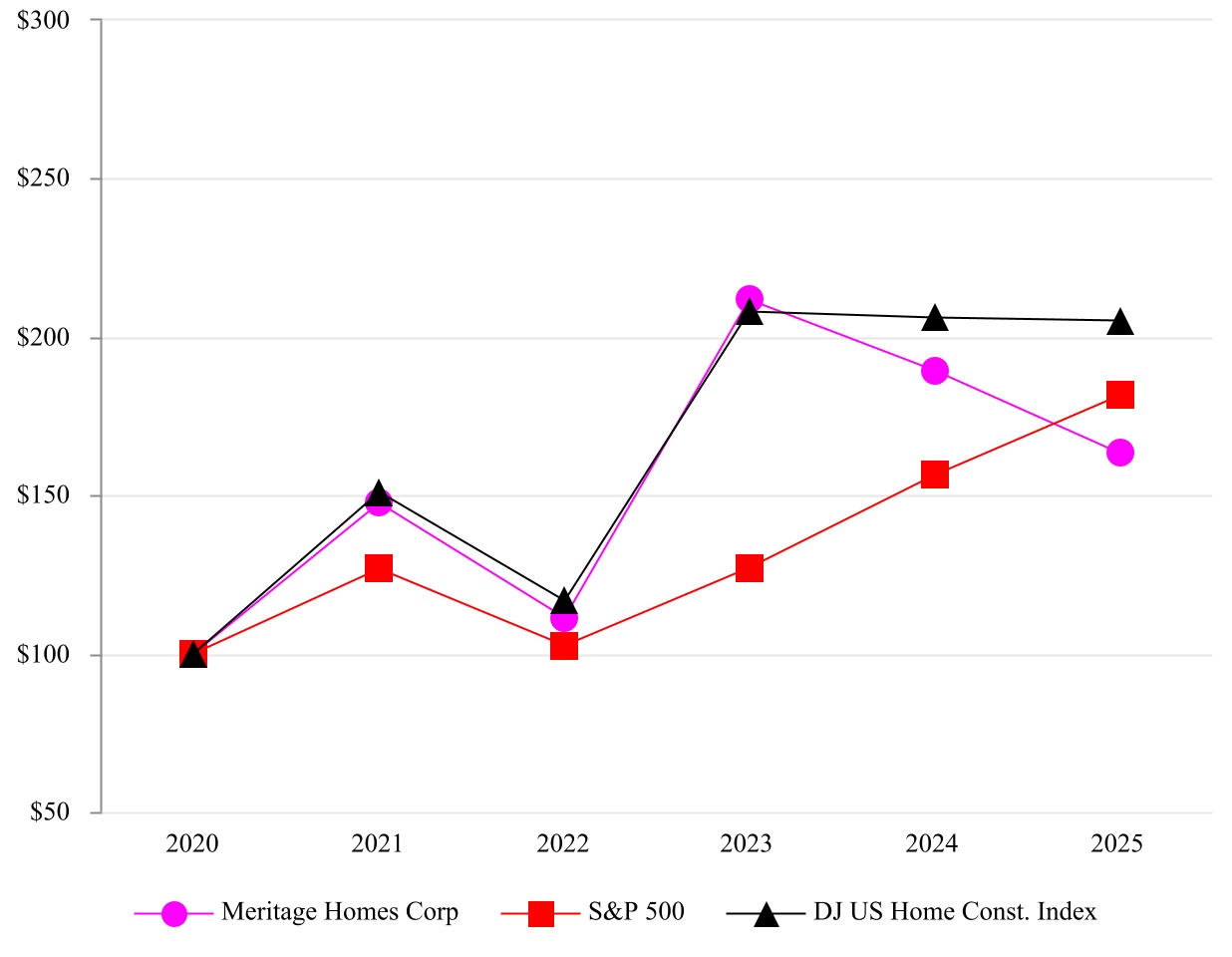
| 2020 | 2021 | 2022 | 2023 | 2024 | 2025 | |||||||||||||||||||||||||||||||||
| Meritage Homes Corporation | 100.00 | 147.38 | 111.33 | 211.64 | 189.35 | 163.05 | ||||||||||||||||||||||||||||||||
| S&P 500 Index | 100.00 | 126.54 | 102.41 | 126.89 | 156.16 | 181.54 | ||||||||||||||||||||||||||||||||
| Dow Jones US Home Construction Index | 100.00 | 150.85 | 116.52 | 207.86 | 205.91 | 205.21 | ||||||||||||||||||||||||||||||||
The preceding Performance Graph and related information shall not be deemed to be “soliciting material” or to be “filed” with the SEC, nor shall such information be incorporated by reference into any filing under the Securities Act or the Exchange Act, each as amended, except to the extent that we specifically incorporate it by reference into such filing.
28
During the year ended December 31, 2025, the Board approved, and we paid, quarterly cash dividends of $0.43 per share, for a total of $1.72 per share. We intend to continue the payment of quarterly cash dividends and the amount will be reviewed and assessed in the first quarter of each year. The amount of future cash dividends will depend upon our financial condition, results of operations, capital requirements, statutory requirements, restrictions imposed by our credit facility, as well as other factors considered relevant by our Board of Directors. See “Management’s Discussion and Analysis of Financial Condition and Results of Operations — Liquidity and Capital Resources” for further discussion of these factors.
Issuer Purchases of Equity Securities
Our Board of Directors authorized a stock repurchase program in 2019, and has subsequently authorized additional expenditures under the program, summarized in the table below.
| Date authorized | Date announced | Amount authorized | ||||||
| February 13, 2019 | April 29, 2019 | $ | 100,000,000 | |||||
| November 13, 2020 | January 27, 2021 | $ | 100,000,000 | |||||
| August 12, 2021 | August 17, 2021 | $ | 100,000,000 | |||||
| May 19, 2022 | May 25, 2022 | $ | 200,000,000 | |||||
| November 21, 2024 | November 21, 2024 | $ | 250,000,000 | |||||
| August 21, 2025 | August 21, 2025 | $ | 500,000,000 | |||||
There is no stated expiration for this program. The repurchases of the Company's shares may be made in the open market, in privately negotiated transactions, or otherwise. The timing and amount of repurchases, if any, will be determined by the Company's management at its discretion and be based on a variety of factors such as the market price of the Company's common stock, corporate and contractual requirements, prevailing market and economic conditions and legal requirements. The share repurchase program may be modified, suspended or discontinued at any time.
We acquired 4,289,984 shares of our common stock at an aggregate purchase price of $295.0 million for the year ended December 31, 2025. As of December 31, 2025, there was approximately $514.1 million available under this program to repurchase shares. We purchased 2,238,534 shares under the program during the three months ended December 31, 2025.
| Period | Total Number of Shares Purchased | Average price paid per share | Total number of shares purchased as part of publicly announced plans or programs | Approximate dollar value of shares that may yet be purchased under the plans or programs | |||||||||||||||||||
| October 1, 2025 - October 31, 2025 | 295,550 | $ | 67.67 | 295,550 | $ | 644,079,226 | |||||||||||||||||
| November 1, 2025 - November 30, 2025 | 1,942,984 | $ | 66.91 | 1,942,984 | $ | 514,079,328 | |||||||||||||||||
| December 1, 2025 - December 31, 2025 | — | $ | — | — | $ | 514,079,328 | |||||||||||||||||
| Total | 2,238,534 | 2,238,534 | |||||||||||||||||||||
29
Item 6. [Reserved]
Item 7. Management’s Discussion and Analysis of Financial Condition and Results of Operations
Industry Conditions
The market for new homes in 2025 was marked by much softer demand than anticipated, as affordability challenges persisted and consumer confidence deteriorated. While demand for affordable, move-in ready homes from millennial, Gen Z and baby boomer generations continues, buyers are increasingly reliant on financing assistance to overcome market uncertainty and manage monthly payments. Our ability to offer financing incentives, including interest rate locks and buy-downs, remains a key differentiator, primarily compared to resale homes, where individual sellers are typically not able to provide such incentives. With our strategy to provide affordable, move-in ready homes that can close within 60 days, and a commitment to partner with third-party brokers, who facilitate most residential real estate transactions in the U.S., we believe we are well positioned to capture existing demand and grow our market share when demand improves.
During 2025, we further shortened our construction cycle times to under 110 calendar days, below our historical normalized time of approximately 120 days. Our all-spec strategy minimizes variability and creates efficiencies through repeatability, which combined with increased capacity from declining market demand, were the drivers for this cycle time improvement. Cycle time improvement was also supported by a healthy channel of materials available in the supply chain. While material costs have eased, land costs remain elevated following years of historically high land acquisition and development costs. Our scale and purchasing power allow us to secure volume discounts from national vendors, helping offset some of these cost pressures.
In response to the broader economic conditions, during the fourth quarter of 2025 we conducted an in-depth review of our land portfolio and elected to terminate certain positions to release capital to top-grade our land portfolio as better opportunities become available. We also took steps to reduce our go-forward overhead costs, with a strategic focus on both cost savings and technological efficiencies for certain back-office functions. As a result of these strategic reviews, we recognized charges on terminated land contracts of $39.4 million and severance costs totaling $8.4 million during the year ended December 31, 2025.
We believe that the execution of our all-spec strategy of move-in ready homes with a commitment to affordability will drive strong performance of our key financial goals such as strong home closing revenue and home closing gross margin, controlling selling, and general and administrative costs, and maintaining sufficient liquidity.
Summary Company Results
Despite a tougher economic backdrop, we ended 2025 with 15,026 closings, down 3.7% from 15,611 closings in 2024. Home order volume for the year ended December 31, 2025 of 14,650 units was consistent with prior year, as an 11.6% increase in average active community count was mostly offset by a 9.3% year-over-year decrease in orders pace. A cancellation rate of 11% in 2025 was higher than 9% in 2024, but still below our historical company average and we believe that this demonstrates the benefits of a shorter timeline between home order and home closing that is a product of our move-in ready homes with a 60-day closing ready commitment. Reduced construction cycle times and our all spec strategy led to record backlog conversions throughout the full year 2025, resulting in 24.4% fewer homes in backlog at December 31, 2025, with 1,168 units valued at $440.6 million compared to 1,544 units valued at $629.5 million at December 31, 2024.
Total home closing revenue of $5.8 billion for the year ended December 31, 2025 decreased 9.1% from $6.3 billion in 2024, due to 3.7% fewer home closings and a 5.6% reduction in ASP on closings. Home closing gross margin was 19.7% for the year ended December 31, 2025 compared to 24.9% in 2024. The year-over-year margin decline was due to increased utilization of financing incentives, higher lot costs, and reduced leverage of fixed costs on lower home closing revenue, all of which offset savings in direct costs and faster cycle times. Home closing gross margin was also impacted by $39.4 million in charges incurred related to terminated land contracts, $16.5 million of real estate-related impairments, and $4.3 million of severance costs. Excluding these costs, adjusted home closing gross margin was 20.8% for the year ended December 31, 2025, compared to adjusted home closing gross margin of 25.0% in 2024 which included $6.7 million in terminated land contracts. Financial services profit of $18.6 million increased from $14.4 million in the same period of 2024 due to fewer charges in the current period related to the expiration of interest rate forward commitments. Commissions and other sales costs of $404.4 million for the full year ended December 31, 2025 decreased $4.7 million from the prior year period due to lower home closing revenue, offset by higher maintenance and utility costs as a result of having more spec homes in inventory. General and administrative expenses of $211.8 million for the year ended December 31, 2025 decreased $19.1 million year over year, primarily due to lower performance-based compensation, which was partially offset by increased technology spend and severance costs. Other income, net of $44.1 million in 2025 was relatively flat with prior year. Earnings before income taxes of $584.6 million in 2025 decreased 41.7% from $1.0 billion in 2024. Our effective tax rate for the year ended December 31, 2025
30
was 22.5% as compared to 21.6% in 2024, leading to net income of $453.0 million and $786.2 million for the years ended December 31, 2025 and 2024, respectively.
Company Positioning
We believe that the investments in our communities designed for the first-time and first move-up homebuyer, our move-in ready homes with our recently introduced 60-day closing ready commitment, and our partnership with external realtors create a differentiated strategy that has aided us in our growth in the highly competitive new home market.
Our focus on growing our community count and market share includes the following strategic initiatives:
•Embracing external realtor relationships, as we view realtors as a strategic partner who assists with sourcing homebuyers, particularly first-time homebuyers who view the realtor as a trusted advisor;
•Offering our customers affordable, move-in ready homes with a 60-day closing ready commitment;
•Delivering affordable homes on a shorter timeline through simplification of production processes and maintaining levels of spec inventory that are aligned with our strategy;
•Continuously improving the overall home buying experience through simplification and innovation; and
•Increasing homeowner satisfaction by offering energy-efficient homes that are cleaner and healthier.
In addition to these strategic initiatives, we also remain committed to the following:
•Achieving or maintaining a top 5 market position in all of our markets, and maintaining our status as a top 5 national builder (based on homes closed in 2024);
•Targeting a strong, yet sustainable, orders pace through the use of consumer and market research to ensure that we build homes that offer our buyers their desired features and amenities;
•Maintaining and where possible, expanding, our home closing gross profit by growing closing volume, allowing us to better leverage our direct overhead;
•Carefully managing our liquidity and a strong balance sheet. We ended the year with a 26.0% debt-to-capital ratio and a 16.9% net debt-to-capital ratio, after issuing $500.0 million of senior notes;
•Balancing return of capital to our stockholders with internal growth goals, utilizing both share repurchases and dividend payments;
•Managing construction efficiencies and costs through national and regional vendor relationships with a focus on timely, quality construction and warranty management; and
•Promoting a positive environment for our employees through our commitment to inclusion, culture, and belonging, and providing market-competitive benefits in order to develop and motivate our employees, minimize turnover and maximize recruitment efforts.
Critical Accounting Estimates
We have established various accounting policies that govern the application of United States generally accepted accounting principles (“GAAP”) in the preparation and presentation of our consolidated financial statements. Our significant accounting policies are described in Note 1 of the accompanying consolidated financial statements included in this Annual Report. Certain of these policies involve critical accounting estimates, which are significant judgments, assumptions and estimates by management in accordance with GAAP that involve a significant level of estimation uncertainty and have had or are reasonably likely to have a material impact on our financial condition or results of operations. We are subject to uncertainties such as the impact of future events, economic, environmental, political and regulatory factors and changes in our business environment; therefore, actual results could differ from these estimates. Accordingly, the accounting estimates used in the preparation of our financial statements may change as new events occur, as more experience is acquired, as additional information is obtained and as our operating environment changes. Changes in estimates are revised when circumstances warrant. Such changes in estimates and refinements in methodologies are reflected in our reported results of operations and, if
31
material, the effects of changes in estimates are disclosed in the notes to our consolidated financial statements. The judgments, assumptions and estimates we use and believe to be critical to our business are based on historical experience, knowledge of the accounts, industry practices, and other factors, which we believe to be reasonable under the circumstances. Because of the nature of the judgments and assumptions we have made, actual results may differ from these judgments and estimates and could have a material impact on the carrying values of assets and liabilities and the results of our operations.
The critical accounting estimates that we deem to involve the most difficult, subjective or complex judgments are as follows:
Real Estate Valuation and Cost of Home Closings
Real estate inventory is stated at cost unless the community or land is determined to be impaired, at which point the inventory is written down to fair value as required by Accounting Standards Codification (“ASC”) 360-10, Property, Plant and Equipment. Real estate inventory includes the costs of land acquisition, land development and home construction, capitalized interest, real estate taxes, and direct overhead costs incurred during development and home construction that benefit the entire community, less impairments, if any. Land and development costs are typically allocated and transferred to homes when home construction begins. Home construction costs are accumulated on a per-home basis, while commissions and other sales costs are expensed as incurred. Cost of home closings includes the specific construction costs of the home and all related allocated land acquisition, land development and other common costs (both incurred and estimated to be incurred) that are allocated based upon the total number of homes expected to be closed in each community or phase. Any changes to the estimated total development costs of a community or phase are allocated to the remaining homes in that community or phase. When a home closes, we may have incurred costs for materials and services that have not yet been paid. We accrue a liability to capture such obligations in connection with the home closing which is charged directly to Cost of home closings.
We capitalize qualifying interest to inventory during the development and construction periods. Capitalized interest is included in cost of closings when the related inventory is closed. Included within our Real estate inventory is land held for development, land held for sale, and mothball communities. Land held for development primarily represents land and development costs related to land where development activity is not currently underway but is expected to begin in the future. For these parcels, we have chosen not to currently develop certain land holdings as they typically represent a portion or phases of a larger land parcel that we plan to build out over several years. Mothball communities represent communities where we have elected to stop development of an existing actively selling community because we believe the economic performance of the community would be maximized by deferring development for a period of time to allow market conditions to improve. We do not capitalize interest for these inactive assets, and all ongoing costs of land ownership (i.e. property taxes, homeowner association dues, etc.) are expensed as incurred.
We rely on certain estimates to determine our construction and land development costs. Construction and land costs are comprised of direct and allocated costs, including estimated future costs. In determining these costs, we compile project budgets that are based on a variety of assumptions, including future construction schedules and costs to be incurred. Actual results can differ from budgeted amounts for various reasons, including construction delays, labor or material shortages, sales orders absorption rates that differ from our expectations, increases in costs that have not yet been contracted, changes in governmental requirements, or other unanticipated issues, encountered during construction and development and other factors beyond our control, including weather. To address uncertainty in these budgets, we assess, update and revise project budgets on a regular basis, utilizing the most current information available to estimate home construction and land development costs.
Typically, a community’s life cycle ranges from three to five years, commencing with the acquisition of the land, continuing through the land development phase, if applicable, and concluding with the construction, sale and closing of the homes. Actual community lives will vary based on the size of the community, the sales orders absorption rates and whether the land purchased was raw, partially-developed or in finished status. Master-planned communities encompassing several phases and super-block land parcels may have significantly longer lives and projects involving smaller finished lot purchases may be significantly shorter.
All of our land inventory and related real estate assets are periodically reviewed for recoverability when certain criteria are met, but at least annually, as our inventory is considered “long-lived” in accordance with GAAP.
32
Existing communities. Community-level reviews on active communities are performed quarterly, with the community review bifurcated between started and unstarted lots, to determine if indicators of potential impairment exist. If indicators of potential impairment exist and the undiscounted cash flows expected to be generated by an asset are lower than its carrying amount, impairment charges are recorded to write down the asset to its estimated fair value. The impairment of a community is allocated across the remaining lots in the community and is recognized in Cost of home closings in the period in which the impairment is determined. The fair value of the community’s assets is determined using either a market-based approach for projects to be sold or a discounted cash flow model for projects we intend to build out. If a market-based approach is used, we determine fair value based on recent comparable purchase and sale activity in the local market, adjusted for variances as determined by our knowledge of the region and general real estate expertise. If a discounted cash flow approach is used, we compute fair value using projections, estimates and observable and unobservable inputs such as (i) home selling prices in the community adjusted for current and expected sales discounts and incentives, (ii) costs related to the community — both land development and home construction — including costs spent to date and budgeted remaining costs to spend, (iii) projected sales absorption rates, reflecting any product mix change strategies implemented to stimulate the orders pace, (iv) expected cancellation rates, (v) alternative land uses including disposition of all or a portion of the land owned, if applicable, and (vi) discount rate, which is currently 10-14% and varies based on the perceived risk inherent in the community’s other cash flow assumptions. These assumptions vary widely across different communities and geographies and are largely dependent on local market conditions. Community-level factors that may impact our key estimates include:
•Our current experience in the market;
•The presence and significance of local competitors, including their offered product type, comparable lot size, remaining lots and competitive actions such as incentive offerings;
•Economic and related demographic conditions for the surrounding community, such as major employers;
•Desirability of the particular community, including unique amenities or other favorable or unfavorable attributes; and
•Existing home inventory supplies for the surrounding community.
These local circumstances may significantly impact our assumptions and the resulting computation of fair value and are, therefore, closely evaluated by our division personnel in their preparation of the discounted cash flow models. The models are also evaluated by regional and corporate personnel for consistency and integration, as decisions that affect pricing or absorption at one community may have resulting consequences for neighboring communities.
Mothball communities. In certain cases, we may elect to stop development of an existing actively selling community (mothball) if we believe the economic performance of the community would be maximized by deferring development for a period of time to allow market conditions to improve. The decision may be based on financial and/or operational metrics. If we decide to mothball a community, we will impair it to its fair value, if applicable, as discussed above and then cease future development activity until such a time when management believes that market conditions have improved and economic performance will be maximized. Impairment charges, if any, are recognized in Cost of home closings in the period in which the impairment is determined. No costs are capitalized to communities that are designated as mothballed. When a community is initially placed into mothball status, it is management’s belief that the community is affected by local market conditions that are expected to improve within the next 1-5 years. Mothball communities are reviewed at least annually to determine if they are at risk of future impairment. The financial and operational status and expectations of these communities are analyzed as well as any unique attributes that could be viewed as indicators for future impairments. Adjustments are made accordingly and incremental impairments, if any, are recorded at each re-evaluation.
Land held for sale or future development. Land held for sale or future development is reviewed at least annually to determine if it is at risk of future impairment. Our assessments on land held for sale or land held for future development typically involve third-party valuations, such as broker opinions, and recent comparable land sales in the area. Our assessments typically include highly subjective estimates for future performance, including the timing of development, the product to be offered, orders pace and selling prices of the product when the community is anticipated to open for sales, and the projected costs to develop and construct the community. We evaluate various factors to develop our forecasts, including the availability of and demand for homes and finished lots within the surrounding community, historical, current and future sales trends, and third-party data, if available. Based on these factors, we reach conclusions for future performance based on our judgment. If land held for sale or future development is deemed to be impaired, impairment changes are recognized in the period in which the impairment is determined. Impairments on land held for sale are recognized in Cost of land closings and impairments on land held for future development are recognized in Cost of home closings.
We have not made any material changes in our methodology or significant assumptions used to record and evaluate our Real estate inventory and Cost of home closings during the past three years.
33
Warranty Reserves
We use subcontractors for nearly all aspects of home construction. Although our subcontractors are generally required to repair and replace any product or labor defects and cover any resultant damages, we are, during applicable warranty periods, ultimately responsible to the homeowner for making such repairs. As such, warranty reserves are recorded to cover our exposure to costs for materials and labor not expected to be covered by our subcontractors or available insurance to the extent they relate to warranty-type claims subsequent to the delivery of a home to the homeowner. Reserves are reviewed on a regular basis and, with the assistance of an actuary for the structural warranty, we determine their sufficiency based on our and industry-wide historical data and trends. These reserves are subject to variability due to uncertainties regarding materials or construction defect claims, the markets in which we build, claim settlement history, insurance, legal interpretations and expected recoveries, among other factors.
At December 31, 2025, our warranty reserve was $26.7 million, reflecting an accrual of 0.1% to 0.5% of a home’s sale price depending on our loss history in the geographic area in which the home was built. A 10% increase in our warranty reserve rate would have increased our accrual and corresponding cost of home closings by approximately $1.9 million in 2025. As a result of the routine review described previously, there were no adjustments to our reserve balance during the year ended December 31, 2025, and we decreased our reserve balance by $1.0 million related to specific case reserves during the year ended December 31, 2024. See Notes 1 and 16 in the accompanying consolidated financial statements for more information. While we believe that the warranty reserve is sufficient to cover our projected costs, there can be no assurances that historical data and trends will accurately predict our actual warranty costs. Furthermore, there can be no assurances that future economic, financial or legislative developments might not lead to a significant change in the reserve.
We have not made any material changes in our methodology or significant assumptions used to record and evaluate our warranty reserves during the past three years.
Fiscal 2025 Compared to Fiscal 2024
For discussion of our fiscal 2024 results compared to our fiscal 2023 results, refer to Item 7, “Management’s Discussion and Analysis of Financial Condition and Results of Operations” under Part II of our Annual Report on Form 10-K for the year ended December 31, 2024.
Home Closing Revenue, Home Orders and Order Backlog - Segment Analysis
The composition of our closings, home orders and backlog is constantly changing and is based on a changing mix of communities with various price points between periods as new projects open and existing projects wind down and close out. Further, individual homes within a community can range significantly in price due to differing square footage, option selections, lot sizes and quality and location of lots (e.g. cul-de-sac, view lots, greenbelt lots). These variations result in a lack of meaningful comparability between our home orders, closings and backlog due to the changing mix between periods.
The tables on the following pages present operating and financial data that we consider most critical to managing our operations (dollars in thousands):
34
| Home Closing Revenue | Years Ended December 31, | Year Over Year | ||||||||||||||||||||||||
| 2025 | 2024 | Chg $ | Chg % | |||||||||||||||||||||||
| Total | ||||||||||||||||||||||||||
| Dollars | $ | 5,763,597 | $ | 6,341,546 | $ | (577,949) | (9.1) | % | ||||||||||||||||||
| Homes closed | 15,026 | 15,611 | (585) | (3.7) | % | |||||||||||||||||||||
| Average sales price | $ | 383.6 | $ | 406.2 | $ | (22.6) | (5.6) | % | ||||||||||||||||||
| West Region | ||||||||||||||||||||||||||
| Dollars | $ | 1,829,432 | $ | 2,223,876 | $ | (394,444) | (17.7) | % | ||||||||||||||||||
| Homes closed | 3,821 | 4,526 | (705) | (15.6) | % | |||||||||||||||||||||
| Average sales price | $ | 478.8 | $ | 491.4 | $ | (12.6) | (2.6) | % | ||||||||||||||||||
| Central Region | ||||||||||||||||||||||||||
| Dollars | $ | 1,835,691 | $ | 2,015,621 | $ | (179,930) | (8.9) | % | ||||||||||||||||||
| Homes closed | 5,264 | 5,525 | (261) | (4.7) | % | |||||||||||||||||||||
| Average sales price | $ | 348.7 | $ | 364.8 | $ | (16.1) | (4.4) | % | ||||||||||||||||||
| East Region | ||||||||||||||||||||||||||
| Dollars | $ | 2,098,474 | $ | 2,102,049 | $ | (3,575) | (0.2) | % | ||||||||||||||||||
| Homes closed | 5,941 | 5,560 | 381 | 6.9 | % | |||||||||||||||||||||
| Average sales price | $ | 353.2 | $ | 378.1 | $ | (24.9) | (6.6) | % | ||||||||||||||||||
| Home Orders (1) | Years Ended December 31, | Year Over Year | ||||||||||||||||||||||||
| 2025 | 2024 | Chg $ | Chg % | |||||||||||||||||||||||
| Total | ||||||||||||||||||||||||||
| Dollars | $ | 5,726,846 | $ | 5,950,708 | $ | (223,862) | (3.8) | % | ||||||||||||||||||
| Homes ordered | 14,650 | 14,606 | 44 | 0.3 | % | |||||||||||||||||||||
| Average sales price | $ | 390.9 | $ | 407.4 | $ | (16.5) | (4.1) | % | ||||||||||||||||||
| West Region | ||||||||||||||||||||||||||
| Dollars | $ | 1,753,922 | $ | 2,084,168 | $ | (330,246) | (15.8) | % | ||||||||||||||||||
| Homes ordered | 3,571 | 4,215 | (644) | (15.3) | % | |||||||||||||||||||||
| Average sales price | $ | 491.2 | $ | 494.5 | $ | (3.3) | (0.7) | % | ||||||||||||||||||
| Central Region | ||||||||||||||||||||||||||
| Dollars | $ | 1,877,109 | $ | 1,893,202 | $ | (16,093) | (0.9) | % | ||||||||||||||||||
| Homes ordered | 5,240 | 5,165 | 75 | 1.5 | % | |||||||||||||||||||||
| Average sales price | $ | 358.2 | $ | 366.5 | $ | (8.3) | (2.3) | % | ||||||||||||||||||
| East Region | ||||||||||||||||||||||||||
| Dollars | $ | 2,095,815 | $ | 1,973,338 | $ | 122,477 | 6.2 | % | ||||||||||||||||||
| Homes ordered | 5,839 | 5,226 | 613 | 11.7 | % | |||||||||||||||||||||
| Average sales price | $ | 358.9 | $ | 377.6 | $ | (18.7) | (5.0) | % | ||||||||||||||||||
(1)Home orders for any period represent the aggregate sales price of all homes ordered, net of cancellations. We do not include orders contingent upon the sale of a customer’s existing home or a mortgage pre-approval as a sales contract until the contingency is removed.
35
| Order Backlog (1) | At December 31, | Year Over Year | ||||||||||||||||||||||||
| 2025 | 2024 | Chg $ | Chg % | |||||||||||||||||||||||
| Total | ||||||||||||||||||||||||||
| Dollars | $ | 440,562 | $ | 629,549 | $ | (188,987) | (30.0) | % | ||||||||||||||||||
| Homes in backlog | 1,168 | 1,544 | (376) | (24.4) | % | |||||||||||||||||||||
| Average sales price | $ | 377.2 | $ | 407.7 | $ | (30.5) | (7.5) | % | ||||||||||||||||||
| West Region | ||||||||||||||||||||||||||
| Dollars | $ | 91,937 | $ | 214,360 | $ | (122,423) | (57.1) | % | ||||||||||||||||||
| Homes in backlog | 185 | 435 | (250) | (57.5) | % | |||||||||||||||||||||
| Average sales price | $ | 497.0 | $ | 492.8 | $ | 4.2 | 0.9 | % | ||||||||||||||||||
| Central Region | ||||||||||||||||||||||||||
| Dollars | $ | 165,002 | $ | 177,516 | $ | (12,514) | (7.0) | % | ||||||||||||||||||
| Homes in backlog | 457 | 481 | (24) | (5.0) | % | |||||||||||||||||||||
| Average sales price | $ | 361.1 | $ | 369.1 | $ | (8.0) | (2.2) | % | ||||||||||||||||||
| East Region | ||||||||||||||||||||||||||
| Dollars | $ | 183,623 | $ | 237,673 | $ | (54,050) | (22.7) | % | ||||||||||||||||||
| Homes in backlog | 526 | 628 | (102) | (16.2) | % | |||||||||||||||||||||
| Average sales price | $ | 349.1 | $ | 378.5 | $ | (29.4) | (7.8) | % | ||||||||||||||||||
(1)Our backlog represents net home orders that have not closed.
| Active Communities | Years Ended December 31, | ||||||||||||||||||||||
| 2025 | 2024 | ||||||||||||||||||||||
| Ending | Average | Ending | Average | ||||||||||||||||||||
| Total | 336 | 312.8 | 292 | 280.4 | |||||||||||||||||||
| West Region | 83 | 85.8 | 91 | 84.6 | |||||||||||||||||||
| Central Region | 112 | 93.2 | 90 | 91.2 | |||||||||||||||||||
| East Region | 141 | 133.8 | 111 | 104.6 | |||||||||||||||||||
| Cancellation Rates (1) | Years Ended December 31, | |||||||||||||
| 2025 | 2024 | |||||||||||||
| Total | 11 | % | 9 | % | ||||||||||
| West Region | 9 | % | 9 | % | ||||||||||
| Central Region | 11 | % | 10 | % | ||||||||||
| East Region | 11 | % | 9 | % | ||||||||||
(1)Cancellation rates are computed as the number of canceled units for the period divided by the gross sales units for the same period.
36
Companywide. We closed 15,026 homes with home closing revenue of $5.8 billion for the year ended December 31, 2025, compared to 15,611 units and home closing revenue of $6.3 billion in 2024. The lower home closing revenue was driven by 3.7% lower home closing volume and a 5.6% decrease in ASP on closings. The reduction in ASP is the result of higher utilization of financing incentives. Home order volume of 14,650 units was relatively flat year over year, as average active community count increased 11.6% but was offset by a lower orders pace of 3.9 homes per month, as compared to 4.3 homes per month in 2024. Home order value declined 3.8% to $5.7 billion for the year ended December 31, 2025, from $6.0 billion in the prior year, due to a 4.1% decrease in ASP on orders. The lower ASP on both closings and orders was also due in part to geographic mix shift, as the West Region with our highest ASPs comprised a smaller portion of our total closings and orders in 2025. The cancellation rate of 11% in 2025 increased from 9% in 2024, as the result of buyer hesitancy after initial sale from affordability concerns. Despite the year over year increase, the 2025 cancellation rate continues to be below historical normal levels. We ended the year with 1,168 homes in backlog valued at $440.6 million, compared to 1,544 homes in backlog valued at $629.5 million, decreases of 24.4% and 30.0%, respectively, compared to 2024. The number of homes in backlog declining year over year is the result of our higher backlog conversion rates throughout 2025, as well as lower orders in the fourth quarter of 2025 due to market conditions. As anticipated with our strategy of offering move-in ready homes, we are selling a higher percentage of spec homes later in the construction cycle, contributing to the higher backlog conversion rates in all of our regions.
West. The West Region generated $1.8 billion in home closing revenue for the year ended December 31, 2025, a 17.7% decrease from $2.2 billion in the prior year, due to a 15.6% lower home closing volume and a 2.6% decrease in ASP on closings. Geographic mix shift within the region and increased utilization and cost of financing incentives both contributed to the lower ASP on closings. Home order volume declined 15.3% to 3,571 units, resulting entirely from a 16.7% lower orders pace of 3.5 homes per month compared to 4.2 per month in the prior year, as the average active community count was relatively consistent year-over-year. Lower home order volume contributed nearly entirely to a 15.8% decrease in order value of $1.8 billion, as ASP on orders remained relatively flat year over year. The West Region's cancellation rate of 9% for the year ended December 31, 2025 was the lowest rate in the Company and consistent with prior year. Backlog of 185 homes valued at $91.9 million at December 31, 2025 was down 57.5% and 57.1%, respectively, from 435 homes valued at $214.4 million at December 31, 2024, resulting from the combined effect of fewer orders and higher backlog conversion rates in 2025 as compared to 2024.
Central. The Central Region closed 5,264 homes and generated home closing revenue of $1.8 billion for the year ended December 31, 2025, compared to 5,525 homes and $2.0 billion in 2024. The 8.9% lower home closing revenue was the result of the combined impact of 4.7% and 4.4% decreases in home closing volume and ASP on closings, respectively. The decline in ASP on closings is primarily due to greater utilization of financing incentives. The Central Region order volume of 5,240 homes increased 1.5% year over year, due entirely to a 2.2% increase in average active community count as orders pace was consistent year over year. Orders pace of 4.7 homes per month was the highest pace in the Company for both years. Home order value of $1.9 billion for the year ended December 31, 2025, was relatively flat year over year, as the increase in order volume was offset by a 2.3% decrease in ASP on orders. The Central Region cancellation rate of 11% in 2025 was up from 10% in 2024. The Central Region ended the year with 457 homes in backlog valued at $165.0 million, compared to 481 homes in backlog valued at $177.5 million at December 31, 2024.
East. The East Region had continued growth in 2025, closing 5,941 homes in the year ended December 31, 2025, a 6.9% improvement over 5,560 in 2024. Home closing revenue of $2.1 billion for the year ended December 31, 2025 was consistent with 2024, as the higher home closing volume was offset by a 6.6% decline in ASP on closings, reflecting increased utilization of financing incentives and a shift in geographic mix within the region. Order volume of 5,839 homes increased 11.7% from 5,226 homes, combined with a 5.0% decrease in ASP on orders, led to a 6.2% increase in home order value of $2.1 billion for the year ended December 31, 2025, compared to $2.0 billion in 2024. The East Region's order volume improvement was due entirely to a 27.9% increase in average active community count, as order pace of 3.6 homes per month in 2025 was lower than 4.2 homes per month in 2024. Both home closing and order volumes reflect our acquisitions and green field start-ups in our new markets in Alabama and Mississippi. The East Region cancellation rate of 11% for the year ended December 31, 2025 was up from 9% in the prior year, but still below historical averages for the Company. The East Region ended 2025 with 526 homes in backlog valued at $183.6 million, down 16.2% and 22.7%, respectively, from 628 homes in backlog valued at $237.7 million at December 31, 2024. The decrease in backlog units is the result of higher backlog conversion rates throughout 2025, which is an expected result of our 60-day closing ready commitment.
37
Land Closing Revenue and Gross Profit (in thousands)
| Years ended December 31, | |||||||||||
| 2025 | 2024 | ||||||||||
| Land closing revenue | $ | $ | |||||||||
| Land closing gross profit | $ | $ | |||||||||
From time to time, we may sell certain lots or land parcels to other homebuilders, developers or investors if we feel the sale will provide a greater economic benefit to us than continuing home construction or where we are looking to diversify our land positions in a specific geography or divest of assets that no longer align with our strategy. Land sales occur at various intervals and varying degrees of profitability depending upon market opportunities and our land management strategy. Therefore, the revenue and gross profit from land closings will fluctuate from period to period.
Home Closing Gross Profit (dollars in thousands)
| Years ended December 31, | ||||||||||||||||||||||||||
| 2025 | 2024 | |||||||||||||||||||||||||
| Dollars | Percent of Home Closing Revenue | Dollars | Percent of Home Closing Revenue | |||||||||||||||||||||||
| Home Closing Gross Profit (1) | ||||||||||||||||||||||||||
| Total | $ | 1,136,192 | 19.7 | % | $ | 1,579,843 | 24.9 | % | ||||||||||||||||||
| Add: Real estate impairments | 16,532 | — | ||||||||||||||||||||||||
| Add: Write-off of terminated land contracts | 39,382 | 6,702 | ||||||||||||||||||||||||
| Add: Severance costs | 4,297 | — | ||||||||||||||||||||||||
Adjusted Home Closing Gross Profit (2) | $ | 1,196,403 | 20.8 | % | $ | 1,586,545 | 25.0 | % | ||||||||||||||||||
| West | $ | 368,119 | 20.1 | % | $ | 508,020 | 22.8 | % | ||||||||||||||||||
| Add: Real estate impairments | 742 | — | ||||||||||||||||||||||||
| Add: Write-off of terminated land contracts | 8,599 | 2,478 | ||||||||||||||||||||||||
| Add: Severance costs | 1,085 | — | ||||||||||||||||||||||||
Adjusted Home Closing Gross Profit (2) | $ | 378,545 | 20.7 | % | $ | 510,498 | 23.0 | % | ||||||||||||||||||
| Central | $ | 383,906 | 20.9 | % | $ | 523,378 | 26.0 | % | ||||||||||||||||||
| Add: Real estate impairments | 5,697 | — | ||||||||||||||||||||||||
| Add: Write-off of terminated land contracts | 5,204 | 1,562 | ||||||||||||||||||||||||
| Add: Severance costs | 1,568 | — | ||||||||||||||||||||||||
Adjusted Home Closing Gross Profit (2) | $ | 396,375 | 21.6 | % | $ | 524,940 | 26.0 | % | ||||||||||||||||||
| East | $ | 384,167 | 18.3 | % | $ | 548,445 | 26.1 | % | ||||||||||||||||||
| Add: Real estate impairments | 10,093 | — | ||||||||||||||||||||||||
| Add: Write-off of terminated land contracts | 25,579 | 2,662 | ||||||||||||||||||||||||
| Add: Severance costs | 1,644 | — | ||||||||||||||||||||||||
Adjusted Home Closing Gross Profit (2) | $ | 421,483 | 20.1 | % | $ | 551,107 | 26.2 | % | ||||||||||||||||||
(1)Home closing gross profit represents home closing revenue less cost of home closings, including impairments, if any. Cost of home closings includes land and associated development costs, direct home construction costs, an allocation of common community costs (such as architectural, legal and zoning costs), interest, sales tax, impact fees, warranty, construction overhead and closing costs.
(2)Adjusted home closing gross profit is a non-GAAP measure and should be considered in addition to, rather than as a substitute for, the comparable GAAP financial measures. We believe this non-GAAP financial measure is relevant and useful to investors in understanding our operating results and may be helpful in comparing the Company with other companies in the homebuilding and other industries to the extent they provide similar information.
38
Companywide. Home closing gross margin of 19.7% for the year ended December 31, 2025 was down 520 basis points from 24.9% in the prior year due to increased utilization of financing incentives, higher lot costs, real estate-related impairments and charges related to terminated land contracts, and severance costs, all of which offset lower direct costs and savings generated from faster construction cycle times. Excluding terminated land contracts, real estate-related impairments, and severance costs, adjusted home closing gross margin was 20.8% for the year ended December 31, 2025, compared to adjusted home closing gross margin of 25.0% in 2024 when excluding $6.7 million in terminated land contracts. There were no impairments or severance costs during the year ended December 31, 2024.
West. For the year ended December 31, 2025, the West Region home closing gross margin was 20.1% a 270 basis point decline from 22.8% in the same period of 2024, due primarily to increased utilization and cost of financing incentives, along with higher lot costs that were offset by savings in direct costs and improvements in construction cycle times. Additionally, 2025 home closing gross margin negatively impacted by real estate impairments, charges related to terminated land contracts, and severance costs by 60 basis points and 20 basis points in 2025 and 2024, respectively. Excluding these charges, adjusted home closing gross margin in the West Region was 20.7% and 23.0% for the years ended December 31, 2025 and 2024, respectively.
Central. The Central Region home closing gross margin was 20.9% for the year ended December 31, 2025, the highest in the Company. The 510 basis point decrease from 26.0% in 2024 was due to an increase in utilization of financing incentives and elevated lot costs, offset by lower direct costs and faster construction cycle times. Non-recurring charges for impairments on real estate, terminated land contracts, and severance costs also contributed to the margin decline. Excluding these non-recurring charges, adjusted home closing gross margin for the Central Region was 21.6% and 26.0% for the years ending December 31, 2025 and 2024, respectively.
East. The East Region home closing gross margin of 18.3% for the year ended December 31, 2025 decreased 780 basis points from 26.1% in the prior year period. The decline in home closing gross margin reflects greater utilization and higher cost of financing incentives and elevated lot costs, which were offset in part by savings in directs costs and construction cycle time improvements. The East Region home closing gross margin in 2025 was negatively impacted by charges for terminated land contracts, real-estate impairments and severance costs. Excluding these items, adjusted home closing gross margin in the East Region was 20.1% in 2025, compared to adjusted home closing gross margin of 26.2% the year ended December 31, 2024.
Financial Services Profit (in thousands)
| Years Ended December 31, | |||||||||||
| 2025 | 2024 | ||||||||||
| Financial services profit | $ | 18,618 | $ | 14,410 | |||||||
Financial services profit. Financial services profit represents the net profit of our financial services operations, including the operating profit generated by our wholly-owned title and insurance companies, Carefree Title and Meritage Insurance, respectively, as well as our portion of earnings from a mortgage joint venture. Financial services profit of $18.6 million for the year ended December 31, 2025 increased from $14.4 million in the prior year due to fewer charges related to expired and unused interest rate forward commitments in the current year as compared to the prior year period.
39
Selling, General and Administrative, and Other Income and Expenses (dollars in thousands)
| Years Ended December 31, | ||||||||||||||
| 2025 | 2024 | |||||||||||||
| Commissions and Other Sales Costs | $ | (404,405) | $ | (409,069) | ||||||||||
| Percent of home closing revenue | 7.0 | % | 6.5 | % | ||||||||||
| General and Administrative Expenses | $ | (211,762) | $ | (230,856) | ||||||||||
| Percent of home closing revenue | 3.7 | % | 3.6 | % | ||||||||||
| Interest Expense | $ | — | $ | — | ||||||||||
| Other Income, Net | $ | 44,145 | $ | 45,156 | ||||||||||
| Loss on Early Extinguishment of Debt | $ | — | $ | (631) | ||||||||||
| Provision for Income Taxes | $ | (131,587) | $ | (216,684) | ||||||||||
Commissions and Other Sales Costs. Commissions and other sales costs are comprised of internal and external commissions and related sales and marketing expenses such as advertising and sales office costs. For the year ended December 31, 2025, these costs decreased $4.7 million, to $404.4 million, but increased to 7.0% of home closing revenue, compared to 6.5% in the prior year. The lower dollar spend was due primarily to lower home closing volume and revenue, with an offsetting increase in spend for spec maintenance and utilities as a result of higher levels of spec inventory. As a percentage of home closing revenue, the 50 basis point increase is largely the result of higher external broker commission rates reflecting the tougher selling environment, coupled with a higher external broker participation rate, as well as higher costs for maintaining a larger number of completed homes. The increase in spec home inventory and associated overhead expenses is a result of our new 60-day closing ready commitment in order to have sufficient inventory available.
General and Administrative Expenses. General and administrative expenses represent corporate and divisional overhead expenses such as salaries and bonuses, occupancy, insurance and travel expenses. For the year ended December 31, 2025, general and administrative expenses of $211.8 million decreased $19.1 million from $230.9 million in the prior year, as a result of lower performance-based compensation expense, which was partially offset by increased spend on new technology, start-up expenses associated with our new divisions in Alabama and Mississippi, and severance costs. Despite lower home closing revenue, general and administrative expenses as a percentage of home closing revenue held relatively steady at 3.7% in 2025, compared to 3.6% in 2024.
Interest Expense. Interest expense is comprised of interest incurred, but not capitalized, on our senior and convertible senior notes, other borrowings and our $910.0 million amended and restated unsecured revolving credit facility (the "Credit Facility"). We had no interest expense for the years ended December 31, 2025 and 2024, as all interest incurred was capitalized to qualifying assets.
Other Income, Net. Other income, net primarily consists of (i) interest earned on our cash and cash equivalents, (ii) sub lease income, (iii) payments and awards related to legal settlements, and (iv) our portion of pre-tax income or loss from non-financial services joint ventures. Other income, net was $44.1 million and $45.2 million in 2025 and 2024, respectively.
Loss on Early Extinguishment of Debt. Loss on early extinguishment of debt of $0.6 million for the year ended December 31, 2024 is related to the $250.0 million full redemption of our remaining 6.00% Senior Notes due 2025 ("2025 Notes"). There were no similar charges for the year ended December 31, 2025. See Note 7 in the accompanying consolidated financial statements for more information related to the redemption of our 2025 Notes.
Income Taxes. The effective tax rate was 22.5% and 21.6% for 2025 and 2024, respectively. The higher rate in 2025 reflects fewer homes qualifying for energy tax credits under the Internal Revenue Code ("IRC") §45L energy-efficient homes federal tax credit, given the new higher construction thresholds required to earn these tax credits beginning in 2025, which was partially offset by acquired below-market transferrable clean fuel production tax credits in 2025.
40
Liquidity and Capital Resources
Overview
We have historically generated cash and funded our operations primarily from cash flows from operating activities. Additional sources of funds may include additional debt or equity financing and borrowing capacity under our Credit Facility. We exercise strict controls and believe we have a prudent strategy for Company-wide cash management, including those related to cash outlays for land acquisition and development and spec home construction. Our principal uses of cash include acquisition and development of land and lots, home construction, operating expenses, share repurchases and the payment of interest, routine liabilities, and dividends. We also opportunistically repurchase or redeem our senior notes.
Cash flows for each of our communities depend on their stage of the development cycle, and can differ substantially from reported earnings. Early stages of development or expansion require significant cash outlays for land acquisitions, zoning plat and other approvals, community and lot development, and construction of model homes, roads, utilities, landscape and other amenities. Because these costs are a component of our inventory and are not recognized in our income statement until a home closes, we incur significant cash outlays prior to recognition of earnings. As a means of accessing parcels of land, both undeveloped and finished, with minimal cash outlay, we may use option contracts and joint ventures to secure land rights. In the later stages of a community, cash inflows may significantly exceed earnings reported for financial statement purposes, as the cash outflow associated with home and land construction was previously incurred. Similarly, in times of community count growth, we incur significant outlays of cash through the land purchase, development and community opening stages whereas in in times of community count stability, these cash outlays are incurred in a more even-flow cadence with cash inflows from actively selling communities that are contributing closing volume and home closing revenue. Conversely, in a down turn environment, cash outlays for land and community count growth may be scaled back to preserve liquidity and we may curtail community count.
Short-term Liquidity and Capital Resources
Over the course of the next twelve months, we expect that our primary demand for funds will be for the construction of homes, as well as acquisition and development of both new and existing lots, operating expenses, including general and administrative expenses, interest payments, share repurchases and dividend payments. Although we don't anticipate any early redemptions in the near term, we may opportunistically repurchase or redeem a portion of our senior notes. We expect to meet these short-term liquidity requirements primarily through our cash and cash equivalents on hand and the net cash flows provided by our operations.
Between our cash and cash equivalents on hand combined with the availability of liquidity from our Credit Facility, we believe that we currently have sufficient liquidity. Nevertheless, in the future, we may seek additional capital to strengthen our liquidity position, enable us to acquire additional land inventory in anticipation of improving market conditions, and/or strengthen our long-term capital structure.
Long-term Liquidity and Capital Resources
Beyond the next twelve months, our principal demands for funds will be for the construction of homes, land acquisition and development activities needed to maintain our lot supply and active community count, payments of principal and interest on our senior and convertible senior notes as they become due or mature, share repurchases and dividend payments. We expect our existing and future generated cash will be adequate to fund our ongoing operating activities as well as provide capital for investment in future land purchases and related development activities. To the extent the sources of capital described above are insufficient to meet our long-term cash needs, we may also conduct additional public offerings of our securities, refinance or secure new debt or dispose of certain assets to fund our operating activities. There can be no assurances that we would be able to obtain such additional capital on terms acceptable to us, if at all, and such additional equity or debt financing could dilute the interests of our existing stockholders or increase our interest costs.
Material Cash Requirements
We are a party to many contractual obligations involving commitments to make payments to third parties. These obligations impact both short-term and long-term liquidity and capital resource needs. Certain contractual obligations are reflected on our consolidated balance sheets as of December 31, 2025, while others are considered future commitments for materials or services not yet provided. Our contractual obligations primarily consist of principal and interest payments on our senior and convertible senior notes, loans payable and other borrowings, including our Credit Facility, letters of credit and surety bonds and operating leases. We have no material debt maturities until 2027. We also have requirements for certain short-term lease commitments, funding working capital needs of our existing unconsolidated joint ventures, and other purchase obligations in the normal course of business. Other material cash requirements include land acquisition and development costs, home construction costs and operating expenses, including our selling, general and administrative expenses, as previously
41
discussed. We plan to fund these commitments primarily with cash flows generated by operations, but may also utilize additional debt or equity financing and borrowing capacity under our Credit Facility. Our maximum exposure to loss on our purchase and option agreements is generally limited to non-refundable deposits and capitalized or committed pre-acquisition costs.
For information about our lease obligations, loans payable and other borrowings, including our Credit Facility, and senior and convertible senior notes, reference is made to Notes 4, 6, and 7 in the accompanying consolidated financial statements included in this Annual Report and are incorporated by reference herein.
Reference is made to Notes 1, 3, 5, and 16 in the accompanying consolidated financial statements included in this Annual Report and are incorporated by reference herein. These Notes discuss our off-balance sheet arrangements with respect to land acquisition contracts and option agreements, and land development joint ventures, including the nature and amounts of financial obligations relating to these items. In addition, these Notes discuss the nature and amounts of certain types of commitments that arise in connection with the ordinary course of our land development and homebuilding operations, including commitments of land development joint ventures for which we might be obligated, if any.
We do not engage in commodity trading or other similar activities. We had no derivative financial instruments that required derivative accounting under ASC 815-10, Derivatives and Hedging, at December 31, 2025 or 2024.
Operating Cash Flow Activities
During the year ended December 31, 2025, net cash provided by operations totaled $118.3 million, compared to net cash used in operations of $227.6 million during the year ended December 31, 2024. Generally, our operating cash flows fluctuate primarily based on changes in our net earnings, real estate inventory and, to a lesser extent, timing of payments of accounts payable and accrued liabilities.
Operating cash flow results in 2025 primarily reflect $453.0 million in Net earnings, and were offset by a $274.1 million increase in Real estate and a $92.4 million decrease in Accounts payable and Accrued liabilities. The decrease in Accounts payable and Accrued liabilities was due primarily to decreased accruals related to real estate development and construction activities, as well as lower performance based compensation accruals. Operating cash flow results in 2024 primarily reflect $786.2 million in Net earnings, and were offset by a $979.3 million increase in Real estate and an $81.4 million increase in Deposits on real estate under option or contract. The increases in Real estate and Deposits on real estate under option or contract were due to increased land acquisition and development activities as well as construction activities on a greater number of homes under construction.
Investing Cash Flow Activities
During the years ended December 31, 2025 and 2024, net cash used in investing activities totaled $57.7 million and $44.1 million, respectively. Cash used in investing activities in both periods was mainly attributable to Investments in unconsolidated entities and purchases of Property and equipment.
Financing Cash Flow Activities
During the years ended December 31, 2025 and 2024, net cash provided by financing activities totaled $63.0 million and $2.0 million, respectively. The net cash provided by financing activities in 2025 primarily reflects the net proceeds of $492.1 million from the issuance of our 5.650% Senior Notes due 2035, offset by $295.0 million of share repurchases and $121.1 million of dividends paid. The net cash provided by financing activities in 2024 primarily reflects the net proceeds of $557.9 million from the issuance of our 1.750% Convertible Senior Notes due 2028 (the "2028 Convertible Notes"), offset by the early redemption of our remaining 2025 Notes of $250.0 million aggregate principal and $61.8 million for the purchase of capped calls relating to the 2028 Convertible Notes, along with $125.9 million of share repurchases and $108.6 million of dividends paid. See Part II, Item 5 - "Market for Registrant’s Common Equity, Related Stockholder Matters and Issuer Purchases of Equity Securities" for more information about our authorized share repurchase program.
42
We believe that our leverage ratios provide useful information to the users of our financial statements regarding our financial position and cash and debt management. Debt-to-capital and net debt-to-capital are calculated as follows (dollars in thousands):
| At December 31, 2025 | At December 31, 2024 | |||||||||||||
| Senior and convertible senior notes, net, loans payable and other borrowings | $ | 1,829,054 | $ | 1,335,878 | ||||||||||
| Stockholders’ equity | 5,195,643 | 5,141,573 | ||||||||||||
| Total capital | $ | 7,024,697 | $ | 6,477,451 | ||||||||||
| Debt-to-capital (1) | 26.0 | % | 20.6 | % | ||||||||||
| Senior and convertible senior notes, net, loans payable and other borrowings | $ | 1,829,054 | $ | 1,335,878 | ||||||||||
| Less: cash and cash equivalents | (775,157) | (651,555) | ||||||||||||
| Net debt | $ | 1,053,897 | $ | 684,323 | ||||||||||
| Stockholders’ equity | 5,195,643 | 5,141,573 | ||||||||||||
| Total net capital | $ | 6,249,540 | $ | 5,825,896 | ||||||||||
| Net debt-to-capital (2) | 16.9 | % | 11.7 | % | ||||||||||
(1)Debt-to-capital is computed as senior and convertible senior notes, net and loans payable and other borrowings divided by the aggregate of total senior and convertible senior notes, net, loans payable and other borrowings and stockholders' equity.
(2)Net debt-to-capital is considered a non-GAAP financial measure, and is computed as net debt divided by the aggregate of net debt and stockholders' equity. Net debt is comprised of total senior and convertible senior notes, net and loans payable and other borrowings, less cash and cash equivalents. The most directly comparable GAAP financial measure is the ratio of debt-to-capital. We believe the ratio of net debt-to-capital is a relevant financial measure for investors to understand the leverage employed in our operations and as an indicator of our ability to obtain financing.
Dividends
During the years ended December 31, 2025 and 2024, our Board approved and we paid, a recurring quarterly cash dividend on common stock of $0.43 and $0.375 per share, respectively. Quarterly dividends declared and paid cumulatively totaled $1.72 and $1.50 per share for the years ended December 31, 2025 and 2024, respectively. See Part II, Item 5 - "Market for Registrant’s Common Equity, Related Stockholder Matters and Issuer Purchases of Equity Securities".
Credit Facility Covenants
Borrowings under the Credit Facility are unsecured but availability is subject to, among other things, a borrowing base. The Credit Facility also contains certain financial covenants, including (a) a minimum tangible net worth requirement of $3.3 billion (which amount is subject to increase over time based on subsequent earnings and proceeds from equity offerings), and (b) a maximum leverage covenant that prohibits the leverage ratio (as defined therein) from exceeding 60%. We were in compliance with all Credit Facility covenants as of December 31, 2025. Our actual financial covenant calculations as of December 31, 2025 are reflected in the table below.
| Financial Covenant (dollars in thousands): | Covenant Requirement | Actual | |||||||||
| Minimum Tangible Net Worth | > $3,767,215 | $5,145,698 | |||||||||
| Leverage Ratio | < 60% | 15.1% | |||||||||
| Investments other than defined permitted investments | < $1,568,709 | $57,268 | |||||||||
Recent Accounting Pronouncements
See Note 1 to our consolidated financial statements included in this report for discussion of recently issued accounting standards.
43
Item 7A. Quantitative and Qualitative Disclosures About Market Risk
Our fixed rate debt is made up primarily of $1.8 billion in aggregate principal amount of our senior and convertible senior notes. All outstanding senior and convertible senior notes bear fixed rates of interest, and therefore, do not expose us to financial statement risk associated with changes in interest rates. The fair values of senior and convertible senior notes change primarily when interest rates change, and in the case of our convertible senior notes, when the market price of our stock fluctuates. Except in limited circumstances, we do not have an obligation to prepay our senior notes and, as a result, changes in fair value of our senior notes should not have a significant impact until we would be required to repay such debt if we choose to then also access the capital markets to issue new debt. Obligations to prepay our convertible senior notes may be required upon the occurrence of certain limited conversion conditions that are closely related to the fair value of the convertible senior notes, and therefore changes in the fair value of our convertible senior notes should not have a significant impact as conversion is more likely to occur under favorable stock price conditions. Our Credit Facility is subject to interest rate changes as the borrowing rates are based on the Secured Overnight Financing Rate ("SOFR") or Prime (see Note 6 to our consolidated financial statements included in this report).
We had $5.0 million of borrowings and repayments under the Credit Facility during the year ended December 31, 2025 and no borrowings or repayments under the Credit Facility during the years ended December 31, 2024 and 2023. We had no outstanding borrowings as of either December 31, 2025 or 2024. There were no material interest charges resulting from intraperiod borrowings during the years ended December 31, 2025, 2024, and 2023.
The following table presents our long-term debt obligations, principal cash flows by maturity, weighted average interest rates and estimated fair market value for the year ended December 31, 2025 (in millions):
| Fair Value at December 31, | |||||||||||||||||||||||||||||||||||||||||||||||
| 2026 | 2027 | 2028 | 2029 | 2030 | Thereafter | Total | 2025 | ||||||||||||||||||||||||||||||||||||||||
| Senior and Convertible Senior Notes | |||||||||||||||||||||||||||||||||||||||||||||||
| Fixed rate (a) | $ | — | $ | 300.0 | $ | 575.0 | $ | 450.0 | $ | — | $ | 500.0 | $ | 1,825.0 | $ | 1,820.6 | |||||||||||||||||||||||||||||||
| Weighted average interest rate | n/a | 5.125 | % | 1.750 | % | 3.875 | % | n/a | 5.650 | % | 3.897 | % | n/a | ||||||||||||||||||||||||||||||||||
| Loans Payable and Other Borrowings | |||||||||||||||||||||||||||||||||||||||||||||||
| Fixed rate | $ | 20.0 | $ | 4.3 | $ | — | $ | — | $ | — | $ | — | $ | 24.3 | $ | 24.3 | |||||||||||||||||||||||||||||||
| Average interest rate | 1.226 | % | 0.619 | % | — | % | — | % | — | % | — | % | 1.117 | % | n/a | ||||||||||||||||||||||||||||||||
(a)Fair value of our fixed rate senior and convertible senior notes at December 31, 2025 is derived from quoted market prices by independent dealers.
Our operations are interest rate sensitive. As overall housing demand is adversely affected by increases in interest rates, a significant increase in mortgage interest rates may negatively affect the ability of homebuyers to secure adequate financing or cause potential homebuyers with existing mortgages to choose to stay in their lower interest rate homes. Higher interest rates and/or rapidly increasing interest rates could adversely affect our revenue, gross margins, earnings, and cancellations rates and would also increase our variable rate borrowing costs on our Credit Facility. We do not enter into, or intend to enter into, derivative interest rate swap financial instruments for trading or speculative purposes.
Item 8. Financial Statements and Supplementary Data
Our consolidated financial statements as of December 31, 2025 and 2024 and for each of the years in the three-year period ended December 31, 2025, together with related notes and the report of Deloitte & Touche LLP, independent registered public accounting firm (PCAOB ID: 34 ), are on the following pages.
44
REPORT OF INDEPENDENT REGISTERED PUBLIC ACCOUNTING FIRM
To the stockholders and the Board of Directors of Meritage Homes Corporation:
Opinion on the Financial Statements
We have audited the accompanying consolidated balance sheets of Meritage Homes Corporation and subsidiaries (the "Company") as of December 31, 2025 and 2024, the related consolidated income statements, statements of stockholders' equity and statements of cash flows, for each of the three years in the period ended December 31, 2025, and the related notes (collectively referred to as the "financial statements"). In our opinion, the financial statements present fairly, in all material respects, the financial position of the Company as of December 31, 2025 and 2024, and the results of its operations and its cash flows for each of the three years in the period ended December 31, 2025, in conformity with accounting principles generally accepted in the United States of America.
We have also audited, in accordance with the standards of the Public Company Accounting Oversight Board (United States) (PCAOB), the Company's internal control over financial reporting as of December 31, 2025, based on criteria established in Internal Control — Integrated Framework (2013) issued by the Committee of Sponsoring Organizations of the Treadway Commission and our report dated February 13, 2026, expressed an unqualified opinion on the Company's internal control over financial reporting.
Basis for Opinion
These financial statements are the responsibility of the Company's management. Our responsibility is to express an opinion on the Company's financial statements based on our audits. We are a public accounting firm registered with the PCAOB and are required to be independent with respect to the Company in accordance with the U.S. federal securities laws and the applicable rules and regulations of the Securities and Exchange Commission and the PCAOB.
We conducted our audits in accordance with the standards of the PCAOB. Those standards require that we plan and perform the audit to obtain reasonable assurance about whether the financial statements are free of material misstatement, whether due to error or fraud. Our audits included performing procedures to assess the risks of material misstatement of the financial statements, whether due to error or fraud, and performing procedures that respond to those risks. Such procedures included examining, on a test basis, evidence regarding the amounts and disclosures in the financial statements. Our audits also included evaluating the accounting principles used and significant estimates made by management, as well as evaluating the overall presentation of the financial statements. We believe that our audits provide a reasonable basis for our opinion.
Critical Audit Matter
The critical audit matter communicated below is a matter arising from the current-period audit of the financial statements that was communicated or required to be communicated to the audit committee and that (1) relates to accounts or disclosures that are material to the financial statements and (2) involved our especially challenging, subjective, or complex judgments. The communication of critical audit matters does not alter in any way our opinion on the financial statements, taken as a whole, and we are not, by communicating the critical audit matter below, providing a separate opinion on the critical audit matter or on the accounts or disclosures to which it relates.
Valuation of Real Estate — Refer to Notes 1 and 2 to the financial statements
Critical Audit Matter Description
The Company’s land inventory and real estate assets are periodically reviewed for recoverability when certain criteria are met, but at least annually. The Company’s impairment analysis is conducted if indicators of a change in conditions that could result in a decline in value of the Company’s land and real estate assets exist. Impairment charges are recorded to write down an asset to its estimated fair value if the undiscounted cash flows expected to be generated by the asset are lower than its carrying amount. The Company’s determination of fair value is based on projections and estimates. Changes in these expectations may lead to a change in the outcome of the Company’s impairment analysis, and actual results may also differ from management’s assumptions. If an asset is deemed to be impaired, the impairment recognized is measured as the amount by which the asset’s carrying amount exceeds its fair value.
The Company’s evaluation included whether indicators of a decline in value of the Company’s land and real estate assets exist and the determination of value to evaluate the recoverability of real estate assets used in the undiscounted cash flows. This
45
evaluation requires management to make significant projections and estimates, which required a high degree of auditor judgment and an increased extent of audit effort.
How the Critical Audit Matter Was Addressed in the Audit
We tested the effectiveness of the Company’s internal controls related to the Company’s evaluation of the recoverability of real estate assets. We also evaluated the significant assumptions used in the Company’s evaluation of the recoverability of real estate assets, by comparing the assumptions to actual recent home sales and closings in that community and the Company’s other nearby communities, as well as external analyst and industry reports for the respective geography. For certain communities that did not have actual recent home closings, we compared to historical home sales and closings in nearby communities taking into consideration factors such as location, size, and type of community. We also compared assumptions to current advertised listings of the Company and comparable competitor communities. In addition, we met with management to understand how recent trends in home sales, closings and market conditions have been considered in the Company’s evaluation of the recoverability of real estate assets.
/s/ DELOITTE & TOUCHE LLP
February 13, 2026
We have served as the Company's auditor since 2004.
46
MERITAGE HOMES CORPORATION AND SUBSIDIARIES
CONSOLIDATED BALANCE SHEETS
| At December 31, | ||||||||||||||
| 2025 | 2024 | |||||||||||||
| (In thousands, except share data) | ||||||||||||||
| Assets | ||||||||||||||
| Cash and cash equivalents | $ | $ | ||||||||||||
| Other receivables | ||||||||||||||
| Real estate | ||||||||||||||
| Deposits on real estate under option or contract | ||||||||||||||
| Investments in unconsolidated entities | ||||||||||||||
| Property and equipment, net | ||||||||||||||
| Deferred tax assets, net | ||||||||||||||
| Prepaids, other assets and goodwill | ||||||||||||||
| Total assets | $ | $ | ||||||||||||
| Liabilities | ||||||||||||||
| Accounts payable | $ | $ | ||||||||||||
| Accrued liabilities | ||||||||||||||
| Home sale deposits | ||||||||||||||
| Loans payable and other borrowings | ||||||||||||||
| Senior and convertible senior notes, net | ||||||||||||||
| Total liabilities | ||||||||||||||
| Stockholders’ Equity | ||||||||||||||
Preferred stock, par value $ | ||||||||||||||
Common stock, par value $ | ||||||||||||||
| Additional paid-in capital | ||||||||||||||
| Retained earnings | ||||||||||||||
| Total stockholders’ equity | ||||||||||||||
| Total liabilities and stockholders’ equity | $ | $ | ||||||||||||
See accompanying notes to consolidated financial statements
47
MERITAGE HOMES CORPORATION AND SUBSIDIARIES
CONSOLIDATED INCOME STATEMENTS
| Years Ended December 31, | ||||||||||||||||||||
| 2025 | 2024 | 2023 | ||||||||||||||||||
| (In thousands, except per share data) | ||||||||||||||||||||
| Homebuilding: | ||||||||||||||||||||
| Home closing revenue | $ | $ | $ | |||||||||||||||||
| Land closing revenue | ||||||||||||||||||||
| Total closing revenue | ||||||||||||||||||||
| Cost of home closings | ( | ( | ( | |||||||||||||||||
| Cost of land closings | ( | ( | ( | |||||||||||||||||
| Total cost of closings | ( | ( | ( | |||||||||||||||||
| Home closing gross profit | ||||||||||||||||||||
| Land closing gross profit | ||||||||||||||||||||
| Total closing gross profit | ||||||||||||||||||||
| Financial Services: | ||||||||||||||||||||
| Revenue | ||||||||||||||||||||
| Expense | ( | ( | ( | |||||||||||||||||
| Earnings/(loss) from financial services unconsolidated entities and other, net | ( | ( | ||||||||||||||||||
| Financial services profit | ||||||||||||||||||||
| Commissions and other sales costs | ( | ( | ( | |||||||||||||||||
| General and administrative expenses | ( | ( | ( | |||||||||||||||||
| Interest expense | ||||||||||||||||||||
| Other income, net | ||||||||||||||||||||
| Loss on early extinguishment of debt | ( | ( | ||||||||||||||||||
| Earnings before income taxes | ||||||||||||||||||||
| Provision for income taxes | ( | ( | ( | |||||||||||||||||
| Net earnings | $ | $ | $ | |||||||||||||||||
| Earnings per common share: | ||||||||||||||||||||
| Basic | $ | $ | $ | |||||||||||||||||
| Diluted | $ | $ | $ | |||||||||||||||||
| Weighted average number of shares: | ||||||||||||||||||||
| Basic | ||||||||||||||||||||
| Diluted | ||||||||||||||||||||
See accompanying notes to consolidated financial statements
48
MERITAGE HOMES CORPORATION AND SUBSIDIARIES
CONSOLIDATED STATEMENTS OF STOCKHOLDERS’ EQUITY
| Years Ended December 31, 2025, 2024 and 2023 | |||||||||||||||||||||||||||||
| (In thousands) | |||||||||||||||||||||||||||||
| Number of Shares | Common Stock | Additional Paid-In Capital | Retained Earnings | Total | |||||||||||||||||||||||||
| Balance at January 1, 2023 | $ | $ | $ | $ | |||||||||||||||||||||||||
| Net earnings | — | — | — | ||||||||||||||||||||||||||
| Issuance of stock | ( | — | |||||||||||||||||||||||||||
| Equity award compensation expense | — | — | — | ||||||||||||||||||||||||||
Dividends declared ( | — | — | — | ( | ( | ||||||||||||||||||||||||
| Share repurchases | ( | ( | ( | — | ( | ||||||||||||||||||||||||
| Balance at December 31, 2023 | |||||||||||||||||||||||||||||
| Net earnings | — | — | — | ||||||||||||||||||||||||||
| Issuance of stock | ( | — | |||||||||||||||||||||||||||
| Equity award compensation expense | — | — | — | ||||||||||||||||||||||||||
Dividends declared ($ | — | — | — | ( | ( | ||||||||||||||||||||||||
| Share repurchases | ( | ( | ( | — | ( | ||||||||||||||||||||||||
| Capped call transactions, net of tax | — | — | ( | — | ( | ||||||||||||||||||||||||
| Balance at December 31, 2024 | |||||||||||||||||||||||||||||
| Stock Split effective January 2, 2025 (See Note 9) | — | ( | — | — | |||||||||||||||||||||||||
| Net earnings | — | — | — | ||||||||||||||||||||||||||
| Issuance of stock | ( | — | |||||||||||||||||||||||||||
| Equity award compensation expense | — | — | — | ||||||||||||||||||||||||||
Dividends declared ($ | — | — | — | ( | ( | ||||||||||||||||||||||||
| Share repurchases | ( | ( | ( | ( | ( | ||||||||||||||||||||||||
| Balance at December 31, 2025 | $ | $ | $ | $ | |||||||||||||||||||||||||
See accompanying notes to consolidated financial statements
49
MERITAGE HOMES CORPORATION AND SUBSIDIARIES
CONSOLIDATED STATEMENTS OF CASH FLOWS
| Years Ended December 31, | ||||||||||||||||||||
| 2025 | 2024 | 2023 | ||||||||||||||||||
| (In thousands) | ||||||||||||||||||||
| Cash flows from operating activities: | ||||||||||||||||||||
| Net earnings | $ | $ | $ | |||||||||||||||||
| Adjustments to reconcile net earnings to net cash provided by/(used in) operating activities: | ||||||||||||||||||||
| Depreciation and amortization | ||||||||||||||||||||
| Real estate and land impairments | ||||||||||||||||||||
| Write-off of terminated land deals | ||||||||||||||||||||
| Stock-based compensation | ||||||||||||||||||||
| Loss on early extinguishment of debt | ||||||||||||||||||||
| Equity in earnings from unconsolidated entities | ( | ( | ( | |||||||||||||||||
| Distributions of earnings from unconsolidated entities | ||||||||||||||||||||
| Other | ( | |||||||||||||||||||
| Changes in assets and liabilities: | ||||||||||||||||||||
| Increase in real estate | ( | ( | ( | |||||||||||||||||
| Increase in deposits on real estate under option or contract | ( | ( | ( | |||||||||||||||||
| (Increase)/decrease in receivables, prepaids and other assets | ( | ( | ||||||||||||||||||
| (Decrease)/increase in accounts payable and accrued liabilities | ( | ( | ||||||||||||||||||
| Decrease in home sale deposits | ( | ( | ( | |||||||||||||||||
| Net cash provided by/(used in) operating activities | ( | |||||||||||||||||||
| Cash flows from investing activities: | ||||||||||||||||||||
| Investments in unconsolidated entities | ( | ( | ( | |||||||||||||||||
| Distributions of capital from unconsolidated entities | ||||||||||||||||||||
| Purchases of property and equipment | ( | ( | ( | |||||||||||||||||
| Proceeds from sales of property and equipment | ||||||||||||||||||||
| Maturities/sales of investments and securities | ||||||||||||||||||||
| Payments to purchase investments and securities | ( | ( | ( | |||||||||||||||||
| Net cash used in investing activities | ( | ( | ( | |||||||||||||||||
| Cash flows from financing activities: | ||||||||||||||||||||
| Repayment of loans payable and other borrowings | ( | ( | ( | |||||||||||||||||
| Repayment of senior notes | ( | ( | ||||||||||||||||||
| Proceeds from issuance of senior and convertible senior notes | ||||||||||||||||||||
| Payment of debt issuance costs | ( | ( | ||||||||||||||||||
| Purchase of capped calls related to issuance of convertible senior notes | ( | |||||||||||||||||||
| Dividends paid | ( | ( | ( | |||||||||||||||||
| Repurchase of shares | ( | ( | ( | |||||||||||||||||
| Net cash provided by/(used in) financing activities | ( | |||||||||||||||||||
| Net increase/(decrease) in cash and cash equivalents | ( | |||||||||||||||||||
| Cash and cash equivalents, beginning of year | ||||||||||||||||||||
| Cash and cash equivalents, end of year | $ | $ | $ | |||||||||||||||||
See Supplemental Disclosure of Cash Flow Information in Note 13.
See accompanying notes to consolidated financial statements.
50
MERITAGE HOMES CORPORATION AND SUBSIDIARIES
NOTES TO CONSOLIDATED FINANCIAL STATEMENTS
December 31, 2025, 2024 and 2023
NOTE 1 — BUSINESS AND SUMMARY OF SIGNIFICANT ACCOUNTING POLICIES
Organization. Meritage Homes Corporation ("Meritage Homes") is a leading designer and builder of single-family attached and detached homes. We primarily build in long-term high-growth markets of the United States and offer a variety of entry-level and first move-up homes. We have homebuilding operations in three regions: West, Central and East, which are comprised of twelve states: Arizona, California, Colorado, Utah, Tennessee, Texas, Alabama, Florida, Georgia, Mississippi, North Carolina, and South Carolina. These three regions are our principal homebuilding reporting segments. We also operate a financial services segment, which offers title and escrow, mortgage, and insurance services to our homebuyers. Carefree Title Agency, Inc. ("Carefree Title"), our wholly-owned title company, provides title insurance and closing/settlement services to our homebuyers in certain states. Managing our own title operations allows us greater control over the entire escrow and closing cycles in addition to generating additional revenue. Meritage Homes Insurance Agency, Inc. (“Meritage Insurance”), our wholly-owned insurance broker, works in collaboration with insurance companies nationwide to offer homeowners insurance and other insurance products to our homebuyers. Our financial services operation also provides mortgage services to our homebuyers through an unconsolidated joint venture.
We commenced our homebuilding operations in 1985 through our predecessor company, Monterey Homes. Meritage
Homes Corporation was incorporated in the state of Maryland in 1988 under the name of Homeplex Mortgage Investments Corporation and merged with Monterey Homes in 1996, at which time our name was changed to Monterey Homes Corporation and later ultimately to Meritage Homes Corporation. Since that time, we have engaged in homebuilding and related activities. Meritage Homes Corporation operates as a holding company and has no independent assets or operations. Its homebuilding construction, development and sales activities are conducted through its subsidiaries. Its homebuilding activities are conducted under the name of Meritage Homes in each of our homebuilding markets. At December 31, 2025, we were actively selling homes in 336 communities, with base prices ranging from approximately $161,000 to $1,000,000 .
Basis of Presentation. The accompanying consolidated financial statements have been prepared in accordance with accounting principles generally accepted in the United States (“GAAP”) and include the accounts of Meritage Homes Corporation and those of our consolidated subsidiaries, partnerships and other entities in which we have a controlling financial interest, and of variable interest entities (see Note 3) in which we are deemed the primary beneficiary (collectively, “us”, “we”, “our” and the “Company”). Certain reclassifications have been made to prior year footnotes and in the accompanying consolidated financial statements to conform to classifications used in the current year. Intercompany balances and transactions have been eliminated in consolidation.
Stock Split
Effective January 2, 2025, our common stock was split two -for-one (the "Stock Split"), with no adjustment to the number of authorized shares or the par value. See Note 9 for additional information related to the Stock Split.
Cash and Cash Equivalents. Liquid investments with an initial maturity of three months or less are classified as cash equivalents. Amounts in transit from title companies or closing agents for home closings of approximately $20.1 million and $29.0 million are included in Cash and cash equivalents at December 31, 2025 and 2024, respectively.
Real Estate. Real estate inventory is stated at cost unless the community or land is determined to be impaired, at which point the inventory is written down to fair value as required by Accounting Standards Codification (“ASC”) 360-10, Property, Plant and Equipment ("ASC 360-10"). Real estate inventory includes the costs of land acquisition, land development and home construction, capitalized interest, real estate taxes, and direct overhead costs incurred during development and home construction that benefit the entire community, less impairments, if any. Land and development costs are typically allocated and transferred to homes when home construction begins. Home construction costs are accumulated on a per-home basis, while commissions and other sales costs are expensed as incurred. Cost of home closings includes the specific construction costs of the home and all related allocated land acquisition, land development and other common costs (both incurred and estimated to be incurred) that are allocated based upon the total number of homes expected to be closed in each community or phase. Any changes to the estimated total development costs of a community or phase are allocated to the remaining homes in that community or phase. When a home closes, we may have incurred costs for materials and services that have not yet been paid.
51
We accrue a liability to capture such obligations in connection with the home closing which is charged directly to Cost of home closings.
We capitalize qualifying interest to inventory during the development and construction periods. Capitalized interest is included in cost of closings when the related inventory is closed. Included within our Real estate inventory is land held for development, land held for sale, and mothball communities. Land held for development primarily represents land and development costs related to land where development activity is not currently underway but is expected to begin in the future. For these parcels, we have chosen not to currently develop certain land holdings as they typically represent a portion or phases of a larger land parcel that we plan to build out over several years. Mothball communities represent communities where we have elected to stop development of an existing actively selling community because we believe the economic performance of the community would be maximized by deferring development for a period of time to allow market conditions to improve. We do not capitalize interest for these inactive assets, and all ongoing costs of land ownership (i.e. property taxes, homeowner association dues, etc.) are expensed as incurred. See Note 2 for additional information related to capitalized interest.
We rely on certain estimates to determine our construction and land development costs. Construction and land costs are comprised of direct and allocated costs, including estimated future costs. In determining these costs, we compile project budgets that are based on a variety of assumptions, including future construction schedules and costs to be incurred. Actual results can differ from budgeted amounts for various reasons, including construction delays, labor or material shortages, sales orders absorption rates that differ from our expectations, increases in costs that have not yet been contracted, changes in governmental requirements, or other unanticipated issues, encountered during construction and development and other factors beyond our control, including weather. To address uncertainty in these budgets, we assess, update and revise project budgets on a regular basis, utilizing the most current information available to estimate home construction and land development costs.
Typically, a community's life cycle ranges from to five years , commencing with the acquisition of the land, continuing through the land development phase, if applicable, and concluding with the construction, sale and closing of the homes. Actual community lives will vary based on the size of the community, the sales orders absorption rates and whether the land purchased was raw, partially-developed or in finished status. Master-planned communities encompassing several phases and super-block land parcels may have significantly longer lives and projects involving smaller finished lot purchases may be significantly shorter.
All of our land inventory and related real estate assets are periodically reviewed for recoverability when certain criteria are met, but at least annually, as our inventory is considered “long-lived” in accordance with GAAP.
Existing communities. Community-level reviews on active communities are performed quarterly, with the community review bifurcated between started and unstarted lots, to determine if indicators of potential impairment exist. If indicators of potential impairment exist and the undiscounted cash flows expected to be generated by an asset are lower than its carrying amount, impairment charges are recorded to write down the asset to its estimated fair value. The impairment of a community is allocated across the remaining lots in the community and is recognized in Cost of home closings in the period in which the impairment is determined. The fair value of the community’s assets is determined using either a market-based approach for projects to be sold or a discounted cash flow model for projects we intend to build out. If a market-based approach is used, we determine fair value based on recent comparable purchase and sale activity in the local market, adjusted for variances as determined by our knowledge of the region and general real estate expertise. If a discounted cash flow approach is used, we compute fair value using projections, estimates and observable and unobservable inputs such as (i) home selling prices in the community adjusted for current and expected sales discounts and incentives, (ii) costs related to the community — both land development and home construction — including costs spent to date and budgeted remaining costs to spend, (iii) projected sales absorption rates, reflecting any product mix change strategies implemented to stimulate the orders pace, (iv) expected cancellation rates, (v) alternative land uses including disposition of all or a portion of the land owned, if applicable, and (vi) discount rate, which is currently 10-14% and varies based on the perceived risk inherent in the community’s other cash flow assumptions. These assumptions vary widely across different communities and geographies and are largely dependent on local market conditions. Community-level factors that may impact our key estimates include:
•Our current experience in the market;
•The presence and significance of local competitors, including their offered product type, comparable lot size, remaining lots and competitive actions such as incentive offerings;
•Economic and related demographic conditions for the surrounding community, such as major employers;
•Desirability of the particular community, including unique amenities or other favorable or unfavorable attributes; and
•Existing home inventory supplies for the surrounding community.
52
These local circumstances may significantly impact our assumptions and the resulting computation of fair value and are, therefore, closely evaluated by our division personnel in their preparation of the discounted cash flow models. The models are also evaluated by regional and corporate personnel for consistency and integration, as decisions that affect pricing or absorption at one community may have resulting consequences for neighboring communities.
Mothball communities. In certain cases, we may elect to stop development of an existing actively selling community (mothball) if we believe the economic performance of the community would be maximized by deferring development for a period of time to allow market conditions to improve. The decision may be based on financial and/or operational metrics. If we decide to mothball a community, we will impair it to its fair value, if applicable, as discussed above and then cease future development activity until such a time when management believes that market conditions have improved and economic performance will be maximized. Impairment charges, if any, are recognized in Cost of home closings in the period in which the impairment is determined. No costs are capitalized to communities that are designated as mothballed. When a community is initially placed into mothball status, it is management’s belief that the community is affected by local market conditions that are expected to improve within the next 1-5 years. Mothball communities are reviewed at least annually to determine if they are at risk of future impairment. The financial and operational status and expectations of these communities are analyzed as well as any unique attributes that could be viewed as indicators for future impairments. Adjustments are made accordingly and incremental impairments, if any, are recorded at each re-evaluation.
Land held for sale or future development. Land held for sale or future development is reviewed at least annually to determine if it is at risk of future impairment. Our assessments on land held for sale or land held for future development typically involve third-party valuations, such as broker opinions, and recent comparable land sales in the area. Our assessments typically include highly subjective estimates for future performance, including the timing of development, the product to be offered, orders pace and selling prices of the product when the community is anticipated to open for sales, and the projected costs to develop and construct the community. We evaluate various factors to develop our forecasts, including the availability of and demand for homes and finished lots within the surrounding community, historical, current and future sales trends, and third-party data, if available. Based on these factors, we reach conclusions for future performance based on our judgment. If land held for sale or future development is deemed to be impaired, impairment changes are recognized in the period in which the impairment is determined. Impairments on land held for sale are recognized in Cost of land closings and impairments on land held for future development are recognized in Cost of home closings.
See Note 2 for additional information related to Real estate.
Deposits. Deposits paid related to land option and purchase contracts are recorded and classified as Deposits on real estate under option or contract until the related land is purchased. Deposits are reclassified as a component of Real estate at the time the deposit is used to offset the acquisition price of the land based on the terms of the underlying agreements. To the extent they are non-refundable, deposits are expensed to Cost of home closings if the land acquisition is terminated or no longer considered probable. Since our acquisition contracts typically do not require specific performance, we do not consider such contracts to be contractual obligations to purchase the land and our total exposure under such contracts is limited to the loss of any non-refundable deposits and any related capitalized costs. Our Deposits on real estate under option or contract were $174.2 million and $192.4 million as of December 31, 2025 and 2024, respectively. See Note 3 for additional information related to Deposits on real estate under option or contract.
Goodwill. In accordance with ASC 350, Intangibles, Goodwill and Other ("ASC 350"), we analyze goodwill on an annual basis (or whenever indication of impairment exists) through a qualitative assessment to determine whether it is necessary to perform a goodwill impairment test. ASC 350 states that an entity may first assess qualitative factors to determine whether it is necessary to perform a goodwill impairment test. Such qualitative factors include: (1) macroeconomic conditions, such as a deterioration in general economic conditions; (2) industry and market considerations such as deterioration in the environment in which the entity operates; (3) cost factors such as increases in raw materials, labor costs, etc.; and (4) overall financial performance such as negative or declining cash flows or a decline in actual or planned revenue or earnings. If the qualitative analysis determines that additional impairment testing is required, a two-step impairment test in accordance with ASC 350 would be initiated. We continually evaluate our qualitative inputs to assess whether events and circumstances have occurred that indicate the goodwill balance may not be recoverable. See Note 10 for additional information on our goodwill assets.
53
Property and Equipment, net. Property and equipment, net consists primarily of computer and office equipment, model home furnishings and capitalized sales office costs. Depreciation is generally calculated using the straight-line method over the estimated useful lives of the assets, which range from to seven years . Depreciation expense was $21.7 million, $23.6 million, and $23.5 million for the years ended December 31, 2025, 2024 and 2023, respectively. Maintenance and repair costs are expensed as incurred. At December 31, 2025 and 2024, property and equipment, net consisted of the following (in thousands):
| At December 31, | ||||||||||||||
| 2025 | 2024 | |||||||||||||
| Computer and office equipment | $ | $ | ||||||||||||
| Model home furnishings and capitalized sales office costs | ||||||||||||||
| Gross property and equipment | ||||||||||||||
| Accumulated depreciation | ( | ( | ||||||||||||
| Total | $ | $ | ||||||||||||
Deferred Costs. At December 31, 2025 and 2024, deferred costs representing debt issuance costs related to our amended and restated unsecured revolving credit facility (the "Credit Facility") of approximately $5.4 million and $5.5 million, respectively, net of accumulated amortization, are recorded on our consolidated balance sheets within Prepaids, other assets and goodwill. The costs are amortized to Interest expense using the straight line method which approximates the effective interest method. See Note 7 for additional information related to net debt issuance costs associated with our senior and convertible senior notes.
Investments in Unconsolidated Entities. We use the equity method of accounting for investments in unconsolidated entities over which we exercise significant influence but do not have a controlling interest. Under the equity method, our share of the unconsolidated entities’ pre-tax earnings or loss is included in Other income, net, or Earnings/(loss) from financial services unconsolidated entities and other, net, in our consolidated income statements. We use the cost method of accounting for investments in unconsolidated entities over which we do not have significant influence, if any. We track cumulative earnings and distributions from each of our ventures. For cash flow classification, to the extent distributions do not exceed cumulative earnings, we designate such distributions as return on capital. Distributions in excess of cumulative earnings are treated as return of capital. We evaluate our investments in unconsolidated entities for impairment when events that trigger an evaluation of recoverability present themselves. See Note 5 for additional information related to investments in unconsolidated entities.
Accrued Liabilities. Accrued liabilities at December 31, 2025 and 2024 consisted of the following (in thousands):
| At December 31, | ||||||||||||||
| 2025 | 2024 | |||||||||||||
| Accruals related to real estate development and construction activities | $ | $ | ||||||||||||
| Payroll and other benefits | ||||||||||||||
| Accrued interest | ||||||||||||||
| Accrued taxes | ||||||||||||||
| Warranty reserves | ||||||||||||||
Lease liabilities (1) | ||||||||||||||
| Other accruals | ||||||||||||||
| Total | $ | $ | ||||||||||||
Revenue Recognition. In accordance with ASC 606, Revenue from Contracts with Customers, we apply the following steps in determining the timing and amount of revenue to recognize: (1) identify the contract with our customer; (2) identify the performance obligation(s) in the contract; (3) determine the transaction price; (4) allocate the transaction price to the performance obligations in the contract, if applicable; and (5) recognize revenue when (or as) we satisfy the performance obligations. The performance obligations and subsequent revenue recognition for our three sources of revenue are outlined below:
54
•Revenue from home closings is recognized when closings have occurred, the risks and rewards of ownership are transferred to the buyer, and we have no continuing involvement with the property, which is generally upon the close of escrow. Revenue is reported net of any discounts and incentives.
•Revenue from land closings is recognized when a significant down payment is received, title passes and collectability of the receivable, if any, is reasonably assured, and we have no continuing involvement with the property, which is generally upon the close of escrow.
•Revenue from financial services is recognized when closings have occurred and all financial services have been rendered, which is generally upon the close of escrow.
Home sale contract assets consist of cash from home closings that are in transit from title companies, which are considered cash in transit and are classified as cash on our accompanying consolidated balance sheets. See "Cash and Cash Equivalents" in this Note 1 for further information. Contract liabilities include home sale deposit liabilities related to sold but unclosed homes, and are classified as Home sale deposits in our accompanying consolidated balance sheets. Substantially all of our home orders are scheduled to close and be recorded as Home closing revenue within one year from the date of receiving a customer deposit. Home closing and land closing revenue expected to be recognized in any future year related to remaining performance obligations (if any) and the associated contract liabilities expected to be recognized as revenue, excluding revenue pertaining to contracts that have an original expected duration of one year or less, are not material. Revenue from financial services includes estimated future insurance policy renewal commissions as our performance obligations are satisfied upon issuance of the initial policy with a third-party broker. The related contract assets for these estimated future renewal commissions are not material at December 31, 2025 and 2024. Our three sources of revenue are disaggregated by type in the accompanying consolidated income statements.
Cost of Home Closings. Cost of home closings includes direct home construction costs, closing costs, land acquisition and development costs, development period interest and common costs, and impairments, if any. Direct construction costs are accumulated during the period of construction and charged to Cost of home closings under specific identification methods, as are closing costs. Land development, acquisition and common costs are allocated to each lot based on the number of lots remaining to close. Estimates of costs incurred or to be incurred but not paid are accrued and expensed at the time of closing.
Income Taxes. We account for income taxes using the asset and liability method, which requires that deferred tax assets and liabilities be recognized based on future tax consequences of temporary differences between the financial statement carrying amounts of existing assets and liabilities and their respective tax bases. Deferred tax assets and liabilities are measured using enacted tax rates expected to apply in the years in which the temporary differences are expected to be recovered or settled. The effect on deferred tax assets and liabilities of a change in tax rates is recognized in earnings in the period when the changes are enacted.
We record deferred tax assets to the extent we believe these assets will more likely than not be realized. In making such determination, we consider all available objectively verifiable positive and negative evidence, including scheduled reversals of deferred tax liabilities, whether we are in a cumulative loss position, projected future taxable income, tax planning strategies and recent financial operations. If we determine that we will not be able to realize our deferred tax assets in the future, we will record a valuation allowance, which increases the provision for income taxes.
We recognize interest and penalties related to unrecognized tax benefits within Provision for income taxes in the accompanying consolidated income statements. Accrued interest and penalties are included within Accrued liabilities in the accompanying consolidated balance sheets. See Note 12 for additional information related to income taxes.
Advertising Costs. We expense advertising costs to Commissions and other sales costs as they are incurred. Advertising expense was approximately $17.5 million, $17.1 million and $15.1 million for the years ending December 31, 2025, 2024 and 2023, respectively.
Earnings Per Share. We compute basic earnings per share by dividing net earnings by the weighted average number of common shares outstanding during the period. Diluted earnings per share gives effect to the potential dilution that could occur if securities or contracts to issue common stock that are dilutive were exercised or converted into common stock or resulted in the issuance of common stock that then shared in our earnings. In accordance with ASC 260-10, Earnings Per Share, we calculate the dilutive effect of the 2028 Convertible Notes (as defined in Note 7) using the "if-converted" method. As discussed in Note 7, the Company will settle any convertible note conversions by paying cash up to the principal amount of notes and settle any additional value in cash, shares of common stock or a combination of cash and shares of common stock, at the Company’s election. As the Company will settle the principal amount of convertible notes in cash upon conversion, the convertible notes only have a dilutive impact when the average share price of the Company’s common stock exceeds the
55
conversion price, in any applicable period. In periods of net losses, no dilution is computed. See Note 9 for additional information related to earnings per share.
Stock-Based Compensation. We account for stock-based compensation in accordance with ASC 718-10, Compensation—Stock Compensation ("ASC 718"). As allowed by ASC 718, we have elected to estimate forfeitures in calculating the expense related to stock-based compensation. Awards with either a graded or cliff vesting are expensed on a straight-line basis over the life of the award. Stock-based compensation expense is included in General and administrative expenses. See Note 11 for additional information on stock-based compensation.
401(k) Retirement Plan. We have a 401(k) plan for all full-time Meritage employees. We match portions of employees’ voluntary contributions , and contributed to the plan approximately $7.3 million, $7.2 million and $6.5 million for the years ended December 31, 2025, 2024 and 2023, respectively.
Off-Balance Sheet Arrangements - Joint Ventures. We participate in land development joint ventures as a means of accessing larger parcels of land, expanding our market opportunities, managing our risk profile, optimizing deal structure for the impacted parties and leveraging our capital. See Note 5 for additional discussion of our investments in unconsolidated entities.
Off-Balance Sheet Arrangements - Other. In the normal course of business, we may acquire lots from various development entities pursuant to purchase and option agreements. The purchase price generally approximates the market price at the date the contract is executed (with possible future escalators) and the acquisition of the land is typically staggered. See Note 3 for additional information on these off-balance sheet arrangements.
Surety Bonds and Letters of Credit. We provide surety bonds and letters of credit in support of our obligations relating to the development of our projects and other corporate purposes, in lieu of cash deposits. The amount of these obligations outstanding at any time varies depending on the stage and level of our development activities. Surety bonds are generally not wholly released until all development activities under the bond are complete. In the event a bond or letter of credit is drawn upon, we would be obligated to reimburse the issuer for any amounts advanced under the bond or letter of credit. We believe it is unlikely that any significant amounts of these bonds or letters of credit will be drawn upon.
The table below outlines our surety bond and letter of credit obligations (in thousands):
| At December 31, | ||||||||||||||||||||||||||
| 2025 | 2024 | |||||||||||||||||||||||||
| Outstanding | Estimated work remaining to complete (unaudited) | Outstanding | Estimated work remaining to complete (unaudited) | |||||||||||||||||||||||
| Sureties: | ||||||||||||||||||||||||||
| Sureties related to owned projects and lots under contract | ||||||||||||||||||||||||||
| Total Sureties | $ | $ | $ | $ | ||||||||||||||||||||||
| Letters of Credit (“LOCs”): | ||||||||||||||||||||||||||
| LOCs for land development | N/A | N/A | ||||||||||||||||||||||||
| LOCs for general corporate operations | N/A | N/A | ||||||||||||||||||||||||
| Total LOCs | $ | N/A | $ | N/A | ||||||||||||||||||||||
Warranty Reserves. We provide home purchasers with limited warranties against certain building defects and we have certain obligations related to those post-construction warranties for closed homes. The specific terms and conditions of these limited warranties vary by state, but overall the nature of the warranties include a complete workmanship and materials warranty for the first year after the close of the home, a major mechanical warranty for two years after the close of the home and a structural warranty that typically extends up to 10 years after the close of the home. With the assistance of an actuary, we have estimated these reserves for the structural warranty based on the number of homes still under warranty and historical data and trends for our geographies. We may use industry data with respect to similar product types and geographic areas in markets where our experience is incomplete to draw a meaningful conclusion. We regularly review our warranty reserves and adjust them, as necessary, to reflect changes in trends as information becomes available. Based on such reviews of warranty costs incurred, we did not record any adjustments in the year ended December 31, 2025.
56
A summary of changes in our warranty reserves follows (in thousands):
| Years Ended December 31, | ||||||||||||||
| 2025 | 2024 | |||||||||||||
| Balance, beginning of year | $ | $ | ||||||||||||
| Additions to reserve from new home deliveries | ||||||||||||||
| Warranty claims | ( | ( | ||||||||||||
| Adjustments to pre-existing reserves | ( | |||||||||||||
| Balance, end of year | $ | $ | ||||||||||||
Recent Accounting Pronouncements.
In November 2023, the Financial Accounting Standards Board ("FASB") issued Accounting Standards Update ("ASU") No. 2023-07, Segment Reporting (Topic 280): Improvements to Reportable Segment Disclosures ("ASU 2023-07"), which aligns interim segment disclosure requirements with existing annual requirements and includes updates to segment reporting, most notably through enhanced disclosures about significant segment expenses and the Chief Operating Decision Maker ("CODM"). We adopted ASU 2023-07 for the annual period beginning January 1, 2024, and for interim periods beginning January 1, 2025. ASU 2023-07 is applied retrospectively to all prior periods presented in these financial statements.
In December 2023, the FASB issued ASU No. 2023-09, Income Taxes (Topic 740): Improvements to Income Tax Disclosures ("ASU 2023-09"), which modifies the disclosure requirements primarily related to the effective tax rate reconciliation and income taxes paid by requiring consistent categories and greater disaggregation of information in the rate reconciliation and income taxes paid disaggregated by jurisdiction. We adopted ASU 2023-09 for the annual period beginning January 1, 2025, and for interim periods beginning January 1, 2026. ASU 2023-09 is applied retrospectively to all prior periods presented in these financial statements.
In November 2024, the FASB issued ASU No. 2024-03, Income Statement—Reporting Comprehensive Income—Expense Disaggregation Disclosures (Subtopic 220-40): Disaggregation of Income Statement Expenses ("ASU 2024-03"), which requires disclosure in the notes to the financial statements of specified information about certain costs and expenses. ASU 2024-03 is effective for our annual report covering the fiscal year beginning January 1, 2027, and for our interim reports beginning January 1, 2028. We are currently evaluating the impact adopting this guidance will have on our financial statement disclosures.
In November 2024, the FASB issued ASU No. 2024-04, Debt—Debt with Conversion and Other Options (Subtopic 470-20): Induced Conversions of Convertible Debt Instruments ("ASU 2024-04"), which clarifies the requirements for determining whether certain settlements of convertible debt instruments should be accounted for as an induced conversion. We adopted ASU 2024-04 on January 1, 2025 on a prospective basis and will apply the amendments to any future settlements of convertible debt instruments, if applicable. The adoption of ASU 2024-04 did not have any impact on the accompanying consolidated financial statements.
In September 2025, the FASB issued ASU No. 2025-06, Intangibles—Goodwill and Other—Internal-Use Software (Subtopic 350-40): Targeted Improvements to the Accounting for Internal-Use Software ("ASU 2025-06"), which modernizes the accounting for the costs of internal-use software by removing all references to software development project stages so that the guidance is neutral to different software development methods. ASU 2025-06 is effective for our annual and interim reports within the fiscal year beginning January 1, 2028, and may be applied on a retrospective, modified transition or prospective basis. We are currently evaluating the impact adopting this guidance will have on our consolidated financial statements.
In December 2025, the FASB issued ASU No. 2025-11, Interim Reporting (Topic 270): Narrow-Scope Improvements ("ASU 2025-11"), to clarify interim disclosure requirements and the applicability of Topic 270, Interim Reporting. ASU 2025-11 is effective for our interim reports covering the fiscal year beginning January 1, 2028, and may be applied on a retrospective or prospective basis. We are currently evaluating the impact adopting this guidance will have on our consolidated financial statements.
57
NOTE 2 — REAL ESTATE AND CAPITALIZED INTEREST
Real estate consists of the following (in thousands):
| At December 31, | ||||||||||||||
| 2025 | 2024 | |||||||||||||
| Homes completed and under construction (1) | $ | $ | ||||||||||||
| Finished home sites and home sites under development (2) | ||||||||||||||
| Total | $ | $ | ||||||||||||
(1)Includes the allocated land and land development costs associated with each lot for sold and unsold homes.
Subject to sufficient qualifying assets, we capitalize our development period interest costs incurred to applicable qualifying assets in connection with our real estate development and construction activities. Capitalized interest is allocated to active Real estate when incurred and charged to Cost of closings when the related property is delivered. A summary of our capitalized interest is as follows (in thousands):
| Years Ended December 31, | ||||||||||||||||||||
| 2025 | 2024 | 2023 | ||||||||||||||||||
| Capitalized interest, beginning of year | $ | $ | $ | |||||||||||||||||
| Interest incurred | ||||||||||||||||||||
| Interest expensed | ||||||||||||||||||||
| Interest amortized to cost of home and land closings | ( | ( | ( | |||||||||||||||||
| Capitalized interest, end of year (1) | $ | $ | $ | |||||||||||||||||
(1)Approximately $40,000 , $192,000 and $346,000 of the capitalized interest is related to our joint venture investments and is a component of Investments in unconsolidated entities in our consolidated balance sheets as of December 31, 2025, 2024 and 2023, respectively.
As discussed in Note 1, and in accordance with ASC 360-10, all of our land inventory and related real estate assets are periodically reviewed for recoverability when certain criteria are met, but at least annually, as our inventory is considered “long-lived” in accordance with GAAP. Based on these reviews, we recorded the following impairment charges during the years ended December 31, 2025, 2024 and 2023 (in thousands):
58
| Years Ended December 31, | ||||||||||||||||||||
| 2025 | 2024 | 2023 | ||||||||||||||||||
| Real estate inventory impairments: | ||||||||||||||||||||
| West | $ | $ | $ | |||||||||||||||||
| Central | ||||||||||||||||||||
| East | $ | $ | $ | |||||||||||||||||
| Total | $ | $ | $ | |||||||||||||||||
| Impairments of land held for sale: | ||||||||||||||||||||
| West | $ | $ | ||||||||||||||||||
| Central | ||||||||||||||||||||
| East | $ | $ | ||||||||||||||||||
| Total | $ | $ | $ | |||||||||||||||||
| Total impairments: | ||||||||||||||||||||
| West | ||||||||||||||||||||
| Central | ||||||||||||||||||||
| East | ||||||||||||||||||||
| Total | $ | $ | $ | |||||||||||||||||
As discussed in Note 1, non-refundable deposits are expensed to Cost of home closings when a land acquisition is terminated or no longer considered probable. The following tables summarizes the write-offs of non-refundable deposits and associated pre-acquisition costs for terminated land contracts during the periods presented (in thousands):
| Years Ended December 31, | ||||||||||||||||||||
| 2025 | 2024 | 2023 | ||||||||||||||||||
| Terminated option/purchase contracts and related pre-acquisition costs: | ||||||||||||||||||||
| West | $ | $ | $ | |||||||||||||||||
| Central | ||||||||||||||||||||
| East | $ | |||||||||||||||||||
| Total | $ | $ | $ | |||||||||||||||||
NOTE 3 — VARIABLE INTEREST ENTITIES AND CONSOLIDATED REAL ESTATE NOT OWNED
We enter into purchase and option agreements for land or lots as part of the normal course of business. These purchase and option agreements enable us to acquire properties at one or multiple future dates at pre-determined prices. We believe these acquisition structures allow us to better leverage our balance sheet and reduce our financial risk associated with land acquisitions.
Based on the provisions of the relevant accounting guidance, we have concluded that when we enter into an option or purchase agreement to acquire land or lots from an entity, a variable interest entity (“VIE”), may be created. In accordance with ASC 810, Consolidation, we evaluate all purchase and option agreements for land to determine whether they are a VIE, and if so, whether we are the primary beneficiary. Although we do not have legal title to the underlying land, if we are the primary beneficiary we are required to consolidate the VIE in our financial statements and reflect its assets and liabilities as Real estate not owned and Liabilities related to real estate not owned, respectively. The liabilities related to consolidated VIEs are generally excluded from our debt covenant calculations.
In order to determine if we are the primary beneficiary, we must first assess whether we have the ability to control the activities of the VIE that most significantly impact its economic performance. Such activities include, but are not limited to, the ability to determine the budget and scope of land development work, if any; the ability to control financing decisions for the VIE; the ability to acquire additional land into the VIE or dispose of land in the VIE not under contract with Meritage; and the ability to change or amend the existing option contract with the VIE. If we are not determined to control such activities, we are not considered the primary beneficiary of the VIE. If we do have the ability to control such activities, we will continue our
59
analysis by determining if we are also expected to absorb a potentially significant amount of the VIE’s losses or, if no party absorbs the majority of such losses, if we will benefit from a potentially significant amount of the VIE’s expected gains.
In substantially all cases, creditors of the entities with which we have option agreements have no recourse against us and the maximum exposure to loss in our option agreements is limited to non-refundable option deposits and any capitalized pre-acquisition costs. Often, we are at risk for items over budget related to land development on property we have under option if we are the land developer. In these cases, we have typically contracted to complete development at a fixed cost on behalf of the land owner and any budget savings or shortfalls are borne by us. Some of our option deposits may be refundable to us if certain contractual conditions are not performed by the party selling the lots.
The table below presents a summary of our lots under option that are not recorded on the balance sheet at December 31, 2025 (dollars in thousands):
| Projected Number of Lots (unaudited) | Purchase Price (unaudited) | Option/ Earnest Money Deposits–Cash | ||||||||||||||||||
| Purchase and option contracts recorded on balance sheet as Real estate not owned | $ | $ | ||||||||||||||||||
| Option contracts — non-refundable deposits, committed (1) | ||||||||||||||||||||
| Purchase contracts — non-refundable deposits, committed (1) | ||||||||||||||||||||
| Purchase and option contracts —refundable deposits, committed | ||||||||||||||||||||
| Total committed | ||||||||||||||||||||
| Purchase and option contracts — refundable deposits, uncommitted (2) | ||||||||||||||||||||
| Total lots under contract or option | $ | $ | ||||||||||||||||||
| Total purchase and option contracts not recorded on balance sheet (3) | $ | $ | (4) | |||||||||||||||||
(1)Deposits are non-refundable except if certain contractual conditions are not performed by the selling party.
(2)Deposits are refundable at our sole discretion. We have not completed our acquisition evaluation process and we have not internally committed to purchase these lots.
(3)Except for our specific performance contracts recorded on our balance sheet as Real estate not owned (if any), none of our purchase or option contracts require us to purchase lots.
(4)Amount is reflected in our consolidated balance sheets in Deposits on real estate under option or contract as of December 31, 2025.
Generally, our options to purchase lots remain effective so long as we purchase a pre-established minimum number of lots on a pre-determined schedule in accordance with each respective agreement. Although the pre-established number is typically structured to approximate our expected rate of home construction starts, during a weakened homebuilding market, we may purchase lots at an absorption level that exceeds our expected orders and home starts pace to meet the pre-established minimum number of lots or restructure our original contract to terms that more accurately reflect our revised orders pace expectations. During a strong homebuilding market, we may accelerate our pre-established minimum purchases if allowed by the contract.
NOTE 4 - LEASES
We lease certain office space and equipment for use in our operations. We assess each of these contracts to determine whether the arrangement contains a lease as defined by ASC 842, Leases ("ASC 842"). In order to meet the definition of a lease under ASC 842, the contractual arrangement must convey to us the right to control the use of an identifiable asset for a period of time in exchange for consideration. We recognize lease expense for these leases on a straight-line basis over the lease term and combine lease and non-lease components for all leases. Some of our leases contain renewal options and in accordance with ASC 842, our lease terms include those renewals only to the extent that they are reasonably certain to be exercised. The exercise of these lease renewal options is generally at our discretion. In accordance with ASC 842, the lease liability is equal to the present value of the remaining lease payments while the right-of-use ("ROU") asset is based on the lease liability, subject to adjustment, such as for lease incentives. Our leases do not provide a readily determinable implicit interest rate and therefore, we must estimate our incremental borrowing rate. In determining our incremental borrowing rate, we consider the lease period, market interest rates, current interest rates on our senior notes and the effects of collateralization.
60
Our lease population at December 31, 2025 is comprised of operating leases where we are the lessee and these leases are primarily for office space for our corporate and division offices, in addition to leases of certain equipment. As allowed by ASC 842, we do not record leases with lease terms of twelve months or less on the consolidated balance sheets.
Lease cost included in our consolidated income statements in General and administrative expenses is in the table below (in thousands). Our short-term lease costs and sublease income are de minimis.
| Years Ended December 31, | |||||||||||
| 2025 | 2024 | ||||||||||
| Operating lease expense | $ | $ | |||||||||
| Non-cash lease expense | $ | $ | |||||||||
| Cash payments on lease liabilities | $ | $ | |||||||||
| ROU assets obtained in exchange for new operating lease obligations | $ | $ | |||||||||
ROU assets are classified within on our consolidated balance sheets, while lease liabilities are classified within on our consolidated balance sheets. The following table contains additional information about our leases (dollars in thousands):
| At December 31, | |||||||||||
| 2025 | 2024 | ||||||||||
| ROU assets | $ | $ | |||||||||
| Lease liabilities | $ | $ | |||||||||
| Weighted-average remaining lease term | |||||||||||
| Weighted-average discount rate (incremental borrowing rate) | % | % | |||||||||
Maturities of our operating lease liabilities as of December 31, 2025 are as follows (in thousands):
| Year ended December 31, | |||||
| 2026 | $ | ||||
| 2027 | |||||
| 2028 | |||||
| 2029 | |||||
| 2030 | |||||
| Thereafter | |||||
| Total payments | |||||
| Less: imputed interest | ( | ||||
| Present value of lease liabilities | $ | ||||
NOTE 5 - INVESTMENTS IN UNCONSOLIDATED ENTITIES
We may enter into joint ventures as a means of accessing larger parcels of land, expanding our market opportunities, managing our risk profile, optimizing deal structure for the impacted parties and leveraging our capital. Our joint venture partners generally are other homebuilders, land sellers or other real estate investors. We generally do not have a controlling interest in these ventures, which means our joint venture partners could cause the venture to take actions we disagree with, or fail to take actions we believe should be undertaken, including the sale of the underlying property to repay debt or recoup all or part of the partners' investments. Based on the structure of these joint ventures, they may or may not be consolidated into our results.
The primary activity of our land joint ventures is the development and sale of lots to joint venture partners and/or unrelated builders. Our mortgage joint venture is engaged in mortgage activities and primarily provides mortgage services to our homebuyers. As of December 31, 2025, we had three active equity-method land joint ventures and one mortgage joint venture.
61
Summarized condensed combined financial information related to unconsolidated joint ventures that are accounted for using the equity method was as follows (in thousands):
| At December 31, | |||||||||||
| 2025 | 2024 | ||||||||||
| Assets: | |||||||||||
Cash | $ | $ | |||||||||
Real estate | |||||||||||
Other assets | |||||||||||
| Total assets | $ | $ | |||||||||
| Liabilities and equity: | |||||||||||
| Accounts payable and other liabilities | $ | $ | |||||||||
| Equity of: | |||||||||||
| Meritage (1) | |||||||||||
| Other | |||||||||||
| Total liabilities and equity | $ | $ | |||||||||
| Years Ended December 31, | |||||||||||||||||
| 2025 | 2024 | 2023 | |||||||||||||||
| Revenue | $ | $ | $ | ||||||||||||||
| Costs and expenses | ( | ( | ( | ||||||||||||||
| Net earnings of unconsolidated entities | $ | $ | $ | ||||||||||||||
| Meritage’s share of pre-tax earnings (1) (2) | $ | $ | $ | ||||||||||||||
(1)Balance represents Meritage’s interest, as reflected in the financial records of the respective joint ventures. This balance may differ from the balance reported in our consolidated financial statements due to the following reconciling items: (i) timing differences for revenue and distributions recognition, (ii) step-up basis and corresponding amortization, (iii) capitalization of interest on qualified assets, (iv) income deferrals as discussed in Note (2) below and (v) the cessation of allocation of losses from joint ventures in which we have previously written down our investment balance to zero and where we have no commitment to fund additional losses.
(2)Our share of pre-tax earnings/(loss) from our mortgage joint venture is recorded in Earnings/(loss) from financial services unconsolidated entities and other, net on the accompanying consolidated income statements. Our share of pre-tax earnings/(loss) from all other joint ventures is recorded in Other income, net on the accompanying consolidated income statements and excludes joint venture profit related to lots we purchased from the joint ventures, if any. Such profit is deferred until homes are delivered by us and title passes to a homebuyer.
Our total investment in all of these joint ventures is $57.3 million as of December 31, 2025. We believe these ventures are in compliance with their respective debt agreements, if applicable, and such debt is non-recourse to us.
NOTE 6 — LOANS PAYABLE AND OTHER BORROWINGS
Loans payable and other borrowings consist of the following (in thousands):
| At December 31, | ||||||||||||||
| 2025 | 2024 | |||||||||||||
| Other borrowings, secured real estate notes payable (1) | $ | $ | ||||||||||||
$ | ||||||||||||||
| Total | $ | $ | ||||||||||||
(1)Reflects balance of non-recourse notes payable in connection with land purchases.
The Company entered into an amended and restated unsecured revolving credit facility agreement ("Credit Facility") in 2014 that has been amended from time to time. On July 9, 2025, we entered into the Eleventh Amendment to Amended and Restated Credit Agreement, which extends the maturity date from June 12, 2029 to July 9, 2030. The Credit Facility's aggregate commitment is $910.0 million with an accordion feature permitting the size of the facility to increase to a maximum of $1.4
62
billion, subject to certain conditions, including the availability of additional bank commitments. Borrowings under the Credit Facility bear interest at the Company's option, at either (1) term Secured Overnight Financing Rate ("SOFR") (based on 1, 3, or 6 month interest periods, as selected by the Company) plus a 10 basis point adjustment plus an applicable margin (ranging from 110 basis points to 175 basis points (the "applicable margin")) based on the Company's leverage ratio as determined in accordance with a pricing grid, (2) the higher of (i) the prime lending rate ("Prime"), (ii) an overnight bank rate plus 50 basis points and (iii) term SOFR (based on a 1 month interest period) plus a 10 basis point adjustment plus 1 %, in each case plus a margin ranging from 10 basis points to 75 basis points based on the Company's leverage in accordance with a pricing grid, or (3) daily simple SOFR plus a 10 basis point adjustment plus the applicable margin. At December 31, 2025, the interest rate on outstanding borrowings under the Credit Facility would have been 4.89 % per annum, calculated in accordance with option (1) noted above and using the 1 month term SOFR. We are obligated to pay a fee on the undrawn portion of the Credit Facility at a rate determined by a tiered fee matrix based on our leverage ratio.
The Credit Facility also contains certain financial covenants, including (a) a minimum tangible net worth requirement of $3.3 billion (which amount is subject to increase over time based on subsequent earnings and proceeds from equity offerings), and (b) a maximum leverage covenant that prohibits the leverage ratio (as defined therein) from exceeding 60 %. We were in compliance with all Credit Facility covenants as of December 31, 2025.
We had no no 75.5 million, leaving $834.5 million available under the Credit Facility to be drawn.
NOTE 7 — SENIOR AND CONVERTIBLE SENIOR NOTES, NET
Senior and convertible senior notes, net consist of the following (in thousands):
| At December 31, | ||||||||||||||
| 2025 | 2024 | |||||||||||||
| Net debt issuance costs | ( | ( | ||||||||||||
| Total | $ | $ | ||||||||||||
The indentures for our 2027 Notes, 2029 Notes and 2035 Notes contain covenants that place limits on secured debt and sale and leaseback transactions. We were in compliance with all such covenants as of December 31, 2025.
Obligations to pay principal and interest on the senior and convertible senior notes are guaranteed by substantially all of our wholly-owned subsidiaries (each a “Guarantor” and, collectively, the “Guarantor Subsidiaries”), each of which is directly or indirectly 100 % owned by Meritage Homes. Such guarantees are full and unconditional, and joint and several. In the event of a sale or other disposition of all of the assets of any Guarantor, by way of merger, consolidation or otherwise, or a sale or other disposition of all of the equity interests of any Guarantor then held by Meritage and its subsidiaries, then that Guarantor may be released and relieved of any obligations under its note guarantee. There are no significant restrictions on our ability or the ability of Meritage Homes or any Guarantor to obtain funds from their respective subsidiaries, as applicable, by dividend or loan. We do not provide separate financial statements of the Guarantor Subsidiaries because Meritage Homes (the parent company) has no independent assets or operations and the guarantees are full and unconditional and joint and several. Subsidiaries of Meritage Homes Corporation that are non-guarantor subsidiaries are, individually and in the aggregate, minor, and accordingly, the assets, liabilities and results of operations of Meritage Homes Corporation and the Guarantor Subsidiaries are not materially different than the corresponding amounts presented in the audited consolidated financial statements of Meritage Homes.
In June 2015, we completed an offering of $200.0 million aggregate principal amount of 6.00 % Senior Notes due 2025 (the "Original 2025 Notes"). The Original 2025 Notes were issued at par. In March 2018, the Company completed an offering of $200.0 million aggregate principal amount of additional 2025 Notes (the "Additional Notes"). The Additional Notes were issued as an add-on to the Original 2025 Notes at a premium of 103 % of the principal amount, resulting in a combined $400.0
63
million aggregate principal amount of 6.00 % Senior Notes due 2025 (collectively, the "2025 Notes"). In September 2023, we partially redeemed $150.0 million of the 2025 Notes, incurring $0.9 million in early debt extinguishment charges during the year ended December 31, 2023, reflected as Loss on early extinguishment of debt in the accompanying consolidated income statements. In May 2024, we redeemed the remaining $250.0 million aggregate principal then outstanding of the 2025 Notes for which we incurred $0.6 million in early debt extinguishment charges during the year ended December 31, 2024, reflected as Loss on early extinguishment of debt in the accompanying consolidated income statements.
In June 2017, we completed an offering of $300.0 million aggregate principal amount of the 2027 Notes. The 2027 Notes were issued at par. Using the proceeds from the 2027 Notes offering, we retired all $126.5 million of our then outstanding convertible senior notes through a repurchase of $51.9 million in privately negotiated transactions and a redemption of the remaining $74.6 million through a combination of holder redemptions and an exercise of our call option at a redemption price equal to 100 % of the principal amount of the notes redeemed, plus accrued and unpaid interest.
In April 2021, we completed an offering of $450.0 million aggregate principal amount of the 2029 Notes. We used a portion of the net proceeds from this offering to redeem all $300.0 million aggregate principal then outstanding of other senior notes.
In March 2025, we completed an offering of $500.0 million aggregate principal amount of the 2035 Notes. The 2035 Notes were issued at a discount of 99.439 % of the principal amount and the net proceeds were used for general corporate purposes.
Convertible Notes
In May 2024, we issued $575.0 million aggregate principal amount of the 2028 Convertible Notes. The 2028 Convertible Notes were issued at par and will mature on May 15, 2028, unless converted earlier in accordance with their terms prior to such date. We used a portion of the net proceeds from the offering to pay the cost of entering into the Capped Calls, as defined and described below, and to redeem all $250.0 million aggregate principal then outstanding of our 2025 Notes, as previously discussed.
The 2028 Convertible Notes are convertible into shares of the Company’s common stock at an initial conversion rate of 8.6096 shares of common stock per $1,000 principal amount of the 2028 Convertible Notes, which is equivalent to an initial conversion price of approximately $116.15 per share and is subject to adjustment in certain circumstances. In addition, we must provide additional shares upon conversion if there is a "Make-Whole Fundamental Change". The Company is required to satisfy its conversion obligations by paying cash up to the principal amount of notes and settle any additional value in cash, shares of common stock or a combination of cash and shares of common stock, at the Company’s election. During the year ended December 31, 2025, the conversion price was adjusted to $115.78 per share, as a result of the increased dividends we declared and paid during 2025.
Prior to February 15, 2028, the holders of the 2028 Convertible Notes may convert their notes only under the following conditions: (1) the sale price of common stock reaches 130 % of the applicable conversion price for a specified period during any fiscal quarter commencing after the fiscal quarter ending on September 30, 2024; (2) the trading price of the 2028 Convertible Notes falls below 98% of the product of the last reported sale price of common stock and the conversion rate for a specified period; or (3) upon the occurrence of specified corporate events. During the year ended December 31, 2025, the circumstances allowing holders of the 2028 Convertible Notes were not met. On or after February 15, 2028, until the close of business on the second scheduled trading day immediately preceding the maturity date of the Notes, holders may convert all or any portion of their Notes at any time, regardless of the foregoing circumstances.
The 2028 Convertible Notes are accounted for in accordance with ASC 470, Debt, and ASC 815, Derivatives and Hedging ("ASC 815"). The conversion options and the 2028 Convertible Notes are reflected as a single instrument in Senior and convertible senior notes, net on the accompanying consolidated balance sheets and the conversion options are not bifurcated as a derivative.
Capped Call Transactions
Concurrent with the offering of the 2028 Convertible Notes, we used a portion of the net proceeds to enter into privately negotiated capped call transactions (the "Capped Calls”) which require the Capped Calls counterparties (the "Counterparties") to provide shares of our common stock to converting debt holders up to a cap price. The Capped Calls each have an initial strike price of approximately $116.15 per share, subject to certain adjustments, which corresponds to the initial conversion price of the 2028 Convertible Notes. The Capped Calls have initial cap prices of $175.32 per share, subject to certain adjustments.
64
The Capped Calls will reduce our obligation to settle, in shares or in cash, conversions when our stock price is between the strike price and the cap price. During the year ended December 31, 2025, the strike price and cap price were adjusted to $115.78 per share and $174.77 per share, respectively, as a result of the increased dividends we declared and paid during 2025.
The Capped Calls are separate transactions entered into by the Company with each of the Counterparties, are not part of the terms of the 2028 Convertible Notes and do not change the note holders’ rights under the 2028 Convertible Notes or the indenture governing the 2028 Convertible Notes. Holders of the 2028 Convertible Notes do not have any rights with respect to the Capped Calls.
As the Capped Calls are considered indexed to the Company's own stock, they are recorded in stockholders’ equity as a reduction of Additional paid-in capital in the accompanying consolidated balance sheets, and are not accounted for as derivatives under ASC 815-10.
Scheduled principal maturities of our senior and convertible senior notes as of December 31, 2025 follow (in thousands):
| Year Ended December 31, | |||||
| 2026 | |||||
| 2027 | |||||
| 2028 | |||||
| 2029 | |||||
| 2030 | |||||
| Thereafter | |||||
| Total | $ | ||||
NOTE 8 — FAIR VALUE DISCLOSURES
ASC 820-10, Fair Value Measurement ("ASC 820"), defines fair value, establishes a framework for measuring fair value and addresses required disclosures about fair value measurements. This standard establishes a three-level hierarchy for fair value measurements based upon the significant inputs used to determine fair value. Observable inputs are those which are obtained from market participants external to the Company while unobservable inputs are generally developed internally, utilizing management’s estimates, assumptions and specific knowledge of the assets/liabilities and related markets. The three levels are defined as follows:
•Level 1 — Valuation is based on quoted prices in active markets for identical assets and liabilities.
•Level 2 —Valuation is determined from quoted prices for similar assets or liabilities in active markets, quoted prices for identical or similar instruments in markets that are not active, or by model-based techniques in which all significant inputs are observable in the market.
•Level 3 — Valuation is derived from model-based techniques in which at least one significant input is unobservable and based on the Company’s own estimates about the assumptions that market participants would use to value the asset or liability.
65
Financial Instruments: The fair value of our fixed-rate debt is derived from quoted market prices by independent dealers (Level 2 inputs as per the discussion above) and is as follows (in thousands):
| At December 31, | |||||||||||||||||||||||||||||
| 2025 | 2024 | ||||||||||||||||||||||||||||
| Aggregate Principal | Estimated Fair Value | Aggregate Principal | Estimated Fair Value | ||||||||||||||||||||||||||
| $ | $ | $ | $ | ||||||||||||||||||||||||||
| $ | $ | $ | $ | ||||||||||||||||||||||||||
| $ | $ | $ | $ | ||||||||||||||||||||||||||
| $ | $ | $ | $ | ||||||||||||||||||||||||||
Other financial assets and liabilities, including our Loans payable and other borrowings, are generally shorter term in nature and the longer term balances are not material to our consolidated balance sheets. Therefore, we consider the carrying amounts of our other financial assets and liabilities to approximate fair value.
Non-Financial Instruments: Our Real estate assets are Level 3 instruments that are required to be recorded at fair value only if events and circumstances indicate that the carrying value may not be recoverable. The fair value of inventories that were measured as of December 31, 2025 was $314.1 million. See Note 1 for information on the significant observable and unobservable inputs we utilized in our fair value measurements with respect to the real estate assets measured at fair value.
NOTE 9 — EARNINGS PER SHARE; STOCKHOLDERS' EQUITY
Basic and diluted earnings per common share were calculated as follows (in thousands, except per share amounts):
| Years Ended December 31, | ||||||||||||||||||||
| 2025 | 2024 | 2023 | ||||||||||||||||||
| Basic weighted average number of shares outstanding | ||||||||||||||||||||
| Effect of dilutive securities: | ||||||||||||||||||||
| Unvested restricted stock | ||||||||||||||||||||
| Diluted average shares outstanding | ||||||||||||||||||||
| Net earnings | $ | $ | $ | |||||||||||||||||
| Basic earnings per share | $ | $ | $ | |||||||||||||||||
| Diluted earnings per share | $ | $ | $ | |||||||||||||||||
Stock Split
On November 21, 2024, our Board of Directors declared a two-for-one stock split of Meritage’s common stock in the form of a stock dividend. Each stockholder of record at the close of business on December 31, 2024 received one additional share of common stock for each share of common stock held, payable after the close of market on January 2, 2025. Trading began on a split-adjusted basis on January 3, 2025. There was no adjustment to the number of authorized shares or the par value.
Dividends
During the years ended December 31, 2025, 2024, and 2023 our Board of Directors approved, and we paid, a quarterly cash dividend on common stock of $0.43 , $0.375 , and $0.135 per share, respectively. Quarterly dividends declared and paid during the years ended December 31, 2025, 2024, and 2023 totaled $1.72 , $1.50 , and $0.54 per share, respectively.
Excise Tax on Stock Repurchases
The Inflation Reduction Act of 2022 (the "IRA"), which was enacted into law on August 16, 2022, imposed a nondeductible 1% excise tax on the net value of certain stock repurchases made after December 31, 2022. The applicable excise tax is reflected in Additional paid-in capital as part of the cost basis of the stock repurchased and a corresponding liability for the excise taxes payable is recorded in Accrued liabilities on the accompanying consolidated balance sheets.
66
NOTE 10 — ACQUISITIONS AND GOODWILL
Goodwill. In prior years, we have entered new markets through the acquisition of the homebuilding assets and operations of local/regional homebuilders in Georgia, South Carolina and Tennessee. As a result of these transactions, we recorded approximately $33.0 million of goodwill. Goodwill represents the excess purchase price of our acquisitions over the fair value of the net assets acquired. Our acquisitions were recorded in accordance with ASC 805, Business Combinations and ASC 820, using the acquisition method of accounting. The purchase price for acquisitions was allocated based on estimated fair value of the assets and liabilities at the date of the acquisition. The combined excess purchase price of our acquisitions over the fair value of the net assets is classified as goodwill and is included in our consolidated balance sheets in Prepaids, other assets and goodwill. In accordance with ASC 350, we assess the recoverability of goodwill annually, or more frequently, if impairment indicators are present.
| West | Central | East | Financial Services | Corporate | Total | ||||||||||||||||||||||||||||||
Balance at January 1, 2024 (1) | $ | $ | $ | $ | $ | $ | |||||||||||||||||||||||||||||
| Additions | |||||||||||||||||||||||||||||||||||
| Balance at December 31, 2024 | |||||||||||||||||||||||||||||||||||
| Additions | |||||||||||||||||||||||||||||||||||
| Balance at December 31, 2025 | $ | $ | $ | $ | $ | $ | |||||||||||||||||||||||||||||
(1) Effective January 1, 2025, the Tennessee homebuilding operating segment has been reclassified from the East reporting segment to the Central reporting segment. See Note 15 for additional information about the reclassification of the Tennessee homebuilding operating segment. Prior period balances have been retroactively adjusted to reflect this reclassification.
NOTE 11 — STOCK BASED AND DEFERRED COMPENSATION
We have a stock compensation plan, the Meritage Homes Corporation 2018 Stock Incentive Plan (the “2018 Plan"), that
was approved by our Board of Directors and our stockholders and adopted in May 2018. In May 2023, the Board of Directors and stockholders approved an amendment to the 2018 Plan to increase the number of shares available for issuance by 1,600,000 . The 2018 Plan is administered by our Board of Directors and allows for the grant of stock appreciation rights, restricted stock awards, restricted stock units, performance share awards and performance-based awards in addition to non-qualified and incentive stock options. All available shares from expired, terminated, or forfeited awards that remained under prior plans were merged into and became available for grant under the 2018 Plan. The 2018 Plan authorizes awards to officers, key employees, non-employee directors and consultants. The 2018 Plan authorizes 14,800,000 shares of stock to be awarded, of which 2,009,685 shares remain available for grant at December 31, 2025. We believe that such awards provide a means of long-term compensation to attract and retain qualified employees and better align the interests of our employees with those of our stockholders. Non-vested stock awards are usually granted with a five-year ratable vesting period for employees, a three-year cliff vesting for both restricted stock units and performance-based awards granted to senior executive officers and either a three-year cliff vesting or one-year vesting for non-employee directors, dependent on their start date.
67
Summary of Nonvested (Restricted) Shares and Units Activity:
We grant time-based and performance-based restricted shares or units. Except in limited cases, performance-based restricted shares and units are only granted to executive officers. All performance share awards only vest upon the attainment of certain financial and operational criteria as established and approved by our Board of Directors. The number of shares that may be issued to the award recipients may be greater or lesser than the target award amount depending on actual performance achieved as compared to the performance targets set forth in the awards.
| Nonvested Restricted Share Activity (time-based) | Weighted Average Grant Date Fair Value | Nonvested Restricted Share Activity (performance- based) | Weighted Average Grant Date Fair Value | |||||||||||||||||||||||
| Outstanding at January 1, 2023 | $ | $ | ||||||||||||||||||||||||
| Granted (1) | ||||||||||||||||||||||||||
| Vested (Earned/Released) (1) | ( | ( | ||||||||||||||||||||||||
| Forfeited (2) | ( | |||||||||||||||||||||||||
| Outstanding as of December 31, 2023 | ||||||||||||||||||||||||||
| Granted (3) | ||||||||||||||||||||||||||
| Vested (Earned/Released) (3) | ( | ( | ||||||||||||||||||||||||
| Forfeited (2) | ( | |||||||||||||||||||||||||
| Outstanding at December 31, 2024 | ||||||||||||||||||||||||||
| Granted (4) | ||||||||||||||||||||||||||
| Vested (Earned/Released) (4) | ( | ( | ||||||||||||||||||||||||
| Forfeited (2) | ( | ( | ||||||||||||||||||||||||
| Outstanding at December 31, 2025 | $ | $ | ||||||||||||||||||||||||
(1)Performance-based shares granted and earned/released for the year ended December 31, 2023 includes 52,334 shares that were issued as a result of the performance achievement exceeding the performance targets related to grants to our executive officers for the year ended December 31, 2020. These shares vested in February 2023.
(2)Forfeitures on time-based nonvested shares are a result of terminations of employment, while forfeitures on performance-based nonvested shares are the result of failing to attain certain goals as outlined in our executive officers' compensation agreements or as a result of terminations of employment.
(3)Performance-based shares granted and earned/released for the year ended December 31, 2024 includes 31,956 shares that were issued as a result of the performance achievement exceeding the performance targets related to grants to our executive officers for the year ended December 31, 2021. These shares vested in March 2024.
(4)Performance-based shares granted and earned/released for the year ended December 31, 2025 includes 22,535 shares that were issued as a result of the performance achievement exceeding the performance targets related to grants to our executive officers for the year ended December 31, 2022. These shares vested in February 2025.
Compensation cost related to time-based restricted stock awards is measured as of the closing price on the date of grant and is expensed, less forfeitures, on a straight-line basis over the vesting period of the award. Compensation cost related to performance-based restricted stock unit awards is also measured as of the closing price on the date of grant but is expensed in accordance with ASC 718, which requires an assessment of probability of attainment of the performance target. As our performance targets are dependent on performance over a specified measurement period, once we determine that a performance target outcome is probable, the cumulative expense is recorded immediately with the remaining expense recorded on a straight-line basis through the end of the award vesting period. A portion of the performance-based restricted stock unit awards granted to our executive officers contain market conditions as defined by ASC 718. ASC 718 requires that compensation expense for stock awards with market conditions be expensed based on a derived grant date fair value and expensed over the service period. We engage a third party to perform a valuation analysis on the awards containing market conditions and our associated expense with those awards is based on the derived fair value from that analysis and is expensed straight-line over the service period of
68
| Years Ended December 31, | ||||||||||||||||||||
| 2025 | 2024 | 2023 | ||||||||||||||||||
| Stock-based compensation expense | $ | $ | $ | |||||||||||||||||
The following table includes additional information regarding our stock compensation plan (dollars in thousands):
| At December 31, | ||||||||||||||
| 2025 | 2024 | |||||||||||||
| Unrecognized stock-based compensation cost (1) | $ | $ | ||||||||||||
| Weighted average years expense recognition period | ||||||||||||||
| Total equity awards outstanding (1) | ||||||||||||||
(1) Includes unvested restricted stock units and performance-based awards (assuming 100 %/target payout).
We also offer a non-qualified deferred compensation plan ("deferred compensation plan") to highly compensated employees in order to allow them additional pre-tax income deferrals above and beyond the limits that qualified plans, such as 401(k) plans, impose on highly compensated employees. We do not currently offer a contribution match on the deferred compensation plan. All contributions to the plan to date have been funded by the employees and, therefore, we have no associated expense related to the deferred compensation plan for the years ended December 31, 2025, 2024 or 2023, other than minor administrative costs.
NOTE 12 — INCOME TAXES
Components of the income tax provision are as follows (in thousands):
| Years Ended December 31, | ||||||||||||||||||||
| 2025 | 2024 | 2023 | ||||||||||||||||||
| Current taxes: | ||||||||||||||||||||
| Federal | $ | $ | $ | |||||||||||||||||
| State | ||||||||||||||||||||
| Deferred taxes: | ||||||||||||||||||||
| Federal | ( | |||||||||||||||||||
| State | ( | |||||||||||||||||||
| ( | ||||||||||||||||||||
| Total | $ | $ | $ | |||||||||||||||||
Income taxes for the years ended December 31, 2025, 2024 and 2023, differ from the expected amounts computed using the federal statutory income tax rate of 21
| Years Ended December 31, | |||||||||||||||||||||||||||||
| 2025 | 2024 | 2023 | |||||||||||||||||||||||||||
| Amount | Percent | Amount | Percent | Amount | Percent | ||||||||||||||||||||||||
| Expected taxes at current federal statutory income tax rate | $ | % | $ | % | $ | % | |||||||||||||||||||||||
State and local income taxes, net of federal income tax benefit (1) | % | % | % | ||||||||||||||||||||||||||
| Tax credits | ( | ( | % | ( | ( | % | ( | ( | % | ||||||||||||||||||||
| Nontaxable or nondeductible items | % | % | % | ||||||||||||||||||||||||||
| Other adjustment | ( | ( | % | ( | ( | % | ( | % | |||||||||||||||||||||
| Income tax expense | $ | % | $ | % | $ | % | |||||||||||||||||||||||
69
(1) The states that contribute to the majority (greater than 50%) of the tax effect in this category include California, Arizona and Florida for 2025; California, Arizona, and Georgia for 2024; and California, Arizona, and Florida for 2023.
The amounts of cash taxes paid are as follows (in thousands):
| Years Ended December 31, | ||||||||||||||||||||
| 2025 | 2024 | 2023 | ||||||||||||||||||
| Federal | $ | |||||||||||||||||||
| State | ||||||||||||||||||||
| California | ||||||||||||||||||||
| All other states | ||||||||||||||||||||
| Total income taxes, net of amounts refunded | ||||||||||||||||||||
In 2025, there were no state jurisdictions with cash taxes paid that equaled or exceeded 5% of total income taxes paid. In 2024 and 2023, California was the only jurisdiction with cash taxes paid that equaled or exceeded 5% of total income taxes paid.
| At December 31, | ||||||||||||||
| 2025 | 2024 | |||||||||||||
| Deferred tax assets: | ||||||||||||||
| Real estate | $ | $ | ||||||||||||
| Warranty reserve | ||||||||||||||
| Wages payable | ||||||||||||||
| Equity-based compensation | ||||||||||||||
| Accrued expenses | ||||||||||||||
| Lease liabilities | ||||||||||||||
| Capped Calls cost | ||||||||||||||
| State operating loss carry forwards | ||||||||||||||
| Other | ||||||||||||||
| Total deferred tax assets | ||||||||||||||
| Deferred tax liabilities: | ||||||||||||||
| Goodwill | ||||||||||||||
| Prepaids | ||||||||||||||
| ROU assets | ||||||||||||||
| Fixed assets | ||||||||||||||
| Total deferred tax liabilities | ||||||||||||||
| Deferred tax assets, net | ||||||||||||||
| Other deferred tax liabilities - state franchise taxes | ||||||||||||||
| Net deferred tax assets and liabilities | $ | $ | ||||||||||||
70
At December 31, 2025 and December 31, 2024, we have no
On August 16, 2022, the IRA retroactively extended the energy tax credit to homes delivered from January 1, 2022 through December 31, 2032, modified the energy standards required to qualify for the tax credit and increased the per-home credit amount starting in 2023. In accordance with these regulations, we recorded a tax benefit of $5.6 million, $29.1 million, and $22.7 million during the years ended December 31, 2025, 2024 and 2023, respectively, based on our estimate for qualifying new energy efficient homes that we closed in those years. The decrease in the tax benefit recognized in 2025 compared to prior years was primarily due to more stringent ENERGY STAR® program requirements.
The IRA also created a 15% corporate alternative minimum tax on certain profits and creates a 1% excise tax on stock repurchases. These provisions do not have a material impact on our financial statements.
During the fourth quarter of 2025, we entered into a tax credit transfer agreement to purchase 2025 §45Z alternative clean fuel production credits and we recognized a tax benefit representing the purchase discount between the credit value and the total purchase price. We expect to claim the full §45Z credit on our 2025 federal income tax return.
Our future deferred tax asset realization depends on sufficient taxable income in the carryforward periods under existing tax laws. Federal NOL carryforwards may be used to offset future taxable income indefinitely. State NOL carryforwards may be used to offset future taxable income for a period ranging from 5 to 20 years, depending on the state jurisdiction. At December 31, 2025, we had no remaining unutilized federal NOL carryforward or federal tax credits, and had tax benefits of $0.1 million state NOL carryforwards that begin to expire in 2041.
At December 31, 2025, we have $12.8 million current income taxes receivable and no current income taxes payable. Income taxes receivable consists of current federal and state tax accruals, net of current energy tax credits, §45Z transferrable credit and estimated tax payments in excess of income tax liability accrued at December 31, 2025. We have accrued income taxes of $12.1 million recorded in Accrued liabilities on the accompanying consolidated balance sheets at December 31, 2025, which consist primarily of state franchise tax and federal excise tax on stock repurchases.
We conduct business and are subject to tax in the U.S. both federally and in several states. With few exceptions, we are no longer subject to U.S. federal, state, or local income tax examinations by taxing authorities for years prior to 2021. We do not have any Federal or state income tax examinations pending resolution at this time.
71
NOTE 13 — SUPPLEMENTAL DISCLOSURE OF CASH FLOW INFORMATION
The following table presents certain supplemental cash flow information (in thousands):
| Years Ended December 31, | ||||||||||||||||||||
| 2025 | 2024 | 2023 | ||||||||||||||||||
| Cash paid during the year for: | ||||||||||||||||||||
| Interest, net of interest capitalized | $ | ( | $ | ( | $ | ( | ||||||||||||||
| Income taxes paid, net | $ | $ | $ | |||||||||||||||||
| Non-cash operating activities: | ||||||||||||||||||||
| Real estate acquired through notes payable | $ | $ | $ | |||||||||||||||||
| Non-cash investing and financing activities: | ||||||||||||||||||||
| Distributions of real estate from unconsolidated joint ventures, net | $ | $ | $ | |||||||||||||||||
NOTE 14 — RELATED PARTY TRANSACTIONS
From time to time, in the normal course of business, we have transacted with related or affiliated companies and with certain of our officers and directors. We believe that the terms and fees negotiated for all transactions listed below are no less favorable than those that could be negotiated in arm’s length transactions.
NOTE 15 — OPERATING AND REPORTING SEGMENTS
We operate with two twelve homebuilding operating segments. The homebuilding segments are engaged in the business of acquiring and developing land, constructing homes, marketing and selling those homes and providing warranty and customer services. We aggregate our homebuilding operating segments into reporting segments based on similar long-term economic characteristics and geographical proximity. Our three reportable homebuilding segments are as follows:
West: Arizona, California, Colorado and Utah
Central: Texas and Tennessee
East: Alabama, Florida, Georgia, Mississippi, North Carolina, and South Carolina
We define our segments based on the way in which internally reported financial information is regularly provided and reviewed by the CODM to analyze financial performance, make decisions, and allocate resources. Our CODM is the chief executive officer. The CODM’s evaluation of the homebuilding segment performance is based on segment home closing revenue, home closing gross profit and gross margin, total gross profit, commissions and other sales costs, general and administrative expenses incurred by or allocated to each segment, including impairments, and operating income. The CODM uses these performance metrics predominantly in the annual budget and forecasting process and considers budget-to-actual variances on a quarterly basis for these measures when making decisions about the allocation of operating and capital resources to each segment. The CODM also uses these data points to assess the performance of each segment by comparing the results of each segment with one another and in determining the compensation of certain employees. The CODM also reviews financial services profits and losses to evaluate the performance of the financial services segment and make decisions about allocation of resources and financial services related product offerings.
Effective January 1, 2025, we realigned our internal organizational structure and resources following continued growth and recent entry into new markets. As a result of the change in our organizational structure, the Tennessee homebuilding operating segment was reclassified from the East reporting segment to the Central reporting segment for the purpose of making operational and resource decisions and assessing financial performance. Prior period balances have been retroactively adjusted to reflect this reclassification.
72
Each reportable segment follows the same accounting policies described in Note 1, “Business and Summary of Significant Accounting Policies.” Operating results for each segment may not be indicative of the results for such segment had it been an independent, stand-alone entity for the periods presented.
The following tables provide financial information about our reportable segments and Corporate and other categories (in thousands):
| Year Ended December 31, 2025 | ||||||||||||||||||||||||||
| West | Central | East | Total | |||||||||||||||||||||||
| Home closing revenue | $ | $ | $ | $ | ||||||||||||||||||||||
| Land closing revenue | ||||||||||||||||||||||||||
| Total closing revenue | ||||||||||||||||||||||||||
| Cost of home closings | ||||||||||||||||||||||||||
| Cost of land closings | ||||||||||||||||||||||||||
| Total cost of closings | ||||||||||||||||||||||||||
| Home closing gross profit | ||||||||||||||||||||||||||
| Land closing gross profit/(loss) | ( | |||||||||||||||||||||||||
| Total closing gross profit | ||||||||||||||||||||||||||
| Home closing gross margin | ||||||||||||||||||||||||||
| Commissions and other sales costs | ||||||||||||||||||||||||||
| General and administrative expenses | ||||||||||||||||||||||||||
| Homebuilding segment operating income | ||||||||||||||||||||||||||
| Financial services segment profit | ||||||||||||||||||||||||||
| Corporate and unallocated costs (1) | ( | |||||||||||||||||||||||||
| Interest expense | ||||||||||||||||||||||||||
| Other income, net | ||||||||||||||||||||||||||
| Net earnings before income taxes | $ | |||||||||||||||||||||||||
73
| Year Ended December 31, 2024 | ||||||||||||||||||||||||||
| West | Central | East | Total | |||||||||||||||||||||||
| Home closing revenue | $ | $ | $ | $ | ||||||||||||||||||||||
| Land closing revenue | $ | |||||||||||||||||||||||||
| Total closing revenue | ||||||||||||||||||||||||||
| Cost of home closings | ||||||||||||||||||||||||||
| Cost of land closings | ||||||||||||||||||||||||||
| Total cost of closings | ||||||||||||||||||||||||||
| Home closing gross profit | ||||||||||||||||||||||||||
| Land closing gross profit/(loss) | ||||||||||||||||||||||||||
| Total closing gross profit | ||||||||||||||||||||||||||
| Home closing gross margin | ||||||||||||||||||||||||||
| Commissions and other sales costs | ||||||||||||||||||||||||||
| General and administrative expenses | ||||||||||||||||||||||||||
| Homebuilding segment operating income | ||||||||||||||||||||||||||
| Financial services segment profit | ||||||||||||||||||||||||||
| Corporate and unallocated costs (1) | ( | |||||||||||||||||||||||||
| Interest expense | ||||||||||||||||||||||||||
| Other income, net | ||||||||||||||||||||||||||
| Loss on early extinguishment of debt | ( | |||||||||||||||||||||||||
| Net earnings before income taxes | $ | |||||||||||||||||||||||||
(1)Balance consists primarily of corporate costs and shared service functions such as finance and treasury that are not allocated to the homebuilding or financial services reporting segments.
74
| Year Ended December 31, 2023 | ||||||||||||||||||||||||||
| West | Central | East | Total | |||||||||||||||||||||||
| Home closing revenue | $ | $ | $ | $ | ||||||||||||||||||||||
| Land closing revenue | $ | |||||||||||||||||||||||||
| Total closing revenue | $ | |||||||||||||||||||||||||
| Cost of home closings | $ | |||||||||||||||||||||||||
| Cost of land closings | $ | |||||||||||||||||||||||||
| Total cost of closings | $ | |||||||||||||||||||||||||
| Home closing gross profit | ||||||||||||||||||||||||||
| Land closing gross profit/(loss) | ( | |||||||||||||||||||||||||
| Total closing gross profit | ||||||||||||||||||||||||||
| Home closing gross margin | ||||||||||||||||||||||||||
| Commissions and other sales costs | ||||||||||||||||||||||||||
| General and administrative expenses | ||||||||||||||||||||||||||
| Homebuilding segment operating income | ||||||||||||||||||||||||||
| Financial services segment profit | ||||||||||||||||||||||||||
| Corporate and unallocated costs (1) | ( | |||||||||||||||||||||||||
| Interest expense | ||||||||||||||||||||||||||
| Other income, net | ||||||||||||||||||||||||||
| Loss on early extinguishment of debt | ( | |||||||||||||||||||||||||
| Net earnings before income taxes | $ | |||||||||||||||||||||||||
(1)Balance consists primarily of corporate costs and shared service functions such as finance and treasury that are not allocated to the homebuilding or financial services reporting segments.
| At December 31, 2025 | |||||||||||||||||||||||||||||||||||
| West | Central | East | Financial Services | Corporate and Unallocated | Total | ||||||||||||||||||||||||||||||
| Deposits on real estate under option or contract | $ | $ | $ | $ | $ | $ | |||||||||||||||||||||||||||||
| Real estate | |||||||||||||||||||||||||||||||||||
| Investments in unconsolidated entities | |||||||||||||||||||||||||||||||||||
| Other assets | (1) | (2) | (3) | (4) | |||||||||||||||||||||||||||||||
| Total assets | $ | $ | $ | $ | $ | $ | |||||||||||||||||||||||||||||
(1)Balance consists primarily of property and equipment, net, prepaid expenses and other assets, and development receivables.
(2)Balance consists primarily of development reimbursements from local municipalities, property and equipment, net, goodwill (See Note 10), and prepaid expenses and other assets.
(3)Balance consists primarily of prepaid expenses and other assets, goodwill (see Note 10), and property and equipment, net.
(4)Balance consists primarily of cash and cash equivalents, prepaid expenses and other assets, and deferred tax assets.
75
| At December 31, 2024 | ||||||||||||||||||||||||||||||||||||||
| West | Central | East | Financial Services | Corporate and Unallocated | Total | |||||||||||||||||||||||||||||||||
| Deposits on real estate under option or contract | $ | $ | $ | $ | $ | $ | ||||||||||||||||||||||||||||||||
| Real estate | ||||||||||||||||||||||||||||||||||||||
| Investments in unconsolidated entities | ||||||||||||||||||||||||||||||||||||||
| Other assets | (1) | (2) | (3) | (4) | ||||||||||||||||||||||||||||||||||
| Total assets | $ | $ | $ | $ | $ | $ | ||||||||||||||||||||||||||||||||
(1)Balance consists primarily of property and equipment, net, prepaid expenses and other assets, and development receivables.
(2)Balance consists primarily of development reimbursements from local municipalities, property and equipment, net, goodwill (see Note 10), and prepaid expenses and other assets.
(3)Balance consists primarily of cash and cash equivalents, goodwill (see Note 10), and prepaid expenses and other assets.
(4)Balance consists primarily of cash and cash equivalents, deferred tax assets, net, and prepaid expenses and other assets.
NOTE 16 — COMMITMENTS AND CONTINGENCIES
We are involved in various routine legal and regulatory proceedings, including, without limitation, claims and litigation alleging construction defects. In general, the proceedings are incidental to our business, and most exposure is subject to and should be covered by warranty and indemnity obligations of our consultants and subcontractors. Additionally, some such claims are also covered by insurance. With respect to the majority of pending litigation matters, our ultimate legal and financial responsibility, if any, cannot be estimated with certainty and, in most cases, any potential material losses related to these matters are not considered probable. Historically, most disputes regarding warranty claims are resolved prior to litigation. We believe there are no pending legal or warranty matters as of December 31, 2025 that could have a material adverse impact upon our consolidated financial condition, results of operations or cash flows that have not been sufficiently reserved.
We have case specific reserves within our $26.7 million of total warranty reserves related to alleged stucco defects in certain homes we constructed predominantly between 2015 and 2019. Our review and management of these matters is ongoing and our estimate of and reserves for resolving them is based on internal data, historical experience, our judgment and various assumptions and estimates. Due to the degree of judgment and the potential for variability in our underlying assumptions and data, as we obtain additional information, we may revise our estimate and thus our related reserves. As of December 31, 2025, after considering potential recoveries from the consultants and contractors involved and their insurers and the potential recovery under our general liability insurance policies, we believe our reserves are sufficient to cover the above mentioned matters. See Note 1 for information related to our warranty obligations.
76
Item 9. Changes in and Disagreements With Accountants on Accounting and Financial Disclosure
None
Item 9A. Controls and Procedures
In order to ensure that the information we must disclose in our filings and submissions with the SEC is recorded, processed, summarized and reported on a timely basis, we have developed and implemented disclosure controls and procedures. Our management, with the participation of our chief executive officer ("CEO") and chief financial officer ("CFO"), has reviewed and evaluated the effectiveness of our disclosure controls and procedures, as defined in Securities Exchange Act Rules 13a-15(e) and 15d-15(e), as of December 31, 2025 (the “Evaluation Date”). Based on such evaluation, management has concluded that, as of the Evaluation Date, our disclosure controls and procedures were effective at a reasonable assurance level in ensuring that information required to be disclosed by us in the reports that we file or submit under the Exchange Act is recorded, processed, summarized and reported, within the time periods specified in the SEC’s rules and forms, and that information required to be disclosed by us in the reports that we file or submit under the Exchange Act is accumulated and communicated to our management, including our CEO and CFO, as appropriate to allow timely decisions regarding required disclosures.
There was no change in our internal control over financial reporting (as defined in Rules 13a-15(f) and 15d-15(f) under the Exchange Act) that occurred during our fiscal quarter ended December 31, 2025 that has materially affected, or is reasonably likely to materially affect, our internal control over financial reporting.
Management’s Annual Report on Internal Control Over Financial Reporting
Our management is responsible for establishing and maintaining adequate internal control over financial reporting, as such term is defined in Exchange Act Rules 13a-15(f) and 15d-15(f). Internal control over financial reporting is a process to provide reasonable assurance regarding the reliability of our financial reporting and the preparation of financial statements for external purposes in accordance with accounting principles generally accepted in the United States. Because of its inherent limitations, internal control over financial reporting is not intended to provide absolute assurance that a misstatement of our financial statements would be prevented or detected. Also, projections of any internal control effectiveness to future periods are subject to the risk that controls may become inadequate because of changes in conditions, or that the degree of compliance with internal control policies or procedures may deteriorate. Under the supervision and with the participation of our management, including our CEO and CFO, we conducted an evaluation of the effectiveness of our internal control over financial reporting based on the framework in Internal Control—Integrated Framework (2013) issued by the Committee of Sponsoring Organizations of the Treadway Commission. Based on this evaluation, our management concluded that our internal control over financial reporting was effective as of December 31, 2025. The effectiveness of our internal control over financial reporting as of December 31, 2025 has been audited by Deloitte & Touche LLP, the independent registered public accounting firm that audited our financial statements included in this Annual Report, as stated in their attestation report, which is included herein.
77
REPORT OF INDEPENDENT REGISTERED PUBLIC ACCOUNTING FIRM
To the stockholders and the Board of Directors of Meritage Homes Corporation
Opinion on Internal Control over Financial Reporting
We have audited the internal control over financial reporting of Meritage Homes Corporation and subsidiaries (the "Company") as of December 31, 2025, based on criteria established in Internal Control — Integrated Framework (2013) issued by the Committee of Sponsoring Organizations of the Treadway Commission (COSO). In our opinion, the Company maintained, in all material respects, effective internal control over financial reporting as of December 31, 2025, based on criteria established in Internal Control — Integrated Framework (2013) issued by COSO.
We have also audited, in accordance with the standards of the Public Company Accounting Oversight Board (United States) (PCAOB), the consolidated financial statements as of and for the year ended December 31, 2025, of the Company and our report dated February 13, 2026, expressed an unqualified opinion on those financial statements.
Basis for Opinion
The Company's management is responsible for maintaining effective internal control over financial reporting and for its assessment of the effectiveness of internal control over financial reporting, included in the accompanying Management's Annual Report on Internal Control over Financial Reporting. Our responsibility is to express an opinion on the Company's internal control over financial reporting based on our audit. We are a public accounting firm registered with the PCAOB and are required to be independent with respect to the Company in accordance with the U.S. federal securities laws and the applicable rules and regulations of the Securities and Exchange Commission and the PCAOB.
We conducted our audit in accordance with the standards of the PCAOB. Those standards require that we plan and perform the audit to obtain reasonable assurance about whether effective internal control over financial reporting was maintained in all material respects. Our audit included obtaining an understanding of internal control over financial reporting, assessing the risk that a material weakness exists, testing and evaluating the design and operating effectiveness of internal control based on the assessed risk, and performing such other procedures as we considered necessary in the circumstances. We believe that our audit provides a reasonable basis for our opinion.
Definition and Limitations of Internal Control over Financial Reporting
A company's internal control over financial reporting is a process designed to provide reasonable assurance regarding the reliability of financial reporting and the preparation of financial statements for external purposes in accordance with generally accepted accounting principles. A company's internal control over financial reporting includes those policies and procedures that (1) pertain to the maintenance of records that, in reasonable detail, accurately and fairly reflect the transactions and dispositions of the assets of the company; (2) provide reasonable assurance that transactions are recorded as necessary to permit preparation of financial statements in accordance with generally accepted accounting principles, and that receipts and expenditures of the company are being made only in accordance with authorizations of management and directors of the company; and (3) provide reasonable assurance regarding prevention or timely detection of unauthorized acquisition, use, or disposition of the company's assets that could have a material effect on the financial statements.
Because of its inherent limitations, internal control over financial reporting may not prevent or detect misstatements. Also, projections of any evaluation of effectiveness to future periods are subject to the risk that controls may become inadequate because of changes in conditions, or that the degree of compliance with the policies or procedures may deteriorate.
/s/ DELOITTE & TOUCHE LLP
Tempe, Arizona
February 13, 2026
78
Item 9B. Other Information
Insider Trading Arrangements
During the fiscal quarter ended December 31, 2025, no director or officer adopted terminated
Item 9C. Disclosure Regarding Foreign Jurisdictions that Prevent Inspections
None
PART III
Item 10. Directors, Executive Officers and Corporate Governance
Except as set forth herein, information required in response to this item is incorporated by reference to the information contained in our 2026 Proxy Statement (which will be filed with the SEC no later than 120 days following the Company’s fiscal year end (the "2026 Proxy Statement")). The information required by Item 10 regarding our executive officers appears in Part I, Item 1 of this Annual Report as permitted by Form 10-K General Instruction G(3).
Item 11. Executive Compensation
Information required in response to this item is incorporated by reference to our 2026 Proxy Statement.
Item 12. Security Ownership of Certain Beneficial Owners and Management and Related Stockholder Matters
Information required in response to this item is incorporated by reference to our 2026 Proxy Statement.
Item 13. Certain Relationships and Related Transactions, and Director Independence
Information required in response to this item is incorporated by reference to our 2026 Proxy Statement.
Item 14. Principal Accountant Fees and Services
Information required in response to this item is incorporated by reference to our 2026 Proxy Statement.
79
PART IV
Item 15. Exhibits and Financial Statement Schedules
(a)Financial Statements and Schedules
(i) Financial Statements:
The consolidated financial statements are included under Part II, Item 8 in this Annual Report.
(ii) Financial Statement Schedules:
Schedules have been omitted because of the absence of conditions under which they are required or because the required information is included in the consolidated financial statements or notes thereto.
(iii) The exhibits required by Item 601 of Regulation S-K are set forth in Item 15(b) of this Annual Report.
80
(b)Exhibits
| Exhibit Number | Description | Page or Method of Filing | ||||||
| 2.1 | Incorporated by reference to Appendix A of Form S-4 Registration Statement No. 333-15937 | |||||||
| 3.1 | Incorporated by reference to Exhibit 3 of Form 8-K dated June 20, 2002 | |||||||
| 3.1.1 | Incorporated by reference to Exhibit 3.1 of Form 10-Q for the quarter ended September 30, 1998 | |||||||
| 3.1.2 | Incorporated by reference to Exhibit 3.1 of Form 8-K dated September 15, 2004 | |||||||
| 3.1.3 | Incorporated by reference to Appendix A of the Definitive Proxy Statement filed on April 10, 2006 for the 2006 Annual Meeting of Stockholders | |||||||
| 3.1.4 | Incorporated by reference to Appendix B of the Definitive Proxy Statement filed on April 1, 2008 for the 2008 Annual Meeting of Stockholders | |||||||
| 3.1.5 | Incorporated by reference to Appendix A of the Definitive Proxy Statement filed on January 9, 2009 | |||||||
| 3.1.6 | Incorporated by reference to Exhibit 3.1.6 of Form 10-Q for the quarter ended June 30, 2025 | |||||||
| 3.2 | Incorporated by reference to Exhibit 3.1 of Form 8-K dated May 22, 2025 | |||||||
| 4.1 | Incorporated by reference to Exhibit 4.1 of Form 10-K for the year ended December 31, 2007 | |||||||
| 4.2 | Filed herewith | |||||||
| 4.3 | Incorporated by reference to Exhibit 4.1 of Form 8-K dated June 6, 2017 | |||||||
| 4.3.1 | Incorporated by reference to Exhibit 4.4 of Form 10-Q for the quarter ended June 30, 2019 | |||||||
| 4.3.2 | Incorporated by reference to Exhibit 4.5.2 of Form 10-K for the year ended December 31, 2020 | |||||||
| 4.3.3 | Incorporated by reference to Exhibit 4.5.3 of Form 10-K for the year ended December 31, 2020 | |||||||
| 4.3.4 | Incorporated by reference to Exhibit 10.3 of Form 10-Q for the quarter ended September 30, 2024 | |||||||
| 4.3.5 | Incorporated by reference to Exhibit 4.3.5 of Form 10-K for the year ended December 31, 2024 | |||||||
| 4.3.6 | Filed herewith | |||||||
| 4.4 | Incorporated by reference to Exhibit 4.1 of Form 8-K dated April 15, 2021 | |||||||
81
| Exhibit Number | Description | Page or Method of Filing | ||||||
| 4.4.1 | Incorporated by reference to Exhibit 10.2 of Form 10-Q for the quarter ended September 30, 2024 | |||||||
| 4.4.2 | Incorporated by reference to Exhibit 4.4.2 of Form 10-K for the year ended December 31, 2024 | |||||||
| 4.4.3 | Filed herewith | |||||||
| 4.5 | Incorporated by reference to Exhibit 4.1 of Form 8-K dated May 9, 2024 | |||||||
| 4.5.1 | Incorporated by reference to Exhibit 10.1 of Form 10-Q for the quarter ended September 30, 2024 | |||||||
| 4.5.2 | Incorporated by reference to Exhibit 4.5.2 of Form 10-K for the year ended December 31, 2024 | |||||||
| 4.5.3 | Filed herewith | |||||||
| 4.6 | Incorporated by reference to Exhibit 4.1 of Form 8-K dated March 6, 2025 | |||||||
| 4.6.1 | Incorporated by reference to Exhibit 4.2 of Form 8-K dated March 6, 2025 | |||||||
| 4.6.1 | Filed herewith | |||||||
| 10.1 | Incorporated by reference to Appendix A of the Proxy Statement filed on March 26, 2018 for the 2018 Annual Meeting of Stockholders | |||||||
| 10.1.1 | Incorporated by reference to Exhibit 10.1 of Form 8-K dated May 18, 2023 | |||||||
| 10.1.2 | Incorporated by reference to Exhibit 10.1.2 of Form 10-K for the year ended December 31, 2023 | |||||||
| 10.1.3 | Incorporated by reference to Exhibit 10.1.3 of Form 10-K for the year ended December 31, 2023 | |||||||
| 10.2 | Incorporated by reference to Exhibit 10.1 of Form 8-K dated January 10, 2024 | |||||||
| 10.3 | Incorporated by reference to Exhibit 10.1 of Form 8-K dated January 22, 2021 | |||||||
| 10.4 | Incorporated by reference to Exhibit 10.4 of Form 8-K dated January 22, 2021 | |||||||
| 10.5 | Incorporated by reference to Exhibit 10.6 of Form 8-K dated January 22, 2021 | |||||||
| 10.6 | Filed herewith | |||||||
| 10.7 | Incorporated by reference to Exhibit 10.1 of Form 10-Q for the quarter ended March 31, 2022 | |||||||
82
| Exhibit Number | Description | Page or Method of Filing | ||||||
| 10.8 | Incorporated by reference to Exhibit 10.2 of Form 10-Q for the quarter ended June 30, 2021 | |||||||
| 10.9 | Filed herewith | |||||||
| 10.10 | Incorporated by reference to Exhibit 10.1 to Form 10-Q for the quarter ended June 30, 2025 | |||||||
| 10.10.1 | Incorporated by reference to Exhibit 10.1 of Form 8-K dated June 13, 2014 | |||||||
| 10.10.2 | Incorporated by reference to Exhibit 10.1 of Form 8-K dated July 9, 2015 | |||||||
| 10.10.3 | Incorporation by reference to Exhibit 10.1 of Form 8-K dated June 29, 2016 | |||||||
| 10.10.4 | Incorporated by reference to Exhibit 10.1 of Form 8-K dated May 31, 2017 | |||||||
| 10.10.5 | Incorporated by reference to Exhibit 10.1 to Form 8-K dated June 29, 2018 | |||||||
| 10.10.6 | Incorporated by reference to Exhibit 10.1 to Form 8-K dated June 27, 2019 | |||||||
| 10.10.7 | Incorporated by reference to Exhibit 10.1 to Form 8-K dated December 23, 2020 | |||||||
| 10.10.8 | Incorporated by reference to Exhibit 10.1 to Form 8-K dated December 17, 2021 | |||||||
| 10.10.9 | Incorporated by reference to Exhibit 10.1 of Form 8-K dated June 5, 2023 | |||||||
| 10.10.10 | Incorporated by reference to Exhibit 10.10.9 of Form 10-K for the year ended December 31, 2024 | |||||||
| 10.11 | Incorporated by reference to Exhibit 10.1 of Form 8-K dated June 13, 2024 | |||||||
| 10.12 | Incorporated by reference to Exhibit 10.1 of Form 8-K dated July 9, 2025 | |||||||
| 10.13 | Incorporated by reference to Exhibit 10.1 of Form 8-K dated March 7, 2025 | |||||||
| 10.14 | Incorporated by reference to Exhibit 10.2 of Form 8-K dated March 7, 2025 | |||||||
| 10.15 | Incorporated by reference to Exhibit 10.4 of Form 8-K dated March 7, 2025 | |||||||
| 10.16 | Incorporated by reference to Exhibit 10.5 of Form 8-K dated March 7, 2025 | |||||||
| 10.17 | Incorporated by reference to Exhibit 10.1 to Form 10-Q for the quarter ended June 30, 2021 | |||||||
| 10.18 | Incorporated by reference to Exhibit 10.1 of Form 8-K dated May 9, 2024 | |||||||
| 10.19 | Incorporated by reference to Exhibit 10.2 of Form 8-K dated May 9, 2024 | |||||||
83
| Exhibit Number | Description | Page or Method of Filing | ||||||
| 19 | Incorporated by reference to Exhibit 19 of Form 10-K for the year ended December 31, 2024 | |||||||
| 21 | Filed herewith | |||||||
| 22 | Filed herewith | |||||||
| 23 | Filed herewith | |||||||
| 24 | See Signature Page | |||||||
| 31.1 | Filed herewith | |||||||
| 31.2 | Filed herewith | |||||||
| 32.1 | Furnished herewith | |||||||
| 97 | Incorporated by reference to Exhibit 97 of Form 10-K for the year ended December 31, 2023 | |||||||
| 101.0 | The following financial statements from Meritage Homes Corporation's Annual Report on Form 10-K for the year ended December 31, 2025, filed on February 13, 2026, formatted in Inline XBRL (Extensible Business Reporting Language); (i) Consolidated Balance Sheets, (ii) Consolidated Income Statements, (iii) Consolidated Statements of Stockholders' Equity (iv) Consolidated Statements of Cash Flows and (v) the Notes to Consolidated Financial Statements. | |||||||
| 104.0 | The cover page from the Company’s Annual Report on Form 10-K for the year ended December 31, 2025, formatted in Inline XBRL. | |||||||
| * | Indicates a management contract or compensatory plan. | ||||
Item 16. Form 10-K Summary
Not applicable.
84
SIGNATURES
Pursuant to the requirements of Section 13 or 15(d) of the Securities Exchange Act of 1934, the registrant has duly caused this report to be signed on its behalf by the undersigned, thereunto duly authorized, this 13th day of February 2026.
| MERITAGE HOMES CORPORATION, a Maryland Corporation | |||||||||||
| By | /s/ PHILLIPPE LORD | ||||||||||
Phillippe Lord Chief Executive Officer | |||||||||||
| By | /s/ HILLA SFERRUZZA | ||||||||||
Hilla Sferruzza Executive Vice President and Chief Financial Officer | |||||||||||
| By | /s/ ALISON SASSER | ||||||||||
Alison Sasser Senior Vice President and Chief Accounting Officer | |||||||||||
85
KNOW ALL PERSONS BY THESE PRESENTS, that each person whose signature appears below constitutes and appoints Phillippe Lord and Hilla Sferruzza, and each of them, his or her true and lawful attorneys-in-fact and agents, with full power of substitution and resubstitution, for him or her and in his or her name, place and stead, in any and all capacities, to sign any and all amendments to this Annual Report on Form 10-K, and to file the same, with all exhibits thereto and other documents in connection therewith, with the Securities and Exchange Commission, granting unto said attorneys-in-fact and agents, and each of them, full power and authority to do and perform each and every act and thing requisite and necessary to be done in and about the premises, as fully and to all intents and purposes as he or she might or could do in person hereby ratifying and confirming all that said attorneys-in-fact and agents, or his or her substitute or substitutes, may lawfully do or cause to be done by virtue hereof.
Pursuant to the requirements of the Securities Exchange Act of 1934, this report has been signed below by the following persons on behalf of the registrant and in the capacities and on the dates indicated:
| Signature | Title | Date | ||||||||||||
| /s/ PHILLIPPE LORD | Chief Executive Officer, Director | February 13, 2026 | ||||||||||||
| Phillippe Lord | ||||||||||||||
| /s/ HILLA SFERRUZZA | Executive Vice President, Chief Financial Officer (Principal Financial Officer) | February 13, 2026 | ||||||||||||
| Hilla Sferruzza | ||||||||||||||
| /s/ ALISON SASSER | Senior Vice President, Chief Accounting Officer (Principal Accounting Officer) | February 13, 2026 | ||||||||||||
| Alison Sasser | ||||||||||||||
| /s/ STEVEN J. HILTON | Executive Chairman | February 13, 2026 | ||||||||||||
| Steven J. Hilton | ||||||||||||||
| /s/ PETER L. AX | Director | February 13, 2026 | ||||||||||||
| Peter L. Ax | ||||||||||||||
| /s/ DANA C. BRADFORD | Director | February 13, 2026 | ||||||||||||
| Dana C. Bradford | ||||||||||||||
| /s/ MICHAEL R. ODELL | Director | February 13, 2026 | ||||||||||||
| Michael R. Odell | ||||||||||||||
| /s/ DEB HENRETTA | Director | February 13, 2026 | ||||||||||||
| Deb Henretta | ||||||||||||||
| /s/ JOSEPH KEOUGH | Director | February 13, 2026 | ||||||||||||
| Joseph Keough | ||||||||||||||
| /s/ P. KELLY MOONEY | Director | February 13, 2026 | ||||||||||||
| P. Kelly Mooney | ||||||||||||||
| /s/ LOUIS E. CALDERA | Director | February 13, 2026 | ||||||||||||
| Louis E. Caldera | ||||||||||||||
| /s/ DENNIS V. ARRIOLA | Director | February 13, 2026 | ||||||||||||
| Dennis V. Arriola | ||||||||||||||
| /s/ ERIN LANTZ | Director | February 13, 2026 | ||||||||||||
| Erin Lantz | ||||||||||||||
| /s/ GEISHA WILLIAMS | Director | February 13, 2026 | ||||||||||||
| Geisha Williams | ||||||||||||||
86