8-K
Ingevity Corp false 0001653477 0001653477 2020-10-20 2020-10-20


UNITED STATES

SECURITIES AND EXCHANGE COMMISSION

Washington, D.C. 20549


FORM 8-K


CURRENT REPORT

Pursuant to Section 13 or 15 (d)

of the Securities Exchange Act of 1934

October 20, 2020

Date of Report (date of earliest event reported)



LOGO

INGEVITY CORPORATION

(Exact name of registrant as specified in its charter)


Delaware   001-37586   47-4027764

(State or other jurisdiction of

incorporation or organization)


(Commission

File Number)


(I.R.S. Employer

Identification No.)


4920 O’Hear Avenue Suite 400   North Charleston   South Carolina   29405
(Address of principal executive offices)   (Zip code)

Registrant’s telephone number, including area code: 843-740-2300

Not Applicable

(Former name or former address, if changed since last report)


Check the appropriate box below if the Form 8-K filing is intended to simultaneously satisfy the filing obligation of the registrant under any of the following provisions:


Written communications pursuant to Rule 425 under the Securities Act (17 CFR 230.425)


Soliciting material pursuant to Rule 14a-12 under the Exchange Act (17 CFR 240.14a-12)


Pre-commencement communications pursuant to Rule 14d-2(b) under the Exchange Act (17 CFR 240.14d-2(b))


Pre-commencement communications pursuant to Rule 13e-4(c) under the Exchange Act (17 CFR 240.13e-4(c))

Securities registered pursuant to Section 12(b) of the Act:


Title of each class


Trading

Symbol(s)


Name of each exchange

on which registered

Common Stock ($0.01 par value)   NGVT   New York Stock Exchange

Indicate by check mark whether the registrant is an emerging growth company as defined in Rule 405 of the Securities Act of 1933 (§230.405 of this chapter) or Rule 12b-2 of the Securities Exchange Act of 1934 (§240.12b-2 of this chapter).

  Emerging growth company

If an emerging growth company, indicate by check mark if the registrant has elected not to use the extended transition period for complying with any new or revised financial accounting standards provided pursuant to Section 13(a) of the Exchange Act  ☐


ITEM 2.02. RESULTS OF OPERATIONS AND FINANCIAL CONDITION

On October 20, 2020, Ingevity Corporation (“Ingevity”) issued a press release announcing certain selected preliminary financial results as of and for the three months ended September 30, 2020, which are attached as Exhibit 99.1 to this Current Report on Form 8-K and are incorporated herein by reference.

Please refer to our website for additional information regarding Ingevity. Periodically we may provide other information on the investor relations page of our website. Interested parties are encouraged to visit Ingevity’s website to view such other information including Ingevity slide presentations.

The information contained in Item 2.02 of this report, including Exhibit 99.1, is being furnished and shall not be deemed “filed” for purposes of Section 18 of the Securities and Exchange Act of 1934, as amended, nor shall it be deemed incorporated by reference in any filing under the Securities Act of 1933, as amended (the “Securities Act”), except as shall be expressly set forth by specific reference in such filing.

ITEM 7.01. REGULATION FD DISCLOSURE

In connection with the Notes Offering (described in Item 8.01 below), the Company is disclosing certain information, which has not previously been publicly reported, to prospective investors in a preliminary offering memorandum, dated October 20, 2020 the (“Preliminary Offering Memorandum”). Ingevity is furnishing certain excerpts from the Preliminary Offering Memorandum as Exhibit 99.3 of this report, which is incorporated by reference herein.

The information contained in Item 2.02 of this report, including Exhibit 99.3, is being furnished and shall not be deemed “filed” for purposes of Section 18 of the Securities and Exchange Act of 1934, as amended, nor shall it be deemed incorporated by reference in any filing under the Securities Act of 1933, as amended, except as shall be expressly set forth by specific reference in such filing.

ITEM 8.01. OTHER EVENTS

On October 20, 2020, Ingevity issued a press release announcing that it intends to commence an offering (the “Notes Offering”) of $550.0 million of senior unsecured notes of Ingevity (the “Notes”) in a private placement to persons reasonably believed to be qualified institutional buyers pursuant to Rule 144A under the Securities Act and to non-U.S. persons outside the United States in accordance with Regulation S under the Securities Act, upon the terms of the Preliminary Offering Memorandum. A copy of Ingevity’s press release is attached hereto as Exhibit 99.2, which is incorporated by reference herein.

This report does not constitute an offer to sell or a solicitation for an offer to purchase the Notes or any other securities and does not constitute an offer, solicitation or sale in any state or jurisdiction in which such an offer, solicitation or sale would be unlawful. The Notes Offering will be made only by means of the Preliminary Offering Memorandum.

Forward Looking Statements

This report, including the exhibits, contains “forward-looking statements” within the meaning of the Private Securities Litigation Reform Act of 1995 that involve risks and uncertainties. These forward-looking statements are based on assumptions that are inherently subject to uncertainties, risks and changes in circumstances that are difficult to predict, including the Risk Factors identified in Ingevity’s most recently filed annual report on Form 10-K and subsequent quarterly reports on Form 10-Q. The use of words such as “believe,” “estimate,” “expect” and “will,” or the negative of these terms or other similar expressions, among others, generally identify forward-looking statements. However, these words are not the exclusive means of identifying such statements. Unless required by law, Ingevity undertakes no obligation to update publicly any forward-looking statements, whether as a result of new information, future events or otherwise. However, readers should carefully review the reports and documents Ingevity files or furnishes from time to time with the Securities and Exchange Commission, particularly its annual report on Form 10-K, quarterly reports on Form 10-Q and current reports on Form 8-K.


ITEM 9.01. FINANCIAL STATEMENTS AND EXHIBITS

(d) Exhibits.


Exhibit
No.


Description of Exhibit

99.1    Press release dated October 20, 2020, with respect to preliminary financial results
99.2    Press release dated October 20, 2020, with respect to proposed private offering by the Company of senior unsecured notes
99.3    Excerpts from Preliminary Offering Memorandum, dated October 20, 2020
104    Cover Page Interactive Data File (embedded within the Inline XBRL document)


SIGNATURES

Pursuant to the requirements of the Securities Exchange Act of 1934, as amended, the Registrant has duly caused this report to be signed on its behalf by the undersigned hereunto duly authorized.


INGEVITY CORPORATION
(Registrant)
By:  

/S/ JOHN C. FORTSON

  John C. Fortson
  President and Chief Executive Officer

Date: October 20, 2020

Exhibit 99.1


LOGO          Ingevity Corporation
4920 O’Hear Avenue
Suite 400
North Charleston, SC 29405 USA
www.ingevity.com

News


Contact:

Laura Woodcock

843-746-8197

[email protected]


Investors:

Jack Maurer

843-746-8242

[email protected]

Ingevity reports selected preliminary third quarter 2020 financial results

Selected preliminary earnings issued ahead of schedule; conference call still scheduled for Oct. 29, 2020


Ingevity’s results were driven by global automotive demand and production rebound versus weak second quarter, continued strong paving activity, cost reduction actions and strong execution


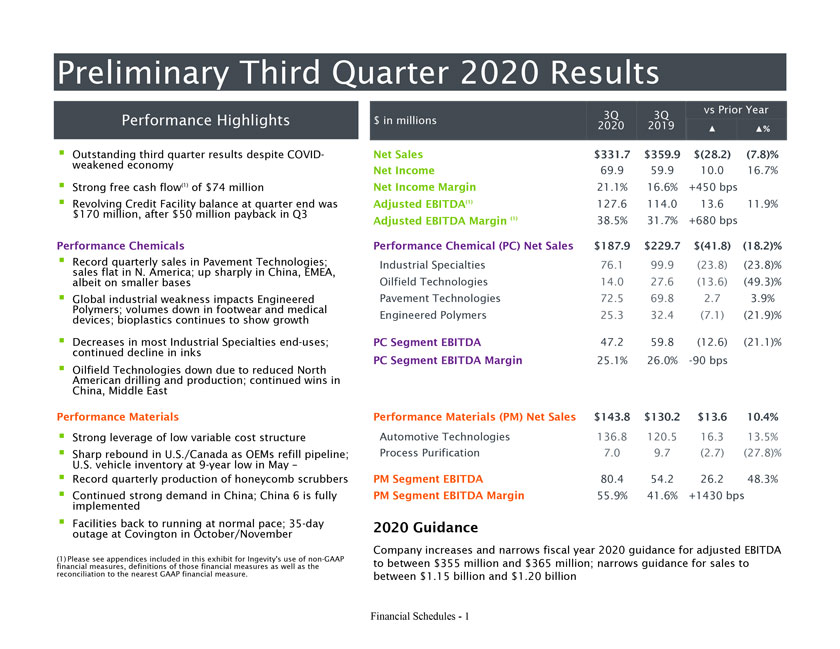
Third quarter net sales of $332 million were down 7.8% versus the prior year quarter driven by the economic impacts of COVID-19


Net income of $70 million was up 16.7% versus prior year quarter; net income as a percentage of sales was 21.1%, compared to 16.6% in the prior year quarter


Third quarter adjusted EBITDA of $128 million were up 11.9% versus the prior year quarter; adjusted EBITDA margin of 38.5% is up 680 basis points


Operating cash flow of $90 million; free cash flow of $74 million


Company increases and narrows fiscal year 2020 guidance for adjusted EBITDA to between $355 million and $365 million; narrows guidance for sales to between $1.15 billion and $1.20 billion

The preliminary results and guidance in this release include Non-GAAP financial measures. Refer to the section entitled “Use of Non-GAAP Financial Measures” within this release.

NORTH CHARLESTON, S.C., October 20, 2020 – Ingevity Corporation (NYSE:NGVT) today reported selected preliminary financial results for the third quarter.

“Ingevity’s third quarter results were driven by strong rebounds in automotive sales and production worldwide versus a weak second quarter, along with continued strong paving activity, cost reduction actions and strong execution,” said John Fortson, president and CEO. “These positives were partially offset by a weakened economic environment due to COVID-19 that particularly impacted our Performance Chemicals businesses. Nonetheless, our adjusted EBITDA and adjusted EBITDA margin were records for the third quarter.”

Third quarter net sales of $332 million were down 7.8% versus the prior year third quarter. Net income of $70 million increased 16.7% and net income margin of 21.1% was up from 16.6% in the prior year. The third quarter diluted earnings per share were $1.69 compared to $1.41 in the prior year period.

Adjusted earnings of $74 million were up 19.3% versus the prior year quarter. Diluted adjusted earnings per share were $1.79, which exclude, net of tax, $0.10 related primarily to restructuring and other charges, net, recognized during the quarter. This compares to diluted adjusted earnings per share of $1.46 in the prior year quarter. Adjusted EBITDA of $128 million were up 11.9% versus the third quarter 2019. Adjusted EBITDA margin of 38.5% was up 680 basis points from the prior year’s third quarter.

The company generated operating cash flow of $90 million, which translated to free cash flow of $74 million.


Performance Chemicals

“With the exception of our pavement technologies business, our Performance Chemicals segment was negatively impacted by a weak economy resulting from COVID-19,” said Fortson. “We continue to control costs which resulted in our adjusted EBITDA margins remaining solidly in the mid 20s.”

Sales to pavement technologies applications were slightly higher than the prior year and set a quarterly record. While paving sales in North America were essentially flat, sales in China and Europe, Middle East and Africa (EMEA) were up sharply, albeit from smaller bases. Sales for engineered polymers products were down due to reduced industrial demand globally. Footwear and medical device sales were down, while sales to bioplastics customers continued to show growth. Sales decreased in industrial specialties applications due to continued demand weakness for printing inks and other end-use applications. Additionally, sales to oilfield technologies customers were cut sharply in line with reduced drilling in North America; sales in oil production applications were down moderately.

Third quarter 2020 sales in the Performance Chemicals segment were $188 million, down 18.2% versus the third quarter 2019. Segment EBITDA were $47 million, down 21.1% versus the prior year quarter due to lower volumes which were partially offset by price/mix. Segment EBITDA margin declined 90 basis points to 25.1%.

Performance Materials

“Automakers – particularly in the U.S. and Canada – rebounded sharply,” said Fortson. “The industry continues to work to refill the vehicle pipeline, and as such, demand for our gasoline vapor emission control solutions has risen dramatically versus the second quarter.” As a result, the company’s quarterly production of honeycomb scrubbers used to meet the U.S. and Canadian regulatory standards were a quarterly record.

Sales of Performance Materials products in China were up strongly as automakers there have bounced back from COVID-related shutdowns and the implementation of the China 6 standard has been completed.

Third quarter 2020 sales in the Performance Materials segment were $144 million, up 10.4% versus the third quarter 2019. Segment EBITDA were $80 million, up 48.3% versus the prior year period due to the sharp increase in volumes and price/mix improvement. Segment EBITDA margin increased 1,430 basis points to 55.9%.

Outlook

Ingevity narrowed its fiscal year 2020 guidance for sales from between $1.10 billion and $1.20 billion to between $1.15 billion and $1.20 billion, and increased and narrowed its guidance for adjusted EBITDA from between $310 million and $350 million to between $355 million and $365 million.

“We remain confident in our business through the end of the year,” said Fortson. “While we may see continued weakness on the revenue line, given the cost controls we’ve implemented, we expect our adjusted EBITDA and adjusted EBITDA margins to remain favorable. And while uncertainty remains regarding global economic strength, we believe in the strength of our strategy and our team’s ability to execute on the opportunities.”

Preliminary Results

We have provided the preliminary estimated financial results contained in this press release and the accompanying financial schedules because our financial closing procedures for the three months ended September 30, 2020 are not yet complete. The preliminary estimated financial information contained herein and in the accompanying financial schedules does not represent a comprehensive statement of our results of operations or financial condition as of or for the three months ended September 30, 2020 and is based solely on information available to us as of the date of this press release. Our results of operations and financial condition as of and for the three months ended September 30, 2020 may vary from our current expectations and may be different from the information described above as our quarterly financial statement preparation process is not yet complete and additional developments and adjustments may arise between now and the time the financial statements and other disclosures for this period are finalized, including all disclosures required by GAAP. In addition, these preliminary estimated financial results are not necessarily indicative of the results to be achieved for the remainder of 2020 or in any future period. There can be no assurance that these estimates will be realized, and estimates are subject to risks and


uncertainties, many of which are not within our control. The information contained herein and in the accompanying financial schedules should not be viewed as a substitute for full financial statements prepared in accordance with GAAP or as a measure of performance. Accordingly, you should not place undue reliance on such financial information.

Ingevity: Purify, Protect and Enhance

Ingevity provides specialty chemicals, high-performance carbon materials and engineered polymers that purify, protect, and enhance the world around us. Through a team of talented and experienced people, Ingevity develops, manufactures, and brings to market products and processes that help customers solve complex problems. These products are used in a variety of demanding applications, including asphalt paving, oil exploration and production, agrochemicals, adhesives, lubricants, publication inks, coatings, elastomers, bioplastics and automotive components that reduce gasoline vapor emissions. Headquartered in North Charleston, South Carolina, Ingevity operates from 25 locations around the world and employs approximately 1,850 people. The company is traded on the New York Stock Exchange (NYSE: NGVT). For more information visit www.ingevity.com.

Additional Information

The company will host a live webcast on Thursday, Oct. 29, 2020, at 10 a.m. (Eastern Time) to discuss third quarter 2020 fiscal results. The webcast can be accessed through the investors section of Ingevity’s website. You may also listen to the conference call by dialing 877-407-2991 (inside the U.S.) or 201-389-0925 (outside the U.S.), at least 10 minutes prior to the start of the event. Information on how to access the webcast and conference call, along with a slide deck containing other relevant financial and statistical information, will be posted to the investors section of Ingevity’s website prior to the call. For those unable to join the live event, a replay of the webcast will be available beginning at approximately 2 p.m. (Eastern Time) on Oct. 29, 2020, through Nov. 29, 2020.

Use of Non-GAAP Financial Measures

Ingevity has presented certain financial measures which have not been prepared in accordance with U.S. generally accepted accounting principles (GAAP). Definitions of our non-GAAP financial measures and a reconciliation to the most directly comparable financial measure calculated in accordance with GAAP are included in the financial schedules accompanying this news release, under the section entitled “Non-GAAP Financial Measures.”

Cautionary Statements About Forward-Looking Statements

This press release contains “forward-looking statements” within the meaning of the Securities Exchange Act of 1934, as amended, and the Private Securities Litigation Reform Act of 1995. Such statements generally include the words “will,” “plans,” “intends,” “targets,” “expects,” “outlook,” or similar expressions. Forward-looking statements may include, without limitation, expected financial positions, results of operations and cash flows; financing plans; business strategies and expectations; operating plans; impact of COVID-19; synergies and the potential benefits of the acquisition of Perstorp Holding AB’s Capa® caprolactone business (the “acquisition”); capital and other expenditures; competitive positions; growth opportunities for existing products; benefits from new technology and cost-reduction initiatives, plans and objectives; markets for securities and expected future repurchases of shares, including statements about the manner, amount and timing of repurchases. Actual results could differ materially from the views expressed. Factors that could cause actual results to materially differ from those contained in the forward-looking statements, or that could cause other forward-looking statements to prove incorrect, include, without limitation, adverse effects from the COVID-19 pandemic; risks that the expected benefits from the acquisition may not be realized or will not be realized in the expected time period, the risk that the acquired business will not be integrated successfully and the risk of significant transaction costs and unknown or understated liabilities; adverse effects of general economic and financial conditions; risks related to international sales and operations; impacts of currency exchange rates and currency devaluation; compliance with U.S. and foreign regulations concerning our operations outside the U.S.; changes in trade policy, including the imposition of tariffs; the impact of the United Kingdom’s withdrawal from the European Union; attracting and retaining key personnel; adverse conditions in the global automotive market or adoption of alternative and new technologies; competition from producers of alternative products and new technologies, and new or emerging competitors; competition from infringing intellectual property activity; worldwide air quality standards; a decrease in government infrastructure spending; declining volumes and downward pricing in the printing inks market; the limited supply of or lack of access to sufficient crude tall oil; a prolonged period of low energy prices; the provision of services by third parties at several facilities; natural disasters, such as hurricanes, winter or tropical storms, earthquakes, tornados, floods, fires; other unanticipated problems such as labor difficulties, equipment failure or unscheduled maintenance and repair; protection of intellectual property and proprietary information; information technology security breaches and other disruptions; complications with designing and implementing our new enterprise resource planning system; government policies and regulations, including, but not limited to, those affecting the environment, climate change, tax policies, tariffs and the chemicals industry; and lawsuits arising out of environmental damage or personal injuries associated with chemical or other manufacturing processes, and the other factors detailed from time to time in the reports we file with the SEC, including those described under “Risk Factors” in our Annual Report on Form 10-K, our Form 10-Q for the period ending March 31, 2020 and other periodic filings. These forward-looking statements speak only as of the date of this press release. Ingevity assumes no obligation to provide any revisions to, or update, any projections and forward-looking statements contained in this press release.


TABLE OF CONTENTS


FINANCIAL SCHEDULES

   Page  

Preliminary Third Quarter 2020 Results

     1  

Non-GAAP Financial Measures

     2  

Reconciliation of Adjusted Earnings (Loss)

     3  

Reconciliation of Adjusted EBITDA

     4  

Calculation of Free Cash Flow

     5  


LOGO

Preliminary Third Quarter 2020 Results Performance Highlights $ in millions 3Q 2020 3Q 2019 vs Prior Year Outstanding third quarter results despite COVID-weakened economy Net Sales $331.7 $359.9 $(28.2) (7.8)% Net Income 69.9 59.9 10.0 16.7% Strong free cash flow(1) of $74 million Net Income Margin 21.1% 16.6% +450 bps Revolving Credit Facility balance at quarter end was $170 million, after $50 million payback in Q3 Adjusted EBITDA(1) 127.6 114.0 13.6 11.9% Adjusted EBITDA Margin (1) 38.5% 31.7% +680 bps Performance Chemicals Performance Chemical (PC) Net Sales $187.9 $229.7 $(41.8) (18.2)% Record quarterly sales in Pavement Technologies; sales flat in N. America; up sharply in China, EMEA, albeit on smaller bases Industrial Specialties 76.1 99.9 (23.8) (23.8)% Oilfield Technologies 14.0 27.6 (13.6) (49.3)% Global industrial weakness impacts Engineered Polymers; volumes down in footwear and medical devices; bioplastics continues to show growth Pavement Technologies 72.5 69.8 2.7 3.9% Engineered Polymers 25.3 32.4 (7.1) (21.9)% Decreases in most Industrial Specialties end-uses; continued decline in inks PC Segment EBITDA 47.2 59.8 (12.6) (21.1)% PC Segment EBITDA Margin 25.1% 26.0% -90 bps Oilfield Technologies down due to reduced North American drilling and production; continued wins in China, Middle East Performance Materials Performance Materials (PM) Net Sales $143.8 $130.2 $13.6 10.4% Strong leverage of low variable cost structure Automotive Technologies 136.8 120.5 16.3 13.5% Sharp rebound in U.S./Canada as OEMs refill pipeline; U.S. vehicle inventory at 9-year low in May – September Process Purification 7.0 9.7 (2.7) (27.8)% Record quarterly production of honeycomb scrubbers PM Segment EBITDA 80.4 54.2 26.2 48.3% Continued strong demand in China; China 6 is fully implemented PM Segment EBITDA Margin 55.9% 41.6% +1430 bps Facilities back to running at normal pace; 35-day outage at Covington in October/November 2020 Guidance Company increases and narrows fiscal year 2020 guidance for adjusted EBITDA to between $355 million and $365 million; narrows guidance for sales to between $1.15 billion and $1.20 billion (1) Please see appendices included in this exhibit for Ingevity’s use of non-GAAP financial measures, definitions of those financial measures as well as the reconciliation to the nearest GAAP financial measure. Financial Schedules - 1


Ingevity Corporation

Non-GAAP Financial Measures

Ingevity has presented certain financial measures, defined below, which have not been prepared in accordance with U.S. generally accepted accounting principles (“GAAP”) and has provided a reconciliation to the most directly comparable financial measure calculated in accordance with GAAP on the following pages. These financial measures are not meant to be considered in isolation or as a substitute for the most directly comparable financial measure calculated in accordance with GAAP. Investors should consider the limitations associated with these non-GAAP measures, including the potential lack of comparability of these measures from one company to another.

We believe these non-GAAP financial measures provide management as well as investors, potential investors, securities analysts and others with useful information to evaluate the performance of the business, because such measures, when viewed together with our financial results computed in accordance with GAAP, provide a more complete understanding of the factors and trends affecting our historical financial performance and projected future results.

Ingevity uses the following non-GAAP measures:

Adjusted earnings (loss) is defined as net income (loss) plus restructuring and other (income) charges, net, acquisition and other-related costs, pension and postretirement settlement and curtailment (income) charges and the income tax expense (benefit) on those items, less the provision (benefit) from certain discrete tax items.

Diluted adjusted earnings (loss) per share is defined as diluted earnings (loss) per common share plus restructuring and other (income) charges, net per share, acquisition and other-related costs per share, pension and postretirement settlement and curtailment (income) charges per share and the income tax expense (benefit) per share on those items, less the per share tax provision (benefit) from certain discrete tax items per share.

Adjusted EBITDA is defined as net income (loss) plus provision (benefit) for income taxes, interest expense, net, depreciation and amortization, restructuring and other (income) charges, net, acquisition and other-related costs, and pension and postretirement settlement and curtailment (income) charges.

Adjusted EBITDA Margin is defined as Adjusted EBITDA divided by Net sales.

Free Cash Flow is defined as the sum of cash provided by (used in) the following items: operating activities less capital expenditures.

Ingevity also uses the above financial measures as the primary measures of profitability used by managers of the business. In addition, Ingevity believes Adjusted EBITDA and Adjusted EBITDA Margin are useful measures because they exclude the effects of financing and investment activities as well as non-operating activities.

GAAP Reconciliation of 2020 Adjusted EBITDA Guidance

A reconciliation of net income to adjusted EBITDA as projected for 2020 is not provided. Ingevity does not forecast net income as it cannot, without unreasonable effort, estimate or predict with certainty various components of net income. These components, net of tax, include further restructuring and other income (charges), net; additional acquisition and other-related costs in connection with the acquisition of Perstorp Holding AB’s Capa caprolactone business; additional pension and postretirement settlement and curtailment (income) charges; and revisions due to future guidance and assessment of U.S. tax reform. Additionally, discrete tax items could drive variability in our projected effective tax rate. All of these components could significantly impact such financial measures. Further, in the future, other items with similar characteristics to those currently included in adjusted EBITDA, that have a similar impact on comparability of periods, and which are not known at this time, may exist and impact adjusted EBITDA.


Financial Schedules - 2


Ingevity Corporation

Non-GAAP Financial Measures

Reconciliation of Net Income (Loss) (GAAP) to Adjusted Earnings (Loss) (Non-GAAP)


     Three Months Ended September 30,  
In millions, except per share data (unaudited)    2020     2019  

Net income (loss) (GAAP)

   $ 69.9   $ 59.9

Restructuring and other (income) charges, net

     5.5     1.7

Acquisition and other-related costs

     —         1.3

Tax effect on items above

     (1.2     (0.8

Certain discrete tax provision (benefit) (1)

     —         0.1


Adjusted earnings (loss) (Non-GAAP)

   $ 74.2   $ 62.2


Diluted earnings (loss) per common share (GAAP)

   $ 1.69   $ 1.41

Restructuring and other (income) charges

     0.13     0.04

Acquisition and other-related costs

     —         0.03

Tax effect on items above

     (0.03     (0.02

Certain discrete tax provision (benefit)

     —         —    


Diluted adjusted earnings (loss) per share (Non-GAAP)

   $ 1.79   $ 1.46


Weighted average common shares outstanding - Diluted

     41.5     42.6


(1)

Represents certain discrete tax items such as excess tax benefits on stock compensation and impacts of changes associated with U.S. Tax Reform. Management believes excluding these discrete tax items assists investors, potential investors, securities analysts, and others in understanding the tax provision and the effective tax rate related to continuing operating results thereby providing useful supplemental information about operational performance.


Financial Schedules - 3


Ingevity Corporation

Non-GAAP Financial Measures

Reconciliation of Net Income (Loss) (GAAP) to Adjusted EBITDA (Non-GAAP)


     Three Months Ended September 30,  
In millions, except percentages (unaudited)    2020     2019  

Net income (loss) (GAAP)

   $ 69.9   $ 59.9

Provision (benefit) for income taxes

     18.2     17.5

Interest expense, net

     8.9     12.1

Depreciation and amortization

     25.1     21.5

Restructuring and other (income) charges, net

     5.5     1.7

Acquisition and other-related costs

     —         1.3


Adjusted EBITDA (Non-GAAP)

   $ 127.6   $ 114.0


Net sales

   $ 331.7   $ 359.9

Net income (loss) margin

     21.1     16.6

Adjusted EBITDA margin

     38.5     31.7


Financial Schedules - 4


Ingevity Corporation

Non-GAAP Financial Measures

Calculation of Free Cash Flow (Non-GAAP)


     Three Months Ended September 30,  
In millions (unaudited)    2020      2019  

Cash Flow from Operations

   $   90.0    $ 118.7

Less: Capital Expenditures

     16.5      22.1


Free Cash Flow

   $ 73.5    $ 96.6


Financial Schedules - 5

Exhibit 99.2


LOGO       Ingevity Corporation
4920 O’Hear Avenue
Suite 400
North Charleston, SC 29405 USA www.ingevity.com
News      

Contact:

Laura Woodcock

843-746-8197

[email protected]


Investors:

Jack Maurer

843-746-8242

[email protected]

Ingevity announces proposed private offering of senior unsecured notes

NORTH CHARLESTON, S.C., October 20, 2020Ingevity Corporation (NYSE: NGVT) announced today that it is commencing a private offering of $550.0 million in aggregate principal amount of senior unsecured notes in a transaction exempt from the registration requirements of the Securities Act of 1933, as amended, subject to market and other conditions. If the offering is consummated, the company intends to use the proceeds of the offering for the redemption, refinancing or repayment of existing indebtedness. There can be no assurance that the issuance and sale of the notes will be consummated.

The notes will be offered and sold only to persons reasonably believed to be qualified institutional buyers pursuant to Rule 144A and to certain non-U.S. persons outside the United States pursuant to Regulation S under the Securities Act. The notes have not been registered under the Securities Act or any state securities law and may not be offered or sold in the United States absent registration or an applicable exemption from the registration requirements of the Securities Act and applicable state laws.

This press release does not constitute an offer to sell or a solicitation of an offer to purchase the notes or any other securities and does not constitute an offer, solicitation or sale in any state or jurisdiction in which such an offer, solicitation or sale would be unlawful.

Forward-Looking Statements

This press release contains “forward-looking statements” within the meaning of the Securities Exchange Act of 1934, as amended, and the Private Securities Litigation Reform Act of 1995. Such statements generally include the words “will,” “plans,” “intends,” “targets,” “expects,” “outlook,” or similar expressions. Forward-looking statements may include, without limitation, expected financial positions, results of operations and cash flows; financing plans; business strategies and expectations; operating plans; and the impact of COVID-19. Actual results could


differ materially from the views expressed. Factors that could cause actual results to materially differ from those contained in the forward-looking statements, or that could cause other forward-looking statements to prove incorrect, include, without limitation, adverse effects from the COVID-19 pandemic; adverse effects of general economic and financial conditions; risks related to international sales and operations; and the other factors detailed from time to time in the reports we file with the SEC, including those described under “Risk Factors” in our Annual Report on Form 10-K, Form 10-Q and other periodic filings. These forward-looking statements speak only as of the date of this press release. Ingevity assumes no obligation to provide any revisions to, or update, any projections and forward-looking statements contained in this press release.

Exhibit 99.3

FORWARD-LOOKING STATEMENTS

This document contains forward-looking statements within the meaning of the Securities Exchange Act of 1934, as amended (the “Exchange Act”) that reflect our current expectations, beliefs, plans or forecasts with respect to, among other things, future events and financial performance. Forward-looking statements are often characterized by words or phrases such as “may,” “will,” “could,” “should,” “would,” “anticipate,” “estimate,” “expect,” “project,” “intend,” “plan,” “believe,” “target,” “prospects,” “potential” and “forecast,” and other words, terms and phrases of similar meaning. Forward-looking statements involve estimates, expectations, projections, goals, forecasts, assumptions, risks and uncertainties. We caution readers that a forward-looking statement is not a guarantee of future performance and that actual results could differ materially from those contained in the forward-looking statement. Such risks and uncertainties include, among others, those discussed under the heading “Risk Factors.” We do not intend, and undertake no obligation, to update any of our forward-looking statements after the date of this report to reflect actual results or future events or circumstances. Given these risks and uncertainties, readers are cautioned not to place undue reliance on such forward-looking statements. In addition to any such risks, uncertainties and other factors discussed elsewhere herein, risks, uncertainties and other factors that could cause or contribute to actual results differing materially from those expressed or implied by the forward-looking statements include, but are not limited to the following: adverse effects from the novel coronavirus (“COVID-19”) pandemic; we are exposed to risks that the expected benefits from the Caprolactone Acquisition (as defined below) may not be realized or will not be realized in the expected time period, the risk that the acquired business will not be integrated successfully and the risk of significant transaction costs and unknown or understated liabilities; we may be adversely affected by general economic and financial conditions beyond our control; we are exposed to risks related to our international sales and operations; our reported results could be adversely affected by currency exchange rates and currency devaluation could impair our competitiveness; our operations outside the U.S. require us to comply with a number of U.S. and foreign regulations, violations of which could have a material adverse effect on our financial condition and results of operations; we may be adversely affected by changes in trade policy, including the imposition of tariffs and the resulting consequences; our engineered polymers product line may be adversely affected by the United Kingdom’s withdrawal from the European Union; we are dependent upon attracting and retaining key personnel; adverse conditions in the global automotive market or adoption of alternative and new technologies may adversely affect demand for our automotive carbon products; we face competition from producers of alternative products and new technologies, and new or emerging competitors; we face competition from infringing intellectual property activity; if increasingly more stringent air quality standards worldwide are not adopted, our growth could be impacted; we may be adversely affected by a decrease in government infrastructure spending; our printing inks business serves customers in a market that is facing declining volumes and downward pricing; our Performance Chemicals segment is highly dependent on crude tall oil (“CTO”) which is limited in supply; lack of access to sufficient CTO would impact our ability to produce CTO-based products; a prolonged period of low energy prices may materially impact our results of operations; we are dependent upon third parties for the provision of certain critical operating services at several of our facilities; the occurrence of natural disasters, such as hurricanes, winter or tropical storms, earthquakes, tornadoes, floods, fires or other unanticipated problem such as labor difficulties (including work stoppages), equipment failure or unscheduled maintenance and repair, which could result in operational disruptions of varied duration; from time to time, we are called upon to protect our intellectual property rights and proprietary information though litigation and other means; if we are unable to protect our intellectual property and other proprietary information, we may lose significant competitive advantage; information technology security breaches and other disruptions; complications with the design or implementation of our new enterprise resource planning system; government policies and regulations, including, but not limited to, those affecting the environment, climate change, tax policies, tariffs and the chemicals industry; and losses due to lawsuits arising out of environmental damage or personal injuries associated with chemical or other manufacturing processes.


Performance Chemicals

Our Performance Chemicals business serves customers globally from three manufacturing locations in the U.S. and one in the United Kingdom. Most of our pavement technologies, oilfield technologies, and industrial specialties products are derived from CTO, a co-product of the kraft pulping process, where pine is used as the source of the pulp. CTO is produced by acidulating black liquor soap skimmings (“BLSS”), which are recovered during the kraft pulping process. Consumers of CTO can purchase BLSS from pulping mills that do not have acidulation capacity (in which case the BLSS will need to be acidulated into CTO), and purchase CTO from pulping mills that do have acidulation capacity. The CTO is further separated by distillation into tall oil rosin (“TOR”), TOFA and other biofractions. As such products are further refined or chemically modified, higher value derivative products are created, making their way into a wide variety of industrial and consumer goods. We also produce products derived from lignin, extracted from black liquor, a co-product of the kraft pulping process. Our engineered polymers’ products are caprolactone based, which is derived from cyclohexanone, a benzene derivative, and hydrogen peroxide, both of which are readily available in the market. Lignin, TOR, TOFA and caprolactone are sold directly to customers in some instances, or are further refined or chemically modified into higher value derivative products or performance chemicals.

The availability of CTO is directly linked to the production output of kraft mills using pine as their source of pulp, which is the predominant fiber source for packaging grades of paper as well as fluff pulp for personal care products. As a result, there is a finite global supply of CTO, with global demand for softwood kraft pulp driving the global supply of CTO, rather than demand for CTO itself. Most of the CTO made available for sale by its producers is covered by supply agreements, further constraining availability.

We have a long-term supply agreement with WestRock Company (“WestRock”) pursuant to which we purchase all of the BLSS and CTO output from WestRock’s kraft mills, subject to certain exceptions. Beginning in 2025, either party may provide a notice to the other party terminating the agreement five years from the date of such notice. Beginning one year after such notice, the quantity of products provided by WestRock under the agreement will be gradually reduced over a four-year period based on the schedule set forth in the agreement. In addition, from 2022 until 2025, either party may provide one-year notice to remove a kraft mill as a supply source. The two largest kraft mills under the agreement currently are expected to supply approximately 17 to 19 percent and 15 to 17 percent, respectively, of the total amount of products expected to be supplied under our agreement with WestRock. In the event that WestRock exercises its right to terminate our supply agreement with them or remove a kraft mill as a supply source, we may be able to obtain substitute supplies of BLSS or CTO from other suppliers, spot purchases or a new contract with WestRock. The agreement with WestRock includes pricing terms based on market prices. Based on WestRock’s current output, we currently expect to source approximately 30 to 40 percent of our CTO requirements from WestRock under this agreement through 2025 based on the maximum operating rates of our three U.S. Performance Chemicals’ facilities.

In 2018, we entered into a 20-year supply agreement with Georgia-Pacific pursuant to which we will purchase the lesser of 125,000 tons or 100 percent of the CTO production from select Georgia-Pacific kraft mills during each contract year, subject to certain exceptions. The agreement with Georgia-Pacific includes a market pricing formula which is subject to quarterly adjustments. Under this agreement, we currently expect to source approximately 30 percent of our CTO requirements through 2025 based on the maximum operating rates of our three U.S. Performance Chemicals’ facilities.

We have agreements with other suppliers to satisfy substantially all of the balance of our expected requirements of CTO through 2021.


-2-


Recent Developments

Revolver Repayments

Subsequent to September 30, 2020, we repaid $50 million of outstanding borrowings made during the three months ended September 30, 2020 (the “Revolver Repayments”). After giving effect to the Revolver Repayments, as of September 30, 2020, we had $170 million in outstanding loans under our senior secured multi-currency revolving credit facility governed by the Credit Agreement (defined below) (the “Revolving Credit Facility”).

Credit Agreement Amendment

On or about the issue date of the notes, we expect to amend our existing Credit Agreement to, among other things, (a) extend the maturity date with respect to the Revolving Credit Facility to the date that is five (5) years after the effective date of such amendment and reduce the aggregate principal amount of revolving commitments thereunder from $750 million to $500 million, (b) appoint JPMorgan Chase Bank, N.A. as successor administrative agent, collateral agent and swingline lender to Wells Fargo Bank, N.A. thereunder and (c) effect certain other amendments. The effectiveness of this amendment is conditioned on, among other things, the completion of the offering of the notes and the repayment in full of the incremental term loan commitments established on March 7, 2019 under the senior secured term loan facilities governed by the Credit Agreement (the “2022 Term Loan”).

Credit Agreement means that certain Credit Agreement dated March 7, 2016 by and among the Company, the lenders party thereto and Wells Fargo Bank, N.A., as administrative agent, as amended, supplemented or modified prior to the date hereof.

Coronavirus Pandemic

On March 11, 2020, the World Health Organization declared COVID-19 a global pandemic and recommended containment and mitigation measures worldwide. COVID-19 has led to adverse impacts on the U.S. and global economies, and created uncertainty regarding potential impacts to our supply chain, operations, and customer demand. We have been classified as an essential business in the jurisdictions that have made this determination to date, allowing us to continue operations. However, our facilities—as well as the operations of our suppliers, customers, third-party sales representatives, and distributors—have been, and will continue to be, disrupted by governmental and private sector responses to COVID-19. This includes business shutdowns, work-from-home orders and social distancing protocols, travel or health-related restrictions, as well as quarantines, self- isolations, and disruptions to transportation channels.

On March 27, 2020, the U.S. government enacted the Coronavirus Aid, Relief, and Economic Security Act (“CARES Act”), which includes modifications to the limitation on business interest expense and net operating loss provisions, and provides a payment delay of employer payroll taxes during 2020 after the date of enactment. We estimate the payment of approximately $5.3 million of employer payroll taxes otherwise due in 2020 will be delayed with 50 percent due by December 31, 2021 and the remaining 50 percent by December 31, 2022. The CARES Act is not expected to have a material impact on our financial statements.

In order to strengthen our short term liquidity and to ensure financial flexibility, in March 2020, we drew down $250 million from our Revolving Credit Facility as a precautionary measure and also suspended our share repurchase program. During the three months ended June 30, 2020 we repaid $155 million of such borrowings and during the three months ended September 30, 2020 we repaid an additional $50 million of such borrowings. We also implemented work-from-home policies and protocols for the majority of our global salaried workforce, as well as social distancing practices to ensure the safety of our employees at our manufacturing facilities. Further, during the second quarter, we decreased production at some of our U.S. and China based manufacturing plants due to COVID-19 impacts to the projected customer demand and implemented a cost reduction initiative. Both of our operating segments were impacted by volume decline during the second quarter, driven by COVID-19. In the third quarter, we resumed normal production at all manufacturing plants.


-3-


As of March 31, 2020 and June 30, 2020, we evaluated, in accordance with ASC 350—Goodwill and Other and ASC 360—Property, Plant, and Equipment, whether the economic impacts of the COVID-19 pandemic constitute triggering events requiring impairment or recoverability analysis to be performed. We considered the current and expected future economic and market conditions surrounding the COVID-19 pandemic and its impact on each of the reporting units and asset groups. Further, we assessed our current market capitalization, forecasts and the amount of excess fair value above book value as calculated in our 2019 impairment test. We determined that a triggering event has not occurred which would require an interim impairment test to be performed. However, a lack of sustained recovery or further deterioration in market conditions related to the general economy and the industries in which we operate, a sustained trend of weaker than anticipated financial performance, or further decline in our share price for a sustained period of time, or an increase in the market-based weighted average cost of capital, among other factors, could significantly impact the impairment analysis and may result in future impairment charges that, if incurred, could have a material adverse effect on our financial condition and results of operations.

While the disruptions caused by the pandemic are currently expected to be temporary, there is uncertainty regarding the virus’s duration and severity. COVID-19 has impacted, and will continue to impact, our results of operations, financial position, and liquidity.

RISK FACTORS

An investment in the notes involves a high degree of risk. Based on the information currently known to us, we believe that the following information identifies the most significant risk factors affecting our company. However, the risks and uncertainties the Company faces are not limited to those set forth in the risk factors described below. Additional risks and uncertainties not presently known to us or that we currently believe to be immaterial may also adversely affect our business. In addition, past financial performance may not be a reliable indicator of future performance, and historical trends should not be used to anticipate results or trends in future periods. You should carefully consider the risk factors described below and any risk factors set forth in the other documents that are incorporated by reference into this offering memorandum. Before making any investment decision, you should carefully consider these risks as well as other information we include or incorporate by reference into this offering memorandum. Any of these risks could materially and adversely affect our business, financial condition, results of operations or cash flows and/or the value of your investment. In any case, the value of the notes could decline, and you could lose all or part of your investment. See also the information contained under the heading “Forward-Looking Statements.”

We are exposed to the risks inherent in international sales and operations.

In 2019, sales outside of the U.S. made up approximately 40 percent of our total sales, and we sell our products to customers in approximately 75 countries. We have exposure to risks of operating in many foreign countries, including:


fluctuations in foreign currency exchange rates, including the euro, pound sterling, Japanese yen and Chinese renminbi;


restrictions on, or difficulties and costs associated with, the repatriation of cash from foreign countries to the U.S.;


difficulties and costs associated with complying with a wide variety of complex laws, treaties and regulations;


unexpected changes in political or regulatory environments;


-4-


earnings and cash flows that may be subject to tax withholding requirements or the imposition of tariffs, exchange controls or other restrictions;


political and economic instability;


unforeseen public health crises, such as pandemic and epidemic diseases (including the recent coronavirus disease 2019 (COVID-19) (the “Coronavirus”));


import and export restrictions, tariffs, and other trade barriers or retaliatory actions;


difficulties in maintaining overseas subsidiaries and international operations;


difficulties in obtaining approval for significant transactions;


government limitations on foreign ownership;


government takeover or nationalization of business; and


government mandated price controls.

Any one or more of the above factors could adversely affect our international operations and could significantly affect our financial condition and results of operations. We have also expanded our participation in certain markets. As our international operations and activities expand, we inevitably have greater exposure to the risks of operating in many foreign countries.

Adverse conditions in the automotive market may adversely affect demand for our automotive carbon products.

Sales of our automotive activated carbon products are tied to global automobile production levels. Automotive production in the markets we serve can be affected by macro-economic factors such as interest rates, fuel prices, shifts in vehicle mix (including shifts toward alternative energy vehicles), consumer confidence, employment trends, regulatory and legislative oversight requirements and trade agreements. For example, the global economic downturn in 2008/2009 led to a drastic reduction in vehicle sales and an even greater reduction in vehicle production as OEMs right-sized their inventories to meet the lower sales volumes. Regional disruptions due to localized natural disasters or multi-month strikes at suppliers or OEMs can also significantly impact vehicle production and therefore demand for our automotive carbon. Additionally, if the Coronavirus pandemic continues, it could negatively impact demand for automotive sales, which would adversely impact sales of our carbon products, as was the case in the second quarter of 2020. The extent to which the Coronavirus pandemic impacts our results will depend on future developments, which are highly uncertain and cannot be predicted, including the severity of the Coronavirus, actions to contain the Coronavirus or treat its impact, among others.

The Company’s oilfield technologies business is significantly affected by trends in oil and natural gas prices that affect the level of exploration, development and production activity.

Demand for our oilfield technologies services and products is particularly sensitive to the level of exploration, development and production activity of, and the corresponding capital spending by, oil and natural gas companies, including national oil companies. The level of exploration, development and production activity is directly affected by trends in oil and natural gas prices, which historically have been volatile. Crude oil prices have declined significantly since 2014, with West Texas Intermediate oil spot prices declining from a high of $108 per barrel in June 2014 to a low of $27 per barrel in February 2016, a level which had not been experienced since 2003. In 2020, pricing has moved from $58 per barrel in January to a low of $16 per barrel in April to $41 per barrel in September. Unless potential hostilities between the U.S. and Iran escalate, pricing is not currently forecasted to change significantly from these levels during 2020. While these pricing levels are significantly above the February 2016 levels, they remain off their highs seen in the last decade.

Any prolonged low pricing environment for oil and natural gas is likely to result in reduced demand for our oilfield technology products, which may have a material adverse effect on our results of operations.


-5-


Disruptions at any of our manufacturing facilities or within our supply chain could negatively impact our production, financial condition and results of operations.

An operational disruption in any of our facilities could negatively impact production and our financial results. The occurrence of a natural disaster, such as a hurricane, tropical storm, earthquake, tornado, severe weather, flood, fire, as well as risk that may result from climate change, could cause operational disruptions. Additionally, other unanticipated problems such as labor difficulties, health epidemics (including the recent Coronavirus pandemic), equipment failure, capacity expansion difficulties or unscheduled maintenance could also cause operational disruptions of varied duration. These types of disruptions could materially adversely affect our financial condition and results of operations to varying degrees dependent upon the facility, the duration of the disruption, our ability to shift business to another facility or find alternative sources of materials or energy. In certain cases, we have some products that are only made at one facility. For example, in the case of our Waynesboro, Georgia facility, while we have some redundancies within the facility, we only have one facility that makes our extruded honeycomb products. In the case of our Warrington, UK facility, while we have some redundancies within the facility, we only have one facility that makes our caprolactone products. As other examples, in our Charleston SC facility, we source black liquor from an adjacent paper mill to isolate and subsequently modify lignin to serve our agriculture customers while we make the vast majority of our ink resin products in our DeRidder, Louisiana facility. While we have redundancies within these facilities, we have limited ability to make these products at other facilities. Finally, the Coronavirus pandemic is causing travel disruptions, quarantines and/or closures, which could result in disruptions to our manufacturing and production operations at our facilities, as well as those of our suppliers and customers. Any losses due to these events may not be covered by our existing insurance policies or may be subject to certain deductibles.

We could be similarly adversely affected by disruptions within our supply chain and transportation network. Our products are transported by truck, rail, barge or ship by third-party providers. The costs of transporting our products could be negatively affected by factors outside of our control, including rail service interruptions or rate increases, extreme weather events, tariffs, rising fuel costs and capacity constraints. Significant delays or increased costs affecting these transportation methods could materially affect our financial condition and results of operations. Disruptions at our suppliers could lead to short term or longer rises in raw material or energy costs and/or reduced availability of materials or energy, potentially affecting our financial condition and results of operations. For example, Solvay is our primary provider of hydrogen peroxide to our Warrington, UK Performance Chemicals facility, which is co-located with the Solvay Warrington, UK chemical plant (“Solvay Plant”). Disruptions at the Solvay Plant impacting Solvay’s ability to supply hydrogen peroxide could adversely affect our financial condition and results of operations. See also “—General Business and Economic Risks—Our engineered polymers product line may be adversely affected by the United Kingdom’s withdrawal from the European Union.”

As we rely on information technologies to conduct our business, security breaches and other disruptions could compromise our information and expose us to liability, which could cause our business and reputation to suffer.

We rely on information technologies, some of which are managed by third parties, to manage the day-to-day operations and activities of our business, operate elements of our manufacturing facilities, manage our customer and vendor transactions, and maintain our financial, accounting and business records. In addition, we collect and store certain data, including proprietary business information, and may have access to confidential or personal information that is subject to privacy and security laws and regulations.

The secure processing, maintenance and transmission of sensitive, confidential and personal data is critical to our operations and business strategy. We follow industry best practices and have instituted a system of security policies, procedures, capabilities, and internal controls designed to protect this information. Additionally, we engage third-party threat detection and monitoring services which includes a global cyber security incident response team. Despite our security design and controls, and those of our third-party providers, we may be vulnerable to cyber- attacks, computer viruses, security breaches, inadvertent or intentional employee actions, system failures and other risks that could potentially lead to the compromising of sensitive, confidential or personal data, improper use of our, or our third-party provider systems, solutions or networks, unauthorized access, use, disclosure, modification or destruction of information, and operational disruptions. In addition, the global regulatory environment pertaining to


-6-


information security and privacy is increasingly demanding, with new and changing requirements, such as the European Union’s General Data Protection Regulation (“GDPR”), California Consumer Privacy Act (“CCPA”), and the China Cybersecurity Law. GDPR, which applies to the collection, use, retention, security, processing, and transfer of personally identifiable information of residents of EU countries, mandates new compliance obligations, and imposes significant fines and sanctions for violations. CCPA requires companies to provide new data disclosure, access, deletion and opt-out rights to consumers in California. Implementing and complying with these laws and regulations may be more costly or take longer than we anticipate, or could otherwise affect our business operations. Such breaches, cyber incidents and disruptions, or failure to comply with laws and regulations related to information security or privacy, could result in legal claims or proceedings against us by governmental entities or individuals, significant fines, penalties or judgements, disruption of our operations, remediation requirements, changes to our business practices, and damage to our reputation, which could adversely affect our business, financial condition or results of operations.


-7-