UNITED STATES
SECURITIES AND EXCHANGE COMMISSION
Washington, D.C. 20549
Form 8-K
Current Report
Pursuant to Section 13 or 15(d)
of the Securities Exchange Act of 1934
March 14, 2022
Date of Report (Date of earliest event reported)
PDS Biotechnology Corporation
(Exact name of registrant as specified in its charter)
Delaware
 
001-37568
 
26-4231384
(State or other jurisdiction of incorporation)
 
(Commission File Number
 
(IRS Employer Identification No.)

25B Vreeland Road, Suite 300
Florham Park, NJ
 
07932
(Address of Principal Executive Offices)
 
(Zip Code)
(800) 208-3343
Registrant’s telephone number, including area code
 
(Former name or former address if changed since last report,)

Securities registered pursuant to Section 12 (b) of the Act:
Title of each class:
Trading Symbol(s)
Name of each exchange on which
registered:
Common Stock, par value $0.00033 per share
PDSB
The Nasdaq Capital Market

Check the appropriate box below if the Form 8-K filing is intended to simultaneously satisfy the filing obligation of the registrant under any of the following provisions:
Written communications pursuant to Rule 425 under the Securities Act (17 CFR 230.425)

Soliciting material pursuant to Rule 14a-12 under the Exchange Act (17 CFR 240.14a-12)
Pre-commencement communications pursuant to Rule 14d-2(b) under the Exchange Act (17 CFR 240.14d-2(b))
Pre-commencement communications pursuant to Rule 13e-4(c) under the Exchange Act (17 CFR 240.13e-4(c))

Indicate by check mark whether the registrant is an emerging growth company as defined in as defined in Rule 405 of the Securities Act of 1933 (§230.405 of this chapter) or Rule 12b-2 of the Securities Exchange Act of 1934 (§240.12b-2 of this chapter).
Emerging growth company
If an emerging growth company, indicate by check mark if the registrant has elected not to use the extended transition period for complying with any new or revised financial accounting standards provided pursuant to Section 13(a) of the Exchange Act. ☐


Item 1.01
Entry into a Material Definitive Agreement.

On March 14, 2022, the Board of Directors (the “Board”) of PDS Biotechnology Corporation (the “Company”), upon recommendation from the Compensation Committee of the Board (the “Committee”), adopted the PDS Biotechnology Corporation Change of Control Severance Plan (the “Plan”).  All full-time employees of the Company at a Vice President level and below who (i) are actively performing the regular duties of their position or who are on a leave of absence authorized by the Company, and (ii) have completed three (3) months or more of employment with the Company prior to their date of separation from the Company are eligible to participate in the Plan, except for employees (i) with existing offer letters, employment agreements, or other agreements with the Company and/or one of its affiliates that provides for severance pay, (ii) who voluntarily resign or whose employment ends prior to their last day of employment for reasons other than involuntary separation by the Company due to restructuring or staff reduction, (iii) who fail to timely return from paid time off, unpaid leave, or any other approved leave of absence as determined in the sole discretion of the Committee, (iv) employees who are terminated for cause, as such term is defined in the Plan, and (v) independent contractors/consultants, interns, temporary employees and any individuals retained through outsourcing arrangements.

An eligible employee will receive severance benefits if his or her employment is terminated involuntarily by the Company other than for cause, death or disability, as such terms are defined in the Plan, on or before the two-year anniversary of a change in control, as defined in the Plan.

An eligible employee will receive a cash severance benefit, payable as salary continuation, based on the employee’s classification as a professional, manager, director/associate director, executive/senior director, or a vice president, as determined by the Company in its sole discretion. Professionals will receive a cash severance benefit equal to 2 months of base pay, managers will receive a cash severance benefit equal to 3 months of base pay, directors/associate directors will receive a cash severance benefit equal to 4 months of base pay, executives/senior directors will receive a cash severance benefit equal to 6 months of base pay, and vice presidents will receive a cash severance benefit equal to 9 months of base pay, in each case, subject to the execution of a general release by the eligible employee. The number of months underlying each eligible employee’s severance payment is the “Severance Period.”  The eligible employee will receive payment of all accrued paid time off and base salary through the last day of employment. In addition, vice presidents will be eligible to receive (A) 100% of their annual bonus (if any) that was earned, but not paid during the calendar year immediately prior to the year in which employment was terminated, and (B) a pro-rata amount equal to the target annual bonus (if any) that the vice president would have earned during the calendar year in which termination of employment occurred with respect to any performance period during which the vice president continued to provide services prior to termination of employment calculated based on the vice president’s termination date. Following the Severance Period, an eligible employee may elect to continue to participate through the COBRA continuation period at the eligible employee’s entire expense.

The foregoing summary of the Policy is qualified in its entirety by the full text of the Policy which will be filed as an exhibit to the Company’s Annual Report on Form 10-K for the fiscal year ended December 31, 2021.

Item 2.02
Results of Operations and Financial Condition.

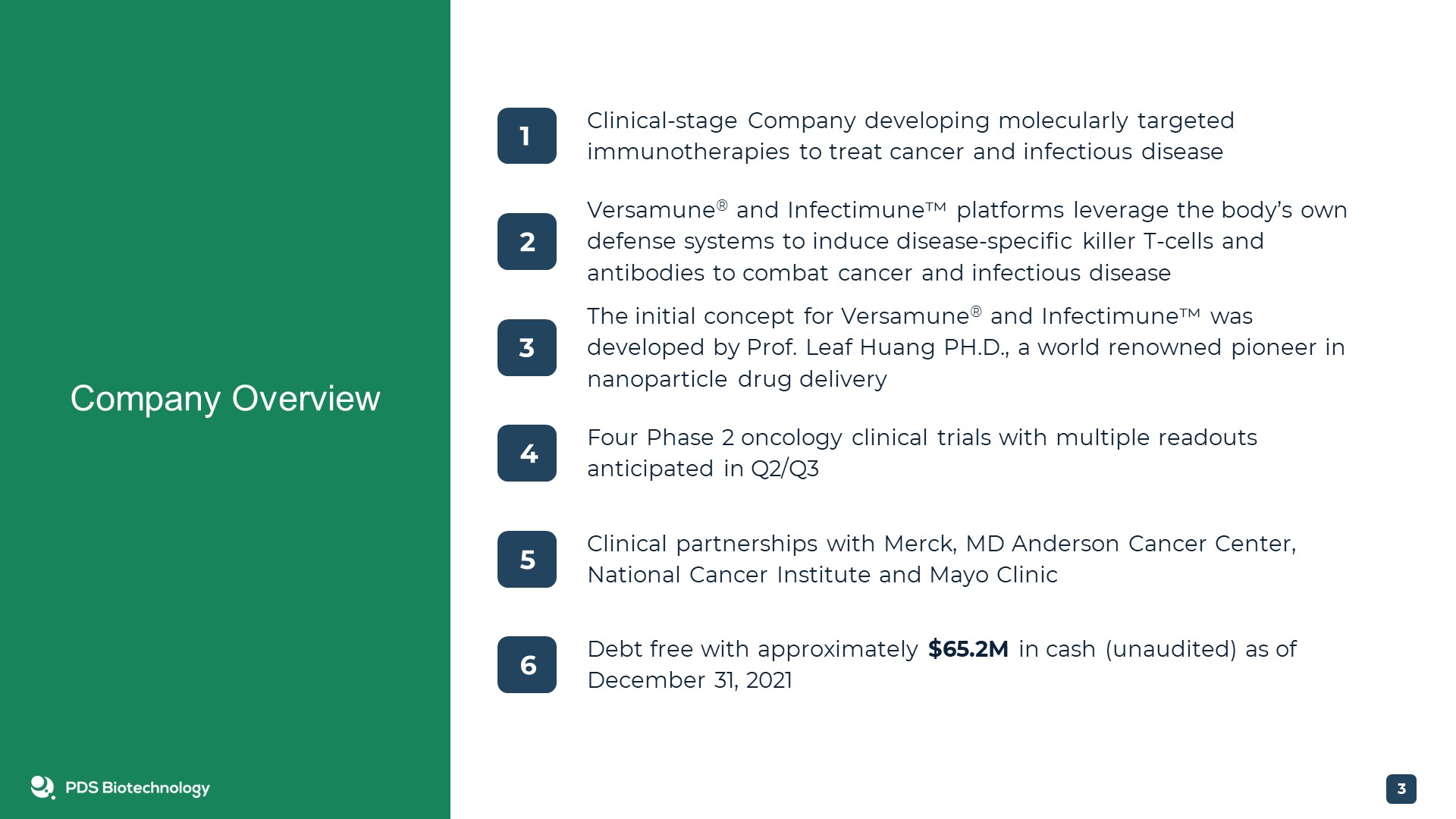
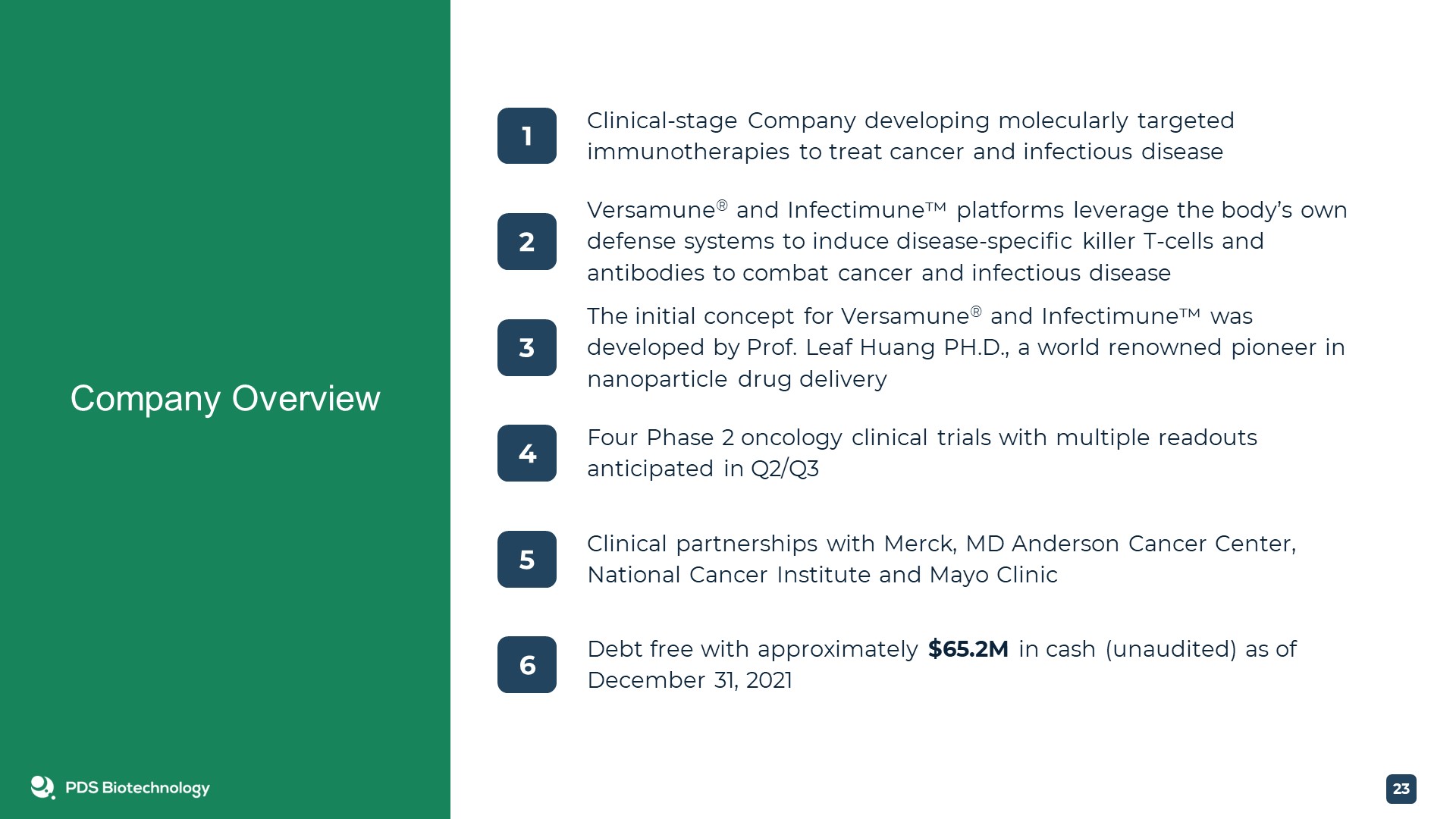
On March 15, 2022, the Company updated its corporation presentation (the “Corporate Presentation”), which included an estimated cash figure for the Company as of December 31, 2021 of approximately $65.2 million.  The cash figure included in the Corporate Presentation is preliminary, has not been audited and is subject to change upon completion of the Company’s audited financial statements for the year ended December 31, 2021.

In accordance with General Instruction B.2 of Form 8-K, the information set forth in this Item 2.02 is deemed to be “furnished” and shall not be deemed to be “filed” for purposes of Section 18 of the Securities and Exchange Act of 1934, as amended (the “Exchange Act”), or otherwise subject to the liabilities of that section, nor shall it be deemed incorporated by reference into any filing made by the Company under the Exchange Act or Securities Act of 1933, as amended, except as shall be expressly set forth by specific reference in such a filing.


Item 5.02
Departure of Directors or Certain Officers; Election of Directors; Appointment of Certain Officers; Compensatory Arrangements of Certain Officers.

Employment Agreement with Frank K. Bedu-Addo

On March 14, 2022 (the “Effective Date”), the Company entered in to an Amended and Restated Executive Employment Agreement with Frank K. Bedu-Addo (the “Bedu-Addo Agreement”), the President and Chief Executive Officer of the Company, at an annual base salary of $540,000, subject to review and adjustment every twelve (12) month period by the Board.

Dr. Bedu-Addo will be eligible to earn an annual performance-based cash bonus of up to 55% of his base salary (the “Bedu-Addo Target Bonus”), subject to review and adjustment by the Company in its sole discretion.  If the Company terminates Dr. Bedu-Addo’s employment without “Cause,” he resigns for “Good Reason” (as such terms are defined in the Bedu-Addo Agreement), or Dr. Bedu-Addo’s employment is terminated due to his death, Dr. Bedu-Addo will be entitled to receive accrued benefits including accrued but unpaid salary and bonus, unreimbursed business expenses, and benefits owed to Executive under any qualified retirement plan or health and welfare benefit plan (the “Accrued Obligations”), and the following severance benefits: (i) his base salary for twenty-four (24) months; (ii) bonus equal to the greater of (A) the bonus paid in the prior performance year and (B) the bonus that Dr. Bedu-Addo would have earned, for the performance year in which the termination occurs, on a prorated basis through the date which he continued to provide services; (iii) outstanding equity as of the date of the termination will become 100% vested and outstanding options will remain exercisable until the earliest of (A) 18 months following the termination date, (B) the original 10-year expiration date for the options, and (C) termination of the equity plan; (iv) benefits continuation for twenty-four (24) months, paid as supplemental cash compensation in an amount equal to 1.3 times each payment of the expenses paid by Mr. Bedu-Addo for welfare benefit coverage, and (v) in the event of a termination without Cause or if Dr. Bedu-Addo resigns for Good Reason within ninety (90) days before and twenty-four (24) months following the effective date of a “Change in Control” (as defined in the Bedu-Addo Agreement or the Executive Employment Agreements, as applicable) (“Protection Period”), instead of the bonus referenced in clause (ii) above, Dr. Bedu-Addo will receive a bonus equal to the Bedu-Addo Target Bonus. If Dr. Bedu-Addo’s employment is terminated for Cause, based on his Disability (as defined in the Bedu-Addo Agreement), or he resigns for any reason other than for Good Reason, he will only receive the Accrued Obligations.

Employment Agreements with Other Executive Officers

On the Effective Date, the Company entered into new employment agreements with each of Gregory Conn, Lauren V. Wood, and Matthew Hill, on the terms and subject to the conditions of a new form of Executive Employment Agreement approved by the Board for certain executives other than the Chief Executive Officer (the “Executive Employment Agreements”).

The term of each Executive Employment Agreement is at-will and will continue until terminated in accordance with its terms.  During the employment period, each executive will receive an annual base salary and will be eligible for a discretionary annual cash bonus.  The initial base salary and target bonus of each executive is as follows:

Officer
 
Base Salary
 
Target Bonus
Matthew Hill (CFO)
 
USD $350,000
 
Up to 40% of Base Salary
Lauren V. Wood, M.D. (CMO)
 
USD $400,000
 
Up to 40% of Base Salary
Gregory Conn, Ph.D (CSO)
 
USD $132,000
 
Up to 40% of Base Salary

If the Company terminates the executive’s employment without “Cause” or the executive resigns for “Good Reason” (as such terms are defined in the Executive Employment Agreements), each executive will be entitled to receive the Accrued Obligations and the following severance benefits: (i) base salary for twelve (12) months; (ii) benefits continuation for twelve (12) months, and (iii) if terminated during the Protection Period (as defined above), the executive will also receive a bonus equal to their target bonus, and any outstanding equity as of the closing of a Change in Control (as such term is defined in the Executive Employment Agreements) will become 100% vested if the executive’s outstanding equity is assumed or continued by the surviving entity.  If the executive’s employment is terminated for Cause, due to the death of the executive, based on Disability (as such terms are defined in the Executive Employment Agreements), or the executive resigns for any reason other than for Good Reason (as such terms are defined in the Executive Employment Agreements), each executive or the executive’s legal representatives will receive only the Accrued Obligations.


In addition, the Bedu-Addo Agreement and the Executive Employment Agreements (i) provide that the executive may be eligible for certain grants of equity awards of common stock of the Company subject to vesting and other terms and conditions of the Company equity plan and an award agreement, subject to approval of the Committee, (ii) provide that if any payment or distribution would be nondeductible by the Company for Federal income tax purposes because of Section 280G of the Internal Revenue Code, the Company shall reduce the aggregate present value of the payment only if reducing the payment will provide the executive with a greater net after-tax amount, (iii) provide for certain confidentiality, intellectual property, cooperation, non-competition, non-solicitation and non-disparagement undertakings, and (iii) require the execution and non-revocation of a general release of claims in favor of the Company as a condition to receipt of severance benefits.

The foregoing description of the Bedu-Addo Agreement and the Executive Employment Agreements are summaries only, and accordingly, do not purport to be complete and are qualified in their entirety by the full text of the Bedu-Addo Agreement and the Executive Employment Agreements, which the Company intends to file as exhibits to its Annual Report on Form 10-K for the fiscal year ended December 31, 2021.

Item 5.03
Amendments to Articles of Incorporation or Bylaws; Change in Fiscal Year.

On March 14, 2022, the Board approved the Third Amended and Restated Bylaws of the Company, effective immediately (the “Amended Bylaws”).  The Amended Bylaws supersede the previously existing Second Amended and Restated Bylaws of the Company (the “Prior Bylaws”).

The Amended Bylaws amended and restated the Prior Bylaws in their entirety to (i) reflect the Company’s current name of PDS Biotechnology Corporation (the Prior Bylaws referenced Edge Therapeutics, Inc.), (ii) require stockholders to submit proposals before an annual meeting not later than 120 days and not earlier than 150 days prior to the first anniversary of the Company’s prior annual meeting, with such change becoming effective immediately after the Company’s 2022 annual meeting of stockholders (the Prior Bylaws required stockholders to submit proposals before an annual meeting not later than 60 days and not earlier than 90 days prior to the first anniversary of the Company’s prior annual meeting), (iii) clarify the quorum requirement at stockholder meetings to require the holders of a majority of the capital stock issued and outstanding and entitled to vote at the meeting to constitute a quorum (the Prior Bylaws required holders of a majority of the capital stock issued and outstanding and entitled to vote thereat to constitute a quorum), (iv) amend the voting requirements of stockholders at stockholder meetings to require the vote of stockholders holding a majority of the stock present, in person, or represented by proxy at the meeting and entitled to vote on the subject matter (the Prior Bylaws required the vote of the holders of a majority of the stock represented and entitled to vote thereat), (v) add a new Article VII to provide that unless the Company consents in writing to the selection of an alternative forum, the federal district courts of the United States of America shall be the exclusive forum for the resolution of any complaint asserting a cause of action arising under the Securities Act of 1933, as amended, and (vi) reflect other changes deemed by the Board to improve the corporate governance of the Company.  A redlined copy of the Amended Bylaws marked to show the changes made to the Prior Bylaws is attached herewith as Exhibit 3.2 and is incorporated by reference.

The foregoing description of the Amended Bylaws does not purport to be complete and is qualified by reference to the full text of the Amended Bylaws, which is filed as Exhibit 3.1 hereto and incorporated herein by reference.

Item 8.01
Other Events.

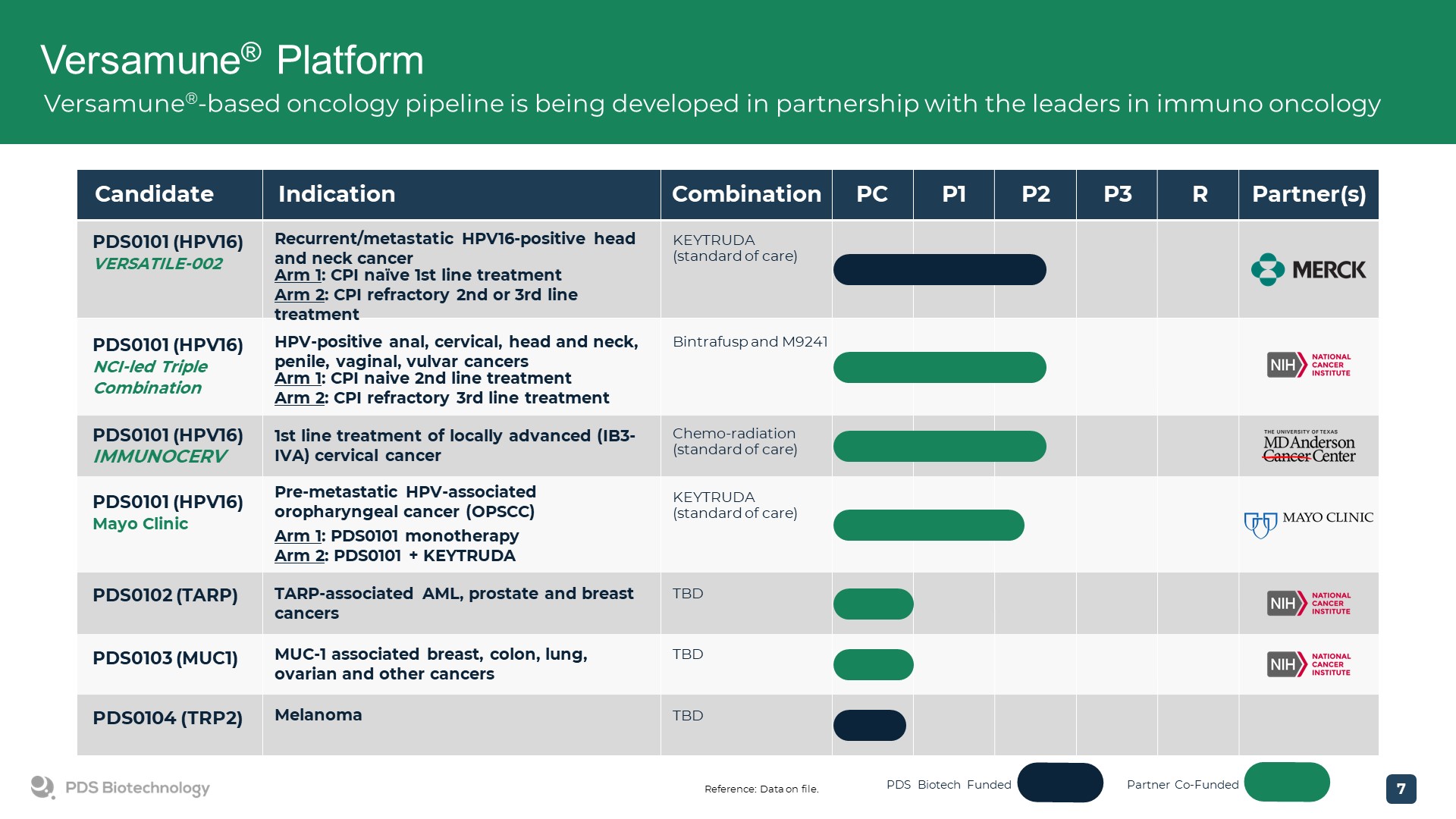
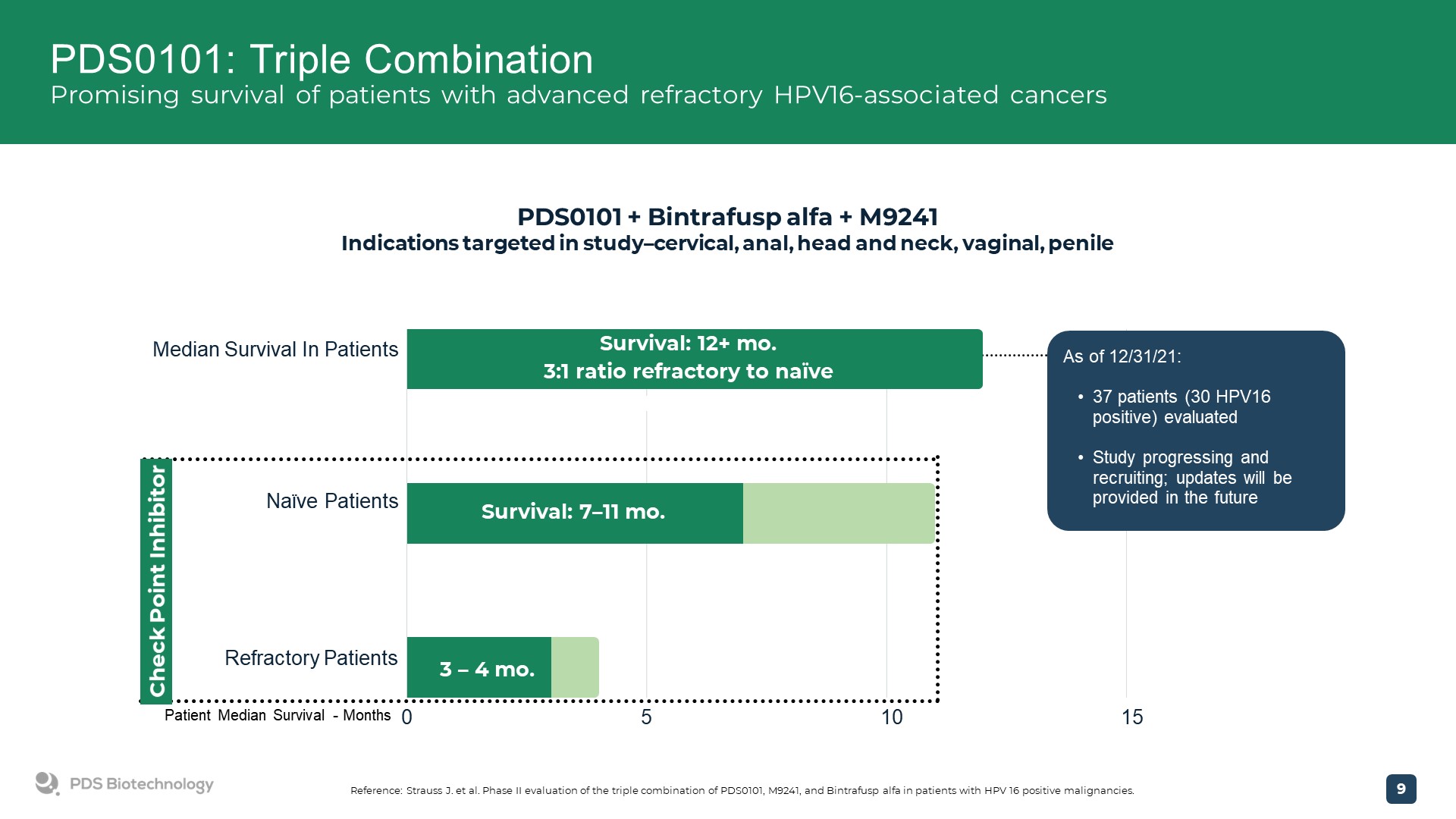
On March 15, 2022, the Company issued a press release announcing that The National Cancer Institute (NCI) achieved the intended enrollment objective of 30 patients in the checkpoint inhibitor (CPI) refractory arm of the NCI-led Phase 2 clinical trial (NCT04287868) evaluating PDS0101 (Versamune®+HPV16mix) in combination with two investigational immune-modulating agents in advanced HPV-associated cancers.  A copy of the press release is filed as Exhibit 99.1 hereto and incorporated by reference herein.

On March 15, 2022, the Company updated its corporate presentation slide deck.  A copy of the slide deck is filed as Exhibit 99.2 hereto and incorporated herein by reference.


Item 9.01
Financial Statements and Exhibits.

(d) Exhibits.

Exhibit
Number
Description
Third Amended and Restated Bylaws of PDS Biotechnology Corporation.
Redline of the Third Amended and Restated Bylaws of PDS Biotechnology Corporation.
Press Release March 15, 2022.
Corporate Presentation (March 2022).
104
Cover Page Interactive Data File - the cover page interactive date file does not appear in the Interactive Date File because its XBRL tags are embedded within the Inline XBRL document.


SIGNATURE

Pursuant to the requirements of the Securities Exchange Act of 1934, the registrant has duly caused this report to be signed on its behalf by the undersigned hereunto duly authorized.

 
PDS Biotechnology Corporation
   
Date: March 15, 2022
By:
/s/ Frank Bedu-Addo, Ph.D.
   
Name: Frank Bedu-Addo, Ph.D.

 
Title: President and Chief Executive Officer


Exhibit 3.1

THIRD AMENDED AND RESTATED BYLAWS
OF
PDS BIOTECHNOLOGY CORPORATION

ARTICLE I.

OFFICES

1.1. Registered Office. The registered office of PDS Biotechnology Corporation (the “Corporation”) in the State of Delaware is c/o The Corporation Trust Company, 1209 Orange Street, City of Wilmington, County of New Castle, Delaware 19801 and The Corporation Trust Company shall be the registered agent of the corporation in charge thereof.
 
1.2. Other Offices. The Corporation may also have offices at such other places both within and without the State of Delaware as the board of directors of the Corporation (the “Board”; any reference to the Board shall also include any committee thereof, where applicable) may from time to time determine or the business of the Corporation may require.
 
ARTICLE II.
 
MEETINGS OF STOCKHOLDERS
 
2.1. Place of Meetings. All meetings of the stockholders shall be held at such time and place, either within or without the State of Delaware, as shall be designated from time to time by the Board or, if not determined by the Board, by the Chairman of the Board, the President or the Chief Executive Officer.
 
2.2. Annual Meetings. An annual meeting of the stockholders for the election of directors and for the transaction of such other business as may properly come before the meeting shall be held at the place, if any, within or without the State of Delaware, on the date and at the time that the Board shall each year fix. No annual meeting of the stockholders need be held if not required by the Corporation’s certificate of incorporation (as the same may be amended from time to time, the “Certificate of Incorporation”), or by the General Corporation Law of the State of Delaware (as the same may be amended and supplemented, the “DGCL”).
 
2.3. Special Meetings. Special meetings of the stockholders, for any purpose or purposes, unless otherwise prescribed by the DGCL or by the Certificate of Incorporation, may be called only by or at the direction of the Board pursuant to a written resolution adopted by a majority of the total number of directors which the Corporation would have if there were no vacancies. Any business transacted at any special meeting of stockholders shall be limited to matters relating to the purpose or purposes stated in the notice of meeting.
 
2.4. Notice of Meetings.
 
This Section 2.4 shall be deemed effective as of the day immediately after the 2022 Annual Meeting of Stockholders of the Corporation, prior to this time, Section 2.4 of the Second Amended and Restated Bylaws of the Corporation shall control.
 

Except as otherwise provided by the DGCL, written notice of each meeting of stockholders, annual or special, stating the place, if any, date and hour of the meeting, the means of remote communications, if any, by which stockholders and proxyholders may be deemed to be present in person and vote at such meeting and, in the case of a special meeting, the purpose or purposes for which the meeting is called, shall be given not less than ten (10) nor more than sixty (60) days before the date of the meeting, to each stockholder entitled to vote at such meeting. Notice to stockholders shall be delivered in writing or in any other manner permitted by the DGCL. If mailed, such notice shall be delivered by postage prepaid envelope directed to each stockholder at such stockholder’s address as it appears in the records of the Corporation and shall be deemed given when deposited in the United States mail.  Without limiting the manner by which notices of meetings otherwise may be given to stockholders, any such notice may be given by electronic transmission in a manner permitted by the DGCL. An affidavit of the Secretary or an Assistant Secretary or of the transfer agent or other agent of the Corporation that the notice has been given by personal delivery, by mail, or by a form of electronic transmission shall, in the absence of fraud, be prima facie evidence of the facts stated therein. Notice of any meeting of stockholders need not be given to any stockholder if waived by such stockholder either in a writing signed by such stockholder or by electronic transmission, whether such waiver is given before or after such meeting is held.  If such a waiver is given by electronic transmission, the electronic transmission must either set forth or be submitted with information from which it can be determined that the electronic transmission was authorized by the stockholder.
 
(A) Advance Notice of Stockholder Business at Annual Meetings.
 
(1) Nominations of persons for election to the Board and the proposal of other business to be considered by the stockholders may be made at an annual meeting of stockholders only:
 
(a) pursuant to the Corporation’s notice of meeting (or any supplement thereto),
 
 
(b) by or at the direction of the Board, or
 
(c) by any stockholder of the Corporation who was a stockholder of record of the Corporation at the time the notice provided for in this Section 2.4 is delivered to the Secretary of the Corporation, who is entitled to vote at the meeting and who complies with the notice procedures set forth in this Section 2.4.
 
For the avoidance of doubt, clause (c) above shall be the exclusive means for a stockholder to make nominations and submit other business (other than matters properly included in the Corporation’s notice of meeting of stockholders and proxy statement under Rule 14a-8 under the Securities Exchange Act of 1934, as amended, and the rules and regulations thereunder (the “Exchange Act”)) before an annual meeting of stockholders.
 
(2) For any nominations or other business to be properly brought before an annual meeting by a stockholder pursuant to clause (c) of paragraph (A)(1) of this Section 2.4, the stockholder must have given timely notice thereof in writing to the Secretary of the Corporation, and any such proposed business other than the nominations of persons for election to the Board must constitute a proper matter for stockholder action. To be timely, a stockholder’s notice shall be delivered to the Secretary of the Corporation not later than the close of business on the one hundred twentieth (120th) day prior to nor earlier than the close of business on the one hundred fiftieth (150th) day prior to the first anniversary of the preceding year’s annual meeting without regard to any postponements or adjournments of such meeting after such notice was first sent (provided, however, that in the event that the date of the annual meeting is more than thirty (30) days before or more than sixty (60) days after such anniversary date, notice by the stockholder must be so delivered not earlier than the close of business on the one hundred fiftieth (150th) day prior to such annual meeting and not later than the close of business on the later of the one hundred twentieth (120th) day prior to such annual meeting or the tenth (10th) day following the day on which public announcement of the date of such meeting is first made by the Corporation). In no event shall the public announcement of an adjournment or postponement of an annual meeting commence a new time period (or extend any time period) for the giving of a stockholder’s notice as described above.
 
2

(3) The stockholder’s notice required by paragraph (A)(2) of this Section 2.4 shall set forth:
 
(a) as to each person whom the stockholder proposes to nominate for election as a director:
 
(i) such person’s name, age, business address and, if known, residence address;
 
(ii) such person’s principal occupation or employment;
 
(iii) the class, series and number of shares of stock of the Corporation that are, directly or indirectly, owned, beneficially or of record, by such person;
 
(iv) a description of all arrangements or understandings between the stockholder and each nominee and any other person or persons (naming such person or persons) pursuant to which the nominations are to be made by the stockholder;
 
(v) such person’s written consent to being named in the proxy statement as a nominee and to serving as a director if elected; and
 
(vi) such other information concerning such nominee as would be required to be disclosed in a proxy statement soliciting proxies for the election of such nominee as a director in an election contest (even if an election contest is not involved), or that is otherwise required to be disclosed pursuant to Section 14 of the Exchange Act.
 
The Corporation may require any proposed nominee to furnish such other information as it may reasonably require to determine the eligibility of such proposed nominee to serve as an independent director of the Corporation or that could be material to a reasonable stockholder’s understanding of the independence, or lack thereof, of such proposed nominee.
 
(b) as to any other business that the stockholder proposes to bring before the meeting, a brief description of the business desired to be brought before the meeting, the text of the proposal or business (including the text of any resolutions proposed for consideration and in the event that such business includes a proposal to amend these bylaws (these “Bylaws”), the language of the proposed amendment), the reasons for conducting such business at the meeting and any material interest in such business of such stockholder and the beneficial owner, if any, on whose behalf the proposal is made, and any other information concerning such matter that must be disclosed in proxy solicitations pursuant to Regulation 14A under the Exchange Act, as if the matter had been proposed, or intended to be proposed, by the Board; and
 
(c) as to the stockholder giving the notice and the beneficial owner, if any, on whose behalf the nomination or proposal is made:
 
3

(i) the name and address of such stockholder, as they appear on the Corporation’s books, and of such beneficial owner;
 
(ii) the class, series and number of shares of capital stock of the Corporation that are, directly or indirectly, owned, beneficially or of record, by such stockholder and such beneficial owner;
 
(iii) a description of any agreement, arrangement or understanding with respect to the nomination or proposal between or among such stockholder and such beneficial owner, any of their respective affiliates or associates, and any others acting in concert with the foregoing;
 
(iv) a description of any agreement, arrangement or understanding (including any derivative or short positions, profit interests, options, warrants, stock appreciation or similar rights, hedging transactions, and borrowed or loaned shares) that has been entered into as of the date of the stockholder’s notice by, or on behalf of, such stockholder and such beneficial owner, the effect or intent of which is to mitigate loss to, manage risk or benefit of share price changes for, or increase or decrease the voting power of, such stockholder and such beneficial owner, with respect to shares of stock of the Corporation;
 
(v) any other information relating to such stockholder and such beneficial owner that would be required to be disclosed in a proxy statement or other filings required to be made in connection with solicitations of proxies for the election of directors in a contested election pursuant to Section 14 of the Exchange Act;
 
(vi) a representation that the stockholder is a holder of record of stock of the Corporation entitled to vote at such meeting and intends to appear in person or by proxy at the meeting to propose such business or nomination; and
 
(vii) a representation as to whether the stockholder or the beneficial owner, if any, intends or is part of a group which intends (a) to deliver a proxy statement and/or form of proxy to holders of at least the percentage of the Corporation’s outstanding capital stock required to approve or adopt the proposal or elect the nominee and/or (b) otherwise to solicit proxies from stockholders in support of such proposal or nomination; and
 
(d) such other information that the Board may request in its discretion.
 
(4) The foregoing notice requirements of this Section 2.4 shall be deemed satisfied by a stockholder with respect to business other than a nomination if the stockholder has notified the Corporation of his or her intention to present a proposal at an annual meeting in compliance with applicable rules and regulations promulgated under the Exchange Act and such stockholder’s proposal has been included in a proxy statement that has been prepared by the Corporation to solicit proxies for such annual meeting. The Corporation may require any proposed nominee to furnish such other information as it may reasonably require to determine the eligibility of such proposed nominee to serve as a director of the Corporation.
 
4

(5) Notwithstanding anything in the second sentence of paragraph (A)(2) of this Section 2.4 to the contrary, in the event that the number of directors to be elected to the Board at an annual meeting is increased effective at the annual meeting and there is no public announcement by the Corporation naming the nominees for the additional directorships at least one hundred (100) days prior to the first anniversary of the preceding year’s annual meeting, a stockholder’s notice required by this Section 2.4 shall also be considered timely, but only with respect to nominees for the additional directorships, if it shall be delivered to the Secretary of the Corporation not later than the close of business on the tenth (10th) day following the day on which such public announcement is first made by the Corporation.
 
(6) Notwithstanding the foregoing provisions of this Section 2.4, in order to include information with respect to a stockholder proposal in the proxy statement and form of proxy for a stockholders’ meeting, a stockholder must also comply with all applicable requirements of the Exchange Act. Nothing in these Bylaws shall be deemed to affect any rights of stockholders to request inclusion of proposals in the Corporation’s proxy statement pursuant to Rule 14a-8 under the Exchange Act; provided, however, that any references in these Bylaws to the Exchange Act are not intended to and shall not limit the requirements applicable to proposals and/or nominations brought specifically by or at the direction of the Board.
 
 
(B) Advance Notice of Stockholder Business at Special Meetings.
 
(1) Only such business shall be conducted at a special meeting of stockholders as shall have been brought before the meeting pursuant to the Corporation’s notice of meeting.
 
(2) Nominations of persons for election to the Board may be made at a special meeting of stockholders at which directors are to be elected pursuant to the Corporation’s notice of meeting (1) by or at the direction of the Board or any committee thereof, or (2) provided that the Board has determined that directors shall be elected at such meeting, by any stockholder of the Corporation who is a stockholder of record at the time the notice provided for in this Section 2.4 is delivered to the Secretary of the Corporation, who is entitled to vote at the meeting and upon such election and who complies with the notice procedures set forth in this Section 2.4.
 
(3) In the event the Corporation calls a special meeting of stockholders for the purpose of electing one or more directors to the Board, any such stockholder entitled to vote in such election of directors may nominate a person or persons (as the case may be) for election to such position(s) as specified in the Corporation’s notice of meeting, if the stockholder’s notice required by paragraph (A)(2) of this Section 2.4 shall be delivered to the Secretary of the Corporation not earlier than the close of business on the ninetieth (90th) day prior to such special meeting and not later than the close of business on the later of the sixtieth (60th) day prior to such special meeting or the tenth (10th) day following the day on which public announcement is first made of the date of the special meeting and of the nominees proposed by the Board to be elected at such meeting. In no event shall the public announcement of an adjournment or postponement of a special meeting commence a new time period (or extend any time period) for the giving of a stockholder’s notice as described above.
 
(C) Advance Notice of Stockholder Business in General.
 
(1) Only such persons who are nominated in accordance with the procedures set forth in this Section 2.4 shall be eligible to be elected at an annual or special meeting of stockholders to serve as directors, and only such business shall be conducted at a meeting of stockholders as shall have been brought before the meeting in accordance with the procedures set forth in this Section 2.4.
 
5

(2) Except as otherwise provided by law, the chairman of the meeting shall have the power and duty:
 
(a) to determine whether a nomination, or any business proposed to be brought before the meeting, was made or proposed, as the case may be, in accordance with the procedures set forth in this Section 2.4 (including whether the stockholder or beneficial owner, if any, on whose behalf the nomination or proposal is made solicited (or is part of a group which solicited) or did not so solicit, as the case may be, proxies in support of such stockholder’s nominee or proposal in compliance with such stockholder’s representation as required by clause (A)(3)(c)(vi) of this Section 2.4); and
 
(b) if any proposed nomination or business was not made or proposed in compliance with this Section 2.4, to declare that such nomination shall be disregarded or that such proposed business shall not be transacted.
 
 
(3) Notwithstanding the foregoing provisions of this Section 2.4, unless otherwise required by law, if the stockholder (or a qualified representative of the stockholder) does not appear at the annual or special meeting of stockholders to present a nomination or proposed business, such nomination shall be disregarded, and such proposed business shall not be transacted, notwithstanding that proxies in respect of such vote may have been received by the Corporation.
 
(4) For purposes of this Section 2.4, to be considered a qualified representative of the stockholder, a person must be authorized by a writing executed by such stockholder or an electronic transmission delivered by such stockholder to act for such stockholder as proxy at the meeting of stockholders and such person must produce such writing or electronic transmission, or a reliable reproduction of the writing or electronic transmission, at the meeting of stockholders.
 
(5) For purposes of this Section 2.4, “public announcement” shall include disclosure in a press release reported by the Dow Jones News Service, Associated Press or comparable national news service or in a document publicly filed by the Corporation with the Securities and Exchange Commission pursuant to Section 13, 14 or 15(d) of the Exchange Act.
 
(6) Notwithstanding the foregoing provisions of this Section 2.4, a stockholder shall also comply with all applicable requirements of the Exchange Act with respect to the matters set forth in this Section 2.4; provided, however, that any references in these Bylaws to the Exchange Act are not intended to and shall not limit any requirements applicable to nominations or proposals as to any other business to be considered pursuant to this Section 2.4 (including paragraphs (A)(1)(c) and (B) hereof), and compliance with paragraphs (A)(1)(c) and (B) of this Section 2.4 shall be the exclusive means for a stockholder to make nominations or submit other business (other than, as provided in the first sentence of paragraph (A)(4), matters brought properly under and in compliance with Rule 14a-8 of the Exchange Act). Nothing in this Section 2.4 shall be deemed to affect any rights (a) of stockholders to request inclusion of proposals in the Corporation’s proxy statement pursuant to applicable rules and regulations promulgated under the Exchange Act, or (b) of the holders of any series of Preferred Stock to elect directors pursuant to any applicable provisions of the Certificate of Incorporation.
 
2.5. Quorum. The holders of a majority of the capital stock issued and outstanding and entitled to vote at the meeting, present in person or represented by proxy, shall constitute a quorum at all meetings of the stockholders for the transaction of business except as otherwise required by law or by the Certificate of Incorporation. If, however, such quorum shall not be present or represented at any meeting of the stockholders, the holders of a majority of the votes entitled to be cast by the stockholders entitled to vote at the meeting, present in person or represented by proxy, shall have the power to adjourn the meeting from time to time, without notice other than announcement at the meeting, until a quorum shall be present or represented. At such adjourned meeting at which a quorum shall be present or represented, any business may be transacted which might have been transacted at the meeting as originally noticed. If the adjournment is for more than thirty (30) days, or if after the adjournment a new record date is fixed for the adjourned meeting, a notice of the adjourned meeting shall be given to each stockholder entitled to vote at the meeting.
 
6

2.6. Organization.
 
(a) The Chairman of the Board shall act as chairman of meetings of the stockholders, or in the absence of the Chairman of the Board, the Vice Chairman of the Board shall act as chairman. The Board may designate any other officer or director of the Corporation to act as chairman of any meeting in the absence of the Chairman of the Board and the Vice Chairman of the Board, and the Board may further provide for determining who shall act as chairman of any stockholders meeting in the absence of the Chairman of the Board and such designee. The Secretary of the Corporation shall act as secretary of all meetings of the stockholders, but, in the absence of the Secretary, the presiding officer may appoint any other person to act as secretary of any meeting. Except as otherwise required by law, the chairperson of the meeting shall have the power and duty to determine whether a nomination or any business proposed to be brought before the meeting was made, or proposed, as the case may be, in accordance with the procedures set forth in these Bylaws and, if any proposed nomination or business is not in compliance with these Bylaws, or the proponent does not act in accordance with the representations in Sections 2.4, to declare that such proposal or nomination shall not be presented for stockholder action at the meeting and shall be disregarded, notwithstanding that proxies in respect of such nominations or such business may have been solicited or received.
 
(b) The Board shall be entitled to make such rules or regulations for the conduct of meetings of stockholders as it shall deem necessary, appropriate or convenient. Subject to such rules and regulations of the Board, if any, the chairperson of the meeting shall have the right and authority to prescribe such rules, regulations and procedures and to do all such acts as, in the judgment of such chairperson, are necessary, appropriate or convenient for the proper conduct of the meeting, including, without limitation, establishing an agenda or order of business for the meeting, rules and procedures for maintaining order at the meeting and the safety of those present, limitations on participation in such meeting to stockholders of record of the Corporation and their duly authorized proxies and such other persons as the chairperson shall permit, restrictions on entry to the meeting after the time fixed for the commencement thereof, limitations on the time allotted to questions or comments by participants and regulation of the opening and closing of the polls for balloting on matters which are to be voted on by ballot. The date and time of the opening and closing of the polls for each matter upon which the stockholders will vote at the meeting shall be announced at the meeting. Unless and to the extent determined by the Board or the chairperson of the meeting, meetings of stockholders shall not be required to be held in accordance with rules of parliamentary procedure.
 
2.7. Voting. Unless otherwise required by law, the Certificate of Incorporation or these Bylaws, all matters (other than the election of directors) brought before any meeting of stockholders shall be decided by the vote of the holders of a majority of the stock present, in person, or represented by proxy at the meeting and entitled to vote on the subject matter. At all meetings of stockholders for the election of directors, a plurality of the votes cast shall be sufficient to elect. Each stockholder represented at a meeting of stockholders shall be entitled to cast one vote for each share of the capital stock held by such stockholder entitled to vote at such meeting on the subject matter, unless otherwise provided by the Certificate of Incorporation.
 
7

2.8. Proxies; Inspectors.
 
(a) A stockholder, any other person entitled to vote on behalf of a stockholder pursuant to Section 212 of the DGCL or any attorney in fact for a stockholder may vote the stockholder’s shares in person or by proxy. A stockholder, any other person entitled to vote on behalf of a stockholder pursuant to Section 212 of the DGCL or any attorney in fact for a stockholder may appoint a proxy to vote or otherwise act for the stockholder by signing an appointment form or by electronic transmission. An appointment of a proxy is effective when received by the Secretary or other officer or agent of the Corporation authorized to tabulate votes. An appointment is valid for up to eleven (11) months unless a longer period of time is expressly provided in the appointment. The death or incapacity of the stockholder appointing a proxy does not affect the right of the Corporation to accept the proxy’s authority unless notice of the death or incapacity is received by the Secretary or other officer or agent of the Corporation authorized to tabulate votes before the proxy exercises his or her authority under the appointment. An appointment of a proxy is revocable by the stockholder unless the appointment form or electronic transmission conspicuously states that it is irrevocable and the appointment is coupled with an interest. If the appointment form expressly provides, any proxy holder may appoint, in writing, a substitute to act in his or her place.
 
(b) Prior to a meeting of the stockholders, the Corporation shall appoint one or more inspectors to act at a meeting of stockholders and make a written report thereof. The Corporation may designate one or more persons as alternate inspectors to replace any inspector who fails to act. If no inspector or alternate is able to act at a meeting of stockholders, the person presiding at the meeting may, and to the extent required by applicable law, shall, appoint one or more inspectors to act at the meeting. Each inspector, before beginning the discharge of his or her duties, shall take and sign an oath faithfully to execute the duties of inspector with strict impartiality and according to the best of his or her ability. The inspectors may appoint or retain other persons or entities to assist the inspectors in the performance of the duties of inspectors. The inspectors shall have the duties prescribed by applicable law.
 
2.9. Action of Stockholders Without A Meeting. Unless otherwise provided by the Certificate of Incorporation, any action required or permitted to be taken by the stockholders must be effected at a duly called annual or special meeting of the stockholders of the Corporation and may not be effected by written consent; provided, however, that any action required or permitted to be taken by the holders of preferred stock, voting separately as a series or separately as a class with one or more other such series, may be taken without a meeting, without prior notice and without a vote.
 
2.10. Voting List. The officer who has charge of the stock ledger of the corporation shall prepare and make, at least ten (10) days before every meeting of stockholders, a complete list of the stockholders entitled to vote at the meeting, arranged in alphabetical order, showing the address of each stockholder and the number of shares registered in the name of each stockholder. Such list shall be open to the examination of any stockholder, for any purpose germane to the meeting, during ordinary business hours, for a period of at least ten (10) days prior to the election, either at a place within the city, town or village where the election is to be held, which place shall be specified in the notice of the meeting, or, if not specified, at the principal place of business of the Corporation. The list shall be produced and kept at the time and place of election during the whole time thereof and may be inspected by any stockholder of the Corporation who is present.
 
2.11. Stock Ledger. The stock ledger of the Corporation shall be the only evidence as to who are the stockholders entitled to examine the stock ledger, the list required by Section 2.10 or the books of the Corporation, or to vote in person or by proxy at any meeting of stockholders.
 
2.12. Adjournment. Any meeting of the stockholders, including one at which directors are to be elected, may be adjourned for such periods as the presiding officer of the meeting or the stockholders holding a majority of the outstanding common stock present in person or by proxy and entitled to vote shall direct.
 
8


2.13. Ratification. Any transaction questioned in any stockholders’ derivative suit, or any other suit to enforce alleged rights of the Corporation or any of its stockholders, on the ground of lack of authority, defective or irregular execution, adverse interest of any director, officer or stockholder, nondisclosure, miscomputation or the application of improper principles or practices of accounting may, except as otherwise required by the Certificate of Incorporation or the DGCL, be approved ratified and confirmed before or after judgment by the Board or by the holders of a majority of the outstanding common stock and, if so approved, ratified or confirmed, shall have the same force and effect as if the questioned transaction had been originally duly authorized, and said approval, ratification or confirmation shall be binding upon the Corporation and all of its stockholders and shall constitute a bar to any claim or execution of any judgment in respect of such questioned transaction.
 
ARTICLE III.
 
DIRECTORS
 
3.1. Powers; Number; Qualifications. The business and affairs of the Corporation shall be managed by or under the direction of the Board, except as may be otherwise provided by law or in the Certificate of Incorporation. The number of directors shall be fixed from time to time within the limits specified in the Certificate of Incorporation by the Board. Directors need not be stockholders.
 
3.2. Election; Term of Office; Vacancies. Each director shall hold office until the next annual meeting of stockholders at which his or her class stands for election or until such director’s earlier resignation, removal from office, death or incapacity. Unless otherwise provided in the Certificate of Incorporation, vacancies and newly created directorships resulting from any increase in the authorized number of directors or from any other cause may be filled only by a majority of the directors then in office, although less than a quorum, or by a sole remaining director.  A vacancy in the Board shall be deemed to exist under these Bylaws in the case of the death, removal or resignation of any director.
 
3.3. Nominations. Nominations of persons for election to the Board at a meeting of stockholders may be made at such meeting by or at the direction of the Board, by any committee or persons appointed by the Board or by any stockholder of the Corporation entitled to vote for the election of directors at the meeting who complies with the notice procedures set forth in Section 2.4 of these Bylaws.
 
3.4. Meetings. The Board may hold meetings, both regular and special, either within or without the State of Delaware. The first meeting of each newly elected Board shall be held immediately after and at the same place as the meeting of the stockholders at which it is elected and no notice of such meeting shall be necessary to the newly elected directors in order to legally constitute the meeting, provided a quorum shall be present. Meetings of the Board may be held without notice at such time and place as shall from time to time be determined by the Board. Special meetings of the Board may be called by the Chief Executive Officer or a majority of the entire Board. Notice thereof stating the place, date and hour of the meeting shall be given to each director either by mail not less than forty-eight (48) hours before the date of the meeting, by telephone, facsimile, telegram or electronic mail on twenty-four (24) hours’ notice, or on such shorter notice as the person or persons calling such meeting may deem necessary or appropriate in the circumstances.
 
3.5. Quorum. Except as may be otherwise specifically provided by law or the Certificate of Incorporation, at all meetings of the Board or any committee thereof, a majority of the entire Board or such committee, as the case may be, shall constitute a quorum for the transaction of business and the act of a majority of the directors present at any meeting at which there is a quorum shall be the act of the Board. If a quorum shall not be present at any meeting of the Board or of any committee thereof, a majority of the directors present at such meeting may adjourn the meeting from time to time, without notice other than announcement at the meeting, until a quorum shall be present.
 
9

3.6. Organization of Meetings. The Board shall elect one of its directors to be Chairman of the Board, who shall not be considered an officer of the Corporation. The Chairman of the Board shall lead the Board in fulfilling its responsibilities as set forth in these Bylaws, including its responsibility to oversee the performance of the Corporation, and shall determine the agenda and perform all other duties and exercise all other powers which are or from time to time may be delegated to him or her by the Board. Meetings of the Board shall be presided over by the Chairman of the Board, or in his or her absence, the Vice Chairman of the Board, or in his or her absence, by the Chief Executive Officer, or in the absence of the Chairman of the Board, the Vice Chairman of the Board and the Chief Executive Officer, by such other person as the Board may designate or the members present may select.
 
3.7. Actions of Board Without A Meeting. Unless otherwise restricted by the Certificate of Incorporation or these Bylaws, any action required or permitted to be taken at any meeting of the Board or of any committee thereof may be taken without a meeting if all directors or members of such committee, as the case may be, consent thereto in writing or by electronic transmission and any consent may be documented, signed, and delivered in any manner permitted by Section 116 of the DGCL. After an action is taken, the consent or consents relating thereto shall be filed with the minutes of proceedings of the Board of Directors or committee in accordance with applicable law.
 
3.8. Removal of Directors by Stockholders. The entire Board or any individual director may be removed from office with cause by a majority vote of the holders of the outstanding shares then entitled to vote on an election of directors. In case the Board or any one or more directors be so removed, new directors may be elected at the same time for the unexpired portion of the full term of the director or directors so removed.
 
3.9. Resignations. Any director may resign at any time by submitting his or her written resignation to the Board or Secretary of the Corporation. Such resignation shall take effect at the time of its receipt by the Corporation unless another time be fixed in the resignation, in which case it shall become effective at the time so fixed. The acceptance of a resignation shall not be required to make it effective.
 
3.10. Committees. The Board may designate one or more committees, each committee to consist of one or more of the directors of the Corporation. In the absence or disqualification of a member of a committee, the member or members thereof present at any meeting and not disqualified from voting, whether or not he, she or they constitute a quorum, may unanimously appoint another member of the Board to act at the meeting in the place of any such absent or disqualified member. Any such committee, to the extent provided by law and in the resolution of the Board establishing such committee, shall have and may exercise all the powers and authority of the Board in the management of the business and affairs of the Corporation; but no such committee shall have the power or authority in reference to amending the Certificate of Incorporation, adopting an agreement of merger or consolidation, recommending to the stockholders the sale, lease or exchange of all or substantially all of the Corporation’s property and assets, recommending to the stockholders a dissolution of the Corporation or a revocation of a dissolution or amending these Bylaws; and, unless the resolution expressly so provides, no such committee shall have the power or authority to declare a dividend or to authorize the issuance of stock or to adopt a certificate of ownership and merger. Each committee shall keep regular minutes of its meetings and report the same to the Board when required.
 
3.11. Compensation. Unless restricted by the Certificate of Incorporation, the directors may be paid their expenses, if any, of attendance at each meeting of the Board and may be paid a fixed amount (in cash or other form of consideration) for attendance at each meeting of the Board or a stated salary as director, as determined by the Board from time to time. No such payment shall preclude any director from serving the Corporation in any other capacity and receiving compensation therefor. Members of special or standing committees may be allowed like compensation for service on such committees, as determined by the Board from time to time.
 
10

3.12. Meetings by Means of Conference Telephone. Members of the Board or any committee designed by the Board may participate in a meeting of the Board or of a committee of the Board by means of conference telephone or similar communications equipment by means of which all persons participating in the meeting can hear each other, and participation in a meeting pursuant to this Section 3.12 shall constitute presence in person at such meeting.
 
ARTICLE IV.
 
OFFICERS
 
4.1. General. The officers of the Corporation shall be elected by the Board and may consist of: a Chief Executive Officer, Chief Financial Officer, President, Secretary and Treasurer. The Board, in its discretion, may also elect one or more Vice Presidents (including Executive Vice Presidents and Senior Vice Presidents), Assistant Secretaries, Assistant Treasurers, a Controller and such other officers as in the judgment of the Board may be necessary or desirable. Any number of offices may be held by the same person and more than one person may hold the same office, unless otherwise prohibited by law or the Certificate of Incorporation. The officers of the Corporation need not be stockholders, nor need such officers be directors of the Corporation.
 
4.2. Election. The Board at its first meeting held after each annual meeting of stockholders shall elect the officers of the Corporation who shall hold their offices for such terms and shall exercise such powers and perform such duties as shall be determined from time to time by the Board; and all officers of the Corporation shall hold office until their successors are chosen and qualified, or until their earlier death, resignation, removal or incapacity. Except as otherwise provided in this Article IV, any officer elected by the Board may be removed at any time by the affirmative vote of a majority of the Board. Any vacancy occurring in any office of the Corporation may be filled by the Board. The salaries of all officers appointed by the Board shall be fixed by the Board or a committee thereof or by the officers as may be designated by resolution of the Board.
 
4.3. Voting Securities Owned by the Corporation. Powers of attorney, proxies, waivers of notice of meeting, consents and other instruments relating to securities owned by the Corporation may be executed on behalf of the Corporation by the Chief Executive Officer or any Vice President, and any such officer may, in the name and on behalf of the Corporation, take all such action as any such officer may deem advisable to vote in person or by proxy at any meeting of security holders of any corporation in which the Corporation may own securities and at any such meeting shall possess and may exercise any and all rights and powers incident to the ownership of such securities and which, as the owner thereof, the Corporation might have exercised and possessed if present. The Board may, by resolution, from time to time confer like powers upon any other person or persons.
 
4.4. Chief Executive Officer. Subject to the provisions of these Bylaws and to the control of the Board, the Chief Executive Officer shall have the general powers and duties of management usually vested in the chief executive officer of a Corporation, including general supervision, direction and control of the business and supervision of other officers of the Corporation, and shall have such other powers and duties as may be prescribed by the Board.
 
11

4.5. President. Subject to the provisions of these Bylaws and to the control of the Board, the President shall have the general powers and duties of management usually vested in the president of a Corporation, including general supervision, direction and control of the business and supervision of other officers of the Corporation, and shall have such other powers and duties as may be prescribed by the Board.
 
4.6. Chief Financial Officer. The Chief Financial Officer shall have general supervision, direction and control of the financial affairs of the Corporation and shall perform such other duties and exercise such other powers which are or from time to time may be delegated to him or her by the Board or these Bylaws, all in accordance with policies as established by and subject to the oversight of the Board. In the absence of a named Treasurer, the Chief Financial Officer shall also have the powers and duties of the Treasurer as hereinafter set forth and shall be authorized and empowered to sign as Treasurer in any case where such officer’s signature is required.
 
4.7. Vice Presidents. In the absence or disability of the President, the Vice Presidents, if any, in order of their rank as fixed by the Board, or, if not ranked, a vice president designated by the Board, shall perform all the duties of the Chief Executive Officer and when so acting shall have all the powers of, and be subject to all the restrictions upon, the Chief Executive Officer. The Vice Presidents shall have such other powers and perform such other duties as from time to time may be prescribed for them respectively by the Board, these Bylaws or the Chief Executive Officer.
 
4.8. Secretary. The Secretary shall attend all meetings of the Board and all meetings of stockholders and record all the proceedings thereat in a book or books to be kept for that purpose; the Secretary shall also perform like duties for the standing committees when required. The Secretary shall give, or cause to be given, notice of all meetings of the stockholders and special meetings of the Board, and shall perform such other duties as may be prescribed by the Board or the Chief Executive Officer, under whose supervision the Secretary shall be. If the Secretary is disabled, or shall be unable or shall refuse to cause to be given notice of all meetings of the stockholders and special meetings of the Board, then any Assistant Secretary shall perform such actions. If there is no Assistant Secretary, then the Board or the Chief Executive Officer may choose another officer to cause such notice to be given. The Secretary shall see that all books, reports, statements, certificates and other documents and records required by law to be kept or filed are properly kept or filed, as the case may be.
 
4.9. Treasurer. The Treasurer shall have the custody of the corporate funds and securities and shall keep full and accurate accounts of receipts and disbursements in books belonging to the Corporation and shall deposit all moneys and other valuable effects in the name and to the credit of the Corporation in such depositories as may be designated by the Board. The Treasurer shall disburse the funds of the Corporation as may be ordered by the Board, taking proper vouchers for such disbursements, and shall render to the Chief Executive Officer and the Board, when the Chief Executive Officer or the Board so requires, an account of all his transactions as Treasurer and of the financial condition of the Corporation.
 
4.10. Assistant Secretaries. Except as may be otherwise provided in these Bylaws, Assistant Secretaries, if there are any, shall perform such duties and have such powers as from time to time may be assigned to them by the Board, the Chief Executive Officer, any Vice President, if there is one, or the Secretary, and in the absence of the Secretary or in the event of his or her disability, inability, or refusal to act, shall perform the duties of the Secretary, and when so acting, shall have all the powers of and be subject to all the restrictions upon the Secretary.
 
4.11. Assistant Treasurers. Assistant Treasurers, if there are any, shall perform such duties and have such powers as from time to time may be assigned to them by the Board, the Chief Executive Officer, any Vice President, if there is one, or the Treasurer, and in the absence of the Treasurer or in the event of his or her disability, inability, or refusal to act, shall perform the duties of the Treasurer, and when so acting, shall have all the powers of and be subject to all the restrictions upon the Treasurer.
 
12

4.12. Controller. The Controller shall establish and maintain the accounting records of the Corporation in accordance with generally accepted accounting principles in the United States applied on a consistent basis, maintain proper internal control of the assets of the Corporation and shall perform such other duties as the Board, the Chief Executive Officer or the Chief Financial Officer of the Corporation may prescribe.
 
4.13. Other Officers. Such other officers as the Board may choose shall perform such duties and have such powers as from time to time may be assigned to them by the Board. The Board may delegate to any other officer of the Corporation the power to choose such other officers and to prescribe their respective duties and powers.
 
4.14. Vacancies. The Board shall have the power to fill any vacancies in any office occurring from whatever reason.
 
4.15. Resignations. Any officer may resign at any time by submitting his or her written resignation to the Corporation. Such resignation shall take effect at the time of its receipt by the Corporation, unless another time is fixed in the resignation, in which case it shall become effective at the time so fixed. The acceptance of a resignation shall not be required to make it effective.
 
4.16. Removal. Subject to the provisions of any employment agreement approved by the Board, any officer of the Corporation may be removed at any time, with or without cause, by the Board.
 
ARTICLE V.
 
CAPITAL STOCK
 
5.1. Certificates of Stock. The Board shall determine whether shares of the capital stock of the Corporation may be certificated or uncertificated, as provided in the DGCL. If certificated shares are issued, stock certificates shall be signed by, or on behalf of the Corporation by, (i) the chairman of the Board (if any) or the vice-chairman of the Board (if any), the President or a Vice President, and (ii) the Secretary or an Assistant Secretary, or the Treasurer or an Assistant Treasurer, or the Chief Financial Officer, certifying the number of shares owned by such stockholder. Any signatures on a certificate may be sent by facsimile. In case any officer, transfer agent or registrar who has signed or whose facsimile signature has been placed upon a certificate shall have ceased to be such officer, transfer agent or registrar before such certificate is issued, it may be issued by the Company with the same effect as if he or she were said officer, transfer agent or registrar at the date of issue.  The issuance, transfer, conversion and registration of certificates of stock shall be governed by such procedures as the Board may establish from time to time.
 
5.2. Lost Certificates. The Board may direct a new certificate or certificates to be issued in place of any certificate or certificates theretofore issued by the Corporation alleged to have been lost, stolen or destroyed, upon the making of an affidavit of that fact by the person claiming the certificate of stock to be lost, stolen or destroyed. When authorizing such issue of a new certificate, the Board may, in its discretion and as a condition precedent to the issuance thereof, require the owner of such lost, stolen or destroyed certificate, or his, her or its legal representative, to give the Corporation a bond in such sum as it may direct as indemnity against any claim that may be made against the Corporation with respect to the certificate alleged to have been lost, stolen or destroyed.
 
13

5.3. Transfers. Stock of the Corporation shall be transferable in the manner prescribed by law and in these Bylaws. Transfers of stock shall be made on the books of the Corporation only by the person or entity named in the certificate or by his, her or its attorney lawfully constituted in writing and upon the surrender of the certificate therefor, which shall be canceled before a new certificate shall be issued. Upon surrender to the Corporation or the transfer agent of the Corporation of a certificate for shares duly endorsed or accompanied by proper evidence of succession, assignment or authority to transfer, it shall be the duty of the Corporation to issue a new certificate to the person entitled thereto, cancel the old certificate and record the transactions upon its books.
 
5.4. Fixing Record Date. In order that the Corporation may determine the stockholders entitled to notice of any meeting of stockholders or any adjournment thereof, the Board may fix a record date, which record date shall not precede the date upon which the resolution fixing the record date is adopted by the Board, and which record date shall, unless otherwise required by law, not be more than sixty (60) nor less than ten (10) days before the date of such meeting. If the Board so fixes a date, such date shall also be the record date for determining the stockholders entitled to vote at such meeting unless the Board determines, at the time it fixes such record date, that a later date on or before the date of the meeting shall be the date for making such determination. If no record date is fixed by the Board, the record date for determining stockholders entitled to notice of or to vote at a meeting of stockholders shall be at the close of business on the day next preceding the day on which notice is given, or, if notice is waived, at the close of business on the day next preceding the day on which the meeting is held. A determination of stockholders of record entitled to notice of or to vote at a meeting of stockholders shall apply to any adjournment of the meeting; provided, however, that the Board may fix a new record date for determination of stockholders entitled to vote at the adjourned meeting, and in such case shall also fix as the record date for stockholders entitled to notice of such adjourned meeting the same or an earlier date as that fixed for determination of stockholders entitled to vote in accordance herewith at the adjourned meeting.
 
In order that the Corporation may determine the stockholders entitled to receive payment of any dividend or other distribution or allotment of any rights, or entitled to exercise any rights in respect of any change, conversion or exchange of stock or for the purpose of any other lawful action, the Board may fix a record date, which shall not be more than sixty (60) days prior to such other action. If no such record date is fixed, the record date for determining stockholders for any such purpose shall be at the close of business on the day on which the Board adopts the resolution relating thereto.
 
5.5. Registered Stockholders. Prior to due presentment for transfer of any share or shares, the Corporation shall treat the registered owner thereof as the person exclusively entitled to vote, to receive notifications and to all other benefits of ownership with respect to such share or shares, and shall not be bound to recognize any equitable or other claim to or interest in such share or shares on the part of any other person, whether or not it shall have express or other notice thereof, except as otherwise provided by the laws of the State of Delaware.
 
ARTICLE VI.
 
NOTICES
 
6.1. Waiver of Notice. Whenever any notice is required to be given under the provisions of law or the Certificate of Incorporation or by these Bylaws, a written waiver, signed by the person or persons entitled to notice, whether before or after the time stated therein, shall be deemed equivalent to notice. Attendance of a person at a meeting shall constitute a waiver of notice of such meeting, except when the person attends a meeting for the express purpose of objecting, at the beginning of the meeting, to the transaction of any business because the meeting is not lawfully called or convened. Neither the business to be transacted at, nor the purpose of, any regular, or special meeting of the stockholders, directors, or
 
14

members of a committee of directors need be specified in any written waiver of notice unless so required by the Certificate of Incorporation.
 
ARTICLE VII.
 
INDEMNIFICATION OF DIRECTORS AND OFFICERS
 
7.1. Indemnification. The Corporation shall indemnify and hold harmless, to the fullest extent permitted by applicable law as it presently exists or may hereafter be amended (but, in the case of an amendment of the DGCL, only to the extent that such amendment permits the Corporation to provide broader indemnification rights than said law permitted the Corporation to provide prior to such amendment), any person (an “Indemnitee”) who was or is made, or is threatened to be made, a party or witness or is otherwise involved in any threatened, pending or completed investigation, action, suit or proceeding, whether civil, criminal, administrative or investigative and whether external or internal to the Corporation (a “Proceeding”), by reason of the fact that he or she, or a person for whom he or she is the legal representative, is or was a director or an officer of the Corporation or, while a director or an officer of the Corporation, is or was serving at the request of the Corporation as a director or the like, officer or the like, employee, member, trustee or agent of another corporation or of a partnership, joint venture, trust, nonprofit entity or other enterprise or association (including, but not limited to, service with respect to employee benefit plans) (any such entity, an “Other Entity”), against all liability and loss (including, but not limited to, expenses (including, but not limited to, attorneys’ fees and expenses), judgments, fines and amounts paid in settlement actually and reasonably incurred or suffered by such Indemnitee in connection with such Proceeding). Notwithstanding the preceding sentence, the Corporation shall be required to indemnify an Indemnitee in connection with a Proceeding (or part thereof) commenced by such Indemnitee only if the commencement of such Proceeding (or part thereof) by the Indemnitee (i) was authorized by the Board, (ii) relates to counterclaims or affirmative defenses asserted by a person seeking indemnification in an action brought against such person, (iii) relates to any proceeding brought by a person seeking indemnification or payment under any directors’ and officers’ liability insurance covering such person or (iv) the Proceeding (or part thereof) relates to the enforcement of the Corporation’s obligations under this Article VII. The Board in its sole discretion shall have power on behalf of the Corporation to indemnify any person, other than a director or officer, made a party to any action, suit or proceeding by reason of the fact that he or she, or a person for whom he or she is the legal representative, is or was an employee or agent of the Corporation.
 
 
7.2. Advancement of Expenses. The Corporation shall to the fullest extent not prohibited by applicable law (but, in the case of an amendment to the applicable law, only to the extent that such amendment permits the Corporation to provide additional or broader advancement of expenses than said law permitted the Corporation to provide prior to such amendment) pay, on an as-incurred basis, all expenses (including, but not limited to attorneys’ fees and expenses) actually and reasonably incurred by an Indemnitee in defending or appearing in or preparing to defend or appear in any Proceeding in advance of its final disposition. Such advancement shall be unconditional, unsecured and interest free and shall be made without regard to an Indemnitee’s ability to repay any expenses advanced; provided, however, that to the extent required by law (but, in the case of an amendment to the applicable law, only to the extent that such amendment permits the Corporation to provide additional or broader advancement of expenses than said law permitted the Corporation to provide prior to such amendment), such payment of expenses in advance of the final disposition of the proceeding shall be made only upon receipt of an unsecured undertaking by the Indemnitee to repay all amounts advanced if it should be ultimately determined that the Indemnitee is not entitled to be indemnified under this Article VII or otherwise.
 
7.3. Service for Subsidiaries. Any person serving as a director, officer, employee or agent of another corporation, partnership, limited liability company, joint venture or other enterprise, at least fifty percent
 
15

of whose equity interests are owned, directly or indirectly, by the Corporation, shall be conclusively presumed to be serving in such capacity at the request of the Corporation.
 
7.4. Claims. If a claim for indemnification (following the final disposition of such proceeding) or advancement of expenses under this Article VII is not paid in full within sixty (60) days after a written claim therefor by the Indemnitee has been received by the Corporation, the Indemnitee may file suit to recover the unpaid amount of such claim and, if successful in whole or in part, shall be entitled to be paid the reasonable and documented expense of prosecuting such claim to the fullest extent permitted by law. In any such action the Corporation shall have the burden of proving that the Indemnitee is not entitled to the requested indemnification or advancement of expenses under applicable law. The right of indemnification pursuant to this Article VII is conferred in order to attract and retain services of highly qualified directors and officers and to encourage them to make corporate decisions without fear of suits and legal harassment. Indemnification pursuant to this Article VII is therefore declared to be consistent with the fiduciary duty of the Corporation’s Board. Except as specifically provided in this Article VII, such indemnification shall be made by the Corporation without any requirement that any determination be made or any action be taken by the Board, stockholders or legal counsel. A failure of the Board, stockholders or legal counsel to make a determination or take action favorable to the claim of an Indemnitee for indemnification pursuant to this Section 7.4, or the making of a determination or taking of action adverse to such a claim, shall not preclude indemnification under this Article VII or create any presumption that the Indemnitee is not entitled to such indemnification.
 
7.5. Insurance. The Corporation shall have the power to purchase and maintain insurance on behalf of any person who is or was a director, officer, trustee, employee, or agent of the Corporation, or was serving at the request of the Corporation as a director, officer, trustee, employee or agent of an Other Entity, against any liability asserted against the person and incurred by the person in any such capacity, or arising out of his or her status as such, whether or not the Corporation would have the power or the obligation to indemnify such person against such liability under the provisions of this Article VII or the DGCL.
 
7.6. Non-Exclusivity of Rights. The rights conferred on any Indemnitee by this Article VII are not exclusive of other rights arising under any bylaw, agreement, vote of directors or stockholders or otherwise, and shall inure to the benefit of the heirs and legal representatives of such Indemnitee.  The Corporation is specifically authorized to enter into individual contracts with any or all of its directors, officers, employees, or agents respecting indemnification and advances, to the fullest extent not prohibited by the DGCL.
 
7.7. Amounts Received from an Other Entity. The Corporation’s obligation, if any, to indemnify or to advance expenses to any Indemnitee who was or is serving at the Corporation’s request as a director, officer, employee or agent of an Other Entity shall be reduced by any amount such Indemnitee may collect as indemnification or advancement of expenses from such Other Entity.
 
7.8. Amendment or Repeal. Any right to indemnification or to advancement of expenses of any Indemnitee arising hereunder shall not be eliminated or impaired by an amendment to or repeal of this Article VII after the occurrence of the act or omission that is the subject of the Proceeding or other matter for which indemnification or advancement of expenses is sought.
 
7.9. Other Indemnification and Advancement of Expenses. This Article VII shall not limit the right of the Corporation, to the extent and in the manner permitted by law, to indemnify and to advance expenses to persons other than Indemnitees when and as authorized by the Board.
 
7.10. Reliance. Indemnitees who after the date of the adoption of this Article VII become or remain an Indemnitee described in Section 7.1 will be conclusively presumed to have relied on the rights to indemnity, advancement of expenses and other rights contained in this Article VII in entering into or continuing the service. The rights to indemnification and to the advancement of expenses conferred in this Article VII will apply to claims made against any Indemnitee described in Section 7.1 arising out of acts or omissions that occurred or occur either before or after the adoption of this Article VII in respect of service as a director or officer of the corporation or other service described in Section 7.1.
 
16

7.11. Contract Rights. The provisions of this Article VII shall be deemed to be a contract right between the Corporation and each Indemnitee who serves in any such capacity at any time while this Article VII and the relevant provisions of the DGCL or other applicable law are in effect, and such rights shall continue as to an Indemnitee who has ceased to be a director or officer of the Corporation and shall inure to the benefit of such Indemnitee’s heirs, executors and administrators. Any repeal or modification of this Article VII or any such law that adversely affects any right of any Indemnitee, shall be prospective only and shall not affect any rights or obligations then existing with respect to any state of facts or proceeding then existing.
 
7.12. Merger or Consolidation. For the purposes of this Article VII, references to “the Corporation” shall include, in addition to the resulting corporation, any constituent corporation (including any constituent of a constituent) absorbed in a consolidation or merger which, if its separate existence had continued, would have had power and authority to indemnity its directors, officers, and employees or agents, so that any person who is or was a director, officer, employee or agent of such constituent corporation, or is or was serving at the request of such constituent corporation as a director, officer, employee or agent of another corporation, partnership joint venture, trust or other enterprise, shall stand in the same position under this Article VII with respect to the resulting or surviving corporation as he or she would have with respect to such constituent corporation if its separate existence had continued.
 
7.13. Successful Defense. In the event that any proceeding to which an Indemnitee is a party is resolved in any manner other than by adverse judgment against the Indemnitee (including, without limitation, settlement of such proceeding with or without payment of money or other consideration) it shall be presumed that the Indemnitee has been successful on the merits or otherwise in such proceeding for purposes of Section 145(c) of the DGCL. Anyone seeking to overcome this presumption shall have the burden of proof and the burden of persuasion by clear and convincing evidence.
 
7.14. Funding to Meet Indemnification Obligations. The Board, without approval of the stockholders, shall have the power to borrow money on behalf of the Corporation, including the power to pledge the assets of the Corporation, from time to time to discharge the Corporation’s obligations with respect to indemnification, the advancement and reimbursement of expenses, and the purchase and maintenance of insurance referred to in this Article VII. The Corporation may, in lieu of or in addition to the purchase and maintenance of insurance referred to in this Article VII, establish and maintain a fund of any nature or otherwise secure or insure in any manner its indemnification obligations, whether arising under or pursuant to this Article VII or otherwise.
 
ARTICLE VIII.
 
EXCLUSIVE FORUM
 
8.1 Exclusive Forum.  Unless the Corporation consents in writing to the selection of an alternative forum, the federal district courts of the United States of America shall be the exclusive forum for the resolution of any complaint asserting a cause of action arising under the Securities Act of 1933, as amended. Any person or entity purchasing or otherwise acquiring any interest in any security of the Corporation shall be deemed to have notice of and consented to this Section 8.1.
 
17

ARTICLE IX.
 
GENERAL PROVISIONS
 
9.1. Reliance on Books and Records. Each director and each member of any committee of the Board shall, in the performance of his or her duties, be fully protected in relying in good faith upon the books and records of the Corporation and upon such information, opinions, reports or statements presented to the Corporation by any of its officers, agents or employees, or committees of the Board so designated, or by any other person or entity as to matters which such director or committee member reasonably believes are within such other person’s or entity’s professional or expert competence and that has been selected with reasonable care by or on behalf of the Corporation.
 
9.2. Maintenance and Inspection of Records. The Corporation shall, at such place or places as designated by the Board, keep a record of its stockholders listing their names and addresses and the number and class of shares held by each stockholder, a copy of these Bylaws, as may be amended to date, minute books, accounting books and other records.
 
9.3. Dividends. Subject to the provisions of the Certificate of Incorporation, if any, dividends upon the capital stock of the Corporation may be declared by the Board at any regular or special meeting, pursuant to applicable law. Dividends may be paid in cash, in property, or in shares of the capital stock, subject to the provisions of the Certificate of Incorporation. Before payment of any dividend, there may be set aside out of any funds of the Corporation available for dividends such sum or sums as the directors from time to time, in their absolute discretion, determine as a reserve or reserves to meet contingencies, or for equalizing dividends, or for repairing or maintaining any property of the Corporation, or for such other purpose as the directors shall think conducive to the interest of the Corporation, and the directors may modify or abolish any such reserve in the manner in which it was created.
 
9.4. Execution Authority. All contracts of the Corporation shall be executed on behalf of the Corporation by: (a) the Chief Executive Officer, President or any vice president of the Corporation; (b) such other officer or employee of the Corporation authorized in writing, or by electronic transmission, by the Chief Executive Officer or the President, with such limitations or restrictions on such authority as he or she deems appropriate; or (c) such other persons as may be authorized or approved by the Board from time to time.
 
9.5. Time Periods. In applying any provision of these Bylaws that requires that an act be done or not be done a specified number of days before an event or that an act be done during a specified number of days before an event, calendar days shall be used, the day of the doing of the act shall be excluded, and the day of the event shall be included.
 
9.6. Fiscal Year. The fiscal year of the Corporation shall be as determined by the Board.
 
9.7. Inconsistent Provisions. In the event that any provisions of these Bylaws is or becomes inconsistent with any provision of the Certificate of Incorporation, the DGCL or any other applicable law, such provision of these Bylaws shall not be given any effect to the extent of such inconsistency but shall otherwise be given full force and effect.
 
9.8. Seal. The Board may provide a suitable seal containing the name of the Corporation, the year of its organization and the words “Corporate Seal, Delaware,” which seal shall be in the charge of the Secretary of the Corporation.
 
18

9.9. Amendments. Except as set forth in the Certificate of Incorporation, the Board is expressly empowered to adopt, amend or repeal these Bylaws. The stockholders shall also have power to adopt, amend or repeal these Bylaws, subject to any restrictions which may be set forth in the Certificate of Incorporation; provided, however, that, in addition to any vote of the holders of any class or series of stock of the Corporation required by law, such action by stockholders shall require the affirmative vote of the holders of at least 66 2/3% of the voting power of all of the then-outstanding shares of the capital stock of the Corporation entitled to vote generally at an election of directors, voting together as a single class.
 
9.10. Interpretation of Bylaws. All words, terms and provisions of these Bylaws shall be interpreted in accordance with the DGCL.

 

19


Exhibit 3.2

SECONDTHIRD AMENDED AND RESTATED BYLAWS OF
EDGE THERAPEUTICS, INC.
PDS BIOTECHNOLOGY CORPORATION

ARTICLE I.

OFFICES

1.1. Registered Office. The registered office of Edge Therapeutics, Inc.PDS Biotechnology Corporation (the “Corporation”) in the State of Delaware shall be established and maintained atis c/o The Corporation Trust Company, 1209 Orange Street, City of Wilmington, County of New Castle, Delaware 19801 and The Corporation Trust Company shall be the registered agent of the corporation in charge thereof.

1.2. Other Offices. The Corporation may also have offices at such other places both within and without the State of Delaware as the board of directors of the Corporation (the “Board of Directors”; any reference to the Board shall also include any committee thereof, where applicable) may from time to time determine or the business of the Corporation may require.

ARTICLE II.

MEETINGS OF STOCKHOLDERS

2.1. Place of Meetings. All meetings of the stockholders shall be held at such time and place, either within or without the State of Delaware, as shall be designated from time to time by the Board of Directors and stated in the notice of the meeting or in a duly executed waiver of notice thereofor, if not determined by the Board, by the Chairman of the Board, the President or the Chief Executive Officer.

2.2. Annual Meetings. An annual meeting of the stockholders of the Corporation for the election of directors and for the transaction of such other business as may properly come before the meeting shall be held at the place, if any, within or without the State of Delaware, on the date and at the time that the Board of Directors shall each year fix. No annual meeting of the stockholders need be held if not required by the Corporation’s certificate of incorporation (the “Certificate of Incorporation”), as the same may be amended from time to time, the “Certificate of Incorporation”), or by the General Corporation Law of the State of Delaware (the “DGCL”), as the same may be amended and supplemented, the “DGCL”).

2.3. Special Meetings. Special meetings of the stockholders, for any purpose or purposes, unless otherwise prescribed by statutethe DGCL or by the Certificate of Incorporation, may be called only by or at the direction of the Board of Directors pursuant to a written resolution adopted by a majority of the total number of directors which the Corporation would have if there were no vacancies. Any business transacted at any special meeting of stockholders shall be limited to matters relating to the purpose or purposes stated in the notice of meeting.

2.4. Notice of Meetings.

This Section 2.4 shall be deemed effective as of the day immediately after the 2022 Annual Meeting of Stockholders of the Corporation, prior to this time, Section 2.4 of the Second Amended and Restated Bylaws of the Corporation shall control.

1

Except as otherwise provided by lawthe DGCL, written notice of each meeting of stockholders, annual or special, stating the place, if any, date and hour of the meeting, the means of remote communications, if any, by which stockholders and proxyholders may be deemed to be present in person and vote at such meeting and, in the case of a special meeting, the purpose or purposes for which the meeting is called, shall be given not less than ten (10) nor more than sixty (60) days before the date of the meeting, to each stockholder entitled to vote at such meeting. Such notice shall be given in accordance with, and shall be deemed effective as set forth in, Sections 222 and 232 (or any successor section or sections) of the DGCL.Notice to stockholders shall be delivered in writing or in any other manner permitted by the  DGCL. If mailed, such notice shall be delivered by postage prepaid envelope directed to each stockholder at such stockholder’s address as it appears in the records of the Corporation and shall be deemed given when deposited in the United States mail. Without limiting the manner by which notices of meetings otherwise may be given to stockholders, any such notice may be given by electronic transmission in a manner permitted by the DGCL. An affidavit of the Secretary or an Assistant Secretary or of the transfer agent or other agent of the Corporation that the notice has been given by personal delivery, by mail, or by a form of electronic transmission shall, in the absence of fraud, be prima facie evidence of the facts stated therein. Notice of any meeting of stockholders need not be given to any stockholder if waived by such stockholder either in a writing signed by such stockholder or by electronic transmission, whether such waiver is given before or after such meeting is held. If such a waiver is given by electronic transmission, the electronic transmission must either set forth or be submitted with information from which it can be determined that the electronic transmission was authorized by the stockholder.

(A) Advance Notice of Stockholder Business at Annual Meetings.

(1) Nominations of persons for election to the Board of Directors and the proposal of other business to be considered by the stockholders may be made at an annual meeting of stockholders only:

(a) pursuant to the Corporation’s notice of meeting (or any supplement thereto),

(b) by or at the direction of the Board of Directors, or

(c) by any stockholder of the Corporation who was a stockholder of record of the Corporation at the time the notice provided for in this Section 2.4 is delivered to the Secretary of the Corporation, who is entitled to vote at the meeting and who complies with the notice procedures set forth in this Section 2.4.

For the avoidance of doubt, clause (c) above shall be the exclusive means for a stockholder to make nominations and submit other business (other than matters properly included in the Corporation’s notice of meeting of stockholders and proxy statement under Rule 14a-8 under the Securities Exchange Act of 1934, as amended, and the rules and regulations thereunder (the “Exchange Act”)) before an annual meeting of stockholders.

(2) For any nominations or other business to be properly brought before an annual meeting by a stockholder pursuant to clause (c) of paragraph (A)(1) of this Section 2.4, the stockholder must have given timely notice thereof in writing to the Secretary of the Corporation, and any such proposed business other than the nominations of persons for election to the Board of Directors must constitute a proper matter for stockholder action. To be timely, a stockholder’s notice shall be delivered to the Secretary at the principal executive offices of the Corporation not later than the close of business on the sixtieth (60one hundred twentieth (120th) day prior to nor earlier than the close of business on the ninetieth (90one hundred fiftieth (150th) day prior to the first anniversary of the preceding year’s annual meeting without regard to any postponements or adjournments of such meeting after such notice was first sent (provided, however, that in the event that the date of the annual meeting is more than thirty (30) days before or more than sixty (60) days after such anniversary date, notice by the stockholder must be so delivered not earlier than the close of business on the ninetieth (90one hundred fiftieth (150th) day prior to such annual meeting and not later than the close of business on the later of the sixtieth (60one hundred twentieth (120th) day prior to such annual meeting or the tenth (10th) day following the day on which public announcement of the date of such meeting is first made by the Corporation). In no event shall the public announcement of an adjournment or postponement of an annual meeting commence a new time period (or extend any time period) for the giving of a stockholder’s notice as described above.

2

(3) The stockholder’s notice required by paragraph (A)(2) of this Section 2.4 shall set forth:

(a) as to each person whom the stockholder proposes to nominate for election as a director:

(i) such person’s name, age, business address and, if known, residence address;

(ii) such person’s principal occupation or employment;

(iii) the class, series and number of shares of stock of the Corporation that are, directly or indirectly, owned, beneficially or of record, by such person;

(iv) a description of all arrangements or understandings between the stockholder and each nominee and any other person or persons (naming such person or persons) pursuant to which the nominations are to be made by the stockholder;

(v)any other information concerning such person that must be disclosed as to nominees in proxy solicitations pursuant to Regulation 14A under the Securities Exchange Act of 1934, as amended (the “Exchange Act”), as if the nominee had been nominated, or intended to be nominated, by the Board of Directors; and

(viiv) such person’s written consent to being named in the proxy statement as a nominee and to serving as a director if elected; and

(vi) such other information concerning such nominee as would be required to be disclosed in a proxy statement soliciting proxies for the election of such nominee as a director in an election contest (even if an election contest is not involved), or that is otherwise required to be disclosed pursuant to Section 14 of the Exchange Act.

The Corporation may require any proposed nominee to furnish such other information as it may reasonably require to determine the eligibility of such proposed nominee to serve as an independent director of the Corporation or that could be material to a reasonable stockholder’s understanding of the independence, or lack thereof, of such proposed nominee.

3

(b) as to any other business that the stockholder proposes to bring before the meeting, a brief description of the business desired to be brought before the meeting, the text of the proposal or business (including the text of any resolutions proposed for consideration and in the event that such business includes a proposal to amend these bylaws (these “Bylaws”), the language of the proposed amendment), the reasons for conducting such business at the meeting and any material interest in such business of such stockholder and the beneficial owner, if any, on whose behalf the proposal is made, and any other information concerning such matter that must be disclosed in proxy solicitations pursuant to Regulation 14A under the Exchange Act, as if the matter had been proposed, or intended to be proposed, by the Board of Directors; and

(c) as to the stockholder giving the notice and the beneficial owner, if any, on whose behalf the nomination or proposal is made:

(i) the name and address of such stockholder, as they appear on the Corporation’s books, and of such beneficial owner;

(ii) the class, series and number of shares of capital stock of the Corporation that are, directly or indirectly, owned, beneficially or of record, by such stockholder and such beneficial owner;

(iii) a description of any agreement, arrangement or understanding with respect to the nomination or proposal between or among such stockholder and such beneficial owner, any of their respective affiliates or associates, and any others acting in concert with the foregoing;

(iv) a description of any agreement, arrangement or understanding (including any derivative or short positions, profit interests, options, warrants, stock appreciation or similar rights, hedging transactions, and borrowed or loaned shares) that has been entered into as of the date of the stockholder’s notice by, or on behalf of, such stockholder and such beneficial owner, the effect or intent of which is to mitigate loss to, manage risk or benefit of share price changes for, or increase or decrease the voting power of, such stockholder and such beneficial owner, with respect to shares of stock of the Corporation;

(v) any other information relating to such stockholder and such beneficial owner that would be required to be disclosed in a proxy statement or other filings required to be made in connection with solicitations of proxies for the election of directors in a contested election pursuant to Section 14 of the Exchange Act and the rules and regulations promulgated thereunder;

(vi) a representation that the stockholder is a holder of record of stock of the Corporation entitled to vote at such meeting and intends to appear in person or by proxy at the meeting to propose such business or nomination; and

(vii) a representation as to whether the stockholder or the beneficial owner, if any, intends or is part of a group which intends (a) to deliver a proxy statement and/or form of proxy to holders of at least the percentage of the Corporation’s outstanding capital stock required to approve or adopt the  proposal or elect the nominee and/or (b) otherwise to solicit proxies from stockholders in support of such proposal or nomination; and

4

(d) such other information that the Board of Directors may request in its discretion.

(4) The foregoing notice requirements of this Section 2.4 shall be deemed satisfied by a stockholder with respect to business other than a nomination if the stockholder has notified the Corporation of his or her intention to present a proposal at an annual meeting in compliance with applicable rules and regulations promulgated under the Exchange Act and such stockholder’s proposal has been included in a proxy statement that has been prepared by the Corporation to solicit proxies for such annual meeting. The Corporation may require any proposed nominee to furnish such other information as it may reasonably require to determine the eligibility of such proposed nominee to serve as a director of the Corporation.

(5) Notwithstanding anything in the second sentence of paragraph (A)(2) of this Section 2.4 to the contrary, in the event that the number of directors to be elected to the Board of Directors at an annual meeting is increased effective at the annual meeting and there is no public announcement by the Corporation naming the nominees for the additional directorships at least one hundred (100) days prior to the first anniversary of the preceding year’s annual meeting, a stockholder’s notice required by this Section 2.4 shall also be considered timely, but only with respect to nominees for the additional directorships, if it shall be delivered to the Secretary at the principal executive offices of the Corporation not later than the close of business on the tenth (10th) day following the day on which such public announcement is first made by the Corporation.

(6) Notwithstanding the foregoing provisions of this Section 2.4, in order to include information with respect to a stockholder proposal in the proxy statement and form of proxy for a stockholders’ meeting, a stockholder must also comply with all applicable requirements of the Exchange Act. Nothing in these Bylaws shall be deemed to affect any rights of stockholders to request inclusion of proposals in the Corporation’s proxy statement pursuant to Rule 14a-8 under the Exchange Act; provided, however, that any references in these Bylaws to the Exchange Act are not intended to and shall not limit the requirements applicable to proposals and/or nominations brought specifically by or at the direction of the Board.

(B) Advance Notice of Stockholder Business at Special Meetings.

(1) Only such business shall be conducted at a special meeting of stockholders as shall have been brought before the meeting pursuant to the Corporation’s notice of meeting.

(2) Nominations of persons for election to the Board of Directors may be made at a special meeting of stockholders at which directors are to be elected pursuant to the Corporation’s notice of meeting (1) by or at the direction of the Board of Directors or any committee thereof, or (2) provided that the Board of Directors has determined that directors shall be elected at such meeting, by any stockholder of the Corporation who is a stockholder of record at the time the notice provided for in this Section 2.4 is delivered to the Secretary of the Corporation, who is entitled to vote at the meeting and upon such election and who complies with the notice procedures set forth in this Section 2.4.

(3) In the event the Corporation calls a special meeting of stockholders for the purpose of electing one or more directors to the Board of Directors, any such stockholder entitled to vote in such election of directors may nominate a person or persons (as the case may be) for election to such position(s) as specified in the Corporation’s notice of meeting, if the stockholder’s notice required by paragraph (A)(2) of this Section 2.4 shall be delivered to the Secretary at the principal executive offices of the Corporation not earlier than the close of business on the ninetieth (90th) day prior to such special meeting and not later than the close of business on the later of the sixtieth (60th) day prior to such special meeting or the tenth (10th) day following the day on which public announcement is first made of the date of the special meeting and of the nominees proposed by the Board of Directors to be elected at such meeting. In no event shall the public announcement of an adjournment or postponement of a special meeting commence a new time period (or extend any time period) for the giving of a stockholder’s notice as described above.

5

(C) Advance Notice of Stockholder Business in General.

(1) Only such persons who are nominated in accordance with the procedures set forth in this Section 2.4 shall be eligible to be elected at an annual or special meeting of stockholders of the Corporation to serve as directors, and only such business shall be conducted at a meeting of stockholders as shall have been brought before the meeting in accordance with the procedures set forth in this Section 2.4.

(2) Except as otherwise provided by law, the chairman of the meeting shall have the power and duty:

(a) to determine whether a nomination, or any business proposed to be brought before the meeting, was made or proposed, as the case may be, in accordance with the procedures set forth in this Section 2.4 (including whether the stockholder or beneficial owner, if any, on whose behalf the nomination or proposal is made solicited (or is part of a group which solicited) or did not so solicit, as the case may be, proxies in support of such stockholder’s nominee or proposal in compliance with such stockholder’s representation as required by clause (A)(3)(c)(vi) of this Section 2.4); and

(b) if any proposed nomination or business was not made or proposed in compliance with this Section 2.4, to declare that such nomination shall be disregarded or that such proposed business shall not be transacted.

(3) Notwithstanding the foregoing provisions of this Section 2.4, unless otherwise required by law, if the stockholder (or a qualified representative of the stockholder) does not appear at the annual or special meeting of stockholders of the Corporation to present a nomination or proposed business, such nomination shall be disregarded, and such proposed business shall not be transacted, notwithstanding that proxies in respect of such vote may have been received by the Corporation.

(4) For purposes of this Section 2.4, to be considered a qualified representative of the stockholder, a person must be authorized by a writing executed by such stockholder or an electronic transmission delivered by such stockholder to act for such stockholder as proxy at the meeting of stockholders and such person must produce such writing or electronic transmission,  or a reliable reproduction of the writing or electronic transmission, at the meeting of stockholders.

(5) For purposes of this Section 2.4, “public announcement” shall include disclosure in a press release reported by the Dow Jones News Service, Associated Press or comparable national news service or in a document publicly filed by the Corporation with the Securities and Exchange Commission pursuant to Section 13, 14 or 15(d) of the Exchange Act.

6

(6) Notwithstanding the foregoing provisions of this Section 2.4, a stockholder shall also comply with all applicable requirements of the Exchange Act and the rules and regulations thereunder with respect to the matters set forth in this Section 2.4; provided, however, that any references in these Bylaws to the Exchange Act or the rules promulgated thereunder are not intended to and shall not limit any requirements applicable to nominations or proposals as to any other business to be considered pursuant to this Section 2.4 (including paragraphs (A)(1)(c) and (B) hereof), and compliance with paragraphs (A)(1)(c) and (B) of this Section 2.4 shall be the exclusive means for a stockholder to make nominations or submit other business (other than, as provided in the first sentence of paragraph (A)(4), matters brought properly under and in compliance with Rule 14a-8 of the Exchange Act, as may be amended from time to time). Nothing in this Section 2.4 shall be deemed to affect any rights (a) of stockholders to request inclusion of proposals in the Corporation’s proxy statement pursuant to applicable rules and regulations promulgated under the Exchange Act, or (b) of the holders of any series of Preferred Stock to elect directors pursuant to any applicable provisions of the Certificate of Incorporation.

2.5. Quorum. The holders of a majority of the capital stock issued and outstanding and entitled to vote thereatat the meeting, present in person or represented by proxy, shall constitute a quorum at all meetings of the stockholders for the transaction of business except as otherwise providedrequired by statutelaw or by the Certificate of Incorporation. If, however, such quorum shall not be present or represented at any meeting of the stockholders, the holders of a majority of the votes entitled to be cast  by the stockholders entitled to vote thereatat the meeting, present in person or represented by proxy, shall have the power to adjourn the meeting from time to time, without notice other than announcement at the meeting, until a quorum shall be present or represented. At such adjourned meeting at which a quorum shall be present or represented, any business may be transacted which might have been transacted at the meeting as originally noticed. If the adjournment is for more than thirty (30) days, or if after the adjournment a new record date is fixed for the adjourned meeting, a notice of the adjourned meeting shall be given to each stockholder entitled to vote at the meeting.

2.6. Organization.

(a) The Chairman of the Board of Directors shall act as chairman of meetings of the stockholders, or in the absence of the Chairman of the Board of Directors, the Vice Chairman of the Board of Directors shall act as chairman. The Board of Directors may designate any other officer or director of the Corporation to act as chairman of any meeting in the absence of the Chairman of the Board of Directors and the Vice Chairman of the Board of Directors, and the Board of Directors may further provide for determining who shall act as chairman of any stockholders meeting in the absence of the Chairman of the Board of Directors and such designee. The Secretary of the Corporation shall act as secretary of all meetings of the stockholders, but, in the absence of the Secretary, the presiding officer may appoint any other person to act as secretary of any meeting. Except as otherwise required by law, the chairperson of the meeting shall have the power and duty to determine whether a nomination or any business proposed to be brought before the meeting was made, or proposed, as the case may be, in accordance with the procedures set forth in these Bylaws and, if any proposed nomination or business is not in compliance with these Bylaws, or the proponent does not act in accordance with the representations in Sections 2.4, to declare that such proposal or nomination shall not be presented for stockholder action at the meeting and shall be disregarded, notwithstanding that proxies in respect of such nominations or such business may have been solicited or received.

(b) The Board shall be entitled to make such rules or regulations for the conduct of meetings of stockholders as it shall deem necessary, appropriate or convenient. Subject to such rules and regulations of the Board, if any, the chairperson of the meeting shall have the right and authority to prescribe such rules, regulations and procedures and to do all such acts as, in the judgment of such chairperson, are necessary, appropriate or convenient for the proper conduct of the meeting, including, without limitation, establishing an agenda or order of business for the meeting, rules and procedures for maintaining order at the meeting and the safety of those present, limitations on participation in such meeting to stockholders of record of the Corporation and their duly authorized proxies and such other persons as the chairperson shall permit, restrictions on entry to the meeting after the time fixed for the commencement thereof, limitations on the time allotted to questions or comments by participants and regulation of the opening and closing of the polls for balloting on matters which are to be voted on by ballot. The date and time of the opening and closing of the polls for each matter upon which the stockholders will vote at the meeting shall be announced at the meeting. Unless and to the extent determined by the Board or the chairperson of the meeting, meetings of stockholders shall not be required to be held in accordance with rules of parliamentary procedure.

7

2.7. Voting. Unless otherwise required by law, the Certificate of Incorporation or these Bylaws, any questionall matters (other than the election of directors) brought before any meeting of stockholders shall be decided by the vote of the holders of a majority of the stock present, in person, or represented by proxy at the meeting and entitled to vote thereaton the subject matter. At all meetings of stockholders for the election of directors, a plurality of the votes cast shall be sufficient to elect. Each stockholder represented at a meeting of stockholders shall be entitled to cast one vote for each share of the capital stock entitled to vote thereat held by such stockholder entitled to vote at such meeting on the subject matter, unless otherwise provided by the Certificate of Incorporation.

2.8. Proxies; Inspectors.

(a) A stockholder, any other person entitled to vote on behalf of a stockholder pursuant  to Section 212 of the DGCL or any attorney in fact for a stockholder may vote the stockholder’s shares in person or by proxy. A stockholder, any other person entitled to vote on behalf of a stockholder pursuant to Section 212 of the DGCL or any attorney in fact for a stockholder may appoint a proxy to vote or otherwise act for the stockholder by signing an appointment form or by electronic transmission. An appointment of a proxy is effective when received by the Secretary or other officer or agent of the Corporation authorized to tabulate votes. An appointment is valid for up to eleven (11) months unless a longer period of time is expressly provided in the appointment. The death or incapacity of  the stockholder appointing a proxy does not affect the right of the Corporation to accept the  proxy’s authority unless notice of the death or incapacity is received by the Secretary or other officer or agent of the Corporation authorized to tabulate votes before the proxy exercises his or her authority under the appointment. An appointment of a proxy is revocable by the stockholder unless the appointment form or electronic transmission conspicuously states that it is irrevocable and the appointment is coupled with an interest. If the appointment form expressly provides, any proxy holder may appoint, in writing, a substitute to act in his or her place.

(b) Prior to a meeting of the stockholders of the Corporation, the Corporation shall appoint one or more inspectors to act at a meeting of stockholders of the Corporation and make a written report thereof. The Corporation may designate one or more persons as alternate inspectors to replace any inspector who fails to act. If no inspector or alternate is able to act at a meeting of stockholders, the person presiding at the meeting may, and to the extent required by applicable law, shall, appoint one or more inspectors to act at the meeting. Each inspector, before beginning the discharge of his or her duties, shall take and sign an oath faithfully to execute the duties of inspector with strict impartiality and according to the best of his or her ability. The inspectors may appoint or retain other persons or entities  to assist the inspectors in the performance of the duties of inspectors. The inspectors shall have the duties prescribed by applicable law.

2.9. Action of Stockholders Without A Meeting. Unless otherwise provided by the Certificate of Incorporation, noany action required or permitted to be taken at anyby the stockholders must be effected  at a duly called annual or special meeting of the stockholders, and no action which may be taken at any annual or special meeting of such stockholders of the Corporation and may not be effected by written consent; provided, however, that any action required or permitted to be taken by the holders of preferred stock, voting separately as a series or separately as a class with one or more other such series, may be taken without a meeting, without prior notice and without a vote.

8

2.10. Voting List. The officer who has charge of the stock ledger of the corporation shall prepare and make, at least ten (10) days before every meeting of stockholders, a complete list of the stockholders entitled to vote at the meeting, arranged in alphabetical order, showing the address of each stockholder and the number of shares registered in the name of each stockholder. Such list shall be open to the examination of any stockholder, for any purpose germane to the meeting, during ordinary business hours, for a period of at least ten (10) days prior to the election, either at a place within the city, town or village where the election is to be held, which place shall be specified in the notice of the meeting, or, if not specified, at the principal place of business of the Corporation. The list shall be produced and kept at the time and place of election during the whole time thereof and may be inspected by any stockholder of the Corporation who is present.

2.11. Stock Ledger. The stock ledger of the Corporation shall be the only evidence as to who are the stockholders entitled to examine the stock ledger, the list required by Section 2.10 or the books of the Corporation, or to vote in person or by proxy at any meeting of stockholders.

2.12. Adjournment. Any meeting of the stockholders, including one at which directors are to be elected, may be adjourned for such periods as the presiding officer of the meeting or the stockholders holding a majority of the outstanding common stock present in person or by proxy and entitled to vote shall direct.

2.13. Ratification. Any transaction questioned in any stockholders’ derivative suit, or any other suit to enforce alleged rights of the Corporation or any of its stockholders, on the ground of lack of authority, defective or irregular execution, adverse interest of any director, officer or stockholder, nondisclosure, miscomputation or the application of improper principles or practices of accounting may, except as otherwise required by the Certificate of Incorporation or the DGCL, be approved, ratified and confirmed before or after judgment by the Board of Directors or by the holders of a majority of the outstanding common stock and, if so approved, ratified or confirmed, shall have the same force and effect as if the questioned transaction had been originally duly authorized, and said approval, ratification or confirmation shall be binding upon the Corporation and all of its stockholders and shall constitute a bar   to any claim or execution of any judgment in respect of such questioned transaction.

2.14. Judges. All votes by ballot at any meeting of stockholders shall be conducted by one or more judges appointed for that purpose by the directors. The judges shall decide upon the qualifications of voters, count the votes and declare the result.

ARTICLE III.

DIRECTORS

3.1. Powers; Number; Qualifications. The business and affairs of the Corporation shall be managed by or under the direction of the Board of Directors, except as may be otherwise provided by law or in the Certificate of Incorporation. The number of directors shall be fixed from time to time within the limits specified in the Certificate of Incorporation by the Board of Directors. Directors need not be stockholders of the Corporation.

9

3.2. Election; Term of Office; Resignation; Removal; Vacancies. Each director shall hold office until the next annual meeting of stockholders at which his or her Classclass stands for election or until such director’s earlier resignation, removal from office, death or incapacity. Unless otherwise provided in the Certificate of Incorporation, vacancies and newly created directorships resulting from any increase in the authorized number of directors or from any other cause may be filled only by a majority of the directors then in office, although less than a quorum, or by a sole remaining director. A vacancy in the Board shall be deemed to exist under these Bylaws in the case of the death, removal or resignation of any director.

3.3. Nominations. Nominations of persons for election to the Board of Directors of the Corporation at a meeting of stockholders of the Corporation may be made at such meeting by or at the direction of the Board of Directors, by any committee or persons appointed by the Board of Directors or by any stockholder of the Corporation entitled to vote for the election of directors at the meeting who complies with the notice procedures set forth in Section 2.4 of these Bylaws.

3.4. Meetings. The Board of Directors of the Corporation may hold meetings, both regular and special, either within or without the State of Delaware. The first meeting of each newly elected Board of Directors shall be held immediately after and at the same place as the meeting of the stockholders at  which it is elected and no notice of such meeting shall be necessary to the newly elected directors in  order to legally constitute the meeting, provided a quorum shall be present. Regular meetingsMeetings of the Board of Directors may be held without notice at such time and place as shall from time to time be determined by the Board of Directors. Special meetings of the Board of Directors may be called by the Chief Executive Officer or a majority of the entire Board of Directors. Notice thereof stating the place, date and hour of the meeting shall be given to each director either by mail not less than forty-eight (48) hours before the date of the meeting, by telephone, facsimile, telegram or electronic mail on twenty-four (24) hoursnotice, or on such shorter notice as the person or persons calling such meeting may deem necessary or appropriate in the circumstances.

3.5. Quorum. Except as may be otherwise specifically provided by law or the Certificate of Incorporation, at all meetings of the Board of Directors or any committee thereof, a majority of the entire Board of Directors or such committee, as the case may be, shall constitute a quorum for the transaction of business and the act of a majority of the directors present at any meeting at which there is a quorum shall be the act of the Board of Directors. If a quorum shall not be present at any meeting of the Board of Directors or of any committee thereof, a majority of the directors present thereatat such meeting may adjourn the meeting from time to time, without notice other than announcement at the meeting, until a quorum shall be present.

3.6. Organization of Meetings. The Board of Directors shall elect one of its membersdirectors to be Chairman of the Board of Directors, who shall not be considered an officer of the Corporation. The Chairman of the Board of Directors shall lead the Board of Directors in fulfilling its responsibilities as set forth in these Bylaws, including its responsibility to oversee the performance of the Corporation, and shall determine the agenda and perform all other duties and exercise all other powers which are or from time to time may be delegated to him or her by the Board of Directors. Meetings of the Board of Directors shall be presided over by the Chairman of the Board of Directors, or in his or her absence, the Vice Chairman of the Board of Directors, or in his or her absence, by the Chief Executive Officer, or in the absence of the Chairman of the Board of Directors, the Vice Chairman of the Board of Directors and the Chief Executive Officer, by such other person as the Board of Directors may designate or the members present may select.

10

3.7. Actions of Board of Directors Without A Meeting. Unless otherwise restricted by the Certificate of Incorporation or applicable lawthese Bylaws, any action required or permitted to be taken at any meeting of the Board of Directors or of any committee thereof may be taken without a meeting, if all directors or members of the Board of Directors or of such committee, as the case may be, consent thereto in writing or by electronic transmission, and the writing or writings or transmission or transmissions are and any consent may be documented, signed, and delivered in any manner permitted by Section 116 of the DGCL. After an action is taken, the consent or consents relating thereto shall be filed with the minutes of proceedings of the Board of Directors or committee. Such filing shall be in paper form if the minutes are maintained in paper form and shall be in electronic form if the minutes are maintained in electronic form in accordance with applicable law.

3.8. Removal of Directors by Stockholders. The entire Board of Directors or any individual director may be removed from office with cause by a majority vote of the holders of the outstanding shares then entitled to vote aton an election of directors. In case the Board of Directors or any one or more directors be so removed, new directors may be elected at the same time for the unexpired portion of the full term of the director or directors so removed.

3.9. Resignations. Any director may resign at any time by submitting his or her written resignation to the Board of Directors or Secretary of the Corporation. Such resignation shall take effect at the time of its receipt by the Corporation unless another time be fixed in the resignation, in which case it shall become effective at the time so fixed. The acceptance of a resignation shall not be required to make it effective.

3.10. Committees. The Board of Directors may designate one or more committees, each committee to consist of one or more of the directors of the Corporation. In the absence or disqualification of a member of a committee, the member or members thereof present at any meeting and not disqualified  from voting, whether or not he, she or they constitute a quorum, may unanimously appoint another member of the Board of Directors to act at the meeting in the place of any such absent or disqualified member. Any such committee, to the extent provided by law and in the resolution of the Board of  Directors establishing such committee, shall have and may exercise all the powers and authority of the Board of Directors in the management of the business and affairs of the Corporation; but no such committee shall have the power or authority in reference to amending the Certificate of Incorporation, adopting an agreement of merger or consolidation, recommending to the stockholders the sale, lease or exchange of all or substantially all of the Corporation’s property and assets, recommending to the stockholders a dissolution of the Corporation or a revocation of a dissolution or amending these Bylaws; and, unless the resolution expressly so provides, no such committee shall have the power or authority to declare a dividend or to authorize the issuance of stock or to adopt a certificate of ownership and merger. Each committee shall keep regular minutes of its meetings and report the same to the Board of Directors when required.

3.11. Compensation. Unless restricted by the Certificate of Incorporation, the directors may be paid their expenses, if any, of attendance at each meeting of the Board of Directors and may be paid a fixed amount (in cash or other form of consideration) for attendance at each meeting of the Board of Directors or a stated salary as director, as determined by the Board of Directors from time to time. No such payment shall preclude any director from serving the Corporation in any other capacity and receiving compensation therefor. Members of special or standing committees may be allowed like compensation for service on such committees, as determined by the Board of Directors from time to time.

3.12. Interested Directors. No contract or transaction between the Corporation and one or more of its directors or officers, or between the Corporation and any other corporation, partnership, association, or other organization in which one or more of its directors or officers are directors or officers, or have a financial interest, shall be void or voidable solely for this reason, or solely because the director or officer is present at or participates in the meeting of the Board of Directors or committee thereof which authorizes the contract or transaction, or solely because his, her or their votes are counted for such purpose, if (i) the material facts as to his, her or their relationship or interest and as to the contract or transaction are disclosed or are known to the Board of Directors or the committee, and the Board of Directors or committee in good faith authorizes the contract or transaction by the affirmative votes of a majority of the disinterested directors, even though the disinterested directors be less than a quorum, (ii) the material facts as to his, hers or their relationship or interest and as to the contract or transaction are disclosed or are known to the stockholders entitled to vote thereon, and the contract or transaction is specifically approved in good faith by vote of the stockholders or (iii) the contract or transaction is fair to the Corporation, as of the time it is authorized, approved or ratified, by the Board of Directors, a committee thereof or the stockholders. Interested directors may be counted in determining the presence of a quorum at a meeting of the Board of Directors or of a committee which authorizes the contract or transaction.

11

3.133.12. Meetings by Means of Conference Telephone. Members of the Board of Directors or any committee designed by the Board of Directors may participate in a meeting of the Board of Directors or of a committee of the Board of Directors by means of conference telephone or similar communications equipment by means of which all persons participating in the meeting can hear each other, and participation in a meeting pursuant to this Section 3.133.12 shall constitute presence in person at such meeting.

ARTICLE IV.

OFFICERS

4.1. General. The officers of the Corporation shall be elected by the Board of Directors and may consist of: a Chief Executive Officer, Chief Financial Officer, President, Secretary and Treasurer. The Board of Directors, in its discretion, may also elect one or more Vice Presidents (including Executive Vice Presidents and Senior Vice Presidents), Assistant Secretaries, Assistant Treasurers, a Controller and such other officers as in the judgment of the Board of Directors may be necessary or desirable. Any number of offices may be held by the same person and more than one person may hold the same office, unless otherwise prohibited by law or the Certificate of Incorporation. The officers of the Corporation need not be stockholders of the Corporation, nor need such officers be directors of the Corporation.

4.2. Election. The Board of Directors at its first meeting held after each annual meeting of stockholders shall elect the officers of the Corporation who shall hold their offices for such terms and shall exercise such powers and perform such duties as shall be determined from time to time by the  Board of Directors; and all officers of the Corporation shall hold office until their successors are chosen and qualified, or until their earlier death, resignation, removal or incapacity. Except as otherwise provided in this Article IV, any officer elected by the Board of Directors may be removed at any time by the affirmative vote of a majority of the Board of Directors. Any vacancy occurring in any office of the Corporation shallmay be filled by the Board of Directors. The salaries of all officers appointed by the Board of Directors shall be fixed by the Board of Directors or a committee thereof or by the officers as may be designated by resolution of the Board of Directors.

4.3. Voting Securities Owned by the Corporation. Powers of attorney, proxies, waivers of notice of meeting, consents and other instruments relating to securities owned by the Corporation may be executed in the name of and on behalf of the Corporation by the Chief Executive Officer or any Vice President, and any such officer may, in the name and on behalf of the Corporation, take all such action as any such officer may deem advisable to vote in person or by proxy at any meeting of security holders of any corporation in which the Corporation may own securities and at any such meeting shall possess and may exercise any and all rights and powers incident to the ownership of such securities and which, as the owner thereof, the Corporation might have exercised and possessed if present. The Board of Directors may, by resolution, from time to time confer like powers upon any other person or persons.

12

4.4. Chief Executive Officer. Subject to the provisions of these Bylaws and to the control of the Board of Directors, the Chief Executive Officer shall have the general powers and duties of management usually vested in the chief executive officer of a Corporation, including general supervision, direction  and control of the business and supervision of other officers of the Corporation, and shall have such other powers and duties as may be prescribed by the Board of Directors.

4.5. President. Subject to the provisions of these Bylaws and to the control of the Board of Directors, the President shall have the general powers and duties of management usually vested in the president of a Corporation, including general supervision, direction and control of the business and supervision of other officers of the Corporation, and shall have such other powers and duties as may be prescribed by the Board of Directors.

4.6. Chief Financial Officer. The Chief Financial Officer shall have general supervision, direction and control of the financial affairs of the Corporation and shall perform such other duties and exercise such other powers which are or from time to time may be delegated to him or her by the Board of Directors or these Bylaws, all in accordance with basic policies as established by and subject to the oversight of the Board of Directors. In the absence of a named Treasurer, the Chief Financial Officer shall also have the powers and duties of the Treasurer as hereinafter set forth and shall be authorized and empowered to sign as Treasurer in any case where such officer’s signature is required.

4.7. Vice Presidents. In the absence or disability of the President, the Vice Presidents, if any, in order of their rank as fixed by the Board of Directors, or, if not ranked, a vice president designated by the Board of Directors, shall perform all the duties of the Chief Executive Officer and when so acting shall have all the powers of, and be subject to all the restrictions upon, the Chief Executive Officer. The Vice Presidents shall have such other powers and perform such other duties as from time to time may be prescribed for them respectively by the Board of Directors, these Bylaws or the Chief Executive Officer.

4.8. Secretary. The Secretary shall attend all meetings of the Board of Directors and all meetings of stockholders and record all the proceedings thereat in a book or books to be kept for that purpose; the Secretary shall also perform like duties for the standing committees when required. The Secretary shall give, or cause to be given, notice of all meetings of the stockholders and special meetings of the Board of Directors, and shall perform such other duties as may be prescribed by the Board of Directors or the Chief Executive Officer, under whose supervision the Secretary shall be. If the Secretary is disabled, or shall be unable or shall refuse to cause to be given notice of all meetings of the stockholders and special meetings of the Board of Directors, then any Assistant Secretary shall perform such actions. If there is no Assistant Secretary, then the Board of Directors or the Chief Executive Officer may choose another officer to cause such notice to be given. The Secretary shall see that all books, reports, statements, certificates and other documents and records required by law to be kept or filed are properly kept or filed, as the case may be.

4.9. Treasurer. The Treasurer shall have the custody of the corporate funds and securities and shall keep full and accurate accounts of receipts and disbursements in books belonging to the Corporation and shall deposit all moneys and other valuable effects in the name and to the credit of the Corporation in such depositories as may be designated by the Board of Directors. The Treasurer shall disburse the funds  of the Corporation as may be ordered by the Board of Directors, taking proper vouchers for such disbursements, and shall render to the Chief Executive Officer and the Board of Directors, at its regular meetings, or when, when the Chief Executive Officer or the Board of Directors so requires, an account of all his transactions as Treasurer and of the financial condition of the Corporation.

4.10. Assistant Secretaries. Except as may be otherwise provided in these Bylaws, Assistant Secretaries, if there are any, shall perform such duties and have such powers as from time to time may be assigned to them by the Board of Directors, the Chief Executive Officer, any Vice President, if there is one, or the Secretary, and in the absence of the Secretary or in the event of his or her disability, inability, or refusal to act, shall perform the duties of the Secretary, and when so acting, shall have all the powers of and be subject to all the restrictions upon the Secretary.

13

4.11. Assistant Treasurers. Assistant Treasurers, if there are any, shall perform such duties and have such powers as from time to time may be assigned to them by the Board of Directors, the Chief Executive Officer, any Vice President, if there is one, or the Treasurer, and in the absence of the Treasurer or in the event of his or her disability, inability, or refusal to act, shall perform the duties of the Treasurer, and when so acting, shall have all the powers of and be subject to all the restrictions upon the Treasurer.

4.12. Controller. The Controller shall establish and maintain the accounting records of the Corporation in accordance with generally accepted accounting principles in the United States applied on a consistent basis, maintain proper internal control of the assets of the Corporation and shall perform  such other duties as the Board of Directors, the Chief Executive Officer or the Chief Financial Officer of the Corporation may prescribe.

4.13. Other Officers. Such other officers as the Board of Directors may choose shall perform such duties and have such powers as from time to time may be assigned to them by the Board of Directors. The Board of Directors may delegate to any other officer of the Corporation the power to choose such other officers and to prescribe their respective duties and powers.

4.14. Vacancies. The Board of Directors shall have the power to fill any vacancies in any office occurring from whatever reason.

4.15. Resignations. Any officer may resign at any time by submitting his or her written resignation to the Corporation. Such resignation shall take effect at the time of its receipt by the Corporation, unless another time is fixed in the resignation, in which case it shall become effective at the time so fixed. The acceptance of a resignation shall not be required to make it effective.

4.16. Removal. Subject to the provisions of any employment agreement approved by the Board of Directors, any officer of the Corporation may be removed at any time, with or without cause, by the Board of Directors.

ARTICLE V.

CAPITAL STOCK

5.1. Certificates of Stock. The Board of Directors shall determine whether shares of the capital stock of the Corporation may be certificated or uncertificated, as provided in the DGCL. If certificated shares are issued, stock certificates shall be signed by, or in the nameon behalf of the Corporation by, (i) the chairman of the Board (if any) or the vice-chairman of the Board (if any), the President or a Vice President, and (ii) the Secretary or an Assistant Secretary, or the Treasurer or an Assistant Treasurer, or the Chief Financial Officer, certifying the number of shares owned by such stockholder. Any signatures on a certificate may be sent by facsimile. In case any officer, transfer agent or registrar who has signed or whose facsimile signature has been placed upon a certificate shall have ceased to be such officer, transfer agent or registrar before such certificate is issued, it may be issued by the Company with the same effect as if he or she were said officer, transfer agent or registrar at the date of issue. The issuance, transfer, conversion and registration of certificates of stock shall be governed by such procedures as the Board may establish from time to time.

14

5.2. Lost Certificates. The Board of Directors may direct a new certificate or certificates to be issued in place of any certificate or certificates theretofore issued by the Corporation alleged to have  been lost, stolen or destroyed, upon the making of an affidavit of that fact by the person claiming the certificate of stock to be lost, stolen or destroyed. When authorizing such issue of a new certificate, the Board of Directors may, in its discretion and as a condition precedent to the issuance thereof, require the owner of such lost, stolen or destroyed certificate, or his, her or its legal representative, to give the Corporation a bond in such sum as it may direct as indemnity against any claim that may be made against the Corporation with respect to the certificate alleged to have been lost, stolen or destroyed.

5.3. Transfers. Stock of the Corporation shall be transferable in the manner prescribed by law  and in these Bylaws. Transfers of stock shall be made on the books of the Corporation only by the person or entity named in the certificate or by his, her or its attorney lawfully constituted in writing and upon the surrender of the certificate therefor, which shall be canceled before a new certificate shall be issued.  Upon surrender to the Corporation or the transfer agent of the Corporation of a certificate for shares duly endorsed or accompanied by proper evidence of succession, assignment or authority to transfer, it shall  be the duty of the Corporation to issue a new certificate to the person entitled thereto, cancel the old certificate and record the transactions upon its books.

5.4. Fixing Record Date. In order that the Corporation may determine the stockholders entitled to notice of any meeting of stockholders or any adjournment thereof, the Board of Directors may fix a record date, which record date shall not precede the date upon which the resolution fixing the record date is adopted by the Board of Directors, and which record date shall, unless otherwise required by law, not be more than sixty (60) nor less than ten (10) days before the date of such meeting. If the Board of Directors so fixes a date, such date shall also be the record date for determining the stockholders entitled to vote at such meeting unless the Board of Directors determines, at the time it fixes such record date, that a later  date on or before the date of the meeting shall be the date for making such determination. If no record date is fixed by the Board of Directors, the record date for determining stockholders entitled to notice of or to vote at a meeting of stockholders shall be at the close of business on the day next preceding the day on which notice is given, or, if notice is waived, at the close of business on the day next preceding the day  on which the meeting is held. A determination of stockholders of record entitled to notice of or to vote at a meeting of stockholders shall apply to any adjournment of the meeting; provided, however, that the Board of Directors may fix a new record date for determination of stockholders entitled to vote at the adjourned meeting, and in such case shall also fix as the record date for stockholders entitled to notice of such adjourned  meeting the same or an earlier date as that fixed for determination of stockholders  entitled to vote in accordance herewith at the adjourned meeting.

In order that the Corporation may determine the stockholders entitled to receive payment of any dividend or other distribution or allotment of any rights, or entitled to exercise any rights in respect of  any change, conversion or exchange of stock or for the purpose of any other lawful action, the Board of Directors may fix a record date, which shall not be more than sixty (60) days prior to such other action. If no such record date is fixed, the record date for determining stockholders for any such purpose shall be at the close of business on the day on which the Board of Directors adopts the resolution relating thereto.

5.5. Registered Stockholders. Prior to due presentment for transfer of any share or shares, the Corporation shall treat the registered owner thereof as the person exclusively entitled to vote, to receive notifications and to all other benefits of ownership with respect to such share or shares, and shall not be bound to recognize any equitable or other claim to or interest in such share or shares on the part of any other person, whether or not it shall have express or other notice thereof, except as otherwise provided by the laws of the State of Delaware.

15

ARTICLE VI.

NOTICES

6.1. Form of Notice. Notices to directors and stockholders other than notices to directors of special meetings of the Board of Directors which may be given by any means stated in Section 3.4, shall be in writing and delivered personally, mailed to the directors or stockholders at their addresses appearing on the books of the corporation, transmitted to the directors or stockholders via electronic mail to an electronic mail address at which the director or stockholder has consented to receive notice or transmitted to the directors or stockholders via facsimile to a number at which the director or stockholder has consented to receive notice. Notice by mail shall be deemed to be given at the time when the same shall be mailed. Notice to directors may also be given by telegram.

6.26.1. Waiver of Notice. Whenever any notice is required to be given under the provisions of law or the Certificate of Incorporation or by these Bylaws, a written waiver, signed by the person or persons entitled to notice, whether before or after the time stated therein, shall be deemed equivalent to notice. Attendance of a person at a meeting shall constitute a waiver of notice of such meeting, except when the person attends a meeting for the express purpose of objecting, at the beginning of the meeting, to the transaction of any business because the meeting is not lawfully called or convened. Neither the business to be transacted at, nor the purpose of, any regular, or special meeting of the stockholders, directors, or members of a committee of directors need be specified in any written waiver of  notice unless so required by the Certificate of Incorporation.

ARTICLE VII.

INDEMNIFICATION OF DIRECTORS AND OFFICERS

7.1. Indemnification. The Corporation shall promptly indemnify and hold harmless, to the fullest extent permitted by applicable law as it presently exists or may hereafter be amended (but, in the case of an amendment of the DGCL, only to the extent that such amendment permits the Corporation to provide broader indemnification rights than said law permitted the Corporation to provide prior to such amendment), any person (an “Indemnitee”) who was or is made, or is threatened to be made, a party or witness or is otherwise involved in any threatened, pending or completed investigation, action, suit or proceeding, whether civil, criminal, administrative or investigative and whether external or internal to the Corporation (a “Proceeding”), by reason of the fact that he or she, or a person for whom he or she is the legal representative, is or was a director or an officer of the Corporation or, while a director or an officer of the Corporation, is or was serving at the request of the Corporation as a director or the like, officer or the like, employee, member, trustee or agent of another corporation or of a partnership, joint venture, trust, nonprofit entity or other enterprise or association (including, but not limited to, service with respect to employee benefit plans) (any such entity, an “Other Entity”), against all liability and loss (including,  but not limited to, expenses (including, but not limited to, attorneys’ fees and expenses), judgments, fines and amounts paid in settlement actually and reasonably incurred or suffered by such Indemnitee in connection with such Proceeding). Notwithstanding the preceding sentence, the Corporation shall be required to indemnify an Indemnitee in connection with a Proceeding (or part thereof) commenced by such Indemnitee only if the commencement of such Proceeding (or part thereof) by the Indemnitee (i)  was authorized by the Board of Directors of the Corporation, (ii) relates to counterclaims or affirmative defenses asserted by a person seeking indemnification in an action brought against such person, (iii) relates to any proceeding brought by a person seeking indemnification or payment under any directors’ and officers’ liability insurance covering such person or (iv) the Proceeding (or part  thereof) relates to  the enforcement of the Corporation’s obligations under this Article VII. The Board of Directors in its sole discretion shall have power on behalf of the Corporation to indemnify any person, other than a director or officer, made a party to any action, suit or proceeding by reason of the fact that he or she, or a person for whom he or she is the legal representative, is or was an employee or agent of the Corporation.

16

7.2. Advancement of Expenses. The Corporation shall to the fullest extent not prohibited by applicable law (but, in the case of an amendment to the applicable law, only to the extent that such amendment permits the Corporation to provide additional or broader advancement of expenses than said law permitted the Corporation to provide prior to such amendment) pay, on an as-incurred basis, all expenses (including, but not limited to attorneys’ fees and expenses) actually and reasonably incurred by an Indemnitee in defending or appearing in or preparing to defend or appear in any Proceeding in advance of its final disposition. Such advancement shall be unconditional, unsecured and interest free  and shall be made without regard to an Indemnitee’s ability to repay any expenses advanced; provided, however, that to the extent required by law (but, in the case of an amendment to the applicable law, only to the extent that such amendment permits the Corporation to provide additional or broader advancement of expenses than said law permitted the Corporation to provide prior to such amendment), such payment of expenses in advance of the final disposition of the proceeding shall be made only upon receipt of an unsecured undertaking by the Indemnitee to repay all amounts advanced if it should be ultimately determined that the Indemnitee is not entitled to be indemnified under this Article VII or otherwise.

7.3. Service for Subsidiaries. Any person serving as a director, officer, employee or agent of another corporation, partnership, limited liability company, joint venture or other enterprise, at least fifty percent of whose equity interests are owned, directly or indirectly, by the Corporation, shall be conclusively presumed to be serving in such capacity at the request of the Corporation.

7.4. Claims. If a claim for indemnification (following the final disposition of such proceeding) or advancement of expenses under this Article VII is not paid in full within sixty (60) days after a written claim therefor by the Indemnitee has been received by the Corporation, the Indemnitee may file suit to recover the unpaid amount of such claim and, if successful in whole or in part, shall be entitled to be paid the reasonable and documented expense of prosecuting such claim to the fullest extent permitted by law. In any such action the Corporation shall have the burden of proving that the Indemnitee is not entitled to the requested indemnification or advancement of expenses under applicable law. The right of indemnification pursuant to this Article VII is conferred in order to attract and retain services of highly qualified directors and officers and to encourage them to make corporate decisions without fear of suits and legal harassment. Indemnification pursuant to this Article VII is therefore declared to be consistent with the fiduciary duty of the Corporation’s Board of Directors. Except as specifically provided in this Article VII, such indemnification shall be made by the Corporation without any requirement that any determination be made or any action be taken by the Board of Directors, stockholders or legal counsel. A failure of the Board of Directors, stockholders or legal counsel to make a determination or take action favorable to the claim of an Indemnitee for indemnification pursuant to this Section 7.4, or the making of a determination or taking of action adverse to such a claim, shall not preclude indemnification under this Article VII or create any presumption that the Indemnitee is not entitled to such indemnification.

7.5. Insurance. The Corporation shall have the power to purchase and maintain insurance on behalf of any person who is or was a director, officer, trustee, employee, member, trustee or agent of the Corporation, or was serving at the request of the Corporation as a director, officer, trustee, employee or agent of an Other Entity, against any liability asserted against the person and incurred by the person in any such capacity, or arising out of his or her status as such, whether or not the Corporation would have the power or the obligation to indemnify such person against such liability under the provisions of this Article VII or the DGCL.

7.6. Non-Exclusivity of Rights. The rights conferred on any Indemnitee by this Article VII are not exclusive of other rights arising under any bylaw, agreement, vote of directors or stockholders or otherwise, and shall inure to the benefit of the heirs and legal representatives of such Indemnitee. The Corporation is specifically authorized to enter into individual contracts with any or all of its directors, officers, employees, or agents respecting indemnification and advances, to the fullest extent not prohibited by the DGCL.

17

7.7. Amounts Received from an Other Entity. The Corporation’s obligation, if any, to indemnify or to advance expenses to any Indemnitee who was or is serving at the Corporation’s request as a director, officer, employee or agent of an Other Entity shall be reduced by any amount such Indemnitee may collect as indemnification or advancement of expenses from such Other Entity.

7.8. Amendment or Repeal. Any right to indemnification or to advancement of expenses of any Indemnitee arising hereunder shall not be eliminated or impaired by an amendment to or repeal of this Article VII after the occurrence of the act or omission that is the subject of the Proceeding or other matter for which indemnification or advancement of expenses is sought.

7.9. Other Indemnification and Advancement of Expenses. This Article VII shall not limit the right of the Corporation, to the extent and in the manner permitted by law, to indemnify and to advance expenses to persons other than Indemnitees when and as authorized by appropriate corporate actionthe Board.

7.10. Reliance. Indemnitees who after the date of the adoption of this Article VII become or remain an Indemnitee described in Section 7.1 will be conclusively presumed to have relied on the rights to indemnity, advancement of expenses and other rights contained in this Article VII in entering into or continuing the service. The rights to indemnification and to the advancement of expenses conferred in this Article VII will apply to claims made against any Indemnitee described in Section 7.1 arising out of acts or omissions that occurred or occur either before or after the adoption of this Article VII in respect  of service as a director or officer of the corporation or other service described in Section 7.1.

7.11. Contract Rights. The provisions of this Article VII shall be deemed to be a contract right between the Corporation and each Indemnitee who serves in any such capacity at any time while this Article VII and the relevant provisions of the DGCL or other applicable law are in effect, and such rights shall continue as to an Indemnitee who has ceased to be a director or officer of the Corporation and shall inure to the benefit of such Indemnitee’s heirs, executors and administrators. Any repeal or modification of this Article VII or any such law that adversely affects any right of any Indemnitee, shall be prospective only and shall not affect any rights or obligations then existing with respect to any state of facts or proceeding then existing.

7.12. Merger or Consolidation. For the purposes of this Article VII, references to “the Corporation” shall include, in addition to the resulting corporation, any constituent corporation (including any constituent of a constituent) absorbed in a consolidation or merger which, if its separate existence had continued, would have had power and authority to indemnity its directors, officers, and employees or agents, so that any person who is or was a director, officer, employee or agent of such constituent corporation, or is or was serving at the request of such constituent corporation as a director, officer, employee or agent of another corporation, partnership joint venture, trust or other enterprise, shall stand in the same position under this Article VII with respect to the resulting or surviving corporation as he or she would have with respect to such constituent corporation if its separate existence had continued.

7.13. Successful Defense. In the event that any proceeding to which an Indemnitee is a party is resolved in any manner other than by adverse judgment against the Indemnitee (including, without limitation, settlement of such proceeding with or without payment of money or other consideration) it shall be presumed that the Indemnitee has been successful on the merits or otherwise in such proceeding for purposes of Section 145(c) of the DGCL. Anyone seeking to overcome this presumption shall have the burden of proof and the burden of persuasion by clear and convincing evidence.

18

7.14. Funding to Meet Indemnification Obligations. The Board of Directors, without approval of the stockholders, shall have the power to borrow money on behalf of the Corporation, including the power to pledge the assets of the Corporation, from time to time to discharge the Corporation’s obligations with respect to indemnification, the advancement and reimbursement of expenses, and the purchase and maintenance of insurance referred to in this Article VII. The Corporation may, in lieu of or in addition to the purchase and maintenance of insurance referred to in this Article VII, establish and maintain a fund  of any nature or otherwise secure or insure in any manner its indemnification obligations, whether arising under or pursuant to this Article VII or otherwise.

ARTICLE VIII.

EXCLUSIVE FORUM

8.1 Exclusive Forum. Unless the Corporation consents in writing to the selection of an alternative forum, the federal district courts of the United States of America shall be the exclusive forum for the resolution of any complaint asserting a cause of action arising under the Securities Act of 1933, as amended. Any person or entity purchasing or otherwise acquiring any interest in any security of the Corporation shall be deemed to have notice of and consented to this Section 8.1.

ARTICLE IX.

GENERAL PROVISIONS

8.19.1. Reliance on Books and Records. Each director and each member of any committee designated byof the Board of Directors of the Corporation shall, in the performance of his or her duties, be fully protected in relying in good faith upon the books and records of the Corporation and upon such information, opinions, reports or statements presented to the Corporation by any of its officers, agents or employees, or committees of the Board of Directors so designated, or by any other person or entity as to matters which such director or committee member reasonably believes are within such other person’s or entity’s professional or expert competence and that has been selected with reasonable care by or on behalf of the Corporation.

8.29.2. Maintenance and Inspection of Records. The Corporation shall, either at its principal executive office or at such place or places as designated by the Board of Directors, keep a record of its stockholders listing their names and addresses and the number and class of shares held by each stockholder, a copy of these Bylaws, as may be amended to date, minute books, accounting books and other records.

8.3. Inspection by Directors. Any director shall have the right to examine the Corporation’s stock ledger, a list of its stockholders and its other books and records for a purpose reasonably related to his or her position as a director.

8.49.3. Dividends. Subject to the provisions of the Certificate of Incorporation, if any, dividends upon the capital stock of the Corporation may be declared by the Board of Directors at any regular or special meeting, pursuant to applicable law. Dividends may be paid in cash, in property, or in shares of the capital stock, subject to the provisions of the Certificate of Incorporation. Before payment of any dividend, there may be set aside out of any funds of the Corporation available for dividends such sum or sums as the directors from time to time, in their absolute discretion, think properdetermine as a reserve or reserves to meet contingencies, or for equalizing dividends, or for repairing or maintaining any property of the Corporation, or for such other purpose as the directors shall think conducive to the interest of the Corporation, and the directors may modify or abolish any such reserve in the manner in which it was created.

19

8.5. Execution of Corporate Contracts and Instruments. Except as otherwise required by law, the Certificate of Incorporation or these Bylaws, any contract or other instrument may be executed and delivered in the name and on behalf of the Corporation by such officer or officers of the Corporation as the Board of Directors may from time to time direct. Such authority may be general or confined to specific instances as the Board of Directors may determine. The President or any Vice President may execute bonds, contracts, deeds, leases and other instruments to be made or executed for or on behalf of the Corporation. Subject to any restrictions imposed by the Board of Directors or the President or any Vice President of the Corporation may delegate contractual powers to others under his or her jurisdiction, it being understood, however, that any such delegation of power shall not relieve such officer of responsibility with respect to the exercise of such delegated power.

9.4. Execution Authority. All contracts of the Corporation shall be executed on behalf of the Corporation by: (a) the Chief Executive Officer, President or any vice president of the Corporation; (b) such other officer or employee of the Corporation authorized in writing, or by electronic transmission, by the Chief Executive Officer or the President, with such limitations or restrictions on such authority as he or she deems appropriate; or (c) such other persons as may be authorized or approved by the Board from time to time.

8.69.5. Time Periods. In applying any provision of these bylawsBylaws that requires that an act be done or not be done a specified number of days before an event or that an act be done during a specified number of days before an event, calendar days shall be used, the day of the doing of the act shall be excluded, and the day of the event shall be included.

8.79.6. Fiscal Year. The fiscal year of the Corporation shall be as determined by the Board of Directors.

8.89.7. Inconsistent Provisions. In the event that any provisions of these bylawsBylaws is or becomes inconsistent with any provision of the Certificate of Incorporation, the DGCL or any other applicable law, such provision of these bylawsBylaws shall not be given any effect to the extent of such inconsistency but shall otherwise be given full force and effect.

8.99.8. Seal. The Board of Directors may provide a suitable seal containing the name of the Corporation, the year of its organization and the words “Corporate Seal, Delaware,” which seal shall be in the charge of the Secretary of the Corporation.

8.109.9. Amendments. Except as set forth in the Certificate of Incorporation, the Board of Directors is expressly empowered to adopt, amend or repeal these Bylaws. Any adoption, amendment or repeal of these Bylaws by the Board of Directors shall require the approval of a majority of the authorized number of directors. The stockholders shall also have power to adopt, amend or repeal these Bylaws, subject to any restrictions which may be set forth in the Certificate of Incorporation; provided, however, that,  in addition to any vote of the holders of any class or series of stock of the Corporation required by law, such action by stockholders shall require the affirmative vote of the holders of at least 66 2/3% of the voting power of all of the then-outstanding shares of the capital stock of the Corporation entitled to vote generally at an election of directors, voting together as a single class.

8.119.10. Interpretation of Bylaws. All words, terms and provisions of these Bylaws shall be interpreted and defined by and in accordance with the DGCL.


20


Exhibit 99.1
 
 
PDS Biotech Announces Achievement of an Enrollment Objective in National Cancer Institute-Led Phase 2 Clinical Trial of PDS0101-Based Combination in Advanced HPV-Associated Cancers
 
NCI achieves the enrollment objective of thirty patients in the checkpoint inhibitor refractory arm of the study

FLORHAM PARK, N.J., Mar. 15, 2022 (GLOBE NEWSWIRE) -- PDS Biotechnology Corporation (Nasdaq: PDSB), a clinical-stage immunotherapy company developing molecularly-targeted cancer therapies and infectious disease vaccines based on the Company’s proprietary Versamune® and Infectimune™ T-cell activating technologies, today announced that the National Cancer Institute (NCI) has achieved the intended enrollment objective of 30 patients in the checkpoint inhibitor (CPI) refractory arm of the NCI-Led Phase 2 clinical trial (NCT04287868) evaluating PDS0101 (Versamune®+HPV16mix) in combination with two investigational immune-modulating agents in advanced HPV-associated cancers. Currently, the study has enrolled 45 patients and will continue to enroll both CPI refractory and CPI naïve patients until the total enrollment of 56 is achieved.

The trial is evaluating the novel triple combination in two groups of patients. Firstly, in second line treatment of recurrent or metastatic HPV-positive cancers including anal, cervical, head and neck, penile, vaginal and vulvar cancers in patients who have not been treated with CPIs (CPI naïve) and have failed at least one standard of care therapy. Secondly, in third-line treatment of the above-listed recurrent or metastatic HPV-positive cancers in patients who have failed at least two standard of care therapies including CPI treatment (CPI refractory).

The NCI, part of the National Institutes of Health, presented highly promising preliminary efficacy and safety data from the trial at the June 2021 American Society of Clinical Oncology (ASCO) Conference.  The NCI plans to present an update in the near future.  It was reported earlier this year that median survival of these patients now exceeds 12 months.

“We are pleased the NCI has achieved this important milestone as CPI refractory patients with various HPV-associated cancers have very few effective treatment options and the study data have shown the potential to extend the lives of these patients,” commented Dr. Lauren V. Wood, Chief Medical Officer of PDS Biotech. “All of us at PDS Biotech would like to thank the NCI for all of their efforts in the achievement of this enrollment objective.” 

For patients interested in enrolling in this clinical study, please call NCI’s toll-free number 1-800-4-Cancer (1-800-422-6237) (TTY:  1-800-332-8615), email [email protected], and/or visit the website:  https://trials.cancer.gov.

About PDS Biotechnology

PDS Biotech is a clinical-stage immunotherapy company developing a growing pipeline of molecularly targeted cancer and infectious disease immunotherapies based on the Company’s proprietary Versamune® and Infectimune™ T-cell activating technology platforms.

Our Versamune®-based molecularly targeted products have demonstrated the potential to overcome the limitations of current immunotherapy by inducing in vivo, large quantities of high-quality, highly potent polyfunctional tumor specific CD4+ helper and CD8+ killer T-cells. PDS Biotech has developed multiple therapies, based on combinations of Versamune® and disease-specific antigens, designed to train the immune system to better recognize diseased cells and effectively attack and destroy them. The Company’s pipeline products address various cancers including HPV16-associated cancers (anal, cervical, head and neck, penile, vaginal, vulvar) and breast, colon, lung, prostate, and ovarian cancers. 

Our Infectimune™-based vaccines have demonstrated the potential to induce not only robust and durable neutralizing antibody responses, but also powerful T-cell responses including long-lasting memory T-cell responses. To learn more, please visit www.pdsbiotech.com or follow us on Twitter at @PDSBiotech.

Forward Looking Statements

This communication contains forward-looking statements (including within the meaning of Section 21E of the United States Securities Exchange Act of 1934, as amended, and Section 27A of the United States Securities Act of 1933, as amended) concerning PDS Biotechnology Corporation (the “Company”) and other matters. These statements may discuss goals, intentions and expectations as to future plans, trends, events, results of operations or financial condition, or otherwise, based on current beliefs of the Company’s management, as well as assumptions made by, and information currently available to, management. Forward-looking statements generally include statements that are predictive in nature and depend upon or refer to future events or conditions, and include words such as “may,” “will,” “should,” “would,” “expect,” “anticipate,” “plan,” “likely,” “believe,” “estimate,” “project,” “intend,” “forecast,” “guidance”, “outlook” and other similar expressions among others. Forward-looking statements are based on current beliefs and assumptions that are subject to risks and uncertainties and are not guarantees of future performance. Actual results could differ materially from those contained in any forward-looking statement as a result of various factors, including, without limitation: the Company’s ability to protect its intellectual property rights; the Company’s anticipated capital requirements, including the Company’s anticipated cash runway and the Company’s current expectations regarding its plans for future equity financings; the Company’s dependence on additional financing to fund its operations and complete the development and commercialization of its product candidates, and the risks that raising such additional capital may restrict the Company’s operations or require the Company to relinquish rights to the Company’s technologies or product candidates; the Company’s limited operating history in the Company’s current line of business, which makes it difficult to evaluate the Company’s prospects, the Company’s business plan or the likelihood of the Company’s successful implementation of such business plan; the timing for the Company or its partners to initiate the planned clinical trials for PDS0101, PDS0203 and other Versamune® based products; the future success of such trials; the successful implementation of the Company’s research and development programs and collaborations, including any collaboration studies concerning PDS0101, PDS0203 and other Versamune® based products and the Company’s interpretation of the results and findings of such programs and collaborations and whether such results are sufficient to support the future success of the Company’s product candidates; the success, timing and cost of the Company’s ongoing clinical trials and anticipated clinical trials for the Company’s current product candidates, including statements regarding the timing of initiation, pace of enrollment and completion of the trials (including our ability to fully fund our disclosed clinical trials, which assumes no material changes to our currently projected expenses), futility analyses, presentations at conferences and data reported in an abstract, and receipt of interim results (including, without limitation, any preclinical results or data), which are not necessarily indicative of the final results of the Company’s ongoing clinical trials; any Company statements about its understanding of product candidates mechanisms of action and interpretation of preclinical and early clinical results from its clinical development programs and any collaboration studies; the acceptance by the market of the Company’s product candidates, if approved; the timing of and the Company’s ability to obtain and maintain U.S. Food and Drug Administration or other regulatory authority approval of, or other action with respect to, the Company’s product candidates; and other factors, including legislative, regulatory, political and economic developments not within the Company’s control, including unforeseen circumstances or other disruptions to normal business operations arising from or related to COVID-19. The foregoing review of important factors that could cause actual events to differ from expectations should not be construed as exhaustive and should be read in conjunction with statements that are included herein and elsewhere, including the risk factors included in the Company’s annual and periodic reports filed with the SEC. The forward-looking statements are made only as of the date of this press release and, except as required by applicable law, the Company undertakes no obligation to revise or update any forward-looking statement, or to make any other forward-looking statements, whether as a result of new information, future events or otherwise.

Investor Contact:
Rich Cockrell
CG Capital
Phone: +1 (404) 736-3838
[email protected]


Exhibit 99.2

 Precision Designed Science For Immunotherapy  INVESTOR PRESENTATIONNASDAQ: PDSB | March 2022 
 

 2  This presentation contains forward-looking statements about PDS Biotechnology Corporation (“PDSB”), and its businesses, business prospects, strategies and plans, including but not limited to statements regarding anticipated pre-clinical and clinical drug development activities and timelines and market opportunities. All statements other than statements of historical facts included in this presentation are forward-looking statements. The words “anticipates,” “may,” “can,” “plans,” “believes,” “estimates,” “expects,” “projects,” “intends,” “likely,” “will,” “should,” “to be,” and any similar expressions or other words of similar meaning are intended to identify those assertions as forward-looking statements. These forward-looking statements involve substantial risks and uncertainties that could cause actual results to differ materially from those anticipated. Factors that may cause actual results to differ materially from such forward-looking statements include those identified under the caption “Risk Factors” in the documents filed with the Securities and Exchange Commission (“SEC”) from time to time, including its Annual Reports on Form 10-K, Quarterly Reports on Form 10-Q and Current Reports on Form 8-K. You are cautioned not to place undue reliance on these forward-looking statements, which speak only as of the date of this presentation. Except to the extent required by applicable law or regulation, PDSB undertakes no obligation to update the forward-looking statements included in this presentation to reflect subsequent events or circumstances.   Forward-Looking Statements 
 

 1  2  4  5  6  Company Overview  Clinical-stage Company developing molecularly targeted immunotherapies to treat cancer and infectious disease  Versamune® and Infectimune™ platforms leverage the body’s own defense systems to induce disease-specific killer T-cells and antibodies to combat cancer and infectious disease  Four Phase 2 oncology clinical trials with multiple readouts anticipated in Q2/Q3  Clinical partnerships with Merck, MD Anderson Cancer Center, National Cancer Institute and Mayo Clinic  Debt free with approximately $65.2M in cash (unaudited) as of December 31, 2021  3  The initial concept for Versamune® and Infectimune™ was developed by Prof. Leaf Huang PH.D., a world renowned pioneer in nanoparticle drug delivery  3 
 

 Versamune® Oncology Platform 
 

 Generate memory T-cells, to enhance durability of response   Generate potency without serious systemic side effects  Generate the right type and quantity of effective CD8+ killer T-cells  15-30%  Success in checkpoint inhibitor treatments due to low CD8+ T-cell response*  Versamune® is designed to promote powerful, CD8+ killer T-cell responses in vivo  The PDS Biotech Differentiation  Versamune®-based therapies also show promising potential to:  *Reference: Strauss J. et al. Phase II evaluation of the triple combination of PDS0101, M9241, and Bintrafusp alfa in patients with HPV 16 positive malignancies. Presented at: American Society of Clinical Oncology 2021 Annual Meeting; June 4-8, 2021; Virtual. Abstract: 2501.   5 
 

 References: Gandhapudi SK, et al. 2019. Antigen priming with enantiospecific cationic lipid nanoparticles induces potent antitumor CTL responses through novel induction of a Type I IFN response. J Immunol. 202 (12): 3524-3536. Smalley Rumfield C et al. 2020. Immunomodulation to enhance the efficacy of an HPV therapeutic vaccine. J. for ImmunoTherapy of Cancer 8:e000612.  Versamune® PlatformDesigned to Recruit, Train and Arm T-cells in the Body  6 
 

 Combination      PDS Biotech Funded  Partner Co-Funded  Versamune® Platform  Versamune®-based oncology pipeline is being developed in partnership with the leaders in immuno oncology  PDS0104 (TRP2)  TBD  Arm 1: CPI naïve 1st line treatmentArm 2: CPI refractory 2nd or 3rd line treatment  PDS0101 (HPV16) VERSATILE-002  PDS0101 (HPV16) IMMUNOCERV  PDS0102 (TARP)  PDS0103 (MUC1)  Candidate  Indication  PC  P1  P2  P3  R  Partner(s)  Recurrent/metastatic HPV16-positive head and neck cancer  KEYTRUDA (standard of care)  HPV-positive anal, cervical, head and neck, penile, vaginal, vulvar cancers  Arm 1: CPI naive 2nd line treatmentArm 2: CPI refractory 3rd line treatment  Bintrafusp and M9241  1st line treatment of locally advanced (IB3-IVA) cervical cancer  TARP-associated AML, prostate and breast cancers  MUC-1 associated breast, colon, lung, ovarian and other cancers  Chemo-radiation (standard of care)  TBD  TBD  Reference: Data on file.  7  PDS0101 (HPV16)Mayo Clinic  Pre-metastatic HPV-associated oropharyngeal cancer (OPSCC)  Arm 1: PDS0101 monotherapyArm 2: PDS0101 + KEYTRUDA  KEYTRUDA(standard of care)  PDS0101 (HPV16) NCI-led Triple Combination  Melanoma 
 

 More than 46,0002 patients were estimated to have been diagnosed last year with HPV-associated cancers in the US1,2HPV vaccination is not expected to impact the rate of HPV-related cancer incidence for decadesExisting immunotherapies cost $150,000+ annually per patient1  US HPV-associated cancer incidence2  1Company estimates based on CDC data. Assessments have not been adjusted to reflect HPV16-expression2CDC website  PDS0101: Lead AssetDesigned to treat human papillomavirus (HPV16)-associated cancers  $6B Market Opportunity1  Reference: Data on file.  8 
 

 0  5  10  15  Median Survival In Patients   Naïve Patients   Refractory Patients   Reference: Strauss J. et al. Phase II evaluation of the triple combination of PDS0101, M9241, and Bintrafusp alfa in patients with HPV 16 positive malignancies.   PDS0101: Triple Combination Promising survival of patients with advanced refractory HPV16-associated cancers   PDS0101 + Bintrafusp alfa + M9241Indications targeted in study–cervical, anal, head and neck, vaginal, penile   As of 12/31/21: 37 patients (30 HPV16 positive) evaluatedStudy progressing and recruiting; updates will be provided in the future  3 – 4 mo.   Survival: 7–11 mo.   Survival: 12+ mo.3:1 ratio refractory to naïve patients   Check Point Inhibitor  Patient Median Survival - Months  9 
 

 *These numbers reflect data as of evaluation of 25 patients; numbers will change as more patients undergo evaluation, includes both CPI refractory and naïve patients.  PDS0101: Triple Combo Versamune® induced HPV-16 CD8+ killer T-cells   0%  25%  50%  75%  HPV-16 Positive   HPV-16 Negative   Historical Check Point Inhibitor Efficacy   0% (0/7)  12% -24%  Triple Combo: PDS0101 + bintrafusp alfa + M9241 Advanced cancer patients with tumor shrinkage who had failed prior therapy  67% (12/18)*   Reference: Strauss J. et al. Phase II evaluation of the triple combination of PDS0101, M9241, and Bintrafusp alfa in patients with HPV 16 positive malignancies. Presented at: American Society of Clinical Oncology 2021 Annual Meeting; June 4-8, 2021; Virtual. Abstract: 2501.   10  Percent of Patients 
 

 Phase 2: PDS0101 + KEYTRUDA®Company-sponsored trial for the treatment of HPV16-positive metastatic/recurrent head and neck cancer (VERSATILE-002)  Achieved  Safety data presented at Head and Neck Symposium Q1 2022Preliminary efficacy data released; achieved initial efficacy milestone Q1 2022 in Group 1  Indication  Treatment of patients with HPV16-positive head and neck cancer whose cancer has spread or returned  Clinical Agents  KEYTRUDA®(Standard of Care): Anti-PD1 checkpoint inhibitor (ORR ~20%)PDS0101: Versamune®-based immunotherapy generating HPV-specific CD8+ and CD4+ T-cells  Study Goals  Group 1: Objective response rate (ORR) as first-line treatment in checkpoint inhibitor (CPI) naïve patientsGroup 2: ORR in patients who have failed checkpoint inhibitor therapy (CPI refractory)  Trial Partner  Confirmation that PDS0101 enhances the therapeutic benefit of checkpoint inhibitors could expand evaluation of Versamune®-based therapies in multiple cancer indications  11  Timing  Detail preliminary efficacy data to be presented at a conference in 2022 
 

 Phase 2: PDS0101 + ChemoradiotherapyInvestigator-led trial evaluating the combination in patients with locally advanced cervical cancer (IMMUNOCERV)  Timing  Preliminary data anticipated late Q2/early Q3 2022   Indication  Treatment of patients with locally advanced cervical cancer–Stages IB3-IVA  Clinical Agents  Chemoradiotherapy (CRT –Standard of Care): Cisplatin and radiation therapyPDS0101: Versamune®-based immunotherapy generating HPV-specific CD8+ and CD4+ T-cells  Study Goals  Safety, rate of regression and local control in patients with primary tumor ≥5cm (n=35 patients)  Trial Partner  If successful, this study could support further investigation of Versamune®-based immunotherapies in combination with chemotherapy or CRT to treat multiple cancers  3  12 
 

 KEYTRUDA®: Cisplatin and radiation therapyPDS0101: Versamune®-based immunotherapy generating HPV-specific CD8+ and CD4+ T-cells  3  Phase 2: PDS0101 Monotherapy and in Comb. with KEYTRUDA®Investigator-led trial evaluating treatments in patients with HPV-associated oropharyngeal cancer with high risk of recurrence  Timing  Approved by the IRB and anticipate enrollment will begin in Q1  Indication  Treatment of patients with oropharyngeal cancer prior to transoral robotic surgery  Clinical Agents  Study Goals  Safety, rate of regression and local control in patients transoral robotic surgery  Trial Partner  If successful, this study could support the expansion of PDS0101 to earlier stage disease   13 
 

 CFA + TARP (1-20)  X  PDS0102: TARP Antigen Versamune®-induced CD8+ killer T-cells may result in the ability to treat TARP positive AML and prostate cancers  Pre-Clinical Optimization Studies1: TARP-Specific T-cell Induction after 2 injections of PDS0102  1 Reference: Wood LV et al, Oncoimmunology, 2016, Vol. 5 (8)CFA –Complete Freund’s Adjuvant a highly potent immune activator not used in humans due to potentially lethal toxicity *Reference: Surveillance Research Program, National Cancer Institute SEERAssumes $150K for annual course of therapy; in line with current immunotherapy treatment.Assessments have not been adjusted to reflect TARP expression, which is currently unknown by tumor type  $40B   TARP Total Market Opportunity*  Announced license with NCI TARP antigens  Number of TARP-Specific T-cells(Interfer on-y spot forming cells per million splenocytes)  0  100  200  300  400  500  600  700  800  900  1000  100 spots/million cells Strong T-cell response level  Range of observed T-cell responses with PDS0102  IFN-y ELISPOT Study  Versamune® + TARP (1-20)  X  3  14 
 

 Induced a >10-fold number of polyfunctional (highly potent) MUC1 specific CD8+ T-cells  PDS0103: MUC1 AntigenGreater quantity and quality of Versamune®-induced CD8+ killer T-cells may result in the ability to treat breast, ovarian, lung, and colon cancers  *References: Surveillance Research Program, National Cancer Institute SEER, Cancer Institute SEER, Assumes $150K for annual course of therapy; in line with current immunotherapy treatment, Assessments have not been adjusted to reflect MUC1-expression, which is currently unknown by tumor typeAdjuvant = cytokine GMCSFJ. Immunology, 2019 (202),1215; Studies in TC-1 tumor model with other immunotherapies reported in: Vaccine 2009, January 14, 27 (3): 431; Science Translational Medicine 2016, 13 April, Vol 8 Issue 334; Vaccine 2009, September 25, 27 (42):5906.  IFN-γSpot Forming Cells/1X106Spleen Cells  Polyfunctional T-Cells  Monofunctional T-Cells  4-Combo Adjuvant + MUC1 Antigen  Versamune® + MUC1 Antigen (PDS0103)  # of Antigen-Recognizing CD8+ T- Cells  $100B   MUC1 Total Market Opportunity*  Adjuvant* + MUC1 Antigen  15 
 

 Projected Milestones Through 1Q 2023*  *Based on current enrollment and forecast modeling as of March 2022. Subject to change.  16  1H21  2H21  1Q22  2Q22  3Q22  4Q22  PDS0101  Interim data from HPV-associated cancer trial ASCO - (NCI)  Achieved enrollment objective of HPV-associated cancer trial CPI refractory arm (NCI)  Preliminary data from VERSATILE-002 (KEYTRUDA® combo) (go, no go)  Anticipated preliminary data from IMMUNOCERV (MD Anderson)  Estimated IND approval / Planned initiation of Phase 1/2 clinical trial in MUC1-related cancers  PDS0103  Anticipate preliminary efficacy data from Mayo Clinic IIT   1Q23  Anticipated updated efficacy data from NCI trial  Anticipated updated efficacy data from VERSATILE-002 (KEYTRUDA® combo)  
 
 Projected Milestones Through 1Q 2023*  *Based on current enrollment and forecast modeling as of March 2022. Subject to change.  16  1H21  2H21  1Q22  2Q22  3Q22  4Q22  PDS0101  Interim data from HPV-associated cancer trial ASCO - (NCI)  Completed enrollment of HPV-associated cancer trial CPI refractory arm (NCI)  Preliminary data from VERSATILE-002 (KEYTRUDA® combo) (go, no go)  Anticipated preliminary data from IMMUNOCERV (MD Anderson)  Estimated IND approval / Planned initiation of Phase 1/2 clinical trial in MUC1-related cancers  PDS0103  Anticipate preliminary efficacy data from Mayo Clinic IIT   1Q23  Anticipated updated efficacy data from NCI trial  Anticipated updated efficacy data from VERSATILE-002 (KEYTRUDA® combo)  
 

 Infectimune™ Infectious Disease Platform 
 

 PDS Biotech’s Infectimune™ Pipeline   Developed in partnership with leaders in infectious disease  Prevention of tuberculosis  PDS0201 (M-tuberculosis)  Candidate  Indication  PC  P1  P2  P3  R  Partner(s)  Universal prevention of influenza  PDS Biotech Funded  Partner Co-Funded  PDS0202 (influenza)  PDS0203 (SARS-CoV-2)  *Consortium of PDS Biotech, Farmacore Biotechnology. Funding provided by The Ministry of Science, Technology and Innovation of Brazil (“MCTI”).Reference: Data on file.  Prevention of COVID-19  18 
 

 PDS0202: Universal Prevention of Influenza Provided Effective Neutralization Against Multiple Strains of Flu Viruses in Preclinical Study  Reference: Ross T. and Woodward J. et al. evaluation of the PDS0202 (Infectimune™+ COBRA) Universal flu formulation.   Average HAI Neutralization Titer Levels Induced by PDS0202 for Various Flu Strains vs Required Levels  40  590  200  AVERAGE HAI NEUTRALIZATION INEFFECTIVE ZONE  760  800  8  10  10  7  H1 flu protein + Infectimune  H1 flu protein  Average HAI Titers  A / California / 07 / 2009  A / Michigan / 15 / 2014  A / Brisbane / 02 / 2018 (BR18)  A / Guangdong-Maonan / SWL1536 / 2019 (GD19)  H1N1 Strains  19 
 

 Reference: Ross T. and Woodward J. et al. evaluation of the PDS0202 (Infectimune™+ COBRA) Universal flu formulation.   PDS0202: Universal Prevention of Influenza Provided Protection in Preclinical Study in Keeping Subjects Alive and Healthy Against Challenge with Flu Virus  Control  High-Dose Flu Proteins  PDS0202(Low-Dose)  PDS0202(High-Dose)  Alive  Healthy  Alive  Healthy  Alive  Healthy  Alive  Healthy  0%  0%  0%  30%  100%  100%  100%  100%  % of Protection  20  % of Protection of Subjects Challenged with the Flu Virus  Treatment Regimen 
 

     20  Infectimune™ Pipeline Highlights  Announced agreement for license with University of Georgia for universal flu antigens Top-line preclinical data releasedPreclinical data to be submitted to peer reviewed journal for publication and future conferences  Agreement with Farmacore extended through May 2022 Scale up and manufacturing currently in process  Universal Flu  COVID  21 
 

 PDS Biotech ManagementHistorical success in the development and commercialization of leading pharmaceutical products  Timing  Safety data confirmed and released Q4 2021Preliminary efficacy data anticipated Q1 2022  Frank Bedu-Addo, PHDChief Executive Officer  Senior executive experience with management of strategy and execution at both large pharma and biotechsNotable drug development: Abelcet® (Liposome Company/ Elan) PEG-Intron® (Schering-Plough/ Merck)  Matthew HillChief Financial Officer  20 years of financial and operational leadership roles for life sciences companiesFormer Chief Financial Officer of several publicly traded companies  Lauren V. Wood, MDChief Medical Officer  30 years of translational clinical research experienceFormer Director of Clinical Research at National CancerInstitute Center for Cancer Research (Cancer Vaccine Branch)   Gregory Conn, PHDChief Scientific Officer  Co-founder35 years of drug development experience In-depth experience with biotech drug discovery, product development and manufacturing  22 
 

 1  2  4  5  6  Company Overview  Clinical-stage Company developing molecularly targeted immunotherapies to treat cancer and infectious disease  Versamune® and Infectimune™ platforms leverage the body’s own defense systems to induce disease-specific killer T-cells and antibodies to combat cancer and infectious disease  Four Phase 2 oncology clinical trials with multiple readouts anticipated in Q2/Q3  Clinical partnerships with Merck, MD Anderson Cancer Center, National Cancer Institute and Mayo Clinic  Debt free with approximately $65.2M in cash (unaudited) as of December 31, 2021  3  The initial concept for Versamune® and Infectimune™ was developed by Prof. Leaf Huang PH.D., a world renowned pioneer in nanoparticle drug delivery  23 
 

 Precision Designed Science  INVESTOR PRESENTATIONNASDAQ: PDSB | March 2022