phm-20251231
00008224162025FYFALSEhttp://fasb.org/us-gaap/2025#OtherAssetshttp://fasb.org/us-gaap/2025#OtherAssetshttp://fasb.org/us-gaap/2025#OtherLiabilitieshttp://fasb.org/us-gaap/2025#AccruedLiabilitiesCurrentAndNoncurrentiso4217:USDxbrli:sharesiso4217:USDxbrli:sharesxbrli:purephm:segment00008224162025-01-012025-12-3100008224162025-06-3000008224162026-01-2200008224162025-12-3100008224162024-12-310000822416phm:HomeBuildingSalesMemberphm:HomeBuildingSegmentMember2025-01-012025-12-310000822416phm:HomeBuildingSalesMemberphm:HomeBuildingSegmentMember2024-01-012024-12-310000822416phm:HomeBuildingSalesMemberphm:HomeBuildingSegmentMember2023-01-012023-12-310000822416us-gaap:LandMemberphm:HomeBuildingSegmentMember2025-01-012025-12-310000822416us-gaap:LandMemberphm:HomeBuildingSegmentMember2024-01-012024-12-310000822416us-gaap:LandMemberphm:HomeBuildingSegmentMember2023-01-012023-12-310000822416us-gaap:OperatingSegmentsMemberphm:HomeBuildingSegmentMember2025-01-012025-12-310000822416us-gaap:OperatingSegmentsMemberphm:HomeBuildingSegmentMember2024-01-012024-12-310000822416us-gaap:OperatingSegmentsMemberphm:HomeBuildingSegmentMember2023-01-012023-12-310000822416us-gaap:OperatingSegmentsMemberphm:FinancialServicesMember2025-01-012025-12-310000822416us-gaap:OperatingSegmentsMemberphm:FinancialServicesMember2024-01-012024-12-310000822416us-gaap:OperatingSegmentsMemberphm:FinancialServicesMember2023-01-012023-12-3100008224162024-01-012024-12-3100008224162023-01-012023-12-310000822416phm:HomeBuildingSegmentMember2025-01-012025-12-310000822416phm:HomeBuildingSegmentMember2024-01-012024-12-310000822416phm:HomeBuildingSegmentMember2023-01-012023-12-310000822416phm:FinancialServicesMember2025-01-012025-12-310000822416phm:FinancialServicesMember2024-01-012024-12-310000822416phm:FinancialServicesMember2023-01-012023-12-310000822416us-gaap:CommonStockMember2022-12-310000822416us-gaap:AdditionalPaidInCapitalMember2022-12-310000822416us-gaap:RetainedEarningsMember2022-12-3100008224162022-12-310000822416us-gaap:CommonStockMember2023-01-012023-12-310000822416us-gaap:AdditionalPaidInCapitalMember2023-01-012023-12-310000822416us-gaap:RetainedEarningsMember2023-01-012023-12-310000822416us-gaap:CommonStockMember2023-12-310000822416us-gaap:AdditionalPaidInCapitalMember2023-12-310000822416us-gaap:RetainedEarningsMember2023-12-3100008224162023-12-310000822416us-gaap:CommonStockMember2024-01-012024-12-310000822416us-gaap:AdditionalPaidInCapitalMember2024-01-012024-12-310000822416us-gaap:RetainedEarningsMember2024-01-012024-12-310000822416us-gaap:CommonStockMember2024-12-310000822416us-gaap:AdditionalPaidInCapitalMember2024-12-310000822416us-gaap:RetainedEarningsMember2024-12-310000822416us-gaap:CommonStockMember2025-01-012025-12-310000822416us-gaap:AdditionalPaidInCapitalMember2025-01-012025-12-310000822416us-gaap:RetainedEarningsMember2025-01-012025-12-310000822416us-gaap:CommonStockMember2025-12-310000822416us-gaap:AdditionalPaidInCapitalMember2025-12-310000822416us-gaap:RetainedEarningsMember2025-12-310000822416phm:JWHomesWielandMember2025-12-310000822416phm:JWHomesWielandMember2024-12-3100008224162025-10-012025-12-310000822416us-gaap:TradeNamesMember2025-01-012025-12-310000822416us-gaap:OtherIntangibleAssetsMember2025-01-012025-12-310000822416srt:MinimumMemberus-gaap:EquipmentMember2025-12-310000822416srt:MaximumMemberus-gaap:EquipmentMember2025-12-310000822416srt:MinimumMemberphm:SoftwareAndHardwareMember2025-12-310000822416srt:MaximumMemberphm:SoftwareAndHardwareMember2025-12-310000822416srt:MinimumMemberphm:ModelParkImprovementsAndFurnishingsMember2025-12-310000822416srt:MaximumMemberphm:ModelParkImprovementsAndFurnishingsMember2025-12-310000822416phm:Florida1Memberphm:NonHomebuildingPropertyMember2024-01-012024-12-310000822416us-gaap:RestrictedStockMember2025-01-012025-12-310000822416us-gaap:InterestRateLockCommitmentsMember2025-12-310000822416us-gaap:InterestRateLockCommitmentsMember2024-12-310000822416us-gaap:ForwardContractsMember2025-12-310000822416us-gaap:ForwardContractsMember2024-12-310000822416us-gaap:LoanPurchaseCommitmentsMember2025-12-310000822416us-gaap:LoanPurchaseCommitmentsMember2024-12-310000822416us-gaap:VariableInterestEntityNotPrimaryBeneficiaryMember2025-12-310000822416us-gaap:VariableInterestEntityNotPrimaryBeneficiaryMember2024-12-310000822416us-gaap:ConsolidatedEntityExcludingVieMember2025-12-310000822416us-gaap:ConsolidatedEntityExcludingVieMember2024-12-310000822416us-gaap:OperatingSegmentsMemberphm:NortheastMemberphm:HomeBuildingSegmentMember2025-01-012025-12-310000822416us-gaap:OperatingSegmentsMemberphm:NortheastMemberphm:HomeBuildingSegmentMember2024-01-012024-12-310000822416us-gaap:OperatingSegmentsMemberphm:NortheastMemberphm:HomeBuildingSegmentMember2023-01-012023-12-310000822416us-gaap:OperatingSegmentsMemberphm:SoutheastMemberphm:HomeBuildingSegmentMember2025-01-012025-12-310000822416us-gaap:OperatingSegmentsMemberphm:SoutheastMemberphm:HomeBuildingSegmentMember2024-01-012024-12-310000822416us-gaap:OperatingSegmentsMemberphm:SoutheastMemberphm:HomeBuildingSegmentMember2023-01-012023-12-310000822416us-gaap:OperatingSegmentsMemberstpr:FLphm:HomeBuildingSegmentMember2025-01-012025-12-310000822416us-gaap:OperatingSegmentsMemberstpr:FLphm:HomeBuildingSegmentMember2024-01-012024-12-310000822416us-gaap:OperatingSegmentsMemberstpr:FLphm:HomeBuildingSegmentMember2023-01-012023-12-310000822416us-gaap:OperatingSegmentsMemberphm:MidwestMemberMemberphm:HomeBuildingSegmentMember2025-01-012025-12-310000822416us-gaap:OperatingSegmentsMemberphm:MidwestMemberMemberphm:HomeBuildingSegmentMember2024-01-012024-12-310000822416us-gaap:OperatingSegmentsMemberphm:MidwestMemberMemberphm:HomeBuildingSegmentMember2023-01-012023-12-310000822416us-gaap:OperatingSegmentsMemberstpr:TXphm:HomeBuildingSegmentMember2025-01-012025-12-310000822416us-gaap:OperatingSegmentsMemberstpr:TXphm:HomeBuildingSegmentMember2024-01-012024-12-310000822416us-gaap:OperatingSegmentsMemberstpr:TXphm:HomeBuildingSegmentMember2023-01-012023-12-310000822416us-gaap:OperatingSegmentsMemberphm:WestMemberMemberphm:HomeBuildingSegmentMember2025-01-012025-12-310000822416us-gaap:OperatingSegmentsMemberphm:WestMemberMemberphm:HomeBuildingSegmentMember2024-01-012024-12-310000822416us-gaap:OperatingSegmentsMemberphm:WestMemberMemberphm:HomeBuildingSegmentMember2023-01-012023-12-310000822416us-gaap:OperatingSegmentsMemberphm:OtherHomebuildingMemberphm:HomeBuildingSegmentMember2025-01-012025-12-310000822416us-gaap:OperatingSegmentsMemberphm:OtherHomebuildingMemberphm:HomeBuildingSegmentMember2024-01-012024-12-310000822416us-gaap:OperatingSegmentsMemberphm:OtherHomebuildingMemberphm:HomeBuildingSegmentMember2023-01-012023-12-310000822416phm:HomeBuildingSalesMember2024-01-012024-12-310000822416us-gaap:OperatingSegmentsMemberphm:NortheastMemberphm:HomeBuildingSegmentMember2025-12-310000822416us-gaap:OperatingSegmentsMemberphm:NortheastMemberphm:HomeBuildingSegmentMember2024-12-310000822416us-gaap:OperatingSegmentsMemberphm:SoutheastMemberphm:HomeBuildingSegmentMember2025-12-310000822416us-gaap:OperatingSegmentsMemberphm:SoutheastMemberphm:HomeBuildingSegmentMember2024-12-310000822416us-gaap:OperatingSegmentsMemberstpr:FLphm:HomeBuildingSegmentMember2025-12-310000822416us-gaap:OperatingSegmentsMemberstpr:FLphm:HomeBuildingSegmentMember2024-12-310000822416us-gaap:OperatingSegmentsMemberphm:MidwestMemberMemberphm:HomeBuildingSegmentMember2025-12-310000822416us-gaap:OperatingSegmentsMemberphm:MidwestMemberMemberphm:HomeBuildingSegmentMember2024-12-310000822416us-gaap:OperatingSegmentsMemberstpr:TXphm:HomeBuildingSegmentMember2025-12-310000822416us-gaap:OperatingSegmentsMemberstpr:TXphm:HomeBuildingSegmentMember2024-12-310000822416us-gaap:OperatingSegmentsMemberphm:WestMemberMemberphm:HomeBuildingSegmentMember2025-12-310000822416us-gaap:OperatingSegmentsMemberphm:WestMemberMemberphm:HomeBuildingSegmentMember2024-12-310000822416us-gaap:OperatingSegmentsMemberphm:OtherHomebuildingMemberphm:HomeBuildingSegmentMember2025-12-310000822416us-gaap:OperatingSegmentsMemberphm:OtherHomebuildingMemberphm:HomeBuildingSegmentMember2024-12-310000822416us-gaap:OperatingSegmentsMemberphm:HomeBuildingSegmentMember2025-12-310000822416us-gaap:OperatingSegmentsMemberphm:HomeBuildingSegmentMember2024-12-310000822416us-gaap:OperatingSegmentsMemberphm:FinancialServicesMember2025-12-310000822416us-gaap:OperatingSegmentsMemberphm:FinancialServicesMember2024-12-310000822416phm:OtherHomebuildingMember2025-12-310000822416stpr:FL2025-12-310000822416phm:OtherHomebuildingMember2024-12-310000822416stpr:FL2024-12-310000822416phm:A5.500unsecuredseniornotesdueMarch2026Memberus-gaap:SeniorNotesMember2024-12-310000822416phm:A5.500unsecuredseniornotesdueMarch2026Memberus-gaap:SeniorNotesMember2025-12-310000822416phm:SeniorUnsecuredTermLoanMaturingJanuary32027Memberus-gaap:SeniorNotesMember2024-12-310000822416phm:SeniorUnsecuredTermLoanMaturingJanuary32027Memberus-gaap:SeniorNotesMember2025-12-310000822416phm:UnsecuredSeniorNotes7875DueJune2032Memberus-gaap:SeniorNotesMember2024-12-310000822416phm:UnsecuredSeniorNotes7875DueJune2032Memberus-gaap:SeniorNotesMember2025-12-310000822416phm:UnsecuredSeniorNotes6375DueMay2033Memberus-gaap:SeniorNotesMember2024-12-310000822416phm:UnsecuredSeniorNotes6375DueMay2033Memberus-gaap:SeniorNotesMember2025-12-310000822416phm:UnsecuredSeniorNotes600DueFebruary2035Memberus-gaap:SeniorNotesMember2025-12-310000822416phm:UnsecuredSeniorNotes600DueFebruary2035Memberus-gaap:SeniorNotesMember2024-12-310000822416us-gaap:FairValueInputsLevel2Member2025-12-310000822416us-gaap:FairValueInputsLevel2Member2024-12-310000822416phm:MaturingIn2026Member2024-12-310000822416phm:MaturingIn2027Member2024-12-310000822416srt:MaximumMember2025-12-310000822416us-gaap:LineOfCreditMember2025-12-310000822416phm:RevolvingCreditFacilityAccordionFeatureMember2025-12-310000822416us-gaap:LineOfCreditMemberus-gaap:SubsequentEventMember2026-02-040000822416phm:RevolvingCreditFacilityAccordionFeatureMemberus-gaap:SubsequentEventMember2026-02-040000822416us-gaap:RevolvingCreditFacilityMember2025-12-310000822416us-gaap:UnsecuredDebtMember2025-12-310000822416us-gaap:RevolvingCreditFacilityMember2024-12-310000822416us-gaap:UnsecuredDebtMember2024-12-310000822416us-gaap:LineOfCreditMemberphm:FinancialServicesMember2025-12-310000822416phm:FinancialServicesMember2025-12-310000822416us-gaap:LineOfCreditMemberphm:FinancialServicesMember2024-12-310000822416phm:FinancialServicesMember2024-12-310000822416phm:SharerepurchaseplanMember2025-01-012025-12-310000822416phm:SharerepurchaseplanMember2024-01-012024-12-310000822416phm:SharerepurchaseplanMember2023-01-012023-12-310000822416phm:SharerepurchaseplanMember2025-01-292025-01-290000822416phm:SharerepurchaseplanMember2025-12-310000822416phm:ShareswithheldtopaytaxesMember2025-01-012025-12-310000822416phm:ShareswithheldtopaytaxesMember2024-01-012024-12-310000822416phm:ShareswithheldtopaytaxesMember2023-01-012023-12-310000822416phm:RestrictedStockPerformanceSharesandRestrictedStockUnitsRSUsMember2025-01-012025-12-310000822416phm:RestrictedStockPerformanceSharesandRestrictedStockUnitsRSUsMember2024-01-012024-12-310000822416phm:RestrictedStockPerformanceSharesandRestrictedStockUnitsRSUsMember2023-01-012023-12-310000822416us-gaap:DeferredCompensationShareBasedPaymentsMember2025-01-012025-12-310000822416us-gaap:DeferredCompensationShareBasedPaymentsMember2024-01-012024-12-310000822416us-gaap:DeferredCompensationShareBasedPaymentsMember2023-01-012023-12-310000822416phm:RestrictedStockPerformanceSharesandRestrictedStockUnitsRSUsMember2024-12-310000822416phm:RestrictedStockPerformanceSharesandRestrictedStockUnitsRSUsMember2023-12-310000822416phm:RestrictedStockPerformanceSharesandRestrictedStockUnitsRSUsMember2022-12-310000822416phm:RestrictedStockPerformanceSharesandRestrictedStockUnitsRSUsMember2025-12-310000822416us-gaap:RestrictedStockUnitsRSUMember2025-12-310000822416phm:FieldLongTermCompensationPlanMember2025-01-012025-12-310000822416stpr:FL2025-01-012025-12-310000822416us-gaap:StateAndLocalTaxJurisdictionOtherMember2025-01-012025-12-310000822416srt:MaximumMember2025-01-012025-12-310000822416us-gaap:StateAndLocalJurisdictionMemberphm:NetOperatingLossNOLExpirationPeriodRangeOneMember2025-12-310000822416us-gaap:StateAndLocalJurisdictionMemberphm:NetOperatingLossNOLExpirationPeriodRangeTwoMember2025-12-310000822416us-gaap:ScenarioPlanMember2025-01-012025-12-310000822416us-gaap:InterestRateLockCommitmentsMemberus-gaap:FairValueMeasurementsRecurringMemberus-gaap:FairValueInputsLevel2Member2025-12-310000822416us-gaap:InterestRateLockCommitmentsMemberus-gaap:FairValueMeasurementsRecurringMemberus-gaap:FairValueInputsLevel2Member2024-12-310000822416us-gaap:ForwardContractsMemberus-gaap:FairValueMeasurementsRecurringMemberus-gaap:FairValueInputsLevel2Member2025-12-310000822416us-gaap:ForwardContractsMemberus-gaap:FairValueMeasurementsRecurringMemberus-gaap:FairValueInputsLevel2Member2024-12-310000822416us-gaap:LoanPurchaseCommitmentsMemberus-gaap:FairValueMeasurementsRecurringMemberus-gaap:FairValueInputsLevel2Member2025-12-310000822416us-gaap:LoanPurchaseCommitmentsMemberus-gaap:FairValueMeasurementsRecurringMemberus-gaap:FairValueInputsLevel2Member2024-12-310000822416us-gaap:LandMemberus-gaap:FairValueMeasurementsNonrecurringMemberus-gaap:FairValueInputsLevel3Member2025-12-310000822416us-gaap:LandMemberus-gaap:FairValueMeasurementsNonrecurringMemberus-gaap:FairValueInputsLevel3Member2024-12-310000822416us-gaap:FairValueInputsLevel1Member2025-12-310000822416us-gaap:FairValueInputsLevel1Member2024-12-310000822416us-gaap:SeniorNotesMember2024-12-310000822416us-gaap:SeniorNotesMember2025-12-31

UNITED STATES SECURITIES AND EXCHANGE COMMISSION
Washington, D.C. 20549
FORM 10-K
☒
ANNUAL REPORT PURSUANT TO SECTION 13 OR 15(d) OF THE SECURITIES EXCHANGE ACT OF 1934

For the fiscal year ended December 31, 2025
OR
☐
 TRANSITION REPORT PURSUANT TO SECTION 13 OR 15(d) OF THE SECURITIES EXCHANGE ACT OF 1934
For the Transition Period From ______ To ______
Commission File Number 1-9804 

PulteGroupLogo2022.jpg
PULTEGROUP, INC.
(Exact name of registrant as specified in its charter) 
Michigan 38-2766606
(State or other jurisdiction of incorporation or organization) (I.R.S. Employer Identification No.)
3350 Peachtree Road NE, Suite 1500
Atlanta,Georgia30326
(Address of principal executive offices) (Zip Code)
Registrant’s telephone number, including area code:404978-6400
Securities registered pursuant to Section 12(b) of the Act:
Title of each classTrading SymbolName of each exchange on which registered
Common Shares, par value $0.01PHMNew York Stock Exchange
Securities registered pursuant to Section 12(g) of the Act:
NONE
Indicate by check mark if the registrant is a well-known seasoned issuer, as defined in Rule 405 of the Securities Act.  Yes  ☒  No ☐
Indicate by check mark if the registrant is not required to file reports pursuant to Section 13 or Section 15(d) of the Act. Yes ☐ No  ☒ 
Indicate by check mark whether the registrant (1) has filed all reports required to be filed by Section 13 or 15(d) of the Securities Exchange Act of 1934 during the preceding 12 months (or for such shorter period that the registrant was required to file such reports), and (2) has been subject to such filing requirements for the past 90 days.  Yes  ☒  No  ☐
Indicate by check mark whether the registrant has submitted electronically every Interactive Data File required to be submitted pursuant to Rule 405 of Regulation S-T (§ 232.405 of this chapter) during the preceding 12 months (or for such shorter period that the registrant was required to submit such files).  Yes  ☒  No  ☐
Indicate by check mark whether the registrant is a large accelerated filer, an accelerated filer, a non-accelerated filer, a smaller reporting company, or an emerging growth company. See the definitions of “large accelerated filer”, “accelerated filer”, “smaller reporting company”, and "emerging growth company" in Rule 12b-2 of the Exchange Act
Large accelerated filerAccelerated filerNon-accelerated filer Smaller reporting companyEmerging growth company
☒
☐
☐
☐
☐

If an emerging growth company, indicate by check mark if the registrant has elected not to use the extended transition period for complying with any new or revised financial accounting standards provided pursuant to Section 13(a) of the Exchange Act. [ ]
Indicate by check mark whether the registrant has filed a report on and attestation to its management's assessment of the effectiveness of its internal control over financial reporting under Section 404(b) of the Sarbanes-Oxley Act (15 U.S.C. 7262(b)) by the registered public accounting firm that prepared or issued its audit report. ☑
If securities are registered pursuant to Section 12(b) of the Act, indicate by check mark whether the financial statements of the registrant included in the filing reflect the correction of an error to previously issued financial statements. ☐
Indicate by check mark whether any of those error corrections are restatements that required a recovery analysis of incentive-based compensation received by any of the registrant's executive officers during the relevant recovery period pursuant to §240.10D-1(b). ☐
Indicate by check mark whether the registrant is a shell company (as defined in Rule 12b-2 of the Exchange Act).  Yes  ☐ No  ☒
The aggregate market value of the registrant’s voting shares held by nonaffiliates of the registrant as of June 30, 2025, based on the closing sale price per share as reported by the New York Stock Exchange on such date, was approximately $20.7 billion. As of January 22, 2026, the registrant had 192,327,885 shares of common shares outstanding.
Documents Incorporated by Reference
Applicable portions of the Proxy Statement for the 2026 Annual Meeting of Shareholders are incorporated by reference in Part III of this Form.


PULTEGROUP, INC.
TABLE OF CONTENTS
 
Item
No.
 
Page
No.
  
1
1A
1B
1C
2
3
4
  
5
6
7
7A
8
9
9A
9B
9C
10
11
12
13
14
15
16


2


PART I

ITEM I.    BUSINESS

PulteGroup, Inc. is a Michigan corporation organized in 1956, though we date our founding to 1950, when our founder, Bill Pulte, built our first home. Over our history, we have delivered over 875,000 homes. We are one of the largest homebuilders in the United States ("U.S."), and our common shares are included in the S&P 500 Index and trade on the New York Stock Exchange under the ticker symbol "PHM". Unless the context otherwise requires, the terms "PulteGroup", the "Company", "we", "us", and "our" used herein refer to PulteGroup, Inc. and its subsidiaries. While our subsidiaries engage primarily in the homebuilding business, we also have financial services businesses, which include mortgage banking, title, and insurance agency operations, through Pulte Mortgage LLC ("Pulte Mortgage") and other subsidiaries.

Available information

We file annual, quarterly, and current reports, proxy statements, and other information with the Securities and Exchange Commission (the "SEC"). These filings are available at the SEC’s website at sec.gov. Our internet website address is pultegroupinc.com. Our annual reports on Form 10-K, quarterly reports on Form 10-Q, current reports on Form 8-K, and amendments to those reports filed or furnished pursuant to Section 13(a) or 15(d) of the Securities Exchange Act are available free of charge through our website as soon as reasonably practicable after we electronically file them with or furnish them to the SEC. Our code of ethics for our principal executive officer, principal financial officer, principal accounting officer, and persons performing similar functions, our code of ethical business conduct, our corporate governance guidelines, and the charters of the Audit, Compensation and Management Development, Nominating and Governance, and Finance and Investment Committees of our Board of Directors are also posted on our website and are available in print, free of charge, upon request.

Homebuilding Operations

Homebuilding, our core business, involves the acquisition and development of land primarily for residential purposes within the U.S. and the construction of housing on such land. Homebuilding generated 98% of our consolidated revenues of $17.3 billion in 2025, 98% of our consolidated revenues of $17.9 billion in 2024, and 98% of our consolidated revenues of $16.1 billion in 2023. Our Homebuilding operations are geographically diverse within the U.S. As of December 31, 2025, we operated out of 1,014 active communities in 47 markets across 26 states. We offer a broad product line to meet the needs of homebuyers in our targeted markets. Through our brands, which include Centex, Pulte Homes, Del Webb, DiVosta Homes, and John Wieland Homes and Neighborhoods, we offer a wide variety of home designs with varying levels of options and amenities to our major customer groups: first-time, move-up, and active adult. During 2025, we delivered closings totaling 29,572 homes, compared with 31,219 homes in 2024 and 28,603 homes in 2023.

We predominantly sell single-family detached homes, which represented 83% of our home closings in each of 2025, 2024 and 2023. The remaining units consist of attached homes, such as townhomes, condominiums, and duplexes. Sales prices of home closings during 2025 ranged from approximately $150,000 to over $3,000,000, with 82% falling within the range of $250,000 to $750,000. The average unit selling price was $566,000 in 2025, compared with $555,000 in 2024, and $545,000 in 2023.

Strategy

We believe that national publicly-traded builders have a competitive advantage over local builders through their ability to: access more reliable and lower cost financing through the capital markets; control and entitle large land positions; gain better access to scarce labor resources; and achieve greater geographic and product diversification. We believe that builders with broad geographic and product diversity and sustainable capital positions will benefit from this scale and diversification in any market conditions. Our strategy to enhance shareholder value is centered around the following operational objectives:

•Drive operational gains and asset efficiency in support of high returns over the housing cycle;
•Increase our lot optionality within our land pipeline for increased flexibility, improved returns, and lower risk;
•Achieve scale within our existing markets by appropriately expanding market share among our primary buyer groups: first-time, move-up, and active adult;
•Maintain an appropriate balance of built-to-order and speculative homes; and
•Manage the Company's capital consistent with our stated priorities: invest in the business, fund our dividend, and routinely return excess funds to shareholders through share repurchases, while maintaining a modest leverage profile and ample liquidity.

3


Land acquisition and development

We acquire land primarily for the construction of homes for sale. We select locations for development of homebuilding communities after completing a feasibility study, which includes, among other things, soil tests, independent environmental studies and other engineering work, an evaluation of necessary zoning and other governmental entitlements, and extensive market research that enables us to match the location with our product offering to meet the needs of consumers. We consider factors such as proximity to developed areas, population and job growth patterns, and, if applicable, estimated development costs. We frequently manage a portion of the risk of controlling our land positions through the use of land option agreements, which enable us to defer acquiring portions of properties owned by land sellers until we have determined whether and when to exercise our option. Our use of land option agreements can serve to enhance our expected returns on our land investments and reduce the financial risk associated with long-term land holdings. We typically acquire land with the intent to complete sales of housing units within 24 to 36 months from the date of opening a community, except in the case of certain Del Webb active adult developments and other large master-planned projects for which the completion of community build-out requires a longer time period. While our overall supply of controlled land is in excess of our short-term needs in certain of our markets, some of our controlled land consists of long-term positions that will not be converted to home sales in the near term. Accordingly, we remain active in our pursuit of new land investment. We also periodically sell select parcels of land to third parties for commercial or other development or if we determine that such parcels no longer fit into our strategic operating plans.

Land is generally purchased after it is zoned and developed, or is ready for development, for our intended use. Where we develop land, we engage directly in many phases of the development process, including: land and site planning; obtaining environmental and other regulatory approvals; and constructing roads, sewers, water and drainage facilities, and community amenities, such as parks, pools, and clubhouses. We use our staff and the services of independent engineers and consultants for land development activities. Land development work is performed primarily by independent contractors and, when needed, local government authorities who construct roads and sewer and water systems in some areas. At December 31, 2025, we controlled 234,632 lots, of which 101,104 were owned and 133,528 were under land option agreements.

Sales and marketing

We are dedicated to improving the quality and value of our homes through innovative architectural and community designs. Analyzing various qualitative and quantitative data obtained through extensive market research, we stratify our potential customers into well-defined homebuyer groups. Such stratification provides a method for understanding the business opportunities and risks across the full spectrum of consumer groups in each market. Once the needs of potential homebuyers are understood, we link our home design and community development efforts to the specific lifestyle of each consumer group. Through our understanding of each consumer group, we seek to provide homes that better meet the needs and wants of each homebuyer.

Our homes targeted to first-time homebuyers tend to be smaller with product offerings geared toward higher density and lower average selling prices relative to the local market. Move-up homebuyers tend to place more of a premium on location and amenities. These communities typically offer larger homes at higher price points. Through our Del Webb brand, we address the needs of active adults. Many of these active adult communities are age-restricted to homebuyers aged fifty-five and over and are highly amenitized, offering a variety of features, including athletic facilities, recreational centers, and educational classes, to facilitate the homebuyer maintaining an active lifestyle. In order to make the cost of these highly amenitized communities affordable to the individual homeowner, Del Webb communities tend to be larger than first-time or move-up homebuyer communities. During 2025, 38%, 40%, and 22% of our home closings were to first-time, move-up, and active adult customers, respectively.

We believe that we are an innovator in home design, and we view our design capabilities as an integral aspect of our marketing strategy. Our in-house architectural services teams, supplemented by outside consultants, follow a disciplined product development process to introduce new features and technologies based on customer-validated data. Following this disciplined process results in distinctive design features, both in exterior facades and in interior options and features. We typically offer a variety of house floor plans and elevations in each community, including potential options and upgrades, such as different flooring, countertop, fixture, and appliance choices, and we design our base house and option packages to meet the needs of our customers as defined through rigorous market research. Energy efficiency represents an important source of value for new homes compared with existing homes and represents a key area of focus for our home designs, including high efficiency heating, ventilation, and air conditioning systems and insulation, low-emissivity windows, solar power in certain geographies, and other energy-efficient features. We also pre-wire homes for internet connectivity and various smart home features and products.

4


We market our homes to prospective homebuyers through internet listings and link placements, social media, mobile applications, media advertising, and other advertising displays. We have made significant enhancements in our tools and business practices to adapt our selling efforts to today's tech-enabled customers. This includes our websites (pulte.com, centex.com, delwebb.com, divosta.com, and jwhomes.com), which provide tools to help users find a home that meets their needs, investigate financing alternatives, maintain a home, learn more about us, and communicate directly with us.

Our sales teams consist primarily of commissioned employees, and the majority of our home closings also involve independent third party sales agents. Our sales consultants are responsible for guiding the customer through the sales process, including selecting the community, house floor plan, and options that meet the customer's needs. We are committed to industry-leading customer service through a variety of quality initiatives, including our customer care program, which seeks to ensure that homebuyers are engaged and satisfied at every stage of the process. Fully furnished and landscaped model homes physically located in our communities, which leverage the expertise of our interior designers, are generally used to showcase our homes and their distinctive design features. We have also introduced virtual reality walkthroughs of our house floor plans in certain communities to provide prospective homebuyers with a more cost-effective means to provide a realistic vision of our homes.

Many of our homes are sold on a built-to-order basis where we do not begin construction of the home until we have a signed contract with a customer. However, we also build speculative homes in most of our communities, which allow us to compete more effectively with existing homes available in the market, especially for homebuyers that require a home within a short time frame. We determine our speculative home strategy for each community based on local market factors and maintain a level of speculative home inventory based on our current and planned sales pace and construction cadence for the community.
Our sales contracts with customers generally require payment of a deposit at the time of contract signing and sometimes additional deposits upon selection of certain options or upgrade features for their homes. Our sales contracts also typically include a financing contingency that provides customers with the right to cancel if they cannot obtain mortgage financing at specified interest rates within a specified period. Our contracts may also include other contingencies, such as the sale of an existing home. Backlog, which represents orders for homes that have not yet closed, was $5.3 billion (8,495 units) at December 31, 2025 and $6.5 billion (10,153 units) at December 31, 2024. For orders in backlog, we have received a signed customer contract and customer deposit, which is refundable in certain instances. Of the orders in backlog at December 31, 2025, substantially all are scheduled to be closed during 2026, though all orders are subject to potential cancellation by or final negotiations with the customer. In the event of contract cancellation, the majority of our sales contracts stipulate that we have the right to retain the customer’s deposit, though we may choose to refund the deposit in certain instances.
Construction

The construction of our homes is conducted under the supervision of our on-site construction field managers. Substantially all of our construction work is performed by independent subcontractors under contracts that establish a specific scope of work at an agreed-upon price. Using a selective process, we have aligned with what we believe are premier subcontractors and suppliers to deliver quality throughout all aspects of the house construction process. In addition, our construction field managers and customer care associates interact with our homebuyers throughout the construction process and instruct homebuyers on post-closing home maintenance.

Continuous improvement in our house construction process is a key area of focus. We seek to build superior quality homes while maintaining efficient construction operations by using standard materials and components from a variety of sources and by following industry and company-specific construction practices. We maintain high quality product offerings and production processes through the following programs:

•Common management of house plans to deliver house designs that customers value the most and that can be built at the highest quality and at an efficient cost;
•Value engineering our house plans to optimize house designs in terms of material content and ease of construction while still providing a clear value to the customer;
•Utilizing our proprietary construction standards and practices, training of our field leadership and construction personnel, communication with our suppliers, and auditing our compliance through the use of both internal and third party construction experts; and
•Working with our suppliers using a data-driven, collaborative method to reduce construction costs.

Generally, the construction materials used in our operations are readily available from numerous sources. However, the cost of certain building materials, especially lumber, steel, concrete, resin, copper, and petroleum-based materials, is influenced by changes in global commodity prices, national tariffs, and other trade factors. Additionally, the ability to consistently source qualified labor at reasonable prices remains challenging as labor supply growth has not kept pace with construction demand. To
5


protect against changes in construction costs, labor and materials costs are generally established prior to or near the time when related sales contracts are signed with customers. In addition, we leverage our size by actively negotiating for certain materials on a national or regional basis to minimize costs. However, we cannot determine the extent to which necessary building materials and labor will be available at reasonable prices in the future. For example, labor shortages in certain of our markets have become acute at various times in recent years in response to industry growth and increased demand outpacing the growth of the residential construction labor pool. Additionally, the supply of certain building materials has been impacted at various times by the combination of volatile consumer demand and periodic disruptions in the global supply chain. This volatility in demand, supply chain disruptions, and the consolidation of ownership of the source of supply for certain building materials have combined to increase the prices of those materials over time and could do so again in the future.

Competition

The housing industry in the U.S. is fragmented and highly competitive. While we are one of the largest homebuilders in the U.S., our national market share represented only approximately 4% of U.S. new home sales in 2025. In each of our local markets, there are numerous national, regional, and local homebuilders with whom we compete. Additionally, new home sales have traditionally represented less than 20% of overall U.S. home sales (new and existing homes). Therefore, we also compete with sales of existing house inventory and any provider of for-sale or rental housing units, including apartment operators. We compete primarily on the basis of location, price, quality, reputation, design, community amenities, and our customers' overall sales and homeownership experiences.

Seasonality

Although significant changes in market conditions have impacted our seasonal patterns in the past and could do so again, we have historically experienced variability in our quarterly results from operations due to the seasonal nature of the homebuilding industry. We generally experience increases in revenues and cash flow from operations during the fourth quarter based on the timing of home closings. This seasonal activity increases our working capital requirements in our third and fourth quarters to support our home production and loan origination volumes. As a result of the seasonality of our operations, our quarterly results of operations are not necessarily indicative of the results that may be expected for the full year. Additionally, given the disruption in economic activity, fluctuations in mortgage interest rates, and other macroeconomic factors over the last several years, our quarterly results in 2025 and 2024 are not necessarily indicative of results that may be achieved in the future.

Regulation and environmental matters

Our operations are subject to extensive regulations imposed and enforced by various federal, state, and local governing authorities. These regulations are complex and include building codes, land zoning and other entitlement restrictions, health and safety regulations, labor practices, marketing and sales practices, environmental regulations, rules and regulations relating to mortgage financing and title operations, and various other laws, rules, and regulations. Collectively, these regulations have a significant impact on the site selection and development of our communities; our house design and construction techniques; our relationships with customers, employees, suppliers, and subcontractors; and many other aspects of our business. The applicable governing authorities frequently have broad discretion in administering these regulations, including inspections of our homes prior to closing with the customer in the majority of municipalities in which we operate. Additionally, we may experience extended timelines for receiving required approvals from municipalities or other government agencies that can delay our anticipated development and construction activities in our communities.

Financial Services Operations

We conduct our financial services business, which includes mortgage banking, title, and insurance agency operations, through Pulte Mortgage and other subsidiaries. Pulte Mortgage arranges financing through the origination of mortgage loans primarily for the benefit of our homebuyers. We are a lender approved by the Federal Housing Administration ("FHA"), Department of Veterans Affairs ("VA"), and Department of Agriculture ("USDA") and are a seller/servicer approved by Government National Mortgage Association ("Ginnie Mae"), Federal National Mortgage Association ("Fannie Mae"), Federal Home Loan Mortgage Corporation ("Freddie Mac"), and other investors. In our conventional mortgage lending activities, we follow underwriting guidelines established by Fannie Mae, Freddie Mac, and private investors. We believe that our customers’ use of our in-house mortgage and title operations provides us with a competitive advantage by enabling more control over the quality of the overall home buying process for our customers, while also helping us align the timing of the house construction process with our customers’ financing needs.

6


Operating through a captive business model targeted to supporting our Homebuilding operations, the business levels of our Financial Services operations are highly correlated to Homebuilding. Our Homebuilding customers continue to account for substantially all of our loan production. We originated the mortgage loans for 64% of the homes we closed in 2025, 63% in 2024, and 61% in 2023. Other home closings are settled via either cash or third party lenders. Cash buyers represented 21% of home closings in each of 2025 and 2024, and 22% of home closings in 2023.

In originating mortgage loans, we initially use our own funds, including funds available pursuant to credit agreements with third parties, and subsequently sell such mortgage loans to third party investors in the secondary market. Substantially all of the loans we originate are sold in the secondary market within a short period of time after origination, generally within 30 days. We also sell the servicing rights for the loans we originate through fixed-price servicing sales contracts to reduce the risks and costs inherent in servicing loans. This strategy results in owning the loans and related servicing rights for only a short period of time.

The mortgage industry in the U.S. is highly competitive. We compete with other mortgage companies and financial institutions to provide attractive mortgage financing to our homebuyers. We utilize a centralized fulfillment center for our mortgage operations that performs underwriting, processing, and closing functions. We believe centralizing both the fulfillment and origination of our loans improves the speed, efficiency, and quality of our mortgage operations, improving our profitability and allowing us to focus on providing attractive mortgage financing opportunities for our customers.

In originating and servicing mortgage loans, we are subject to the rules and regulations of the government-sponsored investors and other investors that purchase the loans we originate, as well as to those of other government agencies that have oversight of the government-sponsored investors or consumer lending rules in the U.S. These government agencies and government-sponsored investors include, but are not necessarily limited to, the Consumer Financial Protection Bureau, Federal Housing Finance Agency, U.S. Department of Housing and Urban Development, FHA, VA, USDA, Fannie Mae, Freddie Mac, and Ginnie Mae. In addition to being affected by changes in these programs, our mortgage banking business is also affected by many of the same factors that impact our homebuilding business.

Our mortgage operations may be responsible for losses associated with mortgage loans originated and sold to investors in the event of errors or omissions relating to representations and warranties made by us that the loans met certain requirements, including representations as to underwriting standards, the existence of primary mortgage insurance, and the validity of certain borrower representations in connection with the loan. If a loan is determined to be faulty, we either indemnify the investor for potential future losses, repurchase the loan from the investor, or reimburse the investor's actual losses.

Our subsidiary title insurance companies serve as title insurance agents and underwriters in select markets by providing title insurance policies and examination and closing services to buyers of homes we sell. Historically, we have not experienced significant claims related to our title operations.

Our insurance agency operations serve as an agency for home, auto, and other personal insurance policies in select markets to buyers of homes we sell. All such insurance policies are placed with third party insurance carriers.

Human Capital Resources

Workforce

At December 31, 2025, we employed 6,506 people, of which 1,034 were employed in our Financial Services operations. Of our homebuilding employees, 433 are involved in land acquisition and development functions; 2,228 are involved in construction and post-closing customer care functions; 1,465 are involved in the sales function; and 1,346 are involved in procurement, corporate, and other functions. Our employees are not represented by any union. Contracted work, however, may be performed by union contractors. We consider our employee relations to be good.

Compensation and Benefits

We offer our employees a competitive wage plus a broad range of Company-paid benefits, including medical, dental, and vision healthcare coverage, paid parental leave, adoption benefits, and a 401(k) retirement plan. The majority of our employees also participate in various performance-based incentive compensation plans. We believe that our compensation and benefits packages are competitive within our industry.


7


Culture and Objectives

Our key human capital management objectives are designed to attract, develop, and retain top talent. To support this goal, our human resources programs are designed to develop talent to prepare for key roles and leadership positions for the future; reward employees through competitive industry pay, benefits, and other programs; instill our culture with a focus on ethical behavior; and enhance our employees' performance through investment in technology, tools, and training to enable our employees to operate at a high level. Our commitment to the aforementioned goals is evidenced through our certification as a Great Place to Work®.

We believe that a workforce consisting of employees with diverse backgrounds and experiences produces unique perspectives in the workplace that serve to drive innovation and change, which we believe benefits the overall organization. We believe our employees are an integral part of the success of our business and the cultivation and development of their collective skillsets is an entity-wide priority and critical to our success. Our management teams are expected to exhibit and promote honest, ethical, and respectful conduct in the workplace. All of our employees must adhere to a code of ethical business conduct that sets standards for appropriate ethical behavior.

Recruitment and Retention

Our management team supports a culture of developing future leaders from our existing workforce, enabling us to promote from within for many leadership positions. We believe this provides long-term focus and continuity to our operations while also providing opportunities for the growth and advancement of our employees. Our focus on retention is evident in the length of service of our executive, area, and divisional management teams. The average tenure of our executive team and homebuilding area presidents is 17 years, and the average tenure of our homebuilding division presidents is also 17 years.

8


Information About Our Executive Officers

Set forth below is certain information with respect to our executive officers.
NameAgePosition
Year Became
An Executive Officer
Ryan R. Marshall51President and Chief Executive Officer2012
Kevin A. Henry58Executive Vice President and Chief People Officer2023
Matthew W. Koart62Executive Vice President and Chief Operating Officer2023
James L. Ossowski57Executive Vice President and Chief Financial Officer2025
Todd N. Sheldon58Executive Vice President, General Counsel and Corporate Secretary2017
Robert T. O'Shaughnessy60Executive Vice President2011
Brien P. O'Meara53Vice President and Controller2020

The following is a brief account of the business experience of each executive officer during the past five years:

Mr. Marshall was appointed President in February 2016 and was additionally appointed Chief Executive Officer in September 2016.

Mr. Henry was appointed Executive Vice President and Chief People Officer in June 2023. Prior to joining our Company, he served as Chief People Officer at BlueLinx Corporation, a publicly-traded building product distributor, from March 2022 to June 2023 and, previously, as the Chief People Officer at Extended Stay America, a national operator of extended stay hotels, from August 2014 to February 2022.

Mr. Koart was appointed Executive Vice President and Chief Operating Officer in May 2023. Prior to joining our Company, he served as Chief Executive Officer of Koart Residential, Inc., a California residential developer, from December 2011 to May 2023.

Mr. Ossowski was appointed Senior Vice President, Finance in February 2017. On February 7, 2025 (the "Transition Date"), Mr. Ossowski succeeded Mr. O'Shaughnessy and was promoted to Executive Vice President and Chief Financial Officer.

Mr. Sheldon was appointed Executive Vice President, General Counsel and Corporate Secretary in March 2017.

Mr. O'Shaughnessy was appointed Executive Vice President and Chief Financial Officer in May 2011. In July 2024, the Company disclosed that Mr. O’Shaughnessy notified the Company of his intention to retire. Pursuant to the terms of his retirement, he served as the Company’s Chief Financial Officer until the Transition Date, at which time Mr. Ossowski succeeded him. Mr. O'Shaughnessy has since served as Executive Vice President and is expected to remain in this role until March 2026.

Mr. O'Meara was appointed Vice President and Controller in February 2017 and was designated the Company's principal accounting officer in February 2020.

There is no family relationship between any of our executive officers or between any of our executive officers and any of our directors. Each executive officer serves at the pleasure of the Board of Directors.
9


ITEM 1A.     RISK FACTORS

Discussion of our business and operations included in this Annual Report on Form 10-K should be read together with the risk factors set forth below. They describe various risks and uncertainties to which we are, or may become, subject. These risks and uncertainties, together with other factors described elsewhere in this report, have the potential to affect our business, financial condition, results of operations, cash flows, strategies, or prospects in a material and adverse manner.

Risks Associated With Our Industry

Increases in interest rates, reductions in mortgage availability, or other increases in the effective costs of owning a home have prevented potential customers from buying our homes and adversely affected our business and financial results.

A large majority of our customers finance their home purchases through mortgage loans, many through Pulte Mortgage. Increases in interest rates can adversely affect the market for new homes, as potential homebuyers may be less willing or able to pay the increased monthly costs resulting from higher interest rates or to obtain mortgage financing. Up until 2022, mortgage interest rates in recent years had been at or near historic lows, thereby making new homes more affordable. However, in the second quarter of 2022, in response to the Federal Reserve's increases to the federal funds rate as part of their effort to reduce inflation, mortgage rates increased, reaching their highest levels since 2008. Despite recent interest rate cuts by the Federal Reserve beginning in September 2024, home mortgage interest rates have remained elevated. Ongoing volatility in interest rates may negatively impact our operations and financial results.

A decrease in the availability of mortgage financing generally could also adversely impact the market for new homes, which could result from lenders increasing the qualifications needed for mortgages or adjusting their terms to address any increased credit risk. Even if potential customers do not need financing, changes in interest rates and mortgage availability could make it harder for them to sell their current homes to potential buyers who need financing. These factors could adversely affect the sales or pricing of our homes and could also reduce the volume or margins in our financial services business. Our financial services business could also be impacted to the extent we are unable to match interest rates and amounts on loans we have committed to originate through the various hedging strategies we employ. These developments have historically had, and may in the future have, a material adverse effect on the overall demand for new housing and thereby on the results of operations of our business.

The liquidity provided by Fannie Mae and Freddie Mac to the mortgage industry is also critical to the housing market. The impact of the federal government’s conservatorship of Fannie Mae and Freddie Mac on the short-term and long-term demand for new housing remains unclear. Any limitations or restrictions on the availability of financing by these agencies could adversely affect interest rates, mortgage financing, and our sales of new homes and mortgage loans. Additionally, the availability of FHA and VA mortgage financing, which is subject to the same interest rate and lending term risks, is an important factor in marketing some of our homes, and reduced availability of these financing options could negatively impact our results of operations.

The homebuilding industry is cyclical and deteriorations in industry conditions or downward changes in general economic or other business conditions have historically affected our business and financial results and could do so in the future.

The residential homebuilding industry is sensitive to changes in economic conditions and other factors, such as the level of employment, consumer confidence, consumer income, product affordability, availability of financing, inflation, and interest rate levels. As we have seen with elevated inflation and interest rates the last three years, adverse changes in any of these conditions generally, or in the markets where we operate, can decrease demand and pricing for new homes and result in customer cancellations of pending contracts, which could adversely affect the number of home deliveries we make or reduce the prices we can charge for homes, either of which could result in a significant decrease in our revenues and earnings that could materially and adversely affect our financial condition.

For example, beginning in 2006 and continuing through 2011, the U.S. housing market was unfavorably impacted by severe weakness in new home sales attributable to, among other factors, weak consumer confidence, tightened mortgage standards, significant foreclosure activity, a more challenging appraisal environment, higher than normal unemployment levels, and significant uncertainty in the global economy. During this period, we incurred significant losses, including impairments of our land inventory and certain other assets, and some aspects of the housing industry have yet to return to pre-2007 production levels. Beginning in 2020, the COVID-19 pandemic also impacted our business and resulted in a significant slowdown in our business and impacts to our financial results, followed by historically high inflation, increased interest rates and weaker economic conditions, all of which impacted the affordability of our homes and consumer sentiment.

10


Inflation has resulted in increased costs that we may not be able to recoup and has impacted home affordability and consumer sentiment.

Inflation can adversely affect us by increasing costs of land, materials, and labor. In addition, significant inflation is often accompanied by higher interest rates, which have had a negative impact on demand for our homes in recent years. In an inflationary environment like the one we experienced in years following the COVID-19 pandemic, economic conditions and other market factors may make it difficult for us to raise home prices enough to keep up with the rate of inflation, which could reduce our profit margins or reduce the number of consumers who can afford to purchase one of our homes. Heightened labor and material prices resulting from inflation can increase operational costs as well. If inflation persists or increases, we may not be able to adjust the pricing we charge for homes to offset these increased costs, which would adversely impact our results of operations and cash flows. In addition, inflation through the broader economy, especially when combined with higher mortgage interest rates, can negatively impact home affordability and consumer sentiment and created significant volatility in demand for new housing.

Supply shortages and other risks related to the demand for skilled labor and building materials could increase costs and delay deliveries.

The homebuilding industry is highly competitive for skilled labor. Labor shortages could limit the availability of construction labor. Additionally, the supply of certain building materials, especially lumber, wood-based materials such as roof and floor trusses and oriented strand boards, steel, resin, concrete, copper, and petroleum-based materials, could be limited by factors such as strong consumer demand, disruptions in the global supply chain, and major weather events at the point of manufacture of certain products. Supply constraints can also be further exacerbated by government policies that make it more difficult and/or expensive for suppliers to produce materials needed for our business. For instance, changes in laws, government regulations, or enforcement priorities, such as the imposition of tariffs (in particular on materials imported from Canada or Mexico) or other import or export restrictions, penalties or sanctions, including modification or elimination of international agreements covering trade or investment, or changes in immigration laws and/or their enforcement, could result in higher component costs, tighter overall labor conditions and a shortage of skilled tradespeople, which could in turn adversely affect our business. Several of these factors, along with the consolidation of ownership of the source of supply for certain building materials, could result in increases to the prices of some materials. Increased costs and shortages of labor and materials can cause increases in construction costs, and construction delays. We may not be able to pass on increases in construction costs to customers and generally are unable to pass on any such increases to customers who have already entered into sales contracts as those sales contracts generally fix the price of the home at the time the contract is signed, which may be well in advance of the construction of the home. Sustained increases in construction costs may, over time, erode our margins, and pricing competition may restrict our ability to pass on any such additional costs, thereby decreasing our margins.

Our success depends on our ability to acquire land suitable for residential homebuilding in accordance with our land investment criteria.

The homebuilding industry is highly competitive for suitable land. The availability of finished and partially finished lots and undeveloped land for purchase that meet our internal criteria depends on a number of factors outside our control, including land availability, competition with other homebuilders and land buyers for desirable property, inflation in land prices, zoning, allowable housing density, and other regulatory requirements. Should suitable lots or land become less available, the number of homes we may be able to build and sell could be reduced, and the cost of land could be increased, perhaps substantially, which could adversely impact our results of operations.

Our long-term ability to build homes depends on our acquiring land suitable for residential building at reasonable prices in locations where we want to build. We experience significant competition for suitable land as a result of land constraints in many of our markets. As competition for suitable land increases, and as available land is developed, the cost of acquiring suitable land could rise, and the availability of suitable land at acceptable prices may decline. Any land shortages or any decrease in the supply of suitable land at reasonable prices could limit our ability to develop new communities or result in increased land costs. We may not be able to pass through to our customers any increased land costs, which could adversely impact our earnings and margins.

11


If the market value of our land drops significantly, our profits could decrease and result in write-downs of the carrying values of land we own.

The market value of land can fluctuate significantly as a result of changing market conditions, and the measures we employ to manage inventory risk may not be adequate to insulate our operations from a severe drop in inventory values. We acquire land for expansion into new markets and for replacement of land inventory and expansion within our current markets. If housing demand decreases below what we anticipated when we acquired our inventory, our profitability could be adversely affected, we may experience less-than-anticipated profits, and/or we may not be able to recover our costs when we sell and build homes. When market conditions are such that land values are not appreciating, land option or land banking arrangements previously entered into may become less desirable, at which time we may elect to forgo deposits and pre-acquisition costs and terminate the agreements. In the face of adverse market conditions, we may have substantial inventory carrying costs, we may have to write down our inventory to its fair value, and/or we may have to sell land or homes at a loss. At times we have been required to record significant write-downs of the carrying value of our land inventory, and we have elected not to exercise options to purchase land, even though that required us to forfeit deposits and write-off pre-acquisition costs. If market conditions were to deteriorate in the future, we could elect to not execute additional options and again be required to record significant write-downs to our land inventory, which would decrease the asset values reflected on our balance sheet and could materially and adversely affect our earnings and our shareholders' equity.

Competition for homebuyers could reduce our deliveries or decrease our profitability.

The U.S. housing industry is highly competitive. Homebuilders compete for homebuyers in each of our markets with numerous national, regional, and local homebuilders on the basis of location, price, quality, reputation, design, community amenities, and our customers' overall sales and homeownership experiences. This competition with other homebuilders could reduce the number of homes we deliver or cause us to accept reduced margins to maintain sales volume.

We also compete with resales of existing or foreclosed homes, housing speculators, and available rental housing. Increased competitive conditions in the residential resale or rental market in the regions where we operate could decrease demand for new homes or unfavorably impact pricing for new homes.

An inability to accurately predict customer preferences or demand, or to respond effectively to technological developments, including artificial intelligence, could materially impact the business.

Our development, integration, and use of artificial intelligence (“AI”) technology in our operations remains in the early phases. We have started to assess the use of AI technology to drive productivity and analyze data. While we aim to develop, integrate, and use AI responsibly, we may ultimately be unsuccessful in identifying or resolving issues, such as accuracy limitations, cybersecurity risks, unintended biases, and discriminatory outputs, before they arise. AI is a new and emerging technology in early stages of commercial use and presents a number of risks inherent in its use, including, but not limited to, ethical considerations, public perception, intellectual property protection, regulatory compliance, privacy concerns, and data security, all of which could have a material adverse effect on our business, results of operations, and financial position. In addition, we cannot predict future developments in AI or their potential impact on our business and our industry. If we are unable to successfully and accurately develop, integrate, and use AI technology, as well as address the risks and challenges associated with AI, our business, results of operations, and financial position could be negatively impacted. Further, if our competitors are able to develop or leverage AI technologies more effectively than we do, including to better anticipate customer preferences, improve operational efficiency, or enhance products or services, our competitive position could be adversely affected. Additionally, if the content, analyses, or recommendations that AI applications assist in producing are or are alleged to be deficient, inaccurate, or biased, our reputation, business, financial condition, and results of operations may be adversely affected.

Government regulations could increase the cost and limit the availability of our development and homebuilding projects or affect our related Financial Services operations and adversely affect our business or financial results.

Our operations are subject to building, safety, environmental, and other regulations imposed and enforced by various federal, state, and local governing authorities. New housing developments may also be subject to various assessments for schools, parks, streets, and other public improvements. These assessments have increased over recent years as other funding mechanisms have decreased, causing local governing authorities to seek greater contributions from homebuilders. Although recently imposed tariffs have not had a material impact on our construction costs, newly imposed or increased tariffs, duties and/or trade restrictions on imported materials and goods that are used in connection with the construction and delivery of our
12


homes may raise our costs for these items or for the products made with them. All of these factors have caused and could in the future cause an increase in the effective cost of our homes.

We also are subject to a variety of local, state, and federal laws and regulations concerning protection of health, safety, and the environment, including laws and regulations governing the disclosure of certain information relating to the environmental impact of our operations. The impact of environmental laws on our operations varies depending upon the prior uses of the building site or adjoining properties and may be greater in areas with less supply where undeveloped land or desirable alternatives are less available. These matters may result in delays, may cause us to incur substantial compliance, remediation and other costs, and could prohibit or severely restrict development and homebuilding activity in environmentally sensitive regions or areas. More stringent requirements could be imposed in the future on homebuilders, developers, and financial services companies, thereby increasing the cost of compliance.

Our Financial Services operations are also subject to numerous federal, state, and local laws and regulations. These include eligibility requirements for participation in federal loan programs and compliance with consumer lending and similar requirements such as disclosure requirements, prohibitions against discrimination, and real estate settlement procedures. They also subject our operations to examination by applicable agencies, pursuant to which those agencies may limit our ability to provide mortgage financing or title services to potential purchasers of our homes. For example, for our homes to qualify for FHA or VA mortgages, we must satisfy valuation standards and site, material, and construction requirements of those agencies.

Homebuilding is subject to warranty and other claims in the ordinary course of business that can be significant.

As a homebuilder, we are subject to home warranty, construction defect, and other claims arising in the ordinary course of business. We rely on subcontractors to perform the actual construction of our homes and, in some cases, to select and procure building materials. Despite our detailed specifications and quality control procedures, in limited cases, subcontractors may use improper construction processes or defective materials. In such cases, it can result in the need to perform repairs to homes. We record warranty and other reserves relating to the homes we sell based on historical experience in our markets.

We have, and require our subcontractors to have, general liability, property, errors and omissions, workers compensation, and other business insurance. These insurance policies protect us against a portion of our risk of loss from claims, subject to certain self-insured per occurrence and aggregate retentions, deductibles, and available policy limits. In certain instances, we may offer our subcontractors the opportunity to purchase insurance through one of our captive insurance subsidiaries or participate in a project-specific insurance program. Policies issued by our captive insurance subsidiaries represent self-insurance of those risks by us. We reserve for costs to cover our self-insured and deductible amounts under these policies and for any costs of claims and lawsuits based on actuarial analyses of our historical claims, which include estimates of claims incurred but not yet reported. Our insurance coverage, our subcontractor arrangements, and our reserves may not be adequate to address all our warranty and construction defect claims in the future, and there is typically a lag between our payment of claims and reimbursements from applicable insurance carriers or other third parties. Contractual indemnities can be difficult to enforce, we may be responsible for applicable self-insured retentions, and some types of claims may not be covered by insurance or may exceed applicable coverage limits. Additionally, the coverage offered by and the availability of general liability insurance for construction defects have become more costly and limited. There can be no assurance that coverage will not be further restricted, become more costly, or even become unavailable in the future. Additionally, we are exposed to counterparty default risk related to our subcontractors, our insurance carriers, and our subcontractors’ insurance carriers.

We can be injured by improper acts of persons over whom we do not have control or by the attempt to impose liabilities or obligations of third parties on us.

Although we expect all of our subcontractors, employees, officers, and directors to comply at all times with all applicable laws, rules, and regulations, there may be instances in which subcontractors or others through whom we do business engage in practices that do not comply with applicable laws, regulations, or governmental guidelines. When we learn of practices that do not comply with applicable laws, regulations, or government guidelines, including practices relating to homes, buildings, or multifamily properties we build or finance, we endeavor to move to stop the non-complying practices as soon as possible, and we have taken disciplinary action regarding subcontractors and employees of ours who were aware of non-complying practices and did not take steps to address them, including in some instances terminating their employment or engagement. However, regardless of the steps we take after we learn of practices that do not comply with applicable laws, regulations, or government guidelines, we can in some instances be subject to fines or other governmental penalties, and our reputation can be injured, due to the practices having taken place.

13


The homes we sell are built by employees of subcontractors and other contract parties. We do not have the ability to control what these contract parties pay their employees or subcontractors or the work rules they impose on their employees or subcontractors. However, various governmental agencies have attempted to hold contract parties like us responsible for violations of wage and hour laws and other work-related laws by firms whose employees are performing contracted services. Governmental rulings or changes in state or local laws that make us responsible for labor practices by our subcontractors could create substantial exposures for us in situations that are not within our control.

Natural disasters, severe weather conditions and changing climate patterns could delay deliveries, increase costs, and decrease demand for new homes in affected areas.

Our Homebuilding operations are located in many areas that are subject to natural disasters and severe weather. The occurrence of natural disasters or severe weather conditions can delay new home deliveries, increase costs by damaging inventories, reduce the availability of materials, and negatively impact the demand for new homes in affected areas. For instance, in recent years, hurricanes have caused significant disruptions in Florida and our Southeastern markets but did not result in a material impact to our results of operations. In addition, the increased prevalence of forest fires in recent years in our western markets has caused disruptions to our sales operations and development delays, and significant weather events have contributed to plant closures and transportation delays that have exacerbated stress on our supply chain. Furthermore, if our insurance does not fully cover losses or business interruptions resulting from these events, our earnings, liquidity, or capital resources could be adversely affected.

Across various regions in which we operate, costs associated with homeowner, hazard, and flood insurance have increased in recent years, driven in part by the increasing frequency and severity of weather‑related losses. In some cases, these conditions have constrained homeowners’ ability to obtain adequate coverage. While these issues have not had a material impact on our business thus far, continued increases in insurance costs, further limitations on coverage availability, or insufficient insurance coverage for business interruptions or losses could adversely affect home affordability, demand, and our operating results in the future.

The impact of climate change or other governmental regulation may adversely impact our business.

In addition to more frequent extreme weather events, global climate change can also impact our operations through extensive governmental policy developments and shifts in consumer sentiment, which have the potential individually or collectively to significantly disrupt our business as well as negatively affect our suppliers, independent contractors, and customers. For instance, the requirement to modify our home designs mandated by upgraded building codes or recommended practices given a region’s particular exposure to climate conditions can increase our costs, which we may not be able to recoup by increasing the price of our homes. Government restrictions, standards, or regulations intended to reduce greenhouse gas emissions or potential climate change impacts are also likely to result in restrictions on land development in certain areas and may increase energy, transportation, or raw material costs, which could reduce our housing gross profit margins and adversely affect our results of operations. For example, as the risk of flooding in coastal and other flood prone areas increases or the results of climate change result in water scarcity, local governments may increase the requirements on new home builders for zoning approvals and restrict areas where new homes may be built, resulting in increased development costs and greater competition for more desirable land parcels. In addition, as local governmental authorities and utilities are required to spend increasing amounts of their resources responding to and remediating weather and climate-related events, their ability to provide approvals and service to new housing communities may be impaired.

Risks Related to Our Business Model and Capital Structure

Adverse capital and credit market conditions may significantly affect our access to capital and cost of capital.

The capital and credit markets can experience significant volatility. We may need credit-related liquidity for the future development of our business and other capital needs. Without sufficient liquidity, we may not be able to purchase additional land or develop land, which could adversely affect our financial results. At December 31, 2025, we had cash, cash equivalents, and restricted cash of $2.0 billion as well as $892.9 million available under our revolving credit facility, which was amended effective February 4, 2026 to extend its maturity date to February 4, 2031, increase the total committed capacity to $1.75 billion, and expand the uncommitted accordion feature to $750 million, providing for potential capacity of $2.5 billion, subject to certain conditions and the availability of additional bank commitments ("Revolving Credit Facility"). However, our internal sources of liquidity and Revolving Credit Facility may prove to be insufficient, and, in such case, we may not be able to successfully obtain additional financing on terms acceptable to us, or at all.
14


Another source of liquidity is our ability to use letters of credit and surety bonds relating to certain performance-related obligations and as security for certain land option agreements and insurance programs. The majority of these letters of credit and surety bonds are in support of our land development and construction obligations to various municipalities, other government agencies, and utility companies related to the construction of roads, sewers, and other infrastructure. At December 31, 2025, we had outstanding letters of credit and surety bonds totaling $357.1 million and $3.1 billion, respectively. These letters of credit are generally issued via our unsecured Revolving Credit Facility, which contains certain financial covenants and other limitations. If we are unable to obtain letters of credit or surety bonds when required, or the conditions imposed by issuers increase significantly, our liquidity and cost of operations could be adversely affected.

Our income tax provision and tax reserves may be insufficient if a taxing authority is successful in asserting positions that are contrary to our interpretations and related reserves, if any.

Significant judgment is required in determining our provision for income taxes and our reserves for federal, state, and local taxes. In the ordinary course of business, there may be matters for which the ultimate outcome is uncertain. Our evaluation of our tax matters is based on a number of factors, including relevant facts and circumstances, applicable tax law, correspondence with tax authorities during the course of audits, and effective settlement of audit issues. Although we believe our approach to determining the tax treatment for such items is appropriate, no assurance can be given that the final tax authority review will not be materially different than that which is reflected in our income tax provision and related tax reserves. Such differences could have a material adverse effect on our income tax provision in the period in which such determination is made and, consequently, on our financial position, cash flows, or net income.

We are periodically audited by various federal, state, and local authorities regarding tax matters. Our current audits are in various stages of completion; however, no outcome for a particular audit can be determined with certainty prior to the conclusion of the audit, appeal, and, in some cases, litigation process. As each audit is concluded, adjustments, if any, are recorded in our financial statements in the period determined. To provide for potential tax exposures, we consider a variety of factors, including those described above in relation to our evaluation of tax matters. If these reserves are insufficient upon completion of an audit, there could be an adverse impact on our financial position, cash flows, and results of operations.

We may not realize our deferred tax assets.

As of December 31, 2025, we had deferred tax assets of $70.6 million, against which we provided a valuation allowance of $21.4 million. The ultimate realization of our deferred tax assets is dependent upon generating future taxable income. While we have recorded valuation allowances against certain of our deferred tax assets, the valuation allowances are subject to change as facts and circumstances change. The value of our deferred tax assets and liabilities are also dependent upon the tax rates expected to be in effect at the time they are realized. A change in enacted corporate tax rates in our major jurisdictions, especially the U.S. federal corporate tax rate, would change the value of our deferred taxes, which could be material.

Our inability to sell mortgages into the secondary market could significantly reduce our ability to sell homes unless we are willing to become a long-term investor in loans we originate.

We sell substantially all of the residential mortgage loans we originate within a short period in the secondary mortgage market. If we were unable to sell loans into the secondary mortgage market or directly to Fannie Mae and Freddie Mac, we would have to either (a) curtail our origination of residential mortgage loans, which, among other things, could significantly reduce our ability to sell homes, or (b) commit our own funds to long-term investments in mortgage loans, which, in addition to requiring us to deploy substantial amounts of our own funds, could delay the time when we recognize revenues from home sales on our statements of operations.

We are subject to claims related to mortgage loans we sold in the secondary mortgage market that may be significant.

Our mortgage operations may be responsible for losses arising out of claims associated with mortgage loans originated and sold to investors in the event of errors or omissions relating to certain representations and warranties made by us that the loans met certain requirements, including representations as to underwriting standards, the type of collateral, the existence of primary mortgage insurance, and the validity of certain borrower representations in connection with the loan. To date, the significant majority of these claims made by investors against our mortgage operations relate to loans originated prior to 2009, during
15


which time inherently riskier loan products became more common in the origination market. We may also be asked to indemnify underwriters that purchased and securitized loans originated by a former subsidiary of Centex Corporation
("Centex"), which we acquired in 2009, for losses incurred by investors in those securitized loans based on similar breaches of
representations and warranties.

The resolution of claims related to alleged breaches of these representations and warranties and repurchase claims could have a material adverse effect on our financial condition, cash flows and results of operations. Given the unsettled nature of these claims, changes in values of underlying collateral over time, and other uncertainties regarding the ultimate resolution of these claims, actual costs could differ from our current estimates. Accordingly, there can be no assurance that such reserves will not need to be increased in the future.

We are implementing a new enterprise resource planning system, and challenges with the implementation of the system may impact our business and operations.

We are in the process of a multi-year implementation of new enterprise resource planning systems (“ERP”). The ERP implementation will require the integration of the new ERP systems with multiple new and existing information systems and business processes and will be designed to accurately maintain our books and records and provide information to our management teams important to the operation of the business. Our ERP implementation will continue to require ongoing maintenance and monitoring. Conversion from our old systems to the new ERP systems may cause inefficiencies until the ERP systems are stabilized and mature. The implementation of our new ERP systems will mandate new procedures and certain modifications to our disclosure controls and procedures and internal control over financial reporting, and it will take time for such procedures and controls to become mature in their operation. If we are unable to adequately implement and maintain procedures and controls relating to our new ERP systems, our ability to produce timely and accurate financial statements or comply with applicable regulations could be impaired and impact our assessment of the effectiveness of our internal controls over financial reporting. The ERP implementation is costly and may not ultimately result in the operational benefits to the Company that are currently anticipated.

General Risk Factors

Information technology failures or data security breaches could harm our business and result in substantial costs.

We use information technology and other computer resources to conduct important operational activities and to maintain our business records. Our computer systems, including our back-up systems, are subject to damage or interruption from power outages, computer and telecommunications failures, computer viruses, security breaches (through cyber-attacks from computer hackers and sophisticated organizations), catastrophic events such as fires, tornadoes and hurricanes, usage errors by our employees, or cyber-attacks or errors by third party vendors who could gain access to our confidential data or that of our customers, vendors, or employees. In particular, the frequency, severity and novelty of cyber-attacks on companies has increased significantly in recent years, including significant ransomware attacks and foreign attacks on prominent companies and computer software programs, as threat actors become increasingly sophisticated and employ techniques, including malicious uses of AI such as deepfakes, to launch attacks that are increasingly difficult to detect and defend against. We, like many organizations, have experienced and expect to continue to experience varying degrees of cybersecurity incidents in the course of our business, including phishing and social engineering intrusions which could lead, in turn, to ransomware attacks or other incidents that could impact our business.

While to our knowledge we have not experienced a significant cybersecurity incident that has materially affected our business strategy, results of operations or financial condition in the last three years, and we are frequently working to improve our information technology systems and provide employee awareness training around phishing, malware, and other cyber risks to enhance our levels of protection, to the extent possible, against cyber risks and security breaches, and to enhance our monitoring to prevent, detect, contain, address, and mitigate the risk of unauthorized access, misuse, computer viruses, and other events that could have an impact on our business, there is no assurance that advances in computer capabilities, new technologies, methods, or other developments will detect or prevent security breaches and safeguard access to proprietary or confidential information or otherwise prevent material consequences for our business and reputation.

If our computer systems and our back-up systems are damaged, breached, or cease to function properly, or if there are intrusions or failures of critical infrastructure such as the power grid or communications systems, we could suffer extended interruptions in our operations. Any such disruption could damage our reputation, result in lost customers, lost revenue, and market value declines, lead to legal proceedings against us by affected third parties resulting in penalties or fines, result in government investigations or related inquiries, and require us to incur significant costs to remediate or otherwise resolve these
16


issues. In addition to direct cyber-attacks on, or other disruptions of, our systems, cyber-attacks on, or other disruptions of, the systems of our suppliers, financial service companies, service providers, and other parties on which we rely to conduct our business can result in their inability to provide services to us and impact our ability to conduct our business in the ordinary course.

Breaches of our computer or data systems, including those operated by third parties on our behalf, could also result in the unintended public disclosure or the misappropriation of our proprietary information or personal and confidential information, about our employees, customers, and business partners, requiring us to incur significant expense to address and resolve. Improper conduct by our employees who have access to such information could also result in the misuse of such information. The misappropriation and/or release of confidential information may also lead to legal or regulatory proceedings against us by affected individuals or otherwise, and the outcome of such proceedings could include penalties or fines and require us to incur significant costs to remediate or otherwise resolve. Depending on its nature, a particular breach or series of breaches of our systems may result in the unauthorized use, appropriation or loss of confidential or proprietary information on a one-time or continuing basis, which may not be detected for a period of time.

The costs of maintaining adequate protection and insurance against such threats, as they develop in the future (or as legal requirements related to data security increase), could be material. While we currently have insurance coverage for losses incurred as a result of cyber-attacks, there is no assurance that future coverage will not be restricted or become more costly. In addition, there is no assurance that any such insurance would make us whole for any losses incurred by our Company. If we suffer cybersecurity incidents or data security issues in the future, we could suffer material liabilities, our reputation could be materially damaged, and our operations could be materially disrupted.

Negative publicity could negatively impact sales, which could cause our revenues or results of operations to decline.

Our business strategy relies heavily on our reputation and brands, which are critical to our success. Unfavorable media or investor and analyst reports related to our industry, Company, brand, marketing, personnel, operations, business performance, or prospects may affect our stock price and the performance of our business, regardless of their accuracy or inaccuracy. Furthermore, the speed at which negative publicity is disseminated has increased dramatically through the use of electronic communication, including social media outlets, websites and other digital platforms. Our success in maintaining and enhancing our brand depends on our ability to adapt to this rapidly changing media environment. Adverse publicity or negative commentary from any media outlets could damage our reputation and reduce the demand for our homes, which would adversely affect our business.

We can also be affected by poor relations with the residents of communities we develop because efforts made by us to resolve issues or disputes that may arise in connection with the operation or development of their communities, or in connection with the transition of a homeowners association, could be deemed unsatisfactory by the affected residents and subsequent actions by these residents could adversely affect sales or our reputation. In addition, we could decide or be required to make material expenditures related to the settlement of such issues or disputes, which could adversely affect our results of operations.

The loss of the services of members of our senior management or a significant number of our operating employees could negatively affect our business.

Our success depends upon the skills, experience, and active participation of our senior management, many of whom have been with the Company for a significant number of years. If we were to lose members of our senior management, we might not be able to find appropriate replacements on a timely basis, and our operations could be negatively affected. Also, the loss of a significant number of operating employees in key roles or geographies where we are not able to hire qualified replacements could have a material adverse effect on our business.

We have significant intangible assets. If these assets become impaired, then our profits and shareholders’ equity may be reduced.

We have significant intangible assets related to business combinations. If the carrying value of intangible assets is deemed impaired, the carrying value is written down to fair value. This would result in a charge to our earnings. If management’s expectations of future results and cash flows decrease significantly, impairments of intangible assets may occur.


17


Our business could be materially and adversely affected by epidemics, pandemics, or other public health emergencies.

Our business could be materially and adversely disrupted by the outbreak and spread of contagious diseases, including epidemics, pandemics, or other serious public health threats, such as the COVID-19 pandemic, as well as by the fear of such events. Public health emergencies may result in measures taken by international, federal, state, and local governments, agencies, law enforcement, and or health authorities, including travel restrictions, quarantines, business closures, workforce limitations, and other regulatory or emergency actions. These measures could significantly disrupt or prevent us from operating our business in the ordinary course for an extended period of time.

Any epidemic, pandemic, or similar public health issue, including events like COVID-19, and the related governmental, regulatory, or private sector responses could adversely affect our operations, supply chain, workforce availability, customer demand, and ability to deliver products or services. Such events and responses could also contribute to broader macroeconomic effects, including inflation, labor shortages, changes in consumer behavior, and supply chain disruptions, which could further negatively impact our business, financial condition, and results of operations.

The extent to which future public health emergencies may affect our business will depend on a number of factors, including the duration and severity of the outbreak, the timing and effectiveness of containment measures, the impact on global and regional economic conditions, and our ability to adapt our operations in response to changing circumstances. Any of these factors, individually or in the aggregate, could have a material adverse impact on our consolidated financial statements.

ITEM 1B.    UNRESOLVED STAFF COMMENTS

None.

ITEM 1C.    CYBERSECURITY

Risk Management and Strategy

We have established processes and policies for assessing, identifying, and managing material risks posed by cybersecurity threats. Our processes and policies are designed to be based upon the National Institute of Standards and Technology (NIST) Cybersecurity Framework with our processes focused on: (i) developing organizational understanding to manage cybersecurity risks, (ii) applying safeguards to protect our systems, (iii) detecting the occurrence of a cybersecurity incident, (iv) responding to a cybersecurity incident and (v) recovering from a cybersecurity incident. Where appropriate, these processes and policies are integrated into our overall risk management systems and processes. For instance, all of our employees with network access are required to complete information security and privacy training on an annual basis. We are also frequently working to improve our information technology systems and provide employee awareness training around phishing, malware, and other cyber risks to enhance our levels of protection. We have engaged independent consultants and other third-parties to assist us in establishing and improving our policies. We conduct tabletop simulation exercises with outside consultants at least annually to test our processes and policies and use feedback from those exercises to improve our processes. Our senior management team members are active participants in each of those exercises, and members of the Audit Committee of our Board of Directors have participated in some of those exercises as well. Our processes and policies include the identification of those third-party relationships that have the greatest potential to expose us to cybersecurity threats and, upon identification, we conduct additional due diligence as a part of establishing those relationships. We also maintain insurance coverage for cybersecurity matters as part of our overall insurance portfolio. For additional information concerning cybersecurity risks we face to our business strategy, results of operations, and financial condition, see Item 1A Risk Factors – Information technology failures or data security breaches could harm our business and result in substantial costs.

Governance

Cybersecurity and risks related to our information technology and other computer resources are an important focus of our Board of Directors’ risk oversight. Our Audit Committee receives materials on a frequent basis to address the identification and status of information technology cybersecurity risks, and management, including our Chief Information Officer ("CIO") and Chief Information Security Officer ("CISO"), provides quarterly updates to our Audit Committee and an update to our Board of Directors at least annually with respect to cybersecurity matters. Our Audit Committee regularly reviews and discusses with management the strategies, processes, procedures, and controls pertaining to the management of the Company’s information technology operations, including cybersecurity risks. This enables management to provide oversight, set risk tolerances, and support a comprehensive cybersecurity program that manages material cybersecurity risks to the Company. Aspects of the information systems of our Homebuilding operations and our Financial Services operations are separate where appropriate
18


based on differences in business needs, though our information technology operations are centralized under a single CIO and a single CISO, each with enterprise-wide responsibilities. Our CISO reports to our CIO and is responsible for managing the information security team and working to ensure the team is assessing and managing cybersecurity risks in accordance with our processes and procedures. Our CIO has over 30 years’ experience managing enterprise information technology systems. Our CISO has over 30 years’ experience working in information technology and cybersecurity roles and is a certified information security manager as certified by the Information Systems Audit and Control Association ("ISACA").

Pursuant to our Cybersecurity Incident Response Plan ("CIRP"), when a cybersecurity event has been identified through our detection processes, it is assessed in order to determine whether the event is a cybersecurity incident. Our CIRP designates the primary manager of a cybersecurity incident, describes the parties who should be informed about the incident, and outlines the processes for containment, eradication, recovery, and resolution of the incident. Depending on the severity and impact of a cybersecurity threat, members of our senior management team and Board of Directors are notified of an incident and kept informed of the mitigation and remediation of the incident. We are not aware of any material cybersecurity incidents in the last three years.

ITEM 2.    PROPERTIES

Our homebuilding and corporate headquarters are located in leased office facilities at 3350 Peachtree Road NE, Suite 1500, Atlanta, Georgia 30326. Pulte Mortgage leases its primary office facilities in Denver, Colorado. Our Homebuilding divisions and Financial Services branches lease office space in the geographic locations in which they conduct their daily operations. In total across our organization, we lease approximately 1.6 million square feet of office space. The Company considers its properties suitable and adequate for its current business operations.

Because of the nature of our Homebuilding operations, significant amounts of property are held as inventory in the ordinary course. Such properties are not included in response to this Item.

ITEM 3.    LEGAL PROCEEDINGS

We are involved in various legal and governmental proceedings incidental to our continuing business operations, many involving claims related to certain alleged construction defects. The consequences of these matters are not presently determinable but, in our opinion, after consulting with legal counsel and taking into account insurance and reserves, the ultimate liability is not expected to have a material adverse impact on our results of operations, financial position, or cash flows. However, to the extent the liability arising from the ultimate resolution of any matter exceeds our estimates reflected in the recorded reserves relating to such matter, we could incur additional charges that could be significant.

ITEM 4.    MINE SAFETY DISCLOSURES

This Item is not applicable.

PART II

ITEM 5.MARKET FOR THE REGISTRANT’S COMMON EQUITY, RELATED SHAREHOLDER MATTERS AND ISSUER PURCHASES OF EQUITY SECURITIES

Our common shares are listed on the New York Stock Exchange (Symbol: PHM). At January 22, 2026, there were 1,842 shareholders of record.

In November 2025, our Board of Directors approved a quarterly cash dividend of $0.26 per common share, payable on January 6, 2026, to shareholders of record on December 16, 2025. The declaration of future cash dividends is at the discretion of our Board of Directors and will depend upon our future earnings, capital requirements and liquidity, cash flows, and financial conditions.


19


Issuer Purchases of Equity Securities

Total number
of shares
purchased (1)

Average
price paid
per share

Total number of
shares purchased
as part of publicly
announced plans
or programs

Approximate dollar
value of shares
that may yet be
purchased under
the plans or
programs
($000’s omitted)
October 1, 2025 to October 31, 2025839,372 $124.81 839,372 $1,178,138 (2)
November 1, 2025 to November 30, 2025759,867 119.07 759,867 $1,087,663 (2)
December 1, 2025 to December 31, 2025847,009 123.68 847,009 $982,902 (2)
Total2,446,248 $122.64 2,446,248 
 

(1)During 2025, participants surrendered shares for payment of minimum tax obligations upon the vesting or exercise of previously granted share-based compensation awards. Such shares were not repurchased as part of our publicly-announced share repurchase programs and are excluded from the table above.

(2)On January 29, 2025, the Board of Directors approved an increase to our share repurchase authorization of $1.5 billion, which was publicly announced on January 30, 2025. There is no expiration date for this program, under which $982.9 million remained available as of December 31, 2025. During 2025, we repurchased 10.6 million shares for a total of $1.2 billion under this program.

The information required by this item with respect to equity compensation plans is set forth under Item 12 of this Annual Report on Form 10-K and is incorporated herein by reference.


20


Performance Graph

The following line graph compares, for the fiscal years ended December 31, 2021, 2022, 2023, 2024, and 2025, (a) the yearly cumulative total shareholder return (i.e., the change in share price plus the cumulative amount of dividends, assuming dividend reinvestment, divided by the initial share price, expressed as a percentage) on PulteGroup’s common shares, with (b) the cumulative total return of the Standard & Poor’s 500 Stock Index and with (c) the Dow Jones U.S. Select Home Construction Index. The Dow Jones U.S. Select Home Construction Index is a widely-recognized index comprised primarily of large national homebuilders. We believe comparison of our shareholder return to this index represents a meaningful analysis for investors.

COMPARISON OF FIVE YEAR CUMULATIVE TOTAL RETURN*
AMONG PULTEGROUP, INC., S&P 500 INDEX, AND PEER INDEX
Fiscal Year Ended December 31, 2025
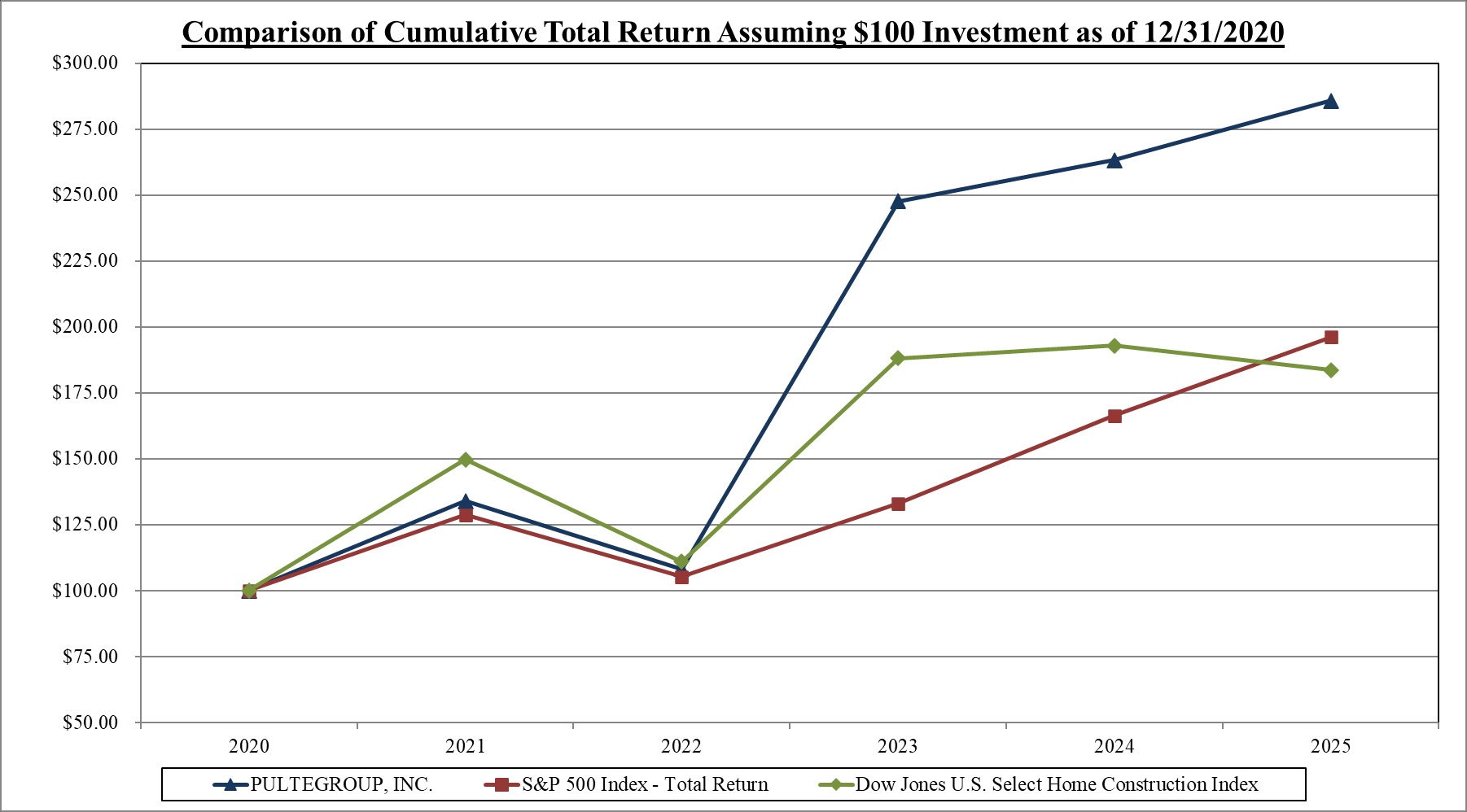
TSR.jpg


202020212022202320242025
PULTEGROUP, INC.$100.00 $134.05 $108.29 $247.74 $263.19 $285.70 
S&P 500 Index - Total Return100.00 128.71 105.40 133.10 166.40 196.16 
Dow Jones U.S. Select Home Construction
     Index
100.00 149.77 110.95 188.14 192.88 183.73 
* Assumes $100 invested on December 31, 2020, and the reinvestment of dividends.

ITEM 6.    [RESERVED]
21


ITEM 7.MANAGEMENT’S DISCUSSION AND ANALYSIS OF FINANCIAL CONDITION AND RESULTS OF OPERATIONS

The following discussion and analysis of our financial condition and results of operations are provided as a supplement to and should be read in conjunction with the consolidated financial statements and related notes included in Item 8 in this Annual Report on Form 10-K. It also should be read in conjunction with the disclosure under “Special Notes Concerning Forward-Looking Statements” found in Item 7A of this Annual Report on Form 10-K. The following tables and related discussion set forth key operating and financial data as of and for the fiscal years ended December 31, 2025 and 2024. For similar operating and financial data and discussion of our fiscal 2024 results compared to our fiscal 2023 results, refer to Item 7, “Management’s Discussion and Analysis of Financial Condition and Results of Operations” under Part II of our Annual Report on Form 10-K for the fiscal year ended December 31, 2024, which was filed with the SEC on February 6, 2025.

The following is a summary of our operating results by line of business ($000's omitted, except per share data):
 Years Ended December 31,
 20252024
Income before income taxes:
Homebuilding$2,753,291 $3,795,924 
Financial Services158,030 209,955 
Income before income taxes2,911,321 4,005,879 
Income tax expense(692,591)(922,617)
Net income$2,218,730 $3,083,262 
Diluted earnings per share$11.12 $14.69 

Overview

In 2025, consumer demand weakened due to ongoing affordability challenges, resulting from elevated mortgage interest rates and higher housing costs, as well as volatility in other macroeconomic and geopolitical conditions, including higher job losses and weakened consumer confidence. We have responded to these conditions by adjusting production cadence and sales prices where necessary and focusing sales incentives on discounts on spec inventory (houses without customer orders) and closing cost incentives, especially mortgage interest rate buydowns. Despite these efforts, net new orders in units decreased 4% in 2025 versus 2024.

We expect that many homebuyers will continue to face affordability challenges, so our sales paces may remain volatile on a monthly basis. In response, we expect our sales incentives to remain elevated and for our pace of house starts to remain dynamic. Additionally, we continue to face pressure in the cost of land acquisition and development. Due to the length of our land development and construction cycle times, there is a lag between when such cost changes occur and when they impact our operating results. This is evidenced in our gross margin from home sales, which decreased to 26.3% in 2025 versus 28.9% in 2024. Additionally, gross margin from home sales decreased each quarter in 2025, from 27.5% in the first quarter of 2025 to 24.7% in the fourth quarter of 2025. These decreases are primarily due to the aforementioned elevated sales incentives combined with higher land costs. While we expect to continue to generate healthy gross margins, they may decline somewhat in future periods as a result of these factors.

In response to the significant shift in market conditions in 2025, we have slowed the pace of our housing starts, have increased sales incentives, and are taking additional pricing actions in many of our communities, which resulted in $77.4 million of land inventory impairments in 2025. We continue to update the underwriting for our land option contracts prior to buying additional land and have made decisions to walk away from a number of land option agreements, which resulted in write-offs of deposits and pre-acquisition costs totaling $48.4 million in 2025. We will continue working with our trade partners to update the costs for materials, labor, and services to reflect changes in market conditions and will continue to adjust our overhead cost structure as necessary to align with demand.

Although elevated mortgage interest rates and volatile macroeconomic and geopolitical conditions may persist for some time, we believe the demographics supporting housing demand remain favorable over the long term. Inventories of new and existing homes have increased in the majority of our geographies as a result of the weakened demand experienced this year, so we are taking a measured approach to our capital allocation strategy as we anticipate continued volatility in demand. Accordingly, we
22


are focused on protecting liquidity and closely managing our cash flows while also continuing to emphasize shareholder returns, including the following actions:

–Increasing our lot optionality within our land pipeline for increased flexibility;
–Producing sufficient levels of spec inventory to service buyers seeking to close within 30 to 90 days;
–Maintaining a focus on shareholder return through dividends and share buybacks, including an 18% increase in our dividends from $0.22 to $0.26 per share effective with our January 2026 dividend payment and approving an additional $1.5 billion share repurchase authorization effective January 2025, bringing our total remaining share repurchase authorization to $1.0 billion as of December 31, 2025, after $1.2 billion of share repurchases in 2025; and
–Maintaining a modest leverage profile and ample liquidity.

We believe our strategic approach with respect to balancing sales price with sales pace, including actions taken related to sales incentives and our production cadence, will enable us to meet consumer demand at the selling prices necessary to turn our inventory, maintain market share, and generate healthy returns. We remain confident in our ability to navigate the future environment and to position the Company to take advantage of opportunities as they arise and support future growth and continued profitability and financial strength.

23


Homebuilding Operations

The following is a summary of income before income taxes for our Homebuilding operations ($000’s omitted):
 Years Ended December 31,
 2025FY 2025 vs. FY 20242024
Home sale revenues$16,743,522 (3)%$17,318,521 
Land sale and other revenues179,764 (8)%195,435 
Total Homebuilding revenues16,923,286 (3)%17,513,956 
Home sale cost of revenues (a)
(12,341,421)— %(12,311,766)
Land sale and other cost of revenues(166,041)(13)%(189,893)
Selling, general, and administrative expenses ("SG&A") (b)
(1,573,928)19 %(1,321,276)
Equity income from unconsolidated entities (c)
2,897 (d)43,151 
Other income (expense), net (e)
(91,502)(d)61,752 
Income before income taxes$2,753,291 (27)%$3,795,924 
Supplemental data:
Gross margin from home sales (a)
26.3 %(260) bps28.9 %
SG&A % of home sale revenues (b)
9.4 %180 bps7.6 %
Closings (units)29,572 (5)%31,219 
Average selling price $566 2 %$555 
Net new orders (f):
Units27,914 (4)%29,226 
Dollars$15,518,916 (6)%$16,493,524 
Cancellation rate15 %15 %
Average active communities993 5 %945 
Backlog at December 31:
Units8,495 (16)%10,153 
Dollars$5,270,112 (19)%$6,494,718 

(a)Includes the amortization of capitalized interest.
(b)Includes insurance reserve reversals of $42.3 million and $333.9 million in 2025 and 2024, respectively.
(c)Equity income from unconsolidated entities includes a gain of $39.5 million in 2024 related to the sale of our minority interest in a joint venture.
(d)Percentage not meaningful.
(e)See "Other income (expense), net" for a table summarizing significant items (Note 1).
(f)Net new order dollars represent a composite of new order dollars combined with other movements of the dollars in backlog related to cancellations and change orders.


24


Home sale revenues

Home sale revenues for 2025 were lower than 2024 by $575.0 million, or 3%. The decrease was attributable to a 5% decrease in closings, partially offset by a 2% increase in average selling price. The decrease in closings in 2025 was primarily attributable to lower net new orders in 2025 and a weaker order backlog entering the year, partially offset by a higher community count and improved production cycle times. Average selling price increased primarily due to product and geographic mix, including a slightly higher mix of closings toward our move-up buyers and in our Northeast segment, both of which carry a higher average selling price, partially offset by higher sales incentives.

Home sale gross margins

Home sale gross margins were 26.3% in 2025, compared with 28.9% in 2024. The lower home sale gross margins were primarily attributable to the aforementioned pricing actions we took in 2025, including elevated sales incentives, increased land acquisition and development costs, and higher land impairments as the result of the more challenging market conditions. We expect these factors to continue to impact our gross margins over the near term. Gross margins in 2025 were also unfavorably impacted by our efforts to reduce completed spec inventory to more appropriate levels, which we expect will continue to be an area of focus in 2026. While we have made significant progress in reducing the level of spec inventory during 2025, the level of completed spec inventory remains elevated for the current demand environment.

Land sale and other revenues

We periodically elect to sell parcels of land to third parties in the event such assets no longer fit into our strategic operating plans or are zoned for commercial or other development. Land sale and other revenues and their related gains or losses vary between periods, depending on the timing of land sales and our strategic operating decisions. Land sales and other revenues contributed income of $13.7 million and $5.5 million in 2025 and 2024, respectively.

SG&A

SG&A as a percentage of home sale revenues was 9.4% and 7.6% in 2025 and 2024, respectively. The gross dollar amount of our SG&A increased $252.7 million, or 19%, in 2025 compared with 2024. This increase resulted primarily from insurance reserve reversals of $42.3 million in 2025 compared to $333.9 million in 2024. Additionally, SG&A in 2025 reflects headcount and technology costs to support ongoing production volumes and investments for future growth. We expect to continue managing and balancing our overhead costs consistent with the demand environment.

Other income (expense), net

Other income (expense), net includes the following ($000’s omitted):
20252024
Write-offs of deposits and pre-acquisition costs (Note 2)
$(48,442)$(18,266)
Amortization of intangible assets (Note 1)
(20,093)(10,034)
Goodwill impairment (Note 1)
(28,553)— 
Property and equipment impairments(49,629)— 
Gain (loss) on debt retirement— (222)
Interest income44,428 59,486 
Interest expense(605)(479)
Miscellaneous, net (a)
11,392 31,267 
Total other income (expense), net (b)
$(91,502)$61,752 

(a)Includes a gain of $17.5 million in 2024 related to the sale of a non-homebuilding property.
(b)Other income (expense), net includes impairments in 2025 resulting from our expected divestiture of certain manufacturing assets. The net assets and operating results related to such manufacturing assets are immaterial.


25


Net new orders

Net new orders in units decreased 4% in 2025 compared with 2024, while net new orders in dollars decreased by 6% compared with 2024. The decreased net new order volume and dollars in 2025 were primarily due to lower order volume in our Texas and West segments. The annual cancellation rate (canceled orders for the period divided by gross new orders for the period) was 15% in each of 2025 and 2024. Ending backlog dollars, which represents orders for homes that have not yet closed, decreased 19% in 2025 compared with 2024 due to the aforementioned lower order volume.

Homes in production

The following is a summary of our homes in production at December 31, 2025 and 2024:
20252024
Sold6,489 7,680 
Unsold
Under construction5,217 6,897 
Completed1,999 1,862 
7,216 8,759 
Models1,759 1,593 
Total15,464 18,032 

The number of homes in production at December 31, 2025 was 14% lower compared to December 31, 2024. This decrease was primarily due to lower order volumes and improved production cycle times, which reduces the length of time a home remains under construction.

Controlled lots

The following is a summary of our lots under control at December 31, 2025 and 2024:
December 31, 2025December 31, 2024
OwnedOptionedControlledOwnedOptionedControlled
Northeast3,671 7,202 10,873 3,946 6,693 10,639 
Southeast18,853 36,519 55,372 17,843 32,770 50,613 
Florida25,849 34,345 60,194 27,041 34,499 61,540 
Midwest10,319 21,660 31,979 11,271 20,061 31,332 
Texas16,220 19,162 35,382 15,420 23,663 39,083 
West26,192 14,640 40,832 26,655 14,727 41,382 
Total101,104 133,528 234,632 102,176 132,413 234,589 
43 %57 %100 %44 %56 %100 %
Developed (%)50 %25 %36 %48 %24 %34 %

While competition for well-positioned land is robust, we have continued to pursue land investments that we believe can achieve appropriate risk-adjusted returns on invested capital. We have also continued to seek to maintain a high percentage of our lots that are controlled via land option agreements as such contracts enable us to defer acquiring portions of properties owned by third parties or unconsolidated entities until we have determined whether and when to exercise our option, which reduces our financial risks associated with long-term land holdings. The remaining purchase price under our land option agreements totaled $10.0 billion at December 31, 2025.


26


Homebuilding Segment Operations

Our Homebuilding operations represent our core business. Homebuilding offers a broad product line to meet the needs of homebuyers in our targeted markets. As of December 31, 2025, we conducted our operations in 47 markets located throughout 26 states. For reporting purposes, our Homebuilding operations are aggregated into six reportable segments:

 
Northeast:  Maryland, Massachusetts, New Jersey, Pennsylvania, Rhode Island, Virginia
Southeast:  Georgia, North Carolina, South Carolina, Tennessee
Florida:Florida
Midwest:Illinois, Indiana, Kentucky, Michigan, Minnesota, Ohio
Texas:Texas
West:  Arizona, California, Colorado, Nevada, New Mexico, Oregon, Utah, Washington

We also have a reportable segment for our Financial Services operations, which consist principally of mortgage banking, title, and insurance agency operations. The Financial Services segment operates generally in the same markets as the Homebuilding segments.
27


The following table presents selected financial information for our reportable Homebuilding segments:

 
Operating Data by Segment ($000's omitted)
 Years Ended December 31,
 2025FY 2025 vs. FY 20242024
Revenues:
Northeast$1,242,515 16 %$1,068,199 
Southeast2,959,063 3 %2,880,882 
Florida4,264,540 (9)%4,706,048 
Midwest2,727,733 5 %2,590,309 
Texas1,675,539 (22)%2,140,699 
West3,876,804 (1)%3,933,430 
Other Homebuilding177,092 (9)%194,389 
$16,923,286 (3)%$17,513,956 
Income before income taxes (a):
Northeast$293,867 28 %$229,996 
Southeast560,480 (11)%631,527 
Florida821,646 (27)%1,121,311 
Midwest539,061 10 %490,185 
Texas162,179 (53)%345,594 
West378,997 (31)%552,839 
Other homebuilding (b)
(2,939)(c)424,472 
$2,753,291 (27)%$3,795,924 
Closings (units):
Northeast1,649 9 %1,518 
Southeast5,598 (2)%5,697 
Florida7,442 (6)%7,906 
Midwest5,026 6 %4,750 
Texas4,352 (20)%5,452 
West5,505 (7)%5,896 
29,572 (5)%$31,219 
Average selling price:
Northeast$753 7 %$704 
Southeast529 5 %506 
Florida573 (4)%595 
Midwest543 0 %545 
Texas385 (2)%393 
West704 6 %667 
$566 2 %$555 

(a)    Includes land-related charges as summarized in the following land-related charges table (Notes 2 and 3).
(b)    Other homebuilding includes income from unconsolidated entities, interest, the amortization of intangible assets,impairment of intangible assets, the amortization of capitalized interest, and other items not allocated to the operating segments, and the elimination of internal capital charges allocated to the operating segments. Also includes insurance reserve reversals of $42.3 million and $333.9 million in 2025 and 2024, respectively (Note 11), goodwill impairment of $28.6 million in 2025 (Note 1), impairment of property and equipment of $49.6 million in 2025 (Note 1), and a gain of $39.5 million in 2024 related to the sale of our minority interest in a joint venture.
(c)    Percentage not meaningful.
28


The following table presents additional selected financial information for our reportable Homebuilding segments:

 
Operating Data by Segment ($000's omitted)
Years Ended December 31,
2025FY 2025 vs. FY 20242024
Net new orders - units:
Northeast1,541(2)%1,566
Southeast5,4371%5,363
Florida7,0682%6,909
Midwest4,829(1)%4,860
Texas4,195(12)%4,763
West4,844(16)%5,765
27,914(4)%29,226
Net new orders - dollars:
Northeast$1,112,945(5)%$1,165,949
Southeast2,861,5753%2,786,663
Florida3,974,320(1)%4,015,536
Midwest2,622,300(1)%2,642,969
Texas1,572,662(15)%1,841,487
West3,375,114(16)%4,040,920
$15,518,916(6)%$16,493,524
Cancellation rates:
Northeast9%7%
Southeast13%12%
Florida15%16%
Midwest10%10%
Texas17%17%
West21%19%
15%15%
Unit backlog:
Northeast507(18)%615
Southeast1,751(8)%1,912
Florida2,421(13)%2,795
Midwest1,605(11)%1,802
Texas791(17)%948
West1,420(32)%2,081
8,495(16)%10,153
Backlog dollars:
Northeast$376,551(26)%$506,121
Southeast1,030,029(9)%1,127,517
Florida1,520,814(16)%1,808,363
Midwest958,730(10)%1,064,162
Texas328,300(24)%431,177
West1,055,688(32)%1,557,378
$5,270,112(19)%$6,494,718

29


The following table presents additional selected financial information for our reportable Homebuilding segments:
Operating Data by Segment ($000's omitted)
Years Ended December 31,
20252024
Land-related charges (a):
Northeast$1,779 $8,142 
Southeast20,216 4,006 
Florida11,743 2,804 
Midwest4,905 1,598 
Texas24,967 9,643 
West59,259 7,412 
Other homebuilding4,045 967 
$126,914 $34,572 

(a)Land-related charges include land impairments, net realizable value adjustments for land held for sale, and write-offs of deposits and pre-acquisition costs. Other homebuilding consists primarily of write-offs of capitalized interest resulting from land-related charges. See Notes 2 and 3 to the Consolidated Financial Statements for additional discussion of these charges.

Northeast:

For 2025, Northeast home sale revenues increased 16% compared with 2024 due to a 9% increase in closings combined with a 7% increase in average selling price. The increase in closings occurred across the majority of markets, while the increase in average selling price occurred across all markets. Income before income taxes increased 28%, primarily due to increased revenues across the majority of markets, and higher gross margins across all markets. Net new orders decreased across the majority of markets.

Southeast:

For 2025, Southeast home sale revenues increased 3% compared with 2024 due to a 5% increase in average selling price partially offset by a 2% decrease in closings. The increase in average selling price was mixed among markets, while the decrease in closings occurred across the majority of markets. Income before income taxes decreased 11% primarily due to lower gross margins across all markets. Net new orders increased across the majority of markets.

Florida:

For 2025, Florida home sale revenues decreased 9% compared with 2024 due to a 6% decrease in closings combined with a 4% decrease in average selling price. The decrease in closings and average selling price occurred across the majority of markets. Income before income taxes decreased 27%, primarily due to lower revenue across the majority of markets and lower gross margins across all markets. Net new orders increased across the majority of markets.

Midwest:

For 2025, Midwest home sale revenues increased 5% compared with 2024 due to a 6% increase in closings partially offset by a slight decrease in average selling price. The increase in closings and decrease in average selling price occurred across the majority of markets. Income before income taxes increased 10%, primarily due to increased revenues and gross margins across the majority of markets. The decrease in net new orders was mixed among markets.
30


Texas:

For 2025, Texas home sale revenues decreased 22% compared with 2024 due to a 20% decrease in closings combined with a 2% decrease in average selling price. The decrease in closings occurred across all markets, while the decrease in average selling price was primarily due to decreases in Central Texas. Income before income taxes decreased 53%, primarily due to decreased gross margins across the majority of markets. Net new orders decreased across all markets.

West:

For 2025, West home sale revenues decreased 1% compared with 2024 primarily due to an 7% decrease in closings partially offset by a 6% increase in average selling price. The decrease in closings occurred across the majority of markets while the increase in average selling price occurred across the majority of markets. Income before income taxes decreased 31%, primarily due to decreased gross margin across the majority of markets. Net new orders decreased across the majority of markets.

Financial Services Operations

We conduct our Financial Services operations, which include mortgage banking, title, and insurance agency operations, through Pulte Mortgage and other subsidiaries. In originating mortgage loans, we initially use our own funds, including funds available pursuant to credit agreements with third parties. Substantially all of the loans we originate are sold in the secondary market within a short period of time after origination, generally within 30 days. We also sell the servicing rights for the loans we originate through fixed-price servicing sales contracts to reduce the risks and costs inherent in servicing loans. This strategy results in owning the loans and related servicing rights for only a short period of time. Operating as a captive business model primarily targeted to supporting our Homebuilding operations, the business levels of our Financial Services operations are highly correlated to Homebuilding. Our Homebuilding customers continue to account for substantially all Financial Services activities. We believe that our capture rate, which represents loan originations from our Homebuilding operations as a percentage of total loan opportunities from our Homebuilding operations, excluding cash closings, is an important metric in evaluating the effectiveness of our captive mortgage business model. The following tables present selected financial information for our Financial Services operations ($000’s omitted):

 
 Years Ended December 31,
 2025FY 2025 vs. FY 20242024
Mortgage revenues$283,799 (5)%$298,128 
Title services revenues97,669 (1)%99,103 
Insurance agency commissions7,199 (80)%35,763 
Total Financial Services revenues388,667 (10)%432,994 
Expenses(231,887)3 %(224,086)
Equity income from unconsolidated entities1,250 19 %1,050 
Other expense, net— (a)(3)
Income before income taxes$158,030 (25)%$209,955 
Total originations:
Loans18,977 (4)%19,770 
Principal$8,229,007 (1)%$8,340,836 

(a)     Percentage not meaningful
31


 Years Ended December 31,
 20252024
Supplemental Pulte Mortgage data:
Capture rate84.7 %85.9 %
Average FICO score752 750 
Funded origination breakdown:
Government (FHA, VA, USDA)26 %25 %
Other agency70 %72 %
Total agency96 %97 %
Non-agency4 %3 %
Total funded originations100 %100 %

Revenues

Total Financial Services revenues during 2025 decreased 10% compared with 2024 reflective of the lower homebuilding volume and lower margins on loan production in a more competitive environment. Insurance agency commissions reflect lower policy retention and commission rates as a result of the evolving environment for home insurance as carriers adjust their premiums, geographic markets, and product coverages.

Income before income taxes

The decrease in income before income taxes for 2025 as compared with 2024 was primarily due to lower insurance agency commissions.

Income Taxes

Our effective income tax rate was 23.8% and 23.0% for 2025 and 2024, respectively. Our effective tax rate for each of these periods differs from the federal statutory rate primarily due to state income tax expense and federal tax credits. See Note 8 for additional discussion of our effective income tax rate.

Liquidity and Capital Resources

We finance our land acquisition, development, and construction activities and Financial Services operations using internally-generated funds, supplemented by credit arrangements with third parties and capital market financing. We routinely monitor current and expected operational requirements and financial market conditions to evaluate accessing available financing sources, including revolving bank credit and securities offerings.

At December 31, 2025, we had unrestricted cash and equivalents of $2.0 billion, restricted cash balances of $27.9 million, and $892.9 million available under our Revolving Credit Facility (as defined below). Our ratio of debt-to-total capitalization, excluding our Financial Services debt, was 11.2% at December 31, 2025 as compared with 11.8% at December 31, 2024.

We follow a diversified investment approach for our cash and equivalents by maintaining such funds with a broad portfolio of banks within our group of relationship banks in high quality, highly liquid, short-term deposits and investments, which helps mitigate banking concentration risk. In response to recent volatility in the banking system, we have shifted a larger percentage of our cash and equivalents to money market funds to reduce the balances held in bank accounts.

For the next 12 months, we expect our principal demand for funds will be for the acquisition and development of land inventory, construction of house inventory, and operating expenses, including our general and administrative expenses. Though we generated significant cash flows from operations in 2024 and 2025, as we increase the number of homes under production in the future, this will require a greater use of cash. Additionally, we plan to continue our dividend payments and repurchases of common stock. In August 2026, we need to repay or refinance Pulte Mortgage's master repurchase agreement with third-party lenders (as amended, the "Repurchase Agreement"). While we intend to refinance the Repurchase Agreement, there can be no assurances that the Repurchase Agreement can be renewed or replaced on commercially reasonable terms upon its expiration.
32


However, we believe we have adequate liquidity to meet Pulte Mortgage's anticipated financing needs. Beyond the next twelve months, we will need to repay or refinance our Revolving Credit Facility, which matures in 2031, and our unsecured senior notes, the next tranche of which becomes due in March 2026. We may from time to time repurchase our unsecured senior notes through open market purchases, privately negotiated transactions, or otherwise.

We believe that our current cash position and other available financing resources, coupled with our ongoing operating activities, will provide sufficient liquidity to fund our business needs over the next twelve months and beyond. To the extent the sources of capital described above are insufficient to meet our needs, we may also conduct additional public offerings of our securities, refinance debt, dispose of certain assets to fund our operating activities, or draw on existing or new debt facilities.

Unsecured senior notes

At December 31, 2025, we had $1.6 billion of unsecured senior notes outstanding with no repayments due until March 2026, when $251.9 million of notes are scheduled to mature.

Other notes payable

Other notes payable include non-recourse and limited recourse secured notes with third parties that totaled $47.2 million at December 31, 2025. These notes have maturities ranging up to 4 years, are secured by the applicable land positions to which they relate, and generally have no recourse to other assets. The stated interest rates on these notes range up to 9%.

Joint venture debt

At December 31, 2025, aggregate outstanding debt of unconsolidated joint ventures was $43.9 million.

Revolving credit facility

As of December 31, 2025, we maintained a revolving credit facility ("Revolving Credit Facility") scheduled to mature in June 2027 with a maximum borrowing capacity of $1.3 billion and an uncommitted accordion feature that could increase the capacity to $1.8 billion, subject to certain conditions and availability of additional bank commitments. Effective February 4, 2026, we amended and restated the Revolving Credit Facility to (i) extend the maturity date to February 4, 2031, (ii) increase total committed capacity to $1.75 billion, and (iii) expand the uncommitted accordion feature to $750 million, providing for potential capacity of $2.5 billion, subject to certain customary conditions and additional lender commitments. The Revolving Credit Facility also provides for the issuance of letters of credit that reduce the available borrowing capacity under the Revolving Credit Facility, up to the maximum borrowing capacity. The interest rate on borrowings under the Revolving Credit Facility may be based on either the Secured Overnight Financing Rate or a base rate plus an applicable margin, as defined therein. The Revolving Credit Facility contains financial covenants that require us to maintain a minimum Tangible Net Worth and a maximum Debt-to-Capitalization Ratio (as each term is defined in the Revolving Credit Facility). As of December 31, 2025, we were in compliance with all covenants and requirements. Outstanding amounts and other obligations under the Revolving Credit Facility are guaranteed by certain of our wholly-owned subsidiaries.

At December 31, 2025, we had no borrowings outstanding, $357.1 million of letters of credit issued, and $892.9 million of remaining capacity under the Revolving Credit Facility.

Financial Services debt

Pulte Mortgage provides mortgage financing for the majority of our home closings by utilizing its own funds and funds made available pursuant to credit agreements with third parties. Pulte Mortgage uses these resources to finance its lending activities until the loans are sold in the secondary market, which generally occurs within 30 days.

Pulte Mortgage maintains a master repurchase agreement with third-party lenders entered into in August 2025 (the "Repurchase Agreement") that matures on August 12, 2026. The maximum aggregate commitment was $625.0 million at December 31, 2025, which continues until maturity. The Repurchase Agreement also contains an accordion feature that could increase the commitment by $50.0 million above its active commitment level. Borrowings under the Repurchase Agreement are secured by residential mortgage loans available-for-sale. The Repurchase Agreement contains various affirmative and negative covenants applicable to Pulte Mortgage, including quantitative thresholds related to net worth, net income, and liquidity. At December 31, 2025, Pulte Mortgage had $532.3 million outstanding at a weighted average interest rate of 5.51%, and $92.7 million of remaining capacity under the Repurchase Agreement. Pulte Mortgage was in compliance with all of its covenants and requirements as of such dates.
33


Dividends and share repurchase program

We declared quarterly cash dividends totaling $183.0 million and $171.4 million in 2025 and 2024, respectively, and repurchased 10.6 million and 10.1 million shares in 2025 and 2024, respectively, for a total of $1.2 billion and $1.2 billion in 2025 and 2024, respectively. On January 29, 2025, the Board of Directors increased our share repurchase authorization by $1.5 billion, which was publicly announced on January 30, 2025. At December 31, 2025, we had remaining authorization to repurchase $982.9 million of common shares.

Contractual obligations

We are a party to many contractual obligations involving commitments to make payments to third parties. These obligations impact our short-term and long-term liquidity and capital resource needs. Certain contractual obligations are reflected on the Consolidated Balance Sheet as of December 31, 2025, while others are considered future commitments. Our contractual obligations primarily consist of long-term debt and related interest payments, purchase obligations related to expected acquisitions and development of land, operating leases, and obligations under our various compensation and benefit plans.

We use letters of credit and surety bonds to guarantee our performance under various contracts, principally in connection with the development of our homebuilding projects. The expiration dates of the letter of credit contracts coincide with the expected completion date of the related homebuilding projects. If the obligations related to a project are ongoing, annual extensions of the letters of credit are typically granted on a year-to-year basis. At December 31, 2025, we had outstanding letters of credit of $357.1 million. Our surety bonds generally do not have stated expiration dates; rather, we are released from the bonds as the contractual performance is completed. These bonds, which approximated $3.1 billion at December 31, 2025, are typically outstanding over a period of approximately three to five years. Because significant construction and development work has been performed related to the applicable projects but has not yet received final acceptance by the respective counterparties, the aggregate amount of surety bonds outstanding is in excess of the projected cost of the remaining work to be performed.

In the ordinary course of business, we enter into land option agreements in order to procure land for the construction of houses in the future. At December 31, 2025, these agreements had an aggregate remaining purchase price of $10.0 billion. Pursuant to these land option agreements, we provide a deposit to the seller as consideration for the right to purchase land at different times in the future, usually at predetermined prices. At December 31, 2025, outstanding deposits totaled $724.2 million, of which $23.9 million is refundable.

We are under contract to purchase federal transferable tax credits that we expect to use to offset future federal income tax
obligations totaling $354.1 million. The timing of such purchases is intended to approximate the timing of our expected federal income tax obligations.

For further information regarding our primary obligations, refer to Note 5, "Debt" and Note 11, "Commitments and Contingencies" to the Consolidated Financial Statements included elsewhere in this Annual Report on 10-K for amounts outstanding as of December 31, 2025, related to debt and commitments and contingencies, respectively.


34


Cash flows

Operating activities

Net cash provided by operating activities in 2025 was $1.9 billion, compared with net cash provided by operating activities of $1.7 billion in 2024. Generally, the primary drivers of our cash flow from operations are profitability and changes in inventory levels and residential mortgage loans available-for-sale, each of which experiences seasonal fluctuations. Our positive cash flow from operations for 2025 was primarily due to our net income of $2.2 billion, which was partially offset by a $213.4 million net increase in inventories primarily attributable to investment in land inventory.

Net cash provided by operating activities in 2024 was primarily due to our net income of $3.1 billion, which was partially offset by a $787.5 million net increase in inventories primarily attributable to investment in land inventory.

Investing activities

Net cash used in investing activities totaled $80.4 million in 2025, compared with $94.5 million in 2024. The 2025 cash outflows primarily reflect capital expenditures of $122.7 million related to our ongoing investment in new communities, construction operations, and information technology applications, partially offset by distributions of capital from unconsolidated entities of $63.7 million.

Net cash used in investing activities in 2024 primarily reflects capital expenditures of $118.5 million related to our ongoing investment in new communities, construction operations, and information technology applications.

Financing activities

Net cash used in financing activities was $1.4 billion in 2025 compared with $1.8 billion during 2024. The net cash used in financing activities for 2025 resulted primarily from the repurchase of 10.6 million common shares for $1.2 billion under our repurchase authorization, cash dividends of $176.7 million, and repayments of debt of $24.5 million.

Net cash used in financing activities for 2024 resulted primarily from the repurchase of 10.1 million common shares for $1.2 billion under our repurchase authorization, cash dividends of $167.7 million, and repayments of debt of $355.8 million.

Seasonality

Although significant changes in market conditions have impacted our seasonal patterns in the past and could do so again, we have historically experienced variability in our quarterly results from operations due to the seasonal nature of the homebuilding industry. We generally experience increases in revenues and cash flow from operations during the fourth quarter based on the timing of home closings. This seasonal activity increases our working capital requirements in our third and fourth quarters to support our home production and loan origination volumes. As a result of the seasonality of our operations, our quarterly results of operations are not necessarily indicative of the results that may be expected for the full year. Additionally, given the disruption in economic activity, supply chain challenges, increase in mortgage interest rates, and other macroeconomic factors, our quarterly results in 2025 and 2024 are not necessarily indicative of results that may be achieved in the future.

Supplemental Guarantor Financial Information

As of December 31, 2025 PulteGroup, Inc. had outstanding $1.6 billion principal amount of unsecured senior notes due at dates from March 2026 through February 2035 and no amounts outstanding on its Revolving Credit Facility.

All of our unsecured senior notes and the Revolving Credit Facility are fully and unconditionally guaranteed, on a joint and several basis, by certain subsidiaries of PulteGroup, Inc. ("Guarantors" or "Guarantor Subsidiaries"). Each of the Guarantor Subsidiaries is 100% owned, directly or indirectly, by PulteGroup, Inc. Our subsidiaries associated with our Financial Services operations and certain other subsidiaries do not guarantee the unsecured senior notes or the Revolving Credit Facility (collectively, "Non-Guarantor Subsidiaries"). The guarantees are senior unsecured obligations of each Guarantor and rank equal with all existing and future senior debt of such Guarantor and senior to all subordinated debt of such Guarantor. The guarantees are effectively subordinated to any secured debt of such Guarantor to the extent of the value of the assets securing such debt.

A court could void or subordinate any Guarantor’s guarantee under the fraudulent conveyance laws if existing or future creditors of any such Guarantor were successful in establishing that such Guarantor:
35


(a) incurred the guarantee with the intent of hindering, delaying or defrauding creditors; or

(b) received less than reasonably equivalent value or fair consideration in return for incurring the guarantee and, in the case of any one of the following is also true at the time thereof:

•such Guarantor was insolvent or rendered insolvent by reason of the issuance of the incurrence of the guarantee;
•the incurrence of the guarantee left such Guarantor with an unreasonably small amount of capital or assets to carry on its business;
•such Guarantor intended to, or believed that it would, incur debts beyond its ability to pay as they mature;
•such Guarantor was a defendant in an action for money damages, or had a judgment for money damages docketed against it, if the judgment is unsatisfied after final judgment.

The measures of insolvency for purposes of determining whether a fraudulent conveyance occurred would vary depending upon the laws of the relevant jurisdiction and upon the valuation assumptions and methodology applied by the court. However, in general, a court would deem a company insolvent if:

•the sum of its debts, including contingent and unliquidated liabilities, was greater than the fair saleable value of all of its assets;
•the present fair saleable value of its assets was less than the amount that would be required to pay its probable liability on its existing debts, including contingent liabilities, as they become absolute and mature; or
•it could not pay its debts as they became due.

The guarantees of the senior notes contain a provision to limit each Guarantor’s liability to the maximum amount that it could incur without causing the incurrence of obligations under its guarantee to be a fraudulent transfer. However, under recent case law, this provision may not be effective to protect such guarantee from being voided under fraudulent transfer law or otherwise determined to be unenforceable. If a court were to find that the incurrence of a guarantee was a fraudulent transfer or conveyance, the court could void the payment obligations under that guarantee, could subordinate that guarantee to presently existing and future indebtedness of the Guarantor or could require the holders of the senior notes to repay any amounts received with respect to that guarantee. In the event of a finding that a fraudulent transfer or conveyance occurred, holders may not receive any repayment on the senior notes.

Finally, as a court of equity, a bankruptcy court may subordinate the claims in respect of the guarantees to other claims against us under the principle of equitable subordination if the court determines that (1) the holder of senior notes engaged in some type of inequitable conduct, (2) the inequitable conduct resulted in injury to our other creditors or conferred an unfair advantage upon the holders of senior notes and (3) equitable subordination is not inconsistent with the provisions of the bankruptcy code.

On the basis of historical financial information, operating history and other factors, we believe that each of the Guarantors, after giving effect to the issuance of the guarantees when such guarantees were issued, was not insolvent, did not have unreasonably small capital for the business in which it engaged and did not and has not incurred debts beyond its ability to pay such debts as they mature. We cannot provide assurance, however, as to what standard a court would apply in making these determinations or that a court would agree with our conclusions in this regard.

The following tables present summarized financial information for PulteGroup, Inc. and the Guarantor Subsidiaries on a combined basis after intercompany transactions and balances have been eliminated among PulteGroup, Inc. and the Guarantor Subsidiaries, as well as their investment in and equity in earnings from the Non-Guarantor Subsidiaries ($000’s omitted):
36


PulteGroup, Inc. and Guarantor Subsidiaries
Summarized Balance Sheet DataDecember 31,
ASSETS20252024
Cash, cash equivalents, and restricted cash$1,632,196 $1,218,207 
House and land inventory12,635,442 12,354,274 
Amount due from Non-Guarantor Subsidiaries1,083,631 1,024,762 
Total assets16,507,470 15,589,227 
LIABILITIES
Accounts payable, customer deposits,
       accrued and other liabilities
$2,601,837 $2,735,190 
Notes payable1,631,098 1,618,586 
Total liabilities4,682,755 4,801,056 


Years Ended December 31,
Summarized Statement of Operations Data20252024
Revenues$16,594,878 $17,200,473 
Cost of revenues12,220,999 12,228,331 
Selling, general, and administrative expenses1,508,055 1,314,547 
Income before income taxes3,047,519 3,789,812 

Critical Accounting Estimates

The preparation of the Company's financial statements in conformity with U.S. generally accepted accounting principles and the discussion and analysis of its financial condition and operating results requires management to make estimates and assumptions, including estimates about the future resolution of existing uncertainties that affect the amounts reported. As a result, actual results could differ from these estimates. Management bases its estimates on historical experience and on various other assumptions it believes to be reasonable under the circumstances. We believe the following critical accounting estimates reflect the more significant judgments and estimates used in the preparation of our consolidated financial statements. For a discussion of all of our significant accounting policies, refer to Note 1, "Summary of Significant Accounting Policies".

Inventory and cost of revenues

Cost of revenues includes the construction cost, average lot cost, estimated warranty costs, and closing costs applicable to the home. The construction cost of the home includes amounts paid through the closing date of the home, plus an accrual for costs incurred but not yet paid, based on an analysis of budgeted construction costs. This accrual is reviewed for accuracy based on actual payments made after closing compared with the amount accrued, and adjustments are made if needed. Land acquisition and development costs are allocated to individual lots using an average lot cost determined based on the total expected land acquisition and development costs and the total expected home closings for the community. Total community land acquisition and development costs are based on an analysis of budgeted costs compared with actual costs incurred to date and estimates to complete. The development cycles for our communities range from under one year to in excess of 10 years for certain master planned communities. Adjustments to estimated total land acquisition and development costs for the community affect the amounts costed for the community’s remaining lots.

We test inventory for impairment when events and circumstances indicate that the undiscounted cash flows estimated to be generated by the community may be less than its carrying amount. Such indicators include gross margins or sales paces significantly below expectations, construction costs or land development costs significantly in excess of budgeted amounts, significant delays or changes in the planned development for the community, and other known qualitative factors. Communities that demonstrate potential impairment indicators are tested for impairment by comparing the expected undiscounted cash flows for the community to its carrying value. For those communities whose carrying values exceed the expected undiscounted cash
37


flows, we determine the fair value of the community and impairment charges are recorded if the fair value of the community’s inventory is less than its carrying value.

We generally determine the fair value of each community using a combination of discounted cash flow models and market comparable transactions, where available. These estimated cash flows are significantly impacted by estimates related to expected average selling prices, expected sales paces, expected land development and construction timelines, and anticipated land development, construction, and overhead costs. The assumptions used in the discounted cash flow models are specific to each community. Due to uncertainties in the estimation process, the significant volatility in demand for new housing, the long life cycles of many communities, and potential changes in our strategy related to certain communities, actual results could differ significantly from such estimates.

Generally, a community must have projected gross margin percentages in the single digits or lower to potentially fail the undiscounted cash flow step and proceed to the fair value step. Our overall gross margin realized during 2025 and our average gross margin in backlog at December 31, 2025 both exceeded 25%, and we have only a small minority of communities with gross margins below 10%. However, in the event of an extended economic slowdown that leads to moderate or significant decreases in the price of new homes in certain geographic or buyer submarkets, we could have a larger number of communities that begin to approach these levels such that more detailed impairment analyses would be necessary, and the resulting impairments could be material. Additionally, we have $1.3 billion of deposits and pre-acquisition costs at December 31, 2025 related to option agreements to acquire additional land. In the event of an extended economic slowdown, we could elect to cancel a large portion of such land option agreements, which would generally result in the write-off of the related deposits and pre-acquisition costs.

Self-insured risks

At any point in time, we are managing numerous individual claims related to general liability, property, errors and omission, workers compensation, and other business insurance coverages. We reserve for costs associated with such claims (including expected claims management expenses) on an undiscounted basis at the time product revenue is recognized for each home closing and periodically evaluate the recorded liabilities based on actuarial analyses of our historical claims. The actuarial analyses calculate estimates of the ultimate cost of all unpaid losses, including estimates for incurred but not reported losses ("IBNR"). IBNR represents losses related to claims incurred but not yet reported plus development on reported claims.

Our recorded reserves for all such claims totaled $259.4 million and $267.5 million at December 31, 2025 and 2024, respectively, the vast majority of which relate to general liability claims. The recorded reserves include loss estimates related to both (i) existing claims and related claim expenses and (ii) IBNR and related claim expenses. Liabilities related to IBNR and related claim expenses represented approximately 74% and 68% of the total general liability reserves at December 31, 2025 and 2024, respectively. The actuarial analyses that determine the IBNR portion of reserves consider a variety of factors, including the frequency and severity of losses, which are based on our historical claims experience supplemented by industry data. The actuarial analyses of the reserves also consider historical third party recovery rates and claims management expenses. Because of the inherent uncertainty in estimating future losses related to these claims, actual costs could differ significantly from estimated costs. Based on the actuarial analyses performed, we believe the range of reasonably possible losses related to these claims is $175 million to $325 million. While this range represents our best estimate of our ultimate liability related to these claims, due to a variety of factors, including those factors described above, there can be no assurance that the ultimate costs realized by us will fall within this range.

Volatility in both national and local housing market conditions can affect the frequency and cost of construction defect claims. Additionally, IBNR estimates comprise the majority of our liability and are subject to a high degree of uncertainty due to a variety of factors, including changes in claims reporting and resolution patterns, third party recoveries, insurance industry practices, the regulatory environment, and legal precedent. State regulations vary, but construction defect claims are typically reported and resolved over an extended period often exceeding ten years. Changes in the frequency and timing of reported claims and estimates of specific claim values can impact the underlying inputs and trends utilized in the actuarial analyses, which could have a material impact on the recorded reserves. Additionally, the amount of insurance coverage available for each policy period also impacts our recorded reserves. Because of the inherent uncertainty in estimating future losses and the timing of such losses related to these claims, actual costs could differ significantly from estimated costs.

Adjustments to reserves are recorded in the period in which the change in estimate occurs. During 2025 and 2024, we reduced general liability reserves by $42.3 million and $333.9 million, respectively, as a result of changes in estimates resulting from actual claim experience being less than anticipated in previous actuarial projections. The changes in actuarial estimates were driven by changes in actual claims experience that, in turn, impacted actuarial estimates for potential future claims. These
38


changes in actuarial estimates did not involve any significant changes in actuarial methodology but did impact the development of estimates for future periods, which resulted in adjustments to the IBNR portion of our recorded liabilities. There were no material adjustments to individual claims. Rather, the adjustments reflect an overall lower level of losses related to construction defect claims in recent years as compared with our previous experience. We attribute the favorable experience in more recent years to a variety of factors, including improved construction techniques, rising home values, and increased participation from our subcontractors in resolving claims. The cumulative effect of these factors, as evidenced by the favorable claims experience for an extended period, have resulted in our actuarial estimates placing less weight on older, higher cost policy years and relatively more weight on more recent, lower cost policy years.

ITEM 7A.    QUANTITATIVE AND QUALITATIVE DISCLOSURES ABOUT MARKET RISK

We are subject to market risk on our debt instruments primarily due to fluctuations in interest rates. We utilize both fixed-rate and variable-rate debt. For fixed-rate debt, changes in interest rates generally affect the fair value of the debt instrument but not our earnings or cash flows. Conversely, for variable-rate debt, changes in interest rates generally do not affect the fair value of the debt instrument but could affect our earnings and cash flows. Except in very limited circumstances, we do not have an obligation to prepay our debt prior to maturity. As a result, interest rate risk and changes in fair value should not have a significant impact on our fixed-rate debt until we are required or elect to refinance or repurchase such debt.

The following tables set forth the principal cash flows by scheduled maturity, weighted-average interest rates, and estimated fair value of our debt obligations as of December 31, 2025 and 2024 ($000’s omitted).
 As of December 31, 2025 for the Years Ended December 31,
 20262027202820292030ThereafterTotalFair
Value
Rate-sensitive liabilities:
Fixed rate debt$282,084 $342,348 $7,556 $4,341 $— $1,000,000 $1,636,329 $1,755,396 
Average interest rate5.16 %5.03 %6.64 %5.00 %— %6.71 %6.09 %
Variable rate debt (a)
$532,338 $— $— $— $— $— $532,338 $532,338 
Average interest rate5.51 %— %— %— %— %— %— %
 As of December 31, 2024 for the Years Ended December 31,
 20252026202720282029ThereafterTotalFair
Value
Rate-sensitive liabilities:
Fixed rate debt$10,563 $268,390 $337,277 $4,340 $4,340 $1,000,000 $1,624,910 $1,701,270 
Average interest rate2.82 %5.30 %5.00 %5.00 %5.00 %6.71 %6.09 %
Variable rate debt (a)
$526,906 $— $— $— $— $— $526,906 $526,906 
Average interest rate6.13 %— %— %— %— %— %6.13 %

(a) Includes the Pulte Mortgage Repurchase Agreement. There were no borrowings outstanding under our Revolving Credit Facility at either December 31, 2025 or 2024.

Derivative instruments and hedging activities

Pulte Mortgage is exposed to market risks from commitments to lend, movements in interest rates, and canceled or modified commitments to lend. A commitment to lend at a specific interest rate (an interest rate lock commitment ("IRLC")) is a derivative financial instrument (interest rate is locked to the borrower). The interest rate risk continues through the loan closing and until the loan is sold to an investor. We are generally not exposed to variability in cash flows of derivative instruments for more than approximately 90 days. In periods of rising interest rates, the length of exposure will generally increase due to customers locking in an interest rate sooner as opposed to letting the interest rate float. In periods of low interest rates, the length of exposure will also generally increase as customers desire to lock before the possibility of rising rates.

In order to reduce these risks, we use derivative financial instruments, principally cash forward contracts on mortgage-backed securities and whole loan investor commitments, to economically hedge the IRLC. We generally enter into one of the aforementioned derivative financial instruments upon accepting IRLCs. Changes in the fair value of IRLCs and the other
39


derivative financial instruments are recognized in Financial Services revenues. We do not use any derivative financial instruments for trading purposes.

At December 31, 2025 and 2024, residential mortgage loans available-for-sale had an aggregate fair value of $613.7 million and $629.6 million, respectively. At December 31, 2025 and 2024, we had aggregate IRLCs of $820.2 million and $469.4 million, respectively, which were originated at interest rates prevailing at the date of commitment. Unexpired forward contracts totaled $1.3 billion and $977.0 million at December 31, 2025 and 2024, respectively, and whole loan investor commitments totaled $270.6 million and $237.1 million, respectively, at such dates. Hypothetical changes in the fair values of our financial instruments arising from immediate parallel shifts in long-term mortgage rates would not be material to our financial results due to the offsetting nature in the movements in fair value of our financial instruments.

SPECIAL NOTES CONCERNING FORWARD-LOOKING STATEMENTS

As a cautionary note, except for the historical information contained herein, certain matters discussed in Item 7, Management's Discussion and Analysis of Financial Condition and Results of Operations, and Item 7A, Quantitative and Qualitative Disclosures About Market Risk, are “forward-looking” statements within the meaning of the Private Securities Litigation Reform Act of 1995. These statements are subject to a number of risks, uncertainties and other factors that could cause our actual results, performance, prospects or opportunities, as well as those of the markets we serve or intend to serve, to differ materially from those expressed in, or implied by, these statements. You can identify these statements by the fact that they do not relate to matters of a strictly factual or historical nature and generally discuss or relate to forecasts, estimates or other expectations regarding future events. Generally, the words “believe,” “expect,” “intend,” “estimate,” “anticipate,” “plan,” “project,” “may,” “can,” “could,” “might,” “should,” “will” and similar expressions identify forward-looking statements, including statements related to any potential impairment charges and the impacts or effects thereof, expected operating and performing results, planned transactions, planned objectives of management, future developments or conditions in the industries in which we participate and other trends, developments and uncertainties that may affect our business in the future.

Such risks, uncertainties and other factors include, among other things: interest rate changes and the availability of mortgage financing; the impact of any changes to our strategy in responding to the cyclical nature of the industry or deteriorations in industry conditions or downward changes in general economic or other business conditions, including any changes regarding our land positions and the levels of our land spend; economic changes nationally or in our local markets, including inflation, deflation, changes in consumer confidence and preferences and the state of the market for homes in general; supply shortages and the cost of labor and building materials; the availability and cost of land and other raw materials used by us in our homebuilding operations; a decline in the value of the land and home inventories we maintain and resulting possible future writedowns of the carrying value of our real estate assets; competition within the industries in which we operate; rapidly changing technological developments including, but not limited to, the use of artificial intelligence in the homebuilding industry; governmental regulation directed at or affecting the housing market, the homebuilding industry or construction activities, slow growth initiatives and/or local building moratoria; the availability and cost of insurance covering risks associated with our businesses, including warranty and other legal or regulatory proceedings or claims; damage from improper acts of persons over whom we do not have control or attempts to impose liabilities or obligations of third parties on us; weather related slowdowns; the impact of climate change and related governmental regulation; adverse capital and credit market conditions, which may affect our access to and cost of capital; the insufficiency of our income tax provisions and tax reserves, including as a result of changing laws or interpretations; the potential that we do not realize our deferred tax assets; our inability to sell mortgages into the secondary market; uncertainty in the mortgage lending industry, including revisions to underwriting standards and repurchase requirements associated with the sale of mortgage loans, and related claims against us; risks associated with the implementation of a new enterprise resource planning system; risks related to information technology failures, data security issues, and the effect of cybersecurity incidents and threats; the impact of negative publicity on sales; failure to retain key personnel; the impairment of our intangible assets; disruptions associated with epidemics, pandemics or other serious public health threats (as well as fear of such events), and the measures taken to address it; the effect of cybersecurity incidents and threats; and other factors of national, regional and global scale, including those of a political, economic, business and competitive nature. See Item 1A – Risk Factors for a further discussion of these and other risks and uncertainties applicable to our businesses. We undertake no duty to update any forward-looking statement, whether as a result of new information, future events or changes in our expectations.
40


ITEM 8.      FINANCIAL STATEMENTS AND SUPPLEMENTARY DATA

PULTEGROUP, INC.
CONSOLIDATED BALANCE SHEETS
December 31, 2025 and 2024
($000’s omitted, except per share data)
 

20252024
ASSETS
Cash and equivalents$1,980,869 $1,613,327 
Restricted cash27,907 40,353 
Total cash, cash equivalents, and restricted cash2,008,776 1,653,680 
House and land inventory12,925,413 12,692,820 
Residential mortgage loans available-for-sale613,665 629,582 
Investments in unconsolidated entities167,342 215,416 
Other assets2,217,483 2,001,991 
Goodwill40,377 68,930 
Other intangible assets26,210 46,303 
Deferred tax assets49,157 55,041 
$18,048,423 $17,363,763 
LIABILITIES AND SHAREHOLDERS’ EQUITY
Liabilities:
Accounts payable, including book overdrafts of $78,613 and $112,639 at December 31, 2025 and 2024, respectively
$724,885 $727,995 
Customer deposits387,837 512,580 
Deferred tax liabilities448,493 443,566 
Accrued and other liabilities
1,338,330 1,412,166 
Financial Services debt532,338 526,906 
Notes payable1,631,098 1,618,586 
Total liabilities5,062,981 5,241,799 
Shareholders’ equity:
Common shares, $0.01 par value; 500,000,000 shares authorized, 192,724,978 and 202,912,881 shares issued and outstanding at December 31, 2025 and 2024, respectively
1,927 2,029 
Additional paid-in capital3,488,924 3,425,384 
Retained earnings9,494,591 8,694,551 
Total shareholders’ equity12,985,442 12,121,964 
$18,048,423 $17,363,763 


See Notes to Consolidated Financial Statements.
41


PULTEGROUP, INC.
CONSOLIDATED STATEMENTS OF OPERATIONS
For the years ended December 31, 2025, 2024, and 2023
(000’s omitted, except per share data)
 
202520242023
Revenues:
Homebuilding
Home sale revenues$16,743,522 $17,318,521 $15,598,707 
Land sale and other revenues179,764 195,435 142,116 
16,923,286 17,513,956 15,740,823 
Financial Services388,667 432,994 320,755 
Total revenues17,311,953 17,946,950 16,061,578 
Homebuilding Cost of Revenues:
Home sale cost of revenues(12,341,421)(12,311,766)(11,030,206)
Land sale and other cost of revenues(166,041)(189,893)(124,607)
(12,507,462)(12,501,659)(11,154,813)
Financial Services expenses(231,887)(224,086)(187,280)
Selling, general, and administrative expenses(1,573,928)(1,321,276)(1,312,642)
Equity income from unconsolidated entities, net4,147 44,201 4,561 
Other income (expense), net(91,502)61,749 37,863 
Income before income taxes2,911,321 4,005,879 3,449,267 
Income tax expense(692,591)(922,617)(846,895)
Net income$2,218,730 $3,083,262 $2,602,372 
Net income per share:
Basic$11.21 $14.82 $11.79 
Diluted$11.12 $14.69 $11.72 
Cash dividends declared$0.92 $0.82 $0.68 
Number of shares used in calculation:
Basic197,966 208,107 219,958 
Effect of dilutive securities1,571 1,722 1,205 
Diluted199,537 209,829 221,163 


See Notes to Consolidated Financial Statements.
42


PULTEGROUP, INC.
CONSOLIDATED STATEMENTS OF SHAREHOLDERS’ EQUITY
For the years ended December 31, 2025, 2024, and 2023
(000’s omitted)
 Common SharesAdditional
Paid-in
Capital
Retained
Earnings
Total
Shares$
Shareholders' equity, December 31, 2022225,840 $2,258 $3,330,138 $5,581,702 $8,914,098 
Share issuances511 6 4,835 — 4,841 
Dividends declared— — — (149,806)(149,806)
Share repurchases(13,793)(138)— (999,862)(1,000,000)
Excise tax on share repurchases— — — (9,691)(9,691)
Cash paid for shares withheld for taxes— — — (11,991)(11,991)
Share-based compensation— — 33,434 — 33,434 
Net income— — — 2,602,372 2,602,372 
Shareholders' equity, December 31, 2023212,558 $2,126 $3,368,407 $7,012,724 $10,383,257 
Share issuances422 4 9,288 — 9,292 
Dividends declared— — — (171,390)(171,390)
Share repurchases(10,067)(101)— (1,199,898)(1,199,999)
Excise tax on share repurchases— — — (11,550)(11,550)
Cash paid for shares withheld for taxes— — — (18,597)(18,597)
Share-based compensation— — 47,689 — 47,689 
Net income— — — 3,083,262 3,083,262 
Shareholders' equity, December 31, 2024202,913 $2,029 $3,425,384 $8,694,551 $12,121,964 
Share issuances454 4 8,558 — 8,562 
Dividends declared— — — (182,979)(182,979)
Share repurchases(10,642)(106)— (1,199,890)(1,199,996)
Excise tax on share repurchases— — — (11,482)(11,482)
Cash paid for shares withheld for taxes— — — (24,339)(24,339)
Share-based compensation— — 54,982 — 54,982 
Net income— — — 2,218,730 2,218,730 
Shareholders' equity, December 31, 2025192,725 $1,927 $3,488,924 $9,494,591 $12,985,442 
See Notes to Consolidated Financial Statements.
43


PULTEGROUP, INC.
CONSOLIDATED STATEMENTS OF CASH FLOWS
For the years ended December 31, 2025, 2024, and 2023
($000’s omitted)

202520242023
Cash flows from operating activities:
Net income$2,218,730 $3,083,262 $2,602,372 
Adjustments to reconcile net income to net cash from operating activities:
Deferred income tax expense10,779 151,097 104,266 
Land-related charges126,914 34,572 43,115 
Goodwill impairment28,553 — — 
Property and equipment impairments49,629 — — 
Depreciation and amortization112,507 89,162 80,824 
Equity income from unconsolidated entities(4,147)(44,201)(4,561)
Distributions of earnings from unconsolidated entities4,222 2,557 4,564 
Share-based compensation expense54,823 54,690 48,200 
Other, net311 (13,460)(1,421)
Increase (decrease) in cash due to:
Inventories(213,372)(787,475)(354,016)
Residential mortgage loans available-for-sale15,917 (113,327)160,934 
Other assets(293,904)(489,623)(290,631)
Accounts payable, accrued and other liabilities(239,713)(286,460)(196,884)
Net cash provided by operating activities1,871,249 1,680,794 2,196,762 
Cash flows from investing activities:
Capital expenditures(122,716)(118,545)(92,201)
Investments in unconsolidated entities(15,744)(16,037)(23,403)
Distributions of capital from unconsolidated entities63,743 9,179 3,265 
Other investing activities, net(5,707)30,927 (16,756)
Net cash used in investing activities(80,424)(94,476)(129,095)
Cash flows from financing activities:
Repayments of notes payable(24,508)(355,826)(123,290)
Financial Services borrowings (repayments), net5,432 27,279 (87,084)
Debt issuance costs(1,446)(1,534)(1,572)
Proceeds from liabilities related to consolidated inventory not owned44,095 50,047 129,656 
Payments related to consolidated inventory not owned(46,733)(105,787)(76,303)
Share repurchases(1,199,996)(1,199,999)(1,000,000)
Excise tax on share repurchases(11,550)(9,691)— 
Cash paid for shares withheld for taxes(24,339)(18,597)(11,991)
Dividends paid(176,684)(167,707)(142,459)
Net cash used in financing activities(1,435,729)(1,781,815)(1,313,043)
Net increase (decrease)355,096 (195,497)754,624 
Cash, cash equivalents, and restricted cash at beginning of period1,653,680 1,849,177 1,094,553 
Cash, cash equivalents, and restricted cash at end of period$2,008,776 $1,653,680 $1,849,177 
Supplemental Cash Flow Information:
Interest paid (capitalized), net$17,248 $26,052 $10,786 
Income taxes paid, net$698,756 $739,680 $784,453 

See Notes to Consolidated Financial Statements.
44


PULTEGROUP, INC.
NOTES TO CONSOLIDATED FINANCIAL STATEMENTS 

1. Summary of significant accounting policies

Basis of presentation

PulteGroup, Inc. is one of the largest homebuilders in the U.S., and our common shares trade on the New York Stock Exchange under the ticker symbol “PHM”. Unless the context otherwise requires, the terms "PulteGroup", the "Company", "we", "us", and "our" used herein refer to PulteGroup, Inc. and its subsidiaries. While our subsidiaries engage primarily in the homebuilding business, we also have mortgage banking operations, conducted principally through Pulte Mortgage LLC (“Pulte Mortgage”), and title and insurance agency operations.

The consolidated financial statements have been prepared in accordance with U.S. generally accepted accounting principles and include the accounts of PulteGroup, Inc. and all of its direct and indirect subsidiaries and variable interest entities in which PulteGroup, Inc. is deemed to be the primary beneficiary. All significant intercompany accounts, transactions, and balances have been eliminated in consolidation.

Use of estimates

The preparation of financial statements in conformity with U.S. generally accepted accounting principles requires management to make estimates and assumptions that affect the amounts reported in the financial statements and accompanying notes. Actual results could differ from those estimates.

Subsequent events

We evaluated subsequent events up until the time the financial statements were filed with the Securities and Exchange Commission ("SEC").

Cash and equivalents

Cash and equivalents include institutional money market investments and time deposits with an original maturity of three months or less. Cash and equivalents at December 31, 2025 and 2024 also included $15.4 million and $21.3 million, respectively, of cash from home closings held in escrow for our benefit, typically for less than five days, which are considered deposits in-transit.

Restricted cash

We maintain certain cash balances that are restricted as to their use, including customer deposits on home sales that are temporarily restricted by regulatory requirements in certain states until title transfers to the homebuyer.

Investments in unconsolidated entities

We have investments in a number of unconsolidated entities, including joint ventures, with independent third parties. The equity method of accounting is used for unconsolidated entities over which we have significant influence; generally this represents ownership interests of at least 20% and not more than 50%. Under the equity method of accounting, we recognize our proportionate share of the earnings and losses of these entities. Certain of these entities sell land to us. We defer the recognition of profits from such activities until the time we ultimately sell the related land.

We evaluate our investments in unconsolidated entities for recoverability in accordance with ASC 323, “Investments – Equity Method and Joint Ventures”. If we determine that a loss in the value of the investment is other than temporary, we write down the investment to its estimated fair value. Any such losses are recorded to equity in (earnings) loss of unconsolidated entities, which is reflected in other income (expense), net. Due to uncertainties in the estimation process and the significant volatility in demand for new housing, actual results could differ significantly from such estimates. See Note 4.


45


PULTEGROUP, INC.
NOTES TO CONSOLIDATED FINANCIAL STATEMENTS (continued)

Goodwill and goodwill impairment

Goodwill, which represents the cost of acquired businesses in excess of the fair value of the net assets of such businesses at the acquisition date, totaled $40.4 million and $68.9 million at December 31, 2025 and 2024, respectively.

We assess goodwill for impairment annually in the fourth quarter and if events or changes in circumstances indicate the carrying amount may not be recoverable. In accordance with ASC 350, management evaluates the recoverability of goodwill by comparing the carrying value of the Company’s reporting units to their fair value. Fair value is determined using accepted valuation methods, including the use of discounted cash flows supplemented by market-based assessments of fair value. In conjunction with our annual impairment test in the fourth quarter of 2025, it was determined that $28.6 million of goodwill was not recoverable based on the estimated fair value of the related assets.

Other intangible assets

Other intangible assets consist primarily of tradenames acquired in connection with acquisitions and totaled $26.2 million, net of accumulated amortization of $128.4 million, at December 31, 2025, and $46.3 million, net of accumulated amortization of $108.3 million, at December 31, 2024. Such tradenames are generally being amortized over 20-year lives. Amortization expense totaled $20.1 million, $10.0 million, and $10.5 million in 2025, 2024 and 2023, respectively, and is expected to be $5.7 million in 2026, 2027, and 2028, $3.9 million in 2029, and $0.9 million in 2030. The ultimate realization of these assets is dependent upon the future cash flows and benefits that we expect to generate from their use.

We assess intangibles for impairment if events or changes in circumstances indicate the carrying amount may not be recoverable. In 2025, we reassessed the recoverability of certain intangible assets, which resulted in impairments totaling $10.8 million.

Property and equipment

Property and equipment are recorded at cost. Maintenance and repair costs are expensed as incurred. Depreciation is computed by the straight-line method based upon estimated useful lives as follows: office furniture and equipment - 3 to 10 years; leasehold improvements - life of the lease; software and hardware - 3 to 5 years; model park improvements and furnishings - 1 to 5 years. Property and equipment are included in other assets and totaled $238.6 million, net of accumulated depreciation of $343.5 million, at December 31, 2025 and $253.1 million, net of accumulated depreciation of $286.8 million, at December 31, 2024. Depreciation expense totaled $92.4 million, $79.1 million, and $70.3 million in 2025, 2024, and 2023, respectively.

Advertising costs

Advertising costs are expensed to selling, general, and administrative expense as incurred and totaled $81.6 million, $74.6 million, and $57.5 million, in 2025, 2024, and 2023, respectively.

Employee benefits

We maintain a defined contribution retirement plan that covers substantially all of our employees. Company contributions to the plan totaled $33.0 million, $31.2 million, and $27.8 million in 2025, 2024, and 2023, respectively.


46


PULTEGROUP, INC.
NOTES TO CONSOLIDATED FINANCIAL STATEMENTS (continued)

Other income (expense), net

Other income (expense), net consists of the following ($000’s omitted): 
202520242023
Write-offs of deposits and pre-acquisition costs (Note 2)
$(48,442)$(18,266)$(23,512)
Amortization of intangible assets (Note 1)
(20,093)(10,034)(10,538)
Goodwill impairment (Note 1)
(28,553)— — 
Property and equipment impairments(49,629)— — 
Gain (loss) on debt retirement— (222)663 
Interest income44,428 59,486 61,533 
Interest expense(605)(479)(469)
Miscellaneous, net (a)
11,392 31,264 10,186 
Total other income (expense), net (b)
$(91,502)$61,749 $37,863 

(a)Includes a gain of $17.5 million in 2024 related to the sale of a non-homebuilding property.
(b)Other income (expense), net includes impairments in 2025 resulting from our expected divestiture of certain manufacturing assets. The net assets and operating results related to such manufacturing assets are immaterial.

Earnings per share

Basic earnings per share is computed by dividing income available to common shareholders (the “Numerator”) by the weighted-average number of common shares, adjusted for unvested shares, (the “Denominator”), for the period. Computing diluted earnings per share is similar to computing basic earnings per share, except that the Denominator is increased to include the dilutive effects of unvested restricted share units and other potentially dilutive instruments. Anti-dilutive shares were immaterial in 2025, 2024, and 2023.

In accordance with Accounting Standards Codification ("ASC") 260, "Earnings Per Share", the two-class method determines earnings per share for each class of common stock and participating securities according to an earnings allocation formula that adjusts the Numerator for dividends or dividend equivalents and participation rights in undistributed earnings. Unvested share-based payment awards that contain non-forfeitable rights to dividends or dividend equivalents are participating securities and, therefore, are included in computing earnings per share pursuant to the two-class method. A decreasing number of our outstanding restricted share units are considered participating securities such that there was no impact for the years ended December 31, 2025 and 2024. The following table presents a reconciliation of the Numerator used in the earnings per share calculation for the year ended December 31, 2023 ($000's omitted):

December 31, 2023
Numerator:
Net income$2,602,372 
Less: earnings distributed to participating securities(511)
Less: undistributed earnings allocated to participating securities(8,990)
Numerator for basic earnings per share$2,592,871 
Add: undistributed earnings allocated to participating securities8,990 
Less: undistributed earnings reallocated to participating securities(8,923)
Numerator for diluted earnings per share$2,592,938 


47


PULTEGROUP, INC.
NOTES TO CONSOLIDATED FINANCIAL STATEMENTS (continued)

Share-based compensation

We measure compensation cost for share-based compensation on the grant date. Fair value for restricted share units is determined based on the quoted price of our common shares on the grant date. We recognize compensation expense for restricted share units, the majority of which cliff vest at the end of three years, ratably over the vesting period. For share-based awards containing performance conditions, we recognize compensation expense ratably over the vesting period when it is probable that the stated performance targets will be achieved and record cumulative adjustments in the period in which estimates change. Compensation expense related to our share-based awards is included in selling, general, and administrative expense, except for a small portion recognized in Financial Services expenses. Forfeitures of share-based awards are recognized as a reduction of expense as incurred. See Note 7.

Income taxes

The provision for income taxes is calculated using the asset and liability method, under which deferred tax assets and liabilities are recognized by identifying the temporary differences arising from the different treatment of items for tax and accounting purposes. In assessing the realizability of deferred tax assets, we consider whether it is more likely than not that some portion or all of the deferred tax assets will not be realized. The ultimate realization of deferred tax assets is primarily dependent upon the generation of future taxable income. In determining the future tax consequences of events that have been recognized in the financial statements or tax returns, judgment is required. Differences between estimated and actual results could result in changes in the valuation of our deferred tax assets that could have a material impact on our consolidated results of operations or financial position. Changes in existing tax laws could also affect actual tax results including the valuation and realization of deferred tax assets and liabilities over time.
    
Unrecognized tax benefits represent the difference between tax positions taken or expected to be taken in a tax return and the benefits recognized for financial statement purposes. We follow the provisions of ASC 740, "Income Taxes", which prescribes a minimum recognition threshold a tax position is required to meet before being recognized in the financial statements. Significant judgment is required to evaluate uncertain tax positions. Our evaluations of tax positions consider a variety of factors, including relevant facts and circumstances, applicable tax law, correspondence with taxing authorities, and effective settlements of audit issues. Changes in the recognition or measurement of uncertain tax positions could result in material increases or decreases in income tax expense (benefit) in the period in which the change is made. Interest and penalties related to income taxes and unrecognized tax benefits are recognized as a component of income tax expense (benefit). See Note 8.

Revenue recognition

Home sale revenues - Home sale revenues and related profit are generally recognized when title to and possession of the home are transferred to the buyer at the home closing date. Our performance obligation to deliver the agreed-upon home is generally satisfied at the home closing date. Home sale contract assets consist of cash from home closings held in escrow for our benefit, typically for less than five days, which are considered deposits in-transit and classified as cash. Contract liabilities include customer deposit liabilities related to sold but undelivered homes, which totaled $387.8 million and $512.6 million at December 31, 2025 and 2024, respectively. Substantially all of our home sales are scheduled to close and be recorded to revenue within one year from the date of receiving a customer deposit. See Note 11 for information on warranties and related obligations.

Land sale and other revenues - We periodically elect to sell parcels of land to third parties in the event such assets no longer fit into our strategic operating plans or are zoned for commercial or other development. Land sales are generally outright sales of specified land parcels with cash consideration due on the closing date, which is generally when performance obligations are satisfied. Other revenues related to our construction services operations are generally recognized as materials are delivered and installation services are provided.

Financial Services revenues - Loan origination fees, commitment fees, and discount points are recognized upon loan origination. Expected gains and losses from the sale of residential mortgage loans and their related servicing rights are included in the measurement of interest rate lock commitments ("IRLCs") that are accounted for at fair value through Financial Services revenues at the time of commitment. Subsequent changes in the fair value of IRLCs and residential mortgage loans available for sale are reflected in Financial Services revenues as they occur. Interest income is accrued from the date a mortgage loan is originated until the loan is sold. Mortgage servicing fees represent fees earned for servicing loans until the loans are sold. Servicing fees are based on a contractual percentage of the outstanding principal balance and are credited to income when related mortgage payments are received.
48


PULTEGROUP, INC.
NOTES TO CONSOLIDATED FINANCIAL STATEMENTS (continued)

Revenues associated with our title operations are recognized as closing services are rendered and title insurance policies are issued, both of which generally occur as each home is closed. Insurance agency commissions relate to commissions on home and other insurance policies placed with third party carriers through various agency channels. Our performance obligations for policy renewal commissions are considered satisfied upon issuance of the initial policy. The related contract assets for estimated future renewal commissions are included in other assets and totaled $82.6 million and $91.1 million at December 31, 2025 and 2024, respectively.

Sales incentives

Sales incentives primarily relate to discounts on the selling price of the home, payment of closing costs, including mortgage interest rate buydowns, or free products or services offered to the customer. Sales incentives are recorded as a reduction of home sale revenues at the home closing date.

Inventory and cost of revenues

Inventory is stated at cost unless the carrying value is determined to not be recoverable, in which case the affected inventory is written down to fair value. Cost includes land acquisition, land development, and home construction costs, including interest, real estate taxes, and certain direct and indirect overhead costs related to development and construction. For those communities for which construction and development activities have been idled, applicable interest and real estate taxes are expensed as incurred. Land acquisition and development costs are allocated to individual lots using an average lot cost determined based on the total expected land acquisition and development costs and the total expected home closings for the community. The specific identification method is used to accumulate home construction costs.

We capitalize interest cost into homebuilding inventories. Each layer of capitalized interest is amortized over a period that approximates the average life of communities under development. Interest expense is allocated over the period based on the timing of home closings.

Cost of revenues includes the construction cost, average lot cost, and estimated warranty costs applicable to the home. Sales commissions are classified within selling, general, and administrative expenses. The construction cost of the home includes amounts paid through the closing date of the home, plus an accrual for costs incurred but not yet paid. Total community land acquisition and development costs are based on an analysis of budgeted costs compared with actual costs incurred to date and estimates to complete. The development cycles for our communities range from under one year to in excess of ten years for certain master planned communities. Adjustments to estimated total land acquisition and development costs for the community affect the amounts costed for the community’s remaining lots.
    
We test inventory for impairment when events and circumstances indicate that the undiscounted cash flows estimated to be generated by the community may be less than its carrying amount. Such indicators include gross margins or sales paces significantly below expectations, construction costs or land development costs significantly in excess of budgeted amounts, significant delays or changes in the planned development or strategy for the community, and other known qualitative factors. Communities that demonstrate potential impairment indicators are tested for impairment by comparing the expected undiscounted cash flows for the community to its carrying value. For those communities whose carrying values exceed the expected undiscounted cash flows, we estimate the fair value of the community, and impairment charges are recorded if the fair value of the community's inventory is less than its carrying value. See Note 2.

Land held for sale

We periodically elect to sell parcels of land to third parties in the event such assets no longer fit into our strategic operating plans or are zoned for commercial or other development. Land held for sale is recorded at the lower of cost or fair value less costs to sell. In determining the fair value of land held for sale, we consider recent offers received, prices for land in recent comparable sales transactions, and other factors. We record net realizable value adjustments for land held for sale within Homebuilding land sale cost of revenues. See Note 2.

Warranty liabilities

Homebuyers are provided with a limited warranty against certain building defects, including a one-year comprehensive limited warranty and coverage for certain other aspects of the home's construction and operating systems for periods of up to (and in
49


PULTEGROUP, INC.
NOTES TO CONSOLIDATED FINANCIAL STATEMENTS (continued)

limited instances exceeding) 10 years. We estimate the costs to be incurred under these warranties and record a liability in the amount of such costs at the time revenue is recognized (see Note 11).

Self-insured risks

We maintain, and require the majority of our subcontractors to maintain, general liability insurance coverage, including coverage for certain construction defects. We also maintain builders' risk, property, errors and omissions, workers compensation, and other business insurance coverage. These insurance policies protect us against a portion of the risk of loss from claims, subject to certain self-insured per occurrence and aggregate retentions, deductibles, and available policy limits. However, we retain a significant portion of the overall risk for such claims. We reserve for these costs on an undiscounted basis at the time revenue is recognized for each home closing and evaluate the recorded liabilities based on actuarial analyses of our historical claims, which include estimates of claims incurred but not yet reported. Adjustments to estimated reserves are recorded in the period in which the change in estimate occurs. Costs associated with our insurance programs are classified within selling, general, and administrative expenses. In certain instances, we have the ability to recover a portion of our costs under various insurance policies or from our subcontractors or other third parties. Estimates of such amounts are recorded when recovery is considered probable. See Note 11.

Residential mortgage loans available-for-sale

Substantially all of the loans originated by us and their related servicing rights are sold in secondary markets within a short period of time after origination, generally within 30 days. In accordance with ASC 825, “Financial Instruments”, we use the fair value option to record residential mortgage loans available-for-sale. Election of the fair value option for these loans allows a better offset of the changes in fair values of the loans and the derivative instruments used to economically hedge them without having to apply complex hedge accounting provisions. We do not designate any derivative instruments as hedges or apply the hedge accounting provisions of ASC 815, “Derivatives and Hedging". See Note 11 for discussion of the risks retained related to mortgage loan originations. 

Expected gains and losses from the sale of residential mortgage loans and their related servicing rights are included in the measurement of IRLCs that are accounted for at fair value through Financial Services revenues at the time of commitment. Subsequent changes in the fair value of these loans are reflected in Financial Services revenues as they occur. At December 31, 2025 and 2024, residential mortgage loans available-for-sale had an aggregate fair value of $613.7 million and $629.6 million, respectively, and an aggregate outstanding principal balance of $621.6 million and $645.7 million, respectively. These changes in fair value were substantially offset by changes in fair value of the corresponding derivative instruments. Net gains from the sale of mortgages during 2025, 2024, and 2023 were $227.9 million, $235.1 million, and $149.8 million, respectively, and have been included in Financial Services revenues.

Mortgage servicing rights

We sell the servicing rights for the loans we originate through fixed price servicing sales contracts to reduce the risks and costs inherent in servicing loans. This strategy results in owning the servicing rights for only a short period of time. The servicing sales contracts provide for the reimbursement of payments made by the purchaser if loans prepay within specified periods of time, generally within 90 to 120 days after sale. We establish reserves for this exposure at the time the sale is recorded. Such reserves were immaterial at December 31, 2025 and 2024.

Interest income on mortgage loans

Interest income on mortgage loans is recorded in Financial Services revenues, accrued from the date a mortgage loan is originated until the loan is sold, and totaled $27.9 million, $26.8 million, and $20.4 million in 2025, 2024, and 2023, respectively. Loans are placed on non-accrual status once they become greater than 90 days past due their contractual terms. Subsequent payments received are applied according to the contractual terms of the loan. Mortgage discounts are not amortized as interest income due to the short period the loans are held until sale to third party investors.

Derivative instruments and hedging activities

We are party to IRLCs with customers resulting from our mortgage origination operations. At December 31, 2025 and 2024, we had aggregate IRLCs of $820.2 million and $469.4 million, respectively, which were originated at interest rates prevailing at the date of commitment. Since we can terminate a loan commitment if the borrower does not comply with the terms of the
50


PULTEGROUP, INC.
NOTES TO CONSOLIDATED FINANCIAL STATEMENTS (continued)

contract, and some loan commitments may expire without being drawn upon, these commitments do not necessarily represent future cash requirements. We evaluate the creditworthiness of these transactions through our normal credit policies.

We hedge our exposure to interest rate market risk relating to residential mortgage loans available-for-sale and IRLCs using forward contracts on mortgage-backed securities, which are commitments to either purchase or sell a specified financial instrument at a specified future date for a specified price, and whole loan investor commitments, which are obligations of an investor to buy loans at a specified price within a specified time period. Forward contracts on mortgage-backed securities are the predominant derivative financial instruments we use to minimize market risk during the period from the time we extend an interest rate lock to a loan applicant until the time the loan is sold to an investor. At December 31, 2025 and 2024, we had unexpired forward contracts of $1.3 billion and $977.0 million, respectively, and whole loan investor commitments of $270.6 million and $237.1 million, respectively. Changes in the fair value of IRLCs and other derivative financial instruments are recognized in Financial Services revenues, and the fair values are reflected in other assets or other liabilities, as applicable.

There are no credit-risk-related contingent features within our derivative agreements, and counterparty risk is considered minimal. Gains and losses on IRLCs are substantially offset by corresponding gains or losses on forward contracts on mortgage-backed securities and whole loan investor commitments. We are generally not exposed to variability in cash flows of derivative instruments for more than approximately 90 days. 

The fair values of derivative instruments and their location in the Consolidated Balance Sheets are summarized below ($000’s omitted):

 
 December 31, 2025December 31, 2024
 Other AssetsOther LiabilitiesOther AssetsOther Liabilities
IRLCs$1,459 $20,829 $1,452 $14,946 
Forward contracts3,316 3,407 13,233 1,943 
Whole loan commitments24 85 50 80 
$4,799 $24,321 $14,735 $16,969 

Credit losses

We are exposed to credit losses primarily through our vendors and insurance carriers. We assess and monitor each counterparty’s ability to pay amounts owed by considering contractual terms and conditions, the counterparty’s financial condition, macroeconomic factors, and business strategy. Our assets exposed to credit losses consist primarily of insurance receivables, contract assets related to insurance agency commissions, accounts receivable, and vendor rebate receivables. Counterparties associated with these assets are generally highly rated. Allowances on the aforementioned assets were not material as of December 31, 2025 or 2024.

New accounting pronouncements

In 2025, we adopted ASU 2023-09, "Income Taxes (Topic 740): Improvements to Income Tax Disclosures" ("ASU 2023-09"), which requires expanded disclosure of our income rate reconciliation and income taxes paid. We adopted ASU 2023-09 following the prospective method. Accordingly, prior period disclosures have not been modified. See Note 8.

In November 2024, the FASB issued ASU 2024-03, “Income Statement—Reporting Comprehensive Income - Expense Disaggregation Disclosures (Subtopic 220-40): Disaggregation of Income Statement Expenses” ("ASU 2024-03"), which requires disaggregated disclosure of certain costs and expenses on an interim and annual basis in the notes to the financial statements. ASU 2024-03 is effective for us for annual periods beginning after December 31, 2026. We are currently evaluating the impact ASU 2024-03 will have on our financial statement disclosures.
51


PULTEGROUP, INC.
NOTES TO CONSOLIDATED FINANCIAL STATEMENTS (continued)

2. Inventory

Major components of inventory at December 31, 2025 and 2024 were ($000’s omitted):
20252024
Homes under construction$5,192,711 $5,770,355 
Land under development6,955,016 6,243,745 
Raw land637,936 548,848 
Consolidated inventory not owned (a)
120,160 102,865 
Land held for sale$19,590 $27,007 
$12,925,413 $12,692,820 

(a)    Consolidated inventory not owned includes land sold to third parties for which the Company retains a repurchase option.

In all periods presented, we capitalized all Homebuilding interest costs into inventory because the level of our active inventory exceeded our debt levels. Activity related to interest capitalized into inventory is as follows ($000’s omitted):
 Years Ended December 31,
 202520242023
Interest in inventory, beginning of period$139,960 $139,078 $137,262 
Interest capitalized104,479 112,416 126,040 
Interest expensed(122,112)(111,534)(124,224)
Interest in inventory, end of period$122,327 $139,960 $139,078 

Land option agreements

We enter into land option agreements in order to procure land for the construction of homes in the future. Pursuant to these land option agreements, we generally provide a deposit to the seller as consideration for the right to purchase land at different times in the future, usually at predetermined prices. Such contracts enable us to defer acquiring portions of properties owned by third parties or unconsolidated entities until we have determined whether and when to exercise our option, which may serve to reduce our financial risks associated with long-term land holdings. Option deposits and pre-acquisition costs (such as environmental testing, surveys, engineering, and entitlement costs) are capitalized if the costs are directly identifiable with the land under option, the costs would be capitalized if we owned the land, and acquisition of the property is probable. Such costs are reflected in other assets and are reclassified to inventory upon taking title to the land. We write off deposits and pre-acquisition costs when it becomes probable that we will not go forward with the project or recover the capitalized costs. Such decisions take into consideration changes in local market conditions, the timing of required land purchases, the availability and best use of necessary incremental capital, and other factors. We record any such write-offs of deposits and pre-acquisition costs within other income (expense), net. See Note 1.

If an entity holding the land under option is a variable interest entity (“VIE”), our deposit represents a variable interest in that entity. No VIEs required consolidation at either December 31, 2025 or 2024 because we determined that we were not the primary beneficiary. Our maximum exposure to loss related to these VIEs is generally limited to our deposits and pre-acquisition costs under the applicable land option agreements. The following provides a summary of our interests in land option agreements ($000’s omitted):

52


PULTEGROUP, INC.
NOTES TO CONSOLIDATED FINANCIAL STATEMENTS (continued)

 
 December 31, 2025December 31, 2024
 Deposits and
Pre-acquisition
Costs
Remaining Purchase
Price
Deposits and
Pre-acquisition
Costs
Remaining Purchase
Price
Land options with VIEs$436,258 $3,307,698 $358,066 $3,104,196 
Other land options830,642 6,695,156 700,397 6,127,486 
$1,266,900 $10,002,854 $1,058,463 $9,231,682 

Land-related charges

We recorded the following land-related charges ($000's omitted):
Statement of Operations Classification202520242023
Land impairmentsHome sale cost of revenues77,357 11,988 19,603 
Net realizable value adjustments ("NRV") - land held for saleLand sale and other cost of revenues$1,115 $4,318 $— 
Write-offs of deposits and pre-acquisition costsOther income (expense), net48,442 18,266 23,512 
Total land-related charges$126,914 $34,572 $43,115 

Our evaluations for land-related charges are based on our best estimates of the future cash flows for our communities. Due to uncertainties in the estimation process, the significant volatility in demand for new housing, the long life cycles of certain of our communities, and potential changes in our strategy related to certain communities, actual results could differ significantly from such estimates. As land impairments were not significant in 2025, 2024, or 2023, we have not disclosed certain unobservable inputs and ranges used to determine the fair value of associated communities.

3. Segment information

Our Homebuilding operations are engaged in the acquisition and development of land primarily for residential purposes within the U.S. and the construction of housing on such land. Home sale revenues are composed of single-family detached homes, as well as attached homes, such as townhomes, condominiums, and duplexes. For reporting purposes, our Homebuilding operations are aggregated into six reportable segments:

Northeast:Maryland, Massachusetts, New Jersey, Pennsylvania, Rhode Island, Virginia
Southeast:Georgia, North Carolina, South Carolina, Tennessee
Florida:Florida
Midwest:Illinois, Indiana, Kentucky, Michigan, Minnesota, Ohio
Texas:Texas
West:Arizona, California, Colorado, Nevada, New Mexico, Oregon, Utah, Washington

We also have a reportable segment for our Financial Services operations, which consist principally of mortgage banking, title, and insurance agency operations. The Financial Services segment operates generally in the same markets as the Homebuilding segments. Evaluation of segment performance is generally based on income before income taxes. Each reportable segment generally follows the same accounting policies described in Note 1.


53


PULTEGROUP, INC.
NOTES TO CONSOLIDATED FINANCIAL STATEMENTS (continued)

Our Chief Executive Officer ("CEO"), who has been identified as the chief operating decision maker for the purposes of the following reportable segment disclosures, is regularly provided operating results of individual operating segments which comprise our reportable segments. These operating results include key operating metrics which inform the CEO's decisions regarding allocation of resources and assessment of our overall operational performance. These operating results are reviewed against actual and forecasted figures, with income before income taxes being the key operating metric used to measure profit or loss.
 Operating Data by Segment ($000’s omitted)
Years Ended December 31,
 202520242023
Revenues:
Northeast$1,242,515 $1,068,199 $969,107 
Southeast2,959,063 2,880,882 2,669,065 
Florida4,264,540 4,706,048 4,650,355 
Midwest2,727,733 2,590,309 2,084,807 
Texas1,675,539 2,140,699 2,040,164 
West3,876,804 3,933,430 3,182,947 
Other homebuilding (a)
177,092 194,389 144,378 
16,923,286 17,513,956 15,740,823 
Financial Services388,667 432,994 320,755 
Consolidated revenues$17,311,953 $17,946,950 $16,061,578 
Cost of Revenues
Northeast$(840,045)$(729,284)$(665,616)
Southeast(2,069,322)(1,948,510)(1,792,371)
Florida(3,010,191)(3,153,767)(3,040,705)
Midwest(1,930,473)(1,854,693)(1,521,994)
Texas(1,273,133)(1,526,930)(1,434,639)
West(3,115,723)(3,017,970)(2,476,076)
Other homebuilding (b)
(268,575)(270,505)(223,412)
(12,507,462)(12,501,659)(11,154,813)
SG&A:
Northeast$(102,160)$(94,925)$(85,666)
Southeast(295,164)(287,274)(255,327)
Florida(401,278)(427,392)(396,978)
Midwest(246,908)(236,195)(196,159)
Texas(221,400)(257,490)(224,434)
West(343,738)(341,613)(284,392)
Other homebuilding (c)
36,720 323,613 130,314 
(1,573,928)(1,321,276)(1,312,642)
54


PULTEGROUP, INC.
NOTES TO CONSOLIDATED FINANCIAL STATEMENTS (continued)

 Operating Data by Segment ($000’s omitted)
Years Ended December 31,
 202520242023
Other Segment Items (d):
Northeast$(6,443)$(13,994)$(7,317)
Southeast(34,097)(13,571)(17,524)
Florida(31,425)(3,578)(19,191)
Midwest(11,291)(9,236)(12,688)
Texas(18,827)(10,685)(9,189)
West(38,346)(21,008)(42,486)
Other homebuilding (e)
51,824 176,975 151,102 
(88,605)104,903 42,707 
Financial Services(230,637)(223,039)(187,563)
$(319,242)$(118,136)$(144,856)
Income (loss) before income taxes (e):
Northeast$293,867 $229,996 $210,508 
Southeast560,480 631,527 603,843 
Florida821,646 1,121,311 1,193,481 
Midwest539,061 490,185 353,966 
Texas162,179 345,594 371,902 
West378,997 552,839 379,993 
Other homebuilding(2,939)424,472 202,382 
2,753,291 3,795,924 3,316,075 
Financial Services158,030 209,955 133,192 
Consolidated income before income taxes$2,911,321 $4,005,879 $3,449,267 

(a)Other Homebuilding includes revenues from land sales and construction services.
(b)Other Homebuilding includes cost of revenues related to land sales, construction services, and amortization of capitalized interest.
(c)Other Homebuilding includes insurance reserve reversals of $42.3 million, $333.9 million, and $130.8 million in 2025, 2024 and 2023, respectively (see Note 11). Other Homebuilding also includes eliminations of corporate overhead allocated to the operating segments.
(d)Other Segment Items reflects other sources of income and expense, including internal capital charge allocations that are eliminated within Other Homebuilding.
(e)Other Homebuilding includes income from unconsolidated entities, interest, the amortization of intangible assets, impairment of intangible assets, and other items not allocated to the operating segments. Also includes goodwill impairment of $28.6 million in 2025 (Note 1), impairment of property and equipment of $49.6 million in 2025 (Note 1), and a gain of $39.5 million in 2024 related to the sale of our minority interest in a joint venture.


55


PULTEGROUP, INC.
NOTES TO CONSOLIDATED FINANCIAL STATEMENTS (continued)

Operating Data by Segment ($000's omitted)
Years Ended December 31,
202520242023
Land-related charges (a):
Northeast$1,779 $8,142 $497 
Southeast20,216 4,006 7,853 
Florida11,743 2,804 2,683 
Midwest4,905 1,598 7,786 
Texas24,967 9,643 3,661 
West59,259 7,412 19,343 
Other homebuilding4,045 967 1,292 
$126,914 $34,572 $43,115 

(a)Land-related charges include land impairments, NRV adjustments for land held for sale, and write-offs of deposits and pre-acquisition costs for land option contracts we elected not to pursue. See Note 2 for additional discussion of these charges.

 Operating Data by Segment ($000's omitted)
Years Ended December 31,
 202520242023
Depreciation and amortization:
Northeast$3,409 $2,882 $3,365 
Southeast10,809 6,940 6,056 
Florida19,063 15,623 13,471 
Midwest9,150 8,229 8,207 
Texas7,961 6,911 6,214 
West27,025 15,482 12,438 
Other homebuilding24,942 23,997 22,992 
102,359 80,064 72,743 
Financial Services10,148 9,098 8,081 
$112,507 $89,162 $80,824 


56


PULTEGROUP, INC.
NOTES TO CONSOLIDATED FINANCIAL STATEMENTS (continued)

 Operating Data by Segment
($000's omitted)
December 31,
20252024
 Total
Inventory
Total
Assets
Total
Inventory
Total
Assets
Northeast$735,538 $830,114 $716,530 $807,922 
Southeast2,224,780 2,646,216 2,006,958 2,298,692 
Florida3,204,259 3,664,325 3,246,588 3,676,910 
Midwest1,406,118 1,560,397 1,401,747 1,529,602 
Texas1,545,253 1,829,532 1,645,213 1,905,394 
West3,720,564 4,224,604 3,684,393 4,212,636 
Other homebuilding (a)
88,901 2,400,496 (8,609)1,934,728 
12,925,413 17,155,684 12,692,820 16,365,884 
Financial Services— 892,739 — 997,879 
$12,925,413 $18,048,423 $12,692,820 $17,363,763 
 
(a)Other homebuilding primarily includes cash and equivalents, capitalized interest, intangibles, deferred tax assets, other corporate items that are not allocated to the operating segments, and eliminations of certain inventory not owned and land held for sale allocated to the operating segments. Other homebuilding also includes goodwill of $40.4 million, net of cumulative impairment charges of $48.7 million at December 31, 2025, and goodwill of $68.9 million, net of cumulative impairment charges of $20.2 million at December 31, 2024.

4. Investments in unconsolidated entities

We participate in a number of joint ventures and other investments with independent third parties. These entities generally purchase, develop, and sell land, including selling land to us for use in our Homebuilding operations. Our investments in such entities totaled $167.3 million and $215.4 million at December 31, 2025 and 2024, respectively. In 2025, 2024, and 2023, we recognized earnings from unconsolidated joint ventures of $4.1 million, $44.2 million, and $4.6 million, respectively. We received distributions of capital from our unconsolidated joint ventures of $63.7 million, $9.2 million, and $3.3 million in 2025, 2024, and 2023, respectively. We made capital contributions to our unconsolidated joint ventures of $15.7 million, $16.0 million, and $23.4 million in 2025, 2024, and 2023, respectively.

At December 31, 2025, aggregate outstanding debt of unconsolidated joint ventures was $43.9 million.

The timing of cash flows related to a joint venture and any related financing agreements varies by agreement. If additional capital contributions are required and approved by the joint venture, we would need to contribute our pro rata portion of those capital needs in order to not dilute our ownership in the joint ventures. While future capital contributions may be required, we believe the total amount of such contributions will be limited. Our maximum financial exposure related to joint ventures is unlikely to exceed the combined investment and limited recourse guaranty totals.
57


PULTEGROUP, INC.
NOTES TO CONSOLIDATED FINANCIAL STATEMENTS (continued)

5. Debt

Our notes payable are summarized as follows ($000’s omitted):
 December 31,
 20252024
5.500% unsecured senior notes due March 2026 (a)
$251,867 $251,867 
5.000% unsecured senior notes due January 2027 (a)
337,277 337,277 
7.875% unsecured senior notes due June 2032 (a)
300,000 300,000 
6.375% unsecured senior notes due May 2033 (a)
400,000 400,000 
6.000% unsecured senior notes due February 2035 (a)
300,000 300,000 
Net premiums, discounts, and issuance costs (b)
(5,231)(6,324)
Total senior notes$1,583,913 $1,582,820 
Other notes payable47,185 35,766 
Notes payable$1,631,098 $1,618,586 
Estimated fair value$1,755,396 $1,701,270 

(a)Redeemable prior to maturity; guaranteed on a senior basis by certain wholly-owned subsidiaries.
(b)The carrying value of senior notes reflects the impact of premiums, discounts, and issuance costs that are amortized to interest cost over the respective terms of the senior notes.

The indentures governing the senior notes impose certain restrictions on the incurrence of additional debt along with other limitations. At December 31, 2025, we were in compliance with all of the covenants and requirements under the senior notes.

We retired outstanding debt totaling $355.8 million and $123.3 million during 2024 and 2023, respectively. The retirements in 2024 included open market repurchases of $193.4 million and $106.6 million of our unsecured senior notes scheduled to mature in 2026 and 2027, respectively. Our total repurchases during the twelve months ended 2024, including open market repurchases, were $310.2 million.

Other notes payable

Other notes payable include non-recourse and limited recourse collateralized notes with third parties that totaled $47.2 million and $35.8 million at December 31, 2025 and 2024, respectively. These notes have maturities ranging up to 4 years, are secured by the applicable land positions to which they relate, and generally have no recourse to any other assets. The stated interest rates on these notes range up to 9%. We recorded inventory through seller financing of $70.9 million, $54.9 million, and $46.7 million in 2025, 2024, and 2023, respectively.

Revolving credit facility

As of December 31, 2025, we maintained a revolving credit facility ("Revolving Credit Facility") scheduled to mature in June 2027 with a maximum borrowing capacity of $1.3 billion and an uncommitted accordion feature that could increase the capacity to $1.8 billion, subject to certain conditions and availability of additional bank commitments. Effective February 4, 2026, we amended and restated our Revolving Credit Facility to (i) extend the maturity to February 4, 2031, (ii) increase total committed capacity to $1.75 billion, and (iii) expand the uncommitted accordion feature to $750.0 million, providing for potential capacity of up to $2.5 billion, subject to customary conditions and additional lender commitments. The Revolving Credit Facility also provides for the issuance of letters of credit that reduce the available borrowing capacity under the Revolving Credit Facility, up to the maximum borrowing capacity. The interest rate on borrowings under the Revolving Credit Facility may be based on either the Secured Overnight Financing Rate or a base rate, plus an applicable margin, as defined therein. The Revolving Credit Facility contains financial covenants that require us to maintain a minimum Tangible Net Worth and a maximum Debt-to-Capitalization Ratio (as each term is defined in the Revolving Credit Facility). As of December 31, 2025, we were in compliance with all covenants and requirements. Outstanding amounts and other obligations under the Revolving Credit Facility are guaranteed by certain of our wholly-owned subsidiaries.


58


PULTEGROUP, INC.
NOTES TO CONSOLIDATED FINANCIAL STATEMENTS (continued)

At December 31, 2025, we had no borrowings outstanding, $357.1 million of letters of credit issued, and $892.9 million of remaining capacity under the Revolving Credit Facility. At December 31, 2024, we had no borrowings outstanding, $321.1 million of letters of credit issued, and $928.9 million of remaining capacity under the Revolving Credit Facility.

Financial Services debt

Pulte Mortgage maintains a master repurchase agreement with third-party lenders entered into in August 2023 (the "Original Repurchase Agreement", and as amended, the "Repurchase Agreement") that matures on August 12, 2026. The maximum aggregate commitment was $625.0 million at December 31, 2025 which continues until maturity. The Repurchase Agreement also contains an accordion feature that could increase the commitment by $50.0 million above its active commitment level. Borrowings under the Repurchase Agreement are secured by residential mortgage loans available-for-sale. The Repurchase Agreement contains various affirmative and negative covenants applicable to Pulte Mortgage, including quantitative thresholds related to net worth, net income, and liquidity. At December 31, 2025, Pulte Mortgage had $532.3 million outstanding at a weighted average interest rate of 5.51%, and $92.7 million of remaining capacity under the Repurchase Agreement. At December 31, 2024, Pulte Mortgage had $526.9 million outstanding at a weighted average interest rate of 6.13% and $148.1 million of remaining capacity under the Original Repurchase Agreement, as amended, replaced by the Repurchase Agreement. Pulte Mortgage was in compliance with all of its covenants and requirements as of such dates.

6. Shareholders’ equity

We declared quarterly cash dividends totaling $183.0 million, $171.4 million, and $149.8 million in 2025, 2024, and 2023, respectively. Under a share repurchase program authorized by our Board of Directors, we repurchased 10.6 million, 10.1 million, and 13.8 million shares in 2025, 2024, and 2023, respectively, for a total of $1.2 billion, $1.2 billion, and $1.0 billion in 2025, 2024, and 2023, respectively. On January 29, 2025, the Board of Directors increased our share repurchase authorization by $1.5 billion, which was publicly announced on January 30, 2025. At December 31, 2025, we had remaining authorization to repurchase $982.9 million of common shares.

Under our stock compensation plans, we accept shares as payment under certain conditions related to vesting of restricted shares and share units, generally related to the payment of tax obligations. During 2025, 2024, and 2023, employees surrendered shares valued at $24.3 million, $18.6 million, and $12.0 million, respectively, under these plans. Such share transactions are excluded from the above noted share repurchase authorization.

7. Stock compensation plans

We maintain a stock award plan for both employees and non-employee directors. The plan provides for the grant of a variety of equity awards, including time-based and performance-based restricted share units ("RSUs") to key employees for periods not to exceed ten years. Non-employee directors are awarded an annual distribution of common shares. RSUs represent the right to receive an equal number of common shares and are converted into common shares upon distribution. Time-based RSUs generally cliff vest after three years, and RSU holders earn cash or accrued dividends during the vesting period. Performance-based RSUs vest upon attainment of the stated performance targets and minimum service requirements and are converted into common shares upon distribution. As of December 31, 2025, there were 9.9 million shares that remained available for grant under the plan. Our stock compensation expense is presented below ($000's omitted):

202520242023
RSUs$33,388 $31,821 $28,112 
Other long-term incentive plans21,435 22,869 20,088 
$54,823 $54,690 $48,200 
59


PULTEGROUP, INC.
NOTES TO CONSOLIDATED FINANCIAL STATEMENTS (continued)

RSUs

A summary of RSUs is presented below (000’s omitted, except per share data):

 
 202520242023
 SharesWeighted-
Average
Per Share
Grant Date
Fair Value
SharesWeighted-
Average
Per Share
Grant Date
Fair Value
SharesWeighted-
Average
Per Share
Grant Date
Fair Value
Outstanding, beginning of
       year
1,431 $67 1,659 $54 1,628 $48 
Granted317 111 307 107 714 59 
Distributed(573)55 (496)46 (550)44 
Forfeited(40)90 (39)66 (133)52 
Outstanding, end of year1,135 $85 1,431 $67 1,659 $54 

During 2025, 2024, and 2023, the total fair value of shares vested during the year was $66.2 million, $52.6 million, and $33.8 million, respectively. Unamortized compensation cost related to share awards was $29.3 million at December 31, 2025. These costs will be expensed over a weighted-average period of approximately two years. Additionally, there were 0.2 million deferred shares at December 31, 2025, that had vested but had not yet been paid out because the payout date had been deferred by the holders.

Other long-term incentive plans

We maintain long-term incentive plans for senior management and other employees that provide awards based on the achievement of stated performance targets over three-year periods. Awards are denominated in either restricted stock units or dollars that are settled in common shares based on the stock price at the end of the performance period. We recognize the expense associated with the awards based on the probability of achieving the stated performance targets at each reporting period.

8. Income taxes

Components of current and deferred income tax expense (benefit) are as follows ($000’s omitted):
 
202520242023
Current expense
Federal$560,980 $649,308 $622,205 
State and other120,832 122,212 120,424 
$681,812 $771,520 $742,629 
Deferred expense
Federal$4,677 $120,415 $72,854 
State and other6,102 30,682 31,412 
$10,779 $151,097 $104,266 
Income tax expense$692,591 $922,617 $846,895 


60


PULTEGROUP, INC.
NOTES TO CONSOLIDATED FINANCIAL STATEMENTS (continued)

The following table reconciles the statutory federal income tax rate to the effective income tax rate ($000's omitted, expect percentages):
 
202520242023
AmountPercentPercentPercent
Income taxes at federal statutory rate$611,377 21.0 %21.0 %21.0 %
State and local income taxes, net of federal tax (a)
101,631 3.5 3.6 3.5 
Domestic federal reconciling items
Federal tax credits(23,001)(0.8)(1.1)(0.2)
Other2,584 0.1 (0.5)0.3 
Effective rate$692,591 23.8 %23.0 %24.6 %

(a)State taxes in Florida, California, and Illinois comprised the majority (greater than 50 percent) of the tax effect in this category in 2025.

The effective tax rates differ from the federal statutory rate primarily due to state income tax expense and benefits associated with various federal energy tax credits.

The following table presents our income taxes paid, net of any refunds, by jurisdiction ($000's omitted):

2025
US federal (a)
$570,413 
State and local
Florida46,543 
Other81,800 
Total$698,756 

(a) Includes cash payments of $341.4 million to acquire transferable tax credits, which were applied to our federal income tax obligations.

Deferred tax assets and liabilities reflect temporary differences arising from the different treatment of items for tax and accounting purposes. Components of our net deferred tax liability are as follows ($000’s omitted):
 
 At December 31,
 20252024
Deferred tax assets:
Accrued insurance$92,004 $92,283 
Inventory valuation reserves49,564 51,370 
Capitalized inventory expenses42,325 43,338 
State NOL carryforwards67,511 73,550 
Other78,408 66,055 
329,812 326,596 
Deferred tax liabilities:
Deferred income(637,003)(630,888)
Fixed assets and intangibles(26,089)(21,882)
Other(44,639)(39,983)
(707,731)(692,753)
Valuation allowance(21,417)(22,368)
Net deferred tax liability$(399,336)$(388,525)

61


PULTEGROUP, INC.
NOTES TO CONSOLIDATED FINANCIAL STATEMENTS (continued)

We have state NOLs in various jurisdictions that may generally be carried forward up to 20 years, depending on the jurisdiction. Our state NOL carryforward deferred tax assets will expire if unused at various dates as follows: $27.5 million from 2026 to 2030 and $40.0 million from 2031 and thereafter.

We evaluate our deferred tax assets each period to determine if a valuation allowance is required based on whether it is "more likely than not" that some portion of the deferred tax assets would not be realized. The ultimate realization of these deferred tax assets is dependent upon the generation of sufficient taxable income during future periods. We conduct our evaluation by considering all available positive and negative evidence, including, among other factors, historical operating results, forecasts of future profitability, the duration of statutory carryforward periods, and the outlooks for the U.S. housing industry and broader economy.
The accounting for deferred taxes is based upon estimates of future results. Differences between estimated and actual results could result in changes in the valuation of our deferred tax assets that could have a material impact on our consolidated results of operations or financial position. Changes in existing tax laws could also affect actual tax results and the realization of deferred tax assets over time.
Unrecognized tax benefits represent the difference between tax positions taken or expected to be taken in a tax return and the benefits recognized for financial statement purposes. We had $29.9 million and $38.7 million of gross unrecognized tax benefits at December 31, 2025 and 2024, respectively. If recognized, $23.6 million and $30.6 million, respectively, of these amounts would impact our effective tax rate. Additionally, we had accrued interest and penalties of $0.6 million and $1.9 million at December 31, 2025 and 2024, respectively.

We do not expect the total amount of gross unrecognized tax benefits to increase or decrease by a material amount within the next twelve months. A reconciliation of the change in the unrecognized tax benefits is as follows ($000’s omitted):

 
202520242023
Unrecognized tax benefits, beginning of period$38,715 $58,228 $23,612 
Increases related to positions taken during a prior period— 544 34,687 
Decreases related to positions taken during a prior period— (17,992)— 
Increases related to positions taken during the current period— — — 
Decreases related to settlements with taxing authorities(5,552)(1,994)— 
Decreases related to lapse of the applicable statute of limitations(3,248)(71)(71)
Unrecognized tax benefits, end of period$29,915 $38,715 $58,228 

We continue to participate in the Compliance Assurance Process (“CAP”) with the IRS as an alternative to the traditional IRS examination process. Through the CAP program, we work with the IRS to achieve tax compliance by resolving issues prior to filing the tax return. We are also currently under examination by state taxing jurisdictions and anticipate finalizing certain of the examinations within the next twelve months. The outcome of these examinations is not yet determinable, and we are not aware of unrecorded liabilities. The statute of limitations for our major tax jurisdictions generally remains open for examination for tax years 2021 to 2025.

We are under contract to purchase federal transferable tax credits that we expect to use to offset future federal income tax obligations totaling $354.1 million. The timing of such purchases is intended to approximate the timing of our expected federal income tax obligations.

9. Fair value disclosures

ASC 820, "Fair Value Measurements and Disclosures," provides a framework for measuring fair value in generally accepted accounting principles and establishes a fair value hierarchy which requires an entity to maximize the use of observable inputs and minimize the use of unobservable inputs when measuring fair value. The fair value hierarchy can be summarized as follows: 
62


PULTEGROUP, INC.
NOTES TO CONSOLIDATED FINANCIAL STATEMENTS (continued)

Level 1Fair value determined based on quoted prices in active markets for identical assets or liabilities.
Level 2Fair value determined using significant observable inputs, generally either quoted prices in active markets for similar assets or liabilities or quoted prices in markets that are not active.
Level 3Fair value determined using significant unobservable inputs, such as pricing models, discounted cash flows, or similar techniques

Our assets and liabilities measured or disclosed at fair value are summarized below ($000’s omitted): 
Financial InstrumentFair Value
Hierarchy
Fair Value
December 31,
2025
December 31,
2024
Measured at fair value on a recurring basis:
Residential mortgage loans available-for-saleLevel 2$613,665 $629,582 
IRLCsLevel 2(19,370)(13,494)
Forward contractsLevel 2(91)11,290 
Whole loan commitmentsLevel 2(61)(30)
Measured at fair value on a non-recurring basis:
House and land inventoryLevel 3$55,119 $20,016 
Disclosed at fair value:
Cash and equivalents (including restricted cash)Level 1$2,008,776 $1,653,680 
Financial Services debtLevel 2532,338 526,906 
Senior notes payableLevel 21,708,211 1,665,504 
Other notes payableLevel 247,185 35,766 

Fair values for agency residential mortgage loans available-for-sale are determined based on quoted market prices for comparable instruments. Fair values for non-agency residential mortgage loans available-for-sale are determined based on purchase commitments from whole loan investors. Fair values for IRLCs, including the value of servicing rights, and forward contracts on mortgage-backed securities are valued based on market prices for similar instruments. See Note 1 for a more detailed discussion of these derivative instruments.

Certain assets are required to be recorded at fair value on a non-recurring basis when events and circumstances indicate that the carrying value may not be recoverable. The non-recurring fair values included in the above table represent only those assets whose carrying values were adjusted to fair value during the quarterly period ended as of the respective balance sheet dates. See Note 1 for a more detailed discussion of the valuation methods used for inventory.

The carrying amounts of cash and equivalents, Financial Services debt, Other notes payable and the Revolving Credit Facility approximate their fair values due to their short-term nature and floating interest rate terms. The fair values of the Senior notes payable are based on quoted market prices, when available. If quoted market prices are not available, fair values are based on quoted market prices of similar issues. The carrying value of the senior notes payable was $1.6 billion at both December 31, 2025 and December 31, 2024.
63


PULTEGROUP, INC.
NOTES TO CONSOLIDATED FINANCIAL STATEMENTS (continued)

10. Other assets and accrued and other liabilities

Other assets are presented below ($000’s omitted):
 
 December 31,
20252024
Accounts and notes receivable252,308 248,308 
Deposits and pre-acquisition costs (Note 1)
1,266,900 1,058,463 
Prepaid expenses287,802 283,815 
Property and equipment, net (Note 1)
238,614 253,097 
Right-of-use assets (Note 11)
109,704 93,895 
Income taxes receivable13,545 11,733 
Other48,610 52,680 
$2,217,483 $2,001,991 

We record receivables from various parties in the normal course of business, including amounts due from insurance companies (Note 11) and municipalities. In certain instances, we may accept consideration for land sales or other transactions in the form of a note receivable.

Accrued and other liabilities are presented below ($000’s omitted):

 
 December 31,
 20252024
Self-insurance liabilities (Note 11)
$259,410 $267,474 
Compensation-related liabilities211,886 283,255 
Land development and construction liabilities157,987 158,957 
Liabilities related to consolidated inventory not owned (Note 2)
120,160 102,865 
Warranty liabilities (Note 11)
128,717 130,538 
Lease liabilities (Note 11)
133,243 109,021 
Income tax liabilities60,843 76,002 
Dividends payable53,566 47,442 
Accrued interest26,425 29,095 
Other (a)
186,093 207,517 
$1,338,330 $1,412,166 
 

(a)Other liabilities primarily include liabilities associated with property taxes, derivative instruments related to mortgage operations, and other miscellaneous liabilities.

11. Commitments and contingencies

Letters of credit and surety bonds

In the normal course of business, we post letters of credit and surety bonds pursuant to certain performance-related obligations, as security for certain land option agreements, and under various insurance programs. The majority of these letters of credit and surety bonds are in support of our land development and construction obligations to various municipalities, other government agencies, and utility companies related to the construction of roads, sewers, and other infrastructure. We had outstanding letters of credit and surety bonds totaling $357.1 million and $3.1 billion, respectively, at December 31, 2025, and $321.1 million and $2.9 billion, respectively, at December 31, 2024. In the event any such letter of credit or surety bonds is drawn, we would be obligated to reimburse the issuer of the letter of credit or surety bond. We do not believe that a material amount, if any, of the letters of credit or surety bonds will be drawn. Our surety bonds generally do not have stated expiration dates; rather, we are released from the surety bonds as the underlying contractual performance is completed. Because significant construction and development work has been performed related to the applicable projects but has not yet received final acceptance by the
64


PULTEGROUP, INC.
NOTES TO CONSOLIDATED FINANCIAL STATEMENTS (continued)

respective counterparties, the aggregate amount of surety bonds outstanding is in excess of the projected cost of the remaining work to be performed.

Litigation and regulatory matters

We are involved in litigation and legal claims in the normal course of our business operations, including actions brought on behalf of various classes of claimants. We are also subject to a variety of local, state, and federal laws and regulations related to land development activities, house construction standards, sales practices, mortgage lending operations, employment practices, and protection of the environment. As a result, we are subject to periodic examination or inquiry by various governmental agencies that administer these laws and regulations.

We establish liabilities for legal claims and regulatory matters when such matters are both probable of occurring and any potential loss is reasonably estimable. We accrue for such matters based on the facts and circumstances specific to each matter and revise these estimates as the matters evolve. In such cases, there may exist an exposure to loss in excess of any amounts currently accrued. In view of the inherent difficulty of predicting the outcome of these legal and regulatory matters, we generally cannot predict the ultimate resolution of the pending matters, the related timing, or the eventual loss. While the outcome of such contingencies cannot be predicted with certainty, we do not believe that the resolution of such matters will have a material adverse impact on our results of operations, financial position, or cash flows. However, to the extent the liability arising from the ultimate resolution of any matter exceeds the estimates reflected in the recorded reserves relating to such matter, we could incur additional charges that could be significant.

Warranty liabilities

Factors that affect our warranty liabilities include the number of homes sold, historical and anticipated rates of warranty claims, and the projected cost of claims. We periodically assess the adequacy of the warranty liabilities for each geographic market in which we operate and adjust the amounts as necessary. Actual warranty costs in the future could differ from the current estimates. Changes in warranty liabilities were as follows ($000’s omitted):

 
202520242023
Warranty liabilities, beginning of period$130,538 $120,393 $108,348 
Reserves provided85,866 110,344 107,522 
Payments(101,992)(106,661)(99,613)
Other adjustments14,305 6,462 4,136 
Warranty liabilities, end of period$128,717 $130,538 $120,393 

Self-insured risks

We maintain, and require our subcontractors to maintain, general liability insurance coverage. We also maintain builders' risk, property, errors and omissions, workers compensation, and other business insurance coverages. These insurance policies protect us against a portion of the risk of loss from potential claims. However, we retain a significant portion of the overall risk for such claims either through our own self-insured per occurrence and aggregate retentions, deductibles, policies issued by our captive insurance subsidiaries, and any potential claims in excess of available insurance policy limits.
Our general liability insurance includes coverage for certain construction defects. While construction defect claims may relate to a variety of issues, the majority of our claims relate to alleged problems with siding, windows, roofing, and foundations. The availability of general liability insurance for the homebuilding industry and its subcontractors has become increasingly limited, and the insurance policies available require companies to retain significant per occurrence and aggregate retention levels. In certain instances, we may offer our subcontractors the opportunity to purchase general liability insurance through one of our captive insurance subsidiaries or participate in a project-specific insurance program. Policies issued by our captive insurance subsidiaries represent self-insurance of these risks by us, limited by reinsurance policies that we purchase. General liability coverage for the homebuilding industry is complex, and our coverage varies from policy year to policy year. Our insurance coverage requires a per occurrence retention as well as an overall aggregate amount. Amounts paid to resolve insured claims apply to our per occurrence and aggregate retention obligations. Any amounts incurred in excess of the occurrence or aggregate retention levels are covered by insurance up to the purchased coverage levels. Our insurance policies, including the captive
65


PULTEGROUP, INC.
NOTES TO CONSOLIDATED FINANCIAL STATEMENTS (continued)

insurance subsidiaries' reinsurance policies, are maintained with highly-rated carriers for whom we believe counterparty default risk is not significant.

At any point in time, we are managing numerous individual claims related to general liability, property, errors and omission, workers compensation, and other business insurance coverages. We reserve for costs associated with these claims (including expected claims management expenses) on an undiscounted basis at the time revenue is recognized for each home closing and evaluate the recorded liabilities based on actuarial analyses of our historical claims. The actuarial analyses calculate estimates of the ultimate net cost of all unpaid losses, including estimates for incurred but not reported losses ("IBNR"). IBNR represents losses related to claims incurred but not yet reported plus development on reported claims.

Our recorded reserves for all such claims totaled $259.4 million and $267.5 million at December 31, 2025 and 2024, respectively, the vast majority of which relate to general liability claims. The recorded reserves include loss estimates related to both (i) existing claims and related claim expenses and (ii) IBNR and related claim expenses. Liabilities related to IBNR and related claim expenses represented approximately 74% and 68% of the total general liability reserves at December 31, 2025 and 2024, respectively. The actuarial analyses that determine the IBNR portion of reserves consider a variety of factors, including the frequency and severity of losses, which are based on our historical claims experience supplemented by industry data. The actuarial analyses of the reserves also consider historical third party recovery rates and claims management expenses.

Volatility in both national and local housing market conditions may affect the frequency and cost of construction defect claims. Additionally, IBNR estimates comprise the substantial majority of our liability and are subject to a high degree of uncertainty due to a variety of factors, including changes in claims reporting and resolution patterns, third party recoveries, insurance industry practices, the regulatory environment, and legal precedent. State regulations vary, but construction defect claims are typically reported and resolved over an extended time period often exceeding ten years. Changes in the frequency and timing of reported claims and estimates of specific claim values can impact the underlying inputs and trends utilized in the actuarial analyses, which could have a material impact on the recorded reserves. Because of the inherent uncertainty in estimating future losses and the timing of such losses related to these claims, actual costs could differ significantly from estimated costs.

Adjustments to reserves are recorded in the period in which the change in estimate occurs. During 2025, 2024, and 2023, we reduced reserves, primarily general liability reserves, by $42.3 million, $333.9 million, and $130.8 million, respectively, as a result of changes in estimates resulting from actual claim experience being less than anticipated in previous actuarial projections. The changes in actuarial estimates were driven by changes in actual claims experience that, in turn, impacted actuarial estimates for potential future claims. These changes in actuarial estimates did not involve any significant changes in actuarial methodology but did impact the development of estimates for future periods, which resulted in adjustments to the IBNR portion of our recorded liabilities. There were no material adjustments to individual claims. Rather, the adjustments reflect an overall lower level of claims and related losses in recent years as compared with our previous experience. We attribute the favorable experience in more recent years to a variety of factors, including improved construction techniques, higher home values, and increased participation from our subcontractors in resolving claims. The cumulative effect of these factors, as evidenced by the favorable claims experience for an extended period, resulted in our actuarial estimates placing less weight on older, higher cost policy years and relatively more weight on our more recent, lower cost policy years, which is the primary driver of the change in actuarial estimate in 2024.

Costs associated with our insurance programs are classified within selling, general, and administrative expenses. Changes in these liabilities were as follows ($000's omitted):
202520242023
Balance, beginning of period$267,474 $563,103 $635,857 
Reserves provided51,143 83,340 92,399 
Adjustments to previously recorded reserves(42,298)(333,853)(130,841)
Payments, net (a)
(16,909)(45,116)(34,312)
Balance, end of period$259,410 $267,474 $563,103 

(a)Includes net changes in amounts expected to be recovered from our insurance carriers, which are recorded in other assets (see below).

66


PULTEGROUP, INC.
NOTES TO CONSOLIDATED FINANCIAL STATEMENTS (continued)

Estimates of anticipated recoveries of our costs under various insurance policies or from subcontractors or other third parties are recorded when recovery is considered probable. Recoveries relate to costs incurred or to be incurred to perform corrective repairs, settle claims, and other costs related to both known and anticipated future construction defect claims that we believe to be insured related to previously closed homes. Given the complexity inherent with resolving construction defect claims in the homebuilding industry, there generally exists a significant lag between our payment of claims and our recoveries from applicable insurance carriers or third parties.

Leases

We lease certain office space and equipment for use in our operations. We recognize lease expense for these leases on a straight-line basis over the lease term and combine lease and non-lease components for all leases. Right-of-use ("ROU") assets and lease liabilities are recorded on the balance sheet for all leases with an expected term of at least one year. Some leases include one or more options to renew. The exercise of lease renewal options is generally at our discretion. The depreciable lives of ROU assets and leasehold improvements are limited to the expected lease term. Certain of our lease agreements include rental payments based on a pro-rata share of the lessor’s operating costs, which are variable in nature. Our lease agreements do not contain any residual value guarantees or material restrictive covenants.
    
ROU assets are classified within other assets on the balance sheet, while lease liabilities are classified within accrued and other liabilities. Leases with an initial term of 12 months or less are not recorded on the balance sheet. ROU assets and lease liabilities were $109.7 million and $133.2 million, respectively, at December 31, 2025, and $93.9 million and $109.0 million, respectively, at December 31, 2024. We recorded an additional $43.2 million and $37.2 million of lease liabilities under operating leases during 2025 and 2024, respectively. Payments on lease liabilities during 2025, 2024, and 2023 totaled $23.4 million, $23.1 million, and $23.4 million respectively.

Lease expense includes costs for leases with terms in excess of one year as well as short-term leases with terms of less than one year. Our total lease expense was $59.8 million, $66.2 million, and $56.4 million during 2025, 2024, and 2023, respectively. Our total lease expense in 2025, 2024, and 2023 is inclusive of variable lease costs of $9.2 million, $12.9 million, and $11.8 million respectively, and short-term lease costs of $22.7 million, $24.1 million, and $17.3 million, respectively. Sublease income was de minimis. The future minimum lease payments required under our leases as of December 31, 2025 were as follows ($000's omitted):

Years Ending December 31,
2026$26,776 
202728,440 
202826,241 
202922,353 
203018,086 
Thereafter31,459 
Total lease payments (a)
153,355 
Less: Interest (b)
(20,112)
Present value of lease liabilities (c)
$133,243 

(a)     Lease payments include options to extend lease terms that are reasonably certain of being exercised and exclude $6.5 million of legally binding minimum lease payments for leases signed but not yet commenced at December 31, 2025.
(b)     Our leases do not provide a readily determinable implicit rate. Therefore, we must estimate our discount rate for such leases to determine the present value of lease payments at the lease commencement date.
(c)     The weighted average remaining lease term and weighted average discount rate used in calculating our lease liabilities were 5.8 years and 4.6%, respectively, at December 31, 2025.
67


Report of Independent Registered Public Accounting Firm

To the Shareholders and the Board of Directors of PulteGroup, Inc.

Opinion on the Financial Statements

We have audited the accompanying consolidated balance sheets of PulteGroup, Inc. (the Company) as of December 31, 2025 and 2024, the related consolidated statements of operations, shareholders' equity and cash flows for each of the three years in the period ended December 31, 2025, and the related notes (collectively referred to as the “consolidated financial statements”). In our opinion, the consolidated financial statements present fairly, in all material respects, the financial position of the Company at December 31, 2025 and 2024, and the results of its operations and its cash flows for each of the three years in the period ended December 31, 2025, in conformity with U.S. generally accepted accounting principles.

We also have audited, in accordance with the standards of the Public Company Accounting Oversight Board (United States) (PCAOB), the Company's internal control over financial reporting as of December 31, 2025, based on criteria established in Internal Control-Integrated Framework issued by the Committee of Sponsoring Organizations of the Treadway Commission (2013 framework), and our report dated February 4, 2026 expressed an unqualified opinion thereon.

Basis for Opinion

These financial statements are the responsibility of the Company's management. Our responsibility is to express an opinion on the Company’s financial statements based on our audits. We are a public accounting firm registered with the PCAOB and are required to be independent with respect to the Company in accordance with the U.S. federal securities laws and the applicable rules and regulations of the Securities and Exchange Commission and the PCAOB.

We conducted our audits in accordance with the standards of the PCAOB. Those standards require that we plan and perform the audit to obtain reasonable assurance about whether the financial statements are free of material misstatement, whether due to error or fraud. Our audits included performing procedures to assess the risks of material misstatement of the financial statements, whether due to error or fraud, and performing procedures that respond to those risks. Such procedures included examining, on a test basis, evidence regarding the amounts and disclosures in the financial statements. Our audits also included evaluating the accounting principles used and significant estimates made by management, as well as evaluating the overall presentation of the financial statements. We believe that our audits provide a reasonable basis for our opinion.

Critical Audit Matter
The critical audit matter communicated below is a matter arising from the current period audit of the financial statements that was communicated or required to be communicated to the audit committee and that: (1) relates to accounts or disclosures that are material to the financial statements and (2) involved our especially challenging, subjective or complex judgments. The communication of the critical audit matter does not alter in any way our opinion on the consolidated financial statements, taken as a whole, and we are not, by communicating the critical audit matter below, providing a separate opinion on the critical audit matter or on the account or disclosures to which it relates.
68


Self-insured Risks
Description of the Matter
The Company’s reserves for self-insured risks totaled $259.4 million at December 31, 2025, of which the majority relates to incurred but not reported (IBNR) losses associated with exposures to construction defects on previously closed homes. As discussed in Notes 1 and 11 of the consolidated financial statements, the Company reserves for costs associated with construction defect claims (including IBNR losses and expected claims management expense) based on actuarial analyses of the Company’s historical claims activity. The actuarial analyses that determine the IBNR reserves consider a variety of factors, which principally include the frequency and severity of losses.

Auditing the Company’s IBNR reserve for construction defects is complex due to the significant measurement uncertainty associated with the estimate, the use of various actuarial methods, and management’s application of significant judgment. In addition, the reserve estimate is sensitive to significant assumptions, including the frequency and severity assumptions used in the computation of the IBNR reserve.
How We Addressed the Matter in Our Audit
We obtained an understanding, evaluated the design, and tested the operating effectiveness of the Company’s controls that address the risks of material misstatement relating to the measurement and valuation of the IBNR reserve. For example, we tested controls over management’s review of the significant actuarial assumptions and the data inputs used by management when estimating IBNR losses.

To test the IBNR reserve associated with construction defects exposures, our audit procedures included, among others, testing the completeness and accuracy of the underlying claims data used in the actuarial analyses. Furthermore, we involved our actuarial specialists to assist in our assessment of the methodologies used by management to estimate the IBNR reserve. We compared the Company's self-insurance reserve (inclusive of the IBNR estimate) to a range developed by our actuarial specialists based on independently selected assumptions.

/s/ Ernst & Young LLP

We have served as the Company’s auditor since 1973.

Atlanta, Georgia
February 4, 2026
69


ITEM 9.CHANGES IN AND DISAGREEMENTS WITH ACCOUNTANTS ON ACCOUNTING AND FINANCIAL DISCLOSURE

This Item is not applicable.

ITEM 9A.    CONTROLS AND PROCEDURES

Disclosure Controls and Procedures

Management, including our President and Chief Executive Officer and Executive Vice President and Chief Financial Officer, evaluated the effectiveness of the design and operation of our disclosure controls and procedures as of December 31, 2025. Based upon, and as of the date of that evaluation, our President and Chief Executive Officer and Executive Vice President and Chief Financial Officer concluded that the disclosure controls and procedures were effective as of December 31, 2025.

Internal Control Over Financial Reporting

(a)Management’s Annual Report on Internal Control Over Financial Reporting

Management is responsible for the preparation and fair presentation of the consolidated financial statements included in this annual report. The consolidated financial statements have been prepared in conformity with U.S. generally accepted accounting principles and reflect management’s judgments and estimates concerning events and transactions that are accounted for or disclosed.

Management is also responsible for establishing and maintaining effective internal control over financial reporting, as such term is defined in Exchange Act Rule 13a-15(f). Management recognizes that there are inherent limitations in the effectiveness of any internal control and effective internal control over financial reporting can provide only reasonable assurance with respect to financial statement preparation. Additionally, because of changes in conditions, the effectiveness of internal control over financial reporting may vary over time.

In order to ensure that the Company’s internal control over financial reporting is effective, management regularly assesses such controls and did so most recently for its financial reporting as of December 31, 2025. Management’s assessment was based on criteria for effective internal control over financial reporting described in Internal Control – Integrated Framework issued by the Committee of Sponsoring Organizations of the Treadway Commission (2013 Framework). Based on this assessment, management asserts that the Company has maintained effective internal control over financial reporting as of December 31, 2025.

Ernst & Young LLP, the independent registered public accounting firm that audited the Company’s consolidated financial statements included in this Annual Report on Form 10-K, has issued its report on the effectiveness of the Company’s internal control over financial reporting as of December 31, 2025.
70


(b)Report of Independent Registered Public Accounting Firm

To the Shareholders and the Board of Directors of PulteGroup, Inc.

Opinion on Internal Control Over Financial Reporting

We have audited PulteGroup, Inc.’s internal control over financial reporting as of December 31, 2025, based on criteria established in Internal Control— Integrated Framework issued by the Committee of Sponsoring Organizations of the Treadway Commission (2013 framework) (the COSO criteria). In our opinion, PulteGroup, Inc. (the Company) maintained, in all material respects, effective internal control over financial reporting as of December 31, 2025, based on the COSO criteria.

We also have audited, in accordance with the standards of the Public Company Accounting Oversight Board (United States) (PCAOB), the consolidated balance sheets of the Company as of December 31, 2025 and 2024, the related consolidated statements of operations, shareholders’ equity and cash flows for each of the three years in the period ended December 31, 2025, and the related notes and our report dated February 4, 2026 expressed an unqualified opinion thereon.

Basis for Opinion

The Company’s management is responsible for maintaining effective internal control over financial reporting and for its assessment of the effectiveness of internal control over financial reporting included in the accompanying Management’s Annual Report on Internal Control Over Financial Reporting. Our responsibility is to express an opinion on the Company’s internal control over financial reporting based on our audit. We are a public accounting firm registered with the PCAOB and are required to be independent with respect to the Company in accordance with the U.S. federal securities laws and the applicable rules and regulations of the Securities and Exchange Commission and the PCAOB.

We conducted our audit in accordance with the standards of the PCAOB. Those standards require that we plan and perform the audit to obtain reasonable assurance about whether effective internal control over financial reporting was maintained in all material respects.

Our audit included obtaining an understanding of internal control over financial reporting, assessing the risk that a material weakness exists, testing and evaluating the design and operating effectiveness of internal control based on the assessed risk, and performing such other procedures as we considered necessary in the circumstances. We believe that our audit provides a reasonable basis for our opinion.

Definition and Limitations of Internal Control Over Financial Reporting

A company’s internal control over financial reporting is a process designed to provide reasonable assurance regarding the reliability of financial reporting and the preparation of financial statements for external purposes in accordance with generally accepted accounting principles. A company’s internal control over financial reporting includes those policies and procedures that (1) pertain to the maintenance of records that, in reasonable detail, accurately and fairly reflect the transactions and dispositions of the assets of the company; (2) provide reasonable assurance that transactions are recorded as necessary to permit preparation of financial statements in accordance with generally accepted accounting principles, and that receipts and expenditures of the company are being made only in accordance with authorizations of management and directors of the company; and (3) provide reasonable assurance regarding prevention or timely detection of unauthorized acquisition, use, or disposition of the company’s assets that could have a material effect on the financial statements.

Because of its inherent limitations, internal control over financial reporting may not prevent or detect misstatements. Also, projections of any evaluation of effectiveness to future periods are subject to the risk that controls may become inadequate because of changes in conditions, or that the degree of compliance with the policies or procedures may deteriorate.

/s/ Ernst & Young LLP

Atlanta, Georgia
February 4, 2026
71


(c)Changes in Internal Control Over Financial Reporting

There has been no change in our internal control over financial reporting during the quarter ended December 31, 2025 that has materially affected, or is reasonably likely to materially affect, our internal control over financial reporting.

ITEM 9B.    OTHER INFORMATION

On February 4, 2026, the Company entered into a an Amended and Restated Credit Agreement credit facility with Bank of America, N.A., as Administrative Agent, and other Lenders party thereto. The amendment (i) extended the maturity to February 4, 2031, (ii) increased total committed capacity to $1.75 billion, and (iii) expanded the uncommitted accordion feature to $750.0 million, providing for potential capacity of up to $2.5 billion, subject to customary conditions and additional lender commitments.

The foregoing description is qualified in its entirety by reference to the Amended and Restated Credit Agreement, which is filed as Exhibit 10(t) to this Annual Report on Form 10-K and is incorporated herein by reference.

During the fourth quarter of 2025, no director or officer of the Company adopted or terminated a “Rule 10b5-1 trading arrangement” or “non-Rule 10b5-1 trading arrangement,” as each term is defined in Item 408(a) of Regulation S-K.

ITEM 9C.    DISCLOSURE REGARDING FOREIGN JURISDICTIONS THAT PREVENT INSPECTIONS

This Item is not applicable.
PART III

ITEM 10.    DIRECTORS, EXECUTIVE OFFICERS AND CORPORATE GOVERNANCE

Information required by this Item with respect to our executive officers is set forth in Part I, Item 1 of this Annual Report on Form 10-K. Information required by this Item with respect to members of our Board of Directors and with respect to our Audit Committee will be contained in the Proxy Statement for the 2026 Annual Meeting of Shareholders (“2026 Proxy Statement”), which will be filed no later than 120 days after December 31, 2025, under the captions “Proposal 1: Election of Directors” and “Committees of the Board of Directors - Audit Committee” and in the chart disclosing Audit Committee membership and is incorporated herein by this reference. Information required by this Item with respect to our code of ethics will be contained in the 2026 Proxy Statement under the caption “Corporate Governance - Governance Guidelines; Code of Ethical Business Conduct; Code of Ethics; Prohibition on Hedging” and is incorporated herein by this reference.

Our code of ethics for our principal executive officer, principal financial officer, principal accounting officer and persons performing similar functions, our code of ethical business conduct, our corporate governance guidelines, and the charters of the Audit, Compensation and Management Development, Nominating and Governance, and Finance and Investment committees of our Board of Directors are also posted on our website and are available in print, free of charge, upon request.

The Company has adopted an insider trading policy governing the purchase and sale and other disposition of Company securities by our directors, officers and employees, and by the Company itself. The Company believes this policy is reasonably designed to promote compliance with insider trading laws, rules and regulations, and NYSE listing standards. A copy of the PulteGroup, Inc. Insider Trading and Confidentiality Policy is filed as Exhibit 19 to this Annual Report on Form 10-K.

ITEM 11.EXECUTIVE COMPENSATION

Information required by this Item will be contained in the 2026 Proxy Statement under the captions "Compensation Discussion and Analysis", "Compensation and Management Development Committee Report", "2025 Executive Compensation" and "2025 Director Compensation" and is incorporated herein by this reference, provided that the Compensation and Management Development Committee Report shall not be deemed to be “filed” with this Annual Report on Form 10-K.
72


ITEM 12.SECURITY OWNERSHIP OF CERTAIN BENEFICIAL OWNERS AND MANAGEMENT AND RELATED STOCKHOLDER MATTERS

Information required by this Item will be contained in the 2026 Proxy Statement under the captions “Beneficial Security Ownership” and “Equity Compensation Plan Information” and is incorporated herein by this reference.

ITEM 13.CERTAIN RELATIONSHIPS AND RELATED TRANSACTIONS AND DIRECTOR INDEPENDENCE

Information required by this Item will be contained in the 2026 Proxy Statement under the captions “Certain Relationships and Related Transactions” and “Board of Directors Information” and is incorporated herein by this reference.

ITEM 14.    PRINCIPAL ACCOUNTANT FEES AND SERVICES

Information required by this Item will be contained in the 2026 Proxy Statement under the captions “Audit and Non-Audit Fees” and “Audit Committee Preapproval Policies” and is incorporated herein by reference.
73


PART IV

ITEM 15.      EXHIBITS AND FINANCIAL STATEMENT SCHEDULES
 (a)    The following documents are filed as part of this Annual Report on Form 10-K:
(1)    Financial Statements
 
(2)Financial Statement Schedules
All schedules are omitted because the required information is not present, is not present in amounts sufficient to require submission of the schedule, or because the required information is included in the financial statements or notes thereto.
(3)    Exhibits
The following exhibits are filed with this Annual Report on Form 10-K or are incorporated herein by reference:
Exhibit Number and Description
(3)(a)
(b)
(c)
(d)
(e)
(f)
(g)
(4)(a)Any instrument with respect to long-term debt, where the securities authorized thereunder do not exceed 10% of the total assets of PulteGroup, Inc. and its subsidiaries, has not been filed. The Company agrees to furnish a copy of such instruments to the SEC upon request.
(b)
(10)(a)
(b)
74


(c)
(d)
(e)
(f)
(g)
(h)
(i)
(j)
(k)
(l)  
(m)  
(n)
(o)
(p)  
(q)
(r)
(s)
(t)
(u)
75


(v)
(w)
(19)
(21)
(22)
(23)
(24)
(31)(a)
(b)
(32)
(97)
101.INSInline XBRL Instance Document -  the instance document does not appear in the Interactive Data File because its XBRL tags are embedded within the inline XBRL document.
101.SCHInline XBRL Taxonomy Extension Schema Document
101.CALInline XBRL Taxonomy Extension Calculation Linkbase Document
101.DEFInline XBRL Taxonomy Extension Definition Linkbase Document
101.LABInline XBRL Taxonomy Extension Label Linkbase Document
101.PREInline XBRL Taxonomy Extension Presentation Linkbase Document
104Cover Page Interactive Data File (embedded within the Inline XBRL document)
* Indicates a management contract or compensatory plan or arrangement
** Certain schedules and exhibits to this agreement have been omitted in accordance with Item 601(b)(2) of Regulation S-K. A copy of any omitted schedules and/or exhibits will be furnished to the Securities and Exchange Commission upon request.


ITEM 16.    FORM 10-K SUMMARY

None.
76


SIGNATURES
Pursuant to the requirements of Section 13 or 15(d) of the Securities Exchange Act of 1934, the Registrant has duly caused this report to be signed on its behalf by the undersigned, thereunto duly authorized.
PULTEGROUP, INC.
(Registrant)
 
February 4, 2026By: /s/ James L. Ossowski
James L. Ossowski
Executive Vice President and Chief Financial Officer
Pursuant to the requirements of the Securities Exchange Act of 1934, this report has been signed below by the following persons on behalf of the Registrant and in the capacities and on the date indicated:
 
February 4, 2026
/s/ Ryan R. Marshall/s/ James L. Ossowski/s/ Brien P. O'Meara
Ryan R. Marshall
James L. Ossowski
Brien P. O'Meara
President and Chief Executive Officer
(Principal Executive Officer) and Member of Board of Directors
Executive Vice President and
Chief Financial Officer
(Principal Financial Officer)
Vice President and Controller
(Principal Accounting Officer)
Kristen Actis-GrandeMember of Board of Directors}
Brian P. AndersonMember of Board of Directors}
Bryce BlairMember of Board of Directors}
Thomas J. FolliardNon-Executive Chairman of Board of Directors}/s/ James L. Ossowski
Cheryl W. GriséMember of Board of Directors}
James L. Ossowski
André J. HawauxMember of Board of Directors}Executive Vice President and
Chief Financial Officer
John R. PeshkinMember of Board of Directors}
Scott F. PowersMember of Board of Directors}
Lila SnyderMember of Board of Directors}

77

Exhibit 4(b)
DESCRIPTION OF THE REGISTRANT’S SECURITIES
REGISTERED PURSUANT TO SECTION 12 OF THE
SECURITIES EXCHANGE ACT OF 1934

PulteGroup, Inc., a Michigan corporation (the “Company”), has one class of securities registered pursuant to Section 12 of the Securities Exchange Act of 1934, as amended (the “Exchange Act”): Common Shares, $0.01 par value per share (“Common Shares”). The Common Shares are listed on The New York Stock Exchange under the ticker symbol “PHM”. Computershare Trust Company, N.A. is the transfer agent and registrar for the Common Shares.
The following is a description of the rights of our Common Shares and related provisions of the Company’s Restated Articles of Incorporation, as amended (the “Articles”), Amended and Restated By-laws (the “By-laws”) and applicable Michigan law. This description is qualified in its entirety by, and should be read in conjunction with, the Articles, the By-laws and applicable Michigan law.

DESCRIPTION OF COMMON SHARES

Authorized Capital Stock

The Company’s authorized capital stock consists of 500,000,000 Common Shares and 25,000,000 Preferred Shares, $0.01 par value (the “Preferred Shares”). As of December 31, 2025, 192,724,978 Common Shares were issued and outstanding and no Preferred Shares were issued or outstanding.

Fully Paid and Nonassessable

All of the outstanding Common Shares are fully paid and nonassessable and are not subject to further calls or assessments by us.

Voting Rights

The holders of Common Shares are entitled to one vote per share on all matters to be voted on by such holders. Holders of Common Shares are not entitled to cumulative voting rights.
Other than as provided in the Articles or pursuant to applicable law and subject to the voting rights of any holders of Preferred Shares, if an action is to be taken by vote of the shareholders, it shall be authorized by a majority of the votes cast by the holders of Common Shares entitled to vote on the action in all matters other than the election of directors for which the number of nominees exceeds the number of directors to be elected.
Our Articles require, in addition to any vote required by law and subject to certain exceptions described below, the affirmative vote of a majority of the outstanding shares of the Company entitled to vote, and if a class or series is entitled to vote as a class, the affirmative vote of a majority of the outstanding shares of each such class or series entitled to vote (other than voting shares beneficially owned by the Interested Shareholder (as defined therein) who is, or whose Affiliate (as defined therein) is, a party to the Business Combination (as defined below) or an Affiliate or Associate (as defined therein) of the Interested Shareholder), at a meeting of shareholders in connection with (a) any merger or consolidation of the Company or any subsidiary with any “Interested Shareholder” or any corporation which is, or after the merger or consolidation would be, an “Affiliate” of an Interested Shareholder that was an Interested Shareholder prior to the transaction; (b) certain transfers to any Interested Shareholder or Affiliate of an Interested Shareholder, other than the Company or any of our subsidiaries, of any of our assets or any subsidiary which have an aggregate book value of 10% or more of consolidated net worth; (c) certain transfers by us or any subsidiary of “Equity Securities,” as defined therein, of the Company or any subsidiary which have an aggregate market value of 5% or more of the total market value of our outstanding shares to any Interested Shareholder or Affiliate of an Interested Shareholder, other than us or our subsidiaries (subject to certain exceptions); (d) the


adoption of any plan or proposal for our liquidation or dissolution proposed by or on behalf of an Interested Shareholder or any Affiliate of an Interested Shareholder; (e) any reclassification of securities or recapitalization of the Company, or any merger, consolidation or share exchange by us with any of our subsidiaries which has the effect of increasing the proportionate amount of the outstanding shares of any class of our Equity Securities or Equity Securities of any subsidiary which is directly or indirectly owned by an Interested Shareholder or any Affiliate of an Interested Shareholder (each of the Transactions referred to in clauses (a) through (e), a “Business Combination”); or (f) any agreement, contract or arrangement providing for one or more of the foregoing. An “Interested Shareholder” generally includes any beneficial owner of 10% or more of the voting power of the Company or any Affiliate of ours that at any time within the two year period prior to the date in question was the beneficial owner of 10% or more of the voting power of the Company.

The foregoing voting rights provisions are not applicable to any particular Business Combination, and such Business Combination shall only require such affirmative vote as is required by law and our Articles if (i) the Board approves such Business Combination and either the Interested Shareholder has been an Interested Shareholder continuously for at least two years prior to the date of the Board approval or such proposed transaction was approved by the Board prior to the time the Interested Shareholder became an Interested Shareholder or (ii) a majority of the outstanding stock of such other corporation is owned, directly or indirectly, by the Company or its subsidiaries.

The foregoing voting rights provisions may only be amended by the affirmative vote of a majority of the outstanding shares of the Company entitled to vote on the proposed amendment, and if a class or series is entitled to vote as a class, the affirmative vote of a majority of the outstanding shares of each such class or series entitled to vote, at a meeting of shareholders, in addition to any vote otherwise required by law.

Dividends

The holders of Common Shares are entitled to receive such dividends, if any, as may be declared from time to time by the Company’s board of directors (the “Board”) in its discretion from funds legally available therefor, subject to the rights of any holders of our Preferred Shares to receive such dividends.

Right to Receive Liquidation Distributions

Upon liquidation, dissolution or winding-up, the holders of Common Shares are entitled to share ratably in any assets remaining available for distribution after the satisfaction in full of the prior rights of creditors, including holders of our indebtedness, and the aggregate liquidation preference of any Preferred Shares then outstanding.

No Preemptive or Similar Rights

Our Common Shares have no preemptive or other subscription rights, and there are no conversion rights or redemption or sinking fund provisions with respect to such Common Shares.

Preferred Shares

Our Board has authority to divide the 25,000,000 authorized Preferred Shares into series and to fix the rights and preferences of any series so established. Variations between different series may be created by the Board with respect to such matters as voting rights, rate of dividend, priority of payment, rights of accumulation, redemption or sinking fund terms, preferences upon liquidation or dissolution, conversion rights and any other preferences or rights.
If we offer Preferred Shares in the future, the Board will determine the terms of such shares, including the following, where applicable:
•the designation of the shares and the number of shares that constitute the series;


•the dividend rate (or the method of calculating dividends), if any, on the shares of the series and the priority as to payment of dividends with respect to other classes or series of our shares of capital stock;

•whether dividends will be cumulative or non-cumulative and, if cumulative, the date from which dividends on the Preferred Shares will accumulate;

•the dividend periods (or the method of calculating the dividend periods);

•whether and the extent to which such Preferred Shares shall be entitled to participate in dividends with shares of any other series or class of stock;

•the voting rights of the Preferred Shares, if any;

•the liquidation preference and the priority as to payment of the liquidation preference with respect to other classes or series of our capital stock and any other rights of the shares of the class or series upon our liquidation, dissolution or winding-up;

•whether or not the shares of the series will be convertible into or exchangeable for securities and, if so, the security into which they are convertible or exchangeable and the terms and conditions of conversion or exchange, including the conversion or exchange price or the manner of determining it;

•whether or not and on what terms the shares of the series will be subject to redemption or repurchase at our option;

•whether the Preferred Shares of the series will be listed on a national securities exchange or quoted on an automated quotation system;

•federal income tax considerations; and

•the other material terms, rights and privileges and any qualifications, limitations or restrictions of the rights or privileges of the series.

Certain Anti-Takeover Effects and Provisions of our Articles and By-laws

Number of Directors; Filing Vacancies; Removal

Our Articles provide that the number of directors will be between three and fifteen directors and our Board will fix the exact number of directors to comprise our Board. A director may only be removed by vote of the holders of a majority of the shares entitled to vote at an election of directors. Additionally, any vacancy on the Board may only be filled by a majority of the remaining directors then in office, whether or not less than a quorum, or by a sole remaining director. These provisions have the effect of making it difficult for a potential acquirer to gain control of our Board.

Special Meetings

Our By-laws provide that special meetings may be called only by the Board, our President or our Secretary, or by such persons upon a request in writing signed by a majority of the Board or by the holders of not less than twenty percent of the capital stock of the Company issued and outstanding and entitled to vote thereat. This provision may delay consideration of a shareholder proposal until the Company’s next annual meeting unless a special meeting is called pursuant to our By-laws.


Proxy Access and Advance Notice of Shareholder Nominations
Our By-laws have proxy access and advance notice procedures for shareholders to make nominations of candidates for election as directors. No business other than that stated in the notice for such meeting shall be transacted at any meeting without the unanimous consent of all the shareholders entitled to vote thereat. Our By-laws govern shareholder nominations of candidates for election as directors except with respect to the rights of holders of our Preferred Shares.

Under our By-laws, any shareholder entitled to vote in the election of directors may nominate one or more persons for election as directors at a meeting if written notice or notice by electronic transmission of such shareholder’s intent to make such nomination or nominations has been given in proper written form to the Secretary of the Company not less than (90) days nor more than one hundred twenty (120) days prior to the first anniversary of the preceding year’s annual meeting; provided, however, that in the event that the annual meeting is convened more than thirty (30) days before or more than sixty (60) days after such anniversary date, or if no annual meeting was held in the preceding year, notice by the shareholder to be timely must be so received no more than one hundred twenty (120) days prior to such annual meeting nor less than the later of (i) ninety (90) days prior to such annual meeting and (ii) ten (10) days after the earlier of (A) the day on which notice of the date of the meeting was mailed or provided by the Corporation or (B) the day on which public disclosure of the date of the meeting was made. Each such notice must be accompanied by a written consent of each proposed nominee to being named in the proxy statement as a nominee and to serving as a director if elected, together with a written representation that such person currently intends to serve as a director for the term for which he or she is standing for election and must set forth, in addition to the other requirements set forth in the By-laws:

(i) as to each person whom the shareholder proposes to nominate for election as a director: (1) the name, age, business address and residence address of the person; (2) the principal occupation or employment of the person; (3) the class and number of common shares of the Company which are owned beneficially or of record by such person; and (4) any other information relating to the person that would be required to be disclosed in solicitations of proxies for election of directors, or is otherwise required, pursuant to Section 14 of the Exchange Act or the rules and regulations promulgated thereunder; and

(ii) as to the shareholder giving the notice: (1) the name and address, as they appear on the Company’s books, of such shareholder and the name and address of the beneficial owner, if any, on whose behalf the nomination is made (each, a “Nominating Party”); (2) the class and number of shares of capital stock of the Corporation which are owned beneficially or of record by such Nominating Party and each Shareholder Associated Person (as defined in the By-laws) on the date of such shareholder’s notice; (3) a description of any Derivative Instrument (as defined in the Bylaws) directly or indirectly owned beneficially by each Proposing Party (as defined in the By-laws) or any Shareholder Associated Person; (4) a description of any proxy, contract, arrangement, understanding or relationship pursuant to which any Nominating Party or any Shareholder Associated Person has a right to vote (or act by consent with respect to) any class or series of shares of the Company; (5) any Short Interest (as defined in the By-laws) held by or involving any Nominating Party or any Shareholder Associated Person; (6) any rights to dividends on the shares of the Company owned beneficially by any Nominating Party or any Shareholder Associated Person that are separated or separable from the underlying shares of the Company; (7) any proportionate interest in shares of the Company or Derivative Instruments held, directly or indirectly, by a general or limited partnership in which any Nominating Party or any Shareholder Associated Person is a general partner or, directly or indirectly, beneficially owns an interest in a general partner of such general or limited partnership; (8) any performance-related fees (other than an asset-based fee) that any Nominating Party or any Shareholder Associated Person is entitled to based on any increase or decrease in the value of shares of the Company or Derivative Instruments, if any, including, without limitation, any such interests held by members of such Nominating Party’s or such Shareholder Associated Person’s immediate family sharing the same household; and (9) any significant equity interests or any Derivative Instruments or Short Interests in any principal competitor of the Company held by any Nominating Party or any Shareholder Associated Person.
In addition and pursuant to our By-laws, a shareholder, or group of up to 20 shareholders, that has owned continuously for at least three years Common Shares representing an aggregate of at least 3% of the Company’s


outstanding Common Shares, may nominate and include in the Company’s proxy materials director nominees constituting up to 20% of the Company’s Board of Directors, provided that the shareholder(s) and nominee(s) satisfy the requirements in the By-laws. A notice of such nomination must be delivered to or mailed and received by the Secretary of the Company at the principal executive offices of the Company not less than one hundred twenty (120) nor more than one hundred fifty (150) days in advance of the date which is the anniversary of the date the Company’s proxy statement was released to security holders in connection with the previous year’s annual meeting, except where information or documents are required to be provided after the date the notice is first submitted, as set forth in the By-laws, or, if the date of the applicable annual meeting has been changed by more than thirty (30) days from the date contemplated at the time of the previous year’s proxy statement, not less than ninety (90) days before the date of the applicable annual meeting, or, if later, the tenth (10th) day following the day on which notice of the date of the annual meeting was mailed or public disclosure of the date of the annual meeting, whichever occurs first, and in no event shall the adjournment or postponement of an annual meeting, or the announcement thereof, commence a new time period (or extend any time period) for the giving of the notice. In addition, the Company may solicit against, and include in the proxy statement its own statement relating to, a shareholder nominee included in the proxy statement and, in certain circumstances, may omit a nominee from its proxy statement.
The nominating notice must provide certain information specified in the By-laws, including, without limitation:

•documentary evidence verifying and certifying that, the nominating shareholder owns, and has continuously owned for the preceding three years, the minimum number of shares required, and the nominating shareholder’s agreement to provide documentary evidence verifying and certifying the nominating shareholder’s continuous ownership of the minimum number of shares through the record date;

•an undertaking to provide immediate notice if the nominating shareholder ceases to own the minimum number of shares prior to the date of the annual meeting;

•a copy of the Schedule 14N (or any successor form) relating to the shareholder nominee, completed and filed with the Securities and Exchange Commission by the nominating shareholder as applicable, in accordance with Securities and Exchange Commission rules;

•the written consent of each shareholder nominee to being named in the Company’s proxy statement, form of proxy and ballot as a nominee and to serving as a director if elected;

•a written notice of the nomination of such shareholder nominee that includes additional information, agreements, representations and warranties by the nominating shareholder or each member of a nominating group;

•an executed agreement pursuant to which the nominating shareholder or each member of a nominating group agrees to a number of specified covenants and other provisions;

•an executed questionnaire provided by the Company’s Secretary upon request, which must be submitted within ten days of the nominating shareholder’s first submission of the nomination notice; and

•an executed agreement, which must be submitted within ten (10) days of the nominating shareholder’s first submission of the nomination notice, by the shareholder nominee with respect to certain representations, warranties and covenants.

Certain Provisions of the Michigan Business Corporation Act
Chapter 7A of the Michigan Business Corporation Act (“MBCA”) may affect attempts to acquire control of the Company. Pursuant to our Articles, we have expressly elected not to be subject to the provisions of Chapter 7A of the MBCA; however, the Board may terminate this election in whole or in part by action of the majority of directors


then in office. Chapter 7A applies to “Business Combinations,” defined to include, among other transactions, certain mergers, substantial sales of assets or securities and recapitalizations between covered Michigan business corporations or their subsidiaries and an “Interested Shareholder” (generally a beneficial owner of 10% or more of the voting power of the Company’s outstanding voting stock). In general, Chapter 7A requires, for any Business Combination, an advisory statement from the Board, the approval of holders of at least 90% of each class of the shares entitled to vote and the approval of holders of at least two-thirds of such voting shares not held by the Interested Shareholder, its affiliates and associates. These requirements do not apply, however, where the Interested Shareholder satisfies certain “fair price,” form of consideration and other requirements and at least five years have elapsed after the person involved became an Interested Shareholder. Our Board has the power to elect to be subject to Chapter 7A as to specifically identified or unidentified Interested Shareholders.


4924-6921-1266 v.8 Execution Version Published CUSIP Number: 74587JAJ3 FOURTH AMENDED AND RESTATED CREDIT AGREEMENT Dated as of February 4, 2026 among PULTEGROUP, INC., as Borrower, BANK OF AMERICA, N.A., as Administrative Agent and an L/C Issuer, and The Other Lenders Party Hereto, JPMORGAN CHASE BANK, N.A., as Syndication Agent, BANCO BILBAO VIZCAYA ARGENTARIA, S.A. NEW YORK BRANCH, CITIZENS BANK, N.A., MIZUHO BANK, LTD., PNC BANK, NATIONAL ASSOCIATION, TRUIST BANK and U.S. BANK NATIONAL ASSOCIATION, as Documentation Agents, FIFTH THIRD BANK, NATIONAL ASSOCIATION, REGIONS BANK, TD BANK, N.A. and THE HUNTINGTON NATIONAL BANK, as Managing Agents, BOFA SECURITIES, INC., JPMORGAN CHASE BANK, N.A., MIZUHO BANK, LTD., TRUIST SECURITIES, INC. and U.S. BANK NATIONAL ASSOCIATION, as Joint Lead Arrangers and Joint Bookrunners


4924-6921-1266 v.8 ii TABLE OF CONTENTS Section Page Article I. Definitions and Accounting Terms ........................................................................................... - 1 - 1.01 Defined Terms ........................................................................................................................ - 1 - 1.02 Other Interpretive Provisions................................................................................................ - 27 - 1.03 Accounting Terms ................................................................................................................. - 27 - 1.04 Rounding .............................................................................................................................. - 28 - 1.05 Times of Day ........................................................................................................................ - 28 - 1.06 Letter of Credit Amounts ...................................................................................................... - 28 - 1.07 Interest Rates; Licensing ...................................................................................................... - 28 - Article II. The Commitments and Credit Extensions ............................................................................. - 29 - 2.01 Loans .................................................................................................................................... - 29 - 2.02 Borrowings, Conversions and Continuations of Loans ........................................................ - 29 - 2.03 Letters of Credit .................................................................................................................... - 31 - 2.04 Prepayments ......................................................................................................................... - 39 - 2.05 Termination or Reduction of Commitments ......................................................................... - 40 - 2.06 Repayment of Loans ............................................................................................................. - 40 - 2.07 Interest .................................................................................................................................. - 40 - 2.08 Fees ....................................................................................................................................... - 41 - 2.09 Computation of Interest and Fees; Retroactive Adjustments of Applicable Rate ................. - 42 - 2.10 Evidence of Debt .................................................................................................................. - 42 - 2.11 Payments Generally; Administrative Agent’s Clawback ...................................................... - 43 - 2.12 Sharing of Payments by Lenders .......................................................................................... - 44 - 2.13 Increase in Commitments. .................................................................................................... - 45 - 2.14 Cash Collateral. .................................................................................................................... - 47 - 2.15 Defaulting Lenders ............................................................................................................... - 47 - Article III. Taxes, Yield Protection and Illegality .................................................................................. - 50 - 3.01 Taxes ..................................................................................................................................... - 50 - 3.02 Illegality ................................................................................................................................ - 53 - 3.03 Inability to Determine Rates ................................................................................................. - 54 - 3.04 Increased Costs ..................................................................................................................... - 56 - 3.05 Compensation for Losses...................................................................................................... - 57 - 3.06 Mitigation Obligations; Replacement of Lenders ................................................................. - 58 - 3.07 Survival................................................................................................................................. - 58 - Article IV. Conditions Precedent To Credit Extensions ......................................................................... - 59 - 4.01 Conditions of Initial Credit Extension .................................................................................. - 59 - 4.02 Conditions to all Credit Extensions ...................................................................................... - 60 - Article V. Representations and Warranties ............................................................................................. - 61 - 5.01 Financial Condition .............................................................................................................. - 61 - 5.02 No Material Change.............................................................................................................. - 61 - 5.03 Organization and Good Standing.......................................................................................... - 61 - 5.04 Due Authorization ................................................................................................................ - 62 - 5.05 No Conflicts .......................................................................................................................... - 62 - 5.06 Consents ............................................................................................................................... - 62 - 5.07 Enforceable Obligations ....................................................................................................... - 62 - 5.08 No Default ............................................................................................................................ - 62 - 5.09 Liens ..................................................................................................................................... - 62 - 5.10 Indebtedness ......................................................................................................................... - 62 -


4924-6921-1266 v.8 iii 5.11 Litigation .............................................................................................................................. - 63 - 5.12 Taxes ..................................................................................................................................... - 63 - 5.13 Compliance with Law ........................................................................................................... - 63 - 5.14 ERISA................................................................................................................................... - 63 - 5.15 Subsidiaries ........................................................................................................................... - 64 - 5.16 Use of Proceeds .................................................................................................................... - 64 - 5.17 Government Regulation ........................................................................................................ - 64 - 5.18 Environmental Matters ......................................................................................................... - 65 - 5.19 Intellectual Property ............................................................................................................. - 66 - 5.20 Solvency ............................................................................................................................... - 66 - 5.21 Investments ........................................................................................................................... - 66 - 5.22 Disclosure ............................................................................................................................. - 66 - 5.23 Licenses, Etc ......................................................................................................................... - 66 - 5.24 Burdensome Restrictions ...................................................................................................... - 66 - 5.25 Labor Contracts and Disputes ............................................................................................... - 66 - 5.26 Broker’s Fees ........................................................................................................................ - 66 - 5.27 OFAC .................................................................................................................................... - 66 - 5.28 Anti-Corruption Laws........................................................................................................... - 67 - 5.29 Affected Financial Institution ............................................................................................... - 67 - 5.30 Beneficial Ownership Certification ...................................................................................... - 67 - 5.31 Covered Entities ................................................................................................................... - 67 - Article VI. Affirmative Covenants ......................................................................................................... - 67 - 6.01 Information Covenants ......................................................................................................... - 67 - 6.02 Financial Covenants ............................................................................................................. - 71 - 6.03 Preservation of Existence and Franchises............................................................................. - 71 - 6.04 Books and Records ............................................................................................................... - 71 - 6.05 Compliance with Law ........................................................................................................... - 71 - 6.06 Payment of Taxes and Other Indebtedness ........................................................................... - 71 - 6.07 Insurance ............................................................................................................................... - 72 - 6.08 Maintenance of Property ...................................................................................................... - 72 - 6.09 Performance of Obligations .................................................................................................. - 72 - 6.10 Use of Proceeds .................................................................................................................... - 72 - 6.11 Audits/Inspections ................................................................................................................ - 72 - 6.12 Additional Credit Parties ...................................................................................................... - 72 - 6.13 Anti-Corruption Laws........................................................................................................... - 73 - 6.14 Stock Exchange Listing ........................................................................................................ - 73 - 6.15 Keepwell ............................................................................................................................... - 73 - Article VII. Negative Covenants ............................................................................................................ - 73 - 7.01 Indebtedness ......................................................................................................................... - 73 - 7.02 Liens ..................................................................................................................................... - 74 - 7.03 Nature of Business ................................................................................................................ - 74 - 7.04 Consolidation and Merger .................................................................................................... - 74 - 7.05 Sale or Lease of Assets ......................................................................................................... - 74 - 7.06 Advances, Investments and Loans ........................................................................................ - 75 - 7.07 Transactions with Affiliates .................................................................................................. - 75 - 7.08 Organizational Documents ................................................................................................... - 75 - 7.09 Sale Leaseback Transactions ................................................................................................ - 75 - 7.10 Other Indebtedness ............................................................................................................... - 75 - 7.11 Borrowing Base Limitations ................................................................................................. - 75 -


4924-6921-1266 v.8 iv 7.12 Sanctions ............................................................................................................................... - 75 - 7.13 ERISA................................................................................................................................... - 75 - 7.14 Anti-Corruption Laws........................................................................................................... - 76 - Article VIII. Events of Default and Remedies ....................................................................................... - 76 - 8.01 Events of Default .................................................................................................................. - 76 - 8.02 Remedies Upon Event of Default ......................................................................................... - 78 - 8.03 Application of Funds ............................................................................................................ - 79 - Article IX. Administrative Agent ........................................................................................................... - 79 - 9.01 Appointment and Authority .................................................................................................. - 79 - 9.02 Rights as a Lender ................................................................................................................ - 80 - 9.03 Exculpatory Provisions ......................................................................................................... - 80 - 9.04 Reliance by Administrative Agent ........................................................................................ - 81 - 9.05 Delegation of Duties ............................................................................................................. - 81 - 9.06 Resignation of Administrative Agent ................................................................................... - 82 - 9.07 Non-Reliance on Administrative Agent and Other Lenders ................................................. - 83 - 9.08 No Other Duties, Etc ............................................................................................................ - 83 - 9.09 Administrative Agent May File Proofs of Claim .................................................................. - 83 - 9.10 Recovery of Erroneous Payments ......................................................................................... - 84 - Article X. Miscellaneous ....................................................................................................................... - 84 - 10.01 Amendments, Etc ............................................................................................................. - 84 - 10.02 Notices; Effectiveness; Electronic Communication ......................................................... - 86 - 10.03 No Waiver; Cumulative Remedies; Enforcement ............................................................ - 88 - 10.04 Expenses; Indemnity; Damage Waiver ............................................................................ - 88 - 10.05 Payments Set Aside .......................................................................................................... - 90 - 10.06 Successors and Assigns .................................................................................................... - 91 - 10.07 Treatment of Certain Information; Confidentiality .......................................................... - 95 - 10.08 Right of Setoff .................................................................................................................. - 96 - 10.09 Interest Rate Limitation .................................................................................................... - 97 - 10.10 Integration; Effectiveness ................................................................................................. - 97 - 10.11 Survival of Representations and Warranties ..................................................................... - 97 - 10.12 Severability ...................................................................................................................... - 97 - 10.13 Replacement of Lenders ................................................................................................... - 98 - 10.14 Governing Law; Jurisdiction; Etc .................................................................................... - 99 - 10.15 Waiver of Jury Trial ........................................................................................................ - 100 - 10.16 No Advisory or Fiduciary Responsibility ....................................................................... - 100 - 10.17 Electronic Execution; Electronic Records; Counterparts ............................................... - 100 - 10.18 USA PATRIOT Act ........................................................................................................ - 101 - 10.19 Time of the Essence ....................................................................................................... - 101 - 10.20 Certain ERISA Matters .................................................................................................. - 102 - 10.21 Acknowledgement and Consent to Bail-In of Affected Financial Institutions ............... - 103 - 10.22 Acknowledgement Regarding Any Supported QFCs ..................................................... - 103 - 10.23 Amendment and Restatement of Existing Credit Agreement......................................... - 104 - 10.24 ENTIRE AGREEMENT ................................................................................................ - 104 -


4924-6921-1266 v.8 v SCHEDULES 1.01 Existing Letters of Credit 2.01A Commitments and Applicable Percentages 2.01B Letter of Credit Commitments 5.09 Existing Liens 5.10 Existing Indebtedness 5.11 Litigation 5.15 Subsidiaries 5.21 Investments 5.25 Labor Contracts and Disputes 10.02 Administrative Agent’s Office; Certain Addresses for Notices EXHIBITS Form of A Loan Notice B Note C Compliance Certificate D-1 Assignment and Assumption D-2 Administrative Questionnaire E Fourth Amended and Restated Guaranty F Forms of U.S. Tax Compliance Certificates


4924-6921-1266 v.8 - 1 - FOURTH AMENDED AND RESTATED CREDIT AGREEMENT This FOURTH AMENDED AND RESTATED CREDIT AGREEMENT (this “Agreement”) is entered into as of February 4, 2026, among PULTEGROUP, INC., a Michigan corporation (“Borrower”), each lender from time to time party hereto (collectively, the “Lenders” and individually, a “Lender”), and BANK OF AMERICA, N.A., as Administrative Agent and an L/C Issuer. Borrower, Bank of America, as Administrative Agent and an L/C Issuer, certain L/C Issuers and certain other Lenders are parties to that certain Third Amended and Restated Credit Agreement dated as of June 14, 2022 (as modified and amended prior to the date hereof, the “Existing Credit Agreement”). The parties hereto desire to amend and restate the Existing Credit Agreement in its entirety. In consideration of the mutual covenants and agreements herein contained, the parties hereto covenant and agree as follows: Article I. Definitions and Accounting Terms 1.01 Defined Terms. As used in this Agreement, the following terms shall have the meanings set forth below: “Act” means the USA PATRIOT Act (Title III of Pub. L. 107-56 (signed into law October 26, 2001)). “Additional Credit Party” means each Person that becomes a Guarantor after the Closing Date, as provided in Section 6.12 or otherwise. “Administrative Agent” means Bank of America in its capacity as administrative agent under any of the Credit Documents, or any successor administrative agent. “Administrative Agent’s Office” means Administrative Agent’s address and, as appropriate, account as set forth on Schedule 10.02, or such other address or account as Administrative Agent may from time to time notify to Borrower and the Lenders. “Administrative Questionnaire” means an Administrative Questionnaire in substantially the form of Exhibit D-2 or any other form approved by Administrative Agent. “Affected Financial Institution” means (a) any EEA Financial Institution or (b) any UK Financial Institution. “Affiliate” means, with respect to a specified Person, another Person that directly, or indirectly through one or more intermediaries, Controls or is Controlled by or is under common Control with the Person specified. “Aggregate Commitments” means the Commitments of all the Lenders. “Agreement” has the meaning specified in the introductory paragraph hereto. “Applicable Percentage” means with respect to any Lender at any time, the percentage (carried out to the ninth decimal place) of the Aggregate Commitments represented by such Lender’s Commitment at


4924-6921-1266 v.8 - 2 - such time, subject to adjustment as provided in Section 2.15. If the commitment of each Lender to make Loans and the obligation of each L/C Issuer to make L/C Credit Extensions have been terminated pursuant to Section 8.02 or if the Aggregate Commitments have expired, then the Applicable Percentage of each Lender shall be determined based on the Applicable Percentage of such Lender most recently in effect, giving effect to any subsequent assignments. The initial Applicable Percentage of each Lender is set forth opposite the name of such Lender on Schedule 2.01A or in the Assignment and Assumption pursuant to which such Lender becomes a party hereto, as applicable. “Applicable Rate” means, from time to time, the following percentages per annum, based upon the Debt to Capitalization Ratio as set forth below if Borrower does not have an Investment Grade Rating from both S&P and Moody’s: Level Debt to Capitalization Ratio Base Rate Applicable Rate SOFR Applicable Rate and Letter of Credit Fees Applicable Rate for Unused Fees 1 < 15% 0.000% 1.000% 0.125% 2 > 15% - < 25% 0.100% 1.100% 0.125% 3 > 25% - < 35% 0.200% 1.200% 0.150% 4 > 35% - < 50% 0.350% 1.350% 0.175% 5 > 50% 0.625% 1.625% 0.225% Any increase or decrease in the Applicable Rate resulting from a change in the Debt to Capitalization Ratio shall become effective as of the first Business Day immediately following the date a Compliance Certificate is delivered pursuant to Section 6.01(c); provided, however, that if a Compliance Certificate is not delivered when due in accordance with such Section, then, upon the request of the Required Lenders, Level 5 shall apply as of the first Business Day after the date on which such Compliance Certificate was required to have been delivered and shall remain in effect until the date on which such Compliance Certificate is delivered. The Applicable Rate in effect from the Closing Date until adjusted as set forth herein shall be determined based upon Level 1. If Borrower has an Investment Grade Rating from either S&P or Moody’s, then the Applicable Rate shall be set at Level 1. Notwithstanding anything to the contrary contained in this definition, the determination of the Applicable Rate for any period shall be subject to the provisions of Section 2.09(b). “Approved Fund” means any Fund that is administered or managed by (a) a Lender, (b) an Affiliate of a Lender or (c) an entity or an Affiliate of an entity that administers or manages a Lender.


4924-6921-1266 v.8 - 3 - “Arrangers” means, collectively, BofA Securities, Inc., JPMorgan Chase Bank, N.A., Mizuho Bank, Ltd., Truist Securities, Inc. and U.S. Bank National Association, each in their capacity as a joint lead arranger and a joint bookrunner. “Assignment and Assumption” means an assignment and assumption entered into by a Lender and an Eligible Assignee (with the consent of any party whose consent is required by Section 10.06(b)), and accepted by Administrative Agent, in substantially the form of Exhibit D-1 or any other form (including electronic documentation generated by use of an electronic platform) approved by Administrative Agent. “Audited Financial Statements” means the audited consolidated balance sheet of Borrower and its Subsidiaries for the fiscal year ended December 31, 2024, and the related consolidated statements of income or operations, Shareholders’ Equity and cash flows for such fiscal year of Borrower and its Subsidiaries, including the notes thereto. “Availability Period” means the period from and including the Closing Date to the earliest of (a) the Maturity Date, (b) the date of termination of the Aggregate Commitments pursuant to Section 2.05, and (c) the date of termination of the commitment of each Lender to make Loans and of the obligation of each L/C Issuer to make L/C Credit Extensions pursuant to Section 8.02. “Bail-In Action” means the exercise of any Write-Down and Conversion Powers by the applicable Resolution Authority in respect of any liability of an Affected Financial Institution. “Bail-In Legislation” means, (a) with respect to any EEA Member Country implementing Article 55 of Directive 2014/59/EU of the European Parliament and of the Council of the European Union, the implementing law, rule, regulation or requirement for such EEA Member Country from time to time which is described in the EU Bail-In Legislation Schedule, and (b) with respect to the United Kingdom, Part I of the United Kingdom Banking Act 2009 (as amended from time to time) and any other law, regulation or rule applicable in the United Kingdom relating to the resolution of unsound or failing banks, investment firms or other financial institutions or their affiliates (other than through liquidation, administration or other insolvency proceedings). “Bank of America” means Bank of America, N.A. and its successors. “Base Rate” means for any day a fluctuating rate per annum equal to the highest of (a) the Federal Funds Rate plus one-half of one percent (0.50%), (b) the rate of interest in effect for such day as publicly announced from time to time by Bank of America as its “prime rate,” (c) Term SOFR plus one percent (1.0%), and (d) one percent (1.0%). The “prime rate” is a rate set by Bank of America based upon various factors including Bank of America’s costs and desired return, general economic conditions and other factors, and is used as a reference point for pricing some loans, which may be priced at, above, or below such announced rate. Any change in such prime rate announced by Bank of America shall take effect at the opening of business on the day specified in the public announcement of such change. If the Base Rate is being used as an alternate rate of interest pursuant to Section 3.03, then the Base Rate shall be the greater of clauses (a), (b) and (d) above and shall be determined without reference to clause (c) above. “Base Rate Loan” means a Loan that bears interest based on the Base Rate. “Beneficial Ownership Certification” means a certification regarding beneficial ownership required by the Beneficial Ownership Regulation. “Beneficial Ownership Regulation” means 31 C.F.R. § 1010.230.


4924-6921-1266 v.8 - 4 - “Benefit Plan” means any of (a) an “employee benefit plan” (as defined in ERISA) that is subject to Title I of ERISA, (b) a “plan” as defined in Section 4975 of the Code or (c) any Person whose assets include (for purposes of ERISA Section 3(42) or otherwise for purposes of Title I of ERISA or Section 4975 of the Code) the assets of any such “employee benefit plan” or “plan”. “Borrower” has the meaning specified in the introductory paragraph hereto. “Borrower Materials” has the meaning specified in Section 6.01. “Borrowing” means a borrowing consisting of simultaneous Loans of the same Type and, in the case of Term SOFR Rate Loans, having the same Interest Period. “Borrowing Base” means, from time to time, the sum of the following amounts (without duplication), all as reflected from time to time in accordance with GAAP consistently applied in the consolidated balance sheet of Borrower: (a) one hundred percent (100%) of the Credit Parties’ Unrestricted Cash in excess of $25,000,000; (b) ninety percent (90%) of the Net Housing Unit Proceeds due to any Credit Party at closing as a result of the consummation of the sale of any Housing Unit, which Net Housing Unit Proceeds have been paid to the closing agent handling such sale but which have not yet been received by such Credit Party; provided, however, that if, and to the extent that, such Net Housing Unit Proceeds which are reported as outstanding on the last day of any fiscal quarter of Borrower are not received by such Credit Party on or before the tenth (10th) day following the end of any such fiscal quarter, such Net Housing Unit Proceeds shall not be included in the Borrowing Base; (c) ninety percent (90%) of the Net Book Value of all Housing Units Under Contract; (d) eighty-five percent (85%) of the Net Book Value of all Housing Units (including model Housing Units) that are not Housing Units Under Contract; (e) seventy percent (70%) of the Net Book Value of all Finished Lots; (f) fifty-five percent (55%) of the Net Book Value of all Land Under Development; and (g) forty percent (40%) of the Net Book Value of all Land Held for Future Development/Disposition; provided that notwithstanding anything to the contrary provided herein, any asset which is encumbered by a Lien (other than a Lien described in clauses (a), (b), (c), (d), (e), (f), (g), (j), (m) or (n) of the definition of “Permitted Liens”) shall not be included in the calculation of the Borrowing Base pursuant to clauses (a) through (g) above. “Borrowing Base Debt” means all Indebtedness of the Credit Parties including the Obligations, but excluding (a) any Qualified Subordinated Debt and (b) any Non-Recourse Land Financing secured solely by Real Estate that is owned by any Credit Party and that, if the same did not secure such Indebtedness, would be included in the determination of the Borrowing Base.


4924-6921-1266 v.8 - 5 - “Business Day” means any day other than a Saturday, Sunday or other day on which commercial banks are authorized to close under the Laws of, or are in fact closed in, the state of New York and the state where Administrative Agent’s Office is located. “Businesses” has the meaning specified in Section 5.18. “Capital Expenditures” means all expenditures of the Credit Parties and their Subsidiaries which, in accordance with GAAP, would be classified as capital expenditures, including Capital Leases. “Capital Lease” means, as applied to any Person, any lease of any property (whether real, personal or mixed) by that Person as lessee which, in accordance with GAAP, is or should be accounted for as a capital lease on the balance sheet of that Person and the amount of such obligation shall be the capitalized amount thereof determined in accordance with GAAP. “Capitalization” means, as of any date of determination, the sum of (a) all Indebtedness of the Credit Parties less (i) fifty percent (50%) of Qualified Subordinated Debt, (ii) all Unrestricted Cash in excess of $25,000,000, and (iii) Non-Recourse Land Financings not to exceed $300,000,000 in the aggregate, plus (b) the consolidated net Shareholders’ Equity of Borrower as determined in accordance with GAAP. “Cash Collateralize” means to pledge and deposit with or deliver to Administrative Agent, for the benefit of one or more of the L/C Issuers or the Lenders, as collateral for L/C Obligations or obligations of the Lenders to fund participations in respect of L/C Obligations, cash or deposit account balances, in each case pursuant to documentation in form and substance reasonably satisfactory to Administrative Agent and such L/C Issuer. “Cash Collateral” shall have a meaning correlative to the foregoing and shall include the proceeds of such cash collateral and other credit support. “Cash Equivalents” means (a) securities issued or directly and fully guaranteed or insured by the United States of America or any agency or instrumentality thereof (provided that the full faith and credit of the United States of America is pledged in support thereof) having maturities of not more than 180 days from the date of acquisition, (b) Dollar denominated time and demand deposits and certificates of deposit of (i) any Lender, (ii) any domestic commercial bank having capital and surplus in excess of $500,000,000 or (iii) any bank whose short-term commercial paper rating from S&P is at least A-2 or the equivalent thereof or from Moody’s is at least P-2 or the equivalent thereof (any such bank being an “Approved Bank”), in each case with maturities of not more than 180 days from the date of acquisition, (c) commercial paper and variable or fixed rate notes issued by any Approved Bank (or by the parent company thereof) or any variable rate notes issued by, or guaranteed by, any domestic corporation rated A-2 (or the equivalent thereof) or better by S&P or P-2 (or the equivalent thereof) or better by Moody’s and maturing within 180 days of the date of acquisition, (d) repurchase agreements with a bank or trust company (including any of the Lenders) or recognized securities dealer having capital and surplus in excess of $500,000,000 for direct obligations issued by or fully guaranteed by the United States of America in which Borrower shall have a perfected first priority security interest (subject to no other Liens) and having, on the date of purchase thereof, a fair market value of at least one hundred percent (100%) of the amount of the repurchase obligations, (e) Investments, classified in accordance with GAAP as current assets, in money market investment programs registered under the Investment Company Act of 1940, which are administered by reputable financial institutions having capital of at least $500,000,000 and the portfolios of which are limited to Investments of the character described in the foregoing clauses (a) through (d), and (f) Investments consistent with the PulteGroup, Inc. Cash Investment Policy as set forth on Schedule 5.21.


4924-6921-1266 v.8 - 6 - “Change in Law” means the occurrence, after the date of this Agreement, or with respect to any Lender, such later date on which such Lender becomes a party to this Agreement, of any of the following: (a) the adoption or taking effect of any law, rule, regulation or treaty, (b) any change in any law, rule, regulation or treaty or in the administration, interpretation, implementation or application thereof by any Governmental Authority or (c) the making or issuance of any request, rule, guideline or directive (whether or not having the force of law) by any Governmental Authority; provided that notwithstanding anything herein to the contrary, (x) the Dodd-Frank Wall Street Reform and Consumer Protection Act and all requests, rules, guidelines or directives thereunder or issued in connection therewith and (y) all requests, rules, guidelines or directives promulgated by the Bank for International Settlements, the Basel Committee on Banking Supervision (or any successor or similar authority) or the United States or foreign regulatory authorities, in each case pursuant to Basel III, shall in each case be deemed to be a “Change in Law,” regardless of the date enacted, adopted or issued. “Change of Control” means an event or series of events by which: (a) any “person” or “group” (as such terms are used in Sections 13(d) and 14(d) of the Securities Exchange Act of 1934, but excluding any employee benefit plan of such person or its subsidiaries, and any person or entity acting in its capacity as trustee, agent or other fiduciary or administrator of any such plan) becomes the “beneficial owner” (as defined in Rules 13d-3 and 13d-5 under the Securities Exchange Act of 1934, except that a person or group shall be deemed to have “beneficial ownership” of all securities that such person or group has the right to acquire, so long as such right is exercisable immediately or within sixty (60) days of the applicable date of determination (such right, an “option right”)), directly or indirectly, of thirty percent (30%) or more of the equity securities of Borrower entitled to vote for members of the board of directors or equivalent governing body of Borrower on a fully-diluted basis (and taking into account all such securities that such person or group has the right to acquire pursuant to any option right); (b) during any period of twelve (12) consecutive months, a majority of the members of the board of directors or other equivalent governing body of Borrower cease to be composed of individuals (i) who were members of that board or equivalent governing body on the first day of such period, (ii) whose election or nomination to that board or equivalent governing body was approved by individuals referred to in clause (i) above constituting at the time of such election or nomination at least a majority of that board or equivalent governing body or (iii) whose election or nomination to that board or other equivalent governing body was approved by individuals referred to in clauses (i) and (ii) above constituting at the time of such election or nomination at least a majority of that board or equivalent governing body; or (c) the passage of thirty (30) days from the date upon which any Person or two or more Persons acting in concert shall have acquired by contract or otherwise, or shall have entered into a contract or arrangement that, upon consummation thereof, will result in its or their acquisition of the power to exercise, directly or indirectly, a controlling influence over the management or policies of Borrower, or control over the equity securities of Borrower entitled to vote for members of the board of directors or equivalent governing body of Borrower on a fully-diluted basis (and taking into account all such securities that such Person or group has the right to acquire pursuant to any option right) representing thirty percent (30%) or more of the combined voting power of such securities. “Closing Date” means the first date all the conditions precedent in Section 4.01 are satisfied or waived in accordance with Section 10.01.


4924-6921-1266 v.8 - 7 - “CME” means CME Group Benchmark Administration Limited. “Code” means the Internal Revenue Code of 1986, as amended. “Commitment” means, as to each Lender, its obligation to (a) make Loans to Borrower pursuant to Section 2.01 and (b) purchase participations in L/C Obligations, in an aggregate principal amount at any one time outstanding not to exceed the amount set forth opposite such Lender’s name on Schedule 2.01A or in the Assignment and Assumption pursuant to which such Lender becomes a party hereto, as applicable, as such amount may be adjusted from time to time in accordance with this Agreement. “Communication” means this Agreement, any Credit Document, Assignment and Assumptions and any document, any amendment, approval, consent, information, notice, certificate, request, statement, disclosure or authorization related to any Credit Document. “Compliance Certificate” means a certificate substantially in the form of Exhibit C. “Conforming Changes” means, with respect to the use, administration of or any conventions associated with SOFR or any proposed Successor Rate, Daily Simple SOFR, or Term SOFR, as applicable, any conforming changes to the definitions of “Base Rate”, “Daily Simple SOFR”, “SOFR”, “Term SOFR”, and “Interest Period”, timing and frequency of determining rates and making payments of interest and other technical, administrative or operational matters (including, for the avoidance of doubt, the definitions of “Business Day” and “U.S. Government Securities Business Day”, timing of borrowing requests or prepayment, conversion or continuation notices and length of lookback periods) as may be appropriate, in the reasonable discretion of Administrative Agent in consultation with Borrower, to reflect the adoption and implementation of such applicable rate(s) and to permit the administration thereof by Administrative Agent in a manner substantially consistent with market practice (or, if Administrative Agent reasonably determines that adoption of any portion of such market practice is not administratively feasible or that no market practice for the administration of such rate exists, in such other manner of administration as Administrative Agent determines is reasonably necessary in connection with the administration of this Agreement and any other Credit Document). “Connection Income Taxes” means Other Connection Taxes that are imposed on or measured by net income (however denominated) or that are franchise Taxes or branch profits Taxes. “Consolidated Net Tangible Assets” means, as of any date of determination, the sum of (a) Tangible Net Worth and (b) Indebtedness of the Credit Parties. “Control” means the possession, directly or indirectly, of the power to direct or cause the direction of the management or policies of a Person, whether through the ability to exercise voting power, by contract or otherwise. “Controlling” and “Controlled” have meanings correlative thereto. “Covered Entity” has the meaning specified in Section 10.22(b). “Credit Documents” means this Agreement, each Note, each Issuer Document, any agreement creating or perfecting rights in Cash Collateral pursuant to the provisions of Section 2.14 of this Agreement, the Fee Letters, and the Guaranty. “Credit Extension” means each of the following: (a) a Borrowing and (b) an L/C Credit Extension.


4924-6921-1266 v.8 - 8 - “Credit Parties” means, collectively, Borrower and each Guarantor, and “Credit Party” means any one of the Credit Parties. “Daily Simple SOFR” means, with respect to any applicable determination date, SOFR published on the fifth (5th) U.S. Government Securities Business Day preceding such day by the SOFR Administrator on the Federal Reserve Bank of New York’s website (or any successor source); provided, however, that if such day is not a U.S. Government Securities Business Day, then Daily Simple SOFR means such rate so published on the fifth (5th) U.S. Government Securities Business Day preceding the first (1st) U.S. Government Securities Business Day immediately prior thereto. Any change in Daily Simple SOFR shall be effective from and including the date of such change without further notice. If the rate as so determined would be less than zero percent (0.0%), such rate shall be deemed to be zero percent (0.0%) for purposes of the Loans and Credit Documents. “Daily SOFR Rate Loan” means a Loan made hereunder with respect to which the interest rate is calculated by reference to Daily Simple SOFR. “Debt to Capitalization Ratio” means, as of any date, the ratio (stated as a percentage) of (a) Indebtedness of the Credit Parties less (i) fifty percent (50%) of Qualified Subordinated Debt, (ii) all Unrestricted Cash in excess of $25,000,000, and (iii) Non-Recourse Land Financings not to exceed $300,000,000 in the aggregate, to (b) Capitalization. “Debtor Relief Laws” means the Bankruptcy Code of the United States, and all other liquidation, conservatorship, bankruptcy, assignment for the benefit of creditors, moratorium, rearrangement, receivership, insolvency, reorganization, or similar debtor relief Laws of the United States or other applicable jurisdictions from time to time in effect. “Default” means any event or condition that constitutes an Event of Default or that, with the giving of any notice, the passage of time, or both, would be an Event of Default. “Default Rate” means (a) when used with respect to Obligations other than Letter of Credit Fees or L/C Borrowings, a rate equal to the highest interest rate (including any Applicable Rate) otherwise applicable to such Loan, plus two percent (2.0%) per annum, regardless of the Debt to Capitalization Ratio (subject, in all cases other than a Default occurring under Sections 8.01(a) or (f), to the request of the Required Lenders), and (b) when used with respect to Letter of Credit Fees or L/C Borrowings, a rate equal to the Applicable Rate plus two percent (2.0%) per annum. “Defaulting Lender” means, subject to Section 2.15(b), any Lender that (a) has failed to (i) fund all or any portion of its Loans within two (2) Business Days of the date such Loans were required to be funded hereunder unless such Lender notifies Administrative Agent and Borrower in writing that such failure is the result of such Lender’s determination that one or more conditions precedent to funding (each of which conditions precedent, together with any applicable default, shall be specifically identified in such writing) has not been satisfied, or (ii) pay to Administrative Agent, any L/C Issuer or any other Lender any other amount required to be paid by it hereunder (including in respect of its participation in Letters of Credit) within two (2) Business Days of the date when due, (b) has notified Borrower, Administrative Agent or any L/C Issuer in writing that it does not intend to comply with its funding obligations hereunder, or has made a public statement to that effect (unless such writing or public statement relates to such Lender’s obligation to fund a Loan hereunder and states that such position is based on such Lender’s determination that a condition precedent to funding (which condition precedent, together with any applicable default, shall be specifically identified in such writing or public statement) cannot be satisfied), (c) has failed, within three (3) Business Days after written request by Administrative Agent or Borrower, to confirm in writing


4924-6921-1266 v.8 - 9 - to Administrative Agent and Borrower that it will comply with its prospective funding obligations hereunder (provided that such Lender shall cease to be a Defaulting Lender pursuant to this clause (c) upon receipt of such written confirmation by Administrative Agent and Borrower), or (d) has, or has a direct or indirect parent company that has, (i) become the subject of a proceeding under any Debtor Relief Law, (ii) had appointed for it a receiver, custodian, conservator, trustee, administrator, assignee for the benefit of creditors or similar Person charged with reorganization or liquidation of its business or assets, including the Federal Deposit Insurance Corporation or any other state or federal regulatory authority acting in such a capacity, or (iii) become the subject of a Bail-In Action; provided that a Lender shall not be a Defaulting Lender solely by virtue of the ownership or acquisition of any Equity Interest in that Lender or any direct or indirect parent company thereof by a Governmental Authority so long as such ownership interest does not result in or provide such Lender with immunity from the jurisdiction of courts within the United States or from the enforcement of judgments or writs of attachment on its assets or permit such Lender (or such Governmental Authority) to reject, repudiate, disavow or disaffirm any contracts or agreements made with such Lender. Any determination by Administrative Agent that a Lender is a Defaulting Lender under any one or more of clauses (a) through (d) above, and of the effective date of such status, shall be conclusive and binding absent manifest error, and such Lender shall be deemed to be a Defaulting Lender (subject to Section 2.15(b)) as of the date established therefor by Administrative Agent in a written notice of such determination, which shall be delivered by Administrative Agent to Borrower, each L/C Issuer and each Lender promptly following such determination. “Designated Jurisdiction” means any country or territory to the extent that such country or territory itself is the subject of any Sanction. “Disposition” or “Dispose” means the sale, transfer, license, lease (other than a real estate lease or telecommunications license entered into in the ordinary course of business as part of property leasing operations) or other disposition (in one transaction or in a series of transactions and whether effected pursuant to a Division or otherwise) (including any sale and leaseback transaction) of any property by any Person, including any sale, assignment, transfer or other disposal, with or without recourse, of any notes or accounts receivable or any rights and claims associated therewith. “Dividing Person” has the meaning specified in the definition of “Division.” “Division” means the division of the assets, liabilities and/or obligations of a Person (the “Dividing Person”) among two or more Persons (whether pursuant to a “plan of division” or similar arrangement), which may or may not include the Dividing Person and pursuant to which the Dividing Person may or may not survive. “Dollar” and “$” mean lawful money of the United States. “Domestic Subsidiaries” means all direct and indirect Subsidiaries of a Credit Party that are domiciled, incorporated or organized under the laws of any state of the United States or the District of Columbia (or have any material assets located in the United States). “EEA Financial Institution” means (a) any credit institution or investment firm established in any EEA Member Country which is subject to the supervision of an EEA Resolution Authority, (b) any entity established in an EEA Member Country which is a parent of an institution described in clause (a) of this definition, or (c) any financial institution established in an EEA Member Country which is a subsidiary of an institution described in clauses (a) or (b) of this definition and is subject to consolidated supervision with its parent.


4924-6921-1266 v.8 - 10 - “EEA Member Country” means any of the member states of the European Union, Iceland, Liechtenstein, and Norway. “EEA Resolution Authority” means any public administrative authority or any person entrusted with public administrative authority of any EEA Member Country (including any delegee) having responsibility for the resolution of any EEA Financial Institution. “Electronic Copy” has the meaning specified in Section 10.17. “Electronic Record” and “Electronic Signature” shall have the meanings assigned to them, respectively, by 15 USC §7006, as it may be amended from time to time. “Eligible Assignee” means any Person that meets the requirements to be an assignee under Section 10.06(b)(iii) and 10.06(b)(v) (subject to such consents, if any, as may be required under Section 10.06(b)(iii)). “Environmental Laws” means any and all applicable Laws relating to pollution and the protection of the environment or the release of any materials into the environment, including those related to hazardous substances or wastes, air emissions and discharges to waste or public systems. “Environmental Liability” means any liability, contingent or otherwise (including any liability for damages, costs of environmental remediation, fines, penalties or indemnities), of Borrower, any other Credit Party or any of their respective Subsidiaries directly or indirectly resulting from or based upon (a) violation of any Environmental Law, (b) the generation, use, handling, transportation, storage, treatment or disposal of any Hazardous Materials, (c) exposure to any Hazardous Materials, (d) the release or threatened release of any Hazardous Materials into the environment or (e) any contract, agreement or other consensual arrangement pursuant to which liability is assumed or imposed with respect to any of the foregoing. “Equity Interests” means, with respect to any Person, all of the shares of capital stock of (or other ownership or profit interests in) such Person, all of the warrants, options or other rights for the purchase or acquisition from such Person of shares of capital stock of (or other ownership or profit interests in) such Person, all of the securities convertible into or exchangeable for shares of capital stock of (or other ownership or profit interests in) such Person or warrants, rights or options for the purchase or acquisition from such Person of such shares (or such other interests), and all of the other ownership or profit interests in such Person (including partnership, member or trust interests therein), whether voting or nonvoting, and whether or not such shares, warrants, options, rights or other interests are outstanding on any date of determination. “Equity Issuance” means any issuance by a Credit Party to any Person of its Equity Interests, including pursuant to the exercise of options or warrants or pursuant to the conversion of any debt securities to equity. “ERISA” means the Employee Retirement Income Security Act of 1974, as amended, and the rules and regulations promulgated thereunder. “ERISA Affiliate” means any trade or business (whether or not incorporated) under common control with Borrower within the meaning of Section 414(b) or (c) of the Code (and Sections 414(m) and (o) of the Code for purposes of provisions relating to Section 412 of the Code).


4924-6921-1266 v.8 - 11 - “ERISA Event” means (a) a Reportable Event with respect to a Pension Plan; (b) the withdrawal of Borrower or any ERISA Affiliate from a Pension Plan subject to Section 4063 of ERISA during a plan year in which such entity was a “substantial employer” as defined in Section 4001(a)(2) of ERISA or a cessation of operations that is treated as such a withdrawal under Section 4062(e) of ERISA; (c) a complete or partial withdrawal by Borrower or any ERISA Affiliate from a Multiemployer Plan or notification that a Multiemployer Plan is in reorganization; (d) the filing of a notice of intent to terminate, the treatment of a Pension Plan amendment as a termination under Section 4041 or 4041A of ERISA; (e) the institution by the PBGC of proceedings to terminate a Pension Plan; (f) any event or condition which constitutes grounds under Section 4042 of ERISA for the termination of, or the appointment of a trustee to administer, any Pension Plan; (g) the determination that any Pension Plan is considered an at-risk plan or a plan in endangered or critical status within the meaning of Sections 430, 431 and 432 of the Code or Sections 303, 304 and 305 of ERISA; or (h) the imposition of any liability under Title IV of ERISA, other than for PBGC premiums due but not delinquent under Section 4007 of ERISA, upon Borrower or any ERISA Affiliate. “EU Bail-In Legislation Schedule” means the EU Bail-In Legislation Schedule published by the Loan Market Association (or any successor Person), as in effect from time to time. “Event of Default” has the meaning specified in Section 8.01. “Excluded Taxes” means any of the following Taxes imposed on or with respect to any Recipient or required to be withheld or deducted from a payment to a Recipient: (a) Taxes imposed on or measured by net income (however denominated), franchise Taxes, and branch profits Taxes, in each case, (i) imposed as a result of such Recipient being organized under the laws of, or having its principal office or, in the case of any Lender, its Lending Office located in, the jurisdiction imposing such Tax (or any political subdivision thereof) or (ii) that are Other Connection Taxes, (b) U.S. federal withholding Taxes imposed on amounts payable to or for the account of such Lender with respect to an applicable interest in a Loan or Commitment pursuant to a law in effect on the date on which (i) such Lender acquires such interest in the Loan or Commitment (other than pursuant to an assignment request in writing by Borrower under Section 10.13) or (ii) such Lender changes its Lending Office, except in each case to the extent that, pursuant to Section 3.01(b) or (c), amounts with respect to such Taxes were payable either to such Lender’s assignor immediately before such Lender became a party hereto or to such Lender immediately before it changed its Lending Office, (c) Taxes attributable to such Recipient’s failure to comply with Section 3.01(e) and (d) any U.S. federal withholding Taxes imposed pursuant to FATCA. “Existing Credit Agreement” has the meaning specified in the introductory paragraph hereto. “Existing Letters of Credit” means the Letters of Credit set forth on Schedule 1.01. “FASB ASC” means the Accounting Standards Codification of the Financial Accounting Standards Board. “FATCA” means Sections 1471 through 1474 of the Code, as of the date of this Agreement (or any amended or successor version that is substantively comparable and not materially more onerous to comply with), any current or future regulations or official interpretations thereof and any agreements entered into pursuant to Section 1471(b)(1) of the Code. “Federal Funds Rate” means, for any day, the rate per annum calculated by the Federal Reserve Bank of New York based on such day’s federal funds transactions by depository institutions (as determined in such manner as the Federal Reserve Bank of New York shall set forth on its public website from time to time) and published on the next succeeding Business Day by the Federal Reserve Bank of New York as the


4924-6921-1266 v.8 - 12 - federal funds effective rate; provided that if the Federal Funds Rate as so determined would be less than zero percent (0.0%), such rate shall be deemed to be zero percent (0.0%) for purposes of this Agreement. “Fee Letters” means any fee letter by and among Borrower and any Arranger (or an Affiliate of an Arranger). “Finished Lot” means lots of Land Held for Future Development/Disposition as to which (a) a final subdivision map or the equivalent (such as site condominium documents) has been recorded or filed; (b) all major off-site construction and infrastructure necessary to permit construction of Housing Units has been completed to local governmental requirements; (c) utilities have been installed to local government requirements; and (d) building permits may be issued and construction commenced without the satisfaction of any further material conditions. “Foreign Lender” means (a) if Borrower is a U.S. Person, a Lender that is not a U.S. Person, and (b) if Borrower is not a U.S. Person, a Lender that is resident or organized under the laws of a jurisdiction other than that in which Borrower is resident for tax purposes. For purposes of this definition, the United States, each State thereof and the District of Columbia shall be deemed to constitute a single jurisdiction. “FRB” means the Board of Governors of the Federal Reserve System of the United States. “Fronting Exposure” means, at any time there is a Defaulting Lender, with respect to the L/C Issuers, such Defaulting Lender’s Applicable Percentage of the outstanding L/C Obligations other than L/C Obligations as to which such Defaulting Lender’s participation obligation has been reallocated to other Lenders or Cash Collateralized in accordance with the terms hereof. “Fund” means any Person (other than a natural Person) that is (or will be) engaged in making, purchasing, holding or otherwise investing in commercial loans and similar extensions of credit in the ordinary course of its activities. “GAAP” means generally accepted accounting principles in the United States set forth in the opinions and pronouncements of the Accounting Principles Board and the American Institute of Certified Public Accountants and statements and pronouncements of the Financial Accounting Standards Board or such other principles as may be approved by a significant segment of the accounting profession in the United States, that are applicable to the circumstances as of the date of determination, consistently applied. “Governmental Authority” means the government of the United States or any other nation, or of any political subdivision thereof, whether state or local, and any agency, authority, instrumentality, regulatory body, court, central bank or other entity exercising executive, legislative, judicial, taxing, regulatory or administrative powers or functions of or pertaining to government (including any supra- national bodies such as the European Union or the European Central Bank). “Guarantee” means, as to any Person, (a) any obligation, contingent or otherwise, of such Person guaranteeing or having the economic effect of guaranteeing any Indebtedness or other obligation payable or performable by another Person (the “primary obligor”) in any manner, whether directly or indirectly, and including any obligation of such Person, direct or indirect, (i) to purchase or pay (or advance or supply funds for the purchase or payment of) such Indebtedness or other obligation, (ii) to purchase or lease property, securities or services for the purpose of assuring the obligee in respect of such Indebtedness or other obligation of the payment or performance of such Indebtedness or other obligation, (iii) to maintain working capital, equity capital or any other financial statement condition or liquidity or level of income or cash flow of the primary obligor so as to enable the primary obligor to pay such Indebtedness or other


4924-6921-1266 v.8 - 13 - obligation, or (iv) entered into for the purpose of assuring in any other manner the obligee in respect of such Indebtedness or other obligation of the payment or performance thereof or to protect such obligee against loss in respect thereof (in whole or in part), or (b) any Lien on any assets of such Person securing any Indebtedness or other obligation of any other Person, whether or not such Indebtedness or other obligation is assumed by such Person (or any right, contingent or otherwise, of any holder of such Indebtedness to obtain any such Lien). The amount of any Guarantee shall be deemed to be an amount equal to the stated or determinable amount of the related primary obligation, or portion thereof, in respect of which such Guarantee is made or, if not stated or determinable, the maximum reasonably anticipated liability in respect thereof as determined by the guaranteeing Person in good faith. The term “Guarantee” as a verb has a corresponding meaning. “Guarantors” means each of the Material Subsidiaries of Borrower and each Additional Credit Party which has executed a Guaranty, including any Supplemental Guaranty, hereunder, together with their successors and assigns, and “Guarantor” means any one of the Guarantors. “Guaranty” means the Fourth Amended and Restated Guaranty, in substantially the form of Exhibit E, executed by Guarantors in favor of Administrative Agent, for the benefit of the Lenders, including by any Supplemental Guaranty executed by a Guarantor after the Closing Date. “Guaranty Obligations” means, with respect to any Person, without duplication, any obligations (other than endorsements in the ordinary course of business of negotiable instruments for deposit or collection) guaranteeing or intending to guarantee any Indebtedness of any other Person in any manner, whether direct or indirect, and including any obligation, whether or not contingent, (a) to purchase any such Indebtedness or other obligation or any property constituting security therefore, (b) to advance or provide funds or other support for the payment or purchase of such Indebtedness or obligation or to maintain working capital, solvency or other balance sheet condition of such other Person (including maintenance agreements, comfort letters, take or pay arrangements, put agreements or similar agreements or arrangements) for the benefit of the holder of Indebtedness of such other Person, (c) to lease or purchase property, securities or services primarily for the purpose of assuring the owner of such Indebtedness against loss in respect thereof or (d) to otherwise assure or hold harmless the owner of such Indebtedness or obligation against loss in respect thereof; provided, that a guaranty of Non-Recourse Land Financing shall not be deemed to be a Guaranty Obligation until, and only to the extent that, such Non-Recourse Land Financing ceases to be Non-Recourse Land Financing; and provided further, that a guaranty of performance and other obligations of a joint venture (other than a Payment Guaranty) shall not constitute a Guaranty Obligation unless and until the occurrence of a default in the obligation that is guaranteed. The amount of any Guaranty Obligation hereunder shall (subject to any limitations set forth therein) be deemed to be an amount equal to the outstanding principal amount (or maximum principal amount, if larger) of the Indebtedness in respect of which such Guaranty Obligation is made. “Hazardous Materials” means all explosive or radioactive substances or wastes and all hazardous or toxic substances, wastes or other pollutants, including petroleum or petroleum distillates, asbestos or asbestos-containing materials, polychlorinated biphenyls, radon gas, infectious or medical wastes and all other substances or wastes of any nature regulated pursuant to any applicable Environmental Law. “Hedging Agreements” means any interest rate protection agreements, foreign currency exchange agreements, commodity futures agreements or other interest or exchange rate hedging agreements. “Housing Unit” means a residential housing unit (whether completed or under construction) owned by a Credit Party that is (or, upon completion of construction thereof, will be) available for sale.


4924-6921-1266 v.8 - 14 - “Housing Units Under Contract” means a Housing Unit owned by a Credit Party as to which such Credit Party has a bona fide contract of sale, in a form customarily employed by such Credit Party and reasonably satisfactory to Administrative Agent, entered into with a Person who is not an Affiliate of a Credit Party, under which contract: (a) no defaults then exist; (b) the purchaser has made the customary earnest money deposit; and (c) there are no contingencies (other than customary contingencies in the ordinary course of the applicable Credit Party’s business). “Improvements” means on and off-site development work including filling to grade, main water distribution and sewer collection systems and drainage system installation, paving, and other improvements necessary for the use of residential dwelling units and as otherwise required pursuant to development agreements which may have been entered into with Governmental Authorities. “Indebtedness” means, as to any Person, without duplication, (a) all obligations of such Person for borrowed money, (b) all obligations of such Person evidenced by bonds, debentures, notes or similar instruments, or upon which interest payments are customarily made, (c) all obligations of such Person under conditional sale or other title retention agreements relating to property purchased by such Person to the extent of the value of such property (other than customary reservations or retentions of title under agreements with suppliers entered into in the ordinary course of business), (d) all obligations, other than intercompany items, of such Person issued or assumed as the deferred purchase price of property or services purchased by such Person which would appear as liabilities on a balance sheet of such Person, (e) all Indebtedness of others secured by (or for which the holder of such Indebtedness has an existing right, contingent or otherwise, to be secured by) any Lien on, or payable out of the proceeds of production from, property owned or acquired by such Person, whether or not the obligations secured thereby have been assumed, (f) all Guaranty Obligations of such Person, (g) the principal portion of all obligations of such Person under (i) Capital Leases and (ii) any synthetic lease, tax retention operating lease, off-balance sheet loan or similar off balance sheet financing product of such Person where such transaction is considered borrowed money indebtedness for tax purposes but is classified as an operating lease in accordance with GAAP, (h) all net obligations of such Person in respect of Hedging Agreements, (i) all preferred stock issued by such Person and required by the terms thereof to be redeemed, or for which mandatory sinking fund payments are due by a fixed date, (j) the aggregate amount of uncollected accounts receivable of such Person subject at such time to a sale of receivables (or similar transaction) regardless of whether such transaction is effected without recourse to such Person or in a manner that would not be reflected on the balance sheet of such Person in accordance with GAAP, (k) obligations of such Person to reimburse the issuer of a letter of credit for amounts that have been paid by such issuer in respect of drawings thereunder, (l) current liabilities of such Person for unfunded vested pensions, (m) all obligations of such Person to repurchase any securities which repurchase obligation is related to the issuance thereof, including obligations commonly known as residual equity appreciation potential shares, and (n) such Person’s pro rata share of the “Indebtedness” (i.e., the obligations and liabilities under clauses (a) through (m) above) of any joint venture in which such Person holds an interest. In no event shall Indebtedness include (a) Indebtedness owed by one Credit Party to another Credit Party or (b) any obligation of a Credit Party to reimburse the issuer of a performance bond issued in the ordinary course of business. “Indemnified Taxes” means (a) Taxes, other than Excluded Taxes, imposed on or with respect to any payment made by or on account of any obligation of any Credit Party under any Credit Document and (b) to the extent not otherwise described in (a), Other Taxes. “Indemnitees” has the meaning specified in Section 10.04(b). “Information” has the meaning specified in Section 10.07.


4924-6921-1266 v.8 - 15 - “Intellectual Property” has the meaning set forth in Section 5.19. “Interest Payment Date” means (a) as to any Daily SOFR Rate Loan, the first (1st) Business Day of each calendar month and the Maturity Date, (b) as to any Base Rate Loan, the last Business Day of each March, June, September and December and the Maturity Date and (c) as to any Term SOFR Rate Loan, the last day of each Interest Period applicable to such Term SOFR Rate Loan and the Maturity Date; provided, however, that if any Interest Period for a Term SOFR Rate Loan exceeds three months, the respective dates that fall every three (3) months after the beginning of such Interest Period shall also be Interest Payment Dates. “Interest Period” means, as to each Term SOFR Rate Loan, the period commencing on the date such Term SOFR Rate Loan is disbursed or converted to or continued as a Term SOFR Rate Loan and ending on the date one (1), three (3) or six (6) months thereafter, as selected by Borrower in its Loan Notice (in the case of each requested Interest Period, subject to availability); provided that: (a) any Interest Period that would otherwise end on a day that is not a Business Day shall be extended to the next succeeding Business Day unless such Business Day falls in another calendar month, in which case such Interest Period shall end on the next preceding Business Day; (b) any Interest Period that begins on the last Business Day of a calendar month (or on a day for which there is no numerically corresponding day in the calendar month at the end of such Interest Period) shall end on the last Business Day of the calendar month at the end of such Interest Period; and (c) no Interest Period shall extend beyond the Maturity Date. “Investment” means, as to any Person, any direct or indirect acquisition or investment by such Person, whether by means of (a) the purchase or other acquisition of Equity Interests or other securities of another Person, (b) a loan, advance or capital contribution to, Guarantee or assumption of debt of, or purchase or other acquisition of any other debt or equity participation or interest in, another Person, including any partnership or joint venture interest in such other Person and any arrangement pursuant to which the investor Guarantees Indebtedness of such other Person, or (c) the purchase or other acquisition (in one transaction or a series of transactions) of assets of another Person that constitute a business unit. For purposes of covenant compliance, the amount of any Investment shall be the amount actually invested, without adjustment for subsequent increases or decreases in the value of such Investment. “Investment Grade Rating” means a long term unsecured senior, non-credit enhanced debt rating of at least (a) BBB- by S&P or (b) Baa3 by Moody’s. “IRS” means the United States Internal Revenue Service. “ISP” means, with respect to any Letter of Credit, the “International Standby Practices 1998” published by the Institute of International Banking Law & Practice, Inc. (or such later version thereof as may be in effect at the time of issuance). “Issuer Documents” means with respect to any Letter of Credit, the Letter of Credit Application, and any other document, agreement and instrument entered into by any L/C Issuer and Borrower (or any Subsidiary) or in favor of any L/C Issuer and relating to such Letter of Credit.


4924-6921-1266 v.8 - 16 - “Land Held for Future Development/Disposition” means Real Estate owned by the Credit Parties held for future development or disposition and (a) with respect to which all requisite zoning requirements and land use requirements have been satisfied, and all requisite approvals have been obtained (on a final and unconditional basis) from all applicable governmental authorities (other than approvals which are simply ministerial and non-discretionary in nature), in order to develop the Real Estate as a residential housing project and construct Housing Units thereon; and (b) as to Real Estate located in California and other jurisdictions that have comparable requirements and procedures, which satisfies the requirements of clause (a) immediately above, and which is subject to a currently effective vesting tentative map (unless a county or city where the land is located does not grant vesting tentative maps) which has received all necessary approvals (on a final and unconditional basis, other than future conditions imposed on the development in order to obtain such approvals) by all applicable Governmental Authorities. “Land Under Development” means Land Held for Future Development/Disposition upon which construction of Improvements has commenced but not been completed and for which: (a) to the extent required, a performance bond, surety or other security has been issued to and in favor of and unconditionally accepted by each local agency and all relevant Governmental Authorities, including any municipal utility district in which the Real Estate is situated with regard to all work to be performed pursuant to each and all of said subdivision improvement agreements or other agreements; (b) all necessary plans have been approved by all relevant Governmental Authorities for the installation of any and all Improvements then being installed upon such Real Estate; (c) all necessary permits have been issued for the installation of said Improvements; and (d) utility services necessary for construction of Improvements and residential dwelling units and the operation thereon for the purpose intended will be available to such Real Estate upon completion of the Improvements and the applicable Credit Party has obtained a “will serve” letter from each and every utility company to deliver necessary utility services to such Real Estate. “Laws” means, collectively, all international, foreign, Federal, state and local statutes, treaties, rules, guidelines, regulations, ordinances, codes and administrative or judicial precedents or authorities, including the interpretation or administration thereof by any Governmental Authority charged with the enforcement, interpretation or administration thereof, and all applicable administrative orders, directed duties, requests, licenses, authorizations and permits of, and agreements with, any Governmental Authority, in each case whether or not having the force of law. “L/C Advance” means, with respect to each Lender, such Lender’s funding of its participation in any L/C Borrowing in accordance with its Applicable Percentage. “L/C Borrowing” means an extension of credit resulting from a drawing under any Letter of Credit which has not been reimbursed on the date when made or refinanced as a Borrowing. “L/C Credit Extension” means, with respect to any Letter of Credit, the issuance thereof or extension of the expiry date thereof, or the increase of the amount thereof. “L/C Disbursement” means a payment made by an L/C Issuer pursuant to a Letter of Credit. “L/C Issuers” means each Lender listed on Schedule 2.01B, in its capacity as an issuer of Letters of Credit hereunder, and each other Lender (if any) as Borrower may from time to time select as an L/C Issuer hereunder pursuant to Section 2.03; provided that such Lender has agreed in writing to be an L/C Issuer. Any L/C Issuer may, in its discretion, arrange for one or more Letters of Credit to be issued by Affiliates of such L/C Issuer, in which case the term “L/C Issuer” shall include any such Affiliate with respect to Letters of Credit issued by such Affiliate. Each reference herein to the “L/C Issuer” in connection


4924-6921-1266 v.8 - 17 - with a Letter of Credit or other matter shall be deemed to be a reference to the relevant L/C Issuer with respect thereto. “L/C Obligations” means, at any time, the sum of (a) the aggregate undrawn amount of all outstanding Letters of Credit at such time, including any automatic or scheduled increases provided for by the terms of such Letters of Credit, determined without regard to whether any conditions to drawing could be met at that time, plus (b) the aggregate amount of all Unreimbursed Amounts, including all L/C Borrowings. The L/C Obligations of any Lender at any time shall be its Applicable Percentage of the total L/C Obligations at such time. For all purposes of this Agreement, if on any date of determination a Letter of Credit has expired by its terms but any amount may still be drawn thereunder by reason of the operation of Rule 3.13 or Rule 3.14 of the ISP or similar terms of the Letter of Credit itself, or if compliant documents have been presented but not yet honored, such Letter of Credit shall be deemed to be “outstanding” and “undrawn” in the amount so remaining available to be paid, and the obligations of Borrower and each Lender shall remain in full force and effect until the L/C Issuers and the Lenders shall have no further obligations to make any payments or disbursements under any circumstances with respect to any Letter of Credit. “Lender” has the meaning specified in the introductory paragraph hereto. “Lending Office” means, as to any Lender, the office or offices of such Lender described as such in such Lender’s Administrative Questionnaire, or such other office or offices as a Lender may from time to time notify Borrower and Administrative Agent, which office may include any Affiliate of such Lender or any domestic or foreign branch of such Lender or such Affiliate. Unless the context otherwise requires each reference to a Lender shall include its applicable Lending Office. “Letter of Credit” means any standby letter of credit issued hereunder providing for the payment of cash upon the honoring of a presentation thereunder, and shall include the Existing Letters of Credit. “Letter of Credit Application” means an application and agreement for the issuance or amendment of a Letter of Credit in the form from time to time in use by the applicable L/C Issuer. “Letter of Credit Commitment” means, with respect to an L/C Issuer, the commitment of such L/C Issuer to act as an L/C Issuer and issue Letters of Credit hereunder. Each L/C Issuer’s Letter of Credit Commitment on the Closing Date is set forth on Schedule 2.01B, which amount may be adjusted from time to time pursuant to a written agreement executed by Borrower, Administrative Agent and such L/C Issuer or as provided for in Section 10.06(f)(i). If a Lender agrees to become an L/C Issuer after the Closing Date, then such L/C Issuer’s Letter of Credit Commitment shall be the amount agreed to in writing by Borrower, Administrative Agent and such L/C Issuer, which amount may be adjusted from time to time pursuant to a written agreement executed by Borrower, Administrative Agent and such L/C Issuer. If Borrower permanently reduces the Aggregate Commitments pursuant to Section 2.05, then the aggregate Letter of Credit Commitments and the Letter of Credit Commitment of each L/C Issuer shall be reduced on a proportionate basis. “Letter of Credit Expiration Date” means the day that is one (1) year after the Maturity Date (or, if such day is not a Business Day, the next preceding Business Day). “Letter of Credit Fee” has the meaning specified in Section 2.03(i). “Letter of Credit Sublimit” means, for any date of determination, an amount equal to the then- current Aggregate Commitments.


4924-6921-1266 v.8 - 18 - “Lien” means any mortgage, deed of trust, pledge, hypothecation, assignment, deposit arrangement, encumbrance, lien (statutory or other), charge, or preference, priority or other security interest or preferential arrangement in the nature of a security interest of any kind or nature whatsoever (including any conditional sale or other title retention agreement, any easement, right of way or other encumbrance on title to real property, and any financing lease having substantially the same economic effect as any of the foregoing). “Loan” has the meaning specified in Section 2.01. “Loan Notice” means a notice of (a) a Borrowing of Loans, (b) a conversion of Loans from one Type to the other, or (c) a continuation of Term SOFR Rate Loans, pursuant to Section 2.02(a), which shall be substantially in the form of Exhibit A or such other form as may be approved by Administrative Agent (including any form on an electronic platform or electronic transmission system as shall be approved by Administrative Agent), appropriately completed and signed by a Responsible Officer of Borrower. “Material Adverse Effect” means (a) a material adverse change in, or a material adverse effect on, the operations, business, assets, properties, liabilities (actual or contingent), or financial condition of the Credit Parties, taken as a whole, (b) a material adverse effect on the rights and remedies of Administrative Agent or any Lender under any Credit Document, or of the ability of the Credit Parties taken as a whole to perform their obligations under any Credit Document, and (c) a material adverse effect upon the legality, validity, binding effect or enforceability against any Credit Party of any Credit Document to which it is a party. “Material Subsidiary” means any Domestic Subsidiary of Borrower, now owned or hereafter acquired, that has assets (excluding intercompany loans payable by a Subsidiary that is not a Credit Party or that are subordinated to the Obligations) with a fair market value of $10,000,000 or greater (other than Excluded Subsidiaries); provided that in no event may there exist Domestic Subsidiaries of Borrower (other than the Excluded Subsidiaries) that have assets (excluding intercompany loans payable by a Subsidiary that is not a Credit Party or that are subordinated to the Obligations), in the aggregate, with a fair market value in excess of $100,000,000 that are not Guarantors hereunder. For purposes of this definition, the following Subsidiaries (collectively, the “Excluded Subsidiaries”) shall not be considered Material Subsidiaries: (a) Pulte Mortgage LLC and all other Mortgage Banking Subsidiaries; (b) North American Builders Indemnity Company and its Subsidiaries; (c) Innovative Construction Group LLC and any other Offsite Construction Subsidiaries; (d) Subsidiaries the investment in which was made as permitted by clause (f) of the definition of Permitted Investments; (e) any Subsidiary (and its immediate holding company parent, so long as such parent’s primary assets are Equity Interests in Subsidiaries described in this clause (e)) formed for the specific purpose of (i) acquiring mortgages or other assets from a Credit Party, for cash or Cash Equivalents and at a value which is comparable to that which would be obtained for such assets on an arm’s length transaction and (ii) entering into a securitization program (or similar transaction or series of transactions) with respect to the acquired assets; provided that the sole recourse of such Subsidiary’s creditors is the assets of such Subsidiary or another Person that is not a Credit Party; (f) a Domestic Subsidiary all of whose material assets consist of ownership of a foreign entity or assets of a foreign entity; provided that the investment in any such Subsidiary subsequent to the Closing Date must be a Permitted Investment; and (g) any Subsidiary that is a controlled foreign corporation within the meaning of Section 957 of the Code; provided that the investment in any such Domestic Subsidiary subsequent to the Closing Date must be a Permitted Investment. “Maturity Date” means February 4, 2031.


4924-6921-1266 v.8 - 19 - “Minimum Collateral Amount” means, at any time, (a) with respect to Cash Collateral consisting of cash or deposit account balances provided pursuant to Section 2.03(o), an amount equal to one hundred percent (100%) of the total L/C Obligations, (b) with respect to Cash Collateral consisting of cash or deposit account balances provided to reduce or eliminate Fronting Exposure during the existence of a Defaulting Lender, an amount equal to one hundred percent (100%) of the Fronting Exposure of the applicable L/C Issuer with respect to Letters of Credit issued and outstanding at such time, (c) with respect to Cash Collateral consisting of cash or deposit account balances provided in accordance with the provisions of Section 2.14(a), an amount equal to one hundred percent (100%) of the Outstanding Amount of all L/C Obligations, and (d) otherwise, an amount determined by Administrative Agent and the applicable L/C Issuer in their sole discretion. “Moody’s” means Moody’s Investors Service, Inc. and any successor thereto. “Mortgage Banking Subsidiaries” means Pulte Mortgage LLC, Centex Financial Services, LLC and their mortgage and/or title related Subsidiaries and any other Subsidiary of Borrower engaged primarily in the mortgage banking business. “Multiemployer Plan” means any employee benefit plan of the type described in Section 4001(a)(3) of ERISA, to which Borrower or any ERISA Affiliate makes or is obligated to make contributions, or during the preceding five plan years, has made or been obligated to make contributions. “Multiple Employer Plan” means a Plan which has two or more contributing sponsors (including Borrower or any ERISA Affiliate) at least two of whom are not under common control, as such a plan is described in Section 4064 of ERISA. “Net Book Value” means, with respect to an asset owned by a Credit Party, the gross investment of such Credit Party in the asset, less all reserves (including loss reserves and reserves for depreciation) attributable to that asset, all determined in accordance with GAAP consistently applied. “Net Housing Unit Proceeds” means, in connection with the sale of any Housing Unit by a Credit Party, the gross sales price, as adjusted by all bona fide prorations and adjustments to the sales price required to be made pursuant to the terms of the sales contract, less the aggregate amount of bona fide closing costs due to any Person, provided that, if such closing costs are due to an Affiliate of a Credit Party, such costs comply with Section 7.07. “Net Income” means, with respect to any Person for any period, the net income after taxes of such Person for such period, as determined in accordance with GAAP. “Non-Consenting Lender” means any Lender that does not approve any consent, waiver or amendment that (a) requires the approval of all Lenders or all affected Lenders in accordance with the terms of Section 10.01 and (b) has been approved by the Required Lenders. “Non-Defaulting Lender” means, at any time, each Lender that is not a Defaulting Lender at such time. “Non-Recourse Land Financing” means any Indebtedness of any Credit Party for which the owner of such Indebtedness has no recourse, directly or indirectly, to a Credit Party for the principal of, premium, if any, and interest on such Indebtedness, and for which a Credit Party is not, directly or indirectly, obligated or otherwise liable for the principal of, premium, if any, and interest on such Indebtedness, except pursuant to mortgages, deeds of trust or other security interests or other recourse obligations or liabilities in respect


4924-6921-1266 v.8 - 20 - of specific land or other real property interests of a Credit Party; provided that recourse obligations or liabilities of a Credit Party solely for indemnities, covenants or breach of warranty, representation or covenant in respect of any Indebtedness will not prevent Indebtedness from being classified as Non- Recourse Land Financing. “Note” means a promissory note made by Borrower in favor of a Lender evidencing Loans made by such Lender, substantially in the form of Exhibit B. “Obligations” means all advances to, and debts, liabilities, obligations, covenants and duties of, any Credit Party arising under any Credit Document or otherwise with respect to any Loan or Letter of Credit, whether direct or indirect (including those acquired by assumption), absolute or contingent, due or to become due, now existing or hereafter arising and including interest and fees that accrue after the commencement by or against any Credit Party or any Affiliate thereof of any proceeding under any Debtor Relief Laws naming such Person as the debtor in such proceeding, regardless of whether such interest and fees are allowed claims in such proceeding. “OFAC” means the Office of Foreign Assets Control of the United States Department of the Treasury. “Offsite Construction Subsidiaries” means Innovative Construction Group LLC and any other Subsidiary of Borrower engaged primarily in the design and off-site manufacturing, production and fabrication of construction materials and related onsite assembly/installation. “Organization Documents” means, (a) with respect to any corporation, the certificate or articles of incorporation and the bylaws (or equivalent or comparable constitutive documents with respect to any non- U.S. jurisdiction); (b) with respect to any limited liability company, the certificate or articles of formation or organization and operating agreement; and (c) with respect to any partnership, joint venture, trust or other form of business entity, the partnership, joint venture or other applicable agreement of formation or organization and any agreement, instrument, filing or notice with respect thereto filed in connection with its formation or organization with the applicable Governmental Authority in the jurisdiction of its formation or organization and, if applicable, any certificate or articles of formation or organization of such entity. “Other Connection Taxes” means, with respect to any Recipient, Taxes imposed as a result of a present or former connection between such Recipient and the jurisdiction imposing such Tax (other than connections arising from such Recipient having executed, delivered, become a party to, performed its obligations under, received payments under, received or perfected a security interest under, or engaged in any other transaction pursuant to or enforced any Credit Document). “Other Taxes” means all present or future stamp, court or documentary, intangible, recording, filing or similar Taxes that arise from any payment made under, from the execution, delivery, performance, enforcement or registration of, from the receipt or perfection of a security interest under, or otherwise with respect to, any Credit Document, except any such Taxes that are Other Connection Taxes imposed with respect to an assignment or participation (other than an assignment made pursuant to Section 3.06). “Outstanding Amount” means (a) with respect to Loans on any date, the aggregate outstanding principal amount thereof after giving effect to any Borrowings and prepayments or repayments of Loans occurring on such date; and (b) with respect to any L/C Obligations on any date, the amount of such L/C Obligations on such date after giving effect to any L/C Credit Extension occurring on such date and any other changes in the aggregate amount of the L/C Obligations as of such date, including as a result of any reimbursements by Borrower of Unreimbursed Amounts.


4924-6921-1266 v.8 - 21 - “Participant” has the meaning specified in Section 10.06(d). “Participant Register” has the meaning specified in Section 10.06(d). “Payment Guaranty” means, with respect to any Person, such Person’s guaranty of the obligations of a joint venture to make principal payments of its Indebtedness, whether regularly scheduled or payable upon maturity by acceleration or otherwise, but shall not include a guaranty in which the payment obligations are limited to principal payments of the joint venture’s Indebtedness required to be made solely to cure the joint venture’s failure to maintain or satisfy a specified loan-to-value ratio or other financial covenant or condition with respect to the collateral that secures such Indebtedness of the joint venture. “PBGC” means the Pension Benefit Guaranty Corporation. “Pension Plan” means any employee pension benefit plan (including a Multiple Employer Plan or a Multiemployer Plan) that is maintained or is contributed to by Borrower and any ERISA Affiliate and is either covered by Title IV of ERISA or is subject to the minimum funding standards under Section 412 of the Code. “Permitted Investments” means Investments which are (a) cash or Cash Equivalents, (b) accounts receivable created, acquired or made in the ordinary course of business and payable or dischargeable in accordance with customary trade terms, (c) inventory, raw materials and general intangibles acquired in the ordinary course of business, (d) Investments by a Credit Party in another Credit Party, (e) loans to directors, officers, employees, agents, customers or suppliers in the ordinary course of business, including the financing to purchasers of homes and other residential properties from a Credit Party, not to exceed, in the aggregate, $10,000,000 at any one time, (f) Investments in international home building and related ventures (whether in joint ventures or otherwise) not to exceed $10,000,000 during the term of this Agreement, (g) Investments in (i) Pulte Mortgage LLC as of December 31, 2021 and (ii) Pulte Mortgage LLC and other Mortgage Banking Subsidiaries after December 31, 2021 in an amount not to exceed at any one time the sum of (x) $250,000,000 plus (y) amounts (net of applicable taxes) received by the Credit Parties from any Mortgage Banking Subsidiaries, as a dividend, subsequent to December 31, 2021, (h) acquisitions of mortgages from any Mortgage Banking Subsidiaries at market or better than market terms for similar types of loans, (i) Investments in Capital Expenditures, (j) Investments in North America Builders Indemnity Company and its Subsidiaries, or (k) other Investments not included under clauses (a) through (j) above (including Investments in joint ventures) which do not, in the aggregate, exceed twenty-five percent (25%) of Tangible Net Worth at any one time. For purposes of clause (g) above, Investments shall include (x) transfers or other Dispositions of assets from a Credit Party to a Mortgage Banking Subsidiary and (y) dividends and distributions by a Credit Party to a Mortgage Banking Subsidiary (but only to the extent such dividends or distributions are not immediately thereafter distributed to a Credit Party). “Permitted Liens” means: (a) Liens securing Obligations; (b) Liens for taxes not yet due or due but not yet delinquent or Liens for taxes being contested in good faith by appropriate proceedings for which adequate reserves determined in accordance with GAAP have been established; (c) Liens in respect of property imposed by law arising in the ordinary course of business such as materialmen’s, mechanics’, warehousemen’s, carrier’s, landlords’ and other nonconsensual statutory Liens that are not overdue for a period of more than thirty (30) days or which are being contested in good faith by appropriate proceedings for which adequate reserves determined in accordance with GAAP have been established; (d) pledges or deposits made in the ordinary course of business to secure (i) payment of worker’s compensation insurance, unemployment insurance, pensions or social security programs and (ii) public utility services provided to Borrower or any Subsidiary; (e) Liens arising from good faith deposits in connection with or to secure performance of tenders, bids, leases, government contracts, performance and return-of-money bonds and


4924-6921-1266 v.8 - 22 - other similar obligations incurred in the ordinary course of business (other than obligations in respect of the payment of borrowed money); (f) Liens arising in connection with or to secure performance of statutory obligations and surety and appeal bonds; (g) easements, rights-of-way, restrictions (including zoning restrictions), matters of plat, minor defects or irregularities in title and other similar charges or encumbrances not, in any material respect, impairing the use of the encumbered property for its intended purposes; (h) judgment Liens that would not constitute an Event of Default; (i) Liens in connection with Capital Leases and Liens securing Indebtedness permitted by Section 7.01(g) and (h); (j) Liens arising by virtue of any statutory or common law provision relating to banker’s liens, rights of setoff or similar rights as to deposit accounts or other funds maintained with a creditor depository institution; (k) Liens existing on the Closing Date and identified on Schedule 5.09 and renewals, refinancings, replacements or extensions thereof on terms and conditions no more favorable, in the aggregate, to the applicable creditor than such existing Indebtedness and in a principal amount not in excess of that outstanding or committed as of the date of such renewal, refinancing, replacement or extension; (l) Liens granted to secure any Indebtedness permitted by Section 7.01(b); provided that (i) no such Lien shall extend to any property other than the property subject thereto on the Closing Date and (ii) the principal amount of the Indebtedness secured by such Liens shall not be increased from that existing as of the Closing Date (as such Indebtedness has been amortized subsequent to the Closing Date); (m) Liens over a credit balance on a bank or deposit account or other funds maintained with a creditor depository institution arising under the general business conditions of the bank or financial institution at which the account is held, including under any credit card, purchasing card or similar program, but not securing Indebtedness; (n) Liens arising pursuant to vexatious, frivolous or meritless claims, suits, actions or filings, or other similar bad faith actions, taken by a Person not an Affiliate of Borrower; provided that a Credit Party is disputing such Lien in good faith and by appropriate proceedings; (o) Liens on assets securing contingent consideration that may be payable by a Credit Party to the seller or sellers of such assets as a profit, price, or premium participation in such assets or payable to the seller or sellers as a post-closing fee for marketing or similar post-closing arrangements, provided that such obligations are not past due and the amount thereof does not exceed the cost of such assets; (p) Liens on any interest or title of a lessor, sublessor, licensor or sublicensor under leases or licenses permitted by this Agreement that are entered into in the ordinary course of business; and (q) Liens in connection with leases, licenses, subleases or sublicenses granted to others in the ordinary course of business that do not (i) interfere in any material respect with the ordinary conduct of the business of Borrower and its Subsidiaries, or (ii) secure any Indebtedness. “Person” means any natural person, corporation, limited liability company, trust, joint venture, association, company, partnership, Governmental Authority or other entity. “Plan” means any employee benefit plan within the meaning of Section 3(3) of ERISA (including a Pension Plan), maintained for employees of Borrower or any ERISA Affiliate or any such Plan to which Borrower or any ERISA Affiliate is required to contribute on behalf of any of its employees. “Platform” has the meaning specified in Section 6.01. “PTE” means a prohibited transaction class exemption issued by the U.S. Department of Labor, as any such exemption may be amended from time to time. “Public Lender” has the meaning specified in Section 6.01. “Qualified Subordinated Debt” means Subordinated Debt issued by the Credit Parties, which (a) matures on or after the first anniversary of the Maturity Date (and reduced, for purposes of this definition, by any principal amortization payments of such Subordinated Debt payable prior to the Maturity Date) and (b) is in an aggregate amount not to exceed $300,000,000.


4924-6921-1266 v.8 - 23 - “Real Estate” means land, rights in land and interests therein and equipment, structures, Improvements, furnishings, fixtures and buildings located on or used in connection with land, rights in land or interests therein, but shall not include mortgages or interests therein. “Real Properties” means such real properties as the Credit Parties may own or lease (as lessee or sublessee) from third parties from time to time. “Recipient” means Administrative Agent, any Lender, any L/C Issuer or any other recipient of any payment to be made by or on account of any obligation of any Credit Party hereunder. “Register” has the meaning specified in Section 10.06(c). “Regulation T, U, or X” means Regulation T, U or X, respectively, of the FRB as from time to time in effect and any successor to all or a portion thereof. “Related Parties” means, with respect to any Person, such Person’s Affiliates and the partners, directors, officers, employees, agents, trustees, administrators, managers, advisors and representatives of such Person and of such Person’s Affiliates. “Reportable Event” means any of the events set forth in Section 4043(c) of ERISA, other than events for which the thirty (30)-day notice period has been waived. “Request for Credit Extension” means (a) with respect to a Borrowing, conversion or continuation of Loans, a Loan Notice, and (b) with respect to an L/C Credit Extension, a Letter of Credit Application. “Required Lenders” means, at any time, Lenders holding in the aggregate more than fifty percent (50%) of the Aggregate Commitments or, if such Commitments have been terminated, Lenders holding in the aggregate more than fifty percent (50%) of the Total Outstandings at such time. The Commitment of, and the portion of the Total Outstandings held by any Defaulting Lender shall be disregarded in determining Required Lenders at any time; provided that the amount of any participation in any Unreimbursed Amounts that such Defaulting Lender has failed to fund that have not been reallocated to and funded by another Lender shall be deemed to be held by the Lender that is the applicable L/C Issuer, as the case may be, in making such determination. “Rescindable Amount” has the meaning specified in Section 2.11(b)(ii). “Resolution Authority” means an EEA Resolution Authority or, with respect to any UK Financial Institution, a UK Resolution Authority. “Responsible Officer” means the chief executive officer, president, chief financial officer, treasurer, assistant treasurer or controller of a Credit Party, and solely for purposes of the delivery of incumbency certificates pursuant to Section 4.01, the secretary or any assistant secretary of a Credit Party and, solely for purposes of notices given pursuant to Article II, any other officer or employee of the applicable Credit Party so designated by any of the foregoing officers in a notice to Administrative Agent or any other officer or employee of the applicable Credit Party designated in or pursuant to an agreement between the applicable Credit Party and Administrative Agent. Any document delivered hereunder that is signed by a Responsible Officer of a Credit Party shall be conclusively presumed to have been authorized by all necessary corporate, partnership and/or other action on the part of such Credit Party and such Responsible Officer shall be conclusively presumed to have acted on behalf of such Credit Party.


4924-6921-1266 v.8 - 24 - “Revolving Credit Exposure” means, as to any Lender at any time, the aggregate principal amount at such time of its outstanding Loans and such Lender’s participation in L/C Obligations at such time. “S&P” means S&P Global Ratings, a subsidiary of S&P Global, Inc., and any successor thereto. “Sale and Leaseback Transaction” means a sale or transfer made by a Credit Party (except a sale or transfer made from one Credit Party to another Credit Party) of any property which is either (a) a manufacturing plant, warehouse, office building or model home whose book value constitutes one percent (1%) or more of Consolidated Net Tangible Assets as of the date of determination or (b) any property which is not a manufacturing plant, warehouse, office building or model home whose book value constitutes five percent (5%) or more of Consolidated Net Tangible Assets as of the date of determination, if such sale or transfer is made with the intention of leasing, or as part of an arrangement involving the lease of, such property to Borrower or a Material Subsidiary. “Sanction(s)” means any sanction administered or enforced by the United States Government (including without limitation, OFAC), the United Nations Security Council, the European Union, His Majesty’s Treasury or other relevant sanctions authority. “Scheduled Unavailability Date” has the meaning specified in Section 3.03(b)(ii). “SEC” means the Securities and Exchange Commission, or any Governmental Authority succeeding to any of its principal functions. “Shareholders’ Equity” means, as of any date of determination, consolidated shareholders’ equity of Borrower and its Subsidiaries as of that date determined in accordance with GAAP. “Single Employer Plan” means any Plan which is covered by Title IV of ERISA, but which is not a Multiemployer Plan. “SOFR” means the Secured Overnight Financing Rate as administered by the Federal Reserve Bank of New York (or a successor administrator). “SOFR Administrator” means the Federal Reserve Bank of New York, as the administrator of SOFR, or any successor administrator of SOFR designated by the Federal Reserve Bank of New York or other person acting as the SOFR Administrator at such time. “Solvent” means, with respect to each Credit Party as of a particular date, that on such date (a) such Credit Party is able to pay its debts and other liabilities, contingent obligations and other commitments as they mature in the normal course of business, (b) such Credit Party does not intend to, and does not believe that it will, incur debts or liabilities beyond such Credit Party’s ability to pay as such debts and liabilities mature in their ordinary course, (c) such Credit Party is not engaged in a business or a transaction, and is not about to engage in a business or a transaction, for which such Credit Party’s assets would constitute unreasonably small capital after giving due consideration to the prevailing practice in the industry in which such Credit Party is engaged or is to engage, (d) the fair value of the assets of such Credit Party is greater than the total amount of liabilities (excluding (i) Letters of Credit and surety bonds issued in the normal course of business in connection with such Credit Party’s development activities and (ii) intercompany indebtedness owed to other Credit Parties), including contingent liabilities of such Credit Party and (e) the present fair saleable value of the assets of such Credit Party is not less than the amount that will be required to pay the probable liability of such Credit Party on its debts as they become absolute and matured. In computing the amount of contingent liabilities at any time, it is intended that such liabilities will be


4924-6921-1266 v.8 - 25 - computed at the amount which, in light of all the facts and circumstances existing at such time, represents the amount that can reasonably be expected to become an actual or matured liability. “Subordinated Debt” means any Indebtedness incurred by a Credit Party that is subordinated in full to the Obligations on subordination terms acceptable to Administrative Agent. “Subsidiary” of a Person means a corporation, partnership, joint venture, limited liability company or other business entity of which a majority of the shares of securities or other interests having ordinary voting power for the election of directors or other governing body (other than securities or interests having such power only by reason of the happening of a contingency) are at the time beneficially owned, or the management of which is otherwise controlled, directly, or indirectly through one or more intermediaries, or both, by such Person. Unless otherwise specified, all references herein to a “Subsidiary” or to “Subsidiaries” shall refer to a Subsidiary or Subsidiaries of Borrower. “Successor Rate” has the meaning specified in Section 3.03. “Supplemental Guaranty” means any Supplemental Guaranty (in the form of Exhibit A to the form of Guaranty attached hereto as Exhibit E) executed and delivered by a Material Subsidiary of Borrower after the Closing Date. “Tangible Net Worth” means, as of any date, Shareholders’ Equity or net worth of Borrower, as determined in accordance with GAAP less intangibles (as determined in accordance with GAAP). “Taxes” means all present or future taxes, levies, imposts, duties, deductions, withholdings (including backup withholding), assessments, fees or other charges imposed by any Governmental Authority, including any interest, additions to tax or penalties applicable thereto. “Term SOFR” means: (a) for any Interest Period with respect to a Term SOFR Rate Loan, the rate per annum equal to the Term SOFR Screen Rate two (2) U.S. Government Securities Business Days prior to the commencement of such Interest Period with a term equivalent to such Interest Period; provided that if the rate is not published prior to 11:00 a.m. Eastern Time on such determination date then Term SOFR means the Term SOFR Screen Rate on the first U.S. Government Securities Business Day immediately prior thereto; and (b) for any interest calculation with respect to a Base Rate Loan on any date, the rate per annum equal to the Term SOFR Screen Rate two (2) U.S. Government Securities Business Days prior to such date with a term of one month commencing that day; provided that if the rate is not published prior to 11:00 a.m. Eastern Time on such determination date then Term SOFR means the Term SOFR Screen Rate on the first U.S. Government Securities Business Day immediately prior thereto; provided that if Term SOFR determined in accordance with either of the foregoing clauses (a) or (b) of this definition would otherwise be less than zero percent (0.0%), then Term SOFR shall be deemed zero percent (0.0%) for purposes of this Agreement. “Term SOFR Rate Loan” means a Loan made hereunder with respect to which the interest rate is calculated by reference to Term SOFR. “Term SOFR Replacement Date” has the meaning specified in Section 3.03.


4924-6921-1266 v.8 - 26 - “Term SOFR Screen Rate” means the forward-looking SOFR term rate administered by CME (or any successor administrator satisfactory to Administrative Agent) and published on the applicable Reuters screen page (or such other commercially available source providing such quotations as may be designated by Administrative Agent from time to time). “Total Credit Exposure” means, as to any Lender at any time, the unused Commitments and Revolving Credit Exposure of such Lender at such time. “Total Outstandings” means the aggregate Outstanding Amount of all Loans and all L/C Obligations. “Type” means, with respect to a Loan, its character as a Base Rate Loan, a Term SOFR Rate Loan or a Daily SOFR Rate Loan. “UK Financial Institution” means any BRRD Undertaking (as such term is defined under the PRA Rulebook (as amended from time to time) promulgated by the United Kingdom Prudential Regulation Authority) or any person subject to IFPRU 11.6 of the FCA Handbook (as amended from time to time) promulgated by the United Kingdom Financial Conduct Authority, which includes certain credit institutions and investment firms, and certain affiliates of such credit institutions or investment firms. “UK Resolution Authority” means the Bank of England or any other public administrative authority having responsibility for the resolution of any UK Financial Institution. “United States” and “U.S.” mean the United States of America. “Unreimbursed Amount” has the meaning specified in Section 2.03(f). “Unrestricted Cash” means cash and Cash Equivalents of the Credit Parties (including cash that a title company or other escrow agent is unconditionally prepared to disburse to a Credit Party) that are free and clear of all Liens (other than Permitted Liens set forth in clauses (a), (j) and (m) of the definition thereof) and not subject to any restrictions on the use thereof to pay Indebtedness and other obligations of the Credit Parties. “U.S. Government Securities Business Day” means any day except for (a) a Saturday, (b) a Sunday or (c) a day on which the Securities Industry and Financial Markets Association recommends that the fixed income departments of its members be closed for the entire day for purposes of trading in United States government securities. “U.S. Person” means any Person that is a “United States Person” as defined in Section 7701(a)(30) of the Code. “U.S. Tax Compliance Certificate” has the meaning specified in Section 3.01(g)(ii)(B)(3). “Withholding Agent” means any Credit Party and Administrative Agent. “Write-Down and Conversion Powers” means (a) with respect to any EEA Resolution Authority, the write-down and conversion powers of such EEA Resolution Authority from time to time under the Bail- In Legislation for the applicable EEA Member Country, which write-down and conversion powers are described in the EU Bail-In Legislation Schedule, and (b) with respect to the United Kingdom, any powers of the applicable Resolution Authority under the Bail-In Legislation to cancel, reduce, modify or change


4924-6921-1266 v.8 - 27 - the form of a liability of any UK Financial Institution or any contract or instrument under which that liability arises, to convert all or part of that liability into shares, securities or obligations of that person or any other person, to provide that any such contract or instrument is to have effect as if a right had been exercised under it or to suspend any obligation in respect of that liability or any of the powers under that Bail-In Legislation that are related to or ancillary to any of those powers. 1.02 Other Interpretive Provisions. With reference to this Agreement and each other Credit Document, unless otherwise specified herein or in such other Credit Document: (a) The definitions of terms herein shall apply equally to the singular and plural forms of the terms defined. Whenever the context may require, any pronoun shall include the corresponding masculine, feminine and neuter forms. The words “include,” “includes” and “including” shall be deemed to be followed by the phrase “without limitation.” The word “will” shall be construed to have the same meaning and effect as the word “shall.” Unless the context requires otherwise, (i) any definition of or reference to any agreement, instrument or other document (including any Organization Document) shall be construed as referring to such agreement, instrument or other document as from time to time amended, supplemented or otherwise modified (subject to any restrictions on such amendments, supplements or modifications set forth herein or in any other Credit Document), (ii) any reference herein to any Person shall be construed to include such Person’s successors and assigns, (iii) the words “hereto,” “herein,” “hereof” and “hereunder,” and words of similar import when used in any Credit Document, shall be construed to refer to such Credit Document in its entirety and not to any particular provision thereof, (iv) all references in a Credit Document to Articles, Sections, Exhibits and Schedules shall be construed to refer to Articles and Sections of, and Exhibits and Schedules to, the Credit Document in which such references appear, (v) any reference to any law shall include all statutory and regulatory provisions consolidating, amending, replacing or interpreting such law and any reference to any law or regulation shall, unless otherwise specified, refer to such law or regulation as amended, modified or supplemented from time to time, and (vi) the words “asset” and “property” shall be construed to have the same meaning and effect and to refer to any and all tangible and intangible assets and properties, including cash, securities, accounts and contract rights. (b) In the computation of periods of time from a specified date to a later specified date, the word “from” means “from and including;” the words “to” and “until” each mean “to but excluding;” and the word “through” means “to and including.” (c) Section headings herein and in the other Credit Documents are included for convenience of reference only and shall not affect the interpretation of this Agreement or any other Credit Document. 1.03 Accounting Terms. (a) Generally. All accounting terms not specifically or completely defined herein shall be construed in conformity with, and all financial data (including financial ratios and other financial calculations) required to be submitted pursuant to this Agreement shall be prepared in conformity with, GAAP applied on a consistent basis, as in effect from time to time, applied in a manner consistent with that used in preparing the Audited Financial Statements, except as otherwise specifically prescribed herein. Notwithstanding the foregoing, for purposes of determining compliance with any covenant (including the computation of any financial covenant) contained herein, Indebtedness of Borrower and its Subsidiaries shall be deemed to be carried at one hundred


4924-6921-1266 v.8 - 28 - percent (100%) of the outstanding principal amount thereof, and the effects of FASB ASC 825 on financial liabilities shall be disregarded. (b) Changes in GAAP. If at any time any change in GAAP would affect the computation of any financial ratio or requirement set forth in any Credit Document, and either Borrower or the Required Lenders shall so request, Administrative Agent, the Lenders and Borrower shall negotiate in good faith to amend such ratio or requirement to preserve the original intent thereof in light of such change in GAAP (subject to the approval of the Required Lenders); provided that, until so amended, (A) such ratio or requirement shall continue to be computed in accordance with GAAP prior to such change therein and (B) Borrower shall provide to Administrative Agent and the Lenders financial statements and other documents required under this Agreement or as reasonably requested hereunder setting forth a reconciliation between calculations of such ratio or requirement made before and after giving effect to such change in GAAP. Notwithstanding any change in GAAP after the Closing Date that would require lease obligations that would be treated as operating leases as of the Closing Date to be classified and accounted for as Capital Leases or otherwise reflected on the consolidated balance sheet of Borrower and its consolidated Subsidiaries, such obligations shall continue to be treated as operating leases for all purposes under this Agreement and be excluded from the definition of Indebtedness and other relevant definitions under this Agreement. (c) Consolidation of Variable Interest Entities. All references herein to consolidated financial statements of Borrower and its Subsidiaries or to the determination of any amount for Borrower and its Subsidiaries on a consolidated basis or any similar reference shall, in each case, be deemed to include each variable interest entity that Borrower is required to consolidate pursuant to FASB ASC 810 as if such variable interest entity were a Subsidiary as defined herein. 1.04 Rounding. Any financial ratios required to be maintained by Borrower pursuant to this Agreement shall be calculated by dividing the appropriate component by the other component, carrying the result to one place more than the number of places by which such ratio is expressed herein and rounding the result up or down to the nearest number (with a rounding-up if there is no nearest number). 1.05 Times of Day. Unless otherwise specified, all references herein to times of day shall be references to Eastern time (daylight or standard, as applicable). 1.06 Letter of Credit Amounts. Unless otherwise specified herein, the amount of a Letter of Credit at any time shall be deemed to be the stated amount of such Letter of Credit in effect at such time; provided, however, that with respect to any Letter of Credit that, by its terms or the terms of any Issuer Document related thereto, provides for one or more automatic increases in the stated amount thereof, the amount of such Letter of Credit shall be deemed to be the maximum stated amount of such Letter of Credit after giving effect to all such increases, whether or not such maximum stated amount is in effect at such time. 1.07 Interest Rates; Licensing. Administrative Agent does not warrant, nor accept responsibility, nor shall Administrative Agent have any liability with respect to the administration, submission or any other matter related to any reference rate referred to herein or with respect to any rate (including, for the avoidance of doubt, the selection of such rate and any related spread or other adjustment) that is an alternative or replacement for or successor to any such rate (including any Successor Rate) (or any component of any of the foregoing) or the effect of any of the foregoing, or of any Conforming Changes; provided that the foregoing limitation on liability shall not apply to the extent of Administrative Agent’s


4924-6921-1266 v.8 - 29 - gross negligence or willful misconduct as determined by a court of competent jurisdiction by a final and nonappealable judgment. Administrative Agent and its affiliates or other related entities may engage in transactions or other activities that affect any reference rate referred to herein, or any alternative, successor or replacement rate (including any Successor Rate) (or any component of any of the foregoing) or any related spread or other adjustments thereto, in each case, in a manner adverse to Borrower. Administrative Agent may select information sources or services in its reasonable discretion to ascertain any reference rate referred to herein or any alternative, successor or replacement rate (including any Successor Rate) (or any component of any of the foregoing), in each case pursuant to the terms of this Agreement, and shall have no liability to Borrower, any Lender or any other person or entity for damages of any kind, including direct or indirect, special, punitive, incidental or consequential damages, costs, losses or expenses (whether in tort, contract or otherwise and whether at law or in equity), for any error or other action or omission related to or affecting the selection, determination, or calculation of any rate (or component thereof) provided by any such information source or service. By agreeing to make Loans under this Agreement, each Lender is confirming it has all licenses, permits and approvals necessary for use of the reference rates referred to herein and it will use commercially reasonable efforts to comply, preserve, renew and keep in full force and effect such licenses, permits and approvals. Article II. The Commitments and Credit Extensions 2.01 Loans. Subject to the terms and conditions set forth herein, each Lender severally agrees to make loans (each such loan, a “Loan”) to Borrower from time to time, on any Business Day during the Availability Period, in an aggregate amount not to exceed at any time outstanding the amount of such Lender’s Commitment; provided, however, that after giving effect to any Borrowing, (a) the Total Outstandings shall not exceed the Aggregate Commitments, and (b) the Revolving Credit Exposure of any Lender shall not exceed such Lender’s Commitment. Within the limits of each Lender’s Commitment, and subject to the other terms and conditions hereof, Borrower may borrow under this Section 2.01, prepay under Section 2.04, and reborrow under this Section 2.01. Loans may be either Term SOFR Rate Loans or Daily SOFR Rate Loans, except as further provided herein. 2.02 Borrowings, Conversions and Continuations of Loans. (a) Each Borrowing, each conversion of Loans from one Type to the other, and each continuation of Loans shall be made upon Borrower’s irrevocable notice to Administrative Agent, which may be given by (A) telephone, or (B) a Loan Notice; provided that any telephonic notice must be confirmed immediately by delivery to Administrative Agent of a Loan Notice. Each such Loan Notice must be received by Administrative Agent not later than 11:00 a.m. (Central time) (i) on the date of the request for any Borrowing of Daily SOFR Rate Loans or Base Rate Loans and (ii) two (2) Business Days prior to the requested date of any Borrowing of, conversion to or continuation of Term SOFR Rate Loans or conversion of Term SOFR Rate Loans to Daily SOFR Rate Loans. Each Borrowing of, conversion to or continuation of Loans shall be in a principal amount of $1,000,000 or a whole multiple of $100,000 in excess thereof. Unless otherwise specified herein, no conversion from Term SOFR Rate Loans may be made other than at the end of the corresponding Interest Period. Each Loan Notice shall specify (i) whether Borrower is requesting a Borrowing, a conversion of Loans from one Type to the other, or a continuation of Term SOFR Rate Loans, (ii) the requested date of the Borrowing, conversion or continuation, as the case may be (which shall be a Business Day), (iii) the principal amount of Loans to be borrowed, converted or continued, (iv) the Type of Loans to be borrowed or to which existing Loans are to be converted, and (v) if applicable, the duration of the Interest Period with respect thereto. If Borrower fails to specify a Type of Loan or Term SOFR in a Loan Notice or if Borrower fails to give a timely notice requesting a conversion or continuation of Term SOFR Rate Loan, then the applicable Loans


4924-6921-1266 v.8 - 30 - shall be made as, or converted to, Daily SOFR Rate Loans. Any such automatic conversion to Daily SOFR Rate Loans shall be effective as of the last day of the Interest Period then in effect with respect to the applicable Term SOFR Rate Loans. If Borrower requests a Term SOFR Rate Loan, or a conversion to or continuation of Term SOFR Rate Loans in any such Loan Notice, but fails to specify an Interest Period, it will be deemed to have specified an Interest Period of one month. (b) Following receipt of a Loan Notice, Administrative Agent shall promptly notify each Lender of the amount of its Applicable Percentage of the applicable Loans, and if no timely notice of a conversion or continuation is provided by Borrower, Administrative Agent shall notify each Lender of the details of any automatic conversion to Daily SOFR Rate Loans described in the preceding subsection. In the case of a Borrowing, each Lender shall make the amount of its Loan available to Administrative Agent in immediately available funds at Administrative Agent’s Office not later than 1:00 p.m. on the Business Day specified in the applicable Loan Notice. Upon satisfaction of the applicable conditions set forth in Section 4.02 (and, if such Borrowing is the initial Credit Extension, Section 4.01), Administrative Agent shall make all funds so received available to Borrower in like funds as received by Administrative Agent either by (i) crediting the account of Borrower on the books of Bank of America with the amount of such funds or (ii) wire transfer of such funds, in each case in accordance with instructions provided to (and reasonably acceptable to) Administrative Agent by Borrower; provided, however, that if, on the date the Loan Notice with respect to such Borrowing is given by Borrower, there are L/C Borrowings outstanding, then the proceeds of such Borrowing, first, shall be applied to the payment in full of any such L/C Borrowings, and second, shall be made available to Borrower as provided above. (c) Except as otherwise provided herein, a Term SOFR Rate Loan may be continued only on the last day of an Interest Period for such Term SOFR Rate Loan. (d) Administrative Agent shall promptly notify Borrower and Lenders of the interest rate applicable to each portion of the Loan other than Daily SOFR Rate Loans upon determination of same. (e) Without limitation of any other conditions herein, a Borrowing or continuation of or conversion to Term SOFR Rate Loans shall not be permitted if: (i) a Default has occurred and is continuing and has not been waived by Required Lenders or all Lenders, as applicable; (ii) after giving effect to the requested Borrowing or continuation of or conversion to Term SOFR Rate Loans, the sum of all Borrowings would exceed the Aggregate Commitments; (iii) the requested Borrowing or continuation of or conversion to Term SOFR Rate Loans would cause more than ten (10) Interest Periods to be in effect at any one time for Term SOFR Rate Loans, after giving effect to all Term SOFR Rate Loans, all conversions of Loans from one Type to another, and all continuations of Loans as the same Type; (iv) the requested interest period does not conform to the definition of Interest Period herein; or


4924-6921-1266 v.8 - 31 - (v) any of the circumstances referred to in Section 3.03 hereof shall apply with respect to the requested Borrowing or continuation of or conversion to Term SOFR Rate Loans. (f) Borrower may not request a Borrowing of, or conversion to, Base Rate Loans unless Daily SOFR Rate Loans and Term SOFR Rate Loans are unavailable, as further provided herein. (g) With respect to Term SOFR and Daily Simple SOFR, Administrative Agent will have the right to make Conforming Changes from time to time and, notwithstanding anything to the contrary herein or in any other Credit Document, any amendments implementing such Conforming Changes will become effective without any further action or consent of any other party to this Agreement or any other Credit Document; provided that, with respect to any such amendment effected, Administrative Agent shall post each such amendment implementing such Conforming Changes to Borrower and the Lenders reasonably promptly after such amendment becomes effective. (h) Notwithstanding anything to the contrary in this Agreement, any Lender may exchange, continue or rollover all of the portion of its Loans in connection with any refinancing, extension, loan modification or similar transaction permitted by the terms of this Agreement, pursuant to a cashless settlement mechanism approved by Borrower, Administrative Agent, and such Lender. 2.03 Letters of Credit. (a) General. Subject to the terms and conditions set forth herein, in addition to the Loans provided for in Section 2.01, Borrower may request any L/C Issuer, in reliance on the agreements of the Lenders set forth in this Section 2.03, to issue, at any time and from time to time during the Availability Period, Letters of Credit denominated in Dollars for its own account or the account of any of its Subsidiaries in such form as is acceptable to such L/C Issuer in its reasonable determination. Letters of Credit issued hereunder shall constitute utilization of the Commitments. (b) Notice of Issuance, Amendment, Extension, Reinstatement or Renewal. To request the issuance of a Letter of Credit (or the amendment of the terms and conditions, extension of the terms and conditions, extension of the expiration date, or reinstatement of amounts paid, or renewal of an outstanding Letter of Credit), Borrower shall deliver (or transmit by electronic communication, if arrangements for doing so have been approved by the applicable L/C Issuer) to an L/C Issuer selected by it and to Administrative Agent not later than 11:00 a.m. at least three (3) Business Days (or such later date and time as Administrative Agent and such L/C Issuer may agree in a particular instance in their sole discretion) prior to the proposed issuance date or date of amendment, as the case may be a notice requesting the issuance of a Letter of Credit, or identifying the Letter of Credit to be amended, extended, reinstated or renewed, and specifying the date of issuance, amendment, extension, reinstatement or renewal (which shall be a Business Day), the date on which such Letter of Credit is to expire (which shall comply with clause (d) of this Section 2.03), the amount of such Letter of Credit, the name and address of the beneficiary thereof, the purpose and nature of the requested Letter of Credit and such other information as shall be necessary to prepare, amend, extend, reinstate or renew such Letter of Credit. If requested by the applicable L/C Issuer, Borrower also shall submit a letter of credit application and reimbursement agreement on such L/C Issuer’s standard form in connection with any request for a Letter of Credit. In the event of any inconsistency between the terms and conditions of this Agreement and the terms


4924-6921-1266 v.8 - 32 - and conditions of any form of letter of credit application and reimbursement agreement or other agreement submitted by Borrower to, or entered into by Borrower with, an L/C Issuer relating to any Letter of Credit, the terms and conditions of this Agreement shall control. If Borrower so requests in any applicable Letter of Credit Application (or the amendment of an outstanding Letter of Credit), the applicable L/C Issuer may, in its sole discretion, agree to issue a Letter of Credit that has automatic extension provisions (each, an “Auto-Extension Letter of Credit”); provided that any such Auto-Extension Letter of Credit shall permit such L/C Issuer to prevent any such extension at least once in each twelve-month period (commencing with the date of issuance of such Letter of Credit) by giving prior notice to the beneficiary thereof not later than the date (the “Non-Extension Notice Date”) in each such twelve-month period to be agreed upon by Borrower and the applicable L/C Issuer at the time such Letter of Credit is issued. Unless otherwise directed by the applicable L/C Issuer, Borrower shall not be required to make a specific request to such L/C Issuer for any such extension. Once an Auto-Extension Letter of Credit has been issued, the Lenders shall be deemed to have authorized (but may not require) the applicable L/C Issuer to permit the extension of such Letter of Credit at any time to an expiration date not later than the date permitted pursuant to Section 2.03(d); provided, that such L/C Issuer shall not (i) permit any such extension if (A) such L/C Issuer has determined that it would not be permitted, or would have no obligation, at such time to issue such Letter of Credit in its extended form under the terms hereof (except that the expiration date may be extended to a date that is no more than one year from the then-current expiration date) or (B) it has received notice (which may be in writing or by telephone (if promptly confirmed in writing)) on or before the day that is seven Business Days before the Non-Extension Notice Date from Administrative Agent that the Required Lenders have elected not to permit such extension or (ii) be obligated to permit such extension if it has received notice (which may be in writing or by telephone (if promptly confirmed in writing)) on or before the day that is seven Business Days before the Non-Extension Notice Date from Administrative Agent, any Lender or Borrower that one or more of the applicable conditions set forth in Section 4.02 is not then satisfied, and in each such case directing such L/C Issuer not to permit such extension. (c) Limitations on Amounts, Issuance and Amendment. A Letter of Credit shall be issued, amended, extended, reinstated or renewed only if (and upon issuance, amendment, extension, reinstatement or renewal of each Letter of Credit Borrower shall be deemed to represent and warrant that), after giving effect to such issuance, amendment, extension, reinstatement or renewal (i) the aggregate L/C Obligations shall not exceed the Letter of Credit Sublimit, (ii) the aggregate amount of the outstanding Letters of Credit issued by any L/C Issuer shall not exceed its Letter of Credit Commitment, (iii) the Total Outstandings shall not exceed the Aggregate Commitments, (iv) the Revolving Credit Exposure of any Lender shall not exceed its Commitment and (v) the total Revolving Credit Exposure shall not exceed the Aggregate Commitments. (i) No L/C Issuer shall be under any obligation to issue any Letter of Credit if: (A) any order, judgment or decree of any Governmental Authority or arbitrator shall by its terms purport to enjoin or restrain such L/C Issuer from issuing the Letter of Credit, or any Law applicable to such L/C Issuer or any request or directive (whether or not having the force of law) from any Governmental Authority with jurisdiction over such L/C Issuer shall prohibit, or request that such L/C Issuer refrain from, the issuance of letters of credit generally or the Letter of Credit in particular or shall impose upon such L/C Issuer with respect to the Letter


4924-6921-1266 v.8 - 33 - of Credit any restriction, reserve or capital requirement (for which such L/C Issuer is not otherwise compensated hereunder) not in effect on the Closing Date, or shall impose upon such L/C Issuer any unreimbursed loss, cost or expense which was not applicable on the Closing Date and which such L/C Issuer in good faith deems material to it; (B) the issuance of such Letter of Credit would violate one or more policies of such L/C Issuer applicable to letters of credit generally; (C) except as otherwise agreed by Administrative Agent and such L/C Issuer, the Letter of Credit is in an initial stated amount less than $10,000; (D) any Lender is at that time a Defaulting Lender, unless such L/C Issuer has entered into arrangements, including the delivery of Cash Collateral, satisfactory to such L/C Issuer (in its sole discretion) with Borrower or such Lender to eliminate such L/C Issuer’s actual or potential Fronting Exposure (after giving effect to Section 2.15(a)(iv)) with respect to the Defaulting Lender arising from either the Letter of Credit then proposed to be issued or that Letter of Credit and all other L/C Obligations as to which such L/C Issuer has actual or potential Fronting Exposure, as it may elect in its sole discretion; or (E) the Letter of Credit contains any provisions for automatic reinstatement of the stated amount after any drawing thereunder. (ii) No L/C Issuer shall be under any obligation to amend any Letter of Credit if (A) such L/C Issuer would have no obligation at such time to issue the Letter of Credit in its amended form under the terms hereof, or (B) the beneficiary of the Letter of Credit does not accept the proposed amendment to the Letter of Credit. (d) Expiration Date. Each Letter of Credit shall have a stated expiration date no later than the earlier of (i) the date twelve (12) months after the date of the issuance of such Letter of Credit (or, in the case of any extension of the expiration date thereof, whether automatic or by amendment, twelve (12) months after the then current expiration date of such Letter of Credit) and (ii) the Letter of Credit Expiration Date. Borrower shall Cash Collateralize each such Letter of Credit with an expiration date beyond the Maturity Date in accordance with Section 2.03(o). (e) Participations. By the issuance of a Letter of Credit (or an amendment to a Letter of Credit increasing the amount or extending the expiration date thereof), and without any further action on the part of the applicable L/C Issuer or the Lenders, such L/C Issuer hereby grants to each Lender, and each Lender hereby acquires from such L/C Issuer, a participation in such Letter of Credit equal to such Lender’s Applicable Percentage of the aggregate amount available to be drawn under such Letter of Credit. Each Lender acknowledges and agrees that its obligation to acquire participations pursuant to this clause (e) in respect of Letters of Credit is absolute, unconditional and irrevocable and shall not be affected by any circumstance whatsoever, including any amendment, extension, reinstatement or renewal of any Letter of Credit or the occurrence and continuance of a Default or reduction or termination of the Commitments. In consideration and in furtherance of the foregoing, each Lender hereby absolutely, unconditionally and irrevocably agrees to pay to Administrative Agent, for account of the applicable L/C Issuer, such Lender’s Applicable Percentage of each L/C Disbursement made by an


4924-6921-1266 v.8 - 34 - L/C Issuer not later than 1:00 p.m. on the Business Day specified in the notice provided by Administrative Agent to the Lenders pursuant to Section 2.03(f) until such L/C Disbursement is reimbursed by Borrower or at any time after any reimbursement payment is required to be refunded to Borrower for any reason, including after the Maturity Date. Such payment shall be made without any offset, abatement, withholding or reduction whatsoever. Each such payment shall be made in the same manner as provided in Section 2.02 with respect to Loans made by such Lender (and Section 2.02 shall apply, mutatis mutandis, to the payment obligations of the Lenders), and Administrative Agent shall promptly pay to the applicable L/C Issuer the amounts so received by it from the Lenders. Promptly following receipt by Administrative Agent of any payment from Borrower pursuant to Section 2.03(f), Administrative Agent shall distribute such payment to the applicable L/C Issuer or, to the extent that the Lenders have made payments pursuant to this clause (e) to reimburse such L/C Issuer, then to such Lenders and such L/C Issuer as their interests may appear. Any payment made by a Lender pursuant to this clause (e) to reimburse an L/C Issuer for any L/C Disbursement shall not constitute a Loan and shall not relieve Borrower of its obligation to reimburse such L/C Disbursement. Each Lender further acknowledges and agrees that its participation in each Letter of Credit will be automatically adjusted to reflect such Lender’s Applicable Percentage of the aggregate amount available to be drawn under such Letter of Credit at each time such Lender’s Commitment is amended pursuant to the operation of Section 2.15, as a result of an assignment in accordance with Section 10.06 or otherwise pursuant to this Agreement. (f) Reimbursement. If an L/C Issuer shall make any L/C Disbursement in respect of a Letter of Credit, Borrower shall reimburse such L/C Issuer in respect of such L/C Disbursement by paying to Administrative Agent an amount equal to such L/C Disbursement not later than 12:00 noon on (i) the Business Day that Borrower receives notice of such L/C Disbursement, if such notice is received prior to 10:00 a.m. or (ii) the Business Day immediately following the day that Borrower receives such notice, if such notice is not received prior to such time, provided that, if such L/C Disbursement is not less than $1,000,000, Borrower may, subject to the conditions to borrowing set forth herein, request in accordance with Section 2.02 that such payment be financed with a Borrowing of Daily SOFR Rate Loans in an equivalent amount and, to the extent so financed, Borrower’s obligation to make such payment shall be discharged and replaced by the resulting Borrowing of Daily SOFR Rate Loans. If Borrower fails to make such payment when due, Administrative Agent shall notify each Lender of the applicable L/C Disbursement, the payment then due from Borrower in respect thereof (the “Unreimbursed Amount”) and such Lender’s Applicable Percentage thereof. In such event, Borrower shall be deemed to have requested a Borrowing of Daily SOFR Rate Loans to be disbursed on the date of payment by the applicable L/C Issuer under a Letter of Credit in an amount equal to the Unreimbursed Amount, without regard to the minimum and multiples specified in Section 2.02 for the principal amount of Daily SOFR Rate Loans, but subject to the amount of the unutilized portion of the Aggregate Commitments and the conditions set forth in Section 4.02 (other than the delivery of a Loan Notice). Any notice given by any L/C Issuer or Administrative Agent pursuant to this Section 2.03(f) may be given by telephone if immediately confirmed in writing; provided that the lack of such an immediate confirmation shall not affect the conclusiveness or binding effect of such notice. (g) Obligations Absolute. Borrower’s obligation to reimburse L/C Disbursements as provided in Section 2.03(f) shall be absolute, unconditional and irrevocable, and shall be performed strictly in accordance with the terms of this Agreement under any and all circumstances whatsoever and irrespective of:


4924-6921-1266 v.8 - 35 - (i) any lack of validity or enforceability of this Agreement, any other Credit Document or any Letter of Credit, or any term or provision herein or therein; (ii) the existence of any claim, counterclaim, setoff, defense or other right that Borrower or any Subsidiary may have at any time against any beneficiary or any transferee of such Letter of Credit (or any Person for whom any such beneficiary or any such transferee may be acting), any L/C Issuer or any other Person, whether in connection with this Agreement, the transactions contemplated hereby or by such Letter of Credit or any agreement or instrument relating thereto, or any unrelated transaction; (iii) any draft, demand, certificate or other document presented under a Letter of Credit proving to be forged, fraudulent, invalid or insufficient in any respect or any statement in such draft, demand, certificate or other document being untrue or inaccurate in any respect; or any loss or delay in the transmission or otherwise of any document required in order to make a drawing under such Letter of Credit; (iv) waiver by any L/C Issuer of any requirement that exists for such L/C Issuer’s protection and not the protection of Borrower or any waiver by such L/C Issuer which does not in fact materially prejudice Borrower; (v) honor of a demand for payment presented electronically even if such Letter of Credit required that demand be in the form of a draft; (vi) any payment made by any L/C Issuer in respect of an otherwise complying item presented after the date specified as the expiration date of, or the date by which documents must be received under such Letter of Credit if presentation after such date is authorized by the UCC or the ISP, as applicable; (vii) payment by the applicable L/C Issuer under a Letter of Credit against presentation of a draft, demand, certificate or other document that does not comply strictly with the terms of such Letter of Credit; or any payment made by any L/C Issuer under such Letter of Credit to any Person purporting to be a trustee in bankruptcy, debtor-in- possession, assignee for the benefit of creditors, liquidator, receiver or other representative of or successor to any beneficiary or any transferee of such Letter of Credit, including any arising in connection with any proceeding under any Debtor Relief Law; or (viii) any other event or circumstance whatsoever, whether or not similar to any of the foregoing, that might, but for the provisions of this Section 2.03, constitute a legal or equitable discharge of, or provide a right of setoff against, Borrower’s obligations hereunder. Borrower shall promptly examine a copy of each Letter of Credit and each amendment thereto that is delivered to it and, in the event of any claim of noncompliance with Borrower’s instructions or other irregularity, Borrower will immediately notify the applicable L/C Issuer. Borrower shall be conclusively deemed to have waived any such claim against each L/C Issuer and its correspondents unless such notice is given as aforesaid. None of Administrative Agent, the Lenders, any L/C Issuer, or any of their Related Parties shall have any liability or responsibility by reason of or in connection with the


4924-6921-1266 v.8 - 36 - issuance or transfer of any Letter of Credit by the applicable L/C Issuer or any payment or failure to make any payment thereunder (irrespective of any of the circumstances referred to in the preceding sentence), or any error, omission, interruption, loss or delay in transmission or delivery of any draft, notice or other communication under or relating to any Letter of Credit (including any document required to make a drawing thereunder), any error in interpretation of technical terms, any error in translation or any consequence arising from causes beyond the control of the applicable L/C Issuer; provided that the foregoing shall not be construed to excuse an L/C Issuer from liability to Borrower to the extent of any direct damages (as opposed to consequential, special, indirect, punitive or exemplary damages, claims in respect of which are hereby waived by Borrower to the extent permitted by applicable Law) suffered by Borrower that are caused by such L/C Issuer’s failure to exercise care when determining whether drafts and other documents presented under a Letter of Credit comply with the terms thereof. The parties hereto expressly agree that, in the absence of gross negligence or willful misconduct on the part of an L/C Issuer (as finally determined by a court of competent jurisdiction), an L/C Issuer shall be deemed to have exercised care in each such determination, and that: (i) an L/C Issuer may replace a purportedly lost, stolen, or destroyed original Letter of Credit or missing amendment thereto with a certified true copy marked as such or waive a requirement for its presentation; (ii) an L/C Issuer may accept documents that appear on their face to be in substantial compliance with the terms of a Letter of Credit without responsibility for further investigation, regardless of any notice or information to the contrary, and may make payment upon presentation of documents that appear on their face to be in substantial compliance with the terms of such Letter of Credit and without regard to any non- documentary condition in such Letter of Credit; (iii) an L/C Issuer shall have the right, in its sole discretion, to decline to accept such documents and to make such payment if such documents are not in strict compliance with the terms of such Letter of Credit; and (iv) this sentence shall establish the standard of care to be exercised by an L/C Issuer when determining whether drafts and other documents presented under a Letter of Credit comply with the terms thereof (and the parties hereto hereby waive, to the extent permitted by applicable Law, any standard of care inconsistent with the foregoing). Without limiting the foregoing, none of Administrative Agent, the Lenders, any L/C Issuer, or any of their Related Parties shall have any liability or responsibility by reason of (i) any presentation that includes forged or fraudulent documents or that is otherwise affected by the fraudulent, bad faith, or illegal conduct of the beneficiary or other Person, (ii) an L/C Issuer declining to take-up documents and make payment (A) against documents that are fraudulent, forged, or for other reasons by which that it is entitled not to honor or (B) following a Borrower’s waiver of discrepancies with respect to such documents or request for honor of such documents or (iii) an L/C Issuer retaining proceeds of a Letter of Credit based on an apparently applicable attachment order, blocking regulation, or third-party claim notified to such L/C Issuer. (h) Applicability of ISP; Limitation of Liability. Unless otherwise expressly agreed by the applicable L/C Issuer and Borrower when a Letter of Credit is issued by it (including any


4924-6921-1266 v.8 - 37 - such agreement applicable to an Existing Letter of Credit), the rules of the ISP shall apply to each standby Letter of Credit. Notwithstanding the foregoing, no L/C Issuer shall be responsible to Borrower for, and no L/C Issuer’s rights and remedies against Borrower shall be impaired by, any action or inaction of any L/C Issuer required or permitted under any law, order, or practice that is required or permitted to be applied to any Letter of Credit or this Agreement, including the Law or any order of a jurisdiction where any L/C Issuer or the beneficiary is located, the practice stated in the ISP, or in the decisions, opinions, practice statements, or official commentary of the ICC Banking Commission, the Bankers Association for Finance and Trade - International Financial Services Association (BAFT-IFSA), or the Institute of International Banking Law & Practice, whether or not any Letter of Credit chooses such law or practice. (i) Each L/C Issuer shall act on behalf of the Lenders with respect to any Letters of Credit issued by it and the documents associated therewith, and each L/C Issuer shall have all of the benefits and immunities (A) provided to Administrative Agent in Article IX with respect to any acts taken or omissions suffered by such L/C Issuer in connection with Letters of Credit issued by it or proposed to be issued by it and Issuer Documents pertaining to such Letters of Credit as fully as if the term “Administrative Agent” as used in Article IX included such L/C Issuer with respect to such acts or omissions, and (B) as additionally provided herein with respect to such L/C Issuer. (j) Letter of Credit Fees. Borrower shall pay to Administrative Agent for the account of each Lender in accordance, subject to Section 2.15, with its Applicable Percentage a Letter of Credit fee (the “Letter of Credit Fee”) for each Letter of Credit equal to the Applicable Rate times the daily amount available to be drawn under such Letter of Credit. For purposes of computing the daily amount available to be drawn under any Letter of Credit, the amount of such Letter of Credit shall be determined in accordance with Section 1.06. Letter of Credit Fees shall be (i) due and payable on the tenth (10th) Business Day after the end of each March, June, September and December, commencing with the first such date to occur after the issuance of such Letter of Credit, on the Maturity Date and thereafter on demand and (ii) computed on a quarterly basis in arrears. If there is any change in the Applicable Rate during any quarter, the daily amount available to be drawn under each Letter of Credit shall be computed and multiplied by the Applicable Rate separately for each period during such quarter that such Applicable Rate was in effect. Notwithstanding anything to the contrary contained herein, upon the request of the Required Lenders, while any Event of Default exists, all Letter of Credit Fees shall accrue at the Default Rate. (k) Fronting Fee and Documentary and Processing Charges Payable to L/C Issuers. Borrower shall pay directly to the applicable L/C Issuer for its own account a fronting fee with respect to each Letter of Credit, at the rate equal to one-tenth of one percent (0.100%) per annum of the face amount of each Letter of Credit, computed on the daily amount available to be drawn under such Letter of Credit on a quarterly basis in arrears. Such fronting fee shall be due and payable on the tenth (10th) Business Day after the end of each March, June, September and December in respect of the most recently-ended quarterly period (or portion thereof, in the case of the first payment), commencing with the first such date to occur after the issuance of such Letter of Credit, on the Letter of Credit Expiration Date and thereafter on demand. For purposes of computing the daily amount available to be drawn under any Letter of Credit, the amount of such Letter of Credit shall be determined in accordance with Section 1.06. In addition, Borrower shall pay directly to the applicable L/C Issuer for its own account the customary issuance, presentation, amendment and other processing fees, and other standard costs and charges, of such L/C Issuer relating to letters of credit as from time to time in effect. Such customary fees and standard costs and charges are due and payable on demand and are nonrefundable.


4924-6921-1266 v.8 - 38 - (l) Disbursement Procedures. The L/C Issuer for any Letter of Credit shall, within the time allowed by applicable Laws or the specific terms of the Letter of Credit following its receipt thereof, examine all documents purporting to represent a demand for payment under such Letter of Credit. Such L/C Issuer shall promptly after such examination notify Administrative Agent and Borrower in writing of such demand for payment if such L/C Issuer has made or will make an L/C Disbursement thereunder; provided that any failure to give or delay in giving such notice shall not relieve Borrower of its obligation to reimburse such L/C Issuer and the Lenders with respect to any such L/C Disbursement. (m) Interim Interest. If the L/C Issuer for any Letter of Credit shall make any L/C Disbursement, then, unless Borrower shall reimburse such L/C Disbursement in full on the date such L/C Disbursement is made, the unpaid amount thereof shall bear interest, for each day from and including the date such L/C Disbursement is made to but excluding the date that Borrower reimburses such L/C Disbursement, at the rate per annum then applicable to Daily SOFR Rate Loans; provided that if Borrower fails to reimburse such L/C Disbursement when due pursuant to clause (f) of this Section 2.03, then Section 2.07(b) shall apply. Interest accrued pursuant to this clause (m) shall be for account of such L/C Issuer, except that interest accrued on and after the date of payment by any Lender pursuant to clause (f) of this Section 2.03 to reimburse such L/C Issuer shall be for account of such Lender to the extent of such payment. (n) Replacement of any L/C Issuer. Any L/C Issuer may be replaced at any time by written agreement between Borrower, Administrative Agent, the replaced L/C Issuer and the successor L/C Issuer. Administrative Agent shall notify the Lenders of any such replacement of an L/C Issuer. At the time any such replacement shall become effective, Borrower shall pay all unpaid fees accrued for the account of the replaced L/C Issuer pursuant to Section 2.03(j). From and after the effective date of any such replacement, (i) the successor L/C Issuer shall have all the rights and obligations of an L/C Issuer under this Agreement with respect to Letters of Credit to be issued by it thereafter and (ii) references herein to the term “L/C Issuer” shall be deemed to include such successor or any previous L/C Issuer, or such successor and all previous L/C Issuer, as the context shall require. After the replacement of an L/C Issuer hereunder, the replaced L/C Issuer shall remain a party hereto and shall continue to have all the rights and obligations of an L/C Issuer under this Agreement with respect to Letters of Credit issued by it prior to such replacement, but shall not be required to issue additional Letters of Credit. (o) Cash Collateralization. If any Event of Default shall occur and be continuing, on the Business Day that Borrower receives notice from Administrative Agent or the Required Lenders (or, if the maturity of the Loans has been accelerated, Lenders with L/C Obligations representing at least 66-2/3% of the total L/C Obligations) demanding the deposit of cash collateral pursuant to this clause (o), Borrower shall immediately deposit into an account established and maintained on the books and records of Administrative Agent (the “Collateral Account”) an amount in cash equal to the Minimum Collateral Amount as of such date, provided that the obligation to deposit such cash collateral shall become effective immediately, and such deposit shall become immediately due and payable, without demand or other notice of any kind, upon the occurrence of any Event of Default with respect to Borrower described in clause (f) of Section 8.01. Such deposit shall be held by Administrative Agent as collateral for the payment and performance of the obligations of Borrower under this Agreement. In addition, and without limiting the foregoing or clause (d) of this Section 2.03, if any L/C Obligations remain outstanding after the expiration date specified in said clause (d), Borrower shall immediately deposit into the Collateral Account an amount in cash equal to the Minimum Collateral Amount as of such date; provided that Borrower shall Cash


4924-6921-1266 v.8 - 39 - Collateralize each Letter of Credit that has an expiration date beyond the Maturity Date at least thirty (30) days prior to the Maturity Date. Administrative Agent shall have exclusive dominion and control, including the exclusive right of withdrawal, over the Collateral Account. Other than any interest earned on the investment of such deposits, which investments shall be made at the option and sole discretion of Administrative Agent and at Borrower’s risk and expense, such deposits shall not bear interest. Interest or profits, if any, on such investments shall accumulate in the Collateral Account. Moneys in the Collateral Account shall be applied by Administrative Agent to reimburse each L/C Issuer for L/C Disbursements for which it has not been reimbursed, together with related fees, costs, and customary processing charges, and, to the extent not so applied, shall be held for the satisfaction of the reimbursement obligations of Borrower for the L/C Obligations at such time or, if the maturity of the Loans has been accelerated (but subject to the consent of Lenders with L/C Obligations representing 66-2/3% of the total L/C Obligations), be applied to satisfy other obligations of Borrower under this Agreement. If Borrower is required to provide an amount of cash collateral hereunder as a result of the occurrence of an Event of Default, such amount (to the extent not applied as aforesaid) shall be returned to Borrower within three Business Days after all Events of Default have been cured or waived. (p) Letters of Credit Issued for Subsidiaries. Notwithstanding that a Letter of Credit issued or outstanding hereunder is in support of any obligations of, or is for the account of, a Subsidiary, Borrower shall be obligated to reimburse, indemnify and compensate the applicable L/C Issuer hereunder for any and all drawings under such Letter of Credit as if such Letter of Credit had been issued solely for the account of Borrower. Borrower irrevocably waives any and all defenses that might otherwise be available to it as a guarantor or surety of any or all of the obligations of such Subsidiary in respect of such Letter of Credit. Borrower hereby acknowledges that the issuance of Letters of Credit for the account of Subsidiaries inures to the benefit of Borrower, and that Borrower’s business derives substantial benefits from the businesses of such Subsidiaries. (q) Conflict with Issuer Documents. In the event of any conflict between the terms hereof and the terms of any Issuer Document, the terms hereof shall control. (r) L/C Issuer Reporting Requirements. Each L/C Issuer shall, no later than the fifth (5th) Business Day following the last day of each month, provide to Administrative Agent a schedule of the Letters of Credit issued by it, in form and substance reasonably satisfactory to Administrative Agent, showing the date of issuance of each Letter of Credit, the account party, the original face amount (if any), the expiration date, and the reference number of any Letter of Credit outstanding at any time during such month, and showing the aggregate amount (if any) payable by Borrower to such L/C Issuer during such month pursuant to Section 2.03(j). Promptly after the receipt of such schedule from each L/C Issuer, Administrative Agent shall provide to Lenders and Borrower a summary of such schedules. 2.04 Prepayments. (a) Borrower may, upon notice to Administrative Agent, at any time or from time to time voluntarily prepay Loans in whole or in part without premium or penalty; provided that: (i) such notice must be in a form reasonably acceptable to Administrative Agent and be received by Administrative Agent not later than 11:00 a.m. (A) three (3) Business Days prior to any date of prepayment of Term SOFR Rate Loans or Daily SOFR Rate Loans and (B) on the date of


4924-6921-1266 v.8 - 40 - prepayment of Base Rate Loans; (ii) any prepayment of Term SOFR Rate Loans or Daily SOFR Rate Loans shall be in a principal amount of $5,000,000 or a whole multiple of $1,000,000 in excess thereof; and (iii) any prepayment of Base Rate Loans shall be in a principal amount of $500,000 or a whole multiple of $100,000 in excess thereof or, in each case, if less, the entire principal amount thereof then outstanding. Each such notice shall specify the date and amount of such prepayment and the Type(s) of Loans to be prepaid and, if Term SOFR Rate Loans are to be prepaid, the Interest Period(s) of such Loans. Administrative Agent will promptly notify each Lender of its receipt of each such notice, and of the amount of such Lender’s Applicable Percentage of such prepayment. If such notice is given by Borrower, Borrower shall make such prepayment and the payment amount specified in such notice shall be due and payable on the date specified therein. Any prepayment of a Loan shall be accompanied by all accrued interest on the amount prepaid, together with, in the case of any Term SOFR Rate Loan or Daily SOFR Rate Loan, any additional amounts required pursuant to Section 3.05. Subject to Section 2.15, each such prepayment shall be applied to the Loans of the Lenders in accordance with their respective Applicable Percentages. (b) If for any reason the Total Outstandings at any time exceed the Aggregate Commitments then in effect, Borrower shall immediately prepay Loans and/or Cash Collateralize the L/C Obligations in an aggregate amount equal to such excess; provided, however, that Borrower shall not be required to Cash Collateralize the L/C Obligations pursuant to this Section 2.04(b) unless after the prepayment in full of the Loans the Total Outstandings exceed the Aggregate Commitments then in effect. (c) Borrower shall immediately prepay Loans and/or other Borrowing Base Debt as necessary to maintain compliance with Section 7.11. 2.05 Termination or Reduction of Commitments. Borrower may, upon notice to Administrative Agent, terminate the Aggregate Commitments, or from time to time permanently reduce the Aggregate Commitments; provided that (i) any such notice shall be received by Administrative Agent not later than 11:00 a.m. five (5) Business Days prior to the date of termination or reduction, (ii) any such partial reduction shall be in an aggregate amount of $10,000,000 or any whole multiple of $1,000,000 in excess thereof, and (iii) Borrower shall not terminate or reduce the Aggregate Commitments if, after giving effect thereto and to any concurrent prepayments hereunder, the Total Outstandings would exceed the Aggregate Commitments. Administrative Agent will promptly notify the Lenders of any such notice of termination or reduction of the Aggregate Commitments. Any reduction of the Aggregate Commitments shall be applied to the Commitment of each Lender according to its Applicable Percentage. All fees accrued until the effective date of any termination of the Aggregate Commitments shall be paid on the effective date of such termination. 2.06 Repayment of Loans. Borrower shall repay to the Lenders on the Maturity Date the aggregate principal amount of Loans outstanding on such date. 2.07 Interest. (a) Subject to the provisions of subsection (b) below: (i) each Daily SOFR Rate Loan shall bear interest on the outstanding principal amount thereof at a rate per annum equal to Daily Simple SOFR for such Interest Period plus the Applicable Rate for SOFR; (ii) each Term SOFR Rate Loan for any Interest Period shall bear interest on the outstanding principal amount thereof at a rate per annum equal to Term SOFR for such Interest Period plus the Applicable Rate for SOFR; and (iii) each Base Rate Loan shall bear interest on the outstanding principal amount thereof at a


4924-6921-1266 v.8 - 41 - rate per annum equal to the Base Rate for such Interest Period plus the Applicable Rate for Base Rate Loans. (b) (i) If any amount of principal of any Loan is not paid when due (without regard to any applicable grace periods), whether at stated maturity, by acceleration or otherwise, such amount shall thereafter bear interest at a fluctuating interest rate per annum at all times equal to the Default Rate to the fullest extent permitted by applicable Laws. (ii) If any amount (other than principal of any Loan) payable by Borrower under any Credit Document is not paid when due (without regard to any applicable grace periods), whether at stated maturity, by acceleration or otherwise, then upon the request of the Required Lenders, such amount shall thereafter bear interest at a fluctuating interest rate per annum at all times equal to the Default Rate to the fullest extent permitted by applicable Laws. (iii) Upon the request of the Required Lenders, while any Event of Default exists (other than as set forth in clauses 2.07(b)(i) and 2.07(b)(ii) above), Borrower shall pay interest on the principal amount of all outstanding Obligations hereunder at a fluctuating interest rate per annum at all times equal to the Default Rate to the fullest extent permitted by applicable Laws. (iv) Accrued and unpaid interest on past due amounts (including interest on past due interest) shall be due and payable upon demand. (c) Interest on each Loan shall be due and payable in arrears on each Interest Payment Date applicable thereto and at such other times as may be specified herein. Interest hereunder shall be due and payable in accordance with the terms hereof before and after judgment, and before and after the commencement of any proceeding under any Debtor Relief Law. 2.08 Fees. In addition to certain fees described in subsections (h) and (j) of Section 2.03: (a) Commitment Fee. Borrower shall pay to Administrative Agent, for the account of each Lender in accordance with its Applicable Percentage, a commitment fee equal to the Applicable Rate for Unused Fees times the actual daily amount by which the Aggregate Commitments exceed the sum of (i) the Outstanding Amount of Loans and (ii) the Outstanding Amount of L/C Obligations, subject to adjustment as provided in Section 2.15. The commitment fee shall accrue at all times during the Availability Period, including at any time during which one or more of the conditions in Article IV is not met, and shall be due and payable on the tenth (10th) Business Day after the last day of each March, June, September and December in respect of the most recently-ended quarterly period (or portion thereof, in the case of the first payment), commencing with the first such date to occur after the Closing Date, and on the last day of the Availability Period. The commitment fee shall be calculated quarterly in arrears, and if there is any change in the Applicable Rate for Unused Fees during any quarter, the actual daily amount shall be computed and multiplied by such Applicable Rate separately for each period during such quarter that such Applicable Rate was in effect. (b) Other Fees.


4924-6921-1266 v.8 - 42 - (i) Borrower shall pay to the Arranger and Administrative Agent for their own respective accounts fees in the amounts and at the times specified in the Fee Letters. Such fees shall be fully earned when paid and shall not be refundable for any reason whatsoever. (ii) Borrower shall pay to the Lenders such fees as shall have been separately agreed upon in writing in the amounts and at the times so specified. Such fees shall be fully earned when paid and shall not be refundable for any reason whatsoever. 2.09 Computation of Interest and Fees; Retroactive Adjustments of Applicable Rate. (a) All computations of interest for Base Rate Loans (including Base Rate Loans determined by reference to Term SOFR) determined by using Bank of America’s prime rate shall be made on the basis of a year of 365 or 366 days, as the case may be, and actual days elapsed. All other computations of fees and interest shall be made on the basis of a 360-day year and actual days elapsed (which results in more fees or interest, as applicable, being paid than if computed on the basis of a 365-day year). Interest shall accrue on each Loan for the day on which the Loan is made, and shall not accrue on a Loan, or any portion thereof, for the day on which the Loan or such portion is paid, provided that any Loan that is repaid on the same day on which it is made shall, subject to Section 2.11(a), bear interest for one day. Each determination by Administrative Agent of an interest rate or fee hereunder shall be conclusive and binding for all purposes, absent manifest error. (b) If, as a result of any restatement of or other adjustment to the financial statements of Borrower or for any other reason, Borrower or the Lenders determine that (i) the Debt to Capitalization Ratio as calculated by Borrower as of any applicable date was inaccurate and (ii) a proper calculation of the Debt to Capitalization Ratio would have resulted in higher pricing for such period, Borrower shall immediately and retroactively be obligated to pay to Administrative Agent for the account of the applicable Lenders or the applicable L/C Issuer, as the case may be, promptly on demand by Administrative Agent (or, after the occurrence of an actual or deemed entry of an order for relief with respect to Borrower under the Bankruptcy Code of the United States, automatically and without further action by Administrative Agent, any Lender or any L/C Issuer), an amount equal to the excess of the amount of interest and fees that should have been paid for such period over the amount of interest and fees actually paid for such period. This paragraph shall not limit the rights of Administrative Agent, any Lender or any L/C Issuer, as the case may be, under Section 2.03(c), 2.03(h) or 2.07(b) or under Article VIII. Borrower’s obligations under this paragraph shall survive the termination of the Aggregate Commitments and the repayment of all other Obligations hereunder. 2.10 Evidence of Debt. (a) The Credit Extensions made by each Lender shall be evidenced by one or more accounts or records maintained by such Lender and by Administrative Agent in the ordinary course of business. The accounts or records maintained by Administrative Agent and each Lender shall be conclusive absent manifest error of the amount of the Credit Extensions made by the Lenders to Borrower and the interest and payments thereon. Any failure to so record or any error in doing so shall not, however, limit or otherwise affect the obligation of Borrower hereunder to pay any amount owing with respect to the Obligations. In the event of any conflict between the accounts and records maintained by any Lender and the accounts and records of Administrative Agent in respect of such matters, the accounts and records of Administrative Agent shall control in the absence of manifest error. Upon the request of any Lender made through Administrative Agent, Borrower shall execute and deliver to such Lender (through Administrative Agent) a Note, which


4924-6921-1266 v.8 - 43 - shall evidence such Lender’s Loans in addition to such accounts or records. Each Lender may attach schedules to its Note and endorse thereon the date, Type (if applicable), amount and maturity of its Loans and payments with respect thereto. (b) In addition to the accounts and records referred to in Section 2.10(a) above, each Lender and Administrative Agent shall maintain in accordance with its usual practice accounts or records evidencing the purchases and sales by such Lender of participations in Letters of Credit. In the event of any conflict between the accounts and records maintained by Administrative Agent and the accounts and records of any Lender in respect of such matters, the accounts and records of Administrative Agent shall control in the absence of manifest error. 2.11 Payments Generally; Administrative Agent’s Clawback. (a) General. All payments to be made by Borrower shall be made free and clear of and without condition or deduction for any counterclaim, defense, recoupment or setoff. Except as otherwise expressly provided herein, all payments by Borrower hereunder shall be made to Administrative Agent, for the account of the respective Lenders to which such payment is owed, at Administrative Agent’s Office in Dollars and in immediately available funds not later than 2:00 p.m. on the date specified herein. Administrative Agent will promptly distribute to each Lender its Applicable Percentage (or other applicable share as provided herein) of such payment in like funds as received by wire transfer to such Lender’s Lending Office. All payments received by Administrative Agent after 2:00 p.m. shall be deemed received on the next succeeding Business Day and any applicable interest or fee shall continue to accrue. If any payment to be made by Borrower shall come due on a day other than a Business Day, payment shall be made on the next following Business Day, and such extension of time shall be reflected in computing interest or fees, as the case may be. (b) (i) Funding by Lenders; Presumption by Administrative Agent. Unless Administrative Agent shall have received notice from a Lender prior to the date of any Borrowing of Loans that such Lender will not make available to Administrative Agent such Lender’s share of such Borrowing, Administrative Agent may assume that such Lender has made such share available on such date in accordance with Section 2.02 and may, in reliance upon such assumption, make available to Borrower a corresponding amount. In such event, if a Lender has not in fact made its share of the applicable Borrowing available to Administrative Agent, then the applicable Lender and Borrower severally agree to pay to Administrative Agent forthwith on demand such corresponding amount in immediately available funds with interest thereon, for each day from and including the date such amount is made available to Borrower to but excluding the date of payment to Administrative Agent, at (A) in the case of a payment to be made by such Lender, the greater of the Federal Funds Rate and a rate determined by Administrative Agent in accordance with banking industry rules on interbank compensation, plus any administrative, processing or similar fees customarily charged by Administrative Agent in connection with the foregoing, and (B) in the case of a payment to be made by Borrower, the interest rate applicable to Daily SOFR Rate Loans. If Borrower and such Lender shall pay such interest to Administrative Agent for the same or an overlapping period, Administrative Agent shall promptly remit to Borrower the amount of such interest paid by Borrower for such period. If such Lender pays its share of the applicable Borrowing to Administrative Agent, then the amount so paid shall constitute such Lender’s Loan included in such Borrowing. Any payment by Borrower shall be without prejudice to any claim Borrower may have against a Lender that shall have failed to make such payment to Administrative Agent.(ii) Payments by Borrower; Presumptions by Administrative Agent. Unless Administrative Agent shall have received notice from Borrower prior to the date on which any


4924-6921-1266 v.8 - 44 - payment is due to Administrative Agent for the account of the Lenders or the L/C Issuers hereunder that Borrower will not make such payment, Administrative Agent may assume that Borrower has made such payment on such date in accordance herewith and may, in reliance upon such assumption, distribute to the Lenders or the L/C Issuers, as the case may be, the amount due. With respect to any payment that Administrative Agent makes for the account of the Lenders or any L/C Issuer hereunder as to which Administrative Agent determines (which determination shall be conclusive absent manifest error) that any of the following applies (such payment referred to as the “Rescindable Amount”): (1) Borrower has not in fact made such payment; (2) Administrative Agent has made a payment in excess of the amount so paid by Borrower (whether or not then owed); or (3) Administrative Agent has for any reason otherwise erroneously made such payment; then each of the Lenders or the applicable L/C Issuers, as the case may be, severally agrees to repay to Administrative Agent forthwith on demand the Rescindable Amount so distributed to such Lender or such L/C Issuer, in immediately available funds with interest thereon, for each day from and including the date such Rescindable Amount is distributed to it to but excluding the date of payment to Administrative Agent, at the greater of the Federal Funds Rate and a rate determined by Administrative Agent in accordance with banking industry rules on interbank compensation. A notice of Administrative Agent to any Lender or Borrower with respect to any amount owing under this subsection (b) shall be conclusive, absent manifest error. (c) Failure to Satisfy Conditions Precedent. If any Lender makes available to Administrative Agent funds for any Loan to be made by such Lender as provided in the foregoing provisions of this Article II, and such funds are not made available to Borrower by Administrative Agent because the conditions to the applicable Credit Extension set forth in Article IV are not satisfied or waived in accordance with the terms hereof, Administrative Agent shall return such funds (in like funds as received from such Lender) to such Lender, without interest. (d) Obligations of Lenders Several. The obligations of the Lenders hereunder to make Loans, to fund participations in Letters of Credit and to make payments pursuant to Section 10.04(c) are several and not joint. The failure of any Lender to make any Loan, to fund any such participation or to make any payment under Section 10.04(c) on any date required hereunder shall not relieve any other Lender of its corresponding obligation to do so on such date, and no Lender shall be responsible for the failure of any other Lender to so make its Loan, to purchase its participation or to make its payment under Section 10.04(c). (e) Funding Source. Nothing herein shall be deemed to obligate any Lender to obtain the funds for any Loan in any particular place or manner or to constitute a representation by any Lender that it has obtained or will obtain the funds for any Loan in any particular place or manner. 2.12 Sharing of Payments by Lenders. If any Lender shall, by exercising any right of setoff or counterclaim or otherwise, obtain payment in respect of any principal of or interest on any of the Loans made by it, or the participations in L/C Obligations held by it resulting in such Lender’s receiving payment of a proportion of the aggregate amount of such Loans or participations and accrued interest thereon greater than its pro rata share thereof as provided herein, then the Lender receiving such greater proportion shall (a) notify Administrative Agent of such fact, and (b) purchase (for cash at face value) participations in the Loans and subparticipations in L/C Obligations of the other Lenders, or make such other adjustments as shall be equitable, so that the benefit of all such payments shall be shared by the Lenders ratably in


4924-6921-1266 v.8 - 45 - accordance with the aggregate amount of principal of and accrued interest on their respective Loans and other amounts owing them, provided that: (i) if any such participations or subparticipations are purchased and all or any portion of the payment giving rise thereto is recovered, such participations or subparticipations shall be rescinded and the purchase price restored to the extent of such recovery, without interest; and (ii) the provisions of this Section shall not be construed to apply to (x) any payment made by or on behalf of Borrower pursuant to and in accordance with the express terms of this Agreement (including the application of funds arising from the existence of a Defaulting Lender), (y) the application of Cash Collateral provided for in Section 2.14, or (z) any payment obtained by a Lender as consideration for the assignment of or sale of a participation in any of its Loans or subparticipations in L/C Obligations to any assignee or participant, other than an assignment to Borrower or any Affiliate thereof (as to which the provisions of this Section shall apply). Each Credit Party consents to the foregoing and agrees, to the extent it may effectively do so under applicable Law, that any Lender acquiring a participation pursuant to the foregoing arrangements may exercise against such Credit Party rights of setoff and counterclaim with respect to such participation as fully as if such Lender were a direct creditor of such Credit Party in the amount of such participation. 2.13 Increase in Commitments. (a) Request for Increase. Provided there exists no Default, upon notice to Administrative Agent (which shall promptly notify the Lenders), Borrower may request an increase in the Aggregate Commitments (which increase may take the form of additional Commitments under this Agreement or one or more term loan tranches) to an amount not exceeding $2,500,000,000 (the “Maximum Increase Amount”); provided that (i) any such request for an increase shall be in a minimum amount of $25,000,000, and (ii) Borrower may make a maximum of three (3) such requests. At the time of sending such notice, Borrower (in consultation with Administrative Agent) shall specify the time period within which each Lender is requested to respond (which shall in no event be less than ten (10) Business Days from the date of delivery of such notice to the Lenders). (b) Lender Elections to Increase. Each Lender shall notify Administrative Agent within such time period whether or not it agrees to increase its Commitment and, if so, whether by an amount equal to, greater than, or less than its Applicable Percentage of such requested increase. Any Lender not responding within such time period shall be deemed to have declined to increase its Commitment. (c) Notification by Administrative Agent; Additional Lenders. Administrative Agent shall notify Borrower and each Lender of the Lenders’ responses to each request made hereunder. To achieve the full amount of a requested increase and subject to the approval of Administrative Agent and the L/C Issuers, Borrower may also invite additional Eligible Assignees to become Lenders pursuant to a joinder agreement in form and substance reasonably satisfactory to Administrative Agent and its counsel. (d) Effective Date and Allocations. If the Aggregate Commitments are increased in accordance with this Section, Administrative Agent and Borrower shall determine the effective


4924-6921-1266 v.8 - 46 - date (the “Increase Effective Date”) and the final allocation of such increase. Administrative Agent shall promptly notify Borrower and the Lenders of the final allocation of such increase and the Increase Effective Date. (e) Conditions to Effectiveness of Increase. As conditions precedent to such increase, (i) Borrower shall (A) pay to Administrative Agent any fees payable pursuant to the Fee Letters, and (B) deliver to Administrative Agent a certificate of each Credit Party dated as of the Increase Effective Date (in sufficient copies for each Lender) signed by a Responsible Officer of such Credit Party (1) certifying and attaching the resolutions adopted by such Credit Party approving or consenting to such increase, and (2) in the case of Borrower, certifying that, before and after giving effect to such increase, (x) the representations and warranties contained in Article V and the other Credit Documents are true and correct in all material respects (without duplication of any materiality qualifiers set forth therein) on and as of the Increase Effective Date, except to the extent that such representations and warranties specifically refer to an earlier date, in which case they are true and correct in all material respects (without duplication of any materiality qualifiers set forth therein) as of such earlier date, and except that for purposes of this Section 2.13, the representations and warranties contained in subsections (a) and (b) of Section 5.01 shall be deemed to refer to the most recent statements furnished pursuant to subsections (a) and (b), respectively, of Section 6.01, and (y) no Default exists, and (ii) (A) upon the reasonable request of any Lender made at least five (5) days prior to the Increase Effective Date, Borrower shall have provided to such Lender, and such Lender shall be reasonably satisfied with, the documentation and other information so requested in connection with applicable “know your customer” and anti- money-laundering rules and regulations, including the Act, in each case at least five (5) days prior to the Increase Effective Date and (B) at least five (5) days prior to the Increase Effective Date, if Borrower qualifies as a “legal entity customer” under the Beneficial Ownership Regulation, it shall have delivered to each Lender that so requests a Beneficial Ownership Certification in relation to Borrower. Borrower shall prepay any Loans outstanding on the Increase Effective Date (and pay any additional amounts required pursuant to Section 3.05) to the extent necessary to keep the outstanding Loans ratable with any revised Applicable Percentages arising from any nonratable increase in the Commitments under this Section. (f) Incremental Facility Amendment; Limitation. To the extent that the increase of the Aggregate Commitments shall take the form of a new term loan tranche, such increase shall be evidenced by an amendment (an “Incremental Facility Amendment”) to this Agreement executed by Borrower, each existing Lender and each additional Lender, if any, agreeing to provide any portion of such increase, and Administrative Agent. An Incremental Facility Amendment may, without the consent of any other Lenders, effect such amendments to the Credit Documents as are determined by Administrative Agent to be reasonably necessary to include such borrowing and payment terms as are customary for a term loan facility of this type and otherwise to effect the provisions of this Section 2.13; provided, that any such Incremental Facility Amendment may provide that if Borrower repays such new term loan tranche, Borrower shall be able to enter into additional Incremental Facility Amendments or otherwise request an increase in the Aggregate Commitments up to the Maximum Increase Amount subject to the terms and conditions set forth in this Section 2.13. (g) Conflicting Provisions. This Section shall supersede any provisions in Section 2.12 or 10.01 to the contrary.


4924-6921-1266 v.8 - 47 - 2.14 Cash Collateral. (a) Obligation to Cash Collateralize. At any time that there shall exist a Defaulting Lender, within one Business Day following the written request of Administrative Agent or any L/C Issuer (with a copy to Administrative Agent), Borrower shall Cash Collateralize the L/C Issuers’ Fronting Exposure with respect to such Defaulting Lender (determined after giving effect to Section 2.15(a)(iv) and any Cash Collateral provided by such Defaulting Lender) in an amount not less than the Minimum Collateral Amount. (b) Grant of Security Interest. Borrower, and to the extent provided by any Defaulting Lender, such Defaulting Lender, hereby grants to (and subjects to the control of) Administrative Agent, for the benefit of Administrative Agent, the L/C Issuers and the Lenders, and agrees to maintain, a first priority security interest in all Cash Collateral provided under Section 2.14(a) or Section 2.15(a)(ii), and all related deposit accounts and all balances therein, and all other property so provided as collateral pursuant hereto, and in all proceeds of the foregoing, all as security for the obligations to which such Cash Collateral may be applied pursuant to Section 2.14(c). If at any time Administrative Agent determines that Cash Collateral is subject to any right or claim of any Person other than Administrative Agent or an L/C Issuer as herein provided, or that the total amount of such Cash Collateral is less than the Minimum Collateral Amount, Borrower will, promptly upon demand by Administrative Agent, pay or provide to Administrative Agent additional Cash Collateral in an amount sufficient to eliminate such deficiency (determined in the case of Cash Collateral provided pursuant to clause (a) above, after giving effect to Section 2.15(a)(iv) and any Cash Collateral provided by the Defaulting Lender). All Cash Collateral (other than credit support not constituting funds subject to deposit) shall be maintained at Bank of America. Borrower shall pay on demand therefor from time to time all customary account opening, activity and other administrative fees and charges in connection with the maintenance and disbursement of Cash Collateral. (c) Application. Notwithstanding anything to the contrary contained in this Agreement, Cash Collateral provided under any of this Section 2.14 or Sections 2.03, 2.04, 2.15 or 8.02 in respect of Letters of Credit shall be held and applied to the satisfaction of the specific L/C Obligations, obligations to fund participations therein (including, as to Cash Collateral provided by a Defaulting Lender, any interest accrued on such obligation) and other obligations for which the Cash Collateral was so provided, prior to any other application of such property as may otherwise be provided for herein. (d) Release. Cash Collateral (or the appropriate portion thereof) provided to reduce Fronting Exposure or to secure other obligations shall be released promptly following (i) the elimination of the applicable Fronting Exposure or other obligations giving rise thereto (including by the termination of Defaulting Lender status of the applicable Lender (or, as appropriate, its assignee following compliance with Section 10.06(b)(vi))) or (ii) the determination by Administrative Agent and the applicable L/C Issuer that there exists excess Cash Collateral; provided, however, that (x) any such release shall be without prejudice to, and any disbursement or other transfer of Cash Collateral shall be and remain subject to the other applicable provisions of the Credit Documents, and (y) the Person providing Cash Collateral and Administrative Agent may agree that Cash Collateral shall not be released but instead held to support future anticipated Fronting Exposure or other obligations. 2.15 Defaulting Lenders.


4924-6921-1266 v.8 - 48 - (a) Adjustments. Notwithstanding anything to the contrary contained in this Agreement, if any Lender becomes a Defaulting Lender, then, until such time as that Lender is no longer a Defaulting Lender, to the extent permitted by applicable Law: (i) Waivers and Amendments. Such Defaulting Lender’s right to approve or disapprove any amendment, waiver or consent with respect to this Agreement shall be restricted as set forth in the definition of “Required Lenders” and Section 10.01. (ii) Defaulting Lender Waterfall. Any payment of principal, interest, fees or other amounts received by Administrative Agent for the account of such Defaulting Lender (whether voluntary or mandatory, at maturity, pursuant to Article VIII or otherwise) or received by Administrative Agent from a Defaulting Lender pursuant to Section 10.08 shall be applied at such time or times as may be determined by Administrative Agent as follows: first, to the payment of any amounts owing by such Defaulting Lender to Administrative Agent hereunder; second, to the payment on a pro rata basis of any amounts owing by such Defaulting Lender to the L/C Issuers hereunder; third, to Cash Collateralize the L/C Issuers’ Fronting Exposure with respect to such Defaulting Lender in accordance with Section 2.14; fourth, as Borrower may request (so long as no Default exists), to the funding of any Loan in respect of which such Defaulting Lender has failed to fund its portion thereof as required by this Agreement, as determined by Administrative Agent; fifth, if so determined by Administrative Agent and Borrower, to be held in a deposit account and released pro rata in order to (x) satisfy such Defaulting Lender’s potential future funding obligations with respect to Loans under this Agreement and (y) Cash Collateralize the L/C Issuers’ future Fronting Exposure with respect to such Defaulting Lender with respect to future Letters of Credit issued under this Agreement, in accordance with Section 2.14; sixth, to the payment of any amounts owing to the Lenders, the L/C Issuers as a result of any judgment of a court of competent jurisdiction obtained by any Lender or any L/C Issuer against such Defaulting Lender as a result of such Defaulting Lender’s breach of its obligations under this Agreement; seventh, so long as no Default exists, to the payment of any amounts owing to Borrower as a result of any judgment of a court of competent jurisdiction obtained by Borrower against such Defaulting Lender as a result of such Defaulting Lender’s breach of its obligations under this Agreement; and eighth, to such Defaulting Lender or as otherwise directed by a court of competent jurisdiction; provided that if (x) such payment is a payment of the principal amount of any Loans or L/C Borrowings in respect of which such Defaulting Lender has not fully funded its appropriate share, and (y) such Loans were made or the related Letters of Credit were issued at a time when the conditions set forth in Section 4.02 were satisfied or waived, such payment shall be applied solely to pay the Loans of, and L/C Obligations owed to, all Non- Defaulting Lenders on a pro rata basis prior to being applied to the payment of any Loans of, or L/C Obligations owed to, such Defaulting Lender until such time as all Loans and funded and unfunded participations in L/C Obligations are held by the Lenders pro rata in accordance with the Commitments hereunder without giving effect to Section 2.15(a)(iv). Any payments, prepayments or other amounts paid or payable to a Defaulting Lender that are applied (or held) to pay amounts owed by a Defaulting Lender or to post Cash Collateral pursuant to this Section 2.15(a)(ii) shall be deemed paid to and redirected by such Defaulting Lender, and each Lender irrevocably consents hereto. (iii) Certain Fees.


4924-6921-1266 v.8 - 49 - (A) No Defaulting Lender shall be entitled to receive any fee payable under Section 2.08(a) for any period during which that Lender is a Defaulting Lender (and Borrower shall not be required to pay any such fee that otherwise would have been required to have been paid to that Defaulting Lender). (B) Each Defaulting Lender shall be entitled to receive Letter of Credit Fees for any period during which that Lender is a Defaulting Lender only to the extent allocable to its Applicable Percentage of the stated amount of Letters of Credit for which it has provided Cash Collateral pursuant to Section 2.14. (C) With respect to any Letter of Credit Fee not required to be paid to any Defaulting Lender pursuant to clause (A) or (B) above, Borrower shall (x) pay to each Non-Defaulting Lender that portion of any such fee otherwise payable to such Defaulting Lender with respect to such Defaulting Lender’s participation in L/C Obligations that has been reallocated to such Non-Defaulting Lender pursuant to clause (iv) below, (y) pay to the applicable L/C Issuer the amount of any such fee otherwise payable to such Defaulting Lender to the extent allocable to such L/C Issuer’s to such Defaulting Lender, and (z) not be required to pay the remaining amount of any such fee. (iv) Reallocation of Applicable Percentages to Reduce Fronting Exposure. All or any part of such Defaulting Lender’s participation in L/C Obligations shall be reallocated among the Non-Defaulting Lenders in accordance with their respective Applicable Percentages (calculated without regard to such Defaulting Lender’s Commitment) but only to the extent that such reallocation does not cause the aggregate Revolving Credit Exposure of any Non-Defaulting Lender to exceed such Non-Defaulting Lender’s Commitment. Subject to Section 10.21, no reallocation hereunder shall constitute a waiver or release of any claim of any party hereunder against a Defaulting Lender arising from that Lender having become a Defaulting Lender, including any claim of a Non- Defaulting Lender as a result of such Non-Defaulting Lender’s increased exposure following such reallocation. (v) Cash Collateral. If the reallocation described in Section 2.15(a)(iv) above cannot, or can only partially, be effected, Borrower shall, without prejudice to any right or remedy available to it hereunder or under applicable Law, Cash Collateralize the L/C Issuers’ Fronting Exposure in accordance with the procedures set forth in Section 2.14. (b) Defaulting Lender Cure. If Borrower, Administrative Agent and the L/C Issuers agree in writing that a Lender is no longer a Defaulting Lender, Administrative Agent will so notify the parties hereto, whereupon as of the effective date specified in such notice and subject to any conditions set forth therein (which may include arrangements with respect to any Cash Collateral), that Lender will, to the extent applicable, purchase at par that portion of outstanding Loans of the other Lenders or take such other actions as Administrative Agent may determine to be necessary to cause the Loans and funded and unfunded participations in Letters of Credit to be held on a pro rata basis by the Lenders in accordance with their Applicable Percentages (without giving effect to Section 2.15(a)(iv)), whereupon such Lender will cease to be a Defaulting Lender; provided that no adjustments will be made retroactively with respect to fees accrued or payments made by or on behalf of Borrower while that Lender was a Defaulting Lender; and provided, further, that except to the extent otherwise expressly agreed by the affected parties, no change hereunder from


4924-6921-1266 v.8 - 50 - Defaulting Lender to Lender will constitute a waiver or release of any claim of any party hereunder arising from that Lender’s having been a Defaulting Lender. (c) New Letters of Credit. So long as any Lender is a Defaulting Lender, no L/C Issuer shall be required to issue, extend, increase, reinstate or renew any Letter of Credit unless it is satisfied that it will have no Fronting Exposure after giving effect thereto. Article III. Taxes, Yield Protection and Illegality 3.01 Taxes. (a) Defined Terms. For purposes of this Section 3.01, the term “applicable Law” includes FATCA. (b) Payments Free of Taxes. Any and all payments by or on account of any obligation of any Credit Party under any Credit Document shall be made without deduction or withholding for any Taxes, except as required by applicable Law. If any applicable Law (as determined in the good faith discretion of an applicable Withholding Agent) requires the deduction or withholding of any Tax from any such payment by a Withholding Agent, then the applicable Withholding Agent shall be entitled to make such deduction or withholding and shall timely pay the full amount deducted or withheld to the relevant Governmental Authority in accordance with applicable Law and, if such Tax is an Indemnified Tax, then the sum payable by the applicable Credit Party shall be increased as necessary so that after such deduction or withholding has been made (including such deductions and withholdings applicable to additional sums payable under this Section 3.01) the applicable Recipient receives an amount equal to the sum it would have received had no such deduction or withholding been made. (c) Payment of Other Taxes by Borrower. The Credit Parties shall timely pay to the relevant Governmental Authority in accordance with applicable Law, or at the option of Administrative Agent timely reimburse it for the payment of, any Other Taxes. (d) Indemnification by Borrower. Each of the Credit Parties shall indemnify each Recipient, within 10 days after demand therefor, for the full amount of any Indemnified Taxes (including Indemnified Taxes imposed or asserted on or attributable to amounts payable under this Section 3.01) payable or paid by such Recipient or required to be withheld or deducted from a payment to such Recipient and any reasonable expenses arising therefrom or with respect thereto, whether or not such Indemnified Taxes were correctly or legally imposed or asserted by the relevant Governmental Authority. A certificate prepared in good faith setting forth in reasonable detail the calculation of the amount of such payment or liability delivered to Borrower by a Lender (with a copy to Administrative Agent), or by Administrative Agent on its own behalf or on behalf of a Lender, shall be conclusive absent manifest error. (e) Indemnification by the Lenders. Each Lender shall severally indemnify Administrative Agent, within 10 days after demand therefor, for (i) any Indemnified Taxes attributable to such Lender (but only to the extent that any Credit Party has not already indemnified Administrative Agent for such Indemnified Taxes and without limiting the obligation of the Credit Parties to do so), (ii) any Taxes attributable to such Lender’s failure to comply with the provisions of Section 10.06(d) relating to the maintenance of a Participant Register and (iii) any Excluded Taxes attributable to such Lender, in each case, that are payable or paid by Administrative Agent in connection with any Credit Document, and any reasonable expenses arising therefrom or with


4924-6921-1266 v.8 - 51 - respect thereto, whether or not such Taxes were correctly or legally imposed or asserted by the relevant Governmental Authority. A certificate as to the amount of such payment or liability delivered to any Lender by Administrative Agent shall be conclusive absent manifest error. Each Lender hereby authorizes Administrative Agent to set off and apply any and all amounts at any time owing to such Lender under any Credit Document or otherwise payable by Administrative Agent to the Lender from any other source against any amount due to Administrative Agent under this clause (e). (f) Evidence of Payments. As soon as practicable after any payment of Taxes by Borrower to a Governmental Authority as provided in this Section 3.01, Borrower shall deliver to Administrative Agent the original or a certified copy of a receipt issued by such Governmental Authority evidencing such payment, a copy of any return required by Laws to report such payment or other evidence of such payment reasonably satisfactory to Administrative Agent. (g) Status of Lenders; Tax Documentation. (i) Any Lender that is entitled to an exemption from or reduction of withholding Tax with respect to payments made under any Credit Document shall deliver to Borrower and Administrative Agent, at the time or times reasonably requested by Borrower or Administrative Agent, such properly completed and executed documentation reasonably requested by Borrower or Administrative Agent as will permit such payments to be made without withholding or at a reduced rate of withholding. In addition, any Lender, if reasonably requested by Borrower or Administrative Agent, shall deliver such other documentation prescribed by applicable Law or reasonably requested by Borrower or Administrative Agent as will enable Borrower or Administrative Agent to determine whether or not such Lender is subject to backup withholding or information reporting requirements. Notwithstanding anything to the contrary in the preceding two sentences, the completion, execution and submission of such documentation (other than such documentation set forth in Section 3.01(g)(ii)(A), (ii)(B) and (ii)(D) below) shall not be required if in the Lender’s reasonable judgment such completion, execution or submission would subject such Lender to any material unreimbursed cost or expense or would materially prejudice the legal or commercial position of such Lender. (ii) Without limiting the generality of the foregoing, in the event that Borrower is a U.S. Person, (A) any Lender that is a U.S. Person shall deliver to Borrower and Administrative Agent on or prior to the date on which such Lender becomes a Lender under this Agreement (and from time to time thereafter upon the reasonable request of Borrower or Administrative Agent), executed copies of IRS Form W-9 certifying that such Lender is exempt from U.S. federal backup withholding tax; (B) any Foreign Lender shall, to the extent it is legally entitled to do so, deliver to Borrower and Administrative Agent (in such number of copies as shall be requested by the recipient) on or prior to the date on which such Foreign Lender becomes a Lender under this Agreement (and from time to time thereafter upon the reasonable request of Borrower or Administrative Agent), whichever of the following is applicable:


4924-6921-1266 v.8 - 52 - (1) in the case of a Foreign Lender claiming the benefits of an income tax treaty to which the United States is a party (x) with respect to payments of interest under any Credit Document, executed copies of IRS Form W-8BEN-E (or W-8BEN, as applicable) establishing an exemption from, or reduction of, U.S. federal withholding Tax pursuant to the “interest” article of such tax treaty and (y) with respect to any other applicable payments under any Credit Document, IRS Form W-8BEN-E (or W-8BEN, as applicable) establishing an exemption from, or reduction of, U.S. federal withholding Tax pursuant to the “business profits” or “other income” article of such tax treaty; (2) executed copies of IRS Form W-8ECI; (3) in the case of a Foreign Lender claiming the benefits of the exemption for portfolio interest under Section 881(c) of the Code, (x) a certificate substantially in the form of Exhibit F-1 to the effect that such Foreign Lender is not a “bank” within the meaning of Section 881(c)(3)(A) of the Code, a “10 percent shareholder” of Borrower within the meaning of Section 881(c)(3)(B) of the Code, or a “controlled foreign corporation” described in Section 881(c)(3)(C) of the Code (a “U.S. Tax Compliance Certificate”) and (y) executed copies of IRS Form W 8BEN E (or W- 8BEN, as applicable); or (4) to the extent a Foreign Lender is not the beneficial owner, executed copies of IRS Form W-8IMY, accompanied by IRS Form W 8ECI, IRS Form W-8BEN-E (or W-8BEN, as applicable), a U.S. Tax Compliance Certificate substantially in the form of Exhibit F-2 or Exhibit F-3, IRS Form W-9, and/or other certification documents from each beneficial owner, as applicable; provided that if the Foreign Lender is a partnership and one or more direct or indirect partners of such Foreign Lender are claiming the portfolio interest exemption, such Foreign Lender may provide a U.S. Tax Compliance Certificate substantially in the form of Exhibit F-4 on behalf of each such direct and indirect partner; (C) any Foreign Lender shall, to the extent it is legally entitled to do so, deliver to Borrower and Administrative Agent (in such number of copies as shall be requested by the recipient) on or prior to the date on which such Foreign Lender becomes a Lender under this Agreement (and from time to time thereafter upon the reasonable request of Borrower or Administrative Agent), executed copies of any other form prescribed by applicable Law as a basis for claiming exemption from or a reduction in U.S. federal withholding Tax, duly completed, together with such supplementary documentation as may be prescribed by applicable Law to permit Borrower or Administrative Agent to determine the withholding or deduction required to be made; and (D) if a payment made to a Lender under any Credit Document would be subject to U.S. federal withholding Tax imposed by FATCA if such Lender were to fail to comply with the applicable reporting requirements of FATCA (including those contained in Section 1471(b) or 1472(b) of the Code, as applicable), such Lender shall deliver to Borrower or Administrative Agent at the


4924-6921-1266 v.8 - 53 - time or times prescribed by law and at such time or times reasonably requested by Borrower or Administrative Agent such documentation prescribed by applicable Law (including as prescribed by Section 1471(b)(3)(C)(i) of the Code) and such additional documentation reasonably requested by Borrower or Administrative Agent as may be necessary for Borrower or Administrative Agent to comply with their obligations under FATCA and to determine that such Lender has complied with such Lender’s obligations under FATCA or to determine the amount to deduct and withhold from such payment. Solely for purposes of this clause (D), “FATCA” shall include any amendments made to FATCA after the date of this Agreement. (iii) Each Lender agrees that if any form or certification it previously delivered pursuant to this Section 3.01 expires or becomes obsolete or inaccurate in any respect, it shall update such form or certification or promptly notify Borrower and Administrative Agent in writing of its legal inability to do so. (h) Treatment of Certain Refunds. Unless required by applicable Laws, at no time shall Administrative Agent have any obligation to file for or otherwise pursue on behalf of a Lender or an L/C Issuer, or have any obligation to pay to any Lender or any L/C Issuer, any refund of Taxes withheld or deducted from funds paid for the account of such Lender or such L/C Issuer, as the case may be. If any Recipient determines that it has received a refund of any Taxes as to which it has been indemnified by any Credit Party or with respect to which any Credit Party has paid additional amounts pursuant to this Section 3.01, it shall pay to the Credit Party an amount equal to such refund (but only to the extent of indemnity payments made, or additional amounts paid, by a Credit Party under this Section 3.01 with respect to the Taxes giving rise to such refund), net of all out-of-pocket expenses (including Taxes) incurred by such Recipient, and without interest (other than any interest paid by the relevant Governmental Authority with respect to such refund), provided that the Credit Party, upon the request of the Recipient, agrees to repay the amount paid over to the Credit Party (plus any penalties, interest or other charges imposed by the relevant Governmental Authority) to the Recipient in the event the Recipient is required to repay such refund to such Governmental Authority. Notwithstanding anything to the contrary in this clause (h), in no event will the applicable Recipient be required to pay any amount to the Credit Party pursuant to this clause (h) the payment of which would place the Recipient in a less favorable net after-Tax position than such Recipient would have been in if the Tax subject to indemnification and giving rise to such refund had not been deducted, withheld or otherwise imposed and the indemnification payments or additional amounts with respect to such Tax had never been paid. This subsection shall not be construed to require any Recipient to make available its Tax returns (or any other information relating to its Taxes that it deems confidential) to any Credit Party or any other Person. (i) Survival. Each party’s obligations under this Section 3.01 shall survive the resignation or replacement of Administrative Agent or any assignment of rights by, or the replacement of, a Lender or an L/C Issuer, the termination of the Commitments and the repayment, satisfaction or discharge of all other Obligations. 3.02 Illegality. If any Lender reasonably determines that any Law has made it unlawful, or that any Governmental Authority has asserted that it is unlawful, for any Lender or its Lending Office to perform any of its obligations hereunder or make, maintain or fund Loans whose interest is determined by reference to SOFR, Term SOFR, or Daily Simple SOFR, or to determine or charge interest rates based upon SOFR, Term SOFR or Daily Simple SOFR, or any Governmental Authority has imposed material restrictions on the authority of such Lender to engage in reverse repurchase of U.S. Treasury securities transactions of the


4924-6921-1266 v.8 - 54 - type included in the determination of SOFR, then, on notice thereof by such Lender to Borrower through Administrative Agent, (a) any obligation of such Lender to make or continue either Term SOFR Rate Loans or Daily SOFR Rate Loans shall be suspended and (b) if such notice asserts the illegality of such Lender making or maintaining Base Rate Loans the interest rate on which is determined by reference to the Term SOFR component of the Base Rate, the interest rate on which Base Rate Loans of such Lender shall, if necessary to avoid such illegality, be determined by Administrative Agent without reference to the Term SOFR component of the Base Rate, in each case until such Lender notifies Administrative Agent and Borrower that the circumstances giving rise to such determination no longer exist. Upon receipt of such notice, (i) Borrower shall, upon demand from such Lender (with a copy to Administrative Agent), prepay (without penalty or premium other than amounts payable pursuant to Section 3.05) or, if applicable, convert all Term SOFR Rate Loans of such Lender to Base Rate Loans (the interest rate on which Base Rate Loans of such Lender shall, if necessary to avoid such illegality, be determined by Administrative Agent without reference to the Term SOFR component of the Base Rate), either on the last day of the Interest Period therefor, if such Lender may lawfully continue to maintain such Term SOFR Rate Loans to such day, or immediately, if such Lender may not lawfully continue to maintain such Term SOFR Rate Loans, (ii) Borrower shall, upon demand from such Lender (with a copy to Administrative Agent), immediately prepay or, if applicable, convert all Daily SOFR Rate Loans of such Lender to Base Rate Loans (the interest rate on which Base Rate Loans of such Lender shall, if necessary to avoid such illegality, be determined by Administrative Agent without reference to the Term SOFR component of the Base Rate), and (iii) if such notice asserts the illegality of such Lender determining or charging interest rates based upon SOFR, Administrative Agent shall during the period of such suspension compute the Base Rate applicable to such Lender without reference to Term SOFR component thereof until Administrative Agent is advised in writing by such Lender that it is no longer illegal for such Lender to determine or charge interest rates based upon SOFR. Upon any such prepayment or conversion, Borrower shall also pay accrued interest on the amount so prepaid or converted, together with any additional amounts required pursuant to Section 3.05. 3.03 Inability to Determine Rates. (a) If, in connection with any request for a Term SOFR Rate Loan or Daily SOFR Rate Loan, or a conversion of Daily SOFR Rate Loans to Term SOFR Rate Loans or a continuation of any of such advances, as applicable, (a) Administrative Agent determines (which determination shall be conclusive absent manifest error) that (i) no Successor Rate has been determined in accordance with Section 3.03(b), and the circumstances under Section 3.03(b)(i) or the Scheduled Unavailability Date has occurred, or (ii) adequate and reasonable means do not otherwise exist for determining Term SOFR for any requested Interest Period with respect to a proposed Term SOFR Rate Loan or in connection with an existing or proposed Base Rate Loan, or (iii) adequate and reasonable means do not otherwise exist for determining Daily Simple SOFR in connection with an existing or proposed Daily SOFR Rate Loan, or (b) Administrative Agent or Required Lenders determine that for any reason that Term SOFR for any requested Interest Period or Daily Simple SOFR with respect to a proposed advance does not adequately and fairly reflect the cost to such Lenders of funding such advance, Administrative Agent will promptly so notify Borrower and each Lender. Thereafter, (x) the obligation of Lenders to make or maintain Term SOFR Rate Loans, Daily SOFR Rate Loans, or to convert Daily SOFR Rate Loans to Term SOFR Rate Loans, shall be suspended (to the extent of the affected Term SOFR Rate Loans, Daily SOFR Rate Loans, or Interest Periods), and (y) in the event of a determination described in the preceding sentence with respect to the Term SOFR component of the Base Rate, the utilization of the Term SOFR component in determining the Base Rate shall be suspended, in each case until Administrative Agent (or, in the case of a determination by Required Lenders described in Section 3.03(b), until Administrative Agent upon instruction of Required Lenders) revokes such notice. Upon receipt of such notice, (1) Borrower may revoke any pending request for a Borrowing of, or conversion to, or


4924-6921-1266 v.8 - 55 - continuation of Term SOFR Rate Loans or Daily SOFR Rate Loans (to the extent of the affected Term SOFR Rate Loans, Daily SOFR Rate Loans, or Interest Periods) or, failing that, will be deemed to have converted such request into a request for a Borrowing of Base Rate Loans in the amount specified therein, (2) any outstanding Term SOFR Rate Loans shall be deemed to have been converted to Base Rate Loans immediately at the end of their respective applicable Interest Period, and (3) any outstanding Daily SOFR Rate Loans shall immediately be deemed to have been converted to Base Rate Loans. (b) Notwithstanding anything to the contrary in this Agreement or any other Credit Documents, if Administrative Agent determines (which determination shall be conclusive absent manifest error), or Borrower or Required Lenders notify Administrative Agent (with, in the case of Required Lenders, a copy to Borrower) that Borrower or Required Lenders (as applicable) have determined, that: (i) if adequate and reasonable means do not exist for ascertaining one (1) month, three (3) month and six (6) month interest periods of Term SOFR, including because the Term SOFR Screen Rate is not available or published on a current basis and such circumstances are unlikely to be temporary; or (ii) CME or any successor administrator of the Term SOFR Screen Rate or a Governmental Authority having jurisdiction over Administrative Agent or such administrator with respect to its publication of Term SOFR, in each case acting in such capacity, has made a public statement identifying a specific date after which one (1) month, three (3) month and six (6) month interest periods of Term SOFR or the Term SOFR Screen Rate shall or will no longer be made available, or permitted to be used for determining the interest rate of Dollar denominated syndicated loans, or shall or will otherwise cease, provided that, at the time of such statement, there is no successor administrator that is satisfactory to Administrative Agent, that will continue to provide such interest periods of Term SOFR after such specific date (the latest date on which one (1) month, three (3) month and six (6) month interest periods of Term SOFR or the Term SOFR Screen Rate are no longer available permanently or indefinitely, the “Scheduled Unavailability Date”); then, on a date and time determined by Administrative Agent (any such date, the “Term SOFR Replacement Date”), which date shall be at the end of an Interest Period or on the relevant Interest Payment Date, as applicable, for interest calculated and, solely with respect to clause (b) above, no later than the Scheduled Unavailability Date, Term SOFR will be replaced hereunder and under any Credit Document with Daily Simple SOFR for any payment period for interest calculated that can be determined by Administrative Agent, in each case, without any amendment to, or further action or consent of any other party to, this Agreement or any other Credit Document (the “Successor Rate”). If Daily Simple SOFR is not available or ascertainable, then the Base Rate shall replace Daily Simple SOFR hereunder and under any Credit Document and shall be deemed to be the Successor Rate. If the Successor Rate is Daily Simple SOFR or the Base Rate, all interest payments will be payable on a monthly basis. Notwithstanding anything to the contrary herein, (i) if Administrative Agent determines that Daily Simple SOFR is not available on or prior to the Term SOFR Replacement Date, or (ii) if the events or circumstances of the type described in clauses (a) or (b) above have occurred with respect to Daily Simple SOFR or the Successor Rate then in effect, then in each case, Administrative Agent and Borrower may amend this Agreement solely for the purpose of replacing Term SOFR, Daily Simple SOFR, and/or any


4924-6921-1266 v.8 - 56 - then current Successor Rate in accordance with this Section at the end of any Interest Period, relevant Interest Payment Date or payment period for interest calculated, as applicable, with an alternative benchmark rate giving due consideration to any evolving or then existing convention for similar Dollar denominated credit facilities syndicated and agented in the United States for such alternative benchmark. and, in each case, including any mathematical or other adjustments to such benchmark giving due consideration to any evolving or then existing convention for similar Dollar denominated credit facilities syndicated and agented in the United States for such benchmark. For the avoidance of doubt, any such proposed rate and adjustments, shall constitute a “Successor Rate”. Any such amendment shall become effective at 5:00 p.m. on the fifth (5th) Business Day after Administrative Agent shall have posted such proposed amendment to all Lenders and Borrower unless, prior to such time, Lenders comprising the Required Lenders have delivered to Administrative Agent written notice that such Required Lenders object to such amendment. Administrative Agent will promptly (in one or more notices) notify Borrower and each Lender of the implementation of any Successor Rate. Any Successor Rate shall be applied in a manner consistent with market practice; provided that to the extent such market practice is not administratively feasible for Administrative Agent, such Successor Rate shall be applied in a manner as otherwise reasonably determined by Administrative Agent. Notwithstanding anything else herein, if at any time any Successor Rate as so determined would otherwise be less than zero percent (0.0%), the Successor Rate will be deemed to be zero percent (0.0%) for the purposes of this Agreement and the other Credit Documents. In connection with the implementation of a Successor Rate, Administrative Agent will have the right to make Conforming Changes from time to time and, notwithstanding anything to the contrary herein or in any other Credit Document, any amendments implementing such Conforming Changes will become effective without any further action or consent of any other party to this Agreement; provided that, with respect to any such amendment effected, Administrative Agent shall post each such amendment implementing such Conforming Changes to Borrower and the Lenders reasonably promptly after such amendment becomes effective. For purposes of this Section 3.03, those Lenders that either have not made, or do not have an obligation under this Agreement to make, the relevant Loans in Dollars shall be excluded from any determination of Required Lenders. 3.04 Increased Costs. (a) Increased Costs Generally. If any Change in Law shall: (i) impose, modify or deem applicable any reserve, special deposit, compulsory loan, insurance charge or similar requirement against assets of, deposits with or for the account of, or credit extended or participated in by, any Lender or any L/C Issuer; (ii) subject any Recipient to any Taxes (other than (A) Indemnified Taxes, (B) Taxes described in clauses (b) through (d) of the definition of Excluded Taxes and (C) Connection Income Taxes) on its loans, loan principal, letters of credit, commitments, or other obligations, or its deposits, reserves, other liabilities or capital attributable thereto; or


4924-6921-1266 v.8 - 57 - (iii) impose on any Lender or any L/C Issuer any other condition, cost or expense affecting this Agreement or Loans made by such Lender or any Letter of Credit or participation therein; and the result of any of the foregoing shall be to increase the cost to such Lender of making, converting to, continuing or maintaining any Loan (or of maintaining its obligation to make any such Loan), or to increase the cost to such Lender or such L/C Issuer of participating in, issuing or maintaining any Letter of Credit (or of maintaining its obligation to participate in or to issue any Letter of Credit), or to reduce the amount of any sum received or receivable by such Lender or such L/C Issuer hereunder (whether of principal, interest or any other amount) then, upon request of such Lender or such L/C Issuer, Borrower will pay to such Lender or such L/C Issuer, as the case may be, such additional amount or amounts as will compensate such Lender or such L/C Issuer, as the case may be, for such additional costs incurred or reduction suffered. (b) Capital Requirements. If any Lender or any L/C Issuer determines that any Change in Law affecting such Lender or such L/C Issuer or any Lending Office of such Lender or such Lender’s or such L/C Issuer’s holding company, if any, regarding capital or liquidity requirements has or would have the effect of reducing the rate of return on such Lender’s or such L/C Issuer’s capital or on the capital of such Lender’s or such L/C Issuer’s holding company, if any, as a consequence of this Agreement, the Commitments of such Lender or the Loans made by, or participations in Letters of Credit held by, such Lender, or the Letters of Credit issued by such L/C Issuer, to a level below that which such Lender or such L/C Issuer or such Lender’s or such L/C Issuer’s holding company could have achieved but for such Change in Law (taking into consideration such Lender’s or such L/C Issuer’s policies and the policies of such Lender’s or such L/C Issuer’s holding company with respect to capital adequacy), then from time to time Borrower will pay to such Lender or such L/C Issuer, as the case may be, such additional amount or amounts as will compensate such Lender or such L/C Issuer or such Lender’s or such L/C Issuer’s holding company for any such reduction suffered. (c) Certificates for Reimbursement. A certificate of a Lender or an L/C Issuer prepared in good faith setting forth in reasonable detail the calculation of the amount or amounts necessary to compensate such Lender or such L/C Issuer or its holding company, as the case may be, as specified in subsection (a) or (b) of this Section and delivered to Borrower shall be conclusive absent manifest error. Borrower shall pay such Lender or such L/C Issuer, as the case may be, the amount shown as due on any such certificate within ten (10) days after receipt thereof. (d) Delay in Requests. Failure or delay on the part of any Lender or any L/C Issuer to demand compensation pursuant to the foregoing provisions of this Section 3.04 or Section 3.01(c) shall not constitute a waiver of such Lender’s or such L/C Issuer’s right to demand such compensation, provided that Borrower shall not be required to compensate a Lender or an L/C Issuer pursuant to the foregoing provisions of this Section 3.04 for any increased costs incurred or reductions suffered or Indemnified Taxes more than nine months prior to the date that such Lender or such L/C Issuer, as the case may be, notifies Borrower of the Change in Law giving rise to such increased costs or reductions or such Indemnified Taxes and of such Lender’s or such L/C Issuer’s intention to claim compensation therefor (except that, if the Change in Law giving rise to such increased costs or reductions or such Indemnified Taxes is retroactive, then the nine-month period referred to above shall be extended to include the period of retroactive effect thereof). 3.05 Compensation for Losses. Upon demand of any Lender (with a copy to Administrative Agent) from time to time, Borrower shall promptly compensate such Lender for and hold such Lender harmless from any loss, cost or expense incurred by it as a result of:


4924-6921-1266 v.8 - 58 - (a) any continuation, conversion, payment or prepayment of any Loan bearing interest at Term SOFR on a day other than the last day of the Interest Period for such Loan (whether voluntary, mandatory, automatic, by reason of acceleration, or otherwise); (b) any failure by Borrower (for a reason other than the failure of such Lender to make an advance at Term SOFR) to prepay, borrow, continue or convert any Loan on the date or in the amount notified by Borrower; or (c) any assignment of Loans bearing interest at Term SOFR other than the last day of the Interest Period therefor as a result of a request by Borrower; including any loss of anticipated profits and any loss or expense arising from the liquidation or reemployment of funds obtained by it to maintain such Loan bearing interest at Term SOFR or from fees payable to terminate the deposits from which such funds were obtained. Borrower shall also pay any customary administrative fees charged by such Lender in connection with the foregoing. The amounts payable under this Section 3.05 shall never be less than zero or greater than is permitted by applicable Law. For the avoidance of doubt, no amounts will be owing under this Section in connection with the prepayment of any Daily SOFR Rate Loan or Base Rate Loan (if any). 3.06 Mitigation Obligations; Replacement of Lenders. (a) Designation of a Different Lending Office. Each Lender may make any Credit Extension to Borrower through any Lending Office, provided that the exercise of this option shall not affect the obligation of Borrower to repay the Credit Extension in accordance with the terms of this Agreement. If any Lender requests compensation under Section 3.04, or requires Borrower to pay any Indemnified Taxes or additional amounts to any Lender, any L/C Issuer, or any Governmental Authority for the account of any Lender or any L/C Issuer pursuant to Section 3.01, or if any Lender gives a notice pursuant to Section 3.02, then at the request of Borrower such Lender or such L/C Issuer shall, as applicable, use reasonable efforts to designate a different Lending Office for funding or booking its Loans hereunder or to assign its rights and obligations hereunder to another of its offices, branches or affiliates, if, in the judgment of such Lender or such L/C Issuer, such designation or assignment (i) would eliminate or reduce amounts payable pursuant to Section 3.01 or 3.04, as the case may be, in the future, or eliminate the need for the notice pursuant to Section 3.02, as applicable, and (ii) in each case, would not subject such Lender or such L/C Issuer, as the case may be, to any unreimbursed cost or expense and would not otherwise be disadvantageous to such Lender or such L/C Issuer, as the case may be. Borrower hereby agrees to pay all reasonable costs and expenses incurred by any Lender or any L/C Issuer in connection with any such designation or assignment. (b) Replacement of Lenders. If any Lender requests compensation under Section 3.04, or if Borrower is required to pay any Indemnified Taxes or additional amounts to any Lender or any Governmental Authority for the account of any Lender pursuant to Section 3.01 and, in each case, such Lender has declined or is unable to designate a different Lending Office in accordance with Section 3.06(a), Borrower may replace such Lender in accordance with Section 10.13. 3.07 Survival. All of Borrower’s obligations under this Article III shall survive termination of the Aggregate Commitments, repayment of all other Obligations hereunder, and resignation of Administrative Agent.


4924-6921-1266 v.8 - 59 - Article IV. Conditions Precedent To Credit Extensions 4.01 Conditions of Initial Credit Extension. The obligation of each L/C Issuer and each Lender to make its initial Credit Extension hereunder is subject to satisfaction of the following conditions precedent: (a) Administrative Agent’s receipt of the following, each of which shall be originals or telecopies (followed promptly by originals) unless otherwise specified, each properly executed by a Responsible Officer of the signing Credit Party, each dated the Closing Date (or, in the case of certificates of governmental officials, a recent date before the Closing Date) and each in form and substance reasonably satisfactory to Administrative Agent and each of the Lenders: (i) counterparts of this Agreement and the Guaranty, duly executed by Borrower, each Guarantor, Administrative Agent, each Lender and each L/C Issuer, as applicable, and in sufficient in number for distribution to Administrative Agent, each Lender and Borrower; (ii) a Note executed by Borrower in favor of each Lender requesting a Note; (iii) such certificates of resolutions or other action, incumbency certificates and/or other certificates of Responsible Officers of each Credit Party as Administrative Agent may reasonably require evidencing the identity, authority and capacity of each Responsible Officer thereof authorized to act as a Responsible Officer in connection with this Agreement and the other Credit Documents to which such Credit Party is a party; (iv) such documents and certifications as Administrative Agent may reasonably require to evidence that each Credit Party is duly organized or formed, and that each Credit Party is validly existing, in good standing and qualified to engage in business in its jurisdiction of organization or formation; (v) favorable opinions of Sidley Austin LLP, Ice Miller LLP, Fredrikson & Byron P.A., Snell & Wilmer L.L.P., Dykema Gossett PLLC and the General Counsel of Borrower, each as counsel to the Credit Parties, addressed to Administrative Agent, each L/C Issuer, and each Lender, in form and substance reasonably satisfactory to Administrative Agent; (vi) a certificate of a Responsible Officer of each Credit Party either (A) attaching copies of all consents, licenses and approvals required in connection with the execution, delivery and performance by such Credit Party and the validity against such Credit Party of the Credit Documents to which it is a party, and such consents, licenses and approvals shall be in full force and effect, or (B) stating that no such consents, licenses or approvals are so required; (vii) a certificate signed by a Responsible Officer of Borrower certifying: (A) that the conditions specified in Sections 4.02(a) and (b) have been satisfied; and (B) that there has been no event or circumstance since the date of the Audited Financial Statements that has had or could be reasonably expected to have, either individually or in the aggregate, a Material Adverse Effect;


4924-6921-1266 v.8 - 60 - (viii) a duly completed Compliance Certificate (prepared on a pro forma basis to take into account the Loans made on the Closing Date) as of the last day of the fiscal quarter of Borrower ended on September 30, 2025, signed by a Responsible Officer of Borrower; and (ix) such other assurances, certificates, documents, consents or opinions as Administrative Agent, the L/C Issuers or the Required Lenders reasonably may require. (b) There shall not have occurred since December 31, 2024 any event or condition that has had or could reasonably be expected, either individually or in the aggregate, to have a Material Adverse Effect. (c) There shall not exist any action, suit, investigation, or proceeding pending or, to the knowledge of any Credit Party, threatened in any court or before any arbitrator or Governmental Authority related in any way to the Obligations or that could reasonably be expected to have a Material Adverse Effect. (d) Any fees required to be paid on or before the Closing Date shall have been paid. (e) Unless waived by Administrative Agent, Borrower shall have paid all fees, charges and disbursements of counsel to Administrative Agent (directly to such counsel if requested by Administrative Agent) to the extent invoiced at least five (5) days prior to the Closing Date, plus such additional amounts of such fees, charges and disbursements as shall constitute its reasonable estimate of such fees, charges and disbursements incurred or to be incurred by it through the closing proceedings (provided that such estimate shall not thereafter preclude a final settling of accounts between Borrower and Administrative Agent). (f) KYC Information: (i) Upon the reasonable request of any Lender made at least ten (10) days prior to the Closing Date, Borrower shall have provided to such Lender the documentation and other information so requested in connection with applicable “know your customer” and anti-money-laundering rules and regulations, including the Act, in each case at least five (5) days prior to the Closing Date. (ii) If Borrower qualifies as a “legal entity customer” under the Beneficial Ownership Regulation, Borrower shall deliver a Beneficial Ownership Certification at least five (5) days prior to the Closing Date. Without limiting the generality of the provisions of the last paragraph of Section 9.03, for purposes of determining compliance with the conditions specified in this Section 4.01, each Lender that has signed this Agreement shall be deemed to have consented to, approved or accepted or to be satisfied with, each document or other matter required thereunder to be consented to or approved by or acceptable or satisfactory to a Lender unless Administrative Agent shall have received notice from such Lender prior to the proposed Closing Date specifying its objection thereto. 4.02 Conditions to all Credit Extensions. The obligation of each Lender to honor any Request for Credit Extension (other than a Loan Notice requesting only a conversion of Loans to the other Type, or a continuation of Term SOFR Rate Loans) is subject to the following conditions precedent:


4924-6921-1266 v.8 - 61 - (a) The representations and warranties of Borrower and each other Credit Party contained in Article V or any other Credit Document, or which are contained in any document furnished at any time under or in connection herewith or therewith, shall be true and correct in all material respects (without duplication of any materiality qualifiers set forth therein) on and as of the date of such Credit Extension, except to the extent that such representations and warranties specifically refer to an earlier date, in which case they shall be true and correct in all material respects (without duplication of any materiality qualifiers set forth therein) as of such earlier date, and except that for purposes of this Section 4.02, the representations and warranties contained in subsections (a) and (b) of Section 5.01 shall be deemed to refer to the most recent statements furnished pursuant to subsections (a) and (b), respectively, of Section 6.01. (b) No Default shall exist, or would result from such proposed Credit Extension or from the application of the proceeds thereof. (c) Administrative Agent and, if applicable, the applicable L/C Issuer shall have received a Request for Credit Extension in accordance with the requirements hereof. Each Request for Credit Extension (other than a Loan Notice requesting only a conversion of Loans to the other Type or a continuation of Term SOFR Rate Loans) submitted by Borrower shall be deemed to be a representation and warranty that the conditions specified in Sections 4.02(a) and (b) have been satisfied on and as of the date of the applicable Credit Extension. Article V. Representations and Warranties Borrower represents and warrants to Administrative Agent, L/C Issuers, and the Lenders that: 5.01 Financial Condition. (a) The financial statements delivered to Administrative Agent, L/C Issuers, and the Lenders prior to the Closing Date and pursuant to Sections 6.01(a) and (b): (i) have been prepared in accordance with GAAP; and (ii) present fairly the consolidated financial condition, results of operations and cash flows of Borrower and its Subsidiaries as of such date and for such periods. (b) Since December 31, 2024, there has been no sale, transfer or other Disposition by any Credit Party of any material part of the business or property of the Credit Parties, taken as a whole, and no purchase or other acquisition by any of them of any business or property (including any Equity Interest of any other Person) material in relation to the consolidated financial condition of the Credit Parties taken as a whole, in each case which is not (i) reflected in the most recent financial statements delivered to the Lenders pursuant to Section 6.01 or in the notes thereto or (ii) otherwise permitted by the terms of this Agreement and communicated to Administrative Agent. 5.02 No Material Change. As of the Closing Date, since December 31, 2024, there has been no development or event relating to or affecting a Credit Party which has had or could be reasonably expected to have a Material Adverse Effect. 5.03 Organization and Good Standing. Each Credit Party (a) is a corporation, partnership or limited liability company duly organized, validly existing and in good standing under the laws of the state (or other jurisdiction) of its organization, (b) is duly qualified and in good standing as a foreign entity and authorized to do business in every jurisdiction unless the failure to be so qualified, in good standing or


4924-6921-1266 v.8 - 62 - authorized could not be reasonably expected to have a Material Adverse Effect and (c) has the requisite power and authority to own its properties and to carry on its business as now conducted and as proposed to be conducted. 5.04 Due Authorization. Each Credit Party (a) has the requisite power and authority to execute, deliver and perform this Agreement and the other Credit Documents to which it is a party and to incur the obligations herein and therein provided for and (b) is duly authorized, and has been authorized by all necessary action, to execute, deliver and perform this Agreement and the other Credit Documents to which it is a party. 5.05 No Conflicts. Neither the execution and delivery of the Credit Documents, nor the consummation of the transactions contemplated therein, nor performance of and compliance with the terms and provisions thereof by such Credit Party will (a) violate or conflict with any provision of its Organization Documents, (b) violate, contravene or materially conflict with any Law (including Regulation T, U or X), order, writ, judgment, injunction, decree or permit applicable to it, which, in the case of any violation, contravention or conflict with any order, writ, judgment, injunction, decree or permit, could reasonably be expected to have a Material Adverse Effect, (c) violate, contravene or conflict with contractual provisions of, or cause an event of default under, any indenture, loan agreement, mortgage, deed of trust, contract or other agreement or instrument to which it is a party or by which it may be bound, the violation, contravention or conflict of which, or event of default under, could be reasonably expected to have a Material Adverse Effect, or (d) result in or require the creation of any Lien (other than those contemplated in or created in connection with the Credit Documents) upon or with respect to its properties. 5.06 Consents. Except for consents, approvals and authorizations which have been obtained, no consent, approval, authorization or order of, or filing, registration or qualification with, any court or Governmental Authority or third party in respect of any Credit Party is required in connection with the execution, delivery or performance of this Agreement or any of the other Credit Documents by such Credit Party. 5.07 Enforceable Obligations. This Agreement and the other Credit Documents have been duly executed and delivered and constitute legal, valid and binding obligations of each Credit Party enforceable against such Credit Party in accordance with their respective terms, except as may be limited by bankruptcy, insolvency, reorganization or moratorium laws or similar laws relating to or affecting creditors’ rights generally or by general equitable principles. 5.08 No Default. No Credit Party is in default in any respect under any contract, lease, loan agreement, indenture, mortgage, security agreement or other agreement or obligation to which it is a party or by which any of its properties is bound which default could be reasonably expected to have a Material Adverse Effect. No Default has occurred and is continuing except as previously disclosed in writing to Administrative Agent. 5.09 Liens. The assets of the Credit Parties are not subject to any Liens other than Permitted Liens, which, individually or in the aggregate, could be reasonably expected to have a Material Adverse Effect. 5.10 Indebtedness. The Credit Parties have no Indebtedness except (a) as disclosed in the financial statements referenced in Section 5.01, (b) as set forth on Schedule 5.10, and (c) as otherwise permitted by this Agreement.


4924-6921-1266 v.8 - 63 - 5.11 Litigation. Except as set forth on Schedule 5.11, there are no actions, suits or legal, equitable, arbitration or administrative proceedings, pending or, to the knowledge of any Credit Party, threatened against any Credit Party which, if adversely determined, could be reasonably expected to have a Material Adverse Effect. 5.12 Taxes. Each Credit Party has filed, or caused to be filed, all material tax returns (federal, state, local and foreign) required to be filed and paid (a) all amounts of taxes shown thereon to be due and payable (including interest and penalties) and (b) all other taxes, fees, assessments and other governmental charges (including mortgage recording taxes, documentary stamp taxes and intangibles taxes) that are due and payable by it, except for such taxes (i) which are not yet delinquent, (ii) that are being contested in good faith and by proper proceedings, and against which adequate reserves are being maintained in accordance with GAAP or (iii) to the extent that the failure to do so could not reasonably be expected to have a Material Adverse Effect. To the knowledge of the Credit Parties, there are no material tax assessments (including interest and penalties) claimed to be due against any of them by any Governmental Authority. 5.13 Compliance with Law. Each Credit Party is in material compliance with (a) its Organization Documents and (b) Laws (including Environmental Laws) applicable to it, or to its properties, except, with respect to this clause (b), in such instances in which (i) such Law is being contested in good faith by appropriate proceedings diligently conducted or (ii) the failure to so comply, either individually or in the aggregate, could not reasonably be expected to have a Material Adverse Effect. 5.14 ERISA. (a) Except as would not have or be reasonably expected to have a Material Adverse Effect: (i) During the five-year period prior to the date on which this representation is made or deemed made: (A) no ERISA Event has occurred, and, to the knowledge of the Credit Parties, no event or condition has occurred or exists as a result of which any ERISA Event could reasonably be expected to occur, with respect to any Plan; (B) there have been no unpaid contributions required under Section 303 of ERISA and Section 430 of the Code with respect to any Single Employer Plan, or, with respect to any Credit Party’s, any Subsidiary’s, or any ERISA Affiliate’s contribution obligations only, under Section 304 or 305 of ERISA and Section 431 or 432 of the Code with respect to any Multiemployer Plan; (C) each Plan has been maintained, operated, and funded in compliance with its own terms and in material compliance with the provisions of ERISA, the Code, and any other applicable federal or state laws; and (D) no lien in favor of the PBGC or a Plan with respect to any of the assets of any Credit Party, any of its Subsidiaries or any ERISA Affiliate has arisen or is reasonably likely to arise on account of any Pension Plan. (ii) The actuarial present value of all “benefit liabilities” (within the meaning of Section 4001 of ERISA) under each Single Employer Plan (determined utilizing the actuarial assumptions used to fund such Plans), whether or not vested, did not, as of the last annual valuation date prior to the date on which this representation is made or deemed made, exceed the fair market current value as of such date of the assets of such Plan allocable to such accrued liabilities. (iii) Neither Borrower, nor any of its Subsidiaries, nor any ERISA Affiliate has incurred, or, to the knowledge of such parties, are reasonably expected to incur, any withdrawal liability under ERISA to any Multiemployer Plan or Multiple Employer Plan.


4924-6921-1266 v.8 - 64 - Neither Borrower, nor any of its Subsidiaries, nor any ERISA Affiliate has received any notification pursuant to ERISA that any Multiemployer Plan is in reorganization (within the meaning of Section 4241 of ERISA), is insolvent (within the meaning of Section 4245 of ERISA), or has been terminated (within the meaning of Title IV of ERISA), and, to the best knowledge of such parties, no Multiemployer Plan is reasonably expected to be in reorganization, insolvent, or terminated. (iv) No nonexempt prohibited transaction (within the meaning of Section 406 of ERISA or Section 4975 of the Code) or breach of fiduciary responsibility has occurred with respect to a Plan which has subjected or is reasonably expected to subject Borrower or any of its Subsidiaries or any ERISA Affiliate to any liability under Sections 406, 409, 502(i), or 502(l) of ERISA or Section 4975 of the Code, or under any agreement or other instrument pursuant to which Borrower or any of its Subsidiaries or any ERISA Affiliate has agreed or is required to indemnify any person against any such liability. (v) The present value of the liability of Borrower and its Subsidiaries and each ERISA Affiliate for post-retirement welfare benefits to be provided to their current and former employees under Plans which are welfare benefit plans (as defined in Section 3(1) of ERISA), net of all assets under all such Plans allocable to such benefits, are reflected on the financial statements in accordance with FASB 106. (vi) Each Plan which is a welfare plan (as defined in Section 3(1) of ERISA) to which Sections 601-609 of ERISA and Section 4980B of the Code apply has been administered in material compliance with such sections. (b) Neither Borrower nor any of its Subsidiaries is (i) an employee benefit plan subject to Title I of ERISA, (ii) a plan or account subject to Section 4975 of the Code, (iii) an entity deemed to hold “plan assets” of any such plans or accounts for purposes of ERISA or the Code or (iv) a “governmental plan” within the meaning of ERISA. 5.15 Subsidiaries. Set forth on Schedule 5.15 is a complete and accurate list of all Subsidiaries of each Credit Party and whether each such Person is a Material Subsidiary as of the Closing Date. Schedule 5.15 shall be updated by Borrower within one hundred twenty (120) days after the end of each calendar year and may be, but need not be, updated at any other time and from time to time by Borrower by giving written notice thereof to Administrative Agent. 5.16 Use of Proceeds. The proceeds of the Loans hereunder will be used solely for the purposes specified in Section 6.10. 5.17 Government Regulation. (a) No proceeds of the Loans will be used, directly or indirectly, for the purpose of purchasing or carrying any “margin stock” within the meaning of Regulation U, or for the purpose of purchasing or carrying or trading in any securities. If requested by any Lender or Administrative Agent, Borrower will furnish to Administrative Agent and each Lender a statement to the foregoing effect in conformity with the requirements of FR Form U-1 referred to in Regulation U. No Indebtedness being reduced or retired out of the proceeds of the Loans was or will be incurred for the purpose of purchasing or carrying any margin stock within the meaning of Regulation U or any “margin security” within the meaning of Regulation T. “Margin stock” within the meaning of Regulation U does not constitute more than twenty-five percent (25%) of the value of the


4924-6921-1266 v.8 - 65 - consolidated assets of the Credit Parties and their Subsidiaries. None of the transactions contemplated by the Credit Documents (including the direct or indirect use of the proceeds of the Loans) will violate or result in a violation of (i) the Securities Act of 1933 or (ii) the Securities Exchange Act of 1934. (b) None of Borrower or any Guarantor is or is required to be registered as an “investment company” under the Investment Company Act of 1940. (c) No director, executive officer or principal shareholder of any Credit Party is a director, executive officer or principal shareholder of any Lender. 5.18 Environmental Matters. Except as could not be reasonably expected to have a Material Adverse Effect: (a) Each of the Real Properties and all operations at the Real Properties are in compliance with all applicable Environmental Laws, and there is no violation of any Environmental Law with respect to the Real Properties or the businesses operated by the Credit Parties (the “Businesses”), and there are no conditions relating to the Businesses or Real Properties that would reasonably be expected to give rise to liability under any applicable Environmental Laws. (b) No Credit Party has received any written notice of, or inquiry from any Governmental Authority regarding, any violation, alleged violation, non-compliance, liability or potential liability regarding Hazardous Materials or compliance with Environmental Laws with regard to any of the Real Properties or the Businesses, nor, to the knowledge of Borrower, is any such notice being threatened. (c) Hazardous Materials have not been transported or disposed of from the Real Properties, or generated, treated, stored or disposed of at, on or under any of the Real Properties or any other location, in each case by, or on behalf or with the permission of, a Credit Party in a manner that would give rise to liability under any applicable Environmental Laws. (d) No judicial proceeding or governmental or administrative action is pending or, to the knowledge of Borrower, threatened under any Environmental Law to which a Credit Party is or will be named as a party, nor are there any consent decrees or other decrees, consent orders, administrative orders or other orders, or other administrative or judicial requirements outstanding under any Environmental Law with respect to a Credit Party, the Real Properties or the Businesses. (e) There has been no release (including disposal) or threat of release of Hazardous Materials at or from the Real Properties, or arising from or related to the operations of a Credit Party in connection with the Real Properties or otherwise in connection with the Businesses where such release constituted a violation of, or would give rise to liability under, any applicable Environmental Laws. (f) None of the Real Properties contains, or has previously contained, any Hazardous Materials at, on or under the Real Properties in amounts or concentrations that, if released, constitute or constituted a violation of, or could give rise to liability under, Environmental Laws. (g) No Credit Party has assumed any liability of any Person (other than another Credit Party or Subsidiary thereof) under any Environmental Law.


4924-6921-1266 v.8 - 66 - 5.19 Intellectual Property. Each Credit Party owns, or has the legal right to use, all patents, trademarks, service marks, tradenames, copyrights, licenses, technology, know-how, processes and other rights (the “Intellectual Property”), free from burdensome restrictions, that are necessary for the operation of their respective businesses as presently conducted and as proposed to be conducted other than those the absence of which could not reasonably be expected to cause a Material Adverse Effect. Except as could not be reasonably expected to have a Material Adverse Effect, (a) no holding, decision or judgment has been rendered by any Governmental Authority which would limit, cancel or question the validity of any Intellectual Property and (b) no action or proceeding is pending that seeks to limit, cancel or question the validity of any Intellectual Property or which, if adversely determined, could reasonably be expected to have a material adverse effect on the value of any Intellectual Property. 5.20 Solvency. Each Credit Party is, and after consummation of the transactions contemplated by this Agreement will be, Solvent. 5.21 Investments. All Investments of each Credit Party are (a) as set forth on Schedule 5.21 or (b) Permitted Investments. 5.22 Disclosure. Neither this Agreement nor any other Credit Document or financial statement delivered to Administrative Agent, L/C Issuers, or the Lenders by or on behalf of any Credit Party in connection with the transactions contemplated hereby (other than projections) taken as a whole, as and when furnished, contains any untrue statement of a material fact or omits to state a material fact necessary in order to make the statements contained therein or herein, taken as a whole, not misleading. 5.23 Licenses, Etc. Except as would not have or could not be reasonably expected to have a Material Adverse Effect, the Credit Parties have obtained and hold in full force and effect, all material franchises, licenses, permits, certificates, authorizations, qualifications, accreditations, easements, rights of way and other rights, consents and approvals which are necessary for the operation of their respective businesses as presently conducted. 5.24 Burdensome Restrictions. No Credit Party is a party to any agreement or instrument or subject to any other obligation or any charter or corporate restriction or any provision of any Organization Document or Law which, individually or in the aggregate, could be reasonably expected to have a Material Adverse Effect. 5.25 Labor Contracts and Disputes. Except as disclosed on Schedule 5.25: (a) to Borrower’s knowledge, there is no collective bargaining agreement or other labor contract covering employees of any Credit Party; (b) no union or other labor organization is seeking to organize, or be recognized as, a collective bargaining unit of employees of any Credit Party; and (c) there is no pending or, to any Credit Party’s knowledge, threatened strike, work stoppage, material unfair labor practice claim or other material labor dispute against or affecting any Credit Party or its employees which, individually or in the aggregate, could be reasonably expected to have a Material Adverse Effect. 5.26 Broker’s Fees. No Credit Party has paid, will pay or agree to pay, or reimburse any other Person with respect to, any finder’s, broker’s, investment banking or other similar fee in connection with any of the transactions contemplated under the Credit Documents or has taken or will take any action that would obligate Administrative Agent, any L/C Issuer, or any Lender to do any of the foregoing. 5.27 OFAC. Neither Borrower, nor any of its Subsidiaries, nor any director, officer, employee, Affiliate, nor to Borrower’s knowledge, any agent or representative thereof, is an individual or entity that is, or is owned or controlled by one or more individuals or entities that are (a) currently the subject of any


4924-6921-1266 v.8 - 67 - Sanctions, (b) included on OFAC’s List of Specially Designated Nationals, His Majesty’s Treasury’s Consolidated List of Financial Sanctions Targets and the Investment Ban List, or any similar list enforced by any other relevant sanctions authority applicable to Borrower or its Subsidiaries, or (c) located, organized or resident in a Designated Jurisdiction. Borrower and its Subsidiaries have conducted their businesses in compliance in all material respects with all applicable Sanctions and have instituted and maintained policies and procedures reasonably designed to promote and achieve compliance with such Sanctions. 5.28 Anti-Corruption Laws. Borrower and its Subsidiaries, and their respective officers and employees, are conducting their businesses in compliance with the United States Foreign Corrupt Practices Act of 1977, the UK bribery Act 2010, and other similar anti-corruption legislation in other jurisdictions, to the extent any such legislation is applicable to Borrower or its Subsidiaries, and have instituted and maintained policies and procedures reasonably designed to promote and achieve compliance with such Laws. 5.29 Affected Financial Institution. No Credit Party is an Affected Financial Institution. 5.30 Beneficial Ownership Certification. As of the Closing Date, the information included in the Beneficial Ownership Certification, if any is delivered on the Closing Date, is true and correct in all respects. 5.31 Covered Entities. No Credit Party is a Covered Entity. Article VI. Affirmative Covenants Borrower hereby covenants and agrees that so long as any Lender shall have any Commitment hereunder, any Loan or other Obligation hereunder (other than unasserted contingent claims for indemnification or expense reimbursement for which no claim has been asserted or demanded) shall remain unpaid or unsatisfied, or any Letter of Credit shall remain outstanding: 6.01 Information Covenants. Borrower will furnish, or cause to be furnished, to Administrative Agent and each of the Lenders: (a) Annual Financial Statements. As soon as available, and in any event within one hundred twenty (120) days after the close of each fiscal year of Borrower, commencing with the fiscal year ending December 31, 2025, a consolidated balance sheet and income statement of Borrower and its Subsidiaries, as of the end of such fiscal year, together with related consolidated statements of operations, retained earnings, shareholders equity and cash flows for such fiscal year, setting forth in comparative form consolidated figures for the preceding fiscal year, all such financial information described above to be in reasonable form and detail and audited by independent certified public accountants of recognized national standing reasonably acceptable to Administrative Agent and whose opinion shall be to the effect that such financial statements have been prepared in accordance with GAAP (except for changes with which such accountants concur) and shall not be limited as to the scope of the audit or qualified in any manner, except for qualifications resulting from changes in GAAP and required or approved by Borrower’s independent certified public accountants. It is specifically understood and agreed that failure of the annual financial statements to be accompanied by an opinion of such accountants in form and substance as provided herein shall constitute an Event of Default hereunder.


4924-6921-1266 v.8 - 68 - (b) Quarterly Statements. As soon as available, and in any event within sixty (60) days after the close of each of the first three (3) fiscal quarters of each fiscal year of Borrower, a consolidated balance sheet and income statement of Borrower and its Subsidiaries, as of the end of such quarter, together with related consolidated statements of operations, retained earnings, Shareholders’ Equity and cash flow for such quarter, in each case setting forth in comparative form consolidated figures for the corresponding period of the preceding fiscal year, all such financial information described above to be in reasonable form and detail and reasonably acceptable to Administrative Agent. (c) Compliance Certificate. Within the time for delivery of the financial statements required in Sections 6.01(a) and 6.01(b) above, a certificate of a Responsible Officer of Borrower substantially in the form of Exhibit C, (i) certifying that such financial statements are true and correct and have been prepared in accordance with GAAP, subject to changes resulting from audit and normal year-end audit adjustments and the absence of footnotes, (ii) demonstrating compliance with the financial covenants contained in Section 6.02, (iii) demonstrating compliance with any other terms of this Agreement as requested by Administrative Agent; and (iv) stating that no Default exists, or if any Default does exist, specifying the nature and extent thereof and what action Borrower proposes to take with respect thereto. If necessary, Borrower shall deliver financial statements prepared in accordance with GAAP as of the Closing Date, to the extent GAAP has changed since the Closing Date, in order to show compliance with the terms of this Agreement, including Section 6.02. (d) Reports. Promptly upon transmission or receipt thereof, (i) copies of any public filings and registrations with, and reports to or from, the SEC, or any successor agency, and copies of all financial statements, proxy statements, notices and reports as Borrower or any of its Subsidiaries shall send to its shareholders generally and (ii) upon the written request of Administrative Agent, all reports and written information to and from the United States Environmental Protection Agency, or any state or local agency responsible for environmental matters, the United States Occupational Safety and Health Administration, or any state or local agency responsible for health and safety matters, or any successor agencies or authorities concerning environmental, health or safety matters. (e) Notices. Upon an executive officer of a Credit Party obtaining knowledge thereof, Borrower will give written notice to Administrative Agent (a) immediately of the occurrence of an event or condition consisting of a Default, specifying the nature and existence thereof and what action the Credit Parties propose to take with respect thereto, and (b) promptly, but in any event within five (5) Business Days, after the occurrence of any of the following with respect to any Credit Party: (i) the pendency or commencement of any litigation, arbitral or governmental proceeding against a Credit Party which if adversely determined could be reasonably expected to have a Material Adverse Effect, (ii) the institution of any proceedings against a Credit Party with respect to, or the receipt of written notice by such Person of potential liability or responsibility for violation, or alleged violation, of any federal, state or local law, rule or regulation (including Environmental Laws), the violation of which could be reasonably expected to have a Material Adverse Effect, (iii) the occurrence of an event or condition which shall constitute a default or event of default under any Indebtedness of a Credit Party which could be reasonably expected to have a Material Adverse Effect, or (iv) any loss of or damage to any property of a Credit Party or the commencement of any proceeding for the condemnation or other taking of any property of a Credit Party which could be reasonably expected to have a Material Adverse Effect.


4924-6921-1266 v.8 - 69 - (f) ERISA. Upon any of the Credit Parties or any ERISA Affiliate obtaining knowledge thereof, Borrower will give written notice to Administrative Agent promptly (and in any event within two (2) Business Days) of: (i) any event or condition, including any Reportable Event, that constitutes, or might reasonably lead to, an ERISA Event; (ii) with respect to any Multiemployer Plan, the receipt of notice as prescribed in ERISA or otherwise of any withdrawal liability assessed against the Credit Parties or any of their ERISA Affiliates, or of a determination that any Multiemployer Plan is in reorganization or insolvent (both within the meaning of Title IV of ERISA); (iii) the failure to make full payment on or before the due date (including extensions) thereof of all amounts which a Credit Party or any ERISA Affiliates is required to contribute to each Plan pursuant to its terms and as required to meet the minimum funding standard set forth in ERISA and the Code with respect thereto; or (iv) any change in the funding status of any Plan that could be reasonably expected to have a Material Adverse Effect; together with a description of any such event or condition or a copy of any such notice and a statement by the principal financial officer of Borrower briefly setting forth the details regarding such event, condition, or notice, and the action, if any, which has been or is being taken or is proposed to be taken by the Credit Parties with respect thereto. Promptly upon request, a Credit Party shall furnish Administrative Agent and each of the Lenders with such additional information concerning any Plan as may be reasonably requested, including copies of each annual report/return (Form 5500 series), as well as all schedules and attachments thereto required to be filed with the Department of Labor and/or the Internal Revenue Service pursuant to ERISA and the Code, respectively, for each “plan year” (within the meaning of Section 3(39) of ERISA). (g) Environmental. (i) Subsequent to a notice from any Governmental Authority where the subject matter of such notice would reasonably cause concern or during the existence of an Event of Default, and upon the written request of Administrative Agent, the Credit Parties will furnish or cause to be furnished to Administrative Agent, at the Credit Parties’ expense, a report of an environmental assessment of reasonable scope, form and depth, including, where appropriate, invasive soil or groundwater sampling, by a consultant reasonably acceptable to Administrative Agent addressing the subject of such notice or, if during the existence of an Event of Default, regarding any release or threat of release of Hazardous Materials on any Real Property and the compliance by the Credit Parties with Environmental Laws. If the Credit Parties fail to deliver such an environmental assessment within sixty (60) days after receipt of such written request, then Administrative Agent may arrange for same, and the Credit Parties hereby grant to Administrative Agent and its representatives access to the Real Properties and a license of a scope reasonably necessary to undertake such an assessment (including, where appropriate, invasive soil or groundwater sampling). The reasonable cost of any assessment arranged for by Administrative Agent pursuant to this provision will be payable by the Credit Parties on demand. (ii) Each Credit Party will conduct and complete all investigations, studies, sampling and testing and all remedial, removal and other actions necessary to address all Hazardous Materials on, from, or affecting any Real Property to the extent necessary to be in compliance with all Environmental Laws and all other applicable federal, state, and local laws, regulations, rules and policies and with the orders and directives of all Governmental Authorities exercising jurisdiction over such Real Property to the extent any failure could be reasonably expected to have a Material Adverse Effect.


4924-6921-1266 v.8 - 70 - (h) Other Information. As soon as available and in any event within sixty (60) days of each fiscal quarter (or within one hundred twenty (120) days of the fourth fiscal quarter), a “Land Report” and a “Consolidated Sales and Construction Activity Report” and with reasonable promptness upon any request, such other information regarding the business, properties or financial condition of the Credit Parties as Administrative Agent or any Lender (through Administrative Agent) may reasonably request. (i) Borrowing Base Certificate. During any period in which Borrower is required to comply with Section 7.11, then within sixty (60) days following the last day of each fiscal quarter during such period, a report (in a form reasonably satisfactory to Administrative Agent) calculating the Borrowing Base and (if applicable) evidencing compliance with the Borrowing Base covenant set forth in Section 7.11, as of the last day of such quarter certified by a Responsible Officer of Borrower; provided that Borrower may (and at the request of Administrative Agent shall) deliver such report within thirty (30) days of the end of any calendar month. (j) KYC Information. Promptly following any request therefor, information and documentation reasonably requested by Administrative Agent or any Lender for purposes of compliance with applicable “know your customer” requirements under the Act, the Beneficial Ownership Regulation or other applicable anti-money laundering laws. Documents required to be delivered pursuant to Section 6.01(a), (b) or (d)(i) (to the extent any such documents are included in materials otherwise filed with the SEC) may be delivered electronically and if so delivered, shall be deemed to have been delivered on the date (i) on which Borrower posts such documents, or provides a link thereto on Borrower’s website on the Internet at the website address listed on Schedule 10.02; or (ii) on which such documents are posted on Borrower’s behalf on an Internet or intranet website, if any, to which each Lender and Administrative Agent have access (whether a commercial, third-party website or whether sponsored by Administrative Agent); provided that: (i) Borrower shall deliver paper copies of such documents to Administrative Agent or any Lender upon its request to Borrower to deliver such paper copies and (ii) Borrower shall notify Administrative Agent (by facsimile or electronic mail) of the posting of any such documents. Administrative Agent will endeavor to notify each Lender of any notice from Borrower of the posting of any such documents, provided, however, that Administrative Agent shall have no liability to any Lender for the failure to provide such notice. Administrative Agent shall have no obligation to request the delivery of or to maintain paper copies of the documents referred to above, and in any event shall have no responsibility to monitor compliance by Borrower with any such request by a Lender for delivery, and each Lender shall be solely responsible for requesting delivery to it or maintaining its copies of such documents. Borrower hereby acknowledges that (a) Administrative Agent and/or the Arrangers may, but shall not be obligated to, make available to the Lenders and the L/C Issuers materials and/or information provided by or on behalf of Borrower hereunder (collectively, “Borrower Materials”) by posting the Borrower Materials on IntraLinks, SyndTrak, ClearPar, or a substantially similar electronic transmission system (the “Platform”) and (b) certain of the Lenders (each, a “Public Lender”) may have personnel who do not wish to receive material non-public information with respect to Borrower or its Affiliates, or the respective securities of any of the foregoing, and who may be engaged in investment and other market-related activities with respect to such Persons’ securities. Borrower hereby agrees that (w) all Borrower Materials that are to be made available to Public Lenders shall be clearly and conspicuously marked “PUBLIC” which, at a minimum, shall mean that the word “PUBLIC” shall appear prominently on the first page thereof; (x) by marking Borrower Materials “PUBLIC,” Borrower shall be deemed to have authorized Administrative Agent, the Arrangers, the L/C Issuers and the Lenders to treat such Borrower Materials as not containing any material non-public information with respect to Borrower or its securities for purposes of United States


4924-6921-1266 v.8 - 71 - Federal and state securities laws (provided, however, that to the extent such Borrower Materials constitute Information, they shall be treated as set forth in Section 10.07); (y) all Borrower Materials marked “PUBLIC” are permitted to be made available through a portion of the Platform designated “Public Side Information;” and (z) Administrative Agent and the Arrangers shall be entitled to treat any Borrower Materials that are not marked “PUBLIC” as being suitable only for posting on a portion of the Platform not designated “Public Side Information.” 6.02 Financial Covenants. (a) Debt to Capitalization Ratio. As of the last day of each fiscal quarter of Borrower (beginning with the fiscal quarter ending December 31, 2025), the Debt to Capitalization Ratio shall be less than or equal to sixty percent (60%). (b) Tangible Net Worth. As of the last day of each fiscal quarter of Borrower (beginning with the fiscal quarter ending December 31, 2025), Tangible Net Worth shall be greater than or equal to Minimum Net Worth. For purposes hereof, (a) “Minimum Net Worth” means the amount by which (i) the sum of (A) $8,902,440,400, plus (B) an amount equal to fifty percent (50%) of the cumulative Net Income of Borrower and its Subsidiaries (without deduction for losses) earned for each completed fiscal quarter subsequent to September 30, 2025 to the date of determination, plus (C) an amount equal to fifty percent (50%) of the cash proceeds of Equity Interests of Borrower sold by Borrower after the Closing Date, plus (D) an amount equal to fifty percent (50%) of the aggregate increase in Tangible Net Worth after the Closing Date by reason of the issuance of Equity Interests of Borrower upon conversion of Indebtedness of Borrower into such Equity Interests exceeds (ii) the aggregate amount paid by Borrower for repurchase of its Equity Interests at any time after the Closing Date (but only to the extent such repurchases do not exceed the Maximum Deductible Amount) and (b) “Maximum Deductible Amount” means an amount equal to the cost of purchases and repurchases by Borrower of Equity Interests of Borrower made after the Closing Date, not to exceed, in the aggregate during any one-year period (as measured from January 1 to December 31 of each year) ten percent (10%) of Tangible Net Worth as of the end of the fiscal year of Borrower preceding such one-year period. 6.03 Preservation of Existence and Franchises. Except as permitted by Section 7.04, each of the Credit Parties will do all things necessary to preserve and keep in full force and effect its (a) existence, (b) rights and franchises necessary to the conduct of its business and (c) authority, in each case of clauses (b) and (c), unless failure to preserve and keep in full force and effect could not be reasonably expected to have a Material Adverse Effect. 6.04 Books and Records. Each of the Credit Parties will keep complete and accurate books and records of its transactions in accordance in all material respects with GAAP (including the establishment and maintenance of appropriate reserves). 6.05 Compliance with Law. Each of the Credit Parties will materially comply with all material laws, rules, regulations and orders, and all applicable material restrictions imposed by all Governmental Authorities, applicable to it and its property (including Environmental Laws), except in such instances in which the failure to comply therewith could not reasonably be expected to have a Material Adverse Effect. 6.06 Payment of Taxes and Other Indebtedness. Each of the Credit Parties will pay, settle or discharge (a) all taxes, assessments and governmental charges or levies imposed upon it, or upon its income or profits, or upon any of its properties, before they shall become delinquent, (b) all lawful claims (including claims for labor, materials and supplies) which, if unpaid, might give rise to a Lien upon any of its


4924-6921-1266 v.8 - 72 - properties, and (c) all of its other Indebtedness as it shall become due (to the extent such repayment is not otherwise prohibited by this Agreement); provided, however, that a Credit Party shall not be required to pay any such tax, assessment, charge, levy, claim or Indebtedness which is (i) being contested in good faith by appropriate proceedings and as to which adequate reserves therefor have been established in accordance with GAAP or (ii) the failure to pay could not reasonably be expected to have a Material Adverse Effect. 6.07 Insurance. Each of the Credit Parties will at all times maintain in full force and effect insurance (including worker’s compensation insurance, liability insurance, casualty insurance and business interruption insurance) from insurance companies of recognized national standing, in such amounts, covering such risks and liabilities and with such deductibles or self-insurance retentions as are in accordance with normal industry practice. 6.08 Maintenance of Property. Each of the Credit Parties will maintain and preserve its material properties, equipment and other assets in good repair, working order and condition, normal wear and tear excepted, and will make, or cause to be made, in such properties and equipment from time to time all repairs, renewals, replacements, extensions, additions, betterments and improvements thereto as may be needed or proper, to the extent and in the manner customary for companies in similar businesses, unless the failure to do so could not be reasonably expected to have a Material Adverse Effect. 6.09 Performance of Obligations. Each of the Credit Parties will perform in all material respects all of its obligations under the terms of all material agreements, indentures, mortgages, security agreements or other debt instruments to which it is a party or by which it or its property is bound, unless the failure to do so could not be reasonably expected to have a Material Adverse Effect. 6.10 Use of Proceeds. The Credit Parties will use the proceeds/availability of the Loans and Letters of Credit solely to provide working capital for the Credit Parties and their Subsidiaries and for general corporate purposes of the Credit Parties and their Subsidiaries. 6.11 Audits/Inspections. Upon reasonable notice and during normal business hours, each Credit Party will permit representatives appointed by Administrative Agent, including independent accountants, agents, attorneys and appraisers, to visit and inspect such Credit Party’s property, including its books and records, its accounts receivable and inventory, its facilities and its other business assets, and to make photocopies or photographs thereof and to write down and record any information such representative obtains and shall permit Administrative Agent or its representatives to investigate and verify the accuracy of information provided to the Lenders. Borrower shall pay Administrative Agent’s reasonable costs of any inspections or investigations conducted following the occurrence and during the continuance of an Event of Default. 6.12 Additional Credit Parties. At the time any Person becomes a Material Subsidiary of a Credit Party, Borrower shall so notify Administrative Agent and promptly thereafter (but in any event within thirty (30) days after the date thereof or within such longer period of time as agreed to by Administrative Agent) shall cause such Person to (a) execute a Supplemental Guaranty and (b) deliver to Administrative Agent such other documentation as Administrative Agent may reasonably request, including certified copies of resolutions and other corporate, limited liability company or partnership documents and favorable opinions of counsel to such Person, all in form, content and scope reasonably satisfactory to Administrative Agent. Administrative Agent and the Lenders agree that upon any Subsidiary ceasing to be a Material Subsidiary, upon receipt by Administrative Agent of evidence thereof, Administrative Agent shall, upon Borrower’s written request, execute, at Borrower’s expense, such release documentation as is necessary to release such Subsidiary from its Guaranty Obligations hereunder and such Subsidiary shall no longer be a Guarantor.


4924-6921-1266 v.8 - 73 - 6.13 Anti-Corruption Laws; Sanctions. Borrower and its Subsidiaries will conduct their businesses in compliance with the United States Foreign Corrupt Practices Act of 1977, the UK Bribery Act 2010, and other similar anti-corruption legislation in other jurisdictions (to the extent any such legislation is applicable to Borrower or its Subsidiaries) and with all applicable Sanctions, and will maintain policies and procedures reasonably designed to promote and achieve compliance with such Laws and Sanctions. 6.14 Stock Exchange Listing. Borrower’s common Equity Interests will at all times be traded on the New York Stock Exchange, NASDAQ, or other nationally recognized exchange reasonably acceptable to Required Lenders. 6.15 Keepwell. Borrower shall, and shall cause each other Credit Party that is a Qualified ECP Guarantor (as defined in the Guaranty) to, comply with the provisions of Section 19 of the Guaranty. Article VII. Negative Covenants Borrower hereby covenants and agrees that so long as any Lender shall have any Commitment hereunder, any Loan or other Obligation hereunder (other than unasserted contingent claims for indemnification or expense reimbursement for which no claim has been asserted or demanded) shall remain unpaid or unsatisfied, or any Letter of Credit shall remain outstanding: 7.01 Indebtedness. No Credit Party will contract, create, incur, assume or permit to exist any Indebtedness, except: (a) Indebtedness arising under this Agreement and the other Credit Documents; (b) Indebtedness existing as of the Closing Date as referenced in Section 5.10 (and renewals, refinancings, replacements or extensions thereof on terms and conditions no more favorable, in the aggregate, to the applicable creditor than such existing Indebtedness and in a principal amount not in excess of that outstanding or committed as of the date of such renewal, refinancing, replacement or extension); (c) Indebtedness in respect of current accounts payable and accrued expenses incurred in the ordinary course of business and to the extent not current, accounts payable and accrued expenses that are subject to bona fide dispute; (d) Indebtedness owing by a Credit Party to another Credit Party; (e) Indebtedness arising from Hedging Agreements entered into in the ordinary course of business and not for speculative purposes; (f) Indebtedness arising from judgments that do not cause an Event of Default; (g) secured Indebtedness in connection with Non-Recourse Land Financing existing on the Closing Date and Non-Recourse Land Financing with respect to real property acquired after the Closing Date; (h) other secured Indebtedness up to $250,000,000, in the aggregate, at any one time outstanding;


4924-6921-1266 v.8 - 74 - (i) Guarantees of Borrower or any of its Subsidiaries in respect of Indebtedness otherwise permitted by this Section 7.01; (j) other unsecured Indebtedness so long as, after giving pro forma effect thereto upon incurrence thereof, Borrower is in compliance with the financial covenants set forth in Section 6.02; (k) Indebtedness of Borrower or any of its Subsidiaries as an account party in respect of commercial letters of credit so long as, after giving effect thereto, Borrower is in compliance with the financial covenants set forth in Section 6.02; (l) Indebtedness in respect of performance bonds, bid bonds, appeal bonds, surety bonds and completion guarantees and similar obligations not in connection with money borrowed, in each case provided in the ordinary course of business, including those incurred to secure health, safety and environmental obligations in the ordinary course of business; and (m) Indebtedness (i) resulting from a bank or other financial institution honoring a check, draft or similar instrument in the ordinary course of business or (ii) arising under or in connection with cash management services in the ordinary course of business. 7.02 Liens. No Credit Party will contract, create, incur, assume or permit to exist any Lien with respect to any of its property or assets of any kind (whether real or personal, tangible or intangible), whether now owned or after acquired, except for Permitted Liens. 7.03 Nature of Business. No Credit Party will materially alter the character of its business from that conducted as of the Closing Date or engage in any business other than the business conducted as of the Closing Date and activities which are substantially similar or reasonably related, ancillary or complementary thereto or logical extensions thereof. 7.04 Consolidation and Merger. No Credit Party will merge, consolidate, liquidate, windup or dissolve itself; provided that a Credit Party may merge or consolidate with or into another Person if the following conditions are satisfied: (a) the Person formed by such consolidation or into which such Credit Party is merged shall either (i) be a Credit Party or (ii) expressly assume in writing all of the obligations of a Credit Party under the Credit Documents; provided that if the transaction is between Borrower and another Person, Borrower must be the surviving entity; and (b) immediately after giving effect to such transaction, no Default shall have occurred and be continuing. 7.05 Sale or Lease of Assets. Other than pursuant to a Sale and Leaseback Transaction permitted pursuant to Section 7.09, no Credit Party will convey, sell, lease, transfer or otherwise Dispose of (including pursuant to a Division), in one transaction or a series of transactions, all or any part of its business or assets whether now owned or hereafter acquired, including inventory, receivables, equipment, real property interests (whether owned or leasehold), and securities, other than: (a) any inventory sold or otherwise Disposed of in the ordinary course of business; (b) the sale, lease, transfer or other disposal by a Credit Party of any or all of its assets to another Credit Party; (c) obsolete, slow-moving, idle or worn-out assets no longer used or useful in its business; (d) the transfer of assets which constitute a Permitted Investment; (e) any Equity Issuance by Borrower; (f) the sale, lease or sublease of real property interests in


4924-6921-1266 v.8 - 75 - the ordinary course of business; (g) Dispositions in connection with land bank transactions; (h) other Dispositions in the ordinary course of business; (i) the sale, transfer or other disposal for fair market value of all or any portion of the Equity Interests or assets of a Guarantor to a Person that is not a Credit Party; and (j) the sale, transfer or other disposal for fair market value of other assets, so long as, solely with respect to clauses (i) and (j), after giving effect thereto, no Event of Default exists and Borrower is in compliance with the financial covenants set forth in Section 6.02 on a pro forma basis. 7.06 Advances, Investments and Loans. No Credit Party will make any Investments except for Permitted Investments. 7.07 Transactions with Affiliates. No Credit Party will enter into any material transaction or series of transactions, whether or not in the ordinary course of business, with any officer, director, shareholder, Subsidiary or Affiliate other than on terms and conditions substantially as favorable as would be obtainable in a comparable arm’s-length transaction with a Person other than an officer, director, shareholder, Subsidiary or Affiliate; provided that the foregoing restriction shall not apply to transactions between or among the Credit Parties. 7.08 Organizational Documents. No Credit Party will change its articles or certificate of incorporation or its bylaws in any manner that would reasonably be likely to materially adversely affect the rights of Administrative Agent, any L/C Issuer or the Lenders. 7.09 Sale Leaseback Transactions. No Credit Party will enter into any Sale and Leaseback Transaction if a Default exists. 7.10 Other Indebtedness. If a Default has occurred and is continuing or an acceleration of the indebtedness under this Agreement has occurred, Borrower shall not voluntarily prepay, or permit any Credit Party voluntarily to prepay, the principal amount, in whole or in part, of any indebtedness other than (a) indebtedness owed to each Lender hereunder or under some other agreement between Borrower and such Lender, (b) indebtedness which ranks pari passu with the indebtedness incurred under this Agreement which is or becomes due and owing whether by reason of acceleration or otherwise and (c) indebtedness which is exchanged for, or converted into, capital stock (or securities to acquire capital stock) of any Credit Party. 7.11 Borrowing Base Limitations. If, as of the last day of the most recent fiscal quarter then ended, Borrower does not have an Investment Grade Rating and the Debt to Capitalization Ratio is greater than fifty-five percent (55%), then until Borrower delivers a Compliance Certificate pursuant to Section 6.01(c) reflecting that the Debt to Capitalization Ratio is equal to or less than fifty-five percent (55%), Borrower shall not permit the aggregate outstanding amount of all Borrowing Base Debt to, at any time, exceed the Borrowing Base. 7.12 Sanctions. No Credit Party will, directly or knowingly indirectly, use the proceeds of any Credit Extension, or lend, contribute or otherwise make available such proceeds to any Subsidiary, joint venture partner or other individual or entity, to fund any activities of or business with any individual or entity, or in any Designated Jurisdiction, that, at the time of such funding, is the subject of Sanctions, in violation of Sanctions, or in any other manner that will result in a violation by any individual or entity (including any individual or entity participating in the transaction, whether as Lender, Arranger, Administrative Agent, L/C Issuer or otherwise) of Sanctions. 7.13 ERISA. Borrower shall not, or shall it permit any Subsidiary to, directly or indirectly be (a) an employee benefit plan subject to Title I of ERISA, (b) a plan or account subject to Section 4975 of


4924-6921-1266 v.8 - 76 - the Code, (c) an entity deemed to hold “plan assets” of any such plans or accounts for purposes of ERISA or the Code or (d) a “governmental plan” within the meaning of ERISA. 7.14 Anti-Corruption Laws. No Credit Party will, directly or indirectly use the proceeds of any Credit Extension for any purpose which would breach any anti-corruption, anti-bribery or anti-money laundering Law, including the United States Foreign Corrupt Practices Act of 1977, the UK Bribery Act 2010, and other similar Laws in other jurisdictions. Article VIII. Events of Default and Remedies 8.01 Events of Default. An Event of Default shall exist upon the occurrence, and during the continuation, of any of the following specified events (each an “Event of Default”): (a) Payment. Borrower shall default in the payment (i) when due of any principal of any of the Loans or any Unreimbursed Amounts or (ii) within five (5) Business Days of when due of any interest on the Loans or any Unreimbursed Amounts or any fees or other amounts owing hereunder, under any of the other Credit Documents or in connection herewith. (b) Representations. Any representation, warranty or statement made or deemed to be made by any Credit Party herein, in any of the other Credit Documents, or in any statement or certificate delivered or required to be delivered pursuant hereto or thereto shall prove untrue in any material respect (without duplication of any materiality qualifiers set forth therein) on the date as of which it was made or deemed to have been made. (c) Covenants. Borrower shall: (i) default in the due performance or observance of any term, covenant or agreement contained in Sections 6.02, 6.10 or 6.14 or Article VII; (ii) default in the due performance or observance of any term, covenant or agreement contained in Sections 6.01, 6.03, 6.05 or 6.11 and such default shall continue unremedied for a period of five (5) Business Days after the earlier of Borrower becoming aware of such default or notice thereof given by Administrative Agent; or (iii) default in the due performance or observance by it of any term, covenant or agreement (other than those referred to in paragraphs (a), (b), (c)(i), (c)(ii) or any other paragraph of this Section 8.01) contained in this Agreement and such default shall continue unremedied for a period of at least thirty (30) days after the earlier of Borrower becoming aware of such default or written notice thereof given by Administrative Agent. (d) Other Credit Documents. (i) Any Credit Party shall default in the due performance or observance of any term, covenant or agreement in any of the other Credit Documents and such default shall continue unremedied for a period of at least thirty (30) days after the earlier of a Credit Party becoming aware of such default or written notice thereof given by Administrative Agent, or (ii) any Credit Document shall fail to be in full force and effect or any Credit Party shall so assert or any Credit Document shall fail to give Administrative Agent and the Lenders the rights, powers and privileges purported to be created thereby.


4924-6921-1266 v.8 - 77 - (e) Guaranties. Any Guaranty or any provision thereof shall cease to be in full force and effect, or any Guarantor thereunder or any Person acting by or on behalf of such Guarantor shall deny or disaffirm such Guarantor’s obligations under such Guaranty. (f) Bankruptcy, Etc. The occurrence of any of the following: (i) a court or governmental agency having jurisdiction shall enter a decree or order for relief in respect of any Credit Party or any of its Subsidiaries in an involuntary case under any applicable bankruptcy, insolvency or other similar law now or hereafter in effect, or appoint a receiver, liquidator, assignee, custodian, trustee, sequestrator or similar official of any Credit Party or any of its Subsidiaries or for any substantial part of its property or ordering the winding up or liquidation of its affairs; or (ii) an involuntary case under any applicable bankruptcy, insolvency or other similar law now or hereafter in effect is commenced against any Credit Party or any of its Subsidiaries and such petition remains unstayed and in effect for a period of sixty (60) consecutive days; or (iii) any Credit Party or any of its Subsidiaries shall commence a voluntary case under any applicable bankruptcy, insolvency or other similar law now or hereafter in effect, or consent to the entry of an order for relief in an involuntary case under any such law, or consent to the appointment or taking possession by a receiver, liquidator, assignee, custodian, trustee, sequestrator or similar official of such Person or any substantial part of its property or make any general assignment for the benefit of creditors; or (iv) any Credit Party or any of its Subsidiaries shall admit in writing its inability to pay its debts generally as they become due or any action shall be taken by such Person in furtherance of any of the aforesaid purposes. (g) Defaults under Other Agreements. With respect to any Indebtedness of a Credit Party the principal amount of which is $150,000,000 or more in the aggregate (other than Indebtedness outstanding under this Agreement and Non-Recourse Land Financing), (A) any such Credit Party shall (x) default in any payment (beyond the applicable grace period with respect thereto, if any) with respect to any such Indebtedness, or (y) default (after giving effect to any applicable grace period) in the observance or performance of any obligation relating to such Indebtedness or contained in any instrument or agreement evidencing, securing or relating thereto, or any other event or condition shall occur or condition exist, and any such default or other event or condition referenced in this subclause (y) causes the holder or holders of such Indebtedness (or trustee or agent on behalf of such holders) to cause (beyond the applicable grace period) any such Indebtedness to become due prior to its stated maturity; or (B) in each case, beyond any applicable grace period and unless contested in good faith by the applicable Credit Party in an appropriate proceeding, any such Indebtedness shall be declared due and payable, or required to be prepaid, repurchased, defeased or redeemed, in each case, prior to its stated maturity (other than as a result of a default or event of default), other than by a regularly scheduled payment or a voluntary repayment or prepayment of such Indebtedness. The foregoing shall not apply to secured Indebtedness that becomes due as a result of the voluntary sale or transfer of the property or assets securing such Indebtedness where such Indebtedness is paid when due or customary non-default mandatory prepayment requirements (if paid when due or otherwise not causing the related Indebtedness to become due prior to stated maturity), including but not limited to mandatory prepayment events associated with asset sales, casualty events, debt or equity issuances, extraordinary receipts or borrowing base limitations. (h) Judgments. Any judgment, order, or decree (including any judgment, order, or decree with respect to any litigation disclosed pursuant to the Credit Documents) shall be entered against any one or more of the Credit Parties involving a liability of $150,000,000 or more in the aggregate (to the extent not paid or covered by insurance provided by a carrier who has acknowledged coverage and in any event not including any Non-Recourse Land Financing), and

 
4924-6921-1266 v.8 - 78 - such judgment, order or decree (i) is the subject of any enforcement proceeding commenced by any creditor or (ii) shall continue unsatisfied, undischarged and unstayed for a period ending on the first to occur of (A) the last day on which such judgment, order or decree becomes final and unappealable or (B) sixty (60) days. (i) ERISA. The occurrence of any of the following events or conditions: (A) any unpaid contributions required under Section 303 of ERISA and Section 430 of the Code shall exist with respect to any Single Employer Plan, or required under Section 304 or 305 of ERISA and Section 431 or 432 of the Code shall exist with respect to any Multiemployer Plan with respect to any Credit Party’s, any Subsidiary’s or any ERISA Affiliate’s contribution obligations only; (B) any Lien shall arise on the assets of any Credit Party, any of its Subsidiaries or any ERISA Affiliate in favor of the PBGC or a Plan; (C) an ERISA Event shall occur with respect to a Single Employer Plan, which is, in the reasonable opinion of Administrative Agent, likely to result in the termination of such Plan for purposes of Title IV of ERISA; (D) an ERISA Event shall occur with respect to a Multiemployer Plan or Multiple Employer Plan, which is, in the reasonable opinion of Administrative Agent, likely to result in (i) the termination of such Plan for purposes of Title IV of ERISA, or (ii) any Credit Party, any of its Subsidiaries or any ERISA Affiliate incurring any liability in connection with a withdrawal from, reorganization of (within the meaning of Section 4241 of ERISA), or insolvency (within the meaning of Section 4245 of ERISA) of such Plan; or (E) any non-exempt prohibited transaction (within the meaning of Section 406 of ERISA or Section 4975 of the Code) or breach of fiduciary responsibility shall occur which may subject any Credit Party, any of its Subsidiaries or any ERISA Affiliate to any liability under Sections 406, 409, 502(i), or 502(l) of ERISA or Section 4975 of the Code, or under any agreement or other instrument pursuant to which any Credit Party, any of its Subsidiaries or any ERISA Affiliate has agreed or is required to indemnify any person against any such liability. (j) Ownership. There shall occur a Change of Control. 8.02 Remedies Upon Event of Default. If any Event of Default occurs and is continuing, Administrative Agent shall, at the request of, or may, with the consent of, the Required Lenders, take any or all of the following actions: (a) declare the commitment of each Lender to make Loans and any obligation of any L/C Issuer to make L/C Credit Extensions to be terminated, whereupon such commitments and obligation shall be terminated; (b) declare the unpaid principal amount of all outstanding Loans, all interest accrued and unpaid thereon, and all other amounts owing or payable hereunder or under any other Credit Document to be immediately due and payable, without presentment, demand, protest or other notice of any kind, all of which are hereby expressly waived by Borrower; (c) require that Borrower Cash Collateralize the L/C Obligations (in an amount equal to the Minimum Collateral Amount with respect thereto); and (d) exercise on behalf of itself, the Lenders and the L/C Issuers all rights and remedies available to it, the Lenders and the L/C Issuers under the Credit Documents; provided, however, that upon the occurrence of an actual or deemed entry of an order for relief with respect to Borrower under the Bankruptcy Code of the United States, the obligation of each Lender to make Loans and any obligation of the L/C Issuers to make L/C Credit Extensions shall automatically terminate,


4924-6921-1266 v.8 - 79 - the unpaid principal amount of all outstanding Loans and all interest and other amounts as aforesaid shall automatically become due and payable, and the obligation of Borrower to Cash Collateralize the L/C Obligations as aforesaid shall automatically become effective, in each case without further act of Administrative Agent or any Lender. 8.03 Application of Funds. After the exercise of remedies provided for in Section 8.02 (or after the Loans have automatically become immediately due and payable and the L/C Obligations have automatically been required to be Cash Collateralized as set forth in the proviso to Section 8.02), any amounts received on account of the Obligations shall, subject to the provisions of Sections 2.14 and 2.15, be applied by Administrative Agent in the following order: First, to payment of that portion of the Obligations constituting fees, indemnities, expenses and other amounts (including fees, charges and disbursements of counsel to Administrative Agent and amounts payable under Article III) payable to Administrative Agent in its capacity as such; Second, to payment of that portion of the Obligations constituting fees, indemnities and other amounts (other than principal, interest and Letter of Credit Fees) payable to the Lenders and the L/C Issuers (including fees, charges and disbursements of counsel to the respective Lenders and the L/C Issuers and amounts payable under Article III), ratably among them in proportion to the respective amounts described in this clause Second payable to them; Third, to payment of that portion of the Obligations constituting accrued and unpaid Letter of Credit Fees and interest on the Loans, L/C Borrowings and other Obligations, ratably among the Lenders and the L/C Issuers in proportion to the respective amounts described in this clause Third payable to them; Fourth, to payment of that portion of the Obligations constituting unpaid principal of the Loans and L/C Borrowings and obligations under Hedging Agreements constituting part of the Guaranteed Obligations (as defined in the Guaranty), ratably among the Lenders, the L/C Issuers and holders of such Hedging Agreement in proportion to the respective amounts described in this clause Fourth held by them; Fifth, to Administrative Agent for the account of the L/C Issuer, to Cash Collateralize that portion of L/C Obligations comprised of the aggregate undrawn amount of Letters of Credit to the extent not otherwise Cash Collateralized by Borrower pursuant to Sections 2.03 and 2.14; and Last, the balance, if any, after all of the Obligations (other than unasserted contingent claims for indemnification or expense reimbursement for which no claim has been asserted or demanded) have been indefeasibly paid in full, to Borrower or as otherwise required by Law. Subject to Sections 2.03(c) and 2.14, amounts used to Cash Collateralize the aggregate undrawn amount of Letters of Credit pursuant to clause Fifth above shall be applied to satisfy drawings under such Letters of Credit as they occur. If any amount remains on deposit as Cash Collateral after all Letters of Credit have either been fully drawn or expired, such remaining amount shall be applied to the other Obligations, if any, in the order set forth above. Article IX. Administrative Agent 9.01 Appointment and Authority. Each of the Lenders and the L/C Issuers hereby irrevocably appoints Bank of America to act on its behalf as Administrative Agent hereunder and under the other Credit Documents and authorizes Administrative Agent to take such actions on its behalf and to exercise such powers as are delegated to Administrative Agent by the terms hereof or thereof, together with such actions


4924-6921-1266 v.8 - 80 - and powers as are reasonably incidental thereto. The provisions of this Article are solely for the benefit of Administrative Agent, the Lenders and the L/C Issuers, and neither Borrower nor any other Credit Party shall have rights as a third party beneficiary of any of such provisions. It is understood and agreed that the use of the term “agent” herein or in any other Credit Documents (or any other similar term) with reference to Administrative Agent is not intended to connote any fiduciary or other implied (or express) obligations arising under agency doctrine of any applicable Law. Instead such term is used as a matter of market custom, and is intended to create or reflect only an administrative relationship between contracting parties. 9.02 Rights as a Lender. The Person serving as Administrative Agent hereunder shall have the same rights and powers in its capacity as a Lender as any other Lender and may exercise the same as though it were not Administrative Agent and the term “Lender” or “Lenders” shall, unless otherwise expressly indicated or unless the context otherwise requires, include the Person serving as Administrative Agent hereunder in its individual capacity. Such Person and its Affiliates may accept deposits from, lend money to, own securities of, act as the financial advisor or in any other advisory capacity for and generally engage in any kind of business with Borrower or any Subsidiary or other Affiliate thereof as if such Person were not Administrative Agent hereunder and without any duty to account therefor to the Lenders. 9.03 Exculpatory Provisions. Administrative Agent shall not have any duties or obligations except those expressly set forth herein and in the other Credit Documents, and its duties hereunder shall be administrative in nature. Without limiting the generality of the foregoing, Administrative Agent: (a) shall not be subject to any fiduciary or other implied duties, regardless of whether a Default has occurred and is continuing; (b) shall not have any duty to take any discretionary action or exercise any discretionary powers, except discretionary rights and powers expressly contemplated hereby or by the other Credit Documents that Administrative Agent is required to exercise as directed in writing by the Required Lenders (or such other number or percentage of the Lenders as shall be expressly provided for herein or in the other Credit Documents), provided that Administrative Agent shall not be required to take any action that, in its opinion or the opinion of its counsel, may expose Administrative Agent to liability or that is contrary to any Credit Document or applicable Law, including for the avoidance of doubt any action that may be in violation of the automatic stay under any Debtor Relief Law or that may affect a forfeiture, modification or termination of property of a Defaulting Lender in violation of any Debtor Relief Law; and (c) shall not, except as expressly set forth herein and in the other Credit Documents, have any duty to disclose, and shall not be liable for the failure to disclose, any information relating to Borrower or any of its Affiliates that is communicated to or obtained by the Person serving as Administrative Agent or any of its Affiliates in any capacity. Administrative Agent shall not be liable for any action taken or not taken by it (i) with the consent or at the request of the Required Lenders (or such other number or percentage of the Lenders as shall be necessary, or as Administrative Agent shall believe in good faith shall be necessary, under the circumstances as provided in Sections 10.01 and 8.02) or (ii) in the absence of its own gross negligence or willful misconduct as determined by a court of competent jurisdiction by final and non-appealable judgment. Administrative Agent shall be deemed not to have knowledge of any Default unless and until notice describing such Default is given in writing to Administrative Agent by Borrower, a Lender or an L/C Issuer. Administrative Agent shall not be responsible for or have any duty to ascertain or inquire into (i) any statement, warranty or representation made in or in connection with this Agreement or any other


4924-6921-1266 v.8 - 81 - Credit Document, (ii) the contents of any certificate, report or other document delivered hereunder or thereunder or in connection herewith or therewith, (iii) the performance or observance of any of the covenants, agreements or other terms or conditions set forth herein or therein or the occurrence of any Default, (iv) the validity, enforceability, effectiveness or genuineness of this Agreement, any other Credit Document or any other agreement, instrument or document or (v) the satisfaction of any condition set forth in Article IV or elsewhere herein, other than to confirm receipt of items expressly required to be delivered to Administrative Agent. 9.04 Reliance by Administrative Agent. Administrative Agent is authorized to rely upon the continuing authority of the Responsible Officers to bind Borrower with respect to all matters pertaining to the Loans and the Credit Documents, including the submission of Loan Notices and the selection of interest rates. Such authorization may be changed only upon written notice addressed to Administrative Agent accompanied by evidence, reasonably satisfactory to Administrative Agent, of the authority of the Person giving such notice. Administrative Agent shall be entitled to rely upon, and shall not incur any liability for relying upon, any notice, request, certificate, consent, statement, instrument, document or other writing (including any electronic message, Internet or intranet website posting or other distribution) believed by it to be genuine and to have been signed, sent or otherwise authenticated by the proper Person. Administrative Agent also may rely upon any statement made to it orally or by telephone and believed by it to have been made by the proper Person, and shall not incur any liability for relying thereon. In determining compliance with any condition hereunder to the making of a Loan, or the issuance, extension, renewal or increase of a Letter of Credit, that by its terms must be fulfilled to the satisfaction of a Lender or an L/C Issuer, Administrative Agent may presume that such condition is satisfactory to such Lender or such L/C Issuer unless Administrative Agent shall have received notice to the contrary from such Lender or such L/C Issuer prior to the making of such Loan or the issuance of such Letter of Credit. Administrative Agent may consult with legal counsel (who may be counsel for Borrower), independent accountants and other experts selected by it, and shall not be liable for any action taken or not taken by it in accordance with the advice of any such counsel, accountants or experts. 9.05 Delegation of Duties. Administrative Agent may perform any and all of its duties and exercise its rights and powers hereunder or under any other Credit Document by or through any one or more sub-agents appointed by Administrative Agent. Administrative Agent and any such sub-agent may perform any and all of its duties and exercise its rights and powers by or through their respective Related Parties. The exculpatory provisions of this Article shall apply to any such sub-agent and to the Related Parties of Administrative Agent and any such sub-agent, and shall apply to their respective activities in connection with the syndication of the credit facilities provided for herein as well as activities as Administrative Agent. Administrative Agent shall not be responsible for the negligence or misconduct of any sub-agents except to the extent that a court of competent jurisdiction determines in a final and non-appealable judgment that Administrative Agent acted with gross negligence or willful misconduct in the selection of such sub-agents.


4924-6921-1266 v.8 - 82 - 9.06 Resignation of Administrative Agent. (a) Administrative Agent may at any time give notice of its resignation to the Lenders, the L/C Issuers and Borrower. Upon receipt of any such notice of resignation, the Required Lenders shall have the right, with the consent of Borrower (which consent shall not be unreasonably withheld or delayed) so long as no Event of Default has occurred and is continuing, to appoint a successor, which shall be a bank with an office in the United States, or an Affiliate of any such bank with an office in the United States. If no such successor shall have been so appointed by the Required Lenders and shall have accepted such appointment within thirty (30) days after the retiring Administrative Agent gives notice of its resignation (or such earlier day as shall be agreed by the Required Lenders) (the “Resignation Effective Date”), then the retiring Administrative Agent may (but shall not be obligated to) on behalf of the Lenders and the L/C Issuers, appoint a successor Administrative Agent meeting the qualifications set forth above, provided that in no event shall any such successor Administrative Agent be a Defaulting Lender. Whether or not a successor has been appointed, such resignation shall become effective in accordance with such notice on the Resignation Effective Date. (b) If the Person serving as Administrative Agent is a Defaulting Lender pursuant to clause (d) of the definition thereof, the Required Lenders may, to the extent permitted by applicable Law, by notice in writing to Borrower and such Person remove such Person as Administrative Agent and, in consultation with Borrower, appoint a successor. If no such successor shall have been so appointed by the Required Lenders and shall have accepted such appointment within thirty (30) days (or such earlier day as shall be agreed by the Required Lenders) (the “Removal Effective Date”), then such removal shall nonetheless become effective in accordance with such notice on the Removal Effective Date. (c) With effect from the Resignation Effective Date or the Removal Effective Date (as applicable) (1) the retiring or removed Administrative Agent shall be discharged from its duties and obligations hereunder and under the other Credit Documents and (2) except for any indemnity payments or other amounts then owed to the retiring or removed Administrative Agent, all payments, communications and determinations provided to be made by, to or through Administrative Agent shall instead be made by or to each Lender and each L/C Issuer directly, until such time, if any, as the Required Lenders appoint a successor Administrative Agent as provided for above. Upon the acceptance of a successor’s appointment as Administrative Agent hereunder, such successor shall succeed to and become vested with all of the rights, powers, privileges and duties of the retiring (or removed) Administrative Agent (other than as provided in Section 3.01(g) and other than any rights to indemnity payments or other amounts owed to the retiring or removed Administrative Agent as of the Resignation Effective Date or the Removal Effective Date, as applicable), and the retiring or removed Administrative Agent shall be discharged from all of its duties and obligations hereunder or under the other Credit Documents (if not already discharged therefrom as provided above in this Section). The fees payable by Borrower to a successor Administrative Agent shall be the same as those payable to its predecessor unless otherwise agreed between Borrower and such successor. After the retiring or removed Administrative Agent’s resignation or removal hereunder and under the other Credit Documents, the provisions of this Article and Section 10.04 shall continue in effect for the benefit of such retiring or removed Administrative Agent, its sub-agents and their respective Related Parties in respect of any actions taken or omitted to be taken by any of them while the retiring or removed Administrative Agent was acting as Administrative Agent.


4924-6921-1266 v.8 - 83 - (d) Any resignation by Bank of America as Administrative Agent pursuant to this Section shall also constitute its resignation as an L/C Issuer. If Bank of America resigns as an L/C Issuer, it shall (1) retain all the rights, powers, privileges and duties of an L/C Issuer hereunder with respect to all Letters of Credit outstanding as of the effective date of its resignation as an L/C Issuer and all L/C Obligations with respect thereto, including the right to require the Lenders to make Base Rate Loans or fund risk participations in Unreimbursed Amounts pursuant to Section 2.03(c), and (2) not take any action intended to directly or indirectly cause any beneficiary of any Letter of Credit issued by Bank of America to draw upon such existing Letter of Credit solely based on Bank of America’s resignation as L/C Issuer. Upon (x) the appointment by Borrower of a successor L/C Issuer hereunder, and (y) the acceptance by the successor L/C Issuer of such appointment (which successor shall in all cases be a Lender other than a Defaulting Lender), (a) such successor shall succeed to and become vested with all of the rights, powers, privileges and duties of the retiring L/C Issuer, (b) the retiring L/C Issuer shall be discharged from all of their respective duties and obligations hereunder or under the other Credit Documents, and (c) the successor L/C Issuer or the other L/C Issuers shall issue letters of credit in substitution for the Letters of Credit, if any, outstanding at the time of such succession or make other arrangements satisfactory to Bank of America to effectively assume the obligations of Bank of America with respect to such Letters of Credit. 9.07 Non-Reliance on Administrative Agent and Other Lenders. Each Lender and each L/C Issuer acknowledges that it has, independently and without reliance upon Administrative Agent or any other Lender or any of their Related Parties and based on such documents and information as it has deemed appropriate, made its own credit analysis and decision to enter into this Agreement. Each Lender and each L/C Issuer also acknowledges that it will, independently and without reliance upon Administrative Agent or any other Lender or any of their Related Parties and based on such documents and information as it shall from time to time deem appropriate, continue to make its own decisions in taking or not taking action under or based upon this Agreement, any other Credit Document or any related agreement or any document furnished hereunder or thereunder. 9.08 No Other Duties, Etc. Anything herein to the contrary notwithstanding, none of the Joint Bookrunners, Arrangers or Syndication Agent listed on the cover page hereof shall have any powers, duties or responsibilities under this Agreement or any of the other Credit Documents, except in its capacity, as applicable, as Administrative Agent, a Lender or an L/C Issuer hereunder. 9.09 Administrative Agent May File Proofs of Claim. In case of the pendency of any proceeding under any Debtor Relief Law or any other judicial proceeding relative to any Credit Party, Administrative Agent (irrespective of whether the principal of any Loan or L/C Obligation shall then be due and payable as herein expressed or by declaration or otherwise and irrespective of whether Administrative Agent shall have made any demand on Borrower) shall be entitled and empowered, by intervention in such proceeding or otherwise: (a) to file and prove a claim for the whole amount of the principal and interest owing and unpaid in respect of the Loans, L/C Obligations and all other Obligations that are owing and unpaid and to file such other documents as may be necessary or advisable in order to have the claims of the Lenders, the L/C Issuers and Administrative Agent (including any claim for the reasonable compensation, expenses, disbursements and advances of the Lenders, the L/C Issuers and Administrative Agent and their respective agents and counsel and all other amounts due the Lenders, the L/C Issuers and Administrative Agent under Sections 2.03(i) and 2.03(j), 2.08 and 10.04) allowed in such judicial proceeding; and

 
4924-6921-1266 v.8 - 84 - (b) to collect and receive any monies or other property payable or deliverable on any such claims and to distribute the same; and any custodian, receiver, assignee, trustee, liquidator, sequestrator or other similar official in any such judicial proceeding is hereby authorized by each Lender and each L/C Issuer to make such payments to Administrative Agent and, in the event that Administrative Agent shall consent to the making of such payments directly to the Lenders and the L/C Issuers, to pay to Administrative Agent any amount due for the reasonable compensation, expenses, disbursements and advances of Administrative Agent and its agents and counsel, and any other amounts due Administrative Agent under Sections 2.08 and 10.04. Nothing contained herein shall be deemed to authorize Administrative Agent to authorize or consent to or accept or adopt on behalf of any Lender or any L/C Issuer any plan of reorganization, arrangement, adjustment or composition affecting the Obligations or the rights of any Lender or any L/C Issuer to authorize Administrative Agent to vote in respect of the claim of any Lender or any L/C Issuer in any such proceeding. 9.10 Recovery of Erroneous Payments. Without limitation of any other provision in this Agreement, if at any time Administrative Agent makes a payment hereunder in error to any Lender or any L/C Issuer, whether or not in respect of an Obligation due and owing by Borrower at such time, where such payment is a Rescindable Amount, then in any such event, each Lender or L/C Issuer receiving a Rescindable Amount severally agrees to repay to Administrative Agent forthwith on demand the Rescindable Amount received by such Lender or L/C Issuer in immediately available funds in the currency so received, with interest thereon, for each day from and including the date such Rescindable Amount is received by it to but excluding the date of payment to Administrative Agent, at the greater of the Federal Funds Rate and a rate determined by Administrative Agent in accordance with banking industry rules on interbank compensation. Each Lender and L/C Issuer irrevocably waives any and all defenses, including any “discharge for value” (under which a creditor might otherwise claim a right to retain funds mistakenly paid by a third party in respect of a debt owed by another) or similar defense to its obligation to return any Rescindable Amount. Administrative Agent shall inform each Lender and L/C Issuer promptly upon determining that any payment made to such Lender or L/C Issuer comprised, in whole or in part, a Rescindable Amount. Article X. Miscellaneous 10.01 Amendments, Etc. No amendment or waiver of any provision of this Agreement or any other Credit Document, and no consent to any departure by Borrower or any other Credit Party therefrom, shall be effective unless in writing signed by the Required Lenders and Borrower or the applicable Credit Party, as the case may be, and acknowledged by Administrative Agent, and each such waiver or consent shall be effective only in the specific instance and for the specific purpose for which given; provided, however, that no such amendment, waiver or consent shall: (a) waive any condition set forth in Section 4.01(a) without the written consent of each Lender; (b) extend or increase the Commitment of any Lender (or reinstate any Commitment terminated pursuant to Section 8.02) without the written consent of such Lender; (c) increase the Letter of Credit Commitment of any L/C Issuer without the written consent of such L/C Issuer;


4924-6921-1266 v.8 - 85 - (d) postpone any date fixed by this Agreement or any other Credit Document for any payment of principal, interest, fees or other amounts due to the Lenders (or any of them) hereunder or under any other Credit Document without the written consent of each Lender directly affected thereby; (e) reduce the principal of, or the rate of interest specified herein on, any Loan or L/C Borrowing, or (subject to clause (iii) of the second proviso to this Section 10.01 relating to the Fee Letters) any fees or other amounts payable hereunder or under any other Credit Document without the written consent of each Lender directly affected thereby; provided, however, that only the consent of the Required Lenders shall be necessary to (i) amend the definition of “Default Rate”, (ii) waive any obligation of Borrower to pay interest or Letter of Credit Fees at the Default Rate or (iii) amend any financial covenant in the Credit Documents, including Section 6.02 (or any defined term used therein), in each case of clause (i) through (iii) above, even if the effect of such amendment would be to reduce the rate of interest on any Loan or L/C Borrowing or to reduce any fee payable under the Credit Documents; (f) change (i) Section 8.03 or (ii)any other provision of this Agreement regarding the ratable treatment of Lenders, in each case, in a manner that would alter the pro rata sharing of payments required thereby without the written consent of each Lender; (g) change any provision of this Section or the definition of “Required Lenders” or any other provision hereof specifying the number or percentage of Lenders required to amend, waive or otherwise modify any rights hereunder or make any determination or grant any consent hereunder, without the written consent of each Lender; (h) release all or substantially all of the value of the Guaranty without the written consent of each Lender, except to the extent the release of any Guarantor is permitted pursuant to Section 6.12 (in which case such release may be made by Administrative Agent acting alone); or (i) subordinate, or have the effect of subordinating, the Obligations hereunder to any other Indebtedness or other obligation without the written consent of each Lender; and, provided further, that (i) no amendment, waiver or consent shall, unless in writing and signed by the L/C Issuers in addition to the Lenders required above, affect the rights or duties of the L/C Issuers under this Agreement or any Issuer Document relating to any Letter of Credit issued or to be issued by it; (ii) no amendment, waiver or consent shall, unless in writing and signed by Administrative Agent in addition to the Lenders required above, affect the rights or duties of Administrative Agent under this Agreement or any other Credit Document; (iii) any Fee Letter may be amended, or rights or privileges thereunder waived, in a writing executed only by the parties thereto; and (iv) subject to the limitations set forth in clauses (a) through (i) above, the Credit Documents may be amended with the written consent of Administrative Agent (without the consent of any Lender) and Borrower (a) to add one or more term loan facilities set forth in Section 2.13 and to permit the extensions of credit and all related obligations and liabilities arising in connection therewith from time to time outstanding to share ratably (or on a basis subordinated to the existing Obligations under this Agreement) in the benefits of Credit Documents with the Obligations and liabilities from time to time outstanding in respect of the existing Obligations under this Agreement, and (b) in connection with the foregoing, to permit, as deemed appropriate by Administrative Agent, the Lenders providing such term loan facilities to participate in any required vote or action required to be approved by the Required Lenders or by any other number, percentage or class of Lenders hereunder. Notwithstanding anything to the contrary herein, no Defaulting Lender shall have any right to approve or disapprove any amendment, waiver or consent hereunder (and any amendment, waiver or consent which


4924-6921-1266 v.8 - 86 - by its terms requires the consent of all Lenders or each affected Lender may be effected with the consent of the applicable Lenders other than Defaulting Lenders), except that (x) the Commitment of any Defaulting Lender may not be increased or extended without the consent of such Lender and (y) any waiver, amendment or modification requiring the consent of all Lenders or each affected Lender that by its terms affects any Defaulting Lender disproportionately adversely relative to other affected Lenders shall require the consent of such Defaulting Lender. All communications from Administrative Agent to the Lenders requesting the Lenders’ determination, consent, approval, or disapproval (i) shall be given in the form of a written notice to each Lender, (ii) shall be accompanied by a description of the matter or thing as to which such determination, approval, consent, or disapproval is requested, or shall advise each Lender where such matter or thing may be inspected, or shall otherwise describe the matter or issue to be resolved, (iii) shall include, if reasonably requested by a Lender and to the extent not previously provided to such Lender, written materials and a summary of all oral information provided to Administrative Agent by Borrower in respect of the matter or issue to be resolved, and (iv) shall include Administrative Agent’s recommended course of action or determination in respect thereof. Each Lender shall reply promptly after receipt of any such request by Administrative Agent; provided, however, that with respect to those matters requiring the consent by the Required Lenders, unless a Lender shall give written notice to Administrative Agent that it objects to the recommendation or determination of Administrative Agent within ten (10) Business Days after receipt of any such request by Administrative Agent (or such lesser period as may be required under the Credit Documents for Administrative Agent to respond), such Lender shall be deemed to have approved of or consented to such recommendation or determination. 10.02 Notices; Effectiveness; Electronic Communication. (a) Notices Generally. Except in the case of notices and other communications expressly permitted to be given by telephone (and except as provided in subsection (b) below), all notices and other communications provided for herein shall be in writing and shall be delivered by hand or overnight courier service, mailed by certified or registered mail or sent by facsimile as follows, and all notices and other communications expressly permitted hereunder to be given by telephone shall be made to the applicable telephone number, as follows: (i) if to Borrower or any other Credit Party, Administrative Agent or an L/C Issuer, to the address, facsimile number, electronic mail address or telephone number specified for such Person on Schedule 10.02; and (ii) if to any other Lender, to the address, facsimile number, electronic mail address or telephone number specified in its Administrative Questionnaire (including, as appropriate, notices delivered solely to the Person designated by a Lender on its Administrative Questionnaire then in effect for the delivery of notices that may contain material non-public information relating to Borrower). Notices and other communications sent by hand or overnight courier service, or mailed by certified or registered mail, shall be deemed to have been given when received; notices and other communications sent by facsimile shall be deemed to have been given when sent (except that, if not given during normal business hours for the recipient, shall be deemed to have been given at the opening of business on the next Business Day for the recipient). Notices and other communications delivered through electronic communications to the extent provided in subsection (b) below, shall be effective as provided in such subsection (b).


4924-6921-1266 v.8 - 87 - (b) Electronic Communications. Notices and other communications to the Lenders and the L/C Issuers hereunder may be delivered or furnished by electronic communication (including e-mail, FpML messaging, and Internet or intranet websites) pursuant to procedures approved by Administrative Agent, provided that the foregoing shall not apply to notices to any Lender or any L/C Issuer pursuant to Article II if such Lender or such L/C Issuer, as applicable, has notified Administrative Agent that it is incapable of receiving notices under such Article by electronic communication. Administrative Agent, any L/C Issuer or Borrower may each, in its discretion, agree to accept notices and other communications to it hereunder by electronic communications pursuant to procedures approved by it, provided that approval of such procedures may be limited to particular notices or communications. Unless Administrative Agent otherwise prescribes, (i) notices and other communications sent to an e-mail address shall be deemed received upon the sender’s receipt of an acknowledgement from the intended recipient (such as by the “return receipt requested” function, as available, return e-mail or other written acknowledgement), and (ii) notices or communications posted to an Internet or intranet website shall be deemed received upon the deemed receipt by the intended recipient at its e-mail address as described in the foregoing clause (i) of notification that such notice or communication is available and identifying the website address therefor; provided that, for both clauses (i) and (ii), if such notice, email or other communication is not sent during the normal business hours of the recipient, such notice, email or communication shall be deemed to have been sent at the opening of business on the next Business Day for the recipient. (c) The Platform. THE PLATFORM IS PROVIDED “AS IS” AND “AS AVAILABLE.” THE AGENT PARTIES (AS DEFINED BELOW) DO NOT WARRANT THE ACCURACY OR COMPLETENESS OF THE BORROWER MATERIALS OR THE ADEQUACY OF THE PLATFORM, AND EXPRESSLY DISCLAIM LIABILITY FOR ERRORS IN OR OMISSIONS FROM THE BORROWER MATERIALS. NO WARRANTY OF ANY KIND, EXPRESS, IMPLIED OR STATUTORY, INCLUDING ANY WARRANTY OF MERCHANTABILITY, FITNESS FOR A PARTICULAR PURPOSE, NON-INFRINGEMENT OF THIRD PARTY RIGHTS OR FREEDOM FROM VIRUSES OR OTHER CODE DEFECTS, IS MADE BY ANY AGENT PARTY IN CONNECTION WITH THE BORROWER MATERIALS OR THE PLATFORM. In no event shall Administrative Agent or any of its Related Parties (collectively, the “Agent Parties” and individually, an “Agent Party”) have any liability to Borrower, any Lender, any L/C Issuer or any other Person for losses, claims, damages, liabilities or expenses of any kind (whether in tort, contract or otherwise) arising out of Borrower’s, any Credit Party’s or Administrative Agent’s transmission of Borrower Materials or notices through the Platform, any other electronic platform or electronic messaging service, or through the Internet, except to the extent that such losses, claims, damages, liabilities or expenses are determined by a court of competent jurisdiction by a final and non-appealable judgment to have resulted from the gross negligence or willful misconduct of such Agent Party; provided, however, that in no event shall any Agent Party have any liability to Borrower, any Lender, any L/C Issuer or any other Person for indirect, special, incidental, consequential or punitive damages (as opposed to direct or actual damages). (d) Change of Address, Etc. Each of Borrower, Administrative Agent and each L/C Issuer may change its address, facsimile or telephone number for notices and other communications hereunder by notice to the other parties hereto. Each other Lender may change its address, facsimile or telephone number for notices and other communications hereunder by notice to Borrower, Administrative Agent and the L/C Issuers. In addition, each Lender agrees to notify Administrative Agent from time to time to ensure that Administrative Agent has on record (i) an effective address,

 
4924-6921-1266 v.8 - 88 - contact name, telephone number, facsimile number and electronic mail address to which notices and other communications may be sent and (ii) accurate wire instructions for such Lender. Furthermore, each Public Lender agrees to cause at least one individual at or on behalf of such Public Lender to at all times have selected the “Private Side Information” or similar designation on the content declaration screen of the Platform in order to enable such Public Lender or its delegate, in accordance with such Public Lender’s compliance procedures and applicable Law, including United States Federal and state securities Laws, to make reference to Borrower Materials that are not made available through the “Public Side Information” portion of the Platform and that may contain material non-public information with respect to Borrower or its securities for purposes of United States Federal or state securities laws. (e) Reliance by Administrative Agent, L/C Issuer and Lenders. Administrative Agent, the L/C Issuers and the Lenders shall be entitled to rely and act upon any notices (including telephonic notices, Loan Notices and Letter of Credit Applications) purportedly given by or on behalf of Borrower even if (i) such notices were not made in a manner specified herein, were incomplete or were not preceded or followed by any other form of notice specified herein, or (ii) the terms thereof, as understood by the recipient, varied from any confirmation thereof. The Credit Parties shall indemnify Administrative Agent, each L/C Issuer, each Lender and the Related Parties of each of them from all losses, costs, expenses and liabilities resulting from the reliance by such Person on each notice purportedly given by or on behalf of Borrower. All telephonic notices to and other telephonic communications with Administrative Agent may be recorded by Administrative Agent, and each of the parties hereto hereby consents to such recording. 10.03 No Waiver; Cumulative Remedies; Enforcement. No failure by any Lender, any L/C Issuer or Administrative Agent to exercise, and no delay by any such Person in exercising, any right, remedy, power or privilege hereunder or under any other Credit Document shall operate as a waiver thereof; nor shall any single or partial exercise of any right, remedy, power or privilege hereunder preclude any other or further exercise thereof or the exercise of any other right, remedy, power or privilege. The rights, remedies, powers and privileges herein provided, and provided under each other Credit Document, are cumulative and not exclusive of any rights, remedies, powers and privileges provided by law. Notwithstanding anything to the contrary contained herein or in any other Credit Document, the authority to enforce rights and remedies hereunder and under the other Credit Documents against the Credit Parties or any of them shall be vested exclusively in, and all actions and proceedings at law in connection with such enforcement shall be instituted and maintained exclusively by, Administrative Agent in accordance with Section 8.02 for the benefit of all the Lenders and the L/C Issuers; provided, however, that the foregoing shall not prohibit (a) Administrative Agent from exercising on its own behalf the rights and remedies that inure to its benefit (solely in its capacity as Administrative Agent) hereunder and under the other Credit Documents, (b) any L/C Issuer from exercising the rights and remedies that inure to its benefit (solely in its capacity as an L/C Issuer) hereunder and under the other Credit Documents, (c) any Lender from exercising setoff rights in accordance with Section 10.08 (subject to the terms of Section 2.12), or (d) any Lender from filing proofs of claim or appearing and filing pleadings on its own behalf during the pendency of a proceeding relative to any Credit Party under any Debtor Relief Law; and provided, further, that if at any time there is no Person acting as Administrative Agent hereunder and under the other Credit Documents, then (i) the Required Lenders shall have the rights otherwise ascribed to Administrative Agent pursuant to Section 8.02 and (ii) in addition to the matters set forth in clauses (b), (c) and (d) of the preceding proviso and subject to Section 2.12, any Lender may, with the consent of the Required Lenders, enforce any rights and remedies available to it and as authorized by the Required Lenders. 10.04 Expenses; Indemnity; Damage Waiver.


4924-6921-1266 v.8 - 89 - (a) Costs and Expenses. Borrower shall pay (i) all reasonable and documented, out-of-pocket expenses incurred by Administrative Agent and its Affiliates (including the reasonable and documented out-of-pocket fees, charges and disbursements of counsel for Administrative Agent), in connection with the syndication of the credit facilities provided for herein, the preparation, negotiation, execution, delivery and administration of this Agreement and the other Credit Documents or any amendments, modifications or waivers of the provisions hereof or thereof (whether or not the transactions contemplated hereby or thereby shall be consummated), (ii) all reasonable and documented, out-of-pocket expenses incurred by the L/C Issuers in connection with the issuance, amendment, renewal or extension of any Letter of Credit or any demand for payment thereunder and (iii) all documented out-of-pocket expenses incurred by Administrative Agent, any Lender or any L/C Issuer (including the fees, charges and disbursements of any counsel for Administrative Agent, any Lender or any L/C Issuer) in connection with the enforcement or protection of its rights (A) in connection with this Agreement and the other Credit Documents, including its rights under this Section, or (B) in connection with the Loans made or Letters of Credit issued hereunder, including all such documented out-of-pocket expenses incurred during any workout, restructuring or negotiations in respect of such Loans or Letters of Credit. (b) Indemnification by Borrower. The Credit Parties shall indemnify Administrative Agent (and any sub-agent thereof), each Lender and each L/C Issuer, and each Related Party of any of the foregoing Persons (each such Person being called an “Indemnitee”) against, and hold each Indemnitee harmless from, any and all losses, claims, damages, liabilities and related documented out-of-pocket expenses (including the reasonable fees, charges and disbursements of any counsel for any Indemnitee), and shall indemnify and hold harmless each Indemnitee from all fees and time charges and disbursements for attorneys who may be employees of any Indemnitee, incurred by any Indemnitee or asserted against any Indemnitee by any Person (including Borrower or any other Credit Party) other than such Indemnitee and its Related Parties arising out of, in connection with, or as a result of (i) the execution or delivery of this Agreement, any other Credit Document or any agreement or instrument contemplated hereby or thereby (including the Indemnitee’s reliance on any Communication executed using an Electronic Signature, or in the form of an Electronic Record), the performance by the parties hereto of their respective obligations hereunder or thereunder, the consummation of the transactions contemplated hereby or thereby, or, in the case of Administrative Agent (and any sub-agent thereof) and its Related Parties only, the administration of this Agreement and the other Credit Documents (including in respect of any matters addressed in Section 3.01), (ii) any Loan or Letter of Credit or the use or proposed use of the proceeds therefrom (including any refusal by an L/C Issuer to honor a demand for payment under a Letter of Credit if the documents presented in connection with such demand do not strictly comply with the terms of such Letter of Credit), (iii) any actual or alleged presence or release of Hazardous Materials on or from any property owned or operated by Borrower or any of its Subsidiaries, or any Environmental Liability related in any way to Borrower or any of its Subsidiaries, or (iv) any actual or prospective claim, litigation, investigation or proceeding relating to any of the foregoing, whether based on contract, tort or any other theory, whether brought by a third party or by Borrower or any other Credit Party, and regardless of whether any Indemnitee is a party thereto; provided that such indemnity shall not, as to any Indemnitee, be available to the extent that such losses, claims, damages, liabilities or related expenses (x) are determined by a court of competent jurisdiction by final and non-appealable judgment to have resulted from the gross negligence or willful misconduct of such Indemnitee, (y) arise out of a dispute solely between or among Indemnitees (but excluding any disputes involving Administrative Agent) not resulting from any act or omission of Borrower or (z) result from a claim brought by Borrower or any other Credit Party against an Indemnitee for breach in bad faith of such Indemnitee’s obligations hereunder or under any other Credit Document, if Borrower or such other Credit Party has obtained a final and


4924-6921-1266 v.8 - 90 - non-appealable judgment in its favor on such claim as determined by a court of competent jurisdiction. Without limiting the provisions of Section 3.01(c), this Section 10.04(b) shall not apply with respect to Taxes other than any Taxes that represent losses, claims, damages, etc. arising from any non-Tax claim. (c) Reimbursement by Lenders. To the extent that Borrower for any reason fails to indefeasibly pay any amount required under subsection (a) or (b) of this Section to be paid by it to Administrative Agent (or any sub-agent thereof), the applicable L/C Issuer or any Related Party of any of the foregoing, each Lender severally agrees to pay to Administrative Agent (or any such sub-agent), such L/C Issuer or such Related Party, as the case may be, such Lender’s pro rata share (determined as of the time that the applicable unreimbursed expense or indemnity payment is sought based on each Lender’s share of the Total Credit Exposure at such time) of such unpaid amount (including any such unpaid amount in respect of a claim asserted by such Lender), such payment to be made severally among them based on such Lenders’ Applicable Percentage (determined as of the time that the applicable unreimbursed expense or indemnity payment is sought), provided further that, the unreimbursed expense or indemnified loss, claim, damage, liability or related expense, as the case may be, was incurred by or asserted against Administrative Agent (or any such sub-agent) or any L/C Issuer in its capacity as such, or against any Related Party of any of the foregoing acting for Administrative Agent (or any such sub-agent) or such L/C Issuer in connection with such capacity. The obligations of the Lenders under this subsection (c) are subject to the provisions of Section 2.11(d). (d) Waiver of Consequential Damages, Etc. To the fullest extent permitted by applicable Law, Borrower shall not assert, and hereby waives, and acknowledges that no other Person shall have, any claim against any Indemnitee, on any theory of liability, for special, indirect, consequential or punitive damages (as opposed to direct or actual damages) arising out of, in connection with, or as a result of, this Agreement, any other Credit Document or any agreement or instrument contemplated hereby, the transactions contemplated hereby or thereby, any Loan or Letter of Credit or the use of the proceeds thereof. No Indemnitee referred to in subsection (b) above shall be liable for any damages arising from the use by unintended recipients of any information or other materials distributed to such unintended recipients by such Indemnitee through telecommunications, electronic or other information transmission systems in connection with this Agreement or the other Credit Documents or the transactions contemplated hereby or thereby other than for direct or actual damages resulting from the gross negligence or willful misconduct of such Indemnitee as determined by a final and non-appealable judgment of a court of competent jurisdiction. (e) Payments. All amounts due under this Section shall be payable not later than ten (10) Business Days after demand therefor. (f) Survival. The agreements in this Section and the indemnity provisions of Section 10.02(e) shall survive the resignation of Administrative Agent and any L/C Issuer, the replacement of any Lender, the termination of the Aggregate Commitments and the repayment, satisfaction or discharge of all the other Obligations. 10.05 Payments Set Aside. To the extent that any payment by or on behalf of Borrower is made to Administrative Agent, any L/C Issuer or any Lender, or Administrative Agent, any L/C Issuer or any Lender exercises its right of setoff, and such payment or the proceeds of such setoff or any part thereof is subsequently invalidated, declared to be fraudulent or preferential, set aside or required (including pursuant to any settlement entered into by Administrative Agent, such L/C Issuer or such Lender in its discretion) to


4924-6921-1266 v.8 - 91 - be repaid to a trustee, receiver or any other party, in connection with any proceeding under any Debtor Relief Law or otherwise, then (a) to the extent of such recovery, the obligation or part thereof originally intended to be satisfied shall be revived and continued in full force and effect as if such payment had not been made or such setoff had not occurred, and (b) each Lender and each L/C Issuer severally agrees to pay to Administrative Agent upon demand its applicable share (without duplication) of any amount so recovered from or repaid by Administrative Agent, plus interest thereon from the date of such demand to the date such payment is made at a rate per annum equal to the Federal Funds Rate from time to time in effect. The obligations of the Lenders and the L/C Issuers under clause (b) of the preceding sentence shall survive the payment in full of the Obligations and the termination of this Agreement. 10.06 Successors and Assigns. (a) Successors and Assigns Generally. The provisions of this Agreement shall be binding upon and inure to the benefit of the parties hereto and their respective successors and assigns permitted hereby, except that neither Borrower nor any other Credit Party may assign or otherwise transfer any of its rights or obligations hereunder without the prior written consent of Administrative Agent and each Lender and no Lender may assign or otherwise transfer any of its rights or obligations hereunder except (i) to an assignee in accordance with the provisions of subsection (b) of this Section, (ii) by way of participation in accordance with the provisions of subsection (d) of this Section, or (iii) by way of pledge or assignment of a security interest subject to the restrictions of subsection (e) of this Section (and any other attempted assignment or transfer by any party hereto shall be null and void). Nothing in this Agreement, expressed or implied, shall be construed to confer upon any Person (other than the parties hereto, their respective successors and assigns permitted hereby, Participants to the extent provided in subsection (d) of this Section and, to the extent expressly contemplated hereby, the Related Parties of each of Administrative Agent, the L/C Issuers and the Lenders) any legal or equitable right, remedy or claim under or by reason of this Agreement. (b) Assignments by Lenders. Any Lender may at any time assign to one or more assignees all or a portion of its rights and obligations under this Agreement (including all or a portion of its Commitment and the Loans (including for purposes of this subsection (b), participations in L/C Obligations) at the time owing to it); provided that any such assignment shall be subject to the following conditions: (i) Minimum Amounts. (A) in the case of an assignment of the entire remaining amount of the assigning Lender’s Commitment and/or the Loans at the time owing to it or contemporaneous assignments to related Approved Funds (determined after giving effect to such assignments) that equal at least the amount specified in paragraph (b)(i)(B) of this Section in the aggregate or in the case of an assignment to a Lender, an Affiliate of a Lender or an Approved Fund, no minimum amount need be assigned; and (B) in any case not described in subsection (b)(i)(A) of this Section, the aggregate amount of the Commitment (which for this purpose includes Loans outstanding thereunder) or, if the Commitment is not then in effect, the principal outstanding balance of the Loans of the assigning Lender subject to each such assignment, determined as of the date the Assignment and Assumption with respect to such assignment is delivered to Administrative Agent or, if “Trade Date”


4924-6921-1266 v.8 - 92 - is specified in the Assignment and Assumption, as of the Trade Date, shall not be less than $5,000,000 unless each of Administrative Agent and, so long as no Event of Default has occurred and is continuing, Borrower otherwise consents (each such consent not to be unreasonably withheld or delayed). (ii) Proportionate Amounts. Each partial assignment shall be made as an assignment of a proportionate part of all the assigning Lender’s rights and obligations under this Agreement with respect to the Loans or the Commitment assigned; (iii) Required Consents. No consent shall be required for any assignment except to the extent required by subsection (b)(i)(B) of this Section and, in addition: (A) the consent of Borrower (such consent not to be unreasonably withheld or delayed) shall be required unless (1) an Event of Default has occurred and is continuing at the time of such assignment or (2) such assignment is to a Lender, an Affiliate of a Lender or an Approved Fund; provided that Borrower shall be deemed to have consented to any such assignment unless it shall object thereto by written notice to Administrative Agent within five (5) Business Days after having received notice thereof; and provided, further, that Borrower’s consent shall not be required during the primary syndication of the credit facility provided herein; (B) the consent of Administrative Agent (such consent not to be unreasonably withheld or delayed) shall be required if such assignment is to a Person that is not a Lender, an Affiliate of such Lender or an Approved Fund with respect to such Lender; and (C) the consent of the L/C Issuers shall be required for any assignment. (iv) Assignment and Assumption. The parties to each assignment shall execute and deliver to Administrative Agent an Assignment and Assumption, together with a processing and recordation fee in the amount of $3,500; provided, however, that Administrative Agent may, in its sole discretion, elect to waive such processing and recordation fee in the case of any assignment. The assignee, if it is not a Lender, shall deliver to Administrative Agent an Administrative Questionnaire. (v) No Assignment to Certain Persons. No such assignment shall be made (A) to Borrower or any of Borrower’s Affiliates or Subsidiaries, (B) to any Defaulting Lender or any of its Subsidiaries, or any Person who, upon becoming a Lender hereunder, would constitute any of the foregoing Persons described in this clause (B), or (C) to a natural Person (or a holding company, investment vehicle or trust for, or owned and operated for, the primary benefit of an individual natural Person or group of related individual natural Persons). (vi) Certain Additional Payments. In connection with any assignment of rights and obligations of any Defaulting Lender hereunder, no such assignment shall be effective unless and until, in addition to the other conditions thereto set forth herein, the parties to the assignment shall make such additional payments to Administrative Agent in an aggregate amount sufficient, upon distribution thereof as appropriate (which may be


4924-6921-1266 v.8 - 93 - outright payment, purchases by the assignee of participations or subparticipations, or other compensating actions, including funding, with the consent of Borrower and Administrative Agent, the applicable pro rata share of Loans previously requested but not funded by the Defaulting Lender, to each of which the applicable assignee and assignor hereby irrevocably consent), to (x) pay and satisfy in full all payment liabilities then owed by such Defaulting Lender to Administrative Agent, any L/C Issuer or any Lender hereunder (and interest accrued thereon) and (y) acquire (and fund as appropriate) its full pro rata share of all Loans and participations in Letters of Credit in accordance with its Applicable Percentage. Notwithstanding the foregoing, in the event that any assignment of rights and obligations of any Defaulting Lender hereunder shall become effective under applicable Law without compliance with the provisions of this paragraph, then the assignee of such interest shall be deemed to be a Defaulting Lender for all purposes of this Agreement until such compliance occurs. Subject to acceptance and recording thereof by Administrative Agent pursuant to subsection (c) of this Section, from and after the effective date specified in each Assignment and Assumption, the assignee thereunder shall be a party to this Agreement and, to the extent of the interest assigned by such Assignment and Assumption, have the rights and obligations of a Lender under this Agreement, and the assigning Lender thereunder shall, to the extent of the interest assigned by such Assignment and Assumption, be released from its obligations under this Agreement (and, in the case of an Assignment and Assumption covering all of the assigning Lender’s rights and obligations under this Agreement, such Lender shall cease to be a party hereto) but shall continue to be entitled to the benefits of Sections 3.01, 3.04, 3.05, and 10.04 with respect to facts and circumstances occurring prior to the effective date of such assignment; provided that, except to the extent otherwise expressly agreed by the affected parties, no assignment by a Defaulting Lender will constitute a waiver or release of any claim of any party hereunder arising from that Lender’s having been a Defaulting Lender. Upon request, Borrower (at its expense) shall execute and deliver a Note to the assignee Lender. Any assignment or transfer by a Lender of rights or obligations under this Agreement that does not comply with this subsection shall be treated for purposes of this Agreement as a sale by such Lender of a participation in such rights and obligations in accordance with subsection (d) of this Section. (c) Register. Administrative Agent, acting solely for this purpose as an agent of Borrower (and such agency being solely for tax purposes), shall maintain at Administrative Agent’s Office a copy of each Assignment and Assumption delivered to it (or the equivalent thereof in electronic form) and a register for the recordation of the names and addresses of the Lenders, and the Commitments of, and principal amounts (and stated interest) of the Loans and L/C Obligations owing to, each Lender pursuant to the terms hereof from time to time (the “Register”). The entries in the Register shall be conclusive absent manifest error, and Borrower, Administrative Agent and the Lenders shall treat each Person whose name is recorded in the Register pursuant to the terms hereof as a Lender hereunder for all purposes of this Agreement. The Register shall be available for inspection by Borrower and any Lender, at any reasonable time and from time to time upon reasonable prior notice. (d) Participations. Any Lender may at any time, without the consent of, or notice to, Borrower or Administrative Agent, sell participations to any Person (other than a natural Person, or a holding company, investment vehicle or trust for, or owned and operated for, the primary benefit of an individual natural Person or group of related individual natural Persons, a Defaulting Lender or Borrower or any of Borrower’s Affiliates or Subsidiaries) (each, a “Participant”) in all or a portion of such Lender’s rights and/or obligations under this Agreement (including all or a portion of its Commitment and/or the Loans (including such Lender’s participations in L/C


4924-6921-1266 v.8 - 94 - Obligations) owing to it); provided that (i) such Lender’s obligations under this Agreement shall remain unchanged, (ii) such Lender shall remain solely responsible to the other parties hereto for the performance of such obligations and (iii) Borrower, Administrative Agent, the Lenders and the L/C Issuers shall continue to deal solely and directly with such Lender in connection with such Lender’s rights and obligations under this Agreement. For the avoidance of doubt, each Lender shall be responsible for the indemnity under Section 10.04(c) without regard to the existence of any participation. Any agreement or instrument pursuant to which a Lender sells such a participation shall provide that such Lender shall retain the sole right to enforce this Agreement and to approve any amendment, modification or waiver of any provision of this Agreement; provided that such agreement or instrument may provide that such Lender will not, without the consent of the Participant, agree to any amendment, waiver or other modification described in the first proviso to Section 10.01 that affects such Participant. Borrower agrees that each Participant shall be entitled to the benefits of Sections 3.01, 3.04 and 3.05 to the same extent as if it were a Lender and had acquired its interest by assignment pursuant to subsection (b) of this Section (it being understood that the Participant shall deliver the documentation required under Section 3.01(e) to the Lender who sells the participation and the relevant Withholding Agent) to the same extent as if it were a Lender and had acquired its interest by assignment pursuant to paragraph (b) of this Section; provided that such Participant (A) agrees to be subject to the provisions of Sections 3.06 and 10.13 as if it were an assignee under paragraph (b) of this Section and (B) shall not be entitled to receive any greater payment under Sections 3.01 or 3.04, with respect to any participation, than the Lender from whom it acquired the applicable participation would have been entitled to receive, except to the extent such entitlement to receive a greater payment results from a Change in Law that occurs after the Participant acquired the applicable participation. Each Lender that sells a participation agrees, at Borrower’s request and expense, to use reasonable efforts to cooperate with Borrower to effectuate the provisions of Section 3.06 with respect to any Participant. To the extent permitted by law, each Participant also shall be entitled to the benefits of Section 10.08 as though it were a Lender; provided that such Participant agrees to be subject to Section 2.12 as though it were a Lender. Each Lender that sells a participation shall, acting solely for this purpose as a non-fiduciary agent of Borrower, maintain a register on which it enters the name and address of each Participant and the principal amounts (and stated interest) of each Participant’s interest in the Loans or other obligations under the Credit Documents (the “Participant Register”); provided that no Lender shall have any obligation to disclose all or any portion of the Participant Register (including the identity of any Participant or any information relating to a Participant’s interest in any commitments, loans, letters of credit or its other obligations under any Credit Document) to any Person except to the extent that such disclosure is necessary to establish that such commitment, loan, letter of credit or other obligation is in registered form under Section 5f.103-1(c) of the United States Treasury Regulations. The entries in the Participant Register shall be conclusive absent manifest error, and such Lender shall treat each Person whose name is recorded in the Participant Register as the owner of such participation for all purposes of this Agreement notwithstanding any notice to the contrary. For the avoidance of doubt, Administrative Agent (in its capacity as Administrative Agent) shall have no responsibility for maintaining a Participant Register. (e) Certain Pledges. Any Lender may at any time pledge or assign a security interest in all or any portion of its rights under this Agreement (including under its Note, if any) to secure obligations of such Lender, including any pledge or assignment to secure obligations to a Federal Reserve Bank or other central banking authority; provided that no such pledge or assignment shall release such Lender from any of its obligations hereunder or substitute any such pledgee or assignee for such Lender as a party hereto.


4924-6921-1266 v.8 - 95 - (f) Reduction of Letter of Credit Commitments after Assignment; Resignation as L/C Issuer after Assignment. (i) If an L/C Issuer assigns a portion of its Commitment (as a Lender) pursuant to this Section 10.06 and, after giving effect thereto, such L/C Issuer’s Letter of Credit Commitment exceeds its Commitment (as a Lender), then such L/C Issuer’s Letter of Credit Commitment shall automatically be reduced to the greater of (A) the amount of its Commitment (as a Lender) and (B) the Outstanding Amount of all Letters of Credit issued by such L/C Issuer at the time of such assignment. Such L/C Issuer’s Letter of Credit Commitment shall be further reduced by the amount of each Letter of Credit issued by such L/C Issuer that terminates or expires in accordance with its terms after such assignment until such time as such L/C Issuer’s Letter Of Credit Commitment is equal to its Commitment (as a Lender). (ii) Notwithstanding anything to the contrary contained herein, if at any time any Lender assigns all of its Commitment and Loans pursuant to subsection (b) above, such Lender may, upon thirty (30) days’ notice to Borrower and Administrative Agent, resign as L/C Issuer. In the event of any such resignation as L/C Issuer, Borrower shall be entitled to appoint from among the Lenders a successor L/C Issuer hereunder (subject to the consent of such proposed successor L/C Issuer); provided, however, that no failure by Borrower to appoint any such successor shall affect the resignation of such Lender as L/C Issuer. If any Lender resigns as L/C Issuer, it shall (1) retain all the rights, powers, privileges and duties of an L/C Issuer hereunder with respect to all Letters of Credit issued by such L/C Issuer outstanding as of the effective date of its resignation as an L/C Issuer and all L/C Obligations with respect thereto (including the right to require the Lenders to make Base Rate Loans or fund risk participations in Unreimbursed Amounts pursuant to Section 2.03(c)), and (2) not take any action intended to directly or indirectly cause any beneficiary of any Letter of Credit issued by such L/C Issuer to draw upon such existing Letter of Credit solely based on such L/C Issuer’s resignation. Upon (x) the appointment of a successor L/C Issuer, and (y) the acceptance by the successor L/C Issuer of such appointment, (a) such successor shall succeed to and become vested with all of the rights, powers, privileges and duties of the retiring L/C Issuer, and (b) the successor L/C Issuer or the other L/C Issuers shall issue letters of credit in substitution for the Letters of Credit, if any, outstanding at the time of such succession or make other arrangements satisfactory to such retiring L/C Issuer to effectively assume the obligations of such L/C Issuer with respect to such Letters of Credit. 10.07 Treatment of Certain Information; Confidentiality. Each of Administrative Agent, the Lenders and the L/C Issuers agrees to maintain the confidentiality of the Information (as defined below), except that Information may be disclosed (a) to its Affiliates, its auditors and its Related Parties (it being understood that the Persons to whom such disclosure is made will be informed of the confidential nature of such Information and instructed to keep such Information confidential), (b) to the extent required or requested by any regulatory authority purporting to have jurisdiction over such Person or its Related Parties (including any self-regulatory authority, such as the National Association of Insurance Commissioners), (c) to the extent required by applicable Laws or regulations or by any subpoena or similar legal process, provided that the disclosing party shall use commercially reasonable efforts to notify Borrower prior to the disclosure thereof unless prohibited by applicable Law, (d) to any other party hereto, (e) in connection with the exercise of any remedies hereunder or under any other Credit Document or any action or proceeding relating to this Agreement or any other Credit Document or the enforcement of rights hereunder or thereunder, (f) subject to an agreement containing provisions substantially the same as those of this Section,


4924-6921-1266 v.8 - 96 - to (i) any assignee of or Participant in, or any prospective assignee of or Participant in, any of its rights and obligations under this Agreement or any Eligible Assignee invited to be a Lender pursuant to Section 2.13(c) or (ii) any actual or prospective party (or its Related Parties) to any swap, derivative or other transaction under which payments are to be made by reference to Borrower and its obligations, this Agreement or payments hereunder, (g) on a confidential basis to (i) any rating agency in connection with rating Borrower or its Subsidiaries or the credit facilities provided hereunder, (ii) the CUSIP Service Bureau or any similar agency in connection with the issuance and monitoring of CUSIP numbers or other market identifiers with respect to the credit facilities provided hereunder, (iii) any credit insurance provider relating to Borrower and its Obligations hereunder, (h) with the consent of Borrower or (i) to the extent such Information (x) becomes publicly available other than as a result of a breach of this Section or (y) becomes available to Administrative Agent, any Lender, any L/C Issuer or any of their respective Affiliates on a nonconfidential basis from a source other than Borrower. In addition, Administrative Agent and the Lenders may disclose the existence of this Agreement and information about this Agreement to market data collectors, similar service providers to the lending industry and service providers to Administrative Agent and the Lenders in connection with the administration of this Agreement, the other Credit Documents, and the Commitments. For purposes of this Section, “Information” means all information received from Borrower or any Subsidiary relating to Borrower or any Subsidiary or any of their respective businesses, other than any such information that is available to Administrative Agent, any Lender or any L/C Issuer on a nonconfidential basis prior to disclosure by Borrower or any Subsidiary. Any Person required to maintain the confidentiality of Information as provided in this Section shall be considered to have complied with its obligation to do so if such Person has exercised the same degree of care to maintain the confidentiality of such Information as such Person would accord to its own confidential information. Each of Administrative Agent, the Lenders and the L/C Issuers acknowledges that (a) the Information may include material non-public information concerning Borrower or any Subsidiary, as the case may be, (b) it has developed compliance procedures regarding the use of material non-public information and (c) it will handle such material non-public information in accordance with applicable Law, including United States Federal and state securities Laws. For the avoidance of doubt, nothing herein prohibits any individual from communicating or disclosing information regarding suspected violations of laws, rules, or regulations to a governmental, regulatory, or self-regulatory authority without any notification to any person. 10.08 Right of Setoff. If an Event of Default shall have occurred and be continuing, each Lender, each L/C Issuer and each of their respective Affiliates is hereby authorized at any time and from time to time, to the fullest extent permitted by applicable Law, to setoff and apply any and all deposits (general or special, time or demand, provisional or final, in whatever currency) at any time held and other obligations (in whatever currency) at any time owing by such Lender, such L/C Issuer or any such Affiliate to or for the credit or the account of Borrower or any other Credit Party against any and all of the obligations of Borrower or such Credit Party now or hereafter existing under this Agreement or any other Credit Document to such Lender or such L/C Issuer or their respective Affiliates, irrespective of whether or not such Lender, L/C Issuer or Affiliate shall have made any demand under this Agreement or any other Credit Document and although such obligations of Borrower or such Credit Party may be contingent or unmatured or are owed to a branch, office or Affiliate of such Lender or such L/C Issuer different from the branch, office or Affiliate holding such deposit or obligated on such indebtedness; provided that in the event that any Defaulting Lender shall exercise any such right of setoff, (x) all amounts so setoff shall be paid over immediately to Administrative Agent for further application in accordance with the provisions of Section 2.15 and, pending such payment, shall be segregated by such Defaulting Lender from its other funds and deemed held in trust for the benefit of Administrative Agent, the L/C Issuers and the Lenders, and (y) the Defaulting Lender shall provide promptly to Administrative Agent a statement describing in


4924-6921-1266 v.8 - 97 - reasonable detail the Obligations owing to such Defaulting Lender as to which it exercised such right of setoff. The rights of each Lender, the L/C Issuers and their respective Affiliates under this Section are in addition to other rights and remedies (including other rights of setoff) that such Lender, such L/C Issuer or their respective Affiliates may have. Each Lender and each L/C Issuer agrees to notify Borrower and Administrative Agent promptly after any such setoff and application, provided that the failure to give such notice shall not affect the validity of such setoff and application. 10.09 Interest Rate Limitation. Notwithstanding anything to the contrary contained in any Credit Document, the interest paid or agreed to be paid under the Credit Documents shall not exceed the maximum rate of non-usurious interest permitted by applicable Law (the “Maximum Rate”). If Administrative Agent or any Lender shall receive interest in an amount that exceeds the Maximum Rate, the excess interest shall be applied to the principal of the Loans or, if it exceeds such unpaid principal, refunded to Borrower. In determining whether the interest contracted for, charged, or received by Administrative Agent or a Lender exceeds the Maximum Rate, such Person may, to the extent permitted by applicable Law, (a) characterize any payment that is not principal as an expense, fee, or premium rather than interest, (b) exclude voluntary prepayments and the effects thereof, and (c) amortize, prorate, allocate, and spread in equal or unequal parts the total amount of interest throughout the contemplated term of the Obligations hereunder. 10.10 Integration; Effectiveness. This Agreement, the other Credit Documents, and any separate letter agreements with respect to fees payable to Administrative Agent or the L/C Issuers, constitute the entire contract among the parties relating to the subject matter hereof and supersede any and all previous agreements and understandings, oral or written, relating to the subject matter hereof. Except as provided in Section 4.01, this Agreement shall become effective when it shall have been executed by Administrative Agent and when Administrative Agent shall have received counterparts hereof that, when taken together, bear the signatures of each of the other parties hereto, and thereafter shall be binding upon and inure to the benefit of the parties hereto and their respective successors and assigns. 10.11 Survival of Representations and Warranties. All representations and warranties made hereunder and in any other Credit Document or other document delivered pursuant hereto or thereto or in connection herewith or therewith shall survive the execution and delivery hereof and thereof. Such representations and warranties have been or will be relied upon by Administrative Agent and each Lender, regardless of any investigation made by Administrative Agent or any Lender or on their behalf and notwithstanding that Administrative Agent or any Lender may have had notice or knowledge of any Default at the time of any Credit Extension, and shall continue in full force and effect as long as any Loan or any other Obligation hereunder shall remain unpaid or unsatisfied or any Letter of Credit shall remain outstanding. 10.12 Severability. If any provision of this Agreement or the other Credit Documents is held to be illegal, invalid or unenforceable, (a) the legality, validity and enforceability of the remaining provisions of this Agreement and the other Credit Documents shall not be affected or impaired thereby and (b) the parties shall endeavor in good faith negotiations to replace the illegal, invalid or unenforceable provisions with valid provisions the economic effect of which comes as close as possible to that of the illegal, invalid or unenforceable provisions. The invalidity of a provision in a particular jurisdiction shall not invalidate or render unenforceable such provision in any other jurisdiction. Without limiting the foregoing provisions of this Section 10.12, if and to the extent that the enforceability of any provisions in this Agreement relating to Defaulting Lenders shall be limited by Debtor Relief Laws, as determined in good faith by Administrative Agent or the L/C Issuers, as applicable, then such provisions shall be deemed to be in effect only to the extent not so limited.


4924-6921-1266 v.8 - 98 - 10.13 Replacement of Lenders. If Borrower is entitled to replace a Lender pursuant to the provisions of Section 3.06, or if any Lender is a Defaulting Lender or a Non-Consenting Lender, then Borrower may, at its sole expense and effort, upon notice to such Lender and Administrative Agent, require such Lender to assign and delegate, without recourse (in accordance with and subject to the restrictions contained in, and consents required by, Section 10.06), all of its interests, rights (other than its existing rights to payments pursuant to Sections 3.01 and 3.04) and obligations under this Agreement and the related Credit Documents to an Eligible Assignee that shall assume such obligations (which assignee may be another Lender, if a Lender accepts such assignment), provided that: (a) Borrower shall have paid to Administrative Agent the assignment fee (if any) specified in Section 10.06(b); (b) such Lender shall have received payment of an amount equal to the outstanding principal of its Loans and L/C Advances, accrued interest thereon, accrued fees and all other amounts payable to it hereunder and under the other Credit Documents (including any amounts under Section 3.05) from the assignee (to the extent of such outstanding principal and accrued interest and fees) or Borrower (in the case of all other amounts); (c) in the case of any such assignment resulting from a claim for compensation under Section 3.04 or payments required to be made pursuant to Section 3.01, such assignment will result in a reduction in such compensation or payments thereafter; (d) such assignment does not conflict with applicable Laws; and (e) in the case of an assignment resulting from a Lender becoming a Non-Consenting Lender, the applicable assignee shall have consented to the applicable amendment, waiver or consent. A Lender shall not be required to make any such assignment or delegation if, prior thereto, as a result of a waiver by such Lender or otherwise, the circumstances entitling Borrower to require such assignment and delegation cease to apply. Each party hereto agrees that (a) an assignment required pursuant to this Section 10.13 may be effected pursuant to an Assignment and Assumption executed by Borrower, Administrative Agent and the assignee and (b) the Lender required to make such assignment need not be a party thereto in order for such assignment to be effective and shall be deemed to have consented to and be bound by the terms thereof; provided that, following the effectiveness of any such assignment, the other parties to such assignment agree to execute and deliver such documents necessary to evidence such assignment as reasonably requested by the applicable Lender, provided, further that any such documents shall be without recourse to or warranty by the parties thereto. Notwithstanding anything in this Section 10.13 to the contrary, (i) any Lender that acts as an L/C Issuer may not be replaced hereunder at any time it has any Letter of Credit outstanding hereunder unless arrangements satisfactory to such Lender (including the furnishing of a backstop standby letter of credit in form and substance, and issued by an issuer, reasonably satisfactory to such L/C Issuer or the depositing of cash collateral into a cash collateral account in amounts and pursuant to arrangements reasonably satisfactory to such L/C Issuer) have been made with respect to such outstanding Letter of Credit and (ii) the Lender that acts as Administrative Agent may not be replaced hereunder except in accordance with the terms of Section 9.06.


4924-6921-1266 v.8 - 99 - 10.14 Governing Law; Jurisdiction; Etc. (a) GOVERNING LAW. THIS AGREEMENT AND THE OTHER CREDIT DOCUMENTS AND ANY CLAIMS, CONTROVERSY, DISPUTE OR CAUSE OF ACTION (WHETHER IN CONTRACT OR TORT OR OTHERWISE) BASED UPON, ARISING OUT OF OR RELATING TO THIS AGREEMENT OR ANY OTHER CREDIT DOCUMENT (EXCEPT, AS TO ANY OTHER CREDIT DOCUMENT, AS EXPRESSLY SET FORTH THEREIN) AND THE TRANSACTIONS CONTEMPLATED HEREBY AND THEREBY SHALL BE GOVERNED BY, AND CONSTRUED IN ACCORDANCE WITH, THE LAW OF THE STATE OF NEW YORK. (b) SUBMISSION TO JURISDICTION. BORROWER AND EACH OTHER CREDIT PARTY IRREVOCABLY AND UNCONDITIONALLY AGREES THAT IT WILL NOT COMMENCE ANY ACTION, LITIGATION OR PROCEEDING OF ANY KIND OR DESCRIPTION, WHETHER IN LAW OR EQUITY, WHETHER IN CONTRACT OR IN TORT OR OTHERWISE, AGAINST ADMINISTRATIVE AGENT, ANY LENDER, ANY L/C ISSUER, OR ANY RELATED PARTY OF THE FOREGOING IN ANY WAY RELATING TO THIS AGREEMENT OR ANY OTHER CREDIT DOCUMENT OR THE TRANSACTIONS RELATING HERETO OR THERETO, IN ANY FORUM OTHER THAN THE COURTS OF THE STATE OF NEW YORK SITTING IN NEW YORK COUNTY AND OF THE UNITED STATES DISTRICT COURT OF THE SOUTHERN DISTRICT OF NEW YORK, AND ANY APPELLATE COURT FROM ANY THEREOF, AND EACH OF THE PARTIES HERETO IRREVOCABLY AND UNCONDITIONALLY SUBMITS TO THE JURISDICTION OF SUCH COURTS AND AGREES THAT ALL CLAIMS IN RESPECT OF ANY SUCH ACTION, LITIGATION OR PROCEEDING MAY BE HEARD AND DETERMINED IN SUCH NEW YORK STATE COURT OR, TO THE FULLEST EXTENT PERMITTED BY APPLICABLE LAW, IN SUCH FEDERAL COURT. EACH OF THE PARTIES HERETO AGREES THAT A FINAL JUDGMENT IN ANY SUCH ACTION, LITIGATION OR PROCEEDING SHALL BE CONCLUSIVE AND MAY BE ENFORCED IN OTHER JURISDICTIONS BY SUIT ON THE JUDGMENT OR IN ANY OTHER MANNER PROVIDED BY LAW. NOTHING IN THIS AGREEMENT OR IN ANY OTHER CREDIT DOCUMENT SHALL AFFECT ANY RIGHT THAT ADMINISTRATIVE AGENT, ANY LENDER OR ANY L/C ISSUER MAY OTHERWISE HAVE TO BRING ANY ACTION OR PROCEEDING RELATING TO THIS AGREEMENT OR ANY OTHER CREDIT DOCUMENT AGAINST BORROWER OR ANY OTHER CREDIT PARTY OR ITS PROPERTIES IN THE COURTS OF ANY JURISDICTION. (c) WAIVER OF VENUE. BORROWER AND EACH OTHER CREDIT PARTY IRREVOCABLY AND UNCONDITIONALLY WAIVES, TO THE FULLEST EXTENT PERMITTED BY APPLICABLE LAW, ANY OBJECTION THAT IT MAY NOW OR HEREAFTER HAVE TO THE LAYING OF VENUE OF ANY ACTION OR PROCEEDING ARISING OUT OF OR RELATING TO THIS AGREEMENT OR ANY OTHER CREDIT DOCUMENT IN ANY COURT REFERRED TO IN PARAGRAPH (B) OF THIS SECTION. EACH OF THE PARTIES HERETO HEREBY IRREVOCABLY WAIVES, TO THE FULLEST EXTENT PERMITTED BY APPLICABLE LAW, THE DEFENSE OF AN INCONVENIENT FORUM TO THE MAINTENANCE OF SUCH ACTION OR PROCEEDING IN ANY SUCH COURT. (d) SERVICE OF PROCESS. EACH PARTY HERETO IRREVOCABLY CONSENTS TO SERVICE OF PROCESS IN THE MANNER PROVIDED FOR NOTICES IN SECTION 10.02. NOTHING IN THIS AGREEMENT WILL AFFECT THE RIGHT OF ANY


4924-6921-1266 v.8 - 100 - PARTY HERETO TO SERVE PROCESS IN ANY OTHER MANNER PERMITTED BY APPLICABLE LAW. 10.15 Waiver of Jury Trial. EACH PARTY HERETO HEREBY IRREVOCABLY WAIVES, TO THE FULLEST EXTENT PERMITTED BY APPLICABLE LAW, ANY RIGHT IT MAY HAVE TO A TRIAL BY JURY IN ANY LEGAL PROCEEDING DIRECTLY OR INDIRECTLY ARISING OUT OF OR RELATING TO THIS AGREEMENT OR ANY OTHER CREDIT DOCUMENT OR THE TRANSACTIONS CONTEMPLATED HEREBY OR THEREBY (WHETHER BASED ON CONTRACT, TORT OR ANY OTHER THEORY). EACH PARTY HERETO (A) CERTIFIES THAT NO REPRESENTATIVE, AGENT OR ATTORNEY OF ANY OTHER PERSON HAS REPRESENTED, EXPRESSLY OR OTHERWISE, THAT SUCH OTHER PERSON WOULD NOT, IN THE EVENT OF LITIGATION, SEEK TO ENFORCE THE FOREGOING WAIVER AND (B) ACKNOWLEDGES THAT IT AND THE OTHER PARTIES HERETO HAVE BEEN INDUCED TO ENTER INTO THIS AGREEMENT AND THE OTHER CREDIT DOCUMENTS BY, AMONG OTHER THINGS, THE MUTUAL WAIVERS AND CERTIFICATIONS IN THIS SECTION. 10.16 No Advisory or Fiduciary Responsibility. In connection with all aspects of each transaction contemplated hereby (including in connection with any amendment, waiver or other modification hereof or of any other Credit Document), Borrower and each other Credit Party acknowledges and agrees, and acknowledges its Affiliates’ understanding, that: (i) (A) the arranging and other services regarding this Agreement provided by Administrative Agent, the Arrangers, and the Lenders are arm’s- length commercial transactions between Borrower, each other Credit Party and their respective Affiliates, on the one hand, and Administrative Agent, the Arrangers, and the Lenders, on the other hand, (B) each of Borrower and the other Credit Parties has consulted its own legal, accounting, regulatory and tax advisors to the extent it has deemed appropriate, and (C) Borrower and each other Credit Party is capable of evaluating, and understands and accepts, the terms, risks and conditions of the transactions contemplated hereby and by the other Credit Documents; (ii) (A) Administrative Agent, each Arranger and each Lender is and has been acting solely as a principal and, except as expressly agreed in writing by the relevant parties, has not been, is not, and will not be acting as an advisor, agent or fiduciary for Borrower, any other Credit Party or any of their respective Affiliates, or any other Person and (B) neither Administrative Agent, any Arranger nor any Lender has any obligation to Borrower, any other Credit Party or any of their respective Affiliates with respect to the transactions contemplated hereby except those obligations expressly set forth herein and in the other Credit Documents; and (iii) Administrative Agent, the Arrangers and the Lenders and their respective Affiliates may be engaged in a broad range of transactions that involve interests that differ from those of Borrower, the other Credit Parties and their respective Affiliates, and neither Administrative Agent, any Arranger, nor any Lender has any obligation to disclose any of such interests to Borrower, any other Credit Party or any of their respective Affiliates. To the fullest extent permitted by law, each of Borrower and each other Credit Party hereby waives and releases any claims that it may have against Administrative Agent, any Arranger or any Lender with respect to any breach or alleged breach of agency or fiduciary duty in connection with any aspect of any transaction contemplated hereby. 10.17 Electronic Execution; Electronic Records; Counterparts. This Agreement, any Credit Document and any other Communication, including Communications required to be in writing, may be in the form of an Electronic Record and may be executed using Electronic Signatures. Each of the Credit Parties and each of Administrative Agent, L/C Issuers and/or Lenders (Administrative Agent, L/C Issuers and Lenders are collectively referred to herein as “Lender Parties” and individually as a “Lender Party”) agrees that any Electronic Signature on or associated with any Communication shall be valid and binding on such Person to the same extent as a manual, original signature, and that any Communication entered into by Electronic Signature, will constitute the legal, valid and binding obligation of such Person enforceable against such Person in accordance with the terms thereof to the same extent as if a manually executed


4924-6921-1266 v.8 - 101 - original signature was delivered. Any Communication may be executed in as many counterparts as necessary or convenient, including both paper and electronic counterparts, but all such counterparts are one and the same Communication. For the avoidance of doubt, the authorization under this paragraph may include use or acceptance of a manually signed paper Communication which has been converted into electronic form (such as scanned into PDF format), or an electronically signed Communication converted into another format, for transmission, delivery and/or retention. Administrative Agent and each of the Lender Parties may, at its option, create one or more copies of any Communication in the form of an imaged Electronic Record (“Electronic Copy”), which shall be deemed created in the ordinary course of such Person’s business, and destroy the original paper document. All Communications in the form of an Electronic Record, including an Electronic Copy, shall be considered an original for all purposes, and shall have the same legal effect, validity and enforceability as a paper record. Notwithstanding anything contained herein to the contrary, neither Administrative Agent nor any L/C Issuer is under any obligation to accept an Electronic Signature in any form or in any format unless expressly agreed to by such Person pursuant to procedures approved by it; provided, further, without limiting the foregoing, (a) to the extent Administrative Agent or any L/C Issuer has agreed to accept such Electronic Signature, Administrative Agent and each of the Lender Parties shall be entitled to rely on any such Electronic Signature purportedly given by or on behalf of any Credit Party and/or any Lender Party without further verification and (b) upon the request of Administrative Agent or any Lender Party, any Communication executed using an Electronic Signature shall be promptly followed by a manually executed counterpart. Neither Administrative Agent nor any L/C Issuer shall be responsible for or have any duty to ascertain or inquire into the sufficiency, validity, enforceability, effectiveness or genuineness of any Credit Document or any other agreement, instrument or document (including, for the avoidance of doubt, in connection with Administrative Agent’s or such L/C Issuer’s reliance on any Electronic Signature transmitted by telecopy, emailed .pdf or any other electronic means). Administrative Agent and each L/C Issuer shall be entitled to rely on, and shall incur no liability under or in respect of this Agreement or any other Credit Document by acting upon, any Communication or any statement made to it orally or by telephone and believed by it to be genuine and signed or sent or otherwise authenticated (whether or not such Person in fact meets the requirements set forth in the Credit Documents for being the maker thereof). Each of the Credit Parties and each Lender Party hereby waives (i) any argument, defense or right to contest the legal effect, validity or enforceability of this Agreement, any other Credit Document based solely on the lack of paper original copies of this Agreement, such other Credit Document, and (ii) any claim against Administrative Agent, each Lender Party and each Related Party for any liabilities arising solely from Administrative Agent’s and/or any Lender Party’s reliance on or use of Electronic Signatures, including any liabilities arising as a result of the failure of the Credit Parties to use any available security measures in connection with the execution, delivery or transmission of any Electronic Signature. 10.18 USA PATRIOT Act. Each Lender that is subject to the Act and Administrative Agent (for itself and not on behalf of any Lender) hereby notifies Borrower that pursuant to the requirements of the Act, it is required to obtain, verify and record information that identifies Borrower, which information includes the name and address of Borrower and other information that will allow such Lender or Administrative Agent, as applicable, to identify Borrower in accordance with the Act. Borrower shall, promptly following a request by Administrative Agent or any Lender, provide all documentation and other information that Administrative Agent or such Lender requests in order to comply with its ongoing obligations under applicable “know your customer” and anti-money laundering rules and regulations, including the Act. 10.19 Time of the Essence. Time is of the essence of the Credit Documents.


4924-6921-1266 v.8 - 102 - 10.20 Certain ERISA Matters. (a) Each Lender (x) represents and warrants, as of the date such Person became a Lender party hereto, to, and (y) covenants, from the date such Person became a Lender party hereto to the date such Person ceases being a Lender party hereto, for the benefit of, Administrative Agent, Arrangers, and their respective Affiliates, and not, for the avoidance of doubt, to or for the benefit of Borrower or any other Credit Party, that at least one of the following is and will be true: (i) such Lender is not using “plan assets” (within the meaning of 29 CFR § 2510.3-101, as modified by Section 3(42) of ERISA) of one or more Benefit Plans in connection with the Loans, the Letters of Credit or the Commitments, (ii) the transaction exemption set forth in one or more PTEs, such as PTE 84-14 (a class exemption for certain transactions determined by independent qualified professional asset managers), PTE 95-60 (a class exemption for certain transactions involving insurance company general accounts), PTE 90-1 (a class exemption for certain transactions involving insurance company pooled separate accounts), PTE 91-38 (a class exemption for certain transactions involving bank collective investment funds) or PTE 96- 23 (a class exemption for certain transactions determined by in-house asset managers), is applicable with respect to such Lender’s entrance into, participation in, administration of and performance of the Loans, the Letters of Credit, the Commitments and this Agreement, (iii) (A) such Lender is an investment fund managed by a “Qualified Professional Asset Manager” (within the meaning of Part VI of PTE 84-14), (B) such Qualified Professional Asset Manager made the investment decision on behalf of such Lender to enter into, participate in, administer and perform the Loans, the Letters of Credit, the Commitments and this Agreement, (C) the entrance into, participation in, administration of and performance of the Loans, the Letters of Credit, the Commitments and this Agreement satisfies the requirements of sub-sections (b) through (g) of Part I of PTE 84-14 and (D) to the best knowledge of such Lender, the requirements of subsection (a) of Part I of PTE 84- 14 are satisfied with respect to such Lender’s entrance into, participation in, administration of and performance of the Loans, the Letters of Credit, the Commitments and this Agreement, or (iv) such other representation, warranty and covenant as may be agreed in writing between Administrative Agent, in its sole discretion, and such Lender. (b) In addition, unless either (1) sub-clause (i) in the immediately preceding clause (a) is true with respect to a Lender or (2) a Lender has provided another representation, warranty and covenant in accordance with sub-clause (iv) in the immediately preceding clause (a), such Lender further (x) represents and warrants, as of the date such Person became a Lender party hereto, to, and (y) covenants, from the date such Person became a Lender party hereto to the date such Person ceases being a Lender party hereto, for the benefit of, Administrative Agent and not, for the avoidance of doubt, to or for the benefit of Borrower or any other Credit Party, that Administrative Agent is not a fiduciary with respect to the assets of such Lender involved in such Lender’s entrance into, participation in, administration of and performance of the Loans, the Letters of Credit, the Commitments and this Agreement (including in connection with the reservation or exercise of any rights by Administrative Agent under this Agreement, any Credit Document or any documents related hereto or thereto).


4924-6921-1266 v.8 - 103 - 10.21 Acknowledgement and Consent to Bail-In of Affected Financial Institutions. Solely to the extent any Lender that is an Affected Financial Institution is a party to this Agreement and notwithstanding anything to the contrary in any Credit Document or in any other agreement, arrangement or understanding among any such parties, each party hereto acknowledges that any liability of any Lender that is an Affected Financial Institution arising under any Credit Document, to the extent such liability is unsecured, may be subject to the Write-Down and Conversion Powers of the applicable Resolution Authority and agrees and consents to, and acknowledges and agrees to be bound by: (a) the application of any Write-Down and Conversion Powers by the applicable Resolution Authority to any such liabilities arising hereunder which may be payable to it by any Lender that is an Affected Financial Institution; and (b) the effects of any Bail-In Action on any such liability, including, if applicable: (i) a reduction in full or in part or cancellation of any such liability; (ii) a conversion of all, or a portion of, such liability into shares or other instruments of ownership in such Affected Financial Institution, its parent undertaking, or a bridge institution that may be issued to it or otherwise conferred on it, and that such shares or other instruments of ownership will be accepted by it in lieu of any rights with respect to any such liability under this Agreement or any other Credit Document; or (iii) the variation of the terms of such liability in connection with the exercise of the Write-Down and Conversion Powers of the applicable Resolution Authority. 10.22 Acknowledgement Regarding Any Supported QFCs. To the extent that this Agreement or any other Credit Document provide support, through a guarantee or otherwise, for any Hedging Agreement or any other agreement or instrument that is a QFC (such support, “QFC Credit Support”, and each such QFC, a “Supported QFC”), the parties acknowledge and agree as follows with respect to the resolution power of the Federal Deposit Insurance Corporation under the Federal Deposit Insurance Act and Title II of the Dodd-Frank Wall Street Reform and Consumer Protection Act (together with the regulations promulgated thereunder, the “U.S. Special Resolution Regimes”) in respect of such Supported QFC and QFC Credit Support (with the provisions below applicable notwithstanding that the Credit Documents and any Supported QFC may in fact be stated to be governed by the laws of the State of New York and/or of the United States or any other state of the United States): (a) In the event a Covered Entity that is party to a Supported QFC (each, a “Covered Party”) becomes subject to a proceeding under a U.S. Special Resolution Regime, the transfer of such Supported QFC and the benefit of such QFC Credit Support (and any interest and obligation in or under such Supported QFC and such QFC Credit Support, and any rights in property securing such Supported QFC or such QFC Credit Support) from such Covered Party will be effective to the same extent as the transfer would be effective under the U.S. Special Resolution Regime if the Supported QFC and such QFC Credit Support (and any such interest, obligation and rights in property) were governed by the laws of the United States or a state of the United States. In the event a Covered Party or a BHC Act Affiliate of a Covered Party becomes subject to a proceeding under a U.S. Special Resolution Regime, Default Rights under the Credit Documents that might otherwise apply to such Supported QFC or any QFC Credit Support that may be exercised against such Covered Party are permitted to be exercised to no greater extent than such Default Rights could be exercised under the U.S. Special Resolution Regime if the Supported QFC and the Credit Documents were governed by the laws of the United States or a state of the United States. Without


4924-6921-1266 v.8 - 104 - limitation of the foregoing, it is understood and agreed that rights and remedies of the parties with respect to a Defaulting Lender shall in no event affect the rights of any Covered Party with respect to a Supported QFC or any QFC Credit Support. (b) As used in this Section 10.22, the following terms have the following meanings: “BHC Act Affiliate” of a party means an “affiliate” (as such term is defined under, and interpreted in accordance with, 12 U.S.C. 1841(k)) of such party. “Covered Entity” means any of the following: (i) a “covered entity” as that term is defined in, and interpreted in accordance with, 12 C.F.R. § 252.82(b); (ii) a “covered bank” as that term is defined in, and interpreted in accordance with, 12 C.F.R. § 47.3(b); or (iii) a “covered FSI” as that term is defined in, and interpreted in accordance with, 12 C.F.R. § 382.2(b). “Default Right” has the meaning assigned to that term in, and shall be interpreted in accordance with, 12 C.F.R. §§ 252.81, 47.2 or 382.1, as applicable. “QFC” has the meaning assigned to the term “qualified financial contract” in, and shall be interpreted in accordance with, 12 U.S.C. 5390(c)(8)(D). 10.23 Amendment and Restatement of Existing Credit Agreement. The parties hereto agree that as of the Closing Date: (a) the Obligations hereunder represent the amendment, restatement, extension, and consolidation of the “Obligations” under the Existing Credit Agreement; (b) this Agreement amends, restates, supersedes, and replaces the Existing Credit Agreement in its entirety; and (c) any Guaranty executed pursuant to this Agreement amends, restates, supersedes, and replaces the “Guaranty” executed pursuant to the Existing Credit Agreement. This Agreement is not intended to be, and shall not constitute, a novation of the Existing Credit Agreement or any of the Obligations thereunder. On the Closing Date, (i) the commitment of any “Lender” under the Existing Credit Agreement that is not continuing as a Lender hereunder shall terminate and (ii) Administrative Agent shall reallocate the Commitments hereunder to reflect the terms hereof. 10.24 ENTIRE AGREEMENT. THIS AGREEMENT AND THE OTHER CREDIT DOCUMENTS REPRESENT THE FINAL AGREEMENT AMONG THE PARTIES AND MAY NOT BE CONTRADICTED BY EVIDENCE OF PRIOR, CONTEMPORANEOUS, OR SUBSEQUENT ORAL AGREEMENTS OF THE PARTIES. THERE ARE NO UNWRITTEN ORAL AGREEMENTS AMONG THE PARTIES. [Remainder of page intentionally blank. Signature pages follow.]


IN WITNESS WHEREOF, the parties hereto have caused this Agreement to be duly executed as of the date first above written. PULTEGROUP, INC. �.-By: _....,..,=----=--'--"+, --------- Name: D. Bryce Langen Title: Vice President and Treasurer Signature Page to Fourth Amended and Restated Credit Agreement


Signature Page to Fourth Amended and Restated Credit Agreement MIZUHO BANK, LTD., as a Lender and an L/C Issuer By: Name: Donna DeMagistris Title: Managing Director


Signature Page to Fourth Amended and Restated Credit Agreement TRUIST BANK, as a Lender and an L/C Issuer By: Name: Ryan Almond Title: Director


REGIONS BANK, as a Lender and an L/C Issuer By: 7Name: Jason Bell Title: Vice President Signature Page to Fourth Amended and Restated Credit Agreement


Exhibit 19
Revised May 2025


PULTEGROUP, INC.
DIRECTORS, OFFICERS AND COVERED EMPLOYEES INSIDER TRADING AND CONFIDENTIALITY POLICY

This Policy sets forth the procedures that directors, officers and certain other employees of PulteGroup, Inc. (“PulteGroup” or the “Company”) must follow in connection with any trading of PulteGroup equity or debt securities and stock options and any other types of securities the Company may issue, as well as derivative securities not issued by the Company such as exchange-traded put or call options or swaps relating to securities of the Company (collectively, “PulteGroup Securities”) in both the open market and in the 401(k) Plan, as well as trading in certain other securities. It is also the policy of the Company that the Company will not trade in Company Securities in violation of applicable securities laws or stock exchange listing standards.

1.Persons Covered By This Policy

This Policy applies to all members of the Board of Directors of PulteGroup (“Directors”). This Policy also applies to (i) the Company’s Section 16 Officers (as hereinafter defined), and (ii) those direct reports to a Section 16 Officer designated by the General Counsel (collectively, “Covered Parties”). For purposes of this Policy, references to “you” includes the following persons:
•“family members”, which includes a person’s spouse, parents, children, siblings, mothers and fathers-in-law, sons and daughters-in-law, brothers and sisters-in-law;
•anyone (other than domestic employees) who lives in your household;
•any person whose transactions in PulteGroup Securities are directed by you or are subject to you direct or indirect control (e.g. parents, children or friends who consult with you before they trade in PulteGroup Securities);
•any person to whom you have disclosed “Material Nonpublic Information” (as defined in Section 2 of this Policy); and
•any person acting on your behalf or on behalf of any individual listed above.

This Policy’s restrictions on trading while in possession of Material Nonpublic Information continue to apply to your transactions in PulteGroup Securities or the securities of other public companies engaged in business transactions with the Company (as described in Section 2) even after your employment or directorship with the Company has terminated. If you are in possession of Material Nonpublic Information when your relationship with the Company concludes, you may not trade in PulteGroup Securities or the securities of such other company until the information has been publicly disseminated or is no longer material.


2.Prohibition Against Trading on Material Nonpublic Information
During the course of your service at PulteGroup, you will undoubtedly become aware of material nonpublic information. It is difficult to describe exhaustively what constitutes “Material Information,” but you should assume that any information, positive or negative, that might be of significance to an investor, as part of the total mix of available information, in determining whether to purchase, sell, or hold securities would be material. Examples of Material Information with respect to PulteGroup include:

•Significant financial information (either positive or negative), including forecasts or projections of earnings and results of operations, particularly financial information that departs in any way from what the market would expect
•Significant changes in sales, earnings, or dividends
•Significant non-ordinary course financing transactions
•Stock splits or other transactions relating to PulteGroup shares
•Significant mergers, tender offers or acquisitions of other companies, or major purchases or sales of assets
•Significant changes in management
•Significant sales or purchases by PulteGroup of its own securities
•Significant litigation
•Significant transactions with other companies, such as joint ventures or licensing agreements
•The extent to which external events have had or will have a material impact on PulteGroup’s operating results
•A change in auditors or auditor notification that PulteGroup may no longer rely on an audit report
•Significant cybersecurity incidents
Note that this list is merely illustrative and not exhaustive.

“Nonpublic” information is any information that has not yet been disclosed generally to and absorbed by the marketplace. Please see Section 5 below for further discussion regarding “Nonpublic” information. Information received about a company under circumstances that indicate that it is not yet in general circulation should be considered nonpublic. As a rule, you should be able to point to some fact to show that the information is generally available, such as issuance of a press release or the announcement of the information in a national news publication such as the Wall Street Journal.

If you are aware of material nonpublic information regarding PulteGroup (including following your service as a Director or as a Covered Party with PulteGroup), you are prohibited from trading (or directing any other person to trade in) PulteGroup Securities, unless such trade is made pursuant to a properly qualified, adopted and submitted Rule 10b5-1 trading plan. Rule 10b5-1 trading plans are discussed in Section 6 and Exhibit A of this Policy. You also are prohibited from giving “tips” on material nonpublic information - that is, directly or indirectly disclosing such information to any


other person, including family members and relatives, so that they may trade in PulteGroup Securities. Furthermore, if you learn of Material Nonpublic Information about another company, such as a competitor, supplier or joint venture partner of PulteGroup, or you learn that PulteGroup is planning a major transaction with another company, in the course of your employment with PulteGroup or your position as a Director of PulteGroup, you must not trade in the securities of the other company until such information has been made public for at least one full Trading Day.

The insider trading policy contained in the “Our Securities” section of the Company’s Code of Ethical Business Conduct applies to all Directors and employees of PulteGroup as well as to family members who share their households. In addition, you and your family members who share your household should not, under any circumstances, trade options for or sell “short” PulteGroup shares, or engage in other speculative investments regarding PulteGroup Securities, such as sales “against the box” (a sale of securities which are owned at the time of sale but are not delivered promptly) and buying or selling puts and calls or other derivative instruments based on PulteGroup Securities. It is potentially a criminal offense for any director, officer or 10% shareholder to engage in short sales or sales against the box.

3.Consequences of Violating the Insider Trading Laws

The penalties for insider trading law violations are significant. Individuals who trade on inside information (or “tip” information to others who then trade) can be subject to:

•Civil liability to certain contemporaneous traders
•A civil penalty of up to three times the profit gained or loss avoided
•A criminal fine (no matter how small the profit) of up to $5 million (or $25 million for a company)
•A jail term of up to 20 years
In addition, persons who violate this Policy will be subject to appropriate disciplinary action, up to and including termination. This discipline may be imposed for breaches of this Policy, even if such conduct has not been determined to be unlawful. The Company may also refer violations of law to appropriate authorities.

4.Permitted Trading Periods
After PulteGroup has released Material Information to the press or the information has been reported, you must wait at least one full Trading Day before you trade in PulteGroup Securities or adjust your 401(k) elections with respect to the PulteGroup Stock Fund. A “Trading Day” means any day on which the New York Stock Exchange (NYSE) is open for trading. For example, if PulteGroup issues a press release containing Material Information at any time on a Thursday, and the NYSE is open for trading on Friday, you will not be permitted to trade in PulteGroup Securities until the market opens the following Monday. Our trading window will close at the end of the last


Trading Day before the second Monday of the month that our fiscal quarter ends (i.e., March, June, September and December). For example, if the second Monday in June is June 12th, then the trading window will close at the end of the Trading Day on Friday, June 9th.

5.Reporting and Pre-Approval of Trades

In order to minimize the risk of an inadvertent violation of this Policy, before buying, gifting or selling any PulteGroup Securities, changing an investment election in the 401(k) Plan regarding the PulteGroup Stock Fund or entering into a Rule 10b5-1 trading plan (as described in Section 6), even if it is within the active trading period, Covered Parties and Directors must clear the transaction with the General Counsel (who may consult with the Chief Financial Officer and Controller), pursuant to the process set forth in this Policy. If the party proposing to trade is a Section 16 Officer other than the Chief Executive Officer, then the Chief Executive Officer shall be notified prior to requesting clearance to trade. If the Chief Executive Officer is proposing a trade, then the Chair of the Board shall be notified prior to requesting clearance to trade. No trades may be made unless and until the requisite approvals have been obtained pursuant to this Policy. The principal basis on which any trade would not be cleared pursuant to this Policy is if the applicable approver is aware of Material Nonpublic Information not available to the party making the request for clearance. Therefore, if clearance of the transaction is denied, you must keep the fact of such denial confidential.
In order to request clearance, each Covered Party and Director shall complete and submit an Insider Trade Form to the General Counsel. On such form, the party shall indicate the nature of the proposed trade, the method of the proposed trade, the number of shares to be traded and the anticipated date of such trade within the applicable active trading period. Each form shall also include confirmation from the party requesting the trade that: (i) after completion of the trade such party will remain in compliance with any share ownership requirements, and (ii) the requesting party is not in possession of any Material Nonpublic Information.
The General Counsel will manage the process of obtaining the requisite approvals as set forth in this Policy and will consult with the Chief Financial Officer and the Controller as necessary to determine whether approval is appropriate. The Controller will communicate clearance back to the requesting party and maintain a record of all clearance approvals. Clearance of a transaction by a Covered Party or Director is valid only for a period of five (5) business days. If the transaction order is not placed within that five (5) business day period, clearance for the transaction must be re-requested. The Covered Party or Director must report the completion of any approved trade promptly to the General Counsel and/or the Law Department. The General Counsel will also report any trades by Section 16 Officers and Directors to the Board on a quarterly basis. Notwithstanding the receipt of clearance approval, if the person requesting approval becomes aware of Material Nonpublic Information before the trade is executed, the clearance is void, and the trade must not be completed.
6.Rule 10b5-1 Trading Plans


Rule 10b5-1 under the Securities Exchange Act of 1934, as amended (the “Exchange Act”) establishes a safe harbor for liability under Rule 10b-5 for trades, including gifts, by parties that are made pursuant to a written plan that was adopted in good faith at a time when the party was not aware of Material Nonpublic Information. Covered Parties and Directors may make trades pursuant to a Rule 10b5-1 trading plan provided that (i) such plan meets the requirements of Rule 10b5-1, as summarized in Exhibit A, (ii) such plan was adopted at a time when the Covered Party or Director would otherwise have been able to trade under this Policy and (iii) adoption of the plan was expressly authorized pursuant to Section 5 of this Policy. Note that if you are currently a Director or if you are an executive officer of PulteGroup as listed in our most recent Form 10-K or as would be required to be listed in our upcoming Form 10-K or that is otherwise subject to the reporting requirements of Section 16 of the Exchange Act (a “Section 16 Officer”), trades made pursuant to Rule 10b5-1 trading plans must still be reported promptly to the General Counsel and/or the Law Department so that all necessary SEC filings may be made. Additionally, Directors and Covered Parties must report any modification or termination of a Rule 10b5-1 trading plan to the General Counsel and/or the Law Department on the date of such modification or termination. Once a Rule 10b5-1 trading plan is adopted, Directors and Covered Parties must not exercise any influence over the amount of securities to be traded, the price at which they are to be traded or the date of the trade.

7.“Blind” Trusts and Mutual Funds
The trading procedures set forth in this Policy do not apply to the purchase or sale of securities in a “blind” trust, mutual fund or similar arrangement, provided that you do not discuss investments with the trustee, money manager or other investment advisor who has discretion over the funds. If you invest through a “blind” trust, you may wish to consider asking such advisors to refrain from trading for your account in PulteGroup Securities. Taking this additional step may prevent misunderstanding and embarrassment in the future.
8.Hedging Transactions
Certain forms of hedging or monetization transactions, such as zero-cost collars and forward sale contracts, allow a director or employee to lock in much of the value of his or her stock holdings, often in exchange for all or part of the potential for upside appreciation in the stock. These transactions allow the director or employee to continue to own the covered securities, but without the full risks and rewards of ownership. When that occurs, the director or employee may no longer have the same objectives as the Company's other shareholders. Therefore, Directors and Section 16 Officers are prohibited from engaging in any such hedging or monetization transactions.
9.Margin Accounts and Pledges
Securities held in a margin account may be sold by the broker without the customer's consent if the customer fails to meet a margin call. Similarly, securities


pledged as collateral for a loan may be sold in foreclosure if the borrower defaults on the loan. Because a margin sale or foreclosure sale may occur at a time when the pledgor is aware of Material Nonpublic Information or otherwise is not permitted to trade in PulteGroup securities, Directors and Section 16 Officers are prohibited from holding PulteGroup Securities in a margin account or pledging PulteGroup Securities as collateral for a loan.
10.Safeguarding Confidential Information
You should treat all sensitive, non-public information about PulteGroup (or any other company covered in Section 2) as confidential and proprietary. You should not disclose such information to others (including family members, relatives, business associates or social acquaintances) who do not have a legitimate need for such information in connection with PulteGroup’s (or the other company’s) business. You must treat all such information carefully and avoid inadvertent or indirect disclosure of it. Even within the Company, confidential information should be distributed to, or discussed with, others only on a need-to-know basis, and those people should be told that the information is confidential. Be careful that your conversations are not overheard on elevators or airplanes or in other public places. Do not leave confidential documents on conference tables, desks, or otherwise unguarded, and take whatever steps are reasonably necessary to keep confidential information from being disclosed. Avoid (or exercise great caution when) discarding documents containing confidential information outside of the office.

Only the Chief Executive Officer, Chief Financial Officer, the Vice President of Investor Relations and Corporate Communications, and the Treasurer and Assistant Treasurer (in the case of fixed income securities) are authorized to communicate with the financial press, investment analysts or others in the financial community regarding the Company. Any inquiries made by the financial press, investment analysts or others in the financial community regarding the Company should be immediately referred to the Chief Executive Officer, the Chief Financial Officer, or the Vice President of Investor Relations and Corporate Communications. These restrictions apply to all contacts/communications with the media, investment community or other such organizations, whether "on" or "off" the record, for "deep" background purposes, a "no comment" reply or a "disclaimer" of information. Consistent with the Company’s Disclosure Policy, only the Chief Executive Officer, the Chief Financial Officer or the Vice President of Investor Relations and Corporate Communications (or the Chair of the Board with respect to Board members) may approve exceptions to the restrictions against contacts/communications with the media and investment community and any such exception applies only to the specific contact for which approval was sought.

Any communications with investment analysts or others in the financial community must be in accordance with this Policy and the U.S. Securities and Exchange Commission’s (the “SEC”) Regulation FD, which generally prohibits selective disclosure by certain specified senior officials of PulteGroup of Material Nonpublic Information to market professionals, and to other investors under circumstances in which it is


"reasonably foreseeable" that the person to whom the information is disclosed will trade the issuer's securities on the basis of the information.


The following outlines restrictions imposed on (1) "statutory insiders" by Section 16 of the Exchange Act, Section 306 of the Sarbanes-Oxley Act of 2002 and Regulation BTR promulgated by the SEC and (2) "affiliates" by Rule 144 under the Securities Act of 1933 (“Securities Act”).

If you are not a Director or Section 16 Officer of PulteGroup, a beneficial owner of 10% or more of PulteGroup shares, or otherwise an “affiliate” for Rule 144 purposes, you do not need to comply with these requirements. Note, however, that certain requirements in this section continue to apply following the termination of your status as a Director or Section 16 Officer.

11.Statutory Trading Restrictions

Section 16 Short-Swing Profit Rules Reporting Obligations And "Short" Sale Prohibitions
a.Persons Covered

This Section 11 applies to Section 16 Officers and Directors of PulteGroup and beneficial owners of 10% or more of PulteGroup’s shares ("Statutory Insiders").

b.Restrictions

Section 16(b) provides that PulteGroup may recover any profit realized by any Statutory Insider from any non-exempt purchase and sale, or sale and purchase, of any PulteGroup shares or other equity securities within any six-month period.

Any pair of non-exempt purchase and sale transactions occurring within six months will be matched (whether the purchase comes before or after the sale). In the calculation of the short-swing profits involved in such transactions, PulteGroup (or the court in the case of a shareholder action) will successively match the lowest purchase price with the highest sales price in order to recover the highest amount for the Company, rather than track specific stock certificates or proceeds. Losses on one transaction will not be permitted to offset profits on another. Matched transactions can include transactions in derivative securities, hedging transactions and transactions of other family members or of certain trusts or other entities in which you have an interest.
•If an option or other derivative security is granted pursuant to a plan or transaction that qualifies under SEC Rule 16b-3, the grant is not considered a purchase for purposes of Section 16(b). Similarly, an exercise of an option or other derivative security will generally be exempt from Section 16(b). Statutory Insiders can therefore exercise such securities and sell the shares acquired on the same day without concern


that the sale will be matched to the grant or exercise. Please note, however, that the subsequent sale of shares acquired could be matched against any non-exempt purchase during the six-month period preceding or following the sale.
•For Section 16(b) purposes it is irrelevant whether a Statutory Insider possessed or relied on "inside" information in deciding to buy or sell. Section 16(b) imposes strict liability in an automatic, mechanical way, and no proof of intent or actual misuse of inside information is required.
•Section 16(b) will continue to apply for six months from the date of the last non-exempt transaction while serving as a Statutory Insider.
•Sales or purchases by a member of a Statutory Insider's immediate family living in the same household (or by certain trusts or other entities in which the Statutory Insider has an interest) may be matched against purchases or sales by the Statutory Insider under Section 16(b). The term "immediate family" for this purpose means child, stepchild, grandchild, parent, stepparent, grandparent, spouse, sibling, mother-in-law, father-in-law, son-in-law, daughter-in-law, brother-in-law, or sister-in-law, and includes adoptive relationships.
•Section 16(b) does not prohibit a purchase and sale, or sale and purchase, within a six-month period, but it does allow PulteGroup to recover any profit made from such transactions. Thus you could buy shares for $90 per share and sell them a week later for $80 per share without any liability under Section 16 provided you have not bought shares for under $80 per share within 6 months before or after the sale.
•If PulteGroup does not bring an action to recover unlawful profits under Section 16(b), any shareholder can bring the action on behalf of PulteGroup at any time within two years after the profit was realized and receive attorney's fees out of any recovery. There are plaintiffs' attorneys who routinely monitor Section 16 filings and bring lawsuits for such shareholders.
c.Reporting Beneficial Ownership

Filings with SEC. Section 16(a) of the Exchange Act requires Statutory Insiders to report their beneficial ownership of PulteGroup Securities to the SEC and to the person designated by PulteGroup to receive such statements.
•Form 3 is used to report the initial ownership at the time a person becomes a Statutory Insider. It must be filed within ten (10) days after election or appointment even if no securities are owned.
•Generally, Form 4 is used to report subsequent changes in beneficial ownership, including gifts. A Form 4 report must be filed within two business days of any change in beneficial ownership. A Form 4 must also report whether a transaction was intended to satisfy the affirmative defense conditions of Rule 10b5-1(c).


•Form 5, which must be filed within 45 days after the end of PulteGroup’s fiscal year, is used to report transactions not reported on Form 4 because the rules allow deferred reporting.
Stock Options, Performance Units, Etc. The initial Form 3 must include derivative securities such as stock options and performance units, as well as shares, including restricted shares (whether or not vested), actually owned and/or held by the reporting person. Subsequent Forms 4 and 5 must report changes in those derivative securities.
Timely Filing. As part of PulteGroup’s compliance program, Forms 4 and 5 for Section 16 Officers and Directors are prepared and filed by the Law Department. The Law Department will prepare appropriate Forms for any known reportable transaction, and, time permitting, forward them to the Statutory Insider for review (for accuracy), signature and return for filing. The accuracy and filing of these reports are the individual responsibility of each Statutory Insider. The Law Department will handle appropriate filings and send copies of the Form as filed, and filing data, to the Statutory Insider. The Law Department will also prepare and arrange for signature and filing for all Forms 3 for new Statutory Insiders.
Signatures. Statutory Insiders are encouraged to sign a Power of Attorney authorizing specified Law Department personnel to execute Forms 3, 4 and 5 on their behalf so that delays in obtaining signatures will not delay any required filings.
Fines for Non-Compliance. The SEC has statutory authority to levy fines for failure to comply with the filing requirements of Section 16(a), and in some circumstances criminal penalties can apply.
Proxy Statement Disclosure. As further enforcement and incentive, SEC rules require PulteGroup to disclose in its annual proxy statements and annual reports on Form 10-K the names of Statutory Insiders who were late in reporting transactions or who failed to file required reports.
d.Prohibition Against "Short" Sales And Sales "Against The Box"

With limited exceptions, Section 16(c) of the Exchange Act makes it a criminal offense for any Statutory Insider to sell any equity security of PulteGroup, directly or indirectly, if the seller (or his or her principal) does not own the security ("short sales") or, although owning the security, does not deliver it against the sale within 20 days, or does not deposit it in the mail or other usual channels of transportation for delivery against the sale within five days (sales "against the box").
Rule 144
a.Persons Covered
SEC Rule 144 applies to Section 16 Officers and Directors of PulteGroup, as well as other "affiliates" of PulteGroup.


b.Restrictions
Sales of an issuer's securities by "affiliates" will generally be exempt from the registration requirements of the Securities Act only if made pursuant to the requirements of Rule 144. An "affiliate" of an issuer is a person that directly or indirectly controls, is controlled by, or is under common control with, the issuer. For these purposes, you should assume that Directors and Section 16 Officers of PulteGroup are affiliates of PulteGroup.
In order for an affiliate to sell PulteGroup Securities publicly without complying with the registration requirements of the Securities Act, he or she must meet the requirements of Rule 144. Rule 144 has five basic requirements.
•PulteGroup must be current in its SEC reporting obligations (i.e., Forms 10-K and 10-Q) at the time of sale.
•The amount of the securities that an affiliate can sell (together with sales by a spouse and relatives who live with such affiliate and also trusts and other entities in which such affiliate has an interest) in a three-month period is limited to the greater of (1) one percent of the outstanding shares of PulteGroup, and (2) the average weekly trading volume of PulteGroup Securities in the four calendar weeks preceding the receipt of the order to execute the transaction.
•An affiliate must file a Form 144 with the SEC at the time the order is placed with the broker unless the amount of securities to be sold during a three month period does not exceed 5,000 shares or other units and the aggregate sales price does not exceed
$50,000.
•An affiliate must sell the securities in unsolicited "brokers transactions" or directly to a "market maker" without making any special payments of any kind other than ordinary brokers’ fees. An affiliate should be sure to advise his or her broker that the sale will be a Rule 144 sale before the order is placed.
•A six-month holding period is required before "restricted securities" can be sold. Restricted securities are securities that have been acquired directly or indirectly from the issuer or an affiliate of the issuer in a private transaction. Securities obtained under PulteGroup benefit plans or purchased in the open market will not be restricted and therefore need not meet the holding period requirement (but must meet the other requirements).
c.Responsibility
Compliance with these requirements is the individual's obligation, but affiliates are encouraged to discuss any questions with the General Counsel who can assist you with preparing and filing these forms.
Pension Fund Blackout Period Trading Prohibitions
a.Persons Covered


These restrictions apply to Section 16 Officers and Directors of PulteGroup ("BTR Statutory Insiders").
b.Prohibitions
It is unlawful for a BTR Statutory Insider to directly or indirectly purchase, sell or otherwise acquire or transfer any interest in PulteGroup common shares, or any other PulteGroup equity security, during a “blackout period” with respect to that security if the security was acquired by the BTR Statutory Insider in connection with his or her service or employment as a Section 16 Officer or Director of PulteGroup.
A "blackout period" is generally a period of more than three consecutive business days during which the ability to purchase, sell or otherwise acquire or transfer an interest in PulteGroup common shares, or any other equity security of PulteGroup, held in the 401(k) Plan is suspended with respect to 50% or more of the participants or beneficiaries.
Any sale or other transfer of PulteGroup equity securities during a blackout period is presumed to involve PulteGroup equity securities acquired in connection with service or employment as a Director or Section 16 Officer, unless the BTR Statutory Insider establishes by specific identification of securities (e.g., source and consistent identification for tax reporting purposes) that the transaction did not involve an equity security acquired in connection with service or employment as a Director or Section 16 Officer (e.g., the PulteGroup equity securities were purchased in the open market for full fair market value and not pursuant to any employee or director plan).
The prohibition covers both
•an acquisition of PulteGroup equity securities by a BTR Statutory Insider during a blackout period if the acquisition is in connection with the BTR Statutory Insider's service or employment as a Section 16 Officer or Director, and
•a disposition by a BTR Statutory Insider during a blackout period of PulteGroup equity securities acquired in connection with the BTR Statutory Insider's service or employment as a Section 16 Officer or Director.
Securities acquired by a BTR Statutory Insider "in connection with service or employment" as a Section 16 Officer or Director include those acquired directly or indirectly
•at a time when he or she was a BTR Statutory Insider
•under a compensatory plan, contract, authorization or arrangement, such as an option, warrants, rights, pension, retirement, deferred compensation, bonus, incentive or profit-sharing plan (whether or not set forth in any formal plan document),
•as a result of any transaction or business relationship to which PulteGroup or any of its subsidiaries was a party and in which the BTR Statutory Insider or his or her immediate family member had a direct or indirect material interest (including,


potentially, through ownership of an equity interest in another entity), to the extent that he or she has a pecuniary interest in the equity securities, or
•as "director's qualifying shares" or other securities that he or she must hold to satisfy minimum ownership requirements or guidelines for Directors or Section 16 Officers,
•or prior to becoming, or while, a BTR Statutory Insider where the equity security was
•acquired as a direct or indirect inducement to service or employment as a Director or Section 16 Officer, or
•received as a result of a business combination in exchange for an equity security of an entity involved in the business combination that he or she had acquired in connection with service or employment as a director or executive officer of such entity.
c.Remedies

The remedy for trading in violation of the prohibition is similar to the remedy provided by Section 16(b) of the Exchange Act. Specifically, either PulteGroup, or under certain circumstances a security holder acting on its behalf, may institute an action to recover any profit realized by the BTR Statutory Insider as a result of trading in violation of the prohibition. Such trading is treated as a violation of the Exchange Act, which subjects the offending party to civil and criminal penalties.
d.Notice

PulteGroup is generally required to give written notice of an impending blackout period, including its start and end dates (by specific dates or weeks), to BTR Statutory Insiders no later than five business days after it receives notice of the blackout period from the plan administrator (which PulteGroup is to receive at least 30 days prior to the start of the blackout period).
The requirement to give advance notice will not, however, apply in any case in which the inability to provide advance notice of the blackout period is due to events that were unforeseeable or circumstances that were beyond the reasonable control of PulteGroup and PulteGroup reasonably so determines in writing. If there is a subsequent change in the beginning or ending dates of the blackout period, PulteGroup is required to provide Directors and Section 16 Officers with an updated notice explaining the reasons for the change and identifying all material changes in the information contained in the prior notice. The updated notice must be provided as soon as reasonably practicable, unless advance notice of the termination of a blackout period is impracticable.
e.Pre-Clearance

BTR Statutory Insiders must contact the General Counsel at least one (1) day prior to engaging in any transaction involving PulteGroup equity securities during a blackout period. The Law Department will review the proposed transaction to determine whether it is subject to the pension fund blackout period trading prohibitions. BTR


Statutory Insiders must not engage in the transaction without clearance from the Law Department. Any such clearance will relate solely to the restraints imposed by this Policy and will not constitute advice regarding the investment aspects of any transaction.

*****
All questions relating to this Policy should be directed to the General Counsel.

THESE ARE VERY SERIOUS MATTERS. INSIDER TRADING IS ILLEGAL AND CAN RESULT IN JAIL SENTENCES AS WELL AS CIVIL PENALTIES. IF YOU HAVE ANY QUESTION OR DOUBT ABOUT THE APPLICABILITY OR INTERPRETATION OF THIS POLICY OR THE PROPRIETY OF ANY DESIRED ACTION, PLEASE SEEK CLARIFICATION FROM OUR GENERAL COUNSEL. DO NOT TRY TO RESOLVE UNCERTAINTIES ON YOUR OWN.


ACKNOWLEDGEMENT

The undersigned acknowledges that he/she has read this Insider Trading and Confidentiality Policy and agrees to comply with the restrictions and procedures contained herein.


_______________________________________
Signature

_______________________________________
Print Name

_______________________________________
Date


Exhibit A

Guidelines for Rule 10b5-1 Trading Plans
Capitalized terms not defined herein have the meanings ascribed to them in the Company’s Insider Trading Policy

To be effective, a Rule 10b5-1 trading plan must:

1.Include representations certifying that (a) you are not aware of material nonpublic information at the time of adoption and (b) you are entering into the plan in good faith, and not as part of a plan or scheme to shield trades that would otherwise be considered violations of the insider trading laws;
2.Specify the beginning and end dates for the Rule 10b5-1 trading plan;
3.Specify either (a) the amount and price of the Company securities to be purchased or sold and the dates for such purchases or sales or (b) a formula that determines the amount and price of the Company securities to be purchased or sold and the dates for such purchases or sales;
4.Be established only during an open trading window and when you are not otherwise subject to a blackout period;
5.Be put in place only at a broker acceptable to the Company’s General Counsel;
6.Be reviewed by the Company’s General Counsel before the Rule 10b5-1 trading plan is put in place;
7.Be subsequently modified only during an open trading window and with approval from the Company’s General Counsel;
8.If modified, meet all requirements of a newly adopted plan, as if adopted on the date of modification;
9.If terminated before the end of its term and a new plan is put into place, be implemented only during a an open trading window unless an exception is otherwise approved in advance by the Company’s General Counsel;
10.Comply with the following “cooling-off” periods:
a.For the Company’s Directors and Section 16 Officers, provide that no trade under a Rule 10b5-1 trading plan may occur until the later of (i) the 91st day after the adoption of the plan or (ii) the third business day after the filing date of the Company’s Form 10-Q (or Form 10-K for any plan
executed during the fourth fiscal quarter) for the fiscal quarter in which the plan was adopted, up to a maximum of 120 days after adoption of the plan; or


b.For other insiders, provide that no trade may occur until the 31st day after the adoption of the Rule 10b5-1 trading plan;
11.Be the sole outstanding Rule 10b5-1 trading plan for such insider, unless an exception is approved in advance by the Company’s General Counsel, after evaluating whether any such additional plan would be permitted by Rule 10b5-1; and
12.Be, if such Rule 10b5-1 trading plan is a single-trade plan, the sole single-trade plan within any consecutive 12-month period.
Additionally, the Company requires that you act in good faith with respect to the Rule 10b5-1 trading plan for the entire duration of the plan.


EXHIBIT 21

SUBSIDIARIES OF PULTEGROUP, INC.
As of December 31, 2025

Company NameJurisdiction of Formation
Centex LLCNevada
Centex Construction Of New Mexico, LLCDelaware
Centex Development Company, L.P.Delaware
Centex HomesNevada
Centex Homes, LLCDelaware
Centex International II, LLCNevada
Centex Real Estate Company, LLC (f/k/a Centex Real Estate Corporation)
Nevada
Contractors Insurance Company of North America, Inc., a Risk Retention GroupHawaii
Dean Realty CompanyMichigan
Del Webb California Corp.Arizona
Del Webb Communities, Inc.Arizona
Del Webb Communities of Illinois, Inc.Arizona
Del Webb CorporationDelaware
Del Webb Home Construction, Inc.Arizona
Del Webb Limited Holding Co.Arizona
Del Webb Texas Limited PartnershipArizona
Del Webb's Coventry Homes, Inc.Arizona
DiVosta Building, LLCMichigan
DiVosta Homes, L.P.Delaware
DiVosta Homes Holdings, LLCDelaware
DW Homebuilding Co.Arizona
Innovative Construction Group, LLCFlorida
Nomas LLCNevada
North American Builders Indemnity CompanyHawaii
PH 55 LLCMichigan
PH1 CorporationMichigan
PHNE Business TrustMassachusetts
PN II, Inc.Nevada
Potomac Yard Development LLCDelaware
Preserve II, Inc.Michigan
Pulte Arizona Services, Inc.Michigan
Pulte Development CorporationMichigan
Pulte Development New Mexico, Inc.Michigan
Pulte Diversified Company, LLCMichigan
Pulte Home Company, LLCMichigan
Pulte Home Corporation of The Delaware ValleyMichigan
Pulte Homes of California, Inc.Delaware
Pulte Homes of Indiana, LLCIndiana
Pulte Homes of Michigan LLCMichigan
Pulte Homes of Minnesota LLCMinnesota
Pulte Homes of New England LLCMichigan
Pulte Homes of New Mexico, Inc.Michigan
Pulte Homes of New York LLCDelaware
Pulte Homes of NJ, Limited PartnershipMichigan
Pulte Homes of Ohio LLCMichigan
Pulte Homes of Oregon, Inc.Oregon
Pulte Homes of PA, Limited PartnershipMichigan
Pulte Homes of Texas, L.P.Texas
Pulte Homes of Washington, Inc.Michigan


Pulte Homes Tennessee Limited PartnershipNevada
Pulte Interiors, LLCMichigan
Pulte Mortgage LLCDelaware
Pulte Nevada I LLCDelaware
Pulte Payroll CorporationMichigan
Pulte Purchasing CorporationMichigan
Pulte Realty Holding Company, LLCMichigan
Pulte Realty Limited PartnershipMichigan
Pulte Texas Holdings, LLCMichigan
Pulte/BP Murrieta Hills, LLCCalifornia
Pulte Homes Tennessee, Inc.Michigan
RN Acquisition 2 Corp.Nevada

Certain subsidiaries have been omitted from this list. Such omitted subsidiaries, when considered in the aggregate as a single subsidiary, do not constitute a significant subsidiary as defined in Rule 1-02(w) of Regulation S-X.


EXHIBIT 22

LIST OF GUARANTOR SUBSIDIARIES
As of December 31, 2025

The following subsidiaries of PulteGroup, Inc. (the “Company”) were, as of December 31, 2025, guarantors of the Company’s 5.500% unsecured senior notes due 2026, 5.000% unsecured senior notes due 2027, 7.875% unsecured senior notes due 2032, 6.375% unsecured senior notes due 2033, and 6.000% unsecured senior notes due 2035.

Company NameJurisdiction of Formation
Anthem Arizona LLCArizona
Centex Construction of New Mexico, LLCDelaware
Centex Development Company, L.P.Delaware
Centex HomesNevada
Centex Homes, LLCDelaware
Centex International II, LLCNevada
Centex LLCNevada
Centex Real Estate Construction CompanyNevada
Centex Real Estate Company, LLC (f/k/a Centex Real Estate Corporation)
Nevada
Del Webb California Corp.Arizona
Del Webb Communities, Inc.Arizona
Del Webb Communities of Illinois, Inc.Arizona
Del Webb CorporationDelaware
Del Webb Home Construction, Inc.Arizona
Del Webb Limited Holding Co.Arizona
Del Webb Southwest Co.Arizona
Del Webb Texas Limited PartnershipArizona
Del Webb’s Coventry Homes Construction Co.Arizona
Del Webb’s Coventry Homes, Inc.Arizona
DiVosta Building, LLCMichigan
DiVosta Homes Holdings, LLCDelaware
DiVosta Homes, L.P.Delaware
DW Homebuilding Co.Arizona
Nomas LLCNevada
PH1 CorporationMichigan
PH3 CorporationMichigan
PH4 CorporationMichigan
PN II, Inc.Nevada
Potomac Yard Development LLCDelaware
Preserve II, Inc.Michigan
Pulte Arizona Services, Inc.Michigan
Pulte Development CorporationMichigan
Pulte Development New Mexico, Inc.Michigan
Pulte Home Company, LLC (f/k/a Pulte Home Corporation)
Michigan
Pulte Home Corporation of the Delaware ValleyMichigan
Pulte Homes of Indiana, LLCIndiana
Pulte Homes of Michigan LLCMichigan
Pulte Homes of Minnesota LLCMinnesota
Pulte Homes of New England LLCMichigan
Pulte Homes of New Mexico, Inc.Michigan
Pulte Homes of New York LLCDelaware
Pulte Homes of NJ, Limited PartnershipMichigan
Pulte Homes of Ohio LLCMichigan
Pulte Homes of Oregon, Inc.Oregon
Pulte Homes of PA, Limited PartnershipMichigan


Pulte Homes of St. Louis, LLCNevada
Pulte Homes of Texas, L.P.Texas
Pulte Homes Tennessee, Inc.Michigan
Pulte Homes Tennessee Limited PartnershipNevada
Pulte Nevada I LLCDelaware
Pulte Payroll CorporationMichigan
Pulte Realty Holding Company, LLC (f/k/a Pulte Realty Holdings, Inc.)
Michigan
Pulte Realty Limited PartnershipMichigan
Pulte Texas Holdings LLCMichigan
Pulte/BP Murrieta Hills, LLCCalifornia
RN Acquisition 2 Corp.Nevada


EXHIBIT 23

CONSENT OF INDEPENDENT REGISTERED PUBLIC ACCOUNTING FIRM

We consent to the incorporation by reference in the following Registration Statements:

(1) Registration Statement (Form S-8 No. 333-150961) pertaining to the PulteGroup, Inc. 401(k) Plan, and
(2) Registration Statement (Form S-8 No. 333-264666) pertaining to the PulteGroup, Inc. 2022 Stock Incentive Plan

of our reports dated February 4, 2026, with respect to the consolidated financial statements of PulteGroup, Inc., and the effectiveness of internal control over financial reporting of PulteGroup, Inc., included in this Annual Report (Form 10-K) of PulteGroup, Inc. for the year ended December 31, 2025.

/s/ Ernst & Young LLP

Atlanta, Georgia
February 4, 2026


EXHIBIT 24

POWER OF ATTORNEY

    KNOW ALL MEN BY THESE PRESENTS, that the undersigned hereby constitutes and appoints each of Ryan Marshall, James Ossowski, Todd N. Sheldon, and Brien O'Meara, signing singly, his true and lawful attorney-in-fact to:

1.Execute for and on behalf of the undersigned, in the undersigned’s capacity as a director of PulteGroup, Inc. (the “Company”), the Annual Report on Form 10-K for the fiscal year ending December 31, 2025 ("Annual Report"), in accordance with the Securities Exchange Act of 1934, as amended, and the rules thereunder; and,

2.Do and perform any and all acts for and on behalf of the undersigned which may be necessary or desirable to complete and execute any such Annual Report, complete and execute any amendment or amendments thereto, and timely file such documents with the Unites States Securities and Exchange Commission and any stock exchange, stock market or similar authority; and,

3.Take any other action of any type whatsoever in connection with the foregoing which, in the opinion of such attorney-in-fact, may be of benefit to, and in the best interest of, or legally required by, the undersigned, it being understood that the documents executed by such attorney-in-fact on behalf of the undersigned pursuant to this Power of Attorney shall be in such form and shall contain such terms and conditions as such attorney-in-fact may approve in such attorney-in-fact’s discretion.

    The undersigned hereby grants to each such attorney-in-fact full power and authority to do and perform any and every act and thing whatsoever requisite, necessary, or proper to be done in the exercise of any of the rights and powers herein granted, as fully to all intents and purposes as the undersigned might or could do if personally present, with full power of substitution or revocation, hereby ratifying and confirming all that such attorney-in-fact, or such attorney-in-fact’s substitute or substitutes, shall lawfully do or cause to be done by virtue of this power of attorney and the rights and powers herein granted. The undersigned acknowledges that the foregoing attorneys-in-fact, in serving in such capacity at the request of the undersigned, are not assuming, nor is the Company assuming, any of the undersigned’s responsibilities to comply with any rule of the Securities Exchange Act of 1934, as amended.

    This Power of Attorney shall remain in full force and effect until the undersigned is no longer required to sign the Annual Report with respect to the undersigned’s role as a director of the Company, unless earlier revoked by the undersigned in a signed writing delivered to the foregoing attorneys-in-fact.

    IN WITNESS WHEREOF, the undersigned has caused this Power of Attorney to be executed as of this 20th day of November 2025.

/s/ Kristen Actis-Grande/s/ André J. Hawaux
Kristen Actis-GrandeAndré J. Hawaux
/s/ Brian P. Anderson/s/ John R. Peshkin
Brian P. AndersonJohn R. Peshkin
/s/ Bryce Blair/s/ Scott F. Powers
Bryce BlairScott F. Powers
/s/ Thomas J. Folliard/s/ Lila Snyder
Thomas J. FolliardLila Snyder
/s/ Cheryl W. Grisé
Cheryl W. Grisé


EXHIBIT 31(a)
CHIEF EXECUTIVE OFFICER'S CERTIFICATION
I, Ryan R. Marshall, certify that:
1.I have reviewed this annual report on Form 10-K of PulteGroup, Inc.;
2.Based on my knowledge, this report does not contain any untrue statement of a material fact or omit to state a material fact necessary to make the statements made, in light of the circumstances under which such statements were made, not misleading with respect to the period covered by this report;
3.Based on my knowledge, the financial statements, and other financial information included in this report, fairly present in all material respects the financial condition, results of operations and cash flows of the registrant as of, and for, the periods presented in this report;
4.The registrant's other certifying officer(s) and I are responsible for establishing and maintaining disclosure controls and procedures (as defined in Exchange Act Rules 13a-15(e) and 15d-15(e)) and internal control over financial reporting (as defined in Exchange Act Rules 13a-15(f) and 15d-15(f)) for the registrant and have:
a.Designed such disclosure controls and procedures, or caused such disclosure controls and procedures to be designed under our supervision, to ensure that material information relating to the registrant, including its consolidated subsidiaries, is made known to us by others within those entities, particularly during the period in which this report is being prepared;
b.Designed such internal control over financial reporting, or caused such internal control over financial reporting to be designed under our supervision, to provide reasonable assurance regarding the reliability of financial reporting and the preparation of financial statements for external purposes in accordance with generally accepted accounting principles;
c.Evaluated the effectiveness of the registrant's disclosure controls and procedures and presented in this report our conclusions about the effectiveness of the disclosure controls and procedures, as of the end of the period covered by this report based on such evaluation; and
d.Disclosed in this report any change in the registrant's internal control over financial reporting that occurred during the registrant's most recent fiscal quarter (the registrant's fourth fiscal quarter in the case of an annual report) that has materially affected, or is reasonably likely to materially affect, the registrant's internal control over financial reporting; and
5.The registrant's other certifying officer(s) and I have disclosed, based on our most recent evaluation of internal control over financial reporting, to the registrant's auditors and the audit committee of registrant's board of directors (or persons performing the equivalent functions):
a.All significant deficiencies and material weaknesses in the design or operation of internal control over financial reporting which are reasonably likely to adversely affect the registrant's ability to record, process, summarize and report financial information; and
b.Any fraud, whether or not material, that involves management or other employees who have a significant role in the registrant's internal control over financial reporting.
 
Date:February 4, 2026/s/ Ryan R. Marshall
Ryan R. Marshall
President and Chief Executive Officer


EXHIBIT 31(b)
CHIEF FINANCIAL OFFICER'S CERTIFICATION
I, James L. Ossowski, certify that:
1.I have reviewed this annual report on Form 10-K of PulteGroup, Inc.;
2.Based on my knowledge, this report does not contain any untrue statement of a material fact or omit to state a material fact necessary to make the statements made, in light of the circumstances under which such statements were made, not misleading with respect to the period covered by this report;
3.Based on my knowledge, the financial statements, and other financial information included in this report, fairly present in all material respects the financial condition, results of operations and cash flows of the registrant as of, and for, the periods presented in this report;
4.The registrant's other certifying officer(s) and I are responsible for establishing and maintaining disclosure controls and procedures (as defined in Exchange Act Rules 13a-15(e) and 15d-15(e)) and internal control over financial reporting (as defined in Exchange Act Rules 13a-15(f) and 15d-15(f)) for the registrant and have:
a.Designed such disclosure controls and procedures, or caused such disclosure controls and procedures to be designed under our supervision, to ensure that material information relating to the registrant, including its consolidated subsidiaries, is made known to us by others within those entities, particularly during the period in which this report is being prepared;
b.Designed such internal control over financial reporting, or caused such internal control over financial reporting to be designed under our supervision, to provide reasonable assurance regarding the reliability of financial reporting and the preparation of financial statements for external purposes in accordance with generally accepted accounting principles;
c.Evaluated the effectiveness of the registrant's disclosure controls and procedures and presented in this report our conclusions about the effectiveness of the disclosure controls and procedures, as of the end of the period covered by this report based on such evaluation; and
d.Disclosed in this report any change in the registrant's internal control over financial reporting that occurred during the registrant's most recent fiscal quarter (the registrant's fourth fiscal quarter in the case of an annual report) that has materially affected, or is reasonably likely to materially affect, the registrant's internal control over financial reporting; and
5.The registrant's other certifying officer(s) and I have disclosed, based on our most recent evaluation of internal control over financial reporting, to the registrant's auditors and the audit committee of registrant's board of directors (or persons performing the equivalent functions):
a.All significant deficiencies and material weaknesses in the design or operation of internal control over financial reporting which are reasonably likely to adversely affect the registrant's ability to record, process, summarize and report financial information; and
b.Any fraud, whether or not material, that involves management or other employees who have a significant role in the registrant's internal control over financial reporting.
 
Date:February 4, 2026/s/ James L. Ossowski
James L. Ossowski
Executive Vice President and
Chief Financial Officer


EXHIBIT 32
Certification
Pursuant to 18 United States Code § 1350 and
Rule 13a-14(b) of the Securities Exchange Act of 1934
In connection with the Annual Report of PulteGroup, Inc. (the “Company”) on Form 10-K for the period ended December 31, 2025, as filed with the Securities and Exchange Commission on the date hereof (the “Report”), the undersigned hereby certifies that to his knowledge:
(1)The Report fully complies with the requirements of section 13(a) or 15(d) of the Securities Exchange Act of 1934; and
(2)The information contained in the Report fairly presents, in all material respects, the financial condition and results of operations of the Company.
Date:February 4, 2026


/s/ Ryan R. Marshall
Ryan R. Marshall
President and Chief Executive Officer
/s/ James L. Ossowski
James L. Ossowski
Executive Vice President and
Chief Financial Officer