Exhibit 99.1

PennyMac Mortgage Investment Trust Reports
Fourth Quarter and Full-Year 2022 Results
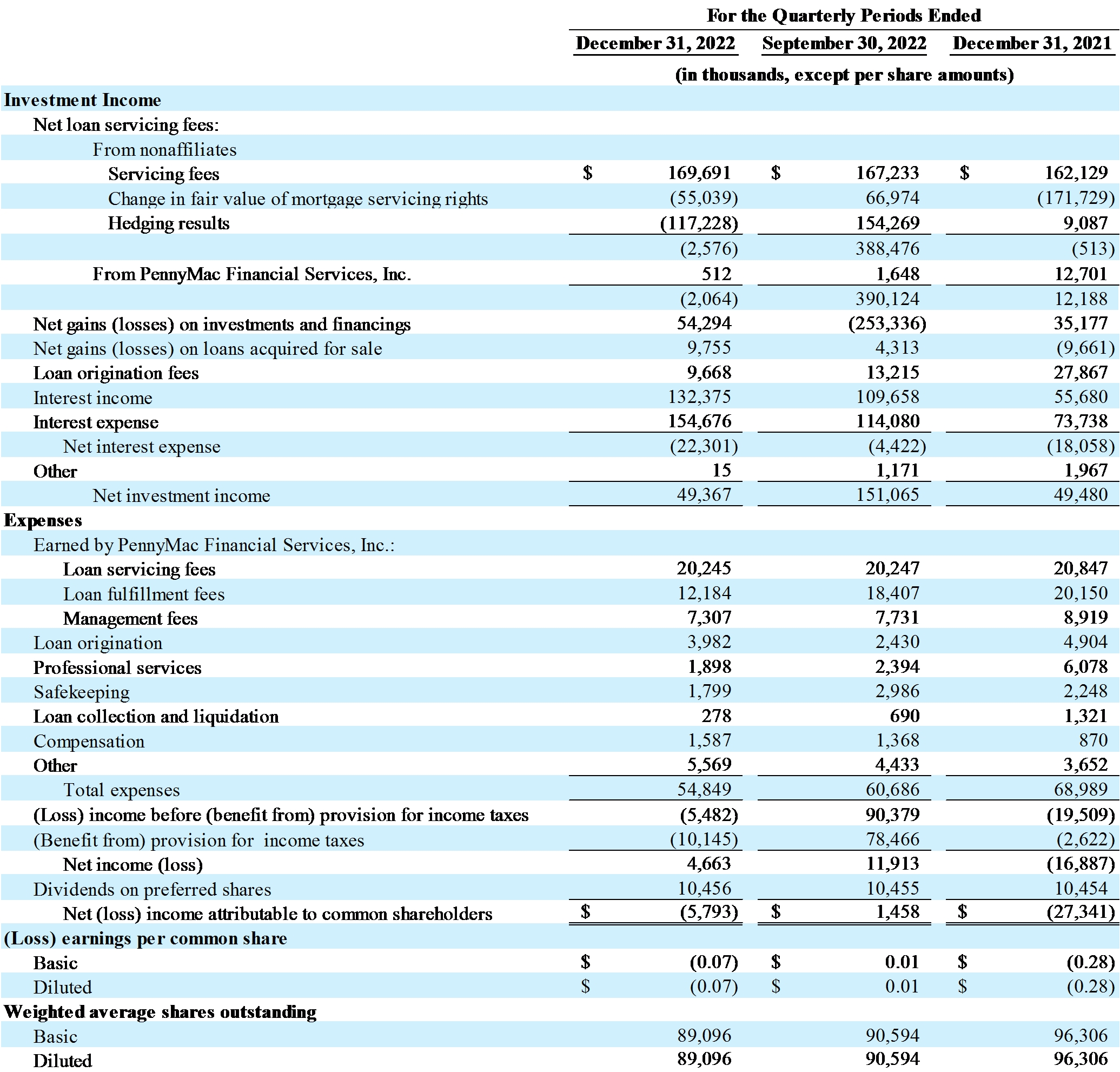
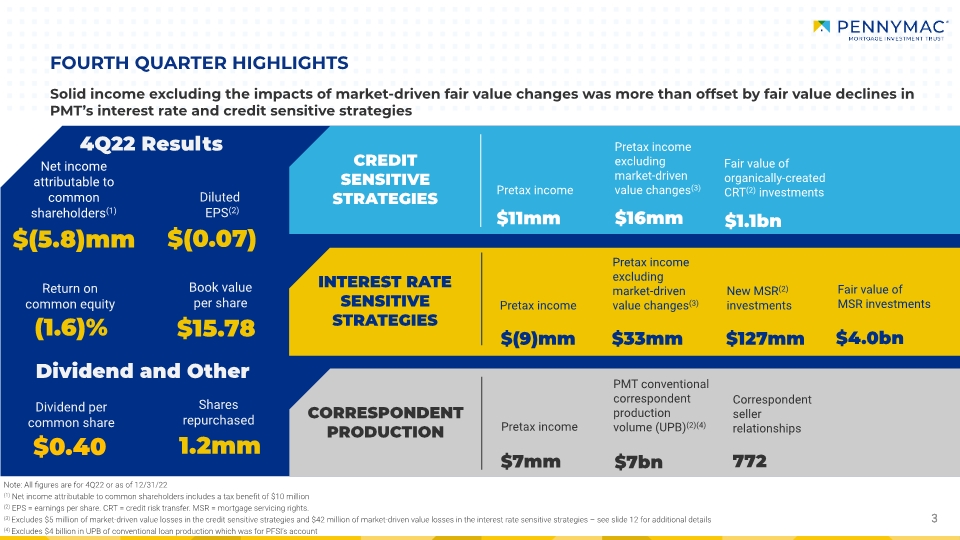
WESTLAKE VILLAGE, Calif., February 2, 2023 – PennyMac Mortgage Investment Trust (NYSE: PMT) today reported a net loss attributable to common shareholders of $5.8 million, or $(0.07) per common share on a diluted basis for the fourth quarter of 2022, on net investment income of $49.4 million. PMT previously announced a cash dividend for the fourth quarter of 2022 of $0.40 per common share of beneficial interest, which was declared on December 7, 2022 and paid on January 27, 2023 to common shareholders of record as of December 30, 2022.
Fourth Quarter 2022 Highlights
Financial results:
|
|
• |
Net loss attributable to common shareholders of $5.8 million, compared to net income of $1.5 million in the prior quarter |
|
|
o |
Solid income excluding the impacts of market-driven fair value changes was more than offset by fair value declines in PMT’s interest rate and credit sensitive strategies |
|
|
• |
Repurchased 1.2 million common shares of PMT at an average price of $11.80 per share for a cost of $14.2 million; also repurchased an additional 22 thousand shares through January 31 at an average price of $12.63 per share for a cost of $0.3 million |
|
|
• |
Book value per common share decreased to $15.78 at December 31, 2022 from $16.18 at September 30, 2022 |
Other investment highlights:
|
|
• |
Investment activity driven by correspondent production volumes |
|
|
o |
Conventional correspondent loan production volumes for PMT’s account totaled $6.8 billion in unpaid principal balance (UPB), down 34% from 3Q22 as a result of the sale of certain conventional loans to PFSI and down 61% from 4Q21 |
|
|
— |
Resulted in the creation of $127 million in new MSRs |
Notable activity after quarter end
|
|
• |
PMT exercised its option to extend the maturity for the CRT term notes originally due in March 2023 for two years |
Full-Year 2022 Highlights
Financial Results:
|
|
• |
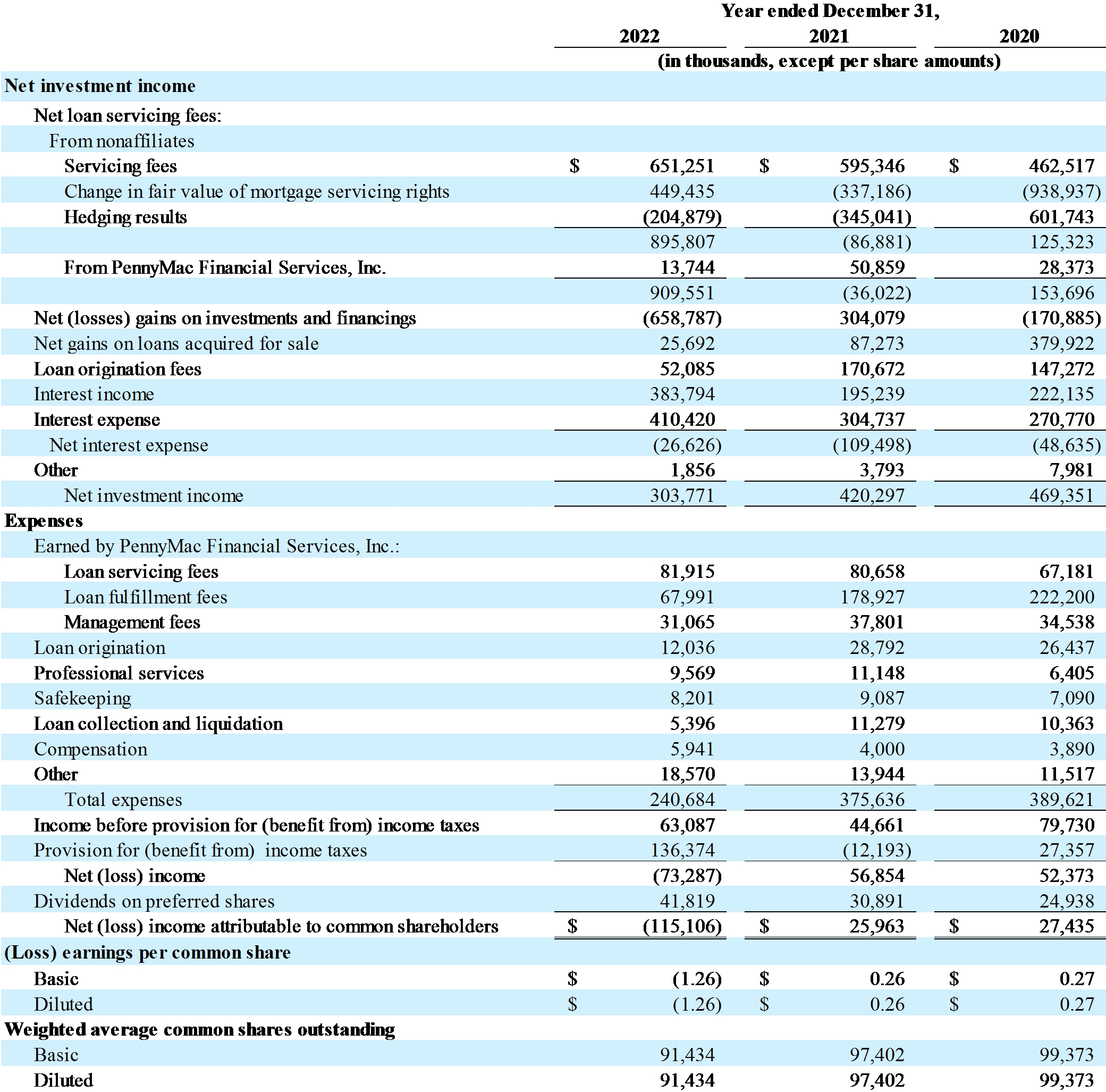
Net loss of $73.3 million, versus net income of $56.9 million in 2021 |
|
|
• |
Net loss attributable to common shareholders of $115.1 million, versus net income attributable to common shareholders of $26.0 million in 2021; diluted earnings per common share of $(1.26) versus $0.26 in 2021 |
|
|
• |
Dividends of $1.81 per common share |
|
|
• |
Net investment income of $303.8 million, down from $420.3 million in 2021 |
|
|
• |
Return on average common equity of (7.2)%1 |
“PMT reported a net loss in the fourth quarter as solid performance excluding the impacts of fair value changes was offset by fair value declines in its interest rate and credit sensitive strategies,” said Chairman and CEO David Spector. “While performance in recent periods has not met our expectations, relative performance over the long-term remains strong as PMT’s shareholder returns remain well-above comparable indices and its peer group. Additionally, we have seen a material improvement in credit markets in early 2023 as well as increased interest rate stability. With PMT’s current portfolio of seasoned investments in credit risk transfer and hedged mortgage servicing rights, we remain confident in its ability to deliver attractive returns to its shareholders over the long term.”
|
1 |
Return on average common equity is calculated based on net income attributable to common shareholders as a percentage of monthly average common equity during the year |
2
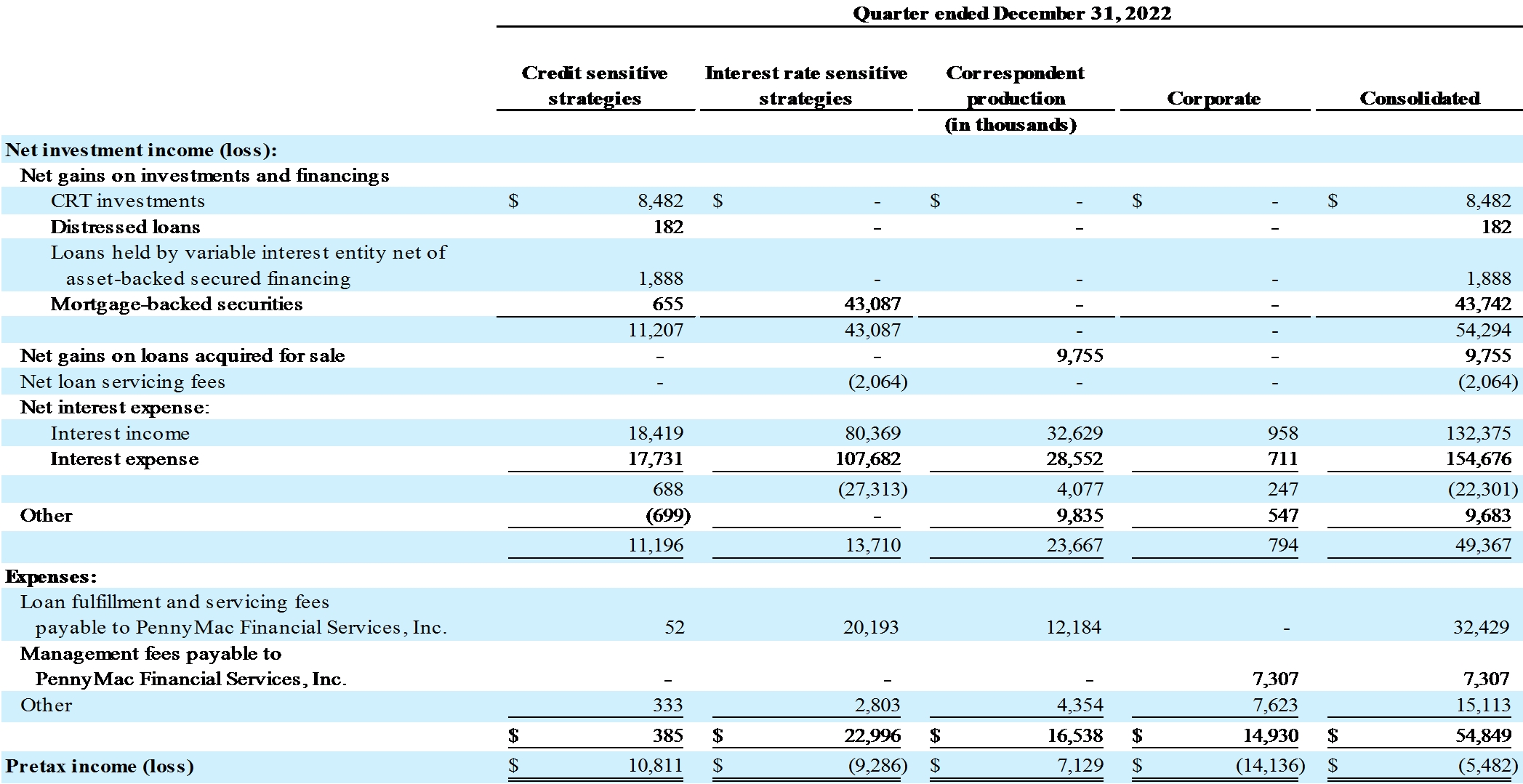
The following table presents the contributions of PMT’s segments, consisting of Credit Sensitive Strategies, Interest Rate Sensitive Strategies, Correspondent Production, and Corporate:
Credit Sensitive Strategies Segment
The Credit Sensitive Strategies segment primarily includes results from PMT’s organically-created government sponsored enterprise (GSE) credit risk transfer (CRT) investments, investments in non-agency subordinate bonds from private-label securitizations of PMT’s production, opportunistic investments in GSE CRT and legacy investments. Pretax income for the segment was $10.8 million on net investment income of $11.2 million, compared to a pretax loss of $3.7 million on net investment losses of $2.9 million in the prior quarter.
Net gains on investments in the segment were $11.2 million, compared to net losses on investments of $2.2 million in the prior quarter and included $8.5 million in net gains on PMT’s organically-created GSE CRT investments, $1.9 million in net gains from investments in non-agency subordinate bonds from PMT’s production, $0.7 million in net gains on other acquired subordinate CRT mortgage-backed securities (MBS), and $0.2 million in gains on distressed loans.
3
Net gains on PMT’s organically-created CRT investments for the quarter were $8.5 million, compared to $4.4 million in the prior quarter, and included $8.1 million in valuation-related losses, which reflected the impact of continued credit spread widening. The prior quarter included $14.2 million of such losses. Net gains on PMT’s organically-created CRT investments also included $17.8 million in realized gains and carry, compared to $18.8 million in the prior quarter. Realized losses during the quarter were $1.2 million, compared to $0.2 million in the prior quarter.
Net interest income for the segment totaled $0.7 million, compared to net interest expense of $1.7 million in the prior quarter. Interest income totaled $18.4 million, up from $12.4 million in the prior quarter primarily due to higher earnings rates on deposits securing CRT arrangements. Interest expense totaled $17.7 million, up from $14.1 million in the prior quarter due to increases in short-term interest rates.
Segment expenses were $0.4 million, down from $0.8 million in the prior quarter.
Interest Rate Sensitive Strategies Segment
The Interest Rate Sensitive Strategies segment includes results from investments in MSRs, Agency MBS, non-Agency senior MBS and interest rate hedges. Pretax loss for the segment was $9.3 million on net investment income of $13.7 million, compared to pretax income of $103.5 million on net investment income of $126.4 million in the prior quarter. The segment includes investments that typically have offsetting fair value exposures to changes in interest rates. For example, in a period with increasing interest rates, MSRs are expected to increase in fair value whereas Agency pass-through and non-Agency senior MBS are expected to decrease in fair value.
The results in the Interest Rate Sensitive Strategies segment consist of net gains and losses on investments, net interest income and net loan servicing fees, as well as associated expenses.
Net gains on investments for the segment were $43.1 million and consisted of gains on MBS due to tighter mortgage spreads.
Net loan servicing fees were $(2.1) million, compared to $390.1 million in the prior quarter. Net loan servicing fees included servicing fees of $164.2 million and $5.5 million in other fees, reduced by $99.0 million in realization of MSR cash flows, which was up from the prior quarter due to higher average MSR balances. Net loan servicing fees also included $43.9 million in fair value increases of MSRs,
4
$117.2 million in hedging losses primarily driven by hedge costs and higher interest rates, and $0.5 million of MSR recapture income. PMT’s hedging activities are intended to manage the Company’s net exposure across all interest rate sensitive strategies, which include MSRs and MBS.
The following schedule details net loan servicing fees:
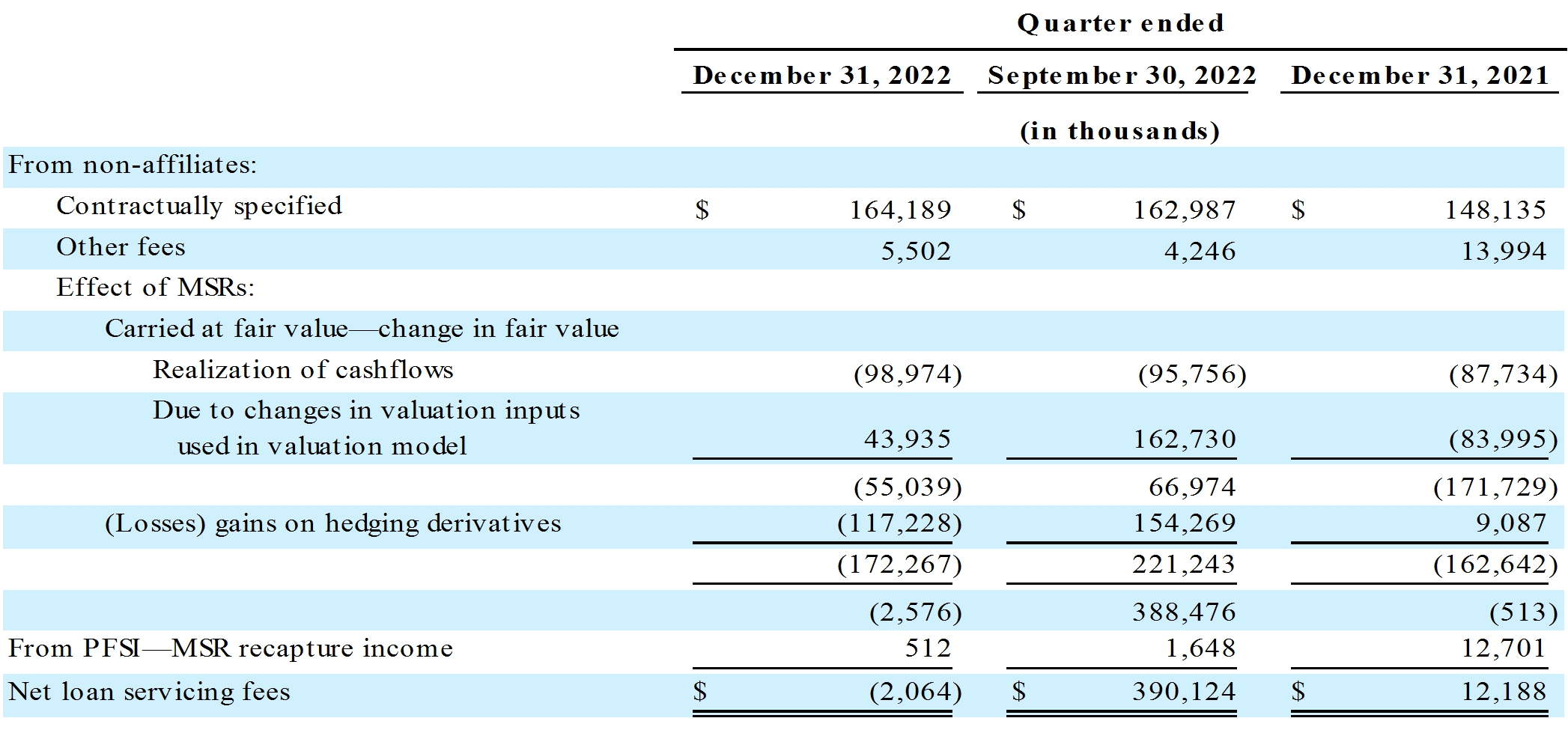
MSR fair value increased by $43.9 million in the quarter as realized prepayment speeds were lower than expected and due to expectations for lower prepayment activity in the future.
Net interest expense for the segment was $27.3 million, versus net interest expense of $12.6 million in the prior quarter. Interest income totaled $80.4 million, up from $68.2 million in the prior quarter primarily due to higher average MBS balances and increased placement fee income on custodial balances. Interest expense totaled $107.7 million, up from $80.8 million in the prior quarter primarily due to higher financing costs on larger average MSR and MBS balances driven by higher short-term interest rates.
Segment expenses were $23.0 million, essentially unchanged from the prior quarter.
Correspondent Production Segment
PMT acquires newly originated loans from correspondent sellers and typically sells or securitizes the loans, resulting in current-period income and additions to its investments in MSRs related to a portion
5
of its production. PMT’s Correspondent Production segment generated pretax income of $7.1 million, up from $6.1 million in the prior quarter.
Through its correspondent production activities, PMT acquired $20.8 billion in UPB of loans, down 7 percent from the prior quarter and 37 percent from the fourth quarter of 2021. Of total correspondent acquisitions, conventional conforming acquisitions totaled $10.7 billion, up 4 percent from the prior quarter and government-insured or guaranteed acquisitions totaled $10.1 billion, down 17 percent from the prior quarter. $6.8 billion of conventional correspondent production was for PMT’s own account and $3.9 billion was for PFSI’s account. Interest rate lock commitments on conventional loans for PMT’s account totaled $7.5 billion, down from $10.6 billion in the prior quarter primarily due to the sale of certain conventional loans to PFSI.
Segment revenues were $23.7 million, a 13 percent decrease from the prior quarter and included net gains on loans acquired for sale of $9.8 million, other income of $9.8 million, which primarily consists of volume-based origination fees, and net interest income of $4.1 million. Net gains on loans acquired for sale in the quarter increased by $5.4 million from the prior quarter as a result of higher margins on the loans held for PMT’s own account. Interest income was $32.6 million, up from $27.9 million in the prior quarter, and interest expense was $28.6 million, up from $18.3 million in the prior quarter, both due to higher interest rates.
Segment expenses were $16.5 million, down from $21.2 million in the prior quarter driven by the decrease in acquisition volumes. The weighted average fulfillment fee rate in the fourth quarter was 18 basis points, unchanged from the prior quarter.
Corporate Segment
The Corporate segment includes interest income from cash and short-term investments, management fees, and corporate expenses.
Segment revenues were $0.8 million, up from $0.4 million in the prior quarter. Management fees were $7.3 million, down from $7.7 million in the prior quarter. Other segment expenses were $7.6 million, down from $8.1 million in the prior quarter.
6
Taxes
PMT recorded a tax benefit of $10.1 million driven by fair value declines on PMT interest rate hedges held in PMT’s taxable subsidiary.
***
Management’s slide presentation will be available in the Investor Relations section of the Company’s website at pmt.pennymac.com beginning after the market closes on Thursday, February 2, 2023.
About PennyMac Mortgage Investment Trust
PennyMac Mortgage Investment Trust is a mortgage real estate investment trust (REIT) that invests primarily in residential mortgage loans and mortgage-related assets. PMT is externally managed by PNMAC Capital Management, LLC, a wholly-owned subsidiary of PennyMac Financial Services, Inc. (NYSE: PFSI). Additional information about PennyMac Mortgage Investment Trust is available at pmt.pennymac.com.
Media Investors
Kristyn Clark Kevin Chamberlain
[email protected] Isaac Garden
(805) 395-9943 [email protected]
(818) 224-7028
Forward-Looking Statements
This press release contains forward-looking statements within the meaning of Section 21E of the Securities Exchange Act of 1934, as amended, regarding management’s beliefs, estimates, projections and assumptions with respect to, among other things, the Company’s financial results, future operations, business plans and investment strategies, as well as industry and market conditions, all of which are subject to change. Words like “believe,” “expect,” “anticipate,” “promise,” “plan,” and other expressions or words of similar meanings, as well as future or conditional verbs such as “will,” “would,” “should,” “could,” or “may” are generally intended to identify forward-looking statements. Actual results and operations for any future period may vary materially from those projected herein and from past results discussed herein. Factors which could cause actual results to differ materially from historical results or those anticipated include, but are not limited to: changes in interest rates; the Company’s ability to comply with various federal, state and local laws and regulations that govern its business; changes in the Company’s investment objectives or investment or operational strategies, including any new lines of business or new products and services that may subject it to additional risks; volatility in the Company’s industry, the debt or equity markets, the general economy or the real estate finance and real estate markets; events or circumstances which undermine confidence in the financial and housing markets or otherwise have a broad impact on financial and housing markets; changes in general
7
business, economic, market, employment and domestic and international political conditions, or in consumer confidence and spending habits from those expected; the degree and nature of the Company’s competition; declines in real estate or significant changes in U.S. housing prices or activity in the U.S. housing market; the availability of, and level of competition for, attractive risk-adjusted investment opportunities in mortgage loans and mortgage-related assets that satisfy the Company’s investment objectives; the inherent difficulty in winning bids to acquire mortgage loans, and the Company’s success in doing so; the concentration of credit risks to which the Company is exposed; the Company’s dependence on its manager and servicer, potential conflicts of interest with such entities and their affiliates, and the performance of such entities; changes in personnel and lack of availability of qualified personnel at its manager, servicer or their affiliates; the availability, terms and deployment of short-term and long-term capital; the adequacy of the Company’s cash reserves and working capital; the Company’s ability to maintain the desired relationship between its financing and the interest rates and maturities of its assets; the timing and amount of cash flows, if any, from the Company’s investments; our substantial amount of indebtedness; the performance, financial condition and liquidity of borrowers; our exposure to risks of loss and disruptions in operations resulting from adverse weather conditions, man-made or natural disasters, climate change and pandemics such as COVID-19; the ability of the Company’s servicer, which also provides the Company with fulfillment services, to approve and monitor correspondent sellers and underwrite loans to investor standards; incomplete or inaccurate information or documentation provided by customers or counterparties, or adverse changes in the financial condition of the Company’s customers and counterparties; the Company’s indemnification and repurchase obligations in connection with mortgage loans it purchases and later sells or securitizes; the quality and enforceability of the collateral documentation evidencing the Company’s ownership and rights in the assets in which it invests; increased rates of delinquency, defaults and forbearances and/or decreased recovery rates on the Company’s investments; the performance of mortgage loans underlying mortgage-backed securities in which the Company retains credit risk; the Company’s ability to foreclose on its investments in a timely manner or at all; increased prepayments of the mortgages and other loans underlying the Company’s mortgage-backed securities or relating to the Company’s mortgage servicing rights and other investments; the degree to which the Company’s hedging strategies may or may not protect it from interest rate volatility; the effect of the accuracy of or changes in the estimates the Company makes about uncertainties, contingencies and asset and liability valuations when measuring and reporting upon the Company’s financial condition and results of operations; the Company’s ability to maintain appropriate internal control over financial reporting; technologies for loans and the Company’s ability to mitigate security risks and cyber intrusions; the Company’s ability to obtain and/or maintain licenses and other approvals in those jurisdictions where required to conduct its business; the Company’s ability to detect misconduct and fraud; developments in the secondary markets for the Company’s mortgage loan products; legislative and regulatory changes that impact the mortgage loan industry or housing market; changes in regulations or the occurrence of other events that impact the business, operations or prospects of government agencies such as the Government National Mortgage Association, the Federal Housing Administration or the Veterans Administration, the U.S. Department of Agriculture, or government-sponsored entities such as the Federal National Mortgage Association or the Federal Home Loan Mortgage Corporation, or such changes that increase the cost of doing business with such entities; legislative and regulatory changes that impact the business, operations or governance of mortgage lenders and/or publicly-traded companies; the Consumer Financial Protection Bureau and its issued and future rules and the enforcement thereof; changes in government support of homeownership; changes in government or government-sponsored home affordability programs; limitations imposed on the Company’s business and its ability to satisfy complex rules for it to qualify as a REIT for U.S. federal income tax purposes and qualify for an exclusion from the Investment Company Act of 1940 and the ability of certain of the Company’s subsidiaries to qualify as REITs or as taxable REIT subsidiaries for
8
U.S. federal income tax purposes, as applicable, and the Company’s ability and the ability of its subsidiaries to operate effectively within the limitations imposed by these rules; changes in governmental regulations, accounting treatment, tax rates and similar matters; the Company’s ability to make distributions to its shareholders in the future; the Company’s failure to deal appropriately with issues that may give rise to reputational risk; and the Company’s organizational structure and certain requirements in its charter documents. You should not place undue reliance on any forward-looking statement and should consider all of the uncertainties and risks described above, as well as those more fully discussed in reports and other documents filed by the Company with the Securities and Exchange Commission from time to time. The Company undertakes no obligation to publicly update or revise any forward-looking statements or any other information contained herein, and the statements made in this press release are current as of the date of this release only.
9
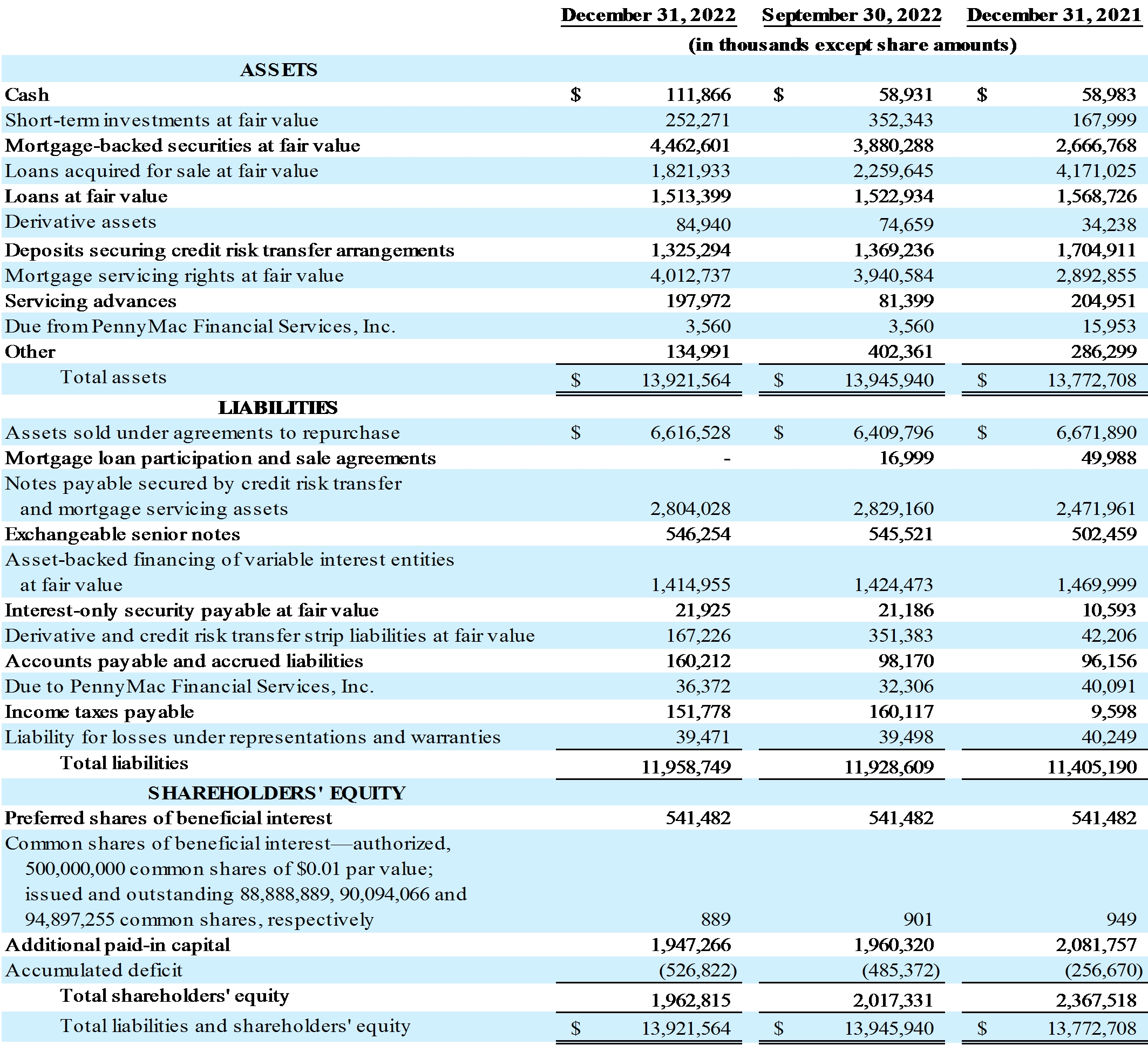
PENNYMAC MORTGAGE INVESTMENT TRUST AND SUBSIDIARIES
CONSOLIDATED BALANCE SHEETS (UNAUDITED)
10
PENNYMAC MORTGAGE INVESTMENT TRUST AND SUBSIDIARIES
CONSOLIDATED STATEMENTS OF OPERATIONS (UNAUDITED)
11
PENNYMAC MORTGAGE INVESTMENT TRUST AND SUBSIDIARIES
CONSOLIDATED STATEMENTS OF INCOME (UNAUDITED)
12

4Q22 EARNINGS REPORT PennyMac Mortgage Investment Trust February 2023 Exhibit 99.2
FORWARD LOOKING STATEMENTS 2 This presentation contains forward-looking statements within the meaning of Section 21E of the Securities Exchange Act of 1934, as amended, regarding management’s beliefs, estimates, projections and assumptions with respect to, among other things, the Company’s financial results, future operations, business plans and investment strategies, as well as industry and market conditions, all of which are subject to change. Words like “believe,” “expect,” “anticipate,” “promise,” “plan,” and other expressions or words of similar meanings, as well as future or conditional verbs such as “will,” “would,” “should,” “could,” or “may” are generally intended to identify forward-looking statements. Actual results and operations for any future period may vary materially from those projected herein and from past results discussed herein. These forward-looking statements include, but are not limited to, statements regarding future changes in interest rates, housing, and prepayment rates; future loan originations and production; future loan delinquencies and forbearances; future investment strategies, including the resumption of lender risk share transactions; and other business and financial expectations. Factors which could cause actual results to differ materially from historical results or those anticipated include, but are not limited to: changes in interest rates; the Company’s ability to comply with various federal, state and local laws and regulations that govern its business; changes in the Company’s investment objectives or investment or operational strategies, including any new lines of business or new products and services that may subject it to additional risks; volatility in the Company’s industry, the debt or equity markets, the general economy or the real estate finance and real estate markets; events or circumstances which undermine confidence in the financial and housing markets or otherwise have a broad impact on financial and housing markets; changes in general business, economic, market, employment and domestic and international political conditions, or in consumer confidence and spending habits from those expected; the degree and nature of the Company’s competition; declines in real estate or significant changes in U.S. housing prices or activity in the U.S. housing market; the availability of, and level of competition for, attractive risk-adjusted investment opportunities in mortgage loans and mortgage-related assets that satisfy the Company’s investment objectives; the inherent difficulty in winning bids to acquire mortgage loans, and the Company’s success in doing so; the concentration of credit risks to which the Company is exposed; the Company’s dependence on its manager and servicer, potential conflicts of interest with such entities and their affiliates, and the performance of such entities; changes in personnel and lack of availability of qualified personnel at its manager, servicer or their affiliates; the availability, terms and deployment of short-term and long-term capital; the adequacy of the Company’s cash reserves and working capital; the Company’s ability to maintain the desired relationship between its financing and the interest rates and maturities of its assets; the timing and amount of cash flows, if any, from the Company’s investments; our substantial amount of indebtedness; the performance, financial condition and liquidity of borrowers; our exposure to risks of loss and disruptions in operations resulting from adverse weather conditions, man-made or natural disasters, climate change and pandemics such as COVID-19; the ability of the Company’s servicer, which also provides the Company with fulfillment services, to approve and monitor correspondent sellers and underwrite loans to investor standards; incomplete or inaccurate information or documentation provided by customers or counterparties, or adverse changes in the financial condition of the Company’s customers and counterparties; the Company’s indemnification and repurchase obligations in connection with mortgage loans it purchases and later sells or securitizes; the quality and enforceability of the collateral documentation evidencing the Company’s ownership and rights in the assets in which it invests; increased rates of delinquency, defaults and forbearances and/or decreased recovery rates on the Company’s investments; the performance of mortgage loans underlying mortgage-backed securities in which the Company retains credit risk; the Company’s ability to foreclose on its investments in a timely manner or at all; increased prepayments of the mortgages and other loans underlying the Company’s mortgage-backed securities or relating to the Company’s mortgage servicing rights and other investments; the degree to which the Company’s hedging strategies may or may not protect it from interest rate volatility; the effect of the accuracy of or changes in the estimates the Company makes about uncertainties, contingencies and asset and liability valuations when measuring and reporting upon the Company’s financial condition and results of operations; the Company’s ability to maintain appropriate internal control over financial reporting; technologies for loans and the Company’s ability to mitigate security risks and cyber intrusions; the Company’s ability to obtain and/or maintain licenses and other approvals in those jurisdictions where required to conduct its business; the Company’s ability to detect misconduct and fraud; developments in the secondary markets for the Company’s mortgage loan products; legislative and regulatory changes that impact the mortgage loan industry or housing market; changes in regulations or the occurrence of other events that impact the business, operations or prospects of government agencies such as the Government National Mortgage Association, the Federal Housing Administration or the Veterans Administration, the U.S. Department of Agriculture, or government-sponsored entities such as the Federal National Mortgage Association or the Federal Home Loan Mortgage Corporation, or such changes that increase the cost of doing business with such entities; legislative and regulatory changes that impact the business, operations or governance of mortgage lenders and/or publicly-traded companies; the Consumer Financial Protection Bureau and its issued and future rules and the enforcement thereof; changes in government support of homeownership; changes in government or government-sponsored home affordability programs; limitations imposed on the Company’s business and its ability to satisfy complex rules for it to qualify as a REIT for U.S. federal income tax purposes and qualify for an exclusion from the Investment Company Act of 1940 and the ability of certain of the Company’s subsidiaries to qualify as REITs or as taxable REIT subsidiaries for U.S. federal income tax purposes, as applicable, and the Company’s ability and the ability of its subsidiaries to operate effectively within the limitations imposed by these rules; changes in governmental regulations, accounting treatment, tax rates and similar matters; the Company’s ability to make distributions to its shareholders in the future; the Company’s failure to deal appropriately with issues that may give rise to reputational risk; and the Company’s organizational structure and certain requirements in its charter documents. You should not place undue reliance on any forward-looking statement and should consider all of the uncertainties and risks described above, as well as those more fully discussed in reports and other documents filed by the Company with the Securities and Exchange Commission from time to time. The Company undertakes no obligation to publicly update or revise any forward-looking statements or any other information contained herein, and the statements made in this presentation are current as of the date of this presentation only.
This presentation contains financial information calculated other than in accordance with U.S. generally accepted accounting principles (“GAAP”), such as market-driven value changes that provide a meaningful perspective on the Company’s business results since the Company utilizes this information to evaluate and manage the business. Non-GAAP disclosure has limitations as an analytical tool and should not be viewed as a substitute for financial information determined in accordance with GAAP.
3 Note: All figures are for 4Q22 or as of 12/31/22
(1) Net income attributable to common shareholders includes a tax benefit of $10 million
(2) EPS = earnings per share. CRT = credit risk transfer. MSR = mortgage servicing rights.
(3) Excludes $5 million of market-driven value losses in the credit sensitive strategies and $42 million of market-driven value losses in the interest rate sensitive strategies – see slide 12 for additional details
(4) Excludes $4 billion in UPB of conventional loan production which was for PFSI’s account 3 FOURTH QUARTER HIGHLIGHTS Net income attributable to common shareholders(1) $(5.8)mm 4Q22 Results Diluted EPS(2) $(0.07) Return on common equity (1.6)% Book value per share $15.78 Dividend and Other CREDIT
SENSITIVE STRATEGIES INTEREST RATE SENSITIVE STRATEGIES CORRESPONDENT PRODUCTION Pretax income $11mm Pretax income $7mm PMT conventional correspondent production volume (UPB)(2)(4) $7bn Fair value of organically-created
CRT(2) investments $1.1bn Correspondent seller relationships 772 Pretax income New MSR(2) investments $127mm Fair value of
MSR investments $4.0bn $(9)mm Pretax income excluding market-driven value changes(3) $16mm Pretax income excluding market-driven value changes(3) $33mm Solid income excluding the impacts of market-driven fair value changes was more than offset by fair value declines in PMT’s interest rate and credit sensitive strategies Shares repurchased 1.2mm Dividend per common share $0.40
4 ORIGINATION MARKET HAS DECLINED MEANINGFULLY U.S. Mortgage Origination Market(1)
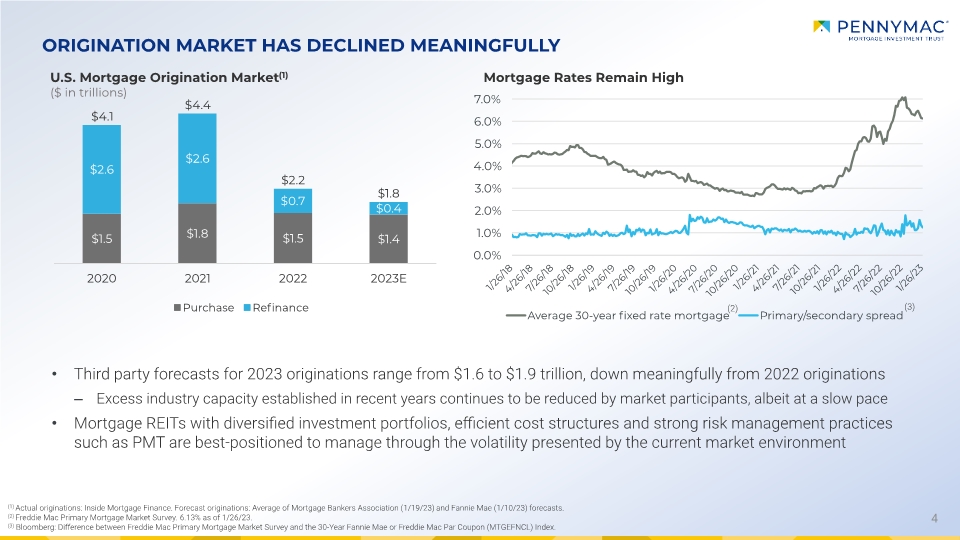
($ in trillions) Mortgage Rates Remain High Third party forecasts for 2023 originations range from $1.6 to $1.9 trillion, down meaningfully from 2022 originations
Excess industry capacity established in recent years continues to be reduced by market participants, albeit at a slow pace
Mortgage REITs with diversified investment portfolios, efficient cost structures and strong risk management practices such as PMT are best-positioned to manage through the volatility presented by the current market environment (1) Actual originations: Inside Mortgage Finance. Forecast originations: Average of Mortgage Bankers Association (1/19/23) and Fannie Mae (1/10/23) forecasts.
(2) Freddie Mac Primary Mortgage Market Survey. 6.13% as of 1/26/23.
(3) Bloomberg: Difference between Freddie Mac Primary Mortgage Market Survey and the 30-Year Fannie Mae or Freddie Mac Par Coupon (MTGEFNCL) Index. (2) (3)
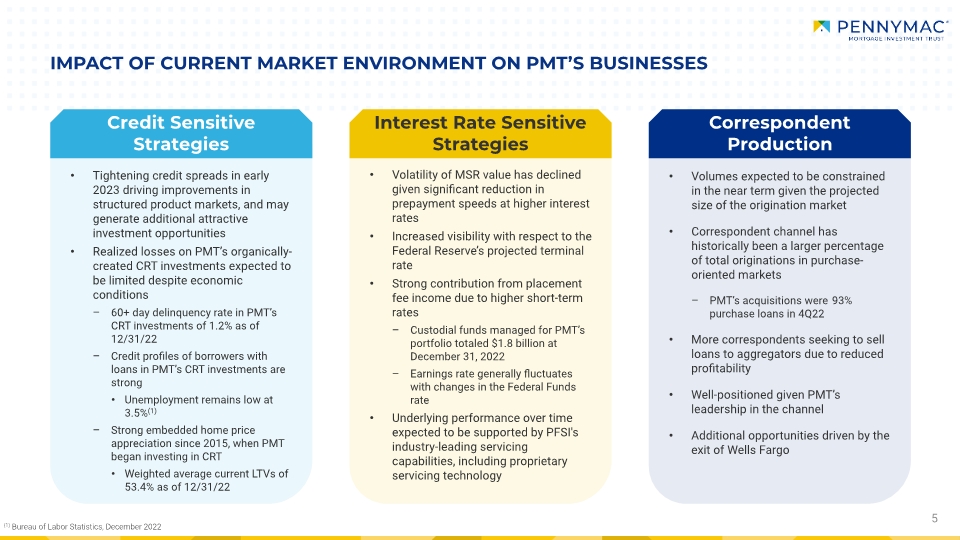
Volumes expected to be constrained in the near term given the projected size of the origination market
Correspondent channel has historically been a larger percentage of total originations in purchase-oriented markets
PMT’s acquisitions were 93% purchase loans in 4Q22
More correspondents seeking to sell loans to aggregators due to reduced profitability
Well-positioned given PMT’s leadership in the channel
Additional opportunities driven by the exit of Wells Fargo
Volatility of MSR value has declined given significant reduction in prepayment speeds at higher interest rates
Increased visibility with respect to the Federal Reserve’s projected terminal rate
Strong contribution from placement fee income due to higher short-term rates
Custodial funds managed for PMT’s portfolio totaled $1.8 billion at December 31, 2022
Earnings rate generally fluctuates with changes in the Federal Funds rate
Underlying performance over time expected to be supported by PFSI's industry-leading servicing capabilities, including proprietary servicing technology
Tightening credit spreads in early 2023 driving improvements in structured product markets, and may generate additional attractive investment opportunities
Realized losses on PMT’s organically-created CRT investments expected to be limited despite economic conditions
60+ day delinquency rate in PMT’s CRT investments of 1.2% as of 12/31/22
Credit profiles of borrowers with loans in PMT’s CRT investments are strong
Unemployment remains low at 3.5%(1)
Strong embedded home price appreciation since 2015, when PMT began investing in CRT
Weighted average current LTVs of 53.4% as of 12/31/22
5 IMPACT OF CURRENT MARKET ENVIRONMENT ON PMT’S BUSINESSES Credit Sensitive Strategies Interest Rate Sensitive Strategies Correspondent Production (1) Bureau of Labor Statistics, December 2022
6 Credit Sensitive Strategies
While the future of lender risk share remains uncertain, wider credit spreads have created investment opportunities in government-sponsored enterprise (GSE) issued CRT (CAS and STACR bonds) with attractive expected returns
In 2022, PMT invested $185 million in floating-rate CRT bonds recently issued by Fannie Mae and Freddie Mac
PMT may deploy capital into credit sensitive investments on an opportunistic basis
Interest Rate Sensitive Strategies
PMT is expected to continue investing in MSR, but at a lower pace than prior periods due to continued lower levels of production and the sale of certain conventional loans to PFSI in 1Q23 – see slide 8
Share Repurchases
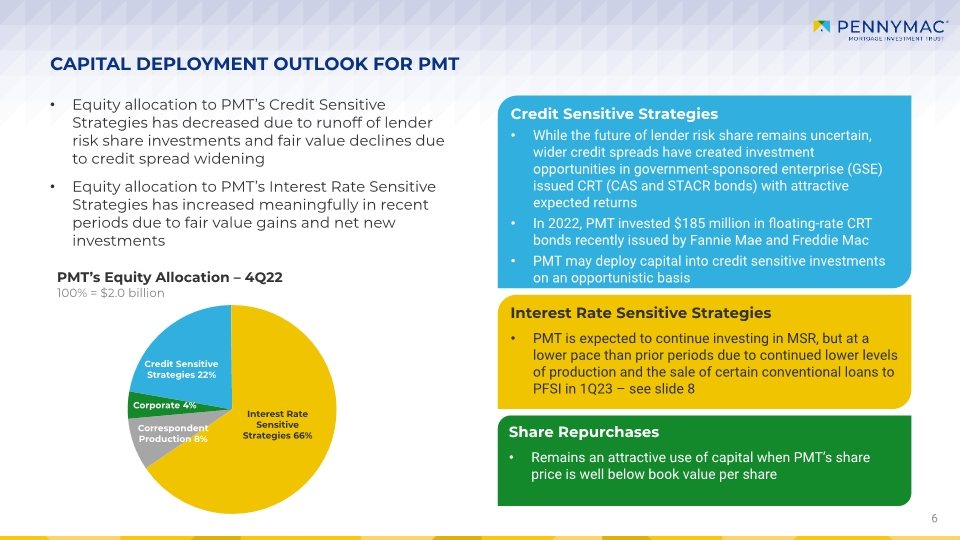
Remains an attractive use of capital when PMT’s share price is well below book value per share CAPITAL DEPLOYMENT OUTLOOK FOR PMT PMT’s Equity Allocation – 4Q22
100% = $2.0 billion Equity allocation to PMT’s Credit Sensitive Strategies has decreased due to runoff of lender risk share investments and fair value declines due to credit spread widening
Equity allocation to PMT’s Interest Rate Sensitive Strategies has increased meaningfully in recent periods due to fair value gains and net new investments
7 RUN-RATE RETURN POTENTIAL FROM PMT’S INVESTMENT STRATEGIES Note: This slide presents estimates for illustrative purposes only, using PMT’s base case assumptions (e.g., for credit performance, prepayment speeds, financing economics, and loss treatment for CRT transactions), and does not contemplate market-driven value changes other than realization of cash flows and hedge costs, or significant changes or shocks to current market conditions. Actual results may differ materially.
(1) Equity allocated represents management’s internal allocation. Certain financing balances and associated interest expenses are allocated between investments based on management’s assessment of target leverage ratios and required capital or liquidity to support the investment.
(2) Includes opportunistic investments in GSE CRT and legacy distressed loan portfolio
(3) ROE calculated as a percentage of segment equity
(4) ROE calculated as a percentage of total equity
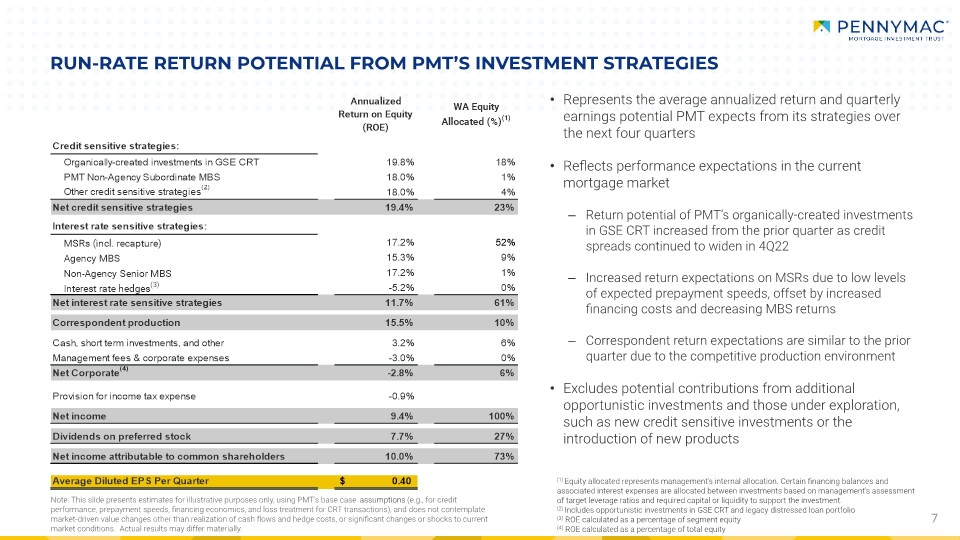
Represents the average annualized return and quarterly earnings potential PMT expects from its strategies over the next four quarters
Reflects performance expectations in the current mortgage market
Return potential of PMT’s organically-created investments in GSE CRT increased from the prior quarter as credit spreads continued to widen in 4Q22
Increased return expectations on MSRs due to low levels of expected prepayment speeds, offset by increased financing costs and decreasing MBS returns
Correspondent return expectations are similar to the prior quarter due to the competitive production environment
Excludes potential contributions from additional opportunistic investments and those under exploration, such as new credit sensitive investments or the introduction of new products
8 CORRESPONDENT PRODUCTION HIGHLIGHTS Note: May not sum due to rounding
(1) For all government loans and certain conventional loans, PMT earns a sourcing fee and interest income for its holding period and does not pay a fulfillment fee to PFSI
(2) Conventional conforming interest rate lock commitments for PMT’s own account
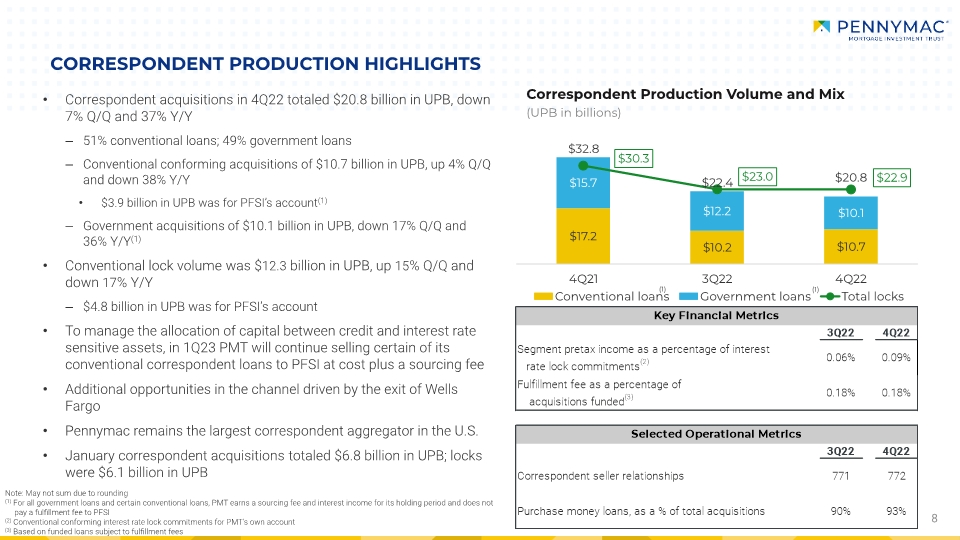
(3) Based on funded loans subject to fulfillment fees (1) Correspondent acquisitions in 4Q22 totaled $20.8 billion in UPB, down 7% Q/Q and 37% Y/Y
51% conventional loans; 49% government loans
Conventional conforming acquisitions of $10.7 billion in UPB, up 4% Q/Q and down 38% Y/Y
$3.9 billion in UPB was for PFSI’s account(1)
Government acquisitions of $10.1 billion in UPB, down 17% Q/Q and 36% Y/Y(1)
Conventional lock volume was $12.3 billion in UPB, up 15% Q/Q and down 17% Y/Y
$4.8 billion in UPB was for PFSI’s account
To manage the allocation of capital between credit and interest rate sensitive assets, in 1Q23 PMT will continue selling certain of its conventional correspondent loans to PFSI at cost plus a sourcing fee
Additional opportunities in the channel driven by the exit of Wells Fargo
Pennymac remains the largest correspondent aggregator in the U.S.
January correspondent acquisitions totaled $6.8 billion in UPB; locks were $6.1 billion in UPB Correspondent Production Volume and Mix (UPB in billions) (1)
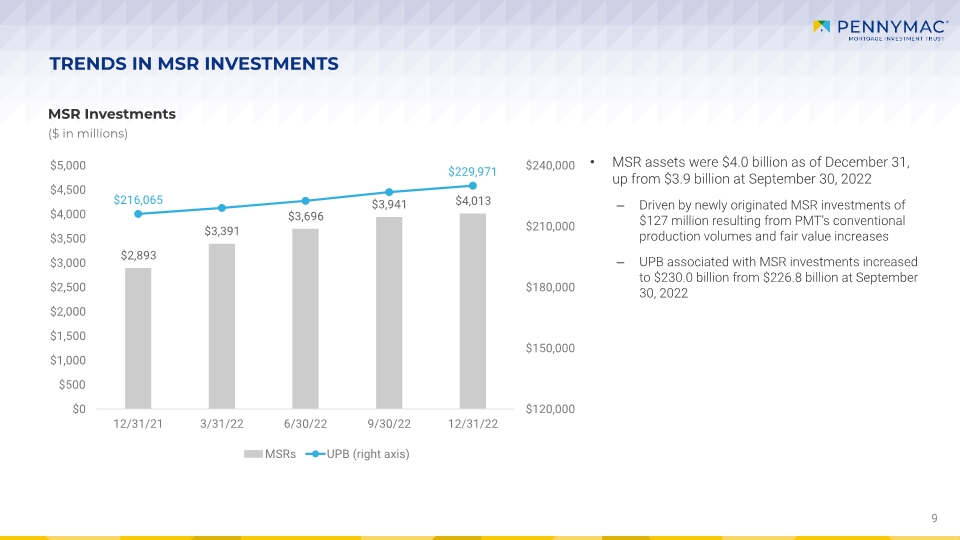
9 TRENDS IN MSR INVESTMENTS MSR assets were $4.0 billion as of December 31, up from $3.9 billion at September 30, 2022
Driven by newly originated MSR investments of $127 million resulting from PMT’s conventional production volumes and fair value increases
UPB associated with MSR investments increased to $230.0 billion from $226.8 billion at September 30, 2022 MSR Investments ($ in millions)
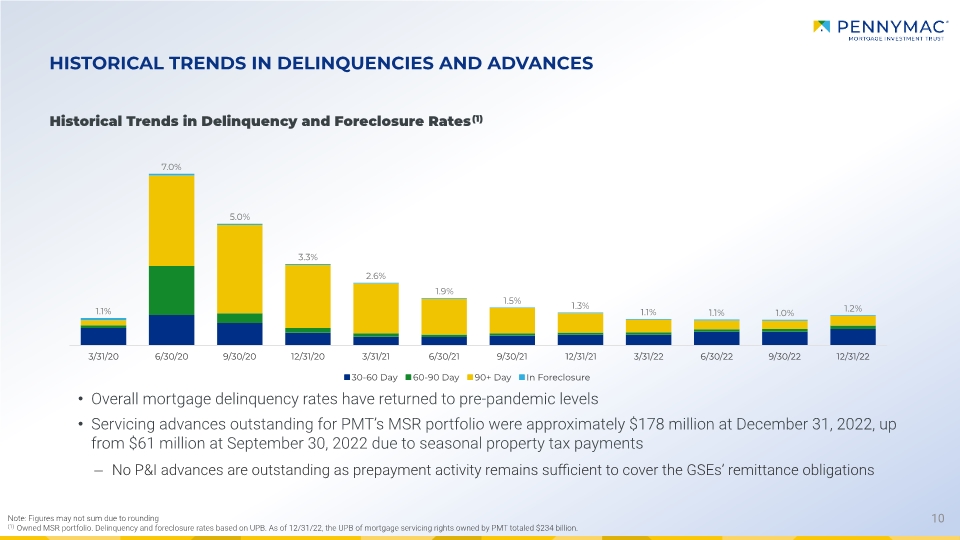
10 HISTORICAL TRENDS IN DELINQUENCIES AND ADVANCES Overall mortgage delinquency rates have returned to pre-pandemic levels
Servicing advances outstanding for PMT’s MSR portfolio were approximately $178 million at December 31, 2022, up from $61 million at September 30, 2022 due to seasonal property tax payments
No P&I advances are outstanding as prepayment activity remains sufficient to cover the GSEs’ remittance obligations Historical Trends in Delinquency and Foreclosure Rates(1) Note: Figures may not sum due to rounding
(1) Owned MSR portfolio. Delinquency and foreclosure rates based on UPB. As of 12/31/22, the UPB of mortgage servicing rights owned by PMT totaled $234 billion.
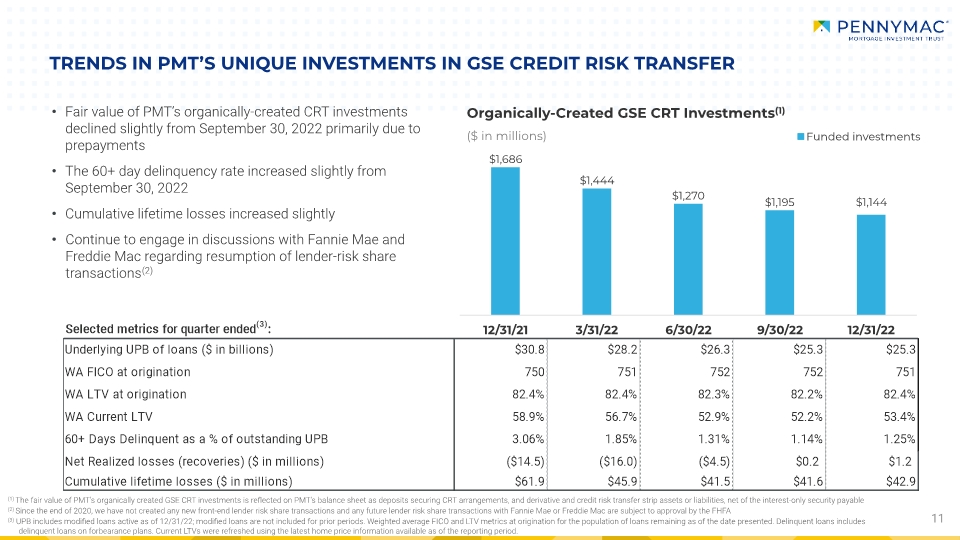
11 TRENDS IN PMT’S UNIQUE INVESTMENTS IN GSE CREDIT RISK TRANSFER Fair value of PMT’s organically-created CRT investments declined slightly from September 30, 2022 primarily due to prepayments
The 60+ day delinquency rate increased slightly from September 30, 2022
Cumulative lifetime losses increased slightly
Continue to engage in discussions with Fannie Mae and Freddie Mac regarding resumption of lender-risk share transactions(2) (1) The fair value of PMT’s organically created GSE CRT investments is reflected on PMT’s balance sheet as deposits securing CRT arrangements, and derivative and credit risk transfer strip assets or liabilities, net of the interest-only security payable
(2) Since the end of 2020, we have not created any new front-end lender risk share transactions and any future lender risk share transactions with Fannie Mae or Freddie Mac are subject to approval by the FHFA
(3) UPB includes modified loans active as of 12/31/22; modified loans are not included for prior periods. Weighted average FICO and LTV metrics at origination for the population of loans remaining as of the date presented. Delinquent loans includes delinquent loans on forbearance plans. Current LTVs were refreshed using the latest home price information available as of the reporting period. ($ in millions) Organically-Created GSE CRT Investments(1)
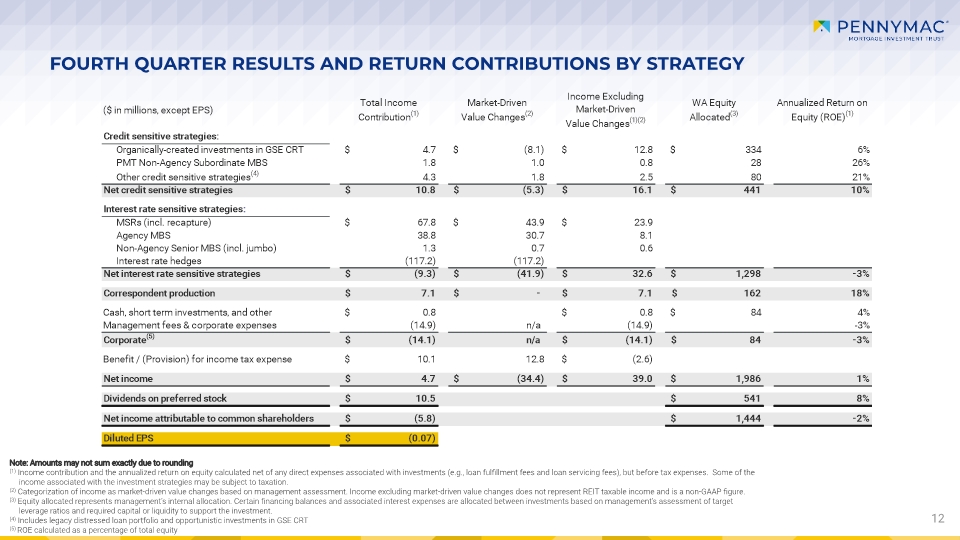
12 FOURTH QUARTER RESULTS AND RETURN CONTRIBUTIONS BY STRATEGY Note: Amounts may not sum exactly due to rounding
(1) Income contribution and the annualized return on equity calculated net of any direct expenses associated with investments (e.g., loan fulfillment fees and loan servicing fees), but before tax expenses. Some of the income associated with the investment strategies may be subject to taxation.
(2) Categorization of income as market-driven value changes based on management assessment. Income excluding market-driven value changes does not represent REIT taxable income and is a non-GAAP figure.
(3) Equity allocated represents management’s internal allocation. Certain financing balances and associated interest expenses are allocated between investments based on management’s assessment of target leverage ratios and required capital or liquidity to support the investment.
(4) Includes legacy distressed loan portfolio and opportunistic investments in GSE CRT
(5) ROE calculated as a percentage of total equity
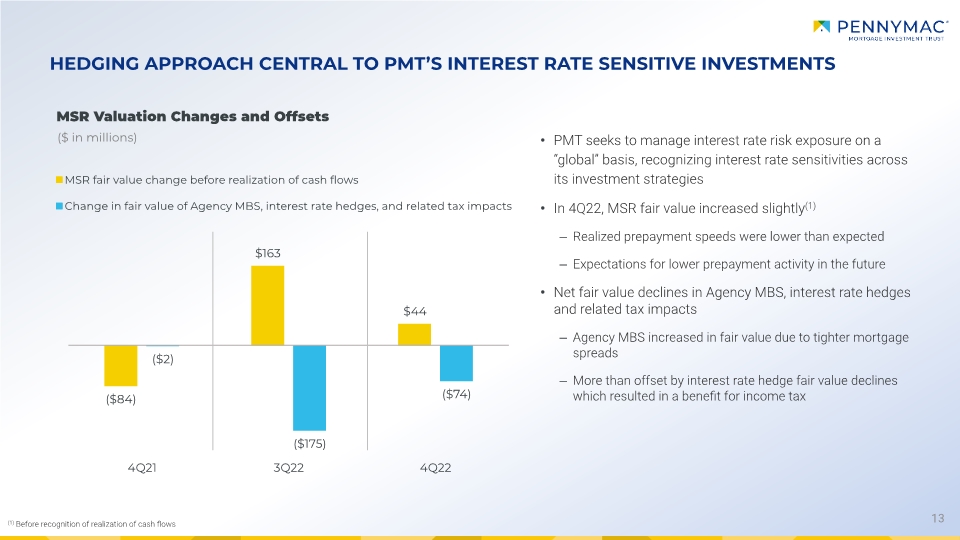
13 HEDGING APPROACH CENTRAL TO PMT’S INTEREST RATE SENSITIVE INVESTMENTS PMT seeks to manage interest rate risk exposure on a “global” basis, recognizing interest rate sensitivities across its investment strategies
In 4Q22, MSR fair value increased slightly(1)
Realized prepayment speeds were lower than expected
Expectations for lower prepayment activity in the future
Net fair value declines in Agency MBS, interest rate hedges and related tax impacts
Agency MBS increased in fair value due to tighter mortgage spreads
More than offset by interest rate hedge fair value declines which resulted in a benefit for income tax
MSR Valuation Changes and Offsets ($ in millions) (1) Before recognition of realization of cash flows
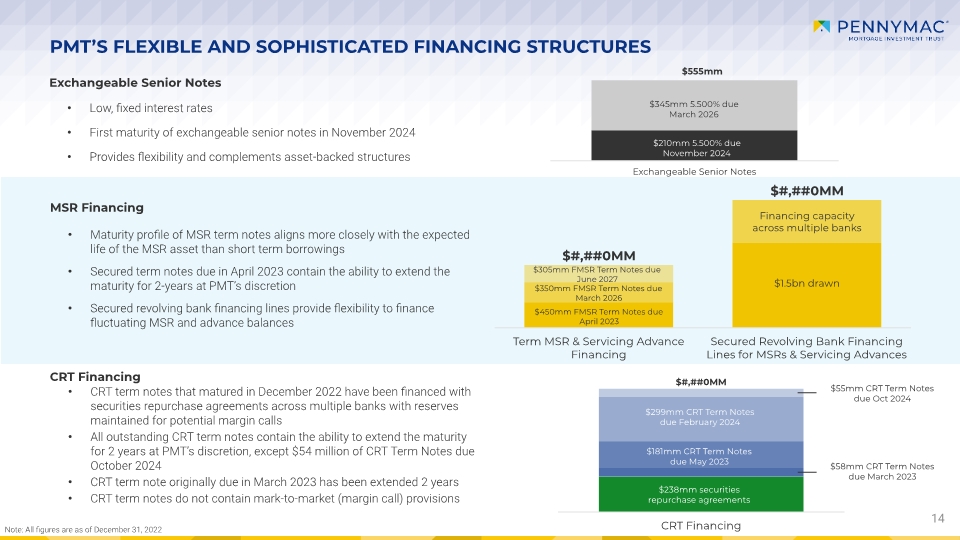
CRT Financing MSR Financing 14 PMT’S FLEXIBLE AND SOPHISTICATED FINANCING STRUCTURES CRT term notes that matured in December 2022 have been financed with securities repurchase agreements across multiple banks with reserves maintained for potential margin calls
All outstanding CRT term notes contain the ability to extend the maturity for 2 years at PMT’s discretion, except $54 million of CRT Term Notes due October 2024
CRT term note originally due in March 2023 has been extended 2 years
CRT term notes do not contain mark-to-market (margin call) provisions Maturity profile of MSR term notes aligns more closely with the expected life of the MSR asset than short term borrowings
Secured term notes due in April 2023 contain the ability to extend the maturity for 2-years at PMT’s discretion
Secured revolving bank financing lines provide flexibility to finance fluctuating MSR and advance balances $350mm FMSR Term Notes due March 2026 $305mm FMSR Term Notes due June 2027 $450mm FMSR Term Notes due April 2023 $299mm CRT Term Notes
due February 2024 $58mm CRT Term Notes due March 2023 $238mm securities
repurchase agreements $55mm CRT Term Notes due Oct 2024 $181mm CRT Term Notes
due May 2023 $345mm 5.500% due
March 2026 $210mm 5.500% due
November 2024 Exchangeable Senior Notes Low, fixed interest rates
First maturity of exchangeable senior notes in November 2024
Provides flexibility and complements asset-backed structures Financing capacity across multiple banks $1.5bn drawn
Note: All figures are as of December 31, 2022

APPENDIX
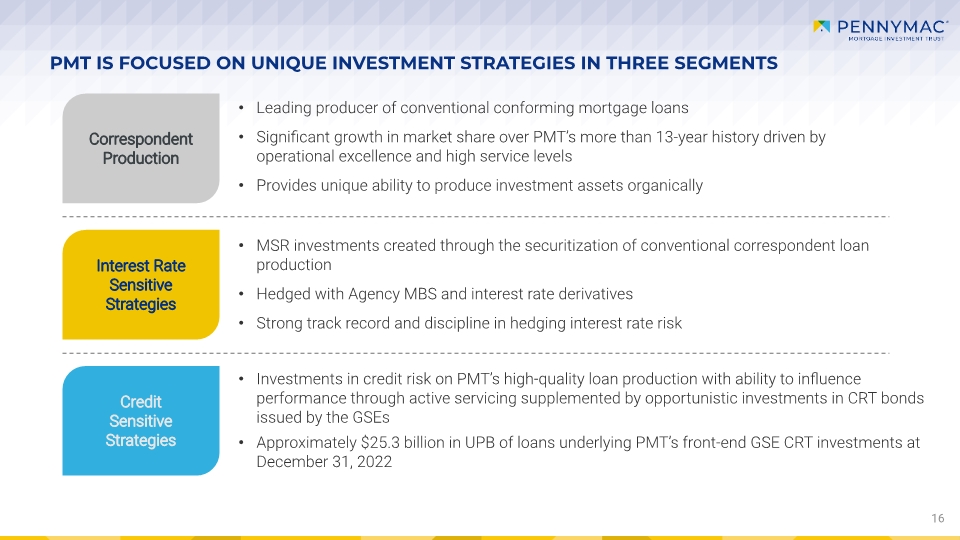
16 PMT IS FOCUSED ON UNIQUE INVESTMENT STRATEGIES IN THREE SEGMENTS Leading producer of conventional conforming mortgage loans
Significant growth in market share over PMT’s more than 13-year history driven by operational excellence and high service levels
Provides unique ability to produce investment assets organically Investments in credit risk on PMT’s high-quality loan production with ability to influence performance through active servicing supplemented by opportunistic investments in CRT bonds issued by the GSEs
Approximately $25.3 billion in UPB of loans underlying PMT’s front-end GSE CRT investments at December 31, 2022 MSR investments created through the securitization of conventional correspondent loan production
Hedged with Agency MBS and interest rate derivatives
Strong track record and discipline in hedging interest rate risk Correspondent Production Interest Rate
Sensitive Strategies Credit
Sensitive Strategies
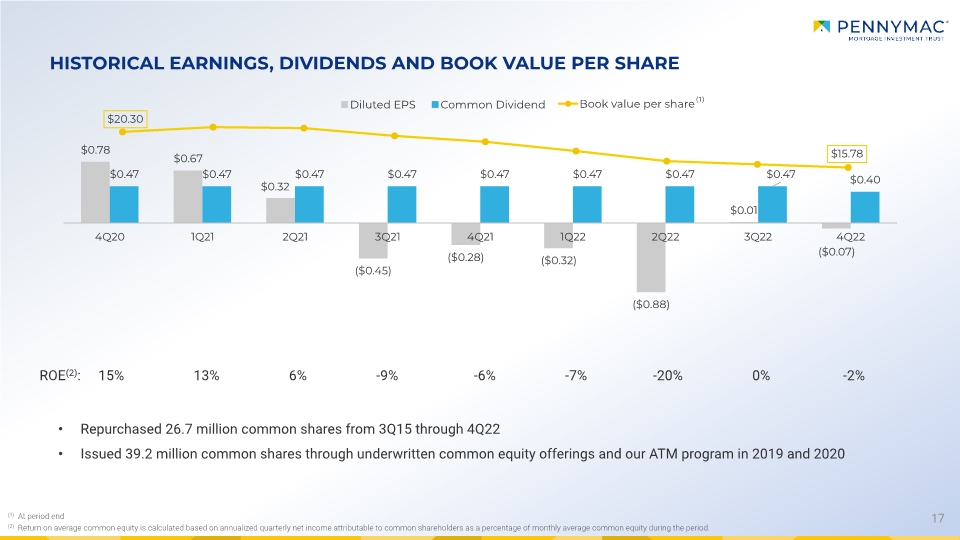
17 HISTORICAL EARNINGS, DIVIDENDS AND BOOK VALUE PER SHARE Repurchased 26.7 million common shares from 3Q15 through 4Q22
Issued 39.2 million common shares through underwritten common equity offerings and our ATM program in 2019 and 2020
(1) (1) At period end
(2) Return on average common equity is calculated based on annualized quarterly net income attributable to common shareholders as a percentage of monthly average common equity during the period. ROE(2): 15% 13% 6% -9% -6% -7% -20% 0% -2%
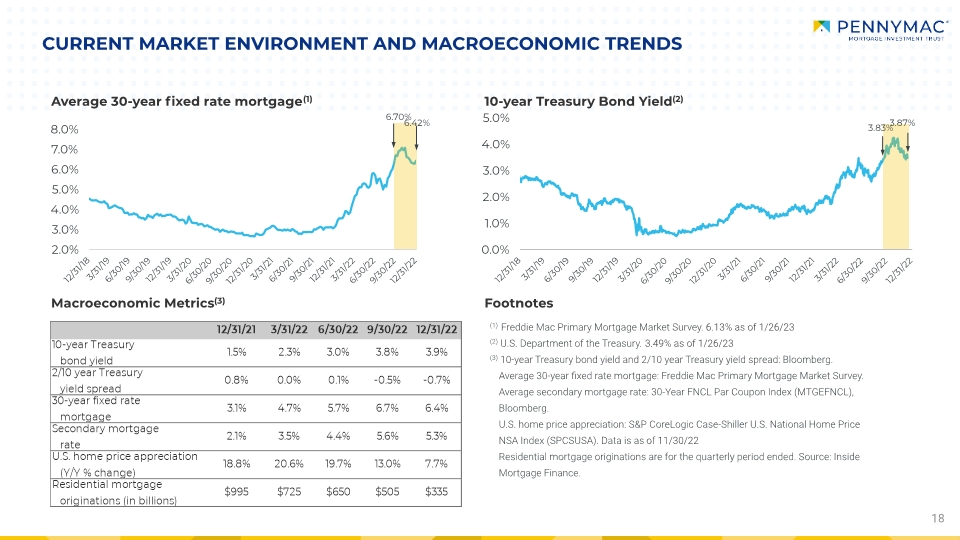
Average 30-year fixed rate mortgage(1) 6.70% 3.83% CURRENT MARKET ENVIRONMENT AND MACROECONOMIC TRENDS 18 Macroeconomic Metrics(3) Footnotes (1) Freddie Mac Primary Mortgage Market Survey. 6.13% as of 1/26/23
(2) U.S. Department of the Treasury. 3.49% as of 1/26/23
(3) 10-year Treasury bond yield and 2/10 year Treasury yield spread: Bloomberg.
Average 30-year fixed rate mortgage: Freddie Mac Primary Mortgage Market Survey.
Average secondary mortgage rate: 30-Year FNCL Par Coupon Index (MTGEFNCL), Bloomberg.
U.S. home price appreciation: S&P CoreLogic Case-Shiller U.S. National Home Price NSA Index (SPCSUSA). Data is as of 11/30/22
Residential mortgage originations are for the quarterly period ended. Source: Inside Mortgage Finance. 10-year Treasury Bond Yield(2) 3.87% 6.42%
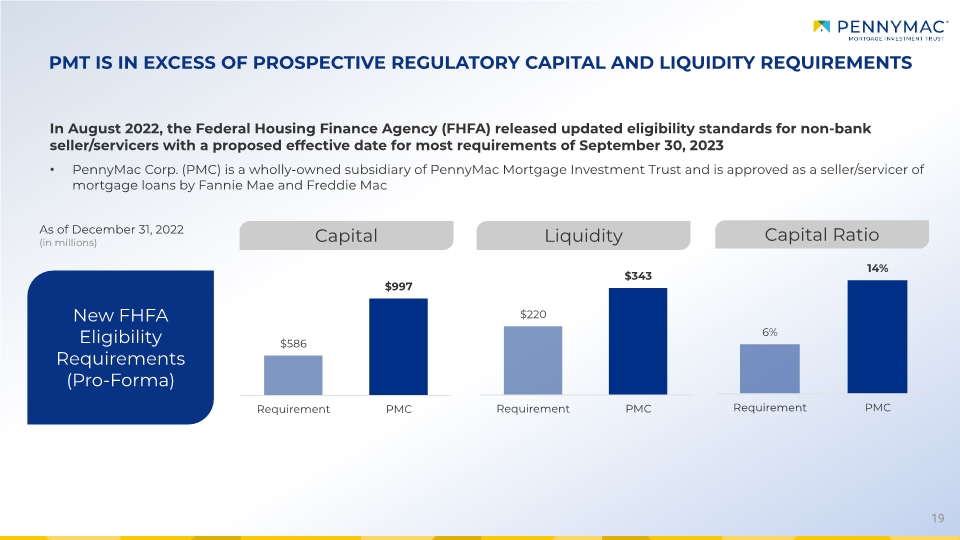
In August 2022, the Federal Housing Finance Agency (FHFA) released updated eligibility standards for non-bank seller/servicers with a proposed effective date for most requirements of September 30, 2023
PennyMac Corp. (PMC) is a wholly-owned subsidiary of PennyMac Mortgage Investment Trust and is approved as a seller/servicer of mortgage loans by Fannie Mae and Freddie Mac 19 PMT IS IN EXCESS OF PROSPECTIVE REGULATORY CAPITAL AND LIQUIDITY REQUIREMENTS New FHFA Eligibility Requirements
(Pro-Forma) Liquidity Capital Capital Ratio As of December 31, 2022
(in millions)
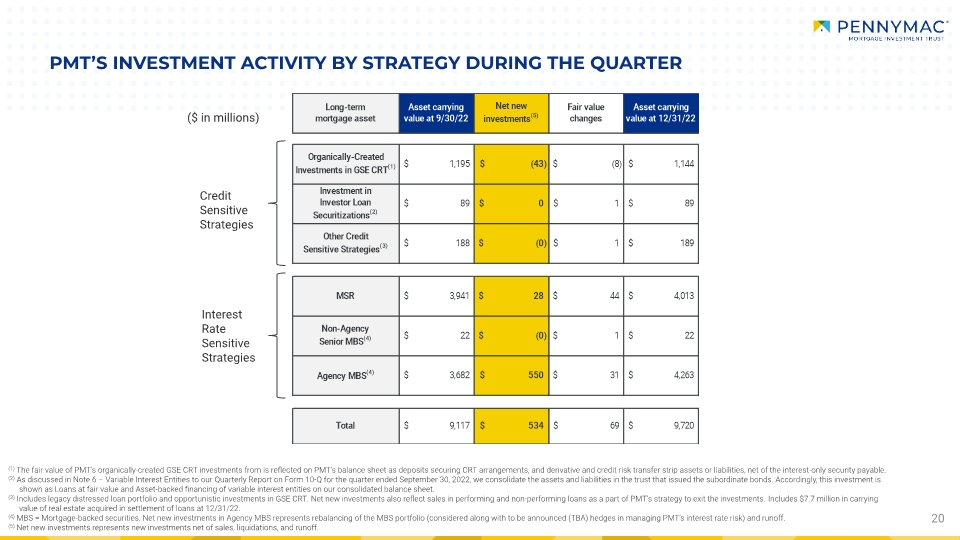
20 PMT’S INVESTMENT ACTIVITY BY STRATEGY DURING THE QUARTER Credit Sensitive Strategies Interest Rate Sensitive Strategies ($ in millions) (1) The fair value of PMT’s organically-created GSE CRT investments from is reflected on PMT’s balance sheet as deposits securing CRT arrangements, and derivative and credit risk transfer strip assets or liabilities, net of the interest-only security payable.
(2) As discussed in Note 6 – Variable Interest Entities to our Quarterly Report on Form 10-Q for the quarter ended September 30, 2022, we consolidate the assets and liabilities in the trust that issued the subordinate bonds. Accordingly, this investment is shown as Loans at fair value and Asset-backed financing of variable interest entities on our consolidated balance sheet.
(3) Includes legacy distressed loan portfolio and opportunistic investments in GSE CRT. Net new investments also reflect sales in performing and non-performing loans as a part of PMT’s strategy to exit the investments. Includes $7.7 million in carrying value of real estate acquired in settlement of loans at 12/31/22.
(4) MBS = Mortgage-backed securities. Net new investments in Agency MBS represents rebalancing of the MBS portfolio (considered along with to be announced (TBA) hedges in managing PMT’s interest rate risk) and runoff.
(5) Net new investments represents new investments net of sales, liquidations, and runoff.
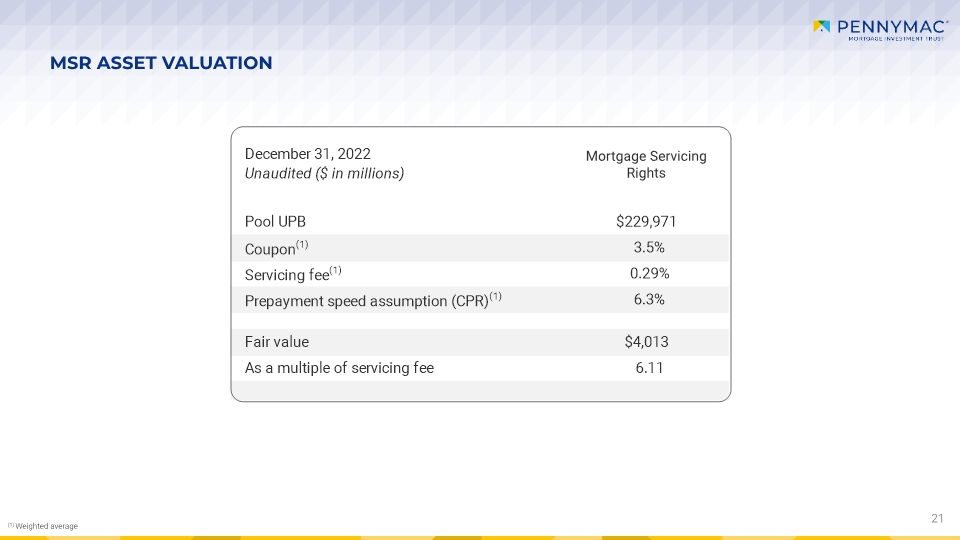
21 MSR ASSET VALUATION Mortgage Servicing Rights (1) Weighted average
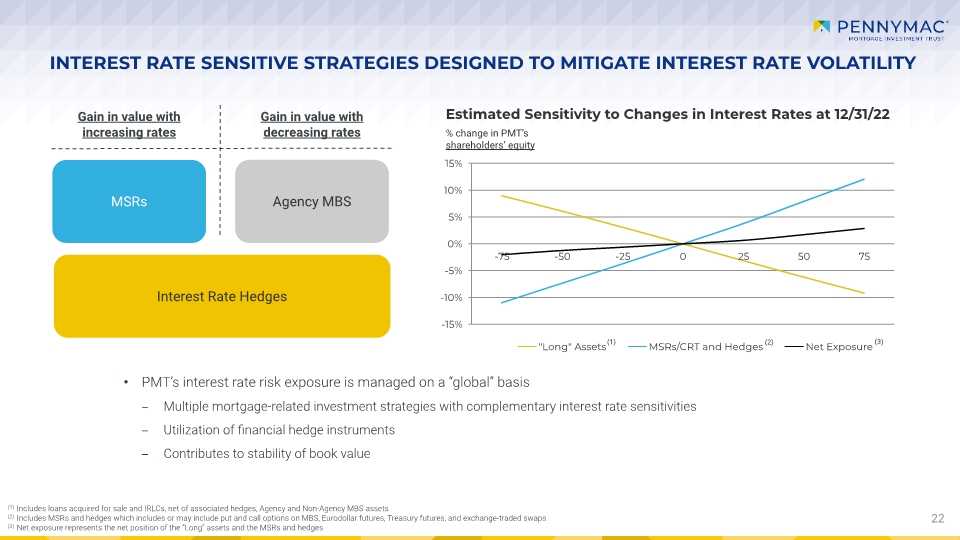
22 INTEREST RATE SENSITIVE STRATEGIES DESIGNED TO MITIGATE INTEREST RATE VOLATILITY Estimated Sensitivity to Changes in Interest Rates at 12/31/22 % change in PMT’s shareholders’ equity PMT’s interest rate risk exposure is managed on a “global” basis
Multiple mortgage-related investment strategies with complementary interest rate sensitivities
Utilization of financial hedge instruments
Contributes to stability of book value (1) Includes loans acquired for sale and IRLCs, net of associated hedges, Agency and Non-Agency MBS assets
(2) Includes MSRs and hedges which includes or may include put and call options on MBS, Eurodollar futures, Treasury futures, and exchange-traded swaps
(3) Net exposure represents the net position of the “Long” assets and the MSRs and hedges (1) (2) (3) Gain in value with increasing rates Gain in value with decreasing rates MSRs Agency MBS Interest Rate Hedges
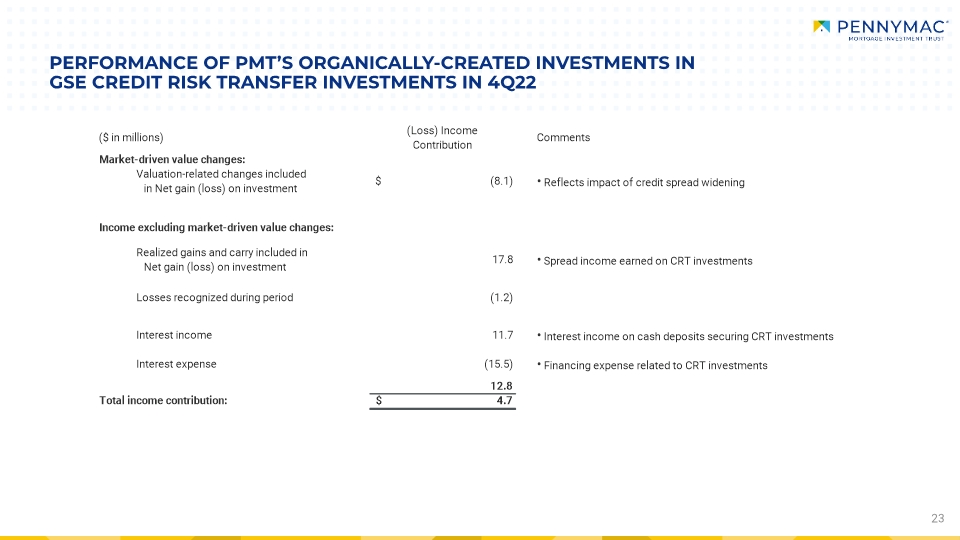
23 PERFORMANCE OF PMT’S ORGANICALLY-CREATED INVESTMENTS IN GSE CREDIT RISK TRANSFER INVESTMENTS IN 4Q22
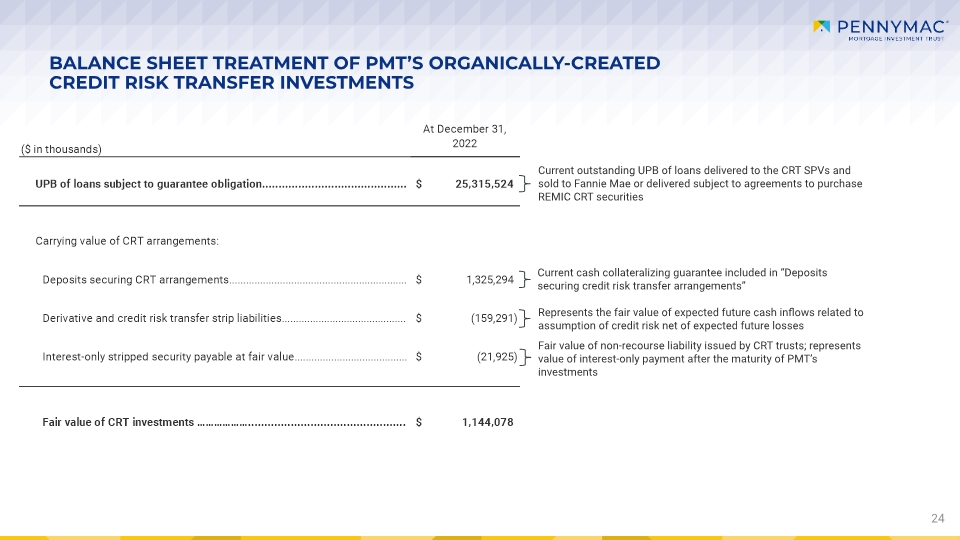
24 BALANCE SHEET TREATMENT OF PMT’S ORGANICALLY-CREATED CREDIT RISK TRANSFER INVESTMENTS Current outstanding UPB of loans delivered to the CRT SPVs and sold to Fannie Mae or delivered subject to agreements to purchase REMIC CRT securities Current cash collateralizing guarantee included in “Deposits securing credit risk transfer arrangements” Represents the fair value of expected future cash inflows related to assumption of credit risk net of expected future losses Fair value of non-recourse liability issued by CRT trusts; represents value of interest-only payment after the maturity of PMT’s investments
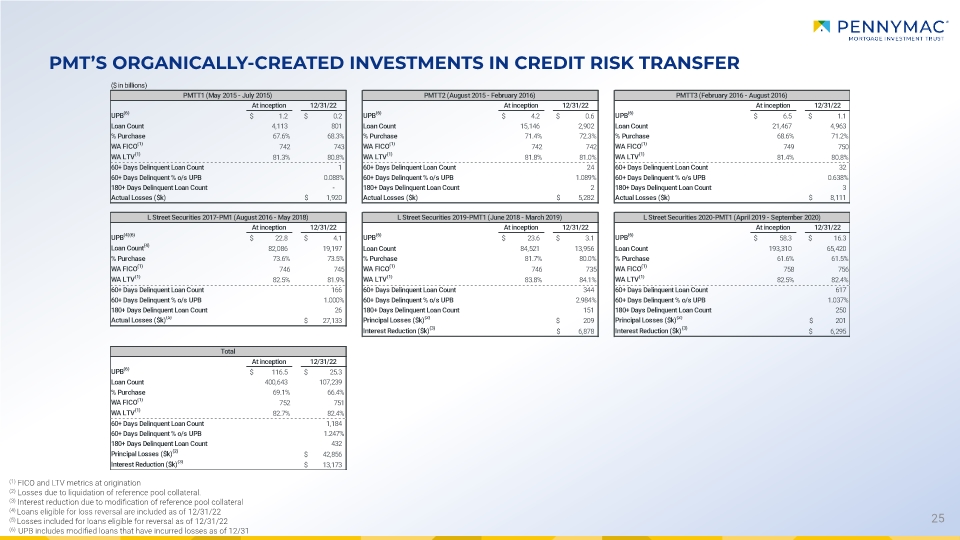
25 PMT’S ORGANICALLY-CREATED INVESTMENTS IN CREDIT RISK TRANSFER (1) FICO and LTV metrics at origination
(2) Losses due to liquidation of reference pool collateral.
(3) Interest reduction due to modification of reference pool collateral
(4) Loans eligible for loss reversal are included as of 12/31/22
(5) Losses included for loans eligible for reversal as of 12/31/22
(6) UPB includes modified loans that have incurred losses as of 12/31
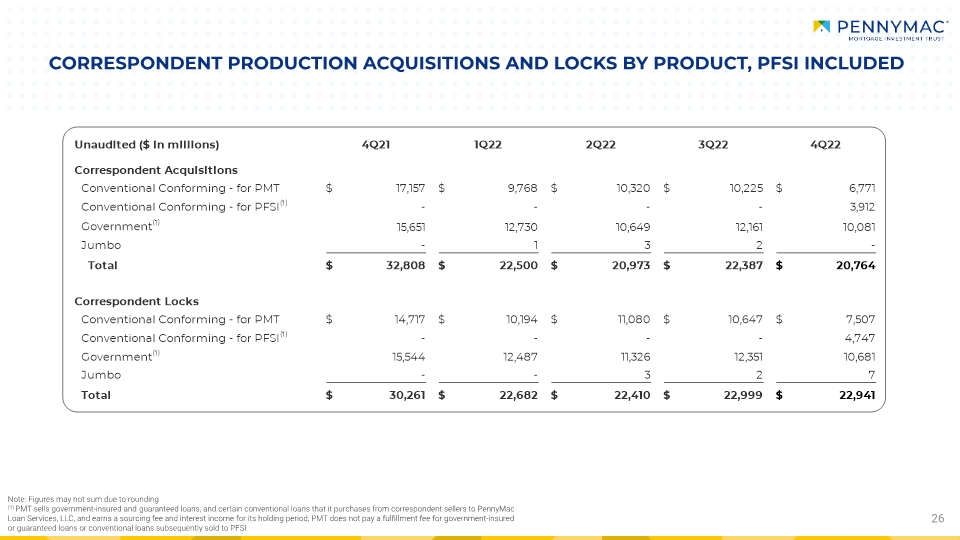
26 CORRESPONDENT PRODUCTION ACQUISITIONS AND LOCKS BY PRODUCT, PFSI INCLUDED Note: Figures may not sum due to rounding
(1) PMT sells government-insured and guaranteed loans, and certain conventional loans that it purchases from correspondent sellers to PennyMac Loan Services, LLC, and earns a sourcing fee and interest income for its holding period; PMT does not pay a fulfillment fee for government-insured or guaranteed loans or conventional loans subsequently sold to PFSI

27